/













Author: Yasushi Inoue
Tags: fiction biographies history of the middle ages genghis khan
ISBN: 978-0-231-14616-6
Year: 2008



Text
                    The Blue Wolf

weatherhead books on asia
weatherhead east asian institut e ,
columbia university

inoue yasushi

the blue wolf
a novel o f t h e l i f e o f c h i n g g i s k h a n
T r a n s l a t e d f r o m t h e J a pa n e s e b y

Joshua A. Fogel

columbia university     new yor k

This publication has been supported by the Richard W. Weatherhead Publication Fund of
the Weatherhead East Asian Institute, Columbia University.
Columbia University Press wishes to express its appreciation for assistance
given by York University toward the cost of publishing this book.
c olumbia univer s i t y p r e s s
Publishers Since 1893
New York Chichester, West Sussex
Translation copyright © 2008 Joshua A. Fogel
All rights reserved
Library of Congress Cataloging-in-Publication Data
Inoue, Yasushi, 1907–1991.
   [Aoki Ōkami. English]
   The blue wolf : a novel of the life of Chinggis Khan / Inoue Yasushi ;
translated from the Japanese by Joshua A. Fogel.
    p. cm. — (Weatherhead books on Asia)
   isbn 978-0-231-14616-6 (cloth : alk. paper) —
isbn 978-0-231-51791-1 (electronic)
   1. Genghis Khan, 1162–1227—Fiction. I. Fogel, Joshua A. II. Title. III. Series.
pl830.n63a86 2008
895.6'35—dc22

2008002981
Columbia University Press books are printed on permanent and
durable acid-free paper.
This book was printed on paper with recycled content.
Printed in the United States of America
c 10 9 8 7 6 5 4 3 2 1
References to Internet Web sites (URLs) were accurate at the time of writing.
Neither the author nor Columbia University Press is responsible for URLs
that may have expired or changed since the manuscript was prepared.
design by vin dan g

Contents

Translator’s Note
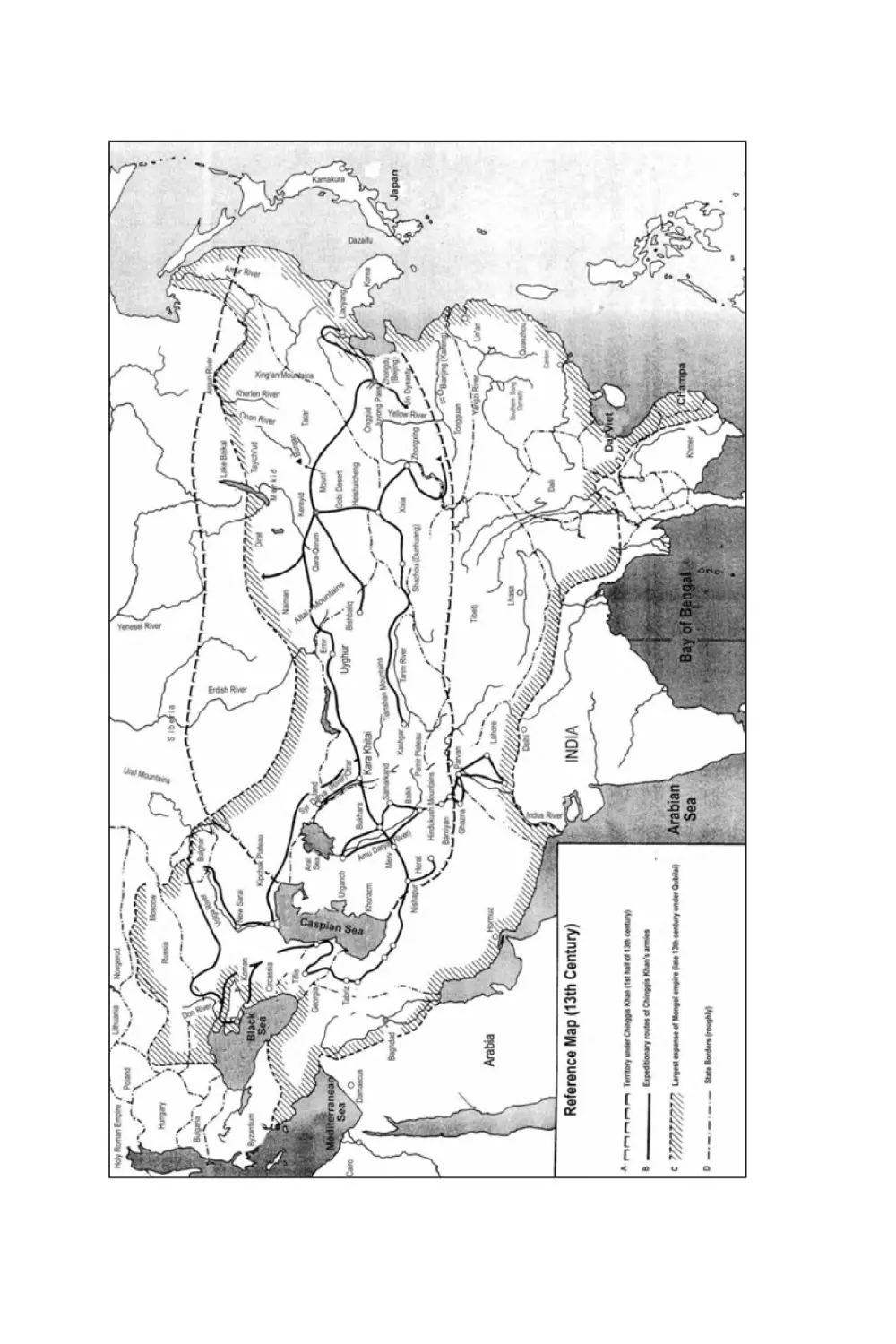
Map xiii
1
2
3
4
5
6
7
8

vii

Earliest Years 1
The Merkid Massacre 37
Overlordship on the Mongolian Plateau 77
Temüjin Becomes Chinggis Khan 131
Attack on the Jin 159
Fall of the Jin Dynasty 183
The Destruction of Khorazm 207
Return to Mount Burqan 243
Author’s Afterword (1960)
Dramatis Personae 279

269

Translator’s
Note
what great fun it has been translating Inoue Yasushi’s (1907–
91) epic novel, Aoki o-kami (The blue wolf )! The Japanese original
was published in ten serial installments in the renowned cultural
journal Bungei shunju- from October 1959 through July 1960, then
published in book form by the journal’s parent publishing company,
Bungei shunju- shinsha, in 1960, by Shincho-sha in 1964, and by numerous other presses thereafter. To give an idea of its enormous
popularity in Japan, Shincho-sha put the novel through its forty-seventh printing in 1987, and it still appears to be in print and available
through online book-ordering services in Japan. Indeed, an Asahi
shinbun report for February 28, 2007 indicates something of the extent of the novel’s popularity: during a state visit to Japan by the
president of Mongolia, the topic of Aoki o-kami came up in conversation with the Japanese emperor and empress.1
Many of Inoue ’s other novels and travelogues have been published in English translation over the past forty years, including The
Roof Tile of Tempyo-, Confucius: A Novel, Dunhuang, Flood, Journey
Beyond Samarkand, The Tea Ceremony, The Izu Dancer and Other
Stories, Lou-lan and Other Stories, The Hunting Gun, The Counterfeiter and Other Stories, Wind and Waves, Shirobamba: A Childhood
in Japan, and most recently The Samurai Banner of Furin Kazan.
One element of his work that has made him popular among ordinary readers as well as specialists in East Asian studies—a rare

viii

t r a n s l at o r ’ s n o t e

accomplishment—is the simple fact that, recognizing that he was
a novelist and not a scholar of Chinese and Inner Asian (and, of
course, Japanese) history and culture, he frequently consulted with
leading academic historians about the subject matter of his works in
progress. For example, his novel Dunhuang concerns the years in
the Tang dynasty (618–907) just prior to that famous cave’s being
sealed with many hundreds of manuscripts inside, only to be discovered at the dawn of the twentieth century; Inoue sought advice
from Fujiwara Akira (1911–98), a specialist on Dunhuang manuscripts. For Wind and Waves, a novel about the Mongol subjugation of Korea, which was virtually enslaved at the time of the failed
conquest missions to Japan, he consulted with Okada Hidehiro (b.
1931), one of postwar Japan’s best known Mongolists. And in writing The Roof Tile of Tempyo-, about several Japanese Buddhist acolytes in the early eighth century who make the pilgrimage to China
with one of the periodic embassies from Japan to pursue their religious studies, during which several members strive wholeheartedly
to convince the great monk Ganjin (C. Jianzhen, 688–763) to return
with them to Japan, he sought the advice of Ando- Ko-sei (1900–70),
a specialist in Nara-period Japanese history who wrote a number of
books on Ganjin and other aspects of Sino-Japanese religious history in this early era.2 One Japanese Mongolist wrote me that, in
his estimation, and perhaps exaggeratedly, Inoue was a genuine “literary giant” (bungo-), whereas other, more prolific historical novelists, who appeared frequently in the mass media, were merely “mass
market authors” (taishu- sakka).3
Does this attention to historical accuracy and authenticity make
Inoue ’s novels more readable or simply more satisfying? Explanations for his works’ popularity with the Japanese reading public must
take into account these concerns as well as his writing style. Inoue
has mastered a style that is simultaneously crystal clear—often
about events and customs that are anything but familiar to an ordinary reader—and conscientious about historical and cultural detail.
This is no mean feat and should not be underestimated—usually an
author must dispense with one or the other, often sacrificing history
to tell a good story.

t r a n s l at o r ’ s n o t e

ix

Over the course of his career, Inoue won numerous literary
prizes in Japan, such as the Akutagawa Prize in 1949, and his name
was frequently mentioned as a candidate for the Nobel Prize for literature during the long period between its presentation to Kawabata Yasunari (1899–1972) in 1968 and to O-e Kenzaburo- (b. 1935)
in 1994, the only two Japanese to win this highly coveted award.
Few authors of historical fiction, in which Inoue specialized, have
received the Nobel.
As he explains in his own afterword, Inoue was drawn to write
about Chinggis Khan precisely because there were areas of his character that historians had not explained or simply could not explain.
Enter the historical novelist who need not be tied down by the hardand-fast pull of facticity or the silence from documentation. Where
the historical record dries up, the novelist takes over. Inoue wanted
to get at the source of what drove Chinggis psychologically to virtually endless conquest and colossal mass murder. Needless to say,
we have no contemporary documents describing the Great Khan’s
psyche—indeed, for much of the history retold in this novel, the
Mongols were preliterate.
This direction might lead one to write a novel of utterly no use
whatsoever. Imagine a comparable novel about Napoleon or Hitler, both mentioned by Inoue in his afterword, that explained their
penchant for conquest as based on a single psychological source.
Many readers might reject it out of hand; at best, it might attract
those drawn to monocausal explanations of great events or people. Inoue does manage to penetrate the character of his fictional
Chinggis without either completely demonizing him or idealizing
him; there is similarly no effort to explain away any of his obviously
monstrous behavioral traits by invoking some form of historical
relativism. And where the facts are available, Inoue sticks to them.
I give but one example. There is a famous story—recounted every
year in East Asian survey courses around the world—of Chinggis’s
plan, once he completed his conquest of the state of Jin in north
China, to depopulate the entire area and turn it into a massive pastureland for the nomadic Mongolian people; he is said to have been
dissuaded only by the intervention of his aide, the Khitan nobleman


t r a n s l at o r ’ s n o t e

Yelü Chucai (1190–1244), who makes repeated appearances in the
novel. This story would have made great copy in Aoki o-kami, but to
his credit Inoue makes no mention of it, presumably because it has
no basis whatsoever in fact.4
The enduring popularity of Inoue ’s psychological take on the
driving force behind Chinggis Khan, the conqueror, is attested
by the nearly four-and-a-half-hour television drama based on the
novel, entitled Aoki o-kami, Chingisu Kan no sho-gai (The blue wolf:
The career of Chinggis Khan). Appearing initially in four installments on Asahi TV in 1980, it was directed by Morisaki Azuma and
Harada Takashi, and it starred Kato- Go- in the title role.
On a far grander scale than the small screen, however, is the release on March 31, 2007 of a major motion picture shot entirely on
location in Mongolia, putatively to commemorate the 800th anniversary of the founding of the first Mongolian state: Aoki o-kami,
chihate umi tsukiru made (The blue wolf: Till the end of land and
sea). The story is based both on Inoue ’s novel and on a more recent novel by Morimura Seiichi entitled Chihate umi tsukiru made,
sho-setsu Chingisu Kan (Till the end of land and sea, a novel of
Chinggis Khan).5 The blockbuster was directed by Sawai Shin’ichirō,
a veteran screenwriter and director, and runs over two hours.6
As Inoue was periodically aided by experts in various histories, I too
was fortunate enough to have recourse to the assistance of specialists. Although there have been Mongolian, French, and three Chinese translations of this novel, I assiduously did not consult them
until the copyediting stage of production. The modern Mongolian
rendition is beyond my abilities in any case, but I did not want to
be unduly influenced by the French or Chinese translators’ take on
the events portrayed. In matters concerning Mongolian toponyms,
ethnonyms, and other proper nouns, I frequently consulted with
Christopher Atwood of Indiana University. Despite considerable
attention by highly trained specialists over the years to many of the
details of early Mongolian history, rendering these proper nouns is
no mean feat. Like all living languages, Mongolian has changed over

t r a n s l at o r ’ s n o t e

xi

the eight centuries since Chinggis lived, and chronolectal difficulties
only added to the problem. Chris’s advice made it possible for me
accurately to romanize the terms I was reading in Japanese syllabary form. If I have done this correctly, it is all to his credit; where
I have failed, it is because I misunderstood or mistranscribed one of
his renderings. For the Central Asian terms that appear in the latter
chapters, I have relied (at Chris’s advice) on John Andrew Boyle’s
(1916–78) translation of the Persian historian Ata-Malik Juvaini’s
(1226–83) Genghis Khan: The History of the World-Conqueror.7 My
only addition to Inoue ’s original text are the (rather simple) names
of the chapters; in the original they were merely numbers.
I do not know if Japanese read more historical fiction than Anglophones, but I do know that the percentage of historical novels
translated from Japanese into English (vis-à-vis all novels rendered
from Japanese into English) is much lower than their comparative
numbers in the original language. For example, only two historical
novels by Chin Shunshin (b. 1925) and only three or four by the
most prolific of all, Shiba Ryo-taro-, have appeared in English-language editions. Like films with historical themes and personages,
historical novels can be used in teaching with great efficacy, but only
if they are approached critically. They help us to imagine the inner
workings of historical actors in a way that less accessible academic
works cannot. But they are novels, not chronicles. One should no
more confuse the Napoleon and the Mikhail Kutuzov (1745–1813)
of Tolstoy’s War and Peace with the real men than the men and
women surrounding John F. Kennedy (1917–63) with the characters
in Oliver Stone ’s (b. 1946) film JFK.
Enjoy, enjoy.
Joshua A. Fogel
not e s
1. See  www.asahi.com/national/update/0228/TKY200702280361.html.
Thanks to one of the anonymous readers for Columbia University Press
who brought this to my attention.

xii

t r a n s l at o r ’ s n o t e

2. Tonko- (Tokyo: Iwanami shoten, 1981), English translation by Jean Oda
Moy, Tun-huang: A Novel (Tokyo, New York: Kodansha International,
1978); there are also German, French, and Chinese (three times) translations. Fu-to- (Tokyo: Ko-dansha, 1963), English translation by James T.
Araki, Wind and Waves: A Novel (Honolulu: University of Hawai‘i Press,
1989); also French and Chinese translations. Tenpyo- no iraka (Tokyo: Chu-oko-ronsha, 1957); English translation by James T. Araki, The Roof Tile of
Tempyo- (Tokyo: University of Tokyo Press, 1975); also French, German,
and Chinese (three times) translations.
3. Personal e-mail communication from Nakami Tatsuo, August 24, 2002.
4. See two fine books by Sugiyama Masaaki: Yaritsu Sozai to sono jidai (Yelü
Chucai and his age) (Tokyo: Hakuteisha, 1996) and Dai Mongoru no sekai,
riku to umi no kyodai teikoku (The world of Mongolia, an immense empire
of land and sea) (Tokyo: Kadogawa shoten, 1992).
5. (Tokyo: Kadogawa Haruki jimusho, 2000), two volumes.
6. As of this writing, the film has not come to North America, and I have
not seen it. From an assortment of Web sites, including one launched
solely for the film itself (www.aoki-ookami.com), the following roles will
be played by the following actors: Temüjin (Ikematsu So-suke); Chinggis
Khan (Sorimachi Takashi); Yisügei (Hosaka Naoki); Ö’elün (Wakamura
Mayumi); Qasar (Hakamada Yoshihiko), Jamugha (Hirayama Yusuke);
To’oril Khan (Matsukata Hiroki); Börte (Kikukawa Rei); and Qulan (Ara,
a young Korean actress in her first major role).
7. (Seattle: University of Washington Press, 1958).

The Blue Wolf

1

Earliest
Years
the year was 1162. A baby boy was born in the chieftain’s yurt in
a settlement of the nomadic Mongols who lived in the grassy plains
and forests by the Amur River, which, along its upper reaches, splits
into the two tributaries of the Onon and Kherlen rivers. The mother
was a beautiful young woman still several years shy of twenty by
the name of Ö’elün. As was often the case, at this very time the men
of the settlement had all left to launch an attack against the Tatars of
a neighboring area, a tribe with whom they had long been fighting.
Thus, the only people then residing in the several hundred Mongol
yurts were old people and children.
Ö’elün dispatched an old servant to report the birth of her son to
the camp of Yisügei, her husband, who was several miles away from
the lineage at the time. After the messenger had departed, Ö’elün
put her ear to the face of her newborn. The infant had rolled over
in his raggedy swaddling. The fingers of his left hand were wrapped
around hers so tightly that the women who had just delivered him
could not unpeel them. With the instinctive tenacity of a mother
attempting to ascertain for herself that the four limbs of the child
to whom she has just given birth were all in good working order,
Ö’elün tried her best to remove his left hand clasping her tightly.
This required considerable attention, without the least violence.
When she managed to separate her hand from the child’s, Ö’elün
heard the roaring wind rush by above the yurt. Like a solid object


the blue wolf

but with the volume of a rushing, mighty river, the wind was blowing east to west, and it seemed to shake the earth’s very axis. When
it ceased blowing, Ö’elün remembered the height of the pitch-black
night sky above the yurt in which she was lying on her back. Countless stars studded the sky, each glistening before her eyes with its
own icy light. When the next wind swept over her, though, it was
like a black cloth embroidered with the stars came howling, and the
stars scattered in all directions, ultimately leaving only the roar of
the wind enveloping heaven and earth. While the wind was blowing
or the starry sky hung over the roof, Ö’elün invariably was taken
with the feeling of her own utter insignificance, lying there alone in
her humble yurt.
This very sense of insignificance and powerlessness amid the
vastness of nature was surely to be found somewhere in the heart
of each of these nomads who, possessing neither fixed houses nor
designated plots of land, moved in search of grasslands and owned
no soil on which to live sedentary lives. Wherever they went and
whatever else they might have been thinking about, in the end this
inevitable feeling was like a spell cast over them. For Ö’elün that
evening, there was still another, even stronger reason for her feeling
of forlorn loneliness. Ö’elün could see an even higher sky through
the roof of the yurt that night, and the force of the night wind causing the yurt to sway felt that much wilder.
Having just become a mother, Ö’elün was now troubled by two
things. First, would the baby to whom she had just given birth possess the full physique sufficient to satisfy her husband? Second,
would the infant have as acute powers of sight and smell as his father to fully satisfy Yisügei?
Ö’elün was able to rid her mind of one of these two concerns.
The baby, apparently of his own volition, opened the little fingers
of his hand that he had until then entrusted to her palm. He firmly
grasped a blood clot the shape of a deer’s anklebone, as if he were
holding some sort of military decoration.
Beyond this, Ö’elün had no other worries. From the features of
her newborn, one could derive no proof or confirmation that he was
the son of Yisügei. In some ways he resembled Yisügei, and in oth-

earliest years


ers he did not. By the same token, he certainly did not look like
another man, which would have been cause for Yisügei’s distress. In
a word, the boy looked like no one at all in particular. That is, except
for one person—he did resemble the mother from whose womb he
had just emerged.
Ö’elün had no idea whatsoever what Yisügei’s feelings would
be when he learned of the birth. Throughout his wife’s pregnancy,
Yisügei had remained taciturn and expressionless, as brave men of
his lineage always were. Joyous or angry, he would not allow his
inner feelings to be visible to anyone other than himself. Ö’elün
would be able to learn her husband’s first words when news of the
birth reached him. It would not have been altogether out of the ordinary were he to utter, “Kill him!”
The old servant dispatched to Yisügei’s camp returned to Ö’elün’s
yurt the next evening. He reported to the young mother that Yisügei
had selected the name Temüjin for the boy. When she heard this, for
the first time since she had given birth, Ö’elün looked relieved, for
at least she now knew that her husband did not bear anger such that
he might wish to curse the newborn child. Aside from this, however, everything remained unclear, for according to the old servant
the meaning of the name Temüjin could be construed by Ö’elün in
any way she wished.
“When I reached Master Yisügei’s camp, he was in the midst of
enjoying a victory celebration after merciless fighting with the Tatars. To the side of the campfire were two enemy leaders who had
been taken prisoner and were tied up. It seemed to be the middle
of a drinking bout, and one of the prisoners was dragged out and
beheaded on the spot. As if to commemorate this triumphal celebration, it was the wish of Master Yisügei to give the newborn child the
name of this Tatar chief.”
Thus spoke the elderly servant. To be sure, a name taken simply
to commemorate a military victory posed no problems, but when
she tried to come to terms with the fact that it was the name of an
enemy chief who had been decapitated, Ö’elün could not repress a
certain disquiet. And she remained confused as to whether Yisügei
was happy or enraged at the birth of his son. In any event, this in-


the blue wolf

fant boy who as yet had no clear sense of who his mother and father
were was given the name Temüjin and thus was fated to be reared as
the eldest son of a leader of a Mongol lineage.
For the next few days, Ö’elün suffered with a high fever due
to postpartum illness, vacillating between life and death. When
the fever subsided and it eventually became clear that she would
live, the first thing her frail eyes caught sight of was her husband,
Yisügei, taking their baby son, Temüjin, up in his arms.
Ö’elün had become Yisügei’s wife about ten months earlier. Born
into the Olqunu’ud lineage, she had been taken captive by a young
man of the Merkid lineage and carried off to a Merkid settlement. En
route she was again taken, this time by Yisügei, by the banks of the
Onon River and hence became his wife. She had been raped over
a dozen times by the young men of the Merkids, and although she
gave birth only after becoming Yisügei’s wife, there was no way of
determining for sure that the boy was his biological son.
Ö’elün continued looking at the profile of her husband holding Temüjin. Commonly called Warrior Yisügei, he was feared by
other tribes for his famed courage and valor. From the intrepid look
on his face, she could not detect so much as a fragment of his inner
thoughts, but the fact that he was embracing Temüjin in his large
arms gave Ö’elün cause for relief. And this sense of relief gradually
changed into a powerful emotion she herself could not even explain
clearly, as tears bathed her cheeks.
A number of nomadic peoples were encamped at various sites on
the terrain north of the Great Wall of China where the Mongols
lived at this time. The land was obstructed on the east by the Great
Xing’an Mountains and on the west by the Sayan, Altai, TannuOla, and Tianshan ranges; to the south it bordered China at the
Great Wall and the Western Marshes across the immense wasteland
of the Gobi Desert. And the north, bounded by the region around
Lake Baikal, was engulfed in the endless no-man’s land of Siberia.
Six rivers streamed through this immense plain surrounded by great
mountain ranges, deserts, and uninhabited wilderness. The Onon,

earliest years


Ingoda, and Kherlen flowed together, formed the Amur River, and
poured out into the Sea of Okhotsk. The Tula, Orkhon, and Selengge rivers all flowed into Lake Baikal. These two water systems
both began in the central portion of the high plains, and their basins
formed the grasslands and forest regions. From time immemorial
nomadic peoples had risen and fallen here. With this area as a base
of operations, the Xiongnu, Rouran, Orkhon Turks (Tujue), and
Uyghurs had all attempted to extend their influence southward, the
only way out. Thus, Chinese statesmen over the centuries had no
choice but to construct the Great Wall and prepare for invasions
from these nomads to their north.
It was unclear just when the Mongols had moved into this region,
but in roughly the eighth century they, together with other settlements, fell under the domination of the Turks, and in the middle
of the eighth century they became subject to the Uyghurs who replaced the Turks. From the ninth century, they were under the control of the Tatars who supplanted the Uyghurs. After the collapse
of the Tatars, though, a number of unrelated peoples who differed
in hairstyles, skin color, and customs formed their own villages and
spread out here and there around the vast grasslands. Through the
years, they lived fighting constantly over domesticated animals,
women, and grasses.
In the middle of the twelfth century, when Temüjin was born,
besides the Mongol people there were the Kirghiz, Oirat, Merkid,
Tatar, Kereyid, Naiman, and Önggüd ethnicities living on this
Mongolian plain. The Mongols and Tatars were trying to gain supremacy over all the settlements, and that meant incessant smallscale fighting. Temüjin was born in the midst of the battles between
these two peoples.
In addition to fighting between different ethnic groups, there was
repeated and often fierce fighting within the same group over collected booty. The Mongols were divided into a number of lineages,
each with its own independent settlement, which were prone to vie
with one another. The Borjigin lineage to which Yisügei belonged
had long effectively functioned as the main family line of the Mongolian people, and from it someone had eventually emerged as the


the blue wolf

khan or ruler who controlled all the Mongol groupings. The first
khan was Temüjin’s great-grandfather, Qabul Khan, who brought a
certain unity, albeit imperfect, to the Mongol settlements, which had
been in a state of chaotic disorder, and he put in place a system for
other settlements that proved to be of benefit to all. Although the
second khan was Hambaghai of the Tayichi’uds, in the following
generation leadership returned to the Borjigin lineage with Qutula,
Yisügei’s uncle, as khan. At present, Yisügei was the fourth khan.
Temüjin was therefore raised in the tent of the chief of the Mongolian people on the great Mongolian plateau. Two years after giving
birth to him, Ö’elün bore Qasar, and two years after that Qachi’un,
both boys. Thus, at age four Temüjin had two younger brothers.
His father also sired by another woman a boy one year his junior by
the name of Begter and another boy two years Begter’s junior by the
name of Belgütei, thus giving Temüjin two more younger brothers.
Temüjin was reared together with all of his younger male siblings, as
Yisügei treated his five sons equally, not doting on or showing particular favoritism to any one of them. The same was true of Ö’elün.
She never distinguished between the three sons she had borne in her
womb and the two children born to another woman. And just as her
husband showed no favoritism toward Temüjin, Ö’elün too showed
none toward any of the children she and her husband had produced.
This was particularly perspicacious on her part.
When Temüjin was six years old, Ö’elün gave birth to another male child who was given the name Temüge. The six-year-old
Temüjin was considerably bigger physically than other boys his
age and considerably stronger, but he was a quiet child who rarely
spoke. Although he quarreled with others very infrequently, when
he did so it was with great resolution. He would always listen silently with his eyes glaring whenever someone would speak to him abusively, and when he saw that that person had nothing further to say,
he would suddenly, without so much as a single word, attack him.
He might throw the person to the ground and from horseback pelt
him with stones, or he might ram the person’s head into the sand
and trample him underfoot—his methods were decidedly violent.
There was something brutal in the manner of his assault, as Temüjin

earliest years


possessed, in the eyes of the adults who came to stop him, a bizarre
disposition lacking many of the charms associated with childhood.
On such occasions, the adults were under the illusion that Temüjin
was the same age as they, and they would always reprove him as one
castigates an adult.
These instances aside, though, Temüjin was just a quiet, unobtrusive lad. Being the eldest child, he had to allow his mother to look
after his younger brothers. He thus had little opportunity to rest at
Ö’elün’s knee or wrapped in her arms. Yet he was no different from
other children in his desire to spend time close to his mother.
The first time Temüjin heard stories of ancestors in his lineage
and the traditions about them, he was seven years of age. He had
a distant relative, an elderly man by the name of Bültechü Ba’atur.
The term ba’atur was an appellation meaning “brave,” indicating
that in his youth this man had undoubtedly been a valiant warrior.
Now, however, he was a gentle old man, fond of children, who had
grown a white beard over his cheeks and chin. He retained a stunning memory, and when on occasion relatives gathered in Yisügei’s
yurt, he regaled them with tales of their ancestors through the ages.
As if he had known all of these men from the past personally, he
described in intimate detail their facial appearances and even their
dispositions. No one listening ever lost interest.
Whenever a group of men gathered around, Bültechü Ba’atur
always faithfully drew out—as if he were tracing it with string—
what he had crammed inside his head. While a portion of what he
recounted was remembered by the majority of those assembled, no
one else could tell a story like Bültechü, and it was hard to imagine
that anyone else could keep such extraordinarily long stories stored
inside his mind as he could.
When Bültechü was about to launch into one of his tales, people
would often try to be the first to jump in from memory.
—There was Batachiqan and his son was Tamacha, and Tamacha’s son was Qorichar Mergen, and Qorichar Mergen’s son was
A’ujam Boroghul, and A’ujam Boroghul’s son was Sali Qacha’u,
and Sali Qacha’u’s son was Yeke Nidün, and Yeke Nidün’s son was
Sem Söchi.


the blue wolf

In this way one might enunciate the names of one’s ancestors
who had been the heads of the family. If one became confused, another might pick up the lead and continue the genealogy.
—Sem Söchi’s son was Qarchu, and Qarchu’s son was Borjigidai
Mergen; and Borjigidai Mergen had a beautiful wife by the name
of Mongoljin Gho’a, and they had a son by the name of Toroqoljin
Bayan; and Toroqoljin Bayan had a beautiful wife by the name of
Boroqchin Gho’a, as well as a young servant named Boroldai Suyalbi and two fine steeds named Dayir and Boro.
Even one with the best of memories would usually find himself
stymied at this point in the tale. Thereafter—that is, from Toroqoljin
Bayan (meaning Toroqoljin “the rich”), the tenth-generation head
of the family with his wife and two horses and young servant—the
number of offspring proliferated, and all of a sudden the names of
the people that one had to commit to memory expanded like the
branches and limbs of a overgrown tree, necessitating that one wait
for the likes of Bültechü with his astonishing memory. When others couldn’t recall anything more, he would smile in apparent satisfaction, his face wrinkled by age, and slowly begin to speak. And
of course, what Bültechü actually had to say was more than just a
simple list of the names of the heads of the Mongol families through
the ages. His tone often went as follows:
“Toroqoljin Bayan and his wife Boroqchin Gho’a were a very
happy couple. Because they were so very amicable, they produced
a son with a single eye. Thus, they gave him the name Du’a Soqor
or ‘one-eyed’ Du’a. This eye was placed right in the middle of his
forehead, but it was an extremely efficacious eyeball, for he was said
to be able to see—although it surely sounds like a falsehood—to a
distance three days’ journey away, perhaps as far as 250 miles. After
Du’a Soqor, Dobun Mergen (Dobun ‘the sharpshooter’) was born,
and both developed into high-spirited youngsters. On one occasion
the brothers went out hunting. Du’a Soqor surveyed the plain and
saw in the distance a fine young woman. She seemed as though she
might be married. He said: ‘Since she should be passing this way
tomorrow or the next day, let’s snatch her up when she arrives and
she ’ll make a fine wife for you, Dobun Mergen.’ Although Dobun

earliest years


Mergen did not, in fact, do this, the following day when she arrived at that place, she turned out to be a young bride amid a small
group of people. The young men drew their bows and brandished
their spears, preparing to attack them. Such were the circumstances
by which Alan Gho’a (meaning the ‘fair’ Alan) became the bride
of Dobun Mergen. The two soon produced two sons, Bügünütei
and Belgünütei, who were to become, respectively, the ancestors
of the Bügünüd and Belgünüd lineages. Well, then, Dobun Mergen
now had Alan Gho’a as his wife, but regrettably he died, leaving
behind his young wife and two young sons. Alan Gho’a continued to raise the boys, and in succession produced three more sons.
Although she had no husband, she gave birth to several children.
That said, Alan Gho’a was a chaste woman, and never had she
committed a sin. How then were the births of these children to be
explained? Just before she became pregnant each time, light from
a corner of heaven shone down, entered a hole in the roof of her
yurt, and touched the white skin of her body. Thence were born
Bügü Qatagi, Bughatu Salji, and Bodonchar Mungqaq (Bodonchar
‘the fool’), and they were the progenitors, respectively, of the Qatagin, Salji’ud, and Borjigin lineages. Thus, the blood of the beautiful
Alan is mixed with the light of heaven in the bodies of those of us
Borjigins who come together and form the line descending from
Bodonchar Mungqaq.”
Bültechü went on to recount in detail and with vibrancy the
generations of brave warriors and military prowess that followed
Bodonchar. There were ten generations from Bodonchar to the
present head of the lineage, Yisügei, and many things had to be described, but it would be impossible to relate the entire story in a
single evening.
The only story that left an impression on the seven-year-old Temüjin was that of Du’a Soqor. If the other parts of the tale did not
elicit much interest, it was probably because he did not fully understand them. Temüjin was even more fascinated when, at some great
meeting of all the Mongol families, a number of elders responded in
chorus, as if in prayer, to Bültechü’s oral transmission, in the open
space before their yurts, of the origins of the Mongols. In particu-

10

the blue wolf

lar, it was the content of the phrases of their prayer that intrigued
Temüjin:
—There was a blue wolf born with a destiny set by heaven.
There was a pale doe who was his mate. She came across a wide
lake. They set up camp at Mount Burqan at the source of the Onon
River, and there was born Batachiqan.
These were the short phrases that were begun by the chorus, and
soon thereafter they were absorbed into intricate ceremonies. The
oral tradition had it that through the mating of the wolf and doe the
initial ancestor Batachiqan was born, and whenever this tale was recounted, it evoked extraordinary emotions in the hearts of all Mongols, whether they were of the Borjigin or the Tayichi’ud lineage.
Everyone believed the story. It told of a great lake far to the west
and a rampaging wolf that crossed it at the orders of his deity and
took the graceful, beautiful doe as his mate. Mount Burqan was a
peak everyone knew well. Wherever they moved their yurts, Mongols were raised nearly every day from birth with an adoration for
Mount Burqan.
Temüjin was profoundly moved by the story of the blue wolf.
Satisfied that he was himself a descendant of the wolf and doe, he
firmly believed that the tale did not refer to another lineage, and as
a result those of the other lineages had declined to a debased state.
In short, Temüjin felt great pride that the blood of the wolf and doe
coursed through his veins.
Hearing this strange chorus of elders, including Bültechü, singing was the most important event of Temüjin’s youth. The meaning
of the words they sang, of course, was difficult for the seven-yearold to comprehend and was explained to him by his mother, Ö’elün.
While the elders were intoning these words, though, Temüjin was
visualizing an immense, ferocious wolf and an elegant, lovely doe.
The wolf had an acute eye, one that could see even farther and more
accurately than Du’a Soqor, an eye that grasped everything within
its purview and would not let go, and that feared absolutely nothing.
The cold light in his eye held both the spirit of attack ready to confront anything and the powerful will to make anything he desired
his own. His physique was made entirely for attack. His sharp ears

earliest years

11

could pick up sounds hundreds of miles away; all of the flesh and
bones of his body were solely dedicated to the objective of slaughtering the enemy. When necessary, his tenacious limbs could dash
through snowy wastelands, race through strong winds, climb over
peaks, and leap through the air.
Attending this wolf was a doe of slender build covered in magnificent fur. Her chestnut coat was dotted with white specks, her
mouth covered with white fur. Unlike the wolf, she possessed delicate eyes, but she moved them incessantly, giving her whole body
a nervous edge, as she tried to protect the mate she loved from his
enemies. The doe served the wolf with her great beauty, and served
him as well by never relinquishing her vigilance for so much as an
instant. To the least stirring of the leaves of a tree in the wind, she
inclined her long face alertly. While she lacked virtually anything of
an aggressive nature, her defensive posture was unsurpassed.
These two entirely different living things both provided enough
beauty to enchant the young Temüjin’s mind. And from these two
marvelous creatures was born the first human ancestor: Batachiqan.
Over the course of many years, the blood of the wolf and the doe
had continued to flow in the bodies of many of his ancestors, and
now it flowed in his own.
After he learned this story, no matter what tale Bültechü recounted—and Temüjin came to know them all himself—none captured his
mind as fully as this one. Although he would hear Bültechü numerous
times retell the story of the blood of the beautiful Alan Gho’a mixing with the light from heaven into the body of the Borjigin lineage,
compared to the tale of the wolf and the doe that he had relayed with
such pride, it struck Temüjin as dull and without any charm whatsoever. The fact that members of the Borjigin lineage were superior to
other Mongol families by virtue of this heavenly light was, of course,
not something that saddened Temüjin, but the tale of the blood of the
wolf and doe, which was distributed equally among the entire Mongol population, was on a far grander scale in his mind. Supporting it
was a stage with the far greater breadth of all Mongols upon it.
In the spring of the year that Temüjin turned eight, Ö’elün gave
birth to one more child, this time a girl, who was given the name

12

the blue wolf

Temülün. At the time of her birth, Temüjin was overcome with a
deep emotion that included troubling doubts unlike anything he had
experienced before about the blood of the wolf and doe flowing in
Temülün’s veins. Certainly that blood flowed in the bodies of his
younger brothers, Qasar, Qachi’un, and Temüge—and, for that
matter, in his half-brothers, Begter and Belgütei. He had not the least
doubt that their veins carried it, but in the case of his younger sister
Temülün he harbored a sensation he couldn’t quite comprehend.
The bewilderment that had stricken him unexpectedly when she
was born was the result of a different eye applied by the eight-yearold Temüjin to seeing a female, something common among most
adults and children. A female probably bore the blood of the doe
within her, but it was inconceivable to him that she also had the
blood of the wolf. At one point, Temüjin questioned his mother,
Ö’elün, about this, and she replied:
“What difference is there between males and females? All
Mongols, be they men or women, carry on the blood of all their
ancestors.”
As far as Temüjin was concerned, his mother’s answer was altogether insufficient. He found it impossible to think of females in
the same way that he did males—if they were knocked down, they
would immediately stagger and fall; if beaten, they would immediately collapse into tears. He found the idea of being together with
them odious. Was it possible that the weak who did not go into battle inherited the blood of the wolf that had crossed the lake to the
west at heaven’s command?
Temüjin never played with girls, and with the exception of truly
important matters never listened to them. This was less a belittling
of the weak than it was antipathy or indignation taking root in his
eight-year-old mind at the notion that the frail shared the same
blood of the Mongol people.
From this time on Temüjin began to adopt a policy of always
checking his surroundings with his own eyes. Although he was
growing more rapidly than other youngsters, this taciturn, wild lad
was maturing spiritually no less than they.

earliest years

13

Temüjin tried to learn many things and in fact did learn a great
deal. While there was no reason to expect any changes in the conversations between his father, Yisügei, and his mother, Ö’elün, as
far as Temüjin was concerned, things were completely different.
From their conversations, Temüjin acquired knowledge of the
family line and history of their Borjigin lineage, the position occupied by the Borjigin line within the Mongol people as a whole,
and—more widely still—what place the Mongols held among
all the residents of the Mongolian plateau. From the conversations of men and women in the settlement and from the words
and deeds of villagers at small meetings of the settlement and at
larger meetings of the entire people, the youngster absorbed these
many pieces of information as a sponge soaks up water. Temüjin’s
mind and body were always on the move from his youth through
adulthood.
First of all, Temüjin knew that within the larger Mongolian
group the Borjigin lineage to which he belonged was not likely to
advance smoothly with the Tayichi’ud lineage from his father’s generation forward, and that this was causing friction on many fronts.
Originally, the Tayichi’uds belonged to the Borjigins, but they had
become independent when Hambaghai became the second khan, established their own settlements, and took the ethnonym Tayichi’ud.
Between the two, one might say, there was a main family–branch
family relationship.
From the time that Yisügei became khan, though, the children of
Hambaghai had gradually extended the influence of the Tayichi’uds
and were gathering under their own umbrella many other Mongol
lineages. At present, a good number of them would probably not
follow orders issued by Yisügei. All of the internal Mongolian troubles were rooted in this.
In addition to the Tayichi’uds, there were any number of other
lineages within the larger Mongolian grouping. Whether they were
subservient to the Borjigins or to the Tayichi’uds, on the surface the
entire Mongolian people were united with Yisügei as their khan. But
in fact, they were divided into two camps.

14

the blue wolf

Besides this internal situation, there were also incessant small
disputes with other peoples that kept Yisügei busy on a daily basis.
The most powerful among these other groups were the Tatars, a
people with whom the Mongols had long been on bad terms. From
ancient times, the biggest issue on the Mongolian plateau had been
structuring a unified confederated body of peoples. For the nomadic
groups living on the same Mongolian plateau, such a confederation
was absolutely essential not only for living together in peace but also
for dealing with the neighboring states of the Jin dynasty, the Xixia,
and the Uyghurs. The Jin bordering them on the plateau across the
Great Wall was most desirous that such a confederation not be created. Should the numerically small groups scattered across the plain
come together to form one great force, this would be a wholly unwelcome event. Whenever it witnessed the circumstances necessary
for the formation of a confederation on the plateau, the Jin state
intrigued to nip it in the bid, causing rifts and rivalries among the
various ethnic groups on the plain.
The first four khans of the Mongol people—Qabul, Hambaghai,
Qutula, and now Yisügei—were all thoroughly determined to create such a confederation, but were always obstructed by the Tatars,
who joined in with the plotting of the Jin. Qabul had been nearly
poisoned to death by a Jin emissary; Hambaghai was taken by a
Tatar escort to the Jin and there executed; and Qutula and most of
his six brothers had lost their lives fighting against the Tatars. In
other words, Temüjin’s great-grandfather and his grandfather and
great uncles had all been killed in combat against the Tatars.
In the warfare at the time of Temüjin’s birth, Yisügei had been
able to launch a major assault against the Tatars for the first time,
and a state of relative tranquility had been preserved thereafter between the two peoples. The dispute between them, however, was
certain to flare up again sometime as long as the Jin was working
behind the scenes.
The young Temüjin knew that both the Tatars and the Jin state
were enemies of the Mongol people. The name Tatar and the name
of the great state of Jin on the far side of the Great Wall were both
etched in his mind as ghastly, diabolical appellations.

earliest years

15

On one occasion, while drinking wine in his yurt, Yisügei blurted
out:
“I won’t die, so help me, until we attack the Tayichi’uds and the
Tatars.”
At the time, Temüjin thought it suspicious that his father had not
mentioned the third name of the Jin. When he said as much, Yisügei
said, laughing:
“Launching an attack on the Jin is an enormous undertaking.
Even if we were able to rally all the peoples living on the Mongolian
plain right now, our numbers would not reach 200,000 troops. By
contrast, the Jin has an army dozens of times as large, every soldier
with a weapon so fine you can scarcely imagine it.”
He then went on to discuss how, after concluding the fighting
with their enemies, they would face the Jin on the southern side of
the Great Wall and the Song state beyond the Jin, farther south.
Their people formed cities on sites surrounded by immense walls.
They constructed houses out of earth and wood from which they
never moved. Each person had a specialized job: merchants built
shops and sold their wares; farmers plowed the earth and produced
agricultural crops; bureaucrats traveled between offices and handled
all manner of affairs; soldiers spent their time training for battle with
weaponry. Within these city walls were large temples and government offices built of stone and rising into the sky.
Temüjin wondered if such lands, which were like figments of his
imagination, really existed. He wanted to know more and more, and
he asked his father all sorts of specific questions, but Yisügei had not
seen any of this with his own eyes and was thus unable to speak in
any more detail about it.
At some point later, Temüjin asked Bültechü about the states of
Jin and Song. He assumed that Bültechü, who knew everything,
would be able to fill him in. The old man with the fine memory prefaced his response with:
“They’re despicable places!”
Then, not touching on what Temüjin really wished to know, he
told the lad as proof of the Jin’s foulness the story of Hambaghai
Khan, who had been put to death by its men.

16

the blue wolf

“Hambaghai Khan was taken captive by the Tatars and escorted to the king of the Jin state. There he was somehow nailed to a
wooden donkey and then, while still alive, had his skin peeled off
and his body chopped up into small pieces. Hambaghai Khan was a
stouthearted man, and at the time of his death the servant who had
accompanied him was sent home to report on what had transpired:
‘You must take revenge for me on this enemy, even if you wear down
all ten of your fingernails and then lose all ten fingers.’ The servant
ran off, returned home, and conveyed everything. Everyone cried.
Your father cried. I cried.”
This servant had by now passed away, but a few years earlier,
while in his mother’s lap, Temüjin had seen the diminutive elderly
man. To the extent that he was somewhat familiar with this man,
the tragedy of Hambaghai Khan now struck the young boy with
its verisimilitude and profound, unalleviated gloom. That his father, Yisügei, had given up seeking revenge upon the Jin state, a
great land beyond his reach, was vexing to Temüjin. For him, this
Jin state was at once an immense, unknown place about which he
often dreamed and that he wanted to see just once and an implacable
enemy that had earlier murdered their khan. It was a state that, even
were he to lose ten fingers and ten fingernails, had to be fought by
way of retaliation.
In the summer of the year Temüjin turned nine, his father, Yisügei,
took him on a trip, at the request of his wife Ö’elün, to her own
hometown, an Olqunu’ud settlement, to find the girl who would
be Temüjin’s future bride. This was Temüjin’s first journey into
scenery altogether different from what he had experienced in his
first nine years. To be sure, the Mongols moved their dwellings to
various sites with the seasons, but they were always in the foothills
of Mount Burqan along the shores of the Onon and Kherlen rivers, within a limited radius determined by natural conditions. All
that Temüjin knew until then were the dense forests comprised of
the same kind of trees and grasslands all the same color. On this
trip, however, there unfolded before his eyes thoroughly dissimi-

earliest years

17

lar topography and surroundings. A row of a dozen or more men
mounted their horses, and they led as many camels laden with food
supplies. The row of men followed the Kherlen downstream into a
valley luxuriantly overgrown with trees, midway through left the
river and crossed the grasslands, climbed up hills with numerous
rocky crags, and advanced through gravel and desert sands. Lakes
were scattered here and there, and Temüjin found every day’s itinerary pleasing. Because it wasn’t a rushed trip, the men fished and
hunted birds and rabbits en route.
Before they reached the village from which Ö’elün had come, an
unexpected incident disrupted their journey. While they were passing between the two mountains of Chiqurqu and Chegcher, they
met a group traveling with Dei Sechen, leader of the Unggirad lineage. It was the first face-to-face meeting of the leaders of these two
families, but they were immediately able to speak frankly with each
other. When Dei Sechen learned of the goal of Yisügei’s group, he
encouraged them to change their plan of travel to the Olqunu’ud village and instead come to a settlement of his own Unggirad lineage.
“I have taken a liking to your son Temüjin,” said Dei Sechen quietly as he bent his solid torso back a bit. “Happily there is a girl
named Börte, and they will surely be a well-matched couple in future.” Yisügei was favorably impressed by this easygoing leader
of another family, and he had oftentimes heard that the Unggirads
were quite wealthy. He quickly accepted the invitation. It was never
a losing transaction for the Mongols to establish a marriage relationship with the Unggirads.
When their conversation came to an end, the two groups joined
together and, changing direction slightly, headed toward the grasslands in the southern foothills of the Xing’an range. Among the
various peoples on the Mongolian plateau, the Unggirads held terrain closest to the Great Wall, which put them closest to Jin culture
just on the other side, so they enjoyed the highest cultural life of the
residents of the plateau.
The Unggirad pastureland was far better than that of the Mongols. The gently sloping grasslands continued as far as the eye could
see, and a large number of sheep and horses had been put to pasture

18

the blue wolf

there. Dei Sechen’s yurt was incomparably larger and more lavish
than Yisügei’s. All of his personal effects too were polished and fine
looking. His storehouse was full of animal hides and varieties of
pelts. As for items he had acquired, it seemed, in exchange for these
hides and pelts, both Temüjin and his father were overwhelmed.
He had lacquered furniture, finely crafted weapons and armor, and
magnificent ornaments—also ivory and jade. Temüjin was forced
to confront the fact that, by comparison, their own Mongol yurts
were humble and shabby.
Börte was ten years old, a year older than Temüjin. Yisügei liked
her the moment he set eyes on her, and Temüjin found her lovely, a
girl with a large build who had grown up quickly. There was a luster
to her white skin and light brown hair. Ever since he was a little boy,
Temüjin had heard of the people known as “white Tatars,” as opposed to the “black Tatars,” but not until this trip to the Unggirads
did he discover it was not simply a rumor.
After entertaining Yisügei’s party for three days, Dei Sechen
hoped that Temüjin alone would remain behind for a time so that
he might become closer to the Unggirad people. In this instance as
well, Yisügei readily consented to Dei Sechen’s proposal. Although
Temüjin was heavyhearted about living with an alien group of
people, when he realized how much knowledge he could acquire by
doing so, he obediently followed his father’s wishes and remained in
Dei Sechen’s yurt. Eventually Yisügei’s group headed back toward
the foothills of Mount Burqan, while Temüjin from that day began
an entirely new life with a new language and new customs.
From the autumn of his ninth year until the spring of his thirteenth, Temüjin lived under Dei Sechen’s roof. He showed no interest at all in Börte, the young girl destined to be his future wife, but
he did demonstrate an extraordinary interest, for one so young, in
everything to do with quotidian Unggirad life. The Unggirads had
a small number of young men specially trained to defend against
raids by other peoples. They could manage a horse and manipulate
a bow with extraordinary dexterity. Almost every day they trained
at deployment over the grasslands and practiced drawing their small
bows while on horseback so as to protect their flocks of domesti-

earliest years

19

cated animals from marauders. At Dei Sechen’s request, Temüjin
joined one of these armed bands.
The most important thing Temüjin acquired during this period
of time spent with the Unggirads was knowledge of the great state
of Jin. At times, merchants from Jin who had crossed the Great
Wall came by camel to their settlement. He learned all manner of
things about Jin that he never could have attained had he remained
along the upper reaches of the Onon River. What struck Temüjin as
most awe-inspiring was that the Jin state and the Song state beyond
it were each unified under a single ruler whose soldiers moved in
concert with his orders.
In the spring of Temüjin’s thirteenth year, a young man some
thirty years of age by the name of Münglig, a blood relative of
Yisügei’s from their Borjigin settlement, came as the latter’s express
messenger to meet Temüjin at the Unggirad village. It was not clear
what Münglig actually said, but he noted that Yisügei had not seen
Temüjin for quite some time. Although Dei Sechen wasn’t entirely
satisfied with such an abrupt suggestion that Temüjin depart, he
permitted the boy to return home on the condition that he would
soon retrace his steps back to the Unggirad village.
Temüjin and Münglig rode their horses across the plain day and
night. En route he learned from Münglig of the death of his father,
Yisügei. As was the custom of a traveler on the road, Yisügei had
attended a banquet of one Tatar lineage and fallen victim to a plot:
his cup was filled with poison. He rode his horse for three days in
great pain, making his way back to his own yurt, but at last did not
survive. Yisügei had spent his entire life fighting his archenemies,
the Tatars, and had launched a massive assault on them from which
his people had gained twelve or thirteen years of peace, but his ultimate fate was to fall prey to their revenge.
When Temüjin learned of this from Münglig, he felt less a sadness at the death of his father than a flaming indignation. When
Yisügei had fought against the Tatars thirteen years earlier and won
a great victory, he ought not to have let them remain as they were.
He should have rooted out what would become the fundamental
cause of this latest incident. Every male should have been put to

20

the blue wolf

death, and every female child should have been assimilated into his
father’s settlements as lowly servants. As a result of his failure to
take these measures, naturally enough, his father had learned a divine lesson.
The thirteen-year-old Temüjin returned to the Borjigin base, a
settlement that compared far less favorably with that of the Unggirads and that appeared to be sunk into even deeper wretchedness
because of mourning for Yisügei. Temüjin and Münglig walked
their horses slowly among several hundred yurts. It was still, with
no sign of life in any of them. The lad finally dismounted in front
of his own dwelling and entered. Suddenly, close to the entrance, he
saw his two younger half-brothers, Belgütei and Begter, grown so
big he would not have recognized them, standing before him. How
was it possible for not a single shaft of light to enter through a hole
in the roof and for the interior to be floating in such a dark, melancholy atmosphere? Temüjin stood by the entrance momentarily
until his eyes adjusted to the darkness inside. Gradually the image
of his mother, Ö’elün, seated before him and surrounded by his four
siblings, came more clearly into view.
“Your father, Yisügei, has died. From now on, you will have
to stay here as the family pillar.” Temüjin heard these first words
from Ö’elün and remained silent. Then, as if just becoming aware
of something, she added:
“Call Münglig in.” Ö’elün seemed to be planning to thank
Münglig for his trouble, but Belgütei, standing at the entrance, said:
“Münglig’s already mounted his horse and left.”
These words appeared to surprise Ö’elün for a moment, but
checking to see if Belgütei’s words were accurate, she stood up and
walked out of the yurt. Eventually she returned, gathered her seven
children together, and said to them:
“From this day forward, only those living here are our allies. We
must go on living by putting our efforts together.”
It had been several days since Yisügei’s funeral ceremony, and
Ö’elün had yet to shed a single tear. According to Temüjin’s elevenyear-old brother, Qasar, the source of their mother’s tears had already withered away.

earliest years

21

In a short period of time, Temüjin learned much startling information from his mother and brothers. First, as expected, with
Yisügei’s death, effective power moved into the hands of the
Tayichi’uds, which caused rumblings among the Borjigins and
provided the opportunity for almost everyone to move over to the
Tayichi’ud side. Second, accordingly, Yisügei’s successor as khan
was clearly to be selected from the Tayichi’uds. Third, out of their
pent-up jealousy, Yisügei’s various concubines had ostracized his
primary wife Ö’elün and unilaterally carried out the ceremonies
honoring the spirit of Yisügei, an action tantamount to societal expulsion. Fourth, even those close to the Borjigin lineage were avoiding Ö’elün more with each passing day, and in the past two or three
days they had disappeared altogether. Finally, although the people
of the settlement had been accustomed to convening almost daily
meetings, all of a sudden no one called on the now powerless Ö’elün
or her family to participate.
Temüjin listened to all of this in silence. He now understood
why, when he had entered the village a while earlier, it was so quiet
that it seemed as if no one was there. It was the time when they were
meeting and handling various matters. Temüjin now realized why
his family was in such a situation.
There was no one among the Borjigins with the influence or
clout to lead the entire lineage after Yisügei’s death. That such a
person did not exist was due to Yisügei’s not having prepared such a
man for the position. This practice was not limited to the Borjigins;
it held in the Tayichi’ud and other lineages as well. The people of a
settlement came together around a single powerful person and were
thus unified, but when the man died, they had to seek out another
powerful man to rally around so as to protect all of their interests.
This pattern had repeated itself numerous times in the history of
the Mongol people. It was the very nature of a group that lacked
organization.
Furthermore, the fact that the heirs of such a power holder
should fall into miserable circumstances after his passing was simply the nature of things. Resentment of pressures brought to bear
by such a powerful person necessitated the venting of heretofore

22

the blue wolf

smothered indignation against his heirs. “Do not suck out only the
sweet juice”—this was an expression frequently used among the
Mongolian peoples in many different circumstances, which may be
understood as perfectly natural. To their way of thinking, it was the
will of heaven that forced all men to be treated equally.
Temüjin reflected on the situation of Dei Sechen of the Unggirad
people, with whom he had spent three and a half years. Although
they too lacked organization as a group, accession to the position of
leader was restricted to people in the family of Dei Sechen, which
retained its effective power in the form of wealth. Dei Sechen had
become wealthy from his various relatives, and he had not wished
to separate from his future son-in-law Temüjin because he had no
male heir.
Temüjin glanced around the inside of the yurt in which his father had so long lived as chief of the Borjigins. It was somewhat
wider and taller than those of other settlements, but it differed in no
significant way in its interior cramped feeling. Even if particularly
expensive items were all crammed together, it didn’t mean that they
were plentiful. Objects plundered from other peoples were quickly
distributed equally, and the chief received no special portion. In
short, they had no classes, and thus they had no particularly wealthy
or impoverished among them—everyone was equally poor.
In a cold tone of voice containing a measure of anger, Temüjin
said to Ö’elün:
“Everything as expected, following the normal path.” These
were not the words of a youngster. It was the voice of a young man
bearing the responsibility of a family head after the death of his father. Temüjin continued:
“The Tayichi’ud gang is probably not going to leave us alone.
Like water finding its own level, our family’s misery will probably
only become more wretched before it is resolved.”
When his mother heard Temüjin’s words, her tears began to gush
forth once again from the source Qasar had just said had already
dried up, and she continued sobbing until finally her wellspring had
truly run dry. After she had been crying a long time, Begter and
Belgütei took their bows and went out to hunt, Qachi’un and Te-

earliest years

23

müge went off to play, and at some point five-year-old Temülün fell
asleep.
Temüjin saw to his side only his brother Qasar standing and, like
him, quietly gazing at their mother. Then, as if issuing a manifesto,
he said to Qasar:
“From this day forward, you’re going to be my trusted retainer.
Never violate any order I give you! In return, I will recognize that
within this family you are second only to me in power and authority. If we quarrel with Begter and Belgütei, we need to cooperate
to oppose them. And if I fall, you shall take over leadership of this
family in my stead.”
When she heard Temüjin, Ö’elün stopped weeping and raised
her head slightly, but then soon reverted to her earlier posture. Temüjin sought a definitive response from Qasar. His normally composed face dizzier with agitation than that of his more mild-mannered brother, Qasar replied:
“So be it! I shall comply with your decision.”
Temüjin also felt stirred up. For him this vow was extremely solemn, exceeding in its gravity any moment since his birth. To help his
weak mother and support the family, Temüjin established an order
in his isolated and unaided family, laid out a system, and established
strata. His determination was rooted in his sense of responsibility
that he had to continue supporting them, but one thing further was
his new vigilance toward his two half-brothers, Begter and Belgütei, who over the three and a half years of his absence had grown big
and strong, as if to defy him. When he entered the yurt after this period of absence, Temüjin had seen his two younger brothers face to
face, but the impression he had received was certainly not of loving
blood relatives. He sensed in them less brethren than enemies.
As Temüjin predicted, yet worse circumstances soon struck
them. One morning about two months later, there was some sort of
uproar outside the door to his yurt, and Temüjin was aroused from
sleep to step outside. In the dim light of early dawn, he saw several
hundred men and women hard at work folding up their yurts and
packing away their household effects on horses and camels. The
whole settlement was on the verge of moving. At some point Te-

24

the blue wolf

müjin realized that Ö’elün was standing at his side. She was dumbstruck, incapable of speech.
Temüjin left his mother, walked over to the neighboring yurt,
and asked where they were heading. The man he addressed replied:
“We ’re moving to new pastureland on orders from the Tayichi’ud
chief.”
Although there was nothing the least bit odd about the settlement moving, as summer was drawing near, that they were following orders from the Tayichi’ud chief and that this information had
not been conveyed to Temüjin’s yurt were serious issues. Temüjin
soon realized that he and his family were being ostracized and abandoned. With no khan yet selected, it would have been normal to
consult Temüjin, as Yisügei’s eldest son, on all matters concerning
the movement of the settlement. Not only was there no word of
parting communicated, but his family was on the verge of being deserted here and now.
Although Temüjin virulently attacked this behavior verbally, everyone held him in disdain and ignored what he had to say. When he
began to walk back in the direction of his own yurt, his body trembling in anger, he saw the figure of his mother, Ö’elün, sitting astride
a white horse, holding a banner adorned with the hair from the tail
of a white horse. She was raising a distinctive banner, symbol of the
khan’s power, and attempting to prevent the villagers from unilaterally moving to new pastureland. Temüjin knew full well that his
mother’s action would have no effect. He neither backed her up nor
moved to stop her.
When he returned to his yurt, he stood in front of it for some
time, observing the confusion of activity among the villagers. His
mother stopped her horse at the southwestern corner of the settlement’s center. From time to time, the horsehairs on the banner she
was holding aloft fluttered in the high breeze as if they had been
tossed up into the air. At a distance the banner appeared small.
Eventually small groups of camels and horses placed here and
there in the center of the settlement all began moving without control. There was one group comprised of the occupants of two or
three yurts. They had abandoned the land they had become famil-

earliest years

25

iar with over the past half year and disappeared beyond an incline
sloping abruptly from where Ö’elün was holding her banner. The
banner in her hands was effectively marking the exit for groups setting out from the center of the settlement. The people and animals
that had filled this area gradually decreased in number until all that
remained was the yurt of Ö’elün and her children.
When the last of the groups vanished beyond the slope in the
land, Temüjin saw Ö’elün approaching from the center that had
suddenly been completely emptied. Still holding the banner aloft
and riding her horse, Ö’elün looked ashen. From such extreme tension, she had a fervent expression on her face, such a look of courage and beauty as he had never before seen in her.
“Münglig has gone too, as have Jamugha and Sorqan Shira,”
she said as she dismounted, enumerating one by one each of the
men who had been on intimate terms with Yisügei. Among the
names was that of Bültechü Ba’atur, the elderly man with the great
memory.
That evening the oldest member of the Borjigin lineage, Charaqa
(father of Münglig), rode over to them on horseback. He was injured, tumbled from his horse, and immediately fell unconscious.
His wound was severe, a spear having been thrust into his back. Although the circumstances were unknown, Ö’elün and her children
pulled Charaqa into their tent and looked after him.
After two or three days, Charaqa with great difficulty was finally
able to say something. He described how he alone had to the bitter end raised objections to the abandonment of Ö’elün and her
children; even after the villagers had begun departing, he had gone
around trying to persuade prominent figures among the Tayichi’uds
not to do this. At that time, one of the Tayichi’ud leaders, by the
name of Tödö’en Girte, said:
“The deep water has run dry. The bright stone has crumbled.
Yisügei is dead. How dare you chatter like this!?” No sooner had he
spoken than he plunged the spear in his hand into Charaqa’s back.
Old Man Charaqa lived for three more days, drank only water,
then died. The tears he had been unable to shed at the time of his
father’s death, Temüjin now cried upon the death of this lone brave

26

the blue wolf

man among the Borjigins. Ö’elün worried while Temüjin wailed.
He deeply regretted the fact that he had no means of repaying the fidelity that Charaqa had shown his family whose fortunes were now
in such decline.
Thereafter, life for Ö’elün and her children deteriorated to an appalling state. She and her seven children, with Temüjin the leader,
had but one tent and a small number of sheep and horses. Also, because the tent stood by itself all alone, they had no one to trade with
for food and clothing.
Having abandoned her and her family, the Borjigins had united
with the Tayichi’ud lineage and built a new settlement on the grassy
plain along the lower reaches of the Onon River, a few days’ journey away. The ruler of the Tayichi’uds, Targhutai, had also acceded
to the position of khan of the Mongolian people, but nothing of this
had reached Ö’elün or her children.
To stave off starvation, Temüjin did not allow anyone to play.
Almost every day, Ö’elün took baby Temülün with her farther and
farther up the Onon River to pick wild herbs and pushed deep into
the mountains to gather wild pears. In the small field in front of
their tent, she grew leeks and shallots. Each day the six sons divided
up the work and went out into the pastures to drive the sheep. If
they had a moment’s break, they would fish or hunt.
During this period, Temüjin worried most about the fact that
his half-brothers, Belgütei and Begter, were always going off together and disobeying his orders. They resembled each other like
two peas in a pod, with robust builds, fierce strength, and coarse
temperaments.
In the spring more than a year after Yisügei’s death, Temüjin
repeatedly clashed with his two younger brothers. His full brother
Qasar had sworn an oath of allegiance with him and remained obedient, but he lacked power and was meek in temperament. Thus,
when it came to confronting his two half-brothers, Temüjin really had no subordinates he could rely on. His other two brothers,
Qachi’un and Temüge, were only ten and eight years of age, respec-

earliest years

27

tively, not yet old enough to be depended upon as allies. Temüjin
had been deprived of much booty by his two younger half-brothers.
When they came and confronted him directly with demands that he
knew were unjustified, he had no choice but to acquiesce.
On one occasion, Temüjin had gone fishing with Qasar, and
Qasar caught a fish called a soghosun or dace, which had a strange,
shiny light on its body. Upon seeing it, Belgütei and Begter quickly
contrived to seize it from Qasar. A ferocious struggle broke out between Qasar, who did not want to relinquish the fish, with Temüjin
supporting him, and the two half-brothers. In the end, the shiny
dace fell into the hands of Belgütei and Begter.
Temüjin complained of this incident to his mother. Ö’elün grimaced sadly and said:
“Why are you behaving like this? You’re fighting with your
brothers. Why aren’t you seeking revenge against the Tayichi’uds?
We have no friends other than our shadows now and no whip other
than a horse ’s tail.”
Their mother’s words pierced Temüjin to the heart, but they also
revived his antipathy toward the Tayichi’uds and strengthened his
resolve never to leave Begter and Belgütei to their own devices, as
he had until that point.
The following morning, Temüjin called to Begter outside his
tent and rebuked him for his recent actions, bidding him to reform
his ways. Before he knew what had happened, though, an argument
broke out between them.
“You are not the son of Mother Ö’elün,” said Temüjin. “What
gives you the right to make the gentle Ö’elün even sadder?”
“It’s you who aren’t the son of Father Yisügei,” replied Begter. “Belgütei, Qasar, Qachi’un, Temüge, Temülün, and I are all
his children, but only you are different. I know it! Everyone in the
settlement knew it. You’re the only one who doesn’t. Merkid blood
flows in your veins. You just used Ö’elün’s body to be born into this
family—that’s all.”
“What are you talking about?”
“You may think it’s a rumor and no more, but go ask Mother.
Your mother, the woman who gave birth to you, she knows all this

28

the blue wolf

better than anyone. If you can’t stomach asking her yourself, then
ask yourself the question. Father Yisügei didn’t love you at all. Did
it ever occur to you to wonder why?”
Temüjin understood Begter’s words the moment he heard them,
for he had held so very much pent up inside him for a long time. It
was like a mighty rainstorm pounding around his ears.
“Why are you speaking such nonsense?” said Temüjin, rejecting
Begter’s every word. His voice had lost its resounding echo necessary to coerce an interlocutor. He didn’t believe Begter’s words, but
he was indeed sharply hurt by them. They were the final blow to
Temüjin.
“From this day forward, I obey nothing you may command me
to do. I do not recognize you as my elder brother. I bear the blood of
Yisügei and shall be giving the orders in this tent.”
He spit out the words, turned away from Temüjin, and walked
off. For a short while, Temüjin watched Begter’s back after his grand
declaration of resistance and his departure. All of a sudden, the feeling exploded in Temüjin’s mind that he could not let his younger
half-brother go on living. One who would disturb the peace under
their roof and defy him personally had to be eliminated, no matter
who he was.
Temüjin called on Qasar and ordered him to check where Begter
had gone and inform him. When Qasar returned shortly thereafter,
he reported that Begter was guarding nine dappled-gray horses on
a mountain not far away.
Seizing his bow, Temüjin ordered Qasar to do the same, and the
two of them left the tent together. When they reached the foothill of
the mountain, Temüjin confided in Qasar his determination to slay
Begter. Qasar’s countenance momentarily changed color, his eyes
opening wide in astonishment, but when he learned that this was to
be Temüjin’s command, he swore to cooperate.
Attacking Begter from two sides, the brothers climbed opposite slopes of the mountain. They simultaneously fixed arrows in
their bows and aimed at Begter, who was then standing on the peak.
When Begter noticed them and figured out what they were trying to
do, he dropped to the ground abruptly and declared in desperation:

earliest years

29

“So, you intend to kill me. Then shoot away, as I have no recourse! Qasar, you shoot your arrow first. I’ll probably die. I don’t
want to die from the arrow of a Merkid.”
Begter may have finished speaking or he may not have, as both
Temüjin and Qasar let arrows fly. Hit in the chest and in the back,
Begter staggered weakly and stopped. One after the next, they
shot arrows at him. All of Qasar’s hit his abdomen in front; all of
Temüjin’s struck him in the rear. Looking like a hedgehog, Begter
dropped dead.
When they arrived back at their yurt, Ö’elün immediately asked
them in a stern tone of voice unlike any she ordinarily used:
“What have you just come from doing? What’s that look on
your faces?”
Temüjin said that Begter was on the small mountain, but was
not likely to be coming back. Ö’elün’s face was transformed in the
twinkling of an eye; she let out a groan and scowled at Temüjin.
“You’ve killed one of a small number of your allies—like a dog
chewing its afterbirth, or a panther rushing into a cliff, or a lion
unable to stifle its rage, or a serpent swallowing animals alive, or a
large falcon dashing at its own shadow, or a churaqa fish swallowing
silently, or a camel biting at the heel of its colt.”
At the point, Ö’elün ceased speaking, or, to be more precise, her
agitation took the words away from her. Eventually, though, she
continued in an even more impassioned tone:
“You have killed. You have killed an irreplaceable ally—like
a wolf injuring its head and mouth, or a mandarin duck eating its
young because it cannot keep up with them, or a jackal attacking if
one moves his sleeping spot, or a tiger not hesitating to capture its
quarry, or a wolverine rushing off recklessly.”
Ö’elün ceased speaking at this point and collapsed onto the
ground. Temüjin did not know that a person could become so profoundly incensed. Given the virulence of her manner of speech, she
clearly had collapsed in anger, like a rainstorm raging so fiercely
one does not even realize when it has stopped.
Until that moment, Temüjin was not the least inclined to allow
Begter’s accomplice, Belgütei, to go on living, but his mother’s

30

the blue wolf

anger made him reverse his murderous designs. He whispered to
Qasar:
“We ’re going to let Belgütei live.”
Having now lost his partner, Belgütei was someone who might,
as their mother had said, be an important ally. Qasar was dumbfounded at their mother’s expression of fury, but when he caught on
to Temüjin’s words, this loyal family supporter offered:
“Belgütei does have some good attributes. When he takes a vow,
he never breaks it.”
At their mother’s demand, Temüjin and Qasar buried Begter’s
corpse on the small mountainside.
Ö’elün visited the site almost every day for some three months.
For his part, Temüjin did not believe he had erred in his actions.
Since Begter’s disappearance from the scene, life in their yurt had
become immeasurably more peaceful. Not a single verbal argument
had broken out among the brothers. In his accomplice’s absence,
Belgütei had become a changed, mild-mannered young man. As
Qasar said, once he made a promise, no matter what transpired, he
would always abide by it.
After Begter’s death, Temüjin remembered the final words out
of his mouth even with the passage of time. They seemed to follow
him everywhere, as if replicating the tenacity of Begter’s rancor itself: “Qasar, you shoot your arrow first. . . . I don’t want to die from
the arrow of a Merkid.”
Countless times these words came back into Temüjin’s mind. In
the final moment when Begter realized that he could not escape, he
thought to say something spiteful, but it was nonetheless a feeling
that had gotten under Begter’s skin.
In addition, Temüjin always remembered the words that Begter
had used to assail him that same morning. Was he was not the son
of Yisügei but of a Merkid man? What would it mean if his mother
was Ö’elün, but his father was not actually Yisügei? And what did
Begter mean by saying that Yisügei never loved him?
Amid the many words that Begter had hurled at him, those that
left the deepest scars in Temüjin’s mind were his final words, that
Yisügei did not love him.

earliest years

31

From time to time, when he wasn’t entirely sure, Temüjin would
find himself recalling in precise detail every single word and deed
that his late father had said or done to him. Even in Yisügei’s few
words and trivial actions—such as how he moved his eyes—
Temüjin tried to detect some kind of meaning. This sort of work inspired spiritual isolation and intense physical fatigue. An exhausted
Temüjin thought that possibly there had been something different
in the way Yisügei behaved toward him as opposed to his other children. Once he began thinking along these lines, Yisügei seemed altogether a different man from the one Temüjin had known when he
was alive, and cast an immense eerie shadow.
The more he brooded over this, the more his having been entrusted from age nine to the Unggirads took on a completely different meaning. Perhaps it had been his father’s intention to get rid
of him to this alien lineage settlement. He had returned home only
because of his father’s death, but had his father been alive, would
he have had to remain abandoned forever in that village near the
Xing’an Mountains?
From around the time he turned fifteen, Temüjin became not
only reticent but also more sullenly taciturn, rarely speaking to
anyone. He and his younger brothers fortified their solid physiques
tirelessly cultivating the leeks and shallots their mother planted, but
the young leader always seemed to find himself alone, sitting inside
their tent.
Unfortunately, Temüjin was not near anyone who could have alleviated his doubts. Were he to ask his mother, the whole problem
might have been cleared up immediately, but he was not willing to
ask Ö’elün about the secret of his birth. He thought he might again
touch the frenzied rage that she had shown when they had killed
Begter. It appeared as though the words he had uttered to her contained something that goaded her heart and might again put her in
that maddened state.
As far as Temüjin was concerned, there was nothing particularly cruel in the hypothesis that Merkid, not Mongol, blood was
coursing through his body. He simply had to be Yisügei’s son. If
he were not, then he would have no connection with Grandfather

32

the blue wolf

Bartan Ba’atur or Great-grandfather Qabul, or earlier with Tumbinai Sechen (Tumbinai “the wise”), or with Bai Shingqor Doqshin
before him, or much earlier with the brave Qabichi, or with Bodonchar Mungqaq (son of the fair Alan and light from a corner of heaven), or further back still to Du’a Soqor (the man with one eye) or
Toroqoljin Bayan, or back many generations to Yeke Nidün, Sali
Qacha’u, or all the way to the first Mongol Batachiqan—and, pursuing this chain all the way back, to the latter’s father, the blue wolf
that crossed the large lake to the west, and his mother, the pale doe.
No trace of such a doubt could remain.
When Temüjin contemplated the possibility that he bore no relationship to the wolf or doe of highest antiquity, he was overcome
by a feeling of utter hopelessness, as if all had turned black before
his eyes. Ever since he could remember from his earliest youth, he
had lived within the transmission of the Mongol origins. Having his
body now deprived of Mongol blood meant denying this entire past
as well as any future. Temüjin now no longer knew what he had been
living for, nor for that matter what he would live for in the future.
Was there neither a drop of the wolf ’s nor a drop of the doe’s blood
in his own? Was he, then, unrelated to those two beautiful creatures
that had spawned so many brave men, capable archers, and sagely
figures? Qasar, Qachi’un, Temüge, and the weak female Temülün,
as well as his half-brother, Belgütei, all carried Mongol blood—did
he alone not share in this heritage? At his wits’ end, worried sick
day in and day out, Temüjin would always forcibly thrust aside his
suspicions as empty speculation unworthy of consideration. For,
right or wrong, he had to be a member of the Mongolian people.
In the summer of his fifteenth year, Temüjin had an unusual
experience. At this time, his yurt was set up on grassland on the
right shore (as one went downriver) along the middle reaches of the
Onon River. One day he was returning home from the pastureland
when he caught sight of a destitute man walking at the far end of the
plateau. Since he had been separated from his own settlement, Temüjin would see another person at most two or three times a year.
Moved by an urge for companionship, Temüjin cautiously rode his
horse over in the man’s direction. Unexpectedly, the man was a

earliest years

33

Borjigin known to Temüjin. In his youth, Temüjin remembered, he
had played with the man’s children in their yurt.
“Hey, you’re Yisügei’s son,” he said with emphasis. “Absolutely,
you’re Temüjin.” In a short period of time, fifteen-year-old Temüjin
had grown into a fine young man. As far as he was concerned, this
man was one of the lineage who in anger had abandoned his mother
and siblings, but Temüjin also felt in this shabbily dressed, haggard
little man looking up at him a yearning to meet up with members of
his lineage, and thus he bore him no ill will.
“How are you supporting yourselves?” asked the man. Not only
was it incomprehensible that they could survive alone in their yurt,
completely isolated from the settlement, but also it was beyond his
comprehension that Temüjin could grow into such a stalwart youth.
Temüjin learned from this fellow that the members of the Borjigin
lineage who remained under Targhutai Khan of the Tayichi’uds had
not fared well at all.
When the man finished speaking and was about to depart, Temüjin, from an emotion even he could not suppress, called out to
him unthinking:
“Wait!” Temüjin thought that perhaps the man could help unravel the secret of his own roots by which he had long been haunted.
“I am Yisügei’s son? Go on, say it,” called Temüjin to the man,
who was looking back over his shoulder. For a moment the man
was confused by this extraordinary question, but after a while he
answered nebulously:
“Well, certainly.”
There was a stern look on Temüjin’s face when he finally spoke
once more:
“Not everyone knows this. Only Mother Ö’elün does. But what
can I do? My mother was abducted twice by a Tatar. My younger
brothers are Yisügei’s sons, but I don’t know whose son I am, because Borjigin and Tayichi’ud women were all taken by force once
or twice.” Temüjin was speaking in utmost seriousness.
“Uhuh, I see. Well, your mother did come to us when Yisügei
snatched her from a Merkid, so if your father’s not Yisügei, you’d be
a Merkid, right? So, be the person you want to be. Anyway, you’ve

34

the blue wolf

got to wait until you’re fifty to know for sure. Truth be told, everyone learns who their parents are when they turn fifty. Merkid people
age fast and they’re all thieves. Kereyids have receding hairlines and
are all miserly.”
“Are they Mongols?” said the youngster with an expression of
incomprehension.
“Mongols become wolves,” said the old man.
Temüjin didn’t know precisely what it meant to become a wolf,
but didn’t question him further. Becoming a wolf—as opposed to
ageing fast and stealing or have a receding hairline and being stingy—struck him as something qualitatively different. There was in
the expression “to become a wolf ” something that registered with
Temüjin—vague, to be sure, but nonetheless something that had
been with him from early on—and it was connected, it seemed, with
the secret of Mongolian blood. In this sense, the answers offered up
by this ragged old Borjigin man seemed accurate. Any other way of
putting it could certainly not explain the issue of blood.
Although Temüjin had been unable to unearth any of the essential details of his birth, he was resigned to it and let the man go. Now
all that he could think about was becoming a wolf at age fifty.
As he reflected on it, he thought that it was better to have met this
Borjigin man than not. On his way home after leaving the man, Temüjin vowed that he would never ask his mother about the identity
of his father. To shoot the arrow of such a question at Ö’elün would
not only embarrass her but also sadden her—it offered not a single
positive result. If his mother were to tell him that his father was
a Merkid, what could that possibly mean for him? Everything that
now supported him would be completely rent asunder. By contrast,
if he were to learn that his blood was indeed that of a Mongol, it
would be merely a consolation. Ö’elün surely knew what was proper to say and what was not. Most important, as the shabby old man
had said, was that he, Temüjin, believed that Yisügei was his father
and that accordingly he had inherited Mongolian blood.
When Temüjin reached home late that night, he reported having
met an old man of their lineage that day. He told his mother and

earliest years

35

siblings that the Borjigin people were not, in this man’s assessment,
doing at all well.
“Just a little more patience,” said Ö’elün. “When you all become
full-fledged adults, the Borjigins will come scrambling to our side.”
Although he said nothing, Temüjin had no interest whatsoever
in waiting until he reached his majority to launch an attack on their
enemies, the Tayichi’uds, and regain the Borjigin settlement and
bring it back together as before. His was not an easygoing manner. Temüjin could afford to lose no time in becoming a wolf—not
only for the Borjigin lineage and for Ö’elün and his siblings, but
also for himself. No becoming a thief or a miser! No hair turning
light brown or going bald! He could never resemble another line’s
appearance in any way. And Temüjin had to become a wolf. That
would definitively prove that he was the son of Yisügei and that
Mongolian blood coursed through his veins.

2

The Merkid
Massacre
after the misfortune of being abandoned by all of their
other kin, Ö’elün and her children lived for two years in their small
yurt in the northern foothills of Mount Burqan. Temüjin was now
sixteen. Physically, he was considerably stronger than his father
Yisügei had ever been, even in his most formidable years, with a far
more robust build. Insofar as there was nothing pressing to attend
to, he remained taciturn to the point of only rarely speaking, but the
entire family had taken shape around him and in this way lived harmoniously. In any business matter or family affair, Temüjin had absolute authority and gave all orders. If there was a matter not to be
decided solely by himself, he would consult his fourteen-year-old
brother, Qasar, as Temüjin had decided that Qasar was his second
in command within the family.
Qasar still had the dependable nature he had borne since his earliest years. Thoroughly cautious about everything, he continued to
work as Temüjin’s trusted advisor. In those matters in which Temüjin sought his view and he himself did not have a fixed opinion,
he would not give Temüjin an immediate response, but went and
consulted with his half-brother, Belgütei, who was roughly the
same age, and the two of them hammered out a position that they
brought to their older brother. Belgütei had an extraordinary physique surpassing even that of Temüjin, though he possessed a number of rougher aspects as well. He was not particularly scrupulous
about little matters and somehow had developed a certain gentle-

38

the blue wolf

ness about him. Therefore, more than Temüjin himself, he was beloved by twelve-year-old Qachi’un, ten-year-old Temüge, and their
youngest sibling, eight-year-old sister Temülün. Ö’elün and her
children may have been a poor and isolated family, but the seven of
them—with Temüjin at the core—managed to live in peace.
Mother Ö’elün’s position within the family was special. Temüjin
never consulted her on anything but used his own judgment for all
decisions. On occasion, she might put in a word or offer her own
opinion. In such instances, Temüjin listened attentively to what his
mother had to say, but he never allowed his own view of things to
be influenced by it. Opinions were for gleaning information only.
To be sure, Temüjin never slighted or ignored his mother. She was
his greatest concern. He always saw to it that she received the best
pieces of meat, and when unusual items such as bedding or clothing came into his possession, he made sure to give them first to her.
When it came to the business of running the household, though, he
allowed her no voice at all. Ö’elün’s only options then were to be
an advisor or a critic. Thus, no matter what she might have wished
to do, without the approval of Temüjin, she could not so much as
move some bedding around.
This method of operations adopted by Temüjin was highly prudent. If Mother Ö’elün had meddled in every matter and tried to
alter things even a little, the family would never have functioned
well. Even though Belgütei was a half-brother and Ö’elün loved
him just as much as she did her other children, a distinctive relationship between the two of them had not been snuffed out. As before,
Belgütei was a stepchild for Ö’elün, and Ö’elün was a stepmother
for Belgütei. So Ö’elün always failed to demonstrate a fair proportion of love for Belgütei, and to that extent he always bore his own
suspicions regarding her.
The complexity of relations among the brothers did not end
there, though. Temüjin himself was in precisely the same position
as Belgütei. In his heart of hearts, he had not fully extinguished the
idea that he might not be Yisügei’s son. He would have to bear the
doubt once hurled at him by Begter, whom he had killed, all the way
to the grave. Like his four siblings, Qasar, Qachi’un, Temüge, and

the merkid massacre

39

Temülün, he had certainly been delivered of the womb of Ö’elün,
but his father was a different matter. And although they were all
born of the same mother, perhaps there were different allotments of
love. This was an issue of subtle complexity that defied Temüjin’s
imagination, but it nonetheless tortured him to no end. If he took
control in all matters away from his mother, he believed, everything
would move along smoothly.
Ö’elün was not the least bit disconcerted by this mode of behavior on Temüjin’s part. She was thoroughly cherished and treated
with great affection by her children, and indeed, as a mother, was
even pleased that all such matters would be handled under Temüjin’s
leadership. The full trust she enjoyed in her six children shone in
her eyes.
Just as Temüjin would on occasion take some time to himself and
sit in a corner of the yurt, deeply engrossed in his own thoughts,
Ö’elün too would now and again take time to indulge in her own
private thoughts, which would never be divulged to anyone. These
were never long periods, in fact quite short, but once in a while she
would abruptly fall into such a secret abyss. Who did Temüjin really resemble? Was it Yisügei or Chiledü, a male member of the
Merkid lineage?
Ö’elün herself did not know which of these two men had sired
Temüjin. She assumed that when he grew up, she would be able
to judge based on whom he resembled more, but Temüjin did not
resemble either one—neither when he was very young nor at any
time until the present. If she pressed her search for clues, at times,
such as when he slightly stooped his large frame to enter the tent,
his physical carriage seemed to resemble that of Yisügei. Although
it happened only once, one evening when a fierce windstorm was
blowing, while rain was pelting the outside of the tent, she heard
Temüjin’s voice assiduously directing his younger brothers to reinforce weak spots in the yurt lest the wind blow it away altogether.
Ö’elün sensed Yisügei’s presence on this occasion too. Temüjin’s
voice shouting out orders reached Ö’elün’s ears intermittently as
she stared out from the entrance into the darkness with its violent
wind and rain.

40

the blue wolf

By the same token, though, there was something about Temüjin’s nature that did not resemble Yisügei. In his strength as a
warrior fearless of death itself, Yisügei had still possessed a certain
gentleness, a human virtuousness, a weakness whereby he would
abruptly withdraw his own point of view in favor of another’s. This
weakness had earned him the admiration of many of his relations
and enabled him to retain his high position without any significant
trouble among the more powerful households. One could not point
to a quality of this sort in Temüjin’s makeup. He had a coolness—
perhaps better dubbed a heartlessness—absent in Yisügei, and he
possessed a strength of will such that, as soon as he articulated his
opinion on something, under no circumstances would he ever relinquish ground to anyone.
Temüjin, though, no more resembled the Merkids. Merkid men
were small in stature with a nimbleness in appearance as well as in
body, but Temüjin was much larger on the whole. What his face and
torso lacked in similarity to the Merkids, so too did his nature.
Only once, though, did a telling incident transpire. When Temüjin was involved in the murder of his younger half-brother Begter, he suffered relentless rebukes from his mother. On this occasion, he stood silently, offering not a word in his own defense, but at
the time Ö’elün had unconsciously placed before herself none other
than the young Merkid named Chiledü. He had come one night like
a sudden squall, snatched her from the Olqunu’ud people, raped her
without a word emanating from her mouth, and then over the next
few days assaulted and continued to violate her. And now, there he
was. His actions were all linked by a craving to make whatever he
wanted his own with no preconceived method in particular.
Although Ö’elün had become enraged when she learned that
Temüjin had killed Begter, the harsh words that continued to pour
from her mouth, as if she were in a trance, were due to the fact that
in her mind, this savage Merkid youth was standing there. Directly
before her was not Temüjin but Chiledü.
When her excitement abated and she regained her composure,
Ö’elün pondered one scary thought. Perhaps it was fine if Merkid
blood ran in Temüjin’s veins, but she had shunted to the side her

the merkid massacre

41

own position as Temüjin’s mother. That event had without a doubt
left a scar in Ö’elün’s own heart.
In the summer of the year Temüjin turned sixteen, an incident
occurred that shook the lives of these descendants of the Borjigin
khans at the roots. Targhutai, leader of the Tayichi’uds, commanding a force of 300 men, launched a surprise attack on Temüjin’s
yurt.
At some point, Temüjin foresaw this coming. About a month
before it happened, a Borjigin man living an utterly wretched existence at the Tayichi’ud camp appeared unexpectedly at Temüjin’s
tent. Although he had been hunting nearby, it seemed clear that his
visit was purposely occasioned both by curiosity about how Ö’elün
and her children were faring and by feelings of homesickness for
old faces. While properly speaking, he was an accomplice of the
hated enemy who had abandoned them, because he claimed that
he was visiting specifically out of worry on their behalf, any animosity Ö’elün and her family might have harbored toward the man
dissipated. He placed a third of his game before them and quickly
departed, but during this short visit he did inform them that the
Tayichi’ud leader Targhutai bore evil intentions toward Temüjin.
When a group of his fellow family members gathered in the first
month of the year, Targhutai reportedly had said, while drinking
wine:
“The chicken’s feathers are spreading. The lamb too is growing
up. Before it’s too late, we shall put an end to the life of Yisügei’s
little brat. If his wings are allowed to spread as if flying in the sky
and his step allowed to grow sturdy as if running across the desert,
then he may come to pose a serious problem.”
Because of this, Temüjin knew that an attack was impending. He
set to making preparations for it, constructing a fortified hut out of
tree branches in a nearby forest and in the evening assembling their
sheep and horses around the yurt.
It was late one night in early summer when the moon was shining brightly. Hearing an unusual cry from the animals, Ö’elün and
her children woke all at once. When they left the tent, they saw arrows that had fallen among the livestock. Temüjin led his family

42

the blue wolf

across the field and then ran toward the forest that was home to the
fortified hut. The Tayichi’uds unleashed a volley of arrows from
horseback, and from far down a broad slope he could see horsemen
advancing toward him.
Temüjin had not foreseen an attack by such a large detachment.
He had thought that this was a matter for a small group and that at
most fifty or sixty men might come surging in with swords drawn.
He had completely miscalculated and was unsure what to do. He
found refuge for his mother and three siblings too young to fight—
Qachi’un, Temüge, and Temülün—in the fissures of the precipices
in the woods. Then, with Qasar and Belgütei, he holed up in the
fortified hut and exchange arrow fire with the attackers.
Victory in this fight, though, was determined from the start. With
only a few arrows remaining, Temüjin ordered his two younger
brothers to take their mother and younger siblings and escape deep
into the forest to save their lives.
“They’ve launched such a large assault because they want all this
grassland for themselves,” he said. “If you manage to escape, head
straight north of Mount Burqan and don’t come near here again.”
To save his brothers, sister, and mother, Temüjin alone was left
to shoot his final arrow from the hut in the woods. He then mounted
his horse and rode off to the foothills of Tergüne Heights, hidden
deep in the woods.
Temüjin spent three days in the forest. Were the Tayichi’uds still
looking for this fugitive? On a number of occasions he heard the
whinnying of horses. On the fourth day, Temüjin attempted to lead
his horse out of the forest, but for some reason his saddle attached
to the horse ’s girth separated from it and fell to the ground. Highly
inauspicious, he thought, and returned to spend another three days
in the forest. He then tried once again to leave, but this time a white
stone roughly the size of a yurt blocked his way out, and he abandoned the idea and lay concealed there for yet another three days.
With no food, on the verge of starvation, Temüjin decided for the
third time to make his way out of the forest. The immense white
boulder still obstructed his path. He attempted to circumvent it, but
there was no solid footing to be found.

the merkid massacre

43

Again, Temüjin felt this an unpromising omen, but he realized
that if he remained there, he would likely starve to death, so he
boldly crossed over the rocky precipice and left the forest. No sooner had he emerged from the trees than Temüjin was apprehended
by Tayichi’ud men who spotted him. They tied him up and brought
him to a new Tayichi’ud colony not far away on the banks of the
Onon River.
Laden with a large piece of timber across his shoulders and with
both hands shackled to it, Temüjin was walked into a village of several hundred scattered tents. Many were the faces of Borjigin men
and women there whom Temüjin recognized. With expressions of
mixed feelings on their faces, they cast their eyes on his half-naked
figure with rippling musculature like a stone, the now splendidly
grown son of their former khan, Yisügei. No one addressed him.
As Temüjin had learned from the two men he chanced to have met
earlier, his fellow Borjigins had fallen on bad times, and he now saw
that this was not simply a rumor. All of them, men and women alike,
stood silently before their squalid tents.
Temüjin sensed that the leader of the Tayichi’uds lacked the will
to kill him. Had he so intended, Temüjin thought, then he would
surely not have led him before a group of his own people. Whatever
he might have been planning, that would have done more harm than
good. Temüjin reasoned that he would probably have to endure torture for a number of days, then be released from his shackles, enticed into the Tayichi’ud camp, and compelled to swear allegiance
to it.
That night Temüjin was forced to stand in an open area at the
edge of the settlement. Only one person stood guard over him, while
the rest of the population assembled in an area in front of the chieftain’s tent and held a banquet. With one section of the piece of wood
strapped to his shoulders, Temüjin struck this guard, and as soon as
he saw that the man had collapsed on the ground unconscious, he
quickly escaped. The moon was bright that night. Temüjin could
see the strange shadow he cast on the ground with the large piece
of timber still attached to his shoulders, and instinctively he began
running along the bank of the Onon River. When he reached the

44

the blue wolf

point of exhaustion, he was able to conceal his body and the burden
he carried in the verdant overgrowth by the river.
It wasn’t long before Temüjin knew that the Tayichi’uds had
learned of his escape and were shouting among themselves to find
him. Voices could be heard from the riverbank and from the extensive grassland that abutted it. On a number of occasions, human
voices and footsteps passed close to where he was hiding. Fearing
that he would eventually be found, Temüjin slipped deeper into the
slimy overgrowth.
Suddenly a voice overhead called out:
“There is fire in your eye and light in your face. With that weight
on your shoulders, the Tayichi’ud leader envies and fears you. Stay
quiet where you are, and we won’t tell anyone.”
Temüjin had been holding his breath with his half-naked body in
the water. He had a faint memory of this hoarse voice. It was surely
that of Sorqan Shira. When his father, Yisügei, was alive, this man
had frequently come to visit their family, but he was solemn and
never laughed, and for that reason none of the children ever took a
liking to him.
After he had hidden there for a long time, Temüjin’s fear of being
discovered by the search party dissipated, and with the wooden
burden on his shoulders, he crawled up from the water’s edge. His
arms, tied up and extended horizontally for such a long period of
time, had utterly lost all feeling. Temüjin realized that in his present
shape he was unable to escape anywhere. He was unable to swim in
the Onon River, and he could not cover much ground by walking
through the night. Dawn was now fast approaching.
Temüjin reasoned that the best plan might be to slip into the
tent of Sorqan Shira, who had earlier passed him by. Although this
course of action entailed dangers, once he decided on it, Temüjin
again concentrated on being inconspicuous and headed back toward
the Tayichi’ud settlement.
Sorqan Shira’s household, when he was one of Yisügei’s subordinates, made a living by producing kumis, fermented mare’s milk.
Temüjin remembered how Sorqan Shira would work late into the
night pouring fresh horse ’s milk into a large vat and then churn-

the merkid massacre

45

ing it. Imagining that he still pursued the same livelihood, Temüjin
walked around the village late that night listening for the sound of
milk being churned. He was finally able to find the right tent.
Stripped to the waist, Sorqan Shira was aided in his work by his
two sons, Chimbai, who was Temüjin’s age, and Chila’un, who was
two years his junior. He was stirring the liquid in the large vat with
a stick. When Temüjin came inside their yurt, Sorqan Shira was
gravely surprised.
“Why in the world did you come back here?” he asked. “I told
you to hurry back to where your mother and younger brothers
were.” His expression was one of genuine consternation. Then, his
elder son Chimbai, who was short and had protruding eyes and a
large head, said in a surprisingly mature tone of voice:
“What’s done is done—he ’s here. There ’s no looking back now.
We have to help him.” He said it as if admonishing his father. Then
his younger brother, Chila’un, with a squint in his eyes, opened
them wide, though without a clear focus, and approached Temüjin,
speaking neither specifically to his father nor to his elder brother:
“We once received from Temüjin the nail of a small deer’s hoof.”
Although but two years younger than Temüjin, he barely came up to
his shoulder and was unmistakably the shorter of the two brothers.
Initially Temüjin had no idea why Chila’un had walked over
in his direction, but he soon realized that one of his shackled arms
was free. Until Chila’un had completely unbound Temüjin, Sorqan
Shira had a dour expression on his face and stood up straight beside
the large vat.
Chimbai removed the fetters from Temüjin’s body and threw
them in the fire. A girl of about ten years in age named Qada’an appeared out of nowhere. She looked like her older brothers and was
very short.
“My clever daughter,” said Sorqan Shira, ordering the girl with
the face of a young child, “never tell any of this to another living
person. I am putting the care of the eldest son of Yisügei in your
hands.” His countenance effectively said that there was no other
choice, things having reached this pass. Qada’an quickly brought
some food and gave it to Temüjin, and without saying a word she

46

the blue wolf

urged him to leave. When he followed her out of the tent, Qada’an
led him around behind it to a cart piled high with wool and pointed
to it. Her father had called her clever, and indeed she seemed to be
very resourceful.
Temüjin quickly crawled into the wool. When he finished eating
the food she had given him with only his face and hands exposed
to the night air, he buried himself entirely, unable to see anything
outside. With his entire body now wrapped in wool, Temüjin was
sweltering, but an overwhelming exhaustion soon plunged him into
a deep sleep.
The following day Temüjin hid in this place all day. Only at
nightfall, at Chimbai’s signal, did he crawl out. A mare with black
mane and light brown coat was waiting for him. It bore no saddle,
but large leather bags hanging on either side of the horse’s torso
were filled with roasted lamb.
“This horse has borne no offspring, so there’s no need to return
it,” said Chimbai, as he passed Temüjin a bow and two arrows.
When Temüjin was about to depart, Sorqan Shira came out and said
to him:
“You’ve exposed us all to grave danger. Listen, my little immortal friend, you must never say anything about us—ever! Now, go
quickly.”
Highly attentive until he had left the settlement, Temüjin made
his horse walk slowly, and as soon as he was beyond the village he
rode off at a dash. In retrospect, he realized he had narrowly escaped by the skin of his teeth. Rather than thinking about his own
close brush with death, Temüjin was absorbed in the thought, as he
rode off, that gathering all the Borjigin people under his leadership
as in the era of his father would not be that difficult a task.
For the next few days, Temüjin walked around the northern
foothills of Mount Burqan in search of his mother and siblings. He
had learned in the Tayichi’ud settlement that they had not been apprehended, so they were surely hiding out somewhere in this area.
One day as Temüjin was walking upstream along the bank of the
Onon River, he passed its point of confluence with the Kimurgha
Stream and climbed Qorchuqui Hill on Beder Promontory. At the

the merkid massacre

47

foot of the southern slope of this hill, he spied a small tent. When he
approached and looked inside, he found Ö’elün, Temüge, and Temülün. Qasar, Belgütei, and Qachi’un had gone into the mountains
that morning to gather food. Only eight horses—all the possessions
this family had—were hitched close to the tent.
The next day Temüjin folded up the tent and moved them three
days’ journey away to the banks of a lake full of azure water located
at the foot of Mount Qara Jirüken. Here was a suitable spot in a corner of the plateau where the impoverished family of Mother Ö’elün
could live near the flow of the Sengkür Stream. There were many
rabbits and field mice, and the lake and river were filled with fish.
Temüjin had to rebuild their lives at this new dwelling. With
Qasar and Belgütei, he searched for the furrows of marmots to trap
them almost every day. They ate the flesh and used the pelts to make
garments. If they accumulated a good number of them, they could
also exchange them for sheep.
One day about three months later, Temüjin and his brothers set
off to trap marmots as always, but that evening when they returned
home with their heavily laden, short-tailed chestnut horse, they
learned that every one of their horses had been stolen. Ö’elün and
the younger children had been out looking for food in the hills and
were completely unaware of the theft.
“I’m going after them,” said Belgütei. With only the chestnut
horse left, only one person could go in pursuit.
“You can’t do it,” said Qasar. “I’ll go.” In physical strength
Qasar was no match for Belgütei, but he was far more accomplished
a horseman than his brother.
“You can’t do it. I’ll go.” This time it was Temüjin who spoke,
using precisely the same words as Qasar had. He loaded provisions
on the horse, armed himself with bow and arrows, mounted, and
was quickly gone.
Temüjin drove his horse straight through the night, and the following day he rode around in search of anything that resembled a
settlement. Come what might, he had to retrieve those eight horses. They were irreplaceable, the sum total of his family’s property.
After three full days roaming about the plateau, on the morning of

48

the blue wolf

the fourth day Temüjin chanced to meet a young boy milking horses
on pastureland. He asked the lad if he had seen eight dappled-gray
horses.
“Before the sun rose this morning,” he replied, “I saw eight grays
galloping along this pathway. If they’re stolen, let’s give chase and
get them back.”
He led his black horse out and encouraged Temüjin to change
horses, while he himself mounted a fast, light-yellow horse. The boy
handled everything with an attitude of confidence befitting an adult,
and saying nothing to his family, joined Temüjin in the search.
Until that point in time, Temüjin had never met such an agile
youngster. Despite the fact that he made his preparations in no time
at all, he had bow and arrows, tinder, and two leather bags with food
loaded on his horse. Because there were no covers over the bags, he
picked wild grasses en route and cleverly fashioned substitute lids.
The dexterity with which he did all this left Temüjin with a good
feeling. He was the son of Naqu Bayan, chieftain of a small village,
and his name was Bo’orchu.
Temüjin and Bo’orchu rode for another three days, and on the
evening of the fourth day entered a settlement of a branch of the
Tayichi’uds. They found the eight horses they had been looking for
tied up on the pastureland. It was preferable to round up the horses
at night and then lead them back home.
Just at daybreak, they caught sight of a dozen or more mounted
men coming after them.
“My friend,” said Bo’orchu, “take the horses and ride off quickly.
I will stay and shoot my arrows at them.”
“How can you go to your death on my behalf?” said Temüjin.
“I will fight them.” As soon as he had spoken, Temüjin turned and
fired off an arrow. It pierced the chest of a man at the front of the
group who was riding a white steed and trying to hurl a lasso at
them. Seeing that the other pursuers had ridden up to their fallen
comrade on the ground, Temüjin and Bo’orchu galloped off posthaste, and the other men made no further effort to catch them.
Temüjin made his way to the tent of Naqu Bayan, stayed one
night, thanked Bo’orchu for his help, and returned home. Although

the merkid massacre

49

thrilled at having brought the eight horses back, Temüjin was even
happier about the fact that he now knew that there were men in this
world who would volunteer to join him in action with no mercenary
interest whatsoever—and they were young men his own age. He
had never even dreamed such men might exist until then.
After returning to his tent, Temüjin tried on several occasions
to say the name of the youngster. Bo’orchu, Bo’orchu—he was, of
course, neither a Borjigin nor a Tayichi’ud, but a Mongol. Temüjin
could not help but think that he was like this young man Bo’orchu
whose veins overflowed with the blood of the blue wolf that came
from the West. Bo’orchu in fact did somehow give the impression,
in the fearless limbs of his body, that he resembled a wolf. Physically he was certainly neither robust nor big, actually rather slender in appearance, but his muscles were gracefully compact, and he
seemed to be always waiting to join in action at the necessary moment with a sense that nothing was in vain.
That year, ten head of sheep came from Bo’orchu’s father, Naqu
Bayan, on behalf of his only son. Naqu Bayan was extremely pleased
that his son had made such a friend as Temüjin.
Temüjin and his brothers spent the autumn making a pasture
next to their new dwelling.
The following year Temüjin turned seventeen. His mother,
Ö’elün, advised him to go to the Unggirad village to see Börte, the
young woman to whom he was betrothed. Ö’elün had offered this
counsel several times already, but each time he had ignored it. All
he could think of was that this would add another mouth to feed in
their already isolated and helpless, poverty-stricken home.
On this occasion, though, now that he was seventeen, Temüjin
thought of the matter slightly differently. He was beginning to
think that adding one more person might actually be necessary.
If increasing the numbers of those dwelling within his own tent
would strengthen it, then surely the minds of the Borjigins, who
were far from enjoying a happy situation at present, would be
moved. And certainly they would recollect past times when they
had made Yisügei their khan and gathered at his camp, and they
would look forward to such an era returning. Since they had al-

50

the blue wolf

lowed him to gain such knowledge, Temüjin’s having been attacked
by the Tayichi’uds and taken captive into their settlement ironically
were positive experiences. Hadn’t Sorqan Shira and his three short
children all demonstrated their goodwill? Undoubtedly, the sentiment expressed by Sorqan Shira’s family was an emotion shared by
all Borjigins.
Now Temüjin thought he would indeed go, just as his mother
was suggesting, to see Börte in her tent. And he would be happy
to receive with Börte the Unggirad men and women—even if they
were disabled and old or maidservants—who were surely to accompany her to her new home.
When he had made up his mind, Temüjin set off on the journey to
the Unggirad village with his half-brother, Belgütei. They traveled
downstream along the Kherlen River for several days. Although
this was scenery Temüjin had seen once before, what unfolded before Belgütei was an altogether new plateau, forests, valleys, and
grasslands. Many times when they camped in the evening, far from
his usual taciturnity, Belgütei talked on and on in great wonderment. What he spoke of was always the extraordinary vastness of
the world before them, the fact that no one was dwelling there, and
why, he wished to know, so many nomads had been unable to build
numerous settlements throughout this wide, uninhabited space.
Temüjin remained silent, listening to this unforeseen volubility
of his half-brother as if it were some sort of pleasant music. It was
all just as Belgütei said. Temüjin also felt the immensity of the Mongolian plain over which he had been galloping with his horse for
some days. The horses, the sheep, the fertile pasturelands—all were
so abundant and beyond one man’s capacity to take in hand. Grasslands on which it was easy to pitch one ’s tent and banks of lakes
and rivers that seemed perfectly fine as sites on which to live were
also abundant. Why hadn’t people pitched their tents here? For his
part Temüjin could think of only one possible reason: in the ongoing strife among peoples, each settlement had to have a few days’
distance between itself and all the others. The range over which one
group moved in its nomadic migrations seemed to have been naturally determined as if by a deity in the ancient past. No single lin-

the merkid massacre

51

eage was about to move beyond its prescribed range, and if one did
so and invaded a neutral zone, this would invite attack by another
group who accordingly felt threatened.
Had the various lineages and ethnic groups scattered across the
Mongolian plateau dispensed with their mutual animosities and
freely opened up new grazing lands, the lives of nomads now living
there would have been vastly different. No matter where travelers
ventured on this immense plateau, they would always see tents and
large groups of sheep and horses. Yurts would be dotting the entire
Mongolian plateau, and herds of sheep and horses moving slowly
over every slope and valley like clouds drifting across the sky. It was
such a fanciful vision he almost wanted to sigh out loud. Could that
ever come to be? It wasn’t necessarily impossible, was it? If they
were to defeat the Tayichi’uds and even finish off the Tatars, then
such a proposition was by no means out of the question.
When they entered the Unggirad settlement, Dei Sechen joyously came to greet them. He had heard, but only in the form of a
rumor, that Temüjin had been injured in an attack by the Tayichi’uds
and presumed him to be no longer of this world. And now the
young man, completely changed from four years before, suddenly
appeared in front of him all grown up and powerful of build—it
seemed frankly unbelievable to him.
That evening they celebrated a great banquet in Dei Sechen’s
tent.
“The son of the past Mongol khan, having overcome astonishing adversity, has now grown into a mighty young man. And, as
he once promised, he has come to take my daughter. I could never
break a promise. I gave Börte to this virtually invulnerable young
man. Thus, my daughter and those who accompany her must go to
the Borjigin yurts in the west, where they will pitch several tents,
for Börte will feel lonely in only one.”
Dei Sechen made this speech with his own distinctive, rhythmic
intonation to the people of his yurt, but so that Temüjin would hear.
The eating and drinking went on late into the night. Temüjin had
still not seen Börte since arriving, as she had not appeared to take a
seat at the banquet.

52

the blue wolf

When the banquet came to a close, Temüjin was led to another
tent different from that of Dei Sechen. When he entered, he saw by
the light of a lantern Börte dressed in resplendent garb, sitting punctiliously in a Jurchen-style chair from the state of Jin. Just as the
four years that had passed had changed Temüjin, so too had they
utterly changed this young woman. Börte had a large-framed torso
not seen among the Borjigin women. Her breasts and waist were
quite fleshy, and it seemed to Temüjin as though her entire body
was glowing. Indeed, there was something of a brownish brilliance
to her hair and a lustrous sheen to the white skin of her face and the
nape of her neck. He could not say if this was due solely to the flickering light of the lantern burning mutton tallow.
Until this point in time, women for Temüjin were merely weak
creatures, inferior in every capacity, never able to measure up and be
ranked together with men. With Börte standing before him, though,
he was gripped by the strange feeling that his view of them was going
to be completely overturned. He realized that he was seeing the true
face of a woman now for the first time. Still standing by the entrance,
Temüjin continued gazing directly at Börte. His mind was sensing an
eerie confusion the likes of which he had never experienced before.
The woman before him was beautiful and not in the least a weak
creature, and her supple body was in no way inferior to a man’s.
Eventually, Börte stood up from her chair. The light-blue necklace hanging over her chest made a faint sound as she moved. She
stood still, not speaking a word, as she revealed her entire physical
form before the man who had become her husband. With swelling,
ample breasts, her figure possessed authority and pride.
Temüjin tried to approach her, but his feet would not move in
the desired direction. This was his first experience with something
placed before him making him hesitate. He had never feared anything and had never vacillated when drawing near anything. What
made his feet stop dead in their tracks? What was this beautiful,
glowing creature before him now?
Börte moved slightly at this moment, a mere step or two closer
to Temüjin. At the same time, a few short words emerged from her
mouth, but Temüjin’s ears could not hear them. As much as she

the merkid massacre

53

approached, he retreated. The space between them remained unchanged from the time he had entered the tent. Then Temüjin noticed that Börte was speaking again. This time he clearly heard his
named called:
“Temüjin, my father said that you were a young man who resembled a mighty wolf, and you are indeed like a young mighty wolf.”
Temüjin remained silent. The words he should have spoken did
not come to his lips. Then, after a while, he hurled out unruly language, as if he were confronting a formidable enemy face to face:
“I am a Mongol. As your father said, the blood of the wolf flows
in my veins. Every single Mongol has the blood of the wolf.”
“I am an Unggirad woman,” replied Börte. “No wolf ’s blood
flows in my body. But I can give birth to many cubs who will share
the blood of the wolf. My father has instructed me to bear numerous
offspring of the wolf. To suppress the Tayichi’uds, to suppress the
Tatars, and, yes, even to suppress every last Unggirad as well.”
Temüjin took in these words as if they were a divine oracle. He
could not imagine that the words uttered by this young woman were
those of a single individual.
Temüjin felt like a kind of boldness, as the blood in his body
grew warmer to the point of overflowing. He then took a tentative
step toward this beautiful young woman given to him now by the
Unggirad chieftain Dei Sechen, a man who had abrogated his own
father-daughter bond of love.
“Börte!” Temüjin unconsciously called out her name, as he was
seized with something like a profound, heartfelt love.
“Temüjin!” Although she too called his name, as if in response,
her tone struck Temüjin as infinitely gentler. He then took another
step, but now Börte backed away. Temüjin did not now hesitate, but
lunged straight in her retreating direction and took her in his arms.
Temüjin spent three days in the Unggirad village. During that
time, the feasting continued day and night. Because his own life
had suddenly changed, Belgütei took on a sullen mood and ceased
speaking altogether. He had nothing to say. The grandeur of the
banquet, of course, from the clothing of the villagers down to the
personal effects in the tents, stunned Belgütei enormously.

54

the blue wolf

On the fourth day, Temüjin and Belgütei, together with Börte and
thirty of her attendants, set off from the Unggirad village. Börte’s
father, Dei Sechen, and her mother, Chotan, joined the group so
that they could see her off midway. Unlike the trip there, the return
was a bustling procession.
Among all the peoples scattered over the Mongolian plateau, the
Unggirads had been most blessed by the culture of the Jurchen (Jin)
state. They thus had splendid travel attire. When they passed other
peoples’ settlements nearby, large groups of onlookers always came
together to gaze at them.
Although it involved a bit of a detour, Dei Sechen encouraged
Temüjin to go by way of these other villages. His idea was that it
would be good to inform them, even if only a little, of the existence
of Temüjin’s isolated yurt, and Temüjin decided to follow his father-in-law’s advice.
When Dei Sechen arrived at the shores of the Kherlen River, he
turned back and left the party. Chotan had planned to return with
her husband, but she couldn’t bear to leave her daughter. She therefore traveled with the group as far as Temüjin’s yurt on the shores
of the azure lake by Mount Qara Jirüken. After arriving, Chotan
spent about ten days with them before returning to the Unggirad
settlement.
The single tent inhabited by Temüjin and his family until then
would no longer be sufficient. Temüjin moved out of the tent in
which his mother and siblings were living and built a new one for
himself and Börte. An additional five tents were constructed for
the men and women who accompanied Börte as her entourage. Although it might have been called a settlement, it was still no more
than an aggregation of a small number of people. At night the light
of the fires from these tents shone and illuminated the darkness in
which they had been engulfed. At dawn men and women rose and
emerged from their respective yurts to go to work.
When Temüjin had become comfortable with his new life, he
planned with Qasar and Belgütei to meet at their own tent with
Bo’orchu, who had helped him regain their eight gray horses. Temüjin thought that Bo’orchu would surely come in response to a

the merkid massacre

55

personal invitation. There was, of course, no reason for either
Qasar or Belgütei to object, and Belgütei went on the mission to
Bo’orchu.
On the morning of the fifth day after Belgütei had left, Temüjin
caught sight all the way from beyond the grasslands of a young man
riding next to Belgütei on a chestnut horse he remembered, with a
blue woolen cloak over it. Showing him proper courtesy, Temüjin
ushered this nimble young man about the same age as himself into
their small settlement. Bo’orchu had not consulted with his father
about coming to join Temüjin, but a messenger from Naqu Bayan
soon arrived as if he had been trailing him. Apparently there were
special routes known to men like this messenger. If the two young
men consulted and over the long term decided to cooperate, then it
appeared as though Bo’orchu might do as he wished. These were
the words Naqu Bayan conveyed to them. Thereafter, several dozen
head of sheep were delivered to Temüjin’s settlement from Naqu
Bayan’s stock.
After consulting with Qasar, Belgütei, and Bo’orchu, Temüjin
moved their dwelling site to the broad, sloping side of Mount
Burqan. This area included extensive grasslands and was convenient
for pasturing animals. In addition, it would be easier to protect their
tents from the pounding wind and rain that came virtually every
year. With his own new tent, Temüjin lined up the tents of Bo’orchu
and Ö’elün at the center of their settlement, and surrounded them
with the others’ tents.
Temüjin then took it into his mind to welcome to his yurt Chimbai and Chila’un, the two sons of Sorqan Shira who were in the
Tayichi’ud village. He would greet these two benefactors who had
released him from his shackles and given him shelter in their home,
for they had served him as trustworthy followers. Communicating
with them was highly dangerous because they lived in the midst of
a Tayichi’ud settlement. It was extremely difficult to get word to
them. Qasar served as messenger, and he succeeded admirably in
his task. He returned with one large-headed short youth and one
squinting youngster, each riding a strong horse.
Temüjin greeted the two young men when they dismounted.

56

the blue wolf

“You know your own minds well!” he said. “Surely, your father,
Sorqan Shira, was opposed to your coming.”
“Father several times tilted his head to the side dubiously,” said
Chimbai, “as he stirred the fermented mares’ milk in a large vat. But
I spoke up: ‘A messenger has arrived. We have no alternative but to
respond.’ Then Qasar and I left together.”
Chimbai had offered neither rhyme nor reason for his action. He
seemed to be the sort of youngster who, having won another man’s
confidence and trust, was prepared to give his life in response.
Thus, having once had his life saved by this young man, Temüjin
now could welcome him into his own camp.
“Chila’un,” said Temüjin, directing his voice to Chimbai’s younger brother. Chila’un turned his unfocused eyes toward Temüjin.
“Once in the past,” he replied, “I received from you the nail of
a small deer’s hoof.” Because of this nail, Chila’un had removed
Temüjin’s shackles, and now he had abandoned his home for Temüjin and come here. Thereafter, whatever Temüjin said, Chila’un
seemed ready to reply to without hesitation. Although Temüjin
never spoke directly of such things to these two brothers, in their
own minds their only choice was to throw their support firmly behind Temüjin.
With the passage of time, tradesmen from various other locales
also made their way to Temüjin’s camp. Although their numbers
were never large, Temüjin gradually gained a certain latitude in his
life, and best of all the movements of the various peoples on the
Mongolian plateau became known to him.
Temüjin learned that the most powerful man on the plateau at
present was the chief of the Kereyids, To’oril Khan. Under his leadership, the Kereyid people were in constant training with the objective of battle. Temüjin had once seen a small group of youngsters in
perpetual military practice among the Unggirads, the native group
of his wife, Börte. Among the Kereyids, however, all 30,000 men
and boys were in training as soldiers. In peacetime they tended their
sheep and horses, but as soon as some issue arose, they immediately
shed their farm clothes, switched into military garb, and lined up
in prearranged military detachments with their weapons in hand.

the merkid massacre

57

Temüjin admired the Unggirads’ practice of protecting pastureland and tents, but when he heard tales of the Kereyid people, he
saw clearly that the Unggirads were no match for them. Temüjin
had heard of the reputation of the Kereyid chief To’oril Khan from
many different sources. And now he learned that this man harbored
ambitions to pacify the other peoples of the Mongolian plateau and
become their sovereign.
Temüjin made up his mind to meet this To’oril Khan. It struck
him as clearly beneficial on all fronts to get to know the man. Temüjin was now the head of a settlement, albeit still quite small. Were
he to show him every appropriate courtesy and seek his assistance,
for his part To’oril Khan would surely not take an indifferent attitude toward him. Furthermore, his father, Yisügei, had enjoyed
a period of close friendship with To’oril Khan. In his last years,
Yisügei had been tied up trying to resolve problems involving his
own people and had been unable to visit or meet with To’oril Khan
frequently, but the pact the two of them had made as youths would
have continued right down to the present without alteration.
Temüjin sounded out his circle of colleagues about going to the
camp of the leader of the Kereyids to seek friendly relations. He consulted, of course, with Qasar and Belgütei, but also with Bo’orchu,
Chimbai, and Chila’un. He even spoke about this matter with his
mother, Ö’elün, and his wife, Börte. Needless to say, no one offered
any opposition.
Ö’elün pointed out that he ought to bring with him as a memento for To’oril Khan the very finest possession they presently
owned. Aside from sheep and horses, though, there was nothing in
Temüjin’s camp worthy of the description. Although she had been
silent until this point, Börte said:
“I have a black sable robe that my mother brought into this home
as a gift.” Temüjin immediately agreed that this would do. It was
surely superior to anything Temüjin presently had in his yurt.
Together with his two brothers Qasar and Belgütei, Temüjin
took the sable robe and went to pay a visit to To’oril Khan at the
Kereyid encampment in the forest by the banks of the Tula River.
Compared to the Unggirad settlement, that of the Kereyids was far

58

the blue wolf

simpler, with a gloomy atmosphere prevailing. This mood indicated just how poorly off these people were. Many sheep and horses
covered the extensive grasslands, and many were the tents of those
peoples who made a living this way. Temüjin thought he now understood the reason that To’oril Khan, despite having large numbers of lineage members and excellent fighting skills, had not gone
out of his way to seek trouble with other lineages.
At the back of a large tent, Temüjin and his brothers met with
To’oril Khan, a slender man in his fifties with a coldness in his eyes.
“Our father, Yisügei,” said Temüjin, “called you anda, a blood
brother, and therefore you are like a father to us as well. My wife’s
mother brought a sable robe as a gift for her daughter’s father-inlaw. Inasmuch as my father is no longer living, I would like to present it to you as my father’s equal.”
He then placed the present before To’oril Khan, who was extremely pleased. He acted as though he had never before received
such an extravagant gift. His delight aside, though, his words were
harsh:
“You little urchins without a father, you’re awfully generous.” In
To’oril Khan’s eyes, Temüjin and his brothers still did not amount
to full-fledged men.
“In return for this black sable robe, should the opportunity come
in future, I’ll gather together your people who’ve separated from
you. Once I’ve sworn something, I never violate a vow. You suffered worse in the past, my little chickens, and while you’ve grown a
bit, you’re still weaklings.”
Temüjin and his party were ultimately not treated as adults and
had to leave To’oril Khan’s camp. For his own part, though, Temüjin never retained any displeasure toward To’oril Khan as a
person. Compared to To’oril Khan, who could mobilize a force of
30,000 men at a moment’s notice, the three brothers headed by 18year-old Temüjin really were little more than urchins, chickens, and
weaklings.
The three brothers rode their horses to a wooded area known
as the Black Forest, where there was a Kereyid settlement, and traversed it. A cool, somewhat severe atmosphere hung over the camp

the merkid massacre

59

there, with the young Kereyids who never laughed silently cutting
a path through the forest. The face of every one of the young men
bore a striking resemblance to To’oril Khan with the stern brow and
cold eyes. The people of this lineage, thought Temüjin, had an innate imperturbability.
When he returned to his own settlement, Temüjin noted to himself that the men there should have a facial expression like that of
the Kereyid youngsters. He woke up early the next morning and
spent the entire day working in the pasturelands. When night came,
he mounted his horse and practiced shooting arrows and wielding
his dagger and spear. Qasar and Belgütei, as well as Qachi’un, who
was still young but trying hard to grow up, and Temüge all followed
him. Bo’orchu, Chimbai, and Chila’un, along with a dozen or so
Unggirad men, all followed Temüjin’s example.
In equestrian skills no one excelled Qasar, while Bo’orchu was
unsurpassed in mounted archery. Belgütei was best at maneuvering
the large dagger, and the squinting Chila’un was supreme in shooting arrows. No one could match Chimbai in martial arts, but he also
demonstrated exceptional talent in tailing people and seeking out
the movements of others.
Although Ö’elün came into contact almost every day with these
young subordinates of Temüjin, she paid close attention to all
manner of detail and deplored the fact that there were no young
girls with the particular talents of serving girls and maidservants.
The discontent Ö’elün had with life in this camp was twofold: the
absence of such youngsters and the fact that Börte had not given
birth to a child. To Ö’elün’s way of thinking, a woman who did not
give birth was not a woman. On this point Börte herself felt deeply
ashamed. As her father, Dei Sechen, put it, she had to bear numerous cubs with the blood of the wolf, who would crush every last
Tayichi’ud, every last Tatar, and even every last Unggirad. This she
wanted to do ever so much.
Of Ö’elün’s two worries, she was able finally to resolve the problem of training young people to be attentive servants as needed.
One day an older man by the name of Jarchi’udai came to their
camp, carrying on his shoulders a smith’s bellows, accompanied

60

the blue wolf

by a young fellow. Ö’elün knew the old man, and Temüjin too remembered him, for when Temüjin was four or five years old he had
left their camp and moved to a place deep in the region of Mount
Burqan, where he built a hut and lived a solitary life.
“When you were born,” the old man said to Temüjin, “I presented you with fur swaddling in congratulation. I gave you Jelme here,
and from that time forward you and he have had a master-servant
relationship. But at that time, given that Jelme was only three years
old, I kept him by my side, and I have trained him myself until this
day. Jelme has now also reached manhood. Please use him as you
see fit. Have him saddle your horse or open the door to your tent.”
And, so saying, he introduced his son to Temüjin.
From that day forward the young man became a member of
Temüjin’s circle. Three years Temüjin’s senior, he was dark complexioned and undistinguished in appearance. A man of simplicity
and honesty, he worked faithfully on every task given him. He thus
inconspicuously but gently saw to the needs of the maidservants,
and soon made himself indispensable to the camp. Jelme was just the
sort of young man Ö’elün had been looking for.
Life in Temüjin’s tent grew more substantial with each passing
day. He worked tirelessly, for there were many necessary tasks to
attend to in his own camp: to match the wealth of the Unggirads,
his wife ’s home lineage, with his own, and to replicate the military
capacity of the Kereyids, whose leaders had, in his opinion, gained
control over their people.
Until he was twenty-four years old, Temüjin worked hard to increase the number of yurts in his settlement. Aside from the fact
that his wife had yet to give birth to a child, he had no major frustrations in life. Although the long-cherished desire of his mother and
brothers to launch attacks on the Tayichi’uds and Tatars had yet to
be accomplished, Temüjin had come to realize that this was not the
sort of problem that would be solved quickly or by a youth barely
over twenty. Temüjin was young, as were those in his camp.

the merkid massacre

61

Temüjin’s life now, as it had been around the time he and Börte
had married, was not exposed to the anxiety of never knowing when
and where an enemy might attack. The Tayichi’uds had no notion
that they might eradicate from the earth all descendants of Yisügei
once they grew up; and even if they did entertain such an idea, they
did not anticipate realizing it.
Temüjin was, however, assaulted by a completely unexpected disaster. It took place one morning when fierce winter weather was
imminent on the plateau. A commotion broke out in Ö’elün’s tent.
“Everyone, get up quickly,” he heard the voice of Ö’elün’s faithful old servant Qo’aqchin saying. “I can hear the beat of horses’
hoofs and the cries of battle far off in the distance.” Ö’elün jumped
up first at the sound of her maid’s voice.
The commotion quickly passed from tent to tent. When Temüjin
emerged in the open area in front of the camp, everyone was already
up and out of their respective tents. Night had not yet given way to
dawn, and the darkness of the predawn hour hung over them. The
reverberation of horses’ hoofs shattering the frigid air grew steadily
louder as the shouts and wails gradually grew more audible.
Temüjin ordered everyone to mount a horse and find refuge in
Mount Burqan. It was uncertain how strong the enemy’s numbers
were, and in any event, it was clear to him that attempting to ambush the enemy in their camp had serious drawbacks. While leading
his own horse out, he kept an eye on everyone else as they mounted
up. Ö’elün climbed up on her horse, as did Qasar and Temüge.
Belgütei, Bo’orchu, and Jelme were also astride their saddles. Temülün was together with her mother, Ö’elün, and Börte too had
mounted her horse. Qo’aqchin took its bridle. All the other men
and women had now also mounted. Those without horses clung to
the reins of one.
Jelme was at the head of the group, while Temüjin was at the
rear, like a sheepherder urging his flock forward. To ascertain who
the attackers were and how strong their force was, Bo’orchu, Qasar,
and Belgütei separated from the group and rode their horses in the
opposite direction.

62

the blue wolf

Confusion erupted when the evacuees tried to leave through the
wooden barricade surrounding the settlement, as the black shadows
of several mounted soldiers appeared on the slope to the right of the
camp. Temüjin entrusted the group to Jelme and then immediately
turned his horse in the direction in which Bo’orchu, Qasar, and Belgütei had galloped off, toward the enemy beyond the wooden fence
around the settlement. Jumping over obstacles, he rode after them
at full speed.
Temüjin was reunited with Bo’orchu and the others, ready to
face the enemy with a shield of a few trees growing near the edge
of the slope. Although the enemy was not as numerous as they had
imagined, they still had some thirty to forty men. They were riding in what seemed like a thoroughly capricious fashion to the bottom of the slope, now galloping off to the east, now to the west, but
never coming directly ahead. As if to remind themselves from time
to time, they shot arrows in that direction. Because Temüjin and his
allies could not see the enemy clearly, it was all a very strange, uncanny experience, like seeing something by its moving silhouette.
When the arrows being fired by the enemy gradually grew more
numerous, shouts were heard unexpectedly from an altogether different direction: the north, where the women and children had fled.
Quickly Temüjin and his three fellow fighters doubled back to the
settlement. When they jumped the wooden fence and entered the
site, a group of the women and children who should have been well
beyond the barrier by now came rushing back in a state of utter confusion. Jelme ’s hoarse voice was calling out something and could
be heard amid the pounding of horses’ hoofs, the shouts, and the
screams.
Temüjin ordered Jelme to take the group that had returned back
out through the rear gate of the camp, while he turned and headed
toward the fence on the northern side of camp, through which the
women had earlier tried to escape. Arrows came pouring down like
rain. Temüjin, Belgütei, Qasar, and Bo’orchu stopped for a while in
their tents, which they used as shields, and fired arrows back. Because the land beyond the fence inclined sharply, they couldn’t see
the faces of the enemy who were undoubtedly advancing toward

the merkid massacre

63

them. Then, on the far side of the barrier, gradually one mounted
enemy fighter and then another began to appear and then disappear
behind it. They showed no sign, though, that they were going to
scale the fence and enter the camp. Temüjin and his colleagues for
a long time diligently exchanged fire with the enemy. Temüjin did
not leave his present location until it seemed to him that the women
Jelme had been charged with leading through the back gate were far
away, and he continued fighting this unexpectedly vile group who,
while pressing them at their settlement, was not moving at them in
any sudden attack.
Bo’orchu then came riding toward him and called out: “They’re
Merkids.” Only then did Temüjin learn that his opponents were not
Tayichi’uds.
When it became apparent that arrows were now coming at them
not just from the east and north but from all directions, Temüjin ordered the three young men with him to abandon the settlement and
escape into the mountains. It was useless and highly dangerous to
try to remain there any longer. Bo’orchu took the lead and headed
toward the rear gate. Temüjin, Qasar, and Belgütei followed in that
order. When they cleared the fence, they could see nothing of the
women and children anywhere. It seemed that Jelme had led them
shrewdly to make good their escape.
As soon as they were beyond the fence, Qasar yelled:
“Scatter!”
And scatter they all did, each steering his horse in whatever direction he sought. Temüjin headed with typical persistence straight
for the grasslands to the west, switched directions midway, and rode
up the expansive, slow incline at the foothills of Mount Burqan. No
more arrows were being shot at him. He could see the minuscule figures of Qasar and Belgütei riding their horses up the slope of Mount
Burqan, climbing higher and higher. Only Bo’orchu could not be
seen, which somewhat worried Temüjin. Eventually, from an unexpected direction, Bo’orchu appeared as a tiny, skilled horseman.
That afternoon, Temüjin and Qasar, Belgütei, and Bo’orchu
were able to rendezvous more or less at the same time. That evening
the brigade of women and children led by Jelme joined them.

64

the blue wolf

When he saw Temüjin and the others, Jelme asked:
“Did you see Börte?”
As he explained, when Börte left through the rear gate, she abandoned her horse and got into a black covered cart next to an area
of dry grass. Old Qo’aqchin saw that it was drawn by an ox with
a dappled design on its haunches. They fell behind the group as a
result and separated from the settlement by way of the nearby farmland so as to fool the invaders. Her horse had been injured, so Börte
had no choice but to pursue this means of escape.
After he decided on a site for them to pitch camp, Temüjin spent
from that night until the next morning riding back and forth in
search of Börte, over the slope of Mount Burqan with its outcroppings of trees, grassy areas, and crags. But nowhere was he able to
locate a trace of her.
On the fourth day following their ascent of the mountain, Temüjin sent Bo’orchu, Belgütei, and Jelme out on a reconnaissance
mission over the foothills. Having thus learned that the Merkids had
left the entire region, he descended Mount Burqan at the head of his
lineage of men and women.
Only later did he learn that the attackers were a group led by
three Merkid men, each with a different surname. News of old
Qo’aqchin and Börte was, as before, not to be had. After about a
month had passed, Temüjin learned that Qo’aqchin and Börte had
been seized and taken prisoner to a Merkid village, where they were
presently residing.
When he thought of Börte, Temüjin became insane with anger,
but he was not going to offer up another sacrifice, and the fact that
he and the others had been able to return to their own settlement
did indeed make him happy. Because they had received the protection of Mount Burqan when they had all escaped into its environs,
Temüjin decided to offer a prayer of thanks to it.
Since Börte was no longer among them, Temüjin gathered the
members of his settlement together before their now deserted camp
and had them construct an altar there. Temüjin then said to them:
“Through the grace of this Mount Burqan, we were protected
from the Merkids. Because of this Mount Burqan, our insignificant,

the merkid massacre

65

antlike, licelike lives were saved. Every morning sacrifice to Burqan!
Every day pray to Burqan! And pass on this memory through our
Borjigin descendants!”
Temüjin then stood facing Mount Burqan. He took the two symbols of authority and hung his belt around his neck and took his hat
in his hand. Placing a hand on his chest, he knelt and poured some
mare ’s milk onto the ground. After repeating this nine times, he offered up his prayer.
Bitter times were now come to Temüjin. With Börte kidnapped
by the Merkids, all of nature surrounding him seemed completely to change its complexion. What he had to do now was to seize
her back. To that end, Temüjin had subordinates who, he believed,
would risk their lives for him without regret, but they were so few
that it would have been reckless to launch an attack on the large
Merkid settlement.
Any number of times, Chimbai with the large head volunteered
and went off on spying missions to the Merkid village, but his report
upon returning was always the same:
“The Merkids have placed fifty sentinels around the outside of
their settlement. Getting inside their camp without being detected
by them would be an act even a field mouse couldn’t perform.”
Judging by Chimbai’s report, the Merkids were expecting Temüjin and his men to retaliate and had stepped up their vigilance.
As if this was part of the task assigned to him, Chimbai waited
two or three days after returning from his mission and then set out
once again to the Merkid settlement. This time when he returned he
had much to report on from having entered the settlement. Thus,
Temüjin now was even able to gain detailed information about the
number of Merkid horses.
Chimbai’s most important finding was the fact that the Merkids’
surprise attack was not some capricious adventure on their part. In
the more than twenty years since Yisügei had taken Ö’elün back
from a young Merkid, they had never forgotten this event. As an act
of revenge, they had seized Temüjin’s young bride. Their plan had

66

the blue wolf

been set at the time that Temüjin brought Börte into his settlement,
and until the present day they had been awaiting a prime opportunity to execute it.
Several months had now passed since Börte’s disappearance
from the camp, and with the new year Temüjin turned twenty-five,
biding his time—just as the Merkids expected—looking for an opportunity to take his revenge on them. Unlike the Merkids, though,
Temüjin was not the sort of man who could wait for over twenty
years. If he were to detect an unguarded moment on their part and
take advantage of it, he was prepared to do so today or tomorrow,
as need be.
Temüjin pushed memories of Börte ’s glistening hair and the
white nape of her neck from his mind. Whenever such a memory
floated into his conscious thoughts, Temüjin felt his entire body fill
up with a ferocious rage that this youth could not control.
When Chimbai returned to camp from his reconnaissance missions, Temüjin always listened to his report directly, and he never
asked any questions. Temüjin was taciturn, but another level of taciturnity had overcome him. So that his face would not show anyone
anything of his inner feelings, he had girded himself even more rigidly so that no expression would appear.
There was, however, one exception. When Chimbai completed
his report this time, Temüjin moved his mouth slightly. Unable to
hear if Temüjin had said anything, Chimbai urged him to speak further. Then, Temüjin quietly muttered:
“How is Börte?”
Chimbai could barely make out these words. He did not respond for a moment. Temüjin then said in a low voice, more clearly
than before, “How is Börte?” His eyes were acutely focused on
Chimbai’s.
Chimbai replied resignedly with only a few words: “She’s become the wife of a young man named Chiledü.”
When he heard Chimbai’s answer, for a moment Temüjin’s complexion changed, but he then straightened up and left Chimbai.
This was the first time that Börte ’s name had been spoken by either man. Temüjin became even more resolutely uncommunicative,

the merkid massacre

67

always showing a severe expression on his face. And he now never
laughed.
After her abduction, Börte ’s name became completely taboo in
the settlement. It was never mentioned by Ö’elün, by Qasar, by his
young sister, Temülün, or by any of the maidservants.
About a month after Chimbai had responded to Temüjin’s question and blurted out the information about Börte, Temüjin consulted
with Qasar, Belgütei, and Bo’orchu on the matter he had been thinking over day and night in the interim: a raid on the Merkid village to
recover Börte. All the men would take part, and protecting the settlement would be the job of the women. Until this point, never had
any lineage left the care of a settlement in the hands of powerless
women, but in this instance Temüjin decided that he would arm the
women and have them guard the camp once the men had departed.
He wanted to add every male available to the raiding party.
Qasar, Belgütei, and Bo’orchu all agreed. Temüjin had already
firmly decided what he proposed to them. His young colleagues
knew this only too well. Whether it was reckless of them or not,
they had to set a plan in motion now. The men of the settlement—
including the older men—numbered fewer than thirty.
Temüjin decided that the planned raid would be some twenty
days hence, when the moon was at its slightest. The Merkid settlement was south of Lake Baikal, near the confluence point of the
Orkhon and Selengge rivers. Even if they rode their horses slowly,
it was a trip of only a few days and one that Chimbai knew well, as
he had taken it any number of times.
With that settled, on virtually a daily basis all the dozen or more
women—beginning with Ö’elün and, of course, seventeen-year-old
Temülün—took up weapons and began their training in how to defend the settlement. Temüjin assigned instruction of the women to
Bo’orchu, while he along with Qasar, Belgütei, and an additional
number of horses paid a visit to To’oril Khan, chief of the Kereyids, in his village. Temüjin was hoping to borrow from the Kereyid
leader some of his superior weapons. Because his men numbered
fewer than thirty, he wanted at least their fighting implements to be
fine specimens. Their horses were excellent, having borne up under

68

the blue wolf

all manner of warfare, but their weaponry was not at all uniformly
satisfactory. Furthermore, the women would have to have arms in
the settlement, and there were too few of them at present. Temüjin
wanted to see that the younger men who were ready to defy death for
him had the best weapons and armor that could possibly be made.
Temüjin, Qasar, and Belgütei rode upstream beside the Orkhon
River for several days, until they reached the Kereyid camp situated in the Black Forest by the banks of the Tula River. When he
met To’oril Khan, Temüjin confided to him all the facts of the case.
To’oril Khan looked at the three visitors with the same cold brow
and eyes. After thinking for a moment, he suddenly changed his expression and said:
“Orphaned son of Yisügei, do you not remember that I swore
an oath to you? In return for your gift of a black sable robe, I said
that I would gather your people who had scattered from you. It
would seem that that time has come. I shall rally my forces for you,
orphaned son of Yisügei. I shall take my army and kill every last
Merkid camped south of Lake Baikal, and return your wife, Börte,
to you.”
To’oril Khan then cut himself off momentarily before continuing in a slower voice, his cold eyes shining even more frigidly than
before:
“You little chickens are just starting to grow up now. I am going
to offer you a return gift for the robe of black sable. First, with an
army of 20,000 men, I shall set out from here as the right hand. You
proceed to the base of Jamugha, chief of the Jadarans, who is encamped at the dry bed of the Qorqonaq River, and convey my message to him: ‘To’oril Khan is about to mobilize an army of 20,000
and massacre all of the Merkids for the son of Yisügei. Jamugha, you
shall go as his left hand, and you set the meeting place and time.’”
Temüjin stared at To’oril Khan in utter amazement. He had
never seen a person who could in such a short time make such a
momentous decision. His cold mien was suited to the resolution he
was coming to.
When he left To’oril Khan’s camp, Temüjin had, to say the least,
successfully disposed of the matter of borrowing weaponry, the ob-

the merkid massacre

69

jective of his visit, so he remounted and headed back to his own settlement. En route the three brothers scarcely stopped to rest. When
they arrived, Temüjin alone remained behind, while Qasar and Belgütei reloaded their horses with bags of food and set off promptly
for Jamugha’s base.
Jamugha was a descendant of a brother of Qabul, the first of the
Mongol khans, and thus he belonged to the Borjigin people. He was
about five years older than Temüjin, who knew him by sight. Although he was only five or six years old at the time, Temüjin had
played with Jamugha when the latter came with his father to pay a
call on Yisügei’s camp. The image remained in Temüjin’s head even
now of this roly-poly, friendly boy who took quickly to strangers.
Even men much older than he found him stunningly precocious, and
the words that came from his mouth startled the adults around him.
From that time forward, Jamugha’s family split off from the
Tayichi’ud lineage, to whom they were related by blood, and from
Temüjin’s Borjigin lineage. With their own independent camp, they
called themselves the Jadarans. Jamugha expanded their camp remarkably, so that its importance outstripped that of all other Mongol
lineages, far surpassing the Tayichi’uds. Temüjin had acquired this
information much earlier. Jamugha had sworn an oath of friendship
with To’oril Khan and assumed the status of a younger brother to
him.
On the morning of the fifth day, Qasar and Belgütei, the envoys
to Jamugha, were exhausted to the point that they could barely
move. They left their horses before Temüjin’s tent and went in to
relate to him their meeting with Jamugha.
“Jamugha said that he had heard that Temüjin was a victim of
a Tayichi’ud attack, and it pained him deeply. At To’oril Khan’s
encouragement, he is now mustering an army, he says, whose sole
gratification it will be to work tirelessly for Temüjin. He said that
they shall presently storm the upper reaches of the Kilgho River,
make rafts out of the green grasses, enter the plateau where the
Merkids are camped, and demolish the tents. And, he said, they will
take the women and children captive and kill all the Merkid men
until the lineage has disappeared.”

70

the blue wolf

Qasar made this report while panting from exhaustion. Belgütei
then continued in his stead:
“Jamugha said: ‘As we set off for war, I shall pour mare’s milk
on the earth. I shall beat my drum covered with the skin of a black
ox. I shall wear stiff clothing and ride my black horse. I shall carry
my metal spear and notch a peach-bark arrow in my bow. I shall be
waiting for To’oril Khan’s troops in the evening ten days hence at
Botoghan Bo’orji. Even if there is a mighty blizzard, do not be late
for this meeting! Even if the earth should rumble, do not be late! My
blood brother, To’oril Khan!’”
Jamugha’s words as conveyed by Qasar and Belgütei were immediately passed along to Bo’orchu and from there to To’oril Khan’s
base in the Black Forest.
Everything was moving along far more favorably than Temüjin
had ever imagined. That 40,000 troops were being called up on Temüjin’s behalf seemed almost dreamlike. As Temüjin’s two arms,
two forces were with each passing hour spreading over a corner of
the plateau, aimed at the Merkid camp located near the confluence
of the Orkhon and Selengge rivers.
Compared to the forces of To’oril Khan and Jamugha, Temüjin’s
far inferior band of some 30 men made its way to the designated site
on the agreed-upon day. The 20,000-man army under Jamugha had
already arrived, while To’oril Khan’s 20,000-man army came three
days late, despite his own firm resolve.
Although it had been fifteen or more years since Temüjin had last
seen Jamugha, the latter had lost nothing of the image he conveyed
in their childhood. Unlike To’oril Khan, he always had a gentle
smile on his face. His plump torso gave the impression of an energetic man about to enter middle age who, to be sure, was a little
too heavy. His call to battle, delivered in a high-pitched voice that
Temüjin had learned of from Qasar and Belgütei, seemed to have
emerged from the mouth of an affable man.
The invasion began the following morning. With rafts made
from the green grasses, the army of 40,000 crossed the Orkhon
River, formed ranks, and marched forward like floodwaters onto

the merkid massacre

71

the grasslands where the Merkids had their sphere of influence. One
by one they swallowed up the small Merkid settlements.
The Merkids mobilized 10,000 men and pitched camp around
their yurts. The decisive battle, though, was over in just a day. Temüjin led several hundred men entrusted to his leadership by To’oril
Khan, launching an assault on the Merkids, who were thrown into
disarray along the fighting front and sought refuge in their own
settlements. Having given up their will to resist, the majority of
Merkid forces quietly tried to disappear into their settlements. Temüjin sought out their tents one by one.
In no time at all he located Börte and old Qo’aqchin. They had
sought shelter in the corner of a yurt, not knowing that the invasion
that had come upon them was Temüjin’s strategy for their recovery.
When she saw Temüjin enter their yurt, Börte let out a quiet scream
of surprise.
Temüjin said not a word to Börte. Entrusting her to his brother
Qasar, he quickly returned to the camp on the grasslands where
To’oril Khan and Jamugha were. Temüjin thanked his two benefactors profusely for their cooperation.
To’oril Khan and Jamugha then stationed their respective troops
at sites about a mile away, but neither of them was especially anxious
to depart. This action on the part of these two men struck Temüjin
as altogether different from the image they had conveyed before the
fighting. They seemed to him to be checking each other in some
way.
During this time, a great massacre of the Merkids was taking
place. Whether old or very young, all men faced the same fate of
being put to death. Almost every day, a line of Merkid men being
transported to the execution ground at the dry riverbed traversed
the grasslands. The women were assembled on level ground that
appeared to be exactly midway between the camps of To’oril Khan
and Jamugha. All of their household effects were piled up like a
mountain near the same spot.
Temüjin and his small number of subordinates pitched three tents
near the settlement from which the Merkids had been emptied and

72

the blue wolf

made their camp there. The stench of dead bodies was everywhere
and flowed into Temüjin’s camp day and night.
One day Temüjin received a message from To’oril Khan to come
and take his portion of the divided women and booty. He had not
had the rights to a full share and did not want it. Temüjin thus went
to To’oril Khan’s tent and explained himself, but the old Kereyid
chief would not take no for an answer. Jamugha was in agreement
with him on this point. Although it was they who had mobilized the
armies, Temüjin had participated in the fighting, and he had thus
earned the right to share in the spoils, they claimed. Ultimately, Temüjin would not accede to their position and adamantly refused to
receive a share.
Numerous articles of plunder and several thousand women were
divided in the presence of the many troops, with one group going
to To’oril Khan’s camp and the other to Jamugha’s. Flocks of sheep
and herds of horses covering the grasslands only a few hundred
yards away were similarly apportioned. There were, though, some
things that could not be dealt with: the grasslands, fields, mountains,
and valleys. These were far from the Kereyid camp and from Jamugha’s camp. The plateau was closest to Temüjin’s small settlement.
If To’oril Khan and Jamugha were to withdraw, Temüjin thought,
he could make this expansive piece of land his own. Of course, even
if he did own it, right now there was nothing he could do with it,
but if the number of those under his command were to increase, he
would surely be able to arrange them in such a way that they served
at innumerable points over the great Mongolian plateau.
Temüjin made Bo’orchu the chief of half of his roughly thirty
subordinates and sent them back to the settlement that was still
being protected solely by the womenfolk. Henceforth, the rest were
permitted to pitch camp in the environs of the now empty Merkid
camp. Although Qasar and Belgütei soon wished to return to their
settlement, Temüjin had no such desire. Until the armies of To’oril
Khan and Jamugha departed, it was not proper form for him to do
so, and there was as well one thing on his mind that Temüjin had
not decided.

the merkid massacre

73

What was he to do with Börte? When he had located her, he
had merely exchanged glances with Börte. Every day the image of
her had floated into Temüjin’s mind, though the figure that he saw
now was somewhat different from the Börte that had appeared in
his mind’s eye back at the camp in the foothills of Mount Burqan.
She was wearing light green clothing, and her brownish hair and
white skin glistened as before, but one spot on her body was different. Her skirt had unusually expanded. It was the night of the
great massacre when the Merkid settlement had fallen, but Temüjin
had certainly not observed incorrectly. Without a doubt, Börte had
become pregnant.
Although he had entrusted Börte to Qasar, Temüjin did not
later ask what had happened with her. Qasar had accepted his elder
brother’s wife into his care, but he made no mention of her whatsoever. This only proved to Temüjin further that he had not erred.
One day Temüjin called for Chimbai to come into his tent. In the
instant he looked at Chimbai’s face, his mind was settled. He now
felt that he had no choice but to ask Chimbai his opinion, and then
the matter would be solved probably in accordance with his reply.
This was not something that Börte sought for herself.
“Tell Qasar to bring Börte here,” Temüjin told Chimbai. Chimbai left immediately, and soon Qasar entered his tent. With a stiff
look, Qasar merely said:
“Börte ’s in a tent two down from here.”
Sensing something strange in Qasar’s words, Temüjin just left
his tent and walked over to the one she was in. Rays of light came
down at an angle from the window. Börte was lying in bed. Temüjin
then suddenly saw the figure of a baby at her side. Peeping in, he
saw old Qo’aqchin stooping forward toward her.
Temüjin approached the bed. Börte appeared weak as she looked
up at him. He remained silent as she pointed to the infant with her
eyes. A faint smile floated onto her delicate face, and she said something to Temüjin:
“Give him a name, please.” These were indeed the words he
heard.

74

the blue wolf

“You want me to give him a name?” he said.
“He ’s your child,” she now said with unexpected clarity in her
tone of voice.
“I don’t know if he ’s my child or not,” said Temüjin, spurning
her, to which she replied:
“Where is there any proof that he is not your son?”
She spoke with a firm desperation. For a moment while he himself was unaware of it, Temüjin walked around the inside of the tent.
He simply could not sit still just now. There were so many things he
had to think over.
“There ’s no proof whatsoever that he ’s not your son, is there? I
don’t know of it, and you don’t know of it.” Börte’s voice entered
Temüjin’s ears, but he did not accept it. There was no room left in
his mind.
Unable to control the confused look on his face, Temüjin stood
still. Then, in a slightly dry voice, he said: “Jochi.”
“Jochi?” Börte replied with a question. The word jochi had the
meaning “guest.” This was the name that his pained, confused mind
selected for the baby Börte had given birth to, a child whose father
remained unknown, just as had been true in his own case.
That Temüjin had acceded to her request and given the child she
had borne a name meant in effect that he had forgiven her everything. Had he not done so, he would certainly not have gone to the
trouble of assigning a name to a child who might have been the son
of another lineage. He decided that he would treat this infant his
wife, Börte, had delivered as a guest in his home.
For a long time, Temüjin stared at the face of the infant lying
beside Börte in bed. Just as he tormented himself over whether or
not Mongol blood flowed in his own veins, this child would in future
bear such doubts. And just as he would have to prove that there was
Mongol blood in his body by becoming a wolf, so too would Jochi
have to become a wolf and bear up under the destiny toward which
he was necessarily headed.
“I shall be a wolf, and you too are to become a wolf!” said Temüjin in his heart. These were the first words Temüjin offered to his

the merkid massacre

75

eldest son Jochi. As words of a father to his son in this context, they
were said with an unsurpassable, profound love.
Börte remained silent, in no way indicating her will with respect
to the name Jochi that Temüjin had given the baby. Was she satisfied? Did she disapprove? From the expression on her face, there
was no way to tell what was in her heart of hearts. Eventually, she
quietly turned her face toward Temüjin. Although she was still
quite weak, her face had a brightness unusual for a woman just out
of childbirth. But from the eyes on her bright face, tears were welling up and flowing onto her cheeks in two clear lines.
Temüjin left the baby’s side and looked down on the face of the
beautiful one for whom he had so long been searching.
“I have sent a messenger to the Unggirads,” he said to his wife,
for the first time speaking in gentle words. “Your father, Dei Sechen, and your mother, Chotan, were both very happy.”
Temüjin’s view of women generally at this time was fixed as a
stationary concept and was not to change throughout his life. Although he could recognize a woman’s beauty, love, and fidelity, he
could not believe that such things were constant. Whatever had any
value would always be unstable to the extent that women possessed
it. And neither his wife, Börte, nor his mother, Ö’elün, was an exception to this rule. There was always the defect that she could give
birth to “a guest.” If his wife or, for that matter, his mother could
give birth to a wolf with Mongol blood, then she could just as easily
give birth to a Merkid, a Tatar, or a Kereyid. She was a container
that bore a child who strangely and generously accepted the blood
of any ethnic group at all. How was it that the wife who loved him
and whom he loved could give birth to a child with enemy blood?
Although Temüjin trusted the men under his command for their
loyalty, their courage, and their sacrifice, he could not trust women
in the same way. There was no basis on which to establish such trust.
Once a woman had something, only while she possessed it were her
beauty, her love, and her fidelity her own. The men he commanded
would never change, even if conquered by and forced to submit to
another lineage, but aside from when a man embraced a woman in

76

the blue wolf

bed, she was troublesome because he could never consider her his
own.
Temüjin wanted to have Börte as his wife forever. To that end
he realized he would have to be so strong that no one would ever be
able to take her from him.
“From now on, I shall never be more than a moment away from
you,” he said. “And you shall always remain perfectly faithful.”
He did not say that he loved her or that he had always loved her.
Such words were powerless and of no value at all. Temüjin merely
announced that he possessed her, though this was a confession on
his part of his love for her.

3

Overlordship on
the Mongolian Plateau
to’oril khan and jamugha kept their troops stationed at their
campsites for about one month longer, with no apparent desire to
withdraw. Although they had divided up all the women and possessions equally and nothing of pressing urgency remained to be
accomplished, there were reasons for avoiding an earlier pullout.
Temüjin was from the start suspicious of the attitudes of these two
armed forces, but on reflection felt the situation was only natural for
people engaged in battle. Had one side departed earlier and borne
malicious feelings toward those who remained, there was the strong
possibility that they would be attacked from the rear. Thus, both
sides wished to avoid taking a dangerous position.
Temüjin learned many an important lesson from these two leaders. To’oril Khan and Jamugha had sworn a blood-brother (anda)
allegiance in both life and death, but their actions revealed that
neither trusted the other in the least. One further thing that caught
Temüjin’s attention was the fact that To’oril Khan’s decision to dispatch troops was in no way motivated by his concern to come to the
aid of Yisügei’s eldest son and help him succeed. When Temüjin requested arms to be able to launch an attack on the Merkids, To’oril
Khan’s decision to send his own forces provided a perfect excuse
for him to dispatch troops against the Merkids. He had undoubtedly
been looking for an opportunity to wipe them out, but just had not
yet found a pretext that conformed to the appropriate principles of
duty. The wrongful act committed by the Merkids in raiding the tent

78

the blue wolf

of the weak Temüjin and seizing Börte could not go unpunished,
and returning his wife to the son of Yisügei would certainly not be
criticized by anyone. When To’oril Khan sent his troops off, it also
had the effect of inciting Jamugha to increase the troops’ strength,
but even more important was the fact that by adding Jamugha, who
belonged to the same Borjigin lineage as Temüjin, he was further
legitimizing his own actions. The way To’oril Khan proposed the
plan was by no means disadvantageous to Jamugha, and the latter
was sufficiently attracted to readily accept. Temüjin only got his
wife, Börte, back, but To’oril Khan and Jamugha split the enormous
wealth of an entire lineage, each carrying off half.
In this instance, Temüjin thought it advisable to subordinate his
own camp to either To’oril Khan’s or Jamugha’s. There was, indeed, no better way to make his own small settlement rapidly grow
larger. Temüjin chose Jamugha. They were both of Borjigin stock,
and he reasoned that to stave off further Tayichi’ud depredations, it
would be better to rely on Jamugha’s protection. In addition, many
of those from his father Yisügei’s day had fallen under Tayichi’ud
control and later thrown in their lot with Jamugha’s settlement; in
this they shared a certain disposition as well.
Standing between To’oril Khan and Jamugha, Temüjin casually
proposed that on the same day both withdraw and move off in opposite directions. Together with Jamugha, Temüjin retreated toward
the Qorqonaq Valley of the Onon River, while To’oril Khan headed
toward his own encampment in the Black Forest by the shores of the
Tula River with Mount Burqan behind him. To’oril Khan mobilized
his troops in a rather leisurely manner, while continuing to hunt.
Temüjin and Börte returned to their own settlement halfway
up Mount Burqan near the source of the Onon and Kherlen rivers.
However, their own numbers had increased by two small people.
One was Jochi, and the other was an adorable five-year-old child
they had found in the Merkid village wearing a sable hat and footwear made of the skin of doe ’s feet. His name was Kuchu. Temüjin
brought him to his mother, Ö’elün’s, tent as a present. Ö’elün’s five
children were now grown, her youngest, Temülün, having already
reached age seventeen, and she was thus exceedingly pleased with

o v e r l o r d s h i p o n t h e m o n g o l i a n p l at e au

79

this gift of a youngster. All the men of Kuchu’s people had now been
put to death, making this child alone the sole repository of pure
Merkid blood, a small treasure of sorts.
Temüjin soon moved his encampment from the Mount Burqan
area to a site in the Qorqonaq Valley neighboring Jamugha’s camp.
The following day Temüjin swore an anda oath of brotherhood
with Jamugha. The ceremony was carried out in an open area above
the Qorqonaq Escarpment, with trees on one side. Temüjin placed
on Jamugha a golden belt he had seized from an enemy commander
in the fighting with the Merkids, and he similarly placed Jamugha
on a black-maned horse he had taken in plunder. For his part Jamugha presented Temüjin with a golden belt looted from a Merkid
officer and placed him on a white horse that looked like a horned
lamb. They both then called out to each other loudly: “Anda!” The
banquet that brought the villagers together was begun at the sound
of the two men’s voices, and it lasted throughout the night. Instruments were played, people sang, and young Merkid girls whose husbands, fathers, and brothers had all been executed danced before the
conquerors.
Temüjin took a seat next to Jamugha at the banquet, although he
didn’t believe that the oath sworn between the two men was of any
value whatsoever. Jamugha would use it as long as it could be used,
and when circumstances took a turn for the worse, he would discard
it like an old hat. Although he had seen Jamugha’s kindly face with
its unflappable smile during the daytime, it struck Temüjin as altogether different when half of it was bathed in the light of the moon.
Something cruelly bitter was beginning to dawn on Temüjin, making even him shudder.
There were many benefits, though, for Temüjin in having forged
this anda bond with Jamugha and living in such close proximity.
Wool was more easily sold off, and he could increase his stock of
horses and sheep as he wished, should he desire to do so. One other
advantage that he had not foreseen was the fact that his group of
men and women of Borjigin ancestry lived far from the Tayichi’uds,
so gradually many more came to join them. The number of yurts
seemed to grow daily, with sometimes as many as ten tents join-

80

the blue wolf

ing the settlement at once. Such a phenomenon, needless to say,
incurred the enmity of the Tayichi’uds, but Jamugha’s presence as
Temüjin’s anda kept them at bay. Jamugha effectively restrained the
Tayichi’ud leader Targhutai from being able to intervene behind
the scenes.
Even within Jamugha’s camp, there were many who were by inclination more sympathetic to Temüjin. The means by which Jamugha and Temüjin managed their neighboring settlements were altogether different. While Jamugha divided all profit fairly, Temüjin
divided his people into various rankings for allocating goods. Each
received advantages in proportion to the labor they exerted, and accordingly those who worked hard received a larger quota. While
lazy elements in Jamugha’s settlement benefited, exceptional young
men lost out. For this reason, the numbers of those who pondered
moving over to Temüjin’s settlement grew steadily.
This was certainly known to Jamugha. When a year and a half
had passed since the two men had sworn their anda oath, Temüjin
unexpectedly received an invitation from Jamugha to join a hunt.
Had he known that this was not hunting season, he might have been
concerned, and Temüjin had sensed several days earlier that something unusual was going on in Jamugha’s camp.
Temüjin immediately consulted with Qasar, Belgütei, Bo’orchu,
and Jelme. All four of them had the same thought, that it would be
unwise to accept this invitation, but their views on what had been
happening earlier differed widely: “Let’s wait for Jamugha to make
a move.” “If he ’s misunderstood something, let’s dispel it.” These
and other views were all voiced.
Temüjin invited Ö’elün and Börte in and asked their opinions as
well. When they had heard his entire explanation, before Ö’elün so
much as opened her mouth, Börte abruptly spoke out, and her tone
was sharp:
“We need to move the whole settlement tonight. It may be too
late tomorrow morning.”
Temüjin remained silent, as did the others. It was not going to
be easy to speedily dismantle the settlement in an orderly fashion
and abandon the expansive pasturelands that they had gone to such

o v e r l o r d s h i p o n t h e m o n g o l i a n p l at e au

81

pains to manage. Then Börte looked Temüjin squarely in the face
and said:
“I am pregnant.”
This was the first Temüjin knew of it.
“I am pregnant,” she repeated. “Would you like to name our second child Jochi too?” With Börte ’s words, Temüjin made up his
mind.
Qasar, Belgütei, Bo’orchu, and Jelme all rushed out of Temüjin’s
tent. In short order the nearly one hundred yurts comprising their
settlement were in a state of utter confusion. One by one they finished folding up all the tents, and small groups left one after the
next from the Qorqonaq Valley, traveling parallel to the river and
headed north. There were flocks of sheep and horses between the
tents and the procession was in considerable disarray, but the whole
party nonetheless extended in a long, thin line like a string of thread
pulled away from the site of the settlement. When the thread from
the spool completely ran out, a hundred or more men forming an
armed guard mounted their horses and brought up the rear.
The movement continued without stop. When they came upon a
settlement en route, the brothers Chimbai and Chila’un rode their
horses into the settlement and announced in a loud voice that Temüjin’s camp was moving. Their intent was to invite anyone who
wished to do so to join them.
When they passed a camp of the Besüd people of the Tayichi’uds,
Temüjin finally allowed his men and women a short rest. They entered the Besüd settlement, and all the Taiyichi’uds scattered, leaving every tent vacant. Temüjin saw one young child sitting on the
ground in front of a tent.
“What’s your name?” he asked.
“Kököchü,” the child replied. Although he asked again several
times, the word that came back each time was “Kököchü.”
“Are you all alone?”
“I’m in charge while everyone ’s away,” he answered.
Temüjin lifted the child who had assumed such a task for several
dozen tents in his arms and passed him to Qasar. He was to be given
to Ö’elün.

82

the blue wolf

Just as they were leaving this settlement, the light of dawn began
to fill the air. With night about to come to an end, three young
brothers of the Jalayir lineage joined the tail end of their procession.
They took their first respite on the incline of the plateau. Momentarily thereafter, groups of people from small settlements scattered
about the area came one after the next to join Temüjin’s camp. Some
led their horses while others rode in on horseback in small groups.
There were parties of women and of the old as well. The great majority of them were distant relations of Yisügei, men and women
who had been subordinated to the Tayichi’uds.
The company moved on and pitched camp that evening by the
shore of a small lake. Roughly three hundred new people had now
joined them. Upon Bo’orchu’s investigation, this included people
from all manner of different family lines in the region. We have already noted the Jalayirs, but in addition to Mönggedü Kiyan, there
were as well men and women from the Targhud, the Barulas, the
Mangghud, the Arulad, the Besüd, the Suldus, the Qongqotan, the
Negüdei, the Olqunu’ud, the Ikires, the Noyakin, the Oronar, and
the Ba’arin lineages.
Leading his suddenly swelling number of followers, Temüjin
proceeded the next day toward the Kimurgha Stream. And that day
too his party grew in size as they remained on the move. Ögelen
Cherbi, the younger brother of Bo’orchu, left the Arulads to join
them, and Jelme ’s two younger brothers, Cha’urqan and Sübe’etei,
both left the Uriangqans to link up with Temüjin.
They reached the banks of the Kimurgha Stream that afternoon,
and there settled down for a time by making camp at a divide in the
terrain where small hills undulated like waves. It was additionally a
well-placed site to defend against attack from pursuing troops sent
by Jamugha, and it was not at all bad land for pasturage.
From the time they stopped moving until evening, people who
had separated from Jamugha and come toward them could be spotted here and there on the hilltops, disappeared in the valleys between hills, and gradually became visible again as they approached
camp. One of those who had abandoned Jamugha was a man about
sixty years of age by the name of Qorchi of the Ba’arins. He was a

o v e r l o r d s h i p o n t h e m o n g o l i a n p l at e au

83

miserable-looking old man and was accompanied by people comprising some twenty tents in all.
When Qorchi arrived at Temüjin’s camp, he said:
“I’ve never been apart from Jamugha, and I had no particular
reason for it now. Jamugha’s always been very good to me. But a
divine oracle said Temüjin was going to become king of the entire
Mongolian plateau and that I should go to his base. That’s why
I’ve come here.” This was his way of announcing his arrival. Although he did not appear to be the sort of good-for-nothing person one would want to go out of one ’s way to welcome, Temüjin
nonetheless listened to Qorchi’s words with a sense of the man’s
deep feeling. Only one man had come in the belief that he, Temüjin, was to become sovereign of the Mongolian plateau. The
other newcomers to Temüjin’s camp had all assembled there so as
to make their lives better, to bring some small happiness to their
families. Qorchi was different, for he had come in response to a
heavenly oracle.
Temüjin stared fixedly at the plentiful wrinkles on Qorchi’s face,
lit up by the light of the setting sun, as he stood before him. After a
while, he responded:
“If such a day does come when I do, in fact, become king of the
Mongolian plateau, at that time I shall make you chief of 10,000
households.”
Temüjin realized then that he must never forget the crimson redness of that day’s setting sun, when he had escaped from the jaws
of death at the hands of Jamugha and sought to restore order at his
new encampment with its abruptly swollen numbers. And he must
never forget as well the face of Qorchi, bathed in the evening’s red
glow, who had told of the oracle.
Then Qorchi said with apparent disapproval:
“What joy would I get out of becoming chief of 10,000 households? What I’d like, once I’ve become a chief of 10,000 households, is to be able to freely choose women to my taste from among
the beautiful women and girls of the state. Thirty of them would do
fine. I’d like to have 30 beautiful women of my own.”
“It shall be so,” replied Temüjin to this rather lecherous oracle.

84

the blue wolf

Temüjin was very busy for the next few days. The number of
people in the settlement had now climbed to over 3,000, and ordinary affairs could no longer be handled in the simple manner that
they had been heretofore. Temüjin made Bo’orchu and Jelme leaders of the settlement, and gave them the authority to control and
issue orders in all matters. Bo’orchu and Jelme acquitted themselves
well in everything. While Bo’orchu skillfully disposed of all matters on the surface, Jelme followed up, straightened things out, and
shored up whatever was lacking.
They made camp at this site for roughly one month, and during that time Temüjin brought a number of settlements under his
umbrella. A camp of the Keniges lineage came to join them, as did
camps of Jadarans, Saqayids, and Yürkins. Temüjin was now able
to assemble the more important figures among his close relatives
together with their camps. This included: Temüjin’s uncle Daritai
Odchigin, his cousin Qochar, his elder cousins Seche Beki and Taichu who were brothers, Altan (son of Qutula Khan), and Altan’s
younger cousin Yeke Cheren.
When he learned that Jamugha had sent no troops after him in
pursuit, Temüjin moved his encampment from the banks of the
Kimurgha Stream to the northern shore of a starfish-shaped lake
by the Sengkür Stream that ran through Mount Gürelgü. The land
here was sufficiently spacious for such a large settlement to pitch
camp, and the pastureland, which had thus far remained untouched
by flocks of sheep, spread out as far as the eye could see.
Upon the pitching of this new encampment, Temüjin was encouraged by his family members to proclaim himself khan of the Mongolian people. The year was 1189 according to the Western calendar,
and he was twenty-seven years of age. Until then the Mongolian khan
had been a Tayichi’ud by the name of Targhutai, but he had lost most
of his former followers and had perforce naturally relinquished the
position. The Tayichi’uds, the Jadarans of Jamugha who was now
an enemy, and a few other lineages would not recognize Temüjin as
khan, but that was no different from any other time in the past.
In the era of the first khan, Qabul, as well as in the eras of Hambaghai Khan and Qutula Khan, even when Temüjin’s father Yisügei

o v e r l o r d s h i p o n t h e m o n g o l i a n p l at e au

85

was alive, the Mongols were never a single, unified group. Thus,
even if Temüjin were to take the position of khan, a number of
camps within the larger Mongolian grouping would certainly fight
against this. As far as Temüjin was concerned, though, it was an
enormous leap to accede to this station. At the same time, it promised days of fierce struggle with Targhutai of the Tayichi’uds and
Jamugha of the Jadarans.
On the day Temüjin became khan, Qorchi came to him and
said:
“That divine oracle I told you of may actually come to pass. Now
you’ve become the Mongol khan. The day will certainly come when
you’ll unify the Mongol peoples, subdue the many other peoples on
the Mongolian plateau, and rule as king. And when that day comes,
don’t renege on your promise to me.”
In the spirit of a kind of advance payment of a certain percentage
of the reward he would earn on that day, Temüjin said:
“Heavenly oracle! You are henceforth to be separated from military, pasturing, and battle affairs. You are to help Ö’elün and advise her in the rearing and education of her young sons, Küchü and
Kököchü.”
Temüjin thus gave Qorchi the nominal title of being in charge
of the education of these two adopted boys and released the old diviner from all other matters. It was the first official proclamation by
which Temüjin exercised his authority as khan.
Temüjin had to put together a control structure completely different from that which earlier generations of khans had built in
their settlements. In normal times, the nomadic people grazed and
cared for their herds, but in times of emergency they had to be able
to quickly transform themselves into a small number of powerful
bands.
Temüjin proceeded to organize units of archers and swordsmen,
to prepare official messages, and to appoint the appropriate men to
such bureaucratic posts as those in charge of military horses, those
in charge of vehicles, those charged with provisioning, those who
were to rear the horses, and those who tended the sheep. To the two
highest positions directly beneath himself in the camp, he named his

86

the blue wolf

first vassals Bo’orchu and Jelme, and each of their younger brothers
was named to an important post as well.
Temüjin’s encampment was now much larger than it had been in
the days of his father, Yisügei. He was gradually acquiring strength
needed to defeat the Tayichi’uds and the Tatars. His younger brothers—Qasar, Belgütei, Qachi’un, and Temüge—each had their own
wives and their own independent yurts. His younger sister Temülün
had also married a young man, and they had built a yurt of their
own. Being the siblings of Temüjin, they all enjoyed special privileges. Ö’elün, a women now nearing fifty years of age, put her heart
and soul into raising the foundlings Küchü and Kököchü. Although
he was assigned to an advisory post by her side, Qorchi’s duties
were slightly altered by Ö’elün.
“I want to have children hereafter with far different blood,” she
told Qorchi. “No matter how long it takes, make an effort to find
clever abandoned children from other lineages.”
Although unhappy that his own ideas were not being implemented in the rearing of Küchü and Kököchü, Qorchi became deeply
involved in the strange task given him by Ö’elün. Virtually every
day, Qorchi remained alone in an empty tent, and while watching
the clouds flow by, he kept an eye out for battles fought with other
lineages providing an opportunity to gather up some new orphans.
Temüjin was now living with his wife, Börte, his eldest son, Jochi,
and his second son born after his having become khan, Cha’adai—a
family of four—in addition to several servants. He treated his sons,
Jochi and Cha’adai, exactly the same. Just as his own father, Yisügei,
had never discriminated for or against him in any way, so he too
strictly admonished himself to do so, though he did on occasion find
himself staring coldly at Jochi. Even he recognized that the glint in
his eye when looking at Jochi was somewhat different from when he
looked at Cha’adai.
Börte was aware of these instances as well. On such an occasion,
she would turn to Jochi and then, speaking in such a way that Temüjin would be sure to hear, would say:
“Jochi, when you grow up, you’ll have to take charge of the fiercest post in battle. You’ll have to do what everyone else isn’t able

o v e r l o r d s h i p o n t h e m o n g o l i a n p l at e au

87

to. You’ll have to accomplish what even your grandfather, Yisügei,
and father, Temüjin, could not. You were born for that purpose.
The divine heaven of Mongolia has bestowed you upon the Mongol
people.”
The blood drained from Börte ’s face when she said these words,
and only the large eyes that constituted her distinctive beauty sparkled brilliantly. What she had said bore precisely the same meaning
as those first words spoken by Temüjin to Jochi back in the Merkid
settlement: “You are to become a wolf! I too shall become a wolf.”
As always, Temüjin took this silent criticism from Börte’s eyes
and left the scene. “You are to become a wolf! I too shall become
a wolf.” Temüjin had repeated these words any number of times
to himself. Leaving aside the issue of Jochi, Temüjin was still fully
aware that his own issue remained unresolved. Most important of
all, though, he had to become a wolf first. A wolf had limitless ambitions. If everything were to settle down once they attacked the
Tayichi’uds, then a number of things would have to be done first.
Until Cha’adai was born, Temüjin slept in the same bed with
Börte and Jochi, but after Cha’adai came into the world, Börte slept
on a separate bedstead with him, while Temüjin slept with Jochi.
Temüjin and Jochi slept facing each other as father and son with
exchanging a word, like a father wolf and his cub. Jochi grew to be
as intensely taciturn as his father had been as a youngster.
When Temüjin became khan, he sent Belgütei to To’oril Khan
of the Kereyids to announce his accession to the position of khan of
the Mongols. To’oril Khan then had Belgütei convey his response
to Temüjin:
“My anda, my bold son, your becoming khan is an event to be
warmly welcomed for the Mongolian people. The Mongols must
have a great khan. Furthermore, you must not break your bond
with my Kereyid people. Throughout our lives our pact must never
come undone. Were this to come to pass, it would be comparable to
the death of either a father or a son.”
Temüjin similarly sent a messenger to Jamugha. This task fell
to Qasar. For his part, Jamugha mentioned the names of Altan and
Qochar, who had left his camp:

88

the blue wolf

“Altan and Qochar! You two have estranged me from my anda
Temüjin with whom I had gotten along as well as the light of spring.
Why did you divide us? You stabbed Temüjin in the waist and me
in the ribs. You two are traitors with the hearts of wild beasts! But I
shall now cease listing your crimes. It is my fervent prayer that you
two have a good heart for and be a friend to anda Temüjin.”
These words, pregnant with all manner of intrigue, bore the distinct mark of Jamugha.
In less than no time, four years had passed since Temüjin’s accession
to khan of the Mongolian people. During those four years, he fully
fortified his position as the autocrat of his settlement. In the leisure
time from work in the pasturelands, Temüjin saw to it that every
man in the settlement had training for battle. There had been a few
changes on the Mongolian plateau over these years. All of the lineages and settlements had been assimilated into one of four camps:
To’oril Khan, Jamugha, Temüjin, or the Tatars.
Out of the blue, Jamugha led a force of 13 lineages comprising
30,000 troops over Mount Ala’u’ud and Mount Turgha’ud to attack
the camp of Temüjin. News of the approaching army reached Temüjin one morning in early autumn, brought by two young messengers, Mölge Tatagh and Boroldai of the Ikires.
Temüjin immediately issued marching orders to everyone in
his encampment, and that night he left camp in command of over
10,000 troops heading for the open country at Dalan Baljud. The
company continued to increase in number, and when they arrived in
the evening of the second day at the open field that he expected to be
the site of battle, a force of 30,000 deployed there. Thirty thousand
faced 30,000 in battle.
The fighting began early the following morning. Temüjin initially thought that the struggle was lost. The enemy started the fighting, and as expected, each company took up defensive positions.
Temüjin found it the same in numerous subsequent battles: his men
were strong in counterattacking, weak in assuming the defensive.
Bo’orchu, Jelme, Qasar, and Belgütei, all generals under Temüjin’s

o v e r l o r d s h i p o n t h e m o n g o l i a n p l at e au

89

command, displayed strength so fierce on the battlefield that it was
scarcely believable, but when it came to waiting for the opportune
moment and ambushing the enemy forces, their capacities dropped
off precipitously.
At first observation, then, the great battle scene before Temüjin
seemed calamitous. Just before it began, he sensed a certain lack of
energy in his own camp as a whole. If an army of 30,000 wolves
attacked, it could scale any mountain and descend through any valley, but their look as they awaited and deployed for the start of the
fighting had a far from superb expression, as if every single wolf
in the pack was chained up in some way. Temüjin himself was no
different.
The fighting began lethargically, and in short order the hoofs of
Jamugha’s cavalry came trampling down on all positions. A moment later, Temüjin issued an order to his entire army for a general
retreat, and messengers rode rapidly in all directions over the open
fields conveying this order.
Temüjin led the 10,000 men directly under his command along
the Onon River to a ravine where the topography was extremely
difficult to maneuver. Being routed, the entire company now moved
with a certain astuteness, as if having recovered its energy. The defeat oddly registered no actual sensation in Temüjin. The same appeared to be the case for Bo’orchu, Jelme, Qasar, and Belgütei.
After returning to his own yurt, Temüjin learned that at the Chinos settlement Jamugha had boiled their kinsmen in seventy kettles, cut off the head of their chief, attached it to a horse’s tail, and
dragged it away with him.
Although Temüjin had lost several hundred men in the fighting,
this was relatively minor for a battle of such magnitude. Several
days after the defeat, Temüjin welcomed to his camp a number of
people from Jamugha’s settlement who had abandoned Jamugha’s
base for his own. Several of them moved with their entire camps,
and they all berated Jamugha’s savagery.
Münglig along with seven children was among those who had
left Jamugha’s camp and joined them. At the time of Yisügei’s
death, Münglig had ridden out to fetch Temüjin at the Unggirad

90

the blue wolf

village. He then turned him over to Ö’elün’s care and rode off to the
Tayichi’uds. All those who returned to their former service were
without exception traitors who had once forsaken Temüjin and his
family, but the case of Münglig was slightly different for Temüjin.
Insofar as he had trusted him and taken him to be an ally, the blow at
the time of his betrayal was enormous.
When he stood facing Münglig, Temüjin compelled himself to
stifle all emotion. Looking into Temüjin’s face, Münglig anticipated that words berating him would emerge from Temüjin’s mouth,
but the latter said not a grumbling word to this “traitor.” On the
contrary, Temüjin offered words of happiness at Münglig’s health
and compassionately received his seven children whom he brought
with him. It was not that Temüjin had warm feelings for Münglig,
but Münglig’s father, old man Charaqa, had once, when their settlement had withdrawn and left only Ö’elün’s yurt, tried to protect the
poor mother and her children until the very end, when he died at the
hand of the Tayichi’uds.
Entirely out of gratitude to Charaqa, Temüjin pledged to cherish Münglig and his seven children. Calling on Qasar and Belgütei, he ordered them: “Treat the son and grandchildren of Charaqa
warmly.”
Just as Temüjin had no genuine sense of defeat in battle, Jamugha
bore no feeling of victory. Jamugha had routed Temüjin’s armies,
but he hadn’t marched his men any farther thereafter. As before, the
Mongolian plateau remained divided among four powers: To’oril
Khan, Jamugha, Temüjin, and the Tatars. On the surface nothing
had changed, and it seemed as though nothing had been ruptured in
the balance among them.
In the three years following his confrontation with Jamugha on
the battlefield, Temüjin devoted himself largely to the unification of
his camp. All the various Mongol lineages had gathered there, and
there was no end to the confusing problems that ensued. What Temüjin worried most about was the fact that his cousins Seche Beki
and Taichu opposed him on every issue that came up. They had
pitched their own independent tent for the Yürkins and had not accepted Temüjin as their chief, and on occasion they had entertained

o v e r l o r d s h i p o n t h e m o n g o l i a n p l at e au

91

the ambitious notion of actually replacing Temüjin. Seche Beki and
Taichu were not the only defiant elements. His cousin Qochar, his
uncle Daritai Odchigin, and Altan (son of Qutula Khan), among
others, maintained private agendas, using every opportunity to extend their respective influences.
In his own camp, Temüjin never trusted this group of his “relatives.” It was at their prodding that he had been able to assume the
position of khan, and in that connection he continued to countenance them, but he knew full well that a time was coming when he
would perforce have to expel them. That event, though, was still off
in the distant future. For now he had to plan for peace and harmony
in his camp and avoid any discord as best he could. They all constituted significant fighting forces that would need to be invested in
combat against other lineages. They might have to fight Jamugha at
some point, and they might have to fight To’oril Khan.
Four years having passed since the battle against Jamugha, Temüjin was now in the first month of the year in which he turned
thirty-five. The young men who had long shared hardships with him
had all entered adulthood. His younger brothers Qasar and Belgütei
were thirty-three, while his other brothers Qachi’un and Temüge
were each about thirty—all in the prime of manhood. Bo’orchu, to
whom Temüjin had entrusted so much as his right-hand man, was
the same age as he, thirty-five, while his other “lieutenant,” Jelme,
was thirty-eight.
At the new year’s celebration, Temüjin looked around at his
trusted retainers arrayed before his tent, and for the first time in
his life he sensed that there was something truly substantial in his
camp. They were brimming with strength. No matter whose eyes he
looked into, he found a courageous Mongol whom he had been picturing in his mind since youth. It was less that they shared the blood
of the blue wolf than that each of them was a blue wolf. Bo’orchu,
Jelme, Qasar, Belgütei, Qachi’un, and Temüge, as well as the short
brothers, big-headed Chimbai and squinting Chila’un, everyone
there was a blue wolf. It struck Temüjin that they were now wolves
who had set up camp and were about to take the field. Their eyes
reflected a light that bespoke a piercing ability to penetrate a thou-

92

the blue wolf

sand miles away and a ferocity that revealed a mighty will to make
anything at all their own. Bodies built for attack had been stunningly perfected: lustrous torsos magnificent and rigid, limbs with just
enough flesh to ride through snow fields and fierce winds, and full
fleecy tails like a blade cutting through the air.
Temüjin looked over at a group of the women. Fifty-five-yearold Ö’elün had fifteen-year-old Küchü, the last remaining child of
the Merkids, and fifteen-year-old Kököchü, who had the strange
destiny to be born in the Tayichi’ud village and raised in Temüjin’s
camp, waiting upon her. Temüjin had never seen his mother’s face
so beaming with pride as it was at this moment. As was always her
way of expressing it, Ö’elün said:
“Other than me, who can be the eyes to see in the daytime and
ears to hear in the nighttime for the children who have no relatives?”
She was raising these children who carried the blood of other races
with kindness and courage.
To Ö’elün’s side was Temüjin’s wife, Börte. Börte was attended
by Jochi, who was now ten years of age. Actually, in everyone’s
estimation, it was more the other way around: she seemed to wait
upon him. In her own distinct fashion, Börte had for the past ten
years raised the people living in her tent strictly and with an extraordinary ardor which, at times, Temüjin found almost eerie. After
Jochi, she had given birth in succession to three children: Cha’adai,
Ögedei, and Tolui. In such a formal setting, the other three sons
were entrusted to female attendants, while she always took the seat
next to Jochi. Both Temüjin and Börte were anxious that Jochi become a wolf; they didn’t know if it would in fact come to pass, but
this was the main trait that was to distinguish him from ordinary
children. He was taciturn to the point that people might think him
mute—and he never laughed. He had a keen sense of the sounds of
the wind outside their tent and of people and animals passing by and
was astoundingly able to recognize them.
Just as the boys seated in a row appeared to Temüjin as wolves,
so too did Ö’elün and Börte appear to him at the time as pale does.
Not only Ö’elün and Börte, but also the girls seated between them

o v e r l o r d s h i p o n t h e m o n g o l i a n p l at e au

93

and waiting behind them seemed like a group of pale does looking
on as the wolves marched off to battle.
“There’ll probably be a battle fought this year,” said old Qorchi.
“I think so too,” replied Münglig, who was accompanied by his
seven intrepid children. Qorchi was past sixty years of age, and
Münglig was over fifty. Their seniority always entitled them to seats
of honor at such gatherings. If a battle did erupt, the opposition
would be Jamugha or To’oril Khan. There was no need for a reason
to be concocted for hostilities to commence. When someone had
the will to fight, his opponent immediately became the enemy. As
a group, most were of the view that Jamugha was more likely to be
the opponent should fighting break out.
As these two old-timers would say, it seemed to Temüjin that the
group of wolves here assembled should take to the field this year
to topple the enemy. Such was his premonition, but he was uncertain who the enemy would be. Jamugha did not seem as though he
would launch an assault, nor did To’oril Khan appear to be vigorously moving in his direction. Should it come to pass, it would be a
problem for his own mind to fathom, and he had no idea at all where
his own mind was moving for even the following day.
Temüjin’s premonition became a reality half a year later, at the
end of the sixth month of the year. News that an army from the state
of Jin had crossed the Great Wall and attacked the Tatars reached
him via a merchant from the Unggirads, Börte ’s people, and Temüjin immediately made the decision himself to attack the Tatars.
Although Jin was also an enemy, the Tatars were a foe against whom
the Mongols had long borne a grudge. Temüjin had never forgotten his father, Yisügei, saying, “Attack the Tayichi’uds, attack the
Tatars!” Although he would follow this command in reverse order,
he had to attack when the time for each was ripe. Were he to let this
opportunity pass, he might not be able to conquer the Tatars and
establish his predominance in the northeastern sector of the plateau
for a long time to come. It was the chance of a lifetime.
Temüjin did precisely the same thing he had done ten years earlier when To’oril Khan hastily massacred the Merkids and departed.

94

the blue wolf

Although previously, To’oril Khan played the main role, that part
now fell to Temüjin. Just as To’oril Khan had called on Jamugha at
that time, now Temüjin had no choice but to invite To’oril Khan to
join the fray. This would both double the size of the attacking army
and surely provoke criticism by other peoples.
Belgütei and his subordinates went on the mission into the Black
Forest by the banks of the Tula River. By the time Belgütei was to
return, Temüjin had his entire armed force prepared to move. When
Belgütei did return, he reported that To’oril Khan had already left
the Black Forest at the head of the entire Kereyid army. Temüjin
sensed that such a vulturelike, quick-witted movement to launch an
attack and acquire spoils was just to the liking of To’oril Khan.
Temüjin’s army of 30,000 marched day and night to the northeast to reach the wilderness of the Mongolian plateau. On the tenth
day, they met up with the army of To’oril Khan near the confluence
of the Kherlen and Ulja rivers.
There, after the passage of ten years, Temüjin saw To’oril Khan,
who was now over sixty years of age.
“My son,” said the aged commander, facing Temüjin with the
same frigid eyes and brow changed not a whit from before, “if we
massacre the Tatars, we will have to kill every single male. We must
split the women, possessions, and sheep in half. Any objections?
The Tatars are an enemy you Mongols cannot detest enough.”
“Agreed,” replied Temüjin. Revenge had to be taken on the Tatars. The blood of Mongol ancestors had been spilled by them any
number of times. Qutula Khan and his six brothers had lost their
lives fighting the Tatars. Hambaghai Khan had been captured by the
Tatars and delivered into the hands of the Jin. The latter nailed him
to a wooden donkey, flayed him alive, and cut up his flesh into tiny
pieces. “You must take revenge for me on this enemy, even if you
wear down all ten of your fingernails and then lose all ten fingers.”
Even now Temüjin remembered this story and could hear the voice
of old Bültechü who recounted it to him.
“My anda!” said To’oril Khan. “At sunrise on the third day following the division of the plunder, I shall return home with my
army from the occupied area. And you do the same.”

o v e r l o r d s h i p o n t h e m o n g o l i a n p l at e au

95

“Agreed.” When Temüjin replied this time, To’oril Khan for the
first time smiled at his sworn friend, who did not know if the other
man might be his enemy.
Once they had agreed on the allocation of spoils and when mutually to withdraw, the attack would begin. From the northwest
To’oril Khan and from the southwest Temüjin would launch the assault on the Tatars, who were engaged in battle with the Jin army
and its superior equipment.
Facing enemies on three fronts, the Tatars were thoroughly annihilated at the end of seven days of mortal combat. Temüjin took
a policy of not allowing a single enemy troop to live in battle. The
Tatar chief, Me ’üjin Se ’ültü, was taken prisoner and brought before Temüjin, where they cut the crown of his head in half and he
breathed his last. All the men taken captive were executed. The
women were bound and assembled at one site, divided into two
groups, and marched off respectively by To’oril Khan or Temüjin.
When all of the valuable possessions had been stripped from the
Tatar settlement nearby, it was burned to the ground.
To’oril Khan and Temüjin received thanks for their cooperation from the commander of the Jin forces, with To’oril Khan being
given the title of “prince” and Temüjin the official post of “head
of one hundred households.” Quietly, Temüjin also accepted the
strange and, as far as he was now concerned, substantively valueless title of “pacification commissioner.” Although this did not appear entirely the attitude of To’oril Khan, Temüjin’s feelings were
more complex. From his perspective, the mighty state of Jin on the
other side of the Great Wall was also an implacable enemy. Someday, he thought, he would like to return his “pacification commissioner” title to the ruler of the Jin. But at this point, Temüjin kept
such thoughts to himself and could not give form to them in any
decisive way. He still lacked the luxury of being able to think about
what transpired on the other side of the Great Wall.
The withdrawal of troops was carried out as agreed with To’oril
Khan. While both Temüjin’s forces and those of To’oril Khan had
several hundred vehicles loaded with mountains of plunder, there
was a certain difference in their respective booty. Among Temüjin’s,

96

the blue wolf

as among To’oril Khan’s, were such items as silver baby carriages,
large precious stones, and bedsteads with inlaid shells, but the majority of what they took was war chariots, weapons, and armor. Assembled here were all manner of things, some of course used by the
Tatars and some formerly owned by the Jin army. Some things they
took from the battlefield, and some they specifically purchased from
the Jin.
There was one other odd item of booty. Qorchi, who joined the
troops out of a sense of fulfilling a personal mission, got his hands
on one infant orphan left in the Tatar encampment. He was wearing
a waistcoat made of three-color damask lined with sable and with
a gold ring attached as adornment. Although the baby eventually
babbled a few words, his face bore signs of refinement revealing
what appeared to be high birth. Having been so ordered, Qorchi
had been able now for many years to fulfill Ö’elün’s desire. This
child was presented to Ö’elün, and she gave him the name Shigi
Qutuqu. He was to be raised in Ö’elün’s tent, so that this orphan of
a Tatar black kite would become a Mongol falcon.
Upon his triumphal return to camp, Temüjin learned that a settlement under his control had been attacked in his absence by Seche
Beki and Taichu of the Yürkins, several dozen people were stripped
of their clothing, and a dozen or more were murdered. Temüjin had
issued a mobilization order for the Yürkins in the now-completed
battle against the Tatars. The Yürkins had not only failed to respond to it but also had the audacity to perpetrate this outrage while
he was away at the front.
Temüjin quickly assembled an army to subjugate the Yürkins.
This was a prime opportunity to wipe out Seche Beki, Taichu, and
others like them. Their crimes were unmistakable. Without giving
his relatives a moment to speak, Temüjin launched a surprise attack on the Yürkins along the Kherlen River, captured the brothers
Seche Beki and Taichu, and decapitated them. He then had all the
tents of their lineage moved to his own camp.
In the fighting, Qorchi found another orphaned youngster by the
name of Boroghul, brought him back to camp, and presented him
to Ö’elün.

o v e r l o r d s h i p o n t h e m o n g o l i a n p l at e au

97

“The Yürkins are the boldest among Mongols,” said Qorchi.
“Boroghul is destined to be such a one. By the time Temüjin becomes king of the Mongolian plateau, there will be numerous foundlings thronging this tent.”
Qorchi had now begun to throw himself into the job of assembling orphans of conquered peoples. Ö’elün did not so much as
wince at Qorchi’s words. She remained steadfastly dedicated to raising these youngsters as Mongols. Küchü, Kököchü, Shigi Qutuqu,
and Boroghul were all being reared as brothers in the same yurt.
With the Tatars now having disappeared from the Mongolian plateau, the three separate powers of Temüjin the Mongol, To’oril Khan
the Kereyid, and Jamugha the Jadaran divided the 200,000 nomads
of the plateau into three groups. In the thirty-ninth year of Temüjin’s
life, the allied armies of Temüjin and To’oril Khan would face Jamugha in battle, four years after the subjugation of the Tatars.
The decisive battle with Jamugha was to be a do-or-die, all-out
confrontation for both Temüjin and To’oril Khan. Jamugha had
gathered under his wings the Qatagin, Salji’ud, Ikires, Gorulas,
Naiman, Tayichi’ud, and Oirat peoples, and he had completely
absorbed settlements descended from the annihilated Tatars and
Merkids. Even Börte ’s natal people, the Unggirads, were geographically connected with Jamugha’s holdings.
Jamugha’s forces began the battle. When news of Jamugha’s
march reached him, before he had even sorted out whether the report was true, To’oril Khan personally led his entire army to Temüjin’s camp. Temüjin welcomed the old commander into his tent,
and they elaborated a plan of operations to repulse the attack of
Jamugha’s huge army.
“Anda, before troubles erupt,” proposed To’oril Khan, “we must
each send out our best units in equal troop strength to the front.”
“Agreed,” replied Temüjin, and he then sent as advance forces
the three units under Altan, Quchar, and Daritai Odchigin. For his
part, To’oril Khan selected the units under commanders Senggüm,
Jaqa Gambu, and Bilge Beki.

98

the blue wolf

Although it was initially a fairly well-planned strategy, once the
fighting commenced, both To’oril Khan and Temüjin continued
sending powerful fighting units to the front as needed, irrespective
of the personal sacrifices incurred. Temüjin was ultimately left at his
base camp with only Jelme ’s forces, having already ordered those
of Bo’orchu, Qasar, and Belgütei into battle. And To’oril Khan had
done the same, ordering all but one unit to the front.
The battle lines spread across a frighteningly broad expanse of
terrain. There was fighting along the upper and lower reaches of
the Selengge, the Orkhon, the Onon, and the Kherlen rivers. From
morning till nightfall, scouts conveyed news from the various zones
incessantly. There were reports of victory and of defeat. On the
fifth day after the fighting started, both sides saw a decisive battle
forming. At the head of a large force, Jamugha began to move along
the lower reaches of the Kherlen River.
When he learned this news, Temüjin turned to To’oril Khan and
said:
“You stay here, old ‘father.’ I’ll march ahead.”
It was not in Temüjin’s temperament to trust To’oril Khan. Despite his long past as hegemon of the north, To’oril Khan was well
into his sixties. Although he might not be able to trust him, Temüjin
would probably not have had any chance of success fighting Jamugha alone. Without an all-out battle, victory or defeat could not
be determined. Win or lose, both sides had to be prepared, or so it
seemed, to incur serious casualties. Yet Temüjin felt he personally
would have to go into battle to gain peace of mind.
Responding to Temüjin’s statement, To’oril Khan said:
“Little chicken, why do you take to the field by choice knowing
that you may be wiped out? Jamugha is not your principal enemy.
I’ll go.”
Temüjin tried to push his own plans further, but To’oril Khan,
his slender, pallid face turning deep red, yelled:
“This is a decisive battle—we cannot lose it. Should I entrust
it to you? You circle around to the left, and from there attack the
Tayichi’uds on the left flank.”

o v e r l o r d s h i p o n t h e m o n g o l i a n p l at e au

99

Temüjin had no choice but to yield to To’oril Khan the most
difficult war front holding the key to victory. Leading a main force
of 10,000 men, To’oril Khan headed toward the lower reaches of
the Kherlen River. Temüjin was to command 10,000 troops in an
attack on the Tayichi’uds who were trying to protect Jamugha and
march toward the middle reaches of the Onon River where he was
based.
For the first time, Temüjin was to join battle on an immense scale
with his perennial enemies, the Tayichi’uds. Dividing his forces into
several groups, he surrounded the Tayichi’uds’ strongholds and
then gradually tightened the noose around them. The fighting continued day and night.
During the battle, Temüjin was hit by an enemy arrow at sunset
and suffered injury to a vein on his neck. Blood gushed out of the
wound, but the fighting continued and with nightfall they were enveloped in darkness, so first aid could not reach him. The fighting
ceased in the middle of the night, and Jelme sucked the blood from
Temüjin’s wound with his lips. Each time he sucked some blood, he
spit it out, and with all his strength he sucked so that not a droplet of
poison would remain in Temüjin’s body. By morning, the surface of
the earth around them was soaked in dark red blood.
The following morning two men from the surrounded Tayichi’ud
settlement moved over to Temüjin’s camp. They were Sorqan Shira,
father of Chimbai and Chila’un, and a ruddy-complexioned young
man of twenty-five or twenty-six. Temüjin owed Sorqan Shira a
favor for having helped him once, and he thus protected the older
man. As for the younger man, he launched an interrogation.
“What kind of fighter are you?”
“I’m an archer.”
“Why have you surrendered to us?”
“I’ve run out of arrows.”
“Do you know who the mighty archer was who broke the jawbone of my yellow steed and inflicted this wound on my neck?”
The young man seemed to be thinking for a moment and then
replied:

100

the blue wolf

“It was probably me. That was my arrow shot from the top of a
hill.”
“Knowing that, I can’t let you live.”
“Fine, kill me then!” he said.
Temüjin, though, was not interested in executing the young man.
The radiance in the eyes of this ordinary soldier who, with no consideration for his own safety, responded truthfully reflected beautifully in Temüjin’s own eyes. Parrying Temüjin’s gaze, he refused to
avert his eyes and yelled out:
“Cut off my head quickly then and be done with it!”
“Don’t be in such a hurry to die,” said Temüjin. “You can serve
at my side. If I issue an order, you are to do whatever I say.”
The young man remained silent, staring intently at Temüjin, who
went on: “I shall give you the name Jebe,” meaning weapon.
Now the expression on the young man’s face changed, though he
was still quiet. The name Jebe seemed appropriate to everyone assembled there. Not only was he an extremely capable archer, but also his
mind was as sharp as an arrowhead. News arrived that evening from
To’oril Khan’s camp that Jamugha’s main force had been destroyed
and that they were pursuing Jamugha, who was now in flight.
Temüjin thoroughly mopped up the Tayichi’uds. His only regret
was that they had been unable to capture their chief, Targhutai, but
virtually every member of the lineage had been annihilated, so that
the name Tayichi’ud would never again be mentioned by anyone on
the Mongolian plateau. From Temüjin’s perspective, the Tayichi’uds
were relations of a sort, a people with the same ancestors, but he
showed no mercy. Among the prisoners were many from the Borjigin line whose faces he had known from the camp they shared in his
youth, and there were even a fair number of close relatives among
them, but Temüjin regarded them all as mortal enemies. He accepted none of their appeals or defenses.
“For Tayichi’ud males,” ordered Temüjin, “kill them as far as their
descendants’ descendants. Turn them into ashes to be blown away!”

o v e r l o r d s h i p o n t h e m o n g o l i a n p l at e au

101

And all men from the Tayichi’ud settlement were beheaded. The
women and girls were assembled at a specific site and forced to clean
up the execution grounds day in and day out. The only ones in the
Tayichi’ud camp who were spared and allowed to join Temüjin’s
camp were Sorqan Shira, father of Chimbai and Chila’un, and the
young man whom Temüjin had named Jebe.
From the time when the mopping-up operation was nearly complete, the troops began retreating from the battlefield. Bo’orchu,
Belgütei, and Qasar returned from the front. Then a number of
units under To’oril Khan’s command returned. All of them had distinguished themselves magnificently on the battlefield. The last to
return to camp was To’oril Khan’s own unit that had forced Jamugha’s main army into full retreat.
The section of the new battlefield still reeking from the stench of
spilled blood was eventually turned over by Temüjin’s and To’oril
Khan’s troops. The scene of innumerable warriors digging up
the plains as far as the eye could see under a vast blue sky, as they
climbed up a hillside, seemed to continually unfold like a luxuriously thick carpet.
On the third day following To’oril Khan’s triumphal return, he
and Temüjin went to the edge of a hill that had been prepared for
their meeting. They both marched there with an ostentatious guard,
but only the two men entered the tent provided for the meeting.
“It’s all very cumbersome,” said To’oril Khan with a forced
smile. “Two men cooperate, bring down Jamugha, and notify each
other of victories; why do they have to meet in this way?”
Temüjin also had a bitter smile on his face. It was precisely as
To’oril Khan had put it. Yet both sides felt the need to do things in
this manner.
For now Temüjin and To’oril Khan were the two rulers dividing
the Mongolian plateau. What had once been divided in three with
Jamugha was now simply divided in two. Although Jamugha was
on the run, a large number of the troops formerly under his command had been disarmed by To’oril Khan and awaited judgment in
their home settlements.

102

the blue wolf

According to the pact agreed upon by the two men before the
battle that had just transpired, everything belonging to peoples
under Jamugha—men, women, sheep, horses, valuables, and
weapons—was to be equally divided. Unlike after the destruction
of the Merkids and Tatars, though, there was not much in the way
of booty. The principal lineages were the Salji’ud, Ikires, Gorulas,
Tayichi’ud, Oirat, Unggirad, and Naiman—small groups and settlements spread across the expansive Mongolian plateau. Dividing
them up fairly was, as a practical matter, impossible.
“My son,” said To’oril Khan, “I shall give you whichever lineage
you wish. You choose first.”
“But the defeat of Jamugha’s main army was Father’s accomplishment. I offer you to select first the lineage you wish,” said Temüjin, conceding the privilege to To’oril Khan.
“The Unggirads,” said To’oril Khan abruptly.
The Unggirads were the wealthiest people on the plateau. Of all
the peoples, they were the one Temüjin wanted most, as his wife,
Börte, was born among them, but there was nothing he could do
now. Börte ’s father, Dei Sechen, had already passed away.
“Tayichi’uds,” said Temüjin.
“Oirats,” replied To’oril Khan.
“Salji’uds,” continued Temüjin.
In this extremely rough method of division, the two conquerors
one by one clearly took possession of the war booty spread over the
plateau. In the end only the Naimans were left. The reason was that
the only thing they had was their name, nothing substantive to take.
They were of Turkic stock and the strangest people on the Mongolian plateau; there was no reason they should have been subordinate
to Jamugha, To’oril Khan, or Temüjin in the first place. Although
they lived on the same plateau, they were geographically isolated
on a side facing the Altai mountain range. They were also economically self-sufficient. For some reason, then, they had responded to
Jamugha’s invitation, sending one small unit of troops to aid Jamugha in battle.
“We ’ll have to send a joint force of troops the long distance to
the Naimans,” said To’oril Khan.

o v e r l o r d s h i p o n t h e m o n g o l i a n p l at e au

103

“When?” asked Temüjin.
“Within the year probably. Until then we each have much that
needs to be done.”
As To’oril Khan indicated, much remained for them to attend to.
It was certainly not going to be an easy matter to pacify the peoples
now destined to fall under their control.
Once they had divided up the plunder, just between the two of
them Temüjin and To’oril Khan exchanged toasts of congratulations on their victory. Under normal circumstances, they would
have held a large banquet together with their many commanders,
but they decided not to do so. The feeling in both of their minds
was, for lack of a better way of putting it, that it was safer to avoid
this line of action.
Temüjin understood full well that, while a joint operation with
To’oril Khan against the Naimans within the year was fine, after the
attack there would be a struggle between the two conquerors, whether or not they wished it. There had to be a single ruler over the Mongolian plateau. To’oril Khan and Temüjin could not rule jointly.
Promising each other that the next morning at sunrise they
would return with their armies to their respective base camps, the
two commanders rose from their seats. Then, just as they had arrived, they each withdrew to their bases with an ostentatious, armed
military escort.
The following dawn the two military companies departed from
the battlefield in opposite directions. After marching for a short
while, Temüjin was suddenly overcome with a burning desire to
launch a surprise attack on To’oril Khan’s forces. His thinking ran
as follows: To’oril Khan’s army of 100,000 men, divided in thirds,
had just then begun to move, marching like a linked chain; if he
were to thrust a three-pronged attack in from the flank, bringing
To’oril Khan down would not be that difficult. At the same time that
Temüjin was pushing this ambitious desire aside, though, he sensed
that To’oril Khan probably had the very same wish, and he issued
an order to his entire army to lose no time in taking up battle formations. He wanted to be prepared on the off chance that To’oril Khan
might launch an attack.

104

the blue wolf

With his troops battle ready, they kept up a forced march. When
they finally pitched camp, Temüjin was able to relax his vigilance.
After a march of several days, his forces returned triumphantly
to base camp, but after only one night there, a unit of troops decamped again. They were taking appropriate measures toward the
peoples who now came under Temüjin’s control.
Temüjin entrusted the operation to two young officers. One
was Jelme ’s younger brother Sübe ’etei, and the other was Muqali.
Both were young men who had joined Temüjin’s camp with large
numbers of others after he had withdrawn from Jamugha’s camp.
Sübe ’etei was now twenty-eight, and Muqali was thirty-one.
These two men had fought with great distinction and on a number
of occasions been the cause of victory. As a reward, Temüjin accorded them this important task, which came with a great deal of authority. After a night in camp with no time to rest, they set off with 2,000
men to occupy settlements of a number of conquered lineages.
After about two weeks’ time, a group of Tayichi’ud women and
an inordinately large number of sheep and horses were transported
to them. Temüjin put the women to work as servants for his own
people, sent the horses to be used for fighting, and released the
sheep into joint pasturage.
From other conquered peoples, only young men to be incorporated
into the military were sent in. No older folks, women, flocks of sheep,
or valuable items arrived. Temüjin was pleased with all the arrangements made by his two young officers. Tasks that he had in the past
given to Bo’orchu and Jelme, he now gave Sübe’etei and Muqali.
And not only these two men; Temüjin appointed numerous other
young men to take up a string of posts. As a result, Bo’orchu, Jelme,
Qasar, and Belgütei, who held important positions in Temüjin’s
camp, were able to absorb themselves in a variety of even more important and complex duties on various fronts. Temüjin and his key
vassals were now extremely busy supervising the activities of nearly
200,000 people.

o v e r l o r d s h i p o n t h e m o n g o l i a n p l at e au

105

The following year, 1202, Temüjin turned forty. Word reached him
at a new year’s banquet that remnants of the Tatars, who had earlier
allegedly been annihilated, had attacked a lineage under Temüjin’s
banner. He immediately brought the festivities to a close and decided to mobilize his forces for an assault on the Tatars.
Many reports claiming that the Tatars had begun maneuvering
had arrived since the previous autumn, but out of regard for To’oril
Khan, Temüjin hesitated to muster his army. Whenever a large
army was assembled on the Mongolian plateau, it was necessary for
Temüjin and To’oril Khan to have a mutual understanding. This
was not because of a clearly delineated pact between them; rather,
something on the order of a tacit understanding had emerged that
necessitated this course of action. This was still more necessary in
the case of the Tatars, over whom jurisdiction was still undecided.
In this instance, however, Temüjin developed a strategy without
warning To’oril Khan. The time available to report to To’oril Khan
was extremely limited, and he considered crushing the Tatars by
sending troops with lightning speed. Not giving his rival time to so
much as say a word, he could make the Tatar terrain his own.
Before departing for battle, Temüjin issued two orders. One prohibited all acts of looting in the occupied areas, and the other stated
that, in the event of their forces being repulsed, they were to return
to the initial site of attack to ambush the enemy there, and under no
circumstances were they to flee of their own accord.
At the head of a force of 10,000 men, Temüjin traversed the
wintry plateau. They were all cavalry, and both horses and soldiers
marched through ferocious winds, making sounds like the incessant cracking of whips. Although the battle unfolded from Dalan
Nemürges to the Ulqui River, it was over in only three days. Jebe
performed brilliantly on the battlefield. The young man who had
once broken the jawbone of Temüjin’s mount and injured a vein
in Temüjin’s own neck was a stunning archer, but in hand-to-hand
fighting he was even more powerful. Controlling his horse’s torso
with his legs and sitting up high on horseback, he was able to move
his hands freely and manipulate his spear. In so doing, he attacked

106

the blue wolf

like a torrential storm, like something beyond human powers. Any
opening of a line of assault was due to Jebe ’s abilities. He was an
invulnerable steel arrow.
All of the men among the Tatar captives were assembled in one
place and put to death. Temüjin had shown not the least compassion
for either the Tatars or the Tayichi’uds. His younger half-brother,
Belgütei, made a small blunder at this time. He informed one of the
prisoners of the council’s judgment that no men would be allowed
to live. The Tatar captives thus rose in rebellion again, seized weapons, and put up a fortress. Another, smaller battle ensued in which
several dozen of Temüjin’s men died. Temüjin then for the first time
fiercely reprimanded his younger brother and longtime right-hand
man, and thereafter Belgütei was forbidden from participating in all
council deliberations.
There was one further important incident that took place during
this fighting. Temüjin’s close kinsmen and military officers Altan,
Quchar, and Daritai had violated military discipline and plundered
precious goods for themselves. When he learned of this, Temüjin
immediately sent Jebe and Qubilai Noyan [a “commander” not
to be confused with the famous Mongol khan several generations
later] and had them confiscate everything plundered—horses and
valuables—from the three men.
While he was in the now emptied Tatar village, Temüjin divided up all the spoils among his entire armed forces, and he had his
soldiers freely take one woman each. Temüjin selected for his own
share two daughters of the Tatar chief: Yisügen and Yisüi. Temüjin’s
idea was that he would have every single Tatar woman, enemies of
his ancestors for generations, give birth to illegitimate Mongol children. Temüjin himself pondered having his two new women from
the purest of Tatar stock bear children who shared his own blood.
In his field bed one night, he violated the two young sisters. This
was the first time that Temüjin had personally made the women of a
conquered people his own. He was fascinated by them—so that we
can’t say this was merely an act of revenge—for the bodies of these
nubile young women of this alien people were so different from that
of his wife, Börte.

o v e r l o r d s h i p o n t h e m o n g o l i a n p l at e au

107

Eventually Temüjin set out on the return trip. Groups of women,
sheep, and horses were placed at the tail end of the long procession.
This time the troops were not making fierce sounds in the wind, as
when they set off for the front. Though there was no howling in
the wind, the continuous wailing of the women at the end of the
procession could be heard day and night. They were unwilling to be
resigned to the sad fortunes visited upon them.
Shortly after Temüjin’s celebratory return home, he learned that,
just as he had attacked the Tatars and completely pacified them, so
too had To’oril Khan dispatched troops to a Merkid area where their
remnant elements were slowly becoming active and crushed them.
Temüjin surmised that To’oril Khan’s actions were a direct response
to Temüjin’s own—if Temüjin can do this, then I can as well!
The two men took no offense at each other’s actions. When the
light of spring began to shine, the Mongolian plateau once again
returned to its early state of quiet. To’oril Khan and Temüjin were
both busy building up their forces for the day, which everyone knew
was coming, when they would be fighting each other.
Temüjin remained vigilant about training all of his men as soldiers.
All of the lineages and peoples now under Mongol control worked
in the pasturelands by turns, and when they were not with the flocks
they received intense battlefield instruction. Maneuvers were consumed with group cavalry training. From high-ranking leaders
Qasar, Belgütei, Bo’orchu, and Jelme to such first-rate fighters as
Qachi’un, Temüge, Sübe ’etei, Muqali, Qubilai Noyan, and Jebe all
the way to Temüjin’s son Jochi, they all dashed about the grasslands, bathed in dust and perspiration. They were all wolves now
espying the mighty enemy To’oril Khan. At one point, Qasar addressed the assembled troops as their commander:
“March and spread out like the plains themselves. Take up your
positions flowing out like the sea. And fight like chisels thrust into
the enemy!”
Mongol soldiers were trained in the manner indicated by Qasar’s
words.

108

the blue wolf

That fall Temüjin received a completely unexpected piece of
news, that Jamugha had affixed himself to To’oril Khan’s camp.
After his defeat by the joint armies of To’oril Khan and Temüjin,
Jamugha had escape far to the north, but he had now reappeared
with a sizable body of men in To’oril Khan’s camp. Instead of executing him on the spot, To’oril Khan welcomed Jamugha and his
followers as a fighting force under his wing.
Soon after hearing this report about Jamugha, Altan and Quchar
conspired to leave the Mongol encampment with the men under
them and take refuge with To’oril Khan. They were still angry at
the severe reprimand Temüjin had delivered for their violation of
military discipline. The defections of Altan and Quchar, though,
were not a matter of great importance for Temüjin now. Even had
they not rebelled, they were the germ of a disease that eventually
would have to have been extirpated. And thus, Temüjin sensed that
his conflict with To’oril Khan was slowly but surely emerging to the
surface.
In the spring of the following year, 1203, a messenger from
To’oril Khan’s base arrived.
“My anda, my beloved son,” he reported in To’oril Khan’s
name. “The time has come to send an army against the Naimans.
At present, my army is making all preparations to cross the Altai
Mountains.”
Temüjin soon sent his own messenger in response to To’oril
Khan’s:
“My anda, my father. Mongol troops are prepared for an assault
on the Naimans and are standing by. We await father anda’s order.
Anda, roar like a great tiger enraged! Cross the Altai Mountains!”
Temüjin knew that the attack on the Naimans would move to a
battle between the Kereyids and Mongols that would decide overlordship on the plateau. From the moment that the Naimans were
defeated, Kereyids and Mongols would see one another as the
enemy. Not only Temüjin foresaw this; To’oril Khan was at least
as aware of it as he. In this sense the declaration of attack on the
Naiman people that To’oril Khan and Temüjin exchanged was itself
a declaration of war against each other.

o v e r l o r d s h i p o n t h e m o n g o l i a n p l at e au

109

Less than one month later, the two armies acting in concert
moved soldiers to the base area of this Turkic people holding sway
over the western section of the plateau. Temüjin selected 30,000
crack troops and marched off himself at their head.
Temüjin had thought that To’oril Khan’s troops would not be
able to cross the Altai Mountains easily because of the deep, lingering snow there. And for his part, To’oril Khan had not thought
that either his own or Temüjin’s troops would be able to cross
them. Nonetheless, both armies crossed the Altai chain at about the
same time and surged into the camp of the Küchü’üds, who were
the strongest soldiers among the Naimans. Wholesale carnage and
plunder ensued.
Once they had attacked the Küchü’üd people, neither army remained long, but at about the same time regrouped. Although it was
not apparent on the surface, both sides used the attack on the Naimans
as a pretext to observe if the time was right to attack the other.
Soon after returning from the assault on the Naimans, Temüjin
learned that the Naimans had retreated into the Black Forest by the
Tula River and that To’oril Khan’s forces had accordingly fought
hard against them. Not one to miss an opportunity, Qasar argued
that they should attack To’oril Khan now. Jelme and Bo’orchu both
agreed, but Temüjin was hesitant. While this was clearly a prime opportunity to defeat To’oril Khan, such a victory seemed as though it
would leave a very unpleasant aftertaste.
“Sixteen years ago,” said Temüjin, “when we were extremely
weak and about to engage in a battle without chance of success to
retrieve Börte from the Merkids, didn’t To’oril Khan come to our
aid? We are what we have become today because of him. We shall
save To’oril Khan one time and then have repaid the debt incurred.
If we should save him right now, then I would surely have no regrets later. In the present battle against the Naimans, I sensed nothing in particular to fear from To’oril Khan’s troops.”
This was indeed an accurate reflection of what Temüjin was
thinking. While he never would have said that To’oril Khan’s
troops were inferior to the Mongols in their fighting capacity, there
was nothing extraordinary about them either. Their commanders

110

the blue wolf

were skilled on the battlefield and they always attained victory with
minimal sacrifice, but in hand-to-hand combat in which a single soldier felled another, they seemed to reveal an unexpected weakness.
By comparison, no matter how small the scale of combat, Mongol
soldiers won by defeating their counterparts on an individual level.
The Kereyid troops struck Temüjin as simply courageous soldiers,
but the Mongol troops were wolves on the prowl for blood, with
their long tongues hanging out, drooling saliva, panting.
When he had prevailed upon his commanders, Temüjin hurried
to Baidaraq (Baidrag) River to assist To’oril Khan. There they came
to the aid of To’oril Khan’s son, Senggüm, who was in the midst of
a difficult fight, and extricated his wife and sons who had been taken
captive.
Soon after Temüjin returned to camp, To’oril Khan arrived there
with a small detail of troops. It was an extremely bold move on his
part. He had come to thank Temüjin for his assistance and to seek
the establishment of a mutual pact. While the two men until this
point in time had always spoken to each other as “my anda, father”
and “my anda, son,” they had not formally sworn an oath.
Despite this, the level of drive on To’oril Khan’s part to seek
such a pact was unfathomable to Temüjin. There was nothing that
seemed meaningless or comical about the vow of friendship between
the two men now. Temüjin responded to To’oril Khan’s offer. He
set up seats in the area before his tent, assembled several thousand
of his followers there, and carried out the ceremony of exchanging
vows of friendship with To’oril Khan.
Temüjin faced the old commander and raised a wine cup to him,
but To’oril Khan retained the cold visage and frigid eye of his youth,
and there was no indication whatsoever in him of a decline into old
age. Although he had not a single strand of hair tied up on his head,
there was a certain beauty and an eeriness shining in its silvery hue.
“I would like to give my daughter Cha’ur Beki to your son Jochi
in marriage,” said To’oril Khan. “This will strengthen the bonds
between our two families. For if there is a serpent with fangs separating our families, there will be dissension between us.”

o v e r l o r d s h i p o n t h e m o n g o l i a n p l at e au

111

Temüjin agreed. Although he had no inclination to take To’oril
Khan at his word, he saw no need to brush off the older man’s extended hand.
Soon after he returned to the Black Forest, To’oril Khan came
back to invite Temüjin to a banquet celebrating the wedding of
Cha’ur Beki and Jochi. While he continued to look upon To’oril
Khan as his enemy, Temüjin thought at the time that this news was
wonderful. To lure Temüjin into his camp, To’oril Khan first made
the trip to the Mongol camp himself, without any guards. In so
doing, To’oril Khan demonstrated his outstanding capacity to deal
with a rival.
Temüjin had no desire at all to set off for the Black Forest of the
Kereyids. To do so meant certain death. So he consulted with Qasar
and Belgütei as to how to respond to To’oril Khan. He had to turn
down the invitation, offering something that more or less resembled
a valid reason.
As he reached this judgment, two servants from To’oril Khan’s
settlement by the names of Badai and Kishiliq arrived and announced
that the Black Forest by the Tula River was teeming with armed
soldiers. When he heard this, Temüjin’s eyes suddenly became animated. So this will be the final battle with To’oril Khan, he thought. Temüjin immediately informed To’oril Khan’s messenger that he would
be overjoyed to accept the invitation to this congratulatory feast.
Once he had sent the messengers off, Temüjin issued an order for
his entire army to mobilize. He had them take their best weapons
and dress in their best armor. On the evening following their arrival at the Black Forest for the banquet, several tens of thousands of
cavalry troops pitched camp. Then several dozen groups of soldiers
and horses left camp and fanned out across the grasslands.
At dawn on the day of the celebration, To’oril Khan and Temüjin,
each leading several tens of thousands of troops, spread across the
plains known as the Black Desert. Both armies took up commanding positions.
After conferring with Bo’orchu, Jelme, and Qasar, among others,
Temüjin arrayed members of the Uru’ud and Mangghud peoples,

112

the blue wolf

who were renowned among the Mongols for their great bravery,
into the first battle formation. From his earliest years, Temüjin had
heard how extraordinary these two peoples were on the battlefield.
To this day, he remembered mention of these two ethnic groups by
Börtechü, that old man with the phenomenal memory, when he recounted the Mongolian ancestors from the blue wolf and pale doe
down through more than twenty generations.
—Among the sons of Qabichi Ba’atur was Tudun. Tudun had
seven sons. The eldest was Qachi Külüg, who could ride a horse as
fast as the wind. His wife was Nomolun, and they gave birth to your
famed ancestor Qaidu. Qachi Külüg’s six younger brothers bore the
following names in order: Qachin, Qachi’u, Qachula, Qachi’un,
Qaraldai, and Nachin Ba’atur, the youngest. Nachin Ba’atur had
two sons who in the give and take of life loved the deity of battle
more than even food, and they were the ancestors of the Uru’ud and
Mangghud peoples, whom they did not know in their own lives—
It seemed that the blood of the god of war whom they loved
more than food had been passed down unchanged to the Uru’ud
and Mangghud peoples. In the battles thus far fought, their movements on the field were without peer. From an early age, they were
trained in the use of the cutting ring and the spear. Their courage
and gallantry were such that, when they switched battle arrays or
when they adopted a circling-back strategy to attack the enemy in
the rear, the black banners of the Uru’uds and the scarlet banners
of the Mangghuds made their skill at advance and retreat seem perfectly exacting.
Temüjin summoned Jürchedei, a leader of the Uru’uds, a short,
ruddy-faced, unprepossessing old man. Just as he accepted the order
to serve in the advance troops, his eyes shone and he said in a low,
hoarse voice:
“We accept your command whatever it may be. So, then, may I
and my people devour the Kereyids.”
Temüjin then summoned Quyildar, a leader of the Mangghuds,
and conveyed to him the same order. Shy and stammering, Quyildar replied with embarrassment:

o v e r l o r d s h i p o n t h e m o n g o l i a n p l at e au

113

“We shall do as the Uru’uds, grab every single K-K-Kereyid,
and d-d-devour them.”
At the moment hostilities commenced, countless scarlet and black
banners unfurled widely across the front. They had both cavalry
and foot soldiers. Against them, To’oril Khan sent his crack cavalry of the Jirgins. The black and scarlet banners advanced, troops
shouting out fiercely, though calmly. They pressed the assault, splitting the enemy cavalry into small clusters, and as the Jirgins looked
on in blank amazement, knocked them off. They effectively did, just
as their words indicated, gobble up the enemy one by one.
In the wake of the Jirgins, Tümen Tübe ’en troops of whom
To’oril Khan was extremely proud surged in like a tidal wave. The
Uru’uds tried to tie them up and were put to rout, but the Mangghuds circled around from the flank and cut them off. The Tümen
Tübe ’en banner was “consumed” after ferocious fighting.
Then, a company with the banner of the Olan Dongqayid came
out of the enemy camp in a quick attack. The Mangghuds were
shattered and lost about half of their men, but the Uru’uds circled
around the enemy’s rear and dispersed them. Next, To’oril Khan’s
captain of 1,000 guard troops rushed in with clouds of dust to come
to the aid of Olan Dongqayid. The Mangghuds defeated them, but
Quyildar was stabbed by an enemy soldier and, pierced by a spear,
he fell from his horse to the ground.
With an earth-shattering noise, 10,000 troops from To’oril
Khan’s main encampment now advanced. Temüjin’s main force
moved to the front to meet them. The scarlet and black banners of
the Uru’uds and Mangghuds seemed to disappear in massive swarms
of the enemy’s immense army.
From then until evening, shouts, screams, and the neighing of
military horses incessantly arose from the clouds of sand that covered the plains. When the crimson sunset, even more inflamed than
usual, filled half the sky, the deadly fighting that had escalated all
day long came to an end.
Protected by 1,000 bodyguards, Temüjin stood on a low-lying
hillock. The battlefield was covered with corpses from both sides,

114

the blue wolf

and the banners of exhausted and wounded soldiers were planted at
the top of small hills here and there, spread out in waves.
There was Bo’orchu’s banner and Jelme’s, and far to the north
were those of Qasar and Belgütei next to each other. He also saw the
banners of Qachi’un, Temüge, Jochi, and Jebe. Each of these had
been planted on hills, but the number of troops around them had been
sharply reduced, and a silence pervaded their facial expressions.
Although Temüjin had defeated To’oril Khan and forced him to
flee, he did not issue an order to pursue. He had 1,000 bodyguards,
but many of them had been seriously injured. Münglig, his face reddened with blood, had put together information based on reports
sent in from troops here and there on the plain. The whereabouts
of Bo’orchu, Temüjin’s third son, Ögedei, and Boroghul, whom
Ö’elün had raised as a foundling, remained unknown.
Each time he heard such a report from Münglig, Temüjin, his
erect posture completely unaffected, ever so slightly moved the
muscles of his cheeks. In fact, he moved them continually, as news
of the deaths of so many Mongol warriors was being conveyed to
him one after the next by Münglig.
Temüjin then issued an order to muster the entire army. Perhaps
half, maybe a third of his forces were present. In the end, not a single man from the Uru’ud or Mangghud peoples appeared. It seemed
as though they had been annihilated, gobbled up by the enemy.
Temüjin ordered his men to make camp there. When light began
to shine on the battlefield the following morning, only Bo’orchu
returned on foot, having suffered numerous wounds to his body.
When he gazed directly at Bo’orchu’s face, Temüjin’s own face was
wet with tears.
“Let it be known in heaven,” he said, “that the Mongol warrior
Bo’orchu has returned.” Temüjin then beat his chest. Bo’orchu explained that, while pursuing an escaping enemy soldier, he fell from
his horse. After waking from a long blackout, he walked straight
through the night to reach camp.
Around midday Boroghul returned to camp, leading the seriously wounded Ögedei on horseback. When he took Ögedei down
from the horse and handed him over to others, Boroghul said:

o v e r l o r d s h i p o n t h e m o n g o l i a n p l at e au

115

“The enemy took flight to the foothills of the Ma’u Heights in
the direction of Hula’an Burughad, and there disappeared.” The
fearless young man had on him the blood of the Jirgins.
Temüjin did a roll call of his men. Aside from the wounded,
2,600 men remained with battlefield readiness. Leaving half of them
at the field, he led the other half to take control of the settlements
formerly under the now routed To’oril Khan. He linked up en route
with 1,300 Uru’ud and Mangghud survivors who had earlier vanished from the fighting. The heroic Quyildar of the Mangghuds had
sustained a serious wound, and soon after he met up with Temüjin,
he died. Temüjin had his remains buried near the top of Mount Or
Nu’u of the Qalqa River. This was a site at which, day and night,
the wind howled as it slammed into the face of the rocky crags, a
most appropriate spot for Quyildar’s grave.
When he learned that there were Unggirads nearby, Temüjin sent
the brothers Chimbai and Chila’un to encourage and receive their
surrender. Temüjin marched farther and camped east of Tüngge
Stream. From there it was but a half-day’s journey to To’oril Khan’s
Black Forest.
Temüjin sent a messenger to To’oril Khan:
“My father, anda, I have not forgotten my debt to you. I therefore came to the assistance of your son Senggüm when he was in the
midst of a bitter fight. Despite this, you have prevaricated and plotted to kill me. My father, anda, I shall before long attack you in the
Black Forest. There we shall fight the last fight.”
Temüjin did not spare much time before attacking the Black Forest of To’oril Khan. That night he ordered his entire army to charge
into the forest. Although the wolves were injured, their striking
power had not lost its force.
For three days and three nights, the decisive battle raged on. The
deadly fight unfolded around every tree and stone. The scarlet and
black banners ran day and night throughout the woods.
Late in the night of the third day, the final resistance of the Kereyids was smashed. Several hundred settlements now became prey to
the Mongol wolves. The men were killed and the women were tied
up. To’oril Khan’s corpse was discovered four days later far to the

116

the blue wolf

north of the Black Forest. He had sustained an attack by another lineage and died. The corpse of his son Senggüm also turned up, and
only the whereabouts of Jamugha remained unknown.
As was appropriate upon the death of such an extraordinary
commander as To’oril Khan, Temüjin ordered all Kereyid males to
follow their leader. One by one the Kereyid men were executed.
Temüjin then had one company of troops pitch camp in the Black
Forest, where no men were left alive, and he himself took women
and valuables as he joined the triumphal return home. There was
now not a single force opposed to Temüjin on the Mongolian plateau. He had disposed of the Tatars, dispatched the Tayichi’uds,
destroyed Jamugha’s army, and annihilated the Kereyids, who had
long taken pride in their preeminence on the plateau. Temüjin,
though, was not seething with the feeling of a victor. He was rather
overcome with the sensation that a long and painful internal discord
had finally settled down.
On the second night of their march, Temüjin walked up the incline of the plain where the sick and wounded soldiers had camped
late in the night. Several hundred tents were quietly lined up like so
many graves. In every tent he looked into, his commanders and soldiers slept like the dead. Bo’orchu slept, as did Jelme and Muqali. All
of them—officers and men alike—had the appearance of beggars.
When Temüjin returned to his own tent, Qasar woke and rose
from his bed. Qasar, too, was wearing tattered armor and clothing.
“The army will rest this entire year,” said Temüjin. “Next year
we shall cross the Altai Mountains.”
“And attack the Naimans?” asked Qasar.
“Yes, attack the Naimans,” said Temüjin. “The Mongols’ best
fighters should be wearing fine attire, should live in stunning dwellings, and should have large water jugs and elegant beds. Our exceptional Mongol soldiers should have the best weaponry and should
ride in the best war chariots.”
Temüjin and To’oril Khan had crossed the Altai Mountains and
attacked the Naimans, but it was only a brief invasion, hardly an attack at all. During that invasion, however, Temüjin had come to see
the lifestyle of a people completely different from the impoverished

o v e r l o r d s h i p o n t h e m o n g o l i a n p l at e au

117

Mongols. They had musical instruments, elegant altars, stylish and
sensible kitchens, writing that enabled them to record any and every
event, temples where many people would gather, and homes that
were fixed to the ground and did not move.
“With the new year we shall cross the Altai Mountains,” said
Temüjin. “We shall pacify the Naimans and make use of the new
weaponry they possess as our own.”
Not until this time did it first occur to Temüjin that he would
have to fight against the Jin state of the Jurchen people. Since he
had destroyed both the Tatars and the Tayichi’uds, the only enemy
of his ancestors that remained was the Jin state, which would have
to be attacked and defeated last. Temüjin revealed none of this to
Qasar. Invading the Jin was still on the order of a fantasy in the
minds of all Mongolian wolves, except Temüjin. And for the third
time, he opened his mouth and spoke:
“We shall have to cross the Altai Mountains.”
From that year into the next, Temüjin devoted himself to pacification of the conquered peoples on the Mongolian plateau and to
rebuilding. He strictly forbade the wounding or killing of others
under any and all circumstances. Anyone who injured another was
to be executed. Theft was similarly dealt with severely. Anyone who
stole a sheep or horse was put to the sword.
At the same time, all able-bodied men living in settlements on the
Mongolian plateau received military training. The army was arranged
with 1,000 men to a company, with a captain in charge, and beneath
each of these were the heads of groups of 100 men and groups of 10
men. Temüjin stationed troops at sites all across the Mongolian plateau, enabling him to move warriors to any desired location.
He freely moved settlements of peoples and their flocks of sheep,
and to open new grazing land, he gave them great leeway in their
lives. He also gradually completed the placement of necessary settlements for his militarized state.
In the early summer of 1204, the year following his defeat of
To’oril Khan, Temüjin raised an army of conquest against the

118

the blue wolf

Naimans and, after sacrificing before the flag, set off. Earlier, the
Küchü’üds of the Naimans had collaborated with To’oril Khan in
their attack, but this time their adversary was the ruler of the entire Naiman people, Tayang Khan. Temüjin hoped to bring all the
Naimans under his control. His troops followed the Kherlen River
upstream, and when they crossed a branch of the Altai Mountains,
they raided farther and farther into enemy terrain. Tayang Khan
concentrated and deployed his troops along the lower reaches of
the Tamir River, where he expected to meet the Naimans in battle.
For Temüjin this was a battle unlike any he had fought to date. The
enemy had several hundred war chariots, and archers clad in dignified uniforms and armor were placed in the area between the chariots as if embedded there.
Until the fighting actually began, the Mongol officers could
not surmise how the battle would unfold. There were among the
Naiman troops soldiers of different ethnicities, and they held their
own new weapons, different from those of the Naimans.
There then rang out from the Naiman position the loud and magnificent sounds of drums and gongs. They reverberated across the
plains all the way to Temüjin’s camp, but hostilities did not begin so
simply. That night numerous bonfires at random sites were lit up in
the enemy camp.
The next day, the two armies faced each other, waiting for the
time to strike, and on the morning of the third day Temüjin summoned his commanders and ordered them to start the attack at
noon. Qasar, in charge of the front-line troops, asked:
“How shall we fight them?”
“Qasar,” replied Temüjin with a smile, “shouldn’t it be just as
you put it: spread out like the plains themselves, take up positions
like the sea, and fight ferociously like chisels thrust into the enemy!
Is there a better way to proceed? Do you know any other way?”
And that was what Qasar proceeded to do. With shouts and calls,
Mongol companies spread out dexterously like the plains and took
up countless positions like the sea. A moment later, fierce fighting
ensued like chisels thrust into the enemy. The battle, now advancing
and now retreating, continued into the evening.

o v e r l o r d s h i p o n t h e m o n g o l i a n p l at e au

119

“Aha, four Mongol wolves have set off,” said Temüjin, looking
down from above onto the battlefield, the words slipping from his
mouth unawares. Until just then, Jebe, Jelme, Qubilai Noyan, and
Sübe ’etei had been waiting for the right opportunity to advance
to the front lines, possibly in compliance with Qasar’s order; each
led their company and rode at the head diagonally over the open
field, which described a gentle slope. To be sure, these were the four
wolves who had been let loose. In body and mind, they were made
of iron. As necessity demanded, their mouths could become chisels
and their tongues awls. In place of whips, they held cutting rings.
They raced on, brushing off dewdrops, mowing down the grass,
and riding on the wind.
Just as the four wolves rushed into the front lines, the enemy
troops, as if this was some sort of signal, began all together to
retreat.
“They’re circling around,” said Temüjin in distress. “The wolf
cubs loosed early this morning seem to be circling around to suckle
their mother’s milk.”
Then, out of nowhere, daredevil Uru’ud and Mangghud troops
appeared at the front with complete surprise in pursuit of the retreating enemy, and they circled the chariots, cut off the cavalry
troops, and began to surround the foot soldiers. The Uru’ud and
Mangghud troops had been sharply reduced in manpower by the
earlier fighting, but they had incorporated even more dauntless soldiers into their companies.
With their appearance, the enemy army began to retreat farther.
“Ah,” called out Temüjin, “the giant python is moving. Shake
your head, go forward!”
Qasar, commanding the front-line forces, appeared on the plains
at the head of the entire army now under him. His small frame
seemed to Temüjin like a large python three fathoms in length. The
python opened its immense mouth to consume a three-year-old
horse or ox, and now to devour the entire Naiman army, he began
to dash around the great plain. The Naimans were forced to retreat
yet farther, taking one battle position, then a second and a third, all
in retreat.

120

the blue wolf

Temüjin issued an attack order to the rear guard under his command. Riding down the hill slowly and waiting for his company to
arrive, he stood in the front. Bending forward low on horseback,
together with several dozen brigades to either side, he advanced as
if he were going to outflank the entire plain. The Naiman troops
crumbled and sought refuge on Mount Naqu behind them. The
Mongol wolves pressed the attack and climbed to every spot near
the foot of the mountain.
Temüjin surrounded Mount Naqu that night and pitched camp
there. The attack could not be relaxed even at nightfall. Reinforcements were then sent into the mountains from the foothills.
At dawn, the Naimans were cornered at the peak of the mountain
and repeated a frantic counterattack. Only about one third of their
troops escaped to the peak, about one third fell down into the valley,
and the remaining third were captured by the Mongols.
On the day after the defeat of the Naimans’ main force at the pinnacle of Mount Naqu, Temüjin’s army captured Tayang Khan, ruler
of the Naimans, and took control of the Naiman settlements scattered over the southern slopes of the Altai mountain range.
From the prisoners, Temüjin learned that Jamugha had come
and joined the Naiman encampment. When he heard the name
Jamugha, Temüjin was taken with a profoundly nostalgic sensation. This heroic figure who was once known as master of the
northern wastelands had fled to To’oril Khan’s camp after his own
camp had been lost. Now that To’oril Khan had been defeated, he
had cast his lot with the Naimans. The past three years had not been
easy for him.
The image of Jamugha’s face, always smiling, came into Temüjin’s mind. He had completely devoted his life to fighting Temüjin and now, Temüjin thought, he might still be alive. Men of
the Jadaran, Qatagin, Salji’ud, Dörben, Tayichi’ud, and Unggirad
peoples commanded by Jamugha all came until the evening of that
day to surrender at Temüjin’s base. No one brought news of Jamugha himself.

o v e r l o r d s h i p o n t h e m o n g o l i a n p l at e au

121

Temüjin took Tayang Khan’s mother prisoner, and when he
noted that she still had a youthful appearance, he made her one of his
concubines. Temüjin was gradually beginning to acquire an unusual
interest in making women of conquered peoples his own. Beginning
two years earlier, after pacifying remnants of the Tatars and making
the enemy ruler’s two daughters, Yisügen and Yisüi, his concubines,
he had taken any number of young women in this manner. To be
sure, he never laid hands on women of his own lineage, but when
he discovered women of other, defeated lineages who struck him as
even the least bit interesting, he peremptorily brought them into his
personal service.
After a battle, when Temüjin saw numerous women tied up in
a row being marched off as prisoners, he was always stirred by an
indescribable, savage inclination. He remembered that both his
mother, Ö’elün, and his wife, Börte, had been hauled off in this way.
Although Temüjin would always select women who interested him
from groups of captives and invite them into his tent, not one of
them ever attempted to resist his advances and protect their bodies.
Whether it was due to something he said or of their own free will,
they never made a pained or saddened face.
Temüjin understood women not at all. While men were prepared
even to die for a battle, women without exception were submissive to enemy men when their side lost. Temüjin could never trust
women, and that included Ö’elün and Börte. The perception he had
held on to since his youth had not changed in the least.
At one point in time, his younger brother Qasar had argued that
the dividing up of captive women to the troops after each battle violated military discipline. Laughing, Temüjin had said loudly to him:
“When you win a battle, it’s perfectly fine to spread enemy
women over your bed and sleep with them as cushions. Impregnate
them and make them give birth to Mongol children. Do women
have any other purpose?”
Temüjin spoke in a rather disdainful manner, and Qasar was
taken aback by the dark look on his face. More than twenty years
had passed since Temüjin first entertained doubts about whether he
himself bore Mongol blood, and he still had not been able to fully

122

the blue wolf

resolve the question. As in his own case, so too no definitive judgment had been reached on the blood of his eldest son Jochi. Some
things about Jochi resembled his father and others did not.
Temüjin was now the sole power controlling the Mongolian plateau, and whether the blood coursing through his veins was Mongol
or Merkid was not of major import, but he knew then, as he had
hoped in his heart as a youngster, that he wanted to be a descendant
of the Mongolian blue wolf.
Upon returning home from the Naiman conquest, Temüjin heard
of a turbulent atmosphere prevailing among the remaining Merkids,
and he decided to go and attack soon. When he had defeated the
Merkids earlier, he and his forces had carried out a mass execution
leaving no men alive, but with roots as strong as weeds, the Merkid
remnants had somehow gathered together and were forming themselves into a lineage anew.
Temüjin took a merciless attitude toward the Merkids, as he had
toward the Tayichi’uds and the Tatars in the past. He could not tolerate, from men who might have the same blood as his, that which
he might have allowed from other lineages.
In the early autumn, Temüjin went to war against the Merkid
chief Toghto’a and quickly defeated him. His forces then proceeded
to despoil then entire region. At this time, a man by the name of
Dayir Usun came forward with the following proposal: “I have the
most beautiful woman, my daughter, of our people, and if you wish
to have her, I would like to present her to you.” Temüjin ordered
that she be brought forward. When she learned what was about to
take place, however, she ran away and hid from her father’s view.
Temüjin immediately ordered that troops be sent to search for her
and bring her in.
She was discovered by the soldiers about ten days later. Her
clothes were covered in mud, and her face and hair were filthy. Temüjin had her brought before him.
“What’s your name?”
“Qulan.” She spoke in a clear tone of voice, responding with
eyebrows raised in a somewhat resistant manner.

o v e r l o r d s h i p o n t h e m o n g o l i a n p l at e au

123

“Where were you hiding for those ten days?” She replied by offering the names of a number of ethnic groups among whom she
had been hiding.
“Why didn’t you just stay in one place?” asked Temüjin.
“Wherever I went,” said Qulan with an expression of anger on
her face, “the young men of that lineage attacked me. Men are all
barbarian beasts.”
What Qulan said seemed to ring true. With the fighting having
only just stopped, massacres ensued everywhere, and order had not
been fully restored. Women who had no special protectors, when
put in such a situation, knew without having to articulate it what
fate awaited them.
Temüjin was overcome by profound antipathy for this young
woman who was rejecting presentation of her body to him and had
become a plaything for insurgents of other lineages. Rejection by
a woman of an ethnic group he had himself conquered was a new
experience for Temüjin. That by itself would have been more than
enough to earn his wrath, but in addition, the fact that she had been
raped by several other lineages seemed to him to be an act of spite
directed solely at himself.
“You and the men who violated you,” said Temüjin, as if issuing
a manifesto, “will all be apprehended and executed.” Qulan looked
at him severely.
“I will not be raped. I have always defended against this with my
life as my sword. If I am fated for such an experience, I shall choose
death.”
“What are you babbling about, Merkid female!”
Temüjin put no confidence in Qulan’s words. He did not believe
her capable of such things. But with a composure that only someone
who has accepted death as inevitable could muster, she said:
“I am speaking to the deities. Only they believe me.” Then she
smiled, with her eyes glittering frigidly at Temüjin and her face covered with dirt. Temüjin had never seen a smile such as that adorning
Qulan’s face. Her face was filled with pride, and her voice reverberated with it.

12 4

the blue wolf

“Tie up the woman!” Temüjin ordered a man at his side to escort
Qulan to a room in a private home.
Two days later, he visited this room where she was confined.
Qulan was sitting on a bed, but when she recognized the figure of
Temüjin standing in the doorway, she got off the bed and braced
herself:
“Don’t you come in! You take one step in this room, and I shall
end my life,” she said sternly.
“By what means have you chosen to die?” asked Temüjin.
“If I bite through my tongue,” she said, “death will come easily
to me.”
A sensibility was detectable here that only someone who had
settled upon a matter in his mind would possess. Temüjin, who had
made every race of people on the entire Mongolian plateau tremble,
lacked such power as he stood before Qulan. And he hesitated before approaching her any further.
It seemed to him that Qulan was now different from the way she
had been when they first met. The dirt had been cleaned from her
face, revealing what could justly be called the finest beauty among
the Merkids. She was not only, as far as Temüjin was concerned,
a great beauty for a Merkid, but also arguably the most beautiful
woman he had ever seen. He had once been enchanted by the glistening beauty of his wife, Börte, but the woman standing before his
eyes now was much lovelier than she and, it seemed, much more
intelligent. There was a darkness tinged with sorrow to her deeply
notched face, like a work of sculpture, that Börte had no trace of.
Her hair was half golden and her eyes had a slight touch of blue.
Temüjin left that day as he had come, but the next day and the
one following he visited the home where Qulan was being held.
The words she spoke remained unchanged, and Temüjin had to
leave with the satisfaction only of having seen her face.
To pacify the Merkids, Temüjin remained in the Merkid settlement for two months, and during that time he called on Qulan any
number of times. It was strange, to say the least, that Temüjin would
be treated in this manner by a woman who was an enemy prisoner.

o v e r l o r d s h i p o n t h e m o n g o l i a n p l at e au

125

Had she not been Qulan, she would have been executed on the spot,
but Temüjin could not bring himself to do this.
The night before his company was to depart for their triumphal
return, Temüjin visited her again one last time and said: “I thought
you were someone else.”
He didn’t believe such words could come from his own mouth
and thus startled himself. Once the words were out, though, there
was no way to retrieve them.
“I’d like you to serve in my tent,” he said. Qulan then looked
directly at Temüjin with her dark face and said:
“How can you say such a thing in all seriousness?”
“My words come from my heart,” he replied. “Can you understand that?”
“What you say is probably true,” she said with something of an
intimate tone, altogether different from her usual manner. “Were it
not so, death would already have paid me a call. Is what you feel for
me now love?”
“Yes,” he replied.
“You say it’s love now, but is this love greater, deeper than you
feel for all other women?”
“Much more so.”
“Even more than for your wife?” asked Qulan. Temüjin was astonished and could not quickly respond. “If indeed your love for me
is stronger and greater than for your wife, then you may take my
body. If your love is not so strong, then no matter what means you
may use, I shall not be yours. I am prepared for death at any time.”
Rather than say something in reply, Temüjin took a step and then
another into the room. He approached Qulan. She shrank back, but
did not utter anything rejecting him. When he embraced her, Temüjin honestly believed that his love for her was stronger than he
had ever felt for anyone.
Unexpected for Temüjin was the fact that Qulan had a body of
perfect purity. When she had first been brought before him, she had
proudly claimed that she had risked her life to protect her virginity,
but Temüjin hadn’t believed it. It hardly seemed likely for a young

126

the blue wolf

woman to have been able to do so, during ten days in the prevailing chaos. True to her word, though, she was still a virgin. As if
some sort of evidence of how difficult this had been, a number of
contusions had left black-and-blue marks on her white body: on her
fleshy shoulder, between her well-formed, protuberant breasts, and
at her neat and trim waist.
When he left Qulan’s room the following morning, Temüjin
thought that he loved this woman more than any other and that
he would continue to love her his entire life. The vow he made to
Qulan was surely not the sort of thing he was going to break.
Having pacified the Merkid remnants, Temüjin set off on his return home. In the evening he pitched camp at a site about one day’s
travel from his own settlement in the foothills of Mount Burqan,
and before Temüjin entered his tent, he thought about informing
his wife, Börte, of Qulan in advance. With his other women, Temüjin had not made a special point of notifying Börte. If he did not
inform her, she would of course learn of Qulan; they would each
ignore it, and somehow things would settle down. Börte surely did
not believe that, over the course of such a long military expedition,
Temüjin in the peak of his years would spend his time without female companionship.
The case of Qulan, however, was different, and Temüjin wanted
Börte to somehow recognize her existence. It might be that Börte
would require special treatment in future vis-à-vis his other concubines, and as best he could, he wanted to avoid the eruption of any
troublesome quarrels with her.
Temüjin sent Muqali to Börte as a messenger. A commander eight
years Temüjin’s junior, he was known for his faithfulness on any
matter whatsoever. He returned the following day and conveyed a
message from Börte to Temüjin:
“Temüjin, ruler of our beloved Mongolian plateau. Should you
return home triumphantly to the settlement, you will find a new tent
decorated with new furniture next to the tent of your wife, Börte. I

o v e r l o r d s h i p o n t h e m o n g o l i a n p l at e au

127

pray that the young Qulan who will live there will compensate for
the areas in which I am insufficient and will be a wellspring for your
extraordinary strength.”
Börte ’s language struck Temüjin as altogether satisfactory.
Whatever he might have anticipated, he really couldn’t expect anything more agreeable. Börte would lose nothing of her dignity as
the legal wife, and she had demonstrated magnanimity for the respect her husband was paying her.
Soon after his return from the Merkid expedition, a group of
Merkids based at Mount Tayighar rose in revolt, and Temüjin immediately dispatched a punitive force. As commander, Temüjin appointed the son of Sorqan Shira, the short and big-headed Chimbai.
Chimbai was a bold commander, perturbed by nothing at all, but
this was the first time that he was assuming a post of such considerable responsibility. With a physique so small that, it was said, he
could not ride a horse without someone offering a hand, Chimbai
had suffered losses on the battlefield. In this expedition, though,
he acquitted himself splendidly, compelling the enemy commander
Toghto’a and his son Qudu to flee far away to the south.
Temüjin would not remain long in his own camp, though, for
that year he was to lead his entire army across the Altai Mountains
again to attack the Naimans. That winter the snows were heavy,
and he could not hope to cross the mountains. He therefore had no
choice but to pass the time with all of his forces stationed in the
northern foothills of the Altai Mountains. He was accompanied on
this expedition by Qulan alone.
Following the new year came spring, and Temüjin led his entire
armed forces over the Altai Mountains for a third time to invade
the Naimans once again. They battled a joint army composed of
Merkid and Naiman remnants at the basin of the Buqdurma River
and defeated them. The leaders of the remnant forces split into small
groups and scattered in all directions.
Temüjin appointed Jelme ’s younger brother Sübe’etei, who had
posted stunning achievements the previous year during the attack
on the Naimans, to lead a combat chariot made of iron in pursuit of

128

the blue wolf

enemy remnant fighters. Having just turned thirty, Sübe’etei was a
young commander, and Temüjin counseled him when he was setting off on his mission:
“Should the enemy escapees acquire wings and fly off at great
speed into the sky, Sübe ’etei, you shall become a great falcon and
seize them. Should they dig deep into the earth to hide themselves,
you shall become an iron hoe and bore into the soil after them.
Should they become fish in the lakes and the sea, you shall become a
net to catch them. You have already traversed high peaks and crossed
great rivers. This expedition will last incomparably longer than before. Remember the great distances to be covered, and be compassionate to the war horses that they not grow too gaunt. Replenish
your provisions before they are depleted. No matter how many wild
beasts you encounter on your way, do not hunt them down to the
point of emaciating the horses. Go, and may divine protection come
to the brave Mongol warriors who carry out this mission to allow
not a single enemy soldier to escape.”
Sübe ’etei then set off, and he acted as he was instructed. Defeated
remnant troops hiding in the southern foothills of the Altai Mountains were attacked one by one, taken prisoner, and beheaded.
As Sübe ’etei’s thorough mopping-up war was continuing, Jamugha was brought into Temüjin’s base camp, shackled to five of his
subordinates.
It was a day when the sun was obscured by clouds and everything
in nature was turning ashen in color. Temüjin stood face to face with
Jamugha in front of his tent. Twelve years had passed since his bitter defeat in battle against Jamugha when each of them commanded
some 30,000 men. And it had been four years since he had gone on
to ally with the late To’oril Khan and defeat Jamugha. Many years
had passed since Temüjin had seen this man in the flesh.
He stared fixedly at Jamugha’s face. His mien had changed so
much he resembled another person altogether. He had had a round
face in the past, but now it had become sallow with prominent
cheekbones. One thing remained exactly as it had been—he was
smiling.

o v e r l o r d s h i p o n t h e m o n g o l i a n p l at e au

129

Before speaking to Jamugha, Temüjin grilled the five underlings
who came fettered to him to ascertain facts. Jamugha had fought
against Sübe ’etei’s forces and repeatedly been defeated until only
these five subordinates remained. In the end, these men had the misfortune to be tied up to him. Asking why he should let men who had
laid hands upon their master live, Temüjin had the five men fettered
to Jamugha beheaded on the spot, right before Jamugha’s eyes.
Temüjin lifted Jamugha from the ground where he was sitting
and put him in a chair. He then said:
“My anda, Jamugha, we are friends. We once lived in the same
settlement. Despite that, you separated yourself from me, and you
were for a long time my enemy. But we are again together today. I
clearly recall the day on which we swore our blood-brother anda
pact by the Qorqonaq Valley. The commotion of the banquet still
rings in my ears, and the color of the fire that night is reflected in my
eyes even today. We swore our pact that day. We are still friends.”
Temüjin did not have the heart to execute Jamugha. He thought
of moral obligations from years past and wondered if he might spare
the life of this now powerless man.
Jamugha then replied:
“Anda, Temüjin. I am your friend now, but what value do I have
for you? I am not thinking that I lost to you. My defeat at your
hands was heaven’s will. To the extent that I am living, I wished
and believed that the day would come when you fell. You should
quickly put an end to me. If you have some feeling for me as your
anda, then kill me without shedding my blood and bury my corpse
on a hilltop.”
“So be it, anda Jamugha,” replied Temüjin with a minimum of
words. “I would forgive you, but because of the embarrassment to
you, you shall be put to death just as you have requested it.” Then
he turned to his aide and said:
“Execute him without shedding blood. Do not dispose of the
corpse in front of me. And bury him with full honors.” Temüjin
then stood up from his seat. He remained shut up in his tent all day
long.

130

the blue wolf

Sübe ’etei accomplished his mission fully in half a year and appeared before Temüjin with a sunburned face. He had captured all
the sons of the enemy leaders and executed all of them, right down
to the infants. The items taken from the Naimans were all rare and
extraordinary for the Mongols. Precious stones, carpets, clothing,
weaponry, and the like formed several immense piles at Temüjin’s
base.
Amid the stack of precious jewels, Temüjin tried to take one he
wanted for Qulan, but she stared into his face and said:
“These beautiful things, rare objects, and valuable items you
should send to Börte, who is taking care of things in your absence on
the other side of the Altai Mountains. I don’t need a single stone or a
single piece of cloth. All I wish for is one thing. Henceforth, whenever you go out to take the field, please keep me by your side.”
Temüjin agreed. The embroidery, carpets, precious stones, and
furniture from foreign lands were all tied to the backs of horses, and
under special guard went back over the Altai Mountains to be delivered to the yurts in the foothills of Mount Burqan.

4

Temüjin Becomes
Chinggis Khan
temüjin’s triumphal return to his camp following the conquest of the Naimans took place in the spring of 1206. The Naimans’
defeat meant that he had now fully pacified all of the peoples who
built their settlements across the entire Mongolian plateau. He was
literally the sole power holder, the sole king, on the plateau.
Soon after his return home, Temüjin set up a great banner with
nine white tails—nine being a divine number to the Mongols and
white considered an auspicious color—outside their camp on the
upper reaches of the Onon River. It was essential to declare to all
the peoples scattered across the entire terrain of the Mongolian plateau that he, Temüjin, was now khan of all Mongolia. Of necessity
the ceremony was both grand and extremely solemn.
From about one month before this ceremony was carried out,
the entire area surrounding the encampment was a scene of unprecedented congestion and disorder. Foodstuffs and other goods sent in
on horseback by many peoples for the glorious event were arriving
on virtually a daily basis, and laborers sent by these peoples were
hard at work building stands for the audience in the broad pastureland outside the settlement. And for many days prior to the event,
women were preparing food. Several dozen cauldrons were lined
up in rows, and several dozen racks on which mutton was hanging were built beside them. In addition, an extraordinary number of
pots of fermented mare ’s milk were all laid out on the ground with
a curtain covering them. With the ceremony only a few days off, the

132

the blue wolf

settlement was filled with the aromas of fermented mare’s milk and
lambs’ fat boiling. Temüjin’s tent was rebuilt so high that it seemed
to soar right into the sky, and a window at the top, when looked up
at from below, appeared distant and tiny.
The site of the event was to be in front of Temüjin’s new, large
tent. The immense banner with nine tails had been installed, and the
May wind was gently blowing the white hairs attached to it.
The big day arrived. The several thousand people permitted to
participate in the grand ceremony crammed into the open area before the soaring tent. In the stands built on several levels surrounding the ceremonial site, crowds numbering in the tens of thousands
gathered from all over the plateau to observe.
At the appointed time, Temüjin assumed his appointed position.
At his right side were his mother, Ö’elün, his wife, Börte, and his
four children, Jochi, Cha’adai, Ögedei, and Tolui; behind them numerous concubines were arrayed. Only Qulan had been assigned a
place in the front row, while Yisügen and Yisüi had been given seats
in the rear. The alien foundlings raised by Ö’elün—Shigi Qutuqu,
Boroghul, Küchü, and Kököchü—had all grown up into vigorous
young men and were lined up in the rear as well.
To Temüjin’s left were his younger siblings, Qasar, Belgütei,
Qachi’un, Temüge, and Temülün, and by their side were his high
officials, Bo’orchu and Jelme, as well as his commanders, Chimbai,
Chila’un, Jebe, Muqali, Sübe ’etei, and Qubilai Noyan, and the elderly Münglig and Sorqan Shira.
The great deliberative body comprising the leaders of the various Mongolian peoples—the Quriltai—was convened in an earnest,
formal manner. The elders of all these peoples resolved to install
Temüjin as ruler of all Mongolia, and at that point a thoroughly unfamiliar name was called out by all the elders:
“Chinggis Khan! Chinggis Khan! Chinggis Khan!”
This was the appellation for the khan or sovereign of Mongolia
respectfully being offered to Temüjin. It bore the meaning of a magnificent ruler. From this time forward, all the settlements over the
entire Mongolian plateau were united under the name of Mongolia.

temüjin becomes chinggis khan

133

Chinggis Khan stood up from his seat. Cheers rang out from the site
of the ceremony as well as from the assemblage surrounding it.
“Chinggis Khan! Chinggis Khan!”
At the top of their lungs, one and all called out the name of
Chinggis Khan. He responded by raising his hand. He was forty-four
years old. His hair had already turned half gray, while his mustache
and beard remained black. Unlike when he had been a young man,
his torso was now corpulent and he showed signs of slowing down.
More than at any time in the past, however, Chinggis Khan’s
entire body was full to overflowing with his own vigorous will.
Mongolia had now taken on the form of a state. Gradually it was
preparing to contest its archrival, the Jin, on the battlefield, something heretofore almost unthinkable, though now not beyond all
expectation.
Bathed in the cheering voices of the assembled crowd, Chinggis
Khan tried to envision in his own mind the position in which he was
now standing. This was not a small piece of territory, from beyond
the Altai Mountains all the way to the Xing’an mountain range.
From the area around Lake Baikal in the north across the barren
terrain of the Gobi Desert to the south, it extended to the Great
Wall of China. Nearly two million nomads were scattered over the
great expanse of the Mongolian plateau. Representatives of all of
its settlements had now gathered here and were hailing him as their
khan, their great ruler.
Had he so wished it, Chinggis Khan would have been able to
call together all the nomads and cross the Great Wall. Chinggis was
coming to believe that he actually would do this. If he was indeed a
descendant of the blue wolf, he had to do it.
The sky was wide, blue, and clear. From the moment when
Chinggis stood up in response to the cheers of the crowd, the sunlight
had gradually begun to grow stronger and sharper. Facing the multitudes over which the commotion was spreading, he attempted to
make his first speech as great khan. To quiet the tumult of the crowd,
he waved his hand furiously. No matter how hard he waved, though,
the excitement continued to hold sway over the throngs of people.

134

the blue wolf

“There was a blue wolf born with a destiny set by heaven. There
was a pale doe who came across a great lake in the west. These two
creatures mated and gave birth to Batachiqan, ancestor of the Mongols. Mongols are the descendants of the blue wolf. The twentyone peoples who encamp on the Mongolian plateau have cohered
as a single force today around this blue wolf. At your recommendation, I now have acceded to the position of khan. A pack of wolves,
we must cross the Xing’an Mountains, the Altai Mountains, Mount
Tianshan, and the Qilian Mountains. We must do this to make all
the camps on the Mongolian plateau nobler and more respectable.
We must make for ourselves richer lives, richer enjoyments, and
richer work than we have ever imagined before. If we wish all this
for ourselves, can we live in stationary homes and be able to follow
the flocks of sheep without moving with them? Your new khan has
been authorized to issue to you all manner of orders to achieve this.
Have trust in me! Carry out the orders I give, my courageous and
fierce wolves of the new Mongolian state!”
Chinggis then ordered the banquet festivities open. Food and
drink were brought out not only at the site of the ceremony itself
but as far as the gallery around which the crowds thronged. The din
of the feast continued day and night. During the daytime, virtually
every day, the distinctive martial arts of the twenty-one peoples and
numerous lineages were introduced, songs were sung in altogether
different melodies and languages, and dances were performed. At
nighttime, almost every night, a glowing moon came out. Several
dozen bonfires were lit in the open area before Chinggis Khan’s tent,
as the drinking and eating continued unabated. People were drunk,
people were dancing, and people were singing. The festive mood
was unrestrained with no sense of hierarchy among the revelers.
On the third night, Chinggis noticed some old women in shabby
clothing dancing with strange hand movements. Their song and
dance concerned driving the flocks of sheep, and they repeated it
over and over again without becoming weary. Chinggis suddenly
realized that the movements were penetrating his own body. The
women were poor, unsightly creatures whose appearance in no
way resembled the pale doe. His thought was they would have to

temüjin becomes chinggis khan

135

have more attractive clothing, and far more songs and dances to
perform.
Inside his tent, Chinggis continued to be unnerved by the revelry
of the festivities. In the midst of it all, he was overcome by an acute
sense that Mongol men needed to have ever more intense training
like wolves and Mongol women needed to be adorned in finer clothing like does.
On the final day of the long celebratory banquet, Chinggis announced to his subordinates the distribution of rewards about which
he had been thinking while the festivities had been under way. On
that day Chinggis first ordered that 95 men who had worked with
him for many years be named chiefs of 1,000 households. They
included Bo’orchu, Münglig, Muqali, Jelme, and Sorqan Shira. It
was expected that from these 95 would be selected chiefs of 10,000
households.
When he turned to passing out honors, Chinggis sent attendants
to summon to his tent specific individuals certain to be present
somewhere across the wide grounds. The first to be so called were
Bo’orchu and Muqali. Temüjin grasped Bo’orchu’s hand and said:
“Friend, until this point in time, I have not expressed my thanks
to you. You are my oldest friend who has sacrificed everything to
work on my behalf.”
He remembered fondly the day when a young Bo’orchu helped
him retrieve eight stolen horses.
“Friend, your father, Naqu Bayan, is a wealthy man. You have
abandoned the position of heir to a wealthy family and traveled
a difficult path with me to this point. Bo’orchu, you shall control
10,000 households in the region of the Altai Mountains.”
This was a gift so generous that Bo’orchu himself was stunned.
Chinggis continued:
“Muqali, you shall control 10,000 households in the region of the
Xing’an mountain range.”
The young commander remained expressionless and silent in the
face of the extraordinary reward given to him. When Chinggis had
attacked his relatives Seche Beki and Taichu, a man by the name
of Kü’ün U’a came to join Chinggis’s camp along with two young

136

the blue wolf

men—one of whom was Muqali. At the time of the attack on the
Naimans, he had distinguished himself on the field of battle, but unlike other such young men, he had a sincerity of character that had
won the confidence of all the men fighting under him. Chinggis had
selected this young commander. While Bo’orchu’s achievements
were in the past, in Muqali’s case expectations ran high into the future. Chinggis named the young commander to lead the subsequent
attack on the Jin. All Chinggis said was:
“You shall soon lead one million wolves and cross the Great
Wall.”
Expressionless, Muqali merely bowed his head.
Third to be called was the old man Qorchi. This old-timer who
had once predicted that Temüjin would in future become khan of all
Mongolia had not taken part in the fighting, but having been relieved
of military duties, he had spent the past ten years in utter idleness.
Qorchi had not even been given a seat at the installation ceremony,
but had set up a chair before his tent and watched the daily hustlebustle of the banquet as a bystander.
Qorchi made his way before Chinggis on legs that had in recent
years become dangerously infirm.
“Prognosticator Qorchi,” said Chinggis with deep affection. He
remembered clearly when this old man—at the most difficult time,
when he too had left Jamugha’s camp—stood before him one night
with a bright red face. The prophetic words uttered by this old man
that night had now come to pass. Chinggis understood full well just
how mightily influential on himself Qorchi’s forecast had been.
“At that time, you said that if I were to become khan of all Mongolia, you wanted thirty beautiful women. I shall now fulfill for you
that promise. You are an extraordinary, lecherous prognosticator!
Go ahead and select for yourself thirty beautiful women.”
Qorchi slowly moved the muscles of his even more deeply wrinkled face and said:
“Qorchi has now grown old. However, with thirty beautiful
women, perhaps I shall grow young again.” A quiet smile appeared
on his face.

temüjin becomes chinggis khan

137

“In addition to thirty women,” said Chinggis, “you shall take
control over 10,000 households combining the Chinos, Tö’ölös, and
Telenggüd lineages of the Adarkins. And you shall take control over
the People of the Forest who live at the delta of the Erdish River.”
Slowly bending his knees, Qorchi sat down on the ground. Suddenly the weight of the people of 10,000 households resting on his
slender shoulders left him unable to stand any longer. With help
from two assistants on either side, Qorchi lumbered off to his own
small tent among the assembled masses of people.
After Qorchi had departed from his presence, Chinggis clarified
the nature of Qorchi’s powers further:
“Without Qorchi’s permission, the People of the Forest may not
move eastward. In all affairs, they are to consult Qorchi and receive
his orders.”
Each time words emerged from Chinggis’s lips, a din went
through the multitudes assembled around the ceremonial site.
Chinggis’s words spread through the crowd from one person to
the next in relay fashion, and cheers and shouts then flowed over
the site like rippling waves. The next brave fighter to come before
Chinggis Khan was Qubilai Noyan. He was a young, dauntless
commander on a par with Jelme, Jebe, and Sübe’etei, and he had
never lost a battle.
“Qubilai, you shall take charge of all affairs concerning the
army.”
Although thoroughly satisfied by the reward he received, for his
part Qubilai wanted to be assigned a more vigorous posting, even
if lower in rank, directly linked to fighting. To be sure, his thinking
did not at this time go so far as desiring the wildly immense authority to be able to dispatch an army of one million strong to various
foreign lands.
“Fight on! Fight on!” murmured this Mongol wolf. He was just
over thirty years of age and was a bit dissatisfied as he withdrew
from before Chinggis.
Then Jelme came forward. The young man who had descended from Mount Burqan together with his father, carrying a pair of

138

the blue wolf

bellows on his shoulders, was nearing fifty years of age. He was a
trusted retainer to Chinggis, second only to Bo’orchu.
“Friend,” said Chinggis, “it would take me many days to recount
all your meritorious deeds. When I was born, your father presented you to us with swaddling clothes made of wolf ’s fur. I should
now like to offer you a gift in return. Among all the peoples of the
Mongols, if Jelme alone commits offenses nine times, he shall not be
punished.”
Chinggis had not yet decided on a position to offer this friend.
Were he to give him a large piece of territory or an especially wide
range of authority, it seemed too small for Jelme.
“Jelme,” continued Chinggis, “as for the position you shall assume and the range of your powers, let the two of us think about
this together.”
At the moment, Jelme would have been satisfied with any reward
at all. He wanted to ask for some time off. Although he was of unparalleled strength on the battlefield, his real forte was in handling
all the many details of which others were unaware. From early that
very morning, Jelme had been concerned with how properly to return all the personal effects borrowed from many peoples for the
festivities. In addition, he had to offer an appropriate return gift for
all the presents received from these peoples, but no one was using
their brain to effect this, and he was becoming somewhat angry
about it.
“Jelme,” said Chinggis, and Jelme then jumped up shouting:
“Be careful of fires! Be careful of fires!” Just at that moment,
he remembered that he had forgotten to make preparations for the
cooks’ handling of their fires.
Next, the seventy-year-old Sorqan Shira stepped forward.
When Chinggis had been taken captive by Targhutai, chief of the
Tayichi’uds, and attempted to escape, this old man came to his rescue, allowing him to spend a night in his home. At that time, Sorqan
Shira was half-naked, churning fermented mare’s milk, but the
smell of the mare ’s milk was altogether different from that which
had for the past few days permeated the banquet. Chinggis recalled
the odor from Sorqan Shira’s home, and said while sniffing:

temüjin becomes chinggis khan

139

“Sorqan Shira, father of Chimbai and Chila’un, what sort of reward are you hoping for?”
“If I were to be so bold as to speak frankly,” the old man responded, “I’d like to settle down by the Selengge River on Merkid
land, not pay rent, and freely use it for pasturage. And if I were to
be favored even more, then please, great khan, you do what you
think is best. I would be glad to take whatever you deem should
come my way.”
“Well then, old man,” said Chinggis, “you shall make your camp
at the Selengge River of the Merkids and you shall be free to make
it pastureland. You shall be exempt from rent and taxes to graze
your herds as you see fit. Like Jelme, you shall not be punished even
should you commit nine offenses.”
Chinggis still felt, though, as if he had not given Sorqan Shira
quite enough, as he recalled that during his escape when he had hid
himself at the water’s edge, Sorqan Shira had purposefully ignored
him so as not to attract others’ attention.
“If in the course of battle, you have acquired valuables from the
enemy, Sorqan Shira, you may keep all that you have acquired for
yourself.”
“Great khan,” said Sorqan Shira, “I hope that I shall live to join
the army in battle once again.”
“If you do, I shall accord you special privileges. During the grand
hunt at night, you shall be able to keep for yourself all the animals
that you kill.”
But Chinggis still felt as though Sorqan Shira had not gotten his
due.
“Sorqan Shira, with arrows strapped to you, may you live every
evening as a banquet. And, so, my friend Sorqan Shira—”
Sorqan Shira then interrupted Chinggis and said:
“Great khan, this is already too much. What more could I hope
for? If there is anything I might wish for, it would be to have the
armies of the great khan cross the Great Wall and enter the state of
Jin.”
Indicating that there was nothing further that he wished, Sorqan
Shira crossed his arms before him and hurriedly withdrew from

140

the blue wolf

Chinggis’s presence. Sorqan Shira’s words led Chinggis to think
that having put Muqali, the man who was to lead the attacking army
against the Jin, in charge of 10,000 households might have been insufficient reward. Chinggis again called for Muqali and said:
“I am giving you the title of prince of the realm. Hereafter, people are to refer to you as Muqali, Prince of the Realm.”
Muqali’s complexion blanched before such a major reward, and
he replied that, upon serious reflection about the propriety of his
accepting such an honor, he would respond as to whether he could
assume this appellation or not.
In this fashion, Chinggis gave out to Chimbai, Chila’un, Jebe,
and other meritorious commanders what they were due. Jebe and
Sübe ’etei, those two intrepid Mongol wolves, became chiefs of 1,000
households. The announcement of rewards continued well into the
night, and it was unclear when it would conclude. On another day,
he planned to award positions and powers to his younger brothers,
his children, and his wives and concubines.
Although the banquet came to an end that day, from the following day announcements continued on a daily basis of the posts that
the officers and men of the entire army were to assume. Orders were
conveyed with great austerity to the places where all the commanders were arrayed, and Chinggis Khan himself articulated what each
of their responsibilities was to be, down to the minutest of details.
The first announcement was that of bodyguards assigned to the
tent of Chinggis himself. These watchmen were in principle to be
made up of the children of chiefs of 10,000, 1,000, and 100 households. In addition, a path was opened whereby those among the
sons of common folk who were especially attractive or talented
could join this force.
“Sons of the chiefs of 1,000 households shall come to serve with
10 attendants and one younger brother. Sons of the chiefs of 100
households shall come to serve with five attendants and one younger brother. Sons of chiefs of 10 households shall come to serve with
three attendants and one younger brother. Each of these attendants
must be selected from distinguished families.”

temüjin becomes chinggis khan

141

Chinggis began to work first on organizing the guard at his camp,
which was to be responsible to him personally. This personal guard
was to comprise bodyguards and archers. Two unknown young
men were appointed chiefs of the bodyguards and of the archers.
Their names had not yet risen among Chinggis’s troops. At every
opportunity, in wartime or peacetime, Chinggis had been keeping a
close watch over the actions of these two young men. Then, when
he divided his personal guard of 10,000 into 10 units, he appointed a
chief bodyguard of each group of 1,000. The majority of these men
were the sons of meritorious officers.
Chinggis went on to describe the duties of the bodyguards and
the archers on night watch:
—If anyone passes the camp front or back after sundown, they
are to be taken in and questioned the next day. With the changing of
the guard, the night guards must turn in their identification tallies.
—The night guards shall sleep around the circumference of the
camp, and if anyone should enter at night, their heads are to be cut
off immediately.
—No one shall sit in a seat above the night guards. No one shall
ask the number of night guards. If someone should walk among the
night guards, arrest him and tie him up.
—No night guard may leave the camp.
—Any incidents arising among the night guards shall be judged
in consultation with Shigi Qutula.
Shigi Qutula was a Tatar orphan raised by Chinggis’s mother,
Ö’elün. By his own strange fate, he had grown into a young man
with a serenity of mind that, no matter what transpired, remained
unruffled. In a position most fitting to him, Chinggis installed this
Tatar foundling with a perennially pallid face who was not much
liked by others. A fair amount of time went into Chinggis’s announcements on the organization and duties of the personal guard.
To his commanders who heard him, Chinggis Khan that day
seemed a thoroughly different man from the Chinggis who, in the
chaotic atmosphere at the time of the banquet, had been anxious to
reward his men. The expression on his face, the tone of his voice,

142

the blue wolf

and the look in his eye were all those of an altogether changed person. Aside from a tiny group of his officers, no one had any idea
when Chinggis had thought all of this up. With each passing day, the
organization of military and civil administrations of a new Mongolian state was announced by Chinggis Khan himself. He and his top
commanders had to stand for lengthy periods of time in the searing
summer sun, and his face became deeply sunburned.
One day Qulan said to Chinggis, who had come to her tent:
“Great khan, shouldn’t you soon offer rewards to relatives who
share my blood? Even if it’s just a simple stone, until they actually
receive it, they can’t properly think of it as their own.”
“You needn’t be concerned,” he replied, smiling, “for soon we
shall be dividing up rewards to blood relatives. Every princess will
be able to take what she desires. What is it that you would like?”
“I wish for nothing that I do not already have,” Qulan replied.
“Are not the states of the Uyghurs, the Jin, and others in your mind
now, great khan? I would like to see all those magnificent dreams
come true together with you, great khan. When shall you cross the
Altai Mountains for the fourth time?”
Chinggis silently stared into Qulan’s face. The pale doe showed
off a lithe figure as she stood next to him.
Soon after the founding of the Mongolian state, the most troublesome issue for Chinggis became that of Münglig and his seven sons.
Fifteen or sixteen years older than Chinggis, Münglig was now already an old man of some sixty years of age.
He had given Münglig and his sons positions of considerable
trust. He had placed Münglig in a post enabling him to sit on the
highest council of elders, and his sons had taken up various and
sundry positions of importance. Chinggis had invested such trust in
them solely out of obligation to Münglig’s father, Charaqa. Chinggis could never forget that, shortly after his father, Yisügei, had died
some thirty years earlier, his household had fallen to the depths of
misery, and when all the other families separated themselves from
him, only one man, old Charaqa, came and gave his life for them.

temüjin becomes chinggis khan

143

At the time of Charaqa’s death, the young Chinggis was profoundly
moved by the singular fidelity of this older man, and throughout the
following thirty years the emotions from that time lived on in his
heart. In lieu of repaying Charaqa himself, Chinggis was rewarding
his son Münglig and Charaqa’s seven grandsons.
As for Münglig himself, Chinggis simply did not trust the man.
Unlike Charaqa, he had abandoned Chinggis and his entire family and then had the audacity to return with his seven sons once
Chinggis had become a grown man. But Chinggis overlooked all
such matters when it came to Münglig and his sons. Whenever he
contemplated them, Chinggis forced himself to replace the lot of
them in his mind with the faithful Charaqa.
The most difficult thing about Münglig for Chinggis to endure
was how intimate he had become with Chinggis’s mother. When
their relationship began was unclear, but Münglig had returned to
his service at Chinggis’s camp thirteen years ago, and probably it
had started sometime soon thereafter. Ö’elün was now in her midsixties; thirteen years before, she would have been only fifty or so.
For many years she had devoted herself to the painstaking work of
raising her own five children, and it was certainly imaginable—and
indeed permissible—for her to wish to spend her last years living as
a woman again.
Chinggis, however, was unhappy to see Münglig at the tent of
his mother. This may have been permissible for her, but not for
Münglig. For this reason, he had for many years kept his distance
from his mother’s tent.
With Chinggis having adopted this attitude, the relationship
between Ö’elün and Münglig was semi-officially recognized, and
thus Münglig exercised a certain amount of latent influence. And
not only Münglig but his seven sons as well; they hid behind their
father’s position, and they gradually began to commit more and
more actions of an intolerable nature. Particularly egregious was
his eldest son, the shaman priest Teb Tenggeri. This diviner had
selected the name Chinggis Khan for Temüjin, and this too helped
make Teb Tenggeri more arrogant. Chinggis allowed Teb Tenggeri
to freely attend all council meetings as a spokesman for the divine,

144

the blue wolf

but the middle-aged soothsayer with his balding pate, dauntless and
hawklike eyes, and dark skin manipulated his father’s singular position and his own special privilege as an oracle who could control
matters of both religion and politics. He worked diligently and oftentimes with unseemly behavior to extend the influence of his own
relatives.
Just as Chinggis did not trust Münglig, he did not trust Teb Tenggeri. However, because Teb Tenggeri’s predictions were uncannily
precise, even if he despised the man, he could not expel the oracle
whom he represented out of hand.
Toward the end of the summer in the year that Chinggis acceded
to the position of khan, an incident came to pass. Teb Tenggeri was
waiting upon Chinggis, seeking a private audience.
“I convey to you words from the deity of long life,” he said by
way of introduction, in a highly dignified manner. These were to be
words that Chinggis could not ignore. His younger brother Qasar,
claimed Teb Tenggeri, was plotting to depose Chinggis and become
king. Chinggis could simply not believe this.
“Even if these are words of a deity,” he said sternly to this unearthly diviner, “what sort of explanation is there for them? Upon
what basis can you make such a claim? Go and ask the deity?”
Teb Tenggeri replied, with a ghastly smile coming over his face:
“The deity says to the great khan to go to Qasar’s tent. The great
khan will see something dreadful there.”
Upon hearing this, Chinggis and several of his attendants left
their tent and walked the roughly 200 yards to Qasar’s tent. Twilight was just enveloping the neighborhood. There appeared to be
some sort of celebration under way at Qasar’s tent, and a banquet
begun that day was winding down.
Chinggis stood in a corner of the open space before Qasar’s tent.
The people crowding the area were standing and causing a commotion. Many people smelling of alcohol were coming out of the tent
and vomiting. At this moment, Chinggis noticed among the people
there Qulan, accompanied by several maidservants, emerging from
the tent. Although it would not have been unusual for Qasar to invite Qulan to a celebration, in the next instant Chinggis saw Qasar

temüjin becomes chinggis khan

145

appear at the entrance to his tent, coming after her and trying to
take her hand. Qasar was plainly drunk. Qulan tried twice to brush
aside his hand, and surrounded by her maidservants, she walked
through the crowd over to the opposite corner from where Chinggis was standing.
Chinggis was overcome with rage at Qasar. As Teb Tenggeri had
said, he saw something dreadful. And, as Teb Tenggeri said, Qasar
seemed clearly to be harboring treasonous intentions.
When he returned to his tent, Chinggis immediately sent troops
to seize Qasar. A few minutes later, Chinggis proceeded to Qasar’s
tent. Qasar had been stripped of his girdle and sword and stood
shackled before his bed. Furious with him, Chinggis could not
bring himself to speak. Why was Qasar, who had been at his side
since they were children and with whom he had shared every trial,
now revolting against him? Chinggis stood silently, unable to decide what to do with his younger brother. Should he banish Qasar,
execute him, or lock him in jail?
Just then, the curtain at the entrance to his tent flapped open
roughly, and he saw his mother, Ö’elün, enter. She had recently
begun to show a rapid physical deterioration, and her gait was precarious, as if she were suffering spasms. Ö’elün’s appearance was
for Chinggis a completely unexpected event. Someone, it seemed,
had reported the pressing news to her.
Ö’elün walked right over to Qasar, untied the rope binding him,
and returned his hat and girdle to him. When she finished, unable
to suppress her rage, she sat down on the spot cross-legged. With a
scowl on her face, she stared fixedly at Chinggis and said:
“Chinggis Khan, do you want me to expose my withered, drooping breasts to you? Do you want me to again take out these same
two breasts from which you drank and Qasar suckled? You murdered your younger brother Begter. Are you now once again about
to kill Qasar? Like a dog chewing its afterbirth, a panther rushing
into a cliff, a lion unable to stifle its rage, a serpent swallowing animals alive, a large falcon dashing at its own shadow, a churaqa fish
swallowing silently, a camel biting at the heel of its colt, a wolf injuring its head and mouth, a mandarin duck eating its young because it

146

the blue wolf

cannot keep up with them, a jackal attacking if one moves his sleeping spot, a tiger not hesitating to capture its quarry, and a wolverine
rushing off recklessly, are you about to murder Qasar who has for
so long served at your side?”
Unthinking, Chinggis took two or three steps back. Old Ö’elün
was fuming with anger. His mother’s wrath was greater even than
when he had killed Begter, and the words that rushed out of her
mouth, as if she were possessed, were more truculent than at that
earlier time. Somewhat bewildered, Chinggis stared into his mother’s face. Her visage was like that of a giant serpent that would swallow him, standing before her, alive. She had wailed at the time of the
killing of Begter, but now not a single tear was to be seen. Chinggis
took another two or three steps back.
“Qasar is free to go,” he asserted. “Qasar shall remain at my side
for many years to come.”
Turing his back on his mother and younger brother, Chinggis
left the tent. He walked along with a sense of helplessness under
the high nocturnal sky inlaid with stars. Getting to the bottom of
whether Qasar had harbored rebellious ambitions aside, it was a fact
that he had tried to grab Qulan’s hand, and that action alone could
not be allowed. However, Chinggis had allowed it. For Ö’elün, who
had borne all manner of difficulty in raising them, only for his irreplaceable elderly mother, Chinggis would excuse Qasar’s action.
This was not the reason, though, that Chinggis now felt helpless.
It was because his mother’s eyes were those of the doe that seeks to
protect her young from predators. For the first time, Chinggis felt
that he and Qasar both equally had Ö’elün as their mother, but he
also had to recognize that there was something other than Qasar between them. While Qasar was legitimately the son born of Ö’elün
and Yisügei, Chinggis was a child born as a result of Ö’elün’s being
kidnapped by a Merkid marauder. Of this there was no doubt. Just
as Ö’elün despised the Merkid invader who had caused his birth,
perhaps she also despised him. It seemed clear to Chinggis that day
that she was trying to shield both the secret of his birth and the person of Qasar.

temüjin becomes chinggis khan

147

In any event, for his mother’s sake Chinggis abandoned the idea
of punishing Qasar. But, inasmuch as he was not going to discipline
Qasar, he would now have to exact punishment from Teb Tenggeri,
who had jumped to the conclusion, via oracular revelation, that
Qasar was a traitor. Chinggis slept not a wink that night because of
his mother and the oracle. With the approach of dawn, he made up
his mind for his mother’s sake to kill this mouthpiece for the divine.
The next day when he saw Teb Tenggeri, who came to his tent,
Chinggis immediately had his guards seize him and turn him over to
three strongmen who had earlier received orders to this effect. The
strongmen took Teb Tenggeri outside the tent, walked him a short
distance, and then quickly broke his back. As soon as they saw that
he was dead, they discarded him among the weeds.
An hour later, Chinggis went to the site to see Teb Tenggeri’s
corpse. His father and brothers, each accompanied by their minions,
had gathered together to take charge of Teb Tenggeri’s remains.
Münglig came before Chinggis and said:
“I have been the great khan’s comrade from the earliest days
of our Mongolian people, but you have now murdered my eldest
son.”
There was a certain echo of haughtiness in his words, conscious
as he was of being Ö’elün’s partner.
“Münglig,” roared Chinggis, his voice trembling. “Teb Tenggeri
met his end without heaven’s mercy as a sacrifice to the tyrannical
behavior of you and your family. Would you all like to join Teb
Tenggeri and line up your corpses together?”
In abject fear, Münglig and his sons left Teb Tenggeri where he
lay and withdrew. On this occasion as well, Chinggis for his mother’s sake desisted from taking Münglig’s life.
Teb Tenggeri’s body remained on the ground as if he were an
immortal spirit, consistent with his shamanistic beliefs. Although
people were frightened by the strangeness of this incident, Chinggis
didn’t take it to heart. On behalf of his mother, he had saved two
people he had been eager to kill. That Teb Tenggeri’s corpse should
end up on the ground struck Chinggis as perfectly fine.

148

the blue wolf

Thereafter Chinggis treated Qasar as if nothing had happened.
For his part, Qasar resumed his valued position as Chinggis’s
right-hand man. The same circumstances prevailed in the case of
Münglig. He continued as before, living with Ö’elün, and without
any censure whatsoever he retained his privilege of attending meetings of the highest council of elders. With the death of Teb Tenggeri, though, the influence of Münglig and his family members was
sharply curtailed, and their high-handed behavior ceased.
The following year, 1207, shortly after the founding of his state,
Chinggis Khan set to work thoroughly mopping up surrounding
areas in which there were people who had yet to acknowledge his
authority.
First, he sent Qubilai Noyan to attack the Qarluqs in the early
spring. Although Qubilai was the commander in charge of all military matters, he had specially requested of Chinggis to lead an army
on this mission. The chief of the Qarluqs surrendered without a
fight, and returning with Qubilai to camp, had an audience with
Chinggis. The khan treated him warmly and promised to give him a
daughter, a Mongol princess, in marriage when she reached her majority. A girl born to his concubine Yisüi was still only three years of
age, making it a bit early to offer her in marriage yet.
Next, there were reports of unrest among the Naimans, and Jebe
was sent on an expedition to crush it in the early summer. In half a
year’s time, Jebe had wiped them out, and he returned triumphantly
in late autumn.
Soon after Jebe ’s return to camp, ambassadors from the Uyghurs, who lived in areas peripheral to Mongolian terrain, arrived
and swore fealty to Chinggis. As tribute, they offered gold, silver,
small and large pearls, silks, brocades, and damask—all highly valued items. Chinggis rewarded the Uyghur chief and promised him
Princess Al Altun. She was the daughter of Yisügen and was only a
few years old.
In 1208, Chinggis sent his eldest son, Jochi, as commander of an
army against the forested region to the north. It was the first military
action outside the borders of the state since its founding. If Chinggis
were to be prepared for trouble with the Jin to his southeast, where

temüjin becomes chinggis khan

149

they shared a border now, and if he were to engage the Uyghurs to
the southwest in battle, he had first to eliminate any threat from the
north. There was no powerful force in the north. A number of backward tribes were scattered in the area around Lake Baikal, and the
north was severely cold wasteland where no one could live, Siberian
terrain the Mongols had been unable to penetrate.
Jochi was twenty-one years of age. Born to his mother, Börte, for
the purpose of enduring all the hardships of the Mongolian people,
he had received rigorous training. When rumors of an expedition
into Siberia began to spread, Börte asked Chinggis if this task might
be given to Jochi for his first leadership role in battle.
“That land is interminable,” said Chinggis. “After crossing Lake
Baikal, I don’t know how far one can go.”
“Jochi’s feet are stronger than the hoofs of a mountain goat,”
said Börte, raising her head.
“The next battle on Siberian terrain,” said Chinggis, “will not be
against other men. More likely it will be against nature.”
“Since he was a baby, Jochi has been raised as a friend of the
wind and snow,” replied Börte. “He was not raised inside a tent.”
“But in the next battle, ninety out of a hundred men may not
return,” said Chinggis, and with a stern look in her eyes, Börte
responded:
“Was not Jochi born to face head on such an austere fate?”
For a moment, Chinggis continued staring at Börte, and eventually he said in a low voice:
“So be it, we ’ll send Jochi!”
Chinggis had been thinking that the leader of this battle in Siberia would have to be someone who had at least reached middle age
and who could temper severity with leniency, and Jelme would be
the perfect choice. Given Börte ’s earnest desire, though, Chinggis
now made up his mind to give twenty-one-year-old Jochi, his eldest
son, the task. Chinggis sensed in Börte ’s eyes a sharp look of defiance. She was challenging the father who had never fully believed
that Jochi was his own son.
This was the first time Jochi was to be commander of an army.
Leading several tens of thousands of wolves, he departed from the

150

the blue wolf

great Mongol encampment in early May, a time when the snow was
melting in the north. They headed north along a tributary of the
Selengge River.
Late that year, Jochi returned victorious. His achievements on
the battlefield had been extraordinary. With Quduqa Beki of the
Oirats, who first came to surrender before him, as his guide, Jochi
went on to conquer in succession the Oirat, Buriat, Barghu, Urasud,
Qabqanas, Qangqas, and Tuvan peoples. He then defeated the Kyrgyz, who were the most powerful people in this area, subdued the
People of the Forest in the northwest region, and returned with a
number of the Kyrgyz leaders. They presented to Chinggis Khan
great quantities of large white arctic falcons, white geldings, and
black sables. Quduqa Beki of the Oirats came with them.
As sovereign of the Mongolian people, Chinggis issued the following edict according high praise for Jochi’s triumphs:
—Jochi went on an expedition to the barren terrain of the northwest, enduring a long and rocky path. Not harming the local inhabitants nor wounding the geldings, you have conquered the fortunate
People of the Forest. As for the people and the land that you conquered, it is altogether fitting that these shall now be yours.
Chinggis had now to recognize something extraordinary that he
had failed to notice heretofore about Jochi with the overly slender,
rather delicate frame. Chinggis was now fully satisfied that Jochi
bore the blood of the Mongolian people and had superbly proven
himself a descendant of the blue wolf.
The day his decree hailing Jochi’s accomplishments was announced, Chinggis received in audience the chiefs of the peoples
living on the Mongolian periphery who had now become his subordinates. He was in extremely good humor. He proclaimed that day
that Quduqa Beki, the first to perform meritorious service among
them as reported to the throne by Jochi, would receive Princess
Checheyiken, born to one of the khan’s concubines. It was then
noted that there was far too great an age difference between the
forty-year-old Quduqa Beki and the five-year-old Checheyiken,
and Chinggis immediately halted this reward midstream and decid-

temüjin becomes chinggis khan

151

ed that Checheyiken would instead go to Quduqa Beki’s thirteenyear-old son, Inalchi.
“Quduqa Beki,” proclaimed Chinggis, “tomorrow, be standing
on the hillock north of the encampment. At that time, you may take
from all of the flocks of sheep as far as the eye can see.”
“Inalchi is my second son,” replied Quduqa Beki. “My eldest
son, Törölchi, I left back in our settlement.”
When he heard this, Chinggis said:
“In that case, I shall give Holuiqan, daughter of Jochi, to your
eldest son Törölchi.”
When Quduqa Beki of the Oirats withdrew, next to appear was
none other than the chief of the Önggüds who had participated in
the fighting with them.
“Leader of the Önggüds,” intoned Chinggis, “I shall give to you
Princess Alaqai Beki.”
Alaqai Beki had only recently been born to a concubine. Even if
they were his own daughters or granddaughters, Chinggis did not
have much respect for females. He saw no need whatsoever to keep
the infant girl under his own care.
On the occasion of his giving this terrain to Jochi, Chinggis
announced that he was also bestowing territory on his close relatives, to whom he had not as yet given anything. To Ö’elün and his
youngest brother Temüge, he gave 10,000 people each. In Mongol
society, family headship was inherited by the youngest son, meaning that Temüge was to acquire a greater portion than any of his
siblings. Ö’elün remained silent, possibly displeased. Although he
understood that his mother might have been dissatisfied, Chinggis
had no plans to give the woman any more than this.
To his eldest son, Jochi, Chinggis gave 9,000 people; to his
next son, Cha’adai, 8,000; to his third son, Ögedei, 5,000; and to
his youngest son, Tolui, the same number of 5,000. To his younger
brothers, Qasar and Belgütei, he gave 4,000 and 1,500, respectively.
Although the rewards to close relatives were rather small, those
to Qasar and Belgütei were especially so. As far as Chinggis was
concerned, there was no need whatsoever to hurriedly hand over

152

the blue wolf

spoils to his family members. He perhaps should have given greater
rewards to Qasar and Belgütei. That was all to transpire at a later
date. For now, he had simply taken control over the Mongolian plateau as his own domain.
There was, in fact, one further reason for this distribution: a certain distance was beginning to develop between Chinggis and his
younger brothers, Qasar and Belgütei. Qasar probably had a different father than Chinggis, and Belgütei clearly had a different mother. All three had endured many difficult years before the Mongols
reached their present situation, and all had stood together as one in
body and mind against every hardship and suffering.
Until now, Chinggis had thought that his two brothers had a valued and necessary place difficult to fill with anyone else. Now that
the Mongols had risen to such prominence with their great state,
Chinggis no longer felt that Qasar and Belgütei possessed any such
importance. It was different in the cases of Bo’orchu and Jelme.
While Qasar lacked the talent to rule over men, his capacity as a
distinguished commander on the battlefield could not be denied.
Belgütei, though, in the fighting against the Naimans had posted a
string of defeats due to imprudence. He not only was incapable of
leading his own troops but also lacked certain elements needed in a
leader of men.
Chinggis had not forgotten to reward these two men, but in so
doing there was a time and method to be selected. He had dreamed
that he would give to Qasar the villages off in the unknown west
and to Belgütei the unknown grasslands to the north, and then make
them each rulers over their respective domains. Chinggis was not
in the least moved in this instance by his mother’s dissatisfaction.
Ö’elün had thought that she no longer served any need. She would
always be with him and with the Mongol people.
As the end of the year approached, Ö’elün suddenly became ill
and after three days passed away. She was sixty-six. The funeral was
a grand affair. Her corpse was carried on the shoulders of the four
foundlings, all of different ethnicities, whom she had raised and who
all had grown into splendid adults serving important functions—

temüjin becomes chinggis khan

153

Kököchü, Küchü, Shigi Qutuqu, and Boroghul—and she was laid
to rest at a site with a beautiful view of the slope of Mount Burqan.
When his mother’s body was placed in the grave, Chinggis for
the first time wailed. His cries immediately spread to the surrounding peoples. Lamentations were heard from Chinggis’s brothers
too, of course, as well as from Börte, Bo’orchu, Jelme, Chimbai, and
Chila’un. The two million people of the twenty-one Mongol divisions all spent the next month in mourning.
The greatest thing that Chinggis took from the death of his mother was the thought that the one person who knew the secret of his
birth had departed this world. With the passing of the woman who
had given birth to him, raised him, and shared all their great hardships, Chinggis suffered as the child with whom she had shared
blood; apart from this, though, the person who at least possessed
the knowledge to judge whether he was Merkid or Mongol was now
gone, and he felt a deep loneliness, as if suddenly abandoned naked
on the face of the earth. He hadn’t been able to ferret anything out
of Ö’elün, and he had no desire to do so; what was troubling him
was the simple fact that the person who held the decisive information was no more.
With the death of his mother, Chinggis felt a certain sense
of expansive freedom that he never would have predicted. It was
the absence of a person who kept watch on what he was thinking.
Chinggis had dreamed until now that he was the legitimate descendant of the blue wolf and the pale doe, but if he tried to believe this,
he felt that Ö’elün was somehow always impeding his thoughts.
While mourning his mother, Chinggis realized for the first time that
he was now free to dream and to believe that he himself was the
legitimate heir of the blue wolf—and he was able to enhance this
point as self-knowledge.
The great state of Jin was now brought into close-up before
Chinggis Khan: as an enemy to be butchered and as spoils to be
greedily devoured.

154

the blue wolf

A new year’s banquet was not held in Chinggis’s camp while
the mourning continued, and in its stead he summoned on a daily
basis his subordinates with many and sundry expressions on their
faces. He placed the same issue before each of these trusted men and
sought their response. Rarely one to express his own views verbally,
Chinggis wanted to hear theirs. The proposition he laid before them
was how the Mongols, soon after forming their state, could be put
on the path to prosperity.
Over a period of about ten days, Chinggis was able to listen
to the opinions of several dozen men and women. He learned the
views of important officers such as Bo’orchu, Muqali, and Jelme; the
thoughts of the elders of the various lineages; the points of view of
youngsters training day and night for battle; and even the ideas of
the women who tended the sheep. And in so doing, Chinggis learned
that all strata of men and women who formed the Mongolian state,
now only shortly after its founding, hoped for a more prosperous life that they might enjoy even more than the one into which
they had been born. This aspiration coincided with Chinggis’s own
thinking. What the great majority of people reported to their great
khan as the means to attain this hoped-for life was an invasion of
the neighboring land—that, and a fair distribution of the spoils and
tribute acquired through such an invasion.
Among those whom Chinggis queried for their views, two who
held positions significantly different from his own were his commander Jebe and his beloved concubine Qulan. An audacious young
man who once had taken a shot at Chinggis, Jebe seemed to come
up with something, as effortlessly as one would pick up a pebble, of
which none of the other Mongols had thought:
“The Mongolian people must abandon their sheep. As long as we
keep the sheep, good fortune will never be ours.” Jebe’s words were
filled with an almost unimaginable audacity.
“Better land on which to live than the Mongolian plateau,” said
Qulan, “without a doubt lies elsewhere. Can we not all leave this
place with its ferociously hot summers and equally frigid winters
and go there together? Great khan, pitching our tents at the foothills of mountains more beautiful than Mount Burqan and building

temüjin becomes chinggis khan

155

cities along rivers clearer than the Onon are your affairs.” What
Qulan said was not the sort of thing any Mongol had ever mouthed
before.
Chinggis understood that, although these two had expressed it
differently, they were thinking exactly the same thing. Both were
indicating that there was nothing on the ancestral soil of the Mongolian people that boded well for future prosperity. Chinggis would
discuss what each had said on another occasion, but when they had
finished speaking, he said the same thing to both:
“The Mongols may soon be doing this.”
The only place rich in resources on which the two million Mongols might live, having abandoned their flocks of sheep, was the
land of the state of Jin. If they were looking for beautiful mountains
and clear streams, the only conceivable place was the Jin.
At the end of the first month of the year, Chinggis addressed
the Mongol council of elders and expressed the words of Jebe and
Qulan, albeit in altogether different language:
“The mission bequeathed by the heaven of the Mongol people
is linked to our age-old enemy, the Jin. Our ancestor Hambaghai
Khan was captured by the Tatars, transported to the Jin, and nailed
to a wooden donkey. While he was still alive, his skin was peeled
off. Both Qabul Khan and Qutula Khan were murdered in plots.
We must never forget the bloodstained humiliations experienced
throughout Mongol history. I expect that we shall commence our
battle against the Jin this spring, and we must eliminate any state
that hinders the path of the Mongol armies on their way against
the Jin.”
The state that stood in the way of the Mongol armies was the
Xixia. Before he launched a decisive battle against the Jin, then,
they would have to attack the Xixia. Two years earlier, the Xixia
had brought tribute, and they now enjoyed peaceful ties with the
Mongols, but Chinggis had never been satisfied with the arrangement. Whether or not he was justified, at some point he would have
to take weapons in hand and subjugate, then destroy the Xixia.
Those who were anxious about the Mongol posture vis-à-vis the
state of Jin would all have to be eliminated.

156

the blue wolf

A small incident took place before the arrival of spring. Qorchi,
the elderly, lewd prognosticator who was given control over 10,000
households of people living in the delta of the Erdish River, was apprehended by the people in one of the settlements he ruled. Using
the “special privilege” Chinggis had bestowed upon him, Qorchi
had gone out hunting for beautiful girls among the local villagers,
causing them considerable misery.
To save Qorchi, Chinggis decided to send Quduqa Beki of the
Oirats, who had cooperated with Jochi in the previous year’s fighting. Soon after, however, news reached Chinggis that Quduqa Beki
had been captured.
To save both Qorchi and Quduqa Beki, Chinggis now decided to
dispatch Boroghul with a small detachment of troops. When he was
about to set out, Chinggis ordered him to resolve the matter peaceably as best he could, without resorting to violence. If anyone could
succeed in this, he thought, Boroghul could. When Chinggis had
attacked the traitors Seche Beki and Taichu of the Yürkins, Boroghul had been a five- or six-year-old whom old Qorchi had picked
up in the camp, and that youngster had now grown into a strapping
youth nearing twenty years of age.
From Boroghul’s perspective, old Qorchi was his benefactor
who had selected him, and Chinggis Khan had now presented him
with the task of saving his benefactor from peril. It was not only
because of this tie between Boroghul and Qorchi but also because
Chinggis thought that Boroghul was the right man for the job. The
young man had a sweet face like a girl that made a good impression,
and he had a native talent in negotiations. He was able to move his
counterparts to his own way of thinking without upsetting them, as
though they were pieces on a chessboard.
Among the four foundlings raised by Ö’elün, Chinggis was particularly drawn to Boroghul and harbored great expectations for his
future. Chinggis thought vaguely that at some future time when he
would dispatch an ambassador to a major state, he would probably
send Boroghul.
Sending Boroghul to the Erdish River delta, however, turned out
to be a major disaster for Chinggis. About a month after leaving

temüjin becomes chinggis khan

157

the Mongol camp, Boroghul returned as a corpse. Chinggis was appalled to realize that, because of some insignificant complications at
the frontier, he had lost an irreplaceably valuable person.
“This was my blunder,” Chinggis said with a sigh. “I should
have kept Boroghul well within our encampment until it came time
to send him as emissary to the Jin capital.”
A moment later, his entire face flushed crimson, Chinggis
screamed out:
“Burn down the entire Erdish River delta, every tree, every blade
of grass. Dörbei Doqshin, set an army on the march!”
Dörbei Doqshin was a commander who seemed to have been
born to commit mass murder against any group deemed an enemy.
After he left a place, it was said, not a tree or a blade of grass could be
seen. Bo’orchu and Muqali opposed the sending of Dörbei Doqshin
to handle a matter on Mongolian terrain, but Chinggis would not be
dissuaded in this.
A month later, Dörbei Doqshin, a small man with pallid skin and
reddish-brown hair, returned with old Qorchi and Quduqa Beki.
His troops were carrying a bizarre collection of weapons, hatchets,
adzes, saws, and chisels among them.
“The People of the Forest are all dead,” reported Dörbei
Doqshin. “The trees of the forest have all been turned to ash.”
He had accomplished Chinggis’s orders to the letter.
In early summer, as planned, Chinggis mobilized an army on an
immense scale to launch an attack on the Xixia. The Xixia was a
state created by the Tangut people of Tibet, who held sway in the
area between the Mongols and the Jin. Insofar as the Mongols did
not control this area, they were prevented from attacking the Jin.
Were they to avoid the Xixia, they would run into the obstacles of
the Great Wall and the Xing’an Mountains, and it was virtually impossible for a large army to break through these impediments. The
only way to advance a great army against the Jin was to pacify the
Xixia and enter within the Great Wall from southern Xixia terrain.
Invading Xixia, though, would be quite an undertaking, for it
entailed Mongol armies crossing an immense desert in a march that
would require a number of weeks. At the end of May, Chinggis led

158

the blue wolf

a massive force of well over 100,000 in crossing the vast wasteland
of the Gobi Desert, heading straight for the Xixia capital of Zhongxing. In the desert they met the Xixia army, led by the heir to the
Xixia throne of King Li Anquan. For the Mongol soldiers, this was
their first battle with a genuinely alien ethnicity.
However, their own relative military superiority was amply
apparent. The camels, horses, and troops of the Xixia army were
quickly surrounded on all sides by bands of Mongol cavalrymen
and stunned by an assault from which they were unable to recover.
Mongol troops repeatedly outstripped the defeated enemy army
and continued on toward Zhongxing. En route Chinggis divided his
men into three groupings respectively under the command of Jebe,
Muqali, and Qubilai Noyan. The ferocious Mongol wolves pressed
in on Zhongxing from the north, west, and south, and in short order
they had the city surrounded.
Both Chinggis and his subordinates now saw for the first time
the great turbid flow of the Yellow River to the west of the city, and
also for the first time they saw the Great Wall, which engirded one
mountain ridge after another like an iron corridor. The siege lasted
half a year, and Chinggis had to lift it early because the Yellow River
overflowed its banks. Ultimately, though, a peace was reached with
the Xixia ruler and Chinggis compelled him to send tribute; with
the ruler’s daughter among them, Chinggis’s forces withdrew.
The expedition against the Xixia bore unexpected fruit for
Chinggis. Fearing the power of the Mongols, the Uyghurs who had
built a state to the west of the Xixia sent an ambassador bearing
tribute to them as well.

5

Attack on
the Jin
when chinggis returned to his camp on the Mongolian plateau at the end of the year, he introduced into Mongol military training all the new knowledge he had acquired in the fighting with the
first truly alien people of an alien state he had confronted, the Xixia.
The group battle formation was largely altered, with military units
all incorporated into the cavalry. As for weapons, they abandoned
short spears and adopted longer ones, at the same time introducing
the basilisk and cannon in place of bows and arrows. Day by day,
battle training grew more strenuous and more strict. Aside from the
very young, the old, and the infirm, all men were moved into military barracks and received military training. Those who did not receive such training were assigned to the production of weaponry including “willow leaf armor” and “encompassing armor,” as well as
the “ram’s horn bow” and “sounding arrows.” The women tended
the flocks of sheep and sewed the clothing. Even when night fell on
the Mongolian plateau, the flicker of lantern lights could be seen everywhere. These showed the movement of cavalry troops, torches
in hand, in nocturnal military exercises.
Many roads were now being built within Mongolia, and post stations with robust troops and horses were established at strategic
points along them. All news was transmitted from station to station,
and conveyed to Chinggis Khan’s camp with the speed of an arrow.
Similarly, Chinggis’s orders were conveyed like a surging wave to
every remote site on the vast plateau.

160

the blue wolf

Laws and punishments were reinstituted with even greater severity. Thieves had to return three times the value of stolen goods. In
the case of the theft of a camel, even just one, the thief would be
executed. There were even strict penal regulations concerning arguments and the drinking of alcohol. All of these laws and penalties
reflected a situation in which the soldiers were out on expeditions
and the homeland was emptied of them, leaving only the women
behind.
Chinggis spent the entire year of 1210 in preparation for a military expedition against the state of Jin. He had not fully resolved in
his own mind, though, just when to attack. He had as yet no idea just
how immense was the might possessed by the great Jurchen state
of the Jin, as well as its military capacity and its economic clout.
Such preparations, having required years, now seemed to be nearing completion, as the Mongols had amassed considerable strength.
In the summer of this year, an emissary from the Jin arrived.
Around the time that the delegation appeared at the border, news
was transmitted immediately through a dozen or more post stations
to Chinggis’s tent. Thus, Chinggis waited for several days for the
emissary to arrive.
The ambassador conveyed the news that the Jin emperor Zhangzong [r. 1189–1208] had died and his son Yinji [or Yongji, r. 1208–13]
had acceded to the throne. He came on this occasion to encourage a
renewal of the now long-abrogated Mongol tribute.
Chinggis treated the ambassador coolly from the start, adopting an attitude fully consistent with interviewing an embassy from
a subject state. The person who acceded to the Jin throne had to
be a brave and sagacious ruler, but Yinji, he had heard, was not a
man of such caliber. It was thus utterly preposterous that he be encouraged to send tribute to Jin. Chinggis said as much and stood
up. The emissary and his group had no choice but to return home
immediately.
Although news of the death of Emperor Zhangzong had actually
reached Chinggis’s ears the previous year, he had been unable to
ascertain if it was true. The formal Jin embassy now enabled him to
know the truth. That night in a room in his tent, Chinggis decided

at ta c k o n t h e j i n

161

that the time was right to send his armies against the Jin. On the
morning of the second day thereafter, he announced his decision to
a group of the Mongol elders. The expedition was to commence six
months from then, in the third month of 1211.
From the day he proclaimed the date for launching the expedition, military meetings were held on a daily basis in Chinggis’s tent.
Fierce debates ensued among the commanders—Bo’orchu, Jelme,
Qasar, Muqali, Jebe, and Sübe ’etei, among others—over the attack
routes to take against the Jin. The western route passed through
Xixia, and now that the Xixia had been subjugated, it seemed the
most natural way. It was convenient in terms of logistics, and the
road itself was generally clear. The eastern route crossed over one
mountain range after another, and after breaking through a corner
of the Great Wall, they would have to forge an assault route. Taking the eastern way had the two benefits of catching the enemy by
surprise and being able to forge a road of invasion that followed a
number of sites along the line of the Great Wall. The western route
followed a narrow stretch of land through the southern terrain of
the Xixia.
After listening to the opinions of his commanders, Chinggis ultimately decided to take the eastern route. Like wolves crossing a
mountain pass on a moonlit night, the pack of Mongol wolves would
have to cross the Great Wall at numerous points and surge en masse
into Jin territory. For many years, a clear image of this had been in
Chinggis’s mind. Although there was no basis whatsoever for this
necessarily to have been the choice, Chinggis wagered the fate of
the Mongols on the vision he had harbored since his youth, an allor-nothing gamble.
With the new year of 1211, groups of soldiers began to move all
over the Mongolian plateau, gradually aligning and assembling at
Chinggis’s camp. A small number of such groups moved uninterruptedly farther and farther upriver to the Onon and Kherlen river
valleys.
Early in the third month of the year, Chinggis announced the
invasion of the Jin before the entire group of Mongol armies. From
that day forward, decrees began to be issued virtually every day

162

the blue wolf

about realignment of military units. The broad grassy plain by
Chinggis’s camp now was deep in soldiers, camels, horses, and military vehicles. Countless sheep were also gathered in a corner of the
field.
Mongol soldiers were all assigned to one of six large military
units: three units under the command, respectively, of Muqali,
Sübe ’etei, and Jebe; the left army under the command of Qasar; the
right army led by Chinggis’s three sons, Jochi, Cha’adai, and Ögedei; and the central army under the command of Chinggis and his
youngest son, Tolui. Remaining on guard at camp was a force of
only 2,000 under the command of Toquchar.
Three days before the departure of the troops, Chinggis climbed
Mount Burqan alone and at its peak prayed for victory. He tied a
sash around his neck, undid the string around his clothing, knelt
before an altar, and poured fermented mare ’s milk on the ground.
—Alas, god of eternity, because our ancestors have been insulted
and injured by the ruler of the state of Jin, I have raised an army and
shall avenge them. This is the will of the entire Mongolian people.
If you approve of this, then grant us the heaven-sent ability to carry
out our task. And, order the people, good deities, and demons of
this world below to cooperate with and aid us.
On the eve of the army’s departure, Chinggis assembled his sons
Jochi, Cha’adai, Ögedei, and Tolui in his tent and to share a last dinner with their mother, Börte. Chinggis was now forty-nine years of
age, Jochi twenty-four, Cha’adai twenty-two, Ögedei twenty, and
Tolui eighteen.
“Börte,” said Chinggis, “the four sons to whom you have given
birth will all be heading out against the Jin as commanders. As you
will be separated from your sons later this evening, so shall I be
from them. From tomorrow, father and sons must each follow a different path into battle. The coming front will be different in its great
breadth from all of those heretofore.”
“Why should I be so sad,” replied Börte, “to separate from my
sons? Did I not marry you and bear you sons to give birth to the
wolves that destroyed the Tatars and the Tayichi’uds? Now that
those children have grown up, the Tatars and Tayichi’uds whom

at ta c k o n t h e j i n

163

these children were set to destroy have all been annihilated by you,
with even their corpses no longer remaining. The children are hungry. Give them the freedom to cross the Great Wall and seize and
feast on the minions of the Jin.”
Börte was a year older than Chinggis, and the golden locks that
had glistened when she was young had all now turned to silver.
The dinner lasted well into the night. Chinggis and his four sons
left camp late. When he departed from his sons in front of his tent,
Chinggis walked toward the center of camp, and there handled a
number of arrangements with Bo’orchu until the break of dawn.
When all the arrangements were complete, the two men sat down
facing each other. That night, when they would depart, he could not
know when next he would see this commander, Bo’orchu, who had
been assigned to the right army with three of Chinggis’s sons and
who since his own youth had shared every pain and hardship with
Chinggis.
When he and Bo’orchu parted and left the tent, dawn was beginning to break on all sides. Chinggis walked directly to Qulan’s yurt.
The early morning air pierced his skin with its chill. Still wearing her
night clothing, Qulan was sleeping with her young child. He was a
three-year-old boy Chinggis had sired by the name of Kölgen.
As he approached her bed, Qulan awoke at the faint sound of his
footsteps. When she recognized him, Qulan got out of bed and quietly stood facing him. Chinggis felt Qulan’s large, wide-open eyes
staring at him earnestly. He had drawn apart from her for a while
recently under the great pressure of urgent military matters.
Qulan seemed to be waiting for Chinggis to say something, but
he silently came closer to take a look at the child’s sleeping face in
bed. The boy looked like Qulan, and in his youthful face one could
see Qulan’s exact eyes, nose, and mouth.
Moving away from the child, Chinggis turned and riveted his
eyes on the mien of his youthful beloved princess. Not a word had
as yet been exchanged between them. Finally, Qulan, apparently
unable to bear the silence any longer, said:
“Great khan, what is it that you are trying to say?”
“Qulan,” he replied, “what is it that your ears wish to hear?”

164

the blue wolf

“There is only one thing that I wish to know,” she said. “But isn’t
there something beyond that which the great khan would like to say
to me?”
“No. It’s just that I’ve been very busy.”
“The great khan hasn’t told me anything at all about the army’s
departure for Jin and that it is to take place today. These things I
knew myself. But I don’t think I want to hear such things now from
your lips.”
“Tell me what it is that you do wish to hear,” said Chinggis.
“Isn’t that something that should come from the great khan? I’ve
been waiting here every single day for the past month for this,” said
Qulan, with a bit of reproach in her voice.
Chinggis, of course, fully understood what Qulan wanted to ask.
Until the moment of his departure pressed near, Chinggis had not
wanted to tell her of this because he had not yet made up his own
mind. Needless to say, there was the matter of Qulan accompanying
him on this military expedition. Considering three-year-old Kölgen, whom she could not leave, she would clearly have to remain
behind with her child.
As to how all this resonated in Qulan’s mind, though, Chinggis
was wary of heedlessly rushing to speak. Although he was usually
able to surmise what someone was thinking, man or woman, only
in the case of Qulan was this never true. In his estimation, her mind
was as unfathomable as innumerable lakes filled to overflowing with
cobalt blue water and shut away deep in the Altai mountain range.
As he now waited anxiously for the appointed time, however, Chinggis had to say something. Her eyes staring right at him,
Chinggis scowled back and said:
“Qulan, you must come with me.”
Having disgorged the words, he realized that he had blurted out
precisely the opposite of what he had been thinking until this point.
He was startled by his own words. At that moment, Qulan’s expression for the time softened.
“Great khan,” she said softly, “had you just now uttered the very
opposite of what you said, I believe I would have chosen death.
Great khan, you have saved my life. What shall I do with Kölgen?”

at ta c k o n t h e j i n

165

Chinggis was no longer of a mind to be able to resist Qulan’s
will.
“Kölgen too must cross the Great Wall,” he said.
When he finished speaking, Chinggis had finally made up his
mind once and for all that Kölgen would accompany them. Although
just a three-year-old, he was a member of the Mongolian wolf pack.
In such a battle against the Jin, in which they were gambling everything, even if his four limbs had not yet fully grown, what possible
objection could be raised before the descendants of the blue wolf to
his coming on this mission?
Before Chinggis had finished speaking, Qulan took a step closer
to him and gently extended her arm. Chinggis did not respond and
his expression grew more severe:
“Do you know,” he asked, “what it means to take Kölgen on this
expedition?”
“I do.”
“What?”
“Great khan, do you not understand my heart? When the princes
born to Börte all march to the front, I want my son Kölgen to bask in
this same good fortune. Although only three years of age, he must
be able to join the army. Great khan, you have granted my most earnest wish. There is nothing else I seek. By joining the army en route
to the front, Kölgen may be engulfed in the flames of battle, he may
be abandoned among an alien people, but that would be his fate.
I am not fearful of this in the least. I did not give birth to Kölgen
so that he should become a member of the royalty. As a nameless
member of the populace, he sets off, and I wish only that he live by
cutting open his own road in life with his own might.”
Qulan continued to speak in a calm tone of voice, but it was filled
with an intense passion. Chinggis gazed at Qulan’s magnificently
glittering eyes. He had never loved her so much as he did at this
very moment. He too hoped that Kölgen would live his life in such
a manner. This was not the love of a Mongol sovereign but that of a
father. A man had to make his way in life through great difficulties,
like himself and Qasar and Jelme—this was how it had to be for a
Mongol wolf.

166

the blue wolf

From that day until the next, the military units under Chinggis’s
command began to deploy from camp according to a prescribed
manner and timetable. The first units to set out were those under
Jebe ’s command and then those under Muqali’s.
When the right army under the command of his sons, Jochi,
Cha’adai, and Ögedei set off, the day was almost over and darkness
setting in. Following them, when Qasar’s right army left the settlement in a long file, they were all soon engulfed in darkness. Finally,
Chinggis and his son Tolui set off with the central army late in the
night. Placing himself in the middle of his troops, Chinggis rode his
horse in the bright moonlight.
And so, 200,000 Mongol troops, following the eastern route,
headed for the state of Jin. After a journey of many days across the
desert, they would cross any number of mountains and valleys and
then be able to see their objective, the Great Wall, certain to mightily impede any invasion, a sight they had once seen earlier when
they surrounded the Xixia capital of Zhongxing.
Occasionally Chinggis looked over his shoulder at the troops
behind him to ascertain with his own eyes the overall order of the
march. Their spearheads shone dimly in the moonlight, and the line
of the light extended across the immense plain like the flow of a
river. Somewhere in this flow, Qulan and three-year-old Kölgen
were, he knew, in a yurt being pulled by a horse.
Chinggis had organized his army of 200,000 men invading the Jin in
a unique manner. At the lowest level were groups of 10; these came
together into military units of 100, 1,000, and 10,000, each of which
at their respective levels was supervised by a chief. Veteran generals
were assigned as leaders of these larger units of 10,000. Chinggis’s
orders could be transmitted to them at any time by his staff, and in
no time at all the orders could percolate down from his generals to
the many lower-level groupings.
Having set off from the base camp in the foothills of Mount
Burqan, Chinggis’s expeditionary force against the Jin marched
south and advanced along the banks of the Kherlen River; after

at ta c k o n t h e j i n

167

leaving the river route, which on the fifth day took a sharp bend to
the east, they reached a corner of the vast wasteland.
On the day they left the Kherlen, Chinggis was overcome by
emotion. He had departed from the Kherlen River two years earlier
when they invaded the Xixia and crossed the immense Gobi Desert,
but his present mood was altogether different from what he had felt
at that time. Waiting for them on the other side of the Gobi was not
Xixia but the state of Jin. With terrain many times the size of the
Mongols’ and with an army of many times the manpower, the Jin
was a civilized state that had built numerous secure citadels and carried on a cultured life of the highest level. It was completely beyond
his imagination how the battle would unfold. While he had a certain amount of confidence in victory and all preparations to that end
were now complete, he could not sustain this feeling with a clear
sense of conviction or surety.
The flow of the Yellow River, a name he had heard from his
childhood, had crossed his line of vision only once, from the Xixia
capital of Zhongxing, but that was only the farthest extreme of the
most peripheral portion of this massive, living entity. Not a single
Mongol soldier could so much as conceive a true image of the Yellow River, which, it was said, moved at the will of the gods over
the surface of the earth itself. Likewise, they had once while in
Zhongxing seen the Great Wall, which had since antiquity impeded
the invasions of northern nomadic peoples, but that was only the
westernmost edge of this great beast, fortified in its torso by earth
and stone, from which fire arrows burst out everywhere when men
approached. Of what was actually on the land surrounded by the
Great Wall and the Yellow River, they had no knowledge.
When as a boy he had heard stories about the Jin from his father,
Yisügei, he always imagined it as a huge vat, and in it something
was boiling as if naturally. Everything in it was bubbling up because
of unquenchable hell fires from ancient times. The best thoughts
people had ever attained, technology, the inborn hindrances of
men, ignorance, as well as wealth, poverty, warfare, peace, singing
and dancing, splendid court ceremonies, wandering refugees, wine
shops, theaters, mass slaughter, gambling, lynching, worldly fame,

168

the blue wolf

and ruin, any and everything altogether boiled to a pulp. Eerie
bubbles appeared and disappeared continuously on the surface of
this ghastly effervescent morass. And so did the Mongol khan Hambaghai, nailed to a wooden donkey and flayed while still alive. Almost every year from time immemorial, innocent Mongolian people
by the dozens and hundreds had been kidnapped by soldiers of the
state of Jin and tossed into this cauldron.
When they left the course of the Kherlen River, Chinggis himself
could not say for certain if he would ever stand on its bank again.
This was true not only of Chinggis but also of his 200,000 troops.
Standing on a small bluff one morning, Chinggis caught the last
sight of the Kherlen flowing at daybreak. He then issued marching
orders to all the troops under his command. Although it was already
the middle of the third month of the year, corresponding roughly
to April, the region they were in was still trapped in a deep winter’s
sleep, and whenever they stopped the freezing weather pierced their
skin and penetrated their bones.
At about the same time that Chinggis’s troops were to leave camp,
Jebe ’s forces set off, and then slightly later, on parallel courses, the
forces under the commands of Sübe ’etei and Muqali decamped.
The day was about to dawn, but light from the torches still being
held aloft by the soldiers could be seen here and there. The troop
disposition of the various divisions differed slightly at the time of
departure from camp. Innumerable sheep, camels, horses, and other
livestock were absorbed among the cavalry, making the units that
much larger. Camels had the task of transporting foodstuffs (primarily meat and milk) and weaponry, while sheep were brought
along as a source of food during their trek across the desert. Although the horses served as remounts for the troops, they had a
great number, from two or three to as many as six or seven per man.
Accordingly, as far as the eye could see, numerous files of troops
extending over the desert terrain had long bands of domesticated
animals with them.
Each of the soldiers was wearing a leather helmet covering the
majority of his head and leather military garb over his body. Each

at ta c k o n t h e j i n

169

bore a long spear in hand and wore a sword and arrows at the waist,
with his bow tied to his horse.
From that day forward, Chinggis rode in an immense yurt as he
marched his troops. The yurt was moved on four wheels, drawn by
several dozen horses. On either side he was protected by mounted guard troops, and numerous Borjigin banners enveloped the
vehicle.
For several days the troops saw nothing whatsoever resembling
a tree. All around them stretched a dry, sandy plain, and if anything
broke the monotony of the scenery, it was a denuded hillside, the
reddish-black hue of rust, or salt water lakes of varying sizes, which
appeared from time to time en route.
Continuing their forced march for roughly two weeks, they
emerged from the desert onto the plateau region and eventually
pushed their way into a spur of the rugged Yinshan mountain range.
From around the time they entered this mountainous region, the
troops began whispering the name of the town of Datong—never
so much as even stated before—among themselves. Until then they
had mentioned the name of Zhongdu [Beijing] and had been primarily concerned with reaching it, but at some point the new toponym of Datong had replaced Zhongdu, frequently on everyone’s
lips. It made no great difference to the troops whether the object
was Zhongdu or Datong. Both were names of unknown cities in an
unknown country—they didn’t even know what direction the two
cities lay in.
After marching 430 miles, the expeditionary forces led by Chinggis entered a settlement of the Önggüd people, who held sway over
the northern side of the Great Wall. Although the Önggüds were
one of the nomadic peoples of the Mongolian plateau, they neighbored the state of Jin and were completely under Jin control. Thus,
Chinggis considered them a separate ethnicity. The Önggüds had
never seen such a huge army as now thoroughly enveloped their
settlement, and in blank amazement had no idea what to do. The
Önggüd chief pledged fealty to Chinggis and offered personally to
lead the troops invading the Jin.

170

the blue wolf

A number of Mongol battalions that had come together to form
one powerful unit now split up and headed for discrete objectives.
This, of course, applied to the units under Jebe, Sübe’etei, and
Muqali; the right army led by Chinggis’s three sons, Jochi, Cha’adai,
and Ögedei, to which Bo’orchu had been attached in a guardian
function; and the left army under the command of Qasar, to which
Jelme had been added—they all proceeded from the Önggüd settlement with several days between them. Only the central army under
Chinggis and his son Tolui stayed back at the Önggüd village.
At about the same time, war broke out in the mountains and fields
to the north of the Great Wall. The scene on various fronts was conveyed on a daily basis by horseback to Chinggis’s base camp. He
ordered his armies to mop up Jin terrain north of the Great Wall,
and forbid them to invade deep into the Jin state on their own.
In the middle of the sixth month of that year, news reached
Chinggis’s base that a great Jin army had left Zhongdu and was
heading for Shanxi province. Chinggis had drawn out the main
force of the Jin, and he destroyed it, and thence set a policy to begin
a full-fledged invasion. He knew the time was drawing near.
He dispatched Jebe with an urgent message ordering the central
army under his command to mobilize. On the eve of their departure,
Chinggis summoned Qulan to his tent and asked her if she would
remain there until the end of the battle against the main Jin force.
“Great khan,” she replied, “are you about to cross the Great Wall
alone and leave me and Kölgen here? If so, then how is that any different from discarding us at the camp by the Kherlen River?”
“Then go with me into the conflagrations of battle,” said
Chinggis. “From tomorrow, three soldiers will be attached to you
and Kölgen. Death will swoop down on the two of you continuously. You will have to protect yourselves.”
Chinggis then called upon three soldiers with whom he had made
prior arrangements and presented Qulan to them. One was an older
man, the other two young. Three-year-old Kölgen was placed in
one of the leather saddlebags hanging by the side of the older man’s
horse and set off to join his unit.

at ta c k o n t h e j i n

171

The troops departing from the Önggüd settlement early the following morning immediately came upon mountainous terrain along
the southeastern portion of the village. They were all organized
into a cavalry force, and every soldier was leading a remount as
well. Qulan too was wearing leather armor and helmet and had a
remount, and sat astride a white horse amid her guards.
One the second day, the troops reached a point about a half day’s
journey from the Great Wall and there paused at sunset. The soldiers had by now filled up the valleys of the mountains that spread
out in overlapping, undulating fashion. They took a short rest that
evening, and then late at night resumed their march, listening to the
chirping sounds of nocturnal birds. The fighting began in the middle of this night. Jin troops guarding the stronghold along the line
of the Great Wall first launched an attack of arrows against them.
Although it seemed as though the troop strength on the stronghold was less than half that of Mongols, they were unable to advance
their invading army to the Great Wall because of its impregnability.
Chinggis spread troops out along the line of the wall in an effort to
seize control over one corner of it, in any location. War cries arose
in every valley and on every mountain peak, but were met everywhere with ferocious resistance.
The fighting continued for an entire day and night, and after
nightfall the forces under big-headed Chimbai held fast to a point
on the Great Wall, while losing over half of their men. For the first
time, a Mongol flag flew atop a corridor of the Great Wall. From
this point forward the fighting unfolded at both the corridors and
the stronghold of the wall, and at a number of sites Mongol troops
climbed up to the Great Wall’s stronghold.
While the fighting continued, at a site several hundred yards to
the southwest, the wall was substantially demolished. The reverberations of bows and arrows mixed with battle cries, and the sound of
immense boulders tumbling repeatedly into the valleys below could
clearly be heard.
Late in the night Mongol troops crossed the Great Wall through
the breach thus opened and rushed inside. Atop the Great Wall the

172

the blue wolf

wind was fierce. It seemed to howl as if being torn to pieces right up
to the moon. Astride his horse, Chinggis stood on top of the stone
corridor of the Great Wall and from there watched when the endless rows of cavalrymen crossed over the wall, one after the next.
The moonlit night revealed other stone corridors before and behind
where he stood that curved and meandered along a long line. In
front of him was a steep slope, as the corridor rose from one high
point to the next as if ascending into a corner of the sky. Behind
him it extended gently on level ground, but about thirty yards in
front of them it suddenly broke off and disappeared. A portion farther ahead abruptly abutted the summit of a rocky hill beyond two
smaller prominences. Although Chinggis couldn’t see it from where
he was standing, there was an incline on the far side of that hill, and
the Great Wall’s corridor swelled up immensely there like a snake’s
torso after it had swallowed a frog. It was this site that formed the
stronghold where the deadly fighting back and forth had continued
since the previous night.
To calm down his impatient horse, Chinggis continuously patted its head. There was ample reason for the horse to be impatient.
Unlike the outside edge of the Great Wall, the inside edge led to a
gentle sloping terrain, and the cavalry troops who had crossed the
corridor galloped down the incline as though they were releasing
all at once a force that had been held in check. The trees covering the nearby mountains were all bent low because of the wind,
and the troops dashing though them could thus be fully seen in the
moonlight.
For a long time now, Chinggis had dreamed of the day when,
drenched in the moonlight, Mongol soldiers would cross the Great
Wall of China, and now this dream was coming to fruition before
his very eyes. Yet while the scene so long depicted in his mind’s eye
was a rather quiet one painted in bluish hues, the crossing of the
Great Wall that he was now seeing was unfolding in a raging wind.
The defensive power of the stronghold, the pain at the time of its
seizure, and the forging of an invasion route through it after demolishing a section of the wall, to say nothing of the fact that this was
all occurring under a moonlit sky as bright as midday, were all for

at ta c k o n t h e j i n

173

Chinggis precisely as he had imagined them to be. Exactly the same.
Only the wind had not been pictured. He had not envisioned such
a ferocious wind howling, pounding heaven and earth. The wind
seemed always to howl here as it was now. This stone rampart severely obstructing both nomadic and agrarian peoples for hundreds
of years, impenetrable, continued to resound in the forceful wind
that had blown down from a corner of heaven for centuries as well.
Until dawn, Chinggis stood on the corridor of the Great Wall.
A long period of time elapsed before a huge army of several tens of
thousands of cavalrymen and a roughly equal number of horses and
camels had completely scaled the wall. As dawn neared, Chinggis’s
guard troops were the final soldiers to surmount the Great Wall,
and Chinggis was among them. Then, as all the other subordinate
troops had done, he and his horse galloped down the steep mountain incline inside.
About ten days later, Chinggis ambushed and defeated a large
force under the command of Ding Xue, a Jin general, in the first
battle to be fought on the enemy’s home terrain. As a result, the
Mongols occupied the area of the two counties of Dashuiluo and
Fengli.
A few days after the central army under Chinggis’s command
crossed over the Great Wall, a report arrived stating that the first
army under Jebe had crossed at a different site and captured the
stronghold at Wushabao [in present-day Hubei province]. As if to
follow this up, about two weeks later, the news of a victorious massacre at Wuyueying arrived.
Chinggis learned that his own troops and those of Jebe had encircled en masse from two sides the strategic site of Datong in Shanxi
province. Chinggis did not rush to attack Datong. He spent the hot
days of summer calming the people ’s concerns in the area under
siege and allowing his troops and horses a respite. With the fighting only just begun, Mongol troops had crossed the Great Wall and
stepped foot only in a small corner of Shanxi. Clearly battles would
be fought for years to come.
The two units under Muqali and Sübe ’etei had been charged with
capturing the fortresses north of the Great Wall. The role assigned

174

the blue wolf

them was the most laborious and had shown the fewest results. The
steep hills that formed a natural fortification guarding Zhongdu
and the numerous strongholds scattered around the region severely
impeded the onslaught of these two commanders. Chinggis had
given this most difficult of tasks to his two brave commanders. He
received continual reports from both armies, and each communication included news of victory, but the pace of their advance was
extremely slow. Every inch of terrain required a number of days.
Early in the ninth month of the year, Chinggis joined forces with
Jebe ’s army and occupied Baideng to the east of Datong, as Mongol
troops surged in to surround Datong. They pursued the escaping
Jin army headed in the direction of Zhongdu and massacred the majority of it.
About this time Chinggis received news that Muqali had captured
Xuande and Jebe had occupied Fuzhou. Now the two strategic sites
defending Zhongdu north of the Great Wall and Datong, the most
important point in Shanxi, had been occupied by Mongol forces in
but half a year from the commencement of hostilities.
The next month Chinggis learned that two Jin battalions had
begun an action aimed at recovering Datong. At the head of his
armed forces, he led a raid against the vanguard Jin troops and defeated them, then launched a further attack against their base army,
but the two Jin commanders rushed to beat a hasty retreat. Chinggis
pursued the fleeing army to the banks of the Hui River and there
delivered an annihilating attack. In this fighting the Mongol cavalry
magnificently demonstrated their might and literally trampled the
Jin infantry under their horses’ hoofs.
Taking advantage of early victories, Chinggis ordered Jebe to attack the Juyong Pass, the northern defense of Zhongdu. Jebe and
his troops advanced from Datong, marched the great distance to the
Juyong Pass, and in no time at all captured it. Chinggis then ordered
the right army under Jochi, Cha’adai, and Ögedei to seize complete
control over the area north of the Great Wall in Shanxi province.
Reports continually came to Chinggis’s base camp in Datong from
his three sons, as if in some sort of competition, of the occupation or
mopping up of Yunnei, Dongshengzhou, Wuzhou, Shuozhou, Feng-

at ta c k o n t h e j i n

175

zhou, Jingzhou, and elsewhere. Bo’orchu explained how the fighting
progressed with great clarity to Chinggis, so that it was as if he had
observed his three young sons in battle with his own eyes.
The following year, 1212, Chinggis reached age fifty in Datong.
At the start of the year, he learned that Muqali had captured the two
cities of Changzhou and Huanzhou. Following that, one by one the
fortresses north of the Great Wall fell to Muqali.
It was at this time that Chinggis heard a report to the effect that
the Jin generals He Sheli and Jiu Jian were leading an immense army
toward Datong with the aim of recovering that city. At the head of
an army, the great khan left Datong, confronted the Jin forces on
mountainous terrain en route, defeated them, and sent the Jin reinforcements fleeing in utter defeat.
When Chinggis learned that all the land north of the Great
Wall was now completely occupied and a path opened up to invade
Zhongdu, he abandoned Datong as no longer of strategic value.
Moving his entire army north of the Great Wall, he decided now to
set his sights solely on Zhongdu.
In the eighth month of the year, for the first time in fourteen
months since capturing the Great Wall, Chinggis crossed the Great
Wall, moving this time from south to north. A ferocious wind was
blowing on the wall at the time, and everywhere along the stone
corridors a sandstorm blew up in the air like a whirlwind. The Mongol troops were altogether changed from those who had passed this
way the previous year. They had several thousand Jin prisoners,
and mountains of plunder that were being transported over the
Great Wall from the south to the north. All the Jin prisoners of war
were assigned to haul this booty, and it took a number of days for
the groups of camels laden with cargo to traverse the wall.
Chinggis built his base camp at the Önggüd settlement once
again, and decided from there to direct his various military units
spread out at numerous sites. For the first time in several months, he
welcomed to his tent his eldest son, Jochi, and his general Bo’orchu.
They had come to coordinate the next battle strategy.
For having seized control over the local river valley region, Chinggis issued an edict to the effect that Bo’orchu was to be awarded high

176

the blue wolf

military honors. In taking control over six prefectures between the
Yinshan Mountains and the Great Wall, Bo’orchu had had some help;
Jochi’s strategy had paid off handsomely, and therefore Bo’orchu petitioned that Jochi also be rewarded for his courageous actions.
Chinggis knew full well that on his first campaign Jochi had conquered a number of peoples living around Lake Baikal and had attained distinguished achievements on the battlefield. Judging from
this, the recent successes, as Bo’orchu indicated, were perhaps a result of Jochi’s maneuvers. Chinggis nonetheless offered no special
treatment whatsoever.
As he looked at the dramatically more stalwart Jochi, covered in
the dust of the battlefield, Chinggis felt that rewarding Jochi would
gradually cause his son to lose something of his innate character.
Staring at Jochi’s face with its striking resemblance to his mother,
Börte, Chinggis thought the eyes were burning with defiance. He
knew that when Börte spoke of Jochi, her eyes showed a fiery light
not seen at any other time. Now he thought he was seeing that same
light brimming before him in the eyes of his own eldest son.
“Jochi,” said Chinggis. “What should I give you as reward for
your fighting on the field of battle?”
The young commander, just twenty-five years of age, replied:
“Give me orders without end full of the greatest of difficulty, and
I will carry them out one after the next.”
Jochi’s eyes were fixed unmoving on those of his father. These
were audacious words, to say the least. One might even understand
them as a declaration of insubordination. This eldest son of his, Chinggis thought, whose blood he was not sure was his own, was effectively informing him that he was now a fully grown man with an
individual personality. Staring right back into Jochi’s gaze, Chinggis called out:
“Son of Börte, who has been raised splendidly and bravely, I
shall not forget these words of yours today. Henceforth, you shall
be obliged on my orders to stand up against every single difficult
situation as it arises.”
Chinggis then had arrangements made for food and drink and a
short banquet held in honor of his son and his two honored friends

at ta c k o n t h e j i n

177

who had come from afar. Jochi and Bo’orchu returned to the site
where their troops were camped.
After Jochi departed, Chinggis recognized that his own agitation was rising with each passing day. He couldn’t get a sense of the
precise character of his feelings toward Jochi. There was both love
and hatred there. Based on time and circumstance, these emotions
formed a complex mixture in which one of the two would on occasion surface above the other.
When Jochi had earlier pacified the peoples living north of Lake
Baikal, Chinggis had issued an edict of congratulations and rejoiced
in Jochi’s hard-fought victories as if they were his own, but for
some reason, in the present circumstance he could not find such a
straightforward emotion in his heart. For deep down, he could not
deny his two other sons Cha’adai and Ögedei. Chinggis apparently
wanted to avoid recognizing meritorious service on the battlefield
for Jochi alone. Although a bit younger than Jochi, they had both
participated in the fighting as army commanders, and Chinggis
wanted to recognize their merit on the field as well.
For a number of days after meeting face to face with Jochi,
Chinggis sensed from that encounter that Jochi had been instilled
with a ferocious spirit. Just as Jochi had requested that Chinggis
order him to face all the most difficult of circumstances on the field
of battle, Chinggis would be making similar demands of himself. As
Jochi was on the verge of becoming a Mongol wolf, so too Chinggis
himself had to become a Mongol wolf. Having crossed the Great
Wall once and defeated the Jin army, Chinggis could no longer just
imitate the image of the blue wolf that he had continued to hold
within himself since his own youth. He had to become that wolf.
That year, though, Chinggis did not move his troops. He placed
all of the units under his command close together north of the Great
Wall and bided his time, preparing to surge en masse onto Jin terrain
at any moment. In the latter half of the year, he enjoyed a harvest so
rich even he could not have foreseen it. Yelü Liuge, a descendant of
the royal Liao house of the Khitan people, which had been destroyed
by the Jin, led his Khitan kinsmen in opposition to the Jin dynasty
in the northeastern sector of the Jin state. When he heard this news,

178

the blue wolf

Chinggis immediately sent his commander Alchi as an emissary to
forge an alliance with Liuge. For his part, Liuge swore an oath of fealty to Chinggis, and Chinggis promised to protect the Khitan nobility.
The Jin then sent a punitive force against Liuge. The expeditionary force was under the command of Wanyan Heshuo. Chinggis sent 3,000 support troops to aid Liuge, and at the same time he
ordered Jebe to launch an attack on the strategic northeastern site
of Liaoyang, one of the former capitals of the Liao dynasty. Jebe
rapidly brought the city down, and with the approval of Chinggis,
Liuge took the position of Liao king. During the fighting, not only
the area north of the Great Wall but also the massive territory beyond the Yinshan and Xing’an mountain ranges—an area roughly
corresponding to the entire Mongolian plateau—was now added to
the Mongol sphere of influence.
When he completed the expedition to Liaoyang, Jebe left his
troops there and alone returned to Chinggis’s base camp. Chinggis
greeted him with great warmth. Of all the Mongol commanders,
Jebe made his name resound most loudly in the state of Jin. His
capacity to deploy troops, using his men with great dexterity and
never losing on the field of battle, was feared by all Jin commanders
as virtually superhuman.
From beyond the Xing’an Mountains, Jebe pulled along several
thousand fine horses and brought them into Chinggis’s camp. Thus,
the periphery of the Önggüd settlement was teeming with tall horses whose lustrous skin was of a blackish-brown hue. At his audience
with Chinggis, Jebe said:
“I once fought as a soldier of the Tayichi’uds against the great
khan and injured the great khan’s horse. For some time, I have been
thinking of presenting the great khan with a horse by way of recompense, but only now am I able to see that wish to fruition.”
“What you injured that day,” replied Chinggis in good humor,
“was not just my horse. Your arrows felled the horse and struck and
wounded me in the neck.”
“To compensate for injury done to the great khan’s body,” said
Jebe, “I must offer my life. Please send not only your son Jochi but
me as well into difficult battles when the occasion arises.”

at ta c k o n t h e j i n

179

Only at this moment did Chinggis realize that Jebe had seen
through the subtle relationship he shared with Jochi and was delicately admonishing him for it. And not only Jebe, for it seemed
certain that Jelme and Bo’orchu also understood; this had become
something of a lamentable issue among those who had offered meritorious service in the inception of the Mongol state. At this point in
time, Chinggis said nothing about this to Jebe. Chinggis was unable
to properly explain his love-hate feelings for Jochi to this fierce and
obstinate commander with a pointed skull like an arrowhead, nor
did he feel so inclined.
The start of 1213 was the second new year on which Chinggis
found himself in a foreign land. To a new year’s banquet, he invited
from their various war fronts Muqali, Bo’orchu, Jebe, Qasar, and
his three sons Jochi, Cha’adai, and Ögedei.
When they all met, he consulted with them about the sweeping assault on the state of Jin. Less a consultation, it was more an
opportunity to unilaterally issue orders. He announced that the
three commanders Muqali, Jebe, and Sübe ’etei would strengthen
the rear, while everyone else in the other three armies would be
committed to Jin terrain. He was referring, in other words, to
the three forces of Qasar’s left army, Jochi’s and his brothers’
right army, and Chinggis and Tolui’s central army. He decided
as well to reassign Bo’orchu, heretofore guardian with the right
army, to his own central army as its highest officer. Accordingly, leadership of the right army was entrusted completely to his
three sons.
“The three of you must deal with things as a single unity,” said
Chinggis to Jochi, Cha’adai, and Ögedei. “Jochi shall have highest
leadership authority. Cha’adai and Ögedei, help your elder brother.
These are your orders: Enter the low ground of Hebei from Shanxi
and then gallop across all of Jin territory. Seize every settled area
that you pass by. When you attack, you must precede your troops in
scaling the walls.”
“We shall obey your order, great khan, our father,” responded
Jochi, representing his brothers, “and carry to fruition everything
as you have ordered it.”

180

the blue wolf

Jochi’s face had turned a pale green. Whatever they might all have
thought, these were orders nearly impossible to execute. A hushed
silence fell over the entire group. Bo’orchu, Jelme, and Muqali kept
quiet, uttering not a word. With the order given and Jochi having
accepted it, there was nothing further to say.
Chinggis next issued orders to his brother Qasar:
“Attack the area west of the Liao River, north of the Great Wall
until you reach the sea. When winter comes to that region, everything is frozen solid, and neither humans nor horses can move.
Complete the fighting by winter, for you are not to lose troops or
horses due to the cold.”
“Understood!” replied Qasar in a slightly wild tone of voice.
Qasar seemed a bit displeased at not being able to attack the heartland of the Jin state.
Finally, Chinggis issued the orders for his own units:
“Tolui and I will bypass Zhongdu, move into Hebei, cross the
Yellow River, and attack Shandong. Bo’orchu, you will always be
with me.”
The mission for his three units was not particularly difficult,
in his estimation. In the fighting over the previous two years, he
had come to know the Jin troops’ capacity on the battlefield and to
see that not a single Jin statesman was present there. The defenses
around Zhongdu were weak, morale low, and the possibility of civil
strife erupting at any time high. The Mongol cavalry could become
a sharp awl and break through any time.
Chinggis had not considered, though, whether all of those assembled there that day would be able to meet face to face without
incident after the conquest of the Jin. In particular, he hadn’t taken
into account whether everything among his three young sons would
run smoothly.
It had been Jochi’s wish for Chinggis to give him the mission
fraught with the gravest difficulties, and this was Chinggis’s wish as
well. “Jochi, you are to become a wolf!” Because he had assigned
such a task to Jochi, Chinggis was sacrificing the children with
whom he was sure he shared blood—namely, Cha’adai and Ögedei—and placing their fate together with his. Chinggis made appro-

at ta c k o n t h e j i n

181

priate arrangements so that he would not show any special feeling
toward Jochi and so that he would understand what his commanders were feeling. In addition, he knew that this was necessary for
himself. On behalf of his wife, Börte, whom he had left back in the
camp at Mount Burqan and had not seen for nearly two years now,
he had to treat the children she had borne him all fairly.
The new year’s banquet with Chinggis at its center was a grand
affair of unprecedented proportions. Women escorted from Datong
and many other places came and went amid the drinking. Outside
the tents, snow came fluttering to the ground, but inside the broad
tents were outfitted with floor heaters, making it nice and warm.
The drinking lasted from morning till night. In the evening,
Chinggis stood at the entrance to his tent and looked at the outdoors
painted completely in white. In the distance he saw a group of soldiers moving toward a hillside far to the east. He called his guard
and asked whose troops they were and what they were about to do.
The young guard immediately conveyed the name of the unit and
that they were marching out in the snow. Chinggis never tired of
gazing at the narrow defiles of troops here and there. The name of
their leader was new to Chinggis. They were a beautiful sight. To
Chinggis they appeared like a pack of young wolves.
Chinggis then shifted his line of vision to the young soldier standing at attention before him. Falling snow was mounting on their
caps and shoulders. He too was without a doubt a Mongol wolf.
Although he returned to the festivities, Chinggis sensed that
Bo’orchu, Jelme, and Qasar all seemed to have aged. At some point
in time, he and many of his meritorious followers had grown older,
and half of their hair had turn to white. Only the middle-aged Muqali, Jebe, and Sübe ’etei still seemed young. Chinggis was coming to
realize that the era of Muqali and Jebe—and then the era of a group
of young leaders as yet unknown to him—was about to dawn.

6

Fall of the
Jin Dynasty
early in the fourth month of the year 1213, when the
falling snow had gradually tapered off and the spring sun had begun
to shine, Chinggis issued orders to his entire army to cross the
Great Wall a second time and invade the state of Jin. Messengers
were dispatched to the camps of the various military units, as well as
to those of Muqali, Jebe, and Sübe ’etei, who were not going to start
operations yet.
Over the course of the following half month, Chinggis’s base
camp was in a constant state of disorder as troops came together and
set off on the march. Chinggis himself spent almost every day busily preparing for the central army that he and Tolui commanded to
head out. One such day, he paid a call on Qulan, whom he had not
visited for roughly two weeks, to see if she was engaged in preparations to take the field.
Qulan’s tent was quiet. She was alone, sitting in a chair, green
jade earrings dangling from her ears.
“We take the field in three days. Are you ready to march?” he
asked.
“This time,” she replied unexpectedly, “I think I’ll remain behind
in my tent. Once the weather has warmed up a bit, I will gladly join
the troops, but in the present weather I fear for Kölgen’s health.”
As he listened to her words, Chinggis realized that his own complexion was changing.

184

the blue wolf

“Qulan, my beloved princess! Didn’t you accompany this expeditionary force because you wished always to be with me?”
Chinggis spoke in an unintentionally firm tone of voice with
an irrepressible feeling. Until now, Qulan had followed the army
through every battle, always placing Kölgen in the leather saddlebag of an aging, trustworthy soldier. Not once had she refused to
join the march. It was as a result of her importunate request to join
the campaign, while recognizing all the inherent difficulties, that
she, together with Kölgen, had accompanied them. Chinggis didn’t
know what to make of her present attitude. Was she overcome with
fright at seeing a ferocious battle? Had she come to hold her own
and Kölgen’s lives too dear?
It would be difficult to say that Jochi, Cha’adai, and Ögedei
hoped to survive the coming battle. The situation was no different
for their youngest brother, Tolui. Chinggis thought that Tolui, although only just twenty years of age, could be given a unit to command on the battlefield. He assigned himself to the same unit, but
once they reached the front they might suffer different fates, each
not knowing what might have become of the other.
Without answering Qulan, Chinggis left her tent. After returning to his own, he kept to himself for a long period of time, keeping
everyone at a distance. If all four sons he had sired with Börte were
to meet death on the field of battle—something entirely within the
realm of the possible—then in what position would that leave Kölgen, the child born to himself and Qulan?
As a father, Chinggis of course loved his son Kölgen. This child
was born when Chinggis was already older, and he was born to his
beloved Qulan. Although Chinggis had not clearly expressed it,
Kölgen was more precious to him than any of his other sons. The
proposition that Kölgen, still a young child, might go off to the front
just like his half-brothers and he alone survive was altogether different than the notion that he should not proceed to the front at all and
survive in a settlement somewhere.
An image of Börte ’s face floated into Chinggis’s mind. For so
many years, she had shared his troubles, and now, as if she were
with him, he was staring fixedly at a point in space where he saw the

fall of the jin dynasty

185

visage of Börte, his legal wife, whom he had left behind in her tent
at Mount Burqan. Chinggis did not fear her, but he could not erase
the image of her from before him.
Chinggis had once walked around inside his tent, not sleeping
a wink the entire night, wondering if he should seize the shaman
priest Teb Tenggeri or his own younger brother Qasar. Now, he had
again shut himself up in his own tent since midday and did not leave
until after it was enveloped completely in darkness. Late that night,
Chinggis called to an aide and instructed him to summon Sorqan
Shira, father of his two commanders, Chimbai and Chila’un. Eventually, the old man, now in his mid-seventies, brought his thin, weary
body before Chinggis. Staring at Sorqan Shira’s face, Chinggis said:
“Old man. When I was a lad taken captive by the Tayichi’uds,
you saved my life. Will you do something for me one more time?”
“If the great khan orders it,” he replied, “Sorqan Shira has no
choice but to obey.”
When the old man had spoken, Chinggis’s own words emerged
in brief phrases, the conclusion to his thinking from midday to
nighttime.
“Sorqan Shira, go now directly to Qulan’s tent and take Kölgen.
Give Kölgen to some anonymous member of the Mongolian people
to be raised as such. Under no circumstance must you reveal that
Kölgen is my child.”
Hearing these words, the color of Sorqan Shira’s face, which
never revealed an ordinary emotion, changed.
“Go to the princess’s tent and seize the prince. Give the prince to
a nameless member of the Mongolian people, to be raised. Do not
inform anyone of the prince ’s identity,” Sorqan Shira repeated in
a low voice, as though rehearsing in his own words what the great
khan had just said.
“And do not tell Qulan to whom you have entrusted Kölgen as
parents,” added Chinggis. “Do not tell me either. This will be something that only Sorqan Shira on this earth shall know.”
Sorqan Shira again repeated his instructions, said, “Um” and
groaned briefly, stumbling a bit under the weight of his assignment,
and then left.

186

the blue wolf

The next day Chinggis visited Qulan’s tent. When the sound of
his footsteps reached the tent, he called to her:
“Qulan, you will now proceed with me to the field of battle.
Upon the invasion of the state of Jin, I shall give you the honor of
being the only woman to be part of the army.”
Qulan stiffened her pale features and replied in a low voice:
“I respectfully accept your command.”
After this she said nothing, but she had been stunned by the immense impact the words she had uttered the previous day had unintentionally had, and was overwhelmingly shattered in body and
soul. The indolence and cowardice taking root in her beloved Kölgen, who had so quickly and without any warning captivated her,
had now visited a severe fate upon her with the seizure, equally
without warning, of her adored son.
“Make preparations for departure quickly,” said Chinggis.
“They are already made,” replied Qulan. “Great khan,” she
added as she raised her dejected face, “you have thrown the child
made by myself and the great khan into the vast sea. I may never see
Kölgen again.”
Her tone was rather subdued.
“If Kölgen possesses the superior qualities of a man,” responded
Chinggis, “he will surely grow up and become a Mongol wolf, surpass others, and make a name for himself—not because you have
been treated as a Mongol princess or because you raised Kölgen as a
Mongol prince. Qulan, you will be with me forever as my fine servant. Furthermore, we shall see to it that Kölgen will be reared on
the basis of his own capacities as a son of the Mongolian masses.”
As he spoke these words, Chinggis found that he too was stricken
by an inexplicable emotion that made him shudder. He now understood for the first time the import of the cruel measure he had taken
on behalf of Kölgen. Although he knew that he was desperately
trying to protect both Qulan whom he loved and Kölgen whom
he loved, unfortunately he had been unable to put that feeling into
words to Qulan. There was really nothing he could do, he reasoned,
if she did not understand the arrangement he had made.

fall of the jin dynasty

187

No sooner had he spoken the words than she, who was like a precious gem, disappeared without a trace. From that moment until the
day the troops began to march, no one saw her. Chinggis was absorbed in military business and had no time to visit Qulan’s tent.
When the troops departed from camp, Qulan was on horseback by
Chinggis’s side. For three days and three nights Qulan wept nonstop until her lachrymal glands were completely dried out and not
another tear could be shed. Neither Chinggis nor Qulan thenceforth
so much as uttered a syllable of Kölgen’s name.
En route to the invasion of Zhongdu, the central army under
Chinggis’s leadership captured a number of citadels scattered along
the way. All of them had earlier been captured by Muqali, and after
the Mongol forces retreated, they fell back into the hands of Jin
troops. Chinggis’s forces attacked and seized Xuande and then surrounded Dexing. During the fighting, he put his son Tolui in charge
of the Dexing army of occupation. Orders were strict. At the head
of his army in a tough fight, Tolui and his men climbed up the city’s
ramparts and staked Borjigin banners along it.
Chinggis marched his army on and attempted to take the city of
Huailai. On the way he came upon a huge army of crack Jin troops
under the command of Left Army Supervisor Gao Qi, and after a
ferocious battle lasting three days and nights, overcame them.
Without so much as a respite, Chinggis marched his troops on
and pressed close to Juyong Pass, but he learned that a large Jin
force was stationed there, and fearing heavy casualties, he changed
direction and crossed the Great Wall far west of the pass. They proceeded to bring down a number of fortresses and inflict defeats on
the Jin army. When they emerged on the Hebei plain, they promptly
occupied the two walled towns of Zhuozhou and Yizhou. Zhongdu
was but a stone ’s throw away. The Mongol cavalry continued its
march amid gale winds and thunderclaps. Looking north, Chinggis
deployed his troops for Zhongdu.
Chinggis met up at Yizhou with Jebe ’s forces, who had marched
all the way from Liaoyang. Less than two months had passed since
he had issued the orders to Jebe in the rear to invade Jin terrain.

188

the blue wolf

Without resting, Jebe left Yizhou and led an attack on the Juyong
Pass from within the Great Wall, and eventually his troops succeeded in capturing it. This was his second seizure of the Juyong Pass.
Leaving Zhongdu alone for now, Chinggis advanced his forces to
the Yellow River basin and overran the Shandong region.
During this period, the right army under the command of Jochi
moved, as ordered, to fight in the mountainous area of Shanxi.
They captured all of the walled towns in the province, moved on to
the Hebei plain, and then appeared at will throughout Shanxi and
Hebei. The cavalry unit of the left army under Qasar raced back and
forth searching for the enemy on terrain west of the Liao River.
Thus, several hundred Mongol cavalry troops trampled Jin territory under their horses’ hoofs. From this year through the spring of
1214, they despoiled ninety cities and planted Borjigin banners upon
the walls of every one of them.
In the fourth month of the year, Chinggis issued orders to his entire army, spread out across various sites on Jin terrain, to coalesce
on the outskirts of Zhongdu. On a virtually daily basis thereafter
for over a month, Mongol horsemen from both south and north of
the Hebei plain, as well as from the east and west, raised a blinding sandstorm from all directions and emerged in the middle of it.
The plain to the west of Zhongdu was densely covered with Mongol
troops. Numbering 200,000 when they had set out from the Mongolian plateau, they had grown to more than twice that now. Half of
them were surrendered Jin troops.
Chinggis and his commanders met for the first time in fifteen
months in a corner of the plain overlooking the city of Zhongdu.
Like a small island in the great sea, Zhongdu alone had escaped
being captured and lay there before their eyes. Within this city,
there was ceaseless strife, with apprehension inviting further apprehension, continual assassinations, and power holders changing one
after the next.
Chinggis dispatched two emissaries to this last Jin city whose life
was hanging by a thread. A signed letter to the Jin emperor was
entrusted to them:

fall of the jin dynasty

189

—All of your territory north of the Yellow River has now fallen
into our hands, and all that remains is Zhongdu alone. It is heaven
that has caused you to be reduced to such weakness. Should I press
closer to you? I fear that I would incur heaven’s anger. I am about
to pull my troops back. You should provide my troops with comfort
and thanks, which will calm the hostility of my commanders.
Although the tone was intended not to injure the honor of the
Jin emperor, the letter was nonetheless plainly advice to surrender. When Chinggis selected the messenger to carry the letter, he
much regretted that Boroghul, the foundling his mother Ö’elün had
raised, was no longer alive. Chinggis felt again the long-dormant
sorrow of Boroghul’s loss when he was sent to rescue Qorchi.
In reply, the Jin emperor conveyed his acceptance of Chinggis’s
offer and the will to conclude a peace. Commander Muqali and
Chinggis’s eldest son, Jochi, proceeded to Zhongdu as representatives of the great khan and discussed peace. It was called “peace,”
but it was in substance surrender by the Jin.
Chinggis demanded a royal princess but nothing else. There was
no need. With the 200,000 Jin troops incorporated into his army
came enormous quantities of items collected in the 90 cities aside
from Zhongdu—weapons, agricultural implements, horse gear,
and clothing and related ornaments. Had something been sought
in Zhongdu just before the fall of the city, it would have been a
princess. In place of carpets and bedding, Chinggis had to spread
over his bed a woman of the imperial house of the great Jin state.
Revenge for the gruesome manner in which Hambaghai Khan had
been murdered would be borne by a single young daughter of the
Jin emperor.
Several days after the peace discussions came to an end, Hatun, a
daughter of the former Jin emperor Wanyan Shengguo [Taizong, d.
1135] was sent to Chinggis’s camp together with an immense quantity of gold, numerous valuables, 500 boys and 500 girls, and 3,000
horses.
Gathering up this extraordinary booty, Chinggis ordered his
entire army to withdraw from the Jin. At the head of his troops,

190

the blue wolf

Chinggis started from Juyong Pass to the vast north. On this day
the wind was blowing fiercely at the Great Wall, and the trees along
the corridors of the wall were rustling and shaking, being torn to
pieces. When he brought his horse to a halt at the corridor, Chinggis observed his long line of troops, who never knew how long they
would march, and said to Jebe, who was serving at his side:
“We ’ll be able to cross more comfortably at Juyong Pass, because of you.” The commander who had attacked and taken Juyong
Pass twice, once from the north and once from the south, made a
watchful eye and said, laughing:
“I wonder how many more times Jebe will have to capture the
Juyong Pass?”
Chinggis laughed as well. Their laughter immediately vanished,
usurped by the wind, and neither’s voice reached the other’s ears.
As Jebe had said, Chinggis did not believe that he had brought the
immense apparition known as the state of Jin under his personal
control for all time. Chinggis himself could not say if he would be
able completely to conquer the Jin.
Grand Councilor Wanyan Fuxing of the Jin came to escort the
invaders as far as north of the Juyong Pass.
After three full years, the Mongol officers and troops were now able
to return to the Mongolian plateau in triumph. When he arrived at
his tent on Mount Burqan, Chinggis remained a short while and
then moved his base camp to Lake Yur of the Tatars. It was still necessary to keep a watch on the movements of the Jin, and he felt that
it would be wise, before anything untoward transpired, to defend
against any friction between Börte and Qulan.
In addition to Qulan, Chinggis brought Princess Hatun from the
state of Jin into the former Tatar base area. Although the number
of stunningly beautiful women Chinggis had acquired at various
sites on Chinese terrain had become considerable, he had them all
work in service to Qulan and Hatun. Hatun was taciturn, quite unattractive, and short. Although he considered her a princess, Ching-

fall of the jin dynasty

191

gis soon stopped summoning her to his own tent. He did, however,
continue to treat her as befit royalty.
Shortly after the victorious return of the Mongol armies to the
Mongolian plateau, Sorqan Shira, the oldest member of their armed
forces, died. Twice during his own lifetime, Chinggis had been in
life-threatening danger, and on both occasions this old man had
saved him. He now rewarded Sorqan Shira with the rites of a state
funeral. On the day of the ceremony, Chinggis and Qulan went to
the gravesite and dropped a few clods of earth onto the coffin. Both
Chinggis and Qulan grieved that, with the death of Sorqan Shira,
the only man who knew where Kölgen was living was now gone.
Chinggis, though, said nothing about Kölgen, and Qulan never so
much as mentioned his name. Sorqan Shira’s coffin was lowered
well into the earth before their eyes, and they would never see him
again.
As Jebe had anticipated at the Juyong Pass, the day the Mongol
armies would have to cross the Great Wall again arrived earlier
than expected. A report was delivered to Chinggis’s base camp to
the effect that the Jin emperor had moved capitals from Zhongdu to
Bianjing (modern-day Kaifeng) at the end of the sixth month, shortly after the Mongol armies returned home.
When Chinggis learned that the Jin had no peaceful intentions,
his indignation at this frightful betrayal burned like a raging fire.
Chinggis immediately issued marching orders against the Jin to the
cavalry units of the Salji’uds, who had fought so outstandingly in the
early battles with the Jin, and to the Jurchen cavalry units, who had
massacred the enemy so brutally and tenaciously. Sammuqa would
command the former and Mingghan the latter. His orders on this
occasion were merciless to the extreme: take the city of Zhongdu
and destroy everything in it completely.
At the same time, Chinggis ordered Commander Muqali to proceed to Liaodong. He had heard from the Khitan Prince Yelü Liuge
that Jin troops were about to try to retake the region, and he wanted

192

the blue wolf

to put a stop to it. When he set out, Chinggis instructed Muqali, this
man of incomparable achievements as fighter and statesman:
—I entrust to you governance of the land to the north of the
Daxing Mountains. Conquest of the land to the south of these
mountains is the responsibility of the army.
Chinggis had thought to have Muqali pacify the Jin and take over
governance of the great Southern Song dynasty beyond it. In his
estimation, Muqali was up to the job, but the latter was something
that Chinggis felt he had to do himself. An attraction was beginning
to surface in Chinggis’s mind at this time, more than toward China:
toward the unknown lands farther west where people had different
skin and eye colors.
He saw off the two expeditionary forces—Muqali’s army set to
conquer the Jin and those of Sammuqa and Mingghan—from his
base near Lake Yur. It was the seventh month of 1214; the peace with
Jin had collapsed after only three months.
From the end of this year through the spring of the next,
Chinggis interviewed the messengers who came almost every day
to his tent with reports on the movements of the expeditionary forces. He thus had a thoroughly clear understanding of the operations
of these two armies in China. The actual fighting led by Sammuqa,
Mingghan, and others aimed at capturing Zhongdu began early in
1215. The expeditionary army enveloped Zhongdu, cut off the city’s
contact with the outside world, and gradually defeated the Jin military moving north by destroying them one by one. It seemed to
Chinggis, waiting impatiently, to take an excruciatingly long period
of time until news of the fall of Zhongdu arrived. Why, he wondered,
were they taking so long? To both lose no time in receiving news of
a victory and avoid the heat of summer, he moved his base camp to
Huanzhou. The long-awaited seizure of Zhongdu transpired in the
sixth month of the year, and word of it reached his tent in Huanzhou
about ten days later. The camp was all astir with this news, and for
three days and nights a grand and completely unceremonious banquet ensued among all the officers and soldiers. Reports of further
victories from the front continued to reach the banqueters.
—Zhongdu is now being burned to the ground.

fall of the jin dynasty

193

The messenger’s statements were always the same. Almost every
day for over a month, Chinggis listened to the message that Zhongdu was being consumed by flames. Other than the fact that Zhongdu
was continuing to burn, he learned that the enemy’s Grand Councilor Wanyan Fuxing had died after taking poison on the day the
city had fallen.
Chinggis had known the Jin commander Fuxing. They had met
on the battlefield any number of times, and when they negotiated
a peace settlement they had again met when he came as a Jin emissary. He was an extraordinary commander of exemplary personal
character. Although Chinggis knew that the great city of Zhongdu
was burning down and that countless precious items trapped within
it were being reduced to ashes, only the loss of Commander Fuxing struck him as regrettable. Had he surrendered, Chinggis had
thought of making him a subordinate and sending him to protect
the city of Zhongdu.
Fuxing’s act of suicide was incomprehensible to Chinggis. It was
common knowledge from ancient times among nomadic peoples
that when a commander’s sword was broken or arrows expended and
his forces lost in battle, there was absolutely no stigma attached to
surrendering to the enemy. Upon surrendering, one would be either
forgiven or put to death, a verdict in the hands of the former adversary. Although he had now captured innumerable cities, every one
of the commanding officers had ultimately surrendered at the bitter
end. Chinggis had accepted their surrender and either forgiven or
executed them. Fuxing’s case, though, was altogether different. With
the city burning, unwilling to surrender, he had taken his own life.
The more he thought about Wanyan Fuxing, the less strange the
fact that the city of Zhongdu would continue burning for over a
month seemed to Chinggis. He thought he could see the color of the
flames burning Zhongdu to the ground in his mind’s eye. It was different from any color he had hitherto seen in burning cities.
Summoning men of the Jin and the Song dynastic states, Chinggis asked if the histories of their countries had any cases of commanders who had committed suicide besides Fuxing. Both the Jin
and the Song men answered in the same manner:

194

the blue wolf

“Many famous commanders whose names have come down to us
in history did precisely the same thing when their cities fell.”
Among the many things that he acquired in the capture of the
Jin, perhaps most important was the knowledge of how their military men behaved under such circumstances. This was something
alien to the Mongolian people ’s tradition and absent from their
present practice. No matter what their training or expertise on the
battlefield, suicide was unacceptable.
Chinggis had ordered his army attacking Zhongdu that all those
in the city without distinction who survived the fighting—whether
soldiers or members of the general population—were to be assembled in a corner outside the city walls. In this instance, Chinggis
adopted a somewhat different method for dealing with the captives.
In every case to date, he would select women when a city fell and
have them tied up and escorted to his base camp. This time, he postponed dealing with the women, and ordered first a selection of men
who had particular skills or who had received some education. He
paid strict attention so that in dealing with such men there would
be no judgments made on the basis of personal feelings. No matter
how hostile their sentiments toward the Mongols, those with special
training or education were to be brought to his camp.
He picked Shigi Qutuqu, the Tatar foundling to whom Chinggis had given highest responsibility for juridical affairs, to handle
them. Having never lost his icelike frigidity in every situation he
faced, Shigi Qutuqu twisted his expressionless, pale face and left
the very day he received Chinggis’s orders for Zhongdu. About one
month later, Chinggis learned that Shigi Qutuqu had successfully
completed his task in full. Almost every day, together with precious
objects, Jin men of various and sundry appearance were escorted
out of Zhongdu. Some were farmers, some blacksmiths, some astrologers, some officials, some scholars, some military commanders,
and some ordinary foot soldiers. All manner of professions were
contained among them.
At his base camp, Chinggis had another investigation made
of their special talents and a report brought to him. Scarcely any

fall of the jin dynasty

195

women were brought out of the city. Those few were astrologers or
shamans with haunting eyes in a pallid and bloodless face.
“Won’t there by any more women coming out?” asked Chinggis
of the man in charge.
“None will be,” replied the clerk, and Chinggis imagined the bitter smile on the face of Shigi Qutuqu.
One day, Chinggis received a report that among the captives
brought out of the city was a Khitan man by the name of Yelü Chucai (1190–1244), who had served in a number of high-level positions
for the Jin imperial court in Zhongdu. Chinggis quickly ordered
that this man be brought before him. When he arrived, he appeared
to be unusually young, with a long beard and an extremely broad
frame.
In his mind Chinggis lined up the members of his entourage next
to this man, but they only reached his shoulders. This uncommonly
large fellow had a fine set of black whiskers from his cheeks to his jaw
and a calm disposition without so much as an iota of nervousness.
“Tell me your age,” said Chinggis.
“I am twenty-six,” he replied. His low voice conveyed a sense of
considerable importance easily detected.
“You are Khitan?”
“Most certainly.”
“Your homeland, the Khitan kingdom, was destroyed by the Jin,
and you were pressed into a position with this present small state. I
have now conquered the Jin and taken revenge against the enemy
on behalf of your homeland. You should thank me as great khan of
the Mongols.”
“My family,” he replied to Chinggis in a dignified manner and
without the least trace of hesitation, “has served the state of Jin for
generations and received a stipend accordingly. I am a vassal of the
state of Jin. Why should I be happy at its misfortunes?” Even after
he finished speaking, Yelü Chucai’s lustrous voice reverberated
pleasantly, penetrating deeply into Chinggis’s mind.
“In what areas of learning are you accomplished?”
“Astronomy, geography, history, strategy, medicine, and augury.”

196

the blue wolf

“Are you really learned in the ways of augury?”
“That is my most accomplished field.”
“So, divine my future. What fate awaits the Mongol blue
wolves?”
“Divining the future of the Mongol people should be done with
methods used by the Mongolian people. Give me a ram’s scapula.”
In response to his request, Chinggis had a ram’s scapula brought
to Yelü Chucai, who then exited the great khan’s tent, built an earthen oven, burned the bone there, and investigated the cracks in it. He
announced to the great khan:
“New war drums can be heard beating to the west. The time is
approaching for the great khan’s armies to again cross the Altai
Mountains and invade the state of Kara Khitai. Such a time will
surely come within three years.”
“And what shall I do,” replied Chinggis to this audacious prognosticator, “if your predictions prove inaccurate?”
Yelü Chucai looked directly into Chinggis’s eyes and said:
“Do what the great khan wishes. If the great khan so wishes it,
death.”
Everything Yelü Chucai had said found an agreeable response
in Chinggis’s mind. It seemed to him that he had never before met
such an extraordinary man. Chinggis decided to have him serve him
at his side from that day forward.
Although a number of important officials expressed opposition to
employing Yelü Chucai in this way, Chinggis ignored them. Their
reasons were that they could not understand what he was thinking
and found him suspicious of nature.
“I once selected Jebe from among the captives, and he had injured both me and my horse. Should I now have the least hesitation
about placing at my side this civil official of the Jin who has never
inflicted any harm upon me? I gave that young prisoner the name
Jebe (arrow). Perhaps I shall give Yelü Chucai the name Utu-Saqal
(long beard).”
Soon thereafter, the large diviner with the full, lengthy beard
began to serve at Chinggis’s side.

fall of the jin dynasty

197

When they brought down the city of Zhongdu, as a second step
in the process, Chinggis made Sammuqa commander of an army
of 10,000 and sent him to attack and capture the new Jin capital.
Chinggis had Sammuqa traverse Xixia territory, heading toward
Henan province in China. In the eleventh month of the year, Sammuqa’s forces marched on the Jin for the third time, crossed Xixia
terrain, and entered the Chongshan mountain range. Hindered by
rugged topography, they suffered through numerous hardships before reaching Henan and attacking the new capital at Bianjing. Not
wishing to overexert his entire army, Sammuqa was forced to withdraw in defeat in the decisive battle with the Jin army.
Successive reports of the defeat arrived from Sammuqa, and a
messenger from the Jin emperor, as if chasing after him, soon arrived at Chinggis’s camp, suing for peace. Chinggis consulted with
Bo’orchu, Jelme, and other senior members of his staff and offered
the extremely severe conditions that all Jin territory north of the
Yellow River be relinquished to the Mongols and that the Jin emperor abandon that title, to be replaced with “King of Henan.”
The Jin emissary departed, and a response to these demands was
never forthcoming. Inasmuch as he had thought that the Jin might
not accept the conditions, Chinggis had no emotional reaction at all
to their silence.
In the spring of 1216, Sammuqa led his defeated and wounded
troops back to Chinggis’s camp. Chinggis called Sammuqa in for a
meeting to explain the reasons for his loss on the battlefield. When
Sammuqa finished his report to the great khan, Chinggis said:
“Sammuqa, I shall give you one chance to vindicate your honor
from this defeat. As before you shall lead an army of 10,000, and in
the midst of frigid winter weather, you shall march off to invade and
capture Henan once again. Once again, you shall go through Xixia
terrain, climb over the deep snows and steep precipices of the Songshan Mountains, enter Henan, and seize the capital of Bianjing.”
Sammuqa’s face changed complexions. Even with twice as
many troops as he had earlier, given the great difficulty of marching through the mountain passes, he did not believe that he could

198

the blue wolf

capture Bianjing. He had no choice, however, but to accept his
orders.
Chinggis observed thereafter the ferocious battlefield and marching drills that Sammuqa imposed on his men, twice the training
of others. Chinggis truly loved this young commander whom he
had himself selected. As Bo’orchu, Jelme, and Qasar were aging,
Chinggis was trying to train a second stratum of military leaders in
their twenties to continue the work of the first stratum of Muqali,
Jebe, and Sübe ’etei. Sammuqa was one of this second group.
In this same year, Chinggis evacuated his Huanzhou base camp
and returned his army to the Borjigin camp, where his mother’s
grave was located in the foothills of Mount Burqan and over which
his wife, Börte, had been keeping watch. The great majority of officers and soldiers had not set foot here for five years since their
departure in the third month of 1211.
After the peace talks with the Jin were completed in 1214, Chinggis and a group of his men had set foot on their native soil briefly
and then quickly repaired to the Lake Yur area, but on this occasion
they were returning in triumph and en masse.
Not joining the return were Muqali and the men under his command, who were moving the front to Liaodong and Liaoxi, as well
as a small number of troops stationed in the Zhongdu area after the
seizure of that city. Although Chinggis had not taken the new Jin
capital at Bianjing, the majority of the territory north of the Yellow River now fell under his dominion, and using a relatively small
number of Mongol officers and men, he gained overall control of the
organized military units, including those of the Jin, in these areas.
The Mongol military groupings were not altogether different
from what they had been at the time of the 1211 expedition. Among
the various units were those formed by Jin soldiers, Khitan soldiers,
and Chinese of the Song dynasty. There were also groups without weapons. At times, such alien units alone continued for several
dozen miles. There were vehicular units stacked high with treasures,
and camels and horses laden with weaponry and agricultural implements. Numerous women and children from the state of Jin who
were being used as servants and laborers also formed long lines.

fall of the jin dynasty

199

Thus, the Mongol forces comprising all sorts of different elements set out from Huanzhou, crossed the desert, came to the bank
of the Kherlen River, and from there marched farther and farther
upriver. They were welcomed at every settlement along the way.
Almost every day, the army units passed among happily excited
peoples.
The region at the foothills of Mount Burqan was thrown into an
unprecedented confusion. By the Tula River bed and on the banks
of the Kherlen River, hundreds of new settlements had come into
existence, and several new cities seemed to have suddenly taken
shape on the grasslands.
Celebrations of the military triumphs were carried out across the
entire Mongolian plateau on a grand scale. Unlike when Chinggis
was installed as great khan, Mongolia was now a large state with
a control structure and had demolished the Jin dynasty; its once
nomadic people were now the citizens of the Mongolian state, differentiated by classes. There were numerous shops lined up at the
camp by Mount Burqan in which all manner of items were sold or
exchanged. Among them were wine shops and food stores. Different restaurants featuring Chinese, Jurchen, Khitan, and Xixia food
were there, and even horses, lambs, and camels were for sale. There
were as well both the heads of settlements made up of servants from
the Jin and women costumed in the Jin style.
Chinggis walked among the markets on the grasslands. Although
he made his way with only a few attendants, there was no insecurity in the least. During the long war with the Jin, there had not
been any disorder on the grasslands run almost entirely by women
who remained behind, and there had been no hostility or bickering
among divergent groups. The bustling villages remained as before,
but now the festivities that allowed for limitless eating and drinking
and for dressing up and sauntering around without having to attend
to work were coming to an end after ten days.
In order that his officers and men not be too relaxed from their
state of alert, Chinggis set out on a small expedition and battle.
Remnants of the Merkids who had been chased from their settlement had quietly built another settlement in the Altai Mountains.

200

the blue wolf

They retained their antipathy for Chinggis, and they were slowly
becoming a force once again.
Chinggis had come to his present position of predominance by
pacifying all of the peoples on the grasslands, but the treatment
meted out to the Merkids, unlike instances involving other peoples,
had been extremely severe, aimed at thoroughly liquidating them.
Given this attitude on his part, it made perfect sense that Merkid
resistance was itself ferociously pertinacious. Like weeds they survived, and like weeds they grew unchecked wherever Chinggis’s
line of vision did not extend, all the time keeping an eye out for an
opportunity to exact revenge.
Soon after the festivities ended, Chinggis issued orders to his eldest son to subjugate the Merkids. He summoned Jochi and said to
him:
“Destroy all of the Merkid remnants.”
“Understood,” Jochi replied in somewhat formulaic language. “I
shall move in accordance with the great khan’s orders.”
Whenever he set out to suppress the Merkids, Chinggis gave the
task to Jochi, but there was something in this a bit unsatisfying both
to Chinggis himself, who had issued the order, and to Jochi, who
accepted it.
When it came to the Merkids, Chinggis found it difficult to fathom his own emotional twists and turns. He could not allow them
to exist, because they might be kinsmen with the same blood as his
own. Their very existence might negate the fact that he was a Mongolian blue wolf. The crime committed by this race in abducting
and raping his mother Ö’elün could not be permitted to go on forever, in the name of the Mongolian blue wolf.
This was not only true for himself; Jochi shared a similar fate. He
very much wanted to say: “Jochi, if you are indeed a blue wolf, you
must destroy by your own hand that which threatens the legitimacy
of your blood! Your mother, Börte, was hauled away and violated
by them—you must not allow this crime to go unpunished!”
Of course, Chinggis never explained his thinking to Jochi. Jochi
did not know how to assess Chinggis’s attitude on this matter, but

fall of the jin dynasty

201

words could not pass between them in this instance of the father-son
bond. As had been the case earlier as well, Chinggis saw a cold flash
in Jochi’s eyes, full of something like resistance.
Chinggis decided to assigned the young commander Sübe’etei to
Jochi and to have them meet the enemy jointly. Jochi and Sübe’etei
immediately took charge of their forces and made their way deep
into the Altai Mountains. This war of subjugation ended in early autumn. Having slaughtered the younger brother of the Merkid leader
defeated earlier and the brother’s two older sons, Jochi returned
with the third son, Qodu Khan, as prisoner.
Jochi begged for clemency in this case, stating that the young
man, the sole survivor of the Merkid people, was a famed bowman,
and in fact his first arrow would hit the target and his second would
pierce the first arrow’s shaft—a technique rarely seen.
“Not only is Qodu Khan a fine warrior, but he is also a man of
genuine sincerity. If the great khan spares his life, he will surely
serve you.”
“His life can’t be spared. Execute him immediately,” ordered
Chinggis simply.
Jochi seemed to say something, but no words came from his
mouth. And with his own hands he put Qodu Khan, the young
Merkid commander, to death.
Early in the eleventh month of the year, Sammuqa set out from the
camp at Mount Burqan, as he had been ordered, at the head of an
army of 10,000 men. After about two months’ time, Chinggis received his first messenger from Sammuqa, and from that point on
the messengers arrived at ten-day intervals. Although he was able
to gain only a fragmented sense of the movements of Sammuqa’s
forces, by stitching the pieces together he was able to follow Sammuqa’s troops.
—The troops have cut across Xixia terrain.
—The troops have captured Tongguan, the fortified city on the
southern shore of the Yellow River.

202

the blue wolf

—The troops have seized five cities, including Ruzhou.
—The troops are closing in on the western environs of
Bianjing.
After this last one, messages from Sammuqa ceased. Owing to
insufficient troop strength, he had been unable to surround Bianjing
and was again unable to take the capital of the Jin, perched on the
edge of utter collapse. Sammuqa camped at a site not far from Bianjing and did not move. Chinggis sent a messenger, praising his hard
work and his decision not to recklessly attempt a siege of Bianjing.
Sammuqa remained encamped where he was.
In 1217 Muqali made his way to Chinggis’s camp to report on the
culmination of major battles in Liaoxi and Liaodong. He had been
gone since setting out from the encampment at Lake Yur in 1214.
Aside from a brief three-month period at the Lake Yur camp, ever
since Muqali began fighting against the Jin in 1211, he had spent day
and night in fierce battles, and now at long last he had brought the expansive terrain of Liaoxi and Liaodong under his control. Muqali was
a man of preeminent qualities both as a warrior and as a statesman.
Chinggis had all of his high officials in attendance as he offered
Muqali the highest honors. He rewarded him for his extraordinary
achievements, gave him the title of prince of the state, and accorded
him all authority as director of the armed forces in China. The long
and bitter fighting on foreign soil had caused the young commander to age any number of years, his expressionless face remaining
unmoved. In addition, the dust in the air made his complexion so
ruddy that he did not look like someone born on the grasslands.
Less than 10 days later, Muqali headed once again to his post.
Under his command were 23,000 troops organized into Mongol,
Khitan, and Jurchen units. Muqali’s posting now was the state of
Jin, in which the royal Jin house teetered on the edge of extinction,
and his jurisdiction as the new prince of the state was immense.
Having defeated his old enemies and gathered the great majority
of their terrain under his control, Chinggis spent the period from
1217 through the spring of 1218 at his camp by Mount Burqan. The
lives of the Mongol people had completely changed. With agricultural tools introduced from the Jin, the grasslands were gradually

fall of the jin dynasty

203

opened to cultivation, and in the southeastern sector people adopted
a semiagricultural lifestyle. With the technology acquired from the
Jin, wells were dug everywhere, and large amounts of pastureland
were improved for farming.
On almost a daily basis, innumerable caravans from east and
west now assembled at Chinggis’s camp. Chinggis liked being able
to see men of every race, with different skin colors and eye colors,
coming together and spreading out with camels and horses laden
with merchandise.
On Chinggis’s orders, it was standard practice for caravans that
had made their way from the distant west to present themselves at
the great khan’s tent soon after unpacking their wares in the market. Chinggis treated them with cordiality and never took their merchandise without compensating them.
Among such caravans, those that most impressed the great khan
were from the Muslim state of Khorazm. They brought beautiful
utensils and handicrafts that Mongol expeditionary troops had never
seen before, even on Jin terrain. That included glass items and all
manner of precious stones, as well as personal ornaments of exquisite craftsmanship. They also had rugs so magnificent that one could
scarcely imagine how they were made. For these stunning items, the
Mongols exchanged goods obtained from the Jin: silk, cotton cloth,
writing brushes, paper, ink, inkstones, paintings, and antiques.
Chinggis put in special orders with the caravans from Khorazm
for weaponry and for paraphernalia related to religious rituals. He
sought such items from an unknown state at the suggestion of Yelü
Chucai, whose education, knowledge, and character Chinggis so
admired. This large man with the long beard had won the great
khan’s affection and offered his own distinctive views on all matters
of policy.
Chinggis expressed a surprisingly strong desire that Yelü Chucai
learn about these unknown things, and thus all caravans had to answer the latter’s questions, often for a considerable period of time, at
the tent of the great khan.
When Chinggis queried Yelü Chucai closely for his opinion,
it was always centered on what the Mongols should do to become

204

the blue wolf

stronger. Yelü Chucai’s response was always the same. They had to
continue to preserve an abiding interest in a high level of culture,
with a burning ferocity like that of red-hot steel. There was always
the opposition between honoring culture and honoring military
might.
“Although the Jin state was destroyed by the great khan’s military strength, it still had a far higher level of culture,” said Yelü
Chucai. “The great khan must now study many of the artifacts from
the Jin. You should govern the people of Jin wisely and act in a
manner that encourages them to contribute all that they possess.”
“Although it attained a high level of culture,” replied Chinggis,
“the Jin state fell under our rule, did it not, because it had inferior
military capacity?”
“When the great khan says ‘rule,’ what do you mean? If one
morning General Muqali withdraws from Jin, what sort of ‘rule’
will remain? Military force can only hold down an opponent. It cannot rule him. To the extent that they do not yet have a high level of
culture in their own land, Mongol officers and men cannot fully rule
the state of Jin. At some time, they will, to the contrary, be absorbed
into the Jin and ultimately be ruled by the Jin, as it were.”
Yelü Chucai always made Chinggis fall silent. The Mongol khan
enjoyed being persuaded by his young advisor and retreating into
silence. Whenever he felt compelled to say nothing further, Chinggis incorporated into policy in one form or another the views of his
interlocutor.
Chinggis learned from Yelü Chucai that the greatest force for
concentrating the people ’s minds as one was love of their own
ethnicity and religious belief, not fidelity to the powerful. Thus,
Chinggis prohibited any alien people ’s beliefs from entering his settlement freely and causing harm. For his own Mongolian people, he
encouraged belief in heaven, as Mongols had held from time immemorial, as evidence for their distinctive qualities. He did not, however, enforce this belief on lineages other than the Borjigin.
Chinggis never relaxed the ironclad regulations even a little bit,
and at the same time he accepted Yelü Chucai’s idea and instituted
moral education—such as rejecting theft and murder—for his no-

fall of the jin dynasty

205

madic people. For the Mongols, the theft of sheep meant death, but
now he was gradually planting among them an altogether new concept that one had to avoid theft because it brought unhappiness both
to oneself and to others.
One thing Chinggis completed ignored was that the young man
possessed Khitan blood. This first cropped up early in 1218, when
Chinggis suddenly ordered troops under his command to invade
the Xixia. Although he subjugated the Xixia, he also felt the need
to encamp Mongol troops on their terrain. The fighting arose all of
a sudden, without provocation. A Mongol cavalry unit enveloped
in clouds of dust attacked the Xixia capital and forced the king to
flee for Xiliang in the west. Chinggis thus effected an occupation of
Xixia by a powerful Mongol battalion.
For a number of days before and after this battle, Chinggis would
not face Yelü Chucai. At such times, however, the latter never reproached Chinggis. Indeed, he never so much as mentioned the
topic.
Chinggis’s real objective in marching against the Xixia was not to
cause, through a Mongol occupation of the area, the least unsettledness in the neighboring Uyghur state. The Naiman King Küchülüg,
once an enemy who had managed to escape in the fighting, had now,
with his own state destroyed, usurped the throne of the Kara Khitai
(Western Liao) king and held it for six years. It was thus a foregone
conclusion for Chinggis that before long he would have to attack.
When they were ready to move against the Kara Khitai, given its geographic proximity, he would have to march through the neighboring
state of the Uyghurs, which would then fall under Mongol control.

7

The Destruction
of Khorazm
in the summer of 1218, Chinggis placed Jebe in command of an
army of 20,000 men and had him march on the kingdom of Kara
Khitai. The divination performed by Yelü Chucai with a ram’s
scapula at the time of his first audience with Chinggis, indicating
that there would be war drums in the southwest, was now becoming
reality. The objective of invading Kara Khitai was to bring down
the Naiman King Küchülüg, and by taking over his territory, establish a border with the state of Khorazm, with its highly esteemed
culture. Chinggis maintained friendly relations and a high volume
of trade with Khorazm, and in so doing he sought to acquire many
things theretofore unknown to him.
When Jebe invaded Kara Khitai, he immediately announced that
there would be freedom of religion and freed the adherents of Islam
who had suffered under Küchülüg. Muslims rose in rebellion at numerous sites and saw Jebe as their ally. Jebe defeated the forces of
Küchülüg at many places and captured the walled cities of Hami,
Kashgar, Yarkand, and Khotan. He pursued Küchülüg himself, who
fled as far as the Pamir plateau, where he was attacked by local people and killed. Jebe sent his head back to the great khan along with
1,000 horses raised by the people of the region.
The pacification of Kara Khitai was accomplished at great speed;
in the space of roughly three months, Jebe had brought under Mongol rule an immense state that spread north and south across Tianshan. In the fighting, the Mongols formed two huge wings to the

208

the blue wolf

left and right of the army’s main body. Led by Muqali and Jebe, a
thorough mopping up was under way.
Chinggis issued a proclamation for his distinguished commander
Jebe that both recognized his stunning accomplishment and warned
him against being overly boastful about it.
Although the invasion and capture of Kara Khitai were effected
to promote trade with the great unknown kingdom of Khorazm,
Chinggis acquired something else of enormous importance. Altogether new agricultural and industrial technologies, which even the
state of Jin had lacked, now streamed onto the Mongolian plateau,
like water running to lower ground. Fruits, carpets, wines, and numerous handicraft products, the likes of which the Mongols had
never seen before, crossed the wastelands and the Gobi Desert, arriving daily on the plateau.
Chinggis Khan was now autocrat over an immense stretch of territory. He resolved to send his first caravan to Khorazm and to enlist
caravan members from among his relatives. In short order one or
two candidates from his own family and from among his commanders stepped forward, and a company of 450 men was organized.
There was some concern that every member of the company should
be a Muslim.
The caravan set out from Chinggis’s camp, and when it reached
Otrar on the banks of the Syr Darya, they were arrested by Ghayir
Khan, the officer left in charge of the region, and all the merchandise
they had brought along was plundered. Ghayir Khan then reported
to Muhammad, shah of Khorazm, that the caravan was all Mongol
spies and that he had executed all 450 of them.
Chinggis was completely unprepared when he learned this news,
and it gave rise to a fierce antipathy in him for this large, unknown
land. The goodwill he had shown toward Khorazm was now completely turned to enmity.
The land of Khorazm was entirely unfamiliar to Chinggis, to
Yelü Chucai, and to many of his staff members in terms of both the
conditions prevailing there and the sensibilities of the people. With
the small amount of information gleaned from caravans, they knew
that it was a large Muslim state with phenomenal wealth. What sort

the destruction of khorazm

209

of state organization and what level of armed forces it possessed
were unknown. Chinggis consulted Yelü Chucai about sending
troops against Khorazm in retaliation.
“What we know about Khorazm,” said Yelü Chucai, “is that it is
unified by the Muslim faith and that large groups of Muslims make
up the state. Religion is the steel that binds them together, but the
Mongols have nothing comparable to this. Judging by the goods that
the caravans have brought, their cultural level is unfathomably high.
Might it make more sense to postpone the dispatching of troops?”
Chinggis also consulted with the older leaders, Qasar and Jelme,
but neither agreed with the idea of sending troops.
“All we know about Khorazm,” said Qasar, “is that their soldiers
wear steel armor. Compared to our leather armor, it’s difficult to
immediately say which is better or worse, but clearly our weapons
cannot penetrate their armor. One thing’s for sure: fighting with
them will take on an altogether new form, unknown to us so far.”
“It seems to me that Khorazm is like the great sea,” continued
Jelme. “For caravans from Khorazm come speaking all manner of
languages and practicing all sorts of customs. The only thing they
share is the Islamic faith. It strikes me that the great khan ought not
toss crack Mongol troops into a bottomless ocean.”
Chinggis went on to consult with many of his other commanders, but in everyone ’s estimation Khorazm seemed to be an eerie
religious state whose actual form remained largely unclear. No one
thought it a good idea to act aggressively and send troops.
Finally, Chinggis summoned Jochi to his tent. When he appeared
before Chinggis, Jochi immediately said:
“Why should I fear an attack on Khorazm?”
Chinggis had not decided on that course of action, and when he
proceeded to consult with Jochi, the latter replied:
“Because a peak is high, can Mongol wolves not dash over it? Because a valley is deep, can we not make our way through it? Great
khan, make me and tens of thousands of troops under my command
dash over that peak and cut through that valley.”
Looking into Jochi’s eyes, Chinggis did not feel that he was for
certain a Mongol blue wolf.

210

the blue wolf

“They say that Khorazm is like a great sea,” said Chinggis. “If
you destroy one state, another will appear. Although I am prepared
to lose Jochi and those under your command, I am concerned that I
would have to throw all of Mongolia into the great sea.”
“Is this not what all Mongol soldiers were born fated to do?”
answered Jochi. “The great khan did not wish that, as a result of
the conquest of Kara Khitai, we would have an enemy, but we Borjigins have always had enemies, from the time our grandfathers and
great-grandfathers were born until we die. Having enemies is what
makes us Borjigins. Blue wolves must have enemies. A wolf with
no enemies is not a true wolf. Because of frauds like Yelü Chucai,
the great khan is on the verge of implanting us with the spirit of the
Khitans. Now is the time to get rid of Yelü Chucai and take your
revenge instead. Fill the lives of the Mongol people with battle, as
our ancestors did.”
“Young Mongol wolf.” Chinggis opened his mouth quietly to
speak, having listened silently to Jochi’s words. “Are you suggesting that I have ceased to be a wolf? When we come up with a plan
for dealing with Khorazm, I shall give you the glory of leading the
attack, and the main body of my troops will step over your corpse
and march on.”
After he dismissed Jochi, Chinggis’s attitude began to improve
greatly. Although he had no desire to accept his eldest son’s proposal as offered, for the first time in a while he was inspired by the
spirit of invasion and attack his son elicited.
Chinggis once again solicited the opinion of his wife, Börte, in
her tent. A year his senior, she now had white hair and a portly
torso, and was a venerable woman covered with precious stones.
Her movements had slowed with age, and the glitter in her eye had
dimmed with each passing year.
Börte had only rarely spoken over the previous four or five years,
but when asked by Chinggis about the advisability of invading
Khorazm, she said with a light smile:
“Send the army, if the great khan so wishes. Don’t move the
army, if the great khan does not so wish it. The great khan has managed affairs these few years without consulting my views.”

the destruction of khorazm

211

“It may transpire that every Mongol soldier will be wounded,”
replied Chinggis. “Is that acceptable?”
“Great khan,” said Börte with a smile, “when have you ever been
so covetous? Other than your now aging wife, what sort of subordinates have you had?”
Listening to his wife speak, Chinggis realized that this was precisely the issue: she was not terribly satisfied with their present circumstances, in which they wanted for nothing. For Chinggis this
was bizarre, beyond the bounds of ordinary understanding. As he
was steadily rising to be ruler of a great state, Börte was gradually
being buried in a deep snow of dissatisfaction with her surroundings. The reason was not clearly identifiable, and Chinggis left
Börte with a feeling of profound frustration.
For the last opinion, Chinggis visited Qulan’s tent. Unlike Börte,
Qulan was a woman still in her prime. Her face still shone with limitless radiance, and she carried herself with the dignity of the most
beloved consort of the ruler.
“The great khan,” said Qulan, a charming smile lighting up her
face, “has the love and affection of 3,000 widows focused on himself, and that is still not enough. Will you now mount the princesses
of Khorazm on elephants and bring them to your tent?”
Whenever he came before Qulan, Chinggis felt as if enveloped
in a sweet luxuriousness, and in the reflection of her radiance, he
felt himself exposed to stunning ideas. This, however, by no means
meant that Chinggis trusted the beauty and lustrousness that Qulan
possessed.
Although they had not spoken of it since he had entrusted their
beloved son Kölgen to Sorqan Shira, she had, it would seem, not
forgotten this incident. Qulan often softly criticized the fact that
Chinggis had numerous concubines, but it never harmed her pride
in the least, because she believed in her heart of hearts that the
leader of the Mongolian people loved her more than all the others.
When Chinggis asked her in all seriousness for her views on attacking Khorazm, Qulan advised him with an enthusiasm greater
than that of anyone he had thus far consulted to send an armed
expedition.

212

the blue wolf

“The great khan must attack Khorazm,” she said, “for Khorazm
is far wealthier than Mongolia and far more advanced. The fruits
of such a battle will be immense, and the fighting will be equally
intense. Cast all of the Mongolian people into the crucible of war. I
for one would like to live with the great khan on the field of battle
in that foreign land.
“Take away everything I have. Precious stones, beautiful clothing, all my extravagant personal effects—take it all away from me.
Then see to it that I am always in the midst of war cries. Amid the
sharp reverberations of arrows, I shall make sure of only one thing
with the great khan and wish to speak of only one topic.
“I may have taken the great khan to task in the past for his many
concubines. I may have demanded treasures and land of the great
khan in the past. Not once did I ever believe that all of this stuff in
my tent surrounding me was really mine. I was merely borrowing
it to adorn myself. When I abandon this tent, these things here will
cease to belong to me.
“Great khan, see to it that I am with you in the fierce battles
to come with Khorazm. Give me the opportunity to say just one
thing.”
“What is that one thing you wish to speak with me about?” asked
Chinggis, thinking it all a bit strange.
“It is something that can only be spoken of at the time. At that
time, heaven will reside in my body and instruct me as to what to
say.”
These were the divergent—similar, though dissimilar—words
elicited from Jochi, Börte, and Qulan concerning Chinggis’s decision about sending an expedition against Khorazm.
Although he was resolved to go to war, his plan did not take
shape immediately. He had to treat the appeal of Yelü Chucai and
many other commanders opposing such a war with respect, and he
had to take their views into account, albeit in an utterly different
form from the ways they were articulated to him: in military movements against this unknown religious state.
Chinggis revealed his battle plans to no one and worked extremely hard to gather, by every means at his disposal, information about

the destruction of khorazm

213

the state of Khorazm. He traveled around the settlements on the
Mongolian plateau, working to drum up morale among the troops
who would be under his command.
At the end of 1218, Chinggis convened the Quriltai, the Mongolian
council of elders, and for the first time consulted with his close
relatives, high officials, and senior advisors concerning the attack
on Khorazm. It was less a consultation than an announcement;
Chinggis declared his plan unilaterally at this time and had those
present at the meeting approve it. It was decided further that, while
Chinggis was at the front, in his stead his younger brother Temüge
would rule over domestic affairs. All of Chinggis’s relatives, as
well as his high officials and senior advisors, were to depart for
the war, and of all his concubines, only Qulan was permitted to
join him on the march. Yelü Chucai was also ordered to follow the
army to battle.
A messenger was immediately sent to Xixia, now a subservient
state of the Mongols, to join the battle. Xixia, however, unexpectedly refused to dispatch relief troops. This led Chinggis to realize
that Xixia saw Khorazm as bigger and stronger than the Mongols
and were avoiding antagonizing the state of Khorazm.
Chinggis led a force of 200,000 men in the spring of 1219 from his
camp in the foothills of Mount Burqan. It was movement on a grand
scale of wolf packs dressed in armor. The troops crossed the Altai
Mountains at the height of summer, marched west to the plains and
mountainous regions in the northern foothills of Tianshan, made
their way to the Chui River, and camped there. Inasmuch as he had
no idea how strong Khorazm was militarily, Chinggis decided to
wait for his opponents to move first. From summer through fall, he
and his entire armed forces engaged in massive-scale hunting expeditions over the course of weeks. To keep his troops in readiness,
as well as to keep the horses trained for battle and to acquire fresh
provisions, hunting was a necessity for the units of Mongol troops.
At the same time, Chinggis was devoting himself to gathering
reports on domestic affairs within Khorazm. He was able to glean

214

the blue wolf

that it was an amalgam of numerous ethnicities, which, of course,
meant that it possessed many weak points as well. The weakest element was the fact that, in preparing to face the Mongols, Khorazm
had amassed a force of 400,000, but it lacked a single superior leader
who exercised control over this army made up of many different
ethnic groups. Although Muhammad, shah of Khorazm, was the
ruler of a Muslim sphere, he could not serve as the man in charge
of a large military force. The army was spread among several dozen
walled towns dotting a massive expanse of terrain. They filled up all
of these walled sites and adopted a strategy from the start of evading open-field warfare with mounted troops and long lances, which
was the Mongols’ great strength.
In mid-autumn, Chinggis abruptly discontinued the hunting
and issued orders to his entire army for the invasion of the borders of the northwestern state of Khorazm. The Syr Darya, which
starts in the Tianshan mountain range and empties into the Aral
Sea, cut off the forward movement of the Mongol armed forces,
and all along it fortresses had been placed here and there. Before
they advanced farther, Chinggis divided his entire army into four
units. He put his eldest son, Jochi, in charge of the first army and
sent him toward the lower reaches of the Syr Darya, and he entrusted the second army to his second son, Cha’adai, and his third
son, Ögedei, and decided that they should lead their forces to attack and capture Otrar along the middle reaches of the Syr Darya.
The third army he placed in the hands of three young commanders, Alaq, Soqtuu, and Taghai, and he ordered them to pacify the
upper reaches of the Syr Darya. Tolui, his fourth son, was placed
in command of the fourth army, and he decided that this force
would cross the Syr Darya and attack Bukhara, a major stronghold
of distant Khorazm’s army.
Chinggis made it clear to the warriors under his command that
this fight was to crush the entire army of Khorazm and to continue
until its sovereign, Muhammad, was put to death. His extremely
rigid orders were that those who surrendered would be allowed to
live, but all who resisted—be they soldiers or civilians—were to be
massacred. In Chinggis’s mind, this was a war in which all Mongo-

the destruction of khorazm

215

lian strength was invested, on which he was staking the very existence of his people.
As he had when he waged war against the state of Jin, Chinggis
gathered all of his relatives and high officials at his tent and held a
send-off feast as if it were the last time they would see one another.
At the time of the Jin invasion, this had taken place at his tent in
the foothills of Mount Burqan, but now it was being held at his tent
in the wilderness on foreign terrain, some ten days away from the
Erdish River.
On this occasion, Chinggis announced who among his four sons
was to assume the position of sovereign, should he die. This was,
to be sure, the most important matter of concern not only for these
four sons but also for all of his ministers and senior advisors, and all
the officers and soldiers of the Mongolian people as a whole. In everyone ’s estimation, Chinggis loved his youngest son, Tolui, most.
From time immemorial, the Mongolian people had practiced a system of ultimogeniture, so Tolui was due to inherit Chinggis’s own
personal property, but Chinggis’s love for Tolui did not derive from
a special relationship the two men shared.
Chinggis profoundly admired Tolui’s bravery and his brilliant
flash on the battlefield. In every expedition to date, Chinggis had
placed himself in the same unit as Tolui. While this indicated that
he was a supporter of the youngest son, it was not that alone that
sealed the case, because he was pleased as well by the manner in
which Tolui deployed his forces and the way they fought. There
was something deeply refreshing about a twenty-six-year-old commander in whom Chinggis found so many admirable qualities.
All those in attendance thought that Chinggis would either name
his eldest son, Jochi, by virtue of his glorious military exploits, about
which there was no debate whatsoever, or Tolui, who had earned
his deepest love. The name that emerged from Chinggis’s mouth,
however, was altogether different.
“Ögedei.”
Everyone heard the name of Chinggis’s third son. The moment
they heard it, everyone doubted their own ears. Before long, though,
they perforce learned that their ears had not failed them.

216

the blue wolf

“Jochi, what do you think?” said Chinggis. “Speak!”
“I have no objection whatsoever,” he replied, “to Ögedei’s name
being put forward. Together with my younger brothers Cha’adai
and Tolui, we shall work to help Ögedei. It is splendid that Ögedei
shall be heir to our father, the great khan.”
With a pallid expression, Jochi had responded with few words.
“Cha’adai, what do you think? Speak!”
“Just as Jochi has put it,” he replied, “together with my brothers,
I shall work to assist my father as long as he lives and to assist Ögedei after Father passes away. Should any man defy us, we shall strike
out and kill him. Should any man flee, we shall track him down and
thrust daggers at him from behind. Ögedei is the most gentle and
sincere of the brothers. Ögedei has the talents best suited to being
ruler of all Mongolia. It is altogether fitting, then, that Ögedei receive the position of heir to the great khan.”
There was far more fervent emotion in Cha’adai’s words than in
those of Jochi.
“Tolui, what do you think? Speak!” Chinggis fixed his gaze on
his youngest son.
“Standing before my elder brother whom Father has named,” he
answered, “should he forget something, I shall remind him. When
he is asleep, I shall shake him to wake up. We shall march off together to the battlefield, always to be the whip of pacification. I shall
never be absent from troop deployment, marching on every lengthy
expedition and fighting in every severe battle.”
After nodding his head in satisfaction, Chinggis finally said:
“Ögedei, do you have anything to say? If so, speak!”
Understandably, Ögedei could not hide his excitement, but as
was his wont, he quietly composed himself and replied:
“Do I have anything to say? Just that whenever Father has orders,
I obey whatever they may be. I would just fear that my own children
may be weak and unable to accede to the position of great khan.”
All in attendance were hushed, listening to this exchange between
Chinggis and his four sons, but by the time they finished speaking,
everyone was beginning to come to the view that Chinggis’s designation had been a wise one. Although all present had only just

the destruction of khorazm

217

became aware of this selection, it now appeared to them that there
was no better person than Ögedei to lead all the Mongolian people
as their sovereign after Chinggis.
Ögedei lacked the kind of ferocity that each of his three brothers
possessed; he was a gentle man by nature, a deeply kind man, a man
who took responsibility for everything, never resorting to trickery
or artifice. He was a modest man who did not stand out among his
brothers, but by the same token, when he made up his mind, he
dauntlessly moved to action with alacrity. This was a strength befitting the successor to the great khan, in which he excelled everyone.
When it was clear that no one harbored any objection to his
choice, Chinggis said:
“The land before us is expansive without limit, the rivers flow to
infinitude, and the fields of grass continue without end. The dwelling places that I shall divide among Jochi, Cha’adai, and Tolui will
thus be immense.”
Only Jochi’s pale mien would always remain in Chinggis’s eyes.
The bravest commander among the Mongolian people, Jochi was
a warrior with a will of steel who never flinched in the face of imminent death, a man who amazed even Chinggis himself. He had no
peer among the entire Mongolian nation when it came to carrying
out great deeds. In fact, Chinggis had vacillated about who should
be his successor, Ögedei or Jochi. Who was more suitable was a
subtle issue, extremely difficult to resolve. Ultimately, he selected
Ögedei. That Jochi’s face had paled at the news was not altogether
unexpected to Chinggis.
Chinggis and all those before him raised their wine cups to the
coming desperate battle. For everyone but Jochi, it was a gesture of
parting perhaps to an unknown fate, but for Jochi it bore a somewhat different meaning. It seemed to Chinggis that for Jochi this
was a moment of estrangement. Chinggis had thought about this
a great deal. Had something unusual occurred, it would not have
been unexpected. He forcibly pushed the thought aside as insignificant. In his mind, he called out to Jochi:
“‘Guest’ of the Borjigin, you still haven’t proven yourself to be
a true descendant of the blue wolf, just as I haven’t. Go off now!

218

the blue wolf

Take a path of great difficulty far, far away. You must fight and win
innumerable, fierce battles, just as I must. Jochi, if you are indeed a
shining Mongol wolf, you must seize your dwelling place by force
with your own strength.”
Chinggis then saw Jochi, who had walked over and was standing
before him. He raised his wine cup to his son and said simply:
“I have heard that there is a poisonous scorpion along the lower
reaches of the Syr Darya. Be mindful of that!”
“Yes, my father and great khan.”
Staring back at Chinggis without defiance, Jochi replied with few
words of his own in an emphatic tone of voice.
The four Mongol units descended upon the Syr Darya at approximately the same time. Jochi’s forces set their sights on the city of
Jand, the armies of Cha’adai and Ögedei laid siege to Otrar, and the
soldiers under Alaq, Soqtuu, and Taghai moved toward Fanakat.
Chinggis and Tolui led the main army and pitched camp on the
Syr Darya, and soon news of victories repeatedly reached them from
their various military units. They crossed the river with the entire
army and headed for the city of Bukhara, deep within Khorazm’s
terrain, precisely as planned. With the main army advancing toward
Bukhara, communications between the main force of the enemy and
the fortresses along the Syr Darya were naturally severed.
Chinggis marched over the desert and the plains region for over
a month. Eventually reaching the city of Zarnuq, Chinggis sent a
messenger who called out at the city gate:
“As sons of heaven, we are defenders of the Muslim people. By
order of the great khan of the Mongols, we are here now to save
you. The great Mongolian army presses upon your gate. Should
you so much as resist even slightly, we shall without a moment’s
notice destroy your strongholds and homes. If you surrender, you
shall escape with your lives and property.”
The city dwellers immediately came out. Only the young men
were commandeered into the Mongolian military, while the others
were allowed to return to their homes.
Plundering the city lasted for three days. All items of importance
were confiscated by the troops. When the fortress strongholds were

the destruction of khorazm

219

destroyed, Mongol soldiers set off on a dangerous route toward the
city of Nur. Over a month later they reached the walled settlement,
and Chinggis had them promptly open the city gates, bring the residents outside the walls, and plunder the city over the course of several days.
Although Chinggis forbid his men from injuring the city folk, the
pillage was thorough. As a result, foodstuffs had to be secured, and
the most valuable possessions—as the natural right of the victors—
had to be transformed into a part of Mongolian national strength.
Mongol cavalry units greeted the new year of 1220 while en
route to Bukhara. When they reached the outskirts of the city in
the first month of the year, they camped by the banks of the Sughd
River. Around them stretched extraordinarily fertile fields. After
allowing his forces sufficient respite, Chinggis had his immense
army surround the city. Within the walls was a besieged army of
20,000 that did not respond to the advice to surrender, and a fierce
battle attacking and defending the city ensued over the following
days.
One night, the besieged troops suddenly flung open the city gates
and launched an attack. They broke through the Mongol encirclement and escaped in the direction of the Amu Darya. Chinggis had
his men pursue them as far as the Amu Darya and slaughtered every
one of them. The riverbed was filled with corpses, the river’s surge
turned red from all the blood. For the first time, the soldiers under
Chinggis’s command witnessed such a great flow of blood, which
made them maniacal.
The following day Chinggis entered the city through the main
gate. Shops, temples, and homes filled the interior and bespoke, at a
glance, a city of great wealth. Men and women of various ethnicities
crowded around him through the streets and neighborhoods. Four
hundred soldiers who had not attempted to surrender remained
within. When he entered the city gate, Chinggis quickly gave orders
to attack the interior, and the moat soon filled up with city dwellers
holding weapons.
It took the Mongol soldiers 12 days to bring down the 400 enemy
troops. Many Mongols died, as did many urbanites who were chased

220

the blue wolf

away. With catapults and batteries, they finally broke through the
city walls, and Mongol soldiers poured in.
After capturing Bukhara, Chinggis expelled the residents from
the city with nothing more than the clothes on their backs. Mongol troops then proceeded to enter the city and plunder it as they
pleased. Anyone who failed to comply with this decree and hid
something was summarily executed. Of the city dwellers assembled
at a site outside the walls now, the women were divided up among
the troops. All the virgins were taken off. The men were compelled
to admit where they had secreted possessions, all of which were
confiscated, and then were drafted into the Mongolian army.
When Chinggis departed from Bukhara, he issued orders to
have the vacant city set afire and reduced to ashes. By this example,
Chinggis indicated what fate awaited a city that moved in any fashion to treat him as their enemy.
As Bukhara was engulfed in flames, Chinggis set off with his
men in the direction of Samarkand, a city even greater in size than
Bukhara. They marched for five days, during which time the Mongol soldiers, already baptized in blood and cruelty, were transformed
into wild animals with glaring eyes. They differed from wild beasts
only insofar as their advance was held in check by strict military
discipline. When the blue moon appeared each night, the marching
soldiers cast black shadows on the desert hillocks. During this harsh
forced march, many of the numerous young men with blue eyes
whom they had brought along with them from Bukhara collapsed
en route, and all those who collapsed were killed on the spot.
After they had marched over desert, wasteland, and rocky hills
for several days, the city of Samarkand on the low ground below
their line of vision suddenly loomed before them. Even in the eyes
of crazed Mongol troops, Samarkand was more beautiful than they
had ever imagined. The area outside the city walls was lush with
an unbroken view of fruit trees and flowering plants. The groves
of fruit trees continued all along the banks of the Sughd River that
flowed around the city. This immense metropolis nestled in such
beautiful natural surroundings was encircled by a stone wall several

the destruction of khorazm

221

levels thick, which had been specifically reinforced to withstand an
impending attack by Mongol forces.
Before Chinggis pressed the assault on Samarkand, he sent two
detachments to two cities that lay between Bukhara and Samarkand.
While the main force of his army camped at the Sughd River, news
of the capture of these two walled towns arrived.
Garrison troops were stationed on all four sides of Samarkand,
led by the finest commanders in Khorazm’s army. Chinggis did not
begin the assault precipitously but refined the attack strategy while
in camp. Soon after he arrived at the banks of the Sughd River, three
units that had earlier gone to capture fortresses along the Syr Darya
completed their mission, and after several days arrived to join forces
with his main army. First came the unit under Jochi’s command.
About six months after setting out, Jochi had captured the city of
Sïqnaq, plundered three other nearby cities, taken the city of Jand,
and placed the lower reaches of the Syr Darya under his control.
All those who fought against the Mongol forces were put to death,
the greatest number in the city of Sïqnaq, where the majority of the
residents were butchered by Mongol soldiers.
About ten days after Jochi’s unit arrived, that of Cha’adai and
Ögedei appeared. They had received orders to attack and take
Otrar because Chinggis’s earlier delegation seeking amity had been
slaughtered, the immediate cause of the present war. After fighting for five months, Mongol troops took the city, and after another
month of fierce fighting within the city walls, they quelled it. Half
of the residents were executed, and the remaining half escorted
under guard to Samarkand together with the lord of the city, Ghayir
Khan. Chinggis would not meet him and simply ordered his execution. Shackled, Ghayir Khan saw at his side a silver bar melting and
boiling hot. He asked a soldier what he was planning to do with it.
“We ’re going to pour it in your eyes and ears,” replied the soldier.
And indeed, Ghayir Khan met his end in this fashion.
Another 10 days later, the units under the three young commanders arrived. They comprised a force of only 5,000, but all
were dauntingly courageous. They had quickly captured the city

222

the blue wolf

of Fanakat, expelled the residents, and put all the troops holding
weapons to death. They then had moved upstream along the Syr
Darya and attacked the fortress of Khojend that had been constructed in the river. A long battle ensued with the garrison commander,
Temür Malik, and ultimately they attacked the city with war boats.
The sole error committed by these units was to allow Temür Malik
to escape.
The numerous captured troops and voluminous plunder were
brought into each unit’s ranks. Hence, one now saw soldiers of
many different ethnicities at the Mongol encampment by the Sughd
River. The Mongols thus first became aware at this time of the multitude of different peoples in the world.
When the three units came together, Chinggis organized them
into two brigades to pursue Muhammad, shah of Khorazm, who
had promptly abandoned Samarkand and disappeared in the direction of the Amu Darya. One brigade was to be led by Jebe and the
other by Sübe ’etei. Chinggis issued the following orders to these
two commanders, in whom he invested the greatest of trust:
“Like two arrows shot from this starting point, your two brigades
will each set out from here and proceed in two directions. Your task
is the same. Seize Muhammad’s unit, hem them in, and exterminate
them. Should you see that they have large numbers of troops, then
avoid a clash and link up with an allied force. If they retreat, do not
even stop to catch your breath but attack. A city that submits will be
allowed to do so, but all resisters must be mercilessly annihilated.”
Soon that very day, two large brigades departed camp. At a distance of about half a mile from Samarkand, the two files of troops
split apart like two arrows.
The attack on Samarkand began at the end of the third month of
the year. Chinggis stood at the head of troops of different ethnicities
who had come along from a variety of locales, and he saw to it that
they followed behind the Mongol infantry. Khorazm’s army fought
largely in cities. The majority of its garrison troops were Qangli,
of Turkic origin, while others, a minority, were Persians. After a
fierce battle lasting seven days, Chinggis took control of the city except for its innermost area, and he succeeded in getting the Qangli

the destruction of khorazm

223

troops who had surrendered out of the city. The attack on the inner
city commenced on all sides. It was set aflame, and 1,000 Persian
troops fighting to the bitter end were all butchered.
This battle was extremely chaotic, and numerous Samarkand
residents burned to death in the fire. Thirty thousand noncombatant
Qangli who had surrendered were also massacred in one night.
The night that Samarkand burned was like a scene from a dream
for Chinggis. Orange flames singed the jet-black sky, and all manner
of human screams filled the night for what seemed like a hideously
long stretch of time. When the white rays of dawn began to float
onto the horizon, Chinggis could see that only those people blessed
with good fortune who had gathered in certain places outside the
city walls had survived the inferno. There were 30,000 laborers carrying the tools of their trades, 51,000 captives, a small number of
women, and 20 elephants.
Having reduced Samarkand to ashes, Chinggis moved to a site
between it and the city of Nakhshab, where he stayed from spring
through summer. He had to allow his men and horses a rest until the
autumn period of fighting arrived. The encampment was on an ideal
site for grazing the horses.
All cities located north of the Amu Darya were now in Chinggis’s
hands. Unlike during times of war, Chinggis strictly forbade his
Mongol troops from injuring or plundering the local populace. The
troops loitering about, like devils looking for blood and women and
valuables, gradually reverted once again to human beings. At the
same time, green grass was growing on land that had been soaked in
quantities of blood, and cities that had been destroyed were slowly
coming back to life. Even in places that seemed to have been permanently transformed into uninhabited ruins, people began returning
as if unaware and picking up their lives again.
Chinggis sent Mongol officers to such cities, and as a basis for
observation, had them establish a political system run by present
inhabitants selected from the Muslims. He placed occupying forces
at sites where there was the least danger to public order. Then they
built wide roads to facilitate movement of large military units between cities. In the expansive lands between the Syr Darya and the

22 4

the blue wolf

Amu Darya, there were grasslands and desert, and laborers from
the resident populace being guided by Mongol troops were visible
everywhere.
During this time, a succession of messengers, like fiends with
bodies drenched in blood, came from the expeditionary units under
Jebe and Sübe ’etei. They had taken the city of Balkh, which had not
resisted, with injury to no one there, whereas in the city of Zava,
which had resisted, every single resident was slaughtered. One by
one, the units attacked and captured all of the cities until they came
to Nishapur, the central base of operations for Khorazm. A place that
did not resist the Mongols was left as is, but if it resisted even a bit,
it was reduced to ashes. Mongol troops entered the city of Nishapur
without bloodshed at the beginning of the sixth month of the year.
The two units pursued Muhammad, who left and headed for a succession of cities along the coast of the Caspian Sea, and nothing was
heard from him thereafter. In the capture of Muhammad’s armies,
the two Mongol units had the mission of hunting down Muhammad
himself wherever the trail led them.
When the period of pasturage from spring to autumn came to
a close, Chinggis learned that Muhammad’s heir, Jalal al-Din, had
established his base in Khorazm’s capital of Urganch. He placed his
three sons Jochi, Cha’adai, and Ögedei at the head of a great army
and dispatched them to attack and take it.
The walled city of Urganch was a large metropolis built to span
the Amu Darya where it spilled into the Aral Sea. Mongol soldiers
attempted to destroy the bridges connecting the two districts of the
city, but this resulted in 3,000 deaths of their own and failure. Defense of the city was firm and garrison troop morale high. The siege
lasted for six months, and they were unable to bring the city down.
Every time the Mongols launched an attack against the city, it resulted in numerous deaths on their side.
Realizing that the number of dead and wounded was needlessly
high and that the reason they had been unable to attain a swift victory was the antagonism between his two sons Jochi and Cha’adai,
Chinggis issued orders that Ögedei was to take over command of
the army. Not unexpectedly, Ögedei tried to reach an understand-

the destruction of khorazm

225

ing between his two elder brothers, and he then set off to attack the
capital of Khorazm. The resistance within the city was fierce, and
to take one section of it, they literally built a mountain of corpses.
In the fourth month of 1221, Mongol troops seized full control over
Urganch. Of the residents and soldiers, only 100,000 craftsmen
were absorbed into the Mongol army, and everyone else was put to
death. Although Mongol troop strength stood at 50,000, every soldier had to kill 24 members of this alien people. In body and spirit,
the troops were literally dyed red in all the blood.
When this great slaughter was over, the Mongol army destroyed
the dikes on the Amu Darya, causing an inundation of water into
the city piled high with dead bodies that washed away all the homes
and possessions there. Because of the length of this brutal war, everything in the city was drenched in blood, and the Mongol troops
could not bring themselves to plunder it. They had, however, been
unable to capture the brave leader of the enemy, Jalal al-Din.
After receiving news of the capture of Urganch, Chinggis made
camp in the grassland region along the banks of the Amu Darya.
After a six-month absence, Cha’adai and Ögedei returned to
Chinggis’s camp, but after the occupation of Urganch, Jochi separated from his two brothers and led his own military unit north
to the Syr Darya to pacify that region. This action went beyond
Chinggis’s orders. When he heard reports from Cha’adai and Ögedei,
Chinggis felt a rage burning within, but he said nothing and showed
nothing on his face. While Jochi’s action was reproachable for going
beyond his orders, the strategy he adopted was wise, and had Jochi
not done this, Chinggis would have had to order someone else to do
so. For this reason, Chinggis forced himself to swallow his anger.
Chinggis now gave his troops—whose numbers had swelled several dozen times with numerous soldiers of different ethnicities—a
respite in camp to enjoy life as normal men. He deprived his youngest son, Tolui, of a rest, though, and sent him deep into Khorazm’s
terrain to track down Jalal al-Din.
At the end of summer, Chinggis again moved his military operations to cities along the northern bank of the Amu Darya, capturing a few walled settlements and placing his headquarters at a

226

the blue wolf

pastureland by the river. Following Jalal al-Din’s footsteps, Tolui
seized a number of cities at which the former had been based, but
he was unable to capture him. Shigi Qutuqu, the foundling raised
by Ö’elün, had fought against Jalal al-Din at Parvan and lost. This
was a terribly hard blow to the Mongol troops on expedition. Shigi
Qutuqu returned to Chinggis’s base, having lost the majority of the
men under his command. He awaited judgment as the man responsible for this defeat. Chinggis, though, did not blame him:
“Shigi Qutuqu, you have become accustomed to always winning. You now know the severities of fate. Make good use of this
first taste of defeat!”
That was all the great khan said. He wasn’t shielding Shigi
Qutuqu, just demonstrating respect for his mother, Ö’elün, who
had raised him.
Soon after Shigi Qutuqu’s defeat, Chinggis learned that Muhammad, who had escaped in the second month of the year to a small
isolated island in the Caspian Sea, died there of illness. Jebe and
Sübe ’etei, who had been sent to capture him, now found the object
of their mission gone and sent a messenger to the camp of the great
khan. They were seeking his approval to take up a new task and
march off in that direction. They hoped to be able to cross the Caucasus Mountains with their armies.
These two exceptional Mongol commanders could not think of
camping their troops in the area straddling the Black Sea and the
Caspian Sea until permission arrived from Chinggis. The messenger returned, but Chinggis could not imagine that he caught up with
them.
They had not forgotten that Chinggis had sent them off with orders to advance like two arrows. Two arrows shot out of a bow must
cut straight through the air until they hit the ground. Although he
had been angry at Jochi, Chinggis showed not the least unhappiness
with Jebe and Sübe ’etei, although they had similarly acted beyond
their orders.
When early that winter Chinggis received a report that Jalal alDin had appeared with a great army in the Kashmir region, he personally led an army riding over a long distance in the direction of

the destruction of khorazm

227

Kashmir. En route he captured a string of cities, and in every case
he used the same tactic: in cities that did not resist, all of their troops
were assimilated into his forces unharmed; in those that resisted,
every person and building was completely destroyed. In the fighting, they faced numerous difficulties. Mongol soldiers surrounded
the city of Ba-miya-n in the heart of the Hindukush Mountains, and
in the combat one of Cha’adai’s sons was killed by a stray arrow.
Chinggis deeply loved this grandson of his who died in battle, and
his orders for the seizure of Ba-miya-n were extremely severe.
“Attack, attack, and destroy—and don’t leave a single tree or
blade of grass standing! This city will remain uninhabited for the
next hundred years!”
Chinggis thus forbid plundering anything whatsoever from this
city. It eventually fell, all of its people perished, and the city disappeared from the face of the earth without a trace.
Cha’adai did not know of his son’s death, and when he returned
from another battle to his father’s camp, Chinggis, his face crimson
with rage, asked him in harsh words:
“Will you follow my orders?”
Stunned, Cha’adai replied: “I would choose death before repudiating the orders of the great khan, my father.”
Chinggis listened and then continued: “Listen, Cha’adai. Your
son died in the fighting. I forbid you to grieve.”
Thus, Cha’adai was unable to lament the death of his beloved
son before the great khan.
Chinggis then went on to India in pursuit of Jalal al-Din, shifted
the scene of fighting a number of times, and eventually captured
his troops on the banks of the Indus River. Able to restore Shigi
Qutuqu’s honor for his earlier defeat, Chinggis himself stood at
the head of his entire armed forces. At the end of his tether after a
fierce fight and exhausted, Jalal al-Din leaped with his horse from
a 20-foot precipice, and with his shield on his back and bearing a
flag in his hand, attempted to cross the great river. Mongol troops
showered him from behind with innumerable arrows, but Chinggis, demonstrating esteem for this courageous enemy commander,
called a halt to them.

228

the blue wolf

Chinggis found himself camped early in the year 1222 in the
northern foothills of the Hindukush Mountains, covered in a thick
snow. He dispatched his commanders to cities within Jalal al-Din’s
sphere of influence with orders to mop them up completely. Cities
south of the Amu Darya that had until then not been laid waste in
warfare were one after the next subjected to Mongol attacks and the
majority of their populations slaughtered. Messengers bearing news
of bloody victories from military contingents on various fronts
were arriving in camp almost daily, and one day early in the fourth
month of the year a visitor with a somewhat different complexion
also appeared. This was the Daoist priest Changchun (1148–1227),
who had traveled, at Chinggis’s invitation, the great distance from
Shandong province in eastern China.
Just a year earlier, Chinggis had learned the name of this Daoist
master, a man with the highest authority within the Daoist world
who had gathered around him a number of followers. Chinggis had
Yelü Chucai draft an edict summoning him, and then with a twentyman escort, he sent Liu Zhonglu as a messenger to Changchun’s
home. The main reason Chinggis wished to meet Changchun was
to ask him about techniques for attaining immortality. At some point
in the helter-skelter of war, Chinggis had turned sixty years of age,
and he was becoming aware of his own declining physical strength.
No sooner had he welcomed this guest from afar than Chinggis summoned him to his tent. The great khan watched as the old
man with bent back, enfeebled by age, merely stooped forward, not
bowing down, and then, with arms folded, approached the khan.
“You responded to my summons from a distant land,” said
Chinggis through an interpreter. “And having acceded to my request, you have traveled thousands of li in coming here. I am extremely pleased.”
“I received your decree and came,” replied the old man. “This is
all in accordance with the will of heaven.”
Changchun did not actually see Chinggis’s face. As if there was,
in fact, no one standing before him, the short elderly man cast his
unfocused gaze at a point in space.

the destruction of khorazm

229

“Perfected one who has come from afar, do you possess any kind
of elixir for longevity? If you do, can you provide it to me?”
“I do have a way of protecting life, but no elixir to extend it.”
Chinggis watched the old man’s mouth move and heard the
words emerge from it, but there was no emotion whatsoever in his
expression.
“Is there then really no medicine for immortality?” asked Chinggis again, this time in a louder voice.
“I do have a way of protecting life,” said the old man again in
precisely the same words, “but no medicine for prolonging life.”
Although he felt somewhat betrayed, Chinggis thought it was
certainly good to have summoned this old man. Their conversation
was carried on entirely through an interpreter, but there was nonetheless a certain freshness to their exchange of words. For Chinggis
it was the first time in quite a long while that he had met anyone who
did not take his every word as a direct order.
“The people call the Daoist master a celestial being. Do you call
yourself that?”
“That is merely something other people say of me. I cannot
vouch for that which is given to me.”
Master Changchun said nothing beyond replying to queries addressed to him by Chinggis.
For the next two or three days, a number of poems written by
Changchun over the course of the long voyage to the Mongol camp
were offered to the great khan in Liu Zhonglu’s transcription.
These poems spoke of Samarkand, Luntai, various settlements in
the desert, and many other places. Chinggis gave them to Yelü Chucai and asked him for the poems he ’d written while accompanying
the army, so they could be given to Changchun. Chinggis thought
that although one was young and one old, these two extraordinary
individuals in whom he placed such trust certainly seemed to have
reached a mutual understanding.
Several days later, Chinggis attempted to ask Changchun what
he thought of the quality of Yelü Chucai’s poems. The Daoist master answered that they were fine specimens, but when asked if he

230

the blue wolf

might like to meet the man, he replied that he had no special desire
to do so. Finding this suspicious, Chinggis summoned Yelü Chucai
and asked him the very same question. The young man with the full
beard responded in his always resonant voice full of pride:
“I think these are excellent poems. But why must I meet this old
man?”
“Hmm, Changchun replied in the same manner about you,” said
Chinggis with a smile.
He nonetheless could not understand why these two men had
no interest in meeting each other. When he mentioned the point to
Yelü Chucai, the latter replied:
“Probably the master looked down on the fact that, while I follow the great khan’s armies and am always by his side, I do nothing
for the great khan.”
“But why do you have no curiosity about the Daoist master?”
asked Chinggis.
“Because, despite the fact that the Daoist master traveled an immense distance to come to the great khan’s camp, there’s not a thing
he can do for the great khan.”
“What do you mean by ‘a thing’?” asked Chinggis.
“I am making sure that the name of the great khan will not be
erased from history in the future,” answered Yelü Chucai, “and he
can do nothing to help me.”
Chinggis’s expression quickly hardened as he said:
“Why do you say that my name may be erased? My name and
that of the Mongols are indestructible in the realm of history.”
Betraying not the least timidity, the young man responded:
“I believe, unfortunately, that the name of the great khan will not
be preserved in history, for the great khan’s subordinates have committed untold acts of butchery.”
When he heard this, Chinggis’s expression changed, and trembling with rage, he stood up. He walked into the adjoining room but
soon returned and said in utter seriousness:
“I should have you put to death for this, but any punishment would
be too light for what you have just said. Until I can come up with an
appropriate punishment, I shall desist from having you executed.”

the destruction of khorazm

231

Then he blurted out with a smile: “You really can be terribly
rude!”
Yelü Chucai’s words had left no significant unpleasantness for
Chinggis, but in any case he did not intend to punish this young
man of whom he was so fond.
Several days later, he again summoned Yelü Chucai and said to
him:
“I shall soon learn the Way from the Daoist master. You will
serve me at that time.”
This may in fact have been his punishment. As unofficial emissaries, Dian Zhenhai, Liu Zhonglu, and Alixian took down the
words of the Daoist master. As official representatives, three court
attendants did the same. Yelü Chucai was under orders to be in attendance at this meeting as well.
However, Chinggis’s plan to place these two extraordinary, defiant intellectuals together had to be put off for six months because
of a sudden Uyghur uprising. To crush it, Chinggis mobilized his
own army, and he fixed the day to listen to Daoist master Changchun speak of the Way to a propitious date in the tenth month of
the year, some six months away. Changchun requested to spend the
time until then in Samarkand, and he moved with a guard of over
1,000 cavalry to that lovely city to the north some 20 days’ journey
away, which was now recovering from the depredations of war.
When Chinggis set out at the head of an army unit, neither
Changchun nor Yelü Chucai was there. Numerous Uyghurs lived
in the cities of Khorazm, and no small rebellion led by them could
cover its own traces. For Chinggis, those who so much as harbored the idea of rebelling against him had to be eradicated from
the earth, as one pulls grass out by its roots. The city of Herat
was attacked by one of Chinggis’s commanders, its walls burned
to the ground, and all of its residents massacred. The city of Merv
came under attack a second time, and only a handful of its residents survived.
It was early summer when Chinggis’s forces attacked the city of
Ghazna. He was looking for a new camp to escape the summer heat
of the Hindukush. A messenger arrived at his new tent from the two

232

the blue wolf

units under Jebe and Sübe ’etei, with whom contact had for a time
been severed. He reported to Chinggis:
—The two army units circled around the southern shore of the
Caspian Sea and crossed the Caucasus Mountains. They defeated
the allied armed forces of the Kipchaks, the Aas, and the Rus, advanced farther west, and were about to enter Bulghar.
The messenger was reporting on the movements of the expeditionary army six months previous. About one month later, separate
messengers arrived from each of the army units.
—We have defeated the Bulghar army everywhere, destroyed
their cities, and turned to take the road into Russia.
This particular messenger was able to arrive comparatively
quickly, and thus was reporting on military actions of only three
months earlier.
The tracks taken by his two units seemed even to Chinggis to
bear something of a dubious, almost haunting aspect. This was no
longer the will of Chinggis but the wills of Jebe and Sübe’etei being
carried out. Like arrows that had to continue cutting through the air
until they fell to the ground, the two Mongol wolves had perforce
to chase after the enemy, as if this were the ultimate will of their
people. There was no respite from this and hence no end. They simply continued running until they expired.
According to the messenger’s report, the operations of the two
army units were like a fire burning over a prairie. After they passed
through, nothing remained. Cities that resisted were turned completely into ruins, with no city walls, streets, people, or even trees
and shrubs remaining intact. Iraq Ajemi, Azerbaijan, Kurdistan,
Georgia, Syria, Armenia, Kipchak, and Bulghar were all territories
over which the blue wolves passed, and all of their important cities
were sacrificed to plunder and slaughter.
On the day he received the messengers from Jebe and Sübe’etei,
Chinggis twice sensed the impossibility of forestalling their movements on his own. It seemed to him that he could only assist them.
By contrast, he had not even received a report from his eldest son,
Jochi, who had marched north from the Syr Darya. Chinggis issued

the destruction of khorazm

233

an edict congratulating his two commanders Jebe and Sübe’etei for
their exploits on the battlefield. To Jochi he issued orders to complete his campaign on the Kipchak plain with alacrity, head north of
the Black and Caspian seas, subjugate the peoples living there, and
then join up with the forces of Jebe and Sübe ’etei.
A messenger arrived regularly every few weeks from Muqali,
who was continuing with the overwhelming task of pacifying the
state of Jin. Although this campaign had no conspicuous developments, Muqali worked vigorously to conquer the northern portion
of Jin. The cities in this area had come under Mongol dominion and
then reverted to the Jin after Chinggis’s withdrawal. The present
attack on these strongholds was being carried out by Muqali’s forces
alone. Chinggis issued a respectfully worded edict of appreciation
to Muqali for his efforts every time a messenger reported his accomplishments in camp.
At the end of the eighth month of the year, Daoist master
Changchun returned to Chinggis’s camp from Samarkand. Chinggis, though, had decided to lead his entire army to the north and
had moved in that direction. On the way toward Samarkand, the
propitious day in the tenth month came on which it had been agreed
he would listen to Changchun discourse on the Way. On this day,
Chinggis had a splendid curtain installed, abstained from contact
with women, and adorned his room with lustrous candlelight.
Although Chinggis had Yelü Chucai serve him on this occasion,
Chucai and Changchun merely bowed silently to each other and
did not exchange a single word. Three or four days later, Chinggis
again invited Changchun to speak about the Way. On this occasion
as well, Yelü Chucai was in attendance, and again the two men said
not a word to each other.
“The Way gives birth to heaven and nurtures the earth. The sun
and the moon, the stars in the sky, demons and goblins, men and
animals—all come from the Way. Some men know the greatness
of the Way and some do not. The Way first spawns the creation of
heaven and earth and only then gives birth to mankind. Only when
men were born did the light of the divine shine forth and move as

234

the blue wolf

if in flight. For food they ate everything alive. With the passage of
time, their bodies became heavy, and the light of the divine flickered
out. This is because their passions grew deeper.
“Originally, the great khan was a celestial being. Heaven is using
the great khan to defeat tyrannical, violent men. When you overcome these grave difficulties and accomplish this task, the great
khan will perforce ascend to heaven and become a celestial being
once again. While you remain on earth, your tone of voice must
drop, your appetites must diminish, you must restrain from slaughter, and you must peacefully protect your body. If you do all these
things, long life will naturally reside in the great khan’s body.
“The divine is pure. He who follows the Way and obtains it will
act with prudence and discretion day and night. If you act with
goodness and pursue the Way, you shall rise to the level of heaven
and become a saint.
“The way for the great khan to train is to promote secret charities without and strengthen the mind within. Having compassion
toward the people, protecting the lives of the masses, and bringing a
great peace to the world are to be your external practices; protecting
the divine is your internal practice.”
These words poured forth from Daoist Master Changchun.
Chinggis listened attentively to the master’s words from start to
finish on these two occasions, but both times when “great khan”
came dashing out of Changchun’s mouth, frequently he felt he was
being cut short. For what Chinggis was actually doing was entirely
in contravention of the Way. Yet the time spent listening to Master Changchun was quiet, austere time such as Chinggis had to this
point never experienced. Although punctuated by the sounds of
cracking whips outside, listening to these words of the Daoist master was by no means unpleasant.
Chinggis pitched camp outside Samarkand and did not enter
the city. The area in and around the city had already revived completely from the conflagrations of war, and all manner of peoples
lived there, pursuing their lives in a peaceful manner. The majority of residents were Uyghurs, and above them Han, Khitans, and
Tanguts employed a great number of Uyghurs. Among the local of-

the destruction of khorazm

235

ficials were numerous Turks, Iranians, Arabs, and countless others
with eyes of differing shades. And walking amid all these different
peoples were Mongol soldiers.
Mongol troops, whether high or low in status, all enjoyed a luxurious life, frequenting restaurants and drinking establishments with
women of different ethnic backgrounds and walking among the
orchards on the outskirts of the city. Although corpses had been
strewn all over this city and hell fires had been lapping at its buildings, after only two years, one could not even imagine those bygone
days, looking at the prosperity of the city now.
Among the cities of Khorazm that the Mongols had attacked,
Samarkand was the first to return to peace, and with the passage
of a few more years, all the cities of Khorazm would follow this
path. And not only Khorazm, for all the states of the Caspian and
Black Sea regions, as yet unknown to Chinggis, which had been
conquered by Jebe and Sübe ’etei, would follow a similar pattern.
In this sense Samarkand proved to be a model for many other cities
in the future.
For some reason, though, Chinggis had no interest whatsoever in
entering the revived Samarkand. There was a grand detached palace with luxurious pavilions and gardens that had been prepared for
him, and if he had so desired, he could have released peacocks and
elephants brought there from other conquered states. All of the officers and troops of his military units hoped to go into Samarkand,
but Chinggis was resistant to doing so.
Chinggis pitched his camp at a site two days away from Samarkand and remained there until the eleventh month of the year. At
that time, he announced that they would again move south for the
winter months. As he had done since his youth, as his ancestors for
countless generations had done, they had to fold up hundreds of
tents, form themselves into large groups, and move, following the
flocks with the seasons.
Chinggis decided that they would spend the winter at Buya
Katur, in the mountains of northwestern India near the Indus River
valley. Several days after he arrived at the new camp, Chinggis’s
third son Ögedei, his entire body reeking from the stench of blood,

236

the blue wolf

came with his Mongol troops, who had spent many years in open
warfare and who had eyes like those of wild animals, mountains of
plunder, and Indian captives in a number roughly equal to that of
his own troops. The Indians wore white cloths around their heads,
so when seen from afar, Ögedei’s soldiers had appeared like troops
with snow upon their heads.
When the New Year’s festivities for 1223 came to an end, Chinggis announced the return of military units to Khorazm, as they had
expected. He was unable to have peace of mind unless he was back
on the field of battle, or failing that, moving with his yurt.
The Mongol base camp and with it the principal military units
once again marched through mountainous and desert regions toward Samarkand. Without entering the city, they moved the great
distance to the upstream area of the Syr Darya and there pitched
camp. While on this march, Chinggis listened on several occasions
to Changchun discourse on the Way. Some of it he understood and
some he did not, but he clearly enjoyed listening to Changchun
speak on the subject.
While in camp on the bank of the Syr Darya, Chinggis often
passed the time hunting. On one occasion, when he was in the midst
of a hunt and in his last spurt in the attack on a group of raging
wild boars that had run amok, he fell from his horse. Although he
suffered no painful injuries, he could scarcely believe that he had
actually fallen off a horse. At that point in time, Changchun said to
him:
“The great khan has already reached an advanced age. The great
khan’s fall was an exhortation from heaven. That the wild boars did
not attack the great khan was a result of divine protection. Should
you not reduce the number of hunts?”
For Chinggis, tumbling from his horse was a great blow. He had
no choice but to follow Changchun’s words. Shortly after this incident, Changchun sought Chinggis’s permission to return home.
“Three full years have now passed since I left my home village
by the sea. Originally, I responded to the great khan’s summons for
a three-year period. The heaven-ordained time for my return has
now arrived.”

the destruction of khorazm

237

Changchun had already asked twice for permission to return
home, but Chinggis had not allowed it. Now, however, when he
heard the Daoist master say that the “heaven-ordained time had arrived,” he saw no reason to detain him any longer.
Early in the third month of the year, Changchun left Chinggis’s
camp, with Alixian as imperially designated emissary and Menggutai, Hela, and Bahai, among others, as vice-emissaries. Chinggis
had a Mongol battalion guard Changchun on his journey to the east.
Soon after the Daoist master’s departure, Chinggis personally
sensed a great change of heart. The desire to return to the foothills
of Mount Burqan suddenly began to burn fiercely in his breast. He
revealed this desire first to Qulan. Although five years had passed
since they had left his home, Qulan had remained at his side the
entire time.
“Should it be the wish of the great khan,” she said, “how could
anyone oppose you?”
“Don’t you find the Mongolian plateau to your taste?” he asked.
“Why, do I have my own taste? My mind has always been one
with that of the great khan. Even when the great khan lies in this
very bed with concubines of other hair colors, my mind is one with
that of the great khan.”
Qulan’s health had suffered while living on foreign soil for so
long and always serving at Chinggis’s side, and she had for the past
two years not shared a bed with him. Although she had once had
a stout and radiant body, Qulan had grown emaciated, completely
unlike her former self. Her skin, though, retained its tenacious luster like alabaster, and her eyes were even colder than before. Her
grace, which was difficult to ignore, appeared along the lines of her
tense cheeks, so that one could not say that her personal appearance
had declined to any degree whatsoever.
“If the great khan so desires, who am I to interpose an objection?
Were I, however, to describe my own self-serving wish—” Qulan
cut off her words midstream and stared directly at Chinggis.
“What?” he asked. “If you had a wish, what would it be?”
“I have heard that on the other side of the Himalayas there is a
great and as yet unconquered kingdom. It is a hot land in which im-

238

the blue wolf

mense elephants live. It is the land where Buddhism arose, where
men wear white turbans on their heads, and where women cover
their heads in white cloth. It is a bit strange to me that the great khan
does not want to bring this land under his dominion. What’s more,
they say it is a strong land with a mighty army that holds untold
wealth.”
“Perhaps I do not fully understand you, Qulan. You do not want
the land on the far side of the Himalayas, but you do seem to want
the ferocious battle that will ensue there.”
“To be sure,” replied Qulan, “I have lived together with the
great khan through great difficulties. Neither a khan who would be
king nor a khan who would sit upon a gem-bedecked chair in the
Jade Palace did I wish to be with at all. Great khan, there is no task
too difficult for you. Mongol troops now ride freely over the whole
world. If there were a task that the great khan found difficult, then
it might be crossing the Himalayas, traversing the Indus River, and
confronting in battle large herds of elephants covering the surface of
the earth, shaking as they came, and the soldiers guarding them.”
“Qulan, would your health be able to endure this? The Indus
River is immense, and the snow covering the Himalayan peaks continues without end.”
“Great khan, was not the river to which we abandoned our son
Kölgen greater than the Indus? And greater than the expanses of
snow on the peaks of the Himalayas? I have gone as far as throwing
Kölgen into it. I have no fear whatsoever about throwing my own
life in.”
Chinggis remained silent for a moment, but eventually he said:
“Fine, I shall grant your wish. You shall be with me when we
invade India.”
Chinggis thus decided to adopt Qulan’s idea, which had gotten
under his skin in a manner altogether different from the words of
Daoist master Changchun or Yelü Chucai. The desire to return
home disappeared for a time from Chinggis’s mind, and in its stead
a violent urge filled his entire body.
Chinggis felt compelled to follow Qulan’s suggestion because he
knew that she wished to give up her own young life to his hege-

the destruction of khorazm

239

monic conquests. Although she did wish to see Mount Burqan,
Qulan had no desire for a triumphal return there. That was something for Börte and the various descendants to whom she had given
birth. Qulan sought to invest the meaning of her life as a concubine
in an altogether different place.
Chinggis soon set to work on preparations to invade India again.
His plan, though, could not soon be realized. Cha’adai and Ögedei
had left Chinggis’s main camp the previous year in the region near
Bukhara and were carrying out a separate strategy. Chinggis had
had to send a messenger to tell them to return posthaste to the encampment along the Syr Darya. Messengers were also sent to his
eldest son, Jochi, on the Kipchak plain and to the base of Jebe and
Sübe ’etei, the two leaders of the possessed Mongol wolf pack, ordering them all to return.
Cha’adai and Ögedei arrived within about three weeks with
their forces, but the return of the detachments under Jochi, Jebe,
and Sübe ’etei, located far away, required considerably more time.
Chinggis set summer for Jochi’s return and the end of autumn for
Jebe and Sübe ’etei’s.
Chinggis spent the summer season hunting in the mountainous
region to the north. This was needed both for the continued training of his troops and to keep up morale. At summer’s end, he again
moved camp to the bank of the Syr Darya. One day a messenger
from Jochi arrived to report that not a single wild animal was left
on the Kipchak plain and he was pursuing them farther upstream on
the Syr Darya as a memento for the great khan.
Although he had not seen or held Jochi’s gift in his hands, Chinggis was extremely pleased. Half a month prior to the predetermined
day, Chinggis dispatched about 30,000 troops to the upper reaches
of the Syr Darya to receive Jochi’s present. In early autumn they
had hunted wild boar, horses, oxen, deer, and all manner of other
animals in fields by the Syr Darya. There was a herd of several
hundred head of wild animals and a large drove of wild rabbits filling the fields like ground beetles, making an extraordinary sound.
Chinggis was duly stunned as never before by Jochi’s performance,
ranging over thousands of miles.

2 40

the blue wolf

Hunting was unfolding on a grand scale heretofore unknown, a
virtually daily war between man and beast across the upper reaches
of the Syr Darya. When the hunt was over, though, neither Jochi
nor any of his men were to be seen. Two messengers arrived to
report that Jochi had fallen ill during the hunt and had withdrawn
to his Kipchak camp. Chinggis immediately dispatched a messenger with orders for Jochi to return to base camp despite his illness.
Chinggis now became furious that, in spite of such stark instructions, not one man had returned to service.
That autumn Chinggis received news that Muqali, commander
of the expeditionary army against the state of Jin, had died unexpectedly at the age of fifty-three. Chinggis felt as though his own
right arm had been suddenly torn off. Having given over responsibility for pacifying the Jin to Muqali, Chinggis had not had to be the
least bit concerned on that front, and he had been free to devote his
energies to the attack on Khorazm. His dismay was thus great.
He had his entire army fall in line by their barracks and there announced Muqali’s death. He ordered all officers and men to observe
one month’s mourning:
“Commander Muqali, in whom I held the greatest trust, has died.
Had he had but six months more, Muqali might have been able to
replace the Jin with his own kingdom.”
Unable to speak further, Chinggis stepped down from the podium. He had planned to praise Muqali’s achievements, but he felt
as though these great deeds could not be sufficiently esteemed in
words. That day Chinggis summoned only commanders Bo’orchu
and Jelme to his tent, and together they grieved over Muqali’s death.
The import of this was that he and Bo’orchu and Jelme were the
only men who appreciated how great and fine a man Muqali had
been.
At sixty-one, Bo’orchu was the same age as Chinggis; Jelme was
sixty-four. Two years earlier, Jelme had become paralyzed through
half of his body, and his speech was not at all clear. Bo’orchu had
been sick since the previous spring, his spirit weakened as well. As
he stood before Chinggis now, tears welled up in both of his eyes.

the destruction of khorazm

2 41

When Chinggis said that they were ultimately the only ones who
knew of Muqali’s greatness and after them it would all be buried
and gone, Jelme waved his hand furiously as if to disagree and said
something, but neither Chinggis nor Bo’orchu could understand
him clearly. Several times, Chinggis held his ear close to Jelme’s
mouth, and finally he was able to comprehend what Jelme was trying to say:
“No, it’s not just the three of us. Muqali’s greatness is known to
everyone in the state of Jin.”
Late that year, messengers from Jebe and Sübe’etei arrived at
Chinggis’s camp near Samarkand.
“The two army units have invaded Russia, dealt a crushing blow
to the allied princes of Russia at the Kalka River, turned southern
Russia into a battlefield with fire and flowing blood, appeared at the
Dnieper River, and then ridden on farther to the coast of the Azov
Sea.”
While clearly Mongol soldiers themselves, the messengers had
an odd appearance. They were wearing narrow pants clinging
tightly to their legs and neckerchiefs around their heads. Wine and
extraordinary items made of glass were to be found in their saddlebags. Several dozen crosses taken in plunder were attached to their
saddles. They merely reported on the movement of troops but had
no response at all to Chinggis’s orders for those troops to return to
camp.

8

Return to
Mount Burqan
in early 1224, chinggis announced to his entire army his
plan to launch an attack against India. The grand design was to traverse either the Hindukush or the Qara-Qorum range, enter India,
conquer the major Indian strongholds, and when the fighting came
to an end, attempt to return to the Mongolian plateau by way of
Tibet. Neither Chinggis nor any of his commanders could surmise
how many months or years it might take to achieve these ends.
When the forthcoming battle was announced, a number of army
units began to organize themselves into heavy and light units. Numerous captives of many different ethnicities were ordered to work
from morning till night for a month to turn unhulled rice into polished rice and to repair armor. To cross over great mountain ranges
and immense rivers, Mongol soldiers had to work daily at new exercises involving the felling of trees, fording of rivers, and building
of bridges.
In early spring the Mongol forces divided into several units and
set out from the Syr Darya camp. Prior to departure, Chinggis sent
couriers to Jebe and Sübe ’etei, who had not followed his orders and
were marching far away on foreign terrain, and to his eldest son,
Jochi, who had similarly ignored his orders and remained on the
Kipchak plain. The task of these couriers was to inform them all
of the new battle plans and to convey orders to the effect that they
should bring whatever fighting they were presently pursuing to a
close and return home.

2 44

the blue wolf

After the Mongol armies had marched for over a month, they
could see in the distance the apex of the Qara-Qorum Mountains,
like the blade of a saw, which they would have to traverse. After
roughly another month or more, they pushed their way through
the mountains. These rugged mountains soared into the sky, and
dense forests grew luxuriantly around them. When the soldiers had
crossed these endless forests, they came to snow-capped peaks, and
after they had crossed the peaks, more densely wooded areas obstructed the view of their objective. In only a short period of time,
men and horses alike were thoroughly exhausted.
While the troops were camped in a small village in the mountains, Qulan passed away. Chinggis knew full well when they left
the banks of the Syr Darya that she did not have long to live. When
he received news that Qulan’s condition had become grave, Chinggis visited her yurt. She lay with her thin, waxen, almost transparent
arms and legs spread across her bed. As he approached, she opened
her closed eyes as if she had been waiting for this moment. Her eyes
struck Chinggis as much larger than he remembered. Although
there was a fire burning inside the yurt, the cold of the dead of winter filled the air. Qulan was near death. A low, clear sound resembling nothing like a human voice emanated from her lips:
“Under the ice.”
After she had said this, a faint smile floated over her face as she
tried to reach her hand in Chinggis’s direction. The hand, though,
had to abandon its effort midway. Chinggis swallowed and then
watched as this woman, whom he had loved more than any other
and who had given him her love in a way no other woman had ever
expressed it, was about to breathe her last before his eyes.
Qulan’s last words, “under the ice,” seemed to Chinggis to mean
the site she wished for her burial. As he had once forbidden his son
Cha’adai from mourning his own son’s death, Chinggis would not
allow himself now to mourn the passing of Qulan. He had so ordered himself days and weeks prior to her actual death.
Soon thereafter Qulan stopped breathing, and when her death
was announced by a Persian doctor, Chinggis left her yurt. Inasmuch as he forbid himself from mourning, it would not do for him

return to mount burqan

2 45

to show sadness at her death. He would carry out her funeral and
have her remains buried beneath the glacial ice. This would be the
final act he performed for his beloved who had now departed. He
decided that night to have an altar erected in her yurt, convey the
news of her death to his top commanders, and have them attend at
the ceremony bidding her farewell.
That ceremony was carried out in the cold, when it seemed as if
dawn itself was frozen. Before the night had given way to light, the
coffin had been removed from the campsite. Some thirty commanders who had known her well carried the coffin in turns, with roughly
an equal number of soldiers joining in the funeral procession. That
day the procession passed through low, densely grown shrubbery,
and gradually by nightfall they reached a desolate ravine shut off
by snow and ice, where one could not see a single tree or blade of
grass.
The following day soldiers found several dozen cracks in the
ice over the ravine, and this information was reported to Chinggis.
Chinggis inspected every one of them himself and selected the
largest rent in the ice for Qulan’s grave. Tilting it to the right and
left, four young Uyghurs slowly lowered her coffin to a considerable depth in the frost. When the cord they were using to hold and
lower the coffin ran out, the young men opened their hands in which
they had been holding it. Did the coffin stop somewhere on the way
down, or did it sink to some unknown depth? They heard a single
cold, grating, metallic sound and nothing thereafter.
With the coffin now under the ice, the entire party, fearing a
change of weather, immediately left the grave site. About halfway
back on their return, they completed their nonstop descent of the
mountain as the wind began howling.
Despite the ban he placed on himself from mourning Qulan’s
death, Chinggis could do nothing about the blow he felt in his heart.
As they marched through mountainous terrain that would continue for an indefinite period of time, Chinggis no longer understood
why they were invading India. The invasion had been planned at
the suggestion of Qulan, and from his perspective, he set out with a
desire to find for her a place to die.

2 46

the blue wolf

Chinggis had no choice but to station troops in the village where
Qulan died for a month to carry out the appropriate religious rituals
for his beloved concubine. During that time, he had a most extraordinary dream. It took place at daybreak, and in it Chinggis saw a
deerlike animal appear at his bedside. At first he thought it was a
deer, but on close inspection he saw that it was not, as its tail resembled that of a horse, its hair was green in color, its head had a
single horn, and it spoke human language. As the animal bent its
forelegs and sat down by Chinggis’s bedside, out of the blue it said
to him: “You must lose no time getting your army together and return to your own land.” Having spoken, the animal stood up and
left the tent. Although it was clearly a dream, the genuineness of the
animal’s deportment and the way it entered and left his tent made it
seem very real.
The following day, Chinggis summoned Yelü Chucai and asked
him what the dream might have meant.
“The animal,” replied Chucai, “is known as a jiaoduan in Chinese, and it is conversant in all languages. It ordinarily appears in a
chaotic period full of the horror of bloodshed. The jiaoduan probably appeared before the great khan at the will of heaven.”
Chinggis’s usual practice was not to take Yelü Chucai at his word.
He listened silently to what this young man of learning whom he so
liked had to say, but never simply accepted what he heard. This occasion was different.
“Then,” said the great khan, “we shall obey the words of the
jiaoduan.”
The light in the jiaoduan’s pupils seemed to Chinggis to resemble
the light in Qulan’s eyes. Perhaps, he thought, Qulan had transformed into the animal known as the jiaoduan and come explicitly
to warn him.
That very day orders were issued to form up ranks in the army,
and two days later the Mongolian military units set their sights on
Peshawar. All of his commanders had understood that the invasion
of India would be a fight that would require great effort and bring
few results. Therefore, a change in plans was met happily by all.

return to mount burqan

2 47

Chinggis went through Peshawar, crossed the Khyber Pass, and
pitched camp for the summer at Baghlan. While encamped there, he
came to the firm decision to return his entire army to the Mongolian
plateau. Once before Chinggis had made such a mental decision,
but it had been cut short by the Indian campaign. Since breaking
camp at Mount Burqan in the spring of 1219, Chinggis had spent five
years treading over foreign soil. It was time now to enable his men
who had been fighting throughout these years to set foot on their
native land and to give solace to their rough and hardened minds.
At the end of the summer, Chinggis set off from Baghlan in a
northerly direction. His aim was to assemble his troops at Samarkand and from there begin a proper march back home. When passing near the city of Bukhara en route earlier, he had learned of the
rebellious sentiments of the populace there. Chinggis sent a military
unit in to slaughter them. The troops forded the Amu Darya several
times and entered Bukhara, the first city in the state of Khorazm
that Chinggis had had burned to the ground to show that any hostile actions against his army would incur serious consequences. The
great majority of the men had been murdered, and those who survived had been drafted into his army. All of the virgins had been
abducted, and the city, emptied of its people, had been set ablaze and
literally reduced to ashes.
In the more than four years since then, Bukhara, just like Samarkand, was beginning to form into a new city and prospering. Just as
before, people thronged it, and all manner of men and women were
buying and selling goods, calling out, eating, and moving around
in all directions. Only the ruins of the former city walls encircling
it remained now, as remnants from a nightmare of several days’
duration.
The large Mongol unit took a long time to march straight through
the city from south to north. There was no look of fear on the faces
of the inhabitants. There was no expression of warm greeting to the
Mongols either. Most faces betrayed no emotion at all. As had been
the case in Samarkand, Bukhara had now become home to a wide
mixture of ethnic groups. These included Han Chinese, Khitans,

2 48

the blue wolf

Tanguts, Turks, Persians, and Arabs, and mixed in among them all
was a small number of occupying Mongol soldiers.
In Chinggis’s eyes, even the Mongol soldiers—his subordinates,
to be sure—bore exactly the same expression, inasmuch as they
were now mixed with these many different ethnicities. There was
no hint of exuberance in welcoming their own kinsmen, just apathy. Chinggis was thus unable to feel the least sense of victory here.
These thronging young men and women were not a conquered people. They were neither enemy nor ally. Should he feel concerned
in the least that they were a threat to his life, every one of them
would instantly turn into his enemy. Chinggis realized that, even
with a great massacre, there were some things that he had been unable to change. Killing a large number of people to no purpose and
destroying a walled city merely scattered unhappiness and sorrow.
Chinggis and his troops marched another five days from Bukhara
to Samarkand. He planned to spend the winter there and the following spring proceed to the Mongolian plateau. Thus, the four winter
months they were to stay became in effect the last Mongol military
encampment in the state of Khorazm. In fact, it was less than an
encampment, for only a small number of troops could actually be
placed within the city. The residents overflowed and lived in close
proximity to their neighbors, with the population now several times
more numerous than before the great massacre. There was simply
not enough room for the Mongol armies.
A number of units set up camps in the areas adjacent to the city.
The soldiers, both Mongols and those from many foreign lands who
had been taken captive, went into the city when they had free time.
With its throngs of people and resultant chaos, Samarkand was like
a beehive of activity.
During this period, Chinggis only rarely set foot in Samarkand.
Whenever there were banquets, he held them in his tent, and whenever he wanted to see shows, acrobatic performances, or theatrics,
the performers were summoned to him. Next to his own camp,
Cha’adai, Ögedei, Tolui, Qasar, Belgütei, and others pitched tents,
but he never put in an appearance there. Only once, though, on a
whim he made a round of inspection of them all.

return to mount burqan

2 49

In every tent, Chinggis saw spectacles he could scarcely believe.
Although their living quarters were shaped like yurts, firm buildings constructed on the inside with brick and stone had been built,
with fancy stoves, luxurious beds, and magnificent chairs and tables
for visitors. Amid this stunning furniture were bottles of wine and
crystal glasses. Some had green grass plots inside and beds of flowers blooming everywhere. In addition, numerous ponds had been
built with spouting water.
All these furnishings and conveniences were not mere ornamentation—the continual coming and going of guests had made them
almost necessities. The officers were paying frequent calls on one
another and often received wealthy guests from other ethnic groups.
This trend was not only apparent among his top commanders; even
the clothing and possessions of ordinary soldiers had changed. It
had become all the rage among the troops to play strange songs on
bizarre instruments.
Chinggis, though, said nothing faultfinding about any of this. He
had instructed himself to remain silent on this score. It seemed to
him a dream come true that he had given to all Mongol men and
women such a life for their relatives. Chinggis recalled that when he
had assumed the position of great khan and the ceremony of several
days’ duration was carried out, he felt deep emotion watching in
front of his own tent a group of filthily attired old women dancing
to a simple step and repeating the same tune over and over. At that
time, he vowed to relieve the Mongol people of such sadness and
poverty so they might contemplate enriching their lives. Was this, in
fact, what he was now witnessing? This transformation had affected
the conquering officers and troops and was undoubtedly happening
in the tents by Mount Burqan as well. The lives of the women and
old folks who had been left behind had undoubtedly changed to an
unrecognizable degree. Wasn’t this, after all, what he had been seeking all along?
The evening he walked around to the camps of his kinsmen,
Chinggis recalled that he had chosen to live in the dark Mongolstyle camp as of old because he so liked it. But he couldn’t force
anyone else to do so. Nor could he blame the others who did not

250

the blue wolf

share his views or his desired lifestyle. Chinggis sternly instructed
himself to this effect, but even as he thought about it, he could not
in his heart of hearts acquiesce in this incomprehensible behavior.
That night he did not return to his sleeping quarters until late and
thought about his beloved Qulan. For the first time since her death,
he was overcome with a profound sadness that she was no longer
alive, a sadness that tore into his heart. Qulan who had sought to
share all of his hardships with him, Qulan who had so admirably
been able to bear his having relinquished their son, Kölgen, to the
nameless masses, this Qulan had been extremely rare and precious
to Chinggis.
On another occasion, Chinggis made an inspection of the city of
Samarkand. The Mongol soldiers he saw there did not understand
what it meant to be a Mongol, insofar as they made no attempt to be
attentive to it. Some wore Persian garb, while others decorated their
bodies with Turkish objects.
That day Chinggis went to inspect a shop making military clothing and weaponry that had been set up in a corner of the city, but at
the shoemaker’s shop there he found the long shoes worn by Turks.
The young officer serving as Chinggis’s guide explained proudly
that these were both beautiful to the eye and comfortable to wear on
the march—and they were durable. Chinggis merely nodded and
listened that day, but in his heart he wondered if anyone wearing
such shoes was really a Mongol soldier. Was it conceivable that a
wolf of the Borjigin lineage would ever don such footwear? Could
they even fit on the paws of the wolf packs as they ran over snowy
plains, crossed mountains, and raced across ravines? Although he
wanted to say all this, he persevered quietly.
When he returned to his tent that day, Chinggis again thought
about Qulan. It was strange that he should have remembered her
under these circumstances.
Since stationing troops at Samarkand, Chinggis had sent messengers any number of times to the quarters of his commanders Jebe
and Sübe ’etei and to his eldest son, Jochi, to convey orders for them
to return immediately to Samarkand. Whether the dispatched messengers had reached their objectives or not, not one of them had

return to mount burqan

251

returned. Every time the messagers would set off and then all news
of them vanished.
Late in the year, after nearly a year’s passage of time, a messenger returned from Jebe and Sübe ’etei. On this occasion, it was not
just a messenger but a unit comprised of 100 Mongol soldiers and
500 non-Mongols bearing large quantities of booty to be delivered
to Chinggis’s camp. There was a mountain of valuable items: weapons, furnishings, art objects, and religious sculptures. Several hundred camels came laden to great heights with all this plunder. After
affording them two days to recuperate, Chinggis had a group of the
soldiers return to their bases to inform Jebe and Sübe’etei, their
commanders, of the orders to congregate at Samarkand. Chinggis
also saw to it that all the presents from Jebe and Sübe’etei were soon
transported to the camp in the foothills of Mount Burqan.
When the end of 1224 drew close, the messenger Chinggis had
earlier dispatched returned with a single soldier from Jochi’s camp
on the Kipchak plain. The latter offered the following message from
Jochi: “For the past three years Jochi has been ill and unable to take
part in long marches. He cannot return home with Chinggis; however, he shall return to the land of the Mongolian plateau at the first
possible opportunity—please accept this explanation.”
Chinggis felt violent anger at hearing this. He had sent out
countless messengers, but no news whatsoever had been forthcoming until eventually this answer arrived—he was behaving as if he’d
severed all ties to the Mongolian people. When an expeditionary
army was to withdraw together, what did it mean for a single person
to remain behind? That very day Chinggis sent a messenger out
from Samarkand with orders to Jochi:
—No matter what, the entire army must assemble immediately
in Samarkand.
The year 1225 began, and Chinggis planned new year’s festivities
with his commanders and decided that they would set out from Samarkand late in the fourth month to return home. He also decided

252

the blue wolf

to keep it a secret from the officers and men until the first week of
that month.
Early the previous month, Chinggis had unexpectedly received
news that Jebe and Sübe ’etei’s units were on their way to Samarkand. After the first messenger arrived, messengers began coming
on a daily basis with information on these units’ movements. These
reports seemed to indicate that, since the time when these two units
set out from the city to track down Muhammad, they had multiplied
their strength several times. Two units comprised of Bulgarians and
Russians had been completely integrated into the Mongol fighting
brigades.
The day that Jebe and Sübe ’etei returned to Samarkand after
cutting off their four-year campaign, Chinggis had his entire army
arrayed before the city gate to greet them. The advance forces of
the returning army had followed the course of the Sughd River
flowing to the north of the city and appeared first. They approached
the city in a long procession and situated themselves in a corner of
the prearranged open area. By the time all the troops had taken up
positions in this area, a considerable amount of time had elapsed.
Although Bo’orchu and two or three other commanders first approached the returning army, eventually a band of a dozen or more
men from that army headed in Chinggis’s direction. Chinggis was
overjoyed to greet his two commanders whom he had not seen for
so long and strode over to them himself. When he met the band of
returnees coming toward him, he stopped, as did they. One commander from this group approached him with a calm gait. It was
Sübe ’etei.
Sübe ’etei appeared to Chinggis as if he had grown much larger.
He was just over fifty years of age but showed no weariness from
the campaign at all, if anything seeming younger and more fearless
than before. Sübe ’etei briefly reported their return. The names of a
number of lands and a number of mountain ranges, as well as rivers
and lakes, all passed his lips, but the great majority of these were
new to Chinggis.
Chinggis was satisfied. He was waiting for the appearance of one
other, Jebe. But for some reason, no matter how long they waited,

return to mount burqan

253

Jebe did not appear. He was not among the group standing a short
way away.
Chinggis was about to ask about Jebe, but he oddly felt himself
extremely ill at ease. Still standing right before him, Sübe’etei remained silent. What had happened to Jebe? Why is this commander
with the head like the tip of an arrow not appearing before me? Staring hard at Sübe ’etei with a stern face, Chinggis suddenly moved
away from where they had been standing. I’ll go find him myself, he
thought.
Chinggis walked by himself among the countless troops packed
together. When he strode before them, the soldiers tightened up
their formations at the orders of their leaders. Chinggis walked
among the narrow defiles between the units. What had happened to
Jebe? That youngster, Jebe, many years ago with a single arrow broke
the jawbone of my yellow war horse and injured me in the neck.
Chinggis marched on. His piercing eyes wide open, he headed
toward more troops. If Jebe was there, he had to show himself. The
arrow, the arrowhead. But Jebe did not appear. Chinggis now took
in what he had never seen before, units of non-Mongol soldiers, one
after the next. There was one unit with shockingly white faces and
another with black. Different orders rang out, all manner of military formations, and Chinggis for the first time saw it all with his
own eyes.
Having given up on finding Jebe himself, Chinggis returned to
his earlier position, where Sübe ’etei was still standing like a post,
and stopping right in front of Sübe ’etei, he said:
“Did Jebe die of illness or on the field of battle?” His voice bore
a snapping, fierce tone.
“Jebe died neither on the battlefield nor of illness,” replied
Sübe ’etei, also with a fierce tone. “He died after using up the years
allotted to him. He breathed his last in a village to the southwest
of the Sea of Aral. He now rests on the back of a hillside by that
village.”
After he had replied, perspiration began pouring off Sübe’etei’s
head. One sharp arrow had spent its allotted years and broken in
two. Chinggis nodded and forced himself not to grieve for Jebe. If

254

the blue wolf

he could bear the passing of Qulan, then he had to endure the passing of Jebe as well.
At the end of the fourth month, the entire army set out from
Samarkand. Chinggis waited until the very day of departure for
Jochi’s return, but his forces never arrived. Having dispatched any
number of messengers to the Kipchak plain, he once again did so,
with orders this time to meet up with the main army in the coming
year at Buqa-Sökekü on Naiman terrain.
On the day before leaving Samarkand, Chinggis had the empress
dowager of Muhammad, once ruler of this land, and her ladies-inwaiting, as captured hostages, line up on the city ramparts and bid
the state of Khorazm farewell. Carrying them off with him to the
Mongolian plain, he had no desire ever to return to this place again.
From spring to summer and on to autumn, the immense Mongol
army big enough to cover the surface of the earth slowly moved
back toward its homeland. They passed numerous towns and cities
where they had once shed much blood with their own hands. They
would camp at certain sites for a few days and pass through others
without stopping. They crossed the Syr Darya and many of its tributaries. They skillfully built bridges with techniques unknown to
them four years earlier, and over countless bridges their long ranks
marched for days with no end in sight. Troops from every ethnic
group had been assimilated into their military files.
At the beginning of autumn, Mongol forces reached the Chui
River, where the units camped for a short while before continuing
on. The Chui River was different in color from the Syr Darya or the
Amu Darya they had crossed so many times. Those rivers flowed
west into the Sea of Aral. The Chui River flowed far to the north,
no one knew whence. By mid-autumn, the armies crossed the Altai
Mountains.
When the Mongol forces arrived at the Emil River, the old frontier between the Naiman and Uyghur peoples, Chinggis met a unit
of 1,000 men who had come from the camp to greet him. Among the
welcoming party were his son Tolui and the young faces of Chinggis’s grandsons, eleven-year-old Qubilai and nine-year-old Hülegü.
Chinggis planned a hunt for these imperial grandchildren. It was

return to mount burqan

255

their first hunt, and Chinggis himself thus carried out for them the
inauguration ceremony for their participation. In a custom aimed at
bringing them good fortune, his old, large hands grasped meat and
fat, and he rubbed the tender, sproutlike middle fingers of the two
boys.
Looking at the faces of Khubilai and Hülegü with throngs of
men and women waiting on them, Chinggis could not but think of
Kölgen, who was being raised as the son of some unknown Mongol family. Kölgen, who was abandoned without a trace by the late
Sorqan Shira at the time of the second Mongol invasion of the state
of Jin in 1213, would now be seventeen years old, if he was still living. And a fine soldier he would have been.
Chinggis, though, never regretted giving Kölgen over to a cruel
fate. Kölgen, I shall never rub your middle finger with meat and fat. You
can do it yourself. No one did it to me. If you have the strength, you must
live by your own might—just as I have done.
When Chinggis looked at Qubilai and Hülegü, his face with its
large ears, penetrating eyes, tight lips, and white beard filled with
tranquility and calm. When he thought about Kölgen, the expression on his face ran to extremes of severity. In the same manner, his
heart now was filled with love, but the expression on his face was
altogether different.
On the Buqa-Sökekü plain, about two days’ journey from the
banks of the Emil River, Chinggis held a banquet of thanks for his
entire army for all the hard work over many years on foreign terrain. They were now standing on a section of the Mongolian plateau.
The banquet lasted for several days on a grand scale. Virtually every
day, his three sons Cha’adai, Ögedei, and Tolui, his three younger brothers Qasar, Belgütei, and Qachi’un, and his commanders
Bo’orchu, Jelme, Sübe ’etei, Qubilai Noyan, Chimbai, and Chila’un
all gathered at Chinggis’s tent and drank wine together while inhaling the aroma of their native soil. Absent were commanders Muqali
and Jebe and his son Jochi.
When he left Samarkand, Chinggis had dispatched a messenger
to Jochi with orders to meet at the site of their present festivities, but
as before, he had no response. Aside from this one incident, Ching-

256

the blue wolf

gis had been completely satisfied with Jochi. The banquet was now
reaching boisterous proportions. It was intended to be a party after
which they would not bring back to their home tents the bloody
stench of the battlefield. All violent and bloodthirsty behavior was
to be dispensed with here.
Troops of many different ethnicities from across the wide expanse of Central Asia were getting drunk, yelling, singing, and
dancing. And the revelry continued day and night. Children of
mixed blood formed groups, several dozen each, and put on entertainment with women, their mothers, who had attached themselves
to certain lineages. One Kankali woman with mixed blood from an
altogether different ethnicity was dancing by herself. Her dance
under the moonlight struck everyone as mysterious and beautiful,
as her stout body, unlike that of any Mongol woman, swayed and
trembled.
“I alone,” said Chinggis, joking, “have the characteristics necessary to be greeted by women on the Mongolian plateau.”
He alone was wearing Mongolian clothing and shoes, and he
alone knew what it meant to live according to Mongolian custom.
Even old-timers Bo’orchu and Jelme had discarded their military
garb and were attired in clothing from Khorazm sewn with gold and
silver thread.
When the great banquet came to a close, the Mongol military
units moved gradually from the northern foothills of the Altai
Mountains toward the heart of the Mongolian plateau. The scenery
of their home terrain, which they had not seen for some time, suffused the hearts of the Mongol officers and troops.
Chinggis did not have his eye set on the camp at the foot of Mount
Burqan. In every settlement en route, they were given a grand welcome, and Chinggis would stop at each for several or more days. He
rewarded the troops native to each settlement by demobilizing them
and allowing them to remain there with their families.
In early winter the Mongol military units reached the camp
at the Tula River next to the camp by Mount Burqan, which was
now the effective political and economic center of the Mongolian
state. Once a Kereyid settlement, this place was unforgettable for

return to mount burqan

257

Chinggis, despite his best efforts—the site of the Black Forest where
To’oril Khan had once held authority. After a fierce battle lasting
three days and three nights, they had defeated To’oril Khan here,
and he remembered that battle as if it had been fought the day before. When he thought about it, he realized that over twenty years
had since passed.
Chinggis set up camp here and demobilized on a huge scale all
units except for his personal guard, enabling them all to return to
their respective settlements. Chinggis remained for the next three
weeks, walking around the Black Forest redolent with memories for
him and carrying on hunts by the Tula River. Knowing that a grave
had never been established for To’oril Khan, his onetime friend
and later enemy, Chinggis had a stone monument placed at the site
where he had lost his life, north of the Black Forest. The inscription
read in Uyghur script: lord of the black forest, here rests
the indomitable soul of to’oril khan.
Once the stele for To’oril Khan had been erected, Chinggis held
a grand memorial service for him. To’oril Khan had been his benefactor, and in the extremely difficult days of Chinggis’s youth, he
had been able to escape persecution by the Tayichi’uds and somehow carry on protecting the Borjigin banner primarily because of
To’oril Khan’s assistance. It was he who had forged the alliance with
Jamugha and he who later worked with Chinggis to bring Jamugha
down.
In the end, Chinggis met To’oril Khan in mortal combat and defeated him, but Chinggis felt no pain about this whatsoever. Fate
had made it inevitable that he and To’oril Khan would meet in battle, and it was a principle of nature that one of them would have to
win. If the dead are mindful, then To’oril Khan would have understood all this well, and he, more than anyone else, would undoubtedly have been happy at the triumphal return of Chinggis and his
men from foreign terrain.
Although Chinggis never developed a liking for Jamugha, he
admired the skinny old man’s intrepid spirit. But at no time in his
battles against Khorazm did Chinggis ever feel confronted by an
opponent as strong as To’oril Khan.

258

the blue wolf

From the Black Forest by the shores of the Tula River to the Borjigin settlement in the foothills of Mount Burqan, they marched so
slowly that it took three or four days to cover this short distance.
Chinggis, though, was in no hurry. Time and again, he was urged
by one or another of his commanders to have his palanquin move on
farther east, but he did not respond.
“If I die, I shall rest here,” he replied on one such occasion.
“Why do I need to rush while I am still living?”
After he had thus spoken, no one made any further suggestions
of this sort.
Chinggis had not seen his wife, Börte. Insofar as she herself had
not come to the Black Forest to greet him, Chinggis was not overly
interested in continuing on to the camp by Mount Burqan to see her.
Börte might have asked: “The entire army has returned, but why
has only Jochi not done so as well?”
In this matter, Chinggis lacked the confidence that she would
understand the words he would use. Even as truth, they would undoubtedly be unacceptable to her. Chinggis waited for Jochi at the
settlement by the Tula River. Clearly, the fact that Jochi had not
been selected as his successor was a concern for Börte, and the fact
that Jochi alone had not returned would surely give her cause to
believe that something untoward had arisen in the relationship between Chinggis and Jochi.
For his part Chinggis was not interested in quarreling any further
with Börte. If possible, he would wait for Jochi without seeing her.
He wished to avoid as best he could any ill feeling between himself
and her. Messengers arrived in his camp from every direction on a
daily basis. Although he hoped that each new one would be from
Jochi, he was disappointed every time.
Although he was waiting for Jochi to make contact, there were
limits. Ultimately, Chinggis had to make his triumphal return to the
homeland of his people. When he broke camp by the banks of the
Tula River, he announced that he had given up on Jochi’s return
and would now advance with his palanquin to his home by Mount
Burqan. With numerous Borjigin banners enveloping his retinue,
a long array of his personal guard, foot soldiers, cavalry, and pure

return to mount burqan

259

Borjigin officers and troops, the true descendants of the blue wolf,
marched upstream following the course of the river.
In the afternoon of the third day, the form of a mountain so dear
to his heart came in view: Mount Burqan, where the spirits of his
people rested. That afternoon, the troops reached the upper reaches
of the Kherlen River and continued farther against the course of the
river. They reached the Borjigin camp at nightfall, when the western sky was burning bright crimson and the magnificent evening
glow was visible in a corner of the sky. Börte, attended by countless
ladies-in-waiting and personal guards, greeted Chinggis at the entrance to the settlement. She was now sixty-four years of age. Her
legs had grown corpulent and made it difficult for her to walk. She
actually was transported to the spot seated in a chair.
When he came before her, she stood up slowly from the chair.
Her pure white hair, like a snow-capped peak, retained a distinctive brilliance, just as when she was young. Her facial expression
remained unchanged. With the weight of the muscles in her relaxed
face, it seemed to tremble a bit. Chinggis saw large ruby earrings
dangling from Börte ’s ears and a large jasper necklace around her
neck. He only noticed the chair in which she was sitting when she
stood up; it was inlaid all over with fine precious gems, stunningly
radiant to the eye.
“Great khan,” said Börte, and nothing more. She relaxed after a
difficult breath and then regulated her breathing in order to speak
further:
“What a great day today is. It is both the day of the great khan’s
victorious return home and the day on which news of the Mongol
guest has become known.”
Börte still was referring to Jochi as the “Mongol guest,” as his
name denoted in their language, and not as “your son.” Chinggis
had no idea what she meant by news of Jochi arriving. He paid no
attention to her now, though, as throngs of people from the settlement crowded around when he entered.
The following day, Chinggis hosted a dinner at his tent for Börte,
Cha’adai, Ögedei, Tolui, and all their children. He had already met
Tolui’s sons, Qubilai and Hülegü, but his now more than twenty

260

the blue wolf

grandchildren had grown so much he could hardly recognize them.
On this occasion he tried to confirm with Börte her words from the
previous day about Jochi.
Because of her breathlessness, Börte summed up briefly what she
wanted to say. It had been reported to her a year or so earlier that
Jochi had not returned to camp, and countless rumors were flying as
to why. Although Börte was much pained by all this, the previous
day a traveling merchant from Khorazm conveyed to her the news
that Jochi was still alive and well and enjoying his hunting on the
Kipchak plain.
When he heard this, Chinggis felt the blood draining from his
head. If this rumor were true, he was thinking, then Jochi’s actions
were impermissible. In solicitude to his aging wife, Chinggis did
not allow the anger to show on his face, but when the dinner ended
that evening, he immediately ordered one of his guards to find the
traveling merchant whom Börte had met.
Several days later a middle-aged Persian was brought to Chinggis’s tent. When he met the man, Chinggis grilled him fiercely. He
was able to learn that Jochi had established a position for himself as
sovereign of the Kipchak plain, and while living as its ruler, he was
hosting hunts and continuing to train his troops.
Chinggis was burning with anger such as he had never felt in his
entire life, for numerous messengers had been sent, but Jochi had ignored them all; and Jochi had paid no attention to his orders as great
khan. In consideration of Börte, Chinggis continued waiting daily
for contact from Jochi. He was also indignant at having his paternal
worry completely betrayed. Anyone at all who violated his orders
had to be executed. The fate endured by many cities of Khorazm
that harbored rebelliousness would have to be that of Jochi as well.
Within 10 days’ time, the Mongolian plateau was again seized
with an uproarious atmosphere. Soldiers from all the settlements
converged on the camp in the foothills of Mount Burqan. With
300,000 troops under them, Cha’adai and Ögedei were given command of a Kipchak expeditionary army.
When the force against Jochi set out, that alone did not calm
Chinggis’s worries. Before long he mobilized troops a second time.

return to mount burqan

261

He placed Tolui in command and joined the army himself. This second force, though, did not set off immediately, because Bo’orchu
and Jelme opposed Chinggis’s mission against Jochi. But Chinggis
would not be dissuaded from his plan. No one was able to placate
the great khan’s anger. Because of Jochi, the Mongolian plateau was
once again empty.
Chinggis had no intention of showing Jochi the least mercy. He
and his entire military unit would have to be slaughtered and the
Kipchak plain transformed into a desolate wilderness of rubble
and stones. His anger would never subside until these tasks had
been achieved. If he failed to act in this manner, then he would
have failed to show proper authority over the numerous foreign
peoples as well as the officers and men of his own Mongolian state.
Chinggis did not see Börte. He left camp with Tolui and moved
to a Kereyid settlement. Numerous men and horses had already
taken the field in an area of the Black Forest by the banks of the
Tula River.
Two or three days after Chinggis pitched camp in the Kereyid
settlement, a dispatch courier arrived with news from the units under
the command of Cha’adai and Ögedei. He was accompanied by another messenger from the Kipchak plain. Both men were wearing
a black belt around their waist, a sign that they were in mourning.
They were escorted into Chinggis’s tent.
—Prince Jochi has been in bed sick for the past three years, but
in the eighth month of 1225 his illness took a serious turn, and he
passed away in a settlement north of the Caspian Sea on the Kipchak plain. It was his dying will that in the coming spring his entire
military force and his remains return to camp.
Once the messenger from the Kipchak plain conveyed this report, Chinggis just stared blankly at him. The messenger from
Cha’adai and Ögedei, confirming the veracity of this communication, reported that Jochi had died after a long period of illness; early
in the fall of 1223, when they had rounded up the wild animals from
the Kipchak area by the Syr Darya, Jochi was already ill and could
not take part, but, conscious of Chinggis’s concerns, he had concealed his illness at the time.

262

the blue wolf

Chinggis ordered the messengers to take a respite and then sealed
himself up in his room by himself. He was profoundly irritated with
his own gullibility for believing the groundless report of the traveling merchant. All alone, Chinggis was overcome by an intense fit of
lamentation. He had been able to forbid himself from grieving at the
deaths of Qulan and Jebe, but when he learned that Jochi had been
so long bedridden with illness and then died far from home, Chinggis simply could no longer bear the sadness of his son’s death. Tears
flowed from the large eyes with which he had overpowered everyone who faced him, fell to his pale cheeks covered with brown spots,
and soaked the white whiskers covering his jaw. A low moan like
that of a wild beast came from Chinggis’s throat in bits and snatches
as he walked back and forth in his quarters.
Stopping himself from crying, Chinggis called out for a guard
and ordered that no one was to approach his room. If someone were
to see him there, he would be taken out and promptly executed. The
guard accepted the order respectfully and departed. Once alone
again, Chinggis burst into tears. As if rocked by a tidal wave, the
old Mongol sovereign resigned himself to the great sorrow overpowering him.
Chinggis now knew. He had loved Jochi more than anyone else.
Like Chinggis himself, Jochi was born of the womb of a ravaged
mother, and he shared the fate of that young man to prove that he
was a descendant of the Mongol blue wolf. Chinggis loved him
more than anyone.
The next day Chinggis issued a proclamation announcing the
death of Jochi:
—Prince Jochi died in a corner of the Kipchak plain. It was by
the shores of the sea where in antiquity the blue wolf and the pale
doe, ancestors of the Mongolian people and born by order of heaven, came. It is now called the Caspian Sea. Prince Jochi was courageous by nature. He faced many battles and was always a model
for Mongol officers and troops alike. He attacked and conquered 90
citadels, 200 cities, and the state of Jin; he defeated Khorazm and established the Kipchak kingdom, becoming its first sovereign, north

return to mount burqan

263

of the Aral, Caspian, and Black seas. May Jochi’s descendants long
rule over the Kipchak kingdom. May the armies that followed him
maintain the conquering exploits of their founder on the plain.
Using the expression “Kipchak kingdom” was the only reward
Chinggis could give Jochi at this point. The edict was drafted by
Yelü Chucai.
Chinggis then issued a proclamation to Börte expressing grief at
the death of her son:
—Empress Börte, I offer my condolences on the death of Prince
Jochi, the son you bore and nurtured. It is something you and I both
shall mourn. Jochi was, just as his name indicates, a guest. He was a
guest bequeathed to the Borjigin lineage from heaven. He has now
returned to heaven.
Several days later Chinggis began to overcome his grief. When
he regained his composure, he called a meeting with his officers to
plan an attack on Xixia. He issued orders to all military units to mobilize for the invasion, and he instructed the units under the command of Cha’adai and Ögedei already on the field in Khorazm to
advance immediately on Xixia.
The attack on Xixia was to be a decisive battle for three reasons.
First, when the Mongols attempted to invade Khorazm, the Xixia
king had refused to come to their aid, and punishment had not yet
been administered; second, although the assault on the state of Jin
after the death of Muqali was a task Chinggis felt he had to carry out,
the thorough subjugation of Xixia took priority; and third, the blow
Chinggis suffered from the death of Jochi could not be healed except
through the launching of a great military campaign. Chinggis hoped
to fill the remaining years of his life with the dust of battles attacking
Xixia and Jin. He had not yet definitively proved to himself that he
was a descendant of the Mongol blue wolf. Like Jochi and Jebe and,
to be sure, Qulan, his life had to be enveloped by the battlefield. To
that end, Chinggis had to make himself into the blue wolf itself.
As all Mongol military units were to join in the attack on Xixia,
they broke camp by the Tula River in late 1225, only some ten days
after the proclamation on Jochi’s death had been issued.

264

the blue wolf

The first month of 1226 found the Mongol armies on the great
wastelands of the Gobi Desert. It was still the mourning period for
Prince Jochi, necessitating cancellation of new year’s festivities.
The troops all prayed to the eastern sky, and that day they marched
southward all day long through a cold, blowing wind mixed with
sand. The march was more difficult than any the Mongol units had
experienced before. From the middle of the month they were assaulted daily by a driving snow, and the number of men and horses
felled or smitten by frostbite increased steadily.
In the middle of the second month of the year, the Mongol units
finally reached Xixia territory. Chinggis waited for the arrival of the
forces under Cha’adai and Ögedei. They merged and set off with a
strategy to invade Xixia on all fronts. Fighting began immediately
in an area of northern Xixia. From spring through summer, numerous northern cities, beginning with Heishuicheng, fell into Mongol
hands one after the next.
Chinggis regrouped all of his units at the Hunchui Mountains, endured a period of ferocious heat, and then launched another campaign
in the autumn. In short order, they attacked Ganzhou and Suzhou
[not the homophonous city in the lower Yangzi River delta region]
and then advanced to take Liangzhou and Lingzhou. In this campaign
as earlier, Chinggis completely mopped up all those cities that opposed his forces. After Mongol units passed through such places, only
corpses covering the emptied cities and fields remained behind.
In the second month of the following year, 1227, Mongol forces
pressed in on the capital at Ningxia. Chinggis had one unit split off
and surround the capital, and he himself led another to cross the
Yellow River. Once they crossed the river, the movements of the
Mongol unit were just like that of a band of devils. Coming and
going like the wind, they sacked Jishizhou, Lintaofu, Taozhou, Hezhou, Xining, and Xindufu. They butchered the resident populations, destroyed the city walls, and burned down the cities.
In the fifth month of the year, Chinggis built his base camp at
Longde to the west of Pingliangfu and sent emissaries to the court
of the state of Jin, demanding its surrender. Having completed the
subjugation of Xixia beyond the capital at Ningxia, he was now

return to mount burqan

265

ready for the invasion of Jin at any moment. While in camp he received a delegation of surrender from Li Xian, ruler of Xixia, who
was in Ningxia. Li Xian sought an extension of one month’s time to
turn over his city to the Mongols, and Chinggis allowed it.
While awaiting the capitulation of Ningxia, Chinggis worked out
the grand scheme for the invasion of Jin. He realized that he himself
would now have to take up the task of subjugating Jin, which his
late friend and colleague Muqali had sadly not lived to see through
to fruition.
In the seventh month, Chinggis received in camp an emissary
from the Jin emperor bearing items of tribute. Most extraordinary
among these gifts was a great tub brimming with innumerable precious stones. Chinggis, though, was looking not for precious stones
but for the Jin territory, which had once fallen under the hoofs of
Mongol horses. Chinggis divided up most of the gems among his
officers and threw the rest on the ground. For some reason, there
appeared to be several thousand precious stones abandoned by
Chinggis. What had at some point been only a few dozen stones in
the tub now seemed virtually numberless, and they seemed to cover
the entire area of the courtyard of the base camp.
Chinggis covered his eyes with his hands and after a moment
pulled his hands away. The gems were still there spread over the
earth. He summoned one of his guards and asked if gems were in
fact covering the ground. The man quickly replied in the negative,
and Chinggis then realized that he had fallen terribly ill. About a
month earlier he had experienced a similar phenomenon on the Yellow River plain. At that time it wasn’t gems but human bones. The
skeletons of twenty or thirty Xixia soldiers killed in the fighting the
previous year appeared in Chinggis’s eyes to be innumerable human
bones covering the plain.
That night Chinggis called to his tent Ögedei and Tolui and told
them that his remaining days were few. When he died, he instructed
them, they should save the mourning period until the entire army
returned home. That night Chinggis retired to his sick bed.
In a few days the illness took a sharp turn for the worse. In dim consciousness, Chinggis called out the name “Jochi,” his departed son.

266

the blue wolf

When he realized that Jochi was already dead, he called out the
name “Qulan,” his late beloved concubine.
When he realized that his beloved was lying in a box beneath a
glacier that covered a ravine in the high mountains of the Hindukush, he called out the name “Muqali.”
Next, he called out the name “Jebe.” All the people he wanted
to see were dead. Other than Qulan’s, all of their graves were unknown to him, and he could no longer picture them in his mind’s
eye.
Finally, he called out the name “Tolui.” Tolui immediately replied, and at last Chinggis had come to the name of someone not
dead.
“The best troops of Jin,” he told Tolui, “are massed at Tongguan.
Tongguan has a line of mountains to its south and a large river to its
north. You should be able to break through quickly. Once you have
invaded Jin, go on and take the road toward the state of Song. Send
troops to Tangzhou and Dengzhou in southern Henan province and
attack the capital at Kaifeng all at once. It is a thousand li after you
leave Tongguan, and you will have no reinforcements from there.
Tolui, you must do as I say.”
Once he had conveyed to Tolui his dying will for the invasion of
the state of Jin, he closed his eyes. A short while later, he said to no
one in particular:
“If Xixia does not offer up their city by the promised deadline,
move ahead with an all-out attack, kill the Xixia ruler, and massacre
every one of Ningxia’s residents.”
Some thirty minutes later, Chinggis breathed his last.
The ruler of Xixia did in fact break his promise to Chinggis, and
when the time for capitulation came, he did not relinquish the city
of Ningxia. A huge Mongol army pressed in on the city, attacked
from all four sides, and brought it down. Li Xian was brought out
and put to death, as were the great majority of the residents. About
a month later, all Mongol units massed on the banks of the Yellow
River, abandoned the front, and returned to the Mongolian plateau.

return to mount burqan

267

As had been decided earlier, Ögedei took control over the entire
army. Chinggis’s death was known to only a small number of central commanders and was not revealed to the troops.
Braving the great heat, the Mongol units crossed Xixia terrain
and emerged on the Gobi Desert, and then they headed due north
for Mount Burqan, the source of the Onon and Kherlen rivers. They
marched quietly. A coffin was laid out among the troops, borne aloft
by a dozen or more soldiers. Although everyone knew that the remains of someone important were in the coffin, no one thought they
could be Chinggis’s.
Just before this unit set out, they killed every one of the villagers
who had seen them on the march. Young, old, male, and female, all
met the same fate. Rumors of this spread rapidly, and soon no one
appeared where this unit marched. Even when they cut through a
village, it was completely emptied out.
The troops bearing Chinggis’s remains reached the Borjigin
camp at the end of the ninth month. At the entrance to the camp,
Tolui announced to all the troops for the first time that Chinggis
had died. The evening the units broke up and pitched camp nearby,
but other than the sound of horses’ hoofs and soldiers’ feet, not a
human voice was heard. Chinggis’s coffin was placed inside Börte’s
camp, and only the highest officers served at its side throughout the
night. Under the night sky like a thick carpet studded with countless
stars, the Borjigin camp did not, as it had in the past, bring numerous people together to spend a quiet night with innumerable troop
tents spread out.
The day after Chinggis’s coffin was placed before Börte’s yurt,
it was moved to the tent of Yisüi, then in succession, day by day, to
Yisügen’s, to Jin Princess Hadun’s, and then to the tents of some
dozen or more important concubines. Finally, it was placed in
Chinggis’s own yurt.
At the announcement of his death, people from all the settlements
on the Mongolian plateau gathered, and they kept coming for two
or three months. As a result, the Borjigin settlement was filled with
men and women of all ages for a long period of mourning. After
half a year’s time, Chinggis’s remains were buried in a corner of the

268

the blue wolf

great forest in the mountains by Mount Burqan. On the day of his
interment, a fierce wind lashed the whole area of Mount Burqan,
and the woods surrounding his grave made a rumbling sound as
they shook in the wind. For a time, the funeral ceremony had to be
postponed.
The woods in which Chinggis was buried grew luxuriantly over
the next two or three years, becoming a dense forest. Before two
or three decades had passed, no one could say any longer with any
surety where Chinggis’s grave was located. He lived for sixty-five
years, and his rule lasted for twenty-two.

Author’s
Afterword (1960)
in 1924 a book bearing the long and ponderous title Chingisu
Kan wa Minamoto no Yoshitsune nari (Chinggis Khan was Minamoto no Yoshitsune)1 was published and then immediately reprinted
eleven times in the same month, fast becoming a best-seller for
that year. The author was a man by the name of Oyabe Zen’ichiro(1867–1941). In the spring of the following year, a dozen or more
scholars took up their pens to contest the ideas laid out in this bestseller in the journal Chu-o- shidan put out by the National History
Institute. The eminent scholars Kindaichi Kyo-suke (1882–1971),
O-mori Kingoro- (1867–1937), Fujisawa Morihiko (1886–1967),
Miyake Setsurei (1860–1945), and Torii Ryu-zo- (1870–1953) were
among them.2 This number of Chu-o- shidan appeared as a special supplement, and judging from the fact that the words “Chinggis Khan
was not Yoshitsune” were on its cover, it was clearly dedicated to
attacking the book Chingisu Kan wa Minamoto no Yoshitsune nari.
I was only in middle school at the time and knew nothing either of this book or of the scholars’ responses to it. When I entered
senior high school in Kanazawa, I had a friend who passionately
argued that Chinggis Khan was indeed Minamoto no Yoshitsune
(1159–89). During these years, then, Oyabe Zen’ichiro-’s best-seller
was still holding its own and evidently was being read by a certain
portion of Japanese youth.
I got my hands on a copy of the book in college and, interested in
what it was actually all about, I tried reading it but found it extreme-

270

au t h o r ’ s a f t e r w o r d

ly tedious. That said, though, aside from what I may have learned
in middle school, it was this book and the scholarly rebuttal in
Chu-o- shidan, which I later obtained, that sparked my own interest in
the great Mongolian hero Chinggis Khan.
Late in the war years, I bought a copy at an Osaka bookstore
of Chingisu Kan jitsuroku (The veritable record of Chinggis Khan),
known to me as a famous work compiled by Professor Naka Michiyo (1851–1908).3 It was a lovely book with a deep blue cover, but
shortly after the war I parted with this and another book at a used
bookshop.
In 1950 or 1951 I came across the same work in a used bookstore in
the Kanda section of Tokyo and purchased it.4 The deep blue color
of the cover on this copy was utterly faded, and the words in the
title were defaced to the point of illegibility. It had been published
by Chikuma shobo- in 1943 and seemed no more damaged than was
usual at that time. I could only imagine that it had barely survived a
fire during the war.
Chingisu Kan jitsuroku was a historical text secretly kept by the
Mongol Yuan dynasty, as its original title, Yuanchao mishi (Secret
history of the Mongols), indicates. It was originally written in Mongolian using the Uyghur script, but in the early years of the Ming
dynasty (1368–1644) it was rewritten into Chinese characters; at
the time the translators used Chinese characters as phonograms and
rendered Mongolian words by sound. Beside each Chinese character, Naka added Japanese syllabaries, and he included as well an
outline of the text in literary Chinese.
This work is like a Mongolian version of the Kojiki (Record of
ancient matters), the quasi-mythical history of ancient Japan. When
both historians and biographers discuss this or that fact about the
life of Chinggis Khan, this is the one text they can never ignore.
Particularly for the era of Chinggis’s youth and young adulthood,
there is no other source.
It was only when I got my hands on it a second time that I read
the book. I was completely smitten by the lively account of the development of the Mongolian people in the form of epic poetry and
the high tone. More interesting to me at that time than writing about

au t h o r ’ s a f t e r w o r d

271

Chinggis Khan was to be able to write about how the Mongols grew
to such enormous strength and rose to such great prominence, like a
mighty river. And the title of my novel would, I thought, have to be
Aoki o-kami (The blue wolf ), for the opening of the Secret History of
the Mongols recounts how the progenitor of the Mongolian people,
by a decree of heaven, was born when a blue wolf crossed a vast and
beautiful lake in the west and mated with a pale doe. On the cover
of my thin university notebook, I wrote the title “Aoki o-kami” and
was preparing to write the book. In any event, I have been ready
with this title for a long time.
Since then, little by little, my bookshelves have filled up with
books and pamphlets related to the Mongols. These include: the
journal Mo-ko gakuho- (Mongolian studies, July 1940–April 1941) put
out by the Mongolian Studies Institute; Gakujutsu ho-koku (Scholarly reports, 1909) published by the Research Department of the
East Asian Association; Mo-ko kanshu-ho- no kenkyu- (Studies on the
customary law of the Mongols, 1935) by Valentin Aleksandrovich
Riazanovskii and translated by the East Asian Economic Research
Association of the South Manchurian Railway Company; and many
similar works that appeared at the time of the Greater East Asian
Co-prosperity Sphere.5 Whenever I happened upon such works, I
bought them. As I look back now, many were of no utility whatsoever in writing this book.
In writing about Chinggis Khan, though, I knew there were
books that I would have to read, and I began collecting them once
I had decided to write on him in earnest. Among others, these included the following Japanese translations: Constantin d’Ohsson
(1779–1851), Mo-ko shi (History of the Mongols);6 Boris Iakovlevich
Vladimirtsov (1884–1931), Mo-ko shakai seido shi (History of Mongolian social institutions);7 Owen Lattimore (1900–89), No-gyo- Shina
to yu-boku minzoku (Agricultural China and nomadic peoples);8 and
Grigorii Nikolaevich Potanin (1835–1920), Seihoku no Mo-ko no
do-wa to densetsu (Tales and myths of northwestern Mongolia).9 I
had these in hand about a year before starting to publish Aoki o-kami
serially in the journal Bungei shunju-.

272

au t h o r ’ s a f t e r w o r d

Although I was initially taken with the desire to depict the rise of
the Mongolian people, I focused more closely on the lone personality of Chinggis as I became aware that the rise of the Mongols was
due largely to the singular efforts of this extraordinary figure. Had
Chinggis never appeared in this world, Asian history would certainly have been altogether different. Napoleon once reputedly said:
“My life is not nearly so grand as that of Chinggis Khan.” It was he
who turned the impoverished Mongolian people, scattered all across
the Mongolian plateau and constantly involved in small battles between settlements, into descendants of the blue wolf. Only with his
appearance were the Mongols reborn as a thoroughly different and
exceptional people.
Once I had decided to write about Chinggis, though, I had no interest in writing some sort of heroic tale of a man who in a single generation built an immense state straddling Europe and Asia. Nor, for
that matter, did I want to write a history of the military campaigns of
Chinggis Khan, the invader of unprecedented brutality. Of course,
in writing about the years of his life, I would certainly have to touch
on these topics, but what I wished most to depict was the secret of
the origins of his overwhelming—indeed, unfathomable—desire
to conquer. The circumstances were completely different from, for
example, Hitler’s ambitions to dominate the world. The states surrounding the Mongolian plateau were themselves totally unknown
entities to Chinggis in size, topography, and ethnic sensibilities. It
was like groping in the dark when he came upon them.
Before he had fully subjugated the great state of Jin (ruled by
the Jurchens in north China), he sent troops against the Xixia and
Uyghurs, ultimately entered the realm of the Islamic states farther
west, and from the Caspian Sea dispatched an army as far as Russia.
The desire to conquer must have emerged from the determination
of one man alone, but this is not the sort of subject that can easily be
resolved by saying it was all due to the will to dominate with which
one person was born. I, of course, do not know the answer to such
things, and it is precisely because we do not know that I thought I
might write in such a way as to fill the gaps in our knowledge.

au t h o r ’ s a f t e r w o r d

273

Thus, my desire to write about this historical figure arose out of
the difficulties I encountered in trying to understand him. When it
is difficult to comprehend anything and everything, then no desire
to write ever arises in the first place, but by the same token, when
everything is known about a person, that too is unlikely to lead to
any such wish. The reason I thought I might write about the life of
Chinggis Khan was that, while I understood something about the
man, there remained unsatisfying points that I did not comprehend:
the root of his ambition to conquer and the mysteries surrounding it.
Among the biographies and creative works about Chinggis that I
have looked over are the following works: a play by Ko-da Rohan
(1867–1947) and a novel by Ozaki Shiro- (1894–1964), both entitled
Chingisu Kan;10 Ralph Fox (1900–37), Genghis Khan;11 Yanagida
Izumi (1894–1969), So-nen Temujin (Temüjin in the prime of life);12
Michael Prawdin (1894–1971), Tschingis-Chan, der Sturm aus Asien;13
Harold Lamb (1892–1962), Genghis Khan, the Emperor of All Men;14
and Marcel Brion (1895–1984), La vie des Huns.15
All of these works depict Chinggis through his middle years,
based on the account given in the Secret History of the Mongols. I too
had no other text from which to draw. To put it more precisely, no
matter how one goes about writing, the image created of Chinggis
in these years never measures up to the Secret History. My sense was
that there was nothing we could add to the portrayal in that source.
But, inasmuch as I was writing a biographical novel about Chinggis, I had to write about him in this period. As many biographers
of Chinggis have undoubtedly felt, I had no choice but to base my
Chinggis of that time on the Secret History, although I realized that
I was writing a work of fiction.
Together with the Secret History, the old text known as the Menggu yuanliu (Origins of the Mongols) is regarded as peerless in Mongolian literature. The latter work contains numerous ancient tales
of the Mongols, and its author, Ssanang Ssetsen (mid-seventeenth
century), was a descendant of Chinggis, as well as a historian, mili-

274

au t h o r ’ s a f t e r w o r d

tary man, and prince of a Mongolian settlement. Using his exquisite
imagination, he composed a history of the Mongolian people from
the inception of their state until the middle of the seventeenth century. Originally “True Draft History of the Origins of the Khans,”
the title was changed to its present form on orders of the Qianlong
emperor (r. 1736–96) of the Qing dynasty. One further text worth
noting is the Mongolian chronicle, Altan Tobči. It contains ancient
Mongolian traditions as well as religious stories, and thus should be
arrayed next to the Secret History and the Menggu yuanliu.
We have a Japanese translation of the Menggu yuanliu by GoMinoru (1904–89) and of the Altan Tobči by Kobayashi Takashiro- (1904–87).16 The historical facts recounted in both works are
confused, sometimes according with depictions given in the Secret
History and sometimes twisted. These are, however, all we have
for the Mongolian people, and as long as we continue to ignore
them, we will remain trapped in a realm of fuzziness.Therefore, I
have kept these two works, together with the Secret History, always
at my side.
Chinggis unified the settlements on the Mongolian plateau, became sovereign over them all, and conquered the state of Jin, but
afterward when he invaded Central Asia, we have no accounts concerning the conquering Mongol armies aside from those by men living in the Western lands that were invaded. I used the aforementioned renowned works by d’Ohsson and Vladimirtsov, which were
written using these other texts, and I only had a chance to peruse the
latter’s Chingis-Khan as I was working on the final portions of my
own Aoki o-kami.17 I perforce used these works to trace the movements of the Mongol armies, and thus to surmise the activities of
Chinggis and others.
Two extremely welcome texts that provide information on Chinggis’s movements while resident in Central Asia are Zhanran jushi ji
(Works of a retired scholar at ease) by Yelü Chucai (1190–1244) and
Changchun zhenren xiyou ji (Account of travels to the west by Daoist
master Changchun).18 At Chinggis’s summons, Changchun (1148–

au t h o r ’ s a f t e r w o r d

275

1227) traveled to the great khan’s tents in the Hindukush to explain
the methods of achieving long life. Yelü Chucai was a close advisor
to Chinggis and was always by his side; after the great khan’s death,
he served his son Ögedei, making significant achievements as political, economic, and cultural advisor for the Yuan dynasty.
In addition to being accounts of Mongol history, these two works
contain materials from the Chinese side that are highly salutary to
biographers of Chinggis Khan. The meeting between the famous
Daoist master Changchun and the great mass murderer Chinggis
would be interesting in and of itself, but in the exchanges between
them recounted in the Changchun zhenren xiyou ji, we find invaluable
information on Chinggis the man.
The most problematic element for me in writing Aoki o-kami was
the place names on the Mongolian plateau. In the Secret History,
names of mountains and rivers crop up in inordinate abundance,
and I couldn’t even imagine where many of them were located.
They are, of course, different from their present names, making
investigation all but impossible. Chinggis was born in a place in
the foothills of Mount Burqan where his people pitched their camp
from his birth through his youth. But which mountain is this Mount
Burqan? Even today we do not know with certainty, nor for that
matter do we know where he was buried.
Given this situation, I have little idea about the mountains and
rivers. By chance, though, I once received a four-volume work bearing the title Introduction to China, compiled by about a dozen French
missionaries, from the Isseido- Bookstore in the Kanda section of
Tokyo.19 It was published in Paris early in the eighteenth century.
It includes numerous woodblock-printed maps and has the names
of everything from the tributaries of small rivers to hillocks in the
middle of the desert assiduously transcribed in the section labeled
“Tartary.” When I tried to find the names of places, mountains, and
rivers in the Secret History, I was able to locate the majority of them
in the roughly twenty old maps in this collection.
Chinggis died in the borderland between Jin and Xixia terrain.
His last words were instructions to proceed with an invasion of Jin
and to keep his passing a secret for a certain period of time. The

276

au t h o r ’ s a f t e r w o r d

dying words of Takeda Shingen (1521–73) were orders to his men to
plant their military banner at Seta the next day and keep his death a
secret for three years.20 As heroic figures and warriors, the two men
were on a totally different scale, but their dying wishes were nonetheless similar. One died en route to the capital in Kyoto, the other
died with the pacification of the great state of Jin before his eyes.
The Japanese warrior and the Mongol invader differed in that, while
soon after Shingen’s death the Takeda house perished, in Chinggis’s
case his extraordinary sons and grandsons persevered in his will,
lived out his ambitions 100 percent, and wrote numerous pages in
the history of Eurasia.
notes
None of the information given in these notes can be found in Inoue Yasushi’s
text. I have added it here as explanatory material for the interested reader or
specialist.  — jf
1. (Tokyo: Fuzanbo-, 1924).
2. Kindaichi was a scholar of Japanese linguistics generally and the Ainu
language in particular; O-mori of Japanese medical history; Fujisawa of
ethnography and mythology; Miyake was one of the most widely published and read cultural critics of his long life; and Torii was a pioneer
anthropologist.
3. (Tokyo: Dai Nihon tosho kabushiki gaisha, 1907). Naka was a noted historian whose many works included Shina tsu-shi (Comprehensive history
of China), the first modern history of this sort in any language and written in literary Chinese. It ends with the Song dynasty, because Naka did
not believe he had enough raw data for the next section on the Mongol
dynasty. He thus devoted the next period of years to securing a copy of the
Secret History of the Mongols in Chinese and translating it; Chingisu Kan
jitsuroku is that translation. He is also famous for having coined the term
To-yo- (East Asia).
4. The Kanda section (referred to by many also as Jinbo-cho-) is home to numerous used bookstores.
5. Mo-ko gakuho- appeared only twice, volume 1 in July 1940 and volume 2 in
April 1941; it was published by the Zenrin kyo-kai. Gakujutsu ho-koku was

au t h o r ’ s a f t e r w o r d

6.

7.

8.

9.

10.
11.
12.
13.
14.
15.

277

published in 1909 by the To-yo- kyo-kai cho-sabu and reprinted in 1967 by
the To-yo- bunko in Tokyo. Riazonovskii’s work, originally titled Obychnoe pravo mongolskikh plemen (Customary law of the Mongolian people),
was translated by Yonemura Sho-ichi (Tokyo: To--A keizai cho-sabu, 1935).
The Greater East Asian Co-prosperity Sphere was the euphemistic term
for the lands occupied by or sympathetic to Japanese expansionism in the
1930s and 1940s.
Translated by Tanaka Suiichiro- (Tokyo: Iwanami shoten, 1909; 1936–38);
it is a translation of his Histoire des Mongols, depuis Tchinguiz-Khan jusqu’a
Timour Bey ou Tamerlan (Paris: Firmin Didot, 1824; La Haye: Les frères
Van Cleef, 1834–35; Amsterdam: F. Muller, 1852).
Translated by Gaimusho- cho-sabu (Research Department of the Foreign
Ministry) (Tokyo: Gaimusho- cho-sabu, 1936; Seikatsusha, 1941). It is a
translation of Obshchestvennyi stroi Mongolov, mongol  ’skii kochevoi feodalizm (Social structure of the Mongols, Mongolian nomadic feudalism)
(Leningrad: Izdatel’stvo Akademii nauk SSSR, 1934).
Translated by Goto- Tomio (Tokyo: Seikatsusha, 1940; reprint, Seoul,
1997). It is a translation of “The Geographical Factor in Mongol History,” a speech given on December 14, 1936 and subsequently published in
Geographical Journal 91 (1938): 1–20; it has been reprinted in Owen Lattimore, Studies in Frontier History, Collected Papers 1928–1958 (London:
Oxford University Press, 1962), 241–58.
Translated by To--A kenkyu-jo (East Asian research group) (Tokyo:
Ryo-bun shokyoku, 1945). It is a translation of part of Tangutsko–Tibetskaia okraina Kitaia i tsentral  ’naia Mongoliia (The Tangut–Tibetan borderlands of China and Central Mongolia) (St. Petersburg: Tipografia Suvorina, 1893; reprint, Moscow: Gosudarstvennoe izdatel’stvo geograficheskoi
literatury, 1950).
Ozaki: (Tokyo: Shincho-sha, 1940).
(London: John Lane, 1936); Japanese translation: Chingisu Kan, by KatoAsatori (Tokyo: Takemura, 1938).
(Tokyo: Taikando-, 1942).
(Stuttgart, Berlin: Deutsche Verlags-Abstalt, 1934); Japanese translation: Chingisu Kan, Ajia no arashi, by Hamanaka Eiden (Tokyo: Fuzanbo-,
1940).
(New York: R. M. McBride, 1927).
(Paris: Gallimard, 1931).

278

au t h o r ’ s a f t e r w o r d

16. Respectively: Mo-ko genryu- (Kyoto: Go- Minoru, 1940; Tokyo: Ko-bundoshobo-, 1940); Mo-ko o-gonshi, Mo-ko minzoku no koten (Golden history of
the Mongols, a classic of the Mongol people) (Tokyo: Seikatsusha, 1941).
17. Vladimirtsov, Chingis-Khan (Berlin, Petersburg: Z. I. Grzhebin, 1922;
reprint, St. Petersburg: Lan’, 1998); English translation by D. S. Mirsky, The Life of Chingis-Khan (Boston: Houghton Mifflin, 1930; London:
Routledge, 1930; reprint, New York: B. Blom, 1969); Japanese translation
from the English by Kobayashi Takashiro- (Tokyo: Nihon ko-minsha, 1936;
Tokyo: Seikatsusha, 1942).
18. The former has been published in fourteen fascicles (Taibei: Shijie shuju,
1988) and earlier (Shanghai: Shangwu yinshuguan, 1922?). The latter
was written by Li Zhichang (1193–1256), who accompanied his master,
Changchun, on the voyage; recent editions include: (Shanghai: Zhongghua shuji, 1934); (Lanzhou: Lanzhou guji shusian, 1990). We have an
English translation by Arthur Waley (1889–1966), The Travels of an Alchemist: The Journey of the Taoist, Ch’ang-ch’un, from China to the Hindukush at the Summons of Chinghiz Khan (London: Routledge, 1931).
19. Inoue must be referring here to: Jean-Baptiste Du Halde, Description de
la Chine (Paris, 1735) four volumes, with a famous set of maps done by
D’Anville (1736). The full title is Description géographique, historique,
chronologique, politique, et physique de l’empire de la Chine et de la Tartarie
chinoise: enrichie des cartes generales et particulìeres de ces pays, de la carte
générale & des cartes particulieres du Thibet, & de la Corée & ornée d’un grand
nombre de figures et de vignettes gravées en taille-douce.
20. Takeda and his clan form the central figures of Akira Kurosawa’s 1980
epic film, Kagemusha (The shadow warrior).

Dramatis
Personae
Note: The following is a list of the more important characters in the
novel. Unless indicated as fictional (f ), all characters are historical
figures.
altan: son of Qutula
batac hiqan: offspring of blue wolf and pale doe, ancestor of the Mongols
begter: one of Temüjin’s younger paternal half-brothers
belgütei: one of Temüjin’s younger paternal half-brothers
bo’orc hu: selfless friend to Temüjin, son of Naqu Bayan
boroghul: foundling adopted and raised by Ö’elün
börte: Temüjin’s wife
bültec hü ba’atur (f): old raconteur of Mongol history
c ha’adai: second son to Temüjin and Börte
c hangc hun: Daoist priest summoned by Chinggis to his camp in the
Hindukush
c haraqa: father of Münglig and faithful to Temüjin and his family
c ha’ur beki: daughter of To’oril Khan, wife of Jochi
c hila’un: second son of Sorqan Shira and early friend to Temüjin
c hiledü: Merkid leader
c himbai: eldest son of Sorqan Shira and early friend to Temüjin
c hinggis khan (see temüjin)
c hotan: mother of Börte, mother-in-law of Temüjin
daritai odc higin: Temüjin’s uncle
dayir usun: a Merkid and father of Qulan
dei sec hen: leader of the Unggirad lineage, Temüjin’s father-in-law

280

d r a m at i s p e r s o n a e

dörbei doqshin: commander under Chinggis Khan
ghayir khan: Khorazm military officer
hambaghai: second khan of the Mongolian people
hatun: Jin princess given to Temüjin
hülegü: grandson of Chinggis, son of Tolui
jalal al-din: heir to Muhammad as leader of Khorazm
jamugha: leader of the Jadarans, onetime ally of Temüjin
jarc hi’udai: father of Jelme, whom he swore to offer in service to Temüjin
at birth
jebe: archer who nearly kills Temüjin and then becomes his trusted follower
jelme: sworn to Temüjin, trusted aide for many years
joc hi: Temüjin and Börte’s first-born son, lit. “guest”
jürc hedei: leader of the Uru’uds
kököc hü: Tayichi’ud orphan adopted and raised by Ö’elün
kölgen: only son of Temüjin and Qulan
kuc hu: Merkid orphan adopted and raised by Ö’elün
küc hülüg: Naiman king
liu zhonglu: emissary sent to summon Changchun to Chinggis’s camp
muhammad: shah of Khorazm
münglig: Temüjin’s Borjigin relative; son of Charaqa; father of Teb
Tenggeri
muqali: valiant young commander under Temüjin
naqu bayan: father of Bo’orchu
ö’elün (sometimes also spelled hö’elün): mother of Temüjin (later Chinggis Khan)
ögedei: third son of Temüjin and Börte
qabul khan: first khan of the Mongol people, great-grandfather of
Temüjin
qac hi’un: one of Temüjin’s younger brothers
qada’an: daughter of Sorqan Shira, sister of Chimbai and Chila’un
qasar: one of Temüjin’s younger brothers
qo’aqc hin: maidservant to Ö’elün
qoc har: Temüjin’s cousin
qodu khan: young Merkid commander
qorc hi: old soothsayer originally of the Ba’arins
qubilai: grandson of Chinggis, son of Tolui
qubilai noyan: commander under Chinggis
quduqa beki: Oirat leader who surrenders to Chinggis and joins his army
qulan: Chinggis’s beloved concubine

d r a m at i s p e r s o n a e

281

qutula: third khan of the Mongolian people
quyildar: leader of the Mangghuds
sammuqa: commander under Chinggis Khan
sec he beki: Temüjin’s cousin, brother of Taichu
senggüm: To’oril Khan’s son
shigi qutuqu: Tatar foundling adopted and raised by Ö’elün
sorqan shira: maker of fermented mare’s milk and early friend to
Temüjin
sübe’etei: originally a Uriangqan, joins Temüjin’s camp early on
taic hu: Temüjin’s cousin, brother of Seche Beki
targhutai: leader of the Tayichi’uds, onetime ally of Temüjin
tayang khan: ruler of the Naimans
teb tenggeri: shaman, son of Münglig
temüge: one of Temüjin’s younger brothers
temüjin: founder of the Mongol empire (later Chinggis Khan)
temülün: younger sister of Temüjin
tolui: fourth son of Temüjin and Börte
to’oril khan: leader of the Kereyids
wanyan fuxing: grand councilor of the Jin
wanyan heshuo: Jin commander
yeke c heren: Altan’s cousin
yelü c hucai: Khitan prince, advisor to Chinggis Khan
yelü liuge: royal Khitan descendant, supporter of Mongol assault on Jin
dynasty
yisügei: father of Temüjin (later Chinggis Khan), fourth khan of the Mongolian people
yisügen: daughter of Tatar chief, taken by Temüjin as concubine, sister of
Yisüi
yisüi: daughter of Tatar chief, taken by Temüjin as concubine, sister of
Yisügen

w e at h e r h e a d books on asia
Weatherhead East Asian Institute, Columbia University

l i t e r a t u r e (David Der-wei Wang, Editor)
Ye Zhaoyan, Nanjing 1937: A Love Story, translated by Michael Berry (2003)
Oda Makato, The Breaking Jewel, translated by Donald Keene (2003)
Han Shaogong, A Dictionary of Maqiao, translated by Julia Lovell (2003)
Takahashi Takako, Lonely Woman, translated by Maryellen Toman Mori (2004)
Chen Ran, A Private Life, translated by John Howard-Gibbon (2004)
Eileen Chang, Written on Water, translated by Andrew F. Jones (2004)
Writing Women in Modern China: The Revolutionary Years, 1936–1976, edited by
Amy D. Dooling (2005)
Han Bangqing, The Sing-song Girls of Shanghai, first translated by Eileen Chang,
revised and edited by Eva Hung (2005)
Loud Sparrows: Contemporary Chinese Short-Shorts, translated and edited by Aili Mu,
Julie Chiu, Howard Goldblatt (2006)
Hiratsuka Raichō, In the Beginning, Woman Was the Sun, translated by Teruko Craig
(2006)
Zhu Wen, I Love Dollars and Other Stories of China, translated by Julia Lovell (2007)
Kim Sowol, Azaleas: A Book of Poems, translated by David McCann (2007)
Wang Anyi, The Song of Everlasting Sorrow: A Novel of Shanghai, translated by
Michael Berry (2008)
Ch’oe Yun, There a Petal Silently Falls: Three Stories by Ch’oe Yun, translated by
Bruce and Ju-Chan Fulton (2008)

h i s t o r y , s o c i e t y , a n d c u l t u r e (Carol Gluck, Editor)
Takeuchi Yoshimi, What Is Modernity? Writings of Takeuchi Yoshimi, edited and
translated, with an introduction, by Richard F. Calichman (2005)
Contemporary Japanese Thought, edited and translated by Richard F. Calichman,
(2005)
Overcoming Modernity, edited and translated by Richard F. Calichman (2008)