/


Text
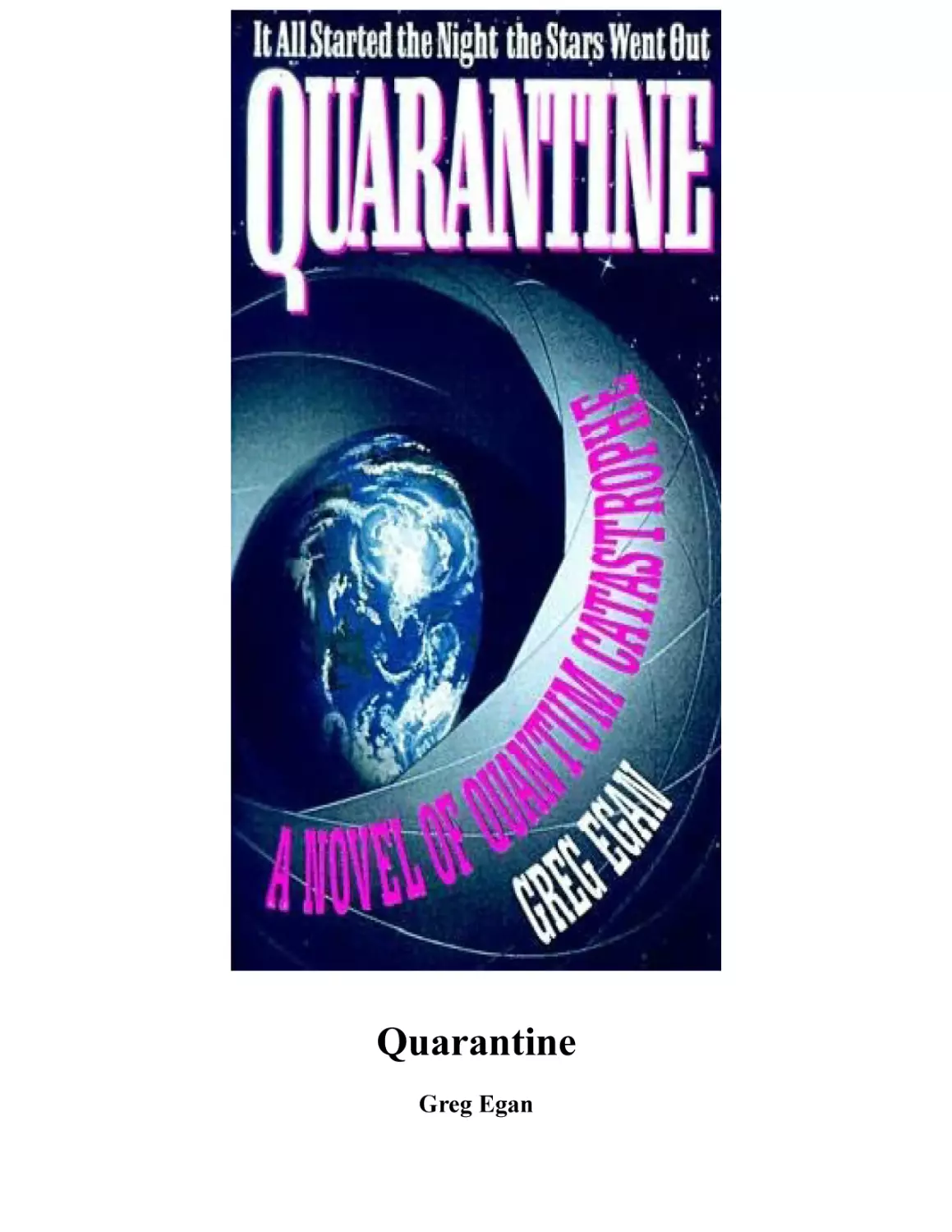
                    Quarantine
Greg Egan

Copyright © Greg Egan 1992 All rights reserved
The right of Greg Egan to be identified as the author of this work has been asserted by him in
accordance with the Copyright, Designs and Patents Act 1988.
This edition published in Great Britain in 1999 by Millennium An imprint of Victor Gollancz Orion
House, 5 Upper StMartin's Lane, London WC2H 9EA
To receive information on the Millennium list, e-mail us at: smy@orionbooks.co.uk
A CIP catalogue record for this book is available from the British Library
ISBN 1 85798 590 7
Printed in Great Britain by Clays Ltd, St Ives pic

PART ONE
1
Only the most paranoid clients phone me in my sleep.
Of course, nobody wants a sensitive call electronically decoded and flashed up on the
screen of an ordinary videophone; even if the room isn't bugged, radio-frequency
spillage from the unscrambled signal can be picked up a block away. Most people,
though, are content with the usual solution: a neural modification enabling the brain to
perform the decoding itself, passing the results directly to the visual and auditory
centres. The mod I use, CypherClerk (NeuroComm, $5,999), also provides a virtual
larynx option, for complete two-way security.
However. Even the brain leaks faint electric and magnetic fields. A superconducting
detector planted on the scalp, no bigger than a flake of dandruff, can eavesdrop on the
neural data flow involved in an act of ersatz perception, and translate it almost
instantaneously into the corresponding images and sounds.
Hence The Night Switchboard (Axon, $17,999). The nano-machines which carry out
this modification can take up to six weeks to map the user's idiosyncratic schemata -the
rules by which meanings are encoded in neural connections – but once that's done, the
intermediary language of the senses can be bypassed completely. What the caller wants
you to know, you know, without any need to hallucinate a talking head spelling it out,
and the electromagnetic signature at skull level is, for all practical purposes, inscrutable.
The only catch is, in the conscious state, most people find it disorienting - and at worst
traumatic - to have information crystallizing in their heads without the conventional
preliminaries. So, you have to be asleep to take the call.
No dreams; I simply wake, knowing:
Laura Andrews is thirty-two years old, one hundred
3

and fifty-six centimetres tall, and weighs forty-five kilograms. Short, straight brown
hair; pale blue eyes; a long, thin nose. Anglo-Irish features and deep black skin; like
most Australians, born with insufficient UV protection, she's been retrofitted with genes
for boosted melanin production and a thicker epidermis. Laura Andrews has severe
congenital brain damage; she can walk and eat, clumsily, but she can't communicate in
any fashion, and the experts say that she understands the world little better than a sixmonth-old child. Since the age of five, she's been an in-patient at the local Hilgemann
Institute.
Four weeks ago, when an orderly unlocked her room to serve breakfast, she was gone.
After a search of the building and grounds, the police were called in. They repeated and
extended the search, and conducted a doorknock of the surrounding area, to no avail.
Laura's room bore no signs of forced entry, and recordings from security cameras
provedunenlightening. The police interviewed the staff at length, but nobody broke
down and owned up to spiriting the woman away.
Four weeks later, nothing. No sightings. No corpse. No ransom demands. The police
have not officially abandoned the
case - merely deprioritized it, pending further developments.
Further developments are not anticipated.
My task is to find Laura Andrews and return her safely to the Hilgemann - or locate her
remains, if she's dead -and to
gather sufficient evidence to ensure that those responsible for her abduction can be
prosecuted.
My anonymous client presumes that Laura was kidnapped, but declines to suggest a
motive. Right now, my
judgement is suspended. I'm in no state to hold an opinion on the matter; I have a head
full of received knowledge,
coloured by my client's perspective, possibly even tainted with lies.
I open my eyes, then drag myself out of bed and over to the terminal in the corner of the
room; I make it a policy never
to deal with financial matters in my head. A few
4
keystrokes confirm that my account has been provisionally credited with a satisfactory
down payment; accepting the
deposit will signal to the client that I've taken the case. I pause for a moment to think
back over the details of the
assignment, trying to reassure myself that I really do understand it - there's always a hint
of dream-logic to these calls,
a faint but implacable suspicion that by morning none of what I've learnt will even make
sense -then I authorize the
transaction.

It's a hot night. I step out on to the balcony and look down towards the river. Even at
three in the morning, the water is
crowded with pleasure craft of every size, from luminescent sailboards, softly glowing
orange or lime green, to
twelve-metre yachts, crisscrossed with spotlight beams brighter than daylight. The three
main bridges are thick with
cyclists and pedestrians. To the east, giant holograms of cards, dice and champagne
glasses strobe and pirouette
above the casino. Doesn't anyone sleep any more?
I glance up at the empty black sky, and find myself, inexplicably, entranced. There's no
moon tonight, no clouds, no
planets, and the featureless darkness refuses to sustain any comforting illusion of scale; I
might be staring at infinity,
or the backs of my own eyelids. A wave of nausea passes through me, a contradictory
mixture of claustrophobia and a
dizzying sense of The Bubble's inhuman dimensions. I shudder-a single, violent twitchthen the feeling is gone.
A mod-generated hallucination of my dead wife Karen, standing on the balcony beside
me, slips an arm around my
waist and says, 'Nick? What is it?' Her touch is cool, and she spreads her fingers wide
across my abdomen, like
antennae. I'm on the verge of asking her, by way of explanation, if she ever misses the
stars, when I realize how
ludicrously sentimental that would sound, and I stop myself in time.
I shake my head. 'Nothing.'
The grounds of the Hilgemann Institute are as lushly
5
green as genetic engineering - and brute-force reticulation - can make them, in the
middle of a summer when they ought
to be dead and brown. The lawn glistens in the midmorning heat as if fresh with dew, no
doubt constantly irrigated
from just beneath the surface, and I trudge down the main access road in the shade of
what looks like a kind of maple.
An expensive image to maintain; the rates for frivolous water use, already punitive, are
tipped to double in the next few
months. The third Kimberley pipeline, bringing water from dams twenty-five hundred
kilometres to the north, is four
hundred per cent over budget so far, and plans for a desalination plant have been
shelved, yet again - apparently, a
glut on the ocean minerals market has undermined the project's viability.
The road ends in a circular driveway, enclosing a lavish flower bed in spectacular
polychromatic bloom. The trademark

IS gene-tailored hummingbirds hover and dart above the flowers; I pause for a moment
to watch them, hoping - in vain
- to witness just one contravene its programming by straying from the circle.
The building itself is all mock-timber; the layout suggests a motel. There are Hilgemann
Institutes around the world,
through no fault of anyone called Hilgemann; it's widely known that International
Services paid their marketing
consultants a small fortune to come up with the 'optimal' name for their psychiatric
hospital division. (Whether public
knowledge of the name's origin spoils the optimization, or is in fact the strongest basis
for it, I'm not sure.) IS also runsmedical hospitals, child-care centres, schools,
universities, prisons and, recently, several monasteries and convents.
They all look like motels to me.
I head for the reception desk, but there's no need.
'Mr Stavrianos?'
Dr Cheng - the Deputy Medical Director, whom I spoke with briefly on the phone - is
already waiting in the lobby, an
unusual courtesy, which, politely, deprives me of any chance to poke my unsupervised
head around corners. No white
coats here; her dress bears an intricate,
6
Escher-like design of interlocking flowers and birds. She guides me through a staff only
door and a tight maze of corridors
to her office. We sit in padded armchairs, away from her spartan desk.
"Thank you for seeing me at such short notice.'
'Not at all. We're more than happy to cooperate; we're as anxious to find Laura as
anyone. But I must say I have no
idea what her sister is hoping to achieve by suing us. It's not going to help Laura, is it?'
I make a sympathetic but non-committal noise. Perhaps the sister, or her law firm, is my
client - but if so, why all the
pointless secrecy? Even if I hadn't barged in here and announced myself to the
opposition - and I received no
instructions not to - the Hilgemann's lawyers would have taken it for granted that she'd
hire an investigator, sooner or
later. They would have hired their own, long ago.
'Tell me what you think happened to Laura.'
Dr Cheng frowns. 'I'm sure of one thing: she can't have escaped by herself. Laura
couldn't even turn a door handle.
Someone took her. Now, we don't run a prison here, but we do take security very
seriously. Only a highly skilled,
highly resourced professional could have removed her - but on whose behalf, and to
what end, I can't imagine. It's

getting a bit late for ransom demands, and in any case, her sister isn't well off.'
'Could they have taken the wrong person? Maybe they intended to kidnap another
patient - someone whose relatives
could raise a worthwhile ransom - and only realized their mistake when it was too late to
do anything about it.'
º suppose that's possible.'
'Any obvious targets? Any patients with particularly wealthy -' º really can't -'
'No, of course not. Forgive me.' From the look on her face, I'd say she has several
candidates in mind - and the last
thing in the world she wants is for me to approach their families. º take it you've stepped
up security?'
7
'I'm afraid I can't discuss that either.' 'No. Tell me about Laura, then. Why was she born
brain-damaged? What was the
cause?' 'We can't be sure.'
'No, but you must have some idea. What are the possibilities? Rubella? Syphilis? AIDS?
Maternal drug abuse?
Side-effects from a pharmaceutical, or a pesticide, or a food additive. . . ?'
She shakes her head dismissively. 'Almost certainly none of those. Her mother went
through standard prenatal health
care; she had no major illness, and she wasn't using drugs. And a chemical teratogen or
mutagen doesn't really fit in
with Laura's condition. Laura has no malformation, no biochemical imbalance, no
defective proteins, no histological
abnormalities -'
'Then why is she massively retarded?'
'It looks as if certain crucial pathways in the brain, certain systems of neural connections
which should have formed at
a very early age, failed to appear in Laura's case - and their absence made subsequent
normal development impossible.
The question is why those early pathways didn't form. As I've said, we can't be sure - but
I suspect it was a complex
genetic effect, something quite subtle involving the interaction of a number of separate
genes, in utero.'
'Couldn't you tell, though, if it was genetic? Couldn't you test her DNA?''She has no
recognized, catalogued genetic defects, if that's what you mean - which only proves that
there are genes
crucial to brain development yet to be located.'
'Any family history of the same thing?'
'No, but if several genes are involved, that's not necessarily surprising - the chance of a
relative sharing the condition
could be quite small.' She frowns. 'I'm sorry, but how is any of this going to help you

find her?'
'Well, if a pharmaceutical or a consumer product were the cause, the manufacturers
might be safeguarding their
interests. It's a long time after the event, I know, but maybe some obscure birth-defects
research team is on the
8
verge of publishing the claim that wonder drug X, the miracle antidepressant of the
thirties, makes one foetus per
hundred thousand turn out like Laura. You must have heard about Holistic Health
Products, in the States; six hundred
people suffered kidney failure from taking their "energy supplement", so they hired a
dozen hit men to start wiping out
the victims, faking accidental deaths. Corpses attract much smaller damages verdicts.
Okay, kidnapping doesn't seem
to make much sense, but who knows? Maybe they needed to study Laura, to extract
some kind of information that
might eventually help them in court.'
'It all sounds rather paranoid to me.' I shrug. Occupational hazard.' She laughs. 'Yours, or
mine? Anyway, I've told you,
I think the cause was inherited.' 'But you can't be positive.' 'No.'
I ask the usual questions about the staff: anyone hired or fired in the last few months,
anyone known to have debts or
problems, anyone with a grudge? The cops would have been through all of this, but after
four weeks of brooding on
the disappearance, some trivial matter, not worth mentioning at first, may have come to
assume greater significance.
No such luck.
'Can I see her room?'
'Certainly.'
The corridors we pass through have cameras mounted on the ceiling, at ten-metre
intervals; I'd guess that any
approach to Laura's room is covered by at least seven. Seven data chameleons, though,
would not have been beyond
the budget of a serious kidnapper; each pinhead-sized robot would have tapped into one
camera's signal, memorized
the sequence of bits for a single frame while the corridor was empty, then spat it out
repeatedly, replacing the real
image. There may have been faint patches of high-frequency noise when the fake data
was switched in and out - but
not enough to leave tell-tale
9
imperfections on a noise-tolerant digital recording. Short of subjecting every last metre

of optical fibre to electron
microscopy, hunting for the tiny scars where the chameleons intervened, it's impossible
to know whether or not such
tampering ever took place.
The door - remotely locked and unlocked - would have been just as easy to interfere
with.
The room itself is small and sparsely furnished. One wall is painted with a cheerful,
glossy mural of flowers and birds;
not something I'd care to wake up to, personally, but I can hardly judge how Laura
would have felt. There's a single
large window by the bed, set solidly into the wall, with no pretence that it was ever
designed to be opened. The pane
is high-impact plastic; even a bullet wouldn't shatter it, but with the right equipment it
could be cut and resealed,
leaving no visible seam. I draw my pocket camera and take a snapshot of the window in
the polarized light of a laser
flash, then I process the image into a false-colour stress map, but the contours are
smooth and orderly, betraying no
flaws.
The truth is, there's nothing I can do here that the police forensic team would not have
done first, and better. The
carpet would have been holographed for footprint impressions, then vacuumed for fibres
and biological detritus; the
bed sheets taken away for analysis; the ground outside the window scoured for
microscopic clues. But at least I have
the room itself fixed in my mind now; a solid backdrop for any speculations about the
night's events.
Dr Cheng escorts me back to the lobby.
'Can I ask you something that has nothing to do with Laura?''What?'
'Do you have many patients here with Bubble Fever?' She laughs and shakes her head.
'Not one. Bubble Fever has
gone right out of fashion.'
Because I am in business, and because I might - in theory - give credit, there's a certain
amount I can find out about
anyone, with no effort at all.
10
Martha Andrews is thirty-nine years old, and works as a systems analyst for WestRail.
She is divorced, with custody
of her two sons. She has an average income and average debts, and forty-two per cent
equity in a cheap two-bedroom
flat. She's been paying the Hilgemann out of a trust fund left by her parents; her father
died three years ago, her

mother the year after. She is not worth extorting.
At this stage, the most plausible hypothesis seems to be one of mistaken identity; it
doesn't fit well with the
professionalism of the kidnapping, but nobody's perfect. What I need, to take the idea
any further, is a list of the
Hilgemann's patients. Details of the staff might also come in handy.
I call my usual hacking service.
The ringing tone seems to reverberate deep within my skull. There's no doubt that
NeuroComm's product
psychologists chose these bizarre acoustics to give a strong impression of privacy, but
I'm not impressed; it just
makes me feel claustrophobic. At the same time, my external vision fades to black-andwhite - supposedly to lessen the
distraction, but in fact it's just one more tedious gimmick.
Bella answers on the fourth ring, as always. Her face seems to hover about a metre
away, vivid against reality's greys,
vanishing at the neck as if revealed by some magical spotlight. She smiles coolly.
'Andrew, it's good to see you. What
can I do for you?' 'Andrew' is the name I use for one of my CypherClerk masks. Her
own synthetic human visage
might also be nothing but a mask, repeating word for word the speech intentions of an
actual person -or it might be a
pure artifact, the interface to anything from a glorified answering machine to a system
that actually does ninety-nine
per cent of the hacking itself. I really don't care who or what Bella is; she/he/it/they get
results, and that's all that
matters to me.
'The Hilgemann Institute, Perth branch. I want all their patient records, and all their staff
records.'
'Back how far?'
11
'Well. . . thirty years, if it's on line. If the old stuff is archived, and it's going to cost a
fortune to get your hands on it,
forget it.'
She nods. 'Two thousand dollars.'
I know better than to try to haggle. 'Fine.'
'Call back in four hours. Your password is "paradigm".'
As the room regains its normal hues, it strikes me that two thousand dollars would be a
lot of money to Martha
Andrews - not to mention the fifteen thousand I've already received in advance. Of
course, if her lawyers were
confident of a large settlement and a fat contingency fee, fifteen thousand would be

nothing to them. Their wish to be
anonymous might be no more sinister than my own use of a pseudonym with Bella;
when laws are being broken, it's
nice to have bulkheads against the risk of a conspiracy charge.
Do I talk to Martha? I can't see how it could upset her lawyers, and even if she hired me
herself (which can't yet be
ruled out completely; her finances may have hidden depths) then she chose anonymity
over the alternative of
explicitly instructing me to keep my distance.
I have no real choice but to act as if I hadn't given a moment's thought to the question of
my client's identity -even if
the truth is that, so far, nothing about the case fascinates me more.
Martha looks very much like her sister, with a little more flesh and a lot more worries.
On the phone she asked, 'Who
are you working for? The hospital?' When I told her that I wasn't free to disclose my
client's name, she seemed to take
that to mean yes. (In fact, it's inconceivable; IS owns a great slab of shares in Pinkerton's
Investigations, so theHilgemann would never hire a freelance.) Now, face to face, I'm
almost certain that she wasn't dissembling.
'Really, I'm the last person to help you find Laura. She was in their care, not mine. I can't
imagine how they could have
let something like this happen.'
12
'No - but forget their incompetence, just for a moment. Do you have any idea why
someone might want to kidnap
Laura?'
She shakes her head. 'What use would she be to anyone?' The kitchen, where we're
sitting, is tiny and spotless. In the
room next door, her boys are playing this summer's craze, Tibetan Zen Demons on Acid
vs Haitian Voodoo Gods on
Ice - and not in their heads like the rich kids; she winces at the sound of a theatrically
bloodcurdling scream, followed
by a loud, wet explosion, and live cheers. 'I've told you, I'm in no better position to
answer that than anyone else.
Maybe she wasn't kidnapped. Maybe the Hilgemann harmed her somehow -mistreated
her, or tried out a new kind of
drug that went wrong - and their whole story about her disappearance is a cover-up. I'm
only guessing, of course, but
you ought to keep the possibility in mind. Assuming that you are interested in finding
out the truth.'
'Were you close to Laura?'
She frowns. 'Close? Haven't they told you? What she's like?'

'Attached to her, then? Did you visit her often?'
'No. Never. There was no point visiting her - she wouldn't have known what it meant.
She wouldn't have known it was
happening.'
'Did your parents feel the same way?'
She shrugs. 'My mother used to see her, about once a month. She wasn't fooling herself she knew it made no
difference to Laura - but she thought it was the right thing to do, regardless. I mean, she
knew she'd feel guilty if she
stayed away, and by the time they had mods that could fix that, she was too set in her
ways to want to change. But
I've never had any problem, myself; Laura's not a person, so far as I'm concerned, and
I'd only feel like a hypocrite if I
tried pretending otherwise.'
º take it you're planning to be a bit more sentimental in court?'
She laughs, unoffended. 'No. We're suing for punitive damages, not compensation for
"emotional suffering".
13
The issue will be the hospital's negligence, not my feelings. I may be an opportunist, but
I'm not going to perjure
myself.'
On the train back into the city, I wonder: would Martha have arranged her sister's
abduction, for the sake of punitive
damages? Her unwillingness to milk the suit for all it's worth might be a calculated ploy,
a way to ensure a jury's
sympathy by seeming to forgo exploitation. There's at least one flaw in this theory,
though: why not demand a ransom
- which could be recovered, through the courts, from the Hilgemann? Why leave the
motive for the kidnapping a
mystery crying out for an explanation, inviting suspicions of fraud?
I emerge from the airless crush of the underground to find the streets almost as crowded,
with evening shoppers
lugging post-Christmas bargains, and buskers so devoid of talent - natural or otherwise that I feel like stooping down
and switching their credit machines into refund mode.
'You're a mean-spirited bastard,' says Karen. I nod agreement.
As I approach the sandwich-board man, I tell myself I'm going to walk by as if I hadn't
even noticed him, but a few
steps later, I stop and turn to stare. His meekly downturned face is as pale as a slug God doesn't want us messing
with our pigmentation! - and he wears a black suit that must be purgatory in this heat.
Amongst the brightly clad,

bare-limbed crowd, he looks like a nineteenth-century missionary stranded in an African
marketplace. I've seen the
same man before, wearing the same imaginative message, repeated front and back:
sinners
repent! judgement is nigh!Nigh! After thirty-three years, nigh! No wonder he stares
14
at the ground. What the fuck has been going on in his brain for the last three decades?
Does he wake every morning,
thinking - for the ten-thousandth time -'Today's the day'? That's not faith, it's paralysis.
I stand awhile, just watching him. He paces slowly back and forth along a fixed path,
halting when the flow of
shoppers is too heavily against him. Most people are ignoring him, but I notice a teenage
boy collide with him
intentionally and roughly shoulder him aside, and I feel a shameful surge of delight.
I have no good reason to hate this man. There are millenarians of every kind, from
docile idiots to cunning profiteers,
from blissed-out Aquarians to genocidal terrorists. Members of the Children of the
Abyss don't wander the streets
with sandwich boards; blaming this pathetic wind-up toy for Karen's death makes no
sense at all.
As I walk on, though, I can't help indulging a sweet vision of his face as a bloody red
pulp.
I was eight years old when the stars went out.
November 15th, 2034, 8:11:05 to 8:27:42 gmt.
I didn't witness the circle of darkness, growing from the antisolar point like the mouth of
a coal-black cosmic worm,
gaping to swallow the world. On TV, yes, a hundred times, from a dozen locations - but
on TV it looked like nothing
but the cheapest of special effects (the satellite views all the more so; in glare-filtered
shots, the 'mouth' could be seen
closing precisely behind the sun, an implausible symmetry, smacking of human
contrivance).
I couldn't have seen it live; it was late afternoon in Perth - but the news reached us
before sunset, and I stood on the
balcony with my parents, in the dusk, waiting. When Venus appeared, and I pointed it
out, my father lost his temper
and sent me inside. I don't recall exactly what I said; I'm sure I knew the difference
between stars and planets, but
perhaps I made some childish joke. When I looked through my bedroom window - with
a choice of smeared glass or
dusty flyscreen - and saw, well,
15

nothing, it was hard to be impressed. Later, when I finally caught an unimpeded view of
the empty sky, I dutifully tried
to feel awestruck, but failed. The sight was as unspectacular as an overcast night. It was
only years later that I
understood how terrified my parents must have been.
There were riots on Bubble Day across the planet, but the worst of the violence took
place where people had seen the
event with their own eyes - and that depended on a combination of longitude and
weather. Night stretched from the
western Pacific to Brazil, but cloud covered much of the Americas. There were clear
skies over Peru, Colombia, Mexico
and southern California - so Lima, Bogota, Mexico City and Los Angeles suffered
accordingly. In New York, at eleven
past three in the morning, it was bitterly cold and overcast - and the city was all but
spared. Brasilia and Sao Paulo
were saved by the light of dawn.
Disturbances in this country were minor; even on the east coast, sunset came too late,
and apparently most
Australians sat glued to their TVs all night, watching other people do the looting and
burning. The End of the World
was far too important to be happening anywhere but overseas. There were fewer deaths
in Sydney than on the
previous New Year's Eve.
In my memory, there is no gap at all between the event itself and the announcement of
an explanation (of sorts).
Analysis of the timing of the occultations had revealed, almost at once, the geometry of
what had happened; perhaps I
considered that enough of an answer. It was nearly six months later that the first probes
encountered The Bubble, but
the name had been in use, from the start, for whatever it was they would find.
The Bubble is a perfect sphere, twelve billion kilometres in radius (about twice as wide
as the orbit of Pluto), and
centred on the sun. It came into being as a whole, in an instant - but because the Earth
was eight light-minutes from its
centre, the time-lag before the last starlight reached us varied across the sky, giving rise
to
16
the growing circle of darkness. Stars vanished first from the direction in which The
Bubble was closest, and last where
it was furthest away - precisely behind the sun.
The Bubble presents an immaterial surface which behaves, in many ways, like a concave
version of a black hole'sevent horizon. It absorbs sunlight perfectly, and emits nothing

but a featureless trickle of thermal radiation (far colder
than the cosmic microwave background, which no longer reaches us). Probes which
approach the surface undergo red
shift and time dilation - but experience no measurable gravitational force to explain
these effects. Those on orbits
which intersect the sphere appear to crawl to an asymptotic halt and fade to black; most
physicists believe that in the
probe's local time, it swiftly passes through The Bubble, unimpeded - but they're equally
sure that it does so in our
infinitely distant future. Whether or not there are further barriers beyond is unknown and even if there are not,
whether an astronaut who took the one-way voyage would find the universe outside
unaged, or would emerge just in
time to witness the moment of its extinction, remains an open question.
Upon hearing reports containing only a single familiar phrase, the media (who'd been
fobbed off for six months with
theories even wilder than the truth) promptly declared that the solar system had 'fallen
into' a large black hole,
triggering a resurgence of global panic before the story could be set straight. The event
horizon surrounded us,
therefore we had to be inside it - a perfectly reasonable mistake. The truth, though, is the
exact opposite: the event
horizon does not enclose us; it 'encloses' everything else.
Although a handful of theoreticians valiantly struggled to concoct a model for The
Bubble as a spontaneous natural
phenomenon, there was always really only one plausible explanation: a vastly superior
alien race had constructed a
barrier to isolate the solar system from the rest of the universe.
The question was: why?
17
If the aim was to discourage us from charging out and conquering the galaxy, they
needn't have bothered. In 2034, no
human had travelled further than Mars. The US base on the moon had been shut down
six years before, after eighteen
months' occupation. The only spacecraft to have left the solar system were probes sent to
the outer planets in the late
twentieth century, crawling away from the sun along their now purposeless trajectories.
Plans to launch an unmanned
mission to Alpha Centauri in 20S0 had just been rescheduled to 2069, in the hope that
the Apollo XI centenary would
make fundraising easier.
Of course, a space-faring alien civilization might have taken a long-term view. The

thousand years or so before humans
were likely to embark on anything remotely like interstellar conquest might have seemed
no more to them than a
judicious safety margin. Nevertheless, the idea that a culture able to engineer space-time
in ways we could scarcely
comprehend could fear us was ludicrous.
Maybe the Bubble Makers were our benefactors, saving us from a fate infinitely worse
than being confined to a region
of space where we could - with care - prosper for hundreds of millions of years. Maybe
the galactic core was
exploding, and The Bubble was the only possible shield against the radiation. Maybe
other, hostile aliens were
running amok in the region, and The Bubble was the only way to keep them at bay. Less
dramatic variations on this
theme abounded. Maybe The Bubble was there to protect our fragile, primitive culture
from the harsh realities of
interstellar commerce. Maybe the solar system had been declared a Galactic Heritage
Zone.
A few intellectually rigorous killjoys argued that any explanation to which humans could
relate was probably
anthropomorphic nonsense, but nobody invited them onto talk shows.
At the other extreme, most religious sects had no trouble plucking glib answers from
their own ludicrous mythology.
Fundamentalists of several faiths refused to acknowledge that The Bubble even existed;
all proclaimed that the
vanished stars were a sign of divine
18
disfavour, foretold - with varying degrees of prophetic licence - in their own sacred
writings.
My parents were resolute atheists, my education was secular, my childhood friends were
either irreligious, or the
marginally Buddhist grandchildren of Indochinese refugees - but the English-language
media, worldwide, was
swamped with the views of Christian fundamentalists, so theirs was the lunacy I grew up
knowing the best, and
despising the most. The stars had gone out! If that didn't spell Apocalypse, what did? (In
fact, Revelations has stars
falling to the earth - but one musn't be too literal-minded.) Even those fanatics with
small-M millennial fetishes could
take heart; the years 2000 and 2001 might have been frustratingly devoid of cosmic
portents, but, given the
uncertainties of the historical record, 2034 (it was claimed) could easily be exactly the

two-thousandth anniversary, not
of Christ's birth, but of his death and resurrection. (November 15th as Easter? Obscure
explanations were concocted
for this - including something called 'Passover Drift' - but I was never quite masochistic
enough to try to follow them.)
It was Judgement Day rewritten by some Bible Belt Chamber of Commerce. TV still
worked, and nobody needed themark of the beast to buy and sell, let alone to give and
receive tax-deductible donations. Mainstream churches issued
cautious statements which said, in so many words, that the scientists were probably
right, but their pews emptied, and
the salvation-for-money trade boomed.
Apart from post-Bubble splinter groups of established religions, thousands of brand-new
cults appeared - most of
them organized on the sound commercial lines pioneered by twentieth-century religious
entrepreneurs. But while the
opportunists prospered, the real psychotics were festering. It took twenty years for the
Children of the Abyss to make
themselves known, but then, being born of the Abyss - on or after Bubble Day - was a
prerequisite of membership.
They started out, in 2054, by poisoning the water supply of a small town in Maine,
19
killing more than three thousand people. Today, they're active in forty-seven countries,
and they've claimed almost a
hundred thousand lives. Marcus Duprey, their founder and chief self-fulfilling prophet,
spews out an incoherent
stream of half-digested cabbalistic gibberish and comic-book eschatology, but there are,
apparently, thousands of
people brain-fucked in just the right way to find his every word resonant with truth.
It was bad enough when they blew up buildings at random, because 'this is the Age of
Mayhem', but since Duprey
and seventeen other Children have been in prison, many of his followers have come to
see his release as their ultimate
purpose -and with a tangible (if unattainable) goal to focus their efforts, everything has
escalated. It makes no
difference what I think, but some nights the question spins in my head for hours. I don't
wish they'd set him free. I do
wish they'd never caught him.
Mental illness wasn't confined to the millenarians; for the secular, there was Bubble
Fever, an hysterical, disabling,
'claustrophobic' reaction to the thought of being 'trapped' in a volume eight trillion times
that of the Earth. These days,
it seems almost laughable - as quaint as some spurious nineteenth-century upper-class

affliction - but millions of
people succumbed in the first year. It struck in almost every country, and health officials
predicted it would cost the
world economy more than AIDS. Within five years, though, the number of cases had
plummeted.
Wars and revolutions around the globe have been blamed on The Bubble - although I
wonder how anyone can claim
to be able to untangle its destabilizing effects from those of poverty, debt, climate
change, famine and pollution - and
the religious fanaticism that would have been present, regardless. I've read that in the
early days, people spoke
seriously of civilization 'crumbling', of the coming of a new Dark Age. Such talk soon
died away -but even now, I can
never quite decide whether I find it miraculous, or inevitable, that the cultural shock
waves have been so mild. The
Bubble changes everything: it
20
proves the existence of aliens with God-like powers, aliens who have imprisoned us
without warning or explanation and cheated us of our destiny in the universe. The Bubble changes nothing: the aliens are
aloof and inconsequential,
the stars are irrelevant to human needs; the sun still shines, crops still grow, the life of
this planet goes on as ever and there are worlds within our reach to be explored for millennia.
In the early fifties, it was 'common knowledge' - for no obvious reason - that the Bubble
Makers were about to
introduce themselves and justify everything; alien-contact cults flourished, UFO hoaxes
reached absurd levels, but as
the years wore on in silence, hopes of so much as a curt explanation for our state of
quarantine faded away.
I no longer even wonder, why? After thirty-three years of listening to people rant their
unlikely hypotheses, nothing
could matter to me less. (Granted, the thing killed my wife, indirectly -but then,
indirectly, so did I.)
As for the stars, they were never ours to lose; the truth is, we've lost nothing but the
illusion of their proximity.
Bella, as always, delivers on time. I download the records into CypherClerk's generous
intracranial buffers, and I'm on
the verge of transferring them to my desktop terminal when, in a moment of caution, or
paranoia, I change my mind and
decide to keep the data in my skull, for now.
I'm tired, but it's barely after nine. I don't want to sleep, but the prospect of ploughing

through the Hilgemann's records
strikes me as unbearably tedious.
I invoke Backroom Worker (Axon, $499) and guide it through what I want done with
each name: first, check my own
natural memory for any associations (after all, the chances are that the next of kin of
anyone worth kidnapping will be a
public figure to some degree); then contact the Credit Reference System, obtain current
financial details, and append
them to the record. I think of triggering notification if the assets cross a threshold value,
but I can't be bothered
deciding on a figure, and in any21
case, when the whole thing is done, I can rank everyone by net worth. I instruct the mod
to interrupt me only if it
comes across a name I know.
I flop onto my bed, and switch on the room's audio system. The controlling ROM I've
been playing lately, 'Paradise' by
Angela Renfield, is one of hundreds of thousands of identical copies, but each piece it
creates is guaranteed unique.
Renfield has set certain parameters for the music, but others are provided by
pseudorandom functions, seeded with
the date, the time and the audio system's serial number.
Tonight, I seem to have chanced upon an excessive weighting for minimalist influence.
After several minutes of
nothing but the same (admittedly, impressively resonant) chord, repeated at five-second
intervals, I hit the recompose
button. The music stops, there's a brief pause, then a new variation begins, a distinct
improvement.
I've run 'Paradise' about a hundred times. At first, I could hardly believe that the separate
performances had anything
in common, but over the months I've begun to apprehend the underlying structure. I see
it as resembling a family tree,
or a phylogenetic classification of species. The metaphor is imprecise, though; one piece
can be judged to be a near or
a distant cousin of another, but the concept of ancestry doesn't really translate. I think of
the simplest pieces as being
primordial, as 'giving rise to' more complex variations, but beyond a certain point it's an
arbitrary decision as to who
begat, or evolved into, whom.
I've heard some reviewers assert that, after a dozen playings, anyone who is musically
literate should fully understand
the rules that Renfield has chosen, making further actual performances unbearably
redundant. If that's the case, I'm

glad of my ignorance. Tonight's second piece is like a brilliant scalpel blade, prising
away layer after layer of dead skin.
I close my eyes as a trumpet line builds, rising in pitch, then mutates, impossibly,
effortlessly, into the liquid sound of
metaharps. Flutes
22
join in, with an ornate, mannered theme - but already I think I can discern in it, hidden
beneath the fussiness and
decoration, hints of a perfect silver needle which will recur in a hundred guises; which
will be honed, muted, then
honed again; which will be held up for my admiration, one last time, then plunged into
my heart.
Suddenly, four lines of glowing text appear at the bottom of my visual field:
[Backroom Worker:
Natural memory association.
Casey, Joseph Patrick.
Head of Security as of 12th June, 2066.]
I'd forgotten that I'd asked for staff records, too - or I would have excluded them. I think
about waiting for the music to
finish, but there's no point; I know full well that I'd be unable to enjoy it. I hit the stop
button, and one more unique
incarnation of 'Paradise' disappears forever.
Casey is five years older than me, so his retirement, shortly after mine, was not so
premature. He's sitting in a corner of
the crowded bar, drinking beer, and I join him in the ritual. I suppose it's a strange way
to pass the time, when not a
microgram of ethanol will make it into either of our bloodstreams - while mods compute
our consumption and deliver a
purely neural buzz in lieu of the (insanely toxic) real thing - but then, if this cultural
fossil lasted a thousand years and
endured beyond all memory of its origins, it would hardly be unique in doing so.
'We never see you, Nick. Where have you been hiding?'
We? It takes me a moment to register that he means, not himself and his absent wife, but
the bar full of cops and
ex-cops; the 'law-enforcement community', as the politicians would say - the way they
used to talk about the Chinese
or Italian or Greek community - as if the neural and physical modifications we share
made us into some
23
kind of homogeneous demographic target. I glance around the room and find, mercifully,
that I recognize almost
nobody.

'You know how it is.''Business is good?'
'I'm making a living. You were with RehabCorp, last I heard. What happened?' 'IS
bought them out.'
'Yeah, I remember that. Lots of retrenchments.'
º was lucky. I had connections, I got myself moved sideways. There were people who'd
been with RehabCorp for thirty
years who got dumped.'
'So what's it like at the Hilgemann?'
He laughs. 'What do you think? Anyone who ends up in a place like that - anyone they
can't fix with a mod, these days
- has to be a complete fucking zombie. Security is not a problem.'
'No? What about Laura Andrews?'
'You're in on that?' He's no more surprised than politeness requires; Cheng would have
had him clear me, before she
even returned my call.
'Yeah.'
'Who for?'
'Who do you think?'
'Fucked if I know. Not for the sister; Winters is working for the sister. Mind you,
Winters' job isn't finding Laura
Andrews; her job is to make me look like shit. That bitch is probably spending all her
time sitting at a computer
somewhere, fabricating evidence.'
'Probably.' Not for the sister. Who, then? A relative of another patient? Someone who
believes they'd be shelling out
ransom money right now, if the kidnapping hadn't been botched - and who wants to
make sure that there isn't a
second, successful attempt?
'The case is a joke, you know. We weren't negligent. Remember that guy who sued the
owners of the Sydney Hilton
when his daughter got kidnapped from one of their rooms? He was pulverized. The same
thing will happen here.'
24
'Maybe.'
He laughs sourly. 'You don't give a shit either way, do you?'
'No. And neither should you. IS won't sack you, even if they lose the case. They're not
idiots; they allocate a certain
budget for security, enough to keep the patients in. If they wanted some kind of fortress,
they know they'd have to
pay for it. They've been running prisons long enough to understand the costs.'
He hesitates, then says,' "Enough to keep the patients in?" Yeah? Laura Andrews got out
twice before.' He glares at

me. 'And if that ever reaches the sister, I'll break your fucking neck.'
I stare at him, grinning sceptically, waiting for the joke to be made clear. He just stares
back glumly. I say, 'What do
you mean, she "got out"? How?'
How? Shit! I don't know how. If I knew how, then she wouldn't have been allowed to do
it again, would she?'
'But ... I thought she couldn't even turn a door handle.'
'That's what the doctors say. Well, nobody's seen her turn a fucking door handle.
Nobody's seen her do anything
smart enough to shame a cockroach. But anyone who can get past locked doors, and
cameras, and movement
sensors, three times, isn't what she appears to be, is she?'
I snort. 'What are you getting at? You think she's been shamming total imbecility for
more than thirty years? She never
even learnt to speak! You think she started faking brain damage when she was twelve
months old?'
He shrugs. 'Who knows about thirty years ago? The records say one thing, but I wasn't
there. All I know is what she's
done in the last eighteen months. How would you explain it?''Maybe she's an idiote
savante. Or an idiot escapologist.' Casey rolls his eyes. 'Okay. I have no idea. But. . .
what
happened? The first two times? How far did she get?'
'Into the grounds, the first time. A couple of kilometres away, the second. We found her
in the morning, just
25
wandering about, with the same bland dumb innocent expression on her face as always. I
wanted to put a camera
inside her room, but the Hilgemann wasn't having that -some UN convention on the
Rights of the Mentally III. IS got
enough flak over that Texan prison thing that they're ultra-careful now.' He laughs. 'And
how could I argue that I
needed more hardware? The patients are vegetables. The rooms have one door and one
window; both are monitored
twenty-four hours - how could I justify anything more? I mean, I couldn't say to the
fucking Director, "If you're such a
genius, you tell me how she does it. You tell me how to stop her." '
I shake my head. 'She didn't do any of this. She can't have. Somebody took her. All three
times.'
'Yeah? Who? Why? What do you call the first two times - dry runs?'
I hesitate. 'Disinformation? Someone trying to convince you that she could break out on
her own, so that when they
finally took her, you'd think -' Casey is miming severe incredulity, verging on physical

pain. I say, 'Okay. It sounds like
a load of crap to me, too. But I can't believe she just walked out of there, alone.'
It takes me forever to get to sleep. Boss (Human Dignity, $999) may have rendered it a
matter of conscious choice, but
somehow I still manage to be an insomniac; I always have some reason to delay the
decision, I always have some
problem I want to think through - as if every last nagging question which once might
have kept me awake had to be
dealt with in the old way, regardless.
Or maybe I'm just developing what they call Zeno's Lethargy. Now that so many aspects
of life are subject to nothing
but choice, people's brains are seizing up. Now that there's so much to be had, literally
merely by wanting it, people are
building new layers into their thought processes, to protect them from all this power and
freedom; near-endless
regressions of wanting to decide to want to decide to want to decide what the fuck it is
they really do want.
26
What I want, right now, is to understand the Andrews case, but there's no mod in my
head which can grant me that.
Karen says, 'Okay. So you have no idea why Laura was kidnapped. Fine. Stick to the
facts. Wherever she's been
taken, someone must have seen her along the way. Forget about motives for now - just
find out where she is.'
I nod. 'You're right. As always. I'll put an ad in the news systems -'
'In the morning.'
I laugh. 'Yes, okay, in the morning.'
With her familiar warmth beside me, I close my eyes.
'Nick?'
'Yes?'
She kisses me lightly. 'Dream about me.' I do.
27
2
'Hallelujah! I can see them! / can see the starsÃ
I turn, startled, to see a young woman on her knees in the middle of the crowded street,
arms outstretched, gazing
ecstatically into the dazzling blue sky. For a moment, she seems to be frozen transfixed, enraptured - then she screams
again, º can see them! I can see themP and starts pounding her ribs, rocking back and
forth on her knees, gasping and
sobbing.But that cult died out twenty years ago.
The woman shrieks and twitches. Two embarrassed friends stand beside her, while the

traffic smoothly detours around
the scene. I watch with mounting dismay, as childhood memories of ranting, convulsing
street mystics start flooding
back.
'All the beautiful stars! AH the glorious constellations! Scorpius! Libra! Centaurus!'
Tears stream down her face.
I fight down a sense of panic and revulsion that's growing out of all proportion. This is
just one woman, just one freak.
The very fact that she's such a spectacle only proves what a rarity this is, proves that
most people have adapted, have
accepted The Bubble and moved on. What am I afraid of? That every last form of
Bubble hysteria, every last obscure
religious sect, every last bizarre mass psychosis, is destined to be revived?
As I turn away, the woman's companions suddenly burst out laughing. A moment later,
she joins them - and belatedly,
I think I understand. Astral Sphere is back in fashion, that's all. A planetarium in the
skull. A gimmick, not an
epiphany. I've read the reviews; the mod offers a variety of settings, ranging from a
realistic view of the stars 'exactly
as they would be' - complete with accurate diurnal and seasonal motions, masking by
clouds and buildings, and
convincing fade-ins at dusk and fade-outs
28
at dawn - through to the dissolution of all obstacles (the sunlit atmosphere and the Earth
beneath your feet included),
and the option of moving the point of view millennia into the past or the future, or halfway across the galaxy.
The trio are falling in and out of each other's arms now, laughing. The cult is being
mocked, not revived; these
teenagers must have seen it portrayed in some old documentary. I walk on, feeling
slightly foolish - and greatly
relieved.
When I reach my building, I take the stairs slowly, reluctant to face an empty calls log,
again. I've had ads in all the
news systems for four days running, and they've yet to attract even a hoax call. The New
Year should have helped;
news-system readership increases on public holidays, when people have nothing better
to do. Maybe ten thousand
dollars isn't a large enough reward, but I doubt that my client would appreciate me
doubling it. Not that I'm any closer
to knowing who my client is. The Hilgemann's patient records listed no one with family
ties to spectacular wealth or

fame - and in retrospect, I'm not surprised. The very rich would, at the very least, take
care that the records were
meticulously falsified, and the obscenely wealthy would keep their demented relatives
right out of harm's way, in
soundproof wings of their own impenetrable mansions. I'm tempted to dig deeper, but I
won't. I may suffer the (purely
aesthetic) urge to incorporate my client into the Big Picture, but as yet I have no good
reason to believe that it would
help me find Laura.
No calls.
I resist punching the sofa; the upholstery has already split to the point where further
damage yields diminishing
satisfaction. It's getting close to the deadline for lodging the ad for one more day; I
display the copy on my terminal
and stare at it glumly, wondering if there's anything I could change that would make a
difference, short of adding a
zero or two to the reward. I've used a picture of Laura straight from the Hilgemann's
patient records; it closely matches
my own received mental image,
29
suggesting that my client's knowledge of Laura's appearance was based on the very same
shot. Her face is distinctive,
but who knows what she looks like by now? No need for plastic surgery; a good
synthetic-skin mask is all that's
required.
I lodge the ad again, for what it's worth. If Laura was taken by accident, she'd be long
dead by now - and I doubt that
I'd ever find the body, let alone the people responsible. My only real hope is that, not
only did her kidnappers have
some obscure reason for deliberately abducting her, but whatever it was, it required them
to do something riskier than
merely locking her up, or slaughtering her.
Like smuggling her out of the country.
Getting Laura onto a plane would not be difficult. Her imbecility would be almost as
easy to conceal as her face; there
are dozens of illegal mods which could transform her into the walking puppet of a
travelling companion, or even a
semi-autonomous 'robot', capable of such rudimentary tasks as laughing and crying at all
the right moments during the
in-flight movie.Faking an exit-visa record in the Foreign Affairs database is no big deal.
It would vanish an hour or two later, and the
airline's files would also be appropriately amended. Foreign Affairs, Customs and the

airlines are all being screwed
blind, twenty-four hours a day, by a hundred different hackers - and, ironically, that's
what makes it possible, if you're
lucky, to trace an illegal traveller. Hackers may run rings around the target systems' own
archaic security, but they
can't avoid making their presence known to each other. In the process of capturing data
essential for their own work,
they can't help capturing details of other violations in progress. Like all information, this
is for sale.
Bella is acting as a broker for me, as well as providing some data of her own. I call her
and download another batch.
The relevance of any one heap of raw data is a matter of luck; the more you buy, the
better the odds, but there's no
guarantee of success when the event you're
30
trying to trace took place (if at all) at an unknown airport, at an unknown time in the last
five weeks.
Finding the fake exit visas is easy; the very fact that they have to be wiped to avoid
(sluggish) official scrutiny betrays
their existence in any time series of illicit snapshots of the database. The problem is
finding Laura in the crowd; there
are over one hundred illegal exits per week, nationwide. From the Hilgemann, I have her
DNA signature, fingerprints,
retinal patterns and skeletal measurements. DNA isn't used by Customs (there are too
many complications, legal and
cultural, in sampling international travellers en masse), but the other three are always
checked, and must match for
pre-departure clearance. After that, though, the common practice is to change these
details in the fake visa record,
precisely to make things harder for people like me. Although the record itself must
persist for the duration of the flight,
with the name and photo unchanged (to avoid triggering various anti-terrorist checks
carried out by the airlines), the
biological ID data isn't accessed again until the passenger goes through Customs at their
destination. So, there are
only two brief periods when the visa record needs to contain anything truthful; in theory,
these times could be
measured in milliseconds, but in practice things can't be tuned that finely, and the
windows have to be several minutes
long. However, fingerprints and retinal patterns are relatively easy to alter by
nanosurgery, leaving only the bone
lengths to be trusted. They can be modified too, if you're desperate, but nobody walks

onto a plane straight after that
kind of reconstruction, puppet or not - and travelling as an obvious invalid would be like
carrying a sign around your
neck.
I analyse the latest series of snapshots; in no time at all they prove as worthless as the
rest.
I flip idly through the gigabytes of junk that I've accumulated, flight after flight from the
country's ten international
airports, everything from menus to seating plans to. . . cargo manifests. Of course, Laura
could have been sent as
cargo, but it wouldn't have been a very smart
31
choice. All cargo is either X-rayed or manually inspected, so there's only one kind of
cargo that a human being can
mimic: a human corpse. Achieving the resemblance would be no problem; drugs which
shut down the metabolism for a
couple of hours, without damage to the brain or any other organ, have been available for
decades. What makes the
method unattractive is the signal-to-noise ratio; the sheer number of illegal live
passengers is itself a kind of
camouflage, but only one or two corpses are flown out of the country each week.
Still, I have nothing better to do, so I search through the cargo records in the data I've
collected so far, and come up
with seven corpses.
The routine security X-rays taken of every passenger also provide the basis for
computing the set of skeletal
measurements used as an ID check. Corpses, though, aren't checked for ID; as with any
other cargo, the X-ray images
(a stereoscopic pair) are simply inspected by eye, then stored in the manifest. It takes me
half an hour to track down a
copy of the algorithm used by the airports to compute bone lengths; it's part of the X-ray
machines' firmware, separate
from the main passenger systems, so it isn't present in any of my stolen memory dumps.
I wouldn't have wanted to
cobble together a version of my own; the mathematics for converting data from stereo
pairs to three-dimensional
coordinates may be trivial, but automating the identification of the various bones is not.
I run the program on my seven corpses, checking for a match to Laura's data . . . and get
seven consecutive negatives perversely, just as I'm struck by a reason why the kidnappers might have chosen this
path, after all. It's conceivable
that Laura's brain damage prevented them from using a puppet mod; many off-the-shelf

mods rely explicitly on the
existence of certain neural structures which 'everyone' supposedly has in common, but
which Laura might be lacking.
No doubt any such problems could be circumvented, given time - but mapping Laura's
non-standard brain, and
reprogramming the nano32machines accordingly, would be no trivial matter. Other solutions would have looked
tempting.
The lack of a positive result rules out nothing; the X-rays in the cargo record could have
been fudged, a few minutes
after they were taken. Computerized information is as evanescent as the quantum
vacuum, with virtual truths and
falsehoods endlessly popping in and out of existence. Deceptions of any magnitude are
possible, on a short enough
time scale; laws only apply to data that sits still long enough to be caught out.
I skim through the X-ray analysis program, curious to see how it works, but the code for
anatomical-feature
recognition is pretty dull stuff, an interminable list of rules and exceptions, and the rest
is a few lines of formulae. I had
a faint, nagging doubt that differences in geometry between the cargo and passenger Xray systems might have been
giving me garbage results, but in fact all the relevant dimensions are stored along with
the image pairs themselves,
neatly tagged with standard descriptors, and the program takes nothing for granted.
Once the bone lengths have been computed, a match is declared if any discrepancies fall
within an age-dependent
tolerance limit, which makes allowance for the possibility of small changes since the
visa was issued. This tolerance is
highest, of course, for children and adolescents, and not much leeway is granted at
Laura's age - perhaps I should
increase it? Customs may prefer to err on the side of false negatives, but I'd rather make
the opposite mistake.
I realize my stupidity with a jolt: I'm still thinking in terms of passengers. A fake corpse
doesn't need to be ambulatory.
No skeletal reconstruction, however crippling, can be ruled out - which leaves me
without a single piece of data I can
trust.
That's not quite true. Most bones can be altered - if a period of convalescence is
acceptable - but it's next to
impossible to mess with certain parts of the skull, without the tampering being both
dangerous and obvious.
I modify the match criteria, stripping away all the other

33
comparisons. When I run this new version, a matching record appears at once:
cargo id: 184309547
Flight: QANTAS 295
Departure: Perth, 13:06, December 23rd, 2067
Arrival: New Hong Kong, 14:22, December 23rd, 2067
Contents: Human remains [Han, Hsiu-lien]
Sender: New Hong Kong Consulate General 16 St George's Terrace Perth 6000-0030016
Australia
Addressee: Wan Chei Funerals 132 Lee Tung Street Wan Chei 1135-0940132 New Hong
Kong
A match on the basis of five skull measurements could be a coincidence. It could be
deliberate misinformation. Why
wouldn't the kidnappers have altered the X-rays, wiping out even this hint of the truth?
I check the time the snapshot was taken. Twelve fifty-three. The cargo would have been
X-rayed just two or three
minutes before; you don't risk changing data when a Customs officer might be staring
right at it. Ten minutes later,
though, and every trace of Laura Andrews would have been gone.
I shake my head, still suspicious. I don't often get this lucky.
Karen leans over my shoulder and says, "That's the definition of luck, you moron. Hurry
up and pack.'
New Hong Kong was founded on January 1st, 2029. Eighteen months before - on the
thirtieth anniversary of Hong
Kong's absorption into the People's Republic of
34
China - demonstrations against the suspension of the Basic Law had ended in violent
repression, a crackdown on
dissent, and a massive increase in the rate of illegal emigration. While everyone else in
the region offered the emigrants
squalid refugee camps ringed with barbed wire, and the prospect of spending half their
lives in a stateless limbo, the
Tribal Confederation of Arnhem Land offered two thousand square kilometres on a
mangrove-infested peninsula innorthern Australia. No ninety-nine-year lease this time;
sovereignty in perpetuity, in exchange for a piece of the action.
Arnhem Land, where the remnants of half a dozen Aboriginal tribes were trying to reestablish their near-obliterated
culture, had been independent itself only since 2026, and there was talk in Australia of
cutting off the aid that kept it
afloat - partly in response to Chinese threats of trade sanctions, but also out of sheer
childish resentment that the
fledgling nation had dared to take its autonomy seriously. (The Australian government's

own stunningly creative
proposal had been to house sixty thousand refugees in a disused leper colony on the
northwest coast, for however
many decades it took to farm them out around the world at a politically acceptable rate.)
The aid survived, but the
project was widely ridiculed by the Australian media and their pet economists, who
referred to it as 'subletting the
nation', and predicted a social and financial disaster.
International investors thought otherwise; money flooded in. There was nothing
humanitarian about this; it simply
reflected the global economic situation at the time. The Koreans, especially, had been
going crazy trying to find
projects to soak up all their excess wealth. Creating the infrastructure from scratch must
have been daunting, but the
site was reasonably close to the booming industrial centres of south-east Asia, where
there was engineering expertise
and manufacturing capacity to spare. Making full use of new construction techniques,
the core of the city was
functional, and occupied, within seven years. Not a moment too soon: in
35
2036, the PRC invaded Taiwan, giving rise to a new wave of refugees.
In the decades that followed, cycles of political and economic reform came and went in
Beijing, each one ending in an
outflux of disillusioned members of the skilled middle class, with only one place to go.
While China grew more
impoverished and insular, New Hong Kong prospered. By 2056, its GDP had
outstripped Australia's.
At Mach 2 plus, three thousand kilometres takes a little more than an hour. I'm far from
any window, but I switch my
entertainment screen to the scenic channel and watch the desert go by. I leave the
headphones off, to avoid the
fatuous audio commentary, but I can't work out how to make the distracting text and
graphics overlays vanish.
Eventually, I give up, and tell Boss to put me out of it until we arrive.
Monsoon rain pounds the runway as the plane touches down, but five minutes later I
step out of the airport into
dazzling sunshine and - after an hour of artificial, twenty-degree blandness - heat and
humidity as palpable as a slap in
the face.
To the north, I can glimpse the cranes of the harbour between the skyscrapers; to the
east, a patch of blue, the Gulf of
Carpentaria. I'm right beside an entrance to the underground, but since the rain has

stopped, I decide to walk to my
hotel. This is my first time in NHK, but I've loaded Deja Vu (Global Visage, $750) with
an up-to-date street map and
information package.
Sleek black towers from the early days alternate with the modern style: ornamental
facades in imitation jade and gold,
carved with ingenious fractal reliefs that catch the eye on a dozen different scales. Every
building is topped with the
giant logo of some major financial or information service. It always seems absurd to me
that money or data should
need a flag of convenience, but laws change slowly, and the laissez-faire regulations
here have apparently tempted
hundreds of transnationals to shift
36
their head offices to this jurisdiction - if only to await the day when they can incorporate
incorporeally, as waves of
tax-free data flowing between orbiting supercomputers.
At street level, the towers are all but hidden by the undergrowth of small traders.
Daylight holograms in pai-hua and
English crowd the air, each with a stream of flashing darts pointing out a narrow
entrance or a tiny cubicle that might
otherwise easily be missed. Processors, neural mods and entertainment ROMs are on
sale within metres of junk
jewellery, fast food, and nanoware cosmetics.
The crowd I move through looks prosperous: executives, traders, students, and plenty of
the right kind of tourists.
Twelve degrees south of the equator is about as far as most northern tourists will go;
they want a winter tan, not the
promise of a melanoma. Decades after the phasing out of the last ozone-depleting
pollutants, the stratosphere remains
contaminated - and the 'hole' which spreads out from Antarctica each spring is still
severe enough to turn the
latitude/cancer-risk equations upside down: sunlight is far more dangerous in the
southern temperate zone than it is in
the tropics. I'd better rapidly switch off my parochial UV-belt prejudice, and stop
thinking of pale skin as marking out
religious fanatics and genetic-purity freaks. Not many people born here (or in old Hong
Kong) would have bothered
with the melanin boost, but there's a visible component of black-skinned 'southerners' Australian-born immigrants -of both Asian and European descent, so I may not be quite
as conspicuously foreign as I feel.
The Renaissance Hotel was the least expensive I could find, but it's still disconcertingly

luxurious, all red and gold
carpet and giant murals of da Vinci sketches. NHK has no cheap accommodation;
penniless backpackers simply don't
get visas. I hate having my luggage carried, but I'd hate the fuss of refusing it even more.
Several discreet signs advise
against tipping; Deja Vu advises otherwise, and lets me know the going rate.
My room itself is small enough to make me feel slightly
37
less profligate, and the view consists of nothing but a portion of the Axon building - the
fa$ade of which is tastefully
adorned with the names of all their best-selling neural mods, spelt out in a dozen
languages and repeated in all
directions, like some abstract geometric tiling pattern. Letters cut into imitation black
marble don't exactly catch the
eye, but perhaps that's intentional; after all, Axon grew out of a company which peddled
'subliminal learning tools' audio and video tapes bearing inaudible or invisible messages, supposedly perceived
'directly' by the subconscious.
Like all the other self-improvement snake oil of the time, this did more than provide
placebo effects for the gullible and
megabucks for the rip-off merchants; it also helped create the market for a technology
that did work, once such a thing
was actually invented.
I unpack, shower, belatedly put all the clocks in my head forward one-and-a-half hours,
then sit on the bed and try to
decide exactly how I'm going to And Laura in a city of twelve million people.
The funeral notices say that Han Hsiu-lien was cremated on December 24th, and no
doubt the body that went into the
furnace looked just like her - although presumably the real Han Hsiu-lien never left
Perth. All this corpse shuffling is
fascinating, but it doesn't get me very far. If I talk to anyone at the funeral company, I
risk tipping off the kidnappers.
Ditto for the airline's cargo handlers. All the people most likely to have seen something
useful are also the most likely
to have been involved in the swap themselves.
So where does that leave me? I still know nothing about the kidnappers, nothing about
their motives, nothing about
their plans. Apart from having narrowed the search geographically, I'm back to square
one. All I have to go on is Laura
herself, brain-damaged and immobile. I might as well be hunting for an inanimate
object.
But she's not an inanimate object, she's a human being convalescing from skeletal

reconstruction. Convalescing what does that entail? Highly skilled nursing and
38
physiotherapy - assuming that her kidnappers care whether or not she ends up
permanently crippled. Medication,
certainly - if she's worth keeping alive at all, they can't be disregarding her health
entirely. But what medication, what
particular drugs? I have no idea. So I'd better find out.
Doctor Pangloss is my favourite knowledge miner. Unlike Bella, who steals data which
is supposed to be secure,
Pangloss legally digs up facts which are -laughably - supposed to be easily accessible to
anyone, for a few dollars, at
the touch of a few keys. His mask, with powdered wig and beauty spot, always makes
me think of Moliere rather than
Voltaire, and his accent is pure RSC, but there's no quibbling about his mining skills; he
answers my question in thirty
seconds flat. I could have consulted the same expert systems, databases and libraries
myself, but it would have taken
me hours.
A patient in Laura's condition would have several pharmacological requirements, each
of which could be met by a
variety of substances, each in turn marketed under several different trade names, and
each available from a choice of
local suppliers. Pangloss arranges all of this for me in a neat tree diagram in midair, then
sends a copy down the data
channel.
I call Bella, pass her the list of pharmaceutical suppliers, and ask for their delivery
records for the last three months.
'Five hours,' she says. 'Your password is "nocturne".'
Five hours. I spend ten minutes staring out the window, trying to think of something
useful to do in the meantime.
Nothing comes to mind, so I decide to eat.
The hotel's ground-floor restaurant looks stuffy and expensive, so I wander out in search
of fast food. NHK has its
own distinctive cuisine, mainly Cantonese in ancestry, but full of local quirks -like
crocodile meat from Arnhem Land;
delicious, according to Deja Vu, so long as you're not put off by the possibility of
secondary cannibalism. I settle forfried rice.
39
I still have hours to kill, so I walk on, aimlessly. I tell myself I'm going to think about
the case, but the truth is I'm sick of
chasing the same details in the same endless circles, and I let my mind go blank. The

rush-hour crowd presses around
me, full of tense and anxious faces - which usually makes me tense and anxious myself,
but right now I seem to be
immune, as if I haven't yet tuned in to this city and can't yet be touched by its moods.
I step into a false dusk, the shadow of the PanPacific Bank tower, a hundred-storey
cylinder sheathed in corroded
gold. Deja Vu gives me the tourist spiel: Hsu Chao-chung's most famous and
controversial work, completed in 2063.
The metallic-looking cladding is in fact a polymer; the fractal dimension of the surface
is an unsurpassed 2.7 .. . The
commentary is more abstract than an auditory hallucination - more like vividly imagined
or remembered speech; a
documentary soundtrack effortlessly recalled. The catch is, the mod also pumps out a
deliberate subtext: a sense of
growing familiarity, a sense that you're gaining the most profound and intimate
knowledge, a sense that with each
piece of predigested trivia you swallow, you're fast approaching an understanding of the
place to rival that of any
lifelong citizen. This is precisely the delusion that every tourist wants, but personally I'd
rather stay slightly less
complacent.
The sky grows dark quickly once the sun truly sets. Karen walks beside me, silent at
first, but I only need the sight of
her in the corner of my eye, and the faint scent of her skin, to take the edge off my
loneliness.
We find ourselves in an open-air market, an endless expanse of stalls and tables piled
with souvenirs, trinkets and
high-tech consumer junk. Clashing multicoloured light, spilling from the holograms
jostling above the stalls like demon
spruikers, renders everything in the strangest hues.
'Do we want an intelligent salad-maker? "Faster and more dextrous than any mere
human with a chef mod".' She shakes
her head.
40
'What about this? A key eliminator. "Memorizes and mimics the geometric, electrical,
magnetic and optical properties
of up to one thousand different keys, active or passive".'
º don't think so.'
'Come on. My hotel bill's under the quota; I have to buy something, or they'll never let
me in again. The Chamber of
Commerce computer will veto my visa application.'
'How about a horoscope?' She nods towards a nearby astrologer's booth.

My stomach tightens. 'Since when did you believe in that shit?' A young boy turns to
stare at me addressing empty
space, but his friend grabs his elbow and drags him on, whispering an explanation.
º don't. Just humour me.'
I glance at the booth, and force out a laugh. 'Astrology . . . without any fucking stars.
That says it all.'
Her face is unreadable. 'Humour me.'
My guts are squirming, but I say, almost calmly, 'Okay. If you want a horoscope, I'll buy
you a horoscope. April 10th.'
She shakes her head. 'Not mine, you idiot. Laura's.'
I stare at her, then shrug. There's no point arguing. I still have all the Hilgemann patient
records in my head. Laura was
born on August 3rd, 2035.
The astrologer is a shaven-headed girl, four or five years old, dressed in fake silk and
dripping glass jewellery. I give
her Laura's details. She sits cross-legged on a cushion and writes with a bamboo pen on
ersatz parchment. Her
calligraphy is rapid, but undeniably elegant; the mod for it must have cost a fortune manual skills never come cheap.
When she's covered the sheet, she turns it over and writes an English version on the
back. I hand her my credit card,
and put my thumb to the scanner. When I take the parchment, she clasps her hands
together and bows.
Karen has vanished. I read the prediction, which boils down to success in business and
happiness in love (after41
many tribulations). I crumple the sheet and toss it in a bin, then head back for the hotel.
I ring Bella, download the pharmaceutical suppliers' records, and start hunting for
patterns. I don't feel much like
trusting the hotel room's terminal, so I do the analysis in my head; CypherClerk has a
virtual workstation, with all the
usual data-shuffling facilities.
Pangloss specified five categories of drugs. One hundred and nine different businesses
score five out of five. I start
wading through their animated presentations in the phone directory; not surprisingly, it
looks as if they're all going to
turn out to be either major hospitals, where orthopaedic reconstruction is carried out, or
cosmetic surgery clinics,
specializing in much the kind of thing that Laura must have been through. Nose jobs,
cheek jobs, rib removals, hand
reshaping, vertebrae adjustments, limb reductions and extensions; I can never quite
believe that anyone would
undergo this kind of mutilation for the sake of fashion, but dozens of smiling customers

testify to their satisfaction,
right before my eyes.
Laura could be hidden in any one of these places; a big enough bribe would silence any
awkward questions. But every
outsider brought in on the kidnapping is one more unreliable amateur, one more
potential informant. Better to be
self-contained.
The ninety-third entry on the list, Biomedical Development International, displays
nothing but an animated logo as
unenlightening as its name - the letters BDI rendered in shiny chromed tubing,
constantly rotating and endlessly
sparkling with implausible-looking highlights - and a single line of text: Contract
research in biotechnology,
neurotechnology and pharmaceuticals.
I plough through the rest, but apart from the Osteoplasty Research Group of New Hong
Kong, every other entry is
some kind of hospital or clinic, seeking out customers. This proves nothing - but I'd
certainly like to know what kind of
contract research BDI has been doing lately.
42
I almost call Bella, then I change my mind. If I am getting close, I'd better start taking
more care. Bella is good, but no
hacker can guarantee that they won't be detected, and the last thing I want to do is panic
the kidnappers into moving
Laura again.
I find BDI in a business directory. Because they're not listed on the stock exchange,
disclosure requirements are
minimal. Founded in 2065. Wholly owned by an NHK citizen, Wei Pai-ling. I've heard
of him; a moderately wealthy
entrepreneur with a wide range of profitable but unspectacular technological interests.
It's half past two. I shut down CypherClerk and slump into bed. Biomedical
Development International. Maybe I
was right first time; maybe some pharmaceutical company whose product screwed up
Laura's brain is preparing for a
future lawsuit. Everything would make perfect sense. Well . . . almost. Why would BDI or whoever they hired to
collect Laura - break into the Hilgemann only to let her out of her room, twice, before
the actual kidnapping? Why
would anyone? It's bizarre. If the point was to create the impression that Laura could
escape on her own, who did they
think they were kidding?
As I stare at the ceiling, trying to choose sleep, the incident with the astrologer keeps

running through my head.
Karen is not compelled to behave in character; sometimes she's true to my memories,
sometimes she's pure
wish-fulfilment, sometimes her actions are as cryptic as the plot of a dream. But why
should I 'dream' her asking for
Laura's horoscope, of all things? Sheer perversity? Karen would never have done such a
thing in a million years.
I try to relax, to forget it, but I can't. The irony doesn't escape me: nothing offends me
more than the pathological
assignment of meaning - religion, astrology, superstitions of every kind - and here I am,
hunting for meaning in the
actions of a subconsciously controlled hallucination of my dead wife. What kind of
ludicrous necromancy is that?
Horoscopes. Propitious birthdays. My skin crawls. I
43
summon up the pilfered Hilgemann data again. Laura was born on August 3rd, 2035.
The birth was slightly premature;
her medical records state that the gestation period was thirty-seven to thirty-eight weeks.
That puts the date of
conception within a week of November 15th, 2034; perhaps even on Bubble Day itself.
Of itself, this means nothing to me. It would have meant nothing to Karen. There are
probably ten billion people on theplanet who wouldn't give a shit if the stars went out
the very moment Laura's father came.
None of which matters, none of which counts, none of which renders the coincidence
meaningless and safe.
The question is: what does it signify to the Children of the Abyss?
Marcus Duprey was born on Bubble Day, in the small town of Hartshaw, Maine,
sometime during the Earth's last
sixteen minutes of starlight. At what age he began to attach significance to this fact is
anybody's guess; Duprey
himself isn't telling, and his parents, his grandparents, his aunts, his uncles, his cousins,
most of his teachers, and
most of his peers, all died together on his twentieth birthday, which he celebrated by
introducing toxic bacteria into the
Hartshaw water supply. His third-grade and seventh-grade teachers, lucky enough to
have moved out of town, could
scarcely remember him. Surviving ex-classmates described him as quiet and slightly
aloof, but not studious, and not
introverted enough to have attracted ridicule. Charismatic? Influential? A born leader? A
prophet? No.
Computer files had little to add. His parents were not religious. His academic record was
mediocre, his classroom

behaviour unremarkable, or at least unremarked upon. After finishing high school, he
worked for the local water utility,
performing what was described as 'unskilled and semi-skilled maintenance'. No doubt he
accessed online libraries
extensively in his youth, but only a few months of data is retained in most systems, and
by the time anyone went
looking for Duprey's formative
44
reading, the details had been purged long ago. If he ever bought books or ROMs, he
took them with him when he fled;
his rented room was found empty of all possessions. (What would have explained away
three thousand corpses?
Books on Charles Manson and Jim Jones? A diary full of teenage alienation? A tarot
pack, a zodiac chart? Pentagrams
in blood on the floor?)
Duprey was captured more than six years later, hiding out in rural Quebec. By this time,
he had followers worldwide,
blowing up trains and buildings, poisoning canned food, gunning down crowds of
shoppers. Most of the killings were
random, but one group of Children had murdered six members of a European Bubbleresearch team, and many more
such assassinations were to follow. Bubble science, to the Children, is the ultimate
blasphemy; after all, any detailed
understanding of The Bubble's true nature could only undermine their vision of the
empty sky as a cosmic portent of
the 'Age of Mayhem' which they believe they're ushering in.
Duprey was found to be sane enough to stand trial. He was no paranoid schizophrenic he heard no voices, saw no
visions, suffered no more delusions than any other religious leader. I saw the leaked
transcripts of one of his
psychiatric evaluations; when asked bluntly whether he thought the genocide in
Hartshaw was right or wrong, he
said that he understood the concepts, but believed they were no longer applicable. 'That
symmetry was broken in the
early universe, but now it has been restored. The two forces have become unified again good and evil are
indistinguishable.' Most of his answers were in this style: metaphors from science and
religion dragged out of context
and hybridized at random into eclectic non sequiturs and hollow aphorisms. Quantum
mysticism, pop cosmology,
radical Gaiaist eco-babble, Eastern transcendentalism, Western eschatology - Duprey,
omnivorous, had swallowed it

all, and had managed to unify the jargon, if not the ideas. The psychiatrists never put a
name to this condition, but
apparently it didn't constitute a defence of criminal insanity.
45
Karen and I watched the live broadcasts of the trial in the early hours of the morning;
we'd finally synchronized shifts.
I was trying to get promoted into a counter-terrorist unit, so I wanted to learn all I could
about the Children. Karen was
working as a registrar in the Casualty Department of the new Northern Suburbs Hospital
- a job which often sounded
more like police work than my own. Both our careers were stagnating; she was ten years
out of medical school, I'd
spent fourteen years in uniform. We both felt our chances were slipping away.
Neither the prosecution nor the defence wanted speeches from Duprey, or anything else
which might inflame his
disciples, so he was never put on the stand, and the question of motive was scarcely
raised. The evidence linking him
to the weapons dealer (turned prosecution witness) who'd supplied the engineered
bacteria he'd used was complex
and tedious, but ultimately watertight; the trial dragged on for months, but the outcome
was never in doubt.
Halley's comet was no spectacle in 2061 - as seen from the Earth. The geometry was
unfavourable; at its closest
approach it was swamped in sunl'ght, leaving it barely visible to the naked eye anywhere
on the planet. A dozen
probes pursued it, though; fusion-powered craft able to match its difficult orbit, and even
a couple of vintage
spaceborne telescopes, commissioned prior to The Bubble, were reactivated for the
occasion. The pictures from these
sources were breathtaking, and throughout June and July there were two stories on the
HV news almost every night,
two images almost guaranteed to be shown one after the other: the comet, streaming tails
of yellow-white dust andvivid blue plasma, travelling out of the darkness, out of the
Abyss, towards the sun - and Marcus Duprey, sitting
impassively in a courtroom in Maine.
On August 4th, Duprey was sentenced to sixty thousand, eight hundred and forty years'
imprisonment. He had been
tried alone for the Hartshaw massacre, but
46
throughout 2060 and 2061, the Children had been infiltrated successfully in many cities,
and a total of seventeen other
key members had been imprisoned, the end of the age of mayhem! proclaimed

NewsLink, beneath a picture of a voodoo doll in
the image of Duprey, pierced by seventeen needles and oozing blood from every wound.
On September 4th, three ex-jurors were murdered. (The rest were immediately taken
into protective custody, and
subsequently given lifelong police protection; to date, though, two more have been
assassinated.)
On October 4th, the trial judge survived the bombing of her home. The district attorney,
and his bodyguard, were
fatally shot in an elevator.
On November 4th, the courtroom where Duprey had been tried was destroyed by an
explosion. Sixteen people died.
Why were so many people willing to follow Duprey, to avenge his imprisonment? Of
those arrested, some were
congenital psychotics who would have killed anyway; the Children had merely provided
a pretext - and access to
weapons and explosives. Most, though, showed a different profile: they had joined the
Children because they simply
couldn't accept that the stars had gone out- and it meant nothing, changed nothing.
Duprey had proclaimed that the
Abyss marked the end of all moral order - and you can't ask for greater human relevance
than that. For the sake of
making sense of the world - to preserve themselves from The Bubble's indifference they swallowed his bleak
conclusions. But you can't confirm the end of all moral order by pointing a telescope at
the Abyss; you can't measure
it with apparatus of any kind. If you want - if you need - to believe in it, you have to go
out and make it happen. You
have to make it real.
As the twenty-seventh anniversary of Bubble Day approached, not a city in the world
was entirely immune from the
tension. Those who had imprisoned Duprey had been singled out for punishment, but in
the past - and especially on
November 15th -the Children had killed at random, and nobody believed that they'd
abandoned that
47
practice. Department stores X-rayed and strip-searched their customers (and homeshopping suddenly turned
fashionable again). Train schedules fell apart under the burden of endless security
checks (and telecommuting
underwent a revival).
On November 9th, Duprey held a media conference in prison; he answered no questions,
but read out a statement

denouncing all acts of violence and calling on his followers to do the same. I took it for
granted that he had been
bribed or coerced somehow, and I doubted that anyone was in a position to know how
many of the Children were
likely to obey him - but the media pushed the line that the statement amounted to some
kind of miraculous reprieve,
and the public hysteria certainly diminished. I just hoped that Duprey's followers were
as easily manipulated as the
rest of us.
Four days later, the story broke: Duprey's words had not been his own; the whole thing
had been staged with a
puppet mod. Illegally: the US Supreme Court had reaffirmed, only months before, that
the enforced application of a
neural mod was unconstitutional, whatever the circumstances - and in any case, Maine
had never even tried to pass a
law allowing it. The prison governor resigned. The state's most senior FBI bureaucrat
blew his brains out. More to the
point, it was hard to imagine anything which could have enraged the Children more.
It was just after two a.m. on November 15th, when Vincent Lo and I responded to an
alarm from a dockside container
warehouse. People later asked us how we could have been 'foolhardy' enough to walk
'alone' into such 'obvious' peril.
What did they think? That the day's eighty thousand burglaries, worldwide, could all be
treated as potential terrorist
atrocities, at a cost of about one-and-a-half million dollars each? Maine was on the other
side of the planet. The
Children had struck in Australia only once - in a bungled attempted bombing which had
killed only the bomber himself.
Of course we walked right in.
We accessed the warehouse security system first, though. The surveillance cameras
showed nothing amiss,
48but something had tripped a motion detector. (A passing train? It wouldn't have been
the first time.) The containers
were laid out in rows; I moved down one aisle, Vincent another, while P2 let us see,
simultaneously, through our own
eyes and any (or all) of the sixteen ceiling-mounted cameras. I set off a small
pyrotechnic device which sent thin
streams of coloured smoke wafting at random across our entire, expanded field of view a trick which betrays even the
most sophisticated data chameleon. The cameras were clean. We were alone in the
building.
A few seconds later, we both felt the floor vibrating, very slightly. We shared sensory

data to get a better parallax, and
P2 pinned down the source of the vibrations to one container, in the second row from the
left. I was about to switch
the camera above to infrared - for what little that might have revealed - when suddenly
there was no need: a pale,
transparent-blue plasma jet punched through the steel of one of the walls of the
container, close to an upper corner,
and began smoothly slicing its way down.
Vincent queried the main warehouse system, and said, 'One Hitachi MA52 mining robot,
on its way to the goldfields.'
That's when I felt about as much of a frisson as P3 permitted. The container was fifteen
metres high. I'd seen the
MA52s on HV: they looked like a cross between a tank and a bulldozer, scaled up
considerably, sprouting a dozen
steel appendages, each of which terminated in an assortment of wicked-looking tools.
The things carried out
self-maintenance, which explained the plasma torch. Needless to say, any mining robot
was supposed to be shipped
unpowered - and, powered or not, should not have been able to wake spontaneously in
transit and decide to cut itself
free. At the very least, it had been completely reprogrammed, and it had probably been
tampered with mechanically as
well. All rules governing the behaviour of the standard model could safely be considered
void; there was no point
tracking down the documentation for emergency de-activation codes.
49
We were armed, of course. Our weapons could have melted through the robot's outer
plate, in about a decade.
I notified the station of developments, and put in a call for reinforcements. The plasma
jet reached the bottom of its
path, and made a neat horizontal turn.
There were six massive cranes fitted to the warehouse ceiling, one for each row of
containers. By the time I'd given
them a second glance, Vincent already had them under his control. The one we needed,
though, was parked at the end
of the building furthest from where we needed it, and it crawled along its track with
unbelievable lassitude. I invoked
PS's judgement of distances and velocities, then did the same for the plasma jet's
progress; the container would be
open at least fifteen seconds before we could start to raise it. But it was one row in from
the edge of the grid, and the
aisles were barely three metres wide - the MA52 wouldn't have room to charge right out;

it would have to clear a path
first. That would buy us far more than fifteen seconds.
The rectangle of steel came free - then skidded down the aisle with a deafening screech,
still balanced on its edge until
it hit the far wall. As the robot, propelled by banks of manoeuvrable treads, rolled out as
far as it could, the container
slipped a short distance in the opposite direction. Ten or twenty centimetres, no more.
Vincent cursed softly: 'Suboptimal!'
The crane lowered its grappling claw on to the container's misaligned roof. Locking pins
- as thick as my arm - shot out
in search of target holes, retracted in surprise, then cycled idiotically through the same
action four more times, before
giving up. A red light on the claw started flashing, an ear-splitting siren shrieked twice,
then everything on the crane
shut down.
We'd kept our distance; it took me twenty seconds to reach the action - on the robot's
blind side - by which time it had
started ramming the container that blocked its path. Each time it backed away, its own
container slid forward slightly;
each time it advanced, the opposite happened -but the net motion was backwards. The
robot was going to
50
be hemmed in for several minutes, but any prospect of aligning the grappling claw was
vanishing rapidly.
Each container had a ladder welded to its side; as it happened, that was the side that had
been cut away and
discarded, so I climbed the container across the aisle and jumped the gap. Starting the
claw swinging was much harder
than I'd expected; it hung from six cables, arranged as three pairs, and the pairing
complicated and damped the motion.
Gradually, I built up the oscillations, until the claw was sweeping far enough to
compensate for the container's
displacement.
Now it was just a matter of timing.There was no need for me to cue Vincent; the closest
ceiling camera gave him a perfect view. P5 had no trouble
extrapolating the motion of the swinging claw, but the lurching of the container was
unpredictable. The crane's
firmware didn't make things any easier - each time Vincent commanded it to try to grab
the container, it went through a
hard-wired cycle of five attempts, and then shut down; the only freedom he had was to
choose the moment he started
the sequence. Three times, the container shifted, throwing out all his calculations. The

fourth time, I knew it was our
last chance. I could make the claw swing further horizontally, but the arc of its motion
would lift it too high for the
locking pins to engage.
When it happened, it looked as miraculous, as improbable, as something from a timereversed movie: everything
magically fitting together, like the fragments of a broken vase. Everything except one
locking pin, out by some
ludicrous fraction of a millimetre, stuck against the side of its hole while all the others
continued to slide home. I could
picture them all retracting again, the instant some idiot microprocessor gave up hope on
that one jammed pin.
I kicked it as hard as I could. It slipped into place. Primed or not, I felt a moment of
dizzy jubilation. I ducked between
the cables and jumped back across the aisle as the crane's lifting motors burst noisily
into life. Then I clambered down
the ladder and ran.
51
The container rose smoothly; the MA52, still two-thirds inside, had no choice but to rise
with it. As its treads
approached the height of the roof of the container which had blocked its way, I could
almost imagine it making a leap
for freedom - but the gap was too wide. The robot ascended helplessly to the ceiling,
fifty metres above.
I could hear sirens approaching; our reinforcements were about to arrive. I met up with
Vincent at the warehouse
entrance.
I said, 'Now we wait for the army to come and blast the fucker into shrapnel.'
Vincent shook his head. 'No need.'
'What do you mean?'
'The safety features of this system,' he said, 'leave a lot to be desired.' He dropped it.
Later, weapons were found in the debris which could have demolished a suburb or two and it was only the Children's
incompetence which had kept that from happening: it turned out that they'd corrupted
the security system of the
wrong warehouse. If there'd been no early warning, the whole thing would have ended
with the army having to take on
the MA52 in the streets. In three African cities, that was exactly what had happened,
with heavy loss of life.
Elsewhere, of course, there'd been the usual bombings: everything from incendiary
devices to chemical shells
spreading neurotoxins. I didn't want to know about it; I glanced at the headlines then

flipped screens, unwilling to
swallow so soon the truth of how microscopic our victory had been.
Despite having been merely lucky, Vincent and I were, predictably, portrayed as heroes.
I didn't mind - it meant that I
was now virtually guaranteed promotion to the counter-terrorist unit. The media
attention was tiresome, but I gritted
my teeth and waited for it to pass. Karen resented the whole thing, and I couldn't blame
her; none of our friends
seemed to want to talk about anything else, and she must have been as sick of hearing
the story as I was of telling it.
52
Still worse, Karen's well-meaning brother dropped in one Sunday afternoon with
recordings of every interview I'd
given - primed, as the Department insisted - which we'd taken great pains to avoid when
they'd been broadcast. We
had to sit through them all. Karen loathed seeing me primed, almost as much as I did
myself. "The zombie boy scout'
she called me, and I couldn't disagree; the cop with my face on the HV was so bland, so
earnest, so blinkered, so
fucking sensible, it made me want to gag. (There may be people born that way, but not
many, and you pity them.)
Every cop has no less than six standard 'priming mods', PI to P6, but it's P3 which
imposes the mental state
appropriate for active duty, it's P3 which really makes you primed. It had always been
clear to me that what P3 did was
cripple the brain -efficiently, reversibly, and to great advantage, but there was no point
being squeamish or
euphemistic about it. The priming mods made better cops, the priming mods saved lives
- and the priming mods made
us, temporarily, less than human. I could live with that, so long as I didn't have my nose
rubbed in it too often. The
'priming drugs' of the bad old days - a crude, purely pharmaceutical attempt to suppress
emotional responses, heighten
sensory awareness and minimize reaction times - had caused a number of side-effects,
including unpredictable
transitions between the primed and unprimed states, but the arrival of neural mods had
banished all such
complications. The partitioning of my life was simple, clear-cut, absolute: on duty, I was
primed; off duty, I wasn't.There was no possibility of ambiguity, no question of one side
contaminating the other.
Karen had no professional mods; doctors, the eternal conservatives, still frowned upon
the technology - but

differential malpractice insurance premiums, amongst other things, were gradually
eroding their resistance.
On December 2nd, I learnt that my promotion had come through - a few hours before I
read about it in the evening
news. That was a Friday; on the Saturday, Karen
53
and I, and Vincent and his wife Maria, went out to dinner together to celebrate. Vincent
had also been offered a
position in the unit, but he'd declined.
'Bad career move,' I said, only half teasing. We'd scarcely had a chance to discuss it
before; primed, such topics were
unmentionable. 'Counter-terrorism is a growth sector. Ten years in this unit, and I can
quit the force and become an
obscenely overpaid consultant to multinationals.'
He gave me an odd look, and said, º guess I'm just not that ambitious.' And then he took
Maria's hand, and squeezed it.
It was hardly an extravagant gesture, but I couldn't get it out of my mind.
I woke in the early hours of Sunday morning, and I couldn't get back to sleep. I climbed
out of bed; Karen could
always sense my wakefulness, and it always seemed to disturb her far more than my
absence. I sat in the kitchen,
trying to come to a decision, but only growing more angry and confused. I hated myself,
because I hadn't once
stopped to think that I might be putting her at risk. We should have talked it through,
before I'd accepted the
promotion - and yet the very idea of any such discussion seemed obscene. How could I
ask her? How could I
acknowledge the slightest real danger and admit in the same breath that, with her
permission, yes, I'd still go ahead and
take the job? And if, instead, I simply changed my mind and turned it down without
consulting her, in the end she'd
drag the reason out of me - and she'd never forgive me for having excluded her from the
decision.
I walked over to a window and looked out at the brightly lit street; ever since The
Bubble, it seemed to me, streetlights
had been growing more powerful year by year. Two cyclists rode by. The window pane
shattered outwards, and I
followed the shards through the empty frame.
Unbidden, the priming mods snapped into life. I curled up and rolled as I hit the ground;
P4 saw to that. I lay on the
grass for a second or two, bleeding and
54

winded. I could hear the flames behind me, I could feel my heart accelerate and my skin
grow cold as PI shut down
peripheral circulation - a controlled version of the natural adrenalin response - but I was
insulated from my body's
agitation, I had no choice but to remain calmly analytic. I got to my feet and turned
around to assess the situation.
Tiles from the roof were scattered on the lawn; the bomb must have been in the ceiling,
close to the back of the house,
probably right above the bedroom. I could see patches of a bubbling, gelatinous
substance sliding down the remnants
of the inside walls, carrying with it sheets of blue flame.
I knew that Karen was dead. Not injured, not in danger. With nothing to shield her from
the blast, she would have died
instantly.
I've thought about it a great deal since, and I always reach the same conclusion: any
ordinary person in the same
situation would have run back in, would have risked their life - in shock, confused,
disbelieving, would have done the
most dangerous and futile thing imaginable.
But the zombie boy scout knew there was nothing he could do, so he just turned and
walked away.
And, knowing the dead were beyond his help, he turned his attention to the needs of the
survivor.
55
3
I try, and fail, to think of a single, compelling reason why the Children can't be involved.
Abducting braindamaged
mental patients conceived on Bubble Day may not be something they've done before,
but no doubt there's a dearth of
suitable candidates - and, short of an actual precedent, the whole absurd crime does have
an undeniable Child-like ring
to it. It's also true that the Children aren't known to have been active in New Hong Kong,
but that doesn't mean thatthey don't have a cell here, a safe house somewhere in the city.
As few as four or five people could have smuggled
Laura in.
I pace the room, trying to stay calm. I feel more indignation than fear - as if my client
should have known about this
and warned me from the start. That's absurd, but the fact remains: I'm not being paid
enough to fuck with terrorists,
least of all the Children. They may not have deigned to make a second attempt on my
life - a policy they seem to apply
to all chance survivors, as if refusing to acknowledge failure - but I have no intention of

reminding them of my
existence, let alone providing them with a whole new reason to put me back on their hit
list.
I call the airport; there's a flight out at six. I book a seat. I pack. It all takes a matter of
minutes. Then I sit on the bed,
staring at my suitcase - and gradually I start to regain a sense of perspective.
So, Laura was conceived on - or close to - Bubble Day. But is that information, or noise?
Law enforcement bodies
around the world have programmed computers to tirelessly pursue the Children's
obsessions - dates, numerology,
heavenly conjunctions, ad nauseam - and the results have always been the same:
overflowing files full of spurious
correlations and meaningless
56
coincidences; terabytes of junk. One way or another, about twenty per cent of everything
can be made to look
potentially significant to the Children. The fraction of this that's genuine is infinitesimal;
in practice, the method is
about as useful as considering everyone with eyes the same colour as Marcus Duprey's
to be a suspected terrorist.
No doubt any member of the Children, if told of Laura's date of conception, would
ascribe a great significance to her
abduction -but to treat that as proof of their involvement is ludicrous. The question is
not: what does this signify to
the Children? For the Children to have played a part in every single crime, worldwide, in
which they would discern
some cosmic portent, Duprey's following would need to have been underestimated by a
factor of about a million.
Running away would be pathetic.
Still. I have nothing to lose but money. I could err on the side of caution, I could drop
the case, regardless. Yeah, and I
could join the ranks of people so cowed by the Children's atrocities that they hunt
obsessively through the patterns of
their lives in search of danger signs, and lock themselves in their homes on every
anniversary of every petty stage of
Duprey's lukewarm bloodless martyrdom, observing the holy days of their own religion
of fear.
I unpack.
It's almost sunrise. Lack of sleep, as it often does, has left me with a peculiar feeling of
clarity, a sense of having
broken free of the mind's ordinary cycle, of having reached a profound new relationship
with the world. I invoke Boss

to force my endocrine system back into phase, and the delusion soon evaporates.
Compared to lightning-bolt revelations of terrorist involvement, the information I've
assembled so far looks hopelessly
ambiguous. But I have to start somewhere -and Biomedical Development International
is the only company on the list
without a blatantly innocent reason to be buying the cluster of drugs that Laura needs.
And if
57
BDI has no shareholders to impress, and hacking is too risky, I'm going to have to use
more direct means to find out
exactly what it is that they're researching.
I take a small box from my suitcase, and open it gently. Nestled in tissue paper, a
mosquito is sleeping.
I lack the specialist mod used to program the insect, but a second compartment of the
box contains a ROM, bearing
old-style sequential software which will let me do the job, albeit more slowly. I lift out
the chip, and switch it on. It
glows invisibly in modulated infrared, and the bioengineered IR transceiver cells,
scattered throughout the skin of my
hands and face, collect and demodulate the signal. RedNet (NeuroComm, $1,499)
receives the nerve impulses from
these cells, and decodes and buffers the data.
I pass the program to von Neumann (Continental BioLogic, $3,150). Simulating a
general-purpose computer isn't
something a neural network does with great efficiency - hence the need for specialized
mods, physically optimized for
their tasks, instead of a single, programmable 'computer-in-the-skuH'. But nobody can
afford to buy every mod on the
market - and you'd probably impair normal brain function if you commandeered that
many neurons. So, quaint as it may
be, sometimes loading a ROM full of sequential software is the only practical
solution.Culex explorator is purely organic, but heavily modified, both genetically and
post-developmentally; most of the
genetic tampering is simply to give the mature insect enough neurons for the
nanomachines to rewire - plus its own IR
transceivers, of course. I select the behavioural parameters I want from the menus in my
head, wait five minutes while
the program encodes them into the language of the mosquito's neural schemata, then cup
my hand over the box for
maximum signal strength and ram my decisions into the insect's tiny brain. There are
endless layers of error checking in
the RedNet protocol, but I run a full read-back of the data anyway, which confirms

success.
58
On my way to the underground, the streets are already far from empty. Food vendors
stand by steaming barrows, and
customers flock to them, ignoring the seductively photographed - but olfactorily barren holographic temptations of
dispensing machines. I buy a bag of noodles and eat as I walk. Sharply dressed
executives, bankers and databrokers
stride past me; people who could easily work from their homes, who could operate
entirely within their own skulls and even, with the help of mods, choose to enjoy it. It's hard to admit that the sight of
these umbrella-wielding
infocrats hurrying by, radiating self-importance, strikes me as some kind of affirmation
of the human spirit. The light
suddenly dims, and I look up to see two layers of churning grey cloud racing each other
across the sky. Seconds later,
I'm drenched.
The R&D heart of New Hong Kong lies twenty kilometres to the west of the city centre.
I emerge from the
underground into an almost deserted world of sprawling concrete buildings set in lawns
so perfect that if they're real,
they might as well not be. The sense of space here seems almost scandalous after the
city's crowds and towers; many
of the labs and factories are fifteen or twenty storeys high, but the streets are wide
enough, the grounds sufficiently
spacious, to keep the architecture from crowding out the sky - mercurially, already blue
again from horizon to horizon.
I pause to shake Culex out of its box onto my palm; it clings to the skin. I hold it up to
my eyes; I can just make out the
tiny specks of the twelve data chameleons adhering to the sides of the thorax. I curl my
fingers into a loose fist before
setting off again. It takes a certain effort to adopt a casual gait with twenty thousand
dollars' worth of counter-security
equipment in the palm of your hand.
The maze-like region to the north of the underground bears all the hallmarks of having
once consisted of a number of
distinct, self-consciously constructed 'science parks', which have since overflowed into
the space between. Each must
have had its own orderly - if bizarre 59
avant-garde street plan, with its own peculiar symmetries and hierarchies, and each has
had some degree of success in

propagating the pattern beyond its original boundaries, but where two or more
incompatible designs have come into
conflict, the result can only be described as pathological. BDI itself lies at the end of a
cul-de-sac - which precludes a
nonchalant stroll past the front entrance - but the whole area is such a capillaceous mass
of tiny streets on
disconnected branches that I should be able to get close enough to the rear of the
building while seeming to be
headed somewhere else entirely.
The streets are quiet; I can even hear birdsong. One passing cyclist gives me a puzzled
second glance; there seem to
be no other pedestrians about, and I feel, prematurely, like a trespasser. These may be
public streets, but they all lead
to a small number of private destinations. In the unhkely event that someone stops to
offer me directions, I'll just have
to do my best lost-idiot-tourist act.
Finally, I catch sight of what I hope is BDI, an off-white concrete shoe box a hundred
metres away, visible through the
gap between Transgenic Ecocontrol and Industrial Morphogenesis. I can't actually see
any identifying sign or logo
from this angle, but I double-check against the street map in my head, and there's no
doubt that I have the right
building.
I catch myself thinking: an unlikely front for the Children of the Abyss . . . and I laugh
aloud at this 'reassuring'
observation. The Children are not involved -and I don't need to look for excuses to
believe that. The biggest 'risk' I
face from BDI is that they'll turn out to have nothing to do with the kidnapping at all.
I paste a copy of my visual field into the image buffer of the Culex program. I mark the
building clearly, and then pulse
this final message to the insect itself. I raise my hand and open my palm; the mosquito
rises at once, circles above me a
couple of times, and then vanishes.
I spend most of the day examining the information that's
60publicly available about BDI's owner, Wei Pai-ling. I dutifully plough through twentyfive years of news-system
coverage - he averages about six articles a year - but I find nothing remarkable. The only
report that's not strictly
business news is the opening of a new wing of the NHK Science Museum; Wei led the
consortium which raised the
funds, and the article quotes from his platitudinous speech: Our children's future relies
on stimulating their intellects

and imaginations from the earliest age . . .'
It strikes me that Wei has no visible interest in any company old enough to be the cause
of Laura's condition; he's
only in his early fifties, and he seems to have preferred founding new businesses to
indulging in takeovers. Of course,
that proves nothing about BDI's clients.
By late afternoon, I'm growing short of productive distractions. My irrational fears about
the Children keep
resurfacing; I know exactly how to banish them, but I don't want to do that. Not yet.
I flick on the HV, in the middle of an advertisement; I flip channels, to no avail. Panverts
don't involve active collusion
between rival broadcasters (perish the thought); all stations just happen to have
introduced the practice of allowing
advertisers to specify the timeslots they want to the nearest hundredth of a second. I
could switch right out of
real-time, and search for something to download, but it doesn't seem worth the effort
when all I want to do is kill time.
A young man is saying,'- lack purpose and direction? Axon has the answer! Now, you
can buy the goals you need!
Family life . . . career success . . . material wealth . . . sexual fulfilment. . . artistic
expression . . . spiritual enlightenment.'
As he speaks each phrase, a cube containing an appropriate scene materializes in his
right hand, and he tosses it into
the air to make room for the next, until he's effortlessly juggling all six. 'For more than
twenty years, Axon has been
helping you to attain life's riches. Now, we can help you to want them!'
After catching the last half of an incomprehensible -but visually stunning - surrealist
thriller, I switch the HV
61
off and pace the room, growing steadily more apprehensive. My rendezvous with Culex
is still four hours away. Why
put up with four more hours of boredom and anxiety? For the masochistic thrill of
enduring real human emotions?
Fuck that; I had my dose of that this morning, and nearly walked away from the case. I
invoke P3.
Sometimes the feel-good subtext is more blatant than usual. Primed is the right way to
be: quick-thinking, rational,
efficient, free of distractions. It's all perfectly true, although, ironically, the analytic
frame of mind that P3 encourages
makes it hard for me to gloss over the fact that this attitude is imposed arbitrarily. Just
about every mod which alters
the personality comes with an axiomatic assertion that using this mod is good. Critics of

the technology call this
self-serving propaganda; proponents say that it's simply an essential measure to prevent
potentially disabling conflict
- a kind of safeguard against a (metaphorical) mental immune response. Unprimed, I
tend to accept the cynical position.
Primed, I acknowledge that I lack the data and expertise to evaluate these arguments
decisively.
I spend ten minutes reviewing all that I know about the case so far. I'm struck with no
new insights, which is no great
surprise; P3 eliminates distractions and makes it easier to focus the attention -and thus to
reason more swiftly - but it
doesn't grant any magical increase in intelligence. The other priming mods all provide
various facilities: PI can
manipulate the user's biochemistry, P2 augments sensory processing, P4 is a collection
of physical reflexes, P5
enhances temporal and spatial judgement, P6 is responsible for coding and
communications . . . but P3's role is largely
that of a filter, selecting out the optimal mental state from all of the brain's natural
possibilities, and inhibiting the
intrusion of modes of thought which it judges inappropriate.
There's nothing to do now but wait - so, incapable of boredom, untroubled by pointless
fears, I wait.
62
I return as near as I can to the point of release, but there's no need for precision; the
mosquito finds me by scent, and
would have shunned a stranger standing on the very same spot. It lands on my palm for
an infrared debriefing.
The mission has been successful. For a start, Culex found its own route in and out of the
building - no need to ride in
on a human back, and no problem returning now. Inside, it located the security station,
traced a bundle of cables to the
ceiling, then found a way into the conduit and planted the twelve chameleons. Then, it
went exploring more widely; the
software is grinding away in the background right now, converting the data it gathered
into a detailed layout of the
building. Finally, it checked back with the chameleons, who'd cracked the security
system's signal validation protocol,
and reported that, after sampling all thirty-five cables, they'd identified twelve by means
of which'a useful set of
contiguous blind spots could be created.
I view eidetic snapshots extracted from the mosquito's brain, processed into a form
which betrays no hint of theirorigin in compound eyes. No big surprises. Technicians.

Computers. Assorted equipment for biochemical analysis and
synthesis. No sign of any bedridden patients - though by now, Laura might be on her
feet, and I have no idea what
she'd look like; the late Han Hsiu-lien, possibly, but I wouldn't count on it.
Close-ups of workstation screens show flow diagrams of laboratory processes,
schematics of protein molecules, DNA
and amino acid sequence data . . . and several neural maps. But the maps aren't labelled
with anything enlightening like Andrews, l . or congenital brain damage study #1. Just meaningless serial numbers.
The layout of the building is completed; I wander through it in my mind's eye. Five
storeys, two basements; offices,
labs, storerooms; two elevators, two stairwells. There are several regions coded pale blue
for no data, where Culex
couldn't penetrate unaided, and had no opportunity to hitch a ride; the largest by far,
twenty metres square, lies in the
middle of the second basement.
63
This could be some kind of special facility - a clean room, a cryogenic store, a
radioisotopes lab, a biohazard area;
people would enter such places rarely, with most of the work being done via remotes.
But the snapshots show only a
drab white wall and an unmarked door; no biohazard or radiation warnings, no signs of
any kind.
The chameleons are pre-programmed for two a.m. -just in case the place turned out to be
mosquito-proof after hours but now there's no need to stick to that schedule; I send Culex back in, to tell them to
activate in seven minutes' time,
at eleven fifty-five. Chameleons are too small to receive radio signals - which is
probably just as well; radio is bad
security.
As I approach the building, I pass the layout to P2, which superimposes it over my real
vision. Fields of view of
surveillance cameras, and regions monitored by motion detectors, glow with faint red
auras; it's tempting to think of
this as danger rendered visible - as if some mod in my head could magically 'sense' the
action of each security device but in truth it's nothing but a theoretical map, which may or may not be complete and
correct.
At 11:55:00,1 switch twelve patches of red to black -purely as a matter of faith. I have
no proof that these blind spots
have actually come into existence. If not, though, I'll soon find out.
The perimeter fence is barbed, and my field meter says that the top strands are electrified

at sixty thousand volts-well
within the threshold of the insulators in my gloves and shoes. The barbs look wickedly
sharp, but they'd have to be
studded with industrial diamonds - and spinning at a few thousand rpm - to make much
impression on the composite
fibres in my gloves. I swing myself over and clamber down, hitting the ground as softly
as I can; there are adjacent
motion detectors still active, and I don't know their sensitivity.
I slice open a ground-floor window, and slip into an unlit room, a lab of some kind. P2
adapts my vision rapidly to
maximum sensitivity, for what that's worth, but it's Culex's map that helps me navigate
past obstacles at a
64
reasonable speed. Fixed obstacles, that is; whenever I see' a chair or a stool outlined in
my ghost vision, I slow down
and reach out to ascertain its current position.
The corridor, too, is in darkness, but I see red not far to my left as I leave the lab, and a
second region still under
surveillance comes within a centimetre of the doorway to the stairs. I'm about to turn the
handle, when I realize that the
elbow-shaped door-closing mechanism is on the verge of poking into the danger zone;
P5 makes it clear that I don't
stand a chance of squeezing through the permissible crack. I reach up and snap the
device at the joint, then fold the
two limp halves flush against the door.
I descend to the lower basement. The chameleons have done their best to give me the
widest possible access to every
floor, but this place seems to have been sparsely protected to start with. With no live
cameras nearby to catch the
spill, I risk using a flashlight, bringing detail to my ghost vision's wireframe sketch.
There are bulk containers of
solvents and reagents; a row of horizontal freezers; a centrifuge sitting against the wall,
opened up and spilling circuit
boards, as if in mid-repair, or mid-cannibalization.
I reach the no data region. It's a large, square room, oddly adrift in the middle of an area
that's otherwise undivided, and it
looks - and smells - like a recent construction. But if Laura is in there, why would they
have gone to so much trouble to
house her? Not to keep her discreetly hidden, that's for sure; this ad hoc prison, if that's
what it is, could hardly be
more conspicuous.
I circle the room; there's only one door in. The lock is no great challenge; a little

probing, then one carefully directedmagnetic pulse is all it takes, inducing a current in
the circuit that operates the release mechanism. I draw my gun, pull
the door open - and find myself staring at another wall, just two or three metres away.
I step through cautiously. The space between the walls is empty, but the second wall fails
to join up with the first, on
either side. Before going any further, I close the door behind me and plant a small alarm
at the top of the frame.
65
When I reach the corner on my right, it's clear that the two walls are concentric; I keep
going, and round the next
corner there's a door in the inner wall. The lock is of the same cheap design as the first. I
wish I knew the point of this
bizarre setup, but I can worry about that later; what matters right now is whether or not
Laura is buried in here,
somewhere.
I open the second door, and the answer is no, but There's a bed, unmade since it was last slept in, the bedclothes drawn back on one side
where the occupant
presumably slipped out. A toilet, a sink, a small table and chairs. On the far wall, there's
a mural of flowers and birds,
just like the one in Laura's room in the Hilgemann.
The bed is still faintly warm. So where have they taken her, in the middle of the night?
Perhaps she's suffered
complications, and they've had to move her to a hospital. I spend thirty seconds
exploring the room, but there's
nothing much to examine; the mural, though, says it all. Laura was here, just minutes
ago, I'm sure of that; it's pure bad
timing that I've missed her.
And she may still be in the building. Upstairs, undergoing a midnight brain scan? BDI
may be so eager to complete
their contract - whatever that entails - that they're working round the clock.
Leaving the inner room, I almost turn right, retracing my steps, taking the shortest route
out - but then I change my
mind and decide to complete my circumnavigation of the gap.
The woman standing just round the corner, leaning wearily on a walking frame, looks
exactly like Han Hsiu-lien. She
glances up at me, and bursts into tears. I step forward quickly, and administer a
tranquillizing nasal spray. She goes
limp; I catch her under the arms and put her over my shoulder. Not the smoothest ride,
but I'm going to need my hands
free. The walking frame is a good sign; she may not be entirely recovered, but no doubt
she can be moved without too

much harm. Once I've got her out of the building, I can call for an ambulance - while I'm
cutting a hole in the fence.
66
I'm three paces out of the second doorway when a male voice behind me says calmly,
'Don't turn round. Drop the gun
and the flashlight, and kick them away.' As he speaks, I feel a small, sharply defined
patch of warmth alight on the back
of my skull - an infrared laser on minimum strength. This is more than a palpable
warning that I'm targeted; if the
weapon is on auto, the beam's scatter is being monitored, and any sudden movement on
my part would trigger a
high-intensity pulse in a matter of microseconds.
I comply.
'Now put her down, carefully, then put your hands on top of your head.'
I do it. The laser tracks me smoothly all the way.
The man says something in Cantonese; I invoke Deja Vu for a translation: 'What do you
want to do with him?'
A woman replies, 'I'll put him out of it.'
The man says, in English, 'Please keep very still.'
The woman moves in front of me, holstering a gun. From a pouch on her belt beside the
holster, she produces a small
hypodermic capsule. Stepping over Laura, she takes hold of my jaw in one hand - /
lower my heart rate -slides the
needle into a vein in the side of my neck - / constrict blood flow to the area - then
squeezes the capsule.
Reduced circulation will buy me a few seconds, at best, but that should be long enough
for PI to make an assessment.
If this is a substance that the mod can neutralize, then now is the time to move; unless
the plan is to incinerate me
when I slump under the drug's effects, the laser must be off auto. If I feign loss of
consciousness, stumble, swing the
woman around as a shield, take her gun . . .But PI gives no report. I try to twitch a
finger, and fail. A moment later, I black out.
67
4
I wake, lying on my side on a concrete floor, naked. My arms are aching, but when I try
to move them, cool metal
presses against my wrists. I look around; I'm in a small, narrow storeroom lit by a single
high window. My hands are
cuffed behind me to a shelving rack, packed with laboratory glassware, which runs the
length of the wall
PS has lost track of my location; it relies on a mixture of perceptual cues, balance sense

and proprioception, which is
accurate to the millimetre when you're conscious and moving on foot, but totally useless
when you've been knocked
out and lugged somewhere. It does claim to have kept the time, though: 15:21, January
5th. The clocks in several other
mods agree, and I doubt that a drug would have screwed them all up identically. In
fifteen hours, I could have been
moved anywhere on the planet . . . anywhere, that is, judging from the light, where's it's
mid-afternoon or mid-morning
at 15:21 Central Australian time. Belatedly, it occurs to me to scan the layout of the
building in my head for any rooms
with matching dimensions, and I find one on every floor. Culex saw nothing worth
photographic snapshots in any of
them, but the wireframe outlines it recorded indiscriminately are detailed enough to
place me on the fourth floor.
I'm wearing two pairs of handcuffs; one pair has been threaded through a slot in one of
the shelving rack's vertical
supports. The shelves aren't anchored to the wall and just shifting my weight slightly
sets the glassware rattling. I
could try working the chain of the cuffs against the edge of the slot, but even if I'm not
under surveillance, all that's
likely to achieve is an avalanche of glass.
Okay, I'm stuck here. So who am I dealing with?
It's still possible that BDI are exactly what they claim to be: contract biomedical
researchers. Who happen to have
68
no qualms about kidnapping. Hired by the drug company whose product damaged
Laura, in utero, thirty-three years
ago. Company X would be taking a risk by involving outsiders, but maybe less of a risk
than trying to deal with Laura
in-house. Company X may have plenty of loyal staff, but presumably only a few of them
are criminals -whereas BDI
might specialize in just this kind of thing.
It all sounds as plausible as ever, even if the list of facts it fails to explain is growing
longer. Casey's testimony. The
architecture of the basement room. Laura roaming the gap between the walls of her
custom-made prison. All of which
suggest an alternative which might explain everything - and which doesn't sound
plausible at all:
Laura really did escape from the Hilgemann. Unaided. Twice. That was why she was
abducted; somebody found out,
somebody who believed they could make good use of her talents. That was what the

double-walled room was all
about; a test for an idiot escapologist. And when I ran into her, she was half-way through
passing that test.
What brought the guards down on us last night? Obviously, I triggered some kind of
alarm - but unless the
chameleons screwed up, the room wasn't under surveillance by any device linked to the
building's security station. If
Laura was being treated, not as a routine security problem, but as the subject of an
experiment, it wouldn't be
surprising if she was being monitored by a different system entirely.
Why are BDI making neural maps? It has nothing to do with disputing liability for
congenital brain damage; they're
trying to identify the pathways that make Laura the greatest thing since Houdini, in the
hope of encoding her talents in
a mod. Why did they smuggle her out as a corpse, not a passenger with a puppet mod?
Because they didn't want to
screw around with her brain, and risk destroying the very thing that made her worth
abducting.
It all fits together perfectly.
The only trouble is, I just can't swallow it.
What hypothetical talent could Laura possess that would enable her to break out of
locked rooms, without
69
tools of any kind? Postulating an intuitive grasp of security devices is dubious enough but what could anyone,
however gifted, do to a lock, or a surveillance camera, with their bare hands? Two
hundred years of research says
telekinesis does not exist. The human body's minute electromagnetic fields - even if they
were controllable - are abouta million times too weak to be of the slightest use in picking
an electronic lock. No amount of fortuitous brain damage
could change that - any more than reprogramming a computer in some novel way could
give it the power to levitate. So
how did she get out?
I'm still pondering this when the door opens. A young man tosses a bundle of clothes
onto the floor beside me, then
draws a gun and a remote control, and aims the latter at the handcuffs. I quickly activate
RedNet, in the hope of
capturing the exchange. The cuffs fall open, but I pick up nothing; the frequency used
must be outside the range of
my transceiver cells.
The man stands in the doorway with the gun trained on me. 'Please get dressed.' I
recognize the voice from last night.

The expression on his face is matter-of-fact, with no trace of smugness or belligerence;
no doubt he has behavioural
optimization mods of his own.
The clothes are brand new, and fit perfectly. P3 vetoes anything but stoicism at the loss
of all the equipment I had
stashed in hidden pockets; even so, for a moment after I'm dressed, some part of my
brain flashes redundant warnings
at the absence of the usual inventory of reassuring lumps.
'Put on one pair of handcuffs. Behind your back.'
When I've done this, he blindfolds me. Then he guides me out of the room, walking
beside me, gripping the chain of
the cuffs with one hand, holding the gun to the side of my chest with the other.
I hear little along the way; snatches of conversation in Cantonese and English, passing
footsteps on the carpet,
equipment humming softly in the distance. I catch a faint scent of organic solvents. PS
tracks my location precisely,
70
for what that's worth. When we come to a halt, I'm pushed down into an armchair, and
the gun is shifted to my temple.
Without any preliminaries, a woman says, 'Who hired you?' She's a couple of metres
away, facing me directly. º don't
know.'
She sighs. 'What exactly are you hoping for? Do you think we're going to jump through
all the technological hoops for
you? Truth drugs, truth mods, neural maps - all in pursuit of memories that may or may
not have been falsified, or
erased? If you think you're buying time, you're wrong. I have no interest in spending
hundreds of thousands of
dollars, pissing around with your brain. If you tell us the truth, and your story checks
out, we'll be lenient. But if you
don't cooperate, here and now, we'll kill you, here and now.'
She's calm, but not mod calm; her tone of pained condescension sounds like a failed
attempt to be coolly intimidating.
Which doesn't necessarily mean that she's bluffing.
'I'm telling you the truth. I don't know who my client is; I was hired anonymously.' 'And
you couldn't penetrate that
anonymity?' 'It wasn't my job to try.'
'All right. But you must have formed some kind of working hypothesis. Who do you
suspect?'
'Someone who believed that Laura was taken by mistake. Someone who was afraid that
their own relative in the
Hilgemann was the real target.'

'Who, specifically?'
º never came up with a likely candidate. Whoever it was, they would have done their
best to hide the family
connection. The whole idea that the kidnappers might have taken the wrong person
would only make sense to
someone who'd gone to great lengths to conceal their relative's identity. I didn't pursue it;
I had better things to do.'
She hesitates, then lets that pass. 'How did you trace Laura to us?'
71
I explain at length about the cargo X-rays, and the drug suppliers' records.
'And who else knows all this?'
Any invented confidant would easily be revealed as fictitious. I could claim to have
software, running on a public
network, camouflaged and invulnerable, ready to tell all to the NHK police in the event
of my disappearance - but thatwouldn't be much of a threat. If I'd had enough evidence
to convince the cops, I would have taken it to them in the first
place, instead of breaking in.
'Nobody.'
'How did you get into the building?'
Again, I have nothing to gain by lying. They must have pieced together most of the
details by now; confirming what
they already know can only make me seem more credible.
'What do you know about the work we do here?' 'Only what's advertised. Contract
biological research.' 'So why do you
think we're interested in Laura Andrews?' º haven't been able to work that out.' 'You must
have a theory,'
'Not any more.' There are specialist mods for lying convincingly - for responding like a
normal human being
confidently telling the truth, in terms of voice-stress patterns, skin temperature, heart
rate, etcetera - but I have no need
of one; P3 alone makes all such variables utterly opaque. 'Nothing that stands up to the
facts.'
'No?'
I have no shortage of unlikely explanations to offer in support of my ignorance; I
recount every hypothesis that's
passed through my head in the last eight days, however lame - save Company X and its
birth-defects suit, and Laura
the escapologist. I almost go so far as to mention my fear of the Children's involvement,
but I stop myself; it seems so
ridiculous now that I'm sure it would sound like an obvious lie.
When I finally shut up, the woman says, 'Okay' - but not to me. My guard takes the gun
away from my head,

72
but doesn't move me from the chair, and I suddenly realize what's about to happen. I
suffer a brief moment of pure
frustration - unconscious most of the time, blindfolded the rest; how am I ever going to
find out anything? -before P3
smothers this unproductive sentiment. The needle goes into the vein, the drug flows into
my bloodstream. I don't fight
it; there's no point.
I wake on a bed, not even handcuffed. I glance around; I'm in a small, almost empty flat.
A man I haven't seen before is
sitting on a chair in a corner of the room, watching me expressionlessly, resting a gun on
his knee. I can hear street
sounds from below, maybe fifteen or twenty storeys down. It's seven forty-seven,
January 6th.
I rise, and head for the bathroom; the guard makes no move to stop me. There's a toilet,
a shower, a sink; a
non-opening window about thirty centimetres square, the pane dimpled so that it passes
no clear image; a ventilation
grille in the ceiling, half the size of the window. I urinate, then wash my hands and face.
With the water still running, I
quickly search the room, but there's nothing that could be remotely useful as a weapon.
The rest of the flat is a single room, with a kitchen in one corner; a small refrigerator,
unplugged, with the door ajar; a
microwave and hotplates built into the counter top. There's a window above the sink,
covered by closed Venetian
blinds. I start towards this area, but the guard says, 'There's nothing there you need.
Breakfast is on its way.' I nod and
turn back. I pace beside the bed, stretching cramped muscles.
Shortly afterwards, another man brings in a carton packed with assorted fast food, and
coffee. I eat sitting on the bed.
The guard doesn't join in, and ignores my attempts at conversation. His eyes move only
to follow me, so at times he
appears almost as if he's in a kind of stupor, but I know precisely how alert he really is;
I've spent enough twelve-hour
stake-outs in a similar condition. When a mod grants you vigilance, you're literally
incapable of anything less;
boredom, distraction and
73
impatience have simply become inaccessible modes of thought. Unprimed, I may joke
about zombies - but primed, I
have no doubt that this is where the real strength of neurotechnology lies: not in the
creation of exotic new mental

states, but in the conscious, deliberate restriction of possibilities, in focusing, and
empowering, the act of choice.
I half expect to be drugged yet again, as soon as I've finished eating, but this doesn't
happen. I don't push my luck; I
lie on the bed and gaze at the ceiling like a model prisoner, obviating any need for
restraint. I have no intention of
causing my captors the slightest difficulty, until the odds are a great deal better that it
would do me some good.
And if no such opportunity arises?What happens if I can't escape?
Killing me would be the simplest choice in most respects. But what are the alternatives?
What could my interrogator's
promise of leniency entail - assuming, for the sake of speculation, that it meant anything
at all?
A memory wipe, perhaps. A crude one. If BDI aren't willing to spend a fortune mapping
my brain to extract information
for their own benefit, they're hardly going to do so out of concern for the integrity of my
personality. Natural human
memory didn't evolve with any reason to be easily reversible; eliminating a given piece
of knowledge, while leaving
everything else intact, is a massive computational task. The only way to be cheap and
thorough is to cut a wide swath.
Dead, brain-wiped, or free. In order of decreasing probability. So how do I change the
odds? How can I hope to
discover - or invent - a reason for my captors to keep me alive and intact, when I still
don't know who they are and
what they're doing? And how can I hope to find that out, when I have no means of
gathering data?
I still have Cufct's snapshots in my head. I go through them again, one by one, on the
chance that I might have missed
something crucial. All the shots of workstation screens are packed with information - but
DNA
74
sequences, protein models and neural maps don't mean a lot to me. I can 'read' them - in
the sense that a child can spell
out the individual letters of even the most difficult piece of text - but I don't stand a
chance of recognizing any of the
structures portrayed, let alone deducing anything about their function or context.
I'm fed again. The guard is changed. I shuffle the facts for hours, but nothing new
crystallizes out of the
contradictions. Escape remains as unlikely as ever. Rushing the guard would be suicide;
crashing through the window
and falling to the street would be marginally less likely to kill me - except that I'd

probably be shot half-way across the
room.
As the possibilities thin out, P3 seems to be dragging me further and further into a state
of detachment. It wants me to
gather more data - but it knows that I can't. It wants me to concentrate on plausible
strategies for survival - but
acknowledges that there are none. What's it going to do when all of its goals have been
ruled out, when all of its
elaborate optimization criteria have been rendered meaningless? Shut down? Bow out?
Leave me to make my own
choice between equally futile options?
Towards evening, the man who led me to the interrogation yesterday comes into the
room. He tosses a pair of
handcuffs onto the bed.
'Put them on. Behind your back.'
What now? More questioning? I stand, pick up the cuffs. The other guard aims his
weapon at my forehead, and flicks
it onto auto.
'Where are you taking me?'
Nobody replies. I hesitate, then snap on the cuffs. The first man approaches me,
producing a hypodermic capsule. It all
seems almost familiar by now.
Yeah. The same old routine. Nothing to fear. What better way to do it? The capsule is the
same pale blue as before,
but his grip conceals the markings.
'Can't you tell me where I'm going?'
He ignores me, unsheathes the capsule. He looks right at me - but his mods have pared
him down until there's nothing
left for his eyes to betray.
75
º just -'
He places two fingers on my neck and stretches the skin. I say evenly, º want to speak to
your boss again. There's
something I didn't tell her. Something important I have to explain.'
No reaction. The gun is still on auto; if I struggle, I'm dead for sure. The needle goes in.
There's nothing to do but wait.
I open my eyes and blink at the bright ceiling, then look around. I haven't even been
moved. I am deprimed, though.It's 16:03, January 7th. The guard's chair, still in place, is
empty.
I lie perfectly still for a while, feeling numb and disoriented. When I try to get to my
feet, I find that I'm weaker than I
realized; I sit on the edge of the bed, with my head on my knees, trying to clear my

thoughts.
A wave of pure, suffocating claustrophobia passes through me. / would have died like a
good little robot. That's the
worst of it: the way I calmly accepted the loss of hope, the narrowing of the possibilities,
every step of the way. /
would have dug my own fucking grave, if they'd asked me.
But they didn't. So why am I still alive? What was I sedated for? If my memory has been
tampered with, they've done a
seamless job - an unlikely feat in a day. (Then again, maybe they've spent a year on it,
and everything that persuades
me otherwise is a fabrication.)
I look up as the door opens. The guard who injected me yesterday comes in; he's armed,
but his weapon is holstered,
as if he knows what state I'm in. Maybe they've dissolved my priming mods. I query P3;
it still exists. I stop short of
invoking it.
He tosses something at me. I don't even try to catch it; it lands at my feet. A magnetic
key.
'That's for the front door,' he says. I stare at him. He seems almost embarrassed;
whatever behavioural mods I've seen
him with before, I'd say they're shut down now. He grabs the chair from the corner of the
room and puts it beside the
bed, then sits facing me.
76
'Take it easy, okay. My name's Huang Qing. I've got something to tell you.'
'What?' I'm beginning to think I know the answer. And I think again about priming - to
cushion the blow, to keep
myself from going into shock - but then it occurs to me that there's probably no need.
He says, warily, 'You've been recruited. By the Ensemble.'
'The Ensemble.' The phrase dances through my head, pushing buttons and tripping
switches. For an instant, all this
sparkling new machinery is clearly visible to me: perfectly delineated, separate and
comprehensible -although maybe
this is just a delusion, a side-effect, a glitch. In any case, a moment later the insight (or
mirage) is gone, and I could no
more describe the minutiae of what's been done to me than I could determine, by
introspection, which neurons make
my bowels move or my heart beat.
'You okay?'
'I'm fine.' And it's true, I am. I feel a kind of abstract horror, and a remote, almost dutiful,
outrage - but the sheer relief of
finally knowing my fate, and understanding the sense of it, outweighs both.

This is what they meant by leniency. I'm alive. My memory is intact. Nothing has been
taken away from me -but
something has been added.
I have no idea what the Ensemble is - except that it's the most important thing in my life.
77
PART TWO
5
When Huang leaves, I spend a few minutes wandering about the flat, making a mental
list of the things I'll need to buy.
The clothes I was wearing when I broke into BDI have been destroyed, but my wallet
has been returned to me, intact.
Then I recall that I still have clothes in my room at the Renaissance - and that I'm still
running up a bill there. I pocket
the front-door key and take the stairs down, then I find a street sign and get my bearings.
I'm only a few kilometres
south of the hotel, so I walk.
I can't help imagining what I'd be doing right now, if my old priorities still held sway and the new mod does nothing
to censor these speculations. Scenarios run through my head, unbidden; absurd fantasies
of 'subduing' the mod by
some heroic effort of will, long enough to put myself in the hands of a neurotechnician
who could set me free. I haveno doubt that this is what I 'would have' wanted - but I'm
equally certain that it's not what I want, now. The disparity is
irritating, but not unfamiliar; my superseded goals nag at me like insistent, but insincere,
pangs of conscience.
The humidity is stifling, and the streets are jammed with people; I weave my way
through the Saturday-night crowds
with a kind of mechanical persistence. I pass right through a youth gang, sixty or more
teenagers of both sexes, all with
identical sneering faces modelled on the same cult video star, all with the same
shimmering, luminescent tattoos,
cycling through the same psychedelic patterns in perfect synch. Not looking for trouble,
says Deja Vu. Just looking to
be seen.
When I reach the hotel, there's no reason to linger. I quickly pack and check out. I detour
past the airport on the way
back; I'm not entirely sure why. In part, I'm just curious to know if I'm being tracked or
followed, curious
81
to know exactly how much faith BDI now have in me. I think about marching into the
passenger terminal and buying a
ticket, just to see if anyone stops me, but then that seems like a childish thing to do, and

I walk on.
I keep half expecting to start hearing voices or seeing visions, although I know full well
that such crude techniques are
obsolete. Loyalty mods don't whisper propaganda in your skull. They don't bombard you
with images of the object of
devotion while stimulating the pleasure centres of your brain, or cripple you with pain
and nausea if you stray from
correct thought. They don't cloud your mind with blissful euphoria, or feverish zealotry;
nor do they trick you into
accepting some flawed but elegant piece of casuistry. No brainwashing, no conditioning,
no persuasion. A loyalty
mod isn't an agent of change; it's the end product, a fait accompli. Not a cause for belief,
but belief itself, belief made
flesh - or rather, flesh made into belief.
What's more, the neurons involved are 'hardwired' -rendered physically incapable of
further change. The belief is
unassailable.
I can't decide if knowing all this makes my condition more bizarre, or less. The mod
takes no action to stop me thinking
about its effects; presumably, the advantages of allowing me to understand what's
happened are seen to outweigh any
conflict between the sincerity of my feelings and my awareness of their origins. After
all, if I had no idea why I felt this
way about the Ensemble, I'd probably go insane trying to work it out. No doubt the mod
could have been designed to
conceal itself, and to take steps to keep me from even wondering what had hit me - but
censorship like that can be
difficult to make seamless, without whittling the user down to a state approaching
idiocy. Instead, I've been left with
my reason and memory intact (so far as I can tell), free to find my own way to come to
terms with the situation.
The Ensemble, Huang explained, is an international alliance of research groups. BDI is a
leading member of this
alliance. The work they're doing is ground-breaking82
and I'm going to play a small part in ensuring that it continues. I'm still suffering the
numbness of mild shock, but as
that fades, I begin to realize how excited I am at the prospect. The Ensemble is
important to me, and the fact that this is
due to nanomachines having rewired part of my brain, rather than more traditional
reasons, doesn't make it any less
true.

Sure, fucking with people's brains against their will is abhorrent - generally speaking but for the sake of something as
vital as the Ensemble's security, it was entirely justified. And sure, I may have seen BDI
as my adversaries, twenty-four
hours ago - but that wasn't exactly the cornerstone of my identity. I'm the same person
I've always been - with a new
career, and new allegiances, that's all.
I stop off for a meal in a small, crowded food hall, for the sake of the distraction as much
as anything else. I find that
the longer I refrain from pointlessly dissecting my situation, the better I feel about it. I'm
going to work for the
Ensemble! What more could I want? And perhaps this is conditioning, after all - the mod
rewarding me for taking the
right attitude - but I don't think so. Surely it's the most natural human response, to grow
weary of analysing the
reasons for happiness.
It's just after midnight when I get back to the flat. Karen says, 'Tell me: are you in love?
Or have you got religion?'
I send her away.
Lying in the dark, though, I can't help trying to think it all through one more time:
Loyalty mods are obscene - but the Ensemble is doing important work, they had to
protect themselves, and Iwouldn't have wanted it any other way.
Why do I think that their work is important, when I don't even know what it is? Because
of the loyalty mod, of
course.
Knowing that my feelings have been physically imposed makes them no less powerful.
Part of me finds this
paradoxical, part of me finds it obvious. I can
83
contemplate this contradiction until it drives me mad - or begins to seem utterly
mundane - but there's nothing I can do
to change it.
And I don't believe I'll go mad. I've lived with P3. I've lived with Karen. I've never had a
mod forced on me, but the
principle is the same. Deep down, I must have swallowed the fact, long ago, that my
emotions, my desires, my values,
are the most anatomical of things. On that level, there are no paradoxes, no
contradictions, no problems at all. The meat
in my skull has been rearranged; that explains everything.
And in the world of desires and values? I want to serve the Ensemble, more than I've
ever wanted anything before. All
I have to do is find a way to reconcile this with my sense of who I am.

Huang returns in the morning, to help me get organized. With BDI as my sponsors,
immigration is a mere formality. I
arrange for removalists to pack and ship the contents of my flat in Perth. It takes only
seconds to alter the nationality
of my bank accounts, and the primary physical address of my communications number.
My client is due to call me on the twelfth, for a fortnightly status report. I load The
Night Switchboard with a message to be triggered by the password which was allocated at our first contact (and which the
mod knows, but I don't) stating that I've dropped the case for reasons of ill health, and requesting an account
number to which I can refund my
fee.
As I tidy up each loose end from my old life, it grows clear how much more sense it
makes to have recruited me, rather
than killing me. This way, there is no corpse to be disposed of, no data trail to be erased,
no police investigation to be
led astray. The only deception required consists of a few white lies - and what more
could anyone hope for in the
perfect crime than the victim's sincere collaboration?
In the afternoon, Huang shows me around BDI.
There are about a hundred employees, mostly scientists
84
and technicians, but only a small part of the organization's structure is explained to me.
Chen Ya-ping (the woman who
interrogated me) is in charge of security, but she also has administrative and scientific
duties; her official title is
Support Services Manager. She questions me again - with no gun at my head, this time and seems disappointed that
my story is virtually unchanged. All I can confess to having lied about is my speculation
on the reasons behind the
kidnapping - and when I describe the two theories I previously kept to myself, she gives
no indication of how close I
might be to the truth. I swallow my disappointment; the Ensemble is everything to me,
and I want to know everything
about them -but I understand that I'm going to have to earn their trust, loyalty mod
notwithstanding.
Later, she shows me some glossy promotional material for state-of-the-art upgrades
which will supposedly
chameleon-proof their security system. I break the news, as tactfully as I can, that the
latest model chameleons, due for
release at the end of the month, will render any such expensive improvements obsolete.
And although I can't offer to

put her directly on the chameleon makers' advertising list - they vet applicants very
thoroughly - I promise to pass on
all further information as it reaches me.
Security itself is just four people, all of whom I've met before. Besides Huang Qing,
there's Lee Soh Lung (who
drugged me in the basement), and Yang Wenli and Liu Hua (who guarded me in my
flat). Lee, the most senior, is
responsible for the details of day-to-day operations; she formally explains the job to me.
There are always two guards
on duty, twenty-four hours a day, seven days a week; with five of us now, each shift is to
be nine hours and thirty-six
minutes. I'm rostered from 19:12 to 04:48, starting tonight.
In the early evening, I call my parents, who are travelling in Europe; I catch them in
Potsdam. They seem relieved that
I've finally taken up stable employment. As for moving north, well, why not? 'NHK is
full of85
opportunities, isn't it?' says my mother, vaguely. Germany, they tell me, is becoming
unpleasant - the Saxony
Independence Front is blowing up trains again.
Huang is on duty with me until midnight. I spend the shift primed; my four colleagues
all have Sentinel, which is
basically a commercial equivalent of P3. (I pry no further; curious as I am, I assume it
would be indelicate to ask if
anyone else has loyalty mods.) Apart from random patrols through the building and
grounds - stepped up, says
Huang, since my incursion - there's little for us to do; even the images from the
surveillance cameras are monitored by
software. Our presence is far from redundant -no computer alone could have kept me
from fleeing the building with
Laura that night - but being potentially indispensable does nothing to keep you busy. We
pass the time when we're
not patrolling by playing cards or chess; there's no need for this, since our mods
preclude boredom, but Huang fifteen years younger than me - has some old-fashioned ideas. 'You're more alert if
you're doing something. Besides,
spending half your life in a stake-out trance is like living half as long.'
Other staff work at night, but we don't have much contact with them. I was right about
one thing: Laura's room is
monitored separately, and members of the team studying her are on duty round the
clock. They have half a floor to
themselves, packed with computing equipment. A few people greet Huang as we walk
through, but most ignore us. I

glance at the workstation screens; some show neural maps, some are densely covered
with formulae; one shows a
schematic of the basement room - briefly, before the user flicks to another task. I start
wondering how things would
have turned out, if Culex had caught that image - but there's no point thinking about it.
At midnight, Lee takes Huang's place. She's taciturn by comparison, and P3 responds by
pushing me further into
stake-out mode. I don't lose track of the passage of time; it just doesn't touch me. When
Yang arrives to take over from
me, I'm not surprised, or relieved; I don't feel anything at all.
86
I deprime on my way to the station. As P3's constraints dissolve, I'm momentarily
disoriented, and I pause to take in
my surroundings: the empty, twisted street; the squat, concrete labs and factories; the
grey pre-dawn sky. The air is
cool and sweet. I find myself trembling with joy.
My client calls on the twelfth, as expected, but leaves no message in reply; perhaps he or
she is too paranoid to want
the money returned, for fear of the transaction being traced - even if the risk is only
marginally greater than that
involved in paying me in the first place.
My furniture arrives. My residency status is confirmed. In my free time, I begin to
explore the city - with Deja Vu's map
to guide me, but the tourist spiel disabled. I'm not interested in seeking out temples or
museums; I pick a direction at
random, and wander past apartment blocks and office towers, department stores and flea
markets. The heat and the
crowds remain oppressive, and the monsoon rain always seems to catch me unprepared but I start to feel like I'm
cursing the weather out of familiarity, rather than a mere failure to acclimatize.
Huang Qing lives a couple of kilometres to the west of me, sharing a flat with his
girlfriend, Teo Chu, a sound engineer
and musician. They invite me over one morning, and we listen to Chu's latest ROM hypnotically beautiful, full of
strange, broken rhythms, sudden sweeping ascents of pitch, measured silences. She tells
me the work was inspired by
traditional Cambodian music.
Both came here as refugees, but neither are from old Hong Kong. Huang was born in
Taiwan. Nearly all of his family
had been in the Nationalist government's civil service; eleven years after the invasion,
they were still barred from most
jobs. Huang was five when they came south. Pirates boarded the ship; several people

were killed. 'We were lucky,' he
says. 'They stole the navigation equipment, and wrecked the engines, but they didn't find
all the fresh water. A few
days later, we ran into a patrol boat off Mindanao, and they towed us in for
87
repairs. The Philippines were anti-PRC back then; we were treated like heroes.'
Chu was born in Singapore. Her mother, a journalist, has been in prison there for the
past eight years; nobody's ever
told her precisely why. Chu was at university in Seoul when the arrest took place. She
hasn't been allowed back into
Singapore since. She has no father; she was conceived parthenogenetically. She sends
money to her grandparents for
her mother's legal battle, but so far, every eighteen months like clockwork, the courts
have renewed the detention
order.
I doubt that Chu knows that BDI is involved in kidnapping, so I discuss my own route to
NHK circumspectly. Huangstares at the carpet while I spin out a mundane lie about my
six years as a prison officer, before being retrenched in the
RehabCorp takeover. Without Sentinel, he often seems ill at ease in my presence, which
is understandable: I'm quite
sure, now, that he doesn't have the loyalty mod, and he wouldn't be human if he didn't
find my devotion to the
Ensemble a little unsettling - knowing its cause, but not knowing, as I do, just how right
it is. I'm fairly certain, too, that
he's been instructed to befriend me, which must make things even harder for him.
In the weeks that follow, my new life begins to seem less and less extraordinary. My
curiosity about Laura - and the
Ensemble's work in general - doesn't fade, but I have to accept that my ignorance is in
the Ensemble's best interest.
Even so, I wish I could contribute more than spending nine-and-a-half hours a day as a
zombie night-watchman. I don't
even know who we're supposed to be guarding BDI against - surely I was the only
person on the planet seriously
looking for Laura? Even if my ex-client has hired someone new, it's unlikely that my
successor would have as much
luck as I did; the pharmaceutical-purchases trail has been erased. So, who isthe enemy?
I soon learn not to invoke Karen; her sarcastic comments only make me angry and
confused. I try to take control, to
fantasize her happily sharing this life with me,
88
but it seems that my memories can only be twisted so far; I literally can't imagine her
approving of what I've become.

Even without using the mod, though, I find myself dreaming of her; I wake from
nightmares of heresy, with the force if not the sense - of her diatribe pounding in my skull. I intruct Boss to keep her from my
dreams. It hurts to be without
her, but the Ensemble gives me strength.
Every now and then - as I try to psych myself into choosing sleep in the noise and heat
of the morning - I unwrap the
contradiction that lies at the heart of who I am, and I stare at it one more time. It never
fades, it never changes. I
understand, as clearly as ever, that I 'should' be horrified by my fate - and I know that, in
all honesty, I'm not. I don't
feel trapped. I don't feel violated. I understand that my contentment is bizarre, irrational,
inconsistent - but then, my
reasons for happiness in the past were never exactly founded on an elaborate logical
position, a carefully formulated
philosophy.
There are times when I'm dispirited, lonely, perplexed; the loyalty mod doesn't bliss me
out - it doesn't intervene,
directly, in my moods at all. I listen to music, I watch HV -there's no shortage of
anaesthetic.
In the end, though, when the sweetest music fades, when the most diverting image
disintegrates, there's nothing left to
do but look inside myself and ask what it is that I'm living for. And I have an answer,
like never before.
I'm serving the Ensemble.
89
6
When Chen Ya-ping summons me to her office for the first time in six months, I can't
help being nervous. My daily
routine has become so ingrained that merely riding the familiar underground line at an
unfamiliar time leaves me ill at
ease. I scour my conscience for failures in my duty to the Ensemble, and find so many
that I can hardly believe that
I've been allowed to go unpunished for so long. So what will it be? A reprimand?
Demotion? Dimissal?
Chen is curt. 'You're being moved to a new job. On other premises. You'll be helping to
guard one of the volunteers.'
Volunteers? For a moment, I wonder if this is a euphemism - if there are more braindamaged abductees like Laura on
their way - but then Chen shows me a picture of Chung Po-kwai, taken at a university
graduation ceremony, and it's
clear that the word means something else entirely.

'You'll be working at a place called ASR - Advanced Systems Research. Not everyone
there is familiar with our side of
things, and there are good reasons for that; it's in the best interests of the Ensemble as a
whole that the project
remains . . . partitioned. So under no circumstances are you to discuss BDI, or anything
you've learnt here, with
anyone at ASR. Nor are you to discuss ASR's work with any of the staff here, other than
myself. Is that clear?'
'Yes.'
And I realize, with an almost dizzying rush, that I'm not being punished, or even just
shuffled sideways. This is a
position of trust. I'm being promoted.
Why me? Why not Lee Soh Lung? Why not Huang Qing?90
The loyalty mod, of course. I'm unworthy - but the mod redeems me. 'Do you have any
questions?' 'What exactly will I
be guarding Ms Chung against?' Chen hesitates, then says drily, 'Contingencies.'
I resign from BDI. Chen provides me with a glowing reference, and the number of an
employment agency specializing
in security staff. I call them; they happen to have a position on their files which would
suit me perfectly. They
interview me by videophone; I upload my reference and CV. Forty-eight hours later, I'm
hired.
Advanced Systems Research occupies a jet-black tower with a facade like crumbling
charcoal, wrapped in a five-metre
layer of microfine silver cobwebs - all but invisible, except for the dazzling points of
light where the burnished strands
reflect the sun. The ostentatious architecture worries me at first, as if it somehow invites
scrutiny, but that's absurd; in
this part of the city, anything less would be out of place. In any case, it may be that ASR
has nothing to fear from
scrutiny; they have no formal links with BDI, and for all I know, they may not be
directly involved in anything illegal
whatsoever.
The security leaves BDI for dead. There are guards stationed on every level, and access
control as tight as that of
most prisons. Chung Po-kwai and the other volunteers are housed in apartments on the
thirtieth floor. Personal
bodyguards on top of everything else seems like overkill, but there has to be a reason and this reminder that the
Ensemble must have enemies fills me with a sense of rage, and a determination to carry
out my responsibilities with the
utmost diligence. Primed, of course, I feel no anger, but the priorities set by my outer

self endure.
Tong Hoi-man, the Security Manager, briefs me on my duties, and arranges for some
new mods which I'll need, to
enable me to interface with ASR's elaborate security protocols. I'll be working twelvehour shifts, six p.m. to six a.m. Ms
Chung's schedule will vary; sometimes she'll
91
be in the labs until late in the evening, sometimes she'll spend a day or two resting. She'll
remain within the building at
all times, though - simplifying my job immensely.
The day before I'm due to start, I'm nervous but elated. I'm moving one step closer to the
mystery at the heart of the
Ensemble. Perhaps it's arrogant to think that I'll ever be trusted with the whole truth - but
Chen knows the whole truth,
doesn't she? And Chen has no loyalty mod, I'm sure of that.
Hesitantly, I dredge up my old theories about Laura's abduction. After months of letting
my image of the Ensemble
grow more and more abstract, it's a little unsettling to start imagining concrete, specific,
mundane possibilities. But
what am I afraid of? That the truth will somehow devalue the ideal? I know that's
impossible. Whatever it is the
Ensemble is doing, however worldly it might seem, it will still be their work - and by
virtue of that, the most important
activity on the planet.
Most of my original ideas now seem absurd. I can't believe that an international,
multidisciplinary research group.was
created solely to investigate the congenital brain damage caused by some obscure
pharmaceutical. Even if the
manufacturer's potential liability ran into the billions, it's hard to see why they'd sink a
comparable amount into merely
studying the problem, when there'd be cheaper, and more reliable, ways of sabotaging
prospective litigation.
Only one theory still makes any sense at all: Laura the escapologist. And if I still can't
imagine how her hypothetical
talent might work, I might just have to swallow the fact that I'm too stupid to figure it
out. She escaped from the
Hilgemann. She escaped from the inner room in the basement. There are alternative
explanations, but they're all
massively contrived. What do I think happened, the night I broke into BDI? Someone
accidentally left the door
unlocked, and she wandered out, locking it behind her? Given the lock's design, to do
that without a key would have

been as much of a feat as breaking out.
92
One thing's clear: if there is such a thing as telekinesis, then investigating and exploiting
that could be a project
worthy of an alliance on the scale of the Ensemble.
And if BDI have succeeded in capturing Laura's skills in a mod? Then that mod will
need to be tested.
By volunteers.
Up. Down. Up. Up. Down. Up. Down. Up. Down. Down. Down. Up. Down. Up. Up.
Down. Up. Down. Up. Up.'The voice that fills Room 619 is calm and even, but almost
certainly human; for all the anthropomorphic
embellishments added to speech systems lately, I've yet to hear a scientific instrument
grow hoarse from overuse.
The room is crammed with rack-mounted modules of electronic equipment; a fibre-optic
control bus snakes from box to
box. Amidst all the clutter, there's an elderly woman seated at a central console, staring
at a large screen covered in
multicoloured histograms; two young men stand beside her, looking on. Meta-Dossier
(Mind-vaults, $3,950) instantly
identifies all three, from its list of authorized personnel: Leung Lai-shan, Lui Kiu-chung,
Tse Yeung-hon. All to be
addressed as Doctor. Dr Lui glances my way briefly, then turns back to the screen; his
colleagues ignore me
completely. Chung Po-kwai is nowhere to be seen but I presume it's her voice coming
over the speaker.
'Up. Down. Up. Down. Down. Down. Up. Down. Up. Up.'
Then I catch sight of her other bodyguard, Lee Hing-cheung, standing beside a
connecting door, in front of which a
vivid red hologram floats at eye level: keep out. We shake hands, and my copy of
MetaDossier - via RedNet, and the
infrared transceiver cells in our palms -engages in a rapid, coded dialogue with its
counterpart in his skull, providing
both of us with further confirmation of each other's identity.
He whispers, 'Am I glad to see you. Five more minutes of this shit and I'd be chewing
the carpet.'
93
'Down. Down. Down. Up. Up. Down. Down. Up. Up. Down.'
'What do you mean? You've got Sentinel, haven't you?'
'Sure. But it doesn't help.' I give him a quizzical look, and he seems to be about to
explain further, but then he changes
his mind and just shakes his head ruefully. 'You'll find out.'
'Up. Down. Down. Up. Up. Up. Down. Down. Up. Up.'

Lee says, 'You know what she's doing in there?' 'No.'
'Sitting in the dark, staring at a fluorescent screen, announcing the direction that silver
ions are deflected in a magnetic
field.'
I can't think of an intelligent response to this, so I just nod.
'I'll see you in twelve hours.' 'Yeah.'
I take up a position by the door, but I can't help sneaking another look at the display
which the scientists apparently
find so engrossing. The histograms twitch and sway - but in the long run, every one of
them seems to be retaining its
basic shape; on average, all the fluctuations appear to be cancelling out. Meaning, I
suppose, that whatever elaborate
tests for randomness these graphs represent, the deflections of the silver ions are passing
them all.
If I'm right about the telekinesis mod, then presumably Chung Po-kwai is trying to
disrupt this randomness, trying to
bias the motion of the ions in one direction; learning to use her new skills, starting with
the smallest possible targets.
But I don't understand why she's personally calling out the data. The computers must be
monitoring the experiment via
their own detectors, so why impose on the volunteer to provide a running commentary?
The histograms flicker hypnotically, but I'm not here to amuse myself watching the
experiments. I turn away from the
screen - and soon discover that the words alone are equally distracting.
94
'Down. Down. Up. Up. Up. Down. Down. Up. Up. Up. Up. Down. Up. Down. Down.
Up. Down. Up. Up.
Up.'
Some part of my brain seizes on every transitory pattern, every spurious rhythm - and,
when each pattern unwinds,
each rhythm decays, only strains harder to discern the next.
'Up. Down. Up. Up. Down. Down. Up. Down. Up. Up. Down. Down. Up. Up. Up.
Down. Up. Down. Up. Down.'
Primed, I should have no trouble shutting this out, ignoring it. But incredibly, I can't. Lee
was right - and P3 is clearly
no better than Sentinel. I can't stop listening.'Up. Down. Up. Down. Down. Down.
Down. Up. Down. Down. Down. Up. Down. Up. Up. Up. Up. Down. Down.
Down.'
Worst of all, I find myself - unwillingly, compulsively -trying to guess each direction the
instant before it's called. No,
worse: trying to change it. Trying to impose some order. If I can't shut out this
meaningless droning, the next best

thing would be to force it to make some kind of sense.
Chung Po-kwai, I imagine, feels the same.
Each session lasts fifteen minutes, with a ten-minute break in between. Ms Chung
emerges from the ion room -wearing
wrap-around sunglasses to keep her eyes from losing too much dark adaptation - to sip
tea, stretch her legs, and tap
out snatches of odd rhythms with her fingertips on equipment casings. She speaks to me
briefly, the first time, but
then conserves her voice. The scientists ignore us both, busily reviewing their data and
running esoteric statistical
tests.
Each time the experiment restarts, I resolve to force myself to ignore the insidious
random chant; after all, P3 may have
failed me, but, primed or not, I should have some vestige of native self-control. I don't
succeed, but eventually I
change tactics, and manage to reach a kind of equilibrium where at least I'm no longer
compounding
95
the problem by struggling, in vain, to attain the state of perfect vigilance to which I'm
accustomed.
The scientists don't seem troubled at all - but then, it's data to them, not noise; they're
under no obligation to try to
ignore it.
So far as I can tell, the results don't improve as the experiment progresses, but I do
notice one odd thing which I hadn't
picked up before: the histograms are changing after each direction is called. It's easiest
to see this when there's a run
of ions all in one direction; most of the histograms grow steadily lopsided, and this trend
doesn't reverse until the ion
that breaks the run has actually been announced. But if the computers are collecting data
straight from the equipment,
this order of events is puzzling; whatever elaborate calculations are required to update
the histograms, it's unlikely that
they'd take more than a couple of microseconds to perform - which is certainly less than
the time-lag between a human
seeing a flash of light and announcing that it's 'up' or 'down'. Meaning what? The
computers aren't plugged into the
experiment? They're getting their data second-hand, by listening to Chung Po-kwai's
words? That makes no sense at
all. Maybe the scientists simply find the results easier to follow this way, so they've
programmed in an intentional
delay.

Dr Leung finally calls a halt at 20:35. While the three remain huddled about the console,
debating the sensitivity of the
sixth moment of the binomial distribution, Ms Chung nudges me and whispers, 'I'm
starving. Let's get out of here.'
In the elevator, she takes out a small vial and sprays her throat. She explains, 'I'm not
allowed to use this during the
experiment -it's full of analgesics and antiinflammatory drugs, and they insist that I
remain unsullied by
pharmaceuticals.' She coughs a few times, then says, no longer hoarse, 'And who am I to
argue?'
The ASR tower has its own private restaurant, on the eighteenth floor. Ms Chung
informs me, gleefully, that
96
her contract includes unlimited free food. She slips her ID card into a slot in the table,
and illustrated menus appear,
embedded in the table's surface. She orders quickly, then glances up at me, puzzled.
'Aren't you going to eat?'
'Not while I'm on duty.'
She laughs, disbelieving. 'You're going to fast for twelve hours? Don't be ridiculous. Lee
Hing-cheung ate on duty.
Why shouldn't you?'
I shrug. º expect we have different mods. The mod that controls my metabolism is
designed to cope with short periods
of fasting -in fact, it does a better job keeping my blood sugar at the optimal level if I
don't complicate things by
eating.'
'What do you mean, "complicate things"?'
'After a meal, there's usually an insulin overshoot - you know, that slightly drowsy
feeling that comes with satiety.That can be controlled, to some degree, but it's simpler if
I rely on steady glycogen conversion.'
She shakes her head, half amused, half disapproving, and looks around the crowded
restaurant. Steam rises from every
table, drawn up in neat columns by the silent tug of the ceiling ducts. 'But. . . isn't the
smell of all this enough to make
you ravenous?'
'The connection is decoupled.'
'You mean you have no sense of smell?'
'No, I mean it has no effect on my appetite. All the usual sensory and biochemical cues
are disabled. I can't feel
hungry; it's impossible.'
'Ah.' A robot cart arrives and deftly unloads her first course. She takes a mouthful of
what I think is squid, and chews

it rapidly. 'Isn't that potentially dangerous?'
'Not really. If my glycogen reserves dropped below a certain level, I'd be informed - with
a simple, factual message from
the relevant mod, which it would then be up to me to act on. As opposed to persistent
hunger pangs, which might
distract me from something more pressing.'
She nods. 'So you've forced your body to stop treating you like a child. No more crude
punishments and rewards
97
to encourage correct behaviour; animals might need that shit to survive, but we humans
are smart enough to set our
own priorities.' She nods again, begrudgingly. º can see the attraction in that. But where
do you draw the line?' 'What
line?'
'The line between "you" and "your body" . . . between the drives you acknowledge as
"your own", and the ones you
treat as some kind of imposition. Sure, why be inconvenienced by hunger? But then,
why be distracted by sex? Or why
give in to the urge to have children? Why let yourself be affected by grief? Or guilt? Or
compassion? Or logic? If
you're going to set your own priorities, there has to be someone left to have priorities.'
She looks at me pointedly, as if
she half expects me to leap onto the table and publicly renounce appetite suppression
forever, now that I've been
warned of the horrors to which it might lead. I don't have the heart to tell her that she's
too late, on every count.
I say, 'Everything you do changes who you are. Eating changes who you are. Not eating
changes who you are.
Spraying your throat with analgesics changes who you are. What's the difference
between using a mod to switch off
hunger, and using a drug to switch off pain? It's just the same.'
She shakes her head. 'You can trivialize anything that way; everything's "just the same
as" something less extreme.
But neural mods are not "just the same as" analgesics. There are mods that change
people's values -'
'And they never changed before?'
'Slowly. For good reasons.'
'Or bad reasons. Or none at all. What do you think: the average person sits down one day
and constructs some kind of
meticulously rational moral philosophy - which they modify appropriately, if and when
they discover its flaws? That's
pure fantasy. Most people are just pushed around by the things they live through, shaped

by influences they can't
control. Why shouldn't they alter themselves - if it's what they want, if it makes them
happy?'
98
'But who's happy? Not the person who used the mod; they no longer exist.'
'That's pretty old-fashioned. Change equals suicide.'
'Well, maybe it does.' She laughs suddenly. º suppose I must sound like a total hypocrite.
If a little moral nanosurgery
creates a whole new person, then my one-and-only mod probably makes me a member
of a whole new species -'
I cut her off quickly. 'You mustn't discuss that here.'
She frowns. 'Why not? This is a company restaurant. Everyone here works for ASR.'
'Yes - but there are twenty-three separate projects going on in this building. Different
staff have clearance for differentprojects. You have to keep that in mind.'
'All I said -'
º know what you said. I'm sorry. But it's part of my job to make sure that security is
maintained.'
She seems angry for a moment, then says, º suppose I should take comfort in that.'
'Why?'
'Because I'd rather believe that your job is to keep me from opening my mouth in the
wrong place, than believe that I'm
really in need of a bodyguard.'
The apartment is deep in the core of the building, so it has no true windows, but the realtime holograms in their place
have such fine resolution and such wide angles of view that the difference is academic except for the security
advantages. I search each room quickly; it doesn't take long to be sure that there are no
human intruders, and it's not
worth looking for anything more subtle. A thorough sweep for microrobots would last a
week, and cost several
hundred thousand dollars. As for nanomachines and viruses, forget it.
I bid Ms Chung good night, and sit in the anteroom, watching the entrance. There's no
sound from within -1 think
she's reading - and if anything's happening in the adjoining apartments, it's lost to the
insulation. Even the
airconditioning is inaudible. In fact, all I can hear is the
99
faint mixture of insect noises - probably synthetic - that's piped throughout the building
for some fashionable
pseudo-psychological reason; imitation Arnhem Land eco-ambience to keep us all
attuned with Nature. Random at one
level, but with enough order to keep it from becoming infuriating; in any case, P3 has no

problem blocking it out. I slip
into stake-out mode. Hours pass, uneventfully. Lee arrives to take my place.
Chung Po-kwai's chant invades my dreams. I instruct Boss to filter it out, but it keeps
sneaking in, disguised; a random
telegraphy of dots and dashes in every sound, every rhythm, every motion . . . from
myself as a boy, bouncing a
basketball, swapping hands: right, left, right, right, left, right, left, right, left, left, left...
to the mining robot in the
warehouse, lurching in and out of its container - a subject itself supposedly forbidden.
Flaws in P3, flaws in Boss . . . what have I got, a brain tumour? I run the integrity
checks in every mod in my skull, and
all declare themselves perfectly intact.
The experiment continues, day after day, with no apparent progress. Po-kwai sounds as
patient as ever as she calls out
the data, but outside Room 619 her usual cheerfulness starts to take on a defensive edge,
and I soon learn not to
antagonize her by talking about her results. I can't really tell if Leung, Lui and Tse are
disappointed; they argue
amongst themselves, mainly in English, but use jargon that I find incomprehensible.
There's no question of asking
them about the project; to them, I'm basically just another component of the building's
security system, no more to be
kept apprised of the state of the experiment than a camera on the ceiling, or a scanner in
the corridor. And rightly so;
that's what my role should be.
Coming on duty one evening, though, I find myself alone with Dr Lui in the elevator. He
nods at me and says,
awkwardly, 'So, how are you finding the work, Nick?'
I'm astonished that he even knows my name. 'Fine.'
'That's good. I hear you were . . . recruited specially.'
100
I don't reply. If discussing BDI is out of bounds, I'm hardly free to start chatting about
the loyalty mod and the
circumstances which led to its imposition.
It doesn't take long to reach the sixth floor. Just before the doors open, he says quietly,
'So was I.'
He steps out ahead of me, and passes through the security check without looking back.
As I follow him down the
corridor - a few steps behind, in silence -1 feel, absurdly, like some kind of conspirator.
1017
'Up. Up. Up. Up. Up. Up. Up. Up. Up. Up. Down. Down. Up. Up. Up. Down. Up.
Down. Down. Up.'

Ten in a row is rare enough to notice, but it still means nothing. Toss a coin ten times,
and the odds are less than one
in a thousand that you'll get ten heads - but toss it nine hundred times, and the odds are
better than one in three of at
least one run of ten or more. Toss it nine thousand times, and the odds are almost ninetynine in a hundred.
I glance at the histograms. Some are clearly distorted in the aftermath of the run, but
already I can see them beginning
to drift back towards their usual shapes.
I've long given up any pretence of trying to ignore the data. Fighting it only makes it
more seductive - and in the
unlikely event of an intruder getting past all the other layers of security and bursting into
Room 619, I doubt that my
reaction time would be significantly impaired just because I've let myself notice the
latest illusory pattern in Chung
Po-kwai's chant. It feels like a kind of heresy to make this excuse; the priming mods are
all about being in the optimal
state of preparedness, nothing less. But given the apparent bug in P3, 'optimal' means
something different now; I have
no choice but to accept that. Lee and I have both dutifully informed Tong of the
problem, but nothing will come of
that; neither Axon - makers of P3 and Sentinel - nor ASR (who clearly have plenty of
neural mod expertise of their
own) are likely to waste their time and money investigating such an obscure flaw.
'Up. Up. Up. Up. Up. Up. Up. Up. Up. Up. Up. Up. Up. Up. Up. Up. Down. Up. Up.
Down.'
Sixteen! A new record. I plug numbers into the tiny program I've written for von
Neumann. I've been present at
forty-one fifteen-minute sessions, or thirty-six
102
thousand nine hundred events ... in which there's a twenty-five per cent chance of a run
of sixteen. But I have no time
to ponder this •Up. Up. Up. Up. Up. Up. Up. Up. Up. Up. Up. Up. Up. Up. Up. Up. Up. Up. Up. Up.
Up. Up. Up. Up. Up. Up. Up. Up.
Up. Up . . :
My concentration falters, and I lose count. I turn to the histograms again. All the familiar
ragged shapes have
vanished, replaced by narrow spikes, growing steadily narrower.
'Up. Up. Up. Up. Up. Up. Up. Up. Up. Up. Up. Up. Up. Up. Up. Up. Up. Up. Up.Up . .
Dr Leung laughs and says, 'P has hit ten to the minus fourteenth. I believe we have an
effect.' Dr Lui looks away from

the screen, visibly overcome by emotion. Dr Tse glances at him, and scowls.
The strange thing is, there's no hint in Po-kwai's voice that she's noticed her triumph.
She just keeps calling the data as
patiently as always - and the sound of her voice, even without the hook of randomness,
is just as hypnotic as ever.
Three minutes later, the run ends, decaying into the usual noise for the rest of the
session. When Po-kwai emerges,
sans dark glasses, she stands in the doorway for a moment, shielding her eyes with her
forearm, then she squints
about the room, looking dazed.
And then, dejected.
Dr Tse says, 'Congratulations.'
She nods and whispers hoarsely, 'Thanks.' She hugs herself and shudders, then her mood
suddenly brightens. She
turns to me. 'I've done it, haven't I?'
I nod.
'Well, don't just stand there. Where's the champagne?'
The ad hoc celebration only lasts about an hour; four people (and one zombie onlooker)
don't make much of a party. I
know there are twelve other scientists and nine other volunteers working on the project they're listed in MetaDossier
- but apparently Dr Leung isn't eager to share the news of her success with these rival
teams.
103The scientists talk shop, discussing plans to pump their subject's head full of
positron-emitting tracers to confirm
certain aspects of 'the effect' - but nothing they say gives me any clues as to how 'the
effect' arises. Po-kwai sits by,
looking tired but happy, occasionally joining in the conversation and out-jargoning them
all.
In the elevator, she says, 'Well, at least now I know that I'm if.'
'Sorry?'
'Not the control. Didn't you know? In the mornings, another volunteer has been doing
exactly the same thing
-counting ions from the same Stern-Gerlach machine. It was a double-blind experiment;
one of us had a placebo mod,
one of us had the genuine article . . . and only the computers knew who had what - until
now. Poor woman. If I'd gone
through all of that for nothing, I'm sure I'd be furious.' She laughs. 'Maybe that's what
tipped the balance; maybe that's
why I'm not the control.' I give her a puzzled look; she smiles in a way that makes it
clear that she's joking, but the point
of the joke escapes me.

We alight on the thirtieth floor; Po-kwai says she's too tired to eat. As always, I search
the apartment methodically.
She sighs. 'Tell me: even assuming that some rival of ASR found out about the project and managed to get access to
the files showing which volunteers had the genuine mod - do you honestly believe they'd
go to all the trouble of
trying to kidnap one of us?'
BDI went to all the trouble of kidnapping Laura - for the sake of the very same talent
that Po-kwai now possesses. But
talk of BDI is forbidden, and Po-kwai knows nothing about Laura; from comments she's
made, it's clear that she
assumes - or was told -that the mod was designed on a computer, from scratch.
I shrug. 'I'm sure they'd much rather get their hands on the mod's specifications, but -'
'Exactly! That would take a thousand times less work than grabbing someone and
scanning them -'
'- but you can be sure that the specifications aren't exactly unprotected, so it would be
crazy to make the
104
alternative more tempting. I don't think you should be worried - but I don't think any of
the security here is wasted. It's
hard to say how far a competitor might go. I have no idea what the commercial value of
this thing might be in the long
term . . . but just imagine how much you could make in a casino in just one night.'
She laughs. 'Do you know how many atoms there are in a pair of dice? You're asking me
to scale up today's result by
roughly twenty-three orders of magnitude.'
'What about electronic devices? Poker machines?'
She shakes her head, amused. 'Not in a million years.'
What about picking locks? Maybe that's out of the question, maybe it took Laura thirty
years to learn how to perform
feats like that. This prototype mod is unlikely to include anything but the primary skill,
leaving out all of Laura's
experience in applying it . . . but Po-kwai still deserves to know the truth about the talent
she's received - and surely
the more she knows, the more she's likely to achieve. How can it be in the Ensemble's
best interests to keep her in the
dark about the mod's origins, and potential? Maybe I have no right to question that
decision . . . but I can't pretend
that it makes sense to me.
She slumps down on the couch, and stretches, then glares at me reproachfully. 'We've
just made the scientific
breakthrough of the century, and you're talking about poker machines?'

'I'm sorry; gambling is the first thing that came to mind. I can't say I've given much
thought to the nobler applications
of telekinesis.'
She winces. 'Telekinesis!' Then adds, reluctantly, 'Well . . . yeah, I suppose that's exactly
what the media will call it - if
we ever get to drop all this security bullshit and publish the results.'
'So what should they call it?'
'Oh ... neural linear decomposition of the state vector, followed by phase-shifting and
preferential reinforcement of
selected eigenstates.' She laughs. 'You're right: we'd better think of something catchier,
or the whole thing will end up
being grossly misreported.'Her description is meaningless to me, but -' "Eigenstates"?
They're something in quantum mechanics, aren't they?' She
nods. 'That's right.'
For a second, I think she's about to elaborate, but she doesn't; she just yawns. I'm certain,
though, that she'd happily
explain everything (or as much as she knows); all I'd have to do is ask: how does this
mod actually work? What's the
mechanism, what's the trick? What's the secret at the heart of the Ensemble? Just what is
it that I'm living for?
She says, 'Nick, I'm pretty tired -'
Of course. Good night, then. I'll see you tomorrow.'
'Good night.'
I sit in the anteroom, dutifully staring at the door in front of me - and catch myself, at three fifty-two, listening to the interminable chirping of synthetic
insects . . . mildly, but
undeniably, irritated by the sound.
I try to sink back into stake-out mode; instead, I find myself growing bored, and then
uneasy. I run P3's diagnostics,
for the twentieth time in a week.
[no faults detected.]
What's happening to me?
It's not a disease - it can't be; all my mods claim they're intact, and even if their selfchecking systems had themselves
become corrupted, random damage to the neurons involved is hardly likely to have
caused exactly the right changes to
generate false reports of good health.
What if the damage isn't random? What if an enemy of ASR is infecting the security
staff with nanomachines? But if
that's so, then their tactics are absurd. Why would they slowly degrade our mods, giving
us days in which to ponder
the symptoms? It would make infinitely more sense to build latent puppet mods, which

could wait in silence,
subjectively undetectable, until they were all activated at some predetermined moment.
What, then?
106
Karen appears in front of me. I try to banish her, without success. She just stands there;
silent, frowning slightly,
apparently as much at a loss to explain her presence as I am. I plead with her: 'I'm
primed. You know how much you
hate to see me primed.' This argument doesn't move her, and no wonder; clearly, I'm not
primed - whatever P3 might
think.
What use is a bodyguard whose optimization mods no longer function? Who suffers
uncontrollable hallucinations.
I close my eyes, calm myself. It's simple: tomorrow, I'll go to ASR's occupational health
unit, explain the symptoms and
let the experts sort it out. Whatever's wrong with me, they'll know how to fix it.
The prospect of having my skull inventoried by strangers is humiliating, but that's just
too bad. I'll have to explain
about Karen . . . and the loyalty mod? I'll fudge that, somehow; they don't have to know
all the details. What matters in
the end is serving the Ensemble, and I can't do that if I'm falling apart.
I open my eyes. Karen hasn't moved.
I say, 'Well, if you're going to hang around, what do you want to do? Stand guard with
me?'
'No.'
'What, then?'
She reaches down and touches my cheek. I take hold of her other hand - more starkly
aware than usual of the mod
contriving to restrain me from putting my fingers through her non-existent flesh. I slide
my thumb across the back of
her hand, pausing on the familiar shape of each knuckle.
º do miss you. You know that.'She doesn't reply.
There has to be a way to get her back. Maybe I can learn to keep her from blaspheming
against the Ensemble; learn to
control her more tightly - without entirely destroying the illusion of her autonomy.
Or . . . maybe I can have her
modified, constrained -give her a 'loyalty mod' of her own. Why didn't I think of that
before? Mods can be adapted.
Anything is possible.
107
I look up and meet her eyes. The calm, untroubled love that she engenders seems to
waver slightly, like an image

reflected in a mirror-smooth lake, subtly distorted by some hidden current in the depths.
A chill of anticipation hits me;
I feel no forbidden emotion - no grief, no guilt, no anger. But the mere thought that this
mod might fail, too - that
everything it rules out, everything from which it shields me, might become possible
again - leaves me momentarily
light-headed with fear.
I let go of her hand, and she She fills the room.
She spreads, smears, replicates, like some holographic paintbox gimmick gone wild. I
leap to my feet, knocking over the
chair, as the space around me grows thick with ever more copies of her illusory body. I
shield my face, but I can still
feel her brushing against me on all sides. A droning rises up from all directions, garbled
and incoherent, but
unmistakably her voice.
I cry out - and she vanishes, completely.
In the abrupt silence, memory echoes the last moments of sound - and I realize that my
own cry almost masked another
voice.
Po-kwai.
I enter the apartment, weapon drawn. Advertising signs in the mock windows' cityscape
- holograms of holograms light the way. P2 claims it can't localize the shout - that the data is ambiguous - but I
suffer the bizarre conviction that /
know it came from the bedroom. Obvious first call, anyway. The door is ajar; I kick it
wide open. Po-kwai, standing in a
far corner of the room, spins round, startled. I freeze for a moment, trying to read her
face, hoping for a signal - a flick of
the eyes giving away the intruder's location - but she merely looks alarmed, and baffled,
by my presence. I step into
the room.
'You're alone?'
She nods, and then manages a nervous, angry laugh. 'What are you doing? Trying to
frighten me to death?' 'Didn't
you call out?'
108
She scowls, and seems about to deny this vehemently -but then she catches herself, and
looks about the room, as :f
suddenly unable to account for her surroundings. º :hink ... I must have had a nightmare.
Maybe I yelled in my sleep. I

don't know.' She puts a hand to her mouth. I'm sorry. You must have thought -'
It's all right.' I holster the gun; it's clearly making her uneasy.
'Nick, I'm sorry.'
'Don't be; there's no harm done. I'm sorry that I startled you.' With the pressure off, I
have time to observe: I'm primed
again, P3 is functioning normally. Which is good news - but as inexplicable as
everything else.
She shakes her head, still apologetic. º don't even remember getting out of bed.' 'Do you
sleepwalk?'
'Never. Maybe I had such a shock, in the dream, that I leapt out of bed, shouting. . . but
only really woke once I was on
my feet. I honestly can't remember.'
I glance at the bed; it doesn't look much like she 'leapt' out of it. I don't argue, though; if
she sleepwalks, that's worth
knowing, but there's nothing to be gained by embarrassing her if she doesn't want to
admit it.'Yeah. Well - sorry about the intrusion. I'd better let you get some sleep.'
She nods.
Back in the anteroom, I can hear her moving restlessly about the apartment. I sit and
wait for P3 to fail, for Karen to
appear and go berserk again, but nothing happens. Hoping that the glitch has
miraculously vanished is just wishful
thinking; the truth is, for all I know it might recur at any time - and I'd rather confront
the doctors as a babbling wreck,
smothered by the ghost of my dead wife, than have them probe me superficially and
offer the same bland reassurances
as the mods themselves: no faults
detected.
Ten minutes later, Po-kwai emerges. 'Would you mind - if I sat out here for a while?'
109
Of course not.'
'It's too late to go back to sleep, it's too early to eat breakfast; I don't know what to do
with myself.'
She brings out a second chair and sits, bent forward, still visibly agitated.
I say, 'Maybe I should get you a doctor.'
'Don't be silly.'
'Tranquillizers -'
Wo/ I'm fine. I'm just not used to armed guards bursting into my room waving guns,
that's all.' I start to apologize, but
she silences me. 'I'm not complaining. I'm glad you're doing your job. It's just that I'm finally -coming to terms with
the fact that your job is necessary. They were perfectly frank at the interview, they
explained precisely what the

security arrangements would be; it's entirely my fault if I shrugged it off as paranoia.'
'But what's changed your mind? Me, overreacting? I'm sorry; I should have handled
things more calmly. But you have
no reason to feel besieged; the chances are that nobody outside of ASR even knows that
the project exists.'
'Yeah. It's just. . . now that I know I'm not the control, now that the thing is actually
working . . . and if I think about
how much R&D investment I now . . . embody . . .' She shakes her head. º got into this
for the physics -1 thought I'd be
more of a collaborator, not just a guinea pig. Leung treats me like an idiot. Tse is an
idiot. Lui treats me like some kind
of fragile minor deity; I don't know what his problem is. And nothing's going to be
published for years. This ought to
be on the front screen of Nature tomorrow: role of the observer in qm confirmed - and
modified!'
'Role of the - ?'
'Observer. In quantum mechanics.' She looks at me as if I'd said something blatantly
disingenuous, and then it dawns
on her: 'They haven't even told you, have they?' She makes a noise of disgust and
disbelief. 'Oh, yeah. Nick's just a
bodyguard, just a minor flunkey - why should anyone bother to let him know what he's
risking his life for?'
110
I shake my head. 'I'm not risking my life. And if I don't need to know, maybe it's better -'
'Oh, crap!' º mean it.'
P3 keeps me calm - but I can observe, dispassionately, a kind of spiritual vertigo
building up inside me. / don't want to
hear the Ensemble's secrets; I don't want to hear the final, worldly, explanation; I don't
want to pierce the veil.
Primed, though, it's a remote and insubstantial panic; it doesn't belong to me. Primed,
I'm content with a literal-minded
obedience - and I've had no instructions to maintain my reverential ignorance. The
quasi-mystical trappings with
which I've embellished the Ensemble don't come from the loyalty mod itself, and the
zombie boy scout has no need for
them.
In any case, I have no choice. Po-kwai says firmly, 'Just listen. The technicalities are
messy, but the essentials are
simple. Have you heard of the quantum measurement problem?'
'No.''What about Schrodinger's Cat?' 'Of course.'
'Well, Schrodinger's Cat is an illustration of the quantum measurement problem.
Quantum mechanics describes

microscopic systems - subatomic particles, atoms, molecules - with a mathematical
formalism called the wave function.
From the wave function, you can predict the probabilities of getting various results when
you make measurements on
the system.
'For example: suppose you have a silver ion, prepared in a certain way, passing through
a magnetic field and then
striking a fluorescent screen. Quantum mechanics predicts that half the time, you'll see a
flash on the screen as if the
ion veered upwards in the magnetic field, and half the time you'll see a flash as if it
veered downwards. That can be
explained by the ion having a spin, which makes it interact with the field; it gets pushed
either up or down, depending
on the way its spin is pointing,
111
relative to the field. So by observing the flashes on the screen, you're measuring the ion's
spin.
Or suppose you have a radioactive atom with a half-life of one hour. Point a particle
detector at it which is wired up to
a device which breaks a bottle of poison gas and kills a cat, if the atom decays. Enclose
the whole set-up in an opaque
box; wait an hour, and then look inside. If you do the experiment again and again -with a
fresh atom and a fresh cat
each time - quantum mechanics predicts that half the time, you'll find the cat dead, and
half the time you'll find it alive.
By seeing which it is, you'll have measured whether or not the atom has decayed.'
'So . . . where's the problem?'
'The problem is: before you make a measurement in either of these cases, the wave
function doesn't tell you what the
outcome is going to be; it just tells you that there's a fifty-fifty chance either way. But
once you've made the
measurement, a second measurement on the same system will always give the same
result; if the cat was dead the first
time you looked, it will still be dead if you look again. In terms of the wave function, the
act of making the measurement
has, somehow, changed it from a mixture of two waves, representing the two
possibilities, to a "pure" wave - called an
eigenstate - representing just one. That's what's called "the collapse of the wave
function".
'But why should a measurement be special? Why should it collapse the wave function?
Why should some measuring
device - itself made up of individual atoms, all of which are presumably obeying the

very same quantum mechanical
laws as the system being measured - cause a mixture of possibilities to collapse into
one? If you treat the measuring
device as just another part of the system, Schrodinger's equation predicts that the device
itself should end up in a
mixture of states - and so should anything that interacts with it. The bottle of poison gas
should end up described by a
wave function which is a mixture of a broken state and an unbroken state - and the cat
should end up as a mixture of a
dead state and a living
112
state. So why do we always see the cat in one pure state, dead or alive?'
'Maybe the whole theory's simply wrong.'
'No, it's not as easy as that. Quantum mechanics is the most successful scientific theory
ever - if you take for granted
the collapse of the wave function. If the entire theory was wrong, there'd be no such
thing as microelectronics, lasers,
Optronics, nanomachines, ninety per cent of the chemicals and pharmaceuticals industry
. . . Quantum mechanics
meets every experimental test that anyone's ever performed - so long as you assume that
there's this special process
called "measurement" - which obeys totally different laws from the ones that operate the
rest of the time.
'So, the aim of studying the quantum measurement problem is to pin down exactly what
a "measurement" is, and why
it's special. When does the wave function collapse? When the particle detector is
triggered? When the bottle is
broken? When the cat dies? When someone looks in the box?
'One view is to shrug and say: quantum mechanics correctly predicts the probabilities of
the final, visible results - and
what more can you ask for? Atoms are only revealed through their effects on scientific
instruments, so if quantum
mechanics lets you calculate, precisely, what percentage of the time you'll get various
instrument readings - or
positions of flashes of light, or cat mortalities - you have a complete theory.
'Other people have tried to show that the wave function ought to collapse when the
system reaches a critical size -or a
critical energy, or a critical degree of complexity -and that any useful measuring device
would be well over the
threshold. People have invoked thermodynamic effects, quantum gravity, hypothetical
nonlinearities in the equations... all kinds of things. None of which has ever quite
explained the facts.

'Then there's the many-worlds theory -'
'Alternative histories, parallel universes . . .'
'Exactly. In the many-worlds theory, the wave function
113
doesn't collapse. The entire universe splits into different versions, one for every possible
measurement. One universe
has a dead cat, and an experimenter who saw that it was dead; another universe has a
live cat, and an experimenter
who saw that it was alive. The trouble is, the theory doesn't say why any of this should
happen - or even at what point
the universe splits. Detector? Bottle? Cat? Human? It doesn't really answer anything.'
'Maybe there are no answers; maybe it's all just a metaphysical quibble -'
She shakes her head. 'Metaphysics has been an experimental science since the nineteen
eighties. Although,
personally, I'd like to think that the field really began in earnest from today.' She glances
at her watch. 'Sorry,
yesterday. Tuesday, the twenty-fourth of July, two thousand and sixty-eight.'
She waits patiently - with a faintly smug grin - until it hits me:
ºç the brain? Somehow, you've shown that the collapse of the wave function happens in
the brain?' 'Yes.'
'But . . . how? What's any of this got to do with influencing the ions, making them all go
one way? Aren't you using
some kind of electromagnetic effect -'
Wo/ No biological field could be strong enough -'
'That's what I thought. But - how, then?'
"The mod does two things. The first one is, it stops me collapsing the wave function; it
disables the parts of the brain
that normally do so. But if that was all it did, the ions would still be random, fifty-fifty . .
. it's just that it would be you,
Leung, Tse and Lui who'd be collapsing the system, instead of me.
'But the mod also allows me to manipulate the eigen-states - now that I no longer
clumsily, randomly, destroy all but
one of them. It lets me change their relative strengths - and hence change the
probabilities of the experiment's possible
outcomes.
'In theory, I suppose I could then collapse the wave function myself - but it'd make the
experiment less
114
elegant to have the same person do both. So, the people in the control room collapse the
whole system - which
includes the silver ion, the fluorescent screen, and me -but only after I've changed the
odds so they're no longer

fifty-fifty.'
'So . . . everyone in the control room is part of the experiment? That's why the
histograms don't change until after
you've spoken the ion's direction - because if we knew the results before you'd had a
chance to influence the
probabilities, we'd collapse the ions randomly?'
'That's right.'
I think it over for a moment. 'You say we collapse "the whole system". So you exist as a
mixture, until we hear your
voice?'
'Yes.'
'And what does that. . . feel like?'
She laughs. 'That's the most frustrating thing of all: / don't know! I literally don't
remember. Once I'm collapsed, I end
up with only one set of memories; I only recall seeing one flash of light on the screen. I
don't even remember what it's
like to operate the eigenstate part of the mod. . . Didn't you ever wonder why it was
taking me so long to make the
thing work? And I don't know if I ever "see" two flashes, even for a moment; I suspect
that my two states evolve tooindependently for that. What happens may be a bit like the
many-worlds model, on a very small scale. Effectively, there
may be two almost separate versions of me - if only for a fraction of a second before I'm
collapsed. But whatever goes
on in the rest of my brain, the two states of the mod definitely do interact -their wave
functions interfere, strengthening
one eigenstate and weakening the other. If not, the whole experiment would come to
nothing - it would be just a
metaphysical quibble.'
I hesitate, bemused, and try to back-track through the discussion to the point where it
derailed from reality. Finally, I
say, 'Are you serious about any of this? You're not just stringing me along for a joke?
Paying me back for crashing into
your room? Because if that's it, you've won
115
- I concede defeat. You've got me to the point where I can't tell which parts are genuine,
and which parts you're making
up.'
She looks hurt. º wouldn't do that. Everything I've told you is the truth.'
'It's just. . . this is all beginning to sound like the kind of gibberish the quantum mystics
spout -'
She shakes her head vehemently. 'No, no - they claim there's some non-physical element
to consciousness -something

independent of the brain, some ill-defined "spiritual" entity which collapses the wave
function. Yesterday's experiment
proved them absolutely wrong. The parts of the brain which the mod disables don't do
anything mystical; they
perform a sophisticated - but perfectly comprehensible, perfectly physical- action.
º know it all sounds bizarre - but the whole point is that, in fact, it's utterly
commonplace. Everyone spends their whole
life collapsing the systems they interact with. That's a very old idea; many of the
pioneers of quantum mechanics
believed that the observer had a crucial role to play - that a measuring device alone
wasn't enough to collapse the
wave function. But it's taken more than a century to pin down exactly where in the
observer it happens.'
I still don't know whether or not to believe a word of this - but she seems convinced, so
at the very least, it's worth
understanding precisely what she believes. I put aside my scepticism, and struggle to
catch up.
'Okay ... so a "measuring device" isn't enough, you have to have an "observer" - but
what constitutes an observer?
People, yes . . . but what about computers? What about cats?'
'Ah. Existing computers, definitely not. Collapsing the wave function is a specific
physical process - not an automatic
by-product of a certain degree of intelligence, or self-awareness, or whatever - and
computers simply haven't been
designed to do it . . . although no doubt some will be, in the future.
'As for cats ... my guess would be that they do it, but
116
I'm not exactly an expert on comparative neurophysiology, so don't take my word for it.
It may be years before anyone
gets around to finding out exactly which species do and don't. Then there's the whole
question of the evolution of the
trait - and just what "evolution" meant in an uncollapsed universe. People are going to
spend decades unravelling all
the implications.'
I nod dumbly - and hope that she'll shut up for a moment, while I try to unravel a few
implications myself. If all of this is
true, what does it tell me about Laura? Could 'manipulating eigenstates' let her pick
locks and elude security cameras?
Maybe . . . but how could a chance mutation, or a random congenital abnormality, grant
her such elaborate skills? The
mere loss of the ability to collapse the wave function, yes - random damage can easily
produce deficits. But what are

the odds of brain damage resulting in the kind of sophisticated powers that Po-kwai
claims the mod provides? And
yet, Laura must have those powers; how else could she have escaped from the
Hilgemann? And how else could the
mod itself provide them? I can't believe that BDI designed the whole thing from scratch
- in six months -simply by
studying the normal human trait that Laura was missing.
So, which is more preposterous: BDI inventing the neural manipulation of eigenstates, in
less time than most
companies take to develop a new games mod ... or a random event handing Laura - and
BDI - the finished product on a
silver platter?
Po-kwai continues, 'It's a pretty sobering thought, though: until one of our ancestors
learnt this trick, the universe
must have been a radically different place from the one we know. Everything happened
simultaneously; all
possibilities coexisted. The wave function never collapsed, it just kept on growing more
and more complex. And Iknow it sounds ludicrously - grandiosely - anthro-pocentric ...
or geocentric ... to think that life on this one planet
could have made such a difference, but with so much richness, so much complexity,
perhaps it was
117
inevitable that, somewhere in the universe, a creature would evolve which undermined
the whole thing, which
annihilated the very diversity which had brought it into being.'
She laughs uneasily; she seems almost embarrassed -the way some people become when
recounting news of a
disaster or atrocity.
'It's not easy to come to terms with, but that's what we are. We're not just the universe
"knowing itself - we're the
universe decimating itself, in the very act of gaining that knowledge.'
I stare at her, disbelieving. 'What are you saying? That the first animal on Earth with this
trait. . . collapsed the whole
universe?'
She shrugs. 'Maybe it wasn't on Earth, but there's no reason why it can't have been.
Somebody had to be first. And
not quite the whole universe - one casual glance at the night sky would hardly have
measured everything. It would
have thinned out the possibilities considerably, though - fixed the Earth and the sun, for
a start: condensed them out
of the mixture of all possible arrangements of matter that might have occupied the solar
system. Fixed the brightest

stars to within the acuity of this creature's vision, discarding all the alternative possible
configurations. Think of the
constellations that might have been; the stars and the worlds that vanished forever when
this ancestor of ours opened
its eyes.'
I shake my head. 'You can't be serious.'
º am.'
º don't believe you. What evidence is there? From one little experiment with silver ions,
you're claiming that this
hypothetical ancestor of humans - and possibly cats -transformed some kind of grand,
glorious mixture of every
possible universe that might have happened since the Big Bang. . . into whatever
minuscule fraction of that would
give this creature a single view of the night sky? Obliterating all the rest? Committing a
kind of . . . cosmological
genocide?'
'Yes. Maybe literal genocide. Life - intelligent life 118
need not collapse the wave function. If there was life before us which didn't collapse the
wave, then we would have
collapsed it. Which might have meant obliterating entire civilizations.'
'And you think we're still doing it? Collapsing things light years away? Other stars?
Other galaxies? Other forms of
life? "Thinning out the possibilities?" Hacking away at the universe -just by observing
it?'
I laugh, suddenly remembering. 'Or rather, we were, until -'
I stop myself mid-sentence, and close my eyes for a moment, giddy and claustrophobic.
The unspoken conclusion
unfolds in my brain regardless, and no mod in my skull seems able to render it harmless.
Po-kwai says softly. 'Yeah. We were. Until The Bubble.'
119
8
After a morning in the ion room, confirming that the previous night's results were no
fluke, Po-kwai is given a fortnight
to rest while preparations are made for the next phase of the experiment. Being confined
to the building doesn't seem to
bother her; she spends most of her time reading. 'It's what I'd be doing anyway,' she says.
'And if I can forget that I
don't have any choice, the whole situation is perfect: peace and quiet - and reliable
airconditioning. That's my idea of
heaven.'
The chant vanishes from my dreams. P3 functions perfectly. Karen does not return. I ask

Lee Hing-cheung,
circumspectly, about his own mods. It turns out that he has only Sentinel, MetaDossier
and RedNet - and apart fromthe original problem during the ion experiments, he's had no
trouble with any of them. My determination to uncover
the cause of my own mods' erratic performance fades; I can't see the point in presenting
myself to a doctor or
neurotechnician when I have no symptoms - and I'm reluctant to risk disclosing the fact
that I have a loyalty mod to
people who aren't meant to know. I promise myself to seek help at the first sign of
dysfunction, but as each day passes
with no relapse, the hope that the problem has 'cured itself seems less and less
unreasonable.
Having feared some ingenious, but ultimately mundane, explanation for Laura's
'telekinesis' - having dreaded the
burden of one more contradiction, one more disparity between my feelings about the
Ensemble and the truth about its
activities -Po-kwai's revelations are more than I could have hoped for. The Ensemble is
probing the deepest questions
of the nature of reality, the nature of humanity - and, possibly, the reasons for The
Bubble as well. It fills me with
shame to recall that I
120
seriously entertained the notion that the sole purpose of this grand alliance might have
been the grubby exploitation
of Laura's escapological skills. I should have known it was something higher.
But if it had been 'grubby exploitation', after all? The Ensemble would have remained
the most important thing in my
life; the loyalty mod guarantees that. Fearing disillusionment and rejoicing in the
affirmation of my faith are equally
absurd. I spin this observation in my head, but it leads nowhere.
I find Po-kwai's staggering contention - that life on Earth might be intrinsically inimical
to the rest of the universe equally intractable. The notion that humanity is, or was, part of a kind of cosmic
necrosis, depleting the universe of
possibilities, committing inadvertent genocide on a scale beyond comprehension, is easy
enough to hold in the mind to state as an isolated, abstract proposition - but impossible to pursue. My sense of
horror rapidly gives way to
disbelief; I feel like I've been led through one of those bogus mathematical 'proofs'
which claim to demonstrate that one
is equal to zero. I back out of this mental cul-de-sac and hunt for a flaw in the argument.
When I come on duty in the

late afternoon, Po-kwai breaks off her reading, and we resume the debate.
I say, 'You've admitted, yourself: it's ludicrously geocentric'
She shrugs. 'Only if we were the first. Maybe we weren't; maybe it happened on a
thousand other planets, a billion
years before it happened on Earth. I don't expect we'll ever know. But having pinned
down the parts of the human
brain which collapse the wave function, what would be geocentric would be assuming
that every other sentient
creature in the universe does exactly the same thing.'
'But I'm not convinced that you have pinned it down. You haven't proved, conclusively,
that you're not still collapsing
the wave; you've only shown that the mod intervenes before the collapse - whatever
causes it. Maybe
121
one of the old theories is right, after all - maybe the wave collapses whenever the system
gets large enough, but the
mod manages to act on a length scale just below the critical size ... it squeezes in its
interference trick at the last
opportunity.'
'Then what about the parts of the brain that the mod disables? What's going on there?'
º don't know. But if they look like they're "designed" to have some quantum effect, then
maybe they're a crude attempt
to do the very thing that the eigenstate part of the mod does - influence the way the wave
collapses, rather than just
accept the raw probabilities. Maybe evolution has given us all a small capacity to nudge
the odds; you can't deny that
that would have some survival value. And if the wave function has always been
collapsing at random, whenever the
system grew large enough, ever since the universe began . . . then all we're guilty of is
beginning to evolve some
control over the process.'
She's sympathetic, but unmoved. 'If I don't invoke the collapse-inhibition part of the
mod - if I don't disable those
natural pathways - the whole effect disappears; the ions revert to randomness. That's the
first thing we tested, the
morning after the successful run. Okay, your theory might still be right - the natural
pathways could interfere somehow
with the mod's effects on the eigenstates, even if they had nothing to do with collapsing
the wave. But if people had
some capacity to "nudge the odds", I think it would have been discovered by now. I don't
doubt that there are other
explanations for the ion experiment - but what about The Bubble?'

'There's no shortage of other explanations for that -1 must have heard at least a thousand
in the last thirty years.'
'And how many did you think made sense?''None, to be honest. But how much sense
does this one make? If the Bubble Makers were so vulnerable to our
observations, how could they have survived for so long? How far out could telescopes
see, before The Bubble?
Billions of light years!'
122
'Yes, but we don't know what kind of damage - what degree of observation - they could
tolerate. When the universe
was totally uncollapsed, maybe there were forms of life which relied on virtually all of
that diversity - forms of life in
which each individual was spread out across a large part of the entire span of
eigenstates, occupying an enormous
range of what we'd consider to be mutually exclusive possibilities. The first collapse, for
them, would have been like . . .
taking a thin slice out of a human's body, and throwing all the rest away.'
'So how have the Bubble Makers survived? By being very thin to start with?'
'Exactly! They must require a much narrower range of states. Maybe, for them, the effect
was more like ... a deep ocean
being made shallow. We may have observed galaxies billions of light years away - but
we haven't even collapsed the
solar system down to the last fragment of meteor dust. Planetary systems of distant stars
would still have had a lot of
freedom. And maybe an individual Bubble Maker could survive just about anything,
short of a face-to-face
confrontation with a human being, but increasingly accurate human astronomy was
depleting the wave function "draining the ocean" - to such a degree that constructing The Bubble, to keep us from
making things worse, was the
only way they could preserve their civilization.'
º don't know
She laughs. º don't know, either. And the whole point of The Bubble is that we never will
know. I have other theories,
though, if you don't like that one. Maybe the Bubble Makers are made of cold dark
matter - axions, or some other
weakly interacting particle which we've never been able to detect with much efficiency.
If that were the case, we might
have done them relatively little harm - but they decided that our technology was getting
uncomfortably close to the
point where it could start to affect them. There were plenty of astronomers searching for
cold dark matter in the

twenties and the early thirties - and their equipment was becoming a little more
sensitive, and a
123
little more accurate, every year. Maybe we have them to blame.'
The abstractions can be put aside. Pressing my way through the streets, the idea that the
crowd around me is
collectively keeping the city from dissolving into a fog of simultaneous possibilities
seems not so much unbelievable,
as patently irrelevant. Whatever elaborate, and grotesquely counter-intuitive,
underpinnings there might be to familiar
reality, it stubbornly continues to be familiar. When Rutherford showed that atoms were
mostly empty space, did the
ground become any less solid? The truth itself changes nothing.
What I can't put aside is the fact that the Ensemble is doing Bubble science - and it
makes no difference whether or not
their hypothesis is correct. It's the idea that counts. The layers of security, the
bodyguards for the volunteers, have
nothing to do with any fear of commercial competition.
The Ensemble has precisely one enemy: the Children of the Abyss.
Boss wakes me smoothly in response to the knock on the door - leaving me clearheaded, but pissed off nonetheless;
it's just after midday, and I've only had two hours' sleep. I give the HV an infrared
command to display the image from
the door's electronic peephole. My visitor is Dr Lui. I dress quickly, baffled. If I was
needed back on duty for some
reason, surely I would have had a call from Tong or Lee.
I invite him in. He surveys the room with a kind of apologetic bewilderment, as if to say
that he'd never imagined that it
could have been this humble, but now that he knows, I have his deepest sympathy. I
offer him tea; he declines,
effusively. We exchange some pleasantries, then there's an awkward silence. He smiles
as if in agony, for a long
half-minute, then finally says, 'My life is for the Ensemble, Nick.' It sounds half like a
passionate affirmation, half like a
self-loathing confession.
I nod, and then mumble, 'So is mine.' It's the truth, I
124
shouldn't be ashamed of it - but Lui's own signals are so intense, but confused, that I
can't help being infected by his
ambiguity.He says, º know what you're going through. The inner battles, the paradoxes,
the torment. I know.' I don't doubt him
for a moment - and I feel a pang of guilt and unworthiness: his suffering at the cusp of

the loyalty mod's contradictions
has clearly been a great deal worse than my own.
'And I know you won't thank me for adding to your pain. But the truth never comes
easily.'
I nod idiotically at this platitude, while a detached part of me wonders: is this the next
stage? A kind of masochistic
wallowing in the conflict that the loyalty mod creates? Forcing myself to dwell upon my
reason's impotence -and
romanticizing my distress into some kind of mystical, revelatory suffering? It makes a
certain perverse sense: I don't
want to resent the mod - so why shouldn't I try to view my mental turmoil in a different
light, redefine its meaning,
declare that it's leading me towards deeper insight and stronger faith?
Lui continues, 'We both want to serve the Ensemble -but what does that actually mean?
Day by day we do our jobs,
obey our instructions, play our part - hoping that those above us in the chain of
command can be trusted to have the
Ensemble's best interests at heart. But the question you must ask yourself is: do they
deserve that trust? Are they
serving the Ensemble with the kind of absolute dedication that to you or me would be
second nature ... or are they
merely serving their own interests? How can we be sure?'
I shake my head. 'They're part of the Ensemble. Our loyalty is to them -'
'Part of the Ensemble, yes. Our loyalty is to the whole.'
I don't know quite how to respond to that. It's certainly true - in the sense that the mod
refers only to the Ensemble,
and not to any specific person. But why bother making the distinction? What practical
difference does it make?
125
I shift in my chair, self-consciously; Lui leans towards me, his earnest young face
glowing with a kind of intellectual
urgency. Our loyalty is to the whole. I'm beginning to wonder if he's constructed an
entire system of moral philosophy
around the effects of the loyalty mod - a prospect which makes me distinctly uneasy. It
would hardly be the first time
in history that a victim of mental illness has responded to their affliction that way - but it
would certainly be the first
time that I've found myself in the vulnerable position of sharing the brain-damaged
prophet's impairment, down to the
last neuron.
I say, reasonably, 'We all have to get orders from somewhere. We have to assume that the
chain of command works. In

practice, what alternative is there? I don't even know what the upper-level management
structure of ASR is - let alone
the Ensemble. And even if I did, what are you suggesting? That I should only take
instructions from the very top?
That would be absurd. Everything would grind to a halt.'
Lui shakes his head. 'I'm not saying that at all. Take your instructions from the top?
There's more than one "top". Wei
Pai-lingowns BDI, yes-' I frown and begin to disclaim any knowledge of the man, or the
acronym, but Lui says
impatiently, º know precisely how you joined us; there's no point wasting your breath.
Wei owns BDI - but what makes
you think he's in control of everything else? He has some limited influence over the
other participants in NHK - but
very little clout elsewhere. Did you think BDI found Laura Andrews?'
º suppose -'
¢ hacking group in Seoul "found" her - working through a mountain of stolen data on
breaches of security in
International Services institutions - for another client altogether. But they were aware of
an offer the Ensemble had
circulated - good money, for data fitting certain patterns - so they passed the information
on.'
'Patterns? What patterns?'
º haven't been able to find that out yet.'
'Unexplained break-outs? I thought the Ensemble was
126
formed after BDI stumbled onto Laura . . . but you're saying the Ensemble already
existed - and they were actively
looking for someone like her?' 'Yes.'
'But how could they have suspected. . . ?'
º don't know- but that's beside the point. The question is: where should your allegiance
lie? Globally, Wei's faction isin a minority. He had to bargain very hard to have BDI do
the scanning of Laura Andrews - even though it was the
closest appropriate facility. In the end, it was really only NHK's regulatory vacuum that
tipped the balance in his
favour; most other countries police the relevant technology too tightly. But if a certain
piece of legislation hadn't been
passed in Argentina, well. . . you and I might not even have been employed.'
I shake my head. 'So what? I never assumed that Wei was in charge. The Ensemble is an
alliance of different factions why should that worry me? If they can live with each other's differences, why can't I?'
'Because your loyalty is to the Ensemble - not to whichever faction happens to have
manoeuvred itself into power.

What if the alliance changes? What if it fragments, and re-forms with new goals, new
priorities? Or, fragments and
doesn't re-form? To whom would you owe your loyalty then? Which splinter group
would you fight for, if it came to
that?'
I start to say something dismissive, but I catch myself. The Ensemble is the most
important thing in my life; I can't just
shrug off questions like this, as if they weren't my concern. ButI say, 'What can it actually mean, to be loyal to the Ensemble "as a whole" - if not to be
loyal to the faction in power?
It's a good enough principle for governments -' Lui snorts with derision. I say, Okay, I'm
not suggesting that we should
sink to the same level of cynicism. But what exactly are you suggesting? You still
haven't stated the alternative.'
He nods. 'You're right, I haven't. First, I wanted you to concede that an alternative was
necessary.'
127
I'm not sure that I've conceded any such thing, but I let it pass.
He says, 'There's only one group of people qualified to decide which of the factions - if
any - truly represents the
Ensemble. It's a question that has to be judged with the utmost care - and it can't
possibly be a contingent matter of
who is or isn't in control at any given moment. Surely you can see that?'
I nod, reluctantly. 'But. . . what "group of people"?'
'Those of us with loyalty mods, of course.'
I laugh. 'You and me? You're joking.'
'Not us alone. There are others.'
'But -'
'Who else can we trust? The loyalty mod is the only guarantee; anyone without it wherever they are in the
organization, even in the highest echelons - is at risk of confusing the true purpose of the
Ensemble with their own
private interests. For us, that's impossible. Literally, physically impossible. The task of
discerning the interests of the
Ensemble must fall to us.'
I stare at him. 'That's -'
What? Mutiny? Heresy? How can it be? If Lui does have the loyalty mod - and I can't
believe that he's faked all this then he's physically incapable of either. Whatever he does is, by definition, an act of
loyalty to the Ensemble, because
It hits me with a dizzying rush of clarity . . .

- the Ensemble is, by definition, precisely that to which the mod makes us loyal.
That sounds circular, incestuous, verging on a kind of solipsistic inanity . . . and so it
should. After all, the loyalty mod
is nothing but an arrangement of neurons in our skulls; it refers only to itself. If the
Ensemble is the most important
thing in my life, then the most important thing in my life, whatever that is, must be the
Ensemble. I can't be 'mistaken', I
can't 'get it wrong'.
This doesn't free me from the mod -1 know that I'm incapable of redefining 'the
Ensemble' at will. And yet, there is
something powerfully, undeniably liberating
128about the insight. It's as if I've been bound hand and foot in chains that were wrapped
around some huge,
cumbersome object - and I've just succeeded in slipping the chains, not from my wrists
and ankles, but at least from
the unwieldy anchor.
Lui seems to have read my mind, or at least my expression, brother in insanity that he is.
He nods soberly, and I realize
that I'm beaming at him like an idiot, but I just can't stop.
'Infallibility,' he says, 'is our greatest consolation.'
By the time Lui departs, my head is spinning - and like it or not, I'm part of the
conspiracy.
The brain-damaged arbiters of the nature of 'the true Ensemble' call themselves the
Canon. All have the loyalty mod but all have succeeded in convincing themselves that 'the true Ensemble' to which they
owe allegiance is not the
organization which goes under that name.
What, then, is 'the true Ensemble'?
Every member of the Canon has a different answer.
The one thing they agree on is what it isn't: the research alliance which calls itself the
Ensemble is a counterfeit, a
sham.
On my own, without Lui to keep propping up this bizarre way of thinking, I find myself
wondering if I really have
mastered the mental contortions required to sustain it. The Ensemble is not the true
Ensemble - what kind of
ridiculous, hair-splitting sophistry is that?
And yet. . . if I can somehow believe it, that's enough to make it true. Common sense,
everyday logic, simply don't
come into it: I have no rational reason to be loyal to the Ensemble - all I have is the
anatomical fact of the loyalty mod.
The true Ensemble that the mod refers to is whatever I'm physically capable of believing

it to be That's ludicrous, it's nonsensical. . .
I pace the flat, trying to stay calm, hunting for a parallel, a metaphor - a model to guide
me, however crudely, into some
half-sane way of imagining what's
129
going on in my head. The Ensemble is not the true Ensemble. What is the true
Ensemble, then? Whatever I honestly
believe it to be.
This is insane. If every member of the Canon is free to interpret their allegiance
precisely as they choose, as if it were a
matter of private conscience, without regard to the existing authority . . . that's anarchy.
And then it finally hits me.
I understand how I can make sense of this, how I can explain it to myself.
I stop in mid-step and say out loud, 'Welcome to the Reformation.'
My induction into the ranks of the Canon is a gradual process; Lui arranges meetings in
various locations around the
city, with one or two members at a time - some from BDI, some from ASR, some from
organizations unnamed. At first, I
can't see what justification there could be for taking such risks; we discuss almost
nothing that Lui hasn't already
disclosed to me, and there'd certainly be far safer ways to introduce me to the Canon.
Eventually, though, I realize that
this personal contact is essential to the cementing of my new loyalties; only by talking
face to face with these people
can they convince me - and I them - that we really do share the mod.
Of course, the very fact that the members of the Canon should wish to meet, to
cooperate, to confer at all, is
paradoxical. Consensus should be anathema to us: the true Ensemble is defined within
our individual skulls; no one
else's opinion could possibly matter. Having freed ourselves from the lies of the sham
Ensemble, why shouldn't we
each follow our own unique, separately perfect, vision?
Because alone, divided, we'd have no hope whatsoever of reforming the sham Ensemble,
of rebuilding it as it should
be. United, the prospect is daunting - but not quite unimaginable.
My work goes on as if nothing had changed. The temptation to confide in Po-kwai, to
explain everything130
that I'm going through and everything that's been concealed from her, is almost
overpowering at times - but not when
I'm actually in her presence, with P3 granting me limitless self-control. Chen's
instructions may no longer compel me to

keep silent about Laura and BDI - but the need to protect the Canon now takes priority,
and I find myself even more
guarded with her than before. She seems puzzled by this at first, but then shrugs it off
and withdraws into her reading.
Our evening discussions of quantum metaphysics and invisible Bubble Makers come to
an end. Primed, this makes no
difference to me - but at home each morning, looking back on the featureless hours I've
spent in the stake-out trance, I
feel a strange, hollow ache in my chest, and it keeps me from choosing sleep.
The second phase of the experiment begins. Po-kwai returns to the ion room, her head
full of radiolabeled glucose and
neurotransmitter precursors, ringed by arrays of high-resolution gamma cameras. Very
thoroughly observed - at least
by the machinery. The data gathered by the gamma cameras, though, can be processed in
a variety of ways, to reveal,
or not to reveal, the operations of various parts of her brain - and the choice as to what
will be shown to the
experimenters (or rather, co-participants) on the control room screen will be made at
random, at the last moment, by the
computer.
'It's a bit like Aspect's delayed-choice photon experiments of the nineteen eighties,' she
explains. 'Leung has worked
out a kind of souped-up version of Bell's Inequality, a correlation between certain
neurons firing or not firing, which
ought to be below a threshold value -if all our assumptions are correct.'
The technicalities are over my head, but I get the gist of it easily enough: my hopeful
alternative explanations for the
role of the putative wave-collapsing pathways are about to be thoroughly demolished.
Meaning what? I'm going to have to swallow a universe where I'm the heir to an
incomprehensible act of
131
genocide? I contemplate this prospect more and more frequently, but it still leads
nowhere. I try feeding myself
comforting parallels from evolution: I never felt guilty about the dinosaurs, did I? In
fact, if Po-kwai is right, then the
dinosaurs might not even have existed - in the sense that modern animals exist - until
some mammal came along and
made the past definite and unique, collapsing all the countless possibilities into a single
evolutionary pathway. It all
begins to sound reassuringly like one of those fatuous, entirely untestable, metaphysical
conjectures: 'Maybe the
universe was created this morning, complete with false memories for everyone, and

perfectly faked archaeological,
paleontological, geological and cosmological evidence for events spread over the last
fifteen billion years . . .'
The only trouble is, the heart of Po-kwai's conjecture is testable. And the unpursuable
idea spins on in my head,
untouched, unanswered.
This time, the ion room is kept soundproof, and if Po-kwai mutters the results to herself
as an aid to concentration,
we're spared the ordeal of listening to her. Instead, the central console is the means by
which Leung, Lui and Tse will
collapse selected parts of her brain. I glance at the displays myself, now and then, but
the PET scans, neural maps and
histograms, colourful though they are, are too cluttered, and too cryptic to me, to capture
my attention, and I have no
trouble turning away.
I naively expected instant results, but there are flaws to be sorted out, in the equipment,
in the software, in Po-kwai's
now rusty command of the mod. No longer awash in the data, and unable to decipher the
displays, I virtually lose
interest while I'm on duty, even shutting out the chatter of the scientists. Primed, this is
how it should be. Whatever
ruling the Canon might eventually make on the worth of these experiments, my present
role is perfectly clear: I'm to do
the job that the sham Ensemble expects of me, as diligently as if my allegiances were
unchanged.
Off duty, deprimed, I find myself wondering: maybe the Canon -just like the Bubble,
just like the truths of
132
quantum ontology - makes no difference at all, in the end. Maybe, in practice, the real
and the sham Ensembles will
never diverge - and the distinction, crucial as it is to the members of the Canon, will
remain an abstraction. Neither Lui
nor anyone else has yet told me what the Canon would actually change, if it could
control the sham Ensemble - and my
own knowledge of the issues is still too hazy for me to have any firm opinions. I know I
believe that Po-kwai ought to
be told about Laura, and told how the mod was designed - but I stop short of doing so,
realizing that I'm in no position
to predict the consequences.
Maybe the Canon's only real function is to make our ineffectual heresy seem more
tangible to us. Maybe we'll plot and
conspire, to prove that we're free to plot and conspire - but in the end it will be nothing

but a conspiracy of obedience.As I step out of the bedroom, in the middle of the nightly
ritual check of the apartment, Po-kwai says casually, 'We had
a good set of data today. Virtually conclusive. Definitely publishable - if I can use that
word under the circumstances. I
didn't tell you in the restaurant. . . you see, I'm learning to keep my mouth shut.'
'Congratulations.'
'For what? Keeping my mouth shut?' 'For the result.'
She scowls. 'Don't be so reasonable, it makes me sick. You didn't want us to be right. I
don't expect you to slit your
wrists, but can't you at least be a little . . . sullen?'
'Not on duty.'
She leans against the doorframe, sighing. 'Sometimes, I really do wonder which of us is
the least human - you on duty,
or me when I'm smeared.'
'Smeared?'
'Uncollapsed; in multiple states. That's what we call it: smeared.' She laughs. 'That will
be my claim to fame: the first
human being in history to smear at will.'
The opportunity to contradict her, to mention Laura,
133
hangs in the silence, tantalizing for a moment - but the risk of what it could lead to is too
great. Which doesn't mean
that I can't still probe around the edges. 'At will, yes - but couldn't someone have
suffered neurological damage, and
lost their ability to collapse the wave?'
She nods. 'Good point. That might well have happened. The thing is, nobody would ever
know, nobody could ever
tell. Every time such a person interacted with someone who did collapse the wave,
they'd be reduced to a single
history, a single set of memories - and they wouldn't even know, themselves, that
anything was different.'
'But - while they were alone. . . ?'
She shrugs. º don't know what it means to ask that. I've told you, / end up with just one
set of memories myself. The
effects prove that I've been smeared, but of course someone with brain damage wouldn't
have the mod's control over
the eigenstates - so other people would collapse them according to exactly the same
probability distribution that
would have applied if they'd collapsed themselves. The end result would be the same.'
She laughs. º expect Niels Bohr
would have said that such a person was the same as everyone else. If there's no way for
anyone, the person included,

to know what they "experienced" while they were unobserved, how can it be considered
real? And I'd half agree with
him: I mean, however long they went between contact with other people, each time an
observation actually took place,
all the states they'd occupied - all the multiple thoughts and actions they'd "experienced"
- would collapse into one,
perfectly mundane, linear sequence.'
'What if they were left alone often? Left unobserved, most of the time? Do you think
they could learn, somehow, to
take advantage of what was happening? Force it to make a real, permanent difference the way you can, with the mod?'
She seems about to dismiss the idea, but then she hesitates, ponders the question
seriously - and suddenly smiles. º
wonder. How improbable is the configuration of
134
neurons in the mod? If someone was smeared for long enough, they'd evolve all kinds of
weird and unlikely neural
structures - along with a whole lot of highly probable ones. Normally, that would have
no effect -the most probable
configurations would still be the ones chosen when the collapse took place; everything
else would vanish. But if one
of these unlikely versions of the brain had some ability to meddle with the eigen-states,
maybe it could bootstrap itself
to a higher probability.'
'And once a version which could do that had been made "real" -'
'- then the next time the person smeared, they'd have a double advantage. Not only
would they have the eigen-state
meddling ability, per se, but they'd be starting from a new baseline - other states with
even greater skills would now be
far more probable, far easier to reach. The whole thing could snowball.' She shakes her
head, enchanted. 'Evolution in a
single lifetime! Emergent probability with a vengeance! / love it Ã
'So it really could happen?'º doubt that very much.'
"What? You just said -'
She pats my shoulder sympathetically. 'It's a beautiful idea. So beautiful I'd say it just
about disproves itself. If it really
could happen, where are the end results? Where are all the case histories of braindamaged people juggling
eigenstates at will? The first stage must be too hard to reach in any reasonable time.
Eventually, I'm sure, someone will
get around to calculating just how long it would take to perform the initial bootstrap but the answer could easily be

months, years, decades ... it could be longer than a human lifetime. And how long does
anyone spend alone?'
º suppose you're right.'
'Well, I have to defend my place in history, don't I? Such as it is.'
Karen says, º like her. She's intelligent, cynical, and only
135
a little naive; the best friend you've made in years. And I think she can help you.'
I blink at her, and moan softly. The strange thing is, I don't feel at all like I've suffered a
sudden loss of control; rather,
my featureless memories of the last three hours in stake-out mode seem to have
evaporated, as if they'd never been
anything but a delusion.
I say, 'What do you want?'
She laughs. 'What do you want?'
º want everything to go on as normal.'
'Normal! First you were a slave to a bunch of kidnappers, and now you're apparently
worshipping the thing that
enslaves you. The Ensemble in the head! It's bullshit.'
I shrug. º have no choice. The loyalty mod isn't going to vanish. What do you expect me
to do? Drive myself insane,
trying to fight it? I don't want to fight it. I know precisely what's been done to me. I don't
deny that without the mod, I
would want to be free of it - but where does that leave me? /// was free, I'd want to be
free. And if I was someone else
entirely, I'd want completely different things. But I'm not, and I don't. It's irrelevant. It's
a dead end.'
'It doesn't have to be.'
'What's that supposed to mean?'
She doesn't reply; she turns and looks 'out' across the city, then raises a hand and impossibly - signals the window to
enhance the hologram's contrast, cutting back the spill from the advertising signs,
darkening the empty sky to the
deepest black imaginable.
Karen controlling RedNet? Or has the hallucinatory process which conjures up her body
started manipulating the rest
of my visual field? I contemplate these equally improbable explanations with equally
numb resignation. There's no
point hoping any more that this problem will cure itself. The neurotechnicians are going
to have to take me apart.
I stare at the perfect darkness of the Bubble, unwillingly entranced by the sight of it,
whatever kind of illusion contrast-enhanced hologram, or pure mental fabrication - 'the sight of it' is.

136
A faint pinprick of light appears in the blackness. Assuming that it's nothing but a flaw
in my vision, I blink and shake
my head, but the light stays fixed in the sky. A high, slow-moving satellite, just emerged
from the Earth's shadow? The
point grows brighter, and then another appears close by.
I turn to Karen. 'What are you doing to me?'
'Sssh.' She takes my hand. 'Just watch.'
Stars keep appearing, doubling and redoubling in number like phosphorescent celestial
bacteria, until the sky is as
richly populated as I remember it from the darkest nights of my childhood. I hunt for
familiar constellations, and for afleeting instant I recognize the saucepan shape of Orion,
but it's soon gone, drowned in the multitude of new stars
coming into being around it. My eye finds exotic new patterns - but they're as transitory
as the rhythms in Po-kwai's
random chant, vanishing the moment they're perceived. The satellite views on Bubble
Day, the most baroque space
operas of the forties, never had stars like this.
A dazzling tract of light - like an impossibly opulent version of the Milky Way - thickens
to the point of solidity, then
grows steadily brighter.
I whisper, 'What are you saying? That the damage we've done can be . . . undone? I don't
understand.'
The band of light explodes, spreading across the sky until the perfect blackness becomes
perfect, blinding white. I turn
away. Po-kwai cries out. Karen vanishes. I spin back to face the hologram. The sky
above the towers of New Hong
Kong is empty and grey.
I hesitate at the door to the apartment, just listening for a while. I don't want to startle
her again, but I have no
intention of becoming complacent. Nobody could have reached her without passing me .
. . but what kind of state was
I in, hallucinating cosmic visions, to know who or what might have walked right by me,
unseen? The whole episode
already seems completely unreal; if not for a lingering vision of the blazing sky, I'd
swear that I had a seamless
recollection of standing guard in stake-out
137
mode, from the time I bid Po-kwai good night to the instant I heard her scream.
As I open the door, she's stepping into the living room, hugging herself. She says drily,
'Well, you're not much use. I
could have been murdered in my bed by now.' Despite the joke, she seems far more

shaken than last time.
'Another nightmare?'
She nods. 'And this time, I remember . . . what it was about.'
I say nothing. She scowls at me. 'So stop being a fucking robot, and ask me what I
dreamt.' 'What did you dream?'
º dreamt that I lost control of the mod. I dreamt that I smeared. I dreamt that I. . . filled ...
the whole room, the whole
apartment. And I don't sleepwalk, you know -' Suddenly, she starts shivering violently.
'What -'
She reaches out and grabs me by the arm, leads me down the corridor towards the
bedroom. The door is closed. She
points me at it bodily, takes a second to catch her breath, then says, 'Open it.'
I try to turn the handle. It doesn't move.
'It's locked. That's how paranoid I am. I lock it every night now.'
'And you woke. . .?'
'Outside. Half-way up the corridor.' She positions herself at the spot. 'After hitting one
eight-digit combination to open
the thing, and another to lock it behind me.'
'Did you. . .dream of doing that? Did you dream of operating the lock?'
'Oh, no. In the dream, I didn't need to touch the lock -1 was already outside the room.
Inside and outside. I didn't need
to move. . .1 just had to strengthen the eigenstate.'
I hesitate, then say, 'And do you think -'
She says firmly, º think my subconscious must have it in for me, that's all I can say. I
must have hit the right codes in
my sleep, however hard that is to believe. Because if you're wondering if the mod might
have let me tunnel
138
through a closed door - like an electron through a voltage barrier - the answer is, it can't.
Even if that were possible in
theory, this mod was not designed to do any such thing. It was designed to work on
microscopic systems. It was
designed to demonstrate the simplest effects - nothing more.'I imagine my reply so
vividly that I can almost hear the words: 'It wasn't designed at all.'
But the machinery in my skull keeps me silent, and instead I nod and say, º believe you you're the expert. And it was
your dream, not mine.'
139
9
Lui says, 'We can use this.'
' Use it? I don't want to use it, I want to put a stop to it! I want the Canon's blessing to
tell Po-kwai exactly what's

happening. I want to get the whole thing under control.'
He frowns. 'Under control, yes, but you musn't tell Po-kwai about Laura. Suppose Chen
found out that you'd
disobeyed her? Where would that leave us? Right now, I'm sure nobody even suspects
the existence of the Canon;
they have far too much confidence in the loyalty mod. Or far too little respect for it.
They don't seem to have realized
just how powerful a combination intelligence and its antithesis could be. You know, in
formal logic, an inconsistent set
of axioms can be used to prove anything at all. Once you have a single contradiction, A
and not A, there's nothing
you can't derive from it. I like to think of that as a metaphor for our distinctive kind of
freedom. Forget Hegelian
synthesis; we have pure Orwellian doublethink.'
I look past him irritably, across the crowded lawns of Kowloon Park, to a flower bed
shimmering in the heat. I have no
one else to turn to, and I don't seem to be getting through to him.
I say, 'Po-kwai deserves to know the truth.'
'Deserves? It's not a matter of what she deserves, it's a matter of what the consequences
would be. I have the greatest
respect and admiration for her, believe me. But do you really want to sacrifice the
Canon, just to let her know that she's
been deceived? The sham Ensemble wouldn't simply impose harsher mods on us, if
that's what you're thinking; they'd
write off their losses - they'd kill us. And what do you think they'd do to her, if she tried
to back out now?'
'Then we have to protect her, and protect ourselves. We have to bring the sham
Ensemble down.'
140
Even as I say it, I realize how ludicrous a suggestion it is, but Lui says, 'Eventually, yes.
But that's not going to happen
on a whim. We need to act from a position of strength. We need to exploit whatever
opportunities present themselves.'
He pauses - just long enough for my hesitant silence to sound like implicit consent - then
adds, 'Like this one.'
'Po-kwai is losing control of her mod. I'm going insane. How is that an opportunity?'
He shakes his head. 'You're not "going insane". Some of your mods are failing, that's all.
Why? P3 is designed to act as
a barrier, confining you to certain, useful states of mind - and yet somehow you're
tunnelling through that barrier, into
states that are supposedly inaccessible: boredom, distraction, emotional agitation. That
ought to be highly unlikely -

and yet you're doing it. AH the diagnostics tell you that the mod is physically intact.
Which means the system itself is
undamaged . . . but the probabilities of the system are being changed. Remind you of
anything?'
I shudder. 'If you're saying Po-kwai is manipulating me the way she manipulates the ions
. . . how can she? Okay, she
can alter the probabilities of a smeared system - like a silver ion whose spin is still a
mixture of up and down - but
what's that got to do with me? I'm the very opposite of a smeared system: I collapse the
wave, don't I?'
'Of course you do - but how often?'
'All the time.'
'What do you mean, "all the time"? Do you think you're permanently collapsed? The
collapse is a process -a process
that happens to a smeared system. You think smearing is an exotic state - something that
only happens in
laboratories?'
'Isn't it?'
'No. How can it be? Your whole body is built out of atoms. Atoms are quantum
mechanical systems. Suppose conservatively - that the average atom in your body, left uncollapsed for a millisecond,
might do one of ten differentpossible things. That means, in a millisecond, it
141
will smear into a mixture of ten eigenstates: one for each of the things it might have
done. Some states will be more
probable than others - but until the system is collapsed, all these possibilities will coexist.
'After two milliseconds, there'd be a hundred distinct combinations of things this atom
might have done: any of the
ten possibilities, followed by the same choice again. That means smearing into a mixture
of a hundred different
eigenstates. After three milliseconds, a thousand. And so on.
'Add a second atom. For each possible state of the first atom, the second could be in any
one of its own states. The
numbers multiply. If one atom, alone, could have smeared into a thousand states, a
system of two would have smeared
into a million. Three atoms, and it's a billion. Keep that up until you get to the size of a
visible object - a grain of sand, a
blade of grass, a human body -and the numbers are astronomical. And constantly
increasing with time.'
I shake my head numbly. 'So, how does it ever stop?'
'I'm getting to that. When one smeared system interacts with another, they cease to be

separate entities. Quantum
mechanics says they have to be dealt with as a single system - you can't lay a finger on
one part without affecting the
whole thing. When Po-kwai observes a smeared silver ion, a new system is formed: Pokwai-plus-the-ion, which has
twice as many states as Po-kwai had, alone. When you observe a blade of grass, a new
system is formed:
you-plus-the-blade-of-grass, which has as many states as you had, alone, multiplied by
however many states the
blade of grass had.
'But a system which includes you includes the collapse-inducing part of your brain which ends up smeared into
countless different versions, representing all the different possible states of everything
else: the rest of your brain, the
rest of your body, the blade of grass, and anything else you've observed. When this part
of your brain collapses itself
- making one version of itself real - it can't help collapsing the whole, combined system:
the rest of your
142
brain, the rest of your body, the blade of grass, and so on. They all collapse to a single
state, in which just one of all
the countless billions of possibilities actually "happens". Then, of course, they all start
smearing again . . .'
I say, 'All right, I understand: people have to smear, in order to collapse. AH the
possibilities have to be there - in a
sense - in order for one to be chosen. The collapse is like . . . drastically pruning a tree which has to grow out a little,
in all directions, before we can choose which branch we leave uncut. But we must
collapse so often that we don't have
time to be aware of being smeared, in between. Hundreds of times a second, at least.'
Lui frowns. 'Why do you say that? How would we be "aware of being smeared"?
Consciousness seems like a smooth
flow, but that's just the way the brain organizes perceptions; reality isn't created
continuously, it comes in bursts, in
spasms. Experience must be constructed retrospectively; there's no such thing as the
present - it's only the past that
we succeed in making unique. The only question is the time scale. You say that if it was
anything more than a few
milliseconds, we'd somehow be aware of the process . . . but that's simply not true. This
is how subjective time arises,
how the future turns into the past, for us. We're in no position to discern how, or when, it
happens.

'Granted, in the experiments with Po-kwai when she didn't use the collapse-inhibiting
part of the mod, she was unable
to influence the eigenstates - but that's no proof of anything. Even if she failed because
she collapsed
herself-plus-the-ions before she could change the probabilities -and that's by no means
the only explanation - you
can't generalize from one person, in a laboratory, to the whole human race, all of the
time. Depending on their state of
mind, depending on whether they're in groups or alone, people might go for seconds, or
even minutes, between
collapsing. There is no way of knowing.'
I feel like grabbing hold of him and shaking the metaphysical stuffing out; instead I say
evenly, 'I'm asking you to help
me. I don't care how experience is
143
constructed. I don't care if time is an illusion. I don't care if nothing's real until it's five
minutes old. It all adds up to
normality - or it ought to. It used to. And don't tell me everyone smears a hundred times
a day; everyone does not
suffer hallucinations, mod failures -'
'Maybe they do. Maybe they "suffer" precisely the kind of experiences you've been
through - amongst countlessothers - but they simply don't remember them. They can't;
their brains, their bodies, the world around them, contain no
evidence that any of it ever took place. The events never become real for them; each
time they're collapsed, their
unique past contains something far more probable.'
'Then why do / remember?'
'You know why. Because Po-kwai is involved - and she has the eigenstate mod. She can
change the probabilities.'
'But why would she deprime me? Why would she make Karen appear? Why would she
want to do any of that? She
doesn't even know that Karen exists!'
Lui shrugs. º say "Po-kwai" is involved, and "Po-kwai" manipulates the probabilities. . .
but what I should say is: "The
eigenstate mod is involved." '
I laugh derisively. 'So now the mod is autonomous? It has goals of its own? It's to blame
for depriming me?'
'No, of course not.' He waits patiently for a young couple, laughing and kissing, to pass
us - an absurd precaution; if
the Ensemble wanted to know what we were saying, they'd hardly go about it by sending
a pair of fake lovers strolling
by. I feel a surge of dismay; I'd assumed from the start that the details of the Canon's

security measures were being
concealed from me - but I'm beginning to wonder if there's anything to conceal.
Lui continues, 'If anyone is making a conscious choice, it's you. Or rather, the combined
system of you-and-Po-kwai,
to be pedantic - but since she's predominantly asleep at the time, I'd say you're the best
place to look for motives.'
'Predominantly asleep?'
144
'Yes.'
I stop walking, and say numbly, 'She has the mod - but I'm using it?'
'Crudely speaking, yes. When you and Po-kwai smear, you smear into every possible
state that either of you could be
in - however unlikely. There's no reason why that shouldn't include states where you
influence the use of the
eigenstate mod.'
I can't seem to summon up the energy to argue against this preposterous assertion;
common sense has been rendered
indefensible, naive, irrelevant. I finally say, pleadingly, 'But I don't want any of the
things that happen!'
Lui frowns with mild puzzlement, and then breaks into a rare smile. 'No, of course you
don't. But apparently, you very
easily might. Versions of you who want these things may be unlikely, per se - but once
they have access to the
eigenstate mod, they can change the whole meaning of what's likely and unlikely.'
I'm about to reply that yes, that's exactly it, that's exactly what I need to put a stop to,
when he adds:
'And if you think what you've done so far is astounding, you very easily might do a great
deal more - in the service of
the true Ensemble.'
The Canon doesn't seek to compel me; merely to advise. The decision will be mine alone
- and I cannot make the
wrong choice - but surely the views of others who share the loyalty mod can't be entirely
irrelevant?
The truth is, the very idea of trying to determine the Ensemble's interests by consensus is
absurd. And the truth is,
nothing could be more terrifying than the prospect of having to make such a judgement,
alone. I swallow the
contradiction easily enough. I think I'm beginning to understand what Lui meant by our
distinctive kind of freedom.
The mental knot the loyalty mod has created can't ever be untangled - but it can be
endlessly deformed.
Over a week, meetings are held between members of

145
the Canon whose free time overlaps, and at each stage, delegates are chosen whose shifts
are successively closer to
my own. Po-kwai is resting again, after her latest success, and, as before, this brings a
respite in the eigenstate mod's
effects on me.
It's hard to feel conspiratorial at nine in the morning. When I enter the apartment borrowed for the day, Lui assuresme, from someone with no links whatsoever to the
Canon or the Ensemble -the scene is so mundane, so innocuous,
that I might have wandered in on a residents' action committee, or some kind of
parochial, lower-middle-class political
group. The six of us sit in the tiny living room, surrounded by the absent owner's
Buddhist-flavoured domestic kitsch,
sipping tea and debating the best way of gaining control of the international alliance
which believes we're its perfect
slaves.
Li Siu-wai is a medical imaging technician at BDI. She often worked the night shift
when I was there, and we must have
exchanged pleasantries dozens of times - but it's hardly surprising that neither of us ever
guessed what we had in
common.
Chan Kwok-hung is a physicist with ASR, working on a team similar to Lui's, but with
an experimental set-up involving
single-atom spectroscopy in place of the silver ion spin measurements. They've yet to
achieve success, so they don't
yet know which of their volunteers has the genuine mod. I recall Po-kwai's joke: she
turned out not to have been the
control, 'because' it would have made her so angry. What worries me is, the way things
are going, that's almost
beginning to sound plausible.
Yuen Ting-fu and Yuen Lo-ching are brother and sister, both mathematicians
(topologists, to be more precise although I gather even that is a crude generality), university lecturers who unwisely
declined a lucrative offer to work
for the sham Ensemble voluntarily.
Lui begins. º already have enough data to construct a mod which suppresses the wave
collapse indefinitely. By itself,
of course, that's useless; we need to get our hands
146
on the second half, the eigenstate selector. BDI have the specifications for that - on a
ROM locked away in a vault.
There's no prospect whatsoever of a hacker reaching it; it's not being accessed at all any

more, let alone used on any
system connected to a network. However, Nick -'
I say, 'Hold on. Before we start talking about ways of obtaining this data . . . just suppose
that it can be done. Suppose
you get a copy of the specifications, and construct the whole mod. What then?'
'In the short term, we concentrate on learning how to make the most effective use of it,
as rapidly as possible. The ASR
teams are being very cautious, confining themselves initially to microscopic systems,
trying to establish a rigorous
framework of quantum ontology before they proceed with anything more complex.
Which is very laudable from an
intellectual standpoint, but it's obviously not a prerequisite for practical results. If Chung
Po-kwai can walk through
locked doors, in her sleep . . . imagine what an experienced user, fully aware of the
mod's potential, could achieve.'
Chan Kwok-hung says, 'And in the long term?'
Lui shrugs. 'Until we have our own copies of the whole mod, until we've carried out our
own experiments to determine
precisely what its advantages and shortcomings are, it's premature to discuss a detailed
strategy for taking control of
the sham Ensemble.'
Li Siu-wai says, softly but firmly, 'Which may not even be necessary. With our own,
independent organization
established, why bother trying to reform the sham? Why not simply ignore it?'
Yuen Lo-ching says, scandalized, 'The false Ensemble is a travesty! Ignore it? It has to
be torn down! It has to be
obliterated!'
Her brother says, 'You think they'll leave us in peace, to pursue our own work? You
think they'll let us walk away with
their secrets -'
Li Siu-wai says, 'No, but we'll be able to defend ourselves. If we maintain an edge in
using the mod -'
'Better to have no need to defend ourselves.'
147
Chan Kwok-hung shakes his head. 'The sham Ensemble may be imperfect, but it's still
the template for the true version
we perceive. We have to keep it intact -and we have to keep struggling to improve it,
bringing it closer to the ideal,
year by year. The task is ultimately futile - but we have to undertake it, for our own
peace of mind.'
Lui says smoothly, 'All of these alternatives can be considered, eventually - but if we
don't get our own eigenstate

mod, there's no hope of achieving anything at all. Which is where Nick comes in.'He
turns to me. So does everyone else.
I say, awkwardly, º take it that you all understand what Lui Kiu-chung is suggesting and that you've all discussed his
plan with other members of the Canon. I want to hear what you think. We all seem to
agree that we have to get hold of
the specifications - but is this the best way of doing it? Are there any problems, any
dangers, we might not have
anticipated? Is it even clear that it can work at all?'
Lui cuts in. 'There's no doubt about that. Consider what Laura Andrews achieved ^ a
massively retarded woman.
Consider what Chung Po-kwai has done, in her sleep. With Po-kwai's "help" - by
"borrowing" her eigenstate mod
while she sleeps - there's nothing to stop Nick finding a safe route, however improbable,
that takes him from the ASR
building, across the city, through BDI's security, into the vault, and back.'
Just hearing it all spelt out again brings protests of disbelief clamouring in my head.
After thirty years of refining her
talent, Laura Andrews did little more than escape the Hilgemann's mediocre security,
travelling at most a couple of
kilometres before being recollapsed. I'm expected to traverse a crowded city and steal
the Ensemble's most precious
asset - and I won't even have the eigenstate mod in my own skull.
Chan Kwok-hung says, 'He will remain smeared, reliably? You're sure of that?'
Lui says, 'The collapse-inhibiting mod should be ready within days.'
148
Yuen Lo-ching says, 'But these earlier episodes - how do you account for them?'
Lui shrugs. 'They may reflect a natural failure of the collapse. Or they may be related to
P3, the behavioural-control
mod he was using at the time; it's designed to greatly increase the probability of optimal
mental states - which sounds
like the very opposite of smearing -but ironically, it may have inadvertently inhibited the
collapse, judging the
process to be a "distraction" to be ruled out. Which, of course, would have had no
observable consequences, until
the eigenstate mod became involved.'
It's the first I've heard of that theory - and I don't see how P3 could have played a crucial
role in its own failure.
Although . . . didn't I feel, when it was over, as if I'd remained in stake-out mode all
along? Maybe I was primed and
deprimed - maybe the collapse somehow left traces of both pasts intact. Memories may
only endure from a single state,

under normal conditions - but with Po-kwai's eigenstate mod shifting and recombining
the 'mutually exclusive'
possibilities, maybe that need not be the case. I remember Karen filling the anteroom,
don't I? What was that? A single
deranged hallucination, from a wildly dysfunctioning mod? Or memories surviving from
a thousand simultaneous
alternative incarnations - each of which, alone, would have seemed perfectly normal?
The prospect of spending several hours smeared is already unsettling enough - even if
Lui is right and it happens to
everyone, all of the time, and even if I could be sure of emerging from the collapse with
all but one chosen eigenstate
reduced to inconsequential fiction. But if there's a risk of multiple states leaving
indelible memories, then not only will I
be forced to treat smearing as more than an abstraction . . . but who knows what other
tangible, physical
consequences might end up being inconsistent? If I try to steal the ROM, and find
myself remembering both success
and failure, then what bizarre hybrid of the two might the rest of the world reflect?
Lui says, 'We need to move on this as quickly as
149
possible. We don't know how long we have before Po-kwai begins to realize what's
happening. The sooner Nick starts
refining his control of the eigenstate mod, the better our chances of keeping her in the
dark long enough to make use
of the situation.' He adds - for my benefit -"This is to her advantage, as well; finding out
that she's been deceived can
only put her on dangerous ground. And if Nick takes full control, she need not even
experience any more disturbing
"somnambulism"; he can choose their joint eigenstate so that she turns out to have been
safely asleep in bed, all
along, while he's travelled across the city.'
Yeah, sure. Add one more miracle to the list. Who's counting?
Li Siu-wai says, 'If he fails, half-way. . . ?'
'If he's collapsed in the street, then he's stranded -severed from Po-kwai and the
eigenstate mod. He'll just have to bluff
his way back into ASR - inventing some excuse for having left his post. He risks being
disciplined-but then, he may be
able to smooth things over with the other security staff; after all, if there's any
investigation, how do they explain thefact that they never saw him leave the building in
the first place?'
This scenario doesn't impress me; nobody running Sentinel is going to be blackmailed
into a cover-up.

'If he's collapsed in BDI, then obviously that's much worse. I can only assume that we'll
all come under suspicion.
Everyone with a loyalty mod will be subject to the closest scrutiny; at the very least, the
Canon will have to shut
down, perhaps for several years. Perhaps indefinitely. At worst' - he shrugs - 'we risk
everything. But the same can be
said of whatever means we use to try to obtain the data. Now is the time to decide: do
we continue living so cautiously
that we might just as well be serving the sham Ensemble? Or do we take the first step
towards our own true vision?'
This rhetoric is surreal: our own true vision means something utterly different to
everyone assembled here -but
nobody seems greatly troubled by the fact. The sham
150
Ensemble may have its factions (ironically, that was the core of Lui's argument in
persuading me to turn against it) but
the Canon is - clearly, unashamedly - a thousand times worse. So, what are these people
actually hoping for? Does
each believe that their own point of view will somehow, miraculously, prevail in the
end?
I don't know. How can I hope to understand what's going on here, when I don't even
know what my own 'true vision'
of the Ensemble is. I try to picture myself free of BDI and ASR - while still being loyal
to . . . what?
Chan Kwok-hung is speaking, but I find it hard to concentrate on his words. I'm
suddenly tired of shirking the
question. What is the Ensemble, to me? I have to discover - or decide - the answer. How
far can I stretch the
definition? How radically can I deform the knot?
It strikes me that there's one thing which I'm certain that I can't define away: the true
Ensemble must be concerned with
the exploration of Laura's strange talent, by whatever means. A double-walled room in a
basement. Po-kwai's ion
experiments. And now . . . my own bizarre entanglement with the eigenstate mod. And
the only way for me to serve the
true Ensemble is to participate in that exploration, as fully as I can.
It's a shock, put so bluntly - but having uttered the truth, I find it impossible to retract.
The logic is ineluctable. The
fact that the whole idea of smearing still terrifies me only makes the conclusion all the
more compelling: if I had
nothing to fear, nothing to lose, what kind of loyalty would that be?
I glance around the room, from face to face. I realize, now, that there's no need at all to

force myself to care about these
people's quixotic plans - any more than they care about each other's. I'll steal the
eigenstate mod's specifications for
them - but I'll do it for my own reasons.
Chan Kwok-hung concludes,'- and so I believe that, on balance, it's worth the risk. My
advice is to go ahead.'
Lui nods at Yuen Lo-ching. Her eyes unglaze, and she embarks upon her own
justification for the conclusion that she
knows she has to reach. Yuen Ting-fu and Li Siu151
wai do the same in turn; I listen carefully, trying to pick up the rules, trying to learn the
balancing act. There must be a
fiercely personal view of the Ensemble, blatantly contradicting every other view
expressed - and it must lead to
agreement on the action to be taken.
Only Lui seems at all conciliatory. He simply says, 'Well, you know my position; there's
no need for me to elaborate.
It's up to you, Nick. It's your decision.'
I state my reasons carefully. The members of the Canon listen, stony-faced, to the proof
that their own visions are
unique and uncompromising. I insult no one with the slightest concession - I don't take
issue directly with anyone's
arguments, but I do make it clear that I find all of them irrelevant. The true Ensemble, I
proclaim, is the mystery of
Laura's gift; everything else is peripheral.
'So we can't pass up this opportunity, whatever the risks. We need the eigenstate mod not for any tactical advantage
in some meaningless power struggle, but because it embodies everything the Ensemble
is about. And what better way
can there be to obtain it, than by using the very process that lies at the Ensemble's heart?
I'm willing to do whatever I
have to, to make this work. With or without your support.'
Lui and I remain after the others have departed. I sit in silence for a while, feeling
drained and confused. I still don't
know if I'm convinced that the Canon can actually function, or whether all we've
achieved is some kind of delusion ofconsensus. Consensus without compromise -a nice
Orwellian oxymoron.
At least I've finally decided what the Ensemble in the skull means to me - although I
have an uneasy feeling that in a
week, or a month, or a year, it might mean something else entirely.
I say, 'Tell me, honestly: suppose I do pull it off. Suppose I get the data, and you
construct the eigenstate mod.' I wave

a hand at the empty chairs. 'How long do you really think all thh can hold together?'
Lui shrugs. 'Long enough.'
'Long enough for what?'
152
'Long enough for everyone to get what they want.'
I laugh. 'You may be right. Maybe it can go on this way indefinitely: everyone backing
the same moves, for entirely
different reasons. All we really need to disagree on is the theory, and the long-term
future.' I shake my head, bemused.
'And what's your reason? You're the one who's making everything happen, but you never
really said why.''
He gives me that mildly puzzled frown. º just told you, didn't I?' 'When?'
'Five seconds ago.' º must have missed it.'
'All / want,' he says, 'is for everyone to be satisfied. It's as simple as that.'
Three days after the meeting, I take a small detour on my way home from the
underground. I drop in at a stall which
sells downmarket consumer pharmaceuticals and nano-ware: smart cosmetics, active
tattoos, 'natural' sex aids
(meaning, they act on nerves in the genitals, not the brain), muscle 'enhancements'
(painless short cuts to
dysfunctional hypertrophy), and the kind of neural mods that belong in cereal packets. I
don't know which backstreet
manufacturer Lui employed to create his collapse-inhibiting mod, but collecting the
finished product from a place like
this doesn't exactly fill me with confidence.
I quote the order number Lui gave me, and the stall owner hands me a small plastic vial.
Before going to bed, I spray the vial's contents into my right nostril, and a heavily
modified version of Endamoeba
histolytica -the protozoans responsible for amoebic meningitis, amongst other delights carry their burden of
nanomachines into my brain. I lie awake for a while, thinking about the daunting
navigational and constructional feats
that the virus-sized robots are expected to perform - and wishing I'd asked Lui just how
much experience he's had with
mod design. For all I
153
know, the manufacturers might have used the most reliable, modern hardware available
to build and program the things
- but even perfectly constructed nano-machines can do perfectly fatal damage, if they're
following a design that turns
vital brain centres into neural spaghetti.
Eventually I give up worrying. I'm doing all I can to serve the true Ensemble, and if I

can't find peace in that alone . . .
I stare up at the ceiling, at a thin strip of morning sunlight breaking in through a crack in
the blinds. I choose sleep.
Boss wakes me three hours early, as requested. Well, I'm not dead, paralysed, deaf,
dumb or blind. Yet. I run integrity
checks on all my other mods, and none have been damaged - but then, that's the least
likely mistake of all. Neurons
that are already part of existing mods are tagged with cell-surface proteins which no
correctly functioning
nanomachine could miss - and are also altered in other ways which would need to be
deliberately reversed before they
could be stimulated into changing their synaptic connections.
Lui gave me no name to invoke, so I have MindTools (Axon, $249) perform an
inventory; it can't 'scan' my whole skull
by any means, but it can send a standard 'announce yourself request down the inter-mod
neural bus, and list the
replies it gets back. Only the loyalty mod remains silent, refusing to name itself, or even
to admit its presence.
The collapse-inhibiting mod turns out to be camouflaged, hidden inside a cheap-andnasty games mod called
Hypernova (Virtual Arcade, $99). Hypernova is to von Neumann what, in my childhood,
a dedicated games machine
was to a personal computer. I flip through its menus and help text. It can be loaded with
software from ROMs or
on-line libraries, either through an IR mod like RedNet, or the crude, old-fashioned way:
modulated visible light.154
I might as well make the camouflage plausible; nobody has a games mod with nothing
in it. I phone Virtual Arcade's
library. The current best-seller is an historical war game for brain-dead weapons
fetishists called Basra 91, boasting
authentic missile's-eye views of the genocide. I pass on that, and download last week's
favourite, Metachess. 'Every
configuration of pieces generates a unique set of rules.'
I play the game for a while (losing badly on novice level), trying to invoke all of the
mod's facilities in turn, but after
twenty minutes I still haven't found the trapdoor into the real thing. I'm beginning to
wonder if some elaborate
sequence of commands is necessary, when I realize that there's still one function that I
haven't touched. I go back to
the downloading menu and invoke the archaic visible light option. Instead of receiving
the expected complaint - that
I'm not staring at an appropriate data source - a new menu appears, bearing only two

words: OFF and ON. There's a
tick mark beside OFF.
I hesitate, but the fucking thing has to be tested, sooner or later - and if it's going to
malfunction horribly, I'd rather
find out about it here and now than in the anteroom of Po-kwai's apartment.
The distinction between idle visualization and an active command to a mod is hard to
describe - but it's as easily
mastered, and forgotten, as the difference between real and imagined actions of the body.
Only under stress does it
cease to feel like second nature. As I picture the tick mark reappearing beside the word
ON, I'm acutely aware of the
fact that the mental image I'm manipulating is the menu itself.
Nothing happens, nothing changes - which is exactly as it should be. I hold my hand up
before my eyes, and it
conspicuously fails to dissolve into a blur of alternatives. The whole room remains as
solid, as ordinary, as ever. So far
as I can judge, my mental state is entirely unaltered -except for a predictable surge of
relief to find that I'm still not
paralysed, blind or detectably insane. Lui might have
155
known what he was doing, after all. The mod might even be working.
In which case, I am now smeared - even if there are no observable consequences
whatsoever. The uniqueness, the
solidity, the utter normalcy of everything, is a product of the fact that I will be collapsed
at some time in the future this time, without Po-kwai's eigenstate mod to distort the probabilities, or to mix and
confuse the alternatives.
I will be collapsed? Perhaps it makes more sense to assume that I'm 'already' being
collapsed - at a time which only
seems to lie in the future - and this whole experience is arising 'retrospectively' from that
process. When the spin of an
ion is measured, Po-kwai assured me, that is when it becomes definite, not before.
I laugh out loud. In spite of everything - Laura's feats of escapology, Po-kwai's success
with the ions, my own
impossible mod failures - it's still not real to me. And in spite of the fact that I know that
this is the heart of the true
Ensemble ... it still sounds like a load of pretentious, inconsequential, undergraduate
philosophical crap. For all I know,
I've just installed the Emperor's new mod.
I bring back the menu, tick the OFF switch - and wonder: what about all of the versions of me who didn't just do that? Have they
been destroyed by the

wave-collapsing pathways in my skull . . . even though half of them may have been
scattered around the room -or
across the city - by now?
They must have been - destroyed by me, or destroyed by some other observer.
All of them?
Forget the collapse-inhibiting mod - that changes nothing but the timing. The ordinary
course of events must add up
to normality. However frequently or infrequently the brain performs the collapse, it must
reach out and destroy even
the most far-flung, improbable states. If not, then these untouched states would persist
indefinitely. There's no point
appealing to other observers to clean things up; they'd do the job
1-56
imperfectly, too. If the collapse were not all-consuming, then the single, solid branch of
reality wouldn't be unique at
all. It would lie in the centre of a huge void of depleted alternatives, but that void would
be finite - and beyond it would
lie an infinite thicket of fine branches, the ghosts of improbabilities too remote to have
been destroyed. And that's just
not the way things are.I start my own experiments while Po-kwai is still waiting for the
next phase of her work to begin. Perhaps that's
pointless, given that - so far - the most dramatic effects have occurred on those nights
when she's actually used the
eigenstate mod successfully. But I can't see the harm in trying - and I might as well be
optimistic. If my own use of the
eigenstate mod remains tied absolutely to hers, it could end up taking me years to
achieve the simplest tricks - let alone
any massively improbable cross-town burglaries.
Po-kwai developed her skills working with the simplest possible systems: silver ions
carefully prepared to consist of an
equal mixture of just two states. I don't have access to anything so pure, but I can still
work on the same basic
principle: taking a system which would normally collapse according to well-known
probabilities, and trying to skew the
odds. Both von Neumann and Hypernova have facilities for true random-number
generation - as opposed to the
deterministic pseudo-random sequences produced by purely algorithmic means. They
employ groups of neurons
specially tailored for the purpose, balanced on a fractal knife-edge between firing and
not firing, stuttering chaotically
in the sway of nothing but intracellular chemical fluctuations and, ultimately, thermal
noise. Ordinarily, the system

should collapse in such a way as to generate random numbers spread uniformly
throughout a specified range; any
skew, any bias, would mean that I'd succeeded in changing the probabilities - favouring
one of the system's states to
make it more likely to be the sole survivor of the collapse -just as Po-kwai succeeded in
increasing the probability of
the up state in her silver ions.
157
I spend three nights trying to influence von Neumann's random numbers, with no
success . . . which is no great
surprise. The combination of visualization and wishful thinking I employ - for want of
anything better - seems more like
an exercise for aspiring psychics than an attempt to give a precise command to a specific
neural mod, whoever's skull it
happens to be in. Lui is no help; he's never so much as caught a glimpse of a description
of the eigenstate mod's
interface. So, I laboriously steer a conversation with Po-kwai onto the topic (and
probably succeed in sounding far
less natural than if I'd just asked her, out of the blue).
She says, 'I've told you: I don't remember using that part of the mod; I just switch on the
collapse-inhibitor, then sit
back and watch the ions. The two functions are independent. The whole thing was
installed as a single package, but in
effect, it's two separate mods. The eigenstate mod only works when it's smeared . . . and
while I'm smeared, I can evidently - operate this smeared mod. After the collapse, though, I know nothing about
it.'
'But. . . how can you have learnt to do something that you don't even remember doing?'
'Not all skills rely on episodic memory. Do you remember learning how to walk? Sure, if
I've grown better at
manipulating eigenstates, then that skill must be embodied in some kind of neural
structure, somewhere in my brain but certainly not as a conventional memory, and probably not in any form which could
ever make sense to me, or be of
use to me, while I'm collapsed. I mean, the eigenstate mod is a neural system which only
works when it's smeared, so
there's no reason why other parts of my brain - pathways which formed naturally, during
the course of the experiment might not also work only when smeared.'
'You're saying that when you're smeared, you know how to work the eigenstate mod but the knowledge is encoded in
your brain in a way that's unreadable when you're collapsed?'

158
'Exactly. The knowledge must have been stored in the brain while I was smeared ... so
it's hardly surprising that I can
only decipher it when I'm smeared again.'
'But . . . how can information about being smeared survive from one time to the next,
when the collapse wipes out
every last trace of every eigenstate but one?'
'Because it doesn't! That's only true if the eigenstates don't have a chance to interact and the eigenstate mod means
they do interact. There's nothing new, in principle, about smeared systems leaving proof
that they've been smeared;
half the critical experiments in early quantum mechanics relied on it. Indelible evidence
of multiple states co-existing is
more than a century old: electron diffraction patterns, holograms . . . any kind of
interference effect. You know, the old
photographic holograms were made by splitting a laser beam in two, bouncing one beam
off the object, then
recombining the beams and photographing the interference pattern.'
'What's that got to do with smearing?'
'How do you split a laser beam in two? You point it at a sheet of glass with a very thin
coating of silver, angled at
forty-five degrees to the beam; half the light is reflected to the side, while the rest passes
straight through. But when I
say "half the light is reflected," I don't mean every second photon is reflected - I mean
every individual photon issmeared into an equal mixture of a state where it's reflected,
and a state where it passes straight through.
'And if you try to observe which path each photon takes, you collapse the system into a
single state - and you
destroy the interference pattern, you ruin the hologram. But if you let the beams
recombine, unmolested, giving the
two states a chance to interact, then the hologram remains as tangible, lasting proof that
both states existed
simultaneously.
'So, maybe interactions between different versions of my brain can leave some kind of
permanent record of the
experience of being smeared. And just as a laser-light hologram is an indecipherable
mess to the naked eye -bearing no
resemblance to the object whatsoever, until
159
the image is reconstructed - this information stored in my brain may be
incomprehensible to me, but presumably it
comprises skills that are useful to the smeared Po-kwai.'

I digest this. Okay. But even if there is this way for "the smeared Po-kwai" to learn
things that you don't know about . .
. what did you actually do to encourage her to learn what you wanted her to learn?'
'Chanting the ion deflections may have helped. But I suspect that just wanting the
experiment to work, badly enough,
was all it took. The more I wanted it, the greater the number of versions of me who'd
still want it, once I was smeared and so the total smeared Po-kwai must have ended up wanting it, too. Anything else
would have been highly
undemocratic' She says this tongue-in-cheek, but not entirely.
I say, 'At last - a rigorous definition of seriousness of purpose: when you diverge into
multiple selves, how many stick
to your stated goal, and how many abandon it?'
Po-kwai laughs. 'Sure. You could quantify anything at all that way. How do I love thee?
Let me count the eigenstates .
. .'
At home, deprimed, I wonder about my own goals, my own seriousness of purpose.
Nothing that happened on the two
occasions when I was (noticeably, memorably) smeared was anything that / wanted. And
now? / may fervently wish to
serve the true Ensemble by learning to steal the eigenstate mod - but once I'm smeared,
how does the voting go?
I've never deluded myself: I've never pretended for a moment that I'd be the same
without the loyalty mod. But from
what Po-kwai has told me about the meaning of the wave function, I'd have assumed
that the very fact that the loyalty
mod works, reliably, must reflect a high probability for those quantum states in which it
keeps on working. Smearing
may create some versions of me for whom the loyalty mod has failed - but they ought to
be massively outnumbered by
versions for whom it still functions.
160
And yet ... I deprimed with P3 still running; I saw Karen without invoking her. In both
cases, the same argument
should apply: the majority should have been backing the status quo. But the status quo
was not maintained.
So what exactly is going on when I smear in the anteroom and try - or think I try - to
sway the random numbers being
spat out by von Neumann? Nothing of consequence ... or a virtual war between a billion
possible versions of who I
might become? Pitched battles for the eigenstate mod, the super-weapon, the reality
shaper? All I end up knowing

about is the subsequent stalemate - but maybe the balance of power is gradually shifting,
maybe there are 'holograms'
in my head which record the changing state of play.
The thought that there might be versions of me coming into being who act against my
wishes, who fight against
everything I'm living for, is so repugnant that all I want to do is mock it, dismiss it as
absurd. And even if it is true . . .
what can I do about it? How can I make a difference to the outcome of these battles?
How can I reinforce the factions
which remain in the grip of the loyalty mod -which remain loyal to me?
I have no idea.
I give up on von Neumann; there's something highly dubious about aiming to influence
neurons in my own skull. In a
junk market close to my building, I find an electronic dice generator, about the size of a
small playing card. The heart of
the device is a tiny sealed unit containing a few micrograms of a positron-emitting
isotope, surrounded by two
concentric spherical arrays of detector crystals. This set-up is immune - the seller's
know-it-all hologrammic spruiker
assures me - to both natural background radiation and any deliberate attempts to tamper;
no external event can be
confused with the characteristic pair of gamma rays produced when a positron is
annihilated within the device itself.'Of course, if the gentleman would prefer a model
more amenable to discreet persuasion . . .'
161
I buy the tamper-proof version. The software can produce any desired combination of
polyhedra; I select the
traditional pair of cubes, and spend an hour testing the thing. There's no trace of bias.
I take it with me on duty, and when Po-kwai is asleep, I sit in the anteroom, deprimed,
smeared and collapsed by
Hypernova, trying to imbue my virtual selves with a sense of purpose that might survive
the wave function's
inexorable dispersion. I feel a twinge of guilt about intentionally depriming, abandoning
my responsibility to Po-kwai,
but I can't risk having P3 interfere with the collapse in unpredictable ways. And I tell
myself: if the Children ever do
find out that ASR is engaged in blasphemous research, they'll simply bomb the building,
and there'll be nothing I can
do about it, primed or not.
The dice remain scrupulously fair.
Po-kwai begins the third phase, another measurement of correlations within her brain. I
can understand Lui's

impatience with these inward-looking experiments - but at the same time, I can
appreciate, more than ever, ASR's
reasons for proceeding cautiously. I may know for a fact that all kinds of macroscopic
feats are possible, but I'm
thrashing around in the dark trying to master them, and taking huge risks in the process.
Left to themselves, ASR
might take ten years before they try anything similar - but when they do, they'll be in
complete control; they'll know
precisely what they're doing.
I think: maybe they're the best people to explore the true Ensemble's mysteries, after all.
Slowly, methodically,
rigorously, respectfully . . .
Po-kwai is successful on the second day; she seems pleased, but not surprised, by this.
She's clearly gaining
confidence in her skills with the mod, despite the obscurity of the operational details.
How long before this growing
sense of assurance, of control, invades her dreams - and shuts me out?
I sit in the anteroom, watching the simulated dice rise and fall automatically, ten times a
minute, hour after hour. I keep
my real vision fixed on the dice, while
162
holding two windows in my mind's eye: the Hypernova menu, and an interface to an
analysis program - a modified,
miniature version of the ion experiment software, smuggled to me by Lui in a twosecond RedNet handshake.
Smearing ON.
The dice are tossed.
Smearing OFF.
Enter results.
Primed, I could do this indefinitely, without the slightest change in mood. Deprimed, I
slide from bursts of enthusiasm
into grey tedium, then screaming boredom, then stretches of merciful automatism - from
which I emerge more frustrated
than ever. All of which may be helpful: whatever my differences upon smearing, it's hard
to believe that I'm not
unanimous in wishing to cut short this mind-numbing procedure - and the only way to
do that is by succeeding.
Or is it? I can hold my virtual selves to ransom only if, after each collapse, / remain in
control - and the truth is, I have
no way of knowing what the eigenstate mod will be used for: to choose the state of the
dice, or to choose my own
state of mind. At the next collapse, I might find that a state has been selected in which

I've simply given up on the
experiment ... or given up on the true Ensemble. Every time I smear, all the rules of the
game are being thrown into the
air, alongside the dice. I can only hope that they're harder to sway.
I pocket the dice generator seconds before Lee Hing-cheung arrives to relieve me. The
program in my head -running
much more slowly under von Neumann than it would on any decent hardware - scours
the accumulated data with ever
more sophisticated and obscure tests in the hope of detecting an effect, but spits out its
final, unsurprising conclusion
as I step off the homebound train:
[null hypothesis unchallenged.] I turn up for duty expecting to find that Po-kwai has
been
163granted a rest day, but my orders are to report to Room 619. When I get there, Lee
explains.
'She says it doesn't tire her any more; there's no reason to hold up the work.'
I stand guard with single-minded vigilance, as if to compensate for my nocturnal
dereliction. I blank out the chatter of
the scientists, and suppress any sense of anticipation. P3 distils me into a pure observer wired to respond in an
instant to any contingency, but until that moment, utterly passive.
When Po-kwai emerges from the ion room, an hour later, they call it a day. In the
elevator, heading for the restaurant, I
ask, 'How's it going?'
'Good. We've had useful data all afternoon.'
'Already?'
She nods happily. º think I've crossed some kind of threshold; everything's just getting
easier and easier. Well. . . you
know what I mean. / do nothing, as always. I take no credit - but it certainly looks like
the smeared Po-kwai has finally
mastered Ensemble.'
For a moment, I'm tempted to ask her to repeat what she said, but there's no need; I
heard her perfectly, and the
meaning is unambiguous. And if she's never named the mod before, no doubt she was
explicitly instructed not to - by
Leung, perhaps - with sufficient emphasis for the message to sink in more fully than all
the other 'security bullshit'.
I see no reason to admonish her for the slip.
I sit through dinner with infinite patience, nodding politely while Po-kwai complains
about how boring the food has
become.
I sit in the anteroom, listening to her moving about the apartment, wondering what

difference, if any, this information
will make.
At one a.m. I deprime, and my joy is no longer constrained. The true Ensemble is the
mod named Ensemble - and this
perfect equation, this electrifying symmetry, is the final confirmation of everything I
believe. A revelation, yes - but in
retrospect it seems
164
impossible that it could have been otherwise. And what greater inspiration could I hope
for, to guide and encourage
the virtual selves who remain loyal to my mission?
I take out the dice generator, invoke the mods, begin.
The dice fall at random, again and again, but I'm not discouraged. My smeared self can't
be expected to perform instant
miracles, however fervently he's pursuing the task . . . least of all when I annihilate him
by collapsing, every six
seconds, and he has to begin again, picking up the threads from whatever hologrammic
traces of his experience are
preserved in my brain.
Must I collapse so often - after every throw? It's true that Po-kwai succeeded with this
approach - and collapsing after
each ion would have given her the simplest possible goal: amplifying one of just two
possibilities. Her task and mine
aren't identical, though; Ensemble is in her skull, not mine. Maybe I need to smear for a
longer time, to generate
versions of myself capable of influencing the mod. How long was I smeared when
Karen appeared, unbidden? I have
no way of knowing; the process was out of my control.
Now, that's no longer true.
I tick the ON switch.
On the table beside me, the dice generator sends the images of the cubes spinning into
the air. They look almost solid even glinting convincingly as they pretend to catch the ambient light -and they fall to the
surface with a faint
simulated click.
Snake's eyes, two ones - my target.
I twitchily suppress the by now instinctive third step of the routine, and, leaving the
Hypernova menu untouched,
enter this first result into the analysis program -thinking: each time I do this, von
Neumann will smear into multipleversions, with copies of the program which have been
fed every possible combination of results so far. I don't have to
think about individual throws; all I have to do is choose an eigenstate in which the

analysis program eventually
declares success. Surely I can manage a task as simple as that - with the help of the true
Ensemble.
165
Snake's eyes for a second time. And a third.
What if I collapsed right now, before the program gives a verdict? What will this have
been - a fluke? A coincidence?
A rare - but insignificant - run of good luck? Or am I already witnessing the proof that I
will remain smeared beyond
that point?
Snake's eyes, for a fourth time. At one chance in thirty-six each toss, the probability of a
run of four or more - just once
in all the thirty thousand tosses, the ten nights' worth of data that I have so far - is
already down to 1.7 per cent.
A fifth time ... at 0.048 per cent. Having crossed its arbitrary one per cent threshold, the
program starts flashing
messages of triumph.
Six . . . at 0.0013 per cent.
Seven ... at 0.000037 per cent.
Eight... at 0.0000010 per cent.
I stop feeding data into the program, and just stare at the dice landing the same way
again and again, like some cheap,
looping advertising hologram. Maybe the generator has malfunctioned, that's all.
Malfunctioned how, though? And
why? Do I think I've 'willed' a change of circuitry that biases the thing? Am I going to
crawl back to some cosy idea of
telekinesis, by method unknown? I'm not even trying to influence the device; I'm just
watching everything happen.
Po-kwai was right: the smeared self does all the work.
I'm going to have to swallow the whole truth: I'm living through a pattern of events that
will be (or has been) plucked
from a few quadrillion possibilities, by the collective effort of a few quadrillion versions
of me . . . most of whom I am
about to slaughter (unless I already have).
I tick the OFF switch.
The dice keep falling: A three and a four. A two and a one. A pair of sixes.
I wipe the sweat off my face; shaken, elated, giddy with success and fear.
166
I reach down and grip the seat of the chair; the cool, smooth metal is as solid as ever. It
doesn't take long to calm
myself. I've come through unharmed, unchanged, haven't I? And I have less to fear than
ever; there'll be no more mod

failures, no more hallucinations. I'm in control now.
And whatever bizarre metaphysical convolutions I'm going to have to come to terms
with, one simple truth remains: in
the end, when I pull the plug, hit the OFF switch, collapse the wave ... it still all adds up
to normality.
167
10
In the spirit of the Canon, Lui sets the agenda for my conquest of the mod without ever
suggesting that my own
instincts on the matter could be anything but flawless. With his prompting, I move on to
more elaborate dice tricks:
cycles of two, three or four different outcomes; totals that are always prime numbers;
dice that always agree. The
objective odds against these conditions being met by pure chance are no more
spectacular than those of my first
success - and in some cases are far less stringent -but nevertheless, identifying and
amplifying the eigenstates for
these complex patterns seems like it ought to be more of a challenge.
Then again, perhaps the criterion in all cases is simply my belief that the outcome is
correct; the state is chosen only
because it contains a version of me who thinks he's been successful. . . and if one of my
virtual selves were to suffer a
lapse of concentration and mistakenly believe that a five and a three had summed to a
prime, he might end up being
rewarded for his incompetence with the privilege of becoming real. (Maybe that's
already happened. Several times.Maybe I'm slowly but steadily 'mutating' towards an
increased capacity for inattentiveness and self-delusion. If this
kind of 'evolution' could give Laura the brain pathways upon which Ensemble itself is
based, I shouldn't underestimate
the effects it might have on me.) I could buy a pocket HV camera and start recording
everything -replaying it only after
collapsing - but I'm reluctant to smuggle in too much incriminating hardware. If I'm
caught simply throwing dice, that
could be passed off as an innocent enough amusement; I could claim that P3 was
malfunctioning again, requiring
some diversion to keep me sane through the early hours of the morning. I doubt that this
explanation would stretch to
making home movies on duty.
168
As the experiment proceeds, my resolve often wavers, but it never quite fails. This is
what the true Ensemble requires
of me; I'm certain of that. And if smearing is the antithesis of everything I stand for,

everything I've spent my life
trying to achieve - control over who I am and who I can become - then surely the perfect
control that Ensemble grants
me more than compensates for the risks . . . so long as it's me who's in control, however
indirectly. So long as my
wishes continue to hold sway when I smear.
At times, I still catch myself thinking: If / don't know how to invoke Ensemble, who
does? Which of my shortlived
virtual accomplices learns the trick . . . and, having done so, why does he let himself die
in the collapse? Why does he
strengthen an eigenstate other than his own, when he could use the mod to make himself
real?
But the more I think about it, the more convinced I am that Po-kwai's view must be
correct: my entire smeared self
operates Ensemble, and there is no single version of me who possesses the skill.
Whoever the collapse made real
would mimic my protestations of ignorance. The knowledge must be distributed, like the
knowledge in a neural net. No
single neuron in my brain embodies any of my skills - so why should I expect any
version of me to hold the secrets of
my smeared self? And whether the smeared Nick Stavrianos rediscovers the skill anew
each time he comes into being,
or whether the knowledge survives the collapse, encoded in some 'hologram' in my
brain, there are no virtual martyrs,
no self-sacrificing alter egos who use the mod to give me what I want, at the cost of their
own existence.
And my smeared self? He's no martyr; he has no choice. One way or another, he must
always end up collapsed.
Which is not to assume that he must always end up collapsed as me.
Just when the whole business is beginning to seem almost mundane (I want totals of
seven ... I get totals of seven
169
. . . what could be simpler than that?), Lui hands me a wad of sealed envelopes.
'These are lists of one hundred random outcomes. You might try making the dice
produce them.'
'You mean, read through the list as the dice are thrown?'
He shakes his head. 'What would be the point of that? Consult the list after collecting the
data - but before you
collapse, of course.'
I baulk at this, instinctively - and fail, four nights running. And the truth is, I'm glad to
fail: defiantly, blasphemously,
self-righteously fucking joyful - as if my failure implied some kind of reprieve for all the

discredited, 'reasonable'
explanations that I thought I'd stopped clinging to long ago. How can I make the
outcomes match, when I don't even
know what they are? Of course I'm failing! It's just not possible.
At the same time, I know full well that this task is nothing special, nothing new. It no
more requires 'clairvoyance' than
the other experiments required 'telekinesis'. It's just a matter of choosing the right
eigenstate: of making the right
present become the past.
On the fifth night, as before, I note the results in a MindTools scratchpad, then pull an
envelope from my pocket at
random and tear it open. After the first three matches, I'm sure that the other ninetyseven will agree, but I diligently
check them one by one.
I don't feel the least bit disoriented - or resentful - until after I've ticked the OFF switch
and collapsed.
But then, given the choice, why would I?
Lui gives me a combination padlock and suggests casually, 'Why not open this on the
first try?'
'By throwing dice?''No. On your own.'
'Using von Neumann?'
'No. By guessing.'
I sit in the anteroom, waiting for Po-kwai to fall asleep. I wonder what she dreams about
when I borrow the mod;
170
nothing at all, if my smeared self chooses her state correctly . . . but without waking her
and asking her (before
collapsing), on what basis does he make that choice?
Maybe versions of me do wake her and ask her.
I deprime, smear, then wait five minutes. I want to be sure that I'll end up 'sufficiently
smeared' to operate Ensemble and it's far less off-putting to go through all the waiting now, before even attempting the
task, than to leave it until I've
succeeded - and find myself confronting the fact that I have no choice: I can't, I won't,
collapse too soon.
The whole question of the timing of the collapse still unsettles me. Po-kwai has it easy;
she's given no choice. In my
case, there must be eigenstates in which I choose to collapse earlier, or later, than I do in
the state that's finally made
real. These attempts are inconsequential, of course; the collapse is only real if it makes
itself rea\. That sounds
uncomfortably circular, but at least it's consistent: the entire wave collapses precisely

when the chosen state includes
the action which brings that about. Or rather, it's consistent from the point of view of the
version who becomes real but what about the versions who attempt to collapse, and fail? Do they know that they've
failed -and what that
means? Or are they just mathematical abstractions who know nothing, feel nothing,
experience nothing?
I take the padlock from my pocket and stare at it with increasing unease. People are
notoriously bad at inventing truly
random numbers; I wish I'd decided - before smearing - to ignore Lui, and use the dice.
What if the combination is
9999999999? Or 0123456789? I have no doubt that it's physically possible for me to hit
the keys in any order
whatsoever - but am I psychologically capable of 'guessing' such a 'non-random'
sequence?
Well, I'd better be. Because if I'm not, I'm sure my smeared self - with the help of
Ensemble - can find someone else who
is.
I laugh that off. Change equals suicide? That's Po171
Kwai's line, not mine. Besides, surely it's too late for such qualms; if nothing's real until
the collapse, then surely I've
'already' collapsed. This whole experience has already been selected - and I've already
become whoever I have to
become in order to open the lock. And it doesn't feel like much of a change to me.
But as I move my index finger towards the keypad, I suffer a sudden shift of perspective:
I'm one of at least ten billion people, sitting in at least ten billion rooms, confronting at
least ten billion locks. If I
guess the correct combination, I live. If not, I die. It's as simple as that.
What makes me think that / have 'already' succeeded? The fact that the room looks
normal? The fact that I'm
experiencing anything at all? If the collapse doesn't manufacture experience - if it
merely selects it - then why should
the perceptions of any one version of me be radically different from the others? Why
should the state that happens to
become real be the only one that seems real?
I start to put the lock down - nobody's forcing me to go through with this - but then I
think: That's the very worst thing
I can do. My smeared self is going to choose someone who opens the lock, not someone
who abandons the whole
experiment. If I give up, my chances of surviving are zero.
I stare at the lock, and try to psych myself out of these absurd fears. I've smeared before,

and come through. Yes, of
course I have -or 1 wouldn't be here at all. That says nothing about my situation now. I
shake my head. This is
ludicrous. Everybody collapses. What do I think -everyday life is founded on a process
of constant genocide? If I
couldn't swallow that for hypothetical aliens, why should I swallow it for human beings?
Hypothetical aliens? Who do I think made The Bubble?
So. . . what am I going to do? Sit here and wait for Lee to turn up and take the decision
out of my hands? Or do I planto find a way to spend the rest of my life unobserved? But
even that wouldn't save me: when the chosen version
172
of me chooses to collapse, I'll vanish - unless I am the chosen version . . . and the odds
against that are worse than ten
billion to one.
I don't know what breaks the spell, but suddenly -mercifully -I'm sceptical again. Part of
me muses: // quadrillions of
virtual humans really are dying every second, then death is nothing to fear. It's a purely
intellectual observation,
though; I don't believe I'm going to die. I raise the lock and hit ten keys without
thinking, almost without looking, then
I stare at the tiny display above the keypad: 1450045409.
Too orderly? Too random?
Too late. I tug the ring.
Lui stands by the central pond in Kowloon Park, throwing bread to the ducks. I think
he's seen too many bad spy
movies. He doesn't even glance my way when I'm standing right beside him.
I say, "There's not much point pretending you don't know me; I think our employer
might already be aware of the fact.'
He ignores that. 'What happened last night?'
'Success.'
On the first try?'
'Yes, on the first try. ' I glance down at the pond, and try to decide if I want to kill him or
embrace him.
After a moment, I say, 'It was a good idea. The padlock. It was torture - for five minutes
- but I have to admit that in the
end it was worth it.' I laugh, or I try to - it doesn't sound at all convincing. º tell you,
when that fucking thing sprang
open, I'd never been so happy in my life. I almost died from sheer relief. And ... there's
no logic to this, I know, but. . .
nothing could have made me more confident that whatever happens now, I will come
through.'
He nods solemnly. 'Operating the mod isn't the challenge. The challenge is learning how

to think about it. You have to
find a frame of mind which lets you pass through these situations, untroubled. We can't
have you
173
succumbing to metaphysical terror in the middle of your raid on BDI.'
'No.' I laugh again, more successfully this time. 'Mind you, I don't think I'll find many
locks in BDI with such easy
combinations. Ten nines, in real life? Hardly.'
Lui shakes his head. 'Easy combinations? What does that mean? For you, they're all
easy, now.'
It takes me another week to master locks that ought to need keys. Lui shows me his
calculations: the odds against a
few quantum-dot transistors in a lock's microchip spontaneously obliging me with all the
right malfunctions are no
worse than the odds against one hundred consecutive snake's eyes. The fact that neither
event would normally be
expected to occur in the entire history of the universe (if such a time scale can be so
glibly invoked, when it's likely
that nothing at all Occurred' - in the human sense - for most of that history) is beside the
point. The point is, I've
convinced myself that it can be done -and the smeared Nick Stavrianos seems to find
that helpful.
Security cameras still worry me, though.
'If I'm observed, I'm collapsed. Collapsed at random, by whoever's watching the
monitor.'
Lui says, 'Not at random. You still have control of the eigenstate mod. And not collapsed
- not if you make the
probability small enough. You don't collapse yourself when you don't want to, do you?
Even though that's certainly a
possible event. Stop thinking of your smeared self as this fragile, defenceless, precarious
system which can't survive a
single glance.'
'But one glance will destroy -'
'No. Can, not will. One glance can collapse you, certainly. And dice can fall in all kinds
of ways - but they don't, if youdon't let them. Observation, in itself, doesn't collapse the
wave. You don't become blind when you smear, do you? The
collapse is a distinct process. If someone observes you, the two wave functions interact they become a single entity.
That gives the observer the
174
power to collapse you - but it also gives you the power to manipulate the observer and
prevent the collapse.'

'So we battle for the fate of the wave function? Just when I've stopped worrying about
struggling against all my own
hypothetical selves, I have to face a tug-of-war for reality with someone who's
indisputably as real as I am.'
'Think of it that way, if you like - but it won't be much of a competition. Your
"opponents" won't even know what the
wave function is, let alone have any capacity to manipulate it.'
'That hasn't stopped several billion people from collapsing it, a few thousand times a
day.'
'Collapsing themselves, and inanimate objects, and other - equally ignorant, equally
powerless - people. They've never
faced anything like you.'
'People have faced Laura Andrews.'
Lui smiles. 'Exactly. And yet she still managed to break out of the Hilgemann twice,
didn't she? What more proof do
you need?'
The first night that I abandon my post, I remain on the level of Po-kwai's apartment, and
confine myself to rooms and
corridors that are - plausibly - deserted. I wander through the fields of a dozen cameras
and motion detectors; my
colleagues in the central security room should, at the very least, demand an immediate
explanation, but no coded
infrared message blasts down from the ceiling transceivers. Proving what? That I've
'caused' the cameras and sensors
to malfunction discreetly? That I've 'made' the guards inattentive? Or that I've merely
kept any sign that I've been
observed from reaching me - that I've fended off the consequences until after the
collapse?
I walk past the silent apartments of the other volunteers, wondering - jealously - if any
of these people have begun to
master Ensemble. Lui thinks not, but he can't be certain. I can live with my need for Pokwai's unconscious
intercession, but the thought of anyone else gaining access to the mysteries of the true
Ensemble fills me with disgust.
Nobody in the world shares the insight that the
175
loyalty mod has granted me; only / have the right to travel this path. I hold this belief
side by side with the knowledge
that my ultimate aim is to deliver Ensemble to the Canon, but the contradiction seems
superficial, an irrelevant
abstraction.
I return to the anteroom, collapse - and wait to see if I've achieved invisibility, or mere

ostrich-like self-deception.
Could my smeared self tell the difference between states where I truly went unnoticed
and states where I fooled
nobody but myself? Which is the least probable: to walk past a camera unseen - or to
distort my own memories and
perceptions to convince myself that I've done so?
I don't know - but nobody arrives to accuse me of dereliction of duty. The hours pass as
uneventfully as ever. Then
again, maybe I'm already huddled, catatonic, in a corner of some basement prison cell,
and tonight's apparent success
is the product of nothing but my smeared self s selection of a version of me with
extraordinary hallucinatory skills.
How can I rule that out? The fact that it's 'unlikely' no longer means anything at all. If I
can succeed against
spectacular odds, I can fail in the very same way.
Lee Hing-cheung takes over. I sit in the train home, staring at the other passengers,
daring this contrived vision to
decay into surreal anarchy. But the carriage remains solid, the people stare back at me
coolly, the stations appear
through the windows in just the right order, at just the right times. It's hard to believe
that there's room for so much
clockwork in my head.
By the time I'm home, every hint of doubt has evaporated. I'm not hallucinating anything
- or at least, no more than
usual. As I lie in bed listening to the familiar street sounds, the mundanity of the world
enfolds me, more comforting and more strange - than ever before. I stare up at the ceiling, and every crack in the
plaster, every patch of sunlight,
seems patient beyond comprehension, a miracle of endurance defying belief. I could
keep watch for a billion years,
waiting for some sign of the176
underlying truth to reveal itself, and still be spared. How can I call this feat an illusion, a
lie?
The light dims, and there's a sudden burst of rain against the window. And for a moment
I wonder: which did we really
create? The unique, solid, macroscopic world of experience? Or the multi-valued,
smeared, quantum world that seems
to underpin it? Po-kwai believes that our ancestors collapsed the universe . . . but if the
reverse were true - if the
twentieth-century creators of quantum mechanics didn't so much discover the laws of
the microscopic world, as bring
them into being - would we even know the difference? Is it any harder to believe that the

human brain might have
manufactured the quantum world from the classical, than it is to believe the opposite?
And with all our - inescapably
-anthropocen-tric experiments, can we ever hope to discover the objective, inhuman
truth?
Maybe not. But I still know which trait seems most human to me.
A crowd of children on their way to school, caught in the rain on the street below, start
squealing.
I choose sleep.
I arm myself with a dozen excuses before setting out to challenge ASR's security by
leaving the thirtieth floor. There's
no need for explanations, though; the two guards at the security station avert their eyes
as I pass, a perfectly
choreographed moment that leaves me wanting to laugh with delight - or sink gibbering
to the floor at this final proof
of my complete derangement. Instead, I close my eyes for a moment and tell myself,
unconvincingly, that it's no
stranger than one hundred consecutive snake's eyes.
I decide to take the stairs rather than the elevator; both are monitored, but it strikes me
that the elevator might 'link' me
with anyone whose passage through the building is affected in some way by my use of
it.
/ decide to take the stairs? Maybe I have no choice in the matter; maybe every last detail
of my thoughts and
177
actions has been, or will be, selected by my smeared self. But the illusion of free will
remains as compelling as ever, and
I can't (literally can't?) help thinking that the choice was mine.
I descend to the sixth floor, which is meant to be completely sealed off at this hour - but
the door from the stairway
behaves precisely as if it were unlocked. The security station is unmanned, and heavy
steel shutters block the way;
they begin to glide apart before I even glance at the control box - which ought to require
two magnetic keys, and
central authorization.
I step through, giddy for a moment with a mixture of megalomania and paranoia; I really
don't know whether to feel
empowered, or manipulated. I'm not doing any of this. . .and yet, there's no doubt that it
is exactly what I want. From
the very first dice trick, my smeared self has done my bidding. Clearly, all my fears of
mutiny were unfounded; those
early mod failures, those visions of Karen, must have been nothing but an aberration.

And that's hardly surprising: I
had no - conscious - idea what I was doing, so no wonder I had no control.
Every lab, every storeroom, is open to me. I wander from room to room at random,
heedless of locks and cameras - at
first, fighting a growing sense of unreality, but then willingly succumbing to it. I don't
believe for a moment that I'm
literally dreaming, but it's easier to let this dreamlike mood overtake me than to keep up
the battle between ingrained
common sense and the elaborate, intellectual reasons why all of these bizarre miracles
are permitted in the waking
world. Lui was right: the challenge - for me - isn't operating the mod, but finding ways
to stay sane while it happens.
And it is a lot like dreaming. Doors open because they should open; I remain undetected
because the logic of the
dream demands it. And like any dream protagonist, I can't expect free will, I don't
presume to be in control. In Room
6191 hesitate, and idly wish for the chair beside the main console to levitate, or slide
across the floor towards me - but
I'm not at all surprised when it does neither. Not
178
because I doubt that it's possible; just because it wouldn't be right.
I know, in the manner of dreams, when it's time to leave the sixth floor and trudge back
up the twenty-four flights of
stairs. The exertion this requires is scrupulously realistic, and my numbness gradually
clears - enough to let me grow
anxious again. All those doors, all those locks, all that surveillance hardware . . .
multiplying out the probabilities
makes the whole exercise seem dangerously fragile and precarious.I baulk at the exit to
the thirtieth floor, afraid that these doubts might rebound on me-that I might be punished
for my
lack of faith. I wait for my breathing to grow quieter, knowing how absurd that is, but
pandering to my obsolete
instincts for the sake of peace of mind.
Finally, I steel myself and open the door - one more casual miracle to prove that all is
well, or one more improbability
piled upon a tottering edifice - and step through.
The guards contrive not to see me, as efficiently as before (and I think / have problems
with free will). I walk through
the checkpoint with my eyes straight ahead, and turn the corner without looking back.
The moment I'm out of their
(potential) sight, I very nearly collapse -desperate to set the night's events in concrete, to
make my impossible luck

indisputably, irreversibly real - but as the Hypernova menu pops into my mind's eye, I
recall that I'm still in the field of
view of at least two cameras.
As a gesture to normality, I open the door to the anteroom in the ordinary way: with a
coded RedNet pulse, a
thumbprint and a magnetic key. Then I wonder - too late - if this authorized event is
more likely to be logged in the
building's security computer than all the illicit entries that I know went unnoticed. I slam
the door behind me,
muttering, 'I'm getting sloppy. I've got to take more care.'
Po-kwai laughs. º wouldn't say that. But I was surprised when I found you weren't here.'
She frowns. 'What's wrong?'
179
I shake my head. 'Nothing. I thought I heard an intruder. It was a false alarm, though;
there's nothing to worry about.'
'An intruder? Where?'
'Out in the corridor.'
'But aren't there cameras? How could anyone. . . ?'
I shrug. 'Hardware can be undermined. In theory. But forget it, there was nobody there.'
'You look like you raced this "nobody" to the roof and back.'
I realize I'm visibly sweating, and it's not from climbing the stairs. I wipe my forehead
apologetically. º did check the
staircase, a few levels up and down. I must be getting out of condition.'
'I'm surprised your mods actually allow you to perspire.'
I laugh weakly. 'It'd be very dangerous not to. Appetite suppression is one thing, but
screwing up thermoregulation
would be . . . suicidal.'
She nods, and says nothing. She seems more baffled than suspicious; if she doubts my
story, I expect she thinks that
I've played down the incident, not invented it. I try to think of a way to keep her from
innocently asking Lee
Hing-cheung about last night's excitement, but nothing comes to mind. Don't tell anyone
about this, because . . .
what? Because I don't want to seem like an idiot, chasing phantoms? She knows that the
guards at the checkpoint
'must' have seen me.
More importantly: how long has she been awake? Since before I walked through the
checkpoint, surely; it can't have
taken me more than twenty seconds to get from the stairway to this room. So how did I
get past the guards? Has she
collapsed herself, collapsed me, broken my link to Ensemble - or are we both still
smeared? And if we are . . . what

happens if I shut off the collapse-inhibiting mod now? Is the past I remember already
irrevocable? Or if I collapse now,
do I risk some other sequence of events -chosen at random, or chosen by Po-kwai's
smeared self-taking its place?
180
I have to stay smeared until she's asleep again - or predominantly asleep. I have to be
certain that the choice of
eigenstate is mine.
I move into the anteroom. All I have to do is stay calm, make small talk, wait for her to
grow tired. 'What woke you?'
She shrugs. º don't know.' Then she changes her mind and says sheepishly, 'Another
stupid dream.'
'What about? If you don't mind me -''Nothing very exciting. Wandering around on the
sixth floor. Sneaking from lab to lab, like some kind of burglar - but I
didn't steal anything. I just wanted to prove that I could go wherever I pleased.' She
laughs. 'No doubt acting out my
resentment over the way I've been shut out of the scientific side of the work here. I'm
afraid my dreams are usually like
that - pretty transparent.'
'So what happened to wake you?'
She frowns. 'I'm not sure. I was coming up the stairs, and. . . I don't know, I was afraid of
something. Afraid of being
caught out. I was headed back here, and for some reason I was terrified that someone
would see me.' She pauses, then
adds, deadpan, 'Maybe that's what you heard in the corridor. Me on my way back.'
I know she's joking, but my skin crawls. Who's choosing this conversation? My smeared
self? Her smeared seip The
joint wave function of the two of us?
'Yeah? So you've been quantum-tunnelling through walls again? And floors. Why bother
taking the stairs? Why not
just move from A to B?'
'Well, in dreams, who knows? I expect my subconscious lacks the imagination to face
the whole truth about quantum
physics. And the courage.'
'Courage?'
She shrugs. 'Maybe that's not the right word. Courage? Honesty? I don't know what's
needed. But lately, I've been
thinking a lot about the . . . part of me . . . that's lost when I collapse. And it's stupid, I
know - but when I try to accept
the fact that there are . . . women almost exactly like me, who exist for a second or two,
experience
181

something that I don't, and then vanish . . .' She shakes her head dismissively, almost
angrily. 'Pretty precious, isn't it?
Worrying about the death of my virtual alternatives. How many lives do I want?' 'You
tell me.'
'Just one, personally - but I expect those other selves wouldn't mind one each, as well.'
She shakes her head again,
decisively. 'But it's crazy thinking that way. It's like . . . shedding tears over dead skin.
It's what we are, it's the way we
function. Humans make choices; we "murder" the people we might have been. If the
work I'm doing makes that
uncomfortably explicit, it still doesn't change anything; we can't live any other way. And
now that The Bubble protects
the rest of the universe, we just have to come to terms with ourselves.'
I recall my own previous scepticism, and say belatedly, 'Assuming that all of this is true.
There may be nothing to
come to terms with.'
She rolls her eyes. 'Listen, don't worry: ASR aren't about to announce to the world at
large that The Bubble's purpose
is to defend the universe against human depletion of alternatives. People went crazy
enough about The Bubble itself,
sans explanations. The truth is so loaded that I'm not even sure which would be more
dangerous: people
misunderstanding it, or people getting it right. Human perceptions have decimated the
universe. Life consists of
constantly slaughtering versions of ourselves. Imagine what kind of sects would form
around ideas like that:
'And imagine what kind of reaction you'd get from the existing sects. The ones who
think they've had all the answers
for the last thirty-four years.' Yeah. The ones I'm supposed to be guarding you against.
Po-kwai nods, then stretches and stifles a yawn. I resist the temptation to suggest that
she must be tired. She says, º
don't know how you put up with me. If I'm not boring you with my dreams, or bitching
about the way ASR is treating
me, I'm spouting all this angst about obliterating alien civilizations and murdering our
own alternatives.'
182
'Don't apologize for that. I'm interested.'
'Are you?' She gives me a searching look, then shakes her head in mock frustration. º
can't read you, you know. If you
were humouring me, I wouldn't know the difference. I'll just have to take your word for
it.' She glances at her
wristwatch - an ostentatious (and now dishonest) emblem of a mod-free brain. 'It's after

three. I suppose I'd better -'
She moves towards the doorway, then hesitates. º know you physically can't get sick of
this job -but what does your
family think about you working all night, every night?'
º don't have a family.''Really? No kids? I imagined you with -'
'No wife, no kids.'
'Who, then?'
'What do you mean?'
'Girlfriends? Boyfriends?'
'Nobody. Not since my wife died.'
She cringes. 'Oh, Nick. I'm sorry. Shit. My usual brilliant tact. When did it happen?
Not. . . since you've been working
here? Nobody told me -'
'No, no. It was almost seven years ago.'
'And - what? You're still in mourning?'
I shake my head. 'I've never been in mourning.'
º don't understand.'
º have a mod that . . . defines my responses. I don't grieve for her. I don't miss her. All I
can do is remember her. And I
don't need anyone else. I can't need anyone else.'
She hesitates, curiosity no doubt battling some outmoded sense of propriety, before it
strikes home that / have no
grief to respect. 'But. . . how did you feel at the time? Before you had this mod
installed?'
º was a cop, then. I was on duty when she died - or near enough. So . . .' I shrug. º didn't
feel a thing.'
For an instant, I'm starkly aware that this confession is as improbable as anything I've
done all night - that the smeared
Nick-and-Po-kwai is plucking it from the thinnest realms of possibility with as much
fastidiousness
183
as each feat of lock-picking and sentry-dodging. But then the moment passes, and the
illusion of will, the smooth flow
of rationalization, returns.
º wasn't hurt by her death - but I knew that I would be. I knew that as soon as I deprimed
- shut down my behavioural
mod - I'd suffer. Badly. So I did the obvious, sensible thing: I took steps to protect
myself. Or rather, my primed self
took steps to protect my unprimed self. The zombie boy scout came to the rescue.'
She's doing a pretty good job of hiding her reaction, but it's not hard to imagine: equal
parts pity and revulsion. 'And
your superiors just let you go ahead?'

'Oh, shit, no. I had to resign. The department wanted to throw me to the jackals: grief
therapists, loss counsellors,
trauma-adjustment specialists.' I laugh. 'These things aren't left to chance, you know;
there's a departmental protocol
several megabytes long, and an army of people to implement it. And to be fair to them,
they weren't inflexible - they
offered me all kinds of choices. But staying primed until I could physically circumvent
the whole problem wasn't one of
them. Not because it would have made me a bad cop. But it would have been awfully
bad PR: join the police force, lose
your spouse -and rewire your brain so you don't give a fuck.
º could have sued to keep my job, I suppose; legally, I had a right to use any mod I liked,
so long as it didn't affect my
work. But there didn't seem much point in making a fuss. I was happy enough the way
things turned out.'
'Happy?'
'Yes. The mod made me happy. Not buzzed, not wired -not euphoric. Just. . . as happy as
Karen had made me, when
she was alive.'
'You don't mean that.'
'Of course I do. It's true. It's not a matter of opinion; that's precisely what it did. It's a
matter of neural anatomy.''So she was dead, and you felt just fine?' º know that sounds
callous. And of course I wish she'd survived. But she
didn't survive, and there was nothing I
184
could do about that. So I made her death . . . irrelevant.'
She hesitates, then says, 'And you never think that, maybe. . . ?'
'What? That it's all some kind of awful travesty? That I'd rather not be this way? That I
should have gone through the
natural process of grief, and emerged with all my natural emotional needs intact?' I
shake my head. 'No. The mod is a
complete package, a self-contained set of beliefs on every aspect of the matter including its own appropriateness.
The zombie boy scout was no fool; you don't leave any loose ends, or the whole thing
unravels. I can't believe it's a
travesty. I can't regret it. It's exactly what I want, and it always will be.'
'But don't you ever wonder what you'd think, what you'd feel . . . without the mod?'
'Why should I? Why should I care? How much time do you spend wondering what you'd
be like with a totally different
brain? This is who I am.'
'In an artificial state -'
I sigh. 'So what? Everyone's in an artificial state. Everyone's brain is self-modified.

Everyone tries to shape who they
are. Are neural mods so terrible, simply because they do it so well - because they
actually let people get what they
want? Do you honestly think that the brain-wiring that comes from natural selection, and
an accidental life, and
people's own - largely ineffectual -striving to change themselves "naturally", is some
kind of touchstone of perfection?
Okay: we spent thousands of years inventing ludicrous religious and pseudo-scientific
reasons as to why all the
things we couldn't control just happened to be the best of all possible alternatives. God
must have done a perfect job and if not God, then evolution; either way, tampering would be sacrilege. And it's going
to take a long time for the
whole culture to grow out of that bullshit. But face the truth: it's a heap of outdated
excuses for not wanting the things
we couldn't have.
'You think it's tragic that I'm happy with the way I am? Well, at least I know why I'm
happy. And at least I don't
185
have to kid myself that the end product of a few trillion random events constitutes the
indisputable, unimprovable
pinnacle of creation.'
I wait an hour after she's gone, and then collapse. The process (of course) is uneventful;
the past (inevitably) is 'still'
as I remember it. I'm fully aware that this proves nothing, that it couldn't seem to happen
any other way -but the
irrational lesson of the padlock is reinforced nonetheless: fearing that I won't be the one
to survive, and then finding
that I have survived (as if that were some kind of miracle, and not a tautology), drives
home the conviction that there's
always only one 'true' version of me. It may be a delusion - but it's the kind of delusion
that I badly need.
I think back over my forced confession with a faint sense of humiliation, but it doesn't
last long. So, Po-kwai knows
about Karen. She disapproves. She pities me. I'll live.
One thing worries me, though.
What if the smeared Po-kwai takes control again? Out of nothing but curiosity, she
changed me enough to make me
disclose a secret that I - once - would never have shared with her in a million years.
Armed with knowledge, disapproval and pity, what would she change next?
186
11

Lui agrees that we have to accelerate our schedule, to forestall Po-kwai's growing
influence. My relief is mixed with
apprehension; the prospect of rushing ahead to the break-in, without the gradual
progression of rehearsals I'd been
expecting, leaves me feeling desperately ill-prepared. In theory, the burglary may be
little more than a long sequence of
the kind of tasks I've already performed - but I still can't fight down an image of each
successive feat as one more
storey piled on top of an impossibly precarious house of cards. The last time I broke into
BDI, at least I understood thenature of the risks I faced - even if my knowledge of the
details turned out to be incomplete. This time, I'll be relying
entirely on my smeared self agreeing to collapse - a process akin to suicide, for him - in
a suitably advantageous
manner. And why should he? Because 'most' of his component selves (in a vote weighted
by probability) want him to?
It may look like it's worked that way, so far - but what do I really know about his
motives? Nothing. I become him; he in
turn becomes me; but his nature remains opaque to me. I want to believe that he's aware
of my aspirations, moved by
my concerns - but that may be nothing but wishful thinking. For all I know, he could
have more in common with the
Bubble Makers than with any human being on the planet, myself included.
I am, of course, free to change my mind. The Canon will do nothing to compel me. But I
can't give up, I can't back out. I
know I'm serving the true Ensemble in the only way I can - and although it may be
absurd to hope that this 'blessing'
guarantees my success, I have to believe that it makes the risk worth taking.
In Kowloon Park, just thirty-six hours before the break-in
187
is due, Lui hands me a device the size and shape of a matchbox; sealed, black and
featureless, except for a single unlit
LED.
'One last party trick,' he says. 'See if you can make the light come on.'
'What is it?' I hide my irritation; my immediate response is that anything not directly
concerned with tomorrow night is
a waste of time - but I have to admit that everything he's suggested in the past has turned
out to be helpful.
He shakes his head. º don't want to say. For every task you've attempted so far, you've
known exactly what you were
up against. Succeed with this, and you'll have proved to yourself that even that
knowledge isn't necessary. And you'll
have proved that whatever BDI has in store - however difficult, however unexpected -

you'll be able to defeat it.'
I think this over, but in all honesty, it doesn't ring true. º don't need to prove that; I'm
already convinced. I never had
circuit diagrams for the dice generator, the locks, the cameras. Believe me, I rid myself
of the telekinesis myth long ago.
I know I've been choosing outcomes, not manipulating processes. It's all been "black
boxes" to me; I don't need a
literal one to drive home the point.'
I try to hand the thing back, but he won't accept it. 'This is special, Nick. Longer odds
than anything you've done so
far. Roughly comparable to the entire BDI break-in. If you succeed, it'll mean you can
be certain that such weak
eigenstates are accessible.'
I flip the box over on my outstretched palm. He's lying, but I can't think why. I say flatly,
'Make up your mind. Which is
it: the challenge of the unknown, or a test of sheer improbability?'
'Both.' He shrugs, then says-too affably by far-'But if you really want to know how it
works -' I give him a look of pure
disbelief, and he goes silent.
Even with P5's help, it's hard to judge the weight of something so small - but there's
certainly more in the box than,
say, just a standard, pinhead-sized microchip and a
188
battery. Lui tries to look nonchalant as I toss the thing into the air. The way it spins
suggests a roughly uniform
distribution of density: no lumps, no empty spaces. What kind of electronics fills an
entire matchbox?
I say, 'What is it? Graphite you want turned into diamond? It's too light for lead into
gold.' I frown. 'Maybe I'll just have
to cut it open and see.'
Lui says quietly, 'There's no need for that. It's an optical supercomputer - taking random
stabs at factoring a mega-digit
number. To do the job systematically would take about ten-to-the-thirtieth years. The
chance of the machine
succeeding in a few hours, by pure good luck, is proportionately infinitesimal. However,
in your hands
For a moment, I'm actually scandalized: earnest, tormented Lui Kiu-chung is pimping
my talent (borrowed from Po-kwai,
stolen from Laura) for filthy commercial gain . . . but my shock soon gives way to
grudging admiration. Let a computer
smear - with the right kind of quantum randomness - and you create, in effect, a 'parallel'
machine with an astronomical

number of processors. Each one executes the same program, but applies it to different
data. All you have to do is be
sure that when you collapse the system, you choose the version that happened to find the
needle in the mathematical
haystack. And the world's first service to factor the huge numbers at the heart of
(hitherto) de facto unbreakable codesis sure to rake in a fortune - at least, until word
spreads too widely that such a service exists, and people stop trusting
the codes.
I say, 'How do you know I won't just make the thing malfunction? If I can do it to locks,
I can do it to computers. What
if I choose some hardware failure so the light comes on for a wrong answer?'
He shrugs. 'That can't be made literally impossible -but I've taken steps to minimize the
relative probabilities. In any
case, it's easy enough to check the answer - and if it's wrong, we can just try again.'
I laugh. 'So, how much are you charging for this? Who's the client? Government or
corporate?'
189
He shakes his head primly. º have no idea. There's a third party, a broker - and they're
discreet about their own
identity, let alone -'
'Yeah, sure. But. . . how much are you getting?'
¢ million.'
'That's all?'
'There's considerable scepticism. Understandably. Later, once the method is proven, we
can raise the price.'
I grin at him, and toss the box high in the air. 'And what's my cut? Ninety per cent
sounds fair.'
He's not amused. 'The Canon has considerable expenses: the mod that lets you smear
still hasn't been fully paid for.'
'Yeah? And once you have the eigenstate mod, you won't need my help at all, will you?
So I'd better make good use of
my bargaining position, while it lasts.' I was joking when I started the sentence, serious
by the time I finished it. I say,
'Is this what the true Ensemble is, for you? Selling code-breaking services to whoever's
willing to pay?'
He doesn't reply - but he doesn't deny it. He just gives me that old look of deep spiritual
agony.
I ought to be angry - angry that he planned to screw me, angrier still at this blasphemy but the truth is, after all the
pathological brain-fucked fanaticism that the loyalty mod has engendered in most of the
Canon - myself included there's something almost. . . refreshing about his simple opportunism. I ought to be

outraged - but I'm not. If anything,
I feel a pang of envy: it seems he's manipulated his chains into a form that makes them
almost irrelevant. Unless he was
some kind of saint beforehand - someone who never would have dreamt of profiting
from the Ensemble's work - his
original personality may now be virtually restored.
The corollary of all of this envy and admiration is obvious - but false. Knowing what the
loyalty mod is, I can't help
being heartened to see that Lui is free of it - but that doesn't mean I want the same
freedom for myself.
He says, 'I'll give you thirty per cent.'
190
'Sixty.' 'Fifty.'
'Done.' I don't give a shit about the money; it's a matter of pride. I want to make it clear
to him that I, too, am almost
human. 'Who else in the Canon knows about this?'
'Nobody. Yet. I'd like to present it to them as a fait accompli; I'm sure they'd all
acknowledge that we need to raise
funds, but I'd rather not give them the chance to argue about the details.'
'Very wise.'
He nods wearily. He has the same intensity, the same air of guilt and confusion about
him as always, but the whole
meaning of it has changed; half of it, no doubt, is pure affectation - and the rest, genuine
exhaustion from maintaining
so many layers of deception. I don't feel deceived, though, I don't feel cheated; the fact
that I misread him so badly, for
so long, only serves to make his unexpected sanity all the more welcome.
I smear for ten minutes before taking the device from my pocket -my standard
precaution against the disconcerting
effects of losing the delusion of free will. The LED is still unlit. I stare at it for a while,
but nothing happens. I'm puzzledby one thing: the probability of a malfunction causing
the light to come on by now can't be literally zero - so why
hasn't my smeared self seized upon a state in which that happens? Perhaps he's cautious
enough to wait for the states
containing a working computer and a right answer to begin to emerge - and, hopefully,
drown out the false signal.
I grow bored, then nervous, then bored again; I wish I could use P3. I ought to be able to
mimic its effects - by
choosing a state in which I 'happen to' feel exactly as if I were primed - but my smeared
self never seems to bother. I
can't stop half-expecting to be interrupted by a shout from Po-kwai - but, thinking back
on the times when I've woken

her, there's always been a trigger: a strong emotion, a shock. Staring at a black box,
waiting for a light to come on, just
doesn't rate. And tomorrow? If I can
191
manage to stay calm, perhaps I'll be safe . . . whatever 'manage to stay calm' means,
when the mere fact that I might
wake Po-kwai, increasing her influence on everything that happens, must be taken into
account to determine whether
or not I actually do. Trying to trace out a linear chain of cause and effect is futile; the
most I can hope for is successful
rationalization along the way, and a kind of static consistency in the pattern of events,
looking back on them
afterwards.
It's four seventeen when the LED finally glows, a steady, piercing blue. I hesitate before
collapsing. The longest odds
ever - so, how many versions of me die, this time? But those qualms have been all but
'bred out' of me. I still don't
know what to believe, but each time Ô come through the supposed holocaust unscathed,
it grows ever harder to care. I
tick the OFF switch - and . . . someone survives. My memories are consistent, my past is unique; what more
can I ask for? And if, a second
ago, ten-to-the-thirty-something living, breathing human beings really were sitting here,
wondering when the LED
would finally come on for them. . . well, the end was quick and painless.
In any case, Po-kwai is right; this is what it means to be human: slaughtering the people
we might have been.
Metaphor or reality, abstract quantum formalism or flesh-and-blood truth, there's nothing
I can do to change it.
I cut through Zeno's Lethargy and choose sleep, with surprising ease. In the early
afternoon, I deliver the computer to
- of all places - the junk-nanotech stall where I picked up Hyper nova. (More of Lui's
bizarre notions of security; I
swear to myself that, after tonight, I'm going to start sorting out that mess.) The LED is
still glowing when I hand the
thing over - an encouraging sign. Apparently, the program loops endlessly once it finds
the factors, repeatedly
confirming the result. . .so either I've caused some permanent corruption which is
making the machine consistently lie,
or the whole audacious scheme has
192
worked - and an independent check on a second computer will soon settle the issue. Just

what our sceptical clients will
make of this impossible feat, I don't know; in their place, I'd suspect I was being set up
for a torrent of disinformation.
Maybe they'll decode great slabs of genuine data, and assume that it's all designed to
mislead them. I glance up at a
patch of cloudless blue sky, and laugh.
Po-Kwai is on a rest day, but that's no problem; I've used Ensemble successfully under
these conditions three times
before. The smeared Nick-and-(dreaming)-Po-Kwai clearly has it down to a fine art
now, the requisite skills preserved
between incarnations in some corner of my skull, or hers, or both.
I sit in the anteroom, primed, but nonetheless infected with a sense of anticipation enough, at least, to keep me from
sinking into a pure stake-out trance. I wonder idly, not for the first time, if in fact I could
have 'stolen' Ensemble straight
from Po-kwai's skull, by sheer brute choice of eigenstate: selecting the 'spontaneous'
rearrangement of my own
neurons into a perfect copy of the mod. But I don't see how my smeared self could have
discriminated between a
successful result and all the alternative, useless, neural rewirings possible; any test of
efficacy would have required me
to collapse first.
At dinner, Po-kwai seems morose. I ask her what's wrong.
She shrugs. 'Nothing new. I'm just sick of being bullied, and patronized, and gagged.
That's all.' 'What's Leung done
now?'
'Oh, nobody's done anything. Nothing's changed. It just... all seems even more stupid
and oppressive than usual,
today. I read an article in Physical Review this morning: a whole new treatment of the
measurement problem. They add
a few more dimensions to space-time; throw in a few nonlinearities, asymmetries and
assorted fudge factors; and miracle of miracles! - the collapse of the wave falls out the other end.'I know I should
have dutifully silenced her half-way
193
through the word 'measurement' - if only for the sake of appearances - but the hypocrisy
would have been too much.
She says, 'People are wasting valuable time, heading down paths that I know are blind
alleys. That makes me a liar by
default. I don't expect Leung to divulge any commercial secrets - like neural maps, or
details of the mod - but I don't see
why we can't at least publish the results of the experiments.' She makes a sound of pure

frustration. º signed the
secrecy provisions freely; I have no one to blame but myself. Of course, they wouldn't
have hired me if I hadn't signed,
so in a sense I had no choice - but that doesn't make me feel any better about it.'
I say blandly, 'I'm sure ASR will release everything, in good time. How long has it been
since your first result? Three
months? Newton didn't publish his work for years.'
'Newton's work,' she says bitterly, 'wasn't this important.'
I deprime, smear, wait - the familiar routine. I spend some time trying to calm myself until I realize that what I'm feeling
is more excitement than fear. It's an unfamiliar emotion; it's a long time since I
confronted anything challenging - let
alone dangerous -without using P3 to neutralize the experience. I feel a surge of pure
resentment: the zombie boy
scout has cheated me out of half my life; stolen it, and then gone through the motions
like a sleepwalker, not even
truly living it for me. . . but I quash this maudlin bullshit. The zombie boy scout has
saved my life a thousand times and it was my choice to live that way. I never wanted excitement, I never wanted to be a
mindless adrenalin junkie. I've
been 'cheated out of nothing but an early death.
And what 'danger' am I confronting now? I know I can bypass any amount of security
hardware. I've proved that I can
choose eigenstates as improbable as everything that lies ahead. What is there left to fear?
Only change.
194
I stare 'out' the fake window at a cluster of dark towers shrouded in sparks of golden
light, and think: the city I have to
cross tonight is no place I've ever known. In the real New Hong Kong, locked doors do
not fall open, guards do not
avert their gaze. I'll be walking out into a dream city, where anything at all can happen.
I laugh softly. Anything at all, yes - but out of that infinite diversity, I'll choose nothing
but the smoothest, simplest
burglary in history. Nothing but success, without complications or harm. Or change.
Walking unseen through the thirtieth-floor checkpoint is an easy start; if everything
collapses now, all I've done is left
my post for thirty seconds, to ask a colleague to take my place while I deal with an
urgent bowel movement that my
mods seem unable to' delay. Not correct procedure, but nobody's going to shoot me for
that.
I glance at the guards, a young man and a middle-aged woman; they coyly look away. I
wonder: Do they feel

manipulated? Or are they rationalizing their actions (convenient beyond belief, for me but not intrinsically all that
bizarre) as easily as ever? If my smeared self chooses a state in which they're visibly
inattentive, but leaves the hidden
details of their mental processes to chance, then I expect the odds are that the state also
includes an elegant
justification. If the brain can pull off that trick, so consistently, for eigenstates chosen
purely at random, then surely
the bias that I'm introducing -skewing their actions, but blind to their thoughts -shouldn't
spoil the effect.
Between the twelfth and eleventh floors, I hear a door below me fly open. I freeze, think
of backtracking - but before I
can move, a technician bounds up the stairs right past me, whistling tunelessly.
I slump against the wall. A few seconds later, the door of the thirteenth floor slams shut.
Did he see me? He was in a
hurry; he would have ignored me, regardless - so could my smeared self tell the states
apart? (Why didn't
195
he keep the man out of the fucking stairwell altogether, until I'd passed?)
Have I been collapsed, or not?
I take out the dice generator, flick it on.
Snake's eyes. And again. And again. And again.I'm greatly relieved . . . but there's
something perverse, something almost insane about this test. If I were collapsed
then, yes, the odds against this pattern would be overwhelming . . . but if I'm smeared,
all patterns occur -so I'm
decreasing the intrinsic probability of the eigenstate that constitutes success, putting
more demands on my smeared
self, and creating ever more versions of myself who know that they won't be chosen.
And proving that / will survive the final collapse? Or at least, someone who arises from
me: a 'descendant', a 'son'? No,
I'm not even doing that. Every version who used the dice has smeared into versions who
witnessed every possible
outcome; if a billion versions consulted the dice, then a billion of the subsequent
'offspring' will have seen four snake's
eyes.
I have no choice but to take it on faith that I'm the one who'll end up real.
I continue.
I'm linked to the technician now - and keeping him from collapsing Nick-and-Po-kwaiand-(at-least)-two-guards. What
about the other people on his shift? My mind baulks, but I keep moving. Even if he
'hadn't' come into the stairwell whatever that means when we're not yet collapsed - would the mere fact that he might

have done so been enough to
correlate our wave functions? I'm linked to Po-kwai, aren't I - without this version of me
having observed her since I
smeared.
I leave the stairwell on the ground floor and cross the foyer, staring at the guards staring
into thin air. I 'do all I can' to
notice whether or not I've been seen, 'making it easier' for my smeared self to choose the
correct state.
The front doors slide open, and I step out onto the forecourt - set back from the street,
and largely concealed by a
cluster of food stalls, all closed at this hour. I can hear
196
people shouting and laughing nearby, and the whir of bicycles in the distance, but
mercifully, there's nobody in sight
as I move around the building to the laneway where the robot delivery van is parked. I
glance back once, half
expecting to find myself being pursued by a guard who snapped out of his trance a
moment too soon. That must be
happening to someone. But not to me.
There's plenty of slack in the timetable; it's only 01:07, and the van's not due to depart
until 01:20. I climb into the back,
and sit in the dark. My presence or absence will have no effect on the vehicle's actions;
its route and schedule have
been pre-programmed, so nobody observing its passage will be observing me measuring me 'in' or 'out'. However,
they will be collapsing the van itself -keeping it on a single, plausible, 'classical'
trajectory from here to BDI - and it's
comforting to have that restraint imposed. I'm not sure what difference it makes in the
end. . .but it's good to know that
the vehicle won't be free to take every possible path across the city. Somehow, the
thought of versions of me arriving
at the wrong destination entirely seems worse than any other kind of fate.
When the van starts to move, the effects are barely perceptible; the motor is silent, the
acceleration gentle. Sitting on
the cool metal, smelling the faint odour of plastic from some recent cargo, everything is
disconcertingly mundane.
I find myself at a loss to know how to pass the time. I don't want to dwell on the dangers
ahead; there's nothing to be
gained by contemplating the 'improbability' of success. I can't go into stake-out mode,
but I distract myself by
concentrating on trying to judge the van's progress - without aid from P5, without even
consulting the route marked

out on Deja Vu's street map. The ride is smooth, but taking a corner is unmistakable, and
I plot each turn-off on a
vaguely imagined map, summoned from memory alone. I notice occasional, faint
decelerations as the van avoids other
traffic - deviations from the predetermined schedule, yes, but still entirely indepen197
dent of me. I was wrong: outside the van there's no dream city, just the same New Hong
Kong as always. And inside?
I can't help myself; I take out the dice generator and run it again. The machine is too
smart for its own good; the
holograms it creates are always scrupulously consistent with ambient light, and so, in the
darkness, the dice are
rendered realistically invisible. Another chance to decide not to throw the dice . . . and
risk not being chosen? I use a
flashlight to watch the snake's eyes fall -and whatever the logic, the sight is powerfully
reassuring. I shut the thing
down after witnessing six tosses - having reduced my eigenstate's probability by a factor
of about two billion.
The van takes frequent, gentle turns as it moves through the clusters of branching streets
towards BDI. I lose track of
where I am; the pathological layout here is too complex to recall in detail, unaided.
When the van finally halts, I wait
thirty seconds, to convince myself that it hasn't merely paused for some unforeseen
obstruction. I climb out, and findmyself standing almost on the spot where I released
Culex, back in January. Memories of the night flood back, with
perfect clarity - but the process feels more like voyeurism than nostalgia; I have no right
to stare so brazenly into the
life of that dead stranger.
It's three minutes past two. I have fifty-seven minutes. I glance up at the grey sky, at The
Bubble weighing down on
me, oppressive as a blanket of thunderclouds. From nowhere comes an irritable thought:
I should have waited for Lui
to pay me. Five hundred thousand dollars. And then decided if my commitment to the
true Ensemble really demanded
this piece of lunacy.
I could crawl back into the van.
I don't, though - and any versions of me who did are as good as dead, and they surely
know it. How do they feel about
that? How do they rationalize that?
I head for the fence.
I climb over as I did before; the prospect of unnecessary miracles on open ground makes
me uneasy - and my

198
smeared self, as always, complies with my expectations. Or vice versa.
I have no idea who's on duty tonight, but I picture Huang Qing and Lee Soh-lung.
Preferably playing cards, not
bothering to glance at the monitors. I still don't know at what point I sabotage this kind
of observation: in the camera's
sensor chip, the cable, the display - or the retina, or brain, of the watcher. Whatever gets
me by unnoticed; all I can
choose is the outcome, and who knows what mechanism is most likely?
I enter by the same window, but this time there's no need to cut; it slides open at my
touch. I climb through, and make
my way slowly across the lab, hands outstretched, wishing I still had the wireframe map
that guided me the last time. I
bump into a stool, then a bench, but I don't send any glassware crashing. Those of me
who did might as well slit their
wrists on the fragments. I move down the hallway, and into the stairwell. The vault,
according to Li Siu-wai, is on the
fourth floor, in the back of Chen Ya-ping's office; in fact, even after all this time, I think
I can recall a blue no data region
in the Culex map in just that spot.
Half-way up the stairs, doubt hits me like a blow to the chest. Po-kwai is twenty
kilometres away. Fast asleep. We're
not 'linked', we're not 'smeared', she's not helping me 'choose reality'. How could I have
ever swallowed all that
quantum-mystical voodoo? It's bullshit. Lui set me up; it's as simple as that. The Canon
is a trick, to test my loyalty.
He sabotaged my mods. Planted a rigged dice generator in a stall near my home.
Conspired with Po-kwai, and the
guards here, and at ASR.
And the padlock? How could he have known that I'd try something as ridiculous as
9999999999, first time?
But if he's screwed around with my mods, there's no telling what else he's done inside
my skull. For all I know,
Hypernova might grant him absolute control over everything I do, everything I think. He
could have made me guess
the right combination.
I lean against the wall, trying to decide which is the
199
most insane: believing in this pointless, farcical, massively implausible conspiracy ... or
seriously thinking that I can
open locks by splitting into ten billion people.
I stare down into the darkness of the stairwell. And the true Ensemble? The mystery I'm

living for? Is that nothing but
another lie? I know it's nothing but the loyalty mod, the way my brain's been wired, but I search my pockets for something coin-like, something Lui can't possibly have
interfered with. The best I can do is the
flashlight's spare button-shaped power cell; there's a plus sign engraved on one side and
a minus sign on the other. I
crouch on the landing, the flashlight beam making a wedge of brightness on the
concrete.
'Five plus signs,' I whisper. 'That's all.' The odds are one in thirty-two; not much of a
miracle to ask for.
Plus.
Plus.I laugh. What did I expect? The true Ensemble would never abandon me. Minus.
A strange numbness spreads through me, but I toss the cell again, quickly - as if what
follows might somehow undo
the past, if only I act swiftly enough.
Plus.
Minus.
I stare at the final verdict - and realize that it proves nothing. Everything I've been living
for might still be either true or
false.
Either way, though, there's no point going on.
I bound up the last two flights of stairs, jubilant, invulnerable. If those five simple plus
signs haven't purged me of
every last trace of doubt and paranoia, then nothing will.
Once I'm in Chen's office, I switch on the flashlight -unsure why I didn't 'risk' using it
when crossing the lab on the
ground floor, but confident now that there is no danger. I could turn on every light in the
building and scream at the
top of my voice, and nobody would know I was here.
200
What looks like a normal connecting door leads to a small room fronting the vault itself:
an unimposing construction of
dull grey polymer composite - harder to cut, abrade, melt or burn than a metre or two of
solid steel, but about a
thousand times lighter. The control panel has a thumb-scanning window, a numeric
keypad, and three slots for keys. I
hesitate, half expecting to have to wait a while for the lock to smear sufficiently, but a
green light on the panel shines
almost at once. Of course -the thing has been smeared since long before I walked in;
every unobserved inanimate
object does so. All I've done is observed it without collapsing it - and hence smeared
myself still further into different

versions, a whole new lineage for each eigenstate of the lock, giving me the power to
choose its state when I choose
my own.
I grasp the handle and tug it, far harder than I need to; with a soft click the door flies
open, almost hitting me in the
face. I step round it, and walk into the vault.
Six by six metres, and most of it empty space. I play the flashlight beam across the far
wall; there's a rack of shelves
going up to the ceiling. Eight shelves, each bearing twenty neat plastic ROM boxes - the
kind that hold two hundred
chips.
I move in closer. Most of the boxes are labelled with ranges of serial numbers: 019200019399, and so on. The boxes on
the lowest two shelves, and the rightmost two on the third shelf, are unlabelled and
empty, but the rest seem to be full.
That makes a total of twenty-three thousand, six hundred chips.
I take the dice generator from my pocket - why shouldn't I make this easy on myself? but then change my mind and
put it away. Will one of my sons survive - or one of their cousins, who used the dice?
Both are capable of success. I
reach out quickly and grab a box. It has a simple, purely mechanical lock. Perhaps I
could make even this slide open by
pure choice - my first ever feat of truly macroscopic quantum tunnelling - but I don't. I
open it with a skeleton key,
which takes almost a minute. I resist the temptation to close my eyes before lifting a
chip
201
from its cavity on the moulded tray - and resist the temptation to put it back and choose
again, when I realize that I've
taken one from the very edge of the tray.
I plug the ROM into a reader with an IR transceiver, then I invoke RedNet and
CypherCIerk, and talk to the reader.
I say, 'Show me the ID page, in English.'
The shadows of the vault fade almost to blackness, and a window of vivid blue-on-white
text rushes towards me from
the centre of my visual field:
ENSEMBLE'
Neural Modification Algorithm © Copyright 2068, biomedical development
internationalUnauthorized reproduction of this software by any method, in any media, is
a violation of the Intellectual Property
Covenant of 2045, and is punishable under the laws of the Republic of New Hong Kong,
and other signatories to the

covenant.
Working by touch, I plug a blank chip into the reader's second port, and say, 'Copy
everything, deleting all security,
removing all encryption. Verify one thousand times.'
A sentry icon appears in front of the window, and says, 'Password?'
I close my eyes - to little effect - blank my mind, and 'hear' my virtual larynx 'whisper'
something in Cantonese. It's not a
word I've picked up, and I don't bother asking Deja Vu for a translation. The sentry bows
and vanishes, and a
caricature of a medieval monk copying a manuscript in comical fast-motion takes his
place.
I stand in the centre of the vault, swaying gently. I have no way of knowing if I'm
experiencing success - or just some
combination of hardware, mod and natural-brain malfunctions which looks exactly like
it. For isolated
202
tasks, the odds look good: if I am inside a vault in the BDI building, then with a mere
twenty-three thousand, six
hundred chips to choose from, the number of states in which I really did pick the right
one must surely swamp those in
which the chip reader and/or CypherClerk lied, and pretended that I had Ensemble when
I really had something else.
But as for the probability of hallucinating the whole night's work without even leaving
ASR, compared to that of
actually opening all those locked doors ... I don't know. All I can be sure of is that after
the collapse, it won't take long
to tell the difference; either I'll have a copy of Ensemble in my pocket, or not.
Verifying the copy one thousand times is pure overkill; if a mistake in the copying
process is unlikely under normal
conditions, and my smeared self does nothing to seek out such an event, then it should
remain as improbable as ever.
I'm still glad that I'm doing it, though; part of me refuses to believe that I can force locks
and cameras into wildly
implausible failures, and then take it for granted that other equipment, equally
vulnerable to quantum tunnelling, will
operate flawlessly.
After a few minutes, the monk stops work, bows and vanishes. I shut down
CypherClerk, and then, with almost
ridiculous deliberation, I unplug the ROM, pocket the reader, place the ROM back on
the tray, lock the box, return it to
the shelf. I play the flashlight beam across the wall, searching for anything I might have
disturbed, but everything

looks just the way I found it.
I turn round. There's a woman in a nightdress standing in the doorway; thin, mid-thirties,
Anglo features, skin as black
as my own.
Laura Andrews - but not as I saw her in the basement, disguised as Han Hsiu-lien. Laura
Andrews, as in the
Hilgemann's files, as in my client's transmission.
How did she get out of the basement? Stupid question. But how did she do it tonight,
when she couldn't manage it
before? Have I done something, inadvertently, to undermine the security systems
monitoring her? But if
203
she's finally succeeded in escaping . . . what's she doing up here?
I reach for a can of tranquillizer, thinking: and why should my smeared self let her
interrupt me? Does this prove that I
won't be chosen . . . that I'm now as good as deadShe says, 'You have what you came for?'
I stare at her, then nod.
'And what exactly do you plan to do with it?'
'Who are you? Are you Laura? Are you real?'
She laughs. 'No. But your perceptions of me will be. I speak for Laura - or Laura-andthe-smeared-Nick-and-Po-kwai,
and others. But mostly Laura.'
º don't understand. You "speak for Laura"? Are you Laura, or not?''Laura is smeared; she
can't talk to you herself. She's talking with the smeared-Nick-and-Po-kwai, but she's
created me
to talk to you.'
º-'
'Her complexity is spread across eigenstates; the two of you could never interact directly.
But she's concentrated
enough information into a single-state mode to communicate the essentials. She's made
contact with the
smeared-Nick-and-Po-kwai -but they're childlike, unreliable. Which is why I'm talking
to you.'
º -'
'You've stolen Ensemble. Laura has no wish to prevent that. But she wants you to
understand exactly what it can do.'
Still confused, I say defensively, º know what it can do. I'm here, aren't I? I opened this
vault.' I suppose I shouldn't be
shocked to discover that the smeared Laura is not retarded - after all, she was smart
enough to get out of the
Hilgemann, and she's had thirty-four years of emergent probability to refine whatever

brain pathways work best in that
mode. But to find her able to manufacture apparitions to lecture me on the use of
Ensemble is still something of a
revelation.
She shakes her head and says, 'You don't understand
204
- but you will. Laura will amplify a state in which you do.' 'She's manipulating me -'
'She's communicating with you, in the only way she can. Her effects, I promise, will be
independent of those of the
smeared-Nick-and-Po-kwai. And, given your brain physiology, the most likely route to
understanding is a
conversation, like this one.'
Like this one? Meaning, of course, that there are other conversations, and maybe this
won't be the one that succeeds.
But that's been true of everything I've done tonight; becoming squeamish, now, would be
ludicrous.
'Go on.'
The spokesperson says, 'The first thing you must understand is that the extent of the
collapse is finite. The human
brain only has a certain degree of complexity, and a finite number of people with finite
brains can't destroy an infinite
number of states. What's more, there are states in which the brain pathways involved in
the collapse have ceased to
function; without those pathways, the state is untouchable. The collapse is a local
phenomenon. It depletes part of
superspace - the space of all eigenstates -but only part. An infinite amount remains
intact.'
A single branch of reality, in the middle of a huge void-but beyond that void, an infinite
thicket. Isn't that exactly
what I suspected, the first time I smeared and collapsed? But'How can we be. . .surrounded by all of this, and not detect it?'
'To detect a state you have to collapse it to reality. How can you do that to a state which
doesn't partake in the
collapse?'
'Then how do you know that these states exist?'
'Laura knows.'
'How?'
'The uncollapsed parts of superspace aren't uninhabited. There's intelligent life spread
across the eigenstates. When
one civilization discovered the depleted region you inhabit, they studied the borders cautiously -and then took steps
to seal off the region.'

205
'By creating The Bubble?'
'Yes. But before The Bubble was put into place, one individual decided to explore
further - to enter the region itself.'
'And . . . Laura's seen this alien? It sought her out and made contact - because she
doesn't collapse the wave?'The spokesperson smiles. 'No. Laura is the explorer. Or at
least, the explorer shaped her, to become the closest thing to
itself that it could achieve. It crossed the depleted region and interacted with your reality.
In doing so, it was collapsed
- destroyed - but it arranged the collapse in a way that coded part of its complexity into
Laura's genes. When she's
collapsed, Laura can barely function -because most of her brain is taken up with
pathways that only work when she's
smeared. But when she is smeared, she is, in effect, the explorer reborn.'
'Laura is the avatar of a Bubble Maker?' A distracting voice whispers: Believe it, or
you're dead for sure. 'Why did she
stay in the Hilgemann? Why has she stayed here? Surely she could escape -'
'She has escaped. She's explored most of the planet.'
'Most of the planet? But they caught her, twice -'
'Yes, they caught her near the Hilgemann - but not because she was trying to escape
permanently. She never intended
to be collapsed anywhere, except in her room -but out of all the trips she made, those
two went wrong. The Hilgemann
was a safe, convenient base; she was left unobserved long enough to smear to a degree
of complexity which enabled
her to mount expeditions. From that point on, she could keep herself uncollapsed, in the
same way that you have.'
'So why go back to the Hilgemann at all? Why not stay unobserved forever, smeared
forever?'
'Smearing is an exponential process. Within a day or two, remaining unobserved would
have required her to suppress
the collapse of everyone on Earth. And after a day or two of that -'
She hesitates.
'What?'
206
The depleted region would be filled. Humanity would :unnel through the Bubble and
make contact with the rest ::
superspace. What would happen then is hard to predict, rut one possibility is that the
wave function in this region
-ould never be collapsed again.'
I struggle to comprehend this. The whole world smeared, permanently? How - when all
the co-existing possibilities

must include states that cause a collapse? But :he only collapse that works is one that
makes itself real. A Aorld in
which no collapse becomes real is just as consistent on those terms as one with a unique
reality.
'So. . .Laura didn't stay smeared, to avoid dragging us into this catastrophe?'
'Exactly. And this is what you have to understand about Ensemble: anyone who uses it
can do the same.'
'You mean, / might -'
'Anyone who smears for too long; the time scale is a matter of days. Laura has no wish
to deprive you of the option of
leaving The Bubble - but nor does she wish to force this on you. Your own smeared
selves may not show the same
respect.'
'My smeared self has always done exactly what I've wanted.'
'Of course. You hold him hostage; this world is inimical to him. He relies on your
cooperation. But each time you smear
and collapse, as well as choosing outcomes that satisfy you, he's able to improve himself
- selecting changes in your
brain which make him more sophisticated, more complex. He's evolving, gaining
strength.'
A chill passes through me. 'Then. . .will he even let me remember you saying that?'
'Laura guarantees it.'
I shake my head. 'Laura says this, Laura says that. Why should I believe anything you've
told me? Why should I even
believe that you are what you say you are?'
She shrugs. 'You will believe, one way or another; there must be eigenstates in which
you do. As for what / am - I'm a
set of perceptions which happens to convince you. Nothing more, nothing less.'
207I spray her with tranquillizer. She smiles as the mist settles on her skin, then she
purses her lips and gently exhales.
The cloud of tiny droplets reappears in front of her, then rushes towards me, shrinking,
and- before I can put up a
gloved hand to shield myself - flows back into the nozzle of the can.
I sag to my knees. She vanishes.
After a while, I climb to my feet and make my way out of the building.
Half-way across the city, the van comes to a halt. The horn sounds, then someone shouts
urgently, 'Nick! Come out!
Something's happened!' I recognize Lui's voice.
I hesitate, confused and angry. Has he gone mad? Is he trying to sabotage everything? If
I stay in the van, maybe I
can still return to ASR safely. But then it sinks in: he wouldn't be here without a good
reason. I must already be

collapsed.
I clamber out. He's standing in front of the van with outstretched arms, blocking its way.
A group of cyclists pass us,
staring; I feel like I'm standing naked on the street - observable again, vulnerable again
to the same contingencies as
everyone else. We're on the outskirts of the city centre; I blink at the jewelled buildings
looming ahead. It's hard to
accept that I've been delivered back into the ordinary world, without a jolt, without a
premonition.
Lui says, 'They know you're missing.'
'How? Why couldn't I stop it?'
He shakes his head angrily. º don't know why. Too many people involved. That isn't
important; it's happened.'
'What do you mean, too many people?'
'They found a bomb. About twenty minutes ago.'
'Oh, shit. The Children. Po-kwai. . . ?'
'She's fine. They defused it. Nobody's been hurt - but the building went on full alert, they
swept every corner . . . you
can imagine. They found three other devices. And they found you missing. Maybe you
just couldn't
208
juggle all the possibilities - keeping the bombs undetected and unexploded. I don't know.
But you have to leave the
city.'
'What about you? And the others?'
'I'm going to stay. The Canon will have to keep a low profile - but they still don't know
we exist. I expect ASR will
assume that the Children got to you somehow. A puppet mod . . .'
'If the Children had put a puppet mod in my skull, I would have stayed in the fucking
building and made sure that the
bombs went off.'
He scowls impatiently. Okay. I don't know what ASR will think. It doesn't matter. You
have to leave. The rest of the
Canon aren't implicated; we can look after ourselves.' He steps away from the van; it
speeds off into the darkness.
Then he takes a card from his shirt pocket and hands it to me. 'Five hundred thousand
dollars. Pure, anonymous credit,
drawn on an orbiting account. Go to the harbour, not the airport; ASR will find it harder
to pull strings there. And with
this, I expect you can out-bribe even them.'
I shake my head. º can't go.'
'Don't be stupid. If you stay, you're dead. But with the eigenstate mod, the Canon stands

a chance of staying one step
ahead. You did get it?'
I nod. 'Yes. But you can't use the mod; the risk is too great.'
'What do you mean?'
I recount my experience in the vault. He listens to the entire revelation with remarkable
equanimity; I wonder if he
believes a word of it. When I'm finished, he says, 'We'll be careful - we'll only use it for
short periods. You've smearedfor over four hours, without any kind of trouble.'
I stare at him. 'You're talking about gambling with. . .' I can't find the right words. The
planet? Humanity? Neither
would exactly be lost. . .just embedded in something larger. But that's not the point.
'You'veproved that it's safe, Nick. An hour or two can do no harm. What do you want to
do - bury the data?
209
Undiscover it? You can't. The sham Ensemble still have their copies - do you want them
to keep their ascendancy, after
all they've done to you? One way or another, every question the mod raises is going to
be explored. I thought that was
important to you.'
I say, automatically, 'Of course it is.'
And then realize that I don't mean it at all. I don't give a fuck about the mystery of the
true Ensemble.
Stunned, I wait for the backlash, the denial.
There's nothing but silence. The loyalty mod is gone; I've tunnelled right out of its
constraints. I close my eyes
expecting my purposeless soul to evaporate and diffuse into the air.
'Nick?'
I shake my head, open my eyes. 'Sorry. I was . . . dizzy for a second; some side-effect of
the collapse.' I take off my
gloves and reach into the pocket where the chip reader is, the copy of Ensemble still
plugged in. Without removing the
device from my pocket, I invoke RedNet and Cypher Clerk, and start copying data into
Cypher-Clerk's buffers.
Lui says, 'We can't waste time arguing. Give me the data, and get moving.'
º told you, the mod's too dangerous.' So why am I copying it before erasing it? Do I
really trust myself to use it wisely to make a modest fortune breaking codes, without imperilling Life As We Know It? The
arrogance is breathtaking. But
I don't stop the flow of data.
Lui says quietly, 'Phone a bank, verify the card. Half a million dollars. That's what we
agreed on.'
I shake my head. º don't care about the money.' I almost hand the card back, but if I do it

with my free left hand, he may
wonder what I'm doing with my right hand.
Lui looks away, sad and tortured as ever. I think: Making money from the mod is
important to him - and people get
nasty if you mess with their religion. I prime, and reach for my gun; left-handed, too
late. I feel a targeting beam on my
forehead, and freeze; a moment later, two armed women emerge from the alleyway in
210
front of us. Neither are aiming their weapons at my head; a third person, the source of
the beam, must still be in the
shadows covering them.
Lui says, 'Put your hands on your head.'
The copy is ninety per cent done. I stall. º didn't expect this kind of -'
He grabs my arms and jerks them into place. The zombie boy scout observes helpfully: I
should have done an
erase-with-copy, wiping everything as it was transmitted.
Lui takes my gun, searches me, and quickly finds the reader. As he takes it from my
pocket, I broadcast an erase
command, but the positioning is bad. CypherClerk gives me an error message from
RedNet, then a 'tutor' icon appears
in my head and starts delivering a lecture on troubleshooting infrared connections. I shut
it down.
Lui says, 'The card is valid. Half a million dollars. I haven't cheated you. Head for the
docks, and you'll be out of this
mess by dawn.'
I say, 'You don't believe me, do you? About Laura, the Bubble Makers, any of it?'
He looks me in the eye and says softly, 'Of course I believe you. I worked out most of it
myself, six months ago. Whydo you think the sham Ensemble were searching for the
pattern of events that led them to Laura? They'd guessed the
reason for The Bubble - and they hoped the Bubble Makers might have given us a key:
an example of what we had to
become, if we wanted to leave the prison they'd built around us.'
He steps aside, and one of his goons approaches. I wait, with a strong sense of dija vu,
for a tranquillizing spray, or a
hypodermic in the neck.
Instead, the woman draws a nightstick and swings it towards the side of my head.
211
12
As I come round, PI reports bruising and mild concussion, but nothing requiring
treatment. I feel no discomfort; pain is
converted into pure information. I stagger to the side of the road, and deprime - but still
feel nothing; acting on

standing orders, Boss takes over the role of anaesthetist.
I call the PanPacific Bank's verification service, and plug the card into my SatPhone. It
seems to be precisely what Lui
claimed it was: half a million dollars of transnational liquid funds; fully cleared, no
strings attached. I order a sequence
of transactions which sends the money hurtling around the globe a few hundred times losing a little value with every
orbit, but losing any chance of being traced or recalled even faster - and surviving the
scrutiny of over a thousand
separate financial institutions. It comes to a halt after ten minutes, depleted by five per
cent, but indisputably real, and
irreversibly mine, now.
Why? He came prepared to take the data from me by force, so why pay me a cent? True,
he'll be able to earn enough
from Ensemble to make a mere half-million seem irrelevant - and the payment does
make it more likely that I'll leave him
to do that in peace. It's a bribe, to get me out of the way. He could easily have killed me
instead; I should count myself
lucky.
And I should take his advice. Head for the docks. Bribe my way out of the country.
There's nothing to keep me here.
Nothing? I think back over the last few hours, trying to pin down the instant of my
liberation from the loyalty mod but I can recall no tortuous struggle to assert my 'true' identity, no triumphant feat of
mental agility that finally
unravelled the knot. But then, nor was there any
212
such battle for my loyalty, the day the mod was imposed. It was always a matter of brain
physiology - not logic, not
strength of will. Exactly what changed that physiology -whether the minority of versions
of me who'd tunnelled
through the mod's constraints somehow swayed my smeared self into choosing one of
their number to survive the
collapse (namely, me), or whether the crisis at ASR simply left him with so many factors
to juggle that he ceased even
to care about anything so trivial as his collapsed selfs religion - I'll never know. Maybe
the smeared Po-kwai
intervened. Whatever the reason, it's happened Has it? Lui claimed that I'd been collapsed . . . and probably believed it. . . but the only
collapse that works is the one
that makes itself real. Maybe I'm still smeared, as is Lui, and every one of ASR's guards,
and the whole incident - the

bombs being found, Lui coming to warn me, everything up to and including this moment
-is part of an eigenstate that
will be discarded, part of the extravagant cost of the night's unlikely success.
Fighting down panic, I invoke Hypernova and hit the OFF button . . . then realize that
doing so proves nothing:
billions of versions of me must have done the very same thing - ineffectually throughout the night. For a moment, the
whole question seems intractable: how can I ever know that I've become irreversibly
real?
The schedule, that's how. It's 04:07 - and if everything had gone according to plan, I'd be
back on duty, and collapsed,
by now. I laugh with nervous relief. My failure is an irrevocable part of the unique past and so is my liberation. And
however many versions of me would have remained in the grip of the loyalty mod . . .
I'm alive, and they're dead.
So I have no reason to stay. The Ensemble, 'true' or otherwise, means nothing to me.
As for the dangers of using Ensemble, Lui may be greedy, but he's not stupid. If he
really has known about the risks all
along, then no doubt he'll take great care to keep them under control. I may not like
entrusting the
213fate of the planet to his dubious expertise - but I have no choice. I can't go to the
authorities; ASR will have set me up
as the prime suspect for planting the bombs - and they might even believe that
themselves. What do I do? Send an
anonymous message to the NHK police, claiming that technology which might
undermine the nature of reality has
fallen into unsafe hands?
The trouble is . . . even if Lui himself could be trusted to use the mod cautiously, there's
the question of proliferation.
What happens when one of his code-breaking clients grows curious about his technique
and decides to cut out a few
of the intermediaries, or ensure that the competition won't have access to the same
service? With Lui's quaint ideas of
security, it'd take them about a week to find out everything. Ensemble in the hands of
gangsters - or, worse, Ensemble
in the hands of the intelligence agencies of the PRC, or the USA. And even if they, too,
understood the risks and
exercised enough restraint to keep the planet from runaway smearing .. . reality shaped
by Beijing, or Washington?
Life wouldn't be worth living.
Karen appears beside me. I hesitate, afraid to speak in case she vanishes - or explodes but then I find the courage to

say, 'It's good to see you. I've missed you.'
Have I? I hunt for some memory of doing so, but then abandon the search as irrelevant.
What matters is, / would have.
She says grimly, 'You've screwed up.'
'Yeah.'
'So what are you going to do about it?'
'What can I do? I'm now a suspected terrorist. I have nowhere to stay, no resources -'
'You have half a million dollars.'
I shake my head. 'That's something, but -'
'And you have ninety-five per cent of Ensemble.'
I laugh bitterly. 'Ninety-five per cent might as well be nothing. You can't feed a swarm of
nanomachines ninety-five per
cent of a mod specification, and just hope that the rest doesn't matter.'
214
'No? What about ninety-five per cent of two mod specifications?' Two?'
Then it hits me: Ensemble performs two completely independent functions: inhibiting
the collapse, and manipulating
the eigenstates. There's no reason for the rwo parts of the mod, responsible for these two
separate functions, to have
any overlap, any neurons in common. And if there's no overlap, either part should be
able to stand alone. The only
question is . . .
I invoke CypherClerk and start wading through the data in the buffers. After a few dozen
pages of preamble, I find:
START SECTION: 'EIGENSTATE CONTROL';
I search for the next occurrence of 'eigenstate control '. Several hundred thousand pages
later:
END SECTION: 'EIGENSTATE CONTROL' (checksum: 4956841039);
J* ****************************************** *j
START SECTION: 'COLLAPSE INHIBITION';
Karen says, 'You have half a million dollars. You have all you need of Ensemble. . .
Hypernova makes up for the rest.
And you have more experience of being smeared than anyone else on the planet, short of
Laura herself. So much for
having no resources.'
I shake my head. º can't trust my smeared self. That was part of Laura's warning: he's
played along with me so far, but I
don't know what he'll do if he gains more strength.'
'Yeah? And who would you rather trust: him - or Lui's clients, and their smeared
selves?'I realize that I'm shivering. I laugh. 'I'm afraid. Don't you understand? I could
turn into anyone. I just lost what used to
be the most important thing in my life. Gone,

215
dissolved, in an instant. You know what that means. I might lose anything. / might lose
you.'
She says bluntly, 'My specification will still be on file; Axon will have archived it
somewhere. If you lose me, you can
always get me back.'
º know.' Then I look away; I can't bear to say it to her face. 'But I'm afraid that if I lose
you, I won't want you back.'
Many of the small traders start opening for business around dawn, and I manage to buy a
batch of cosmetic
nanomachines and a change of clothes before the streets begin to grow crowded. I hide
in the stall of a public toilet
while the nanomachines take effect, breaking down a significant proportion of the
melanin in my skin. The change is
almost fast enough to perceive, and I stare, transfixed, at my hands and forearms as they
fade from the deep black
UV-belt norm to an olive complexion, reminiscent of photographs of my grandfather in
his twentieth-century youth.
An hour later, my kidneys have extracted the metabolites, and I urinate a surreal dark
stream. It's absurd - but pissing
away my skin colour is at least as disorienting as anything else that's happened in the
last twelve hours. Whatever's
changed inside my skull, up until now at least I looked the same.
I check my appearance in a mirror, dragging my thoughts back to practicalities. Merely
rendered pale,
pattern-recognition soft-ware could still match me with ASR's records, but at least I'm
no longer vulnerable to every
bystander who might have seen my face splashed about the news systems.
In fact, when I access The NHK Times, there's no mention of a foiled bombing attempt,
by the Children or anyone else.
The global news systems are the same. It looks like ASR have kept the whole thing to
themselves; perhaps they don't
want the NHK police pondering the mystery of exactly why the Children chose to target
them.
This cheers me up a little. I'm hardly out of danger- the Ensemble will have put me on a
dozen private hit lists 216
but it's still nice to know that I'm not going to end up framed as a member of the
Children of the Abyss. ,
Sitting on a park bench in a patch of - reflected -morning sunlight, plugged into the
world via Cypher-Clerk, RedNet,
and my SatPhone, I hire an online nanoware expert system to deal with the ragged edges

of my partial copy of
Ensemble. Just as well; apart from simply discarding the incomplete second section, the
preamble needs to be edited to
reflect the change from two sections to one. Nanoware is never treated lightly; a neural
mod specification with the
slightest inconsistency would be rejected outright by the nanomachine synthesizer.
I delete the copyright notices, copy the final specification from the CypherClerk buffers
to a memory chip, ready to
hand over the counter, and search the directory for the closest manufacturer. There's a
place called Third Hemisphere,
barely a kilometre away.
The premises, at the end of a drab blind alley, look like shit, but once inside, I catch
sight of the synthesizer - a genuine
Axon model, complete with prominent authorized franchise sign. Or a convincing
imitation. The woman in charge plugs my
specification chip into a costing system. 'Thirty thousand dollars,' she says. "The
nanoware for your mod will be ready
in a fortnight.'
According to the expert system, the synthesis should take eight hours at the most. Any
further delay is nothing but
queuing.
I say, 'Fifty thousand. And it'll be ready by ten o'clock tonight.'
She thinks it over. 'Eighty thousand. By nine.' 'Done.'
I buy a gun; virtually an exact replacement for the laser taken from me this morning.
Weapons are one thing NHK is
not relaxed about, and black-market prices reflect that; at fifty-seven thousand, someone
is collecting a de facto tariff
of about three hundred per cent. I still find the generosity of Lui's bribe unsettling, but I
can see why he'd
217
want to ease my way out of the city, rather than risk having me betray him to the
Ensemble . . . and no doubt he was
lying about his code-breaking fee, perhaps by one or two orders of magnitude.I need
somewhere to stay, but hotels are far too computerized to be safe. It takes me most of the
afternoon, but I
manage to rent a small flat in a mildly run-down district in the south-west - and with a
suitable bribe, no ID is required.
When the agent hands me the key and leaves, I collapse onto the bed. The concussion is
starting to catch up with me;
I'm having trouble staying awake.
Karen says, 'So, where do we start? What's the most immediate risk to containment?'
I sigh. 'You know this is hopeless. Lui must have made a dozen copies of the data, by

now.'
'Maybe. But would he have trusted anyone else with them - or just hidden them?' The
room itself keeps going slightly
out of focus, but her image remains perfectly sharp. I squeeze my eyes shut, and try to
concentrate.
º don't know. He certainly wouldn't have given them to the other members of the Canon;
I expect he'll have told them
that I failed to complete the break-in - if he's had a chance to tell them anything at all.'
'So he may still be the only person with access to the data?'
'Perhaps. Except for the company he's hired to manufacture his copy of the nanoware, of
course. If he plans to keep on
selling code-breaking services without me, he's going to have to install Ensemble in his
own skull, and learn how to
use it himself.'
'Which company?'
º don't know.' I force myself back on my feet; the floor sways for a second, then
stabilizes. 'But I think I know how to
find out.'
I'm in luck: Lui hasn't chosen a new front for his dealings with backstreet manufacturers
- and after some token
resistance, the owner of the stall where I picked up
218
Hypernova proves remarkably cooperative. At this rate, I'll be flat broke in a matter of
days, but I might as well make
good use of my windfall while it lasts.
He says, º sent both packages to NeoMod by courier this morning. About seven o'clock.
The client paid for a rush job
- it would have been ready by two. But the product didn't come back to me; he phoned
about noon and said he'd
collect it himself, straight from the factory.'
'Both packages? How many mods did he order?'
'Just one - but he supplied his own customized vector for the nanomachines. That's
pretty unusual, but -' He shrugs.
Unusual is an understatement. The standard Endamoeba are designed to be unable to
survive for more than a few
minutes outside the culture medium in which they're shipped. They rely on enzymes
which they can't manufacture for
themselves - which the culture medium provides, but which don't occur in nature at all.
Along with several other kinds
of engineered flaws, this guarantees that they have no prospect of surviving for longer
than it takes them to cross the
user's nasal mucous membrane; anyone else in the vicinity has about as much chance of

being infected with
nanomachines and 'catching the mod' by mistake as they have of becoming pregnant
from a couple making love in the
room next door.
And there's only one reason for using a nonstandard vector: to undermine these
safeguards. To improve the ease with
which a mod can be imposed on someone who doesn't want it.
Which makes no sense at all. If Lui plans to use Ensemble for code-breaking, what
possible reason would he have to
force it on to some unwilling accomplice?
'This customized vector - what do you know about it?'
He shakes his head. 'Nothing. I didn't supply it; I just sent it off along with the chip.'
'Was the vial marked in any way? With a brand name? A logo? Anything?'
º didn't see the vial. It was packed inside a little black box - and that had no markings on
it at all.'
219¢ little black box?'
'Yeah. No markings. . . just a tiny blue light on it.' He shrugs at this eccentric detail;
puzzling, but none of his business.
'It was brought in separately, before the mod data. Yesterday afternoon.'
I fish out my ASR employee's badge. The stallholder squints at the photo and says,
'Yeah. A southerner. I think that's
him.' He looks back up at the pale version of the very same face, without a hint of
recognition.
I fight my way through the rush-hour crowd, without any idea where I'm going. The
Endamoeba would have smeared
into every possible mutant strain - however exotic, however improbable, however
difficult to engineer by other means.
There must have been enough bioelectronics in the box to test the strain for the unlikely
properties Lui wanted, and
signal with the LED only if the cells could jump through all the right biochemical hoops.
And I swallowed his lie about
code-breaking supercomputers, and blithely chose the eigenstate which made the light
come on. What properties,
though? And why? What profit is there to be made?
But then, why do I think that Lui's idea of the true Ensemble has anything to do with
money? Because he paid me half
a million dollars? Because he sheepishly 'confessed' that the black box contained a codebreaking computer? Well,
maybe it did - along with everything else; his funds must be coming from somewhere.
But if the money's just a means
to an end . . . then what's the end? If he hasn't twisted the mod's constraints into pure
human greed, after all . . . then

what quasi-religious vision has he constructed around the flaw in his brain?
// he's known, all along, who Laura was, why The Bubble was made, and exactly what
the risks of smearing are . . .
I stop dead in the middle of the street and let the crowd push past me. It's all too easy to
imagine how I would have
reacted, if I'd learnt the facts in a different order - if I'd come to define the true
Ensemble, knowing the whole truth
about Laura.
220
Laura's progenitor died - collapsed - in the act of creating her, like some self-sacrificing
God-become-woman. And now,
able to smear into woman-become-God, she's shown us precisely how we can cease
collapsing, regain our Godliness,
and rejoin the rest of super-space.
I don't know Lui's background; if he grew up in NHK, it could be Taoist, Buddhist,
Christian, or as atheist as my own.
But perhaps it makes no difference what he believed beforehand; perhaps a story as
powerful as Laura's -combined
with the loyalty mod's axiomatic decree that the work of the Ensemble is the most
important thing in the world -would
have set up the same dangerous resonances in anybody's skull.
And it would have been blindingly obvious to anyone what the work of the Ensemble
was.
I look around helplessly, as dusk overtakes the city. People squeeze by me, tense and
weary, lost in their own
concerns; I want to grab them by the shoulders and shake them out of their complacency.
If I'm right about all this, then there's no limit to what Lui might have done to the vector;
he could have made it robust,
airborne, highly infectious, quick to reproduce . . . everything that the original was
painstakingly designed not to be.
He could have made it the perfect vehicle for what he sees as Laura's gift to humanity.
Who do I warn?
Who would believe me? Nobody in their right mind; a neural-mod plague is the stuff of
paranoid fantasy. The
nanomachines themselves are fragile and non-virulent -and their operation is intimately
linked, at the lowest level, to
hundreds of specific details of the vector's crippled biochemistry. Within those
constraints, the most elaborately
enhanced illegal vectors can survive at large for about an hour - useful for infecting
individual victims, but hardly the
stuff of epidemics. The expert consensus has always been that anything more than
tinkering at the edges would

require, not just nonstandard vectors, but nonstandard nano-machines - entailing a
research effort
221
almost as expensive as that which created the whole technology in the first place. No
terrorists, no religious cult, could
afford that - and probably not even a government would be able to pull it off in absolute
secrecy.
As for some backyard operator engineering a vector that's both compatible with existing
nanomachines and infectious
enough to constitute a threat. . . such a feat is no doubt every bit as implausible as
factoring a megadigit code key by
pure good luck.The crowd thins out around me; the sky darkens. The world goes on as
always. It all adds up to normality. Lui's had
the mod since two; for all I know he might have released it already. How long would it
take to spread? He'll have made
one minor change from the version Po-kwai received: inhibiting the collapse won't be an
option, requiring conscious
invocation; the unwitting users will have no choice. With ten thousand, or a hundred
thousand people smeared, how
long before their smeared selves learn to suppress the collapse of the rest of the city?
And with twelve million people
smeared I look up at the sky, and catch sight of a faint point of light above the fading glow in the
west. I stare at it for ten long
seconds, before I realize it's only Venus.
The woman at Third Hemisphere frowns and says, 'You're early. Come back in two
hours.' 'Speed it up. I'll pay you -'
She laughs. 'You can pay me whatever you like, it won't make any difference. The
machine's been programmed, it's
building your nanomachines; nothing's going to "speed it up" now.'
Nothing? What if I paid her to leave me alone with the synthesizer, then smeared - and
didn't collapse until I had
Ensemble installed in my head, allowing me to choose the whole sequence of events to
have taken place in some
'impossibly' short time? There'd be no risk of the machine's accelerated action resulting
in a defective mod . . . since if
the mod turned out to be defective, the miraculous acceleration would never have taken
place.
222
Or would it? What if I introduced some subtle flaw which didn't manifest itself
immediately? I stare at the silent
machine - which looks disconcertingly like an upmarket beverage dispenser - and I

baulk at the prospect of having it
stray from the safety of known probabilities. It's already juggling with matter on a
molecular scale, subject to quantum
uncertainties; I don't want it rendered capable of spitting out anything at all. Ensemble is
my only advantage; if I take
short cuts and screw it up, I'll have no chance whatsoever of finding Lui in time.
I say, 'I'll wait outside. Call me, the instant -' The woman nods, amused. 'You sound like
an expectant father.'
I should prime; go into stake-out mode and pass the time effortlessly . . . but some part
of me violently resists the idea.
To prime, now, would be irresponsible, escapist, unnatural . . .
I contemplate this alien rhetoric numbly, more bemused than horrified. I've escaped the
grip of the loyalty mod by
collapsing in some unlikely way - did I expect to end up perfectly unchanged in every
other respect? Perhaps an
increased distaste for neural mods was a necessary - or highly probable - concomitant of
wanting to be set free.
So I wait like a human: sick with pointless, unproductive fears. Trying to imagine the
unimaginable. If the whole planet
smeared, permanently . . . what exactly would people experience? Nothing - because
there is no collapse to make
anything real? Or everything - because there is no collapse to make anything less than
real? Everything, separately one isolated consciousness per eigenstate, like the many-worlds model brought to life?
Or everything, simultaneously
- a cacophony of superimposed possibilities? What I've been through myself - or at least
those memories which have
survived the collapse -might bear no resemblance to the nature of things when there'll be
no collapse at any future
time. Once there's
223
nothing to make the past unique, the whole experience could be radically different.
Whatever the case, I'm certain of one thing: Lui can't be allowed to succeed.
I only hope that my smeared self agrees.
The Third Hemisphere woman doesn't ask what it is I'm so desperate to try. I transfer the
money. She hands me the
vial, and I use it at once.
She says, º hope we'll do business again.'
I stop pinching my nostril. º doubt that very much.'
I sniff twice. A drop of fluid falls to the floor.
As I walk out of the alley, I instruct MindTools to notify me when Ensemble proclaims
its existence. The expert system

predicted two to three hours for installation, depending on the contingencies of the user's
neural anatomy.Back on the main road, the shopfronts are dazzling with holograms of
merchandise; photorealism is out of style this
year, and everything from shoes to cooking pots is rendered incandescent. I reach up and
pass my hand back and
forth through the spinning front wheel of a bicycle hovering two metres above the
pavement, half expecting a shock of
pain from the white-hot spokes.
I stand awhile, watching the crowd. / could still buy my way out of this. In two hours, I
could be on the other side of
the world. Maybe Laura was wrong; maybe whatever happens here could be confined,
somehow. Once it's clear that
there's an epidemic, if they closed the borders . . .
Against people who can tunnel through any kind of barrier? What do I think they're
going to do? Drop the city into a
black hole? Build their own Bubble?
Karen says, 'You stole the mod once; you can do it again. What does Lui have to stop
you that BDI didn't?'
'And if he's already released the EndamoebaT
'You don't know he's done that.'
º don't know he hasn't.'
I stare up at the sky, and fight down a wave of vertigo.
224
The truth is, The Bubble has never confined us; it's merely rendered our confinement
visible. The shock was not one
of limitation; the shock was being forced to confront the alternative, the infinite freedom
beyond.
I say, º think I'm getting Bubble Fever.'
Karen shakes her head. 'Bubble Fever,' she says, 'has gone right out of fashion.'
I have no choice but to wait for Ensemble - but that's no reason to delay preparing the
tools I'm going to need to help
me find Lui, once the mod is functional. Back in my flat, I write a small von Neumann
program which will accept a
six-digit number as input, consult Deja Vu's geographical database, and generate a map
reference to a forty-five-metre
square of dry land, somewhere in the city. It takes me a while to decide what else to rule
out, besides water; there are
plenty of land-use categories that seem 'obviously' pointless to search - too exposed, too
inaccessible, or just plain
ludicrous - but I can't decide where to draw the line, so I end up keeping most of them
in. Airport runways are
excluded, but any versions of me sent to investigate some corner of a rugby field or

sewage treatment plant will just
have to live with the knowledge that they probably won't see out the night.
I stare at the map in my head and think: By morning, this city is going to be smothered
with my invisible corpses. And
to the sole inheritor of my past, the 'miraculous' survivor of one more collapse . . . these
deaths will seem less real than
ever.
They're real to me, though. They're in my future, all of them.
The message flashes up, just before midnight: [MindTools: Broadcast received.
225
Sender ID: Ensemble (Third Hemisphere, $80,000).
Category: Autogenesis completion.]
I try to invoke it, but no interface window, no control panel, appears in my mind's eye which is no great surprise; this
mod isn't mine to use. So I sit on the bed and invoke Hyper nova, and bring back to life
the being that Ensemble was
made for.
What did Laura's spokesperson call him? Childlike? Unreliable? And if he's made of a
billion endlessly dividing
versions of me, what am I to him? A microscopic nonentity - as a single blood cell, or a
single neuron, is to me? But
then, there's no doubt that I'm forced to respect the needs of my blood cells and neurons,
en masse. I've swayed him a
hundred times before; surely one more miracle isn't unthinkable - especially when I'm so
sure that I'm almost
unanimous in wanting it. What versions of me could possibly wish for Lui to succeed?
I wait ten minutes, then step out of the room.I had some fantasy of slinking unseen
through side streets and back alleys, but a fantasy is all it was. Midnight is peak
hour for tourists, and everyone who trades with them; the side streets and alleys are
packed. I push through the
crowds, thinking: Either I've been collapsed, long ago - or I'm practically doing Lui's
work for him. If I'm preventing the
collapse of everyone who observes me, and everyone who observes them . . . and that's
true for every version of me as
I spread out across the city . . . then how long before the whole planet is smeared?
Supposedly a day or two, for Laura
- but I can't count on the same time frame applying to me. She might have had ways to
minimize the effect, techniques
to focus her presence. Me, I've set out to scour the city; I'm not focused at all.
There's a busker at the entrance to the underground, wearing old-fashioned force-sensor
gloves and playing a virtual
violin - very skilfully, too ... if she really is causing the sound, and not just miming to it.

On the
226
escalators down, I take out the dice generator, throw six decahedrons, and feed the
results into my map-dividing
program.
Throwing dice to find a madman? Why not consult Lui's horoscope? Why not consult
the fucking / Chingl
But I stifle my last vestiges of common sense, press on into the crowded station, and buy
a ticket for my random
destination.
My target is a drab block of flats in a strip of residential land poking into the warehouse
district north of the harbour. I
approach with as much hope and caution as I can muster, torn between the clear
understanding that the odds that /
will be the one to find Lui are still only one in a million. . . and my irrelevant, but
compelling, memories of having
survived the collapse - 'despite the odds' - so many times before.
The front entrance is locked, with a video paging system for visitors; the door slides
open as I approach. I glance back
over my shoulder as I step through into the foyer, shaken by a brief, but vivid, fantasy of
the alternative: standing
outside, waiting in vain for a miracle that's never going to come.
Thirty storeys, with twenty flats each. I toss three decahedrons without thinking - and
get eight, nine, five; I almost
panic, but then I shake my head, laughing. I'm not giving up that easily; I can play this
game any way I like. I subtract
six hundred and head for the stairs. If there are more of me in some flats than others,
that's hardly the end of the world.
I take the stairs quietly. The building is all but silent; there's faint music from the third
floor, and a child crying on the
seventh; the occasional shudder of running water and flushing toilets. The banality of it
all is, absurdly, reassuring as if by some fanciful law of conservation of implausibility, those of me destined to fail
might be hearing some freakish
proof that their luck has been wasted . . . like the same incarnation of Angela Renfield's
'Paradise' being played,
coincidentally, in every flat.
227
By the tenth floor, I've made up my mind: if Lui's not in 295, ÃÇ search the whole
building from top to bottom. / have
nothing to lose. And if he's nowhere in the building? Then I'll search the entire street.
I see movement ahead as I step out onto the fourteenth floor, but it's only a squat

cleaning robot gliding along the
corridor, vacuuming the ragged carpet and sucking graffiti off the walls.
I hesitate outside Room 295, but only for a moment. I draw my gun and try the door.
It opens.
228
13
Lui is standing beside a table cluttered with laboratory glassware, watching the liquid in
a culture flask being stirred by
a spinning magnet. He looks up angrily, then his expression suddenly softens, and - in
almost welcoming tones - he
says, 'Nick. I didn't recognize you.'
'Step back, and put your hands on your head.'
He complies.Do I collapse now - to seal my victory, to make it irreversible? Not yet.
This is no time to be complacent; I don't know
what further improbable feats might be required.
I take a deep breath. 'Have you released the EndamoebaV He shakes his head innocently.
'If you're lying, I'll -'
What? And how would I know? The neighbourhood hasn't visibly dissolved into a
quadrillion versions - but then,
neither have I, visibly.
'Why not?'
He gives me a slightly bemused look, as if he can't quite believe that I need to ask. 'The
strain sent to NeoMod was
attenuated. I had no way of knowing what tests they might have done on it; I couldn't
risk sending them anything too
far out of the ordinary. A place like that may be willing to bend the rules - to make a
puppet mod for one gangster to
slip into another's drink - but if they'd found out they were dealing with something that
could spread like the plague,
they'd hardly have gone ahead and integrated the nanomachines.' He nods at the flask
being stirred. 'I'm culturing it
with a retrovirus that puts a crucial promoter sequence back into the genome. The
version they saw was no more
spectacular than any of the standard illegals. This is the real thing.'
229
I have no reason to believe him - but why else would he be messing around with this
equipment, instead of wandering
the streets, spreading the vector? I glance down at the flask; it looks like it's thoroughly
sealed, which seems bizarre . .
. but then, he wouldn't have wanted to risk smearing himself while engaged in
something so crucial - just as I chose to
stay collapsed during the synthesis of Ensemble.

I ask, 'Who else has copies of the mod?'
'No one.'
'Yeah? There's nobody else in the Canon who you persuaded to see things your way?'
'No.' He hesitates, then says matter-of-factly, 'You were the only one who might have
understood.'
I laugh drily. 'Don't waste your breath. I'm not part of the Canon any more; I seem to
have tunnelled out of that
particular asylum.' And you'll be following me, soon enough - albeit by more
conventional means.
He shakes his head. 'The loyalty mod has nothing to do with it. You've smeared - and
collapsed - often enough to
understand what there is to be gained.'
'Gained?' The truth is, I can't begin to grasp the magnitude of what's been averted;
perhaps if I'd caught him with
something more innocuous - like a medium-sized lump of plutonium -1 might have been
able to feel an appropriate
sense of reprieve.
I say, º do understand: this is your vision of the true Ensemble - and the loyalty mod has
everything to do with that. I
don't blame you for being unable to stop yourself -1 remember what that doublethink is
like - but admit it: you know
the whole idea is obscene beyond belief. You've known that all along. You're talking
about blasting twelve billion
people into some kind of metaphysical nightmare -'
'I'm talking about the end of twelve billion people dying every microsecond. I'm talking
about the end of the death of
possibilities.'
'The collapse isn't death.'
'No? Think about those versions of yourself who didn't find me -'
230
I laugh, bitterly. 'You're the one who taught me not to. But I'll grant you that: for them if they experience anything at
all - it must seem like impending death. But not for ordinary people. And not for me, not
ever again. People make
choices; only one eigenstate survives. That's not a tragedy, that's who we are, that's the
way it has to be.'
'You know better than that.' 'But I don't.'
'Don't you mourn the versions of yourself who persuaded Po-kwai to use Ensemble for
you?' 'No. Why should I?''They must have been close, I think. Lovers, perhaps.'
I'm shaken by the thought, but I say calmly, 'It means nothing to me. He was never real.
She has no memory, I have no
memory -'

'But you can imagine how happy they might have been. What do you call the end of that
happiness, if not death?'
I shrug. 'People die every day. I can't change that.'
'But you can. Immortality is possible. Heaven on Earth is possible.'
I laugh. 'Heaven on Earth? What are you now - a millenarian? You can't know any more
than I do what permanent
smearing would be like. But if Heaven on Earth is part of it, it will co-exist with Hell. If
no eigenstate is destroyed, then
every conceivable kind of suffering -'
He nods, unfazed. 'Oh yes. And every conceivable kind of happiness. And everything in
between. Everything:
'And the end of choice, the death of free will -' 'The death of nothing. How can restoring
the diversity
of the universe be seen as taking something away?' I shake my head. º honestly don't
care. Just -' 'So you'd deny
everyone else the choice?' I laugh with disbelief. 'You're the lunatic who planned
to force your will -' 'Not at all. Once the planet is smeared, everyone will be
linked. The smeared human race can decide for itself
whether or not to recollapse.'
231
'And you'd call the judgement of this . . . infant collective consciousness ... a fair way to
decide the fate of the planet?
Even the Bubble Makers had more respect for humanity than that.'
'Of course they have respect for humanity. They comprise human beings themselves.'
'Laura comprises -'
'No: all of them. What do you think they are? Some exotic lifeform from another planet?
Do you think they could have
programmed Laura's genes to keep her from collapsing, to give her the ability to
manipulate eigen-states, if they
weren't smeared humans themselves?'
'But -'
'The collapse has a finite horizon; there are always eigenstates beyond it. Do you think
none of them contain human
beings? The Bubble Makers are the residues of ourselves - they're made up of versions
of us so improbable that
they've escaped the collapse. All I want to do is give us the chance to rejoin them.'
My head is throbbing; I glance down at the flask again. It may be sealed, but I'll be a lot
happier once it's been
consigned to an acid bath or a high-temperature incinerator.
I gesture with the gun. 'Go and sit in the chair. I'm afraid I'm going to have to tie you up
while I find out how to get rid
of this shit.'

'Nick, please, just -'
I say evenly, 'Listen: if you make trouble, I'm not going to wound you; I can't risk having
you thrashing around the
room. If I shoot you, I'll have to kill you. So go and sit in the chair.'
He makes as if to comply, but then hesitates. I suddenly realize that he's closer to the
table than I thought; not within
arm's reach of the flask, but only a step away.
He says, 'Just think about it, that's all I'm asking! There must be states beyond The
Bubble full of the most incredible
things! Miracles. Dreams.' His face glows with pure rapture, all traces of the old turmoil
and self-disgust abolished.
Maybe he's put an end to the doublethink after232
all; maybe the part of him who knew that 'the true Ensemble' was nothing but a
neurological aberration couldn't bear
the contradictions any longer. Maybe the loyalty mod has finally destroyed the old Lui
Kiu-chung forever.
I say gently, 'I've had about all the miracles I can stand.'
'And there must be states where your wife -'
I cut him off. 'Is that what all this "Heaven on Earth" crap was leading up to? Emotional
blackmail?' I laugh wearily.
'You really are pathetic. Yes, my wife is dead. But I've got news for you: / don't give a
shit.'
He's visibly shaken - and I'm not surprised; if he really thought he might have swayed
me, I've just crushed his last
hope. But then a kind of resignation, almost tranquillity, seems to take hold of him.
He looks me in the eye and says, 'No, you don't.'
He lunges forward, right arm outstretched. I burn a hole in his skull and he topples
sideways, crashing to the floor,
scarcely bumping the table.
The flask sits undisturbed, the magnet silently spinning.
I walk around the table and squat down beside him. The wound is just above the eyes, a
charcoal-rimmed well a
centimetre wide, stinking of cooked flesh. My guts are squirming; I've never killed
anyone before - and never even
fired a gun, or been near a corpse, unprimed. And I shouldn't have had to kill him; I
should have taken more care.
Fuck it, none of this was his fault. The Ensemble's, yes. Laura's, yes. Laura the aloof
visitor, the passive observer. She
of all creatures should have known there was no such thing.
/ should have taken more care; moved him right away from the table, at once -And
maybe I did.
The thought sets my skin tingling with fear. Maybe I did. Almost certainly / did. So, who

will my smeared self choose?
Me - or the cousin who was smart enough to do things right?
Who do I want him to choose?
233
I stare down at Lui's bloody face. I hardly knew him . . . but what would I have to give
up, to raise him from the dead?
Two minutes of my life, that's all. An eyeblink of amnesia. How many hours, added up
over the years, have I lost from
memory by now - have vanished as completely as if they'd never happened? And how
many versions of me have died
while I was primed, so that the one who made the optimal decisions could be real? This
will be nothing new; I've
been dying for the sake of getting things right, all my life.
It's not my decision to make, but as I invoke Hypernova, I whisper aloud: 'Choose
someone else. Let him live. I don't
care.'
I hit the OFF button - and nothing changes.
(Nothing would.)
I walk over to the room's only chair, slump into it, close my eyes and wait. Karen stands
beside me, silent but
reassuring.
After fifteen minutes - long enough, surely, for anyone who handled Lui more efficiently
than I did to have tied him up
and chosen to collapse -1 invoke CypherCIerk. I have no idea what to do with a flask of
the world's most infectious
protozoans, but Doctor Pangloss is sure to have a few suggestions.
'Just think about it, that's all I ask. There must be states beyond The Bubble full of the
most incredible things.
Miracles. Dreams. There must be states where your wife is still alive.''
For a moment, his words are electrifying, but -'You don't know that. You don't know that
the BubbleMakers are human; it's all just speculation.' He ignores this, and just repeats,
softly, 'Think about
it.'
Unwillingly, I do. Karen, alive. No more mod-generated hallucinations, no more
solipsistic travesties. Everything we
had, restored - with all its problems, all its failings . . . but at least it would be real.
234
I recoil from these emotions, dizzy and confused. How high a price have I paid, in
escaping the loyalty mod? A
new-found distaste for mods is one thing - but Karen should still be rendering these
sentiments physically impossible.

I should shut him up, ignore him. I say, 'Even if you're right. . . what could it possibly
mean? It could never be real for
me. Eigenstates diverge, they split - they don't recombine.'
'No? Once the world stops collapsing, anything is possible.' He smiles beatifically. "The
collapse is the source of time
asymmetry; you might be able to tunnel back to a time before her death -'
I shake my head. 'No. Versions of me might - while others wouldn't. That's . . . chaos,
insanity. I couldn't live that way:
creating billions of copies of myself, just so that some tiny fraction of them could get
what I wanted.'
Couldn't I? I've done just that, tonight.
He hesitates, then says, 'And you honestly don't want a chance for someone - someone
you'll become - to go back to
the night she died? To make things turn out differently?'
I open my mouth to deny it. Instead, I hear myself make a strange animal sound, a wail
of pain escaping from
subterranean depths.
He lunges forward. Startled, I take aim - too late. He has the flask by the neck, high
above the table - if I shoot him, he'll
drop it for sure.
In one smooth motion, he flings it at the window. The pane is open; the insect screen
tears.
I stand frozen for a second, pointing the gun at him, half prepared to blast a hole in him
out of sheer anger at my own
stupidity, then I rush to the window and look down. I set the laser to spotlight strength,
and see shards of glass, a hint
of dampness. I vaporize the puddle, and scorch the concrete around it.
Lui says, 'You're wasting your time.'
'Shut the fuck upP Someone sticks their head out of window directly below me; I scream
at them, and they
235
retreat. I play the beam in ever widening circles, thinking: There's hardly any breeze,
and diffusion is a slow process. I
can kill them all; it's not impossible. Compared to finding Lui in a city of twelve million
people Then I finally swallow the truth: whether I've destroyed the Endamoeba or not makes no
difference. Maybe I am one
of the unlikely versions - out of all those created since the flask hit the ground - who
were lucky enough to completely
sterilize the spill. It doesn't matter; none of us who screwed up this way are going to
survive. When reality is chosen,
Lui won't have laid a finger on the flask.

I turn back into the room to face him. 'You and I are history.' I laugh. 'So now you know
what you put me through with
your fucking padlocks.'
I close my eyes, try to contain my fear. A version of me will live - a version who
succeeded where I failed. What more
can I hope for? / wanted to be the one. But it's too late for that.
I say, 'If I killed you, would it be murder? Seeing as you're already dead?'
He doesn't reply. I open my eyes, holster the gun. I stare at him; he still says nothing. He
doesn't look much like a man
who's accepted defeat - or even martyrdom. Maybe he still believes that the true
Ensemble can save him.
I say, 'I'll tell you about the past: I walked into this room, tied you to that chair and
destroyed all the Endamoeba. And
I'll tell you about the future: I'll set you free from the loyalty mod. You'll be grateful.
Between us, we'll do the same forthe rest of the Canon. With their testimony, the law
will take care of ASR and BDI - and maybe bring down the whole
Ensemble. Then we'll both go our separate ways and live happily ever after.'
I leave the building, and skirt around the harbour, heading for the city centre, moving
just for the sake of it, trying to
keep my mind blank. I could invoke P3 and its perfect stoicism. I could invoke Boss and
put myself to sleep. I do
neither. After I've walked about three kilometres, I finally check the time: one thirteen.
236
The successful version of me must have been in the flat for at least forty minutes by
now. I turn back and scream
obscenities. The street is crowded, but nobody gives me a second glance. Suddenly
exhausted, I sit down at the side
of the road.
Habit overcomes disgust; I try to invoke Karen. Nothing happens. I run a MindTools
inventory; the mod's still there
on the bus. I run diagnostics - and my skull explodes with error messages. I shut down
the test and bury my head in
my arms. Okay, I die alone. I just wish he'd get it over and done with.
After a while, I rise to my feet. I turn to a passing woman and ask, 'What is this? The
virtual afterlife?'
She says, 'Not as far as I know.'
I take out the dice generator, put it away, take it out again. What can it prove? If I'm still
smeared - and I must i>e — I'll
split thirty-six-fold at every toss, with one branch of me gradually becoming convinced
of the truth . . . but all the
others learning nothing.
I do it anyway.

Seven. Three. Nine. Nine. Two. Five.
What are you waiting for? Are you searching the city a second time, for hidden copies of
the mod? Breaking into
BDI again, to destroy the original?
But why would I do either - without collapsing in between, to make the night's first
miracle secure, and to reduce the
risk of runaway smearing?
I glance up at the empty grey sky, then head on into the city.
By dawn, I can doubt it no longer: I'm collapsed, I'm the sole survivor. Any successful
version of me would have tried
to collapse by now; the mere fact that I still exist proves that my failure is real, and
irreversible.
The sun rises quickly over the Gulf of Carpentaria, sending fierce bursts of light through
cracks between the
skyscrapers - and whichever way I turn, I find myself facing into dazzling reflections.
My head throbs, my limbs ache. I
don't wish I was dead; I just wish I was someone
237
else. How can I rejoice in my survival, when the cost is so high?
I keep searching for a way out. Maybe I haven't failed -maybe I managed to kill all the
spilt Endamoeba. But. . . how
could my smeared self have known that I'd done so -and even if he could, why would he
have chosen such an unlikely
path to success, over the multitude of others in which the flask was simply never
broken?
The answer must be: he didn't. He deliberately chose a state in which the vector was
released. He must have
understood, Anally, what that would mean for him: no more intermittent resurrections
from the hologram in my skull,
like a genie let out of a bottle only to grant my impossible wishes. What did I expect?
That he'd turn down the chance
of 'freedom' - or whatever alien concept he has of the world beyond The Bubble - for the
sake of pleasing one cell in
his body, one atom in his little finger, one irrelevant, infinitesimal part of his vast
complexity?
I buy myself breakfast, leave a ten-thousand-dollar tip, then walk back to my flat to wait
for the end of the world.
I monitor the news systems for some sign that the plague has begun, but scarcely notice
what I'm reading. I alternate
between fatalism and ludicrous hopes, between a heady wish to finally embrace the
naked strangeness of the world,
and moments of pure, stubborn disbelief. I gaze out of the window at the unremarkable

city, and think: Even if
humanity maintains this, microsecond by microsecond . . . after so many thousands of
years, surely by now it must
possess some kind of stability, some kind of inertia, some kind of independent
reality.But why should it? Do I think that by collapsing inanimate matter often enough,
we've destroyed its ability to smear?
Cowed it into submission, in an act of metaphysical imperialism? And do I hope that the
solid macroscopic world we've
created will, in turn, now anchor us to reality? The truth is, the instant we cease
imposing uniqueness upon it, it will
explode in a billion directions with a resilience unchanged since the birth of the
universe.
238
Denial aside, I don't know how to anaesthetize myself, how to make these last hours
bearable. The old ways are lost;
the mere thought of finding solace in a mod repels me - although I can't ignore my
memories: I can't forget that the
loyalty mod gave me a sense of purpose, or that Karen made me every bit as happy as if
I'd been in love. And although
I don't wish for a moment to regain that synthetic happiness, that obscene travesty of
love ... I have nothing to take its
place. How could I? I came into existence hours ago. I'm no repressed fragment of my
previous self, no sublimated
personality that's 'finally' broken to the surface. I'm a stranger in my own life, an intruder
in my own skull. Worse than
an amnesiac, I remember the past - but I know that I have no claim to it.
The news systems patiently recount tales of ordinary madness: civil war in Madagascar;
famine in the US north-west;
another unexplained bombing in Tokyo; another bloodless coup d'etat in Rome. The
local news is all trivia - corporate
takeovers and minor political scandals. By nightfall, I'm prepared to abandon all
pretence at having comprehended the
events of the last two days - and to sink, gratefully, into the understanding that
everything that's befallen me has been
a paranoid delusion.
The terminal's image flickers and dies. I thump it, and it comes back to life - but then the
text wavers and disintegrates
into individual letters, which slowly drift apart like flotsam, or space debris, then leave
the surface of the screen itself
and float out into the room. I reach out and sweep up a handful; they melt on my palm
like snowflakes.
I look out across the city. Advertising holograms are fragmenting, dissolving, mutating.

Some have degenerated into
abstract streaks of vivid colour, slowly bleeding into the night air; others remain
identifiable, if surreal: images of jets
are growing scales and claws; beaming children are regressing into translucent pink
embryos; a giant stream of
Coca-Cola, endlessly flowing
239
into a pair of disembodied lips, is blazing like napalm, lighting the buildings around it,
sending a plume of thick black
smoke twisting up into the sky.
There's an old man waiting for the elevator. I greet him; he just stares at me, wild-eyed. I
hit the call button, but the
status display shows nothing but a stream of random symbols, with occasional snatches
of pai-hua too brief for me to
translate. The man whispers something in Cantonese: It knows my thoughts. I turn to
him, and he starts weeping. I try
to think of a way to ease his distress, to explain what's happening, but I don't know
where to begin - or what comfort it
would bring him.
I take the stairs.
Out on the street, the crowds are subdued - quieter than I've ever seen them. All along
I've been expecting hysteria
and violence, but people seem to be mesmerized, walking in a dream. The transformed
billboards make a bizarre
spectacle, but they don't explain this mood. The mutating holograms and pyrotechnics
could be nothing but an
elaborate prank; surely nobody can yet have guessed what they presage.
No? Their smeared selves might have circled the globe, might already have linked,
intermittently, into a mind more
complex than the Earth has ever known. Who am I to know what insights might have
been passed down to the
collapsed mode?
In Observatory Road, I see a flowering vine burst from the pavement and dance like a
snake. Amidst the dazed,
blank-faced spectators, two small children are laughing and clapping with delight;
perhaps they're choosing this event.
The petals of the white blossoms form into luminous butterflies, which flutter away
above the heads of the crowd; but
the flowers remain intact, endlessly renewed.
Which is most likely: an eigenstate actually containing this feat - or one in which every
witness is merely
hallucinating it? I cling to the distinction, stubbornly -although I don't know how much

longer it can last.
I turn away - to see a young man levitating, curled up
240and spinning head over heels in midair, eyes closed, smiling blissftilly. People watch
him politely, as if he were a
busker juggling or stilt-walking. One old woman takes root in the ground, the cloth of
her trousers and the skin of her
legs melting together into bark. Another woman is turning into a statue of glass, a faint
flesh-coloured hue retreating
from her limbs into her torso, then fading completely. What version of her could have
chosen this suicidal outcome?
But the 'statue' stretches its arms wide, then strides purposefully away. I try to follow it,
but it vanishes into the crowd.
I keep walking.
In places, the streetlights are blazing like tiny suns; a hundred metres on, the city is in
darkness. I turn into an alley
and And myself wading waist-deep in gold coins. I lift a handful; they're as heavy, as
cool, as solid, as the real thing
ought to be. I shouldn't be able to take a step, but I walk as easily as if there were
nothing blocking my way.
I emerge onto a brightly lit street where it's raining blood - coarse dark stinking drops.
People stand shielding their
faces, screaming, or huddle on the ground, shaking and whimpering. What is this - some
smeared lunatic's vision of
the end of the world? Will every insane eschatology ever dreamt of be unleashed in
these last hours? Or is this
nothing but an accident, an unintended glitch? Many of the smeared humans could still
be inexperienced, and isolated
- maybe we're collapsing them unawares, constructing a mosaic reality from a series of
random snapshots of their first,
infantile explorations of the space of eigenstates. I stand and watch, helplessly, until the
blood in my eyes begins to
blind me.
A block away, it's raining clear, sweet water, and people are turning enraptured faces to
the sky to drink.
The streets seethe with transformation. Some people's features are shifting, flowing
smoothly or jumping between
alternatives; walking in a daze, they seem oblivious, and I touch my own face,
wondering if the same thing is
happening to me. Vegetation is sprouting everywhere - patches of wheat, sugar cane,
bamboo; stretches
241
of wild-looking tropical undergrowth. Some stalls are simply crumbling into fine dust;

others are mutating into exotic
architectural pastiche - and the walls of one have turned to flesh, blood visibly pulsing
through veins as thick as my
arm. I stare up at the skyscrapers, most of them surreally intact - but even as I wonder at
this, the fractal cladding on
one tower starts drifting down like confetti.
Within a block of ASR, I catch sight of Po-kwai sitting on the pavement in front of a
food stall, staring with a fixed gaze
into the crowd. When I touch her shoulder, she looks up at me, then jerks away.
'Hey. It's me. Nick.'
'Nick?' She reaches up and touches my pale hand gingerly; the sight of it seems to
horrify her. She says, º did this to
you. I'm sorry.'
I laugh. 'What do you mean? I did it to myself. The quickest disguise I could think of,
that's all.' I sit down beside her.
She gestures at the crowd, and says numbly, 'I'm destroying the city, I'm turning
everyone into freaks. And I can't stop
it. I've tried, but I can't stop it.'
I take her by the shoulders, turn her to face me. She cringes, but meets my eyes.
'Listen: none of this is your fault.'
She makes a strangled, whimpering sound, then almost laughs. 'No? Who else do you
know who could do this?'
For a moment, I think: Why bother explaining anything? In an hour or two, it will make
no difference. She may be
suffering now - but how much consolation will the truth be?
But then I steel myself, and set about answering her question.
At first, she seems almost oblivious to my words - but slowly, the logic of what I'm
saying penetrates her state of
shock and the stupor of misplaced guilt. By the time I reach my encounter with Laura in
the vault, the old Po-kwai is
back.
'She blew the tranquillizer back into the bottle?' She
242
nods, smiling faintly. 'Well, why not? No collapse, no time asymmetry.' ,'That's exactly
what Lui said.'
'Lui? When?'
'I'll come to that.'
So far as she knows, there were no bombs discovered in ASR the night of the break-in;
when she spoke to Lee
Hing-cheung in the morning, he told her that I'd gone missing, but claimed that nobody
knew why. Perhaps she was
kept in the dark - but it's just as likely that Lui himself arranged my collapse, and lied to

me one more time.
When I describe the release of the Endamoeba, and my unexpected survival, she says,
'You may be wrong to blame
your own smeared self. What could he do to resist a creature twelve billion times
stronger than he was?'
'What do you mean?'
'The entire planet, the smeared human race -'
'But they weren't . . . they still aren't. Not the whole planet, even now -'
'No - but if they will be, or might be, don't you think they could choose their past? You
know what one smeared human
can do - don't you think an amalgam of twelve billion would be able to tunnel its way
into existence, by whatever
means that would take? The versions of you who prevented the spill would have ended
up collapsed, uncorrelated
with anyone else - but the versions who failed would have been linked to all this . . .' she gestures at the chaos
around us - 'in the sway of at least a few thousand smeared people . . . and whatever's yet
to come. It found a way to
happen, and you were part of it, that's all.'
º see.'
So my 'liberation' from the loyalty mod, from Karen, is more of a joke than ever. / am
who I am only because I served as
a conduit for this apocalypse, a fault line through which the future smeared humanity
could force itself into being.
Something new is happening to the crowd; groups of people are coming together. Some
merely join hands or
243
stand side-by-side - but others literally coalesce, their bodies melting into each other. I
look away, fighting down
panic. I can't face this. Not yet.
I cling to a thread of normality. I try to apologize to Po-kwai for deceiving her for so
long, but she brushes this aside.
'What does it matter now? I understand; you would have told me the truth, but the
loyalty mod -'
'But I didn't tell you the truth. It makes no difference what I would have done. I only
have one past. I have to be . . .
responsible for it. I have to reclaim it. I have to make it mine.'
She laughs, disbelieving. 'Nick, it's all over. It doesn't matter any more.'
'And I used Ensemble -1 invaded your skull
She shakes her head wearily. 'You didn't invade my skull. I did what you asked, that's
all.'
'What?'

She shrugs. º can't remember much. Just fragments. I thought I was dreaming. I knew I
was dreaming. We'd sit and
watch the dice together; I'd make them fall the way you asked - and I knew that was
impossible . . . but you don't
remember any of it, do you?'
'No.'
'Well.' She looks away.
I glance up at the sky; a single star has appeared. By the time I point it out to Po-kwai,
there's another beside it. After a
moment, she says, 'They're so pale. I always thought they'd be brighter.'
The crowd falls silent, and watches as one. The stars double and redouble, just as they
did in my vision in the
anteroom. Could the smeared race reach back that far? Was it choosing my eigenstates,
even then?Po-kwai starts shivering. I whisper some soothing inanity and take her hand.
She says, 'I'm not afraid. I'm just not
ready. Would you make it stop, please? I'm not ready.'
The crowd begins to blur; the cells break up and reform, growing larger. In the gaps
between, I catch sight of someone
walking
244
alone. Karen turns to look at me, frowning slightly, as if she finds me vaguely
reminiscent of someone she once knew.
Then she turns and walks away.
An arc of stars blazes across the sky. I stand, still holding on to Po-kwai, hauling her to
her feet, dragging her forward
with me.
At the edge of the crowd, I hesitate. Fluid, human-shaped forms collide and coalesce.
Po-kwai breaks free. I step back.
I catch one last glimpse of Karen, retreating, but I can't seem to move.
I raise my eyes to Heaven and the sky turns white.
245
Epilogue
I spent a week travelling from camp to camp, looking for her. Everyone in the camps is supposedly - registered on a
central computer, but I thought she might have been wary; she might not have used her
real name.
On that first morning, surveying the debris and carnage, I didn't believe that help would
ever come. No power, no
water, no transport; food to last a day at the most - and a million or more corpses rotting
in the street. I took it for
granted that the whole planet was in the same condition, and we'd all be left to starvation
and cholera. When the

helicopters started landing in Kowloon Park, I almost slit my wrists: I thought it was
some kind of miracle, I thought
the whole process had begun again.
It seems that the plague didn't spread beyond the city -or at least, those versions of
events where it did haven't been
made real. The world's population may have smeared - but the eigenstate that was finally
chosen confined the damage
to New Hong Kong. If there were miracles in London or Moscow, in Calcutta or Beijing,
in Sydney or even Darwin,
they've left no memories, they've left no trace. Perhaps the impact was the very least that
it could have been,
consistent with the last moment of the definite past - the last instant that anyone,
anywhere collapsed.
Po-kwai travelled with me at first, but met up with her family on the third day. I think
we were both glad to part. I know
that, alone, it's much easier to pretend to be one more innocent, shell-shocked,
uncomprehending survivor.
Uncomprehending is a relative term. I doubt I'll ever know why the smeared human
race, after going to such lengths to
come into existence, finally touched the infinite space beyond The Bubble - and
recoiled. (Perhaps it
246
didn't; perhaps it was driven back. Perhaps the Bubble Makers intervened . . . although if
Laura's messenger was any
guide, that's hard to imagine.)
But if smeared humanity couldn't face what lay beyond The Bubble, for whatever
reason, then it had no choice but
suicide - collapse into a state from which it would not re-emerge. Smearing is
exponential growth, increase without
bounds. A single, unique reality was the only stable alternative. There could be no
middle ground.
Communications channels are tightly controlled - the geosynchronous satellite serving
NHK has been switched into a
special mode which only the UN troops can access -so I don't know what the rest of the
world believes went on here.
An earthquake? A chemical spill? HV news teams fly overhead, but as yet haven't been
permitted to land; still, with
telephoto lenses, they must have made out some of the more exotic corpses before they
were buried. No doubt there
are new cults springing up even now, with their own perfect explanations for everything
that took place.
And no doubt stories have begun to leak out from other survivors who believe they saw

the dead walk.
I'm beginning to suspect, though, that however reliable these witnesses might be, on
close investigation their claims
will come to nothing. I don't believe that they're lying, or that they mistook what they
saw. Everything happened j ust
as they described it - but it was simply never made real.I've settled down now, in this
camp on the old city's western edge. I have a registration card, I queue for food twice a
day, I do exactly what I'm told. Most of the relief workers here are freshly recruited
volunteers; they insist that we'll all
be resettled within a year. The experienced ones, though, admit - when pressed - that a
decade is more likely. New
Hong Kong won't be rebuilt on the original site until investigators know why the city
crumbled, and the answer to that
-1 hope - will be a long time coming.
I don't have much to do here to pass the days. I try to get some exercise, but mostly I end
up lying on my bunk,
thinking it all over one more time.
247
And last night, this is what I thought:
Maybe smeared humanity reached the edge of The Bubble - and didn't recoil, after all.
Maybe the planet is still
smeared. One consciousness per eigenstate, branching out endlessly; the many-worlds
model come true. Blood still
rains between the skyscrapers of New Hong Kong. Children still conjure up dancing
flowers. Every dream, every
vision, has been brought to life: Heaven and Hell on Earth.
Every dream, every vision. This one included, mundane as it seems, half-way between
infinite happiness and infinite
suffering.
So here I am, gazing up into the darkness, unable to decide if I'm staring at infinity, or
the backs of my own eyelids.
But I don't need to know the answer. I just recite to myself, over and over, until I can
choose sleep: It all adds up to
normality.
248