/


Author: Tobin Emily
Tags: interior design magazine the world of interiors
ISBN: 0264-083X
Year: 2023



Text
UK_WORL OF INTERIORS 432x279_BOIS DE ROSE_1DEC.indd 1
31/10/2022 10:00
UK_WORL OF INTERIORS 432x279_BOIS DE ROSE_1DEC.indd 2
31/10/2022 10:01
Contents
10
30
Contributors
Palette Teasers
Meet some of the writers and
photographers featured in
this issue
At London’s Sketch brasserie,
Gianluca Longo’s tasting menu
of colour-blocked objects, from
yellow to mauve, needs no garnish
ANTENNAE
36
19
Table: Radicchio
News
What’s new in style, decoration
and design, by Ariadne Fletcher
and David Lipton
22
Roundup
Try to maintain a veneer of
decorum as David Lipton unveils
exquisite marquetry caskets
24
columns 3&4: ‘degrees of publicness’, from a pattern language, 1977
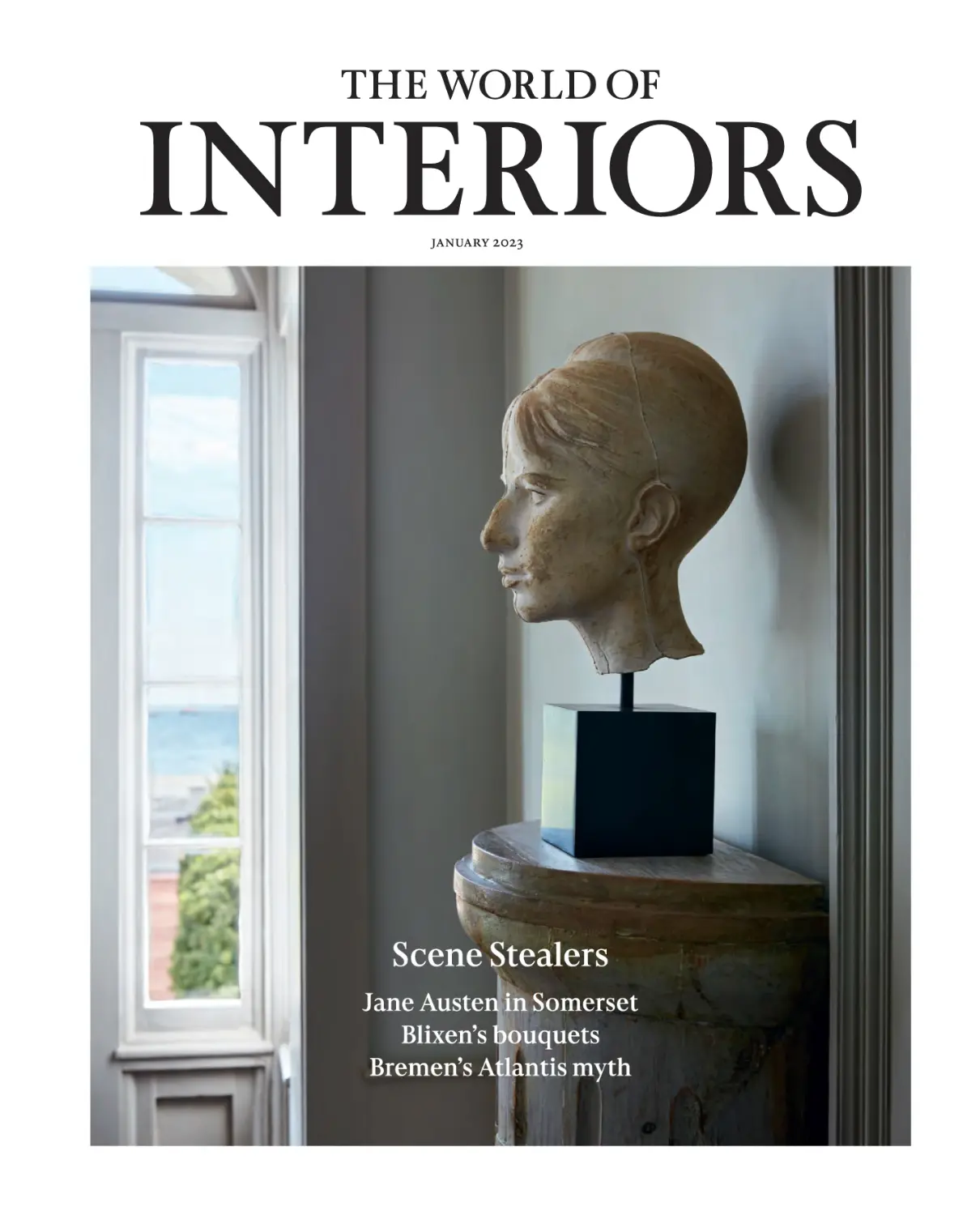
Cover: a star is borne – the bust
of a young Barbra Streisand
supported by a Gustavian plinth
greets visitors in the entrance hall
of Ryan Murphy’s Federal house in
Provincetown, Mass. To enjoy its
evergreen appeal, turn to page 56.
Photograph: Stephen Kent Johnson
Outstanding
Performers
Adorned with chain, buttonhole
or satin stitches, these
embroidered fabrics would
sit well in a sultan’s seraglio,
reckons Miranda Sinclair
Want a better bit of bitter? Time,
then, for Daisy Garnett to wax
purple about this Italian chicory
40
Table: Salad Servers
Be they resin, olive-wood or
faux-tortoiseshell, David Lipton
gives you the inside scoop
43
Books
Reading on art and architecture,
design and decoration
45
Aesthete’s Library
What makes a place truly livable?
A Pattern Language (1977) has 253
answers, learns Mitchell Owens
subscriptions & back issues
Receive 12 issues delivered direct to your
home address. Call 01858 438815 or visit
us at worldofinteriors.com
periodicals
Postage paid at Rahway, nJ. Postmaster:
Send address corrections to ‘The World
of Interiors’ c/o Mercury Airfreight
International Ltd Inc, 2323 Randolph
Avenue, Avenel nJ 07001, ‘The World of
Interiors’ (issn 0264-083X) is published
monthly. Vol 43 no 1, total 484
5
01-23-Contents_2948938.indd 5
17/11/2022 18:19
THE HOME OF THE WORLD’ S
GRE ATEST DESIGN AND
DECORATION B RANDS
120 SHOWROOMS I 600 LUXURY BRANDS
INFINITE INSPIRATION
2023 CALENDAR OF EVENTS
INCLUDES
LONDON DESIGN WEEK
Spring’s unmissable design event
13 – 17 MARCH
ARTEFACT
The contemporary craft fair
9 – 13 MAY
WOW!HOUSE
The ultimate designer showhouse
5 JUNE – 6 JULY
FOCUS/23
The international design and decoration show
18 – 22 SEPTEMBER
Find out more about the latest
Design Centre events, news and services
www.dcch.co.uk
Design Centre, Chelsea Harbour, London SW10 0XE
All products shown sourced from Design Centre, Chelsea Harbour. See www.dcch.co.uk/advertising-credits
contents
47
Exhibitions
Portraiture: the inside story,
four legs good
51
Network
Merchandise and events from
around the world
VISITOR’S BOOK
56
In his Federal home on Cape
Cod, Ryan Murphy abandoned
muted Modernism for a patterntastic homage to Bunny Mellon.
As the writer/producer himself
notes: ‘This time we went crazy’
66
Atlantic Notion
Fuelled by nationalism, the
mystical Atlantis House (1929)
in Bremen put glass bricks and
swooping Expressionist design
in the service of a dodgy Aryan
cult. Adam Stěch reports
72
96
Heuman
Resources
Sense and Stability
Landing a cottage on her parents’
Swedish estate enabled interior
designer Beata Heuman to give
her daughters a taste of her own
idyllic childhood. It’s a portal to
imagination, finds Emily Tobin
82
Is it the fan-vaulted staircase or
perhaps the Wedgwood-esque
dining room that keeps period
film-makers flocking to Grade
I-listed Ammerdown House?
Caroline Donald cries ‘action!’
AFTERWORD
Manger Rangers
110
A maker of santons, clay nativity
figures, still plies her trade from
a traditional mas on Provence’s
borders – but the cast of holy
characters never stands still, as
Marie-France Boyer discovers
Inspiration
88
Address Book
Statice Quo
At her 17th-century birthplace
in Denmark, novelist Karen
Blixen was known as a
nonpareil flower arranger.
Now one woman is carrying
the torch of her floral sorcery…
Text: Mitchell Owens
Recreate some of the design
effects in this issue, by Gareth
Wyn Davies and Ariadne Fletcher
114
Suppliers in this issue
128
Object Lesson
Edmund de Waal muses on an
exquisite lady’s writing desk that
intersects with his family’s past
columns 1&2: mikael jansson. columns 2–3: bruno suet. columns 4–5: ivan terestchenko
Premises, Premises
8
01-23-Contents_2948938.indd 8
17/11/2022 18:20
BAXTER LONDON HOUSE Old Sessions House, 4 Farringdon Ln London - www.londonhouse.baxter.it
Edmund de Waal
Edmund was five when pottery first fired his passions: ‘It’s why I’m so
evangelical about kids and art, the need to make a mess and try things
out.’ Enduringly experimental – mess be damned – he sees a kinship
between his two disciplines of choice: ‘writing and making things
are both shaping parts of a world.’ Our Object Lesson has Edmund
shaping the little world of a porcelain writing table (page 128).
Helen Olsen
‘My career happened quite incidentally,’ says Helen, who worked at
the Karen Blixen Museum café before becoming its floral designer.
This blossomed into her ‘true passion: working with flowers gives
such joy when you know you’ve got it right, [but there’s also] freedom to
let creativity play.’ Manifestly successful – ‘you can really feel her spirit
here’ – Helen reveals how she keeps the Blixen ethos in bloom (page 88).
Adam Stěch
Caroline Donald
Like many, as a teen Adam vowed
to ‘dedicate [his] life to art’. Since
then, though, he’s actually made
good on his pledge, industriously
capturing Europe’s neglected
architectural beauties in both
pictures and prose. Though he’s
got 5,000 buildings under his
belt already, as Adam puts it, ‘my
mission still continues’. His latest
quest, Germany’s Atlantis House
(page 66), sees him deftly wielding
both camera and keyboard.
For Caroline, the joy of
journalism is in the ‘challenge’:
it’s just like ‘cooking a good stew.
You add the facts, an ingredient
or two of your own, and simmer
it all down to something that is
(hopefully) tasty and distinctive.’
Ammerdown House, her subject,
is also a melting pot of deference
and distinctiveness (page 96):
Caroline marvels at how each
generation is ‘connected to those
past, yet makes its own mark’.
Ryan Murphy
Joan Hecktermann
Ryan’s first script – written ‘on a
whim’ – was ‘purchased one hour
out on the marketplace by Steven
Spielberg. I thought, “Well, if
that’s not a sign you should be
doing this, what is?”’ Now an
acclaimed director, producer and
television writer, he’s a shining
endorsement for the rewards of
whimsy. The same might be said
of his house in Cape Cod, whose
renovation Ryan traces with his
own pen for this issue (page 56).
Joan’s first bolt from the blue
came from a WoI cover– ‘I can
remember exactly which issue it
was: July/August 1984. Creepy,
I know!’ – which brought the
Castle of Lançut to an Earls
Court newsagent. ‘I’d never seen
anything like it and I was hooked,’
she says, ‘and then, lucky me,
I worked there!’ Ammerdown
House sees Joan reprising her role
as stylist – one she took up at the
magazine back in 1985 (page 96).
edmund de waal portrait: tom jamieson. adam stech portrait: julius filip. helen olsen portrait: mikael jansson. ryan murphy portrait: robert trachtenberg
Contributors
10
01-23Contributors_2958566.indd 10
17/11/2022 17:09
© 2022 WATE RWOR KS IS A RE G ISTE RE D TRA D E MA RK O F WATE RWO RKS IP CO MPA N Y, LLC
The World of Interiors
Editor in Chief
Hamish Bowles
PA to Editor in Chief
Maggie Gledhill
Art Director
Ben Weaver
Features Editor
Amy Sherlock
American Editor
Mitchell Owens
Deputy Chief Sub-Editor
Gareth Wyn Davies
Contributing Editor at Large
Patrick Kinmonth
Style Director
Gianluca Longo
Art Editor
Simon Witham
Deputy Editor
Emily Tobin
Managing Editor
Tom Reynolds
Acting Visuals Editor
Ivan Shaw
Editorial Associate
Ariadne Fletcher
Contributing Editor, Gardens
Tania Compton
Digital Director
Elly Parsons
Associate Editor, Paris
Marie-France Boyer
Decoration Associate
David Lipton
Chief Sub-Editor
Damian Thompson
Digital Associate
Donna Salek
Contributing Editor, Architecture
Jane Withers
Junior Sub-Editor
Leyla Spratley
Contributing Editor, Italy
Marella Caracciolo
Founding Editor
Min Hogg
Contributing Editors
Cosmo Brockway, Miranda Brooks, Laura Burlington, Florian Daguet-Bresson, Amy Fine Collins (New York), Ruth Guilding, Allegra Hicks,
Carolina Irving, Priyanka Khanna, Augusta Pownall, Rodman Primack (Latin America), Tree Sherriff, Plum Sykes, Mrs Tependris
Publishing Director/Chief Business Officer Home
Emma Redmayne
Acting Executive Assistant
Clare Holley
Lead Commercial Director
(Decoration)
Jane White
Commercial Director (Trade and Design)/
Associate Publisher, Europe
Christopher Daunt
Senior Account Director/
Associate Publisher, Europe
Alexandra Bernard
T +33 680 87 36 83
Senior Account Directors
Georgina Hutton
Nichole Mika
Olivia McHugh
Italian Office
Christopher Daunt (Interiors) T +44 7595 567573
christopher.daunt@condenast.co.uk
Valentina Donini (Fashion) T +39 028 051422
valentina.donini@miasrl.it
Account Director
Olivia Capaldi
Senior Account
Manager
Olivia Barnes
Acting Account
Executive
Freya Hill
Classified
Shelagh Crofts (Director)
Lucy Hrynkiewicz-Sudnik
(Senior Advertisement Manager)
Rebecca Sirs, (Senior Sales Executive)
Alva Muris (Sales Executives)
The Interiors Index/ Account Executive
Isabella Fish
Deputy Managing Directors, Europe
Anita Gigovskaya
Albert Read
Commercial Director
(Home and Retail)
Sayna Blackshaw
Commercial Director
(Home and Partnerships)
Melinda Chandler
US Advertising
Nichole Mika T 011 4420 7152 3838
nichole.mika@condenast.co.uk
The Interiors Index/Executive Editor
Busola Evans
Managing Director, Europe
Natalia Gamero
Business Manager
Sophia Warner
Acting Commercial
Lead
Ellie Naber
Digital Commercial
Director
Malcolm Attwells
Research and Insights
Erin McQuitty
(Insights Manager)
Holly Harland
(Research Executive)
Syndication Enquiries
Syndication@condenast.co.uk
Vice-President, Finance, Europe
Juan Manuel Martin-Moreno
Finance Director
Daisy Tam
People Director, London
Rosamund Bradley
Production Director
Sarah Jenson
Senior Production Controller
Helen Crouch
Senior Production Co-ordinator/
Digital Production Controller
Lucy Zini
Circulation Director
Richard Kingerlee
Paper Senior
Production Controller
Martin Macmillan
Commercial Senior
Production Controller
Louise Lawson
Newstrade Marketing Manager
Olivia Streatfield
Subscription
Patrick Foilleret (Subscriptions Director)
Anthea Denning (Creative Design Manager)
Lucy Rogers-Coltman, Emma Murphy (Subscriptions Marketing Managers)
Claudia Long (Assistant Promotions and Marketing Manager)
US Subscription Sales
The World of Interiors, Freepost PO Box 37861,
Boone, Iowa 50037-2861
T 888-737-9456
theworldofinteriors@subscription.co.uk
12
01-23Masthead_2948816.indd 12
11/11/2022 11:05
VOGUE HOUSE
HANOVER SQUARE, LONDON w1s 1JU
T 020 7499 9080
THE WORLD OF INTERIORS (ISSN 0264-083X) is published monthly by The
Condé Nast Publications Ltd, Vogue House, 1 Hanover Square, London W1S
1JU. Telephone 020 7499 9080. © 2022. All rights reserved. Reproduction in
whole or in part without written per mission is strictly prohibited. Printed in
the UK by Walstead Roche. Colour origination by Rhapsody. Distributed
by Frontline, Midgate House, Peterborough, Cambs PE1 1TN, United Kingdom (tel: 01733 555161). ‘The World of Interiors’ is a registered trademark
belonging to The Condé Nast Publications Ltd. Subscription rates include
delivery and digital editions. Full rates are £59.88 for one year in the UK,
£119 for the rest of the world. To place your order call +44 (0)1858 438819.
Special offers and exclusive promotions are published in this issue or online
at worldofinteriors.com. To manage your subscription log onto www.
magazineboutique.co.uk/solo. For enquiries, email worldofinteriors@
subscription.co.uk. US DISTRIBUTION: The World of Interiors, ISSN 0264-083X
(USPS 104) is published monthly by Condé Nast, Vogue House, Hanover Square,
London WIS 1JU, UK. US distribution: The US annual subscription price is $137.
Airfreight and mailing in the USA by agent named World Container Inc,
156-15, 146th Avenue, 2nd Floor, Jamaica, NY 11434, USA. Periodicals postage
paid at Brooklyn, NY 11256. US POSTMASTER: Send address changes to The
World of Interiors, World Container Inc, 156-15, 146th Avenue, 2nd Floor,
Jamaica, NY 11434, USA. Subscription records are maintained at Condé Nast
Britain, Subscriptions Department, Tower House, Sovereign Park, Market
Harborough, LE16 9EF, UK. The paper used for this publication is based on
renewable wood fibre. The wood these fibres are derived from is sourced from
sustainably managed forests and controlled sources. The producing mills are
EMAS registered and operate according to highest environmental and health
and safety standards. This magazine is fully recyclable – please log on to www.
recyclenow.com for your local recycling options for paper and board.
THE WORLD OF INTERIORS is a member of the Independent Press Standards
Organisation (which regulates the UK’s magazine and newspaper industry).
We abide by the Editors’ Code of Practice [www.ipso.co.uk/editors-code-ofpractice] and are committed to upholding the highest standards of journalism. If you think that we have not met those standards and want to make a
complaint please see our Editorial Complaints Policy on the Contact Us page
of our website, or contact us at complaints@condenast.co.uk, or by post to
Complaints, Editorial Business Department, Condé Nast Publications Ltd,
Vogue House, Hanover Square, London W1S 1JU. If we are unable to resolve
your complaint, or if you would like more information about IPSO or the
Editors’ Code, ring IPSO on 0300 123 2220, or visit www.ipso.co.uk
THE WORLD OF INTERIORS IS PUBLISHED BY CONDé NAST
Chief Executive Officer Roger Lynch; Chairman of the Board Jonathan
Newhouse, Global Chief Revenue Officer & President, U.S. Revenue Pamela
Drucker Mann; Global Chief Content Officer Anna Wintour; President,
Condé Nast Entertainment Agnes Chu; Chief Financial Officer Jackie
Marks; Chief Marketing Officer Deirdre Findlay; Chief People Officer Stan
Duncan; Chief Communications Officer Danielle Carrig; Chief of Staff
Elizabeth Minshaw; Chief Product & Technology Officer Sanjay Bhakta;
Chief Content Operations Officer Christiane Mack
WORLDWIDE EDITIONS: France AD, AD Collector, GQ ,Vanity Fair, Vogue,
Vogue Collections; Germany AD. Glamour, GQ , Vogue; India: AD, Condé
Nast Traveller, GQ , Vogue; Italy AD, Condé Nast Traveller, GQ , La Cucina
Italiana, Vanity Fair, Vogue, Wired; Japan GQ , Rumor Me, Vogue, Vogue
Girl, Vogue Wedding, Wired; Mexico and Latin America AD Mexico and
Latin America, Condé Nast College Américas, Glamour Mexico and Latin
America, GQ Mexico and Latin America, Vogue Mexico and Latin America;
Spain AD, Condé Nast College Spain, Condé Nast Traveller, Glamour, GQ ,
Vanity Fair, Vogue; Taiwan GQ , Vogue; United Kingdom London: HQ ,
Condé Nast College of Fashion & Design, Vogue Business; Britain Condé
Nast Johansens, Condé Nast Traveller, Glamour, GQ , GQ Style, House &
Garden, Tatler, The World of Interiors, Vanity Fair, Vogue, Wired; United
States Allure, Architectural Digest, Ars Technica, basically, Bon Appétit,
Clever, Condé Nast Traveler, epicurious, Glamour, GQ , GQ Style, healthyish,
HIVE, La Cucina Italiana, LOVE, Pitchfork, Self, Teen Vogue, Them, The New
Yorker, The Scene, Vanity Fair, Vogue, Wired. PUBLISHED UNDER JOINT
VENTURE: Brasil Casa Vogue, Glamour, GQ , Vogue; PUBLISHED UNDER
LICENSE OR COPYRIGHT COOPERATION: Australia GQ , Vogue, Vogue Living;
Bulgaria Glamour; China AD, Condé Nast Traveler, GQ , GQ Lab, GQ Style,
Vogue, Vogue Café Beijing, Vogue Café Shanghai, Vogue Film, Vogue+,
Vogue Business in China; Czech Republic and Slovakia Vogue; Germany
GQ Bar Berlin; Greece Vogue; Hong Kong Vogue, Vogue Man; Hungary
Glamour; Korea Allure, GQ , Vogue, Wired; Malaysia Vogue Lounge Kuala
Lumpur; Middle East AD, Condé Nast Traveller, GQ , Vogue, Vogue Café
Riyadh, Wired; Poland Glamour, Vogue; Portugal GQ , Vogue, Vogue Café
Porto; Romania Glamour; Scandinavia Vogue; Serbia La Cucina Italiana;
Singapore Vogue; South Africa Glamour, GQ , GQ Style, House & Garden;
Thailand GQ , Vogue; The Netherlands Vogue, Vogue Living; Turkey GQ ,
Vogue, Vogue Restaurant Istanbul; Ukraine Vogue, Vogue Man.
Chimneypieces | Lighting | Furniture
020 7730 2122 | jamb.co.uk
Condé Nast is a global media company producing premium content
with a footprint of more than 1 billion consumers in 31 markets.
condenast.com
13
013_WOJAN23.indd 1
17/11/2022 10:25
savoirbeds.com
E L I Z A B E T H H A R R O D & S T E V E N M C R A E , S O L O I S T & P R I N C I PA L , T H E R OYA L B A L L E T
ANTENNAE
In this issue, we’re heralding the glorious dawn of a new year with an ode to all
things bright and beautiful. In full-throated ease, our stylists wax melodious
about some remarkable marquetry and harmonise over hand-embroidered
fabrics – triumphs in Technicolor all. In related news, we take a shine to the
prismatic colours cast by beaded baubles and crystal crafts, while designs
inspired by jesters and bards join the dance. The merry riot tiding over into
tea-time, you’re more than welcome to whet your palette with us in an arted-up
London brasserie, sumptuously set with a colour-blocking tasting menu pour
votre plaisir. Tossed with our stylists’ selection of sovereign servers, we’ve rustled
up a vivid wintry miracle for mains: a rich violet radicchio salad to wreathe your
table in regal hues. While you’re at it, we’ve got books to add a dash of colour
to your shelves and exhibitions that see carnival interiors – both mental and
material – brought to life: think dancing chairs and molten stools, and in every
hue under the sun. After all, in these greyscale days, why not raise the pantone?
01-23DividerFront_2953567.indd 15
16/11/2022 17:21
A portrait of ‘santon’-maker Joseph Mille-Montagard presides over the
workshop now run by his daughter Magali. See page 82. Photograph: Bruno Suet
01-23DividerFront_2953567.indd 16
15/11/2022 15:58
WW W.COX LO N D ON .CO M
4 6 P I M LI CO ROA D LO N D O N S W1 W 8 L P
+ 4 4 ( 0 ) 2 03 328 95 06
Ona Collection
Simple as Nature
Inspired by the Mediterranean. Natural colours, pure lines and soft shapes.
This is Ona: a timeless, versatile and sustainable bathroom collection.
roca.com/ona
news
What’s in the air this month
by Ariadne Fletcher and David Lipton
Scent West
Internationally acclaimed artist
James Turrell’s calling card is
absolute aesthetic refinement:
space concentrated by means of
light, colour and stark geometric
forms. It feels only right, then,
that he’s now begun distilling
his own perfume, prismatically
bottled by Parisian glassmaker
Lalique. With notes of leather
and sage, and fruit and musk,
respectively, the artist’s two
scents are designed to evoke
the great American West, as
refracted through the novels of
Zane Gray. John Galliano always
spoke about how cuture was
his parfum, the artistic essence
from which all other creative
choices flowed; James Turrell’s
scents similarly synthesise his
artistic concepts. He describes
the process of conceiving his
first perfume and work in crystal
as ‘a bit like creating a world you
have known’. Geometry, colour
and light – bottled. Shown:
‘Range Rider’ (below, left) and
‘Purple Sage’, £21,800 approx
each. Visit lalique.com dl
Fool’s Paradise
top leFt: architectural digest, jAn/Feb 1975
Willing Accomplice
When interior designer Imogen
Taylor bought her first flat in
1977, her friend and former
employer John Fowler came to
visit. It wasn’t much more than
‘an empty shell’ at that point –
but when Fowler died later that
year, Imogen found he had left
her exactly what she needed
to furnish the space. This, she
feels, was no coincidence: she
suspects he had carefully noted
what was missing and adjusted
his will accordingly. Among the
bequests was Fowler’s mahogany
desk (above), an item that didn’t
see much action under its former
master – ‘he didn’t do any work
at that desk,’ Imogen reports.
Instead, it sat in the hallway of
the annex to his hunting lodge in
Hampshire (top) – and there ‘he
would sit making shopping lists
for us to do as guests’. Having
travelled between homes (and
across seas, landing ultimately in
Imogen’s home in France), these
items will now be sold by Sibyl
Colefax & John Fowler. Up for
grabs are over 100 pieces, more
than two thirds of which will
consist of furniture John Fowler
left to Imogen. The remainder
comes from her own collection.
Visit sibylcolefax.com, or contact
showroom@sibylcolefax.com AF
Thankfully, unlike Danny
Kaye in The Court Jester, you
don’t have to choose between
the vessel with the pestle and
the chalice from the palace:
you can have the pot with
the spots. Photographer
and all-round motley maker
Martyn Thompson’s ‘Jesture’
collection is inspired by the
joyful frivolity of the jester
and enlivened by his own
painterly aesthetic. Produced
by the Stoke-on-Trent-based
ceramicist 1882, the collection
spans pieces created in
collaboration with artisans at
the company factory and oneoff Thompson pots, all thrown,
dotted and striped by hand.
Shown, above: ‘Penny’ vase,
£4,250. Visit 1882ltd.com dl
19
01-23AntennaeNews_2953408.indd 19
17/11/2022 11:12
news
Versed in Craft
Balance of Power
What links a Mackintosh ‘Argyle’
chair with an Orkney ‘Creepie’
stool? This is no riddle: Scottish
strengths lie in storytelling, not
guesswork. And it’s Caledonian
stories that underpin all the
craft and designs on display at
Bard, the aptly named new store
(below) founded in Edinburgh
by husbands Hugo Macdonald
and James Stevens, a curator
and architect respectively. In the
Celtic tradition, the bard was
a travelling poet who earned
his keep by recounting tales
and recording histories. This
appropriately bardic project feels
like a convergence of the duo’s
individual talents; together,
they seek to ‘reframe the context
within which craft is viewed and
sold’. With this as their lodestar,
However much of a truism
it may be, the advice ‘if you
want something done, do it
yourself’ doesn’t always lead to
a revolution in design. Unless,
of course, you happen to be
Richard Sapper. The ‘Tizio’
lamp was born of necessity:
the industrial designer needed
a lamp with a small head and
a long arm that was easily
movable. As formally innovative
as it is technologically inventive,
the carefully cantilevered arm
supports one of the first halogen
bulbs, eliminating the need
for wires. That was 50 years
ago – yet it remains one of the
best-selling lamps. Now, for its
anniversary, lighting specialist
Artemide is applauding that
triumph by reissuing the design
in celebratory red. Shown,
above left: ‘Tizio’ lamp, £403.
Visit artemide.com dl
they spent ten weeks touring
Scotland and its islands, visiting
60 makers and designers and
collecting pieces from castle
clearances and auctions along
the way. All in all, they make a
compelling case for a new way of
shopping; a new way of telling
old stories. Bard, 1 Custom
Wharf, Leith, Edinburgh EH6 6AL
(bard-scotland.com) dl
for a festive badger, there’s
bound to be a paper design to
cover your needs. The shop’s
frontage has also enjoyed some
arty wrappings: artist Magda
Gordon has created a cheering
window display themed around
a Georgian Christmas. Choosing
Keeping, 21 Tower St, London
WC2 (choosingkeeping.com) af
The Write Stuff
Venerable Beads
A birthday well worth
pencilling into the diary
is that of stationery shop
Choosing Keeping. Celebrating
its tenth anniversary, the
store remains brimful of
writing paraphernalia, tools
and accessories made by
independent producers,
each carefully selected for its
distinctive style and historical
appeal. Among the latest
offerings is a striking range of
decorative paper (below), some
of which owner Julia Jeuvell
says ‘are designs that have been
floating around since the 1950s’.
Whether you’re in the market
for florals, geometric patterns,
or even have a hankering
Monkeybiz (WoI March 2021)
has been reviving the tradition
of African beadwork since 2000.
With community at its heart,
the non-profit organisation
empowers women from povertystricken towns in South Africa
by providing them with financial
independence – all profits from
the company sales go directly to
them. Among their latest beaded
offerings are these beautiful
ornaments, available in a vibrant
range of colours, patterns and
shapes – ideal for the festive
season, and a powerful tonic
for grey days beyond.
Shown, above: beaded festive
ornaments, $140 for a set of four.
Visit monkeybiz.co.za af ª
20
01-23AntennaeNews_2953408.indd 20
18/11/2022 13:39
Roundup
Marquetry Leaders
In love with inlay? David Lipton lifts the lid on some divinely diminutive boxes
2
1
4
3
5
7
6
8
9
1 Inlay box, £130, Ibbi. 2 ‘La Boîte à Soleil’, by Pierre Marie, £33,175 approx, La Galerie de Pierre Marie.
3 Small jewellery box, by Silvia Furmanovich, £3,550, Net-à-Porter. 4 Pastille box, from £1,965 approx for a set of six,
Ateliers Lison de Caunes. 5 Straw-marquetry jewellery box, £375 approx, Tabea Vietzke. 6 ‘Petali’, by Biagio Barile, £110, Liberty.
7 Straw-marquetry jewellery box, £2,450, Simon Orrell Designs. 8 Italian jewellery box, £595, Litten Tree Antiques.
9 Coffered-effect box, $175, Jayson Home. All prices include VAT. For suppliers’ details see Address Book ª
22
01-23AntennaeRoundup_2949295.indd 22
15/11/2022 17:38
A S P R E Y. C O M
P R I S M VA S E S
3 6 B R U T O N S T R E E T , M AY F A I R , W 1 J 6 Q X
SWATCH
Outstanding Performers
With their sewn elements raised above the surface, embroidered fabrics offer
treats to the touch as well as spectacles worthy of a pasha’s palace. Decorated with
chevrons, poppies or velvety spots, the designs on display here represent pique
craftsmanship. Up your level, urges Miranda Sinclair. Photography: Neil Mersh
Cushion: ‘Sampa BTSP-01’, by Namay Samay, £780 per 3m panel, Tissus d’Hélène. Slippers (outer): ‘Tiny Trellis F464-G’, £525,
Chelsea Textiles. Slippers (inner): sulphur ‘Hilda’, by Raoul Textiles, £371.80, Turnell & Gigon; trimmed with Bordeaux ‘Chavallerie
Tassel Fringe’, by Timothy Corrigan, £105, Samuel & Sons. Background: ‘Rossini Velvet FD628-V55-0’, by Mulberry Home,
£169, GP&J Baker. All prices are per m, unless otherwise specified, and include VAT. For suppliers’ details see Address Book
24
01-23SwatchHandEmbroidered_2952415.indd 24
18/11/2022 13:48
Cushion: original ‘Kharif Crewel’, by Clarence House, £404.40, Turnell & Gigon; trimmed with spearmint ‘Calisto Triple Bead Fringe’,
£137, Samuel & Sons. Slippers on cushion (outer): ‘Walsingham Weave’, £276, Flora Soames. Slippers on cushion (inner):
‘Gila L9349-04’, by Larsen, £117, Colefax & Fowler. Slippers on rug (inner): ‘Rossini Velvet FD628-V55-0’, by Mulberry Home, £169,
GP&J Baker. Slippers on rug (outer): jewel ‘Tulip Flamestitch’, £324, Schumacher; trimmed with Bordeaux ‘Chavallerie Tassel Fringe’,
by Timothy Corrigan, £105, Samuel & Sons. ‘Etoile’ dessert plate, by Astier de Villatte, £95, Summerill & Bishop. Background: vintage
Anatolian kilim, £780, Larusi. Fabric and trimming prices are per m; all prices include VAT. For suppliers’ details see Address Book
25
01-23SwatchHandEmbroidered_2952415.indd 25
15/11/2022 19:26
Slippers (inner): ‘Rossini Velvet FD628-V55-0’, by Mulberry Home, £169, GP&J Baker. Slippers (outer): ‘Persis F4667-01’, £175,
Colefax & Fowler. Cushion (top): Acantha F4667-01’, £155, Colefax & Fowler; trimmed with candy apple ‘Dolce Pom Pom Fringe’,
by Timothy Corrigan, £57, Samuel & Sons. Cushion (middle): Stockholm blue/platinum grey ‘Anar Trellis’, £190, Zoffany;
trimmed with blueberry pie ‘Dolce Pom Pom Fringe’, by Timothy Corrigan, £57, Samuel & Sons. Cushion (bottom):
ivory ‘Margarete Bouclé’, £408, Schumacher; trimmed with Bordeaux ‘Chavallerie Tassel Fringe’, by Timothy Corrigan,
£105, Samuel & Sons. Background: ‘Checkerboard King’ rug, by Vanderhurd & 8 Holland Street, £1,980, 8 Holland Street.
Fabric and trimming prices are per m; all prices include VAT. For suppliers’ details see Address Book
26
01-23SwatchHandEmbroidered_2952415.indd 26
15/11/2022 19:26
SWATCH
Cushion (left): ‘Cosma PF50064-440-0’, £117, GP&J Baker. Cushion (middle): ‘Crocodile Velvet’ cushion, £1,440, Fromental.
Slippers (inner): ‘Moiré Stripe’, by Helene Blanche, £242.80, Tissus d’Hélène. Slippers (outer): ‘Bedouin Stripe FD300-H10-0’,
by Mulberry Home, £169, GP&J Baker; trimmed with spearmint ‘Calisto Triple Bead Fringe’, £137, Samuel & Sons.
Cushion (right): ‘Kiku’ needlepoint cushion, £980, Fromental. Background: contemporary wool kilim, £1,110, Larusi.
Fabric and trimming prices are per m; all prices include VAT. For suppliers’ details see Address Book
27
01-23SwatchHandEmbroidered_2952415.indd 27
15/11/2022 19:26
SWATCH
Cushion (top): red ‘Wobble Grid’, by Luke Edward Hall, £155, Rubelli. Cushion (bottom): Cleo ‘Ponti’ cushion, £560,
Vanderhurd. Antique footstool, upholstered in ‘Catherine F3527-002’, £243 per m, Pierre Frey. Slipper (inner): ‘Proud 04’,
£343.90, Lizzo. Slipper (outer): mustard ‘Tibet Small-Scale’, by Clarence House, £525.40, Turnell & Gigon. Background:
contemporary wool kilim, £1,110, Larusi. Upholstery by Lisa Yau-Alfredson, The Blackheath Upholsterer.
Fabric and trimming prices are per m; all prices include VAT. For suppliers’ details see Address Book º
28
01-23SwatchHandEmbroidered_2952415.indd 28
15/11/2022 19:26
shortlist
Palette Teasers
On the menu today we have all manner
of toothsome treats in blocks of colour,
from cherry red to lettuce green.
Maître d’ Gianluca Longo serves up
these inviting amuse-bouches
at London’s Sketch brasserie, where
a recent installation by Bethan Gray
happened to heighten his hunger for
hues. Photography: Sean Myers
From left: ‘Iguana’ vase, by Floris Wubben, £1,950, SCP.
‘Sonia Stripe’ cushion, £155, Ceraudo. Fuchsia/saffron
‘Varese’ cushion, £60, Designers Guild. Large plasticbag chicken, £30, Raj Tent Club. ‘C1’ candlestick, by Lars
Nilsson, £2,958; ‘C3’ candlestick, by Lars Nilsson, £2,754;
both Invisible Collection. Small plastic-bag chicken,
£20, Raj Tent Club. ‘Jimbaran’ side table, £620, Charles
Orchard. ‘Beetroot’ candle-holder, £90; ‘Tomato Leaves’
candle, £160; both Loewe. ‘H Riviera’ blanket, £1,370,
Hermès. Aztec-style candelabra, £940, Objekti. ‘Panton’
chair, by Vitra, £1,320, The Conran Shop. All prices
include VAT. For suppliers’ details see Address Book
30
01-23Shortlist_2942107.indd 30
15/11/2022 12:18
31
01-23Shortlist_2942107.indd 31
15/11/2022 12:18
From left: ‘Armadillo’ vessel, £1,950, Objekti. ‘Aqua 20’ pleated frill cushion, £320, Viola Lanari.
Malachite/navy ‘Varese’ cushion, £60, Designers Guild. ‘Zig Zag’ lacquered stool, by Pols Potten,
£325, Selfridges. Malachite obelisk, £390, Pentreath & Hall. ‘Fuzz’ bowl, by Study O Portable, £4,500,
Gallery Fumi. All prices include VAT. For suppliers’ details see Address Book
32
01-23Shortlist_2942107.indd 32
15/11/2022 12:18
shortlist
From left: ‘H’ stool, £1,100, Viola Lanari. ‘Pilastro’ stool, by Ettore Sottsass, £283,
Kartell. Plain-rimmed ‘Lustre’ vase, by Jochen Holz, £555; red-rimmed ‘Lustre’ vase, by Jochen Holz, £340;
both SCP. ‘Flora Curiosa’ ornament, by Eelko Moorer, £4,500, Gallery Fumi. Giant acrylic snail, £1,695,
Jonathan Adler. All prices include VAT. For suppliers’ details see Address Book
33
01-23Shortlist_2942107.indd 33
15/11/2022 12:18
shortlist
From left: ‘Specimen Mosaic’ pyramid, £420, Pentreath & Hall. ‘Wysiwyg’ chair, by Vladimir Kagan, £12,275,
Holly Hunt. ‘H Dye’ pillow, £830, Hermès. Small plastic-bag chicken, £20, Raj Tent Club. Ceramic on
moulded-metal candlesticks, from £9 each, Ian Snow. ‘DLM’ side table, by Hay, £195, Selfridges. Leather stool,
by Atelier Oï, £3,550, Louis Vuitton. Wine pitcher, £750, Dolce & Gabbana Casa. All other furniture and
accessories throughout by Bethan Gray. All prices include VAT. For suppliers’ details see Address Book ª
34
01-23Shortlist_2942107.indd 34
15/11/2022 12:18
Perzel - 355s doré - WORLDS OF INTERIORS - 279x216.indd 1
18/07/2022 10:29
table
Purple Reign
Dressing one’s winter vegetable patch in royal robes, radicchio has a flavour
that’s echoed in the bitterly cold conditions in which it grows. But combined
with blood oranges, milky cheese or rice, this Italian chicory offers a tension
and complexity all its own. Text: Daisy Garnett. Photography: Tessa Traeger
You couldn’t be blamed for thinking radicchio the sweetest of plants. I mean look at
her, the Marie Antoinette of the veg patch:
pink and flouncy one moment, deep burgundy and stiffly boned another. She
comes in four basic varieties, and it’s pleasing – why not speak fluent chicory? – as
well as useful to know the differences, even
though they share the same overriding flavour and are all at their prime in midwinter when most salad leaves are asleep. Each
is named after its Italian town of origin,
and radicchio itself, like champagne or a
Cornish pasty, is PGI-protected.
Chioggia is the one that looks most like
a red cabbage, being tightly bound and
spherical. Verona is similar, but smaller
and slightly pointier, its leaves paler pink
with a stronger central white rib. Treviso
is oblong, like an endive in shape, but burgundy. It’s a dip scooper, if you’re minded
that way (I’m not), and is the best for
cooking: it holds its shape, and its strong
flavour mellows with heat but doesn’t disappear. Tardivo is a subset of Treviso: the
same plant, but grown longer and harder.
Think Treviso on steroids. Lengthier,
leaner, lankier and curling in on itself: the
one that looks like a chef’s hat.
Finally, there is Castelfranco, arguably
the most beautiful of all. The first time I
grew it I didn’t know what I’d planted. I
nearly fainted when I saw a row of plants
that resembled lettuces in shape, but had
leaves of creamy yellow and pale pistachio,
each one frilled and splattered with shades
of pink and red. And this in January no
less. Castelfranco is the one to start with
if you’re new to radicchio. It’s the mildest
and best eaten as a salad, served with ceremony. It costs an arm and a leg, it’s true,
but it’s cheaper than, say, a set of linen
napkins embroidered by Portuguese nuns,
and has the same effect on your table.
What’s more, it’s delicious. All members of the family are, it’s just they don’t
taste how they look. Radicchio is not
sweet – at all. It’s bitter. We’re not inclined to relish bitter, but bitterness balanced out and tamed is a beautiful thing.
It adds tension and complexity to a dish,
Top: the most beautiful of the winter salad plants, this species of the chicory family has colours that deepen as the really cold weather sets
in towards Christmas. This variety is Palla Rossa. Opposite: improved versions of the classical phenotypes continue to be introduced
by plant breeders. Here Rosalba is surrounded by many varieties, including Bel Fiore, Leonardo, Castelfranco, Orchidea and Luisa
36
01-23TableRadicchio_2934466.indd 36
14/11/2022 15:40
37
01-23TableRadicchio_2934466.indd 37
10/11/2022 09:09
which makes it interesting to eat, as well
as satisfying and satiating.
So do reach for radicchio, just make
sure you’ve got a counterweight in the
other hand. This can be sweet – honey,
or blood orange, or the caramelisation
that occurs when you stick it under a high
heat; or it can be rich – a milky cheese
like Camembert or Gorgonzola or a curd.
It can be earthy – peppery olive oil, say
– or umami: parmesan and/or anchovies
are perfect with radicchio. It welcomes,
perhaps counterintuitively, sharpness too.
For the zingiest salad, combine Chioggia
or Verona with blood oranges and dill
and sumac, then anoint with pomegranate molasses, red wine vinegar and olive
oil. This is a Sabrina Ghayour recipe and
an excellent riposte to January. Similarly,
if you grill or roast Treviso, sliced vertically, use balsamic vinegar as well as oil
to marinade and dress it.
Mostly though, given that in this house
we tend to eat it raw and on a daily basis, I keep it simple and just coat it (any
of the varieties will do) with an anchovy
dressing, or a sweetened vinaigrette and a
shower of parmesan or Manchego. Add a
few toasted hazelnuts and maybe a slice or
two of Serrano ham or chunks of smoked
fish and things start getting really jiggy.
For anchovy dressing, make a paste by
pounding garlic and anchovies together
– a little mustard and vinegar is good but
not essential – then slowly drizzle in olive
oil as you whisk away, like a mayonnaise
without egg yolks. Or do make a conventional mayo, and add chopped anchovies
at the end. That gives you more of a dip
(hello, Treviso!).
Bring on lunchtime! Wake up your taste
buds! Relish what’s going on in terms of
flavour, and all achievable in three minutes of prep. The work has been done by
the plant and the way it has grown: its curious mix of compounds, its love of the
cold, its lack of chlorophyll due to growing in relatively little sunlight, its innards
hidden by outsized outer leaves or a covering placed by a mindful grower.
If that’s salad sorted for January, radicchio works just as well for the main event
too. Radicchio risotto is a lesson in how
contrasting notes add up to make a complex but harmonious supper. Sweet onion,
nutty rice, savoury parmesan – those provide the guy ropes that harness the leaves’
bitter notes. You can add the chopped
leaves of Chioggia or Verona near the beginning of cooking, both just after the rice
and at the end for a nice mix of textures, or
cook the chopped leaves of Treviso separately in a little olive oil (more sweetness),
then season with salt and lemon to highlight those low notes, before adding as
above. Pretty in pink, or what? ª
radicchio varieties grown by jane scotter at fern verrow, a biodynamic farm in herefordshire
table
Top left: a selection of dark-leaved radicchio. Modern cultivation of the plant began in 15th-century Veneto, but Pliny the
Elder talked up its medicinal properties as a blood purifier and cure for insomnia. Top right: with its white-ribbed finger-like
burgundy leaves, Tardivo radicchio is also known as fiori d’inverno (winter flowers)
38
01-23TableRadicchio_2934466.indd 38
14/11/2022 15:40
The Bute
+44 (0)20 7376 4499
drummonds-uk.com
table
Handled with Flair
Every well-dressed salad has to be accessorised with stylish servers.
David Lipton tosses a few suggestions your way
1
3
2
5
4
6
7
9
8
1 ‘Bobble’, by Global Explorer, £34, Amara. 2 Stainless-steel servers, by Arne Jacobsen, £68, Georg Jensen.
3 Short-handled resin servers, $50, Nashi Home. 4 ‘Omega Tortoiseshell’, by Capdeco, £75, Bonadea. 5 ‘Mustique Ripple’,
£98, Jonathan Adler. 6 Olive-wood servers, £22, Divertimenti. 7 ‘Coral’, $99, Julia Knight. 8 Retro-style servers,
£14.99, Pip Store. 9 ‘Fein’, £49, Ferm Living. All prices include VAT. For suppliers’ details see Address Book º
40
01-23TableProductSaladServers_2947157.indd 40
15/11/2022 09:40
THE
DECORATIVE
FAIR
BATTERSEA PARK,LONDON
DECORATIVEFAIR.COM
WINTER
24-29 JANUARY 2023
ANTIQUES, DESIGN & ART FOR INTERIORS
DF_WoI WIN 2023 279hx216w.indd 1
07/11/2022 11:48
books
Too Hot to Hoe?
Venetian Gardens (by Monty Don and
Derry Moore; BBC Books, rrp £40)
‘Gardens,’ writes Monty Don, ‘are a good
way to get under the skin of a culture and
to understand its people.’ If so, then by
the end of this beautifully illustrated book
you’re left with the strong impression that
Don is among those who think Venetians
a pretty lazy bunch. It became an amusing game as I read to anticipate yet another barb along the lines of: ‘The Italian sensibility is much more attracted to a
garden as a concept rather than mundane
horticultural practicalities.’ Full marks are
awarded to Toto Bergamo Rossi and Anthony Santospirito for adopting the very
un-Italian trait of actually gardening, and
the latter’s well-tended plot in the Santa
Croce sestiere reminds Don of an English
country vicarage, so bonus points there.
How miraculous it must seem to him,
then, that such a horticulturally idle people have managed to carve out green
spaces in a city with unique challenges.
The threat of acqua alta is ever-present,
and when not itching to roll up his sleeves
and show the Venetians what a bit of British spadework can do, Don praises their
resilience in the face of this salty scourge:
witness the community garden created by
Santa Maria dei Carmini, whose raised
beds have been heightened to avoid the
deluge. Then there’s Palazzo Nani Bernardo, whose owner, Contessa Elisabetta
Lucheschi, is tearful as she explains how
the garden she’s lived with since childhood
was all but destroyed by the floods of November 2019, the brackish water killing off
plants and the winds ripping out trees. But
her palm – the tallest in Venice – survived,
and the garden, replanted with cypresses,
olives, roses, purple bearded irises and
much besides, is thriving.
The fifth book Don has produced with
the photographer Derry Moore, Venetian
Gardens spans a wonderful range. Amid
more exclusive offerings are public gardens and parks, while the humble window
box gets its own chapter (pelargoniums
repel mosquitoes; yellow-flowered sedums
are low-maintenance), as does the distinctively Venetian concept of the altana: a
flimsy-looking wooden structure perched
on many a palazzo rooftop, where noblewomen of yore could bleach their hair in
the sun unseen. Moore’s pictures often
simply capture what it is to walk around
Venice’s alleyways and along its narrow
canals, catching tantalising glimpses of
gardens behind high walls, or the back of
a statue surveying its hidden domain.
Sometimes the public and the private
coexist in a peculiarly Venetian way, as at
Palazzo Cappello Malipiero, for a while
the adoptive home of Casanova – until he
was kicked out after being found in flagrante with his patron’s favourite actress.
Its 18th-century garden, complete with
nymphaeum, is set like a stage on the edge
of the Grand Canal, roses tumbling over
its balustrade towards the water – at once
highly visible and inaccessible.
Truly cloistered is the Russell Pageinfluenced garden of Palazzo Brandolini;
the chance to visit is ‘a rare opportunity’,
Don writes. It’s a shame, then, that he begins by confusing the building with another of the family’s palazzos: this one was
built in the 15th century, not the 17th; Robert Browning never lived here (though
Richard Wagner did); and it was bought by
the current owners in 1876, not more recently. Such errors make the reader feel
they’re not quite on terra firma; but perhaps that’s apt for a book about Venice ª
Sophie Barling is a freelance writer
A tantalising glimpse of the garden at Palazzo Cappello Malipiero, whose rose-covered balustrade overlooks the Grand Canal
43
01-23Books_2959216.indd 43
17/11/2022 17:30
books
Hanging Judge
The Private Lives of Pictures: Art at Home in Britain,
1800–1940 (by Nicholas Tromans; Reaktion, rrp £25)
6 R U E D E L’O D EO N
75 0 0 6 PA R I S
T +3 3 1 5 5 4 2 92 1 0
S E R I E R A R E @ S E R I E R A R E .CO M
W W W. S E R I E R A R E .CO M
044_WOJAN23.indd 1
Let’s walk up through your house from the entrance
hall to the bedrooms and discover what part your own
display of pictures is playing in the history of art and
design. How high have you hung them, and why?
What have you hung them from: a hook? A picture
rail? Do you have any on a shelf or an easel? Where
did you put your landscape watercolours and where
are your pictures of objects? Your grandparents’ portraits? That sentimental print you bought at a boot
sale? So many questions with, gratifyingly, some definite answers, because the academic/curator Nicholas
Tromans guides us through all the possibilities in a
book that not only rises from the basement to the attic but from the concrete to the otherworldly, from
cheap ‘autotypes’ and vulgar chromolithographs to
the role of memory and nostalgia in the upmarket
furnishing of a bedroom or a nursery.
It is striking that some of the most influential early
writers on the place of the picture in the home were
political journalists, notably the Georgian radicals
Leigh Hunt and William Hazlitt: they grasped that
the personal picture collection is a statement of one’s
role in society. For Hunt, in particular, a small room
packed with pictures spliced together ‘the fireside with
the great wheel of history turning beyond’, as Tromans puts it; for Hazlitt, a frustrated artist, the reproduction of a famous work of art was more powerful than the original precisely because it could be
taken home. In time, Victorian ideas about propriety,
including who should look at what and when, swept
through everyday households, each wave touching on
some new fixation, usually involving morality, hygiene
or obsessive order. On the one hand, Gothic images
depicting scenes from Horace Walpole’s The Castle of
Otranto to Oscar Wilde’s The Picture of Dorian Gray
were intentionally redolent of shocking pre-Reformation practices; on the other, in the eras of design reform and the Arts and Crafts, a picture could only be
tolerated as a tasteful object, perhaps Japanese, sitting on a table or artfully placed in a window reveal. In
fact the question of illumination repeatedly features;
many Victorians thought that sunlight was healthy
for pictures, while others devised innovative lighting
schemes and angled hanging devices so that portraits,
for example, could face their viewers.
This book is an extremely enjoyable guide to discovering what it is that makes a home an ‘interior’
rather than a set of walls with furniture: look forward
to the ‘voyage around your room’ as it was described
by the late 18th-century philosopher Xavier de Maistre. This is a short book, but it is stylishly written and
full of ideas, and beautifully produced and illustrated
ª Timothy Brittain-Catlin is the author of ‘The Edwardians and their Houses’ (Lund Humphries)
44
18/11/2022 14:38
14:12
aesthete’s library
Module Citizens
Itemising 253 building blocks meant to make communities across the world
more livable, Christopher Alexander’s A Pattern Language (1977) analyses
everything from downtowns to doorknobs. Easy on the eye it isn’t, says Mitchell
Owens, but the book’s aims are avowedly utopian
Awkwardly thick and squat in form, A Pattern Language: Towns, Buildings, Construction is not a sexy book. The art direction is minimal: no fonts delight, no
layouts divert. Its creamy pages – 1,171
of them – are innocent of colour images,
and what illustrations do exist are mostly
murky black-and-white photographs, as
if spat from a printer perilously low on
toner and then photocopied. It is as basic
as basic can be, and therein lies its brilliance. If the forthright tenets of A Pattern
Language were followed closely, the built
world could be an infinitely better place
and all of us conceivably cheerier as a result. At least, that was the informed belief
of the book’s marquee author, Christopher Alexander, an influential Viennaborn British architect who died in March
at the age of 85. As he explained in an oral
history towards the end of his life, his philosophy of design was built on a foundation of ‘those things that are so deeply
shared by human beings, that people of
different cultures and different eras and
so on will essentially recognise and respond to the same kinds of things’.
Granular, holistic, spanning 253 patterns – call them building blocks – and
peppered with head-turning factoids, the
book, published in 1977 by Oxford University Press and still in print, is an essential
guidebook for city planners, architects,
designers and even, perhaps most importantly, home owners. Its point is to promote livable environments, from dense
and varied downtowns to the development of intimacy gradients, that is ‘spaces
in a building arranged in a sequence which
corresponds to their degrees of privateness’. (Spoiler alert: Charles III has long
been an Alexander admirer.) If blearyeyed parents have ever wondered why
some young children have difficulty sleeping alone, A Pattern Language offers at
least one environmental answer as well as
spatial solutions, namely what it calls ‘bed
clusters’. Felicitous furniture placement is
Among the wide array of livability topics discussed is how the placement of a child’s room can help or hinder the occupant’s slumber
45
01-23AesthetesLibrary_2945557.indd 45
10/11/2022 18:10
aesthete’s library
explored as thoughtfully as Alexander’s belief in windowsills that are set no higher than 14 inches from
the floor and no lower than 13 inches, to maintain a
healthy relationship between indoors and outdoors,
humanity and nature.
Decades of close study of buildings, mental and
physical health, social fabric, family life and much
more inform the confident tone of the text, which
Alexander wrote with colleagues and students from
the Center of Environmental Research at University
of California, Berkeley. Call the results traditionalism, if you like, but A Pattern Language presents timehonoured practices that would work just as well in the
hands of a practitioner of cutting-edge buildings, in
much the same way that the golden ratio of ancient
Greece transcends time and style. Or how the Venetian foot (about 14 inches) favoured by Andrea Palladio – and of which 20th-century British classicist
Raymond Erith was so fond – is a generous measurement that should be utilised much more often in contemporary construction.
Architecture as a profession, curiously enough,
is given a thorough caning. ‘All the situations that
worked [in the past] had no architects or planners,’ Alexander once told a reporter. ‘The environment was
being built by all those in it, which is not the case in
our society.’ He and his co-authors praise inglenooks
and window seats, thick walls and filtered sunlight,
and short passages over long corridors. Had I only
read A Pattern Language before my elder daughter
entered high school, I would have known about Alexander’s enthusiasm for teenager’s cottages, autonomous zones – some a small wing attached to the primary residence – that would help pacify tense family
dynamics for those crucial years and which could be
used for other purposes later on. Well, my younger
child is a kindergartner, so I’ve got some time to put
that sage advice into practice ª
ANTIQUE DEALER
rongreen.co.uk
046_WOJAN23.indd 1
Hailed as a stimulating guidebook for architects
and designers, ‘A Pattern Language’ was actually
meant for ‘lay persons to design for themselves’
46
15/11/2022
17/11/2022 17:10
10:30
Exhibitions
An Inside Job
Francis Picabia, ‘Masque’, 1949, oil on canvas
© the estate of the artist. photograph: damian griffiths
Interior
Until 4 February
Michael Werner Gallery,
22 Upper Brook St, London W1
‘I may never have anything to express, except this desire for a more interior life,’ remarked Gwen John in a letter to a friend.
The Welsh artist, who established herself
in Paris after graduating from the Slade in
1898, spent most of her life pursuing this
ideal by painting other women – subjects
who became a conduit for John to revel in
her inner self. More piercingly, at times she
would insert herself into these muted pictures. The model’s face would be painted
over, replaced with hers, marking an unconventional approach to self-portraiture.
Like John, the other artists in this exhibition (a multigenerational group nearing 30)
contemplate how the most private parts of
ourselves, or others, might be portrayed.
Repetition is a guiding force (otherwise
an act of fixation) for those who rely on a
traditional artist/model dynamic. Frank
Auerbach’s depiction of his wife is one of
hundreds completed over the decades in
a quest to unearth something new each
time. Here, her reclining head amounts
to a smattering of dense black brushstrokes that punctuate an impastoed yellow background. Julien Nguyen’s compositions, where biblical scenes converge
with a sci-fi aesthetic, are based on the
artist’s friends, who sit for him. Standing
apart from the fantastical aura that often
taints his forms, the solitary bare-bones
figure presented here is a study in introspection. John, of course, was a master of
returning to the same subject. While the
name of the seated girl dressed in black,
seen here, is unknown, she appeared in at
least five versions of the painting.
The notion of the interior, as a space
that contains us, is difficult to disentangle from the workings of an inner self.
Edouard Vuillard made a point of proclaiming that he didn’t make portraits;
rather, he painted people in their homes.
In his evocative renderings of private
moments in the most personal of places,
figure and environment are of equal
standing. Take, for instance, one of the
Post-Impressionist’s paintings of Marcelle
Aron, wife of the playwright Tristan Bernard, who is immersed in a sewing ritual
amid a light-filled greenhouse. The grand
framework of the exhibition’s setting (an
18th-century town house) helps to underline the critical presence of architecture.
In examining the less tangible aspects
of subjectivity, what constitutes a portrait
becomes redefined. Anne Low considers
the histories of functional objects that operate within the space of the home or body,
offering material evidence of decisions relating to cultural tastes. Her ornamental
parasols, constructed from hand-spun silk
and elaborate handles, are installed in the
rooms of the gallery as if to offer a punctuation mark. Like Low, the ceramicist Angus Suttie cited objects from the home,
such as teapots and plates. As a reaction to
the white, factory-produced earthenware
found on the high street, he drew largely
from pre-industrial pottery styles to inform his vivid vessels. His primary inspiration, though, stemmed from his experiences of joining the Gay Liberation Front
in 1960s London; the baroque theatricality of his designs posited a queer mentality
within an otherwise homogenous domestic sphere. A sense of self, then, became
a collective endeavour ª Allie Biswas is
co-editor of ‘The Soul of a Nation Reader:
Writings by and about Black American Artists, 1960–1980’ (Gregory Miller & Co)
47
01-23Exhibitions_2955514.indd 47
17/11/2022 18:23
Exhibitions
This One’s Got Legs
A Chair and You
Until 5 February
MUDAC, 17 Place de la Gare,
1003 Lausanne, Switzerland
The avant-garde theatre director and set
designer Robert Wilson, now 81, has collected chairs since the age of eight. He
has more than 1,000 examples stored at
the Watermill Centre, the ‘laboratory
for the art and humanities’ he founded
in 1992 in Long Island, New York. Many
are of his own design, created as bespoke
sculptural props for stage projects, and
include pieces inspired by Marie Curie,
Stalin, Shakespeare, Freud, Rudolf Hess
and Einstein. The last of these – made in
1976 for Phillip Glass’s opera Einstein on
the Beach – is constructed from galvanised pipe to reflect the scientist’s claim
that, if he could live his life again, he’d be
a plumber. Wilson’s conceptual furniture
editions attract healthy prices at auction
and are held by museums worldwide.
At Mudac, in a new exhibition building
in Lausanne designed by the Portuguese
architecture practice Aires Mateus, Wilson has created a ‘chair opera’, drawing
pieces owned by a fellow enthusiast, the
Swiss property developer Thierry BarbierMueller. (Wilson is an old friend of his father, who founded an eponymous museum
devoted to non-Western art, in Geneva.)
Barbier-Mueller owns several chairs by
Wilson in his collection of more than 700
sculptural pieces – including many that
can’t exactly be sat on – from the 1960s to
the present. The exhibition includes designs by Ettore Sottsass, Maarten Baas and
Shiro Kuramata, and artists such as Donald Judd, Niki de Saint Phalle (WoI Nov
2022) and Franz West.
‘A design museum exhibition of chairs
is quite expected,’ Mudac director Chantal
Prod’hom says. ‘We wanted to use a new
approach to display such an unusual collection – to create something that is more
of a show than an exhibition.’ Prod’hom
first met Wilson in 1993 when he directed
a version of Orlando starring Isabelle
Huppert at the Théâtre Vidy-Lausanne,
a production for which Wilson designed
a metal daybed that served as a stage
within a stage for Orlando’s transformations. Furniture, Wilson asserts, is a key
element in his stage performances: these
pieces are just as instrumental as the actors that use them as props. For A Chair
and You, Wilson selected 211 works by 168
designers from Barbier-Mueller’s collection and, using sound, lighting and sets,
created four immersive worlds in which
chairs are the central protagonists.
The first is the Bright Room, full of
colourful pieces such as Stefan Wewerka’s Classroom chair (1971), which seems
to dance and glide like one of the animated objects in Disney’s Beauty and the
Beast; then there’s the Medium Room,
showing subtle, geometric and minimalist creations, including Arik Levy’s 2012
chair made of barbed wire, and Wilson’s
own branch-like Amadeus chairs, made
for his production of Mozart’s The Magic
Flute. The Dark Room follows, with sculptural works like Bruno Munari’s Chair for
Very Short Visits, with its sharply sloping seat, illuminated by dramatic lighting
that changes in time to a rhythmic sound
piece; and finally, Kaleidoscope, a mirrored box that features metallic and aluminium examples, with Philipp Aduatz’s
Melting Chair (2011) dissolving into the
ground like mercury, which viewers can
only gawp at through peepholes ª Christopher Turner is keeper of art, architecture,
photography and design at the V&A
48
01-23Exhibitions_2955514.indd 48
17/11/2022 19:06
photograph: nicolas poll
Opposite: Stefan Wewerka, ‘Classroom’ chair, 1971. This page, back row from left: Frank Gehry, ‘Wiggle’ side chair, 2002;
Rodrifo Simão, ‘Feijão’, 2014. Middle row from left: Ron Arad, ‘Schizzo’, 1989; Rodrigo Simão, ‘Concha’, 2017;
Ron Arad, ‘Schizzo’, 1989. Front row: Caroline Schlyter, ‘Little h’, 1988-89. All pieces from the Barbier-Mueller collection
49
01-23Exhibitions_2955514.indd 49
17/11/2022 18:23
The Sims Hilditch Collection
London | New York | Los Angeles
georgesmith.com
Network
Busola Evans chooses the best merchandise and events worldwide
2
1
4
3
1 The beautiful, handembroidered ‘Meadow Flowers’
cushion in rust (40 × 40cm) is
one of the new offerings from
Chelsea Textiles. Made with the
brand’s unrivalled attention
to detail – note the playful,
looped trimming – the fabric
cover comprises 55 per cent
linen and 45 per cent cotton.
Chelsea Textiles, 40 Pimlico
Rd, London SW1 (020 7584 5544;
chelseatextiles.com).
2 Waterworks’ ‘Bond’ collection,
now two years old, had success
due to its modern design details.
Now four new enamel choices,
Sienna (pictured), Aegean,
Adriatic and Highlands, have
been added to what was a wholly
black-and-white range. The
pieces are inspired by classic
watches, sports cars and other
luxury goods. Waterworks, 579
King’s Rd, London SW6 (020
7384 4000; waterworks.com).
3 For Anglepoise, constant
experimentation ensures
continuing relevance. The
‘Original 1227’ desk lamp (1935)
is now available in an uplifting
buttermilk yellow as part of its
collaboration with the National
Trust. A contribution from sales
will support restorations at the
Homewood in Surrey, designed
by Patrick Gwynne, and now
a trust property. Ring 01227
538038, or visit anglepoise.com.
4 Italian furniture brand Lema
is renowned for its strong eye
and clever curation, evident in its
new high-backed ‘Claire’ lounge
chair. Using a pleasing blend of
materials – a metal frame, solid
wood armrests and sumptuous
fabrics for seating – along with
a rounded silhouette, designers
Norm Architects have freshened
up a classic format. Lema, 183
King’s Rd, London SW3 (020 3761
3299; lemamobili.com) ª
51
01-23Network_2942889.indd 51
10/11/2022 18:21
VISITOR’S
BOOK
A bust of Barbra Streisand on a plinth in the hall, a home-owner who proclaims the
late Bunny Mellon his muse…? Something might just tell you we’re in Provincetown,
that picture-postcard LGBTQ playground, first off this month. Indeed, it’s there, on the
very tip of Cape Cod, that Ryan Murphy – creator of Glee and Pose, among other TV
hits – has Nip/Tucked an outwardly austere Federal house, elevating it to a whole new
level of pattern-on-pattern fabulous beyond the fanlight. We then cross the Atlantic to
Germany, to discover buried treasure – architecturally speaking at least – in the form
of Bremen’s Atlantis House, a monument to Expressionism and Art Deco, albeit one
whose founders held some worryingly unsavoury beliefs. Heading northeast, we visit
the idyll that is Beata Heuman’s 18th-century cottage on her parents’ Swedish estate,
where the pastoral theme even extends to an enchanting scenic wallpaper strewn with
hand-painted trees and flowers. Karen Blixen would surely have approved. Sixty years
after her death, the writer’s own love of a good bloom can be seen in the beguilingly
blowsy displays recreated i Blixen-stilen at the museum in her former Danish home.
In France, we drop in on a second-generation santonnier to see the cast of uniquely
Provençal nativity figures being crafted in clay. And, finally, readers of an Austenite
persuasion will find much to delight them at Grade I-listed Ammerdown House near
Bath, a favourite location for period films. Tea and quadrille, anyone…?
01-23DividerWell_2953621.indd 53
17/11/2022 13:10
A Herb Ritts photograph of Elizabeth Taylor, after brain surgery, hangs at the top
of the stairs in Cape Cod. See page 56. Photograph: Stephen Kent Johnson
01-23DividerWell_2953621.indd 54
17/11/2022 13:10
PARIS NORD
VILLEPINTE
19-23 JAN. 2023
WWW.MAISON-OBJET.COM
#MAISON
ETOBJET
PREMISES,
PREMISES
When writer and director Ryan Murphy bought a Federal house
in Cape Cod it wasn’t long before he and his interior designer,
David Cafiero, began asking themselves a series of hypothetical
questions. Imagining all sorts of exciting possibilities, the pair
decided to go off-script by piling on the pattern and texture.
And then some. Here the owner recalls how, guided by the ghost
of their heroine Bunny Mellon, they egged each other on, their
cue: ‘playful but polished’. Photography: Stephen Kent Johnson
Our three-year restoration of the painter
Hans Hofmann’s former home in Provincetown, Massachusetts, ended up being
a meditation of ‘what ifs?’ For instance,
what if we spent two years (it ended up being three because of Covid) painstakingly
restoring the house back to its 1780 grandeur, with mouldings and cornices galore,
but made it modern and livable for our
young family? And what if the designer
David Cafiero and I did something we had
never done before? We’ve completed three
projects together to date, and usually our
thing is soothing Modernism and muted
colour-blocking. But this time we went
crazy: pattern on pattern. Every room
is a riotous quilt of textures inspired by
another time. We joked that this felt like
our chic grandma’s house, if the grandma
was Bunny Mellon. She, in fact, became
our constant inspiration. Bunny’s love of
colour, topiary, restrained playfulness and
high and low style was ever on our minds.
There followed another great what if:
what if we used wallpaper? It’s not something I’ve ever really loved, but here we
were determined not to fall back on our
perennial favourite: a crisp white wall.
The fun in this house was stepping outside our comfort zone. We wanted colour
– lots of it – botanical prints, whimsy,
boldness. For the main bedroom, for example, David found a wacky flora-andfauna velvet fabric called ‘Darnley Toile’
in chartreuse by Zoffany. Should we
be really daring and use a contrasting
56
01-23RyanMurphy_2938350.indd 56
11/11/2022 16:45
57
01-23RyanMurphy_2938350.indd 57
15/11/2022 17:04
Previous pages: a bust of a young Barbra Streisand surveys the hall from a Gustavian plinth. The doorway to the right, its woodwork
painted in Benjamin Moore’s ‘Pismo Dunes’, is flanked by Circa Lighting sconces. This page, top left: a Chippendale mirror hangs in the
library beside a funerary statue. Top right: the sofa is vintage Swedish from Galerie Half in Los Angeles. Above left: in the kitchen,
1940s ceiling lights orbit a Charles Edwards butterfly pendant. The zinc worktops are by La Bastille. Sittings editor: Michael Reynolds
58
01-23RyanMurphy_2938350.indd 58
11/11/2022 16:45
Opposite, bottom right: the music room is wrapped, ceiling and all, with Schumacher’s ‘Josephine’ wallpaper. Fabric in the same design
covers the sofa, which bears a whole army of cushions from John Derian and faces a pair of tub chairs designed by Andrée Putman for the
Wasserturm Hotel in Cologne. This page: lined with Zoffany’s ‘Chintz Gold’ paper, the dining room is a feast of pattern. At the centre is
a rare bronze table by Philip and Kelvin LaVerne from Lobel Modern in Manhattan. The c1970 Paul Evans chairs also came from there
59
01-23RyanMurphy_2938350.indd 59
11/11/2022 16:47
60
01-23RyanMurphy_2938350.indd 60
11/11/2022 16:46
bird-motif wallpaper everywhere else,
ceiling included? Why ever not! In the
music room, we used another paper only
a grandmother could love: ‘Josephine’, a
cabbage-rose print on a mustard ground
by Schumacher. For the sake of warmth
and sanity, and to ground things, we had
one rule: while there should be texture
and pattern everywhere, for the most part
drapes and rugs should be solid (largely
mocha-brown velvet, mohair or wool).
And so to another possibility. What if
the entire interior was inspired by a Winslow Homer painting? This thought occurred early in the process when I tracked
down a favourite watercolour by the artist that had slipped through my fingers. I
bought it and proudly showed it to David.
The colours were odd – grey, green, pewter, muddy earth brown – and it was he
who said: ‘We could do the whole house in
this palette. It’s so old it’s new.’ We never
strayed from that initial inspiration.
And how about we mixed old Provincetown painters with Modern masters? After
all, this had been Hofmann’s home. Over
the course of three years we collected the
best we could find – four in all – including a masterpiece by him that my husband,
David Miller, and I splurged on to celebrate our tenth anniversary. It now hangs
in the living room, finally, after 60 years,
back at the property in which Hofmann
painted it. Art consultant extraordinaire
Joe Sheftel helped with the rest. It was he
who found the Joan Mitchell pastel, which
somehow works next to a John Koch oil.
Other artists abound: Maxfield Parrish,
Fernand Renard, Michaël Borremans. A
two-metre marble torso was a piece I had
purchased eight years ago in Los Angeles from the estate of Anthony Quinn. (A
sculptor as well as an Oscar-winning actor? Who knew?) Finally, it has found its
forever home. I love that its rear end faces
a window, and people are mooned every
time they call. It’s almost as delightful as
our bust of Barbra Streisand, a relic from
the 1964 World’s Fair in New York that my
friend Adam Blackman, of the Los Angeles antique dealer Blackman Cruz, rescued
and had mounted on a small plinth. Barbra
now sits on a Gustavian wooden column in
the entrance hall, as if saying ‘hello, gorgeous’ to every visitor who enters.
Then we thought, what if the exterior
was reimagined as a soothing counterpart
to the riot of the interiors? With landscape
designer Samuel Spiegel that’s just what
we did. Everything outside is tone on tone.
Verdant and disciplined. We actually used
just one plant – boxwood – but about
61
01-23RyanMurphy_2938350.indd 61
11/11/2022 16:47
100 of them, in all shapes and sizes. Every
three months they are artfully shaped,
crisp and ordered. The result is a calm
Modernist landscape that has become one
of the most Instagrammed places in all of
Provincetown. I find myself pruning away
when I am in residence, sometimes forgetting the time. It’s great therapy.
And so finally to another hypothetical: what if we turned the basement – a
previously dim and grey space – into an
art gallery? We had the idea of painting it
all shiny black and populating it, gallerystyle, with the Fernand Renard paintings
I had been amassing for over a decade.
I first heard of this still-life artist after
becoming obsessed with some trompel’oeil cabinets he had done in the 1960s for
Mrs Mellon. It turned out his work was
also collected by the Duchess of Windsor,
and I managed to snap up one at auction
that had once hung in her bedroom. This
was the final piece of the house’s puzzle
and when it was completed I remember
saying to David: ‘This is insane – in a good,
tasteful way.’ That sentence pretty much
summed up our restoration of the Hofmann house ª Cafiero & Select, 36 East
2nd St, New York, NY 1003 (001 212 414
8821; cafieroselect.com)
Previous pages: presiding over the living room is a two-metre-high sculpture, its derrière visible through the window to anyone passing
by, much to the impish owner’s delight. The sofas – a David Cafiero design – are covered in ‘Kahn’s Park’ by Schumacher, and the glowing
amber dome of a lamp is by artist Adam Kurtzman. This page: Ryan Murphy’s collection of still lifes by Fernand Renard line one wall
of the gallery, its length accentuated by the Turkish rug underfoot and the inky paint (‘Black Panther’ by Benjamin Moore) on the ceiling
62
01-23RyanMurphy_2938350.indd 62
11/11/2022 16:47
This page, clockwise from top left: a c1900 Tiffany lamp hangs over the stairs. The seascape is by Frederick Waugh; a 19th-century
marble-topped writing table sits by the window of the guest room, topped with an Astier de Villatte vase; a document in the archive
at Temple Newsam in Leeds (‘WoI’ March 2019) inspired the pattern on the fabric used throughout the main bedroom – ‘Darnley Toile’
by Zoffany. The monumental bed is a Cafiero design, executed by cabinetmaker Deb Paine; the salon suite is by Frits Henningsen
63
01-23RyanMurphy_2938350.indd 63
11/11/2022 16:47
Almost a room in its own right, the shower enclosure in the main bathroom is lined with Ann Sacks tiles and lit by vintage nautical
bulkhead lamps. The basin is by Michael S. Smith for Kallista, while the mirrored cabinet above it came from Restoration Hardware
64
01-23RyanMurphy_2938350.indd 64
11/11/2022 16:46
The landscape architects Spiegel & Co boxed clever with the buxus outside with strikingly simple ‘tone-on-tone’ topiary that softens the
symmetry and restraint of the Federal house. The door – painted in Benjamin Moore’s ‘Green with Envy’ – continues the verdant theme
65
01-23RyanMurphy_2938350.indd 65
11/11/2022 16:46
ATLANTIC
NOTION
It’s only right that the legend underlying the
Atlantis House in Bremen, erected in 1931
as a temple to nationalist mythology, has
been swept away by tides of condemnation.
But despite the pseudo-history it promoted,
the Expressionist architecture intended to
symbolise the lost city is long overdue a deep
dive. Text and photography: Adam Stěch
An immense concrete spiral staircase leads up to the main hall of
the Atlantis House in Bremen, north Germany. The striking
effect is the result of a lighting system built into the interstices of
the structure, made from a combination of metal, concrete and
glass, a material woven throughout this aquatic-themed behemoth
66
01-23AtlantisInstitute_2941009.indd 66
15/11/2022 15:43
000
01-23AtlantisInstitute_2941009.indd 67
15/11/2022 15:43
Enduringly futuristic in feel, circular openings and glass bricks were commonly used in the avant-garde buildings of the 1920s and 1930s:
the latter were prized for their luminosity and durability. Hoetger saw glass as the material of a new visionary architectural movement
68
01-23AtlantisInstitute_2941009.indd 68
15/11/2022 15:43
Leading from the Atlantis House’s main hall through to the upper gallery above the entrance, this small dynamically curved stairwell
proudly wears the fusion of Expressionist and Art Deco influences that underpin the building at large
69
01-23AtlantisInstitute_2941009.indd 69
15/11/2022 15:43
B
ased on far-fetched ideology about
the mythical island first alluded to
by Plato, the Atlantis House in Bremen is one of the most spectacular Expressionist structures erected in Germany
between the wars.
Though it had begun earlier, Expressionism took off in the wake of World War
I. Painters from groups such as Die Brücke
(The Bridge) and Der Blaue Reiter (The
Blue Rider) created canvases in which reality is distorted to reflect inner ideas or
feelings. Their wild, colourful compositions were full of energy and a sense of
spiritual transformation. In Germany,
the movement reflected the dynamics
of a fast-changing society at a time of
postwar crisis. From painting, it quickly
spread to other fields, strongly affecting
sculpture, architecture, design, photography and even the film industry.
Building on the decorative flavour of
Art Nouveau, Expressionist architecture
made a virtue of plastic forms, streamlining and ornamental fantasy. Channelling the energetic spirit of the 20th
century, such highly original designs as
the Einstein Tower in Potsdam by Erich
Mendelsohn, Hans Poelzig’s Great Theatre in Berlin and the giant brick office
complexes in Hamburg by Fritz Höger remain among the definitive icons of the nation’s architecture. Outside the big cities,
mainly in the North, regional variants of
the style cropped up on a more modest
scale. The work of sculptor and architect
Bernhard Hoetger (1874–1949), who was
based in Bremen, certainly fits this bill.
At the beginning of his career, Hoetger
visited Paris, where he became a devotee of
Auguste Rodin, drawn in by his sensuous
bronze sculpture. Thereafter, he found inspiration in the work of the Catalan architect Antonio Gaudí. In 1914, he settled in
the town of Worpswede, where he helped
to establish a small artistic community,
designing communal buildings and ateliers in dramatic, wild forms. He gradually
developed a distinctive fusion of Modernist, Expressionist and Art Deco styles.
It was in Bremen that he met entrepreneur Ludwig Roselius. The founder
of the prosperous Kaffee Hag company,
Roselius supported members of Die
Brücke, such as Emil Nolde. (The art patron would go on to blacken his name for
posterity by embracing German nationalism and eventually Nazism.) With the Bremen businessman’s help, Hoetger created
his masterpiece on the picturesque Böttcherstrasse, in the city’s historic centre. In
1929, Roselius approached him to realise
the Atlantis House in close collaboration
with ethnographer Herman Wirth. Driving it was the legend that, prior to being
submerged in the North Sea, the ancient
island of Atlantis had been inhabited by
Germanic tribes, and it was these pure Aryans’ wisdom and culture that had spread
to Mesopotamia, Egypt and the Native
American tribes; both the Christian and
Jewish religions were regarded by Wirth as
perversions of the Atlanteans’ monotheistic faith. The fable, which he enthusiastically promoted in his book The Rise of Humanity (1928), served as one of the more
bizarre mythological foundations for the
superiority of the German race, and unsurprisingly the ethnographer went on to
become one of the main philosophers of
Hitler’s Third Reich.
In spite of the grotesque ideology of
its founders, the Atlantis House is itself a
fascinating building in which all the decorative disciplines intertwine into a complex Gesamtkunstwerk. The structure was
intended to combine an institute for the
study of the ancient island civilisation,
complete with a lecture theatre, reading
room, exhibition space and club lounges.
The original brick exterior suffered extensive wartime bomb damage, not least
to Hoetger’s extraordinary Tree of Life,
a massive wheel form enclosing a hybrid
of the crucified Christ and the pagan god
Odin, that once hung above the entrance.
The Nazis violently criticised this sculpture. In any event, Ewald Mataré created a
new façade in 1965, and this serves today as
one part of the Radisson Blu Hotel; however, important elements of the impressive
interior are still, thankfully, intact.
Inside, the visitor feels like one is walking through the hull of a great ship. Its
highlight is undoubtedly the Himmelssaal
(Heaven Hall) on the top floor, which was
designed exclusively as a venue for modern dance performances. These were big
in the Bauhaus era. To get there, you have
to climb a futuristic concrete staircase –
framed by vivid cobalt panels – that winds
around suspended Art Deco fittings and
is studded with star-like light holes. The
main hall has the air of a sacred space –
or rather, thanks to its arcane symbolism,
the temple of a cult. Beneath a parabolic
ceiling, filled with an abstract pattern of
blue and transparent glass bricks, we find
another cross, arrows, spears and discs of
various sizes – one of them is hung from
the back wall like a gigantic gong. A monumental geometric relief in concrete forms
a symbolic altar beneath this, and at the
very bottom, radiator grills are designed as
overlapping circles, mandalas in metal. Instead of the kind of lighting rig one might
expect in a dance studio, bespoke brass
and copper lamps made to Hoetger’s specifications range demurely along the side
walls. Each fitting once contained wire
mesh in order to filter the light. No detail has escaped the architect’s attention.
The Atlantis House is not the only
building Hoetger designed in Bremen: he’s
also responsible for the museum devoted
to the painter Paula Modersohn-Becker
– also financed by Roselius – located a
stone’s throw away on the same street. The
two had struck up a friendship in Paris.
But, as early as 1935, the museum was vandalised by the local Nazi party. Its patron
tried to ignore the attack, but just a year
later, the work of Modersohn-Becker was
designated as ‘degenerate’. Nevertheless,
Hoetger moved to Berlin, seeking to join
the elites of the emerging Nazi government. Despite his enthusiastic overtures,
in 1936 Hitler denounced his art too: the
entire collection of the architect’s buildings in Bremen was put on the fascists’ list
of monuments of Entartete Kunst.
After being expelled from the party,
Hoetger eventually moved to Switzerland,
where he later died in 1949. His distinctive structures on Böttcherstrasse would
be declared monuments only in 1973. In
1988, the Atlantis House was sold to a hotel chain, which subsumed it into a newly
built structure. While most of the interiors
were destroyed in the process, the spiral
staircase and the Himmelssaal have been
maintained. Though inspired by dubious
racial mysticism, Hoetger’s design offers
a vivid snapshot of a key moment in German history ª Atlantis House, and other
Bremen buildings designed by Bernhard
Hoetger, can be visited via self-guided and
guided tours. Visit boettcherstrasse.de
The vast Himmelssaal (Heaven Hall) is reminiscent of a cathedral’s nave – complete with a gong-like disc and an Expressionist altar on
the far wall. The glass bricks were arranged by the architect in a playful geometric pattern, colouring and diffracting light as water might
70
01-23AtlantisInstitute_2941009.indd 70
15/11/2022 15:43
71
01-23AtlantisInstitute_2941009.indd 71
15/11/2022 15:43
Above: partially obscured
by a 300-year-old oak tree,
Beata’s house was built in the
late 18th century to house
the kitchen and servants.
Her parents’ place, left, was
originally a single-storey
stable, dating from the
16th century, before it was
enlarged in 1868, becoming
the main manor house.
Left: the interior designer
gathers dahlias in front of
her mother’s greenhouse, one
artistically spattered with
chalk to protect the vines
within from harsh sunlight.
Opposite: by the badminton
court, would-be umpires
can take up their position in
a captain’s chair, some 130
years old. Just out of view is
a swimming pool
72
01-23BeataHeuman_2947537.indd 72
14/11/2022 09:24
HEUMAN
RESOURCES
When an 18th-century cottage became available
on her parents’ farm in southern Sweden, the
London-based Beata Heuman jumped at the chance
to recover this ‘missing piece’ of her identity. Her
childhood was forged in this idyllic rural setting, and
it’s proven a wellspring of the imagination ever since.
Now the interior designer hopes that – prompted
by bespoke panoramic wallpaper celebrating the
region’s countryside – her own progeny will unlock
the same portal to fun and creativity, as Emily
Tobin discovers. Photography: Ivan Terestchenko
73
01-23BeataHeuman_2947537.indd 73
17/11/2022 13:23
74
01-23BeataHeuman_2947537.indd 74
15/11/2022 19:17
Left: in the dining room, the
bespoke panoramic wallpaper,
hand-painted by De Gournay,
is inspired by the garden
frescoes at Villa Livia, Rome,
but filled with local Swedish
flora. The panelling is original
and covered in linseed oil paint
mixed on the farm. A Beata
Heuman ‘Snowdrop’ rise-andfall light hangs above a cloth
that’s actually an antique
handwoven sheet and 1760s
chairs. The hand-painted tiles
are from Douglas Watson.
Above: the kitchen table is
the Swedish classic ‘Virrvarr’
by Sigvard Bernadotte. The
toaster shelf was made for just
this purpose on the farm and
painted to match the vintage
folding step-ladder beneath
75
01-23BeataHeuman_2947537.indd 75
15/11/2022 19:17
Left: in the living room,
rosehips, sitting in a vase
bought at Bonhams, add
colourful clusters to a
Marianne Stalin canvas.
Beneath sits a Beata Heuman
‘Frame’ sofa covered in its
‘Jumbo Gingham’. The rug is
Moroccan, and the curtain
material is in the owner’s
brand’s ‘Butter Sheer’.
Opposite: another Stalin
work, a self-portrait, hangs
above a Beata Heuman ‘New
Wave Country’ sofa covered in
Turnell & Gigon’s ‘Bernardo
Paisley’. The cushions are
vintage Ikea. Bought and
restored in Britain, the lamps
on the console behind are
1940s. Through the door you
can see into the main bedroom
I
nterior decorator Beata Heuman
whiled away her childhood in a southern corner of Sweden. This tidy patchwork of fields, streams and scarlet-roofed
barns was the theatre set from which she
conjured up stories and a cast of characters to keep her company; she anointed
each tree with a name and endowed every
rock with its own personality. For Beata
this was a complete and numinous world,
an imaginative queendom upon which she
could lavish her attention.
Beata moved to London in her early
twenties, starting both a family and a
business there, but it was her childhood
in Sweden, she says, ‘that laid the groundwork for her creative side’. The rooms she
makes for herself and her clients are bold,
bright and delightfully offbeat. Woe betide anything too austere. Take, for instance, her daughters’ London bedroom,
which is bedecked in a facsimile of Ludwig
Bemelmans’s mural from New York’s Carlyle hotel, where suited-and-booted hares
smoke fat cigars and a nattily dressed trio
of giraffes converse in the corner. Or the
family home she designed in which a ceiling light emblazoned with the words ‘Jellied Eels’ illuminates the hallway. Or her
textile designs, one of which features an
emerald-green monkey complete with orange crown gambolling amid constellations. For Beata the fanciful and fantastical are serious business. ‘I think a lot about
how children see the world and that taps
into my work,’ she explains. ‘In Sweden
you don’t start school until you’re seven
years old, which means you have a long
time to establish what you’re about. Being
creative was how I amused myself. When
teachers and school friends were thrown
into the mix I became more aware of how
I came across. Before that point there was
such freedom in how I expressed myself.’
The allure of her family’s Swedish idyll
and the latitude that came with it have
never abated. Beata, her husband, John,
and her two daughters, Alma and Gurli,
return year after year, so when longterm tenants left one of the houses on the
estate in 2020 she leapt at the opportunity
to take it on. ‘It’s been a chance for me to
reconnect with a missing piece of myself.’
If you were to go back in time to the
16th century and visit the land on which
the farm now sits you would find a long,
single-storey stable. Two hundred years
later two cottages were built around the
same yard; in 1868 new lodgings were
found for the horses and an additional
floor was added to the stable block, transforming it into a manor house. The lot was
bought by Beata’s great-grandparents,
Hjalmar and Anna Christenson, in 1944
and later handed down to her parents,
who now live in the main house.
Meanwhile, Beata and her family have
taken over the smaller of the two cottages
– a beguiling little building not unlike a
child’s drawing, with an orderly row of
windows and pitched red roof. Inside is a
compact collection of rooms in which the
doors align along a square axis, providing an elegant vista from one space to the
next. The arrangement of these rooms has
76
01-23BeataHeuman_2947537.indd 76
17/11/2022 13:25
77
01-23BeataHeuman_2947537.indd 77
17/11/2022 17:31
78
01-23BeataHeuman_2947537.indd 78
14/11/2022 09:25
Left: in the guest-room,
Cornish Bed Company castiron numbers are topped
with vintage Durham quilts.
They flank a 1940s sideboard
supporting paper amaryllis
by Raw Studios. The midcentury mirror above is by
Hans-Agne Jakobsson, and
in its reflection one can
see a painting – ‘Sisters’ –
by the owner’s older sister,
Ebba Balestra di Mottola.
The bespoke De Gournay
wallpaper features handembroidered motifs on a
brown rice-paper ground.
Above: the main bed’s canopy
is covered in Beata Heuman
‘Willow’ fabric, which she
first designed for this room.
Above the door hangs a
Piranesi copper etching
79
01-23BeataHeuman_2947537.indd 79
15/11/2022 19:17
Left: Beata deployed her
sewing skills to fashion
the pelmet ( from an old
tablecloth) and café curtain
(19th-century pillowcase) in
a bathroom papered in her
brand’s ‘Florentine Flowers’.
A round pewter mirror
from the Swedish Grace
period (1920s) hangs above
a Drummonds bidet, sat on
Oland limestone. Opposite:
the late 18th-century fragment
from a panoramic wallpaper
– a scene in Nepal– was
bought at auction. The plaster
medallion is a cast from an
original made by Johan Tobias
Sergel depicting belle-lettrist
Martina von Schwerin, who
lived on the homestead in the
early 19th century. Beata’s
father and the estate carpenter,
Bengt, made the towel rail
stayed much as it always has been bar one
key change: being long-legged, John (who
is also the managing director of her design studio) was forced by the low-beamed
ceilings upstairs into a semi-permanent
crouch and so, mindful of inflicting any
unnecessary injuries, they moved their
bedroom to the ground floor and turned
what was a study into an adjoining bathroom. The couple’s newly designated bedroom is an essay in comfort, with an extravagant half-tester made from Beata’s
‘Willow’ fabric – ‘a nostalgic indulgence,
born out of my very strong urge to sleep in
a sugar bowl,’ she says, explaining that the
design is based on the ceramic plates first
produced in Stoke-on-Trent in the 1780s.
Thankfully the aforementioned bathroom
is a high-ceilinged affair newly festooned
with the Giglio of Florence, another of
her designs. Bengt, the long-standing estate carpenter, who was on hand for paint
mixing, joinery and all manner of integral
jobs that kept the project moving, worked
with Beata’s father, Hans, to magic up a
handsome Heath Robinsonian copper
towel rail. Above this hangs a plaster medallion depicting salonist and lady of letters Martina von Schwerin – who lived on
the farm in the 19th century – cast from
an original by Johan Tobias Sergel.
Beyond the bedroom is a neatly proportioned sitting room painted the palest shade of yellow with oxblood woodwork. A pair of paintings by Swedish
artist and family friend Marianne Stalin
take centre stage; one, depicting a leaping horse, hangs above a wavy-backed sofa
with moiré-effect legs rippled in pink and
mauve, a playful twist on the traditional
Georgian camelback. The second shows a
woman nimbly traversing a tightrope, her
head thrown back, delighting in the ease
of it all. This – as the well-stocked drinks
tray also attests – is a room for pleasure.
And then there is the dining room, a
paradisiacal scene in which Beata’s childhood terrain is reworked and reinvented
across the four walls. There are plum trees,
apple trees, linden and elderflower; there
are sprays of snake’s-head fritillary, wild
poppies and sweet briar roses all blooming at once; astrantia, oregano and martagon lilies flourish here too. This bespoke
panoramic wallpaper was hand-painted
by De Gournay with direction from Beata,
who asked her mother, Kristina, to list all
the flowers and plants that grew in her
garden. A few liberties were taken – in
a nod to London, parakeets take flight
across these walls and the room exists in
a permanent springtime bloom, ceruleanskied and enveloped in a soft haze of light.
The effect is magical.
‘Your home needs to be a fold for your
past, present and future,’ wrote Beata
in her book Every Room Should Sing. ‘It
should be a combination of all the things
that make you.’ This Swedish cottage is
just that: a portal to her childhood fantasies; an expression of her creativity and a
house in which her children will grow and,
no doubt, conjure up their own imaginative worlds and adventures ª Beata Heuman. Visit beataheuman.com
80
01-23BeataHeuman_2947537.indd 80
15/11/2022 20:06
81
01-23BeataHeuman_2947537.indd 81
15/11/2022 20:07
000
01-23Santons_2938186.indd 82
14/11/2022 15:15
MANGER RANGERS
Like many in and around Provence, Magali Mille-Montagard’s father started making santons
strictly for nativity scenes. But over the decades their très mignon clay menagerie expanded
to include charming characters generally not thought to have been at the original event.
Peasants, local dignitaries, the village baker, a blind man with a dog... Marie-France Boyer
finds such dinky figures gatecrashing Little Lord Jesus’s crèche. Photography: Bruno Suet
On a small road in Provence that winds
its way through ochre hills covered with
holm oaks, a hand-painted sign points
to Mas de la Crémade, which can just be
made out in the distance. We’re about
30km from Avignon, and ten from L’Islesur-la-Sorgue, the home of many dealers
of the usual kinds of antiques. Yet we feel
as if we’re in the middle of nowhere.
It is here that Magali Mille-Montagard,
like her father, Joseph, before her, makes
and sells santons, the small figures that are
produced nowhere else in France apart
from this region. Inspired by Neapolitan
nativity-scene characters, santons (or santous – little saints in the Occitan tongue)
were developed in the 19th century after
churches shut down in the wake of the
French Revolution.
As a part of their Christmas celebrations, Provençal people began making
their own nativity scenes at home. At
first, they formed the figures out of breadcrumbs, then out of papier-mâché, before
realising that the clay found on the hillsides would do the job even better. A nativity scene consists of a minimum of 11
characters, including the Virgin, Joseph,
the baby Jesus and the angel Gabriel. Then
there are the three wise men, the shepherd
and his lamb, the donkey and the ox. Santons were soon sold for family use, initially
from the farmhouses themselves, then at
local markets and finally at whole fairs
dedicated to the craft. The first one took
place in 1803, and they continue to this
day in all major towns in Provence from
mid-November onwards.
In her lilting accent, Magali seems
compelled to explain the classic nativity
scene, just in case the person before her
is an infidel. ‘The innkeeper didn’t want
to take Mary in, even though anybody
could tell she was in pain, so he sent her
to the stable with Joseph. And then, afterwards, when he saw all these well-to-do
people arriving to see the baby, he felt like
a fool!’ Little by little, the Provençal people added figures from their villages and
representatives of historic trades such as
millers, spinners and water carriers. They
all gather around the manger with their
gifts – ‘even the vagabonds’, adds Magali,
‘who had a very bad reputation at the time’.
There are more than 150 santonniers
around Marseille and Aix-en-Provence.
Some of them offer as many as 700 figures, sometimes even in plastic ‘because
it’s more durable’. Magali, by contrast, has
only 98 kinds for sale this year.
Like all the mas, or traditional farmhouses, in Provence, Magali’s consists of a
group of dry-stone agricultural buildings
Opposite: in a very meta moment, Magali Mille-Montagard shows off a ‘santon’ of her father holding a ‘santon’. Like him, she has carved
out a career making and selling these traditional Provençal clay figures. Top: her ‘mas’ in the hills of Vaucluse in southeast France
83
01-23Santons_2938186.indd 83
17/11/2022 17:11
000
01-23Santons_2938186.indd 84
08/11/2022 06:55
000
01-23Santons_2938186.indd 85
08/11/2022 06:56
all huddled together. The shop/showroom
grew out of an old kitchen whose ceiling was made of plaster extracted from a
nearby hill. The original bread oven has
been replaced by a fireplace and there is
also a large wood-burning stove. The walls
are covered with shelves displaying santons in three different sizes – 1.5cm, 8cm
and 15cm high (these last ones are made to
order); the serried rows are alleviated by
old posters advertising santon fairs and
memorabilia related to Magali’s father.
Joseph, it seems, was a prominent local
personality and member of the Félibrige,
a research group founded in 1854 by the
writer Frédéric Mistral (whose portraits
and busts decorate the room). They convened to protect the distinctive language, customs and decorative arts of their
region. Mistral’s collection of local craft
objects and artefacts provided the foundations for Museon Arlaten in Arles (recently
restored with the support of Christian
Lacroix, who was born in the city).
Joseph himself began creating nativity
scenes in Cavaillon in 1912 for his own enjoyment and that of his family. But it was
later, in 1929, when he moved to La Crémade, that he started to sell his work. ‘The
land no longer made ends meet,’ Magali
explains. ‘I was eight years old when I got
hooked on clay, an age when others were
playing with Plasticine.’ Like her father,
Magali loved and still loves to go and collect it by pickaxe in the summer ‘when it’s
not too sticky’. When it has been sieved
and moistened, the material turns grey
and forms a mass that can be shaped into
a figure, which is left to dry in the sun.
Once the model is finished, she uses it to
make a two-piece plaster mould, which
can then replicate the figure as many times
as needed. This fragile and delicate object
will then be painted with gouache, pigments, oxides and ochres, some of which
are also found in the hills.
Magali, petite and slightly nervy, but
also warm and funny, is passionate about
her work. Her hands are always on the
move. Apart from an ever-present husband, who used to work in the printing
industry, there is no-one else around for
miles. The mas is isolated, and we could
have walked straight in had it not been for
a big barking dog, the same one that goes
looking for truffles with his master under
the oak trees during the season.
People come here from all over, from
Avignon and Munich, New York and Amsterdam. They’ve done their research or
been given an insider tip; maybe they know
the road already, or they’ve seen the sign.
Mostly they come in November. They want
to replace a broken santon, start a nativity scene or choose a new character. The
mayor, the blind man and his dog, or another sheep? Americans all want angels,
while children on school trips want the
devil, one of Joseph’s inventions. Recently,
a mother returned a small one of these by
post to Magali. She no longer wanted the
santon because it had brought nothing
but bad luck and trouble to her house. She
enclosed some money so that Magali could
send a more providential character by
return post. As well as the devil, Joseph
invented the rope merchant, based on a
friend, and the pink garlic seller, to name
but a few examples. Magali has herself created two additions to the dramatis personae: a seasonal strawberry picker and a
snail gatherer. But there are many others.
One of the last of the santonniers working from a family mas, Magali creates small,
poetic and innocent characters with bright,
joyous colours, very similar to those designed by her father before her. Round and
barely defined, they give us the freedom
to imagine what is not detailed – and thus
to fill in with our imaginations ª Mas de
la Crémade, 3451 Route de la Roque, 84800
Saumane de la Vaucluse, France (00 33 4 90
61 64 74; lacremade-santon.fr)
Previous pages: surrounded by posters and other paraphernalia, shelves in the studio/shop are packed with the 98 types of ‘santon’
in various sizes made here. This page: among the throng are Arlésien drummers and ladies on donkeys. Opposite: the devil in the detail
86
01-23Santons_2938186.indd 86
08/11/2022 06:56
000
01-23Santons_2938186.indd 87
08/11/2022 06:56
STATICE
QUO
Famed for her richly descriptive writing, the
aristocratic Danish novelist Karen Blixen was
also a passionate gardener who brought the same
evocative sensibility to her enchanting bouquets.
That artistry lives on at the museum in her
17th-century house near Copenhagen, where it
falls to one woman to ensure arrangements are
just as the baroness would have liked. Text:
Mitchell Owens. Photography: Mikael Jansson
88
01-23Blixen_2938078.indd 88
15/11/2022 11:35
89
01-23Blixen_2938078.indd 89
15/11/2022 11:36
Previous pages: an African
chest in the fireplace room
hosts a mixed arrangement
very much in the wild Blixen
style. It is composed of phlox,
zinnias, gladiolus, pompon
dahlias, toothpick weed,
hostas, purple fountain grass
and goldenrod. This page: the
writer’s parents purchased
Rungstedlund, a 17th-century
former inn, in 1879. She
was born there six years later.
After her celebrated sojourn
in Kenya, she returned to the
family home and lived there
until her death in 1962.
Opposite: early-morning fog
transforms the garden into an
Impressionist landscape. Here,
scarlet peonies tower behind
clumps of delicate cosmos
T
wice a week, on Tuesdays and Fridays, Helen Olsen takes on a new
identity. No cosplay is involved,
though: no velvet turbans, no fluffy fur
stoles, no cigarette smouldering in a blackgloved hand, no raw oysters washed down
with flutes of champagne, and, most certainly, no amphetamines. Still, her channelling of Baroness von Blixen-Finecke, the
literary enchanter known as Isak Dinesen,
is uncanny. Armed with secateurs in the
almond-green kitchen of Rungstedlund,
the aristocrat’s house some 30km north
of Copenhagen, Olsen spends two immersive days arranging blossoms that
have been plucked from the surrounding
acreage, gardens as well as woodland. She
puts herself into a Karen Blixen frame of
mind, placing each stem as she believes the
writer – a spectral figure with a Ramses II
profile who died in 1962, aged 77 – might
have done. Flamboyant and unruly, frequently asymmetrical and often seemingly
unbalanced, Olsen’s arrangements are as
audaciously composed as those created by
the sage of Rungstedlund: bosomy roses
meet homely perennials, sturdy wildflowers and rugged weeds.
‘She took the whole garden with her
into the house,' says Olsen, Rungstedlund’s floral director since 1996. A former jazz-ballet instructor and a mother
of three, she had worked for several years
at the café on the 40-acre Rungstedlund
property, which, as in Blixen’s day, is a
sustainable landscape and bird sanctuary. A creative position eventually came
open. ‘I held up my hand,’ she recalls, ‘and
said, “I’ll do it.”’ This despite not knowing a great deal about flowers (‘They were
a hobby of mine’) and nothing about the
baroness’s eloquent, eccentric way with
them, so different from the historically
well-mannered national norm. ‘In the beginning, I was a little confused, so I realised I had to figure out how to do this,’
Olsen remembers. ‘I started making drawings of Karen Blixen’s arrangements and
90
01-23Blixen_2938078.indd 90
15/11/2022 18:31
91
01-23Blixen_2938078.indd 91
15/11/2022 11:38
tried to copy them. Then it began to make
sense. She didn’t like compact arrangements – she liked them wild and open,
like explosions.’ Ring a Danish florist today and request something i Blixen-stilen,
and they know precisely what is expected.
‘When she opened the front door, there
was a wonderful cachepot filled with a large
and lovely mixed arrangement, mostly
white, but some blues and lilac colours, and
very soft pinks,’ recalls Deeda Blair, who
visited Rungstedlund the summer before
her marriage to the American ambassador
to Denmark in 1961. ‘It was as if she knew
I did not care for red, yellow or orange.
She said they were to celebrate our wedding. Her flowers had a quality of simplicity that I loved, and you definitely felt she
had arranged them herself.’
At Blixen’s coffee plantation in Kenya
in the 1920s, heart-catchingly evoked in
her memoir Out of Africa, tall cylindrical metal vases, set on polished parquet
rather than on tabletops, hosted eruptions of flowering branches or towering white lilies, perhaps the same variety
that she would describe as ‘big, massive,
heavy-scented lilies [that] sprang out on
the plains’ just before rainstorms. Returning to Denmark during the Great Depression – after her marriage to a swashbuckling yet syphilitic Swede had collapsed,
her romance with an Old Etonian biggame hunter ended in a fatal aeroplane
crash and her 6,178-acre investment had
soured – she settled at Rungstedlund, her
birthplace. Blixen spent the next three
decades there, conjuring enigmatic stories – among them Seven Gothic Tales
and Babette’s Feast – on the Corona No.
3 typewriter that she had purchased during World War I. Her paragraphs were
strewn with flowers: women wearing voluminous skirts that reminded her of peonies ‘gracefully flung upside down’, a profusion of lilacs scenting a boudoir, two
unspecified blooms falling from Pierrot’s
hands. Even a giraffe herd could be horticulturalised, imagined as ‘a family of rare,
long-stemmed, speckled gigantic flowers
slowly advancing’.
‘I think that flowers in themselves are
one of life’s miracles, and that it is a delight
to occupy oneself with them,’ Blixen wrote
to a friend, ‘but you probably know that it
is my particular passion to arrange them in
water. Every time it is as if you were painting a flower picture.’ When she deemed
her botanical ensembles to be masterworks, it would be time to call Steen
Eiler Rasmussen – an eminent Copenhagen
architect who tinkered with Rungsted-
Blixen’s desk stands before
a window in Ewald’s Room,
named in honour of Johannes
Ewald, an 18th-century
Danish dramatist who visited
Rungstedlund when it was
an inn. The flowers include
cosmos, chrysanthemums,
anemones, astrantia and
purple fountain grass.
A photograph of Denys Finch
Hatton, the baroness’s lover, is
propped on the windowsill
92
01-23Blixen_2938078.indd 92
15/11/2022 18:31
93
01-23Blixen_2938078.indd 93
15/11/2022 11:38
lund in 1960 – and coax him to take a drive
up the coast. ‘I’ve done some arrange
ments,’ the baroness smokily crooned, ‘if
you would care to come and photograph
them, Professor.’ He never could resist, it
seems. A selection of his images appear
in Karen Blixen’s Flowers: Nature and Art
at Rungstedlund, an engrossing little 1992
collection of evocative essays, one writ
ten by Rasmussen, that is maddeningly
out of print.
Olsen and her floral crew, Lisbeth God
tkjær Lauritsen and Lene Brandt, deploy
the same arsenal of containers on which
her predecessor depended, such as a hefty
crystal campanaform urn and a couple of
antique porcelain soup tureens touched
with gold. One of the latter is tradition
ally placed in the drawing room, atop a
nailstudded brass chest that was a gift
from Farah Aden, the Somali majordomo
of Blixen’s Kenya farm. Olsen also uses
many of the same seasonal plants – volun
teers oversee the gardens – including the
honeyperfumed linden blossoms that
make an appearance in an unmistakably
erotic passage in Blixen’s short story Sorrow-Acre. Visitors to Rungstedlund, which
is open all year round, are invariably en
tranced when they come across Olsen at
work in the kitchen. ‘People like to see
what I’m doing, which is very charming,’
she says. ‘But if it gets too busy and too
crowded, I just shut the door.’ Her eff
lorescences may be inspired by Blixen’s,
but they do not replicate them. For one,
Blixen removed all leaves to allow the blos
soms to take centre stage. Olsen rejects
that editing, noting that deleting every leaf
would mean stripping the garden of too
many flowers. She does, though, honour
Blixen’s sense of profligacy. One recent
vase contained a cushion of hydrangeas
dramatically speared with gladiolus, bud
dleia and leek flowers, while another was
a whirlwind of cosmos, painted daisies, or
namental millet and Japanese anemones.
Her takes on Blixen’s style are captivat
ingly opulent and practically carnal; the
baroness would surely approve.
‘Karen Blixen was an extremely sensual
person,’ Elisabeth Nøjgaard, the muse
um’s director, says. ‘She once wrote a let
ter to her brother from Kenya, telling him
that she had met an American who told
her that she was the least sexual person
he had ever met but definitely the most
sensual. Blixen absolutely agreed.’ In the
same letter, Nøjgaard continued, ‘she de
clared that she was not concerned with
erotic relationships, but more interested
in a greater feeling, a holistic balance of
body and mind’. At Rungstedlund, the
flowers do their part to keep that spirit
alive. The baroness once advised Rasmus
sen that a book should be devoted to her
floral sorcery, which indeed occurred.
The World of Interiors thinks that Helen
Olsen’s is ready for its closeup ª Karen
Blixen Museum, 111 Rungsted Strandvej,
2960 Rungsted Kyst, Denmark. For more
details, visit blixen.dk
Left: Blixen attempted, with
little success, to grow peonies
in Kenya, rewarded with just
one blossom. ‘All the other
buds of my plants withered
and fell off,’ she wrote. At
Rungstedlund, they are
cultivated in abundance in
gardens that are tended by
volunteers. Opposite: Helen
Olsen’s flowers for the green
room – part of an apartment
that Blixen occupied in winter
– is a fireworks display of
hydrangeas, peonies, buddleia
and leek flowers. At right
is a glimpse of Denys Finch
Hatton’s favourite seat, an
1880s armchair that was
among the furnishings at her
coffee farm near Nairobi
94
01-23Blixen_2938078.indd 94
15/11/2022 18:31
95
01-23Blixen_2938078.indd 95
15/11/2022 11:37
01-23Ammerdown_2934340.indd 96
10/11/2022 13:58
SENSE
AND
STABILITY
A popular location for Jane Austen
dramas, Ammerdown House in
Somerset has drawn carriage-loads
of period film-makers up its
drive over the years. It’s not hard
to see what makes them swoon.
Andrew and Diana Jolliffe,
custodians of the 18th-century
pile since 2000, always welcomed
the inspiration the set designers
bring, but were scupulous about
observing the trappings of
generations past – and in all their
traditional jollity. Caroline Donald
takes a turn about the rooms.
Photography: James McDonald
97
01-23Ammerdown_2934340.indd 97
10/11/2022 13:58
Previous pages: an early
painting of Ammerdown
House in its surrounding
deer park displays in full
force the symmetry of James
Wyatt’s original design –
before a Victorian front and
an Edwardian library were
added into the mix. This page:
the sky lantern in the entrance
hall used to be flat, collecting
leaves and algae, and to eerie
effect: ‘there was a percolating
green light through the hall,’
Andrew recalls. It was duly
replaced with a vaulted one
by his father. The central
painting is of Thomas Robert
Jolliffe and the balloonist
Monsieur Cornillot, failing
to prove a steady height
could be maintained by the
manipulation of hot gases.
The bust is of the Rev William
Jolliffe, Andrew’s bridgebuilding ancestor, in ‘early
19th-century toga style’. The
hall chairs were designed by
Wyatt and bear the Jolliffe
family crest. Sittings editor:
Joan Hecktermann
I
t has obviously been a good weekend at
Ammerdown House, near Radstock in
Somerset. An empty wine glass sits by
a club fender in the 18-metre-long drawing room and the mahogany dining-room
table has been pushed to one side to make
way for two table-tennis tables. Andrew
Jolliffe and his wife, Diana, have just hosted
the ‘world ping-pong championship’ and
order is yet to be fully restored.
Andrew made it to the finals but had the
good grace not to win in his own home. He
is the eighth generation of Jolliffes to live
at the Grade I-listed pile, and one wonders
what japes and jollities his predecessors
got up to in these rooms – after all, ‘WhiffWaff’ (ping pong) is said to have been invented on the dining tables of the Victorian upper classes. The fine Rococo marble
chimney piece in the dining room, suitably
carved with the head of Bacchus and juicy
bunches of grapes, was installed when the
house was built between 1788 and 1794.
The surround is one of three from Lord
Egremont’s house on Piccadilly, soon to
be the Cambridge House Hotel, and, according to family legend, was swapped
for three horses from the family stables.
The bachelor John Twyford Jolliffe, who
mentioned it several times in his will of
1854, described it as ‘of the finest Parian
marble, with beautiful representations of
the Cornucopia’. He later bequeathed it to
the British Museum, although his brother
and heir, the Rev Thomas Robert Jolliffe,
decided it was a ‘fixture’ of the house and
would have to remain in place.
Portraits of their father, Thomas Samuel Jolliffe (by Gainsborough), and his wife,
Marianne Twyford (by Romney), survey the
rooms. The couple commissioned James
Wyatt, architect of Heveningham Hall and
Doddington Park, to build Ammerdown
on a raised site in open parkland (Sir Edwin Lutyens later laid out a formal garden
98
01-23Ammerdown_2934340.indd 98
10/11/2022 13:59
This page: pride of place in
the Chinese room, exquisitely
papered in an appropriate
scene, is a magnificently
framed flamingo. Painted by
Jakob Bogdani, it honours
an equally impressive bird
given to George II by Samuel
Holden, governor of the Bank
of England, whose daughter
Mary married John Jolliffe.
The figures arranged on the
mantelpiece are of the Chinese
deity Quan Yin. Following
pages: the dining room is
essentially as first designed
by Wyatt. On the wall is a
19th-century mirror, bought
in Venice by Andrew’s greatgrandparents. The dining
chairs are by William Hallett
and, glimpsed to the left, the
marble chimney piece – legend
has it – was bequeathed by
Lord Egremont in exchange
for three racehorses from
the Jolliffe stables
to the south and east in the early 20th century). Above the door is their youngest son
Charles, dashing in the scarlet tunic of the
Royal Welch Fusiliers: he died at the Battle of Waterloo in 1815 and his sword hangs
in the outer hall. Further along is the Rev
William Jolliffe, with his partner in the
leading public-works contract company of
the day, Sir Edward Banks – a former day
labourer – hanging beside him.
Andrew picks up a marble bust of the
Roman god Janus that stands in no particular place of prominence on a table beneath:
one suspects he wears a tinsel crown at
Christmas. ‘Rather a nice piece,’ he muses,
a master of understatement. It dates from
the first century AD, and was unearthed
from the Thames mud when the Rev William and Sir Edward were building the new
London Bridge on the site of earlier Medieval and Roman crossings.
Having been brought up at Ammerdown, along with four siblings (his elder
brother, William, is heir to their father,
Raymond, Lord Hylton, but lives elsewhere), Andrew and Diana took over the
house in 2000 from his parents, who had
lived there for 30 years. ‘Dad moved out
with a briefcase in one hand, an overnight
bag in the other. We came from a small flat
with two little children. I remember the removals guy saying: “Will there be enough
room for us to turn our pantechnicon?” His
jaw rather dropped when he got here.’
It has largely been more a case of moving things around to suit the present-day
family – the couple have five daughters –
than imposing a contemporary stamp, save
for a dash of paint and some fresh wallpaper: no acrylic abstracts hang beside
the Romneys, nor funky fabrics on the
Georgian furniture. As such, Ammerdown
comes across as very happy in its skin:
Andrew’s 18th-century ancestors would
recognise the 17 mahogany dining-room
99
01-23Ammerdown_2934340.indd 99
14/11/2022 20:02
01-23Ammerdown_2934340.indd 100
10/11/2022 13:59
01-23Ammerdown_2934340.indd 101
10/11/2022 13:59
The cheerful carpet on the
staircase was a souvenir
left by the production team
after filming Netflix’s new
adaption of Jane Austen’s
‘Persuasion’ – the latest in a
long line of period films that
have used Ammerdown as
their setting. On the landing
is an equestrian portrait
of Charles Griffiths, the
bastard son of Colonel John
Twyford Jolliffe, which was
painted in Ammerdown’s
lower lodge. The china
cupboard, seen to the right,
was made especially to fit
the wall under the stairs
chairs by William Hallett (who knows what
happened to the 18th), and the John Linnell
satinwood sofas and chairs in the drawing
room have been recently re-covered in silk
gold brocade, the painted panels on their
backs researched and restored by Arlington Conservation.
What might confuse them is the house
itself. Originally neatly built around a central staircase, above which is a domed, columned and fan-vaulted light well, it has
grown to suit the expanding wealth, size
and status of the family. The west-facing
front teems with Victorian additions; in
1856 for Sir William Jolliffe, the first Lord
Hylton, who had 13 children, and latterly,
in 1877 for his son Hedworth, who was
given a library of books. ‘Instead of doing something sensible like putting up a
few shelves,’ says Andrew, ‘they whacked
on the enormous billiard room to the left
of the front door, which destabilises any
semblance of balance at the front.’
These have provided an extra room’s
worth of depth to the house, comprising
the family sitting room, Andrew’s study
and seven of the 15 bedrooms in the two
floors above. The staircase now takes some
finding: through the entrance hall, newly
painted in Farrow & Ball’s ‘Setting Plaster’,
as advised by Jack Laver Brister, who lives
nearby; the inner vestibule (a dark theatrical blue chosen by Diana), and then via
a door from an airy reception room with
a Portland stone-tiled floor. Here the
walls are covered in a Chinese wallpaper
of an intense peacock blue and decorated
with figures, birds and plants. It was given
to Hylton Jolliffe and Rose Shirley as a
wedding present in 1804 and brought by
Andrew’s great-grandparents when they
moved in the 1920s from Merstham in
Surrey. ‘As it faces west, the room gets no
direct sunlight, so the pigment has stayed
remarkably fresh,’ notes Andrew.
102
01-23Ammerdown_2934340.indd 102
10/11/2022 13:59
This page: the Jolliffe crest
adorns the domed and fanvaulted Wyatt staircase,
once the centre of the house.
The opaque glass panes are
20th-century additions.
Following pages: the drawing
room, once two rooms, has
been unified by means of its
twin marble chimney pieces
from Egremont House, a
specially woven Axminster
carpet, and the gallery of
family portraits (configured,
says Andrew, ‘in an order
where we could remember
who was related to who’).
The chairs are by Linnell,
reupholstered by Arlington
Conservation. After the
plasterwork was damaged in
2006, it was painstakingly
repaired, repainted and
regilded by René Rice, who
lives nearby
The drawing room, leading from the
Chinese hall, was created by knocking two
former salons into one during the 1856 extension – which explains why there are
two fireplaces. The Victorian decorative
plaster ceiling and frieze bring some unity
to it, as does the long Axminster carpet,
which was especially woven for the room.
Formerly a glossy yellow from the 1970s,
the walls were repainted when the ceiling
was restored in 2003, thanks to the insurance paid out after an unfortunate incident involving an absent-minded daughter and an overflowing bath above. Diana
wanted pink: ‘It shows off the gilt much
better than yellow, though in those days
it was really difficult to find one that was
deep enough.’ Eventually ‘Rhubarb’ by
Paint and Paper Library was chosen, picking up on one of the shades in the carpet.
The room made a suitably grand location for Linda Radlett’s wedding in the
BBC’s recent production of Nancy Mitford’s The Pursuit of Love, and is a favoured set for Jane Austen adaptations: the
latest being Netflix’s Persuasion, starring
Dakota Johnson. ‘It’s really interesting to
see the house furnished in different ways,
and we’ve picked up some good ideas,’
says Diana, who rearranged the Chinese
hall in light of how the BBC used it for
George Warleggan’s nouveau-riche mansion in Poldark.
Also frequently moved around are the
hall chairs, designed by Wyatt and bearing the Jolliffe crest and motto (which also
appears on the walls of the staircase): Tant
je puis. ‘As much as I can,’ says Andrew.
‘I think it refers to hard work and honour, rather than lager and fags.’ (There is a
sad coda to this story: shortly after this interview took place, Andrew Jolliffe travelled to Nepal with his wife, Diana, where,
in October 2022, he died suddenly. WoI
sends condolences to his family) ª
103
01-23Ammerdown_2934340.indd 103
10/11/2022 13:59
104
01-23Ammerdown_2934340.indd 104
10/11/2022 13:59
105
01-23Ammerdown_2934340.indd 105
10/11/2022 13:59
Illustrated by Lawrence Mynott, the champagne coupe is poet Ella Frears’ offering for the
debut of our One Lasting Thing series – a digital exclusive you can read on our all-new website
A whole new
worldofinteriors.com
AFTERWORD
01-23Dividerback_2953675.indd 107
15/11/2022 09:11
A postcard of Amedeo Modigliani’s ‘Woman Sitting in Blue Dress’ reposes
on Beata Heuman’s bedside table. See page 72. Photograph: Ivan Terestchenko
01-23Dividerback_2953675.indd 108
16/11/2022 17:24
THE INTERIORS
INDEX
AreA of interest
locAtion
seArch by nAme
Antiques
ArtisAns
Artists & gAlleries
Auction houses
bAthroom decor
cAbinetmAkers
cerAmics
decorAtive Arts & objects
furniture & restorAtion
lighting & furnishings
outdoor
pAint & pAper
Melina Xenaki, Athens
plAces
rugs & flooring
tAble-top
textiles
The World of Interiors’ definitive
online directory of shops, galleries and services.
Find specialists whose ethos of quality and style
mirrors that of the magazine.
To be part of it, visit
worldofinteriors.co.uk/interiors-index
01-23Index-Ad_2946463.indd 109
17/11/2022 17:35
Inspiration
Some of thee design effects in this issue,
recreated by Gareth Wyn Davies and Ariadne Fletcher
2
1 Whoever said that nothing
dates faster than man’s vision of
the future had clearly never been
to Atlantis House in the northern
German city of Bremen. While
the cranky – to put it mildly
– founding philosophy now
looks more outmoded than an
Edwardian diving suit, what
survives of the interior has aged
rather well, all told. Take the
crisp palette, in particular the
searing blue on the wall of that
Expressionist-meets-Art Deco
stairwell (page 69). A colour more
suggestive of the Aegean than
the bed of the North Sea – where
barmpot nationalists imagined
Atlantis to lie – it meets its
match in Mylands’ ‘FTT-018’, an
ultramarine of unequalled
intensity (£31 for one litre of
emulsion). Visit mylands.com.
The apogee of architect
Bernhard Hoetger’s remarkable
Gesamtkunstwerk is, hands
down, his Himmelssaal on the
top floor, a venue for ‘degenerate’
modern dance back in the 1930s.
Granted, the parabolic roof (page
71) is a DIY project way beyond
all but Ove Arup, but the glass
blocks from which it’s made lend
themselves to myriad uses. You’ll
find that Glass Blocks Direct has
a good selection of shapes, sizes
and colours, including white
and cobalto (£22.80 each). Visit
glassblocksdirect.co.uk. Finally,
hanging over the stairs is a lamp
that looks for all the world like
giant love balls or bits from a
Newton’s cradle (page 69). We
landed on something suitably
orb-some in the shape of Tom
Dixon’s ‘Mirror Ball’ chandelier
(£3,630). Visit tomdixon.net.
2 After reading all about Magali
Mille-Montagard’s clever ways
with clay santons (page 82), you
may feel your nativity figures
look a little lacking… So make
your own with Sculpd’s pottery
kit (£39)! Visit sculpd.co.uk.
3 The life of Ryan: there are
many things to covet in Messrs
TIFFanY lamp phoTograph: anTonIo vIrarDI For macklowe gallerY
1
110
01-23Inspiration_2950858.indd 110
18/11/2022 12:34
3
4
Murphy and Miller’s Cape Cod
clapboard – not least the lovely
cooker spotted lurking in their
kitchen (page 58). We’re happy
to divulge that it’s a ‘Cornufé’ by
La Cornue (from £7,500), which
comes in various colours and
finishes, including – chef’s kiss
– sleek brushed stainless steel.
Visit lacornue.com. Something
else that flicked our switch: the
lamp on the table in the guest
room, a modern take on a Louis
Comfort Tiffany number by
Adam Kurtzman. For the real
deal, make for Macklowe Gallery
in Manhattan, where this c1905
‘Parasol’ in bronze and Favrile
glass costs not a shade under
$185,000. Visit macklowegallery.
com. Yes tonight, ‘Josephine’:
enveloping the music room of
the director’s Provincetown pad
(page 58), ceiling and all, is a
Schumacher wallpaper of that
name, making soirées there all
the more intimate (£48 per m).
Visit fschumacher.co.uk. As for
the coffee table that appears to
melt into the library floor (page
58), it’s called ‘Drip’ and costs
$28,750 from Blackman Cruz.
Visit blackmancruz.com.
4 Hortus cuisine: meals in Beata
Heuman’s Swedish cottage must
be magical affairs, what with
that wallpaper evoking garden
frescoes (page 74). If it’s whetted
your appetite, we think you’ll
find Jennifer Shorto’s ‘In the
Forest’ is equally enchanted
(£596 per 3m panel). Visit
jennifershorto.com. One hump
or two? How about three, as
per Beata’s shapely ‘New Wave
Country’ camelback sofa (£9,000
excluding fabric) in her living
room (page 77)? And surely no
Scandi country house worthy of
WoI would be complete without a
tiled chimney breast (page 74) in
a corner somewhere. If you feel
deft enough with delft to take it
beyond the dado, check out Petra
Palumbo’s whimsical wares (£32
each). Visit petrapalumbo.com.
111
01-23Inspiration_2950858.indd 111
14/11/2022 16:44
inspiration
2
1
1 Why the longcase…? The
entrance hall at Grade I-listed
Ammerdown House is, hardly
surprisingly, full of fetching
features, from the vaulted sky
lantern to the fanlight – and an
imposing clock topped with a
delicate triumvirate of ball or
acorn finials (page 98). Dating to
1765, this George III mahogany
eight-day striker from the Clock
Clinic is slightly older than the
Somerset pile itself yet perfectly
of a piece. It also happens to be
by the renowned maker Daniel
de Saint Leu, a Swiss émigré
working in 18th-century London
– for which provenance you’ll
pay £15,000. Visit clockclinic.
co.uk. Not for Andrew and
Diana Jolliffe one of those polite
colours that cast a pall over so
many stately-but-staid drawing
rooms. They were bold enough
to serve up something really
punchy in theirs (page 104) – a
mouth-wateringly sharp shade
called ‘Rhubarb’ by Paint and
Paper Library (£54 for 2.5 litres)
– that sets off the gilt-framed
family portraits quite deliciously.
Visit paintandpaperlibrary.com.
Gracefully echoing the arched
alcoves and Venetian windows in
James Wyatt’s fondant fancy of
a dining room (page 100) is a fine
demi-lune table for which we’d
give our eye teeth. Meanwhile,
we’ll console ourselves with this:
the ‘Hemingway’ in mindi wood
and pippy oak from John Lewis
(£599). Visit johnlewis.com.
2 No doubt writer Karen Blixen,
who had a thing for exuberant,
naturalistic displays (page 88),
would heartily approve of
arrangements over at Jam Jar
Flowers. Heck, a younger her
might even have enrolled on a
day-long one-to-one workshop
with its head florist, Talena Rolfe
(£595). Visit jamjarflowers.co.uk.
She’d likely also love Lalique’s
‘Versailles’ vase (£5,500), given
that she couldn’t get enough
crystal campana urns either ª
112
01-23Inspiration_2950858.indd 112
14/11/2022 16:44
One year of print for only £28*
+ free digital editions
Call 01858 438 819 (ref: CWI22476), register at magazineboutique.co.uk/woi/CWI22476 or scan the QR code
*Offer is subject to terms and availability, limited to new subscribers at UK addresses until 02 February 2023. Customers can cancel a subscription at any time
and receive a full refund on any issues yet to be mailed. For exclusive international offers, visit magazineboutique.co.uk/woi/CWI20579 alternatively you can email
theworldofinteriors@subscription.co.uk or call +44 (0)1858 438819. For privacy notice and permission details and preferences, please visit condenast.co.uk/privacy.
WOI WP 1 year £28 Jan23 CWI22476.indd 1
17/11/2022 15:52
Address Book
Suppliers featured in this issue
8 Holland Street, 8 Holland St, London W8 (020 7430 0150; 8hollandstreet.com). Amara. Visit amara.com. Ateliers Lison de Caunes,
20–22 Rue Mayet, 75006 Paris (00 33 1 40 56 02 10; lisondecaunes.com). Bethan Gray. Ring 020 3214 3150, or visit bethangray.com.
The Blackheath Upholsterer. Ring 07900 554878, or visit theblackheathupholsterer.com. Bonadea, 20 Pimlico Rd, London SW1
(020 8088 2009; bonadea.com). Ceraudo. Visit ceraudo.com. Charles Orchard. Visit charlesorchard.com. Chelsea Textiles, 40–42
Pimlico Rd, London SW1 (020 7584 5544; chelseatextiles.com). Colefax & Fowler, Design Centre Chelsea Harbour, London SW10
(020 7351 0666; colefax.com). The Conran Shop, Michelin House, 81 Fulham Rd, London SW3 (020 7589 7401; conranshop.com).
Designers Guild, 267–277 King’s Rd, London SW3 (020 7893 7400; designersguild.com). Divertimenti. Visit divertimenti.co.uk.
Dolce & Gabbana Casa. Visit dolcegabbana.com. Ferm Living. Visit fermliving.com. Flora Soames. Ring 01747 445650, or visit
florasoames.com. Fromental. Visit fromental.co.uk. Gallery Fumi, 2–3 Hay Hill, London W1 (galleryfumi.com). Georg Jensen. Ring
00 45 38 14 90 44, or visit georgjensen.com. GP&J Baker, Design Centre Chelsea Harbour, London SW10 (01202 266700; gpjbaker.
com). Hermès, 155 New Bond St, London W1 (020 7499 8856; hermes.com). Holly Hunt, 20 Grafton St, London W1 (020 8399 3280;
hollyhunt.com). Ian Snow. Ring 01271 858649, or visit iansnow.com. Ibbi. Ring 01434 409085, or visit ibbidirect.com. Invisible
Collection, 2–4 Huntsworth Mews, London NW1 (020 3868 9012; theinvisiblecollection.com). Jayson Home, 1885 N. Clybourn
Ave, Chicago, IL 60614 (001 773 248 8180; jaysonhome.com). Jonathan Adler. Ring 020 7589 9563, or visit uk.jonathanadler.com.
Julia Knight. Ring 001 612 338 9100, or visit juliaknightcollection.com. Kartell, 223–225 Brompton Rd, London SW3 (020 7584 3923;
kartell.com). La Galerie de Pierre Marie. Visit pierremariegalerie.com. Larusi. Ring 020 7428 0256, or visit larusi.com. Liberty,
Regent St, London W1 (020 3893 3062; libertylondon.com). Litten Tree Antiques. Ring 07775 505641, or visit littentreeantiques.
com. Lizzo, Design Centre Chelsea Harbour, London SW10 (020 7823 3456; lizzo.net). Loewe. Visit loewe.com. Louis Vuitton, 17–21
New Bond St, London W1 (020 7998 6286; louisvuitton.com). Nashi Home. Visit nashihome.com. Net-à-Porter. Visit net-a-porter.
com. Objekti, Hobart Place, London SW1 (07809 251296; objekti.co.uk). Pentreath & Hall, 17 Rugby St, London WC1 (020 7430 2526;
pentreathandhall.com). Pierre Frey, Design Centre Chelsea Harbour, London SW10 (020 7376 5599; pierrefrey.com). Pip Store. Visit
pipstore.co.uk. Raj Tent Club. Ring 020 8847 2212, or visit rajtentclub.com. Rubelli, Design Centre Chelsea Harbour, London SW10
(020 7349 1590; rubelli.com). Samuel & Sons, Design Centre Chelsea Harbour, London SW10 (020 7351 5153; samuelandsons.com).
Schumacher, Design Centre Chelsea Harbour, London SW10 (020 4532 0960; fschumacher.co.uk). SCP, 135 Curtain Rd, London EC2
(020 7739 1869; scp.co.uk). Selfridges, 400 Oxford St, London W1 (0800 123400; selfridges.com). Simon Orrell Designs. Ring 020 7371
9339, or visit simonorrelldesigns.com. Summerill & Bishop. Ring 020 7221 4566, or visit summerillandbishop.com. Tabea Vietzke.
Ring 00 49 157 300 84328, or visit strohmarketerien.com. Tissus d’Hélène, Design Centre Chelsea Harbour, London SW10 (020
7352 9986; tissusdhelene.co.uk). Turnell & Gigon, Design Centre Chelsea Harbour, London SW10 (020 7259 7280; turnellandgigon.
com). Vanderhurd. Ring 020 7313 5400, or visit vanderhurd.com. Viola Lanari. Ring 07774 084103, or visit violanari.com. Zoffany,
Design Centre Chelsea Harbour, London SW10 (020 3457 5862; zoffany.sandersondesigngroup.com) ª
114
01-23AddressBook_2959330.indd 114
16/11/2022 17:16
object lesson
Beyond Words
This is a bonheur du jour, a writing
table stamped with the name of
the Parisian cabinetmaker Martin
Carlin and made around 1766. How
you wrote on this delicate porcelain structure, with its taper ing
legs, seems extraordinary – until
you realise it was created for a boudoir, for the idea of correspondence. The endlessly secretive Madame du Barry, her life one change
of name and rank and favour after
another, owned one of these creations. One hidden drawer opens
to form an oak desk on which to
write, but everything else in these
drawers is for stories. And this
little table is constructed in a
breathless tumble of material: oak
and tulipwood veneer, chased and
gilt veneer with inlaid plaques
of soft-paste Sèvres porcelain, a
deep-green border enclosing flowers. They were only produced for
a handful of years before taste
changed again. These are surfaces
that are to be caressed and let go,
pressed and released.
This gorgeous piece of legerdemain, weightless, fits within these rooms. It disappears into the
suites of marquetry furniture, the bronzes and the porcelains
entwined in gilded mounts. It is part of the theatre of these
rooms: the staging of one history on another. This desk stands
in a grand salon overlooking the Parc Monceau in Paris. It is underlaid by a golden carpet, woven at the Savonnerie manufactory in the 17th century, emblazoned with the four winds puffing out their cheeks and blowing their horns. Some of the lacquer
belonged to Marie Antoinette. Everything here has provenance.
This is the house of the Count Moïse de Camondo, a Jewish financier from Constantinople who spent his life curating this palace
of the greatest art of 18th-century France. The streets surrounding the Parc Monceau were full of Jewish families who moved here
in the 1860s, intermarrying, building extraordinary houses and collections, becoming French. My own
family from Odessa, the Ephrussi,
lived ten doors up the road. Moïse’s
daughter Béatrice married Léon, a
cousin of my grandmother. They
had two children.
After Moïse’s son Nissim was
killed in World War I, he made a
will instructing that nothing in this
house should be moved, nothing
must change, that it should become
a place dedicated to his memory.
And this is what happened. On 21
December 1936, there was a ceremony to hand over the house and
collections to the Musée des Arts
Décoratifs. The Musée Camondo
became hugely popular. On 20 November 1943, Léon and their two
children were deported to Auschwitz. On 7 March 1944, Béatrice
was deported. They are all murdered. So this house of memorial
becomes a house of another kind
of absence. Visiting this place cannot be straightforward, should not
be simple.
It is a place that has been part of my life for several decades
now. I found myself writing letters to Moïse about collecting
and families and Chardin and belonging. It became a book. And
I was invited to exhibit in this untouched, untouchable house. I
put some porcelain vessels into cupboards in the attics, some thin
plaques into the empty silver racks in the butler’s pantry. And for
this bonheur du jour I opened the drawers and made porcelain
boxes, and filled them with shards ª Edmund de Waal’s work is
currently on display in ‘Strange Clay: Ceramics in Contemporary
Art’ at the Hayward Gallery, London SE1, which closes on 8 Jan. His
most recent book, ‘Letters to Camondo’ (Vintage), was published in
April 2021. For more information, visit edmunddewaal.com. Instagram @edmunddewaal
© MAD, pAris. photogrAph: christophe Delliere
Indelibly linked to the horrors of the Holocaust, this exquisite mid-18th-century
writing desk holds particular significance for artist Edmund de Waal
Tiered ‘bonheur du jour’ lady’s writing table, stamped by Martin Carlin, c1766, oak veneer with tulipwood,
decorated with chased gilt bronze and plaques of soft-paste Sèvres porcelain. Musée Nissim de Camondo, Paris
128
01-23ObjectLesson_2938918.indd 128
11/11/2022 11:12
LOS ANGELES
CHICAGO
BOSTON
NEW YORK
MIAMI
SAN FRANCISCO
LONDON
www.bonacina1889.it