/



Text
                    C,P,A, Series,

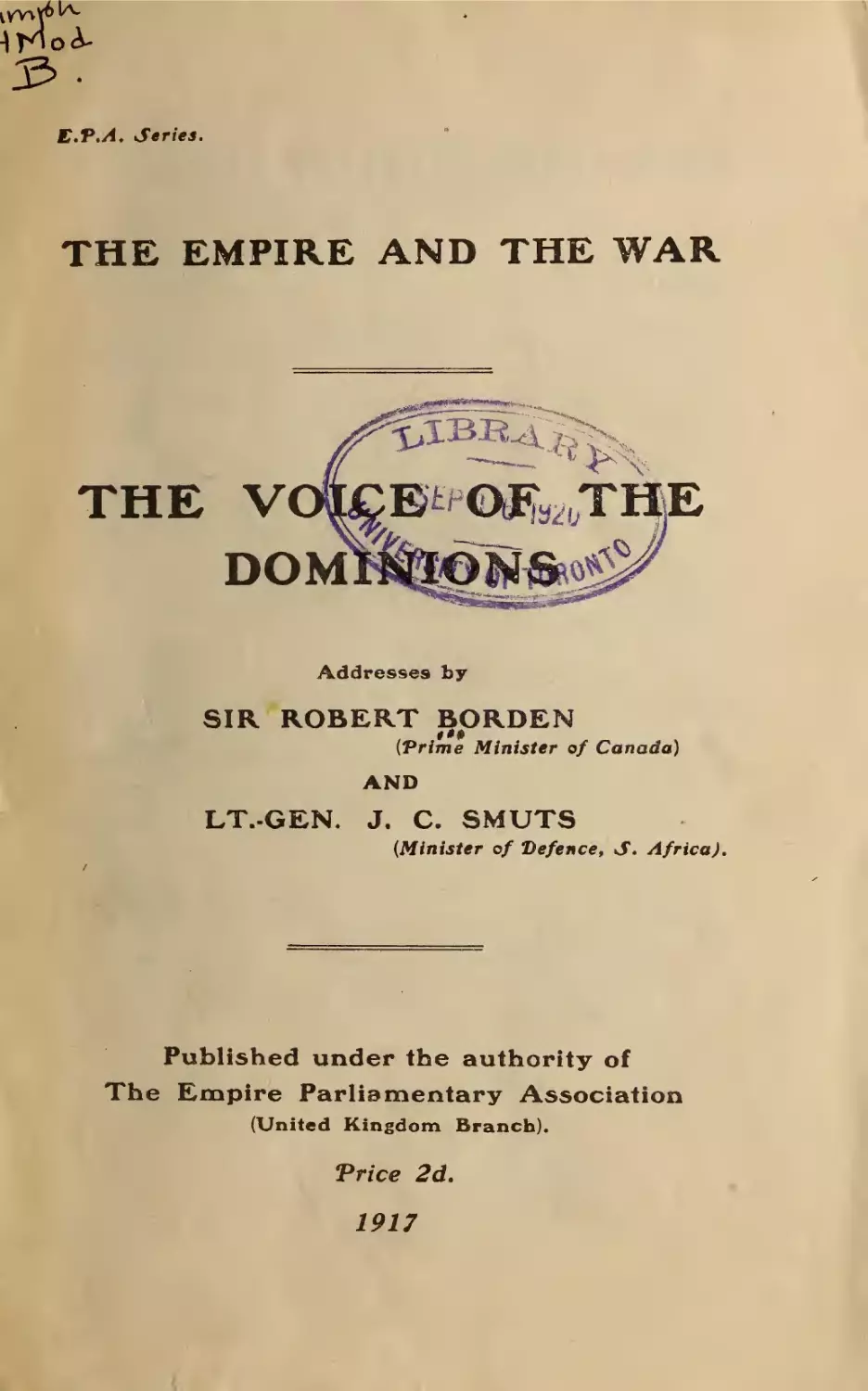
THE EMPIRE AND THE WAR

THE V
DOM
Addresses by

SIR

ROBERT BORDEN
{Prime Minister of Canada)

AND
LT.-GEN.

J.

C.

SMUTS

{Minister of 1>efence, S. Africa).

Published under the authority of

The Empire Parliamentary Association
(United

Kingdom Branch).
Trice 2d.

1917

EMPIRE PARLIAMENTARY ASSOCIATION
KINGDOM BRANCH).

(UNITED
Telephone No.

Offices

:

5814 VICTORIA.

I

c/i \r ^
64
Victoria

Telegrams and Cables:

c

..

Street,

J

**

Westminster, S.W.I.

EMPARLASSO. LONDON."
Presidents

:

The Rt. Hon. Lord Finlay, G.C.M.G. (Lord Chancellor).
The Rt. Hon. J. W. Lowther, M.P. (Speaker of the House
Vice-Presidents

The Rt. Hon.
The Rt. Hon.
The Rt. Hon.
The Rt. Hon.
The Rt. Hon.
The Rt. Hon.
The Rt. Hon,
The Rt. Hon.

of

Commons).

:

Lloyd George, M.P. (Prime
The Earl of Rosebery, K.G.

D.

J. Balfour, O.M., M.P.
H. H. Asquith, K.C, M.P.
Walter Long, M.P. (Colonial
The Marquis of Crewe, K.G.

Minister).

A.

Secr^^tary).

Viscount Harcourt.
A. Bonar Law, M.P.
Chairman of the Executive :
The Rt. Hon. Arthur J. Balfour, O.M., M.P.
Deputy Chairman :
The Rt. Hon. W. Hayes Fisher, M.P.
Honorary Treasurers

:

The Lord Blyth.
Colonel The Lord Burnham.
Executive Committee

Captain L.

:

Amery, M.P.

S.

The Rt. Hon.

A.

J.

Balfour, O.M., M.P. (Chairman).

Mr. Cecil Beck, M.P.

The Lord Blyth (Joint Hon. Treasurer).
Colonel The Lord Burnham (Joint Hon.
Mr. J. G. Butcher, K.C, M.P.
Mr.

Evelyn

Treasurer).

Cecil, M.P.

The Rt. Hon. Will Crooks, M.P.
The Rt. Hon. Lord Emmott, G.C.M.G.
The Rt. Hon. W. Hayes Fisher. M.P. (Deputy Chairman).
Major Sydney Goldman, M.P.
Sir Hamar Greenwood, Bart., M.P.
The Rt. Hon. Earl Grey, G.C.B.
The Lord Claud Hamilton, M.P.
Major-General Sir Ivor Herbert, Bart., C.B., M.P.
The Rt. Hon. Lord Islington, G.C.M.G., D.S.O.
The Lord Lamington, G.C.M.G.
The Rt. Hon. Viscount Milner, G.C.B.
Mr. T. P. O'Connor, M.P.

The

Rt. Hon. Sir Gilbert Parker, Bart., M.P.
Philipps, K.C.M.G., M.P.
Mr. G. H. Roberts, M.P.
The Rt. Hon. The Earl of Selborne, K.G.
Sir

Mr.

Owen

Arthur Steel-Maitland, M.P.

The Lord Sydenham, G.C.S.I., G.C.M.G., F.R.S.
Mr. Cathcart Wason. M.P.
Hon. Secretary
Howard d'Egville.
:

Mr.

-

3

PREFATORY NOTE.
The

speeches of Sir Robert Borden and Lieut.

General Smuts at the gathering of the Empire

ParHamentary Association on the 2nd of April,
at the House of Commons, were of such importance that the Committee of the Association felt
that they should be studied, and kept as a permanent record, by Members of the Association in
the Parliaments of the Empire, and also by those

members

of the general public

problems

in the wider

Committee,

who

are interested

of the great

decided

therefore,

The

War.

to

the

print

speeches in pamphlet form.

The statesmen of the sister nations of Canada
and South Africa have domestic difficulties of a
Viried nature to solve
in

common

—that

;

but one that they have

of the blending of

two

elements within their respective borders

racial

—renders

the observations that follow on the great issues of
the

War and

Imperial Policy of peculiar signi-

and gives a fuller meaning to
attitude both towards the Empire and

ficance,

Empire's

their

the

foes.

Howard

d'Egville,

Hon.

Empire Parliamentary Association
(United Kingdom Branch),
64 Victoria Street,
S.W.I.
April, 1917.

Secretary.

CONTENTS
Prefatory Note
Introduction by Chairman

Address by Sir R. Borden
Address by Lt.-General

J. C.

Smuts

5

THE
VOICE OF THE DOMINIONS
Robert

Sir

Borden

and

Lieutenant-General

Smuts were the chief guests at a luncheon at the
House of Commons given, on the 2nd of April,
1917, by the United Kingdom Branch of the
Empire Parliamentary Association to the Oversea
Ministers attending the sittings of the Imperial

War

Cabinet and the Imperial

War

Conference.

The Right Hon. Walter Long, M.P. (Secretary of
State for the Colonies and Vice-President of the
U.K. Branch of the Association) was in the chair.
The names of some of those present will be found
on the

last page.

INTRODUCTION BY CHAIRMAN.
The, Chairman, in proposing
isters,''

had come not
our

great

only, as before, representatives of

self-governing

Dominions,

representatives of our great

whom

"The Oversea Min-

said he rejoiced that to our councils there

Empire

but

also

of India, to

he was confident the whole of the United

Kingdom would offer
welcome. The reason

a cordial and affectionate
that the

name

of a repre-

6
sentative of India did not appear on the toast

list

was that it was the intention of the executive to
offer them an entertainment of their own, when
they hoped to hear India's voice. He was one of
those who beheved that the war had already
taught us many lessons, and that the British
Empire, strong and effective though it was before
the war, would emerge from the struggle still
stronger and presenting still greater influences for
good throughout the world.
There were great
Imperial problems to be solved. The war, with all
its horrors and sacrifices, had thrust on one side
old-fashioned ideas, and he believed in discussing
around a table problems of magnitude and
difficulty.

Round

that table difficulties were apt

to disappear, problems presented themselves in a
less

complicated form, and he believed that not

only for us in the United Kingdom, but for the

Empire

at large, this gathering together of repre-

from all parts of the Empire was
fraught with immense possibilities for us, and that
if they approached their task with courage and
clearness of mind, and without any desire, above
all, to hasten or rush the delegates, there would
emerge from it all an Empire such as the world
had never seen before.
sentatives

The record of Sir Robert Borden's work, and
of the great Dominion he represented, was written
and they
and a states-

already on the pages of our history

;

welcomed General Smuts as a soldier
man, full of wisdom and courage, fresh from
brilliant

campaign.

a

1

ADDRESS BY

ROBERT

SIR

BORDEN.

.

The Right Hon. Sir Robert Borden, G.C.M.G.,
M.P. (Prime Minister of Canada), in reply, said :—
since

more than twent}^ months have elapsed
We had some realizaI last addressed you.

tion,

but hardly an adequate conception even

Little

then, of the tremendous task which

In these islands you have risen

us in this war.
splendidly to

lay before

still

need

the

;

we

the

of

Dominions

then reminded

do our part.

I
have
you that 350,000 men had joined the colours in
the oversea nations. To-day I can tell you that
not less than one million men in those Dominions
have taken up arms for the Empire. The Canadian
Expeditionary Force in Europe then numbered
to-day I am proud to tell you that
75,000
Canada has sent forth to aid the Allied cause
more than 325,000 men. Oar total enlistments
exceed 400,000, and in the Canadian Expeditionary Force alone more than 300,000 men have
left the shores of our Dominion.
Their achievement under the sternest test has been splendidly
worthy of the traditions which are their heritage.

striven also to

;

.

THE NECESSITY OF
This

is

SACRIFICE.

not the occasion to dwell upon
,

phases of the war since

my

The most recent had

inception on the

of

February

last

its

in the

last visit to

the

England.
first

day

attempt to starve into

—
;

8
Sir

ROBERT BORDEN—continued.

submission the people of these islands by the
ruthless sinking of

all

ships entering a wide ocean

area round the United Kingdom.
confident that this attempt will

am

I

wholly

but

fail,

I

am

equally confident that to ensure such failure the

people of the Empire, and especially the people of
these islands,

must

that the peril

realize

a

is

must be met with a spirit
which will not shrink from timely self-denial in
order to avoid future need, which will command
the whole-hearted and united service of the
nation to preserve its existence, which will consecrate the energy of a united Empire to one
supreme purpose. Waste in time of peace is a sin
in this time of national stress and danger it is a
substantial one.

crime.

I

It

speak of waste in the broadest sense

waste of food, waste of time, waste of opportunity,
waste of labour. A Government can do much, but
it

cannot do everything.

The

highest national

achievement depends upon the

self-denial,

the

devotion, the resolution, and the strong purpose
of the people.
I

speak in no despondent mood, but as one

disposed to face

realities.

The enemy

are staking

everything upon this last throw of the

dice.

All

their energies are being concentrated

upon

this

year's campaign, whether on land or on sea.
flagging of our spirit,
at

any time

any lack

—would be

fatal

of effort

now.

Any

—disastrous

Consider any

however stern, which the
need may impose upon those at home, how do
sacrifice or self-denial,

ROBERT BORDEN—continued.

Sir

these compare with the privation, the danger, the

supreme sacrifice of
those who hold the Hues in France or elsewhere in
If any of us should
the great theatres of war ?
chance to be despondent let him go for confidence
suffering, and, too often, the

to the

men

lacks heart, let

him go

moment he
wounded in the

If for a

in the trenches.

to the

we seek a standard for
the nation's spirit, let us remember the discipline
and heroism of the men who lined up on the deck
of the Tyndareus when she was sinking.

hospitals for courage.

If

HOW GERMANY MAY
The German people

GET PEACE.

are fighting with despera-

tion under the belief, engendered
their military autocracy, that

Germany and

No

and fostered by

we

seek to crush

to terminate her national existence.

such purpose ever was or could be in the mind

of the British people.

It is impossible to

that sense a nation of 70 millions.
parison,

Germany was

crush in

Beyond comwar

at the beginning of the

the most powerful military State in the world's
history.

Any

idea of successful aggression against

her was unthinkable.
the

German

Confident in that strength,

nation, following blindly the behests

entered upon this war for world
For the health of Germany's soul
her people must be taught before it ends that
of militarism,

domination.

military aggression

is

neither a legitimate nor a

profitable business enterprise

tion

is

impossible

;

;

that world domina-

that treaties are sacred

;

that

10
Sir

ROBERT

SOi?DEA/"— continued.

the public conscience of the world will not permit

weak

the rape of small,

nations, will not tolerate

the horrible methods of barbarity which have
characterized the passage of the

and

their

occupancy

that there

finally,

conquered territory

of

is

commands and can

German armies
;

and,

a world conscience which

arouse a force sufficient to

subdue any nation that runs amok. The lesson
must be thoroughly learned by the German people

have taken up arms in
house in order that
purpose can be relied on

or the Allied nations will
vain.

Let Germany so

set her

a change of ideal and of
let

make

her

wrought

;

for

the

evil

she has

her give adequate guarantees for

let

Thus, but not otherwise, can she have

the future.
peace.

;

reparation

For

this,

but not to crush her, the Allied

nations are fighting.

THE EMPIRE

CONFERENCE.

IN

We

have gathered together here from the ends
of the earth to take counsel with you of the
Motherland upon the needs of the situation so
as better to co-ordinate our common effort and

consummate our common purpose.

When

first I

spoke to you in 1912 I took leave to put forward
certain views respecting future constitutional

Two

emphasized the same
considerations without dwelling upon them. The
purpose which I then had at heart still remains

relations.

steadfast.

It

years ago

may

war we do not

I

be that in the shadow of the

clearly

realize

the measure of

II
Sir

ROBERT BORDEN—continued.

recent constitutional development.

I

shall

attempt to anticipate any conclusion which
be reached by the Imperial
sitting in

now

for

War

Conference

not

may
now

London, a conference embracing India,
the first time taking her place at the

national council of Empire, as well as

all

the great

Dominions except Australia, whose absence is
deeply regretted. Except with regard to India,

summoning
new stage of

the

of that conference does not

a

constitutional development.

present duty

is

to consider and,

mark
Its

where necessary,

to determine general questions of

common

con-

cern which in some cases have an intimate relation to the

war and to the conditions which

upon its conclusion.
Without further reference

will

arise

Conference,

I

to the Imperial

War

address myself to the constitutional

position which has arisen from the

summoning

of

an Imperial War Cabinet. The British Constitution is the most flexible instrument of government
ever devised. It is surrounded by certain statutory limitations, but they are not of a character
to prevent the remarkable development to which
I shall allude.
The office of Prime Minister,
thoroughly recognized by the gradually developed
conventions of the Constitution, although entirely

unknown

to the formal enactments of the law,

is

invested with a power and authority which under

new

demanding progress and developinestimable advantage. The recent

conditions,

ment, are

of

exercise of that great authority has brought about

12

ROBERT BORDEN—continued.

Sir

an advance which

may

contain the germ and

method of Constitutional development
immediate future. It is only within the
past few days that the full measure of that
advance has been consummated.
define the

in the

AN EMPIRE CABINET.
For the

first

time in the Empire's history there

London two Cabinets, both properly
constituted and both exercising well - defined
powers. Over each of them the Prime Minister of
the United Kingdom presides.
One of them is
are sitting in

designated as the ''War Cabinet/' which chiefly

devotes

itself

to

such

questions

touching

the

prosecution of the war as primarily concern the

United Kingdom.
"Imperial

War

is

designated as the

Cabinet/' which has a wider pur-

pose, jurisdiction,

tions

The other

To

and personnel.

have been summoned

its

delibera-

representatives of

the Empire's self-governing Dominions.

We

all

meet

there on terms of equality under the presidency

United Kingdom we
Great Britain
Ministers from six
pares.

of the First Minister of the

meet

there

as

;

although

equals,

primus inter
nations sit around the council board,
presides,

responsible to their respective

them
Parliaments and
all of

to the people of the countries which they repre-

Each nation has its voice upon questions of
common concern and highest importance as the

sent.

deliberations proceed
its

perfect

autonomy,

;

each preserves unimpaired
its

self-government, and the

13
Sir

ROBERT BORDEN— continued.

responsibility of its Ministers to their

own

elec-

For many years the thought of statesmen
and students in every part of the Empire has
centred around the question of future constitutorate.

may

be that now, as in the
past, the necessity imposed by great events has
tional relations

;

it

given the answer.

The Imperial War Cabinet
has

been

summoned

for

as constituted to-day
definite

and

specific

purposes, publicly stated, which involve questions
of the

most

vital concern to the

whole Empire.

With the constitution of that Cabinet a new era
has dawned and a new page of history has been
written.

It is

not for

me

to prophesy as to the

future significance of these pregnant events

those

who have

every effort for
of

the

oversea

;

but

given thought and energy to
full

constitutional

nations

may

development

be pardoned

for

believing that they discern therein the birth of a

new and

greater Imperial

Commonwealth.

14

ADDRESS BY
LIEUTENANT-GENERAL SMUTS.
Lieutenant-General the Right Hon.

Smuts,

J. C.

K.C., M.L.A. (Minister of Defence, South Africa),
also

rephed to the

toast.

He

said

:

—

I

am

ex-

tremely grateful to you for the reception you

have given me.

I feel

to-day in following

very

two such speakers as Mr.

Long and the Prime Minister
I feel

on

much embarrassed

this occasion that

of

Canada.

South Africa

putting her best foot forward.

I

is

not

could wish that

General Botha was here to-day to be bracketed

with Sir Robert Borden in reply to the toast of
the Dominions, but unfortunately he could not

be here.

He

is

which no other

bearing a burden in South Africa

man

can bear, and

tune in a certain sense that
place of

my

I

it is

a misfor-

have to take the

right hon. friend.

EFFORTS OF THE UNITED KINGDOM.

We

feel

profoundly grateful to you, Mr. Long

for the references

you have made

the Dominions in this war.
,

No

to the effort of

doubt,

it is

a great

must frankly confess that what has
impressed me far more profoundly in this war is
the effort and the spirit of the Unified Kingdom.
When we consider that this nation was not
meant for a war of annexation, that it was a
nation built on peace institutions and founded on
a peaceful basis, and not intended for such a
crisis as has overwhelmed the world now, I say
effort.

But

I

15

SMUTS— continued.

Lieutenant-General

that the effort that has been
is

made by

this nation

one which ahnost surpasses the imagination of

That

the world.

which

effort,

pledge of certain success in the
sure as

I

can be

of

anything that this
is

spirit

are the

effort,

futui'e.

the British nation has developed
will

and the

think,

I

even greater than the

is

I

spirit

am

as

which

such that

all

may

be

be well in the end, however hard

it

before the end comes.

EFFORTS OF THE DOMINIONS.
With regard

—

Dominions we have listened to the very eloquent and wise speech which
Sir Robert Borden has made, and it is certainly a
marvellous effort which has been made by the
to the

Dominions.

Is

Dominion

Canada by

of

almost equal,

if

it

not a wonderful thing that the
herself has

Great Britain in the Boer

an outlying nation

of

War

Here you have
the Empire, which has

raised almost half a million
this war.

I

am

made an effort
made by

not quite equal, to that
?

men

in the course of

credibly informed that in propor-

tion to her widely distributed population, the effort
of Australia has been almost more magnificent.
As regards the Empire of India I cannot speak, but
I can say, as one who has commanded thousands of

Indian troops in one of our campaigns, that

command more

I

never

and better
troops. The Indian troops who are now breaking up
the Turkish Empire in Mesopotamia are making a
<^ntribution to the war which should never be
wish to

loyal, braver,

I

i6
continued.

jL.4euienant-General

New

forgotten.

Zealand, the most British of

the Dominions, has

made

all

a magnificent effort

with a small population of a

little

;

more than a

approximately 100,000 men.
which we might all well be
proud. The same applies to Newfoundland.
What can I modestly say about South Africa ?
We started this war with an internal convulsion
Unlike any other parts of the
in the country.
Empire, we first had to set our own house in order.
That was done. We secured peace and quiet in
South Africa, and to-day the German flag, except
in a small and fever-ridden district, is not flying
south of the Equator. You have to remember
do not want to be parochial, but the case of South
Africa is significant for our whole position in this
million, she has raised

This

is

an

effort of

—

—we

must remember that, unlike the other
Dominions, this work was done by a Dominion
the majority of whose white population is not
You have to remember that
British, but Dutch.
war

only fifteen years ago a very large portion of this
population was locked in deadly conflict with the

And when you bear in mind these
what has been achieved, I think you
will agree with me that South Africa has done her
share, and more than her share.
British Empire.

facts

and

see

SOUTH AFRICA AND THE EMPIRE.

How

was this done ? Here I come to the wider
issue. It was done because the Boer War of 18991902 was supplemented, was complemented, or

17
Lieutenant-General

SMUTS— continued.

compensated by one of the wisest political settlements ever made in the history of this nation.
I hope that when in future you draw up a calendar

you will not forget the name
Henry Campbell-Bannerman. He was not

of Empire-builders
of Sir

either intellectually or politically a superman, but

he was a wise

man

with profound feeling and

political instinct, and he achieved a
work in South Africa by one wise act of statesmanship which has already borne, and will continue to bear, the most far-reaching results in the

profound

history of this Empire.

This completed what was begun in the Boer

War, and

it

switched South Africa again on to

the right track and the British Empire again on
to the right track because, after

all,

the British

not founded on might or force, but on

Empire

is

moral

principles

—on

principles

of

freedom,

which
we stand for to-day as an Empire in this mighty
struggle. Our opponent, the German Empire, has
equality,

and equity.

It is these principles

never learned that lesson yet in her short history.

She

still

believes

military machine

She has not
victories

that

might

is sufficient

yet

are moral

realized

is

right

—that

a

to govern the world.

that

ultimately

and that even the

all

political

government of the world is a moral government.
The fundamental issue in this struggle in which
we are engaged to-day is that the government of
the world is not military, and it cannot be brought
about b}^ a military machine, but by the principles

t8

SMUTS — continued.

Lieutenant-General

of equity, justice, fairness,

have

built

up

this

WHY GERMANY CANNOT
You

and equality, such as

Empire.

WIN.

see the effects of this already.

Germany

started enormously strong and preponderant over

the world in military strength.

What have we

Simply because we have a just and good
cause, and simply because she has been trying to
hack her way through in a military sense, one
country after another has dropped away from her.
Two of her own treaty nations have dropped
away from her, and to-day, almost all over the
world, you will find the nations coming together
against her. America has not yet declared war.
Nobody knows what America may do, but I say
that if America does not go into this war to-day,
she will go in to-morrow because the German
attitude will force her sooner or later into open
conflict.
That is what Germany has achieved by
the principle for which she is fighting. I am sure,
if we continue to found our issue on those high
principles that have actuated us so far through
the history of the world, the end is certain and
Morally and
Germany is already defeated.
politically she is already defeated, and all that
seen

?

remains

now

is

the final issue on the

field of battle.

do not conceal from myself that the position
that the Central Empires are an
is a grave one
enormously strong military combination, and
when I speak of ultimate victory I do not hide
I

—

19
Lieutenant-General

SMUTS— continued.

from myself that we have hard work in front of
us and that there are difficult times ahead of us.
There is no doubt, after the long time the war has
lasted

— almost

which

three years

—and

the exhaustion

overtaking the Central Empires, that they

is

cannot continue

much

longer,

autumn that is now before them
make their maximum military

and that by the
probably

the}/ will

They

effort.

are

way they
way which

flouting the opinion of the world in a

have never done before, and in a
suggests that they must try hard at any cost to
achieve some result this summer.

THE SUBMARINE CAMPAIGN.
As

to the submarine campaign, I

vinced that that campaign

At the best

this war.

is

it is,

am

fully con-

not going to settle

as

it

were, a raid on

our wide Empire communications.

The

be severe from time to time and

inconvenience

will

raids will

us very seriously, but they will not lead to our

No

defeat.

raid on lines of communications ever

yet led to the defeat of any Empire in the world.

we

This summer,

I

submarine

on which Germany is relying fail
and then, earlier than many of us
hear of peace again. As Sir Robert

think,

shall

probably see the

effort

in its intention,

think,

we

shall

Borden has assured

us, this

nation

is

not inspired

by any vengeful feeling, by a desire to destroy the
German nation.
We are actuated by higher
motives.
level of

We

are not going to decline to a lower

mere vengefulness and hatred.

I

am

sure

20
Lieutenant-General

SMUTS—continued.

the nation will

own

its

of

make

interests,

a wise settlement not only in

but in the interests

of the

whole

Europe.

THE PROBLEM OF THE FUTURE.
As to the future constitution of the Empire,
do not want to speak on that subject at any
length. I do not think this is the time or that it is
I

necessary to do

but

so,

think one word of caution

I

A

should be expressed.

great deal of political

and most important of
all subjects has already been done in the United
Kingdom, and a great literature is growing up
around it in this country. Let me give you one
word of warning. In thinking of this matter, do
thinking on this

difficult

not try to think of existing political institutions

European
Empire is a much
larger and more diverse problem than anything
we have seen hitherto and the sort of Constituwhich have been evolved
developments.

The

in the course of

British

;

tion

we read about

in books, the sort of political

alphabet which has been elaborated in years gone
by,

does not

problems

and would not solve the

apply

We

of the future.

should not follow

precedents, but make them. I feel sure that in the
coming years, when this problem is in process of

—because
perfectly solved — you
solution

thought

and

will

it

will

never be finally and

will

find

our

political

be turned into quite new channels,
not follow what has been done anywhere
will

21

SMUTS— continued.

Lieutenant-General

else either in the old

after

all,

We

we

see growing

strong

of

No

up before us a great number

nations

free

Nobody wants
ment.

world or the new, because,

are built on freedom.

power

to limit the

single

man

over

all

Empire.

the

of self-govern-

outside a lunatic asylum

wants to force these young nations into any
particular mould. All that we want is the maximum of freedom and liberty, the maximum of
self-development for the young nations of the

Empire, and machinery that

keep

will

all

these

nations together in the years which are before

them.

I

am

sure

if

we

disabuse our minds of

we

shall evolve,

in the course of years, the institutions

and machin-

ery that will meet our

It is

precedents and preconceived ideas

me

difficulties.

a great

have had the privilege to address
you here. I am still full of courage and I am,
even as an optimist, encouraged and inspired by
the spirit which I have seen in this island since
I think that this, even more than
I came here.
anything else, is a pledge of the victory which
honour to

to

;

lies

before us.

The Right Hon. W.
Minister

of

New

Massey, M.P. (Prime

F.

and Vice-President,

Zealand,

N.Z. Branch of E.P.A.), proposed ''The Chairman,''

and

this

was

heartily honoured.

—

Amongst others present were
Lord Finlay,
(Lord Chancellor and Joint President, U.K. Branch,
the Rt. Hon. J. W. Lowther, M.P. (Speaker of the
Commons, and Joint President, U.K. Branch,
:

G.CiM.G.
E.P.A.)

House

;

oif

E.P.A.)

;

22
Viscount Milner, G.C.B. (Minister without portfolio in the
Cabinet)
the Rt. Hon. Arthur J. Balfour, M.P.
(Secretary of State for Foreign Affairs, and Chairman of
Executive, U.K. Branch, E.P.A.)
Viscount Harcourt
(Vice-President, U.K. Branch, E.P.A.)
the Rt. Hon.
A. Bonar Law, M.P. (Chancellor of the Exchequer, and
Vice-President, U.K. Branch, E.P.A.)
the Rt. Hon. Sir
Edward Morris, K.C.M.G., M.H.A. (Prime Minister of
Newfoundland, and President of Newfoundland Branch,
E.P.A.)
the Rt. Hon. Sir Joseph Ward, Bart., K.C.M.G.,
M.P. (Finance Minister of New Zealand, and Vice-President,
N.Z. Branch, E.P.A.)
the Rt. Hon. Austen Chamberlain,
Colonel H. H. the
M.P. (Secretary of State for India)
Maharajah of Bikaner, G. C.S.I. (Indian Delegate) Sir James
Meston, K. C.S.I. (Indian Delegate)
Sir S. P. Sinha (Indian
Delegate) the Rt. Hon. Albert Illingworth, M.P. (PostmasterGeneral)
the Rt. Hon. Sir Alfred Mond, Bart., M.P. (First
Commissioner of Works)
the Rt. Hon. Herbert Samuel,
General
M.P.
Lord Devonport (Minister of Food Control)
Sir WiUiam Robertson, K.C.B., K.C.V.O., D.S.O. (Chief of
Imperial General Staff)
the Hon. Sir George Perley,
K.C.M.G., M.P. (Canadian Minister of Oversea Forces and
Acting High Commissioner)
Lord Farquhar, G.C.V.O.
the Hon. J. D. Hazen,
(Lord Steward of the Household!)
M.P. (Canadian Minister of Marine, Fisheries, and of Naval
Service)
the Rt. Hon. T. J. Macnamara, M.P. (Financial
Secretary to the Admiralty)
the Rt. Hon. Donald Maclean,
the Hon. Robert
M.P. (Deputy-Chairman of Committees)
the
Rogers, M.P. (Canadian Minister of PubUc Works)
Rt. Hon. H. E. Duke, M.P. (Chief Secretary for Ireland)
Lieutenant-Colonel Sir Maurice Hankey, K.C.B. (Secretary
to the War Cabinet)
the Rt. Hon. John Hodge, M.P.
(Minister of Labour)
the Hon. Sir Thomas Mackenzie,
the
K.C.M.G. (High Commissioner for New Zealand)
Rt. Hon. W. Hayes Fisher, M.P. (Parliamentary Secretary,
Local Government Board, and Deputy-Chairman, U.K.
Branch, E.P.A.)
D. C. McGrath, Esq., M.P. (Australia)
Lord Emmott, G.C.M.G. (Director, War Trade Department)
the Rt. Hon. W. P. Schreiner, C.M.G. (High Commissioner
for South Africa)
Colonel the Lord Burnham (Joint Hon.
Colonel Hadley B.
Treasurer, U.K. Branch, E.P.A.)
Lord Blyth (Joint Hon. Treasurer,
Tremain, M.P. (Canada)
Captain L. S. Amery, M.P.
U.K. Branch, E.P.A.)
Colonel B. R.
(Assistant Secretary to the War Cabinet)
Lord Sydenham, G.C.M.G.,
Hepburn, M.P. (Canada)
G.C.S.I.
Cecil Beck, Esq., M.P. (Vice-Chamberlain of the
Sir
Household)
Colonel G. V. White, M.P. (Canada)
Butcher, Esq.,
Hamar Greenwood, Bart., M.P.
J. G

War

;

;

;

;

;

;

;

;

;

;

;

;

;

;

;

;

;

;

;

;

;

;

;

;

;

;

;

;

;

;

;

;

;

;

;

;

;

;