/







Text
                    THE THEOLOGY OF
r- ST. Luke
Hans Conzelmann
The Theology of St. Luke
by
HANS CONZELMANN
Translated by
GEOFFREY BUSWELL
FORTRESS PRESS
PHILADELPHIA
Acknowledgement is made to Messrs. Seeker and Warburg for permission to
quote, on pages 132 and 162, two passages from M. Burrows’s translation of The
Dead Sea Scrolls.
Copyright © 1961 this translation, Geoffrey Buswell.
Copyright © 1960 By Faber and Faber and Harper & Row, Inc.
Originally published by J. С. B. Mohr (Paul Siebeck), Tubingen, in 1953 (Sec-
ond Edition 1957) under the title Die Mitte Der Zeit.
All rights reserved. No part of this publication may be reproduced, stored in a
retrieval system, or transmitted, in any form or by any means, electronic,
mechanical, photocopying, recording, or otherwise, without the prior permis-
sion of the publisher.
First Fortress Press Edition 1982
Library of Congress Cataloging in Publication Data
Conzelmann, Hans.
The theology of St. Luke.
Translation of: Die Mitte der Zeit.
Originally published: New York: Harper, 1961.
Bibliography: p. 235
Includes indexes.
1. Bible. N.T. Luke—Theology. 2. Bible. N.T.
Acts—Theology. I. Title.
BS2589.C6513 1982	226’.406	82-2372
ISBN 0-8006-1650-2	AACR2
9601B82 Printed in the United States of America 1-1650
Contents
Introduction
M*9
PART ONE
Geographical Elements in the Composition
of Luke's Gospel
A.	Prologue: John the Baptist	18
(я) The Place
(6)	The significance of John the Baptist according
to Luke
B.	The Course of Jesus’ Ministry	27
(a)	Galilee
(6)	The Journey
(c)	Jerusalem
PART TWO
Luke's Eschatology
I. The Problem	95
IL Luke and the	Eschaton	98
Summary	131
PART THREE
God and Redemptive History
I.	Introduction: The Situation of the Church
in the World	137
L The political apologetic
2.	The Church and Judaism
Conclusion
IL The Rule of God in Redemptive History 149
1.	The pattern of thought concerning redemptive
history
2.	God’s plan
3.	Election
7
CONTENTS
III. The Past	page 1.57
1. Scripture
2. Israel
3. World History
PART FOUR The Centre of History I. Introduction	170
II. God and Jesus Christ	170
1. The Christological Titles 2. Father, Son and Spirit III. The Centre of History	185
1. The place of Jesus in history 2. The life of Jesus as a fact of history IV. The Life of Jesus	187
1.	Jesus and the world 2.	Jesus' life and teaching 3.	Jesus’ Ministry 4.	The Passion 3. Resurrection and Ascension PART FIVE Man and Salvation: the Church I. Introduction	207
II. The Church	209
1. The Beginnings 2. The progress of the mission III. The Bearers of the Message	215
IV. The Message	218
V. Man as the Recipient of Salvation	225
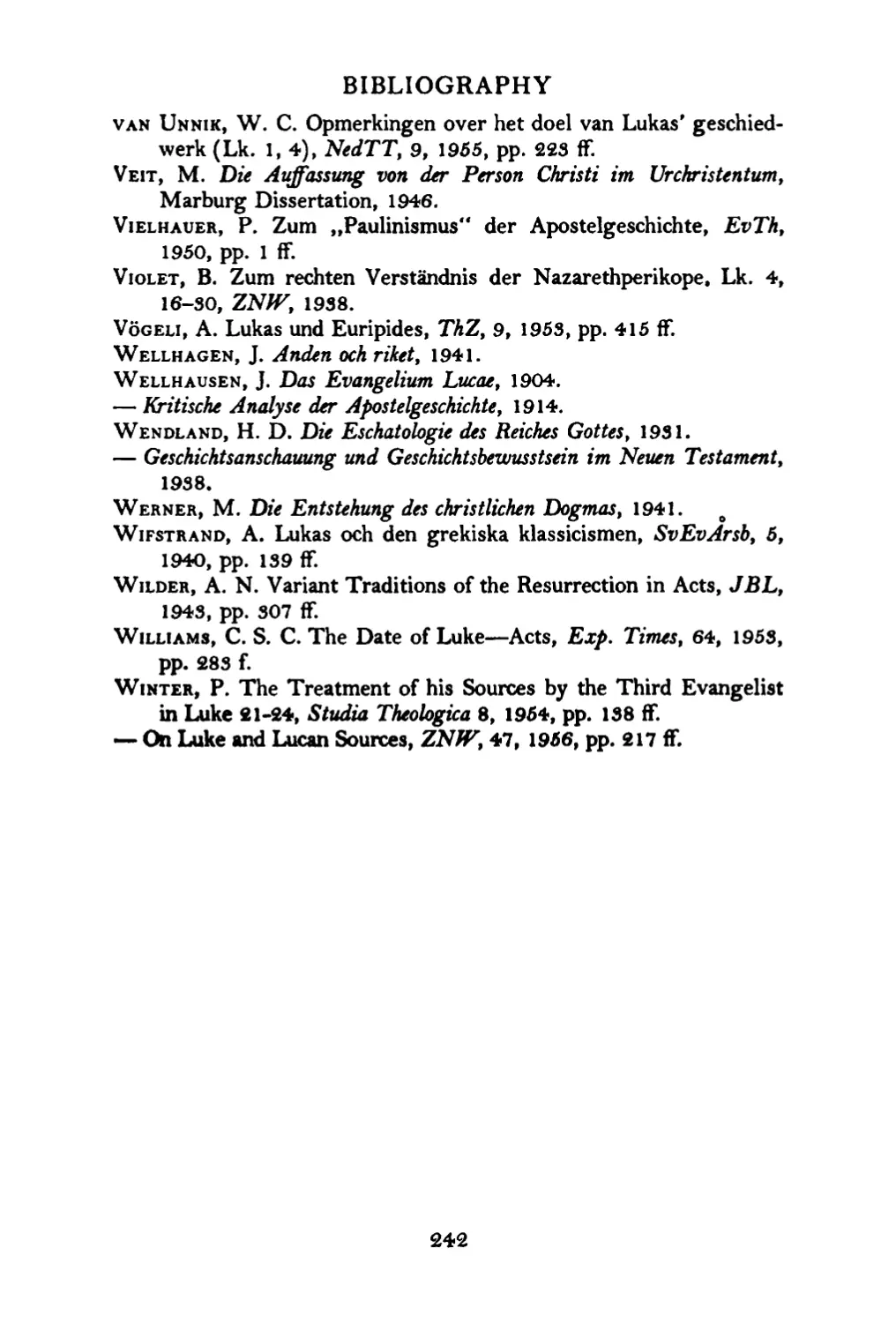
1. Conversion 2. The Christian life Bibliography	235
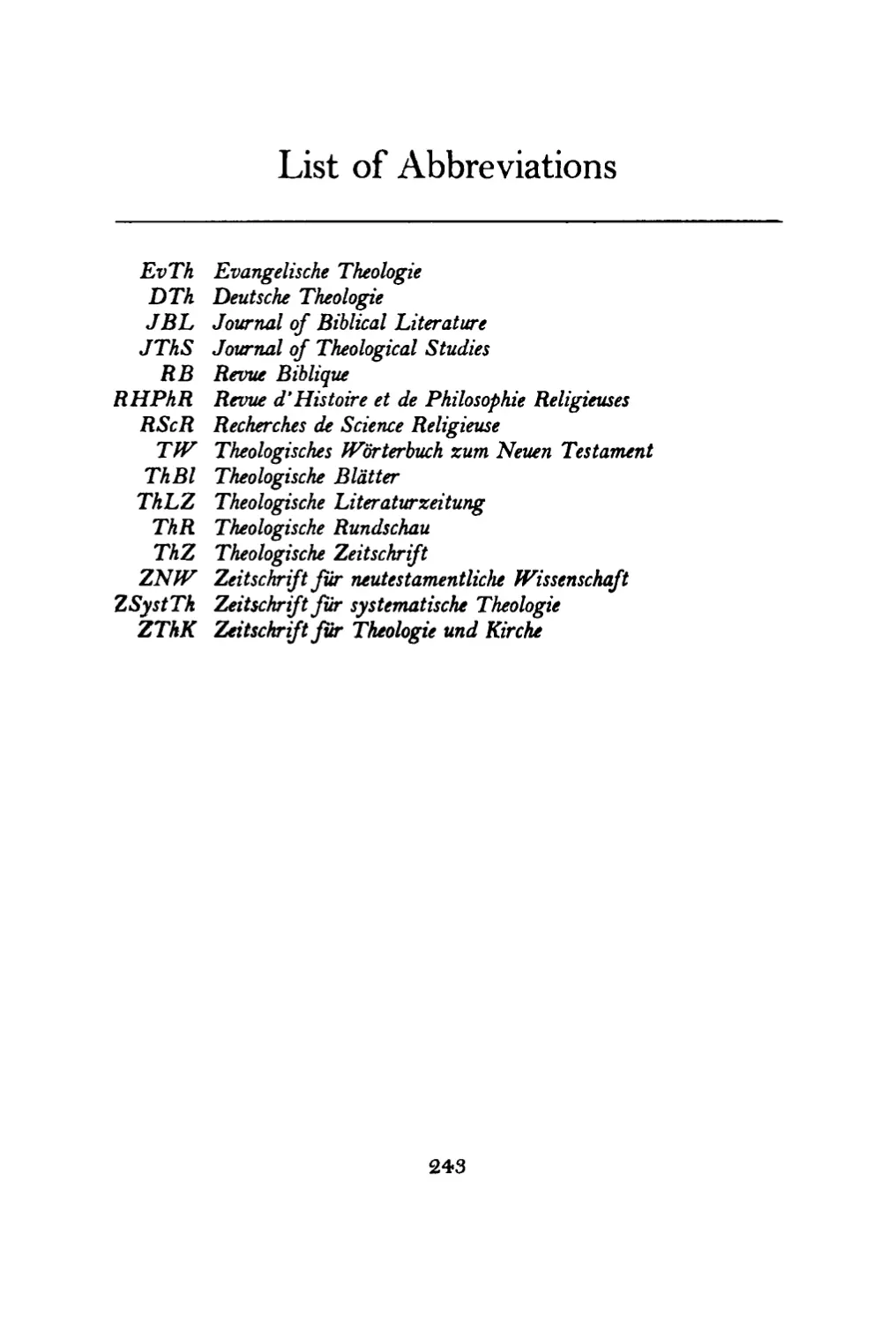
List of Abbreviations	243
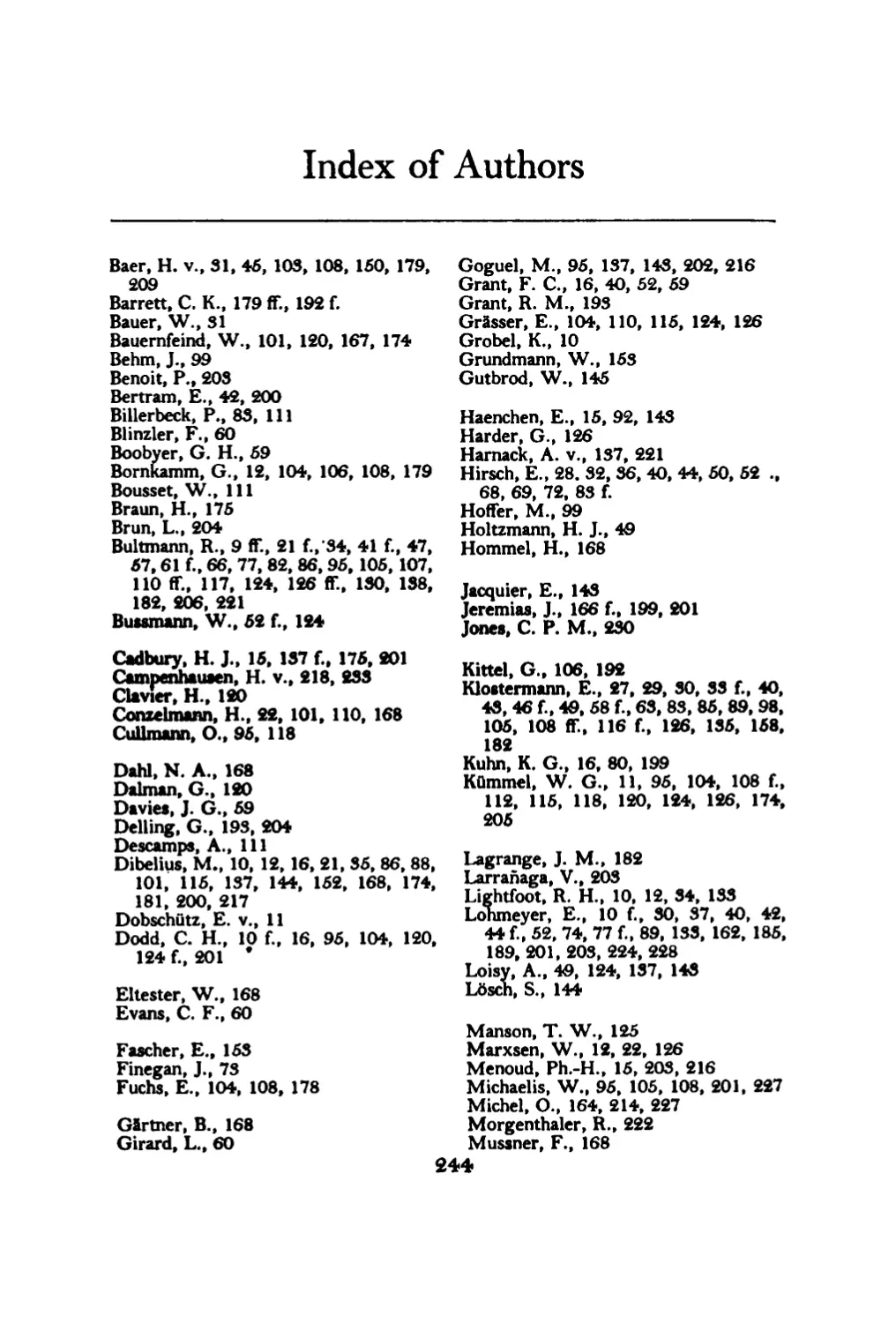
Index of Authors	244
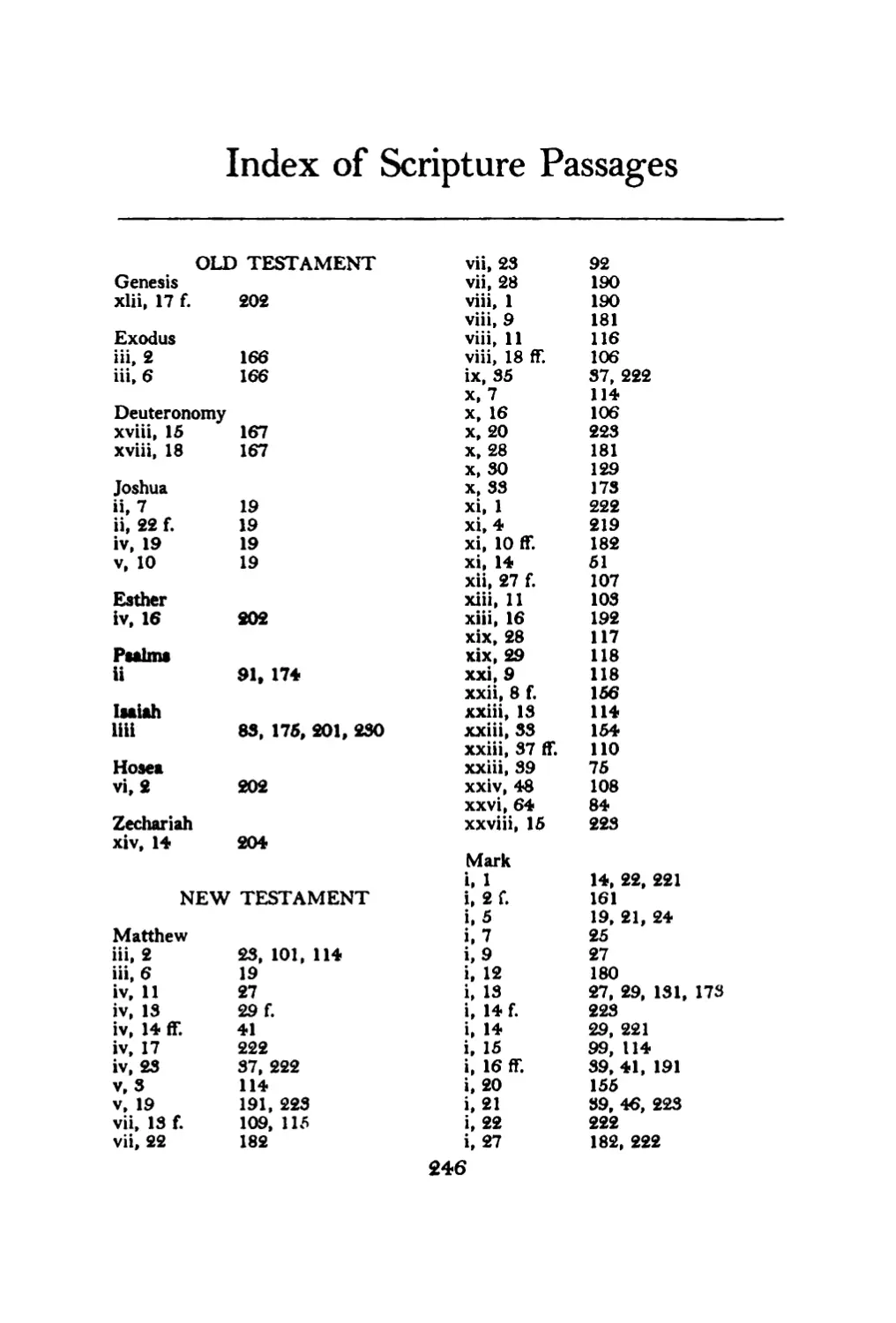
Index of Scripture Passages	246
8
Introduction
1. This study of St. Luke’s theology is, by its approach to the
problems, for the most part not dependent on any particular
literary theories about St. Luke’s Gospel and the Acts of the
Apostles, for it is concerned with the whole of Luke’s writings as
they stand. If these form a self-contained scheme, then for our
purpose literary critical analysis is only of secondary importance.
Nevertheless, in this secondary sense it is important, and is
therefore not to be despised. We must make it plain, however,
that our aim is to elucidate Luke's work in its present form, not
to enquire into possible sources or into the historical facts which
provide the material. A variety of sources does not necessarily
imply a similar variety in the thought and composition of the
author. How did it come about, that he brought together these
particular materials? Was he able to imprint on them his own
views? It is here that the analysis of the sources renders the
necessary service of helping to distinguish what comes from the
source from what belongs to the author.
2. In Germany during recent decades the study of the Synop-
tics has been dominated by Form Criticism.1 There are good
reasons for this, but even if we take this method not as in the
narrow sense aesthetic but in a wider sense as having a socio-
logical trend,® it still has its limitations. It does not make literary
critical analysis superfluous; on the contrary this is presupposed
and must be continued along with Form Criticism.8
Form Criticism arose in part from the destruction of the
'framework of the life of Jesus’.4 This was an event of decisive
1 The work of literary criticism has continued along with it, but has been greatly
overshadowed.
1 Bultmann, Synoptische Tradition, p. 4.
8 Ibid., p. 3. The appearance of detailed literary analyses is in itself a sign that
these problems have not been solved. The English literary critics such as Streeter
and Taylor, who at first evidently worked without a knowledge of Form Criticism,
developed it further after becoming aware of its existence.
4 Cf. the work of K. L. Schmidt.
9
INTRODUCTION
significance. It was only natural that attention should turn almost
exclusively to the sections of tradition embedded in this frame-
work. The twofold task presented itself: that of determining the
forms and of making a thorough and detailed analysis of the
material.1 However, the study of the framework was at first
neglected. It was the question of the historical content of the life
of Jesus that was still being investigated, even though there
might be scepticism as to the possibility of reaching definite
results.1 Hence interest turned from the framework, now recog-
nized as secondary, to the possibly primary materials, and the
attempt was made to discover their original form. It was only
later that greater attention was given to the framework itself.1 * 3
This was not an attempt at reconstruction, but a necessary
second stage in the study of the history of the tradition. The
separation of the framework from the original body of tradition
made it possible to see and interpret the framework as an entity
in its own right.4
3. One of the main insights of Form Criticism was that the
Gospels are in their nature and purpose not a historical record
or a biography of Jesus; their purpose is the proclamation of sav-
ing events, though, it is true, of such as in the author’s view have
taken place in history. Yet so long as study is directed primarily
to the separate parts of the tradition—stories, sayings, and small
collections—it can be content with a general statement of the in-
sight that the formation of the synoptic tradition was deter-
mined by the kerygma; but if it applies itself more to the form of
the single Gospel as such, then it must be more precise. To what
1 The two tasks cannot of course really be separated. Yet Dibelius is more con-
cerned with the former, Bultmann with the latter.
* One must not confuse scepticism as to method with a general scepticism. Ct.
Grobel, pp. 105 f. and, for the general background of this scepticism as to method,
Bultmann, Glauben und Verstehen, p. 101.
• Special mention must be made in this connection of the works of E. Lohmeyer,
С. H. Dodd and R. H. Lightfoot.
4 In this respect Lohmeyer’s work on * GalilSa und Jerusalem ’ represents an im-
portant step forward as regards method, although there were of course many
earlier attempts. It helped to bring the question of the life of Jesus once again to
the fore. Whereas K. L. Schmidt mainly analyses the chronological framework
(although with a thorough examination of the geographical aspects), here the main
emphasis is on the geographical framework. The examination of the chronological
framework is replaced by the attempt to identify the centres to which the local tradi-
tions belong. Lohmeyer’s work is still of importance, even if the detailed findings
cannot be substantiated.
10
INTRODUCTION
extent does ' belief* influence the development of form? What is
the relation of this principle of form to the literary framework of
the individual Gospel—not just to the single section of tradi-
tion? Do the separate Gospels themselves give any indication of
an answer?
In the case of Mark, Dodd answers with a definite affirmative.1
In the case of Luke there are certain indications. For one thing
he preserves in Acts a number of kerygmatic formulae of a par-
ticular kind; then in his preface he defines the relation between
the object of faith and the Gospel narrative, which is notably
different from the definition that is to be assumed in the case of
Mark. Whereas in Mark the narrative itself provides a broad un-
folding of the kerygma, Luke defines the narrative as the his-
torical foundation, which is added as a secondary factor to the
kerygma, a knowledge of which he takes for granted (Luke i, 4).
The factual record is therefore not itself the kerygma, but it pro-
vides the historical basis for it.1 This separation of kerygma and
narrative makes it possible for each to develop as an entity in its
own right. Here is the basis for the consolidation of the form of
the Gospel which Luke undertakes, and also for the beginning of
the broader development of the formula of belief, such as we see
in the Apostles' Creed, the essential affinity of which with Luke's
conception is unmistakable.
That the formulations of belief are already determined when the
Gospels are composed means that the content of a 'Gospel' is
already fixed 'canonically'.1 Acts i, 1, where the extent of the
1 The Apostolic Preaching. Lohmeyer’s account is restricted in that he does not
make an analysis of the kerygma, but prefers to deal with the Christological titles.
But neither a typical formula of belief nor a form of the Gospel can be deduced from
these (nor can any particular group of the primitive community be isolated), as from
the very beginning the titles overlap. Cf. Bultmann, N.T.Theol., p. 53, and KOmmel,
Th.R., 1948, pp. 18 f. It is significant that the development of Christological for-
mulae does not start from a differentiation of titles. The apparent exceptions
(Kyrios or Christos Jesus) only serve to confirm this.
1 Cf. the Apostles' Creed, which presupposes the same circumstances. Cf. also
v. Dobschiitz, Apostolicum, p. 45.
• Dodd, The Apostolic Preaching, p. 55: ‘The kerygma is primary, and it acted as
a preservative of the tradition which conveyed the facts.’ But of course Dodd
applies his thesis systematically only to Mark.
A significant analogy to our approach can be found in the present-day study of
the Pentateuch. This has frequently provided a model for the study of the Synoptics
as regards approach and method. The phases of the investigation correspond: liter-
ary criticism, Form Criticism, study of the composition and of the ‘framework*.
Reference should be made to the work of Gerhard v. Rad and Martin Noth.
11
INTRODUCTION
first book is laid down as a fundamental division,1 shows how
fully aware of this Luke is. Before anything is composed there is
a prevailing picture of the nature and work of Jesus, no doubt an
authoritative one, which stamps itself on all the traditional
material and even persists where the latter is imperfectly pre-
served. By defining this prevalent picture we shall, it is true, ob-
tain no material for the picture of the Jesus of history, but we
shall for the development of the understanding of Christ in the
early Church. The process by which the Gospels were formed
proves to be that of the filling out of a given kerygmatic frame-
work with the narrative material about Jesus and the traditional
sayings of the Lord. This has been realized for a long time, but it
needs to be stated more precisely by bringing out more sharply
than before each evangelist’s understanding of the kerygma.’
The first phase in the collection of the traditional material (up
to the composition of Mark’s Gospel and the Q sayings) has
been clarified by Form Criticism. Now a second phase has to be
distinguished, in which the kerygma is not simply transmitted
and received, but itself becomes the subject of reflection. This is
what happens with Luke. This new stage is seen both in the criti-
cal attitude to tradition as well as in the positive formation of a
new picture of history out of those already current, like stones
used as parts of a new mosaic.
4. In what sense then can Luke be described as a 'historian’?
Modem research concerns itself essentially with the reliability
of his reporting, but if we are interested in the first place not in
what is reported, but in the report as such, the problem takes a
different form: what is Luke’s conception of the meaning of his
account?’ We must start from a methodical comparison with his
sources, in so far as these are directly available or can be recon-
structed. What is Luke's attitude to his forerunners and how
does he conceive his task in the context of the contemporary
Church's .understanding of doctrine and history? Our aim is not
to investigate the models and sources as such, nor is it to
1 The connection between ‘ belief’ and the extent of the Gospel is particularly
clear in the birth stories. Whether these are present or absent depends on the stage
of development of the kerygma.
1 For Mark» cf. R. H. Lightfoot and W. Marxsen; for Matthew, G. Bomkamm
(see Bibliography).
•This approach has recently been repeatedly emphasized, in particular by
Dibelius. Cf. his Studies in the Acts of the Apostles.
12
INTRODUCTION
reconstruct the historical events. This is of course an indispens-
able task, but first of all the meaning of the text before us must
be investigated regardless of our idea of the probable course of
historical events, regardless, that is, of the picture which Luke
gives of the latter.
We must of course define Luke’s own historical position in
the context of the development of the Church. Only in this way
can we understand how on the one hand he looks back to the
‘arch£’ of the Church as something unique and unrepeatable,
which presupposes a certain distance in time, and how on the
other hand he looks forward to the eschatological events. What
distinguishes him is not that he thinks in the categories of prom-
ise and fulfilment, for this he has in common with others, but the
way in which he builds up from these categories a picture of the
course of saving history, and the way in which he employs the
traditional material for this purpose.
Form Criticism has shown to what extent the community pro-
jected its own problems and answers back into the reports of the
life of Jesus. It is true that limits were set to this projection both
by belief and by the traditional material itself. But it is not until
Luke that this demarcation, this distinction between then and
now, the period of Jesus and the period of the Church, between
problems of yesterday and those of today, becomes fully con-
scious. The period of Jesus and the period of the Church are pre-
sented as different epochs in the broad course of saving history,
differentiated to some extent by their particular characteristics.
Thus Luke can distinguish between those commands of the Lord
which were meant only for the contemporary situation, such as
the directions concerning equipment given when the apostles are
sent out, which in Luke xxii, 35-7 are explicitly annulled for the
period to follow, and those which are permanent, such as in the
Sermon on the Plain. Therefore he cannot simply project present
questions back into the time of Jesus. His aim is rather to bring
out the peculiar character of each period.
This stage of historical reflection does not represent simply a
result of straightforward ‘development’. One could settle even
such difficult problems as the delay of the Parousia, as was done
in 2 Peter, by simply holding on to the old expectation. In Luke
however—and this is the measure of his great achievement—we
find a new departure, a deliberate reflection: he confronts the
13
INTRODUCTION
problem of the interval by interpreting his own period afresh in
relation to this fact; in other words, the treatment of his main
problem is the result of coming to grips with his own situation.
Therefore reflection on the fundamental ‘arch£* is necessary.
The latter, in comparison with Mark’s conception in Mark i, 1,
is differently defined. The picture of history is thus determined
by two factors.
(a)	The period of Jesus and the period of the Church are rep-
resented as two distinct, but systematically interrelated epochs.
Thus the view of Jesus as a historical phenomenon gains positive
theological meaning. It is not determined by a Greek concep-
tion of history, which aims to instruct as, for example, Thucy-
dides does, by apprehending the typical in the unique events of
history (cf. his famous statement of his views, I, 22). It arises
rather from the problem of the existence of the Church in a con-
tinuing period of time. In order to be able to set out clearly in
the person of Jesus a salvation which is timeless, his period must
be distinguished from the present period. The Church under-
stands her present existence by recognizing that period as the
authentic manifestation of salvation and thereby is enabled to
understand not only her present, but also her future existence.
And on the other hand, she comes to understand the nature of
her Lord by looking back to his historical existence. In other
words, Luke is confronted by the situation in which the Church
finds herself by the delay of the Parousia and her existence in
secular history, and he tries to come to terms with the situation
by his account of historical events.1
(b)	In looking back to the past another distinction emerges
even within this present, latest epoch of saving history, a dis-
tinction between the present in which the author lives and the
4arch£', the foundation period of the apostles and eye-witnesses
(cf. the differentiation made in the preface, Luke i, 1-4). Again
Luke recognizes the uniqueness of the events of that time, and
his picture of the early Church is not meant to harmonize with
the present, but stands in contrast. The characteristic summary
statements about the life of the early community do not reflect
present conditions, neither do they represent an ideal for the
XP. Vielhauer, Ev.TW., 1950-1, p. 13: 'How uneschatological Luke's think-
ing is is proved not only by the contents, but by the very fact of the Acts of the
Apostles.*
14
INTRODUCTION
present. Luke does not wish to reform the present Church by the
pattern of the Church of former times. There is no trace of such a
desire in his work. Above all the indispensable corollary of such an
intention is lacking—a theory of the decline that has taken place
in the meantime. A glance at Hermas shows this clearly enough.
Luke has no thought of setting out the way in which the Law was
adhered to at that time as a model for the present. Rather, this
standpoint of attachment to the Law and the Temple cult is part of
the unique, unrepeatable situation of the Church at that time; in-
deed Luke explicitly proposes new relaxations for the future, from
the time of the spread of the Gospel to the Gentiles. How, despite
this deliberate separation, Luke preserves the positive relation-
ship, the continuity between the Church of yesterday and that of
today, is a question which we shall have to consider in detail.
As a result of our considerations so far we can pose certain
definite questions. What is the structure of Luke’s complete
work and the essential meaning of this structure? What is the
structure of the Gospel by itself?1 Is it possible to see in its con-
struction a deliberate agreement with or difference from the
available models? Mark occupies the first place of course for the
purpose of comparison, but the speeches in Acts are relevant to
our question, as Dodd's work shows.1
1 We can pass over the question of the structure of Acts itself. It lacks (a) the
comparison with the Synoptics, and (6) the influence of a normative kerygma. In-
stead there is a distinct pattern which has often been pointed out, representing the
author’s view of Church history. There is one element which mainly interests us:
the interpretation of the beginnings from a historical perspective within the frame-
work of the successive periods of redemptive history. E. Haenchen has done the
spadework for an understanding of the composition of Acts in his monumental com-
mentary. Cf. also Ph-H. Menoud, Leplan det Ades des Apotres (see. Bibliography).
The much discussed question concerning the unity of the whole work can well be
linked with the consideration of the two prefaces. It is generally held that the pre-
face to the Gospel points forward to a continuation in a second volume. Cf. Cad-
bury, Beginnings, I, 2, pp. 489 ff., e.g. p. 492: * It is the real preface to Acts as well
as to the Gospel, written by the author when he contemplated not merely one but
both volumes.’ This thesis concerning the literary unity of the two books has been
modified by H. Sal Jin and by Ph-H. Menoud (Remarques), but literary observa-
tions make it improbable. The Gospel form was already fixed before Luke, and
prefaces are found in historical monographs. Other observations also show that Acts
was written later than Luke’s Gospel.
’ On the comparison between Luke and Mark, see ZThK, 40, 1952, pp. 16 fl*.
Here the comparison is restricted to the literary differences as between Luke and
Mark, but if we include Acts, the problem becomes wider. In Acts Luke comes to
terms with his sources in a similar way, but in this case it is naturally difficult to see
to what extent he modifies them.
15
INTRODUCTION
5. С. H. Dodd examines the pattern of the speeches in Acts
and compares it with the structure of Mark's Gospel. He con-
cludes that there exists a consistent pattern in the primitive
Christian kerygma.1 If we apply this approach to Luke's Gospel,
it becomes evident that Luke takes material from Mark, but cer-
tainly not the pattern of the construction. Thus the remarkable
fact emerges that there is agreement between the pattern of the
speeches in Acts and Mark, but not between the speeches and
Luke's outline of the ministry of Jesus.
What is the relation between the two patterns which appear
in Luke? What is the relation between tradition and the adapta-
tion of it? Can we see in the outline of the Gospel the real pur-
pose of Luke's work as an author?
6. Corresponding to the two sections of the ministry of Jesus
—the ministry on earth and the ministry of the Exalted Lord—
there are two carefully described situations in which believers
find themselves. When Jesus was alive, was the time of salva-
tion; Satan was far away, it was a time without temptation (cf.
Luke iv, 13 with xxii, 3 and xxii, 35). Since the Passion, how-
ever, Satan is present again and the disciples of Jesus are again
subject to temptation (xxii, 36).1 In view of this distinction, the
continuity between the period of Jesus on the one hand and the
period of the Church on the other has to be plainly demon-
strated. The plan of the whole historical writing serves this pur-
pose. The story of salvation emerges in three stages:
(i)	The period of Israel (Luke xvi, 16).
(ii)	The period of Jesus' ministry (not of his 'life*),* charac-
terized in passages such as Luke iv, 16 ff., and Acts x, 38.
(iii)	The period since the Ascension, on earth the period of the
ecclesia pressa, during which the virtue of patience is
1 The Apostolic Preaching, where he provides comparative tables. Dibelius is also
concerned with the scheme underlying the speeches in Acts, e.g. Formgeschichte,
p. 15; SBH, 1949/1, on ‘Die Reden der AG*. Grant, The Earliest Gospel, pp.
46 ff., discusses Dodd in detail.
1 ZThK, 49, 1952, p. 29, K. G. Kuhn contradicts this interpretation (ibid., p.
221, n. 1). This contradiction is based on a misunderstanding, in so far as I was
concerned solely with Luke’s interpretation of the sayings about temptation, quite
apart from any other possible meaning which the tradition had before Luke. As his
note proceeds, Kuhn himself confirms my interpretation of Luke.
8 Acts i, 1 f., seems to fix the limits of the first book in such a way that the story
of the birth and childhood is not included.	signifies in Luke a quite
definite moment of time, namely the ‘ beginning in Galilee’.
16
INTRODUCTION
required, and it is possible, by virtue of looking back to
the period of Jesus, also to look forward to the Parousia.1
The Parousia itself does not represent a stage within the
course of saving history, but the end of it. It corresponds to the
other extreme, the Creation?
We may say, therefore, that the two books of Luke both be-
long together and are separate, as a result on the one hand of the
continuity of redemptive history and on the other of its divisions.
If in this way the figure of Jesus is fitted into a large frame-
work, and thus interpreted as a historical phenomenon, it is true
that at the same time the foundations are laid for greater elabor-
ation in the description of the ministry itself. It is unfolded in
Luke in three stages:
(i)	The period of the gathering of 'witnesses' in Galilee,
opening with the proclamation of Jesus as the Son of God.
(ii)	The journey of the Galileans to the Temple, opening with
the narrative passage containing the disclosure that Jesus
must suffer and the Transfiguration.
(iii)	The period of the teaching in the Temple and of the Passion
in Jerusalem, opening with the revelation of his royalty at
the Entry. This period closes with the dawn of the new
epoch of salvation with the Resurrection and Ascension.
We must now substantiate this outline by a detailed examina-
tion.
1 It is quite justifiable to speak of * two advents ‘ in Luke, even though the actual
terminology is not found. Cf. Bent Noack, * Das Gottesreich bei Lukas Symb. Bibl.
Upps.t 10, pp. 47 ff.
1 There is no evidence of any idea of a self-contained world history or cosmic
history apart from redemptive history, not even in Acts xvii, where there seems to
be a suggestion of a view of world history. But it is given no significance by itself
either in the sense of salvation or of disaster, but is entirely determined by the
motif of ignorance, which serves as a connecting-link in the missionary approach
and which is also applied to Jewish history (Acts iii, 17 and xiii, £7). The applica-
tion of the idea of creation to the fact that God did not leave Himself without wit-
ness is used as a point in the argument, and is not developed for its own sake.
The constitution of the three stages represents the transformation of the original
eschatological scheme of the two aeons carried over into history, one of the charac-
teristic motifs in Luke’s thought. Just as in the conception of redemptive history the
two-fold structure of eschatology is replaced by the threefold structure of historical
perspective, so also in the account of the ministry of Jesus. Whereas in Mark the
eschatological conception is manifested in the sharp contrast between the two epochs
(Galilee and Jerusalem), in Luke there are three successive phases of the ministry.
17
PART ONE
Geographical Elements in the Composition
of Luke’s Gospel
A. PROLOGUE: JOHN THE BAPTIST
(a) The Place
In the much-discussed passage iii, 1, there is geographical as
well as chronological material. We are not so much concerned
with determining the separate regions as with the fact that
Samaria and Peraea are missing. Klostermann in discussing this
passage reminds us that in official language the mention of
Samaria would not be necessary. Yet it is questionable whether
this can be assumed in the case of Luke. In any case his official
terminology is not exact (as the use of lyye/uov shows). Is there
perhaps a connection between the omission of Samaria and other
statements? We must bear this in mind as a possibility. The
same applies to Peraea. This region is missing not only here,
but consistently in the whole book, even where it appears in
Luke's sources.
As regards iii, 3-20, the question of the relation between the
desert and the Jordan as the scene of John's ministry is clearly
answered by Luke in opposition to Mark (and Q?): first he is in
the desert, then he appears by the Jordan.1 The alteration of the
locality compared with the source is part of the author's editorial
work, whether out of regard for the statement in the prologue or
1 The agreement with i, 80 is a strong argument in support of the view that the
prologue formed an original part of the Gospel. Nevertheless we shall not discuss
it, as in many respects it requires special treatment, particularly regarding the
geographical conception which is assumed.
18
GEOGRAPHICAL ELEMENTS
as a result of reflection on the relation between desert and water.
The expression ets ттасгау irtplxujpov rov 'lopftdvov
suggests the idea of itinerant preaching, and all the more so, in
that it has no support in the parallel, passages. It is true that
Matthew makes a statement which seems very similar, but it
has in fact a characteristic difference: all the region round about
Jordan comes to him. Matthew therefore presupposes a fixed
locality by the Jordan, as Matt, iii, 6 shows. If the similarity of
expression is derived from a source, namely Q, which is quite
possible, as the sequel of the story of the Baptist shows, then
this variation attains greater significance as being the result of
deliberate editing.
On the literary side, it should be noted that Luke omits Mark
i, 5, bur he presupposes the verse in v. 3 as well as later in v. 21.
What is it that Luke objects to? Evidently the statement of
where those who come to John have come from. He replaces it
by the motif of the 'whole people', which is peculiar to him;
even the term 'Judaea* is too narrow for him (or it may be an
example of a 'wider' use of the concept, as many think). As will
become plain later from the demarcation of the area of Jesus'
ministry, the reference to the Baptist's connection with the Jor-
dan serves a special purpose in Luke, viz., the clear demarcation
of their two spheres of activity. Later, Luke will omit Mark x, 1.
According to Luke, after his Baptism Jesus has no more contact
with the Jordan or even with its surroundings. It is true that
according to Luke Jesus does in fact come to Jericho, but it is
questionable whether Luke knew that this town was in the
region of the Jordan. As we shall see later, his acquaintance with
Palestine is in many respects imperfect; and from the LXX, of
which he made great use, Luke would find nothing to tell him
that Jericho was situated in the neighbourhood of the Jordan.1
1 From Jos. ii, 7 in the LXX one might infer a fair distance; Jos. ii, A f., sug-
gests proximity to the mountain, which is correct, but might give to the person not
familiar with the place an inaccurate picture. Cf. also Jos. iv, 19 and v, 10. In the
description of Palestine by Strabo and Pliny the Elder the references to this region
(the Jordan, the Dead Sea and Jericho) are quite confused. This is partly the result
of the compilation of various sources. Cf. also the remarkable description of the
country in Ep.Ar.t 114 ff., where the Jordan appears as a river forming a boundary.
According to Strabo (XVI, 55) it flows between Libanus and Antilibanus into the
sea, and the Arabians sail on it. On the Jordan in the Old Testament and in Jewish
literature, cf. К. H. Rengstorf, 77F, VI, pp. 608 ff.
19
GEOGRAPHICAL ELEMENTS
One might even wonder whether he avoids mentioning the Jor-
dan because it is the river associated with John.
The alternative gives rise to a discrepancy in respect of the
quotation.1 Luke is evidently prepared to allow this, in order to
implement his idea that the Jordan is the region of the Baptist,
the region of the old era, whereas the ministry of Jesus lies
elsewhere? In any case 'Judaea', when connected with John, is
consistently omitted in contrast with the parallel passages?
People do not come to him from Judaea and Jerusalem.
The purpose of this separation from the ministry of Jesus is
seen when one compares Luke iii, 21 and iv, 1, 14 with Mark?
The distinction of locality corresponds to a fundamental distinc-
tion, for John does not proclaim the Kingdom of God, as is made
plain in xvi, 16 as a point of principle.
Thus the locality of the Baptist becomes remarkably vague.
Luke can associate him neither with Judaea nor with Galilee, for
these are both areas of Jesus' activity. Yet on the other hand
there has to be some connection, so the Baptist is placed on the
border. It is obvious that Luke has no exact knowledge of the
area, and this is why he can make such a straightforward sym-
bolical use of localities.
He creates a further discrepancy by introducing a motif of his
own: in place of the Pharisees and Sadducees he puts the o^Aoi? 1 * * 4
1 K. L. Schmidt, Rahmen, p. 24.
1 Later we shall see that the lake also has the function of a boundary. Cf. viii, 22
with viii, 40, also viii, 26, 27.
* This is in plain contradiction to the prologue, according to which it is the very
place to which John belongs. We can only prove that the 'desert* is the desert of
Judaea if the prologue is original. Besides, right from his first appearance there is
no suggestion that John has been in the desert previously. In any case, the desert in
this context is not so much a geographical as a symbolical element, for it signifies
the prophet. It is important for us to see that instead of the desert preaching, which
has the character of an eschatological sign, the emphasis is on the desert as a place
for ascetics.
4 Luke omits the information as to where Jesus came from. Chapter iv, 1 stresses
the final departure from the Jordan and iv, 14 mentions Galilee as the destination.
Apart from iv, 1 (and the omission in iii, 21) this is the first mention of Galilee.
Therefore John has nothing to do with this region, although Luke knows that John
and Jesus are under the same ruler (ix, 8 ff). Is the disappearance of Peraea from
the story of Jesus connected with this demarcation?
• A discrepancy, as the speech itself is addressed to Pharisees and similar people.
K. L. Schmidt (p. 25) accepts that the Pharisees and Sadducees derive from Q,
which is not accepted by most commentators. Our interpretation does not depend
on the solution of this question. In connection with the fyXos motif as well one
20
GEOGRAPHICAL ELEMENTS
This might be derived from Mark i, 5, but with variations.
Verses 7, 10 and 20 show how consistently this has been done,
and in vii, 29 Luke attributes to Jesus the statement that ‘all*
were baptized.
In other words, all the people are baptized, but their leaders
without exception refuse to be baptized.1 In this way Luke
creates a peculiar variant of the idea of the people of God within
Israel. We have therefore right at the beginning two distinct
groups (in Luke’s view, of course, actual historical groups)
forming the background to the ministry of Jesus.
The explanatory remark in iii, 15 is to be regarded as an
editorial comment by Luke. The verse corresponds both for-
mally and as regards meaning to v. 21.a
The reference to the imprisonment in iii, 19 f. divides the
section concerning John frorri the section concerning Jesus in the
sense of drawing a distinction between the epochs of salvation,
for which xvi, 16 provides the clue. Now the way is open for the
story of Jesus. The fact that the activity of the two still
overlaps cannot be entirely eliminated, but Luke deprives it
of any real significance. According to iii, 21 f. Jesus is baptized
as one of the people, like everyone else. Luke excludes any
suggestion that John plays an important part in the incident.1
This is in keeping with his whole conception of the significance
of John.*
The genealogy has nothing to do with topography, but is im-
portant from the point of view of arrangement. As has often been
remarked, it is assumed that the name of Jesus is mentioned for
the first time, and that there has been no prologue. Yet this fact
might ask whether this is not a creation by Luke. Cf. Schmidt» p. 26. We shall con-
sider the editorial v. 15 later. If Luke found ох^ы in his source, he has stylized it
and brought out its meaning in connection with the ' true Israel*. Lohmeyer stresses
the eschatological meaning of the term ‘all’ even in Mark (with reference to Mark
i, 5). This has to be modified for Luke, as vii, 28 ff. shows. This means that the
significance of this event for redemptive history is indicated by the very fact that
it is presented as something historical.
1 iii, 21 and vii, 29.
1 Schmidt, op. cit., p. 27; Bultmann, pp. 359, 386.
3 Dibelius makes this point, Die urchristliche Uberlieferung von Johannes dem
Taufert p. 60. Sahlin’s argument (Studien, pp. 60 f., n. 2) is untenable.
4 In contrast to what is generally accepted, we assume that the D variant of v. 22
is secondary.
21
GEOGRAPHICAL ELEMENTS
needs the support of other arguments for it to be of decisive
significance.1
(6) The Significance of John the Baptist
ACCORDING TO LUKE
In the pre-Lucan tradition John is understood from the stand-
point of the dawn of the new eschatological age. He is more than
a prophet, he is the forerunner, he is Elijah. Here Mark and
Matthew use traditions which Luke himself has preserved for us,
so it is all the more striking that Luke's own pronouncements
point in another direction. It is true that he does not set out his
views coherently, but he indicates it whenever he speaks of John
by what he omits and by what he adds?
In the tradition John the Baptist stands on the dividing line
between the old and the new epoch. He not only announces the
imminent Kingdom of God, but is himself a sign of its arrival.
This is what is implied by the interpretation of his figure (not
only of his teaching) as that of the forerunner, under the in-
fluence of the apocalyptic expectation of Elijah. This is* implied
by the position which Mark gives him at the opening of the
Gospel?
Luke uses the existing material, but transforms it in a charac-
teristic way. Nowhere in his writings is a figure from the past
brought into direct connection with the future eschatological
events. On the contrary, existing interpretations are rejected.
Instead of being directly linked with the eschatological events,
the figure is given a definite place in a continuous story of sal-
vation, the end of which is not yet in sight. John no longer marks
1 Streeter and Taylor make use of this for the support of their Proto-Luke hypo-
thesis» and suggest that the prologue belongs to a second stage of the compilation.
The objection to their special theory is that the genealogy is carefully incorporated
into a Mar can context (it is not, as the theory would require, that Marcan passages
are built around the already existing genealogy).
1 We are not taking the prologue into consideration here. The view it contains
is expressed in i, 17 and i, 76.
’ In the Acts of the Apostles there is in this connection a specific use of dpxrf-
dpxfcdai which corresponds to Mark i, 1; both in Acts x, 37 and in Acts xiii, 24
the preaching of John is mentioned not for its content, but for its function as an
eschatological sign. Cf. H. Conzelmann, ‘Was von Anfang war’, Neutestamentliche
Studien fiir R. Bultmann, 1957, pp. 194 IF. On Mark, of. W. Marxsen, Der
Evangelist Markus, 1956, pp. 87 f.
£2
GEOGRAPHICAL ELEMENTS
the arrival of the new aeon, but the division between two epochs
in the one continuous story, such as is described in Luke xvi, 16.
The eschatological events do not break out after John, but a new
stage in the process of salvation is reached, John himself still
belonging to the earlier of the two epochs which meet at this
point. This transformation of the tradition concerning John
affects all the different sources, and therefore is to be attributed
to Luke himself.
As we have already said, Luke xvi, 16 provides the key to the
topography of redemptive history. According to this passage,
there is no preparation before Jesus for the proclamation of the
Kingdom of God, that is, of the 1 Gospel' in Luke’s sense.1 A
statement such as Matthew iii, 2 is impossible in Luke. Of course
it does not follow that because the preaching of the Kingdom by
John is disputed, the preaching of repentance is also disputed.
On the contrary, this is his real task. What is more, it is this that
persists on into the new epoch. To the traditional verse Luke
xvi, 16 there is immediately added the obviously editorial
statement of v. 17. Thus even if the original sense of this verse
pointed to a break, to the supersession of the old aeon by the
new, Luke makes it point at the same time to a continuity:
until now there was ‘only* the law and the Prophets, but from
now on there is ‘also* the preaching of the Kingdom. Therefore
the preaching of repentance is continued by Jesus. It is John's
role to prepare the way for this by preaching and baptism, and
his great merit is that he refused to claim for himself the Mes-
sianic role. At the same time, however, this makes plain John's
limitations: it is only through the proclamation of the Kingdom
that John’s preaching, and only through the Spirit that John's
baptism, are raised to a level appropriate to the new epoch.®
1 One cannot appeal against this view to the word сиауусХЦсовш, in Luke
iii, 18. In this context it means simply ‘to preach*. See Bultmann, N.T.Theol., p.
86 (for the contrary view, cf. Klostermann, ad loc.). In Luke John is thought of as
quite unconnected with the message of the Kingdom. The praeparatio is not con-
ceived by Luke in eschatological categories, as in the other Synoptics, but is seen in
the simple fact of the preaching of repentance, which is valued therefore not because
it is a sign, but because of its content.
1 The emphasis on the priestly descent is not found anywhere outside the pro-
logue. Here it is a question of a very slight special tradition, and scarcely that. The
manner in which it is present is more significant than the fact that it is present. The
motif is taken from a source, but is not made full use of even in the prologue itself.
It is a remnant, not a developed theological motif.
23
GEOGRAPHICAL ELEMENTS
Apart from the prologue Luke recognizes no typological cor-
respondence between John the Baptist and Jesus. One might
even wonder whether he did not deliberately exclude any indica-
tions of it.1 The fact is that two epochs meet at this point, and
although they have a connection, they have to be all the more
clearly distinguished because even in the new epoch it is a ques-
tion of a continuation of the one redemptive history. Yet John
has to be described in the categories of the old epoch, as a 'pre-
cursor', as Elijah, or as a sign of the 'arrival'.2 If his baptism is
described as a baptism of repentance, the accent does not lie so
much on the fact of its being an advance over earlier times, as on
how it falls short compared with Christian baptism with the
Spirit. To what extent this distinction concerns the author is
shown by the continued reference to the problem in Acts (i, 5;
xi, 16; xviii, 24-xix, 7). We have already mentioned the motif
which is of importance for the composition of redemptive his-
tory, viz., that all the people submit to John's baptism.3
Thus John has a clearly defined function in the centre of the
story of salvation. As it is his ministry rather than his
person that serves as a preparation for Jesus, he is subordinate
to the work of Jesus in the same way as is the whole epoch of
the Law.
Luke recognizes neither earthly precursors of the Parousia
nor those appearing from heaven. In iii, 16 he even omits omcra>
pov. John is great, but not in the Kingdom of God. In addition
to this fact, we must also consider Luke's view of Moses and
Elijah. Again it plainly contradicts the prologue, where in i, 17
John is linked with Elijah. Luke's own view stands out here
particularly clearly. Luke can find apologetic on behalf of
the Baptist in his sources. Yet in respect of these two figures
he is quite independent, but consistent, as a result of his escha-
tology.
1 Why does he omit the account of John’s death? Perhaps in order to avoid a
possible typological parallel. Why does he emphasize so strongly in another
passage that John is dead and cannot return?
1 In Luke’s view there is only one prelude to the Parousia: the Resurrection of
Jesus. And even this is separated from the Parousia by a long interval.
8 Luke finds in this the explanation as to why Jesus himself does not baptize.
John has performed it extensively—and a new stage of baptism presupposes the
sending of the Spirit. Is the omission of the confession of sin (in contrast to Mark
i, 5) linked with the fact that baptism is connected with the earlier period?
24
GEOGRAPHICAL ELEMENTS
The apologetic note is strengthened; cf. the addition in
iii, 15, and the contrast brought out in passages such as Acts i, 5,
xi, 16 and xiii, 23 ff. Luke's sources use the precursor-motif in
their apologetic: John is not the Messiah but 'only' the pre-
parer of the way. He may be Elijah. Luke's argument, however,
is the reverse of this: John is not the precursor, for there is no
such thing, but he is the last of the prophets (cf. the omission
from Mark i, 7 already mentioned). Luke ix, 8 informs us that
John is dead and appears no more. Nothing definite is said about
Elijah: but this applies only in the actual historical situation, that
is to say, in the case of Herod. He does not wish to commit him-
self to do anything about John. We have to distinguish between
what Luke makes Herod say and what he himself thinks. The
argument concerning John presupposes the general doctrine that
before the Parousia there is no resurrection apart from that of
Jesus, no return to earth of figures from the past. As far as
Elijah and Moses are concerned, Luke answers the undecided
question in the story of the Transfiguration, ix, 28-36. With
their appearances here the role of both of them is completed.
Luke emphasizes, by way of correcting his source, that this is in
fact their role: they come as heavenly messengers to Jesus, but
only to him, not publicly. According to Luke they do not even
speak in the hearing of the three disciples. Therefore it is foolish
to look for precursors; the Kingdom does not come р*та
парат7)рт)а€а)$, it comes suddenly. In Luke's view evidently this
element of surprise is a refutation of the apocalyptic idea of the
precursor. Luke xvii, 30 ff. is relevant to this. Any suggestion of
a false interpretation has to be removed. As a consequence there-
fore Mark ix, 9-12 is omitted. The Elijah-motif is excluded also
from the account of Jesus' death, hence the absence of Mark
xv, 35.
The tension between tradition and the adaptation of it can be
seen in Luke vii, 18-35. Verses 28-30 presumably contain the
author's interpretation, although perhaps influenced by the
source. In the tradition John was more than a prophet; now he
becomes the greatest prophet. This agrees with xvi, 16. He is
included within the saving events, for it is God's will that
men should be baptized, but not that one should think of
John in an eschatological sense. The people fulfil God's will,
whilst the leaders keep themselves apart; in this way John
25
GEOGRAPHICAL ELEMENTS
gives support to the claim made by Christians that they are
Israel.1
Already before Luke one of the main themes of the tradition
concerning John is that he marks a division in the story of sal-
vation, so now Luke proceeds to build up his scheme of succes-
sive epochs (xvi, 16). Acts x, 37 and xiii, 25 show how he does
it.1 Because of the emphasis on the separation of the epochs, the
fact that the ministry of John and that of Jesus overlap to a cer-
tain extent in time is lost sight of. This is shown by the state-
ment in Luke iii, 19 f., which contains nothing new and yet pro-
vides the key to Luke's composition. It is true that it is not in
the 'right' place from the historical or the literary point of view.
Yet this position is not the result of following a source, so we
must conclude that it has been fixed by the author.3 These
verses form the dividing line between the section about John and
that about Jesus, and their purpose apparently is, in view of the
temporal overlap, to make clear the fundamental separation.
The exit of John has no particular significance, and we learn
of his death incidentally in ix, 9. His fate is that of the prophets,4
and is not an eschatological event.
The account of John's preaching completes the picture. By the
insertion of this special section we are given the pattern of his
preaching:*
(1)	The threat of judgement, which provides the motive for
(2)	The challenge to repent and be converted (which to
Luke's mind are separate conceptions).
(3)	Exhortation.
In Matthew John’s teaching has a definitely Christological
1 In anticipation we may say that as a result of this the leaders are thought of as
a merely secular factor, along with all those who support them. Luke xx, 1-8 is
dosely related to vii, 18 IF.
1 The formulae of course have at first a different bearing from the fuller his-
torical account. Their purpose is only to bring out the antithesis, not to go into the
details of the relationship.
s K. L. Schmidt. We can go even further than Schmidt does. In fiis view, Luke is
not interested in the figure of John the Baptist as such. This means rejecting the
idea that the ‘figure' has any importance as a sign. It is going too far to say that
this account is self-evident, for the 'self-evident' interpretation of John is the
eschatological one. It is a matter of considerable significance when Luke recasts his
material to give it a historical perspective.
4 Luke xi, 47; Acts vii, 52.
* This of course corresponds to a common primitive Christian pattern.
26
GEOGRAPHICAL ELEMENTS
bearing. In Luke it is directed to conversion, baptism and ex-
hortation. The Christological reference, on the other hand, is
made relatively independent by the insertion of v. 15, and thus
acquires a more polemical and apologetic flavour.
To sum up, we may say that Luke employs geographical fac-
tors for the purpose of setting out his fundamental conception,
and that he modifies his sources to a considerable extent. This
modification takes the form of a conscious editorial process of
omissions, additions, and alterations in the wording of the
sources. It is plain that his purpose is to keep separate the respec-
tive localities of John and of Jesus. As far as the outline of Jesus’
life is concerned, it is the beginning of his own ministry that
marks the * arch6 * not, as in Mark, the appearance of John. It is
not until now that the region of Galilee is mentioned, Luke
having omitted it from Mark i, 9.
B. THE COURSE OF JESUS' MINISTRY
(a) Galilee
1. The Temptation (Luke iv, 1-13)
The course of Jesus’ movements, the departure from the area
of John the Baptist—the desert—Jerusalem, no doubt has its
basis in the source, but it is obvious that it has been modified.
The much-discussed change of position of the second and third
temptations gives rise to the idea that Jesus’ travels begin in
Jerusalem.1
The Temptation is the first event in the life of Jesus since the
descent of the Spirit, and the desert forms an episode between
the Jordan and Galilee, symbolizing the separation. It is point-
less to attempt to locate it.
Whereas Mark i, 13 and Matt, iv, 11 suggest that for the
time being the Temptations come to an end in the desert, Luke
1 Klostermann interprets M<rrpf$cv as referring to the ‘ return ’ to Galilee.
Schmidt, however, interprets it as ‘he withdrew’. Klostermann overlooks the fact
that v. 14 makes no mention of a ‘return’. One cannot harmonize this with Mark,
for why has Luke, in contrast to Mark i, 9, omitted ‘Galilee’? This omission shows
that his alterations are intentional.
27
GEOGRAPHICAL ELEMENTS
omits this suggestion and goes straight on to Galilee. The
Temptation is finished decisively (торга), and the devil departs.
A question of principle is involved here, for it means that where
Jesus is from now on, there Satan is no more—dxpi Kaipov.
It is significant that according to Luke Jesus is not ‘led by’ the
Spirit, but himself acts ‘in the Spirit’.1 This is in keeping with
the view contained in the words ур^ато 6 'Iijoofc ttolcw
те кас ЬЗаакеы (Acts i, 1) and which is suggested by the
conclusion of the Temptation story in v. 13, where its place
within the pattern of redemptive history is made plain: a period
free from Satan is now beginning, an epoch of a special kind in
the centre of the whole course of redemptive history. What is
now beginning therefore is not the last times, but the interval
between the period of the Law, or of Israel, and the period of the
Spirit, or of the Church?
The expression (JvvrcXecras irdvra ттыраарьог can scarcely be
overemphasized. It really means that henceforth there will be
no temptations in the life of Jesus. Thus his life as a whole is not
regarded as a temptation either. It is not until the moment
indicated by axpt Kaipov that temptation recurs. Luke xxii, 3 and
the prompt reappearance of the тгираарж motif in the farewell
speeches in Luke show how important it is to emphasize this.
This particular interpretation of the life of Jesus is without
doubt Luke's own interpretation. The expression &xpi Katpov
is Luke’s, and its meaning can be deduced from Acts xiii, 11 (cf.
Klostermann, ad loc.). As further evidence of Luke’s editorial
work there is the fact that he builds up this pattern, by means of
which he links the story of the Temptation with that of the
Passion, from material from different sources, sometimes from
Q material, sometimes from Marcan material.8
1 ifyero tv тф uvevpart appears to be a correction of the source, signifying that
Jesus is not subject to the Spirit.
1 This new epoch opens with the announcement of * the Kingdom of God ’. One
should not read into Luke’s phrase the idea of‘proximityThis period is described
in Luke iv, 18 ff. as the fulfilment of Scripture. (See below.) The period of Jesus,
the time of which is sharply defined (cf. iv, 13 and xxii, 8), is meant to be a clear
manifestation of salvation.
•This is a further argument against the Proto-Luke theory. Hirsch, II, p. 251,
uses the occurrence of SidftoXos in the one case and aaravas in the other, as the
basis for literary analysis. His reference to Q is of course correct, and the expression
«гатора? in xxii, 3 may also come from a source. In this case we see all the more
clearly how Luke builds up his unified structure from a variety of elements.
28
GEOGRAPHICAL ELEMENTS
In Luke iv, 5 it is noticeable that, in contrast with Matthew,
the mountain is not mentioned, although the theme is suggested
in the expression avayayciv. Is this connected with the fact that
in Luke 'the mountain’ is more stylized than in the other
evangelists and has a fixed meaning? It is the place of prayer,
the scene of secret revelations, of communication with the un-
seen world. No temptation can take place on it nor any public
preaching.
2. The Summary in Luke iv, 14 f.
The way in which the transition from vv. 9 ff. to v. 14 implies
the remoteness of Galilee does not create a favourable impres-
sion of the accuracy of Luke’s identification of the separate
regions such as is generally assumed.1
In each case the Spirit serves to motivate the change of place,
and K. L. Schmidt rightly sees in this a motif peculiar to Luke,
by means of which the evangelist gives the change of place
significance for redemptive history?
The real problem of our investigation emerges with the first
mention of Galilee. We shall see from it the great extent to
which geography is involved in the composition of the Gospel.
It has long been established that Mark i, 14 is based on a
scheme of redemptive history.8 The aims of both Matthew and
Luke is to make a smoother transition from Mark i, 13 to i, 14,*
but they do it independently of one another.5 It is worth noting
1 Cf. Klostermann on Luke i, 6.
1 K. L. Schmidt, p. 37. We need only add to his reference to the Acts of the
Apostles, where the same motif is found repeatedly, that one modification arises
from the special nature of Luke's Christology: in Acts the Spirit 'commands',
because it is men that are involved, but the Son of God receives no ‘commands’
from Him.
3 Ibid., p. 34.	4 Ibid., pp. 34 f.
5 Streeter, p. 206, stresses the remarkable agreement concerning the strange
form of the name Nazara in Matt, iv, 13 and Luke iv, 16. This is of course im-
portant from the point of view of a possible connection between Matthew and Luke
in their editing of the context, perhaps on the basis of a common Q tradition
(alongside the Marcan source). It is of interest to Streeter to establish a Q source,
in order to prove in accordance with his theory a Proto-Lucan S/Q compilation. Yet
apart from the form of the name we have mentioned, there is no similarity
between Matthew and Luke. Streeter himself makes particular reference to the
later process of assimilation of textual forms, particularly in the case of place-names.
We must therefore be wary of drawing conclusions from literary similarities.
Even if Luke found it in his source that Jesus went to Nazareth right at the
29
GEOGRAPHICAL ELEMENTS
that we have here a passage where the editorial work of Luke
can be proved independently of any theory concerning sources.
This passage is often quoted to illustrate the carelessness
with which the editorial work is generally done in the Synop-
tics: Jesus comes to Galilee, his fame spreads, he is active; now
he is appearing for the first time (the fact that the appearance in
Nazareth is depicted in Luke as the first appearance holds
good), but this gives rise to the difficulty that in iv, 23 Luke in-
advertently presupposes an earlier ministry in Capernaum. Is
not this interpretation the result of introducing an attitude to
history which does not do justice to the text?
K. L. Schmidt rightly points out (pp. 37 f.) that at first it is
not easy to appreciate the order of the events in vv. 14 f.: ' More
than the summary reports of Mark and Matthew, Luke's verses
have the character of a heading for what is to follow.’ The
attempt to demonstrate that there is an uncertainty in the order
of events is the result of importing the meaning of Mark’s
version into Luke's verses. The latter look forward and provide
a survey of the whole of the first period of the ministry of Jesus
(каб9 oXrjs, €V rats avvayaryais avrutv, &о£а£6р>€уо$ итто Trdvrtov).
There is more here than a mere reference to the next story,
for the whole first stage of the ministry is envisaged. Later Luke
marks the end of this stage and the beginning of the next, that of
the 'journey', just as distinctly. The expression SogaZoptvos
contains more than just a factual statement of his success, for the
success leads his followers into misunderstanding. This mis-
understanding of the disciples will accompany him as he pro-
ceeds. 'Galilee’ has, beyond its geographical meaning, a
symbolical meaning which brings out its true significance as ex-
pounded by Lohmeyer, pp. 41 ff. But of course we must also
consider the positive function of this locality—see below.
Thus Luke replaces Mark's account of the content of Jesus'
preaching by the summary description of a definite period. This
is significant for his far-reaching new conception of the 'life of
Jesus’, or rather, for the transformation of the existing accounts
beginning of his public ministry, then it is all the more interesting to see what he
makes of this simple item—nothing less than a main pillar of his whole structure
(see below). On the important function of the place jn Matthew, although of an
entirely different sort, cf. Lohmeyer, Galilaa, pp. 36 f., and Klostermann on Matt,
iv, IS.
30
GEOGRAPHICAL ELEMENTS
into such a 'life of Jesus’. Of course Mark’s synopsis at this
point could not satisfy him even in its essentials. (Kloster-
mann, ad loc.) For Luke, 'the gospel of God’ is no longer
that of the nearness of the Kingdom.1 Why does Luke emphasize
cbCbaaKtv ev тал$ avvayarycus avraw so much in his summary?
We are reminded of the standard point of contact in the
Acts of the Apostles, according to which Paul first of all regu-
larly goes into the synagogue. This connecting link derives from
the relation of the Church to Israel within redemptive history.
This is another pre-Lucan motif, which is stereotyped by Luke.
The area covered by Jesus’ ministry embraces the whole
TTtptxujpos; what is the significance of this?2
In Luke’s view we have to distinguish the region in which
Jesus himself is active (which is more sharply defined in Luke
than in the other evangelists) from the region into which his
fame spreads. In other words, one must distinguish the region
into which he goes from that out of which people come to him.
According to Luke he never goes beyond the region of Galilee
and Judaea. He enters neither Samaria (this will be discussed
later) nor Phoenicia, nor Decapolis nor any other part of
Peraea.3 The sole exception, the journey to the region of
Gadara, is indicated as such. On the other hand, the people come
to him from regions which he never visits. On the whole the
summary accounts of his first public appearances have a unity of
style which suggests a very definite geographical conception.
3. The Beginnings (Luke iv, 16-80)
In the series of supposed discrepancies in chapter 4, the rever-
sing of the order of Capernaum and Nazareth holds an important
position. We have to leave aside the question as to what the
historical facts were if we are to understand Luke’s account. We
are concerned with its inner consistency and meaning.
1 On the essential meaning, cf. Schlatter, pp. 46 f. What he thinks should be
ascribed to the special source could be Luke's own contribution.
* Schlatter, p. 47: *оХт) ij ircptxwpos indicates that the ircplx<t>po$ has fixed
boundaries'. The normal usage suggests rather the opposite. Cf. Bauer on this
subject. Josephus is of no assistance here.
8 Lohmeyer notes the restriction of the area of Jesus’ travels, but when he writes:
'. . . but instead a new region opens up: Samaria' (op. cit., p. 42), he shows a
misunderstanding of the nature of the itinerary. The extension is brought about by
the inclusion not of Samaria, but of Judaea (and only of Judaea).
31
GEOGRAPHICAL ELEMENTS
The section iv, 15-v, 11 forms the point of intersection of
some of the essential lines of Luke's account, and we must
attempt to interpret exactly the geographical references. The
structure is as follows:
(1)	Preaching and rejection—at home.
(2)	Miracles and popular acclaim—in other parts.
(3)	Miracles and call—of strangers.
The literary critical question primarily concerns the problem,
whether the passages iv, 16-30 and v, 1-11 are derived from a
special source or whether they represent a free adaptation by
Luke of Mark’s version. If the latter could be proved, we should
possess not only a striking illustration of his own theological
outlook, but also of the degree to which he has modified his
sources. But we are in a vicious circle, for the requisite proof
presupposes a knowledge of these very factors, i.e. of Luke’s
own views and of the degree to which he has adapted the
sources.1 The question is whether, quite apart from these prob-
lems, we can recognize the essential meaning of the present plan,
which can in any case certainly be ascribed to Luke.
The investigation into the historical course of events is faced
in this section with a practically insoluble problem: even if Luke
has replaced Mark’s account by a variant from another tradition,
the fact remains that he was familiar with it. Why does he not
adhere to Mark’s course of events? When Streeter suggests that
he is following the order in the other source, the question re-
mains as to why he did so. Which view of the course of events do
we see here? In this instance an incident is definitely moved to a
position which expresses some essential meaning (within the
present context of the Gospel, that is, not an earlier ’Proto-
Lucan’ context).2 If we explain the present order as deriving
from ‘Proto-Luke’, assuming in other words that the account of
the appearance in Nazareth was already an initiation story, how
is the occurrence of the place-name ' Capernaum’ to be accounted
x Streeter, Schlatter and Hirsch ascribe the passages to their sources of course.
They are in fact quite different from the usual rendering of Mark’s reports.
1 The explanation, that Luke only adopts the sections in Mark for which he has
no variants in the Proto-Lucan section does not solve the problem of what function
the story has in the present context. We shall see that the passage has a function
in that very arrangement of Jesus’ life in which the Marcan elements are already
present.
32
GEOGRAPHICAL ELEMENTS
for? On the basis of this theory it can only be referred to future
events, which in fact turns out to be correct. But then the theory
no longer applies in another respect, for these future events
belong in fact to the Marcan material, and thus presuppose its
presence. Therefore at any rate Luke has Mark before him
when he introduces this account here. But what is the significance
of this choice of position?
The position is all the more surprising, as the incident is not a
typical one. Its significance lies indeed in its very uniqueness.
It may provide a symbolical presentation of the relationship of
Jesus or of the Church to Israel, but this is not its sole sig-
nificance. It has been observed more than once, that two levels
of meaning are present. What, according to the author, is the
primary meaning?
Luke makes no separation between chronological and soterio-
logical significance. On the contrary, to him the historical
sequence as such is of fundamental importance. Yet he is not a
modern, * secular’ historian, he is a man of faith. In other words,
when he has discovered the redemptive significance of an event,
he can go on to deduce from it the ‘correct’ chronology, which
means, among other things, that he can begin to modify Mark.
In contrast to Mark, we find in Luke not ‘historical plausi-
bility’ for its own sake, but the basic pattern of a complete
Christological conception, which is consistently set out in the
chronological sequence of events in the life of Jesus. (For a
different view, cf. K. L. Schmidt, p. 47.) The correctness of the
chronology cannot be demonstrated ‘historically’. In Luke's
understanding the proof of its correctness is to be found in the
fate of Jesus.
The locating of the story in Nazareth is part of its original
content.1 The elimination of the place-name contradicts the
findings of both literary and Form Criticism. By omitting the
reference to place one can do away with the alleged inconsis-
tency in v. 23 and bring out clearly the ‘ typical ’ meaning of the
passage.1 2 But for one thing, Luke himself identifies this account
with the Nazareth story of Mark, as he has a gap where the
Marcan passage occurs.3 For another thing, this view overlooks
1 For the contrary view, cf. K. L. Schmidt, p. 41. Klostermann, e.g., states the
position correctly.
2 K. L. Schmidt» p. 40.	3 Klostermann, ad loc.
33
GEOGRAPHICAL ELEMENTS
the fact that for Luke the meaning of the story lies precisely in
its historical uniqueness. There is no unrestrained symbolism in
Luke; only what is in his opinion a historical event can possess
genuine typological meaning. To reduce events to "meaning* is
a modem procedure.
In its present form the story has two main points,1 one, which
expresses the typical meaning and proclaims salvation to the
Gentiles,2 and the other, which is bound up with the locality of
Nazareth. Jesus does not now turn to the Gentiles, but he goes
to Capernaum, to strangers; that is, however, not to a foreign
people but to those who are not his immediate compatriots or
relatives. Here, over and above the historical report, Luke's idea
of election is set out, which is also found in the passages
viii, 19-21 and xi, 27 f. Verse 23, which is usually rejected as
belonging to an earlier stage,3 is vital for this second point;
but it is by means of this second point that the section is built
into the whole Lucan arrangement, which is therefore a reflec-
tion of Luke's own purpose. If the verse is derived from a source,
Luke in any case makes an independent use of it.
The general opinion, that the verse represents a reminiscence
of previous events, rests on an inadmissible interpretation of
history. It is a view which is not suggested by the text, is
scarcely conceivable from the point of view of literary criticism
and is disproved by Luke's structure. The future tense «/xitc
points to a future rather than a present utterance by those who
are being addressed.4 We cannot assume that Luke has been
1 Bultmann, p. 31, n. 2.
1 Schmidt, who stresses this in particular, does not mention the fact that Jesus
does not go to the Gentiles. The move in this direction has its definite place in
Luke’s whole work—after the outpouring of the Spirit. What this story says con-
cerning salvation for the Gentiles is said in anticipation of the mission of the Church,
and does not refer to the historical ministry of Jesus in his lifetime; Luke makes it
particularly clear that there is no extension of the ministry to Gentile territory.
8 According to Klostermann, ad loc., Luke was not able to remove the traces.
This suggests a remarkable procedure: he completely alters Mark’s outline, but
to make it plain to the attentive reader, he deliberately inserts the additional
reference to Capernaum, which is not found in Mark!
4 Klostermann’s objections to the reference to future deeds and a future utter-
ance are not plausible. There is no question of a future return to Nazareth. There
is no ’split’ in Luke’s narrative between present and future events. It is a question
of a clearly executed arrangement of the passage as an introductory sermon, in
which only future deeds can be mentioned. To what extent Luke uses Marcan
material for this is relatively unimportant for our purpose. Cf. R. H. Lightfoot,
History and Interpretation, p. 201.
34
GEOGRAPHICAL ELEMENTS
careless here, as he would not find the decisive word Capernaum
in Mark, which is the only place where previous events in
Capernaum are described. The passage can only be explained as
a conscious piece of composition. So far no particular deeds have
been recorded in Luke, but they follow immediately upon this
story and are deliberately set over against it—in Capernaum.1
It is decisive for our interpretation that we observe this fact
about Luke's composition: that the saying is in fact fulfilled in
the course of the account. They come to Jesus later and wish to
see him again in Nazareth (viii, 19-21). The speakers are his
own relatives. In this passage the introduction of Mark's mean-
ing for the purpose of harmonizing has a disastrous effect. Con-
trary to his custom Luke has removed the passage from its
Marcan context, and has also omitted the motivation provided
by Mark iii, 21. This omission is generally taken to have a
softening effect, which may be true. Other passages, however,
which show a polemical tendency towards the relatives, suggest
otherwise. In any case, the whole point of Mark's account,
namely that they come to divert Jesus from his ministry, dis-
appears with this omission. Luke's context shows clearly that
whosoever hath, to him shall be given; and whosoever hath not,
from him shall be taken away even that which he thinketh he
hath. The arrival of the relatives serves to illustrate this saying.
There is no mention of their wishing to take him back into private
life, but they wish to * see' him. Exactly the same wish is ex-
pressed by Herod not long afterwards (ix, 9). Chapter xxiii, v. 8
provides the explanation, which is that they want to see miracles
performed. They want to take him to Nazareth in order that he
may work miracles in what they consider the proper place.
The meaning of the passages iv, 16 ff, and viii, 19 ff., is brought
out by their position within the general construction. In the one
case the Marcan text is simply taken over, in the other Luke
is at least acquainted with it.2
1 We have already mentioned the difficulties the Proto-Luke theory finds itself
in here. One difficulty is that it has to explain ‘Capernaum’ as an addition by Luke.
1 We must consider briefly the literary problem. Dibelius (Formgeschichte, pp.
106 f.) traces Luke’s version directly from Mark. We can add in support of this that
the additions reveal typically Lucan motifs and in fact give the impression of being
a mere series of them. Thus we have a number of particularly important sayings,
but the compactness of the narrative is lost. The motifs not found in Mark are:
(a) The scheme of promise and fulfilment (Scriptural proof).
35
GEOGRAPHICAL ELEMENTS
The theme of promise and fulfilment is set out by means of
two Scriptural quotations. The first one, vv. 18 f. expressly
speaks of fulfilment in 'the present'. Schlatter (p. 221) describes
its contents as follows: ‘What Jesus said to the people of
Nazareth was the Gospel without any concealment. He brings
to them the time of salvation.’ One is reminded of 2 Cor. vi, 2:
ffiov vuv Kcupos €V7Tp6(rt)€KTos, but when according to Luke
Jesus says: crqp,€pov	э) урафт} clvtt), then we see
the difference. Paul identifies his own time as the eschatological
one, but Luke sees salvation already as a thing of the past. The
time of salvation has come about in history, as a period of time
which, although it determines the present, is now over and
finished. The analogous passage, xxii, 35 f., which distinguishes
between the period of Jesus and the present in order to bring out
their individual character, shows that Luke has no doubt about
this. The meaning of this, however, is simply that the End did
not come with Jesus. The truth is that in the life of Jesus in the
(6)	The demarcation of the period of Jesus as part of redemptive history (from
Luke's standpoint the ‘today' of v. 21 is already a date in history).
(c)	The rejection in Jesus’ home town is taken over, but the combination with the
motif of the relatives (in conjunction with viii, 19 ff.) is new.
(d)	Luke's view of the relation between teaching and miracle is introduced, and
also the idea of election in the specific form which we shall consider later.
(e)	The Capernaum motif, which is linked with the choice of the ‘ witnesses ’ of the
ministry which follows.
(/) The universalist tendency (although any suggestion that Jesus goes beyond
Jewish territory is consistently avoided).
However, if Luke did not start from Mark’s version, but from a variant of it, this
affects the literary aspect to some extent but not the actual meaning of the passage.
If this is so, then Luke must have found certain of the motifs we have mentioned
already present, preferred this particular variant of Mark’s narrative for this reason
and emphasized the motifs still more. In support of a non-Marcan source one can
adduce the Aramaic colouring (Violet, ZNW\ 1938). It is impossible to look into
the historical reliability of the two versions.
Hirsch (II, pp. 38 AT., cf. pp. 409 f.) reconstructs it as a ‘pointedly anti-Jewish
story ’; but in the same volume he points out that henceforth Jesus will go neither
to the Samaritans nor to the Gentiles.
There is one further observation concerning method on the question of the his-
torical reliability of this account. The fallacy that one can draw conclusions con-
cerning the historicity of events from the accuracy with which customs and con-
ditions are described, seems ineradicable (Violet, op. cit.). According to this
method, the next step is to draw from such accuracy of description the conclusion
that the work of revision was done by someone familiar with the conditions. But the
earliest narratives of the Synoptic tradition have no interest at all in giving a
detailed description of the milieu. Besides, over against the much extolled accu-
racy we must set Wellhausen’s reservations concerning the narrative.
36
GEOGRAPHICAL ELEMENTS
centre of the story of salvation a picture is given of the future
time of salvation—a picture that is now the ground of our hope:
his life is an event which procures for us forgiveness and the
Spirit, and thereby entrance into a future salvation. Yet this in
no way alters the fact that the period of Jesus, like the present, is
not yet the End. The Good News is not that God’s Kingdom has
come near, but that the life of Jesus provides the foundation for
the hope of the future Kingdom. Thus the nearness of the King-
dom has become a secondary factor.
In a significant way miracle is set above preaching. This is
expressed in the sequence Nazareth—Capernaum—call. It is
instructive to compare the plan of Matthew and Luke, particu-
larly at the start of their accounts. In Matthew’s order teaching
comes first. It is only after the Sermon on the Mount that
miracles are reported. Luke also starts with a sermon, but it
contains not teaching, but a reference to the function of miracle.
The result is rejection. Then the actual event of choosing
disciples is immediately linked with miracles, and the first call
is preceded by one.1
With reference to the universalism of this passage, we may
note that Lohmeyer strongly rejects the idea that there is a
universalist trend in Luke’s account of Jesus' ministry.1 In fact
Luke deliberately removes the time of the mission to the Gen-
tiles from the period of Jesus, and uses for this purpose the
method of delimiting the locality. It is only through the Spirit
that the mission becomes possible, but the essential presuppo-
sition, namely the idea of election, does play a part in the Gospel
and in fact one of peculiar complexity. It is seen in the fact that
Jesus has around him not his relatives, but those who have been
freely called. One belongs to Jesus only by call and discipleship.
If the preaching of John the Baptist destroyed the possibility of
a call based on descent from Abraham, now the ministry of
Jesus carries this a stage further: one can be a ‘relative’ of Jesus
sola gratia. The special features of Luke are the explicit em-
phasis to the point of polemic and the particular relation of word
and deed in the call of the disciples. These two elements are also
found in Luke’s conception of the witness. As the witnesses have
1 Cf. Luke’s preference for the order irouiF-SiSaoxciv, epyov-Aoyos with Matt, iv,
23 and ix, 35.
1 Lohmeyer, op. cit., pp. 44 f.
37
GEOGRAPHICAL ELEMENTS
to be present ‘from the beginning* (Acts i, 21 f.), it is most
important that the first deeds of Jesus and the calls should be
connected. It now becomes clear what it is that the people of
Nazareth, including the relatives, have missed—the beginning.
Even if they come to him later, they cannot rectify this omission.
They cannot now be ‘witnesses'. It must be borne in mind that
originally the idea of the witness did not have this exclusive
connotation, but was used for the witness of the Resurrection,
as can be seen even from certain Lucan passages. There was of
course nothing to prevent the Risen One from appearing to his
relatives as well. The restriction of the idea to those who were
eye-witnesses of his whole ministry is unmistakably polemical
and is an indication of disputes in the primitive community, in
the course of which declarations such as Acts xiii, 31 were made
(N.B., in a speech by Paul).
It is therefore unnecessary to suggest that the meaning of the
antithesis between Nazareth and Capernaum is to be found in
the symbolism of the turning to the Gentiles. It is true that this
has something to do with it, but the primary meaning is that
provided by the immediate context: Jesus now turns to the task
of gathering the disciples, the group which will later be simply
designated ‘the Galileans’, or as those who ‘came up’ with him
from Galilee. Here we link up again with the geographical
thread. Now the meaning of the first phase of Jesus' ministry
becomes clear: it is during this time that the later ‘witnesses’
are assembled. It is no accident that they are designated
‘Galileans’. This serves in particular to denote their later
position in Jerusalem.1
4. The Beginnings: Capernaum (Luke iv, 31-44)
We will note in the first place certain geographical details. It
is of course geographically correct to say that Jesus comes
‘down’ to Capernaum, but this does not necessarily imply an
accurate geographical knowledge on Luke’s part, ката might
1 In Jerusalem they remain the Galileans. Lohmeyer’s view needs correcting at
this point. The term 4 Galileans ’ in the Lucan traditions at least does not refer to a
community in Galilee, but to the primitive community in Jerusalem. The heart of
the Galilean idea is that the Galileans know that they have been led to Jerusalem by
Jesus and that now they are to stay there. Luke makes no mention of Galileans in
Galilee.
38
GEOGRAPHICAL ELEMENTS
well be deduced from the incorrect idea that Nazareth stands on
a hill. A fuller elucidation of the geographical reference (ttoAiv
tt]s ToXcAauis) is not of itself of significance (cf. the statements
concerning Bethsaida and Nain); but the question arises whether
the phrase might not have a special point in view of the contrast
drawn between the two towns, no doubt in line with Luke's
ideas concerning the Galileans. Most remarkable of all, how-
ever, is the fact that we are not told anywhere in Luke that
Capernaum is situated by the lake. Yet the fact that it is situated
here is part and parcel of many of the traditions. Simon the
fisherman has his home here (iv, 38). It cannot be an accidental
omission, as it occurs all the way through. Manuscript D is aware
of the omission and supplements from Matthew. A glance at
v, 27 shows how consistent is Luke’s practice. He leaves out
Mark’s phrase irdXw тгара rfy OdXaocrav and thus transplants
the call of Levi into the country. In Luke the lake is only a
boundary and is treated as such (viii, 22, 26, 37, 40), although
this gives rise to difficulties, as certain local settings cannot be
separated from the lake, that of v, 1-11 in particular.
If one were not familiar with Mark, one would have the im-
pression that Capernaum was in the middle of Galilee. Is that
Luke's idea, thinking that Jesus would not choose as his centre
a place at the edge of this region?
Verse 37 harks back of course to v. 14, and provides the first
confirmation of that statement.
Verse 38 has to be altered as a result of the omission of
Mark i, 16-20, as v. 31 has already been altered compared with
Mark i, 21, where the plural is replaced by the singular. The
controversial question as to whether Luke presumes that Simon
was previously acquainted with Jesus is to be answered in the
negative.1 One might wonder in fact whether it is not Luke's
intention to use this statement to explain their acquaintance. It
is true that in v, 1-11 he does not refer back to it and that he
makes no mention later of any connection between Simon and
Capernaum. In the light of v, 1 ff., it becomes doubtful whether
one can use iv, 38 f. as evidence for locating the town by the
1 It is pointless of course to ask how Jesus comes to be in this particular house.
This statement is in fact made in very general terms. What is significant for Luke’s
conception is the postponement of the call, even though the logical sequence
suffers.
39
GEOGRAPHICAL ELEMENTS
lake. Verse 43 brings out the significance of a declaration by
Mark: “ Зе?'! oti cm тоито аттеатаХ^у. The phrase euayyeAi^eoflai
Try flacnXelav rov fteov is the typically Lucan, non-eschatological
form of the proclamation of the Kingdom, a substitute for the
original form
каь Tais* ertpais* TroAeaiv signifies the fixed area in which he
is to appear, as is shown by the definite article. It indicates a
boundary beyond which he does not go.
The region is positively stated in v. 44, which is exceptionally
important for our investigation: is Jesus’ ministry set in Galilee
or in Judaea? And what areas are meant by the two terms?
As far as textual criticism is concerned, one has here, as often,
the impression that the decision is for the most part only the
outcome of a conception which is already present.1 2 3 In this
passage the external evidence is in fact of little help in arriving
at a decision.8 It is a debatable point which reading represents a
modification. So we have to fall back upon arguments as to the
basic meaning. 'Galilee' fits in with the plan of Mark and
Matthew, but not with Luke's (even if we ignore this particular
passage for reasons of method).4 * * * This can be seen from the two
1See below on x, 9. For examples of typical terminology, cf. ix, 2, 11, 60;
xvi, 16; xviii, 29; xxi, 31.
1 Klostermann speaks of * intentional extension of the activity of Jesus to the
whole of Jewish territory’ and refers to Luke i, 5 and to the evidence contained in
Luke of the usage of ’Judaea’. K. L. Schmidt sees that the external evidence cannot
be decisive, and turning to the ’higher textual criticism’, states that Judaea is
’simply excluded’ by the context. If this is so, then it applies to the whole of
Jewish territory. Zahn and Wellhausen prefer Judaea as the more difficult reading.
Hirsh (II, p. 10) considers ‘Judaea’ to be a wrong correction, which takes vv.
43 f. incorrectly as a ‘complete programme of Jesus’ public ministry’. Schlatter, p.
51: ‘Referring to the new source Luke had no thought of restricting Jesus’ ministry
to Galilee.’ Lohmeyer also (p. 42) reads ‘Judaea’. It is pointless to quote more
opinions. We shall attempt to formulate a new argument.
3 It must be admitted that Codex D with its tendency to make corrections makes
us suspicious rather than favourably inclined towards it. It is the geographical
references in particular that make us suspect its special readings.
* Grant, p. 136: ‘The real center of Jesus’ ministry in Luke is “Judaea”, that is,
the Jewish populated part of Palestine . . .’, a definition of Judaea which is ques-
tionable. One problem is the relation of the term ‘Judaea’ to the important motif
of the ‘beginning in Galilee’ aind the ‘anabasis’ of the Galileans. In the passages
which mention it, it is difficult to separate the source from the editorial adaptation
of it. In any case the source definitely mentioned only Galilee. Luke modifies this by
making Jesus preach in Judaea as well at an early stage. But what then becomes of
the ‘journey’ to Jerusalem? This question becomes more acute if we read ‘Judaea*
here. On this matter, see below.
40
GEOGRAPHICAL ELEMENTS
passages vii, 17 and xxiii, 5 which prove that in this section the
original reading is Judaea. For Luke, in contrast to Mark,
Jesus’ ministry covers the whole of Jewish territory, and is all
the more rigidly restricted to this. Yet Galilee and Judaea are
throughout clearly distinguished as regions (contrary to Klos-
termann’s comment on Luke i, 5).
This seems to be contradicted by the report of the journey, in
so far as it appears to assume that Jesus crossed from Galilee to
Judaea, and that he spent some time in Samaria. We shall con-
sider these questions later.1
'Galilee’ has no fundamental significance for Luke as a region
(cf. by contrast Matt, iv, 14 IF.), but only on account of the
‘Galileans’. It is Judaea that has a significance of its own as a
locality, especially Jerusalem as the place of the Temple.1 * 3 * * * * 8 The
manuscripts do not appreciate this distinction, but make cor-
rections from the parallel passages (especially D; cf. its variants
for iv, 81; v, 14, 27.
5. The Call by the Lake (Luke v, 1-11)8
As regards the sequence, it is not demanded by the text that
Jesus must already have known the disciples. Such an interpreta-
tion is the result of pragmatic reflection. The draught of fishes
seems rather to be an initiatory miracle.
The style of the call is very different from Mark. It follows
upon a miracle, whilst Mark bases it on the cgovala expressed
in the call itself. Whereas in Mark the idea of the creative word
1 We will refer here in passing to an idea which we shall have to examine in
greater detail later (cf. comments on Luke xvii, 11), viz., that in interpreting
Luke’s geographical references we cannot just take for granted our knowledge of
the map. In all probability Luke had no exact idea of the country. On the one hand
Galilee and Judea are clearly distinguished, and on the other hand he implies they
are close to one another. Does he imagine the two regions to be adjacent, so that
to his mind Samaria does not lie between them but alongside them? If this is so, the
idea contained in iv, 44 no longer presents any difficulty in connection with the
report of the journey.
3 Lohmeyer, op. cit., especially pp. 41 ff.
3 The literary problem is solved in this section in the same way as in iv, 16-30.
Bultmann rightly points out (p. 232) that there has been considerable modification
by the author. It is obvious that vv. 1-3 are modelled on Mark i, 16-20 and iv, 1 f.
We need not concern ourselves with the question concerning the history of the
tradition, as to whether or not the origin of this passage was an Easter story. In
any case it did not come down to Luke as such.
41
GEOGRAPHICAL ELEMENTS
appears, in Luke the mighty deed and the word of the Kingdom
are two separate factors. In Mark the call comes at the begin-
ning, as part of the eschatological preliminaries, but in Luke it
has to be preceded by a miraculous demonstration.
In v, 1 we meet for the first time the term used by Luke for
the ‘lake of Galilee’, i.e. ХСрлу.1 We have already mentioned
that Luke makes little use of the setting of the shore? Whereas
in Mark the lake is the centre for Jesus’ teaching,1 * 3 in Luke he
appears publicly on the shore only on this one occasion, and here
it is in connection with the scene of manifestation; even then it
is separated by v. 4 from the scene where he is teaching. In what
follows there is no further mention of the people.4 * Whether it
was Luke himself who turned the call into a miracle of manifes-
tation, or whether it had already taken place, it is a development
that is in keeping with the trend of his thought.6 Throughout
Luke the lake is more a ‘ theological’ than a geographical factor.
It is the place of manifestations which demonstrate the power of
Jesus.® Never again is he seen in public by the lake.7 It has
mysterious features. It is like a ‘dead sea’,8 therefore it cannot
be a place where Jesus stays for any length of time. Once again
we see how a special geographical detail is connected with
Luke’s interpretation of Jesus.
Omitting the report concerning Capernaum, the story of the
call should be read together with the Nazareth story, of which
it forms the positive completion. The critical attitude in his home
town serves as a foil to the presentation of what is the only
genuine relationship to Jesus: that which is the result of a call.
1 SdAaoaa no doubt seems inappropriate to one who sees Palestine from the
perspective of the Mediterranean.
8 Bultmann, p. 381.
8 Lohmeyer, Markus, p. 83. Mark ii, 13 ; iii, 7; iv, 1 f.
4 The hjstory of the tradition of the passage, e.g., that v. 5 presupposes a morn-
ing scene, does not prove anything for our purpose.
8 It is difficult to say why he created this particular setting.
• The manifestations on the mountain, though they also are in secret, are quite
different. They do not demonstrate Jesus’ power, but show him in communication
with the unseen world. On this subject, cf. ZThK, 1952, pp. 16 AT.
7 And never again do we find another boat on the lake accompanying Jesus.
Cf. viii, 22 with Mark iv, 36.
• This does not mean, of course, that Luke locates the scene by the ‘Dead Sea’,
nor does it mean that he completely symbolizes it, as Bertram suggests (‘Le
chemin sur les eaux consid£r£ comme motif de salut dans la pi£td chrltienne
primitive’, Revue d'histoire et de phil rel., 1927, pp. 516 ff.).
42
GEOGRAPHICAL ELEMENTS
When we compare the two scenes, we can detect again a
polemical note reflecting the rivalry of two groups, one evi-
dently gathered round Peter (and the sons of Zebedee) and
another round the relatives of the Lord.
In conclusion we must consider two other suggested explana-
tions. Klostermann suggests that Luke has forgotten to men-
tion a return to Capernaum following upon iv, 44. He overlooks
the fact that according to Luke Capernaum is not situated by the
lake, and so the call cannot be located there.
K. L. Schmidt (pp. 46 ff.) traces in the early chapters the fol-
lowing scheme: Nazareth—Capernaum—Galilee, and suggests
that because of this Luke could not mention the lake before this
point. This is only begging the question. The point is, why does
Luke follow this scheme which he himself has created? Nazareth
and Capernaum do not stand together as equals, hnd Capernaum
and Galilee cannot be separated, but are bound together, as was
made clear in iv, 31. And further, Jesus' ministry is not confined
to Galilee, neither according to Mark, where he goes as far as
Phoenicia and Decapolis, nor according to Luke, where Judaea
is included.
6. Luke v, 12-26
The editorial verse 12 refers back to iv, 43 f. Codex D takes
Jesus back to Capernaum again in v. 14 and thus assimilates the
setting of the story of the paralytic to the parallel passages. But
this contradicts Luke's account, which does not think of
Capernaum as a fixed abode; in fact Luke is nqw reporting the
preaching tour in Judaea. He is quite consistent, and omits the
place-name from Mark ii, I.1 Instead, the area covered by the
ministry is once more described: Galilee—Judaea—Jerusalem.6 * 8
No doubt stylistic factors play some part in the formulation of
this pattern. The account corresponds in essentials to the state-
ment in iv, 43 f.8
1 Wellhausen’s explanation, that Luke is indifferent as regards the itinerary fails
to take into account how consistent Luke’s omissions are.
1 D leaves out Jerusalem, presumably because it is thought of as being included
in the term 'Judaea’.
8 Galilee—Judaea—Jerusalem is a fixed pattern in Luke, with modifications of
course, e.g. vi, 19; Acts i, 18; x, 39. In any case it presupposes a definite geo-
graphical conception, without which this combination would not be possible, and
also a particular conception of the relationship of Jerusalem to Judaea.
43
GEOGRAPHICAL ELEMENTS
7.	The Call of Levi (Luke v, 27-86)
As we have already mentioned, Luke removes the scene from
the shore. Evidently no normal human activity takes place by
the lake, therefore there are no tax-gatherers there. The people
are omitted from the scene.1
8.	The Itinerary in Luke vi, 1—vii, 50.
The references to time in vi, 1 and vi, 6 serve simply to mark
the progress of the tour. The first references to place are in
vi, 12 (the mountain) and vi, 17 (the plain). It is useless to dis-
cuss the exact position of the level place in relation to the
mountain.1 2 3 The similarity with ix, 37 makes any suggestion
only tentative.
Even in Mark ‘the mountain' is a place of revelation.2 Its
symbolical significance is increased still more by Luke. Thus
there is no question of locating 'the' mountain. It is a mythical
place, to which ‘the people' cannot come. This links it with the
lake. The people remain behind when Jesus ascends the moun-
tain alone or with his disciples (cf. ix, 37 with the parallel
passages).4 It has become the type of the place of prayer and
heavenly proclamation and therefore plays a special part in the
story of the Passion, such as Luke did not find in his sources.5
Consequently the plain also attains a special character as the
place of meeting with the people.
If the mountain motif has a model in Mark, the motif of the
lake is Luke's own creation, and is apparently intended as a
counterpart. In both cases Jesus is alone with his closest associ-
ates. In both settings manifestations take place, although of a
different kind. The mountain reaches up to Heaven, the lake
1 D ‘corrects’ this.
•Schmidt (p. 112) and Hirsch (II, p. 45), suggest a hillside. In considering this,
one must at least give the aorist its full weight. The separation from the people is
stressed clearly enough in v. 12.
3 Lohmeyer on Mark iii, 13.
4 Lohmeyer, loc. cit., discusses the typological connection with the events on
Sinai. On the history of the tradition of the mountain motif as such, cf. Riesenfeld,
especially pp. 217 ff., 243 and 293. On the parallelism of mountain and lake, cf. the
parallel between the two scenes describing a call. Does the conception of the desert
in Q correspond to the mountain and lake symbolism in Luke?
5 Luke vi, 12; ix, 28 ff; the Mount of Olives.
44
GEOGRAPHICAL ELEMENTS
down to the abyss (viii, 26 ff., especially 31 ff.). The significance
of the mountain is more fully brought out by means of this
contrast. The divine messengers descend upon it, and Jesus
ascends it for the purpose of secret disclosure to his disciples.1
The lake motif is indirectly involved again when Luke re-
places the shore in Mark iii, 7 by the plain. And also why does
he reverse the order of the scenes vi, 12 ff., and vi, 17 ff.? Surely
for literary reasons, in order to prepare the setting for the
Sermon.2
In Luke’s description of the circle of influence (not merely
where Jesus himself has appeared) * Galilee9 is omitted in con-
trast with Mark. The list seems to belong to a picture of the
spread of Christian communities at a later time. If this is so, we
may suppose that the silence concerning Galilee is connected
with its absence in Acts.8 Idumaea also seems to lie beyond
Luke’s horizon. Finally, Peraea is missing throughout Luke. On
the other hand, the irapdXios does appear in the Acts of the
Apostles as a region where there are Christian communities, so
it is surprising that nothing is related of a mission of the primi-
tive* community in that area. These communities seem to be
traced back to the ministry of Jesus himself. The consistency
with which Luke refuses to allow Jesus to enter this region in
person is therefore all the more striking. Again the country
seems to be seen from the perspective of one living abroad.
The real relation of Luke’s version to the Marcan source is
well described by Lohmeyer (Galilda, p. 42): ‘The description
in Mark iii, 7-9 is stripped of its secret eschatological meaning;
what are for Mark the most important regional names, Galilee
and Peraea, are missing. . . . ’
In the present sequence the pattern is as follows: secret mani-
festation—public revelation. It is composed of material from
Mark and Q. There are two aspects to a manifestation, for it has
1	The term to opoy is found in Mark iii, 13 and vi, 46. Cf. Lohmeyer on Mark
iii, 13. There is at least a suggestion of the Sinai typology. There is possibly a
connection also with the hill on which the Temple stands, ava/J<up«v is a tech-
nical term. Cf. Bauer, ad loc., and Schneider in 77F, I, pp. 516 ff.
4	Does seeing a miraculous demonstration also play a part? Cf. the course of
events from v. 17 to v. 20. By the transposition the scene in vv. 17-19 becomes at
the same time a programme for the ministry of the apostles.
3	Lohmeyer, Galilaa, pp. 51 f. On the other hand, however, the description of
Samaria in Acts as a missionary region shows that in Luke’s opinion this is a region
that is not covered by the ministry of Jesus. On this point Lohmeyer is inconsistent.
45
GEOGRAPHICAL ELEMENTS
both a secret meaning and a public meaning. This corresponds
to Luke's twofold idea of the Ghurch, with its secret celebration
and its public preaching, and to the twofold aspect of the Kyrios,
as Lord of the Church and Lord of the world.
The statements in vii, 1 and vii, 11 do not add anything new.
In Luke vii, 17 Judaea appears again. It is pointless to attempt
an exact definition of the ттерщшро? of Nain. Again the area
indicated is not that where Jesus has appeared in person, but
that of his <f>r}p/qt and naturally this cannot be a strictly defined
'region'. Luke probably imagines that Nain is situated in
Judaea.1
9.	Luke viii, 1-ix, 9.
viii, 1-8
Klostermann considers the break at viii, 1 'more strongly
marked than at ix, 51 where the turning towards Jerusalem
begins'. If this can be established as correct, it has far-reaching
consequences for the understanding of the whole composition of
the Gospel. In fact it can be shown that Jesus has been engaged
in incessant travels before ix, 51, and that this fact is specially
noted by the author. In addition there is less evidence of a real
change of place after ix, 51 than before.
Nevertheless, this explanation by Klostermann (among
others) overlooks a factor which is of central importance in
Luke's account. The 'tour' in the first part of the Gospel is
different in kind from the 'journey' in the second part. The
'tour' is really just a matter of a change of place, but the
1 The place-name ‘Nain’ is probably part of the tradition. Cf. K. L. Schmidt
p. 115. The arguments against this are not plausible.
Schlatter raises the question of the irfplx<i>?os. The question is important for
him, for he ascribes the term to the ‘new narrator’ who is familiar with the geo-
graphy. The word ‘irc/>4x<op°fhowever, is not found in the vocabulary of the
special material; it is derived from Mark (Mark i, 28, cf. Luke iv, 87) and taken
over by Luke and used more extensively than in the source (Luke iv, 14 and
viii, 87). The only passage where it appears in the context of the special material
is vii, 17, which is a typical editorial comment by Luke. It is impossible to gain an
exact idea of the position of Nain, especially as the comment does not refer to
where the event takes place, but to its effect. As regards the technique of com-
position, we note that after a Marcan section there follows a Q section, beginning
at vi, 20. The special material is clearly inserted as a supplement. The placing of
the story of the raising from the dead is motivated by vii, 22. The ProtoLuke
theory is again in difficulties here.
46
GEOGRAPHICAL ELEMENTS
‘journey’ primarily serves another purpose, that of represent-
ing a stage of Christological development. However strange it
may sound at first, change of place does not play a vital part in
it. We shall go into this more fully later. For the time being we
need only note that viii, 1 should not be regarded as the begin-
ning of Jesus' travels. He has been a traveller for some time.
The appearance of the Galilean women assigns the passage to
the first epoch of Jesus’ ministry. The mention of them of
course points forward to the Passion, but that is not all, for they
also have a function as ‘ witnesses from Galilee ’ similar to that
of the disciples, as we see from the part they play later. As Acts
i, 22 shows, we cannot restrict the circle of witnesses to the
‘apostles' in the sense of Luke vi, 13. In view of this the women
have to be present in the first period. The Mission of the Twelve
in ix, 1 ff. points in the same direction. This incident belongs to
the first part, as the Mission of the Seventy to the second. The
expression tv кав^т}$9 to which Klostermann refers, does
not necessarily mark a new phase in the ministry, but may simply
be a connecting-link, as vii, 11 shows (Bultmann, p. 386).
The motif of the Galilean women is of course connected with
Mark xv, 40. The fact that the names vary no doubt indicates a
subsidiary tradition, but not necessarily a new ‘source’ in the
specific sense. Why does Luke mention the women as early as
this, and why just at this point, where he is again going over to
Marcan material? Why does he move Mark's report concerning
Jesus’ relatives from its place and introduce it elsewhere?
The position it occupies in the general arrangement gives this
small section a particular significance. Here we can see both the
positive concept of the Galileans and the polemical concept of
the relatives, emerging as a motif not only from the source, but
also as part of Luke’s own adaptation. Women have their share
in the ‘ anabasis ’ of Jesus, and later they witness the Crucifixion
and the Resurrection. Therefore they must be mentioned in
Galilee in the circle of those around Jesus, which is what is done
here.1 Just as Luke with his narrow interpretation of the con-
cept of witness and apostle (the strict definition of Luke vi, 13 is
in fact adhered to in the Acts of the Apostles) forestalls the
1 Features from the primitive community have naturally been projected back.
Just as the male followers are turned into apostles, so the female followers are
turned into deaconesses (v. 3).
47
GEOGRAPHICAL ELEMENTS
claims of Jesus’ brethren, so it is possible that by his emphasis
on the women he forestalls those of Mary. The Galilean women
and Mary seem to stand in a similar relation to one another as
the Twelve and the Lord’s brethren.1
The section viii, 4-18 is again removed from the lake. As
we have already noted in connection with v, 1-11, Luke may
have used Mark iv, 1 for the composition of the scene there;
therefore he does not repeat the setting here.
viii, 19-21
We have already pointed out that this section has been moved
from its Marcan context. But why is it introduced just here? It is
because it follows upon the mention of the Galilean women and
upon viii, 9 f., where what it means to be a disciple is described
for the first time, and where Jesus speaks of the privilege of the
disciples in regard to the /хиатт^на (N.B., plural) of the King-
dom of God. Above all, the scene serves as an illustration of
v. 18. The very position of the scene indicates that the relatives
are excluded from playing any essential part in the life of Jesus
and therefore also in the Church. This is made even more
emphatic by the manifestation to the disciples which follows.
Here events take place of which the relatives have no know-
ledge, but of which they would need to know if they were to be
able to act as witnesses.
The term 'mother and brethren' is derived from Mark; it is
more easily understood, when it is not preceded by a birth story.
The relatives do not really wish to turn Jesus aside from his
activities, they want to 'see' him and bring him to Nazareth. To
'see' means that they want to see miracles, as becomes plain
from the Herod episode, which follows shortly afterwards.
However, as Luke repeatedly makes clear, miracles cannot be
1 From the literary angle we may note that at Mark iii, 20 Luke abandons
Mark’s plan. Apart from the purely literary aspect, there are two basic reasons for
the alteration, the one already mentioned, viz., that Luke has his own opinion of
the relatives (see comment on viii, 19 ff), and also the fact that Luke has his own
view of Jerusalem. In this connection there is a considerable degree of editorial
adaptation by Luke.
The omission of Mark iii, 20 shows that for Luke Jerusalem is not just the place
of the hostile power, although it certainly is that, but also the future goal of Jesus,
and not only for himself but also for the Church.
48
GEOGRAPHICAL ELEMENTS
had on demand; they can be had only as a free gift. This corre-
sponds to the way in which one becomes a 'relative'—by a free
choice.1
10.	The Lake (Luke viii, 22-39)
This material is derived from Mark, and Luke does not need
to make much alteration. In view of the fact that the lake has
already disappeared from the centre of the sphere of activity,
the setting therefore has a different character than in Mark; it
becomes a setting on the border, on the edge of solitude. Luke
does not even relate that the people are sent away—it apparently
goes without saying by the lake. The accompanying vessels are
simply omitted. The lake is the given setting for the manifesta-
tion of power. The mysterious features are heightened, and
Holtzmann and Loisy (ad loc.) are probably right in their view
that the storm descends like a demon into its element.1 2 * * * * * The
disciples however are obviously spared, in comparison with
Mark, for v. 25 presupposes that they still have faith.
The theme is continued in vv. 28 ff, where there follows the
manifestation of power over the forces 'on the other side', 'over
against Galilee'. Only on this one occasion does Jesus go
beyond Jewish territory and the lake. The remark rjris ccrrlv
dvriTTcpa rfjs FaXiAalas indicates that this is an exception; here
we have Luke's counterpart to the part played by Peraea and
Decapolis in Mark.8 This precise reference indicates that what
follows is in some way exceptional. If, in spite of this, Luke did
not omit the incident, then this—one is tempted to say—
'katabasis' into 'strange parts* must have a special meaning.
What is its meaning? Among other things it no doubt serves
as an example of a demonstration of power outside Jewish
1 Klostermann thinks the relatives are spared in Luke. The context and the
statements suggest otherwise. Besides, in contrast to Mark vi, 3, they are reduced
to a ‘group’. It would be easier to find evidence of special consideration in the
Nazareth story. This question, however, is connected with the literary question
concerning the source.
1 On the ‘katabasis’, cf. ix, 54; Acts xi, 5; xiv, 11, and the technical sense of
avaftatvciv.
8 The question of the place-name, which belongs to textual criticism, is not
important for our purpose. The important thing is the part played by the ‘other
side ’.
49
GEOGRAPHICAL ELEMENTS
territory, which was of fundamental importance for the Gentile
mission.1
The character of the lake is, compared with Mark, made more
distinct by the allusion in v. 31. Evidently the devils are sent to
where they do not wish to go, into the ‘ abyss'. Is the * lake * their
proper abode, from which they emerge?
aireirvlyq refers to the herd, not to the devils, for the latter
are not yet destroyed, but driven away, sent out of the world
back to the place to which they belong. Of the other geographical
references in the passage, we note that in v. 37	occurs
again, and that in v. 39 Decapolis is missing. The latter is
omitted in Luke as consistently as everything else that lies
beyond the lake and the Jordan.2
In the section viii, 40-56 only v. 40 requires comment. Here
the fact that the people were waiting is noted.
For the rest, the word 'Galilee' disappears from viii, 26 to
xvii, 11. Instead, the theme of the journey starts in chapter ix.
The fact that even during the 'journey' Galilee is thought of
partly at least as the scene, will be considered later.
11.	The Mission of the Disciples (Luke ix, 1-6)
This Mission is different in its nature and its purpose from
the second Mission (cf. x, 1). It does not come under the 'jour-
ney*. Is it intentional, that the Twelve are not sent out in pairs?
Are they an exception to the general early Christian rule?
The instructions given in vv. 3-5 serve according to Luke to
describe the period of Jesus as a time during which his followers
are fully protected, and it is in fact interpreted in this sense in
xxii, 35 f.
Between the Mission and the Return of the disciples nothing
essential can be reported about Jesus, because there would other-
wise be a gap in the testimony of the witnesses. The further
question arises as to whether the Mission of the Seventy during
the journey means that the Twelve stay with Jesus during this
1 The motif of rejection, which appears in iv, 16 ff. and ix, 51 ff. as well, is also
typical. In any case, Jesus does not come here again. Can we trace in the back-
ground disputes in the Church about the country east of the Jordan?
1 When Hirsch (I, p. 40) suggests that oAqv rip ttoAav is a faulty transcription
of dcxawoAtF, he overlooks the fact that Decapolis is not found anywhere in Luke.
50
GEOGRAPHICAL ELEMENTS
time, because they have to 'come up with him' (Acts xiii, 31;
cf. Luke x, 1—€T€povs).
12.	The Herod Episode (Luke ix, 7-9)
This passage points forward to the Passion story (xxii, 6-16),
but the immediate reference is to xiii, 31-3. However obscure
the meaning may be there, it is obviously the intention to make
it clear that there is an interval in between the present and the
Passion, as part of the whole pattern of events.
We have already met the expression	which
also points forward to the Passion (cf. xxiii, 8). The figure of
Herod is treated psychologically. He is not in eschatological
anguish, but is troubled by the people's opinions. He has no
pangs of conscience on account of John. His rational way of
arguing is very different from the role he plays in Mark, which
is determined by the saving events.
Any thought of precursors and of the return of figures from
the past is excluded.1
The reason why Herod wishes to 'see' Jesus is a pragmatic
one: Luke needs this motif in view of the part which Herod
plays later in the departure of Jesus from Galilee and in the
Passion. Thus he appears in a significant scene in each of the
three sections.1
IS. The Feeding of the Five Thousand8
The curious statement in v. 10 b, that Jesus withdraws to a
city, has often been noted,1 * * 4 * * as well as the fact that there is no
mention of a voyage. Again there is no connection with the lake.
Instead, in contrast to Mark, Bethsaida is introduced; again,
1 We cannot object that these are Herod’s words and are meant to be taken as
characterizing only Herod. They are certainly meant to do this, but Luke takes the
saying as generally valid. We find mention of resurrected prophets in Mark
ix, IS and Matt, xi, 14. Luke consistently omits them.
1 It is impossible of course to say how far the picture of Herod is historically
accurate.
a The question of traces of Q tradition in the story can be mentioned here in
passing, but we need not go into it.
4 D at least improves this into a village, evidently following v. 12, according to
which there is no ‘city’ in the vicinity. The original text of Codex Sinaiticus goes
further: tottov cpq/wv.
51
GEOGRAPHICAL ELEMENTS
one cannot prove from the map that this town lies by the lake
and the text gives no indication of it. It is in this connection that
we must consider the hypothesis first ingeniously propounded
by Streeter, that this local setting is to be explained by refer-
ence to the familiar great Marcan omission which follows. We
shall shortly discuss this latter question separately, but here we
will anticipate the discussion in so far as it touches on this
section. When Streeter and others assume a defective text of
Mark to be the source (pp. 176 ff.) and make this the explana-
tion of the differences between Mark and Luke, they overlook
the fact that certain elements in this different setting in Luke are
not isolated, but typical: e.g. the part played by the lake, which
makes it impossible to place by the shore a scene where the
people are present, the consistent omission of Decapolis, and the
restriction of Jesus’ activities to the region on this side of the
lake.1
14.	The Great Omission
It is a well-known fact that the section Mark vi, 45-viii, 27
is not included by Luke. As the explanation of this 'omission* is
vital for the problem we are concerned with, we will consider it
now. The suggested explanations of the omission can be
divided into two main groups, which cut across all schools of
literary criticism:
(a)	That Luke is not acquainted with the Marcan passage.
Again, two explanations are put forward: firstly, that he is
working with a shorter Urmarkus (e.g. Bussmann), and
secondly, that he is working with a defective text with a purely
accidental gap (Streeter and Hirsch).
(6)	That it is an intentional omission (Taylor—who differs
from Streeter on this point—and Schlatter).
We will now consider in greater detail the explanations sug-
gested by Streeter on the one hand and on the other by Taylor.
Streeter8 first reduces the omission to Mark vi, 53-viii, 21,
for in vi, 45 the disciples are sent to Bethsaida, in vi, 51 Jesus
joins them after walking on the water, and in viii, 22 they
1 Taylor as well as Lohmeyer stresses this (Behind the Third Gospel, p. 91). Cf.
Grant, pp. 125-47.
•pp. 176 ff.
52
GEOGRAPHICAL ELEMENTS
arrive in Bethsaida. These are facts which Luke takes for
granted.1 Streeter rejects the idea that the omission is inten-
tional. He holds that there is no real foundation for it, and that
such an omission would be out of keeping with the way in which
Luke normally uses his sources, for he usually omits passages
from Mark only when he already has a variant in the Proto-
Luke material to put in their place.
Streeter also rejects the Urmarkus theory, and suggests that
this passage was missing in the version of Mark which Luke
possessed. The style of this section is Marcan, and Matthew is
familiar with it.2
Streeter’s own explanation is that the copy of Mark which
Luke used was defective; in his view the lost ending of Mark
makes this quite plausible.8
Streeter emphasizes the importance of arguing not from
general principles, but from observation. Let us consider his
proposals.
The following points have to be explained:
(i)	The locating of the Feeding of the Five Thousand at Beth-
saida.
(ii)	The omission of Caesarea Philippi.
(iii)	The fact that Jesus prays alone in ix, 18. What is the
correct reading in this verse? According to Streeter,
owjjnnyaay; but if this is correct, how does Luke arrive at
• it?
These points are all explained, if Luke’s source extends as far
1 Otherwise the mention of Bethsaida and the setting of Luke ix, 18 becomes
unintelligible. What has to be explained is why Luke includes the place-name, but
not the lake. Is this the result, as Streeter suggests, of the sheer accident that there
was simply no mention of the lake in Luke's copy? To say this one would need to
be able to determine very precisely the extent to which the text was defective. This
is exactly what Streeter attempts, but there is a danger of confusion between what
can be assumed and what still remains to be proved.
1 On this point Hirsch appeals to his theory that Matthew used a quite different
version of Mark from Luke.
Bussmann rejects the idea of an accident (Syn. Studien, I, pp. 50 AT.). He also
believes that we cannot attribute to Luke an intentional omission for fear of
creating doublets, as Luke has more doublets than any of the other evangelists.
Bussmann*s demonstration of the doublets in Luke is impressive, but he cannot
point to any narrative doublets. The twofold reports, e.g. two instances of raising
from the dead, are not really ‘doublets'.
* His arguments are inconclusive. Literary criticism can still fall back upon the
Urmarkus.
53
GEOGRAPHICAL ELEMENTS
as auras i^ovos in Mark vi, 47, and starts again at tad iv rfj o8w
ептцхЬта in Mark viii, 27. From these fragments Luke builds up
a reasonable sequence of events.
(i)	He concludes from the incomplete text that Bethsaida is
nearby 'so that the disciples would be able to land and come
back to meet our Lord by road, after he had dismissed the mul-
titude*.1 It is quite natural that he should put the place-name
right at the beginning of the story of the Feeding.
(ii)	It also helps to explain without difficulty the absence of
Caesarea Philippi. To explain it as the result of an indifference
to geography is unsatisfactory, for there is no other evidence for
such an assumption than that provided by this passage.
(iii)	If Luke is using a defective text, then in stating that Jesus
is alone he is not setting himself in deliberate opposition to
Mark. This is important for determining his relationship to
Mark.
We cannot but agree with Streeter in his caution concerning
hypotheses based on Luke's alleged pragmatic considerations.
But against his suggested solution there is the fact that the pic-
ture of the locality which emerges is in remarkable agreement
with other data? In this connection Taylor's arguments attain
greater significance,8 namely, that Mark vi, 45-52 is a doublet
of another story, and that Luke thinks of Gennesaret not as a
region, but as a lake. On vii, 31 he remarks that according to
Luke Jesus cannot minister in Phoenicia and Decapolis, and that
the idea of a journey outside Jewish territory is unthinkable.
According to Taylor it is not so much the content as the frame-
work of these passages that causes the omission. Chapter viii,
vv. 1 ff. and viii, 22 ff. are also doublets. * It may be significant
1 p. 176.
* It cannot be argued that this is the result of the omission, and that it is because
of the omission that Luke possessed too few facts about a ministry of Jesus in places
beyond the region. He had sufficient facts about the ministry by the lake, and about
Decapolis, etc., but he suppressed them. Against Streeter, who has to associate the
Feeding closely with Peter’s confession, there is also the fact that Luke usually
locates a manifestation to the disciples and a manifestation to the people in different
places, as they are different in kind. In other words, manifestations in Luke have a
twofold aspect, a secret one and a public one. Cf. v, 1 ff.; Draught of Fishes—
healing; vi, 12 ff.: mountain-plain; viii, 22 ff and viii, 40: Mission—Feeding of the
Five Thousand; the Transfiguration and ix, 37. Streeter does not explain the
omission of Mark vi, 31, which nevertheless is closely connected with the question
of the locality. There is a typically Lucan motif here.
8 Behind the Third Gospel, esp. p. 91.
54
GEOGRAPHICAL ELEMENTS
that the only indications in Mark which point to any place cr
district outside Galilee are in Luke omitted'; Caesarea Philippi
is lacking, also the location of the Mount of Transfiguration, and
there is nothing corresponding to Mark ix, 30. 'The consequence
is that in Luke Section C1 is a Galilean Section throughout.' 'It
appears, then, that the omission of Mark vi, 45-viii, 26 and the
treatment which St. Luke has accorded to Mark viii, 27-ix, 40
in Sectibn C, stand upon the same plane in respect of the move-
ments of Jesus/2
Taylor’s reference to the framework and the agreement with
the other parts of the Gospel is worthy of consideration.8 We
can go even further, and add that the close connection between
the Feeding, the Confession and the Transfiguration is vital for
Luke. In his geographical scheme there is no place for such a
journey as Mark describes in the first stage of Jesus' ministry,
nor in the next stage either. Of course Luke knows that Phoe-
nicia is a region containing Christian communities, as is shown
by the Acts of the Apostles (and is implied in Luke vi, 17), but
according to him Jesus himself does not enter the region.
Does Luke realize that by making Bethsaida the scene of a
manifestation he is laying the foundation for the lamentation
over this town in x, 13? Does he know that Bethsaida was out-
side Herod's jurisdiction? We should not speak at this point of
Jesus' withdrawing from Herod, for such a withdrawal is
explicitly indicated at another point; but there might be at
least a suggestion of a withdrawal in view of Herod’s desire to
see a miracle.
15: Peter's Confession and the Prediction of the Passion (Luke
ix, 18-27)
If Luke is familiar with the section omitted from Mark, he
must have intentionally replaced Caesarea Philippi by Bethsaida;
our view of this, however, depends on the view we take concern-
ing the omission. We will consider first what can be established
1 Taylor’s term for this section in Luke, arising from his Proto-Luke hypothesis.
1 All the quotations, op. cit., p. 91.
* Taylor’s own arguments really show how questionable the Proto-Luke theory
is. In Block C the Marcan material is presupposed for the insertion of the other
passages. If this is connected with the omission, then it means that Luke used
Mark from the beginning.
55
GEOGRAPHICAL ELEMENTS
quite apart from this latter problem. It is clear that the Feeding,
the Confession, the Prediction of the Passion and the Trans-
figuration form a complete cycle, to which Luke assigns a
prominent function in his whole structure. The geographical
approximation of these incidents, whatever the cause of it may
be, produces a series of Christological statements which Luke
harmonizes one with the other by altering his sources and intro-
ducing variations of Marcan motifs. For example, he turns
Mark’s Messianic secret into a misunderstanding of the Passion.
Mark viii, 32 is missing. As a result, the difference stands out
all the more clearly; on the one hand, Jesus speaks only to the
disciples, on the other hand to all (Luke ix, 23—cf. the Marcan
form). In Luke’s context the people are the same as those at the
Feeding. Therefore the sayings in vv. 23 ff. stand in strong con-
trast to the 'glory' that was seen in the miracle, and in this way
the correct understanding of miracle is made plain. In Mark the
distinction between disciples and people seems to depend on the
theory of the secret, which does not exist in this form for Luke.
This is how Mark is modified: in certain instances Luke sets out
the same facts as Mark, but the difference is in the manner,
depending on the audience. (Cf. the heightening of the contrast
in v. 18.) In ix, 21 Luke bases the command of secrecy on the
inevitability of the Passion, whereas in Mark the secret is a
matter of fundamental principle. It is the same form of the motif
of silence as appears in ix, 31 and later in the deliberate discon-
tinuance of miracles in the Jerusalem period. Peter's protest is
omitted, and in place of it is another motif, that of the secret of
the Passion. The disciples do not protest about the way which
lies ahead of Jesus, for they have no understanding of it (ix, 45
and xviii, 34). This idea has been imported into the text by
Luke. From the psychological point of view it is scarcely con-
ceivable that they should not understand these clear utterances.1
The abbreviation of Mark ix, 1 is connected with Luke's con-
ception of the Kingdom, for instead of the event of the arrival
of the Kingdom Luke stresses the state of affairs that it repre-
sents. Luke knows that nobody of Jesus' generation has ex-
perienced the Parousia, but it is granted to them to see the
Kingdom. This conception of the Kingdom is in accordance with
1 The emphasis on the failure to understand is unmistakable. It is true that Luke
has the support of Mark ix, 32, but he both underlines it and repeats it.
56
GEOGRAPHICAL ELEMENTS
that expressed in xvii, 21 and xxii, 15 ff. (cf. also xxii, 69 with
Mark xiv, 62).
16. The Transfiguration (Luke ix, 28-36)
We come now to the classical mountain-scene in the Gospel.1
Once again, Jesus is separated from the people (vv. 28, 37)? As
regards the position of the particular mountain we learn no more
than in other cases. It is pointless to attempt to identify it
geographically, for Luke gives no indication and is not inter-
ested in this aspect.1 * 3 What matters for him is that the mountain
is a place of manifestation. He has obviously realized the difficul-
ties of the Marcan form, but he has not achieved a satisfactory
sequence himself.4 However, he makes the story serve his par-
ticular point of view.
The purpose behind the heavenly manifestation is the an-
nouncement of the Passion, and by this means the proof is given
that the Passion is something decreed by God. This is of par-
ticular importance for the Lucan type of the kerygma? It is true
that we are immediately confronted by the difficulty, that on the
one hand the Passion is here disclosed to Jesus as something
new, but on the other hand he has already spoken of it himself.
The problem cannot be solved by literary analysis, as the diffi-
culty is obviously created by Luke himself. It arises from the
fact that on the one hand he adheres to Mark's order, and on the
other connects the scene with the Passion. If we take the con-
text seriously—which is necessary in Luke—then the story
1 We can pass over the question of the source and the problem of the history of
the tradition (e.g. whether it was originally an Easter story—cf. Bultmann, p. 278).
Riesenfeld’s investigation of the * myth pattern * is not relevant for our purpose» for
our concern is with Luke's work as editor.
* In this passage the expression to opos has been interpolated by Luke» in place
of opos v^Aov. P. Schubert (Neutest. Studien fur R. Bultmann, 1954» pp. 181 f.)
correctly points out that compared with Mark, Luke has modified the relation
between the Confession and the Transfiguration by inserting in v. 28 the words:
дета TOV5 Aoyouj toutov$.
8 The eight days cannot be used for locating the incident. In any case they do not
indicate the distance to the mountain.
4 On this point, cf. the commentaries.
8 Consider the meaning of the Passion in the formulae of belief in the Acts of the
Apostles, and the attempt to prove its 'necessity', also the role of the word Set
in Luke in this connection. See Luke xxiv, and, for the analysis of this chapter, cf.
P. Schubert (see Bibliography).
57
GEOGRAPHICAL ELEMENTS
provides the heavenly confirmation of Jesus' prediction of the
Passion.
It is related to the story of the Baptism. The one introduces
the period of Jesus' Messianic awareness, the other the new
period of Jesus’ awareness of the Passion. The Transfiguration
represents in Luke a new demonstration from heaven, which
supersedes the earlier one. Luke’s main aim is to bring out its
special meaning, and he does so by connecting it with the
Passion-phase in the development of Jesus' life. At the same
time he differs from his source, for according to Mark it is the
intercourse with the heavenly beings itself that testifies to who
Jesus is. What is of importance is not the content of the con-
versation, but simply the fact of it. It is this to which the
disciples react. Luke, however, is interested to know what the
heavenly figures say, and he finds his answer in the context. The
connection with the story of the Passion greatly influences the
account. The prayer on the mountain, for example, points for-
ward to the last of such prayers by Jesus on the Mount of Olives
(xxii, 39—N.B., not Gethsemane), as it also points back to the
Baptism (iii, Si).
The Passion is spoken of only to Jesus himself. Therefore
there is no question of demonstrating its necessity to the
disciples, but of ratifying it to Jesus himself to prepare him for
his path of suffering. This also corresponds to the composition
of the story of the Baptism, which in Luke, more so than in
Mark, is centred on Jesus himself rather than on the spectators
and John.
Other motifs, which suggest a connection with the story of the
Passion, are the sleeping of the disciples, the fact that the inci-
dent takes place at night,1 the heavenly apparition and the
psychological explanation of the sleeping, an explanation appro-
priate to the situation here, but different on the Mount of Olives.
The whole scene has a double meaning and a corresponding
twofold structure:
(i) The heavenly announcement to Jesus concerning the Pas-
sion.
(ii) An announcement to the disciples concerning the nature of
Jesus.
1 Cf. Klostermann on vv. 28 f.
58
GEOGRAPHICAL ELEMENTS
As regards the past it is a corroboration of Peter's confession,
and as regards the future it is a means of strengthening them for
the road that lies ahead. In contrast to the story of the Baptism,
the voice speaks in the third person, which is quite in keeping
with the context. The command to the disciples to hear him has,
in this context, the special meaning that they are to hear his pre-
diction of the Passion. The subsequent misunderstanding of the
disciples stands out all the more by contrast.
The conversation during the descent is omitted, and together
with it the idea of Elijah as the forerunner is suppressed. Luke's
conception of the eschatological drama has no room for this
idea.1
The whole episode therefore has a typological meaning which
points forward to the events in Jerusalem. We find all together
the suffering, the sleeping of the disciples, and the fact that on
'awaking' they see his glory. The Mount of Transfiguration
foreshadows the Mount of Olives, in both its aspects, for it is the
place of prayer and arrest as well as the scene of the Ascension.1
17. Luke ix, 37-50
There is a similar pattern in vi, 12, 17. The people again seem
to be waiting on the typical 'plain'. The correct reading and
translation of v. 37 are important for the understanding of the
episode of the Transfiguration.8 In connection with v. 43, it 1 * 3 * * *
1 Grant, p. 101, commenting on Mark ix, 13: ‘Luke significantly omits the
section, while the Fourth Gospel flatly denies the identification of John with Elijah,
i, 21. ’ So also does Luke.
1 The sleep motif creates a difficulty, for it is not introduced until v. 32. which
means that it is an editorial addition. Yet the disciples have evidently seen the two
figures (v. 33), although they have not heard what they said. It is interesting to
see how Mark ix, 6 is altered in v. S3. What appears in Mark as a dilemma
resulting from fear is represented in Luke as the typical lack of understanding such
as we find in ix, 45 and xviii, 34.
G. H. Boobyer, St. Mark and the Transfiguration Story, 1942, sees in the story
(in all three Synoptics) a reference to the Parousia. J. G. Davies, ‘ The Prefigure-
ment of the Ascension in the Third Gospel’, JThS, N.S., 6, 1955, pp. 229 ff., con-
nects it with the Ascension. The latter suggestion is more in keeping with Luke’s
intention, but Luke is not thinking just of the one event of the Ascension, but of
the whole series of events, the Passion, the Resurrection, the Ascension, and the
subsequent ‘glory’ of the Lord.
3 Klostermann, ad loc. Did D imagine that the event took place by day or by
night? Klostermann’s preference for D is open to question. On the night motif, cf.
the prayer by night in vi, 12. It is a typical setting for prayer.
59
GEOGRAPHICAL ELEMENTS
should be noted that Mark ix, 28 is missing.1 Mark’s statement
8ta rfjs FaXiXalas and the motif of the secret journey through
this region, are absent. Luke goes so far as to replace the note of
secrecy by emphasis on the public nature of the journey. The
scene is still set at the place of healing (ix, 37 ff). Thus the close
connection with the Transfiguration is preserved, which is now
enclosed, more distinctly than in Mark, by two predictions of
the Passion.2
The omission of the reference already mentioned appears
again to have a specific geographical cause. Other passages,
notably xvii, 11, suggest that Luke thinks of Galilee and Judaea
as a continuous whole. Might it not be that the reference in
Mark ix, 30 is not included in his version, because in his opinion
one does not go from the Mount to Jerusalem via Galilee and
Samaria, but past Samaria to Galilee and Judaea?
Mark ix, 32 is underlined by Luke and linked with the whole
plan of the saving events of Jesus' life by bringing out the under-
lying principle.
Just as Luke cannot include Galilee in v. 43, so neither can he
include Capernaum in v. 46. Evidently Jesus is now on the edge
of the Galilean region, but Capernaum is thought of as being in
the middle of the region.
(6) The Journey (Luke ix, 51-xix, 27)3
1. General Survey
Two of the essential questions that we must consider are con-
troversial : in the first place, there is the question of defining where
the section begins and ends, and then there is the question as to
whether it is possible to speak of a report of the Journey’ at all?
1 Wellhausen, ad loc., points out that in Luke Jesus never withdraws into a
house with the disciples.
* On the omission of Mark ix, 30, cf. Taylor, Behind the Third Gospel, p. 91.
Why is there nothing in Luke corresponding to Mark ix, 31b? Is it a subsequent
addition introducing the customary phrase? Or is it Luke's aim to work up to the
climax of the third prediction?
8 Among recent analyses we may mention those by F. Blinzler, C. F. Evans, L.
Girard and J. Schneider (see Bibliography).
4 On the basis of their theory Streeter and Taylor examine the sources and the
principle of composition. For them the section up to xviii, 14 is the outstanding
60
GEOGRAPHICAL ELEMENTS
Let us consider the opinions of certain critics. Wellhausen
remarks that the public and the opponents are the same as pre-
viously in Galilee.1 According to Schlatter, 'It would be foolish
to call this section of the Gospel a "journey report".’2 K. L.
Schmidt writes:3 ‘In view of the meagreness of the material, it
was not possible for Luke to compose a proper report of the
journey. One cannot avoid being struck by the fact that although
Jesus is travelling to Jerusalem all the time, he never really
makes any progress.’ In Bultmann’s view,4 the Samaritan jour-
ney is a fiction created by Luke, but, he continues (p. 388), he
was ‘not able to maintain the fiction of the Samaritan journey'.
Underlying these views is the fact that the insertion of the
material into a plan of a journey for which it was not originally
intended creates a certain lack of harmony. In only one passage
is the journey context inherent in the material, in ix, 51-6,
where the arrival in a Samaritan village is an essential part of
the story. Only two other reports contain a place-name as part
of the original material, xviii, 35-43 and xix, 1-10.* Finally,
there is one further passage (xiii, 31-3) which requires a local
setting, that of Galilee. By its very nature it could be used to
provide the motivation for the start of a journey, but in its
present position it comes in the middle.*
example of a ‘non-Marcan’ composition. It is on the basis of the sources that
Streeter propounds his view that we have here the * Central Section * of the Gospel
(p. 203), but on the question as to whether it is the report of a journey, he goes on:
‘But the geographical notices are of the vaguest.* (Ibid.) Here we see once again
how the ProtoLuke hypothesis creates its own difficulties, for it is in the present
plan that the section is ‘central*. According to the theory, what precedes it must
have already been present at least in Luke’s plan. Therefore the central section is a
literary insertion, which explains its prominent position in the present construction.
The Marcan elements form part of the basis.
1 Introduction, p. 53.
1 p. 331. It has to be admitted that there is some obscurity, as Schlatter bases
his argument on the sources, not on the present text. ‘Neither Q nor L (Luke)
pictures Jesus as “a traveller”, but rather as a wanderer who, since Galilee has
rejected him [sic], has neither homeland nor habitation. ’ This view flatly contra-
dicts the text.
•	Rahmen, p. 269. Similarly Streeter, p. 215.	4 Synoptische Tradition, p. 24.
•	The geographical reference for the one story is found in Mark. For the other
story, cf. K. L. Schmidt, pp. 264 f.
•	Schlatter’s reference to the source only obscures the problem. The fact that
even after the departure in ix, 51 ff, Jesus is still in Galilee is overlooked. Besides,
from the point of view of method, the present text and the reconstructed sources
should be kept separate. If, e.g., the source suggests a short period for the journey
(p. 270), this proves nothing as regards Luke's conception. The account of the
61
GEOGRAPHICAL ELEMENTS
We have to start from the fact that Luke develops the idea of
a journey, for which there is little support in the material avail-
able to him.1 This most characteristic journey motif is a piece of
deliberate editorial work? For the critics interested in the his-
torical aspect this proves the 'secondary' character of the jour-
ney. This conclusion is no doubt valid, but from our point of
view this very fact gives the motif outstanding importance, for
here we are in touch with something specifically Lucan. The
discrepancy between form and content does not lead us to
'reject' the journey, but helps us to discover what is Luke's
Christology.
It is not possible to reconstruct the length of this period from
the sources.8 The present text suggests a considerable period of
time, equal in importance to the preceding one.4
journey offers perhaps the most instructive example as to how form-critical
analysis should be carried out. It is characteristic of all the views we have quoted
that they start from the historical question: Did such a journey take place? Has Luke
succeeded in making it plausible? It is in this way that Bultmann arrives at his
opinion. There is value in this approach, but by itself it is inadequate. What we are
concerned with is Luke’s picture of Jesus. The question therefore is: What is Luke's
purpose in constructing the scheme of the journey? His intention is all the plainer
because of the fact that the scheme does not harmonize with the material. This
means, then, that Luke is determined to carry it out at any cost. Why is this?
Contrary to Schlatter's opinion, he does picture Jesus as a ‘traveller’, frbm ix 51
onwards. This agrees neither with the fact that it is at this point that the real
change of place ceases, nor with the fact that Jesus was already travelling. The
position therefore is that there is a ‘scheme', which we are investigating. It was not
Luke who created the journey motif, for he found it in Mark (more likely than in
the special material), but he was {he first to develop it into a scheme. The dis-
crepancy between the material and the scheme is the clearest indication by which
we can recognize Luke’s own composition and see what is his special interest.
1 Bultmann assumes a connection with Mark (p. 361), and refers to Mark ix, 30,
x, 17, and x, 32, 46. We can see how meagre the material is by the fact that only
the two Jericho stories—one of which comes from Mark—indicate a real change of
scene. In the special material there is scarcely any support for the motif. Even
Schlatter admits (p. 390): 'The topographical framework, which enclosed the
separate reports, cannot be reproduced.’ K. L. Schmidt writes (p. 270): ‘But it is
the peculiarity of this tradition, that it provides individual pericopae without
reference either to place or time.’
1 Bultmann, pp. 361, 388; Schmidt, pp. 246-71.
8 Schlatter’s argument (p. 270) that the time of the journey is short as the period
of suffering has now begun is unacceptable. It is not the period of suffering that has
begun, but the period in which Jesus is aware that he must suffer. Besides, Luke
breaks up Mark’s scheme of the week in Jerusalem (Bultmann, p. 386) and replaces
it by a longer period of activity in the city.
4 The chronological references are few: x, 1, 21, 25, and xiii, 1, 31. It is as
impossible here as in the first section to calculate the length of a period on the
62
GEOGRAPHICAL ELEMENTS
These considerations suggest that we should regard the
author of the present Gospel as the creator of the scheme of the
journey, and the arguments to the contrary only serve to
strengthen this view.1 The literary analysis points to the same
conclusion, for the scheme covers all the layers of material em-
ployed.8 We must now substantiate our view by reference to the
text, but first we must discuss the second of the questions that
have been raised: How should we define the limits of the
journey report?
Where does it start? Klostermann suggests viii, 1, but this
does not take into account the systematic character of the jour-
ney references, which do not begin until ix, 51. From the linguis-
tic point of view also, it is only at ix, 51 that there is a main
division.8 Furthermore, if we begin this section at ix, 51 we can
see how the section ix, 18-50 leads up to it, and how this latter
passage shows the journey to be a progress towards the Passion.
It is this that distinguishes the journey from the earlier travels.
As regards the end of the report,4 K. L. Schmidt, with refer-
ence to 'Luke's geographical plan*, marks the division at xix,
27.® Schmidt's argument is worthy of consideration, because he
does not argue from observations concerning the sources, but
from the present structure. The extent of the typical 'journey
references'® supports his marking of the division. In any case
basis of these few observations. What it is important to see is that the journey is
described as a comprehensive ministry and that in many passages Luke draws an
analogy between this period and the previous period of Jesus* travels, as, for
example, in the parallel Missions.
If the journey is conceived to be of brief duration, then the enigmatic verses
xiii, 31-3 lose their last trace of intelligibility. Cf. Schlatter’s view (p. 332) that
according to xiii, 8 f. Jesus could not of his own free will shorten the period of time.
1 Schlatter considers the geographical references to be the more or less accidental
outcome of the combination of sources (pp. 219 f.). He suggests that this is also
the cause of their lack of clarity, that the sources considered separately are exact,
and that Luke wished to be the same. This explanation does not do justice to the
systematic nature of the geographical references in the course of the journey, which
stand out so clearly as a distinct group.
* One of the weightiest arguments against the Proto-Luke theory.
8 This is the view of most commentators; cf. Schmidt, pp. 246 f. *... considering
ix, 51-xix, 27 as a continuous section. Only by so doing can we do justice to
Luke’s geographical plan’ (p. 247).
4 Klostermann on Luke ix, 51 ff.	5 Cf. n. 3.
• Luke is no more aware of the fact that Jericho is closely linked in local tradi-
tions with Jerusalem than of the fact that his route for the journey partly assumes a
journey through Peraea. He particularly omits Mark’s Peraea. Jesus’ route cannot
be reconstructed on the map and in any case Luke did not possess one.
63
GEOGRAPHICAL ELEMENTS
we cannot place the division at xix, 11, for tyyvs means pre-
cisely that they are not yet at their destination. This statement
does not serve to mark the end of the journey, but to represent
the Lucan 'misunderstanding'.
Both the sections concerned open with a divine revelation,
and, as we have seen, the two reports are assimilated to one
another. Both are connected with the self-awareness of Jesus,
with his Messianic awareness and the awareness of his suffering.
In both periods his ministry begins with a rejection and, as a
result, a change of scene (from Nazareth and from Samaria). On
two occasions disciples are sent out, the same traditional
material being employed. In both instances, there is a scene
involving Herod, which serves indirectly to characterize Jesus,
and in both instances there is a discussion about Jesus' close
relatives. It is against the background of these parallels that we
have to see the differences which Luke brings out. In neither
case does Jesus make a secret of his self-awareness, but the say-
ings about the Passion give rise to the disciples’ misunderstand-
ing. This is another example of a motif that has been imposed
upon the material, for in Jesus' sayings there is nothing that
lends itself to misunderstanding.
In Mark the disclosure is meant to prepare the disciples. This
is the reason for the repetition. On the first occasion Peter pro-
tests, and on the second they still do not understand (Mark ix,
Si), therefore a third announcement follows. On this occasion
too a scene of misunderstanding is added, but there is no ques-
tion of a principle of the inevitability of misunderstanding; they
are not yet on Jewish soil, where the final disclosure is given, at
the Last Supper. Luke presents a different picture. In the first
period there is no secret, for misunderstanding cannot arise until
it becomes clear what kind of Messiah Jesus is to be—a suffering
Messiah. This remains hidden from the disciples, until the
Resurrection. In Mark the important thing is that he is the
Messiah, in Luke what kind of Messiah he is.1
1 The dispute concerning precedence after the second announcement and the
incident concerning the sons of Zebedee after the third announcement serve in Mark
as indications that despite Peter’s Confession the secret has not really been dis-
covered. Thus Luke’s account is already foreshadowed in Mark, but Luke shifts
the emphasis to the special theme of the Passion. The omission of the incident con-
cerning James and John is connected with this. It is placed later, at the Last Supper,
but then all the Twelve are involved.
64
GEOGRAPHICAL ELEMENTS
The theme of misunderstanding has a specifically Christo-
logical bearing, not a psychological one. The 'journey' begins
after the fact of suffering has been disclosed, but not yet under-
stood. Now the destination is fixed as the place of suffering
required doctrinally. This requirement is expressed in xiii, 31 ff.,
a passage which interprets the journey as a circumstance
necessary from the Christological point of view. In other words,
Jesus' awareness that he must suffer is expressed in terms of the
journey. To begin with he does not travel in a different area
from before, but he travels in a different manner, for he now has
before him the goal which, it is clear from xiii, 33, will not be
attained immediately. The essential principle on which the
account in this section is based, as well as the three-fold arrange-
ment of the whole Gospel, is contained in this saying. It also
suggests that the three sections are meant to be roughly
equivalent in time.
2. Detailed Exegesis.
ix, 51-6: The rejection by the Samaritan villagers.
It is on the basis of this section that the journey is usually
located in Samaria. In this case the ' other village' in v. 56 must
be Samaritan. ' It is a misunderstanding of the meaning of the
narrative to think that v. 56 refers to a non-Samaritan village,
e.g. to a Galilean village situated on the border with Samaria.*
(Schmidt, p. 267.) Schmidt can quote in support v. 52, accord-
ing to which Jesus has preparations made for a stay in Samaria,
the implication being that Jesus does not break with these
people. It is plain that he is not rejected by the Samaritans
everywhere. Against Schmidt’s views it may be argued that
Luke opens his first main section with a rejection in Nazareth,
and that Jesus never enters this town again. It is not stated that
Jesus 'does not break' with these people, and it is not implied
in the rejection of the disciples; it is in fact a purely subjective
interpretation. No analogies to such supposed behaviour on the
part of Jesus are quoted, but there are analogies for the final
Miraculous proof has significance of course only in relation to Messiahship as
such ; it cannot prove the necessity of suffering. Proof is provided by the Resurrec-
tion and by Scripture, but only subsequently, after Easter.
65
GEOGRAPHICAL ELEMENTS
withdrawal of Jesus where he is rejected, as in Nazareth and
Gadara. It is not really a question of the people, but of the
description of Jesus’ ministry from an objective, Christological
point of view. From now on Jesus avoids these places, thus pro-
viding an illustration of the rule which he immediately proceeds
to give to his disciples (x, 10).
This locating of the journey in Samaria, which is almost
universally accepted (with significant exceptions), is based not
on the text, but on the map. Passages such as xvii, 11, however,
make us wonder whether Luke might not have had an inaccurate
picture of the country.
The section ix, 51-6 is a traditional passage, but in v. 51
we see the characteristic terminology of Luke’s journey refer-
ences.1 This introduction, formulated in a typically Lucan way,
sets the tone for what follows, and provides the opening for an
entirely new section of the ministry. Verse 53, following upon
v. 51, is for the purpose of emphasis. Schmidt rightly stresses the
liturgical, cultic quality of the style.1 2 3
ix, 57
Kai TTop^vopJvujv avratv is out of harmony with the material
of this section, and a comparison with Matthew shows it to be
an editorial contribution.8
1 The question therefore arises, whether it was not Luke who first inserted the
passage into tins context. Cf. Bultmann, p. 388. His argument on p. 24, that it
cannot be an old tradition, as the journey is something constructed by Luke, is not
plausible. If we grant the latter, how can it prove anything concerning the antiquity
of the tradition? It is precisely at this point that the Samaritan setting is original
and pre-Lucan, and this is why Luke could make use of it in this passage. One can-
not of course speak of a Samaritan ‘local tradition’, for the whole trend is anti-
Samaritan. The style suggests a secondary insertion into this context (еу&сто 4-
ка1 4- finite verb—cf. Schmidt, p. 259).
Schlatter points out the ‘Palestinian* character of the wording (p. 273), but he
has to concede that the expression aupirX-rjpovaOm. та? у pt pas is Lucan. The second
half of the verse is obviously Semitic. Did Luke perhaps find the passage already in
existence as part of an account of a journey to Jerusalem, which meant that he was
able to make use of it without difficulty? We cannot decide definitely whether v. 53
was inserted by him as an interpretation. The Semitic turn of phrase suggests the
contrary. On the other hand this can be shown to derive from the LXX, which
certainly exerted a strong influence on Luke’s style.
1 p. 260. For his view of the pericope, see p. 209. Cf. J. Starcky (see Biblio-
graphy).
3 Schmidt, p. 260.
66
GEOGRAPHICAL ELEMENTS
x, 1
Even if the Mission of the Seventy is not, as Wellhausen
thinks, an invention by Luke, it is true that the idea that it
should in a special sense be a preparation for the journey to
Jerusalem does derive from him. Further, x, 1 introduces into
the scheme material which in itself does not belong there, but
which presupposes a fixed centre of operations, as is shown by
x, 17. The difficulty arising from the compilation of the differ-
ent sources can be seen in the editorial word erepovs.1
x, 38
Here is a further reference to the journey, without there being
any reason for it in the material. Cf. the typical phrase &
ки>рлр> nva. Any identification with the Johannine setting in
Bethany should be avoided, for it would be an attempt to recon-
struct the historical facts. Luke is not familiar with the exact
place.
In what follows references to the journey are missing, until
they reappear in chapter xiii, again without any apparent cause,
xiii, 22 gives an indication of how Luke thinks of the journey,
not as a brief operation, but as a long period of activity directed
to a definite goal? The form of v. 22 is typically Lucan. A
comparison with Matthew shows that Q material has been
introduced into the scheme.
The journey motif and the description of Jesus’ ministry are
not only not integrated with one another, they are positively
incompatible, yet this very combination is a basic characteristic
of Luke’s account. Jesus does not make directly for Jerusalem.
The journey is simply one of the forms that Jesus’ ministry
takes. It is not the outcome of the fact that Galilee has
rejected him, but of the fact that it is God’s will that he should
suffer.
1 Does this mean that the Twelve stay with Jesus during this time, as sharers
in the 'anabasis' as his closest companions? This is probably so.
We cannot say that the journey does not begin until after the return of the
Seventy, thus obviating the difficulty. In Luke’s conception, ix, 51 marks the
beginning of the journey, and he further underlines it by the addition of er^povs,
which is a reference to the earlier messengers from the period of Jesus’ travels.
•Streeter, p. 215: ‘a slow progress towards Jerusalem’.
67
GEOGRAPHICAL ELEMENTS
xiii, 31-3
The tradition presupposes a stay by Jesus in Galilee, and
Luke is aware of it. He is familiar with the connection between
Herod and Galilee (xxiii, 6). The question arises, whether this
passage originally explained the reason for a journey to Jeru-
salem. If this is so, then the position Luke gives it is all the
more strange.
It is certainly not a journey report. However, it not only
expresses the necessity of the journey from the doctrinal point
of view, but also the necessity of a fairly long duration. The
purpose of the journey is not merely to bring about the inevit-
able change of place, in order to reach the place of suffering;
it is also in itself something of divine appointment, which may
not be brought to an end too soon, because it has a function of its
own. Here again Luke has the support of existing tradition, but
he develops it by producing from the available materials a new
plan of the life of Jesus in three stages.
xiv, 25
The appearance of the people shows that the emphasis is still
meant to be on the ministry, but as part of the journey.
xvii, 11
This is the most remarkable of these references, particularly
on account of the order of the place-names. The commentaries
usually start from the actual geographical situation, but can we
take it for granted that Luke had such knowledge? Whether we
translate Through the midst of' or 'between*, it is strange that
Samaria is placed first.
Hirsch attempts to explain it by suggesting (II, p. 227):
'. . . only a native of Judaea or Jerusalem could use such an
expression . . .*. This means attributing the statement to a
source, against which we must set the fact that it agrees with
the other journey references. Here again this particular refer-
ence is not rooted in the tradition, but is an editorial insertion.
The expression iropeveafku is specifically Lucan. The other
Gospels prefer avaftaivciv. In order to make his thesis plaus-
ible, it would be necessary for Hirsch to prove that there is a
68
GEOGRAPHICAL ELEMENTS
journey context throughout the special material. It is also not a
man from Jerusalem who would express himself in this way, but
a man who is not familiar with the country. What is more, the
style shows that the statement derives from Luke himself. He
has set it out in a very simple way, by combining two facts:
(a)	Jesus is on the journey from Galilee to Judaea.
(6)	He meets a group of nine Jews and one Samaritan, and is
thus on the border between Galilee and Samaria.
Most explanations take account of this, but the further question
must be considered, whether Luke really has a quite definite but
incorrect conception.1 The expression indicates that Luke
imagines that Judaea and Galilee are immediately adjacent, and
that Samaria lies alongside them, apparently bordering on both
the regions. This idea is not inconceivable for a man who
knows that the inhabitants of Galilee and Judaea are Jewish and
that the Samaritans are distinct from them. The main evidence
in support of our interpretation is Acts ix, 31, where we find
the same sequence of regions, in the reverse order. This hypo-
thesis becomes all the more probable by virtue of the fact that
Pliny has exactly the same idea of the country. (Pliny, Nat.
Hist., V, 68 ff.) First he describes the coast, in which he in-
cludes (V, 69) the country from Askalon and Asdod to Samaria,
whilst in V, 68 Samaria lies inland. Then he continues (V, 70):
'Supra Idumaam et Samariam JudMa longe latequefunditur,pars
eius Syriae iuncta Galilaa vocatur, Arabiae vero et Aegypto
proxima Peraea. . . .' Cf. also Strabo, XVI, 760: Toiovtol yap ol
rqv ZaAcAatav	*ai tov Черикоиута ка1 тгр> 0iAa£eA<£iav кас
EapApeiav тр> 'Нрф$т}$ StfiavTrjV етта>у6р,ка.€У.
From these geographical details we can explain the course of
the journey without difficulty: Galilee—along the border of
Samaria—Jericho—Jerusalem ; and also a number of otherwise
strange statements. In Luke Jesus can alternate without diffi-
culty between Galilee and Judaea, without any thought of
journeys to Jerusalem in the Johannine manner. This explains
iv, 44, and also the fact that there is no transition marked
1 Hirsch begs the question. He assumes, what has to be proved, that the author
has an exact understanding of this statement, and on this basis he then seeks to
explain the expression. But this assumption becomes improbable if the passage is
part of Luke’s editorial contribution.
69
GEOGRAPHICAL ELEMENTS
between the stay in Galilee, xiii, 81 ff., and the arrival outside
Jerusalem. It is popularly assumed—although it cannot be
proved—that 'Judaea' is used in a narrower and in a broader
sense, but this assumption becomes unnecessary if the two
regions are thought of as adjoining. According to Luke’s idea,
they are a unity from the geographical, national and religious
point of view, and politically they are divided into the Roman
province and Herod's domain. Luke makes use of this political
distinction in the Passion story.
The whole country seems to be viewed from abroad. Luke is
familiar with the coastal region of Phoenicia, and in Acts with
the connection of Judaea with the coast. He appears to think of
Galilee as inland, but adjoining Judaea, and of Samaria as being
to the north of Judaea; this is suggested by the account of the
mission in Samaria in Acts viii and by the statement in Acts
xv, 8.
The question arises, whether the phrase 'Judaea and Jeru-
salem’ might not perhaps be explained as the outcome of a par-
ticular conception held by Luke. In the story of the Passion the
Sanhedrin could be taken for the city council of a free city. Does
Luke think of Jerusalem as a free 'polis' in the Roman con-
stitutional sense, so that it stands as a separate entity over
against Judaea, the procuratorial region? The fact that the
'enemies’ Pilate and Herod meet here is in keeping with this
idea, and. of course, an official stay by the procurator in such a
'polis' is quite feasible. It is possible that this insight will help us
to understand the strange proceedings between the governor
and the city in Luke’s account of the Passion. The following
picture emerges:
(a)	the Jews as a religious unit centred on the Temple;
(6)	politically, they are divided into a procuratorial region,
a dependent state and a 'polis'.1
The course of Jesus' trial, in which all the courts have their
part—Pilate, Herod, and the city council of Jerusalem—-corre-
sponds to these divisions.
To this picture of the scene of Jesus' life must be added the
'typical' localities, mountain, lake, plain, desert, the Jordan,
each specially employed in a way peculiar to Luke. In a word,
1 This in fact is not what Jerusalem was. Cf. Sclnirer, II, pp. 79 f., p. 208.
70
GEOGRAPHICAL ELEMENTS
the process by which the scene becomes stylized into the 9 Holy
Land* has begun.
If Galilee is directly adjacent to Judaea, then it is no longer
necessary to make Jesus go through Samaria or Peraea. We
need no longer try to explain the strange route through Samaria
via Jericho. Luke can reproduce statements from his sources
without sensing any difficulty. It also becomes clear how he can
employ summaries such as xxiii, 5, which embrace a ministry in
Galilee and Judaea. The course of the journey seems to be the
following: Jesus comes from the 'mountain* to the border of
Samaria, he is rejected, returns to Galilee, where he continues
his ministry, now in the context of the journey; then he goes to
Judaea, which is also an old sphere of activity; when the time
comes he enters the Temple, and later the city. He does not
touch the Jordan, and Peraea is avoided, as a comparison with
Mark shows. Mark x, 1 is omitted, although Luke is acquainted
with the verse and presupposes it in ix, 51.
That Jesus passes through Samaria can be deduced from only
one passage, ix, 51-6. And as here it is a question of rejection,
even this argument falls to the ground. All the other observa-
tions support the idea of a direct transition from Galilee to
Judaea.
There is, it is true, another argument in support of a stay in
Samaria, from the angle of the history of tradition, namely that
stories concerning Samaritans are only to be found in the central
part of the Gospel.1 How much weight does this carry?
Samaritans appear in two passages, x, 29-37 and xvii, 11-19.
Neither passage, however, represents a: local Samaritan tradi-
tion. Their meaning has much in common with that of the
parable of the Pharisee and the Publican, which is a local Jeru-
salem tradition. In both passages the viewpoint is definitely the
Jewish one, for the Samaritan is at first assumed to be inferior,
in accordance with the general opinion; but then on occasion this
Jewish viewpoint is abandoned. But there is no evidence for
the contention that they are local Samaritan traditions. The fact
that Samaritans are the subject is no proof. The important thing
1 Hirsch in particular employs this argument; cf. П, pp. 117 ff. and 347 ff. He
deduces from it that the journey is set in Samaria, and that the author has a Samari-
tan point of view. This is the result of disregarding form analysis. The latter shows
that they are Jerusalem traditions. See above.
71
GEOGRAPHICAL ELEMENTS
is how they are depicted. The centre of the tradition is in both
cases Jerusalem. This is shown by the scene of the parable and
the part played by the Temple in the story.1 It is from the
standpoint of Jerusalem that the Samaritans are judged. In other
words, these passages prove the opposite of what Hirsch, for
example, suggests.
It is important from our point of view that Luke adapts local
Jerusalem traditions. In these the Samaritans seem to serve the
purpose of justifying the mission which is being undertaken in
Samaria by certain circles in the early Church. This is in com-
plete accordance with the report in Acts. Whatever may be one's
view of the historical reliability of this report, the account
remains consistent throughout both books.2
The statement in xix, 11 is important on account of the view
of eschatology it contains. This will be discussed later, but the
verse must be mentioned here because of its significance for the
Proto-Luke hypothesis. It stands between a section of special
material and of Q material, and serves to link the two, but it
clearly presupposes Mark xi, I.8 Again we see how Luke's
editorial work affects all the material from the sources.
To sum up, we may say that the extent of the journey report is
not determined by the source material employed, but by the work
of arrangement carried out by the author. It is he who stamps
1 On Luke xvli, 11 ff., cf. Schmidt, pp. 262 f. The same applies to the other
passage.
• There would be a further argument if the Galileans in xiii, 1 had originally been
Samaritans. This report also points to Jerusalem as the place of its transmission (cf.
the Temple and the Tower of Siloam). But how exactly do Galileans come to be in
Jerusalem traditions? It is in the very Jerusalem material of which Luke made use
(especially in Acts) that the Galileans play a prominent part, one even of doctrinal
significance.
The story of Mary and Martha is not to be reckoned among the Jerusalem
traditions.
’ According to the Proto-Luke theory, the Bartimaeus story must have been
placed before the Zacchaeus story later as an interpolation from Mark. Then after
the Parable of the Pounds Mark is taken up again. In reality the Zacchaeus story is
clearly linked to the Bartimaeus story by v. 1, in other words Mark is taken for
granted. Otherwise Luke would have been more likely to make the Bartimaeus
story follow after the Zacchaeus story. The Parable of the Pounds has also been
interpolated later, for Luke does not make it follow on the Jericho stories, but on
the reference to Jerusalem. In other words, the manner of compilation again points
to the priority of Mark.
Luke xix, 11 shows how Luke binds all his sources into the unity of a ‘journey
report’. This view is confirmed by xix, 28, where Mark is taken over, obviously by
the same person to whom the earlier journey references are to be ascribed.
72
GEOGRAPHICAL ELEMENTS
the ‘journey' on the existing material, for his editorial work
affects each group of sources, Q, Mark and the special material.
The more meagre the material, the more distinct does the
author's intention become. It is true that he does receive from
his sources, particularly from Mark, suggestions for the draw-
ing up of a journey, but in the elaboration and use of the motif
for the arrangement of Jesus’ life he is quite independent. The
journey is therefore a construction, the essential meaning of
which has yet to be brought out. It will not do to dismiss it by
pointing out the geographical discrepancies. According to the
editorial journey references, ix, 51-xix, 27 should be fixed as
the extent of the section covering the journey.
(c) Jerusalem
1.	The Problem
The description of Jesus’ itinerant preaching served to pre-
sent an account of the assembling of witnesses, and it pre-
supposed Jesus' Messianic awareness. The account of the jour-
ney that followed described a journey undertaken in the full
awareness of the Passion, thus showing itself to be a symbolical
entity, meant to set out a certain conception of Christology. Is
topography used also in the story of the Passion as a means of
setting out certain Christological facts?1
1 The literary critical problem cannot be fully considered here. Of course the
findings of source and form analysis must be borne in mind throughout. It is a moot
point whether the source Q contained a section on the Passion; it is an assumption
that has recently found fresh support—cf. the confident view of Schelkle, p. 285. It
is more generally assumed that Luke had an additional source at his disposal for
the Passion. As examples of analysis leading to opposite views, we might quote on
the one side Finegan, who sees the whole of Luke’s account of the Passion as a
literary revision of Mark by Luke. Unfortunately he does not go into the question
of the provision of a framework or of any uniformity of theological conception. On
the other side there is Taylor, who traces back large sections not to Mark, but to a
variant of Mark. P. Winter (The Treatment—see Bibliography) expounds a modi-
fied form of the Proto-Luke hypothesis in respect of Luke xxi-xxiv. In his analysis
he agrees to a large extent with Taylor, but in contrast to the latter he declares that
the authors of Proto-Luke and of Luke cannot be identical.
As regards method Taylor simply begs the question. Arguing for the superiority
of the Lucan version (Behind the Third Gospel, p. 47), he writes ‘. . . it must be
allowed that the story as such reconstructed Qby which he means the reconstruction
of the “Proto-Luke” version after the exclusion of obviously Marcan material^] has
much probability.’ This simply pragmatic approach merely proves that Luke is
concerned with improving Mark’s account, that compared with the latter, in other
words, his account is secondary.
73
GEOGRAPHICAL ELEMENTS
2.	The Geographical Transition (Luke xix, 28-89)
The geographical references in chapter xix are either com-
pletely editorial or have undergone editorial revision (vv. 11,
28, 37 and 41). In v. 11 there was mention for the first time
not merely of Jerusalem as the goal, but also of the fact that they
are now near to it. Here there emerges the motif which occupies
a prominent place in Luke’s thought, for it is in relation to
* Jerusalem ’ that Luke develops his eschatology.1 Taken together
with ix, 45 and xviii, 34 the verse represents a further step in
the account of the ’misunderstanding’. Once again we see that
this is not a merely psychological matter, but something that
concerns redemptive history, for the disciples interpret the
approach to the city as the approach to the Parousia instead of to
the Passion. They have a wrong conception of both Christology
and eschatology. It is not yet—not for a long time—the ' kairos'
of the Parousia. Above all, Jerusalem has nothing to do with
the Parousia, though it has with the Resurrection.1 2
A literary analysis shows that the motif is introduced here by
Luke himself. It is a question of statements which serve to link
the special material and Q. As a result of this particular state-
ment the parable that follows is given a new meaning, for its
main point is now that of the delay of the Parousia. The state-
ment also has a bearing on the special eschatological discourse
in chapter xxi, and on the political note in Luke’s account of the
Passion. It is made clear in advance that the Entry into Jeru-
salem is a non-eschatological, non-political event, and Jesus is
here rejecting any other view of it. He does not intend to set
up 'the Kingdom’ in Jerusalem. The alternative remains to be
considered.
The reference to ' Bethphage and Bethany' simply comes from
Mark, but in what follows there appears a complete and inde-
pendent topography. What is its origin?3
1 In answer to Lohmeyer, this means that the significance of ‘Jerusalem’ is not
to be understood from the angle of Christology, but from that of eschatology; it is
not a question of merely deducing this connection as a hypothesis, for it is given by
Luke himself.
8 This might sound surprising, but it is in accord with Luke’s adaptation of
Mark xiii and the story of the Passion.
3 Bethany disappears from now on (see below). Verse 37 presupposes no special
knowledge of the place. Schmidt’s view that the geographical reference is a later
interpolation (p. 297) applies also to Mark, if we are to take the longer text here.
74
GEOGRAPHICAL ELEMENTS
3,	The Mount of Olives and the Temple
Whereas Matthew sets out the Entry as a type of the Parou-
sia (xxiii, 39), Luke’s main purpose is to stress the distinction
between them, as we can see from xix, 11, and later from the
discourse on the Parousia. He does not connect the Entry with
the city at all—according to Luke Jesus never enters it before
the Last Supper,1 but he connects it exclusively with the Temple.
The Entry is not an eschatological event, but the inauguration
of the period of the Passion which is now dawning (we are
obliged to speak of such a period). Matthew emphasizes the
typological meaning of the event and its significance for the
spectators, and the public demonstration of the Messianic claim.
In Luke it is quite different: Jesus goes to the Temple. This has
direct significance only for himself, in so far as he has arrived
at his destination, and takes possession of it.
It is true that there is some typology in the story, but,
characteristically, it does not relate to eschatology, but to
Church history, for it is here that the foundation of the Church’s
claim to be the true Israel is laid. This is important, too, for the
political apologetic, which from now on comes to occupy an
important position. As a result of this, the part played by the
public is restricted in v. 37: only the disciples rejoice, while the
people watch.2 Luke’s purpose in altering the acclamation in
v. 38 seems to be to avoid any contradiction between his em-
phatically non-political Christology and the fact of the Entry.8
The Davidic Lordship is omitted. This seems to be connected
with xix, 11, and throws light on that passage.4
1 Taylor (Behind the Third Gospel, p. 142) thinks that if Mark were the basis of
this story it would be hard to understand why Luke omits the climax, the Entry into
the city, and he also thinks that the other source, which existed before Mark and
has only been completed from Mark, did not describe Jesus’ Entry, ‘ but rather the
exultation of the disciples as the city came in view’. Taylor fails to see that the
entry into the city is intentionally avoided, and that this very feature is charac-
teristic of Luke’s conception. This is a clear example of how literary critical con-
clusions are drawn from a preconceived interpretation. The objection might be
made that in order to enter the Temple one would first have to enter the city, but
Luke hardly had an accurate idea of the position of the city and of the Temple. The
story in Acts iii, 1 ff., for example, proves this.
8 This is contrary to Schmidt’s view (p. 279). He corrects himself on p. 278, but
then goes on: ‘The difference is not very great.’ On the contrary, it is the difference
which is significant. Luke interprets Mark differently from Matthew.
3 Cf. on the other hand the D text, which here again proves to be secondary.
4 It is a feature of Luke’s account that the typological meaning of significant
75
GEOGRAPHICAL ELEMENTS
The account of the Entry into the city and the Temple, which
in Mark is one complete account (Mark xi, 11), is divided in
Luke by the insertion of xix, 39-44 into the scene of acclama-
tion at the Mount of Olives—the symbolical 'mountain'—
where Luke brings out the separation resulting from the coming
of Jesus, and the Entry itself, the sole purpose of which is that
Jesus may take possession of the Temple (v. 45). This form of
the story cannot be explained from the use of different sources,
but is the result of consistent editorial adaptation by the author.
There is no need to assume that there are any sources other than
Mark. How deliberately Luke has introduced this particular
interpretation is proved by the fact that it not only underlies all
that follows, but also that it is plainly expressed in the editorial
statement of xxi, 37 f. Here we have another example of a
scheme imposed by Luke.1
By the omission of the episode of the Fig Tree it is possible for
the Cleansing of the Temple to be presented as one complete
event? Behind this omission there is also the idea that Jesus
performs no miracles in Jerusalem,8 the reason being that
nothing should stand in the way of the Passion.
passages is brought out at a later point without any express reference to the earlier
passage. The allusions are meant to speak for themselves. They are particularly
numerous in the story of the Passion, xxii, 3 takes up iv, 13, and xxiii, 2 is an
echo of xx, 25. The acclamation fulfils the saying in xiii, 35. We are immediately
faced with the problem of the prologue. Between it and the Passion there are many
connections: ii, 7-xxii, 11; ii, 14^xix, 38 ; ii, 38-xxiii, 51. If the prologue is an
original component, then we have before us in the Cleansing of the Temple the
fulfilment of ii, 14, but in this case the alteration of the Davidic concept, which can-
not really be separated from the scene xx, 41 ff. is hard to explain. Merely on the
basis of a comparison of form, ii, 14 gives the impression of being an amplification
of xix, 37 rather than vice versa. But this is not enough to prove whether Luke
modelled the acclamation on the words in the prologue, or whether they are a
later formation based on the Lucan form in the Entry. The question immediately
arises of course as to how far the Entry is intentionally described as the fulfilment
of the stories of the Presentation in the Temple and of the Boy Jesus in the Temple.
1 This manifestation also is followed by a rejection. In this way the beginning of
the third section is made to correspond with that of the first and second, but we
must beware of trying to force the parallels into too rigid a pattern.
1 It is pointless to argue about what is primary and what is secondary as between
Mark and Luke. This is one objection in particular that must be raised against
Streeter and Taylor. It is obvious that Luke had Mark in front of him. The con-
sistency of his account is not the result of better information concerning the event,
but is the result of the author’s having a definite theological conception.
’ What he actually does is fully reported in xxi, 37. In Mark also there are no
miracles performed in public, but the reason for it is different. For Mark, miracles
are simply out of the question in Jerusalem, as this city is a place of evil (Loli-
76
GEOGRAPHICAL ELEMENTS
The positive meaning of the Cleansing of the Temple appears
in v. 47. According to Luke, Jesus teaches ‘daily* in the Temple
and goes each night to the Mount of Olives.1 There is neither
the place nor the time for an anointing in Bethany.
By breaking up the daily routine that is found in Mark, Luke
creates the impression of a fairly long period of activity, of a
third epoch of Jesus* ministry, equal in importance to the two
earlier ones2, and which again is clearly marked by its special
character, e.g. by the absence of miracles and on the positive
side by a special kind of teaching. Everything leads up to the
ministry in this important place, which gives to the teaching a
special quality.8 That this special arrangement is something
brought about by Luke is proved by the fact that it can be seen
not only in additions, which one could always attribute to an
extra source, but also in omissions, as e.g. in that of Mark
xiii, I.4 Mark's criticism of the cult from the eschatological
standpoint is greatly modified.6 In Luke it is not a question of
the eschatological end of the Temple, but of its cleansing; in
other words, Jesus prepares it as somewhere he can stay, and
from now on he occupies it as a place belonging to him. The
Cleansing is no longer an eschatological sign, but a means of
meyer, pp. 33 f.). Luke’s reason, on the other hand, is a psychological one, arising
from his conception of miracles, according to which a miracle of itself has con-
vincing power. Thus we find appearing all the more prominently in Luke legend-
ary features, the purpose of which is to demonstrate that the Passion is in accord-
ance with God’s will. The principle on which Luke’s account is based can be seen
in ix, 21 f., where the command of secrecy rests on the necessity of the Passion.
In Luke’s account of the Passion we can see this principle applied.
1 Cf. xxii, 39 as well as xxi, 37 f. It is not an adequate explanation to say
(Bultmann, p. 389) that xxi, 37 f. is a compilation by Luke on the basis of Mark
xiv, 26.
1 Cf. xx, 1, another editorial contribution. What according to Mark takes place
on the third entry into the city (Mark xi, 11, 15) happens according to Luke on any
day in a fairly long period of time.
8 On the literary aspect, Luke xix, 47 is formed from Mark xiv, 49. By the dupli-
cation the verse now has the effect of being a preparation for xxii, 53. Mark xi, 19
does not appear until Luke xxi, 37. In other words, Luke builds a new structure
with materials from Mark. It is pointless to enquire into sources for the details in
these editorial compilations, and it is even more so to attempt to enquire into the
historical reliability of Luke’s form of report. Luke has composed in his own way,
on the basis not of additional information, but of theological reflection.
4 This is important for deciding to what degree Luke has modified his sources,
and this cannot be decided merely from the extent of the alterations but from the
nature of them.
4 On this whole topic, cf. Lohmeyer, Evangelium und Kultus, Gottingen, 1942.
77
GEOGRAPHICAL ELEMENTS
taking possession, and therefore of itself it has no significance.1
Luke xx, 2, in contrast to Mark xi, 28, is now strictly relevant
again.1 2
It is in the Temple that the final manifestation of who Jesus
is is now given in view of his imminent Passion. In this way the
pattern of promise and fulfilment emerges and the Passion is
interpreted in advance. With the Church in mind, the claim of
the Jews is refuted. Their appeal to the Temple and to tradition
is unfounded. As since the rejection and death of Jesus they
occupy the Temple unlawfully, it is quite just that it should be
taken from them by destruction, as chapter xxi makes plain.
This destruction is the clear refutation of Judaism, and is not an
eschatological event. In the hands of the Jews the Temple is
merely a profane building. The saying about the Temple in
Mark xiv, 57 f. is omitted.3
4.	The Opponents of Jesus
The disappearance of the Pharisees from the Passion is
noticeable. They play the part of opponents as late as xix, 39 ff.,
and their hostility is along the lines of the picture given of the
Pharisees in the special material.4 Whereas Matthew transfers
the dispute to Jerusalem, in Luke there is only the small
amount of Marcan material by way of polemic, and this is no
longer directed at the Pharisees, but at the scribes. This altera-
tion can be seen in Luke xx, 20 (contrast Mark xii, 13), as a
result of which the resemblance to the Sadducees is lost.5 For
the most part the opponents in Luke are those portrayed in
xxii, 2—the chief priests and the scribes.
1 Along with the absence of the incident of the Fig Tree the reference to the
Cleansing as a ‘sign’ is also missing. The present continuous course of events
provides a context for the Cleansing, but gives it no meaning of its own.
2 ‘Again’, as the passage evidently referred originally to the Cleansing of the
Temple. As a result of the interpolation of the incident of the Fig Tree it is irrele-
vant in Mark. L.uke restores the old context. We cannot of course say whether this
is historically correct, as it rests on secondary theological considerations.
3 It probably has a symbolical meaning even in Mark; cf. xv, 29, and Lohmeyer,
Markus, ad loc. In Luke the saying occurs in the story of Stephen, again as a false
witness.
4 On this point, cf. in particular Schlatter, e.g. pp. 303 ff., 333 ff., and 346' if.
5 This is in accordance with the description of the Pharisees and the Sadducees
in Acts.
78
GEOGRAPHICAL ELEMENTS
5.	The Temple Discourse
The theme is limited to two subjects, the Law and the Last
Things, in particular the connection of the latter with Jerusalem.
These two factors, the Eschaton and Jerusalem, should be kept
apart. The setting of Mark xiii, 1 is altered. According to Luke,
Jesus speaks only in the Temple, and for this reason Mark
xiii, 3 is also omitted. The Mount of Olives is not the place of
teaching, but of prayer by night. In clear contrast to Mark, the
eschatological symbolism of the setting (кат^аип той itpov)
is abandoned. Mark and Matthew present Jesus* teaching as a
secret revelation, and therefore they remove it from the Temple,
and the fact that it is set at a distance has a symbolical sig-
nificance. According to Luke, Jesus addresses the speakers of
xxi, 5 publicly in the Temple.
6.	The Summary Statement in Luke xxi, 37 f.
Cf. p. 76, n. 3 and p. 77, nn. 1 and 3.
7.	The Events up to the Last Supper
As in the statement just mentioned, the wording of xxii, 1
indicates a fairly long period of time in Jerusalem. But here a
special note is struck. Mark states expressly that Jesus should
not be killed ‘at the feast’, but as according to Luke he has
already been there some time, it is obvious that he is to die * at
the feast’. We almost have the impression of a ritual act, an
impression which is also given later by the Barabbas episode.
Reference should also be made to xxii, 53.
We have already remarked that the omission of the Anointing
is connected with the typical setting that we find in Luke. Has
Luke any other reasons for this omission? Perhaps it is un-
acceptable to him because of its eschatological reference. He is
prepared to accept it, as in his variant in vii, 36 ff., only as a
demonstration of love and as a sign of repentance. It is not a
human being that strengthens Jesus for the hour of death, but
an angel. The body is evidently not to be anointed until after
death (xxiii, 55 f.), and only by his own followers; but then
the anointing is no longer necessary, for he is alive.
79
GEOGRAPHICAL ELEMENTS
Chapter xxii, v. 3 completes the circle of redemptive history,
for Satan is now present again. Now the period of salvation, as
it was described in iv, 18-21, is over, and the Passion, which is
described by Luke, and also by John, as a work of Satan, is be-
ginning.1 This motif seems to take the place in Luke of the
Marcan aspect of the Passion as it is seen in the Anointing.
We cannot now go into the chronology of v. 7. In v. 10 there
is the first mention of the entry into the city, and immediately it
takes place. For now the time of the Passion has begun, and
already the Supper looks back to the period of salvation
(xxii, 85-8). The angle from which the Supper is seen is that
it is a strengthening for the ттыраары that are now beginning
again even in Jesus* lifetime, now that Satan is once more
present.8 We need not go into the complicated problem of the
sayings at the Last Supper, apart from considering the meaning
of кава>$ in v. 29. Does it suggest the idea that for the disciples
the Supper takes the place of what Jesus himself has to suffer? In
other words, that there are two ways into the Kingdom of God,
through martyrdom and through the sacrament, and that the latter
in a special sense represents an appropriation of the Passion?
8. The Sayings at the Last Supper.8
These are not directly connected with the setting, but with
the particular ideas which help to determine its pattern, and
which in turn are expressed by it. Here the	theme
predominates (cf. xxii, 28, 40). We must beware, however, of
deducing from v. 28 a picture of Jesus’ whole life as a tempta-
tion, for this would be false. It is now that the Trtipaapol hold
sway.4 Previously they were far away. It is this fact that
1 On this subject, cf. Noack, Satanas und Soteria.
1 xxii, 18 is peculiar. The time is not defined. An interval is assumed, in which
Jesus does not drink, evidently the present period of history (the period of the
Church) until the Parousia. Is there no feast in Heaven whilst the Church on earth
is suffering?
1 For a detailed analysis, cf. H. Schiirmann, Der Paschamahlbericht (Luke xxii,
15-18), 1953; ibid., Der Einsetzungsbericht (Luke xxii, 19-20), 1955; ibid., Jesu
Abschiedsrede (Luke xxii, 21-38), 1957.
4 In order to avoid misunderstanding, we repeat that in the following exposition
we are concerned solely with the meaning that these sayings have for Luke (on the
objection raised by K. G. Kuhn, cf. p. 16, n.2). To what extent the whole ministry of
Jesus was thought of as a ‘ temptation ’ before, at the time of, and after Luke, is a
question we can leave open at this point.
80
GEOGRAPHICAL ELEMENTS
underlies v. 35, in agreement with the thought of the rest of
the Gospel. The framework which extends from iv, 13 to xxii, 3
depicts the ministry of Jesus in this way. Verse 36 emphasizes
strongly that an epoch is 'now' dawning. The time when the
disciples were protected is over, and the conflict is now starting,
when they will need wallet and purse, when they will suffer
want and have to face conflict. Since the beginning of the
Passion—and only since then—to be a Christian means to be
engaged in conflict, and the apostles are they who stand fast
now. This is the meaning of the Perfect in v. 28. In keeping
with this is the fact that, according to Luke, they do not flee.
There is therefore all the more reason for mentioning tempta-
tion by Satan (vv. 31 ff.).1 The scene on the Mount of Olives is
constructed with this in mind.
It is not an adequate explanation of the absence of the place-
name 'Gethsemane' in xxii, 40, to attribute it to an 'invincible
aversion to Semitic place-names'.2 The phrase ката то е8о$
brings out the contrast with Mark. Verse 39 now serves to
explain how the traitor knows the place. The episode now takes
place at the familiar place of prayer, which makes the intrusion
seem all the worse. The familiar motifs recur. The disciples
must pray for themselves, for prayer is the weapon against
temptation. Mark’s trio is omitted. The disciples sleep out of
sorrow, which is an echo of the sleeping at the Transfiguration.
Here again the heavenly apparition is granted only to Jesus
himself. In comparison with Mark’s account the disciples are
spared, for they do not need to be ' awakened ’ three times, but
are only once admonished, that this is not the occasion for sleep-
ing. The following passage is therefore omitted, for the apostles*
spirit is not weak.
On the themes of temptation and of the sword, we may note
that in Mark temptation is something eschatological, connected
with the 'hour', whereas in Luke it is connected with martyr-
dom, but not with any particular time. The context suggests a
symbolical interpretation of the sword, in connection with the
Christian’s daily battle against temptation, particularly in times
of persecution—in other words, in connection with the battle
1 Cf. the treatment of the incident of the Temptation. Does ‘Satan’ come from
a special tradition? The saying casts little light on this matter.
1 Thus Wellhausen, ad loc.
81
GEOGRAPHICAL ELEMENTS
against Satan, who has ‘ asked to have * the disciples, and whom
they have to withstand.1 There are no previous references in the
Gospel to the conflicts, sacrifice, and victory of the disciples.
A comparison of Jesus* words of farewell in xxii, 35-38 with
the two Mission charges (ix, 1 ff. and x, 1 ff.) confirms this
fact.
There is no doubt that the critics are right when they regard
these speeches as influenced in their form by the circumstances
of the community. Yet Luke does not see in them a picture of
his own time, but of the time of Jesus, a definite period in the
past—in other words, of an ideal past. In the passage under dis-
cussion this is very marked.1 2 * * * * * 8
Whereas in Mark and Matthew the equipping of the apostles
symbolizes the eschatological readiness for the End, as a sign to
men, in Lu^e it is interpreted as a sign of security. It serves to
present the period of Jesus as an ideal period, as a contrast to
the present with its tribulations. The preparation which took
place then is set over against that which is now required. Here,
at the Last Supper, when the time of security is past, Jesus dis-
closes the redemptive significance of the directions which were
then given. The situation of v. 36 (dAAa vvv) persists right until
the time of the author?
The scene is based on the Lucan misunderstanding, which
emerges in connection with the sword, in the form of the ques-
tion: a fighting or a suffering Messiah? Thus the disciples* reply
concerning the two swords becomes a sign of the misunder-
standing which leads to armed resistance when Jesus is arrested,
whilst their real task now is to suffer. This misunderstanding is
in keeping with that resulting from the predictions of the
1 A similar image is found in ix, 23 in the application of the Cross to the ‘daily
cross’. Any search for historical reminiscences in the mention of the swords is
doomed from the start. In Luke’s view the sword, which they are to procure, can
have no political significance. Taylor, Jesus and His Sacrifice, p. 192:	. Jesus is
speaking metaphorically. He is thinking of the position in which the disciples will
find themselves after His death.’ P. 193: ‘That Jesus should have been misunder-
stood by the Twelve is part of the dramatic irony of a tense situation. The cry:
“Lord, behold, here are two swords’’, reveals the fact that they have merely caught
the surface meaning of His words.’
1 Bultmann comments (pp. 155 f.) that even Mark feels that the instructions are
no longer appropriate and tries to make a compromise. As a matter of principle
Luke connects them with a past which is radically different.
8 Is there an allusion here to the fact that the Twelve were sent out singly?
82
GEOGRAPHICAL ELEMENTS
Passion and with xix, 11. What the disciples have to face is not
battle and victory, but temptation.1
Verse 28 does not mean 'You are the heroes who have per-
severed*, for nothing has yet happened, but ‘You have come
with me to Jerusalem and now have had to face temptation with
me’ (and still do—N.B., Perfect). And in fact they are the ones
who still continue. A typical eschatological prospect emerges
from this temptation.
Verse 29 expresses the analogy the Father—Jesus: Jesus—
the disciples. Verse 37 provides the interpretation, and points to
the misunderstanding that follows (by reference to Isaiah liii,
i.e. to the one who does not fight).
9. The Arrest
In contrast to Mark, the scene appears to be given the
stylized setting of the Mount of Olives, and depicts the situ-
ation of the martyr facing the decision as to whether he should
accept martyrdom. In xxii, 52 Luke deduces from the presence
of the servants that of the masters. A new factor emerges: the
итратт/уои2 On account of the changed setting, Mark xiv, 43 is
altered. Here the kiss is explicitly the traitor's kiss, but we are
not told that it is given.
The expression vpaw у aJpa contains an allusion to the situ-
ation of the Church and its renunciation of active resistance.
10. The Trial
The peculiar features of Luke’s account are well known: there
is no trial by night, Jesus spends the night in the courtyard,
where the denial takes place, and he is tried by day before ' their
Sanhedrin’.8 Luke has a different idea from Mark of the legal
1 D and Itala miss this point. Do the disciples see this step as the beginning of the
final victory and think that two swords are sufficient because the Messiah is
present? In this case v. 39 contradicts the notion, and makes it plain that it is a
step ката то ; it is not the end of the world that is now beginning, but
temptation.
1 Here Luke seems to have access to additional information, but whether he has
an accurate idea of the arpaTijyot is another matter. On the historical aspect, cf.
Klostermann on xxii, 4; Schtirer, II, pp. 320 tf.; Billerbeck, II, pp. 628 AT.
• Hirsch (II, p. 266), following Wellhausen, takes the Sanhedrin to be a place.
The usage in Acts does not support this.
83
GEOGRAPHICAL ELEMENTS
circumstances and of the place. He builds up his description with
motifs which are familiar elsewhere in Luke.1
The course of the trial has been rationalized. The examina-
tion of witnesses is omitted, for the simple reason that it is
superfluous. The fact that Jesus claimed to be the Messiah was
always public knowledge. In any case, the desired information
can be had from Jesus himself. But later Pilate is simply lied to.
It is only the 'necessity' of the Passion that is a secret. There is
no room for 'false' witnesses, for Jesus is tried on the basis of
truth. It is not the witnesses here that are the liars, but the
leaders of the people, and by their lie (xxiii, 2) they declare
their real character.1 2 * * * * *
xxii, 67-70
This section is sufficiently informative to be considered
separately. The train of thought is compressed and typically
Lucan. The question is formulated in two parts, which is to be
explained not by reference to any sources, but to Luke's Chris-
tological terminology, as is indicated by ovv in v. 70. These
verses are meant to set out explicitly the fundamental identity
of the current Christological titles.8 This passage* makes it
1 The question arises whether there is a tendency to spare Peter in the denial
scene in Luke. The fact that he makes his denial even before the beginning of the
trial might be meant to have the opposite effect. In any case, the main impression
of the scene is that it is evocative, and that it brings out the contrast between Peter
the confessor and Peter the denier (cf. v. 61a).
1 The fact that there is no examination of witnesses should make us beware of
trying to find too many parallels in Luke. It would have been a fine reproach for
use in the story of Stephen, but Luke makes no use of it.
8 Hirsch (II, pp. 243 f.) sees a literary connection between Luke’s dwd tou vvv
(v. 69), and dn’ apri in Matt, xxvi, 64. But v. 69 is an unequivocally Lucan saying,
as can be seen from the eschatology it contains, which is different from Mark in
respect of the delay of the Parousia. When this is recognized v. 70 immediately
becomes intelligible, ano rov vvv has nothing to do with Matthew’s dn dp™. As
regards the other alleged parallels (av etnas and vpeZs А^устс), their function is
quite different. The course of the conversation in each case (drawn up independently
of each other) helps to explain the two phrases, av etnas in Matthew is an
elucidation of Mark—cf. the very formulation of the question, which even in Mark
takes the form of an oath, but without Mark being aware of it. In Luke there is no
trace of all this. The answer is of an entirely different character. The question is
derived from Mark, and the answer no doubt originates there, but has been altered.
Luke makes alterations at two points. For one thing he makes clear the relation
between the titles Christ and Son of Man and the title Son of God. Then he also has
to adapt according to his eschatology. According to Mark, the Parousia will soon
84
GEOGRAPHICAL ELEMENTS
impossible to decipher the Christology of Luke's writings by a
statistical examination of the titles. The thing to note is that
they are assimilated to one another.
Luke is familiar of course w ith the Jewish conception of the
political Messiah. This is presupposed in Gamaliel's speech in
the Acts of the Apostles. But he dissociates Jesus from this con-
ception by the interpretation 'Son of God'. This, in spite of
the statistical evidence, is the proper designation. Its real
meaning is to be deduced from the Christological statements in
the Gospel and Acts, not by reference to Jewish and Hellenistic
religious titles, which of course are significant in their own
context.
The note of political apologetic, of which so far there has been
only a suggestion, comes to the fore in xxiii, 2. The verse
harks back to xx, 20 ff., where, in contrast to Mark, the speakers
are the same.
The accusation is thus shown to be a deliberate lie. In this
way Luke is pointing out to the Roman persecutor of his own
time, that the former proceedings against Jesus, on which the
present proceedings against the Christians are based, were
founded on Jewish slander, and have been presented in a false
light ever since. Then the Roman authorities were not misled
by the Jewish lie, as they now are. Luke makes it perfectly clear
where the real political insurgents are—cf. Luke xxiii, 19, 25,
with Mark xv, 7. Jesus was the Messiah, but that was no crime
against Roman law.
Christology forms the positive completion of this apologetic.
take place; Matthew, therefore, with his dir’ apn shows a correct understanding.
Luke, on the other hand, declares that this is not the case at all, for from now on
Jesus is at the right hand of God. The Parousia has not yet taken place, therefore it
is omitted from the passage. Luke cannot conceive that the Sanhedrin should see
the Parousia, nor Christ seated at the right hand of God; it is the martyrs that see
this. We therefore have before us a complete dialogue built up with the aid of the
motif of the misunderstanding; they cannot know these things, nor can they
understand the title Son of Man. In this way Luke makes out of the trial a com-
pendium of Christology for his readers, v/xetj Ас'устс serves in this context to
characterize the Jews who, as they often do, declare their real character. Jesus’
answer is not ‘evasive’ (Klostermann), but a confession of himself as Son of God,
as becomes clear in the end (v. 71). P. Winter (The Treatment) views this section
quite differently, and suggests that vv. 66b-71 are a post-Lucan interpolation.
Against this view we may mention the Lucan style, the continuity of the train of
thought, and the Lucan character of the Christology that is set out here and above
all of the eschatological outlook.
85
GEOGRAPHICAL ELEMENTS
It is because of the kind of Messiah that Jesus is that the Jewish
accusation becomes impossible. Luke's account of course is not
only concerned with apologetic, but also with believers and with
the dispute with the Jews.
Taylor is of the opinion (Behind the Third Gospel, p. 54) that
in Luke there is no trial before Pilate, but there is one in v. 3,
as a result of which Pilate has all the information he requires.
Of course we cannot attempt to reconstruct the historical facts.
Luke starts out from his own transcendental idea of kingship,
whereas John is aware of the problem.
Chapter xxiii, v. 5 is a summary, which shows that from
the beginning 'all Judaea' is thought of as the sphere of Jesus'
ministry along with Galilee.1
The political theme is evident again in the connection be-
tween the episodes in vv. 2-5 and 6-16. The episode concern-
ing Herod shows marks of Luke's political ideas.2
According to Luke, Jesus does not refuse to answer the
Roman authorities. He gives the information they require and
so enables them to arrive at the objective legal decision, which
is in fact immediately done officially. The answer he gives is no
fuller than in Mark, but there is no refusal to answer. On the
other hand, Herod receives no answer. As a result the elucida-
tion of the relation between Church and Empire is delayed,
1	There is no mention of Samaria, but in this passage one cannot attach great
importance to the fact. In view of what is to follow the political element is to the
fore. Primarily, it is a question of establishing that Jesus has appeared in the terri-
tory of Pilate as well as of Herod. It would therefore be superfluous to mention
Samaria. The formula is important, however, not so much for the way in which it is
used in this particular passage, as for its own sake It is a pre-Lucan summary, as
is shown by a comparison with the other passages in Luke where Galilee, Galileans
and the motif of the 1 агсЬё ’ appear, and in this sense it describes completely the
ministry of Jesus.
1	The meaning of the scene with Herod is expressed in v. 15. By a symbolical
act Herod establishes that Jesus is politically innocent. He and Pilate serve each
other’s purpose—hence v. 12. Herod can no more see the hoped-for spectacle now
than previously.
The history of the tradition of the scene is disputed. Whether it was created by
Luke (Dibelius, ZNfP, 1915) or was already in existence (Bultmann, p. 294) is a
controversial point. There is a clear connection with the other Herod scenes, which
have been considerably edited. In any case it is meant to show that the reigning
Jew, as well as the Roman, can establish no political crime by Jesus. The fact that
an account is given of Herod’s view is the outcome of Luke’s idea of the political
divisions in Palestine (a procuratorial region, a dependent kingdom and the ’polis’
of Jerusalem). All the courts share in the trial—and the guilt falls entirely upon the
Jews of Jerusalem.
86
GEOGRAPHICAL ELEMENTS
which is similar to the tendency we find throughout the Acts of
the Apostles. The affirmation of the Governor in xxiii, 4
clarifies the situation between the twq. If Pilate were now to
condemn Jesus, it would be in contradiction of the verdict which
he himself has confirmed. But he does not condemn him. Jesus
does not die by the decision of the Roman judge—he is killed by
the Jews, to whom he is 'delivered' by the Roman (xxiii, 25).
We cannot dismiss the 'absence' of the verdict in Luke as
negligence, as Luke certainly read the condemnation in his
source (Mark xv, 15) and omitted it. Mark xv, 12 is also
omitted, because there Pilate appears as the one who carries out
the verdict.
Chapter xxiii, v. 22 brings out the significance of the official
confirmation of Jesus' innocence: it was pronounced' three times'.
As regards the question of guilt, it is made clear that it is ex-
clusively the Jews who are the actors. It is true that Herod is
involved, in that the mockery by the Roman soldiers is omitted
and replaced by something done by Herod's men. So in a sense he
occupies an intermediate position, in so far as on the other hand he
confirms Jesus' innocence, which Luke considers very important. 11
11. Barabbas
What is a 'sign' in Mark has a political stamp in Luke. It is
the Jews who throw the name of Barabbas into the discussion—
and again reveal their true character by declaring their solidar-
ity with the rebels (cf. the repeated emphasis in vv. 19 and 25).
The scene is thus harder to imagine than in Mark. There, quite
apart from the question of its historicity, v. 6 provides a motif
which at least makes the course of events consistent. But how do
the Jews here come to make such a request? It seems that Luke
has created the difficulty himself, for the sake of his special
emphasis. According to his account a quite regular exchange
takes place: a substitute-criminal is offered in place of a criminal,
and Pilate finally consents to it.1 Has Luke some kind of ritual
act in mind?
1 The situation is far from clear. Is Luke thinking of a right of the Jews to the
release of a condemned man, but in exchange for another? Is he substituting for the
Roman celebration of the Saturnalian king a Jewish rite, although one for which
there is no historical foundation? The law and custom of antiquity give us no clue.
Is it something invented by Luke himself, who could not understand his source
87
GEOGRAPHICAL ELEMENTS
In any case Jesus is not executed by the Romans; cf. xxiii, 25
with xxiii, 26, and contrast Mark xv, 15 (cf. M. Dibelius, Bot-
schaft und Geschichte, I, 1953, p. 286). Pilate plays only a passive
part, that of delivering the Galilean to the Jews. In place of
mockery by the Romans there is repeated mockery by the Jews.
Once again we see the contrast between the sources and Luke's
adaptation; in the sources the soldiers are Romans and although
the soldiers are still there in Luke, it is not certain where they
belong. Every positive indication that they belong to Rome is
removed, but it is not said where they do belong. Again we
cannot go into the historicity of the details of Luke's account.1
12.	The Crucifixion
It is well known that in xxiii, 39 Luke avoids Mark's expres-
sion 'crucified together with', but in view of v. 33 this is not of
great significance.
The omission of the motif of the drink in Mark xv, 36 is
probably connected with the disappearance of the Elijah typo-
logy.8 The whole section Mark xv, 34-6 agrees neither with
Luke's eschatology nor with* his idea of the martyr, which is
and interpreted it in his own way? We almost get the impression of a cultic
'ransom' (dwoAvw'). Does Pilate perhaps—again in Luke’s conception—intend to
Use Jesus for a ritual celebration and then to set him free? The Jews however
demand that Barabbas should be * ransomed * in this way. Does Luke think of the
killing of Jesus by the Jews as a ritual act? Cf. the alteration in xxii, 1 f. ('at the
feast'). It is noticeable that Pilate evidently has to ‘deliver* someone to them.
Does the strange statement in Acts xiii, 29, that the Jews * bury' Jesus, suggest the
idea of a cultic act? It is true that this statement is pre-Lucan, and that Luke did not
adopt this feature in his narrative of the burial.
1	If the mocking in xxiii, 36 ff. is not positively designated as Jewish, neither is
it designated as Roman. Wellhausen points out correctly that no Roman soldiers
appear (Einleitung, p. 56). There is also the fact that Luke previously mentions the
Jewish arparriyol in xxiii, 11. The centurion by the Cross in Mark is obviously a
Gentile (Dibelius, Formgeschichte, p. 204), whereas in Luke he is a man moved by
the martyrdom. In his adaptation Luke has not been entirely successful in removing
the difficulties. The expression cfidfaacv rdv 6toy proves nothing. It is true that
it is used predominantly by Christians and Jews, but in Acts x, 46 it is used in a
technical sense for the conversion of a Roman centurion. What is it that really
overwhelms the soldier, the martyrdom as such or the miracle of the speedy
death? Apart from xxiii, 44 Luke omits all chronological references, and thus
gives the impression that Jesus died soon after the Crucifixion.
1	Luke xxiii, 36 is not a rendering of Mark xv, 36, but of Mark xv, 23. There is
nothing corresponding to Mark xv, 36. Luke, however, is familiar with the verse,
for he borrows from it the word 6£os.
88
GEOGRAPHICAL ELEMENTS
that the martyr experiences a sense of God’s nearness.1 The
saying which he inserts in itself contains the solution to the
problem of this martyrdom, and moreover in a form which
everyone can understand, whilst Mark’s version presupposes
familiarity with Biblical thought.
Chapter xxiii, v. 49 touches on the idea of the witness, ато
paKpoOtv seems to be in harmony with the scene of the arrest.
Chapter xxiii, v. 50 again serves indirectly to characterize the
Jews: the righteous Joseph was not involved.1 2 * Is itoXis rwv
'lovSauuv in v. 51 a piece of Lucan interpretation? Verse 52
shows another typical modification. In Mark it falls to Pilate
to confirm the surprisingly early death and he has to be officially
informed about it. In Luke, however, he has nothing to do with
the execution, therefore the passage concerned is omitted.8
The saying in v. 34 presents a particular problem. Does it
apply to the Jews? But can it be said of them, that they do not
know what they are doing? Or does it only apply to those who
carry out the execution, who certainly do not know? The textual
problem here is not easy to solve. Is the saying inserted, in
order to exonerate those who are mere tools, and to make it all
the more clear who are the really guilty? Jesus has told the Jews
clearly enough who he is, and it is for this very reason that they
crucify him. Or was the saying subsequently excluded because
the crucifixion was thought of as an unforgivable crime?
Verses S3 f. seem to refer only to the executioners (cf. v. 35),
but on the other hand, there is a connection with vv. 25 f. and
27-31.4 * * *
We shall perhaps arrive at a fuller understanding if we take
into consideration the motif of "ignorance’ which occurs else-
where, and which is attributed to the Gentiles as well as to the
Jews (Acts iii, 17; xiii, 27; xvii, 27, 30). One might suppose
from the accusation in Acts vii, 51 that it was Luke’s intention
1 Did Luke interpret the cry in Mark as a cry of despair? See Lohmeyer, Markus,
pp. 345 f.
1 The description of a man as ‘a righteous man’ is unusual; other examples are
in the prologue, i, 6, ii, 25, and Acts x, 22.
8 It is possible that what remains (v. 52) has been interpolated from Matthew.
Cf. Klostermann, ad loc.
4 Klostermann takes the saying to be a plea on behalf of the executioners, and
refers to Acts vii, 60; he interprets the saying in the passage we are considering as
an interpolation, as an insertion of this traditional motif.
89
GEOGRAPHICAL ELEMENTS
to present the Jews as possessing knowledge, but there it is not
directly a question of Jesus as Messiah. The fact is rather that
although the Jews have heard Jesus' claim, they do not believe.
Therefore from the subjective point of view they are not aware
that they are killing the Messiah, for they consider Jesus to be
a false pretender. That they lie in order to reach their goal is
another matter. In Luke's opinion, it is only after the Resurrec-
tion that Jesus is proved to be the Messiah in such a way that
the fact can no longer be evaded. It is now that unbelief be-
comes inexcusable; this underlies the appeal to the Jews (Acts
iii, 17 f.) and that to the heathen (Acts xviii, SO), and is in
keeping with the interpretation of the event of the Resurrection
in Acts xvii. The remarks concerning ignorance to which we
have referred reveal a characteristic contrast. In Acts xiii, 27,
where Luke is following a source, ignorance is described as guilt,
which is the traditional Old Testament view. The other two
passages, on the other hand, represent Lucan interpretation, and
so give his own view, which is that ignorance is a ground for
excuse. This motif reveals itself as a typical motif in the mis-
sionary approach, for the purpose of establishing contact. We
shall consider it later in another context.
13.	Luke's Treatment of the Question of Guilt
So far we have noted the tendency to put all the blame on to
the Jews. The scene at the Cross is in line with this. The people
are standing by, whilst their leaders scoff. We met this same
pattern earlier, when the people were baptized, but not their
leaders (vii, 29 f.). The execution by the Jews marks the fulfil-
ment of the saying in xiii, 34, which adds to the saying in
xiii, S3, that the prophets must die not only in, but at the hand
of, Jerusalem. In so far as there is any suggestion that the
Romans take part, it is a survival from the sources and is not
part of the plan of Luke's account, but, rather, contradicts it.
Yet there are outside the Passion narrative sayings about guilt
for the death of Jesus, particularly in some of the formulae in
Acts, which possibly contain pre-Lucan material. What is the
relation of these to the account of the Passion?
There seems to be a discrepancy in ii, 23 which states that he
was slain Sia xtipos avopaiv. Originally this certainly referred
90
GEOGRAPHICAL ELEMENTS
to the Gentiles, as those who at any rate carried out the sen-
tence. Next to be considered is Acts iv, 27, along with iii, IS f.
and xiii, 28. Here we have a group of formulae which trace the
death of Jesus back to the combined efforts of Jews and Gen-
tiles, including Herod. The clearest example is in iv, 27, which
speaks of an event which is determined by redemptive history
and is the fulfilment of Psalm 2. This same point of view no
doubt also underlies the Herod episode, although this does not
mean to say that the latter is based on the psalm; in fact the
reverse process seems the more probable, namely, that it is an
attempt to interpret an event with the aid of Scripture. In this
verse iv, 27, with its context of redemptive history, there is no
mention of the question of guilt, but this is not the case in
iii, 13 f. and xiii, 28.
In xiii, 28, Pilate is originally thought of as the person
responsible, but the verse can be easily interpreted in the sense
of Luke xxiii, 25. This latter passage is similar in form to
Acts xiii, 28, and was probably derived from it by Luke. In
other words, Luke xxiii, 25 represents Luke’s interpretation of
a kerygmatic saying which originally had a quite different
meaning.
Acts iii, 13 f., is more difficult to explain, ургусгаавс—
•frrriaaaOt could be easily interpreted as in keeping with Luke’s
own standpoint, but паркомате points to Pilate as the one who
is responsible. Nevertheless, it is stated unequivocally where
the guilt lies: атте/стс^ате, with the result that тгареЗсбкатс
might represent the event of Luke xxiii, 1 f., according to Luke’s
view.
It is clear that the treatment of the guilt question in the
kerygma is pre-Lucan. Luke accepts this tradition, but seems to
develop it with a one-sided emphasis on the guilt of the Jews,
which gives rise to certain discrepancies with the source.
When we turn again to Acts ii, 23, the question arises as to
what Luke means by dvo/wt, whether he means the same as the
source, or the Jews who, he subsequently says (Acts vii, 51),
received the Law but did not keep it. In Luke xxii, 37, in a
quotation from the LXX, avopos means the criminal, not the
non-Jew. In the context there is a symbolism in Jesus’ execution
between two criminals. Luke does not seem to be acquainted with
the Jewish use of avopos for the Gentiles, and he gives it a new
91
GEOGRAPHICAL ELEMENTS
meaning. It is true that there are no further examples of the word
in his writings, nevertheless there are other indications which con-
firm our interpretation. The most important passage for Luke's
concept of v6}jlos is Acts vii, 53. The v6p,o$ is essentially the
moral law, not a mark of distinction between Jews and non-
Jews. In Acts xxiii, 3, there is a situation similar to that at the
trial of Jesus, and now the High Priest has to hear the word
7Tapavofiu>v. . . . This provides evidence that Luke interprets the
word avopoL which he finds in his sources, in the way in which
we can see clearly here in this formulation of his own. Acts ii, 23
therefore in its present sense applies to the Jews, not to the
Romans. Luke xxiv, 7 (ets %€tpa$* avOpuiirajv ip.apru)Xu>v^ is
a further example of Luke's interpretation, which makes clear
what he means by dvopxa. Luke xiii, 27, with which Matt,
vii, 23 should be compared, should also be noted for the relation
between ivofila and dSt/a'a.1 It is significant that the theme of
guilt can be combined with the theme of relative excuse, when
connected with ignorance. The two themes are different in
origin. The one arises from a consideration of redemptive his-
tory, and aims to show that the Passion is a Divine decree. It is
then given a secondary moral application, and is used for the
purpose of the polemic against Judaism. The other theme arises
from the need for a connecting-link in the missionary approach.
The discrepancy which results from its introduction into the text
can be seen in Acts iii. In v. 17 there is a definite pardon of the
Jews, which is even extended to their rulers. It is obvious from
vv. 13 ff. that the source expressed a different view. This change
of attitude in view of the mission is also seen in the typical
language of v. 19, following upon the statement in the previous
verse.
Basically, the theme is applicable only to the Gentiles, who
were in fact in ignorance, but even this is hedged about with
restrictions in the Areopagus speech, again for the sake of
establishing the missionary link, for it is only by restricting it
that the hearers can be made to realize their possibilities. Their
guilt in respect of redemptive history prevents an application to
1 Cf. 1 Масс, ii, 4 (speaking of Mattathias and his followers): xal tirarafav
apapTcuXovs tv opyt) avraiv Kai амЗра? avo/xouj cv вир.а> avrwv (i.e. Jews who had
fallen away from the Law). E. Haenchen in his commentary on Acts has demon-
strated the strong influence of Maccabees on Luke’s language.
92
GEOGRAPHICAL ELEMENTS
the Jews of the theme of ignorance, but a way of doing it is
found. Conversion is possible for the individual Jew, and it is the
fact of ignorance that makes this possible.
Complementary to this allowance for ignorance, there is, of
course, the positive declaration that now, after the revelation,
that is, after the Resurrection, there is no more excuse; the
times of ignorance which God overlooked are now past (Acts
xvii, SO).1
14.	The Close of the Gospel
The most important topographical point in the remaining
verses is the transfer of the Resurrection appearances to Jeru-
salem. The reasons for this are familiar, and have often been
discussed. Chapter xxiv, v. 6, shows that Luke is deliberately
giving a different picture from Mark. The journey to Galilee, of
which Mark xiv, 28 and xvi, 7 speak, is replaced by a prophecy
spoken in Galilee concerning what will take place in Jerusalem,
and in particular by the predictions of the Passion. The verses
xxiv, 8 ff., also give a different picture from Mark's account
(Mark xvi, 8). Verse 11 tells of the disbelief with which the
unexpected news was greeted. This has to be seen in the light
of the Lucan misunderstanding.1 2 Underlying the report there is
1 We see that revelation here stands for the communication of correct knowledge,
in the Greek, but not in the Gnostic sense. The Gnostic attitude would not be to
excuse the former state of affairs and to try to establish a link, but to disclose the
hopelessness of the former state. The ‘atmosphere* of the two is entirely different.
Whereas in the one instance the emphasis is on establishing a connection, in the
other it is on ‘awakening’ from sleep and from death.
Corresponding to the stress on the inevitability of the decision which is now
demanded as a result of the proclamation of the Resurrection, there is the fixed
theme of the future Judgement, and also the possibility that is now offered of for-
giveness, which is made possible by the very fact that men were hitherto in ignor-
ance. In this connection we must bear in mind that Luke’s emphasis is not on the
nearness of the Judgement, but simply on the fact of it. He establishes the connec-
tion with the present not by means of an early expectation, but by conveying the
general truth of a future resurrection to judgement, in which case it is immaterial
when this event takes place. Cf. further our examination of Luke’s eschatology.
2 The significance of xxiv, 11 is that it expresses the truth that the Resurrection
cannot be deduced from an idea (of Messiahship) or from the historical life of Jesus,
but that it is announced as something new. It is only in retrospect that it casts light
on Jesus’ life, and it is not until now that the disciples understand what they should
have understood long ago. Now, after the event, their misunderstanding really
becomes inconceivable. That this motif cannot be explained psychologically, as we
93
GEOGRAPHICAL ELEMENTS
the notion of the eye-witness in its original form, that is, in its
connection with the Resurrection.
In the Emmaus story there is evidence of close acquaintance
with the district. As it is a Jerusalem tradition, such acquain-
tance is to be expected. We cannot draw from this any direct
conclusions concerning Luke’s acquaintance with the district.
The specific motifs of this final passage will be discussed in
another context.1 Only the setting of the Ascension in Bethany
in v. 50 directly concerns us here. This flatly contradicts the
geographical reference in Acts i, 12. In view of the systematic
locating of the whole course of events in Jerusalem, and in view
of the consistent omission of Bethany on the one hand, and of the
function of the Mount of Olives on the other, which represents
* the' mountain in the Passion, one can scarcely fail to conclude
from this closing section that Luke xxiv, 50-3 is not an original
part of the gospel. Luke’s original account of the Ascension
seems rather to be in Acts i, even if it is amplified by an inter-
polation.2
noted earlier» springs from the fact that the Lucan misunderstanding expresses the
fundamental conviction that faith cannot be deduced» in other words» that faith is
something that is possible only by faith itself. The Emmaus story shows a remark-
able awareness of this problem.
1 Cf. in particular, P. Schubert, loc. cit.
1 Taking the longer text of the ending of Luke, which is found in most manu-
scripts, as the original, but, as we have said, considering the whole passage as an
addition.
9*
PART TWO
Luke’s Eschatology
I. THE PROBLEM
We are not concerned with the eschatology of Jesus or with that
of the primitive Christian community, but with the eschatolo-
gical conceptions which Luke sets out, and which underlie his
description of the life of Jesus and of the work of the Spirit in the
life of the Church.1
If we wish to see the peculiar features of his conception, we
have to reckon of course with discrepancies between the ideas in
his sources and his own ideas. It is these very discrepancies that
help us to understand which motifs are peculiar to Luke. For
example, in the quotation from Joel in the story of Pentecost
(Acts ii, 17 ff.), the Spirit is thought of as a sign of the End, in
the source and also in Luke, but the interpretation is different
in each case. In their original sense the ‘last days' have not yet
been expanded into a longer epoch, which is what happens in
Luke’s conception of the Spirit and of the Church, according to
which the outpouring of the Spirit is no longer itself the start of
the Eschaton, but the beginning of a longer epoch, the period
of the Church. It is true that this is the last epoch in the course of
redemptive history, but this very fact represents a change in the
understanding of the 'last days’. The Spirit Himself is no longer
the eschatological gift, but the substitute in the meantime for
the possession of ultimate salvation; He makes it possible for
1 For information concerning the eschatology of the primitive Church, reference
should be made to the works of Dodd, Kiimmel, Goguel, Michaelis and Bultmann.
Cullmann’s discussion of ‘consistent eschatology’ also of course deserves our close
attention.
95
LUKE'S ESCHATOLOGY
believers to exist in the continuing life of the world and in per-
secution, and He gives the power for missionary endeavour and
for endurance. This change in the understanding of eschatology
can be seen in the way in which Luke, by his description of
history, depicts the nature of the Church, its relation to the
world, and the course of the mission in its progress step by step,
and in the way in which he repeatedly describes the Spirit as the
power behind this whole process. As far as the history of tradi-
tion is concerned, this means that Luke employs for his recon-
struction of history the traditional material, which is stamped
with the view that the last days have already arrived.
Wellhagen traces the * weakening' of the * primitive escha-
tological theme' through the various aspects, the view of the
Church, e.g., of the Spirit, and of the ministry. Everywhere he
sees as the basic theme that of the mission and of the Church,
and rightly affirms that this represents a slackening of the
eschatological expectation and a shift of emphasis in view of the
continuance of the Church in the world. But when his investiga-
tions are complete, the task of understanding the specifically
Lucan form of eschatology as a phenomenon in its own context
remains. For this task literary criticism and form analysis are
necessary, although there is practically no analysis of the text in
Wellhagen.
According to him, this * weakening' is something which 'hap-
pens ' to Luke in the same way as to the Church of his time in
general: in principle the early expectation is preserved, but in
reality it is weakened. But this leaves unexplained the deliber-
ate intention with which Luke recasts his sources, and also the
fact that he does not preserve the early expectation, but elimin-
ates it. We see the extent of this recasting if we make a com-
prehensive comparison with the sources, particularly with the
Marcan passages. Such a comparison shows that it is not an
adequate explanation of Luke's alterations to see them merely
as 'development', but that it is a question of a definite theo-
logical attitude to the problem of eschatology. Luke in fact
replaces the early expectation by a comprehensive scheme of a
different kind. In Wellhagen eschatology, redemptive history
and the Church are unrelated, held together merely by a view of
the Church which only serves to blur the problems. The fact that
these themes are ranged alongside each other, however, raises
96
LUKE'S ESCHATOLOGY
the question, whether the author was not aware of the problem
of their relationship. This is primarily a question that concerns
the text, but it is one that has to be asked. We shall see
that a connection is in fact established between the different
themes.
Luke’s eschatology, compared with the original conception of
the imminence of the Kingdom, is a secondary construction based
on certain considerations which with the passage of time cannot
be avoided. It is obvious what gives rise to these reflections—
the delay of the Parousia. The original idea presupposes that
what is hoped for is near, which means that the hope cannot be
reconciled with a delay, as otherwise the connection with the
present would be lost. The same is true of Jewish apocalyptic,
for here also out of affliction there arises the hope of an early
deliverance, but with the passage of time the hope necessarily
becomes 'apocalyptic'. This explains the analogy between the
Jewish and the Christian development. The primitive Christian
hope, which at first had an immediate bearing, suffers a similar
fate to its Jewish predecessor: salvation is delayed. Thus the
way is open for accepting the old apocalyptic ideas.1
Eschatology as an imminent hope belonging to the present
cannot by its very nature be handed down by tradition. It is
only the ideas concerning what is hoped for, not the hope itself,
that can be transmitted. It is well known that all the stages in
the contrast between the beginning of eschatology and the
growth of apocalyptic ideas can be found both separately and
merging into one another; this is because from the outset the
eschatological hope has to be expressed in concepts, and on the
other hand in all the speculative development the connection
with concrete reality is never lost. If we trace the 'development'
from Luke's sources to his own outline, we see not so much
phases in a temporal development as the basic elements in the
structure of eschatological thought. Of course time itself is a
factor in the development, in so far as the delay of the Parousia
plays a vital part in the transformation of the hope.
1 The explanation of the analogy as the adoption of Jewish ideas is not adequate
by itself. These are certainly already there, but at the beginning of the Christian
development there is a drastic reduction of them. Not until these elements emerge
again can there follow the widespread readoption of the traditional ideas. The
problem is not the adoption itself, but the essential conditions for it.
97
LUKE'S ESCHATOLOGY
II. LUKE AND THE ESCHATON
1. The Concepts 0Xtyi$ and /xerdvoia
Evidence of the change of attitude to eschatology can be seen
in the obvious change in the use of certain concepts which are
found mainly in eschatological contexts. We will consider two
particularly clear examples, but we must bear in mind that this
cannot lead to any far-reaching conclusions, for the change such as
we find here is the result of unconscious modification rather than
of conscious alteration. The proof of deliberate adaptation of the
account by Luke can only be furnished by the analysis of the texts.
1
In Mark’s apocalypse, and also in Matthew's, this word
appears as a definite eschatological term in the characteristic
passage Mark xiii, 24. In Mark’s source at least it signifies a
strictly marked epoch in the events that are expected in the
future; it is defined in v. 19, which in turn underlies v. 24.1 The
6Xu(iis is the prelude to the cosmic dissolution. On both occa-
sions Luke avoids the word, in v. 19, because the fate of the
Jews does not merit this description; for Luke, OXu/ms is the
fate of believers, therefore he puts in its place dvdytcq. Verse 24,
however, disappears along with vv. 21-3. When these disappear
there is of course no room for the chronology which emerges
from them.
Luke viii, 13 stresses, in contrast to Mark iv, 17, that the
persecution of the Church is something that will last, and ren-
ders the eschatological expression ОХсфк by the characteristic-
ally Lucan Tretpaa/Aos (N.B. ev кадра)}.
In Acts the word is explicitly given a present, non-escha-
tological meaning. In Acts vii, 10 f., and xi, 19 it refers to
1 Cf. the article in TfT by Schlier.
1 See Klostermann. ad loc., and on the Matthaen parallel. On Mark xiii, 24-7 he
rightly remarks: * Mark does not say that there is an interval between w. 14-23
and vv. 24 ff., and Matthew prevents it by an explicit It became necessary
later for Christians to separate the Fall of Jerusalem (w. 14-23), which had already
taken place, from the expected end of the world (vv. 24 ff.).* We need add only that
Luke is the first to see this and to carry it out, as we shall show later.
98
LUKE'S ESCHATOLOGY
persecution, which in Luke is not a sign that the Eschaton is
near, and in Acts xiv, 22 to the Christian life. This does not
mean that Christian existence as such is thought of as 0At0is,
but only certain aspects of it (ттоЛЛа! flXu/w). It is possible
that this is a current expression, perhaps corresponding to the
тгоАЛа iraOtw of Mark viii, 31. The whole context (N.B.
€p,p.€V€Lv rfj ttLotcc) shows that it has no eschatological mean-
ing for Luke. The same is shown in Acts xx, 23, where the
word is used to describe the sufferings of Paul the confessor.1
jueravoia1 2
Here again we cannot speak of a conscious new interpretation
and new definition. The change comes about imperceptibly in
connection with the alteration in eschatology on the one hand,
and in the psychology of faith on the other.3
The word and its corresponding verb are found in all the strata
of Luke’s sources (Q, Mark, special material, Acts-sources).
Sometimes the source is simply taken over, as in Luke xiii, 3, 5.
Occasionally Luke omits it, as in Mark i, 15, where he interprets
Jesus' message differently and distinguishes it from John's call
to repentance. Mark vi, 12 is also altered, for according to Luke
the task of the disciples is not to call men to repentance, but to
proclaim the Gospel.
The passages Luke iii, 8; x, 13, and xi, 32 are derived from
Q. In iii, 8 an alteration can be seen in the plural карттоС, The
meaning of the passage is made clear by Acts xxvi, 20, which is
1 We see something similar in the word d>8tves, which, however, is much rarer.
Mark xiii, 8 is quite understandably missing.. Acts ii, 24, on the other hand, with its
implications for the general resurrection, fits in with Luke’s conception.
* Cf the article by Behm and Wurthwein in TIP.
3 We can see the latter particularly in the regular combination with етткгтр^фцу.
When M. Hoffer (Metanoia. Diss. Tub., finds no essential difference in
meaning between the two wcrds, he overlooks the specific differences which are the
point of particular interest in Luke’s usage. The same is true also of Behm’s article
in TIP. Luke’s contribution consists firstly in the narrowing of the concept, which
then requires completion by ‘conversion’, and secondly in the fact that repentance
becomes the act of repentance. For Luke /xerdvoia is not fulfilled ‘in faith itself’,
and it is definitely not ‘daily conversion’, but is an act which takes place only once.
One might even wonder whether it does not signify the act of confession of sin at
Baptism. It is no doubt true for Mark, but not for Luke (cf. Luke xxiv, 47), that
pcravoia and are synonymous. This has to be added to Lohmeyer’s exposition
of Mark ii, 5.
99
LUKE’S ESCHATOLOGY
one of Luke’s own formulations and is a typical expression of his
viewpoint. The characteristic features are:
(a)	The combination of /xeravoiety and епиггрсфиу. This
is certainly not to be dismissed as merely rhetorical repetition,
for it shows that the word peravoiew no longer has the com-
prehensive meaning it originally had, when it signified the event
of conversion as something complete and indivisible.
This event is now divided into a change of mind and a change
of conduct, in other words into ‘ repentance ’ and ‘ conversion ’ of
one’s way of life.
(b)	The works (N.B., plural in Luke iii, 8) which follow
upon ’repentance’ must now be emphasized separately.
Both fjL€ravoL€tv and €7TC€rrp€(f)€iv refer to a once-for-all
event, for they are connected with the once-for-all Baptism and
with the forgiveness of sins, which also can only happen once
(this is the meaning of dfacris throughout Luke). This can be
seen from Acts ii, 38, which also makes it clear that perdvoia is
the condition of forgiveness. The connection between perdvoia
and Baptism is no longer thought of as eschatological, but
primarily as psychological. It is not Baptism itself that brings
about conversion, but Baptism, which does indeed bring forgive-
ness and the Spirit, can be granted on condition of repentance
and conversion, in other words on condition of a previous
change of conduct. This is the meaning of the expression
ptravoca «V in Luke’s sense (iii, 3). (Cf. the addition
of w ptrdvoiav in Luke v, 32.) We find the same meaning in
Luke xxiv, 47.
In Luke x, 13	is added, perhaps from the act of
penitence required by the Church before Baptism. Luke xi, 32 is
taken verbatim from Q. The construction with es is also found
in Acts xx, 21. Luke xvii, 3 f. is another example of the com-
bination With €7TiaTp€(f)€W.
In Acts the phrase Sovvai perdvoiav occurs twice (v, 31 and
xi, 18), but with perdvoca standing for a divine gift, not a con-
dition or an achievement. On closer inspection it shows itself to
be a familiar phrase, the original meaning of which has been lost.
We find it used in the same way in the Pastoral letters (2 Tim.
ii, 25) and in its Latin form in Polyc. Phil, xi, 4.1
1	The expression derives from Judaism; Sib. Or., IV, 168 f. (. . . Seos Swan
ixeravotav); cf. Wisdom of Sol. xii, 19 and xii, 10; see also 1 Clem, vii, 4; Barn.
100
LUKE’S ESCHATOLOGY
Acts iii, 19 provides another example of the combination, and
we have already mentioned Acts xx, 21 and xxvi, 20. Finally
there is Acts xvii, 30 f., from which we can see how Luke inter-
prets the expression Sovvai peravoiav, viz., in the sense that
the opportunity for repentance is given. This provides further
confirmation of the view we have set out.
2	. The Material contained in the Gospel (with the
Exception of the Two Apocalypses)
We find evidence of the shift of emphasis right at the begin-
ning of the Gospel, in the account of John the Baptist. The
apocalyptic idea of the forerunner is eliminated. Luke tries to
see John in the line of all the other prophets. He stands before
Jesus as the last of the prophets, not as an authentic eschatologi-
cal figure.1
This provides a historical perspective for the interpretation of
Jesus along the lines of Luke xvi, 16; he cannot be understood
by reference to the eschatological idea of the forerunner, but by
reference to the long preparation for his coming in an epoch of
redemptive history, that is, in the whole period of the Law and
the Prophets. It is true that this period comes to its close with
John, the greatest of the prophets, but his status does not carry
him beyond it, for even he does not proclaim the Kingdom of
God.2 The events now taking place inaugurate the last epoch of
redemptive history, but they are not themselves the final events,
which are placed in the future, as the form of Luke xxi in parti-
cular makes clear. In the future there will be no ‘forerunner’
either. Throughout his account Luke emphasizes the ‘sudden-
ness ’ of these events; there can therefore be no question of an
advance proclamation by a forerunner.
xvi, 9; Herm. Sim. VIII, vi, 1 f.; J. Behm, TfP, IV, pp. 985 ff.; Dibelius and
Conzelmann, Die Pastoralbriefe, 1955, pp. 85 f. (3 ed.).
1	For further details, see pp. 18 ff. above. The outcome of this view is seen in
Luke xvi, 16. Any suggestion of a connection between Elijah and John the Baptist
is carefully eradicated (cf. the contrary procedure in Matthew). In Acts iii,
20 ff. we see the adaptation of the Elijah typology to Christ (cf. Bauernfeind,
ad loc.).
1	Cf. on the other hand Matt, iii, 2. The use of the word ечаууеЩеавы in Luke
iii, 18, does not disprove our argument ; cf. p. 23, n. 1.
101
LUKE'S ESCHATOLOGY
The preaching of John the Baptist (Luke iii, 10-14)
Here the eschatological call to repentance is transposed into
timeless ethical exhortation. By inserting this section Luke
creates a pattern of preaching which can be seen in other pas-
sages as well, and which is an exact reflection of his views: threat
of judgement—challenge to repentance and conversion—ex-
hortation. But the threat of judgement is now independent of the
time when the judgement will take place, of whether it is near or
far. John does not declare that judgement is near, but that the
Messiah is near, whose period is still separated from the Parousia
by an indeterminate length of time, or rather, by a length of
time determined by God and known only by Him and by the
Son.1 The fact that John proclaims the Messiah therefore does
not, as Luke sees it, mean that he proclaims that the End is near.
Before Baptism there is not only the call to repentance, but
positive instruction is also given as to the manner of life that is
required, and it is for this reason that ethical exhortation forms
part of John's preaching. Such instruction is of course the basis
for 'conversion' as Luke understands the word, as signifying a
change of conduct. John's preaching as a whole provides the basis
for the preaching of the 'Gospel', of the 'Kingdom of God’.
This brings out both the connection and the distinction between
the two epochs, one of which is now succeeding the other. The
condensed phrase Ki)pvaaa>v /Затгт1,ар,а peravolas serves to
characterize the positive aspect of John's ministry and to indicate
the distance from Christian Baptism, which includes forgiveness.
The question: What must we do? is used by Luke as a stereo-
type phrase in his pattern of conversion (cf. Acts ii, 37; xvi, 30;
xxii, 10). It is this pattern which determines the interpretation
of John’s ministry, according to which it stands in need of the
Christian completion supplied by forgiveness and the Spirit.
1 John proclaims only one thing over and above the ‘Law’: the coming of a
mightier one (but not dirlaaj pov). John himself does not possess symbolic sig-
nificance as the ‘агсЬё’ of the Gospel. It is only the content of his preaching and of his
ministry that is significant, in other words, the call to repentance as the appro-
priate preparation of men for the preaching of Jesus. In respect of John’s Baptism
Luke does not stress its novelty, but emphasizes its inferiority to Christian Bap-
tism (Acts i, 5; xi, 16). He is less concerned with bringing out the element of
advance upon what Israel has so far known—in fact he deliberately links John with
it—than with determining the relationship with what the Church now knows, i.e.
Baptism with the Spirit.
102
LUKE’S ESCHATOLOGY
Luke iv, 16-30
This section develops the pattern of Luke’s Christology. As
we shall meet it time after time, we need point out here only the
eschatological motif of the Spirit, which is, of course, part of the
immediate context of the Baptism and the Temptation. Even if
the Spirit was originally the sign of the End, Luke has provided
a historical perspective: the crfyitpov of v. 21 is already thought
of as belonging to past history. 'At that time', when Jesus was
still living and active on earth, the fulfilment which is here
described came about. We cannot conclude from the quotation
which expresses and confirms the fulfilment, that Luke adhered
to an early expectation.1 It is rather in this very section that the
problem of bringing eschatology within the course of history
and of fitting it into the tripartite pattern of redemptive history
arises.1
Luke viii, 10
The plural /ivar^pta (cf. Matt, xiii, 11) indicates that the
eschatological secrecy is now being replaced by a timeless
secrecy to which there corresponds an equally timeless dis-
closure of the mysteries thanks to ‘gnosis’. For Mark, ‘the
mystery ’ is the coming itself. But when one speaks of ‘ the mys-
teries’, one is not thinking of the event of the coming, but of the
transcendent nature of the Kingdom; the secrets are revealed
when one ‘sees the Kingdom' (Luke ix, 27).
The ethical note in vv. 11-15 corresponds closely to this
1 For an analysis» see pp. 31 ff. above. That Luke is aware of the historical
distance from the period of Jesus and of its different character from the present is
shown by the analogous passage Luke xxii, 36 f., where the problem of this differ-
ence is considered. We can see it also in the pattern imposed upon the Spirit’s
activity, which is divided into three sharply distinguished epochs, the period of
Israel, of Jesus and of the Church. Cf. the detailed examination in v. Baer, e.g.
pp. 69 ff, 76 f.
1 Cf. v. Baer, loc. cit. In the period of Jesus’ life the Spirit is restricted exclu-
sively to Jesus, and is later poured out on the whole Church. The period of Jesus
is no longer thought of as the end of history, but as pointing forward to the further
epoch of the Church. The ‘acceptable year of the Lord’ is not the dawn of the End,
but the manifestation of the Saviour, in which the End is foreshadowed, but has
not yet arrived. What is now beginning is the period of expectation, based on the
knowledge of Jesus and the possession of the Spirit. In this connection we may
mention a small but significant feature, the misunderstanding of the demonic motif
in Luke iv, 35.
103
LUKE’S ESCHATOLOGY
changed view of the Kingdom. Now that the main emphasis is no
longer on the coming of the Kingdom but on its nature, the way
into it becomes a separate problem. What matters now is
vttopovt] (v. 15), in other words, adjustment to a long period of
persecution (N.B. in v. 13 the alteration of Mark's wording).
Verse 12 also reflects a situation in which the Church does not
envisage an early expectation.
Luke ix, 27 (in comparison with Mark ix, 1)
This verse is of central importance for determining the con-
cept of the Kingdom and for the idea of the postponement of the
Parousia. Because of this, it has recently been the subject of keen
debate.1
Luke offers the earliest example of an exegesis of the difficult
Marcan saying which takes account of the problem it presents.
Even if the saying was meant originally to explain the delay of
the Parousia and to make it endurable, especially in view of the
death of members of the community (Bomkamm, loc. cit., n. 1),
later the coming would appear unbearably near at hand. The
End was in fact delayed still longer, therefore a new solution
was required. If it was to be a permanent solution, it must not be
jeopardized again by a further delay. Therefore it must com-
pletely omit any suggestion of a fixed time, but it must be able
to offer a reason for this omission.
This is Luke’s aim here. The idea of the coming of the King-
dom is replaced by a timeless conception of it. Luke rightly
interprets both cXrjXvBviav and ev iwAjui as a realistic des-
cription of the Parousia, and therefore they are excluded. In
this way the saying is made independent of any definite time.
t&v avrov	therefore means: those who are standing
1 Kummel, Verheissung und Erfiillung, pp. 13 ff. For the contrary view, cf.
Fuchs, Verk. und Forschung, 1947/48, p. 76. G. Bomkamm, in the Lohmeyer
Gedenkschrift, pp. 116 ff, rightly agrees with Kummel that there is a suggestion
of the delay of the Parousia even in Mark ix, 1 (in contrast to Dodd, Parables, pp.
53 f.), but for that very reason considers the saying, contrary to Kummel, to be a
community creation; similarly Fuchs, loc. cit. The usual argument, that it cannot
be a community creation, as the non-fulfilment of this prophecy would give rise to
difficulties (thus Kummel, p. 15) is a strange one. The saying arose in the period
when one could still hope for the arrival of the Parousia, towards the end of the
first generation; cf. E. Grasser, Parusieverzogerung, pp. 131 ff.
104
LUKE’S ESCHATOLOGY
by “at the time’.1 The interpretation of the phrase r] ytvta аитт]
in the parallel saying in Luke xxi, 32 points in the same direc-
tion.2
The expression ‘to see the Kingdom’ means that although the
Kingdom cannot actually be seen, it can be perceived. The ex-
planation of this is to be found in the interpretation of the life of
Jesus as a clear manifestation of salvation in the course of
redemptive history. It is from the life of Jesus that we can see
what the Kingdom is like, but it is not disclosed when the King-
dom itself is to appear. Therefore the coming of the Kingdom
can only be proclaimed as a future fact, without any reference to
when it will happen, but the nature of it can be seen now.8
Luke ix, 60
Whereas this saying referred originally to the nearness of the
Kingdom, now it refers to the importance of missionary work.
The language is typical (‘to publish abroad the Kingdom’). The
three pictures of discipleship prepare the way for the Mission
of the Seventy.4
1 Does this mean that they will not die, but will be transformed? And only the
righteous (пиу)?
1 Cf. xxi, 32, a verse which strengthens the view that the reference is to man-
kind in general. The other passages containing this expression in Luke are to be
interpreted similarly.
•Streeter, The Four Gospels, pp. 518 ff, thinks the omission of ‘with power*
means that the Kingdom is being interpreted as the Church. This interpretation,
however, is not. in accordance with Luke’s idea of the flaoMa. Michaelis, Der
Herr verzieht nicht, pp. 34 ff., sees no essential difference between Mark ix, 1 and
the parallel passages. Klostermann’s ‘until they experience the Kingdom of God*
is a fundamental misunderstanding.
On the significance of avrov, cf. Acts xviii, 19; xxi, 4; xv, 34, and the alterna-
tion with in the manuscript transmission. On the meaning of seeing, cf. Luke
x, 23 f., a Q saying which, however, appears in a different form in Matthew and in
Luke. Bultmann, Syn. Trad., p. 114, and Klostermann take the Lucan form to be
the primary one. Linguistically, however, it is Matthew’s version that gives the
impression of being the original one. In this case it would be Luke who introduced
the reference to what is seen and heard, thus creating a link with what has gone
before. What is it that the disciples see? We find the answer in vv. 21 f. on the
one hand and in vv. 25 ff. on the other (what is seen now followed by what will be
seen in the future). Cf. also Luke xvii, 22, Luke's interpretation of the traditional
saying in vv. 23 f. (see Bultmann, p. 138). Further interpretation is provided in
v. 25. The day of v. 24 belongs to the future, but it is foreshadowed in the present.
Verse 22 refers* to the actual period of Jesus.
4 Klostermann points out a certain incongruity between the logia and the intro-
ductions to them. He suggests that the first has been evolved out of the saying by
105
LUKE S ESCHATOLOGY
Luke x, 2 f.
The theme of the harvest can emphasize either the urgency in
view of the imminent End or the duration of a longer period of
harvesting. The passage itself does not help us to decide where
the main stress lies. However, a characteristic Lucan motif
appears in v. 3, although the verse is derived from tradition. In
Matt, x, 16 the emphasis is on the threat to which the disciples
are exposed (cf. the context, v. 14 and vv. 17 f.). In Luke, on the
other hand, the emphasis is on the protection which they enjoy
in the midst of danger. Whereas in Matthew the meaning
appears in x, 16 b, in Luke it is in the directions which follow
concerning equipment. Luke states their significance explicitly
in xxii, 35: they represent the absolute peacefulness of the
period of Jesus.
Verse 5 speaks of peace in the same sense. The word comes
from the source, but is more strongly stressed than in Matthew.1
Luke, and also the third one. The second saying requires a context from the outset ;
there is also Luke's own interpretation.
By means of the context ‘discipleship* is given a specific meaning: during Jesus'
lifetime there is no other discipleship than that of sharing in Jesus’ work. When
Kittel says (T/F, I, pp. 210 ff.) that there are disciples who do not follow in the
physical sense, he is quite correct; but in Luke those who go about with Jesus,
especially his companions on the journey to Jerusalem, are specifically distinguished
from them. Among the details of Luke’s language we may mention the following.
Luke v, 11 has no direct source. The idea is elucidated by the addition of алейте;
iravra. Cf. also v, 28, where a Marcan source is similarly amplified. In this way
the literal, physical sense of discipleship is brought out more strongly. It is true
that the motif of this amplification is derived from Mark (Mark x, 21, 28-Luke
xviii, 22, 28) but it has been expanded by Luke. Luke vii, 9 comes from Q; Luke
ix, 11 is an editorial creation, from material in the sources; Luke xxiii, 27 is also
possibly editorial. Luke ix, 23 comes from Mark, but the source has been re-
interpreted. In Luke ix, 49 Luke does not wish to say follow ‘us’, so he says ‘with’
us, for discipleship can only be applied to Jesus. Luke xviii, 22, 28 also show some
interpretation. Verse 43 comes from Mark, but by comparison it is more charged
with meaning. Luke xxii, 39 is an editorial creation, which gives Jesus a more
central position in the account. Two omissions are to be noted, Mark iii, 7 and
v, 24, both of which are connected with the alteration of the setting.
Matthew, however, develops a more distinctive interpretation of discipleship
than Luke. This is shown by G. Bornkamm in an essay which, as regards method,
is of outstanding importance: ‘Die Sturmstillung im Matthausevangelium’, Jahrb.
der Theol. Schule Bethel, 1948, pp. 49 ff. He deals with the Matthaen parallels to
the passage we are considering, and shows the mutual elucidation of the Stilling of
the Storm and the scenes concerning discipleship in Matthew, who links the two
together (Matt, viii, 18-27).
1 The fact that protection is stressed in Luke is a point that is nearly always
missed, because the connection with xxii, 35 is overlooked. Cf. Schlatter, p. 501,
106
LUKE'S ESCHATOLOGY
Luke x, 11
Here we meet something which is rare in Luke, an assertion
of the nearness of the Kingdom. The saying mentions the signs
of its nearness. It should also be noted, that Luke emphasizes
the fact of judgement.
Luke x, 18
It is clear that this is a traditional eschatological saying. But
what is its meaning in Luke’s context?1 It adds support of course
to the statement in v. 17, and makes possible the bestowal of
authority in v. 19. But why should they not rejoice at this? Is it
so that they should not think this is the end of the struggle, in
other words, that they are not to mistake this event for the
End?2 The context from v. 16 to v. 20, and also vv. 21 f. and
23 f., presents a picture of the salvation that has been mani-
fested in Jesus, but in Luke's view this does not dispose of a
futurist eschatology.
It is not until the Parousia that the Kingdom itself will come;
what is seen now is only an image of it. In the interval the
where he draws certain literary conclusions. Klostermann, ad loc., finds no ‘inner
link ‘ between the verses. Then why did Luke put them together?
For an analysis, cf. Bultmann, pp. 80, 170, 351.
In opposition to Schlatter (p. 276), who here expresses the general opinion, we
may say that although to interpret this passage by reference to a supposed ideal of
poverty is in keeping with a widespread notion, it cannot be deduced from the text.
The authentic interpretation which Luke himself gives is normative here. What he
sees in Jesus’ instructions is not an Ebionite ideal, but the characterization of the
period of Jesus as a period of peace within redemptive history, in the same sense as
in Luke iv, 18 ff., and its differentiation from the following period of conflict
(xxii, 36), a period in which the Church has continued to live but in which those
who are oppressed can keep before their eyes this foretaste of peace. It is granted
that there are discrepancies between tradition and Luke’s adaptation, of which
there are examples possibly in vv. 11 and 18 of the chapter we are considering.
1 We cannot go into the question raised by the original meaning of the logion.
There is of course a similarity with the theme of Rev. xii.
2 Verse 19, a Q saying, does not in itself express an attitude to eschatology any
different from Matt, xii, 27 f. It fits in well in Luke: the Kingdom ofSatan is being
attacked, the Kingdom of God is present, which means, in other words, that
through Jesus those works are being wrought, the significance of which is indi-
cated in iv, 18-21. This excludes any idea of the immanence of the Kingdom, and
the same is true of xvii, 20 ff. In v. 20 is omitted, which gives rise to the con-
trast: tv BteXtrfiovX—iv SaKTvAtff ffcov. Luke can interpret the saying without
difficulty in line with his own eschatology: ty* v/xdj corresponds to ivros v/wv in
the other passage.
107
LUKE’S ESCHATOLOGY
disciples represent their Master, as we see in Acts, and here
they are being prepared?
Luke xii, 38 ff.
Here the delay is directly referred to, and what is more, in
the pre-Lucan form (Matt, xxiv, 48)? Klostermann rightly
states that the aim is to assert that ‘it does not matter how long
the delay lasts'. This is the decisive idea, which is developed
by Luke into a complete scheme of the eschatological interval.
He can simply take over the tradition in this passage, because it
fits in smoothly with his conception. The suddenness of the
thief’s coming brings out the urgency of being watchful. This
links up with xvii, 20 ff?
1 Schlatter (p. 278) correctly points out that Jesus has made his disciples in-
vulnerable. In this we see the motif of the period of Jesus, and here we have
evidence, that it is still in force. It did not cease to be effectual with the death of
Jesus, but continues to determine the life of believers in the present. In what way?
There are two motifs which need to be considered together:
(a) After the period of Jesus the Spirit comes and transmits its abiding redemp-
tive benefits until the Parousia.
(ft) In this passage, however, the Spirit plays no part, for it is not possible, as
His ministry is strictly limited to the time after the Ascension (cf. v. Baer, loc. cit.).
The coincidence of these two different motifs is of course the result of tradition. If
we ask whether Luke tried to make a compromise, the answer is in the affirmative,
for in Acts he makes plain the historical bases of apostolate and of witness. The
office bearers are appointed not by the Spirit but by Jesus himself—cf. Luke vi, 13,
and note the difference from Mark iii, 14; so now they receive suitable preparation.
The Spirit belongs to a entirely different context, that of the structure of redemp-
tive history. We must also bear in mind that the Spirit is given to all, not just to
those who hold office, although they have the special power of transmitting the
Spirit by the imposition of hands.
1 Michaelis, Der Herr verzieht nicht, p. 9, points out that ‘My Lord tarrieth’ is
represented as the attitude of the unfaithful servant. But the question is, how does
he arrive at this attitude? Simply because the lord was long delayed. Similarly,
there is Michaelis’ further point, that if the sentence were of later origin, it would
not announce delay, but would make it clear that the Lord would come earlier. But
here delay is assumed as a fact. It is not ‘announced’, but assumed in such a way
that ‘nevertheless’ cne adheres to belief in the nearness of the coming. It is this
very ‘nevertheless’ that is the new element, the proof of actual delay. Luke’s
solution is different, in that he does not pass over the problem, but solves it once
for all.
3 This provides an important argument in support of Fuchs and Bornkamm
against Kummel: the secret concerning the time is not original, but is connected
with the delay of the Parousia.
108
LUKE'S ESCHATOLOGY
Luke xii, 49
We must beware of an interpretation which spiritualizes the
meaning. We cannot agree here with Klostermann. Luke inter-
prets the saying as referring to the eschatological conflagration,
for he does not draw a parallel between vv. 49 and 50, but con-
trasts them: the End has not yet come, but instead there is the
baptism of death.1
Luke xii, 52
The characteristically Lucan expression атго rov vvv does not
refer to the End, but to the epoch of conflict that is now begin-
ning. The closest parallel is in xxii, 69, where Luke transforms
an eschatological saying of Mark by setting it in the context of
redemptive history.
Luke xii, 54 ff.
The interpretation of ‘this time' is determined by the
parable. The message is that one must not be led astray by the
delay.
Luke xiii, 23 f.
In connection with the parallel passage Matt, vii, IS f., Well-
hausen shows that an originally eschatological Q saying has been
modified. Matthew adapts it to the doctrine of the two ways.
In Luke also the early expectation is eliminated. The urgency of
the summons does not depend on the imminence of the End, but
on the fact of a sudden, incalculable End at an unknown point
of time (vv. 25 f.).
Luke xiii, 34 f.
The part played by the city of Jerusalem in the events con-
cerning the End is a major problem. It is developed in a special
1 On this passage, see R. Otto, Reich Gottes, p. 311, for a view contrary to Bait-
mann’s, Syn. Trad., pp. 165 f. Kummel agrees with Otto that the saying is genuine
(p. 40), on the ground that it contains a hint of Jesus' shrinking from suffering. The
form taken by the Gethsemane tradition suggests a view contrary to that of Otto
and Kummel.
109
LUKE’S ESCHATOLOGY
way in Luke, which we shall discuss separately later. Here we
are merely concerned with the literary questions arising from
this passage.
The present form and context in Luke give rise to certain
difficulties, for Jesus can really only speak in this way after a
ministry in Jerusalem.1 Matthew avoids the difficulty by trans-
ferring the saying to a speech made in Jerusalem (Matt, xxiii,
87 ff.). The problem, as Luke understood it, is connected with
the alteration which he makes in the acclamation at the Trium-
phal Entry (xix, 38). It is not likely that the prophecy refers to
the Entry, in which case the saying must refer to more distant
events. In other words, this passage gives an indication of the
typological meaning that the Entry has for Luke.2
Luke xiv, 18 f.
This saying contains a pre-Lucan view of resurrection, which
refers only to the resurrection of the just, whilst Luke himself
assumes the resurrection of all. In Acts xxiv, 15 Luke gives his
own rendering of the saying, apparently as a polemic against the
restriction of the resurrection hope to the just. The general
resurrection is a central motif in the call to repentance in mis-
sionary preaching, and therefore a major topic in the appeal to the
Gentiles, who know nothing about it. 'Jesus and the resurrec-
tion* is the content of the message (Acts xvii, 18). Verse 81 in
the same passage provides an example of how the motif is
actually used. This general version of the future hope as the
hope of individual resurrection is what takes the place of the
collective, cosmic early expectation of the first days of the
Church (cf. my articles 'Resurrection* in RGG, I Supp., pp.
695 f. (8 ed.), and ‘Eschatologie*, ibid., II Supp., pp. 665 ff).
The theme appears again at the centre of the dispute between
Christianity and Judaism at Paul*s trial (Acts xxiii, 6; xxiv, 21,
1 Even if he is speaking prophetically, he can say this only in retrospect. On this
question, cf. Bultmann, p. 20, where he raises the question whether it was a supra-
historical figure, Sophia, that spoke. Luke, of course, is not aware of any identifica-
tion of Jesus and Sophia. Cf. xi, 49; Sophia is pre-existent, but not Jesus. Did
Luke introduce the saying in this passage as a plea to Jerusalem? Cf. Grasser, op.
cit., p. 39.
1 Klostermann raises the question, whether the saying points to the Entry or to
a more distant future. The answer is connected with the textual critical aspect of
the passage. In the manuscripts the reference is obviously to the Entry.
110
LUKE’S ESCHATOLOGY
and the passage already mentioned, Acts xxiv, 15). In this
passage it is therefore necessary for us to distinguish between
the original meaning and Luke’s meaning.1 The emergence of
the assertion concerning the resurrection in the general form
of ’there is a resurrection’, that is, a judgement, is a character-
istic of Luke’s recasting of eschatology. In this general assertion
the time of the judgement is no longer of vital importance. It is
not its nearness, but the fact that it is inevitable, that con-
stitutes the summons. Thus the tense of the hope is retained,
but apart from any question as to when the End will be. In this
way Luke can retain the traditional conceptions, but no longer
jeopardized by the delay. The event is replaced by the future
state, which, it is true, begins at an ’appointed’ moment, but
this is of less importance than knowing that it is a fact.
Luke xiv, 15
Luke uses this beatitude to introduce a Q passage. Luke's
main point, which comes out in v. 23, does not imply that the
End is imminent (cf. v. 26)?
Luke xv, 7
Bultmann (Syn. Trad.t pp. 184 f.) rightly explains the word-
ing as the result of Luke's editorial work (as also in vv. 8-10).
Heavenly and earthly events are made to appear as simul-
taneous. This, of course, is not to be confused with eschatologi-
cal parallelism, such as we see in Luke xii, 8 f., and the parallel
passages.
Luke xvi, 9-13
A. Descamps makes a careful analysis of these verses, and
shows that the material which Luke took and adapted had a
1 On the idea of the resurrection, see Bousset-Gressmtfnn, p. 272, and Biller-
beck, IV, p. 1170. Schlatter’s reference to xv, 7 is misleading (p. 341). If the source
speaks of the resurrection of the just, then it is an encouragement to hope. Luke’s
version of the belief in the resurrection is dominated by the judgement, for which,
however, the believer is prepared by forgiveness.
1 Bultmann, Syn. Trad., pp. 113 f.
Ill
LUKE S ESCHATOLOGY
thoroughly eschatological stamp. It is transformed by Luke as
follows:
(a)	by inserting v. 9 the hope is individualized (cf. above on
Luke xiv, 13 f.);
(6)	by adding vv. Ilf. the process of ' de-eschatologizing ’ is
completed.
Luke xvi, 16
This is an important verse which we often have to consider.
Here we are concerned only with the negative aspect of the
demarcation: the coming of John does not mean that the King-
dom is near, but that the time for the preaching of the Kingdom
has come.1
Luke xvi, 19-31
Luke’s interpretation of the two main points in the parable
can be seen on the one hand in vv. 14 f., and on the other in
vv. 16-18.1 2 The parable exemplifies the timeless, ethical appli-
cation of the view of the hereafter which fits in well with Luke’s
idea.
Luke xviii, 30
This verse has links with the last passage as regards its
subject-matter. The contrast between ‘this’ ксир6$ and the
alow to come derives from Mark. Luke’s interest, however,
is in the light it casts on the epochs of redemptive history
(xvi, 16).
The relation between eschatology and ethics can be seen in
the way in which Luke links xviii, 1 ff., with the teaching in
xvii, 20 ff. The theme of endurance—irrespective of duration—
is characteristic.3
1 The context also elucidate^ the meaning of flidCtaQai (in the positive sense,
which is contrary to its original sense).
1 Bultmann, Syn. Trad., p. 193.
3 On iv rayti in xviii, 8, cf. Kiiminel, p. 33, in contrast to Bultmann, p. 189
(but see also p. 209). On the apocalypse in ch. 17, see below.
112
LUKE'S ESCHATOLOGY
Luke xviii, 31 ff.
Certain editorial additions are to be noted here, among them
the idea of the 'fulfilment' of Scripture. The term rrdvra has a
significance in this connection that has for the most part been
overlooked. According to Luke, prophecy reaches as far as
Christ, but not to the Eschaton. ттагга therefore is not just an
empty phrase, but is meant literally. The same divisions in
redemptive history are implied as in xvi, 16.
Luke xix, 11 will be discussed in the section concerning Jeru-
salem. By inserting this verse the editor provides an inter-
pretation of the Parable of the Pounds which follows (v. 12:
ot5v). It is interpreted as the answer to the question concerning
when the End will be, but in fact this question is rejected, and
instead there is a summons to be ready for a long time of wait-
ing. This is the answer typical of Luke. The endowment of the
story with allegorical features (v. 12) is in keeping with Luke’s
method of using a traditional passage such as this.
3. The Kingdom of God1
If we are to understand this idea, we must bear in mind
something which we shall discuss separately later, namely, that
Luke puts historical events such as the destruction of Jerusalem
in a historical setting; in other words, he deliberately removes
them from the context of the End. This means that the King-
dom of God, far from being made into a historical entity, is
removed into the metaphysical realm. This, of course, gives
rise to the question as to what is the real connection between
this entity and the Church of the present.1 2
In .Matt, iii, 2 the idea of the Kingdom appears in John the
Baptist’s preaching. Such a thing is not possible in Luke, as he
1 Cf. K. L. Schmidt’s article in 77Г
2 English scholars in particular, such as Taylor, maintain that the idea of the
Kingdom is brought within history in the sense of an immanent development, but
there is little exegetical basis for this view. We shall discuss certain points con-
nected with this view in the appropriate place. (Taylor formulates his interpreta-
tion mainly with reference to Luke’s version of the Synoptic apocalypse.) Well-
hagen also accepts this interpretation of the Kingdom as a historical entity, in the
sense of identifying it with the Church, but again without any solid exegetical
basis.
113
LUKE'S ESCHATOLOGY
himself states in xvi, 16. It is Jesus who begins the preaching
of the Kingdom.1 Luke maintains this view consistently.1
Compared with Mark i, 15 there is a shift of emphasis in
Luke. The declaration of the coming of the Kingdom, that it is
near, is omitted, and thus the connection between the nearness
of the Kingdom and repentance is severed. Instead there is the
simple statement: еЗ/Заакеу, followed by Luke's programme of
Jesus’ saving ministry (iv, 16 ff.). What is new in Jesus’ teach-
ing, compared with John’s, is not the message that the Kingdom
is near, but the message of the Kingdom itself. It is true that his
preaching presupposes the call to repentance, but in the sense
that it is Good News it does not point primarily to the coming
but to the nature of the Kingdom, which is set out in iv, 18-21.
Luke is certainly familiar with the statement tfyyiKtv, but it is
not part of the preaching, but only of the secret instruction of
the disciples. And for the most part it is a time in the future
from the point of view of which the Kingdom is near; as we see,
Luke's attitude to history affects even declarations concerning
the future.1
1 See above, on xviii, 31 ff.
1 The question whether Matt, iii, 2 belongs to the source or is editorial does not
affect this statement. Matthew's aim is to draw out the parallel between John and
Jesus, whereas Luke's is to emphasize the difference between them.
• Cf. Luke xxi, 8, 28. The meaning is clearly expressed in v. 31, where the
editorial alteration compared with Mark should be noted. Here we have the key to
the understanding of Luke's sayings concerning the nearness of the Kingdom. His
omissions provide similar evidence. For example, he omits the section about the
nearness of the Kingdom from the Q saying in Matt, x, 7, as here it is a matter of
instructions concerning the preaching of the Gospel, but he retains it in Luke x, 9,
as the instructions here concern the future (cf. v. 11). What Luke does is to replace
the proclamation of the nearness of the Kingdom by the significant expression
Krjpvaatcv rqv ДаасАсшр, in which the time, element, which is vital for Mark
and Matthew, is excluded. There are examples in ix, 2, 11, 60, and iv, 43, all of
which are editorial additions. What is to come in the future is strictly speaking not
the Kingdom itself but Christ; from his Parousia onwards the Kingdom will be
‘seen’ (Luke ix, 22, contrast Mark ix, 1). Of course Luke can also speak of the
coming ‘of the Kingdom’ (xxii, 18), but this has to be interpreted in accordance
with the other sayings. (At the same time, of course, Luke was passing judgement
on the Church’s preaching of his own day, and expressing the view that apocalyptic
should not form part of the preaching.) Luke vi, 20 (cf. Matt, v, 3) does not contra-
dict the view we have set out. Luke is speaking of the future Kingdom, as also in
v. 23. There is another significant alteration in Luke xi, 52, when we compare it
with Matt, xxiii, 13. We need to be cautious in speaking of a spiritualization of the
meaning, as it is precisely because he does not think of the Kingdom in a spiritual-
ized sense that Luke alters the source; he does so because he cannot apply the
statement to the Kingdom, on account of his realist conception (in the metaphysical
114
LUKE’S ESCHATOLOGY
Luke vii, 28 can be taken without alteration from Q, as it
contains no reference to time. Chapter viii, vv. 9 f., has been
discussed above (pp. 103 f.); here the timeless mysteries of the
nature of the Kingdom come to the fore; ix, 27 has also been
considered (pp. 104 f.). In Mark the saying already has a note
of resignation, but in Luke it is completely divorced from the
immediate circumstances and refers to the vision of a state.
Whose vision does it refer to? Is it the vision of the future last
generation or the vision of the martyr, as in Acts vii, 56? We
must not forget that persecution and the risking of one’s life
have just been spoken of. The actual moment is of minor im-
portance, and is not near at hand;1 xxii, 18 helps us to under-
stand the meaning2 (cf. Mark xiv, 25). What does the ‘coming’
in this verse refer to—the Parousia? It does not imply in Luke’s
opinion that it is to take place soon. The emphasis is rather on
the fact that no feast will be celebrated in Heaven, so long as
the Church is persecuted in the world.8 Or does the saying
refer to the coming of the Spirit? But it is impossible for
Luke to identify Kingdom and Spirit. The first interpretation
envisages a fairly long interval between the Passion and the
Parousia.4
sense). For the emergence of the spatial aspects, together with the disappearance of
the temporal aspects—a process which to some extent can be traced already in the
sources—cf. Luke xiii, 24/Matt. vii, IS f.; Luke xviii, 24/Mark x, 23; Luke xviii
17/Mark x, 15.
For the preaching of the Kingdom, cf. also Luke viii, 1; Acts viii, 12; xix, 8;
xx, 25; xxviii, 23, 31.
We cannot draw any conclusions from Luke vi, 46, as this is not an example of an
omission by Luke, but of an editorial amplification by Matthew.
1 The interpretation ‘to do violence to the Kingdom’, in the bad sense, is hardly
conceivable in Luke. One can lay violent hands only on the messengers of the King-
dom, not on the Kingdom itself, which belongs to Heaven. That the persecution of
the messengers is spoken of in such an abbreviated way is less probable in Luke
than in the other Synoptics, as it is Luke who draws a sharper distinction between
the Kingdom and the message of the Kingdom. Such an interpretation is only con-
ceivable if one refers the violence strictly to the person of Jesus, but the statement
seems too general for this.
1 On the literary question, cf. Kiimmel, pp. 24 f. (vv. 15-18 are Luke’s own
creation). Also Dibelius, Formg., pp. 211 f., von Soden, Sakrament und Ethik,
p. 29, n. 2. Kummel rightly points out that a considerable lapse of time is assumed;
but it is not an authentic saying of Jesus.
s For a different view, cf. Grasser, p. 56, n. 2.
4 This saying is often quoted as proof that Luke identifies the Kingdom with the
Church, and it is therefore connected with the beginning of the community cult;
this view has recently been set out again by Wellhagen, pass. Luke’s conception of
115
LUKE’S ESCHATOLOGY
The related saying xxii, 69 (contrast Mark xiv, 62) shows
that sayings of this kind refer to the incalculable period until
the Parousia. Again, there is no statement concerning the time.
The state which is described is beginning now, whereas Mark
is speaking of an eschatological event. The modification of the
source is for a definite purpose: the hearers do not see the Son
of Man, therefore the corresponding Marcan declaration is
omitted, and instead a permanent state is now described.1 Luke
xiii, 28, when compared with Matt, viii, 11, proves to have
been edited to a considerable degree.2 The reference to seeing
has no doubt been introduced by Luke and shows plainly how
concrete his conception is.
There is no reason for altering the questions about compari-
son in xiii, 18, 20, and so they are simply reproduced.
The following omissions should be noted:
Mark ix, 47 is missing together with the whole section. Is
the reason that Luke cannot entertain the idea that one should
enter the Kingdom maimed, especially in view of promises such
as iv, 18 ff., according to which the Kingdom brings healing?
Mark xii, 34 is presumably also not acceptable to Luke.
Luke xxiii, 51, following Mark xv, 43, speaks of the expec-
tation of the Kingdom. We cannot be precise as to the meaning
here, and there is no mention of the time when the Kingdom
will come.
One passage speaks of the Kingdom of the Father, another of
the Kingdom of the Son. What is the relation between the two?
As regards the Kingdom of the Father, Luke xii, 31 comes
from Q; cf. Matt, xviii, 33. There is no particular emphasis in
the sense of a contrast with the Son or his Kingdom.
The Kingdom of the Son appears as early as the prologue
(i, S3), and also in the sayings at the Last Supper (xxii, 29 f.).
What is meant in this case is the Kingdom, which the Father
the Kingdom, which is complete in itself, makes such an identification impossible.
What is important for us here is the fact that this interpretation says nothing con-
cerning the nearness of the Parousia either—a fact which Wellhagen recognizes.
1 According to Acts vii, 56, to see the Ascended Lord before the Parousia is
something reserved for the martyr. Seeing the Parousia, however, is out of the
question for the present generation. On the other hand, Jesus’ suffering has to be
shown as the entry upon his Lordship. It is from these motifs that the Lucan form
of this passage is built up. It is purely editorial.
1 Klostermann, ad loc.
116
LUKE’S ESCHATOLOGY
has bequeathed to the Son. The passage corresponds to a certain
extent to a passage in Q (Matt, xix, 28), but it is considerably
modified.1
This passage casts little light on what is meant by the King-
dom of the Son. The same is true of xxiii, 42, quite apart from
the textual problem. Is the Kingdom of Christ the intermediate
state? It does not help us much either if we turn to the sayings
about Christ as King. The direct statement about Kingship
(xxiii, 3) does not lend itself to any more precise interpretation.
We will briefly summarize our survey of the sayings about
the Kingdom of God, before we consider more fully the King-
dom of the Son, so far as this is possible with the limited
material. We have not dealt with the passages where Luke
simply continues the tradition.1 2 The Kingdom is not depicted
any more vividly in Luke than in the other records on which he
draws. The traditional images are taken over, in particular that
of the feast.3 We noted however throughout, that a change of
attitude towards eschatology has taken place. This is seen in
the direct statements to the effect that the End is far away and
also in the characteristic terminology (‘to announce the King-
dom’; cf. the sayings about seeing the Kingdom, and the
avoidance of statements about its coming).
1 For an analysis, cf. Klostermann; Bultmann, Syn. Trad., pp. 170 f. The latter
considers v. 28 to be editorial, similarly the I-form. The former stresses the lack
of an article with ДаслАеш, which means it is used in an abstract sense.
1 On this aspect, cf. the article by K. L. Schmidt in TW. He gives information
also about the earlier history of the idea.
The Kingdom as a blessing of salvation appears, for example, in Luke xii, 32
(to give the Kingdom). The presence of the Kingdom is not implied here in any
other sense than in the statements about seeing. In each case it is a question of the
foreshadowing of the Kingdom in the ministry of Jesus. Among further passages, cf.
Luke xviii, 17 ; Acts xiv, 22; Luke xiii, 28 f.; xxii, 16', 30; xxiii, 42; xii, 31.
3 This image naturally plays a special part in the sayings at the Last Supper
(xxii, 30). The Supper is meant to be a foretaste of future blessedness, but this
foretaste has to be understood strictly in Luke’s sense: the Supper is not the
guarantee of a fulfilment near at hand, but is in the interval a substitute for the
salvation that is promised, in the same way as is the Spirit. It is the Spirit and
the Supper that make it possible for the Church to continue in the persisting life of the
world, it is they that make it possible to endure in godless surroundings and in the
midst of persecution. This is brought out by the motif of the solidarity between
the heavenly and the earthly community (xxii, 15 ff.). This helps to explain the con-
nection between the Spirit and the summary accounts of the community meals in
Acts. The connection between the two is quite clear. All that remains is to see how
the two factors are influenced by Luke’s scheme of redemptive history. For an
analysis, cf. H. Schiirmann (see p. 80).
117
LUKE'S ESCHATOLOGY
What is the position regarding the Kingdom of the Son? In
view of Luke i, S3, Luke cannot think of a Kingdom of Christ as
a separate entity. But as the objection might be raised, that the
authenticity of these first two chapters is questionable, we have
not taken into consideration the statements that are peculiar to
them.
There have been three recent attempts to solve this problem,
by K. L. Schmidt, O. Cullmann and J. Wellhagen.1 Schmidt does
not differentiate between the individual Synoptics and com-
bines their statements without distinction; his findings are there-
fore only speculative. Cullmann does not go into the specific
differences either.2 As Wellhagen's work is not easily accessible,
we will give a brief sketch of his findings.
1	K. L. Schmidt in his article in 77F( I, pp. 590 f.); O. Cullmann, Knnigsherrschaft
Christi und Kirche im NT (see Bibliography); in addition, Kummel in ThR, 1948,
specially p. 123. Taylor, Formation, pp. 258 f. should also be mentioned.
2	Schmidt concludes from the passages Mark xi, 10; Matt, xxi, 9; Luke xix, 38
and Mark x, 29; Matt, xix, 29; Luke xviii, 29, that ‘Jesus Christ is identified with
the Kingdom of Heaven’. On p. 591 he writes that the J?aaiA<ta is repeatedly
stressed ‘implicitly’ [яс] by the reference to the *vpio$. It is difficult to see how a
definition of the concept could be achieved in this way. There is of course no
difficulty in reaching by this means the logical goal of the argument, Origen’s
avro0acnAcia.
Against Cullman and Kummel, loc. cit., we must note that Cullmannn’s proofs
do not demonstrate as far as Luke is concerned anything more than the occasional
appearance of the expression, without even a hint of a closer definition. The phrase
of course refers to the Kingship of Christ. Cullmann, however, does not recognize
its specifically Lucan sense of a cultic kingship over Israel, which we see in the
peculiar Temple-motif in Luke’s account of the Passion. The following details
should be noted. With reference to Cullmann, p. 12, nothing can be gathered from
Acts xvii, 7 concerning the time of Christ’s Kingdom. With reference to p. 14,
Acts i, 11 contains nothing about the duration and termination of Christ’s sover-
eignty. And with reference to p. 18, where is it that Satan falls to? This is ques-
tionable, to say the least. The same is true of the interpretation of Luke xi, 20.
Although Luke is familiar with the Kingdom of Christ, he does not aim to
establish a systematic connection with the idea of the Kingdom of God. Despite
Luke xxiii, 42, one can scarcely speak of an intermediate Kingdom, for there is
insufficient material for it. Luke has certainly no thought of drawing any specula-
tive conclusions from it. For the most part he is concerned to bring out the relation
of the Kingdom of God to us. Just as it is through Christ that God enters into
relationship with us, so occasionally we find alongside God’s Kingdom by way
of analogy the Kingdom of Christ, perhaps under the influence of views current in
the Church. Luke does not go beyond this. Above all, there is certainly no identi-
fication of the Kingdom of Christ with the Church. This negative aspect is what
emerges most clearly from all the sayings. How impossible it is to interpret the
Kingdom of Christ as the Church is shown—although unwittingly—by Well-
hagen with his apocalyptic interpretation.
118
LUKE’S ESCHATOLOGY
Wellhagen interprets the Kingdom of God from the his-
torical point of view and seeks to demonstrate how the idea
merges with the idea of the Church (pp. 40 ff). It is undeniable
that transcendental apocalyptic statements are still present;
these may be regarded as the remains of pre-Lucan eschatology
or, on the other hand, a new conception must be developed, in
which the apocalyptic note can find expression. Wellhagen finds
this in the conception of the Messianic Kingdom. In this sense
he interprets (pp. 43 f.) Luke xxii, 28 ff; xii, 31 f. xxiii,
42, and finally, Acts i, 6 (p. 31). In evidence he puts forward
two arguments: the first is based on the view of the Kingdom
of God that is presupposed, namely, that it has already come
and is present in the Church. If this interpretation is shown to
be untenable, then the inference drawn from it also falls to the
ground. The second argument, however—the allusion to the
interregnum of the Johannine apocalypse—holds good. It is
clear that this is a case of a pure construction which is inserted
where the idea of the Kingdom, interpreted historically, cannot
be reconciled with the text.
Wellhagen fails to see that the Kingdom of God retains its
transcendental character in Luke, in an even stronger sense.
What belongs to the present is the image of the Kingdom. This
does not undermine, but in fact gives added support to the fact
that its realization belongs to the future. There is certainly
evidence in Luke of an interpretation of the Kingdom in terms
of history, as well as of the Church, but not in the primitive
manner which some would attribute to him on the basis of
modem ideas of the development of the Kingdom; not, that is,
by linking the concept of the Kingdom with the idea of imma-
nence, but by consistently adjusting Christian existence to the
Kingdom which is still distant.1
1 There is a similar misunderstanding in Taylor {Formation, pp. 258 f.). He sees
the process whereby the Kingdom is interpreted from the historical point of view
from the wrong angle. Luke does not bring the eschatological events within his-
tory. His procedure is just the opposite, for he sets them at a distance from history,
which means that the eschatological element can be elaborated. For this reason he
shows historical events such as the destruction of Jerusalem simply as historical
events, which have nothing to do with the future Eschaton.
The fact of the separation between the Kingdom of God and the Church is not
brought out enough by Schelkle, pp. 199 ff. (cf. Bibliography), although he does
draw finer distinctions than the writers we have just discussed.
On the popular interpretation of Luke xxiii, 42, we may add that the verse can
119
LUKE’S ESCHATOLOGY
4. Luke xvii, 20 ff.
We will now turn to the expositions of the theme of the Last
Things. We shall not repeat in full the many discussions of the
famous бито?, especially as these questions have recently been
dealt with in a monograph.1 Instead we shall consider the
relation of this teaching to Luke’s whole conception of eschato-
logy, and also the special problems which Luke raises.
We have already indicated the questions which are of con-
cern to Luke, and which prompt him to a reconsideration of the
whole complex of eschatological ideas, and which also influence
his particular account of the course and the nature of the Last
Things.
We have noted previously distinct signs of a change of atti-
tude to eschatology, but there is one question that has not been
definitely answered: is this change a process, a part of the
general development within the Church, of the problem of which
Luke himself was scarcely aware? Are we therefore to form the
same opinion of Luke as of his predecessor Mark, who retains
the early expectation, but yet shows traces of a change of
attitude, or is Luke perhaps aware of the problematic situation
in which he stands? Does he lay before us a new outline, and
thus provide a solution which will not demand further revision
in the course of time?
The answer emerges from the fact that the problem which
determines Luke's treatment of his material, which is for the
most part derived from tradition, is imported by Luke himself
into his material and also from the fact that this material itself
is transformed in its general structure and in individual sayings
scarcely be interpreted as evidence for the idea of the Kingdom of Christ. In xxiii,
37 f., Luke has merged Mark xv, 26 and xv, SO, and inserted the title. The saying
of the malefactor now stands in contrast to this. When he says ‘thy’ Kingdom, he
is confessing what the Jews deny—that Jesus is King over Israel. The verse is
therefore to be taken as being formed by way of contrast.
1 Bent Noack, Das Gottesreich bet Lukas (see Bibliography); also Bauernfeind,
TA.LZ., 1950, Supp. p. 32. Noack gives in detail the history of the interpretation
since the early Church and sums up the results. Colin H. Roberts, ‘The Kingdom
of Heaven’, Наги. Theol. Rev., 41, 1948, pp. 1-8 (o*rdy = at the disposal of...).
On the question of the Semitic original, cf. Dalman, Worte, I, pp. 116 f. H. Clavier,
‘L’accds au Royaume de Dieu’, Et. d'Hist, et de Ph. Ret., Fasc. 40, 1944. A detailed
analysis also in Kummel, Per he is sung und Erfilllung, pp. 17-19. For the inter-
pretation ‘within’, cf. Dodd, Parables, p. 84, n. 1.
120
LUKE'S ESCHATOLOGY
iii the light of this problem, by means of corrections and
omissions.
The basic question, that concerning the time, appears on four
occasions: Luke xvii, 20; xix, 11; xxi, 7, and Acts i, 6. On one
occasion—Acts i, 7—it is dismissed on grounds of principle. On
three occasions it is the subject of detailed teaching; in chapters
xvii and xxi the apocalyptic theme is directly dealt with. Chap-
ter xix, vv. 11 ff., gives the answer—a denial of the general
supposition—in the form of a parable. Throughout, it is linked
with the problem of Jerusalem. It is true that in chapter xvii this
link is indicated only by the context of the report of the journey
(xvii, 11), but in other passages it is stated explicitly: in xix, 11
by the editorial form of the question, in chapter xxi by the con-
nection with the Temple theme, and in Acts i, 6 f. by the con-
nection with the command to remain in the city (v. 4).1 The
order of the arrangement should be noted. Chapter xvii, vv.
20 ff. provides the answer to the question of the Pharisee, one
which is commonly asked but which, according to Luke, is asked
by a man who agrees with the Christians in acknowledging
belief in the resurrection;1 * * * * * * 8 the teaching after xix, 11 is directed
to the disciples in view of their special question about the rela-
tion between Jerusalem and the End; there is a corresponding
situation in Acts i; and finally, Luke xxi is addressed to all
according to Luke.8 As regards the fundamental issue, there are
three things that are excluded: apocalyptic calculations in
general, the connection with the fate of Jerusalem, and calcula-
tions based on the Resurrection of Jesus.
The problem of the exegesis of Luke xvii, 20 ff, has been
1 Here we must bear in mind the geographical pattern which Luke stamps upon
the period spent in Jerusalem. See above, pp. 73 ff., and ZThK, 49, 1952, p. 18,
n. 2 and p. 27.
For the moment we can leave aside the question, what is tradition and what is
Luke's own adaptation in Acts i. The connection we have noted is obvious.
1 Cf. the description of the Pharisees in Acts, especially in the account of Paul's
trial.
8 On the fact that the setting is in public, cf. ZThKt 49, 1952, p. 28. In the
variety of the problems which we have shown there is of course a reflection of the
problems of the Church down to the time of the author. It is interesting to note
that the question of Jerusalem appears in two instances as a definite problem for
the disciples, although of course it plays an important part also in the public
statements in Luke xxi. Nevertheless one may suppose that Luke has in mind
Christian circles which are drawing conclusions concerning the End from the fate
of the city.
121
LUKE'S ESCHATOLOGY
clearly stated by J. Weiss: is the Kingdom a present or a future
entity? If one thinks of it as belonging entirely to the future,
then what is the meaning of the statement that it is evros
vfjLutv? If one thinks of it as present, then what is the nature of
this presence supposed to be? Is it present in the person of Jesus,
in the Church, in certain events, or in an immanent, organic
development? The exegesis of this passage brings to light the
central problem not only of the Synoptic eschatology, but also
that of the eschatology of Jesus which has to be reconstructed
from it. Too little consideration is given to the particular
features of Luke’s conception.
The futurist interpretation is as follows: it is not the King-
dom that is present, but the preliminary signs of it. The external
manifestation is not disputed, but calculating when it will take
place is contested. This is a correct observation, which must
now be linked with the problem of the Parousia in Luke. There
is of course a definite reason for the rejection of calculations,
viz., the denial of the early expectation. The real problem in the
passage is the juxtaposition of the statement ‘cvro?’ and the
detailed account of the course of the Last Things which follows
immediately. In view of the analogous passage xix, 11, it can-
not really be disputed that Luke means by the Kingdom a future
entity. The spiritualizing interpretation according to which the
Kingdom is present in the Spirit and in the Church is com-
pletely misleading, for Luke sets these two factors strictly
within his scheme of the periods of history: during the time of
Jesus' earthly life they are not yet present, but the Messianic
manifestations are present and visible (iv, 18 ff.). In them sal-
vation has come to light and has become effective. It is the
message of the Kingdom that is present, which in Luke is dis-
tinguished from the Kingdom itself. He knows nothing of an
immanent development on the basis of the preaching of the
Kingdom.
It should not be overlooked that it is only here and in xxii, 18
that the ‘coming’ of the Kingdom is mentioned, and here it is
not spoken of by way of positive proclamation, but in a critical
attitude which brings out its limitations. The main declaration
is not that the Kingdom is coming, but that the Kingdom is
being preached by Jesus and made manifest in his ministry. The
‘coming’ itself belongs to the future, and is separated by a long
122
LUKE’S ESCHATOLOGY
interval from this manifestation. It is not that a development
leading up to the Kingdom has begun with Jesus, but that in
Him salvation has ’appeared’, so that from now on one can see
it and be assured of it.
Although this passage has to be linked with the aspect of
Jesus’ ministry, its specific significance can only be seen within
the pattern of Christology and of redemptive history. The basis
is Luke’s conception of the period of Jesus as the middle epoch,
described as the period of salvation within the whole course of
redemptive history. This does not exclude, but includes, the
future hope and the purely transcendent version of the concept
of the Kingdom. The fact that the great objective description of
the future follows immediately upon v. 21 is not the result of
a merely accidental accumulation of traditions that have been
thrown together. We see here the essence of Lukens plan: the
further the Parousia recedes into the distance, the better can it
be described from an objective point of view, but at the same
time its connection with the present has to be brought out all
the more clearly, if the expectation is not to turn into mere
speculation, and become an end in itself. It is this that Luke wants
to prevent. His struggle is essentially an anti-apocalyptic one.
This is proved by the repeated treatment of the question of the
time of the Parousia—and by the rejection of the question as such.
Turning to certain details, we may consider first the extent of
the immediate context, according to Luke. The fact that Jesus
is addressing a different audience in v. 22 does not signify a
transition to a new theme, as though the account of the * King-
dom’ as an immanent entity was now followed by the descrip-
tion of the Parousia as a future occurrence, but it denotes the
explanation—in secret—of what has been said. A comparison
with Luke xxi, where the same teaching is given in public,
shows that the fact that it is here given in secret is of no funda-
mental significance. It merely serves to mark what follows as
interpretation. The change of audience might also be required
because it helps the author to set out what follows as a con-
tinuous speech. There are of course certain passages (e.g. xviii,
iff) which by their very nature can be addressed only to the
disciples.
The section xviii, 1-8 provides a commentary on the petition
4Thy Kingdom come', a petition which is fulfilled at the
128
LUKE'S ESCHATOLOGY
Parousia. This helps us to see the structure of xvii, 24-37:
vv. 26-30 show how men will behave, and vv. 31 f. show the
attitude that is required. Verses 24 and 37 deal with how
and where the Parousia will take place. The remaining verses
serve to emphasize the teaching of the verses we have men-
tioned.
The image in v. 24 underlines the warning in v. 23. The
lightning stands for suddenness, not, as Noack suggests, the
impossibility of misunderstanding. ‘Days' is a technical escha-
tological term. In the present context the plural indicates that
the Eschaton is no longer imagined as one complete event, but
as a succession of events distinct from one another. For the most
part, the passage represents a deliberate compilation by Luke,
in which he makes use of a variety of traditional elements.1
What then is the meaning of evros? The answer to this ques-
tion is not as important as is often supposed. Whether we take
the word to mean ‘intra' or ‘inter’, it does not vitally affect
Luke’s conception of eschatology. It is clear that the Kingdom
itself is not an immanent, spiritual entity. It is a fundamental
1 For an analysis, cf. Bussmann, Syn. Studien, II, pp. 91 f.; Bultmann, Syn.
Trad., pp. 24, 123, 128. Bultmann takes the saying in vv. 20 f. to be a genuine
saying by Jesus couched in Lucan terminology. As regards the interpretation (p.
188), Bultmann thinks the saying refers to the future, and understands it in the
sense of a sudden irruption. For the contrary view, cf. Kummel, loc. cit. Bultmann
rightly explains v. 25 as part of Luke's editorial work. Kiimmel (p. 40) rejects this
view. He objects that wpah-ov shows that even at the beginning it was linked with
a promise of the Parousia. Against this view it should be noted that wpwrov is a
typically Lucan term, especially in eschatological contexts. It is in use before
Luke as a stock term for expressing the eschatological event (Mark xiii, 10), but
Luke extends its use (xxi, 9). Grasser, p. 29, n. 1, adds on this point: * It seems to
me more important than pointing out this objection to Kiimmel’s view that we
should observe that v. 25 follows upon v. 24, the saying about the Parousia, and
therefore in no sense does it meet the disciples’ need for instruction concerning
the death of Jesus as the presupposition for his Parousia. Verse 25 is not concerned
with the death as the presupposition for the Parousia, but simply with the fact that
he must suffer and be rejected. There is therefore no reason for mentioning the
Resurrection.’
Loisy, ad loc., stresses the motif of the delay. Noack’s argument, which is,
however, foreshadowed by such as Dodd and Wellhagen, that Luke already recog-
nizes two Parousias, in practice if not in theory, represents an important insight.
The Kingdom has been seen in the earthly life of Jesus, and it will be seen again,
when he comes in the future. This observation gains greater force when one remem-
bers that according to Luke’s account Satan was absent in the period between
Luke iv, 13 and xxii, 3, during which time one could be secure from temptation.
This brings out all the more clearly the analogy between the time of Jesus and the
future time of salvation.
124
LUKE'S ESCHATOLOGY
fact that the account of the Last Things, which is far fuller than
in the sources, corresponds to the increased emphasis on its
transcendence. Here we see what is for Luke the typical
parallel between sayings about the nature of the Kingdom,
which have no reference to time, and sayings about temporal
events. He has reached the goal of his apologetic: the Kingdom
has appeared in Christ, although its presence is not now imma-
nent in the Church.
But the Church possesses a picture that can never be lost,
because it possesses the account of Jesus. By virtue of this it can
endure in the world. In xviii, 1-8 we see the practical aim of the
teaching. From now on the time of the Parousia can no longer
present to the Church a problem on which it might come to
grief, for in view of the information in vv. 20 f., it becomes
impossible even to ask about it.
5. Luke xxi
We can deal briefly with the literary critical problem. The
attempts of English critics in particular to reconstruct a non-
Marcan source in addition to Mark, which would also provide a
complete eschatological outline, cannot be considered success-
ful.1 They misunderstand both the extent and the individuality
of Luke's revision. The divergences from Mark prove to be the
result of editorial work, in which a definite plan can be traced.
The description of the setting in vv. 5-7 is definitely editorial.
Luke abandons the symbolism of Mark's setting, according to
which Jesus speaks from the Mount of Olives ‘over against' the
Temple, and transfers the speech to the Temple, before an
audience which has been listening to Jesus each day. This is in
keeping with Luke's scheme, according to which there are
before the Last Supper only two places in which Jesus is found:
in the Temple by day, and on the Mount of Olives by night
(xxi, 37 f.). This scheme is part of Luke's editorial work.1
1 Attempts at a reconstruction can be found in Taylor, Behind the Third Gospel,
pp. 101 ff, and Manson, Sayings, pp. 323 ff. Both start from the Proto-Luke theory.
For a discussion, see the next note. See also С. H. Dodd, ‘The Fall of Jerusalem and
the “Abomination of Desolation”’, J. of Rom. Stud., 1947, pp. 47 ff, and P.
Winter, The Treatment.
* Taylor argues (p. 101) that in vv. 12-19 Mark is used, but even where they
agree almost word for word, the meaning is different, therefore it is a question of
125
LUKE'S ESCHATOLOGY
In v. 7 the expression ravra ytveaOat, which is in contrast
to Mark’s cruvreAetaflat wavra, comes from the editor. Mark’s
saying has the sense of eschatological fulfilment, but Luke is
concerned in what follows with events which do not belong to
the Eschaton.
In v. 8 Luke avoids the word jSaatAei'a. Of course he cannot
dispute that Jesus did in fact say that the Kingdom was near at
hand, therefore he avoids the phrase and prevents a wrong
interpretation of it by replacing /JaaiAeta by кшро?. The refer-
ences to time in v. 9, irpuyrov and ovk сйОеик, and in v. 12,
тгро Se rouraw, prove to be elements in a whole conception,
which is based on the Marcan text. The latter is not broken up
and completely re-composed, but in particular instances Luke
reveals his different arrangement by corrections such as these,
although as a result earlier material is not mentioned yntil later,
and vice versa.
Mark is already using traditional material, and even in him a
certain postponement of the Parousia can be traced.1 His aim
already is to correct an apocalyptic tradition which is pre-
dominantly Jewish.2 In particular he has to transform the sayings
about the fate of the Temple, which he does by deliberately
placing it within the context of the Last Things.3
a different source with details added from Mark. This view is based on a strange
methodology. According to general logic, agreement as to the wording together
with difference in the meaning suggests that a source has been used but has been
interpreted according to the view of the one using it. As a matter of fact the non-
Marcan elements prove to be typically Lucan, and they considerably modify the mean-
ing of the Marcan sections. Luke’s interpretations presuppose merely this one source.
Taylor asks on p. 109: ‘Is the substance of Luke xxi, 20-36 a non-Markan
source to which Markan passages have been added, or do these passages constitute
a framework to which St. Luke has attached matter peculiar to himself? ’ Stated in
this way, the either-or is too simple. If there is no positive proof of other sources
besides Mark, then what emerges from the analysis of the text is this: the fact
that the non-Marcan material forms the ‘framework’ shows that the author has
‘framed’ the Marcan material, in other words, that he has taken it over and
adapted it according to his own conceptions. Taylor’s attempt to set out the
results of his reconstruction is more impressive than his analysis (p. 113), but
even this is unconvincing because it has to combine disparate material.
1 Cf. v. 10.
1 For an analysis, cf. Bultmann, Syn. Trad., pp. 128 f.; Klostermann, ad loc.;
W. J. KQinmel, Verheissung und Erfdllung, pp. 88 ff.; W. Marxsen, op. cit., pp.
101 ff.; G. Harder, ‘Das eschatologische Geschichtsbild der sog. kleiner Apoka-
lypse Mark xiii’, Theologia Viatorum, 4, 1952, pp. 71 ff; Grasser, op. cit., pp.
152 ff
3 Klostermann rightly emphasizes this in connection with v. 4. The disciples
126
LUKE'S ESCHATOLOGY
In the first part of his exposition there are two references to
time, сияем to t/Aos in v. 7, and atSwcvv ravra in v. 8.
The first gives a clear indication of the aim which Mark is
pursuing, whether it is a Jewish or a Christian expectation that
he is correcting.1 He shares the general expectation that there
will be a time of war, but he makes the correction: оитпо то тс'Ао?
evidently because the idea of the Messianic war has no place in
the Christian expectation, but only the supernatural advent of
the Messiah. There is, however, some connection: dp/i) wblvaw
ravra. The next mention of time is in v. 10, which envisages a
fairly long period of missionary activity.2
We must now consider what use Luke makes of Mark. Once
again in his great synopsis we see that the imminence of the
End has ceased to play any vital part in Luke. What is merely
hinted at in Mark has become in Luke a definite idea, as our
analysis will show.
The new form of v. 7—after the alteration of the setting,
which reveals a changed attitude to the Temple—excludes the
eschatological interpretation of the fate of the Temple which is
fundamental in Mark. The importance of this apparently insigni-
ficant alteration will become clear later. In v. 8 the stock phrase of
the early expectation is introduced by way of amplification. Then
there come the extensive, but again apparently insignificant,
corrections in the chronological arrangement, of which there is
a foreshadowing in v. 9. Luke does his work of amplification
systematically. He inserts irparrov and brings out the meaning
of Mark's оитгш, but in the following passage he simply breaks
down Mark's structure. Instead of the conjunctional yap he
provides a new opening: то'те eAeyev, which in this context
means that up to now the principle has been stated but that now
there follows a systematic exposition. This, however, cannot be
achieved simply by a carefully planned construction of the
description, for it is prevented by the connection with Mark's
have understood correctly that Jesus is speaking of the End, and they ask concern-
ing the time, that of the whole eschatological event. If this is meant as a correction
of a widespread apocalyptic tendency in the community, then v. 4 must have been
formulated as such by Mark.
1 Against Bultmann’s view that it comes from a source one might ask whether
v. 7 is not an interpretation. The new thing that Mark has to say is: /117 0ро<ю0«
-owrw to r&of. Only thus can yap have any meaning.
8 Matthew transposes the verse and achieves a more compact train of thought.
127
LUKE'S ESCHATOLOGY
text. Thus the events of v. 12, which Luke places before the con-
flict of the nations (v. 10) and the cosmic upheavals of v. 11,
have to be introduced by тгрб 8c tovtwv. Mark's statement in
v. 8, dpxrj	must now of course disappear, as according
to Luke the events of v. 12, the persecution of the Church, mark
the beginning. As a consequence of the recasting, Mark xiii, 10
also disappears, with its now superfluous nputrov. The universal
proclamation is achieved in the present, as the second part of
Luke's writings shows. Luke therefore sees the persecution only
as the prelude to the Last Things. It is in keeping with this that
the situation in the present is described, and the word of com-
fort inserted in v. 18. Here again we can see the change of
attitude: in v. 14 the simple 4Be not anxious' is given a psycho-
logical import, so that it becomes a conscious attitude towards
oneself. It is not the Spirit Himself who speaks, but man,
although of course it is given him what he is to speak. The aim,
as in chapter xvii (and xviii, 1) is the exhortation to vtto/wp?;,
in other words, to adjustment to a long period of persecution,
for such is the existence of the Church in the world.
Whereas Mark goes on to give a fuller description of the
eschatological events, Luke now gives a polemical excursus
about matters which are mistakenly included among the escha-
tological events, namely the destruction of Jerusalem and the
Temple. In this way eschatology is lifted out of any historical
context, and is removed from all events which take place within
history. Thus the apocalyptic allusion in Mark xiii, 14 dis-
appears, because one cannot 'read' of such a thing (N.B.
Luke's concept of Scripture) and because it has nothing to do
with the Eschaton.
Verses 21b, 22, 25b, 26a and 28 can be considered as ex-
amples of Lucan interpretation. The section vv. 34-6 with its
'Pauline' terminology may have been composed by Luke or
taken over by him, but in any case it makes clear what is his own
aim and also how he uses existing material.1 We can see Luke’s
editorial activity also in the omissions: Mark xiii, 21-3, 24 are
omitted, and in Bultmann's view v. 20 is altered in the light of
events.
Luke recognizes that there are signs—cf. v. 11 (note, how-
ever, the alterations compared with Mark); but, as xvii, 21
1 Bultmann, Syn. Trad., p. 12G.
128
LUKE'S ESCHATOLOGY
reminds us, they do not signify that the coming is imminent, but
they point to a long period which comes first. The Kingdom is
announced for a long time—and then it comes like lightning. A
systematic account of this preliminary period can be given. The
coming itself is not included in the description. By combining
the various chronological references, we arrive at the following
picture:
(a)	the period of persecution, with which the exhortation, i.e.
vv. 14 ff., is concerned. Luke places great emphasis upon
this.
Not until then do
(6)	the period of political dissolution, and
(c)	the period of cosmic dissolution,
follow, by which the End is gradually ushered in.
However, as it is not the sequence of events as such that is
most important, but the instructions addressed to the ecclesia
pressa, we are given a criticism of the prevailing errors. We
find this already in Mark, but here it is considerably expanded,
and at the same time elements which are still eschatological in
Mark are excluded (cf. vv. 20 ff.).1
Verse 19 emphasizes more strongly than Mark that deliver-
ance is the result of patience (Mark still thinks of the End in an
immediate eschatological sense, whereas Luke introduces into
the conception a preliminary period, therefore he can omit ds
rtXos). The addition in v. 18 is in keeping with this; it is a
variation of a traditional logion (Luke xii, 7/Matt. x, 30), and
now points to the future resurrection as a comfort for the mar-
tyr. Verse 16 (‘some shall be put to death’) completes the pic-
ture. The account is transferred from an eschatological back-
ground to that of the Church. Time after time we meet the same
readjustment from an immediate eschatology to martyrdom as a
present fact in which the eschatological prospect provides con-
solation. The saying in v. 18, which in itself speaks of the general
1 Even the exhortation in vv. 14 ff. has a stronger psychological colouring.
What is referred to in v. 13 is not the confession of faith, which serves as ‘a testi-
mony’ in the eschatological sense to the one who is addressed, but the testimony
which the one who confesses receives from God. It is not necessary yet to take
* testimony * in a technical sense.
129
LUKE'S ESCHATOLOGY
providence of God, is now addressed to those who are killed in
the persecution.
We shall omit for the time being the passage concerning
Jerusalem. As these events no longer belong to the context of
eschatology, a further significant theme disappears, that of the
merciful shortening of the sufferings (cf. Mark xiii, 19 f.). We
have already mentioned that Mark xiii, 21-3 are omitted. It is
Luke's aim to relegate the Parousia to a still greater distance.
The times of the Gentiles (v. 24) have not yet come; it is only
the time of the Jewish dispersion, and the End will not come
until after the cosmic upheaval (vv. 25 f.). In Mark the cosmic
signs and the Parousia form one complex of events, but in Luke
they are separated.
In v. 27 we find the last of the chronological references, in this
case simply the same as in Mark, but its significance is modified
by the change of context. If we summarize once again all Luke's
statements, the following structure emerges: persecution, the
distress of nations, cosmic signs and the end of the nations, and
finally the Parousia. Verse 28 then contains instructions for the
Christian, which refer especially to the period of the cosmic
signs—not to the 'beginning', as in Mark—just as the teach-
ing in vv. 14 ff has a special reference to the epoch of persecu-
tion. Until then the important thing is not to allow oneself to
be bewildered. It should be noted that the cosmic upheaval does
not affect the elect; on the contrary, it brings them liberation.
The present meaning of vv. 29-31 emerges from the context.
As they now stand, they provide a fuller explanation of v. 28:
now, in the last crisis of the world, believers can lift up their
heads. It is not until now that one can rightly say * the Kingdom
is at hand'. This is the key to all Luke’s sayings about the near-
ness of the Kingdom.1
Whilst the separate events before the Parousia are described
in considerable detail, the description of the Parousia itself is
cut down—cf. Luke xxi, 27 with Mark xiii, 26 f. It is true that
the description of the appearing of the Son of Man is the same
word for word, but in Luke the escort of angels is omitted. This
1 R. Bultmann, Das Urchristentum im Rahmen der antiken Religionen, 1949, p.
243, n. 50, suggests that in the original logion it is the Kingdom that is drawing
near, whereas in Mark and Matthew it is the Son of Man, who has just been
mentioned. In this case Luke’s amplification is on the right lines.
130
LUKE'S ESCHATOLOGY
is in keeping with Luke's conception of angels, according to
which they are subject only to God, not to the Son (Luke also
omits Mark i, 13; cf. Luke ix, 26 and Mark viii, 38). At the
Parousia they seem to stay in Heaven and form the background
when the Son of Man sits in judgement (Luke xii, 8 f.; xv, 10;
cf. the stress on rov Otov).1
In connection with the timing of the Parousia, Mark xiii, 32,
is omitted, for although the Son knows the day and the hour, it
is not for us to know.2
In v. 32 Luke omits ravra, as a result of which the saying
does not refer to the matters that have just been mentioned,
but to the whole of the Divine plan. ‘This generation’ means
here humanity in general, whereas in Mark it is doubtful
who is meant, especially if one also considers Mark ix, 1,
The saying is no longer a declaration that the End is near at
hand.
Again there follows, as the climax of the account, as we have
already mentioned, the practical application and exhortation.
As the verses are closely linked with vv. 32 f., they too no
doubt need to be seen in the light of the hortatory theme, i.e.
less as promise than as warning: this generation will not escape
the judgement. Here again the summons to endurance forms the
climax and the conclusion, as in v. 19 above and also xviii, 1.
Summary
The main motif in the recasting to which Luke subjects his
source, proves to be the delay of the Parousia, which leads to a
comprehensive consideration of the nature and course of the
Last Things. Whereas originally the imminence of the End was
the most important factor, now other factors enter. The delay
has to be explained, and this is done by means of the idea of
God's plan which underlies the whole structure of Luke's
1 This must be borne in mind in connection with Luke’s Christology. Contrast
the view expressed in Heb. i.
2 The same view is present in Acts i, 6, where one cannot infer from harmonizing
it with the Marcan passage that Jesus did not know ; similarly there is no indication
of any differentiation by Luke between the knowledge possessed by Jesus while on
earth and that possessed by the Exalted Lord. According to Luke, Jesus has a
knowledge of the Last Things while still on earth; otherwise he could not give all
this instruction. For according to Luke, knowledge of the Last Things is not part
of Scriptural prophecy, which extends only to the coming of the Spirit.
131
LUKE'S ESCHATOLOGY
account.1 Corresponding to this there is also the greater em-
phasis on the suddenness of the irruption. The hortatory nature
of the context is obvious. As the End is still far away, the adjust-
ment to a short time of waiting is replaced by a ' Christian life'
of long duration, which requires ethical regulation and is no
longer dependent upon a definite termination. The virtue of
vnofiovri comes to the fore. The appeal is no longer based on the
time, but on the fact of a future Judgement. The ethical teaching
is coloured by the fact that persecution now prevails. Endurance
is viewed from the standpoint of martyrdom, although the
specific terminology of martyrdom has not yet been developed.
The longer the time of waiting, the greater the impact of suffer-
ing, which makes the expected End 'endlessly' remote.
In line with the modification we have described, there is in
Luke a shift of emphasis from the imminent End to the general
idea of the resurrection of the dead, independent of any fixed
time.2 In Luke xxi it is merely hinted at—because of both the
theme and the source—but there is a suggestion of it. Where
Luke is freely composing, it comes to the fore.
We see also how, by removing the End to a greater distance,
a more reflective attitude emerges, as a result of which the
individual events are separated. This development is parallel to
the other development, by which the past is broken up into its
separate component parts. Thus we see how the whole story of
salvation, as well as the life of Jesus in particular, is now ob-
jectively set out and described according to its successive stages.
6.	Jerusalem and the Eschaton
Here we find a particularly instructive example of the way in
which Luke thinks of the relation between history and escha-
tology, or in other words, in what sense he 'interprets history'
1	The Qumran sect is faced with a similar problem: 1 Q p Hab, VII, 7 ff.: ‘For
still the vision is for an appointed time; it hastens to the period and does not lie.
This means that the last period extends over and above all that the prophets said;
for the mysteries of God are marvellous.’ This gives rise to the same summons as
in Luke—to the ‘men of truth, the doers of the law, whose hands do not grow slack
from the service of the truth, when the last period is stretched out over them. For
all the periods of God will come to their fixed term, as he decreed for them in the
mysteries of his wisdom.’ (Translation by M. Burrows, The Dead Sea Scrolls,
1955, p. 368.)
2	Cf. p. 111.
132
LUKE’S ESCHATOLOGY
The historical events are not 'interpreted' as eschatological
signs, but in a non-eschatological sense.
It is a familiar fact, and one which has recently been strongly
stressed, e.g. by Lohmeyer and Lightfoot, that Jerusalem is of
special theological significance in Luke. Jerusalem is the place of
revelations. Thus Luke establishes the link with the 'archd' of
the Church. The city forms the connecting-link between the
story of Jesus and the life of the Church. This ecclesiastical
function of the city will be considered later. What we must note
here is the parallel polemic against the city, which Luke takes
over, but to which he gives a special meaning by indicating the
city’s fate in the Jewish war, and at the same time by definitely
dissociating it from the Christian eschatological hope. We will
start with the traditional lament over the city.
Luke qualifies the Q saying in Luke xiii, 34 f. by joining it to
vv. 31-3, which makes it clear that the prophet must die in
Jerusalem. These verses, with their description of Jerusalem as
the necessary place of enmity—necessary, that is, from the
point of view of redemptive history—are reminiscent of Mark.
Luke employs them in the setting of the journey, which is used
to set out a Christological content (cf. the first section of our
study).
Such a saying and the positive ecclesiastical significance of the
city, are for Luke not mutually exclusive, but inclusive. As
Jerusalem is the city of revelations, the decisive phase of saving
history, in which the Passion and the Resurrection are inextri-
cably linked, takes place there. The fact that it is necessary from
the point of view of saving history for the Passion to take place
precisely in Jerusalem does not exonerate the Jews. The
prophets do not perish merely in, but by means of, Jerusalem.
We can see this in the connection—an editorial one—between
v. S3 and v. 34, as a result of which the second saying also,
which in itself is composed from the standpoint of Jerusalem, is
brought into the context of the journey (contrast Matthew).
The upshot of it all is that by its conduct the city brings destruc-
tion upon itself, as Luke xiii, 5 makes clear. By establishing this
particular connection, Luke imposes a pattern on the material.
The journey, the Passion, the guilt of the Jews and the resulting
fate of the city form a closely linked chain. It is the fault of the
Jews that Jerusalem does not fulfil its destiny. They forfeit their
133
LUKE'S ESCHATOLOGY
election by killing Jesus; admittedly it is by Divine decree,
nevertheless they are guilty and lost. They have the Temple and
the city in their possession, but they profane them both, there-
fore in the future neither can have any further redemptive
function. The end of the Acts of the Apostles, the trial of Paul,
shows what is, from Luke's standpoint, the last phase of the
struggle for the city; Acts xxviii, 20 ff. sums up the significance
of Jerusalem for Christianity, in so far as the Jews are in power
there. The consequence is, firstly, that the historical judgement
upon Jerusalem is deserved and, secondly, that it is an event
belonging to secular history. As far as the Christian hope is
concerned, the city has forfeited its function by its own conduct.
It is significant that the city plays such a prominent part in
Luke's account of the Passion, which is set in the framework of
sayings about Jerusalem (Luke xix, 39 ff. and xxiii, 28 ff.).
Luke brings out the contrast between on the one hand the guilty
people, and on the other those who weep, but who nevertheless
cannot escape from their fate, for the weeping of the women is
ineffectual against the actions of the men.
Luke's account is influenced by the fact that he considers the
judgement has already taken place. This is evident in the passage
xxi, 20 ff. It is true that this interpretation of the passage is
disputed. The main argument against it is that these are sayings
in the apocalyptic style, which do not refer to concrete historical
events. Against this it can be argued that Mark's text can be
explained in this way, but not the characteristic features of
Luke's revision, and above all the function of the passage in the
context of this chapter.1
The question arises why Luke, who otherwise never strips
the image of the future of its realistic features, removes the
apocalyptic terminology in this passage—and only here—and
1 Whether apocalyptic could speak in this way is a superfluous question, as it is
clear that Luke’s form of the speech is a revision of a familiar source. If we see that
Luke has a deflnite eschatological plan in mind, then it is also clear that the section
about Jerusalem has no place in it, and therefore cannot be interpreted as part of the
Last Things.
The argument in chapter xxi has already been foreshadowed in an earlier passage.
According to Luke, Jesus himself severed the connection between Jerusalem and
the End, to dispel the false notion of the disciples (cf. xix, 11, which is unquestion-
ably editorial, and therefore reflects Luke’s own view). The political element
appears in v. 22, where the destruction is spoken of as a punishment. The fate of
the other nations has clearly nothing to do with this event.
134
LUKE'S ESCHATOLOGY
replaces it by a historical account. This can only be explained by
relating the passage to the historical events. In vv. 20 f. we see
the change of style almost word for word; in place of the
eschatological abomination there is the destruction of the city
(cf. Klostermann, ad loc.). Verse 20b clearly expresses the
meaning of these events. This verse, together with v. 22, is a
warning against the mistaken idea that the End is near.1
That * all things which are written' are here being fulfilled is
not contradicted, but confirmed by this interpretation. The real
'Last Things' according to Luke are not 'written', but pro-
claimed by Jesus.
The thought in xix, 11 and the consequent meaning of the
following parable show that Luke is aware he is contradicting a
part of Christian tradition.2
7.	Conclusion
If Luke has definitely abandoned belief in the early expecta-
tion, what does he offer on the positive side as an adequate
solution of the problem? An outline of the successive stages in
redemptive history according to God's plan. But what practical
bearing has this? The basic factors in the existence of the Church
are Christ and the Spirit; but the question arises, what can these
mean to the Church, now that its relation to them can no longer
depend on the imminence of the End? Now, as we complete our
analysis of the concept of eschatology, we touch on the question
1 If Jerusalem is meant in v. 21 (and not Judaea—cf. Klostermann), then there is
still time for flight from the city; this is a further difference from eschatological
happenings, for one cannot escape from them. Is there here possibly a reflection of
events in the Jewish war from the Christian viewpoint, or is it perhaps that dis-
putes have been caused within the Christian community about the behaviour of
Christians in view of the threatening siege?
The interpretation from the historical point of view can be seen also in v. 23,
where ‘this people’ means the Jews. The reference to the creation disappears, as it
is not relevant in this passage. Similarly the theme of the shortening of the suffer-
ings no longer has any meaning, still less the reference to the elect (Mark xiii, 20).
Instead there is a realistic description of the fate of Jerusalem and of the Jewish
people; their fate persists into the present, in the fact of their dispersion, which
will also continue into the future—until the times of the Gentiles are fulfilled. In
other words, in the course of history the Jews will never again be gathered to-
gether, for they have attained their final state as far as history is concerned.
1 Even the source is aware of the delay, but by adding v. 11 Luke makes it the
main point of the story.
135
LUKE'S ESCHATOLOGY
of Christology and the doctrine of the Church, and thus on the
phenomenon of the Spirit. Luke carefully sets out the relation of
the Spirit to eschatology at the beginning of his second volume,
in the first place simply by the way he describes the events, and
then by a detailed explanation in Acts i, 4 ff. The negative
statement 'It is not for you to know* is supplemented by the
reference to God's plan, and further by the reference to the
Spirit, who appears as a substitute (N.B. dAAa) for knowledge
of the Last Things and makes it unnecessary to know when they
will take place. Luke is the first to make this deliberate appeal
to the phenomenon of the Spirit as a solution of the problem
of the Parousia.1 Instead of possessing such knowledge, the
disciples are called to be witnesses before the world, a task for
which they are enabled by Divine power. These are the two
themes we must now consider—Christ and Christian existence
in the world.
1 It cannot be held that even in Paul, indeed right from the beginning, the Spirit
in fact makes it possible to deal with the delay of the Parousia. This would mean
that the problem was already solved at the beginning, and was therefore of second-
ary importance. What we are concerned with is when this solution was realized
and when it was thought out theologically. It cannot be said that this was done by
Paul or by any other writer before Luke.
136
PART THREE
God and Redemptive History
I. INTRODUCTION: THE SITUATION OF THE
CHURCH IN THE WORLD
As the life of the world continues, there arise certain problems
concerning the relation of the Church to its environment, which
had remained hidden at the beginning because of the belief that
the End was imminent. It is a question mainly of the relation-
ship of the Church with Judaism and with the Empire, and it is
significant how Luke deals with these problems. He engages in
apologetic. In itself, of course, this does not amount to a positive
theological answer to the problems, but Luke does achieve this
by the fact that he lays as the foundation of his defence of the
Church a comprehensive consideration of its general position
in the world; he fixes its position in respect of redemptive his-
tory and deduces from this the rules for its attitude to the world.
This is an original achievement.
We will begin with the apologetic he offers with the Roman
state in mind. It cannot be disputed that Luke's apologetic
aims are political, but there is room for variety of opinion
concerning their exact nature and purpose.1
1 We will give a few examples. Harnack and Wendt in particular question
whether there is any apologetic purpose at all. Loisy is representative of one type
of interpretation (Naissance, p. 56): ‘The anti-Jewish polemic, which can be traced
in all the Gospels, is particularly pronounced here, for the author sets out to show
that Christianity is the most authentic form of Judaism, and that by virtue of this
it has a right to enjoy from the Roman authorities the same tolerance as does
official Judaism.* A similar view is expressed by Goguel, Naissance, p. 115. For
other views, cf. Dibelius, Aufsatze, p. 180; Cadbury, Beginnings, 5, pp. 297 ff.
(Roman law and the trial of Paul); Sahlin attempts to revive without success the
thesis that Acts in its present form is a written defence for use at Paul’s trial.
Streeter, p. 551, puts forward the somewhat different view that it is an apology
tor Paul, but after his death.
137
GOD AND REDEMPTIVE HISTORY
1.	The Political Apologetic
Does Luke wish to recommend Christianity to the Romans by
emphasizing its distinction from Judaism and showing it as an
entity in its own right or, on the contrary, by showing it to be
the legitimate form of Judaism, in order to win for Christians
also the protection of those Roman laws by which the Jews are
protected? The controversy concerning this problem suffers
from the fact that on both sides the arguments are based on
isolated statements. What is required is that we should exam-
ine the whole material from this one angle.
The apologetic aim can be seen most clearly in the account
of the Passion and in certain sections of the missionary journeys,
but there are more or less latent traces of it in the whole
Gospel. If we can take it that Theophilus was a Gentile, then
we can see it even in the preface. The legal terminology, which
recurs in the account of the trial in Acts, supports the idea.1 This
makes superfluous the thesis that what we have before us is a
special written defence for Paul. Wherever we find apologetic
in Luke's writings, it is not meant for any particular circum-
stance, but is something basic. It has to reckon with the fact
that the State is here to stay, and thus it marks a stage beyond
that of the early expectation. Whereas in the original eschato-
logical perspective it was felt that the State had to be with-
stood, now the attempt is made to enter into conversation with
it, in order to achieve a permanent settlement.
In the account of John the Baptist's preaching, which Luke
himself has compiled,1 2 he selects two examples of ethical in-
struction, those directed at the organs of the State, the military
and the government. They are instructed in good morals, in
which loyalty to the State is implicit.
Luke iii, 19 specifies a non-political reason for the imprison-
ment of John.3
1 For a detailed account, cf. Cadbury, Beginnings, 2, pp. 4-89 ff.
1 Bultmann, Syn. Trad., p. 155.
3 It is interesting that along with this the other aspect of the state can be found;
cf. iv, 6, which is one of Luke’s own creations. It shows the other side of the same
coin. We can see the same structure in the sayings as in eschatology; it is the result
of the growth of a more objective view, of the transition to a closer examination of
the facts.
138
GOD AND REDEMPTIVE HISTORY
The Messianic programme in iv, 18 ff. represents Jesus'
career as a non-political one. The significance of this account
from the point of view of apologetic is seen in the Passion,
where the non-political sense of the royal title is taken for
granted and therefore not discussed.1
The arrival of Herod in Jerusalem is foreshadowed in two
passages. In ix, 7 ff. he wishes to 'see' Jesus, which provides
indirect confirmation of Jesus' innocence from the political
point of view, for to 'see' refers to miracles and Herod’s inter-
est in them; xxiii, 8 harks back to this statement, and again the
upshot is that Jesus is innocent. The passage xiii, 31 ff. shows
the death of Jesus to be that of a prophet and—according to
Luke—non-political, and vv. 34 ff. reject, on account of Jeru-
salem's position in redemptive history, the idea of any poli-
tical meaning in the 'journey', for it is something decreed by
God (Set).
The acclamation at the Entry loses all political significance in
Luke; the concept of the Davidic Lordship is replaced by the
simple title of King, the non-political sense of which is pre-
served (xix, 38). Accordingly the Temple is the only goal of the
Entry, and the only place of Jesus' activity.2
Chapter xx, v. 20, compared with Mark xii, 13, brings out
the dispute with the Roman authorities in particular. Verse 26
expressly confirms the failure of the plot. Here Luke is
preparing the way for his later account, and in fact in xxiii, 1
ff., he takes up this point and makes it the main accusation
before Pilate. He thus shows that it is not a matter of questions
before the Roman authorities concerning the application of
religious legislation in respect of the Jews, but that the political
supremacy of Rome is the sole point at issue. The whole account
presented in Acts confirms this finding.
Luke certainly leaves no doubt about the demand of loyalty, as
seen in the confession that is required before kings and rulers
(xii, 11), but he also speaks of a 'wisdom' which the latter can-
not withstand (xxi, 15). He makes plain in connection with
Pilate, Gallio, Felix and Festus what attitude should be taken
towards the State, and what the State must take note of if it does
not wish to sacrifice its own legal position. Luke emphasizes
1 Cf., on the other hand, John xviii, S3 ff.
139
1 See above, pp. 75 ff.
GOD AND REDEMPTIVE HISTORY
that to confess oneself to be a Christian implies no crime against
Roman law.
The reverse side of this emphasis on loyalty—first that of
Jesus himself, then that of Christians—is the demonstration that
the Jews are lying in their accusations. Again the Passion pro-
vides the model: the accusation in xxiii, 1 f. is represented in
xx, 20 ff. as a deliberate lie (in Luke it is the same people that
are involved). What is more, by means of this lie they are dis-
guising their own seditious sentiments: xxiii, 18 ff. underline
their solidarity with the political insurgent—in contrast with
Mark. Thus the impossibility of their proceedings, which rest
on false accusations by the Jews, is made plain to the Romans
(in Acts there is no instance of Roman intervention without
previous Jewish agitation). The Jews have raised the question,
whether one should pay taxes to the Emperor, and they declare
their true character by the accusation that follows.
Three times the Imperial representative confirms the inno-
cence of Jesus (xxiii, 22), and he refuses to condemn.1
The apologetic motifs prove to be part of Luke's editorial
composition. The material itself is derived almost exclusively
from Mark and the apologetic remarks are found in sections
which undoubtedly come from Mark (even if one posits further
sources for ‘Luke's’ account of the Passion).
There are thus two themes side by side in the account of the
Passion, the dogmatic theme of the necessity of the suffering
and the ‘historical’ theme of the guilt of the Jews and of the
innocence of the Empire, which appreciates the non-political
character of the Gospel and of Jesus’ Kingship?
Corresponding to this conscious attitude to the Empire there
is also the attitude to the Jews. This again is developed mainly
in Acts, but it underlies the account of the Passion. It can be
seen in the trial before the Sanhedrin, which simply serves to
set out in summary form the Christological factors that are
1 See pp. 85 ff. Luke does not report any condemnation of Jesus by Pilate. Pilate
merely ‘delivers’ Jesus to the Jews, who themselves put him to death. It is Jeru-
salem that kills the prophets. Thus Luke takes the kerygmatic formulae in Acts
literally and turns them into narrative. We might accuse Luke of obscurity if we
did not know his source, but as we do know it, we can prove that his account is a
deliberate modification.
1 Does the strange passage about the two swords perhaps belong to tms
context?
140
GOD AND REDEMPTIVE HISTORY
involved (xxii, 67-70). The title Messiah is here interpreted as
synonymous with the title Son of God, in other words, contrary
to the Jewish understanding of it, in a non-political sense. Thus
a threefold demonstration of the facts of the case is given to the
Jews—who now must tell lies; to the Empire, which objec-
tively defines the legal position; and to the ruler owing allegi-
ance to Rome, who agrees with the findings of the Roman
representative.
The evidence of Acts
The first convert from paganism is a Roman centurion (Acts x).
Acts xiii, 6 ff. presents the exemplary conduct of the Roman
official, who seeks to know the facts (v. 7). The stereotype
motif of Jewish intrigue appears, and at the same time the
miraculous defeat of it is told, a demonstration which is for
the benefit of the Roman as well.
The crossing to Europe provides a further typical example
(xvi, 11 ff.). This is the first time that Luke mentions Paul's
Roman citizenship—not, as one would assume from the theory
of such as Loisy, the irreproachable character of his Judaism.
Roman law acts as a saviour in need, but not without the
loyalty of the Christian citizen being underlined.
Chapter xvii, v. 7 makes it quite clear what the political
problem is. The reader of course immediately understands the
situation.
In the passages already referred to the apologetic aim is
implicit, but it is not yet the main emphasis in the accounts. It
is a different matter in the passages to which we now turn,
where the apologetic aim is part of the underlying idea.
The appearance of the words amXoyeLv and аттоХоуса is in
each case an indication- by the author of the purpose of his
account. The noun occurs in Acts xxv, 16, where the question is
that of determining the legal position. Significantly, there is no
mention of the relation to Judaism, and reference is made only
to the Roman procedure. The problem is not that of the rela-
tionship between Christianity and Judaism. It has for the most
part been overlooked that in Acts this relationship is dealt with
only in the presence of Jews, e.g. by Paul for the benefit of the
Pharisees (xxiii, 6 ff.) and of Agrippa (xxvi, 1 ff). The noun
141
GOD AND REDEMPTIVE HISTORY
occurs also in the introduction to a 'defence* (xxii, 1 ff.). Verse
25 shows very clearly how the method of argument changes as
soon as it is a Roman that is being addressed; now Paul does
not speak of his Judaism, but of his civil rights; the protection of
which he claims for himself. We can see the same change
between xxv, 23 ff. and xxvi, 32.
We see here, and shall see later, that th§ relationship of the
Church to Israel belongs to an entirely different category than
that of political apologetic. It is never used in argument with
the Romans. It belongs to the dispute of the Church with
Israel, and only there. Whenever Luke refers to it, he has a
two-fold aim: to prove the legitimacy of the Church’s claim in
respect of redemptive history, and to call the Jews to repentance.
This argument, based upon redemptive history, is never con-
fused at any point with the arguments used in dealings with the
State. In connection with the State only political and legal
arguments are used.
We find the verb in Acts xxvi, 1 f., 24; xix, 33; xxiv, 10.
This last verse should be considered along with xxv, 8, where
the following pattern is clearly set out:
ovt€ €19 rov vapor raw 'lovZcdtov
OVT€ €19 TO ^€p6v
our€ €19 Ka.laa.pd тс rjpaprov.
We must note that in this passage Paul is raising the question
of the Jewish Law before the Roman authorities. His purpose in
doing so is to withstand his Jewish accusers and show that they
are liars. Even with respect to their own Law (which is not the
concern of the Roman State itself—cf. xviii, 14 f.; xxv, 18-20)
their charges cannot stand.1
The concept of Law appears a number of times in interesting
contexts. We will consider first the classical treatment of it in
the scene with Gallio (Acts xviii, 12 ff).
This scene is meant to stand as a picture of the ideal conduct
of the organs of the State. The official should see how weak the
Jewish charges are, and then no trial is necessary. The State can
declare that it has no interest in the controversy between Jews
and Christians, for its Law is not affected by it. It is therefore not
1 Here the question arises, whether Luke is aware of the protection of the Temple
under Roman Law. There is no reference to it elsewhere.
142
GOD AND REDEMPTIVE HISTORY
a question of the Christians being recognized as legitimate Jews.
Gallio is not interested in either. The real point at issue, how-
ever, is a finer one. The gist of the Jews' accusation is : пара
tov vofjLov (v. IS). It is usually debated in exegesis whether this
refers to Roman or Jewish Law.1 To state the alternatives in this
way is the result of attempting to reconstruct history and of
taking the wrong approach of asking what the Jews meant in
the actual historical circumstances. But if we concern ourselves
not with the actual facts, but with the record of it and with the
author’s intention, then the interpretation is plain, and is con-
firmed by other passages.
The main point is that Luke makes the Jews deliberately
present their accusation ambiguously. They want to deceive
Gallio, but he sees what they are doing and rejects the accusa-
tion. This interpretation finds support in the fact that Gallio
declares the affair to be an internal Jewish one, and therefore he
is not prepared to recognize a case of ‘ Law' as he understands
it, although at first he cannot take the accusation to be anything
other than a complaint about a breach of Roman Law. Employ-
ing technical legal terms, he makes clear the position: i&ucia
tj раЬюуругцма,
It is true that this does not amount to an acquittal, but neither
does it give grounds for a trial. This is obviously what Luke
wants to show to be the actual case. The problem of Jew and
Christian is not taken up in relation to the State, but, on the
contrary, is deliberately excluded. This is in agreement with the
picture presented by the account of the Passion.
A comparison with other passages shows how deliberately
Luke employs the concept of law. In Acts xxi, 28 it is a question
of the Jewish Law, but the complaint is only raised amongst
Jews. A different approach is made to the Roman, as in xxiv,
5 f., where they speak of causing political unrest and public
scandal. Paul, however, in his defence takes up the concept of
law and clarifies it in every respect (xxv, 8), and in this way
the Roman is presented with the facts, but the Jews are foiled in
1 Roman: Zahn, Preuschen, Beginnings of Christianity. Jewish: Loisy, Goguel,
Wendt, Haenchen. There is a clear connection with the theory sometimes met
concerning the nature of the apologetic. Jacquier, Actes, p. 552, agrees with our
interpretation when he speaks of a ‘deliberate ambiguity in the meaning of the
word “law ’**.
143
GOD AND REDEMPTIVE HISTORY
their intrigues. And in the background there is always the fact
that it is the Jews who are continually causing public disturb-
ances. It is they who need to be watched by the authorities, not
the Christians.
The remaining passages in Acts fit without difficulty into our
picture; xxi, 38 presents the familiar Roman attitude as a purely
political one. The speech of Tertullus assumes the same point
of view in the Roman to whom it is addressed.1 Paul also takes
it for granted, for he never appeals before the Romans to the
law which affords protection to Jews, but to his Roman civil
rights. In similar vein Lysias, from the point of view of the
representative of the State, sends his report to Caesarea (xxiii,
26 ff).
Luke now has to explain of course why Paul in spite of every-
thing is not set free, and he does so in xxv, 9. The following
verses again make it plain, that there is no question of guilt
either from the Roman or from the Jewish standpoint. The same
meaning is conveyed by the scene in xxv, 23-6. Festus is even
deprived of the excuse that he is making a concession to the
Jews, for if Paul is kept under arrest, it would be against the
judicial findings of the Romans (xxv, 18; cf. Pilate's declara-
tions).
The only passage in which Paul expounds the relation be-
tween Judaism and Christianity before a Roman (xxiv, 14 ff.)
has the purpose of separating this problem from the issues
involved in the trial, therefore it does not represent a positive
argument. And the governor is not ‘perplexed* (xxv, 20)
on account of the findings of religious law, but because of
Jewish pressure. The analogy with the trial of Jesus is quite
obvious.
When Festus outlines his own attitude, he speaks exclusively
from the point of view of Roman criminal procedure (xxv, 14 ff).
He would gladly hand over the proceedings to the Jews, but is
not able to do so. In the end it is confidence in the justice of the
Emperor that forms the great climax of the narrative. There is
no suggestion whatever of any weakening of this confidence.
1 On the speech of Tertullus, see Losch, TheoL Quartalschrift, 1931, pp. 295 ff.
He shows in particular the official nature of the terminology. This does not of
course prove the ‘genuineness’ of the speech, but it does provide evidence of
Luke’s plan. See also Dibelius, Aufsatze, p. 147.
144
GOD AND REDEMPTIVE HISTORY
2.	The Church and Judaism
The Jewish war had no noticeable effects on the general
position of Jews in the Roman Empire, and Luke does not sug-
gest any peculiarity in their legal position. When Luke is
describing the Jews for the benefit of the Romans, he does not
emphasize any specific characteristic, such as that of their reli-
gion, but simply describes them as notorious disturbers of the
peace. Therefore once again it is not a question of special legal
issues, but of the application of normal legislation.
Luke creates a basis for the direct discussion of the dispute
between the Church and the Jews by his grasp of the principles
involved in the problem. It is only against this background that
his statements can be fully understood.1
In the very usage of 'lovSaios we can trace a certain harden-
ing.2 Here two motifs are joined—the collective polemic and the
fact that the starting-point of the mission is always in the
synagogue. There is a link between the two. That the starting-
point is in the synagogue is of course required by redemptive
history (cf. Acts xiii, 46: dvay*aioy). On the other hand there
is at the same time a reference to the cutting off of the Jews
from redemptive history (ibid., тгрштор). We can say that the
Jews are now called to make good their claim to be 4Israel*. If
they fail to do this, then they become ‘the Jews*. For the
individual the way of salvation is open, now as always. The
polemic is at the same time a call to repentance; the continual
reminder that the Church is grounded in redemptive history
prevents the connection with Israel from ever being forgotten.
The combination of condemnation and call to repentance can
be effectively seen in Peter's speeches with their statements of
1 Both the outline of the attitude of the Jews to the Christian mission and also
the thesis of Luke xxi, that the judgement of history has fallen upon the Jews, are
based on an understanding of the principles involved in the problem of the Jews.
1 Cf. Gutbrod’s article in TfK, Alongside each other we find the use of the word
as a simple designation and also its use in a sharply polemical sense. We can see the
change from the one to the other in Acts xiv, from v. 1, through v. 2 to v. 4,
where the Jews are made to stand out as such, but it is clear from this passage that
it is not the Jew as an individual who is rejected. The possibility of addressing the
Jews is not removed, nor the possibility of the individual Jew’s attaining faith.
‘The Jews’ in the pointed sense are those who have rejected the Gospel, and who
are now presented as the typical enemies of the Church. For the development in
the usage of the term, cf. xviii, 5-12 and xviii, 14-19, also xvii, 1-5 and xvii, 10-17.
145
GOD AND REDEMPTIVE HISTORY
guilt leading up to an appeal.1 This same pattern in the dispute
is set out by Luke also in the narrative.
He now has to give an explanation from redemptive history
of the way in which the Jews have behaved, and draw out the
consequences for the Church. On the one hand he establishes the
guilt of the Jews, but for the purpose of retaining a point of con-
tact he concedes that they acted from ignorance (iii, 7). This
provides him with a link with the fact that it was an event
decreed by God—which does not remove the guilt, but does
make it possible to keep the point of contact (iii, 18). On the
other hand he distinguishes between the people and its leaders,
a distinction which he indicates as early as in the story of John
the Baptist.1 2 Because of John's baptism a split runs through the
Jewish people, separating the penitent from the impenitent.3
It is from the plan of redemptive history that we can under-
stand the juxtaposition of the two statements:
(a) that Jews and Christians are in fact not distinguished;4 * *
(6) that they are sharply opposed to one another.
Both statements are simply the outcome of the same conception
of Israel and the Church. Thus the extreme sharpness of polemic
becomes possible, but at the same time the avoidance of a sum-
mary Christian anti-Semitism.3 Both statements are the outcome
of the view that the Church represents the continuity of redemp-
tive history, and to this degree is 'Israel'.3
There is one fact which can make the dispute more difficult
for the Christians. From the angle from which he views redemp-
tive history Luke employs the reproach, that the Jews them-
selves do not keep the Law,7 but as a matter of principle the
1 Acts i i, 23 and ii, 36,38; iii, 13 ff, 17 ff.; clear examples in xiii, 27 ff, 32,38,40 f.
1 The significance of the fact that in Luke iii, 7 it is only the people, but the whole
people, that is baptized, is made plain by the distinction brought out in Luke vii, 29 f.
3 The part played by the leaders in the Passion fits in with this, and helps us to
understand the account given in Acts of the friendliness of the people and the
hostility of the leaders.
4 The Sadducees of course are an exception, for they deny the resurrection
(Acts xxiii, 6; xxviii, 20), and therefore are not genuine Jews.
4 In this Luke is sharply distinguished from the developments of early Catholic-
ism which are soon to begin.
4 Luke of course does not create the term ‘ true Israel ’.
7 Acts vii, 53; xxiii, 3. The reproach of dvopla in ii, 23 (in Luke’s sense) no
doubt applies here as well.
146
GOD AND REDEMPTIVE HISTORY
Jews do in fact adhere to the Law, whilst it is given up on
principle by the Church (Acts xv, 28 f.). Luke gives an answer
of fundamental importance by his account of the course of re-
demptive history within the Church itself since its ‘arch£’ in
Jerusalem. This means that the beginning as such becomes a
specially important problem of which an account needs to be
given. Luke supplies this by writing his second book.
The critical attitude to the Jews and this examination of the
principles involved in the problem of the Law belong together.
The latter presents itself as the problem of a historical develop-
ment, which means for Luke something determined by redemp-
tive history. In this respect Luke differs from the Apostolic
Fathers in their attempts at a non-historical solution.
The period of the Church's beginning is characterized by
universal adherence to the Law. Therefore the community’s link
with the Temple is set down in summaries which give the main
gist of the narratives (Acts ii, 46; v, 12, 42). In its attitude to
the Temple we see the community taking over its inheritance
of redemptive history. We must remember that Jesus himself
went into the Temple.
However, the question still remains, how it is that the
Gentile Christian Church does not keep the Law and yet stands
within the continuity of redemptive history. The answer is pro-
vided on the one hand in the Cornelius story, and on the other
hand in the description of the Apostolic Council. The Apostolic
decree sums up the Law as pointing to a permanent separation.
The actual separation of the Church from the Temple and the
Law is here shown to be possible and even in accordance with
Scripture (xv, 16. f.). Adherence to the Law is associated with
a definite phase in the Church’s development, during which it is
strictly observed. Of course Paul also has to be fitted into this
pattern (xxi, 18 ff, also the personal testimony in his defence,
summarized in xxv, 8 and xxvi, 5).1
The question of the Law cannot really be used as a point of
contact with the Jews, precisely because of the existence of a
community that does not observe the Law. Good reasons could
no doubt be given for the freedom from the Law, but it did not
1 There is an example in Acts xvi, 3 of the use of the Law as a point of contact.
This account of Paul’s behaviour makes it clear that the accusations of the Jews
are patently untrue.
147
GOD AND REDEMPTIVE HISTORY
provide any positive link. Luke creates this by emphasizing the
agreement about one central dogma, the doctrine of a general
resurrection (Acts xxiii, 6; xxvi, 5 ff.).1
3.	Conclusion
We will attempt to see in conjunction the attitude to the Jews
and to the Romans.
The solidarity of the Church with Israel derives from redemp-
tive history. Externally their unity can be seen in that both
possess the Scriptures. The important thing is that they should
be interpreted correctly, and the way has been shown by the
Risen Lord (Luke xxiv, 25 ff.).2 The inner unity lies in the fact
that both believe in a resurrection, of the general kind we have
described.
It is in relation to the Jews that the Church is confirmed in its
own status as part of redemptive history, but this aspect is of no
help in determining its relation to the Empire or in political
apologetic.8 We can see how different the approach is in the fact
that the axiom, that one must obey God rather than men, is
used only in dealings with the Jews (Acts v, 29; cf. iv, 19). It is
true that Luke requires this confession when confronted by the
Empire—Luke xii, 11 and xxi, 12 ff. leave us in no doubt
about this—but in presenting Christianity to the State, the
alternative which we have noted is not expressly stated. The
incident of the tribute money shows how this alternative works
out in relation to the Roman Empire. In Luke’s opinion there is
no real conflict between God and Caesar.4
We can sum up Luke's political attitude as follows:
(a) towards the Jews: one must obey God rather than men;
(5) towards the Empire: one should render to Caesar what is
Caesar’s, and to God what is God’s.
1 We must of course distinguish between Pharisees and Sadducees. In the light
of this doctrine it becomes impossible for the Sadducees to represent the people
of God—and the Pharisees are inconsistent, if they do not become Christians.
8 We shall consider this in detail later. We must bear in mind not only the
systematic treatment of the problem of Scriptural interpretation in the preaching
in the synagogues (Acts xvii, 11), but also the Christological summaries from
Scripture of the type of Acts xvii, 3.
3 These contrasting attitudes cannot be deduced from the text, but are the result
of reflecting on what was presumably the historical situation.
4 There is no trace of any conflict arising from the cult of the Emperor.
148
GOD AND REDEMPTIVE HISTORY
Luke knows that this does not in fact avoid a clash, because
Rome does not accept this alternative. This can be seen in his
statements about persecution and his emphasis in the ethical
instruction on endurance in persecution, but—and this is what
we must note here—he does not say this to the State, because
he is pursuing an apologetic aim.
We can be certain that Luke’s apologetic does not represent
a merely incidental element, a practical adjustment to the world.
It is based on an examination of the principles from the angle
of redemptive history. The fact that the End is no longer
thought of as imminent, and the subsequent attempt to achieve
a long-term agreement as to the Church's relation to the world
show how closely related this question is to the central motifs
in Luke’s whole plan. We shall now go on to consider the
fundamental question of God and the world, as it manifests itself
in the interpretation of redemptive history.
II. THE RULE OF GOD IN REDEMPTIVE
HISTORY
1. The Pattern of Thought Concerning
Redemptive History
It is not our purpose to consider sayings concerning God and
His rule in general, for they are part of the normal belief of the
Church.1 We shall turn rather to the related ideas which are
elaborated in the context of redemptive history, ideas concern-
ing God's plan, will and providence. In addition there are cer-
tain motifs which develop out of the missionary approach. We
must consider what is the connection between these two groups
of motifs. No doctrine of God is expounded in its own right, for
there is no theological necessity for it.
God’s control of redemptive history is described under two
aspects. The framework is formed by general statements
concerning the redemptive rule of God, which rest upon the
1 We see this, for example, in the idea of praying to God, of His miracles, and of
His special providence, and we can see the same in the titles. He is Creator and
Ruler in a general sense (this is brought out in the two speeches in Acts xiv, 15 ff.
and xvii, 22 ff).
149
GOD AND REDEMPTIVE HISTORY
conception of a systematic execution of the Divine plan, the real
content of which is seen in the special event of the revelation in
Christ in the centre of history.
We will set out in advance the main stages that are marked.
Although Luke gives no explicit description of the structure, his
whole account is based on a definite conception. The pattern
that emerges is as follows:1
The basis is the idea of God's plan. Its beginning is marked
by the Creation, which, however, is not thought of as an
'epoch*, but represents the limit of reflection concerning re-
demptive history. There is no speculative development of the
idea of the Creation. Wherever the Creation is mentioned (Acts
xiv and xvii), it is with reference solely to the Word of God
that is to be proclaimed, to God's commands and to the offer
of salvation.
The corresponding limit at the other extreme is the Parousia.
Again speculation is strictly avoided, more strictly than in the
rest of the New Testament—including Paul. No account is
given of the Parousia itself, and no statement is made as to
what follows it. Only the course of events up to it is
described.
Between these limits history runs its course in three phases:
The period of Israel, of the Law and the Prophets.
The period of Jesus, which gives a foretaste of future sal-
vation.
The period between the coming of Jesus and his Parousia, in
other words, the period of the Church and of the Spirit. This
is the last age. We are not told that it will be short.
There is a continuity linking the three periods, and the essence
of the one is carried through into the next. The call to repent-
ance as found in the Old Testament is not abandoned, but is
assumed by Jesus as well as by the Church. It is prophecy in
particular that creates the continuity. In the first period it is
directed to Christ, and in the second period Jesus* prophecy
extends to the Kingdom of God. Just as Israel could make sure
of its promise, so the Church also will be able to do, for in it
the benefits of the period of Jesus remain operative. This is
shown by the fact of the Spirit.
1 On the threefold scheme, cf. v. Baer, passim, e.g. p. 77.
150
GOD AND REDEMPTIVE HISTORY
The position of Jesus in the centre is of course the most sig-
nificant element in the description. The fact that another period
has intervened between Jesus and the present gives rise to a
problem, for because of this the 'centre’ of history itself is now
an ascertainable historical fact. Another consequence of this inter-
vening period is that the beginnings of the Church also have
become something that can be observed as historical fact, and
from such observation one's own position can be determined. In
this way any speculation about getting nearer to the End is
avoided. In this respect Luke says nothing beyond a clear
warning against any calculation.
It should be noted that Luke’s view of the world and the
corresponding ideas have no special features.
2. God's Plan
The idea of God’s plan is expressed even in the terminology, of
which a striking example is provided by the many compounds with
тгро. The fact that they are so numerous is symptomatic for Luke.1
A number of passages speak of God's fiovXtf. On two occa-
sions the word is used to signify that Jesus' death was according
to plan, and in one instance it serves to sum up the whole
message.1 The word gains its special significance when it
denotes the plan of salvation, by being linked with the verbs
dpi£o> and irpoopl^a)* which have a more definite meaning. 1 * 3
1 We will refer here to the articles in 77F for the concepts we shall be consider-
ing. Compounds with яротгрбугшан (Acts ii, 23), ярокатауу/АЛш (iii, 18; vii, 52),
прокуривай (xiii, 24), яроор^ш (see above), irpox*ip{C& (iii, 20; xxii,14; xxvi, 16).
1 The word is rare in the New Testament. Outside Luke’s writings it occurs only
three times, and in two of these passages the reference is similarly to the plan of
salvation (Eph. i, 11 and Heb. vi, 17). Of course we also find in Luke the general
use of the word, e.g. in reference to human counsels (Acts xxvii, 12, 42). In Luke
vii, 30 it is used for the ‘ will ’ of God. Of the three passages which concern us here,
in Acts xx, 27 the word is used as a brief summary, and we cannot of course deduce
from this passage all that this plan involves. Verse 21 gives a fuller account. The
nature of revelation as the communication of knowledge comes out particularly
clearly here. It is a question of knowing the events in God’s saving activity, up to
the limit which is set for man (Acts i, 7). In Acts ii, 23 it is found—perhaps as an
interpretation—in the context of a kerygmatic formula, where it denotes the
‘ necessity ’ of the death of Christ. The same idea is present in the prayer in Acts
iv, 24 ff. (cf. v. 28). Those who brought about the death are seen as instruments
in the plan of salvation—but this does not excuse them.
3 The simple verb is found in Rom. i, 4 in connection with the familiar Christo-
logical formula, and also in Heb. iv, 7, again with reference to the plan of
151
GOD AND REDEMPTIVE HISTORY
God's 4 ordaining' covers both the past, in particular the fate
of Christ, and also the future, for Acts x, 42 speaks of Christ’s
being ordained as Judge. There is no speculation here, for it is
only the fact of judgement that is established and confirmed.
The passage receives its particular stamp from the citation of
witnesses—who also are 'ordained'—and from the appeal to
the prophets. Thus the 'whole plan of God’ is brought into
view. There is a parallel in Acts xvii, 31. The usage is stretched
to its farthest point in xvii, 26, where world history in general
is included. However, it is not a question of unfolding a theory
of history but of laying the foundation for the call to repentance
which follows and which is based on the motif of judgement, in
other words, it is a question of missionary propaganda.
The Christological reference in the statements we have men-
tioned, whether they refer to the Passion that has already taken
place or to the future Judgement, is there from the beginning.
The idea of the plan of God in itself is of course an old one, but
now it is taken up by Christians for the purposes of argument on
the point which is most pressing in the dispute with the Jews:
it can be used to explain the fate of Jesus. From this original
purpose the sayings then extend to cover past and future. This
can be seen in the fact, not that on the basis of this idea the
broad course of future history can be constructed, but that the
sayings concentrate on the one point in the future which is
directly implied in the original Christological reference—the
coming of the Judge. In Acts i, 7 the thought of predetermina-
tion is used specifically to prevent apocalyptic speculation.
Because God alone ordains, the course of events is hidden from
us, but on the other hand for the very same reason we can be
certain that the plan will be carried through. We receive, not
knowledge, but assurance, through the sending of the Spirit
(v. 8) and through fulfilling one's calling as a witness. The con-
tradiction with xx, 27 is only apparent, for in the one passage it
is a question of God’s transcendent rule, and in the other of
what He has been willing to reveal. The extent of this revelation
salvation. In Acts xi, 29 it is used of a human resolve. On the passage Acts xvii, 26,
cf. especially Dibelius, ‘Paulus auf dem Areopag’, Aufsdtze, pp. 29 ff. The com-
pound occurs a few times in the Pauline epistles, where it is used exclusively of God.
See the previous note for the passages ii, 23 and iv, 28. The same idea is found
in Luke xxii, 22.
152
GOD AND REDEMPTIVE HISTORY
is determined not by speculation but by soteriology. Plan and
promise correspond (Acts iii, 18), for the latter is made possible
only by the former. This means that fulfilment is certain.
The function of Scripture in this context is determined by the
fact that the point at issue is not the general question as to
whether there is a rule of providence, for Jews and Christians
are in agreement about this. Acts xvii suggests that one might
reach agreement about it even with the Greeks. It is a question
rather of proving that this particular event has been brought
about by God as in a special sense the saving event. It is for this
reason that the kerygmatic proclamation points to the evidence
of Scripture.
The most important indication as regards the whole complex
of ideas is the use of the significant word Set. It is again in the
defence of the Passion that the word is particularly used,1 already
in pre-Lucan tradition of course.2 In Luke, however, the 'neces-
sity* of the Passion is fully brought out.8
1 There are clear parallels to the usage of the LXX: for the will of God revealed
in the Law, cf. Luke xi, 42; xiii, 14; xxii, 7; Acts xv, 5; for the will of God in
general, cf. Luke xv, 52; xviii, 11; Acts v, 29; xx, 35, inter alia. Concerning
Scripture, cf. Luke xxii, 37; xxiv, 44.
B Mark viii, 31 and parallel passage. The word does not occur in the second and
third prophecy of the Passion. Luke puts in its place the fulfilment of Scripture. Set
is really only the shorthand sign for this. In Mark ix, 11 the Jewish eschatological
element appears, according to which it is necessary that Elijah should first come.
This passage is omitted in Luke, as he entirely eradicates the expectation of
Elijah. Cf. with Mark ix, 11, also Mark xiii, 7, 10, 14, and xiv, 31. The statistical
evidence shows that in Mark Set is used in only two contexts, in connection with
the traditional eschatology and with the Passion of Jesus. On this point, cf. Grund*
mann’s article in 77F, and E. Fascher, *Theologische Beobachtungen zu Set’,
Neutest. Studien fur R. Bultmann, 1954, pp. 228 ff.
8 Cf. Luke xvii, 25. Although the context is eschatological, the word Set is used
not in connection with the future, but with the Passion. In xxiv, 7 it is a question
of a subsequent proof that the Passion was part of God’s plan, by means of a refer-
ence back to one of Jesus’ own statements. A comparison with xxii, 37 shows the
harmony between Scripture and Jesus’ own statement. In Luke xxiv, 26 the
demonstration of the necessity of the Passion is made the climax of the Resurrec-
tion story; cf. v. 27 and v. 44, where the circle is completed by the fact that Jesus
quotes the Scriptural proof and refers to his earlier sayings. In Luke xxiv, 46
is probably a secondary reading. On the other hand we find again in Acts xvii, 3
a formula of the same type as in Luke 24. Taken together, these passages point to
a usage that is already stereotyped, and to a fixed pattern of argument: it is from
Scripture that the correct idea of the Messiah as a suffering Messiah is derived.
The fulfilment is then confirmed in the historical Jesus.
Grundmann stresses the eschatological character of Set. For Luke, however, this
has to be modified, for it is in the very passages where the word occurs that the
change from eschatology to redemptive history is obvious. The conclusion that
153
GOD AND REDEMPTIVE HISTORY
The usage spreads from here to other events in the course of
redemptive history. Not only the death, but the whole ministry
of Jesus is implicit in the kerygmatic proclamation, in so far as
the Resurrection casts light not only on Jesus* death, but also on
his deeds and on his whole being. Luke deliberately indicates
this in his account of the Resurrection.1
God's plan is primarily concerned with the saving events as a
whole, not with the individual man and his destiny. According
to it redemptive history leads up to Christ, and then on to the
Last Judgement. The predestination of the individual has not
yet come to expression in the conception of the plan. We can
see this from the abstract way in which the motif of 'election' is
expressed.
3. Election
Luke is not familiar with the idea of a fixed number of elect?
On the whole the group of words exAeyav, etc. is relatively
because irp&rov Sei is an eschatological term and is applied to the Passion, the
latter should be understood as an 'eschatological happening* is not based on
sufficient evidence and completely misrepresents Luke’s interpretation.
The word is also used in a general sense (Matt, xxiii, SS/Luke xi, 42), and in a
secular sense (Luke xv, 32; xxii, 7; xiii, 14, 16).
1 In the prologue the necessity of a visit to the Temple is raised (Luke ii, 49).
According to Luke iv, 43, he 'must* preach the good tidings. Underlying this is the
idea of the progress of the Gospel according to plan. This can be found already in
Mark, but Luke defines it more precisely by making it clear that the plan can be
seen also in the whole course of Jesus* life. He brings it out by the way lie arranges
the Gospel. The similar systematic progress in the course of Church history is de-
scribed in Acts. Luke xiii, 3 shows the three necessary stages in Jesus' ministry.
According to Luke xii, 12, the Spirit teaches what one must say in order to make
a correct statement when called upon to declare one's faith. Chapter xviii, v. 1
speaks of what is required in the Christian way of life, and xix, 5 of a fixed inten-
tion. The evidence of Acts is the same; iii, 21 contains one of the Christological
sayings. Then in iv, 12 we find the change to a soteriological reference in con-
junction with the ovopa idea. The connection with Scripture can be seen in i, 16,
and with the appointment of a witness in i, 22. Chapter v, v. 21 is concerned with
the Christian life, ix, 16 and xiv, 22 with the lot of Christians. A traditional motif
is obviously present here, as is shown by a comparison with 1 Thess. iii, 3 f., but
what is significant is Luke's use of the word 8c i.
We must also note the use of the word with reference to the fact that Paul’s
missionary activities are all according to plan, and in particular that he * must' see
Rome (Acts xix, 21; xxiii, 11). It is significant that sayings of this kind occur
most frequently in the later chapters of Acts, where the marks of Luke's com-
position can most clearly be seen.
1 The only evidence to the contrary is in Acts xiii, 48, which probably contains
a current expression to which we cannot attach much weight. Other passages prove
154
GOD AND REDEMPTIVE HISTORY
rare. This is surprising when one considers the number of sayings
about the predetermining rule of God. When we try to under-
stand this surprising fact, we cannot avoid the explanation that
to a large extent the language of 'predetermining* replaces
that of 'election*, and that so far as Luke is concerned the saving
events as a whole are more important than the individual aspect
of election. The latter aspect is covered by other ideas, those of
repentance and conversion. The same applies to the group of
words, каЛесу, etc.1
without question that Luke is not aware that this passage implies predestination.
The participle used as a noun does not mean that God’s plan allows for only a
fixed number of elect in the world; in fact the word is used as an ordinary desig-
nation for Christians (as in Luke xviii, 7, for suffering Christians).
The verb is used as follows:
(a)	In the secular sense: Luke x, 42; xiv, 7.
(6)	In connection with Christ: Luke ix, 35 (with reference to his being divinely
appointed as ‘Son’; in xxiii, 35 we hear the same word on the lips of his enemies).
(c)	In connection with the call to a ministry in the Church, where besides the
present call there is also the fact of being foreordained, e.g., Acts xxvi, 16. Luke
vi, IS shows marks of Luke’s editorial work. The expression in Acts xv, 7 is more
forceful.
(d)	In connection with the patriarchs: Acts xiii, 17.
(r) In an eschatological context. In the other Synoptics the word is used only
in an eschatological sense, so here we can note a marked difference in Luke. It is
true that he takes over the eschatological usage—from Mark—but he does not
extend it. He omits Mark xiii, 20 either because he rejects the theory of a shorten-
ing of the days or does not require it. Mark xiii, 27 similarly disappears, as in
Luke’s view these matters have nothing to do with the End. Mark x, 40 is missing,
together with the whole section. In the corresponding passage Luke xxii, 24-30
there is no mention of election. One cannot, however, say that it has been ’omitted ’,
as it is possible that Luke is reproducing not Mark, but a variant. In Acts ix, 15
the noun is used in a Semitic turn of phrase for appointment to a commission within
the Church. The passage agrees basically with xxvi, 16.
1 K. L. Schmidt suggests in his article in TW that the word is found in Luke
because it is in common use, but the use of it in Luke is no more extensive than in
Matthew, for example, not to speak of Paul. When the word is found in the
Gospel it is generally derived from the sources. As regards the meaning, investiga-
tion brings to light the connection with Luke’s non-eschatological form of the idea
of election. The following examples should be noted:
Mark i, 20: for this passage Luke has a variant without xaAetv. In the analogous
scene* of the call of the Twelve Luke uses ocAeyeiy, his technical term for the call
to a ministry within the Church. Luke v, 32 is derived from Mark and shows the
change of meaning. In Mark the word has the pregnant sense of the ‘call’ of Jesus.
Luke defines it further as a call to repentance, and therefore no longer sees its
Messianic significance. Mark iii, 31 has been transposed by Luke. koAciv is miss-
ing, in keeping with the altered sense of the section (see p. 48). Chapter vii, v. 39
provides an example of a typically Lucan use, the invitation to a meal. This same
situation prevails in chapter xiv: vv. 7 f., 12 f., 16 f., 24; vv. 16 f. come from Q,
but Luke has repeated the word. (On the other hand, it is missing in Luke’s parallel
155
GOD AND REDEMPTIVE HISTORY
Neither an anthropological nor a cosmological theory can be
developed from the ideas concerning election and no more can
a doctrine of predestination. Yet the idea of God’s plan of sal-
vation and the fact that the idea of election is applied to redemp-
tive history as a whole brings to the fore the problem of the past
and its interpretation. This is the next main problem we must
consider.
4. The Adversary
We will consider briefly in passing the role played by Satan
in Luke’s plan. His role is a subordinate one; he is not taken
into consideration in the statements concerning either God's
plan or His act in Christ, or in those statements with a wider
historical reference. Satan does not enter as a factor in the
saving events. In fact the only part he plays is the negative one
of being excluded from the period of Jesus' ministry. Between
the 'Temptation' and the Passion he is absent, then he re-
appears (Luke xxii, 3) and the 'temptations' are back again;
but it is not explicitly stated that he is responsible for the
Passion. In the preaching about Christ’s sufferings he is not
mentioned either.
The statements are in fact in line with the tradition. Some
small changes of emphasis can be noted. In two passages the
range of his power is more precisely defined. According to
Luke iv, 6 the worldly powers are at his disposal; but this
to Matt, xxii, 8 f.). Luke is of course aware of the symbolism of the banquet
setting and employs it allegorically in xiv, 24; xix, IS is derived from Q. It refers
to a call to a commission. Acts iv, 18 and xxiv, 2 provide examples of a secular,
legal usage. The upshot of all this is that the evidence is lacking for Schmidt's
assertion.
There are the following compounds:
firixabciaSai (Acts ii, 21), contained in a quotation, in the familiar technical,
cultic sense. This is particularly plain in Acts vii, 59, where we find the word
without an object. This is not so in the quotation in xv, 17. ?rpoa«aAeia0<u occurs
in Acts ii, 39, again in a quotation. Luke uses the word for being commissioned
to a task by God (Acts xvi, 10), and by the Spirit (xiii, 2). The comparison is
instructive for the relationship of God and the Spirit as regards their practical
functions. The eschatological meaning of the quotation in ii, 39 has been trans-
formed by Luke into the ‘call' in the Church’s sense. Cf. also Acts xviii, 16.
xXrjais and юЦто? are not found in Luke.
The use of the words xXrjpos and Aay^avoi reveals nothing special in Luke’s
conception.
156
GOD AND REDEMPTIVE HISTORY
authority has been 'delivered* to him, which indicates his
limitations. Further, according to Luke xxii, 31, he has 'asked
to have’ the disciples, which again indicates his dependence.
The connection between Satan and the evil spirits becomes
clear when we compare Luke xiii, 11 and xiii, 16. In Luke his
activity is described more from the psychological angle than in
the source; cf. Luke viii, 12 with Mark iv, 15, and also Acts
v, 3. In Acts x, 38 he is the oppressor, which is the traditional
conception. Acts xxvi, 18 speaks of his power, but the passage
does not refer to redemptive history as a whole, but to the event
of conversion as it concerns the individual. Throughout it is
clear that the statement, that man is under his power, does not
serve to lessen man’s responsibility but to underline the call to
repentance.1
III. THE PAST
1.	Scripture
The actual relationship to the past is determined by two
factors, by Scripture and by the connection with Israel, which
are of course inseparable. On the one hand there is the task of
giving positive evidence of promise and fulfilment, whilst on
the other hand the argument with the Jews has to be conducted
on the basis of Scripture, and it has to be proved that the Jews
are no longer a factor in redemptive history, that they are no
longer 'Israel'.
In his own way Luke has given a foreshadowing in the life of
Jesus of the function of Scripture in the Church. During his life-
time Jesus employs the proof from Scripture—Luke xxiv, 44
provides evidence of this—and also after his Resurrection
(Luke xxiv, 27). These passages set out the principle of exe-
gesis which is later frequently employed in the Acts of the
Apostles. The continuity between the ancient promise and Jesus
becomes clear when he is described as 'prophet*, whatever
elements this idea might contain, as in Luke xxiv, 19.
1 This has to be affirmed against the trend of Catholic theology. An exegetical
analysis is given by Schelkle, p. 18.
157
GOD AND REDEMPTIVE HISTORY
The introductory formula for quotations, ev /ЭДВЛа,, is
peculiar to Luke (Luke iii, 4; xx, 42; Acts i, 20; vii, 42; cf.
Klostermann on Luke iii, 4). Besides this he takes over the
traditional terms, 'Scripture' and 'the law and the prophets', to
which is added on one occasion (Luke xxiv, 44) 'and the
psalms'.1
We will consider Luke's terminology first. The word урафу
in Luke iv, 21 signifies a definite passage (ф УР&ФФ avry). This
is in keeping with the use of the plural (Luke xxiv, 27—cf. also
vv. 32, 45).1 2 The word as used here does not yet stand for the
whole of the canon, but it is possible to see a suggestion of
this use in Acts viii, 32 (?) rrepcoxi) rfjs урафт}?). Yet we
cannot be certain.3 The evidence seems to be that in Luke we do
not find the fixed usage of ' the Scripture' such as we find in
other New Testament writings, especially in John (cf. however,
John v, 39), but for the most part he is in agreement with the
other Synoptics. His usage is along the lines of the expression
уеуратгтси.4 *
The verb is taken over by Luke from his sources.6 In xxii, 22
he replaces Mark's кава>$ уеуратттас (Mark xiv, 21) by ката
то u)pi(ip.€vov. In other words, he interprets the meaning in
a way which reflects his own understanding of Scripture, based
on the idea of God's plan which emerges from redemptive
history.
In Luke's view one cannot interpret the 'law' solely as com-
mandment, or 'the prophets' solely as prophecy. This emerges
clearly from Luke xxiv, 44 and Acts xxiv, 14. The truth is
rather that law and prophets together form on the one hand the
1 Luke evidently has a predilection for the Psalms. We also find that David
appears primarily not just as a great figure from Israel’s past, but as a prophet
(Acts ii, 25 ff.). The difference between Luke xx, 42 and Mark xii, 36 is very
significant.
1 Acts xvii, 2, 11; xviii, 24, 28.
* A little later v. 35 speaks again of 'this* scripture.
4 Cf. Mark xii, 10 and Luke xx, 17. In a few passages Luke has no parallel to
Mark; cf. Mark xii, 24; xiv, 49; xiv, 27 (where the proof from Scripture is
missing in Luke). We cannot be sure of the reason for the omission, as
'fulfilment' plays as important a part in Luke as in Mark; he also shares the
view of Mark xii, 24, that ignorance of the Scriptures incurs blame (cf. Acts
xiii, 27).
6 Luke iv, 4, 8, 10 come from Q; vii, 27 from a variant of Q; iii, 4 and xix, 49
from Mark.
158
GOD AND REDEMPTIVE HISTORY
basis of the call to repentance and on the other hand the basis of
the proof from prophecy.1
The concepts vop,o$ and are not used to describe the
Christian faith. This fact needs to be noted, for by the turn of the
first century Christianity is coming to be viewed and spoken of
as the 'new law'. In this respect Luke clearly follows a different
line from the early Catholic development. In Luke these con-
cepts indicate the historical relation of faith to that on which it
rests, the past redemptive history of Israel and the story of the
primitive community, which did in fact adhere to the Law; but
now the Church has been freed from the Law by the apostolic
decree.
Two aspects are intertwined here. First there is that concern-
ing the principles involved in redemptive history, which sees the
problem of the Law against the background of Scripture. Then
there is the immediate apologetic aspect of the problem, under
which Luke develops two distinct motifs.
He stresses the difference from Roman and Jewish Law, as we
saw earlier, and he contrasts the strict way in which the
1 For the ’legal’ sense of vopos, cf. Luke xvi, 17 (from Q) and Luke x, 26.
Here of course we must mention the idea that the primitive Church was tied to the
Law as a matter of principle; but the seeds of later development are already
present, for according to Luke this adherence is not binding for all time, but is
linked with a particular phase in the history of the Church.
The prophetic function of the Law is clearly expressed in Luke xxiv, 44. Thus
Moses is mentioned in connection with the proof from prophecy (Luke xxiv, 27).
It is significant that the prophetic character of the Law comes out most strongly
in the prologue. On the prophets, cf. Luke xxiv, 25; Acts iii, 25; x, 43; xxvi, 27.
The law and the prophets are linked in two respects, for they both prophesy and
they both command. The prophets* call to repentance, in fact, helps to prepare for
the coming of Jesus; this we can see in the ministry of the last and greatest of
them. The inclusion of John the Baptist among the prophets shows that prophecy
is not thought of in a narrow biblicist sense as being confined to a fixed canon.
Alongside Scripture there is the fact that God continues to speak through the
mouth of prophets, and since the time of Jesus on the new basis of Christian
prophecy by the Spirit. This view is fully set out in the story of Pentecost on the
basis of a Scriptural prophecy.
The continuity linking the epochs of saving history does not rest solely on the
evidence of promise and fulfilment, but also on the fact that the former call to
repentance is still valid in the Christian dispensation as the constant basis for the
proclamation of the Gospel of the Kingdom of God. We can see this in the speeches
in Acts, both in the speeches to the Jews, which lead up to the call to repentance,
and also in the appeal to the Greeks, where the call is made with the same force.
The doctrine of the Resurrection serves as a fixed motif in the call to repentance.
In this way the preaching of repentance is continued and at the same time super-
seded, for forgiveness is now granted.
159
GOD AND REDEMPTIVE HISTORY
primitive community keeps the Law with the Jewish breach
of it.1
The idea of the Law is not developed into a theological con-
cept. There is only a slight hint of Pauline teaching in the state-
ment in Acts xiii, 38, that there is no 'justification' through the
Law. Here it is a question of employing a familiar expression in
setting down one of Paul's speeches. In any case no doctrine of
justification is built up on the basis of the concept of the Law.
Luke understands this statement rather from the standpoint of
his view of the Law as an intolerable burden (Acts xv, 5—cf.
v. 10, also xxi, 20), which is thoroughly un-Pauline. What
Luke is interested in is in setting out the course of redemptive
history and in making it clear that the primitive community—
including Paul—keeps the Law without exception. Thus the
Apostolic Council does not deal with the problem of the Law in
Pauline fashion as a matter of principle but promulgates an
ecclesiastical regulation, which now draws a distinction within
the Church itself between two historical phases, but at the same
time maintains the continuity.
The fact that the primitive community keeps the Law (Acts
xix, 39; xxi, 24; xxiii, 3, 12; xxiv, 14—ef. also the description
of its life in the narratives and summaries in the earlier part of
Acts) is proof that it is bound up with Israel. The Law prepares
the way for the Gospel just as Israel does for the Church and her
mission.1 It is an element belonging to redemptive history, not
something timeless. This is emphatically expressed in Luke
xvi, 16, where the connection of the two aspects becomes clear,
that of the Law as an epoch, and of the Law as a component part
of Scripture (see also Acts xiii, 15). Luke xvi, 17 then goes on
to express the 'permanence' of the Law, the fact that its position 1 2
1 The word cV-roAi? does not play a large part in Luke (especially in comparison
with Matthew, and also John with his special conception). A few Marcan passages
are missing in Luke: Mark vii, 8 f. disappears as part of the great omission,
x, 5 is missing together with the whole section. Luke has a very different version
of Mark xii, 28, 31 in x, 25 ff, with vojxoj instead of * ptoAt?. On the whole we
find the normal usage, e.g. in Luke xxiii, 56, one of Luke’s own compilations. It
is also used in the secular sense (Luke xv, 29; Acts xvii, 15). The verb is rare. It
occurs in a quotation in Luke iv, 10; in Acts xiii, 47 it introduces one, and in
Acts i, 2 the Risen Lord 'commands’ through the Spirit.
2 The course of events in Acts depicts this; the Gospel prepares the ground, to
the extent that Jesus remains strictly within Jewish territory. The message to
Israel and the message to the world follow as historical stages.
160
GOD AND REDEMPTIVE HISTORY
is one of principle. In other words, the epochs are separate, but
there is no break between them, for the elements in the former
one persist into the next.
Luke's whole account of the primitive community and the
Law proves to be something composed in the light of redemp-
tive history, and not a historical record in the modern sense.
On this basis the concept of the Law can be used for apolo-
getic purposes. The transgression of the Jews is clearly set out
in contrast to the attitude of the primitive community: they are
avo/xot (Acts ii, 231). The same point is made very boldly in
vii, 53. The usual accusation of the Jews against the Christians
can therefore be rejected.2
What practical use does Luke make of Scripture? Above all,
what is the importance of Scriptural prophecy? Scripture points
to Christ, to the dawn of salvation. This is made clear right at
the beginning. In iii, 4 ff. Luke alters and expands the quotation
in Mark i, 2 f. The laying low of the mountains is seen as a
saving event. In the world at present they are the lonely place
of manifestation, but one day everything will be openly revealed.
The completion of the quotation beyond what Mark gives intro-
duces a universal note (cf. Luke ii, 30 f., and especially Acts
xviii, 28). There is a correspondence between the beginning
and the end of the whole work, Scripture providing the theme.
The Eschaton and the Judgement, however, do not seem to
come within the range of Scriptural prophecy. This seems to be
expressed in Luke xvi, 16, but can it be substantiated?
John the Baptist, according to Luke, does not proclaim the
Kingdom of God, and Luke xvi, 16 shows why: it is not yet
possible for him to know anything about it. Only Jesus possesses
this knowledge, for it is the message of the Kingdom of God that
constitutes the new element in the present epoch of salvation, in
contrast to the old epoch whose last representative was John the
Baptist. The horizon of Old Testament prophecy is therefore
limited; it reaches as far as the coming of the Spirit (Luke xxiv,
49) and the dawn of the Eschaton (Acts ii, 16 ff.), but not as far
as the Kingdom of God. Only Jesus' prophecy touches on this.3
1 Luke interprets the passage as referring to the Jews (cf. xxiii, 3).
1 Acts vi, 13; xxi, 28; xxv, 8.
•The 'Habakkuk Commentary’, I Q p Hab. IV, 1 IF. (cf. p. 132) offers an
instructive parallel to this realization that a knowledge of eschatology is revealed
161
GOD AND REDEMPTIVE HISTORY
The individuality of Luke's view of Scripture can be seen in
another detail. We have seen that the Jews are accused of not
knowing Scripture (Acts xiii, 27) but on the other hand, Luke
xxiv assumes that one can only understand it in the light of the
Resurrection, and the failure of the disciples themselves to
understand runs right through the Gospel narrative. Luke now
indicates a compromise. He concedes to the Jews that their
ignorance to some extent excuses them (Acts iii, 17 f.).1
Now, however, as a result of the Resurrection, the truth has
been inescapably disclosed. For whoever now hears the message
and does not obey it, there is no more excuse, but only the
Judgement. It is this view that underlies the structure of the
speeches in Acts with their fixed sequence of motifs. The Resur-
rection is the turning-point, since which time one can no longer
make the excuse of ignorance, nor can the Jew any longer put
forward as an excuse his non-Christian understanding of Scrip-
ture. If he does this, then he forfeits Scripture—and again the
Church appears as the legitimate heir of Israel; Scripture
belongs to the Church, for she is in possession of the correct
interpretation.
2.	Israel
Evidence of the relation of the Church to past redemptive
history is to be found in the taking over of the traditional ter-
minology of the 'people', which we can see particularly in the
only to the elect in the last epoch of history: ‘And God told Habakkuk to write the
things that were to come upon the last generation, but the consummation of the
period he did not make known to him. And as for what it says, that he may run
who reads it, this means the teacher of righteousness, to whom God made known
all the mysteries of the words of his servants the prophets.’ (Translation by M.
Burrows, op. cit., pp. 367 f.)
1 The theme of ignorance is found also in the argument with the Greeks, where
it is even laid down as a principle (Acts xvii, 30). Up to now was the time of
ignorance, which God allows as an excuse—He ‘overlooks’ it. This passage shows
with particular clarity how the proclamation ‘in the present’ of the Resurrection
and the Judgement to come creates for the hearer a situation from which he cannot
escape. The same is true of the preaching to the Jews. The difference is that there
the fact of their guilt stands in the foreground as the starting-point of the argument.
Acts iii, 17 f., shows how Luke modifies what is primarily an assertion of guilt
from the point of view of redemptive history by a motif which is typical of the
missionary approach. Lohmeyer, Gottesknecht und Davidssohn, p. 17, does not dis-
tinguish between the different motifs, and therefore arrives at untenable conclusions.
162
GOD AND REDEMPTIVE HISTORY
speeches in the earlier part of Acts. The concepts which indicate
Israel’s position within redemptive history are now applied to
the Church. By this means the nature of the Church is brought
out, and at the same time the polemical controversy with
Judaism is implied.1 We will select a few characteristic passages.
* Israel' appears in a stereotype form of address in Acts ii, 22;
iii, 12; v, 35; xiii, 16. More important for our purpose are the
passages in which something of the original Jewish-Christian
character of the speeches still remains. In Acts ii, 36 'all the
house of Israel' is to know. This is possibly an example of a
stylistic adjustment by Luke to fit the situation, but it might
also simply be an example of the original horizon of a Jewish-
Christian source (cf. iv, 10). Luke is able to reproduce such
sayings without difficulty, in view of the fact that he equates the
Church with Israel. Acts xiii, 23 f. speaks of a Saviour of
'Israel'. The non-Lucan context suggests it comes from a
source. The universalist note is expressed in v. 38, and in v. 39
in language of a Pauline colouring. Verse 38 gives Luke's
interpretation of the traditional expression.
Acts i, 6 speaks of the Kingdom being restored to Israel. It is
not the hope of this that is rejected, but only the attempt to
calculate when it will happen. Verse 8 makes clear what Luke
has in mind. Right at the end of Acts Luke puts into Paul's
mouth words concerning the hope of Israel, and as Paul says that
it is because of this that he is in prison, it must be the Christian
message in its connection with the ancient promise, in other
words as the fulfilment of it, that is meant. The emphatic
passage, xxviii, 28, which comes a little later, shows who now
shares in this hope: salvation is passing to the Gentiles, which is
something that is proclaimed by Scripture itself (cf. xxviii, 26 f.
and v. 28 itself). The same idea is set out in xiii, 17 ff. From
these two passages we can see quite clearly how Luke thinks of
the Christians, according to plan, taking over the privileges of
the Jews as one epoch is succeeded by the next.
The concepts which described first Israel and then the Church
as a 'people' in the fullest sense (Aao's-, o^Ao?, ctfvo?), are
particularly frequent in the first part of Acts. These concepts are
1 We can pass over here the problems of literary criticism and the history of
tradition connected with the speeches, which still remain unsolved. All we need to
note at this point is the fact that Luke adopts these ideas and this terminology.
163
GOD AND REDEMPTIVE HISTORY
part and parcel of the scheme of redemptive history. Luke does
not develop any new concept, and does not need to define afresh
the traditional terms, for he can employ them for his purpose
just as he finds them. Therefore we cannot speak of any special
1 Lucan’ use of these terms, but their use is of course facilitated
by Luke’s obvious liking for Biblical phraseology.1
The principal item from the history of Israel which continues
into the Christian period is the Temple.2 It is to the Temple that
Jesus makes his way. It is there that he delivers his final teach-
ing, which is dominated by two themes, questions concerning
the Law and the doctrine of the Last Things; there, according
to Luke, Jesus makes his important statement concerning the
future significance of the city of Jerusalem (Luke xxi, 20 ff.).
The vital significance of the time spent by Jesus in the Temple
is suggested by the strict adherence to the geographical scheme
while Jesus is in the city (Luke xxi, 37 f.).
The primitive community remains loyal to the Temple; this
information is given not only by the narrative, but also by the
summary accounts of its life. In other words, this fact has the
importance of a matter of principle (Acts ii, 46; v, 42). It
is the story of Stephen that finally comes to terms with the
1 The three concepts we have mentioned alternate, but Luke's favourite expres-
sion is certainly Aaor. In the Gospel he often inserts it in passages from sources,
e.g. Luke vi, 17; viii, 47; xviii, 43; xix, 47; xx, 9, 19, 26; xxi, 38; xxiii, 35. It
is generally used for the common people; cf. Luke i, 21; iii, 15; iii, 18; vii, 1;
viii, 47; xx, 1; ix, 45, etc.
For the alternation with o^Aoy, cf. Luke vii, 29 and vii, 24; viii, 47 and viii,
42, 45; ix, 13, and ix, 12.
The phrase rras о o^Aor sometimes means all those who are present. The story
of John the Baptist is an exception. According to Luke’s account 'all the people’
were baptized, but the leaders remain apart. This is assumed in Luke vii, 29 f. In
this way Luke creates two groups in his description of redemptive history. The
leaders place themselves outside the saving events, that is, outside of 'Israel*.
Their future actions, above all their proceedings against Jesus—and later against
the Church—are determined by this fact, and the same applies to the whole Jewish
people, in so far as they identify themselves with their leaders. Luke is thus able
to distinguish between the Jews and the people of God on the basis of quite
definite evidence, and in Acts xv, 14 he uses a deliberately paradoxical phrase to
describe the state of affairs: cf c(h>a>v Aaos.
Aao? stands for Israel in Acts xxi, 28; xxviii, 17; x, 2, etc., and for the Christian
community in Acts xv, 14; xviii, 10. The identity of the community with Israel
is therefore assumed and accepted in practice, even if it is not expressed in theory.
For the general use of the concepts reference should be made in each case to the
relevant articles in TH7.
1 Cf. the articles in TH7 by Schrenk on lepov and by Michel on vaor.
164
GOD AND REDEMPTIVE HISTORY
problem of the Temple, which is already foreshadowed in the
Gospel.
As is well known, the statement of which Stephen is accused
in Acts vi, 14 is found in Mark xiv, 58, as one of Jesus* sayings.
In the latter passage, however, Luke has omitted it, and in the
story of Stephen he describes the accusation as false witness.
How is this to be explained? There are in Luke two motifs in
the controversy concerning the Temple. On the one hand there
is the typical argument of Acts vii, 48, which in this case is
addressed to the Jews, as in xvii, 24 it is addressed to the
Greeks. On the other hand the primitive community continues
in the Temple, and the Jews are told of the judgement on the
Temple not because reverence for the Temple is wrong, as
Acts vii, 48 might seem to suggest, but because since Jesus*
occupation of the Temple they have no right to possess it. Thus
it has been profaned, and the judgement that comes upon it is a
profane one, and has nothing to do with redemptive history.
The end of the Temple in Luke has therefore to be distinguished
from its eschatological destruction in Mark.
The question arises whether these two motifs in Luke are
entirely unconnected. They are both typically Lucan, and the
first one in particular is unmistakably so (Acts vii, 48 and xvii,
24). The other one, the judgement upon the Temple, is part of
the tradition, but Luke has given it his own historical perspec-
tive. The two coincide in the fact that they provide justification
for Christian worship apart from the Temple. There is a certain
inconsistency in the fact that Stephen presupposes circumstances
which arise later, although he argues his case at a time when,
according to Luke's scheme of things, the Christians are still going
to the Temple. In other words there is a conflict here between
tradition, which has the 'primitive community* in mind, and the
need to account for the actual circumstances of the present.
It is plain that the debate concerning the Jewish cultus does
not belong to the present, but is a matter of history. It is set out
by means of historical reflection on the ‘beginning* of the com-
munity, not in an actual struggle concerning the present rela-
tionship of the Church to the Temple and the Law. The solution
—freedom from the Law and the Temple—is already before
Luke as an accomplished fact. Thus Luke is the first writer who
deliberately describes the past of the community as 'the past*.
165
GOD AND REDEMPTIVE HISTORY
In contrast to the Temple, definite figures and events from
Old Testament history are not included in Luke's historical
scheme. The fact that Abraham is more prominent in Luke
than in Mark is a result of the sources.1 No line of redemptive
history is drawn descending from Jacob.2 Luke's use of Scrip-
ture is different and his plan of redemptive history does not
follow in every detail the separate events which constitute the
history of Israel, nor does he trace its inner continuity. The only
instance where this is done is in the strange speech of Stephen.
Apart from this it is Israel as a whole that is envisaged, without
any distinctions being drawn within the course of her history.
We saw this earlier in the way in which the law and the
prophets are thought of as one entity.
The same is true of the two figures, who seem to lend them-
selves most readily to typology or to the elucidation of redemp-
tive history—Moses and Elijah. Moses appears as a prophet in
Luke xvi, 29 ff.; xx, 28; xxiv, 27, 44; Acts iii, 22; vii, 37;
xxvi, 22; xxviii, 23. This is part of tradition. In Luke the back-
ground for this is provided by the fact that the Law has so
definite a prophetic function? Despite Moses' connection with
1 Luke xiii, 28 appears to be an editorial compilation from Q material, referring
not to redemptive history, but to eschatology. The judgement of Israel is tradi-
tional, and aa regards the patriarchs there is nothing to note that is peculiar to
Luke, but the distinction between the patriarchs and the Jews as a whole seems to
be more sharply stressed. Luke xvi, 22 ff. is part of the special material. The
passage shows that Abraham has no redemptive significance (cf. J. Jeremias’
article on Abraham in 77F). What is essential is the message, in other words
Moses and the prophets, rather than figures who bear a redemptive meaning in
themselves. This latter aspect is brought out in Luke least of all the New Testa-
ment writers. Cf. xiii, 16 and xix, 9.
1 He appears in Luke xx, 37 and Acts iii, 13 in a compilation from Ex. iii, 2, 6.
The idea of the descendants of the three patriarchs as the sons of the Kingdom is
not present in Luke. He is not familiar with the original meaning, and therefore
he alters the quotation for the purposes of argument and adds the concluding
remark. The train of thought is as follows: (a) he calls God the ‘Lord’; (d) He is
the God of the living; (c) in the intermediate state they are with Him. This is an
indication also of their future resurrection, which is to be distinguished from their
present state. Against Odeberg in his article in TW we must point out that the
meaning is not that just as resurrection is certain for them, so it is also for their
children. The point is that God indicates through the Word that they are ‘in
Heaven’. This is not the conclusion, but the premiss. The important thing is that
God is the God of the living.
• Moses appears in Acts vii, 17 ff. as one who suffered. This comes from the
source. Apart from this passage Luke draws no significant conclusion from such a
view. There are echoes of the theme of suffering in Luke ix, 31 (cf. Luke xxiv, 27,
166
GOD AND REDEMPTIVE HISTORY
the Law, no special significance attaches to his figure as such.
In the case of Elijah we can go so far as to note the deliberate
elimination of any significance attaching to the figure as such.
Moses and Elijah are treated by Luke in the same way as John
the Baptist, whose message remains valid but who, as a person,
belongs entirely to the past epoch of redemptive history.1
It is characteristic of Luke’s interpretation of history that it is
only the idea of the people of God as such that is a determining
factor, not the details of Israel’s history. Even the Old Testa-
ment’s own interpretation of history, according to which history
follows a regular pattern of election—apostasy—disaster—
turning back to God—new deliverance—is not taken over. The
idea of tradition is applied to Israel only in the general sense,
that the Church is now the people of God. In the way in which
the idea of redemptive history is developed it becomes clear that
Luke’s attitude to history represents something entirely new
compared with that of Judaism.
3.	World History
We can deal with this aspect only in passing. For Luke's
attitude to world history reference is usually made to the
44; Acts xxvi, 22 f.), but we must stress that in Luke's form of the story of the
Transfiguration there is no suggestion of any typology between Jesus and Moses or
Elijah, for they both appear exclusively as messengers. If we relate Deut. xviii, 15,
18 to Christ (Acts iii, 22 f.; vii, 37), then there is admittedly a suggestion of typo-
logy; but Luke has simply taken it over from the tradition without reflecting on it.
The story of the Transfiguration in itself is reminiscent of Moses’ ascent of the
mountain of God. It is true that Luke has effectively employed the mountain—
symbolism (cf. ZThK, 49, 1952, pp. 16 ff.); it is therefore all the more remarkable
that he does not do this in association with a Moses typology, but in connection with
his own development of the symbolism of the lake. And if the story of the Feeding of
the Five Thousand was meant to reveal Jesus as the new Moses (cf. J. Jeremias in
7Ж), then Luke was not aware of it, as his setting of the story in Bethsaida shows.
1 The following traditional motifs can be traced in Luke: Luke ix, 7 f., where it
is Jesus’ miracles that seem to give rise to the identification, and Luke vii, 27,
with the alternation of‘my’ and ‘thy’ in the quotation. Luke’s aim, however, does
not lead him to accept the tradition, but to reject it. There is no ‘forerunner’ in the
special sense either before the coming of Jesus or before the future Parousia. The
Parousia comes ‘suddenly’. Although John announces the coming of Jesus, he
has no essentially higher status than the other prophets. This also affects the con-
ception of Elijah. Cf. in particular the exclusion from Mark ix, II f., of the idea
that Elijah must come first. His eschatological function, that of аяокатасттааи, is
also excluded by Luke. On this point, cf. especially Bauernfeind, on Acts iii, 20 ff.
and Acts i, 6.
167
GOD AND REDEMPTIVE HISTORY
statement in Luke iii, 1, but we must beware of reading too much
into this verse. It is true that a synchronism of world history is
given, by means of which Jesus is allotted a definite point in
time, but there is no suggestion of a particular conception of
this point as an exceptional 'hour' in the history of the world.
There is no trace of a 'theology of history' as a comprehensive
view of world history as a whole. This allotting of Jesus to a
definite point in time is in harmony with the fact that the
'today' of Luke iv, 18 ff. belongs to the past and is now
described as a historical phenomenon. There is no other view of
history in iii, 1 than that implicit in the view of redemptive
history which prevails throughout Luke.1
On the other hand, there is one passage, the Areopagus
speech, which takes world history as one of its themes. Here
Luke is concerned not only with the past of the Church; the
horizon reaches right back to the Creation and includes all
nations,8 but his survey is strictly related to the missionary
situation. Luke provides the basis for the missionary appeal with
the ideas of the Creation (the past), of God’s dominion over the
world (the present) and of the Judgement (the future). There is
no question of a speculative development. No concept of world
history is developed, nor are the periods into which it is divided
set out. Of itself it does not imply salvation or disaster. Jesus'
place in it is not one that can be demonstrated as part of a
1 As N. A. Dahl correctly points out, 4 It is not historical circumstances, but the
creative Word, that effects the continuity of history.’ (Th.R., N.F. 22, 1964,
pp. 35 f.)
• For the interpretation, particularly of the philosophies Jeontext, cf. the com-
prehensive analysis by Dibelius, ‘Paulus auf dem Areopag’, now included in
Aufs'atxe, pp. 29 ff.
Since the first edition the following have appeared: W. Eltester, ‘Gott und die
Natur in der Areopagrede’, N/Z. Studien fur Bultmann, 1954, pp. 202 ff.; ibid.,
‘Sch5pfungsoffenbarung und natiirliche Theologie im friihen ChristentumNTSt,
3, 1957, pp. 93 ff.; B. Gartner, The Areopagus Speech and Natural Revelation, 1955;
W. Nauck, ‘Die Tradition und Komposition der Areopagrede’, ZThK, 53, 1956,
pp. 11 ff; H. Hommel, ‘Neue Forschungen zur Areopagrede act 17’,ZN^, 46,
1955, pp. 145 ff.; E. Schweizer, ‘Zu den Reden der AG’, ThZ, 13, 1957,
pp. 1 ff.; F. Mussner, ‘Einige Parallelen aus den Qumrantexten zur Areopagrede
(Apg. xvii, 23-31) Bibl. Zeitschr., N.F. 1, 1957, pp. 125 ff.; H. Conzelmann, ‘Die
Rede des Paulus auf dem Areopag’, GymnasiumHelveticum, 12, 1958, pp. 18 ff. In
view of my demonstration that the Speech does not contain any division of world
history into periods, I cannot understand how W. Eltester can assert that I trace
in it a ‘threefold historical pattern’ (Ntl. Studien fur Bultmann, p. 205, n. 6). On
this matter, cf. Nauck, op. cit., p. 30.
168
GOD AND REDEMPTIVE HISTORY
system, but is a 'chance' one, as and when it pleases God. The
fact of Jesus is not deduced, but proclaimed, and the reference to
history serves to underline the summons and the proof, that
now the time of ignorance is past and the will of God has been
irrevocably declared, in a way that can be understood. Beyond
this the theme of world history is not developed.
169
PART FOUR
The Centre of History
I. INTRODUCTION
Luke’s Christology is set out as he unfolds the position of
Christ in the centre of the story of salvation, a period which is
described in Luke iv, 13 and xxii, 3 as one free from the activity
of Satan. In it there occur the events, the significance of which is
described in passages such as Luke iv, 18 ff. and xxii, 35 f. This
'centre’ divides the first epoch, that of Israel, from the third and
last epoch, that of the Church.
Of course the period of Jesus was considered before the time of
Luke as in a special sense a time of salvation. Behind Luke iv,
18 ff. there stands an older tradition (cf. Mark ii, 19a, where a
connection with the delay of the Parousia can already be traced).
It is Luke, however, who sets the motif in its historical perspec-
tive. He deliberately takes the 'today’ which is expressed in this
passage as belonging to the past, and builds up the picture of
Jesus’ whole career on the basis of this historical interpretation.
II. GOD AND JESUS CHRIST
1. The Christological Titles
We cannot deal with these at length, for the special elements
in Luke’s Christology cannot be set out by a statistical analysis
of the titles applied to Jesus. It is characteristic of Luke that
although he develops a Christology of his own, he is no longer
aware of the original peculiarities of titles such as 'Son of Man’,
etc. He has taken them over from the tradition and interprets
170
THE CENTRE OF HISTORY
them according to his own conceptions. On one occasion he
explicitly reflects on the way in which the meanings of the main
terms contained in tradition are related (Luke xxii, 67-70). The
train of thought here, in contrast to Mark, is such that the
identity of meaning is made plain to the reader.1
In the main part of the Gospel and Acts the titles which are
found most frequently are xvpios* and xpurros. In Luke the latter
preserves—or regains—to a considerable extent its character as
a title. At the same time we should not read any cosmological
reference into the title ки/ноу, such as there is, for example, in
the hymn in Phil, ii, 6 ff. It is true that Jesus is Lord over the
evil spirits, and over every power of the enemy, even in his life-
time (Luke x, 18 ff.) but we are not to speculate on this position
—of. x, 20. From the isolated statement in Acts x, 36, which
expresses a cosmological position, Luke himself draws no infer-
ences. It is strange that in Luke the angels are not subject to the
authority of Christ (see below). Here we see a significant dis-
tinction between Father and Son, which implies the latter’s
subordination.2
1 The promiscuous use of the titles does not of course mean that Luke has no
preference for certain terms» but we should not place too great emphasis upon this
when trying to ascertain his views. His tendency is to use the normal terminology
of the Church.
1 Among the details» we may mention that the use of ‘Son of Man’ is largely
determined by the source (Mark). In Acts it occurs only once as a title, in vii, 56,
where there is a close similarity with Luke xxii, 69, but in this latter passage we
can note the difference from Mark. It is not possible to prove anything either for
or against a specific ‘Son of Man’ Christology.
As is well known» the title ‘Christ’ is prominent in Acts, cf.» e.g., Acts ii, 31» 36;
iii, 18» 20; iv» 26; v, 42; viii, 5; ix, 22; xiii, 5, 28. A survey of these passages
shows that one cannot trace this usage back to sources, but must ascribe it to Luke.
Essentially this title does not represent the relationship between God and Jesus,
but rather the connection between promise and fulfilment. We find it in a charac-
teristic group of passages which provide the Scriptural proof for the suffering of
the ‘Messiah’ (Acts xvii, 3; Luke xxiv, 26» 45 f. Cf. also Acts xxvi, 22 f., and
finally Acts xviii, 5). This is evidently a fixed type of argument (cf. above, p. 153,
n. 3). First of all the basic idea of the Messiah as such in Scripture is given, without
any reference to the historical Jesus, the ‘necessity’ of his sufferings appearing as
the main element in the idea. In the interpretation of this title, therefore, suffering
plays a major part. The course of the argument therefore is that on the basis of
this Scriptural evidence the similarity with the destiny of Jesus can be demon-
strated, which proves the latter—precisely because of his Passion—to be the
Messiah.
The other element contained in this title is seen in the important declaration,
that God ‘anointed’ Jesus. There is evidence again of subordination, but the idea
171
THE CENTRE OF HISTORY
Luke takes over, either from tradition or from the language of
the LXX, certain designations, which by their number consti-
tute a special feature of his terminology: Jesus the prophet, the
holy one, the righteous one, the Ttafc. We can leave on one side
the question, what Christological conception was originally
expressed when these titles were applied to Jesus. In Luke they
have already become traditional, and in his view they have the
same meaning as the other titles, Christ and Lord. They might
be of assistance in reconstructing the early stages in the
development of Christology, but the fact that they occur in Luke
only bears witness to his preference for Biblical and traditional
terminology. We must not forget, however, that Luke inter-
prets them in the light of his own conception.
The introductory chapters of the Gospel present a special
problem. It is strange that the characteristic features they con-
tain do not occur again either in the Gospel or in Acts. In certain
passages there is a direct contradiction, as for example in the
analogy between the Baptist and Jesus, which is emphasized in
the early chapters, but deliberately avoided in the rest of the
Gospel. Special motifs in these chapters, apart from the typology
of John, are the part played by Mary and the virgin conception,
the Davidic descent and Bethlehem. On the other hand there is
agreement in the fact that the idea of pre-existence is missing.1
is not developed. The same idea is present, of course, in the story of the Baptism;
cf. Acts iv, 27; x, 38; Luke iv, 18.
It is remarkable that ‘Son of God* occurs only once in Acts (ix, 20, and viii, 37
var.); that this title, however, in spite of the statistical evidence, is of outstanding
importance, is shown not only by the stories of the Baptism and of the Trans-
figuration, but also by the argument in Luke xxii, 67-70, where the train of thought
reaches its climax with this title.
1 Mary disappears to a greater extent in Luke than in Mark and Matthew. On
Luke viii, 19 ff, see above, pp. 48 f. A polemical note is perceptible here. It is
difficult to avoid the suspicion that Acts i, 14 is an interpolation. Mary and the
birth play no part in the kerygma, nor does Acts i, 1 f., which defines the scope
of the historical record, make any reference to them. Neither Luke xxii, 70 nor
Acts xiii, 33 makes any mention of a connection between Jesus’ status and his
birth. Cf. on the other hand the emphasis on 8io in Luke i, 35. No conclusions are
drawn in the Gospel according to the genealogy from the Davidic descent. Luke
xviii, 38 reproduces a title from Mark without drawing any inference from it.
Luke xx, 41 is probably also taken by Luke in a polemical sense. The following
references to David in Acts should be noted: i, 16 and ii, 25 f., where he appears
in the function of a ‘prophet’ (this is in keeping with Luke’s preference for the
Psalms); in iv, 25, which contains a related idea, David is father, but of the whole
people. Further passages are vii, 45; xiii, 34, 36; xv, 16. In ii, 25 ff, and xiii, 23
172
THE CENTRE OF HISTORY
2. Father, Son and Spirit
The essential relation of Father and Son is not a subject that is
explicitly considered, therefore there are no direct statements
concerning it.1 There is, however, a definite conception of it
implied and assumed in Luke’s account, which we have to deduce
from indirect references.
It is taken for granted in the tradition that God the Father
has a position of superiority, and because of this the fact is not
explicitly stated. There are functions which are attributed only
to God. Only He appears as Creator (Acts iv, 24; xiv, 15;
xvii, 24). There is no mention of the co-operation of a pre-
existent 'Son', for the idea of pre-existence is completely lack-
ing—an aspect of Luke’s subordinationism. The plan of salva-
tion is exclusively God’s plan, as Acts i, 7 makes plain, and
Jesus’ function within it is that of an instrument.2 God’s pre-
eminence can be seen in the curious fact that He alone has
dominion over the angels.2
he is described as the forefather of Jesus, but without going beyond the tradi-
tional phrases. Luke does not link this idea with his own theological conceptions,
although it is a theme which would have provided a most apt illustration of the
continuity of redemptive history. We see here the same restraint that we noted
earlier* where a question of principle is concerned, Luke refers only to Israel as
such, not to individual figures in Biblical history. Where they appear, the reference
is to their sayings, which are more important than their existence as persons.
xThe negative reason is that the traditional idea of God is adopted without
question, and Luke's affection for the Bible, and the extent to which he is in-
fluenced by the LXX, only serve to strengthen this. The positive reason is that
the scheme of redemptive history also presupposes this subordinationism.
* The result of this is the special modification of the relationship in accordance
with the pattern of redemptive history.
8 The angel 'of the Lord’ in Acts (v, 19; viii, 26; xii, 7 ff.) is always the angel
of God (as in Luke xii, 8 f., and xv, 10). As indications of this we may note that,
according to Luke iv, 10, the angels guard Jesus at God's command; this saying
comes from Q, but Luke changes its significance, because he goes on to alter Mark
i, IS: according to Luke the angels do not ‘serve’ Jesus. (ЗидеогсЬ' is not used
in Luke of supernatural subjects.) In any case, during his earthly life their ‘ser-
vice’ is not necessary, because Satan is absent. After his return (xxii, S), an angel
appears (xxii, 43—assuming the longer text to be the original); but it appears
‘from heaven' and is exclusively in God’s service. Cf. Luke ix, 26 with Mark
viii, 38: the Son possesses ‘glory’, but the angels belong to God alone. Cf. also
Luke xii, 9 and Matt, x, 33. Mark xiii, 27 is omitted, for it is not Christ who has
command of the angels. The angels do not ‘come’, but only Christ, as Luke ix,
26 shows; he comes in the glory of the angels, who remain with God in heaven,
therefore there is no question of a rule of Christ over the heavenly powers even
after his Ascension.
175
THE CENTRE OF HISTORY
The part played by Jesus in redemptive history and his status
have no metaphysical basis, but are entirely the gift of God.
God proclaimed or 4anointed’ him as Son at the Baptism.1 If
the Son can baptize with the Spirit (Luke iii, 16) or, to be more
exact, can pour out the Spirit (Luke xxiv, 49)—after his exalta-
tion and not before—it is only because he has received the Spirit
from the Father for this very purpose (Acts ii, S3)? The famous
verse Acts ii, 36 in any case expresses a clear subordinationism,
whatever may be the relation of Luke's interpretation of the
saying to its original meaning.3 All the three principal Christo-
logical titles, Christ, Lord and Son, signify in this respect the
same facts. Whichever of them is used to express Jesus' position,
his office appears as something conferred on him by God.
The same meaning is implied on the two occasions when Jesus
is described as the Chosen One. This expression fits in particu-
larly well with Luke's view of God's saving activity and shows
how this view and the idea of subordination hang together.4
1 Cf. above, p. 171, n. 2. We know from the absence of the idea of pre-existence
that there is no idea of a physical divine nature in the title of ‘Son’. Luke does not
think in such categories at all. We can see this particularly in the story of the
Baptism, which leads up to this title as its climax; the relationship is not thought
of m physical categories, but in the light of the bestowal of the Spirit. In this
respect Luke does not correct his source. In the analogous story of the Trans-
figuration he underlines the fact that the awareness of suffering is linked with
Sonship, and in this way he harmonizes it with the sayings about suffering, which
in other passages are set out in connection with the idea of Christ (see the note
already referred to). On the special case of the Birth story, cf. Dibelius, Jung-
frautnsohn und Krippenkind, e.g., pp. 41 f.
1 Cf. Acts v, 32, where the act of outpouring is described as an act of God. We
shall consider later this alternation of statements about the rule of God and of Christ.
’ On the question as to the original meaning of the sentence, cf. on the one hand
Bauernfeind, Apostelgeschichte, p. 51, and on the other Kiimmel, Kirchenbegriff,
p. 11. Before excluding, on the basis of literary analysis, one of the two titles from
the original text, one must bear in mind that the combination ‘Lord and Christ’
is derived from Scripture (Ps. ii, 1 f. LXX). Luke is aware of this connection, as
Acts iv, 26 shows. It is clear that in Luke’s sense the phrase includes the Messianic
character of Jesus’ earthly life. The wording does not allow us to distinguish in
Luke’s interpretation between Jesus’ appointment as ‘Christ’ and as ‘Lord’ as
between two different acts, as the use of the title Kyrios even in Jesus’ lifetime
shows. In the passage as it stands only the fact of the appointment is stressed, and
nothing is said about the time of it (despite vv. 34 f., for v. 36 states the facts
quite generally; the mention of the Resurrection and Ascension is connected not
only with the preceding account of the kerygma, but also with the motif that
from this time onwards the status of Jesus is inescapably manifest. See p. 177 below).
4 In the first instance Jesus is described as ‘ Chosen One ’ in connection with the
title of Son, and in the second instance with that of Christ. We see again the
174
THE CENTRE OF HISTORY
The motif of Jesus at prayer, which has been stereotyped by
Luke also indicates his subordinate position, an outstanding
example being the scene in 'Gethsemane'. This will be more
fully discussed later.1
The raising of Jesus from the dead is clearly not character-
ized as a 'resurrection', but as an act of 'being raised'.2 The
familiar kerygmatic formulae in Acts present the saving events
in the form of a direct account of God's deeds ; a striking ex-
ample of this is in Acts ii, 22. The use of the passive in passages
where Jesus appears as the subject of the sentence (e.g. ii, S3)
is in keeping with this. Yet there is another turn of phrase to be
noted, also in a kerygmatic context, in which the deeds of Jesus
are described as such and considered as relatively autonomous?
We must look into the significance of this juxtaposition.
These two ways of speaking, according to which now God
and now Jesus appears as the subject of the sayings, or as the
actor, belong to a definite stage of development. Whereas at
first, in the most primitive form of the kerygma, everything that
took place through Christ was seen from the standpoint of God's
intervention, in the course of development Jesus himself comes
promiscuous way the titles are used. We cannot go into the history of the tradi-
tion of the concept here.
Subordination is of course implied in the description of Jesus as naif, cf. Acts
iii, 13, 26; iv, 27, 30. In iv, 27 the word is linked with the anointing, in iv, SO it
is used in connection with the deeds which God performs * through the name of his
holy Servant'; iii, 26 refers to the sending of Christ, and iii, IS to his glorification.
Besides revealing subordination, these passages also reveal the positive purpose
and status of Jesus as a factor in the saving events. The two aspects of course
correspond, and cannot be separated from one another, for the whole account of
Christology is not based on abstract considerations, but is a description of the
actual saving events.
The connection with the Servant of the Lord in Second Isaiah is not brought out;
in particular, there is no suggestion of ‘substitution' in this title, as Cadbury
rightly affirms (Beginnings, 5, p. 366). It is not even present where Luke quotes
Isaiah 53.
1	Prayer is closely connected with the Spirit, and reveals the same relationship
of subordination and distinction as the latter. See below.
2	Here we can simply refer to the essay by H. Braun: ‘ Zur Terminologie der
Acta von der Auferstehung Jesu', ThLZ, 77, 1952, pp. 533-6. He stresses that the
usual Christian term ’to rise’ is rare in Luke. We can go further than this, and
point out that in the passages of a kerygmatic nature it is not found at all. Braun's
conclusion is that ‘ It is in the careful use of the verbs that we can find the sub-
ordinationist implications of dvdaraais brought out.’
3	Cf. ii, 22 with x, 38. Luke brings out the gist of the latter passage by develop-
ing his account into a systematic description of the ‘life of Jesus' in its various
stages.
175
THE CENTRE OF HISTORY
to be seen and described as a figure in his own right, as a
phenomenon in redemptive history. At the same time the style
of the summary reports naturally changes. The expansion of the
kerygma and the separate stories about Jesus into a Gospel and
ultimately the growth of the Gospel from Mark to Luke
belong to this same development. Yet even where Jesus is the
subject of a sentence, the subordination remains; a clear
example can be seen in the connection between Acts x, 38a and
38b.
From this we see that the status of Jesus is something that is
bestowed upon him entirely by God. It expresses on the one
hand his subjection to God, and on the other hand his special pre-
eminence in relation to the world. From whichever angle the
figure of Jesus is considered, there emerge two series of sayings,
the juxtaposition of which is at first sight surprising. In the first
we see the distinction between God and Christ, whereas in the
second the two appear, as far as their activity is concerned, prac-
tically identical. On closer inspection both types of sayings are
seen to spring from the same basic conception. The idea of the
the distinction between God and Christ has not necessarily been
thought out and developed, but there is the beginning of a
process of development immediately the function of Jesus in
God’s saving work is defined. It was inevitable that this defini-
tion should take place. The longer the period of the Church in
the world lasts, the greater becomes the need of a positive
understanding of Jesus’ ministry. And the longer the period
lasts, the more clearly do the two elements in the description
stand out: the ministry of the historical Jesus and the present
ministry of the Ascended Lord, or in other words, the stronger
does the tendency become to understand his past ministry by
analogy with his ministry in the present.
For Luke Jesus is already on earth Christ, Son and Lord. In
the use of the titles he makes no distinction between the his-
torical figure and the Exalted Lord. What, then, is the meaning
of * exaltation ’? The answer is found in the description of his
rule in the present, and by reference to his future role as Judge.
It has often been pointed out that no real function of the
Exalted Lord is expressed in Luke. The only relevant saying is
the one to the effect that he is seated at the right hand of God
and will one day appear as Judge. In fact, if we compare Luke
176
THE CENTRE OF HISTORY
and Paul, we see some radical differences. If, according to Paul,
God has delegated to Christ the status of Lord, this means that
Christ now exercises to the full extent the function of ruler.
The idea of delegation helps to solve the problem which is so
difficult for the Jew, as to how Jesus can be described and
revered as ‘Lord*. Luke, on the other hand, is not aware of this
problem. It presents no difficulty to him to describe both God
and Christ as ‘Lord'. But is it not implied in this double use of
the term, that in Luke also the Exalted Christ is active, even
though in Luke's version it might present a different picture
than in Paul's?
Luke gives definite sayings about the past, in so far as it is
discernible, and about the future, in so far as it is known by
prophecy; the subject on which he writes, in other words, is the
past of Jesus and that of the Church. Sayings about the present
can be found only in an indirect form. The Church of the present
is conceived primarily in terms of the Spirit as an element
belonging to redemptive history. The idea of the Spirit is not
developed, but His activity is constantly in evidence. Similarly,
no picture is given of the present ministry of the Exalted Lord,
such as is possible—and is given by Luke—in the case of the
historical Jesus; but again his activity appears constantly. It is
presupposed when the community prays to him (as it is in Acts
vii, 59), and above all when it acts ‘in the name' of Christ.
The fact that redemptive history falls into certain clear divi-
sions does not mean that the community of believers has no
living contact with Christ in the present, and that it has instead
merely a historically mediated knowledge of his past and future
ministry. From the standpoint of the community, the Exalted
Lord stands immediately by the side of God (the image of the
session at the right hand of God has a real significance in regard
to faith). It is the Exalted Lord who heals (Acts ix, 34), and he
appears from Heaven to Paul. This is not considered by Luke as
analogous to the Easter appearances, for it could happen again
at any time.
As we have already pointed out, Christ shares with God the
title of Lord, but at the same time his subordinate position is
maintained as a matter of principle. This is made possible by the
development of the idea of ‘the name', which in Luke virtually
replaces the traditional idea of the ‘ intercession' of the Exalted
177
THE CENTRE OF HISTORY
Lord on our behalf.1 The acts performed by virtue of the name
are in conformity with what is recorded of the ministry of the
historical Jesus, for it was this that set the pattern for the future.
We can go so far as to say that to speak of the efficacy of the
name is the specifically Lucan way of describing the presence of
Christ.2 In this name there is salvation (Acts iv, 12).The name
effects healing (iii, 16). Therefore it is not without meaning to
evoke it and to use it as a formula. When this formula is used
God acts.3 The whole content of the Christian message can be
summed up as 'the Kingdom of God and the name of Jesus
Christ' (viii, 12). It is necessary to be loyal to the name and to
be ready to suffer for it (ix, 16; xv, 26). These sayings refer
exclusively to salvation. There are no sayings about a general
rule of Christ over the world, for this is reserved for God
(Acts xvii, 22 ff).
The deeds of God therefore are divided into two groups, those
He does alone and directly, and those He performs through
Christ. The first group includes His universal sovereignty and
the execution of His plan of salvation. The second group in-
cludes the activities which concern the life of the Church, and
which are delegated to Christ as Mediator. Among them are the
deeds performed by virtue of the name, which have already been
mentioned, and the sending of the Spirit. In connection with this
latter event the relation becomes particularly clear if we place
1 This is, of course, a basic theme in the Epistle to the Hebrews, but it is firmly
established before this: Rom. v, 1; viii, 34. Cf. E. Fuchs, Freiheit des Glaubens,
pp. 116 ff.
1 In Luke the presence cannot be represented by the Spirit, for as a factor in
redemptive history the Spirit is allotted a definite place. One cannot, of course, infer
the presence of the ‘person’ of Christ. It is precisely because the person is in
Heaven that mediation by the name is necessary. Similarly, the relationship with
Christ is not a mystical one; it is determined by confession of faith (Acts iv, 12),
the invocation of the name and acting by the power of the name (cf. the whole
context of Acts iii and iv). On the conception of the Spirit, cf. now, in addition to
Barrett, the important article ‘ятеи/ха’ by E. Schweizer in TW, VI, pp. 387 ff.
’ Among the consequences are the following: miracles (Acts iii, 6; iv, 7, 10, 30),
deliverance (iv, 12), forgiveness (x, 43), and exorcism (xix, 13). If we add to
these iii, 16 and the passages about confession of faith and suffering (ix, 16, 27;
xv, 26; xxi, 13; viii, 12) we see that the whole realization of faith is linked with
the conception of the name. The account in Acts xix, 11 ff. shows how magical
ideas are deliberately avoided. Acts iv, 30 shows how carefully the Christological
considerations are thought out in this connection: the one who ultimately effects
these deeds is God. But He acts ‘through the name’. It is in the light of the part
played by the idea of the name that the present function of Christ is to be defined.
178
THE CENTRE OF HISTORY
ii, S3 and v, 82 side by side. As the community derives its under-
standing of Christ from the impressions it receives in its own
experience, from this point of view God and Christ are so close
together that the statements about the part played by the one
and by the other are not sharply distinguished, for it would
serve no purpose to do so.
We have already remarked that in the use of titles Luke
makes no distinction between the historical and the Exalted
Christ.1 Yet such a distinction is worked out in respect of the re-
lationship of Christ to the Spirit before and after his exaltation?
The complex of events, Resurrection—Ascension—Pentecost,
forms a clear division between two epochs. Before his exaltation
Christ is the only bearer of the Spirit, but in a special sense, for
he is not under the Spirit, as we shall see. His endowment with
the Spirit is differentiated from the later outpouring upon the
community by the very manner in which the Spirit appears: He
comes to him in 'bodily form'. Jesus is not baptized 'with fire’,
as is the community. On the other hand, he is not yet empowered
to bestow the Spirit during his lifetime? 1 * * * s
1 Nor does Luke seem to suggest that there is any difference in Jesus* know-
ledge of ultimate things before and after the Resurrection or the Ascension. There
is no mention in Luke of limitations such as in Mark xiii, 82. Acts i, 7 shows the
significance of this omission. It is worth noting that in this context there is an
indication of the difference between Jesus and the Father: it is He who has ordered
the event, but the Son has knowledge of it. This is implied in the way in which
Jesus answers. Above all, a knowledge of eschatology is assumed in the whole
apocalyptic teaching (Luke xvii, 22 ff.; Luke xxi). Luke has to explain why, on
the one hand, Jesus taught so much about the Last Things and, on the other hand,
remained silent concerning the time> Here we see again the connection with the
problem facing the Church.
If we consider Acts i, 7 together with the omission of Mark xiii, 32, we see
that in this respect Luke does not bring out any difference between Jesus’ earlier
knowledge and the knowledge he has now. It is worth noting the significance
which Luke xxi, 32 gains by virtue of the omission.
1 In this connection mention should be made of the account by v. Baer, who
brings out the difference between the two epochs of salvation by reference to the
theme of the Spirit. The relationship of Jesus to the Spirit in particular is com-
prehensively set out by Barrett (see Bibliography), to whose study we shall make
repeated reference in the following section.
s I owe an interesting suggestion in this connection to G. Bornkamm. He points
out the curious position of the logion in Luke xii, 10 in the context (i.e. following
upon vv. 8 f.—cf. Mark and Matthew), and asks whether it might not be that
blasphemy against the Son is forgivable according to Luke because it is not until
Pentecost that it is plainly revealed who he is. This fits in well with the motif
discussed earlier (pp. 139 ff.), that of the time of ignorance, as a ground for
excuse.
179
THE CENTRE OF HISTORY
Luke gives his own stamp to the story of the Baptism. The
Spirit comes in answer to prayer. How far removed this is from
John's baptism is emphasized more than in Mark. It is well
known how large a part is played by the motif of prayer in Luke.
The three scenes which mark the main stages in Jesus' ministry
—the Baptism, the Transfiguration and the Agony in the Gar-
den—are assimilated to one another. On each of the three
occasions a heavenly revelation is depicted as the answer to
prayer. In the passage we are considering the motif of the
Spirit and that of prayer are linked together and both indicate
the same two-fold relationship of Jesus to God and to the world,
that of subordination and pre-eminence.
It is made plain time after time that Jesus is a bearer of the
Spirit. It is true that the statement that he is 'full of the Spirit'
does not of itself set him apart from believers,1 but the actual
description which Luke gives does make a very emphatic dis-
tinction. If we compare Luke iv, 1 and iv, 14 with Mark i, 12
we see that any suggestion which might be understood to mean
that Christ is subordinate to the Spirit is avoided.2 If imme-
diately afterwards in iv, 18 ff. in his account of the Messianic
programme Luke refers back to the * anointing', it is because the
Spirit is considered to be the essential presupposition for the
special Messianic ministry (cf. Acts x, 38).
In the description of Jesus as bearer of the Spirit there is
implied his relation to the powers of the world. It is not acci-
dental that it is in the story of the Temptation that Luke em-
phasizes the relationship between Jesus and the Spirit. It is in
the encounter with Satan that the endowment with the Spirit is
made manifest, and Satan has to yield. At the same time we see
what constitutes the redemptive character of that period free
from Satan which is now beginning.
1 Barrett, p. 101: ‘It is important to observe that Luke describes Jesus in the
same terms as the apostles, whom he portrays as inspired teachers and miracle-
workers.’ Cf. Luke iv, 1 with Acts vi, 3, 5; vii, 55; xi, 24. However, we must not
overlook the qualitative distinction. For one thing, Jesus is in his time the only bearer
of the Spirit. He has received the Spirit in a different way from the community. It is
said only of him that he was ’anointed’ (Acts x, 38; iv, 27; Luke iv, 18). Finally,
the phrase ‘in the power of the Spirit’ is used only of him (Luke iv, 14; x, 21). It
should be noted also that in xx, 42, where in Mark the phrase is used in connection
with David, Luke replaces it by a reference to Scripture. He is evidently conscious
of the difference between Jesus’ inspired words and the statements of Scripture.
1 Barrett (p. 101) stresses the fundamental significance of Luke iv, 14.
180
THE CENTRE OF HISTORY
The position of Jesus, as indicated by the Spirit, comes out
clearly in the sayings concerning his tfovcna and Swapi;. The
latter idea is expressly linked in Luke with the idea of the
Spirit, whilst on the other hand efovai'a and Svvaju? are closely
connected. Barrett in particular has investigated these con-
nections.1
We shall not go into the origins and different shades of mean-
ing of these two ideas, but shall attempt to bring out the dis-
tinctiveness of Luke’s usage. We can start from the formal dis-
tinction, that Svvaius stands primarily for actual, and i^ovala,
for potential power.1 2 There is the additional nuance, that
cfouaZa stands for delegated authority.3 We see this in Luke's
particular usage. Apart from the occasional use in a secular
sense, Mark and Matthew speak only of the authority of Jesus;
for them the idea has a positive redemptive meaning.4 * In Luke
on the contrary we find a more formal use. Only he speaks of the
t£ov<na of the adversary (Luke xii, 5).6 In Luke xxii, 53 we
read of the 'power of darkness',® and in Acts xxvi, 18 of the
power of Satan.7 8 In all these passages we can see the special
nuance in Luke's doctrine of Satan: he makes it quite clear that
Satan has been granted his power for a certain period, and in this
sense he describes it as limited.® He gives an indication of this
in the story of the Temptation,9 where tgovala signifies Satan's
power over the world, but it is added that he does not possess it
1 Especially pp. 69 ff.	1 Barrett, p. 78.
9 We can see this in passages where the word is used in a secular sense, par-
ticularly in Luke vii, 8/Matt. viii, 9 (from Q); for further examples of a secular
use, cf. Mark xiii, 34; Luke xii, 11; xix, 17; xx, 20; xxiii, 7.
4 In other words, they start from the positive account of the authority which
God granted to Jesus in order that he might accomplish his saving work: Luke—
in keeping with his subordinationism—thinks rather of a formal delegation. We
have already shown the practical consequences of this.
4 A comparison with Matt, x, 28 reveals the wider use of the word, which is
characteristic of Luke.
• On the connection of this Lucan form with the particular motifs in his account
of the Passion, cf. Dibelius, Formgeschichte, p. 202. All we are concerned with
here is the special expression of Luke’s doctrine of Satan, in that he ascribes an
favaia to Satan as well, which Mark and Matthew avoid doing on principle.
7 This passage has to be understood in connection with Luke’s psychology of
conversion. There are no cosmological implications.
8 On Luke x, 19 where, it is true, is referred to (see above), Barrett
comments (p. 74): ‘This is the power temporarily allowed by God to Satan.’
He also refers to Luke iv, 6 and xxii, 53.
• Luke iv, 6. Its position between v. 1 and v. 14 should be noted.
181
THE CENTRE OF HISTORY
in his own right. Therefore it is possible to escape from his
power (Acts xxvi, 18). This sense is present also in Luke xxii,
53; this hour is Satan's only because it is granted to him, for in
the last resort even he is only an instrument in God's plan, of
which the Passion forms a part.
When we compare Mark vi, 7 and Luke ix, 1, we find that
Luke has added the second concept and thus created one of his
rhetorical duplications. What is the real relation between the
two? In this particular verse they are used practically synonym-
ously. The same is true of other passages, e.g. Luke iv, 36 (cf.
Mark i, 27).1 The similar passage Luke x, 19 also shows how
closely the two words are associated. At first sight it seems that
there is a distinction, in so far as the ‘authority' which Jesus
possesses and can impart seems to be superior to the ‘power' of
the enemy. This superiority is a fact, but it is not implied in the
difference in meaning between these two concepts, for as we
have seen, Luke speaks without hesitation also of the cfoua/a
of Satan.
If the two words partly overlap in Luke, the difference must
nevertheless not be overlooked.® 8vvap,is stands for miraculous
power1 and for miracle itself.1 * * 4 From our point of view the most
1 We see what is characteristically Lucan if we consider v. 32. Mark speaks of
the power of the teaching itself, but Luke has a formal use of Aoyos; the special
nature of Jesus* word is purposely described in order to distinguish it from the
usual word.
1 For a detailed discussion of the various meanings, cf. Barrett, loc. cit.
* Luke adopts from Mark the conception of SvVapn as an inherent, constant
possession of power: Mark v, 30/Luke viii, 46. On this idea, cf. Barrett, p. 75.
Luke vi, 19t where it is introduced independently, shows how well it fits in with
Luke’s thought. For the whole conception we must compare the familiar passages
Acts v, 15 and xix, 11 f., but here the word Suva/uy is not used in this specific
sense, as xix, Ilf. clearly shows. Here Зииа/хи is the deed, not the power to do
the deed. (Cf. the next note.) The passages from Luke’s Gospel which we have
mentioned, e.g., ix, 1, have to be seen in their individual meaning; in this par-
ticular case it is not a transference of power as in viii, 46, but a delegation of
definite functions. It should be noted that there is no account of any rite of trans-
ference, in particular no laying on of hands.
4 Barrett thinks that Luke obviously avoids the use of Svvapis in the sense of
miraculous deed (pp. 71 f.). The evidence he brings forward is not enough to
confirm this. He points out that in Luke x, 13-15 the word nrxurs only once,
whereas in the parallel passage Matt, xi, 20-3, it occurs three times. But v. 20
is an editorial creation by Matthew, and the same applies to vv. 23b and 24
(Klostermann, Lagrange). The passage shows therefore that Matthew extends the
use of the word, not that Luke restricts it. Matt, vii, 22, as against Luke xiii, 26 f.,
is secondary (Bultmann, Syn. Trad., p. 123). Mark vi, 2, 5 do not prove anything,
182
THE CENTRE OF HISTORY
important factor which differentiates the two words is the con-
nection which is established between Зиих/иу and spirit. Here
again we can see Luke's adaptation of tradition in the light of
his conception of redemptive history. Barrett points out the
eschatological context in which the word is found in Mark
(Mark ix, 1; xiii, 26).1 In Luke on the other hand—and only in
Luke—the concept is linked with the Spirit (Luke iv, 14) and
therefore no longer has an eschatological reference, but is
associated with the historical ministry of Jesus and the present
life of the Church.2 Barrett correctly points out: 'that is, the
third Evangelist seems to have regarded "power” as the energy
of the Spirit, while the characteristic connotation of Svvapis in
Mark is eschatological' (p. 77). We must bear in mind, how-
ever, the position of the Spirit in the historical scheme. We can
see that Luke is thinking of the succession of epochs in his
scheme when he places this Spirit-power combination at two
special junctures: at the transition from the Temptation to the
ministry (Luke iv, 14), and particularly at the transition from
the Gospel to the Acts of the Apostles. Luke xxiv, 49 points
forward to the events with which the second book opens, in
particular to the story of Pentecost.8
as Luke is not reproducing Mark at this point. It is true that Mark ix, 39 does not
correspond to Luke ix, 50. The reason, however, does not lie in the use of Мициг,
but in the whole trend of thought that is expressed here. The same is true of
Mark vi, 14/Luke ix, 7. Luke xix, 37—which Barrett considers an exception—
shows that the difficulty does not lie in the use of bvvapis in the sense of miracle.
The verse is an editorial creation by Luke in a prominent passage, the scene of
manifestation which opens the third section of Jesus* course. In the background
is Luke’s idea that with the transition to the Temple Jesus' miracles cease, there-
fore it is possible to look back to * all the mighty works'. D and Syriac fail to see
this and alter it so that the 'seeing' refers to the event that is now taking place.
Barrett fails to take into account particularly the linguistic usage of Acts (ii, 22;
viii, 13; xix, 11). He correctly points out that Luke no longer takes bvvafus as
a paraphrase for the Divine name (cf. Luke xxii, 69 with Mark xiv, 62).
1 p. 73. Mark ix, 1 has been altered in Luke ix, 27 on account of its eschato-
logical statement. Luke could accept Mark xiii, 26, but in the following verse
had to omit the statement about the angels. The account of the Ascension in
Acts i, 9, 11, where the analogy between the Ascension and the Parousia is clearly
expressed, explains why he changes clouds to the singular.
1 The two passages in the prologue, Luke i, 17 and i, 35, represent a special case
of the use of 'Spirit' and ‘power’. Here the two are practically identical. Cf.
Barrett, p. 76. One could come to the same conclusion by comparing Luke iv, 18
with Luke v, 17. Barrett (loc. cit.) points out the danger, however, of pressing
this too far.
s The reference back to Luke xxiv, 49 in Acts i, 8 and the linking of both
183
THE CENTRE OF HISTORY
The conception of the Spirit therefore contains on the one
hand a definition of the relationship of Jesus to the Father;1
even more, however, it serves to describe his position in the
world, or, to be more precise, in redemptive history, which
includes his relationship with the Church. Here again the period
of Jesus appears as a redemptive epoch of a unique kind, in
which the Spirit rests upon one person only.2 This uniqueness is
underlined still more by the fact that between the Ascension and
Pentecost there is an interval without the Spirit (see Baer, pp.
77 ff.). Thus the Spirit enables us to see on the one hand the
individuality of Jesus, his position in the centre of redemptive
history, and on the other hand the continuity between him
and the Church, or in other words the positive link with the
present.
In conclusion, we may say that there is no systematic con-
sideration of the ontological relationship of Father and Son. We
find a clear subordinationism, which derives from tradition and
is in harmony with Luke's view of history. Jesus is the instru-
ment of God, who alone determines the plan of salvation. From
the point of view of the community, however, the work of Jesus
seems completely identical with that of the Father, therefore
both can be designated as 'Lord' and can be represented as the
instigator of the saving events which the community now ex-
periences. In so far as there is need of a working compromise, it
is met by the concept of the name. Luke finds the latter already
in use, but he develops it in his own way.
The relationship of Father and Son also is seen primarily from
the standpoint of the sequence of redemptive history, as are all
the central themes in Luke's thought. It is this that gives the
various concepts their unity. The position of Jesus is differ-
entiated according to the stages of his life right up to his
present session at the right hand of God and his future coming
as Judge.
passages with the teaching about Jerusalem shows how consciously the literary
continuity of the two books is achieved. The general overlapping of the speci-
fically Lucan motifs from the end of the Gospel to the beginning of Acts is quite
intentional.
1 Cf. also Luke xix, 37, the praise of the Father for the bwdpcis.
1 We must also mention the linking of Suvaks with the motif of the Messianic
protection, which Luke has in mind when Jesus sends out his disciples without
equipment, i.e., in the section from Luke ix, 1 to x, 20.
184
THE CENTRE OF HISTORY
III. THE CENTRE OF HISTORY
1. The Place of Jesus in History
One negative fact must be borne in mind from the first, that
the place of Jesus in the course of redemptive history does not
depend on any idea of pre-existence. On the other hand, the
apocalyptic categories (e.g. that of the eschatological precursor)
are excluded. In the foreground stands the definition of the
relation to Israel and, of course, to the subsequent period of the
Church.
According to Luke the whole of Jesus’ ministry takes place
within the region of Israel.1 The continuity is maintained by a
strict geographical pattern, which is entirely Luke’s own creation.
As John the Baptist appears only in the role of a prophet, there
is a direct encounter between Jesus and Israel (Luke xvi, 16)?
Jesus’ ministry is a type of salvation (Luke iv, 18 ff.), but it
has a temporal as well as an eternal meaning. The appearance
of Jesus in Israel is on the one hand a typical foreshadowing of
the future mission of the Church, and on the other hand also the
historical basis of it? Jesus is at one and the same time a par-
ticular historical figure and an eternal type. The historical con-
tinuity is seen in the fact that he builds on the foundation of the
old call to repentance and then goes beyond it in his message of
the Kingdom. Alongside this historical connection there is the
typical one, according to which he appears as the supra-temporal
'fulfilment' and gives in his ministry a foretaste of the future
Kingdom?
1 Lohmeyer, Galilaa und Jerusalem, pp. 42 ff. Cf. the detailed evidence given in
Part I above.
1 It is not through John that this encounter takes place. He does not represent
the ‘arrival’ of the new age, but serves to bring out the comparison between the
old age and the new one which has come with Jesus.
3 Cf. the analogies between the Gospel and Acts, which bring out the constant
relationship between the two. On the other hand it is systematically brought out
that the Church engages in missionary activity only in regions where Jesus did not
work. This is how the relationship was interpreted historically.
* The addition to the requirements of the old Law does not consist in a ‘new
Law’ or in evangelical counsels, but solely in the message of the Kingdom. So far
as the call to repentance is concerned, the old law—rightly understood—is
accepted. It remains valid, and is adequate (Luke xvi, 17—note the context).
Cf. also the down-to-earth preaching of John the Baptist.
185
THE CENTRE OF HISTORY
Corresponding to the relation of Jesus to Israel is that of
Israel to Jesus. Even John the Baptist's call to repentance leads
to a split (Luke vii, 29 f.). It becomes clear that it is not simply
the people as such that is the recipient of promise. The period of
Jesus makes manifest the continuity and at the same time the
split between the Jews and the people of God. The crisis comes
to its climax in the Passion, to which God provides the answer
of the Resurrection. Thus against the background of the ancient
story of salvation the factors of the new period come to light,
to which from now on the eyes of Jew and Gentile alike are
directed—the Spirit and forgiveness.
2. The Life of Jesus as a Fact of History
As one no longer thinks of oneself as awaiting an imminent
Parousia, but is aware of a future judgement as an indisputable
fact, the figure of Jesus comes to be seen as belonging to past
history. Both the Parousia and the life of Jesus are connected
with the present, but a modification has clearly taken place as
regards the early expectation. The connection of the Parousia
with the present does not consist in the fact that it is near at
hand, but in the fact that, whenever it takes place it will be of
decisive importance one day in the future for everyone. But how
is Jesus' connection with the present thought of?
The problem is, what did he leave behind when he went to
Heaven? The answer in the first place is that the Spirit was
poured forth. But to this we must add the transmission of his
words and deeds. Therefore Jesus is present in a twofold way:
as the living Lord in Heaven, and as a figure from the past by
means of the picture of him presented by tradition.
According to this conception, the life of the community rests
not only upon the acts of the Spirit, but also upon the acts of
Jesus during his lifetime and upon his words. Because they are
known, the latter continue to exert their influence in the present.
This knowledge brings to light a present relationship as well as
the historical one, in so far as one turns to his words, for they
are a permanent norm, independent of time.1 In the same way,
1 We must note the different structure in two kinds of sayings, those which are
occasional and those which are permanently valid. The meaning of the former
is historically mediated, but the meaning of the latter is immediate. The difference
186
THE CENTRE OF HISTORY
however, 'seeing' his acts and his fate has an 'immediate' im-
pact upon the belief of the present. The first impulse to the
development of Christology comes when the life of Jesus is
looked at as a fact of history. We must consider also its con-
nection with the Church of the present.
The fact that the meaning of Jesus' life is that it is an account
of salvation results in a systematic unfolding of the account. The
important thing is no longer simply to interpret the life of Jesus
as one indivisible event, but to set out a series of happenings in
a definite period of time. Thus Luke builds up the picture of the
three stages through which the course of Jesus' life leads to the
goal set by God's plan of salvation. Tradition supplies the
material, but the structure is Luke's own creation. Correspond-
ing to these three stages there are three aspects of Christology.
IV. THE LIFE OF JESUS
1.	Jesus and the World
If we wish to understand Luke's view of Jesus' relation to the
world, we must draw the following distinctions, in accordance
with the scheme of redemptive history:
(a)	his position over the world today, seated at the right hand
of God;
(6)	the position he took up himself during his earthly life;
(c)	his future position as Judge.
The account of his present position results from the unfolding
of the actual faith which the community possesses, and the
account of his future position is provided by eschatology. What
is partly expressed by the fact that in Luke’s account the former are spoken
privately, whereas the latter are spoken publicly.
Luke is able to reproduce the ethical sayings without alteration, but he has to
adapt the eschatological sayings to the present outlook. He interprets the instruc-
tions to the disciples, which refer to the situation prevailing at the time, as his-
torical, as, e.g., in Luke xxii, 35 f., where a new instruction, which replaces the
old, is given for the age that is now dawning. This gives the old instruction a
typological meaning.
The account of the events is based on a different process of interpretation. The
alteration is that these events are now thought of as taking place at a time in the
past. The classical example is the * today * of Luke iv, 21.
187
THE CENTRE OF HISTORY
we must now consider is the position which, according to Luke's
account, he himself assumed during his lifetime. His two-fold
position as Lord of the Church and Lord of * the world * is not
explicitly worked out, but it is seen indirectly in the actual posi-
tion which Jesus adopted over against the powers of the world,
and it can be traced in the corresponding pattern of private and
public statements.1
Jesus is Lord over the evil spirits.2 His position as regards
Satan has been described? The latter is successfully repulsed in
the Temptation and disappears for the period of the ministry?
The existing worldly powers, Romans and Jews, come into
the foreground of the story, particularly in the Passion.5 In both
cases there is a combination of submission and sovereignty.
Jesus submits to the Law—and thus provides a norm for his
followers after his death—and accepts the political supremacy of
the Emperor.® On the other hand, he describes himself as King
before the representative of the Empire, and over against Israel
claims the supremacy as Christ—Son of man—Son of God.7
1 On this pattern, cf. ZThK, 1952, p. 24, n. 2.
1 It should be noted, that Jesus confers power over evil spirits on the disciples
before the outpouring of the Spirit (Luke x, 17-20).
•	We noted earlier the constant motif, that Satan is shown as dependent. Jesus*
relation to him has of course to be distinguished from his dependent relation to
God.
® Therefore passages such as Luke xi, 17-23 do not mean that there is a constant
conflict with Satan during Jesus' ministry; they have a symbolic meaning and are
meant primarily to be a comfort to the Church of Luke's time, which knows that
since the Passion of Jesus it is again subject to the attacks of Satan.
•We have shown in Part I how Luke recasts his sources to bring out the issues
involved. Cf. also the account of his apologetic in Part HL
•	For obedience to the Law, cf. xvi, 17 and xxi, 33. For submission to Caesar,
cf. xx, 20 ff., where Luke follows Mark, but in xxiii, 2 he develops the motif
further by making it a ground of accusation.
7 Luke xxii, 67 ff. It should be noted that in the Passion Jesus’ political relation-
ship to the Empire is not explicitly discussed (cf. on the other hand John xviii,
33 ff); the non-political character of his Kingship is tacitly assumed. The fact
that Christians realize Christ’s Lordship over the ‘world’ in no other way than
by confessing it, is exactly in keeping with this (Luke xii, 11 f.; xxi, 12 ff). We
saw in Part HI that Luke deliberately avoids a direct opposition to the Empire.
As for the future, then of course in the times of the Gentiles (xxi, 24) the fate of
the Empire too is sealed, but this does not affect the present dispute. Here there is
a significant difference between Luke’s approach and the fundamental attitude of
apocalyptic, which makes what is to be said about the State from the point of view
of the Parousia into a simple statement about it in the present. The underlying
principle, which forms the background of Luke’s thought, is also seen in the
interesting passage iv, 6b.
188
THE CENTRE OF HISTORY
The explanation of this difference is to be found in the fact that
his Kingship becomes manifest in his supremacy over the
Temple of which he takes possession; he exercises his suprem-
acy by teaching, firstly about the Law, but also about his future
position at the Parousia. Thus his Kingship does not stand
opposed to the Empire on the political plane, yet it implies the
claim to supremacy over the world, a claim which is made by
the proclamation of the Kingdom of God. His sovereignty is not
in contradiction with his submission to God's law, but repre-
sents the fulfilment of it.
In the nature of the case the relationship with Israel plays a
greater part than that with Rome. We must bear in mind the
fact already mentioned more than once, that as a matter of
principle Jesus restricts his ministry to the sphere of his own
people.1 This limitation has of course to be considered along
with the universalist tendency in the Acts of the Apostles. It is
a result of dividing the story of salvation into successive stages
and represents a deliberate plan running through the account.
This limitation which we find in the Gospel is the presupposi-
tion for the universalism of the period after the Ascension. Thus
Israel is the model for the universal Church. This is seen again
in the course of the mission, which starts from Jerusalem,*
spreads out via Samaria and extends right to the ends of the
world. It is also seen in the fact that the synagogue is the regular
starting-point in the Pauline mission. This pattern Israel-
Church is therefore already present in the life of Jesus.
Although Jesus restricts himself to Jewish territory, he covers
it all from the beginning of his ministry.1 2 3
1 Cf. Lohmeyer, Galilaa und Jerusalem, pp. 42 if., and the evidence in Part I
and in ZThK, loc. cit.
2 When Luke speaks of the ‘archd’ in Jerusalem (Luke xxiv, 47; Acts i, 4—8), it
has not just a historical significance, but concerns basic principles.
3 Luke iv, 44. For the justification of the reading ‘Judaea’, see pp. 40 f. above.
In connection with this pattern linking geography and redemptive history, Loh-
meyer correctly points out that in Acts Galilee practically disappears. There is no
report of any activity there. But Lohmeyer fails to see the implications of his
observation, because he mistakenly transposes the ‘journey’ to Samaria. The
account is quite consistent: where Jesus has ministered cannot afterwards be a
region for missionary activity. This is the case with Galilee. Jesus did not preach
in Samaria, therefore the Church can engage in missionary work there. If the
‘journey’ were in Samaria, not only would the account in Acts be thrown into
confusion but also that in the Gospel, for the restriction of Jesus to Jewish terri-
tory would then be broken ’down.
189
THE CENTRE OF HISTORY
Jesus' relation to the synagogue also belongs to this pattern.
His appearances in the synagogue are set out more systematic-
ally than in Mark.1 A further type is thereby created for the
Christian mission. Jesus' relation to Scripture is presented in a
similar way? The climax of the dispute with the Jews comes of
course with his entry into the Temple.
Whereas this brings out the continuity between Jesus and
Israel, it is the Passion which causes the break, not of course as a
summary rejection of all Jews, but so as to face every individual
with the question whether he will belong in the future to the
true or the false Israel. In so far as Israel does not believe, she
forfeits her redemptive vocation. It is not until this point in
the course of events that the step beyond Judaism is taken;
but the dispute is repeated at every place to which the mission
extends.1 * 3
2.	Jesus' Life and Teaching
It is significant how Luke on the one hand and Matthew on
the other adapt their source—Mark—at the beginning of their
respective Gospels. Matthew deliberately places first the basic
teaching of Jesus, and it is preceded only by those events which
provide the necessary foundation for the account of Jesus' teach-
ing ministry. It is true that Luke also places at the beginning an
introductory sermon, yet he does not give any details, but a
brief summary of the ministry. Then, before the first call and
before any detailed teaching, there follows the miracle which
demonstrates his authority. In the account in Luke iv, 16 ff., and
also in the rest of the narrative, it is Jesus' deeds which prove
that Scripture is being fulfilled.4
What is described in Matthew (vii, 28; viii, 1) as the result
of preaching, is in Luke the result of Jesus' coming, which
1 Luke iv, 16: ‘as his custom was’.
1 In the ‘programme’ in iv, 18 ff. Jesus takes Scripture and applies it to himself.
The Risen Lord quotes proofs from Scripture (xxiv, 25 ff). We must also bear
in mind the actual part played by Scripture in Luke.
8 Cf. Acts xiii, 46; xviii, 6; xxviii, 28, where the ‘last word’ is spoken to the
Jews.
4 It is to the deeds that the people of Nazareth will react in the future (Luke
iv, 23).
190
THE CENTRE OF HISTORY
manifests itself by deeds.1 He gives the first report of success in
iv, 37, after a miracle. Although the wording is the same as in
Mark, the significance of it is different in Luke, for he has
altered the position of the preceding scene, Mark i, 16-20,
which in Mark serves to demonstrate the mighty effect of the
word.
Whereas in Mark the call of the Twelve is the beginning,
which prepares the way for Jesus* public appearance, and Jesus
needs no credentials because his word has power, Luke recounts
the calls in passages which are preceded by the evidence of
miracles. Before the first call (v, 1-11) comes a definite miracle
of revelation, and the second one follows after the ministry of
Jesus has already become widely known. Here again, therefore,
the call is the outcome of the ministry. It is the two together that
prepare the way for the Sermon on the Plain, the position of
which, when compared with the position of the Sermon in
Matthew, reveals how great is the difference in the underlying
conception.
In a later passage, vii, 18-23, we find the characteristic Lucan
form of the report of John the Baptist's question. Whereas in
Matthew it follows the mission charge, in Luke it is preceded by
two miracles, in which there appears a characteristic variation in
Luke's interpretation of miracle. In the one case the miracle has
demonstrative power (vii, 16 f.), but in the other it is received
by fajth (vii, 9). When signs are demanded, they are refused
(see below). Both aspects are to be found in the passage vii,
18-23, and one of them derives from Q: the former of the two,
however, is introduced by Luke (v. £1). In this editorial verse
Jesus, according to Luke, performs miracles as a proof.1 2 By
means of this interpolation Luke provides an illustration of the
programme set out in iv, 18 ff.; the two passages contain
echoes of one another and Luke makes the most of this com-
parison.3 The purpose of the miraculous proof is that of
1 Thus the traditional expression irottiv xal SiSdtyxttv (Mark vi, 30; Matt, v,
19) gains its special significance in Luke: Jesus is Swaros eV cpya> xal X6y<p (Luke
xxiv, 19—note the order; cf. Acts vii, 22, where we find the reverse order:
eV Aoya> xai epyy, but this time referring to Moses). It is put even more sharply
in Acts ii, 22.
• In other words, Jesus answers John’s question positively.
3 The mention of raising from the dead, which comes from the tradition, con-
tains an echo of course of the preceding narrative.
191
THE CENTRE OF HISTORY
vindication.1 In v. 22 we find the phrase * what you have seen and
heard*, but according to v. 21 they have only seen. The explan-
ation is that the tradition here mentions the good tidings for the
poor, in harmony with iv, 18 ff. Besides, the combination of see-
ing and hearing sounds like a stock phrase. We should beware
of attaching too much importance to such phrases, nor should we
deduce too much from the fact that seeing is placed first (the
reverse in Matthew), particularly as in Acts viii, 6 we find the
reverse order (and on the other hand in Matt, xiii, 16 seeing
comes first, and also of course in the tradition). Nevertheless,
there are in Luke passages which show that he does consider
seeing more important than hearing, which corresponds exactly
to the relative importance he attaches to Jesus' words and deeds?
The part played by miracle in Luke is not adequately ex-
plained by reference to a ‘seeking for wonders'. It is true that
this is a feature of the age, which Luke shares, but we must not
overlook the fact that he seeks to include the Christological
aspect of miracle within the framework of his general conception.
Jesus* deeds are for Luke the evidence of the time of salvation,
which has ‘arrived* with Christ. At the same time he points out
the dangers of an unbridled seeking for wonders. The curiosity
which wishes to ‘see* Jesus (cf. Herod, Luke ix, 9, whose desire
is fulfilled in xxiii, 8, and Jesus* relatives, iiiv, 19 ff.) is not
satisfied. This sense of 'seeing*, which is peculiar to Luke, must
also be borne in mind. When one demands signs, the only answer
one receives is the preaching of repentance (Luke x2 9 ff.).8 1 * 3 *
1 But it has clear limitations; Luke also reproduces in v. 23 the word of warning
about the ‘skandalon’.
1 The same phrase as in Luke vii, 22 occurs also in Acts ii, 83 and iv, 20. It is
strange that in Acts ii, 33 Kittel finds hearing ‘almost* given the priority over
seeing (77F, I, p. 216). It is true, as we have said, that we cannot draw conclusions
as to the meaning merely from the order of the words, but there are sufficient indi-
cations in Luke that for him seeing comes first. In Acts xxii, 14 f., the order is of
real significance and in Acts xiii, 12 seeing and believing are vitally linked. Cf. the
results, as set out in Acts ii, 7, iii, 12 and iv, 13. Cf. also the passages which speak
only of seeing: Luke x, 23; xix, 87; Acts viii, 13 (following on v. 6); xiv, 11;
xxvi, 16.
In this connection we must bear in mind Luke’s idea of the Kingdom of God and
the relation of Jesus* ministry to it: in Jesus* deeds we see an image of salvation.
In his teaching the Kingdom is proclaimed, in other words, the nature of what
he does is interpreted. This again means that what he does comes first. The say-
ings about * seeing the Kingdom * are a proof of this.
3 It should be noted that it is in Luke's version that we find this. Barrett, p. 90.
192
THE CENTRE OF HISTORY
What emerges is as follows: the sign is given—it cannot be
demanded. Its purpose is to bear witness and to prove—but it is
misunderstood.1 In particular, the distinction between Jesus and
the Church is carefully brought out.2
3.	Jesus’ Ministry
It is well known, and needs no further proof at this point, that
Luke divides the ministry of Jesus into three phases.3 He adds to
the temporal scheme a geographical scheme, which at the same
time has an underlying Christological significance.4 The scene
of manifestation, which introduces each phase, Baptism—Trans-
figuration—Entry into Jerusalem, is fundamental for the under-
standing of the three phases.6
1 Barrett, pp. 88 ff., brings this out very well. P. 89: *. . . the miracles are
understandable and ought to be understood, and yet are misunderstood.’ In this
connection Barrett points to the story of the Temptation (p. 91): ‘It is enough
here to say, as is obvious enough, that the response of Jesus to Satan is quite
in harmony with his later refusal to produce signs on request, and to point out
that such a request for signs is regarded in the Gospel tradition as of a diabolical
origin.’ Finally he refers to the warning in Luke x, 20.
2 The idea of miracle is of course no different, and at important points miracles take
place in the Church as well, but then they have not the outstanding importance of
being characteristic of a whole ‘period’. It should be borne in mind that since
the Resurrection it is miracles that corroborate the message, but even this gives
them only a secondary importance. This has to be taken into account when con-
sidering passages such as Acts v, 15 and xix, 11 f. Of course we cannot dispute
Luke’s ‘seeking for wonders’, which produces results such as Acts xxviii, 6. But
it has to be understood against the background of his general conception, in which
there are elements which keep such things under control. On the view of miracles
in the ancient world, cf. R. M. Grant, Miracle and Natural Law in Graeco-Roman
and Early Christian Thought, 1952; G. Delling, ‘Zur Beurteilung des Wunders
durch die Antike,’ Wissenschaftliche Zeitschrift der Ernst Moritz Arndt-Univer-
sitat, Greifswald’, Gesellschafts-und sprachwissenschaftliche Reihe, V, 1955/56,
pp. 221 ff.
3 In this section reference should be made to the detailed discussion in Part I.
4 In Part I we attempted to show that the course of the ‘ journey ’ is through the
same regions as the earlier ‘travels’, i.e. through Galilee and Judaea, and that
what is new about the journey is not the change of place, but the manner in which
Jesus proceeds, that is, conscious of Jerusalem as the goal, or in other words,
conscious of the suffering that awaits him. This consciousness of suffering appears
as something implicit in the ‘journeying’. It is easy for Luke to use this kind of
symbolism, of course, as he has no personal knowledge of Palestine (the attempts
to prove the opposite have all been unsuccessful).
6 We can only mention in passing that in the present structure the birth story is
inserted before the account of the Baptism, and as regards its significance it is in
fact a doublet. In the structure as it stands the birth story does not introduce one
193
THE CENTRE OF HISTORY
The Baptism reveals Jesus to the reader as ‘Son of God'. As
the importance of the Baptism itself has been reduced by Luke,
the voice from Heaven which makes the proclamation stands out
all the more. In this way the meaning of the travels in Galilee
and Judaea which follow is indicated. Right at the beginning, the
episode in Luke iv, 16 ff. sums up the purpose of the travels and
unfolds the Messianic programme in which the significance of
the underlying theme of the story of the Baptism is brought out
by the mention of the 'anointing*. The factor of the 'Spirit* has
already come into play, for He is the condition for the repulse of
the Tempter. As Luke thus immediately links the Temptation
with the Passion, a wider prospect opens right at the beginning.
It is with this sign that Jesus’ course 'begins*. Against the
background of the whole story the first stage, that of the itiner-
ant preaching, has a twofold function: the Kingdom of God is
proclaimed to the whole of Israel, and in this way the decision is
demanded, which will later be made in Jerusalem. Secondly, it is
in this period that the 'witnesses* are assembled, who, accord-
ing to Acts i, 21, must be witnesses of the whole ministry 'from
the beginning*. The separate events of this period are depicted
with the aid of traditional material. Mark and Q are the main
sources, and even the detailed arrangement is not original. It
follows Mark, and adds further material. The originality lies
rather in the relation of this period as a whole to the two phases
which follow. We see in it the outworking of what is in Jesus'
mind, as set out in iv, 18 ff. on the basis of Scripture: the good
tidings for the poor, deliverance for the captives, sight for the
blind, in other words, fulfilment, salvation, 'today*.
of the three phases, but forms a preliminary scene of manifestation for the whole
of the Gospel. As we are concerned with the divisions within the ministry of Jesus,
we have to start from the sequence of the three scenes of manifestation we have
mentioned. The most conspicuous element in Luke’s account, that of Jesus’
development during the course of his life, depends on this sequence.
Occasionally we find suggestions of further divisions, e.g. iv, 40 f.—cf. vi, 19/
Mark iii, 11. The exorcisms are omitted, and they do not come until later (viii,
26 IF.—in ‘foreign’ parts). Then follows immediately the conferring of power
upon the disciples. Luke xi, 58 contains a new interpolation which emphasizes the
note of active hostility. But these are isolated motifs, which are not linked together
according to an overall plan.
There is a systematic structure already in Mark, but Luke does not adopt it
(on this, cf. ZThK, loc. cit.). What is particularly lacking in Mark is the element
of ‘development’, of a series of psychological stages in Jesus’ understanding of
himself.
194
THE CENTRE OF HISTORY
The divisions into which redemptive history falls prove that
this 'today* does not extend into the present in which the author
lives, but is thought of as a time in the past. What is meant is
not an eschatological fulfilment already being realized in the
world, however much that may have been the original meaning
of the passage, but the manifestation of salvation—real, un-
restricted and effective—in a period strictly defined as to its
beginning and end, and which now belongs to the past; but
through the operation of the Spirit and the record it possesses of
the period, the Church still enjoys its blessings. The tone in
which Luke speaks of'today' is anything but that of resignation.
It would be a misunderstanding of him and of his eschatology if
we were to deduce from his writings a note of resignation result-
ing from the delay of the Parousia. On the contrary, his whole
mind is set on fulfilment, and the outline he gives of the course
of events has this very meaning, that one should not surrender
that fulfilment of Scripture that has already. taken place to
eschatological resignation. Luke makes the facts described in
iv, 18 ff. independent of the time of the Parousia, by giving them
a timeless validity. On the other hand, however, what takes
place must be recognized as a unique event in time in order that
in the interval one can find consolation in the fact of fulfilment.
The present also, standing between the ' today' and the
Parousia, is a time of salvation, although in a different sense
from the period of Jesus.1
1 Vielhauer, Ev.Th., 1950/51, p. IS: ‘The early expectation has disappeared, and
the delay of the Parousia is no longer a problem.’ This is quite correct, but it raises
the further question: why is it no longer a problem? ‘Luke replaces Paul’s apoca-
lyptic eschatology by the pattern of promise and fulfilment which emerges from
redemptive history, in which pattern eschatology also has its appropriate place.’
We must now consider what is characteristic in the Lucan form of this pattern,
and the effect it has on the composition of the biography of Jesus.
If the present is determined by its position between the saving events of past and
future, then naturally the pattern of the two advents suggests itself (even though
the terminology of it has not yet been developed). Admittedly the Parousia is not
yet described by analogy with the first ‘appearing’ on earth (rather by analogy
with the Ascension—Acts i, 11), but the characterization of the present as an in-
between time helps to suggest the idea. It should be noted that there is no trace
of the typical features of the later Catholic conception, which is characterized in
particular by the fact that by virtue of this in-between position man can be held
suspended between fear and hope. From the pedagogic point of view this is of the
greatest assistance, but there is no evidence of it in Luke. His message is quite
definite: the present is a time for hope, not psychological doubt, for it possesses the
Spirit. The Catholic system virtually presupposes the absence of the Spirit in the
195
THE CENTRE OF HISTORY
The complex of events formed by Peter's Confession—the
prophecy of the Passion—the Transfiguration marks the next
main division. Within this complex there are certain difficulties
as regards the order, which are the result of the inadequacy of
the available material, and of the fact that Luke has stamped on
it his own pattern. The part it plays in the whole story becomes
clear if we take the individual incidents as being linked in their
meaning.1 In Luke it is the Transfiguration that forms the
climax both as regards the order of events and their inner
meaning.1
In Mark also the Transfiguration contains the second direct
proclamation from Heaven to Jesus. Luke, however, introduces
a special motif, in that the scene serves to disclose what is
involved in being the Son of God—i.e. it means being destined
to suffer.3 In this sense it is a paradoxical manifestation of glory.
Thus the Passion is interpreted in advance, as a gateway to
glory, not, as in Paul, as the saving event in a positive sense.
The careful assimilation of the Transfiguration and the scene on
the Mount of Olives proves that this is an example of conscious
composition on Luke's part.4
individual Christian» however much it may emphasize the Spirit in theory, in the
Church's means of grace.
This present age is for Luke still a secular one, but it is possible to withstand
the world. This is good news. It is because the Christian hope is based upon
redemptive history that the expectation of the temporal end of the world is not
merely a traditional appendage, but an essential part of the hope.
1 See pp. 55 ff. In spite of all the difficulties, it is plain that the complex formed
by Peter’s Confession, the prophecy of the Passion and the Transfiguration con-
tains Luke's ow n conception of the Messiah, in particular the view that suffering is
part of the very idea of Messiahship. Again, no distinction is drawn between the
titles (Messiah and Son of God). On the vital connection between the journey and
the Transfiguration, cf. Ramsey, The Glory of God, p. 79: the journey is ‘a kind
of royal progress*.
• Here Luke differs from Mark. Because of his conception of Messiahship, Mark
places Peter’s Confession in the foreground, Luke, because of his idea of suffering,
the Transfiguration. On this subject in general, cf. Riesenfeld and Ramsey, who
stresses the connection with the Passion, but does not differentiate sufficiently
among the three Synoptics.
8 This largely accounts for the uncertainty in the composition that we have
already mentioned. One cannot of course attempt to discover what was the actual
course of events, nor is it satisfactory merely to note the uncertainty, for it is this
that shows to what lengths Luke has gone to introduce his motif, and at the same
time brings to light the real purpose behind his account.
4 The construction of a scene in two parts, made up of a communication to Jesus
followed by the participation of the disciples, is also part of Luke’s composition.
Then there is the corresponding parallel formed by the Transfiguration story as a
196
THE CENTRE OF HISTORY
It is now that the new section, 'the journey', begins. It has as
its goal the Passion, which means that the geographical destina-
tion is also fixed. From now on Jesus is 'journeying', but he
does not go by a short route to the city, as the source, Mark,
describes it. He travels according to a plan (Luke xiii, 81 ff.),
and in a definite space of time ('three days’).1
The fact that the goal is fixed, and that there is no real change
of place for the major part of the period of the journey shows
that the latter is primarily symbolical, and is meant to express
the changed emphasis in Jesus’ ministry.2 In particular it
expresses Jesus’ awareness that he must suffer. Once again,
traditional material is employed, and the way in which Jesus acts
is the same as in the preceding period. The new factor is that of
the unfolding of Jesus’ nature as his ministry progresses stage
by stage. The original, apologetic demonstration that the
Passion is according to plan is expanded on a grand scale into a
picture of the whole activity of Jesus; thus the explicit con-
firmation of the ' inevitability ’ of the Passion emerges directly
from the Gospel account itself.3
When we see the real meaning of the journey, it solves the
problem, why Jesus ‘journeys' in the same place in which he pre-
viously travelled, and why there is no trace of any progress from
place to place, right up to the end of the journey. The journey is
a pattern imposed by the editor, by means of which he expresses
his particular view of the ministry and nature of Jesus.4
This second period, like the first, begins with a rejection.
Luke's interpretation again finds expression in the way he em-
phasizes and alters the misunderstanding which Jesus meets in
his disciples. Again a Marcan motif is employed, but its mean-
ing is altered by the fact that according to Luke it is not
whole and the scene with the people (which Luke makes possible by the omi’ssion
of Mark ix, 9 ff). In the first half of the double scene Jesus speaks of his suffer-
ing, and in the second he speaks to the disciples of his nature in general.
1 For two dayS he performs miracles, then the third day is the day of fulfilment.
This is in harmony with the fact that in Luke Jesus performs no miracles in the
third period. The saying shows that we must think of the journey as lasting a
considerable time.
• pp. 60 ff.
8 We must not forget that Luke does not adopt the Pauline exegesis, and that
he does not develop a positive doctrine of the redemptive significance of the
Passion and the Cross.
♦ For the relation to the sources, see Part I, ad loc.
197
THE CENTRE OF HISTORY
Messiahship that is misunderstood, but the suffering attaching
to it. Luke ix, 45 and xviii, 34 show the extent to which Mark
is altered.1
With the approach to Jerusalem, the 'royal* title comes to
the foreground. In Luke xix, 38 it is expressed in the form of
the acclamation at the Entry, more so than in Mark. Luke
mentions the title quite openly. When he repeats it later at the
trial before Pilate (xxiii, 3), then it is not a question of the first,
paradoxical disclosure—paradoxical, that is, in view of the
situation—but of the repetition of what has already been pro-
claimed before the whole of Jerusalem. Further, Luke has
already hinted at the use of the title, for in xix, 11 he raises the
problem of Kingship explicitly in connection with the problem
of Jerusalem. Its political character is rejected, but the king
motif as such is used in a positive sense in the parable which
follows. Here again, as in the case of Peter’s Confession, a scene
of manifestation is interpreted in advance. Its full meaning then
appears in v. 37 and its expansion in v. 38b. Verse 37 mentions
in summary form 'all the mighty works’ and thus marks the
close of one epoch and the beginning of another. Verse 38b gives
a hint of the transcendent character of Christ’s role and of his
future exaltation.
The fact that Jesus does not enter the city, but the Temple, is
in keeping with the 'royal’ manner of the Entry. Even in Luke
Jesus’ stay in the city is only brief ; he does not go into it until
the Supper, in other words as a prelude to the Passion. More
emphatically than in Mark, Jerusalem is exclusively the scene of
this one two-fold event; the Supper and the Passion. It is pre-
ceded, however, by the period of teaching in the Temple, a period
which, although it is not closely defined, seems longer because
of the abandonment of Mark’s day by day account. This is the form
in which Christ manifests his kingship on earth; but the future
glory is proclaimed in the prophetic part of the teaching he gives.
1 The misunderstanding in Luke is different from that in Mark; its significance
is not psychological, but specifically Christological. In Mark the disclosure about
the Passion is meant to prepare the disciples. This is the reason for the repetition
of the saying. Cf. pp. 64 ff. During the first period in Luke, when according to
Mark the Messianic secret is maintained, there is no mention of this secret. The
misunderstanding is not seen until the special nature of Messiahship is revealed as
that of suffering. The misunderstanding and the journey are based on the same
factors, and serve to explain one another.
198
THE CENTRE OF HISTORY
The counterpart to the teaching by day is Jesus* praying on
the Mount of Olives by night (xxi, 37 f., the wording of which
suggests a fairly long stay). We can see a two-fold goal, to
which Jesus’ ministry has been leading: the goal of the journey
is Kingship, in other words, the Temple, but the way to glory
leads on to the Passion, in other words, into the city of Jeru-
salem. We shall see later how this connection influences the life
of the early Church.
4. The Passion
The transition from the activity in the Temple to the Passion
is marked, as we have already said, by Jesus’ going into the city.
The judgement on the city is much more pronounced than in
Mark, by means of the sayings which provide the framework
for the Passion in Luke (xix, 39 ff. and xxiii, 27 ff). As early
as xiii, 34 it was stated that the prophets die not only in, but
through the agency of, Jerusalem. As Luke abandons Mark's
day by day arrangement, in xxii, 1 he gives 'at the feast* as the
time when the transition takes place.1 We must bear this in
mind when interpreting the account of the Last Supper, which
however does not concern us here at least? The symbolism of
the anointing at Bethany is missing. Instead, the situation is
characterized by the reappearance of Satan (xxii, 3). Thus anew
period of ‘temptation* begins (xxii, 28, 40, 46), which will con-
tinue after Jesus has gone. This fact forms the background of the
sayings at the Supper, whatever may be one’s view as to their
origin and the degree to which they have been adapted by Luke.8
Chapter xxii vv. 35 ff, mark the break, the transition to a new
epoch, in which different conditions prevail than hitherto, for
peace under the protection of Jesus is now a thing of the past.
The disciples are exposed to temptation, but vv. 31 f. show that
they are not deserted.
This idea of one period succeeding the next gives rise to a
special feature in Luke’s interpretation of the Supper, for he sees
1 ZThK, 49, 1952, pp. 28 f.
1 We assume the longer text to be the original one. Cf. Jeremias, Abendmahls-
worte, pp. 75 ff.
8 For a recent examination, cf. K. G. Kuhn, ZThKt 49, 1952, pp. 200 ff, and
H. Schiirmann (see p. 80).
199
THE CENTRE OF HISTORY
it as something instituted in preparation for the period of con-
flict which is beginning. It represents the abiding benefits of
Jesus' ministry for his disciples when the time comes for him
to leave them. Their future temptations will always be sur-
mounted by virtue of the fact that Jesus sits at the right hand of
God, by their possession of the Spirit, and by their participation
in the Supper. It is instituted in view of the fact that Satan is
again present, and thus serves to remind the disciples both of
their peril and of their protection, and it also appeals to their
perseverance, which in turn is made possible by the sacrament.
The immediate practical effect of the sacrament is indirectly
expressed by the fact that Luke says nothing of a flight of the
disciples; they 'continue* (xxii, 28). Thus the Supper in its
Lucan context marks the imminent beginning of the period of
the Passion, which is to be distinguished from the period in the
Temple. It also symbolizes the abiding benefits of Jesus' min-
istry. This of course is not meant to imply that Luke interprets
the Supper 'symbolically'.1
The elements peculiar to Luke's account of the Passion, the
apologetic addressed to the Romans and the attitude to the
Jews, have already been discussed. Together with the idea of
the 'necessity* of the suffering, they represent the modifica-
tions which we note in Luke as compared with Mark, and which
have given rise to various hypotheses concerning sources.
Although the use of new material by Luke cannot be disputed,
nevertheless the most important alterations are the result of
Luke's editorial work and are the expression of his own
views.1
1 Luke xxii, 15 expresses Jesus’ desire to eat the Passover, but it also suggests
the thought that his suffering is voluntary. Is there here a tradition which was
originally in opposition to the Gethsemane tradition? It is true that the scene in
Gethsemane does not contradict the Church’s view of a voluntary suffering
(Dibelius, 1931, pp. 193 ff), but the emphasis in the two cases seems
different. At the same time, vv. 15-18 establish the connection with the coming
of the Kingdom. Originally they were an expression of the expectation of an
imminent Parousia, but how Luke interpreted them, especially the enigmatic
v. 16, is another matter.
*Surkau and Dibelius (Formgeschichte, pp. 200 ff.) correctly point out the
martyr-motif in Luke’s account of the Passion. But cf. Bertram, pp. 94 f., for the
stylistic difference between the account of the Passion and that of a martyrdom.
The main difference is tnat Jesus’ suffering is according to plan. A comparison
between Luke’s narrative and his dialogue shows that he has not been able to
blend all the motifs satisfactorily into a unity.
200
THE CENTRE OF HISTORY
The most important finding in this connection for our pur-
pose is that there is no trace of any Passion mysticism, nor is any
direct soteriological significance drawn from Jesus’ suffering or
death. There is no suggestion of a connection with the forgive-
ness of sins.1
This is rightly emphasized, e.g., by Dodd, Apostolic Preaching,
p. 25; Cadbury, The Making of Luke-Acts, p. 280, Beginnings,
5, p. 366; and also by A. Seeberg, Der Katechismus der Urchris-
tenheit, p. 132. For the contrary view, see Lohmeyer, ThR,
1937, p. 181. He refers to Acts viii, 32 f., and xx, 28, where he
finds the idea of atonement in Luke. The first passage however
is irrelevant. Lohmeyer reads the idea into the passage from
the source which is quoted. It is in fact significant that even
when Luke echoes Isa. liii he is not thinking of atonement and
substitution. The second passage probably adopts a turn of
phrase current in the Church (perhaps to give a speech a
Pauline stamp?—such tendencies are occasionally to be noted in
Luke). Neither in the story of the Passion nor in his formulae is
there any indication of such ideas—N.B., he omits Mark x, 45.
The passage is therefore strange. It should be noted that the
idea of the Cross plays no part in the. proclamation. Even when
Luke uses the word TrapaStSovcu there is no trace of the idea of
atonement. The technical use of this word seems to be second-
ary; cf. old phrases which presuppose the simple sense of the
word: Mark ix, 31; xiv, 10 f. (and here v. 11 shows how it
comes to be used in a technical sense).
Luke's account has in common with all the Gospels the fact
that the suffering as such is not contemplated and described.
There is in fact a tendency to abbreviate it. Mark already
depicts the early arrival of death as a miracle, and Luke only
underlines its miraculous nature. The fact that the death itself is
not interpreted as a saving event of course determines the
account given of it.
1 Cor. xv, 3 ff. shows that the burial soon has its fixed place
in the kerygma. But for what purpose is it included? In this
particular passage the purpose is to express the reality of the
death. Underlying it is the idea of an ascension from the grave.
1 On the terminology of the suffering and dying, cf. Michaelis, Herkunft und
Bedeutung (see Bibliography), also Jeremias, ThLZ, 15, 1950, p. 35.
201
THE CENTRE OF HISTORY
Luke of course thinks of the event quite differently, but pre-
Lucan conceptions are still reflected in his sources, e.g. in the
strange statement in Acts xiii, 29. Luke, however, is not aware
of the original meaning of this passage. It is true that he alters
Mark’s account of the burial, but not according to the concep-
tion in Acts xiii, 29, and the theological motifs peculiar to
Luke do not make their influence felt in this connection. The
alteration to Mark is restricted to adapting the account to the
part which Pilate plays in the condemnation and execution of
Jesus.
5. Resurrection and Ascension
In spite of the different wording, there is no fundamental
difference between Luke and Mark in their account of the time
at which the Resurrection took place.1 They both allow a definite
space of time between the death and the Resurrection, on the
basis of ancient tradition. The choice of expressions for stating
the time is no doubt influenced by cultic customs. No underlying
theme of Luke’s can be traced in this passage, but it can be in
many other features of his account.
The alteration of Mark xiv, 28 and xvi, 7 in Luke xxiv, 6,
and of Mark xvi, 8 in Luke xxiv, 9, shows that Luke is aware
that he is not in agreement with Mark. The journey to Galilee is
replaced by a prophecy in Galilee about Jerusalem. The witness-
motif appears in its ’Galilean' form1 in xxiii, 49, and is taken
up again in the editorial v. 55. The introduction of the Scrip-
tural proof in the characteristic form in Luke xxiv, 25 ff*., 44 ff.,
is typically Lucan.3 In addition there is the emphasis on the
crdpf, a motif which is another link between the Gospel and
1 On the wording, cf. Mark viii, 31; ix, 31 and x, 34, with Luke ix, 22; xviii,
33; xxiv, 7, 46, and Acts x, 40. The great variation in the written tradition is
characteristic. Goguel, Naissance, p. 46, correctly points out that in the LXX both
forms are used interchangeably: Gen. xiii, 17 f.; Esth. iv, 16; and on the other
hand, Hos. vi, 2.
1 In other words, it refers to the ‘Galileans’ in Jerusalem; it should be compared
with the witness-motif in Acts, in particular with the restriction of the circle to
whom the Risen Lord appeared to the ‘Galileans’ (Acts xiii, 31). There is an un-
mistakably polemical note here, no doubt reflecting rivalries within the Church.
* We have considered this previously. The important thing now is that the
meaning of Scripture has been revealed by the Resurrection; as a result, the
possibility of knowledge can now be proclaimed as something inescapable.
202
THE CENTRE OF HISTORY
Acts.1 At the same time, however, the state of the Risen Lord
is described as 86ga.2
Against the background of the succeeding phases of redemp-
tive history, the main emphasis is on bringing out the distinc-
tive character and defining the extent of the period of the Resur-
rection appearances.3 It becomes a sacred period between the
times.4 This accounts for the difference between these and all
later 'appearances’.5 During the forty days the appearances do
not take place from Heaven. Such appearances presuppose the
1 Luke xxiv, 39 f.; Acts ii, 3L On this point Luke is in agreement on the one
hand with John, and on the other with the Apostles’ Creed, which is in fact formed
almost exclusively from Lucan material. They also have in common the way in
which the Resurrection of Jesus and the general resurrection correspond.
1 Luke xxiv, 26. It is not implied that this glory is still awaited and will not be
attained until the Ascension, for it is already present (<8«). This is in harmony
with the description of the corporeality of the Risen Lord, in Luke xxiv, 36 f., on
the one hand, and in vv. 39 f. and Acts x, 41 on the other. Lohmeyer’s assertion
that only the Exalted, not the Risen Lord, possesses glory (Marius, p. 180, n. 1)
is certainly not true for Luke. The question arises, of course, whether there might
not be traces in this passage of an earlier view, according to which Jesus ascended
to Heaven immediately from the grave. In this case it would in fact be an appear-
ance from Heaven. But this is not Luke's view. He sharply divides the appearances
on earth of the Risen Lord front his exaltation in Heaven. There is therefore a
state in which Jesus is risen and glorified, but not yet exalted.
• Luke has taken over the tradition of the empty tomb, which is a specifically
Jerusalem tradition, but he scarcely develops it. He is more interested in other
aspects.
4 What is the relation between the forty days and Luke xxiv, 50-3? Is there in
either case an interpolation, or did Luke feel there was no discrepancy, and adopt
«both traditions just as he found them? The textual critical question certainly gives
rise to difficulties. If D is almost entirely secondary, then there is at the end of the
Gospel a rival account of the Ascension. There are admittedly signs that this has
been interpolated. Among them are the non-Lucan setting in Bethany, and the
lack of any clear delimitation of the period of the appearances. There are of course
indications of this apart from Acts i, e.g. in Acts xiii, 31. The definition of the
period in this passage is a traditional expression. Luke is not aware of any differ-
ence from the forty days. In any case the statement in this passage fits in as little
with Luke xxiv, 50 ff. as the forty days. If we explain the latter as an interpolation,
it does not remove the difficulty, but it does if we consider the end of the Gospel
to be an interpolation. Ph-H. Menoud holds that there is interpolation in both
passages (Remarques). Cf. also A. N. Wilder, ‘Variant Traditions on the Resurrec-
tion in Acts’,	62, 1943, p. 311. On the story of the Resurrection: V.
Larranaga, L*ascension de Notre-Seigneur, 1938; P. Benoit, ‘L’ascension*, RB,
56, 1949, pp. 161 ff.
6 It is important to draw a distinction between them. In Luke the Resurrection
appearances are more sharply distinguished from activities of the Spirit than else-
where, because the outpouring of the Spirit is separated even from the Ascension
by a further space of time. Luke xxiv, 37 f., is a deliberate apologetic expression
of how clearly distinguished the appearances are from any idea of irvtfya.
203
THE CENTRE OF HISTORY
Ascension and are of a different kind, for they establish no rela-
tionship with the Lord in the special sense that the Resurrection
appearances do. An example of the 'appearances from Heaven*
is given in the threefold account of the appearance near Damas-
cus.1
In making this division into a series of events, each of which
has its own relative meaning and receives its essential character
from its position in the series, Luke has once again used tradi-
tion to express his own conception. The Resurrection and the
Ascension follow as stages in Jesus* course, and it is the latter,
not the Resurrection, that marks the limit of his stay on earth,
and the beginning of his heavenly reign. From this moment the
Church needs a substitute for his 'real presence’, therefore it
receives the Spirit, and cherishes the hope. The Ascension, by
being linked with the Parousia, is given its place within the
whole course of redemptive history (cf. n. 1 below). Another
division is introduced into the sequence of events by the fact that
there is a further period of time until Pentecost, for the co-
ordination of the Church and the Spirit with the earlier redemp-
tive events of Israel and the period of Jesus, and to make it clear
that the Church is the epoch, the whole character of which is
determined by the conclusion of the Ascension and the arrival of
Pentecost. As a result of this ordering of the events, the Ascen-
sion does not form the conclusion of the first, but the beginning
of the second volume of Luke’s historical account.
1 The Ascension has a twofold meaning for Luke: it is the act of exaltation, from
which time Jesus is at the right hand of God, and his appearances now are from
Heaven. The Ascension is also seen as a parallel to the Parousia. Thus it has its
place in the sequence of redemptive history as the penultimate stage in Jesus’
course. The Parousia is still to come. In the meantime the Church lives on earth,
waiting and suffering—but in possession of the Spirit. So we see the relevance of
this story as an introduction to the second book. The event itself is not depicted
in detail. We cannot of course assert that Jesus rose up of his own power (as
Delling does, TAT, art. avaAap/laveo'). The text is a flat denial of it. It would be
easier to find it in the Wottj at the end of the Gospel.
For the meaning of шфвт}, cf. Lyder Brun, ZMT, 1933, pp. 265 ff. On the idea
of the Parousia on the Mount of Olives, cf. Zech, xiv, 14. In the time of Felix,
the Egyptian leads his people there, Josephus, Ant., XX, 8, 6; Bell., II, 3, 5.
On the significance of the Resurrection from the point of view of redemptive
history, cf. Ramsey, The Resurrection of Christ, p. 79; ‘For Luke, history and
theology are one; and if he shews us less than does Mark of the Resurrection as a
suprahistorical coming of the Day of the Lord, he draws out instead the important
truth that in the Resurrection one epoch of history, human and divine, reaches its
climax and another epoch has its beginning.*
204
THE CENTRE OF HISTORY
The question arises, whether the Resurrection has any other
direct connection with the existence of the faithful in the present
apart from its historical significance, as an event in the sequence
of redemptive history. The answer is that it has, and that it is
implied in Luke's conception of the Resurrection.
Jesus is called ap^yos* rfjs (Acts iii, 15; v, 31). The
idea is not common, but it is in harmony with Luke's genera,
conception. Jesus' Resurrection has significance in the first place
for himself, for it is God's vindication of him in view of his
murder by the Jews. In addition there is its significance for us:
it is the proof of the fact that there is a general resurrection and
a judgement. This is the meaning of the арх^уб? idea. It is the
theme of other passages also.1 Luke starts from the general
doctrine of a future resurrection. He is aware that this doctrine
already exists in Judaism; it forms part of Scriptural prophecy,
and is correctly held by the Pharisees, in contrast to the Sad-
ducees.1 2 Luke can adopt a traditional phrase such as that of the
"resurrection of the just' (Luke xiv, 14), but how he under-
stands it is clear from Acts xxiv, 15, where—perhaps for a
polemical purpose—he no longer restricts it to the just, but
declares that all will rise again. The main motif is that of the
universal judgement, of which Luke makes great use in the
mission (Acts xvii, 30 ff.). Thus the Christian message can be
summed up as the preaching of Jesus and the resurrection; cf.
Acts xvii, 18, where the general nature of the doctrine of the
resurrection is clear, as it is also in the significant verse Acts
iv, 2.3
As the general nature of the doctrine of the resurrection is
therefore clear, and also its use as a point of contact as an in-
ducement to repentance and as the background to the message
of forgiveness, the sayings about the Resurrection of Jesus have
to be interpreted along the same lines. What архууо? means in
Luke is clear from Acts xxvi, 23, where we read: ттрЛтог eg
1 This is usually interpreted differently, and the word is taken to describe Jesus
as the originator (e.g. by Kiimmel, Kirchenbegriff, p. 47). The alternative cannot
be stated in this way. Jesus is the ‘ first’ (Acts xxvi, 23), but he cannot be described
strictly speaking as ‘originator’, as according to Luke he did not ‘rise’ but was
raised by God, and his part in the event was passive.
1 Luke xx, 27, 33 ff.; cf. Acts xxiii, 8, and the part played by this doctrine in
the account of Paul’s trial (Acts xxiii, 6'; xxiv, 15).
3 The difficult passage Acts iv, 33 has to be interpreted similarly.
205
THE CENTRE OF HISTORY
dvatrrdcrcw- This is the authentic interpretation of the idea.
There is no question of a causal connection.1
The link between the Resurrection and the individual consists
therefore in the fact that it testifies to the truth about his
future destiny, that is, to the reality of resurrection, responsi-
bility and judgement. The question then will be, whether he has
repented and received forgiveness. The message of the Resur-
rection, therefore, is not a call to be saved, but is rather of a
formal kind. It is now man's concern to draw the consequences,
to repent, to be ‘converted*, baptized, and to live the Christian
life. It is obvious that man’s response has now gained a sig-
nificance of its own.
In conclusion, therefore, we may say that the Lord is now in
Heaven, whilst on earth there lives the community of the Church
equipped with the Spirit, provided with the message which is
communicated by the witnesses, and with the abiding blessings
of the sacrament. The Church is not ‘created’ by the Resurrec-
tion, for it is created by God, not by a ‘saving event’ thought of
as efficacious in itself—Luke does not yet go so far as this—but
the Resurrection does provide the basis for its existence. The
next event after the Ascension in the series of mighty acts no
longer affects the course of events in Jesus’ life, and the Church
only secondarily, but it affects the Church directly: the out-
pouring of the Spirit. We shall now turn to consider the
Church and the conveyance of salvation.
1 As Bultmann correctly states (N.T.Theol., p. 81). We have to beware of
importing Pauline ideas.
206
PART FIVE
Man and Salvation: The Church
I. INTRODUCTION
The bearing of the saving events upon man has to be con-
sidered under two aspects: in the first place 'from above*, that
is, from the doctrinal standpoint, and then 'from below', from
the standpoint of'discipleship'. It is possible to make this dis-
tinction only because in Luke the objective salvation that Christ
has won and its subjective appropriation no longer form a unity
to the same degree as they did before. 'Fides quae' and 'fides
qua' are not yet opposed in such a way as to make the question
of appropriation a main problem of theology, nevertheless one
can trace the more objective emphasis in the description of
saving history, and the more subjective emphasis in the account
of the Christian way of life. Thus the mediating factor, the
Church, gains a greater significance in its own right. As
regards the individual, however, there is an increasing tendency
to divide the course of conversion into separate events in a
definite order. This order is not yet thought of as a fixed prin-
ciple, and at first it is simply observed as the regular course of
development from the moment of hearing the missionary
preaching to that of entry into the Church. One can trace, how-
ever, new developments which lead in the course of time to the
life of the Christian after conversion also being increasingly con-
sidered as a separate problem. We shall therefore examine our
present topic as follows: the Church as the transmitter of the
message, the messengers and their message, their manner of
transmission, and finally the recipient of the message and his
problems.
207
MAN AND SALVATION: THE CHURCH
Luke does not directly define the position of the individual in
the course of redemptive history.1 Instead his position is defined
as a mediated one, for he stands within the Church, and thereby
in a definite phase of the story.1 2 The Church transmits the mess-
age of salvation, in the first place the historical facts to which
the eye-witnesses testify, and which are then handed on by the
Church after the witnesses have gone. This transmission by the
Church makes it possible for the individual's remoteness in time
from the saving events of past and future, from the time of Jesus
and from the Parousia, to be no hindrance to him. Instead of the
nearness of these events there is the Church with its permanent
function. In the Church we stand in a mediated relationship to
the saving events—mediated by the whole course of redemptive
history—and at the same time in an immediate relationship to
them, created by the Spirit, in whom we can invoke God and the
name of Christ ; in other words, the Spirit dwells in the Church,
and is imparted through its means of grace and its office-
bearers. Prayer, to which Luke attributes a special importance
in Jesus' life, represents a timeless form of the relationship.
Thus the individual has a link in time through the Church with
a definite stage of history, whereby he is granted the assurance
of salvation, and he also knows the actual realization of faith in
the fellowship, in sacrament and in prayer, which makes him
independent of definite periods of time. For Luke the believer
must be indissolubly bound to the Church, if he is not to sink
either into speculation or into eschatological resignation. Jus^ as
Luke's eschatology provided a plan which could stand regardless
of time, in his account of the Church we find something similar
in regard to the realization of the message in the midst of the
continuing world.
The life of the Church in the Spirit, with its fellowship and
sacrament, its prayer and endurance in persecution, is illustrated
in the description of the primitive community. But here again
there is a direct awareness of the historical uniqueness of this
1 The nature of Luke’s whole plan makes it impossible for him to define it in
the way in which it is defined in Gnosticism and in apocalyptic.
2 At first it is the immediate relation of the individual to the saving events that
comes to the fore. We can see this in the earliest ideas of faith and of the Spirit,
despite the fact that the Spirit unites the individual with a community of those
who await the Parousia. Luke emphasizes the other aspect, viz., that the Spirit
also has His place allotted within redemptive history.
208
MAN AND SALVATION: THE CHURCH
situation, for this period is the 'arche', when the witnesses are
still present. The account does not present a timeless ideal for
the Church, for the reproduction or conservation of the condi-
tions prevailing then is obviously not required in the present.
There is no trace in Luke of the idea which would form a neces-
sary part of such a programme of reform, i.e. an assertion that
the Church has declined from its original high ideal. Further, in
his account of Paul's missionary activities he never sets up the
primitive community as a model. We can see this in relation to
the Law: although the primitive community—including Paul—
keeps the Law, Gentile Christians are free from it, and for a
reason which is characteristically different from Paul's.
The Church is destined to be the successor to Israel. Beyond
that there is no speculation as to her nature. There is no room in
Luke's understanding for a doctrine of the pre-existence and
transcendence of the Church, and nothing whatever is said about
the time after the Parousia. The mediated position, which the
individual occupies in regard to the historical events, has its
exact counterpart in Luke's idea of the Church, in the fact that
God's plan, His act of election, does not concern the individual,
but the dispensation of salvation as a whole. On this aspect, see
the discussion in Part III.
II. THE CHURCH
1. The Beginnings
There is an obvious connection between Luke's conception of
the Church and the problem of eschatology, i.e. with the situ-
ation of the ecclesia pressa in the world. Its nature is defined in
the light of its historical position: the Church is the third phase,
the provision made for the in-between time which is the present,
and which makes it possible to endure the time of waiting.
Both its task and its equipment spring from this part that it has
to play.1
At the beginning of Part III we considered the situation
of the Church in the world, and saw that it is a situation
1 We need refer here only to the work of v. Baer, who sets out the relation of
the Spirit to the Church from the standpoint of redemptive history.
209
MAN AND SALVATION: THE CHURCH
conditioned by persecution. The Church is therefore interpreted
as having the task of making endurance possible. The develop-
ment of an ethic of martyrdom forms an essential element in this
conception of the Church.1
As the story of the Church continues, the initial period comes
to be thought of as a unique kind of period; it belongs, of
course, to the epoch of the Church, but it stands apart as the
unique period of the witnesses. In the description of it, two
motifs are blended, so far as its external fate is concerned: on
the one hand it is seen as a period of persecution, and in this
respect like the present, with the result that the present can
find consolation in this fellowship of suffering and have it before
it as an example; on the other hand, however, it is set before us
as a time of peace, in which respect it is different from the
present, but even this has a consoling effect, as one becomes
aware of God’s protection, on which the present too can rely.2
It should be noted that this contrast of persecution and peace
is to be found only in the account of the primitive community.
The account of Paul is less stylized and therefore more adapted
to the actual circumstances of the author and the purposes he has
in mind, but here again we see from time to time the Divine
protection. This is to be expected, for such suffering was fore-
told by the Lord himself, which means that he knows all that
1 This is less a problem for the individual than for the Church, for persecution
and expansion go together. We can see this in the story of Paul’s call (Acts ix,
16—following upon v. 15). The prayer in Acts iv, 24 ff. has the same situation
in view (v. 29—after the trial of the disciples). It can be seen even more plainly
in v, 41, 42. The logia concerning persecution in the Gospel contain the promise
of protection. Luke has modified Mark to the extent that it is not the Spirit who
speaks, but man—cf. Luke xii, 11 f., and xxi, 14—but it is the Spirit who gives
the persuasive power in speaking.
1 Persecution is mentioned not only in particular instances (e.g. in Acts iv and
v, in the story of Stephen and the activities of Saul), but also in summary reports.
This gives the motif its fundamental significance. Cf. Acts viii, 1 ff., and xi, 19.
Alongside these summaries there are the summary reports of peace (ix, 31;
ii, 47). It is impossible, of course, to reconcile the two from the historical point
of view. It is a style of description peculiar to redemptive history (cf. viii, 1-3,
where Saul appears as the only persecutor in the whole of Jerusalem), which
brings out the tension between the persecution the Church experiences and the
Divine protection, by setting them both out in the classical form found in the
primitive Church. The motif of fear is part of the same style of composition
(ii, 48; v, 11, 13—in the case of v, 11, within the Church) ; here it is shown
indirectly how the Church is equipped by God for victory. Chapter iv, vv. 29 ff.,
shows what form the Divine provision takes in this manner of describing redemp-
tive history.
210
MAN AND SALVATION: THE CHURCH
takes place, and also that the 'necessity' of such suffering can be
spoken of (Acts xiv, 22). The difference from the description of
the primitive community is that in the latter peace becomes a
basic motif, which characterizes the whole period. Later, in the
time of Paul, the Divine protection is experienced in particular
miraculous interventions (cf. Acts xxvii, 23 f.).
It marks a new stage in historical understanding when one
becomes aware of the peculiar character of the period of origin,
for only then does the writing of Church history become
possible. The separate phenomena can now be grasped as a
whole: the change from the Jewish Church to the Gentile
Church, the expansion from Israel out into the world, the
liberation from the Law. It is now seen that these are by no
means accidental events. Of course they had previously been
thought of as according to plan, as the outcome of God's will
(cf., e.g., Mark xiii, 10), but it is not until now that it can be
demonstrated in a continuous account that they are according to
plan, or that the place of any single phenomena in the plan can
be determined.1 The task, therefore, is not only to relate the
separate events to one another, and to demonstrate the system-
atic connection between them, but also to bring out the deter-
mining factors in each epoch, and show how distinctive they are.
Apart from the way of historical understanding, there are two
other possible ways of depicting the original period: by pro-
jecting present circumstances into that period or, on the
1 The attitude to the origins is expressed in Luke's use of the idea of the dppf*
In Luke i, 2, and also in Acts xi, 15, it is used in the full sense of the beginning
of the Church. The ‘beginning’ in Galilee and the ‘beginning* of the Church in
Jerusalem are deliberately placed parallel to each other; cf. the formal usage in
Luke xxiii, 5 and xxiv, 47, and the way the terminology overlaps into Acts i.
The similarity of Luke i, 2 and Acts i, 1 f., is quite intentional.
This pregnant use of dpx’i for the beginning of the Church, however, is not
confined to Luke. The best examples are found in 1 and 2 John, which, compared
with the Gospel, show how formal the usage has become in application to the
Church (e.g. 1 John ii, 7, 24; iii, 11; 2 John 5). There is no support in the Gospel
for such a usage. It is based on the interpretation of the Church as a new creation.
(Similar to the use of the related idea атгарх1) ) But this element is not brought
out in Luke, whereas it is present in the Johannine letters. Luke’s account remains
firmly within the framework of his general scheme, which, as we have already
said, cannot contain any idea of the pre-existence of the Church. This has to be
borne in mind, when Luke’s conception of the Church is described as ‘early
Catholic*. Luke differs as regards certain fundamentals not only from Ephesians,
but also from tendencies such as we find in Hermas (Vis. I, 1,6; iii, 4) and 2 Clem.
(14), which then persist in theology.
211
MAN AND SALVATION: THE CHURCH
contrary, by describing a timeless ideal which is held up to the
present as a model for imitation. Luke adopts neither of these
courses, for he uses the peace-motif we have mentioned to make
the primitive Church stand out as a special period, the distinc-
tive life of which he describes as something unrepeatable, for
she has the eye-witnesses in her midst. Although the primitive
Church continues to keep the Law and give allegiance to the
Temple, Luke does not assume that this must be the attitude of
the present. The report of how the Gentile Church is declared
free from the Law is one of the highlights of his account. By the
quotation of Scriptural proof, Luke shows that this change is
part of God's redemptive plan.1 The same view is expressed in
describing as a necessity the turning from the Jews to the
Gentiles?
By interpreting this initial period as the historical foundation
for the later Church, Luke is able to solve the problems which
are raised by his basic scheme: how can the Church abandon the
link with Judaism, the Law and the Temple, how can it break
away from Jerusalem, its place of origin, and yet remain within
the continuity of redemptive history? If Church history is
thought of as a development, then the answer is that these fac-
tors belong to the initial period, but are not of eternal validity.
In fact it is they that embody the principle of continuity, and as
the Church develops we see the unity of the present Church
with the primitive one, and also the link between the latter and
Israel. In this indirect way the Gentile Church of the present is
integrated into redemptive history.
1 The apostolic decree shows the continuity, in that the Law, reduced to an
absolute minimum, is applied to the Gentiles. The actual historical meaning of the
decree, which is that it made possible table fellowship between Jewish and Gentile
Christians, is not stressed by Luke. His conception is fundamentally different from
Paul’s, in that the Law is described as a burden. There is no trace of the Chris-
tological aspect, which plays such an important part in Paul's understanding of the
Law, and which underlies the saying about being saved through grace in Acts
xv, 11, which has such a Pauline sound. It is clear that by the time of Luke the
Law is no longer an acute problem. The whole process of the liberation of the
Gentiles is justified by Scripture, particularly by the conception of the ‘necessity*
of the transition from the Jews to the Gentiles. See next note below.
*The idea of ‘necessity’ can be seen in the significant irparrov of Acts iii, 26.
It is later set out as a principle in Acts xiii, 46 f. The same motif is used as the
conclusion of the whole historical record where the transition is finally justified
from Scripture. The idea that this transition is a matter of principle forms a stock
pattern in the narrative.
212
MAN AND SALVATION: THE CHURCH
It is worth noting that although the Church is closely linked
with Israel the idea of the 'true' Israel has not yet been
developed. One of the most important ways in which this link
is shown is the proof that the primitive community is bound to
Jerusalem not only as a matter of fact, but also as a matter of
necessity (Luke xxiv, 47; Acts i, 4). It is only here that the out-
pouring of the Spirit can take place. Pentecost is not only the
typological foreshadowing of the mission, but also the historical
foundation for it. For this reason the mission spreads out from
Jerusalem in concentric circles.
Luke's conception is seen in his language, as well as in his
description of the life of the primitive community. This is a
matter which we have already discussed (see pp. 162 f.).
2. The Progress of the Mission
The connection of the Church with the Old Testament prom-
ises implies the universal missionary task. This can be seen in
the story of Pentecost, which links the Spirit and the mission
with prophecy, and also in the conclusion which Paul is com-
pelled to draw from the behaviour of the Jews (Acts xiii, 46). If
we wish to know how the Church is equipped for the missionary
task, then we must of course turn to the Spirit. He gives direct
instructions, e.g. in chapter x; viii, 29; xi, 12. The intervention
of the Spirit can alternate with that of the angels,1 although
where it is a question of the fundamental principle and not just
of interventions in a particular case, then it is always the 'Spirit'
that is mentioned.8 He gives the strength to endure the suffering
which begins straight away.1 * 3 * * * *
1 Cf. viii, 29 with viii, 26. The juxtaposition leads to reflections such as in xii, 9;
xxi, 4 shows that one cannot systematically assess all the expressions (cf. xx, 23).
1 The linking of the Spirit and public proclamation in the story of Pentecost and
in the story of Paul’s conversion are part of a basic pattern. Cf. also iv, 31. The
external signs, of which accounts are given, also of course belong to this basic
pattern; the worse suffering becomes, the more can one And consolation in these.
Passages such as viii, 26 and viii, 29 raise the question as to how far Luke's con-
ception of the Spirit's activity is still a concrete one.
3 Suffering is explicitly mentioned in the story of Paul’s conversion (Acts ix,
16, 17). The connection between suffering and mission is of course set out in the
whole missionary story. Cf. also iv, 31, if we consider together with this vv.
29 and 30, we see how the community was prepared.
213
MAN AND SALVATION: THE CHURCH
Before the time of Luke the missionary task was thought of as
a universal one (cf. Mark xiii, 101), but Luke was the first to
build up the picture of a systematic progress of events, the plan
of which bears witness to the guidance of God. In the same way
the course of Church history from the beginnings until the
present is set out as a redemptive process, which God is guiding
to His goal.
One can deduce the actual interpretation of the Church from
the usage of oi/coSo/ietv.2 The typical ecclesiastical application
which we find in Acts ix, 81; xx, 82; xv, 16, is of Lucan origin.8
The fact that God always appears as the subject is the outcome
of the view that the missionary expansion is achieved according
to God's plan under His direct guidance.4 We must not forget
1 We can sQe the shift in eschatology even in Mark. Whereas originally the
mission itself was thought of as an eschatological event, Mark already thinks of it
as an epoch preceding the Eschaton. Luke, however, severs the connection with
the Last Things (he omits Mark’s verse). It is a period in its own right, and the
Eschaton comes at the close of it, but does not determine its nature.
1 On this, cf. Vielhauer, Oikodomt, and Michel’s article in
8	Acts xv, 16 presupposes the identity of Israel and the Church—following on
the plain statement of v. 14 and in view of the fact that this ‘people’ is meant to
be free from the Law (by the decree of the Holy Spirit and of the assembly of the
Ohurch).
The meaning of Acts vii, 49 is connected with the special questions concerning
Stephen’s speech. Vielhauer, op. cit., p. 113: ‘In Acts otxoSopcu' and dvoiKoSo/ie?»
are used in their full theological meaning as eschatological and soteriological
terns in the Old Testament sense of “God’s gracious activity”. Even where it is
not explicitly stated, the subject is always God, and the object the community,
or the community coming into being. The usage is “verbal”, that is, it is not
determined by the image of a building. The image is not created in Acts, but is
assumed, and already has a definite meaning. It is used in fact in the Pauline
sense.’ This is questionable. However correct it may be to point out the ‘verbal’
usage and the fact that God is exclusively the subject, one must be cautious in
using the term ‘eschatological’ in connection with Luke; and there is only a
formal similarity with Paul’s usage. Michel, loc. cit.: ‘It is possible to find in
Acts an absolute use of oiKoSoptiv and dvotKoSo/xeu' under the influence of the Old
Testament. . . . The subject is not the Messiah, but God Himself; the usage in
Acts ... is therefore to be interpreted as a separate new development on an Old
Testament basis.’
4	The technical term Sei found in this connection is used among other things
for the decision that Paul should go to Rome (xix, 21—cf. the beginning of the
verse); in xxiii, 11 the Lord expresses the same idea, and in xxvii, 24 an angel,
xxv, 10 is to be interpreted similarly.
It is directly stated in ii, 47, xiv, 27 and xv, 4, 12 that it is God who makes
the Church grow (cf. the next note). Alongside these, however, there are sayings
about the intervention of Christ, especially in connection with Paul; he appears
to him near Damascus, and also in xxiii, 11. In addition there is the intervention
of the Spirit, the function of the opapara and the various combinations of these
214
MAN AND SALVATION: THE CHURCH
however, that there is a typically Lucan variation of this: in
some instances the sayings speak of God acting directly, but at
the same time there are reports of what men have done,
which is only subsequently referred to God. There is a ten-
dency to make the events as such and man's share in them
independent.1
III. THE BEARERS OF THE MESSAGE
Both the ideas we meet here and the way in which they are set
out bear the stamp of Luke’s view of redemptive history. The
special nature of the initial period is again made plain. The
ministries of the early period are not a model for the later
period, for they cannot be repeated. This applies to the position
motifs (ix, 10; xviii, 9; cf. the description of the vision in the story of Cornelius
with the statements in x, 20 and xi, 5). From the point of view of the Church
the activity of God and of Christ overlap; on this aspect, cf. the section on
Christology.
1 This view can be seen in the usage of irpoarifMvai. In ii, 47 the subject is
God, but it is used more often in the passive—ii, 41; v, 14; xi, 24. This is a stock
turn of phrase which really replaces the simple statement that "the Church'
spread. Sometimes Luke gives a straightforward report, as in iv. 4; xiv, 1;
xvii, 12, 34. In vi, 7 we find a combination of the passive turn of phrase and the
plain statement of fact; xix, 20 shows the result of a compromise, of which there
is another significant example in ix, 31. Whenever such statements are made, it
is always God who is thought of as the real agent: it is His 'hand' that is active,
but through the name of Christ (iv, 30) or through the hand of those who have
received the Spirit (ii, 43; v, 15; xiv, 3; xv, 12). Therefore this gives rise to a
tendency to think of their deeds as something independent. The reference to God
comes only subsequently, as a result of reflection, and is not always included in
the report of what is done by the Spirit-filled man (e.g. vi, 8). Thus we find close
together, e.g., xv, 12 and xv, 15, and after xxvi, 29, where the missionary achieve-
ment is thought of as something brought about by God, the report of the voyage
begins at xxvii, 6, the outstanding example of the thaumaturgic element in Acts,
or in fact in the New Testament as a whole.
There are thus two different aspects in the description of God’s activity in the
history of the Church, and it is the mingling of these two aspects that is charac-
teristic of Luke. We can see it in his reports of miracles. Sometimes it is God
who acts directly, sometimes men who act through Him or through the name of
Christ. There is here an analogy to Christology, for just as Christ becomes a
distinct figure who has to be described as such, so also do the apostles and their
deeds, and the Church as a whole.
The development is along the following lines:
(a)	iv, 30 (following v. 28): God’s hand, and through the name . . .
(b)	v, 12 ff., and xix, 11: by the hands of the apostles or of Paul.
(c)	The logical outcome is seen in v, 15, xix, 12 and finally in xxviii, 6.
215
MAN AND SALVATION: THE CHURCH
held by the apostle and the witness.1 Rather do they form the
historical basis for the Church of 'the present'.
Originally the messengers are merely agents, and Luke does
not depart from this idea.1 Their message is not their own, but
1 We are not concerned with the historical circumstances» but with the picture
Luke gives. For the historical aspect, reference should be made to the literature on
the subject. For a recent contribution, see Goguel, L'tglise primitive, pp. 93 ff.
The writer traces the connection between the apostolate and the Spirit—which
plays some part in Luke—to Paul, but we must remember that according to Luke
the apostolate came into being before the outpouring of the Spirit (Luke vi, 13),
therefore we cannot say that the Spirit is constitutive of apostleship. Its range is
also different than in Paul, for neither Paul nor James can be apostles (in spite of
Acts xiv, 4, 14). On the difficult account of the completion of the circle of the
apostles, cf. Ph-H. Menoud, ‘Les additions au groupe des douze apotres d’apr£s le
livre des Actes’, RHPhR, 1957, pp. 71 ff., where the author shows conclusively
that here the office of apostle is not thought of as a permanent institution in the
Church.
The verb аяоотАХш is not quite the same in meaning as the noun. It expresses
the act of commission in a broader sense. It is true that the apostles have been
commissioned, but not all those who are ‘sent* are apostles. Luke vi, 13 is norma-
tive for the definition of the noun. For our purpose it is here that we must start,
not from the Jewish or Greek origin of the idea. How far this definition agrees
with the historical meaning does not affect our enquiry. Against Rengstorf’s view
(T/F, I, p. 422) it must be pointed out that it is precisely the restriction of apostle-
ship to the Twelve that is significant for Luke. The two exceptions (Acts xiv,
4, 14) shows the beginnings of a broader usage, and shows that what he describes
as Luke’s view is an invention of the author. The idea of ‘being sent’ falls into
the background, and the emphasis is on the special position that the apostles
occupy. Cf. passages such as Luke xxii, 14 and xxiv, 10. In the story of the
mission they do not appear as those who are sent out, but as those who remain.
Whenever they engage in missionary work, it has a special significance, as, for
example, when they give their sanction to missionary activity as such, by impart-
ing the Spirit in Samaria. Peter anticipates the Gentile mission, but he is not the
one who carries it out. What characterizes the apostle is not the missionary com-
mission, but the link with the life of Jesus, that is, with the unique historical facts
concerning him. The connection between the idea of apostleship and the motif
of the eye-witness proves this. The Twelve are made apostles before they are sent
out, and when Jesus sends out ‘others’ (Luke x, 1), they are not apostles. Reng-
storf’s assertion (op. cit., p. 434, n. 167) that there are in Acts only miracles of
the * apostles ’ is in contradiction of the facts.
1 This can be seen in their call, and is shown by Acts i, 8 and by the story of
Pentecost; it is stressed in Acts iii, 12, and maintained throughout the account.
The same is true of all the other officials, e.g. the bishops (xx, 28).
They appear as agents in a special sense when they receive a detailed, particular
commission. This happens not only repeatedly in the case of Paul, in outstanding
passages such as xxi, 10 ff., but also right from the beginning (cf. the instruction
to Philip in viii, 26, and the command to Peter in the story of Cornelius).
God and Christ are spoken of interchangeably, and also the Spirit, as those who
give the commission. Cf. the juxtaposition of the appearance of the angel (who is
always the angel of God) and of being sent by the Spirit (see p. 213). Christ
appears particularly in the vision near Damascus. The description of the office as
216
MAN AND SALVATION: THE CHURCH
God's Word.1 However, it is part of the process of development
that in the course of time the bearers of the message themselves
attract greater attention. We must bear in mind that Luke in no
way encourages the development of a cult of saints; the very
fact that he does not do this, and that he carefully avoids in
particular the later stereotype theme of the glorious martyrdom,
gives rise to the much-discussed problem of the close of the Acts
of the Apostles.2
The preface to the Gospel makes it quite clear that the
ministry of the initial period is unique. Here we find brought
together all the elements in Luke's conception: the connection
with the *arch£', and the abiding constitutive function of this
uniqueness, in so far as the validity of tradition depends upon it.
In this way the constant link of the Church with that ministry—
now as far as history is concerned a thing of the past—is ex-
pressed. It is by thus defining the connection between present
and past that Luke arrives at an understanding of his own
position (Luke i, 3, 4).
In view of the uniqueness of the early ministry and the funda-
mental part it plays, it is surprising that the later idea of the
ministries of the Church is so little developed by Luke. Of
course he is familiar with the officials in the communities,
‘episkopoi’ (Acts xx, 28), ‘diakonoi’ (but this is not a fixed
official title) ‘presbyteroi’ (xi, 30; as a definite appointment,
xiv, 23 inter alia), but he is not concerned with precise defini-
tions. These offices are already in existence. Luke's aim, how-
ever, is not to describe the constitution of the Church, but to
show how the Church as a whole starts from the 'агсЬё' as its
Sicucovla suggests the idea of commission—Acts i, 17 ff.; xii, 25; xx, 24; xxi, 19
(in the typical form of what God did through the SiaKovla of Paul) ; cf. also the
significant	in Acts i, 17. Verse 25 provides further clarification: koi
anotrroXfjs.
1 We shall consider this further when we consider the idea of the message.
•This is not to deny that stylistic features connected with the description of
martyrdom are present; they can be seen even in the Passion story in the Gospel,
as is shown e.g. by Dibelius and Surkau. They are also present of course in Acts,
and give a special tone to the description of Paul. But at the same time we must
bear in mind that Luke does not develop the fixed terminology of martyrdom
(not even in Acts xxii, 20), nor does he build up the stock themes connected with
it. Finally, he obviously avoids reporting Paul’s death. The often quoted parallel-
ism between the account of the end of Jesus’ life and of Paul’s consists only in
details, and it breaks down at the decisive point. The story of Stephen does not
lead us to alter this view.
217
MAN AND SALVATION: THE CHURCH
foundation. Therefore one should not overrate the idea of
succession. There is no definite link in the transmission of
office. All the emphasis is on the special part played by those
who function prominently in the transmission of the Spirit, not
of particular offices (viii, 18; note the reservation in v. 20). In
this way the connection of the Church of the present with that of
the past is guaranteed; and the present office-bearers are
authorized by the Spirit, not yet by any particular succession.1
In actual fact the unity of the Church of past and present con-
sists in the identity of her message and her sacraments; Baptism
confers forgiveness and the Spirit, and the Lord's Supper con-
tinually keeps the fellowship in being. The sacraments are the
abiding factor which spans the gulf separating the present from
the beginnings.
IV. THE MESSAGE
Both the content of the proclamation and also the act of pro-
claiming are described in stereotype concepts which are current
in the Church and therefore do not require any closer definition
by the one who employs them. The message takes on a definite
shape as the Christological confession and the tradition con-
cerning the ministry of Jesus become established, therefore
when any particular detail is mentioned, reference need only be
made to what is generally known.
We find one of these typical current phrases in Acts i, 3,
where the Risen Lord speaks та irepl rfjs flacriXtlas; xix, 8
contains the same expression as a summary description of the
missionary message. It is assumed that the reader knows what
the content of this is, or, in practical terms, that he is familiar
with the confession of faith and has read Luke's Gospel. When
a more detailed definition is given, then it is the Kingdom of
God and the name of Jesus Christ that appear as the main
elements (viii, 12). There is a further example at the close of
the book, in xxviii, 23, and in greater detail in the final verse
of the chapter (cf. also xviii, 25 f).
1 Unfortunately I could not take advantage of the work of H. Frhr. v. Campen-
hausen, Kirchliches Amt und geistliche Vollmacht in den ersten drei Jahrhunderten
(Tubingen, 1953).
218
MAN AND SALVATION: THE CHURCH
We will now consider some of the most important ideas. The
dyyeXXtw group of words naturally provides the starting-
point.1 The simple form of the verb is lacking, and similarly the
noun ayycAui.
dvayyeAActv. In Acts xx, 20 the word is synonymous with
3t&daK€Lv and	The contents are the cru/x^epovra,
repentance and faith, the Divine plan. Here we find the
strongest analogy with the language of the prophets
(Schniewind, ТИ\ I, p. 63). Luke draws a distinction here:
repentance relates to God, faith to the 'Lord'. Although the
terminology of God’s /ЗоиАт? is itself traditional, Luke’s special
contribution can still be seen. The povXrj idea contains his par-
ticular conception, which is linked with tradition, but represents
a further development of it. perdvoia and nlur^ represent his
interpretation.
The account of confession of sin in Acts xix, 18 is strange.
Luke gives an actual description of the process of perdvoia and
conversion. It is to be noted, that faith comes before repentance.
dfrayyeAAeiv. There is a specifically religious usage as well
as an ordinary secular usage. Acts xi, 13; xii, 14; xii, 17; iv,
23 belong to the latter (pace Schniewind). These passages show
the same usage as v, 22, 25. On the other hand, the usage in
xvii, 30 is specifically religious, although the reading is uncer-
tain. In Acts xxvi, 20 the word is used in the technical sense for
preaching. As for the usage in the Gospel, in Luke vii, 22 it is
derived from Q (cf. Matt, xi, 4) and has a distinctly solemn
sense. In Luke viii, 34, it is derived from Mark, and has a
secular meaning. Luke has inserted the word in viii, 36 with a
similar meaning; viii, 47 suggests the secular sense, and has
a psychological colouring ('she declared')—cf. dvayyeXXuv in
Acts xix, 18. In Luke ix, 36 it stands in a formal sense for the
act of communicating, and can be used for secular or sacred
things (cf. Luke xxiv, 9). On the whole this formal usage
predominates.
Scayye'AAeiv. Schniewind interprets Luke ix, 60 to mean
that the eschatological rule of God begins with the word of
proclamation, but there is no evidence for this. The meaning is
rather that this word makes known future things. Cf. for the
1 Cf. Schniewind’s article in T/F.
219
MAN AND SALVATION: THE CHURCH
usage and the statement of the object, Luke iv, 43; ix, 2, 11;
xvi, 16; xviii, 29; xxi, 31. It must be borne in mind that in part
it is a question of editorial adaptation of the sources, that is, of
deliberate alteration by Luke. The general nature of the object
is typical of Luke, and is to be understood in this passage, in
keeping with his other statements. Luke does not suggest an
antithesis to the cult of the Emperor in any passage. (Schnie-
wind speaks of 'a parallelism of opposites'.)
катаууеХХсм. In Acts iii, 18 and vii, 52 we find ттро-
катаууеААси/, which is characteristic of Luke's style. In both
cases it refers to Christological prophecy, in particular to suffer-
ing. Chapter iii, v. 19, brings out the implications, in the
familiar terminology of /xeravociv and emотрсфеw, forgiveness
appearing as the result of both. In iii, 24 we find a two-fold
expression, with AaAetp. Once again it is a question of pro-
phecy and fulfilment. In iv, 2 the object is the resurrection, to
which Luke no doubt adds that it is a general resurrection, 'in
Christ'. Besides this use in connection with redemptive history
we find it used also with objects from general ecclesiastical
terminology: Acts xiii, 5 and xvii, 13 ('the word of God');
xiii, 38 (‘the remission of sins'); xv, 36 and xiii, 5 show how
'God' and 'Lord' are interchangeable. In xvii, 3 the object is
simply the relative pronoun, which refers to Christ.1 In xvii, 18
we find the noun *атаууеАеи$-, evidently as a general philoso-
phic-religious concept, not specifically Christian. Chapter xvi,
v. 21 and xvii, 23 assume the verb also to be in current use
outside the Church.
cwayyeAia. The word confirms the spread of the general
Christian terminology. In Acts xiii, 23 it is used in connection
with the promise to Israel, and similarly in vv. 32 f. and in
xxvi, 6 (N.B., v. 7). The reference to redemptive history is
implied in the word itself, not only when it is defined more
precisely, as in Acts vii, 17. Therefore such fuller definition can
be omitted. The word is also used for the sending of the Spirit,
which is thus thought of as the event of fulfilment in redemptive
1 Cf. the similar use of other verbs, evayycAi'Ccalai (v, 42; viii, 35; xi, 20)
and Kripvaatw (ix, 20; xix, 13, in a formula of exorcism). The comparison shows
how impossible it is to draw a sharp distinction between the separate verbs. It is
a question of a pious terminology, which has attracted to itself certain favourite
phrases. The same is true of Acts xvi, 17.
220
MAN AND SALVATION: THE CHURCH
history. The relation between the two aspects of meaning can
be seen when we compare Acts ii, 33 and ii, 39.
^vayycXl^eaOai and tvayycXiov. The noun does not occur
in Luke's Gospel, which is surprising, as it is present in Mark.
It seems, therefore, that Luke deliberately avoids it.1 Even in
Acts it is rare, but xv, 7 gives a good example of Luke's usage.
Chapter xx, v. 24 on the other hand is unusual, and has a Pauline
colouring. Is it an intentional adaptation? The verb is relatively
common, but it is missing in the other Synoptics. We meet it as
early as the prologue (Luke i, 19; ii, 10). In Luke iii, 18 it is
used of John, but it is disputed whether it is used here in the
fullest sense, in other words, whether it represents John's
message as a ‘Gospel'. This is not so.2 Luke iv, 18 is one of the
programmatic passages, which describes the ministry of Jesus in
the words of the LXX. Chapter iv, v. 43 and viii, 1 have the
typical object: the Kingdom of God. For the shift of meaning
we may compare the transformation of Mark x, 29 into Luke
xviii, 29. The content of Christian preaching for which it
stands, is set out in Acts viii, 12. We find it used without an
object in Luke ix, 6 and xx, 1, in the latter instance together
with SiSdaKuv. The evidence in Acts is the same as in the
Gospel. The word occurs without an object in xiv, 7, that is,
without an actual object (the person addressed being in the
accusative). In viii, 25; viii, 40; xiv, 21, and xiii, 32 it is used
with a double accusative (‘n)v етгауусЛмху’), with an object of
content in v, 42 (cf. viii, 35), xi, 20 (cf. the similar use with
катауусХАем and Krjpvacrciv in ix, 20; xix, 13; xvii, 3;
viii, 4); in xv, 35 the object is simply ‘the word', to which
there are parallels in the case of the other words just
1 Cf. A. Harnack, Entstehung und Entwicklung der Kirchenverfassung in den xwei
ersten Jahrhunderten, 1910, p. 211, n. 1. Mark i, 1 cannot be accepted by Luke
simply because of the different definition of the ‘archd’. Does Luke deliberately
avoid the word for the period of Jesus’ life? There are other parallels that should
be noted. Mark i, 14 is replaced by the report of the ‘call’ of Jesus and of his
‘teaching’. The word is omitted from Mark viii, 35. Luke’s emphasis is on the
person of Jesus. In Mark x, 29 he puts ‘the Kingdom of God’, which is therefore
his interpretation of Mark’s idea. The use of the verb is in keeping with this.
Mark xiii, 10 contradicts Luke’s view of the succession of events. Mark xiv, 9
is missing together with the whole scene, which does not fit into the geographical
pattern of the period spent in Jerusalem. As is well known, the word does not
occur in Q.
1 Bultmann, N.T.Theol., p. 86; cf. above, p. 23, n. 1.
221
MAN AND SALVATION: THE CHURCH
mentioned; x, 36 is a quotation related to Luke iv, 18 ff. The
proclamation in xvii, 18—Jesus and the ‘anastasis’—is familiar;
xiv, 15 gives another definition of the message.
We can trace an increasingly technical usage both in the con-
cept and also in the definition of its content. The other concepts
concerning proclamation give the same impression, and the use
of two of them together shows that they are losing their
distinct meanings.
Krjpvaa€iv. The noun occurs only in Luke xi, 32, which
comes from Q. The verb is found in all the Synoptics.1 The
rhetorical duplications are interesting.2 In the quotation in Luke
iv, 18, the word is parallel to суаууеА^савси; there is no
evidence that Luke makes any distinction in meaning. A direct
rhetorical duplication by Luke occurs in Luke viii, 1. Such
expressions can evidently be combined as one wishes (cf. Acts
v, 42). As regards the objects, the evidence is the same as
before: cf. Acts viii, 5 (Christ); ix, 20 (a fuller statement, which
brings out the meaning of the abbreviated formula); x, 42 is
similar; the remaining passages, xix, 13 and xv, 21 add
nothing new; xx, 25 should be compared with xxviii, 31.
In Luke iv, 32 the noun is derived from Mark i,
22. The parallel verse Mark xi, 18, on the other hand, has been
considerably changed in Luke xix, 48. In Luke iv, 36 Aoyos
occurs, in contrast to Mark i, 27. Here there is an essential
difference, for to Luke Jesus’ authority does not reside in his
teaching, but in his power over the spirits, in his word of com-
mand. In Luke viii, 4 also, compared with Mark iv, 2, there
seems to be a different view of the "teaching’; cf. also Mark
1 As far as the relation between Mark and Luke is concerned, Luke sometimes
takes over the word, and sometimes replaces it. In Luke iii, 3 (cf. Acts x, 37) the
word is retained; Mark i, 38, where Kqpwraciv is used absolutely, is changed into
Luke iv, 43. In the next verse, however, Luke leaves the word unchanged. In
other words, the two terms are identical in meaning. Luke is not making any
special point here. The same is true of Mark vi, 12/Luke ix, 6 (again with an
absolute usage). Mark i, 45 is omitted by Luke, who replaces the statement
concerning the ministry by one about its effect or the area it covers. Mark v, 20
is taken over (Luke viii, 39). Mark vii, 36 is part of the great omission.
1 This rhetorical duplication is a common feature, although particularly frequent
in Luke in the New Testament. (Cf. the figures given by Morgenthaler.) We must
of course distinguish between duplications which are purely rhetorical and those
which have real significance. In the group of words we are considering the frequent
combination shows how impossible it is to draw any clear distinction. Cf., apart
from Luke, Matt, iv, 17; xi, 1; iv, 23; ix, 35.
222
MAN AND SALVATION: THE CHURCH
xii, 38 and Luke xx, 45. Apart from these instances the noun
does not occur in the Gospel. The usage in Acts is in accordance
with what we have noted so far. The word occurs in Acts ii,
42 ('the apostles’ teaching’), in v, 28; xvii, 19 and in xiii, 12
with an objective genitive—'the teaching of the Lord'. The
noun is nowhere used by Jesus himself, as was the case also with
the noun 'Gospel'.
The verb is often taken from Mark. Only occasionally does
the question arise, as to whether Luke uses it with a different
meaning. In Luke iv, 15 he substitutes SiSdoKcw for the
KTjpvcrcMiv of Mark i, 14 f. Luke iv, 31 derives from Mark i, 21.
Mark ii, 13 is altered on account of the setting by the lake,
which for Luke precludes the mention of StSda/ccty. The same
applies to Mark iv, 1 f. Mark vi, 6 disappears, as Luke replaces
this incident with a variant (iv, 16 ff.). Mark vi, 7 does not fit
in with Luke's itinerary. Mark vi, 30 refers to what the apostles
have done and taught, but Luke mentions only what they have
done (ix, 10). In Luke ix, 11 he substitutes for Mark vi, 34
another vague expression, AaAeip (cf. Acts xi, 20). Mark vii, 7
is part of the great omission. In the case of Mark viii, 31/Luke
ix, 22 the question arises, whether the alteration has any
essential significance, in particular whether for Luke ’the
prophecy of the Passion is not included in Jesus' public teaching.
Mark x, 1 is missing with the whole section. Luke xix, 47 is a
stylized form of Mark xi, 17. The origin of the statement is in
Mark xiv, 49, but only Luke makes use of it to depict a period
of activity of considerable length. Luke xx, 21, compared
with Mark xii, 14, shows how the usage has become less
distinctive. Mark xii, 35 is missing (Luke xix, 47), but this is
not the result of Luke's view of the teaching, for when we com-
pare Luke with Mark we scarcely notice any real difference in
interpretation. The remaining passages confirm this view.1
1 The passages are: Luke v, 3, 17 (editorial, but with no special significance);
vi, 6 (editorial); xi, 1 (editorial); xii, 12 (the Spirit as teacher, cf. on the other
hand Matt, x, 20 and Mark xiii, 11)—cf. Luke xxi, 14 f.; Luke xiii, 10 (editorial);
xiii, 26?; xiii, 22 (one of the ‘journey references’); xx, 1 (in the Temple, follow-
ing upon xix, 47); xxi, 37 sums up the two previous passages; xxiii, 5.
iroitiv Kai BiSaaxeiv is a stock phrase: Acts i, 1 (cf. Matt, v, 19; xxviii, 15).
In Acts, xv, 1 states the content of the teaching, xxi, 21, 28 the connection
with the Law. The following are typical statements: xv, 35 and xviii, 11, xviii, 25
(from which it is clear that the genitive in v. 11 is to be understood as an objective
genitive) and xxviii, 31. There is a typical duplication in v, 42.
223
MAN AND SALVATION: THE CHURCH
Luke's description of the time Jesus spent in the Temple pro-
vides a detailed, comprehensive account of what Luke under-
stands by the teaching of Jesus. The teaching is public (Luke
xiii, 26), and both its themes, the Law and the Last Things, are
expounded openly. On this point Luke (xxi, 5 ff.) is in definite
opposition to Mark (xiii, 1 ff.). In this period Jesus confines
himself to teaching, and no longer performs signs.1
Aeyetv and StaAeyeaflcu are also used for the process of
communication (Acts xvii, 2, 17; xviii, 4, 19; xix, 8 f.; xx, 7,
9; xxiv, 12, 25). There is nothing special to be noted as to their
meaning. However, there is still the noun Aoyos- to consider.
Even in Mark we find it used in a technical sense (Mark ii, 2;
cf. iv, S3; viii, 32). It seems to be a stock expression of mission-
ary terminology.1 2 In the same way passages such as Acts iv,
29, 31; viii, 25; xi, 19; xiii, 46, represent current phraseology.3
It is all the more surprising, that in the Gospel (with the
exception of Luke i, 2) the absolute use of the word is missing,
even where Luke finds it in Mark. The evidence, therefore, is
the same as for euayyeAt-ov and Stiaxrj: the 'word' is not used
by Jesus. The only explanation appears to be that Luke is here
deliberately drawing a distinction in order to differentiate the
period of Jesus from the period of the Church.4
1 Rengstorf’s view is that SiBdawiv refers to the teaching of Jesus» not to the
proclamation about him. This is not true as far as Luke is concerned (cf. the objects
set out above). According to him, in Acts iv, 2, 18; v, 28, 42; xv, 35 Маскам
and катауу/ААам are not identical. But the way in which such concepts are used
in Luke shows that it is a question of a rhetorical form. In iv, 18 Маскам
signifies the whole of the proclamation, and in v, 42 and xv, 35 the teaching is
identified with the Gospel. In Rengstorf’s view, the teaching is the call to repent-
ance, and also the offer of forgiveness (v, 31; xx, 21). There is no support in the
text for this restriction of the meaning, and in fact v, 31 suggests just the opposite.
Above all it is not possible to find in the ‘teaching’ the tradition of the sayings,
and in the kerygma that of the narrative material. The teaching constantly refers
back to Scripture, hence the usage in xviii, 25 and xxviii, 31. The Scriptural proof
refers to what has taken place, to the Passion. The evidence of xviii, 11 and xx, 20
does not suggest anything different.
8 Lohmeyer, Markus, p. 50, n. 1.
8 In addition to the passages mentioned above, cr. also Acts iv, 4; xiv, 25;
xvi, 6; vi, 4; viii, 4 and x, 44. The meaning is made plain of course when rov всои
or rov Kvpiov, etc., is added.
4 If on the one hand this ‘ word ’ includes the whole account of Jesus, and on the other
hand it can be described as the word of the Kingdom, then a definite relation between
Christ and the Kingdom is at least implicitly assumed, that relation in fact which we
have noted before: in Jesus’ ministry the Kingdom is manifest. The report of it gives
us a picture of the Kingdom for any period in which the Church exists in the world.
224
MAN AND SALVATION: THE CHURCH
In conclusion, we can confirm that Luke’s whole conception of
proclamation contains no speculative elements. The media of
the message have not yet established themselves as abstract
entities with a significance of their own, but the linguistic usage
has definitely become more technical. However, it is not yet a
matter of vital importance. In fact there is a significant alterna-
tion between the absolute use and more detailed definitions. In
order to understand them, however, we must take into account
the tradition of the Church, the confession of faith, the formulae
of which Luke transmits in Acts, and the tradition concerning
Jesus, which he sets out fully in his first book.
The Church itself and its history is not yet considered as a
factor in salvation in the sense of being an object of faith. It
appears as the necessary medium of the message to us, but not
as an entity playing a part in its own right in the saving events.
The third article is really not yet developed, but the basis for it
is created by Luke in so far as he depicts the existence of the
Church as history, within the categories of redemptive history.
V. MAN AS THE RECIPIENT OF SALVATION
1. Conversion
There is no developed Lucan psychology. The individual is
incorporated into the Church, and in this way the acute problems
of eschatology and of a continuing life in the world are solved.
Luke is therefore not concerned to develop a psychology of the
individual’s faith. It is true that there is a tendency to draw
psychological distinctions, but no complete system is worked
out.1 We shall discover Luke’s special emphasis if we consider
the encounter of the individual with the message of salvation.
1 Among signs of psychological interest we may mention the following points.
Special concepts such as еп0ид<а reveal no specific theological significance in
Luke, but have their general psychological significance (the noun is found only
in Luke xxii, 15, the verb elsewhere). The карЫа appears as a psychological
entity in Luke xxi, 34, and Acts xiv, 17; a comparison of Mark iv, 14 f., with
Luke viii, 12 ff*., brings this out clearly. The concept is found more often,
but there is no Greek colouring, for it is in harmony with the LXX usage. One
should speak with great caution of any Greek, spiritualizing tendency in Luke.
On the whole the psychological concepts play no independent part.
225
MAN AND SALVATION: THE CHURCH
Here again we see Luke’s way of making things independent:
the event of conversion becomes an object of greater interest,
and it is therefore more sharply divided into its separate com-
ponent parts. What we saw earlier about the office-bearers, i.e,
that the 'Spirit-possessed* man becomes an object of special
regard, is of general application, in so far as every Christian has
received the Spirit.1 Yet we must immediately make this dis-
tinction: faith and conversion are thought of as God’s work, but
there is no account of Christian possession by the Spirit, for
Luke does not describe the Christian life in pneumatic, but in
ethical categories.1 2
When in this connection man’s part is emphasized, in spite of
the reference to God’s activity, then we are confronted by a fact
which we have already seen several times to be typical. The
conception of conversion provides evidence of this emphasis. As
God determines the life of the Church, so of course He also
determines the life of the individual. We see this in the fact that
prayer is possible, and it is foreshadowed in the prominence of
the prayer-motif in the life of Jesus. By the time of Luke the
believer hardly expects an angelic revelation—this belongs to
the initial period—but he knows in a general sense how God
acts: through the Spirit, who is imparted in the Church through
the sacrament, in an exceptional way through individual bearers
of the Spirit, and finally by answering prayer.3
1 There is a characteristic example of this way of making things independent in
Luke xii, 11 f., and xxi, 14 (by comparison with the source). It is no longer the
Spirit that speaks, but man; the work of the Spirit has been rationalized into
instruction; xxi, 19 shows the ethical tendency which is connected with it.
1 This is the basis of Acts iii, 16 and xxvi, 29; xvi, 4 states the position from
the psychological angle. On the part played by God or Christ, see the section on
Christology. There are a few definite expressions, e.g. viii, 12, xx, 24, 27;
xviii, 25 f., and there is also the unfolding of mediation by the name. In this way—
according to the theory—it becomes possible to consider man independently.
It is evident that Luke has no personal conception of possession by tne Spirit.
We can see this from the way in which he puts together intervention of the Spirit,
of angels and of visions. The process of making independent is seen in the change
from the passive event of being filled by the Spirit to the deliberate selection of
the man who is full of the Spirit, e.g. Acts vi, 3, 5, 8; vii, 55, etc. What Luke
himself has in mind comes out in vi, 5, 8, where he illustrates what he means by
reference to faith and wonders.
3 The concept of the name plays an important part in this connection. Christians
are those who ‘call upon the name’ (Acts ii, 21; ix, 14, 21; xxii, 16). This is of
course an old, stock turn of phrase (Rom. x, 13; 1 Cor. i, 2). On the name, its
effect and the significant place it occupies in Luke’s thought, cf. above, pp. 177 ff.
226
MAN AND SALVATION: THE CHURCH
With the decline of the expectation of an imminent Parousia,
the theme of the message is no longer the coming of the King-
dom, from which the call to repentance arises of its own accord,
but now, in the time of waiting, the important thing is the 'way’
of salvation, the 'way’ into the Kingdom.1 The proclamation
gives the necessary information about this way. It is then man’s
responsibility to take this way with God's help. Here Luke gives
greater attention to the individual element in the hope, the
personal assurance of one’s resurrection, than to the cosmo-
logical element. The message to man reveals to him his situa-
tion, by informing him of the Judgement to come and by
revealing the fact that he is a sinner.2 This can be seen in the fact
that the preaching constantly leads into the call to repentance
and conversion, motivated by the Judgement.8
1 On Luke's special conception of the ‘ way’, cf. Michaelis, TW\ art. There
are other related images, such as Karavrav (see Michel’s article in 77F). The
image of the way is of course Jewish, but the particular manner in which it is
developed in Acts presents a special problem. In addition to the historical question
of the origin of the idea, there is the further question: how does it come about
that Christianity is set out as the ‘Way’. Quotations such as those in Acts ii, 28
and xiii, 10 give an indication of the origin. Traces of the influence of the LXX
can also be seen, the LXX being the strongest influence upon Luke’s language.
On the details of the concept, cf. Michaelis, loc. cit. We will mention just one
particularly clear example, xxiv, 14, where it is used rhetorically. The concept
is used in antithesis to а’реаи (as Michaelis rightly points out, in contrast to
Schlier). This presupposes a usage that is already fixed.
8 Yet no demonstration of man’s sinfulness is attempted in any part of the
preaching. In Acts the idea of sin is found only in connection with the declaration
of its forgiveness. The idea contains no cosmological or speculative elements
whatever. The saying in Acts vii, 60 states the concrete fact of sin. d/xaprwAos is
not a general declaration about the Luman situation. There are people who do not
need repentance and forgiveness (Luke xv, 3 ff., which is discussed in particular
by Schlatter).
Luke xiii, 2, 4 ; xv, 7, 18; xviii, 3 show the ethical character of sin. Luke v, 30 ff.,
comes from Mark, but with the significant addition ds perdvoiav. This reveals
the change that has taken place. Mark’s paradox has been removed, and repentance
has become the condition. Luke v, 8 (S) illustrates what Luke means by the con-
version of a sinner. The person is not idealized, but the event becomes the type
of the confession which all must make. Luke vii, 34 (S) again makes plain, that
sinfulness is not a characteristic of man as such. Luke xiii, 2 (S) is addressed to
all, not in the Pauline sense of being inescapable, but on the contrary as an appeal
to individual initiative.
8 In the application of the call to repentance to the Jews we see the continuity with
the message of the Old Testament and of John the Baptist. The same facts have to be
made plain to the Gentiles, but here a different approach and argument is required.
The Areopagus speech provides the pattern. The basis of the appeal is that there
is a general resurrection and judgement. It is assumed that this is something we
must dread.
227
MAN AND SALVATION: THE CHURCH
The conception of sin, compared with Paul's, has a strong
ethical colouring, and the same is true also of deliverance from
sin. The idea of 'forgiveness', which recedes right into the
background in Paul, is predominant in Luke, but repentance is
the condition of forgiveness. Lohmeyer (Markus, p. 15) con-
siders (Mravoia and афеспу to be practically synonymous. This
is true for Mark, but not for Luke, and the distinction he makes
is a characteristic one. Just as redemptive history is unfolded as
a process, so also is man's way to deliverance. Forgiveness and
repentance are inseparably connected.1 Whereas in Mark
/хегаима can describe the whole process of conversion, in Luke
its meaning is restricted to one definite point. This can be seen
in the way in which Luke feels obliged to amplify: Acts v, 31
(кас афеасу); Luke xxiv, 47 (cis афеаы djjMpTiwv); cf. also
Luke v, 30, 32. Here again there are duplications, such as we
frequently find, but the context points to a special significance
in the duplications. We are obviously not to take the two ideas
as identical, for pei-avoca, alone is not an adequate description of
the content of salvation or of the way to salvation.1 2 For Luke
the content of salvation is or acor^pta,3 and the basis of it is
forgiveness,4 which in turn is conditional upon repentance (Acts
1 For the alteration from Mark to Luke, cf the change of tense from Mark ii, 5
to Luke v, 20. Lohmeyer comments that in Mark forgiveness is thought of as
something that goes on, and begins at this moment, in Luke as something accom-
plished in this moment. The latter part of this is true, but the former part is
questionable. In both cases forgiveness is not connected with Jesus' death, but
with his power. This is not so in Mark x, 45, which is missing in Luke. Acts
v, 31 connects forgiveness with Jesus’ exaltation. The difference between the two
concepts is important for Luke, as it helps him to bring out the contrast between
Jesus and John the Baptist. John’s preaching and baptism are without the Spirit;
the Spirit, Baptism and forgiveness, however, are indissolubly linked.
•The old, comprehensive meaning is still seen in expressions which Luke
takes from tradition, e.g. Acts v, 31 and xi, 18 (Sowa* дстаичаи). Here
repentance is thought of as the gift of salvation. By association with this there are
similar expressions in Luke xxiv, 47 and Acts xiii, 38. 2 Tim. ii, 25 and Polyc.
Phil, vii, 2 show that in the former instance it is a stock turn of phrase, the meaning of
which has been lost. In Acts xiii, 38 there is a popularized form of Pauline termino-
logy. Alongside Acts v, 31 there is v. 32, where obedience is thought of asa condition.
How Luke understands the traditional expression can be seen in his interpretation
in Acts xvii, 30, according to which the opportunity for repentance is given.
• Luke does not develop any special concept of In Acts ii, 28, and v, 20
it stands for the message. In xi, 18 the word is connected with repentance. It is
clear throughout that there is a parallelism between fay and aarrrjpla.
4 In the quotation in Luke iv, 18 this appears itself as the blessing of salvation,
but here again we must bear in mind Luke’s tendency to draw distinctions.
228
MAN AND SALVATION: THE CHURCH
ii, 38; v, 31; viii, 22; Luke xxiv, 47). Acts xix, 18 speaks
instead of the confession of sin. This connection and the link
between forgiveness and Baptism raises the question whether
peravoia does not really signify the act of the confession of sin
at Baptism; but the fact that the linguistic usage goes beyond
this suggests otherwise. The combination which is characteris-
tic of Luke is that of repentance and conversion, which shows
that these two go together as the basis for Baptism and forgive-
ness and indicate the change of attitude and way of life.1 We can
see how the process is split up, and attitude and behaviour are
distinguished. Thus the Christian life comes to be thought of
alongside correct doctrine as a separate item.
This subdivision is not the outcome of the eschatological call
to repentance, but reproduces what actually takes place time
after time when men and women come into the Church as a
result of the preaching, and shows the conditions fixed by the
Church for admission to Baptism. It is in the light of this that
the redemptive significance of Baptism is to be understood, and
also the continuance in the Christian way of life, which begins
with forgiveness and is made possible by the Spirit. There are
certain descriptions which give a concrete example of the event
of conversion, such as the story of Zacchaeus (Luke xix, iff.);
cf. also Acts xix, 18 f., where the factor of confession appears,
without being described as peravotw.
We must make clear the limit of this subdividing and dis-
tinguishing of psychological stages: it is not the stages of the
psychological development of the Christian that are described,
but the stages whereby one becomes a Christian. We must also
note that although repentance and conversion are necessary con-
ditions, they are not thought of as an 'achievement*. We can
1 The linking of forgiveness with Baptism makes clear the meaning of afaais;
the word is used, as generally at that time (with a few, but all the more significant,
exceptions) for the once-for-all forgiveness of sins at Baptism. This might seem
surprising in Luke's case, as he has in mind a long duration for the Christian life,
but in fact the problem of a second repentance does not yet exist as far as Luke
is concerned. The counterpart to forgiveness is rather the regulation of the
Christian life by the Christian ethic.
Acts ii, 38/iii, 19 show the connection of repentance and conversion with
forgiveness and Baptism. If 'conversion* is considered as the presupposition
for Baptism, then the important thing must be the change in the way of life
preceding Baptism. This means that ficrdvoia also is an ethical, not a cultic
process.
229
MAN AND SALVATION: THE CHURCH
see this in the very passage which most clearly expresses these
conditions (Acts xxvi, 18).1
The actual significance of the statements concerning the bless-
ings of salvation is connected with the eschatological delay. Just
as the Eschaton no longer signifies present, but exclusively
future circumstances, so also eternal life is removed into the
distance. In the present we do not possess eternal life, but the
hope of it, but this hope is not just a formal expectation of
future things, but something which has a real bearing upon the
present. Its guarantee is the presence of the Spirit, and the indi-
vidual is surrounded by it, by living within the Church. By
means of the Spirit and the Church Luke builds a bridge from
the present to the future. There is evidence of this in the
abbreviated and modified version of Mark x, 29 f. in Luke
xviii, 29 f. Therefore it is better to describe the Spirit not as the
blessing of salvation, but as the provisional substitute for it. He
is the proof of the forgiveness that has been received, by virtue
of which one can survive the Judgement to come. The descrip-
tion of Jesus as the ipxqyos rfjs (Acts iii, 15—cf. v, 31)
shows that the 'life' belongs exclusively to the future. In the
context of Luke’s idea of resurrection, this means that Jesus is
the first to be resurrected (Acts xxvi, 23), and as such the
guarantor of our own resurrection, which the sinner must dread,
whereas the believer has in the Spirit the assurance of forgive-
ness. Thus the fact of the future life is no longer dependent on the
imminence of God’s reign, and as a promise it can surmount the
passage of time.
1 No special theory of redemption is evolved. Cf. the use of airoArfrpounr. Luke
xxi, 28 speaks of deliverance from the eschatological ordeal. Where the ‘blood’
is mentioned, as in Acts xx, 28, a traditional phrase is being employed, from
which no theological conclusions are drawn. The use of Isaiah liii in Luke is not
connected with the idea of substitution and does not prove, but disproves, the
presence of any theory of atonement. The decisive thing is that Luke says nothing
about the redemptive significance of the Cross, and that he does not link forgive-
ness with the death of Jesus.
Neither does the isolated passage Acts xiii, 38 f., which shows traces of Pauline
terminology, provide evidence of a Lucan doctrine of justification. On this passage,
cf. J. H. Roper, The Synoptic Gospels, 1934, pp. 77 f., and С. P. M. Jones in Studies
in the Gospels, 1955, p. 122. Cf. also the use of bucaiovv in Luke vii, 29; x, 29;
xvi, 15, and xviii, 14. The verb стоили is not connected with any doctrine of
justification either. Of course there is a connection between faith and salvation,
as in Acts xiv, 9, but as a hope of being saved ; it is a different matter in Acts
xvi, 31 and xv, 11, but it still does not go beyond the general conception of faith
and salvation. It is in fact the same conception as in Luke xiii, 23 ff.
230
MAN AND SALVATION: THE CHURCH
The future life is not depicted in detail, apart from the tradi-
tional image of the future feast.1 The relation of Baptism to the
hope is clear from what we have already described, but not that
of the Supper.1 2 3 There are still traces of its eschatological charac-
ter. The 'rejoicing' at the Supper is originally eschatological
rapture, but Luke does not develop this. He does not need
to make any alterations either. As the manifestation of the
Church’s fellowship, the Supper itself is transformed as a result
of the adaptation of the idea of the Church in view of its con-
tinuance. The significance of the Supper for the individual is not
explicitly indicated.
2. The Christian Life
Because of the extension of the period after conversion, the
motifs which are concerned with the ordering of daily life come
into prominence. The separation between word and deed, doing
and hearing, becomes greater, and the ethical element begins to
stand out in its own right.8 Besides preparingoneself for the future
Judgement, one has to deal with the problems of the present
(which is characteristically expressed in the idea of vTropovrj).4 * * *
1 The usage of tonls proves the same. Cf. Acts xxiii, 6; xxvi, 6 f.; xxviii, 80
and, the clearest example, xxiv, 15 (that there shall be a resurrection). Here the
point is reached at which the hope of resurrection is completely separated from
the early expectation.
2 Baptism is described primarily of course in terms of its difference from John's
baptism, and it is characterized by the Spirit. The motif of the baptism of death
(Luke xii, 50) is not developed; there is certainly no connection with Pauline
ideas. It is a mistake to overestimate Luke’s ’sacramentalism* and the part played
in his thought by the cultus.
3 The following linguistic points should be noted. Luke vi, 47, 49 comes word
for word from Q; viii, 15 is derived from Mark, with the significant addition of
шторою]. In viii, 21 Luke has rw Xdyov dxovciv ка1 for Mark’s ttoiciv to
04Xijp,a.
Luke xi, 28: axovciv real ^vXdaotiv. On xxi, S3, cf. vv. 34 ff. for what the
‘words’ are. Aoyos — ipyov. Luke xxiv, 19 (cf. Acts vii, 22).
4 The influence of Luke’s ethical leanings can be seen as early as in the account
of John the Baptist, where Luke creates a pattern of ethical exhortation by intro-
ducing the account of John’s preaching. Already it is taken for granted that the
world will continue.
This same ethical tendency can be seen in the usage of single words such as
dya0os't in Luke xxiii, 50 and Acts xi, 24 the reference is to Christian virtue.
dyios also seems to be given an ethical turn in Acts iii, 14; xvi, 6 and xx, 26
(xadapos), and dStKcZv is used in the ethical as well as the juridical sense in
Luke x, 19 and Acts vii, 24, 26 f. These are of course only isolated examples.
231
MAN AND SALVATION: THE CHURCH
The shift of emphasis in eschatology brings about of its own
accord a change of structure in ethical thinking. Out of the life
within the eschatological community with its expectation of an
imminent End, there now emerges the ‘vita Christiana’. The
Judgement still remains a motif, no longer on account of its
proximity, but because it is a fact. The real problems which are
treated first and foremost are those which arise from the situa-
tion of the Church in the continuing life of the world. Besides the
regulation of everyday life, the main concern is with the Chris-
tian’s behaviour in persecution.
The connection between the delay of the Parousia and ethical
instruction, which is expressed in the summons to be prepared,
can of course be found earlier than Luke, but Luke is the first to
consider it closely. We can see the connection, e.g., in Luke
xii, 35-8. There is evidence of a deliberate pattern here in the
fact that Luke sets out the connection between eschatological
instruction and ethical adjustment to a continuance in the world
according to a definite scheme. It can be seen in the two
apocalypses in Luke xxi and xvii, 20 ff. Eschatology no longer
has the immediate effect of a summons, for it has become an idea
which now influences ethics indirectly, by means of the idea of
judgement. In accordance with this we see how originally
eschatological ideas such as отгорюю? take on an ethical colour-
ing, and others such as ОХи/п? a historical colouring.1
The statements with an ethical content are naturally made by
means of reproducing the sayings of Jesus, which means that
there is a considerable agreement with the rest of tradition. But
again there are peculiarities. Our aim, however, is not to
enumerate the familiar characteristically Lucan motifs such as
his attitude to the poor, but to understand the whole structure of
his ethical thought.
Luke's ethical teaching is not built up from ideals, but is con-
structed out of traditional, authoritative material, and the par-
ticular emphases which he makes arise from the situation of the
time. Luke is aware of the connection between the situation and
the demand that is made, which shows his understanding of
history; the best example is the connection between the mission
charge and Luke xxii, 35 f.: dAAd vvv—other rules are in
1 See pp. 98f. above.
232
MAN AND SALVATION: THE CHURCH
force. The arming of the disciples follows upon the end of the
peace that prevailed during Jesus’ ministry. Thus Luke inter-
prets the instructions given in the mission charge not as a
timeless ideal of poverty but, in the light of his understanding
of history, as a special provision appropriate to the situation of
the time. The arming of the disciples symbolizes the Messianic
protection; it is neither projected out of the circumstances of the
present into the past nor it is held before the present as an ideal.
The ‘Ebionism’ of Luke vi, 20 comes from the source, and is
not developed as a theme by Luke. We cannot speak of an ideal
of poverty either in the Gospel or in Acts. The sharing of
possessions is not based on such an ideal, but is part of the
stylized account of the unity of the Church; it is not an ideal that
applies to the present, but belongs to the initial period and is
one of its marks. Luke has no intention of demanding that it
should be an ideal for his own time.
On account of its historical character, Luke’s ethical teaching
does not represent an ideal of 'imitatio Christi’ either. Jesus
does serve as an example, of course (Luke ix, 28 ff.), and there
is a parallel between his suffering and that of the disciples in the
image of cross-bearing, but the idea of ‘imitatio' is immediately
blended with other ideas: it is not ‘as I do* but ‘for my sake*.
This emphasis arises from the actual confession made when
persecution arises. Luke knows that discipleship today is very
different from what it was in the time of Jesus. Then it was
literally a question of ‘following’, as the group of disciples and
fellow-pilgrims on the 'journey' shows. One can still be required
to leave all (Luke v, 11, 28, similarly xviii, 28 ff.), but this is not
made a ‘Christian principle'. Luke’s ethical thinking is deter-
mined not by ‘imitatio’, but by discipleship, in a form appro-
priate to the particular time. Therefore there is no ideal of the
‘imitatio’ of the apostles either.
The confessing of one’s faith is no longer thought of as some-
thing belonging to the last times, but as an event in the Church's
long period of suffering. When the End comes, the suffering
will be over (Luke xxi, 28). Thus Luke moves in the direction of
an ethic of martyrdom.1 There is a plain warning of persecution
1 The martyr, however, has not yet been developed into a special figure such as
he later becomes, nor has the conception been fully worked out. V. Campenhausen
rightly emphasizes this in his account; cf. also Strathmann’s article in 77F. The
233
MAN AND SALVATION: THE CHURCH
at the Last Supper, in the mention of Tretpaa/xo? and in the
command to the disciples to arm themselves (xxii, 35 ff.). The
Christian life is a 'way* and inevitably leads through many
tribulations (Acts xiv, 22). The attitude that is required is
U7ro/xoyq (Luke viii, 15), which is what the instructions con-
cerning the future point to. It is the Spirit who makes it possible
to endure, and it is the promise of the Spirit that provides the
basis for the teaching concerning confessing one's faith.1
When we turn to the reward for endurance, it is made quite
clear that any claim, any reckoning as to one's desert is ex-
cluded (Luke vi, 35; xvii, 10). Alongside these sayings there
are others such as Luke xii, S3, and Luke is no more aware of a
contradiction than the other Synoptics, for it is part of the
expectation that one will be rewarded by the Father; this means,
in other words, that the message of salvation speaks on my
behalf, and that it is a promise. The Spirit is the guarantee of
this salvation, but it is part of one's faith in this very message
that one cannot count on a reward.
attitude to be adopted under persecution has to be considered together with the
other themes concerning one's attitude to the present world and the immediate
situation, in other words, to the Empire.
What the actual situation is can be seen from the logia about persecution. See
Riddle, 2Ж, 1934, pp. 271 ff. On the whole these are fewer in Luke than in
Matthew. The allusion in Luke viii, 13 is less vivid than in Matthew, but v. 15
contains ‘typical persecution terminology', 'which has no parallel elsewhere'
(Riddle, op. cit., p. 274).
1 There is also of course prayer—cf. Acts iv, 24 ff., and Luke xviii, 1, rather sur-
prisingly following xvii, 20 ff. Just as the Spirit gives the power to withstand, so
it is impossible for others to withstand a confession made by this power—cf. Luke
xii, 11 with xxi, 15, and also the part played by the Spirit on occasions such as
Acts iv, 8 (cf. v. 14, where we see the stereotype nature of the phrase) and Acts
vi, 10. Hence the joy, when one is ‘counted worthy’ of suffering (Acts v, 41;
xvi, 25). The ‘must’ of Acts xiv, 22 is therefore not merely endured, but is
accepted with joy.
234
Bibliography
(Only the more recent literature is referred to in the Bibliography,
and only certain of the standard commentaries are listed.)
Althaus, P. Die fPahrheit des christlichen Osterglaubens, 1940.
Armitage, A. H. N. A Portrait of St, Luke, 1955.
Bacon, B. W. The Chronological Scheme of Acts, Harvard Theol. Rev.,
1921, pp. 137 ff.
v. Baer, H. Der heilige Geist in den Lukasschriften, 1926.
Barrett, С. K. TheHoly Spirit and the Gospel Tradition, 1947.
Bauer, W. Jesus der Galilaer, in Festgabefur A. Julicher, 1927.
Bauernfeind, O. Die Apostelgeschichte (Theol.Handkomm.), 1939.
— Die Geschichtsauffassung im Urchristentum, ZSystTh, 1938, pp.
347 ff.
— Vom historischen zum lukanischen Paulus, EvTh, 13, 1953, pp.
347 ff.
Bertram, E. Die Leidensgeschichte Jesu und der Christuskult, 1922.
— Die Himmelfahrt Jesu vom Kreuz aus, in Festgabe fur A. Deissmann,
1927.
'Bickermann, E. Das leere Grab. ZNfF, 1924, pp. 281 ff.
Blinzler, J. Die neutestamentlichen Berichte uber die Ver kidrung Jesu,
1937.
— Der Prozess Jesu, 1951.
— Die literarische Eigenart des sogenannten Reiseberichts im Lukas-
evangelium, in Synoptische Studien (Festschrift fur A. Wiken-
hauser), 1953, pp. 20 ff.
Bornhauser, K. Studien zum Sondergut des Lukas, 1934.
Bornkamm, G. Homologia, Hermes, 1936, pp. 377 ff.
— Das Bekenntnis im Hebraerbrief, ThBl, 1942, pp. 56 ff.
— Die Verzogerung der Parusie (Essays in Memory of Lohmeyer), pp.
116ff.
— Die Sturmstillung im Matthaus-Evangelium, Jahrbuch der theol.
Schule, Bethel, 1948, pp. 49 ff.
Bousset, W. Kyrios Christos (2nd ed.), 1921.
Bousset and Gressmann. Die Religion des Judentums (3rd ed.), 1926.
Branscomb, H. The Teaching of Jesus, 1931.
Brun, L. Die Auferstehung Christi, 1925.
235
BIBLIOGRAPHY
Buchsel, F. DieHauptfragen der Synoptikerkritik, 1939.
Bultmann, R. Die Geschichte der synoptischen Tradition (2nd ed.), 1931.
— Glauben und Verstehen, 1933.
— Reich Gottes und Menschensohn, ThR, 1937, pp. 1 ff.
— Theologie des Neuen Testaments, 1948 ff.
— Weissagung und Erfullung, ZThK, 1950, pp. 360 ff.
Buri, F. Die Bedeutung der neutestamentlichen Eschatologie fur die
neuere protestantische Theologie, 1935.
— Das Problem der ausgebliebenen Parusie, Schweiz, theol. Umschau,
1946, pp. 97 ff.
Burkitt, F. C. Christian Beginnings, 1924.
Burnier, J. Art litt£raire, t£moignage et histoire chez St. Luc, Rev.
de Thiol, et de Phil., 38, 1950, pp. 219 ff.
Busch, F. Zum Verstdndnis der synoptischen Eschatologie, 1938.
Bussmann, W. Synoptische Studien, I-III, 1925-33.
— Hat es eine schriftliche Logienquelle gegeben? ZNW, 1930, pp.
147 ff.
Cadbury, H. J. The Style and Literary Method of Luke, 1919-20.
— The Making of Luke—Acts, 1927.
— The Book of Acts in History, 1955.
v. Campenhausen, H. Die Idee des Martyriums in der Alten Kirche,
1936.
— Der Ablauf der Osterereignisse und das leere Grab, 1952.
Clark, A. C. The Acts of the Apostles, 1933.
Cloog, F. B. The Christian Character in the Early Church, 1944.
Conzelmann, H. Zur Lukasanalyse, ZThK, 1952, pp. 16 ff.
Creed, J. M. The Conclusion of the Gospel according to St. Mark,
JThS, 1930.
Cullmann, O. Die ersten christlichen Glaubensbekenninisse, 1943.
— Kdnigsherrschaft Christi und Kirche im Neuen Testament, 1941.
— Urchristentum und Gottesdienst, 1948.
— Die Taujlehre des Neuen Testaments, 1948.
— Christus und die Zeit, 1946.
— Das wahre durch die ausgebliebene Parusie gestellte Problem,
ThZ, 1947, pp. 177 ff.
Dahl, N. A. Das Polk Gottes, 1941.
Dalman, G. Orte und JPege Jesu, 1924.
Davies, J. G. The Prefigurement of the Ascension in the Third
Gospel, JThS, N.S., 6, 1955, pp. 229 ff.
Descamps, A. La composition litt£raire de Luc 16, 9-13, Nov, Test,, 1,
1956, pp. 47 ff.
Dibelius, M. Aufsdtze zur Apostelgeschichte, 1951.
— Die Formgeschichte der Evangelien (2nd ed.), 1933.
236
BIBLIOGRAPHY
— Das historische Problem der Leidensgeschichte, ZNW, 1931, pp.
193 ff.
Dinkler, E. Early Christianity, in The Idea of History in the Ancient
Near East, 1955, pp. 171 ff.
v. Dobschutz, E. Kyrios Jesus, ZNW\ 1931, pp. 97 ff.
— Das Apostolicum, 1932.
—Die Berichte uber die Bekehrung des Paulus, ZNIP, 1930, pp.
144 ff.
Dodd, С. H. The Apostolic Preaching, 1936.
— History and the Gospel, 1938.
Doeve, J. W. L’£vangile de Luc, NedTT, 9, 1955, pp. 332 ff.
Dornseiff, F. Lukas der Schriftsteller, ZNW, 1930, pp. 144 ff.
Dupont, J. Les problimes du livre des Actes d’aprls les travaux r&ents,
1950.
—	L’utilisation apolog£tique de 1’Ancien Testament dans les dis-
cours des Actes, Eph. Theol. Lav., 29, 1953, pp. 280 ff.
—	Notes sur le$ Actes des Ap6tres, RB, 62, 1955, pp. 45 ff.
Easton, B. S. St. Luke, 1926.
—	Christ in the Gospels, 1930.
—	The Purpose of the Acts, 1936.
Ebeling, *H. J. Das Messiasgeheimnis, 1939.
Еск, O. Urgemeinde und Imperium, 1940.
Erdmann, G. Die Vorgeschichten des Lukas- und Matthdusevangeliums,
1932.
Evans, C. F. The Central Section of St. Luke's Gospel, in Studies in the
Gospels (Essays in memory of R. H. Lightfoot), 1955, pp. 332 ff.
Fascher, E. Jesus und der Satan, 1949.
Finegan, J. Die Vberlieferung der Leidens- und Auferstehungsgeschichte
Jesu, 1934.
Flew, R. N. Jesus and His Church, 1938.
Frick, R. Geschichte des Reich-Gottes-Gedankens in der Alten Kirche,
1928.
Fuchs, E. Christus das Ende der Geschichte, EvTh, 1949, pp. 447 ff.
—	Jesus Christus in Person, in Festschift fur R. Bultmann, 1949, pp.
48 ff.
—	Review of Hummel’s Verheissung und Erfullung, in Verkilndigung
und Forschung, 1949, pp. 75 ff.
Gasse, W. Zum Reisebericht des Lukas, ZNIF, 1935, pp. 293 ff.
Geweiss, J. Die Urapostolische Heilsverkiindigung nach der Apostel-
geschichte, 1939.
Girard, L. L'ivangile des voyages de Jesus, 1951.
Goguel, M. Introduction au Nouveau Testament. Ill, 1922.
— Lafoi a la resurrection, 1939.
237
BIBLIOGRAPHY
Goguel, M. La vie de Jtsus, 1932.
—	La naissance du christianisme, 1946.
—	L*tglise primitive, 1947.
—	Luke and Mark, Harvard Theol. Rev., 1933, pp. 1 ff.
—	Le charactere de la foi & la r£surrection, RHPhR, 1931, pp. 329 ff.
—	Eschatologie et apocalyptique, Rev. de Г hist, des rel., 1932, pp.
381 ff, 490 ff.
—	Quelques observations sur Г oeuvre de Luc, RHPhR, S3, 1953,
pp. 37 ff.
Goppelt, L. Typos, 1939.
Grant, F. C. The Growth of the Gospels, 1933.
—	The Earliest Gospel, 1943.
Grobel, K. Formgeschichte und synoptische Quellenanalyse, 1937.
Grundmann, W. Das Problem des hellenistischen Christentums,
ZNW, 1939, pp. 45 ff
— Die Apostel zwischen Jerusalem und Antiochen, ZNW, 1940, pp.
110 ff.
Haenchen, E. Tradition und Komposition in der Apostelgeschichte,
ZThK, 52, 1955, pp. 205 ff.
— Die Apostelgeschichte (Kritisch-exegetischer Kommentar uber das Neue
Testament, Section 3, 10th. ed.), 1956.
Harnack, A. Die Apostelgeschichte (Beitrdge %ur Einleitung in das
Neue Testament, III), 1908.
— Neue Untersuchungen zur Apostelgeschichte (Beitrdge, IV), 1911.
— Spruche und Reden Jesu (Beitrdge, II), 1907.
Hartmann, G. Der Aufbau des Markusevangeliums, 1936.
Hauck, F. Das Lukas-Evangelium (Theol.Handkomm.), 1934.
Hering, J. Le royaume de Dieu et sa venue, 1937.
Hirsch, E. Friihgeschichte des Evangeliums, 2 vols., 1941. (See also
ZNW, 1942, pp. 106 ff)
Hillmann, W. Aufbau und Deutung der synoptischen Leidensberichte,
1941.
Holler, J. Die Verkldrung Jesu, 1937.
Hooker, C. J. The Work of the Holy Spirit in the Acts of the Apostles
(Princeton Dissertation), 1952.
Jackson and Lake. The Beginnings of Christianity, Part I, vols. 1-5,
1920-33.
Jacquier, E. Les Actes des Apotres, 1926.
Jeremias, J. Jesus als Welt vollender, 1930.
— Die Abendmahlsworte Jesu (2nd ed.), 1949.
— Golgotha, 1926.
— Eine neue Schau der Zukunftsaussagen Jesu, ThBl, 1941, pp.
216 ff.
238
BIBLIOGRAPHY
— Zur Hypothese einer schriftlichen Logienquelle, ZNW\ 1930, pp.
147 ff.
— Untersuchungen zum Quellenproblem der Apostelgeschichte,
2Ж 1937, pp. 205 ff.
—	Die Gleichnisse Jesu (2nd ed.), 1952.
Jonas, H. Gnosis und spdtantiker Geist, 1934.
Julicher, A. Einleitung in das Neue Testament (7th ed.), 1931.
Kittel, G. Die Probleme des paldstinischen Spatjudentums, 1926.
—	(ed.). Theologisches Worterbuch zum Neuen Testament, 1933 ff.
—	Die Auferstehung Jesu, DTh, 1937, pp. 133 ff.
Klostermann, E. Das Lukasevangelium (Handbuch. zum Neuen Testa-
ment), 1929.
Knox, J. The Man Christ Jesus, 1942.
Koh, R. The Writings of St. Luke, 1953.
Kragerund, A. Itinerariet in Apostelens gjaminger, NorskTT, 56,
1955, pp. 249 ff.
Kummel, W. G. Jesus und der jiidische Traditionsgedanke, ZNW,
1931, pp. 105 ff.
-	— Die Eschatologie der Evangelien, ThBl, 1936, pp. 225 ff.
—	Verheissung und Erfullung (2nd ed.), 1953.
— Kirchenbegriff und Geschichtsbewusstsein in der Urgemeinde,
Symb. Bibl. Upps., I, 1943.
—	Das Urchristentum, ThR, NF, 22, 1954, pp. 138 ff., 191 ff.
Kundsinn, K. Topologische Uber lieferungsstoffe im Johannesevangelium,
1925.
Lampe, G. W. H. The Holy Spirit in the Writings of St. Luke, in
Studies in the Gospels (Essays in memory of R. H. Lightfoot),
1955, pp. 159 ff.
Leal, J. El plan literario del III Evangelio у la geographia, Estudios
Ecclesiasticos, 29, 1955, pp. 197 ff.
Lei vest ad, R. Der Pietist unter den Evangelisten, NorskTT, 55, 1954,
pp. 185 ff.
Lietzmann, H. Messe und Herrenmahl, 1926.
—	Der Prozess Jesu, SBA, 1931, pp. 313 ff.
—	Bemerkungen zum Prozess Jesu, ZNW, 1931, pp. 211 ff.
—	Symbolstudien, ZNW, 1922, pp. 1 ff., 1923, pp. 208 ff.
Lightfoot, R. H. History and Interpretation in the Gospels, 1935.
—	Locality and Doctrine in the Gospels, 1938.
Lohmeyer, E. Galilda und Jerusalem, 1936.
—	Markus (Meyerscher Komm.), 1937.
— Kultus und Evangelium, 1942.
— Vom urchristlichen Abendmahl, ThR, 1937, pp. 168 ff., 1938,
pp. 81 ff.
239
BIBLIOGRAPHY
Lohmeyeb, E. Die Reingung des Tempels, ThBl, 1941, pp. 257 ff.
— Die Idee des Martyriums im Judentum und Urchristentum,
ZSystTh, 1927-8, pp. 232 ff.
— Gottesknecht und Davidssohn, 1945.
Lohse, E. Lukas als Theologe der Heilsgeschichte, EvTh, 14, 1954,
pp. 185 ff.
— Missionarisches Handeln Jesu nach dem Evangelium des Lukas,
ThZ, 10, 1954, pp. 1 ff.
Loisy, A. L'tvangile selon Luc, 1924.
— Les Actes des Apotres, 1920.
— La naissance du christianisme, 1933.
Manson, T. W. The Sayings of Jesus, 1949.
Manson, W. The Gospel of Luke, 1930.
Marsh, J. The Fullness of Time, 1952.
Marxsen, W. Der Evangelist Markus, 1956.
McCown, С. C. Studies of Palestinian Geography in the Gospels,
JBL, 5Q, pp. 107 ff, 57, pp. 51 ff, 59, pp. 113 ff, 60, pp.
1 ff.
Menoud, Ph.-H. Le plan des Actes des Apotres, NTStud,, 1, 1954,
pp. 44 ff
— Remarques sur les textes de Г ascension dans Luc—Actes, in Neu-
testamentliche Studien fur Bultmann, 1954, pp. 148 ff.
Meyer, R. Der Prophet aus Galilda, 1940.
Michaelis, W. Tdufer, Jesus, Urgemeinde, 1928.
— Reich Gottes und Geist Gottes im Neuen Testament, 1931.
— Zur Engelchristologie im Urchristentum, 1942.
— Der Herr verzieht nicht die Verheissung, 1942.
—Herkunft und Bedeutung des Ausdrucks „Leiden und Sterben Christi”
1945.
— Kennen die Synoptiker eine Verzogerung der Parusie? in Synop-
tische Studien {Festschrift fur A, PVikenhauser), 1953, pp. 107 ff.
Montefiore, C. G. The Synoptic Gospels (2nd ed.), 1927.
Morgenthaler, R. Die lukanische Geschichtschreibung als Zeugnis,
Parts 1 and 2, 1949.
Munck, J. Paulus und die Heilsgeschichte, 1954
Mussner, F. Das ,,Gleichnis” vom gestrengen Mahlherrn (Luke xiii,
22-30), TrThZ, 68, 1956, pp. 129 ff
Noack, B. Satanas und Soteria, 1948.
— Das Gottesreich bei Lukas, Symb, Bibl, Upps., 10, 1948.
O’Neill, J. C. The Use of Kyrios in the Book of Acts, Scottish J. Th,,
8, 1955, pp. 155 ff.
Otto, R. Reich Gottes und Menschensohn, 1934.
Pohlenz, M. Paulus und die Stoa, ZNfV, 1949, pp. 69 ff.
240
BIBLIOGRAPHY
Price, J. L. Studia Biblica XXII. The Gospel according to Luke,
Interpretation, 7, 1953, pp. 195 ff.
Ramsey, A. M. The Resurrection of Christ, 1945.
— The Glory of God and the Transfiguration of Christ, 1949.
R£tif, A. T£moignage et pr£dication missionaire dans les Actes des
Apotres, NRTh, 1951, pp. 152 ff.
Riddle, D. W. Die Verfolgungslogien, ZA7F, 1931, pp. 271 ff.
Riesenfeld, H. Jesus transfigure, 1947.
Sa нLiN, H. Der Messias und das Gottesvolk, 1945.
— Studien zum dritten Kapitel des Lukasevangeliums, Uppsala
universitets Arsskrift, 1942.
— Zwei Lukasstellen, Lk. 6, 43-5; 18, 7. Symb. Bibl. Upps., 4, 1945.
Schelkle, К. H. Die Passion Jesu, 1949.
Schick, E. Formgeschichte und Synoptikerexegese, 1940.
Schlatter, A. Das Evangelium des Lukas, 1931.
Schmid, J. Matthaus und Lukas, 1930.
Schmidt, K. L. Der Rahmen der Geschichte Jesu, 1919.
Schneider, J. Zur Analyse des lukanischen Reiseberichtes, in Synop-
tische Studien {Festschrift fur A. Wikenhauser), 1953, pp. 207 ff.
Schubert, P. The Structure and Significance of Luke 24, in Neu-
testamentliche Studienfur Bultmann, 1954, pp. 165 ff.
Schurmann, H. Die Dublettenvermeidung im Lukasevangelium,
ZThK, 76, 1954, pp. 83 ff.
Schweitzer, A. Geschichte der Leben-Jesu-Forschung (5th ed.), 1933.
Schweizer, E. Zur Frage der Lukas-Quellen, ThZ, 1948, pp. 469 ff.
— Eine hebraisierende Sonderquelle des Lukas? ThZ, 1951, pp. 161 ff.
— Art. irvcvpa (NT) in 77Г, VI, pp. 394 ff.
Scott, E. F. The Varieties of New Testament Religion, 1946.
Seeberg, A. Der Katechismus der Urchristenheit, 1903.
Starky, J. Obfirmavit faciem suam, RScRel, 39, 1951, pp. 197 ff.
Stonehouse, N. B. The Witness of Luke to Christ, 1951.
Streeter, В. H. The Four Gospels, 1924.
Sundkler, B. J£sus et les paiens, Arb. und Mitt, des ntl. Sem. Upps.,
VI, 1947.
Surkau, H. W. Martyrien in judischer undfruhchristlicher Zeit, 1938.
Taylor, V. Behind the Third Gospel, 1926.
— The First Draft of St. Luke's Gospel, 1927.
— The Formation of the Gospel Tradition, 1933.
— The Atonement in New Testament Teaching, 1940.
— Jesus and His Sacrifice, 1921.
Theissing, J. Die Lehre Jesus von der ewigen Seligkeit, Breslau Dis-
sertation, 1940.
Torrey, С. C. The Composition and Date of Acts, 1916.
241
BIBLIOGRAPHY
van Unnik, W. C. Opmerkingen over het doel van Lukas' geschied-
werk (Lk. 1,4), NedTT, 9, 1955, pp. 223 ff.
Veit, M. Die Auffassung von der Person Christi im Urchristentum,
Marburg Dissertation, 1946.
Vielhauer, P. Zum „Paulinismus" der Apostelgeschichte, EvTh,
1950, pp. 1 ff.
Violet, B. Zum rechten Verstandnis der Nazarethperikope, Lk. 4,
16-30, ZA7T, 1938.
Vogeli, A. Lukas und Euripides, ThZ, 9, 1953, pp. 415 ff.
Wellhagen, J. Anden och riket, 1941.
Wellhausen, J. Das Evangelium Lucae, 1904.
— Kritische Analyse der Apostelgeschichte, 1914.
Wendland, H. D. Die Eschatologie des Reiches Gottes, 1931.
— Geschichtsanschauung und Geschichtsbewusstsein im Neuen Testament,
1938.
Werner, M. Die Entstehung des christlichen Dogmas, 1941. e
Wifstrand, A. Lukas och den grekiska klassicismen, SvEvArsb, 5,
1940, pp. 139 ff.
Wilder, A. N. Variant Traditions of the Resurrection in Acts, JBL,
1943, pp. 307 ff.
Williams, C. S. C. The Date of Luke—Acts, Exp. Times, 64, 1953,
pp. 283 f.
Winter, P. The Treatment of his Sources by the Third Evangelist
in Luke 21-24, Studia Theologica 8, 1954, pp. 138 ff.
— On Luke and Lucan Sources, ZNW\ 47, 1956, pp. 217 ff.
242
List of Abbreviations
EvTh Evangelische Theologie
DTh Deutsche Theologie
JBL Journal of Biblical Literature
JThS Journal of Theological Studies
RB Revue Biblique
RHPhR Revue d’Histoire et de Philosophie Religieuses
RScR Recherches de Science Religieuse
TIP Theologisches tPorterbuch zum Neuen Testament
ThBl Theologische Blatter
ThLZ Theologische Literaturzeitung
ThR Theologische Rundschau
ThZ Theologische Zeitschrift
ZNtP Zeitschrift fur neutestamentliche Wissenschaft
ZSystTh Zeitschriftfur systematische Theologie
ZThK Zeitschrift fur Theologie und Kirche
243
Index of Authors
Baer, H. v., 31, 46, 103, 108, 150, 179, 209 Barrett, С. K., 179 ff., 192 f. Bauer, W., 31 Bauernfeind, W., 101, 120, 167, 174 Behm, J., 99 Benoit, P., 203 Bertram, E., 42, 200 Billerbeck, P., 83, 111 Blinzler, F., 60 Boobyer, G. H., 59 Bomkamm, G., 12, 104, 106, 108, 179 Bousset, W., Ill Braun, H., 175 Brun, L., 204 Bultmann, R., 9 ff, 21 f,’34, 41 f., 47, 57,61 f„ 66, 77, 82, 86, 95, 105, 107, 110 ff, 117, 124, 126 ff, 130, 138, 182, 206, 221 Busemann, W., 52 f., 124	Goguel, M., 95, 137, 143, 202, 216 Grant, F. C., 16, 40, 52, 59 Grant, R. M., 193 Grosser, E., 104, 110, 115, 124, 126 Grobel, K., 10 Grundmann, W., 153 Gutbrod, W., 145 Haenchen, E., 15, 92, 143 Harder, G., 126 Hamack, A. v., 137, 221 Hirsch, E„ 28. 32, 36, 40, 44, 50, 52 68, 69, 72, 83 f. Hoffer, M., 99 Holtzmann, H. J., 49 Hommel, H., 168 Jacquier, E., 143 Jeremias, J., 166 f., 199, 201 Jones, С. P. М.» 230
Cadbury, H. J., 15, 137 f., 175, 201 Campenhauaen, H. v., 218, 233 Clavier, H., 120 Conzelmann, H., 22, 101, 110, 168 Cullmann, O., 95, 118	Kittel, G., 106, 192 Klostermann, E., 27, 29, SO, 33 f., 40, 43, 46 f, 49, 58 f., 63, 83, 85, 89, 98, 105, 108 ff, 116 f., 126, 135, 158, 182
Dahl, N. A., 168 Dalman, G., 120 Davies, J. G., 59 Delling, G., 193, 204 Descamps, A., Ill Dibelius, M., 10, 12,16, 21, 35, 86, 88, 101, 115, 137, 144, 152, 168, 174, 181, 200, 217 Dobschiitz, E. v., 11 Dodd, С. H., 10 f., 16, 95, 104, 120, 124 f., 201 *	Kuhn, K. G., 16, 80, 199 KGmmel, W. G., 11, 95, 104, 108 f., 112, 115, 118, 120, 124, 126, 174, 205 Lagrange, J. M., 182 Larranaga, V., 203 Lightfoot, R. H., 10, 12, 34, 133 Lohmeyer, E., 10 f., 30, 37, 40, 42, 44 f., 52, 74, 77 f., 89, 133, 162, 185, 189, 201, 203, 224, 228 Loisy, A., 49, 124, 137, 143
Eltester, W., 168 Evans, C. F., 60	Ldsch, S., 144 Manson, T. W., 125
Fascher, E., 153 Finegan, J., 73 Fuchs, E., 104, 108, 178	Marxsen, W., 12, 22, 126 Menoud, Ph.-H., 15, 203, 216 Michaelis, W., 95, 105, 108, 201, 227 Michel, O., 164, 214, 227
Girtner, B., 168 Girard, L., 60	Morgenthaler, R., 222 Mussner, F., 168
244
INDEX OF AUTHORS
Nauck, W., 168
Noack, B., 17, 80, 120, 124
Noth, M„ 11
Odeberg, H., 166
Otto, R., 109
Rad, G. v., 11
Ramsey, A. M., 196, 204
Rengstorf, К. H., 19, 216, 224
Riddle, D. W„ 234
Riesenfeld, H., 44, 57, 196
Roberts, С. H., 120
Roper, J. H., 230
Sahlin, H., 15, 21, 137
Schelkle, K. H.,73,119,157
Schlatter, A., 31 f., 36,40, 46, 52,61 ff.,
66, 78, 106 ff, 227
Schlier, H., 98, 227
Schmidt, K. L., 9 f., 20 f., 26 f., 29 f.,
33 f., 40,43, 44, 46,61 ff, 65 f., 74 f.,
113, 117 f., 155
Schneider, J., 45, 60
Schniewind, J., 219
Schrenk, G., 164
Schubert, P., 57, 94
Schilrer, E., 70, 83
Schurmann, H., 80, 117, 199
Schweizer, E., 168, 178
Seeberg, A., 201
Soden, H. v., 115
Starcky, J., 66
Streeter, В. H., 9, 22, 29, 32, 52 ff,
60 f., 67, 76, 105, 137
Surkau, H. W., 200, 217
Taylor, V., 9, 22, 52, 54 f., 60, 73,
75 f., 82, 86, 113, 118 f., 125 f.
Vielhauer, P., 14, 195, 214
Violet, B., 36
Weiss, J., 122
Wellhagen, J., 96, 115 f., 118 f., 124
Wellhausen J., 36, 40, 43, 60 f., 67, 81,
83 88
Wendt, H. H., 137, 143
Wilder, A. N., 203
Winter, P., 73, 85, 125
WQrthwein, E., 99
Zahn, T.. 40, 143
245
Index of Scripture Passages
OLD TESTAMENT		vii, 23	92
Genesis		vii, 28	190
xiii, 17 f.	202	viii, 1	190
		viii, 9	181
Exodus		viii, 11	116
iii, 2	166	viii, 18 ff.	106
iii, 6	166	ix, 35	37, 222
		x, 7	114
Deuteronomy		x, 16	106
xviii, 15	167	x, 20	223
xviii, 18	167	x, 28	181
		x, 30	129
Joshua		x, S3	173
ii, 7	19	xi, 1	222
ii, 22 f.	19	xi, 4	219
iv, 19	19	xi, 10 ff.	182
v, 10	19	xi, 14	51
		xii, 27 f.	107
Esther		xiii, 11	103
iv, 16	202	xiii, 16	192
		xix, 28	117
Psalms		xix, 29	118
ii	91, 174	xxi, 9	118
		xxii, 8 f.	156
Isaiah		xxiii, 13	114
liii	83, 175, 201, 230	xxiii, 33	154
		xxiii, 37 ff.	110
Hosea		xxiii, 39	75
vi, 2	202	xxiv, 48	108
		xxvi, 64	84
Zechariah xiv, 14	204	xxviii, 15	223
		Mark i, 1	14, 22, 221
NEW TESTAMENT		i, 2f.	161
		i, 5	19, 21, 24
Matthew		i, 7	25
iii, 2	23, 101, 114	i, 9	27
iii, 6	19	i, 12	180
iv, 11	27	i, 13	27, 29, 131, 173
iv, 13	29 f.	i, 14 f.	223
iv, 14 ff.	41	i, 14	29, 221
iv, 17	222	i, 15	99, 114
iv, 23	37, 222	i, 16 ff.	39, 41, 191
v, 3	114	i, 20	155
v, 19	191, 223	i, 21	39, 46, 223
vii, 13 f.	109, 115	i, 22	222
vii, 22	182	i, 27	182, 222
246
INDEX OF SCRIPTURE PASSAGES
i, 38	222	ix, 47	116
i, 45	222	x, 1	19, 71, 223
ii, 1	43	x, 5	160
ii, 2	224	x, 15	115
ii, 5	99, 228	x, 17	62
ii, 13	42, 223	x, 21	106
ii, 19	170	x, 23	115
iii, 7 ff.	45	x, 28	106
iii, 7	42, 45, 106	x, 29 f.	230
iii, 11	194	x, 29	221
iii, 13	44 f.	x, 32	62
iii, 14	108	x, 34	202
iii, 20	48	x, 40	115
iii, 21	35	x, 45	201, 228
iii, 31	155	x, 46	62
iv, 1 f.	41 f., 48, 222 f.	xi, 1	72
iv, 14 f.	225	xi, 10	118
iv, 15	157	xi, 11	76 f.
iv, 17	98	xi, 15	77
iv, 33	224	xi, 17	223
iv, 36	42	xi, 18	222
v, 20	222	xi, 19	77
v, 24	106	xi, 28	78
v, 30	182	xii, 10	158
vi, 2	182	xii, 13	78, 139
vi, 3	49	xii, 14	223
vi, 5	182	xii, 24	158
vi, 6	223	xii, 28	160
vi, 7	182, 223	xii, 31	160
vi, 12	99, 222	xii, 34	116
vi, 14	183	xii, 35	223
vi, SO	191, 223	xii, 36	158
vi, 31	54	xii, 38	223
vi, 34	223	xiii, 1 ff	224
vi, 45-		xiii, 1	77 ff.
viii, 27	52 f., 55	xiii, 3	79
vi, 45 ff.	54	xiii, 7	153
vi, 46	45	xiii, 8	99
vi , 47	54	xiii, 10	124, 153, 211,214
vii, 7	223	xiii, 11	223
vii, 8 f.	160	xiii, 14 ff.	98
vii, 36	222	xiii, 14	128, 153
viii, 27-		xiii, 19	98, 130
ix, 40	55	xiii, 20	135, 155
viii, 27	54	xiii, 21 ff.	98, 128, ISO
viii, 31	99, 153, 202, 223	xiii, 24 ff.	98
viii, 32	56, 224	xiii, 26 f.	ISO
viii, 35	221	xiii, 26	183
viii, 38	131, 173	xiii, 27	155, 173
ix, 1	56, 104, 114, 131, 183	xiii, 32	131, 179
ix, 6	59	xiii, 34	181
ix, 9 ff.	25, 197	xiv, 9	221
ix, 11 f.	167	xiv, 10 f.	201
ix, 11	153	xiv, 21	158
ix, 13	51, 59	xiv, 25	115
ix, 28	60	xiv, 26	77
ix, 30	55, 60, 62	xiv, 27	158
ix, 31	201 f.	xiv, 28	93, 202
ix, 32	56, 60, 64	xiv, 31	153
ix, 39	183	xiv, 43	83
247
INDEX OF SCRIPTURE PASSAGES
Mark—cont.	iv, 8		158
xiv, 40	77, 158, 223	iv, 9 ff	29
xiv, 57 f.	78	iv, 10	158, 160, 173
xiv, 58	165	iv, 13	16, 28 f., 76, 124, 170
xiv, 52	57, 116, 183	iv, 14 f.	29 ff
xv, 7	85	iv, 14	20, 39, 46, 180 f., 183
xv, 12	87	iv, 15	223
xv, 15	87 f.	iv, 16-30	31 ff, 103
xv, 23	88	iv, 16 ff.	16,35, 41,50, 114, 190,
xv, 26	120		194, 223
xv, 29	78	iv, 16	29, 190
xv, 30	120	iv, 18 ff	36, 80, 107, 114, 116,
xv, 34 ff	88		122, 139, 168, 170,
xv, 35	25		185, 190 ff, 194 f,
xv, 40	47		222
xv, 43	116	iv, 18	172, 180, 183, 221 f.,
xvi, 7 f.	93, 202		228
		iv, 21	36, 158, 187
Luke		iv, 23	30, 33, 190
i, 1 ff.	6	iv, 31-44	38 ff.
i, 2	211, 224	iv, 31	39, 41, 43, 223
i, 3 f.	217	iv, 32	182, 222
i, 4	11	iv, 35	103
i, 5	29, 40 f.	iv, 36	182, 222
i, 6	89	iv, 37	46, 191
i, 17	22, 24, 183	iv, 38	39
i, 19	221	iv, 40 f.	194
i, 21	164	iv, 43 f.	40,43
i, 31	116	iv, 43	114, 154, 220 ff.
i, 33	118	iv, 44	40 f., 43, 69, 189
i, 36	172, 183	v, 1-11	32, 39 f., 41 ff, 48, 54k
i, 16	22		191
i, 80	18	v, 3	223
ил	76	v, 8	227
ii, 10	221	v, 11	106, 233
ii, 14	76	v, 12-16	43
ii, 25	89	v, 14	41, 43
ii, 30 f.	161	v, 17	183, 223
ii, 38	76	v, 20	228
ii, 49	164	v, 27-36	44
iii, 1	18, 168	v, 27	39, 41
iii, 3-20	18 ff.	v, 28	106, 223
iii, 3	100, 222	v, SO ff.	227 f.
iii, 4 ff.	161	v, 32	100, 155
iii, 4	158	vi, 1-vii, 50	44 ff.
iii, 7	21, 146	vi, 1	44
iii, 8	99 f.	vi, 6	44, 223
iii, 10-14	102	vi, 12 ff	45 f., 54
iii, 10	21	vi, 12	44, 59
iii, 15	21, 25, 164	vi, 13	47, 108, 155, 216
iii, 16	24, 174	vi, 17 ff	45 f.
iii, 18	23, 99, 101, 164, 221	vi, 17	44, 55, 59, 164
iii, 19 f.	21, 26	vi, 19	43, 182, 194
iii, 21 f.	21	vi, 20	46,1 14, 233
Hi, 21	20 f., 58	vi, 23	114
iv, 1-13	27 ff.	vi, 35	234
iv, 1	20, 180 f.	vi, 45	52
iv, 4	158	vi, 46	115
iv, 6	29	vi, 47	231
iv, 6	138, 156, 181, 188	vi, 49	231
248
INDEX OF SCRIPTURE PASSAGES
vi, 51	52	ix, 11	40, 106, 114, 220,
vii, 1	46, 164	ix, 12 f.	164
vii, 8	181	ix, 12	51
vii, 9	106, 191	ix, 18-50	63
vii, 11	46 f.	ix, 18-27	55 ff.
vii, 16 f.	191	ix, 18	53
vii, 17	41, 46	ix, 21 f.	77
vii, 18-35	25 f.	ix, 22	114, 202, 223
vii, 18 ff.	191 f.	ix, 23 ff.	233
vii, 22	46, 192, 219	ix, 23	82, 106
vii, 24	164	ix, 26	131, 173
vii, 27	158, 167	ix, 27	103 f., 115, 183
vii, 28 ff.	21	ix, 28-36	25, 44, 57 ff.
vii, 28	115	ix, 31	166
vii, 29 f.	90, 146, 164, 186	ix, 35	155
vii, 29	21, 164, 230	ix, 36	219
vii, 30	151	ix, 37-50	59 f.
vii, 31	54	ix, 37	44
vii, 34	227	ix, 45	59, 74, 164, 198
vii, 36 ff.	79	ix, 49	106
vii, 39	155	ix, 50	183
viii, 1-ix, 9	46 ff.	ix, 51 ff.	50, 61, 63, 65 ff, 71
viii, 1-3	46 f., 54	ix, 54	49
viii, 1	63, 115, 221	ix, 57	66
viii, 9 f.	48, 115	ix, 60	40, 114, 219
viii, 10	103	x, 1 ff.	82
viii, 11-15	103 f.	X, 1	50 f., 62, 67, 216
viii, 12	157	x, 2 f.	106
viii, 13	98, 234	x, 5	106
viii, 15	231, 234	x, 9 f.	114
viii, 18	48	x, 9	40
viii, 19 ff.	34 ff., 48, 172, 192	x, 10	66
viii, 21	231	x, 11	107
viii, 22 ff.	49 ff., 54	x, 13 ff.	182
viii, 22	20, 39, 42, 52	x, 13	55, 99 f.
viii, 26 ff.	45, 194	x, 16	107
viii, 26	20, 39	x, 17 ff.	188
viii, 27	20	x, 17	67, 107
viii, 31 ff.	45	x, 18 ff.	171
viii, 34	219	x, 18 f.	107
viii, 36	219	x, 19	181 f., 231
viii, 37	39, 46	x, 20	171, 193
viii, 39	222	x, 21 ff.	105, 107
viii, 40	20, 39, 54	Xi 21	62, 180
viii, 42	164	x, 23	192
viii, 45	164	x, 25 ff.	105, 160
viii, 46	182	x, 25	62
viii, 47	164, 219	x, 26	•159
ix, 1-6	50	x, 29 ff.	71
ix, 1 ff.	82	x, 29	230
ix, 1	182 ff.	x, 38	67
ix, 2	40, 114, 220	x, 42	155
ix, 6	221 f.	xi, 1	223
ix, 7 ff.	51, 139	xi, 17 ff.	188
ix, 7 f.	167	xi, 20	118
ix, 7	183	xi, 27 f.	34
ix, 8 ff.	20	xi, 28	231
ix, 8	25	xi, 29 ff.	192
ix, 9	26, 35, 192	xi, 32	99 f., 222
lx, 10	51, 223	xi, 42	153 f.
249
INDEX OF SCRIPTURE PASSAGES
Luke—cont.	xiv, 25		68
xi, 47	26	xiv, 26	111
xi, 49	110	xv, 3 ff	227
Xi, 52	114	xv, 7	111, 227
xi, 53	194	xv, 10	131, 173
xii, 5	181	xv, 18	227
xii, 7	129	xv, 29	160
xii, 8 f.	111, 131, 173, 179	xv, 32	153 f.
xii, 10	179	xvi, 14 f.	112
xii, 11 f.	188, 210, 226	xvi, 15	230
xii, 11	139, 148, 181, 234	xvi, 16	16, 20 ff, 25f., 40, 101,
xii, 12	154, 223		112 f., 160 f., 185,
xii, 81 f.	116 f., 119		220
xii, 88	234	xvi, 17	23, 159 f., 185, 188
xii, 35 ff.	232	xvi, 19-31	112
xii, 88 ff	108	xvi, 29 ff	166
xii, 49	109	xvii, 3 f.	100
xii, 50	109, 231	xvii, 10	234
xii, 52	109	xvii, 11 ff	71 f
xii, 54 ff	109	xvii, 11	41, 60, 66, 68 ff, 121
xiii, 1	62, 72	xvii, 20 ff	107 f., 112, 120 ff, 232,
xiii, 2	227		234
xiii, 3	99	xvii, 21	57, 128
xiii, 4	227	xvii, 22 ff	105, 179
xiii, 5	99, 183	xvii, 25,	153
xiii 8 f.	63	xvii, 30 ff	25
xiii, 10	223	xviii, 1 ff	112, 123 ff
xiii, 11	28, 157	xviii, 1	128, 131, 154, 234
xiii, 14	153 f.	xviii, 3	227
xiii, 16	154, 157, 166	xviii, 7	155
xiii, 18	116	xviii, 11	153
xiii, 20	116	xviii, 14	230
xiii, 22	67, 223	xviii, 17	115, 117
xiii, 28 ff	230	xviii, 22	106
xiii, 23 f.	109	xviii, 24	115
xiii, 24	115	xviii, 28 ff	233
xiii, 25 f.	109	xviii, 28	106
xiii, 26 f.	182	xviii, 29 f.	40, 118, 220 f., 230
xiii, 26	223 f.	xviii, 30	112
xiii, 27	92	xviii, 31 ff	113
xiii, 28 f.	116 f.	xviii, 33	202
xiii, 28	166	xviii, 34	56, 59, 74, 198
xiii, 31 ff	51, 63, 65, 68, 70, 133,	xviii, 35 ff	61
	139, 197	xviii, 38	172
xiii, 31	62	xviii, 43	106, 164
xiii, 33 L	90	xix, 1 ff	229
xiii, S3	154	xix, 5	154
xiii, 34 ff	133, 139	xix, 9	166
xiii, 34 f.	109 f.	xix, 11	64, 72 ff, 83, 113, 121,
xiii, 34	199		139 f., 198
xiii, 35	76	xix, 12	113
xiv, 7 f.	155	xix, 13	156
xiv, 7	155	xix, 17	181
xiv, 12 f.	155	xix, 27	63
xiv, 13 f.	110	xix, 28-39	74
xiv, 14	205	xix, 28	72
xiv, 15	111	xix, 37	74, 76, 183 f., 198
xiv, 16 f.	155	xix, 38	76, 110, 139, 198
xiv, 23	111	xix, 39 ff	76, 78, 134, 199
xiv, 24	155 f.	xix, 41	74
250
INDEX OF SCRIPTURE PASSAGES
xix, 45	76	xxii, 20	130
xix, 47	77, 164, 223	xxii, 21 ff.	80
xix, 48	222	xxii, 22	152, 158
xix, 49	158	xxii, 24-39	155
xx, 1-8	26	xxii, 28«ff.	119
xx, 1	77, 164, 221, 223	xxii, 28	80 f., 83, 199 f.
xx, 2	78	xxii, 29	80, 83
xx, 9	164	xxii, 30	117
xx, 19	164	xxii, 31 ff.	81
xx, 20 ff	85, 140, 188	xxii, 31 f.	199
xx, 20	78, 139, 181	xxii, 31	157
xx, 21	223	xxii, 35 ff.	13, 80, 82, 199, 234
xx, 25	76	xxii, 35 f.	36, 50, 103, 170, 187
xx, 26	139, 164		232
xx, 27	205	xxii, 35	16, 81, 105
XX, 28	166	xxii, 36	16, 81 f., 107
xx, 33 ff.	205	xxii, 37	83, 91, 153
xx, 37	166	xxii, 39	58, 77, 81, 83, 106
xx, 41 ff.	76	xxii, 40	80 f., 199
xx, 41	172	xxii, 43	173
xx, 42	158, 180	xxii, 46	199, 202
xx, 45	223	xxii, 52	83
xxi, 125 ff	179, 232	xxii, 53	79, 181 f.
xxi, 5 ff.	224	xxii, 61	84
xxi, 5	79	xxii, 67 ff.	84 f., 141, 171 f„ 188
xxi, 7	121	xxii, 69	57, 109, 116, 171, 183
xxi, 8	114	xxii, 70	172
xxi, 9	124	xxii, 71	85
xxi, 12 ff.	148, 188	xxiii, 1 ff.	139
xxi, 14 f.	210, 223, 226	xxiii 1 f.	91, 140
xxi, 15	139, 234	xxiii 2 ff.	86
xxi, 19	226	xxiii, 2	76, 84 f., 188
xxi, 20 ff.	134 f., 164	xxiii, 3	86, 117, 198
xxi, 24	188	xxiii, 5	41, 71, 86
xxi, 28	114, 230, 233	xxiii, 6 ff.	86
xxi, 31	40, 114, 220	xxiii, 6	68, 87
xxi, 32	105, 179	xxiii, 7	181
xxi, 33	188, 231	xxiii, 8	35, 51, 139, 192
xxi, 34 ff.	231	xxiii, 11	88
xxi, 34	225	xxiii, 12	86
xxi, 37 f.	76 f., 79, 164, 199	xxiii, 15	86
xxi, 37	76 f., 223	xxiii, 18 ff.	140
xxi, 38	164	xxiii, 19	85, 87
xxii, 1-13	79 f.	xxiii, 22	87, 140
xxii, 1 f.	88	xxiii, 25 ff.	89
xxii, 1	199	xxiii, 25	85, 87 f., 91
xxii, 2	78	xxiii, 26	88
xxii, 3	16, 28, 76, 80, 124, 156,	xxiii, 27 ff.	89, 199
	170, 173, 199	xxiii, 27	106
xxii, 4	83	xxiii, 28 ff.	134
xxii, 6-16	51	xxiii, 33 ff.	88 f.
xxii, 7	80, 153 f., 202	xxiii, 35	155, 164
xxii, 10	80	xxiii, 36 ff.	88
xxii, 11	76	xxiii, 37 f.	120
xxii, 14	216	xxiii, 42	117 f., 119
xxii, 15 ff.	57, 80, 200	xxiii, 49 ff.	89
xxii, 15	225	xxiii, 49	202
xxii, 16	117	xxiii, 50	231
xxii, 18	80, 114 f.	xxiii, 51	76, 116
xxii, 19ff.	80	xxiii, 55	79, 202
251
INDEX OF SCRIPTURE PASSAGES
Luke—cont.	ii, 22		163, 175, 183, 191
xxiii» 56	160	ii, 23	90 ff, 146, 151, 161
xxiv, 6	93,202	ii, 24	99
xxiv, 7	92, 153	ii, 25 ff.	158, 172
xxiv, 8 ff.	93	ii, 28	227 f.
xxiv, 9	202, 219	ii, 31	171, 203
xxiv, 10	216	ii, 33	174 f., 179, 192, 221
xxiv, 11	93	ii, 34 f.	174
xxiv, 19	157, 191, 231	ii, 36	146, 163, 171, 174
xxiv, 25 ff	148, 190, 202	ii, 37	102
xxiv, 25	159	ii, 38	100, 146, 229
xxiv, 26 f.	153	ii, 39	156, 221
xxiv, 26	171, 203	ii, 41	215
xxiv, 27	157 ff, 166	ii, 42	223
xxiv, 32	158	ii, 43	210, 215
xxiv, 36 f.	203	ii, 46	147, 164
xxiv, 37 f.	203	ii, 47	210, 214 f.
xxiv, 39 f.	203	iii, 6	178
xxiv, 44 ff.	202	iii, 7	146
xxiv, 44	153, 157 ff, 166	iii, 12	163, 192, 216
xxiv, 45 f.	171	iii, 13 ff.	91 f.
xxiv, 45	158	iii, 13	166, 175
xxiv, 46	153	iii, 14	231
xxiv, 47	99 f., 189, 211, 213,	iii, 15	205, 230
	228 f.	iii, 16	178, 226
xxiv, 49	161, 174, 183	iii, 17 f.	89 f., 162
xxiv, 50 ff.	94, 203	iii, 17 iii, 18	17, 92 146, 151, 153, 171, 220
John		iii, 19	92, 101, 220, 229
v, 39	158	iii, 20 ff.	101, 167
xviii, 33 ff.	139, 188	iii, 20 iii, 21	151, 171 154
Acts		iii, 22 f.	167
i, If.	16, 172, 211	iii, 22	166
LI	11, 28,223	iii, 24	220
i, 2	160	iii, 25	159
i, 3	218	iii, 26	175, 212
i, 4 ff.	136, 189	iv, 2	205, 220, 224
i, 4	121, 213	iv, 4	215, 224
i, 5	24 f., 102	iv, 7	178
i, 6 f.	121	iv, 8	234
16	119, 121, 131, 154, 163,	iv, 10	163, 178
	167	iv, 12	154, 178
i, 7	121, 151 f., 173, 179	iv, 13	192
i, 8	163, 183, 216	iv, 14	234
i, 9	183	iv, 18	156, 224
i, 11	118, 154, 183, 195	iv, 19	148
i, 12	94	iv, 20	192
i, 14	172	iv, 23	219
i, 16	154, 172	iv, 24 ff.	151, 210, 234
i, 17 ff.	217	iv, 24	173
i, 18	43	iv, 25	172
i, 20	158	iv, 26	171, 174
i, 21 f.	38	iv, 27	91, 171, 175, 180
i, 21	194	iv, 29 ff.	210, 213
i, 22	47	iv, 29	210, 224
ii, 7	192	iv, 30	175, 178, 215
ii, 16 ff.	161	iv, 31	213, 224
ii, 17 ff.	95	iv, 33	205
ii. 21	156, 226	v, 3	157
252
INDEX OF SCRIPTURE PASSAGES
V, 11	210	viii, 37	172
v, 12 ff.	215	viii, 40	221
v, 12	147	ix, 10	215
v, 13	210	ix, 14	226
v, 14	215	ix, 15	115
v, 15	182, 193, 215	ix, 16 f	213
v, 19	173	ix, 16	154, 178, 210
v, 20	228	ix, 20	171, 220 ff
v, 21	154	ix, 21	226
v, 22	219	ix, 22	171
v, 25	219	ix, 27	178
v, 28	223 f.	ix, 31	69, 210, 214 f.
v, 29	148, 153	ix, 34	177
v, 31	100, 205, 224, 228 ff.	x, 1 ff	141
v, 32	174, 179, 228	x, 2	164
v, 35	162	x, 20	215
v, 41 f.	210, 234	x, 22	89
v, 42	147, 164, 171, 220 ff, 223 f.	x, 36 x, 37	171, 222 22, 26, 222
vi, 3	180, 226	x, 38	16, 157, 172, 175 f., 180
vi, 4	224	x, 39	43
vi, 5	180, 226	x, 40	202
vi, 7	215	x, 41	203
vi, 8	215, 226	x, 42	152, 222
vi, 10	234	x, 43	159, 178
vi, 13	161	x, 44	224
vi, 14	165	x, 46	88
vii, 10 f.	98	xi, 5	49, 215
vii, 17 ff.	166	xi, 12	213
vii, 17	220	xi, 13	219
vii, 22	191, 231	xi, 15	211
vii, 24	231	xi, 16	24 f., 102
vii, 26 f.	231	xi, 18	100, 228
vii, 37	166 f.	xi, 19	98, 210, 224
vii, 42	158	xi, 20	221,223
vii, 45	172	xi, 24	180, 215, 231
vii, 48	165	xi, 30	217
vii, 49	214	xii, 7 ff	173
vii, 51	89 ff	xii, 9	213
vii, 52	26, 151, 220	xii, 14	219
vii, 53	92, 146, 161	xii, 17	219
vii, 55	180, 226	xii, 25	217
vii, 56	115, 171	xiii, 2	156
vii, 59	156, 177	xiii, 5	171, 220
vii, 60	89, 227	xiii, 6 ff	141
vii, 1 ff.	210	xiii, 10	227
viii, 4	221, 224	xiii, 12	192, 223
viii, 5	171, 222	xiii, 15	160
viii, 6	192	xiii, 16	163
viii, 12	115, 178, 218, 221, 225 f	xiii, 17 ff xiii, 23 ff	155, 163 25
viii, 13	183, 192	xiii, 23 f.	163
viii, 18	218	xiii, 23	172, 217, 220
viii, 20	218	xiii, 24	22, 151
viii, 25	221, 224	xiii, 25	26
viii, 26	173, 213, 216	xiii, 27 ff	146
viii, 29	213	xiii, 27	17, 89 f., 158, 162
viii, 32 f.	201	xiii, 28	91, 171
viii, 32	158	xiii, 29	88, 202
viii, 35	158, 220 f.	xiii, 31	38, 51, 202
253
INDEX OF SCRIPTURE PASSAGES
Acts—cont.	xvii, 2		158, 224
xiii, 32 f.	220	xvii, 3	148, 153, 171, 220 f.
xiii, 32	146, 221	xvii, 7	118, 141
xiii, 33	172	xvii, 10 ff.	145
xiii, 34	172	xvii, 11	148, 158
xiii, 36	172	xvii, 12	215
xiii, 38 f.	163, 230	xvii, 13	220
xiii, 38	146, 160, 220, 228	xvii, 15	160
xiii, 40 f.	146	xvii, 17	224
xiii, 46f.	212	xvii, 18	110, 205, 220, 221
xiii, 46	145, 190, 213, 224	xvii, 19	223
xiii, 47	160	xvii, 22 ff.	149, 178
xiii, 48	154	xvii, 23	220
xiv	150	xvii, 24	165, 173
xiv, 1 ff.	145	xvii, 26	152
xiv, 1	215	xvii, 27	89
xiv, 3	215	xvii, 30 ff.	205
xiv, 4	216	xvii, 30 f.	101
xiv, 7	221	xvii, 30	89, 93, 162, 219, 228
xiv, 9	230	xvii, 31	110, 152
xiv, 11	49, 192	xvii, 34	215
xiv, 14	216	xviii, 4	224
xiv, 15 ff.	149	xviii, 5 ff.	145
xiv, 15	173, 222	xviii, 5	171
xiv, 17	225	xviii, 6	190
xiv, 21	221	xviii, 9	215
xiv, 22	99, 117, 154, 211, 234	xviii, 10	164
xiv, 25	224	xviii, 11	223 f.
xiv, 27	214	xviii, 12 ff.	142 f.
xv, 1	223	xviii, 14 ff.	145
xv, 3	70	xviii, 16	156
XV, 4	214	xviii, 19	105, 224
xv, 5	153, 160	xviii, 24-
xv, 7	155, 221	xix, 7	24
XV, 10	160	xviii, 24	158
xv, 11	212, 230	xviii, 25 f.	218, 226
XV, 12	214 f	xviii, 25	223 f.
XV, 14	164, 214	xviii. 28	158, 161
xv, 15	215	xviii, 30	90
XV, 16 f.	147, 172	xix, 8 f.	224
xv, 16	214	xix, 8	115, 218
xv, 17	156	xix, 11 ff.	178
xv, 21	222	xix, 11 f.	182 f., 193, 215
xv, 26	178	xix, 13	178, 220 ff.
xv, 28 f.	147	xix, 18 f.	229
xv, 34	105	xix, 18	219, 229
XV, 35	221, 223	xix, 20	215
xv, 36	220	xix, 21	154, 214
xvi, 3	147	xix, 33	142
xvi, 4	226	xix, 39	160
xvi, 6	224, 231	xx, 7	224
xvi, 10	156	XX, 9	224
xvi, 11 ff.	141	XX, 20	219, 224
xvi, 17	220	xx, 21	100 f., 151, 22-
xvi, 21	220	xx, 23	99, 213
xvi, 25	234	XX, 24	217, 221, 226
xvi, 30	102	xx, 25	115, 222
xvi, 31	230	xx, 26	231
xvii	17, 150, 153	xx, 27	151 f., 226
xvii, 1 ff.	145	xx, 28	201, 216 f, 230
254
INDEX OF SCRIPTURE PASSAGES
XX, 32	214	xxvii, 6	215
xx, 35	153	xxvii, 12	151
xxi, 4	105, 213	xxvii, 23 f.	211
xxi, 10 ff.	216	xxvii, 24	214
xxi, 13	178	xxvii, 42	151
xxi, 18 ff.	147	xxviii, 6	193, 215
xxi, 19	217	xxviii, 20	146, 231
xxi, 20	160	xxviii, 23	115, 166, 218
xxi, 21	223	xxviii, 26 ff.	163
xxi, 24	160	xxviii, 28	163, 190
xxi, 28	161, 164, 223	xxviii, 31	115, 222 ff.
xxi, 38	144
xxii, 1 ff.	142	Romans
xxii, 10	102	i, 4	151
xxii, 14 f.	151, 192	v, 1	178
xxii, 16	226	viii, 34	178
xxii, 20	217	x, 13	226
xxii, ‘25	142
xxiii, 3	92, 146, 160 f.	I Corinthians
xxiii, 6 ff.	141	i, 2	226
xxiii, 6	110, 146, 148, 231	xv, 3 ff.	201
xxiii, 8	205
xxiii, 11	154, 214	Il Corinthians
xxiii, 12	160	vi, 2	36
xxiii, 26 ff.	144
xxiv, 2 xxiv, 5 f.	156 143	Ephesians i» И	151
xxiv, 10	142
xxiv, 12 xxiv, 14 ft. xxiv, 14	224 144 158, 160, 227	Philippians ii, 6 ff.	171
xxiv, 15 xxiv, 21 xxiv, 25	110 f., 205, 231 110 224	I Thessalonians iii, 3 f.	154
xxv, 8 xxv, 9	142 f., 147, 161 144	II Timothy	100, 228
xxv, 10	214	ii, 25
XXV, 14 ff.	144	Hebrews
xxv, 16	141		131
xxv, 18 ff.	142 ff	i
xxv, 23 ff.	142, 144	iv, 7	151
xxvi, 1 ff.	141 f.	vi, 17	151
xxvi, 5 ff	147 f.	I John
xxvi, 6 f.	220, 231
xxvi, 16	151, 155, 192	ii, 7	211
xxvi, 18	157, 181 f., 230	ii, 24	211
xxvi, 20	99 ff, 219	iii, 11	211
xxvi, 22 f.	166, 171	II John
xxvi, 23	205, 230
xxvi, 24	142	5	211
xxvi, 27	159
xxvi, 29	215, 226
xxvi, 32	142	xii	107
255
THE THEOLOGY OF
ST. LUKE
Hans Cunzelmann
In this book, Hans Conzelmann provides a challenging new
dimension to theological and biblical discussion. The
author believes that Luke was writing at a critical time in the
history of the early church—a time when the Second Com-
ing was delayed, forcing the Christian community to come
to terms with life in the world and to form a new understand-
ing of God’s plan. He concludes that Luke sought con-
sciously to adapt the “synoptic material” to the spiritual
needs of the new situation.
“This book is remarkable for its point of view, for the angle
from which the work of St. Luke is approached, and the
freshness and originality which are the consequences of
this.”	—Henry Chadwick
Regius Professor of Divinity
Cambridge University
“A brilliant piece of work, one of the most significant New
Testament studies of the post-war years.”
—Paul Schubert
Yale Divinity School
“Unusually suggestive and rich in new ideas.”
— Krister Stendahl
Harvard Divinity School
HANS CONZELMANN is Professor Emeritus of New Testa-
ment at the University of Gottingen. Among his many
published works are Jesus, and 1 Corinthians and The
Pastoral Epistles (a revision of Martin Dibelius’s work) in the
series Hermeneia—A Critical and Historical Commentary
on the Bible.
Cover design by Lawrence R. Didona
FORTH6SS PRES
Philadelphia
ISBN 0-8006-1650-2
1-1650