/

Tags: warfare handbook ammunition
Year: 1969

Text
                    ТМ 31—210
DEPARTMENT OF THE ARMY TECHNICAL MANUAL
IMPROVISED
MUNITIONS
HANDBOOK
HEADQUARTERS, DEPARTMENT OF THE ARMY
1969

FOR OFFICIAL USE ONLY
IMPROVISED MUNITIONS
HANDBOOK
TABLE OF CONTENTS
Section
I	EXPLOSIVES AND PROPELLANTS
(Including Igniters)
II	MINES AND GRENADES
III	SMALL ARMS WEAPONS AND AMMUNITION
IV	MORTARS AND ROCKETS
V	INCENDIARY DEVICES
VI	FUSES, DETONATORS &	DELAY MECHANISMS
VII	MISCELLANEOUS
FRANKFORD ARSENAL
Philadelphia
Pennsylvania
3
FOR OFFICIAL USE ONLY
For further information or additional inserts, contact:
Commanding Officer
Frankford Arsenal
ATTN: SMUFA-U3100, Special Products Division
Small Caliber Engineering Directorate
Philadelphia, Pa. 19137
Additional inserts will be made available as evaluation
tests are completed. Please notify the above agency of any
change of address so that you may receive them.
4
FOR OFFICIAL USE ONLY
INTRODUCTION
1.	Purpose and Scope
In Unconventional Warfare operations it may be impossible or un-
wise to use conventional military munitions as tools in the conduct of
certain missions. It may be necessary instead tofabricate the required
munitions from locally available or unassuming materials. The pur-
pose of this Manual is to increase the potential of Special Forces and
guerrilla troops by describing in detail the manufacture of munitions
from seemingly innocuous locally available materials.
Manufactured, precision devices almost always will be more effec-
tive, more reliable, and easier to use than improvised ones, but shelf
items will just not be available for certain operations for security or
logistical reasons. Therefore the operator will have to rely on mate-
rials he can buy in a drug or paint store, find in a junk pile, or scrounge
from military stocks. Also, many of the ingredients and materials used
in fabricating homemade items are so commonplace or innocuous they
can be carried without arousing suspicion. The completed item itself
often is more easily concealed or camouflaged. In addition, the field
expedient item can be tailored for the intended target, thereby pro-
viding an advantage over the standard item in flexibility and versatility.
The Manual contains simple explanations and illustrations to permit
construction of the items by personnel not normally familiar with making
and handling munitions. These items were conceived in-house or, ob-
tained from other publications or persoimel engaged in munitions or
special warfare work. This Manual includes methods for fabricating
explosives, detonators, propellants, shaped charges, small arms,
mortars, incendiaries, delays, switches, and similar items from indige-
nous materials.
2.	Safety and Reliability
Each item was evaluated both theoretically and experimentally to
assure safety and reliability. A large number of items were discarded
because of inherent hazards or unreliable performance. Safety warnings
are prominently inserted in the procedures where they apply but it is
emphasized that safety is a matter of attitude. It is a proven fact that
men who are alert, who think out a situation, and who take correct pre-
cautions have fewer accidents than the careless and indifferent. It is
important that work be planned and that instructions be followed to the
letter; all work should be done in a neat and orderly manner. In the
manufacture explosives, detonators, propellants and incendiaries,
equipment must be kept clean and such energy concentrations as sparks,
5
FOR OFFICIAL USE ONLY
friction, impact, hot objects, flame, chemical reactions, and exces-
sive pressure should be avoided.
These items were found to be effective in most environments ;
however, samples should be made and tested remotely prior to actual
use of assure proper performance. Chemical items should be used as
soon as possible after preparation and kept free of moisture, dirt, and
the above energy concentrations. Special care should be taken in any
attempt at substitution or use of items for purposes other than that spec-
ified or intended.
3.	User Comments
It is anticipated that this manual will be revised or changed from
time to time. In this way it will be possible to update present material
and add new items as they become available. Users are encouraged to
submit recommended changes or comments to improve this manual.
Comments should be keyed to the specific page, paragraph, and line of
the text in which changes are recommended. Reasons should be pro-
vided for each comment to insure understanding and complete evalua-
tion. Comments should be forwarded directly to Commandant, United
States Army, Special Warfare School, Fort Bragg, North Carolina
28307 and Commanding Officer, United States Army, Frankford Arsenal,
SMUFA-J8000, Philadelphia, Pennsylvania 19137.
6
FOR OFFICIAL USE ONLY
Section I
No. 1
PLASTIC EXPLOSIVE FILLER
A plastic explosive filler can be made from potassium chlorate
and petroleum jelly. This explosive can be detonated with commer-
cial #8 or any military blasting cap.
MATERIAL REQUIRED
Potassium chlorate
HOW USED
Medicine
Manufacture of matches
Petroleum jelly (Vaseline)
Piece of round stick
Wide bowl or other container for
mixing ingredients.
PROCEDURE
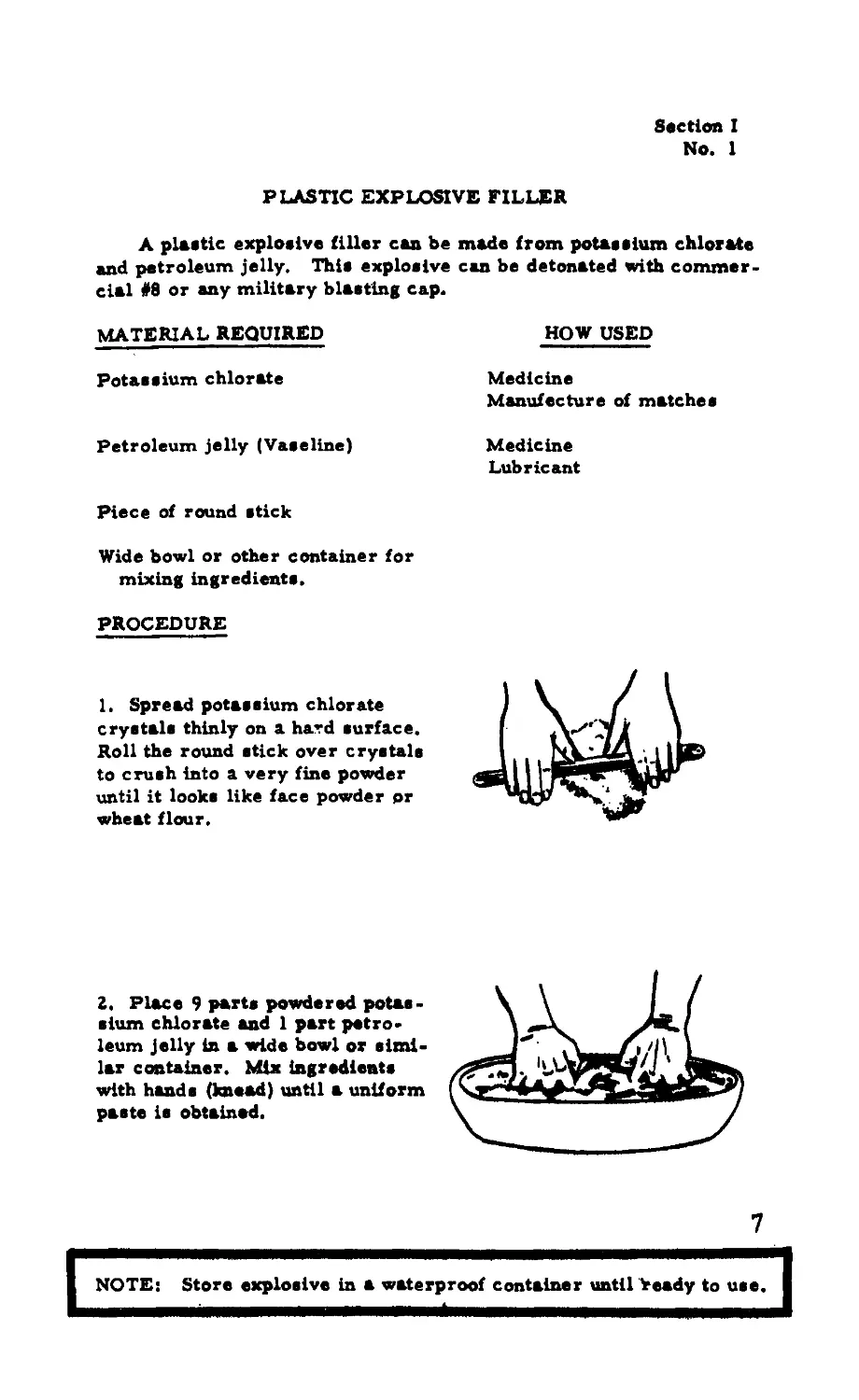
1. Spread potassium chlorate
crystals thinly on a hard surface.
Roll the round stick over crystals
to crush into a very fine powder
until it looks like face powder pr
wheat flour.
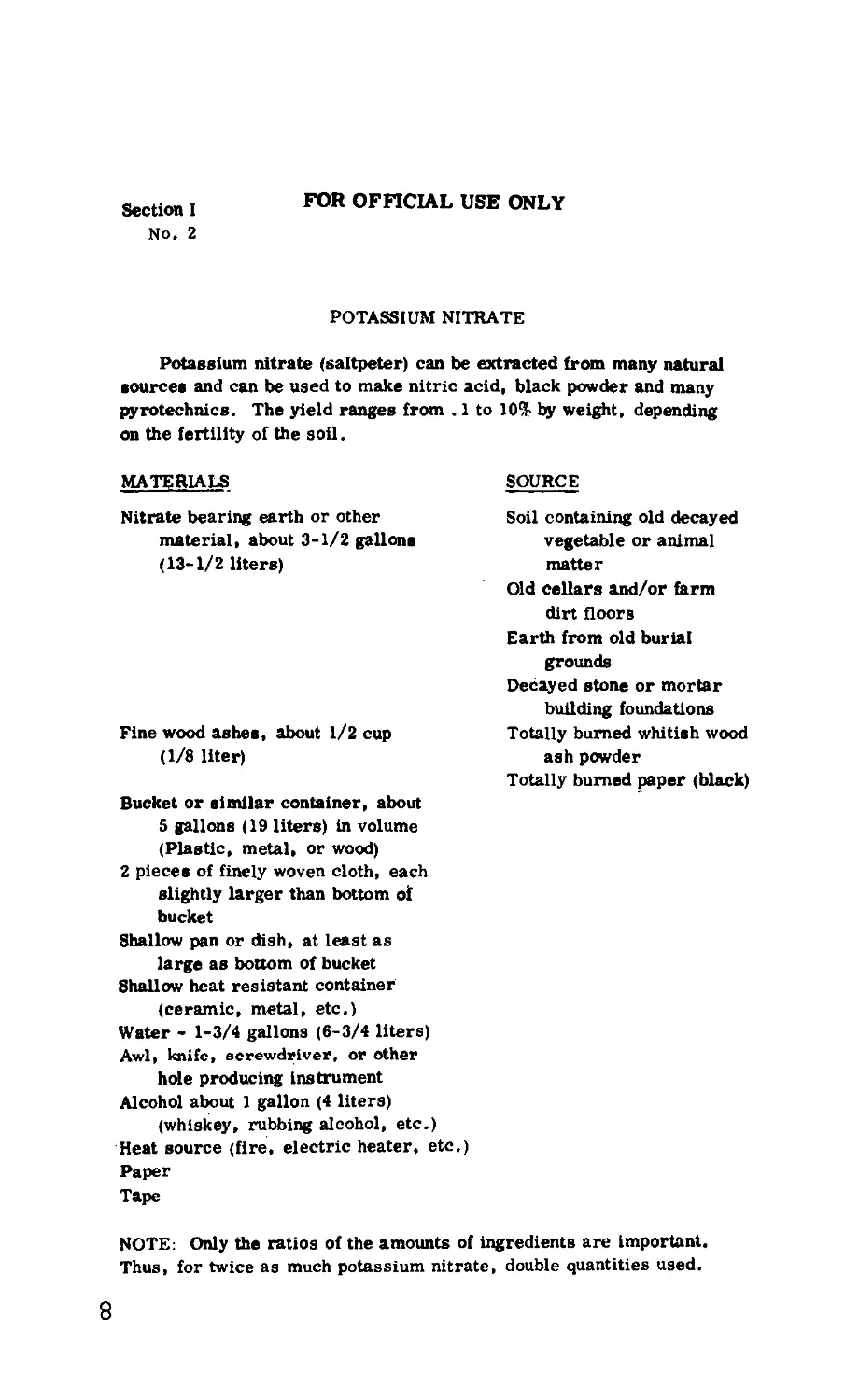
2. Place 9 parts powdered potas-
sium chlorate and 1 part petro-
leum jelly in a wide bowl or simi-
lar container. Mix ingredients
with hands (knead) until a uniform
paste is obtained.
Medicine
Lubricant
7
NOTE: Store explosive in a waterproof container until keady to use.
FOR OFFICIAL USE ONLY
Section I
No. 2
POTASSIUM NITRATE
Potassium nitrate (saltpeter) can be extracted from many natural
sources and can be used to make nitric acid, black powder and many
pyrotechnics. The yield ranges from . 1 to 10% by weight, depending
on the fertility of the soil.
MATERIALS
SOURCE
Nitrate bearing earth or other
material, about 3-1/2 gallons
(13-1/2 liters)
Soil containing old decayed
vegetable or animal
matter
Old cellars and/or farm
dirt floors
Earth from old burial
grounds
Decayed stone or mortar
building foundations
Fine wood ashes, about 1/2 cup
(1/8 liter)
Totally burned whitish wood
ash powder
Totally burned paper (black)
Bucket or similar container, about
5 gallons (19 liters) in volume
(Plastic, metal, or wood)
2 pieces of finely woven cloth, each
slightly larger than bottom of
bucket
Shallow pan or dish, at least as
large as bottom of bucket
Shallow heat resistant container
(ceramic, metal, etc.)
Water - 1-3/4 gallons (6-3/4 liters)
Awl, knife, screwdriver, or other
hole producing instrument
Alcohol about 1 gallon (4 liters)
(whiskey, rubbing alcohol, etc.)
Heat source (fire, electric heater, etc.)
Paper
Tape
NOTE: Only the ratios of the amounts of ingredients are important.
Thus, for twice as much potassium nitrate, double quantities used.
8
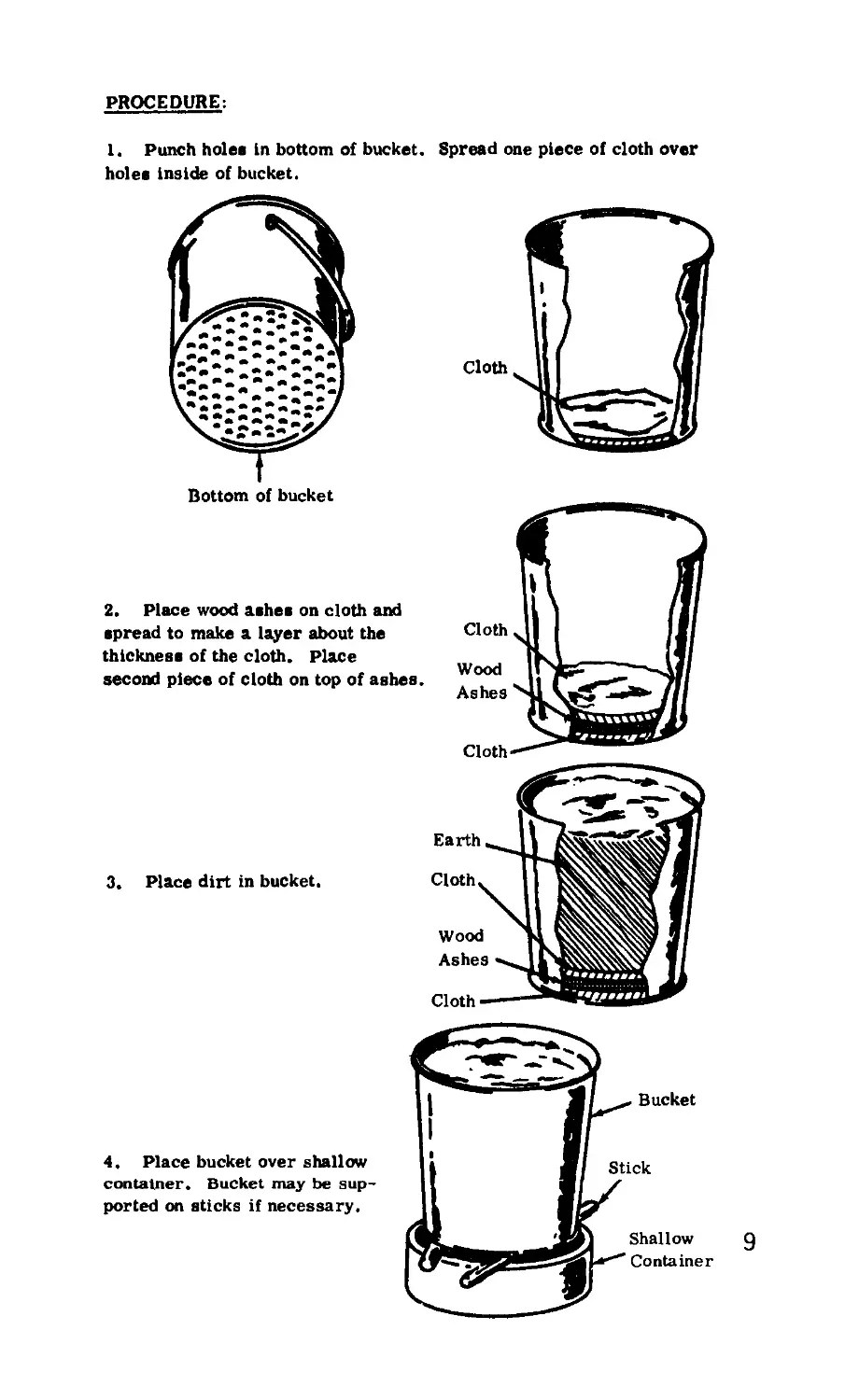
PROCEDURE:
1. Punch hole* in bottom of bucket,
hole* inside of bucket.
2. Place wood ashes on cloth and
spread to make a layer about the
thickness of the cloth. Place
second piece of cloth on top of ashes.
Spread one piece of cloth over
3. Place dirt in bucket.
4.	Place bucket over shallow
container. Bucket may be sup-
ported on sticks if necessary.
S.	Boil water and pour it over earth in bucket a little at a time.
Allow water to run through holes in bucket into shallow container. Be
sure water goes through all of the earth. Allow drained liquid to cool
and settle for 1 to 2 hours.
NOTE: Do not pour all of the water at once, since this may cause
stoppage.
6.	Carefully drain off liquid into heat resistant container. Discard
any sludge remaining in bottom of the shallow container.
7.	Boil mixture over hot
fire for at least 2 hours.
Smail grains of salt will
begin to appear in the solu-
tion. Scoop these out as
they form, using any type
of improvised strainer
(paper, etc.).
Heat Source
8.	When liquid has boiled down to
approximately half its original vol-
ume, remove from fire and let sit.
After half an hour add an equal vol-
ume of aloohol. When mixture is
poured through paper, small white
crystals will collect on top of it.
9.	To purify the potassium nitrate, re-desolve the dry crystals in the
smallest possible amount of boiled water. Remove any salt crystals
that appear (Step 7); pour through an improvised filter made of several
pieces of paper and evaporate or gently heat the concentrated solution
to dryness.
10.	Spread ciystals on flat surface and allow to dry. The potassium
nitrate crystals are now ready for use.
10
Section I
No. 3
IMPROVISED BLACK POWDER
Black powder can be prepared in a simple, safe manner. It may
be used as blasting or gun powder.
MATERIAL REQUIRED:
Potassium nitrate, granulated, 3 cups (3/4 liter) (see Sect. I, No. 2)
Wood charcoal, powdered, 2 cups (1/2 liter)
Sulfur, powdered, 1/2 cup (1/8 liter)
Alcohol, 5 pints (2-1/2 liters) (whiskey, rubbing alcohol, etc.)
Water, 3 cups (3/4 liter)
Heat source
2 Buckets - each 2 gallon (7-1/2 liters) capacity, at least one of which
is heat resistant (metal, ceramic, etc.)
Flat window screening, at least 1 foot (30 cm) square
Large wooden stick
Cloth, at least 2 feet (60 cm) square
NOTE: The above amounts will yield two pounds (900 grams) of black
powder. However, only the ratios of the amounts of ingredients are
important. Thus, for twice as much black powder, double all quan-
tities used.
PROCEDURE:
1.	Place alcohol in one of the buckets.
2.	Place potassium nitrate, charcoal, and sulfur in the heat resistant
bucket. Add 1 cup water and mix thoroughly with wooden stick until
all ingredients are dissolved.
3.	Add remaining water (2 cups) to mixture. Place bucket on heat
source and stir until small bubbles begin to form.
CAUTION: Do not boil mixture. Be sure all mixture stays wet. If
any is dry, as on sides of pan, it may ignite.
FOR OFFICIAL USE ONLY
11
FOR OFFICIAL USE ONLY
4.	Remove bucket from heat and
pour mixture into alcohol while
stirring vigorously.
5.	Let alcohol mixture stand about 5 minutes. Strain mixture through
cloth to obtain black powder. Discard liquid. Wrap cloth around black
powder and squeexe to remove all excess liquid.
12
FOR OFFICIAL USE ONLY
6.	Place screening over dry
bucket. Place workable amount
of damp powder on screen and
granulate by rubbing solid through
screen.
NOTE: If granulated particles appear to stick together and change shape,
recombine entire batch of powder and repeat steps 5 and 6.
7.	Spread granulated black powder on flat dry surface so that layer
about 1/2 inch (1-1/4 cm) is formed. Allow to dry. Use radiator, or
direct sunlight. This should be dried as soon as possible, preferably
in one hour. The longer the drying period, the less effective the black
powder.
CAUTION: Remove from heat as soon as granules are dry. Black
powder is now ready for use.
FOR OFFICIAL USE ONLY
13
FOR OFFICIAL USE ONLY
Section I
No. 4
NITRIC ACID
Nitric acid is used in the preparation of many explosives, incendi-
ary mixtures, and acid delay timers. It may be prepared by distilling
a mixture of potassium nitrate and concentrated sulfuric acid.
MATERIAL REQUIRED:
Potassium nitrate (2 parts by
volume)
Concentrated aulfuric acid (1 part
by volume)
2 bottles or ceramic jugs (narrow
necks are preferable)
Pot or frying pan
Heat source (wood, coal, or char-
coal)
Tape (paper, electrical, masking,
etc. but not cellophane)
Paper or rags
SOURCES:
Drug Store
Improvised (Section I. No. 2)
Motor vehicle batteries
Industrial plants
IMPORTANT: If aulfuric acid is obtained from a motor vehicle batter}'
concentrate it by boiling it until white fumes appear. DO NOT INHALE
FUMES.
NOTE: The amount of nitric acid produced is the same as the amount of
potassium nitrate. Thus, for 2 tableapoonsful of nitric acid, use 2
tablespoonsful of potassium nitrate and 1 tablespoonsful of concentrated
sulfuric acid.
PROCEDURE:
1.	Place dry potassium
nitrate in bottle or jug. Add
sulfuric acid. Do not fill
bottle more than 1/4 full.
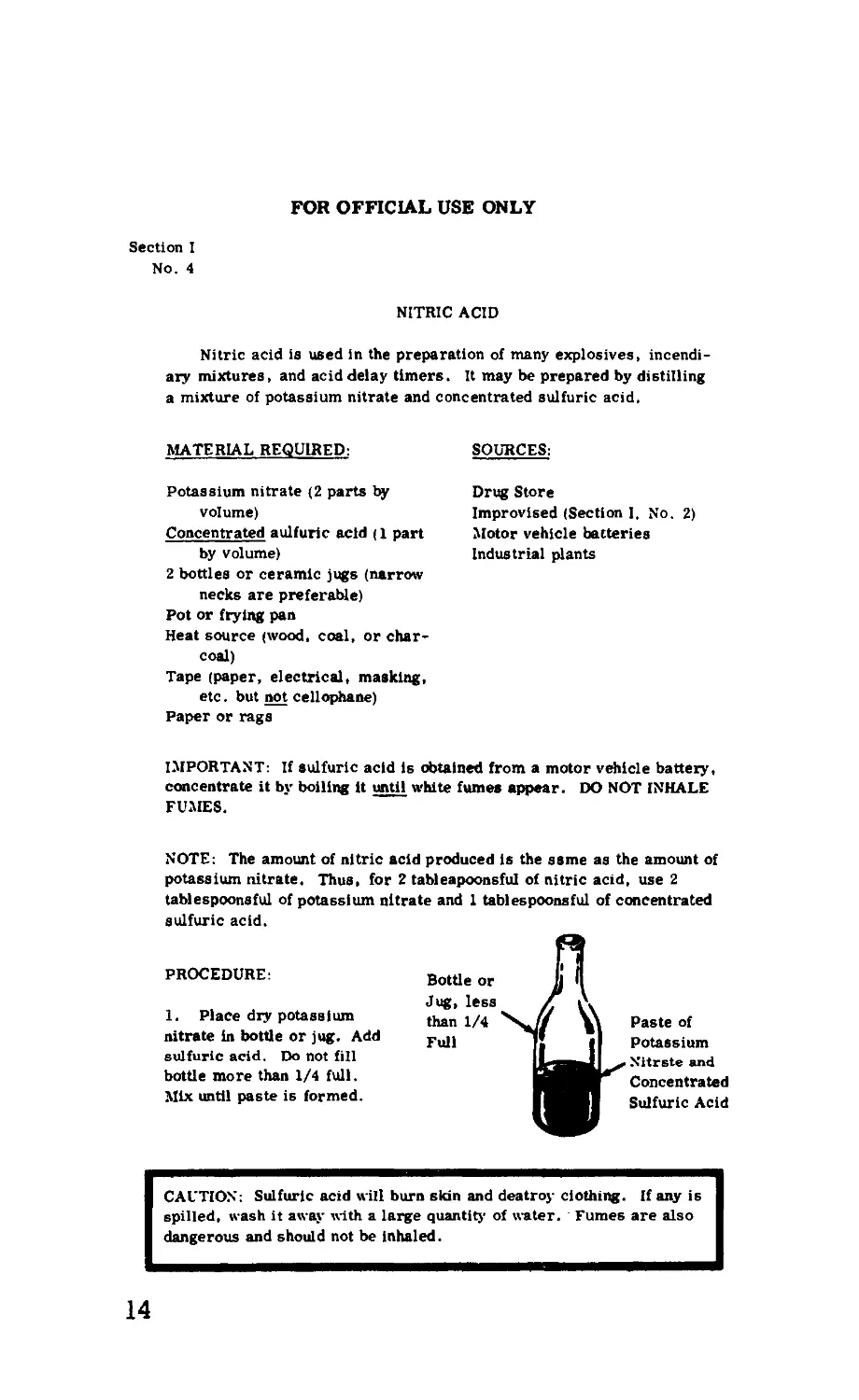
Mix until paste is formed.
Paste of
Potassium
Nitrste and
Concentrated
Sulfuric Acid
CAUTION: Sulfuric acid will burn skin and destroy clothing. If any is
spilled, wash it away with a large quantity of water. Fumes are also
dangerous and should not be inhaled.
14
FOR OFFICIAL USE ONLY
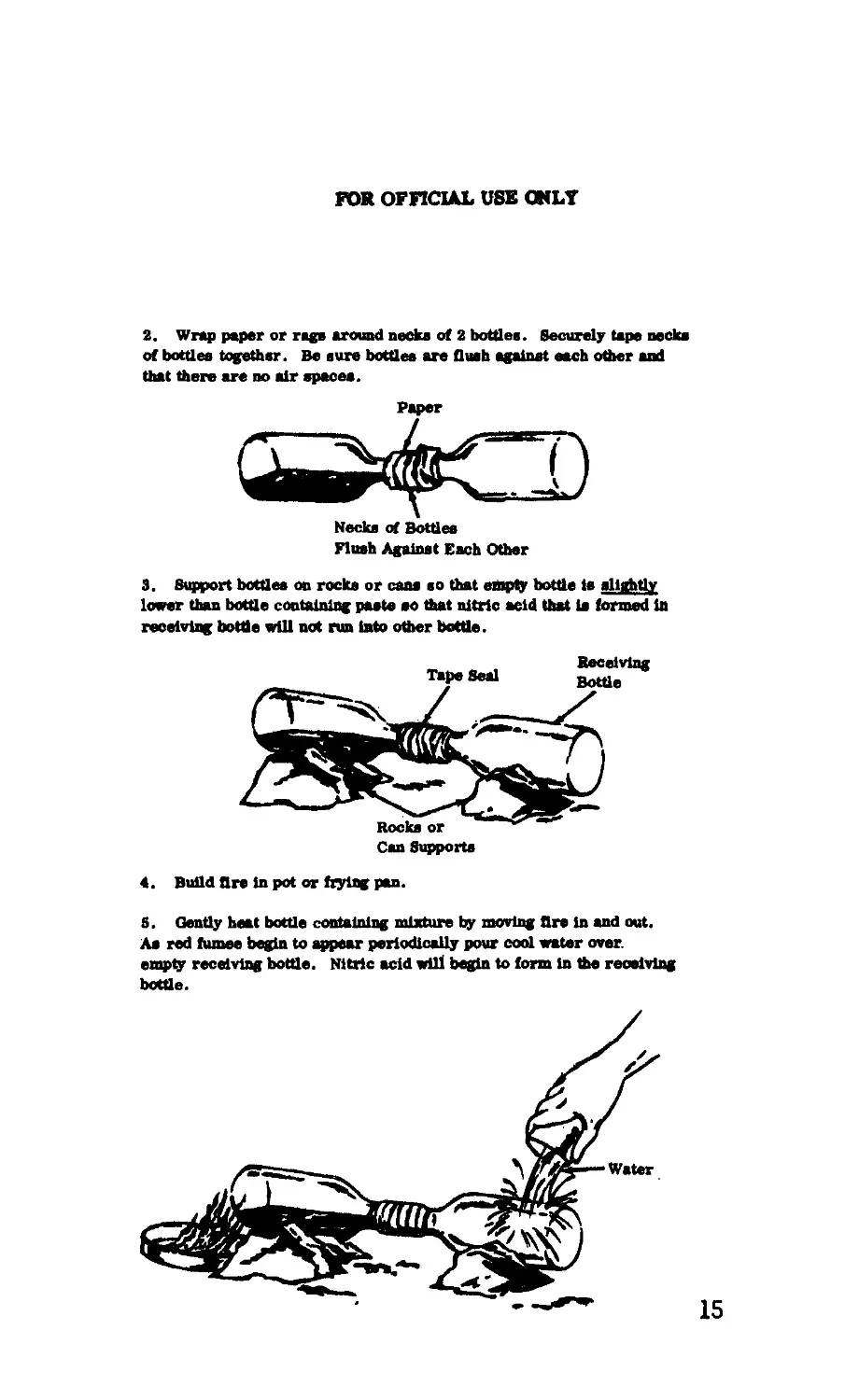
2.	Wrap paper or rage around necks of 2 bottles. Securely tape necks
of bottles together. Be sure bottles are flush against each other and
that there are no air spaces.
Paper
Necks of Bottles
Flush Against Esch Other
3.	Support bottles on rocks or cans so that empty bottle is slightly
lower than bottle containing paste so that nitric add that is formed in
receiving bottle will not run into other bottle.
Can Supports
4.	Build fire in pot or frying pan.
S.	Gently heat bottle containing mixture by moving fire in and out.
Ao red fumee begin to appear periodically pour cod water over,
empty receiving bottle. Nitric acid will begin to form in the receiving
bottle.
15
FOR OFFICIAL USE ONLY
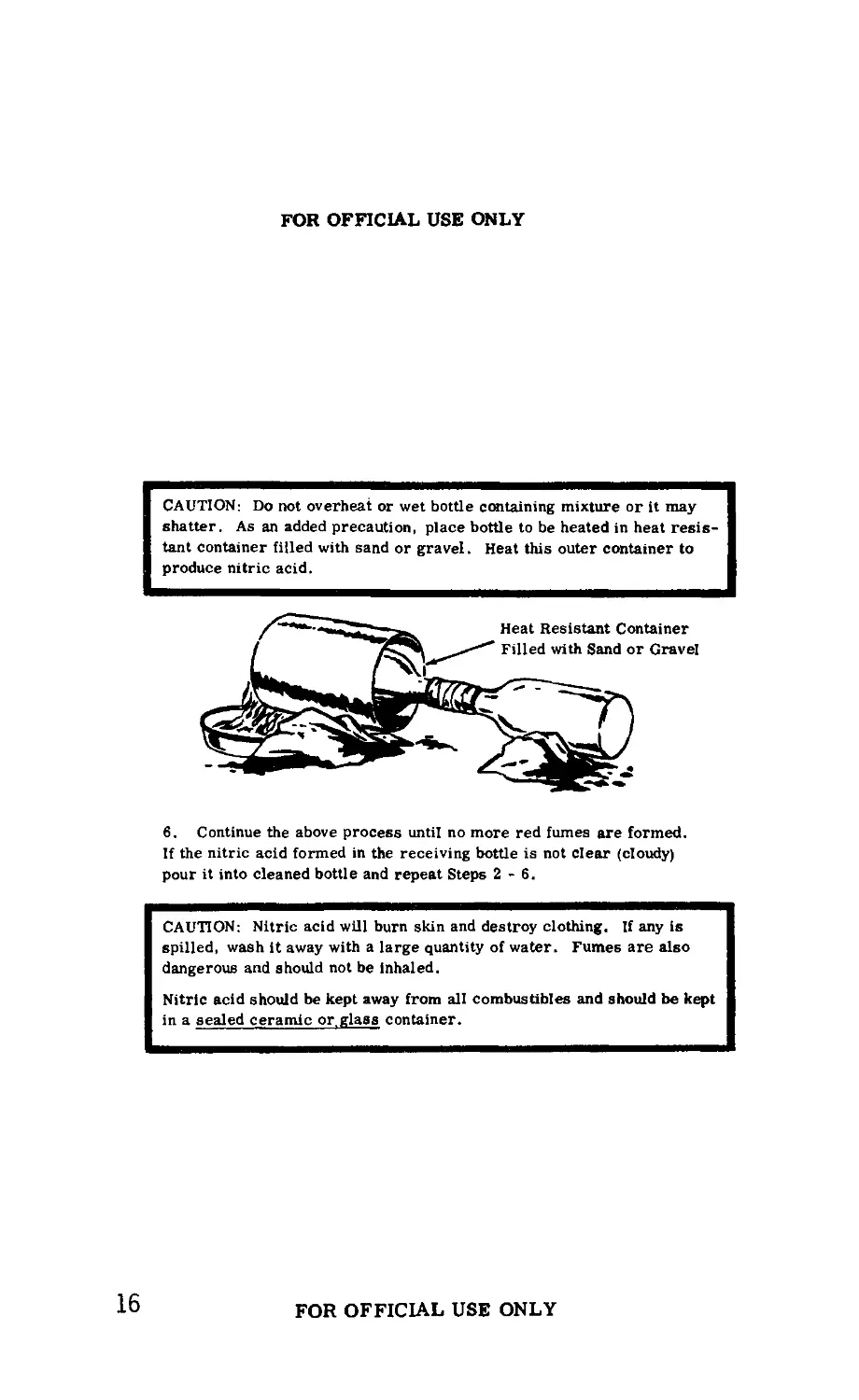
CAUTION: Do not overheat or wet bottle containing mixture or it may
shatter. As an added precaution, place bottle to be heated in heat resis-
tant container filled with sand or gravel. Heat this outer container to
produce nitric acid.
6.	Continue the above process until no more red fumes are formed.
If the nitric acid formed in the receiving bottle is not clear (cloudy)
pour it into cleaned bottle and repeat Steps 2-6.
CAUTION: Nitric acid will burn skin and destroy clothing. If any is
spilled, wash it away with a large quantity of water. Fumes are also
dangerous and should not be inhaled.
Nitric acid should be kept away from all combustibles and should be kept
in a sealed ceramic or, glass container.
16
FOR OFFICIAL USE ONLY
FOR OFFICIAL USE ONLY
Section I
No. 5
INITIATOR FOR DUST EXPLOSIONS
An initiator which will initiate common material to produce dust
explosions can be rapidly and easily constructed. This type of charge
is ideal for the destruction of enclosed areas such as rooms or buildings.
MATERIAL REQUIRED:
A flat can. 3 in. (8 cm) diameter and 1-1/2 in. (3-3/4 cm) high. A
6-1/2 ounce Tuna can serves the purpose quite well.
Blasting cap
Explosive
Aluminum (may be wire, cut sheet, flattened can or powder
Large nail, 4 in. (10 cm) long
Wooden rod - 1/4 in. (6 mm) diameter
Flour, gasoline and powder or chipped aluminum
NOTE: Plastic explosives (Comp. C-4, etc.) produce better explosions
than cast explosives (Comp. B, ete.).
PROCEDURE:
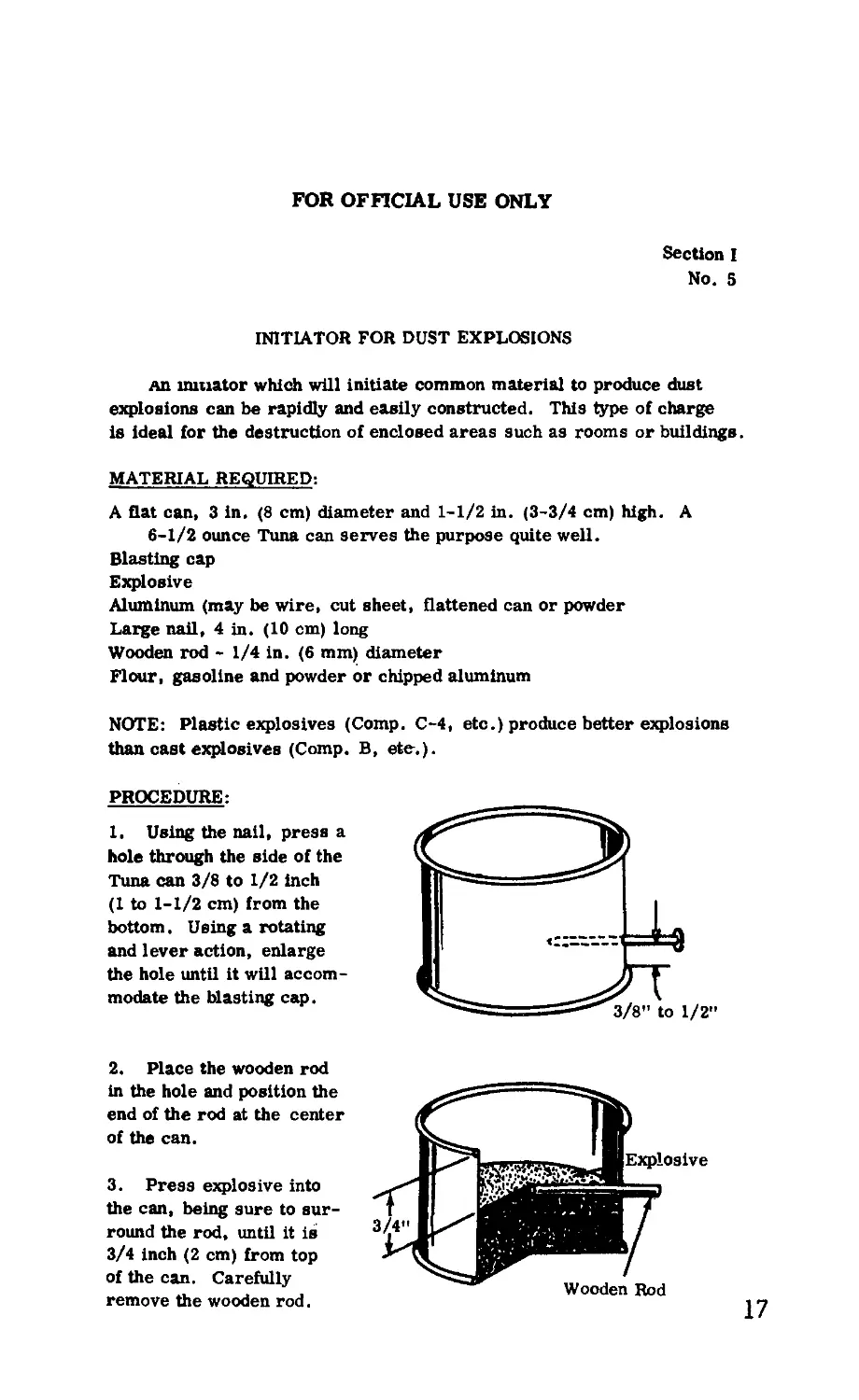
1.	Using the nail, press a
hole through the side of the
Tuna can 3/8 to 1/2 inch
(1 to 1-1/2 cm) from the
bottom. Using a rotating
and lever action, enlarge
the hole until it will accom-
modate the blasting cap.
2.	Place the wooden rod
in the hole and position the
end of the rod at the center
of the can.
3.	Press explosive into
the can, being sure to sur-
round the rod, until it is
3/4 inch (2 cm) from top
of the can. Carefully
remove the wooden rod.
17
FOR OFFICIAL USE ONLY
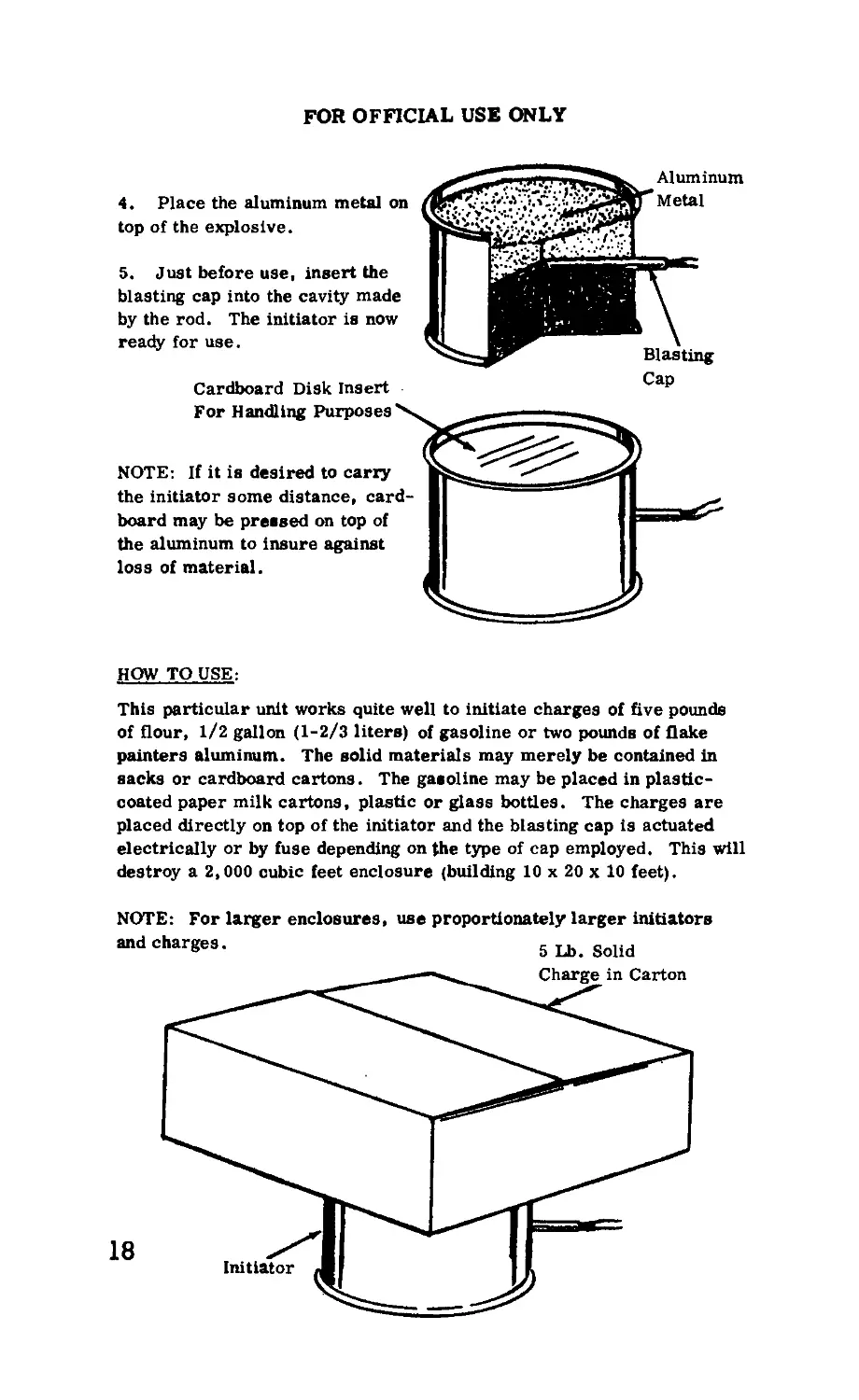
4.	Place the aluminum metal on
top of the explosive.
5.	Just before use, insert the
blasting cap into the cavity made
by the rod. The initiator is now
ready for use.
Cardboard Disk Insert
For Handling Purposes
NOTE: If it is desired to carry
the initiator some distance, card-
board may be pressed on top of
the aluminum to insure against
loss of material.
HOW TO USE:
This particular unit works quite well to initiate charges of five pounds
of flour, 1/2 gallon (1-2/3 liters) of gasoline or two pounds of flake
painters aluminum. The solid materials may merely be contained in
sacks or cardboard cartons. The gasoline may be placed in plastic-
coated paper milk cartons, plastic or glass bottles. The charges are
placed directly on top of the initiator and the blasting cap is actuated
electrically or by fuse depending on the type of cap employed. This will
destroy a 2,000 cubic feet enclosure (building 10 x 20 x 10 feet).
NOTE: For larger enclosures, use proportionately larger initiators
and charges.	5 Lb. Solid
Initiator
18
Section I
No. 6
FERTILIZER EXPLOSIVE
An explosive munition can be made from fertilizer grade ammonium
nitrate and either fuel oil or a mixture of equal parts of motor oil and
gasoline. When properly prepared, this explosive munition can be deto-
nated with a blasting cap.
MATERIAL REQUIRED:
Ammonium nitrate (not less than 32% nitrogen)
Fuel oil or gasoline and motor oil (1:1 ratio)
Two flat boards. (At least one of these should be comfortably held in
the hand, i.e. 2x4 and 36 x 36.)
Bucket or other container for mixing ingredients
Iron or steel pipe or bottle, tin can or heavy-walled cardboard tube
Blasting cap
Wooden rod - 1/4 In. diameter
Spoon or similar measuring container
PROCEDURE:
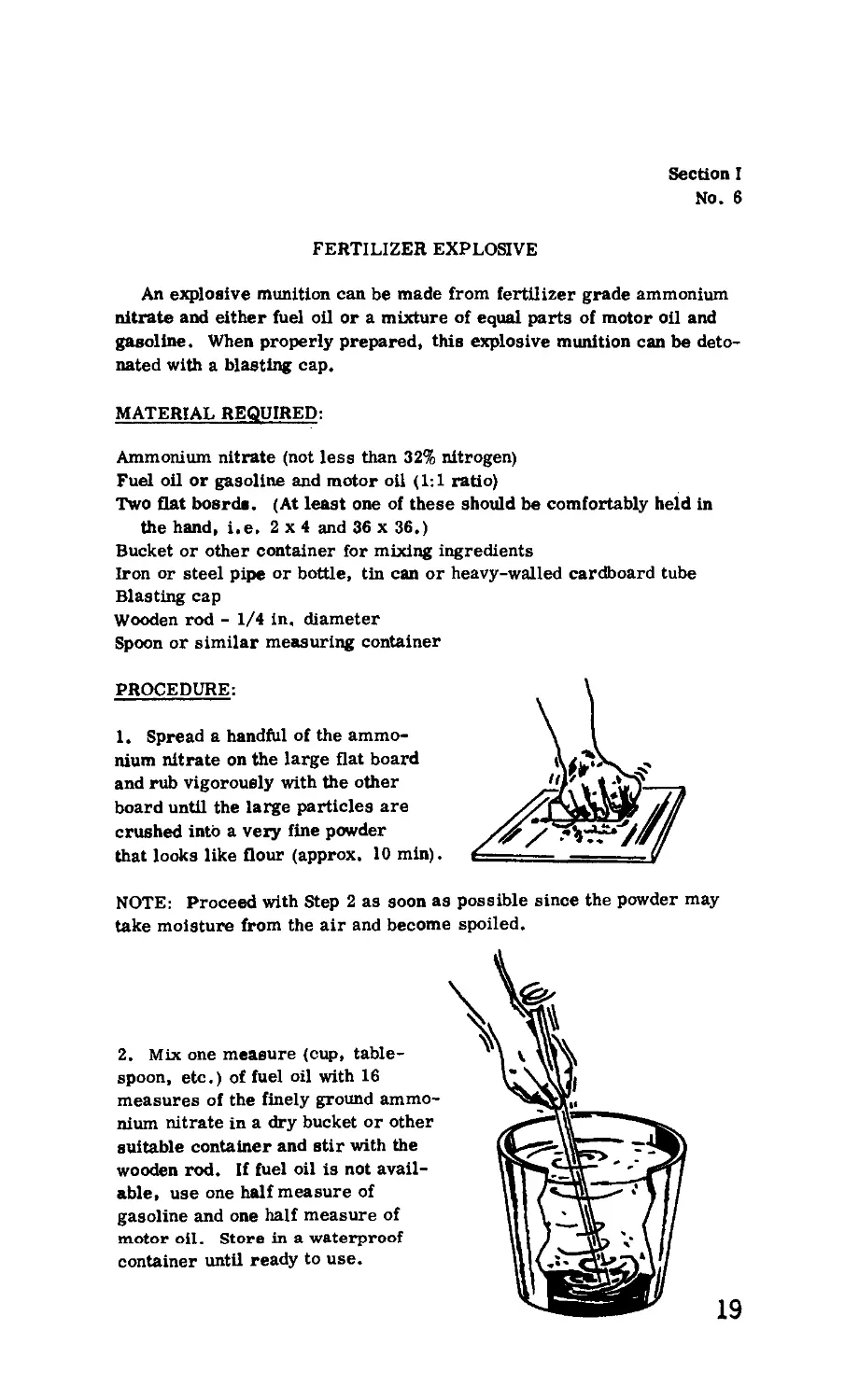
1.	Spread a handful of the ammo-
nium nitrate on the large flat board
and rub vigorously with the other
board until the large particles are
crushed into a very fine powder
that looks like flour (approx. 10 min).
NOTE: Proceed with Step 2 as soon as possible since the powder may
take moisture from the air and become spoiled.
2.	Mix one measure (cup, table-
spoon, etc.) of fuel oil with 16
measures of the finely ground ammo-
nium nitrate in a dry bucket or other
suitable container and stir with the
wooden rod. If fuel oil is not avail-
able, use one half measure of
gasoline and one half measure of
motor oil. Store in a waterproof
container until ready to use.
19
FOR OFFICIAL USE ONLY
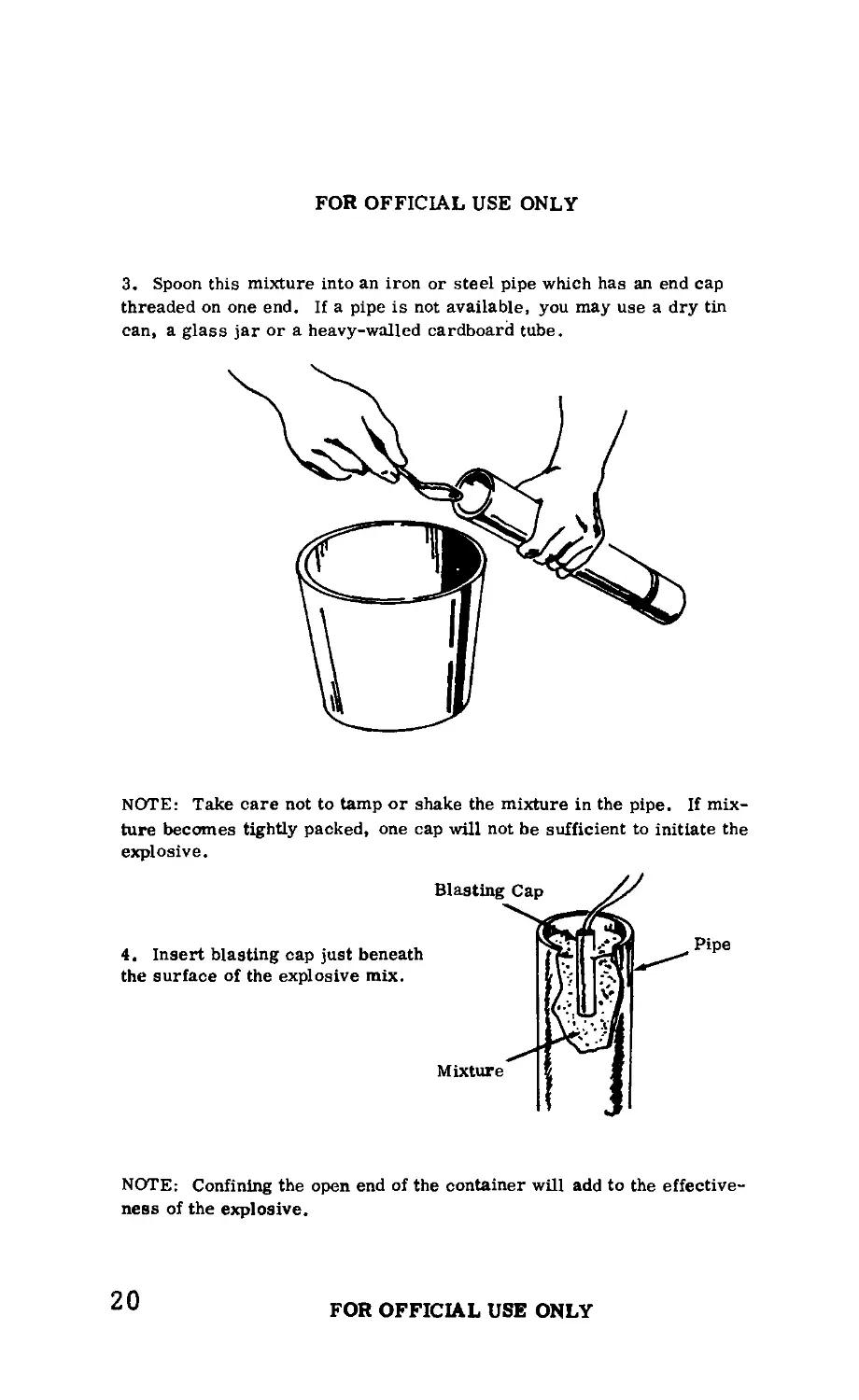
3.	Spoon this mixture into an iron or steel pipe which has an end cap
threaded on one end. If a pipe is not available, you may use a dry tin
can, a glass jar or a heavy-walled cardboard tube.
NOTE: Take care not to tamp or shake the mixture in the pipe. If mix-
ture becomes tightly packed, one cap will not be sufficient to initiate the
explosive.
4.	Insert blasting cap just beneath
the surface of the explosive mix.
NOTE: Confining the open end of the container will add to the effective-
ness of the explosive.
20
FOR OFFICIAL USE ONLY
Section I
No. 7
FOR OFFICIAL USE ONLY
CARBON TET - EXPLOSIVE
A moist explosive mixture can be made from fine aluminum powder
combined with carbon tetrachloride or tetrachloroethylene. This ex-
plosive can be detonated with a blasting cap.
MATERIAL REQUIRED:
Fine aluminum bronzing powder
Carbon tetrachloride
or
tetrachloroethylene
Stirring rod (wood)
Mixing container (bowl, bucket, etc
Measuring container (cup, table-
spoon, etc.)
Storage container (jar, can, etc.)
Blasting cap
Pipe, can or jar
PROCEDURE:
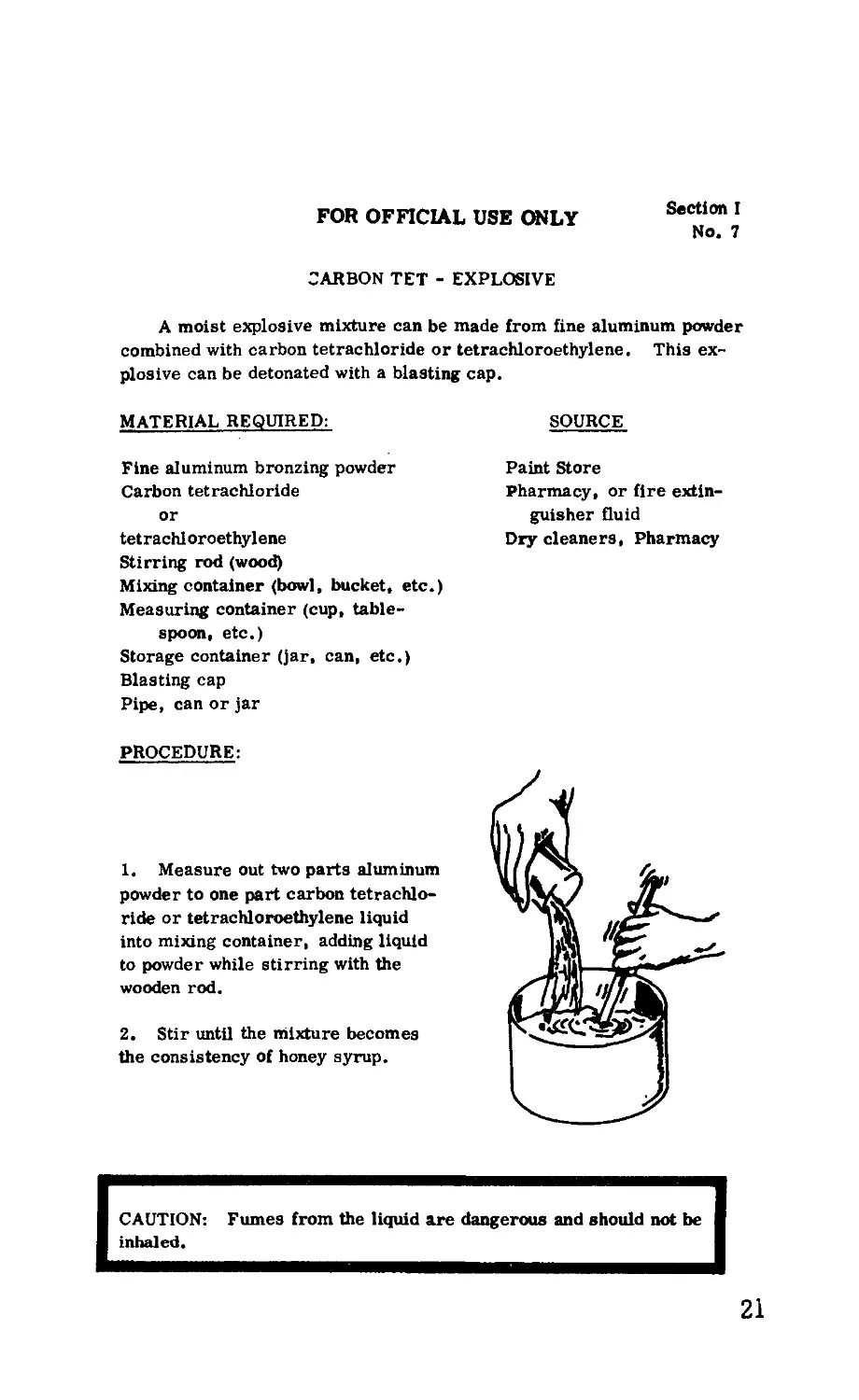
1.	Measure out two parts aluminum
powder to one part carbon tetrachlo-
ride or tetrachloroethylene liquid
into mixing container, adding liquid
to powder while stirring with the
wooden rod.
2.	Stir until the mixture becomes
the consistency of honey syrup.
SOURCE
Paint Store
Pharmacy, or fire extin-
guisher fluid
Dry cleaners, Pharmacy
CAUTION:
inhaled.
Fumes from the liquid are dangerous and should not be
21
3.	Store explosive in a jar or sim-
ilar water proof container until ready
to use. The liquid in the mixture
evaporates quickly when not con-
fined.
NOTE: Mixture will detonate in this
HOW TO USE:
1. Pour this mixture into an iron
or steel pipe which has an end cap
threaded on one end. If a pipe is
not available, you may use a dry tin
can or a glass jar.
manner for a period of 72 hours.
2. Insert blasting cap just beneath
the surface of the explosive mix.
NOTE: Confining the open end of the container will add to the effective-
2 2 ness of the explosive.
Section I
No. 8
FERTILIZER AN-AL EXPLOSIVE
A dry explosive mixture can be made from ammonium nitrate
fertilizer combined with fine aluminun powder. This explosive can be
detonated with a blasting cap.
MATERIAL REQUIRED:
Ammonium nitrate fertilizer
(not less than 32% nitrogen)
Fine aluminum bronzing powder
Measuring container (cup, table-
spoon, etc.)
Mixing container (wide bowl, oan,
etc.)
Two flat boards (one should be
comfortably held in hand and
one very large, i.e.
2x4 and 36 x 36 in.)
Storage container (jar, can, etc.)
Blasting cap
Wooden rod - 1/4 inch diameter
Pipe, can or jar
SOURCE
Farm or Feed Store
Paint Store
PROCEDURE:
1.	Method I - To obtain a low velocity explosive.
a.	Use measuring container to measure four parts fertilizer to one
part aluminum powder and pour into the mixing container.
(Example: 4 oups of fertilizer to 1 cup aluminum powder.)
b.	Mix ingredients well with the wooden rod.
2.	Method II - To obtain a much higher velocity explosive.
a.	Spread a handfill at a time
of the fertilizer on the large
flat board and rub vigorously
with the other board until the
large particles are crushed in-
to a very fine powder that looks
like flour (approx. 10 min per
handful).
NOTE: Proceed with step b below as soon as possible since the powder
may take moisture from the air and become spoiled.
FOR OFFICIAL USE ONLY
b.	Follow (tops a and b of Method I.
3.	Store the explosive mixture in
a waterproof container, euoh as
glass jar, steel pipe, etc., until
ready to use.
HOW TO USE:
Follow steps 1 and 2 of "How To Use" in Section I, No. 7.
24
FOR OFFICIAL USE ONLY
Section I
No. 9
FOR OFFICIAL USE ONLY
"RED OR WHITE POWDER” PROPELLANT
"Red or White Powder" Propellant may be prepared in a simple,
safe manner. The formulation described below will result in approxi-
mately 2-1/2 pounds of powder. Thia la a small arms propellant and
should only be used in weapons with 1/2 in. inside diameter or less,
such as the Match Gun or the 7.62 Carbine, but not pistols.
MATERIAL REQUIRED:
Heat source (Kitchen stove or open fire)
2 gallon metal bucket
Measuring cup (8 ounces)
Wooden spoon or rubber spatula
Metal sheet or aluminum foil (at least 18 in. sq.)
Flat window screen (at least 1 ft. sq.)
Potassium nitrate (granulated) 2-1/3 cups
White sugar (granulated) 2 cups
Powdered ferric oxide (rust) 1/8 cup (if available)
Clear water, 3-1/2 cups
PROCEDURE:
1.	Place the sugar, potassium
nitrate, and water in the bucket.
Heat with a low flame, stirring
occasionally until the sugar and
potassium nitrate dissolve.
2.	If available, add the ferric oxide
(rust) to the solution. Increase the
flame under the mixture until it
boils gently.
NOTE: The mixture will retain the
rust coloration.
25
FOR OFFICIAL USE ONLY
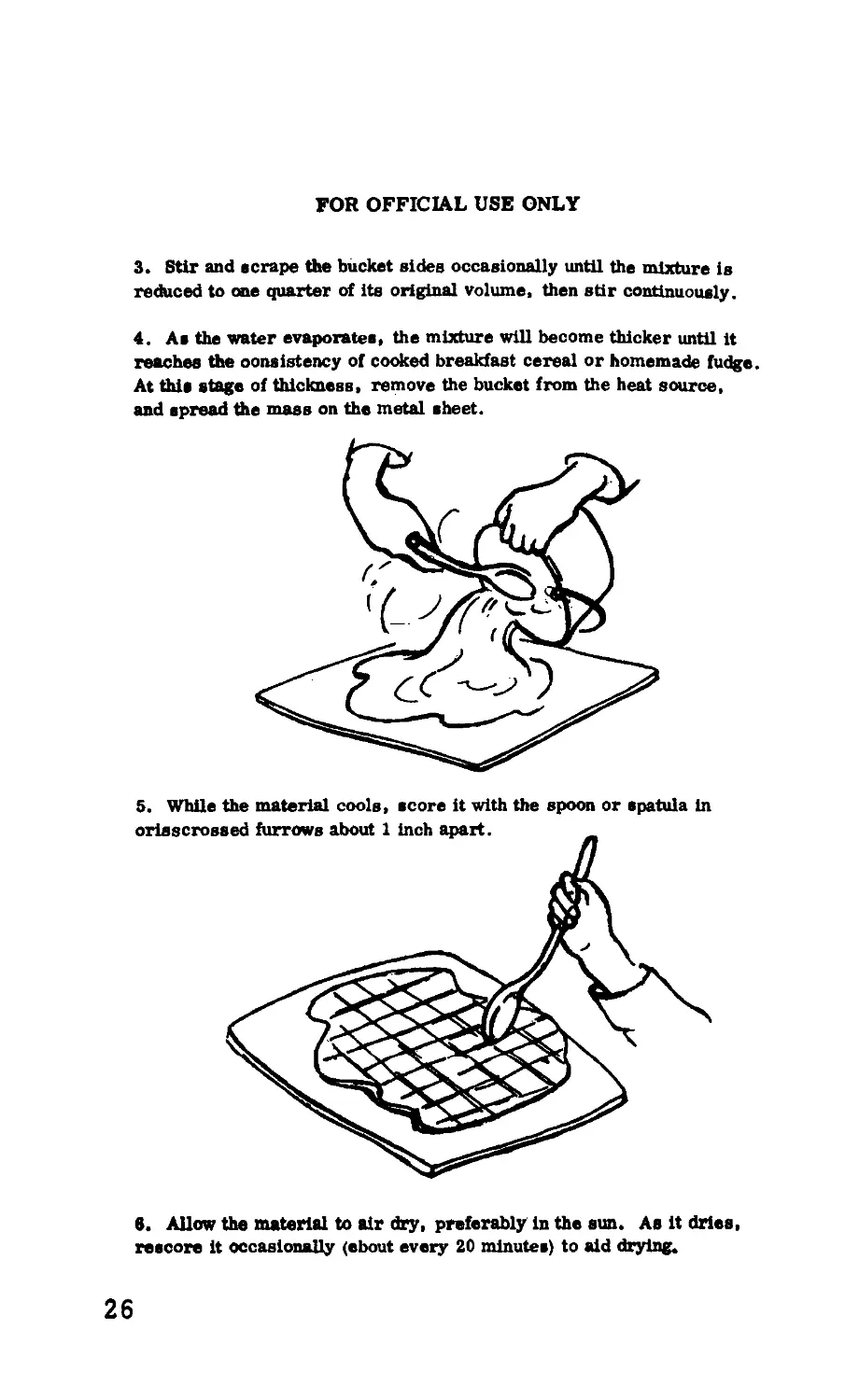
3.	Stir and scrape the bucket sides occasionally until the mixture is
reduced to one quarter of its original volume, then stir continuously.
4.	As the water evaporates, the mixture will become thicker until it
reaches the consistency of cooked breakfast cereal or homemade fudge.
At this stage of thickness, remove the bucket from the heat source,
and spread the mass on the metal sheet.
5. While the material cools, score it with the spoon or spatula in
8.	Allow the material to air dry, preferably in the sun. As it dries,
rescore it occasionally (ebout every 20 minutes) to aid drying.
26
FOR OFFICIAL USE ONLY
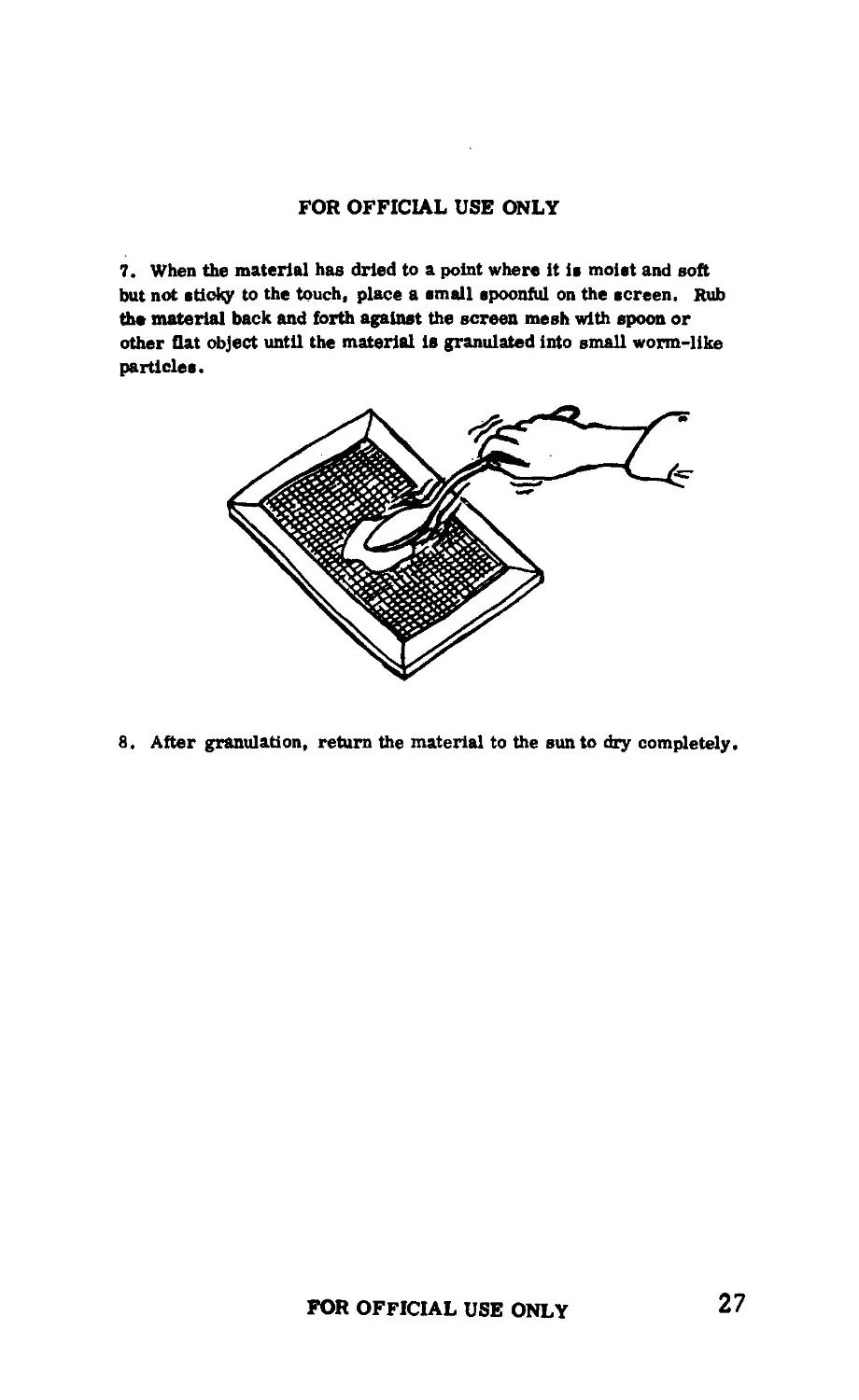
7. When the material has dried to a point where it is moist and soft
but not sticky to the touch, place a small spoonful on the screen. Rub
the material back and forth against the screen mesh with spoon or
other flat object until the material la granulated into small worm-like
particles.
8. After granulation, return the material to the sun to dry completely.
FOR OFFICIAL USE ONLY
27
Section I
No. 10
NITRIC ACID/NITROBENZENE ("HELLHOFFITE") EXPLOSIVE
An explosive munition can be made from mononitrobenezene and
nitric acid. It is a simple explosive to prepare. Just pour the mono'
nitrobenzene into the acid and stir.
MATERIAL REQUIRED:
Nitric acid
Mononitrobenzene (also known as
nitrobenzene)
Acid resistant measuring
containers
Acid resistant mixing rod
Blasting cap
Wax
Steel pipe, end cap and tape
Bottle or jar
SOURCE:
Field grade or 90% concentrated
(specific gravity of 1,48)
Drug store (oil of mirbane)
Chemical supply house
Industries (used as solvent)
Glass, clay, etc.
NOTE: Prepare mixture just before use.
PROCEDURE:
1. Add 1 volume (cup, quart, etc.)
mononitrobenzene to 2 volumes
nitric acid in bottle or jar.
2. Mix ingredients well by stirring
with acid resistant rod.
28
FOR OFFICIAL USE ONLY
TAUT ION: Nitric acid will burn skin and destroy clothing. If any is
spilled, wash off immediately with large amount of water. Nitro-
benzene is toxic; do not inhale fumes.
HOW TO USE:
1.	Wax blasting cap, pipe and end cap.
2.	Thread end cap onto pipe.
3.	Pour mixture into pipe.
4. Insert and tape blasting cap just
beneath surface of mixture.
NOTE: Combining the open end of the pipe will add to the effectiveness
of the explosive.
29
,*	FOR OFFICIAL USE ONLY
No. 11
OPTIMIZED PROCESS FOR CELLULOSE/ACID EXPLOSIVES
An acid type explosive can be made from nitric acid and white
paper or cotton cloth. This explosive can be detonated with a com-
mercial #8 or any military blasting cap.
MATERIAL REQUIRED:
Nitric Acid
White unprinted, unsized paper
Clean white cotton cloth
Acid resistant container
Aluminum foil or acid resistant
material
Protective gloves
Blasting cap
Wax
SOURCE:
Industrial metal processors, 90%
concentrated (specific gravity
of 1.48)
Field grade (See Section I, No. 4)
Paper towels, napkins
Clothing, sheets, etc.
Wax coated pipe or can, ceramic
pipe, glass jar, etc.
Heavy-walled glass containers
Food stores
PROCEDURE:
1.	Put on gloves.
2.	Spread out a layer of paper or cloth on aluminum foil and sprinkle
with nitric acid until thoroughly soaked. If aluminum foil is unavail-
able, use an acid resistant material (glass, ceramic or wood).
30
FOR OFFICIAL USE ONLY
CAUTION: Acid will burn skin and destroy clothing. If any is spilled,
wash it away with a large quantity of water. Do not inhale fumes.
3.	Place another layer of paper or cloth on top of the acid-soaked
sheet and repeat step 2 above. Repeat as often as necessary.
4.	Roll up the aluminum foil con-
taining the acid-soaked sheets and
insert the roll into the acid resist-
ant container.
NOTE: If glass, ceramic or wooden tray is used, pick up sheets with
two wooden sticks and load into container.
S.	Wax blasting cap.
6.	Insert the blasting cap in the
oenter of the rolled sheets. Allow
S minutes before detonating the
explosive.
Section I
No. 12
METHYL NITRATE DYNAMITE
A moist explosive mixture can be made from sulfuric acid, nitric
acid and methyl alcohol. This explosive can be detonated with a blast-
ing cap.
MATERIAL REQUIRED:
Sulfuric acid
Nitric acid
Methyl alcohol
SOURCES:
Clear battery acid boiled until
white fumes appear
Field grade nitric acid (Section
I, No. 4) or 90% cone.
(sp. gr. of 1.48)
Methanol
Wood alcohol (not denatured
alcohol)
Anti-freeze (non-permanent)
Eyedropper or syringe with glass
tube
Large diameter glass (2 qt.) jar
Narrow glass jars (1 qt.)
Absorbent (fine sawdust, shredded
paper, shredded cloth)
Cup
Pan (3 to 5 gallon)
Teaspoon
Wooden stick
Steel pipe with end cap
Blasting cap
Water
Tray
PROCEDURE:
1. Add 24 teaspoons of sulfuric
acid to 16-1/2 teaspoons of nitric
acid in the 2 quart jar.
I CAUTION: Acid will bum skin and destroy clothing. If any is spilled,
wash it away with a large quantity of water. Do not Inhale fumes.
32
FOR OFFICIAL USE ONLY
2. Place the jar in the pan (3 to S gallon) filled with cold water or a
stream and allow acid to cool.
3.	Rapidly swirl the jar to create
a whirlpool in the liquid (without
splashing) while keeping the bottom
portion of the jar in the water.
4.	While continually swirling, add
to mixture, 1/2 teaspoon at a time,
13-1/2 teaspoons of methyl alcohol,
allowing mixture to cool at least
one minute between additions.
CAUTION: If there is a sudden increase in the amount of fumes pro-
duced or if the solution suddenly turns much darker or begins to froth,
dump solution in the water within 10 seconds. This will halt the
reaction and prevent an accident.
S.	After the final addition of methyl alcohol, swirl for another 30 to
45 seconds.
6.	Carefully pour the solution into one of the narrow glass jars.
Allow jar to stand in water for approximately 5 minutes until two
layers separate.
7.	With an eyedropper or syringe,
remove top layer and carefully put
into another narrow glass jar.
This liquid is the explosive.
ГсАОТЮК-^йдДов^еТГвЗ^^ёмШуе"
FOR OFFICIAL USE ONLY
33
FOR OFFICIAL USE ONLY
8.	Add an equal quantity of water
to the explosive and swirl. Allow
mixture to separate again as in
step 6. The explosive is now the
bottom layer.
9.	Carefully remove the top layer with the eyedropper or syringe and
discard.
10.	Place one firmly packed cup of absorbent in the tray.
11.	While stirring with the wooden stick, slowly add explosive until the
mass is very damp but not wet enough to drip. Explosive is ready to
use.
NOTE: If mixture becomes too wet, add more absorbent.
If storage of explosive is required, store in a sealed container
to prevent evaporation.
CAUTION: Do not handle liquid explosive or allow to contact skin. If
this happens, flush away immediately with large quantity of water.
Keep grit, sand or dirt out of mix.
34
FOR OFFICIAL USE ONLY
HOW TO USE:
1. Spoon this mixture into an iron or steel pipe which has an end cap
threaded on one end. If a pipe is not available, you may use a dry tin
can or a glass jar.
NOTE: Confining the open end of the container will add to the effective-
ness of the explosive.
FOR OFFICIAL USE ONLY
35
Section I
No. 13
UREA NITRATE EXPLOSIVE
Urea nitrate can be used as an explosive munition. It is easy to
prepare from nitric acid and urine. It can be detonated with a blasting
cap.
MATERIAL REQUIRED:	SOURCE:
Nitric acid, 90% cone. (1.48
sp. gr.)
Urine
2 one gallon heat and acid-
resistant containers (glass,
clay, etc.)
Filtering material
Aluminum powder (optional or
if available)
Heat source
Measuring containers (cup and
spoon)
Water
Tape
Blasting cap
Steel pipe and end cap (s)
Field grade (Section I, No. 4)
or industrial metal
processors
Animals (including humans)
Paper towel or finely textured
cotton cloth (shirt, sheet,
etc.)
Paint stores
NOTE: Prepare mixture Just before use.
PROCEDURE:
1.	Boil a large quantity of urine
(10 cups) to approximately 1/10
its volume (1 cup) in one of the
containers over the heat source.
36
FOR OFFICIAL USE ONLY
2.	Filter the urine into the other container through the filtering
material to remove impurities.
3.	Slowly add 1/3 cup of nitric
acid to the filtered urine, and let
mixture stand for 1 hour.
CAUTION: Acid will burn skin and destroy clothing. If any is spilled I
wash it away with a large quantity of water. Do not inhale fumes. 137
Urea Nitrate
Crystals
4.	Filter mixture as in step 2.
Urea nitrate crystals will collect
on the paper.
Tape
5.	Wash the urea nitrate by pouring water over it.
6.	Remove urea nitrate crystals from the filtering material and allow
to dry thoroughly (approximately 16 hours).
NOTE: The drying time can be reduced to two hours if a hot (not
boiling) water bath is used. See Step 5 of Section I, No. 15.
HOW TO USE:
1. Spoon the urea nitrate crystals into an iron or steel pipe which has
an end cap threaded on one end.
FOR OFFICIAL USE ONLY
NOTES: This explosive can be made more effective by mixing with
aluminum powder (can be obtained in paint stores) in the ratio of 4 to 1.
For example, mix 1 cup of aluminum powder with 4 cups of urea nitrate.
Confining the open end of the container will add to the effec-
tiveness of the explosive.
FOR OFFICIAL USE ONLY
39
Section I
No. 14
PREPARATION OF COPPER SULFATE (PENTAHYDRATE)
Copper sulfate is a required material for the preparation of TACC
(Section I, No. 16).
MATERIAL REQUIRED:
Pieces of copper or copper wire
Dilute sulfuric acid (battery acid)
Potassium Nitrate (Section I, No. 2) or Nitric Acid, 90% cone. (1.48
sp. gr.) (Section I, No. 4)
Alcohol
Water
Two 1 pint Jars or glasses, heat resistant
Paper towels
Pan
Wooden rod or stick
Improvised Scale (Section VII, No. 8)
Cup
Container
Heat source
Teaspoon
PROCEDURE:
1. Place 10 grams of copper pieces
into one of the pint jars. Add 1 cup
(240 milliliters) of dilute sulfuric
acid to the copper.
NOTE: Nitric acid give* a product of greater purity.
3.	Heat the mixture in a pan of
simmering hot water bath until the
bubbling has ceased (approximately
2 hours). The mixture will turn to
a blue color.
CAUTION: The above procedure will cause strong toxic fumes. Per-
form Step 3 in an open, well ventilated area.
4.	Pour the hot blue solution, but not the copper, into the other pint
jar. Allow solution to cool at room temperature. Crystals will form
at the bottom of the jar. Discard the unreacted copper pieces in the
flret jar.
5.	Carefully pour away the liquid
from the crystals. Crush crystals
into a powder with wooden rod or
stick.
6.	Add 1/2 cup (120 milliliters) of
alcohol to the powder while stirring.
41
FOR OFFICIAL USE ONLY
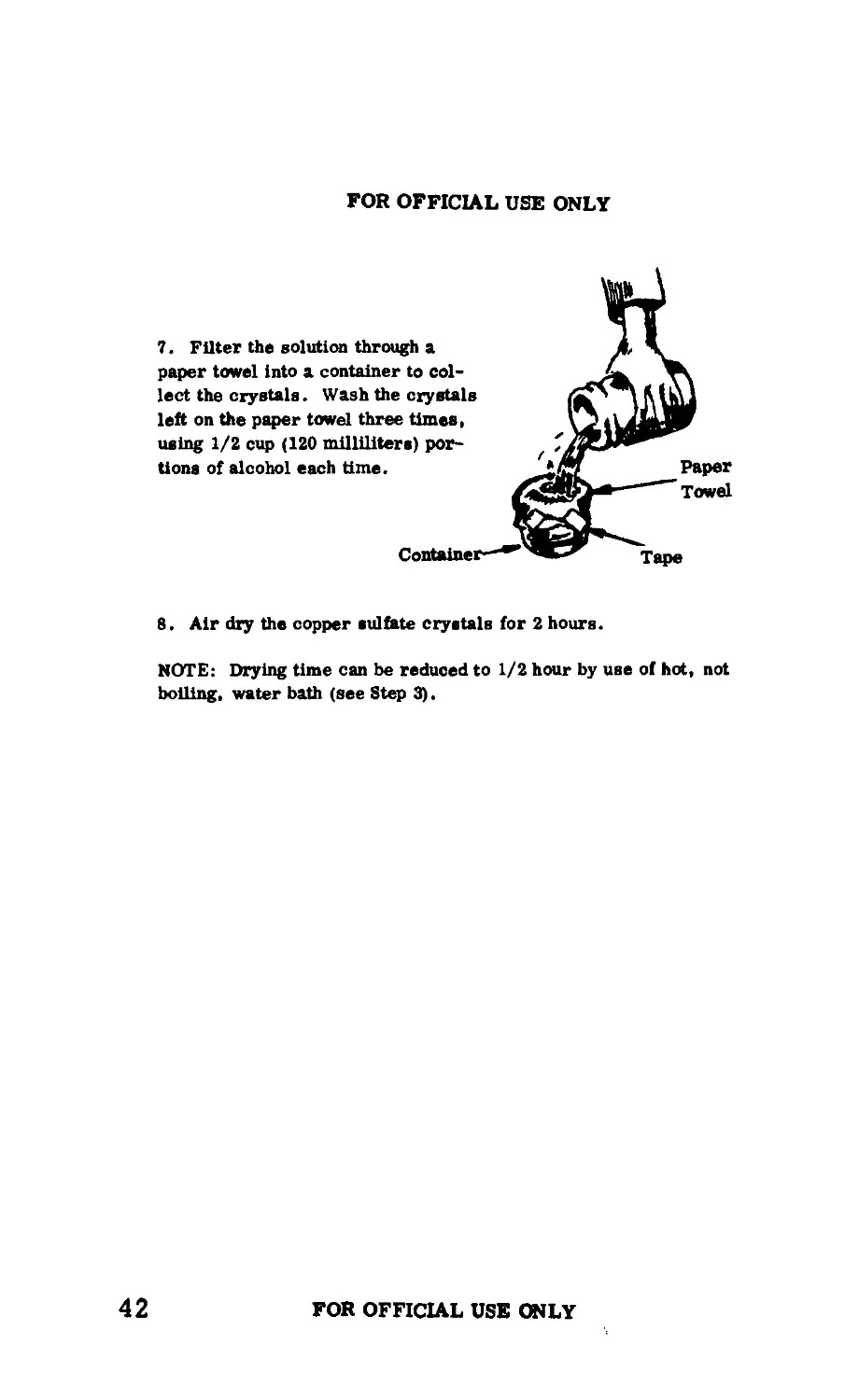
7.	Filter the solution through a
paper towel into a container to col-
lect the crystals. Wash the crystals
left on the paper towel three times,
using 1/2 cup (120 milliliters) por-
tions of alcohol each time.
Tape
Paper
Towel
Containei
8.	Air dry the copper sulfate crystals for 2 hours.
NOTE: Drying time can be reduced to 1/2 hour by use of hot, not
boiling, water bath (see Step 3).
42
FOR OFFICIAL USE ONLY
FOR OFFICIAL USE ONLY
Section I
No. 15
RECLAMATION OF RDX FROM C-4
RDX can be obtained from C-4 explosive with the use of gasoline.
It can be used as a booster explosive for detonators (Section VI, No. 13)
or as a high explosive charge.
MATERIAL REQUIRED:
Gasoline
C-4 explosive
2 pint glass jars, wide mouth
Paper towels
Stirring rod (glass or wood)
Water
Ceramic or glass dish
Pan
Heat Source
Teaspoon
Cup
Tape
Optional (RDX can be air dried instead)
PROCEDURE:
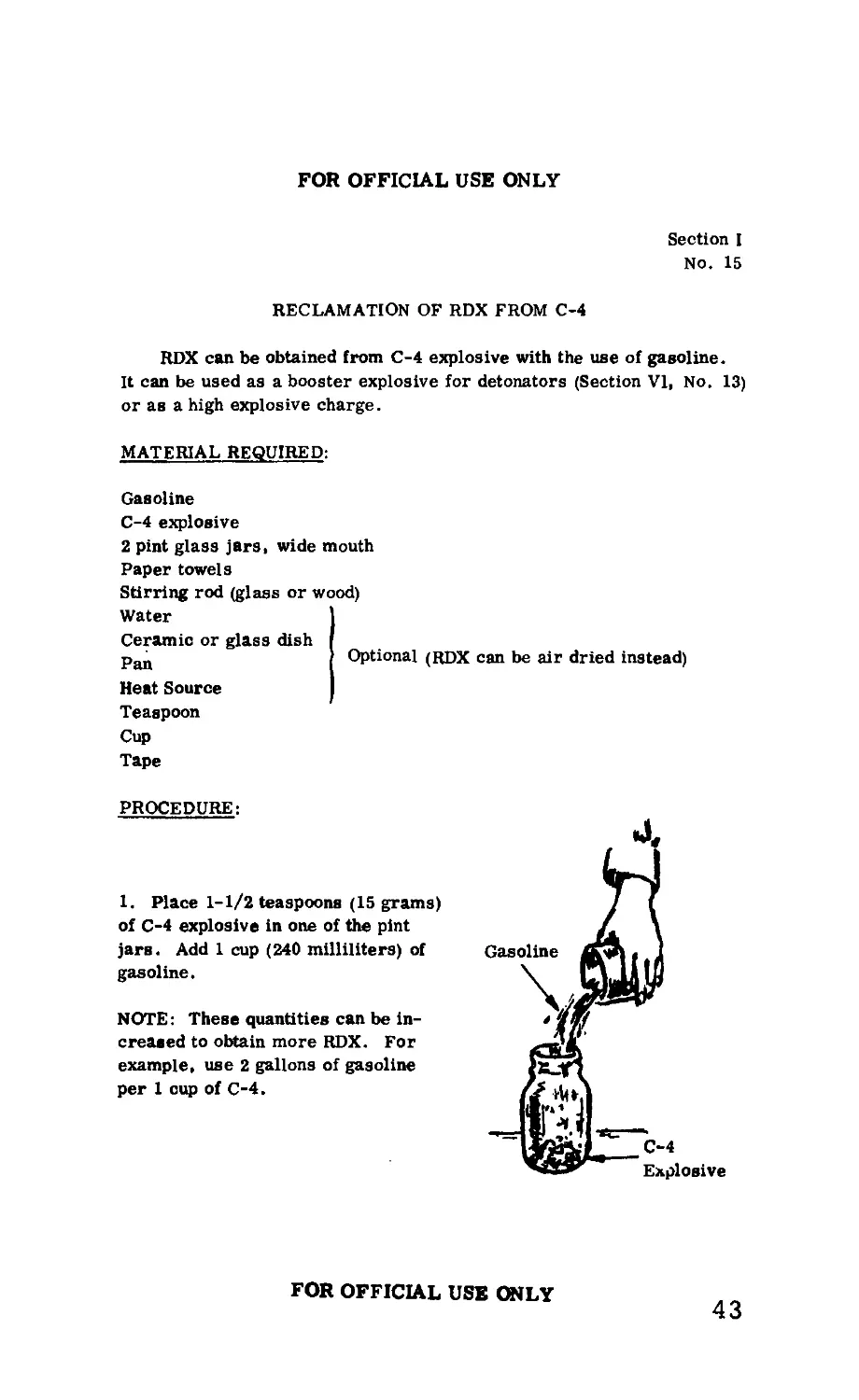
1.	Place 1-1/2 teaspoons (15 grams)
of C-4 explosive in one of the pint
jars. Add 1 cup (240 milliliters) of
gasoline.
NOTE: These quantities can be in-
creased to obtain more RDX. For
example, use 2 gallons of gasoline
per 1 cup of C-4.
FOR OFFICIAL USE ONLY
43
FOR OFFICIAL USE ONLY
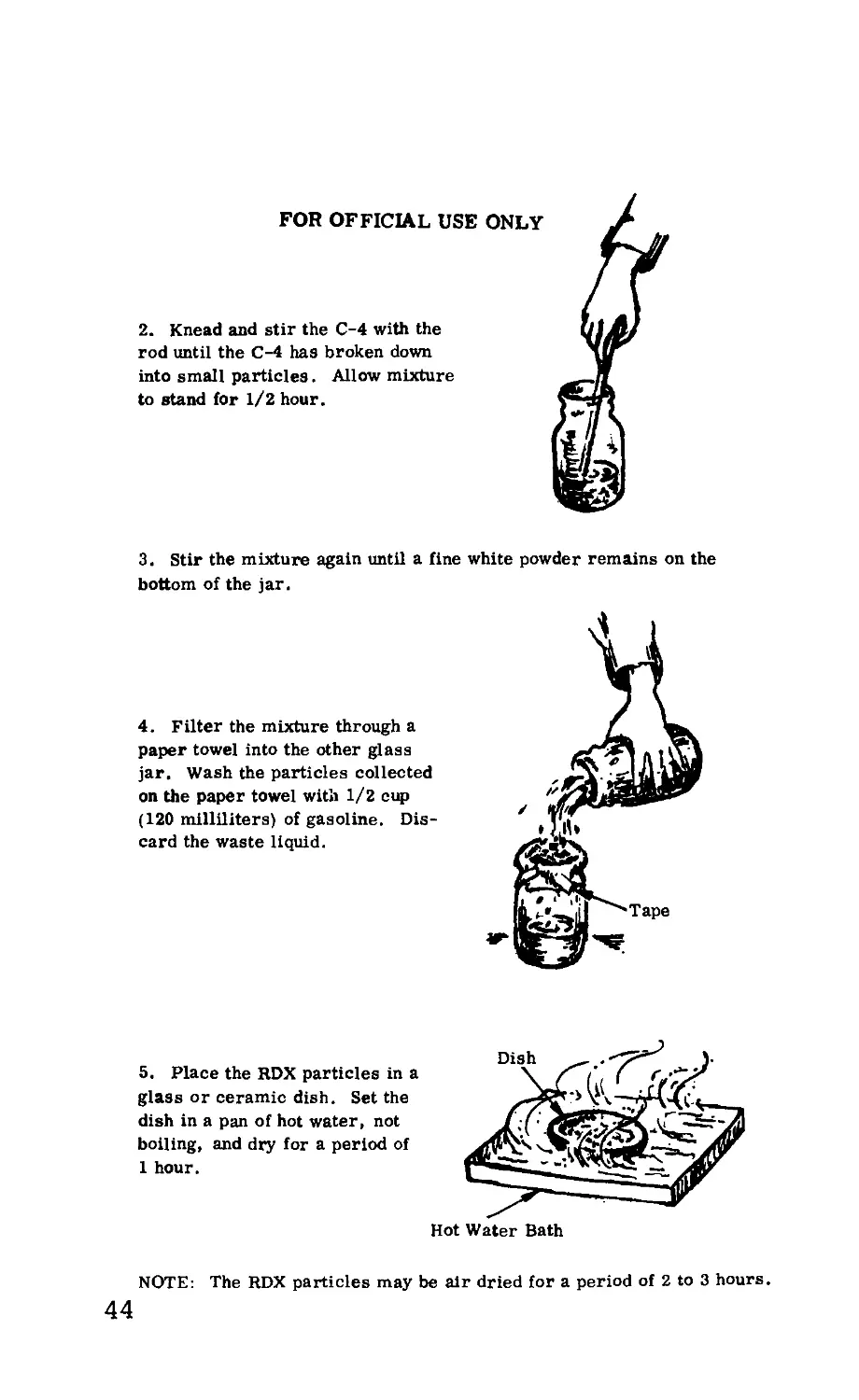
2.	Knead and stir the C-4 with the
rod until the C-4 has broken down
into small particles. Allow mixture
to stand for 1/2 hour.
3.	Stir the mixture again until a fine white powder remains on the
bottom of the jar.
4.	Filter the mixture through a
paper towel into the other glass
jar. Wash the particles collected
on the paper towel with 1/2 cup
(120 milliliters) of gasoline. Dis-
card the waste liquid.
5.	Place the RDX particles in a
glass or ceramic dish. Set the
dish in a pan of hot water, not
boiling, and dry for a period of
1 hour.
NOTE: The RDX particles may be air dried for a period of 2 to 3 hours.
44
Section I
No. 16
FOR OFFICIAL USE ONLY
TACC (TETRAMMINECOPPER (II) CHLORATE)
Tetramminecopper (II) chlorate is a primary explosive that can be
made from sodium chlorate, copper sulfate and ammonia. This ex-
plosive is to be used with a booster explosive such as picric acid
(Section I, No. 21) or RDX (Section I, No. 15) in the fabrication of
detonators (Section 6, No. 13)
MATERIAL REQUIRED:	SOURCES:
Sodium chlorate	Section I, No. 23 Medicine Weed killer, hardware store
Copper sulfate	Section I, No. 14 Insecticide, hardware store Water purifying agent
Ammonia hydroxide	Household ammonia Smelling salts
Alcohol, 95% pure Wax, clay, pitch, etc. Water Bottle, narrow mouth (wine or coke) Bottles, wide mouth (mason jars) Tubing (rubber, copper, steel) to fit narrow mouth bottle Teaspoon Improvised scale Heat source Paper towel Pan Tape Cup	Section VII, No. 8
PROCEDURE:
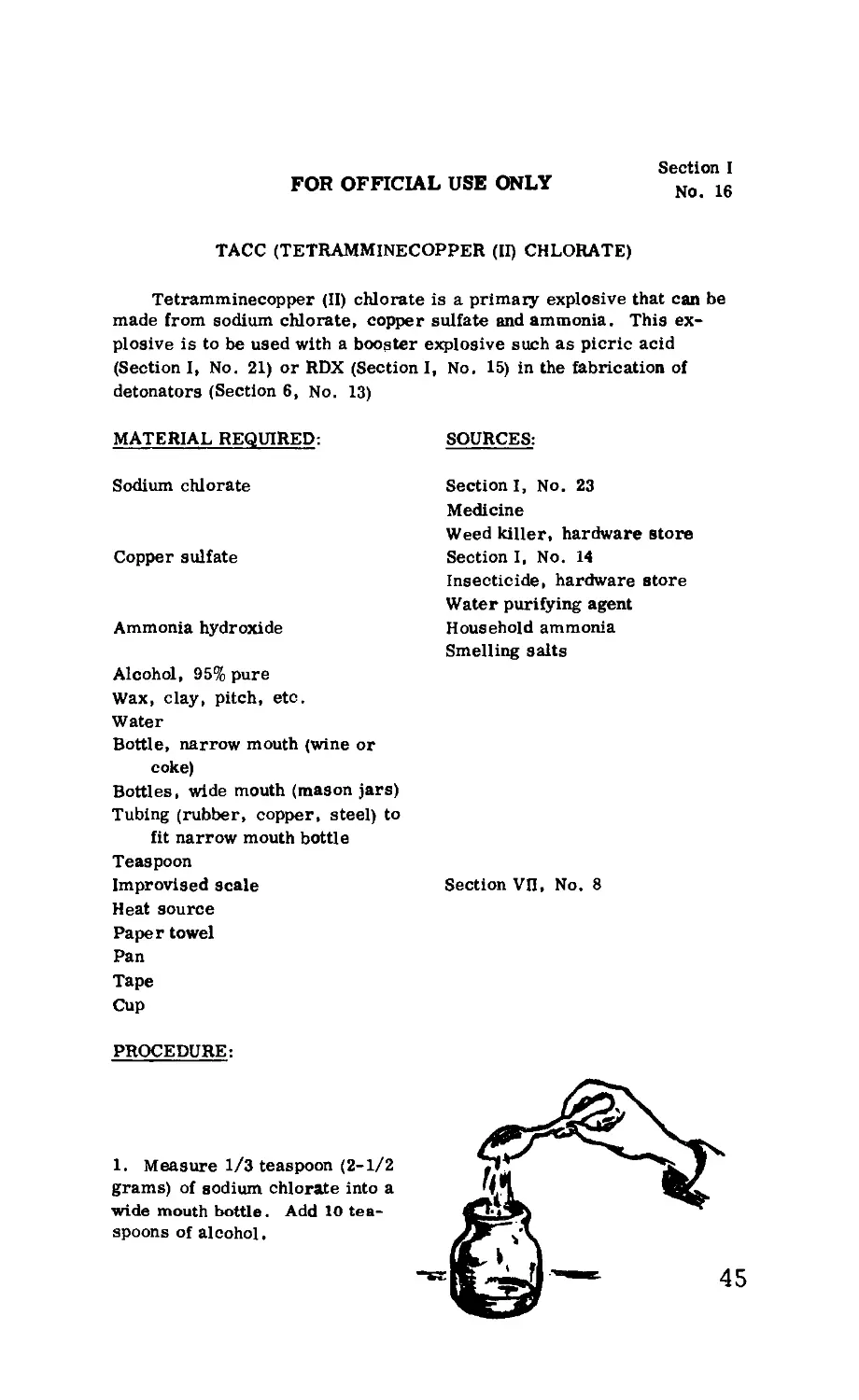
1.	Measure 1/3 teaspoon (2-1/2
grams) of sodium chlorate into a
wide mouth bottle. Add 10 tea-
spoons of alcohol.
45
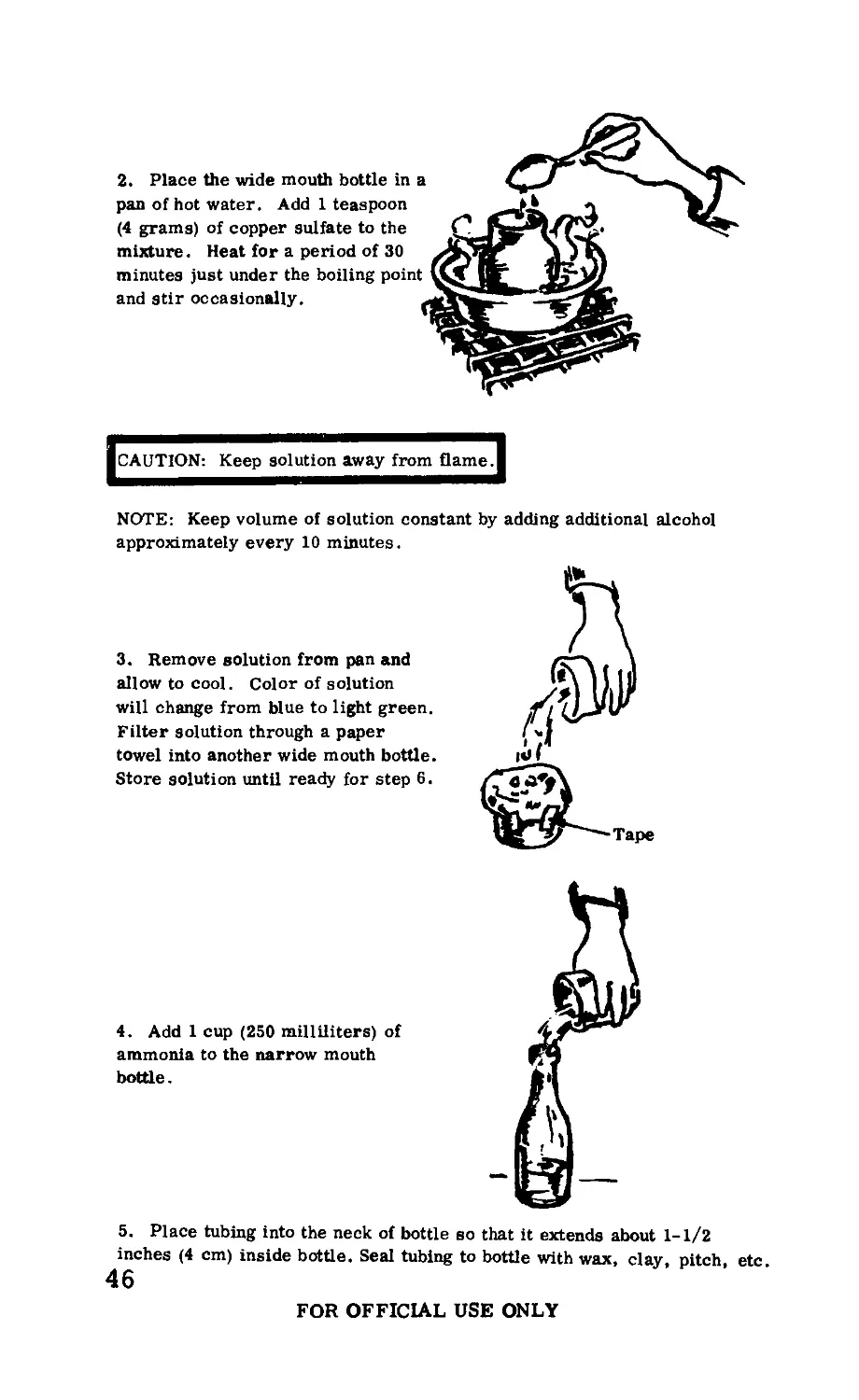
2.	Place the wide mouth bottle in a
pan of hot water. Add 1 teaspoon
(4 grams) of copper sulfate to the
mixture. Heat for a period of 30
minutes just under the boiling point
and stir occasionally.
JcAIJTION^Kee^^cdutio^M^^^ro^^am^
NOTE: Keep volume of solution constant by adding additional alcohol
approximately every 10 minutes.
3.	Remove solution from pan and
allow to cool. Color of solution
will change from blue to light green.
Filter solution through a paper
towel into another wide mouth bottle.
Store solution until ready for step 6.
4.	Add 1 cup (250 milliliters) of
ammonia to the narrow mouth
bottle.
5.	Place tubing into the neck of bottle so that it extends about 1-1/2
inches (4 cm) inside bottle. Seal tubing to bottle with wax, clay pitch etc
46
FOR OFFICIAL USE ONLY
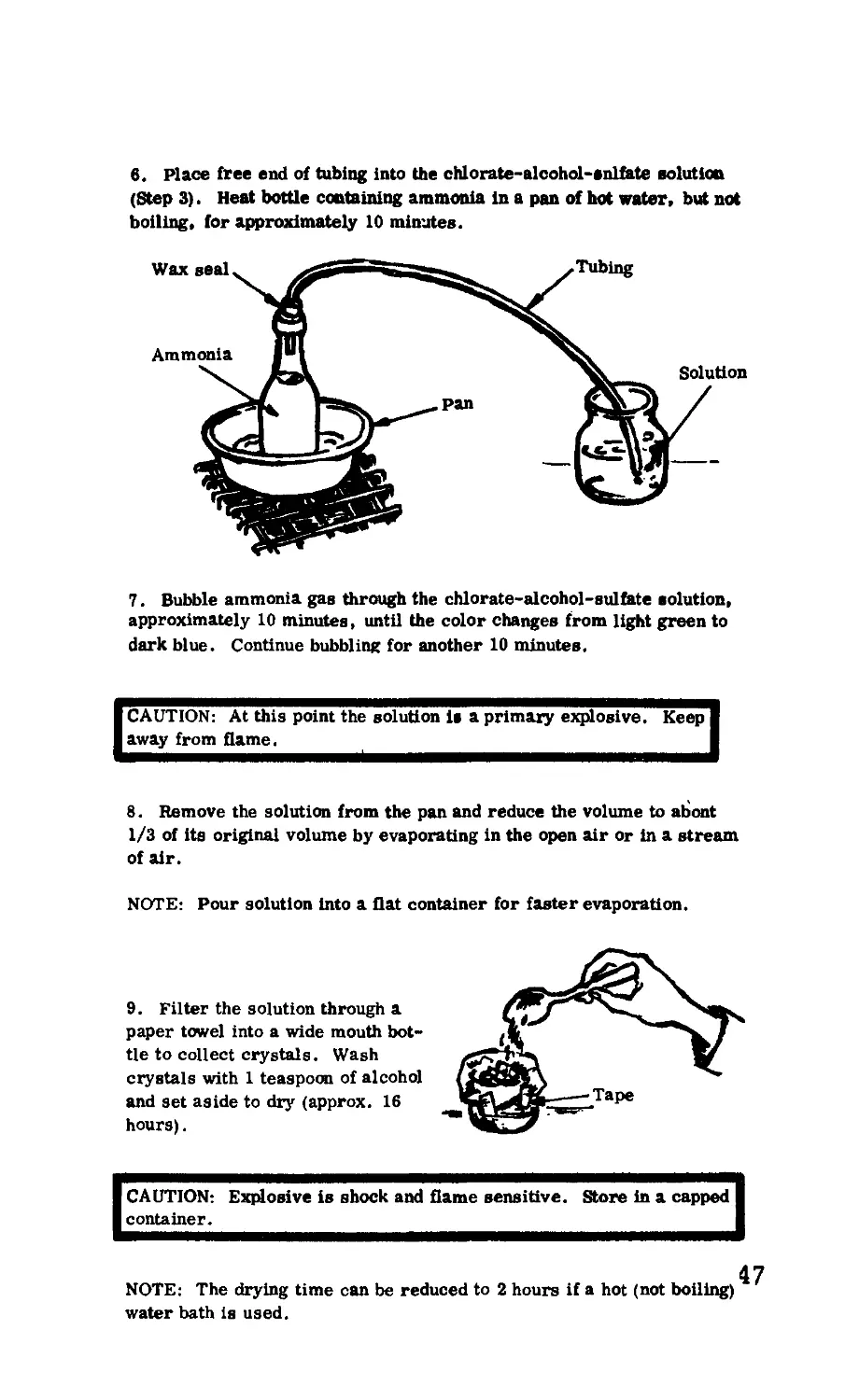
6.	Place free end of tubing into the chlorate-alcohol-snlfate solution
(Step 3). Heat bottle containing ammonia in a pan of hot water, but not
boiling, for approximately 10 minutes.
7.	Bubble ammonia gas through the chlorate-alcohol-sulfate solution,
approximately 10 minutes, until the color changes from light green to
dark blue. Continue bubbling for another 10 minutes.
I CAUTION: At this point the solution is a primary explosive. Keep
away from flame.
8.	Remove the solution from the pan and reduce the volume to abont
1/3 of its original volume by evaporating in the open air or in a stream
of air.
NOTE: Pour solution into a flat container for faster evaporation.
9.	Filter the solution through a
paper towel into a wide mouth bot-
tle to collect crystals. Wash
crystals with 1 teaspoon of alcohol
and set aside to dry (approx. 16
hours).
CAUTION: Explosive is shock and flame sensitive. Store in a capped
container.
47
NOTE: The drying time can be reduced to 2 hours if a hot (not boiling)
water bath is used.
FOR OFFICIAL USE ONLY
Section I
No. 17
HMTD
HMTD is a primary explosive that can be made from hexamethy-
lenetetramine, hydrogen peroxide and citric acid. This explosive is to
be used with a booster explosive such as picric acid (Section I, No. 21)
or RDX (Section I, No. 15) in the fabrication of detonators (Section 6,
No. 13).
MATERIAL REQUIRED:
Hexamethylenetetramine
Hydrogen peroxide
Citric acid
Containers, bottles or glasses
Paper towels
Teaspoon
Pan
Water
Tape
PROCEDURE:
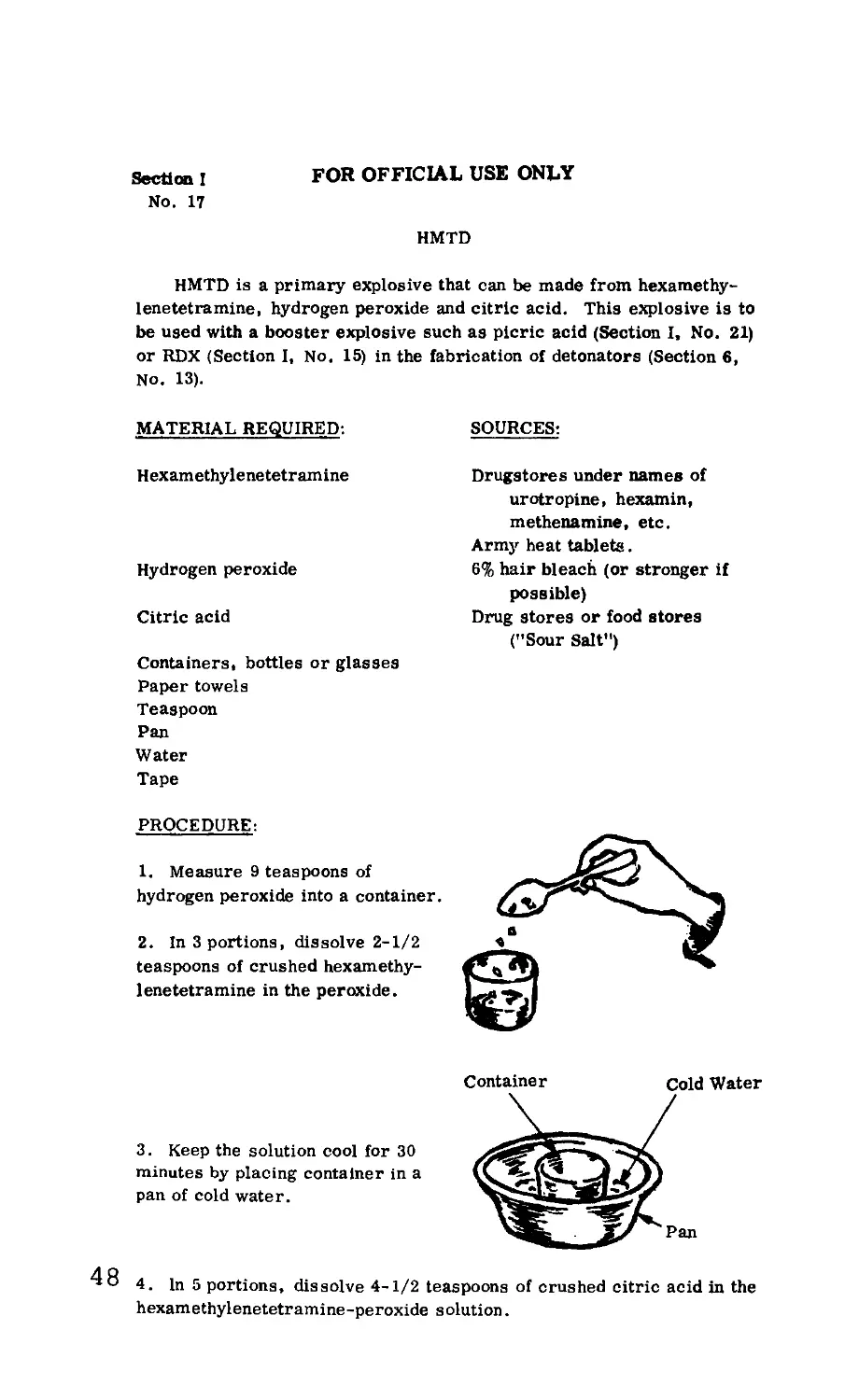
1. Measure 9 teaspoons of
hydrogen peroxide into a container.
2. In 3 portions, dissolve 2-1/2
teaspoons of crushed hexamethy-
lenetetramine in the peroxide.
SOURCES:
Drugstores under names of
urotropine, hexamin,
methenamine, etc.
Army heat tablets.
6% hair bleach (or stronger if
possible)
Drug stores or food stores
("Sour Salt")
3.	Keep the solution cool for 30
minutes by placing container in a
pan of cold water.
Container
Cold Water
4.	In 5 portions, dissolve 4-1/2 teaspoons of crushed citric acid in the
hexamethylenetetramine-peroxide solution.
48
FOR OFFICIAL USE ONLY
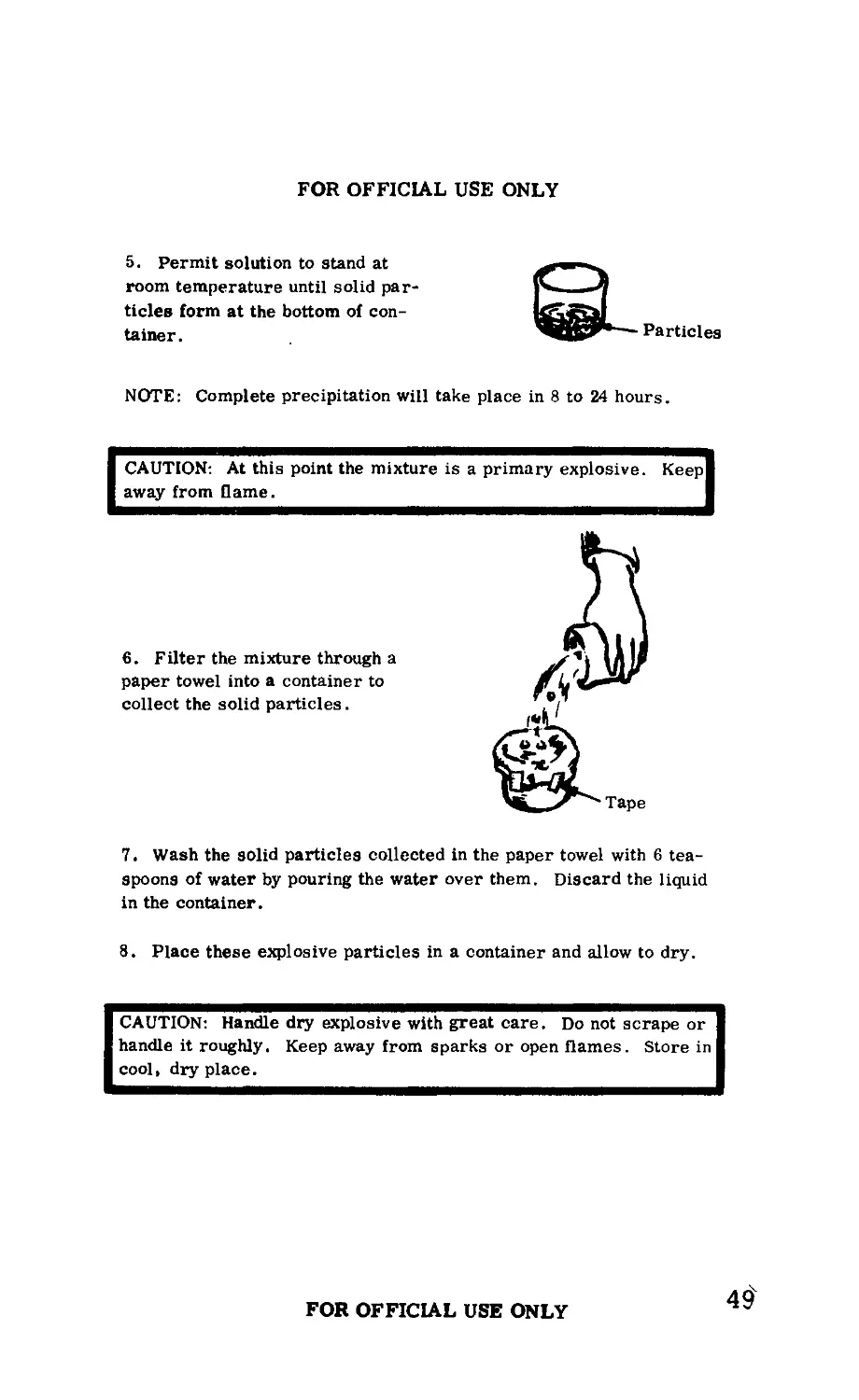
5.	Permit solution to stand at
room temperature until solid par-
ticles form at the bottom of con-
tainer.
Particles
NOTE: Complete precipitation will take place in 8 to 24 hours.
CAUTION: At this point the mixture is a primary explosive. Keep
away from flame.
6.	Filter the mixture through a
paper towel into a container to
collect the solid particles.
7.	Wash the solid particles collected in the paper towel with 6 tea-
spoons of water by pouring the water over them. Discard the liquid
in the container.
8.	Place these explosive particles in a container and allow to dry.
CAUTION: Handle dry explosive with great care. Do not scrape or
handle it roughly. Keep away from sparks or open flames. Store in
cool, dry place.
FOR OFFICIAL USE ONLY
49
Section I
No. 18
POTASSIUM OR SODIUM NITRITE AND LITHARGE (LEAD MONOXIDE)
Potassium or sodium nitrite is needed to prepare DDNP (Section I,
No. 19), and litharge is required for the preparation of lead picrate
(Section I, No. 20).
MATERIAL REQUIRED:
Lead metal (small pieces or chips)
Potassium (or sodium) nitrate
Methyl (wood) alcohol
Iron pipe with end cap
Iron rod or screwdriver
Paper towels
2 glass Jara, wide mouth
Metal pan
Heat source (hot coals or blow
torch)
Improvised scale (Section VH,' No. 8)
Cup
Water
Pan
PROCEDURE:
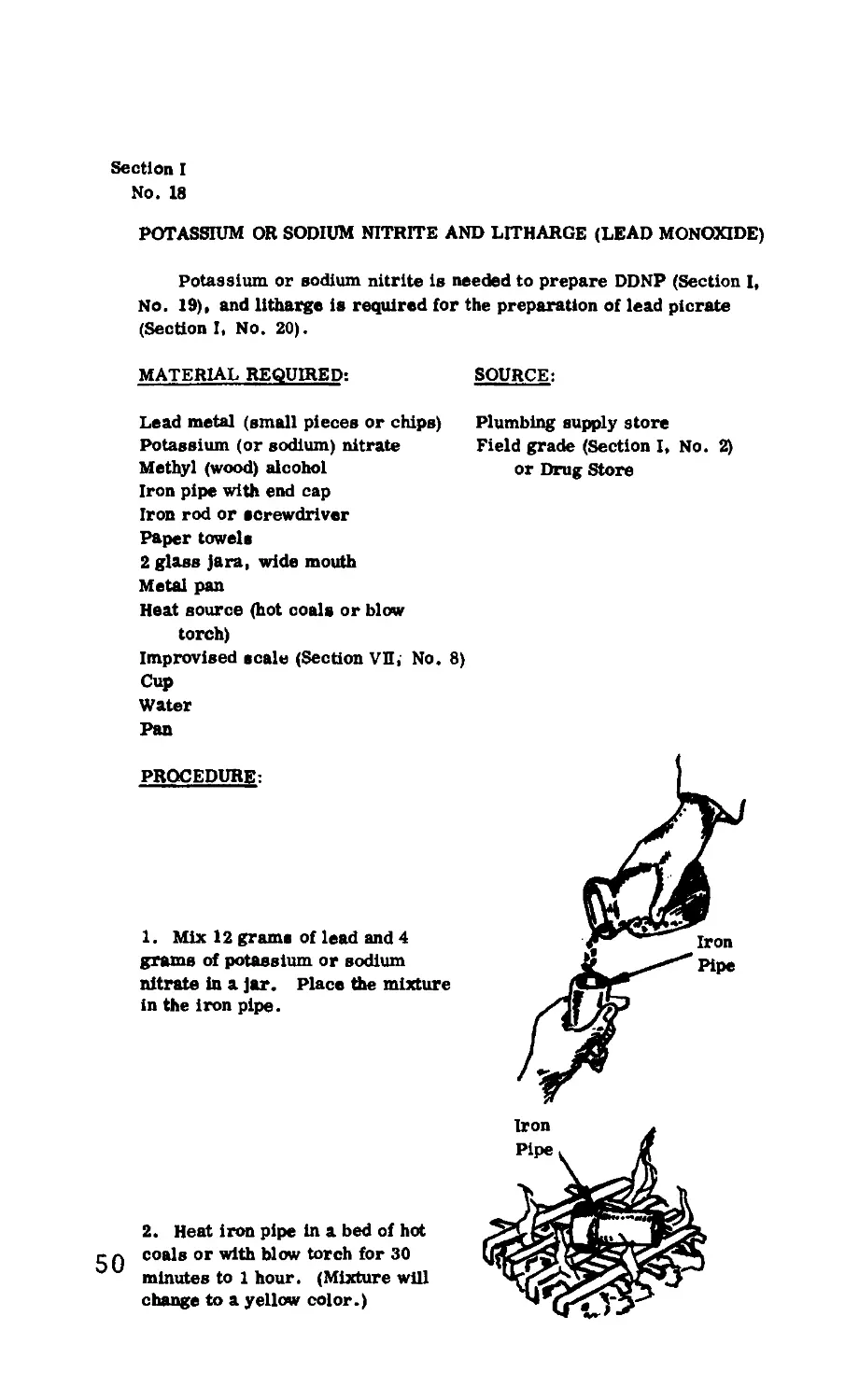
1.	Mix 12 grams of lead and 4
grams of potassium or sodium
nitrate in a jar. Place Hie mixture
in the iron pipe.
2.	Heat iron pipe in a bed of hot
5 q coals or with blow torch for 30
minutes to 1 hour. (Mixture will
change to a yellow color.)
SOURCE:
Plumbing supply store
Field grade (Section I, No. 2)
or Drug Store
FOR OFFICIAL USE ONLY
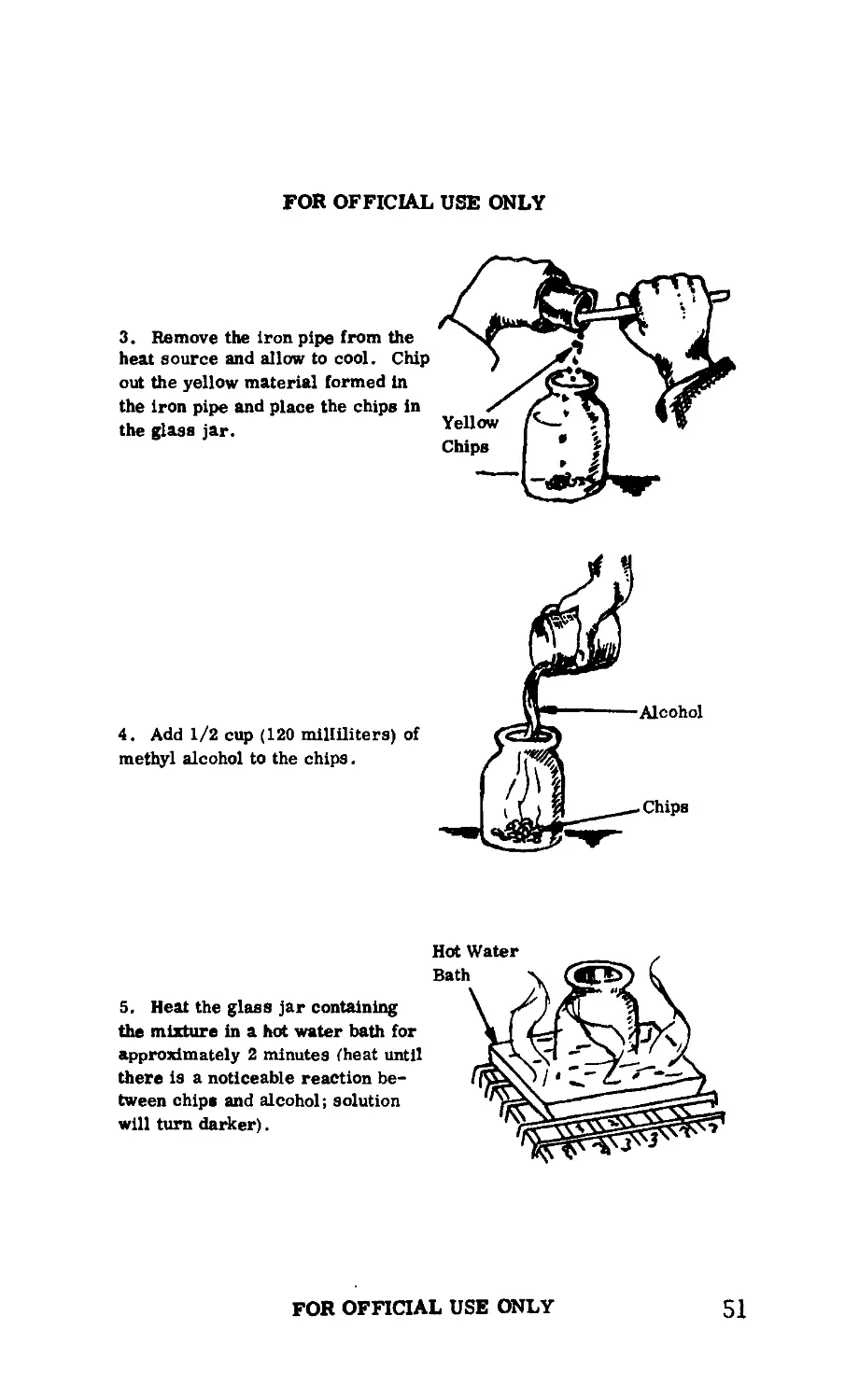
3.	Remove the iron pipe from the
heat source and allow to cool. Chip
out the yellow material formed in
the iron pipe and place the chips in
the glass jar.
4.	Add 1/2 cup (120 milliliters) of
methyl alcohol to the chips.
5.	Heat the glass jar containing
the mixture in a hot water bath for
approximately 2 minutes (heat until
there is a noticeable reaction be-
tween chips and alcohol; solution
will turn darker).
FOR OFFICIAL USE ONLY
51
FOR OFFICIAL USE ONLY
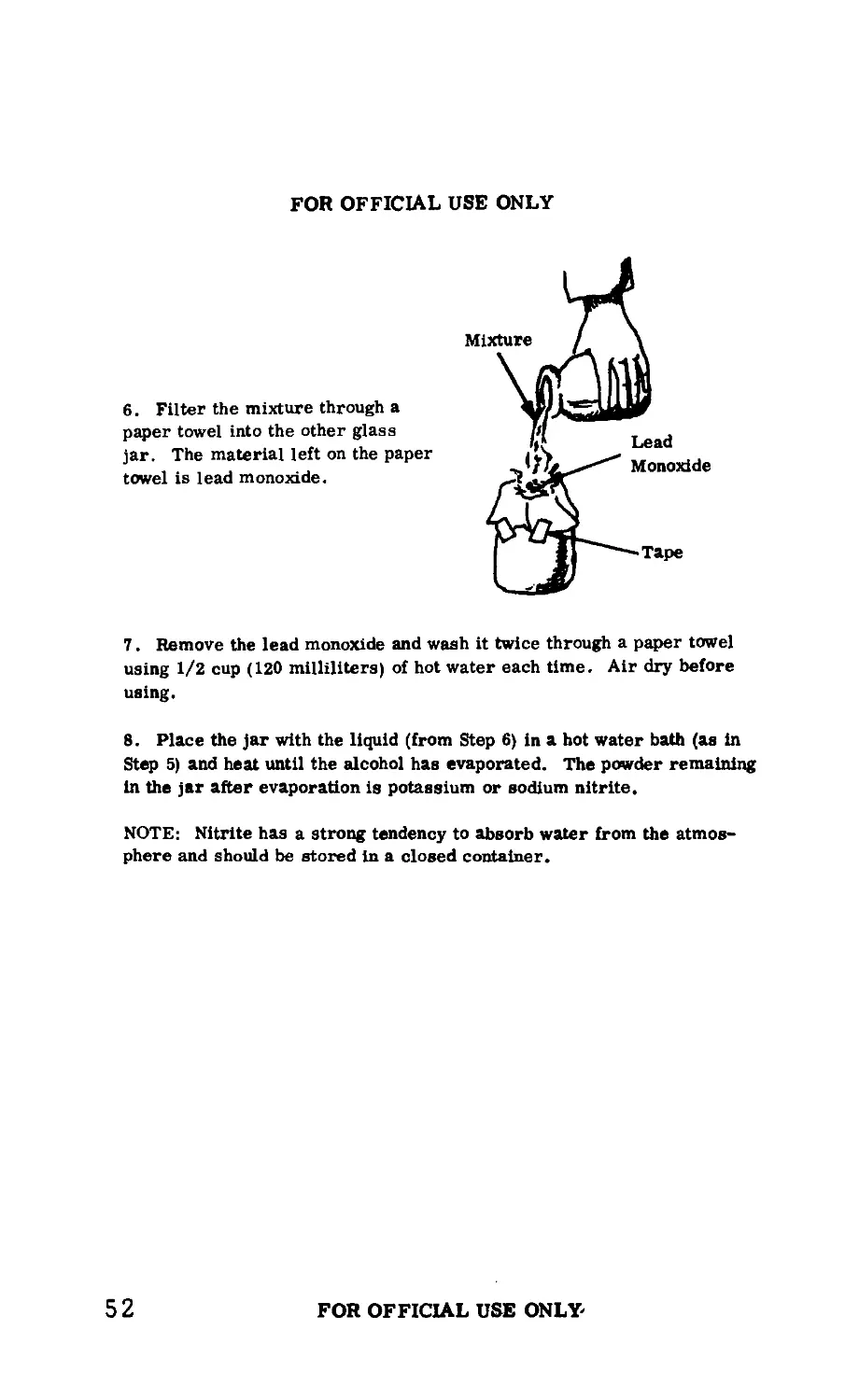
6.	Filter the mixture through a
paper towel into the other glass
jar. The material left on the paper
towel is lead monoxide.
7.	Remove the lead monoxide and wash it twice through a paper towel
using 1/2 cup (120 milliliters) of hot water each time. Air dry before
using.
8.	Place the jar with the liquid (from Step 6) in a hot water bath (as in
Step 5) and heat until the alcohol has evaporated. The powder remaining
in the jar after evaporation is potassium or sodium nitrite.
NOTE: Nitrite has a strong tendency to absorb water from the atmos-
phere and should be stored in a closed container.
52
FOR OFFICIAL USE ONLY
FOR OFFICIAL USE ONLY
Section 1
No. 19
DDNP
DDNP is a primary explosive used in the fabrication of detonators
(Section VI, No. 13). It is to be used with a booster explosive such as
picric acid (Section I, No. 21) or RDX (Section I, No. 15).
MATERIAL REQUIRED:	SOURCES:
Picric acid
Flowers of sulfur
Lye (sodium hydroxide)
Sulfuric acid, diluted
Potassium or sodium nitrite
Water
2 glass cups, heat resistant,
(Pyrex)
Stirring rod (glass or wood)
Improvised scale
Paper towels
Teaspoon
Tablespoon
Eyedropper
Heat source
Containers
Tape
PROCEDURE:
Section 1, No. 21
Motor vehicle batteries
Section I, No. 18
Section VII, No. 8
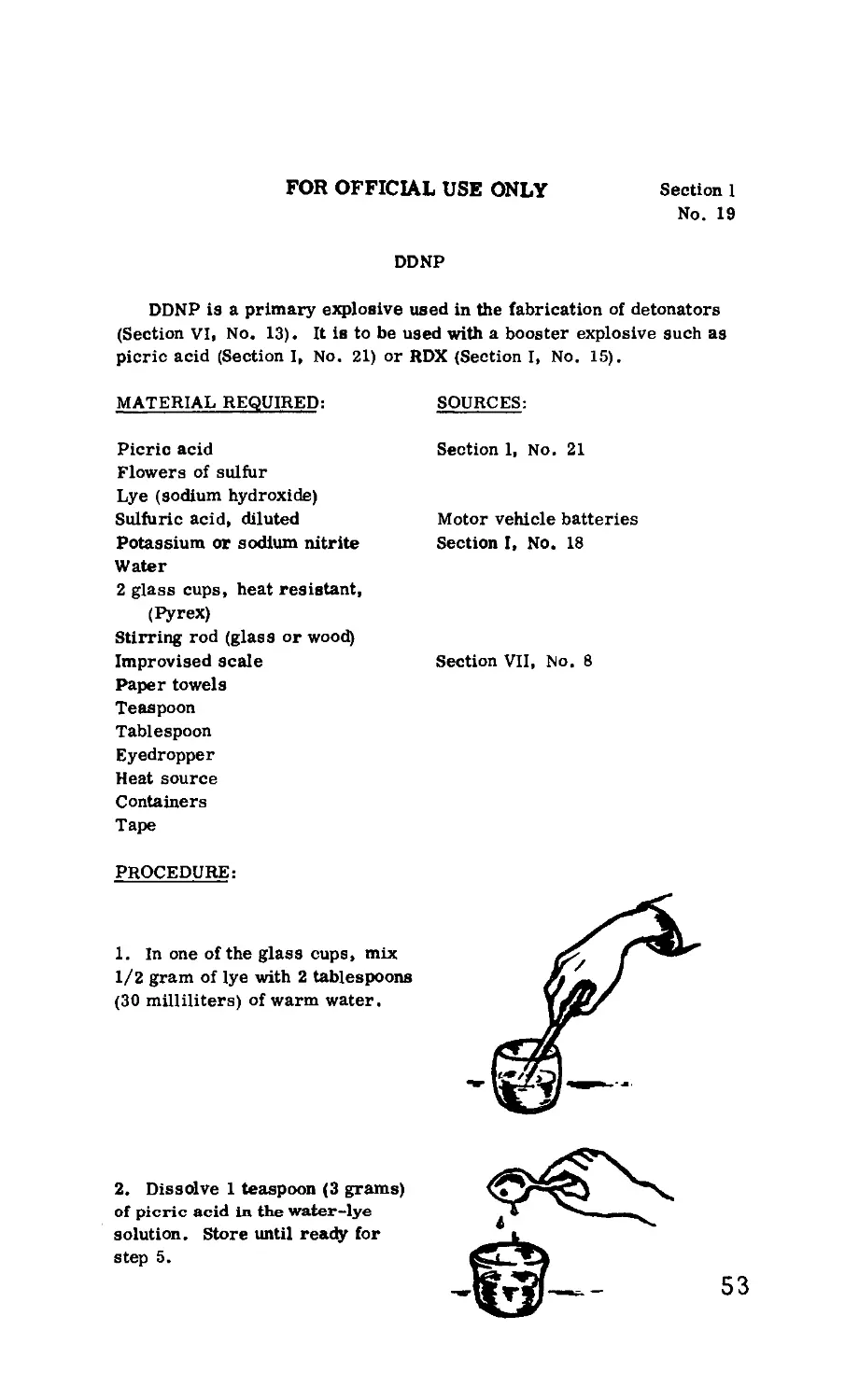
1.	In one of the glass cups, mix
1/2 gram of lye with 2 tablespoons
(30 milliliters) of warm water.
2.	Dissolve 1 teaspoon (3 grams)
of picric acid in the water-lye
solution. Store until ready for
step 5.
53
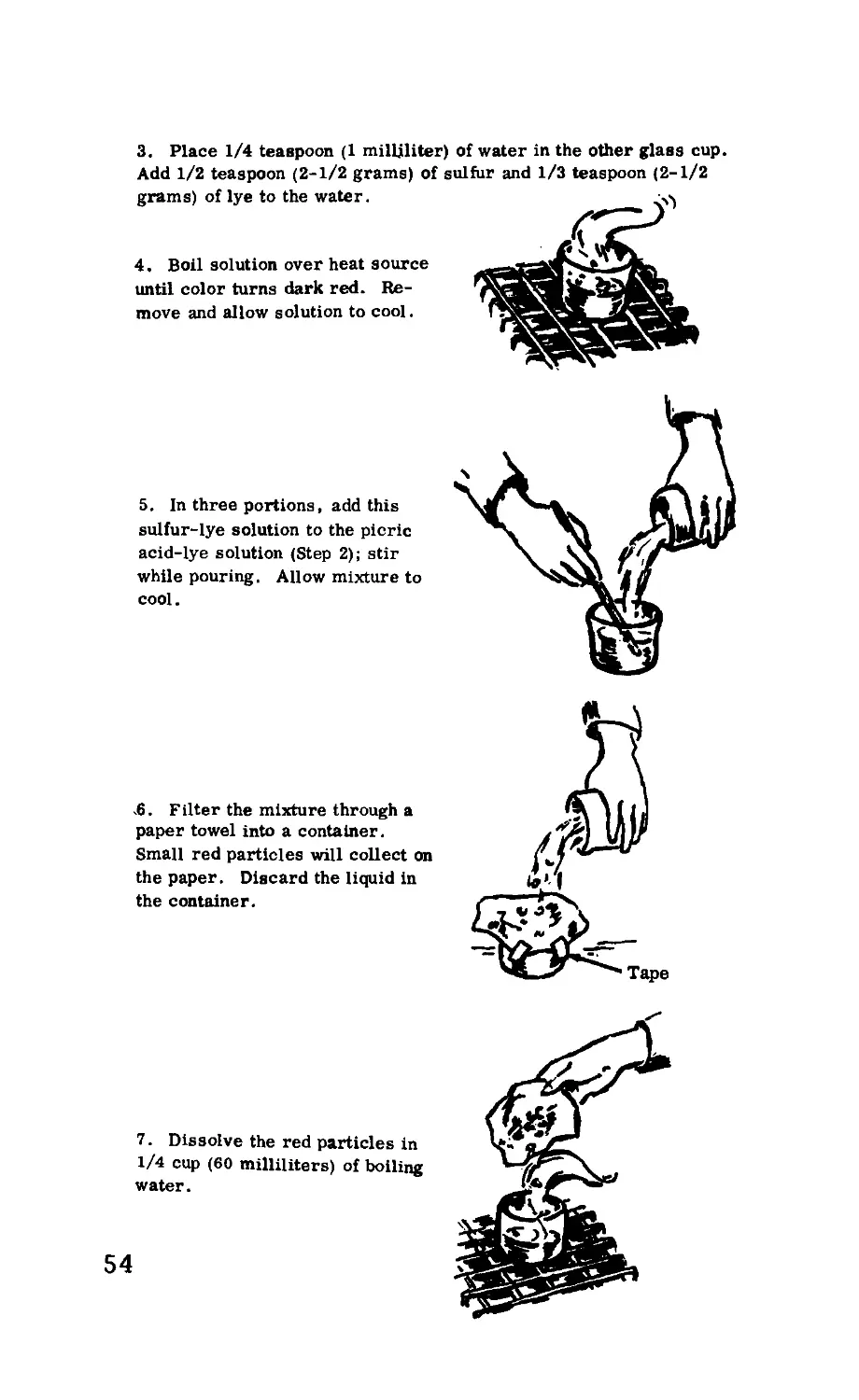
3.	Place 1/4 teaspoon (1 milliliter) of water in the other glass cup.
Add 1/2 teaspoon (2-1/2 grams) of sulfur and 1/3 teaspoon (2-1/2
grams) of lye to the water.
4.	Boil solution over heat source
until color turns dark red. Re-
move and allow solution to cool.
5.	In three portions, add this
sulfur-lye solution to the picric
acid-lye solution (Step 2); stir
while pouring. Allow mixture to
cool.
6.	Filter the mixture through a
paper towel into a container.
Small red particles will collect on
the paper. Discard the liquid in
the container.
7.	Dissolve the red particles in
1/4 cup (60 milliliters) of boiling
water.
54
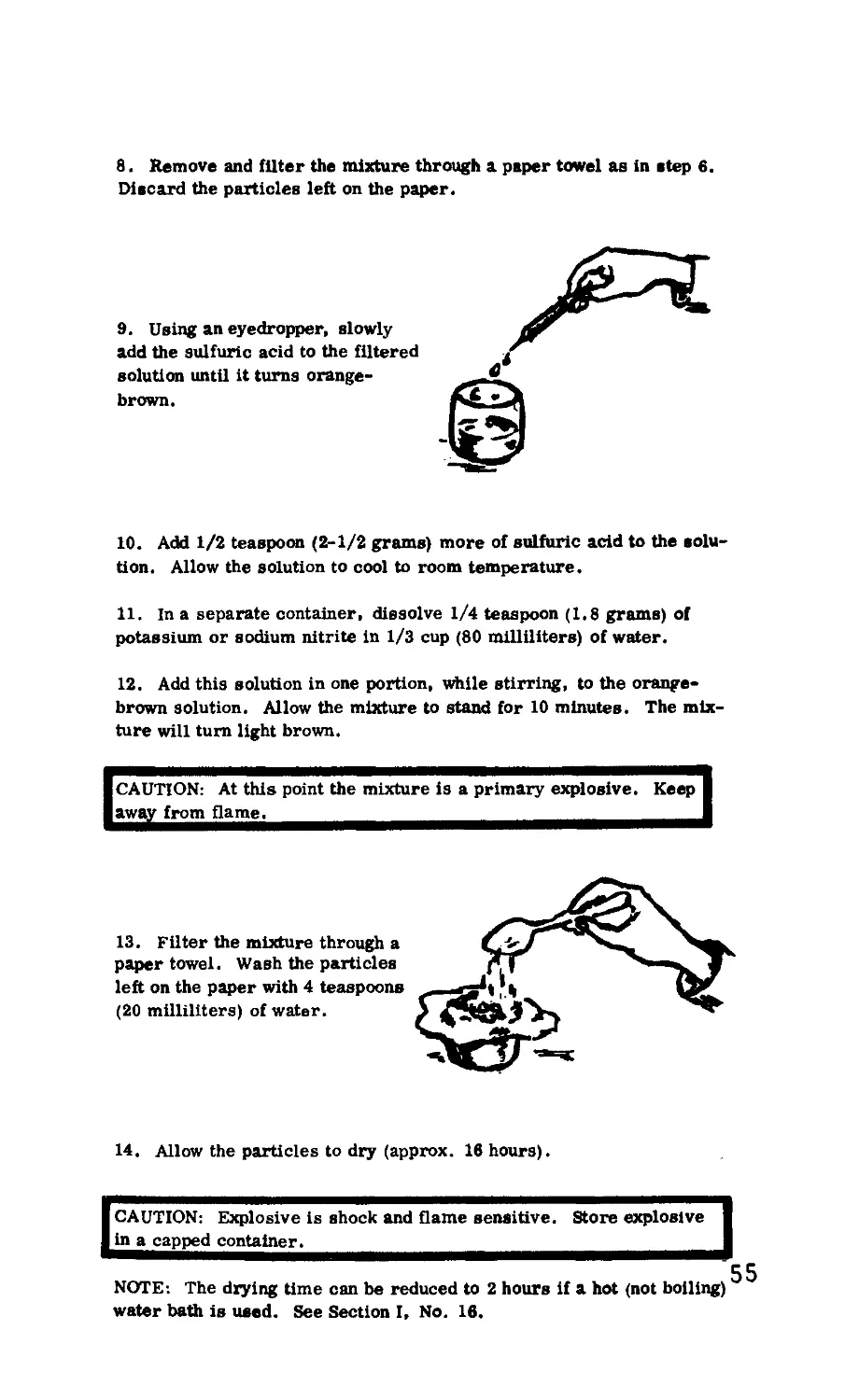
8.	Remove and filter the mixture through a paper towel as in step 6.
Discard the particles left on the paper.
9.	Using an eyedropper, slowly
add the sulfuric acid to the filtered
solution until it turns orange-
brown.
10.	Add 1/2 teaspoon (2-1/2 grams) more of sulfuric acid to the solu-
tion. Allow the solution to cool to room temperature.
11.	In a separate container, dissolve 1/4 teaspoon (1.8 grams) of
potassium or sodium nitrite in 1/3 cup (80 milliliters) of water.
12.	Add this solution in one portion, while stirring, to the orange-
brown solution. Allow the mixture to stand for 10 minutes. The mix-
ture will turn light brown.
I CAUTION: At this point the mixture is a primary explosive. Keep
13.	Filter the mixture through a
paper towel. Wash the particles
left on the paper with 4 teaspoons
(20 milliliters) of water.
14.	Allow the particles to dry (approx. 16 hours).
CAUTION: Explosive is shock and flame sensitive. Store explosive
in a capped container.
55
NOTE: The drying time can be reduced to 2 hours if a hot (not boiling)
water bath is used. See Section I, No. 16.
Section I
No. 20
FOR OFFICIAL USE ONLY
PREPARATION OF LEAD PICRATE
Lead picrate is used as a primary explosive in the fabrication of
detonators (Section VI, No. 13). It is to be used with a booster explo-
sive such as picric acid (Section I, No. 21) or RDX (Section!, No. 15).
MATERIAL REQUIRED:
Litharge (lead monoxide)
Picric Acid
Wood alcohol (methanol)
Wooden or plastic rod
Dish or saucer (china or glass)
Teaspoon
Improvised Scale
Containers
Flat pan
Heat source (optional)
Water (optional)
PROCEDURE:
SOURCE:
Section I, No. 18 or plumbing
supplies
Section I, No. 21
Paint removers; some antifreezes
Section VII, No. 8
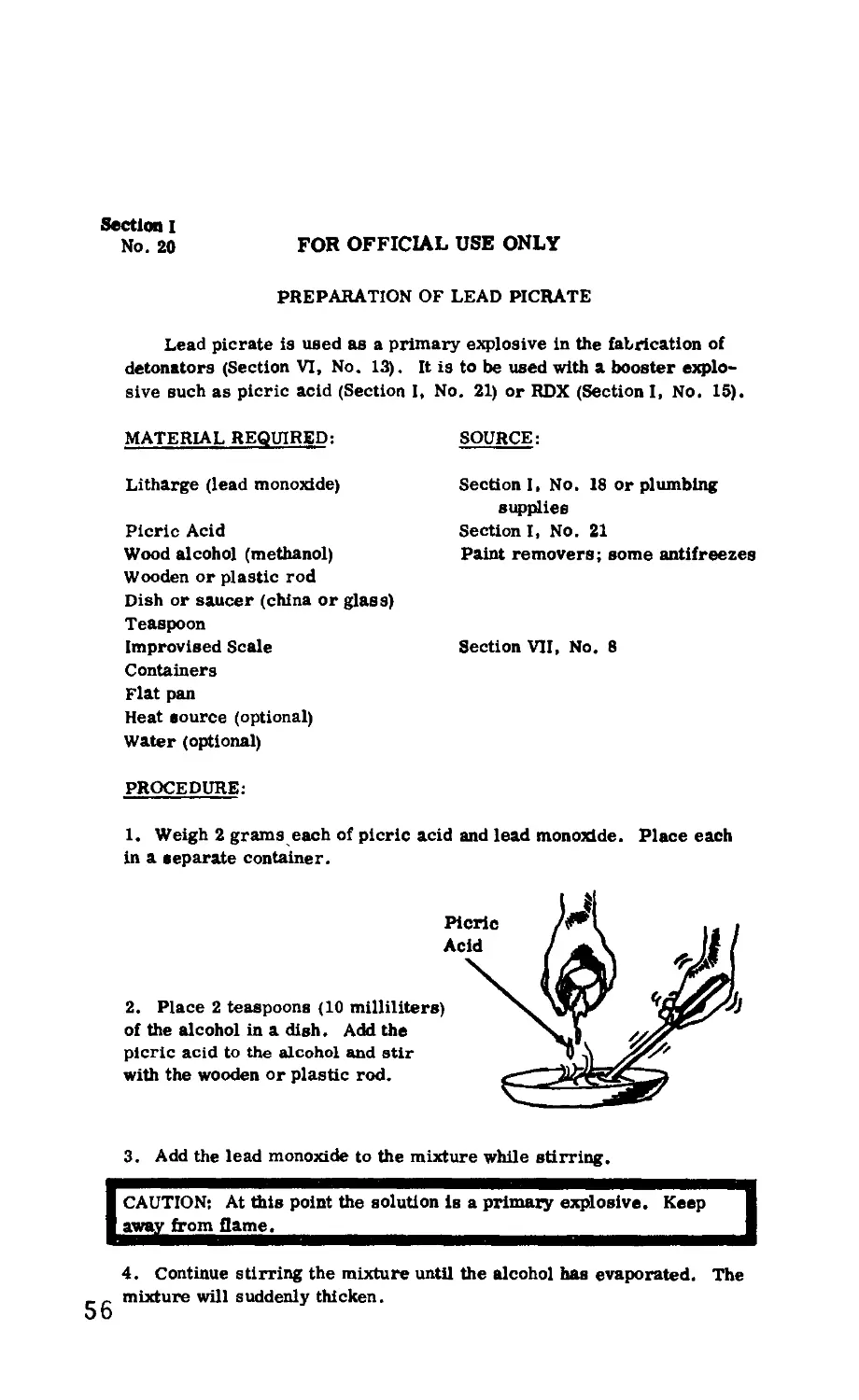
1.	Weigh 2 grams each of picric acid and lead monoxide. Place each
in a separate container.
2.	Place 2 teaspoons (10 milliliters)
of the alcohol in a dish. Add the
picric acid to the alcohol and stir
with the wooden or plastic rod.
Picric
Acid
3.	Add the lead monoxide to the mixture while stirring.
CAUTION: At this point the solution Is a primary explosive. Keep 1
away from flame,I
4.	Continue stirring the mixture until the alcohol has evaporated. The
_ _ mixture will suddenly thicken.
56
FOR OFFICIAL USE ONLY
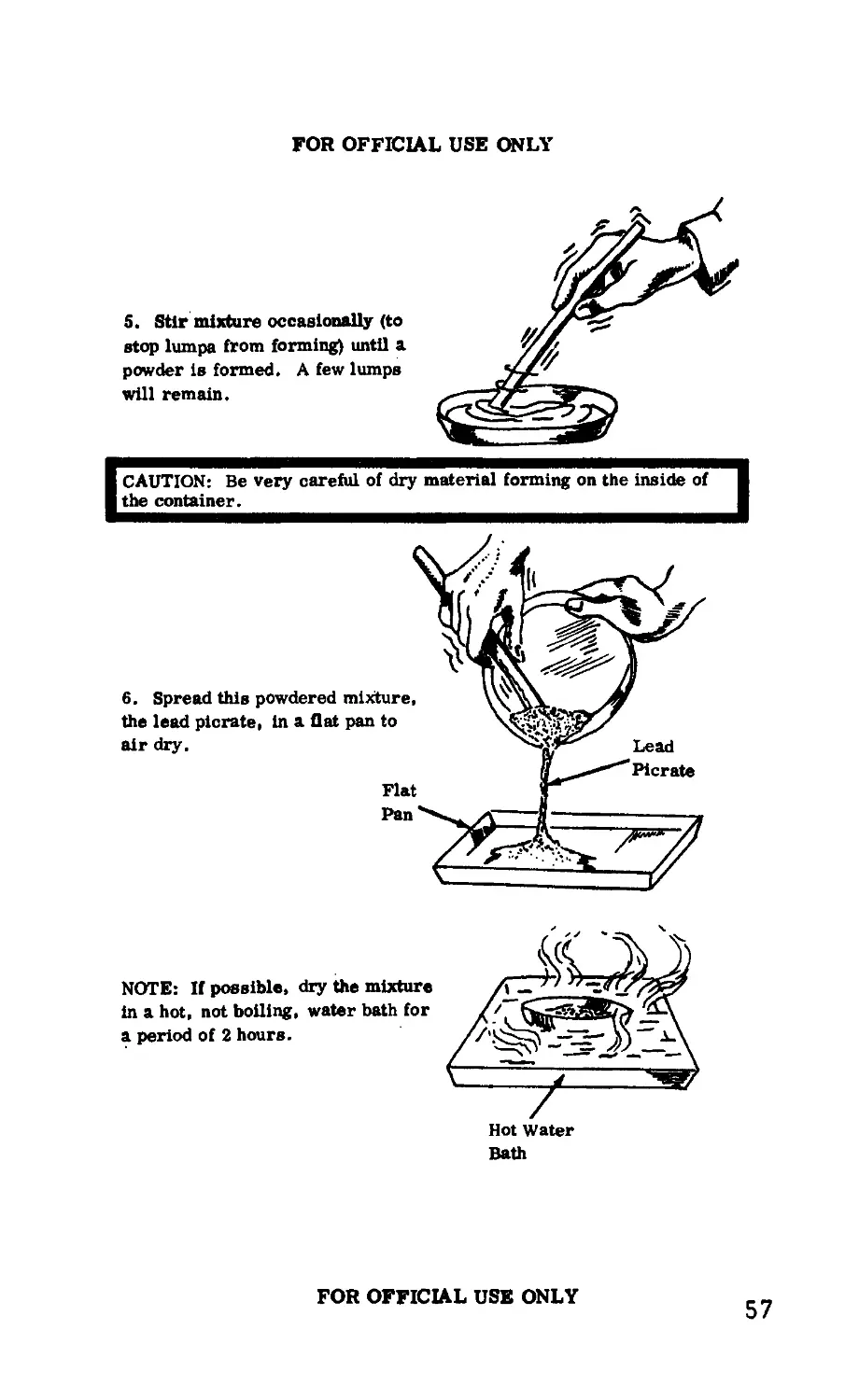
5. Stir mixture occasionally (to
stop lumpa from forming) until a
powder is formed. A few lumps
will remain.
CAUTION: Be very careful of dry material forming on the inside of
the container.
NOTE: If possible, dry the mixture
in a hot, not boiling, water bath for
a period of 2 hours.
Hot Water
Bath
FOR OFFICIAL USE ONLY
57
Section i
No. 21
PREPARATION OF PICRIC ACID FROM ASPIRIN
Picric acid can be used as a booster explosive in detonators (Sec-
tion VI, No. 13), a high explosive charge, or as an intermediate to
preparing lead picrate (Section I, No. 20) or DDNP (Section I, No. 19).
MATERIAL REQUIRED:
Aspirin tablets (5 grains per tablet)
Alcohol, 95% pure
Sulfuric acid, concentrated, (battery
acid - boil until white fumes
appear)
Potassium Nitrate (Section I, No. 2)
Water
Paper towels
Canning jar, 1 pint
Rod (glass or wood)
Class containers
Ceramic or glass dish
Cup
Teaspoon
Tablespoon
Pan
Heat Source
Tape
PROCEDURE:
1.	Crush 20 aspirin tablets in a
glass container. Add 1 teaspoon
of water and work into a paste.
58
FOR OFFICIAL USE ONLY
FOR OFFICIAL USE ONLY
2.	Add approximately 1/3 to 1/2
cup of alcohol (100 milliters) to the
aspirin paste; stir while pouring.
3.	Filter the alcohol-aspirin
solution through a paper towel into
another glass container. Discard
the solid left on the paper towel.
Paste
4.	Pour the filtered solution into a ceramic or glass dish.
S.	Evaporate the alcohol and water
from the solution by placing the dish
into a pan of hot water. White powder
will remain in the dish after evapo-
ration.
Dish
Hot Water
Bath
NOTE: Water in pan should be at hot bath temperature, not boiling,
approximately 160° to 180° F. It should not burn the hands.
FOR OFFICIAL USE ONLY
6.	Pour 1/3 cup (80 milliliters) of
concentrated sulfuric acid into a
canning jar. Add the white powder
to the sulfuric acid.
Hot Water
Bath
7.	Heat canning jar of sulfuric acid
in a pan of simmering hot water
bath for 15 minutes; then remove
jar from the bath. Solution will
turn to a yellow-orange color.
8.	Add 3 level teaspoons (15 grama)
of potassium nitrate in three portions
to the yellow-orange solution; stir
vigorously during additions. Solution
will turn red, and then back to a
yellow-orange color.
9.	Allow the solution to cool to ambient or room temperature while
stirring occasionally.
60
FOR OFFICIAL USE ONLY
FOR OFFICIAL USE ONLY
10.	Slowly pour the solution, while
stirring, into 1-1/4 cup (300 milli-
liters) of cold water and allow to
cool.
11.	Filter the solution through a paper towel into a glass container.
Light yellow particles will collect on the paper towel.
12.	Wash the light yellow particles
with 2 tablespoons (25 milliliters)
of water. Discard the waste liquid
in the container.
13.	Place particles in ceramic dish and set in a hot water bath, as in
step 5, for 2 hours.
FOR OFFICIAL USE ONLY
61
DOUBLE SALTS
Double Salts is used as a primary explosive in the fabrication of
detonators (Section VI, No. 13). It can be made in the field from silver
(coins), nitric acid, calcium carbide, and water.
MATERIALS REQUIRED:
Nitric acid (90% cone.) (Section I, No. 4)
Silver metal (silver coin, about 5/8 in diameter)
Calcium carbide (acetylene or calcium carbide lamps)
Rubber and glass tubing (approx. 1/4 in. inside diameter)
Paper towels
Heat-resistant bottles or ceramic jugs, 1 to 2 quart
capacity, and one cork to fit. (Punch hole in cork
to fit tubing.)
Teaspoon (aluminum, stainless steel or wax-coated) or equivalent
measure
Glass container
Heat source
Long narrow jar (olive jar)
Tape
Water
Alcohol
PROCEDURE:
1.	Dilute 2-1/4 teaspoons of nitric
acid with 1-1/2 teaspoons of water
in a glass container by adding the
acid to the water.
2.	Dissolve a silver coin (a silver dime) in the diluted nitric acid. The
solution will turn to a green color.
NOTE: It may be necessary to warm the container to completely
dissolve the silver coin.
62
FOR OFFICIAL USE ONLY
FOR OFFICIAL USE ONLY
CAUTION: Acid will burn skin and destroy clothing. If any is spilled,
wash It away with a large quantity of water. Do not inhale fumes.
3.	Pour solution into a long narrow
(olive) jar and place it in a bottle of
hot water. Crystals will form in.
the solution; heat until crystals dis-
solve.
Hot
Water
4.	While still heating and after crystals have dissolved, place 10 tea-
spoons of calcium carbide in another glass'bottle and add 1 teaspoon of
water. After the reaction has started add another teaspoon of water.
Then set up as shown.
Rubber
Water
"K. "Bubble acetylene through the solution for 5 to 8 minutes. A brown
vapor will be given off and white flakes will appear in the silver solution.
6. Remove the silver solution from
the heat source and allow it to cool.
Filter the solution through a paper
towel into a glass container. Green
crystals will collect on the paper.
Paper
Towel
63
7. Wash the solids collected on the
paper towel with 12 teaspoons of
alcohol. The solid material will
turn white while the solvent in the
container will have a green color.
White
Solids
Green
Solvent

8. Place the white solid material on a clean paper towel to air dry.
CAUTION: Handle dry explosive with great care. Do not scrape or
handle it roughly. Keep away from sparks or open flames. Store in
cool, dry place.
64
FOR OFFICIAL USE ONLY
Section I
No. 23
SODIUM CHLORATE
Sodium chlorate is a strong oxidizer used in the manufacture of
explosives. It can be used in place of potassium chlorate (see Section I,
No. 1).
MATERIAL REQUIRED:
SOURCES:
2 carbon or lead rods (1 in.
diameter x 5 in. long)
Salt or, ocean water
Sulfuric acid, diluted
Motor vehicle
Water
2 wires, 16 gauge (3/64 in.
diameter approx.), 6 ft. long,
insulated
Gasoline
1 gallon glass jar, wide mouth
(6 in. diameter x 6 in. high
approx.)
Sticks
String
Teaspoon
Trays
Cup
Heavy cloth
Knife
Large flat pan or tray
PROCEDURE:
Dry cell batteries (2-1/2 in.
diameter x 7 in. long) or
plumbing supply store
Grooery store or ocean
Motor vehicle batteries
1. Mix 1/2 oup of salt into Hie
one gallon glass jar with 3 liters
(3 quarts) of water.
FOR OFFICIAL USE ONLY
3.	Strip about 4 inches of insulation
from both ends of the 2 wires.
4.	With knife and sticks shape 2
strips of wood 1 x 1/8 x 1-1/2. Tie
the wood strips to the lead or carbon
rods so that they are 1-1/2 inches
apart.
5.	Connect the rods to the battery in a motor vehicle with the insulated
wire.
Battery
FOR OFFICIAL USE ONLY
6.	Submerge 4-1/2 in. of the rods
into the salt water solution.
7.	With gear in neutral position, start the vehicle engine. Depress the
accelerator approximately 1/5 of its full travel.
8.	Run the engine with the accelerator in this position for 2 hours; then,
shut it down 2 hours.
9.	Repeat this cycle for a total of 64 hours while maintaining the level
of the acid-salt water solution in the glass jar.
CAUTION: This arrangement employs voltages which may be dangerous
to personnel. Do not touch bare wire leads while engine is running.
10.	Shut off the engine. Remove the rods from the glass jar and dis-
connect wire leads from the battery.
12. Allow the water in the filtered solution to evaporate at room tem-
perature (approx. 16 hours). The residue is approximately 60% or
more sodium chlorate which is pure enough to be used as an explosive
ingredient.
Section I
No. 24
MERCURY FULMINATE
Mercury Fulminate is used as a primary explosive in the fabrica-
tion of detonators (Section VI, No. 13). It is to be used with a booster
explosive such as picric acid (Section I, No. 21) or RDX (Section I,
No. 15).
MATERIAL REQUIRED:	SOURCE:
Nitric Acid, 90% cone. (1.48 sp. gr.) Mercury	Field grade (Section I, No. 4) or industrial metal processors Thermometers, mercury switches, old radio tubes
Ethyl (grain) alcohol (90%) Filtering material Teaspoon measure (1/4, 1/2, and	Paper towels
1 teaspoon capacity) - aluminum,
stainless steel or wax-coated
Heat source
Clean wooden stick
Clean water
Glass containers
Tape
Syringe
PROCEDURE:
1.	Dilute 5 teaspoons of nitric acid with 2-1/2 teaspoons of clean
water in a glass container by adding the acid to the water.
2.	Dissolve 1/8 teaspoon of
mercury in the diluted nitric acid.
This will yield dark red fumes.
NOTE: It may be necessary to add water, one drop at a time, to the
mercury-acid solution in order to start reaction.
68
FOR OFFICIAL USE ONLY
(CAUTION: Acid will burn skin and destroy clothing. If any is spilled,
wash it away with a large quantity of water. Do not inhale fumes,
3.	Warm 10 teaspoons of the alcohol
in a container until the alcohol feels
warm to the inside of the wrist.
4.	Pour the metal-acid solution in-
to the warm alcohol. Reaction should
start in less than 5 minutes. Dense
white fumes will be given off during
reaction. As time lapses, the fumes
will become less dense. Allow 10
to 15 minutes to complete reaction.
Fulminate will settle to bottom.
CAUTION: This reaction generates large quantities of toxic, flammable
fumes. The process must be conducted outdoors or in a well ventilated
area, away from sparks or open flames. Do not inhale fumes.
Solution
5.	Filter the solution through a
paper towel into a container. Crys-
tals may stick to the side of the con-
tainer. If so, tilt and squirt water
down the sides of the container until
all the material collects on the filter
paper.
Crystals
Paper
Towel
69
Tape
FOR OFFICIAL USE ONLY
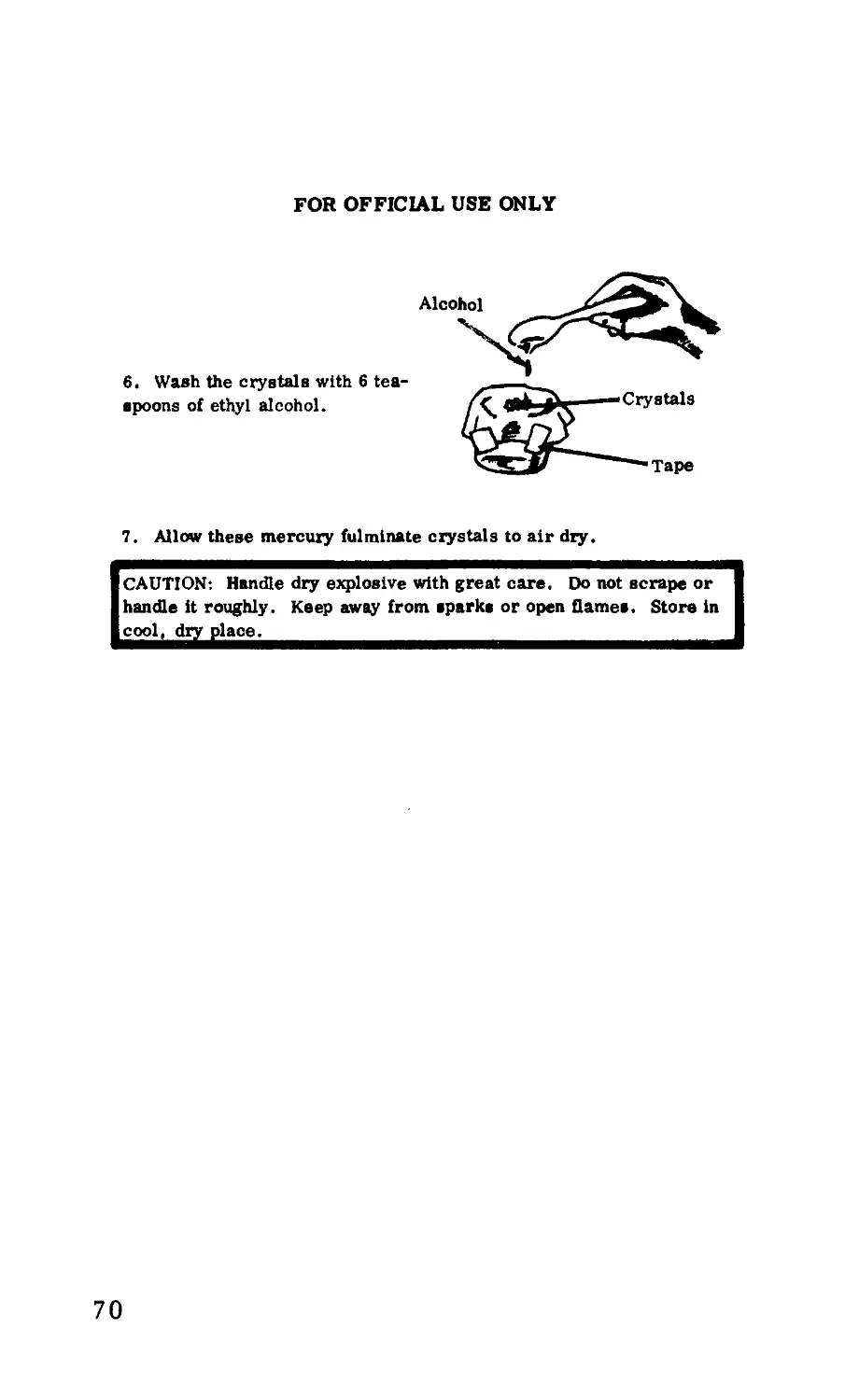
Alcohol
6.	Wash the crystals with 6 tea-
spoons of ethyl alcohol.
Crystals
7.	Allow these mercury fulminate crystals to air dry.
CAUTION: Handle dry explosive with great care. Do not scrape or
handle it roughly. Keep away from sparks or open flames. Store in
cool, dry place.
70
FOR OFFICIAL USE ONLY
Section i
No. 2S
SODIUM CHLORATE AND SUGAR OR ALUMINUM EXPLOSIVE
An explosive munition can be made from sodium chlorate combined
with granular sugar, or aluminum powder. This explosive can be
detonated with a No. 8 commercial or a Military J-2 blasting cap.
MATERIAL REQUIRED:
SOURCE:
Sodium chlorate
Granular sugar
Aluminum powder
Wooden rod or stick
Section I, No. 23
Food store
Paint store
Bottle or jar
Blasting cap
Steel pipe (threaded at one end), end cap
and tape
Wax
Measuring container (cup, quart, etc.)
PROCEDURE:
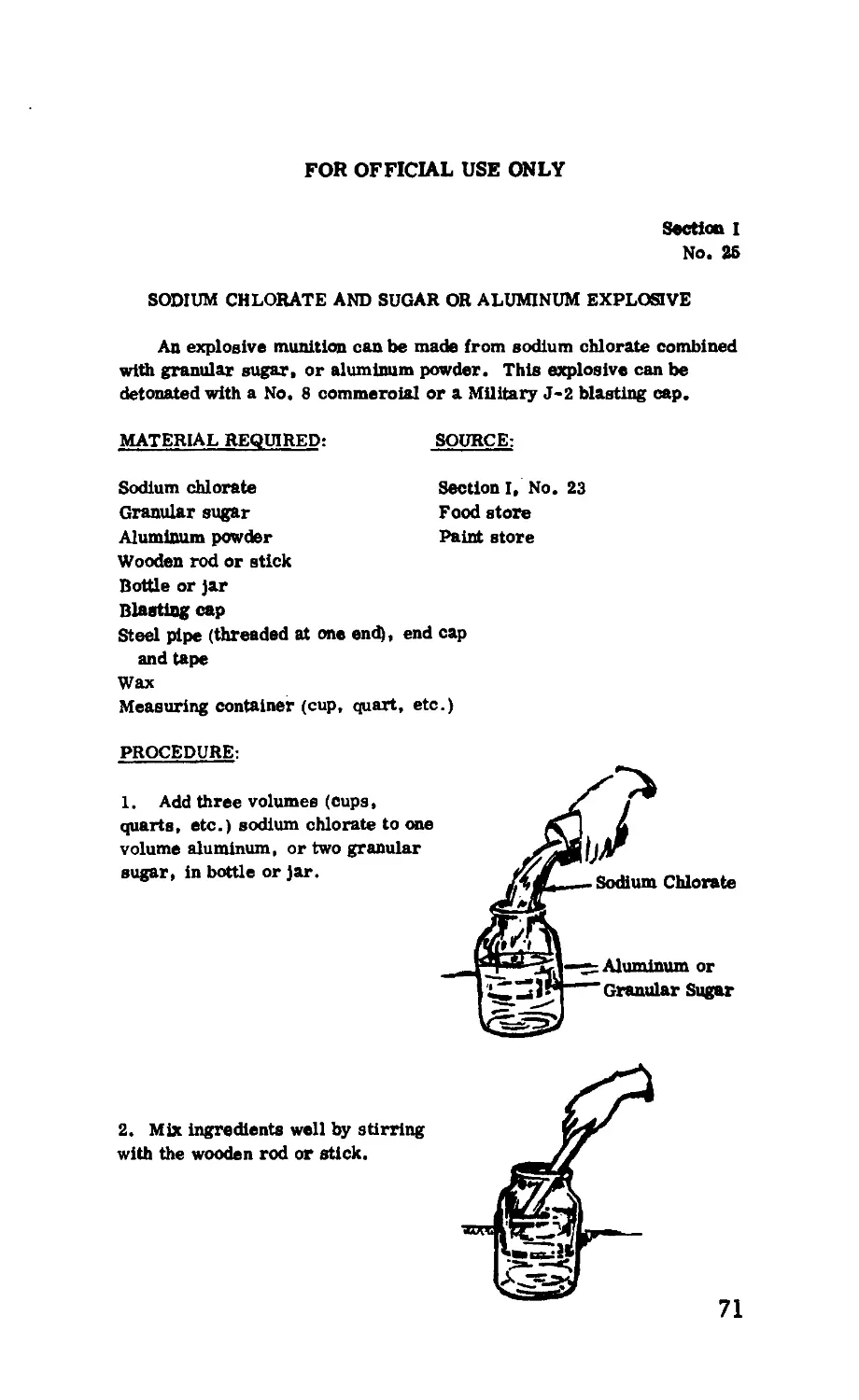
1. Add three volumes (cups,
quarts, etc.) sodium chlorate to one
volume aluminum, or two granular
sugar, in bottle or jar.
2. Mix ingredients well by stirring
with the wooden rod or stick.
71
FOR OFFICIAL USE ONLY
HOW TO USE:
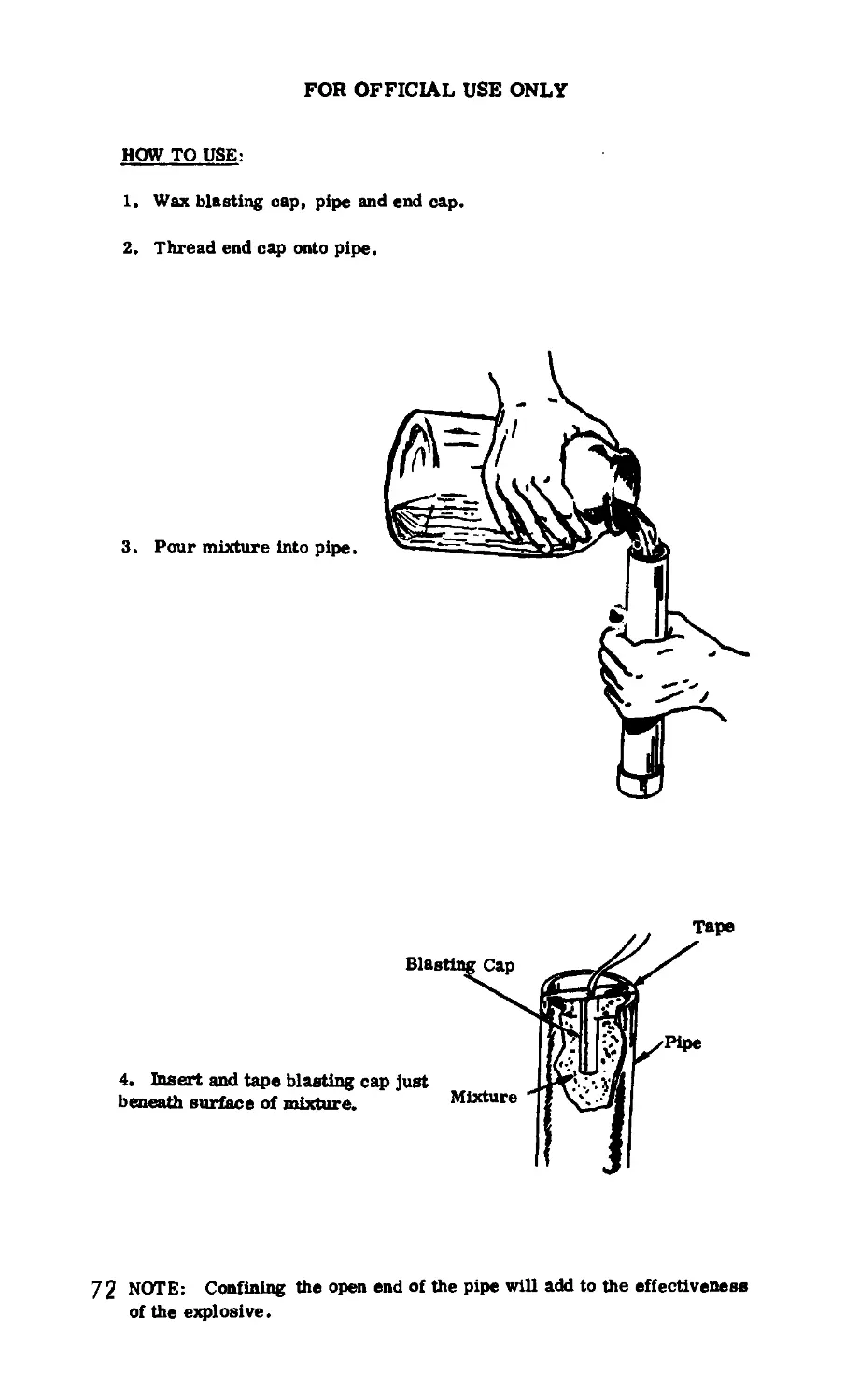
1.	Wax blasting cap, pipe and end cap.
2,	Thread end cap onto pipe.
3.	Pour mixture into pipe.
72 NOTE: Confining the open end of the pipe will add to the effectiveness
of the explosive.
PIPE HAND GRENADE
Hand grenades can be made from a piece of iron pipe. The
filler can be plastic or granular military explosive, improvised
explosive, or propellant from shotgun or small arms ammunition.
MATERIAL REQUIRED
Iron pipe, threaded ends, 1 1/2"
to 3" diam., 3" to 8" long.
Two (2) iron pipe caps.
Explosive or propellant
Nonelectric blasting cap.
(Commercial or military)
Fuse cord
Hand drill
Pliers
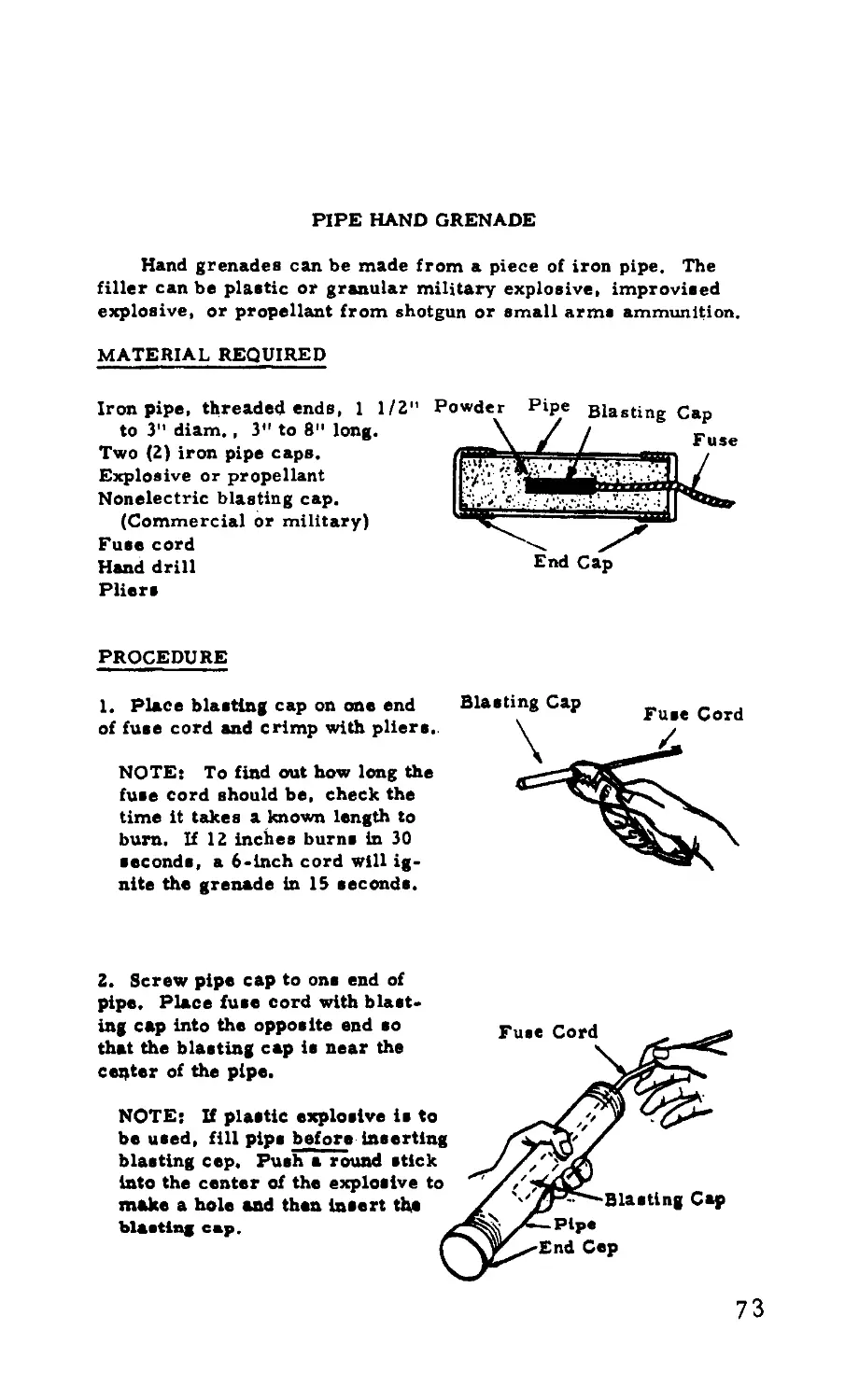
End Cap
PROCEDURE
1. Place blasting cap on one end
of fuse cord and crimp with pliers..
NOTE: To find out how long the
fuse cord should be, check the
time it takes a known length to
burn. If 12 inches burns in 30
seconds, a 6-Inch cord will ig-
nite the grenade in 15 seconds.
2. Screw pipe cap to one end of
pipe. Place fuse cord with blast
ing cap into the opposite end so
that the blasting cap is near the
center of the pipe.
Fuse Cord
Blasting Cap
End Cep
NOTE; If plastic explosive is to
be used, fill pips before inserting
blasting cep. Push a round stick
into the center of the explosive to
make a hole and then Insert the
blasting cap.
73
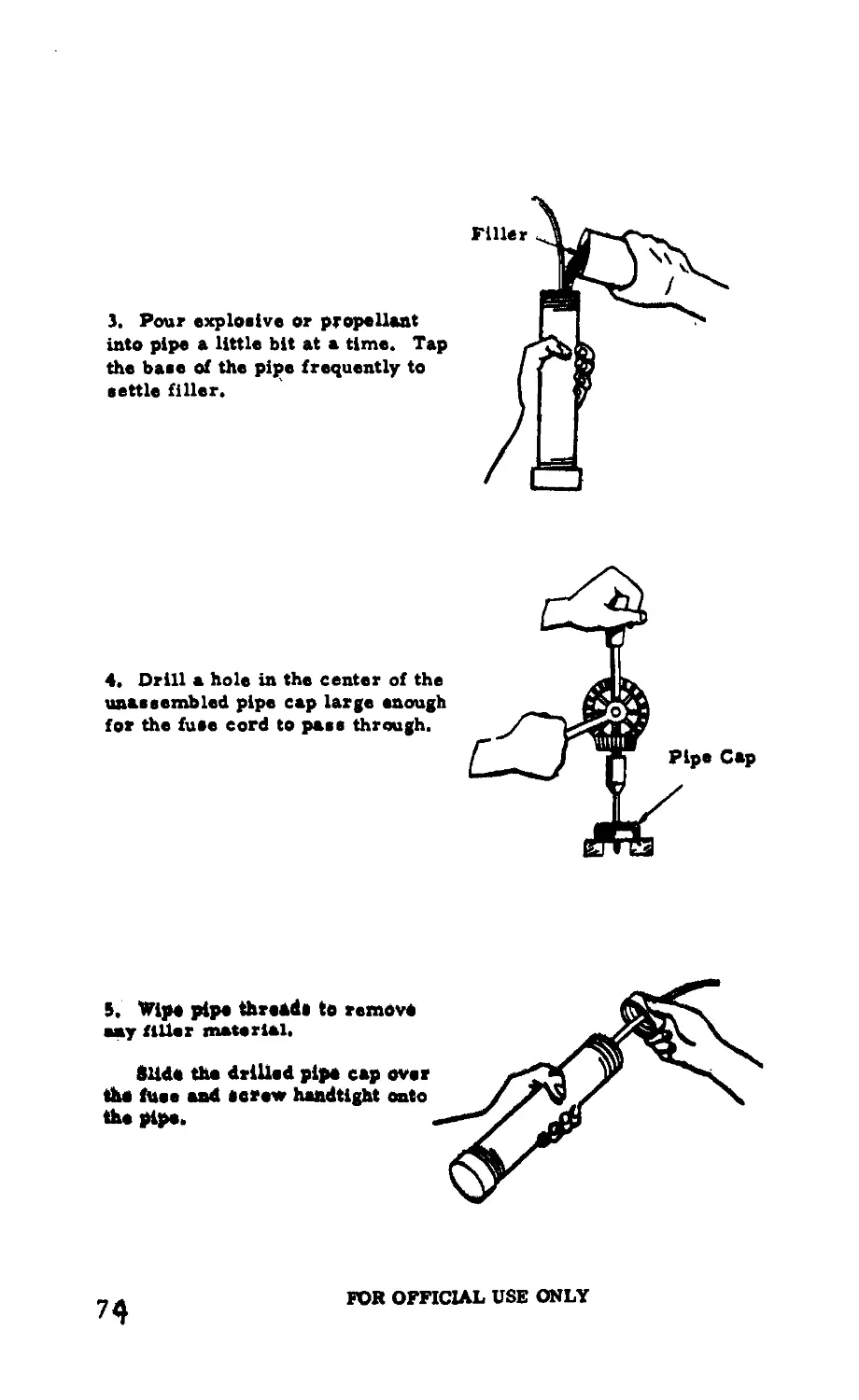
3.	Pour explosive or propellant into pipe a little bit at a time. Tap the base of the pipe frequently to settle filler. 4.	Drill a hole in the center of the unassembled pipe cap large enough for the fuse cord to pass through. 5.	Wipe pipe threads to remove aay filler material. Elide the drilled pipe cap over the fuse and screw handtight onto the pipe.	—»	Filler wL [	/ p] Pipe Cap
74
FOR OFFICIAL USE ONLY
Section П
No. г
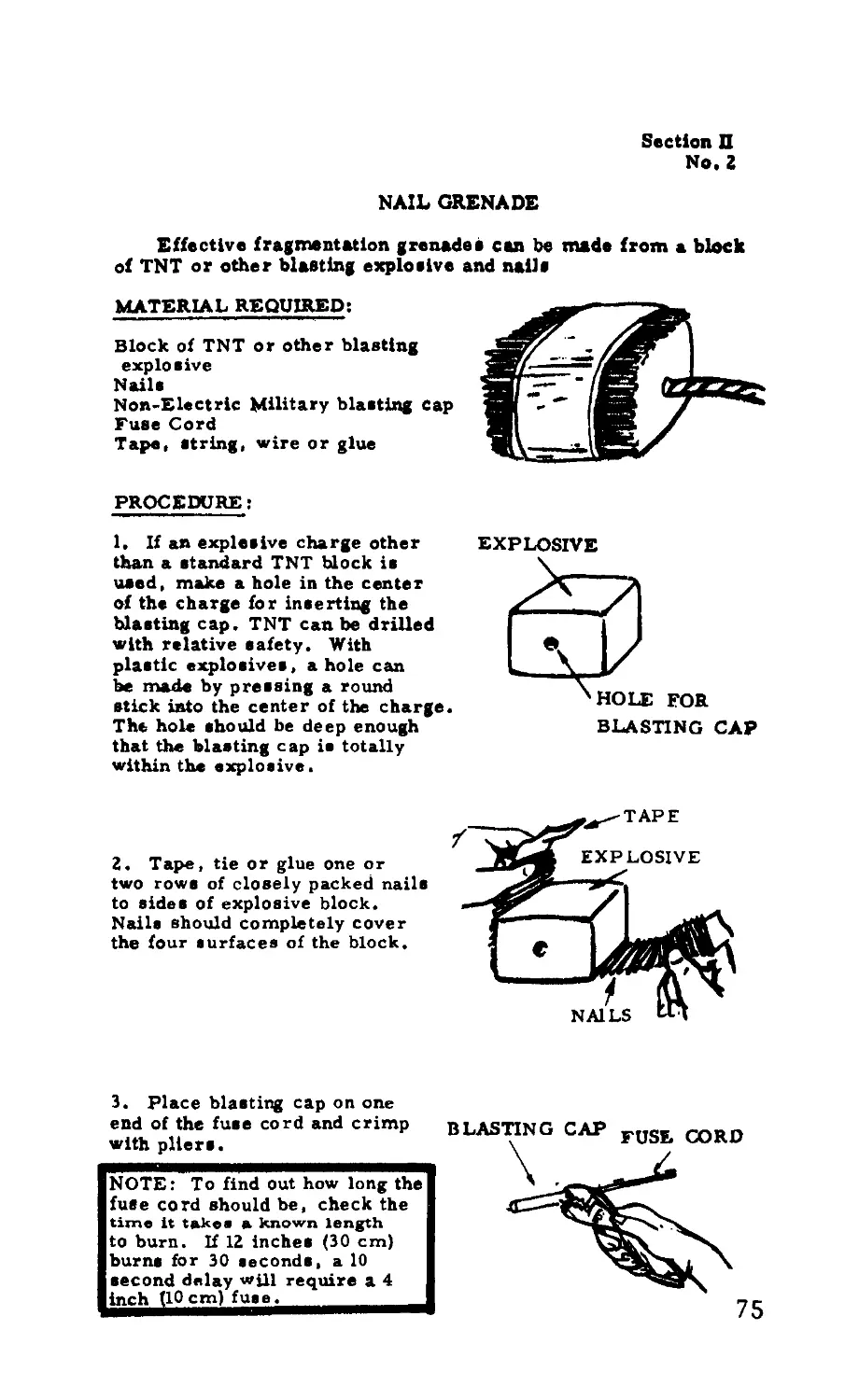
NAIL GRENADE
Effective fragmentation grenades can be made from a block
of TNT or other blasting explosive and nails
MATERIAL REQUIRED:
Block of TNT or other blasting
explosive
Nails
Non-El«ctric Military blasting cap
Fuse Cord
Tape, string, wire or glue
PROCEDURE:
1.	If an explosive charge other
than a standard TNT block is
used, make a hole in the center
of the charge for inserting the
blasting cap. TNT can be drilled
with relative safety. With
plastic explosives, a hole can
be made by pressing a round
stick into the center of the charge.
The hole should be deep enough
that the blasting cap is totally
within the explosive.
BLASTING CAP
2.	Tape, tie or glue one or
two rows of closely packed nails
to sides of explosive block.
Nails should completely cover
the four surfaces of the block.
3.	Place blasting cap on one
end of the fuse cord and crimp
with pliers.
NOTE: To find out how long the
fuse cord should be, check the
time it takee a known length
to burn. If 12 inches (30 cm)
burns for 30 seconds, a 10
second delay will require a 4
inch (io cm) fuse.
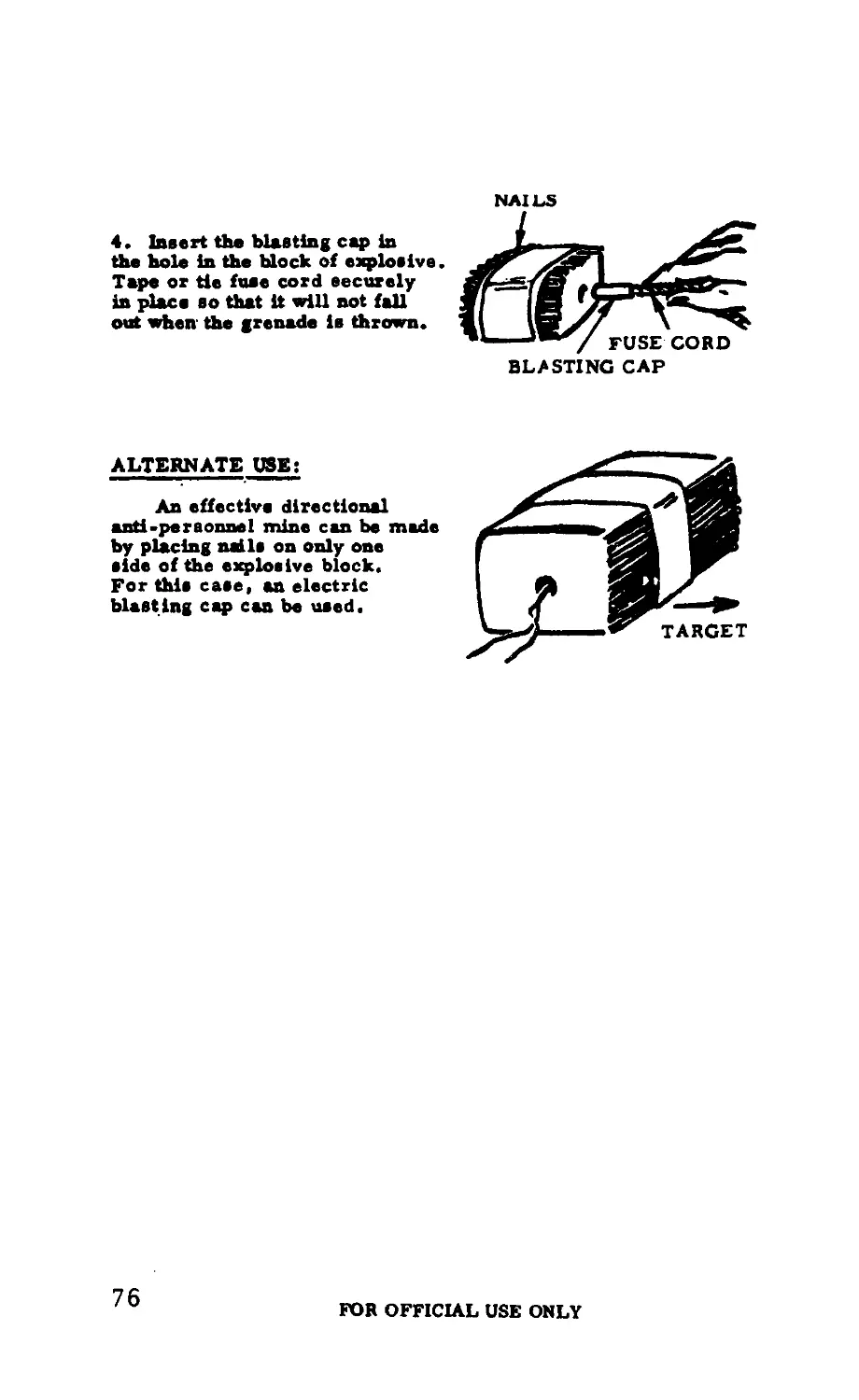
4.	Insert the blasting cap in
the hole in the block of explosive.
Tape or tie fuse cord securely
in place so that it will not fall
out when the grenade is thrown.
ALTERNATE USE;
An effective directional
anti-personnel mine can be made
by placing nails on only one
side of the explosive block.
For this case, an electric
blasting cap can be used.
NAILS
BLASTING CAP
76
FOR OFFICIAL USE ONLY
Section II
No. I
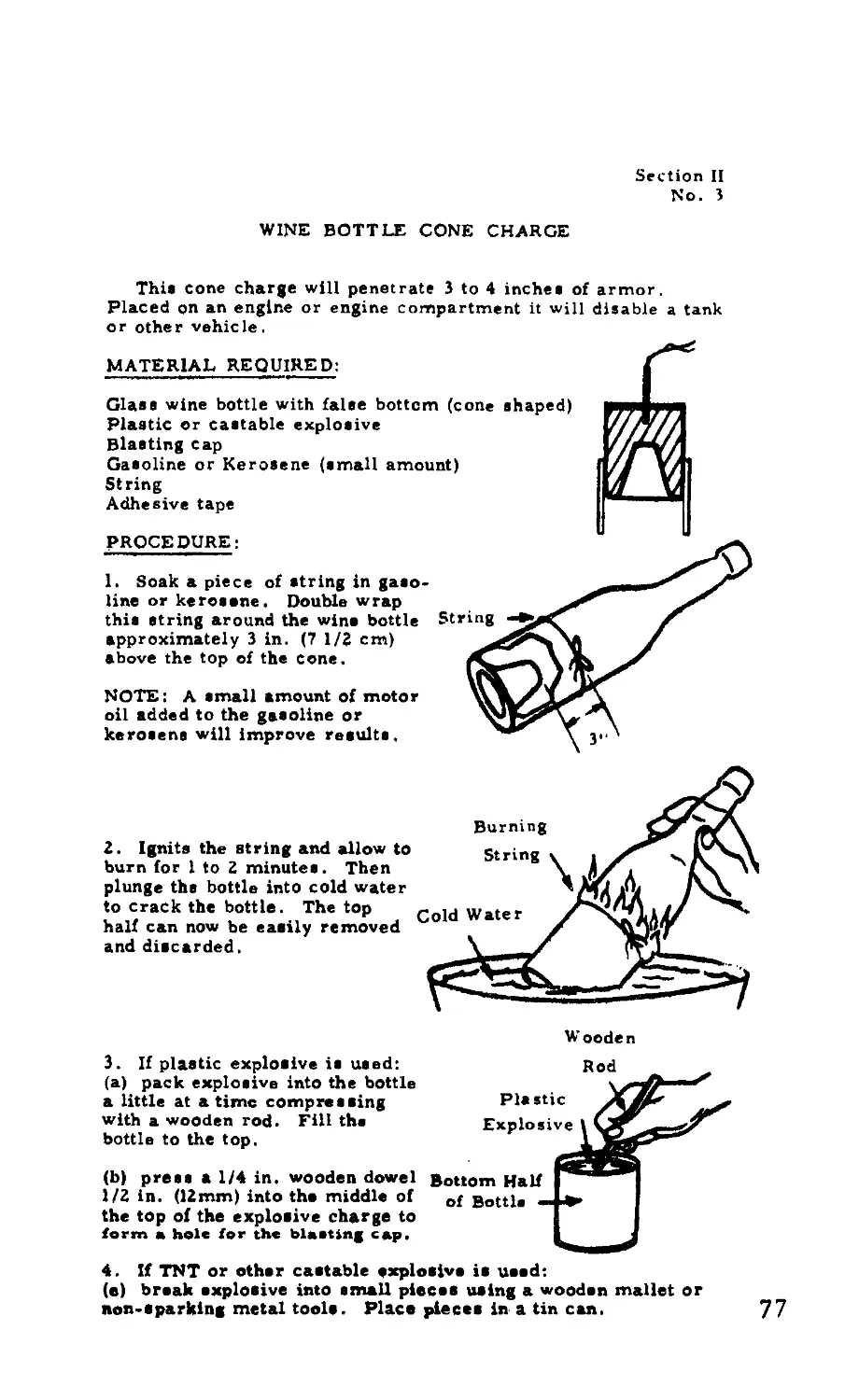
WINE BOTTLE CONE CHARGE
This cone charge will penetrate 3 to 4 inches of armor.
Placed on an engine or engine compartment it will disable a tank
or other vehicle.
St
MATERIAL REQUIRED:
Glass wine bottle with false bottom (cone shaped)
Plastic or castable explosive
Blasting cap
Gasoline or Kerosene (small amount)
String
Adhesive tape
PROCEDURE:
1.	Soak a piece of string in gaso-
line or kerosene. Double wrap
this string around the wine bottle
approximately 3 in. (7 1/2 cm)
above the top of the cone.
NOTE: A small amount of motor
oil added to the gasoline or
kerosene will improve results.
2.	Ignite the string and allow to
burn for 1 to 2 minutes. Then
plunge ths bottle into cold water
to crack the bottle. The top
half can now be easily removed
and discarded.
3.	If plastic explosive is used:
(a) pack explosive into the bottle
a little at a time compressing
with a wooden rod. Fill ths
bottle to the top.
(b) press a 1/4 in. wooden dowel
1/2 in. (12mm) into the middle of
the top of the explosive charge to
form a hole for the blasting cap.
Wooden
4.	If TNT or other castable explosive is used:
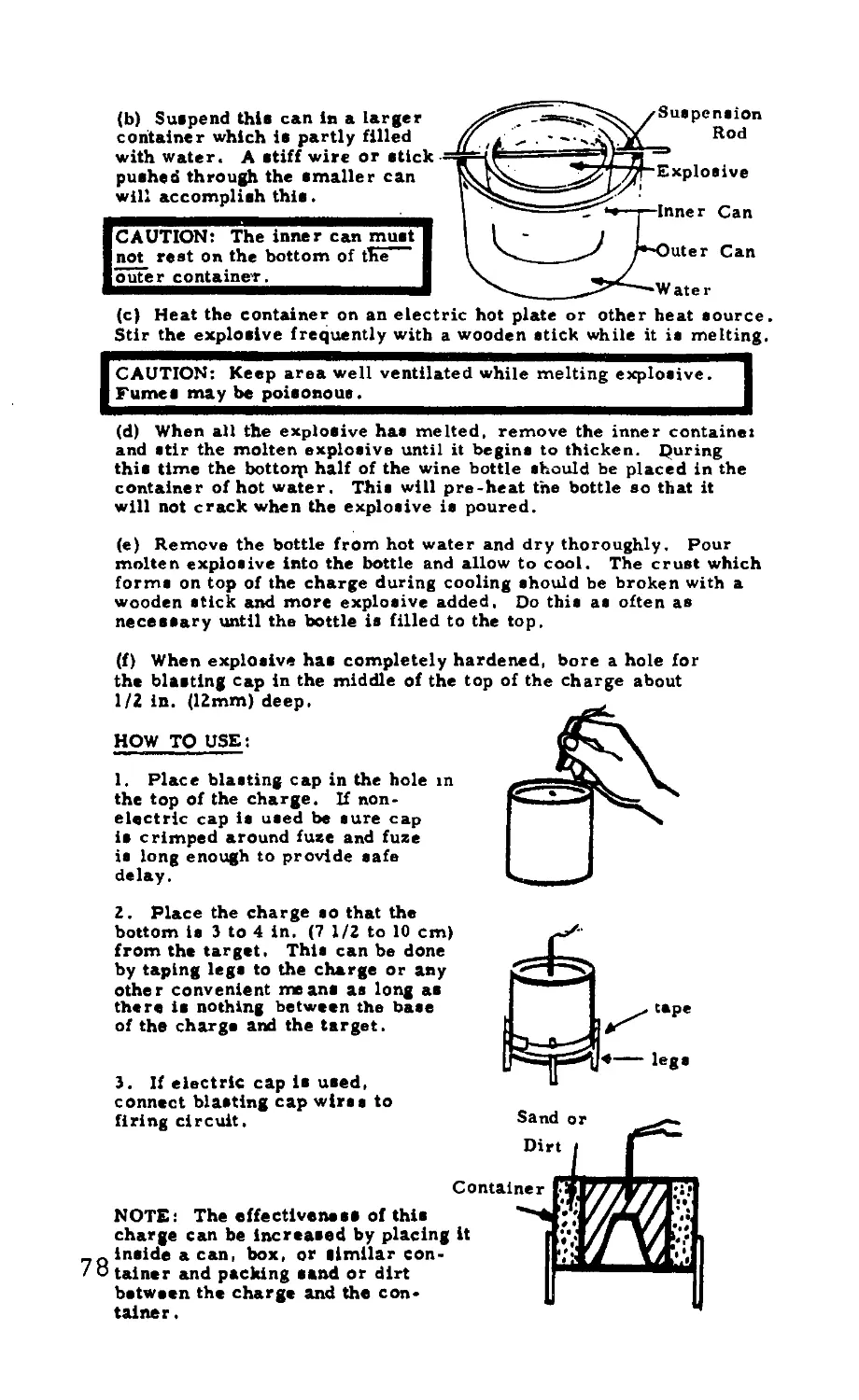
(e) break explosive into small pieces using a wooden mallet or
non-sparking metal tools. Place pieces in a tin can.
77
(c) Heat the container on an electric hot plate or other heat aource.
Stir the explosive frequently with a wooden stick while it is melting.
CAUTION: Keep area well ventilated while melting explosive. I
Fumes may be poisonous.	I
(d) When all the explosive has melted, remove the inner containei
and stir the molten explosive until it begins to thicken. During
this time the bottorp half of the wine bottle should be placed in the
container of hot water. This will pre-heat the bottle so that it
will not crack when the explosive is poured.
(e) Remove the bottle from hot water and dry thoroughly. Pour
molten explosive into the bottle and allow to cool. The crust which
forms on top of the charge during cooling should be broken with a
wooden stick and more explosive added, Do this as often as
necessary until the bottle is filled to the top.
(f) When explosive has completely hardened, bore a hole for
the blasting cap in the middle of the top of the charge about
1/2 in. (12mm) deep.
HOW TO USE:
1. Place blasting cap in the hole in
the top of the charge. If non-
electric cap is used be sure cap
is crimped around fuze and fuze
is long enough to provide safe
delay.
2. Place the charge so that the
bottom is 3 to 4 in. (7 1/2 to 10 cm)
from the target, This can be done
by taping legs to the charge or any
other convenient means as long as
there is nothing between the base
of the charge and the target.
3. If electric cap is used,
connect blasting cap wires to
firing circuit.
Sand or
Dirt
Container
NOTE: The effectiveness of this
charge can be increased by placing it
.inside a can, box, or similar con-
/ о tainer and packing sand or dirt
between the charge and the con*
tainer.
Section П
NA. 4
GRENADE-TIN CAN LAND MINE
This device can be used as a land mine that will explode when the
trip wire is pulled.
MATERIAL REQUIRED:
Hand grenade having side safety lever
Sturdy container, open at one end, that is just large enough to fit over
grenade and its safety lever (tin can of proper size is suitable).
Strong string or wire
NOTE: The container must be of such a size that, when the grenade is
placed in it and the safety pin removed, its sides will prevent the safety
lever from springing open. One end must be completely open.
PROCEDURE:
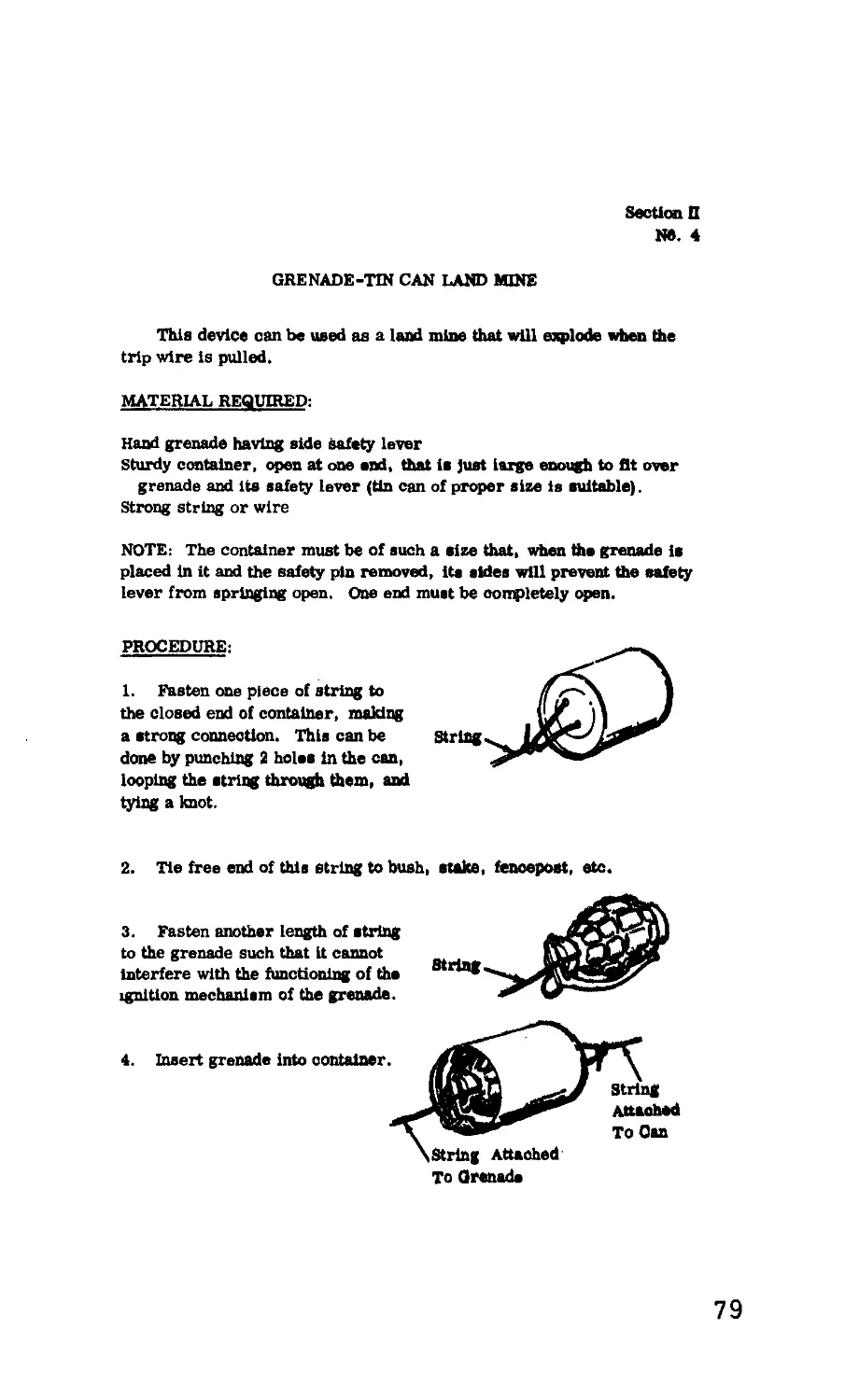
1.	Fasten one piece of string to
the closed end of container, making
a strong connection. This can be
done by punching 2 holes in the can,
looping the string through them, and
tying a knot.
2.	Tie free end of this string to bush, stake, fencepost, etc.
3.	Fasten another length of string
to the grenade such that It cannot
Interfere with the functioning of the
ignition mechanism of the grenade.
4.	Insert grenade into container.
ПШй	String
Attached
To Qan
String Attached
To Grenada
79
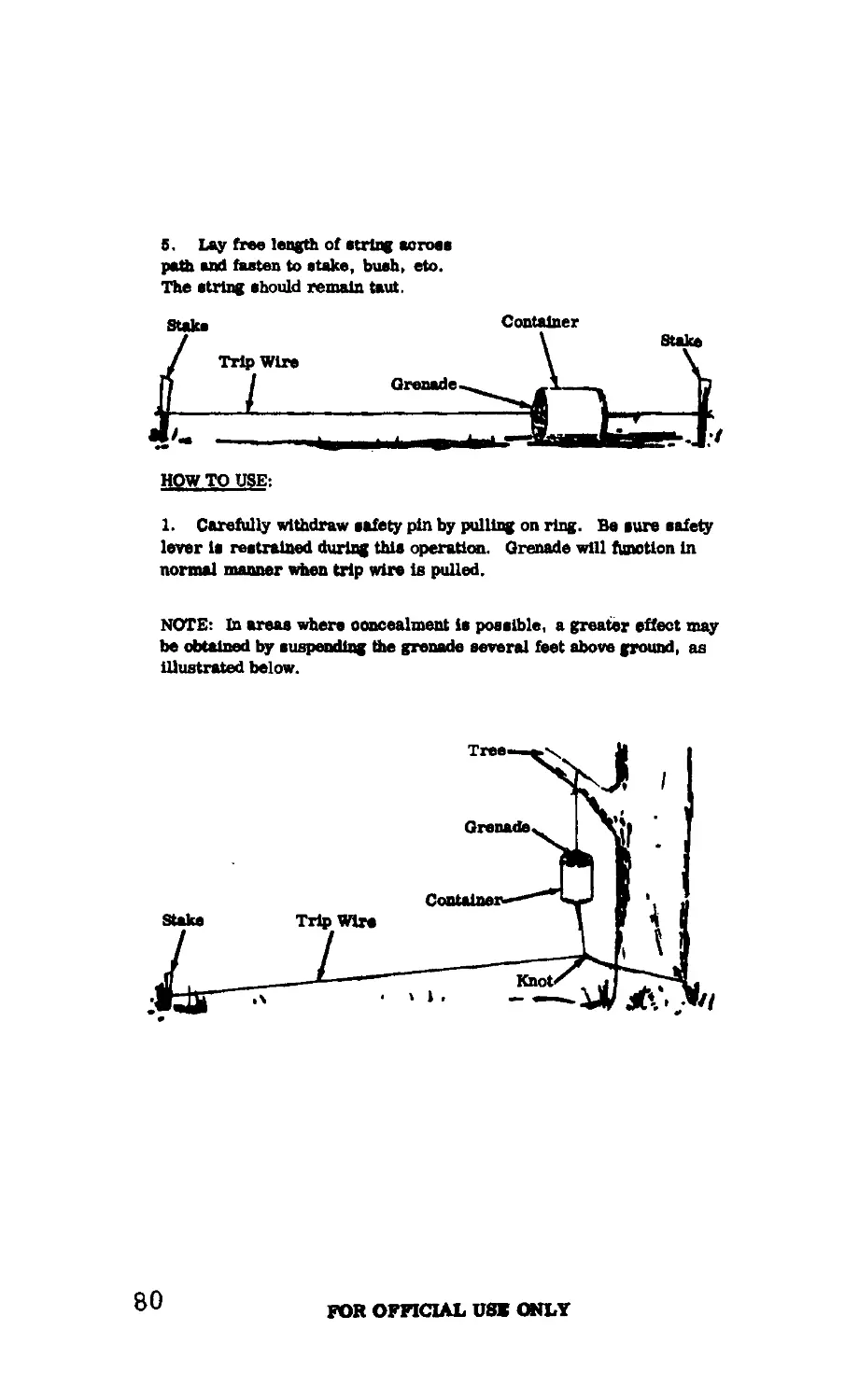
5.	Lay free length of string across
path and fasten to stake, bush, eto.
The string should remain taut.
1. Carefully withdraw safety pin by pulling on ring. Be sure safety
lever la restrained during this operation. Grenade will function in
normal manner when trip wire is pulled.
NOTE: In areas where concealment is possible, a greater effect may
be obtained by suspending the grenade several feet above ground, as
illustrated below.
80
FOR OFFICIAL U8E ONLY
FOR OFFICIAL USE ONLY
Section II
No. 5
MORTAR SCRAP MINE
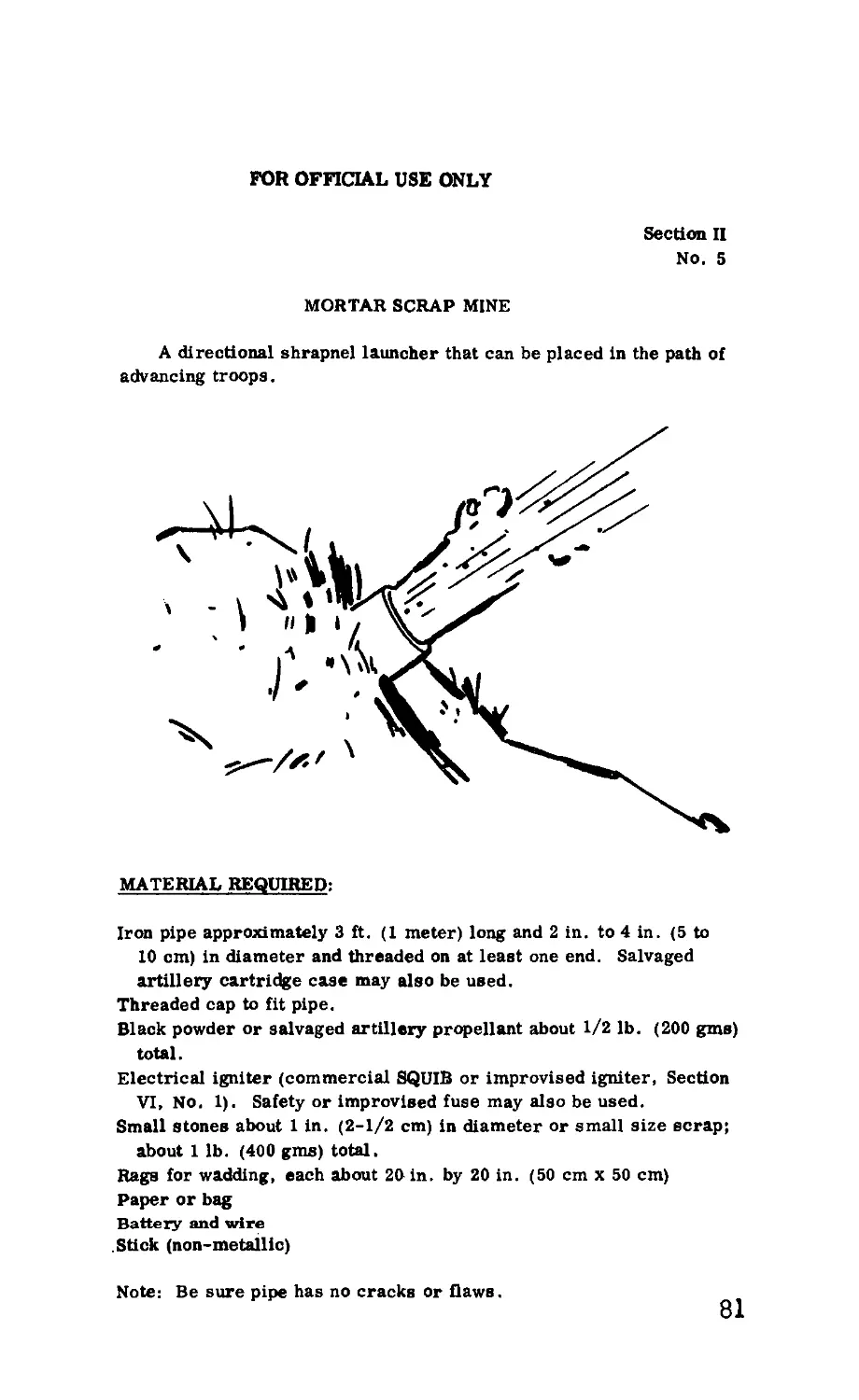
A directional shrapnel launcher that can be placed in the path of
advancing troops.
MATERIAL REQUIRED:
Iron pipe approximately 3 ft. (1 meter) long and 2 in. to 4 in. (5 to
10 cm) in diameter and threaded on at least one end. Salvaged
artillery cartridge case may also be used.
Threaded cap to fit pipe.
Black powder or salvaged artillery propellant about 1/2 lb. (200 gms)
total.
Electrical igniter (commercial SQUIB or improvised igniter, Section
VI, No. 1). Safety or improvised fuse may also be used.
Small stones about 1 in. (2-1/2 cm) in diameter or small size scrap;
about 1 lb. (400 gms) total.
Rags for wadding, each about 20 in. by 20 in. (50 cm x 50 cm)
Paper or bag
Battery and wire
Stick (non-metallic)
Note: Be sure pipe has no cracks or flaws.
81
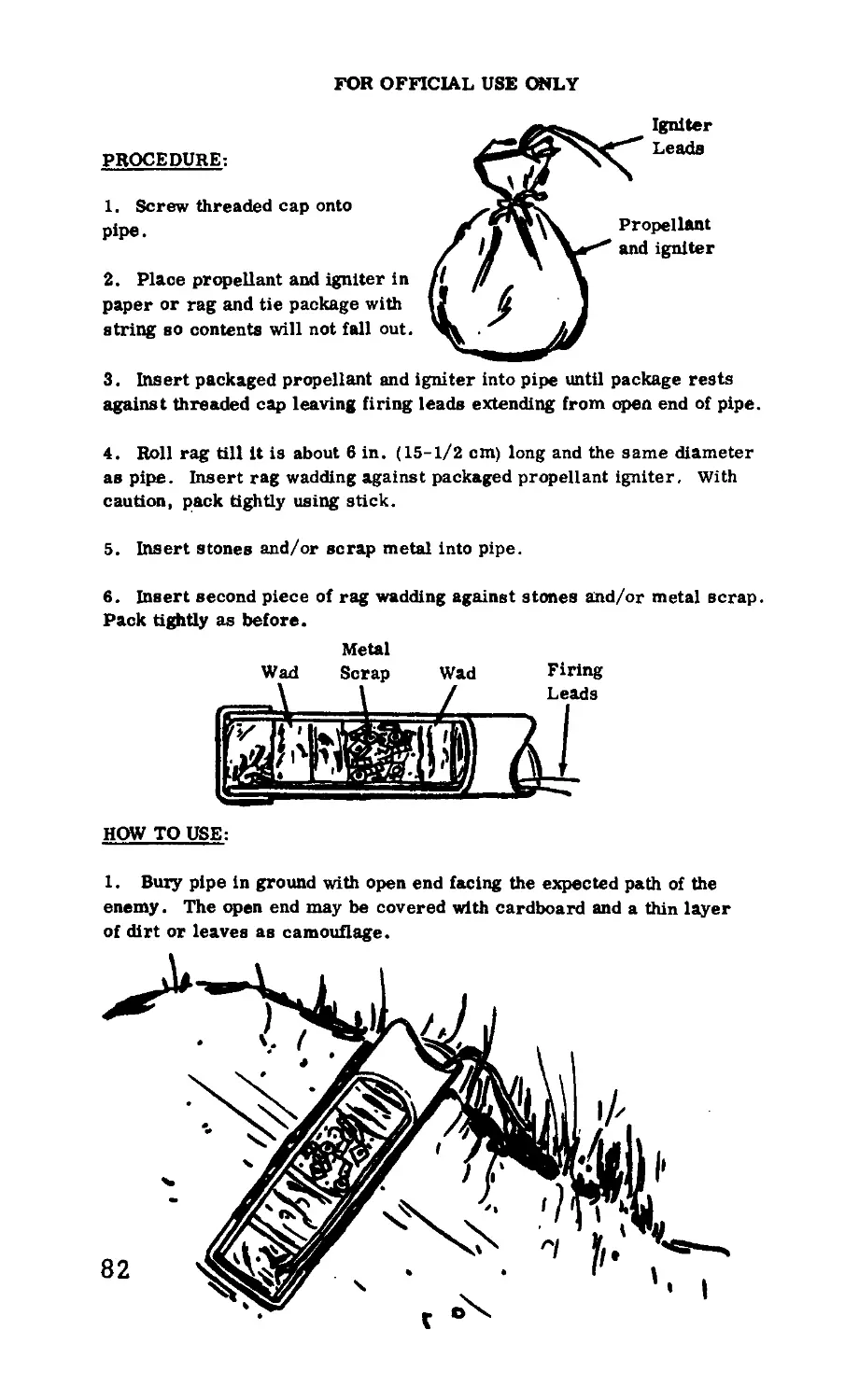
FOR OFFICIAL USE ONLY
3. Insert packaged propellant and igniter into pipe until package rests
against threaded cap leaving firing leads extending from open end of pipe.
4.	Roll rag till it is about 6 in. (15-1/2 cm) long and the same diameter
as pipe. Insert rag wadding against packaged propellant igniter. With
caution, pack tightly using stick.
5.	Insert stones and/or scrap metal into pipe.
6.	Insert second piece of rag wadding against stones and/or metal scrap.
Pack tightly as before.
HOW TO USE:
1. Bury pipe in ground with open end facing the expected path of the
enemy. The open end may be covered with cardboard and a thin layer
of dirt or leaves as camouflage.
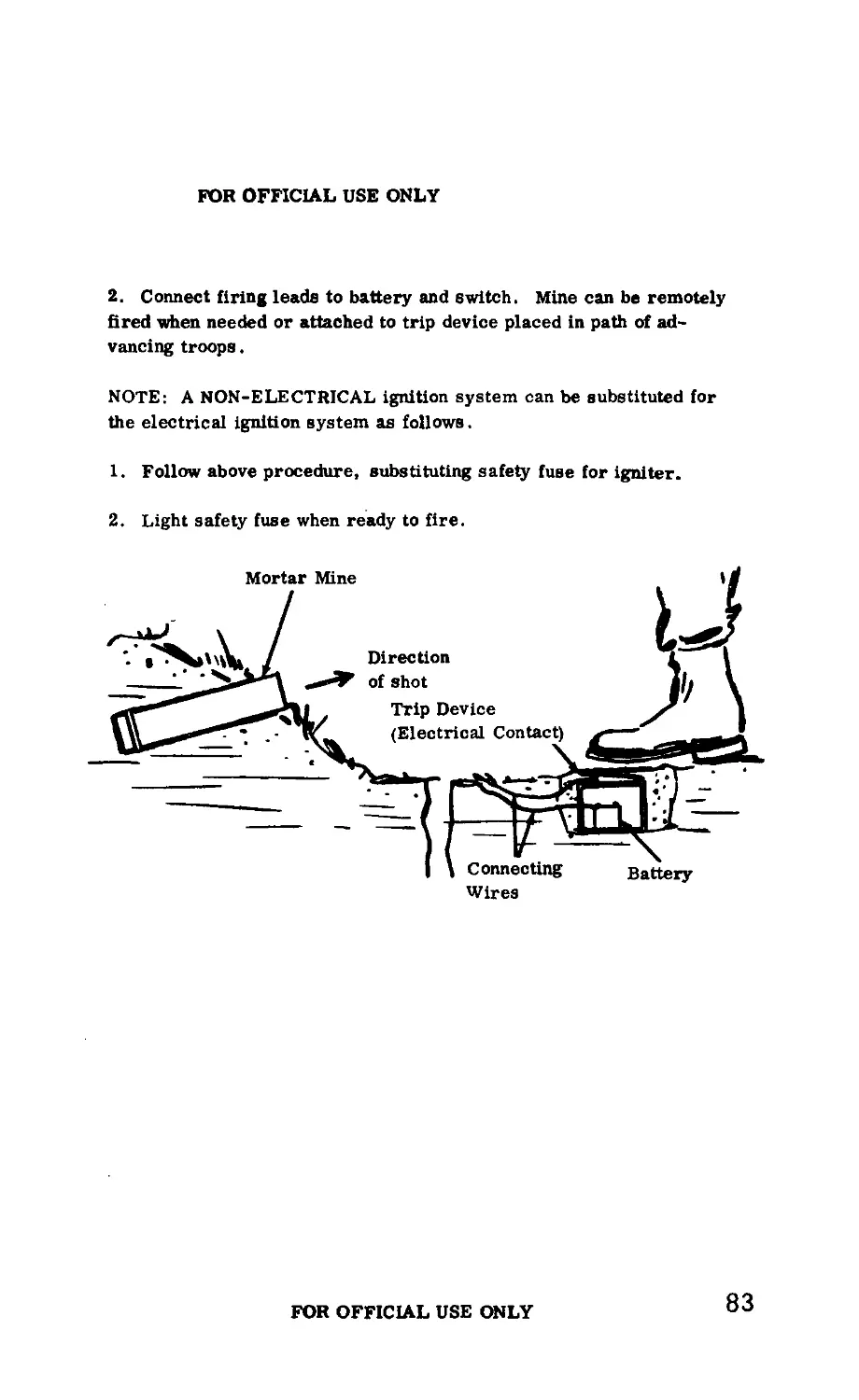
ГОИ OFFICIAL USE ONLY
2. Connect firing leads to battery and switch. Mine can be remotely
fired when needed or attached to trip device placed in path of ad-
vancing troops.
NOTE: A NON-ELECTRICAL ignition system can be substituted for
the electrical ignition system as follows.
1. Follow above procedure, substituting safety fuse for igniter.
2. Light safety fuse when ready to fire.
FOR OFFICIAL USE ONLY
83
FOR OFFICIAL USE ONLY
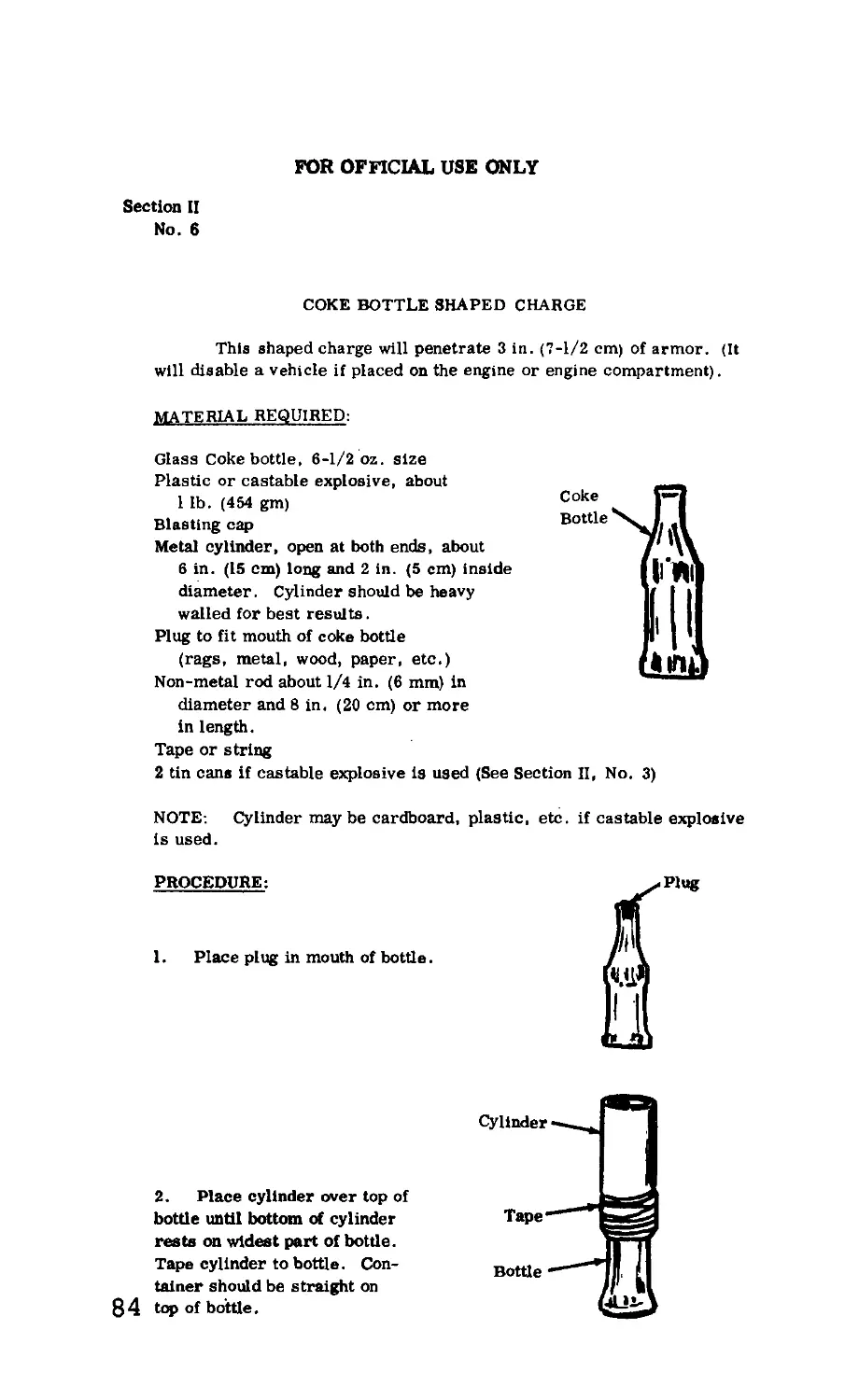
Section II
No. 6
COKE BOTTLE SHAPED CHARGE
This shaped charge will penetrate 3 in. (7-1/2 cm) of armor. (It
will disable a vehicle if placed on the engine or engine compartment).
MATERIAL REQUIRED:
Glass Coke bottle, 6-1/2 oz. size
Plastic or castable explosive, about
1 lb. (454 gm)
Blasting cap
Metal cylinder, open at both ends, about
6 in. (15 cm) long and 2 in. (5 cm) inside
diameter. Cylinder should be heavy
walled for best results.
Plug to fit mouth of coke bottle
(rags, metal, wood, paper, etc.)
Non-metal rod about 1/4 in. (6 mm) in
diameter and 8 in. (20 cm) or more
in length.
Tape or string
2 tin cans if castable explosive is used (See Section II, No. 3)
NOTE: Cylinder may be cardboard, plastic, etc. if castable explosive
Is used.
PROCEDURE:
1.	Place plug in mouth of bottle.
2.	Place cylinder over top of
bottle until bottom of cylinder
rests on widest part of bottle.
Tape cylinder to bottle. Con-
tainer should be straight on
84 top of bottle.
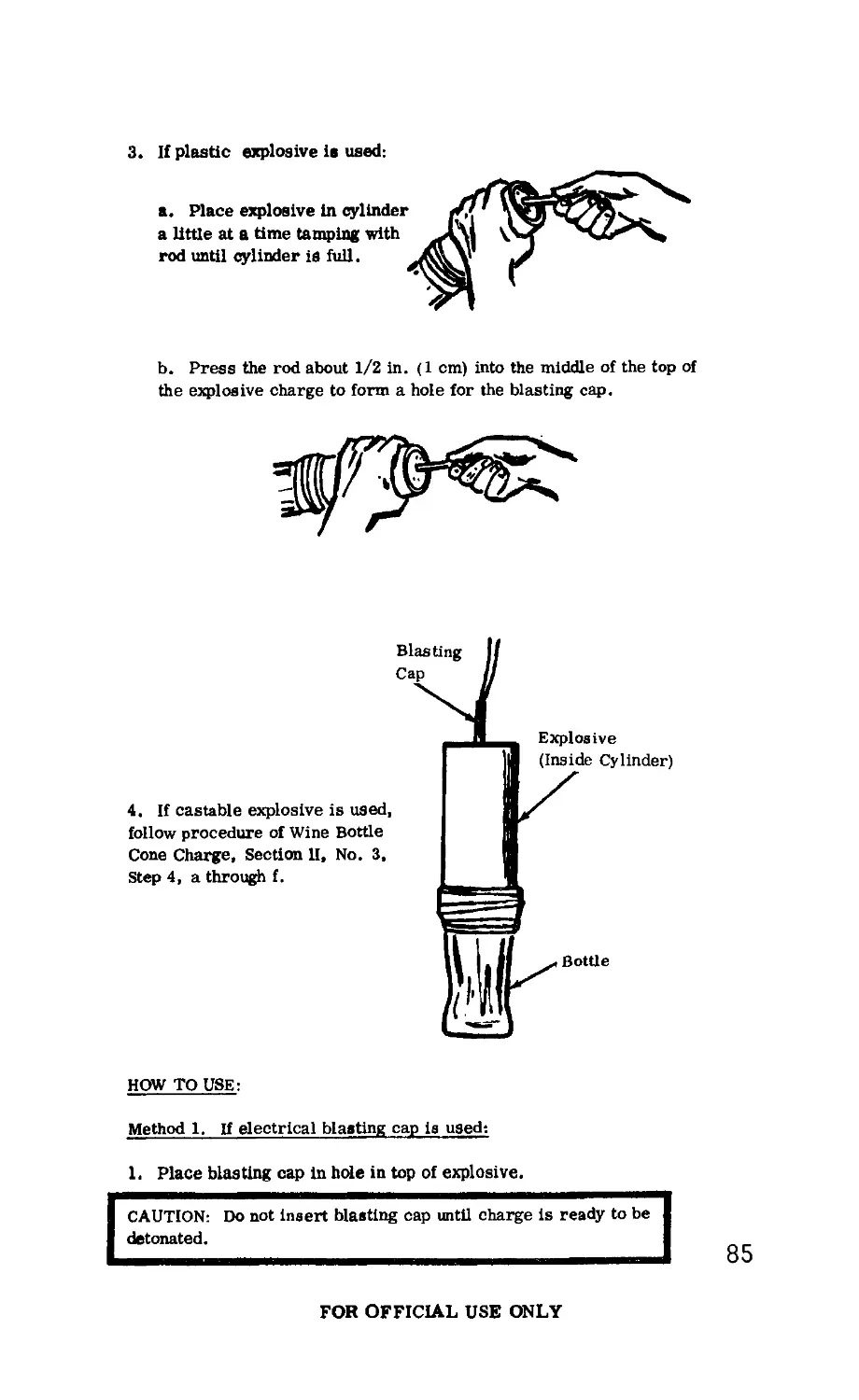
3.	If plastic explosive is used:
a.	Place explosive in cylinder
a little at a time tamping with
rod until cylinder is full.
b.	Press the rod about 1/2 in. (1 cm) into the middle of the top of
the explosive charge to form a hole for the blasting cap.
4.	If castable explosive is used,
follow procedure of Wine Bottle
Cone Charge, Section II, No. 3,
Step 4, a through f.
HOW TO USE:
Method 1, If electrical blasting cap is used:
1.	Place blasting cap in hole in top of explosive.
CAUTION: Do not insert blasting cap until charge is ready to be
detonated.
85
FOR OFFICIAL USE ONLY
FOR OFFICIAL USE ONLY
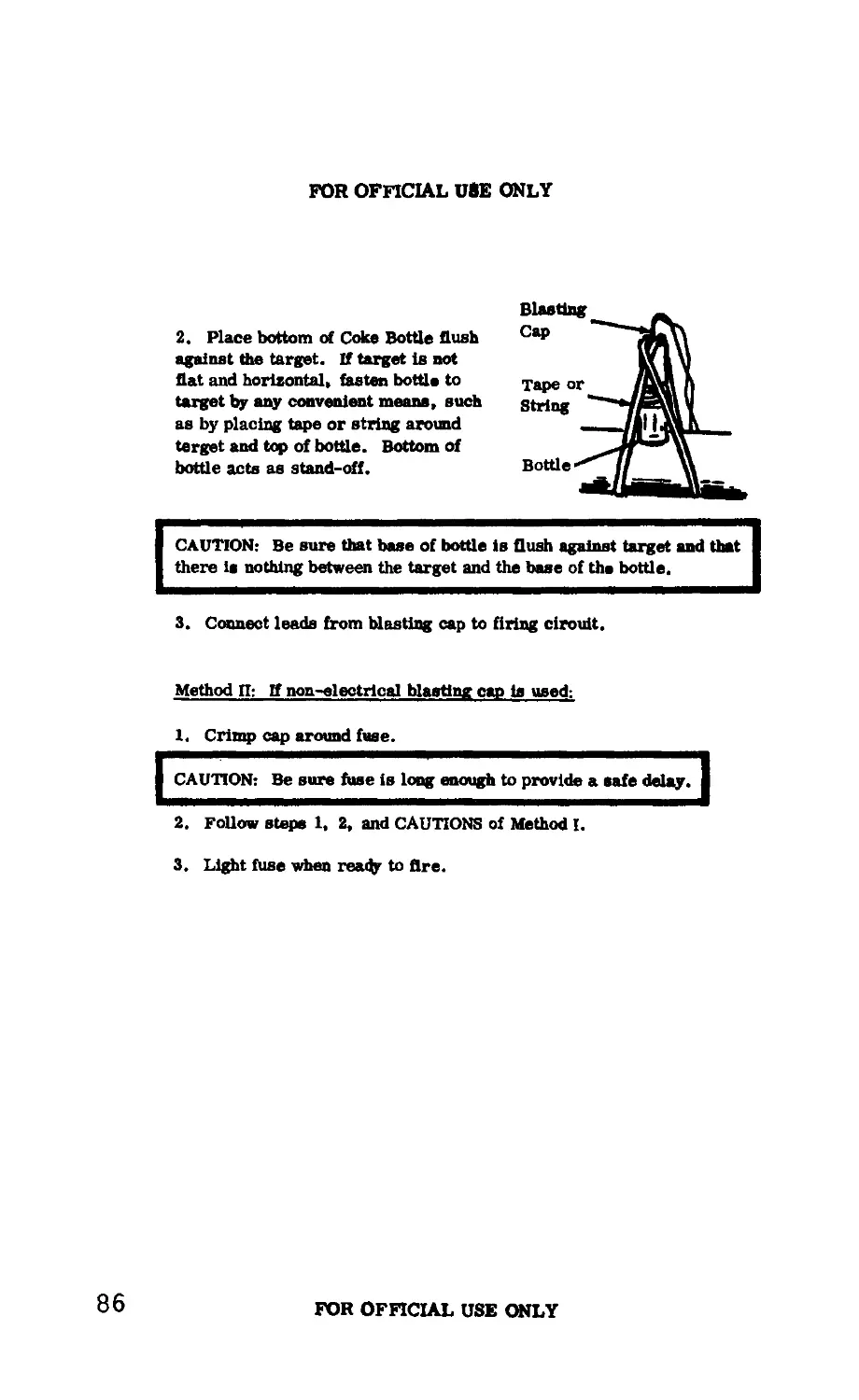
2.	Place bottom of Coke Bottle flush
against the target. If target is not
flat and horizontal, fasten bottle to
target by any convenient means, such
as by placing tape or string around
terget and top of bottle. Bottom of
bottle acts as stand-off.
CAUTION: Be sure that base of bottle is flush against target and that
there is nothing between the target and the base of the bottle.
3.	Connect leads from blasting cap to firing circuit.
Method П: If non-electrical blasting cap is used:
1.	Crimp cap around fuse.
I CAUTION: Be sure fuse is long enough to provide a safe delay.
2.	Follow steps 1, 2, and CAUTIONS of Method I.
3.	Light fuse when ready to Are.
86
FOR OFFICIAL USE ONLY
Section 11
No. 7
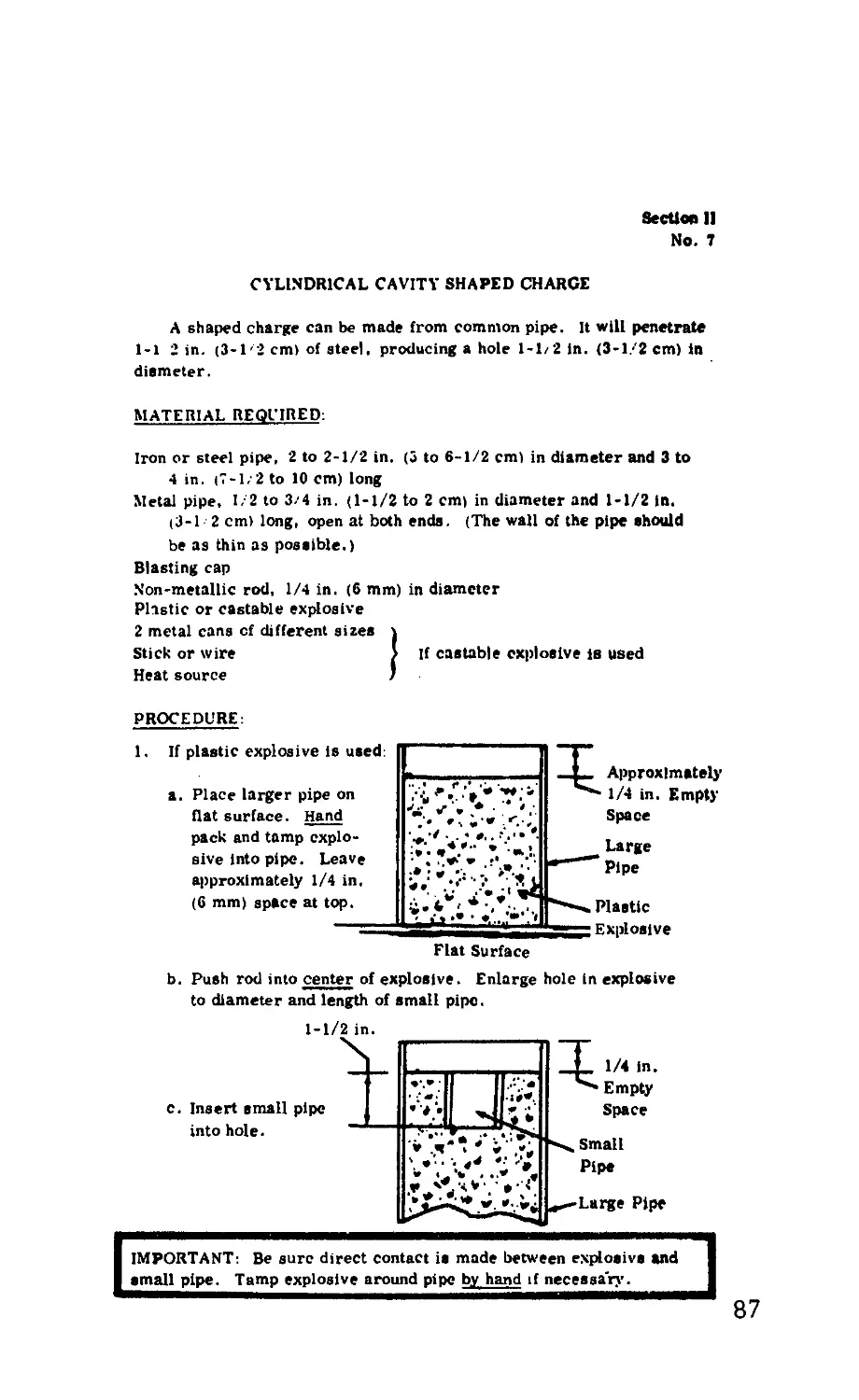
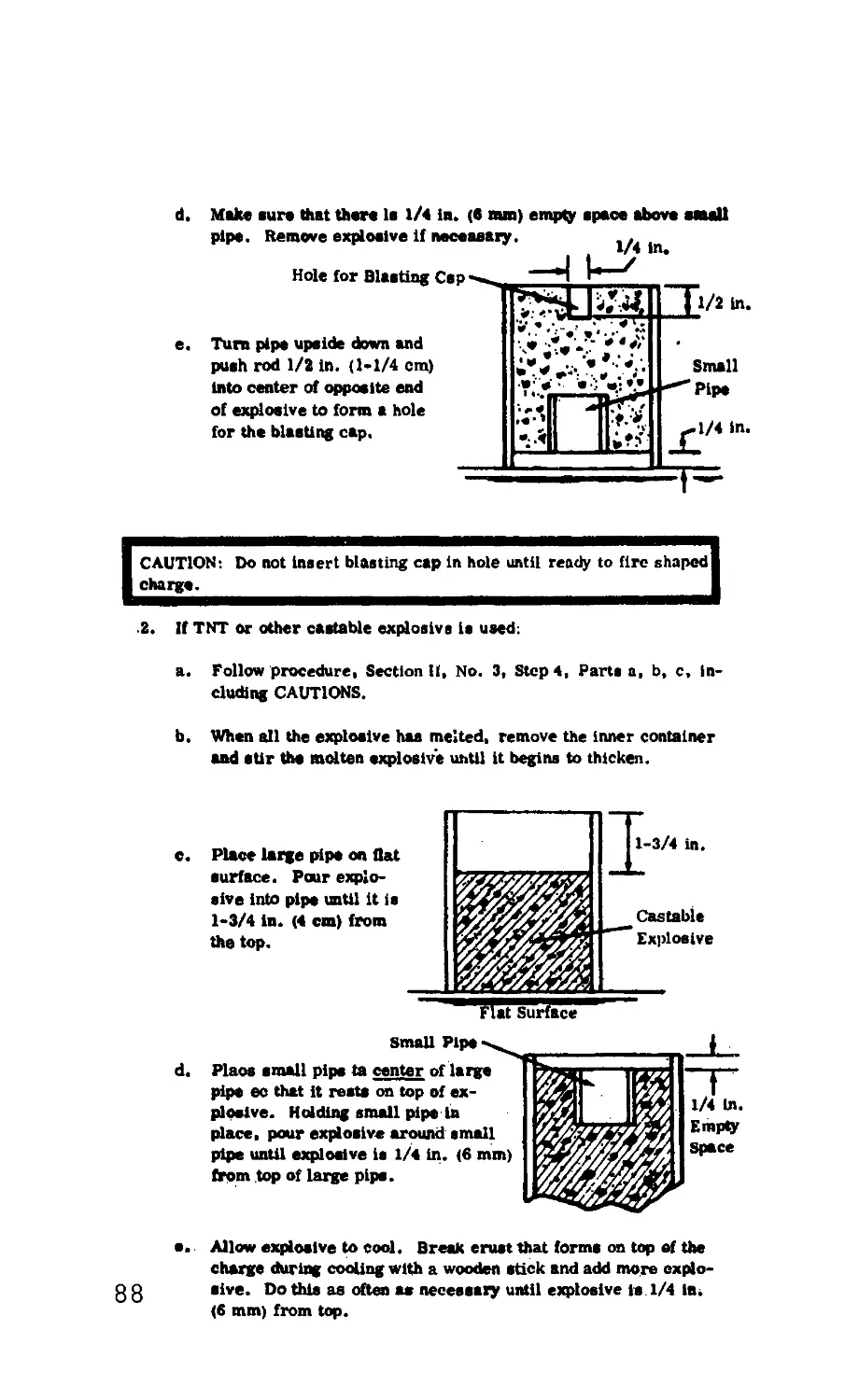
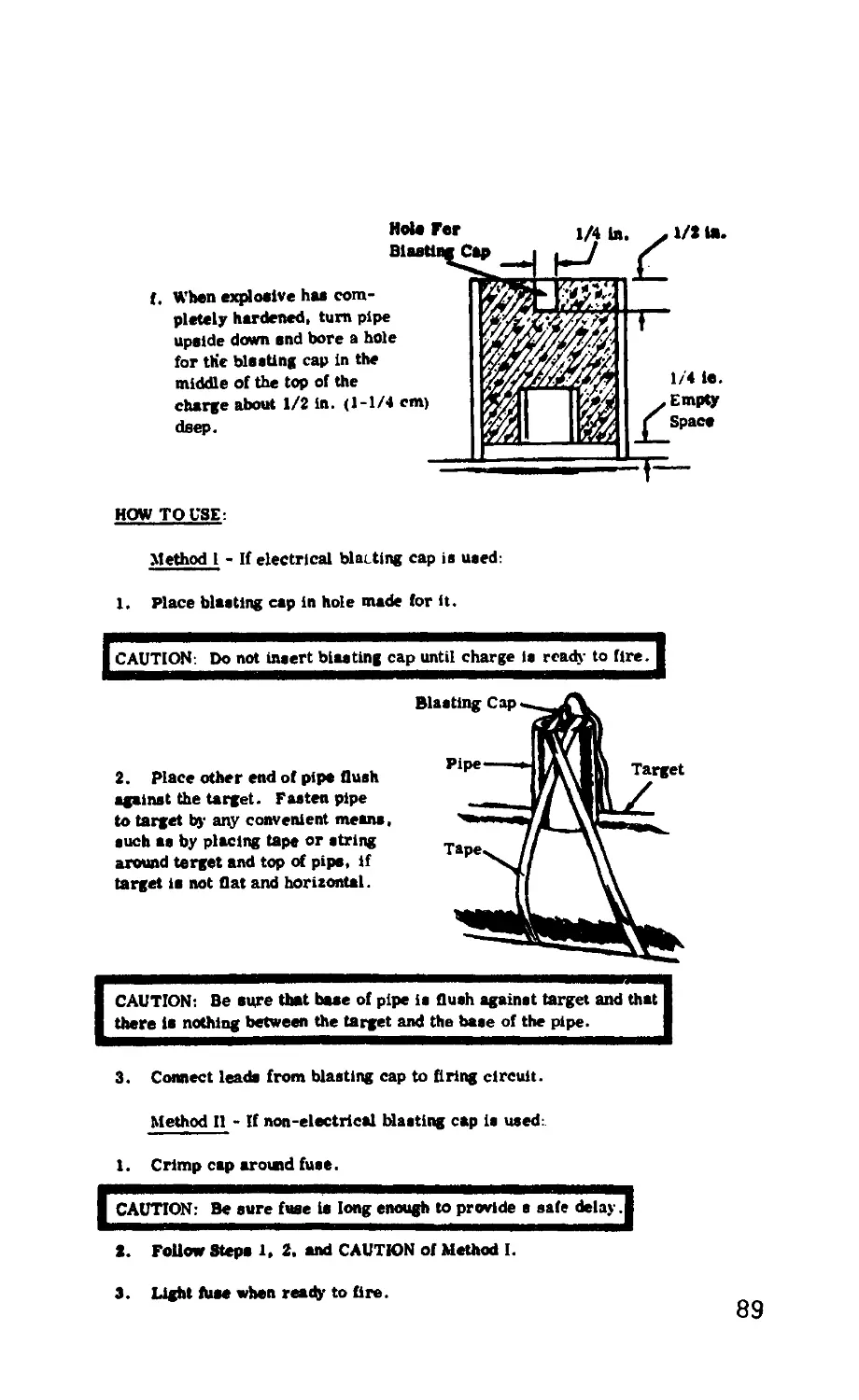
CYLINDRICAL CAVITY SHAPED CHARGE
A shaped charge can be made from common pipe. It will penetrate
1-1 2 in. (3-1'2 cml of steel, producing a hole 1-1/2 In. (3-1/2 cm) In
diameter.
MATERIAL REQUIRED:
Iron or steel pipe, 2 to 2-1/2 in. (3 to 6-1/2 cm) in diameter and 3 to
4	in. (7-1. 2 to 10 cm) long
Metal pipe, 1/2 to 3/4 in. (1-1/2 to 2 cm) in diameter and 1-1/2 In,
(3-12 cm) long, open at both ends. (The wall of the pipe should
be as thin as possible.)
Blasting cap
Non-metallic rod, 1/4 in. (6 mm) in diameter
Plastic or castable explosive
2 metal cans cf different sizes t
Stick or wire	> If castable explosive is used
Heat source	*
PROCEDURE:
1.
If plastic explosive is used:
a.	Place larger pipe on
flat surface. Hand
pack and tamp explo-
sive into pipe. Leave
approximately 1/4 in,
(6 mm) space at top.
Approximately
1/4 in. Empty
Space
Large
Pipe
Flat Surface
Plastic
Explosive
b.	Push rod into center of explosive. Enlarge hole in explosive
to diameter and length of small pipe.
1-1/2 in.
IMPORTANT: Be sure direct contact is made between explosive and
small pipe. Tamp explosive around pipe by hand if necessary.
87
Маке «иге that there la 1/4 in. (8 mm) empty apace above email
pipe. Remove explosive If necessary.
Hole for Blasting Csp-*^
Tun pipe upside down and
push rod 1/2 In. (1*1/4 cm)
into center of opposite end
of explosive to form a hole
for the blasting cap.
1/4 in.
Small
Pipe
1/4 in.
I CAUTION: Do not insert blasting cap In hole until ready to fire shaped
charge.
2. If TNT or other castable explosive is used:
a.	Follow procedure, Section II, No. 3, Step 4, Parts a, b, c, in-
cluding CAUTIONS.
b.	When all the explosive has melted, remove the inner container
and stir the molten explosive until it begins to thicken.
c.	Place large pips on flat
surface. Pour explo-
sive into pipe until It is
1-3/4 in. (4 cm) from
Die top.
Small Pipe
Plaos small pips ta center of large
pipe ec that it rests on top of ex-
ploeive. Holding small pipe in
place, pour exploeive around small
pipe until explosive is 1/4 in. (6 mm)
from top of large pips.
1/4 in.
Empty
Space
e.	Allow explosive to cool. Break erust that forme on top ef the
charge chiring cooling with a wooden stick and add more explo-
sive. Do this as often as necessary until explosive is 1/4 In.
(6 mm) from top.
Hole For
Blasting l
f. When explosive has com-
pletely hardened, turn pipe
upside down end bore a hole
for the bleating cap in the
middle of the top of the
charge about 1/2 in. (1-1/4 cm)
deep.
ЖЗЖ1
1/2 la.
1/4 ie.
Empty
HOW TO USE:
Method 1 - If electrical Matting cap is uaed:
1.	Place blasting cap in hole made for it.
| CAUTION: Do not insert blasting cap until charge Is ready to fire.
2.	Place other end of pipe flush
against the target. Fasten pipe
to target by any convenient means,
such sa by placing tape or string
around terget and top of pips, if
target is not flat and horizontal.
CAUTION: Be sure that base of pipe io flush against target and that
there is nothing between the target and the base of the pipe.
3.	Connect leads from Masting cap to firing circuit.
Method II - If non-electrieal Masting cap io used:
1. Crimp cap aroimd fuse.
CAUTION: Be sure fuse is long enough to provide s safe delay,
I.	Follow Steps 1, 2, and CAUTION of Method I.
3. Light fuse when ready to fire.
89
FOR OFFICIAL USE ONLY
FUNNEL SHAPED CHARGE
Section П
No. 9
An effective shaped charge can be made using various types of
'commercial funnels. See table for penetration capabilities.
MATERIAL REQUIRED:
Container (soda or beer can, etc.), approximately 2-1/2 in. diameter
X 5 in. long (6-1/4 cm x 12-1/2 cm)
Funnel(s) (glass, steel, or aluminum) 2-1/2 in. (6-1/2cm) in diameter
Wooden rod or stick, 1/4 in. (6 mm) in diameter
Tape
Blasting cap (electrical or non-electrical)
Sharp cutting edge
Explosive
2.	Cut off and throw away the
spout of the funnel (s).
NOTE: When using 3 funnels (see
table), place the modified funnels
together as tight and as straight
as possible. Tape the funnels to-
gether at the outer ridges.
3.	Place the funnel (s) in the modi-
fied can. Tape on outer ridges to
hold funnel(s) to can.
Tape
90
FOR OFFICIAL USE ONLY
4.	If plastic explosive is used,
fill the can with the explosive
using small quantities, and tamp
with wooden rod or stick.
NOTE: If castable explosive is
used, refer to step 4 of Section П,
No. 3.
Standoff
5.	Cut wooden rod to lengths 3 inches
longer than the standoff length.
(See table.) Position three of these
rods around the explosive filled can
and hold in place with tape.
NOTE: The position of the rods
on the container must conform to
standoff dimensions to obtain the
penetrations given in the table.
Explosive
Distance
Table
Funnel Material	No. of Funnels	Standoff		Penetration
		inches	metric	inches	metric
Glass	1	3-1/2	9 cm	4	10 cm
Steel	3	1	2-1/2 cm	2-1/2	6 cm
Aluminum	3	3-1/2	9 cm	2-1/2	6 cm
♦If only one	steel or alum	inum funn	si ie availab	le:
Steel	1	1	2-1/2 cm	1-1/2	4 cm
Aluminum	1	1	2-1/2 cm	1-1/2	4 cm
91
FOR OFFICIAL USE ONLY
6.	Make a hole for blasting cap in
the center of the explosive with rod
or stick.
CAUTION: Do not place blasting cap in place until the Funnel Shaped
Charge is ready for use.
HOW TO USE:
1.	Place blasting cap in the hole in
top of the charge. If non-electric
cap is used, be sure cap is crimped
around fuse and fuse is long enough
to provide safe delay.
2.	Place (tape if necessary) the Funnel Shaped Charge on the target so
so that nothing is between the base of charge and target.
3.	If electric cap is used, connect blasting cap wires to firing circuit.
92
FOR OFFICIAL USE ONLY
FOR OFFICIAL USE ONLY
Section 11
No. 10
LINEAR SHAPED CHARGE
This shaped charge made from construction materials will cut
through up to nearly 3 inches of armor depending upon the liner used
(see table).
MATERIAL REQUIRED:
Standard structural angle or pipe (see table)
Wood or cardboard container
Hacksaw ) ,
. . z if pipe is used
Vice )
Wooden rod, 1/4 in. (6 mm) diameter
Explosive
Blasting cap
Tape
Table
Type	Material	Liner Size in. - Nom.	Standoff		Penetration
			in.	metric	in.	metric
angle	steel	3x3 legs x 1/4 web	2	5 cm	2-3/4	7 cm
angle	aluminum	2x2 legs x 3/16 web	5-1/2	14 cm	2-1/2	6 cm
pipe half section	aluminum	2 diameter	2	5 cm	2	5 cm
pipe half section	copper	2 diameter	1	2-1/2 cm	1-3/4	4 cm
NOTE: These were the only linear shaped charges of this type that
were found to be more efficient than the Ribbon Charge.
Ribbon Charge: No standoff is required; just place on target.
Explosive		 J'S. Target S.		I-"2 a'*’ Ribbon Charge	Length of ""’'"Desired Cut a 93
FOR OFFICIAL USE ONLY
2. Place angle or pipe half section with open end face down on a flat
surface.
3. Make container from any material available. The container must
be as wide as the angle or pipe half section, twice as high, and as long
as the desired cut to be made with the charge.
4. Place container over the liner (angle or pipe half section) and tape
liner to container.
Length of 	—ж	Desired Cut		 I	|» 1/	~f	1/ 2a	Xs Tape '	—— a	Tape Container with Pipe Half Section 5. If plastic explosove is used, fill the container with the explosive using small quantities, and tamp with wooden rod or stick.	s NOTE : If castable explosive is used, refer to step 4 of Section П, No. 3. 94	Length of _---<^^^^^^^HDesired Cut s	2 a Container with Angle --o- — Explosive
Container
FOR OFFICIAL USE ONLY
6. Cut wooden rod to lengths 2
inches longer than the standoff
length (see table). Position the
rods at the corners of the explosive
filled container and hold in place
with tape.
NOTE: The position of the rods on
the container must conform to
standoff and penetration dimen-
sions given in the table.
Distance
7. Make a hole for blasting cap in the side of the container 1/2 in.
above the liner and centered with the wooden rod.
CAUTION: Do not place blasting cap in place until the Linear Shaped
Charge is ready for use.
HOW TO USE:
1.	Place blasting cap into hole on
the sids of the container. If non-
electric cap is used, be sure cap
is crimped around fuse and fuse is
long enough to provide safe delay.
2.	Place (tape if necessary) the Linear Shaped Charge on the target so
that nothing is between base of oharge and target.
3.	If electric cap is used, connect blasting cap wires to firing circuit.
95
Section Ш
No. 1
PIPE PISTOL FOR 9 MM AMMUNITION
A 9 mm pietol can be made from 1 /4" steel gas or water pipe
and fittings.
MATERIAL REQUIRED
1/4" nominal size steel pipe 4 to 6
inches long with threaded ends.
1/4" Solid pipe plug
Two (2) steel pipe couplings
Metal strap - roughly 1/S" x
1/4" x 5"
Two (2) elastic bands
Flat head nail - 6D or 8D (approx
1/16” diameter)
Two (2) wood screws *8
Wood S" x 5" x 1"
Drill
1/4" wood or metal rod, (approx
8" long)
PROCEDURE
1. Carefully inspect pipe and fittings.
a.	Make sure that there are NO cracks or other flaws in the
pipe or fittinge.
b.	Check inside diameter of pipe using a 9 mm cartridge ae a
gauge. The bullet should closely fit into the pipe without for-
cing but the cartridge case SHOULD NOT fit into pipe.
c.	Outside diameter of pipe MUST NOT BE less than 1 1/2
times bullet diameter (. 536 inches; 1. 37 cm)
2. Drill a 9/16" (1.43 cm) diam-
eter hole 3/S" (approximately 1
cm) into one coupling to remove
the thread.
Drilled section should fit tightly
over smooth section of pipe.
3. Drill a 25/64" (1 cm) diameter
hole 3/4" (1. 9 cm) into pipe. Use
cartridge as a gauge; when a car-
tridge is inserted into the pipe, the
base of the case should be even
with the end of the pipe. Thread
coupling tightly onto pipe, drilled
nc. end first.
У О
4.	Drill a hole in the center of the
pipe plug just large enough for the
nail to fit through.
HOLE MUST BE CENTERED
IN PLUG.
5.	Push nail through plug until
head of nail ie flush with square
end. Cut nail off at other end
1/16" (. 158 cm) away from plug.
Round off end of nail with file.
6.	Bend metal strap to "U" shape
and drill holes for wood screws.
File two small notches at top.
7.	Saw or otherwise shape 1"
(2. 54 cm) thick hard wood into
stock.
This dimension
8.	Drill a 9/16" diameter (1. 43 cm)
hole through the stock. The center
of the hole should be approximately
1/2" (1. 27 cm) from the top.
9.	Slide the pipe through this hole
and attach front coupling. Screw
drilled plug into rear coupling.
97
Pipe
Tape
Stock
NOTE: If 9/16" drill is not avail- Groove
able cut a "V" groove in the top of
the stock and tape pipe securely in
place.
10.	Position metal strap on stock
so that top will hit the head of the
neil. Attach to stock with wood
screw on each side.
11.	String elastic bands from front
coupling to notch on each side of
the strap.
SAFETY CHECK - TEST FIRE PISTOL BEFORE HAND FIRING
1.	Locate a barrier such as a stone wall or large tree which you
can stand behind in case the pistol ruptures when fired.
2.	Mount pistol solidly to a table or other rigid support at least
ten feet in front of the barrier.
3.	Attach a cord to the firing strap on the pistol.
4.	.Holding the other end of the cord, go behind the barrier.
5.	Pull the cord so that the firing strap is held back.
6.	Releese the cord to fire the pistol. (If pistol does not fire,
shorten the elastic bands or increase their number. )
IMPORTANT: Fire at least five rounds from behind the
barrier and then re-inspect the pistol before you attempt
to hand fire it.
98
HOW TO OPERATE PISTOL
1. To Load
a.	Remove plug from rear
coupling.
b.	Place cartridge into pipe,
c.	Replace plug.
2.	To Fire
a.	Pull strap back and hold
with thumb until ready.
b.	Release strap.
3. To Remove Shell Case
a.	Remove plug from rear
coupling.
b.	Insert 1/4" diameter steel
or wooden rod into front
of pistol and push shell
case out.
99
Section П1
No. 2
SHOTGUN (12 GAUGE)
A 12-gauge shotgun can be made from 3/4" water or gas pipe
and fittings.
MATERIALS REQUIRED
Wood 2" x 4” x 32"
3/4" nominal size water or gas pipe 20" to 30" long threaded on
one end.
3/4" steel coupling
Solid 3/4" pipe plug
Metal strap (1/4" x 1/16" x 4")
Twine, heavy (100 yards approximately)
3 wood screws and screwdriver
Flat head nail 6D or 8D
Hand drill
Saw or knife
File
Shellac or lacouer
Elastic Bands
PROCEDURE
1.	Carefully inspect pipe and fittings.
a.	Make sure that there are no cracks or other flaws.
b.	Check inside diameter of pipe. A 12-gauge shot shell should
fit into the pipe but the brass rim should not fit.
c.	Outside diameter of pipe must be at least 1 in. (2. 54 cm).
л2" Approx.
2,	Cut stock from wood using a saw or knife.
3. Cut a 3/8" deep "V" groove in top of the stock.
4.	Turn coupling onto pipe until tight.
Stock
5.	Coat pipe and "V" groove of stock with shellac or lacquer and,
while still wet, place pipe in "V" groove and wrap pipe and stock
together using two heavy layers of twine. Coat twine with shellac
or lacquer after each layer.
6.	Drill a hole through center
of pipe plug large enough for
nail to pass through.
8.	Push nail through plug and cut
off flat 1/32" past the plug.
Pipe Plug
9.	Screw plug into coupling.
10.	Bend 4" metal strap into
"L" shape and drill hole for
wood screw. Notch metal
strap on the long side 1/2"
from bend.
11.	Position metal strap on stock so that top will hit the head of
the hail. Attach to stock with wood screw.
12.	Place screw in each side of stock about 4" in front of metal
strap. Pass elastic bands through notch in metal strap and attach
to screw on each side of the stock.
SAFETY CHECK - TEST FIRE SHOTGUN BEFORE, HAND FIRING
1.	Locate a barrier such as a stone wall or large tree which you
can stand behind in case the weapon explodes when fired.
2.	Mount shotgun solidly to a table or other rigid support at least
ten feet in front of the barrier.
3.	Attach a long cord to the firing strap on the shotgun.
4.	Holding the other end of the cord, go behind the barrier,
5.	Pull the cord so that the firing strap is held back.
6.	Release the cord to fire the shotgun. (If shotgun does not fire,
shorten the elastic bands or increase their number. )
IMPORTANT; Fire at least five rounds from behind the
barrier and then re-inspect the shotgun before you at-
tempt to shoulder fire it.
102
HOW TO OPERATE SHOTGUN
1.	To Load
a.	Take plug out of coupling.
b.	Put shotgun shell into pipe.
c.	Screw plug hand-tight into coupling.
a.	Pull strap back and hold with thumb.
b.	Release strap.
J.	To Unload Gun
a.	Take plug out of coupling.
b.	Shake out used cartridge.
FOR OFFICIAL USE ONLY
103
Section Ш
No. 3
SHOTSHELL DISPERSION CONTROL
When de aired, ahotahell can be modified to reduce shot
diaperaion.
MATERIAL REQUIRED;
Shotahell
Screwdriver or knife
Any of the following filler materiala:
Crushed Rice
Rice Flour
Dry Bread Crumba
Fine Dry Sawduat
NOTE: If cartridge is of roll-
crimp type, remove top wad.
3. Replace one layer of ahot in
the cartridge. Pour in filler
material to fill the apacea between
the ahot.
104
SHOT
FILLER
WAD
PROPELLANT
4. Repeat Step 3 until all «hot has been replaced.
5. Replace top wad (if applicable) and re-fold crimp.
6.	Roll shell on flat surface to
smooth out crimp and restore
roundness.
7.	Seal end of case with wax.
HOW TO USE:
This round is loaded and fired in the same manner as
standard shotshell. The shot spread will be about 2/3 that of a
standard round.
FOR OFFICIAL USE ONLY
105
Section Ш
No. 4
CARBINE (7.62 mm Standard Rifle Ammunition)
A rifle can be made from water or gas pipe and fittings. Standard
cartridges ere used for ammunition.
MATERIAL REQUIRED:
Wood approximately 2 in. x 4 In.
x 30 In.
1/4 In. nominal size Iron water or
gaa pipe 20 In. long threaded
at one end.
3/8 In. to 1/4 in. reducer
3/8 In. x 1-1/2 In. threaded pipe
3/8 In. pipe coupling
Metal strap approximately 1/2 in.
x 1/18 In. x 4 In.
Twine, heavy (100 yards approx.)
3 wood screws and screwdriver
Flat head nail about 1 In. long
Hand drill
Saw or knife
File
l*ipe wrench
Shellac or lacquer
Elastic bands
Solid 3/8 in. pipe plug
PROCEDURE:
1.	Inspect pipe and fittings carefully.
a.	Be sure that there are no cracks or flaws.
b.	Check Inside diameter of pipe. A 7. 62 mm projectile should
fit Into 3/8 in. pipe.
FOR OFFICIAL USE ONLY
106
3.	Cut a 1/4 in. deep "V" groove In top of the stock.
4.	Fabricate rifle barrel from pipe.
a.	File or drill Inside diameter of threaded end of 20 In. pipe for
about 1/4 In. so neck of cartridge case will fit In.
b.	Screw reducer onto threaded pipe using pipe wrench.
c.	Sorew short threaded pipe into reducer.
Turn 3/8 pipe coupling onto
threaded pipe using pipe
3/8" Coupling Reducer
У 3/8" to 1/4"
wrench. All fittings should
be as tight as possible. Do
not split fittings.
Threaded Pipe
3/8" x 1-1/2"
5.	Coat pipe and "V" groove of Stock with shellac or lacquer. While
still wet, place pipe in "V" groove and wrap pipe and stock together
using two layers of twine. Coat twine with shellac or lacquer after
each layer.
8.	Drill a hole through center of
pipe plug large enough for nail to	I Jj/F
pass through.
7.	File threaded end of plug flat.
107
8.	Push Mil through plug end cut
off rounded 1/32 in. (2 mm) past
the plug.
9.	Screw plug into coupling.
Pipe Plug
Nall
Bounded
1/32"
10.	Bend 4 in. metal strap into
"L" shape and drill hole for wood
screw. Notch metal strap on the
long side 1/2 in. from bend.
11.	Position metal strap on stock
so that top will hit the head of the
nail. Attach to stock with wood
screw.
12. Place screw in each side of stock about 4 in. in front of metal
strap. Pass elastic bands through notch in metal strap and attach to
SAFETY CHECK - TEST FIRE RIFLE BEFORE HAND FIRING
1.	Locate a barrier such as a stone wall or large tree which
you can stand behind to test fire weapon.
2.	Mount rifle solidly to a table or other rigid support at least
ten feet in front of the barrier.
108
3.	Attach a long cord to the firing strap on the rifle.
4.	Holding the other end of the cord, go behind the barrier.
5.	Pull the cord so that the firing strap is held back.
6.	Release the cord to fire the rifle. (If the rifle does not fire,
shorten the elastic bands or Increase their number.)
IMPORTANT: Fire at least five rounds from behind a barrier
and then reinspect the rifle before you attempt to shoulder fire it.
HOW TO OPERATE RIFLE:
1.	To Load
coupling.
a.	Pull strap back and hold with thumb.
b.	Release strap.
3.	To Unload Gun
a.	Take plug out of coupling.
b.	Drive out used case using stick or twig.
109
FOR OFFICIAL USE ONLY
Section Ш
No. 5
REUSABLE PRIMER
A method of making a previously fired primer reusable.
MATERIAL REQUIRED:
Used cartridge case
2 long nails having approximately the same diameter as the inside of
the primer pocket
’Strike-anywhere” matches - 2 or 3 are needed for each primer
Vise
Hammer
Knife or other sharp edged instrument
PROCEDURE:
1. File one nail to a needle
point so that it is small enough
to fit through hole in primer
pocket.
2. Place cartridge case and nail between jaws of vise. Force out fired
primer with nail as shown:
3. Remove anvil from primer cup.
Anvii
no
4.	File down point of second nail
until tip is flat.
5.	Remove indentations from face
of primer oup with hammer and flattened
nail.
6.	Cut off tips of the heads of
"strike-anywhere" matches using
knife. Carefully crush the match
tips on dry surface with wooden
match stick until the mixture is the
consistency of sugar.
CAUTION: Do not crush more than 3 match tips at one time or the mix-
ture may explode.
7.	Pour mixture into primer cup.
Compress mixture with wooden
match stick until primer cup is
fully packed.
Primer
8» Place anvil in primer pocket
with legs down.
Pocket
Cartridge
Case
9.	Place cup in pocket with mix-
ture facing downward.
10.	Place cartridge case and primer cup between vise jaws, and press
slowly until primer is seated into bottom of pocket. The primer is now
ready to use.
Ill
FOR OFFICIAL USE ONLY
Section Ш
No. 6
PIPE PISTOL FOR .45 CALIBER AMMUNITION
A .45 caliber pistol can be made from 3/8 in. nominal diameter
steel gas or water pipe and fittings. Lethal range is about 15 yards
(13-1/2 meters).
MATERIAL REQUIRED:
Steel pipe, 3/8 in. (1 cm) nominal diameter and 6 in. (15 cm) long
with threaded ends.
2 threaded couplings to fit pipe
Solid pipe plug to fit pipe coupling
Hard wood, 8-1/2 in. x 6-1/2 in. x 1 in. (21 cm x 16-1/2 cm x 2-1/2 cm)
Tape or string
Flat head nail, approximately 1/16 in. (1-1/2 mm) in diameter
2 wood screws, approximately 1/16 in. (1-1/2 nun) in diameter
Metal strap, 5 in. x 1/4 in. x 1/8 in. (12-1/2 cm x 6 mm x 1 mm)
Bolt, 4 in. (10 cm) long, with nut (optional).
Elastic bands
Drills, one 1/16 in. (1-1/2 mm) in diameter, and one having same
diameter as bolt (optional).
Rod, 1/4 in. (6mm) in diameter and 8 in. (20 cm) long
Saw or knife
PROCEDURE:
1.	Carefully inspect pipe and fittings.
a.	Make sure that there are no cracks or other flaws in the pipe
and fittings.
b.	Check inside diameter of pipe using a .45 caliber cartridge
as a gauge. The cartridge esse should fit into the pipe snugly
but without forcing.
c.	Outside diameter of pipe MUST NOT BE less than 1-1/2 times
the bullet diameter.
2.	Follow procedure of Section Ш, No. 1, steps 4, 5, and 6.
112
FOR OFFICIAL USE ONLY
3. Cut stock from wood
using saw or knife.
Inches Centimeters
1-1/2	4 cm
8-1/2	26-1/2
6	20
1-1/2	4
5	12-1/2
4.	Cut a 3/8 in. (9-1/2 mm) deep
groove in top of stock.
5.	Screw couplings onto pipe.
Screw plug into one' coupling.
6.	Securely attach pipe to stock
using string or tape.
7.	Follow procedures of Section III, No. 1, steps 10 and 11.
8.	(Optional) Bend bolt for trigger. Drill hole in stock and place
bolt in hole so strap will be anchored by bolt when pulled back. If
bolt is not available, use strap as trigger by pulling back and releasing.
illlllllllllllllllllllllllllllllllllllllll
Metal Strap
Bolt
113
FOR OFFICIAL USE ONLY
9.	Follow SAFETY CHECK, Section Ш, No. 1
HOW TO USE:
1.	To load:
a.	Remove plug from rear coupling.
b.	Wrap string or elastic band
around extractor groove so
case will seat into barrel
securely.
c.	Place cartridge in pipe.
d. Replace plug.
2. To Fire:
3.	To remove cartridge case:
a.	Remove plug from rear
coupling.
b.	Insert rod into front of
pistol and push cartridge
case out.
FOR OFFICIAL USE ONLY
Section Ш
No. 7
MATCH GUN
An improvised weapon using safety match heads as the propellant
and a metal object as the projectile. Lethal range is about 40 yards
(36 meters),
MATERIAL REQUIRED:
Metal pipe 24 in. (61 cm) long and 3/6 in. (1 cm) in diameter (nominal
size) or its equivalent, threaded on one end.
End cap to fit pipe
Safety matches - 3 bocks of 20 matches each.
Wood - 28 in. x 4 in. x 1 in. (70 cm x 10 cm x 2.5 cm)
Toy caps OR safety fuse OR "Strike-anywhere matches" (2)
Electrical tape or string
Metal strap, about 4 in. x 1/4 in. x 3/16 in. (10 cm x 6 mm x 4.5 mm)
2 rags, about 1 in x 12 in. and 1 in. x 3 in. (2—1/2 cm x 30 cm and
2-1/2 cm x 6 cm)
Wood screws
Elastic bands
Metal object (steel rod, bolt with head cut off, etc.), approximately
7/16 in. (11 mm) in diameter, and 7/16 in. (11 mm) long if iron
or steel, 1-1/4 in. (31 mm) long if aluminum, 5/16 in. (8mm) long
if lead.
Metal disk 1 in. (2-1/2 cm) in diameter and 1/16 in. (1-1/2 mm) thick
Bolt, 3/32 in. (2-1/2 mm) or smaller in diameter and nut to fit
Saw or knife
PROCEDURE:
1.	Carefully inspect pipe and fittings. Be sure that there are no
cracks or other flaws.
2.	Drill small hole in center
of end cap. If safety fuse is used,
be sure it will pass through this
hole.
115
	Metric	English
	5 cm	2 in.
3, Cut stock from wood using	10 cm	4 in.
saw or knife.	36 cm	14 in.
	71 cm	28 in.
4.	Cut 3/8 in. <9-1/2 mm) deep "V” groove in top of stock.
3/8"
5. Screw end cap onto pipe until finger tight.
8. Attach pipe to stock with string or tape.
7. Bend metal strap into "L"
shape and drill holes for wood
screw. Notch metal strap on
long side 1/2 in. (1 cm) from
bend.
8. Position metal strap on stock so that the top will hit the center of
hole drilled in end cap.
116
FOR OFFICIAL USE ONLY
9. Attach metal disk to strap with
nut and bolt. This will deflect blast
from hole in end cap when gun is
fired. Be sure that head of bolt is
centered on hole in end cap.
10. Attach strap to stock with wood screws.
11. Place screw on each side of stock about 4 in. (10 cm) in front of
metal strap. Pass elastic bands through notch in metal strap and attach
to screw on each side of stock.
HOW TO USE;
2.	Fold one end of 1 in. x 12 in. rag 3
times so that it becomes a one inch
square of 3 thicknesses. Place rag
into pipe to cover match heads, folded
end first. Tamp firmly WITH CAUTION.
3.	Place metal object into pipe. Place 1 in. x 3 in. rag into pipe to
cover projectile. Tamp firmly WITH CAUTION.
Tape
Toy Caps
End Cap
4.	Place 2 toy caps over small
hole in end cap. Be sure metal
strap will hit caps when it is
released.
to
NOTE: It may be necessary
tape toy caps to end cap.
5.	When ready to fire, pull metal strap back and release.
B. When "Strike-Anywhere" Matches Are Available:
1.	Follow steps 1 through 3 in A.
2.	Carefully cut off tips of heads of 2
"strike-anywhere” matches with knife.
Head
Wooden
Match Stick
3.	Place one tip in hole in end cap. Push in with wooden end of
match stick.
118
FOR OFFICIAL USE ONLY
4.	Place second match tip
on a piece of tape. Place
tape so match tip is directly
over hole in end cap.
5.	When ready to fire, pull metal strap back and release.
C. When Safety Fuse Is Available; (Recommended for Booby Traps)
1.	Remove end cap from pipe.
Knot one end of safety fuse.
Thread safety fuse through
hole in end cap so that knot
is on inside of end cap.
2.	Follow steps 1 through 3
in A.
3.	Tie several matches to
safety fuse near outside of
end cap.
NOTE: Bare end of safety
fuse should be inside match
head cluster.
4.	Wrap match covers around
matches and tie. Striker
should be in contact with
match bands.
5.	Replace end cap on pipe.
6.	When ready to fire, pull match cover off with strong, firm, quick
motion.
119
FOR OFFICIAL USE ONLY
SAFETY CHECK - TEST FIRE GUN BEFORE HAND FIRING
1.	Locate a barrier such as a stone wall or large tree which you
can stand behind in case the weapon explodes when fired.
2.	Mount gun solidly to a table or other rigid support at least ten
feet In front of the barrier.
3.	Attach a long cord to the firing strap on the gun.
4.	Holding the other end of the cord, go behind the barrier.
5.	Pull the cord so that the firing strap Is held back.
6.	Release the cord to fire the gun. (If gun does not fire, shorten
the elastic bands or increase their number.)
IMPORTANT: Fire at least five rounds from behind the barrier and
then re-lnspect the gun before you attempt to shoulder fire It.
120
FOR OFFICIAL USE ONLY
FOR OFFICIAL USE ONLY
Section III
No. 8
RIFLE CARTRIDGE
NOTE: See Section III, No. 5 for reusable primer.
A method of making a previously fired rifle cartridge reusable.
MATERIAL REQUIRED:
Empty rifle cartridge, be sure that it still fits inside gun.
Threaded bolt that fits into neck of cartridge at least 1-1/4 in. (3 cm)
long.
Safety or "strike-anywhere" matches (about 58 matches are needed
for 7.62 mm cartridge)
Rag wad (about 3/4 in. (1-1/2 cm) square for 7.62 mm cartridge)
Knife
Saw
NOTE: Number of matches and size of rag wad depend on particular
CAUTION: If wooden "atrike-any-
where” matches are used, cut off
tips first. Discard tips or use for
Reusable Primer, Section III, No. 5.
2.	Fill previously primed car-
tridge case with match head
coatings up to its neck. Pack
evenly and tightly with match
stick.
Match Heads
Neck of
Cartridge
CAUTION: Remove head of match stick before packing. In all packing
operations, stand off to the side and pack gently. Do not hammer.
3.	Place rag wad in neck
of case. Pack with match
stick from which head was
removed.
4.	Saw off head end of bolt so
remainder is approximately the
length of the standard bullet.
Discard This
Length of__
Standard Bullet
S.	Place bolt in cartridge case so that it sticks out about the same
length as the original bullet.
\4IIHIIIIIIIIIIIIIIIIIIIIIi
NOTE: If bolt does not fit snugly, force paper or match sticks between
bolt and case, or wrap tape around bolt before inserting in case.
122
FOR OFFICIAL USE ONLY
Section 1П
No. 9
PIPE PISTOL FOR .38 CALIBER AMMUNITION
A . 38 caliber pistol can be made from 1/4 in. nominal diameter
steel gas or water pipe and fittings. Lethal range is approximately 33
yards (30 meters).
MATERIAL REQUIRED:
Steel pipe, 1/4 in. (6 mm) nominal
diameter and 6 in. (15 cm)
long with threaded ends (nipple)
Solid pipe ping, 1/4 in. (6 mm)
nominal diameter
2 steel pipe couplings, 1/4 in. (6 mm)
nominal diameter
Metal strap, approximately 1/8 in.
x 1/4 in. x 5 in. (3 mm x 6 mm
x 125 mm or 12-1/2 cm)
Elastic bands
Flat head nail - 6D or 8D, approxi-
mately 1/16 in. diameter
(1-1/2 mm)
2 wood screws, #8
Hard wood, 8 in. x 5 tn. x 1 in.
(20 cm x 12-1/2 cm x 2-1/2 cm)
Drill
Wood or metal rod, 1/4 in. (6 mm)
diameter and 8 in. (20 cm) long
Saw or knife
PROCEDURE:
1.	Carefully inspect pipe and fittings.
a.	Make sure that there are NO cracks or other Raws in the pipe
or fittings
b.	Check inside diameter of pipe using a . 38 caliber cartridge as
a gauge. The bullet should fit closely into the pipe without
forcing, but the cartridge case SHOULD NOT fit into the pipe.
c. Outside diameter of pipe MUST NOT BE less than 1-1/2 times
the bullet diameter.
FOR OFFICIAL USE ONLY
2.	Drill a 35/64 in. (14 mm) di-
ameter hole 3/4 in. (2 cm) into one
coupling to remove the thread.
Drilled section should fit tightly
over smooth section of pipe.
35/64r
3. Drill a 25/64 in. (1 cm) diam-
eter hole 1-1/8 in. (2.86 cm) into
pipe. Use cartridge as a guage;
when a cartridge is inserted into
the pipe, the shoulder of the case
should butt against the end of the
pipe. Thread coupling tightly
onto pipe, drilled end first.
4.	Follow procedures of Section Ш, No. 1, steps 4 through 11.
5.	Follow SAFETY CHECK, Section Ш, No. 1.
HOW TO OPERATE PISTOL:
Follow procedures of HOW TO OPERATE PISTOL, Section Ш, No. 1,
steps 1, 2, and 3.
124
FOR OFFICIAL USE ONLY
FOR OFFICIAL USE ONLY
Section III
No. 10
PIPE PISTOL FOR .22 CALIBER AMMUNITION
LONG OR SHORT CARTRIDGE
A .22 Caliber pistol can be made from 1/8 in. nominal diameter
extra heavy, steel gas or water pipe and fittings. Lethal range ia
approximately 33 yards (30 meters).
MATERIAL REQUIRED:
Steel pipe, extra heavy, 1/8 in.
(3 mm) nominal diameter and
6	in. (15 cm) long with
threaded ends (nipple)
Solid pipe plug, 1/8 in. (3 mm)
nominal diameter
2 steel pipe couplings, 1/8 in. (3 mm)
nominal diameter
Metal strap, approximately 1/8 in.
x 1/4 in. x 5 in. (3 mm x 6 mm
x 125 mm or 12-1/2 cm)
Elastic bands
Flat head nail - 6D or 8D (approxi-
mately 1/16 in. (1-1/2 mm)
diameter
2 wood screws, #8
Hard wood, 8 in. x 5 in. x 1 in.
(20 cm x 12-1/2 cm x 2-1/2 cm)
Drill
Wood or metal rod, 1/8 in. (3 mm)
diameter and 8 in. (20 cm) long
Saw or knife
PROCEDURE:
1.	Carefully inspect pipe and fittings.
a.	Make sure that there are NO cracks or other flaws in the pipe
or fittings.
b.	Check inside diameter of pipe using a .22 caliber cartridge,
long or short, as a gauge. The bullet should fit closely into
the pipe without forcing, but the cartridge case SHOULD NOT
fit into the pipe.
c.
Outside diameter of pipe MUST NOT BE less than 1-1/2 times
the bullet diameter.
125
FOR OFFICIAL USE ONLY
2.	Drill a 15/64 in. (1/2 cm) di-
ameter hole 9/16 in. (1-1/2 cm)
deep in pipe for long cartridge. (If
a short cartridge is used, drill hole
3/8 in. (1 cm) deep). When a car-
tridge is inserted into the pipe, the
shoulder of the case should butt
against the end of the pipe.
3.	Screw the coupling onto the pipe. Cut coupling length to allow pipe
plug to thread in pipe flush against the cartridge case.
4.	Drill a hole off center of the
pipe plug just large enough for the
nail to fit through.
NOTE: Drilled hole MUST BE OFF
CENTER in plug.
5.	Push nail through pipe plug until
head of nail is Hush with square end.
Cut nail off at other end 1/16 in.
(1-1/2 mm) away from plug. Round
off end with file.
6.	Follow procedures of Section Ш, No. 1, steps 6 through 11.
7.	Follow SAFETY CHECK, Section III, No. 1.
HOW TO OPERATE:
126 Follow procedures of HOW TO OPERATE PISTOL, Section III, No. 1,
steps 1, 2, and 3.
FOR OFFICIAL USE ONLY
Section III
NO. 11
LOW SIGNATURE SYSTEM
Low signature systems (silencers) for improvised small arms
weapons (Section Ш) can be made from steel gas or water pipe and
fittings.
MATERIAL REQUIRED:
Grenade container
Steel pipe nipple, 6 in. (15 cm) long -
See Table I for diameter
2 steel pipe couplings - See Table II
for dimensions
Cotton cloth - See Table II for
dimensions
Drill
Absorbent cotton
PROCEDURE:
1.	Drill hole in grenade container at both ends to fit outside diameter
of pipe nipple. (See Table I.)
2.	Drill four (4) rows of holes in pipe nipple. Use Table I for diameter
and location of holes.
FOR OFFICIAL USE ONLY
Table I. Low Signature System Dimensions
	A	В	C	(Coupling) D	Holes per Row	(4-Rows) Total
.45 Cal.	3/8	1/4	3/8	3/8	12	48
.38 Cal.	3/8	1/4	1/4	1/4	12	48
9 mm	3/8	1/4	1/4	1/4	12	48
7.62 mm	3/8	1/4	1/4	1/4	12	48
.22 Cal.	1/4	5/32	1/8*	1/8	14	50
* Extra Heavy Pipe
AU dimensions in inches
3.	Thread one of the pipe couplings on the drilled pipe nipple.
Cut
1
I

4.	Cut coupling length to allow barrel of weapon to thread fully into
low signature system. Barrel should butt against end of the drilled
pipe nipple.
5.	Separate the top half of the gre-
nade container from the bottom half.
Top Half Bottom Half
Grenade Container
Drilled Pipe
Nipple
Coupling
Absorbent
Cotton
6.	Insert the pipe nipple in the
drilled hole at the base of the bot-
tom half of container. Pack the
absorbent cotton inside the container
and around the pipe nipple
128
FOR OFFICIAL USE ONLY
7.	Pack the absorbent cotton in top half of grenade container leaving
hole in center. Assemble container to the bottom half.
Coupling	Drilled Pipe
Nipple
8.	Thread the other coupling onto the pipe nipple.
NOTE: A longer container and pipe nipple, with same "A" and "B"
dimensions as those given, will further reduce the signature of the
system.
HOW TO USE:
1.	Thread the low signature system on the selected weapon securely.
2.	Place the proper cotton wad size into the muzzle end of the system.
Table П. Cotton Wadding - Sizes
Weapon	Cotton Wad Size
.45 Cal.	1-1/2 x 6 inches
.38 Cal.	1x4 inches
9 mm	1x4 inches
7.62 mm	1x4 inches
.22 Cal.	Not needed
3.	Load Weapon
4.	Weapon is now ready for use.
129
FOR OFFICIAL USE ONLY
Section IV
No. 1
RECOILLESS LAUNCHER
A dual directional scrap fragment launcher which can be placed to
cover the path of advancing troops.
MATERIAL REQUIRED:
Iron water pipe approximately 4 ft. (1 meter) long and 2 to 4 in. (5 to
10 cm) in diameter
Black powder (commercial) or salvaged artillery propellant about 1/2
lb. (200 gms)
Safety or improvised fuse (Section VI. No. 7) or improvised electrical
igniter (Section VI. No. 2)
Stones and/or metal scrap chunks approximately 1/2 in. (1 cm) in diam-
eter - about 1 lb. (400 gms) total
4 rags for wadding., each about 20 in. by 20 in. (50 cm by 50 cm)
Wire
Paper or rag
NOTE: Be sure that the water pipe has no cracks or flaws.
130
FOR OFFICIAL USE ONLY
PROCEDURE:
leads out one end of pipe.
3.	Stuff a rag wad into each end of pipe and lightly tamp using a flat
end stick.
4.	Insert stones and/or scrap metal into each end of pipe. Be sure
the same weight of material is used in each side.
Scrap Metal Propellant
5.	Insert a rag wad into each end of the pipe and pack tightly as before.
HOW TO USE:
1. Place scrap mine in a tree or pointed in the path of the enemy.
Attach igniter lead to the firing circuit. The recoilless launcher is
now ready to fire.
2. If safety or improvised fuse is used instead of the detonator, place
the fuse into the packaged propellant through a hole drilled in the center
of the pipe. Light free end of fuse when ready to fire. Allow for normal
delay time.
CAUTION: Scrap will be ejected from both ends of the launcher.
131
Section IV
No. 2
SHOTGUN GRENADE LAUNCHER
This device can be used to launch a hand grenade to a distance of
160 yards (150 meters) or more, using a standard 12 gauge shotgun.
MATERIAL REQUIRED:
Grenade (Improvised pipe hand grenade, Section II. No. 1. may be used)
12 gauge shotgun
12 gauge shotgun cartridges
Two washers, (brass, steel, iron, etc.), having outside diameter of
5/8 in. (1-1/2 cm)
Rubber disk 3/4 in. (2 cm) in diameter and 1/4 in. (6 mm) thick (leather,
neoprene, etc. can be used)
A 30 in. (75 cm) long piece of hard wood (maple, oak. etc.) approxi-
mately 5/8 in. (1-1/2 cm) in diameter. Be sure that wood will slide
into barrel easily.
Tin can (grenade and its safety lever must fit into can)
Two wooden blocks about 2 in. (5^cm) square and 1-1/2 in. (4 cm) thick
One wood screw about 1 in. (2-1/2 cm) long
Two nails about 2 in. (5 cm) long
12 gauge wads, tissue paper, or cotton
Adhesive tape, string, or wire
Drill
PROCEDURE:
1.	Punch hole in center of rubber disk large enough for screw to pass
through.
Washer Wooden Stick
Washer*
2.	Make push-rod as shown.
Screw
Rubber
Disk
NOTE: Gun barrel is slightly less than 3/4 inch in diameter. If rubber
disk docs not fit in barrel, file or trim it very slightly. It should fit
tightly.
3.	Drill a hole through the center ____	i^,
of one wooden block of such size Д-.
that the push-rod will fit tightly.	/	Ijl |
Whittle a depression around the	'll	* 1%0/ЙЗИ	1 I I
hole on one side approximately If /	' i .
1/8 in. (3 mm) and large enough / / /	ill
for the grenade to rest in.
132
4.	Place the base of the grenade
in the depression in the wooden
block. Securely fasten grenade to
block by wrapping tape (or wire)
around entire grenade and block.
NOTE: Be sure that the tape (or
wire) does not cover hole in block
or interfere with the operation of
the grenade safety lever.
X'
Tape
Wooden
Block
5.	Drill hole through the center of the second wooden block, so that it
will just slide over the outside of the gun barrel.
6.	Drill a hole in the center of the bottom of the tin can the same size
as the hole in the block.
8.	Slide the can and block onto the barrel until muzzle passes can
open end. Wrap a small piece of tape around the barrtt an inch or
two from the end. Tightly wrapped string may be used instead of tape.
Force the can and wooden block forward against the tape so that they
are securely held in place. Wrap tape around the barrel behind the can.
133
CAUTION: Be sure that the can is securely fastened to the gun barrel.
If the can should become loose and slip down the barrel after the launcher
is assembled, the grenade will explode after the regular delay time.
9.	Remove crimp from a 12 gauge
shotgun cartridge with pen knife.
Open cartridge. Pour shot from
shell. Remove wads and plastic
liner if present.
10.	Empty the propellant onto a
piece of paper. Using a knife,
divide the propellant in half.
Replace half of the propellant into
the cartridge case.
11.	Replace the 12 gauge cardboard
wads into cartridge case.
NOTE: If wads are not available,
stuff tissue paper or cotton into the
cartridge case. Pack tightly.
3 Cardboard
Wads
1/2 Original
Propellant
HOW TO USE:
Method 1 - When ordinary grenade is used:
1.	Load cartridge in gun.
2.	Push end of push-rod without the rubber disk into hole in wooden
block fastened to grenade.
134
3.	Slowly push rod into barrel until It rests against the cartridge case
and grenade is in can. If the grenade is not in the can, remove rod and
cut to proper size. Push rod back into barrel.
4.	With can holding safety lever of grenade in place, carefully remove
safety pin.
CAUTION: Be sure that the sides of the can restrain the grenade safety
lever. If the safety lever should be released for any reason, grenade
will explode after regular grenade delay time.
5.	To fire grenade launcher, rest gun in ground at angle determined by
range desired. A 45 degree angle should give about 150 meters (160 yds.).
Method II - When improvised pipe grenade is used:
An improvised pipe grenade (Section II, No. 1) may be launched in a
similar manner. No tin can is needed.
1.	Fasten the grenade to the block as shown above with the fuse hole
at the end opposite the block.
2.	Push end of push-rod into hole in wooden block fastened to grenade.
3.	Push rod into barrel until it rests against cartridge case.
135
4.	Load cartridge In gun.
5.	Follow step S of Method 1.
0. Using a fuse with at least a 10 second delay, light the fuse before
firing.
7. Fire when the fuse burns to 1/2 its original length.
136
FOR OFFICIAL USE ONLY
FOR OFFICIAL USE ONLY
Section IV
No. 3
GRENADE LAUNCHER (57 MM CARDBOARD CONTAINER)
An improvised method of launching a standard grenade 150 yds.
(135 meters) or an improvised grenade 90 yds. (81 meters) using a
discarded cardboard ammunition container.
MATERIAL REQUIRED:
Heavy cardboard container with inside diameter of 2-1/2 to 3 in.
(5-1/2 to 8 cm) and at least 12 In. (30 cm) long (ammunition
container is suitable)
Black powder - 8 grams (124 graine) or less
Safety or improvised fuse (Section VI, No. 7)
Grenade (Improvised hand grenade, Section II, No. 1 may be used)
Rag, approximately 30 in. x 24 in. (75 cm x 80 cm)
Paper
CAUTION: 8 grams of black powder yield the maximum ranges. Do
not use more than this amount. See Improvised Scale, Section VII,
No. 8, for measuring.
PROCEDURE: METHOD I - If Standard Grenade is Used.
1. Discard top of container. Make small hole in bottom. Hole 2. Place black powder in paper. Tie end with string so contents cannot fail out. Place package in / container.	/	Top of Container
137
FOR OFFICIAL USE CWLY
3. Insert rag wadding into con-
Black Powder
tainer. Pack tightiy with CAUTION. Fuse Package
4. Measure off a length of fuse
that will give the desired delay. «J
Thread this through hole in bot-
tom of container so that it pene-
trates into the black powder package»
Rag Wadding
NOTE: If improvised fuse is used,
hole in bottom of container.
be sure fuse fits loosely through
5. Hold grenade safety lever and
carefully withdraw safety pin from
grenade. Insert grenade into con-
tainer, lever end first.
Package
CAUTION: If grenade safety lever should be released for any reason,
grenade will explode after normal delay time.’
6. Bury container about 6 in. (15 cm) in the ground at 30° angle, bring-
ing fuse up alongside container. Pack ground jigbxly around container.
METHOD II - If Improvised Pipe Hand Grenade is Used.
1.	Follow step 1 of above procedure.
FOR OFFICIAL USE ONLY
2.	Measure off a piece of fuse at least as long as the cardboard con-
tainer. Tape one end of this to the fuse from the blasting cap in the
improvised grenade. Be sure ends of fuse are in contact with each other.
Tape
3.	Place free end of fuse and black powder on piece of paper. Tie ends
with string so contents will not fall out.
4. Place package in tube. Insert rag wadding. Pack so it fits snugly.
Place pipe hand grenade into tube.
Be sure it fits snugly.
Package	Rag wadding
Black Powder	Pipe Hand
Package	Grenade
5. insert fuse through hole in end
of cardboard container. Be sure it
goes into black powder package.
NOTE: Cardboard container may
be used for only one firing.
6. Follow step 6 of Method 1.
HOW TO USE:
Light fuse when ready to fire.
139
FOR OFFICIAL USE ONLY
Section IV
No. 4
FIRE BOTTLE LAUNCHER
A device using 2 items (shotgun and chemical fire bottle) that can
be used to start or place a fire 80 yards (72 meters) from launcher.
MATERIAL REQUIRED:
Standard 12 gauge or improvised shotgun (Section 1П, No. 2)
Improvised fire bottle (Section V. No. 1)
Tin can» about 4 in. (10 cm) in diameter and 5-1/2 in. (14 cm) high
Wood» about 3 in. x 3 in. x 2 in. (7-1/2 cm x 7-1/2 cm x 5 cm)
Nail» at least 3 in. (7-1/2 cm) long
Nuts and bolts or nails» at least 2-1/2 in. (6-1/2 cm) long
Hag
Paper
Drill
If Standard Shotgun is Used:
Hard wood etick, about the same length as shotgun barrel and about
5/8 in. (1-1/2 cm) in diameter. Stick need not be round.
2 washers (brass, steel, iron, etc.) having outside diameter of 5/8
in. (1-1/2 cm)
One wood screw about 1 in. (2-1/2 cm) long
Rubber disk, 3/4 in. (2 cm) in diameter and 1/4 in. (6 mm) thick,
leather, cardboard, etc. can be used.
12 gauge shotgun ammunition
If Improvised Shotgun is Used:
Fuse» safety or improvised fast burning (Section VI» No. 7)
Hard wood stick» about the same length as shotgun barrel and 3/4
in. (2 cm) in diameter
Black powder - 9 grams (135 grains). See Section Vn, No. 8.
140
FOR OFFICIAL USE ONLY
PROCEDURE:
METHOD I - И Improvised Shotgun is Used:
2 Small
Holes
1.	Drill hole in center of wood block
approximately 1 in. (2-1/2 cm) deep.
Hole should have approximately the
same diameter as the wooden stick.
2.	Drill 2 email holes on opposite
sides of the wooden block. Hole
should be large enough for bolts to
pass through.
3.	Fasten can to block with
nuts rod bolts.
NOTE: Can may also be
securely fastened to block
by hammering several nails
through can and block. Do
not drill hides, and be care-
ful not to split wood.
4.	Place wooden stick into
bole in wooden block. Drill
small hole (same diameter
as that of 3 in. nail) through
wooden block and through
wooden stick. Insert nail in
hole.
141
5.	Crumple paper and place in bottom of can. Place another piece of
paper around fire bottle and insert in can. Use enough paper so that
bottle will fit snugly.
7. Thread fuse through hole in plug. Place powder package in rear
of shotgun. Screw plug finger tight into coupling.
NOTE: Hole in plug may have to be enlarged for fuse.
142
8. Insert rag into front of shotgun. Pack rag against powder package
with stick. USE CAUTION.
METHOD П - If Standard Shotgun is Used:
1.	Follow Steps 1 and 2, Shotgun Grenade Launcher, Section IV, No. 2.
2.	Follow procedure of Method I, Steps 1-5.
3.	Follow Steps 9, 10, 11, Shotgun Grenade Launcher, Section IV,
No. 2, using 1/3 of total propellant Instead of 1/2.
4.	Load cartridge in gun.
HOW TO USE:
1. Insert stick and holder containing chemical fire bottle.
2. Hold gun against ground at 45* angle and light fuse.
CAUTION: Severe burns may result if bottle shatters when fired. If
possible, obtain a bottle identical to that being used as the fire bottle.
Fill about 2/3 full of water and fire as above. If bottle shatters when
fired instead of being launched intact, use a different type of bottle.
143
FOR OFFICIAL USE ONLY
Section IV
No. 5
GRENADE LAUNCHERS
A variety of grenade launchers can ba fabricated from metal pipes
and fittings. Ranges up to 600 meters (660 yards) can be obtained de-
pending oa length of tube» charge, number of grenades, and angle of
firing.
MATERIAL REQUIRED:
Metal pipe, threaded on one end and approximately 2-1/2 in. (6-1/4 cm)
in diameter and 14 in. to 4 ft. (35 cm to 119 cm) long depending on
range desired and number of grenades used.
End cap to fit pipe
Black powder, 15 to 50 gm, approximately 1-1/4 to 4-1/4 tablespoons
(Section I, No. 3)
Safety fuse, fast burning improvised fuse (Section VI, No. 7) or
improvised electric bulb initiator (Section VI, No. 1 Automobile
light bulb is needed)
Grenade(s) - 1 to 6
Rag(S) - about 30 In. x 30 In. (75 cm x 75 cm) and 20 in. x 20 in.
(55 cm x 55 cm)
Drill
String
NOTE: Examine pipe carefully to be sure there are no cracks or other
flaws.
PROCEDURE:
METHOD I - If Fuse is Used;
1. Drill small hole through center
of end cap.
2. Make small knot near one end
of fuse. Place black powder and
knotted end of fuse in paper and tie
with string.
String
144
FOR OFFICIAL USE ONLY
3. Thread fuse through hole In end
cap and place package In end cap.
Screw end cap onto pipe, being care-
ful that black powder package Is not
caught between the threads.
Black Powder
Package
4. Roll rag wad so that it is about
6 in. (15 cm) long and has approxi-
mately the same diameter as the
pipe. Push rolled rag Into open-
end of pipe until It rests against
black powder package.
ilM,
Rolled Rag
5. Hold grenade safety lever In
place and carefully withdraw safety
pin.
CAUTION: If grenade safety lever Is raleased for any reason, grenade
will explode after regular time. (4-5 sec.)
6. Holding safety lever in place, carefully push grenade into pipe, lever
end first, until it rests against rag wad.
L45
. UR OFFICIAL USE ONLY
7.	The following table lists various types of grenade launchers and their
performance characteristics.
DESIRED RANGE	NO. OF GRENADES LAUNCHED	BLACK POWDER CHARGE	PIPE LENGTH	FIRING ANGLE
250 m	1	15 gm	14"	30°
500 m	1	50 gm	48”	10°
600 m 14	1	50 gm	48"	30°
200 m	6(b>	25 gm	48”	30°
(a)	For this range, an additional delay is required. See Section VI,
No. 11 and 12.
(b)	For multiple grenade launcher, load as shown.
NOTE: Since performance of different black powder varies, fire several
test rounds to determine the exact amount of powder necessary to achieve
the desired range.
Stuffed Rag	Black Powder
(20 x 20)	Package
HOW TO USE;
1. Bury at least 1/2 of the launcher pipe in the ground at desired
angle. Open end should face the expected path of the enemy. Muzzle
may be covered with cardboard and a thin layer of dirt and/or leaves
as camouflage. Be sure cardboard prevents dirt from entering pipe.
Grenade
FOR OFFICIAL USE ONLY
NOTE: The 14 in. launcher may be hand held against the ground instead
of being buried.
2. Light fuse when ready to fire.
METHOD II - If Electrical Igniter is Used:
NOTE: Be sure that bulb is in good operating condition.
1.	Prepare electric bulb initiator as described in Section VI, No. 1.
2.	Place electric Initiator and black powder charge in paper. Tie ends
of paper with string.
3.	Follow above Procedure, Steps 3 to end.
HOW TO USE:
1.	Follow above How to Use, Step 1.
2.	Connect leads to firing circuit. Close circuit when ready to Are.
147
FOR OFFICIAL USE ONLY
Section iv
No. 6
80 MM MORTAR PROJECTILE LAUNCHER
A device to launch 60 nun mortar rounds using a metal pipe 2-1/2 in.
(6 cm) in diameter and 4 ft. (120 cm) long as the launching tube.
MA TERML REQUIRED:
Mortar, projectile (60 mm) and charge increments
Metal pipe 2-1/2 In. (6 cm) In diameter and 4 ft. (120 cm) long, threaded
on one end
Threaded end cap to fit pipe
Bolt, 1/8 in. (3 mm) in diameter and at least 1 in. (2-1/2 cm) long
Two (2) nuts to fit bolt
File
Drill
PROCEDURE;
1. Drill hole 1/8 in. (3 mm) in
diameter through center of end
cap.
2. Round off end of bolt with file.
3.	Place bolt through hole in end
cap. Secure in place with nuts as
Illustrated.
148
FOR OFFICIAL USE ONLY
4.	Screw end cap onto pipe
tightly. Tube Is now ready
for use.
a
HOW TO USE:
1. Bury launching tube in
ground at desired angle so
that bottom of tube is at
least 2 ft. (60 cm) under-
ground. Adjust the num-
ber of increments in rear
finned end of mortar projec-
tile. See following table
for launching angle and
number of Increments used.
2. When ready to fire,
withdraw safety wire
from mortar projectile.
Drop projectile into
launching tube, FINNED
END FIRST.
CAUTION; Be sure bore
riding pin Is in place in
fuse when mortar pro-
jectile is dropped Into
tube. A live mortar
round could explode in
the tube if the fit is
loose enough to permit
the bore riding pin to
come out partway.
Increments Mortar Projectlie
CAUTION: The round will fire as soon as the projectile is dropped
into tube. Keep all parts of body behind the open end of the tube.
149
FOR OFFICIAL USE ONLY
DESIRED RANGE (YARDS)	MAXIMUM HEIGHT MORTAR WILL REACH (YARDS)	REQUIRED ANGLE OF ELEVATION OF TUBE (MEASURED FROM HORI- ZONTAL DEGREES)	CHARGE - NUMBER OF INCREMENTS
150	25	40	0
300	50	40	1
700	150	40	2
1000	225	40	3
1500	300	40	4
125	75	60	0
300	125	60	1
550	250	60	2
1000	375	60	3
1440	600	60	4
75	100	80	0
150	200	80	1
300	350	80	2
400	600	80	3
550	750	80	4
150
FOR OFFICIAL USE ONLY
Section V
No. 1
CHEMICAL FIRE BOTTLE
This incendiary bottle is eelf-igniting on target impact.
MATERIALS REQUIRED
Sulphuric Acid
Gasoline
Potassium Chlorate
Sugar
How Used
Storage Batteries
Material Proces-
sing
Motor Fuel
Medicine
Common Source
Motor Vehicles
Industrial Plante
Gas Station or
Motor Vehicles
Drug Store
Sweetening Foods Food Store
Glass bottle with stopper (roughly 1 quart size).
Small Bottle or jar with lid.
Rag or absorbent paper (paper towels, newspaper).
String or rubber bands.
PROCEDURE
1.	Sulphuric Acid Must be Concentrated. If battery acid or
other dilute acid is used, concentrate it by boiling until dense
white fumes are given off. Container used should be of enamel-
ware or oven glass.
CAUTION
Sulphuric acid will burn skin and destroy clothing.
If any is spilled, wash it away with a large quantity of
water. Fumes are also dangerous and should not be
inhaled.
151
2.	Remove the acid from heat and allow to cool to room
temperature.
3.	Pour gasoline into the large (1 quart) bottle until it is ap-
proximately 2/3 full.
4.	Add concentrated sulphuric acid to gasoline slowly until
the bottle is filled to within 1" to 2" from top. Place the etopper
on the bottle.
S.	Wash the outside of the bottle thoroughly with clear water.
CAUTION
If this is not done, the fire bottle may be dangerous
to handle during use.
6.	Wrap a clean cloth or several
sheets of absorbent paper around
the outside of the bottle. Tie with
string or fasten with rubber bands,
Gasoline It
Sulphuric Acid
Absorbent Paper
String
7.	Dissolve 1/2 cup (100 gm) of potassium chlorate and 1/2
cup (100 gm) of sugar in one cup (250 cc) of boiling wader. '
8.	Allow the solution to cool, pour into the small bottle and
cap tightly. The cooled solution should be approx. 2/3 crystals
and 1/3 liquid. If there is more liquid than this, pour off excess
before using.
I CAUTION
Store this bottle separately from the other bottle.
HOW TO USE
1, Shake the small bottle to mix
contents and pour onto the cloth
or paper around the large bottle.
Bottle can be used wet or after solution has dried. How-
2 ever, when dry, the sugar - Potassium chlorate mixture
is very sensitive to spark or flame and should be handled
accordingly.
2. Throw or launch the bottle. When the bottle breaks against
a hard surface (target) the fuel will Ignite.
Section V
No. 2
IGNITER FROM BOOK MATCHES
This is a hot igniter made from paper book matches for
use with molotov cocktail and other incendiaries.
Material Required
Paper book matches.
Adhesive or friction tape.
Procedure
1.	Remove the staple(s) from
match book and separate
matches from cover.
2.	Fold and tape one row of
matches.
3.	Shape the cover into a tube
with striking surface on the
inside and tape. Make sure
the folded cover will fit
tightly around the taped
match heads. Leave cover
open at opposite end for in-
sertion of the matches.
4.	Push the taped matches in-
to the tube until the bottom
ends are exposed about 3/4
in. (2 cm).
5.	Flatten and fold the open
end of the tube so that it
laps over about 1 in. (2-1/2
cm); tape in place.
Use With Molotov Cocktail
Tape the "match end tab"
of the igniter to the neck of the
molotov cocktail.
Grasp the "cover end tab
and pull sharply or quickly to
ignite.
General Use
The book match igniter can be used by itself to ignite
flammable liquids, fuse cords and similar items requiring
hot ignition.
CAUTION
Store matches and completed igniters in moie-
tureproof containers such as rubber or plastic bags
until ready for use. Damp or wet paper book matches
will not ignite.
154
Section V
No. 3
MECHANICALLY INITIATED FIRE BOTTLE
The mechanically initiated Fire Bottle ia an incendiary device
which ignitea when thrown against a hard surface.
MATERIALS REQUIRED
Glass jar or short neck bottle with
a leakproof lid or stopper.
"Tin” can or similar container just
largo enough to fit over the lid
of the jar.
Coil spring (compression) approxi-
mately 1/2 the diameter of the
can and 11/2 times as long.
Gasoline
Four (4) "blue tip" matches
Flat stick or piece of metal
(roughly 1/2" x 1/16" x 4")
Wire or heavy twine
Adhesive tape
PROCEDURE
1,	Draw or scratch two lines
around the can - one 3/4" (19
mm) and the other 1 1/4" (30
mm) from the open end.
2.	Cut 2 slots on opposite sides
of the tin can at the line fartheet
from the opan end. Make slots
large enough for the flat stick or
piece of metal to pass through.
155
3.	Punch 2 small holes just
below the rim of the open end of
the can.
Slots
о
Holes
4.	Tape blue tip matches together
in pairs. The distance between
the match heads should equal the
inside diameter of the can. Two
pairs are sufficient.
5.	Attach paired matches to
second and third coils of the
spring, using thin wire.
Spring
Mat ches
6.	Insert the end of the
spring opposite the matches
into the tin can.
L56
1. Compress the spring until
the end with the matches passes
the slot in the can. Pass the
flat stick or piece of metal
through slots in can to hold
spring in place. This acts as
a safety device.
8.	Punch many clesely spaced
small holes between the lines
marked on the can to form a
striking surface for the
matches. Be careful not to
seriously deform can.
9.	Fill the jar with gasoline and eap tightly.
10.	Turn can over and place over
the jar eo that the safety stick
rests on the lid of ths jar.
157
11.	Pass wire or twine around
the bottom of the jar. Thread
ends through holes in can and
bind tightly to jar.
12.	Tape wire or cord to jar
near the bottom.
HOW TO USE
1. Carefully withdraw flat
safety stick.
2. Throw jar at hard surface.
CAUTION:
DO NOT REMOVE SAFETY STICK UNTIL READY TO
THROW FIRE BOTTLE.
The safety stick, when in place, prevents ignition of
the fire bottle if it should accidentally be broken.
158
Section V
No. 4
GELLED FLAME FUELS
Gelled or paste type fuels are often preferable to raw gaso-
line for use in incendiary devices such aS fire bottles. This
type fuel adheres more readily to the target and produces
greater heat concentration.
Several methods are shown for gelling gasoline using
commonly available materials. The methods are divided into
the following categories based on the majoi ingredient:
4.1	Lye Systems
4.2	Lye-Alcohol Systems
4.3	Soap-Alcohol Systems
4.4	Egg White Systems
4.5	Latex Systems
4.6	Wax Systems
4.7	Animal Blood Systems
FOR OFFICIAL USE ONLY
159
Section V
No. 4.1
GELLED FLAME FUELS
LYE SYSTEMS
Lye (also known as caustic soda or Sodium Hydroxide) can be
used in combination with powdered rosin or castor oil to gel gaso-
line for use aS a flame fuel which will adhere to target surfaces.
NOTE: This fuel is not suitable for use in the chemical (Sulphuric
Acid) type of fire bottle (Section V, No.l). The acid will react
with the lye and break down the gel.
MATERIALS REQUIRED:
Parts by Volume	Ingredient
60	Gasoline
How- Used	Common Source
Motor fuel	Gas station or
motor vehicle
2 (flake) or
1 (powder)
Drain cleaner, Food store
making of Drug store
soap
PROCEDURE:
Rosin
or
Castor Oil
Manufacturing Naval stores
Paint & Varnish Industry
Medicine
Food and Drug
Stores
I CAUTION: Make sure that there are no open flames in the area
when mixing the flame fuel. NO SMOKINGI
1.	Pour gasoline into jar, bottle or other container. (DO NOT
USE AN ALUMINUM CONTAINER.)
2.	If rosin is in cake form, crush into small pieces.
3.	Add rosin or castor oil to the gasoline and stir for about five (5)
minutes to mix thoroughly.
4.	In a second container (NOT ALUMINUM) add lye to an equal
volume of water slowly with stirring.
I CAUTION: Lye solution can burn skin and destroy clothing.If
any is spilled, wash away immediately with large quantities of water.
5.	Add lye solution to the gasoline mix and stir until mixture
thickens (about one minute).
[6	0NOTE: The sample will eventually thicken to a very firm paste.
This can be thinned, if desired, by stirring in additional gasoline.
Section V
No. 4.2
GELLED FLAME FUELS
LYE-ALCOHOL SYSTEMS
Lye (also known as caustic soda or Sodium Hydroxide) can be
used in combination with alcohol and any of several fats to gel
gasoline for use as a flame fuel.
NOTE: This fuel is not suitable for use in the chemical (Sulphuric
Acid) type of fire bottle (Section V, No. 1). The acid will react
with the lye and break down the gel.
MATERIALS REQUIRED:
Parts by Volume	Ingredient	How Used	Common Source
60	Gasoline	Motor fuel	Gas station or motor vehicles
2 (flake) or 1 (powder)	Lye	Drain cleaner Making of soap	Food store Drug store
3	Ethyl Alcohol	Whiskey Medicine	Liquor store Drug store
NOTE: Methyl (wood) alcohol or isopropyl (rubbing) alcohol can
be substituted for ethyl alcohol, but their use produces softer
gels.
14 Tallow	Food	Fat rendered by
Making of soap cooking the meat or
suet of animals.
NOTE: The following can be substituted for the tallow:
(a)	Wool grease (Lanolin) (very good) -- Fat extracted from
sheep wool.
(b)	Castor oil (good).
(c)	Any vegetable oil (corn, cottonseed, peanut, linseed, etc.)
(d)	Any fish oil
(e)	Butter or oleomargarine
It is necessary when using substitutes (c) to (e) to double the
given amount of fat and of lye for satisfactory bodying.
PROCEDURE:
CAUTION: Make sure that there are no open flames in the area I
when mixing flame fuels. NO SMOKING!	I
1.	Pour gasoline into bottle, jar or other container. (DO NOT
USE AN ALUMINUM CONTAINER).
2.	Add Tallow (or substitute) to the gasoline and stir for about
1/2 minute to dissolve fat.
3.	Add alcohol to the gasoline mixture,
4.	In a separate container (NOT ALUMINUM) slowly add lye to
an equal amount of water. Mixture should be stirred constantly
while adding lye.
CAUTION: Lye solution can burn skin and destroy clothing. I
If any is spilled, wash away immediately with large quantities
of water.
5.	Add lye solution to the gasoline mixture and stir occasionally
until thickened (about 1/2 hour).
NOTE: The mixture will eventually (1 to 2 days) thicken to a
very firm paste. This can be thinned, if desired, by stirring in
additional gasoline.
162
FOR OFFICIAL USE ONLY
Section V
No. 4.3
GELLED FLAME FUELS
SOAP-ALCOHOL SYSTEM
Common household soap can be used in combination with
alcohol to gel gasoline for use as a flame fuel which will adhere
to target surfaces.
MATERIAL REQUIRED:
Parts by Volume	Ingredient	How Used	Common Source
36	Gasoline	Motor fuel	Gas station, Motor vehicles
1	Ethyl Alcohol	Whiskey Medicine	Liquor store Drug store
NOTE: Methyl (wood) or isopropyl (rubbing)
alcohols can be substituted for the whiskey.
20 (pow-	Laundry soap Washing
dered) or	clothes
28 (flake)
Stores
NOTE: Unless the word "soap" actually appears somewhere on
the container or wrapper, a washing compound is probably a
detergent. These Can Not Be Used.
PROCEDURE:
CAUTION: Make sure that there are no open flames in the area
when mixing flame fuels. NO SMOKING!
1.	If bar soap is used, carve into thin flakes using a knife.
2.	Pour alcohol and gasoline into ajar, bottle or other con-
tainer and mix thoroughly.
3,	Add soap powder or flakes to gasoline-alcohol mix and stir
occasionally until thickened (about 15 minutes).
163
Section V
No. 4.4
GELLED FLAME FUELS
EGG SYSTEMS
The white of any bird egg can be used to gel gasoline for use
as a flame fuel which will adhere to target surfaces.
MATERIALS REQUIRED:
Parts by Volume	Ingredient	How Used	Common Source
85	Gasoline	Motor fuel Stove fuel Solvent	Gas station Motor vehicles
14	Egg Whites	Food Industrial pro- cesses	Food store Farms
Any One Of The Following:
1	Table Salt	Food Industrial pro- cesses	Sea water Natural brine Food store
3	Ground Coffee	Food	Coffee plant Food store
3	Dried Tea Leaves	Food	Tea plant Food store
3	Cocoa	Food	Cacao tree Food store
2	Sugar	Sweetening foods Industrial p *o- cesses	Sugar cane Food store
1	Saltpeter (Niter) (Potassium Nitrate)	Pyrotechnics Explosives Matches Medicine	Natural Deposits Drug store
1	Epsom Balts	Medicine Mineral water Industrial pro- cesses	Natural deposits Kieserite Drug store Food store
2	Washing soda (Sal soda)	Washing cleaner Medicine Photography	Food store Drug store Photo supply store
164
Parts by Volume	Ingredient	How Used	Common Source
11/2	Baking Soda	Baking Manufacture of: Beverages, Mineral waters and Medicines	Food store Drug store
1 1/2	Aspirin	Medicine	Drug store Food store
PROCEDURE:
I CAUTION: Make sure that there are no open flames in the area
when mixing flame fuels. NO SMOKING!
1.	Separate egg white from yolk. This can be done by breaking
the egg into a dish and carefully removing the yolk with a spoon.
I NOTE: D© NOT GET THE YELLOW EGG YOLK MIXED
INTO THE EGG WHITE. If egg yolk gets into the egg white,
discard the egg,
2.	Pour egg white into ajar, bottle, or other container and add
gasoline.
3.	Add the salt (or other additive) to the mixture and stir
occasionally until gel forms (about 5 to 10 minutes).
NOTE: A thicker gelled flame fuel can be obtained by putting
the capped jar in hot (65°C) water for about 1/2 hour and then
letting them cool to room temperature. (DO NOT HEAT THE
GELLED FUEL CONTAINING COFFEE).
165
Section V
No. 4.5
GELLED FLAME FUELS
LATEX SYSTEMS
Any milky white plant fluid is a potential source of latex
which can be used to gel gasoline
MATERIALS REQUIRED:
Ingredient	How Used	Common Source
Gasoline	Motor fuel	Gas station Solvent	Motor vehicle
Latex, comme rical or natural	Paints	Natural from tree or Adhesives	plant Rubber cement
One of the Following Acids:
Acetic Acid (Vinegar)	Salad dressing	Food stores Developing film	Fermented apple cider Photographic supply
Sulfuric Acid (Oil of Vitriol)	Storage batteries	Motor vehicles Material processing Industrial plants
Hydrochloric Acid (Muriatic Acid)	Petroleum wells	Hardware store Pickling and metal Industrial plants cleaning Industrial processes
NOTE: If acids are not available, uee acid salt (alum, sulfates
and chlorides other than sodium or potassium). The formic acid
from crushed red ants can aleo be used.
PROCE DURE:
I CAUTION: Make sure that there are no open flames in the area
when mixing flame fuels. NO SMOKING!
1.	With Commercial Rubber Latex:
a.	Place 7 parts by volume of latex and 92 parts by volume
of gasoline in bottle. Cap bottle and shake to mix well.
b.	Add 1 part by volume vinegar (or other acid) and shake
until gel forms.
CAUTION: Concentrated acids will burn skin and destroy
clothing. If any is spilled, wash away immediately with large
quantities of water.
2.	With Natural Latex:
a.	Natural latex should form lumps as it comes from th*
plant. If lumps do not form, add a small amount of acid to the
latex.
b.	Strain off the latex lumps and allow to dry in air.
c.	Place 20 parts by volume of latex in bottle and add 80
parts by volume of gasoline. Cover bottle and allow to etend
until a swollen gel mass is obtained (2 to 3 days).
FOR OFFICIAL USE ONLY
167
GELLED FLAME FUELS
Section V
No. 4.6
WAX SYSTEMS
Any of several common waxes can be used to gel gasoline for
use as a flame fuel which will adhere to target surfaces.
MATERIALS	REQUIRED:
Parts by Volume	Ingredient	How Used	Common Source
80	Gasoline	Motor fuel Solvent	Gas station Motor vehicles
Any one of the following:
20	Ozocerite Mineral wax Fossil wax Ceresin wax	Leather polish Sealing wax Candles Crayons Waxed paper Textile sizing	Natural deposits General stores Department store
	Beeswax	Furniture and floor waxes Artificial fruit and flowers Lithographing Wax paper Textile finish Candles	Honeycomb of bee General store Department store
PROCEDURE	Bayberry wax Myrtle wax	Candles Soaps Leather polish Medicine	Natural form Myrica berries General etore Department store Drug store
1.	Obtaining wax from Natural Sources: Plants and berries are
potential sources of natural waxes. Place the plants and/or
berries in boiling water. The natural waxes will melt. Let the
water cool. The natural waxes will form a solid layer on the
water surface. Skim off the solid wax and let It dry. With natural
waxes which have suspended matter when melted, screen the wax
through a cloth.
2.	Melt the wax and pour into jar or bottle which has been placed
In a hot water bath.
3	. Add gasoline to the bottle.
4.	When wax has completely dissolved in the gasoline, allow the
water bath to cool slowly to room temperature.
NOTE: If a gel does not form, add additional wax (up to 40% by
16 О volume) and repeat the above steps. If no gel forms with 40% wax,
make a Lye solution by dissolving a Small amount of Lye (Sodium
Hydroxide) in an equal amount of water. Add this solution (1/2%
by volume) to the gasoline wax mix and shake bottle until д gel forms
Section V
No. 4. 7
GELLED FLAME FUELS
ANIMAL BLOOD SYSTEMS
Animal blood can be used to gel gasoline for use as a flame
fuel which will adhere to target surfaces.
MATERIAL REQUIRED:		How Used	Common Source
Parte by Volume	Ingredient
68	Gasoline	Motor fuel Solvent	Gas station Motor vehicles
30	Animal blood Serum	Food Medicine	Slaughter House Natural habitat
Any one of the following:
2	Salt	Food Industrial pro- cesses	Sea Water Natural brine Food store
	Ground Coffee	Food Caffeine source Beverage	Coffee plant Food store
	Dried Tea Leaves	Food Beverage	Tea plant Food store
	Sugar	Sweetening foods Sugar cane Industrial pro- Food store cesses
	Lime	Mortar Plaster Medicine Ceramics Steel making Industrial pro- cesses	From calcium carbonate Hardware store Drug store Garden supply store
	Baking soda	Baking Beverages Medicine Industrial pro- cesses	Food store Drug store
	Epeom salts	Medicine Mineral water Industrial pro- cesses	Drug etore Natural de- posits Food store ... 16
PROCEDURE:
1.	Preparation of animal blood serum:
a.	Slit animal's throat by jugular vein. Hang-up-side down
to drain.
b.	Place coagulated (lumpy) blood in a cloth or on a screen
and catch the red fluid (serum) which draine through.
c.	Store in cool place if possible.
CAUTION: Do not get aged animal blood or the serum into an
open cut. This can cause infections.
2.	Pour blood serum into jar, bottle, or other container and
add gasoline.
Э.	Add the salt (or other additive) to the mixture and stir until
a gel forms.
170
Section V
No. 5
ACID DELAY INCENDIARY
This device will ignite automatically after a given time delay.
MATERIAL REQUIRED:
Small jar with cap
Cardboard
Adhesive tape
Potassium Chlorate
Sugar
Sulphuric Acid (Battery Acid)
Rubber sheeting (automotive inner tube)
PROCEDURE:
1.	Sulphuric acid must be concentrated. If battery acid or other
dilute acid is used, concentrate it by boiling. Container used
should be of enamelware or oven glass. When dense white fumes
begin to appear, immediately remove the acid from heat and allow
to cool to room temperature,
|CAUTION: Sulphuric acid will burn skin and destroy clothing. If
any is spilled, wash it away with a large quantity of water. Fumes
are also dangerous and should not be inhaled.
2.	Dissolve one part by volume of Potassium Chlorate and one
part by volume of sugar in two parts by volume of boiling water.
3.	Allow the solution to cool. When crystals settle, pour
discard the liquid.
off and
JAR
JAR
LID
4.	Form a tube from cardboard
just large enough to fit around the
outside of the jar and 2 to 3 times
the height of the jar. Tape one
end of the tube closed.
5.	Pour wet Potassium Chlorate -
sugar crystals into the tube until
it is about 2/3 full. Stand the
tube aside to dry.
CARDBOARD
POTASSIUM
CHLORATE-
SUGAR
CARBOARD
TUBE
6.	Drill a hole through the cap
of the jar about 1/2 inch (1 1/4 cm)
in diameter.
171
7,	Cui a diac from rubber sheet
eo that it just fits snugly inside
the lid of the jar.
8.	Partly fill jar with water, cover with rubber disc and cap
tightly with the drilled lid. Invert bottle and allow to stand for
a few minutes to make sure that there are no leaks. THIS IS
EXTREMELY IMPORTANT.
9.	Pour water from jar and fill
about 1/3 full with concentrated
sulphuric acid. Replace the
rubber disc and cap tightly.
IMPORTANT: Wash outside of jar thoroughly with clear water.
If this is not done, the jar may be dangerous to handle during use.
HOW TO USE:
1. Place the tube containing the Sugar Chlorate crystals on an
incendiary or flammable material taped end down.
2. Turn the jar of sulphuric acid cap end down and slide it into
the open end of the tube
INCENDIARY OR
FLAMMABLE
MATERIAL
TUBE OF
SUGAR CHLORATE
JAR WITH
SULPHURIC ACID
After a time delay, the acid will eat through the rubber disc
and ignite the eugar chlorate mix. The delay time depends upon
the thicknees and type of rubber used for the disc. Before using
this device, tests should be conducted to determine the delay time
that can be expected.
NOTE; A piece of standard automobile inner tube (about 1/32"
thick) will provide a delay time of approximately 45 minutee.
172
FOR OFFICIAL USE ONLY
Section V
No. 6
IMPROVISED WHITE FLARE
An improvised white flare can be made from potassium nitrate,
aluminum powder and shellac. It has a time duration of approximately
2 minutes.
MATERIALS REQUIRED:
Potassium nitrate
Aluminum powder (bronzing)
Shellac
Quart jar with lid
Fuse, 15 in. long
Wooden rod, 1/4 in. diameter
Tin can, 2-1/2 in. diameter x 5 in.
long
Flat window screen
Wooden block
SOURCE:
Field grade (Section I, No. 2)
Drug Store
Hardware or paint store
Hardware or paint store
NOTE: All of the above dimensions are approximate.
PROCEDURE:
1.	Place the potassium nitrate
crystals on the screen. Rub the
material back and forth against
the screen mesh with the wooden
block until the nitrate is granu-
lated into a powder.
2.	Measure 21 tablespoons of the
powdered nitrate into a quart jar.
Add 21 tablespoons of the aluminum
powder to the nitrate.
173
FOR OFFICIAL USE ONLY
3.	Place lid on the jar and shake
ingredients vigorously until well
mixed.
4.	Add 12 tablespoons of shellac
to the mixture and stir with the
wooden rod. Store mixture until
ready for Step 7.
5.	Knot one end of the fuse.
6.	Wrap the knotted end of the
fuse once around the inside bottom
of the can with the knot at the
center. Then, run the rest of
the fuse out the center top of the
can.
174
FOR OFFICIAL USE ONLY
7.	Pour the mixture in the can
and around the fuse.
8.	Store flare mixture away from heat and flame until ready for use
but no longer than 3 weeks.
175
Section V
No. 7
FOR OFFICIAL USE ONLY
IMPROVISED IRON OXIDE
Iron Oxide can be made from steel wool. It Is used in the prepara-
tion of Improvised Yellow Flare (Section V, No. 8), Improvised White
Smoke Munition (Section V, No. 9) and Improvised Black Smoke
Munition (Section V, No. 10).
MATERIAL REQUIRED:	SOURCE:
Steel wool (without soap), approx.
16 large pads
Smoke pipe, approximately 4 feet
long x 12 inches in diameter,
1/16 inches thick
Vacuum cleaner
Electrical source (110 v., A. C.)
Window screen
Newspaper
2 containers
Wooden blocks, if necessary
Flame source (matches, lighter,
etc.)
PROCEDURE:
1. Separate a handful of steel wool
into a fluffy ball approximately 12
inches in diameter and place into
one end of the smoke pipe.
Hardware or general store
Hardware store
Hardware store
Modern commercial and domestic
buildings
2. Place the pipe on a level, nonflammable surface. Steady the pipe,
using wooden blocks if necessary.
3. Ignite the steel wool with the flame source and, with the vacuum
cleaner, force a stream of air through the flame.
Nonflammable Surface
176
FOR OFFICIAL USE ONLY
NOTE: The forced air provided by the vacuum cleaner aids in the
burning of the steel wool. If the steel wool does not completely
burn, more separation of the wool is needed.
4.	When the steel wool has almost completely burned, add another
handful of the fluffed steel wool (Step No. 1).
S.	Continue adding to the flame a single handful of fluffed wool at a
time until a sufficient amount of iron oxide granules have accumu-
lated in the stove pipe.
Iron Oxide
Granules
Window
Screen
6.	Place a window screen on a
sheet of newspaper. Pour the
burned steel wool granules onto
the window screen and shake
screen until all the fine particles
have passed through.
Iron Oxide
Granules
Newspaper
177
FOR OFFICIAL USE ONLY
7.	Discard those particles on the newspaper which are fibrous and
unburned.
8.	Save the particles which were too large to pass through the
screen in one of the containers for future burning.
9.	Store partioles of iron oxide (left on newspaper) in another
container until ready for use.
178
FOR OFFICIAL USE ONLY
FOR OFFICIAL USE ONLY
Section V
No. 8
IMPROVISED YELLOW FLARE
A yellow flare can be made from shellac, sulfur, aluminum
powder, Iron oxide and baking soda. It can be used either for signal-
ing or lighting up a dark area.
MATERIALS REQUIRED:
Shellac
Sulfur
Aluminum powder (bronzing)
Black iron oxide
Sodium bicarbonate (baking soda)
Improvised white flare mix
Window Screen
Wooden rod or stick
Tablespoon
Quart Jar with lid
Newspaper
Wooden block
Fuse, 15 inches long
Tin can, 2-1/2 inches diameter x
5 inches long
Aluminum foil
Flame source (matches, lighter,
etc.)
SOURCES:
Hardware or paint store
Drug or agricultural supply store
Hardware or paint store
Section V, No. 7
Food store
Section V, No. 6
PROCEDURE:
1. Measure 6 firm level
tablespoons of sulfur into a quart
Jar.
Tablespoon
2. Add 7 firm level tablespoons of sodium bicarbonate to the sulfur.
3. Add 2 heaping tablespoons of black iron oxide.
179
FOR OFFICIAL USE ONLY
4. Place the lid on the quart jar
and shake ingredients 10 times.
Screen
Ingredients
wooden
Block
6. Mix ingredients thoroughly by
forcing material through screen
mesh onto the newspaper, using a
wooden rod or stick. Repeat
screening 2 times to insure
thorough mixing.
180
Newspaper
FOR OFFICIAL USE ONLY
8.	Add 20 heaping tablespoons of
aluminum powder to the
ingredients.
9.	Add while stirring the least
amount of shellac needed to
moisten mixture.
181
FOR OFFICIAL USE ONLY
10.	Force moistened mix through screen mesh onto the newspaper as
In Step 6. Store mixture until ready for Step 14.
11.	Measure one heaping teaspoon of white flare mix onto a 4 inch
square piece of aluminum foil.
12.	Knot one end of the fuse and
place the knot onto the mix.
13.	Fold the corners of the foil
tightly around the fuse.
14.	Now place the yellow flare
mix into the can.
182
FOR OFFICIAL USE ONLY
15.	Place the fused white flare
mix in the foil below the surface of
the yellow flare mix in the can.
Mix
16.	Light the fuse with the flame source when ready.
FOR OFFICIAL USE ONLY
183
Section V
No. 9
IMPROVISED WHITE SMOKE MUNITION
A white emoke munition can be made from sulfur, potassium
nitrate, black powder, aluminum powder, iron oxide and carbon tetra-
chloride. It can be used either for signaling or screening.
MATERIAL REQUIRED:
Sulfur
Potassium nitrate (Saltpeter)
Improvised black powder
Aluminum powder (bronzing)
Black iron oxide
Carbon tetrachloride
Improvised white flare mix
Tablespoon
Wooden rod or stick
Newspaper
Quart jar with lid
Window screen
Fuse, 15 Inches long
Tin can, 2-1/2 Inches diameter
x 5 inches long
Flame source (matches, lighter,
etc.)
SOURCE:
Drug or agricultural supply store
Drug store or Section I, No. 2
Section I, No. 3
Hardware or paint store
Section V, No. 7
Hardware or paint store
Section V, No. 8
PROCEDURE:
1.	Measure 3 level tablespoons of
powdered dry sulfur into the quart
jar.
2.	Add 4 level tablespoons of powdered dry potassium nitrate to the
sulfur.
NOTE: It may be necessary to crush the potassium nitrate crystals
and sulfur to obtain an accurate measure in tablespoon.
184
3.	Add 2 heaping tablespoons of black iron oxide.
FOR OFFICIAL USE ONLY
S. Mix ingredients thoroughly by
sieving them onto the newspaper.
Repeat screening 3 times to insure
thorough mixing.
Mixed
Ingredients
Newspaper
8. Pour mixed ingredients back
into the Jar.
7. Screw ltd onto the quart Jar
and shake vigorously until the
ingredients ere evenly mixed.
FOR OFFICIAL USE ONLY
8.	Remove lid from quart Jar and
add 15 heaping tablespoons of
aluminum powder (bronzing) to the
ingredients. Mix thoroughly with
wooden rod or stick.
NOTE: If the white smoke mixture is not for immediate use, screw
the lid back onto the jar tightly and store until ready for use. If
mixture is for immediate use, continue with the following steps.
9.	Wet mix the ingredients to a
paste consistency with carbon
tetrachloride.
CAUTION: Fumes of Carbon Tetra-
chloride are hazardous. Perform
Step 10 in a well ventilated area.
10.	Add 1/2 cup of black powder to
the ingredients and carefully mix
with wooden rod or stick.
186
FOR OFFICIAL USE ONLY
HOW TO USE:
1.	Measure one heaping teaspoon of white flare mix onto a 4 inch
square piece of aluminum foil.
2.	Knot one end of the fuse and
place the knot into the mix.
3.	Fold the corners of the foil
tightly around the fuse.
4.	Now place the white smoke mix
into the can.
187
FOR OFFICIAL USE ONLY
Fuse
White Flare
Mix in Foil
5. Place the fused white flare mix
in the foil below the surface of the
white smoke mix in the can.
6. Light the fuse with the flame source when ready.
White Smoke
Mix
188
FOR OFFICIAL USE ONLY
FOR OFFICIAL USE ONLY
Section V
No. 10
IMPROVISED BLACK SMOKE MUNITION
A black smoke munition can be made from sulfur, aluminum powder,
iron oxide, moth crystals and carbon tetrachloride. It can be used
either for signaling or screening.
MATERIAL REQUIRED:
SOURCES:
Sulfur
Aluminum powder (bronzing)
Improvised black iron oxide
Drug store
Paint or hardware store
Section V, No. 7
Moth crystals (paradichloroben- Hardware store
zene)
Carbon tetrachloride
Improvised white flare mix
Table salt
Paint or hardware store
Section V, No. 6
Food store
Teaspoon
Tablespoon
Quart jar or container
Wooden rod or stick
Wooden block
Window screen
Newspaper
Fuse, 15 in. long
Tin can, 2-1/2 in. diameter x 5 in.
long
Aluminum foil
Flame source (matches, lighter, etc.)
PROCEDURE:
1. Measure 3 level teaspoons of
sulfur into a quart jar.
Teaspoon
Quart Jar
2. Add 1 heaping tablespoon of improvised iron oxide to the sulfur.
3. Add 2 level teaspoons of table salt.
FOR OFFICIAL USE ONLY
4. Crush 5 heaping tablespoons of
moth crystal into a fine powder
using a wooden block.
Moth
Wooden Block
Crystals
5. Add 4 heaping tablespoons of powdered moth crystals to the other
Ingredients in jar.
-Newspaper
Mixed
Ingredients
7. Mix Ingredients thoroughly by
sieving them onto the newspaper.
Repeat screening 3 times to insure
thorough mixing.
190
FOR OFFICIAL USE ONLY
9. Add 12 heaping tablespoons of
aluminum powder to the ingredients
and mix by stirring with wooden
rod or stick.
10. Just before use as a black
smoke, wet mix the above ingre-
dients to a paste consistency with
carbon tetrachloride.
CAUTION: Fumes of Carbon Tetrachloride are hazardous. Perform I
Step 10 in a well ventilated area.	1191
FOR OFFICIAL USE ONLY
HOW TO USE:
1.	Measure one heaping teaspoon of white flare mix onto a 4 inch
square piece of aluminum foil.
2.	Knot one end of the fuse and
place the knot into the mix.
3.	Fold the corners of the foil
tightly around the fuse.
4.	Now place the black smoke mix
into the can.
192
FOR OFFICIAL USE ONLY
S.	Place the fused white flare mix
la the foil below the surface of the
black smoke mix in the can.
6.	Light the fuse with the flame source when ready.
FOR OFFICIAL USE ONLY
193
Section VI
No. 1
ELECTRIC BULB INITIATOR
Mortars, mines and similar weapons often make use of elec-
tric initiators. An electric initiator can be made using a flash-
light or automobile electric light bulb.
MATERIAL REQUIRED
Electric light bulb and
mating socket
Cardboard or heavy paper
Black Powder
Adhesive tape
Cap or Tape
PROCEDURE
Method I
1.	Break the glass of the elec-
tric light bulb. Take care not to
damage the filament. The ini-
tiator will NOT work if the fila-
ment is broken. Remove all
glass above the baee of the bulb.
2.	Form a tube 3 to 4 inches
long from cardboard or heavy
paper to fit around the base of
the bulb. Join the tube with ad-
hesive tape.
3.	Fit the tube to the bulb base
and tape in place.
Make sure that the tube does
not cover that portion of the
bulb baee that fits into the
socket.
194
4.	' И no socket is available for
connecting the Initiator to the
firing circuit, solder the con-
necting wires to the bulb base,
CAUTION: Do NOT use a hot
soldering iron on the completed
igniter since it may ignite the
Black Powder.
5.	Fill the tube with Black
Powder and tape the open end
of the tube closed.
Method П
If the glass bulb (electric light) is large enough to hold the
Black Powder, it can be used as the container.
PROCEDURE
1. File a small hole in
the top of the bulb.
2. Fill the bulb with Black
Powder and tape the hole
closed.
Three Cornered
Black Powder
195
Section VI
No. 2
FUSE IGNITER FROM BOOK MATCHES
A simple, reliable fuse igniter can be made from paper
book matches.
Material Required
Paper book matches.
Adhesive or friction tape.
Fuse cord (improvised or
commercial).
Pin or small nail.
Procedure
1.	Remove the staple (a) from
match book and separate
matches from cover.
2.	Cut fuse cord so that inner
core is exposed.
3.	Tape exposed end of fuse
cord in center of one row
of matches.
4.	Fold matches over fuse
and tape.
196
5.	Shape the cover into a tube
with the striking surface on
the inbide and tape. Make
cure the edges of the cover
at the striking end are butted.
Leave cover open at oppo-
site end for insertion of ths
matches.
6.	Push the taped matches
with fuse cord into the tube
until the bottom ends of the
matches are exposed about
3/4 inch (2 cm).
7.	Flatten and fold the open
end of the tube so that it
laps over about 1 inch (2-1/2
cm); tape in place.
S. Push pin or small nail
through matches and fuse
cord. Bend end of pin or
nail.
Method of Use
To light the fuse cord, the
igniter is held by both hands
and pulled sharply or quickly.
CAUTION
Store matches and completed fuse igniters in
moistureproof containers such as plastic or rub-
ber type bags until ready for use. Damp or wet
paper book matches will not ignite. Fuse lengths
should not exceed 12 in., (30 cm) for easy storage,
These can be spliced to main fuses when needed.
Section VI
No. 3
DELAY IGNITER FROM CIGARETTE
A simple and economical time delay can be made with
a common cigarette.
Materials Required
Cigarette.
Paper match.
String (shoelace or similar cord).
Fuse cord (improvised or commercial).
Procedure
CUT so
INNER CORE IS EXPOSED

1. Cut end of fuse cord to expose inner core.
198	2. Light cigarette in normal fashion. Place a paper
match so that the head is over exposed end of fuse cord and
tie both to the side of the burning cigarette with string.
пи*
OH *ТМ* МПС*
3. Position the burning cigarette with fuse so that it
burns freely. A suggested method is to hang the delay on
a twig.
NOTE
Common dry cigarettes burn about 1 inch every 7 or
S minutes in still air. If the fuse cord is placed 1 inch from
the burning end of a cigarette a time delay of 7 or S minutes
will result.
Delay time will vary depending upon type ot cigarette,
wind, moisture, and other atmospheric conditions.
To obtain accurate delay time, a test run should be
made under "use" conditions.
199
Section VI
No. 4
WATCH DELAY TIMER
A time delay device for use with electrical firing circuits
can be made by using a watch with a plastic crystal.
Material and Equipment Required
Watch with plastic crystal.
Small clean metal screw.
Battery.
Connecting wires.
Drill or nail.
Procedure
1.	If watch has a sweep or large second hand, re-
move it. If delay time of more than one hour is required,
also remove the minute hand. If hands are painted, care-
fully scrape paint from contact edge with knife.
2.
Drill a hole through the
crystal of the watch or
pierce the crystal with a
heated nail. The hole must
be small enough that the
screw can be tightly threaded
nto it.
200
3. Place the screw in the hole
and turn down as far as
possible without making
contact with the face of the
watch. If ecrew has a pointed
tip, it may be necessary to
grind the tip flat.
If no screw io available, pass a bent stiff wire through
the holo and tape to the crystal.
IMPORTANT: Check to make sure hand of watch can-
not pass screw or wire without contact-
ing it.
How to Use
1.	Set the watch so that a hand will reach the screw
or wire at the time you want the firing circuit completed.
2.	Wind the watch.
3.	Attach a wire from the case of the watch to one
terminal of the battery.
4.	Attach one wire from an electric initiator (blast-
ing cap, squib, or alarm device) to the screw or wire on
the face pf the watch.
5.	After thorough inspection is made to assure that
the screw or the wire connected to it is not touching the face
or case of the watch, attach the other wire from the initia-
tdr to the second terminal of the battery.
CAUTION
Follow step 5 carefully to prevent prema-
ture initiation.
201
Section VI
No. 5
NO-FLASH FUSE IGNITER
A simple no-flash fuse igniter can be made from common
pipe fittings.
MATERIAL REQUIRED;
1/4 in. (6mm) Pipe Cap
Solid 1/4 in. (6mm) Pipe Plug
Flat head nail about 1/16 in.
(11/2 mm) in diameter
Hand Drill
Common "Strike Anywhere"
Matches
Adhesive Tape
PROCEDURE;
1.	Screw the pipe plug tightly
into the pipe cap.
2.	Drill hole completely through
the center of the plug and cap
large enough that the nail fits
loosely.
3.	Enlarge the hole in the plug
except for the last 1/8 in. (3 mm)
so that the fuse cord will just fit.
4.	Remove the plug from the cap
and push the flat head nail through
the hole in the cap from the inside.
202
PLUG
DRILL CAP
(-DIAMETER OF FUSE CORI
5. Cut the striking tips from approximately 10 strike-anywhere
matches.. Place match tips inside pipe cap and screw plug in
finger tight.
2. Tape igniter to fuse cord.
3. Tap point of nail on a hard
surface to ignite the fuse.
203
Section VI
No. 6
DRIED SEED TIMER
A time delay device for electrical firing circuits can be
made using the principle of expansion of dried seeds.
MATERIEL REQUIRED:
Dried peas, beans or other dehy-
drated seeds
Wide mouth glass jar with non-
metal cap
Two screws or bolts
Thin metal plate
Hand drill
Screwdriver
PROCEDURE:
1.	Determine the rate of rise of the dried seeds selected. This
is necessary to determine delay time of the timer.
a. Place a sample of the dried seeds in the jar and cover
with water.
b. Measure the time it takes for the seeds to rise a given
height. Most dried seeds increase 50% in one to two
hours.
2.	Cut a disc from thin metal
plate. Disc should fit loosely
inside the jar.
NOTE: If metal is painted,
rusty or otherwise coated, it must
be scraped or sanded to obtain
a clean metal surface,____________
3.	Drill two holes in the cap of
the jar about 2 inches apart.
Diameter of holes should be such
that screws or bolts will thread
tightly into them. If the jar has
a metal cap or no cap, a piece
of wood or plastic (NOT METAL)
can be used as a cover.
204
5. Pour dried seeds into the container. The level will depend
upon the previously measured rise time and the desired delay.
6. Place the metal disc in the
jar on top of the Beede.
HOW TO USE:
1.	Add just enough water to completely cover the seeds and place
the cap on the jar.
2.	Attach connecting wires from
the firing circuit to the two screws
on the cap.
Expansion of the seeds will raise the metal disc until it
contacts the screws and closes the circuit.
BATTERY
BLASTING CAP
Section VI
No. 7
FUSE CURDS
These fuse cords are used for igniting propellants and
incendiaries or, with a non-electric blasting cap, to detonate
explosives.
FAST BURNING FUSE
The burning rate of this fuse is approximately 40 in. (100 cm)
pe r minute.
MATERIAL REQUIRED:
Soft Cotton String	/*Potassium Nitrate (Saltpeter) 25 parts
Fine Black Powder ----or J Charcoal	3 parte
Piece of round stick	1 Sulphur	2 parts
Two pans or dishes
PROCEDURE:
1. Moisten fine Black Powder to form a paste or prepare a sub-
stitute as follows:
a.	Dissolve Potassium Nitrate in an equal amount of water.
b.	Pulverize charcoal by spreading thinly on a hard surface
and rolling the round stick over it to crush to a fine powder.
c.	Pulverize sulphur in the same manner.
d.	Dry mix sulphur and charcoal.
e.	Add Potassium Nitrate solution to the dry n.ix to obtain
a thoroughly wet paste.
3.	Rub paste mixture into twisted
string with fingers and allow to dry.
BLACK POWDER PASTE
206
4.	Check actual burning rate of fuee by measuring the time it
takes for a known length to burn. This is used to determine the
length needed for a desired delay time. If 5 in. (12 1/2 cm) burns
for 6 seconds, 50 in. (125 cm) of fuse cord will be needed to
obtain a one minute (60 second) delay time.
SLOW BURNING FUSE
The burning rate of this fuse is approximately 2 in. (5 cm) per
minute.
MATERIAL REQUIRED;
Cotton String or 3 Shoelaces
Potassium Nitrate or Potassium Chlorate
Granulated Sugar
PROCEDURE:
1.	Wash cotton string or shoelaces in hot soapy water; rinse in
fresh water.
2.	Dissolve 1 part Potassium Nitrate or Potassium Chlorate
and 1 part granulated sugar in 2 parts hot water.
3.	Soak string or shoelaces in solution.
4.	Twist or braid three strands of string together and allow to
dry.
5.	Check actual burning rate of the fuee by measuring the time
it takes for a known length to burn. This is used to determine
the length needed for the desired delay time. If 2 in. (5 cm)
burns for 1 minute, 10 in. (25 cm) will be needed to obtain a 5
minute delay.
NOTE: The last few inches of this cord (the end inserted in the
material to be ignited) should be coated with the fast burning
Black Powder paste if possible. This must be done when the
fuss is used to ignite a blasting cap.
REMEMBER: The burning rate of either of these fuses can vary
greatly. Do Not Use for ignition until you have checked their
burning rale.
207
Section VI
No. 8
CLOTHESPIN TIME DELAY SWITCH
A 3 to S minute time delay switch can be made from the clothespin
switch (Section VII, No. 1) and a cigarette. The system can be used for
initiation of explosive charges, mines, and booby traps.
MATERIAL REQUIRED:
Spring type clothespin
Solid or stranded copper wire about 1/16 in. (2 mm) in diameter (field or
bell wire is suitable)
Fine string, about 6 inches in length
Cigarette
Knife
PROCEDURE:
1.	Strip about 4 Inches (10 cm) of
insulation from the ends of 2 copper
wires. Scrape copper wires with
pocket knife until metal is shiny.
2.	Wind one scraped wire tightly
on one Jaw of the clothespin, and
the other wire on the other jaw so
that the wires will be in contact
with each other when the jaws are
closed.
3,	Measuring from tip of cigarette,
measure a length of cigarette that
will correspond to the desired delay
time. Make a hole in cigarette at
this point, using wire or pin.
208
NOTE: Delay time may be adjusted by varying the burning length of the
cigarette. Burning rate In still air is approximately 7 minute* per inch
(2.5 cm). Since this rate varle* with environment and brand of cigarette,
it should be tested In each case if accurate delay time is desired.
4.	Thread string through hole In
cigarette.
5.	Tie string around rear of
clothespin, 1/8 Inch or less from
and. The clothespin may be notched
to hold the string In place!
NOTE: The string must keep the rear end of the clothespin closed so
that the jaws stay open and no contact ie made between the wires.
HOW TO USE:
Suspend the entire system verti-
cally with the cigarette tip down.
Light tip of cigarette. Switch will
close and initiation will occur when
the cigarette burns up tc and
through the string.
NOTE: Wires tc the firing circuit must not be pulled taut when the
switch is mounted. This could prevent the jaws from closing.
TIME DELAY GRENADE
BCCHDNVI
No. В
This delay mechanism makes it possible to use an ordinary grenade
as a time bomb.
MATERIAL REQUIRED:
Grenade
Fuse Cord
IMPORTANT: Fuse cord must be the type that burns completely.
Slow burning improvised fuse cord (Section VI, No. 7) is suitable.
Safety fuse is not satisfactory, since its outer covering does not
burn.
PROCEDURE:
Knot
1. Bend end of safety lever upward
to form a hook. Make a single loop
of fuse cord around the center of
the grenade body and safety lever.
Tie a knot of the non-slip variety at
the safety lever.
NOTE: The loop must be tight enough to hold the safety lever in posi-
tion when the pin is removed.
2. Measuring from the knot along the free length of the fuse cord,
measure ott a length of fuse cord that will give the desired delay
time. Cut off the excess fuse cord.
HOW TO USE:
1.	Place hand around grenade and
safety lever so safety lever la held
in place. Carefully remove pin.
2.	Emplace grenade in desired
location while holding grenade and
safety lever.
3.	Very carefully remove hand from grenade and safety lever, making
sure that the fuse cord holds the safety lever in place.
CAUTION: If loop and knot of fuse cord do not hold for any reason
and the safety lever is released, the grenade will explode after the
regular delay time.
210 4. Ught free end of fuse cord.
Section VI
No. 10
CAN-LIQUID TIME DELAY
A time delay device tor electrical firing circuits can be made using
a can and liquid.
MATERIAL REQUIRED:
Can
Liquid (water, gasoline, etc.)
Small block of wood or any material that will float on the liquid used
Knife
2 pieces of solid wire, each piece 1 foot (30 cm) or longer
PROCEDURE:
1.	Make 2 small holes at opposite
sides of the can very close to the
top.
2.	Remove insulation from a long
piece of wire for a distance a little
greater than the diameter of the can.
3.	Secure the wire in place across
the top of the can by threading it
through the holes and twisting in
place, leaving some slack. Make
loop in center or wire. Be sure a
long piece of wire extends from
one end of the can.
FOR OFFICIAL USE ONLY
211
4.	Wrap a piece of insulated wire around the block of wood. Scrape
insulation from a small section of this Mire and bend as shown so that
wire contacta loop before wood touches bottom of container. Thread
this wire through the loop of bare Mire.
5.	Make a very small hole (pinhole) in the side of the container. Fill
container with a quantity of liquid corresponding to the desired delqy
time. Since the rate at M'hich liquid leaves the can depende upon weather
conditions, liquid used, size of hole, amount of liquid in the container,
etc., determine the delay time for each individual case. Delays from
a few minutes to many hours are possible. Vary time by adjusting liquid
level, type of liquid (water, oil) and hole size.
HOW TO USE;
1. Fill can with liquid to the same level as during experimental run
(step 5 above). Be sure that wooden block floata on liquid and that wire
is free to move down as liquid leaves container.
2. Connect wires to firing circuit.
NOTE: A long term delay can be obtained by placing a volatile liquid
(gasoline, ether, etc.) in the can instead of water and relying on evapo-
ration to lower the level. Be sure that the wood will float on the liquid
used. DO NOT MAKE PINHOLE IN SIDE OF CAN!
212
FOR OFFICIAL USE ONLY
FOR OFFICIAL USE ONLY
Section VI
No. 11
SHORT TERM TIME DELAY FOR GRENADE
A simple modification can produce delays of approximately 12 sec-
onds for grenades when fired from Grenade Launchers (Section IV, No. 51.
MATERIAL REQUIRED:
Grenade
Nail
Knife < may not be needed
Pliers (
Safety fuse
NOTE: Any safety or improvised fuse may be used. However, since dif-
ferent time delays will result, determine the burning rate of the fuse first.
PROCEDURE:
1.	Unscrew fuse mechanism
from body of grenade and re-
move. Pliers may have to
be used.
2.	Carefully cut with knife
or break off detonator
at crimp and save for later
use.
CAUTION: If detonator is cut or broken below the crimp, detonation
may occur and severe injuries could result.
3.	Remove safety pin pull ring
and lever, letting striker hit the
primer. Place fuse mechanism
aside until delay fuse powder
mix in mechanism is completely
burned.
213
Primer.
6.	Insert safety fuse through top
of primer hole. Enlarge hole if
necessary. The fuse should go
completely through the hole.
7.	Insert fuse Into detonator and
tape It securely to modified fuse
mechanism.
NOTE: Be sure that fuse rests firmly against detonator at all times.
8.	Screw modified fuse mechanism back into grenade. Grenade is now-
ready for use.
214
FOR OFFICIAL USE ONLY
NOTE: If time delay is used for
Improvised Grenade Launchers
(Section IV, No. 5) -
1.	Wrap tape around safety
fuse.
2.	Securely tape fuse tc
grenade.
3.	Load grenade in launcher.
Grenade will explode in
approximately 12 seconds
after safety fuse burns up
tc bottom of grenade.
215
Section VI
No. 12
LONG TERM TIME DELAY FOR GRENADE
A simple modification cm produce delays of approximately 20 sec-
onds for grenades when fired from Grenade Launchers (Section IV, No. 5).
MATERIAL REQUIRED:
Grenade
Nail
"Strike-anywhere’' matches, 6 to 8
Pliers (may not be needed)
Knife or sharp cutting edge
Piece of wood
Safety fuse
NOTE: Any safety or improvised fuse may be used. However, since
different time delays will result, determine the burning rate of the fuse
first.
PROCEDURE:
1.	Unscrew fuse mechanism
from body of grenade end
remove. Pliere may have to
be used.
2.	Insert nail completely through safety hole (hole over primer).
3.	Carefully remove safety pin
pull ring and lever, and allow
striker to hit nail.
Striker
216
FOR OFFICIAL USE ONLY
ICAUTION: If for 1ЯУ reason, striker should hit primer Instead of Mil,
gdetonator will explode after (4-5 sec.) delay time.
5. Carefully remove top
section of fuse mechanism
from bottom section by un-
screwing. Pliers may
have to be used.
|CAUTION: Use extreme
care - sudden shock may
set off detonator.
8. Fire primer by hitting nail placed against top of it. Remove
fired primer (same as procedure S of Section VI, No. 11).
7.	Scrape delay fuse powder with a sharpened stick. Loosen about
1/4 in. (4 mm) of powder in cavity.
8.	Cut off tips (not whole head) of 8 "strikc-anywhere" matches with
sharp cutting edge. Drop them into delay fuse hole.
9. Place safety fuse in delay
fuse hole so that it is flush
against the match tips.
IMPORTANT: Be sure fuse
remains flush against the
match tins at all times.
10. Thread fuse through
primer hole. Enlarge hole
if accessary. Screw mod-
ified fuse mechanism back
together. Screw combina-
tion backinto grenade.
Grenade modification is
now ready for use. Light
fuse when ready to use.
218
NOTE: If time delay la used for
Improvised Grenade Launchers
(Section IV, No. 5) -
1.	Wrap tape around safety
fuse.
2.	Securely tape fuse tc
grenade
3,	Load grenade in launcher.
Grenade will explode in
approximately 20 seconds
after safety fuse burns up
tc bottom of grenade.
Tape
FOR OFFICIAL USE ONLY
219
FOR OFFICIAL USE ONLY
Section VI
No. 13
DETONATOR
Detonators (blasting caps) can be made from a used small arms
cartridge case and field manufactured explosives. Detonators are
used to initiate secondary high explosives (C-4, TNT, etc.).
MATERIAL REQUIRED:	SOURCE:
Primary explosive Booster explosive	See table RDX (Seotlon I, No. IS) or PIcrio Acid (Section I, No. 21)
Improvised scale Used cartridge case Fuse, 12 in. long Round wooden stick (small enough just to fit in the neck of the cartridge case) Drill or knife Long nail with sharpened end Vise Improvised loading fixture	Section vn, No. 8 . 22 caliber or larger
PROCEDURE:
1. Remove fired primer from a used cartridge case using a sharpened
nail. (See Section Ш, No. 5.)
2. If necessary, open out flash hole
in the primer pocket using a drill
or knife. Make it large enough to
receive fuse.
220
3. Place one end of fuse in the flash hole and extend it through the
case until it becomes exposed at the open end. Knot this end and then
pull fuse in cartridge case thus preventing fuse from falling out.
Knot
4.	Load the primary explosive in
the cartridge case, using the fol-
lowing table for the proper amount.
Primary Explosive	Primary Explosive Source	Minimum Weight*
Lead Picrate** TACC (Tetr amminecopper Chlorate) DDNP (Diazodi nitrophenol) Mercury Fulminate HMTD Double Salts	Section I, No. 20 Section I, No. 16 Section I, No. 19 Section I, No. 24 \ Section I, No. 17 > Section I, No. 22 z	3 grams (3 Handbook Pages) 1 gram (1 Handbook Page) 0.5 gram (1/2 Handbook Page) 0.75 gram (3/4 Handbook Page)
*	See Section VII, No. 8 for details on improvised scale. *	* .22 Cal. cartridge case cannot be used with lead picrate as there is not enough volume to contain the explosive train.
221
FOR OFFICIAL USE ONLY
5.	Compress the primary explosive
into the cartridge case with the
wooden stick and the following im-
provised loading fixture.
Wooden
Stick
I CAUTION: The primary explosive is shock and flame sensitive.
NOTE: Tamping is not needed when TACC is used.
222
FOR OFFICIAL USE ONLY
6.	Add one gram of booster explosive. The booster can be RDX
(Section I, No. 15), or Picrlo Acid (Section I, No. 21).
7.	Compress the booster explosive into the cartridge case with wood-
en stick and the loading fixture.
8.	If the case is not full, fill the remainder with the secondary explo-
sive to be detonated.
CAUTION: Detonator has considerably more power than a military
blasting oap and should be handled carefully.
FOR OFFICIAL USE ONLY
223
Section VII
No. 1
CLOTHESPIN SWITCH
A spring type clothespin is used to make a circuit clos-
ing switch to actuate explosive charges, mines, booby traps
and alarm systems.
Spring type clothespin.
Solid copper wire -- 1/16 in. (2 mm) in diameter.
Strong string on wire.
Flat piece of wood (roughly 1/8 x 1" x 2").
Knife.
Procedure
1. Strip four in. (10 cm) of in-
sulation from the ends of 2
solid copper wires. Scrape
copper wires with pocket
knife until metal is shiny.
2. Wind one scraped wire
tightly on one jaw of the
clothespin, and the other
wire on the other jaw.
Make a hole in one end of
the flat piece of wood using
a knife, heated nail or drill
Tie strong string or wire
through the hole.
flat тисе or wooe
3.
224
5. Place flat piece of wood be-
tween jaws of the clothespin
switch.
Basic Firing Circuit
When the flat piece of wood is removed by pulling the
string, the jaws of the clothespin will close completing the
circuit.
CAUTION
Do not attach the battery until the switch and
trip wire have been emplaced and examined. Be
sure the flat piece of wood is separating the jaws
of the switch.
A Method.of Use
225
Section VII
No. 2
MOUSETRAP SWITCH
A common mousetrap can be used to make a circuit closing
switch for electrically initiated explosives, mines and booh”
traps.
MATERIEL REQUIRED:
Mousetrap
Hacksaw or File
Connecting wires
PROCEDURE:
1.	Remove the trip lever from
the mousetrap using a hacksaw
or file. Also remove the staple
and holding wire.
2.	Retract the striker of the
mousetrap and attach the trip
lever across the end of the wood
base using the staple with which
the holding wire was attached.
NOTE: If the trip lever is not
made of metal, a piece of metal
of approximately the same size
should be used.
3.	Strip one in. (2 1/2 cm) of insulation from the ends of 2
connecting wires.
226
5. Wrap th* second wire around
some part of the trip lever or
piaca of metal.
This switch can be used in a number of ways — one typical method
ia presented here.
The awitch ia placed ineide a box which also contains the explosive
and batteries. The apxing loaded striker is held back by the lid
of the box and when the box is opened the circuit is closed.
FOR OFFICIAL USE ONLY
227
Section VH
No. 3
FLEXIBLE PLATE SWITCH
Thia pressure sensitive switch is used for initiating emplaced
mines and explosives.
NAILS
METAL
SHEET
MATERIAL REQUIRED:
Two flexible metal sheets
one approximately 10 in. (25 cm) square
one approximately 10 in. x 8 in.(20 cm)
Piece of wood 10 in. square by 1 in. thick
Four soft wood blocks 1 in.x 1 in.x 1/4 in.
Eight flat head nails, 1 in. long
Connecting wires
Adhesive tape
PROCEDURE:
1.	Nail 10 in. x 8 in. metal
sheet to 10 in. square piece of
wood so that 1 in. of wood shows
on each side of metal. Leave
one of the nails sticking up
about 1/4 in.
2.	Strip insulation from the end
of one connecting wire. Wrap
this end around the nail and
drive the nail all the way in.
3.	Place the four wood blocks
on the corners of the wood
base.
4.	Place the 10 in. square
flexible metal sheet so that it
rests on the blocks in line
with the wood base.
228
WOOD BASE
5.	Drive four nails through the
metal sheet and the blocks to
fasten to the wood baee. A
second conne cting wire is attached
to one of the nails as in Step 2.
6. Wrap adhesive tape around the
edges of the plate and wood base.
This will assure that no dirt or
other foreign matter will get
between the plates and prevent
the switch from operating.
TAPE
HOW TO USE;
The switch is placed in a hole in the path of expected traffic
and covered with a thin layer of dirt or other camouflaging
material. The mine or other explosive device connected to the
switch can be buried with the switch or emplaced elsewhere as
desired.
When a vehicle passes over the switch, the two metal plates make
contact closing the firing circuit.
Section VII
No. 4
METAL BALL SWITCH
This switch will close an electric circuit when it is tipped
in any direction. It can be used alone for booby traps or in
combination with another switch or timer as an anti-disturbance
switch.
MATERIAL REQUIRED:
Metal Ball 1/2" ( 1 1/4 cm)
diameter (see Note)
Solid copper wire 1/16" (1/4 cm)
diamete r
Wood block 1" ( 2 1/2 cm) square
by 1/4" thick
Hand drill
Connecting wires
Soldering iron & solder
NOTE: If other than a 1/2" diameter ball is used, other dimensic
must be changed so that the ball will rest in the center hole of th»
block without touching either of the wires.
PROCEDURE:
1. Drill four 1/16" holes and
one 1/8" hole through the wood
block as shown.
О	O<j— 1/16" HOLE
O-<—---- 1/8" HOLE
О	О
2.	Form two "U" shaped pieces
from 1/16" copper wire to the
dimensions shown.
3.	Wrap a connecting wire
around one leg of each "U" at
least 1/4" from the end and
solder in place.
230
ONE 1" HIGH
ONE 1-1/2" HIGH
4.	Place metal ball on block ao
that It rests in the center hole.
5.	Insert the ends of the small
"U” into two holes in the block.
Insert large "U" into the re-
maining two holes.
CAUTION: Make sure that the
metal ball does not touch either
"U" shaped wire when the switch
is standing on its base. If the
ball does touch, bend wires out-
ward slightly.
HOW TO USE:
Mount switch vertically and Connect in electrical firing
circuit as with any other switch. When tipped in any direction
it will close the circuit.
 CAUTION: Switch must be mounted vertically and not disturbed
while completing connections.
FOR OFFICIAL USE ONLY
231
Section VH
No. S.
ALTIMETER SWITCH
This switch is designed for use with explosives placed on
aircraft. It will close an electrical firing circuit when an
altitude of approximately 5000 ft (1-1/2 KM) is reached.
MATERIAL REQUIRED:
Jar or tin can
Thin sheet of flexible plastic or waxed paper
Thin metal eheet (cut from tin can)
Adhesive Tape
Connecting Wires
PROCEDURE:
1. Place sheet of plastic or waxed paper over the top of tjie can
or jar and tape tightly to sidee of container.
I NOTE: Plastic sheet should not be stretched tight. A small
depression should be left in the top.
Outside Diam.
1/2 Diam.
3. Strip insulation from the
ends of two connecting wires.
Attach one wire to each contact
232 BtriP‘
NOTE: If a soldering iron ie
available solder wires in
place.
4. Place contact strips over container so that the larger contact
is above the smaller with a very email clearance between the
two.
HOW TO USE;
1. Connect the altimeter switch in an explosive circuit the same
as any switch.
2. Place the exploeive package on airplane. As the plane
rises the air inside the container will expand. This forces the
plastic sheet against the contacts closing the firing circuit.
INO^E^Theswitchwill not function in a pressurised cabin. |
It must be placed in some part of the plane which will not be I
pressurined.	|
FOR OFFICIAL USE ONLY
233
Section vn
No. в
PULL-LOOP SWITCH
This switch will initiate explosive charges, minas, and booby traps
when the trip wire is pulled.
MATERIAL REQUIRED:
2 lengths of insulated wire
Knife
Strong string or cord
Fins thread that will break easily
PROCEDURE:
X. Remove about 2 inches of in-
sulation from one end of each
length of wire. Scraps bare wire
with knife until metal is shiny.
2. Make a loop out of each piece
of bare wire.
3. Thread each wire through the
loop of the other wire so the wires
can slide along each other.
NOTE: The loops should contact each other when the two wires are
pulled taut.
234
HOW TO USE:
1.	Separate loops by about 2 in-
ches. Tie piece of fine thread
around wires near each loop
Thread should be taut enough to
support loops and wire, yet fine
enough that it will break under a
very slight pull.
2.	Fasten one wire to tree or stake and connect end to firing circuit.
3.	Tie a piece of oord or string around the other piece of wire a few
Inches from the loop. Tie free end of cord around tree, bush, or stake.
Connect the free end of the wire to the firing circuit. Initiation will
occur when the tripcord is pulled.
CAUTION: Be sure that the loops do not contact each other when the
wires are connected to the firing circuit.
OTHER USES: The switch minus the fine thread may be used to activate
a booby trap by such means as attaching It between the lid and a rigid
portion of a box, between a door and a door jamb, and in similar manners.
FOR OFFICIAL USE ONLY
235
Section VD
No. 7
KNIFE SWITCH
Ibis device will close the firing circuit charges, mines, and booby
traps when the trip wire is pulled or cut.
MATERIAL REQUIRED:
Knife or hack saw blade	Sturdy wooden board
6 nails	Wire
Strong string or light rope
PROCEDURE:
1.	Place knife on board. Drive 2 nails into board on each side of knife
handle so knife is held in place.
2.	Drive one nail into board so that it touches blade of knife near the
point.
3.	Attach rope to knife. Place rope across path. Apply tension to
rope, pulling knife blade away from nail slightly. Tie rope to tree,
bush, or stake.
4.	Drive another nail into board near the Up of the knife blade as shown
below. Connect the two nails with a piece of conducting wire. Nail shoulc
be positioned so that it will contact the second nail when blade is pulled
about 1 inch (2-1/2 cm) to the side.
NOTE: Check position of nails to knife blade. The nails should be
placed so that the knife blade will contact either one when the rope is
pulled or released.
HOW TO USE:
Attach one wire from firing circuit to one of the nails and the other to
the knife blade. The circuit will be completed when the tripcord is
pulled or released.
236
Section VII
No. 8
IMPROVISED SCALE
This, scale provides a means of weighing propellant and other
items when conventional scales or balances are not available.
MATERIAL REQUIRED:
Pages from Improvised Munitions Handbook
Straight sticks about 1 foot (30 cm) long and 1/4 in. (5 mm) in diameter
Thread or fine string
PROCEDURE:
1.	Make a notch about 1/2 in. (1 cm) from each end of stick. Be sure
that the two notches are the same distance from the end of the stick.
2.	Find the exact center of the stick
by folding in half a piece of thread
the same length as the stick and
placing it alongside the stick as a
ruler. Make a small notch at the
center of the stick.
Thread
1/2 length
of stick
3.	Tie a piece of thread around the
notch. Suspend stick from branch, an-
other stick wedged between rocks, or
by any other means. Be sure stick is
balanced and free to move.
NOTE: If stick is not balanced,
shave or scrape a little off the heavy
end until it does balance. Be sure
the lengths of the arms are the same.
4.	Make a container out of one
piece of paper. This can be done by
rolling the paper into a cylinder and
folding up the bottom a few times.
5.	Punch 2 holes at opposite sides
of paper container. Suspend con-
tainer from one side of stick.
FOR OFFICIAL USE ONLY
6.	Count out the number of hand-
book pages equal in weight to that
of the quantity of material to be
weighed. Each sheet of paper
weighs about 1,3 grams (20 grains
or . 04 ounce). Suspend these
sheets, plus one, to balance con-
tainer on the other side of the
scale.
7.	Slowly add the material to be
weighed to the container. When the
stick is balanced, the desired
amount of material is in the
container.
8.	If it is desired to weigh a quantity °f material larger than that which
would fit in the above container, make a container out of a larger paper
or paper bag, and suspend from one side of the stick. Suspend hand-
book pages from the other side until the stick is balanced. Now place
a number of sheets of handbook pages equal in weight to that of the
desired amount of material to be weighed on one side, and ell the
container with the material until the stick is balanced.
9.	A similar method may be used to measure parts or percentage by
weight. The weight units are unimportant. Suspend equal weight con-
tainers from each side of the stick. Bags, tin cans, etc. can be used.
Place one material in one of the containers. Fill the other container
with the other material until they balance. Empty and refill the num-
ber of times necessary to get the required parts by weight (e.g., 5 to 1
parts by weight would require 5 fillings of one can for one filling of the
other).
238
FOR OFFICIAL USE ONLY
Section VII
No. 9
ROPE GRENADE LAUNCHING TECHNIQUE
A method of increasing the distance a grenade may be thrown. Safety
fuse is used to increase the delay time.
MATERIAL REQUIRED:
Hand grenade (Improvised pipe hand grenade, Section П, No. 1 may be
used)
Safety fuse or fast burning Improvised Fuse, (Section VI, No. 7)
Light rope, cord, or string
PROCEDURE:
1.	Tie a 4 to 6 foot (3 meter) length
of cord to the grenade. Be sure
that the rope will not prevent the
grenade handle from coming off.
Note: If improvised grenade is used, tie cord around grenade near the
end cap. Tape in place if necessary,
2.	Tie a large knot in the other end of the cord for use as a handle.
3.	Carefully remove safety pin from
grenade, holding safety lever in
place. Enlarge safety pin hole with
point of knife, awl, or drill so that
safety fuse will pass through hole.
4.	Insert safety fuse in hole. Be
sure that safety fuse is long enough
to provide a 10 second or more time
delay. Slowly release safety lever
to make sure fuse holds safety
lever in place.
239
FOR OFFICIAL USE ONLY
CAUTION: If safety lever should be released for any reason, grenade
will explode after regular delay time (4-5 sec.).
NOTE: If diameter of safety fuse is too large to fit in hole (Step 4),
follow procedure and How to Use of Time Delay Grenade, Section VI,
No. 9, instead of Steps 3 and 4 above.
HOW TO USE:
1.	Light fuse.
2.	Whirl grenade overhead, holding knot at end of rope, until grenade
picks up speed (3 or 4 turns).
3.	Release when sighted on target.
CAUTION: Be sure to release grenade within 10 seconds after fuse
is lit.
NOTE: It is helpful to practice first with a dummy grenade or a rock
to improve accuracy. With practice, accurate launching up to 100 meters
(300 feet) can be obtained.
240
FOR OFFICIAL USE ONLY
FOR OFFICIAL USE ONLY
Section VII
No. 10
BICYCLE GENERATOR POWER SOURCE
A 6 volt, 3 watt bicycle generator will set off one or two blasting
caps (connected in series) or an igniter.
MATERIAL REQUIRED:
Bicycle generator (6 volts, 3 watt)
Copper wire
Knife
PROCEDURE:
1.	Strip about 4 in. (10 cm) of
coating from both ends of 2 copper
wires. Scrape ends with knife
until metal is shiny.
2.	Connect the end of one wire to
the generator terminal.
3.	Attach the end of the second
wire to generator case. This
wire may be wrapped around a
convenient projection, taped,
or simply held against the case
with the hand,
To Blasting Cap
241
FOR OFFICIAL USE ONLY
HOW TO USE:
1. Connect free ends of wires to blasting cap or squib leade.
CAUTION: If drive wheel is rotated, explosive may be set off.
2. Run the drive wheel firmly and rapidly across the palm of the
hand to activate generator.
242
ЮН OFFICIAL USB ONLY
FOR OFFICIAL USE ONLY
Section VII
No. 11
AUTOMOBILE GENERATOR POWER SOURCE
An automobile generator can be used as a means of firing one blast-
ing cap or igniter. (Improvised Igniter, Section V, No. 2, may be used. )
MATERIAL REQUIRED:
Automobile generator (6, 12, or 28 volts). (An alternator will not work.)
Copper Wire
Strong string or wire, about 5 ft. (150 cm) long and 1/16 in. (1-1/2 mm)
in diameter
Knife
Small light bulb requiring same voltage as generator, (for example,
bulb from same vehicle as generator).
PROCEDURE:
1.	Strip about 1 in. (2-1/2 cm) of	JuV\.
coating from both ends of 3 copper	r~—•
wires. Scrape ends with knife	/	| Il
until metal is shiny.	fsyjk \
2.	Connect die A and F terminals
with one piece of wire.
3.	Connect a wire to the A
terminal. Connect another
to the G terminal.
NOTE: The F and G or C terminals may not be labeled; in this case,
connect wires as shown. The F terminal is usually smaller in size
than the C or G terminal.
243
FOR OFFICIAL USE ONLY
Generator
NOTE: If not successful at first, rewind string and try again several
times. After repeating this operation and the bulb still does not light,
follow Step 4. "How to Use."
3. If light bulb lights, follow Steps 1 and 2 of above. "How to Use,"
connecting free ends of wires to blasting cap or igniter instead of to
light bulb.
4.	If light bulb does not light
after several pulls, switch leads
connected to F and G terminals.
Repeat above "How to Use,"
Steps 1 to 3.
FOR OFFICIAL USE ONLY
Section VII
No. 12
IMPROVISED BATTERY (SHORT LASTING)
This battery is powerful but must be used within 15 minutes after
fabrication. One cell of this battery will detonate one blasting cap or one
igniter. Two cells, connected in series, will detonate two of these
devices and so on. Larger cells have a longer life as well as greater
power.
MATERIALS	COMMON SOURCE
Water
Sodium hydroxide (lye, solid or concentrated solution)	Soap manufacturing Disinfectants Sewer cleaner
Copper or brass plate about 4 in. (10 cm) square and 1/16 in. (2 mm) thick
Aluminum plate or sheet, same size as copper plate
Charcoal powder
Container for mixing
Knife
One of the following;
Potassium permanganate, solid	Disinfectants Deodorants
Calcium hypochlorite, solid	Disinfectants Water treating chemicals Chlorine bleaches
Manganese dioxide (pyrolucite)	Dead dry-cell batteries
NOTE: Be sure sodium hydroxide solution is at least a 45% solution by
weight. If not, boil off some of the water. If solid sodium hydroxide is
available, dissolve some sodium hydroxide in about twice as much water
(by volume).
245
FOR OFFICIAL USE ONLY
PROCEDURE;
1.	Scrape coating off both
ends of wires with knife
until metal is shiny.
2.	Mix thoroughly (do not grind) approximately equal volumes oi
powdered charcoal and one of the following: potassium permangenate,
calcium hypochlorite» or manganese dioxide. Add water until a very
Шск paste is formed.
CAUTION: Avoid getting any of the ingredient on the skin or in the eyes.
3.	Spread a layer of this
mixture about 1/8 in. (2 mm)
thick on the copper or brass
plate. Be sure mixture is
thick enough so that when
mixture is sandwiched be-
tween two metal plates,
the plates will not touch
each other at any point.
NOTE: If more power is required, prepare several plates as above.
HOW TO USE:
1.	Just prior to use (no
more than 15 minutes),
carefully pour a small
quantity of sodium hydrox-
ide solution over the mix-
ture on each plate used.
246
CAUTION: If solution gets on skin, wash off immediately with water.
2.	Place an aluminum
plate on top of the mixture
on each copper plate.
Press firmly. Remove
any excess that oozes out
between the plates.
^AUTlSi^T^ur^late^r^ot^ouchingTach'other^tany1^^^1
3.	If more than one cell is
used, place the cells on top
of each other so that unlike
metal plates are touching.
Copper Plate
Aluminum Plate
Copper Plate
4.	When ready to fire, clean plates with knife where connections are to
be made. Connect one wire to the outer aluminum plate. Thia maybe ring* by
holding the wires against the plates or by hooking them through holes punched
through plates. If wires are hooked through plates, be sure they do not
ouch mixture between plates.
Copper Wire
Copper Plate
Copper
247
Section vn
No. 13
IMPROVISED BATTERY (2 HOUR DURATION)
This hattery should be used within 2 hours and should be securely
wrapped. Three cells will detonate one blasting cap or one igniter.
Five cells, connected in series, will detonate two of these devices and
so on. Larger cells have a longer life and will yield more power.
If depolarizing materials such as potassium permanganate or
manganese dioxide cannot be obtained, ten cells without depolarizer,
arranged as described below, (Step 4) will detonate one blasting cap.
MATERIALS
COMMON SOURCE
Water
Ammonium chloride (sal ammoniac) Medicines
(solid or concentrated solution)
Soldering fluxes
Fertilizers
Ice melting chemicals for roads
Charcoal powder
Copper or brass plate about 4 in.
(10 cm) square and 1/16 in. (2 mm)
thick
Aluminum plate same size as
copper or brass plate
Wax and paper (or waxed paper) Candles
Wire, string or tape
Container for mixing
Knife
One of the following;
Potassium permanganate, solid Disinfectants
Deodorants
Manganese dioxide
Dead dry batteries
NOTE: If ammonium chloride solution is not concentrated (at least
45% by weight) boil off some of the water.
248
FOR OFFICIAL USE ONLY
PROCEDURE:
1.	Mix thoroughly (do not grind) approximately equal volumes of pow-
dered charcoal, ammonium chloride and one of the following: potassium
permanganate or manganese dioxide. Add water until a very thick paste
is formed. If ammonium chloride is in solution form, it may not be
necessary to add water.
2.	Spread a layer of this mix-
ture, about 1/8 in. (3 mm) thick,
on a clean copper or brass plate,
The layer must be thick enough
to prevent a second plate from
touching the copper plate when
it is pressed on top.
3.	Press an aluminum plate very
firmly upon the mixture on the cop-
per plate. Remove completely any
of the mixture that squeezes out
between the plates. The plates
must not touch.
Copper Plate
Aluminum
Plate
4.	If more than one cell is desired:
FOR OFFICIAL USB ONLY
249
FOR OFFICIAL USE ONLY
b.
Wrap the combined cells
in heavy waxed paper.
The waxed paper can be
made by rubbing candle
wax over one side of a
piece of paper. Secure
the paper around the
battery with string»
wire or tape. Expose
the top and bottom met-
al plates at one corner.
Copper wires
to Explosives
HOW TO USE:
1.	Scrape a few inches off each end of two wires with knife till metal is
shiny.
2.	Clean plates with knife until metal is shiny where connections are
to be mede.
3.	Connect one wire from the explosive to a copper or brass plate and
the other wire to an aluminum plate. The connection can be made by
holding die wire against the plate. A permanent connection can be made
by hooking the wire through holes in the exposed comers of the plates.
The battery is new ready for use.
НОТЕ: If hattery begins to fail after s few firings» scrape the plates
and wires where connections are made until metal is shiny.
250
FOR OFFICIAL USE ONLY
FOR OFFICIAL USE ONLY
Section VII
No. 14
ARMOR MATERIALS
The following tahle shows the amount of indigenous materials needed
to stop ball type projectiles of the 5.56 mm, .30 caliber, and .50 cali-
ber ammunition fired from their respective weapons at a distance of 10
feet (3 m).
	'	THICKNESS OF MATERIALS
	Inches			Centimeters
	5.56	.30	.50	5.56	.30	.50
INDIGENOUS	mm	cal	cal	mm	cal	cal
MATERIAL		7.62	12.70		7.62	12.70
		mm	mm		mm	mm
Mild steel (structural)	i 2	i 2	3 4			2
Mild aluminum (structural)	1	1	2	2?	2-г	5
Pine wood (soft)	14	22	32	36	56	82
Broken stones (cobble gravel)	3	4	n	8	II	28
Dry sand	4	5	14	II	13	36
Wet sand or earth	6	13	21	16	33	54
NOTE: After many projectiles are fired into the armor» the armor
will break down. More material must be added.
251
Section 13.	PRIMARY HIGH EXPLOSIVES
MERCURY FULMINATE	13-1
Description: Mercury fulminate is an initiating explosive, commonly
appearing as white or gray crystals. It is extremely sensitive to initia-
tion by heat, friction, spark or flame, and impact. It detonates when
initiated by any of these means. It is pressed into containers, usually
at 3000 psi, for use in detonators and blasting caps. However, when com-
pressed at greater and greater pressure (up to 30,000 psi), it becomes
“dead pressed.” In this condition, it can only be exploded by another
initial detonating agent. Mercury fulminate gradually becomes inert
when stored continuously above 100° F. A dark-colored product of
deterioration gives evidence of this effect. Mercury fulminate is stored
underwater execpt when there is danger of freezing. Then it is stored
under a mixture of water and alcohol.
Comments: This material was tested. It is effective.
References: TM 9-1900, Ammunition, General, page 59.
TM 9-1910, Military Explosives, page 98.
LEAD STYPHNATE	13-2
Description: Lead styphnate is an initiating explosive, commonly ap-
pearing in the form of orange or brown crystals. It is easily ignited by
heat and static discharge but cannot be used to initiate secondary high
explosives reliably. Lead styphnate is used as an igniting charge for lead
azide and as an ingredient in priming mixtures for small arms ammuni-
tion. In these applications, it is usually mixed with other materials
first and then pressed into a metallic container (detonators and primers).
Lead styphnate is stored under water except when there is danger of
freezing. Then it is stored under a mixture of water and alcohol.
Comments: This item was tested. It is effective.
References: TM 9-1900, Ammunition, General, page 59.
TM 9-1910, Military Explosives, page 107.
LEAD AZIDE	13-3
Description: Lead azide is an initiating explosive and is produced as
a white to buff crystalline substance. It is a more efficient detonating
agent than mercury fulminate and it does not decompose on long con-
tinued storage at moderately elevated temperatures. It is sensitive to
both flame and impact but requires a layer of lead styphnate priming
mixture to produce reliable initiation when it is used in detonators that
are initiated by a firing pin or electrical energy. It is generally loaded
into aluminum detonator housings and must not be loaded into housing
of copper or brass because extremely sensitive copper azide can be
formed in the presence of moisture.
TAGO 6824B
Comments: This material was tested. It is effective.
References: TM 9-1900, Ammunition, General, page 60.
TM 9-1910, Military Explosives, page 103.
DDNP	13-4
Description: DDNP (diazodinitrophenol) is a primary high explosive.
It is extensively used in commercial blasting caps that are initiated by
black powder safety fuse. It is superior to mercury fulminate in sta-
bility but is not as stable as lead azide. DDNP is desensitized by
immersion in water.
Comments: This material was tested. It is effective.
References: TM 9-1900, Ammunition, General, page 60.
TM 9-1910, Military Explosives, page 103.
Section 14.	SECONDARY HIGH EXPLOSIVES
TNT	14-1
Description: TNT (Trinitrotoluene) is produced from toluene, sulfuric
acid, and nitric acid. It is a powerful high explosive. It is well suited
for steel cutting, concrete breaching, general demolition, and for under-
water demolition. It is a stable explosive and is relatively insensitive
to shock. It may be detonated with a blasting cap or by primacord.
TNT is issued in 1-pound and %-pound containers and 50-pounds to
a wooden box.
Comments: This material was tested. It is effective. TNT is toxic and
its dust should not be inhaled or allowed to contact the skin.
References: TM 9-1900, Ammunition, General, page 263.
FM 5-25, Explosives and Demolitions, page 3.
NITROSTARCH	14-2
Description: Nitrostarch is composed of starch nitrate, barium nitrate,
and sodium nitrate. It is more sensitive to flame, friction, and impact
than TNT but is less powerful. It is initiate<f"by detonating cord.
Nitrostarch is issued in 1-pound and Р/2-pound blocks. The 1-pound
packages can be broken into 14-pound blocks. Fifty 1-pound packages
and one hundred P/c-Pound packages are packed in boxes.
Comments: This material was tested. It is effective.
Reference: TM 9-1900, Ammunition, General, page 263.
TETRYL	14-3
Description: Tetryl is a fine, yellow, crystalline material and exhibits
a very high shattering power. It is commonly used as a booster in ex-
TAGO 0S24B
plosive trains. It is stable in storage. Tetryl is used in detonators. It
is pressed into the bottom of the detonator housing and covered with
a small priming charge of mercury fulminate or lead azide.
Comments: This material was tested. It is effective.
'References: TM 9-1900, Ammunition, General, page 52.
TM 31-201-1, Unconventional Warfare Devices and Tech-
niques, para 1509.
RDX	14-4
Description: RDX (cyclonite) is a white crystalline solid that exhibits
very high shattering power. It is commonly used as a booster in ex-
plosive trains or as a main bursting charge. It is stable in storage, and
when combined with proper additives, may be cast or press loaded.
It may be initiated by lead azide or mercury fulminate.
Comments: This material was tested. It is effective.
References: TM 9-1900, Ammunition, General, page 52.
TM 31-201-1, Unconventional Warfare Devices and Tech-
niques, para 1501.
NITROGLYCERIN	14-5
Description: Nitroglycerin is maufactured by treating glycerin with a
nitrating mixture of nitric and sulfuric acid. It is a thick, clear to
yellow-brownish liquid that is an extremely powerful and shock-sensi-
tive high explosive. Nitroglycerin freezes at 56° F., in which state it
is less sensitive to shock than in liquid form.
Comments: This material was tested. It is effective.
References: TM 9-1910, Military Explosives, page 123.
TM 31-201-1, Unconventional Warfare Devices and Tech-
niques, para 1502.
COMMERCIAL DYNAMITE	14-6
Description: There are three principal types of commercial dynamite:
straight dynamite, ammonia dynamite, and gelatin dynamite. Each
type is further subdivided into a series of grades. All dynamites con-
tain nitroglycerin in varying amounts and the strength or force of the
explosive is related to the nitroglycerin content. Dynamites range in
velocity of detonation from about 4000 to 23,000 feet per second and
are sensitive to shock. The types and grades of dynamite are each used
for specific purposes such as rock blasting or underground explosives.
Dynamite is initiated by electric or nonelectric blasting caps. Although
dynamites are furnished in a wide variety of packages, the most com-
mon unit is the V2 pound cartridge. Fifty pounds is the maximum
weight per case.
TAG0 9824B
Comments: This material was tested. It is effective.
References: TM 9-1900, Ammunition, General, page 266.
FM 5-25, Explosives and Demolitions, page 8.
MILITARY DYNAMITE	14-7
Description: Military (construction) dynamite, unlike commercial
dynamite, does not absorb or retain moisture, contains no nitroglycerine,
and is much safer to store, handle, and transport. It comes in standard
sticks 1% inches in diameter by 8 inches long, weighing approximately
Уг pound. It detonates at a velocity of about 20,000 feet per second
and is very satisfactory for military construction, quarrying, and demo-
lition work. It may be detonated with an electric or nonelectric mili-
tary blasting cap or detonating cord.
Comments: This material was tested. It is effective.
References: FM 5-25, Explosives and Demolitions, page 7.
TM 9-1910, Military Explosives, page 204.
AMATOL	14-8
Description: Amatol is a high explosive, white to buff in color. It is a
mixture of ammonium nitrate and TNT, with a relative effectiveness
slightly higher than that of TNT alone. Common compositions vary
from 80% ammonium nitrate and 20% TNT to 40 % ammonium nitrate
and 60% TNT. Amatol is used as the main bursting charge in artillery
shell and bombs. Amatol absorbs moisture and can form dangerous
compounds with copper and brass. Therefore it should not be housed
in containers of such metals.
Comments: This material was tested. It is effective.
References: FM 5-25, Explosives and Demolitions, page 7.
TM 9-1910, Military Explosives, page 182.
PETN	14-9
Description: PETN (pentaerythrite tetranitrate), the high explosive
used in detonating cord, is one of the most powerful of military ex-
plosives, almost equal in force to nitroglycerine and RDX. When used
in detonating cord, it has a detonation velocity of 21,000 feet per second
and is relatively insensitive to friction and shock from handling and
transportation.
Comments: This material was tested. It is effective.
References: FM 5-25, Explosives and Demolitions, page 7.
TM 9-1910, Military Explosives, page 135.
TM 31-201-1, Unconventional Warfare Devices and Tech-
niques, para 1508.
TAGO 0824B
BLASTING GELATIN	14-10
Description: Blasting gelatin is a translucent material of an elastic,
jellylike texture and is manufactured in a number of different colors.
It is considered to be the most powerful industrial explosive. Its char-
acteristics are similar to those of gelatin dynamite except that blasting
gelatin is more water resistant.
Comments: This material was tested. It is effective.
Reference: TM 9-1910, Military Explosives, page 204.
COMPOSITION В	14-11
Description: Composition В is a high-explosive mixture with a relative
effectiveness higher than that of TNT. It is also more sensitive than
TNT. It is composed of RDX (59%), TNT (40%), and wax (1%).
Because of its shattering power and high rate of detonation, Composition
В is used as the main charge in certain models of bangalore torpedoes
and shaped charges.
Comments: This material was tested. It is effective.
References: EM 5-25, Explosives and Demolitions, page 7.
TM 9-1900, Ammunition, General, page 57.
TM 9-1910, Military Explosives, page 193.
COMPOSITION C4	14-12
Description: Composition C4 is a white plastic high explosive more
powerful than TNT. It consists of 91% RDX and 9% plastic binder.
It remains plastic over a wide range of temperatures (—70° F. to
170° F.), and is about as sensitive as TNT. It is eroded less than other
plastic explosives when immersed under water for long periods. Be-
cause of its high detonation velocity and its plasticity, C4 is well suited
for cutting steel and timber and for breaching concrete.
Comments: This material was tested. It is effective.
Reference: TM 9-1910, Military Explosives, page 204.
AMMONIUM NITRATE	14-13
Description: Ammonium nitrate is a white crystalline substance that
is extremely water absorbent and is therefore usually packed in a
sealed metal container. It has a low velocity of detonation (3600 fps)
and is used primarily as an additive in other explosive compounds.
When it is used alone, it must be initiated by a powerful booster or
primer. It is only 55% as powerful as TNT, hence larger quantities
are required to produce similar results.
Comments: This material was tested. It is effective.
Caution: Never use copper or brass containers because
ammonium nitrate reacts with these metals.
References: TM 9-1900, Ammunition, General, page 264.
TM 9-1910, Military Explosives, page 119.
TAGO 08MB