/



Text
INTRODUCTION
African languages spoken in South Africa
South Africa’s population comprises many distinctive peoples or popu-
lation groups, each with its own language. There are also a great
many dialects especially in the various indigenous or African lan-
guages. Four main African language groups are found in South
Africa. Within these language groups nine languages are officially
recognised. They are Zulu, Xhosa, Swazi and Southern Ndebele
(belonging to what is known as the Nguni language group), Northern
Sotho, Tswana and Southern Sotho - also known as seSotho - forming
t he Sotho language group, and finally Venda and Tsonga.
Although some salient phonetic and grammatical differences exist
between the various members of the Nguni and Sotho language
groups respectively, they are not so comprehensive as to constitute
any great barrier to mutual intelligibility. Thus one finds that speak-
ers of, for instance, the Nguni group have little difficulty in under-
standing one another - a Swazi speaker, for example, has no difficul-
ty in understanding a Zulu speaker and vice versa. This is, however,
not so for speakers belonging to different language groups. In general,
a Zulu speaking person cannot understand a speaker belonging to
any of the other language groups and vice versa.
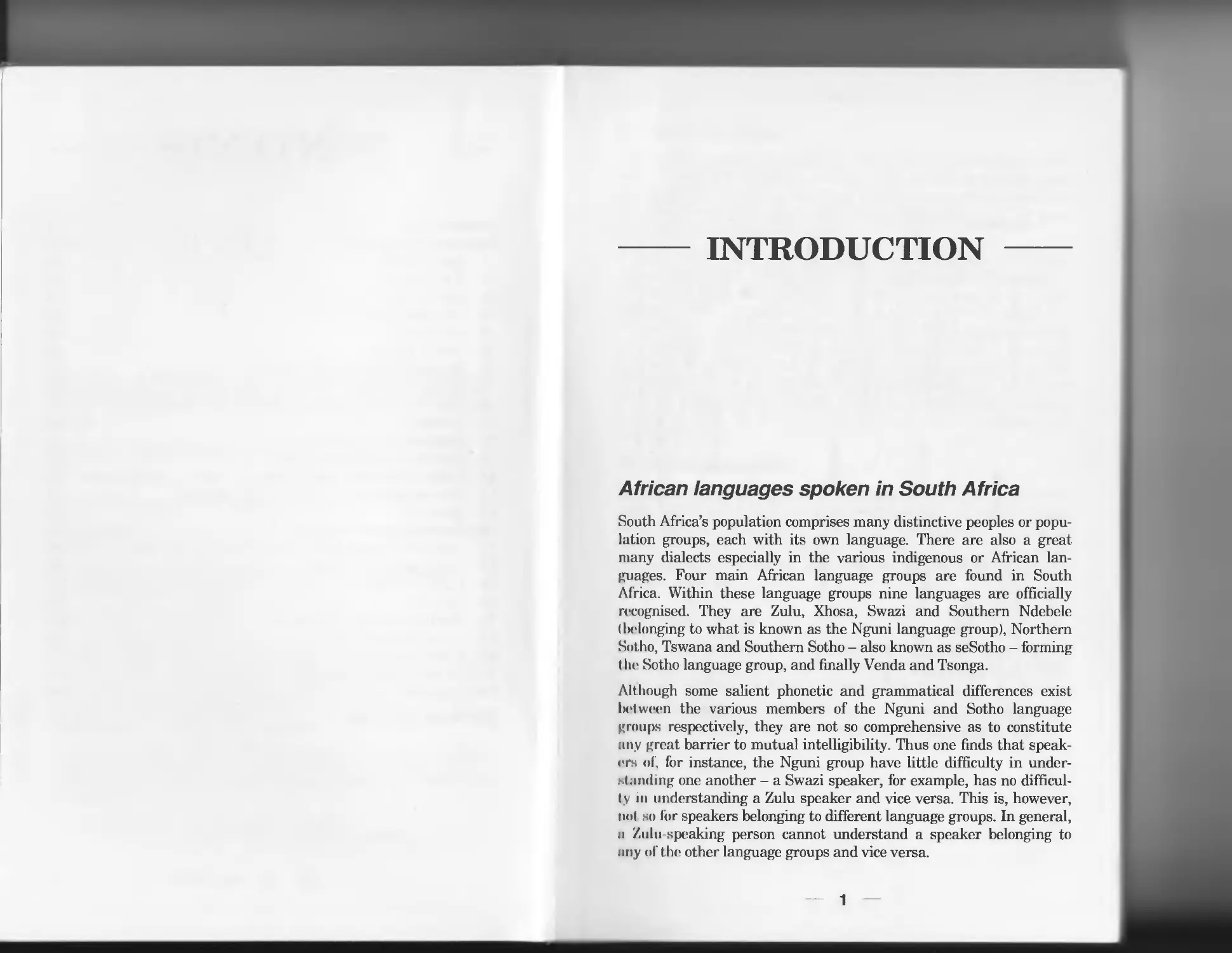
Map showing the distribution of languages in South Africa
The Nguni languages
The Nguni languages are spoken by more than 20 million people, who
reside - with few exceptions - in the south-eastern part of the coun-
try, in an area stretching for about 1000 km in a broad coastal belt
from Swaziland in the north, right through KwaZulu-Natal, far down
into the Eastern Cape in the south.
In the northern part of this territory (consisting of KwaZulu-Natal)
Zulu predominates, while Xhosa is the predominating language in
the Eastern Cape. Zulu is also the dominating language in the south-
eastern part of Mpumalanga as well as on the Witwatersrand (i.e.
Johannesburg and adjacent areas). Zulu and Xhosa are numerically
the strongest of the Nguni languages. Swazi, which is the main
language of neighbouring Swaziland, is mainly spoken in the
Mpumalanga in an area that is more or less adjacent to the Kruger
National Park. IsiNdebele is the Nguni language with the smallest
number of speakers, and is mainly spoken in the Mpumalanga and
Gauteng provinces.
The Sotho languages
The Sotho-speaking people occupy the interior lands to the west and
north-west of the main Nguni area. Northern Sotho is mainly spoken
in the Northern province, and Tswana in the North-West province as
well as in neighbouring Botswana. Southern Sotho is by and large
restricted to the Free State. It is, of course, also the national language
of nearby Lesotho.
Venda and Tsonga
Venda is the language with the fewest speakers of the four principal
Bantu language groups in the Republic of South Africa and is spoken
mainly in the northern districts of the Northern province.
Tsonga is spoken in the Northern province as well as in Mpumalanga.
It is also the official language of neighbouring Mozambique.
PRONUNCIATION
GUIDE
To acquire the correct pronunciation of Zulu, it is recommended that,
whenever possible, the help of a native speaker is enlisted. However,
it is good to remember that the main objective is not to acquire a per-
fect accent of Zulu but to be understood; here are a number of tech-
niques for studying pronunciation:
• Listen carefully to the cassette provided and whenever possible
try to repeat aloud the sounds and words pronounced by the
mother tongue speaker on the tape
• Record yourself and compare your pronunciation with that of the
mother tongue speaker on the tape.
• Make a list of words that give you pronunciation trouble and prac-
tise them.
The first important rule to remember regarding pronunciation in
Zulu is that the penultimate syllable of most Zulu words is length-
ened. The lengthening of this syllable is clearly audible in words that
occur as the final word in the sentence. Compare the following exam-
ples on your cassette. Pay special attention to the pronunciation of
the penultimate syllable of the final word in the sentence:
Ngisafunda isiZulu
Sihamba manje
Amabhasi asuka kuphi?
I am still learning (to speak)
Zulu
We are going now
Where do the buses depart from ?
A wide variety of vowel elisions occur in Zulu, too many to treat in
detail here. However, one kind of elision that should perhaps be men-
tioned is the elision of the second i in the noun prefix isi- in nouns
with di- or tri-syllabic stems. For example:
isikole > iskole
isiSkotilandi > isKotilandi
school
Scotland
Vowels
a is pronounced somewhat as in bark; e.g. ubaba {father)
e has two pronunciations. When followed by the vowel i or u it is
pronounced somewhat as in bed; e.g. -thengile {bought). When
followed by the vowel a its pronunciation sounds much like that
of the a in cat; e.g. -letha {bring)
i is pronounced approximately as in see; e.g. -thi (say)
о has two pronunciations. It is pronounced somewhat as in saw
when it is followed by an a; e.g. -bona (see). When followed by an
i or u it is pronounced much as in the northern English no.
u resembles the northern English sound in food; e.g. ufudu
(tortoise)
Semi-vowels
у is pronounced as in yes; e.g. yebo (yes)
w is pronounced as in want; e.g. wena (you)
Consonants
Only those consonants that may cause pronunciation problems are
given below.
f is pronounced as in fall; e.g. ifu (cloud)
v is pronounced as in van; e.g. vala (close)
sh is pronounced as in shall; e.g. shaya (hit)
tsh is pronounced somewhat as the initial ch in church
th is aspirated and pronounced much like the t in tea; e.g. thatha
(take)
t is pronounced somewhat like the t in steam; e.g. intombi (girl)
ph is aspirated and pronounced much like the p in pen; e.g. pheka
(cook)
p is pronounced somewhat like the p in spoon but without any
aspiration; e.g. impisi (hyena)
kh is pronounced much like the c in can; e.g. ikhanda (head)
к has two pronunciations. The ‘soft-к’ is something between
English к and g; e.g. ukuvuaa (to wake up). The so-called
‘sharp-к’ has no equivalent in English. It sounds somewhat like
the c in cat but without any aspiration and normally occurs after
n, as in e.g. inkunzi (bull)
g is pronounced more or less as in gain; e.g. ugogo (grandmother)
n is pronounced as in English. However, when it precedes a к or a
g it is pronounced more or less like the ng in sing; e.g. inkomo
(beast)
ng is pronounced as in finger; e.g. ingane (child)
ny is pronounced as in Vignette; e.g. inyoni (bird)
d is pronounced much like the d in duck; e.g. amadoda (men)
b has two pronunciations. In combination with m it sounds like the
b in English; e.g. hamba (go, walk), imbuzi (goat). On its own it
is pronounced with implosion, i.e. with a slightly digressive air-
stream; e.g. ubaba (father), ubani? (who?)
bh sounds like something between b (as for instance in ball) and p
(as in pot). Although it is written bh there is no aspiration in
this sound; e.g. ibhola (ball), ibhokisi (box)
h is pronounced as in hand; e.g. hamba (go)
hh is the voiced equivalent of h and occurs in words such as
ihhashi (horse), hhayi (no!)
hl is pronounced very much as 11 in the Welsh Llanelli. This sound
is pronounced by pressing the tongue just behind the upper teeth
as if to articulate 1 then, while holding it there, blow the air over
both sides of the tongue; e.g. -hlala (sit)
dl is the voiced form of hl. It sounds much like d + hl pronounced
simultaneously; e.g. -dlala (play)
j is pronounced as in just; e.g. ukujabula (to be glad)
Click sounds
c To pronounce this sound:
(i) place the tip of the tongue against the upper front teeth and
gum.
(ii) Depress the centre of the tongue.
(iii) Release the tip of the tongue drawing it slightly backward.
This click resembles the English click of annoyance written as
tut-tut; e.g. -cela (request)
q To pronounce this sound:
(i) Press the upper part of the tongue-tip against the part
between the teeth ridge and the hard palate.
(ii) Raise the back of the tongue so that it touches the soft palate.
(iii) Depress the centre of the tongue.
(iv) Release the tip of the tongue sharply downwards.
This click resembles the sound of drawing a cork from a bottle:
e.g. qala (begin, start)
x To pronounce this click:
(i) Place the upper part of the tongue-tip against the part
between the teeth ridge and the hard palate.
(ii) Raise the back of the tongue towards the soft palate.
(iii) Withdraw one side of the tongue from the upper teeth.
This sound is generally used in urging a horse; e.g. xoxa (chat,
converse)
When aspirated these clicks are written: ch qh xh
Nasalised they are written: nc nq nx
(Note that the nasal and the click are pronounced simultaneously
as a single sound)
With voicing: gc gq gx
1
--------- UN JANI? ------
How are you? (Greetings)
In this unit you will learn how to
• exchange greetings and address people
• say goodbye to people
• ask about someone’s health
• use some personal pronouns
s
Ingxoxo (Dialogue)
Greetings form an important part of Zulu people’s social life. It is
highly unusual for persons to engage in conversation, no matter how
brief it may be, without first greeting each other and enquiring about
each other’s health.
In the following dialogue, Stephen (a tourist) and Albert (a waiter in
the hotel where Stephen stays) exchange greetings. Stephen is about
to leave.
Albert Sawubona Mnumzane.
Stephen Yebo.
Albert Unjani?
Stephen Ngikhona, wena unjani?
Albert Nami ngikhona. Ulale kamnandi na?
Stephen Yebo.
Albert Uyahamba manje?
Stephen Yebo.
Albert Hamba kahle.
Stephen Sala kahle.
Sawubona Good day Hamba kahle Go well
mnumzane sir Sala kahle Stay well
Ngikhona I’m fine yebo yes
Ulale kamnandi na? Did you sleep Unjani? How are you?
well? Wena unjani? How are you?
Uyahamba manje? Are you leav- (‘you’ emphasised)
ing/going now?
И
Ulimi (Language usage)
1 Forms of greeting
The most important greeting word in Zulu when addressing a single
person is sawubona which may also be expressed as sakubona.
When we greet more than one person we say sanibona or sanibo-
nani (pronounced sanbonaan’). These forms of greeting can be used
at any time of day and night as they can mean good morning, good
afternoon, good evening, or simply hello.
In reply to a greeting it is customary to say yebo (yes) or yebo,
sawubona (singular) or yebo, sanibonani (plural).
2 Formsofaddress
Il is important to use the correct form of address when greeting people
in Zulu. Here are a few common terms of address which you as a
si iident of Zulu should know:
mnumzana/e sir
nkosikazi madam (a married
woman)
nkosazana miss
baba sir - used when addressing
an older man, is less formal than
mnumzana above
inn rri.Kf.im used when address-
ing .in iildnr woman, is less formal
Ih.in nkosikazi above
mlowethu my brother
dadewethu my sister
madoda men
mfana boy. young man
mntanami my child
When we greet friends we may, of course, use their personal names.
In addition to their traditional name (igama lesiNtu), most Blacks in
South Africa also have a so-called Christian (i.e. Western or White
person’s) name (igama lesiLungu). Like most other loan-words such
names are normally adapted to the Zulu sound system. So, Joseph is
often pronounced as Josefa, David as Davidi, Lisbeth as Lisbethe,
etc. The original pronounciation may, however, be retained.
In informal situations where a person’s name is not known, Blacks
often address each other with mfowethu (in the case of a male
person), and dadewethu or simply dade (in the case of a female
person). Ma is another favourite greeting form for married female
persons. In most metropolitan areas the slang forms bhuti (short for
Afrikaans boetie brother} and sisi (sister) are also frequently used.
3 Saying goodbye
When saying goodbye to someone who is leaving, you say Hamba
kahle (Lit. Go well).
When saying goodbye to someone who is staying behind, you say Sala
kahle (Lit. Stay well).
To say goodbye to more than one person you simply add -ni to the
verb hamba or sala:
Hambani kahle (when they are leaving)
Salani kahle (when you are leaving).
(SHA W«l£,
V ’.Q.A
4 Asking about someone’s health
There are various ways in which to enquire about one another’s well-
being in Zulu. Some of the most frequently used expressions are:
Singular
Unjam?
Ngikhona
Wena unjani?
Nami ngikhona
How are you?
Гт fine (Lit. I’m there.}
(And} How are you? (‘you’
emphasised)
I’m fine too.
In addition to Unjani? one may also ask:
Usaphila na?
Yebo, ngisaphila.
Wena uphila njani?
or:
Uphila njani?
Are you still fine? (Lit. Are you
still alive?}
I am still fine. (Lit. Yes, I’m still
alive}
How are you doing? (‘you’
emphasised) (Lit. How do you
live?}
How are you? (Lit. How do you
live?}
Ngiyaphila
or:
Kunjani?
Kulungile
Plural
Ninjani?
Sikhona (or Siyaphila)
or:
Nisaphila na?
Instead of using njani? or -phila in
your well-being you can also say:
Ngicela kini?
or:
Sicela kini?
Sawubona bhut’ John, ninjani?
Sikhona. Sicela kini?
I’m OK. (Lit. I am living.)
How is it (with you)?
It’s OK (with me).
How are you?
We are fine.
Yebo, sisaphila.
your response to a question about
May I ask how is it at your home?
May we ask how is it at your
home?
Good day brother John,
how are you? (pl.)
We are fine. May we ask how is
it at your home?
5 Personal pronouns
The equivalents of the English pronouns I, you, we, it, he I she and
they are not complete words in Zulu. They are formatives, or, to use
their grammatical name, concords, i.e. they are constituent parts of
words. Here are some concordial pronouns that you have already
encountered as well as one or two new ones which you will be using
soon.
ngi- / u- he/she
u- you ba- they
ni- you (pl.) si- we ku- it
In Zulu there is no grammatical distinction between masculine and
feminine. Note also that the pronouns he I she and you (singular) are
both u- in Zulu except that in case of the latter the u- is pronounced
with a low tone while in case of the former it is pronounced with a
high tone.
И---------------Umsebenzi (Exercises)------------------------------
1 Let’s practise the material you have studied thus far by exercising
the following dialogues. In the first one, Thandi and her friend
Fikile (two girls), greet each other. Let’s imagine you are Thandi.
How would you respond to what Fikile says?
Fikile: Thandi:
(a) Sawubona Thandi ----
(b) Unjani? ----
(c) Nami ngikhona, sala kahle ----
2 In the second dialogue, Sibusiso greets a couple of his (male)
friends (amadoda men). You are Sibusiso. Try to enact his role in
this dialogue by bearing in mind how his friends respond.
Sibusiso: Amadoda:
(a) Yebo.
(b) ? Sikhona, wena unjani?
(c)
3 How would you say hello to the following people?
(a) your boss at the office
(b) your friend Mandla
(c) a married woman (in a formal way)
(d) an unfamiliar male person
(e) an unmarried young woman (in an informal way)
(/) an elderly gentleman
4 How would you say goodbye (you are leaving) to the following
people?
(a) your friend Raymond
(b) people you have just met
5 You are speaking to Paul and Mary. Ask them how they are and
tell them that you are fine.
6 How do you say in Zulu:
(a) How are they?
(b) He/She is fine.
(c) They are fine.
(d) We are fine.
(e) How are you? (pl.)
(/) It’s OK. ‘
7 Correct, rewrite and then translate the following:
(a) Sanibonani mfowethu.
(b) Sala kahle bafana (boys).
(c) Ngiphila.
8 Complete the missing dialogue.
2
WENA UNGUBANI?
Who are you? (personal
identification)
In this unit you will learn how to
• ask someone’s name and surname
• ask someone’s identity and where he or she comes from
• use Zulu praise names
• form singular and plural nouns
И ------------------- Ingxoxo -----------------------
12
Asking someone’s name and where he or she comes from is something
that crops up regularly in many a conversation, as for instance in the
following dialogue between Michael Cohen from England and Sam
Ndlovu from Ladysmith, South Africa. They have met briefly before
and now use the opportunity to become more closely acquainted.
Having first greeted each other as is customary, they continue by ask-
ing each other’s names and surnames and where they each hail from.
Michael Ngubani igama lakho baba?
Sam Igama lami nguSam, mnumzana.
Michael Sam bani?
Sam NginguSam Ndlovu mnumzana. Wena ungubani?
Michael NginguMichael.
Sam Michael bani?
Michael Michael Cohen.
Sam Uphumaphi?
Michael Ngiphuma phesheya.
Sam [somewhat surprised) O! Uphuina phesheya! Kuphi
phesheya?
Michael Ngiphuma eNgilandi. Wena uphumaphi Sam?
Sami Mina ngiphuma eMnambithi.
Ngubani igama lakho? What is Uphumaphi? Where do you come
your name? from?
Igama lami nguSam My name is -phuma come from
Sam Phesheya Overseas
Sam bani? Sam who? Kuphi? Where?
NginguSam Ndlovu I’m Sam eNgilandi England
Ndlovu Mina / (emphasised)
Wena ungubani? Who are you? eMnambithi Ladysmith (a town in
Wena You (emphasised) KwaZulu-Natal)
Ulimi
1 Asking someone’s name
To ask someone’s name (igama) you say:
Ngubani igama lakho? Lit. It is who the name of you?
or:
Lifhini igama lakho? Lit. It says what your name?
To this you may reply by adding Ngingu- (I am ...) to your personal
name.
NginguPeter
NginguJohn
NginguMandla
NginguThandi
Or you may wish to reply more fully by saying. Igama lami ngu ...
(My name is...).
Igama lami nguStephen. My name is Stephen.
Or you can put ngingu- before your name and igama lami after it.
NginguStephen igama lami Lit. I’m Stephen my name.
2 Asking someone’s surname
To ask someone’s surname (isibongo) you use:
Ngubani isibongo sakho?
What’s your surname?
or:
Sithini isibongo sakho?
To this you may reply:
Isibongo sami nguJones
What’s your surname?
My surname is Jones
or:
SinguJones
It is Jones
or:
NginguJones (isibongo sami)
I’m Jones (my surname)
To
ask a third person’s name or surname is similar, except that
instead of the possessive pronoun -kho (you sing.) and -mi (my) you
use the third person possessive pronoun -khe (his/her).
Ngubani igama lakhe?
Igama lakhe nguSamueL
UnguSamuel igama lakhe.
Ngubani isibongo sakhe?
Isibongo sakhe nguKhathi.
UnguKhathi isibongo sakhe.
His name is Samuel.
He is Samuel his name (that is).
His surname is Khathi.
He is Khathi his surname
(that is).
3 Asking someone who (s)he is
To ask someone’s identity you can simply say Ungubani? (Who are
you? Lit. You are who?) as in the following dialogue where Meshack
Masondo and Themba Nkosi are introducing themselves to one
another.
4 Sam who?
When a person tells you his or her name and you would also like to
know his or her surname, you simply put the interrogative bani?
after the person’s name as is done in the above dialogue.
5 The emphatic pronouns wena and mina
Wena is used to emphasise the second person singular, mina to
emphasise the first person singular:
Wena uphumaphi?
Mina ngiphuma eNgilandi.
Where do you come from?
(‘you’ emphasised)
I come from England.
(T emphasised)
6 Asking someone’s praise name
Praise names (izithakazelo) are a prominent feature of Zulu culture,
and, in fact, of all clans belonging to the Nguni language group.
Every adult male person in Zulu society has a praise name. All
eligible male persons belonging to the same family clan (i.e. persons
sharing a common surname) have the same isithakazelo. For
instance, the isithakazelo of all adult male persons with the sur-
name Khumalo is Mntungwa; those whose surname is Ntuli have
Mphemba as their isithakazelo, and so on. It is interesting to know
that President Mandela, being a member of the Xhosa-speaking
group, is also known by the name Madiba which is the praise name
of the Mandela clan. Isithakazelos are only used by men folk,
women never call men by their praise names. Zulus are without
exception delighted when they are called by their isithakazelo and
an usually pleasantly surprised if foreigners know their praise
names. It is consequently strongly recommended to find out what a
cl m’s isithakazelo is. (You can do this by first asking any Zulu male
person what is isibongo (surname I clan name) is and then what his
isithakazelo is). Make a point of using a person’s isithakazelo as
often as possible in your conversation with him.
1 he following are a few examples of popular Zulu surnames and their
.u eompanying isithakazelos:
Cole - Ndosi
I Momo - Mkhabela
Buthclezi - Shenge
Nkosi - Dlamini
Ndlovu - Gatsheni
Io find out what someone’s praise name is, you ask sithini
isithakazelo sakho?
You Ngubani isibongo sakho, Sam?
Num NginguKubheka, mnumzana.
i oil Sithini isithakazelo sakho?
Num SinguKhathide (or NginguKhathide or NguKhathide),
mnumzana.
Definite and indefinite articles
Il in important to note at this stage that Zulu differs from languages
miili us English in that it doesn’t distinguish between definite and
inilrhiiiti nouns by means of articles such as the and a. In other
words, a noun like inja, for instance, can either mean the dog or a dog
depending on the context in which it occurs.
8 Initial vowel of nouns
As you will have noticed above, all nouns in Zulu normally begin with
a vowel. However, when we address a person or persons, the noun
referring to such a person or persons discards its initial vowel.
sawubona
sanibonani
sawubona
(u)mfana
(a)madoda
(u)baba
9 The noun class system of Zulu
A striking feature of Zulu and all other Bantu languages is the fact
that their nouns are classified into various categories or noun classes.
There are 18 such noun classes in Zulu, of which some are singular
and others plural classes. There are also two neutral classes which
are neither singular nor plural. Each noun class has what is known
as a class prefix which is a formative that is attached to the beginning
of the noun, in fact, to the noun stem. The class prefix indicates to
which noun class a noun belongs and at the same time also whether a
noun is a singular, plural or a neutral noun. In most instances these
prefixes operate in pairs, one being the singular prefix and the other
the plural prefix.
The following system of noun class prefixes is found in Zulu:
Singular prefixes Plural prefixes
Class 1 um(u)- Class 2 aba-
Class 1a u- Class 2a o-
Class 3 um(u)- Class 4 imi-
Class 5 i(li)- Class 6 ama-
Class 7 isi- Class 8 izi-
Class 9 in-/im- Class 10 izin-/izim-
Class 11 u(lu)-
Class 14 ubu-
Class 15 uku-
Note that nouns in class 11 take their plural in class 10, and that only
nouns signifying human beings belong to classes 1 and 2.
Let’s look at a few examples of how these class prefixes distinguish
between singular, plural and neutral nouns in Zulu.
umu-ntu person aba-ntu people
um-lungu White person abe-lungu White people
u-baba father o-baba fathers
um-fula river imi-fula rivers
i(li)-bhayisikili bicycle ama-bhayisikili bicycles
isi-kole school izi-kole schools
in-dlu house izin-dlu houses
u(lu)-debe lip izin-debe lips
ubu-ntu human nature
uku-hamba travelling
Note that when the stem of nouns belonging to classes 1 and 3
consists of only one syllable, the class prefix of these nouns is umu-;
and when the stem consists of more than one syllable (which is
normally the case) the class prefix is urn-.
um-lungu but umu-ntu
Note also the variant form of the prefix of class 2 in words such as
abe-lungu. This variant form is, however, confined to only a small
number of nouns in this class.
A limited number of nouns in class 9 have irregular plural forms in
class 6.
indoda man but amadoda men
inkosi chief but amakhosi chiefs
intombazane girl but amantombazana girls
finally, it is important to know that most loanwords (from, for
instance, English and Afrikaans) occur in the ili-class. If one does not
know the Zulu name of something one may (as a last resort) ‘Zulufy’
an English noun by simply putting i- in front of it.
iRadio
iFour-wheel drive
istation
Umsebenzi ----------
1 How would you respond in Zulu if someone asks/says to you:
(a) Sawubona mnumzane/nkosazana.
(b) Unjani?
(c) Usaphila na?
(d) Ngubani igama lakho?
(e) Ngubani isibongo sakho?
(f) Hamba kahle.
(g) Ungubani wena?
2 Imagine you are Joseph Gumede and you meet someone you don’t
know. How would you:
(a) introduce yourself to him?
(b) ask him his name and surname?
(c) ask him where he comes from?
(d) tell him where you come from?
(e) bid him goodbye?
3 Give the plural form.
umfazi woman
ibhasikidi basket
isitolo store
um nt wan a child
imoto (class 9) car
umuzi village
iwashi watch
indoda man
umkhonto spear
ubaba father
4 Rewrite the following nouns in the singular:
abantu people
amarandi Rands (money)
imimese knives
amakamelo rooms
5 Correct (where necessary)
sentences:
izinkwa breads
izinkomo cattle
abeSuthu Sotho people
amantombazana girls
and rewrite each of the following
Hambani kahle Simon.
Ngubani igama lakho? Igama lami Sally.
Isibongo lami nguPeters.
Sawubona ubaba.
Uphila njani? Ngiphila.
Ubani wena?
6 How will you ask Desmond Khumalo what his surname and what
his praise name is? Do you remember what the Khumalo’s praise
name is?
3
UYAKWA'Zl UKUKIIULUMA
-- 1SINGISI NA? -—
('(tn von apcnh Enpjish
In this unit VOII W ill II III II
• how Io ;i’ к oiih uni win I In i In in In In nlili (in iiul ;ible)
to <lo ,SOIIII'I 11111)
• how tn ,i. к wh.il I iiipu ц । и pi i uh pi nt
• what to miv whrn \on tin nut ijiiiIi । i uni wliiit Hoiiii'iinc hiivs to
you in Zulu
• I1OIIII4 lll'lllll III)' Lllll'll ||'l
• how Io .с к wh.il ii pi i пн n-iliiiiiidilv i
------------------- Inqxoxo --------
Janel Smith i?< iiliniil h> l.dn пр н (till hint j«ili nnd i t iinHidenng
employing и iiiinnv ' nm bun । In । pi i In ii hi vi In i id nine <if her
household choir hi Inlk In In i (iii'iiil Hphii N|’iiIhiiii who knows
of someone who miphl In inli ii ln| io tlx Hull* Aiiiiinp tilhei things,
Janet IS mien ih’d III liiitti li«un niplili M hit Ini Iipliii m leqiirnnt
mice is fond nt < IiiIiIion d In ininiiil iiidknuwi hnw hi < onk, what
her langimge piotn it n< у In nnd hri iiiIihiiiIiI\ iti hi i Irdnil allini
ty), and when he Will hl d»t* h> ihlil ihnidd liint t <li i ide to employ
hei.
Janet Sophie Janet Sophie Janet Sophie Janet Sophie Janet Sophie Janet Sophie Janet Sophie Janet Sophie Janet Ungubani lo mngane wakho Sophie? UnguGertrude igama lakhe. Uthanda abantwana lo Gertrude? Kakhulu! nkosikazi. Ushadile na? Yebo, ushadile. Uyakwazi ukupheka? Angazi kodwa ngiqinisile ukuthi uyakwazi. Uyakwazi ukukhuluma isiNgisi lo mame? Yebo, uyakwazi. IsiBhunu-ke? Uyasazi kodwa hayi kakhulu. Ungumhlobo muni? UngumZulu uGertrude. Angaqala nini? Angazi kodwa ngizombuza. Ngiyabonga Sophie. Mtshele uGertrude ukuthi ngithanda ukumbona.
Sophie Kulungile, ngizomtshela.
Ungubani Io mngane wakho?
Who is she (i.e. What is the name of)
this friend of yours?
UnguGertrude igama lakhe
Gertrude is her name (Lit. She is
Gertrude her name.)
Uthanda abantwana Io Gertrude?
Is she fond of children this
Gertrude?
Kakhulu! Very much!
Ushadile na? Is she married?
Uyakwazi ukupheka? Can she
cook? (Lit. Does she know how
to cook?)
Angazi / don't know
kodwa but
Ngiqinisile I’m sure
ukuthi that
uyakwazi she knows/can
Uyakwazi ukukhuluma isiNgisi Io
mame? Can this lady speak
English? (Gt. Does this lady know
how to speak English?)
Umarne (term of respect used in
addressing a married woman)
IsiBhunu-ke? (And ) Afrikaans?
Uyasazi kodwa hayi kakhulu She
knows it but not much
Ungumhlobo muni? What
nationality is she?
UngumZulu She s a Zulu
Angaqala nini? When can she start?
Angazi kodwa ngizombuza / don’t
know but I'll ask her
Mtshele ukuthi ngithanda ukumbona
Tell her that I would like to see her
Kulungile ngizomtshela OK, I’ll
tell her
Ulimi
1 Can you... ? (he. are you able to... ?)
1.1 Do/Can you speak English?
To ask someone whether he or she or a third person (in class 1 or la)
can (i.e. is able to/knows how to) perform a certain action, you say
Uyakwazi uku...? (Lit. Do you know how to...?) followed by the name
of the action the person is to perform.
Uyakwazi ukukhuluma isiNgisi
mnumzane?
Uyakwazi ukupheka Paulina?
Uyakwazi ukufunda Maria?
Do (Cun) you speak English, sir?
(-khuluma isiNgisi speak
English)
Do you know how to cook (i.e.
Can you cook). Paulina? (-pheka
cook)
Do you know how to (i.e. Can
you)read, Mana?
Note that the initial vowel of a noun denoting the addressee is dropped,
as in the case of mnumzane, Paulina and Maria above (See also Unit
2, Section 8.)
When this question concerns a third person (in class 1 or la), the same
construction is used except that the third person singular concord u-
(helshe) - (i.e. the initial u- in uyakwazi) - is pronounced with a high
tone - the second person singular concord u- (you) is pronounced with a
low tone - while the initial vowel of the person’s name (if mentioned) is
retained.
UFrank uyakwazi ukulungisa Does Frank know how to fix
izibane? the lights?
UDoris uyakwazi uku-ayina? Does Doris know how to iron?
Note that Zulu has no grammatical gender as far as its pronominal
system is concerned, i.e. it does not distinguish between masculine
(=he) and feminine ( = she) pronouns. Both these pronouns are
expressed by the same concordial pronoun, i.e. u-.
1.2 Yes, I can (speak English)
To say you are able to do something, you simply replace the initial
second person singular concord u- (you) of uyakwazi by the first per-
son singular concord ngi- (I), i.e. ngiyakwazi.
Uyakwazi ukukhuluma isiNgisi
Josefa?
Yebo, ngiyakwazi
Uyakwazi ukushayela imoto
Marvin?
Yebo, ngiyakwazi mnumzane.
Do you speak English, Joseph?
Yes, I do. ( = can ) (speak English)
Can you drive a car, Marvin ?
Yes I can, sir.
1.3 No, I can’t (speak English)
In the negative of the first person singular we start with an a- and
omit the -ya-.
Uyakwazi ukukhuluma isiNgisi? Do you know (how to speak)
English?
Cha, angikwazi. No, I don’t.
In the negative of the third person singular (in class 1 or la), you
replace the initial u- with aka- and also omit the -ya-.
Umlungu (class 1) uyakwazi
ukukhuluma isiZulu na?
Cha, akakwazi.
ULydia (class la) uyakwazi
ukushayela imoto na?
Cha, akakwazi.
Can the White person speak
Zulu?
No, he can’t.
Does Lydia know how to drive
a car?
No, she doesn’t.
2 Do you speak... ?
2.1 Do you know Zulu?
To ask whether someone knows (how to speak) a language, you use
the stem -azi (know) and say Uyasazi... followed by the name of the
language.
Uyasazi isiZulu na? Do you know Zulu ?
This you can answer by saying:
Yebo, ngiyasazi. Yes, 1 know it.
Zill и
In the negative you begin with a- and omit the -ya- (as in 1.3 above).
Cha, angisazi.
No, 1 don 't understand it.
2.2 Yes, a little. I’m still learning (to speak) it
Beginners who try to communicate in Zulu are often asked by mother
tongue speakers whether they know Zulu (Uyasazi isiZulu na?).
You can respond to such questions by saying:
Yebo, ngiyasazi kodwa hayi Yes I know it, but not very
kakhulu. well
or:
Ngisazi kancane. Ngisasifunda. I know it a little. I’m still
learning it.
Instead of Uyasazi isiZulu na? you can also be asked Ukhuluma
isiZulu na? (Doyou speak Zulu?), to which you can reply:
Ngisikhuluma kancane.
Ngisasifunda.
I speak it a little. I’m still
learning it.
Another and also very idiomatic way to say that you are still a begin-
ner as far as speaking Zulu is concerned is to use the verbal stem
-cathula (toddle, learn to walk).
Angisikhulumi kahle kakhulu. I do not speak it so well, I’m still
Ngisacathula. learning to walk (i.e. I’m still a
beginner).
2.3 Where have you learned to speak Zulu?
Beginners are also frequently asked where they’ve learned to speak
Zulu (Usifundephi isiZulu?).
To this you may reply:
Ngisifunde encwadini.
Ngisifunde esikoleni.
Ngisifunde epulazini.
I’ve learned it from a book.
I’ve learned it at school.
I’ve learned it on a farm.
3 What language do you speak?
South Africa is a multilingual country with no less than 11 official
languages. Visitors to this country are often confused by the multi-
tude of tongues they hear and are seldom if ever able to distinguish
between most of them. To enquire what language a person speaks,
you can ask:
Ukhulumani? What (language) do you speak?
The answer will usually be Ngikhuluma... followed by the name of
the language.
Ukhulumani? Ngikhuluma What (language) do you speak?
isiXhosa. I speak Xhosa.
Another way to gain the above information is to ask:
Nikhulumani ekhaya? What (language) do you (people)
speak at home?
4 Sorry, I do not understand what you are
saying
When someone speaks to you in Zulu and you do not understand what
the person is saying, you may reply:
Ngiyaxolisa kodwa angiqondi Sorry, but I do not understand
kahle usho ukuthini. what you are saying.
If you want someone to repeat what he or she has said because you
did not understand it very well, you can ask:
Awuphinde. Angiqondi kahle.
Please repeat. I do not understand
(you) very well.
or:
Awukhulume kancane, angiqondi
kahle. Ngisafunda ukukhuluma
isiZulu.
Please speak (more) slowly, I do
not understand so well. lam still
learning to speak Zulu.
5 Nouns denoting languages
All nouns in Zulu denoting languages begin with the prefix isi-.
ZUI и
isiNgisi English
isiBhunu Afrikaans
isiFulentshi French
isiNdebele Ndebele
isiSuthu (Southern) Sotho
isiVenda Venda
isiJalimane German
isiZulu Zulu
isiXhosa Xhosa
isiSwati Swazi
isiTsonga Tsonga
isiTswana Tswana
isiPedi Pedi (Northern) Sotho
All the above languages ,with the exception of French and German,
are official languages in South Africa.
6 What nationality are you ?
To ask someone’s nationality, you say Ungumhlobo muni? or
Ungowasiphi isizwe?
The answer to such a question usually begins with Ngingu- or Ngiyi-
(Z am ...). Ngingu- is used when the noun denoting the nationality
begins with u-, while ngiyi- is used when such nouns start with i-.
NgingumZulu.
NgiyiNgisi.
NgiyiNdebele.
I’m a Zulu. (umZulu Zulu
person)
I’m English. (iNgisi Englishman)
I am an Ndebele-speaking
person.
6.1 Names of nationalities
Here are the names of a few European nationalities as well as a few
(tribal) nationalities found in South Africa.
umNgisi (or iNgisi) Englishman
(amaNgisi pl.)
isiKoshi Scotsman
iJalimane German
umHholandi Dutchman
(abaHholandi pl.)
iFulentshi Frenchman
iBhunu Afrikaner
umZulu Zulu-speaking person
(amaZulu pl.)
umSwati Swazi-speaking person
(amaSwati pl.)
umXhosa Xhosa-speaking person
(amaXhosa pl.)
iNdebele Ndebele-speaking person
(amaNdebele pl.)
umTswana Tswana-speaking
person (abeTswana pl.)
umPedi Pedi-speaking person
umSuthu Suthu-speaking person
(abeSuthu pl.)
umTsonga Tsonga-speaking
person
umVenda Venda-speakmg person
----------Umsebenzi ------------
1 Complete the following dialogue between Linda and Thandiwe by
providing the missing words.
Linda __________mhlobo muni Thandiwe?
Thandiwe NgiyiNdebele Linda.
Linda ____kuphi?
Thandiwe Ngiphuma KwaNdebele.
Linda Nikhuluma isiZulu ekhaya (at home)?
Thandiwe Cha, sikhuluma isiNdebele ekhaya. Nina nikhu-
lumani ekhaya?
Linda __________ isiNgisi [and] nesiBhunu. Uyasazi isiBhunu
Thandiwe?
Thandiwe Ngiya________kodwa hayi kakhulu.
2 How would you ask someone whether he or she can speak the
following languages:
(a) French
(b) Afrikaans
(c) Xhosa
(d) Zulu?
3 How would you say to someone that you know the following
languages:
(a) English
(b) Zulu
(c) Sotho?
But that you don’t know the following languages:
(a) German
(b) Venda
(c) Afrikaans?
4 When someone addresses you in Zulu and you do not understand
what he or she is saying, how will you tell him or her that you do
not understand?
5 You have arived at Durban airport and have taken a taxi to your
hotel. On your way you engage in conversation with the
driver. You ask him (a) what his name is and he tells you (b) it is
Mzilikazi. He ask you (c) where you come from and you answer (d)
you are from Johannesburg (eGoli). You ask (e) what nationality
he is and he replies (/) he is a Zulu. You conclude by asking him
(g) where he comes from and he answers (/i) eMlazi (a main town-
ship near Durban).
Write a suitable dialogue based on the information given above.
NGINGAKUSIZA NA?
Can I help you1?
In this unit you will learn how to
• offer help
• say ‘Thank you’, “Yes, please’ and ‘No, thank you’
• ask what price something is
• say ‘each’ meaning ‘one’
• use another way to say goodbye
• say ‘and’
------------------- Ingxoxo ------------------------
Fruit and vegetable stalls are a familiar sight along many of South
Africa’s tourist routes and are often frequented by travellers. In the
following dialogue, a traveller (Mrs Webb) wants to buy some fruit
and vegetables from an adult female vendor.
Vendor
Mrs Webb
Vendor
Mrs Webb
Vendor
Mrs Webb
Ngingakusiza ngani nkosikazi?
Ngifuna uhlaza nezithelo.
Ufunani?
Ngifuna utamatisi nokwatapheya. Yimalini utamatisi?
Yi-R3 iphakethe.
Kulungile. Ngizothatha iphakethe. Yimalini ukwata-
pheya ngamunye?
Vendor
Mrs Webb
Vendor
Mrs Webb
Vendor
Mrs Webb
Vendor
Mrs Webb
Vendor
Yi-Rl ngamunye.
Ngizothatha munye.
Ufuna nani futhi?
Lutho. Ngiyabonga.
Awufuni uphayinaphu?
Cha, ngiyabonga.
Kukhona okunye na?
Cha, yilokho kuphela.
Ngiyabonga.
Ngingakusiza ngani? With what
may I help you?/What сап I do
for you?
ngani? with what?
Ngifuna I want/need
uhlaza vegetables
nezithelo and fruit
Ufunani? What do you want?
utamatisi tomatoes
nokwatapheya and avocados
Yimalini? How much does it cost?
(tit. How much money is it?)
Yi-R3 It is R3
iphakethe a packet
Kulungile OK
Ngizothatha iphakethe I'll take a
packet
Yimalini ukwatapheya ngamunye?
How much loi one avocado pear?
Yi Ri ngamunye Il's FH for one
Ngizothatha munye I will take one
(avocado)
Ufuna nani futhi? What else do
you want?
Lutho. Ngiyabonga Nothing (I
say) Thank you
Awufuni uphayinaphu? Don 't you
want some pineapples ?
Cha, ngiyabonga No, thank you
Kukhona okunye na? Is there
anything else?
Yilokho kuphela That is all
-------------------- Uli mi ---------------------
1 Can I help you?
To ask whether you can or may help someone you say:
Ngingakusiza na? Can I help you?
Or you can ask With what can I help you? in which case you have to
add ngani? (with what?).
Ngingakusiza ngani na?
Note that the na may be omitted. (See also Unit 6.)
2 Yes, please/No, thank you
Zulu has no separate word for please. It makes use of, for instance,
the stem -jabula (be happy) for this purpose.
Ngingakusiza na Simon? Can I help you Simon ?
Ngingajabula mnumzana. Yes, please, sir. (Lit. I can be
happy, sir)
For No, thank you you say Cha, ngiyabonga.
Ufuna itiye?
Cha, ngiyabonga.
Do you want some tea?
No, thank you.
3 Saying thank you
To thank someone for services rendered you say:
Ngiyabonga (I) Thank you
or:
Siyakubonga (We) Thank you
When you want to emphasise your gratitude you add kakhulu and
omit -ya-, as in:
Ngibonga kakhulu. Thank you very much.
The person who is thanked may then politely reply:
Nami ngiyabonga. I too say thank you.
It is important to note that in Zulu one does not normally say thank
you for something as is often done in English, e.g. ‘Thank you for the
food, thank you for the cool drink’. To thank someone in Zulu you say
Ngiyabonga. When you want to mention the thing you are thankful
for, you simply say it after -bonga and also leave out the -ya-.
Ngibonga usizo Iwakho. Thank you for your assistance/
help
Sibonga usizo Iwenu. Thank you for your (pl.)
assistance/for helping us.
Ngibonga itiye. Thank you for the tea.
Sibonga imali. We thank you for the money.
4 That is all, thank you
When shopping you are often asked by the people who attend to you
whether there is anything else you need. You will be asked:
Kukhona okunye na?
Is there anything else?
If there is nothing else you want you can reply:
Cha, yilokho kuphela.
or:
Cha, sekwanele.
No (thank you), that is all.
No (thank you), it is (now)
(enough =) all.
5 Asking prices
To ask what something costs, you can say Yimalini (It is how much
money?) followed by the name of the particular object, as in:
Yimalini amapentshisi?
Yimalini ubhanana?
How much (money) are the
peaches? (i.e. What’s the price
of the peaches?)
How much are the bananas?
Another possibility is to use the concord (pronoun) of the noun denot-
ing the object or thing whose price you want to know.
Ubiza malini ubhanana?
Abiza malini amazambane?
Libiza malini i(li)lokwe?
Zibiza malini izicathulo?
How much are the bananas?
How much are the potatoes?
How much is the dress?
How much are the shoes?
6 Saying how much something is
6.1 It’s R5/lt costs R5
When you are asked Yimalini? and you want to give the amount in
English in your answer you always start with yi- followed by the
amount in English.
Yimalini u-anyanisi?
Yi-R5
Yimalini ukholifulawa?
Yi-R3
How much are the onions?
How much is the cauliflower?
6.2 R1 each; I’ll take one
When you go shopping you might want to find out the price of one of
many of the same thing. On such occasions you would ask: How much
for (each) one? In Zulu this is Yimalini? followed by:
(a) Ngamunye if the name of the article in question is a noun in class
la, i.e. a noun with the prefix u-.
Yimalini uphayinaphu (class la) How much are the pineapples
ngamunye? each?
Yi-R1.50 ngamunye. It’s R1.50 for one (i.e. They’re
R1.50 each).
(/>) Ngalinye if the name of the article is a noun in the i(li)-class, i.e.
class 5.
Yimalini amaposikhadi ngalinye How much are the postcards
(iposikhadi)? (for) each (one)?
Yi-75 cents ngalinye They are 75 cents each
(iposikhadi). (postcard).
With nouns in the isi-class (class 7) you say ngasinye, and with
nouns in the in-class (class 9) you say ngayinye. Note also that the
stem -nye only operates in the singular classes.
7 Names of vegetables and fruits
Vegetables
amazambane potatoes
utamatisi tomatoes
ubhontshisi beans
u-anyanisi onions
ukholifulawa cauliflower
amakherothi carrots
uletisi lettuce
Ikhukhamba cucumber
amantongomane peanuts
Fruit
amapentshisi peaches
amawolintshi oranges
amahabhula apples
ubhanana bananas
umango mangoes
amapulamu plums
ukwatapheya avocado pear
uphayinaphu pineapple
uphopho paw-paw
Note that some vegetable and fruit names are given in the singular.
This is so because these words have a collective meaning.
8 Another way to say goodbye
In Unit 1 you learned how to say Goodbye. Here’s another way to
do so.
When you are leaving you say:
Usale kahle.
Nisale kahle.
You must stay well (sing.).
You must stay well (pl.).
When (s)he or they are leaving you say:
Uhambe kahle.
Nihambe kahle.
You must go well (sing.).
You must go well (pl.).
When saying goodbye to someone we often express the wish that we
will see each other again soon. To do so in Zulu you say:
Sobonana futhi.
Hamba kahle baba Velaphi,
sobonana futhi.
We’ll see each other again.
Go well baba Velaphi, we’ll
see each other again (soon).
9 And
Expressing the concept and in Zulu, as in ‘fruit and vegetables, bread
and butter’, you make use of a preposition-like formative na which
combines with the succeeding norm in the following way:
(a) When the following noun begins with u- the na changes to no and
the u- is dropped.
Isithelo nohlaza
Ushukela nobisi
Fruit and vegetables (uhlaza
vegetables)
Sugar and milk (ubisi milk)
(b) When the following noun begins with i- the na changes to ne and
the i- is dropped. Uhlaza nesithelo Vegetables and fruit (isithelo fruit)
IsiZulu nesiSuthu Zulu and Suthu (isiSuthu is a Sotho language)
(c) When the following norm begins with a- the na remains
unchanged.
Abafana namantombazane
Amadoda nabafazi
Boys and girls (amantombazane
girls)
Men and women (abafazi women)
-----------Umsebenzi------------
l You’re doing your weekly shopping and need some fruit and vege-
tables which you decide to buy at your nearby greengrocer’s, (a)
You are greeted by the shop assistant whom you know by name.
<b) She asks what she can do for you. (c) You tell her that you need
(some) vegetables and (some) fruit, (d) She asks you what you
want, (e) You say what you want (select any two kinds of vege-
tables and one kind of fruit from the picture above). (/) You ask
the price of the oranges and she replies (g) RIO a pocket
(usakazana). (Л) She asks whether there is anything else you
want and you reply by saying, (j) ‘That is all, thank you’.
With the above information create a suitable dialogue between
you and the greengrocer.
2 Combine each of the following pair of nouns by means of na (and).
Don’t forget the sound changes that may occur.
Isinkwa_____bhotela Bread and butter (ibhotela butter}
UJames______Fikile James and Fikile
AmaZulu ____maXhosa Zulus and Xhosas (amaXhosa Xhosa-
speaking people)
Itiye khofi Tea and coffee (ikhofi coffee)
Usawoti_____pelepele Salt and pepper (upelepele pepper)
3 Someone asks you: Ngingakusiza na mnumzana?
How would you answer him politely in the positive; and how in the
negative?
4 How would you thank someone for:
(a) assisting you
(b) bringing you some toast (isinkwa esithosiwe)
(c) the good treatment you have received (impatho efudumele)?
5 • Give the plural.
umlungu White person
i( И Xthikithi ticket
i(li)rande (one) Rand
umfundisi minister of religion
(e) isitolo shop/store
(f) inkomo beast
(g) intaba mountain
(a)
(b)
(c)
(d)
• Give the singular.
(a) abantu people
(b) izinja dogs
(c) izikole schools
(d) abantwana children
(e) amadoda men
(f) amaqanda eggs
(g) imifula rivers
(h) amabhodlela bottles
(i) izindawo places
(j) amantombazana girls
5
----- UKUBUKEZA -------
Revision
1 You and an old acquaintance, Ray Mfeka, meet each other at the
station.
(a) He greets you first.
(6) You respond excitedly (Mehlomadala, Ray!).
(c) He asks you how you are.
(d) You say that you are fine.
(e) You would also like to know how things are with him.
(f) He replies that he’s OK.
With this information, create a suitable dialogue between you and
Ray Mfeka.
2 You are holidaying at a seaside resort and have met someone with
whom you would like to become better acquainted. How would
you:
(a) tell him who you are?
(6) ask him who he is (name and surname)?
(c) tell him where you are from?
(d) ask him where he comes from?
(e) ask him where he stays (-hlala) (at the resort)?
3 You are shopping for groceries. Complete the following dialogue
between you and the shop assistant by using the guidelines given
in brackets as well as the words and phrases in the box:
ngingakusiza ngani? kukhona okunye na? (Is there anything else?)
ibhotela (butter) sekwanele (It is all) ushizi (cheese) ngingajabula yimalini?
Assistant
You
Assistant
You
Assistant
You
Assistant
You
Assistant
Nginga_____.
Nginga_____(Yes, please). Ngifuna___(and)_____.
Kulungile.
____ushizi?
____R15 ngekhilogramu (per kilogram).
Kulungile ngizothatha uhafu wekhilogramu (half a
kilogram).
____? (Is there anything else?)
Cha,_____.
Ngiyabonga.
III
REVISION
4 Give the plural.
(a) umntwana child
(6) indlovu elephant
(c) umalume uncle
(d) isitimela train
5 Give the singular.
(a) abelungu White people
(b) izilwane animals
(c) amaZulu Zulus
(d) amaNgisi Englishmen
6 • Give the Zulu word for:
(a) the Zulu language
(6) the English language
(c) bananas
(d) onions
(e) name
(e) itafula table
(f) isimemo invitation
(g~) umuzi village
(A) iphinifo pinafore
(e) amaBhunu Afrikaners
(f) izingane small children
(g) imikhonto spears
(.h) ophopho paw-paws
(f) the Afrikaans language
(g) the Xhosa language
(/i) pineapples
(i) tomatoes
(j) surname
• Briefly say what the following Zulu words and phrases mean:
(a) Angisazi isiZulu
(6) Uyakwazi ukukhuluma isiNgisi na?
(c) Ngubani igama lakho?
(d) Yilokho kuphela?
(e) Ngingakusiza na?
(/) Usaphila na?
(g) Ungubani wena?
(7i) NgingumHholandi
(z) NgiyiNgisi
<j) NgiyiJalimane
7 How would you greet each of the following people?
(a) your friend Denise
(6) a married woman
(c) an adult (married) man
(d) an unknown male person (informally)
(e) more than one adult male person
(/) a respected gentleman
(g) a young boy
8 Correct and rewrite each of the following sentences:
(a) Sala kahle bafowethu (my brothers)
(6) Hambani kahle baba
(c) Igama lami yiNorman
(d) Isibongo sami yiNyembezi
(e) Ngizazi isiZulu
(/) Angisazi iBhunu
ig) UDavid uyiZulu
(h) Ngibonga
(i) Yimalini? Nga-R5
(j) Ngikhuluma isiNgisi nasiZulu
9 How do you say in Zulu:
(a) Thank you?
(6) Yes, please?
(c) How are you?
(d) No, thank you?
(e) What’s the price?
(f) What’s your name?
10 A Zulu mother tongue speaker speaks to you in Zulu. As a begin-
ner you do not follow everything that he or she says to you. How
will you ask the speaker:
(a) to repeat please, as you do not understand what he or she
says?
(b) to speak slowly please as you do not understand so well?
11 Write (a) - (e) below in Zulu:
You have met a Zulu-speaking person called Albert and you are
interested to know whether he is also proficient in some of the
other African languages spoken in South Africa. You ask him
whether:
(a) he (also,' knows Tswana
(b) he can I also) speak Xhosa
He replies that:
(c) he knows Tswana but not very well
You ask him:
(d) where he has learned it
He replies that:
(e) he has learned (to speak) it in the townships (emalokishini).
6
AWUGCWALISE
Fill up, please (filling up at
a petrol service station)
In this unit you will learn
• what to say when buying petrol at a garage
• how to ask politely for something
• how to ask yes/no questions
• what to say when tipping
• how to use the agreement system in Zulu
• the position of subjects in sentences
-------------------- Ingxoxo --------------------------
Most garages in South Africa employ petrol pump attendants. Their
main task is to attend to the motorist’s petrol needs but they also per-
form other duties such as checking your car’s water, oil, battery and
tyre pressure, and cleaning the windscreen.
Stephen Hall is on his way to work but notices that his car is low on
petrol. He decides to fill up at one of the garages on his way and to
use the opportunity also to have his car’s water and oil checked -
something he hasn’t done for quite some time. At the garage he’s
greeted by Kepisi, one of the petrol pump attendants.
Kepisi Stephen Kepisi Stephen Kepisi Stephen Kepisi Stephen Kepisi Good morning Sir. Yebo, sawubona ndoda. Hawu! Ukhuluma isiZulu! Yebo, kancane. Ngingakusiza ngani? Ngifuna uphetroli. Wamalini? Awugcwalise bese uhlola amanzi nowoyela. Kulungile. [After the water and oil have been checked:]
Kepisi Stephen Kepisi Stephen Ngiqedile mnumzane. Ugcwalisile na? Yebo. [noticing that the windscreen is dirty] Awusule ifasitele, ngibona lingcolile.
Kepisi Kulungile. [after having cleaned the windscreen:] Ufuna umoya?
Stephen Kepisi Stephen Kepisi Stephen Kepisi Stephen Kepisi Cha, yilokho kuphela. Ngiyabonga. Ngikhokha kuphi? Ukhokha kimi mnumzane. Malini? Yi-R85 mnumzane. [giving the attendant a small tip:] Nasi isipho sakho. Ngibonga kakhulu mnumzane. Nisale kahle. Uhambe kahle mnumzane.
*Note: Blacks very often address White people in English or
Afrikaans, since most Whites in South Africa cannot speak or
understand a Black language. Whites who 'unexpectedly)
respond in a Black language seldom fail to elicit a favourable
reaction from the person they communicate with.
Hawu! (exclamation of joyful Ngiqedile I've finished
surprise) e.g. Well 1 never! Ugcwalisile? Have you filled up?
Ukhuluma isiZulu! You speak Awusule ifasitele Please wipe the
Zulu! (window =) windscreen
Yebo, kancane Yes, a little ngibona 1 notice
Ngingakusiza ngani? With what lingcolile it is dirty
can 1 help you? Ufuna umoya? Do you need air
Ngifuna uphetroli / want (some) (for the wheels)?
petrol Cha, yilokho kuphela No. that's all
Wamalini? (Of = ) For how much Ngikhokha kuphi? Where do
money? 1 pay?
Awugcwalise Please (Lit. make Ukhokha kimi You pay (here) by
full) fill up (the tank) me
bese and then Malini? How much9
uhlola you inspect/check Nasi isipho sakho Here's a
amanzi the water (gift =) tip for you (Lit. Here 's
nowoyela and oil Kulungile OK your gift)
Imibuzo (Questions)
Phendula imibuzo elandelayo (Answer the following questions'):
(a) UStephen uyasazi isiZulu na?
(6) UStephen ufuna uwoyela na?
(c) UStephen ukhokha malini?
(d) Ngubani igama lomuntu osize (helped) uStephen?
Ulimi
1 Friendly requests
There are two ways of saying please when you are asking for some-
thing: the first is used when you request someone politely to do some-
thing, while the second is used when you politely ask someone for
something.
Please bring us the menu
Attach awu- (or mawu) to the front of the verb and let the verb end
on an -e, as for instance in:
awugcwalise (< -gcwalisa make full)
awusule (< -sula wipe off)
in the above dialogue. Compare also:
Awusilethele (< -lethela bring
for) imeniyu.
Awuvale (< -vala close)
umnyango, mnumzane.
Awungisize (< -siza help)
lapha, baba.
Please bring us (= -si-)
the menu
Will you please close the door,
sir?
Please lend me a hand here,
baba.
When the request is directed to the 3rd person singular (Class 1, la)
you use maka-:
Makalinde uThandiwe (Thandiwe must wait, please).
Can we have some jam, please?
To ask for something politely you may use the verb stem -cela
(.request).
Ngicela usizo.
Sicela imeniyu.
Sicela ujamu.
(I request (your) help please),
i.e. Will you help me please.
Can we have the menu, please?
Can we have some jam, please?
Remember that you use the above ways of saying please when you
want to make friendly requests and that they must be distinguished
from the please we use when saying Yes, please (see Unit 4).
2 Asking yes/по questions
Plain statements in Zulu can be turned into yes- or no-questions, i.e.
questions requiring a yes I no answer, without any change in the word
order. Such questions normally have a falling intonation in Zulu and
may, in addition, take the interrogative na which normally appears
at the end of the sentence. Beginners are advised to use this na as
much as possible when asking questions of this kind as it has the ten-
dency of pulling the intonation downwards.
UyiNgisi na?
Ufuna ukungena na?
Uphuma phesheya na?
Are you an Englishman?
Do you want to come in ?
Do you come from abroad?
3 Tipping
Tipping is by no means obligatory in South Africa. However, if service
has been good you may want to leave a tip. Most restaurants, for
instance, allow customers who prefer to pay by credit card to add a tip
to the price of their meal. Many motorists prefer to give the petrol
attendant a small tip, especially when ‘extra’ service has been
rendered, like wiping the windscreen. To tip for example a petrol
attendant or a waiter in a hotel or a restaurant you may say:
Ngibonga (or Sibonga) kakhulu. Thank you very much. Here’s a
Nasi isipho sakho. present (i.e. tip) for you.
Instead of nasi isipho sakho you can also say:
Nansi imfalakahlana yakho.
or:
Nangu umbhanselo wakho.
Here’s some small change for you.
Here’s a small something ( = tip)
for you.
4 The agreement system: the subject
concord
Closely related to the noun class system is the agreement system in
Zulu, according to which certain words such as verbs and adjectives
are linked to the nouns with which they occur. This agreement occurs
in the form of a so-called concord which is derived from the noun class
prefix with which it partially agrees in form. In the case of verbs you
have two kinds of concords. One is the subjectival concord and the
other the objectival concord. There are two important things one
should know about these concords. First, they link the subject and
object nouns to the predicate. Second, they may act as pronouns of the
subject and object nouns they refer to. Both these concords form part
of the verb. The subject concord, however, is an obligatory part of the
verb and must appear in all verbs that have a subject. It occupies the
initial position in the verb. Let’s look at a few examples of how the
subject concord acts as a link between the subject noun and the verb:
Um-fowethu usebenza
edolobheni
U-baba uyagula.
Aba-ntu bayakhala.
I(li)bhasi li-hambile na?
Isi-timela sifike ngo-10
In-gane iyakhala na?
(My brother he-works in
town) My brother works in
town.
(My father he-is sick) My father
is sick.
(The people they-complain) The
people are complaining.
(The bus it-has left?) Has the
bus left?
(The train it-arrived at 10
o’clock) The train arrived at
10 o’clock.
(The baby he/she-is crying?)
Is the baby crying?
A practical hint for beginners: a quick way to get accustomed to the
use of the subject concord in Zulu is to remember that where in
English one says for instance the child is ill', the people have left; the
bus has come, in Zulu you say ’the child he/she is ill; the people they
have left; the bus it has come’, and so on.
5 Tables of subject concords
Subject concords of the different noun classes
noun class subject concord example
(.lass 1 um(u)- u- umntwana ulimele the child is injured
Class 2 aba- ba- abantu bayakhala the people are complaining
Class 1 (a) u- u- ubaba ukhathele father is tired
Class 2(a) 0- ba- odokotela bayasebenza the doctors are working
Class 3 um(u)- u- ummese ukhaliphile the knife is sharp
Class 4 imi- i- imimese ibuthuntu the knives are blunt
Class 5 1(H)- II- ibhasi lifikile the bus has arrived
Class 6 ama- a- amanzi ayabanda the water is cold
Class 7 isi- si- isinkwa sipheli Ie the bread is finished
Class 8 izi- zi- izitolo zivaliwe the shops are closed
Class 9 in-/im- I- inyama imnandi the meat is tasty
Class 10 izin-/izim - zi- izindlovu zinengozi elephants are dangerous
Class 11 u(lu). lu- ubisi lumnandi milk is nice
Class 14 ubu- bu- ubuso bakhe bungcolile his face is dirty
Class 15 uku- ku- ukudla kuvuthiwe the food is done
Note that the subject concords of classes 5 and 11 are derived from an
(underlying) part of the respective class prefixes of these classes that
seldom, if ever, occurs in the written or spoken language.
When two nouns in class 1 or class la together form the subject of the
sentence, then the subject concord is ba-:
UJohn noMary bahambile. John and Mary have left.
Subject concords of the first and second persons
1st p. sing. ngi- (ngilambile / am hungry)
1st p. pl. si- (silahlekile we are lost)
2nd p. sing. u- (unjani? how are you?)
2nd p. pl. ni- (ninjani? how are you?)
For the third person, see the different noun classes above.
6 The position of subjects in sentences
Although the basic position of subjects in Zulu is at the start of the
sentence, they may just as well occur at the end (especially when the
subject is known to both speaker and listener), i.e. you can say:
UMartha uyagula (or)
Uyagula uMartha.
Abantu bazohamba kusasa (or)
Bazohamba kusasa abantu.
IsiZulu sihle kakhulu (or)
Sihle kakhulu isiZulu.
Martha is ill.
The people will leave tomorrow.
Zulu is (a) very beautiful
(language).
----------Umsebenzi-------------
1 You arrive at a petrol station to put some petrol in your car and
also to have your car's tyres, water and oil checked. The attendant
asks you (a) what he can do for you and you tell him (b) that you
want some petrol. He asks (c) for how much and you ask him
(politely) (d) to put in (= -thela) petrol for R80 (= We-R80). After
he has done so you request him (again politely) to (e) check the
water and oil. He asks (/) whether he should check the tyres
(ngihlole amasondo?) and you tell him: (g) “Yes, please’. He does
so and asks if (h) there is anything else you need (= want) and you
reply: (i) ‘No, that’s all, thank you’, (j) Finally, do not forget to tip
the attendant.
Use the above information to create a suitable dialogue between
you and the petrol pump attendant.
2 Complete the following sentences by providing the missing subjec-
tival concord:
(a) USolmon no-Anna ___________buyile. Solmon and Anna have
returned.
(b) Inyama________phelile. The meat is finished.
(c) Isinkwa_______phelile. The bread is finished.
(d) U(lu)bisi_____phelile. The milk is finished.
(e) I(li)khofi____phelile. The coffee is finished.
(/) Imali yami_______phelile. My money is finished.
ig) Amanzi______phelile. The water is finished.
(Л) Ukudla______phelile. The food is finished.
u) IsiZulu______hie. Zulu is a beautiful language.
{/J Amantombazana________khathele. The girls are tired.
(/,) Abelungu nabantu______yasizana. The White people and the
Black people help each other.
(/) I(li)zulu___shisa kakhulu namhlanje. The weather is very
hot today.
3 You are on your way to work and unexpectedly bump into your old
friend Winifred whom you haven’t seen for a long time. You greet
her first with Mehlomadala Winifred! Good gracious! (Lit. Old
eyes!) Complete the following conversation between you and
Winifred.
You Mehlomadala Winifred!___________njani?
Winifred ______khona, wena_____?
You Nami______.
Winifred ______njani abazali bakho? {your parents)
You {They)____phila.
Winifred Ngijabulile {I’m glad). Ungikhonzele kubo (You must
give them my regards.)
You Ngizokwenza njalo (I’ll do so.)
1 Use two different ways to ask the greengrocer the price of (a) the
bananas and (b) the pineapples, and then tell him that you’ll take
one (pineapple).
5 You are having dinner with family or friends at a rather large
table. Ask them politely for each of the following items on the
table:
(a) salt (usawoti)
{b) water (amanzi)
(c) pepper (upeiepele)
(d) milk (ubisi)
(e) cheese (ushizi)
UNCAMSILE UKHUMBULA
— USUKU LOKUZALWA —
KWAKHE
Ncamsile celebrates her birthday
In this unit you will learn
• how to congratulate people
• how to wish someone well
• how to wish someone a happy Christmas and a prosperous New
Year
• some exclamations and how to use them
• how to express the concept ‘for’
• a further way to ask about someone’s health
• about object concords and how to use them
----------------------- Ingxoxo -----------------------------
Edith and Ken are invited to Edith’s friend Ncamsile’s birthday party.
They arrive at Ncamsile’s house and are met at the door.
Ncamsile [delighted that her friend has come] Hawu! Sawubona
sis’ Edith. Sawubona bhut’ Ken. Ninjani?
Edith Siyaphila. Sicela kini?
Ncamsile Nathi siyaphila. Awu! Ngijabula kakhulu uma nifikile.
Edith Nathi siyajabula. Ngikufisela impilontle nempilonde
ngokukhumbula usuku lokuzalwa kwakho.
Ncamsile Ngiyabonga sis’ Edith.
Ken Nami ngikufisela unwele olude!
Ncamsile Ngiyabonga bhut’ Ken.
lull th Sikulethele isipho esincane. Sethemba ukuthi uzosi-
thanda.
Ncamsile [pleasantly surprised] Hawu! Ngibonga kakhulu!
Sis Edith Sis (sistei) Edith (see
ilso Unit 1)
Uhut' Ken Brother Ken
Sicela kini? How’s it with you?
Nathi siyaphila And we too are
living i.e. OK
nathi we too
Awu! Ngijabula ukuthi ufikile My!
I am happy that you have come
Ngikufisela impilontle nempilonde
I it. I wish (for) you a pleasant life
and a long life
impilontle a pleasant life
nempilonde (na-impilonde) and a
long life
ngokukhumbula usuku lokuzalwa
kwakho on your birthday (Lit.
with remembering your birthday)
-khumbula remember
usuku day
ukuzalwa kwakho the birth of you
nami I too
unwele olude May you live long
(Lit. Long hair - an idiomatic
expression often used in
congratulatory contexts)
Sikulethele isipho esincane We
brought (for) you a small present
isipho present
esincane small (present)
Sethemba ... We trust...
-ethemba trust
ukuthi that
uzokusithanda you will like it
Hawu! (exclamation of pleasant
surprise)
Imibuzo
1 Kuyiqiniso noma akusilo? (True or false?) Correct and rewrite
the false ones.
(a) UNcamsile ukhumbula usuku lokuzalwa kwakhe
(b) U-Edith noKen abajabuli kakhulu
(c) U-Edith noKen bafisela uNcamsile okuhle
(d) UNcamsile ufisela u-Edith okuhle
2 Phendula imibuzo elandelayo:
(a) U-Edith ufiselani uNcamsile? (-ni what?)
ib) UKen ufiselani uNcamsile?
(c) U-Edith noKen bamletheleni uNcamsile?
(d) UNcamsile ukhumbulani?
----------------Ulimi-------------------
1 Congratulating people/wishing them well
There are various expressions you may use to congratulate people or
to wish them well. Here are few suggestions.
1.1 i/We wish you ...
This is expressed as follows:
Ngikufisela ../Sikufisela ...
Sinifisela ...
11 We wish (for) you
(sing.) (= -ku-)....
We wish (for) you (pl.) (= -ni-)..
To this you may add okuhle kodwa only the best, e.g.:
Sikufisela okuhle kodwa. We wish (for) you only the best.
or usuku oluhle a nice day, e.g.:
Nginifisela usuku oluhle. I wish (for) you (pl.) a nice day.
•»r impilontle a beautiful I prosperous life, e.g.:
Ngikufisela impilontle. 1 wish (for) you a prosperous life
(i.e. health and happiness).
<11 impilonde a longlife, e.g.:
Sinifisela impilonde. We wish (for) you (pl.) a long life.
uKhisimuzi omuhle (nonyaka omusha omuhle)! a happy
< hnstmas (and a prosperous New Year)!
Sinifisela uKhisimuzi omuhle We wish you a Happy Christmas
nonyaka omusha omuhle. and a prosperous New Year.
In English you sometimes say Cheers! when sharing a drink with
ti lends. In Zulu you say Impilontle!
1.2 Congratulations!
When congratulating someone you can either say Halala!
('ongratulations!, e.g.
Halala Ron! Wenze kahle. Congratulations Ron! You have
done well.
or use the verbal stem -halalisela as in:
Siyakuhalalisela Angela!
We congratulate you, Angela!
(-ku = you)
1.3 Congratulations on ...
When you want to say Congratulations on you use nga- for on.
However, this nga- becomes ngo- when followed by a noun starting
with u-, and it becomes nge- when followed by a noun beginning with
i-.
Halala ngokukhumbula
(< nga-ukukhumbula) usuku
lokuzalwa kwakho, Paul.
or:
Sikuhalalisela
(Ngikuhalalisela) ngosuku
lokuzalwa kwakho.
Congratulations on (the
remembrance of) your birthday,
Paul.
We (I) congratulate you on
your birthday.
2 Pronunciation of sisi and bhuti
The words sisi (sister) and bhuti (brother) which are popular forms of
address among contemporaries, especially in metropolitan areas, are
frequently pronounced without their final vowel.
Sawubona sis’ Pamela
Halala sis’ Nomsa
Ngiyabonga bhut’ John
Uphi ubhut’ Jake?
Good day, sister Pamela.
Congratulations, sister Nomsa.
Thank you, brother John.
Where is brother Jake'!
In the last example ubhut’ Jake is not addressed, which explains
why the initial u- is not omitted.
3 Exclamations!
Exclamations are a regular ingredient of Zulu. Here are a few popular
examples.
(emphatic) negation
Hhuyi/Hhayibol/Hhayikhona! No! Most definitely not!
I Ihayikhona! Akunjalo.
I Ikhuluma amanga!
11 hayibo! Angifuni.
No! It’s not so. You are lying!
(Lit. You are talking lies!
Definitely not! 1 don’t want to.
drawing someone’s attention
№
We! Hey!
We Mike! Ngiyakufuna.
We bafana! Thulani!
Hey Mike! I’m looking for you.
Hey boys! Be quiet!
wonder/surprise
Hawu! Hurrah!. My word!. Good heavens!
Hawu! Bafikile!
Hurrah! They have come!
Awu! My!
Awu! Uphasile Sipho!
My! You have passed, Sipho!
№
Mehlomadala! (Lit. Old eyes) What a pleasure! Good gracious! (at meeting
an old acquaintance)
Mehlomadala! Sakubona Lindi! What a pleasure to see you again
Unjani? after such a long time, Lindi!
How are you?
This last exclamation is very popular. You use it when greeting peo-
ple whom you have not seen for a fairly long time.
pardon
Nxephe Pardon!, Never mind! Sorry!
Nxephe mfowethu, angifuni Sorry brother! I don't mean to
ukukuphazamisa. bother you.
4 Expressing the concept ‘for’
In Zulu, the concept for, as in ‘I work for him’, is expressed by chang-
ing the final vowel -a of the verb stem to -ela.
• -fisa wish, desire -fisela wish for
• -letha bring -lethela bring for
• -sebenza work -sebenzela work for
Ngisebenzela iGolden City I work for Golden City
Furnishers. Furnishers.
• -biza call -bizela call for
Ngizokubizela ithekisi. I’ll call a taxi for you.
In the past tense -ela becomes -ele:
Sithengele umama isipho. We bought (for) mother a
present.
Ngisebenzele uHulumeni. 1 worked for the Government.
-ela also becomes -ele when used in friendly requests:
Awusilethele imeniyu. Please bring (for) us the menu.
Awungiphathele ibhotela. Please pass (for) me the butter.
Finally it must be noted that not all verbs that end in -ela incorporate
the concept for, e.g.:
-tshela
-vela
tell
come from
5 The object concords
In English when you do not want to repeat the name of a person or an
object in your discourse, you use a pronoun instead, as in ‘Do you
know Mr Ntuli? Yes, I know him’, where the object noun Mr Ntuli
h । been replaced with the object pronoun him.
In Zulu you do not use pronouns to replace object nouns in your dis-
ншгне, but you use object concords instead. Like its counterpart the
object concord (see Unit 6), the object concord is not an independent
word but forms part of the verb. Its position in the verb is immediate-
ly before the verb stem as can be seen here:
• I Ifuna uGilbert?
Yebo, ngi-ya-m-funa.
• I Ith.inda amazambane?
Yebo, ngi-ya-wa-thanda.
• Uкhuluma isiZulu na?
Yebo, ngi-ya-si-khuluma.
Do you want Gilbert?
Yes, (i-him-want = ) I want him.
Do you like potatoes?
Yes, (I-them-like = ) I like them.
Do you speak Zulu?
Yes, (I-it-speak = ) I speak it.
Notice the difference in word order between Zulu and English. In
English the object pronoun comes after the verb, as in ‘I know him,
We like if, whereas in Zulu it comes before the verb (stem): I him
know. We it like.
I ike the subject concords, the object concords are derived from the
noun class prefix, which is why many objectival concords have the
нише or almost the same form as their subjectival counterparts.
noun class subject concord object concord
1 st p, sing. ngi- -ngi-
1st p pl. si- -si-
2nd p. sing. u- -ku-
2nd p. pl. ni- -ni-
Class 1 um(u)- u- -m-
Class 2 aba- ba- -ba-
Class 1a u- u- -m-
Class 2a 0- ba- -ba-
Class 3 um(u)- u- -wu-
Class 4 imi- i- -yi-
Class 5 i(li)- li- -li-
Class 6 ama- a- -wa-
Class 7 isi- si- -si-
Class 8 izi- zi- -zi-
Class 9 in-/im- i- -yi-
Class 10 izin-/izim- zi- -zi-
Class 11 u(lu)- lu- -lu-
Classi 4 u(bu)- bu- -bu-
Class 15 uku- ku- -ku-
Subject concords that consist of a vowel only get w- or y- before them
when they are used as object concords. Note, however, the form of the
object concord in the case of classes 1 and 1(a).
Before vowel verb stems (see Unit 13) the vowel-part of most object
concords is discarded, except in the case of the concords -ku- and -lu-
which change to -kw- and -Iw- respectively when appearing before
vowel verb stems that begin with a or e:
Ngiyakwazi (< ngi-ya-ku-azi) I know you
Uyangazi na? (< u-ya-ngi-azi) Do you know me?
Let’s briefly exercise the use of some of the object concords listed
above by providing the missing concord in the following examples.
Note what the noun class prefix looks like before deciding on the
appropriate object concord.
• Utshele umnumzane Khumalo na? Yebo, ngi. tshelile. Have you told Mr Khumalo? Yes, 1 have told him.
• Ukhuluma isiNgisi? Yebo, ngiya khuluma. Do you speak English? Yes, I speak it.
• Ubone i(li)bhubesi na? Yebo, ngi bonile. Did you see the lion? Yes, 1 saw it.
• Siya fisela usuku oluhle Maria. We wish (for) you a nice day, Maria.
• Siya fisela usuku oluhle. We wish (for) you (pl.) a pleasant day.
• Asi azi (ubaba Gumede). We do not know him (baba Gumede that is).
• Ulethe imali (class 9) yami Zodwa? Yebo, ngi lethile. Did you bring my money, Zodwa? Yes, I brought it.
• Usa khumbula Simon? Do you still remember me Simon?
• Yebo, ngiya khumbula. Yes, I remember you (sing.).
И -----------Umsebenzi
I h n your friend Mary’s wedding anniversary. Write a card to
< ongratulate her and her husband on (=nga-) this happy occasion
lukukhumbula usuku lokushada kwenu) and to wish them
Ini- you) a long and prosperous life. Begin your card with:
Mary othandekayo Dearest Mary
And end it:
Yimi It is I
11mngane wakho Your friend
(your name)
U ROBERT DLOMO UFISA UKUNIMEMELA
ED1L1N1 LOSUKU LOKUZALWA
MHLA KA-24 SEPTEMBA NGO 8
KUSIHLWA ELONG L ANE STREET, ARCADIA
ROBERT DLOMO WOULD LIKE YOU TO COME TO HIS
BIRTHDAY PARTY
ON 24 SEPTEMBER AT 8 PM.
LONG LANE STREET, ARCADIA
2 Supply the appropriate exclamation
(n) _____Susan! Yisikhathi eside sagcinana! (surprised) Hello
Susan. It’s such a long time since we’ve seen each other.
(6) Weta! Woza lapha! Hey waiter! Come here (please)!
(c) ! Angiyi mina No way! I’m not going
(d) ____! Sicela ukwedlula Please excuse us/Sorry! We would
like to pass
3 Complete each of the following sentences by filling in the appro-
priate object concord of the first and second person:
(a) Uya_____funa, Chris? Are you looking for me, Chris?
(b) Yebo, ngiya____funa. Yes, 1 am looking for you.
(c) Baya____biza na? Are they calling us?
(d) Yebo, baya_____biza. Yes they are calling you (pl.).
(e) Uya_____azi na? Do you know me?
(f) Yebo, ngiya____azi. Yes, I know you.
(g) Uya_____khumbula na? Do you remember us?
(Й) Yebo, ngiya____khumbula. Yes, 1 remember you (pl.).
(z) Uya_____khumbula, Nonhlanhla? Do you remember me,
Nonhlanhla?
(J) Yebo, ngiya khumbula. Yes, I remember you (sing.).
(k) Nginga_____siza na mnumzana? Can I help you, sir?
(/) Ngizo___fonela kusasa. I will phone you tomorrow.
4 Complete each of the following sentences by providing the missing
object concord of classes 1 or la as the case may be:
(a) Angi____azi (lo muntu). I do not know him (this person).
(b) Ngizo___tshela kusasa. I will tell her tomorrow.
(c) Awu_____bize. Please call him.
(d) Awu_____tshele ukuthi siyamfuna. Please tell her that we
are looking for her.
5 It is Christmas time. How will you wish a Zulu-speaking friend of
yours a happy Christmas and a prosperous New Year?
6 It is your friend Mzilikazi Nxumalo’s birthday. Send him a card in
which you wish him a happy birthday.
7 • Ask your friend Jacob to do the following for you:
(a) bring (-letha) you some tea (itiye)
(Ы open (-vula) the gate (isango)
(c) call Joseph
• Tell Jacob that you will do (a) - (c) above for him.
8
IKHONA NA ISTONEY
JINJABHIYA?
Do you have Stoney
ginger beer?
In llus unit you will learn how to
• nsk whether something/someone is available
• say it is or it is not available
• ask where someone/something is
• say ‘Here he/she/it isYThere he/she/it is’
• ask whether someone has any small change
• say something is open, closed or locked
• form and use the present tense
Ingxoxo
It's a typical South African summer’s day - hot and dry. Nomsa is on
a long-distance journey by car. She’s thirsty and decides to buy a cool
drink. As many South African garages sell soft drinks she decides to
buy one at the next garage and also to get some petrol and make use
of the toilet facilities. She speaks to the attendant.
Nomsa
Attendant
Nomsa
Attendant
Nomsa
Nithengisa i-cooldrinki?
Yebo.
Ijinjabhiya ikhona?
Yebo ikhona.
Inhloboni?
Attendant Nomsa Attendant Nomsa Attendant Nomsa Yi-Stoney. lyabanda na? Yebo, ibanda kakhulu, Kulungile. Ngizoyithatha. Ufuna (amathini) amangaki? Ngifuna linye. [receiving the cool drink from the attendant] Ngiyabonga. Yimalini?
Attendant Nomsa Attendant Nomsa Attendant Nomsa Attendant Nomsa Attendant Nomsa Attendant Nomsa Attendant Nomsa Yi-R2. Uphethe ushintshi? Wamalini? We-R50. Yebo. [handing the attendant a R50 note] Nansi (imali). Ngiyabonga dade. Ithoyilethe likhona na? Yebo. Likuphi? [pointing to the toilet] Nanto. Livuliwe? Cha, nanku ukhiye. Ngiyabonga.
Nithengisa i-cooldrinki? Do you Ngifuna linye kuphela 1 want only
sell cool drlnk/soft drinks ? one (can)
Ijinjibhiya ikhona na? Do you Yi-R2 It is R2
have ginger beer? Uphethe ushintshi na? Do you
Yebo, ikhona Yes, we have have any change on you7
Inhloboni? What kind is it [i.e. Wamalini? (Of=) For how much
Which brand is it?) money?
Yi-Stoney It is Stoney (a well- We-R50 For 50 Hands
known ginger beer brand name) Ithoyilethe likhona na? Is there a
lyabanda na? Is it cold? toilet (here) ?
Ngizoyithatha I'll take it Likuphi? Where is it?
Ufuna (amathini) amangaki? How Nanto There it is
many (cans) do you want? Livuliwe na? Is it open ?
Imibuzo
Km iqiniso noma akusilo? Correct and rewrite the false ones.
in । I 'Nomsa ufuna ukuthenga i-cooldrinki
iAi 11Nomsa ufuna ushintshi we-R20
о i 11 Nomsa ucela amanzi
о/1 llhoyilethe livaliwe
о i I 'Nomsa ukhokhe (paid) R2.50
rj ---------------- Ulimi
I Asking questions with khona
1.1 Asking whether something is present
When you need or are interested in something and you want to find
oul whether it is available or nearby, you use the stem khona
ilugether with its subject concord referring to the thing in question).
In English you often begin such questions with Is there ...? or with Do
von have...?
U(lu)cingo lukhona na?
I (li Ithoyilethe likhona na?
1-Tourist Bureau ikhona na?
Likhona na izu?
I-Coke ikhona na?
U(lu)bisi lukhona na?
Is there/Do you have a telephone
(here / nearby)?
Is there a toilet (here)?
Is there a Tourist Bureau
(here I nearby)?
Is there a zoo here?
Do you have Coca-Cola?
Do you have milk?
Note that the subject noun may either follow or precede khona.
1.2 Saying something is present
When the answer to a khona-question is positive, you simply reply by
using the subject concord (appearing in the question) plus khona.
Ucingo lukhona na?
Yebo, lukhona.
Amanzi anosoda (soda water)
akhona na? Yebo, akhona.
ICoca Cola ikhona na?
Yebo, ikhona.
I-Tourist Bureau ikhona na?
Yebo, ikhona.
Yes, there is one.
Yes, there is.
Yes, we have/there is.
Yes, there is.
1.3 Saying something is not present
When the answer to any khona-question is negative, you put a-
before the subjectival concord and discard the na of khona. Note that
the subject concord u- of class 3 becomes wu-; that of class 9 yi-; and
that of class 6 we- in the negative.
Ikhona i-Coke na? Cha, ayikho (< a-ikho).
Lukhona ucingo na? Cha, alukho.
Ukhona uthosi [class 3] (toast)? Cha, awukho.
Akhona amanzi [class 6) abandayo (cold water) na? Cha, awekho.
Inyama (meat) [class 9J ikhona na? Cha, ayikho.
1.4 Asking whether someone is present
To ask whether someone is present, you use the stem khona together
with the subject concord of the noun referring to the person or per-
sons you are looking for. When the person is a noun in classes 1 or la
the subject concord is u-, and when the person is a noun in classes 2
or 2a the subject concord is ba-.
UJabulani [class la] ukhona na? Is Jabulani here?
UMnumzane [class 1] Kruger Is Mr Kruger here?
ukhona na?
Abantwana [class 2] bakhona Are the children here?
na?
1.5 Saying someone is not present
Saying someone (signified by a noun in classes 1, la, 2 or 2a) is not
present, ukhona becomes akekho and bakhona becomes abekho.
I iShcila ukhona na?
< ha, akekho.
I hlokotela ukhona na?
Cha, akekho.
\luint wana bakhona na?
('ha. abekho.
I ibaba nomama bakhona na?
( ha, abekho.
No she isn’t.
No, he isn’t.
No, they aren’t.
No, they aren’t.
Nut< t hat in the last example the subject concord of class 2 is used
In I'luiHc ubaba nomama [father and mother) is a plural subject and
an hot h nouns are in class la their plural is taken in class 2.
1.6 There is no one there
When you want to say that there is no one at a particular place, you
nay Akunamuntu lapha/lapho There is no one here I there. Or you
( ini use the idiomatic expression:
Kukhala ibhungane A beetle is buzzing there
Beetles buzz when there is no sound of human voices around. So this
is said when you come to a place, e.g. someone’s home, and you find
nobody there.
The expression may also be used when you telephone someone and
find there is no answer. Note that in the past tense you say Kukhale
ibhungane.
2 Loanwords and noun class membership
The lack of sufficient terminology, especially words signifying modem
concepts, is in many ways still a serious problem in Zulu. To make up
for this shortcoming, nouns are often borrowed from English and then
used either unchanged or in a Zulufied form but always provided with
the necessary class prefix (usually of class 5). Thus, you have
iTourist Bureau, ikompiyutha (.computer), inyuziphepha (news-
paper), and so on. Some speakers prefer to put these loanwords in
class 5 (in which case they take the subject concord li-), while others
prefer to put them in class 9 (in which case they take the subject
concord i-).
3 Asking where someone/something is
To ask where someone or something is you use the interrogative
(question) word -phi? (or kuphi? Where? in the case of places) and
add to it the subject concord of the thing or person whose location you
want to know.
Uphi uDavide?
Likuphi i(li)posihhovisi?
Luphi u(lu)bisi?
Baphi abantwana?
Where is David?
Where’s the post office?
Where’s the milk?
Where are the children?
4 (T)here he/she it is
If you are asked where a certain person or thing is you may respond
by making use of special words that indicate the person or thing in
question, provided such a person or thing is in sight. However, before
you do so you first have to take into account to which noun class the
noun in question belongs. If for instance it belongs to the in-class
(class 9), we say nansi; to the i(li)-class (class 5), we say nanti.
Iphi imali yami? Nansi. Where is my money? Here it is.
Nansi imali yakho. Here is your money.
If the noun occurs in the um- or u- class (classes 1 and la respective-
ly) and signifies humans, you say nangu.
Uphi uPaulina? Nangu. or Where is Paulina? Here she is.
Nangu uPaulina. Here is Paulina.
The following are a few Here is... words for nouns belonging to some of
the more popular noun classes.
1 It 1 Nangu Nangu umfana/umnumzana/umlungu
I ItM 1.1 Nangu Nangu uSamuel/umama/ubaba Khumalo
1 1,1 • '1 Nanti Nanti ibhotela/ibhasi/iposihhovisi
< 1.! (> Nanka Nanka amanzi/amathikithi/amantombazana
< List 7 Nasi Nasi isipho/isinkwa/isitolo
<H .9 Nansi Nansi imali/imoto/indawo
ill 11 Nantu Nantu ubisi
I Ik words nanti and nantu have alternative forms, namely nali and
intlii respectively.
uinlungu White person ibhotela butter
ubnba Khumalo Mr Khumalo iposihhovisi post office
umathikithi tickets isinkwa bread
ninantombazana girls isitolo store
lodawo place ubisi milk
To say There is/are... you simply replace the final vowel of the Here
tslare... words with an o.
Uphi uJonathan? Where is Jonathan?
Nango. There he is.
Li kuphi iposihhovisi? Where is the post office?
Nanto. There it is.
Nanto ibhasi manje! There is the bus now!
5 Asking whether someone has any small
change
When talking about money you may either say the amount in English
or you may put an i- before the English name, for example:
ngiphethe RIO (ten Rand)
or
ngiphethe i-RlO
The stem -phethe signifies to have with you (i.e. in your pocket, bag,
etc. or in your hand). To ask whether someone has any small change
with him you say:
Uphethe ushintshi na?
Do you have any change on you?
The same applies to any other lightweight article that can be carried.
Uphethe amathikithi/imali Do you have the tickets / money
na? with you1?
In the negative, a- is added to the front of the positive verb.
Angiphethe ugwayi. 1 don’t have any cigarettes with
me.
Asiphethe imali. We don’t have any money with us.
5.1 (Change) For how much?
The question Uphethe ushintshi na? (Do you have any change on
you?) very often elicits the counter-question For how much?
Wamalini? (Malini? How much money?)
To answer this question, we- is placed before the amount to be
changed, e.g. we-R20, we-R50.
You Uphethe ushintshi na, mfana?
Umfana Wamalini?
You We-R20.
5.2 Change for R20
If you want to know whether a person has small change for a certain
amount of money, you ask:
Unotshintshi we-R20 na?/Uphethe utshintshi we-R20 na?
6 Is... open/closed
To ask whether something is open or closed, like shops, Government
departments, offices, doors, and so on you use the verb stems -vuliwe
(be open) and -valiwe (be closed).
Izitolo zivuliwe namhlanje
noma zivaliwe?
Ikhefi livaliwe na?
Onke amahhovisi avaliwe
namhlanje.
Are the shops open or closed
today?
Is the cafe closed?
All offices are closed today.
In the negative you simply put a- in front of the verb.
Cha, ikhefi alivaliwe.
No, the cafe is not closed.
Il i important to distinguish between closed and locked. If something
In liи In d you use the verb stem -khiyiwe.
I hnnyango ukhiyiwe.
Ihhovisi lakhe likhiyiwe.
The door is locked.
His office is locked.
7 Expressing the present tense
I In present tense in Zulu can be either marked or unmarked. When
и ib marked, -ya- is inserted in the verb just after the subjectival
i inn ord.
Liyabanda.
H.iyasebenza.
I Jyakhaia.
Siyahamba.
It is cold (-banda be cold}.
They are working.
He is crying.
We are leaving.
I lii'ir are two important rules to note concerning the use of this pre-
< id lense -ya-. First, -ya- never occurs in the negative; secondly, it
must always be used in the present tense when no other words follow
on the verb.
When the present tense verb is followed by another word or words the
ya- is normally omitted.
Uluna imali? Do you want money?
Ngibonga kakhulu. Thank you very much.
I abanda kakhulu. It (e.g. the weather) is very cold.
Note, however, that this rule does not apply when the verb is followed
by a noun denoting the person to whom you are talking (the
uldressee).
Siyabonga baba. Thank you, sir.
Ngiyajabula Moses. I’m glad, Moses.
41
Umsebenzi
I Provide the missing parts in the following dialogue. Dudu Mkhize
wants to borrow some money from her sister Agnes to buy a
magazine.
Dudu Uphethe imali Agnes?
Agnes Yebo.
Dudu Ngicela nje ungiboleke imali. (Will you please lend me
some money?)
Agnes Ufuna? (How much do you want?)
Dudu Ngicela i-RlO.
Agnes Angi i-RlO, Ngi i-R5 kuphela. (I don’t have
RIO on me, I only have R5.) Kuzolunga na? (Will it be
OK?)
Dudu Cha, ngifuna i-RlO. Ubaba na? (Is father here?)
Agnes Cha, a.
Dudu Nomama-ke? (And mother?)
Agnes U.
Dudu Ngizocela kuye. (I’ll ask her.)
2 Remembering the rule about the present tense -ya- how would
you express the following in Zulu:
(a) I am working (-sebenza)
(b) I am working today (namhlanje)
(c) lam sick (-gula)
(d) lam going (-ya)
(e) I am going to town (edolobheni)
3 How would you ask someone:
(a) whether there is a telephone/а doctor/an expensive
restaurant (irestouranti elibizayo) nearby
(b) for a beer (ubhiya) please (use -cela for this)
(c) whether someone has change for R20?
4 How would you reply in the negative to the following questions:
(a) Ucingo lukhona na?
(b) Likhona iposihhovisi na?
(c) Akhona amanzi na?
(d) Isitimela (train) sikhona na?
(e) Imali ikhona na?
5 How would you ask where the following people and things are:
(a) Umnumzane Clayton
(b) Isikhwama semali sami (My purse)
(c) Inja kaLeonard (Leonard’s dog)
(d) I-oda lethu (Our order)
ii i Inn uej;i (Manager)
i/i I'm. min ({My) Mother)
igl UD.ivid
i/ii Al 1.11 it want!
h I low would you say There he is and There it is in respect of all the
pi । oiih and things mentioned in 5 above?
I I low will you tell someone that:
in i (he stores are closed today
Iml that
< /> > the supermarkets (amasupamakethe) are open?
9
- USEBENZANI JAMES? -
What do you do for a
living, James?
In this unit you will learn how to
• ask someone’s occupation
• say what your occupation is
• express the future tense
• ask ‘what?’-questions
• ask/tell what time it is
• say that you are obliged to do something
• apologise
• form and use the negative of the present tense
------------ Ingxoxo -------------
James Mazibuko and Godfrey Nene are having a drink in a local pub.
They have just been introduced by a mutual friend and are having a
social chat.
James Ngingakuthengela isiphuzo na Godfrey?
Godfrey Ngingajabula James.
James Ungathanda ukuphuzani?
Godfrey Uwiski onamanzi uzolunga.
James (after having ordered, James continues with the conver-
sation] Usebenza kuphi Godfrey?
I iodfi < V
lmni*s
• iinlfi « V
IhIIH'K
Gixlln V
1x111)41
Gndhiy
llOllCM
< oidfrry
liiincN
f >odfr<>y
llllllfH
I lodfrey
lumen
Godfrey
Лишен
Godfrey
Jnmes
Godfrey
Лишен
Ngisebenza eHoliday Inn.
Kuphi?
KThekwini.
Usebenzani lapho?
Ngiyi-accountant. Wena usebenzani?
Mina ngingumthengisi.
I Jnithengisi wani?
Ngingumthengisi wezimoto.
I noticing that James has finished his drink, offers to buy
hi in another one.] Ufun’esinye isiphuzo na?
(remembering he has another appointment] Cha, angifuni
mfowethu, nganelisiwe.
I Jqinisile?
Yebo. Yisikhathi bani manje?
Ngu-2.30.
Ungixolele mfowethu, ngisendleleni.
Ujahephi?
Ngifanele ngiyobona ikhasimende lami,
Uyabuya?
Cha, angethembi kanjalo.
Uhambe kahle. Bekumnandi ukuhlangana nawe.
Ngibonga isiphuzo. Sobonana futhi. Usale kahle.
Nqmgakuthengela isiphuzo na?
(.an I buy (for) you a drink?
Nglngajabula Yes, please (Lit. I
can be happy)
Ungathanda ukuphuzani? What
would you prefer to drink?
Uwlski onamanzi uzolunga
Whisky with water will be fine
Usebenza kuphi? Where do you
work?
Usebenzani? What do you do tor a
living?/What work do you do?/What
is your occupation?
Ngiyi-accountant I'm an accoun-
tant
Ngingumthengisi I’m a salesman
wani? of what?
wezimoto of cars
•sinye isiphuzo another drink
Angifuni I don't want
Nganelisiwe I'm satisfied (i.e. I had
enough)
Uqinisile? Are you sure ?
Yisikhathi bani manje? What's the
time now?
Ungixolele Please excuse
me/Pardon me
Ngisendleleni I'm on my way
Ujahephi? Where are you going in
such a hurry?
Ngifanele ngiyobona ikhasimende
lami I must go and see a
customer of mine
ikhasimende customer
Uyabuya? Are you coming back ?
Angethembi kanjalo I don't
believe so
=ethemba believe, trust, hope
Bekumnandi ukuhlangana nawe Sobonana futhi We'll see each
It was good meeting you (to have other again (some other time)
met you)
Ngibonga isiphuzo Thanks (for)
the drink
Imibuzo
Kuyiqiniso noma akusilo? Correct and rewrite the false ones.
(a) UGodfrey ucele uwiski onosoda
(b) UJames usebenza eThekwini
(c) U James uthengisa izimoto
(d) UGodfrey ungumthengisi wezimoto
(e) UJames uyobona ikhasimende lakhe (his)
------------------------ Ulimi ----------------------------
1 Asking someone’s occupation
To find out what someone’s occupation is, you ask:
Usebenzani? What work do you do?
If you know where a person works and you would like to know what
kind of work he or she does, you ask:
Usebenza njengani? Lit. You work as a what?
Usebenza njengani lapho, Mabel? What are you there, Mabel?
(Lit. You work as a what there?)
2 Saying what your occupation is
If the noun signifying an occupation starts with u- (which it often
does) you prefix it with ng-; and when it starts with -i you prefix it
with y- (not forgetting to add the necessary subject concord before it).
Ngingusomabhizinizi. Гт a businessman.
URobert ungumthengisi wezimoto. Robert is a car salesman.
I 'iiilniiii waini ungumakhaniki. My son is a mechanic.
Npm accountant. I’m an accountant.
Npiyi । itela. I’m a nursing sister.
11111111< 1111 кччI ngiyisistela]
Null
• 11» ic ih по word for is, am or are in Zulu
• Win ic no recognised Zulu name exists for a profession, speakers
ulii n in.ike use of the English word and then simply add the prefix yi-
iii ни hunted instances) ngu- to it.
Ngiyi Marketing Consultant
Ngiyi Subject Adviser
(lyi Research Officer
W In n you want to say that you are employed as a ... (e.g. as a clerk),
yuu combine the word njenga- with the name of the profession. Note
I luil when the name of the profession starts with u-, njenga- changes
In njengo-; and when the name starts with i-, njenga- changes to
tlp'llge-.
Ngisebenza njengomabhalane. I work as a clerk
(umabhalane clerk}.
I Isebenza njenge-technician. He works as a technician.
3 It is (so-and-so) who ...
lo say, ‘it is so-and-so who...' you put a ngu- before the name of the
prison and let the following verb start with o-. For example:
NguCharmaine ophuma It is Charmaine who comes
eCape Town. from Cape Town.
Ngu-Alfred ofundisa isiZulu. It is Alfred who teaches Zulu.
NguNomasonto osebenza lapho. It is Nomasonto who works there.
II the word following o- is a noun the same rule given in (2) above
applies:
NguThandi ongutisha. It is Thandi who is a teacher.
NguPhilemon oyisitshudeni It is Philemon who is a
eWits. student at Wits (University}.
When you want to say, ‘It is I who...’, you begin with Yimi followed by
engi...
Yimi engisebenza KaNgwane. It is I who work in KaNgwane.
Yimi engiphuma It is I who come from
eMgungundlovu. Pietermaritzburg. (uMgungundlovu).
4 Asking what?-questions
Whatf-questions are formed by
verb.
Bafunani?
Ufuna ukuphuzani?
Wenzani?
Ufuna ukwenzani?
Usebenzani?
adding -ni? {what?} to the end of the
What do they want (= -funa?)
What do you want to drink
(=-phuza)?
What are you doing {= -enza)?
What do you want to do?
What are you working
(=-sebenza)? (i.e. What kind
of work do you do?
Note that the present tense ya never occurs in what- verbs.
5 Future tense
The future tense in Zulu is denoted by any one of several formatives
that form part of the verb, namely: -zo-, -zoku-, -yoku- or -yo-.
Ngizomtshela.
Ngiyoqala kusasa.
Ngizokubuya ngeSonto.
I will tell him I her.
I will start tomorrow.
I will come back on Sunday.
6 Asking what time it is
There are several ways of asking what the time is. You can say any of
the following:
Yisikhathi bani manje?
Sithini isikhathi manje?
Ngubani isikhathi manje?
Yisikhathini manje?
Like most words with the prefix isi-, isikhathi is usually pronounced
as iskhathi.
он шиv in wit this question by putting ngu- in front of the time
(1441 in I .nphsh.
Npu 2
Ni'u К 25
T Saying that you must do something
In miv llrnl you must do (are obliged to do) something, you use the
vi ili ngifanele (7 must} followed by a verb that begins with the same
iili|i i t concord, i.e. ngi-, and that ends with -e.
Ngifanele ngihambe manje. I must go now.
Ngifanele ngisebenze kakhulu. I must work very hard.
Win n you want to say he/we/you must..., you use other appropriate
uli|ccl concords not forgetting that the verb following -fanele must
iiint.iin the same subject concord as -fanele (except for classes 1 and
In нес below).
IJIanele uvuke ngovivi
kusasa George.
Abantwana bafanele balungise
ckamelweni labo.
Nifanele nibize amaphoyisa.
You must wake up very early
tomorrow George.
The children must tidy up
their room.
You (pl.) must call the police.
Note that when you say I must go and ... the verb usually includes the
lol ure tense formative -yo- in which case it ends with -a and not with -e.
Abantwana bafanele bayolala The children must go to
manje. sleep, (i.e. bed) now.
In the case of the third person sing, (classes 1 and la), the subject
concord of the verb following on -fanele is a- instead of the usual u-.
USamson ufanele ahambe
namhlanje.
UPearl ufanele alungise
endlini kusasa.
Samson must leave today.
Pearl must tidy up the house
tomorrow.
8 Apologising
When you want to apologise for something, you can either use the
noun uxolo (pardon/excuse (me)) or the verb ngiyaxolisa which has
more or less the same meaning.
Ngiyaxolisa mnumzane, kodwa
angisazi kakhulu isiZulu.
Siyaxolisa kodwa asinamali.
Uxolo kepha anginasikhathi
manje.
Uxolo mnumzane, ngicela
umgwaqo oya esiteshini
Sorry sir, but I don’t know
Zulu very well.
Sorry but we do not have
any money.
Sorry but I don’t have the
time now.
Pardon me sir, but can you
direct me to the railway station?
(Lit. Excuse me sir, I request
the road that goes to the station)
Asking someone’s pardon
If you want someone to pardon you, you can either use uxolo (sorry,
pardon} or say awungixolele (excuse me)/awusixolele (excuse us).
Awungixolele nkosikazi kodwa Please excuse me madam
kufanele ngihambe manje. but I must go now.
Awusixolele mnumzane Please excuse us, sir, we
sicele ukwedlula. want to pass by (please).
9 Forming negatives in the present tense
There are basically two ways in which negatives are formed in Zulu:
one is with a- and the other with -nga-. The a-negative form is used
when we want to make negative statements such as He/she doesn’t
smoke, I don’t agree, and so on.
А-negatives are formed from verbs in the present tense by letting the
verb begin with a- (the a- is added to the subject concord) and chang-
ing the final vowel of the verb to -i.
Angibhemi.
Angethembi kanjalo.
Asifuni amanzi.
Abathandi le ndawo.
I don’t smoke.
I don’t believe so.
(-ethemba believe)
We don’t want water.
They don’t like this place.
Note that the subject concords i- and u- change to ayi- and awu-
respectively in the negative, while the subject concord a- of class 6
(ama-class) changes to awa-.
* ini |> King. Awuhambi manje
mnumzane?
• i Iukk (> Amanzi awabandi
kakhulu.
• । Iuhm 9 Ingane ayifuni
ukudla.
Aren’t you going now, sir?
(u-=you (sing.)).
The water isn’t very cold
(-banda be cold).
The child doesn’t want to eat
(ukudla to eat).
Null however, that the subject concord u- of class 1 and class la does
nnl । luinge to awu- but becomes aka- in the negative.
1ibnbii akaphuzi. Father doesn’t drink (alcohol)
(-phuza drink).
11 Emma akayi. Emma isn’t going (-ya go).
I hnnumzane Wilson akaiuni Mr Wilson doesn’t want tea
itiye. (-funa want).
Noli that (passive) verbs ending on -wa or -iwe do not change their
Iiiinl vowel to -i in the negative.
Anga nelisiwe.
Angizwa kahle.
Akubhenywa lapha.
I’m not satisfied.
I don’t understand.
No smoking (allowed) here.
Saying you (don’t) want to do something
Win n you want to do something you say Ngifuna uku- followed by
I lx verb expressing the thing you want to do.
Ngifuna ukukhala.
Sifuna uku-oda.
I want to complain.
We want to order.
In I be negative, the verb -funa is negated in the normal way.
Angifuni ukukhala. I don’t want to complain.
Asifuni uku-oda manje. We don’t want to order now.
I JClement akafuni ukulalela. Clement doesn’t want to listen.
ra
Umsebenzi ----------
I Imagine that you are having a cool drink at a sidewalk cafe.
Suddenly Sally, a former colleague of yours, passes by. She comes
to you and you invite her to (a) please sit down (= -hlala phansi)
(i.e. to join you), (b) You introduce her to your friend Emelda
(Mangikwazise kumngane wami u-Emelda) and then (c) ask
her whether she would like something to drink (Unathanda
okuphuzwayo?). (d) She politely accepts. You ask her (e) what
she would like to have (to drink). She says that (/) a cup of tea
with milk (itiye elinobisi) will be fine (-lunga). You ask (g) what
sort of work she is doing and she answers that (A) she is a recep-
tionist (lunamukeli). You ask her (i) where and she answers (j) at
a legal practice (kwa-Arthur Jones & Associates). She asks you
what work you are doing and you say that you are a teacher (A).
She says (Z) that’s fine (Kuhle lokho). She looks at the time and
asks you (m) to please excuse her as (n) she has (-fanele) to go. (o)
She thanks you for the tea and tells your friend that (p) it was nice
to have met her. Then (q) she says gooubye.
Write a suitable dialogue based on the details given above.
2 What will you say when you:
(a) thank someone
(b) thank someone very much
(c) thank someone for his help (usizo)?
3 Rewrite the following in the correct form of the present tense:
(a) Ngibonga Thank you
(6) Sibona We see / understand
(c) Uyafunani? What do you want?
(d) Uyafuna imali? Do you want money?
4 Answer each of the following questions in the negative. Answer in
full sentences.
(a) UGodfrey uphuza ubhiya (beer) na?
(b) UJames usebenza eGoli na?
(c) UMartin ufuna iCoca Cola na?
(d) Nikhuluma isiZulu na?
(e) Bafuna ukubaleka (=run away) na?
(f) Lishisa kakhulu (It’s very hot) na?
(g) Kuyabiza (It is expensive) na?
5 How will you say you want:
(a) the account (i-akhawundi)?
(b) to sleep (Jala)?
(< ) to eat (-dla)?
id) to listen to the radio (-lalela umsakazo/irediyo)?
(i) the doctor?
ti Supply the appropriate subject concord (and where necessary also
the present tense -ya-) in each of the following sentences:
l a) Laba bantu___sebenza edolobheni. These people work in town.
ib) Lo muntu _____sebenza epulazini. This person works on a
[arm.
(<) Lesi sikole___phume phambili. This school came first.
(</) Izingane_____hlabelela. The children are singing.
Ie) Amaposikadi______biza. The postcards are expensive.
I/) Amaphephandaba_________thengiswa ekhefini. Newspapers are
sold at the cafe.
(/<) Ilanga____khipha inhlanzi emanzini. The sun takes fish out
of the water (proverb, i.e. It is very hot).
7 I low do you say you are:
(a) a teacher (uthisha)
(/») a clerk (umabhalane)
(c) an engineer (unj iniyela)
(d) an attorney (ununeli)
(«) a nurse (unesi)?
H How will you say that:
(a) it is Solomon who wants ice-cream (u-ayisikhrimu)
(b) it is Mary who asked (-cele) for tea (itiye)
(c) it is you who ordered (-ode) beer (ubhiya)
(d) it is Kevin who is a doctor?
10
----- UKUBUKEZA ------
Revision
1 It is your parents’ wedding anniversary (ukukhumbula usuku
lokushada kwenu). Write a card to congratulate them on the
happy occasion.
2 You want to buy a newspaper but you haven’t any small change on
you. How will you ask the newspaper vendor whether he has any
petty cash? If he asks you for how much, how will you tell him
this?
3 Send a Christmas card to one of your friends, wishing him/her a
happy Christmas and a prosperous New Year.
4 You have pulled in at a garage to put petrol in your car and have
your car checked for water. You tell the attendant (a) that you
want some petrol (uphetroli). He asks you (b) for how much and
you say (c) for R80. Your children want to go to the toilet, so you
ask the attendant whether (d) there is a toilet and he replies that
(e) there is one. You then ask (/) where it is. He shows you where
(g) (there it is). You ask whether (h) it is open, (i) He replies in the
negative and you ask him whether (j) he has the key (on him).
(k) He says yes.
Write an appropriate dialogue based on the information given
above.
n Vhh hi looking for the following people and things. How will you
I 'iiiu'oiie whether they are available or in the vicinity:
hi i iiNoNhlanhla (name of person)
i/и in ingo {telephone)
к i inliiiilshwala (beer, also traditional African beer)
ii/i iiwel.i (waiter)
ii) anianzi ahandayo (cold water)
i/> mvuziphepha (newspaper)
I#) i к hi niisi (chemist)
Ui) .ihelungu (Whitepeople)
(i) i ikole esincane (primary school)
(/) ivnnivesithi (university)
И Answer the questions in 5 above, first in the positive (Yes,
In7il?lhcre... is) and then in the negative (No, he/she/there... is not,
i g likhona, alikho).
7 Answer the following questions, first in the positive and then in
the negative. Do not, however, repeat the object. Refer to it by
пн ans of the appropraite object concord, e.g. Uthanda
i rooldrinki? Yebo, ngiyayithanda:
(и) I Ikhuluma isiSuthu?
i b) I Jyamazi uGeorge Thwala?
(<) Uthanda uwiski [class 3]?
(</) Udla inyama yehhashi (horse-meat)?
to) Ubhema (smoke) insangu (dagga)?
(/) Ufuna iSoweton [class 9]? (name of newspaper)
(g) Uthanda uJohanna?
(/,) Uthanda umsebenzi [class 3] wakho? (your work)
(i) Wesaba (u-esaba afraid) izinja na?
(/) Ufunda iBhayibheli na? (Bible)
H Rewrite in the negative of the present tense:
k/) Ngisebenza namhlanje (today)
(/>) Ngiya edolobheni (to town)
k) Ngihlala eGoli
(</) UNomusa uhlala eThekwini
to) ULizzie usebenza kwa-du Toit (the du Toit’s house)
(f) Ugogo ugula (sick) namhlanje
(g) Abantwana baya esikoleni (to school) namhlanje
(Л) Amadoda asebenza kakhulu (hard)
(i) Ibhantshi lakhe (his jacket) liyabiza (expensive)
(j) Ngiyezwa (I understand)
9 Rewrite in the positive of the present tense (do not forget the rule
about -ya-):
(a) Angikhulumi isiNgisi
(b) Angifuni
(c) U-Esther akasebenzi edolobheni
(d) UJohannes akalaleli (listens to) irediyo (radio)
(e) Imoto yakhe ayibizi
(f) Angizwa (I do not understand)
(g) Angizwa kahle (very well)
(h) Abantwana abaguli
(j) Ugogo akaphili kahle (feeling well) namhlanje
(j) Asithandi ibhola (football)
10 You are having lunch with a friend. Ask him to please pass you:
(a) the tomato sauce (usoso katamatisi)
(b) the mustard (umasitadi)
11 Say what these people do for a living by using the words in brackets
(e.g.: UPeter uyinjiniya Peter is an engineer)
(a) umfowethu (my brother) (isisebenzi sikaHulumeni civil
servant)
(b) ubaba (uprofesa professor)
(c) umama (umabhalana secretary)
(d) Lindiwe (unesi nurse)
(e) Titus (isitshudeni student)
12 Give the meaning of these nouns:
(a) umuntu (i) usizo
(b) inja (j) amanzi
(c) umuzi (k) isiSwazi
(d) imali (I) iphephandaba
(e) inyama (m) ujamu
(f) isitolo (n) isinkwa
(g) isikolo (o) ushintshi
(h) umsebenzi
I :i (Jive the meaning of these expressions:
(<i) Yilokho kuphela
(/») Ngicela ubisi
(<) Nangu uJabulani
(11) Ngi bonga kakhulu
(el USharon usebenzani?
(/) Yisikhathi bani manje?
Ngiyaxolisa
(/i) Wenzani manje?
(i) I mpilontle!
V» Mehlomadala!
NGIJABULELA
UKUKWAZI RON
Pleased to meet you, Ron
In this unit you will leam
• what to say when introducing people
• some Where?-questions
• ask distances between places
• how to express some numbers
• names of some places/countries/buildings/squares
Ingxoxo
Sam Ndlovu who is from eMnambithi in KwaZulu-Natal is introduced
by his friend Neil to two of Neil’s friends, Bob and Ron. Ron is from
America. In the following social chat Ron asks Sam where he comes
from and where exactly this place is located.
Neil Sam, mangikwethule kubangane bami.
[introducing Bob] NguBob lo.
[introducing Ron] NguRon lo.
[to Bob and Ron] NgnSam lo.
Sam [speaking to Ron] Ngijabulela ukukwazi, Ron.
Ron Nami ngijabulela ukukwazi.
Neil URon uphuma eMelika.
Sum Isomewhat surprised to meet someone from abroad]
0! Uphuma eMelika? Angikaze ngaya khona.
Kou Uphumaphi wena?
Sam Ngiphuma eMnambithi.
Ron |not having heard the name before] Kuphi?
Sam EMnambithi.
Hon Kukuphi eMnambithi?
Sam Kuse-Ladysmith eNatali.
Ron Kukude ukusuka lapha?
Sam Yebo, kodwa hayi kakhulu.
Noil Kungamakhilomitha amangaki kusuka lapha?
Sam Kungamakhilomitha angu-150.
Noil Ngiyabonga.
№
Mangikwethule (ma-ngi-ku-ethule)
kubangane bami Let me intro-
duce you to my friends
-ethula introduce
abangane bami my friends
Ngu Bob lo This is Bob
NguRon lo This is Ron
Ngijabulela ukukwazi Pleased to
meet you (Lit. I’m glad to know you)
Nami / too
Uphuma eMelika? You come from
America?
Angikaze ngaya khona / have
never been there
Uphumaphi? Where do you come
from?
eMnambithi Ladysmith (a town in
KwaZulu-Natal)
Kukuphi eMnambithi? Where is
eMnambithi situated?
KuseLadysmith It is (in) Ladysmith
eNatali in Natal
Kukude ukusuka lapha? Is it far
from here?
kodwa hayi kakhulu but not very
much
Kungamakhilomitha amangaki
ukusuka lapha? How many kilo-
metres is it from here?
Kungamakhilomitha angu-150
It is 150 kilometres
Imibuzo
1 Kuyiqiniso na noma akusilo? Correct and rewrite the false
ones.
(a) URon uphuma eGermany
(6) EMnambithi kuseDurban
(c) USam ujabulela ukumazi uRon
(d) UNeil uyamazi uBob
2 Phendula okulandelayo (Answer the following).
(a) Ngubani ophuma eMelika?
(b) USam uphuma kuphi?
(c) EMnambithi kukuphi?
(d) UNeil wethule ubani kuSam?
,-амл .<•. мил- !»« «и
soCThafrica
StlDAIijlRA.
95c
Хз7пп~?557
Ulimi ----------------
/ Introducing people
11 Introducing one person
I'ii inlroduce one person to someone else you say Mangikwethule
ku... or Mangikwazise ku-... (Let me introduce you to ...) followed by
ilu' noun (minus its initial vowel) denoting the name of the person or
Iк । sons to whom the introduction is made.
Mangikwethule kumnyeni
wami.
Mangikwazise kumngane wami
uJanet.
Mangikwethule kubazali bami.
Let me introduce you to my
husband (=umnyeni).
Let me introduce you to my
friend (= umngane) Janet.
May I introduce you to my
parents (abazali bami my parents}?
1.2 Introducing more than one person
When you want to introduce more than one person to someone, you
nay Manginethule ku... or Manginazise ku...
Manginethule(=ma-ngi-ni-ethule) Let me introduce you (pl.)
kumama wami. (=-ni-) to my mother.
Manginazise (=ma-ngi-ni-azise) Let me introduce you (pl.)
kumngane wami uHerbert. to my friend, Herbert.
Presenting people individually during introduction you place ngu- in
front of the person’s name and a (demonstrative) lo after it.
Mangikwethule kuPeter
noJennifer.
NguPeter lo.
NguJennifer lo.
Let me introduce you to
Peter and Jennifer.
This is Peter.
(And) this is Jennifer.
1.3 Pleased to meet you
When you are introduced to someone it is customary to respond by
saying something like pleased to meet you, nice to have met you, nice
to know you, and so on. An appropriate response in Zulu is to say
Ngijabulela ukukwazi (Lit. I’m happy to know you (sing.) or
Kumnandi ukukwazi. (It is nice to know you.).
Mangikwethule kunkosikazi Let me introduce you to
Howard. Mrs Howard.
Ngijabulela ukukwazi nkosikazi. Pleased to meet you, madam
(=nkosikazi).
When someone says to you Ngyabulela ukukwazi, you can reply by
saying Nami ngijabulela ukukwazi I too ( = nami) am glad to have
metyou.
2 Where? questions
2.1 Where are you going to?
Where?-questions are formed by means of -phi? which, when occur-
ring with verbs, is attached to the end of the verb.
Uyaphi? Where are you going? (-ya go)
Uhlalaphi? Where do you stay? (-hlala stay)
Lisukaphi ibhasi? Where does the bus depart
from? (-suka depart)
To say that you are not going anywhere, you say Angiyi ndawo. (I
am going nowhere).
Uyaphi manje Zenzele? Where are you going to, Zenzele?
Angiyi ndawo Jabu. I am going nowhere, Jabu.
2.2 Where do you come from?
To find out where a person comes from (i.e. where his or her home is)
you ask:
Uphumaphi?/Uvelaphi?
Ukuphi ngokuhlala?
Where do you come from?
Where do you reside
(i.e. Where is your home)?
2.3 I come from ...
In response to the question where do you come from? (i.e. where is
your home?) you can say Ngiphuma or Ngivela plus the name of the
place (or country).
Ngiphuma eThekwini.
Sivela eNgilandi.
1 come from Durban.
We come from England.
Ли alternative way to state where you come from is to say Ngis- ...
1/ am from ...), Sis- ... (We are from ...) and the name of the place or
< oimt.ry, followed by ngokuhlala (residing).
Niphumaphi? SiseGermany
ngokuhlala,
Bakuphi ngokuhlala?
BaseHolland ngokuhlala.
We are from Germany.
Where do they reside?
They are from Holland.
2.4 Asking where something/someone is
I he interrogative -phi? may also be used to ask the whereabouts of
omebody or something. This is done by prefixing the subject concord
ul the person or thing whose whereabouts are being questioned to
phi?
Uphi uweta?
Liphi ikamelo lokudlela?
Baphi abantwana?
Iphi imali yami?
Where is the waiter?
Where is the dining-room?
Where are the children?
Where’s my money?
2.5 Where is the Post Office?
When you want to know where a certain place (e.g. building) is, you
use kuphi? instead of -phi?
Likuphi iposihhovisi [class 5] Whereabouts is the Post Office?
lapha?
Sikuphi isiteshi? Whereabouts is the station?
Akuphi amahhovisi kaMasipala? Whereabouts are the
municipal offices?
When you want to know where a certain town is you say kukuphi
lol lowed by the name of the place.
Kukuphi eStellenbosch?
Kukuphi eSt Lucia?
Whereabouts is Stellenbosch?
Whereabouts is St Lucia?
It is important to note that the first ku- in this construction is, in
I; ict, the subject concord ku- referring to the place name.
If you know where the place is, you may answer with Kus-... (It is
in ...) followed by the name of a place or area where the place in ques-
tion is situated.
Kukuphi eStellenbosch?
KuseKapa.
Kukuphi eSt Lucia?
KuseNatali.
It is in the Cape Province.
It is in Natal.
When the place name begins with Kwa- you simply put ku- (i.e. the
subject concord) in front of it.
Kukuphi eShowe?
KuKwaZulu.
Whereabouts is eShowe?
It is in KwaZulu.
If the place in question is near another place, you say Kuseduze
nas-... (It is near...) followed by the name of the other place.
Kukuphi ePinetown?
Kuseduze naseThekwini.
Kukuphi eSoweto?
Kuseduze naseGoli.
Whereabouts is Pinetown?
It is near Durban.
Whereabouts is Soweto?
It is near Johannesburg.
II i( ih a building whose location you want to describe, you use the
iuli|<x I concord of the noun denoting the building instead of the sub-
|i (I t uncord ku- in kus- or in kuseduze.
ITourist Bureau liseCarlton The Tourist Bureau is in
l 'cnl.re. the Carlton Centre.
II loliday Inn liseMarine Parade. The Holiday Inn is on
Marine Parade.
(State Theatre liseduze The State Theatre is near
nasoChurch Square. Church Square.
3 Asking distances
i 1 Is the Post Office far from here?
I In word kude (/ar) is used for this purpose. It is preceded by the sub-
l< < i concord of the noun signifying the name of the place in question.
Iposihhovisi likude (ukusuka lapha)na? Is the Post Office far (from here)?
(ukusuka lapha may be ommitted)
Isiteshi sikude ukusuka lapha na? rhe answer could be: Is the railway station far from here?
Yebo, likude. or Cha, alikude, liseduze. Yes it (the Post Office) is far; No, it’s not far, it is nearby (=seduze).
3.2 Asking how far a particular place is
South Africa is a large country and places are often relatively far
apart. Calculating the distance between two points with the aid of a
road map can be quite awkward at times. It’s usually much easier to
find out from the local people what the distance is. But beware! It fre-
quently happens that what many of the local inhabitants consider to
Iw not very far may eventually tum out to be much further than you
have anticipated.
To enquire how far (i.e. how many kilometres = amakhilomitha
amangaki?) a certain place is from where you are at that particular
I line, you say:
[Place name] kungamakhilomitha /Place name] is how far
amangaki (ukusuka lapha)?
EGoli kungamakhilomitha
amangaki ukusuka lapha?
(i.e. how many kilometres) from here?
How far, (i.e. how many kilometres),
is Johannesburg from here?
(Lit. Johannesburg is with how
many kilometres going from here?)
Compare also:
EGoli kungamakhilomitha
amangaki ukusuka ePitoli?
EThekwini kungamakhilomitha
amangaki ukusuka eGoli?
How far is Johannesburg
from Pretoria?
How far is Durban from
from Johannesburg?
Note that many of the older speakers still prefer to use the old dis-
tance measure amamayela I miles) instead of the new official term
amakhilomitha (kilometres).
4 Expressing numbers
Zulu possesses a rather complicated numeral system. Many mother
tongue speakers prefer to use a less cumbersome system whereby
English numerals are used. Native speakers nevertheless admire people
(especially Whites) who know how to use the traditional Zulu way of
counting. We’ll pay more attention to this system at a later stage
(see Unit 21). Suffice it to say here that the modern way of expressing
numbers in Zulu is by means of ngu- plus number (pronounced in English)
preceded by a concord referring to the people or things being counted.
Го express the number of kilometres you say angu- + number.
Kungamakhilomitha amangaki? How many kilometres is it?
Kungamakhilomitha angu-55, It’s 55, 100, ... kilometres.
angu-100,...
In fact, all nouns in the ama-class (like amakhilomitha) are counted
m this way.
Ukhokhe malini? How many/much did you pay ?
Ngikhokhe amaRandi angu-25. I payed R25.
Ufuna amapentshisi amangaki? How many peaches do you want?
Ngifuna angu-4. I want four (peaches).
5 Names of places in South A frica and countries
Asking a person where he or she hails from usually elicits the name of
и place in the answer. Two kinds of place names in South Africa may
conveniently be distinguished: traditional (rural) place names and
place names of‘White’ cities and towns. The latter can be divided into
two groups: places with Zulu names and those with ‘Zulufied’ English
and Afrikaans names. Here are the names of a few important places in
South Africa as they are known among Zulu-speaking people.
Places with Zulu names
Johannesburg EGoli {the place of
gold)
Germiston EDukathole
Durban EThekwini
Pietermaritzburg
EMgungundlovu/EMaiitzboko
Port Elizabeth EBhayi
Zululand KwaZulu
Amanzimtoti EManzimtoti {Sweet
Waters)
Ladysmith EMnambithi
East London EMonti
Umlazi EMIazi (township near
Durban)
Most places in Zulu-speaking areas (like for instance in KwaZulu-
Natal) have Zulu names.
Most English and Afrikaans place names may be ‘Zulufied’ by putting
e- before the place name while the form of some place names is also
slightly modified in order to bring them more in line with the Zulu
sound system.
Si Places with basically Soweto ESoweto (< South
English/Afrikaans names Western Townships)
Pretoria EPitoli Nelspruit ENelspotho Vryheid EFilidi Ermelo EMIomo Dundee EDandi England London Scotland Germany Holland ENgilandi ELandani ESikotilandi EJalimani/EGermany EHolland
6 Names of buildings and squares
Buildings and squares are usually referred to in their locative form,
i.e. as locations. This is why e- is usually added to the front of their
names.
eCarlton Centre
eState Theatre
eChurch Square
eMarine Parade
Umsebenzi ----------
1 You and a friend (Kevin Sharp) meet Oscar Dhlomo whom you
have met before. How would you:
(a) introduce Kevin to Oscar?
(b) ask Oscar where he comes from?
(c) tell him where you come from?
(d) tell Oscar that Kevin is from Scotland
(e) ask Oscar where the toilet (ithoyilethe [class 5]) is?
(/) ask Oscar whether the First National Bank (iFirst National
Bank [class 9]) is far from here?
(д1) ask Oscar how far (i.e. how many kilometres) the Kruger
National Park (iKruger National Park [class 9]) is from
Pretoria?
i/i) tell Oscar you paid R100?
(i) ask Oscar where Kevin is?
(/) tell Oscar your hotel (ihhotela lethu our hotel) is near the
City Hall (eCity Hall)?
2 Answer the following questions by using the information given in
brackets.
(<i) Uphumaphi? (Scotland/Soweto/Durban/Vryheid)
<61 Niyaphi? (Zululand)
i<) EMalitzboko kungamamayela amangaki ukusuka eThekwini?
(90)
(</) Ungubani wena?
Nikuphi nina (you (pl.)) ngokuhlala? (London)
(c) Liphi iStandard Bank? (West Street)
(/) Isiteshi sikude na? (No, it’s nearby)
(/,<) Ufuna malini? (R150)
Hi) Liphi i-0 К Bazaars? (Smith Street)
til Uphethe ushintshi? (For how much?)
3 You have a new girl friend (Sheila) whom you like to introduce to
your family. You two arrive at your parents’ house in
Johannesburg and are met by your mother and younger brother
Vincent, (a) First you greet your mother and brother and then (6)
introduce Sheila to your mother. Sheila responds by saying that
(c) she’s pleased to meet her. Then you tell Sheila that (d) this is
your brother (umfowethu) Vincent. Sheila says that (e) it’s nice
to meet him. Your mother is interested to know (/) where Sheila
comes from and she replies that (g) she’s from Durban.
Use the above informaton to create a suitable dialogue between
you, Sheila and your mother.
I Supply the missing positive and negative subject concords in the
following sentences (see Unit 8, 1.3 and 1.5)
(n) UMoses______khona na? Cha,_____kho
(b) Umlungu [class 1]____khona? Cha, kho
(c) Abelungu [class 2J___khona? Cha,____kho
(</) Ikhemisi [class 5] {chemist) _khona? Cha,_____kho
(e) Isibhedlela (hospital)___khona? Cha_____________kho
(f) Udokotela_____khona? Cha,_____kho
5 Give the English equivalents for these Zulu words.
(a) umama (k) eThekwini
(b) mangikwethule (I) uhlalaphi?
(c) kuseduze (m) iNgisi
(d) eGoli (n) umfowethu
(e) uyaphi? (o) uphumaphi?
(f) imali (p) isiteshi
(g) uyakwazi ukukhuluma isiZulu?(q) ePitoli
(/i) ubaba (r) yimalini?
(i) ngiyajabula (j) iposihhovisi (s) umZulu
6 Give the plural.
into (thing) iBhunu (Afrikaner)
isibane (lightHamp) inyoni (bird)
umlungu (White person) uphayinaphu (pineapple)
ibhayisikili (bicycle) umuzi (village)
7 How would you ask Simon politely to do the following things:
to come in (-ngena)
to close the door (-vala umnyango)
to call the waiter (-biza uweta)
to bring you (=us) some water (-silethele amanzi)
to help you (-ngisize)
(a)
(b)
(c)
(d)
(e)
8 How will you ask someone:
(a) where is he going (=-ya)
(b) where does he come
from (-phuma)
(c) where does he stay
(=-hlala)
(d) where is the dining-room
(= ikamelo lokudlela)
(e) whether he has any
change (= ushintshi)
(f) whether he/she can
speak Zulu?
12
SICELA IMENIYU
Can we have the menu please?
In t his unit you will learn how to
• order a meal in a restaurant
• .1 к permission to do something
• deny someone permission to do something
• say something is forbidden (public signs)
• ask someone what (s)he would like to have/wants
• say you want/need something
• ask What?-questions
• say you like something and you want to do something
• ask what something tastes like
• say 7 like to...' and 7 want to...’
• use the emphatic pronouns
s
Ingxoxo
Sipho Ngcobo and his wife Lindiwe have decided to dine out. The fol-
lowing conversation takes place in the restaurant between Sipho and
the waiter.
Waiter [greeting Sipho and his wife] Sanibonani.
Sipho Sawubona.
Waiter Nginganinceda ngani?
Sipho Waiter Sipho Waiter Sicela imeniyu. Nifuna uku-oda? Yebo. Kulungile. Ngisayilanda mnumzane. [after having brought the menu] Nansi imeniyu mnumzane.
Sipho Ngiyabonga. [studying the menu with his wife, Sipho asks:] Niphakamisani namhlanje?
Waiter Sipho Waiter Sipho Waiter Namhlanje siphakamisa ipepper steak. Injani ipepper steak? Imnandi kabi kakhulu! Nenhlanzi? Inhlanzi nayo imnandi kakhulu mnumzane. Eqinisweni sinesipesheli senhlanzi namhlanje.
Sipho Waiter Sipho Siyini? Yi-King Klip mnumzane [having decided what to order] Inkosikazi yami izothatha iKingKlip, mina ngizothatha ipepper steak.
Waiter Ipepper steak ibe njani? Ivuthwe kancane noma ivuthwe kakhulu?
Sipho Waiter Ivuthwe kancane kodwa ingavuzi igazi. Kulungile mnumzane. Ungathanda amatshipisi noma izambane elithosiwe?
Sipho Mina ngifuna amatshipisi, inkosikasi yami ifuna izam- bane elithosiwe.
Waiter Sipho Waiter Sipho Waiter Sipho Waiter Sipho Waiter Namasaladi? Yebo, sifuna amasaladi. Nifuna okuphuzwayo? Yebo-ke. Nifuna ukuphuzani? Sifuna iwayini. Kulungile, ngizobiza elinye iweta. Singabhema lapha na? Cha, akubhenywa lapha mnumzane.
Nuinquninceda ngani? Can/may I
In Ip you (pl.)? (-nceda help is an
ill, unlive form for -siza)
’•ii itIu imeniyu We want the menu
ph .i'ie
Niluna uku-oda? Do you want to
nidei?
Nijiiayilanda I'll quickly go and
h'ti.li it
Niinsi imeniyu Here’s the menu
Niphakamisani? What do you (pl.)
ii'i.cimmend?
Namhlanje Today
Injani ipepper steak? What's the
pepper steak like?
Imnandi kabi kakhulu It's very
пи i, i.e. very tasty
kabi kakhulu very (much)
Nonhlanzi? And the fish?
Inhlanzi nayo ... The fish too..
nqinisweni in fact
Binosipesheli we have a special
lonhlanzi (of=) on fish
Sly mi? What is it (the special) ?
Inkosikazi yami My wife
YIKIng Klip It is King Klip (a local
kind of fish)
Inkosikazi yami izothatha ... My
wife will take, i.e. will have ...
mlna (emphatic 1 st p. sing, pronoun)
Ibe njani? How must it (the pepper
steak) be?
ivuthe kancane /Г (i.e. the meat)
must be under-done
(i.e. lightly cooked)
noma or
ivuthwe kakhulu it (the meat)
must be (Lit. well cooked) well
done
kodwa but
ingavuzi igazi it must not be
under-done (Lit. it must not leak
blood)
Ungathanda amatshipisi? Would
you like some chips?
izambane elithosiwe baked potato
namasaladi? and salad?
Nifuna okuphuzwayo? Do you
want something to drink?
okuphuzwayo something to drink
Yebo-ke Yes. please
Nifuna ukuphuzani? What do you
want to drink?
iwayini wine
Ngizobiza elinye iweta I'll call
another waiter
Singabhema lapha? May we
smoke in here?
Cha, akubhenywa lapha No, it (i.e.
smoking) is prohibited in here
Imibuzo
I Kuyiqiniso noma akusilo? Correct and rewrite the false ones.
(rz) Banesipesheli senyama (meat) namhlanje
(b) USipho akathandi iwayini
(r) USipho nenkosikazi yakhe bafuna amasaladi
(z/) Kuyabhenywa lapha
2 1‘hendula okulandelayo. (Answer the following.)
la) Uwetauphakamisani?
(b) USipho nekosikazi yakhe bafuna ukuphuzani?
(c) Siyini isipesheli namhlanje?
(d) Ngubani ofuna izambane elithosiwe?
(e) I-pepper steak ibe njani?
------------------------- Ulimi --------------------------------
1 Asking permission to do something
To ask whether you may do something, the formative -nga is inserted
in the verb immediately after the subject concord.
Singa-oda manje?
Ngingabhema lapha na?
Ungahamba manje.
May we order now?
May I smoke here?
You may go now.
Note that the subject concord of classes 1 and la which is normally u-
changes to a- when combining with the so-called potential formative
-nga-.
UJojo angahamba manje na? May George go now?
Umfana angangena na? May the boy come in ?
2 I prefer mine under-done/well done
Ordering meat in a restaurant you are usually asked how you would
like it, i.e. under-done, well done or medium. To say how you prefer
your meat you reply:
Ngithanda ivuthwe
kakhudlwana.
Ngithanda ivuthwe kakhulu.
Ngithanda ivuthwe kancane.
I prefer it medium.
I prefer it well done.
I prefer it under-done.
3 Saying you may not do something
When you want to say that someone may not do something, you
replace nga- with nge- and let the verb end on -e.
Ungehambe manje Jonas.
Ungengene lapho Catherine
Ungebheme lapha baba.
You may not go now, Jonas.
You may not go in there, Catherine.
You may not smoke in here, father.
I Saying something is not allowed
In suv something is not allowed, you attach the negative formative
iiltu Io the front of a verb stem appearing in passive form which in
I Iiih instance often means a verb ending on -wa.
Akungenwa lapha
Akubhukudwa lapha
Akubhenywa lapha
Akupakwa lapha
No thoroughfare I entrance here
(-ngena enter)
No swimming allowed here
(-bhukuda swim)
No smoking allowed in here
(-bhema smoke)
No parking allowed here
(-рака park)
5 Asking someone what (s)he would like
to have
To express would like as in ‘Would you like some tea?’, you say
ungathanda (would you (sing.) like) or ningathanda (would you
(pl. I like), followed by the name of the thing or action desired.
Ungathanda itiye na?
Ningathanda iwayini?
Would you like some tea?
Would you (pl.) like some wine?
Ungathanda okuphuzwayo? Would you like something
to drink?
This expression may, of course, also be used in statements.
Ngingathanda izambane
elithosiwe.
I would like to have/
I prefer to have a baked potato.
Singathanda ukuhlala phambili. We would like/we prefer
to sit in front.
6 Asking someone what (s)he wants
To ask someone what (s)he wants, you use the stem -funa (want), add
the interrogative -ni? (what?) to the end of it and the appropriate
subject concord to the front.
Ufunani?
Nifunani?
What do you want?
What do you (pl.) want?
7 Saying you want/need something
When you want or need something or someone, you say ngifuna (I
want/1 need) or sifuna (we want/we need) followed by the name of
the thing or person you want.
Ngifuna inkomishi yetiye.
Sifuna okuphuzwayo.
Sifuna amasaladi.
I want a cup of tea.
We want something to drink.
We want (some) salad.
Remember that requests with -funa are less polite than those with
-eela (see Unit 6).
8 Saying that you like/prefer something
For this you use the stem -thanda (like).
Ngithanda itiye.
Bathanda ikhofi.
Sithanda isiZulu.
I like/prefer tea.
They like/prefer coffee.
We like Zulu.
9 Saying you want to (do something)
In uny that you want to do something, you once again say ngifuna
lulltiwed by a verb starting with uku- (to).
Ngifun’ukuhamba.
Sifun’iikudla.
Sifun’uku-oda manje.
Ilalun’ukuvalelisa.
I want to go.
We want to eat.
We want to order now.
They want to say goodbye.
Hy replacing -funa with -thanda you say I like to ...
Ngithand’ ukukhuluma isiZulu.
Sithand’ ukuphuza itiye elinobisi.
Nolc uku- means to.
ukudla
u kuhlala
I like to speak Zulu.
We like to drink tea with milk.
to eat (ukudla also means food)
to sit
The construction -funa uku- is usually pronounced as -fun’uku-, and
thanda uku as -thand’uku-.
10 Finding out what something tastes like
Visitors to foreign countries are often intrigued by local food and
alcoholic drinks, not to mention their often unfamiliar names. To find
out what something tastes like (e.g. an item on a menu) you use the
Mlrm -njani? (how?) preceded by the subject concord of the noun
referring to the thing you want to know the taste of.
Injani iKing Klip?
Linjani ikhasela?
Injani iNederburg Riesling?
11 you want to say it is nice, you use
Injani ifillet steak? [class 9]
Imnandi.
Unjani uphuthini? (pudding)
[class 3]
Umnandi kakhulu.
Lunjani uphuthu [class 11]
Lumnandi kakhulu.
How’s the King Klip?
What is Castle (beer) like?
How’s the Nederburg Riesling
(=wine)
the stem -mnandi.
How’s the fillet steak?
It’s nice.
What is the pudding like?
It’s delicious.
What is the phuthu like?
(traditional thick Zulu porridge)
It is very nice.
Note that Zulu has no word for is or are.
In the negative you simply prefix a- to the positive.
Ayimnandi (< a-imnandi) i-fillet steak,
awumnandi (< a-umnandi) uphuthini
Alumnandi uphuthu.
The change of the subject concords i > yi and u > wu comes about
naturally when you pronounce a-i and a-u rapidly.
11 The emphatic pronouns
Zulu has a system of what is known as emphatic pronouns. These pro-
nouns serve to emphasise the nouns or, in the case of the first and
second persons, the pronouns.
Mina ngithanda ubisi.
As for me, I like milk.
To emphasise the first person plural, the pronoun thina is used,
while the emphatic pronouns wena and yena are used to emphasise
the second person singular and the third person singular (classes 1
and la) respectively.
Thina sifuna ikhofi kodwa
uPeter [class la] yena
ufuna itiye.
Wena ungahlala, thina
siyahamba.
We want coffee but as for
Peter, he wants tea.
You can stay but as for us,
we are leaving.
Every noun class has its own emphatic pronoun which is used to
emphasise the nouns of that particular class, Note that these pro-
nouns usually follow the noun they emphasise.
AmaZulu wona athanda
ukugcina amasiko awo.
Umama akabhemi kodwa ubaba
yena uyabhema.
The Zulu people, on the other hand,
like to preserve their customs.
Mother does not smoke, but
father, on the other hand,
does smoke.
mpnotic pronouns
I I p sing. mina 1st p. pl. thina
'nd p sing wena 2nd p. pl. nina
lie 1 um(u)- yena Class 2 aba- bona
(l.isa 1a u- yena Class 2a o- bona
i.l.r.3 um(u)- wona Class 4 imi- yona
<.l.r.s5 i(li)- wona Class 6 ama- wona
< .l.r.s 7 isi- sona Class 8 izl- zona
class 9 in- yona Class 10 izin- zona
(.l;iss 11 u(lu)- Iona
(.Liss 14 ubu- bona
Class 15 uku- khona
Umsebenzi -----------
I You are about to have a meal in a steakhouse. It’s your turn to
order. You speak to the waitress. Complete your part of the
dialogue.
Waitress Sawubona mnumzana.
You Greet the waitress using a suitable form of address
Waitress Ngingakusiza ngani?
You Ask her to bring the menu please. Studying the menu
you ask her what she recommends
Waitress I-T bone steak limnandi kakhulu.
You Tell her you’ll take one
Waitress Uthanda libe njani?
You Tell her you prefer (-thanda) it to be medium
(livuthwe kakhudlwana)
Waitress Ufun’okuphuzwayo?
You Yes please
Waitress Ufunani?
You Tell her that you would like to have a beer (ubhiya)
2 Give the plural.
(a) umthengisi salesman
(b) isikole school
(c) inja dog
(d) umshini machine
(e) ihhashi horse
(f) inyoni bird
(g) ikati cat
(h) utamatisi tomato
Give the singular.
(a) amadoda men (e) abantu people
(6) izmto things (П imizi villages
(c) izitolo shops (g’ amakhosi chiefs
(d) abantwana children (/г) izinkomo cattle
Give the Zulu for:
(a) telephone (!) money
(6) bread V» meat
(c) mother (ki my surname
(d) English (I) Afrikaans
(e) milk (m) water
butter (n) father
(g) my name (o) very much
(hi Zulu
5 How will you tell your Zulu friend that you would like:
(a) to speak Zulu
(6) to read books (-funda izincwadi)
(c) to watch TV (-bukela iTV)
(d) to play football (-dlala ibhola)
6 And how will you tell him/her that you want:
(a) to listen to the radio (-lalela umsakazo)
(b) to rest (-phumula)
(c) to make a phone call (ukushaya ueingo)
(d) a cool drink?
13
SICELA UKU-ODA
---- IWAYINI -
Can we order some wine please?
In this unit you will leam
• how to ask about the form of payment
• how to express satisfaction/dissatisfaction with something
• about the stative form of verbs
• < i bo u t vowel verb stems
Ingxoxo
In the previous dialogue we met Sipho Ngcobo and his wife Lindiwe
while they were dining out. We left just as they were about to order
some wine. The following is the conversation between Sipho and the
wine steward.
Steward
Sipho
Steward
Sipho
Steward
Sipho
Sawubona mnumzane. Ufuna okuphuzwayo?
Yebo.
[jokingly] Nomile na?
Yebo, somile.
Kulungile. Ngizonilethela ilisti yewayini.
[after having fetched the wine list] Nansi-ke mnumzane.
Ngiyabonga. [while examining the wine list Sipho asks
his wife:] Ungathanda iwayini ebomvu noma emhlophe?
Lindiwe
Sipho
Lindiwe
Steward
Sipho
Steward
Sipho
Sipho
Steward
Sipho
Steward
Sipho
Steward
Sipho
Steward
Sipho
Steward
Akunandaba. Khetha wena.
[selects a dry white wine] Mina ngithanda iwayini
emhlophe ebabayo. Ilungile yini?
Yebo, ilungile.
[brings the wine, pours a little in a glass and enquires
whether it tastes all right] Ilungile?
Yebo, ilungile. Imnandi.
[meanwhile the order is served and Sipho is dissatisfied
with the way the meat has been prepared and complains
to the waiter.] Le nyama ayilungile. Ngicele ukuthi
ingavuzi igazi kodwa bheka, iseluhlaza! Awuyibuyisele
ekhishini bayipheke kahle.
[after the matter has been settled and everyone is
satisfied]
Wanelisiwe manje mnumzane?
Yebo nganelisiwe.
[after they’ve finished their meal Sipho calls the waiter]
Weta!
Yebo, mnumzane.
Sicela i-akhawundi. [having received the account] Nginga-
khokha nge-credit card noma namukela ukheshe kuphela?
Samukela kokubili mnumzana.
Ngikhokhe kuphi?
Khokha kimi mnumzane. Nihamba manje?
Yebo, sikhathele kancane.
Nihambe kahle.
Ngiyabonga. [handing the waiter the money] Nansi.
Ngiyabonga mnumzana.
Nifuna okuphuzwayo? Do you
(pl.) want something to drink?
Nomile na? Are you thirsty?
Somile We are thirsty
Ngizonlethela ilisti yewayini I’ll
bring (for) you (pl.) the wine list
ilisti list
Ungathanda iwayini ebomvu
Would you prefer a red wine
noma or
emhlophe a white one
Akunandaba It doesn't matter
-khetha choose
iwayini ebomvu red wine
iwayini emhlophe ebabayo dry
white wine
-babayo dry
Le nyama ayilungile This meat is
not right
Ngicele ukuthi ingavuzi igazi /
have requested that it must not be
underdone
bheka, iseluhlaza look, it is still
uncooked (= underdone)
Awuyibuyisele ekhishini Please
return it to the kitchen
hiiyi«nln inttiin something to
I in и,ь ,i (wtain place)
hayiphnkr kahle so that they cook
। 0 it i и operly
waimllalwr? are you satisfied?
i akhnwundi account
Hfjiiiaukhokha May I pay (see also
Hull I,')
kluikhn pay
NuitiukHa ukheshe kuphela? Do
inn ii । opt cash only?
-amukela accept
kuphela only
Samukela kokubili We accept
both
kokubili both
Ngikhokhe kuphi? Where must I
pay? (see also Unit 11)
Nihamba manje? Are you going
now?
Sikhathele kancane We are a little
tired
TABLE MOUNTAIN
1993
SAUVIGNON BLANC
STELLENBOSCH
РглИигр n# Sjnith Айк л
Imibuzo
Kuyiqiniso na noma akusilo? Correct and rewrite the false ones
in i NguSipho ocelaimeniyu (see Unit 9)
i/и NtfuSipho othanda iwayini ebomvu
(< l Ngu Lindiwe othanda iwayini ebomvu kuphela {only)
i</i U Lindiwe wanelisiwe
(«I I iLindiwe ukhala {complains) ngokudla {about the food)
--------------- Ulimi ------------------
1 May I pay by credit card/cheque?
To enquire about the form of payment, you can use the verb stem
•amukelwa (be accepted) or the verb stem -amukela (accept) or the
verb stem -amukeleka (be acceptable). When you’re about to settle
your account with, for example, your Visa card, you may ask:
(a) IVisa Card yamukelwa Is Visa Card accepted here?
(i-amukelwa) lapha na?
(6) Namukela (ni-amukela) Do you accept Visa Card?
iVisa Card na?
(c) IVisa Card iyamukeleka na? Is Visa Card acceptable?
When you want to pay by cheque you ask:
(d) Namukela isheke na? Do you accept cheques?
When the answer to (a) is yes, you can say:
Yebo, iyamukelwa
(i-ya-amukelwa).
When the answer to (b) is yes:
Yebo, siyayamukela
(si-ya-y( i)-amukela).
When the answer to (c) is yes:
Yebo, iyamukeleka.
When the answer to (d) is yes:
Yebo, siyalamukela
(si-ya-l(i)-amukela).
Yes, it is accepted.
(Note -ya- must be used)
Yes, we accept it.
(The pronoun (concord) -y(i)
refers to the object noun
iVisa Card. (See also
Unit 7.)
Yes, it is acceptable.
Yes, we accept it.
(The pronoun -li- refers to
isheke cheque).
J Expressing your satisfaction/dissatisfaction
with something
\\ In n you want to know whether someone is satisfied you ask:
Wiinclisiwe na? (=u-anelisiwe) Are you (sing.) satisfied?
Niinclisiwe na? ( = ni-anelisiwe) Are you (pl.) satisfied?
I ni I lie third person plural you ask:
ll.inelisiwe na? (=ba-anelisiwe) Are they satisfied?
\\ lu'ii мт want to express your satisfaction with the service you have
....veil, or you want to say that you’ve had enough to eat or drink,
you Hliy
Ngandisiwe.
Saneli.siwe.
Гт satisfied.
We are satisfied.
Wlirn you are not satisfied you simply say cha (no) and put a- before
Ilie positive expression.
Wanelisiwe mnumzana?
Cha, anganelisiwe.
Nanelisiwe na?
Cha, asanelisiwe.
Are you satisfied, sir?
No, I’m not satisfied.
Are you (pl.) satisfied?
No, we are not satisfied.
3 The stative form of the verb
Verbs that express a persisting state are known in Zulu as stative
verbs. They signify a certain condition or state that someone/some-
Ihing is in, e.g. I am hungry, we are thirsty, your hands are dirty.
I here are several ways in which stative verbs are formed in Zulu.
<ti) The general rule is to substitute -ile for the final vowel of the verb
Hfem.
lamba become hungry
phuza drink
oma become thirsty
-phela get finished
-lambile be hungry,
e.g. Silambile We are hungry
-phuzile be drunk,
e.g. Uphuzile He is drunk
-omile be thirsty
e.g. Ngomile. I’m thirsty.
-phelile be finished e.g. Ukudla
kuphelile. The food is finished.
(b) Verbs that end on -ala or -atha change to -ele and -ethe respec-
tively in the stative.
-lala go to sleep -lele sleep, e.g. Izingane zilele.
The children are asleep.
-khathala become tired -khathele be tired, e.g. Sikhathele
kakhulu. We are very tired.
-gcwala become full -gcwele be full, e.g. Le ndawo igcwele
kakhulu. This place is very full.
-phatha hold -phethe hold/have on you,
e.g. Uphethe imali Ephraim?
Do you have any money on
you, Ephraim?
(c) Verbs that end in -wa change to -iwe in the stative.
-aneliswa become satisfied -anelisiwe be satisfied,
e.g. Nganelisiwe (ngi-anelisiwe).
I’m satisfied.
-valwa get closed -valiwe be closed, e.g. Izitolo zivaliwe
namhlanje. The shops are closed today.
It is important to note that the present tense -ya- never appears as
part of stative verbs.
Note also that the verb stem -sutha satisfied with food has an irregular
stative form in that it ends on -i.
Ngiyabonga kodwa ngisuthi. Thank you but I have had enough
(to eat).
Negative of stative verbs
Stative verbs are negated by prefixing the negative formative a- to
the positive form of the stative verb, bearing in mind the change that
the negative creates in the form of some of the subject concords (see
also Unit 9).
Silambile > Asilambile.
Ngomile (ngi-omile) > Angomile.
UZanele uthokozile
> UZanele akathokozile.
Imali iphelile > Imali ayiphelile.
Amadoda aphuzile > Amadoda
awaphuzile.
We are not hungry.
I’m not thirsty.
Zanele is not happy.
The money is not finished.
The men are not drunk.
Ah mtwana bakhathele
Ahantwana abakhathele.
I iMundla ulele > UMandla
akalele.
Ngiphethe imali > Angiphethe
niali.
The children are not tired.
Mandla is not sleeping.
I have no money on me.
Negative subject concords
I I p jmg. angi- 1st p. pl. asi-
I’nd p. sing. awu- 2nd p. pl. ani-
( I tss 1 um(u)- aka- Class 2 aba- aba-
(l.iss 1a u- aka Class 2a o- aba
Claes 3 um(u)- awu- Class 4 imi- ayl-
Class 5 i(li-) ali- Class 6 ama- awa-
Class 7 Isi- asi- Class 8 izi- azi-
Gl iss 9 in- ayi- Class 10 izin- azi-
Claes 11 u(lu)- alu-
Class 14 u(bu-) abu-
Glass 15 uku- aku-
4 Vowel verb stems
Vowel verb stems are verb stems that begin with a vowel. The reason
whv these stems are singled out is because of the change they cause
in the form of the preceding formatives that are added on to them.
I'he following two rules of thumb apply to the form of the subject and
object concords (see Unit 7) and the present tense -ya-:
io i Subject and object concords that consist of a consonant and vowel
(iiu luding the present tense -ya-) normally discard the vowel.
Si-omile > Somile. We are thirsty.
Ngi-omile > Ngomile. I'm thirsty.
Ba-enze kahle > Benze kahle. They have done well.
Ibhayisikili li-ephukile The bicycle has broken.
> lephukile.
Izigebengu zi-esaba The burglars are afraid
> zesaba izinja. of dogs.
Ngi-ya-si-azi > Ngiyasazi (isiZulu) I know it (Zulu that is.)
Si-ya-ba-azi > siyabazi. We know them.
Ba-ya-ngi-azi > Bayangazi. They know me.
Note that the subject and object concords of Class 11 (hi-) and Class 15
(ku-) discard their vowel u- before vowel verb stems beginning with an
o-. Before all other vowels the vowel u- changes to w-, for example:
Ngi-ya-ku-azi > Ngiyakwazi.
A-si-lu-azi > Asilwazi ulimi Iwabo.
Ufudu-lu-omile > lomile.
Ukudla ku-omile > komile.
I know you.
We do not know their language.
The tortoise is thirsty.
The food is dry.
(b) The subject concords u- and i- change to w- and y- respectively
before vowel verb stems, while the subject concord a- falls away.
Umama u-alile > walile. Mother refused.
Igane i-omile > yomile. The child is thirsty.
Amadoda a-esaba > esaba kakhulu. The men are very much afraid.
Note that the above rules also apply to the negative form of the
subject concords.
Ubaba aka-esabi > akesabi. Father is not afraid.
Abantwana aba-omile > abomile. The children are not thirsty.
Lezi zinto azi-ehlukene > These things do not differ.
azehlukene.
Isalukazi asiamukeli The old woman does not
> asamukeli isipho. accept the gift.
---------- Umsebenzi -----------
1 Change the form of the verb in brackets so that it expresses the
concept for.
(a) (Awungiphathe) ibhotela, mama Please pass (for) me the
butter, mother
(bi (Ngizokubiza) udokotela I’ll call a doctor for you
(c) (Ngizokuvala) umnyango mnumzana I’ll open the door for
you, sir
(d) (Ngizokubheka) abantwana, nkosikazi I’ll look after the
children for you, madam
(e) (Ngizokwenza) lokho I will do that for you
if) (Awusilethe) uthosi, Francis Please bring us some toast,
Francis
Winfi is approaching and you want to buy a new heater (ihitha).
I low would you ask the attendant:
<u ) Whether they stock heaters
(/>) I low much the heater (which you want to buy) costs
it । Whether you can pay by (=nga) credit card (or = noma)
о/i Whether they accept cheques (amasheke)?
I I omplete the following sentences by providing the appropriate
iihject concord (before the vowel verb stems):
in I Laba bantu___enze umsebenzi omkhulu These people did a
big job
i/>) Isalukazi ___amukele imali The old women accepted the
money
ii) i(li)hembe lami_____omile My shirt is dry
(t/i Izicathulo zami a__omile My shoes are not dry
i с I UMark a___azi lutho Mark knows nothing
(/) Amadoda_______ejwayele le ndawo The men are accustomed to
this place
{g) Ubaba a_____anelisiwe Father is not satisfied
i/i) (Thina)a___azi We do not know
Ii) (Mina) a____azi I do not know
(j) Le ndaba [class 9]__ehlukile This matter is different
I Rewrite each of the following sentences in the stative form
(«) Ngiyakhathala >I am (mentally) tired
(/>) Siyadinwa >We are (physically) tired
(c) Itanki liyagcwala >The (petrol) tank is full
11/) Kuyalunga >It is OK
(<’) Abantwana bayalala >The children are asleep
(/) Yonke imali yami iphela manje > ------All my money is
finished now
(g) Bonke abantu bayathokoza >------All the people are happy
(h) Ngiyesutha >------1 had enough (to eat)
(/) Siyabonga, saneliswa manje > ------ Thank you we are
satisfied now
j) Sikhathazeka kakhulu >-------We are very worried
14
NGICELA INDLELA
EYA EPOSIHHOVISI
Can you direct me to the
Post Office please?
In this unit you will learn how to
• form and use locative nouns
• express certain relational concepts
• say a place is near another place
• ask/give directions
• say something/someone is in/at...
• ask Why?-questions
• form and use the positive and negative of the past tense
• say ‘and then’ and ‘until’
X------------------- Ingxoxo ---------------------
Themba is on his first visit to Johannesburg and wants to post a let-
ter. He enquires from a young boy (umfana) passing by where the
nearest Post Office is.
Themba Sawubona mfana wami.
Umfana Yebo, baba.
Themba Uxolo mfana wami ngicela ungisize.
Umfana Ngikusize ngani baba?
Themba Ngibuza iposihhovisi. Ngifuna ukuposa le ncwadi.
Ngihambe kanjani uma ngiya khona?
I mliuiii Hamba njalo ngalo mgwaqo baba. Ungaphambuki. Lapho
phambili esitobhini ujikele ngakwesobunxele uqonde ngqo
uzokweqa imigwaqo emibili bese ujikela ngakwesokudla.
Lapho uzobona iposihhovisi liseduze.
I In nihu Yibambe lapho mfana wami, ngithi ukubhala lapha phan-
si. Ngilahlekile kancane.
I'mfnna Yini ndaba ungaposi incwadi yakho esigxotsheni seposi?
Siseduze kakhulu kuneposihhovisi.
I heinba Sikuphi?
I imfiina Naso-ke ngale komgwaqo eduze nasekhefmi.
I licmba Hawu! Yini ndaba ubungasho?
I mfana Awungibuzanga baba.
Minna wami My (dear) boy
llxolo Excuse me
ngicela ungisize Please help me
(in I request that you help me)
Nglkusize ngani? With what must I
help you?
Nglbuza iposihhovisi (/ ask the
Post Office=) I want to know where
tlu Post Office is
Ngifuna ukuposa
(see also Unit 12)
incwadi letter
Ngihambe kanjani?
Igo?
uma ngiya khona
there
I want to post
How must
if I (want to) go
Hamba njalo Continue
ngalo mgwaqo with this road
Ungaphambuki You must not
deviate (from it)
Lapho phambili There ahead (of
you)
esitobhini at the stop street
ujikela ngakwesobunxele you turn
to the left
upkela you turn to
uqonde ngqo then you (must)
carry on straight
uzokweqa (=u-zoku-eqa) imigwaqo
emibili you will cross two streets
-eqa cross over
bese and then
ujikele ngakwesokudla and then
you (must) turn to the right
iposihhovisi liseduze the Post
Office is nearby
Yibambe lapho Hold it there
ngithi ukubhala lapha phansi I
just want to write (it) down here
Ngilahlekile kancane I'm a little bit
lost
Yini ndaba ungaposi incwadi
yakho esigxotsheni seposi?
Why don’t you post your letter in a
post box?
Yini ndaba? Why?
isigxobo seposi post box (note the
alternative word for post box-.
ibhokisi leposi)
Siseduze kakhulu kuneposihhovisi
It (i.e. post box) is much nearer than
the Post Office is
Sikuphi? Where is it (the
post box)?
Naso-ke There it is (see also Unit 8)
ngale komgwaqo on the other side
of the road
eduze nasekhefini near the cafe
ikhefi cafe
Yini ndaba ubungasho? Why
didn’t you say so?
Awungibuzanga You didn't ask me
Imibuzo
Kuyiqiniso noma akusilo? Correct and rewrite the false ones.
(a) Isigxobo seposi siseduze nasekhefini
(6) UThemba ufuna ukuthenga izitembu (stamps)
(c) UThemba upose incwadi yakhe eposihhovisi
(d) UThemba usize umfana
(e) Umfana usize uThemba
Ulimi ----------------
1 Forming locative nouns
Locative nouns are nouns that indicate locality and are derived from
ordinary nouns in basically two ways, depending on the noun class to
which the noun belongs. The translation of Zulu locative nouns in
English usually involves prepositions such as in, at, to, from, on and
so on. Here are two basic rules of locative formation in Zulu.
(a) Nouns belonging to classes 1, la, 2 and 2a are locativised by
replacing the initial vowel of the noun with ku-.
kumuntu (< umuntu)
kubantu (< abantu)
kudoan
to, at, by, from,... the person
to, at, by, from,... the people
to, at, by, from,... Joan
Ngiya kuJoan/kubaba/kuthisha I’m going to Joan /my father!
kubantu
the teacher, the people
(6) Nouns belonging to any of the other noun classes are locativised
by substituting the initial vowel of the noun with e- (a small number
of nouns use o-) and the final vowel with -ini, -eni (when the final
vowel is -a) or -weni (when the final vowel is -o).
ikhishi > ekhishini
idolobha > edolobheni
isihlalo > esihlalweni
Siya edolobheni.
in, at, to, from, ... the kitchen
in, at, to, from, ... town
on, at the chair
We are going to town.
Il< k.i ekamelweni (< ikamelo). Put (it) in the room.
Il.ilih zi ekhishini (< ikhishi). They are sitting in the kitchen.
Л hunted number of nouns (some of which are place names) only use
Hu r- (or o- in the case of class 11 nouns) and discard the final -ini.
«•Mihlu'dlela (< isibhedlela)
ruitolo (< isitolo)
«•po; ihhovisi
ehhotela
ekhaya (< ikhaya)
ebusuku (< ubusuku [class 14])
in, to,... hospital
in, at, to,... the shop
in, at, to,... the Post Office
in, at,... the hotel
at, to home
at night, in the (late) evening
\n important rule to remember is that whenever a concord, for exam-
pl< a subject concord, appears before a locative noun beginning with
e lor o-) an s is inserted after the (subject) concord.
UMoira usemsebenzini
(u-s-emsebenzini).
11 mama usendlini (u-s-endlini).
Iz.'cathulo zakho zisekamelweni
(n-s-ekamelweni)
Moira is at work.
Mother is in the house.
Your shoes are in the room.
In I he case of all other words denoting a locality or place the s is
omitted.
I ISharon ukugogo (u-ku-gogo).
Izinja ziphandle (zi-phandle).
Sharon is with grandmother.
The dogs are outside.
2 Expressing relational concepts
Relational notions are expressed as follows:
kwa- after
>i kwa-
kwa-
before
on top of
phansi kwa- under
phakathi kwa- inside/between
ngale kwa- across
The vowel -a of the possessive concord kwa- changes according to the
Hound rules pertaining to possessive concords as set out in Unit 19.
emva kwelantshi (< ilantshi) after lunch
phambi kwami before me (= mi) (Unit 19)
phezu kwentaba
phansi kombhede (< umbhede)
phakathi kwemoto
emva kwamadoda
phakathi kwethu
ngale (kwomgwaqo >)
komgwaqo (< umgwaqo)
on top of the mountain
under the bed
inside the car
behind the men
between us (= -ithu)
(see Unit 19)
across the street
3 The... Is near/next to the...
To say a place is near another place you use: subject concord +
-seduze nas- + locative noun.
I-First National Bank
iseduze naseposihhovisi.
I-Protea Hotel iseduze
nasesiteshini.
The First National Bank is
near (at) the Post Office.
The Protea Hotel is near
(at) the station.
Note that when eduze follows a verb, its subject concord is not used
and you consequently omit the s- of seduze.
Thina sihlala eduze nasebhishini. We stay near the beach.
Ngisebenza eduze I work near the OK Bazaars.
nase-OK Bazaars.
To say a place is next to another you use -secaleni nas-.
I-OK Bazaars isecaleni
nasebhange.
Ikhefi lisecaleni nasegalaji.
The OK Bazaars is next
to the Bank.
The cafe is next to the garage
4 Can you tell me the way to... ?
A very idiomatic and simple way to ask someone to direct you to a
particular place is to say Ngibuza ... (I ask ...) or Sibuza ... (We ask
...) followed by the name of the place in question.
Ngibuza i-Standard Bank. I would like to know where the
Standard Bank is.
(Lit. Iask the Standard Bank)
Sibuza isiteshi. We would like to know where
the station is.
(Lit. We ask the station)
iliuza il Ihovisi leziVakashi. We want to know where
i i'I ourist Bureau) the Tourist Bureau is.
\u iill< rnative (more friendly) way to gain this information is to ask
Ngicela indlela eya ... (I request the road that goes to ...) followed by
Ila name of the place that you are looking for. The name of the place
alwayn appears in locative form (see above).
Ngicela indlela eya
। ч losi hhovisi/eposini
(< iposihhovisi/iposi).
Ngicela indlela eya esiteshini
(< isiteshi).
Can you direct me to
the Post Office, pleaset
Can you direct me to the
(railway) station, pleaset
5 Someone/something is in/at...
1 a say someone or something is in or at a certain place or locality you
pul -4- before the locative noun and use this structure: subject con-
cord + -s- + locative noun.
I-Standard Bank (i-s-eChurch=)
iseChurch Street.
I Royal Hotel (I-s-ekhoneni=)
isekhoneni le-Church Street
ne-Beach Road.
The Standard Bank is in
Church Street.
The Royal Hotel is at the
corner of Church Street and
Beach Road.
Ubaba (u-s-emsebenzini=)
usemsebenzini (< umsebenzi).
Ibhotela (li-s-efrijini=)
lisefrijini (< ifriji).
Abantwana (ba-s-ekamelweni=)
basekamelweni (< ikamelo).
Ummese (u-s-ekhishini=)
usekhishini (< ikhishi).
Father is at (his) work
The butter is in the fridge.
The children are in the room.
The knife is in the kitchen.
6 Useful expressions when giving/asking
directions
You carry on until (= -ze) you reach
....Uqhubeka uze ufike...
Ujikele ngakwesokudla You turn
to your right
Ujikele ngakwesobunxele You
turn to your left
Weqe umgwaqo You cross the
street
Uqonde ngqo You carry straight
on
Ngalo mgwaqo With this road
Wedlule ... You pass a...
Emarobhotini... At the robots ...
Esitobhini... At the stop street...
Emahlukandlela... At the
crossroads
Mangibuze mfowethu uya kuphi Io
mgwaqo? Excuse me brother
(but) where does this road go to?
Ngibuza umgwaqo oya ...? Where
is the road that goes to ...?
Uxolo dade ngibuza umgwaqo
oya ... Excuse me, sister, I'm
looking for the road that goes to ...
Uxolo mnumzane, Io mgwaqo uya
....(place name) na? Excuse me
sir, does this road goto .(place
name)
Awungilayele ihhovisi iikameneja?
Can you direct me to the manager’s
office please?
ngilahlekile I am lost
Note: On the corner of ... and ... streets ... Ekhoneni lika-
(+ street name if it is the name of a person) nelika- (+ street name if
it is the name of a person).
Ekhoneni lika-Smith Street nelika-West Street
or
Ekhoneni le- (+ street name if it is not the name of a person) ne- (+
street name if it is not the name of a person).
Ekhoneni le-Commercial ne-Field Road.
/ Asking Why?-questions
II, и in various ways of asking Why?-questions in Zulu. Saying
Yini ndaba? (or simply Yini?) is but one of them. There are two
Huluni mt things to remember about this interrogative. First, when
no wiinl to say don’t with this interrogative (e.g. Why don’t you ...?)
hi li 1 vi to insert -nga-just behind the subject concord in the accom-
inn\ing verb (which ends on -i in the present tense negative and
iinga m the past tense).
*1 mi ndaba uhamba manje?
mi ndaba ungahambi manje?
Vini ndaba ungafikanga
1/.0I0, Petros?
Why are you leaving now?
Why don’t you leave now?
Why did you not come
yesterday, Petros?
I he second point to remember about yini ndaba? is that the subject
1 niu olds of nouns belonging to classes 1, la, 2 and 6 have a slightly
dilli rent form when used together with this interrogative. The subject
(uncord u- of classes 1 and la becomes e-, the ba- of class 2 becomes
be-, while the subject concord a- of class 6 changes to e-.
Yini ndaba uJoseph [class 1]
esebenza namhlanje?
Why does Joseph work today?
Yini abantwana [class 2] bengayi Why don't the children go
esikoleni namhlanje?
Yini ndaba amadoda [class 6]
ekhala kangaka?
( = -ya) to school today?
Why do the men complain
so much?
8 The past tense
8.1 Positive
The past tense is expressed by -ile which is suffixed to the verbal
stem.
bona see -bonile saw
-pheka cook -phekile cooked
-phuza drink -phuzile drank
When another word (or words) follows the verb, an abbreviated ver-
sion of -ile, namely -e (which is somewhat accented) is normally used.
Ngimbonile.
but:
I saw him.
Ngimbone izolo. Bahambile. but: / saw him yesterday. They have left.
Bahambe ngo-12. Babuyile. but Babuye namhlanje. They left at twelve o’clock. They have come back. They came back today.
The short form -e is also used with most so-called Wh?-question words
(when?, where?, what?). Uyephi uJacob? Ufike nini uThokozile? Where did Jacob go? l-ya go) When did Thokozile come? (-fika come)
Uboneni Maria? What did you see Maria? (-bona see)
8.2 Negative
The negative of the past tense is formed in exactly the same way as
the negative of the present tense (see Unit 9) except that the verb
ends here in -anga. Angazanga (a-ngi-az-anga). Abantu ababuyanga. UFred akafikanga. Inkosi [class 9] yenkantolo ayivumanga. I did not know. ( = -azi) The people did not come back. Fred did not come. The magistrate did not agree.
Note the past tense negative form of the verb stem -sho (say (so)).
akashongo angishongo 9.1 ‘ Until you...’ he did not say (so) I didn’t say (so)
To express ‘until you as in until you reach such and such a
place’ you use uze followed by a verb ending on -e:
Uqhubeka ngalo mgwaqo uze ufike emarobhothini... Sizokulinda uze ubuye. You carry on with this road until you come to the traffic lights.... We will wait until you return.
To say ‘Until 1...’ you replace the second person concord u- with the
first person concord ngi-: Yima lapha ngize ngibuye. Wait here until 1 return.
. and then...
are several ways to express the concept and then in Zulu. The
that concerns us here is bese, which expresses consecutive
U 2 .
I hen
П1Н
1111 ions of a non-habitual type.
Awuhlole iwoyela bese
uhlola amasondo.
I Ihamba ngalo mgwaqo bese
ujikela ngakwesobunxele
la pho esitobhini.
Please check the oil (first)
and then check the wheels.
You continue with this road and
then turn to your left
there at the stop street.
И ----------- Umsebenzi
I Look at the street guide to Pietermaritzburg overleaf. You are
st anding on the comer of Berg Street and Commercial Road. As a
local inhabitant how would you explain to a visitor how to get
from where you’re standing to (a) the Church of the Vow (iSonto
lesiVumelwano). and (h) the police station.
Use in your explanation also the following expressions: ngalo
mgwaqo, uqonde ugqol, ujikele ngakwesokudla (or ngakwe-
sobunxele), emarobhotini.
2 You approach a passer-by to ask him to direct you to the station.
How would you approach him and how would you ask him where
the station is?
Write a suitable dialogue based on this situation.
3 Rewrite the following sentences in the negative.
(«) U-Emmaukhona
(h) Inyama ikhona
(c) Sifuna uweta
(d) UNkosazana (Miss) Zwane ukhuluma iqiniso (the truth)
(e) Abelungu bathanda utshwala (sorgum beer)
(/) Kushisa kakhulu (it is very hot)
(g) Iwayini iyabanda (be cold)
(h) Inyuziphepha (newspaper) ifikile
(i) UJohannes umtshelile (told him)
(j) Amadoda azame (tried) kakhulu
Л
U7
M4£
STREET __
O)
ST ANDRfcWS
TURASH
lAAtFARLAHE
LEATHER
STRANAChO Ш
PRltlCEGS
CHAPEL
.$*. вчгчоыь
{Л
HENRIETTA
TIIA&&b «
~SA№- big, 5 >----------1 ...
--- I-----1Г/ THEATKJE. LAHL
L—IS!
CONNIEROAL Rlj)
WITNESS
z
M4-C
BO SHO
FR.A4US
Г c
Av: lRman
a2
Ui
реллтшомр
_________
ASSURANCE
UJ AttKgEU
lU
CLUB LANE j| |
Uli----------
—I
SUCHANON H
ZZZIG
у OTTO
a
Road map of Pietermaritzburg
LU
Ld
tn ,□ N LAI tn
4 < u'liplvic by providing the missing subject concord,
tn) l/indlovu (elephants)_______phuza amanzi
(hi Isikhwama (purse) sami_______lahlekile (lost)
let UI lulumeni (Government)_____namandla (is strong)
<i/) llicmbe (shirt) lami____ngcolile (dirty)
и i Isitolo____.valiwe (closed)
Л Sny t hat the things below are in the place or at/with the person(s)
indicated in brackets.
<u) ushizi cheese (ifriji fridge)
(/<) ibhotela butter (itafula table)
ii) ummese knife (idilowa drawer)
Id) uJason (udokotela)
(e) izitsha dishes (usinki [class 11] wash basin)
(/) abantwana children (unina [class la] their mother)
(g) Maijorie (ikamelo (lakhe) (her) room)
(h) Imali (isikhwama (sakho) (your)pocket)
I i) i Malibu Hotel (Marine Parade)
(fr iCapitol Towers Hotel (Comer of Longmarket Street and
Church Street)
(i How would you ask someone where the following are:
(a) the Malibu Hotel (iMalibu Hotel)
(b) the railway station (isiteshi)
(c) the police station (ipolisiteshi)
(d) the airport (inkundla yezindiza)
(e) Mrs Dlamini
7 You are on your way to visit the famous Zulu war memorial at
iSandlwana in northern KwaZulu-Natal.
You are, however, unsure if you are on the right road leading to
your destination. How would you ask one of the local people:
(a) whether this road (i.e. the road you are travelling on) goes to
iSandlwana (eSandlwana)
(6) where iSandlwana is?
8 Rewrite in the past tense:
(a) Ubaba uya emsebenzini Father is going to work
(h) Sivuka ngo-7 We wake up at 7 o’clock
(c) Ibhasi lifika ngo-10 The bus arrives at 10
(d) USharon uphuza i-cooldrinki Sharon is drinking a cool drink
(e) UWilliam uyahamba William is leaving
(f) Ngisebenza eGoli I work in Johannesburg.
15
--- UKUBUKEZA
Revision
I («) You have invited your new colleague Moses Mthethwa to a
barbecue at your house. How would you introduce him to
your friends Mark and Judy Strydom? (Do not forget to tell
Moses who your friends are.)
(6) Mark and Judy are pleased to meet your new colleague and
he likewise. How will they express this?
2 («) You are going to have lunch in a Steak House. How will you
ask the waiter for the menu? You have decided to order a
medium-done rump steak. How will you ask for this? The
waiter asks you: Ufuna ukuphuzani? What will you tell
him?
(6) You want to pay by means of your credit card. How will you
ask if you may do so?
3 It is your first visit to Durban. How would you ask a Zulu-speak-
mg passer-by where the following places and people are:
(o) the Standard Bank
(6) the Elangeni Hotel
(c) the Aquarium (i-Aquarium)
(d) the rickshaws (amalisho)
(e) the road (that goes) to the airport (enkundleni yezindiza)
4 • Answer in the positive by using the appropriate object con-
cord.
(a) Uvale isango na? {Have you closed the gate?)
(b) Ubone ubaba Madiba ku-TV? {Have you seen baba Madiba
(i.e. President Mandela) on TV?)
(c) Uyasazi isiBhunu? {Do you know Afrikaans?)
(d) Uthenge iphephandaba namhlanje? {Did you buy a news-
paper today?)
(e) Utshele ubaba Mzilikazi? (Did you tell baba Mzilikazi?)
• Answer the above questions in the negative.
5 (a) You are on your way to Durban and are planning to visit the
Hluhluwe Game Reserve (famous for its white and black
rhino population). How will you ask a Zulu friend how far
Hluhluwe (eHluhluwe) is from Durban?
(6) How will he tell you that the distance is (about) 250 km?
6 Say that you want (-funa) to do the following:
(a) to eat
(b) to go
(c) to rest (-phumula)
(d) to sleep (-lala)
7 What do these public notices forbid?
(a) AKUBHENYWA LAPHA
(b) AKUNGENWA LAPHA
8 You have visitors. How will you ask them whether they would like
some tea or coffee?
9 Someone asks you to direct him to the Traffic Department. How
will you tell him that he must:
(a) carry straight on with this road, and then (bese)
(b) turn (to your) right at the corner of Church and New Market
Streets?
REVISION
10 Rewrite in the past tense so that the new sentences reflect the
meaning given in brackets.
(a) Ngiya emsebenzini (I went to work)
(b) Ngiyabatshela (I told them)
(c) Ngenza (ngi-enza) isiphosiso (I made a mistake)
(d) Ngikhuluma nobaba Mkhize (I spoke to baba Mkhize)
11 Correct and rewrite.
(a) Ngisebenza I am working
(b) Ubaba Mabuya uyaqamba amanga Baba Mabuya is telling lies
(c) UMaDIamini uyakhalile MaDlamini complained
12 Someone asks you where the following people and things are. Say
where they are by using the words in brackets:
(a) UThobile (udokotela)
(b) Ubaba wakho {Your father) (umsebenzi work)
(c) Umama wakho (idolobha town)
(d) UNomacala (uMenzi)
(e) Impahla (goods) (imoto)
(/) Incwadi (letter) (iposi post)
(g) Abantwana (phandle outside)
(h) Izinja (dogs) (indlu house)
16
SIKHULUMA
NGOCINGO
Telephone conversation
In this unit you will learn how to
• speak on the telephone
• form and use demonstrative pronouns
• ask some Who?-questions
• say ‘unfortunately’ and ‘fortunately’
• ask someone to convey a message
• say something is urgent
• ask the size or number of something
I telephone rings]
Ingxoxo ------------
11 & H
Mark
ll&H
Mark
II &H
Mark
H & H
Mark
Sawubona. Kuse-H & H Publishers lapha. Ngingakusiza na?
Ngicela ukukhuluma nomnumzane Thwala.
Awubambe kancane, ngizokwedlulisela kumabhalane
wakhe.
Ngiyabonga.
Kusehhovisi likamnumzane Thwala lapha. Ngingakusiza na?
Ngabe umnumzane Thwala ukhona?
Cha, ngeshwa akekho. Uye elantshini.
Ubuya nini?
H&H Mark H&H Mark H&H Mark Uthe uzobuya emva kwelantshi. Ngubani okhulumayo? NguMark okhulumayo. Mark bani? NginguMark Stephenson. Ngingathatha umyalezo Mark? Yebo, nkosikazi. Mtshele uRoy (Thwala) ngicela makangi- fonele. Mtshele nokuthi ngithe yindaba ephuthumayo.
H&H Mark H&H Mark H&H Mark H&H Mark H&H Uyayazi inombolo yocingo Iwakho Mark? Ngiqinisile uyayazi. Nokho awuyibhale phansi. Ithini inombolo yakho? Ithi 420-2493. Kukuphi lapho? KusePitoli. I-‘code’ yakhona ithini? Ithi 002. Kulungile, ngizomtshela.
Kuse-H & H Publishers lapha It is
(at) H & H Publishers here
Ngingakusiza na? Can I help you?
Ngicela ukukhuluma... I please
want to speak to ... (see also Unit 6)
Awubambe kancane Please hold
for a little while (see also Unit 6)
ngizokwedlulisela I'll put you
through
kumabhalane wakhe to his
secretary
umabhalane secretary
Kusehhovisi likamnumzane
Thwala It is (at) Mr Thwala’s office
Ngabe umnumzane Thwala
ukhona? Its Mr Thwala there
perhaps?
ngeshwa unfortunately
Akekho He's not here
(see also Unit 8)
Uye elantshini He went (to
lunch=) for lunch
Ubuya nini? When will he return?
Uthe... He said...
emva kwelantshi after lunch
ilantshi lunch (note: the traditional
word for lunch is
indlamini; however, the loanword
ilantshi is very frequently used in
metropolitan areas)
Ngubani okhulumayo? Who’s
speaking?
NguMark okhulumayo It is Mark
who is speaking
Mark bani? Mark who?
Ngingathatha umyalezo na? Can
I take a message? (see also Unit 12)
Mtshele uRoy... Tell Hoy that...
ngicela ukuthi... I request that
makangifonele he must please
phone (for) me
yindaba ephuthumayo it is an
urgent matter
Mtshele nokuthi ngithe ... Tell him
also that I said... (note: -the is the
past tense of -thi)
uyayazi inombolo yocingo
Iwakho? does he know your
telephone number?
inombolo yocingo telephone
number
Ngiqinisile I'm certain
nokho nevertheless
-fonela phone for
•wnyibhale phansi please write
it down
bhala write
phansi down
Ithini inombolo yakho?’ What's
your (telephone) number?
Ilhinl...? What does it say...?
(i e your telephone number)
(ue also Unit 19)
Ithi... It says...
Kukuphi lapho? Where is it?
(Lit. It is where there?)
l-code yakhona ithini? Whats the
code (number) there?
(Lit. The code of there says what?)
khona there
Kulungile ngizomtshela All right,
I II tell him
Imibuzo
1 Kuyiqiniso noma akusilo? Correct and rewrite the false ones.
(a) UMark uhlala eGoli.
(b) Umnumzana Thwala ukhona ehhovisi lakhe
(c) UMark ufuna ukukhuluma nomnumzana Thwala
(d) Umnumzana Thwala akayazi inombolo yocingo lukaMark
(e) Umnumzana Thwala uzobuya kusasa (tomorrow)
2 Phendula imibuzo elandelayo.
(a) UMark ufonela ubani?
(b) Umnumzana Thwala uye kuphi?
(c) Ithini inombolo yocingo lukaMark?
(d) UMark uhlala kuphi?
(e) Umnumzana Thwala uzobuya nini?
Ulimi
1 Speaking on the telephone
• People often neglect or forget to identify themselves when speaking
over the phone. When you want to know who is speaking you ask:
Ngubani okhulumayo? Who is speaking?
Let’s say your name is Tim Watson, so you answer:
NguTim (Watson) okhulumayo. It’s Tim (Watson) speaking.
or:
NginguTim (Watson). I’m Tim (Watson).
• Answering the phone often requires identification, whether it be of
yourself or of the firm where you are employed. When stating the
name of a firm/organisation you usually begin with Kuse, followed
by the name of the firm or organisation.
KuseProtea Engineering lapha. Protea Engineering (here).
KuseCargo Carriers lapha. Cargo Carriers (here).
Il il i- и private home, you say Kukwa- followed by the surname of
Hu pi гнои m whose name the telephone number is listed.
kukwnJohnson lapha. It’s Johnson’s home here.
KukwaKhumalo lapha. It’s Khumalo’s home here.
• l <> request permission to speak to someone over the phone you say
Njjiccla ukukhuluma no- followed by the name of the person.
Ngicela ukukhuluma noJennifer
Ngicela ukukhuluma nomnumzane de Beer
• I f Komeone has dialled the wrong number you can begin by asking:
11funa namba bani? What number do you want?
11 i lie caller has dialled the wrong number you can say:
11xolo, wedukile. Sorry, (you are lost, i.e.) you
have phoned the wrong number.
Nglngathatha umyalezo na? Сап
I Like a message?
Ngikhuluma nobani? To whom
im I speaking?
Ufuna ukukhuluma nobani? Who
do you want to speak to?
Awuphakamise izwi, angikuzwa
kahle Please talk louder, I cannot
hear you properly
Awufone futhi emva kwamaminithi
ayishumi Please phone again say
after 10 minutes
Ufisa ukushiya umyalezo na?
Do you want to leave a message?
NguJames Cele okhulumayo
James Cele speaking
Intambo i(sa)gcwele The line is
(still) engaged
Awubambe Please hold
Ngizokwedlulisela (ku- plus name of
person) I'll put you through (to so
and so)
Akunamuntu There is no answer
(There is no one there)
Ithini inamba yocingo Iwakho
Iwasekhaya? What is your
(home) telephone number?
2 Asking Who?-questions
Whom do you...?
The interrogative ubani? in Zulu is used in a different way from its
English counterpart whom?. Whom?-questions in English usually
begin with the interrogative whom?, as in Whom do you want?, Whom
did you ask?
In Zulu, on the other hand, ubani? (whom?) normally comes at the
end of the sentence.
Ufuna ubani?
Ubuze ubani?
Uthanda ubani?
Whom do you want?
(Lit. You want whom?)
Whom did you ask?
(Lit. You asked whom?)
Whom do you like?
(Lit. You like whom?)
Who does/doesn’t/did...?
To ask questions like Who wants something? or Who is doing/did
something?, you begin with Ngubani o- followed by the verb express-
ing the thing done.
Ngubani othanda ikhofi?
Ngubani ofuna itiye?
Ngubani ocele uthosi?
Ngubani obize udokotela?
Who prefers coffee?
Who wants some tea?
Who asked (for) toast?
Who called the doctor?
In the negative you put -nga- after the o- and let the verb end on -i in
the present tense (see Unit 9) or -anga- in the past tense (see Unit 14).
Ngubani ongafuni i-Tab?
Ngubani ongakhokhanga?
Who doesn’t want Tab
(a kind of cool drink)?
Who did not pay (=-khokha)?
When the answer to these questions is a name, it usually beings with
ngu-.
Ngubani ofuna amanzi?
NguJoan
Ngubani ovela eThekwini?
Ngunkosazana Zungu.
Who wants some water?
(It is) Joan
Who comes from Durban?
(It is) Miss Zungu.
When the answer is I, you say Yimi (It is) I. When it is He or She, you
say Nguye ((It is) He/She). When it is We, you say Yithi; and when it
is They, you say Yibo.
Ngubani okhuluma isiZuIu?
Yimi
Ngubani ovela phesheya?
Who speaks Zulu?
(It is) Ido
Who comes from abroad?
Yibo Ngubani okhalayo? Nguye (It is) They do Who is complaining? (It is) She does.
With whom...?
When you want to say with whom you simply replace ubani? with
nobani? Ufuna ukukhuluma nobani? Whom do you want to speak to? (Lit. You want to speak with whom?)
Uhamba nobani? Whom are you going with? (Lit. You are going with whom?)
Uyohlala nobani? Whom are you going to stay with? (Lit. You are going to stay with whom?)
What size/number?
I'inally, the interrogative ubani? can also be used to ask questions
ibout numbers. It does this without its initial vowel.
Uqgoke sayizi bani? Ngiqgoke usayizi 7 Ufunda standard bani? What size do you wear? I wear size 7 Which standard (at school) are you (studying) in?
Ngifunda ustandard 7. Uhlala kwanamba bani? I’m (studying) in standard 7. At which number do you stay/ Which (room) number are you in ?
Ngihlala kwa-37. I stay /1 am in room 37.
3 Unfortunately/fortunately
I'or fortunately you use ngenhlanhla (with luck) and for unfortunately
you use ngeshwa (with misfortune).
Ngeshwa uNobuhle wehluleka Unfortunately Nobuhle couldn’t
ukufika come
kodwa ngenhlanhla uMichael but fortunately Michael came.
ufikile
4 It is urgent
To say something is urgent you say:
Indaba iyaphuthuma
or
Yindaba ephuthumayo
the matter is urgent
It is an urgent matter.
5 Asking someone to convey a message
When asking someone to convey a message you often say Tell John,
Ann, him/her/them ... that ... followed by the message. To express
this in Zulu you say Mtshele (< -tshela tell) ukuthi... (Tell him/her
that...) or Batshele ukuthi... (Tell them that...).
Mtshele uJohn ukuthi
indaba iyaphuthuma.
Mtshele ukuthi nguMary-Ann
omfonele.
Batshele ukuthi sizohlangana
kusasa.
Tell him, John that is,
that the matter is urgent.
Tell her that (it is) Mary-Ann
(that) has phoned.
Tell them that we will
meet tomorrow.
To ask the above in a more friendly way (please), you begin with
Awu-.
Awumtshele uJohn ukuthi Please tell him, John that is,
ngihambile. that I have gone Heft.
Awubatshele uJohn noHeather
ukuthi sihambile.
You can, of course, leave out the
known to whom you are referring.
Mtshele ukuthi sizofika ngo-9.
Please tell them, John and
Heather that is, that we have
gone Heft.
name of the person, provided it is
Tell him that we will arrive
at 9 o’clock.
6 Demonstrative pronouns
Demonstrative pronouns are words like this, that, these, those. Each
noun class has its own demonstrative pronoun. Demonstratives may
occur before or after nouns. When they occur before the noun, the noun
discards its initial vowel.
Lo (u)muntu
Laba (a)bantu
Leyo (i)mali
Lezo (i)zinkomo
This person
These people
That money
Those cattle
An easy way to remember which demonstrative goes with which noun
class is to compare it with the noun class prefix. Noun classes whose
noun class prefix has a -mu- in it [classes 1, la and 3) take lo (this) as
their demonstrative pronoun, while noun classes with a -mi- (class 4)
or in- (class 9) in their prefix take le (this) as their demonstrative
pronoun. The demonstratives of the other noun classes can easily be
derived from their respective noun class prefixes by simply combining
la with the second syllable of the prefix (not forgetting the rule
n t- i > e, a + u > o, and a + a > a - see also Unit 19).
Class 2
Class 7
Class 11
aba- = la + ba > laba
isi- = la + si > lesi
ulu- = la + lu > lolu
The following table contains the this!these and that!those demonstra-
tive pronouns for the various noun classes. Note how many of the
demonstratives overtly agree with the respective noun class prefixes.
This/These ThaVThose
Class 1 um(u)- lo lowo
Class 1( a) u- lo lowo
Class 2 aba- laba la bo
Class 2 (a) 0- laba labo
Class 3 um(u-) lo lowo
Class 4 imi- le leyo
Class 5 i(li)- leli lelo
Class 6 ama- la lawo
Class 7 isi- lesi leso
Class 8 izi- lezi lezo
Class 9 in-/im- le leyo
Class 10 izin-/izim- lezi lezi
Class 11 u(lu)- lolu lolo
Class 14 u(bu)- lobu lobo
Class 15 uku- lokhu lokho
Note that demonstratives of all the u-classes take an o, while those of
the i-classes take an e and those of the a-classes an a.
To form that/those demonstrative pronouns:
(a) monosyllabic demonstratives of the u- and a-classes add a suffix
-wo (cf. classes 1 and 6), and those of the i-classes a suffix -yo (cf.
classes 4 and 9);
(6) disyllabic demonstratives change their final vowel to -o (cf. classes
2 and 5).
Note that demonstratives may function without their co-referent
nouns.
Angifuni le nto [class 9]
ngifuna leyo (nto).
Asithandi lezi (zinto [class 10]).
Labo (bantu [class 2])
bayahlupheka.
Angisho lo (muntu [class 1]).
I don’t want this thing;
I want that one.
We don’t like these (things).
Those (people) are suffering.
I don’t mean this one (person).
---------- Umsebenzi -----------
1 Write a suitable dialogue based on the information given
below.
The telephone rings and you answer it. (a) The person asks to
speak to your wife Julie, (6) You ask who is calling and the caller
says that (c) she is Yvonne (see Unit 2). You tell her that (d) Julie
is unfortunately not in and ask whether (e) you can take a
message (-thatha umyalezo). Yvonne says (f) ‘yes please’ (see
Unit 4) and asks that you must (g) please tell her (Julie) that (Л)
she is unable to come tomorrow (ngehluleka ukufika kusasa I
am unable to...).
2 Answer in the negative (note that some sentences are in the pre-
sent tense while others are in the past tense).
(a) Unkosikazi [class lai Meyer ukhona na?
(b) Imali ikhona na?
(c) Le ndawo ibiza kakhulu na? (Is this place very expensive?)
(d) USusan ukhulume kahle na?
(e) Abantwana bafuna ubisi (milk) na?
(/) Liyashisa na? Is it (the weather) hot?
(g) Kuyabanda na? Is it cold?
(h) Isitimela sifike ngo-10.15 na?
(z) UJohannes ubuyile na? (returned)
3 Complete by providing the missing subject concord.
(a) Izitsha (dishes)_ngcolile (dirty).
(6) Thina (we)____lahlekile (lost).
(c) Uthisha wethu (our teacher)___qinile (strict).
(d) Ukudla (food)____phelile (finished).
(e) Ingane (baby)____lambile (hungry).
4 You are answering a phone call. How will you tell the caller:
(a) to please hold
(b) that you’ll put her/him through to the manager (=umphathi)
(c) that Mr Smith is not in
(d) that he must please call again within 10 minutes
5 How would you ask someone the following questions?
(a) Whom are you looking for? (Whom do you want?)
(b) Who is crying? (-khala)?
(c) Who has not come (-fikile)?
(d) Who are you going with?
(e) Who took the bread (isinkwa)?
(f) What size do you want?
(g) Which (room) number are you in?
6 How would you ask someone to:
(a) tell Dudu that you are ill (ngiyagula)
(b) tell Thandi that you will be late (ngizophuza ukufika)
(c) tell Peter and Sally that they must wait (balinde)
(d) tell Muzi that he must not forget to lock the door
(ungakhohlwa ukukhiya umnyango)
(e) tell Jabulani that he must hurry, please (makasheshe)?
7 Supply the missing demonstrative.
(a) Angimazi______muntu (I don’t know this person)
(b) Singathatha______sinkwa na? (May we take this bread?)
(c) Asithandi______ndawo (We don’t like that place)
(d) Siyabathanda kakhulu_____bantu (We like those people very
much)
(e) Angithandi-----(into), ngithanda____(into) (I don’t like this
one (thing), I prefer that one (thing))
17
USIBONGILE VILAKAZI
--- NOMNDENIWAKHE ------
BASEKUDLENIKWANTAMBAMA
Sibongile Vilakazi and his family
are having supper
In this unit you will learn how to
• ask for things at the table
• say ‘Let us
• say grace
• say that you want some more to eat/drink and how to decline
respectfully
• say ‘you must not’
• express the concepts ‘still’ and ‘all’
Ingxoxo
Sibongile Vilakazi, his wife Lindiwe and their two children Sfiso and
I ioreen are sitting at the dinner table and are about to have their sup-
per.
Sibongile Masithandaze.
[after having said grace]
Sfiso Siziphakele mama?
Lindiwe Yebo mntanami kodwa ngizoniphakela inyama
Sibongile Ngicela usawoti nopelepele Doreen.
Doreen Nanku. Ngicela amanzi baba.
Sibongile Nanka. Umasitadi ukhona na?
Lindiwe Cha, awukho. Sfiso mfana wami, hamba uyosilandela umasitadi. Usefrijini.
Sfiso Sibongile Lindiwe Kulungile mama. Usiphekele ukudla okumnandi kakhulu, Lindi. Ngiyabonga baba. Sifiso, mntanami, ungaphakamisi izindololwane uma usika inyama. Akungamamenazi amahle.
Sfiso Ngiyaxolisa mama. [After a little while] Ngisacela inya- ma mama.
Lindiwe Sfiso Lindiwe Doreen Lindiwe Sibongile Ayikho Sfiso. Inyama iphelile. [a little surprised] Iphelile yonke? Yebo, yonke iphelile. Ukhona uphuthini mama? Yebo ukhona. Hawu! usibulele ngokudla okumnandi namhlanje MaNtuli. [after everyone has finished his (or her) dessert]
Lindiwe Sibongile Sfiso Doreen Lindiwe Nizothanda ukuphinda uphuthini na? Cha, ngiyabonga. Sengesuthi impela. Mina ngithanda ukuphinda mama. Nami ngisafuna mama. Lethani izitsha zenu ngizoniphakela.
Masithandaze Let us pray/say
grace
Sizlphakele? Must we dish up for
ourselves? (see also Unit 18)
mntanami my child (a term often
used endearingly)
Ngizoniphakela I will dish up for
you (pl.) (=-ni-)
-phakela dish up for
Ngicela usawoti Please pass me
the salt (Lit. I request the salt,
please)
upelepele pepper
Ngicela amanzi Please pass me
the water/Can I have the water
please
Nanka Here it is (the water) (see
also Unit 8)
Umasitadi ukhona na? Is there
(any) mustard (on the table) ?
(see also Unit 8 for khona)
umasitadi [class 3] mustard
awukho There isn't any (mustard)
(see also Unit 8)
Mfana wami My dear boy (term of
endearment for young boys)
Hamba Go
uyosilandela umasitadi (and) go
and fetch the mustard for us
-landela fetch for
usefrijini it is in the fridge (see also
Unit 14)
Kulungile mama Very well, Mother
Ungaphakamisi... You must not
lift...
izindololwane elbows
uma when
-sika cut
inyama meat
akungamamenazi amahle It is not
good manners
nmamenazi (< Eng, manners)
manners
Ngiyaxolisa I am sorry
Ngisacela inyama May I please
(still) have some more meat
Inyama iphelile The meat is
linished
Yonke All (the meat)
-phelile be finished
Usiphekele ukudla okumnandi
kakhulu You have cooked very
nice food for us
ukudia okumnandi nice food
kakhulu very
Ukhona uphuthini na? Is there
(any pudding, i.e.) sweets?
uphuthini [class 3] sweets
Usibulele ngokudla okumnandi
You are killing us with the nice food
ngokudla with food
UMaNtuli Daugher of Mu//(married
women are often addressed as
Daughter of so and so)
Nizothanda ukuphinda uphuthini
na? (Are you (pl.) going to repeat
the sweets, i.e.) Do you want some
more sweets?
ukuphinda to repeat
Sengesuthi (Se-ng(i)-esuthi) (I am
already satisfied with food, i.e.)
/ have had enough to eat
-esuthi be satisfied with food
Ngisatuna I still want (some more)
Nami / too
Lethani Bring (pl.) (see also Unit
23)
izitsha zenu your plates
Ngizoniphakela I will dish up
for you
Imibuzo
Phendula imibuzo elandelayo.
(a) Ngubani othandazayo?
(b) USibongilc ngubaba kabani?
(c) Ungubani uMaNtuli?
id) Ngubani opheke ukudla?
(e) Ngubani ofuna ukuphinda uphuthini?
(/) Ngubani isibongo sikaSibongile? (of Sibongile)
(g) Ngubani igama lenkosikazi (wife) kaSibongile?
(h) USibongile ucelani kuDoreen? (from Doreen)
------------------------ Ulimi ------------
1 Please pass me .../Can I have... ?
When you are having a meal and you want someone at the dinner
table to pass you something, you ask Ngicela I politely request
followed by the name of the thing you want.
Ngicela ibhotela.
Ngicela ubisi.
Ngicela isinkwa.
Please pass me the butter!
Can I have the butter please?
(Lit. 1 politely request the butter)
Please pass me the milk.
Please pass me the bread.
2 Let us...
When you would like people to do something together with you, you
can ask them politely by starting the verb with ma and letting it end
with -e.
Masithandaze.
Masihambe.
Masidle.
Masiphumule lapha
isikhashana, mama.
Let us pray.
Let’s go.
Let us eat.
Let’s rest here for a little
while, Mother.
You use the same structure when asking someone’s permission to do
something.
Mangikusize baba.
Mangibize udokotela.
Let me help you, baba.
Let me call a doctor.
Let us say grace
Saying grace before meals is a habit practised by all Zulu people of
the Christian faith. Here is an easy example that beginners might
find useful.
Baba wethu oseZulwini sibonga lokhu kudla esikuphiwa nguwe nezandla
ezikwenzile. Konke lokhu sikucela egameni likaJesu Krestu, uMsindisi
wethu. Amen.
(Our Heavenly Father (Baba wethu oseZulwini), we thank Thee for
this food which Thou has given us (esikuphiwa nguwe) and the
hands that have prepared it (ezikwenzile). All (konke) this we ask
in the name (egameni) of Jesus Christ, our Redeemer (uMsindisi).
Amen.
3 Asking for more food/drink
To say you want to have some more to eat or drink (of the food/drink
you have been consuming), you say Ngingathanda ukuphinda. (Lit,
I would like to repeat} or Ngisafuna (Lit. I still want}, followed (if
necessary) by the name of the thing you want.
Ngingathanda ukuphinda itiye, I would like to have some more
nkosikazi. (i.e. a second cup of} tea,
please, ma’am.
Ngisafuna okuphuzwayo. I want another drink, please.
When asked whether you want anything more to eat or drink, you
may politely accept by saying Ngingajabula (pl. Singajabula) (Yes
please).
Or you may politely decline by saying No. I have had enough, thank
you. which is:
• in the case of liquids :
Cha, ngiyabonga. Nganelisiwe. No thank you. I am satisfied
(i.e. 1 have had enough}.
• in the case of food:
Cha, ngiyabonga. Sengesuthi. No thank you, I have had
enough (to eat).
A very idiomatic way to refuse when asked whether you want any-
thing more to eat is to say Cha, ngiyabonga. Sengesuthi esent-
wala. (Lit. I’m as full as a louse} I have had more than enough to eat.
4 You must not...
To tell someone that (s)he must not do something, you insert the neg-
ative formative -nga- in the verb just behind the subject concord and
let the verb end with -i.
Ungahambi manje Desmond.
Ungakhali ntombi yami,
kuzolunga.
Ngingabhemi lapha madoda,
akuvunyelwa.
You must not leave now, Desmond.
You must not cry, my dear girl,
it (things} will be OK.
You must not smoke (in} here
guys, it is not allowed.
Note, however, that the ending of the stem -khohlwa (forget) does
not change in the negative.
Ungakhohlwa Davide.
Singakhohlwa madoda!
You must not forget, David.
We must not forget, guys!
5 l/we/he/they... too/also
To say this, you put na- in front of the abbreviated emphatic pronoun
(i.e. the emphatic pronoun minus its final syllable -na, see Unit 12).
1st p. sing. Nami (< mina) ngiyohamba manje. I also (I) am going to leave now.
1st p. pl. Nathi (< thina) siyakhala. We too (we) are complaining.
2nd p. sing. Nawe (< wena) Josefa uyavilapha! You too Joseph (you) are lazy!
Class 1 UThoko naye (< yena) ugula namhlanje. Thoko too (he) is ill today.
Class 10 Izinja nazo (< zona) zomile kakhulu. The dogs too (they) are very thirsty.
6 Expressing the concept ‘still’
The concept still, as in It is still all right, She is still here, is expressed
by the formative -sa- (in the case of verbs) or -se- (in the case of non-
verbs) which appears just after the subject concord.
Ngisaphila. Awungixolele ngisabambekile. Ilanga lisakhanya. In non-verbs -se- is used. UDokotela Bhengu usekhona na? Kusekhona isikhathi. (lam still alive, i.e.) I am still fine. Please excuse me, I am still busy. The sun is still shining. Is Dr Bhengu still there/here? There is still time.
Note the change in meaning in the negative.
Ilanga alisakhanyi. Abantu abasakhali. The sun is not shining anymore. The people are not complaining
Angisayi. anymore. I am not going anymore.
Note that in the negative with khona, se implies that the person (or
persons) no longer exists, i.e. that (s)he is dead.
UDokotela Bhengu akasekho. (Dr Bhengu does not exist
anymore i.e.) Dr Bhengu is
dead, Dr Bhengu passed away.
Expressing all’
The concept all is expressed by means of pronouns. These pronouns
are formed by means of a class concord plus the pronominal stem
-onke. For example:
Class 2 ba - onke > bonke bonk’abantu all the people
Class 6 a -onke > onke onk’amadoda all the men
Class 7 si - onke > sonke sonk’isinkwa all the bread
Class 9 i - onke > yonke yonk’imali all the money
Class 17 ku- onke > konke Ngifuna konke I want all (indefinite)
Note that these pronouns may also be used to express the concept
every or the whole.
Class 1 wonke umuntu
Class 5 lonke ilanga
every leach person
the whole day
Note further that the final vowel of these pronouns may be dropped
when they occur before a noun, as can be seen in the examples above.
This is, however, an optional rule.
7 The interrogative ngabe?
This interrogative is used in questions in which there is a certain
amount of doubt on the part of the speaker. It usually comes at the
beginning of the sentence.
Ngabe uJames uhambile na? Has James left perhaps!
Ngabe usawoti ukhona na? Is the salt here perhaps?
Ngabe uya ebholeni Are you perhaps going to the
namhlanje na? football today?
В-------- Umsebenzi
I You and your wife Ann have invited your friends Themba and
Florence to your home for dinner. At the dinner table the following
discourse between you and your guests takes place. You (pointing
to a chair) request Florence to (a) please (Unit 6) sit (-hlala) here
(lapha) and Themba to (6) please sit there (khona). After every-
one has been seated you request them (c) to join you in saying
grace. Having said grace you ask your visitors whether (d) they
(perhaps) prefer a red or white wine. They say that (e) they prefer
a red wine. Your wife asks you for the salad (isaladi). Themba
hands you the salad and says (/) ‘Here it is.’ Your wife says, (g)
‘Thank you’. You ask your wife to (h) hand you the pepper, which
she does with a (i) ‘Here it is’. (/') You thank her. Florence unex-
pectedly sneezes and immediately (k) apologises. After the meal
you ask your guests whether (k) they would like some coffee (Unit 12)
and they reply (m) (that it would be nice, i.e.) Yes, please’ (Unit 4).
Use the above data to create a suitable dialogue between the peo-
ple at the dinner table.
2 Provide the (negative) subject concord.
(a) (Thina)_____yobonana futhi We’ll see each other again
(b) Ubaba nomama________saphila kahle My father and mother are
still fine
(c) UMandla a_____funi ukuya ekhefini Mandla does not want to
go to the cafe
(.d) Izandla [class 8]___yagezana Hands wash each other (Zulu
proverb meaning that one should help another and vice
versa)
(e) Amanzi_______yabila The water is boiling
(/) Ikati-----omile [see Unit 13] The cat is thirsty
(g) Le ntombazana [class 9] a_____hlakaniphile kakhulu This girl
is not very intelligent
ih) IsiZulu------khulunywa yonke indawo Zulu is spoken every-
where
(i) Abantu ______duba umsebenzi namhlanje The people are on
strike today
3 Answer in the negative and write down full sentences. Note that
some of the sentences are in the past tense (Unit 14) while others
are in the present (Unit 9).
(a) USimon ubuye mhla ka-12 kuSeptemba na? Did Simon
return on 12 September?
lb) Ubaba wakho usebenza eThekwini na? Does your father work
in Durban?
(c) Bahambe ubusuku bonke na? Have they travelled the entire
night?
(d) Izitolo zivala ngo-6 namhlanje na? Do the shops close at 6pm
today?
(e) Le nto ibiza kakhulu na? Is this thing very expensive?
if) Nifuna uku-oda manje? Do you (pl.) want to order now?
4 How would you ask your friend Elizabeth whether she wants:
(a) some more sandwiches (amasendiwishi)
(b) some more cake (ikhekhe)
(c) some more coffee?
5 How would you decline if a friend asks you whether you want:
(a) some more wine
(6) something more to eat?
6 How would you ask someone with whom you are having lunch:
(a) to please hand you the milk (ubisi)
(6) whether there is any salt (usawoti) (on the table)?
7 How will you tell someone that:
(a) you are still fine
(b) the shops (izitolo) are still open (-vuliwe)
(c) the boss (umakhonya (class 1]) is still there (khona)
(d) he must not hurry (-shesha) because (ngobai there is still
time (isikhathi)
(e) he must not forget (-khohlwa)
8 How do you say:
All the people All the time (isikhathi)
All the money The whole week (iviki)
Let us pray (-thandaza) Let us go (-hamba)
18
UGAVIN UYA
KUDOKOTELA -----
Gavin goes to the doctor
In this unit you will learn
• what to say when visiting a doctor
• some useful expressions regarding health matters
• how to ask what is the matter with someone
• days of the week
• how to ask permissive questions with ‘must’
• how to express wishes and (polite) commands
• how to say you are going to someone/someone’s place
• how to ask ‘when’?
□8
Ingxoxo ------------
Gavin has not been feeling very well lately and has decided to pay his
doctor a visit.
Thoko Uphi uGavin, Lindi?
Lindi Uye kudokotela.
Thoko Unani? Ngabe uyagula?
Lindi Angazi mina.
[at the doctor’s]
Gavin Sawubona Dokotela.
Dokotela
Gavin
Dokotela
Gavin
Dokotela
Gavin
Dokotela
Gavin
Dokotela
Gavin
Dokotela
Gavin
Dokotela
Gavin
Dokotela
Gavin
Dokotela
Gavin
Dokotela
Gavin
Dokotela
Sawubona mnumzana. Unjani?
Angizizwa kahle Dokotela.
Unani?
Ngiphethwe ngumphimbo Dokotela.
Ubuhlungu na?
Yebo.
Ukhwehlela kakhulu?
Yebo Dokotela, kodwa hayi kakhulu.
Sicinene na isifuba sakho?
Yebo, sicinene.
Unethemperetsha na?
Yebo.
Uqale nini ukugula?
Ngiqale izolo, Dokotela.
Awulale lapha embhedeni. Ngifuna ukukupopola.
... Awukhumule ihembe. ... Donsa umoya, ... khipha
umoya. Donsa futhi..., khipha futhi..., Yithi, ‘aah’.
Ngibona uphethwe yimfuluwenza.
Ngingaya emsebenzini na Dokotela?
Cha. Kuhle ulale izinsukwana uze uzizwe ungcono.
Ngizokulobela umuthi ozoqeda ukukhwehlela
namaphilisi okuqeda ubuhlungu...
Ngibuye futhi Dokotela?
Ngingathanda ukukubona futhi ngoLwesithathu.
Ngiyabonga Dokotela. Usale kahle.
Uphole masinya! Hamba kahle.
UGavin uya kudokotela Gavin
goes to the doctor
Uphi uGavin? Where's Gavin?
(see also Unit 11)
Uye kudokotela He went to (see)
the doctor
Unani? What’s the matter with him?
Ngabe uyagula? Is he ill perhaps?
Angizizwa kahle / don't feel well
Angazi mina I don’t know
(T emphasised) (see also Unit 12)
Unani? What’s the matter
with you?
Ngiphethwe ngumphimbo
My throat is sore
(Lit. I’m bothered by my throat)
Umphimbo [class 3] Throat
Ubuhlungu na? Is it
(i.e. your throat) painful?
Ukhwehlela kakhulu na? Do you
cough a lot?
khwehlela cough
Sicinene na isifuba sakho? Is
your chest congested?
Unnthemperetsha na? Do you
li.ive a temperature? (Note that Zulu
no word for temperature. The
< xpression Unomkhuhlane na? Do
you have a cold? is sometimes used
lor this purpose.)
Uqale nini ukugula? When did you
tart feeling ill?
Ngiqale izolo I started yesterday
Awulale embhedeni Will you
please lie on the bed
ngifuna ukukupopola / want to
examine you (=-ku-)
ukupopola to examine
Awukhumule ihembe Please take
off (your) shirt
Donsa umoya Take a (deep)
breath
Khipha umoya Breathe out
futhi again
Yithi‘aah’ Say ‘aah’
Ngibona uphethwe yimfuluwenza
/ think you’re suffering from influenza
Ngingaya emsebenzini na? May I
go to work? (see also Unit 12)
Kuhle ulale izinsukwana It's best
that you (lie down) stay in bed for a
couple of days, (stay in bed is
idiomatically expressed in Zulu by
the verb -lala lie down)
izinsukwana a few days
uze uzizwe ungcono until you feel
(yourself) (that you are) better
ungconr you are better
Ngizokulobela umuthi I’ll give you
a prescription (Lit. I will write medi-
cine for you)
umuthi medicine
umuthi ozoqeda ukukhwehlela
medicine that will stop the coughing
namaphilisi okuqeda ubuhlungu
and tablets to stop the pain
Ngibuye futhi? Must I come back
(for a check)?
Ngingathanda ukukubona futhi
I would like to see you again
(see also Unit 12)
ngoLwesithathu on Wednesday
Uphole masinya You must get well
soon
Imibuzo
1 Kuyiqiniso noma akusilo? Correct and rewrite the false ones.
(a) UGavin uphethwe yisifuba
(6) UGavin akaguli
(c) UGavin angaya emsebenzini
(d) UGavin uthole (got) umuthi kudokotela (from the doctor)
(e) UGavin usesibhedlela
2 Phendula imibuzo elandelayo ngemisho egcwele (in full
sentences)
(a) UGavin uqale nini ukugula?
(b) UGavin uyakhwehlela na?
(c) UGavin uye kubani?
(d) Sinjani isifuba sikaGavin?
(e) Udokotela uthi (says) uGavin uphethwe yini?
3 Phendula imisho elandelayo ngokuyiphikisa. (Answer the
following questions in the negative )
(a) UGavin uye (went) esibhedlela
(b) UGavin ugula kakhulu (very)
(c) Udokotela upopole uLindi
(d) Udokotela ujove uGavin (gave Gavin an injection)
(e) UGavin uya (goes) emsebenzini
------------------------- Ulimi -----------------------------
1 Going to the doctor
It is not very idiomatic to say in Zulu that you are going to see a
doctor or that you are going to visit a doctor. In Zulu you say you are
going to (= -ya) the doctor.
Ngiya kudokotela. I’m going to the doctor.
When you want to go and see a medical doctor, you say:
Ngifuna ukuya kudokotela. I want to go to a doctor.
I и enquire where you can find a doctor, you ask:
I iingamthola kuphi udokotela? Where can we find a doctor?
(Lit. We can find him where
the doctor?)
2 Useful expressions about health matters
Angizizwa kahle. I'm not feeling
well
Unani? What's the matter with
you?
Ylsikhathi esingakanani ugula?
I low long have you been ill?
Ngizokulobela umuthi
ozokupholisa masinyane. I will
give (=prescribe) you some
medicine that will quickly cure
( = pholisa) you.
Uphethwe yini? What ails you?
Ngiphethwe yikhanda. I have a
headache.
Mangithathe umfutho wegazi
lakhe. Let me take your blood
pressure.
Kufanele ngikujove. I will have to
give you an injection. (Lit. I'll have to
inject you)
Uthole umjovo. He/she got an
injection.
II something ails you, you say Ngiphethwe ... followed by the
(copulative) noun (beginning with the prefix ng- or y-) describing the
ailment.
Ngiphethwe ngumkhuhlane.
Ngiphethwe yikhanda.
Ngiphethwe yimfiva.
Ngiphethwe yisisu.
Ngiphethwe yizinyo.
Ngiphethwe yisifuba.
Ngiphethwe ngumlenze.
Ngiphethwe yindlebe.
Ngiphethwe ngamathonsela.
I have a cold.
I have a headache.
(ikhanda=/zead)
I have a fever.
I’ve got a stomach ache
(isisu=stomach).
I have toothache (izinyo = iooi/i).
My chest is sore (isifuba=c/zesi).
My leg is sore.
I have an earache (indlebe = ear).
I have tonsillitis.
Nouns whose initial vowel is u- or a- take the prefix ng- while those
with an initial i- take the prefix y-.
Note too that I have a cold can also be expressed by means of
Nginomkhuhlane.
3 What is the matter with you?
When someone is feeling ill and you want to know what is ailing
him/her you can ask: Unani? To this you can reply by saying either
Ngiphethwe ... followed by the name of the ailment
Ngiphethwe yisimungumungwane. I have got measles.
or Ngina + the name of the ailment (see also and Unit 23).
Nginomkhuhlane I have got a cold.
(ngina-umkhuhlane).
Nginesimungumungwane I have got measles.
(ngina-isimungumungwane).
4 Days of the week
ngomSombuluko (on) Monday
ngoLwesibili (on) Tuesday
ngoLwesithathu (on) Wednesday
ngoLwesine (on) Thursday
ngoLwesihlanu (on) Friday
ngoMgqibelo (on) Saturday
ngeSonto (on) Sunday
It’s important to note that the days of the week are normally used in
Zulu in the sense of on Monday, on Tuesday, ... This is why they all
begin with ngo- or nge- (on).
5 Asking (permissive) questions with ‘must’
Permissive questions are questions which you ask when you want to
gain permission from someone to do something. To ask this kind of
question you simply let the (present tense) verb end on -e.
Ngibuye kusasa Dokotela?
Silinde noma sihambe?
Ngivale?
Ngimbize?
Must I come back tomorrow,
Doctor?
Must we wait or must we leave?
Must I close (e.g. the door)?
Must I call him?
Important for this kind of question is that the subject concord of
classes 1 and la is an a- in this instance.
ULindiwe angene na?
UCatherine alethe itiye na?
Must Lindiwe come in?
Must Catherine bring the tea?
ь Expressing a wish/polite command
Hu' structure explained in (5) above may also be used to express
wihIics and polite commands, which in English are often rendered by
iiirans of must.
I Jphole masinya Emelda.
HNkulunkulu ahambe nawe.
Esale kahle Geraldine.
Uqede masinyane James.
You must get well soon, Emelda.
God must (walk=) be with you.
You must stay well, Geraldine.
You must finish quickly James.
7 Expressing commands
To express a command (not a polite one!) you use the verbal stem. The
verbal stem is that part of the verb that expresses the basic or lexical
meaning of the verb. It is also the part of the verb that is listed in
Zulu dictionaries. (Do not forget to omit the initial vowel of the noun
denoting the person(s) you are addressing.)
Thula (u)Vusi!
Hamba kahle, (u)Themba.
Donsa umoya.
Khipha umoya.
Hlala phansi.
Keep quiet, Vusi!
Go well, Themba.
(Draw in air, i.e.) breathe in.
(Take out air, i.e.) breathe out.
Sit down.
When a command is addressed to more than one person you simply
add -ni to the end of the verb stem.
Thulani (a)bantwana!
Hambani kahle (a)madoda.
Salani kahle.
Hlalani phansi.
Keep quiet, children!
Go ye well, men.
Stay ye well.
Sit ye down.
In the case of monosyllabic verb stems (of which there are only a few
in Zulu), yi- is added to the front of the stem.
Yima (< -ma) lapha!
Yimani lapho!
Yithi (< -thi) ‘aah’
Yiza (< -za) lapha!
Yizani lapha!
Stand here!
Stand ye over there!
Say ‘aah’
Come here!
Come ye here!
Note the alternative command form of the verb -za.
Woza lapha! Wozani lapha! Come here! Come ye here!
8 Saying you are going to someone/
someone’s place
• To say you are going to someone, you use the verb stem -ya (go)
followed (very often) by a noun in classes 1 or la to which ku- is
added.
Ngiya kuJoan. Ugogo uye kudokotela. Sifuna ukuya kumphathi. I’m going to Joan. Grandma went to see the doctor. We want to go (and speak) to the manager (=umphathi).
• To say you are going to someone’s place (for example his home),
you replace ku- with kwa-. Siya kwaShirley/kwaSmith. We are going to Shirley’s place (i.e. to her homeVto the Smiths’ house.
9 When?
To ask questions with when you simply put the interrogative nini?
(when?) after the verb. Ubuya nini kusasa Fred? When are you coming back tomorrow, Fred?
Sisuka nini isitimela? Izikole zivala nini? When does the train depart? When do the schools close? (for the holidays)
-------------- Umsebenzi ------------------
1 Imagine that you are a medical doctor and that you are examining
a patient, (a) You ask the patient (Mr Khathi) what’s wrong with
him. (6) He says that he doesn’t know. You ask (c) whether he has
a temperature and he replies (d) yes. You also enquire (e) whether
lie suffers from any headaches and he replies (/j affirmatively. You
ask him (g> how long he has been ill and he replies that (h) he
became ill the day before yesterday ( = kuthangi). You request
him to (i) please take off his jacket (ibhantshi) because (ngoba)
(,/') you want to examine him. After having examined the patient
you diagnose that (k) he is suffering from tonsillitis and you tell
him that you will (/) prescribe some medicine.
Write a suitable dialogue based on the information given above.
Then re-enact it by performing the role of both doctor and patient.
2 You are not feeling well. You decide to visit a doctor. How will you
tell him that you don’t feel well and that your stomach bothers you?
3 As a doctor, how will you tell your patient that (s)he needs an
injection and that you’ll also prescribe some medicine for him/her?
•I Answer the following questions by using the words in brackets.
(a) Uyaphi? (udokotela)
(b) Uvelaphi? (udokotela wamazinyo dentist)
(c) Unani? (imfuluwenza)
(d) Uzobuya nini? (ngeSonto)
(e) Ngubani oye kudokotela? (Gavin) (see also Unit 16)
5 Complete the sentences by providing the missing subject concord.
(a) enzani Kate? What are you busy doing Kate? (see also Unit 13)
(6) Isikhathi____thini manje? What is the time now?
(c) njani George? How is it, George?
id) ___yaphi manje? Where are you (pl.) going to now?
(e) ___ya edolobheni We are going to town
(/) ___yaphi abantwana? Where are the children going?
(g) ngakusiza ngani, mnumzana? With what can I help you, sir?
(h) __omile kakhulu We are very thirsty
6 How do you ask/say in Zulu?
(a) What is your name?
(6) Where do you come from?
(c) What price something is?
(d) Smoking is not allowed (see Unit 12)
(e) I’m not feeling well
(f) May 1 introduce you to ... (see Unit 11)
(g) What someone’s occupation is? (see Unit 9)
(Zi) Ronald is not here (see Unit 8)
(z) Do you have any money (on you) ?
(f) Where the Post Office is?
(k) The bread is in the kitchen (see Unit 14)
(Z) If there is a telephone somewhere? (see Unit 8)
7 How would you tell Phillip that you wish him to:
(a) get well (-phola) soon (=masinyane)
(6) go well (kahle)
(c) keep (=stay) well
(d) sleep (-lala) well (kamnandi)
8 Tell Rachel to please (see Unit 6):
(a) turn on (-vula) the TV (iTV or umabonwakude)
(6) switch off (-vala) the radio (umsakazo)
(c) bring (-letha) the sugar (ushukela)
(d) call (-biza) Jonathan
9 Rewrite in the positive.
(a) Unkosikazi Sibiya akekho
(6) (Thina) asikhali
(c) Ibhasi alifikanga
(d) Umama akalambile
(e) Laba bantu abakhulumi isiZulu
19
UKUGCWALISA
AMAFOMU
Filling in forms
In this unit you will learn
• about questions found in registration/other (official) forms and
their possible answers
• how to ask someone’s (postal) address, telephone number, ID
number, age and marital status
• how to ask questions beginning with ‘How long ...?’
• how to ask what someone/something is
• how to ask what someone’s family relationship is
• how to express possession
HD
------------ Ingxoxo -------------
Menzi Zondo is visiting a doctor. As it is her first visit to this doctor the
receptionist (umamukeli) requires certain particulars from Menzi.
Umamukeli
Menzi
Umamukeli
Menzi
Umamukeli
Menzi
Ngubani isibongo sakho?
NguZondo.
Amagama akho aphelele?
Elinye nguPatience elinye nguMenzi.
Ithini i-ID namba yakho?
Ithi 5805125082003.
Umamukeli Menzi Umamukeli Menzi Umamukeli Menzi Umamukeli Menzi Umamukeli Menzi Umamukeli Menzi Umamukeli Menzi Umamukeli Menzi Umamukeli Menzi Umamukeli Menzi Umamukeli Menzi Umamukeli Ubudala bakho? Ngine-36 ubudala. Ushadile na? Yebo. Lithini ikheli lakho? Lithi PO Box 468 eSikhawini. I-code yakhona? Ithi 3887. Usebenza kuphi? Ngisebenza eYunivesithini yaKwaZulu. Usebenzani lapho? Ngingumabhalane. Lithini ikheli lakhona? Lithi UNIZUL PO Box KwaDlangezwa, 3886. Yisikhathi esingakanani ukulo msebenzi? Sekuyiminyaka eyisithupha. Ngabe uyilunga le-Medical Aid? Yebo. Lithini igama le-Medical Aid yakho? Lithi Profaid Medical Aid. Ithini inamba yakho ye-Medical Aid? Ithi 122905. Igama nesibongo sesihlobo sakho noma somngane wakho?
Menzi Umamukeli Menzi Umamukeli Menzi Umamukeli Menzi Umamukeli NguStanley Vusumuzi Gumede. Uyini kuwe? Ungumfowethu. Ikheli lakhe? Lithi PO Box 58 Mntunzini. Ngubani ozokhokha i-akhawundi? Yimina. Sekwanele. Awusayine lapha. [After Menzi has signed] Awuhlale phansi. Udokotela uzokubona masinyane.
Menzi Ngiyabonga.
Ngubani isibongo sakho? What is
your surname? (Unit 2)
Amagama akho aphelele? Your
full names?
amagama names
-phelele be complete
Eh'nye ngu... elinye ngu... The one
(name) is ... (and) the other (name)
is...
Ithini... (Lit. What does it (i.e. the
number) say) What is...?
Inamba number
Ithi... It is (Lit. It (i.e. the number)
says...)
ubudala bakho? your age?
ubudala age
Ushadile na? Are you married?
Ikheli lakho your address
Ikheli address (comes from English
care of)
l-code yakhona? The (postal)
code (of) there?
Usebenza kuphi? where do you
work?
eYunivesithini yaKwaZulu
University of Zulu land
Usebenzani lapho? What (kind of)
work are you doing there?
Ngingumabhalane I am a clerk
umabhalane a clerk
Yisikhathi esingakanani ukulo
msebenzi? How long have you
been doing this work? (i.e. It is how
much time that you are in this work?)
esingakanani? how much (time)?
(ukulo msebenzi ( = u-ku-lo mseben-
zi) you-at-this work)
umsebenzi job/work
Sekuyiminyaka eyisithupha it is
six years already (Unit 24)
iminyaka years
isithupha six
ngabe perhaps
Uyilunga le-Medical Aid? Are you
a member of a Medical Aid?
ilunga member
igama nesibongo sesihlobo
name and surname of relative
Uylni kuwe? What (relation) is
(s)he to you?
isihlobo relative
noma or
somngane wakho (name and
surname) of a friend of yours
umngane friend
Sekwanele That is all
Usihloboni nawe? What kind of
relative is he of you?
Ungumfowethu He is my brother
Umfowethu my brother
(umfowabo His/her brother)
Ngubani ozokhokha i-akhawundi?
Who is responsible for settling the
account? (i.e. who will pay the
account?)
-khokha pay
Yimina It is I (T emphasised)
Awusayine lapha Please sign here
-sayina sign
(isayini signature)
Awuhlale phansi Please sit down
-hlala sit
phansi down
masinyane soon
Imibuzo
Phendula imibuzo elandelayo:
(a) Umamukeli ukhuluma nobani lapha?
(b) Ngubani isibongo sikaMenzi?
(c) Ngubani igama lesihlobo sikaMenzi?
(d) Lithini elinye (another) igama likaMenzi?
(e) UMenzi uhlala kuphi?
Pr Joyce & Dr, Hvarr» / UDfct Javce noDM Hyams
DETAILS OF PATIENT / IM1MMNGWANE NGESIGULl
Surname / Isibongo Full names / Amagama aphelele
Age / Ubudala Date of birth / Usuku lokuzalwa
DETAILS TO WHOM THE ACCOUNT MUST BE SENT / IMNNINGWANE
NGALOWO QZOTHUNYELWA FAKHAWUNDI
Surname / Isibongo Initials / ama-inishryali
Postal address / llkheli leposi Home address / Ikheli lasekhaya
Code / Ikhodi Code / Ikhodi
T elephone number / Home / Ekhaya Inomboio yocingo Work! Emsebenzlni
Frtend/relative + name / Igama tomngane / lesihtobo
---------------- Ulimi -----------------
1 Questions with -thini?
You may use the interrogative -thini? (which literally means says
what?) when you want to find out certain particulars about
someone/something, like for instance what the address of a
person/company is or what the number of something is. (Do not forget
i<> iidd the appropriate subject concord referring to the person or thing
whose identity is being asked.
• Kinding out the (postal) address
I л thini ikheli [class 5] lakho? What is your address?
I л th ini ikheli lakho leposi? What is your postal address?
To answer this question you begin with -thi (using the same concord
ns in -thini?) followed by the required information.
Lithini ikheli lakho (leposi)? Lithi: 99 Mazibuko Street,
Block E, Umlazi.
• Kinding out the number
I thini inamba [class 9] yocingo What is your (work I home)
[class 11] (Iwasemsebenzini/ telephone number?
Iwasekhaya) Iwakho?
Note that Iwa(kho) refers to ucingo, i.e. what is the number of your
telephone.
Ithini inamba yepasi lokuhamba What is your passport number?
(yepasipoti) lakho?
Note that la(kho) refers to ipasi/ipasipoti, i.e. what is the number
of your passport.
Ithini i-ID namba yakho?
Ithini inamba yehhovisi lakho?
Ithini inamba yemoto yakho?
What is your ID number?
What is your office number?
What is your car
registration number?
This question is answered in the same way as the one with the name
and address above.
2 Filling in registration forms
Ungowasiphi isizwe?
(or Ungumhlobo muni?)
(see Unit 3)
Isayini
Idethi
Idethi lokuzalwa
Nationality
Signature
Date -
Date of birth
Indawo
Uvelaphi?
Lapho uya khona
Place
Coming from
Destination
3 How long have you been... ?
To find out how long someone has been doing something, for example
how long (s)he has been employed, you ask:
Yisikhathi esingakanani
ukulo msebenzi?
Yisikhathi esingakanani
usebenza lapha/lapho?
How long have you been doing
this work?/How long have you
been in this employment?
How long have you been
working here/there?
Note that -usebenza can be replaced by most other words.
Yisikhathi esingakanani
ushadile?
Yisikhathi esingakanani
nihlala lapha?
Yisikhathi esingakanani
usesibhedlela?
How long have you been married?
(note -shadile is a stative verb,
see Unit 13)
How long have you (pl.)
been living here?
How long have you been
in hospital? (see Unit 14 for
the pre-locative s)
Note that the present tense -ya- is never used in the present tense
verbs that occur in this environment, for example, you never say,
‘Yisikhathi esingakabani uyasebenza? (How long have you been
working?)
Note also that the subject concord of classes 1 and la is e-, while the
subject concord of class 2 is be-.
Yisikhathi esingakanani How long has Joyce been
esebenza lapho uJoyce? working there?
In the negative -nga- is inserted in the verb (just after the subject
concord) while the verb ends with -i.
Yisikhathi esingakanani
ungasebenzi
How long have you not been
working, (i.e. How long have
you been out of a job?)
Yisikhathi esingakanani
bengasebenzi?
How long have they been
out of work?
4 Asking someone’s age
There are several ways to ask a person how old (s)he is. Here are a
lew suggestions:
I Jneminyaka emingaki ubudala? How old are you?
Mingaki iminyaka yakho?
or
Wazalwa ngamuphi unyaka? In what year were you born?
The answer to this question may for example be given by means of an
English numeral preceded by Ngine-.
Uneminyaka emingaki? Ngine-23 I am 23
When the year of birth (date of birth) is asked, the answer may be
given by means of ngonyaka ka- followed by the year of birth.
Wazalwa ngamuphi unyaka? Ngazalwa ngonyaka ka-1962.
5 Saying what someone/something is
To say what someone/something is, like when identifying a
person/thing, for example It is Joe Frazier, It is a cat, It is time, you
put yi-, ngu- (or wu-) or nga- before the noun depending on what the
initial vowel of the noun is. The following sound rules apply here.
• Nouns beginning with u- add ngu- to the initial vowel.
Ngumfowethu
(< umfowethu my brother)
NguJacob (< uJacob) Zuma.
Ngumuzi (umuzi homestead)
kaCele.
It is my brother.
It is Jacob Zuma.
It is the homestead ofCele
• Nouns beginning with i- add yi- to the initial vowel.
Yimali (< imali money) yami.
Yisikhathi (< isikhathi time)
manje.
It is my money.
Now is the time.
(i.e. It is the time now.)
• Nouns beginning with a- add nga- to the initial vowel.
Ngamanzi (< amanzi water)
abandayo.
NgamaZulu (< amaZulu
the Zulu people) athanda
ukugcina amasiko.
It is cold water.
It is the Zulu people who like
to preserve (their) traditions.
In order to say (S)He etc. is I are ..., you simply put the appropriate
subject concord before the noun beginning with ngu-, nga- or yi-.
Ungumfowethu u-Isaac. He is my brother (Isaac that is).
BangamaZulu labo bantu. They are Zulus, those people.
Uyindodana kababa Madondo. He is the son of baba Madondo.
SingamaNgisi. We are English (-speaking)people.
6 Asking what relation a person is to
you/someone else
To ask in what way someone is related to the person you are speaking
to. you say:
Uyini kuwe?
What (relation) is he/she to you?
This question is answered by putting ungu- in front of the name of
the relation:
Ungudadewethu.
Ungumfowethu.
Ungubaba wami.
She is my sister.
He is my brother.
He is my father.
7 Marital status
To find out whether someone is married or not you ask:
Ushadile yini? Are you married or not (=yini)?
If you are married you can say:
Yebo, ngishadile
If you are not (yet) married you can answer:
Cha, angishadile. No, I am not married.
Cha, angikashadi. No, I am not yet married.
8 Expressing possession
Possession in Zulu is expressed somewhat differently than it is in
English. Where in English you may say the boy’s bicycle, their house,
mv father’s car, in Zulu you say the bicycle of the boy, the house of
llirin, the car of my father.
Possession in Zulu is expressed by means of a possessive concord
signifying of. Possessive concords look very much like subject
concords. This derivation occurs by combining the subject concord
with a- causing certain sound changes in the form of the subject
concords, e.g. u > w, i > y, while the vowel of most of the other subject
concords is replaced by a. Each noun class has its own possessive
concord.
Table of possessive concords
Subject concord Possessive concord
Class 1 umu- u- (+a>) wa-
Class 2 aba- ba- (+a>) ba-
Class 1a u- u- (+a>) wa-
Class 2a 0- ba- (+a>) ba-
Class 3 umu- u- (+a>) wa-
Class 4 imi- i- (+a>) ya-
Class 5 i(li)- li- (+a>) la-
Class 6 ama- a- (+a>) a-
Class 7 isi- si- (+a >) sa-
Class 8 izi- zi- (+a>) za-
Class 9 in- i- (+a>) ya-
Class 10 izin- zi- (+a>) za-
Class 11 u(lu)- lu- (+a>) Iwa-
Class 14 ubu- bu- (+a>) ba-
Class 15 uku- ku- (+ a >) kwa-
Note the form of especially the possessive concords of classes 6, 14
and 15.
Possessive pronouns
Possession is not expressed by the possessive concord only. You also
use what is known as possessive pronouns, like when you say in Zulu
the dog of mine (i.e. my dog), the car of his (i.e. his car), the luggage
of theirs (i.e. their luggage). Just as is the case with the possessive
concords, each noun class has its own possessive pronoun. Here are
the possessive pronouns for the first, second and third person (i.e.
classes 1, la, 2 and 2a).
1st p. sing. -mi {mine) 1st p. pl. -(i)thu (our)
2nd p. sing. -kho (your) 2nd p. pl. -(i)nu (your)
Class 1/1 a -khe (his) Class 2/2a -bo (their)
Note that the possessive concord combines with the possessive pro-
noun and together they form a single word in Zulu.
imoto [class 9] yami
umbhede [class 3] wakho
izikhwama [class 8] zabo
igama [class 5] lakho
my car
your bed
their bags
your name
When combining with the possessive pronouns of the first and second
person plural, all possessive concords change their vowel a to e.
abantwana [class 2]
(ba-inu >) benu
itafula [class 5]
(la-ithu >) lethu
amathikithi [class 6]
(a-inu >) enu
your children
our table
your tickets
Besides being used with possessive pronouns, the possessive concords
may also be used together with nouns. Here too the form of the pos-
sessive concord changes in accordance with the form of the initial
vowel of the following noun. These sound rules apply:
• a- + u- > o-
This rule states that when the vowel a- of the possessive concord com-
bines with the initial vowel u- of the following noun, then a- + u- > o-.
iwashi (la-umfana >) lomfana the boy’s watch
(i.e. the watch of the boy)
if iId ( .a-umntwana >)
omntwana
.imandla (a-umthakathi >)
omthakathi
the child’s illness
(i.e. the illness of the child}
the power of the witch doctor
• a + i- > e-
W hen the a- of the possessive concord combines with the initial vowel
। ol the following noun, then a- + i- > e-.
unafomu (a-itelegilamu>) telegram forms (forms of the
etelegilamu telegram}
ihhovisi (la-imeneja >) lemeneja the manager’s office
indlu (ya-ikhehla >) yekhehla the old man’s house
a- + a- > a-
When the a- of the possessive concord combines with the initial a- of
the following noun, it remains unchanged.
amandla (a-abantu) abantu
ukudla (kwa-amadoda)
kw amadoda
the power of the people
the men’s food
When the possessor is a noun in class la (e.g. a noun signifying some-
one’s name), two important rules concerning the possessive concord
apply:
When the noun expressing the possession contains an m or an n in its
prefix, the possessive concord is ka throughout.
Imali kaStephen
Umntwana ka-Agnes
Umsebenzi kababa
amandla kaSipho
Stephen’s money
Agnes’ child
Father’s work
Sipho’s strength
When the noun in such instances does not contain an m or n in its
prefix, the possessive concord is equal to: subject concord plus ka:
Ibhuku likaMargarethe
Abantwana bakaJosefa
Isikhwama samabhuku
sikaDavide
Izibuko zikamama
Margaret’s book
Joseph’s children
David’s bookcase
Mother’s spectacles
-----------Umsebenzi
1 • You want to enrol for a course at a Technicon. To gain admis-
sion you are requested to complete an application form in
which the following questions are asked: (a) your full name
and surname, (6) your ID number, (c) your date of birth, (d)
your (postal) address, (e) your telephone number, (f) your mar-
ital status, (g) your home language (ulwimi [class 11]
Iwasekhaya)
• Upon your arrival at a hotel you are asked to fill in a registra-
tion form. The following information is required: (a) your full
name and surname, (5) your home (=postal) address, (c) your
nationality, (d'l your date of birth, (e) place of birth, (/) coming
from, (g) going to, (A) passport number, (i) car registration
number, (/) date, (A) signature
Create an application form or registration form in which the above
questions with their answers are given in Zulu.
2 Complete the following sentences by supplying the missing posses-
sive concord.
• (a) Nangu umama__________kho Here is your mother
(b) Lesi yisikole__(i)thu This is our school
(c) Yimoto_____mi le It is my car this
(d) Likuphi ikhaya____kho? Where is your home?
(e) Bonke abantwana_______khe bahlakaniphile All his chil-
dren are intelligent
(f Yonke imali______(i)thu iphelile All our money is finished
(g) Votela amalungelo_____(i )nu Vote for your rights
(A) Ngilubonga kakhulu usizo [class 11]------kho, mnumzane
(/) Thank you very much for your help, Sir
• (a) Nanti isiko_______(a)maZulu This is a Zulu custom
(b) Iphepha____(i IsiZulu belinzima kakhulu The Zulи exami-
nation paper was very difficult
(c) Sekuyisikhathi____(u)kuhamba manje It is now time to
go
(d) Nanso imoto ______(i)nkosikazi Khumalo There is Mrs
Khumalo’s car
(e) Izindlu ___(a)bantu abakhe lapha zinhle kakhulu The
houses of the people who live here are very beautiful
(/) Awesule amafestele ______(i)moto yami Please wipe my
car’s windows
(g) Votela amalungelo_____abafazi Vote for women’s rights
(Л) Ngilethe ukudla_______(i)zingane 1 brought the food of the
children
(i) Angikhumbuli igama_______(u)mntwana I do not remember
the child’s name
I I low will you ask someone what is his/her:
m) hotel’s name (igama lehhotela lenu)
I/») office number (inombolo yehhovisi lakho)
(г) ID number
id) child’s name
le) age
1 Ль a nursery school teacher you want to teach your class the
names of some animals. How would you tell your pupils what the
name of these animals is? Start the sentence with It is ...
(<i) elephant (indlovu)
(/>) lion (ibhubesi)
(c) black rhinoceros (ubhejane)
(d) buffalo (inyathi)
(<?) tortoise (ufudu)
(f) eagle (ukhozi)
(g) ingwe (leopard)
о Answer the questions in full sentences. However, do not repeat the
underlined noun in your answer Use its pronoun, i.e. its object
concord instead. For example Ubona izilwane na? (Do you see the
animals?') Yebo, ngiyazibona/Cha, angiziboni. Note that some
sentences are in the past tense and others in the present.
(a) Ubona abantu na? Yebo.
(6) Ufuna le (i)nto na? Yebo,----
(c) Ubize uJosefa na? Cha,-------
(d) Uthole (found) imali na? Cha,
(e) Uthanda isiZulu na? Yebo,
(/) Ufuna ikhofi na? Yebo,
(g) Ulethe (brought} impahla (goods) na? Yebo,-----
6 Ask Felicity Khumalo how long she has been:
(a) ill(-gula)
(b) married (-shadile)
(c) doing this work (-enza lo msebenzi)
(d) staying at home (-hlala ekhaya)
7 How do we say in Zulu:
(a) Peter’s surname (isibongo)
(b) John’s house (indlu)
(c) Grandmother’s (ugogu) bed (umbhede)
(d) Mother’s food (ukudla)?
20
--- UKUBUKEZA ------
Revision
I Imagine you are an employer at Carlton Furnishers. You receive a
telephone call from someone who wants to speak to the manager
(imeneja). You begin by first (a) stating the name of your firm and
then proceed (6) to ask the caller who is speaking. She says that (c)
she is Velaphi. You ask (d) Velaphi who? and she says Velaphi
Nkosi. You ask (e) whether you can help her. (/) she asks (politely)
to speak to the manager. You inform her that (g) the manager is
unfortunately not available (=not there). She asks (A) when will
he be back and you say that (t) you don’t know. You request her (/)
to please phone again (futhi) tomorrow (kusasa).
Write a suitable dialogue based on the details given above.
2 • Your name is Terence Anderson. You are at home. The
telephone rings and you answer it. How will you:
(a) say that it is your residence
(b) ask who is speaking
(c) say that it is you who are speaking
(d) ask the caller who (s)he wants to talk to
(e) tell the caller (s)he has dialled the wrong number
• You are at work. How will you identify your employer (i.e.
your company’s/firm’s name) to the caller?
3 You are working in a shoe store. How will you ask a client what
size (shoes) (s)he wears?
4 You want to employ someone as messenger at your office. How
will you ask the applicant:
(a) what his or her (school) qualifications are, i.e. what standard
(s)he has completed (-qede)
(b) where (s)he has been employed previously (phambili)
5 • Say that you are fond ofTlike (-thanda):
(a) this place (indawo)
(b) this person
(c) this store (isitolo)
(d) these people
(e) this cat (ikati)
(f) this dog (inja)
• But that you do not like:
(a) that place
(b) that store
(c) that hotel
(d) those people
6 • You are feeling out of sorts and have decided to see your doc-
tor. He asks you some questions. What is the doctor asking you?
Answer him appropriately. You may use the words in brackets if
necessary.
(a) Uzizwa njani? (kabi bad)
(b) Uphethwe yini? (ikhanda)
(c) Libuhlungu na?
(d) Unethemperetsha na?
(e) Uqale nini ukugula? (ngeSonto)
• The doctor tells you:
(a) Ungayi emsebenzini
(b) Ulale izinsuku ezintathu (3)
(c) Ngizokulobela amaphilisi azokusiza
(d) Ngifuna ukukubona futhi ngoLwesithathu
What did he tell you?
7 How will you command the people indicated in bold below to do
the following:
(a) come (-za) here (uNomacala)
REVISION
ill) keep quiet (abantwana)
(<) close the door (= umnyango) (ULindiwe)
id) switch off (=vala) the lights ( = izibane) (uMenzi)
(<•) hurry up (=shesha) (amadoda)
H You have applied for a loan. You are requested to supply the fol-
lowing information:
(«) Ikhelilakho:...........................................
t/>) 1 namba yocingo Iwasekhaya............................
(<) Ikheli lalapho usebenza khona..........................
(</) Inamba yocingo Iwasemsebenzini .......................
(e) Yisikhathi esingakanani usebenza lapho?................
(/) Uhola (earn) malini ngonyaka (.annually)?..............
(g) I-ID namba yakho ......................................
(h) Uneminyaka emingaki ubudala?...........................
(i) Ushadile na?. .........................................
Say what information each of the items listed above requires and
then give the appropriate answer.
9 By using the interrogative -thini? how will you ask someone:
(a) What his/her address is
(b) What his/her telephone number is
(c) What his/her name and surname are
(d) What the time is
(e) What the date is (idethi) is today?
21
UKUBHUKAINDAWO
YOKUHLALA EHHOTELA-
Making a hotel reservation
In this unit you will learn how to
• make a (hotel) reservation
• to say ‘from ... to ...’
• ask ‘how many?’
• say that you are sorry
• form and use adjectives
• express some more numbers
---------------------- Ingxoxo -----------------------------
Simon Hlongwane and his family plan to spend their next holiday in
Durban. In the past they have always rented a holiday flat. This time,
however, they have decided to stay in a hotel. As advance booking is
essential during high season, Simon has decided to telephone a hotel
and make his booking in good time.
Simon
Umamukeli
Simon
Umamukeli
Sawubona mnumzana, ngithanda ukubhuka indawo
yokuhlala.
Uyidinga nini?
Ngifuna indawo kusuka kumhla ka-10 kuya kumhla
ka-21 kuDisemba,
Ubhukela abantu abangaki?
llmoii 1 liiuunukeli Million 1 Ini nmukeli Hinton Sibathathu, yimina, nenkosikazi yami nomntwana. Ufuna ikamelo elihlalisa abaoili nekamelo elihlalisa oyedwa. Cha, sifuna ikamelo elihlalisa ababili. Uneminyaka emingaki umntanakho? Uneminyaka emihlanu. Singathanda uma ehlala kanye nathi.
1 Im nmukeli Kulungile, akunkinga. Awubambe kancane ngizoku- tshela masinyane uma kunendawo.
Mimon 1 Imnmukeli Ngiyabonga. Ngiyaxolisa, sesigcwele ngomhla ka-10 no-11 kodwa kusuka kumhla ka-12 indawo izoba khona.
Minion 1 Imnmukeli Simon Umamukeli Simon Umamukeli Simon Ngiyajabula. Yimalini ngosuku? Ikamelo yi-R250 ngosuku lapho nihlalisana. Le mali ihlangene nemali yebhulakufesi? Yebo. Kulungile, ngizoyithatha. Kulungile. Usithumele idiphozithi elingu-R300. Kulungile.
№
Ukubhuka to book [to reserve)
Indawo yokuhlala a place to stay,
accommodation (see Possession,
Unit 19)
indawo place
Uyidinga (=u-yi-dinga) nini?
(When do you need it (the place),
i.e.) for when?
-dinga need
nini? when?
kusuka kumhla ka-10 from the
10th
kuya kumhla ka-21 to the 21st
kuDisemba in December
-bhukela book for
abantu abangaki? how many
people?
-ngaki? how many?
Sibathathu We are three (people)
yimina It is I
inkosikazi yami my wife
nomntwana and a child
ikamelo elihlalisa ababili (a room
accommodating two (people), i.e.)
a double room
ikamelo room
elihlalisa (which let stay, i.e.)
accommodate
ababili two (people)
ikamelo elihlalisa oyedwa a room
accommodating only one (person)
oyedwa only one (person)
Uneminyaka emingaki? How old
is he (i.e. your child) ?
umntanakht your child
Uneminyaka emihlanu He is 5
years (old)
uma ehlala kanye nathi if he stays
with us
uma if
kanye together
nathi(na) with us
akunkinga there is no problem
Awubambe kancane Please hold
a little
ngizokutshela / will tell you
masinyane soon, quickly
uma kunendawo if there is place,
i.e. accommodation
Ngiyaxolisa / am sorry
sesigcwele ngomhla ka-10 no-11
we are already full, i.e. fully booked,
(on) the 10th and the 11th
-gcwele be full
ngomhla ka- on the day of
indawo izoba khona (place will be
there, i.e.) there will be room
izoba it (i.e. place) will be
khona there
Ngiyajabula I am glad
Yimalini ngosuku? What is the
price per day?
Ikamelo yi-R250 ngosuku The
room is R250 per day
ngosuku per day
lapho if
nihlalisana you (pl.) (staying
together, i.e.) sharing
le mali this money
ihlangene? does it include?
imali yebhulakufesi? money for
breakfast?
ngizoyithatha I will take it
Usithumele You must send us (see
also Unit 18)
idiphozithi elingu-R300 a deposit
Of R300
Imibuzo
I'lu iiilul.i imibuzo elandelayo.
in i IISimon nomuzi wakhe (his family) bafuna ukuyovakashela (to go
on holiday) kuphi?
i/n I ISimon ufuna ikamelo elihlahsa abantu abangaki?
i<) Ikamelo yimalini ngosuku?
к/11 hnntwana kaSimon uneminyaka emingaki ubudala?
ii'l I ISimon uthanda ukubhuka indawo yokuhlala kusuka nini
kufikela nini?
i/l Imali yekamelo ihlangene nemali yani?
(д') Bafuna idiphozithi eliyimalini?
И---------------Ulimi
1 Making a reservation
When you want to book accommodation you say Ngithanda uku-
bhuka (from English book) indawo yokuhlala or Ngithanda
ukubhalisa indawo yokuhlala. (1 want to (book accommodation,
i.e.) make a reservation.
When you want to reserve a seat for a show/concert/film, you say:
Ngithanda ukubhukela I would like to make a reservation
(ukubhalisela) ikhonsathi/ for the 8pm show I picture.
ifilimu lika-8pm.
The response from the ticket officer is usually: (For) How many
tickets'! Ufuna amathikithi amangaki?). To this you can reply
Amathikithi angu- or abe ngu- plus the number (in English) of
tickets you want.
Ngifuna (amathikithi) angu-3/abe ngu-3
To make an air booking you say:
Ngifisa ukubhalisa ukubhuka/indawo endizeni. (Lit. I desire to a
book to place on an aeroplane!)
2 From... to...
• If it is a date, you say kusuka or kusukela kumhla ka- plus day
of the month, kuya kumhla ka- plus day of the month:.
Kusuka kumhla ka-5 kuya
kumhla ka-8
From the 5th to the 8th
If you want to mention the month you add ku- (plus name of the
month)
Kusuka kumhla ka-14 From the 14th to the 18th of
kuya kumhla ka-18 April, May, February...
ku-Apreli, kuMeyi, kuFebruwari...
• If it is time you say kusuka ku- plus time (in English), kuya ku-
plus time:
Kusuka ku-8 kuya ku-12 From 8 to 12
• If it is numbers, you say kusuka ku- plus number (in English)
Kusuka ku-50 kuya ku-60 From 50 to 60
Kusuka ku-R10,000 kuya From RIO,000 to R20,000
ku- 20,000
If it is days of the week you use kuze kube plus name of the day:
kusuka (or kusukela) From Monday to Friday
ngoMsombuluko kuze kube
ngoLwesihlanu
• To ask distances between places (see also Unit 11) you say ukus
ka... kuya...
Kungamakhilomitha amangaki
ukusuka eGoli kuya
eKruger Park?
Kungu-350 khilomitha.
Kungamakhilomitha amangaki
ukusuka lapha kuya eMtuba?
Kungu-400 khilomitha.
How (many kilometres=) far is
it from Johannesburg to the
Kruger Park?
It is 350 km.
How far is it from here to
Mtubatuba (a place in
northern KwaZulu-Natal)?
It is 400 km.
I How many?
Vint к । the stem -ngaki? to express how many? in Zulu. Important
ul и m l ngaki? is that it is one of the so-called adjectival stems in Zulu
111 Ii In low) and consequently must combine with an adjectival con-
iiihI lielerring to the preceding noun).
Nilionc izindlovu ezingaki?
I Hun.i amadazini amangaki?
I Инна ukuqasha abantu
iibangaki?
How many elephants did you see?
How many dozen do you want?
How many people do you
want to hire?
Vt In n the answer to a question with -ngaki? is a numeral from 2 to 5,
iii.mv speakers are inclined to make use of the adjectival numerals.
11 funa amathikithi amangaki? How many tickets do you want?
Ngifuna amathikithi amahlanu. I want five tickets.
I lyohlala izinsuku ezingaki? How many days are you going
to stay?
Ngiyohlala izinsuku ezintathu. 1 am going to stay three days.
Note that it is not necessary to repeat the noun in your answer if you
do not want to. You can simply omit it.
Uyohlala izinsuku ezingaki?
Ngiyohlala ezintathu.
Ufuna amarandi amangaki?
Ngifuna amabili.
How many days are you
going to stay?
1 am going to stay three (days).
How many Rands do you want?
I want two (Rands).
They are 20
To say how many something is you put a subject concord plus ngu-
before the English numeral.
Bangaki abantu?
(Abantu) Bangu-9.
Zingaki izinsuku ku-Oktoba?
(Izinsuku) Zingu-31.
Mangaki amantombazana
ekilasini?
(Amantombazana) Angu-16.
How many are the people?
They (the people) are 9.
How many days are in October?
They (the days) are 31.
How many are the girls
in the class?
They (the girls) are 16.
How many are you?
To ask this, you say Nibangaki? If your answer is any number from
2 to 5, you say siba- plus the appropriate adjective
Sibabili.
Sibathathu.
We are two.
We are three.
When you are more than five, you may say singu- plus a numeral (in
English).
Singu-10, Singu-12 . . .
To say it is only I, you say Yimina kuphela.
4 Saying you are sorry
To say you are sorry you can either say Ngiyaxolisa (lam sorry} or
simply (interjectively) Uxolo (Sorry}.
Ngiyaxolisa kodwa angikwazi
ukukusiza.
Uxolo! Sicela ukwedlula lapha.
lam sorry but I cannot
help you.
Sorry! We please want to pass here.
5 Adjectives
Adjectives are words that tell us something about the quality of a per-
son or a thing. Stated differently, adjectives are words that qualify
other words, especially nouns. For example in: a big apple, a wicked
man, a beautiful girl.
An important difference between adjectives in English and their
counterparts in Zulu is that in English, adjectives normally occur
before the noun they describe (a small child, a big dog), while in Zulu
they usually follow the noun: umntwana omncane, inja enkulu ...
Adjectives in Zulu consist of a prefix and a stem. There are only a few
adjectival stems in Zulu, so it may be useful to memorise these stems
as they are all used frequently. Note how many of the adjectival
stems form contrasting pairs. Note also that four numerals occur as
adjectival stems.
AiI|pi tivnl 'Jems
III- (JOOil hofiutlful <t« /и/ip tall, high Muihi hig. large iIhIii old ii(j<ikl? how many? Iilll Iwo n« loin -bi bad, ugly, evil -fishane short -ncane small, few. young -sha new, young -ningi many -thathu three -hlanu five
Vli< i livid steins operate with what are known as adjectival concords.
I hi hit in of this concord is very similar to that of the class prefix of
ilu ikiiiii that is described by the adjective.
All ulii i'tival concords begin with a vowel. The following rules of
thumb apply here:
• II the class prefix contains a u, the concord starts with an o.
I ('I classes 1, 3,11, 14 and 15.)
• II the class prefix contains an i, the concord starts with an e.
К 'I classes 4, 5, 7, 8, 9 and 10.)
• If the class prefix contains an a, the concord starts with an a.
(Cf. classes 2 and 6.)
Adjectival concords
Class 1 um(u)- om(u)-
Class 1a u- om(u)-
Class 2 aba- aba-
Class 2a 0- aba-
Class 3 um(u)- om(u)-
Class 4 imi- emi-
Class 5 1(H)- eli-
Class 6 ama- ama-
Class 7 isi- esi-
Class 8 izi- ezin-
Class 9 in- en-
Class 10 izin- ezin-
Class 11 u(lu)- olu-
Class 14 u(bu)- obu-
Class 15 uku- oku-
Compare the following examples of adjectives in Zulu:
Class 1: umuntu omubi a bad I evil person
Class 2: abantu abadala old people
Class 5: i(li)lokwe elihle a nice/beautiful dress
Class 6: amakati amabili two cats
Class 10; izintaba ezinkulu big mountains
See whether you can supply the missing adjectival concord in the
following examples. Don’t forget to note the form of the noun class
prefix.
U(lu) suku____hie! (Have) a nice day!
Sinabantwana_____bili. We have two children.
Uneminyaka____hlanu. He is five years old.
Kubiza amarandi----hlanu. It costs 5 Rands (R5).
Sicela izinkomishi zetiye_tathu. We like three cups of tea, please.
Sifuna i(li)kamelo_khulu. We want a big room.
Kungamamayela______ngaki? How many miles is it?
Ngamamayela______bili. It is 2 miles.
Ukhuluma isiZulu___hie! You speak a beautiful Zulu!
Ungumuntu_____hie Stephen. You are a good person, Stephen.
Asifuni ukudla___ningi. We don’t want much food.
Adjectives used predicatively
The only difference in Zulu between expressions such as an old man
and the man is old, a beautiful girl and the girl is beautiful lies in the
form of the adjectival concord. When you want to say someone/some-
thing is old, is ugly, is beautiful, is small, you simply omit the initial
vowel of the adjectival concord.
Abantu abaningi
Abantu baningi.
Isitolo esikhulu
Isitolo sikhulu.
Umuntu omdala
Umuntu mdala.
Amarandi amahlanu
Amarandi mahlanu.
Izinsuku ezingaki?
Izinsuku zingaki?
Many people
The people are many.
A big store
The store is big.
An old person
The person is old.
Five Rand
The Rands are five.
How many days?
The days are how many?
......on Dial often have adjectives as answers are those with the
<pi> lion words (interrogatives) njani? (how'? I of what kind? /of what
4iii I uid ngaki? (how many?).
I iiijiini izulu namhlanje?
I ililc/Libi
liiiniii intoinbi yakhe?
Inlile kakhulu.
I lol he indaba enjani?
Ngdethe indaba embi.
I Isho abantu abanjani?
Npisho abantu abadala.
How is the weather today?
It is fine I It is bad.
How is his girlfriend,
i.e. How does she look like?
She is very beautiful.
What kind, of news did you bring?
I have brought bad news.
What kind of people do you mean?
I mean old people.
в Numerals
• The numeral one is expressed by means of the stem -nye (one). To
miv, lor example, one person, one dozen, one day, you do two things:
you delete the initial vowel of the noun and you add the second part of
l he noun prefix to -nye.
Kufike muntu (< umuntu) munye
Ngifuna dazini (< i(li)dazini) linye
Khipha randi (< i(li)randi) linye
Siyohlala suku (u(lu)suku, lunye)
Only one person came
I want one dozen
Take out RI
We are going to stay one day
• Many speakers prefer to use English numerals for the numerals
Irom 6 upwards. Such numerals must, however, be preceded by the
following structure:
abangu- with aba- nouns (class 2), e.g. Baqashe abantu abangu-12.
They hired 12 people.
angu- with ama- nouns (class 6), e.g. Ngikhokhe amarandi angu-20.
/ payed R20.
ezingu- with izi(n)- nouns (classes 8 and 10),
e.g. Ngisebenze izinsuku ezingu-8.1 worked 8 days.
И--------------------- Umsebenzi --------------------------
1 You and your family are planning to spend a holiday on the North
Coast of KwaZulu-Natal. As you prefer to stay in a hotel and early
reservation is essential you telephone a hotel to enquire about
accommodation.
The receptionist (umamukeli) who answers your call says that (a)
it is the Elangeni Hotel (see Unit 16) and asks whether (6) she can
help you. You say that (c) you want to make a reservation and she
says that (d) she will put you through to (see Unit 16) Reservations
(kwabaseReservations). The person answering says: (e)
‘Reservations (eReservations) here, Sally speaking1 (Unit 16). You
tell her that (/) you would like to make a reservation (g) from the
3rd to the 12th of July (uJulayi). Sally wants to know (h) how
many you are and you reply that (i) you are four (people). Sally
asks (j) how many rooms do you want and you reply that (k) you
want two rooms. You ask (Z) what the price per day is and she says
that (m) it is R225 per day sharing (=lapho nihlalisana when
you stay together, i.e. you are sharing).
Use the above information to create a suitable dialogue between
you, the receptionist and Sally.
2 Say in Zulu that you want:
(a) 2 eggs (amaqanda) (Л) legg
(6) 3 chairs (izihlalo) (i) 1 chair
(c) 2 tomatoes (otamatisi (J) 1 tomato
[class 2a]
(d) 5 people (k) 1 person
(e) 2 Rand (Z) 1 Rand
(/) 3 Rand (m) 4 Rand
fe) 5 Rand (n) 15 Rand
3 • Ask Vusi how many of the following he wants:
(a) glasses (izingilazi)
(6) knives (imimese [class 4])
(c) spoons (izipunu)
(d) dishes (amapuleti)
(e) tickets (amathikithi)
(f) people
• Also ask him how many of the following there are. For example
Itnngaki abantu? How many are the people? Then give the
answer to each question by using the total given in brackets.
(a I children in the school (esikoleni), (650)
(/«) dogs (izinja) on the farm (epulazini), (2)
(r) months (izinyanga) in a year (onyakeni), (12)
(</) days (izinsuku) in June (kuJuni), (30)
(<) cups (izinkomishi) on the table (etafuleni), (5)
(/1 boys in the class (ekilasini), (9)
(д) weeks (amaviki) in a month (enyangeni), (4)
(/?) you (pl.), (2)
l Answer the following njani? (how?) questions by using the
adjective stems given in brackets:
ki) Unjani uMavis? : (-hie) kakhulu She is very pretty
(6) Sinjani isiZulu?: (-hie) kakhulu It is very beautiful
(<•) Injani imoto yakho? (your car): (-dala) kakhulu It is very old
(d) Anjani amawolintshi (oranges)? (-bi) They are bad
5 I (escribe the nouns by making use of the adjective stems given in
brackets. For example: umuntu (-dala) = umuntu omdala).
(«) abantu (-dala)
(6) umuntu (-khulu)
(c) imali (-ningi)
(d) ikati (cat) (-ncane)
(c) intombi (girl) (-hie)
(f) indawo (place) (-hie)
(g) abantwana (-ningi)
(h) umfana(-de)
(i) ukudla (-bi)
(j) amantombazane (girls)
(-ncane)
6 Answer the questions by making use of the adjectives given in
brackets.
(a) Unjani u-anti (aunty) Lisbethe? (-hie)
(b) Uthole umsebenzi onjani? (-ncane)
(c) Kunjani namhlanje? (-bi)
(d) Umakhelwane (neighbour) wakho ngumuntu onjani? (-dala)
(e) Anjani la mantombazana? (-hie)
7 You are asked something. How will you tell the person that you
are sorry but (kodwa) you do not know.
H You and your partner want to go to the cinema tonight. Tell the ticket
officer that you want to reserve two seats for the 9 o’clock show.
9 How will you say:
(a) From 9 (am = ekuseni) to 5 (pm = ntambama)
(6) From 100 to 200
(c) From the 12th to the 15th of March (uMashi)
(d) From Monday to Saturday?
22
ESITOLO SEFENISHA -
In the furniture store
In this unit you will learn
• what to say when buying household appliances
• how to ask about the cash price, instalments, discounts, the
guarantee and delivery
• how to express ‘if and ‘when’
• more about adjectives and how to use them
Ingxoxo
(\ Jani Mthethwa and his wife Sarah are interested in buying a new
refrigerator. They visit one of their local discount stores and talk to
one of the salesmen in the household appliance section.
Umthengisi
(‘elani
Umthengisi
Celani
Umthengisi
Sarah
Umthengisi
Nginganisiza ngani?
Sicela ukubona amafriji.
Wozani ngizonikhombisa amafriji esinawo
[In the domestic appliances department]
Nanka. Nifuna sayizi bani?
Sifuna usayizi ongaka [pointing to a fridge],
Kulungile. Linjani leli?
Usayizi ulungile kodwa angithandi umbala walo.
Ufuna elimbala muni?
Sarah
Umthengisi
Celani
Umthengisi
Celani
Umthengisi
Celani
Umthengisi
Celani
Umthengisi
Sarah
Umthengisi
Celani
Umthengisi
Celani
Ngithanda elinombala omhloshana.
Siyaxolisa nkosikazi, okwamanje asinalo (ifriji) elinom-
bala onjalo. Kodwa akunkinga, sizoli-oda efektrini.
Lizofika nini?
Ngiqinisile ukuthi leli viki elizayo lizofika.
Singakhokha ngamancozuncozu noma sithenge
ngokheshe?
Kokubili, kodwa uma ukhokha ngamancozuncozu
sizofaka inzalo.
Sithola isephulelo uma sithenga ngokheshe?
Yebo, sizonephulela u-10%.
Niyadiliva na?
Yebo kodwa lokhu kufuna enye imali.
Linegaranti?
Yebo, nkosikazi. Linalo.
Liyisikhathi esingakanani?
Lingunyaka.
Siyabonga.
Umthengisi Salesman
Nginganisiza ngani? With what
can I help you (pl.) ?/What can I do
tor you (pl.)?
Sicela ukubona amafriji We would
like to see the refrigerators please
amafriji refrigerators
Wozani Come! (pl.)
ngizonikhombisa I will show you (pl.)
amafriji esinawo the refrigerators
(which =) that we have
Nanka Here they are
(the refrigerators)
Nifuna sayizi bani? What size do
you want?
usayizi ongaka a size like this
(one)
-ngaka as big as this
Linjani leli? What do you think of
this one? (i.e. How is this one
(refrigerator) ?)
-njani? how?
umbalawalo the colour of it (the
refrigerator)
umbala colour
elimbala muni? one (refrigerator)
that is (of) what colour?
elinombala omhloshana one that
is off-white
-mhloshana off-white
Siyaxolisa We are sorry/we regret
okwamanje af present
asinalo we do not have one (Le.
refrigerator)
elinombala onjalo one which is of
that colour
-njalo like that
kodwa but
akunkinga that is no problem
sizoli-oda (=si-zo-li-oda) we will
order it
efektrini at (= from) the factory
Lizofika nini? When will it come
( = be here)?
Ngiqinisile I am certain
ukuthi (so) that
leli viki elizayo this coming week
iviki week
elizayo that comes
-za come
IN THE FURNITURE STORE
"оцикiiokbu ngamancozuncozu?
। hi wt jin instalments?
MlHhlin /lay
ozuncozu by way of
" lalmunl
нита ni
-iihi>iiu< must we pay (see Unit 18
Illi Illicit
tiijiiklioahl) (with) cash
iikhnthr cash
hnhiiliih both
• 11111 n к н we will include
liunlo inttnest
illinln Do we get
Iwaphulolo a discount
Ш11Й it
«Ifonophulela (si-zo-n(i)-ephulela)
wt will give you (pl.) a discount
Niyadiliva? (from English deliver)
Do you deliver?
lokho kufuna enye imali (that
seeks other money, i.e.) that is
extra (money)
Linegaranti (Li-na-igaranti) Does
it have a guarantee? (from English
guarantee: note the alternative pro-
nunciation of this word: igalanti
(= i-ga-lan-tee)
linalo it has one (guarantee)
Liyisikhathi esingakanani? How
long is it (the guarantee) ?
-ngakanani? how tong?
Linguyaka It (the guarantee) is
(for) a year
unyaka year
Imibuzo
I’Ik niliila imibuzo elandelayo.
in) IKlelani noSarahbafunaukuthengani?
i b I IISarah uthanda ifriji elimbala muni?
(< ) Igalanti lefriji liyisikhathi esingakanani?
(</) Bayoli-oda kuphi ifriji?
ir I Umthengisi uthe (said) lizofika nini ifriji?
i/l I ICelani uzotholani uma ethenga ngokheshe?
Ulimi
1 Is that the cash price?
1 о find out whether the price of something is the cash price, you ask
Yintengo kakheshe leyo? Is that (leyo) the cash price? or Yintengo
kakheshe le? Is this (le) the cash price?
To this the salesman might reply:
Yebo yiyo. (intengo)
Cha, akusiyo.
Yes, that is (it), (the cash price)
No, it is not (it).
2 Can I pay in instalments?
To find out whether you may pay in instalments you can say
Ngingakhokha ngamancozuncozu na? (If you find ngaman-
cozuncozu a bit difficult to pronounce try to master its pronuncia
tion by saying it several times over in isolation.)
To find out how many instalments, i.e over how many months, you
have to pay, you can ask:
Ngikhokha izinyanga ezingaki? How many instalments?
{How many months do I
(have to) pay off?)
If it is over six months: Ukhokha izinyanga eziyisithupha (or
ezingu-6) - (isithupha six). Over 24 months: Ukhokha izinyanga
ezingu-24.
If you have payed a deposit and you want to know over how many
months the balance must be paid, you ask:
Ngikhokhe imali eseleyo
(the balance) ezinyangeni
ezingaki?
or
Imali eseleyo ikhokhwa
ezinyangeni ezingaki?
Over how many months do I
pay the balance?
The balance is paid over how
how many months?
To which the salesman may for instance reply:
Imali eseleyo uyikhokha
ezinyangeni ezingu-12.
The balance (lit. the remaining
money) you pay (off) over
12 months.
3 Asking for a discount
When you pay cash and you want to know (as many South Africans
often do) whether you are going to get any discount, you can ask:
Ngithola (Sithola) isephulelo na?
Sizothola isephulelo uma
sithenga ngokheshe?
Yintengo kakheshe leyo noma
uzongephulela na?
Do 11 we get a discount ?
Do we get a discount for
paying cash? {do we get a
discount if we buy cash?)
Is that the cash price or are you
going to give me a discount?
iiiiuliiii iHcphiilelo uma
Il li< при iii'okheshe?
How much is the discount
if we pay cash?
i No problem!
Win и Miinii'iHie asks you a favour and you are willing to oblige you
। >11 n ply Akunkinga. It is no problem.
I > It guaranteed?
In unk whether the thing you want to buy is guaranteed, you say:
fn« giiiiinti?, where the initial i- refers to into the thing you are
lull rested in buying. Otherwise you can use the subject concord of the
Innin ol the thing you are buying.
(lit ip I Linegalanti?
Does it (the refrigerator)
have a guarantee?
II you are interested in the time of the guarantee, you can make use
ill I Ik* stem -ngakanani? (how long?, how many?) and ask:
Yisikhathi esingakanani igaranti? (How long is the guarantee?).
In llus the answer maybe:
Siyizinyanga ezingu-6.
Smgunyaka.
It (i.e the time) is six months.
It is one year.
In the case of cars, where distance as a rule is also guaranteed, you
ми у Inegaranti elingu- plus number of kilometres.
Inegaranti elingu-10000 km. It (the car) has a guarantee
(which is=) for 10,000 km.
6 If
The concept if is expressed in Zulu by means of the word uma. What
is important about the use of this word is that the subject concord of
classes 1 (umu-) and la (u-) changes from u- to e-, that of class 2
(aba-) and 2a(o-) from ba- to be-, whilst that of class 6 (ama-)
changes from a- to e-. The rest of the subject concords remain
unchanged.
Sizojabula kakhulu
uma uvuma.
We will be (very glad =)
delighted if you agree.
Uzothola isephulelo uma You will get a discount if
uthenga ngokheshe. you pay cash.
Uma may also be used to express when.
Uma uJosua [class la] efika
mtshele ukuthi ngiyamfuna.
Uma befika batshele ukuthi
siyabafuna.
When Josua comes tell him
that I want (to see) him.
When they come tell them that
we want (to see) them.
7 More about adjectives
In Unit 21 you have learned how a small number of adjectives are
formed and used. All the other adjectives in Zulu (known as relatives)
are formed slightly differently. The main difference between these
relative adjectives and the ones you studied in Unit 21 lies in the
form of the concords they use (as can be seen in the following table).
Notice once again the similarity in form between the concords and the
noun class prefixes from which they have been derived.
Table of adjectival and relative concords
Adjectival concords Relative concords
1st p. sing. engim- engi-
1st p. pl. esiba- esi-
2nd p. sing. om- 0-
2nd p. pl. eniba- eni-
Class 1 um(u) om(u)- 0-
Class 2 aba- aba- aba-
Class 3 um(u) om(u)- 0-
Class 4 imi- emi- e-
Class 5 i(li). eli- eli
Class 6 ama- ama- a-
Class 7 Isi- esi- esi-
Class 8 Izi- ezin- ezi-
Class 9 ln-/im- en- e-
Class 10 izin-/izim- ezin- ezi-
Class 11 u(lu)- olu- olu-
Class 14 u(bu)- obu- obu-
Class 15 uku- oku- oku-
ili< llillowitig differences between the adjectival and relative
• • ♦ d
I In ii laiive concords of the first and second person (excluding the
hul |i ini’ ) аге formed by placing an e- before the subject concord.
• \il|i । iivul concords of the so-called nasal classes (i.e. noun classes
iiiiliioiini’ ti nasal in their class prefix) retain their initial vowel
.inly win n used as relative concords, (cf. classes 1, 3, 4, 6, 9
unit KH
• In Hu case of all the other noun classes (except class 8), the
ul|i livid and relative concords are identical.
Meiuiirui of relative concords
bin iii du use of relative concords when you want to say who (as in:
I» ipli> и hi) smoke), that (as in: the dog that barks) and so on. Unlike
Пи ail|i dival concords that occur with only a limited number of
ul)i < t iv al I stems, the relative concords may combine with most other
Wind' ind stems.
in> Vi iii lems
ЛИ \ eiii.il stems may be used with the relative concord.
Npilima umuntu okhuthele.
Nitilhanda abantu abakwazi
ukukhuluma isiZulu kahle.
Sizobuya ngeviki elizayo
(« za comes).
Sicela amanzi abandayo
I lianda be cold).
1 want a person who is diligent.
I like people who know
(how to speak) Zulu well.
We shall return (on)
the week that comes.
We want water that is cold,
please.
\\ In n nothing follows on the verbal relative stem -yo is sometimes
.ulili'd to the end of the stem (see e.g. the last two examples above).
I hr negative of relatives formed with verb stems:
Insert -nga-just after the relative concord and let the verb end on the
in gative ending -i (in the present tense) or -anga (in the past tense).
Asihini umuntu ongathandi
ukusebenza.
Baphi abantu abangakhulumi
isiZulu?
We do not want a person who
does not like to work.
Where are the people who do
not speak Zulu?
Ingane engakhali ifela
embelekweni.
The child who does not cry
dies in the carrying-skin.
(Zulu proberb meaning that if
one refrains from voicing one’s
grievances it may be assumed
one is satisfied)
(b) Relative stems
There are a small number of non-verbal stems in Zulu which are often
used with relative concords. Some of these stems denote colours.
-mnandi pleasant, tasty
ukudla okumnandi food that is tasty, i.e. tasty food
-bukhali sharp
ummese obukhali a knife that is sharp, i.e. a sharp knife
-manzi wet
indwangu emanzi a cloth that is wet, i.e. a wet cloth
-ngcono better
indawo engcono a place that is better, i.e. a better place
-lula light
umsebenzi olula work that is light, i.e. light work
-qotho honest
Nangu umuntu oqotho Here is an honest person
-njalo like that
Angithandi umuntu onjalo I do not like a person who is like that
-nje like this
Ngihlonipha intombi enje Relative stems denoting colours. I respect a girl who is like this
-mnyama black
ihhashi elimnyama a black horse
-mhlophe white
isinkwa esimhlophe white bread
-nsundu brown
amakhethini abomvu brown curtains
-luhlaza blue/green
ingubo eluhlaza a blue/green dress
I iiniiiiiii of relatives in sentences
I in-ill- и must be noted that while the equivalents of the Zulu relatives
ph»» ,u before the noun in English, they usually follow the noun
In /111 и
iin.in/i nbandayo
ili mln abavilaphayo
uiTiuUl.il oqotho
uni' < b< nzi onzima
cold water
lazy people
an honest person
a difficult task
• </in nlions that have relatives as answers
Inal like adjectives, relatives too are often the answer to questions
ii li njniii? (how?, of what kind?).
I\iinj.ini ukudla namhlanje?
kumu.indi.
I hijnn i umama wakho?
I hipcono namhlanje.
11 lima umsebenzi onjani?
\ngilimi umsebenzi onzima.
How is the food today?
It is nice.
How is your mother?
She is better today.
What kind of work are
you looking for?
I do not want heavy work.
K|---------------Umsebenzi --------------------
I Sibusiso and Nonhlanhla Mbhele are interested in buying a new
washing machine (umshini wokuwasha). They visit a local store
where they are welcomed by one of the salesmen. Sibusiso tells
him that (a) they are interested in buying a washing machine. The
salesman asks them (b) what kind (of washing machine) they have
in mind (i.e. what kind they want) and Nonhlanhla says that (c)
I hey are interested in an automatic washing machine (umshini
wokuwasha ozenzelayo). The salesman shows them the wash-
ing machines they have in stock and Nonhlanhla finds one that
he likes. She asks the salesman (d) what price it is. He tells her
and she wants to know (e) what the quality (-njani?) of the machine
is. He says that (/) it is very strong (-qinile). Sibusiso asks
whether (g) they may pay in instalments. The salesman says (hi
ves, over six months. Sibusiso wants to know whether (i) they do
deliveries, to which the salesman replies that (jj they will deliver
< I he machine) tomorrow or on Thursday (ngoLwesine).
Use the above information to create a suitable dialogue between
the people concerned.
2 Complete the sentences by providing the missing relative concord
(a) Abantu______hlala lapha bampofu (poor} kakhulu. The people
who live here are very poor.
(b) Niboqaphela banezinja______nolaka labo bantu. You must be
careful, they have vicious dogs, those people.
(c) Wenze umsebenzi_________nzima Jonathan. You have done a
difficult job, Jonathan.
(d) Sicela amanzi ______bandayo. We want some cold water,
please.
(e) Sifuna u(lu)bisi____shisayo. We want some hot milk.
(f) Letha amapuleti_____setafuleni, Velaphi. Bring the dishes
that are on the table, Velaphi.
(g) Nanti ilokwe______luhlaza olifunayo. Here is the blue dress
that you are looking for.
(h) Asifuni abantu______ngasazi isiNgisi. We do not want people
who do not know English.
(i) Nangu umuntu________ngakwazi ukukhuluma isiBhunu. Here
is the person who cannot speak Afrikaans.
(j) Iphi insizwa______funa umsebenzi? Where is the young man
who is looking for a job?
3 You are interested in buying a new stove (isitofu). How would you
ask the salesman:
(a) whether it has a guarantee
(6) (if it has) for how long the guarantee lasts
(c) whether they give a discount for cash
(di whether you can pay off over six months
(e) whether it will cost extra if (uma) they deliver
23
NGIFUNA UKUBIKA
UKUGQEKEZWA -
/ want to report a burglary
In Uhm unit you will learn how to
• report a crime
• мпv I hat you possess/do not possess something
• express the continuous near past tense
• инк When?’-questions
• пнк questions with ‘at what time?’
• мну ‘turn right’ and ‘turn left’
• express commands
8
--------------- Ingxoxo ---------------------
h iii van Rensburg’s house has been burgled. As is required by law he
Iiiim to report the incident at the local police station.
Ivor
Iphuyisa
IKshantshini
Ivor
Iphoyisa
Ivor
Uxolo Phoyisa, ngibuza ishantshi.
Yenyuka ngalezi zitebhisi bese uqhubeka ngephaseji.
Ekugcineni kwephaseji ujikela ngakwesokudla.
Ishantshi lingakwesobunxele.
in the charge office]
Ngifuna ukubika ukugqekezwa kwendlu yami.
Kwenzeke nini?
Kwenzeke izolo ebusuku.
Iphoyisa Ivor Iphoyisa Ivor Benikuphi izolo ebusuku? Besivakashele abangane bethu. Bebile na? Yebo. Bebe imoto yenkosikazi yami, izingubo, nevideo recorder.
Iphoyisa Ivor Iphoyisa Ivor Iphoyisa Ivor Iphoyisa Ivor Iphoyisa Ivor Iphoyisa Ivor Iphoyisa Ivor Iphoyisa Ivor Iphoyisa Ivor Bangene kanjani endlini abagqekezi? Baphule ifasitele ekamelweni lokuhlala. Ibikuphi imoto? Ibisegalajini. Belikhiyiwe na igalaji? Yebo, belikhiyiwe. Baphule ingide na? Yebo. Inesihlabamkhosi le moto? Yebo, inaso. Inhloboni? lyiToyota Corolla 1600. Imbala muni? Iluhlaza. Ingeyamuphi unyaka? Ingeka-1992. Kusekhona okunye na? Cha, yilokho kuphela.
Uxolo Phoyisa Pardon Mr
Policeman
ngibuza ishantshi I ask (where)
the charge office (is) (see also
Unit 14)
ishantshi (from English charge)
charge office
Yenyuka Go upward, ascend
ngalezi zitebhisi with these steps
(see Unit 16 for demonstratives)
bese and then
uqhubeka ngephaseji continue
with the passage
-qhubeka proceed, continue
iphaseji passage
Ekugcineni kwephaseji At the end
of the passage
ujikela ngakwesokudla you turn to
your right
ngakwesokudla right-hand side
lingakwesobunxele it (the charge
office) is on your left
ngakwesobunxele left-hand side
ngifuna ukubika I want to report
ukugqekezwa kwendlu yami the
burglary of my house (see Unit 19
for possessives)
-gqekeza burgle (e g Bagqekeze
indlu yethu they have burgled our
house)
Kwenzeke nini? When did it
happen?
enzeka happen
nini? when?
izolo yesterday
ebusuku in the (late) evening,
at night
Besivakashele We were visiting
beilijltlio IllOtldS
nubile (Im obile) na? Have they
•h J (see also Unit 13
In. vuwnl vnttir.)
(Im ebe) They have stolen
elm ln.il
linuiu yonkosikazi yami the car of
I му wile
iok<i«lkari yami my wife
l»lnuiil>o clothes
ne video recorder and a video
iw nnlei ('oe also Unit 4 for and)
Пмпиапе kanjani? How did they
l»ntui-) gain access?
пу.'пи enter
han|anl? how?
iidiini in the house
almuqokozl burglars
baplKilo Ifasitele They broke a
window
piiula break (something)
ekwnolweni lokuhlala in the
lounge
Ikamolo lokuhlala lounge
ibikuphi imoto? where was the car?
ibisegalajini it was in the garage
igalaji garage
Belikhiyiwe na igalaji? Was the
garage locked?
Baphule ingide na? Did they
break the lock?
ingide lock
Inesihlabamkhosi Does it (the car)
have a burglar alarm?
Isihlabamkhosi burglar alarm
Yebo inaso Yes. it (the car) has
one
Inhloboni? What kind is it (the car)?
lyiToyota It is a Toyota
Imbala muni? What colour is it?
Iluhlaza It is blue
Ingeyamuphi unyaka? What model
is it? (i.e. it is (a car) of which year)
lngeka-1992 It is (a car) of 1992
Kusekhona okunye na? Is there
anything else?
Yilokho kuphela That is all
Imibuzo
Hu ndula imibuzo elandelayo.
in) Il Ivor ubikeni emaphoyiseni?
i/il Abagqekezi bebeni endlini ka-Ivor?
h ) Inhloboni imoto yenkosikazi ka-Ivor?
h/i Abagqekezi bangene kanjani egalajini?
ir I Abagqekezi bayithole kuphi endlini i-video recorder?
i/1 ll Ivor ubike kuphi ukugqekezwa kwendlu yakhe?
Ulimi
/ / have/l have not
Hone or has, as in I have a dog, she has a car, is expressed by means
nt subject concord plus na- plus noun.
When the noun starts with u-, na- changes to no-; when it starts with
i-, na- changes to ne-. In all other instances na- remains unchanged.
Unemali (u-na-imali) na? Do you have money?
Unomsebenzi (u-na-umsebenzi) na? Do you have work I a job?
Unenhlanhla Margaret ngoba You are lucky (have luck)
imoto yakho inenshuwarensi. Margaret because your car has
got insurance.
Unabantwana na Thandi? Do you have any children, Thandi?
In the negative, na- remains unchanged.
Anginamali. I do not have any money.
Asinamali. We do not have any money.
Abanamali. They do not have any money.
2 Yes, I have/No, I have not
When someone asks you whether you have a certain thing and you
want to say that you have or that you have not, you make use of an
abbreviated version of the so-called emphatic pronouns (see Unit 12)
which you use in the place of the noun that you have omitted and
which (in this instance) signifies one. (Remember to replace the norm
with the abbreviated pronoun of the same person or class.)
Unemoto [class 9], Nomusa?
Cha, anginayo [class 9].
Unomsebenzi [class 3J na, Sonja?
Yebo, nginawo [class 3].
USolmon unelaysense [class 5]
lokushayela imoto na?
Cha, akanalo [class 5].
UThoko unesithuthuthu
[class 7] na?
Yebo, unaso [class 7].
Do you have a car, Nomusa?
No, (Ido not have one-)
I haven’t.
Do you have a job, Sonja?
Yes, I have (one).
Does Solmon have a
driving licence?
No, he does not have one.
Does Thoko have a motor bike?
Yes, he has one.
3 I want to report...
If you want to report a matter at the police station you say Ngifuna
ukubika... (Z want to report...).
yamoto a car accident ukugqekezwa kwendlu yami
ok w»lii wn kwemoto yami the theft a burglary of my house
' III) I .1/
1 Left and right
Id ns' Tinn right or Turn left you say jikela ngakwesokudla or
|lki In ngakwesobunxele.
11 imba ngalo mgwaqo bese Go with this road and then
iqikela (turn to) ngakwesokudla turn to your right (left) there
(ngakwesobunxele) lapho at the stop street
i нН obhini
I и илу something is on the left or on the right you put the subject
nun ord ol the thing in question before the word ngakwesokudla
iiiflht hand side) or ngakwesobunxele (left-hand side). As these are
i nl In i long words it is perhaps a good idea to exercise their pronunci-
i( uni by repeating them several times in isolation.
Jikela ngakwesobunxele. Turn to the left. You will see
I Izobona i-Sales House the Sales House is on the right.
ingakwesokudla.
5 Asking questions with ‘when?9
You use nini? to express when? This interrogative normally occurs
immediately after the verb.
1Tike nini Lisbethe?
Bahambe nini?
Kwenzeke nini?
When did you come Lisbeth?
When did they leave?
When did it happen?
When you want to ask when something is taking place, you put the
nppropriate subject concord before nini?
I .inini ikhonsathi lakhe?
I In ini umhlangano?
When is her concert?
When is the meeting?
• I f the answer to a ‘when?’-question is a time, you say ngo- plus
I he tune (which may be given in English).
Niyohamba nini?
Siyohamba ngo-10.
When are you leaving?
We are leaving at 10 o’clock.
If the answer is a day, you say ngeSonto (Sunday), ngoMsombuluko
(.Monday), ngoLwesibili (Tuesday), and so on.
• If the answer is a certain date, you say ngomhla ka- followed by
the date (which may be given in English).
Niyohamba nini? When are you leaving?
Siyohamba ngomhla ka-14 March. We are leaving on 14 March.
• If the answer is a certain year, you say ngonyaka ka- followed by
the year (which may be given in English).
Uyoqeda nini?
Ngiyoqeda ngonyaka ka-1997.
When are you going to finish
(e.g. with your studies)?
I am going to finish in
(the year of) 1997.
6 At what time?
To ask the time at which something happened or will happen, you use
ngasipbi isikhathi?
Ufike ngasiphi isikhathi
Johanna?
Ngifike ngo-9, nkosikazi.
Izitolo zivula ngasiphi isikhathi?
Zivula ngo-9.
(At) What time did you come,
Johanna?
I came (at) 9 o’clock, madam.
(At) What time do the shops open?
They open at 9 o’clock.
7 Expressing commands in Zulu
Zulu distinguishes between commands given to a single person and
commands given to more than one person. In case of the latter, -ni is
added to the verb.
Thula! Be quiet! [but]
Suka! Go away! [but]
Sukuma! Stand up! [but]
Thulani! Be quiet! (pl.)
Sukani! Begone! (pl.)
Sukumani! Stand up! (pl.)
Monosyllabic verbs take a yi- in front, and vowel verb stems a y-.
Yima (< -ma) lapha! Stand /Wait here!
[but] Yimani lapha! (pl.)
)Unl> /a) lapha! Come here!
[but] Yizani lapha! (pl.)
V in uК a (< enyuka) lapha! Go up here!
•r ihe variant form for come here!
Wo/ц laphaThemba!
Wnnini lapha madoda!
Come here, Themba! (sing.)
Come here, men! (pl.)
K. uh iiihri to omit the initial vowel of the noun denoting the person(s)
In wliuin Iho command is directed.
Vuka (u(Philemon!
Wo/nni (a)madoda!
Wake up Philemon!
Come here, men!
И Expressing ‘was/were’ in the near past tense
In express a completed action (in the past tense) we use the verbal
i oiling -ile (see Unit 14).
hamba walk
bona see
-hambile walked
bonile saw
In express an action or process that was taking place at a certain
puinl in time in the near past, as in he was ill (at the time), they were
it lirp (at the time), I was in hospital (at the time), you use the stem
ln> The following rules apply here:
Subject concords consisting of more than a vowel
le g the subject concord of the 1st p. sing., 1st p. pl., 2nd p. pl., classes
2, fi. 7, 8,10, etc.): be- plus subject concord.
1st p. sing. Bengi- Bengigula izolo. I was sick yesterday.
1st p. pl. Besi- Besivakashela abangane ngaleso sikhathi. We were visiting friends at that time.
class 5 Beli- Belikhiyiwe na igalaji? Was it (i.e. the garage), locked?
class 17 Beku- Bekushisa kakhulu izolo.
It was very hot yesterday.
Note that the subject concord of class 2 is be- in this instance.
class 2 Bebe- Abadlali bethu bebedlala kahle kakhulu. Our players were playing very well.
Subject concords consisting of a vowel only
(e.g. the subject concord of the 2nd p. sing., class 1, 3, 4, 6 and 9)
subject concord plus b- plus subject concord.
2nd p. sing. Ubu-(< ub(e)-u)
class 9 Ibi- (< ib(e)-i)
Ubukuphi izolo Pearl? Where
were you yesterday, Pearl?
Ibipakwa kuphi imoto yakho?
Where was your car parked?
Note that the subject concord of classes 1, la and 6 is e- in this
instance.
class la Ube- Ubekuphi uRosalina? Where was Rosalina ?
class 6 Abe- Amantombazana abesekhaya
The girls were at home
Do not forget to insert -s- between the subject concord and the follow-
ing locative noun (see also Unit 14 in this regard).
Ubukuphi Moses?
Bengisekhaya, mnumzana.
Ibikuphi inja yakho Pamela?
Ibisejaladini.
Bebekuphi abantwana?
Bebesekamelweni labo.
Where were you Moses?
I was at home, sir.
Where was your dog, Pamela?
He was in the yard.
Where were the children?
They were in their room.
If you do not want to repeat the locative noun, you can use the pro-
noun khona instead.
Ubusekhonsathini lika-
Bruce Springsteen, Craig?
Yebo. bengikhona.
Ubekhona na uMatthew?
Yebo, ubekhona.
Were you at Bruce Springsteen’s
concert, Craig?
Yes, I was there.
Was Matthew there?
Yes, he was there.
To say that you (or someone else) were not there, you insert -nge-
before khona while omitting the final -na.
Ubukhona na, Lindi? Were you there, Lindi ?
Cha, bengingekho. No, I was not there.
Ubekhona na uNonhlanhla? Was Nonhlanhla there?
Cha, ubengekho. No, she was not there.
---------- Umsebenzi -----------------------------
I car radio (irediyo [class 9] yemoto) has been stolen. You
in al your local police station to report the theft. The police
< rgi ant (usayitsheni) on duty asks if (a) he can help you. You
on wrr (/>) ‘Yes, please’. You tell him that (c) you want to report
ilu lheft of your car radio (ukwebiwa kwerediyo yemoto
vnini). He enquires (d) when did it happen and you inform him
ihal id it happened last night (izolo ebusuku). He also wants to
!• iiiiw (/) where the theft took place and you tell him that (g) it took
place at home (ekhaya). (Л) He asks whether anything else was
lolen (kukhona okunye okwebiwe na?) and you reply (i) ‘No,
llial is ah’.
< leatc a suitable dialogue between you ( = mina Z) and the police
ergcant based on the information given above.
8 Ask Maria:
(«) what time did she leave (-hambe) yesterday (izolo)
i b) what time does she finish work for the day (= -shayisa knock
off work'}
(i I what time does she start l-qala) to work (ukusebenza) in
the morning (ekuseni)
Id) where she was yesterday
(r) where Jonathan was yesterday
I/') where the car keys (izikhiye zemoto) were (that you were
looking for)
(A<) whether she has a driver’s licence (ilayisense lokushayela
imoto)
I h) whether she has a cold (umkhuhlane)
I/) whether she has flu (imfuluwenza)
3 Answer the questions. Do not repeat the bold-faced nouns. Use
each one’s (abbreviated) pronoun instead.
(a) Unentombi Janies? Yebo,____
Do you have a girlfriend, James '?
(h) Indlu yenu inesihlabamkhosi na? Cha,___
Does your house have a (burglar) alarm?
(c) Unemali George? Cha,----
Do you have any money, George?
(d) USolmon unomsebenzi na? Cha,_____
Does Salmon have a job?
(e) Unesikhashana manje Mandla? Yebo,_______
Do you have (a little time, i.e.) a moment to spare now.
Mandla?
(/) Unelayisense na? Yebo,___
Do you have a licence?
(g) Nine-TV na? Cha, ____
Do you (pl.) have a TV?
(h) Unabantwana na, Bheki? Yebo,_____
Do you have children, Bheki?
(i) Unebhayisikili na, mfana? Cha,___
Do you have a bicycle, boy?
4 Answer in the negative.
(a) Ubaba ubekhona na? Was father there?
(b) Wena ubukhona na? Were you there?
(c) Nina benikhona na? Were you (pl.) there?
(d) Amaphoyisa abekhona na? Were the police there?
(e) Belikhona ibhasi na? Was there a bus?
5 How do you tell someone that you were:
(a) ill(-gula)
(6) in hospital (isibhedlela)
(c) at work (umsebenzi)
(d) at home (ikhaya)
(e) John’s place (kwaJohn)?
6 Complete the text by providing the missing subject and object con-
cords (referring to the nouns given in bold face).
(a) Umama-------yashanela (is sweeping).____shanela izibi (dirt)
namaphepha (and papers). Umama aka__________funi izibi
ekhaya. Umama________wola (gather) izibi. U_thela (throw)
(izibi) ebhaleni (in the wheelbarrow).
(b) UNana-------yakhala (is crying). UNana__khalela (cry for)
iswidi (a sweet). U__bonile (saw it) (amaswidi) kubaba (at
her father). Umama ______thi (says): Thatha (take) iswidi
Nana. UNana uya______thatha (iswidi). UNana uya____than-
da (ubaba). Nobaba uya___thanda (uNana).
I Yuu are a teacher. Give the following commands to the pupils in
ynut class. (Use the noun abantwana to address them and do not
lui net to apply the rule of the intial vowel.)
in I Sit down! (hlala phansi)
i /11 Stand up! (sukuma)
11) Keep quiet!
<(/1 Take out (khipha) your books (izincwadi zenu)
ir) Close (vala) your eyes (amehlo)
24
UMNUMZANE
- MAPHUMULO -
USEPOSIHHOVTSI
Mr Maphumulo at the Post Office
In this unit you will learn
• what to say when doing business at the Post Office
• some popular expressions concerning postal matters
• about different kinds of telegram messages
• how to use the preposition nga- (by/with)
• about verbs beginning with uku-
• how to express the concept ‘already’
------------------- Ingxoxo ------------------------
Mr Maphumulo has several things to do at the Post Office this
morning. He speaks to the Post Office official (owascposini).
Maphumulo
Owaseposini
Maphumulo
Owaseposini
Maphumulo
Owaseposini
Sawubona mnumzana. Ngifuna ukuthumela le
ncwadi eMelika. Yimalini?
Ihambe ngesikebhe noma ngendiza?
Ngendiza.
Mangiyikale. [After having weighed the letter]
Yi-R5.50.
Ngithanda ukuposa leli phasela.
Gcwalisa leli fomu [Handing Mr Maphumulo the
required form]
M-ipliumulo
< Ih iiM*posini
Mnplitimulo
l>wnM*posini
Miipliumulo
Owiiseposini
Mupliumulo
Mnphumulo
Ownsoposini
Mnphumulo
Owaseposini
Maphumulo
Ngiyabonga.
Yilokho kuphela?
Cha, ngisathanda ukurejista le newadi.
Kulungile [After having registered the letter] Yi-
R3.75. Nanti irisidi lakho.
Ngiyabonga. Amathelegilamu ashaywa kuphi?
Ashaywa ekhawunda 7.
Ngiyabonga.
[At counter 7]
Ngicela ukushaya ithelegilamu.
Usugcwalise ifomu na?
Cha, akuphi amafomu ethelegilamu?
Asemashalofini emuva kwakho. Amafomu amhlophe
asebenza kwelakithi, aluhlaza aya phesheya.
Ungakhohlwa ukubhala igama nekheli lakho enzan-
si kwethelegilamu.
Kulungile.
uaeposihhovisi (Mr Maphumulo)
hi is at the Post Office (Unit 14)
ukuthumela to send (to)
I* newadi this letter
nMelika America
ihambe must it go (Unit 18)
ngesikebhe by (ship, i.e.) overseas
mail
noma or
ngendiza by (aeroplane, i.e.)
airmail
mangiyikale (ma-ngi-yi-kale) Let
me weigh it (Unit 17)
ukuposa to post
leli phasela this parcel
Gcwalisa Complete
leli fomu this form
yilokho kuphela? is it all?
ngisathanda I still like to
ukurejista (from English register)
to register
nanti irisidi lakho here is your
receipt
Irisidi receipt
amathelegilamu ashaywa kuphi?
(Lit. Telegrams are (hit =) sent (off)
where?) Where is the telegram counter?
amathelegilamu telegrams
ekhawunda 7 at counter 7
ukushaya ithelegilamu to send a
telegram
usugcwalise ifomu? have you
already completed/filled in a form?
ifomu form
amafomu ethelegilamu telegram
forms (Lit. forms of a telegram)
nanko there they are (i.e. the
telegram forms)
Asemashalofini They are on the
shelves (Unit 14)
amashalofu shelves
emuva kwakho behind you
emuva behind
amafomu amhlophe white forms
-mhlophe white
-sebenza work, function
kwelakithi in ours (country), inland
aluhlaza the blue ones (forms)
-ya go ukubhala write (down)
phesheya overseas igama nekheli name and address
ungakhohlwa you must not forget ikheli address
(Unit 17) enzansi below, at the bottom
Imibuzo
Phendula imibuzo elandelayo.
(a) UMaphumulo ukuphi lapha?
(b) UMaphumulo ufuna ukuthumela kuphi incwadi yakhe? (his letter)
(c) Incwadi kaMaphumulo (of Maphumulo) izohamba ngendiza noma
ngesikebhe?
(d) Amathelegilamu ashaywa kuphi?
(e) Amafomu ethelegilamu agcinwa (kept) kuphi?
(/) Amafomu ethelegilamu amhlophe asebenza kuphi?
Ulimi
1 Expressions concerning postal matters
Ngithanda ukurejista le ncwadi.
I want to register this letter.
Ngithanda ukufaka leli phasela
entshuwalensini. I want to (put
in =) insure this parcel.
taka put in
Ngicela amaposikadi angu-4.
/ need 4 postcards please.
Amalayisense e-TV akhokhwa
kuphi? Where are TV licences
paid? i.e. Where can I pay
( = -khokha) my TV licence?
Ngithanda ukufaka amarandi
anguR100 e-akhawuntini yami
yaseposini. I want to deposit
(=-faka) R1OO in my Post Office
Savings Account.
Ngifuna ukukhipha amarandi angu-
R50 e-akhawuntini yami yase-
posini. I want to withdraw
( = -khipha) R50 from my Post
Office Savings Account.
Ngibuza ikhawunda lamaphasela?
Where is the parcel counter please?
l-akhawunti yocingo ikhokhwa
kuphi? Where is the telephone
account paid? i.e. Where do I pay
my telephone account?
Eerstevlug • First flight Boeing 747-300
2 Buying stamps
Stamps can be bought at the Post Office as well as (in booklet form of
10 each) at selected stores. To ask for stamps you say:
Ngicela izitembu. I want some stamps, please.
To this the clerk or attendant can respond by asking:
Ufuna izitembu ezingaki? How many stamps do you want!
You can reply Ngifuna ezingu- ... plus the English numeral (f want
... (stamps)). (See also numerals, Unit 21.)
To ask for overseas stamps (e.g. stamps for Germany, Britain, and so
on) you add zase- plus the name of the country.
Ngifuna izitembu ezingu-
zaseGermany.
Ngifuna izitembu zaseNgilandi.
I want... stamps for Germany.
1 want stamps for England.
3 Telegram messages
Birthday wishes
• Ngikufisela okuhle kodwa ngosuku lokuzalwa kwakho.
I wish you only the best on your birthday.
• Halala ngosuku lokuzalwa. Ngikufisela unwele olude!
Congratulations on your birthday. 1 wish you long hair,
i.e. a long life!
• Halala ngosuku lokuzalwa kwakho. Ngikufisela impilo-
ntle nempilonde.
Congratulations on your birthday. I wish you a pleasant life and
a long life.
Note: in the plural ngi- (I) is replaced by si- (we)
— 22b
I imorul/death notices
• I igogo ushone izolo. Umngcwabo ungomGqibelo ngo-10
cMadadeni.
Grandma passed away yesterday. Funeral Saturday at 10
o'clock in Madadeni.
• IJJames Skosana ushone engozini yemoto ngoLwesibili.
dames Skosana died in car accident on Tuesday.
Sympathy
• Sizwelana nani ngokushona kukababa wenu.
We sympathise with you (pl.) concerning the passing away of
your father.
Emergency
• Ubaba ugula kakhulu. Buya ekhaya ngokushesha.
Father seriously ill. Come home as soon as possible.
Congratulations!
• Halala! Uwine umklomelo wokuqala emncintiswaneni
wethu!
Congratulations! You have won first prize in our competition.
Wedding
• Halala ngomshado wenu. Sinifisela okuhle kodwa.
UNkulunkulu makanibusise.
Congratulations on your wedding. We wish you everything of the
best. God bless you (pl.).
4 The preposition nga
nga- (by)
To say by as in by plane, by car, by train, you use the preposition nga-
(with) followed by the means of transport. The usual sound rules
apply here: nga- changes to ngo- when followed by a noun beginning
with u-, and to nge- when followed by a noun beginning with i-.
nga-imoto > ngemoto by car
nga-indiza > ngendiza by plane
nga-umkhumbi > ngomkhumbi by boat
Note that this nga- is also used in the interrogative ngani? (with
what (means)?).
Uhambe ngani Paulina? (With=) By what (means) did you travel, Paulina?
Ngihambe ngethekisi (<nga-ithekisi). Nifike ngani? I travelled by taxi. (With = ) By what (means) did you (pl.) come?
Sifike ngebhasi. Sihamba ngendiza (<nga-indiza) lapho siya eThekwini. We came by bus. We travel by plane when we go to Durban.
nga- (with/on)
The preposition nga- is also used to mean with.
Sibhala ngepensele
( nga-ipensele).
Halala ngosuku (< nga-usuku)
lokuzalwa kwakho.
We write with a pencil.
Congratulations on your
birthday.
5 Means of transport
indiza plane imoto car
isitimela train ibhasi bus
ikhumbi combi (car) ithekisi taxi
ibhayisikili bicycle isithuthuthu motorbike
я lo
I . iih to as in to work, to read, you put uku- before the verb stem.
uku ebenza
uk ut lunnela
ukuposa
ukuliamba
ukwazi (< uku-azi)
Ngifuna ukuhamba
Ngiihanda ukwazi
IIkubona kanye ngukubona
kabili.
Ngicela ukushaya itelegilamu.
to work
to send
to post
to walk, to travel
to know
I want to (walk =) go.
I would like to know (=-azi)
To see once is to see twice
(Zulu proberb meaning
‘Once bitten twice shy’).
I would like to send a
telegram please.
7 Already
I ho concept already is basically expressed by an auxiliary verb with
I In stem se-. The following rules apply here:
in i «<•- with subject concords consisting of more than a vowel only, for
example ngi-, si-, ba-, li-, ku-, and so on. Place the subject concord
immediately after se-.
Sengimtshelile uJonathan.
Ibhasi selihambile.
Sekungu-6 na?
Izitolo sezivaliwe na?
Isikhathi sesifikile na?
I have already told
(him) Jonathan.
The bus has already departed.
Is it already 6 o’clock?
Are the shops closed already?
Is it time already? (i.e. Has the
time already arrived?)
Not e that the subject concord of class 2 is be- in this instance.
Abantu sebehambile na?
Abantwana sebekhathele,
bafuna ukuphumula.
Have the people already left?
The children are already tired,
they want to rest.
il>) -se with subject concords consisting of a vowel only, for example
и-, i-, a- and so on. Attach the subject concord to the front of -se and
repeat it immediately after -se in the place of the -e of -se.
2nd p. sing.
class 9
Usugcwalisile (< u-s(e)-ugcwalisile) ifomu na? Have
you already filled in a form?
Usumtshelile (< u-s(e)-umtshelile) na ubaba? Have
you already told father?
Inyanga isiphumile (< i-s(e)-iphumile) The moon
has already (come out, i.e.) risen
Note that the subject concords of classes 1, la and 6 are -e when
following -se. class la UJason usehambile (< u-s(e)-ehambile). Jason has already left. Umama uselele (< u-s(e)-elele). Mother is already asleep.
class 6 Amanzi asebilile (< a-s(e)-ebilile). The water has already boiled. Amadoda asebuyile (a-s(e)-ebuyile). The men have already returned.
8 The verb stem -shaya
The verb stem -shaya (hit} has a variety of idiomatic usages, some of
which are very useful.
Sishaya isiZulu ekhaya.
Shayani izandla. (hands}
Bashaye phansi. (the ground}
Ngizomshayela ithelegilamu.
Shaya ikhefu. (period of rest}
Sishaye idamu. (dam)
Ushaye utshani. (grass)
Ukushayela umuntu ucingo.
We speak Zulu at home.
Clap your hands! (pl.)
They refused.
I will send (for) her a telegram
Rest for a while.
We swam.
He ran away.
To phone someone.
---------- Umsebenzi -----------
1 You need to pop into the Post Office.
(a) How would you ask a passer-by where the Post Office is?
(6) You are told iposihhovisi isePick and Pay Shopping
Centre. What did the passer-by tell you?
(c) You need to buy some stamps at the Post Office. How do you
ask for them?
i</) The Post Office clerk asks you Ufuna (izitembu) ezingaki?
What did she ask you and what will your answer be?
u ) You also want to register a letter. How do you tell the clerk
what you want to do?
I You are asked uhambe ngani? How do you say I went (-hambe)
/<v:
hi I plane
i b) train
ir) car
((/) taxi
(<’) bus?
H You are asked Uthanda ukwenzani (=uku-enzani) namhlanje?
(What would you like to do today!) Say that you would like to:
(«) rest (-shaya ikhefu)
(bi go ( = -ya) to town (edolobheni)
(c) do some shopping (=-yokuthenga ezitolo)
(d) do nothing in particular (=-zenzela umathanda)
(e) work in the garden (= -sebenza engadini)
1 Provide the missing subject concords of the 1st p. sing., 1st p. pl.,
classes 1, la and 2 in the following text.
Igama lami nguThemba. (Z)____hlala kubazali bami (at = with my
parents) nodadewethu (and (with) my sister). Igama
likadadewethu (of my sister) nguThandi. (We)----hlala eDandi.
UThandi nami______sahamba isikole (we still attend school). Mina
(I) ___funda ibanga lesibili (Std. 2). UThandi yena ---funda
ibanga lesine (Std. 4). Ubaba ___sebenza eGoli. Umama ------
sebenzi.____bheka (look after) ugogo (grandma) nathi (and us).
Ubaba a_____yi emsebenzini (to work) namhlanje ngoba kuyiholide
(because it is a holiday). Bonke abantu baseDandi (All the people
of Dundee)____yajabula (are happy).
5 How would you ask someone whether:
(a) the train has already left
(6) the plane from Durban (indiza yaseThekwini) has already
landed (=-fikile)
(c) he has already recovered (from illness) (=-pholile)
(d) uMaDlamini has already returned (=-buyile)
(e) the men have already completed (-qede) the work (umsebenzi)
6 Send a telegram to:
(a) a friend of yours in which you congratulate him on his
birthday
(b) a colleague of yours in which you wish him well with his
forthcoming marriage.
Use the following words and expressions (if possible in addition to
your own) in your telegrams:
usuku lokuzalwa kwakho, umshado (marriage), uNkulunkulu
makabusise (God bless), halala, impilontle nempilonde, nina
nobabili (both of you), sikufisela/sinifisela
25
--- UKUBUKEZA
Revision
I You have to attend a business meeting in Johannesburg. You go to
u local Travel Agency to make the necessary flight arrangements
and you speak to one of the consultants. She asks (a) what she can
do for you and you tell her that (6) you want to make a reservation
(-bhalisa/-bhuka) on the 7 am flight to Johannesburg (endizeni
eya eGoli isuka ngo-7 ekuseni). She asks (c) for how many peo-
ple (you want to book) and you tell her (d) it is only for yourself.
She asks (e) when your return flight is (=when are you returning
buya) and you say that (/) you would like to return on ( = nga)
Thursday on the 5 pm flight (indiza esuka ngo-5 kusihlwa). (g)
She asks how you would like to pay, cash or by credit card. You
answer that (Л) you will pay by credit card.
Create a suitable dialogue based on the information given above.
2 You are interested in buying a second-hand car. You visit a
second-hand car dealer and speak to one of the salesmen. He asks
you (a) what kind of car (nhloboni yemoto) you have in mind.
You say that (6) you are interested in a Toyota Corolla. The sales-
man asks (c) what price class you are interested in (what are you
willing to pay) and you tell him (d) (anything) from R20,000 to
R30,000. He says (e) he has a white Toyota Corolla for (=costing
ebiza) R29,000. You ask to see it and he shows you the car. You
ask (/) how big (-ngakanani?) a deposit (idiphozithi) is needed
and he replies (g) R6,000 and that (Л) the rest (imali eseleyo) you
pay over 24 months. You ask whether (t) the vehicle is guaranteed
and he tells you that (/) it is guaranteed for 10,000 km or (noma)
6 months.
Use the above information to create a suitable dialogue between
you and the salesman.
3 The grandmother of a close friend of yours has passed away. Send
him/her a telegram in which you sympathise with his/her bereave-
ment.
4 Say that you have travelled by:
(a) car
(b) bus
(c) train
(d) plane
5 Say that the following people have already left:
(a) Emma
(b) the White person (umlungu)
(c) baba Sithole
(d) abantwana
6 Someone wanted to see you yesterday but could not find you at
home. How will you tell him that you were:
(a) in town (idolobha)
(b) at work (umsebenzi)
(c) visiting (-vakashela) a friend
id) playing golf i-dlala igalofu)
7 You are going away on holiday. How will you tell a friend that you:
(a) are going to return (-buya) on 14 April
(6) will be arriving at Johannesburg Airport (eJohannesburg
airport) at 9 am
(c) are coming back on Sunday (iSonto)
8 Say that you have (possess) the following:
(a) money
(6) two children
(c) a light vehicle (bakkie ‘iveni’)
(d) two cars
(e ) a job
(/) a radio (umsakazo)
REVISION
How will you say that you do not have these things?
0 (.'oniplete the sentences by filling in the missing relative concord:
in) Ufuna umsebenzi______njani? What kind of work do you want?
di) Abantu_____duba umsebenzi bazoxoshwa People who strike
will be dismissed
(<) UNkosikazi Zuma ungumuntu ___________qinile kakhulu Mrs
Zuma is a very strict person
hl) Ingane_____ngakhali ifela embelekweni A child who does not
cry dies on its mother’s back (Zulu proverb meaning that it is
unwise to refrain from voicing one’s complaints and griev-
ances)
(<) Ngiyohamba ngesitimela ______suka ngo-8 am I am leaving
(with = ) on the 8 o’clock train
(/) Lo muntu usebenze izinsuku______ngu-13 This person worked
for 13 days
(g) Udadewethu uneminyaka_________ngu-16 My sister is 16 years
old
10 You want to buy an expensive article, How will you ask the sales-
man:
(«) whether the listed price is the cash price
(/>) whether you can pay off over six months
(() what is the discount for cash?
11 (live the Zulu version for the following:
io) amounts: R1-R10
(/>) numbers: 2-5 people
5-10 days (izinsuku)
12 (’oniplete the sentences by filling in the missing adjectival con-
cords.
Ngikufisela I wish (for) you:
hi) usuku______hie a nice day
(b) unyaka_____hie a (beautiful, i.e.) prosperous year
(r) impilo_____de a long life
(</) izulu_____hie nice weather
Lowo muntu That person (is):
hi) ____dala
(h) ____hie
(с) _ —ncane
id) ____bi
13 How do you say in Zulu you work from:
(a) 8 am to 5 pm
(fe) Monday to Friday
(c) the 10th to the 20th?
14 Answer the sentences first in the positive and then in the nega-
tive. Do not, however, use the words written in bold in your
answer. Use their respective object concords instead
(a) Ukhuluma isiZulu na? Do you speak Zulu?
(6) Uyasazi isiTswana na? Do you know Tswana?
(cl Uyamazi uThuli Gamede na? Do you know Thuli Gamede?
id) Ufonele abantu baseposini na? Have you called the Post
Office people?
(e) Ufunde iSowetan namhlanje? Have you read the Sowetan
(newspaper) today?
if) Ubone ubaba Madiba ku-TV izolo? Have you seen baba
Madiba (President Nelson Mandela) on TV yesterday?
(gi Ufake imali na? Have you put (the) money in?
<h) Uthanda inyama yengulube na? Do you like pork?
15 Complete the sentences by providing the missing subject concord
Namuhla nguKhisimuzi. Thina (aw) __________yajabula. Sizogqoka
(awar) izingubo (clothes) zethu. Izingubo zethu_____lingana (fit)
kahle (nicely). Nezicathulo zethu (Also our shoes) _____lingana
kahle. Ubaba nomama _________thenge izingubo zethu edolobheni.
Umama________thenge ukudla okuningi. Ubaba -sebenzi namuhla
(today). (Abantu)____valile (closed) ehhovisi.
KEY TO THE
EXERCISES ’
Unit 1
Umsebenzi 1 (a) Yebo,
eawubona Fikile. (ft) Ngikhona.
Wena unjani? (c) Hamba kahle. 2
(c) Sanibona/ Sanibonani madoda.
(b) Ninjani? (c) Nami ngikhona. 3
(a) Sawubona mnumzana. (6)
Sawubona Mandla/ Bhuti
Mandla/Sawubona mfowethu. (c)
Sawubona nkosikazi. (d) Sawubona
mnumzana/ndoda. (e) Sawubona
dade/sisi. </) Sawubona
baba/mnumzana. 4 (a) Sala
kahle Raymond. (ft) Salani kahle.
5 Nii^ani?/Niphila
njani?/Nisaphila na?/Ngikhona
Ngiyaphila/Ngisaphila kahle. 6
(a) Banjani? (ft) Ukhona/Uyaphila.
(c) Bakhona/Bayaphila. (d)
Siyaphila. (e) Ninjani? (fl Kulungile.
7 (a) Sakubona/Sawubona
mfowethu. (ft) Salani kahle bafana.
(c) Ngiyaphila.
Unit 2
Umsebenzi 1 (a) Yebo/Yebo-ke.
(b) Ngikhona/Ngiyaphila. (c) Yebo,
ngiaaphOa. (d) Ngingu- (plus your
name), (e) Ngingu- (plus your
surname), (f) Sala kahle. (g) Ngingu-
(plus your name or surname). 2
(a) NginguJoseph Gumede igama
lami. (ft) Ngubani igama
lakho?/Lithini igama lakho? (c)
Ngubani isibongo sakho?/Sithini
isibongo sakho?
(d) Uphumaphi? (e) Ngiphuma (plus
place name), (f Sala kahle/Hamba
kahle. 3 abafazi/imizi/
amabhasikidi/amawashi/izitolo/
amadoda/abantwana/imikhonto/
izimoto/obaba 4 umuntu/
isinkwa/irandi/mkomo/ummese/
umSuthu/ikamelo/intombazana 5.
Hamba kahle Simon. Ngubani igama
lakho? Igama lami nguSahy.
Isibongo sami nguPetere. Sawubona
baba. Uphila njani? Ngiyaphila/
Ngiphila kahle. Ungubani wena? 6.
Sithini isithakazelo sakho Desmond?
Unit3
Umsebenzi I (a) Ungumhlobo/
Uphuma/Sikhuluma/Ngiyasazi 2
Uyakwazi ukukhuluma
isiFulentshi/isiBhunu/isiXhosa)
isiZulu? 3 Ngiyasazi isiNgisi/
isiZulufciSutliu/kodwa angisazi
isiJalimani/isiVenda/isiBhunu. 4
Ngiyaxolisa kodwa angiqondi kahle
ushoukuthini. 5 (a) Ngubani
igama lakho, mfowethu? (6)
NginguMzilikazi igama lami,
mnumzana. (c) Uphumaphi? (d)
Ngiphuma eGoli, (e) Ungumhlobo
muni/Ungowasiphiisizwe baba
Mzilikazi? (f) NgingumZuIu,
mnumzana. (g) Uphumaphi? (ft)
Ngiphuma eMlazi, mnumzana.
Unit 4
Umsebenzi 1 (u) Sawubona
mnumzana. Yebo. (b) Ngingakusiza
ngani? (c) Ngifuna uhlaza (imifino)
nezUhelo. id) Ufunani? (e) Ngifuna
amazambane nobhontshisi
nobhanana. (fl Yimalini
amawolintshi? (g) Yi RIO
usakazana. (A) Kukhona okunye na?
(?) Yilokho kuphela. 2 nebothela/
noFikile/namaXhosa/nekhofi/
nopelepele 3 NgingajabulaJCha.
ngiyabonga. 4 (a) Ngibonga usizo
Iwakho, mnumzana. (b) Ngibonga
isinkwa esithosiwe. (c) Ngibonga
impatho efudumele. 5 (a)
abelungu (6) amathikithi (e)
amarande (d) abafiindisi (e) izitolo
if) izinkomo (g) izintaba (a) umuntu
(b) inja (c) isikolo (d) umntwana (e)
indoda if) iqanda (g) umfula (A)
ibhodlela (i) indawo (?) intombazana
Unit 5 (Revision)
1 (a) Sawubona mnumzana (от
your own name), (b) Mehlomadala
Ray!? (e) Yebo. Unjani? (d)
Ngiyaphfla/Ngikhona. (e) Unjani
wena? (/)Nami ngiyaphila/
Ngikhona. 2 (a) Ngingu- (plus
your name), (b) Ngubani igama
lakho?/Lithini igama lakhe. (c)
Sithini isibongo sakho?/Sithini
isibongo sakho? (d) Ngiphuma (plus
place name), te) Wena uphumaphi?
(P Uhlalapbi? 3 -kusiza
ngani?/jabula/ibhotela/noshizi/Yimal
ini/YiV Kukhona okunye na?/
sekwanele 4 (a) abantwana (b)
izindlovu (c) omalume (d) izitimela
(e) amatafula if izimemo (g) imizi
(h) amaphinifo 5 (a) umlungu (6)
isilwane (c) umZuhi (d) iNgisi (e)
iBhunu (f) ingane (g) umkhonto
(A)uphqpho 6 (o) isiZulu (b)
isiNgisi (c) obhanana (d) o-anyanisi
(e) igama if) isiBhunu (g) isiXhosa (A)
cpbayinaphu (i) otamatisi (j) isibongo
(a) I do not know (to speak) Zulu, (b)
Do you know how to speak
English?/Do you speak English? (c)
What is your name? (d) Is that all
(you want)? (e) Can I help you? if
Are you stni OK? (g) Who are you?
(A) I am a Dutchmanfl am Dutch, (?)
I am an Englishman.'! am English.
(?) I am a German/I am German. 7
(a) Sawubona Denise, (A) Sawubona
nkosikazi/mama. (c) Sawubona
baba, (d) Sawubona ndoda/baba.
(e) Sanibonani madoda. (fl
Sawubona mnumzane (g) Sawubona
mfana. 8 (a)Salanikahle
bafowethu. (6) Hamba kahle baba,
(e) Igama lami nguNorman. (d)
Isibongo sami nguNyembezL (e)
Ngiyasazi isiZulu. if) Angisazi
isiBhunu. (g) UDavid ungumZulu.
(ft) Ngiyabonga. (i) Yimalini? Yi-R.5.
(J) Ngikhuluma isiNgisi nesiZuhi.
9 (e) Ngiyabonga. (6)
Ngingajabula. (c) Unjani? (d) Cha,
ngiyabonga. (e) Yimalini?/Kubiza
malini? if) Ngubani igama
lakho?/Lfthiniigamalakho? 10
(a) Awuphinde. Angiqondi kahle
usho ukuthini. (b) Awukhidume
kancane angiqondi kahle. 11 (a)
Uyasazi nesiTswana na? (b)
Uyakwazi ukukhuluma nesiXhosa
na? (c) Ngiyasazi isiTswana kodwa
hayi kakhulu. (d)Usifundephi?(e)
Ngisifunde emalokishini.
Unit 6
Imibuzo (a) Yebo, uyasazi. (b)
Cha, akafuni uwoyela. (c) Ukhokha
amarandi angu-85. (d) NguKepisi.
Umsebenzi 1 (a) Ngingakusiza
ngani, mnumzana? (b) Ngifuna
uphetroli. (c) Wamalini? (d) Awuthele
uphetroli we-R80. (e) Awuhlole
amanzi nowoyela. (y"? Ngi hide
amasondo? (g) Ngingajabula/
Ngingafhanda. (h) Kukhona okunye
na? (?) Cha, yilokho kuphela. (?) Nasi
isipho sakho, ndoda. 2 (a) ba (6) i
(c) si (d) lu (e) li (f) i (g) а (Л) ku (i) si
(?) a (fc) ba (Z) li 3 Unjani?/
Ngikhona/unjani/ngikhona/
Banjani/ Bayaphila 4 (a)
Yimalini ubhanana?/Ubhanana
ubiza malini? (b) Yimalini
uphayinaphu?/Uphayinaphu ubiza
malini? Ngizothatha munye. 5
(a) Ngicela usawoti. (b) Ngicela
amanzi. (c) Ngicela upelepele. (d)
Ngicela ubisi. (e) Ngicela ushizi.
Unit?
Imibuzo 1 (a) Kuyiqiniso. (b)
Cha, akusilo iqiniso. U-Edith noKen
bajabula kakhulu. (e) Kuyiqiniso. (d)
Cha, akusilo iqiniso. Ngu-Edith
ofisela uNeamsile. impilontle
nempilonde. 2 (a) U-Edith
ufisela uNeamsile impilontle
nempilonde. (b) UKen ufisela
uNeamsile unwele olude. (c) U-Edith
noKen balethele uNeamsile isipho
esincane. (d) UNeamsile ukhumbula
usuku lokuzalwa kwakhe.
Umsebenzi p.64: -m-; -si-; -li-; -ku-;
-di-; -yi-; -ngi-; -ku- 1 Mary
othandekayo, Halala
ngokukhumbula usuku lokushada
kwenu (of you (pl.). Nginifisela
impilontle nempilonde. Yimi
Umngane wakho (Your name)
2 (a) Mehlomadala! (b) We (c)
Hhayibol/Hhayi! (d) Nxephe!
8 (a) Uyangifuna (b) ngiyakufuna
(c) Bayasibiza (d) bayanibiza (e)
Uyangazi (/)ngiyakwazi(g)
Uyasikhumbula (h) ngiyanikhumbula
(i) Uyangikhumbula (?)
ngiyakukhumbula (k) Ngingakusiza
(I) Ngizokufonela 4 (c)Angimazi.
(b) Ngizomtshela. (c) Awumbize (d)
Awumtshele 6 Ngikufisela
uKhisimuzi omuhle nonyaka
omusha omuhle. 6 Mzilikazi
umgane wami (my friend),
ngikuhalalisela/halala!
ngokukhumbula usuku lokuzalwa
kwakho. Ngikufisela unwele olude/
impilontle nempilonde. 7 (a)
Awungilethele itiye, Jacob, (b)
Awungivulele isango, Jacob, (c)
Aw ungibizde u Joseph, Jacob, (a)
Ngizokulethela itiye, Jacob. (b)
Ngizokuvulela isango, Jacob, (c)
Ngizokubizela uJoseph, Jacob.
Unite
Imibuzo (a) Kuyiqiniso. (b) Cha,
uNomsa ufima ushintshi we-R50. (c)
Cha, uNomsa ucela i-cooldrinki/
iStoney. (d) Kuyiqiniso. (e) Cha,
uNomsa ukhokhe R2.00.
Umsebenzi 1 malini/phethe/
ukhona/akekho/Ukhona 2 (a)
Ngiyasebenza. (6) Ngisebenza
namhlanje. (c) Ngiyagula. (d)
Ngiyaya. (e) Ngiya edolobheni. 3
(a) Lukhona ucingo lapha?/Ukhona
udokotela lapha?/Likhona
irestouranti elibizayo lapha na? (b)
Ngicela ubhiya. <c) Uphethe
ushintshi we-R20 na? 4 (a) Cha,
alukho. (b) Cha, alikho. (c) Cha,
awekho. (d) Cha, asikho. (e) Cha,
ayikho. 5 (a) Uphi umnumzana
Clayton? (6) Siphi isikhwama semali
sami? (c) Iphi inja kaLeonard? (d)
Liphi i-oda lethu? (e) Iphi imeneja?
(f) Uphi umama? (g) Uphi uDavid?
(Л) Baphi abantwana? 6 Nango/
Naso/Nanso/Nanto/NansoZNango/
NangoZNampo 7 (a) Izitolo
zivaliwe namhlanje. (b) Amasupa-
makethe avuliwe namhlanje.
Unit 9
Imibuzo (a) Cha, nguGodfrey
ocele uwiski onamanzi. (b) Cha,
nguGodfrey osebenza eThekwini. (c)
Kuyiqiniso. (d) Cha, nguGodfrey
ongumthengisi wezimoto. (e)
Kuyiqiniso.
Umsebenzi 1 (a)Awuhlale
phansi Sally, (b) Mangikwazise
kumngane wami u-Emelda.
(c) Uhgathanda okuphuzwayo na?
(d) Ngingajabula. (e) Uthanda
ukuphuzani? (/) Itiye elinobisi
lizolunga. (g) Usebenzani Sally? (/;)
Ngingumamukeli. (i) Usebenza
kuphi? (j) Ngisebenza kwa-Athur
Jones and Associates. Wena
usebenzani? (A) Ngiyafundisa/
Nginguthiehela. (/) Kuhle lokho.
Awungixolele, (m) ngifanele
ngihambe. (n) Ngibonga itiye. to)
Nisale kahle. (p) Uhambe kahle. 2
(a) Ngiyabonga. (b) Ngibonga
kakhulu. (c) Ngibonga usizo Iwakho.
3 (a) Ngiyabonga (b) Siyabona (c)
Ufunani? (d) Ufuna imali? 4 (a)
Cha, uGodfrey akaphuzi ubhiya. (b)
Cha, uJames akasebenzi eGoli, (c)
Cha, uMartin akafuni iCoca Cola,
(d) Cha, asikhulumi isiZulu. (e) Cha,
abafuni uku.haleka. (f Cha, alishisi
kakhulu. (g) Cha, akubizi. 5 (a)
Ngifuna
i-akhawundi. (b) Ngifuna ukulala (cj
Ngifuna ukudla. (d) Ngifuna
ukulalela unisakazofirediyo. (e)
Ngifuna udokotela. 6 (a) Laba
bantu basebenza edolobheni. (b) Lo
muntu usebenza epulazini. (c) Lesi
sikole siphume phambili. (d)
Izingane ziyahlabelela. (e)
Amaposikadi ayabiza. (f)
Amaphephandaba athengiswa
ekhefini. (g) Ilanga likhipha
inhlanzi emanzini. 7 (a)
Nginguthisha. (b) Ngingumabljalane.
(c) Ngingunjiniyela. (d)
Ngingummeli. fe) Ngingunesi.
Unit 10 (Revision)
1 Baba nomama othandekayo.
Ngiyanihalalisela ngokukhumbula
usuku lokushada kwenu. Nginifisela
impilontle nempHonde. 2 You:
Uphethe ushintshi na mfana?
Vendor: Wamalini. You: We-R50.
3 Sifiso othandekayo. Ngikufisela
uKhisimuzl omuhle nonyaka
omusha omuhle. 4 (a) Ngifuna
upbetroli. (b) Wamalini? (c) We-R80.
(d) Likhona ithoyilethe lapha na? (e)
Yebo, likhona. (f Likuphi? (g)
Nanto. (Л) Livuliwe na? (i) Cha.
Livaliwe. (j) Uphethe ukhiye na? (Л)
Yebo. 5 (a) UNohlanhla ukhona
na? (b) Ucingo lukhona na? (c)
UfbuHshwala bukhona na? (d)
Uweta ukhona na? (e) Akhona
amanzi abandayo? (/) Inyuziphepha
likhona na? (g) Likhona ikhemisi
na? (b) Abelungu bakhona na? O’)
Sikhona isikole esincane? V)
Likhona iyunivesithi? 6 (a) Yebo,
ukhona JCha, akekho. (b) Yebo,
lukhona/Cha, alukho. (e) Yebo,
bukhona./Cha, abukho. (d) Yebo,
ukhona/Cha, akekho. (e) Yebo,
akhona./Cha, awekho. (f) Yebo,
likhona/Cha, alikho. (g) Yebo,
likhonaJCha, alikho. (A) Yebo,
bakhona/Cha, abekho. (i) Yebo,
aikhoruu/Cha, asikho. (/) Yebo,
likhona/Cha, alikho. 7 (a) Yebo,
ngiyaeikhuhirna/Cha, angisikhulumi.
(b) Yebo, ngiyamaziZCha, angimazi.
(c) Yebo, ngiyawuthanda/Cha,
angiwuthandi. (d) Yebo, ngiyayidlaJ
Cha, angiyidli. (e) Yebo,
ngiyayibhema. Cha, angiyibhemi. (fi
Yebo, ngiyayifuna. Cha, angiyifuni.
(g) Yebo, ngiyamthanda. Cha,
angimthandi. (Л) Yebo,
ngiyawuthanda/Cha, angiwuthandi.
(z) Yebo, ngiyazesabaJCha, angizesabi.
(j) Yebo, ngiyalifimdaVCha,
angiliftmdi. 8 (c)Angisebenzi
namhlanje. (6) Angiyi edolobheni. (c)
Angihlali eGoli. (d)UNomusa akahlali
eThekwini. (e) ULizzie akasebena
kwa-du Toit, if) Ugogo akaguli
namhlanje. (g) Abantwana abayi
esiknleni namhlanje. (A) Amadoda
awasebenzi kakhulu. (i) Ibhantshi
lakhe alibizi. (j) Angizwa. 9 (a)
Ngikhuluma isiNgisi. (b) Ngiyafima,
(c) U-Esther usebenza edolobhau. (d)
UJohannes ulalela irediyo. (e) Imoto
yakhe iyabiza. if Ngiyezwa. (g)
Ngizwa kahle (Alt. Ngiyazwisisa). (A)
Abantwana bayagula. (i) Ugogo uphila
kahle namhlanje. (J) Sithanda ibhola.
10 (a) Ngicela usoso katamatisi. (6)
Ngicela umasitadi. 11 (a)
Umfowethu uyisisebenzi
eikaHulumeni. (6) Ubaba unguprofosa.
(c) Umama ungumabhalana. id)
ULindiwe ungunesi. fe) UTitus
uyisitshudeni. 12 (a) person (6) dog
(c) village/kraal (d) money (e) meat if)
store (g) school (A) work/job (i) help/
assistance (j) water (A) The Swazi
language (Z)newspaper (m) jam (л)
bread (о) change 13 (a) That’s all.
(A) May I have themilk, please/Pass
the milk, please, (c) Here is Jabulani.
(d) Thank you very much. (e) What is
Sharon’sjob?(/)Whattimeisitnow?
(g) Sony/1 beg your pardon. (h)What
are you doing now? (i) Cheers! (jjGood
heavens!
Unit 11
Imibuzo 1 (a) Akusiloiqiniso.URon
uphuma eMelika. (6) Akusilo iqiniso.
EMnambitb' kuseLadysmith i?Natali.
(c) Kuyiqiniso. (d) Kuyiqiniso. 2 (a)
NguBobnoRon. (6) USam uphuma
eMnambithi. (p) EMnambithi
kuseNatali. (d)UNeil wethule uRon
noBobkuSam.
Umsebenzi 1 (a) Kevin,
mangikwazise/mangikwd.ltiiieku-
Oscar. (6) Uphumaphi, Oscar? (c)
Ngiphuma ePitoli (Prefcric). (d)
UKevin uphuma esKotilaixlL (e)
Likuphi ithqyilethd? if) IFire t National
Rank ikudekangakanani jhnw much)
ukusuka lapha? (g) Kruger National
Park ingamakhilomitha amangaki
ukusuka ePitoH? (A) Ngikhokhe R100/
Amarandi angu-100. (i) Uphi uKevin?
(j) Ihhotela lethu liseduze naseCity
Hall 2 (a) Ngiphuma esiKotilandi/
<SorerfofeTbekwini/eFilidWeVryheid
(proncuncede-/7y-AA;h/)). (A) Siya
KwaZulu, (c) EMalit zboko
kungamamayela angu-90 ukusuka
eThekwini. id) NginguJessica. Sihlala
eLandani. (e) IStandard Rank iseWest
Street, if) Cha,isiteshi siseduze. (g)
Ngifuna R15Q/Amarandi angu-R15o.
(A) 1-0 К Bazaars Lscfimith Street, (j)
Wamalini? 3 (a)Sawubona,mama.
Sawubona Vincent, mfowethu. (b)
Mama, mangikwazise kuSheila. (e)
Ngijabulela ukukwazi, nkosikazi. (d)
Nangu umfowethu, uVincent (el
Kumnandi ukukwazi, Vincent., (f:
Uphumaphi mntanami (my child)? (g)
NgjseThekwini/Ngiphuma eThekwini.
4 (a)UMosesukhonana?/Cha,
akekho. (6) Umlungu ukhona?/Cha,
akekho. (c) Abelungubakhona?/Cha,
abekho. (d) Ikhemisi likhona?/ Cha,
alikho. (e) Isibhedlela sikhona?/Cha,
asikho. (/)Udokotelaukhona?/Cha,
akekho. 5 (a) mother (b) may Met
me introduce you (c) It is nearby (d)
Johannesburg (e) Where are you going?
(f) money (g) Do you know how to
speak Zulu? (h) father (i) I am
glad/delighted (/) post office (©Durban
(D Where do you stay? (ni) Englishman
(n) my brother (o) Where do you come
from? (p) station (g) Pretoria (r) How
much does it cost? (e) AZulu person
6 izintc/amaBhunu/ izibanedzinyoni/
abehmguAphayinaphu/
amakbayisfkili/imizi 7 to)
Awungene. (b) Awuvale umnyango. (c)
Awubize uweta. (d) Awusilethele
amanzi. (e) Awungisize. 8 (a)
Uyaphi? (b) Uphumaphi? (c)
Uhlalaphi? (d) Likuphi ikamelo
lokudlela? (e) Uphethe ushintshi na?
(f) Uyakwazi ukukhuluma isiZulu na?
Unit 12
Imibuzo 1 to) Akusiloiqiniso.
Banesipesheli senhlanzi namhlanje. (b)
Akusilo iqimso. USipho uthanda
iwayini. to) Kuyiqiniso. (d) Akusilo
iqiniso. Akubhenywa lapho. 2 to)
Uweta uphakamisa ipepper steak. (6)
USipho nekosikazi yakhe bafuna
ukuphuza iwayini. (c) Isipesheli
yinhlana namhlanje (d) Yinkosikazi
kaSipho efuna izambane elithosiwe. (e)
Ipepper steak ivuthwe kancane kodwa
ingavuzi igazi.
Umsebenzi 1 Sawubona
ntombazanaAdnde. I Sicela imeniyu/
Awusilethele imeniyu. Uphakamisaru
namhlanje, dade/ntomhazane?/
Ngizolithatha (i-T bone steak). /
Ngithanda livuthwe kakhudlwana. I
Ngingajabula. I Ngingathanda/Ngicela/
Ngifuna ubhiya. 2 (a)abathengisi
(b) izitolo (c) izinja (d) imishini fe)
amahhashi (f) ianyoni (g) amakati (ft)
otamatisi 8 (a)indoda(b)into(c)
isikole (d)umntwana to) umuntu (/)
umuzi (g) inkosi (Л) inkomo 4 (a)
ucingo (b) isinkwa (c) umama (d)
isiNgisi (e) ubisi (f ibhotela (g) igama
lami (Л) isiZulu (i) imali (/) inyama (©
isibongo sami (Й isiBhunu (m) amanzi
(n) ubaba to) kakhulu 5 (a)
Ngingathanda ukukhuluma isiZulu.
(b) Ngingathanda ukufimda izincwadi.
(c) Ngingathanda ukubukela iTV. (d)
Ngingathanda ukudlalaibhola. 6
(a) Ngifuna ukulalela umsakazo. (b)
Ngifuna ukuphumula. (c) Ngifuna
ukushaya ucingo. (d) Ngifuna
icooldrinki.
Unit 13
Imibuzo (a)Akusiloiqiniso.USipho
akaceli imeniyu. (b) Akusilo iqiniso.
Sipho uthanda iwayini emhlophe. (c)
Akusilo iqiniso. ULindiwe uthanda
newayini emhlophe. (na-=also) (d)
Kuyiqiniso. UUndiwewanelisiwe. (e)
Akusilo iqiniso. NguSipho okbala
ngokudla.
Umsebenzi 1 (a) Awungipbathde
(b) Ngizdkubizela (c) Ngizokuvakla (d)
Ngizdkuhhekela (e) Ngizdcwenzela if)
Awusilethele 2 (a)Amahitha
akhona na? (b) (Ihitha) lamalini?/
Libiza malini? (c) Ngingakhokha
ngeCredit Card noma:... (d) Namukela
amashekena? 3 (a) Laba bantu
benze umsebenzi omkhulu. (b)
Isalukazi samukele imali. (c) iflijbanbe
lami lomile. (d) Izicathulo zami
azomile, (e) UMark akazi lutho. (f
Amadoda ej wayele le ndawo. (g) Ubaba
akanelisiwe. (ft) (Thina) Asazi. (i)
(Mina) Angazi. (?) Le ndaba yehlukile.
4 (a) Ngikhathele. (ft) Sidiniwe. (c)
lagcwele. (d) Kulungile. (e) Balele. (f)
Iphelile. (g)Batixkozile. (ft)NgKidhiZe.
(?) Sanelisiwe. (?) Sikhathazekile.
Unit 14
Imibuzo 1 (a) Kuyiqiniso. (ft)
Akusilo iqiniso. UThemba ufuna
ukuposa incwadi. (c) Akusilo iqiniso.
UThemba upose incwadi yakhe
esigxotsheni seposi. (d) Akusilo iqiniso.
Ngumfana osize uThemba. (e)
Kuyiqiniso.
Umsebenzi 1 (a)Qondangqo
(straight) ngalo mgwaqo uze (until)
ufike kuBoshoff Street. KuBoshoff
Street ujikele ngakwesokudla
uqhubeke (continue) uze ufike eChurch
Street. EChurch Street ujikele
ngakwesokudla. Uzobona iSonto
LesiVumelwano lilapho. On Hamba
ngalo mgwaqo uze ufike eChurch
Street. Lapho eChurch Street ujikele
ngakwesobunxele emarotbothini.
Uqonda ngqo ngeChurch Street uze
ufikeeSontweni LesiVumelwano. (ft)
Qonda ngqo ngalo mgwaqo uze ufike
eLoop Street. Ekhoneni leLoop Street
neComercial Road ujikele
ngakwesobunxele emarobothini.
Uqonde ngqongeLoop Street uze ufike
epolisiteshini. 2 Uxolo, mnumzana
(nkosikazi, etc.), ngibuza isiteshi/
ngicela umgwaqo oya esiteshini. 3
(a) U-Emma akekho. (ft) Inyama
fiyikho. (c) Asifuni uweta. (d)
UNkosazana Zwane akekhulumi
iqiniso. (e) Abelungu abathandi
utshwala. (/)Akushisi kakhulu. (g)
Iwayini ayibandi, (ft)Inyuziphepha
ayifikanga. (iJUJohannes
akamtsbeJangu. (?) Amadoda
awazamanga kakhulu. 4 (a)
zaphuza (6) silahlekile (c) unamandla
(d)lingcolile(e)siraliwe 5 (a) ushizi
usefrijini (ft) ibhotela lisetafuleni (c)
ummese usediloweni (d) uJason
ukudnkotela (e) izitsha zieosinkini (f
abantwana bakunina (g) uMarjorie
usekamelweni lakhe (ft) Imai:
isesikhwameni sakho (?) IMalibu Hotel
iseMarine Parade. (?) ICapitol Towers
Hotel isekhoneni le-Longmarket
ne-Church Street в (a) Likuphi
iMaiibu Hotel?/Ngibuza iMalibu Hotel?
(6) Isiteshi eikuphi'P/Ngibuza isiteshi?
(c) Likuphi ipdisiteshi?/Ngibuza
ipolisiteshi? (d)Ikuphi inkundla
yezindiza?/Ngibuzainkundla
yezandiza? (e) Ipbi inkosikazi
Dlamini?/Uphi umemu Dlamini?
7 (a) Uxolo (pardon), mnumzana
(nkosikazi. etc.), lo mgwaqo uya
eSandlwana na? (ft) Sikuphi
iSandlwana, mnumzana (nkosikazi,
etc.)? 8 (a)Ubabauyeemsebenzini.
(6) Sivuke ngo-7. (c) Ibhasi lifike
ngo-10. (d) USharon uphuze i-cooldrink.
(e) UWifliam uhambile. (f) Ngisebenze
eGoli.
Unit 15 (Revision)
1 (c) Moses, mangikwazase
kubangane band. /Moses,
mangikwethule kubangane barm.
NguMark lo, nguJudy lo. (ft) Mark
Ngijabulela ukukwazi. Judy Nami
ngijabulela ukukwazi. Moses
Ngijabulela (ukimi-azi =)ukunazi.
(-ni-=yoa(pl.)) 2 (a) Ngicela
imeniyu. Ngifuna (Ngingathanda)
i-rump stela evuthwe kancane (e-
(wfticfe) - relative concord, see Unit
22). Ngifuna ukuphuza
iwayimficoddrinkifitiye, etc. (b)
Ngingakhokha ngeCredit Card?
3 (a) Uxolo (pardon) nkosikaza,
ngibuza Standard Bank/iStandard
Bank ikuphi? (b) Uxolo mnumzana,
ngibuza i-Elangeni Hntel/i-Elangeni
Hotel ikuphi? fe) Uxolo dade (sister),
ngibuza i-Aquariumd-Aquarium
ikuphi? (d)Mangibuze (may 1 please
ask) mfowethu, amalisho
akuphi?/Uxolo mfowethu, ngibuza
amalisho? fe) Uxolo ndoda, ukuphi
umgwaqooyaekundleniyezandiza? 4
(a) Yebo, ngilivalile. (b) Yebo,
ngimbonile. (c) Yebo, ngiyasazi. (d)
Yebo, ngilithengile. (e) Yebo,
ngimtidiie. (a) Cha, angilivalanga.
(Ь) Cha, angimbonanga. fe) Cha,
angisaza, (d)Cha, angilithenganga. fe)
Cha, iirigirntshelanga. 5 (a)
EHluhluwe kungamakhilomitha
amangaki ukusuka Lapha? (b)
Kungamakhilomitha angu-250. 6
(a) Ngifuna ukudla. (&) Ngifuna
ukuhamba. (c) Ngifuna ukuphumula.
(d) Ngifuna ukulala. 7 (a) No
smoking (aUauwd here), (b) No
entrance (here). 8 (a) Ningathanda
itiye noma ikhofi? 9 (a)Uqonda
ngqo ngalo rogwaqo bese. (b) ujikela
ngokwesokudla ekhoneni le-Church
Street ne-New Market Street. 10
(a) Ngiye emsebenzini. (b)
Ngibatshdile. (c) Ngenze isiphosiso. (d)
Ngikhulume nobaba Mkhize. 11 (a)
Ngiyasebenza. (b) Ubaba Mabuya
uqamba amanga. (c) UMaDlamini
nkhalile 12 (a)UThobile
ukudokotela (b) Ubaba wami
usemsebenani (c)Umama wami
usedotokbeni (d) UNomacala
ukuMenzi fe) Impahla isemotweni (f)
Incwadi iseposini fe) Abantwana
baphandle (h) Izinja zisendlini
Unit 16
Imibuzo 1 fe) Cha, uMark uhlala
ePitaLL (b) Cha, umnumzana Tbwala
akekho ehhovisi lakhe. (c) Kuyiqiniso. <d)
MhJawumbe(maybe)uyayaa,nThiawumbe
akayaza.Asaa.fe)Akusilo iqiniso.
Umnumzana Tbwala uzobuya emva
kwelantsht 2 fe) UMark ufonela
uMnumzana Thwala. (b) Uye elantshini.
(c) Ithi 4202493. (d) UMark uhlala
eHtolL (e) Uzobuya emva kwelantshi.
Umsebenzi 1 (a) Ngicela
ukukhuluma noJulie, (b) Ngubani
okhulumayo. (c) Ngingu-Yvonne. (d)
Ngeshwa uJulie akekho. (e)
Ngingafhatha umyalezona? (f)
Ngingajabula. (g) Mtshele ukuthi. (h)
Ngehlideka ukufika kusasa. 2 (a)
Unkosikaza Meyer akekho. (b) Imali
ayikho. fe) Le ndawo ayibizi kakhulu.
(d) USusan akakhulumanga kahle. (e)
Abantwana abafuni ubisi. (f) Alishisi.
(g) Akubandi. (h) Isitimela asifikanga
ngo-10.15. (i) UJohannes akabuyanga.
3 (c)nngcolile(b)m!ahlekile
(c) uqinile (d)kuphelile fe) ilambile
4 (a) Awubambe kancane. (&)
Ngizbkwedlulisela kumphathi. fe)
Umnumzana Smith akekho. (d)
Awufone futhi emva kwemizuzwana
eylshumi (-10). 5 (c)Ufunaubani?
(6) Kukhala ubani? fe) Ngubani
ongafikanga? (d)Uydhamba nobani?
fe) Ngubani othathe isinkwa? (/) Ufima
sayizi bani? (g) Uhlala kwanamba
bani?/Ukwanamba bani? 6 (a)
Mtshele uDudu ukuthi ngiyagula. (b)
Mtshele uTliandi ukuthi ngizophuza
ukufika, fe) Batshele uPeter noSally
ukuthi balinde/mabalinde. (d) Mtshele
uMuzi ukuthi nngakhnhlwa ukukhiya
(umnyango). (e) Mtshele uJabulani
ukuthi makasheshe. 7 (a)lo(fe)lesi
fe) le (d) labo fe) le, leyo
Unit 17
imibuzo (a) NguSibongHe. (6)
I JSibongile ngubaba kaSifiso
noDoreen. (c) UMaNtuli nguLindiwe,
fa) NguLindiwe. (e) NguSifiso
noDoreen. if) Isibongo akaSibcngHe
nguVilakazi. (g) Igama Ic-nkoakuzi
kbSibcngile nguLindiwe. fa)
USibongHe ucela usawoti nopelepele
kuDoreen,
Umsebenzi 1 fa) Awuhlale lapha,
Florence, (b) Themba, awuhlale lapho,
(c) Masithandaze. fa) Ningathanda
iwayini ebomvu noma (iwayini)
emhlophe? fe) Singathanda iwayini
ebomvu. fe)Nanti, (g) Ngiyabonga. fa)
Ngicela upelepeie, Ann. (i) Nanku. fa
Ngiyabonga. fe) Ngiyaxolisa. U)
Ningathanda ikhofi na? fri) Yebo,
eingajabula. 2 (a)Siytbonanafe)
basaphila (c) akafimi fa) ziyagezana fe)
ayabila if) lomile (g) ayihlakaniphile (h)
aklrulunywafabaduba 3 fa) Cha,
uSimon akabuyanga mhla ka-12
kuSeptemba. (&) Cha, ubaba wami
akasebenzi eThekwini. fe) Cha,
abahambanga ubusuku bonke. id)
Cha, izitolo azivali ngo-6 namhlanje. fe)
Cha, le nto ayibizi kakhulu. if) Cha,
asifuni uku-oda manje. 4 fa)
Usafima amasendiwishi, Lisbethe? (b)
Usafima ikhekhe, Lisbethe? (c)
Usafima ikhofi, Lisbethe? 5 fa) Cha.
ngiyabonga. (Nganehsiwe) ib) Cha,
ngiyabonga. (Sengesuihe) 6 fa)
Ngicela tibisi. (b) Ukhona usawoti
na?/Usawoti ukhona na? 7 fa)
Ngisaphila. ib) Izitolo zisavuliwe. (c)
Umakhonya usekhona. fa) Ungasheshi
ngoha kusekhona isikhaihi/isikhathi
sisekhona. fe) Ungakhohlwa. 8
Bonke abantu/Sonke isikhathi/Yonke
imali/Lonke iviltiZMasithandaze/
Masih ambe
Unit 18
Imibuzo 1 (a) Cha, akusilo iqiniso.
UGavin uphethwe ngumphimbo. (6)
Cha, akusilo iqiniso. UGavin uyagula.
fe) Cha, akusilo iqiniso. UGavin angeye
(йе may not go) emsebrnzink fa.)
Kuyiqiniso. fe) Cha, akusilo iqiniso.
UGavin akekho esibhedlela. 2 fa)
UGavin uqale izolo ukugula. (6) Yebo,
uyakhwehlela. fe) UGavin uye
kudokotela. fa) Isifuba sikaGavin
sicinene. fe) Udokotela uthi uGavin
uphethwe yimfnluwenza. 3 fa)
UGavin akayanga esibhedlela. ib)
UGavin akaguli kakhulu. (c) Udokotela
akapopolanga uLindi. fa) Udokotela
akajovanga uGavin. fe) UGavin akayi
emsebenzini.
Umsebenzi 1 fa) Uphethwe yini,
mnumzane Khathi? ib) Angazi,
Dokotela. fe) Unethempavtiia na?(d)
Yebo, Dokotela. fe) Uphethwe
yikhanda na?(£) Yebo, Dokotela, (g)
Uqale nini ukugula? fa) Ngiqale
kuthangi, Dokotela. (i) Awukhuniule
ibhantshi ngoba. (?) ngifuna
ukukupopola. (k) Ngibona uphethwe
iigamathonsdа. (Л Ngizokulobela
umuthi. 2 Angizizwa kahle,
Dokotela. Ngiphethwe yisisu. 3
Udinga (need) unjovo/Kulanele uthole
(get) umjovo. Ngizokukulobela umuthi
(-ku- =you). 4 fa) Ngiya kudokotela,
ib) Ngivela kudokotela wamazinyo. (c)
Ngiphethwe yimfiduwenza/
Nginemfuluwenza. fa)Ngizobuya
ngeSonto. fe) NguGavin oye
kudokotela. 6 fa)Wenzanifa)
sithini (c) Kunjani id) Niyaphi (e) Siya
if) Bayaphi (g) Ngingakusiza fa) Somile
6 fa) Ngubani igama lakho? ib)
Uphuinaphi?/Uvelaphi? (c) Yimalini?
id) Ukuhhema akuvunyelwa. fe)
Angizizwa kahle. if) Mangikwazise
ku... (g) Usebenzani? (h) URonald
akekho. (i) Uphethe imali na?/Ngabe
uphethe imali? (/) Ngibuza iposihhovisi/
Likuphi iposihhovisi? (ft) Isinkwa
sisekhishiniffiLukhonaucingona? 7
(a) Uphole masinyane. (6) Uhambe
kahle. (c) Usale kahle. (d) Ulale
kamnandi. 8 (a)Awuvule
iTV/umabonwakude, Rachel, (b)
Awuvale umsakazo, Rachel, (c)
Awulethe ushukela, Rachel. И)
AwubizeuJonathan, Rachel. 9 (a)
Unkosikazi Sibiya ukhona. (6)
Siyakhala. (c) Ibhasi lifikile. (d)
Umama ulambile. fe) Laba bantu
bakhuluma isiZulu
Unit 19
Imibuzo (a) Umamukeli ukhuluma
noMenri lapha. (b) Isibongo sikaMenza
nguZondo. (c) Igama lesihlobo
sikaMenza nguStanley. (d)EBnye
igama likaMenri nguPatience, (e)
UMenzi uhlala eSikhawini.
Umsebenzi 1 (a) Igama nesibongo:
Philemon Dladla (6) I-ID namba:
72070125082003 (c) Idethi lokuzalwa:
14)7-72 (d) Ikheli: 67 South Street
Hatfield (e) Inombolo yocingo: 3684376
(/)Ushadile na?; Angishadile (g)
Ulwimi Iwasekhaya: SiSwati
Example: (a) Igama nesibongo: Lisa
Nonhlanhla Kunene (6) Ikheli: Claim
Street 101, Hillbrow (c) Isizwe: South
African (d) Idethi lokuzalwa:62-05-11
(e) Indawo yokuzalwa: EShowe if)
Uvelaphi?: EMgungundlovu (g) Lapho
uya khona?: Ekhaya (h) Inombolo
yepaspoti: P00844896 (0 Inombolo
yemoto: KHF993T(j) Idethi: 08-04-95
(k)tsayrm: (your signature) 2 (a)
wakho (b) sethu (c) yami (d) lakho (e)
bakhe(/)yethu(g)enu(A)hvakho (a)
lamaZulu (b)IesiZulu (c) sokuhamba
(d) yenkosikazi (e) zabantu if emoto (g)
abafazi (ft) kwezmgane (i) lomntwana
3 (a) Li thini igama lehhotelalenu?
(ft) Ithini inombolo yehhovisi lakho? (c)
Ithini ID number yakho? (d) Ngubani
igama lomntanakho (lomntwana
wakho)? (e) Uneminyaka emingaki
ubudala? 4 (a)Yindlovu.(b)
Yibhubesi (or Libhubesi). (c)
Ngubhejane. (d) Yinyathi. (e)Ngufudu
(or Lufodu). if) Ngukhozi (or Lukhozi).
(g)Yingwe. 5 (a)Yebo,ngiyababona.
(6) Yebo, ngiyayifuna. (c) Cha,
angimbizanga. (d) Cha, angiyitholanga.
(e) Yebo, ngiyasithanda. (f) Yebo,
ngiyalifuna. (g) Yebo, ngiyilethile. 6
(a) Yisikhathi esingakanani ugula.
Felicity? (b) Yisikhathi esingakanani
ushadile, Febcity? (c) Yisikhathi
esingakanani wenza lo msebenzi,
Felicity? (d) Yisikhathi esingakanani
uhlala ekhaya, Felicity? 7 (a)
isibongo sikaPeter (b) indlu kaJohn (c)
umbhede kagogo (d)ukudla
kukamama
Unit 20 (Revision)
1 (a) KuseCariton Furnishers lapha.
(b) Ngubani ddnihunayp? (c)
NguVelaphi okhulumayo. td) Velaphi
bani? Ngingakusiza ngani? (f) Ngicela
ukukhuluma nemeneja. (g) Ngeshwa
imeneja alikho. (Л) Lizobuya nini? (i)
Angazi. (f) Awufone fiithi kusasa. 2
(a) Kukwa-Anderson lapha. (b)
Ngubani okhulumayo? (c) NguTerence
okhulumayo. (d) Ufuna ukukhuluma
nobani? (e) Uxolo, wedukile. Earmpkr
KuaeSilverton Engineering lapha,
KuseJones, McMillan and Associates
lapha, Kuse-0 К Bazaars lapha, etc.
3 Ugqoka sayizi bani? 4 (e)Uqede
standard bani esikoleni? (b) Usebenze
kuphi phambili? 5 (a)Ngithandale
ndawo. (&) Ngithanda lo muntu, (c)
Ngithanda lesi sitolo. (d) Ngithanda
laba bantu, (e) Ngithanda leli kati.
(ONgithandalenja. (c) Angithandi
leyo ndawo. (b) Angithandi leso sitolo.
(c) Angithandi lelo hhotela. (d)
Angithandi labo bantu. 6 (a) How
do you feel? ZNgizizwa kabi, (b) What’s
the matter? Ngiphethwe yikhanda. (e)
Does it hurt? Yebo, libuhlungu. (d) Do
you have a temperature? Ngicabanga
kanjalo (I think so), (e) When did you
start feeling ill? NgiqalengeSonto. (a)
You must not go to work/toyour office.
(b) You must stay in bed for three days,
(cj I will prescribe (some) tablets/pills
that will help you. (d) I want to see you
again on Wednesday. 7 (a)Woza
lapha Nomacala. (6) Thulani
bantwana. (c) Vula umnyango Lindiwe.
(d) Vala izibane Mena, fe) Sheshani
madoda. 8 (c) Address (6)
Telephone number at home (c)
Business address (d) Telephone
number at work (e) How long in
present emptoyinait (f) Annual income/
salary (g) ID Number (A) Age (i)
Marital status 9 (a) Lithini ikheli
lakho? (b) Ithini inombolo yocingo
Iwakho? (c) Lithini igama lakho?/Sithini
isibongo sakho? (d) Sithini isikhathi?
(e) Lithini idethi namhlanje?
Unit 21
Imibuzo (a) USimon nomuziwakhe
bafuna ukuyovakashela eThekwini. (b)
USimon ufuna ikamelo elihlalisa
abantu ababili. (c) Ikamelo yi-R250
ngosuku. (d)Umntwana kaSimon
uneminyaka emihlanu ubudala. (e)
USimon uthanda ukubhuka indawo
yokuhlala kusuka kumhla ka-10
kufika kumhla ka-21 kuDisemba. (/)
Imali yekamelo ihlangene nemali
yebhulakufesL (g) Bafuna idiphozithi
elingu-R300.
Umsebenzi 1 (a) KuseLangeni
Hotel lapha. (b) Ngingakusiza ngani?
(c) Ngithanda ukubuka indawo
yokuhlala. (d) Awubambe kancane
<Please hold a while). Ngizokwedlulisela
kwabaseReservations. (e)
Kusereservations lapha. NguSally
okhulumayo. (/) Ngithanda ukubhuka
indawo yokuhlala. (g) Kusuka kumhla
ka-3 kufika kumhla ka-12 kuJulayi. (h)
Nibangaki? (i) Sibane. (j) Ufuna
amakamelo amangaki? (fe) Sifuna
amakamelo amabili. (/) Ikamelo
yimalini ngosuku? (m) YLR225
ngosuku lapho nihlalisana. 2
Ngifuna: (a) amaqanda amabili (b)
izihlalo ezintathu (c) otamatisi ababili
(d) abantu abahlanu (e) amarandi
amabili (f amarandi amathathu (g)
amarandi amahlanu (h) qanda linye (i)
sihlalo einye (?) tamatisi munye (Й
muntu munye (Й randi linye (m)
amarandi a ma ne (n) amarandi angu-15
S Vusi, ufuna. (a) izangilaza
ezingaki? (t>) imimese emingaki? (e)
izipumi ezingaki? fcft amapuleti
amangaki? (e) amathikithi amangaki?
If) abantu abangaki? Vusi: (a)
bangaki abantwana esikdeni? Bangu-
650. (b) zingaki izinja epulazmi?
Zimbili, (c) zingaki izinyanga
onyakeni? Zingu-L2. (d) zingaki
izinsuku kuJuni? Zingu-30, (e) zingaki
izankomishi etafuleni? Zinhlanu. (f)
bangaki abafana ekilasini? Bangu-8.
(g) mangaki emaviki enyangeni?
Mane. (A) Sibabili 4 (a) Unjani
uMavis? Muhle kakhulu. (&) Sinjani
isiZulu? Sihle kakhulu. (c) Injani imoto
yakho? Indaia kakhulu. (d) Anjani
amawolintshi? Mabi. 5 (a) abantu
abadala (t>) umuntu omkhulu (c) imali
eningi (d)ikati elincane (e) intombi
enhle (/) indawo enhle (g) abantwana
abaningi №) umfana omude (0 ukudla
okubi (j) amantombazane amancane
6 (a)U-antiLisljethemuhle. (6)
Ngithole umsebenzi omncane. (c) Kubi
namhlanje. (d'J Umakhdwane wami
ngumuntu omdaia. (e)La
mantombazanamahla 7 Ngiyaxolisa/
Uxolo kodwa angaa. 8 Ngithanda
ukubhukela ifilimn Eka-9 izihlalo
ezimbili. 9 (a) Kusuka ku-9 ekuseni
kuya ku-5 ntambama. (b) Kusuka ku-
100 kuya ku-200, (c) kusuka kumhla
ka-12 kuya kumhla ka-15 kuMashi.
(d) Kusuka nguMsombuluko kuze
kube ngoMgqibelo.
Unit 22
Imibuzo (a) Bafuna ukuthenga ifriji.
(b)USarah uthanda ifriji elinombala
omhloshana. (c) Igalanti lingunyaka.
(d) Bayoli-oda efektrini. (e) Uthe
lizofika iviki elizayo. (ftUCelani
uzothola isepbuklo.
Umsebenzi 1 (ajSithanda
ukuthenga umshini wokuwasha. (6)
Nifuna umshini nnjani? (c) Sifiina
umshini wokuwasha ozenzelayo. (d)
Yimalini lo mshini? (e) Unjani lo
mshini? (/jUqinile kakhulu. (g)
Singakhokha ngamancozuncozu na?
(A) Yebo. Ungakhokhaizinyanga
ezingu-6. (j)Niyadilivana?(f)
Sizodiliva kusasa noma ngoLwesme.
2 (e)abahlala(f>)ezinolaka(c)
onzima (d)abandayo (e) olushisayo (f
asetafuleni (g) eliluhlaza (A)
abangasaa(i)ongakwaa(j)efuna 3
(a) (Isitofii) Sinegarantt na? (6)
(Igara.nti) Liyisikhathi esingakanani?
(c) Sithola isephulelo uma eithenga
ngokheshe na? (d)Ngingakhokha
izinyanga eziyisithuphafezingu-6 n»?
(e) Nifuna enye imali uma uidiliva na?
Unit 23
Imibuzo (a)U-Ivorubike
ukugqekezwa kwendlu yakhe
emaphoyiseni. (6) Abagqekezi bebe
imoto, izingubo ne-video recorder, (c)
lyiToyota Corolla imoto yenkosikazi
ka-Ivor. (d) Abagqekeri baphuleingide
yegalap (= ya-igalajio/tAegarqge). (e)
Abagqekezi bathole i-video recorder
ekamehvenilokuhlala. (flU-Ivorubike
ukugqekezwa kwendlu yakhe
emaphoyiseni.
Umsebenzi I (a) Ngingakusiza
ngani? (b) Yebo, ngingajabula. (c)
Ngifuna ukubika ukwebiwa kweridiyo
yemotoyami. (d) Kwenzeke nini? (e)
Kwenzeke izolo ebusuku. (/) Kwenzeke
kuphi? (g) Kwenzeke ekbaya. (Л)
Kukhona okunye okwebiwe na?/
Bantshonthe (stole) okunye (anything
else?) na?(i) Cha, jilokhokuphela. 2
(a) Uhambe nini izolo, Maria? (b)
Ushayisa nini, Maria? (c)Uqale nini
ukusebenza ekuseni, Maria? (d)
Ubukuphi izolo, Maria? (e) UJonatban
ubekuphi izolo, Maria? (f) Izikhiye
zemoto bezikuphi, Maria? (g)
Unelayisense lokushay ela imoto,
Maria? (Л) Unomkhuhlane, Maria?/
Ngabe unomkhuhlane, Maria? (i)
Unemfuluwenza, Maria?/Ngabe
unemfiiluwenza, Maria? 3 (a) Yebo,
nginayo. (b) Cha, ayinaso. (c) Cha,
anginayo. (d)Cha, akanawo. (e) Yebo,
nginaso. (f) Yebo, nginalo. (g) Cha,
asinayo. (h) Yebo nginabo. (i) Cha,
anginalo. 4 (a) Cha, ubaba
ubengekho. (b) Cha,bengingekho. (c>
Cha, besingekho. (d) Cha, abengekho.
(e)Cha,belingekho. 6 (a)Bengigula
(&) BengisesibhedlplH (c)
Bengisemsebenzini (d) Bengisekhaya
(e) BengikwaJohn 6 («) Umama
uyashanela. Ushanela izibi
inimaphepha. Umama skazifuni izibi
ekhaya, Umama uwola izibi. Uzithela
(izibi.) ebhalem. (&) UNana uyakhala.
UNana ukhalela iswidi. Uwabonile
(omaswidi) kubaba. Umama uthi:
Thatha iswidi Nana. UNana
uy alithatha (iswidi). UNana
uyamthanda (ubaba). Nobaba
uyamthanda (uNana). 7 (aJHalani
phansi bartwana! (b) Sukumani
bantwana! (c) Thulani bantwana! (d)
Khiphani izincwadi zenu, bantwana!
(e) Valani amehlo bantwana!
Unit 24
Imibuzo (o) UMnplrumulo
useposihhovisi lapha. (6) UMaphumulo
ufuna ukuthumela incwadi yakhe
eMelika. (c) Incwadi kaMaphumulo
izohamba ngendiza. (d)
Amathelegilamu ashaywa ekhawunda
7. (e) Amafomu ethelegilamu agcinwa
emashalofini. if Amafomu ethelegilamu
emhlophe asebenza kwelakithi.
Umsebenzi 1 (a) Ngibuza
iposihhovisi, Mnumzana/Mangibuze,
Mnumzane. Iposihhovisi likuphi? (Й)
The Post Office is in the Pick and Pay
Shopping Centre, (c) Ngicela iatembu.
(d) How many stamps do you want?
Ngifuna (eg) iatembu ezinhlanu/
eziyishumi, etc. (e) Ngifuna ukubhalisa
incwadi, 2 Ngihambe: (a)
ngendiza (6) ngeatimela (c) ngemoto
(d)ngeteksi(e)ngefchasi 3 Ngithanda:
(a) ukushaya ikhefu (6) ukuya
cdolobheni (c) ukuyukuthenga ezitolo
(d) ukuzenzelaumathanda (e)
ukusebenza engadini 4 Igama lami
nguThemba. Ngihlala kubazali bami
nodadewethu. Igama likadadewethu
nguThandi. Sihlala eDandi. UThandi
nami eisahamba isikole. Mina
ngifunda ihanga lesibili (Std. 2).
UThandi yenaufunda ihanga lesine
(Std. 4). Ubaba usebenza eGoli.
Umama akasebenzi. Ubheka ugogo
nathi. Ubaba akayi emsebenzini
namhlanje ngoba kuyiholide. Bonke
abantu baseDandibaygjabuIa. 5 (a)
Isitimela sesihambile na? (6) Indiza
isifilkile na? (c) Usupholile na? (d)
UMaDlamini usehuyile na? (e)
Amadoda aseqede umsebenzi na? 6
(a) Sifiso, mngane wami Kmy friend).
Hal ala ngosuku lokuzalwa kwakho.
Impilontle nempilonde! (6) Mzilikaa
ohloniphekilcyo. Ngikufisela okuhle
kodwa ngorodiado wakho.
UNkulunkulu makabusise nine
nobabili.
Unit 25 (Revision)
1 (a) Ngingakusiza ngani,
mnumzana? (&) Ngithanda ukubhalisa
indawo endizeni eya eGoli esuka ngo-7
ekuseni. (c) Ufuna ukubhukela
(ukubhahs^a) abantu abangaki? (or.
Nibangaki? How many are you?) (d)
Yimina kuphela. (e) Ubuya nini? if)
Ngithanda ukubuya ngoLwesine
ngendiza esuka ngo-5 kuahlwa. (g)
Uthanda ukukhokh a kanjani?
Ngokheshe noma ngeCredit Card? (Л)
NgizokhokhangeCreditCard. 2 (c)
Ufuna nhloboni yemoto, mnumzana?
(fe) Ngifuna iToyota Corolla, (c)
Ungathanda ukukhokha malini,
mnumzana? (<£) Kusuka ku-F20000
kuya ku-R30 000. (e) NgineToyota
Carolla emhlophe ebiza R29 000. (f)
Idipozithi lingakanani? (g) Lingu-
R6000. (h) Imali eseleyo uyikhokha
Hgezinyanga ezingu-24. (i) (Imoto)
Inegaranti? 0 Yebo. Yi-10 000km
noma izinyanga ezingu-6.
3 Ngizwelana nani ngdkushona
kukagogo. 4 Ngihambe:
(a) ngemoto (6) ngebhasi (c)
ngesitimela (rf) ngendiza 5 (a)U-
Emma usehambile. (b) Umlungu
usehambile, (e) Ubaba Sithole
usehambile, (d) Abantwana
sebehamtrile. 6 (a)
Bengisedolotbaii. (b)
Bengisemsebenzmi. (c)
Bengivakashela umngane wami. id)
Bengidlala igalofu. 7 (a)Ngiyobuya
ngomhla ka-14 ku-Apreli. (6)
Ngiyofika e Johannesburg airport ngo-
9.(c)NgiyabuyangeS<jnto. 8 (a)
NginemalL (b) Nginabantwana
ababili. (c)Ngineveni. (d)Ngmezimoto
ezimbili. (e) NginansebenzL if)
Nginomsakazo. (o) Angmamali. (b)
Anginabantwana ababili. (c)
Anginaveni. id) Anginazimoto
ezimbili. (e) Angmamsebenzi. if)
Anginamsakazo. 9 (a) onjani (6)
abaduba (c) oqinile (d)engakhali (e)
esisuka (/') ezingu-13 ();) engu-16 10
(a) Yintengo kakheshe le? ib)
Ngingakhokha izinyanga ezingn-6 na?
(c) Simalini isephulrJo (imalini
“i discount.’)uma ngikhokha
ngokheshe? 11 (a)randiIinye<Rlb,
amarandi amabili (R2); amarandi
amathathu (R3>, amarandi amane
(R4); amarandi amahlanu (R5);
amarandi angu-6; amarandi angu-7;
amarandi angu-6; amarandi angu-9;
amarandi ayishumi or. amarandi
angu-10 ib) abantu ababili; abantu
abathatu; abantu abane; abantu
abahlanu izinsuku ezinhla nu (or:
ezangu-5); izinsuku ezingu-6; izinsuku
ezmgU-7; izinsuku ezingu-6; izinsuku
ezingu-9; izinsuku ezingu-10 12
Ngikufisela: (a) usuku oluhle (b)
unyaka omuhle (c) impilo ende id)
izuluelihle Lowomuntu: (a)mdala
(b) muhle (с) тпсапе id) mubi 13
Ngisebenza: (a) kusuka ku-8 ekuseni
(= am) kuya ku-5 ntambama (= pm).
ib) kusuka ngoMsomhilukD kuze kube
ngoLwesihlanu, (e) kusuka kumhla
ka-10 kuya kumhla ka-20.
14 (c)Ukhuluma isiZulu na? Yebo,
ngiyankhnluinaTCha, angisikhulumi.
(6) Uyasazi isiTswana na? Yebo,
ngiyasazi/Cha, angisasd (c) Uyamazi
uThuli Gamede na? Yebo, ngiyamaziJ
Cha, angimazi. id) Ufonele abantu
baseposini na? Yebo, ngibafoneleJDha,
angibafonelanga, (e) Ufunde iSowetan
namhlanje? Yebo, ngiyifundileVCha,
angiyifundanga. (/lUbone ubaba
Madiba ku-TV izolo?‘Yebo,
ngunbonileJCba, angimbonanga. (g)
Ufake imali na? Yebo, ngiyifakile./
Cha.angiyifakanga. (ft) Uthanda
inyama yengulube na? Yebo,
ngiyayithandaJCha, angiyithandi.
15 Namuhla nguKhisimua. Thina
siyfgabula. Sizogqoka izingubo zethu.
Izingubo zethu zilingnns kahle
Nezicathulo zethu zilingana kahle.
Ubaba nomama bathenge izingubo
zethu edolobheni. Umama uthenge
ukudla okuningi. Ubaba akasebenzi
namuhla. (Abantu) Bavalile ehhovisi.
FURTHER READING
Doke, С M Textbook of Zulu Grammar Maskew Millar/Wits
University Press, Johannesburg
Nyembezi, C L S Learn More Zulu Shuter & Shooter. Pieter-
maritzburg
Dent, G R & Nyembezi, C L S Scholar’s Zulu Dictionary (English -
Zulu, Zulu - English) Shuter & Shooter, Pietermaritzburg
Doke, CM; Malcolm DM;Sikakana,JM;Vilakazi,ВW English-
Zulu. Zulu- English Dictionary Wits University Press, Johannesburg
Nyembezi, CL S Zulu Proverbs (Avery useful book onZulu proverbs
together with their meaning and usage) Wits University Press,
Johannesburg
Elliot, A Sons of Zulu (Beautifiilly illustrated survey of Zulu life and
customs) Collins, London
Goslin,BduP Conversational Zulu for Beginners Shuter & Shooter',
Pietermaritzburg
Goslin, В du P An Interactive Computerized Language Course in Zulu
Cum Laude Educational Software. Pretoria
Krige, E J Social System of the Zulus Shuter & Shooter, Pieter-
maritzburg
Ritter, E A ShakaZulu Allen Lane/Penguin Books, London
GLOSSARY
-akha build
—akhawundi (i(li)*, ama-)
account
-ala refuse
-alukazi (is-, iz-) old women
amamenazi manners
amehlo eyes
-amukela accept
-amukeieka be acceptable
-amukeli (um-, ab-) receptionist
-amukelwa be accepted
-andla (is-, iz-) hand
-anele be enough
—anelisiwe be satisfied
-anti (u-, o) auntie
-anyanisi (u-, o-) onion
-aphula break
-Apreli (u-) April
-ayina iron
-ayiskhrimu (u-. o-) ice cream
-azi know
-azisa introduce
-baba be dry
iwayini emhlophe ebabayo
dry white wine
-baba (u-, o-l father, sir
-bala (um-, imi-) colour
-baleka run away
-bamba hold
-bambekile be busy
-banda be cold
-bane (isi-, izi-) light
-banga (йВк ama-) school
standard
—bani? (u-, o-) who?
bese and then
-bhala write
-bhala (i(li)-, ama-) wheel-
barrow
-bhalisa register, make a
reservation
-bhanana (u-, o-) banana
-bhange (i(li)-, ama-) bank
(commercial)
-bhanselo (um-) small
something (= tip)
-bhantshi (i(li)-, ama-) jacket
-bhasi (i(li)-, ama-) bus
-bhasikidi (i(li)-, ama-) basket
-Bhayibheli (i(li)-, ama-) Bible
-bbayisikili (i(li)-, ama-) bicycle
-bhayisikobho (i(li)-, ama-)
cinema
-bhede (um-, imi) bed
-bhedlela lisi-, izi-) hospital
-bhejane (u-, o-) Black
rhinoceros
-bheka look after
-bhema smoke
Akubhenywa lapha No
smoking (allowed) here
-bhishi (i(li)-, ama-) beach
—bhiya (u-, o-) beer
-bhodlela (i(li)-, ama-) bottle
-bhontshisi (u-, 0-) bean
-bhotela (i(li)-, ama-) butter
-bhubesi (i(li)-, ama-) lion
-bhuka book (accommodation)
-bbuku (itli >-, ama-) book
-bhukuda swim
-bhulakufesi (i(li)-ama-)
breakfast
-bhulukwe (i(li)-. ama-)
trousers
-Bhunu (i(li)-, ama-) Afrikaner
-Bbunu (isi) Afrikaans
-bhuti (u-, o-) brother
-bi (adj) bad
-bi (izi-) dirt
-bika report (verb)
-biia boil
-bili (adj) two
-bisi (u(lu)-) milk
-biza call
-boleka borrow, lend
-bomvu brown, red
-bona see
sawubona/sakubona/sanibona/
sanibonani (form of greeting)
sobonana futhi we’ll see each
other again
-bonga give thanks, say
thank you
—bongo (isi-, izi-) surname
—buhlungu be painful, be sore
-bukela watch
—bukeza revise
-bukhali be sharp
-buko (izi-) spectacles
-bulala kill
-busisa bless
-buya return
-buyisela return to
-buza ask
-buzo (um-, imi-) question
-cathula teddle learn to walk
-cathulo (isi-, izi-) shoe
-cela request
Ngicela kini? How are
things at your home?
-cha no
-cinene be congested (chest)
-cingo (u(lu)-) telephone
-daba (in-, izin-) affair, news
Akunandaba It doesn’t matter
-dade (u-, o-) sister
-dadewethu (u-, о-) my sister
-data (nbu-) age
-damu (i(li)- ama-) dam
-dawo (in-, izin-) place
-dazini (i(li)-, ama-) dozen
-de (adj) long, far
-debe (u(lu)-, izin-) lip
-dethi (i(li)-, ama-) date
-diliva deliver
dilowa (i(li)-, ama-) drawer
dinga need
dinwa be (physically) tired
-diphozithi (Uli)-, ama-) deposit
-Disemba (u-) December
-diza (in-, izin-) aeroplane
-dla (uku-) food
-dlala play
dlala ibhola play football
-dlali (um-, aba-) player
-dlamini (in-, izin-) lunch
-dieba(in-, izin-) ear
-dlala (in- izin-) road, way
Ngisendleleni I am on my
way
-dlovu (in-, izin-) elephant
-dlu (in-, izin-) house
-doda (in-, ama-) man, guy
-dodana (in-, izin-) son
-dokotela (u-, o-) doctor
-dokotela wamazinyo dentist
-dolobha (i(li-)-, ama-) town
-dololwane (in-, izin-) elbow
-donsa umoya inhale
-duba umsebenzi strike
-eba steal
-eBhayi Port Elizabeth
-edlula pass by
-edlulisela hand over to, put
through to
Ngizokwedlulisela
kumabhalane wakhe I’ll put
you through to his secretary
-eduka stray
eDukathole Germiston
eduze near
eGoli Johannesburg
-ehlukene differ from one
another
-ehlukile be different
-ehluleka fail, to be unable to
Ngehluleka uku... I am
unable to
eJalimani/eGermany Germany
-ejwayele be accustomed to
eKapa Cape Province
ekugcineni at the end
ekuseni in the morning
eLandani London
emahlukandlela at the cross
roads
eMelika America
eMgungundlovu/eMalitzboko
Pietermaritzburg
eMnambithi Ladysmith (a
town in KwaZulu-Natal)
emuva behind
emva kwa- after
eNatali Natal
eNgilandi England
entambama in the afternoon
-enyuka ascend
-enza do
-enzansi at the bottom
-enzeka happen
-ephukile be broken
-ephulela give a discount
-ephulelo (is-) discount
ePitoli Pretoria
-eqa cross a street
eqinisweni in fact
-esaba be afraid of
esitobhini at the haltl stop
street
-esula wipe off
-esuthi be satisfied with food
Ngesuthi esentwala I’m full
flit. I’m full with food like a
body louse) Гое had more
than enough to eat
eThekwini Durban
-ethemba trust, hope, believe
-ethula introduce to
eZulwini in heaven
faka put in
Faka enshuwalensini insure
-falakahlana (im-) small
change
-fana (um-, aba-) boy
-fanele be fitting, must
Ngifanele... I must! I ought
-fasitele (i(li)-, ama ) window,
windscreen
-fastela (i(li)-, ama-) window,
windscreen
-fazi (um-, aba-) women
-Februwari (u-) February
-fektri (i(li)-, ama-) factory
-fika come, arrive
-filimu (i(Li)-, ama-) film, movie
-fisa desire, wish
-fisela wish for
Ngikufisela okuhle kodwa
I wish (for) you only the best
-fiva (im-) fever
-fluwenza (im-) influenza
-fomu (i(li)-, ama-) form
-fonela phone (for) someone
-fowabo (um-, aba-) his brother
-fowethu (um-, aba-) my
brother
-friji (i(li)-, ama-) fridge
-fuba (isi-, izi-) chest
-fudu (u(lu)-, izim-) tortoise
-fudumele be warn
-fula (um-, imi-) river
-Fulentshi (i(li)-, ama-)
Frenchman
-Fulentshi (isi-) French
language
-funa want
-funda read, learn
-fundisa teach
-iimdisi (um-. aba-) minister of
religion
-futhi again, once more
-gadi (in-, izin-) garden
-galaji(i(li)-, ama-) garage
-galofu (i(li-) golf
-gama (i(li)-, ama-) name
-gane (in-, izin-) infant, child
-garanti (i(li)-, ama-) guarantee
-gazi (i(li)-) blood
-geina come to an end
Sagcinana isikhathi eside
We haven’t seen each other for
a long time
-geina preserve
-geinwa be kept
-gcwalisa make full, fill up, fill
in, complete a form
-gcwele be full
-gebengu (izi-, izi-) thug,
robber, thief
-geza wash
-gide (m-, izin-) padlock
-gilazi (in-, izin-) glass
—gogo (u-, o-l grandmother
-gqekezi (um-, aba-) burglar
-gqekezwa be burgled
-gula be ill
-guluba (in.-, izin-) pig
-gwaqo (um-, imi-) road
-gwayi (u-) tobacco
-gxoxo (in-, izin-) dialogue
-habhula (i(li)-, ama-) apple
-hafu (u-) half
Halala! Congratulations!
-halalisela congratulate
someone
-hamba leave, walk, go
-hamba (uku-) to travel,
travelling
hawu interjection of surprise
-hemba (i(li)-, ama-) shirt
-hhash(i(li)-, ama-) horse
hhayi/hhayibol/hhayikbona!
(interjection of dissent)
-Hholandi (um-, aba-)
Dutchman
-hhotela (i(li)-, ama-) hotel
—hhovisi (i(li)-, ama-) office
-hitha (i(li)-, ama-) heater
-hla (um-, imi-) day
-hlabankhosi (izi-, izi-} burglar
alarm
-hlabelela sing
—hlakaniphile be intelligent
-hlala sit, stay
-hlalisana share (accommodation),
accommodate
-hlalo (isi-, izi-) chair
hlangana meet
-hlangano (um-, imi-) meeting
-hlangene na- include
-hlanhla (in-, izin-) good
fortune
-hlanu (adj) five
-hlanzi (in- izin-) fish
Likhipha inhlanzi emanzini
The sun tahes the fish out of
the water, i.e. it is very hot
-hlaza (u-) vegetables
-hie (adj) good, pretty, beautiful
—hlezi be sitting
—hlobo (isi- izi-) blood relation
hlobo (um-, imi-) kind,
nationality
-hlola inspect, examine, check
—lilonipha respect
-hlupheka suffer
-hola earn (money)
-holide (ifli)-, ama-) holiday
-hulumeni (u- o-) government
i-cooldrinki cool drink
i-ID namba identity number
impilonde a long life
impilontle a good life
Impilontle nempilonde May
you have a long and
prosperous life!
Inhloboni? what kind?
inkundla yezindiza airport
isigxobo seposi at the post box
isikhashana a little while
isikhwama semali purse
isithupha six
izolo yesterday
-ja (in-, izin-) dogs
-jabula be happy
-jahe be in a hurry
-jaladi (i(li)-, ama-) yard
-Jalimane (i(li)-, ama-) German
-Jalimane (isi-) German
language
-jarnu (u-) jam
-jikela turn to
-jinjabhiya (i-) ginger beer
-jova give an injection
-jovo (um-, imi-) injection
-Julayi (u-) July
-Juni (u-) June
kabi badly,
kabi kakhulu very bad
kahili twice
kahle well
kakhulu very much
-kala weigh
-kamelo (i(li)-, ama-) room
ikamelo lokudlela dining
room
kamnandi nicely, sweetly
kancane a little
kangaka so much
KaNgwane former Swazi
Homeland
kanjalo in that manner, thus
kanjani how?, in what
manner?
-kantolo (in-, izi-) court
kanye together with, once
-kati (i(li)-, ama-) cat
-kebhe (isi-, izi-) ship
-khala cry, complain
Kukhala ibhungane A beetle
is buzzing there, i.e. there is
nobody there
-khaliphile be sharp
-khanda (i(li)-, ama-) head
Ngiphethwe yikhanda I’ve
got a headache
-khanya shine
-khasimende (i(li)-, ama-)
customer
Jkhathazekile be worried
-khathele be tired
-khathi (isi-, izi-) time
-khawunda (i(H)-, ama-) counter
-Jchaya (i(li)-, ama-) home
ekhaya at home
-khefi (i(li)-, ama-> cafe
-khehla (i(li)-, ama-) old man
-khekhe (i(li)-, ama-) cake
-Jtheli (i(li)-, ama-) address
-khemisi (i(li)-, ama-) chemist
-kherothi (i(li)-, ama-) carrot
-kheshe (u-) cash
—khetha choose
-khethini (i(li)-, ama-) curtain
-khilogramu (i(li)-, ama-)
kilogram
-khilomitha (i(li)- ama-)
kilometre
-khipha take out
khipha umoya exhale
-khishi (i(li)-, ama-) kitchen
-Khisimuzi (u-) Christmas
-khiya lock
-khiye (u-, o-) key
-khiye (isi-, izi-) key
-khiyiwe be locked
-khofi (i(li)-) coffee
—khohlwa forget
-khokha pay
—kholifulawa (u-, o-) cauliflower
-khombisa show
khona there, here, be present,
exist
Ngikhona I’m fine
kukhona... there islare...
—khona (i(li)-, ama-) corner
(of street)
-khonsathi (Kli)-, ama-) concert
-khonto (um-, imi-) spear
-khonzela convey someone’s
greetings
-khosi (inkosi, amakhosi) king,
chief, paramount chief
Inkosi yenkantolo
Magistrate
-khozi (u(hi)-, izin-) eagle
-khuhlane (um-, imi-) common
cold
-khukhamba (i(li)-, ama)
cucumber
-khuluma speak
-khumbi (i(li)-, ama-) combi
(car)
-khumbi (um-, imi-) boat
-khumbula remember
—khumula undress, take off
-khuthele be diligent
-khwama (isi-, izi-) small bag
-khwehlela cough
-kilasi (i(li)-, ama-) class
-kinga (in-, izin-) problem
-klometo (um-, imi-) prize
kodwa but
kokubili both
-kolo (isi-, izi-) school
-komishi (in-, izin-) cup
-komo (in-, izin-) beast, cattle
-kosazana (in-, ama-) miss
-Koshi (isi-, izi-) Scotsman
-kosi (in-, ama-) chief
-kosikazi (in-, ama-) wife,
madam
kubiza malini? what is the price?
kudo far
kulungile it is OK
kuphela only
kusasa tomorrow
kusihlwa at dusk
kuthangi day before yesterday
kuyabiza it is expensive
-kwatapheya (u-, o-) avocado
pear
KwaZulu Zululand
-lahlekile be lost
-laka (u-) temper, vicious
-lala go to sleep
-lalela listen to
—lambile be hungry
-landa fetch
-landelayo follow after
-langa (Kli)-, ama-) sun
-lantshi (i(li)-, ama-) lunch
lapha here
lapho there
-layela show the way
-layisense (i(li)-, ama-)
lokushayela driving licence
-lenze (um-, imi-) leg
-letha bring
-letisi (u-, o-) lettuce
-limele be injured
-limi (u(lu)-, izi-) language
-iinda wait
-lingana fit
-lisho (i(li)-, ama-) rickshaw
-listi (i(li)-, ama-) list
ilisti yewayini wine list
-lobela write for (someone)
-lokwe (i(li)-, ama-) dress,
lady’s gown
luhlaza under-cooked,
green, blue
-lula be light, easy
-lunga be correct
-hinga (i(li)-, ama-) member
-lungelo (i(li)-, ama-) right,
privilege
-lungile be fine !OK
Kulungile It's OK
-lungisa put right, make tidy,
correct
-lungu (um-, abe-) white person
lutho nothing
-Iwandle (u-, izi-) sea
-Iwane (isi-. izi-) animals
-ma stand
yima lapha! stand here!
-ma (u-, o-) madam
-mabhalane (u-, o-) clerk
-mabonwakudaCu-, o-) TV,
television
-makhaniki (u-, o-) mechanic
-makhaza be cold
-makhelwane (u-, o-) neighbour
-makhonya (u-, o-l boss
-mali (i-) money
malini? how much money?
Kubiza malini? How much
does it cost?
-malume (u~, o-) uncle
-mamukeli (u-, o-) receptionist
-mango (u-, o-) mango
manje now
-manzi be wet
-Mashi (u-) March
masinya soon
-masipala (u-, o-) municipality
-masitadi (u-) mustard
-mayela (i(li), ama-) mile
-nibala muni) what colour?
Mehlomadala! What a
pleasure!, Good gracious!
—meli (um-, aba) lawyer
-memo (isi-, izi-) invitation
-meneja (i(li)-, ama-) manager
-meniyu (i(li)-, ama-) menu
-mese (um-, imi-) knife
-Meyi (u-) May
-mfowethu (um-, aba-) my
brother
-mhlophe white
-mhloshana off-white
mina I (emphasised)
-mnandi tasty, nice
-mnyama black
-moto (i-, izi-) car
-moya (u-) wind, air
-mpofu poor
—mungumungwane (isi-)
measles
-mayalezo (umu-, imi-) message
-namba (i-, izi-) number
namhlanje today
nami I also
nangu (Cl 1) here she is
папка (Cl 5) here it is, here
they are
nanku (Cl 3) here it is
nansi (Cl 9) here it is
nanii (Cl 5) here it is
nantu (Cl 11) here it is
nasi (Cl 7) here it is
-ncane (adj) small, few
-nceda help
-ncintiswano turn-, imi-)
competition
-newadi (in-, izin-) book, letter
-Ndebele (i(ii)-, ama-) Ndebele
speaking person
-Ndebele (isi-) Ndebele
language
-ndla (ama-) power, strength
—nesi (u-, o-) nurse
-nga (ama-) Ue (noun)
-qamba amanga tell lies
ngabe maybe
—ngaka as big as this
ngakanani? How big, how
many?
-ngaki? how many?
ngakwesobunxele left-hand
side
ngakwesokudla right-hand
side
ngale on that side
Ngala komgwaqo On the
other side of the street
ngale kwa- across
ngamancozuncozu (pay) in
instalments
-ngane (um-, aba-) friend
ngani? with what?
-ngcolile be dirty
-ngcono better
-ngewabo (um-, imi-) funeral
-ngena enter
ngenhlanhla fortunately
ngeshwa unfortunately
ngeSonto (on) Sunday
-Ngisi (i(li)-, ama-) Englishman
-Ngisi (isi-) English language
-Ngisi (um-, aba-) Englishman
ngoba because
ngokushesha quickly
ngoLwesibili (on) Tuesday
ngoLwesihlanu (on) Friday
ngoLwesine (on) Thursday
ngoLwesitihathu (on)
Wednesday
ngoMgqibeto (on) Saturday
ngoSombuluko (on) Monday
ngovivi early dawn
-ngozi (in-, izin-) danger
-ngqongqoza knock
-ngwe (i-, isi-) leopard
-nhloboni? what kind
-nina (u-, o-) their mother
nini? when?
-njalo so, like that
-ayani? how?
Kunjani? How is it?
-nje like this
njegani? as what?
-njiniyela (u-, o-) engineer
-nkosikazi (u-, o-) madam, mrs
-Nkulunkulu(u-) God
-nkwa (isi-, izi-) bread
nokho nevertheless
noma or
-nombolo (i-, izi-) number
Inombolo yocingo Iwakho
Your telephone number
-nsundu brown
-ntanakho (um-, aba-) your
child
-ntanami (um-, aba-) my child
-ntongomane (i(li)-, ama-)
peanut
-ntombazane (i-, ama-) girl
-ntombazane (in-, ama-) girl
—ntu (ubu-) human nature
-ntu (um-, aba-) person
-ntwana (um-, aba-) child
-ntwana (um-, aba-) child
-numzane (um-, aba-) respected
man, sir
-nwele (u(lu)-, izin-) hair
nxephe! pardon! sorry!
-nyaka (u-) year
-nyaka (um-, imi-) year
-nyaina (in-) meat
-nyanga (in-, izin-) month,
moon
-nyango (um-, imi-) door
-nyathi (in-, izin-) buffalo
-nye one
-nyeni (um-, aba-) husband
-nyoni (in-, izin-) bird
-nzi (ama-) water
-nzima difficult, heavy
-oda order
-oda (i(li)-, ama-) order (noun)
-Oktoba (u-) October
okuhle kodwa only the best
okuphuzwayo something to
drink
okwamanje presently
-omile be thirsty
onke (Cl 6) all
-owaseposini post office official
-owoyela (u-/i-) oil
-pahla (im-, izim-) goods
-рака park (verb)
-pasipoti (i(li)-, ama-) passport
-patho (im-) treatment
-Pedi (i(Ii)-, ama-) Pedi-
speaking person
-Pedi (isi-) Pedi (Northern
Sothi) language
-pelepele(u-) pepper
-pensele (i(li)-, ama-) pencil
-pentshisi (i(li)-, ama-) peach
-pesheli (isi-, izi-) special
—phakamisa recommend,
propose, suggest, raise
phakathi kwa- inside I between
—phakela dish out for
-phakethe (i(li)-, ama-) packet
phambi kwa- before
phambili in front
-phambuka leave tke main
road
phandle outside
phansi beneath, down
phansi kwa- under, below
-phaseji (i(li)-, ama-) passage
-phasela (i(li)-, ama-) parcel
-phasile passed
-phathela bring for
-phathi (um-, aba-) manager,
person in charge
-phayinaphu (u-, o-) pineapple
-phazamisa bother
-pheka cook
-phelele be complete
-phelile be finished
-phendula answer
-phepha (i(li)-, ama-) paper
-phephandaba (i(Ii)-, ama-)
newspaper
phesheya overseas
-phethe hold!have on you
-phethwe suffer from
-phetroli (u-) petrol
phezu kwa- oa top of
-phi?/kuphi? where?
-phikisa deny
-phila live
Ngiyaphila Гт fine
Ngisaphila Гт still OK
—philisi (itli), ama-) pill
-phimbo (um-, imi-) throat
-phinda do again, repeat
-phinifo (i(li)-, ama-) pinafore
-phiwa be given
-pho (isi-, izi-) gift
-phola get well
-pholisa cure
nphopho (u-, o-) paw-paw
-phosiso (isi-, izi-) mistake
-phoyisa (i(li)-, ama-)
policeman
-phuma come from, come out
-phumula rest
-phuthini (u-. o-) pudding,
sweets
-phuthuma hurry, be urgent
yindaba ephuthumayo
urgent matter
—phuza drink (verb)
-phuzo (isi-, izi-) drink
-polisiteshi (i(li)-, ama-) police
station
-popola examine with
stethoscope
-posa post
-posi (i(li)-, ama-) mail, post
-posihhovisi (i(li)-, ama-) post
office
-posikhadi (i(li)-, ama-) post
card
-pulamu (i(li)-, ama-) plum
-pulazi (i(li)-, ama-) farm
-puleti (i(li)-, ama-) dish
-pimu (isi- izi-) spoon
-qala begin
-qala begin, start
-qanda (i(li)-, ama-) egg
-qaphela be careful
-qasha hire
qeda complete, finish
-qgoke wear
-qhubeka carry on, continue
-qinile be hard, be tough
-qinisile be correct, be true, be
certain
—qiniso (i(li)-, ama-) truth
-qonda understand
Qonda ngqo! Go straight
ahead!
-qotho be honest
-randi (i(li)-, ama-) Rand
(money)
-rediyo (i(li)-, ama-) radio
-rejista register
-restouranti (i(li)-, ama-)
restaurant
—risidi (i(li)- ama-) receipt
-robhoti (i(li)-, ama-) traffic
light
-sa (umu-) kindness
-sakazana (u-, o-) (sugar)
pocket
-sakazo (um-, imi-) radio
-sala stay, remain
-saladi (i(li)-, ama-) salad
-sango (i(li)-, ama-) gate
-sangu (in-, izin-) dagga,
marijuana
-sawoti (u-) salt
-sayina sign (signature)
-sayini (i(li)- ama-) signature
-sayitsheni (u-, o-) sergeant
-sayizi (u-, o-) size
Sayizi bani? What size?
-sebenza work
-sebenzi (isi-, izi-) worker
-sebenzi (um-, imi-) work
(noun)
-sebenzisa use
-sendiwishi (i(li)-, ama-)
sandwich
-sha (adj) new, young
-shadile be married
-shado (um-, imi-) wedding
-shalofu (i(b)-, ama-) shelf
-shanela sweep
-shantshi (i(li)-, ama-) charge
office
-shaya hit
Shay a itelegilamu Send a
telegram
Shaya isiZulu Speak Zulu
-shayela drive (a car)
-shayela imoto drive a car
-shayisa knock off work
-sheke (i(li)-, ama-) cheque
-shesha hurry
-ehini (um-, imi-) machine
-shintshi (u-) change (money)
-shisa be hat
Kushisa kakhulu It’s very
hot
-shiya leave behind
-shizi (u-) cheese
-sho mean
-sho (isi-, izi-) saying
-sho (umu-, imi-) sentence
-shona die
-shukela (u-) sugar
-shumi (i(li)-, ama-) ten
-shuwarensi (in-) insurance
-sika cut
-siko (i(li)-, ama-) custom
-siko (i(li)-, ama-) tradition
-sindisi (uM-) Redeemer
-sinki (u(lu)-, izin-) wash-basin
-sisi (u-, o-) sister
-sistela (i(li)- ama-) nursing
sister
-siza help
Ngingakusiza ngani? With
what can I help you ?
-sizo (u(lub) help, assistance
-sizwa (in-, izin-) young man
-so (uhu-) face
-soda (u-) soda water
-somabhizinizi (u-, o-)
businessman
-sondo (i(li)-, ama-) wheels
-Sonto (i(li)-, ama-) Sunday,
chureh
-su (isi-, izi-) stomach
-suka go off, depart from
-suku (u(lu)-, izin-) day
-suku (ubu-) night
ebusuku at night, in the late
evening
-sukuma stand up
-sula wipe off
-supamakethe (i(li)-, ama-)
supermarket
-suthi be satisfied with food
-Suthu (Southern) Sotha
language
-Suthu (um-, abe-) Sotha person
-Suthu (um-, abe-) Sotho-
speaking person
-Swati (isi-) Swazi language
-Swati/-Swazi (i(li)-, ama-)
Swazi-speaking person
-swidi (i(li)-, ama-) sweets
-taba (in-, izin-) mountain
-tafula (i( H)-, ama-) table
-tamatisi (u-, o-) tomato
-tambo (in-, izin-) (telephone)
line, rope
-tanki (i(li), ama-) tank
-tebhisi (isi-, izi-) step
-telegilamu (i(li)-, ama-)
telegram
-tembu (isi-, izi-) post office
stomp
-tengo (in-, izin-) price
-teshi (isi-, izi-) station
-thakathi (um-. aba-) witch
doctor
-thakazelo (isi-, izi-) praise
name
-thanda like
-thandaza pray
-thandekayo be likeable,
dearest
-thatha take
-thandu (adj) three
-thekisi (i(li)-, ama-) taxi
—thela pour, put in (liquids)
-thelo (isi-, izi-) fruit
-themperetsha (i-) temperature
-thenga buy
-thengisa sell
-tiiengisi salesman
-thengiswa sold
-thi scy
-thi (uma-, imi-) medicine
-thikithi (i(li)-, ama-) ticket
thina we (emphatic)
-thini (i(li)-, ama-) tin
-thisha (u-, o-) teacher
-thokozile be happy
-thola get, find
-thonsela (ama-) tonsillitis
-thosi (u-, o-) toast
-thosiwe be toasted
-thoyilethe (i(li)-, ama-) toilet
-thuba (i(li)-, ama-) opportunity
-thula be silent, quiet
-thumela send to
-thuthuthu (isi-, izi-) motorbike
-timela (isi-, izi-) train
-tiye (i(b)-) tea
-to (in-, izin-) thing
-tobhi (isi-, izi-) halt, stop street
-tofu (isi-, izi-) stove
-tolo (isi-, izi-) store
—tombi (in-, izin-) girl
-tsha (isi-, izi-) dish
-tshela tell
-tshipisi (ama-) chips
-tshudeni (isi-, izi-) student
-tshwala (u(bu)-) traditional
beer
-Tsonga (isi-) Tsonga language
-Tsonga (um-, ama-) Tsonga-
speaking person
Tswana (isi-) Tswana
language
-Tswana (um-, abe-) Tswana-
speaking person
ukuqala first
ukuthi (so) that
uma if, when
umfotho wegazi blood pressure
umshini wokuwasha
(ozenzelayo) (automatic)
washing machine
unani? what is the matter with
you?
Unwele oluda! May you live
long!. Cheers!
usuku lokuzalwa birthday
-vakashela visit
-vala dose, switch off (e.g.
radio)
-valelisa say good-bye to
-valiwe be closed
-vela come from
-Venda (isi-) Venda language
-Venda (um-, ama-) Venda-
speaking person
-veni (Uli)-, ama-) light delivery
van
-viki (i(li)-, ama-) week
-vilapha be lazy
-vota vote
-vu (i(li)-) leave (noun)
-vuka wake up
-valiwe be closed
-vuliwe be open
-vuma agree
-vunyelwa permitted, allowed
Ukubhema akuvunyelwa
Smoking not allowed
-vuthiwe be ripe, be done
(offoedl
-vuthwe kakhudlw'ana
be medium done
-vuthwe kancane be under-
cooked, under-done
-vuthwe kakhulu be
well-cooked, well-done
-vuza leak
wamalini? (change) for how
much (money)?
-washi (i(li)-, ama-) watch
-wayini (i-) wine
wena you (emphatic)
-weta iu-, o-) waiter
—wina win
-wiski (u-) whisky
-wola gather (dirt)
-wolintshi (UliH ama-)
orange
Woza! Come!
Wozani! Come (ye)!
-Xhosa ti(li)-, ama-) Xhosa-
speaking person
—Xhosa (isi-) the Xhosa
language
-xolela pardon, forgive someone
—xolisa ask for pardon
-xolo (u(lu)-) pardon (me),
accuse (me), sorry
—xosha dismiss
-ya go
yebo yes
yilokho kuphela it is only that
yimalini? what is the price ?
yini ndaba? why?
yonke (Cl 9) all
yunivesithi (i(li)-, ama-)
university
-2a come
Yiza lapha! Come here!
—zali (um-, aba-) parent
—zalo (in-) interest (money)
-zalwa be born
-zama try
-zambane (Uli)-, ama-) potato
-zi (umu-, imi-) homestead,
village, family
—zmyo (i(li)-, ama-j tooth
-zu (Uli»-) zoo
-zulu (i( lit- > weather, heaven
-Zulu (isi-) Zulu language
-Zulu (um-, ama-) Zulu-
speaking person
-zuzwana (um-, ama-) minute,
short while
—zwa hear, understand, feel
Angizizwa kahle I don’t feel
well
-zwe (isi-, izi-) nation
-zwelana na- sympathise, with