/
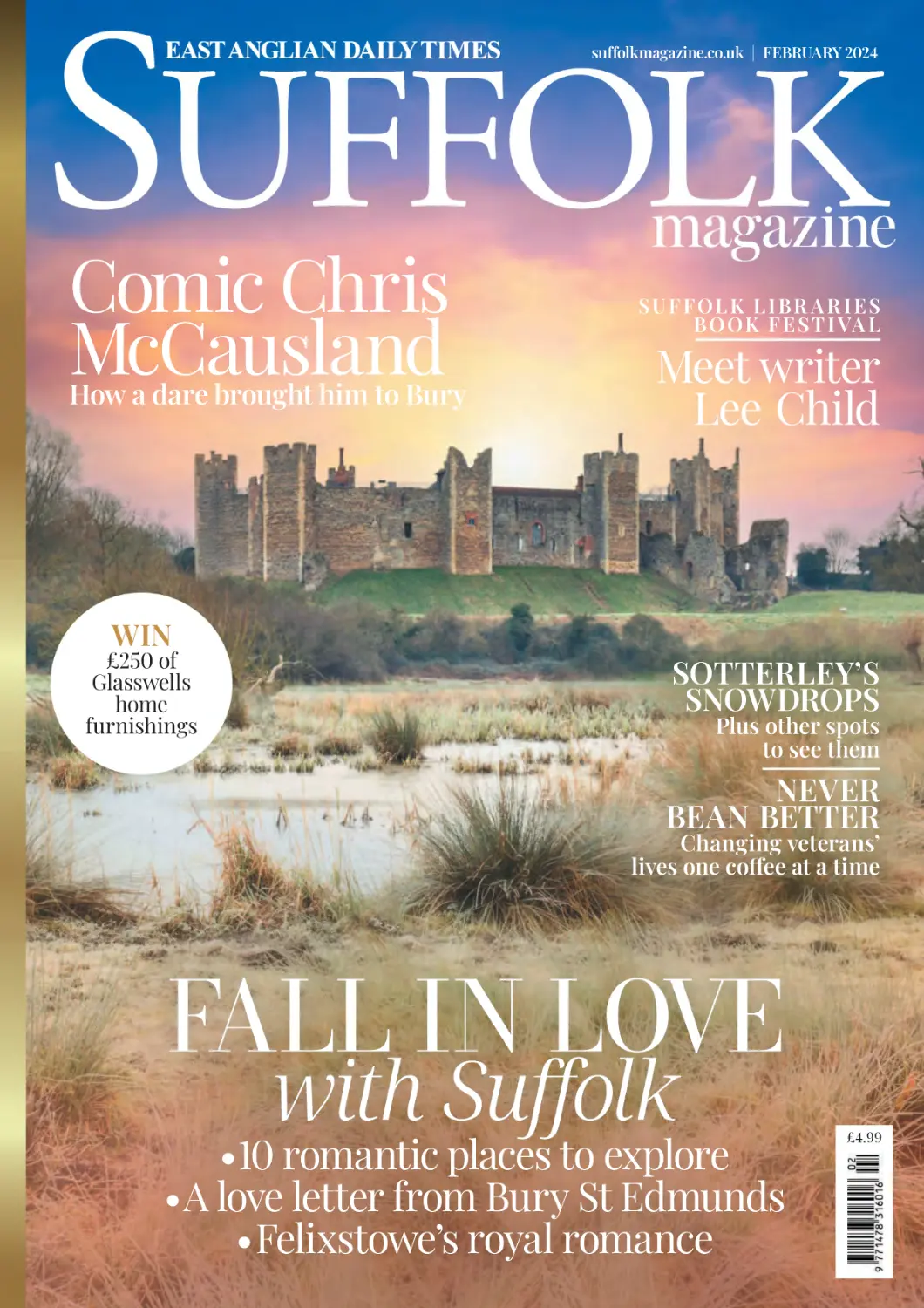


Tags: magazine magazine suffolk
Year: 2024




Text
                    suffolkmagazine.co.uk | FEBRUARY 2024

Comic Chris
McCausland

How a dare brought him to Bury

SU F FOL K L IBR A R IES
B O O K F E S T I VA L

Meet writer
Lee Child

WIN

£250 of
Glasswells
home
furnishings

SOTTERLEY’S
SNOWDROPS

Plus other spots
to see them

NEVER
BEAN BETTER

Changing veterans’
lives one cofee at a time

FALL IN LOVE
with Sufolk

•10 romantic pla
places to
o explore
•A love letter from Bury St Edmunds
•Felixstowe’s royal romance

£4.99

2

February 2024

Sufolk Magazine

Sufolk Magazine

February 2024

3

4

February 2024

Sufolk Magazine

Sufolk Magazine

February 2024

5

6

February 2024

Sufolk Magazine

Sufolk Magazine

February 2024

7

8

February 2024

Sufolk Magazine

WELCOME
from the editor
ebruary already... although such is the world of
publishing that at the time of writing the new
year’s honours have just been announced. So,
I would like to send congratulations to all the
Sufolk people who received honours this time around.
In the month of love and romance – and we need large
dollops of both at the moment – this issue of Sufolk
magazine is dedicated to people who do outstanding
things for the county, purely for the love of it. Throughout
you’ll ind wonderful examples of extraordinary people
who make a real diference to the lives of others.
Nigel Seaman, founder of Combat2Cofee, was born
and bred in Ipswich, joined the Army at 18 and had a
successful career, retiring in 2004 to take up a new role
as a prison oicer and PT instructor. When injury forced
him to take medical retirement, Nigel’s world collapsed
and PTSD took over. However, he turned his life around
and now he’s helping others.
Sacha Naylor and Rebecca May Marston are two
remarkable women who got together to create a homestyling business called Dora Brown that could raise funds
for families in need. But when they launched, lots of people
came forward to volunteer their services to help clean up
and bring order to homes in crisis. Sacha and Rebecca
realised that what they had to ofer was way more useful
than home-styling. Catherine Larner tells the story of the
women and their extraordinary team.
A new feature launching in this issue is ‘Love letter
above: Britain’s most loved bird is the robin.
from...’ in which we invite someone from Sufolk – a native
The RSPB has many ways you can love local
or ‘newbie’ – to tell us what they love about a place that’s
wildlife on page 60. Photo: RSPB images
dear to them. East Anglian Daily Times editor Liz Nice
gets the ball rolling with her love letter to
Bury St Edmunds, the town where she grew
When some of those lovely buildings are at
risk of falling into disrepair and becoming
up and went to school, before leaving and
forging her career in media. Like so many
unusable, they have stepped in, spending
Sufolk people who go walkabout, Liz has
considerable amounts of time, energy and
gravitated back to her native county to ind
money to preserve them. Their eforts mean
that while some things have changed, others
not only can people carry on using them, but
have not... thank goodness.
the entire county is richer as a result.
Finally, Rowan Mantell meets people from
These are just some examples of people
around the county who share a love for their
Jayne Lindill
making a diference in quite diferent ways;
community and for the old buildings that
Editor,
of course, there are many more. Why not tell
Sufolk magazine
have been shaped by them over the centuries.
us about those you know?

F

EX S
TE AL
N E
DE
D

.

Sufolk Magazine

12

Issues

for

£35.9

9

SAVE 40%

.

February 2024

9

INSIDE
February 2024

16 22 36 130
CHRIS
MCCAUSLAND

By Paul Mackenzie
Comedian Chris McCausland
originally intended his
stand-up career to last just ive
minutes. Twenty years later,
he’s on a mammoth nationwide
tour, including a visit to Bury
St Edmunds this month.
10

February 2024

THE DAILY GRIND

By Jayne Lindill
PTSD almost destroyed Army
veteran Nigel Seaman, founder
of Combat2Cofee. Now he’s
using his own experience to
help other suferers battle
the illness and get the help
they need, starting with a
cup of cofee…

10 ROMANTIC
PLACES

By Jayne Lindill
February is the month for
romance and we want you to
fall in love with Sufolk all over
again. Here are some familiar
favourite places, with romantic
stories to tell, you’ll just want
to keep coming back to.

BUILDING LOVE

By Rowan Mantell
What is it about something
built in another age that moves
people to want to protect them
for all time? Rowan meets a
group of people, passionate
about community and heritage,
who are inspired by some of
Sufolk’s loveliest buildings.
Sufolk Magazine

PLUS

40

21

People & places
Terry Hunt;
Jan Etherington;
In the Know

45

Great outdoors
Walking at Felixstowe;
RSPB for the love of
nature; where to
spot deer; where
to see snowdrops

63

Culture
James Gillray exhibition
at Gainsborough’s
House; What’s on

75

Food & drink
Mrs Portly makes
Moroccan-spiced
Vegetable Soup;
Sufolk magazine
Food & Drink Awards

87

Life & soul
Rose Paul nutrition;
A-Z of wedding venues;
Bursaries for all

LOVE LETTER TO BURY ST EDMUNDS
By Liz Nice
For Liz, thte west Sufolk town will always be home.
Here, she shares some of her favourite memories and
what she loves best about Bury St Edmunds.

52

WINTER WONDERS

By Marion Welham
Marion visits Sotterley
to learn more about the
story behind this ancient
Sufolk estate, the people who
have called it home over the
past 800 years, and the annual
snowdrop display which raises
funds to keep its history alive.

64

THRILLING
TALES

By Catherine Larner
This month, lovers of the
crime-thriller hero Jack
Reacher get a chance to meet
his creator, Lee Child, as he
heads a line-up of popular
writers in the Sufolk Libraries
Online Book Festival.

New pic snowdrops

107 Home & garden
Brilliant bathrooms;
interiors trends;
top tips from
Kirstie Smith;
gardening with
Ade Sellars
129 Life & times
Antiques;
Lynne Mortimer

ON THE COVER

76

ROARING SUCCESS

By Geraldine Clarke
Geraldine visits East Bergholt’s
revived 18th century inn, The
Lion, where she receives the
warmest of welcomes from
owner Jonathan Peachey. He’s
poured his heart into creating
a comfortable, stylish country
pub serving delicious food.
Sufolk Magazine

Framlingham Castle
Photo: Alamy

February 2024

11

Ip City Centre, 1 Bath St, Ipswich IP2 8SD,
Tel: 01473 230023
greatbritishlife.co.uk/magazines/sufolk
Keep up with what’s happening at
facebook.com/sufolkmagazine
Join the conversation about life in Sufolk
@sufolkmag
EDITOR
Jayne Lindill
07864 084423 / jayne.lindill@newsquest.co.uk
PRINT EDITOR
Sarah Rodi
07834 104843 / sarah.rodi@newsquest.co.uk
DESIGN AND PRODUCTION
The Newsquest editorial designers
REGIONAL EDITOR
Liz Nice
liz.nice@newsquest.co.uk
SALES
Sales Director
Tamara McKenzie
tamara.mckenzie@localiq.co.uk
Gemma Coote
07557 232118 / gemma.coote@localiq.co.uk
Maria Sarro
07557 232126 / maria.sarro@localiq.co.uk
NATIONAL SALES
The Mediaforce Group
020 8477 3706 / nationalenquires@newsquest.co.uk
SUBSCRIPTIONS CUSTOMER SERVICE
0800 953 0133 / greatbritishlife@newsquest.co.uk
/ greatbritishlife.co.uk/subscribe/sufolk
RETAIL SALES AND DISTRIBUTION
01603 772738/ magazines.circ@newsquest.co.uk
CONTRIBUTORS:
Andrew Clarke, Geraldine Clark, Linda Duin, Jan
Etherington, Terry Hunt, Catherine Larner, Rowan
Mantell, Lynne Mortimer, Rose Paul, Ade Sellars,
Kirstie Smith, Marion Welham

Published in Suffolk by Newsquest Media Group.
Registered oice Loudwater Mill, Station Road,
High Wycombe, Buckinghamshire HP10 9TY.
Printed by William Gibbons & Sons Ltd, 26 Planetary
Rd, Wolverhampton, Willenhall WV13 3XB. Suffolk Magazine adheres to the
Editors’ Code of Practice (which you can ind at pcc.org.uk/cop/practice.html).
We are regulated by the Independent Press Standards Organisation. Complaints
about stories should be referred irstly to the Editor by email at: jayne.lindill@
newsquest.co.uk. It is essential that your email is headed “Complaint” in the
subject line and contains the following information: Your name, email address,
postal address and daytime telephone number, the title or website, preferably
a copy of the story or at least the date, page number or website address of the
article and any headline, a full explanation of your complaint by reference to
the Editors’ Code. If you do not provide any of the information above this may
delay or prevent us dealing with your complaint. Your personal details will only
be used for administration purposes. If we cannot reach a resolution between
us then you can contact IPSO by email at complaints@ipso.co.uk or by post
at IPSO, c/o Halton House, 20-23 Holborn, London EC1N 2JD. If complaining
about thirdparty comments on our website articles, you should use the “report
this post” function online next to the comment.

12

February 2024

Sufolk Magazine

Sufolk Magazine

February 2024

13

THE BIG
PICTURE
The welcome sight of snowdrops poking
their heads above ground is a sign that
spring is just round the corner. There are
some spectacular displays throughout
Sufolk in February – ind out more in our
feature on the Sotterley estate on page 52.
PHOTO:

Michael Hall

Chris McCausland originally intended his
stand-up career to last just ive minutes

16

February 2024

Sufolk Magazine

INTERVIEW

On
tour
for
yonks
Comedian Chris McCausland originally intended
his stand-up career to last just ive minutes –
20 years later, he’s on a mammoth nationwide
tour and visits Bury St Edmunds this month
WORDS:

Sufolk Magazine

Paul Mackenzie

February 2024

17

t was never meant to be like this for
Chris McCausland. The comedian is a
regular on television panel shows, has
his own BBC Radio 4 comedy series and
this month sets of an epic tour which will
stretch well into next year.
He has presented an award at the Baftas,
appeared on Celebrity Mastermind –
specialist subject: 1990s grunge band Pearl
Jam – acted in sit-com Not Going Out,
150 episodes of children’s series Me Too! and,
once, in EastEnders.
But Chris was only supposed to do one ive
minute stand-up comedy routine. So where
did it all go so right?
Having completed his degree in software
engineering at Kingston University he had
lost his sight and was struggling to ind work.
‘It was hard to ind places with systems
I could use as competently as the person next
to me and I wasn’t happy taking longer than
someone else to do the same thing,’ Chris
says. ‘My options were to ind work in other
areas of IT, or things outside IT. I applied to
MI5 and I got down to the last one per cent
from about 3,000 people before they decided
they didn’t want a blind spy.
‘I was unemployed and had no structure
and it’s easy to lose your identity so I went to
work for a charity and then a call centre just
to regain that structure. When I was at the
call centre I was signed of work with shingles
and I was sitting bored at home with comedy
on and I started to think about giving it a go.
‘I came up with a few ideas that entertained
me and just wanted to not be the worst person
that’s ever tried it. It was always just going
to be a one-of, just so I could say I’d done it.
Some comedians might go into it thinking
they’ll make a career out of it, but that was
never the case with me. It started as a dare
to myself, then it became a hobby.
‘When I was exposed to the open mic circuit
it became something I would look forward to
each week. The call centre had a nice group
of people but the job itself was unfulilling.’
Chris was born in Liverpool in 1977 as the
city was facing a period of great economic and
political challenges. He grew up watching
comedy programmes on television and
absorbing the famous Liverpudlian sense
of humour which surrounded him. In his
early teens he was gripped by the new wave
of stand-up comedy stars including Jack Dee,
Alan Davies and Eddie Izzard.
‘There were no entertainers in the family
but my mum and dad and my family
were always a laugh and Liverpool has
always been full of big characters and
personalities,’ he says.
‘Growing up there in the 1980s we were out
playing in the streets and interacting with
everyone. It’s often the case that the harder
life is, the more people seem to joke about it
and there was a lot going on politically and
socially around the city in the 1980s.
‘Liverpool isn’t alone in being a place of
poverty and a lot of comedy has thrived from

I

18

February 2024

Sufolk Magazine

INTERVIEW
PHOTO:NOTSUPPLIED

Chris McCausland on stage

the area and has grabbed the heart of the
nation. A few things work in Lancashire’s
favour in comedy: it often works better
with a good regional accent and the great
coastal resorts have always been important
to comedy.’
As a child he was diagnosed with retinitis
pigmentosa, a hereditary condition his
grandmother and mother also had which
caused progressive loss of vision through
his teenage years. When he was 22 he was
completely blind.
He moved to Kingston for university in
1996 and still lives about half a mile from
the campus and will return home as often as
is practical during his epic nationwide tour.
‘Comedians who do the big arenas can get
a tour done in a couple of months – people
will travel distances to see them and they
play to huge numbers. I’m playing lots
more places,’ he said.
‘It is a solitary existence but I love touring
and doing stand-up. I’ve been doing this a
long time but only recently reached a point
where people are paying to see me and that’s
an amazing joy and privilege.
‘If a gig is within about two hours of
home, I’ll go home. My driver doesn’t mind
driving and we’ll put some tunes on or an
audio book and enjoy the journey and it
becomes a nice road trip.
‘We’ve just started All These Years, the
story of The Beatles’ early years and that’s
43 hours long so that should keep us going
for a while.’
He’ll need a few more audio blockbusters
to see him through the tour, appropriately
called Yonks!, which will see him criss-cross
the country for more than a year including
Sufolk Magazine

two nights at The Apex in Bury St Edmunds
in February and the Ipswich Regent Theatre
in October.
‘I love playing old atmospheric theatres.
It’s the same reason I love old vinyl records
– they have some history attached to them.
I get the same feeling in the traditional old
theatres, especially the ones with old posters
for shows from the 1920s and 1930s. They are
very special places.
‘In some smaller venues I will literally be
the only thing on in town that night. I’m
looking forward to going back to Hereford for
instance. I was there for college at a specialist
place for people with eye problems and it’s
a lovely place but it’ll be a choice of going
to the theatre for my show, or spending the
evening staring at some cows.
‘All my family are in Liverpool and I get to
visit them as often as possible and I bring my
daughter up when I can.
‘It’s always extra special when family are at
a show, but it is a worry. I am more relaxed
when they’re not there. I feel better when it’s
a room full of strangers.
‘My daughter has seen some things I’ve
done on telly, things like Blankety Blank,
but not everything is appropriate.
‘I have shown her one bit of my stand-up
which is a story from when she was little and
she did a poo in the bath and handed it to
me and asked me what it was so I snifed it.
‘She’s aware that I make money by making
people laugh and I think she probably thinks
it’s a good job she did that poo in the bath
because it gave me something to say and how
else would we pay the bills?’
Chris is at The Apex, Bury St Edmunds,
on February 20 and 21: theapex.co.uk

.

February 2024

19

20

February 2024

Sufolk Magazine

PEOPLE & PLACES
Discover what makes Sufolk tick
ROMANTIC PLACES

LOVE LETTER FROM...

10 top spots to rekindle
your love afair with Sufolk

Liz Nice shares her love
for Bury St Edmunds

PHOTO:SARAHLUCYBROWN

FANCY A BREW?
Nigel Seaman, Army veteran
and founder of Combat2Cofee

ANIMAL MAGIC
Where to go in winter when every thing’s closed?
One place that never closes is Christchurch Mansion in Ipswich.
It’s a fascinating place on any occasion, but it also stages
some excellent exhibitions, often based on its enormous collection
of art. Until April, you can see Animals in the Art Gallery,
which explores British wildlife alongside artistic depictions of
Sufolk Magazine

animals from the Middle Ages to the present day. You can see
creatures from Ipswich Museum’s Natural History collection,
and works by Thomas Gainsborough, John Constable, Anna Airy,
Sir Alfred Munnings, George Thomas Rope, Max Ernst, Bernard
Reynolds, Leonard Squirrell and Colin Moss.
cimuseums.org.uk

February 2024

21

BEAN
THERE
DONE
THAT
PTSD almost destroyed Army veteran Nigel Seaman,
founder of Combat2Cofee. Now he’s using his
own experience to help other suferers get the
help they need, starting with a cup of cofee…
Jayne Lindill

PHOTO:GETTY/NATURENOW

WORDS:

GOOD CAUSE

igel Seaman is so ebullient and afable, with an
infectious enthusiasm for life, that it’s hard to
imagine him as a man who almost gave up on
himself. But this is a story of hope.
Nigel is a military veteran. Ipswich born and bred,
he joined the Army at 18, in 1992, a proud infantryman
with the Royal Anglian Regiment (The Vikings). He was
a resilient young man, trained to operate wherever and
whenever the Army needed him, to do whatever was asked
of him. Several demanding tours of Northern Ireland and
Bosnia during the 1990s were part of the job.
In 2004, with 12 years’ service behind him, Nigel
retired from the armed forces and began a new career as
a prison oicer. He worked at HMP Warren Hill, before
moving to Chelmsford prison, then Wormwood Scrubs,
followed by a spell at Isis Prison, next to Belmarsh, in
southeast London.
It was a job he loved, but after major surgery on his
shoulder (an old rugby injury), and with a leg injury from
his Army years also causing trouble, Nigel was medically
retired from the prison service. In 2015, now in his forties,
with no career and no clear plan for where life would take
him next, his real battles began.
‘I started ruminating on what had happened to me,’ he
says. Although he didn’t know it, he was in the grip of
post traumatic stress disorder. He sufered depression
and anxiety, and experienced lashbacks from an incident
during his time on operations with the Army. Every day
was a struggle.
‘It took over. My life was chaotic, I was gambling,’
he says. ‘After about a year, I had a breakdown.’
The future looked bleak. But a turning point arrived
when he was referred to Combat Stress, a charity
which provides clinical treatment and support for
armed forces veterans, particularly those with complex
mental health issues.
Formally diagnosed with PTSD, Nigel was accepted
onto a six-week residential, trauma-related course.
Not only was it the start of his recovery, it sowed the
seed of an idea that would change the course of his life.

N

above: Nigel Seaman. Photo: Charlotte Bond

Sufolk Magazine

Nigel had always enjoyed good cofee and, since the
beverage on ofer wasn’t quite up to standard, he installed
a cofee maker in his room. Other veterans would drop
in and they’d get chatting. Cofee, Nigel discovered, was
a great conversation starter. It was then that he had the
idea for Combat2Cofee. His new purpose in life would
be helping others who were battling PTSD, just like he
was, and cofee would be the catalyst, providing a vehicle
for veterans to talk and open up about their experiences,
anxieties and fears.
After he completed the course, Nigel was referred to
Help for Heroes for ongoing support. In 2019, he enrolled
on a business course with Help for Heroes, to turn his
idea into reality. He wanted to give something back to
the support network that, he says, saved his life. He
wanted to give others hope and purpose, and practical
support that would help veterans and their families, just
as he’d been helped.

‘My life was chaotic,
I was gambling. After
about a year, I had
a breakdown’
However, the stress of his situation had taken its toll
on his marriage. Desperate to protect his family, Nigel
decided he had to leave home. With nowhere to go, he
checked into a hotel, until, with help from Veterans Aid,
he found a place to live and pursued his idea.
He found a cofee caravan for sale, bought it with the
limited funds available to him, and started doing outreach,
going to events, serving cofee, starting important
conversations about mental health, sharing his own
experiences and ofering support and hope. True to his
word about supporting others, he bought his cofee from
another veteran.
‘It wasn’t good, but people bought into the message,’
he says. Indeed they did; Nigel’s irst social media post
drew 10,000 hits. Word really got out when he appeared
on BBC’s One Show just before the irst Covid lockdown >
February 2024

23

24

February 2024

Sufolk Magazine

GOOD CAUSE

right: Nigel shares experiences at
The Coffee Cell, Ipswich. Photo: Charlotte Bond
inset: Combat2Coffee’s I’ve Bean Better badges help
open conversations with PTSD sufferers. Photo: ITFC
below: Nigel’s days in the Army. Photo: Charlotte Bond

and talked about his own battles, how Combat Stress had
helped him and his work with Combat2Cofee.
Since that time, Combat2Cofee has continued to
gather momentum. Even an operation in September
2020 to amputate his troublesome leg didn’t slow
Nigel’s energy and drive.
He partnered with HMP Hollesley Bay to create a cofeee
shop and prison-based roastery that supports mental
health and employment opportunities for prisoners,
ex-veterans and others struggling with mental health.
He’s also opened a wellbeing-focused cofee shop, The
Cofee Cell, in Ipswich. He now has a barista equipped
van, painted in Combat2Cofee’s red, white and bluee
camoulage, which he takes around the county.
In July 2022, in association with Vertas Group, hee
agreed a ive-year partnership with Ipswich Town
n
Football Club to provide hot drinks in hospitality areass
and the FanZone at Portman Road, as well as at the
Playford Road training ground. It is, he says, ‘a fantastic
opportunity, not only for veterans and their family
members but for Sufolk as a whole’.
Combat2Cofee also supplies the club with their own
cofee roast called ‘Cuppa Towen’, and the club partnered
with Combat2Cofee on two recent initiatives designed to
expand outreach – the ‘I’ve Bean Better’ campaign, a short

ser vicees personnel who
are strugglin
ng with their mental
wellbeing should feel conident and safe in
getting the support they need,’ he says.
But it’s not always easy for veterans to acknowledge
their problems, or to ask for help. Part of the training
for combat is to never let colleagues down, and to not
hold others back by needing help. But if military people
are not ‘untrained’ when they leave the services, it can
create problems for veterans struggling with past trauma,
afecting their mental and physical health. Many miss the

‘All veterans and ex-uniformed services
personnel who are struggling with their
mental wellbeing should feel conident and
safe in getting the support they need’
video and tool kit on how to hold better conversations
with people sufering PTSD, and Medals2Matches.
Last year (2023), Nigel found himself at 10 Downing
Street, at the invitation of Ipswich MP Tom Hunt, for a
Local Veteran Champions’ Reception, where he met fellow
veterans from across the country. The transformation in
Nigel is extraordinary, but it’s what he’s also doing for
others that’s so impressive.
Nigel considers himself lucky to have got help; it’s not
the same for everyone. ‘All veterans and ex-uniformed

Sufolk Magazine

camaraderie, community and structure of the services;
loneliness and feeling like they’re sufering alone can
have disastrous efects.
Some veterans, unable to cope with their changed
circumstances, fall foul of the law. They may end up
jobless, estranged from family and friends, end up in
poverty, homeless even. For some, suicide can be the
ultimate way out.
Nigel doesn’t claim to have all the answers. While he
has a wealth of personal experience to draw on, he doesn’t
position himself or Combat2Cofee as experts. ‘Because
of my journey, I just want veterans and military people
to feel safe to get help,’ he says. What he can ofer is peer
support and a bridge to organisations such as Combat
Stress, Walking With Wounded, Sufolk Mind, RBL and
others who can help people get back on track.
His ambition is to ‘change lives one sip at a time’.
Cofee, he says, is the opener to a conversation about
how someone’s life could be diferent, how they can ind
a new direction and purpose in life. But as well as the
talking there is very practical help, such as introducing
people to services they might need, support for mental
health and physical wellbeing, jobs, training or housing.
His latest development is creating a training facility at
the Combat2Cofee roastery in west Ipswich, to provide
opportunities for veterans to learn barista skills and >
February 2024

25

GOOD CAUSE

‘It’s amazing to see how many veterans and
families we’ve helped as a result of our work’
above: Medals2Matches – Mark Ashton (ITFC),
Nigel Seaman and Jason Carter (HOAX). Photo: ITFC
below left: Beans for roasting at
Combat2Coffee. Photo: Charlotte Bond
below right: The roaster in Ipswich. Photo: Charlotte Bond

regain their conidence, helping them to ind long-term
employment and security.
In an anxious world, more aware of the importance
of looking after our mental health, the potential for
Combat2Cofee is immense; indeed, Nigel says it’s
already reaching out not just to veterans, but other
uniformed personnel and the community generally. He’d
like to expand the company – it’s a not-for-proit CIC –
partnering with businesses and organisations that can
support the cause by buying cofee supplies, hosting a
stand, van or workshop at events, ofering work, providing
funding or signing up to the Armed Forces Covenant.

26

February 2024

To that end, he’s just established a non-executive board,
whose four directors – entrepreneur and cofee aicionado
Paddy Bishopp; Paul Botterill, ex-Royal Navy and part
of The Not Forgotten veterans charity; Darren McGrath,
Tiptree Patisserie managing director; and Will Anderson
MBE, former Army oicer – who will provide support,
advice and future direction.
He wants to make Combat2Cofee available to people
and hospitality businesses who enjoy premium quality
cofee – single sourced, sustainably traced and expertly
roasted to the unique C2C blend. ‘Roasted, toasted and
poured by veterans,’ he says.
‘These past few years have been exciting for
Combat2Cofee, and it’s amazing to see how many
veterans and families we’ve helped as a result of our
work. We want people to access help and support, and
the more business we do, the more we can help people.’
Visit combat2cofee.co.uk or download the
Combat2Cofee app from the app store

.

Sufolk Magazine

Sufolk Magazine

February 2024

27

28

February 2024

Sufolk Magazine

SUFFOLK & PROUD
Terry Hunt is former editor of the East Anglian Daily Times.
Sufolk born and bred, he has lived in Ipswich for more than 25 years

hat a welcome relief! After
two dreary decades of poor
performances and managing to
alienate even the most patient
supporters, at long last there’s an awful lot
to love about Ipswich Town Football Club.
Exciting, winning football and a clear
message that fans are valued has seen the club
win back the hearts of supporters who were
beginning to despair. The dreadful Marcus
Evans era now seems like a distant nightmare.
For long-standing supporters like me – this
is my 56th season – it’s fantastic news. We
are enjoying games again, and we are once
more proud of our football club, instead of
being irritated by it.
Our ambitious American owners have
invested wisely, recruited a brilliant young
manager in Kieran McKenna, and produced
success on the pitch. Their ambition is a
return to the Premier League and (whisper
it quietly) what for so long appeared an
impossible dream might not be too far away.
Believe it or not, all of this really does
matter. I know, it’s easy to dismiss football
as a load of overpaid, pampered young men
kicking a football around. But it is so much
more than that, believe me!
Firstly, there are the economic beneits
which come with success. In this exciting new
era, nearly 30,000 people head to Portman
Road for every home game. That’s twice
the number who trudged disconsolately
to the ground to sufer the boring football of
the previous 20-odd seasons.
It’s great news inancially for the football
club, of course, but there are also wider beneits
for the local economy. Before and after games,
pubs in Ipswich are alive and buzzing with
thousands of excited fans chatting, drinking
and spending lots of money.
Fans love meeting up with friends both
before and after matches to debate prospects,
and then chew over the events and talking
points of the game. Especially if the team has
done well! Other supporters will go into town
to visit shops and restaurants. All of which
is great news for businesses in Ipswich, and
very welcome after the tough pandemic years.
Then there is another huge beneit which
successful football clubs bring to their areas.
It’s the pride and self-conidence that winning
teams create.
It’s not long ago that many people in farlung corners of Europe would automatically
respond to the mention of ‘Ipswich’ by saying
‘Bobby Robson’. The era of success in the
1970s and 1980s had a very powerful and
long-lasting legacy. That gave fans like me
an enormous sense of pride. My home town
was famous because of its football team.

PHOTO:PAGEPIX

W

Sufolk Magazine

Come on, you Blues!
I hope this new, exciting era can have the
same electrifying efect.
Closer to home, the success of the football
team simply makes people feel good. They
smile more, and are more positive. Suddenly,
you see more youngsters wearing Ipswich kit
instead of Man Utd or Arsenal shirts. Thank
goodness! A winning football team helps build
community spirit.
As far as the much-maligned town of
Ipswich is concerned, the success of its
football team is a huge positive. It’s one of
the important building blocks to help
change the views of our county town’s
many detractors.
Of course, this is a two-way relationship.
The football club has a responsibility to
engage with the community and to make its
supporters feel they are valued. I’m delighted
to say that the Ipswich Town hierarchy are
well aware of this, and have done a fantastic

above: How far we’ve come – Kieran
McKenna on the opening day of his
irst full season at Portman Road

job in rebuilding what had sadly become a
fractured relationship with the fans.
After two very diicult decades, I am once
again delighted to call myself an Ipswich
Town fan. These are exciting times, the most
exhilarating and enjoyable since the all-toobrief period of success under George Burley
in the early 2000s.
Will the Tractor Boys once again play
Premier League football? I’m sure our
American owners will settle for nothing
less – and they are the people holding the
purse strings. So, these are exciting times
for supporters of Ipswich Town, with huge
potential spin-of beneits for the whole of
Sufolk. Come on, you Blues!

.

February 2024

29

30

February 2024

Sufolk Magazine

HOME HELP

Making a
fresh start
As a home help Dora Brown is a tour de force,
a made-up person making a real impact that
goes way beyond a basic clean and tidy-up
WORDS:

nce there were three sisters called
Dora, Edna and Alma Brown. They
were housewives in the 1950s,
‘sturdy girls’ who wore sensible
shoes, full-length pinnies and swept their
hair up in headscarves as they cleaned, tidied
and sorted to make a house into a home.
These three women lived in the imagination
of Sacha Naylor and Rebecca May Marston,
as they pictured a new business venture they
wanted to run while their children were at
school. ‘The Brown Sisters’ would be a homestyling enterprise, they thought, which would
ofer makeovers at three price points and
the proitable arms would inance help for
families in need.
‘I used to volunteer with the charity
HomeStart,’ says Sacha, ‘and one of the
things I noticed about all the homes I went
in was the chaos. I wanted to get my hands
on these homes and tidy and clean them,
because I know what a positive impact it
has when a home is organised.’ Rebecca and
Sacha quickly found that others wanted to
do the same.
In early 2020 they launched Dora Brown
on social media. ‘We created a brand that
people were interested in,’ says Sacha, ‘and
we discovered really quickly that there were
loads of people who wanted to volunteer. They
loved the idea and wanted to get stuck into
the homes in crisis. And we realised that for
us it was more interesting than home styling.’
There was huge need for the service
they were ofering in this small corner of

Catherine Larner

PHOTOS:

Dora Brown

O

left: Getting stuck into a clean-up
above left: Dora Brown volunteer, Jenny
above right: Dora Brown volunteers in action

Sufolk Magazine

Sufolk. Covering Woodbridge, Felixstowe,
Kesgrave and Ipswich, they found social
services had a long list of referrals of people
experiencing poverty or neglect who would
beneit. When Dora Brown was inally able
to start work after the Covid lockdowns, it
was clear the situation had been exacerbated
by the pandemic.
‘The homes are often in such a state that
landlords are refusing to go in,’ says Rebecca.
GPs, health visitors and educational needs
co-ordinators also find conditions too
prohibitive for them to make calls. ‘These
homes can be gruesome. We’ve had families
who are in hotels because social workers
won’t let them stay in the house.’
One mum had ive children and was
about to have her sixth. Her partner had left.
When a health visitor called to monitor the

pregnancy she found the living room full of
bagged rubbish – food waste which had been
there for months. ‘The smell doesn’t leave
your nostrils,’ says Rebecca. ‘And there were
three boys between eight and 15 in a bedroom
with one broken bed and one mattress.’
When Dora Brown receives a referral,
Laura Cotton, as head of projects, visits the
home and assesses what is needed in terms of
clearance, deep cleaning and organising the
house, plus gifting of furnishings, bedding,
carpets and any other necessities that will
improve the family’s wellbeing. With a
waiting list for the work, homes are scheduled
according to priority. Those at the top of the
list are where there is a child protection order.
By cleaning, tidying, repairing or replacing
essential furniture, ‘we’ve prevented children
being taken out of the home,’ says Sacha. >
February 2024

31

HOME HELP
It’s important, of course, that the
whole family is on board with the project.
‘They don’t sit there and let us do it for
them,’ says Sacha. ‘We get them involved.
And the kids love it.
‘The impact is immediate. But if they
need longer term help we will go back and
visit, and issues are dealt with by the social
workers. What we’ve done enables the family
to go on diferent pathways of care and help.’
Last year, 35 families were helped, says
Jo Revett, director of Dora Brown, four
times the number helped by Dora Brown in
2022. The immediate goal is not to increase
that number but to be able to act more
quickly when a family is referred, rather
than having to put them on a waiting list.
For that to happen, they need more

people willing to become members of the
Dora Brown team.
‘Many of our volunteers, when they come
into a family home for the irst time, don’t
realise that there are families living in those
conditions, that level of poverty, just down
the road from where they live, alongside us
in our communities,’ says Jo.
Typically some kind of trauma will have
triggered the decline and receiving help from
friendly women who get alongside them,
without judgement, makes a diference.
‘Dora’s work is life-changing,’ says Rebecca.
‘We’re not taking their kids away; they’re
not scared of us. We are a purely positive
inluence and we’re teaching them how to do
things as well. It’s amazing the diference, as
soon as we’ve done the clearance, done the

‘What we’ve done enables
the family to go on diferent
pathways of care and help’

32

February 2024

Sufolk Magazine

above: The Dora Brown team ready
to tackle another clean-up job
from left: Work in progress in
a kitchen clean-up and after the
clean-up by the Dora Brown team
right: Bedding arrives at a Dora Brown project

cleaning, moved the furniture around – the
sense of wellbeing levels up so quickly.’
The volunteers also beneit. Around 20 will
be on site, working on each task as teams or
in pairs, from 9am until 2pm on Wednesdays
and Fridays. They are retirees, or school
mums and dads who want something to do
within school hours.
‘It’s hard to get a job in those hours and
when you have kids you lose your conidence,’
Sufolk Magazine

says Rebecca. ‘So we wanted to create
something lexible and a springboard to
going back to work.’ Even through the diicult
scenes they witness, the volunteers make
friends and have fun.
At the end of last year Dora Brown
became a registered charity, and Sacha
and Rebecca have stepped back to act as
trustees. Still appreciating the support
of sponsors and partners, and donations of
furniture and bedding through an online
giving page, the team can now access
funding to reach more families with their
very particular and practical help.
For details about making a donation
or volunteering, go to dorabrown.com
and follow on Instagram
@dorabrownhomemaking

.

February 2024

33

34

February 2024

Sufolk Magazine

BEHIND THE BEACH HUTS
Jan Etherington is a journalist and comedy writer of radio
and TV series. Now living in a village somewhere in Sufolk...

t seems odd to be writing about the
sun in a month where its appearance
is about as sporadic and surprising
as the Ipswich to Lowestoft train
arriving on time.
But here’s the good news. If the sun is
planning a day out, Sufolk is the irst county
in Britain to know about it. Famously, Ness
Point in Lowestoft is the most easterly point
in Britain and greets the sunrise before
anywhere else in the UK.
Feeling the sun on your face lifts everyone’s
spirits. At the tail end of a drab winter, it’s
a promise that spring will shortly pop up in
the shape of dafs, crocuses and, yes, weeds.
The sun is the reason there is life on earth
and we all worship that brilliant, burning
ball in the sky.
By sun worshipping, I’m not talking
about lying prostrate on a jam-packed
beach, slathered in sun cream. That is so
last century. We love the sun, as do most
sentient beings, from lizards to cats, who
welcome its arrival and seek out a place in the
sun. Basking in its warmth feels as good as an
hour’s spa treatment... without the annoying
whale music.
We miss it when it’s not visible here, in
the winter, which is why many Brits become
snowbirds, scooting of to warmer climes
where endless sunshine is guaranteed.
If I lived in a world of endless sunshine – and
I have recently experienced it, after spending
a few weeks with my sun/son in Australia
– I would begin to long for a wild walk along
our coast, wrapped up like a Polar explorer,
being slapped by sleet and battered by winds
of the North Sea.
Do I really mean that? Oddly, I think I do.
I’m rather fond of our seasons – the contrasts
and changes in temperature which are the
year’s markers. Here, we don’t take the sun
for granted, as they do in hotter countries,
which is why we really appreciate it when
it appears.
Sunrises and sunsets the world over
probably attract more crowds than any other
phenomenon on earth. I’ve stood on the beach
in Key West, Florida, where every night the

I

‘By sun worshipping,
I’m not talking about
lying prostrate
on a jam-packed
beach, slathered
in sun cream’
Sufolk Magazine

Here comes the sun...
Sufolk gets it irst
sunset gains a round of applause and a multi
camera lash from dozens of watchers; leaned
on the rail of a ship and marvelled, as the sun
rose above the glittering Greenland icebergs.
I still ind it impressive that the sun does the
same thing every day, with such pzazz.
And that’s why we love it so. The sun is
utterly reliable. In a world where so much is
scary and unpredictable, we know the sun will
always rise – even if we can’t see it through
the winter clouds.
Moving to Sufolk 11 years ago and joining
the sea swimmers every morning on our
beach, I’ve felt ‘closer’ to the sun than ever
before, emotionally, not physically, as I don’t
want my hair singed. In the summer, the sun
rises so early that it’s already warming the
day by the time we get to the sea.
But in these winter months, we walk
down in semi-darkness, change in a milky
stillness and then we watch and wait, as the

above: Sunrise swimmers on the
Suffolk coast. Photo: Katie Raby

sky whisks out a brush and palette that swirls
from pale pink to the red of Jessica Rabbit’s
nails, heralding a spectacular sunrise. Often,
we just stand mesmerised, dwarfed by the
scarlet blanket spread above our heads.
Then a semi-circle of bright yellow peeks
over the horizon, moving upwards faster
than you imagine. Soon, it’s a full circle of
golden light. A few of us head into the water,
swimming into the sunbeam loating towards
us. Some reach for a camera, but most of us
just stand there smiling.
Here comes the sun; and whatever is going
on in our lives – the worries, maybe the aches
and pains – for this moment, here on the
beach, we feel so lucky. The sun is up and all
is well with our world.

.

February 2024

35

romantic
SUFFOLK

PLACES
Fall in love with these iconic locations,
each with a fascinating story to tell,
waiting for you to discover them
WORDS:

36

February 2024

Jayne Lindill

SUDBURY
Famous as the birthplace of painter
Thomas Gainsborough, Sudbury has a
long history of silk weaving and grew
wealthy in the middle ages as a wool
town, the legacy of which is 242 listed
buildings. Follow The Talbot Trail,
14 statues that depict fascinating
episodes in the town’s history. Among
others, you’ll meet Archbishop Simon
of Sudbury, inventor of the Poll Tax
and slaughtered in the Peasants’
Revolt; 101 Dalmations marking the
spot where a scene from the ilm was
made; William Kemp dancing his way
from London to Norwich in 1599; and
The Great Blondin, who demonstrated
his trapeze skills here in 1872.
sudbury-tc.gov.uk/talbot-trail

Sufolk Magazine

LAND OF LOVE

FRAMLINGHAM
The focus of Fram is the castle on the
hill, where Mary Tudor famously led
to escape the political machinations
in the wake of her brother Edward
VI’s death. Here she gathered her
supporters and was eventually
proclaimed Queen of England in 1553.
The magniicent 12th century castle
walls and towers still stand, where you
can immerse yourself in the romance
of Mary’s story and enjoy spectacular
views of Framlingham mere and the
surrounding countryside. There are
superb countryside walks and also a
very good town trail (thesufolkcoast.
c o . u k /s h a r e s/ F r a m l i n g h a m Town-Trail.pdf) which highlights
27 diferent historic sites around
Framlingham, each with a story to tell.
english-heritage.org.uk

ORFORD

Until 1956, this romantic, Italianate
palace was home to the Hervey family,
notoriously John, Lord Hervey (1696–
1743), son of the 1st Earl of Bristol.
A successful politician, he became
Keeper of the Privy Seal and a member
of the Privy Council, and was one of
the most famous igures of his time.
Yet his life was full of scandal. He was
known for his bisexual relationships
and efeminate style, for sharing a
mistress with the Prince of Wales,
and for having a 10-year relationship
with another man, despite remaining
married to Molly Lepel, who he wed
in secret in 1720. Discover Ickworth’s
many artistic treasures, its gardens
and acres of parkland.
nationaltrust.org.uk/visit/
sufolk/ickworth-estate

This peaceful coastal village has
witnessed some extraordinary history.
It’s dominated by the castle, built
by Henry II between 1165 and 1173,
with a unique polygonal keep, which
is remarkably intact. Here you can
discover Orford’s story, including the
strange legend of the Wild Man of
Orford. Not long after the castle was
built, some local ishermen discovered
a strange creature in their nets – like
a man, but naked and covered with
hair. They brought this ‘merman’ to
the castle where he stayed for several
months, saying nothing, living on a
diet of ish, until one day they took
him for a swim and he slipped beneath
the waves...
english-heritage.org.uk/visit/
places/orford-castle

Sufolk Magazine

THORPENESS
Stuart Ogilvie’s romantic vision, a
private fantasy holiday village for
friends and their families, with an
exclusive country club, tennis courts,
swimming pool, clubhouse and golf
course designed by the eminent James
Braid. The pretty mock Tudor houses
and fairytale House in the Clouds
(disguising a water tower) you see
today are just as he imagined it in
1910 when he bought the hamlet, as
is the huge Meare, inspired by Peter
Pan author J M Barrie, a personal
friend of the Ogilvie’s. The Meare’s
landings and tiny islands have names
from the book, such as the pirates’ lair
and Wendy’s house. Stay a while and
enjoy the romance of it all.

PHOTOS:ALLGETTY

PHOTO:ARCHIVE

ICKWORTH

February 2024

37

LAND OF LOVE

FLATFORD
The backdrop to the life of one of our greatest painters, John Constable, Flatford is at the
heart of the Dedham Vale National Landscape (formerly Area of Outstanding Natural Beauty).
Here you can explore the countryside Constable painted; riverside meadows, woodland,
ields and miles of footpaths, even hire a boat to row the River Stour. You can see the historic
sites that feature in his work including Valley Farm, Willy Lott’s House, Flatford Mill and The
Granary, and the Lock, and learn about Constable’s career and life, including his marriage
to Maria Bicknell, which led to her being disinherited. nationaltrust.org.uk/visit/sufolk/latford

DUNWICH

IKEN

What could be more tragically romantic
than a medieval town upon a clif top,
a thriving seaport, home to 3,000
people and eight churches, struck by
a massive storm surge and vanishing
beneath the waves, leaving little trace
except the faint tolling of bells from
sunken churches? That’s the fascinating
story of Dunwich, Sufolk’s ‘Lost City’,
but learn more at the village’s museum,
where a model shows you what Dunwich
was like in the 13th century. See the
ruins of Greyfriars friary, explore the
beach and heath.

Iken is a beautiful, unspoilt, peaceful
place. This is The Anchorage, formerly
an island in a marsh by the estuary,
and the most likely site of Saint
Botolph’s Abbey, Ikenhoe, now St
Botolph’s church. During excavations
in 1977 Dr Stanley West discovered
part of a large stone Saxon cross
incorporated into the wall of the
church tower, carved with symbols
recognised as St Botolph’s emblems.
It’s now on display in the church. In
summer you can hire canoes at Iken
Clif and explore the river.

38

February 2024

LAVENHAM
Explore the medieval streets of
Lavenham and you’ll soon discover
all sorts of romantic connections
from the house in Shilling Street
where Twinkle, Twinkle, Little Star
was irst composed, to the Guildhall,
to De Vere House which starred as
Godric’s Hollow in Harry Potter
and the Deathly Hallows – Part 1.
Lavenham grew wealthy on the wool
trade and its legacy is in the stunning,
richly timbered merchants’ houses
that line its streets, and in its church.
lovelavenham.co.uk/lavenhamguided-walks

Sufolk Magazine

POLSTEAD
One of the most famous romantic tragedies belongs to Polstead. In 1827, villager Maria Marten
was shot dead by her lover, William Corder, in the Red Barn not far from Maria’s home.
They had arranged to meet before eloping to Ipswich. Corder sent letters to Marten’s family
claiming she was well, but after her stepmother dreamt that Maria had been murdered,
her body was discovered in the barn. Corder was traced to London and returned to Sufolk
where he was found guilty. In 1828, he was hanged at Bury St Edmunds. There’s a delightful
walk around Polstead that takes you near the site of the Red Barn. polstead.onesufolk.net
Sufolk Magazine

February 2024

39

A love letter from...
Bury St Edmunds
For Liz Nice, the west Sufolk town will always be home

few years ago, I started doing my
family history. It threw up all sorts.
A cousin I didn’t know about who
emerged via DNA; a great-greatgrandfather who lived in Crown Street and
ran of with a woman from Chequer Square,
and lots of other little snippets, like the greatgrandfather who died in a London hotel on
Boxing Day, and the great-grandmother who
married the lodger.
You pull on these strands and they hold
you fast; rooted in a past that feels unfamiliar
yet absolutely you at the same time. And all
the strands and the people have one thing
in common; they are all drawn back, time
after time, generation after generation, to
one little town – my town, Bury St Edmunds.
I grew up on Out Risbygate, number 46,
opposite the Sufolk Regimental Museum.
The view from my bedroom window allowed
me to look out over at the barracks and
I could see the old further education college,
the swimming pool, and the little paths and
gullies where my brother, John, and I would
ride our bikes.
We had ponies in the ield behind our house
which stretched as far as York Road, and a
lat lawn where we played tennis and football
with our neighbours, the Palmers, or set up
showjumping competitions with old chairs
and broomsticks for our hobby horses. There
was an orchard where we picked apples and
pears, and a yard where my parents ran their
stone masonry business and a man called
Malcolm ixed people’s cars.
An artist called Bryan parked his caravan
in the ield at one time and he painted our
horses. Chickens roamed freely and we sold
our own eggs and horse manure. To me, this
was all entirely normal and boring. Now, it
sounds perfect and, I feel today, that it was.
We never went far. We might nip to the
shop for sweets – Howlett’s on Queens Road
or Herringtons on Risbygate Street, but this

A

40

February 2024

Sufolk Magazine

MY HOME TOWN
would be a great expedition. On Saturday
mornings we played football over the Dip
and took our sledges there when it snowed.
We went to St Edmundsbury primary and
crossed the road with Mrs Gallup, the lollipop
lady, but Mum always came with us, pushing
our baby brother in the pram.
At nine, we branched out and went to
St James middle school on the other side of
town. Only occasionally were we allowed
to walk home alone through the Abbey
Gardens and feed the ducks. Mainly, Mum
would collect us from the Vineields, always
the last car to come up the hill – a large red
Ford Granada estate – with our collie dog
in the back. On the sports ield, I won the
800 metres because Nadine Challenor, who
was a much better runner than me, slowed
down at the end. I streaked past her on the
line and my grandfather said: ‘That’s my girl.’
I have never known a greater moment of pride.
On Wednesdays and Saturdays, we would
go to the market and buy fresh fruit and
vegetables, wrapped up in brown bags that
the seller would swing around by the corners
to close them. We also shopped on the corner
of Risbygate Street at Green’s, the grocer’s,
and we’d get our meat from Dewhurst’s.
Fish and chips from the Cracknell’s shop on
St Andrew’s Street was the greatest treat on
a Friday. We loved Mrs Cracknell, who lived
next door to us. She was fond of our horses
and would feed them over the fence.
At 13, I got a scholarship to Culford and
started taking the bus from outside the
dentist on Risbygate Street – not the one
that’s there now, but the one on the other side
of the road, now long gone. Mr Lee’s hands
were a bit shaky but he made you feel safe.
I don’t like going to the dentist now.
On the school bus, a boy asked me if I
wanted to go for a ride with him. I said yes
and everyone laughed. I thought he meant
horses. I never took him up on it.
We rarely ate out. Everards was a treat once
a year for Sunday lunch and my mother would
mark the last day of the school holidays with
a trip to Purdy’s, latterly the Wimpy. Now, in
Bury, there are 100 options for eating out. My
boys like Côte and Pizza Express, or Byron
Burger. Carluccio’s is much missed.

We didn’t want the Arc to come or the
Apex, but now we wouldn’t be without them.
I still like to ride the carousel when it visits.
We miss Debenhams but I imagine Primark
will do just as well. The Focus cinema was
where I saw my irst ilm, One Hundred and
One Dalmatians. It became the Cornhill
shopping centre, which also failed and now

‘Fish and chips from
the Cracknell’s shop
on St Andrew’s Street
was THE GREATEST
TREAT ON A FRIDAY’
sits shyly next to McDonalds, awaiting its
next incarnation.
The bus station went and so did the cattle
market where we liked to go for the smells
and sounds. But we still have the Abbeygate
Cinema thanks to Pat Church and there aren’t
many towns our size that can top that. Pat

and his wife brought up all of us Bury kids.
He lived his dream as he fuelled ours.
I miss the bookshops on Hatter Street
where I spent many hours, then got my Bunty
comics from Abbey News. Life was so simple
then and now, as I grow older, it is becoming
so again. I got married in May at Bury register
oice. Where else?
Our old garden is now covered in houses.
The further education building is the
sparkling West Sufolk College. The hospital
is still much the same though we all moan
about the cost of parking. The cemetery is
crammed. There are Nices sprinkled liberally
throughout. I visit them from time to time.
I left Bury at 18 for university and
returned in my forties to bring up my sons.
Now they are almost grown and will leave
Bury too before long, I expect. But just
like all the generations of Nices and Kinseys
and Cuttings and Mawsons, and all the
many other names in my family tree, they
will return.
Bury is no better nor worse than anywhere
else, perhaps. But it has a memory on every
corner. It is, and always will be, home.

.

far left: Liz on her wedding

day in Bury St Edmunds in 2023.
Behind her, in the churchyard, is
the grave of one of her ancestors
above: Liz with her brother
in the back garden of her
family home in Bury
middle left: On the carousel in

Bury St Edmunds. Photos: Courtesy Liz Nice
left: We never went far in

Bury St Edmunds. Photo: Getty

Sufolk Magazine

February 2024

41

In the KNOW
News, events and happenings around the county

Henry Normal (left) and Brian Bilston will be appearing at The Apex. Photo: Richard Davis

Bury’s irst comedy festival
e could all do with a laugh and
Bury St Edmunds is promising
a whole month of them
throughout February when it
hosts its irst Comedy Festival.
The fun begins on Thursday, February 1,
when the Theatre Royal welcomes Gavin
Robinson presenting two of Charles Dickens’
creepy tales with a comic twist. This is
followed on February 2 with an hour jampacked with laughs from Matt Forde, one of
the UK’s best stand-ups and host of the hit
political podcast The Political Party.
Other big laughs at the Theatre Royal
include Luke Wright’s Silver Jubilee on
February 7, a witty show celebrating his 25
years as one of Britan’s most popular live
poets, and Mark Watson on February 9.

W

42

February 2024

Following his successful run at the 2023
Edinburgh Fringe Festival, Mark hosts a
night of anecdotes and observational humour.
Olivier award-winning musical comedy
Showstopper! The Improvised Musical takes
to the theatre’s stage on February 10 and 11.
The Apex welcomes the Fat Club Comedy
Club, presenting three or four comedians from
the national and international circuit, while
stand-up artist Chris McCausland appears
on February 20 and 21 February. The popular
poet laureate of Twitter, Brian Bilston, shares
the spotlight on February 22 with writer, poet
and TV producer Henry Normal.
Stand-up artist Tom Davis is at the Theatre
Royal on February 24, which is also hosting a
Royally Funny Comedy Night on February 28.
Go along on March 1 and you can re-live key

moments from all 236 episodes of Friends
as Joseph Maudsley brings to life the iconic
character of Gunther.
The Hunter Club will be joined by Aaron
Jay with Honey, I’m Home, at the club’s
Comedy Open Mic night on February 29.
This is a free entry event with donations to
Cancer Research UK (thanks to Hufmaster
Upholstery Comedy Productions). Aaron is
an up and coming comic from East Anglia.
He has chosen to support Sufolk Mind as his
charity, a local mental health organisation.
At Bury St Edmunds Guildhall,
QuirkHouse Theatre’s hilarious non-panto
Winter Tails makes its return on February
25, with a magical selection of animal fables.
Visit burystedmundsandbeyond.
co.uk/comedy-festival
Sufolk Magazine

NEWS & EVENTS

NEW COUNTRY STORE
AT BLACKTHORPE BARN

Sea Pictures Gallery: In the Clear by Gareth Jones PSA

If you’re an art lover, you need to pay a visit to
Sea Pictures Gallery in Clare, where owners
Sarah and Alaric Pugh are kicking of 2024
with a 20 per cent sale on everything in the
gallery to celebrate 20 years in business.
‘Sea Pictures Gallery began life 20 years
ago this year,’ says Sarah. ‘We ind it hard to
believe – where has the time gone?’ Sarah
and Alaric started their art business 20 years
ago and 16 years ago established the gallery
in Clare. ‘Twenty years as an independent
retailer is no mean achievement so we are
starting the year with good news and we
hope it just carries on coming.’
The sale is from January 25 until February
24. ‘It’s something we rarely do, but 20 per
cent of everything in the gallery seems
appropriate and with artists from many of
the big painting societies on ofer, people

really could grab themselves a bargain,’
Sarah says. Ceramics, cards and books will
also be available in the sale.
Sarah and Alaric have replaced the
gallery’s familiar Chesterield sofa with a
huge table covered in piles of original pen and
ink book illustrations, and other unframed
pieces including wood engravings from their
collection. Sarah says there are some amazing
deals to be done with 40 per cent or more of
many of these. ‘To really enjoy yourselves,
allow some time to browse!’
If you haven’t been to Clare before, why not
make a day of it? Sufolk’s smallest town is full
of independent stores, cofee shops, pubs and
an excellent Italian restaurant, making it a great
way to lift the spirits during gloomy February.
Well Lane, Clare, Sudbury CO10 8NH. Open
Thursday-Saturday, 10am-4.30pm.

NOMINATE SOMEONE FOR AN HONOUR

PHOTO:UNIVERSITYOFSUFFOLK

Sufolk Magazine

NEW ONLINE GUIDE TO
SUFFOLK CHURCHES
Sufolk Historic Churches Trust has
created an online collection of all
Sufolk church guidebooks. Sufolk,
along with Norfolk, has the greatest
concentration of mediaeval churches
in the world and over the years
vicars, scholars and enthusiasts have
documented their stories. Guides to
Sufolk Churches Online, hosted by the
SHTC, brings hundreds of those stories
together, painstakingly collected,
scanned and uploaded. More will be
added, including any denomination of
church, chapel or meeting house that
has a guide. The guides are available,
without charge, via shct.org.uk/
guides-to-sufolk-churches

February 2024

43

PHOTO:GRAEMECRISSELL

The University of Sufolk is opening up nominations for
honorary degrees to the public. Each year the university
confers honorary degrees to people in the community,
and public igures, to celebrate their achievements. Online
nominations can be made before April 30, 2024. The
university will recognise people for their contribution to
the educational or cultural wellbeing of society, business,
industry or enterprise; for academic distinction or services
to academic disciplines of interest to the university; for
public or community service that exceeds professional or
job requirements; achievement in the face of disadvantage;
or for an exceptional contribution to the university. Visit
uos.ac.uk/about/alumni-and-supporters/your-alumnicommunity/honorary-graduates-and-fellows

PHOTO:BLACKTHORPEBARN

Sea Pictures celebrates

Blackthorpe Barn, Rougham Estate,
near Bury St Edmunds, is opening a
new country lifestyle store. The Garden
Room ofers items focusing on the
conservatory, garden and country
walks, says Adrian White, who runs
the Blackthorpe Christmas shop. He
said the new cafe had already proved
popular and the aim was to improve the
ofering further. The shop stocks dried
lowers and seeds; glass, stone and
ceramic vases; candles, candlesticks
and chandeliers; wrapping paper and
cards; gardening items including
small tools, aprons, hats and gloves;
dog brushes and treats; walking guide
books; hats and gloves.

OUTDOOR LIFE
Exploring our great county from town to country
WHITE MAGIC

DEER TO US

WILD LOVE

Snowdrop season at Sotterley
and other top spots

How and where to spot
Sufolk’s several species

The RSPB shows how
nature can win your heart

GET BACK TO NATURE

PHOTO:STEVEAYLWARD

Get your 2024 outdoor life of to a lying start with a visit
to Sufolk Wildlife Trust’s lagship reserve at Carlton
Marshes on Sunday, February 11, 10am to 1pm. A relaxed,
informal event in the visitor centre and cafe, this is a
chance to know more about what SWT does and ofers,
with staf and volunteers on hand to chat and answer
questions about the organisation’s nature reserves,
events, campaigns and volunteering. Volunteer wildlife
guides will be stationed around the reserve to help you
see some wildlife and there’s a guided walk around the
reserve at 10:30am. sufolkwildlifetrust.org
Sufolk Magazine

February 2024

45

T H E E D I T O R ’ S WA L K

Landguard to
Felixstowe town
A circular walk from Landguard Peninsula, along the Felixstowe
prom, taking in the sights and sounds of the seaside town
WORDS:

46

February 2024

Jayne Lindill

Sufolk Magazine

WALK

he depths of winter… I’m in search
of a walk that will blow away
the cobwebs without leaving me
(and the dog) caked in mud up to
my knees (his armpits).
And as it’s the February issue, it would
be nice if it had a romantic association. The
answer lies in Felixstowe, where a brief
chapter in the (arguably) greatest love story
of the 20th century was written.
In October 1936, the American socialite,
Wallis Simpson, spent six weeks in Felixstowe
to gain the residential qualiications needed
for a divorce from her second husband, to be
heard at Ipswich Assizes.
Why Ipswich? Wallis needed it to be
a low-key afair. She was, after all, the
woman Edward VIII had set his heart on,
and divorcing Ernest Simpson would leave
her free to marry the king.
Some hope. Associated Press got wind
of the pending court case and the world’s
press descended on Ipswich for the hearing in
St Helen’s Street on October 27.
After 25 minutes, Wallis got her decree
nisi from an apparently sceptical Mr Justice
Sir Anthony Hawke and, by all accounts,
jumped into a car which whisked her back to
London. Not Felixstowe; she’d seen enough
of the charming coastal town.
Wallis Simpson divides opinion, but there’s
no doubting her opinion of Felixstowe. She
hated the place; we know this from her
correspondence with poor, cast-of Ernest,
since the pair remained friends.
Wallis stayed at Beach House, in
Undercliff Road East, overlooking the
North Sea. It was a graceful, six-bedroom
mansion but she considered it a hovel;
dingy, poky, hopelessly inadequate.
And Felixstowe was so far from the
glamorous city life she craved, even though it

T

Sufolk Magazine

left: Heading north along the

beach at Felixstowe. Photo: Getty
below: Beach House, Felixstowe, where

Wallis Simpson stayed while awaiting her
divorce hearing in Ipswich.
Photo: Archives

was quite the fashionable seaside resort after
Empress Augusta of Germany discovered it
in 1891, believing her children would beneit
from time spent breathing clean, fresh sea air.
Wallis was, after all, meant to be lying low,
not that it stopped her friends dropping in for
bracing walks along the beach. They failed
to restore her spirits – she complained that
no one recognised her.
In her autobiography, she wrote: ‘The only
sounds were the melancholy boom of the
sea breaking on the deserted beach and the
rustling of the wind around the shuttered
cottages.’ Well, it was the of-season.
‘No hint of distant concern penetrated
Felixstowe. When I walked down to town
for the mail and the newspapers not a head
turned... on fair days, we used to walk alone
on the beach and for all the attention ever
paid to us, we could have been in Tasmania.’
Even Edward couldn’t keep away, landing
his plane at Brackenbury Clifs and enjoying
a pint or two at The Fludyers Hotel, just up
the road from Beach House.
Really, Wallis couldn’t have picked a better
place than quiet, unassuming, discreet
Sufolk to do what she needed to do, away
from the world’s gaze. If only she’d had a
better introduction to its numerous charms
and historical signiicance.
This circular walk is quite long at 6.5 miles,
but it’s easy-going and has lots to keep you
interested along the way, including frequent
opportunities for refreshment.

February 2024

47

>

The hotel wasn’t a success and later
Tomline used it as his summer residence.
There was once a fabulous open-air, sea-water
swimming pool next door.

above: Felixstowe's Seafront Gardens.
Photo: Stephen Squirrell

right: On top of the gun butts at
Landguard Common. Photo: Getty

2

THE WALK
Start at Landguard Peninsula, the southerly
point of Felixstowe, parking at the car park
in front of Landguard Fort.
Landguard Peninsula is a fascinating area
to explore, a combination of history, nature
and commerce. The fort is one of England’s
best-preserved coastal defences, and saw
of the last opposed seaborne invasion of
England in 1667. It’s played a role in defending
Britain against Napoleonic invasion, as well
as both World Wars.
Neighbouring Felixstowe Museum is
packed with treasures and artefacts, telling
the story of the area’s military, social and
commercial history. Surrounding the Fort
and Museum is Landguard Nature Reserve,
grassland and coastal vegetated shingle
habitats rich in lora and fauna.
The Landguard Bird Observatory, housed
in a former military building, studies and
records the reserve’s wildlife.

1
48

Head for the John Bradield Viewing
Area, beyond the fort – a great place
to watch the comings and goings of

February 2024

Harwich Harbour and the Port of Felixstowe.
Walk along the shingle beach to the point,
then bear left along a boardwalk and follow
the beach, next to the reserve, reaching
Landguard Common. Here you’re walking
through grassy mounds – gun butts – built
by the military in the 1860s as a backdrop
to a iring range.
Continue through the car park to Manor
Terrace, passing Landguard Lodge. This
castellated, three-storey property, built about
1890, provided accommodation and messing
facilities for Landguard Fort.
Manor House Hotel once stood here also,
built by Colonel George Tomline in 1877,
who brought the railway to Felixstowe in
1877 and created the dock basin that became
Felixstowe Port.

At the end of Manor Terrace, turn
right to join the promenade. Along
the length of the prom you’ll ind
information boards that ofer interesting
insights to various features as you pass them.
You can’t miss Martello Tower ‘P’, one of
a series of 29 Martello towers built along
the east coast between 1804 and 1812 as
a defence against a potential invasion by
Napoleon. There were once eight towers
in Felixstowe; four remain and P is now a
National Coastwatch station.
As you walk parallel to Sea Road, notice
the several-storey Victorian and Edwardian
houses overlooking the sea that would have
been full of holiday makers in the 1920s
and 1930s, enjoying Felixstowe’s seaside
attractions including the brand-new
amusement park.
Opened in 1932 by one WE Butlin – later
holiday camp king Sir Billy Butlin – the
park has been run by the Manning family
since 1946. Between 1933 and 1976 it was
famous for its landmark wooden rollercoaster. There was also a haunted house,
ghost train, dodgems, a roller skating rink
and a menagerie with an island for monkeys.
Sufolk Magazine

WALK

3

Continue along the prom to Felixstowe
Pier, splendid with its recently rebuilt
pavilion. The pier was built in 1905 and
was once one of the longest in the country,
with its own electric tramway running to the
end. It was reduced in length in 1949.
It was also the stopping point for the ‘Belle’
paddle steamers which operated between
London and Great Yarmouth. You can stop
of at the excellent Boardwalk Café if you’re
in need of refreshment.
Further along the prom you’ll reach the
Spa Pavilion, opened in 1909 as The New
Floral Hall. It soon became known as the
Spa Pavilion and was completely revamped
and extended in the late 1930s.
It re-opened as a large theatre and music
hall in April 1939. What a pity Wallis was a
few years too early to enjoy a show.
Stroll through the delightful Victorian
and Edwardian Seafront Gardens. There
are interpretation boards to explain the
various features. At the end of the gardens
rejoin the prom.

6

8
3

9

4

COMPASS POINTS

2

DISTANCE: 6.5 miles/10.5km
TIME TO ALLOW: 3-4 hours

1

ACCESS: Mostly irm tracks
and surfaced paths, some
sections along shingle and
grassland. Mainly level;
gradual climb to clifftop areas.
PARKING: Landguard
Peninsula car park, off
View Point Road, IP11 3TW

5

6

Turn left into Cambridge Road which
leads into Hamilton Gardens. From
up here there are terriic views to
Landguard Peninsula and beyond. Look out
to sea and you can make out the wartime
Sealand fort, and much more recent wind
turbines on the horizon.
At the junction with Hamilton Road and
the top of Bent Hill, you’ll pass South Beach
Mansion, which was where Empress Augusta of
Germany stayed with two of her children in 1891.
Continue along the cliftop to the lookout,
with its decorative pavement depicting
shells, starish and ships’ wheels. At the
Sufolk Magazine

4

7

Just before The Fludyers Hotel, you’ll
reach the spot in Underclif Road East
where Beach House once stood. It’s now a
development of smart beach front homes; on the
gate post is a plaque erected by the Felixstowe
Society, made and sponsored by local artist Pat
Todd and her late husband, Mike.
The prom ends at Cobbolds Point, where
in July 1667 a Dutch leet landed 1,600 men,
400 of whom marched to Landguard Fort and
launched an attack. They were beaten of by
Captain Nathaniel Darell and his 200-strong
garrison, the last time enemy troops landed
on English soil.
Leave the promenade and walk up
Brook Lane. Turn left into Rosebery
Road, then left into Bath Road and
right into Cobbold Road. You pass Harvest
House, a magniicent red-brick building that
was opened in 1903 as the Felix Hotel.
For 50 years it was the place to stay in
Felixstowe, with facilities for squash, tennis
and croquet, and steps leading from the
terrace to the beach. For 30 years it was the
head oice of fertiliser company Fisons and
is now retirement apartments.

5

TS AND PS: Numerous cafes,
tea shops and kiosks; toilets
at Landguard Pier, adjacent
town hall, rear of Spa Pavilion,
bottom of Bath Hill.

top of Convalescent Hill, cross the road and
continue along Wolsey Gardens, then turn
right into Princes Road.

7

Take the next left into Victoria Road,
then left again into Garield Road,
bearing right into Lincoln Terrace.
Head down the unmade road to reach
Garrison Lane. Cross over and walk past
Lidl supermarket.

9

At the end of Langer Park you reach
Walton Avenue. Turn left and at the
traic lights, go right into Langer
Road, then left into Manor Road.
Follow the road to reach Manor Terrace
and then follow the path back through the
Nature Reserve to reach Landguard Fort
car park.

.

8

Turn right down a little lane to reach the
entrance to Langer Park, between the
road and the railway track. The park,
with its shallow stream, is all that remains
of Walton Creek, which ran from Felixstowe
Dock Basin to the now demolished Ordnance
Hotel (now Premier Inn) and was illed in
when the railway line was built in 1875-77.

February 2024

49

50

February 2024

Sufolk Magazine

52

February 2024

Sufolk Magazine

A SIGN OF HOPE

Sturdy clumps
of snowdrops
among ancient
trees in the park

A saunter through
snowdrops
As the little white winter gems appear,
we delve into the story behind a
much-loved Sufolk event at Sotterley
WORDS & PHOTOS:

ushing through the gloom and slush
of winter, spruce little snowdrops
bring vitality and, best of all, the
promise of spring. That’s why
snowdrop walks are so popular at some of
our historic Sufolk estates and gardens, and
Sotterley is among them.
Few places paint a picture of the charm
of hidden Sufolk as this enchanting 18th
century estate with its mighty oaks and tiny
paths winding through snowdrops, aconites
and early narcissi as far as the eye can see.
The village of Sotterley is just a few
miles from Southwold, but you could be
forgiven for missing it altogether. The houses
are dotted round the perimeter of the park
and stand-out features are the banks of wild
primroses, loved by walkers and cyclists in
April, and a delightful jam stall raising money
for the octagonal Gothic-style cemetery
chapel on the corner.
The way local people diligently raise money
for what they treasure in the landscape is
a reminder of old rural Sufolk, and that’s
what happens at Sotterley every February.
Marion Lloyd, now in her 89th year, has been
churchwarden of St Margaret of Antioch for
over 20 years.
‘I used to run the snowdrops and our annual
fete, but I gave it up as we needed new blood,’
she tells me, no more so than now as the
church tower is starting to crack and needing
£200,000 for its repair. St Margaret stands
next to Sotterley Hall, an elegant Georgian
mansion where Marion herself was brought
up as a member of the Barne family, who

P

Marion Welham

have been at Sotterley since 1745. There are
compelling stories to tell, of which more later.
Today Marion’s younger brother, Miles,
and sister-in-law, Tessa, live in the hall
with their family and continue to host visitors
to the park for snowdrop walks each February,
as well as to an annual open garden and
fete in May in aid of the church. An annual
country fair was launched in 2015, supporting
several charities.
Marion points to the conundrum of which
dates in February are best for showing
snowdrops at their peak. She admits they
were a tad late last year with some already
going over, not that anyone would notice
among the spectacular carpet of blooms. That
said, Kew Gardens has been monitoring the
common snowdrop Galanthus nivalis since
the 1950s and reports they are lowering
earlier, often in early January, which is an
indication of our changing climate.
There are 20 species of snowdrop; the
numerous hybrids found in Sufolk mainly
come from the common snowdrop Galanthus
nivalis, the greater snowdrop Galanthus
elwesii, and Galanthus plicatus with its
pleated leaves. But, unless you are a dedicated
galanthophile, such detail won’t interfere
with the sheer joy of strolling through whole
carpets of these heroic little lowers. Much
nicer simply to know that Galanthus nivalis
is Greek for ‘milk lower of the snow’.
The snowdrop walk through the 300acre Sotterley park is a journey back to a
more tranquil past – the faded gentility of
the hall, the former riding school glimpsed >
February 2024

53

A SIGN OF HOPE
Two wooden crosses in the church are a
poignant reminder of the early deaths in the
First World War of Marion’s grandfather,
Miles Barne, of the Scots Guards, and his
brother, her great-uncle, Seymour, of the
Royal Flying Corp. With so many hundreds
killed in France, these simple crosses
marked their graves until more permanent
memorials could be organised. A third
brother, Royal Navy oicer Michael Barne,
was the last surviving member of the 1901-04
Discovery expedition to Antarctica led by
Robert Falcon Scott.
‘He was a great friend of Scott’s and
Scott was very keen for him to go on the
second expedition,’ says Marion, ‘but he
had frostbite and eventually had to have his
leg of because of that. He was down in the
naval hospital at Portsmouth and all sorts
of people came to see him. He was a very

through the trees, and the ornamental lake
with its boathouse and Palladian folly. On
snowdrop opening days, cofee and tea will
be available, along with home-made cake in
the 14th century church, when visitors will
also have the chance to discover more about
the remarkable history of this estate, now
renowned for its green approach to farming
and countryside.
Only three families have lived at the
hall in almost 800 years, namely Soterley
(or Satterley), Playters and Barne. An
outstanding 17th century memorial to
Thomas Playters in the church features an
eye-popping 22 children from two wives,
both called Anne. The Playters were given the
manor by Edward IV after the Soterleys were
involved in a rebellion during the Wars of the
Roses. It was Marion’s ancestor, Miles Barne,
son of a London merchant, who took on the

The Georgian mansion
at Sotterley, home to
the Barne family

‘There have been snowdrops
at SOTTERLEY for as long
as she can remember’
estate in 1745, rebuilding the 15th century
home of the Playters family after a ire.
There are many gripping tales to discover
about those three eminent Sufolk families,
but perhaps one of the most intriguing was
recorded by Marion’s late husband, Richard
Lloyd. He diligently researched how the
Satterleys were among the early American
settlers, with Henry Yates Satterley becoming
Bishop of Washington DC, helping to set up
the National Cathedral there. The Barne
family also had connections with Sufolk’s
Bartholomew Gosnold, who helped to found
the Jamestown settlement over 400 years
ago. Richard’s book, Welcome to Sotterley,
and its important transatlantic connections
marked the anniversary and will be on sale
at the snowdrop event.

modest man. And then, of course, if he had
gone on that expedition, history would have
changed completely.’
Eight members of the Barne family,
including Marion, went to Dundee to mark
the anniversary of the Discovery in Dundee.
‘It was so fascinating and I’m quite proud of
that,’ she says.
Marion says there have been snowdrops at
Sotterley as long as she can remember, but
during the Second World War the family
moved to Surrey, then to Southwold when
the army took over the house, as they did so
many others in Sufolk.
‘The house was all fumigated and cleaned
after the army had left. I remember coming
back and it was totally empty with no carpets,
so we used to cycle round the house. Such fun!’

WHERE TO SEE SNOWDROPS
Stroll through swathes of
snowdrops at these stunning
Suffolk destinations.

Chippenham Hall
Chippenham Park,
Newmarket
The gardens are notable for their
vast swathes of snowdrops and
aconites in late winter followed
by a superb spring show of
daffodils, hellebores, spring bulbs
and blossoms. Open every day
from Saturday January 20 to
Friday March 29, 10am-4pm. Last
entry 3pm. More information at
chippenhamparkgardens.info

54

February 2024

Daws Hall
Stroll through vast drifts of
snowdrops at this 25-acre nature
reserve at Lamarsh, founded by
the late Major Iain Grahame on the
Suffolk-Essex border. Snowdrop
Sundays Open Days are on
January 28, February 4, 11 and 18,
10am-3pm each day. More details
at dawshallnature.co.uk

Fullers Mill

National Trust Ickworth

Tranquil waterside and woodland
garden on the banks of the River
Lark, West Stow, with over 100
varieties of snowdrops to enjoy.
Open every Wednesday and
Friday, 11am-3pm in February.
More details perennial.org.uk/
garden/fullers-mill-garden

Many snowdrops spread around
the estate in impressive displays,
with a guided walk by the head
gardener at 10.30-11.30am on
February 9. The main varieties are
Galanthus nivalis, the common
snowdrop, and Galanthus elwesii,
also known as the giant snowdrop.
They can be easily viewed from
Geraldine’s Walk and Albana
Walk, both fully accessible short
loop paths starting not far from
the Welcome Point. Details and
booking at nationaltrust.org.uk/
visit/suffolk/ickworth-estate/
events

Thornham Walks
Take a stroll through the woods at
Thornham Walks, near Eye, to see
masses of snowdrops at the far
end of the surfaced footpath. Open
daily, 9am-4pm. More information
at thornhamestate.com

Sufolk Magazine

Visitors enjoying the park at
Sotterley on snowdrop day

Sufolk Magazine

There are many more stories to discover
about one of Suffolk’s most illustrious
families which, for almost 200 years,
also owned much of Dunwich, including
parliamentary seats. Marion says she enjoys
talking to visitors to the church on snowdrop
days and for the open garden and fete, which
is on May 6 this year. She rang the bells on
the morning of the King’s Coronation. ‘I also
try to ring for weddings and so on,’ she says.
The family were ive but are now three,
following the death of her older sister and
younger brother. ‘But I’ve another sister
(Patricia) who is 91 and lives in Norfolk.
I’ll be seeing her tomorrow night at
Theatre Royal in Norwich.’ Marion has a
son, daughter and two grandchildren, and
seemingly boundless energy. ‘It’s important
to just keep going.’

The snowdrop days attract people from
all over Sufolk, including plenty of regulars,
who appreciate the informality of the
event and the chance to wander freely for just
£5 a head with extra for teas. There’s a simple
hotdog stand and they are good.
It’s worth saying that snowdrops have antifreeze properties so that, even when they
collapse in freezing weather, they recover
once the temperature rises, providing
an early feast for bees. Their leaves have
hardened tips to help them break through
frozen soil and lower for weeks on end.
Resilient – just like Marion.
Sotterley Hall is open for snowdrop
walks on Sundays February 18
and February 25, 11am-3pm. More
information on Sotterley events at
sotterleyestate.co.uk/events

.

February 2024

55

56

February 2024

Sufolk Magazine

MAJESTIC CREATURES

Bucks, bambis
& vampires
Sufolk has a diverse and thriving deer population,
which can provide wonderful wildlife encounters if
you know where, what and when to look out for them
WORDS & PHOTOS:

ive species of deer roam the Sufolk
countryside, ranging in size from the
diminutive Reeves’ muntjac to our
largest native land mammal, the red
deer. Only the red and roe are native, although
the fallow deer is a long-established member
of the county’s fauna.
It is believed that fallow deer were brought
to these shores from the Mediterranean for
hunting, probably by the Normans in the
11th century. They are typically identiied
by their beautiful coat, a russet background
speckled with white, although the colour can
vary from almost black to near white and the
characteristic markings may even be absent.
Resident in woodland and copses, but
regularly spotted in ields and on heathland,
these deer are a common sight, notable
hotspots being Sutton and Hollesley Common,
and Rendlesham Forest. In autumn, mature
males or bucks sport huge, palmate antlers
in preparation for the rutting season. Deer
antlers are composed of bone and cartilage;
they are grown annually, by males only in
Sufolk’s species.
Fallow females (does) give birth in May
or June, usually to a single fawn, which is
hidden in the undergrowth for the irst week
or more of its life, relying on its spotted coat
for camoulage. The mother visits every few
hours to nurse her ofspring. Eventually the
fawn takes its irst hesitant steps on long,
unsteady legs, often a comical sight, as if the
infant is auditioning for the lead role in Bambi.
Roe bucks have more modest antlers than
their fallow relatives, typically with just three
points. This is a medium-sized species with

John Boyle

F

left: A fallow buck on heathland in Suffolk
above from left: Chinese water deer are

sometimes called vampire deer because of
their fangs; A fallow Bambi is a delightful sight

grey-brown fur in winter, moulting to reveal
a slick rusty red summer coat, with a white
or buf powder-puf rump year-round. With
large, oversized ears and prominent black
eyes and noses, roe are arguably our most
attractive deer. Widespread throughout the
county, they are crepuscular by nature and
most active at dawn and dusk.
Their diet includes a wide range of
vegetation including brambles, heather,
leaves, grass, and even fungi and acorns.
Females give birth to two, occasionally
three, white-spotted kids in May or June.
The infants can run when just a few days old
but, like fallow deer young, are left hidden
and unattended for long periods. They remain
with their mother until the following summer.
The muntjac’s loud, staccato call is now
a familiar sound throughout our county,
relecting its alternative name of barking
deer. It was introduced to England from China

and, having found the Sufolk countryside
much to its liking, this deer’s population
has boomed in recent years to the point
where they seem ubiquitous, even taking up
residence in gardens.
Their presence is divisive; some people are
thrilled to see these herbivores, but among
gardeners, farmers and even conservationists
they may be considered a nuisance due to
their potentially damaging browsing. The
male’s antlers may be short – rarely more
than 10cm – but they can inlict damaging
facial injuries on their rivals. These small,
stocky deer are unusual for having no set
breeding season; fawns are born at all times
of the year.
Another invasive species, the Chinese
water deer is native to China and Korea and
lives in wetlands. The clue is in the name;
but what makes this animal unique among
our deer is the lack of antlers in the male. >
February 2024

57

MAJESTIC CREATURES
Fang-like, elongated upper canines give the
species its alternative name of vampire deer.
Both sexes have these protruding teeth but
they’re much less developed in the females.
A male’s canines can grow up to 7cm in length
and are used during territorial disputes.
Fighting bucks often inlict serious injuries
on one another and it’s not uncommon to see
individuals with torn ears and blinded eyes
as a result of these battles.
With more speciic habitat requirements
than the muntjac, this slightly larger deer
hasn’t spread as widely as its Asian relative,
but it’s still made significant inroads,
particularly around the wetlands on the
Suffolk/Norfolk border. Since the first
escapees in Bedfordshire survived and bred
in the late 19th century, they have gradually
increased to establish a population of between
1,000 and 2,000 in southern England, with
East Anglia being their stronghold. Ironically,
in its native East Asia the species has declined
to such an extent that it is oicially classiied
as vulnerable by the International Union

‘Five species of
DEER roam the
Sufolk countryside’
for the Conservation of Nature. If current
trends continue, it is likely that Britain
will host a signiicant percentage of the total
world population.
Red deer are most renowned for their
majestic mature stags, weighing in at up
to 200kg, and their autumn battles for the
right to mate with the local females. Rutting
usually starts in late September, peaking in
October, and is an unforgettable spectacle.
RSPB Minsmere and Westleton Heath
are among the best locations in Sufolk
to see these animals. Some of Britain’s
biggest stags live here; the resident males
are typically larger than their Scottish
highland counterparts, the famous
Monarchs of the Glen.

58

February 2024

above: A female muntjac
right: Red deer in Suffolk are some of the

largest in the UK
below left: Roe deer are arguably our most

attractive variety
below right: A white buck displaying
palmate antlers

During the mating season, dominant
males head of to traditional rutting areas
where they aim to contain a harem of up
to 15 females (hinds), and sire the next
generation. The stags can often be seen
thrashing their antlers among the vegetation
to intimidate rivals, and rearing up on their
back legs to rub their armoury against low
lying branches, keeping themselves in
pristine condition for the battles ahead.
Sufolk’s deer populations are generally
thriving, and a sixth species, the sika, will
surely be joining them soon having already
been recorded in Norfolk, Cambridgeshire
and Essex. But large numbers of deer bring
some conlicts with people. Raiding of crops,
plantations and gardens often has inancial
and emotional consequences, and collisions
between motor vehicles and deer can result in
damage and serious injuries to both parties.
In the absence of natural predators –
wolves and lynx have long since gone extinct
in Britain – the numbers of these diverse and
fascinating animals unfortunately need to be
restrained via controlled culling.

Sufolk Magazine

What’s love got
to do with it?

Picture a Sufolk heath at dawn on a chilly
autumn morning. As the darkness retreats it
reveals slivers of mist hugging the landscape
like carelessly discarded carnival ribbons
caught up on the bracken and gorse. In the
distance it’s just possible to make out the
shapes of a herd of grazing red deer, partly
shrouded by the transparent cloak.
Suddenly the tranquillity of this enchanting
rural scene is interrupted as a huge, muscular
Red deer stag enters the stage, adorned by a
pair of massive, branched antlers. He throws
Sufolk Magazine

his head back and bellows out a roar across
the heathland, his warm breath forming
a temporary cloud in the cold air. He has
thrown down the gauntlet, making it clear
to any potential competitors that he alone is
monarch of this patch.
Out of the mist comes an answering bellow.
The challenge has been accepted by a younger,
testosterone-charged stag. The two fearsome
beasts theatrically parade alongside each
other for a close-up view of their opponent’s
body bulk and fearsome weapons. Neither
animal backs down, so they briely part and
then, antlers lowered, they charge headlong
into one another, the sound of clashing bone
reverberating across the heath.

Heads at ground level, locked together
by their entwined antlers, they push and
shove, backwards and forwards, attempting
to stab their opponent. Detritus lies through
the air as tines and hooves plough up
the soft terrain. Soon the challenger is losing
ground; as he wheels around, in a desperate
attempt to turn the tide, he reveals deep,
crimson wounds to his neck and lank. He
is tiring and at risk of serious injury or
even death. He wisely breaks from the
clinch, turns tail and lees through the
bracken. The victor briely purses his rival,
roaring triumphantly; but rapidly returns
to his harem. He still reigns supreme in this
corner of Sufolk.

.

February 2024

59

Let nature
win your heart
Happy Valentine’s Day from the RSPB, hopefully the start of a
beautiful relationship between you and nature which lasts a lifetime
WORDS:

inter’s cold can make us want to
hibernate under a blanket with
our favourite boxset or a good
book. But February brings the
promise of spring, as nature starts to gradually
awaken. Clumps of snowdrops pop up in our
gardens and vibrant purple and yellow crocus
say a cheery hello. Wrapping up warm against
the bracing cold to step out and connect with
the outdoors is deinitely worth the efort, as
there is much to love about nature and the
beneits it can bring you during February.
Nature is good for you, in mind, body and
soul, as individuals with a greater connection to
nature experience improved mental wellbeing,
greater vitality and happiness, and are generally

W

60

February 2024

Ann Favell

more satisied with life. Research also shows
that increasing your connection with nature
can positively impact a range of conditions,
including stress, anxiety and depression.
Doesn’t it just make you love nature even more?
So, open up your eyes and ears to
embrace nature in Sufolk this month – look
for bustling blue tits investigating places
to nest with their mate in the spring, listen
for great spotted woodpeckers starting to
‘drum’ on trees making it known they are
here and ‘available’ to a potential mate, and
look and listen for frolicking frogs in ponds
who, during the latter stages of winter when
temperatures start to lift slightly, can emerge
and start spawning.

Gardens, local parks or countryside walks
are wonderful places to get started. Or if you
fancy making a whole day out of it and going
for a nature illed walk, RSPB nature reserves
are there for you to discover, and the good news
is that Sufolk has more than its fair share.
Here’s what RSPB Minsmere on the Sufolk
coast and RSPB Lakenheath Fen in the west of
the county have to ofer on their nature trails:

RSPB MINSMERE
The Coast Trail (two miles) ofers a full
sensory experience. Pause to take in the
sounds of nature; wind whistling through
the reeds, the pinging call of bearded tits
or the strident song of a cetti’s warbler that
Sufolk Magazine

LA LABEL (RIGHT)
remains hidden from view. Taste the salt
in the air as the waves crash onto the shore.
Take time out in the hides and indulge in a
spot of birdwatching.
As you stroll through the woods on the
Island Mere Trail (1.5 miles), look for clusters
of hazel catkins dangling from the branches,
or listen to twittering locks of siskins and
goldinches feeding on the alder tree cones
above your head. Climb the 32 stairs into
Bittern Hide for amazing views across the
reedbed. Sit patiently here, or in the impressive
Island Mere Hide, and wait for the wildlife to
appear. Will a bittern stalk stealthily into view,
a marsh harrier glide past, or an otter swim by?
For something a bit diferent, or if you
have a dog for company (on a lead), why
not explore the public footpaths that cross
Minsmere’s varied habitats? Take in the
vast open heathlands and wonderful
woodlands between Westleton and Dunwich
in search of Dartford warblers, woodpeckers
or locks of inches. Feel the crunch of sand
and shingle beneath your feet as you gaze
across the vast wetlands from the dunes. Take
a detour from the Sluice to explore the ruins
of Leiston Abbey, rising above the marsh,
then return to the start via a footpath to the
hamlet of Eastbridge.

RSPB LAKENHEATH FEN
The Brandon Fen Family Trail (approx
1.5–2.5 mile route) weaves through blocks
of poplar trees that support a variety of
woodland birds including marsh tit, longtailed tit and the elusive treecreeper. Look
out for goldcrest, siskin, lesser redpoll and
brambling, as well as larger songbirds such
as redwing and ieldfare during winter
months. These last two birds are members
of the thrush family and you may either see
them perched high in the trees or looking
for worms and bugs in the leaf litter below.
Kestrel and Sparrowhawk frequent the
woods and occasionally a barn owl is spotted,
especially at dawn and dusk.
A circular 1.5 mile route, the East Wood
Trail, offers a good range of different

habitats. Walking past East Wood to New
Fen Viewpoint, it’s worth pausing here to
watch the pool and the reedbed behind.
Kingisher, great white egret, little grebe
and a variety of ducks including gadwall and
shoveler are often seen enjoying the pool and
reedbed. As February moves on and gives
way to spring, there is the chance of one or
more common cranes lying past, as well
as plenty of hobbies (we can have up to 60

‘There is much to
love about nature
and the BENEFITS
IT CAN BRING you
during February’
on the reserve by the second half of May).
You may also be fortunate enough to hear
booming bitterns. You’ll follow a cut path
through a rough meadow next, which is a
great place for visitors interested in insects
and wildlowers during warmer times of year.
The Photography Station is on this route
and the feeders there attract a variety of
farmland and garden birds, including great

spotted woodpecker and water rail in the
colder months.
The three-mile Long Circular Trail
passes the Mere Hide and is worth a look
for kingisher and bittern all year round,
bearded tits in the winter and common tern
and great crested grebe in warmer months.
Walk past our largest woodland, West Wood,
which has attracted breeding nightingale
in recent years. The viewpoint on this walk
is a hotspot for bearded tit. Listen for their
‘pinging’ calls as small groups pass over the
reedbeds. In the winter they feed on reed
seeds in the reedbed which can make them
easier to see, as they spend more time at
the tops of the reeds. From the viewpoint at
Joist Fen, expansive views in winter make
this an ideal spot at dusk as marsh harrier
ly in to roost. You may also see hen harrier,
sparrowhawk, merlin or peregrine falcon at
the same time. The route back leads you to the
riverbank and with luck you will hopefully
spot even more of the wonderful wildlife on
your walk back.
The RSPB has 10 Sufolk nature
reserves that are open at this
time of year. Find out more about
them, including RSPB Minsmere
and Lakenheath Fen, at
bit.ly/RSPBSufolk

.

top left:

Beautiful avocet
above:

Minsmere RSPB
reserve at dawn
right:

Barn owl hunting
across a ield
far right:

Great spotted
woodpecker.
Photos: RSPB Images

Sufolk Magazine

February 2024

61

62

February 2024

Sufolk Magazine

CULTURE
Celebrating the creative life of the county
LEE CHILD

The thriller writer joins
Sufolk Libraries’ online book fest

GILLRAY & GAINSBOROUGH
A major exhibition about
Britain’s irst political satirist

WHAT’S ON

The best of theatre and music
happening this month

TAKE NOTE...

PHOTO:ARCHIVE

If you love singing here’s a great opportunity to join with
others from around the county as the legendary John
Rutter brings his hugely popular Singing Day to Snape
Maltings Concert Hall. Enjoyed around the world, John’s
Singing Days bring together hundreds of singers for an
immersive day of choral workshopping, communitybuilding and anecdotes from his half-century of musicmaking worldwide. Led by John, together with soprano
Melanie Marshall and pianist Gavin Roberts, the day
explores some of Rutter’s best-loved, world-famous music,
including Feel the Spirit, alongside some of his favourite
choral music from across the centuries. Information and
booking at brittenpearsarts.org/events/singingday-with-john-rutter
Sufolk Magazine

February 2024

63

64

February 2024

Sufolk Magazine

INTERVIEW

Are you having
a good time?
It’s the most important question for Lee Child, creator of the ever-popular
Jack Reacher novels, ilm and TV series. He may get some answers this month
as he e-meets his audience in the Sufolk Libraries Online Book Festival
WORDS:

hen best sel ling aut hor
Lee Child irst met movie star
Tom Cruise for dinner, Jack
Reacher had just been released.
Tom had scored another success as the title
character in the ilm based on Lee’s 2005
novel, One Shot. They should have had
plenty to talk about, but the two struggled
to strike up a conversation.
‘We were in this bizarre situation,
constantly asking each other questions
without answering them,’ says Lee. ‘I was
thinking one day I might like to write about
an actor, so I wanted the inside juice on
Tom’s life. But because he’s an actor, he was
thinking one day he might have to play a
writer, so he wanted to know about my life.’
Eventually they fell into a rhythm of taking
it in turns to ask each other questions. They
were both anticipating their next project,
even as they were basking in this latest
success. ‘That’s how we live – we have to
inhabit other characters. A writer lives
and thrives on other people’s stories, other
people’s experiences,’ says Lee. ‘Whoever I’m
talking to, I’m fascinated by them.’
He’s certainly been attentive in gathering
material. His 28 Reacher novels, which track
the peripatetic former military police oicer
as he exacts revenge in various perilous
situations, have sold more than 100 million
copies worldwide. A second movie followed,
and season two of the TV Reacher series,
starring Alan Ritchson, has just aired.
Lee is much in demand, but admits he inds
it frustrating to be the subject of interviews or
events. ‘I’m constantly having to talk about
myself, but what I’m thinking is “I’d like to
hear about you, I want to know about your life”.’

Catherine Larner

W

left: Lee Child. Photo: Sigrid Estrada
above: Tom Cruise as Jack Reacher. Photo: archive

Sufolk Magazine

We met in the foyer of Claridge’s Hotel in
Mayfair, where Lee was staying for a couple
of nights during his promotional tour for
the latest season of Reacher on TV. He’d
made time to speak to me after completing
12 interviews in the morning and before
being driven to another hotel for a further
12 interviews that afternoon. Somehow he’d
squeezed in lunch. The timetable was to be
repeated the next day.
‘We’re trying to cram everything in,’ he
says. ‘I thought it was going to be a fairly
relaxed visit to London for a couple of lunches
and a couple of dinners, but I’m working
constantly, every day.’
Nevertheless he is a charming, generous
and focused interviewee, fascinating to
listen to as he eloquently describes his
career, his love of reading and the writing

process. He’ll be sharing something of this
during the Sufolk Libraries Online Festival
this month, to which he was invited by
fellow author Anthony Horowitz. Not that it
was a hard sell.
‘What does he not do, that guy? I thought:
“You wrote Foyle’s War, pal, I’ll do anything
you want me to do!” I certainly want to
support Sufolk Libraries. They have a good
reputation and are very connected with the
community in a lot of ways.
‘I’m intensely aware how important
libraries are. If you ask any writer, they’re
going to tell you the same thing, that
fundamentally their entire life is enabled
and even, to some extent, created by libraries.
And that’s certainly true of me, so I’m always
anxious to support them, but it’s fun for me
to be associated with other talented people.’ >
February 2024

65

INTERVIEW

‘They think that I was this instant
superstar, this instant bestseller. But
it was seven or eight books before
anybody had ever heard of me’
Lee’s referring to the other authors on
the programme; historian Tracy Borman
and crime novelist Cara Hunter, as well as
Horowitz. ‘There are three great writers
doing this thing.’
And though the event takes place online,
there is some consolation for Lee. He doesn’t
have to drive all the way to East Anglia, for
one thing. Although he’s visited to watch
his beloved Aston Villa at Portman Road,
and has family connections with Aldeburgh,
he views this region (fondly) as England’s
equivalent of the American Midwest. ‘Going
anywhere in Britain is pretty quick, down
the spine of the country, but you’re driving
for hours through East Anglia.’

66

February 2024

Also, by being online, Lee can see inside the
homes of the members of the audience. ‘I’m
always looking at what’s on their bookshelf,
you know? What is their decor like? I ind
that fascinating.’
Originally from Coventry, Lee has lived
in the USA since 1997 when he moved there
after being made redundant from his job at
Granada TV. Angry, and determined to prove
his former employers wrong, he set about
dissecting bestselling novels to establish how
he could make his fortune writing thrillers.
‘It’s because I come from Birmingham,
a pragmatic artisan city, where the whole
point was to make something useful,’ he
says. ‘The problem with writing is that people
are regarded as mysterious and artistic and
so on. But I wanted to make a living. Then
you’ve got to write something that people
are going to enjoy.’
Because he worked in television, people
assume he had a headstart as a writer, but
he insists that’s not the case. ‘They’re such
diferent media. But the one thing you can
transfer from television is that it’s not about
you, it’s about the audience – are they having
a good time?
‘If people buy my books they know what
they are going to get. I think that’s really
important. Predictability is necessary. If
you go to Yankee Stadium, you know you’re
going to see baseball. You’re not wondering
if it will be basketball today or rugby. That’s
very important in consumer choice.’
Lee’s books draw in people who don’t
usually consider themselves readers, he says,
who may only pick up a book once a year, on
holiday perhaps. So he mustn’t disappoint
them or they may never read a book again.
And he’s annoyed by people underplaying
his achievement. The idea that writers of
popular iction ‘just crank it out. It’s a

top left: Tom

Cruise as Jack
Reacher. Photo: archive
left: Lee Child’s new

book, The Secret
above: Lee Child.
Photo: Axel Dupeux

Sufolk Magazine

HOW TO JOIN
THE FESTIVAL
Suffolk Libraries Online Book
Festival offers live online
interviews with bestselling authors
Lee Child, Tracy Borman, Cara
Hunter and Anthony Horowitz,
about their careers and latest
work. The festival raises funds
to support the vital work Suffolk
Libraries does for the community.
Tickets are £7. The live online
event will not be recorded.
Friday, February 23, 7pm:
Lee Child and the latest Jack
Reacher book, The Secret.
Saturday, February 24, 7pm:
Tracy Borman and Anne Boleyn
and Elizabeth I: The Mother and
Daughter Who Changed History.
Sunday, February 25, 2pm: Cara
Hunter and her latest murdermystery, Murder in the Family.
Sunday, February 25, 7pm:
Anthony Horowitz and his
upcoming thriller, Close to Death.
Suffolk Libraries Online Book
Festival, February 23-25,
suffolklibraries.co.uk

formula. That was always dumb’, he says.
‘It’s extremely diicult. The easy thing is to
write a book that will appeal to 3,000 readers;
you’ll always ind 3,000 people who will like
anything. But to write a book that appeals to
three million people is actually very diicult
and it’s far more of a responsibility.’
The wealth of Lee’s insight and experience
is now held at the University of East Anglia
in Norwich. They asked to hold his archive
and he supplied 50 boxes of notes, letters and
contracts about ive years ago.
‘It was so disorganised,’ he says. ‘There
were birthday cards for my daughter and
mail order forms for T-shirts – they were
all thrown in there. But I had it shipped [to
the UEA] and they sorted it. It’s a curiosity
in that it is illustrative of one person’s career
and everything is on paper. There are typed
letters with my handwritten scribblings in
Sufolk Magazine

the corner. We won’t have things like that
in the future with everything being digital.’
He hopes that the material will be
useful, and that it will be testament to the
progression of his career. ‘They think that
I was this instant superstar, this instant
bestseller. But it was seven or eight books
before anybody had ever heard of me.’
This year, though, Lee has oicially retired.
After four books in which he collaborated
with his younger brother, Andrew, he has now
stepped away from Reacher’s story. Andrew
Child will release his irst solely authored
book in the autumn.
Will we see any changes? Well, in
one aspect; Lee has tasked Andrew with
‘dragging Reacher a little bit into the future’.
But the reader essentially doesn’t want
change, he says. ‘The cliché is like putting on
a favourite sweater. The reader feels comfort

from the predictability, the familiarity.’
And for Lee there is now another stage of his
life to explore.
‘I remember when I was starting primary
school, my grandfather was retiring. I didn’t
know what that word meant. So I asked my
mother and she said “he’s just going to stay
home now and never do anything”. I was
starting at school and struggling with reading
and writing and arithmetic and I thought,
that sounds pretty good.
‘I think retirement is a big part of your
life. You go to school for a bit, then you work
for a very long time, then you retire; it’s a
meaningful part of your life. And I’m totally
looking forward to it.’ He says he’s going to
spend more time reading...
Sufolk Libraries Online
Book Festival, February 23-25,
sufolklibraries.co.uk

.

February 2024

67

. Photo:

68

February 2024

Sufolk Magazine

LANDMARK EXHIBITION

The man who
invented British satire
While Thomas Gainsborough was painting the great
and the good, James Gillray was lampooning them.
Now Gainsborough’s House is staging a landmark
exhibition to celebrate the mischievous genius of
one of the great icons of British art and satire
WORDS:

Andrew Clarke

olitical cartoons are nothing new.
Newspapers and magazines have been
running satirical caricatures of public
igures since publishers were able to
reproduce illustrations on a news sheet. Punch,
irst published in 1841, was the celebrated home
of the barbed political cartoon which provided
a welcome commentary on the activities of the
great and not-so-good.
Cartoonists were always on the side of the
people – caricatures were designed to puncture
the pomposity of those in power and provided
a check on their ambition. They provided some
very direct feedback that some of their policies
and some of the personalities at the very top of
government were not as beloved as they believed.
But, before the era of Punch, satirical cartoons
were the preserve of the city booksellers and
printshop retailers, posted in the windows of
their establishments and avidly sought-after
by collectors.
Brilliant draughtsmen like James Gillray and
Thomas Rowlandson lampooned George III and
the Prince Regent, alongside leading politicians
like Charles James Fox and William Pitt the
Younger. This a world in which Sudbury’s Thomas
Gainsborough also moved. Many of the same

P

left: James Gillray, Contemplations upon a Coronet.
Photo: Donald Coverdale Collection

above: James Gillray. Photo: Rijks Museum

Sufolk Magazine

people Gainsborough was immortalising in oil
on canvas were also being eviscerated in pen and
ink in garret-like studios across London.
Now, the two worlds come together at
Gainsborough’s House as a collection of the
best James Gillray political cartoons are put
on show. Entitled James Gillray: Characters in
Caricature, this temporary exhibition explores
the career of one of the leading satirists of his day.
Gillray was renowned for exaggerating physical
characteristics, not only for comic efect but also
to reveal something about their character.
He also drew them consistently, so they could
appear as regular characters in an ongoing
storyline and people would recognise them
without having to be named. For example, leading
Whig politician Charles James Fox was shown as
a heavy-set man with thick, bushy eyebrows and
frequently was seen sporting a fox’s tail.
The Gainsborough’s House exhibition has
been curated by Sufolk-based art historian Tim
Clayton, who last year published A Revolution in
Satire, an extensive biography of Gillray which
not only examined the breadth of his career but
put his incisive drawings into the context of the
age, and discussed how they would have been
seen by people in the street.
Speaking at the launch of the exhibition in
Sudbury, Tim said: ‘James Gillray was Britain’s
funniest, most inventive Georgian satirist, who
was more political and pointed than his friend
and competitor Thomas Rowlandson, because he >
February 2024

69

LANDMARK EXHIBITION
had a lair for great dialogue, which he included
in his prints.
‘Gillray came of age in the late 1770s at a time
when all things English were very fashionable
right across Europe. British literature, whether
it be Shakespeare or Laurence Sterne’s Tristram
Shandy, was all the rage and so was British art.
The way the people of Europe became acquainted
with contemporary art was through prints. The
printing press had liberated art and disseminated
it across the world.
‘Gillray became the master of the print and
quickly was able to harness its potential as a
means of not only communication but also
entertainment and in so doing created art.’
The exhibition ills Gainsborough’s House
temporary exhibition space with a riot of colour
as more than 100 wonderfully preserved vintage
prints are displayed, encompassing the breadth
of James Gillray’s extraordinary career.

below left: James Gillray, The Plumb Pudding
in Danger. Photo: Donald Coverdale Collection
below right: James Gillray, The Bridal
Night. Photo: Donald Coverdale Collection

Pitt and the Whigs led by Charles James Fox.
The royal family, the French Revolution, and
the Napoleonic Wars were also rich sources of
inspiration. Gillray’s savagely comic caricatures
exposed corruption and moral failings while
mocking folly, greed and lechery.
‘These themes are all very visible on the walls
of this exhibition.’
His mocking of Napoleon not only shaped
the British view of the French Emperor but also
how he has been seen by history – certainly
on this side of The Channel. But his popular
series of cartoons only came about after he was
threatened by the British government with

‘He faced the prospect of prosecution
and prison, or he could become part
of the war efort against Napoleon’
Looking around the gallery, it seems as if the
walls are animated, as if the images are moving,
because there is so much going on. The whole
exhibit is so vibrant and alive.
Tim explains: ‘Gillray was largely responsible
for developing the conventions of early satire
and incorporated them into his own luid style.
He was one of the irst professional artists to
incorporate caricature portraits into more
complex and ambitious satirical prints. By the
1780s, the word ‘caricature’ had come to denote
all satirical prints. Its practice was no longer a
light-hearted amateur pastime, but a political,
and often rancorous, activity.
‘He made much of the rivalry between the two
main political parties, the Tories led by William

70

February 2024

the possibility of jail, following a long series of
barbed scenes mocking both Fox and the King
and Prince Regent.
‘He faced the prospect of prosecution and
prison, or he could become part of the war efort
against Napoleon and drive the propaganda
war, uniting the country against the French
dictator. What is forgotten now is that at the
beginning of the war there was a lot of sympathy
for the French people, and Napoleon was seen by
many working class people as a charismatic leader.
‘The British royal family weren’t universally
popular because they were seen as extravagant
and living beyond their means, and were reliant
on taxes from the common people to pay for their
excessive lifestyles. The French revolution was

Sufolk Magazine

seen by many as something the British would
do well to emulate.
‘Gillray had been fanning the lames of this
discontent with his satirical drawings, and the
more popular they were, the more dangerous he
became. So, in one smart move the British ruling
classes managed to silence their most vocal critic
while, at the same time, redirecting his energy
against the nation’s enemy – the French.
‘He invented “Little Boney” and was chiely
responsible for the enduring British perception
of Napoleon as a diminutive tyrant.’
These cartoons and caricatures were not
published in newspapers but were displayed
as art prints in the windows of booksellers and
specialist printshops, as well as being circulated
on cheap paper copies in taverns and in the
immensely popular new cofee shops where the
rising middle classes met and shared gossip.
In 1791, Gillray established a partnership
with publisher Hannah Humphrey, a spinster
with a print shop on London’s Bond Street. Gillray
moved in and they both lived and worked on site.
‘Humphrey allowed Gillray complete creative
independence. In turn, the rights to his work
secured her prominence amongst West End
printsellers.’ Gillray’s works were not only more
sophisticated than those of his rivals but, because
he had a secure work space and a guarantee that the
work would be published, he could respond quickly
to the news and produce work at great speed.
As Gillray captured the imagination of the
nation he also found that the people he mocked
frequently became collectors of his work.
Sufolk Magazine

above: James Gillray exhibition.
Photo: Ganisborough’s House

‘Gillray’s prints were aimed at an educated,
wealthy audience and, at around three shillings
each, they were not cheap. The Prince of Wales
opened an account at Hannah Humphrey’s shop
in July 1803 and was a keen collector of Gillray’s
work. The Whig MP Charles James Fox and the
dramatist Richard Brinsley Sheridan were also
customers. Inclusion in a Gillray caricature
became a mark of political and social success.’
Sadly, Gillray’s time in the spotlight faded
during the early years of the 19th century. Not
only was his health failing but his main subjects
were also either dead or in exile. The mainstays
of his political caricature – Fox and his arch-rival
Pitt – both died in 1806. George III’s dementia
was publicly admitted in 1810; Gillray himself
soon lost his eyesight and age hastened his
decline into insanity.
Gillray was cared for by the ever-loyal Mrs
Humphrey until he died on June 1, 1815. He
is buried in St James’s churchyard, Piccadilly,
and is still regarded as one of the great British
political satirists of all time. Contemporary
cartoonists Steve Bell and Martin Rowson
acknowledge him as one of the most inluential
of their predecessors – the only person to match
his inluence was William Hogarth.
James Gillray: Characters in Caricature
runs at Gainsborough’s House, Sudbury,
until March 10, 2024

.

February 2024

71

WHAT’S ON
COMPILED BY:

Jayne Lindill

72

February 2024

PHOTO:APEX

Guide to
THE BEST
events in
February

COMEDY

Brian Bilston & Henry Normal
Brian Bilston has been described as the Banksy of poetry and
Twitter’s unoicial Poet Laureate, with over 400,000 followers
on social media. He has published several collections of poetry,
including You Took the Last Bus Home and Alexa, what is there
to know about love? Henry Normal is a writer and poet, and has
performed several shows on BBC Radio 4. He was honoured with
a special BAFTA for services to television and has co-written
several TV programmes, including he Mrs Merton Show and the
irst series of he Royle Family. February 22, 7.30pm, he Apex,
Bury St Edmunds, IP33 3FD, theapex.co.uk T: 01284 758000
Sufolk Magazine

DIARY

The Ghost of
a Smile

THEATRE

Romeo
& Juliet

PHOTO:MCPHERSONPHOTOGRAPHY

Sufolk Magazine

Antonio Vivaldi, Giuseppe
Valentini, Arcangelo Corelli.
February 15, 7.30pm, The
Apex, Bury St Edmunds,
IP33 3FD, theapex.co.uk,
T: 01284 758000
COMEDY

MUSIC

Chris McCausland:
Yonks!

Laurence
Jones
The British Blues guitar
sensation has shared stages
with Sir Van Morrison, Sir Ringo
Starr, Jef Beck, Joe Bonamassa,
Status Quo, Glenn Hughes and
Vintage Trouble among many
others. In 2017, Buddy Guy,
who once likened Laurence to
‘a young Eric Clapton’, invited the
youngster to join him onstage at
the Holland International Blues
Festival before an audience of
15,000. Laurence was inducted
into the British Blues Awards
Hall of Fame for winning Young
Artist of the Year for three
consecutive years.
February 4, 7.30pm, The
Apex, Bury St Edmunds,
IP33 3FD, theapex.co.uk,
T: 01284 758000
PHOTO:ROBBLACKHAM

Adapted from Shakespeare.
A hostile and dangerous city.
Two families wage a bitter war.
Death threats are shouted
brazenly in the streets. Will a
young innocent couple become
a sacrifice of this hateful
feud? This pacy and inventive
80-minute adaptation of
Shakespeare’s romantic tragedy
is specially created for students
and teachers of English and
Drama – and anyone new to
the play. Following on from last
year’s successful and critically
acclaimed production of DNA,
The New Wolsey Theatre
proudly brings together the very
best of East Anglia’s emerging
talent to devise a contemporary
and playful Romeo & Juliet for

X

A spine-tingling show of
storytelling and theatrical
inventiveness. Charles Dickens’
tales with a shiver – and a smile.
One inside a haunted inn (The
Queer Chair), the other set in
Edinburgh (The Ghosts of The
Mail). Adapted, designed and
directed by Gavin Robertson,
performed by Nicholas Collett.
February 1, 7.30pm, Theatre
Royal, Bury St Edmunds,
IP33 1QR, theatreroyal.org
T: 01284 769505

audiences of today. Presented
by The New Wolsey Theatre.
Directed by Douglas Rintoul
February 1-8, New Wolsey
Theatre, Ipswich IP1 2AS,
wolseytheatre.co.uk,
T: 01473 295900

PHOTO:BENNICHOLSON

THEATRE

FOLK

Fairport
Convention
Formed in 1967, the band that
launched British folk-rock
has seen many changes, but
one thing has remained the
same – Fairport’s passion for
performance. This winter tour
is a mix of long-established
Fair por t favour ites and
some surprises from albums
old and new.
February 13, 7.30pm,
The Apex, Bury
St Edmunds, IP33 3FD,
theapex.co.uk,
T: 01284 758000
CLASSICAL

Academy of Ancient Music
Celebr at i ng t hei r 50t h
anniversar y season, t he
Academy of Ancient Music,
directed by Bojan Čičić,
bring a concert of Italian
concertos; Giovanni Mossi,
Pietro A ntonio Locatelli,

You’ve probably seen him on
Would I Lie to You, The Last
Leg, Have I Got News for You,
The Royal Variety, QI, Blankety
Blank, and tons more as well.
He’s been called an overnight
success – even though he’s been
a stand-up for 20 years now…
which is oicially yonks.
February 20 & 21, 8pm, The
Apex, Bury St Edmunds,
IP33 3FD, theapex.co.uk,
T: 01284 758000
THEATRE

Macbeth
Something wicked this way
comes… The Macbeths seem
to have it all, but a mysterious
prophecy soon leads to treachery,
murder and the disintegration
of everything they hold dear.
Ambition has never been more
bloody. Shakespeare’s brutal
tragedy is given new life in this
haunting, break-neck adaptation,
retaining the intensity and
intrigue of Macbeth in 80 highoctane minutes, with two award
winning actors boldly bringing
more than 20 roles to life.
February 29, 2pm &
7.30pm, Theatre Royal Bury
St Edmunds, IP33 1QR,
theatreroyal.org,

SHOW

Ministry of
Science
Join presenters as they dive deep into the
world of science, with a few loud bangs along the
way. Expect 20ft liquid nitrogen clouds, exploding
oxygen and hydrogen balloons, ire tornados,
hydrogen bottle rockets, ignited methane and
even a self-built hovercraft, in an inspirational
show looking at scientists, engineers and
inventors who have shaped the world.
February 11, 1.30pm, Apex, Bury St
Edmunds, IP33 3FD, theapex.co.uk
T: 01284 758000

February 2024

73

74

February 2024

Sufolk Magazine

FOOD & DRINK
The best local dining, produce and delicious recipes
ROARING SUCCESS

JUDGING BEGINS

TURN UP THE HEAT

A delightful dine and stay at
The Lion, East Bergholt

Will your favourites make the
Sufolk magazine Food & Drink Awards inals?

Make a heartwarming spiced
bean and vegetable stew

FRYING PANS AT THE READY

PHOTO:GETTY

February 13 is Shrove Tuesday, which means pancakes.
This recipe from Scarlett and Mustard makes a distinctly
Sufolk lunch or supper dish. Mix a batter with 170g tub
of Purely Pesto, 2 eggs, 150g plain lour and 300ml milk.
Heat butter or oil in a frying pan, ladle in enough batter
to cover the base, cook until golden underneath, then
lip and cook the other side. Keep the pancakes warm
until all the batter is used. Fill with dollops of Scarlett
& Mustard Chilli Jam, Fen Farm Baron Bigod cheese
and Lane Farm Smoked Sufolk Ham. Serve with salad.
scarlettandmustard.co.uk

Sufolk Magazine

February 2024

75

The Lion is a
roaring success
Geraldine Clarke visits East Bergholt’s revived
18th century inn, where the warmest of
welcomes is just the start of a memorable stay
PHOTOS:

76

February 2024

Sarah Lucy Brown

Sufolk Magazine

REVIEW

he Lion… it is nigh impossible to know where
to start. With the warmest of welcomes? The
unique, quite fabulous rooms? The gorgeous bar
made of the most divine elm wood from a tree
blown down just around the corner in the 1987 storm?
I’m sure you can feel my dilemma.
From our first email exchange, I could feel
owner Jonathan Peachey’s passion and enthusiasm
over the internet waves, and it’s the same when we
meet. It never ceases to amaze me how attitude
afects action and Jonathan epitomises this. There
follows a heartfelt story.
Having seen that The Lion was for sale 10 years ago
– the pub he had lived next door to – Jonathan seized
an opportunity. Trying to decide whether to take on a
struggling establishment, Jonathan says he lipped the
situation on its head, asking himself: ‘If I don’t buy it,
what will happen?’
He confesses he knew nothing about hospitality; what
he did know was what he liked and enjoyed. Using his gut
feeling as a guiding principle, alongside the knowledge
that people like a ‘good inn’, Jonathan put his trust in
those he chose to help him bring The Lion to life.
>

T

left: The Lion bathed in sunshine
below left: Beautiful bathrooms
below: Dining at The Lion, East Bergholt

Sufolk Magazine

February 2024

77

‘When you trust people, great things can happen,’ he
says. He’s right; The Lion is operating smoothly, and a
great deal of credit for this must go to the fabulous team
behind the scenes – although, in fact, they are very much
part of the scene.
Without doubt, it’s the people in a place who make all
the diference to one wanting to stay, to hang around, to
return. The team at The Lion make us want to do all three.
Jonathan operates from the heart, and he elicits the same
in those around him. He wants the service they provide
to be emotionally intelligent and sensitive because then,
as he says, this can create ‘something amazing’.
‘If we become too business orientated, we lose the
passion,’ he says. With a dining room bursting at

above: Every space at The Lion, East
Bergholt, has been thoughtfully styled
right: The individual rooms are warm
and welcoming
below right: Oozing atmosphere

been given to every decision to make each living space
not only comfortable but tasteful.
They say location is everything and, if that is the case,
The Lion is winning the metaphorical race. We are in
Constable country, old fashioned and mysteriously
beautiful on the edge of cheeky Essex. Such a combination
makes for a bubbly yet wholesome atmosphere. Sarah,

‘Immense care and thought has been given
to every decision to make each living space
NOT ONLY COMFORTABLE BUT TASTEFUL’
the seams for Sunday brunch, then lunch, his formula
is proving efective.
The Lion is a gorgeous, 1760s timber-framed inn,
in the heart of East Bergholt. It is to die for – I’ll explain
why. Let’s start with aesthetics, because they are just
stunning. Every decorative piece has been carefully
chosen, but what is truly brilliant is that, although
each feature makes a statement, there is something
understated about what is on show.
Style permeates throughout; stunning beds, incredible
mirrors, intriguing doors that lead somewhere and,
sometimes, nowhere – a delight to explore. For me, the
miniature doorways are enthralling (something to do
with being 5ft 2in tall, no doubt); it’s impossible not to
try the latch and see what’s beyond.
One such delightful door leads from a divine bedroom
into the most incredible bathroom expanse. Honestly,
seeing is believing. Each room is unique and special,
and an utter delight. Immense care and thought has
78

February 2024

operations manager, is the embodiment of this. Her
generous warmth is infectious and we are soon caught
up in conversation about her life at The Lion and before.
Jonathan is efusive about his staf, giving them full
credit for The Lion being the place that it is. He speaks
highly about each individual and the unique qualities
they bring. He is rightly proud of them; the service they
provide is impeccable, making it tough to leave. We are
given a slice of weekend heaven, which not only revives
us but inspires us.
Our chef, Ashley, more than tenders to us, not only
creating the most incredible meal, but entertaining us
by explaining where the ingredients are sourced and why
he chooses to create these dishes.
We enjoy ish from Mersea Island, meat from Boxted,
and choose wine from an extensive, tasteful list sourced
locally at Thorington Street. The wine cellar is another
delight, not just because of its contents, but also the glass
and oak corner room that houses the beautiful bottles,
Sufolk Magazine

REVIEW

creating another artistic delight to savour. It is such
creativity that makes the surroundings sing.
The adjacent former antiques shop now accommodates
another stunning en suite bedroom, which is accessed
from the garden and is just a little diferent. It is these
little diferences that make a place a destination rather
than somewhere you happen to stay. The garden is
extensive, a sun trap with a delightful terrace and a
beautiful marquee in the summer, used for relaxed
weddings. Weddings reiterate the fact that The Lion is
so much about family and relationships; every type of
occasion can be celebrated here, a factor that no doubt
contributed to The Lion being named Pub of the Year in
the 2022/23 East of England Tourism Awards.
Will we go back? Absolutely. And we will take the
children. Ours are no longer little ones looking for puddles
to splash in but young adults, who enjoy great food,
controversial conversations, as well as the opportunity
to walk a muddy path before returning to sit by a ire.
However, The Lion will not only happily accommodate
our young adults but also couples escaping their chatty
toddlers (or even bringing them with them) as well
as extended families or old friends seeking time in a
beautiful setting. All of them, and more, will be allowed
time to catch up without interruption at The Lion. Enjoy.

.

Sufolk Magazine

February 2024

79

Highlight
your brand
Food for thought to advertise
your business contact the
magazines team today.

greatbritishlife.co.uk/advertising

80

February 2024

Sufolk Magazine

Morrocan-spiced Vegetable Soup.
82

Photo: Linda Duin

February 2024

Sufolk Magazine

RECIPE

T H E S U F F O L K PA N T R Y

Turn up the heat
A simple heart-warming recipe for chilly February days
WORDS:

Linda Duin

he only good thing about February, to my mind,
is that my birthday falls this month. I need a bit
of cheering up at this point in winter. If you share
my dislike of cold and damp (and my inancial
inability to spend winter somewhere sunny) you might
enjoy this heart- and stomach-warming soup.
It is inspired by harira, an earthy, spicy, hearty
Moroccan recipe, often eaten to break the Ramadan
fast. It is a main course in itself. Just add bread because
who doesn’t like a carb overload at this time of year?
Harira is often made with lamb, but this is a veg-heavy
version; as ever, adapt to your own tastes. I used homemade chicken stock as a base, but a good vegetable broth
works too, so it’s easily made vegetarian/vegan.
If you have time, leave it to sit and thicken up for
anything up to 24 hours and re-heat when you want to eat.
Try it with warmed latbreads for dunking and scooping.

PHOTO:GETTY

T

ABOUT LINDA

Linda Duin is a food writer who operates a cookery
school, Mrs Portly’s Kitchen Classes, from her beautiful

Tudor home in mid-Sufolk. Students are invited, in
season, to plunder the kitchen garden and orchard in
her two-and-a-half-acre garden for ingredients and can
also book a stay as part of a course. Linda works closely
with local producers, some of whom join her in teaching
classes in their specialist areas. The Mrs Portly name,
Linda says, started as a joke but she has grown into it.
mrsportlyskitchen.co.uk

Moroccan-spiced Vegetable Soup
INGREDIENTS
Serves 2-4
2tbsp olive oil
1 large onion, peeled and roughly chopped
2-3 stalks of celery, diced
2 carrots, peeled and diced
1 sweet potato, peeled and diced
About 140g swede, peeled and diced
3 fat cloves of garlic, inely chopped
2tsp ground cumin
2tsp hot smoked paprika
1tsp ground turmeric
½tsp cinnamon
1tsp ground ginger
Large pinch of saffron strands, crumbled and
soaked in a little hot water
4 large ripe tomatoes, chopped,
skinned if preferred
1tbsp tomato purée

Sufolk Magazine

About 250g tinned or bottled chickpeas
125g green lentils (or 100g green and 25g red)
1 litre chicken or vegetable stock
The juice of ½ lemon plus extra lemon chunks
to serve
Large handful each of chopped fresh coriander
and parsley
Salt and pepper, to taste

METHOD
Heat the oil in a deep pan and gently fry the
onions and celery until soft and golden. Add
the carrots, sweet potato, swede and garlic, stir
to coat in oil and cook for ive minutes more.
Now add the spices, except the saffron, stir
and cook off for a few minutes. Pour in the
saffron with its water, chopped tomatoes
and tomato purée, the drained chickpeas and

lentils, stirring again to coat in the
spicy mixture. I like to use a handful
of red lentils in addition to the green
ones, to thicken the soup.
Add the stock and bring to the boil.
Put a lid on at a tilt and simmer gently,
stirring occasionally, for about 45
minutes or until the lentils are tender
and the lavours have blended.
Stir in the lemon juice and most of the
herbs, reserving a few to garnish.
Check the seasoning and add salt
and pepper and more lemon juice, to
taste. Ladle into deep bowls and serve
with extra lemon to squeeze over.

February 2024

83

84

February 2024

Sufolk Magazine

Judging has begun...
For the Sufolk magazine Food & Drink Awards 2024
udging is now underway to decide
the finalists and winners in
this year’s Suffolk magazine
Food & Drink Awards.
Each award category has two judges; a
judge from the category sponsor and an
industry expert. All businesses will be judged
over two rounds of judging. Round one will
see the businesses judged against the ivepoint criteria for their category using the
responses made in their applications. From
all the entries for each category this will
produce a shortlist of six businesses.
The six businesses will then face round
two. For this round, the businesses will be
visited either in an organised meeting or a
‘mystery shopper’ style visit, depending on
the category, when they will be able to show
of their business. This round is also judged
against the ive-point criteria.
Once all judging is complete the scores are
tallied to reveal three inalists. The inalists
are then invited to the awards ceremony where
we will crown the winner. Will your favourites
be among the inalists – or a winner?
All inalists will be revealed in the March
issue of Sufolk magazine and the winners
will be announced at the 2024 Sufolk
magazine Food & Drink Awards event at
Snape Maltings, Snape, on Monday, April 29.
See more at sufolkfada.co.uk

J

Sufolk Magazine

Winners of the Suffolk magazine Food & Drink Awards 2019. Photo: Sarah Lucy Brown

February 2024

85

86

February 2024

Sufolk Magazine

LIFE & SOUL
Style, beauty and wellbeing inspiration
CONFUSED ABOUT DIET?

BURSARIES FOR ALL

THE BIG DAY

Rose Paul answers some frequently
asked questions about nutrition

Many schools ofer help
for those who need it

Planning a wedding? All you need
to know about booking a venue

SAVE THE DATE

PHOTO:GETTY

It’s good to have something to look forward to, so here’s
advance notice of a fundraising event for Sufolk Mind,
who do so much to support people’s mental wellbeing in
the county. The charity is holding its second annual ball,
the Sufolk Mind Midsummer Celebration, at Fynn Valley
Terrace, near Ipswich, on Saturday, July 13. The inaugural
2023 event, Gala on the Farm, was a huge success and this
one promises to be just as special with live entertainment,
unique guest experiences and a Mediterranean theme,
all set against the backdrop of the beautiful Fynn Valley.
More information at sufolkmind.org.uk
Sufolk Magazine

February 2024

87

NUTRITION

Ask the expert...
This month, nutritional therapist
Rose Paul answers your questions

A

s a nutritionist, I receive so many
queries about health and diet, so this
is an opportunity to touch on those
hot topics and clear up a few things.

I keep hearing that I should
be taking vitamin D. Which
supplement is best and can’t
I get enough from food?
Currently, the UK government recommends
that everyone over the age of one year should
take a supplement of 400iu daily through the
winter months, when, here in the Northern
Hemisphere, the sun is not high enough for us
to absorb vitamin D from any scant sunshine
we might get. We can get some vitamin D
from foods such as oily ish, eggs and red
meat, however, it is generally not enough to
keep our levels optimal.
While 400iu daily is a safe dose, many of
us may need signiicantly more than this and
not just in the winter (especially if we are
working inside during summer months or
are protecting our skin with sunscreen) and
it has been noted that up to 4000iu daily is
considered safe for most people. Inexpensive
home testing kits are available online and
may be a good way to check exactly where
your levels are.
Supplements come in the form of tablets,
gummies, capsules and oral sprays. My

advice would be to choose the form
with which you know you will be most
consistent. If you struggle with swallowing
tablets, go for a chewable gummy, while the
oral sprays can be the best for absorption
and for children.
The ideal time to take a vitamin D
supplement is with meals. As this nutrient
is fat soluble, taking it with a food source will
help it to absorb properly.
Breakfast is the most important
meal of the day… true or false?
Developed from early days of breakfast
cereals, we have been told that all sorts
of ills are tied to a failure to eat breakfast.
Indeed, for growing children or those
working physically, breakfast can be a good
opportunity to get some essential nutrients
in, depending on what’s on the menu.
However, this doesn’t mean that breakfast
is the most important meal for us all.
Recent research on fasting can mean that
a 14-16- hour overnight fast with an early
lunch, or brunch, may be more beneicial
for gut health, blood-sugar balance and
cardiovascular health.
Check in with how you feel in the morning.
Do you feel hungry? Are you eating breakfast
because you feel you should, or would it sit
better for you to eat later in the day?

above: Eggs are
not the cholesterol
bombs they were
once made out to
be, but breakfast
might not be your
most important
meal. Photo: Getty
far left: Rose
Paul. Photo: Rose Paul
left: The sunshine
vitamin – most
people in the
Northern Hemisphere
are advised to take
a supplement in
winter. Photo: Getty

88

February 2024

Sufolk Magazine

How much water should I be drinking?
Can I have too much?
Hydration is a bit of a Goldilocks situation –
you want enough but not too much. Amongst
other things, we need water for temperature
regulation, lubricating our joints and getting
rid of toxins. It can help us carry nutrients to
our cells, support our skin health and keep
bowel movements regular. But more is not
always more.
We need to be aiming for around 1.5-2.5l
of luids every day, from cold or hot drinks.
While tea and cofee are not as hydrating
as water, they do count towards your water
intake. Because they are diuretic, I count
cofee as about half as much liquid as it really
is. For example, one cup of cofee would count
as half a cup of water.
Too much water on the other hand can
cause hyponatremia (not enough salt),
although this is quite rare. Symptoms of this
are feeling lightheaded or nauseous. The key
is to listen to your body. If you are feeling hot,
Sufolk Magazine

headachey, or your lips and mouth are dry,
check for dehydration. Don’t forget hydrating
foods too – melons, cucumbers, tomatoes and
apples can help to keep our luids up.

‘Hydration is a bit of
a Goldilocks situation
- you want enough
but not too much’
Is fruit juice good for you?
While it might contain good amounts of
vitamin C, and can help with hydration,
fruit juice is a concentrated source of sugars,
without the ibre and plant nutrients that the
whole fruits contain.
They are high in a type of sugar called
fructose, and while this has less of an

impact on blood sugar than glucose does,
it is processed directly by the liver, which
uses fructose to create fat. This can then
contribute to a condition called non-alcoholic
fatty liver disease as well as excessive fat
storage. While we have all been led to believe
that a glass of juice in the morning is the
healthy option, think again.
Are eggs and prawns bad for
my cholesterol levels?
No! This myth has been thoroughly debunked
in the research. While foods such as eggs and
prawns contain cholesterol, they do not raise
blood cholesterol levels. However, excessive
sugars and trans fats do. Trans fats are found
in highly processed foods such as margarines,
vegetable oils, biscuits and cakes.
If you have a question,
feel free to get in touch at
hello@rosepaulnutrition.com,
rosepaulnutrition.com

February 2024

89

90

February 2024

Sufolk Magazine

The

A-Z

of wedding venues
Finding the perfect venue should be the irst step on your wedding
planning journey. Here are some of the things to think about
92

February 2024

Sufolk Magazine

WEDDING VENUES

PHOTO:TASHJONES,LOVELUELLAPHOTOGRAPHY/ISTOCK/GETTYIMAGESPLUS

above: Weddings held in the

= AREA
First and foremost, think about the
area that you want to get married
in. Do you want to tie the knot close
to home or further aield? If you’re thinking
about marrying away from home, consider
the practicalities for you and your guests
early on so that you don’t face any obstacles
further down the line.

A

open air are on the rise

bottom left: Does your venue have a
dedicated area for hair and make-up?

PHOTO:MATTHEWTROKE/ISTOCK/GETTYIMAGES PLUS

= CEREMONY
If you are planning a civil wedding,
remember that not all venues are
licensed to hold ceremonies, so you
may opt to carry out the legal preliminaries
elsewhere – be it a church or register oice.
You could even hold your legal ceremony on
a diferent date and choose a celebrant-led
(non-legally binding) ceremony to be held at
your venue on the big day.

C

= BUDGET
The venue usually accounts for the
largest proportion of the wedding
budget, so allocate a percentage
accordingly. Decide what amount is the top
of your budget so that you can quickly rule
out venues that exceed this.

B

= DATE
When visiting venues, you should
have a date or time of year in mind
and always be prepared to book
far in advance. Also consider whether peak
season is important to you, or if a mid-week
wedding is an option should your chosen
venue not be able to accommodate your irst
choice of date.
= EXPERIENCE
When you first step into any
shortlisted venues, consider the
customer experience: what are your
irst impressions, how do the staf treat you,
does it feel welcoming? If it ticks all the boxes,
you can rest assured that your guests will
receive a similar experience on the big day.

D
E
PHOTO:MARCOVDM/ISTOCK/GETTYIMAGESPLUS

Sufolk Magazine

= FACILITIES
Check on parking, disabled access,
cloakroom services and if there are
any restricted areas. Think about
your guest list and what their requirements
might be to ensure that their needs are met
and that they feel happy and comfortable
throughout the day.
>

F

February 2024

93

94

February 2024

Sufolk Magazine

WEDDING VENUES

G

= GUEST LIST
Be realistic when choosing the right
venue to accommodate your guests.
If you are planning an intimate
50-guest wedding, a large manor house may
not be practical, especially when it comes to
rounding everyone up for pictures. Consider
venue capacity and plan your wedding day
around that.

H

= HAIR AND MAKE-UP
If you plan to get ready at your
venue, scope out a suitable
room for hair and make-up
preparations. Ask your venue team whether
they ofer use of the bridal suite or another
suitable space set away from the ceremony
area. The room will need to be spacious and
light with easy access to power points.

= JOY
Intuition is key when visiting venues,
although you may not have that
lightbulb moment when you find
the one. Generally, a feeling of happiness
and homeliness is most important
when establishing your perfect venue;
if you feel joy and excitement at any stage
when you are being shown around, it is likely
the venue for you.

J

K

= KIDS
Are you having children at your
wedding? If so, ensure your venue
is hazard-free and has plenty of
child-friendly areas. Think about how to
entertain younger guests in and around
the venue; for example, you could hire an
entertainer, set up a soft-play corner or
supply garden games outdoors.

L

= LOGISTICS
Your venue will play a key part
in the logistics of your wedding
day, providing the setting for a
smooth transition between ceremony and
reception. When visiting venues, consider
the low of the venue and ind out exactly
how the venue team will turn everything
around – particularly if the wedding
breakfast is taking place in the same room
as the ceremony.

M

= MENU
Ask your venue whether they
can supply the catering or
whether you will need to bring

Sufolk Magazine

PHOTO:RAWPIXEL/ISTOCK/GETTYIMAGES PLUS

I

= INVITATIONS
Not only do your invitations provide
all the necessary information for your
wedding, including directions to the
venue, they also ofer a way for couples to
get creative. Illustrations of a couple’s venue
are a popular choice with which to decorate
invitations, literally painting a picture of the
setting for the day, so think about whether
you want to include this detail.

above: Consider what areas are
child-friendly if inviting kids

in your own supplier. Venues usually have a
recommended suppliers list, so if you have
to source your own catering company the
staf should be able to suggest someone that
is reliable and trustworthy.

N

= NOISE
Many venues have noise
restrictions and curfews to ensure
loud and late parties don’t annoy
the locals. Speak to the team about what is
permitted and be clear on the cut-of point
for your evening celebrations.

O

= OUTDOORS
Venues with expansive lawns,
manicured gardens and farreaching views are typically
favoured by couples but check what areas
you will have access to on the day. Weddings
held in the open air are also on the rise since
outdoor civil ceremonies were permanently
legalised in England and Wales in 2022, so
if you have your heart set on a ceremony
surrounded by nature, consult with venues
on how they can accommodate your wishes.

P

= PHOTOGRAPHY
Photographs are the lasting
mementos of your wedding day,
capturing memories that you will
cherish forever. Your venue will provide the
backdrop to your photos, so consider which
areas you would like photos to be taken in.
Whether you want lots of outdoor space or
a venue with a beautiful interior, take all
aspects into consideration.
= QUESTIONS
Asking plenty of questions in
advance is the only way to feel
fully informed and relaxed on your
wedding day, knowing that your venue team
has everything in hand. When choosing your
venue, come armed with a list of questions
so you can better gauge how your day will
play out and also assess whether the staf
instill a sense of conidence in you.

Q

R

= ROOMS
Ascertain which rooms in your
venue you will have access to
throughout the day. You will want
to have one large room or a few smaller
rooms for guests to retreat to during quieter
interludes, particularly in the event of
inclement weather.

February 2024

95

>

NEVER MISS
AN ISSUE!

PROMOTION

650 WORDS | DPS

COFFEE AND
FINE DINING
Nadine Bezros successfully grew her
humble coffee shop into a Michelin star
restaurant focused on healthy eating
Make a list compiling
all the things you
need to store, use
and include in
your office space.
This could include
components such as
printers, telephones and file storage.
If you use various screens, then make
sure to choose a desk that has space
for your cables and ample room for
you to spread your monitors out.
Starting with the essentials, like a
comfortable desk such as the ‘Corridor
6521’ and a matching ergonomic
chair from the BDI range, will help you
bring the space together.We can offer
recommendations to help you design
the perfect office.
Your home office should promote
efficiency and productivity by
integrating technology into the
furniture design.
Maybe you dislike sitting down all
day and prefer the flexibility to move
around. We offer standing desks
such as the ‘Stance 6650’, ‘Sequel 20’
and ‘Centro 6452’ models which are
electrically adjustable with position

COFFEE WITH CONSCIENCE
You can choose from a range of
innovatively designed furniture that’s
tailored to your tastes whilst fulfilling
your practical needs. To help you find
only the best home office furniture,
BDI offers a range of designed,
luxury home office products that
stand out for their ease of access,
cable management, ventilation and
manoeuvrability.
A quality workspace creates a quality
work ethic – designing a dedicated
home office space is important for
creating a happy working environment,
so it’s worth the investment. To excel
and perform to your usual office
standard, you need to equip yourself
with reliable furniture that is enjoyable
to use.
Most BDI products come already
assembled, saving you time, effort and
stress. BDI furniture is durable and
Your home office should be
somewhere you feel comfortable and
relaxed. People tend to work better
when they enjoy the environment
that they’re in – so think about your
preferred colours, aesthetic and style.

We provide a broad selection of
modern and contemporary furniture,
across the different ranges, with a
choice of colours to ensure you have a
cohesive style and theme throughout
your interior decor.
It’s important to consider your
storage requirements to help you keep
your desk clear and your office tidy.
Perhaps consider having matching
mobile filing cabinets from the
Cascadia ranges which provide greater
flexibility.
FOUGHT FOR FOOD
For a fully functioning and effective
working space, everything needs to
have its place to ensure you remain
organised. Component systems are
an ideal solution for this, allowing you
to combine work surfaces, file storage
and supply cabinets to customise your
office needs.

We
e offer an advice service from
our experienced team of BDI experts
to help you design the perfect office
space
e and organise delivery.
NOT EVERYONE’S A CRITIC
We offer an advice service from our
experrienced team of BDI experts to
help you design the perfect office
space
e and organise specialised
delive
ery. Make a list compiling all the
things you need to store, use and
includ
de in your office space.
Fo a fully functioning and effective
working space, everything needs to
have its place to ensure you remain
organ
nised. Component systems are
an ide
eal solution for this, allowing you
to combine work surfaces, file storage
and upply cabinets to customise your
office
e needs.
This could include components
such as printers, telephones and file

storage. If you use various screens,
then make sure to choose a desk that
has space for your cables and ample
room for you to spread your monitors.
Starting with the essentials, like a
comfortable desk such as the ‘Corridor
6521’ and a matching ergonomic
chair from the BDI range, will help you
bring the space together.We can offer
recommendations to help you design
the perfect office.
Your home office should promote
efficiency and productivity by
integrating technology into the
furniture design. Your home office
should promote efficiency and
productivity by integrating.
It’s important to consider your
storage requirements to help you keep
your desk clear and your office tidy.
Perhaps consider having matching. n
website.com

PURCHASE AN ANNUAL PRINT & DIGITAL
SUBSCRIPTION TODAY!
greatbritishlife.co.uk/subscribe

96

February 2024

Sufolk Magazine

PHOTO:KATERYNAKUKOTA/ISTOCK/GETTYIMAGES PLUS

WEDDING VENUES

= SUPPLIERS
Bringing a couple’s perfect day to life
is all in a day’s work for a wedding
supplier, however you will still need
to facilitate an easy experience for them when
they arrive at your venue and during their
stay. Consider access points – particularly
for suppliers who use large and expensive
equipment, and also remember to cater for
them if they’re on site for a long period of time.
Your venue may be able to provide a room
for them in which to take breaks or during
meal times to ensure their utmost comfort.

S

= TRANSPORT
The prompt arrival of you and
your wedding guests is crucial.
The venue you choose should
be accessible to all, whether guests are
arriving independently or as a group.
If you’re holding your wedding in the autumn
or winter months, make a contingency plan
with your venue for bad weather if road
conditions are poor.

T

U

Sufolk Magazine

venue can offer

below right: If you want to include
your four-legged friend, make sure
the venue is dog-friendly

= VIPS (very important pets)
If you are set on including your
beloved pet at your wedding, check
with your venue irst if animals are
allowed. There may also be a fee attached
to having your pet present at your civil
ceremony, so contact your local registration
service to ind out more.

V

= YOU
Remember that this is your wedding
day, so it should only relect you as a
couple. Your venue will undoubtedly
be a personal choice, but you can add further
special touches to make it your own.

Y
Z

= ZZZ
Finally, overnight accommodation,
whether on site at your wedding
venue or nearby, is crucial for the
bride, groom and travelling guests. It is useful
to send out information on accommodation
options with your invitations, so that guests
have plenty of time to plan their trip and
book their stay.

.

= WEDDING PLANNER
Many venues allocate a
wedding coordinator to help
plan your day, but you may
wish to hire a wedding planner to organise
the celebrations for you. Whoever is helping
you to plan your wedding, be open and honest
about what you have in mind for your venue
and don’t be afraid to voice any concerns you
have along the way.

W

PHOTO:LIUDMILACHERNETSKA/GETTYIMAGES PLUS

= UMBRELLAS
The weather is one aspect of your
wedding that you are unable to
control, but by preparing for
wind and rain you can be assured that it
won’t afect your day. Ask your venue if they
are able to provide umbrellas for guests in
the event of downpours, and also discuss a
‘plan B’ should any gardens or grounds be out
of bounds on the day.

above: Find out what added extras your

= EXTRAS
Many venues offer wedding
packages with added extras
included, such as styling and
catering, so always ask for a list of what is
provided in the price. Transparency from the
outset ensures that there will be no hidden
or unexpected costs.

X

February 2024

97

98

February 2024

Sufolk Magazine

Bursaries
for all

Many schools have help-with-fees schemes for
children from lower-income households
WORDS:

100

February 2024

Kelly Rose Bradford

Sufolk Magazine

EDUCATION

hile most people have heard
about bursaries, they can often
be thought of as not widely
available, or hard to obtain.
However, with schools represented by the
ISC (Independent Schools Council) currently
providing more than £1 billion in inancial
support each year, if a family is struggling to
cover the costs of an independent education
it is worth inding out what help their chosen
school could ofer.
‘Some families may be put of applying for
fee assistance because they believe there
isn’t enough support available,’ says the ISC’s
Emily Roberts. ‘But in reality, independent
schools are continuing to expand their
bursary schemes, and there are many
diferent types of assistance available.’
A scholarship is another form of inancial
aid available for pupils, but, Emily explains,
these are awarded to students who are
particularly strong either academically or
in music, sport, or the arts. ‘Scholarships
are not usually means-tested, but are instead
based on the child’s abilities,’ she says.
Regardless of the type of help a family
is hoping to obtain, Emily advises that
applications are made well in advance of
the child’s planned date of admission
to the school.
‘Be organised, and do as much research
as possible, well in advance,’ she says.
‘If you are looking to access a bursary for
the start of Year 7, you are advised to reach
out to your preferred school in the summer
term of Year 5.’

W

provision. Wyclife College in Gloucestershire
ofers both bursaries and scholarships, with
the latter being awarded on merit, the former
on inancial need.
The Royal National Children’s SpringBoard
Foundation (royalspringboard.org.uk), an
association which works with community
groups and local authorities to identify
children who might benefit from an
independent education, assists Wyclife
College with the allocation of their fee
assistance packages. The foundation then
meets with the young person to ‘assess their
suitability’, and also ‘means-test the family’,
as part of their assessment.

Opportunities for all
Lady Barn House School, a co-ed junior
day school in Cheadle, Greater Manchester,
encourages families to approach them
for assisted places, and says they believe
every child, regardless of their background,
should have the opportunity to access an
outstanding education.
‘If you believe your child might thrive with
the support of a bursary, we urge you not to
hesitate,’ their spokesperson says.
The school also ofers several scholarships
to children moving into Prep 3, and says
these are ‘a symbol of recognition and
prestige, serving to acknowledge and
celebrate the child’s eforts and remarkable
accomplishments, instilling a profound sense
of pride and motivation’.
>

A commitment to education

above: The majority of pupils
attending independent schools
do so as day pupils. Photo: David
De Lossy/iStock/Getty Images Plus

right: Some schools, like
Wycliffe College, work with outside
agencies to administer their
bursaries. Photo: Wycliffe College

Sufolk Magazine

At Wells Cathedral School in Somerset,
bursar Robert McCartney says they are
committed to helping families inance their
children’s education.
‘We make means-tested bursaries available
to families from a broad range of income
levels,’ he explains. ‘And every year, in
addition to the bursaries we provide, we
award a number of scholarships to recognise
talent and potential in a wide variety of ields.’
Manchester Grammar School also has a
generous bursary provision in place, with
some 200 children currently at the school on
a full package of inancial assistance. ‘This
covers the whole fee plus extras and represents
14 per cent of the senior school population,’
their spokesperson says. ‘Over the past year,
we have spent £2.65m on bursaries, and we
believe our bursary scheme deines who we
are as a school, and what makes us so special.
Since 1998, we have spent £25m funding
life-changing school places for 600 bright
boys who might have otherwise missed out
on a irst-class education.’
Some schools may work with outside
agencies to administer their bursaries, and
to help widen access to their educational

February 2024

101

EDUCATION

‘Scholarships provide a platform for wellrounded development, extending beyond
the conines of academic excellence, as
well as serving as a catalyst for future
opportunities,’ their spokesperson adds.
‘And in the case of a prep school like Lady
Barn, a scholarship can act as a stepping
stone towards securing further educational
prospects at a senior school that align
perfectly with the child’s unique needs,
paving the way for a successful and
promising future.’

A transformational opportunity
Some families may have worries about what
it means for a child to be attending a school
on a bursary, and if there are any negative
connotations that go with that.
At Cheltenham Ladies’ College, their
funded places are known as Beale Awards,
named after their second-longest-serving
principal, and the girls who attend the
school as a recipient of a Beale Award speak
proudly of the opportunities it has aforded
them – including the current school principal,
Eve Jardine-Young.
‘I was here as a sixth form student with the
beneit of fee assistance, and I can honestly
say it changed the course of the rest of my
life,’ she says. ‘I am able to testify just how
transformational it has been and can be to
somebody’s life.
‘Without my Beale Award my life would be
far less rich than it is now,’ agrees a bursary
recipient from the class of 2018.
‘Cheltenham Ladies’ College opened my
eyes to new cultures, new opportunities, and
has really shaped me into the woman that
I am today.’

.

Lady Barn House School believes every child should have access to an outstanding education,
regardless of their background. Photo: Phil Gibbons Photography/Lady Barn House School

IN ASSOCIATION WITH:
ISC represents more than 1,400 independent
schools in the UK and overseas. isc.co.uk
AMCIS is the Association for Admissions,
Marketing and Communications in
Independent Schools. amcis.co.uk

Find out more:
Wells Cathedral School, wells.cathedral.school
Cheltenham Ladies’ College, cheltladiescollege.org
Wycliffe College, wycliffe.co.uk
The Manchester Grammar School, mgs.org
Lady Barn House School, ladybarnhouse.org

‘If you believe
your child
might thrive
with the
support of a
bursary, we
urge you not
to hesitate’

Search schools in your area at isc.co.uk/schools

The truth revealed
Emily Roberts from the ISC addresses common misconceptions around independent education

MYTH: Independent school fees
cost £40,000 per year.
FACT: The average day school
fee is just over £16,500 per year,
and while this is still a signiicant
amount of money, many hardworking families make tough
inancial decisions in order to
support their children in this way.
And that is the average igure –
fees vary from region to region,
and some schools charge under
£2,000 per term.
MYTH: Independent schools are
full of children from rich families.
FACT: Independent schools
are socioeconomically diverse.

102

February 2024

Independent schools know it is
important to have a broad social
mix that relects our society, and
this is why they are committed to
further widening access. Last year,
£494m was provided in meanstested fee assistance – the
highest amount on record.
MYTH: Independent schools
have few pupils from minority
ethnic backgrounds.
FACT: The ethnic make-up at ISC
schools broadly mirrors that of
state schools, and the proportion
of pupils from a UK minority ethnic
background at ISC schools has
increased in recent years; 23 per
cent of ISC pupils were identiied

as UK minority ethnic in 2009,
compared with 40 per cent now.

MYTH: Independent schools don’t
contribute to the country.

MYTH: All independent
schools are large, old-fashioned
boarding schools.

FACT: Independent schools put
into society far more than they
take out. They save the taxpayer
£4.4 billion each year by educating
children and young people outside
of state schools. Across the sector,
independent schools contribute
in the region of £16.5 billion
to the economy and generate
£5.1 billion in tax revenues, as
well as supporting over 328,000
jobs. Three quarters of all ISC
schools work in partnership
with state schools on a range
of educational projects, which
unlock new teaching and learning
experiences for those involved.

FACT: The majority of pupils – 88
per cent – attend schools as day
pupils. Only eight ISC schools offer
100 per cent boarding. ISC schools
vary signiicantly in size, but most
are small and half of schools have
fewer than 300 pupils. There is a
real diversity of provision within
the independent sector; many
schools support pupils speciically
with SEND, and there are also
schools specialising in music,
drama, dance and sport.

Sufolk Magazine

Sufolk Magazine

February 2024

103

104

February 2024

Sufolk Magazine

HOME & GARDEN
Inspiration for making a wonderful home in Sufolk
BATHE IN BEAUTY

TIPS FROM KIRSTIE

LOVE YOUR GARDEN

New trends and ideas
for your bathroom

Get your 2024 home
projects happening

Jobs for February and plans
for spring with Ade Sellars

NEED A NEW SOFA?

PHOTO:GLASSWELLS

Did your sofa seem to be struggling to cope over the
festive season? Tired and saggy, lost a bit of its bounce?
Maybe it’s time to treat yourselves to a nice new comfy
one. Buying sofas and chairs is no easy task. There’s so
much choice; how do you ind something you like, with the
quality you expect, for a price that suits your budget? You
could shop local at a store like Glasswells and try before
you buy. Enter Glasswells’ competition in the following
pages and you could win £250 towards it... or something
else for your home in 2024.
Sufolk Magazine

February 2024

107

Plan for

PERFECTION
A new bathroom is a major investment, so make
sure you create a haven you’ll love to retreat to
COMPILED BY:
108

Kate Houghton
Sufolk Magazine

INTERIORS

Some like it hot
Make every bath a Marilyn
moment with a doubleended slipper bath for true
Hollywood style. Deep,
bubbly and soothing... bliss.
Widcombe double end
slipper roll-top bath,
£875, roperrhodes.co.uk

OOH, CLEVER
Wooden panelling is most certainly having a moment, but it’s not so great in rooms
where heat and humidity rule the day. Enter – the porcelain panel. Perfect for
channeling traditional style, and for adding a touch of luxe to your haven of peace.
Cavendish white tile panel, £148, porcelainsuperstore.co.uk

WRAPPED IN LUXURY

When it comes to inishing touches, don’t
skimp on the bath towel, either in size or
depth of pile. Go all out and enjoy a daily
post-shower hug.
Supreme Hygro® towels in supima
cotton, 650 GSM, £4-£36, christy.co.uk

TAP INTO LUXURY
Gone are the days when gold taps were the
sole purview of the oligarch class. Brushed
brass delivers a irm hit of luxury with
subtlety. Add a matching basin for serious
contemporary elegance.
Tall Basin Monobloc in 316 brushed
brass efect, £449, crosswater.co.uk
Sufolk Magazine

CLEAN & CLASSIC
A classic look from Anglia Factors stands the test of time. Keeping furniture compact
and minimalist makes the best use of small spaces such as en suites and cloakrooms.
Brassware, basin and WC from Vitra’s Sento ranges; looring Amtico Signature range;
mirror unit Anglia Factors Bespoke. Anglia Factors, Martlesham, angliafactors.co.uk

February 2024

109

BACK TO BLACK
Black taps may have started as a
trend but now form part of every
stylish bathroom designer’s ofering,
standing the test of time in smart
bathrooms everywhere.
Essence basin mixer in brushed
hard graphite, £447.96,
grohe.co.uk

Trick the eye
A loating cabinet helps extend the sense of space in by
allowing light to low fully across the loor. Choosing a
low-proile sink supports a sleek, contemporary inish.
Glide II 1000 in Windsor Oak, £1,455, crosswater.co.uk

BEAUTY & INNOVATION
Start and end your day in luxury in
the world of Villeroy & Boch. Since
1748, Villeroy & Boch have been
renowned for creating bathroom and
wellness products with innovative
designs that have outstanding
quality and functional elements.
Explore a variety of
Villeroy & Boch displays at
Woodbridge Interiors Ltd.
woodbridgeinteriors.co.uk

THINK OUTSIDE THE BOX
When presented with black tiles and white tiles, a chessboard makes perfect sense, yet we
love this example of thinking beyond the obvious while remaining wholly monochrome. The
white borders deceive the eye into a greater sense of space, while neatly deining each zone.
Chess black and white matt ceramic loor tile, £14.99 per m2, tilemountain.co.uk
110

February 2024

Sufolk Magazine

114

February 2024

Sufolk Magazine

LA LABEL (RIGHT)

Win a £250 gift card
at Glasswells
Glasswells home furnishing superstores in Bury St Edmunds and
Ipswich are giving you the chance to win a £250 shopping spree
during their BIG winter sale. It’s what your home’s been waiting for!

E

stablished in 1946, Glasswells are the largest home furnishing stores in East Anglia,
ofering everything you need to give the home you love a new look this winter. Choose
from a massive range of stylish furniture, quality looring, designer fabrics and
stunning home accessories, all with fabulous savings under the one roof.

ENTRY FORM
To be in with a chance of winning, simply
answer the following question:
Glasswells was established in which year?
a) 1946 b) 1956
c) 1966
Answer: ...............................................................
Name: ..................................................................
Telephone: ...........................................................

If you would like to receive special offers and
discounts from Glasswells, please provide
your email address:
.............................................................................
Please return your completed entry form
to your local Glasswells store, or post it to
Glasswells Competition, Newmarket Road,
Bury St Edmunds, IP33 3TU. Alternatively,
email your answer, name and telephone
number to competition@glasswells.co.uk
Closing date 29/02/24

Terms & conditions
One correct answer will be selected at random and the winner will be notified in March 2024. Only
one entry per person. There will be no cash alternative. By completing this form, you are consenting that
Glasswells Ltd. can process your data to administer the competition, send winner notification, publish winner
details and winner photography. You can remove yourself from the competition and withdraw your consent
at any time by writing to us at the address above. For full details see: glasswells.co.uk/privacy-policy.
Bury St Edmunds 01284 752804 | Ipswich 01473 253164 | glasswells.co.uk

Sufolk Magazine

above:

Hypnos Orthocare
Support bed from
Glasswells.
top:

Amtico looring
from Glasswells.
Photos: Glasswells

February 2024

115

INTERIOR DESIGN

Time to call in
an expert...
Still waiting to get going on that home improvement
project? Maybe a professional could give you
the kick-start you need, says Kirstie Smith

s we settle into 2024, it’s time
to tackle that redecorating or
renovation project that’s been
on your mind for months. You’ve
spent hours searching for inspiration on
social media and Pinterest. You’ve illed and
emptied countless baskets in your favourite
online home decor shops – without ever
actually pressing ‘checkout’. You’ve even had
a go at creating a mood board to put all your
ideas together.
You’re feeling conident and ready to go
full steam ahead with your interior project,
yes? Maybe not. Maybe the volume of
decisions just feels overwhelming. Maybe
your original vision has changed since you
started your research and now you’re feeling
more confused than conident.
This is where an interior designer comes
in. Even for naturally creative people, hiring

A

left: Mood boards are a great starting

tool where designers can share their
initial ideas and inspirations for your
room/project. Photo: Ikonic interiors

an interior designer can help you gain
control of a project and give it the kick-start
it needs. Hiring an interior designer can
seem daunting if you’ve never worked with
one before, but the beneits are more than
worth it.
Not convinced? Here are eight reasons
why you might want to work with an interior
designer for your project.

IT’LL SAVE YOU MONEY
You’re paying for an additional service,
but you’re saving money? How does that
work? Hiring a professional designer gives
you access not only to their expertise but
also their wide knowledge of retailers and
resources, such as loor plan tools and 3D
visuals that help you visualise your inished
space. They’re more likely to find you
appropriate products at a wide range of prices,
so you don’t buy an item this week and then
come across a similar one £100 cheaper next
week. Plus, their expertise means that the
design will be right the irst time. No extra
paint sample purchases because you just
can’t decide, no having to send furniture back

ABOUT KIRSTIE

Kirstie Smith is an interior
designer, living space organiser
and all-round interior expert.
She is the face of Iconik Interiors
and her mission is to help you
create a place you can really
call home; where you feel safe,
relaxed and organised.
iconikinteriors.co.uk

116

February 2024

Sufolk Magazine

because it doesn’t it. An interior designer
will help prevent those hiccups.

IT’LL SAVE YOU TIME

Getting of the starting blocks takes time.
Life can be hectic; starting, or continuing a
project, then making decisions, shopping for
accessories, arranging deliveries and so on
can be overwhelming. Wouldn’t you rather
delegate and work collaboratively with your
designer so they do all the heavy lifting? This
doesn’t mean you lose control – it actually
means the opposite.

YOU’LL RETAIN YOUR SANITY

This is a big plus point. All that stress can be
avoided – choosing colours, planning a layout,
hiring tradespeople, sourcing and purchasing
the items can be a huge frustration. Hiring
an interior designer means you can lift that
huge weight of your shoulders and leave it
in their capable hands.
Sufolk Magazine

YOU’RE HIRING A
TRAINED EYE

The trained eye of a designer can see the bigger
picture while still focusing on the smallest
details. This will make your design cohesive.

IT’LL DEFINE YOUR STYLE

If you’re unsure what your preferred style is,
or you still can’t decide how you want your
home to look, it’s worth hiring a designer
who will work with you closely to help deine
your style and be a source of inspiration, so
you can decide the design direction for your
home. Designers are skilled at channelling
what’s going on in your head and turning it
into a beautiful, cohesive design that you not
only love the look of, but which feels like you.

BETTER BUDGETING
AND PLANNING

Deciding where to splurge and where to save
in your design is a job in itself. A designer

can help to ensure you complete your design
within your budget and ensure you don’t run
out of money before it’s inished.

COLLABORATION IS GOOD

A good interior designer will work with you
to dig deep into exactly what you want and
need from your project; they won’t just take a
brief and then go away and design what they
think you’ll like. Thanks to this collaborative
process, the designer will be 100 per cent sure
that they have created a design you’ll love.

IT COULD ADD VALUE
TO YOUR HOME

A designer’s ideas are not just about
aesthetics; a designers ideas should be
practical, smart and make the most of the
space you have. In turn, this should add value
to your property, whether you’re modernising
a dated interior, adjusting the layouts, or
doing a complete renovation.

.

February 2024

117

Rollmatic T

i
f o

o

o
e
ors
r

Compact Roller
Garage Door
Space saving

P design

d

Secure door

P operation

New, elegant

P controls

Integrated LED

P lighting

Remote control

P with BiSecur

radio system

Blinds & Shutters Ltd

CALL TODAY
TO BOOK
YOUR
SURVEY

sales@cooksdoors.co.uk
www.cooksdoors.co.uk

118

February 2024

01603
410304

Sufolk Magazine

Sufolk Magazine

February 2024

119

Ready, steady... sow
How to grow tomatoes, peppers and aubergines
WORDS:

inter may still be holding us
close, but fear not, its days are
numbered. Already, gardeners
have signalled the change as
they open their shed doors to a new growing
season. Dormant greenhouses slowly stir into
life, pots are dusted down and fresh bags of
compost are eagerly opened.
It’s been a long time coming, but inally
the ritual of sowing and planting begins once
more. So, if you want a growing season to
remember, now’s the time to think about
sowing tomatoes, peppers and aubergines.
Tomatoes have always been popular
amongst growers. Their unique aroma, and
depth of lavour, is something no supermarket
can rival. In recent years, thanks to social
media, many gardeners are now looking to

W

120

February 2024

Ade Sellars

grow more unusual and heritage varieties.
Filling their Instagram posts with fruits of
all shapes, size and colour. And with names
such as Rebel Starighter (a nod to Star Wars
fans) and Green Zebra, it’s easy to see why
a few growing plants can bring so much joy
to the grower.
But, before we can enjoy these summer
delights, irst we need to sow the seeds.
And for that a warm greenhouse or sunny
windowsill, heat matts, propagators and
plant lights will play a key part in getting
seeds germinated and seedlings established
during this chilly time of the year.
Peppers, chillies and aubergines require
a long growing season. So, for gardeners
equipped for warmth and low winter sun,
they will often sow their seeds as early as

January. For tomato plants, they can be quick
to put on growth, so sowing in March or early
April isn’t a problem. If you’re struggling for
growing space, then sowing these later in
spring might ease things a little.
Whether you use small pots, seed trays
or coir pellets, sowing seeds for all your
greenhouse favourites couldn’t be easier. For
me, I tend to sow each variety in its own pot,
that way there’s no mixing up of diferent
seed types. I start by illing a small pot with
peat-free seed compost. Then, I tamp the
soil down and sow several seeds across the
surface. I’m not too concerned if they end up
bunched together, as once the seedlings have
developed their true leaves, I’ll prick them
out and re-pot them individually into small
pots to grow on.
Sufolk Magazine

With the seeds lightly covered over with
compost, I label and sit the sown pots in a
tray of water, allowing the soil to soak it up.
Watering this way means there’s minimal seed
disturbance, compared with watering them
overhead which can hamper germination.
Once the soil is moist, I place pots on a sunny
warm windowsill, or heat matt, to germinate.
Tomato seeds should germinate within seven
to fourteen days, whereas aubergine, chilli
and pepper seeds can take up to 21 days.
Whatever you sow, there’s no doubt to the
thrill you’ll get when you see the irst green
shoot nervously peeking through the dark soil.
Let seedings grow on until they’ve
established their ‘true leaves’ before you
prick them out. Simply hold the seedling by
its leaves, never by the stem, and plant them
individually into compost-illed 9cm pots.
Water, label and place somewhere warm and
sunny. Once roots emerge from the base of its
growing container, re-pot into a larger pot to
ensure the plant remains healthy. You may
ind you’ll have to repeat this process several
times, over the next few months, before the
plant goes into its inal growing position.
Over the years the amateur gardener has
tended to grow these summer loving crops
indoors. But, with a changing climate there
are now countless varieties that will happily
grow outside in the ground, containers and
hanging baskets. Ensure your plants have
been hardened of for several days, either
in a cold frame or left outside in sheltered
spot for a few hours every day, and there’s no
risk of a late frost before you plant them out.
Wherever you grow them, it needs to be
somewhere warm, bright and with good
ventilation. However, a warmer climate
can also bring damp and humid growing
seasons, which can result in tomato blight.
This fungal disease can discolour foliage and
rot the fruit. If you do see the onset of blight,
remove the afected plant from site to try to
stop the spread of this disease. There’s little
you can do to prevent blight, except give
plants plenty of space, ventilation and water

regularly. Also, when sowing, consider blight
resistant varieties, such as Crimson Crush
and Mountain Magic.
As we head into early summer, your
established plants will be ready to go into
their inal growing positions. Most growers
tend to use grow bags, or large pots illed
with a good compost. If they’re going straight
outside into the ground, ensure the soil has
plenty of well-rotted organic matter mixed in
before planting. Plant deeply into a sheltered,
sunny and warm area of the garden.
Tomatoes are grown in two ways, bush (or
determinate) or cordon (or indeterminate).

‘Many gardeners are
now looking to grow
MORE UNUSUAL
AND HERITAGE
VARIETIES’
If it’s a bush variety, then these won’t need
staking, as they grow out rather than up. But
a cordon variety does grows tall, so it’ll need
support. Whether you use a cane or a length
of string tied from the upper structure of your
greenhouse, prepare the necessary support
before planting. Ensure you tie the main stem
to the cane, or if using string, wind it round
the plant and ix the loose end into the plant
soil with a peg. As the plant grows up, keep
tying in or winding round.
A regular water regime is vital as irregular
watering of tomatoes can lead to blossom end
rot or split fruit. Blossom end rot appears at
the bottom of the fruit as a blackened spot
that causes the fruit to sink. This occurs
when there’s a lack of calcium. Therefore,
water regularly and never let the soil dry out.
A good time to do this is either irst thing in
the morning, or at dusk. There’s less chance
of water evaporation, so the plant is getting
all the beneit. Water at the base of the plant,

as watering over its foliage can lead to the
plant becoming scorched by the sun.
Once lowers form, feed plants every few
weeks with a liquid tomato feed – this also
applies to aubergines, peppers and chillies.
As your tomato cordon plants grow tall, pinch
out side-shoots; this will transfer the energy
into the growing tomatoes. With several
trusses of fruits growing, remove the tip of
the main stem; that way the plant can put its
eforts into producing the fruit and not trying
to grow taller. Bush variety tomatoes can be
left to their own devices.
Improve ventilation of tall plants by
removing the lower branches of the plant.
This will also allow sunlight to ripen the fruit
and reduce the onset of pests and diseases.
Whether it’s a lavoursome aubergine,
the sweet taste of a tomato or a iery chilli,
now’s the time to sow these vegetables that’ll
guarantee to ignite your taste buds this
growing season.

.

left:

Tomatoes on the vine
above:

Tomatoes grown in
a hanging basket
right:

Pricking out
far right:

White Knight
aubergines.
Photos: Ade Sellars

Sufolk Magazine

February 2024

121

122

February 2024

Sufolk Magazine

Sufolk Magazine

February 2024

123

128

February 2024

Sufolk Magazine

LIFE & TIMES
Nostalgia, history, memories
BUILD LOVE

ANTIQUES WORLD

MORE MARDLING

People inspired by some of
Sufolk’s loveliest buildings

What are the new trends
in old treasures in 2024?

Lynne Mortimer on why
69 isn’t just a number

FLIGHT OF FANCY

PHOTO:GETTY

On October 20, 1934, 20 aircraft took of from Mildenhall
in the MacRobertson Trophy Air Race, bound for
Melbourne, Australia. Part of Melbourne’s centenary
celebrations, it was overseen by the Royal Aeronautical
Society. The ield included pioneering aviators Jim
Mollison and his wife, Amy Johnson, in their DH.88
Comet Black Magic. They led the race until forced to
retire with engine trouble at Allahabad, leaving two
Englishmen, light lieutenant CWA Scott and Captain
Tom Campbell Black, also in a Comet Grosvenor House,
to ly the entire 11,300 miles in 70 hours, 54 minutes and
collect the irst prize of £10,000.
Sufolk Magazine

February 2024

129

WORDS:

WORTH CHERISHING

n Great Waldingield, a wavy wall
sashays along a road – secure in the
protection of each crinkle and crankle,
thanks to the work of a parish council.
In Hitcham, near Lavenham, and Little
Bealings, near Ipswich, villagers throng to
thriving medieval churches.
In Hadleigh, scores of buildings have
been gathered on to an oicial list of places
worth cherishing.
Across Sufolk, beautiful buildings have
inspired people to devote themselves to
protecting them. It has taken huge amounts
of time, energy and money – and made the
entire county richer.
Volunteers involved in each of these
projects were honoured by the Suffolk
Preservation Society, winning an inaugural
Suffolk Heritage Champion Award.
Society director Fiona Cairns said the
awards were a chance to give people ‘the
recognition they truly deserve for the
loving care they show our precious buildings
and historic neighbourhoods’.
She said generations of members,
volunteers and staf had loved Sufolk’s
heritage enough to devote their time and
skills to caring for it, and said the wider role
of volunteers, ‘both as individual owners of
buildings and collectively as campaigners
to preserve and enhance local heritage sites’
inspired the launch of the Sufolk Heritage
Champion Awards.
The latest award winners will be
announced this spring.

I

left: Hitcham church. Photo: Nicky Currie
below: Malcolm and Nicky Currie with one of

the bells at Hitcham church. Photo: Duncan Selby

SERVING THE COMMUNITY
Nicky and Malcolm Currie, who have lived
in Hitcham for 30 years, led a project which
means the village church can continue to
serve its community.
‘We share a love of old buildings, especially
rural churches, as they often relect the
dedication of the generations of local people
who have lavished care on them over time,’
said Nicky.
‘We did it because Hitcham church matters
to our village. Much of its beauty is in its
simplicity and the sense of light and space
on entering. There is a stunning hammer
beam roof and on closer inspection a lot to
interest the visitor.
‘It is a huge medieval building built as
a statement of wealth by the Bishops of
Ely. Always too big for our small village it
was obvious that its future depended on
it becoming a multi-purpose space.’
The £340,000 project included restoring
the church bells, bell-chamber and a rare
16th century bell wheel, acquiring two new
bells, moving and restoring the organ and
using the freed-up space to create rooms
beneath the tower.
She estimates a small team of volunteers
put in more than 2,000 hours (or 285 days)
of work.
‘I decided to dedicate all my spare time
to applying for grants, making over 50
applications in two years, of which 19 were
successful,’ said Nicky. The church is now
used for village meetings, classes, concerts
and exhibitions, as well as services.
It has a museum-quality display about
Hitcham’s most famous rector, the Rev Prof
John Stevens Henslow, who was a friend and
mentor to Charles Darwin, and the scientist
whose agricultural discoveries inspired the

>
Sufolk Magazine

February 2024

131

WORTH CHERISHING
formation of fertiliser irm Fisons, originally
based in Ipswich. He taught at Cambridge
University, tutored Queen Victoria’s
children, launched a school and adult
education classes in Hitcham, and helped
establish Ipswich Museum.
The work uncovered a ship carved into the
stone of the church’s oldest door, ‘probably
scratched as a prayer for safe return before
the days when people could write,’ said Nicky,
and the names of past bell-ringers written on
the underside of the tower steps recording
events including a harvest festival peal
during the First World War. ‘Poignantly, they
could only get four men to ring,’ said Nicky.
Nicky and Malcolm learned to ring as
part of the project, helped by the ringers
of Rattlesden. Now Hitcham has a team of
12 ringers ensuring the church bells sound
out every Sunday.

HELP FROM HADLEIGH
Hadleigh has an abundance of beautiful listed
buildings and its history, architecture and
sense of community was one of the reasons
Richard Fletcher and his wife, Jenny, moved
to the town more than 20 years ago.
After retiring, Richard became increasingly
involved in the Hadleigh Society. Worried
that, with considerable expansion expected,
signiicant historic sites might be damaged
or lost, he helped identify almost 100 places
in Hadleigh which, while not oicially listed,
deserved special consideration in planning
policies and decisions.
He organised surveys of buildings,
researched their history and compiled the
irst oicial Local List for Hadleigh. Entries
include a medieval hall house which became
Hadleigh’s ‘Pest House’ for smallpox patients,
the imposing Victorian terrace, Isonomy
Cottages, on Benton Street, the Salvation
Army hut, which is more than 100 years old
and stood on Hadleigh Airield in the First
World War, and the music and arts centre
on Bridge Street, which was a school from
1853 to 1968.
And the list is still growing. When Richard
was contacted by people concerned that a
historic track was threatened by new building,
members of the Hadleigh Society showed
Bacon Lane was a medieval holloway, or
hollow way, path. It is now protected through
the Local List.
Just outside Hadleigh is 16th century
Benton End, once the home of artists
Cedric Morris and Arthur Lett-Haines.
Together they founded the East Anglian
School of Painting and Drawing here,
with students including Lucian Freud and
Maggi Hambling. Cedric’s garden was
famous for its collection of rare plants,
including the bearded irises he bred here,
naming 90 diferent cultivars, many with
a ‘Benton’ prefix. Vita Sackville-West,
Beth Chatto, Elizabeth David, Constance
Spr y and Benjamin Britten were
frequent visitors.
132

February 2024

Now the charity The Garden Museum is
reviving Benton End as a centre of artistic
and horticultural education. It is applying
for grants and has run tours and fundraising
open weekends, made possible by local
volunteers. More volunteers from Hadleigh
Environmental Action Team visit fortnightly
to help restore the garden. Benton End
manager Matthew Hodges said: ‘In Cedric
Morris and Arthur Lett Haines’ time this
house and garden was full of life, art, plants
and food! Their spirit lives on and we look
forward to sharing that.’ And he said it is that
spirit which inspires people to devote their
time and energy to Benton End.

HEART OF THE VILLAGE
At Little Bealings, volunteers raised more
than £200,000 to create a community hub
in All Saints Church, ensuring the church
remains at the heart of village life.
‘We cannot lose these amazing spaces. They
connect us to the land, to our friends and
neighbours, to history,’ said Helen ClarksonFieldsend. ‘Every day we enter the church, we
see the list of vicars on a plaque – the irst
was here in 1296! That history is our heritage
and belongs to all of us in the village today,
whether we are churchgoers or not, and we
wanted to honour that.
‘So many churches in small villages are
not used very often — sometimes only one
or two hours a month for services — and yet
they are sometimes the only local gathering
place in a village.
‘We wanted to preserve the heritage
that everyone loved so much, but also to
re-establish the church at the heart of the
community. We also wanted to create a space
that was welcoming to all since many people,
even those school parents who walked by
the building every day, hadn’t discovered
how beautiful, peaceful and friendly a place
our church is.’
Now the church has a café and bookshelf
shop and has been used for everything from
a dog scent training workshop to a cinema
club and choirs to quizzes.
‘We assembled a team of volunteers with a
broad range of expertise including experts
in heritage, youth work, café start-ups and
management, music, art, education, inance,
and gardening,’ said Helen.
They secured grants to upgrade everything
from the plumbing to the pews.
‘It feels wonderful to see the church
come to life, illed with so many people, some
of whom never walked into the building
despite living in the village for many years,’
said Helen. ‘We still have a central focus on
services and worship, and we have seen the
church illed on special services such as Stir
Up Sunday, the carol service, at Easter and
during the lower festival. But churches can
be so much more and do so much more to
enrich the lives of local residents and visitors,
and it will all serve to keep the church at the
heart of the community.

clockwise from top:

Linda Rushton at Great Waldingield
crinke crankle wall. Photo: Charlotte Bond
Some of the people who helped the
Little Bealings Church project. Back,
left to right, Helen Clarkson-Fieldsend,
Tony Fear, Corinne Jarvis-Fear;
botttom left to right, Elizabeth Sinha,
Rev Celia Cook, Jonathn Stevens.
Photo: supplied

Benton End garden in its heyday.
Photo: Courtesy of the British Iris Society

The Old School in Hadleigh.
Photo: Charlotte Bond

Sufolk Magazine

PHOTO:BENWALE

‘In medieval times, the church was where
the cattle auction was held, which shows
us that these spaces, while sacred, can also
encompass so much more, highlighting our
heritage and ofering spiritual comfort to
all who need it.’

UNDER PROTECTION

A willow weaving workshop in
Little Bealings Church

Sufolk Magazine

Great Waldingield’s crinkle crankle wall is
protected for future generations as a listed
structure thanks to Linda Rushton and fellow
parish councillors.
Linda has loved the wall since
childhood. Even before she moved to
the village more than 30 years ago, her
father would drive from their Essex home
to Sufolk every Sunday, and a highlight
of the family trips was seeing the
wonderfully wavy wall.

The term crinkle crankle refers to
sinuously curving brick walls, often enclosing
gardens, and particularly found in Sufolk.
Linda is fond of the setting, with its Victorian
farmhouse, gardens and views to the church.
‘The 10 crinkles and crankles shining in the
sun – absolute Sufolk perfection,’ said Linda.
‘There’s a new bench near Great Waldingield
church where you can sit and watch the
sunset behind the wall, it is so beautiful.’
Motivated by fears that the much-loved
landmark was not oicially protected, and
by then a parish councillor, she began
researching how to get it listed.
‘It was a highlight of my nine years as a
parish councillor. The entire council came
together to support the listing application,’
she said. ‘Crinkle crankle walls are about as
Sufolk special as you can get.’

.

February 2024

133

ANTIQUES

On trend
What’s hot and what’s not in the
antiques world this year
WORDS:

any of us are keen to follow the
latest fashions, but in the world
of antiques, what goes around
often comes back around again.
Emma Barnett, head of homes and interiors
auctions at Sworders, tells us about this
year’s trends.
‘The socio-political events witnessed
between 2018 and 2023 have shifted our
global economy. During these inlationary
and recessionary periods, art is an
opportunity for investment – a tangible
asset unsusceptible to the same market
luctuations as stocks and shares. Last year
was an exemplary year, with both Sotheby’s
and Christie’s reporting a rise in those
making luxury acquisitions in the form of
paintings and wine rather than precious
metals or furniture. This trend looks set
to continue into 2024, but much like our
economy and politics, the auction world never
knows what is around the corner. Whether
it be an iconic collection at a provincial
saleroom or a record-breaking price for an
Old Master, there is always the chance for a
piece to send ripples around the art market.
‘The reality is that most of us do not have a
spare $80m to spend on Gustav Klimt. Most
salerooms will have lagship interior auctions,
ofering a curated selection of items to furnish
your homes. Having trawled through interior
design magazines and social media pages,
I can safely say that these contemporary
trends do not require contemporary, massproduced furniture. In fact, designers will
often look to auctions to source their more
unique pieces.
‘The irst recurring trend for 2024 was
introducing a single statement piece into
your room: sculptural furniture to start a
conversation. What sprung to mind when
I read this was the Memphis Group – a

Julie Lucas

M

above: Emma Barnett of Sworders
below: A Memphis Brazil table. Photos: Sworders

group of Italian architects who produced
postmodern furniture and lighting designed
to be bold and colourful. Their work is a staple
of any good design auction, and the eyecatching items are hard to miss when licking
through a catalogue.
‘Another trend rapidly gaining momentum
is the use of brown – on walls, furniture,
and cushions. “Millenial grey” is out, and
the earthy tones of neutral browns are in.
This idea will excite any auctioneer; we

have always hoped to share our love for
antique “brown” furniture, from the deep
warmth of a mahogany chest to lighter inlaid
satinwood tables.
‘Finnish design is also gaining in
popularity. It is becoming the leader
of Scandinavian design following years of
Swedish and Danish, which has now become
more mainstream. Look out for glassware
by Oiva Toikka, furniture designed by Alvar
Aalto and ceramics by Birger Kaipiainen. We
will also see people going further aield for
innovative furniture and Brazilian designers
are rising in popularity.
‘As with last year, illustrated Delft-style
tiles, colourful vintage fabrics and low
modular sofas continued to grace the top
10 trends list. However, last, and perhaps
most surprising, was a renewed interest in
Victorian details. But why settle for Victorianinspired when you can buy the real deal?
Victorian settees and chaise longue are loyal
friends of auction houses and can usually
be picked up for less than £200. But most
importantly, whatever you invest in, enjoy
the pieces that you buy.’

.

Sufolk Magazine

February 2024

135

SUFFOLK DIRECTORY

07557 232135

NEVER MISS AN ISSUE!
PURCHASE AN ANNUAL
PRINT & DIGITAL
SUBSCRIPTION TODAY!
greatbritishlife.co.uk/subscribe
PROMOTION

650 WORDS | DPS

COFFEE AND
FINE DINING
Nadine Bezros successfully grew her
humble coffee shop into a Michelin star
restaurant focused on healthy eating
Make a list compiling
all the things you
need to store, use
and include in
your office space.
This could include
components such as
printers, telephones and file storage.
If you use various screens, then make
sure to choose a desk that has space
for your cables and ample room for
you to spread your monitors out.
Starting with the essentials, like a
comfortable desk such as the ‘Corridor
6521’ and a matching ergonomic
chair from the BDI range, will help you
bring the space together.We can offer
recommendations to help you design
the perfect office.
Your home office should promote
efficiency and productivity by
integrating technology into the
furniture design.
Maybe you dislike sitting down all
day and p e e the fl
fle
ex bility to ove
around. We offer standing desks
such as the ‘Stance 6650’, ‘Sequel 20’
and ‘Centro 6452’ models which are
electrically adjustable with position

COFFEE WITH CONSCIENCE
You can choose from a range of
innovatively designed furniture that’s
tailored to your tastes whilst fulfilling
your practical needs. To help you find
only the best home office furniture,
BDI offers a range of designed,
luxury home office products that
stand out for their ease of access,
cable management, ventilation and
manoeuvrability.
A quality workspace creates a quality
work ethic – designing a dedicated
home office space is important for
creating a happy working environment,
so it’s worth the investment. To excel
and perform to your usual office
standard, you need to equip yourself
with reliable furniture that is enjoyable
to use.
Most BDI products come already
assembled, saving you time, effort and
stress. BDI furniture is durable and
Your home office should be
somewhere you eel com o table and
relaxed. People tend to work better
when they enjoy the environment
that they’re in – so think about your
preferred colours, aesthetic and style.

We provide a broad selection of
modern and contemporary furniture,
across the different ranges, with a
choice of colours to ensure you have a
cohesive style and theme throughout
your interior decor.
It’s important to consider your
storage requirements to help you keep
your desk clear and your office tidy.
Perhaps consider having matching
mobile filing cabinets from the
Cascadia ranges which provide greater
flexibility.
FOUGHT FOR FOOD
For a fully functioning and effective
working space, everything needs to
have its place to ensure you remain
organised. Component systems are
an ideal solution for this, allowing you
to combine work surfaces, file storage
and supply cabinets to customise your
office needs.

We offer an advice service from
our experienced team of BDI experts
to help you design the perfect office
space and organise delivery.
NOT EVERYONE’S A CRITIC
We offer an advice service from our
experienced team of BDI experts to
help you design the perfect office
space and organise specialised
delivery. Make a list compiling all the
things you need to store, use and
include in your office space.
For a fully functioning and effective
working space, everything needs to
have its place to ensure you remain
organised. Component systems are
an ideal solution for this, allowing you
to combine work surfaces, file storage
and supply cabinets to customise your
office needs.
This could include components
such as printers, telephones and file

storage. If you use various screens,
then make sure to choose a desk that
has space for your cables and ample
room for you to spread your monitors.
Starting with the essentials, like a
comfortable desk such as the ‘Corridor
6521’ and a matching ergonomic
chair from the BDI range, will help you
bring the space together.We can offer
recommendations to help you design
the perfect office.
Your home office should promote
efficiency and productivity by
integrating technology into the
furniture design. Your home office
should promote efficiency and
productivity by integrating.
It’s important to consider your
storage requirements to help you keep
your desk clear and your office tidy.
Perhaps consider having matching. n
website.com

PHOTO:ARCHIVE

Haring around Havergate

Meet Lyndsey Record, who looks after Sufolk’s only island
– just one of the inspirational women featured in this issue.

PHOTO:GETTY

PHOTO:STEPHENCALLOWAY

NEXT ISSUE

Turn to
WHAT’S ON
for pages of great
events taking place
this month!
P72

DON’T
MISS THE
March issue

on sale
February 16

SOCIAL
Sufolk Magazine

ALDEBURGH
LITERARY FESTIVAL

GET
EGGCITED

We interview Noel Coward biographer
Oliver Soden and art historian Susan
Owens in the run-up to this year’s event.

Spring’s around the corner and
with it comes Easter. We have fresh
recipes and ideas for a family feast.

Find us on Facebook
/suffolkmagazine

Snap with us on Instagram
@suffolkmag

Follow us on X
@suffolkmag

February 2024

137

MORE MARDLING
Lynne Mortimer, Sufolk born, bred and matured...

ou will ind this hard to believe,
but in February I shall be 69
and thus enter my 70th year;
my eighth decade.
‘No! Surely not! You look so young,’
says no one.
There are, apparently, some (alleged) perks
to the number 69 that I won’t go into here
in case it causes palpitations and gets me
banned from Waitrose*. Even bingo lingo
won’t venture there, simply calling, coyly:
‘Sixty-nine, a favourite of mine.’
Mind you, some of the calls are well out of
date: ‘Fifty-two, Danny La Rue,’ for example.
Hands up if you’ve heard of him. Obviously
I have because of the aforementioned age
proile. Oh, it seems all of you have heard
of him… what an erudite and slightly weird
lot you are.
My late nana Jefries was an avid bingoista.
She regularly went on bingo outings to
Felixstowe, Lowestoft and Great Yarmouth
and managed six cards at a time. Not for her,
the fond embellishments, she just wanted the
raw numbers.
I don’t blame her. Some of the bingo calls
almost pre-date bingo. ‘Kelly’s eye, number
one, for example.’ The origin of this one is
diicult to pin down, but one suggestion is
that it refers to outlaw Ned Kelly’s helmet
which had a slit resembling the digit ‘one’.
But bingo calls aside, we are obsessed with
numbers, especially age. One of my favourite
Goon Show (ask your nan) sketches is the one
in which Neddie Seagoon (I think) inds a
prehistoric skull and declares it is two million
years old, whereupon Eccles (I think) sings:
‘Happy birthday, to you…’
We are fascinated with age, even when our
birthday cakes become a ire hazard. And yet,
while we think about age a lot we tend not
to speak about it in case we cause ofence.
Maybe this is one of the reasons we talk
obsessively about the weather. It is a safe
topic. It has no pronouns or politics. It does
not require a leave or remain stance (unless
you are knee-deep in a puddle) and it does
not pry into people’s private lives.
So is a weather comment just a cover for
what we would really like to know? Do we
say: ‘They reckon the Orwell Bridge will
have to close if storm Samson (an especially
hairy weather system) hits the east coast’ as
a substitute for: ‘How old are you? Seventy?
Did you know your eyebrows look like fuse
wire? What did you do before you retired?
I assume you are retired. Have you got a huge
pension? You have? Will you marry me?’
One of the worst things that can happen is
that you get sucked into talking about age. You
know the sort of thing. You’re in the check-out

PHOTO: GETTY

Y

138

February 2024

Strength in numbers
queue and chat to the person behind you in
the queue who, having established you are
friendly, suddenly throws a curve ball: ‘How
old do you think I am?’
Danger! Guess too low and they’ll think
you are being facetious. Guess too high and
you’ll get a withering look and probably
be banned from Tesco* for upsetting the
customers. Best stick to the weather wherever
possible because it indicates we are interested
in conversing with other people but not in a
creepy way.
Children are the antidote to caution, of
course. Eight-year-old grandson Wil was not
the slightest bit abashed when, after staring
hard at my chin, he asked me if I was growing
a beard. I said I was thinking about it.
*Other supermarkets are available

10 SIGNS I AM HEADING
INTO MY SEVENTIES

1. If something I need is upstairs I wait
until there are at least two more things I
need from up there before making the trip.

2. When I get out of a chair
I emit an ‘oof’ and when I sit
down again, I utter another ‘oof’.
3. Putting my socks on sideways
because I can’t bend down far
enough to put them on straight.
4. Loving slip-on shoes, comfort
(ie elasticated) waistbands, big
buttons on cardigans, thermal
vests, vast knickers.
5. Using font size 18 when
printing out word documents.
6. Thinking an electric bicycle is
the answer to life, the universe
and everything.
7. Still using CDs (in the
house as well as the car).
8. Finding it diicult to relate
to modern musical theatre.
9. Being able to remember my parents’
Co-op divi number but failing to remember
my own mobile phone number.
10. Using cash.
11. Told you I was getting forgetful.

Sufolk Magazine

Sufolk Magazine

February 2024

139

140

February 2024

Sufolk Magazine