/



































































































































Author: Fairbank J.K. Liu K.-C.
Tags: history cambridge history of china
ISBN: 0-521-22029-7
Year: 2006
Similar


Text
                    THE CAMBRIDGE
HISTORY OF
CHINA
VOLUME 11
LATE CH’ING 1800 -1911
PART 2
jWjj
Ж

THE CAMBRIDGE
HISTORY OF
CHINA
Volume ii
Late Ch’ing, 1800-1911, Part 2
edited by
JOHN K. FAIRBANK
and
KWANG-CHING LIU
CAMBRIDGE UNIVERSITY PRESS
CAMBRIDGE
LONDON • NEW YORK • NEW ROCHELLE
MELBOURNE • SYDNEY
Cambridge Histories Online © Cambridge University Press, 2008

CAMBRIDGE UNIVERSITY PRESS
Cambridge, New York, Melbourne, Madrid, Cape Town, Singapore, Sao Paulo
Cambridge University Press
32 Avenue of the Americas, New York, ny 10013-2473, usa
www.cambridge.org
Information on this title: www.cambridge.0rg/9780521220293
© Cambridge University Press 1980
This publication is in copyright. Subject to statutory exception
and to the provisions of relevant collective licensing agreements,
no reproduction of any part may take place without
the written permission of Cambridge University Press.
First published 1980
Reprinted 1999, 2005, 2006
Printed in the United States of America
A catalog recordfor this publication is available from the British Library.
Library of Congress Cataloging in Publication Data
Main entry under title:
The Cambridge History of China.
Vol. 11 edited by J. K. Fairbank and К. C. Liu.
Bibliography: p.
Includes index.
CONTENTS : v. 10. Late Ch’ing, 1800-1911. pt. 1.
v. и. Late Ch’ing, 1800-1911. pt. 2.
1. China History. I. Twitchett, Denis Crispin.
II. Fairbank, John King, 1907- III. Liu, Kwang-Ching, 1921-
DS735.C3145 95I'-°3 76-29851
ISBN o 521 22029 7 (v. 11)
ISBN-13 978-0-521-22029-3 hardback
ISBN-10 0-521-22029-7 hardback
Cambridge University Press has no responsibility for
the persistence or accuracy of urls for external or
third-party Internet Web sites referred to in this publication
and does not guarantee that any content on such
Web sites is, or will remain, accurate or appropriate.
Cambridge Histories Online © Cambridge University Press, 2008

GENERAL EDITORS’ PREFACE
In the English-speaking world, the Cambridge histories have since the
beginning of the century set the pattern for multi-volume works of history,
with chapters written by experts of a particular topic, and unified by the
guiding hand of volume editors of senior standing. The Cambridge Modern
History, planned by Lord Acton, appeared in sixteen volumes between
1902 and 1912. It was followed by The Cambridge Ancient History, The
Cambridge Medieval History, The Cambridge History of English Literature, and
Cambridge Histories of India, of Poland, and of the British Empire. The
original Modern History has now been replaced by The New Cambridge
Modern History in twelve volumes, and The Cambridge Economic History of
Europe is now being completed. Other Cambridge Histories recendy
undertaken include a history of Islam, of Arabic literature, of the Bible
treated as a central document of and influence on Western civilization,
and of Iran and China.
In the case of China, Western historians face a special problem. The
history of Chinese civilization is more extensive and complex than that
of any single Western nation, and only slightly less ramified than the
history of European civilization as a whole. The Chinese historical record
is immensely detailed and extensive, and Chinese historical scholarship has
been highly developed and sophisticated for many centuries. Yet until
recent decades the study of China in the West, despite the important
pioneer work of European sinologists, had hardly progressed beyond the
translation of some few classical historical texts, and the outline history
of the major dynasties and their institutions.
Recently Western scholars have drawn more fully upon the rich tradi¬
tions of historical scholarship in China and also in Japan, and greatly
advanced both our detailed knowledge of past events and institutions,
and also our critical understanding of traditional historiography. In
addition, the present generation of Western historians of China can also
draw upon the new outlooks and techniques of modern Western his¬
torical scholarship, and upon recent developments in the social sciences,
while continuing to build upon the solid foundations of rapidly pro¬
Cambridge Histories Online © Cambridge University Press, 2008

VI
GENERAL EDITORS* PREFACE
gressing European, Japanese and Chinese sinological studies. Recent
historical events, too, have given prominence to new problems, while
throwing into question many older conceptions. Under these multiple
impacts the Western revolution in Chinese studies is steadily gathering
momentum.
When The Cambridge History of China was first planned in 1966, the aim
was to provide a substantial account of the history of China as a bench
mark for the Western history-reading public: an account of the current
state of knowledge in six volumes. Since then the out-pouring of current
research, the application of new methods, and the extension of scholarship
into new fields, have further stimulated Chinese historical studies.
This growth is indicated by the fact that the History has now become a
planned sixteen volumes, including the earliest pre-dynastic period, but
which still leave out such topics as the history of art and of literature,
many aspects of economics and technology, and all the riches of local
history.
The striking advances in our knowledge of China’s past over the last
decade will continue and accelerate. Western historians of this great and
complex subject are justified in their efforts by the needs of their own
peoples for greater and deeper understanding of China. Chinese history
belongs to the world, not only as a right and necessity, but also as a
subject of compelling interest.
JOHN K. FAIRBANK
DENIS TWITCHETT
June 1976
Cambridge Histories Online © Cambridge University Press, 2008

CONTENTS
General editors' preface	page v
List of maps	xi
List of tables	xiv
Preface to volume 11	xv
1	Economic trends in the late Ch’ing empire, 1870-1911	1
by Albert Feuerwerker, Professor of History, University
of Michigan
Agriculture	2
Handicraft industry	1	j
Modern industry	28
Domestic and foreign commerce	40
Government and the economy	5	8
2	Late Ch’ing foreign relations, 1866-1905	70
by Immanuel C. Y. Hsu, Professor of History, University
of California, Santa Barbara
The changing context	70
Foreign relations, 1866-75	71
Acceleration of imperialism in frontier areas and
tributary states	84
Japanese aggression in Korea	101
The threatened ‘partition of China’	109
The Boxer Uprising	11 j
The effects of the Anglo-Japanese Alliance and the
Russo-Japanese War	130
3	Changing Chinese views of Western relations, 1840-95	142
by Yen-p’ing Hao, Professor of History, University of Tennessee
and Erh-min Wang, Senior Lecturer, Chinese University of
Hong Kong
Introduction: traditional views of foreign relations	142
Initial response and inertia, 1840-60	145
Cambridge Histories Online © Cambridge University Press, 2008

vm
CONTENTS
The impact of Western power and wealth, 1860-95 page 156
The ambivalence of foreign policy views, 1860-95	172
Continuity and change in Chinese views of Western relations 199
4	The military challenge: the north-west and the coast	202
by Kwang-Ching Liu, Professor of History, University of
California, Davis and Richard J. Smith, Associate Professor of
History, Rice University
Ch’ing armies of the post-Taiping era	202
The Muslim revolts and their international implications	211
Ch’ing victories in Shensi and Kansu	225
The reconquest of Sinkiang	235
Li Hung-chang and coastal defence	243
The Sino-French War and its aftermath	251
The disaster of the Sino-Japanese War	269
5	Intellectual change and the reform movement, 1890-8	274
by Hao Chang, Professor of History, Ohio State University
Background - aspects of the Western impact	274
K’ang Yu-wei and the emerging intellectual ferment	283
The reform movement	291
Reform in Hunan	300
The debacle of 1898	318
Legacies of the reform era	329
6	Japan and the Chinese Revolution of 1911	339
by Marius Jansen, Professor of History, Princeton University
The opening of China as a warning to Japan	340
Meiji Japan in Chinese thinking	343
Chinese students in Japan	348
Nationalism and its repercussions	353
Influence through translation	361
Japan and the Chinese revolutionaries	363
7	Political and institutional reform, 1901-11	375
by Chuzo Ichiko, Professor of History, Center for Modern
Chinese Studies, Toyo Bunko, Tokyo
The reform edict of the Kuang-hsu Emperor	375
Reforms in education	376
Reforms in the military system	383
Preparations for constitutionalism	388
Financial reorganization and centralization	403
Cambridge Histories Online © Cambridge University Press, 2008

CONTENTS	ix
Other reform programmes	page 408
Characteristics of the late-Ch’ing reforms	411
8	Government, merchants and industry 101911	416
by Wellington К. K. Chan, Associate Professor of Histoiy,
Occidental College
Merchants and modern enterprise: a reassessment	416
Official sponsorship of modern industry	421
Campaigns for private enterprise	437
Peking and the provinces: the conflict over leadership	447
The emergence of entrepreneurial officials	454
9	The republican revolutionary movement	463
by Michael Gasster, Professor of History, Rutgers University
Early coalitions: the revolutionary movement before 1905	465
The revolutionary alliance, 1905-8	484
The fall of the Ch’ing dynasty, 1908-12	506
The emerging coalition	507
The birth of the republic	515
10	Currents of social change	535
by Marianne Bastid-Bruguiere, Maitre de recherche au Centre
national de la recherche scientifique, Paris
The privileged classes	536
The common people	571
The growth of a sub-proletariat	586
Dynamics of social change	5 89
Bibliographical essays	603
Bibliography	627
Glossary-index	683
Cambridge Histories Online © Cambridge University Press, 2008

MAPS
I
Ch’ing empire - physical features
page xii
2
Major crop areas
4
3
Trade routes
42
4
Railway building
55
5
Central Asia
89
6
French Indo-China
98
7
Imperialism
114
8
Peking
120
9
International relations of Manchuria and Korea
42
IO
Muslim Rebellion
216
ii
Ch’ing reconquest of Sinkiang
236
12
Taiwan
259
13
Sino-Japanese War
271
14
Revolution of 191.1
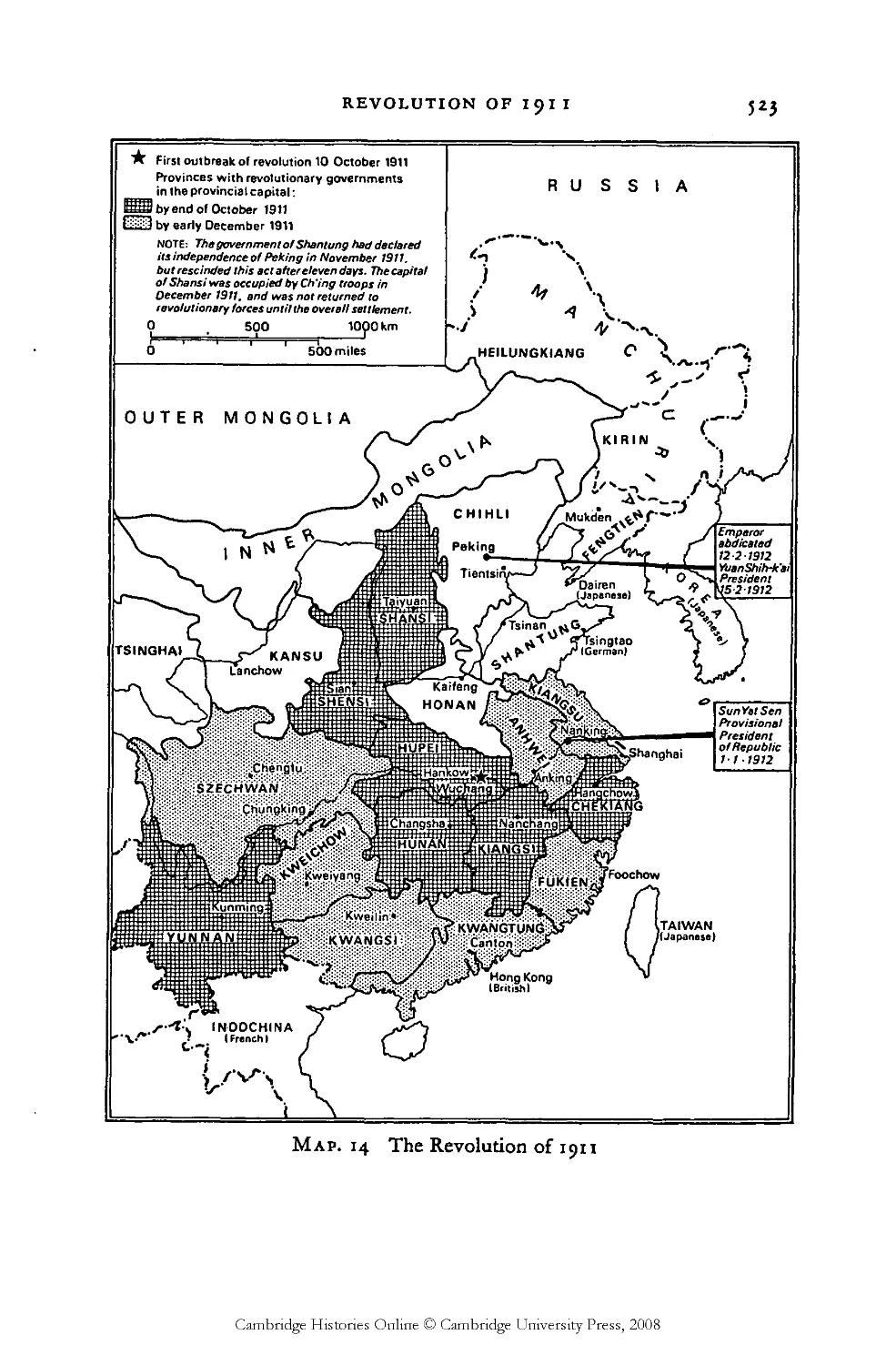
523
Cambridge Histories Online © Cambridge University Press, 2008

Tsitsihar
'L Balkhash
Harbin
MONGO C4A
/ s
Gobi .»
•passion
м ^ Tarim B- V'“
Tarim Basin
Taklamakan Desert
'arkand
Otdos
Desert
Tsaidam
Basin
tstOghaKi
'North
B^Nankiffe
^►Shanghai
kSodchow
■£,—vJS-Cliusan Is.
; VjyJlingpo
j^Chengta
ReckBasmK
ЖШ
Khatmandir
о n-i
Darjeeiii
Patna
Foochow
V< ^ .Nanbing1
Map i. Ch’ing empire
- physical features
[Taiwan
500 km
SVlong Kong
0	300miles
SiIJ Trade Route
Grand Canal
^ Great Wall
H Pass
Region of wind-borne loess
lanoi
120(°f
Cambridge Histories Online © Cambridge University Press, 2008

TABLES
i Estimated gross national product	page z
z	Changes in rural population and area of farm land	5
3	Changes in the size of farms	5
4	Chou and hsien reporting of harvests	7
5	Trends in crop acreages	8
6	Estimated production of major crops	11
7	Cotton yarn and cloth imports	20
8	Capital, looms and workers in handicraft workshops	23
9	Estimated yarn and cloth consumption	25
10	Number and capitalization of foreign-owned industries	29
11	Foreign and Sino-foreign manufacturing and mining	30-1
12	Nature of Chinese-owned manufacturing and mining	35
13	Location of Chinese-owned manufacturing and mining	36
14	Initial capitalization of Chinese-owned manufacturing and
mining	37
15	Number and initial capitalization of treaty-port and inland
Chinese-owned manufacturing firms	38
16	China’s foreign trade	46-7
17	Distribution of principal imports	49
18	Distribution of principal exports	49
19	Foreign trade and principal trading partners, 1871-1911	51
20	Foreign trade and principal trading partners, 1899-1905	52
21	Estimated revenue and expenditure of the central government 63
22	Military and indemnity loans	67
Cambridge Histories Online © Cambridge University Press, 2008

PREFACE TO VOLUME 11
While generalizing is required in all thinking about history, it becomes a
special problem in the case of China’s history. ‘China’ is in fact one of the
largest generalities used in modern speech. The term represents the largest
body of people in one of the biggest land areas over the longest recorded
time - a four-dimensional non-pareil. Just to think about ‘China’ or ‘the
Chinese’ is to rise to a level of generality (measured in persons or years or
acres) that in other fields of history would seem almost infeasibly high.
Europe since the Minoan age is a smaller entity. To say, with our greater
knowledge of Europe and comparative ignorance of China, that European
history is more complex would be presumptuous. Until modern times the
Chinese record was more extensive. Perhaps China’s greater sense of unity
produced more homogeneity than in Europe, or perhaps this is pardy an
illusion created by the traditional Chinese historians’ primary concern for
social order, the state and its ruling class.
In any case, China’s historical record with its already high level of
generality is now being studied in search of syntheses and unifying con¬
cepts to give peoples of today some image of China’s past. This is urgendy
needed, but the difficulties are great: the public need for a generalized
picture often coincides with a popular seeking for predetermined con¬
clusions, in order to allocate blame and identify villains, or to acknowledge
guilt and regret it, or to jusdfy doctrines and reaffirm them, as the case
may be.
This means that what the historian of China contributes to his history
must be scrutinized with even greater care than usual, especially in a history
of China written by outside observers. For example, modern Chinese
history in the West has been in large part a history of foreign relations
with China, the aspect of modern China most easily studied by foreigners.
Of course the multiplicity of foreign influences on China since 1840 (or
since 1514) is plain to see. It has even become customary to date modern
times from the Opium War, a foreign invasion. But all such impacts from
abroad formed only a small part of the Chinese people’s day-to-day environ¬
ment, in which the surrounding landscape and inherited ways remained
Cambridge Histories Online © Cambridge University Press, 2008

XVI
PREFACE TO VOLUME II
dominant and changed only slowly. Is it not likely that foreign influences
will in time bulk less large in the landscape of nineteenth-century China ?
Not because they will shrink in size or significance but simply because they
will be overshadowed by the accumulated new knowledge about China’s
indigenous experience.
Volume io of this series begins not with the foreign commercial invasion
and Opium War but with the view from Peking - the institutional structure
of the Ch’ing empire in China and Inner Asia early in the nineteenth
century. This is followed by Peking’s growing domestic problems of
administrative control and social order in the first half of the century.
Similar signs of internal malaise as well as signs of rejuvenation appear in
the accounts of the Taiping and the Nien rebellions and of the tortured
success of the Ch’ing restoration. China’s economy, and even her military
institutions, shows the inner dynamics of an ancient yet far from stagnant
society. In the face of unprecedented strains, millions of men and women
knew how to survive. It is evident that by the end of the dynasty the
eighteenth-century triumph of Ch’ing arms and governance in the Manchus’
Inner Asian empire had actually set the stage for the expansion of the Han
Chinese from China proper into the spacious borderlands of Manchuria,
Mongolia, Sinkiang and eastern Tibet - a great secular migration con¬
sequent upon China’s phenomenal population growth that began even
before the eighteenth century.
The rise of the Canton trade - a two-way street - is only the best-known
part of this great Han expansion in numbers, migration, trade and even
investment. Part of this Chinese expansion had indeed already taken place
overseas, parallel with the expansion of Europe. It occurred beyond the
Ch’ing frontiers in that realm of maritime China which forms a minor
tradition roughly half as old as the great tradition of the continental,
agrarian-bureaucratic empire that dominated the official histories. Sea¬
faring enterprise in the form of the junk trade from Amoy and Canton to
South-East Asia (Nanyang, ‘the southern seas’) long antedated the arrival
of the European colonial powers in that region. One has only to think of
the Southern Sung navy taken over by the Mongols, of their expedition to
Java in 1292, and of the early Ming expeditions across the Indian Ocean in
the period 1405-33. Granted that the emperor’s leadership of maritime
China was foreclosed by the resurgence of Mongol power in the 1440s
which pre-empted Ming attention, and by the eventual succession of the
Ch’ing as another Inner Asian, anti-seafaring dynasty, the fact remains that
in the South-East Asian colonies of the Spanish, Portuguese, Dutch,
British and French the European rulers increasingly relied upon Chinese
merchants and middlemen to handle retail trade and perform the tasks of
Cambridge Histories Online © Cambridge University Press, 2008

PREFACE TO VOLUME II
XVII
licensed monopolists and petty tax collectors. These overseas Chinese
(Hua-ch'iao, ‘Chinese sojourners’) became a special middle class in the
European colonies, just as they became indispensable also to the rulers of
Siam, where one of them indeed founded the Chakri dynasty that still
reigns at Bangkok. Though unappreciated and sometimes denounced by
Peking, the seafarers and entrepreneurs of maritime China thus participated
in the commercial revolution of early modern times and the colonialism to
which it gave rise in South-East Asia.
When this accelerating growth of international trade at length forced
its way into China through the Tiger’s Mouth (Hu-men, Восса Tigris)
below Canton, merchants of Canton, Swatow and Amoy both in legal
trade and in the opium trade were among the prime movers in the sub¬
sequent growth of international contact. Despite the plethora of foreign
commercial records and the present paucity of Chinese, we know that the
foreign trade of China was a distincdy Sino-foreign enterprise - in fact,
once the treaty ports were opened, the foreign firms’ compradors handled
most of the trade both into China from the ports and out of China through
the ports. Hong Kong, Shanghai and the other places of trade became
Chinese cities no matter what the foreign residents may have thought about
their sovereignty, their treaty rights or the fire-power of their gunboats. It
is almost equally true to say that Chinese participated in the foreigners’
opening of China as to say that foreigners participated in China’s commer¬
cial opening of herself. In the rapid growth of the East India Company’s
great staple trade in tea at Canton c. 1784-1834, the tea, after all, came from
China. Taken together with the Chinese farmers or traders in far-off
Sinkiang or Manchuria, the seafarers and entrepreneurs of maritime China
bespeak the vitality of the Chinese people, especially since they received
scant help from their own government.
If foreign trade was a two-sided process in which both Chinese and
foreigners actively participated, there is also another consideration with
which to appraise the foreign influence in late Ch’ing history: during the
nineteenth century, foreign contact bulked larger and larger in the experi¬
ence of almost every people. The great migration from Europe to the New
World had long preceded the more modest movement of Chinese overseas
in foreign vessels after mid-century. For the British public the Opium War
was of less strategic relevance than the First Afghan War, the Boxer
Uprising was only a spectacular incident during the long grind of the
Boer War. For most peoples industrialization came from abroad; the centre
of gravity in many aspects of change was seen to lie outside the country.
International science and technology, like international trade and politics,
increasingly contributed to the global life of a world society. In this per¬
Cambridge Histories Online © Cambridge University Press, 2008

XV11I
PREFACE TO VOLUME II
spective it seems only natural that outside influences should have played an
unprecedentedly larger role in late Ch’ing history.
China’s entrance into world society has now laid the basis for historical
interpretations that are themselves an ultimate form of foreign influence.
These interpretations align the Chinese experience with that of other
peoples. This is done first with ‘imperialism’ and secondly with ‘modern¬
ization’. These approaches are by way of analogy, seeking to find in China
phenomena found universally elsewhere.
Both imperialism and modernization are terms of almost meta-historical
scope that require precise definition and concrete illustration if they are to
be of use to historians. In a general way imperialism implies foreign
initiatives while modernization suggests domestic processes. In its
economic aspect, imperialism in the case of China stopped short of colonial¬
ism. No plantation economy was developed by foreigners solely for an
export market. Even the classic Marxist agent of disaster, the import of
factory-made cotton textiles, did not destroy China’s handicraft production
of cloth; it was sustained into the second quarter of the twentieth century
by the supply of cheaper machine-made cotton yarn that could be used by
otherwise unemployed members of farming families whose weaving could
not have fed them by itself but could nevertheless add a tiny bit to their
meagre family incomes. The fact that in the 1930s perhaps 70 per cent of
China’s cotton cloth still came from handlooms indicates how strongly
Chinese families felt compelled to make use of their unemployed labour
power. Handweaving indexed their poverty. In thwarting the domination
of factory-made cloth, it also suggests how China’s people on the whole
escaped becoming a mass market for foreign goods (with the exception of
cigarettes and kerosene for illumination) simply by being too poor. This
example may suggest how much more we need to know about the internal
aspects of China’s relations with the outside imperialists in the late Ch’ing.
The psychological impact of imperialism, though slow to accumulate,
was less uncertain. As time goes on, imperialism as a theme in modern
China’s history may become more substantial in the realm of thought and
psychology, conducive to the rise of nationalism, while it may stand up
less well in the quantified field of economics. Chinese ideas of foreign
exploitation are already more broadly and easily documented than such
exploitation itself. The aggressive assertion of foreign privilege is the
major fact in the record, and on this level the missionary vied with the
merchant. The imperialism of warfare and gunboat diplomacy, treaty
rights and the foreign presence, became very plain to all at the time and is
clearly remembered in the national heritage today.
A more recent outsiders’ view, the concept of modernization, as applied
Cambridge Histories Online © Cambridge University Press, 2008

PREFACE TO VOLUME II
XIX
to China suffers from being a catch-all for the concepts of the social
sciences developed mainly in the modern West. The effort of the social
sciences to be objectively value-free may sometimes be contaminated by
their being a culture-bound product of the West. If so, this should be a
temporary problem that will be obviated by the growth of a world culture.
More serious is the high level of generality inherent in the term modern¬
ization. We take it to be a prehension into unity of the ideas of progressive
development exemplified in all the social sciences including history.
Modern times see widespread growth which brings complexity, change
and development in the analytic realms of the economy, the polity, the
society and the culture. But the modernization process in each of these
realms is defined in the terms of the discipline concerned. To posit a single
principle at work in every realm across the board is a further act of faith.
This may be a logical satisfaction and yet difficult to apply to the confused
data of history. Do we really gain in understanding by promoting the
adjective ‘modem’ to the status of an abstract entity, ‘modernization’ ? The
term may become a useful basket, like ‘life’, in which to carry a load of
things largely unknown, messages undeciphered, mysteries unresolved.
Like any term, once reified as a thing in itself, it may become a substitute
for thought.
As the corpus of modern historical research and writing on China grows
and develops, we should expect less demand for the over-arching general¬
izations that give preliminary structure to a new field of learning. The
concrete experience and conscious concerns of the late Ch’ing era should
receive major attention, as they do in many parts of this volume. While
literature and the arts remain regrettably beyond our scope here, the
history of philosophical and political thought gives us major insights into
what happened and how. In brief, the late Ch’ing response to the West now
begins to seem like only a minor motif; the major process was China’s con¬
tinued response to the Chinese past in the light of new conditions including
the West. Stimulus, in short, is where you find it, and stimulus without
response is no stimulus at all.
For example, the deterioration of the Grand Canal transport system to
feed Peking roused an effort in the 1820s to revive the sea transport of
government rice around Shantung, an institutional arrangement within
the tradition of the statecraft (ching-shih) school of practical administrators.
Only in the 1870s were steamships adopted to meet the problem. Again,
the doctrinal basis for the self-strengthening movement, to defend China
by borrowing Western technology, may be viewed as an application of
traditional statecraft in a new context. Only in the 1890s, after many
disasters, were ideas of evolutionary progress and social Darwinism
Cambridge Histories Online © Cambridge University Press, 2008

PREFACE TO VOLUME II
smuggled into Confucianism as a necessary platform for the reform move¬
ment. And in the end, the principal struggle of the reformers was not
against imperialism directly but against those Chinese traditions that had
made imperialism possible. Late Ch’ing reformers and revolutionaries both
accepted the ancient Confucian adage, ‘If you can keep your own house in
order, who will dare to insult you ?’ China’s strength must come from
within. For scholars trained in the classics, the chief source of inspiration
for China’s future was still her past. For today’s historians of the late
Ch’ing, this puts a premium on understanding China’s great tradition as
well as the nineteenth century. There is no substitute for our knowing what
the generations before Sun Yat-sen actually had in mind.
Mary Clabaugh Wright (1917-70) left her mark on the history of late
imperial China through her students and friends and in two books dealing
respectively with the 1860s and the 1900s - the initial and final periods of
the present volume. The last stand of Chinese conservatism: the T'ung-chih
Restoration, 1862-1874, which developed from her Harvard dissertation of
1952, analysed the problems and policies of the Ch’ing regime compre¬
hensively as few have done before or since. China in revolution: the first phase,
1700-171}, edited from a conference she organized and presided over in
1965, is the first all-embracing study of the subject that embodies the
results of modern scholarship from half-a-dozen countries. From 1945 to
1959 Mary Wright built up the Chinese library of the Hoover Institution
on War, Revolution and Peace at Stanford and then from 1959 until her
untimely death was Professor of History at Yale University. Since this
volume of the Cambridge History of China is so indebted to her pioneering
work, we dedicate it to her.
JKF
October 1777	kcl
Cambridge Histories Online © Cambridge University Press, 2008

CHAPTER 1
ECONOMIC TRENDS IN THE LATE
CH’ING EMPIRE, 1870-191 1
There was little of the Chinese economy prior to the twentieth century that
was not included within the agricultural sector or quite intimately con¬
nected with it.1 The bulk of the following essay ought properly to be
devoted to an analysis of the structure and development of Chinese agri¬
culture in the nineteenth century and its implications for the rest of the
economy. I have, however, while discussing agriculture first, given
roughly equal attention to handicrafts, modern industry, trade and com¬
merce, and the fiscal system. If these divisions are so obviously the cus¬
tomary ones, I can only plead my own limitations and the possible extenu¬
ation that - with honourable and increasing exceptions - the studies of
China’s modern economic history upon which I have had to rely for this
survey are themselves conventionally descriptive works.
The treatment of material in all of the following secdons is unavoidably
selective. I have in each case focused on what was new or changing in the
last five decades of the Manchu dynasty against a background which, until
1911 and long afterwards, remained a basically unaltered mix of the factors
of production operating within a largely constant social context. This is
not to imply that nothing of importance changed in the last century of
imperial China. On the contrary, ideological and political storms uprooted
the Confucian empire. Fundamental economic change and modern
economic growth, however, did not come of their own momentum out of
the late-Ch’ing economic system. They were pre-eminently the by-products
of a new and possibly still tenuous political integration which itself was
achieved only after decades of political strife, foreign invasion and civil
war.
One must begin by reluctantly accepting that precise quantitative
information of a global kind - as opposed to a fair amount of suggestive
local and partial data - is not available and probably cannot be satisfac¬
torily derived for pre-republican China. Nowhere is this more apparent
1 The author gratefully acknowledges the support of the Committee on the Chinese Economy
of the Social Science Research Council, and of the Center for Chinese Studies at the University
of Michigan in the preparation of this essay.
Cambridge Histories Online © Cambridge University Press, 2008

z
ECONOMIC TRENDS, I87O-I9H
than in the case of so fundamental a measure as national income. Table i
reproduces, with modifications, the only attempt, of which I am aware, to
estimate China’s gross national product in the nineteenth century. The
individual components were often arbitrarily arrived at, but it is doubtful
whether substantial amounts of more reliable information can be assembled.
These estimates roughly indicate the relative sizes in the 18 80s of the several
sectors of the economy.
TABLE I
Estimated gross national product of China in the 1880s
Sector
Amount (1,000 taels)
0
Agriculture
2,“9,941
66.79
Nonagriculture
1,108,816
33.21
mining
47,800
1.43
manufacturing*
128,000
3-77
construction
30,000
O.9O
transportation
30,000
O.9O
trade
220,000
6.59
finance
74,645
2.24
residential housing
164,000
4-91
government services
professional, gentry and other
164,000
4.91
services
24I»313
7-*3
net income from abroad
H, 258
0.34
Total
3.338,757
100.00
* almost entirely handicraft.
Source-. Chung-li Chang, Tbe income of tbe Chinese gentry (1962), 296. The principal shortcomings of
this estimate, apart from the admittedly critical data question, are Chang’s probable
overstatement of the share of gentry services, and the much more serious reliance on
1887 official data for the area of cultivated land. As I suggest in the next section, these
data and thus the share of agriculture should be adjusted upward by at least one-third.
This I have done and, leaving Chang’s other components unchanged, I have accordingly
recalculated the percentages.
AGRICULTURE
While there were changes in detail and alterations in the size or quality of
certain components, the technology and organization of Chinese agri¬
culture differed little in 1911 from what it had been in 1870. (Even into the
1950s it remained largely unchanged.) The principal changes were: a slow
but perceptible population increase unaccompanied by an equivalent
extension of cultivated land; a resulting decrease - particularly in North
China - in the size of the average farm; changes in the pattern of crops
grown, partly in response to the increasingly adverse man-land ratio and
partly in response to new external market opportunities; the absolute and
Cambridge Histories Online © Cambridge University Press, 2008

AGRICULTURE
3
relative decline of cotton spinning as a peasant handicraft and a pardal
restructuring of the sources of rural non-agricultural income in response
to this decline; some differendation of land-holding patterns in the im¬
mediate hinterlands of the growing treaty ports from those of the bulk of
the rural interior of China; and a compledon of the process already long
under way by which the disdncdon between various legal forms of land
tenure was dissipated.
No useful demographic data for the last half of the nineteenth century
are of course available. The official esdmates for the 1840s put China’s
population at a little more than 400 million persons; these, it has been
argued, while not accurate in detail are relatively good data.2 The Taiping
Rebellion and the other great mid-century uprisings not only resulted in
substantial populadon losses, especially in central China, but also produced
a breakdown of the refurbished pao-chia system which had collected the
reasonably reliable population data for the period 1776-1850. ‘The century
between 1851 and 1949, despite the availability of various figures, is
pracdcally a demographer’s vacuum.’3
There are, nevertheless, sufficient qualitative indications from which to
assert, if not to measure, a slowly increasing population from the 1870s
until the end of the dynasty. Migrations of population from provinces to
the west and north which had not been so severely afflicted gradually
repopulated the Yangt2e valley provinces that the civil wars had ravaged.
The last four decades of the Manchu dynasty were internally relatively
peaceful and, compared to mid-century, prosperous. While the wars with
France in 1884-5 and with Japan in 1894-5 were politically and diplomati¬
cally of great significance, they had no major demographic effect. The
great famine of 1877-8 in North-West China and lesser but still serious
famines in 1892-4 and 1900 unquestionably resulted in temporary popula¬
tion losses. Such crises, caused by drought and floods, had been endemic
in the past and were experienced again in the twentieth century, for
example in 1920-1, 1928, 1931 and 1935. They are inherent components of
the demographic pattern characteristic of many ‘underdeveloped’ countries
which combines a high but widely fluctuating death-rate and a high but
relatively stable birth-rate to produce slow but substantial population
increments.
But, how large an increment ? С. M. Chiao and J. L. Buck have estimated
from birth- and death-rates observed in 4,216 farm families from four
provinces in 1924-5 that the rural population of China might possibly have
grown at an average rate of 1.4 per cent per annum between the 1860s and
* Ping-ti Ho, Studies on tbe population of China,	47-64.	* Ibid. 97.
Cambridge Histories Online © Cambridge University Press, 2008

4
ECONOMIC TRENDS, 1870-I9II
the 19 20s.4 Such a rate of increase, if uninterrupted, would have resulted in
a doubling of the population during these seven decades, and on the face
of it appears too high as an actual long-term average although it might
have been valid in some areas for shorter periods. In 1954, the National
Agricultural Research Bureau of the Ministry of Industry produced, from
retrospective and thus tenuous data assembled by its crop reporters, an
estimate of changes in the rural population and the area of farm land
between 1873 and 1933 which I reproduce in table 2. A population increase
of i7per cent for the forty years 1873-1913, or an annual average of slightly
less than 0.5 per cent, is suggested. Assuming a total population of
between 350 and 400 million in 1873, by 1913 this total would have increased
to between 410 and 468 million. Bearing in mind that the mid-century
population was somewhat more than 400 million, that the Taiping and
other civil wars resulted in severe population losses, and that the popula¬
tion of China in 195 3, after many years of war and civil war, was enumer¬
ated at 5 83 million in the closest thing to a real census that China has ever
4 С. M. Chiao and J. L. Buck, ‘The composition and growth of rural population groups in
China’, Chinese Economic Journal, 2.2 (March 1928) 219-55.
Cambridge Histories Online © Cambridge University Press, 2008

AGRICULTURE
J
TABLE 2
Index numbers of changes in China’s rural
population and area of farm land, 1879-1999
{1879 = too)
Population
Farm land
1873
IOO
IOO
1893
IO8
IOI
1913
”7
101
193 3
'3'
101
Source: Department of Agricultural Economics,
National Agricultural Research Bureau,
Ministry of Industries, Crop reporting in China,
1934. 48-53-
experienced, these estimates for 1873 and 1913 are atleast not unreasonable.
The National Agricultural Research Bureau’s respondents, as table 2
indicates, reported that the farm area in their several localities showed no
increase comparable to the slow but continuing population growth which
occurred. The resultant worsening of the man-land ratio is reflected in the
historical data on average farm size shown in table 3, collected by J. L.
Buck’s field investigators for his monumental land utilization study. Buck’s
respondents overwhelmingly attributed the reported decreases in average
table 3
Changes in the si%e of farms, 1870-1990
Number of
locations
Average crop area per farm
Regions, areas and locations
reporting
(hectares)
China
55
1S/0
>■37
iSpo
>•35
1910
1.06
1930
0.92
wheat region
29
>•75
>•77
1.32
I.IO
rice region
26
0.67
0.81
o-77
0.72
Wheat Region Areas
spring wheat (Kansu, Tsinghai)
2
0.48
0.51
0.66
0.71
winter wheat-millet (Honan, Shansi,
8
1.14
1.28
0.97
0.81
Shensi)
winter wheat-kaoliang (Anhwei, Honan,
19
2.19
2.18
>•53
1.26
Hopei*, Kiangsu, Shantung)
Rice region areas
Yangtze rice-wheat (Anhwei, Chekiang,
15
°-77
0.99
0.84
0.79
Honan, Hupei, Kiangsi, Kiangsu)
rice-tea (Hunan, Kiangsi)
6
0.42
0.42
0.76
0.74
Szechwan rice (Shensi, Szechwan)
2
0.82
0.76
0.64
0.55
double-crop rice (Fukien)
I
0.58
0.54
0.55
0.53
south-western rice (Kweichow)
2
—
0.52
0.48
0.36
* Hopei province was, of course, called Chihli in the late Ch’ing period.
Source: John Lossing Buck, Land utilization in China. Statistics, 288.
Cambridge Histories Online © Cambridge University Press, 2008

6
ECONOMIC TRENDS, 187O-I9II
farm size to increases in the population of their areas. In North China
(Buck’s winter wheat-kaoliang areas) the decline in average farm size was
more striking than in central China (the rice-wheat and rice-tea areas). The
difference is attributable to the much greater demographic losses from the
Taiping Rebellion in the provinces south of the Yangtze River and the
consequent temporary fall in the man-land ratio in Central and South
China. As population migrated to these then relatively less-crowded
provinces from more crowded areas, the man-land ratio rose and average
farm size after 1900 slowly declined.
While it is certain that rural living standards between 1870 and 1911 did
not improve, there is no conclusive evidence that population growth and
declining average farm size were accompanied by a drastic secular fall in
the peasant standard of living. The semi-annual official reports from the
provinces to Peking on the quality of the summer and autumn harvests do
indicate a definite downward trend in the course of the nineteenth century.
It is reasonable to expect that some deterioration occurred during the
catastrophic rebellions of the 1850s and 1860s as table 4 suggests. A con¬
tinued decline after 1870, however, is not convincingly confirmed by the
numerous reports of local crop conditions which appear annually in the
Reports and returns on trade by the Imperial Maritime Customs. My suspicion
is that the higher proportion of poorer harvests reported in the last decades
of the dynasty in part reflects the efforts of the provinces to resist Peking’s
importunate demands for increased tax remittances, which are described
below in the discussion of government and the economy. The depopula¬
tion attributable to the rebellions, moreover, could be dalled a Malthusian
safety valve which temporarily reduced the inexorable pressure of popula¬
tion on land.
Conditions of individual farmers and of spatially separate localities of
course differed widely, with the difference between survival and misery
often depending upon uncertain weather, the rapacity of the local officials
and the presence or absence of civil war and banditry in the locality. Over¬
all, however, total crop production between 1870 and 1911 probably
increased adequately to support the larger population. This increment was
not due to any major changes in farm technology or organization. No
important new crops or seed varieties (like corn and early-ripening rice
earlier in the dynasty) were introduced in the second half of the nineteenth
century. The middle decades of civil war, moreover, had seen a substantial
destruction of capital stock which was only gradually replaced. Irrigation,
water storage and control, and grain storage facilities were not extended or
improved beyond their eighteenth-century levels. The increase in crop
production was apparently the result mainly of a shift by farmers to crops
Cambridge Histories Online © Cambridge University Press, 2008

AGRICULTURE
7
which yielded a larger amount of food or income per unit of land and at
the same time required more labour for their cultivation. Crop shifts of this
kind in the early twentieth century, as the man-land ratio continued to
table 4
Percentage of chou and bsien in nine provinces reporting above normal,
normal and below normal harvests, 1821—1910
Number of reports*
Above
normal
Normal
Below
normal
1821
1,114
42.99
14-30
2.69
1823
1,192
46.47
31.67
1.84
1830
1,321
39.64
61.54
1.31
1835
1,229
20.17
65.58
14.23
1840
1,304
23.07
67.02
7.89
1843
1,306
29.24
63-93
6.8l
1830
1,019
22.27
72.32
5-39
1833
979
14.09
63.67
20.22
i860
7J2
20.21
39.04
24.73
1863
1,087
5-79
53.81
40.38
1870
1,233
4.86
43.01
5O.II
1875
1,308
6.19
53.66
40.13
1880
l>i°9
7-79
52.94
39.26
1883
1,246
6.26
49.51
44.22
1890
L3°9
3-27
45-37
49-33
1893
1,243
3-94
45-29
50.76
1900
1,190
4.28
42.83
32.83
1903
1,198
4.00
43.24
32-75
1910
1,126
4.61
37-74
37-63
* For eight of the nine provinces both summer and autumn reports are included; the number of
tbou and hsien reporting is thus about half the number of annual reports
Source: Calculated from data in Li Wen-chih, comp. Cbmg-kuo cbin-tai mmg-ycb Mb t^u-Hao
ii-i-cbi, 1840-1911 (Source materials on the history of agriculture in modern China, 1st
collection, 1840-1911), 761-9, which are based on reports submitted in response to the
following edict: ‘An edict to the Hu-pu. Hereafter, in reporting the harvest results of
the several provinces, use the following categories; eight fen [i.e., 80 per cent of a
theoretical maximum] is to be taken as a rich harvest, six to seven fen as a normal harvest,
and five fen or less as a poor harvest.’ Ta-Cb’ing Kao-tiung tbun-buang-ti Mb-lu (Veritable
records of the Ch’ien-lung Emperor of the Ch’ing dynasty), 339. 4ta-b, 14 June 1749
(vol. 22, p. 3131 of Taipei reprint, 1964).
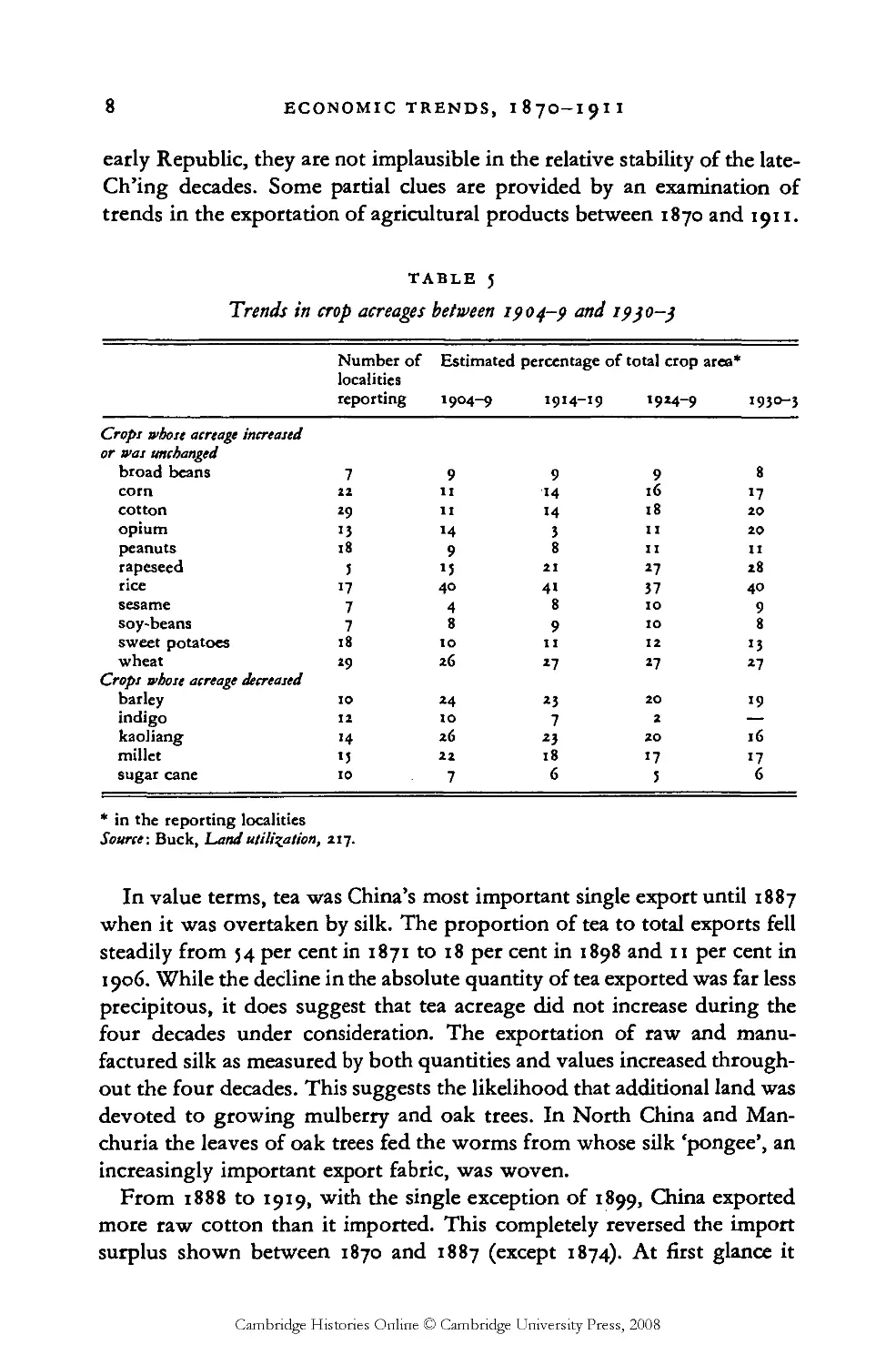
worsen, are shown in the data on trends in crop acreage between 1904-9
and 1924-9 collected by J. L. Buck’s investigators and summarized in
table 5. These indicate a progressive substitution of corn, sweet potatoes
and sesame for barley, kaoliang and millet as food crops, and also an
increase in such cash crops as cotton to supply the expanding mills of
Shanghai and Tientsin. For the period 1870-1911, unfortunately, not even
such imperfect although suggestive data are available; but if changes of
this kind could occur amidst the political instability and civil war of the
Cambridge Histories Online © Cambridge University Press, 2008

8
ECONOMIC TRENDS, 1870-I9II
early Republic, they are not implausible in the relative stability of the late-
Ch’ing decades. Some partial dues are provided by an examination of
trends in the exportation of agricultural products between 1870 and 1911.
table j
Trends in crop acreages between 1904-9 and 1990-9
Number of
localities
reporting
Estimated
1904-9
percentage of total crop
1914-19 1924-9
area*
1930-3
Crops whose acreage increased
or was unchanged
broad beans
7
9
9
9
8
corn
22
11
14
l6
»7
cotton
29
11
14
18
20
opium
n
4
3
II
20
peanuts
18
9
8
II
II
rapeseed
5
l5
21
27
28
rice
17
40
41
37
40
sesame
7
4
8
IO
9
soy-beans
7
8
9
IO
8
sweet potatoes
18
IO
11
12
13
wheat
29
26
27
27
27
Crops whose acreage decreased
barley
10
24
23
20
19
indigo
12
IO
7
2
—
kaoliang
4
26
23
20
l6
millet
n
22
18
17
17
sugar cane
10
7
6
5
6
* in the reporting localities
Source: Buck, Land utilisation, 217.
In value terms, tea was China’s most important single export until 1887
when it was overtaken by silk. The proportion of tea to total exports fell
steadily from 54 per cent in 1871 to 18 per cent in 1898 and 11 per cent in
1906. While the decline in the absolute quantity of tea exported was far less
precipitous, it does suggest that tea acreage did not increase during the
four decades under consideration. The exportation of raw and manu¬
factured silk as measured by both quantities and values increased through¬
out the four decades. This suggests the likelihood that additional land was
devoted to growing mulberry and oak trees. In North China and Man¬
churia the leaves of oak trees fed the worms from whose silk ‘pongee’, an
increasingly important export fabric, was woven.
From 1888 to 1919, with the single exception of 1899, China exported
more raw cotton than it imported. This completely reversed the import
surplus shown between 1870 and 1887 (except 1874). At first glance it
Cambridge Histories Online © Cambridge University Press, 2008

AGRICULTURE
9
might appear that the growing exportation of raw cotton is a strong
indication that the total cotton crop increased significantly in the last two
decades of the Ch’ing. But matters were not in fact so simple. The increase
in cotton exports was accompanied by a steady rise in raw cotton prices
and by a simultaneous growing inflow of relatively inexpensive machine-
spun yarn from India and Japan. The conjunction of these three trends
suggests that cotton production did not expand or did not expand suffici¬
ently to meet both domestic and export demand, that the resulting higher
domestic prices of cotton and yarn induced weavers to purchase the
cheaper imported commodity, and that in turn a reduced domestic demand
diminished the inducement to increase raw cotton production.
One crop which definitely expanded in acreage during the last decades of
the nineteenth century was opium. In value terms opium was China’s
largest single import until the mid-18 80s. Opium and cotton goods
together made up about two-thirds of China’s imports in the 1870s and
early 1880s; by 1898 the share of the two had fallen to about 50 per cent.
This decline was entirely due to a decrease in the quantity (although not
the value, which continued to rise) of opium imported, while cotton goods
imports increased rapidly. The principal reason for the fall in the quantity
of opium imports was the steady spread of domestic opium cultivation.
Unfortunately no data are available with which to measure even roughly
the area of land newly planted with poppy to replace the imported article.
The significant price rises per unit at the very end of the Ch’ing and in the
first years of the Republic were caused by market speculation in reduced
quantity of the drug as the first step towards its de jure if not de facto
suppression. The legal import trade was abolished at the end of 1917, while
efforts to suppress domestic cultivation subsequently varied in success
with the morals and financial needs of the local warlords in whose terri¬
tories the poppy was grown.
Again, judging from data on the quantity and value of exports between
1879 and 1915, it appears possible that there was a substantial increase in
crop acreage of soy-beans, rapeseed, sesame and peanuts. Before the 1890s
the trade in these commodities was negligible. From the turn of the century,
the value of bean products and vegetable oils exported shot quickly
upward, the oils going largely to Europe where they were used chiefly in
soap manufacture, and the beans and bean cake as well as oil to Japan. The
chief producing and exporting area was Manchuria; the flow of population
from North China to Manchuria after the Russo-Japanese War was
possibly related to an important expansion of soy-bean cultivation. More¬
over, efforts to suppress the opium crop in North China led farmers to
increase their planting of beans, sesame and peanuts as a substitute cash
Cambridge Histories Online © Cambridge University Press, 2008

ю
ECONOMIC TRENDS, 1870-I9II
crop. On the other hand, important changes in domestic consumption
patterns were taking place simultaneously which may suggest that the new
bean and oil exports represented not so much an increased crop as a
diversion to export of products hitherto consumed at home. From the
1890s there was a rapid increase in imports of kerosene, which replaced the
more expensive vegetable oils used to make candles for illumination and
other purposes. The remarkable growth in bean and oil exports, then,
probably overstates the extent to which cultivation patterns were altered
before 1900, although Buck’s data give a strong indication, as we have
seen, that the acreage of these and other cash crops did increase from the
early twentieth century.
Only a very crude estimate of the production of major crops in a typical
year at the end of the nineteenth century is possible. Data in the Kuang-hsu
edition (1899) of the Collected statutes (Ta-Ch’ing hui-tien) on the area of land
under cultivation - with some adjustments the official figure for 1887 is
847,760,} 54 той - are imperfect in detail and in any case represent a sub¬
stantial understatement of the actual cultivated area. The underlying unit
of measurement in many localities was a ‘fiscal’ той used to convert
different grades of land to a single standard; some land reclaimed after
1712 had remained unregistered; and the property of the more powerful
local elite was not always fully reflected in the tax rolls. The precise degree
of under-registration is not known, but judging from J. L. Buck’s 1929-33
agricultural survey findings, an upward adjustment by one-third would be
quite conservative. Cultivated land (which I take as equivalent to the crop
area) in the late-nineteenth century was then perhaps 1,130,344,579 той.
No comprehensive nineteenth-century data are available for the propor¬
tions of the total crop area planted in individual crops. If, however, the
averages of Buck’s 1929-33 percentages and those for 1931-7 by the
National Agricultural Research Bureau are adjusted for the changes
between 1904-9 and 1930-3 shown in table 5, an approximation of the
situation in the last decades of the dynasty is possible. Based on these
estimates, table 6 presents at least a plausible guess as to the output of
major crops in the late-nineteenth century.
The fate of cotton spinning, the most important single rural handicraft
in the nineteenth century, is discussed in the following section. In the
relatively ‘developed’ lower Yangtze area (and possibly in Kwangtung as
well), where commerce and manufacture were most advanced and where
the impact of foreign trade was most substantial, the post-Taiping decades
saw an increase in absentee landownership, representing the investment of
commercial profits by successful merchants, brokers and compradors.
Absenteeism in this sense is to be distinguished from the fact that the great
Cambridge Histories Online © Cambridge University Press, 2008

AGRICULTURE
II
majority of the rural elite did not of course reside in the peasant villages
in which they owned land; their normal habitat was the rural town, at the
level of the hsien city or lower. One form which this development took
was the growth of the landlord bursary (tsu-cban) by means of which
individual owners, primarily urban businessmen, entrusted their lands and
tenants to the management of the bursary owner and received a propor¬
tionate share of the profits after taxes and other expenses were met. It is
table 6
Estimated annual production of major crops, c. 1900
Percentage
of
crop area
Crop acreage
{той)
Typical
yield per
той
(piculs)
Output
(piculs)
Rice, unhusked
30.2
34L364.I9°
3.89
1,327,906,699
Wheat
26.3
297,280,735
••39
413,220,222
Kaoliang
12.5
t4L293.”5
I,73
244,437,i°6
Millet
11.6
131,120,020
1.64
215,036,833
Barley
10.2
115,295,190
1.47
169,483,929
Soy-bean
6.7
75.733.”5
i-39
105,269,030
Corn
4-2
47.474.49°
1.87
88,777,296
Cotton, lint
2.4
27,127,300
0.27
7,324,441
Sources: Buck, Land Utilisation, 217; Ta-chung Liu and Kung-chia Yeh, The economy of the
Chinese mainland: national income and economic development, spjj-spjf, table 30, p. 130,
table A-9, p. 300.
impossible to estimate the extent of this phenomenon, but enough cases
have been found by Muramatsu Yuji to suggest that in Kiangsu at least it
was more than incidental.5 The bursary owners tended to be well-placed
members of the rural elite (gentry) who were able to call upon official
assistance (even to the extent of the arrest and imprisonment of delinquents)
to collect tenant rents. While rural class relations were never the proper
subject for a pastoral idyll even under the best Confucian landlord,
absenteeism in the late nineteenth century introduced an increasing element
of harshness which became intolerable in the twentieth.
The official Ch’ing land records of 1887 still record the existence, in
addition to private land (min-t'ien), of substantial acreages especially in
North China and Manchuria of banner land (cb’i-ti), military land (t'un-
t'ien), imperial manors (chttang) and the like. These reflect the intention of
the early Manchu rulers to superimpose a land system corresponding to
* Sec Muramatsu Yuji, ‘A documentary study of Chinese landlordism in the late Ch'ing and the
early republican Kiangnan’, BSOs4St 29.3 (1966) 566—99, and Professor Muramatsu’s
numerous studies of the tsu-cban cited therein.
Cambridge Histories Online © Cambridge University Press, 2008

12
ECONOMIC TRENDS, 187O-I9II
the Manchu political and social structure upon that of conquered China. In
reality, by the late nineteenth century litde remained, apart from differ¬
ential rates of land tax, of these earlier distinctions. The combined effects of
population growth, inadequate official stipends, and the preponderant
influence of the underlying Chinese system of private landownership had
in practice almost entirely homogenized the various legal forms of land
tenure. Banner land as well as private land was farmed by Chinese tenants
in small, scattered plots which by one or another subterfuge were freely
rented, mortgaged, bought or sold.
The land held under some form of official tenure, bursary land and
private land in general were not normally farmed as contiguous estates
with hired agricultural labour. The continued rarity of ‘capitalist’ com¬
mercial farming is the first of several aspects of late-Ch’ing agriculture
which remained constant alongside the several changes that I have re¬
counted. Examples can be cited of large landholdings by officials, wealthy
gentry and monopoly merchants in excess of 10,000 той throughout the
nineteenth century; holdings of this size, however, were quite unusual.
Ownership of land in late-Ch’ing China was skewed, but there were few
large agricultural holdings comparable to the great estates of Europe and
other parts of Asia or the giant ranches and commercial farms of the
United States. The landowner normally ranged from the owner-farmer
cultivating perhaps 20-30 той in North China and 12-15 той in the south,
to some two million local elite families whose median holdings were per¬
haps 100-50 той, most of which was normally tented to tenants.4 * 6 Tenancy,
as in the twentieth century, was much more common in the south (the
‘rice region’) than in the north (the ‘wheat region’); perhaps, again as in
later decades, 50 per cent of farming families could be classified as tenants
or part-owners. Some signs of increasing numbers of tenancies can be
observed in districts which had suffered prolonged famine and in areas
near the major commercial centres, but there is little evidence that land
tenure patterns changed radically in the last four decades of the dynasty.
Rents were paid either in money or in kind; if the latter, they were
commonly 50 per cent of the major crop. Reported cash rents in the 1880s
vary from 0.6 taels to 2.66 taels per той, approximately 5 to 10 per cent of
the value of land in these localities. (Compare the National Agricultural
Research Bureau’s estimate of average cash rents as 11 per cent of land
4 There are no survey data describing nineteenth-century land tenure or utilization patterns
comparable even to the admittedly inadequate twentieth-century reports. My comments are
based in part on the results of an 1888 questionnaire to local informants compiled by George
Jamieson for the Royal Asiatic Society: ‘Tenure of land in China and the condition of the
rural population’, Journal of tie North China Braneb of tie Koval Asiatic Society, ns, 23 (1889)
59-47.
Cambridge Histories Online © Cambridge University Press, 2008

AGRICULTURE
*3
values in the 1950s.) This suggests that, after deductions for taxes and other
costs, the return on investments in land, while relatively secure so long as
political stability was maintained, was only one-half as large as the 10 to 20
per cent which could be realized from commerce or moneylending. The
comparatively low rate of return probably limited any tendency to increas¬
ing concentration of landownership. The real burden of tenancy depended
upon other stipulations of the landlord-tenant contract in addition to rent.
Individual examples of better and worse terms are available for the nine¬
teenth century - labour service, short-term leases, rent deposits and the
like - but we lack systematic evidence from which to conclude that the
late-nineteenth-century situation was a progressively worsening one,
rather than a perpetuation of the same wretched existence, for the number¬
less poor.
One piece of evidence - Professor Muramatsu’s discovery that landlord
bursary income from rents increased sharply between 1905 and 1917 - does
suggest that the local elite were able to pass on to their tenants much of the
burden of the increased taxation of the dynasty’s last decade. These addi¬
tional levies, which are discussed later in this essay, were assessed on the
provinces in order to obtain funds for the Boxer indemnity payments.
Given the historical ability of influential landowners to evade their propor¬
tionate shares of the ordinary tax burden (most commonly by paying none
or only part of the ‘extras’ which had over time become attached to
nominal land tax quotas), it is not unlikely that owner-farmers as well as
the tenants of larger landlords ultimately paid a disproportionate part of the
added taxation.
It is the overall stability of the agricultural system rather than any
significant departures up or down from the traditional norms that is most
remarkable. The equilibrium was satisfied at a very low level of subsistence
for the great majority of the millions of farming families who constituted
80 per cent of China’s population. The hazards of flood, famine and
epidemic were compounded by the absence of inexpensive means of bulk
transportation and of an effective central government which could channel
funds and food from surplus to deficit areas. Few peasants could realisti¬
cally expect ever to be better off than their fathers or grandfathers had
been. Yet after the great Taiping and Nien uprisings no major peasant
revolts threatened the Ch’ing government or the elite-dominated rural
society. One might suggest that the absence of a substantial peasant-based
revolutionary movement (the role of the omnipresent secret society was
ambiguous - as often as not it was controlled by or in cooperation with the
local elite) may be taken as an indication that ‘restoration’ and ‘self¬
strengthening’ were remarkably effective in suppressing traditional forms
Cambridge Histories Online © Cambridge University Press, 2008

14
ECONOMIC TRENDS, 1870-I9II
of domestic discontent - if not anti-dynastic nationalism and foreign
political and economic incursions. The stability, in a narrower sense, of
patterns of agricultural organization and land utilization was the conse¬
quence less of political conservatism than of the constraints of the available
technology and of the social values which motivated the population.
Very large estates, as I have noted, were not common. Moreover, the
average land actually cultivated by an individual farming family, owner or
tenant, was very small; beyond a certain point larger owners found it pre¬
ferable to let their excess land rather than farm it with hired labour.
Twentieth-century data show a high correlation between the size of the
farm household and farm size, an indication that the unit of cultivation was
close to the minimum subsistence level. Miniature cultivation was
aggravated by the fact that farms tended to be broken up into several non¬
adjacent parcels usually of different qualities or types of land. Considerable
land was wasted in boundary strips, excessive labour time was used to
travel from parcel to parcel, and rational irrigation practices were impeded.
The rarity of latifundia, the tiny family farm, and parcelization of the typi¬
cal holding, were all in part the consequence of traditional inheritance
practices - in particular of the absence of primogeniture. For elite and
peasant alike, the death of the head of the family was usually followed by
the equal division of its holdings among all surviving sons who commonly
established themselves as separate households. Fett-chia (‘dividing the
family’), as the process was called, might be resisted for a generation or
more, but the elite ideal of the large extended family did not often survive
the inevitable tensions. Hence, as in the forest primeval, individual oaks
sprang up, matured, aged and decayed while the forest itself continued
magnificently to dominate the countryside. Parcelization was obviously
the outcome of successive efforts to provide each heir with roughly
equivalent amounts of the several types of land (paddy, upland, orchard
and so on) which had constituted the patrimonial farm.
Ownership of a substantial acreage, before or after fen-chia, did not imply
management of that land as a unit. Local elite families would farm with
hired labour only a portion of their holdings. In addition to the inade¬
quacies of rural credit facilities, to the poverty of management techniques
themselves, and to the unstable market for cash crops, there were limits on
the quantity of land which would yield greater profits from direct cultiva¬
tion than from tenant rents. These limits were set by the immense but un¬
even labour requirements of the existing farm technology. The potential
employer of large quantities of farm labour was faced with high supervisory
costs and diminishing returns from non-family labour which was used
intensively but only at peak seasonal periods. Only improved seeds, more
Cambridge Histories Online © Cambridge University Press, 2008

AGRICULTURE
IJ
and better fertilizers and expanded irrigation - that is, significant techno¬
logical'changes which did not occur - would have fully justified large-scale
farming to supply a distant market.
The agricultural sector of the Chinese economy in the last decades of the
Ch’ing dynasty was thus characterized by a factor mix in which land and
capital were in short supply and the superabundance of labour was subject
to some diminishing returns. It was, however, if not for the long run at
least for the purposes of any middle-term prediction, in a stable equilibrium
with no endogenous economic reason why it should not continue to re¬
produce itself. It is a tribute to the traditional technology that so vast a
population and so high a culture in its upper strata could be supported —
even if for the majority the level of subsistence was low indeed. The many
centuries of basic investment of immense quantities of human labour in
altering the land - by terracing, irrigation, flood control and drainage - had
made possible perhaps from as early as the seventeenth century an output
of 2.3 metric tons of rice per crop hectare. This is an important benchmark
which represents the theoretical maximum yield of pre-modern agricultural
technology (that is, without major current inputs of improved seeds,
fertilizers, pesticides and so on). China’s average rice yield per crop hectare
reached only 2.47 metric tons in the 1930s and 2.34 metric tons in the years
i95 5/6-i96o/i. In the latter period India’s yield was no more than 1.36
metric tons.7 But the gap between stability and stagnation is narrow. The
equilibrium of traditional agriculture had been reached at a very low level
of per capita output of which a very high proportion was consumed by the
agricultural producers. Only a small quantity of marketable surplus was
available either as industrial raw material or to feed the non-farm sector.
Conversely, the effective demand for urban manufactured products was
limited. Thus the immediate possibilities either of extensive industrial¬
ization or of agricultural development were narrowly constrained by the
disabilities of the agricultural sector.
HANDICRAFT INDUSTRY
The simplistic indictment of ‘foreign capitalism’ by some contemporary
Chinese historians for having progressively ‘crushed’ and ‘exploited’
domestic handicraft industry from the mid nineteenth century onward is
belied by the actual state of the Chinese economy as late as the 1930s. In the
middle of that decade, even in the cotton textile industry which allegedly
suffered most severely from the ‘incursion of foreign capitalism’, 61 per
cent of the cotton cloth produced in China (in square yards; if the unit of
7	See Shigeru Ishikawa, Economic development in Asian perspective, 69-77.
Cambridge Histories Online © Cambridge University Press, 2008

i6
ECONOMIC TRENDS, 187O-I9II
measurement were yards the proportion would be 73 per cent) was woven
by handicraft methods.8 Anyone who would claim that the Hunan or
Szechwan peasant in the 1930s dressed in Naigaiwata cottons, smoked
BAT cigarettes, and used Meiji sugar has a big case to prove. In 1933, the
output of handicrafts accounted for an estimated 68 per cent of the total
value of industrial output. Of course the relative share of handicrafts was
greater in 1870 or 1911, prior to or in the early stages of the development
of the small modern industrial sector which began in the 1890s, than it was
in the 1930s. And in some important handicraft industries, notably cotton
spinning, a sharp decline occurred from the nineteenth century to the
twentieth. On both theoretical and empirical grounds, however, there is
reason to believe that the total domestic and export demand for handicrafts
did not decline in the twentieth century, and a fortiori that handicraft
industry as a whole was not seriously undermined between 1870 and 1911.
But to reject the crudest formulations is not to deny either that significant
structural changes in the handicraft industrial sector took place in these
four decades or that the strain and dislocation occasioned by these develop¬
ments adversely affected substantial parts of the population.
Handicraft industry in mid-nineteenth-century China was carried on
either in handicraft workshops, predominandy urban in locadon but
present also in rural areas, or in individual households both in urban and
rural locations. The distincdon between these two forms of handicraft is
somedmes quite arbitrary as peasant weavers, for example, in addition to
the weaving performed by household labour, might accumulate sufficient
funds to purchase several looms which were operated with hired labour; or
urban craftsmen might similarly employ non-kin workers to supplement the
labour of family members in milling rice or ginning cotton. ‘Handicraft
workshops’ or ‘manufactories’ (shou-kung-yeh kung-ch’ang) were relatively
large-scale shops as yet unequipped with power machinery. These enter¬
prises, essentially removed from the household nexus and using the labour
of several households, included such undertakings as salt wells and re¬
fineries in Szechwan, copper mines in Yunnan, pottery kilns like that at
Ching-te-chen in Kiangsi, rice and wheat milling in cities throughout
China, and the calendering and dyeing of cotton doth in Kiangsu. No
measure is or ever will be possible of the absolute extent of this extra¬
household manufacturing.9 There can be no doubt, however, that it was
8	Yen Chung-p’ing, Cbmg-kuo mien-fang-ebib sbib-kao, 1289-19jy (Draft history of the Chinese
cotton industry, 1289-1937), jii.
9	P’eng Tse-i, comp. Cbmg-kuo ihin-tai ibou-kmg-ytb jbib i^u-liao, 1840-1949 (Source materials
on the history of handicraft industry in modem China, 1840-1949), 2. 382-90, lists 132
references in eighteenth- and early nineteenth-century writings to handicraft workshops; this
is, of course, neither a controlled sample nor an exhaustive count.
Cambridge Histories Online © Cambridge University Press, 2008

HANDICRAFT INDUSTRY
17
vastly overshadowed both in employment and in output by the handicraft
production of individual households, either ancillary to farming in rural
China or performed by full-time urban and semi-urban craftsmen.
The most important household handicraft in rural China was the
spinning and weaving of cotton. Because of its significance in the economy
of the late-Ch’ing period, I shall first discuss developments in the handi¬
craft cotton textile industry in some detail. The history of handicraft pro¬
duction in general during this period can then be assessed in the light of
the fate of cotton textiles. From the Yuan dynasty onward cotton culture
and manufacture had spread rapidly, cotton cloth becoming the principal
daily article of clothing for all except the very wealthy. While cotton
cultivation was fairly widely distributed, the principal producing areas
were in the Yangtze valley provinces. It was in this region that cotton
handicrafts were most concentrated and highly developed. Large areas in
the Yangtze delta were better suited to growing cotton than food crops,
and in the relatively humid climate of Kiangsu yarn of greater tensile
strength and evenness could be spun. From Kiangnan(the area south of the
lower reaches of the Yangtze River) and the districts around Shasi in
Hupei, for example, large quantities of baled raw cotton and woven piece
goods were carried by water and on the backs of porters to Manchuria and
North China, to Szechwan via the Yangtze, to Yunnan and Kweichow in
the south-west, and to the southern coastal provinces. It was more profit¬
able for Kiangnan peasants to concentrate their productive resources on
growing cotton and on weaving (and on spinning only what was required
by that weaving) rather than to spin themselves all the cotton that they
grew. Thus spinning by rural households for their own consumption with
supplies from the Yangtze valley provinces and with local raw cotton was
carried on to varying degrees throughout China. And locally woven cloth
supplemented that which came from Hupei and Kiangnan.
But only in the leading cotton-producing areas had the handicraft pro¬
duction of cotton textiles developed into a major industry serving other
than an immediate local market. From the weaving districts in southern
Hupei, for example, cloth was brought by peasant weavers or petty mer¬
chants to the daily piece-goods market in Shasi. The wholesale merchants
who purchased in this market graded the cloth by quality and stamped
each grade with a well-known ‘chop’ (trademark) which was accepted as a
guarantee of quality in the markets of Yunnan and Kweichow to which the
goods were sent. Cloth from Hupei reached northern Yunnan via Szech¬
wan, first by water on the Yangtze and its tributaries, then on the backs of
porters who carried loads as large as 117 pieces of cloth weighing 220
pounds, and then by pack animal on the Yunnan mountain roads. Kweichow
Cambridge Histories Online © Cambridge University Press, 2008

i8
ECONOMIC TRENDS, 1870-I9II
was reached mainly via Hunan employing the Tungting Lake and the
Yuan River which flows into it. This was not, by contemporary standards,
a petty trade either in size or in the distances traversed. As late as 1895, by
which time there had already been radical changes in the structure of the
handicraft cotton industry, more than 200,000 bales of raw cotton and
300,000	bales of piece goods were being imported annually into Szechwan
largely from Hupei. And some 3,200,000 pieces of cloth were reaching
northern Yunnan each year from Shasi. Similarly, China south of Amoy,
North China and Manchuria were supplied mainly from Kiangnan. More¬
over, substantial quantities of hand-woven cotton cloth were exported
from Canton to England and the United States. Until 1831 England pur¬
chased more ‘nankeens’ (cloth manufactured in Nanking and other places
in the lower Yangtze region) each year than she sold British-manufactured
cloth to China.
Spinning and weaving in the cotton regions for the most part were
carried on by individual rural households, to a small extent on a nearly
full-time basis but more often in addition to the production of food crops
upon which the family was chiefly dependent. Yarn was either spun in the
household, or obtained in exchange from the merchants who purchased
the cloth which the peasants wove. The income from textile handicrafts
formed a larger part of the total income of poorer farmers with the smallest
farms than it did of the more affluent. Preparation of the warp prior to
weaving, for example, was commonly undertaken in small peasant house¬
holds to supplement meagre agricultural incomes. For the cotton regions
as a whole, however, maintenance of the minimum living standards of the
dense rural population was critically dependent upon the market for raw
cotton and cloth. The calendering and dyeing of cotton cloth tended to be
concentrated in market towns and cities which also were the distributing
centres for the finished product. These finishing processes were often con¬
trolled by the larger cloth merchants and carried out by hired labour,
usually paid on a piece-work basis, in ‘handicraft workshops’ owned by
these merchants or, as in Soochow, by intermediary ‘contracting agents’
(pao-t'ou) to whom the workers paid a monthly fee from, their piece-work
earnings for the use of the plant and equipment. In general, before the last
quarter of the nineteenth century the cloth merchants exercised no similar
direct control over the weaving of the cloth which was, as I have stated,
usually executed on their own account by peasant households. In the urban
areas handicraft manufacture was still under relatively strict guild super¬
vision; the individual master craftsman and not the handicraft workshop
was the dominant form of industrial organization.
The very unusual comprador Cheng Kuan-ying offered one version of
Cambridge Histories Online © Cambridge University Press, 2008

HANDICRAFT INDUSTRY
l9
the changes which occurred in the cotton textile handicraft industry in the
second half of the nineteenth century:
Cotton is grown in the coastal regions, and spun into yarn and woven into cloth.
In addition to supplying local needs, the cloth and yarn were shipped in con¬
siderable quantities to the western and northern provinces. But when foreign
yarn and cloth began to be imported, the population responded to their lower
price and high quality and one after another bought and used them. Thus half
of the profits of spinning and weaving in the southern provinces was usurped.
Now, in the treaty ports and the cities and towns of the interior, only twenty or
thirty per cent of the people wear native cloth while seventy or eighty per cent
wear foreign doth.10
Foreign merchants and consular officials in late nineteenth-century China
would have been amused to read Cheng’s warnings to his countrymen;
their reports in contrast were full of repeated complaints about the difficulty
of penetrating the Chinese market, especially in the interior provinces. The
mercandle community pointed particularly to restrictions on foreign
residence in the interior and to the burden of the likin (Ji-cbiti) transit tax.
The more perceptive of the consuls, however, recognized that the strength
of the handicraft weaving industry was the principal obstacle to clothing
every Chinese in Lancashire cottons.
Cheng Kuan-ying and the foreigners in the treaty ports, in fact, shared
the truth between them. Foreign imports of cotton yarn and cloth began to
increase significantly after the 1858-60 treaties opened additional treaty
ports, including three on the Yangtze. This growth was facilitated by the
newly gained right to inland steam navigation in China, by the transit pass
system which permitted an additional one-half of the import duty to be paid
on foreign goods in lieu of likin, and by the opening of the Suez Canal in
1869 which lowered shipping costs from Europe. Table 7 shows the annual
quantity and value of cotton goods imports for the period 1871-1910.
Cotton yarn and piece goods in 1871 made up about one-third of China’s
imports by value. While in succeeding years they fluctuated around that
proportion of total imports, from the 1880s until 1920 (the peak year)
imported cotton manufactures grew by leaps and bounds. The quantity of
yarn imports increased twenty-four times - from 97,451 to 2,363,000
piculs (tan) - if the average annual amounts for the two decades 1871-80
and 1901-10 are compared. After 1913 a decline began as domestic
machine-spun yarn progressively replaced imported yarn. While the im¬
ports of cotton piece goods exceeded yarn in value in every year except
1898, 1899 and 1903, their growth - a twofold increase between 1871-80
and 1901-10, from 11,463,010 to 21,442,000 pieces - was not nearly so
10 Cheng Kuan-ying, Shmg-shib wei-yen (Warnings to a prosperous age), 7.2oa-b.
Cambridge Histories Online © Cambridge University Press, 2008

20
ECONOMIC TRENDS, 1870-19II
TABLE 7
Quantity and value of cotton yarn and cloth imports, 1871-1910
Yarn
Cloth
1,000
piculs*
1,000
haikwan
taelsf
Average value
per picul
(haikwan taels)
1,000
pieces^
1,000
haikwan
taelsf
Average value
per piece
(haikwan taels)
1871
7°
1,877
26.81
14,459
24,877
1.72
2
5°
1,572
27.44
12,241
21,455
i-75
5
68
5.Ч0?
46.03 ?
8,989
16,202
1.80
4
69
1,969
28.54
9,765
16,301
1.67
5
91
2,747
50.19
10,720
17.515
1.62
6
”5
2,859
25.12
11,870
17.577
1.46
7
Il6
2,841
24.49
”,”7
15,959
1.44
8
108
2,521
25-54
9,158
i5,509
1.48
9
138
5.J9I
23.12
12,772
19,409
1.52
1880
i5*
5,648
24.00
15,561
19.755
1.46
I
172
4,228
24.58
i4,95i
21,818
1.46
г
18 j
4,5°5
24-55
12,159
18,201
1.50
5
228
5,242
22.99
11,500
16,805
1.46
4
26l
5,584
21.59
11,229
16,557
i-47
5
388
7,871
20.20
15,706
25,623
1.50
6
383
7,869
20.55
14,041
21,181
1-51
7
595
12,591
21.23
15,267
24.457
1.60
8
683
15,496
19.76
18,664
50,942
1.66
9
679
15,019
19.17
14,275
25,116
1.62
1890
1,081
19,592
17.94
16,561
25,629
i-55
I
1,211
20,984
17.25
17,601
52,5°7
1.84
2
I»5°4
22,155
16.99
16,559
50,555
1.87
5
982
17,863
18.19
12,498
27,275
2.l8
4
i,160
2i,597
18.45
15,545
50,708
2.30
5
1,132
21,209
18.74
15.457
51.865
2-57
6
1,621
32,010
19-75
18,919
47,255
2-5°
7
1,57i
54,450
21.92
16,914
44,255
2.62
8
1.959
59,295
20.06
15,524
58,524
2.47
9
2.745
54,941
20.01
19,419
48,524
2.50
1900
1,488
50,187
20.29
15,964
45,419
2.85
I
2.275
49,012
21.56
16,688
50,640
5.05
2
2,448
54,794
22.38
22,958
72,752
5-i7
5
2.75*
67,756
24.74
19,272
60,884
3.16
4
2,281
59,516
26.09
18,704
64,568
5-45
5
2,5 54
67,209
26.32
55,76o
”4,244
5-19
6
2,541
65,14т
25-64
28,754
87,587
5.05
7
2,275
57.515
25.50
18,195
61,401
5-57
8
1,823
46,175
25-55
16,906
64,725
5-85
9
2,406
62,464
2596
21,196
74,827
5-55
1910
2,282
62,831
27-55
17,015
67,852
5-99
* piculs or tan of 133.33 lbs
f the haikwan tael was first used in 1874; 1871-3 values are the estimated equivalents in
haikwan taels of values given in local taels in the customs returns
f of varying sizes, but commonly 40 yards long and 36 inches wide; cotton items measured in
dozens or yards - perhaps 1 or 2 per cent of the total in square yards - rather than pieces are
not included here
Source-. Yang Tuan-liu and Hou Hou-pei, Uu-sbib-wu-nicn lai Cbung-kuo kuo-cbi mao-i t'ung-cbi
(Statistics of China’s foreign trade during the last sixty-five years) tables 4, 9; China.
Inspectorate-General of Customs, Decennial reports . . ., 1922-19)1, 1.113, 182.
Cambridge Histories Online © Cambridge University Press, 2008

HANDICRAFT INDUSTRY
21
spectacular. The importation of piece goods did, however, continue to
grow until the 1920s and was cut sharply only when the Nanking govern¬
ment regained tariff autonomy. Paradoxically, the very success of yarn
imports in the last four decades of the Manchu dynasty indirecdy came to
be the major obstacle to the equally rapid development of cloth imports.
Yarn imports had a critical effect upon the structure of China’s cotton
textile handicrafts.
The average values per picul of imported yarn and per piece of imported
cloth given in table 7 indicate a falling trend in yarn prices from the mid-
1870s until almost the end of the century. Cloth prices also declined in the
1870s but began to rise again in the late 1880s and more sharply than the
later increase in yarn prices. The major factor behind the appearance of
cheaper yarn was the entry into the Chinese market on a large scale of the
products of Bombay spinning mills which replaced the more expensive
English yarn. From the 1890s Indian yarn was supplemented by increasing
inflows of machine-spun yarn from Japan. The decline in the price of yarn
was gradual; it extended over some two decades. It is all the more signifi¬
cant in that over the whole period 1871-1910 the gold value of the haikwan
tael was itself steadily falling.
While imported machine-spun yarn was becoming cheaper, the price of
Chinese raw cotton was rising. This price increase was a consequence of
large exports of raw cotton to Japanese mills from the early 1890s onward,
while the cotton crop increased little if at all before the spectacular growth
of the modern textile industry in China during and after World War I.
Together with the limited capacity of a fragmented and technologically
backward agricultural sector to respond quickly to export demand, the
importation of cheaper foreign yarn itself, which weakened the demand for
native handspun, reduced the farmer’s incentive to increase his raw cotton
acreage. ‘The most curious feature in connection with the native cotton
industry’, reported an English mission to China from Blackburn, Lan¬
cashire in 1896-7, ‘is the high price of the raw material in comparison with
other agricultural produce.’11 Increasingly the handicraft weaver turned to
imported machine-spun yarn, at least for his warp and sometimes for the
weft as well.
In the 1870s and 1880s South China, Kwangtung in particular, was the
main market for imported yarn, absorbing over half of the total. This
proportion, however, fell steadily to about a fifth of total yarn imports. By
the 1890s two regions, (1) North China and Manchuria and (2) the middle
and upper Yangtze valley provinces of Anhwei, Kiangsi, Hupei, Hunan
M Blackburn Chamber of Commerce, Report of tbe million to China of the Blackburn Chamber of
Commerce, iSf6-y, Neville and Bell’s section, 212.
Cambridge Histories Online © Cambridge University Press, 2008

22
ECONOMIC TRENDS, 187O-I91I
and Szechwan, together with Yunnan and Kweichow, were each receiving
about 30 per cent of the total and thus constituted the major markets for
imported yarn. The Kiangnan area, where cotton handicrafts were con¬
centrated, absorbed annually about 10 per cent of yarn imports with large
fluctuations from year to year. It is evident that the principal markets for
imported machine-spun yarn were those regions where cotton growing
and handicrafts were least developed. Cheap imported yarn made possible
the economical development of handicraft weaving in districts which pre¬
viously had purchased cloth or relatively expensive raw cotton from
Kiangnan or Hupei. Marginal handicraft spinning declined and cloth,
woven locally with warps of imported yarn and wefts of domestic hand-
spun, competed with pure handspun cloth and foreign piece goods in such
areas as Szechwan, for example, where it was reported that ‘Indian cotton
yarn is killing what little local cultivation of cotton there was, and, when
woven, is encroaching on home-spun cloths and to a much less degree on
imported grey shirtings.’12
The most obvious consequences of the increasing inflow of foreign yarn
was thus a geographical dispersion of the handicraft weaving industry
which in the first half of the nineteenth century had been concentrated in
the major cotton-growing provinces. While the older weaving centres
were hurt at first, in order to compete in their former markets they too had
to adopt machine-made yarn. From the late 1890s Japanese yarn began to
be used in large quantities for warp threads in the Shasi and Hankow areas.
Although imported yarn did not win a large market there, Kiangnan
handicraft weavers in the early twentieth century became the major pur¬
chasers of the output of the growing cotton mills of Shanghai. The adop¬
tion of machine-made yarn, moreover, strengthened the handicraft weaving
industry as a whole. Cloth produced with a mixture of imported and hand-
spun yarn was particularly suited in price and durability to the contempo¬
rary Chinese market. Spinning and weaving for household consumption
with domestic raw cotton continued to be important in many areas of rural
China, but a significant part of spinning for the market was displaced first
by imported yarn and then by machine-made yarn from Chinese- and
foreign-owned mills in the treaty ports.
While weaving continued to be primarily an individual household
handicraft, in some areas by the turn of the century other forms of indus¬
trial organization had appeared. These changes were facilitated by the
supply of cheaper machine-made yarn and also by improved foot-treadle
wood looms and iron-gear looms introduced from Japan which increased
the weaver’s daily output. One estimate records the establishment of 142
12 Blackburn report, F* S. A. Bourne’s section, 5-6.
Cambridge Histories Online © Cambridge University Press, 2008

HANDICRAFT INDUSTRY
*3
handicraft weaving workshops in the period 1899-1913, 69 of these in
Kiangsu where they were supplied with Shanghai-made yarn, 15 in Shan¬
tung, 14 in Chihli (Hopei), 9 in Szechwan, 7 each in Shansi, Fukien and
Kwangtung, 6 in Hupei, 4 in Manchuria, 3 in Chekiang and 1 in Kweichow.
Table 8 indicates the size and equipment of these establishments.
table 8
Capital, looms and workers in 142 handicraft weaving workshops,
established 1899-1913
Number of workshops
for which data given
Total
Average
Largest
Smallest
Capital (Ch. $)
67
660,220
9.854
70,000
200
Number ot looms
37
3>3°7
89
360
12
Number of workers
96
14.97*
156
1,264
5
Source. P’eng Tse-i, comp. Chimg-kuo chin-tai shou-kmg-yeb ibib t^u-liao, 1840-1949 (Source
materials on the history of handicraft industry in modern China, 1840-1949), 2. 369-76.
A verlag type of weaving, in which cloth merchants put-out yarn to
rural weavers some of whom had abandoned their farming and wove for a
piece-work wage the patterns stipulated by their merchant employer, also
developed in a number of places alongside rural weavers who wove on their
own account. No data are available to indicate the actual extent of this
putting-out system, some notable examples of which were in Kao-yang and
Pao-ti in Chihli (Hopei), Wei-hsien in Shantung and Hsia-shih in Chekiang.
In the first three of these four examples, putting-out developed fairly
rapidly from the first decade of the twentieth century until the mid-i920s.
It flourished especially during and immediately after World War I, but
declined sharply thereafter. For those people who could no longer rely on
agricultural income as a cushion against fluctuating demand, rural weaving
of this type was an inherently precarious occupation. It was an industry
which produced for a non-local market but lacked the modern organization
and financial facilities to respond to inevitable change.
The main reason for the much slower growth of cloth than of yarn
imports was the extent and strength of the handicraft weaving industry
which, as I have stated, was increased by the adoption of machine-made
yarn. Relatively little imported cloth was used in rural areas; its principal
sale was to the wealthier craftsmen and merchants in the cities and towns.
The British consul in Amoy reported in 1886:
It is well known already that the many millions of lower-class Chinese toiling
and moiling throughout the 18 provinces, and in huge territories beyond them.
Cambridge Histories Online © Cambridge University Press, 2008

24
ECONOMIC TRENDS, 187O-I9II
do not wear foreign-made cloths, but homespun. Ask a Chinaman why this is,
and he tells you that the poor wear suits of native cotton, because such clothing
lasts three, four, or five times as long as foreign cloth, because it wears less
easily, and because it is much warmer in winter. Why is it warmer ? Because, he
says, the yarn of which the native fabric is made is quite different from the
foreign, and warmer by nature. While, therefore, the well-to-do merchant is
wearing out three or four suits of handsomely finishedyang-pu, the mechanic, the
field-hand, the porter, and the boatman are and must be content with one suit of
coarser but, in fact, better material.13
And the combination of a machine-made warp with a handspun weft made
an even better cloth to compete with foreign piece goods. ‘No doubt the
common shirtings are being superseded by native cloth woven by hand
from imported yarn’, the Blackburn mission acknowledged, ‘and for this
there seems no help.’14
On the assumption that the average annual raw cotton crop in the
decade 1871-80 was 7 million piculs and that it was approximately the
same size in 1901-10,1 have attempted to estimate the sources of the yarn
and cloth consumed in an average year in these two decades. Table 9
summarizes this estimate. It will be seen immediately that the total con¬
sumption of cotton yarn increased with the population growth from the
first period to the second. The handicraft spinning of yarn, however,
which had a near monopoly in the first period, declined drastically both in
absolute terms and as a proportion of the total yarn supply. Output fell by
2.4 million piculs, so that only half as much handspun yarn was produced
in an average year in 1901-10 as in 1871-80. From 98 per cent of the total
yarn consumed, handspun fell to 42 per cent. Handspun yarn was replaced
by both domestic and imported machine-spun products. While in the first
period there were as yet no modern spinning mills established in China, by
1901-10 Chinese- and foreign-owned mills in and near the treaty ports
produced nearly 18 per cent of the total yarn consumed, in absolute terms
an output approximately equal to the entire increase in total yarn con¬
sumption from 1871-80 to 1901—10. But far more important was the
growth of imported yarn which by 1901-10 was nearly equal in quantity to
the handicraft output. From 2 per cent of the total in 1871-80 it had
increased to 40 per cent in 1901-10; in absolute terms, it was twenty-four
times larger in the later period than in the earlier.
Total consumption of cloth, whether measured in yards or in square
yards, also increased as the population grew. The output of domestic
weaving mills, non-existent in 1871-80, was still barely noticeable in 1111 Report on tbe native clotb in me in tbe Amoy toruular district (Foreign Office, miscellaneous series,
1886, no. 19), 4.
ч Blackburn report, F. S. A. Bourne’s section, 36.
Cambridge Histories Online © Cambridge University Press, 2008

HANDICRAFT INDUSTRY
25
1901-10; the great expansion was to come only from the early 1920s.
Imported cotton piece goods, while they increased from the first period to
the second, did so only to a moderate degree as compared with imported
yarn. From 11 per cent (yards) and 19 per cent (square yards) of the total
consumption in an average year in 1871-80 cloth imports grew to 16 and
26 per cent in an average year in 1901-10. The contrast with the quite
remarkable increase in yarn imports is entirely due to the fact that the
handicraft weaving industry held its own very well in the face of foreign
competition from the earlier decade to the later.
table 9
Sources of estimated yarn and cloth consumption, i8ji-So and 1901-10
Domestic mills
Imports
Handicraft
Total
i. Cotton yarn
1871-80
tan
97.451
4,882,381
4,979,83*
%
1.96
98.04
100.00
1901-10
tan
1,055,040
2,363,000
*,449,715
5,867,755
%
17.98
40.27
41.73
100.00
2. Cotton cloth
1871-80
yds
%
sq. yds
%
Domestic mills
—
—
—
—
Imports
414,803,000
11.40
376,163,000
18.92
Handicraft
3,224,960,440
88.60
1,612,480,220
81.08
Total
3.639.765,44°
100.00
1,988,643,220
100.00
I9OI-IO
yds
0/
/0
sq. yds
%
Domestic mills
25,200,000
°-57
24,494,400
0.97
Imports
721,400,000
16.23
634,200,000
25.87
Handicraft
3,699,890,434
83.20
1,849,945,117
73.16
Total
4,446,490,434
X 00.00
2,328,639,617
100.00
Source: Albert Feuerwerker, ‘Handicraft and manufactured cotton textiles in China, 1871-1911’,
journal of Economic History, 30.2 (June 1970), 338-78.
The relative position of handicraft cloth declined slighdy, but the
absolute amount of cloth woven increased from 3.2 US billion yards in an
average year in 1871-80 to 3.7 US billion yards in an average year in
1901-10. This was a creditable growth which shows the strength of this
sector but which would certainly have been larger in the absence of foreign
cloth imports. Some of those many peasants who had once engaged in
spinning as an ancillary occupation undoubtedly turned to weaving as a
replacement for their lost employment, but the most generous comparison
of the labour lost by the 2.4 million picul decline in handspun yarn with
Cambridge Histories Online © Cambridge University Press, 2008

z6
ECONOMIC TRENDS, 187O-19U
that which could be absorbed by the increment of 600 or 700 million yards
of handwoven cloth indicates that only 10 to 20 per cent of the total could
have been accommodated. One cannot but conclude that among the
peasant households in the regions where cotton spinning had been impor¬
tant, many were unable either to find urban employment for some of their
family members or to increase their production and marketing of cash
crops. For them the always precarious equilibrium between income and
necessary expenditure was profoundly shaken.
This certainly is one source of the indictment of the ‘incursion of foreign
capitalism’ to which I referred at the beginning of this section. No other
handicraft industry was as important a supplement to rural incomes as
cotton spinning and weaving. Although many other handicrafts main¬
tained themselves or expanded in the last half of the nineteenth century,
from the undoubted disruption of handicraft spinning the broader and
unjustified claim has been advanced that the whole of the traditional
handicraft sector was undermined by foreign imports and domestic factory
products. There is also a second source which helps to account for the
sometimes vitriolic tone of the indictment. Foreign capitalism, it is argued,
not only crushed and exploited native handicrafts; it was even more
culpable because it short-circuited the normative progression that should
have taken place, according to the Chinese reading of Marx on European
capitalism, from commodity production by individual households through
handicraft workshops to modern factory industry. In China, handicraft
workshops and the putting-out system were prevented by foreign capitalism
from playing the role they had allegedly played in Europe as the critical
intermediary stage to the full-scale development of capitalism. In China -
the evidence supports the fact although not necessarily the interpretation -
handicraft workshops appeared in substantial numbers only after modern
industries had been brought forth directly or indirectly by foreign invest¬
ment, and then only as ancillaries to the mechanized factories. Thus both
handicraft and modern industry in late nineteenth- and early twentieth-
century China were subservient to foreign capitalism.1 s
Certain handicraft industries unable to compete with imported products,
for example native iron and steel production in Hunan and Kiangsi, had
nearly disappeared by the end of the nineteenth century. Others expanded
in response to export demand during all or part of the four decades from
1870 to 1911. Raw silk from 1887, when it replaced tea, was China’s most
important single export. While the proportion of silk to total exports 1515	See, for example, Fan Pai-ch’uan, ‘Chung-kuo shou-kung-yeh tsai wai-kuo tzu-pen-chu-i
ch’in-ju hou ti tsao-yii ho ming-yun’ (The fate of Chinese handicraft industry after the
incursion of foreign capitalism), U-jbibyen-cbiu, 1962. 3, pp. Я8-115.
Cambridge Histories Online © Cambridge University Press, 2008

HANDICRAFT INDUSTRY
27
declined, the actual quantity of silk exported increased throughout the
period. Some of the raw silk was reeled in steam filatures, accounting for
40 per cent of the total exported in 1899. This was a relatively late develop¬
ment which became dominant only in the twentieth century, and in any
case the steam filatures were hardly one step removed from handicraft
workshops. The Commissioner of Customs at Chefoo, Shantung, reported
in 1912:
The reeling of wild silk for export from the Manchurian cocoon is a com¬
paratively modern industry, introduced in the seventies, since when it has
developed considerably. Steam filatures, of which there are now three in exis¬
tence, have, so far, not proved a success; but the foot-reel of foreign pattern has
long been generally adopted, in place of the native hand-reel, with excellent
results. There were 40 filatures at work during 1911; they employ over 14,000
hands, and their annual output is 14,000 piculs. No improvement in processes
can be recorded.16
A preliminary reconnaissance of the contemporary literature records at
least 415 handicraft reeling filatures, mainly in Kwangtung, Szechwan and
Shantung, in the period 1892-1913.17 Silk weaving was performed entirely
on handlooms and was a major industry in South and Central China. The
exportation of silk piece goods increased fairly steadily from the 1870s
until the early 1920s when the competition of rayon fabrics began to be felt.
Handicraft tea processing, on the other hand, probably reached its
maximum in the mid-i88os, after which Chinese exports of tea which had
increased steadily from the opening of the treaty ports declined sharply.
This fall resulted largely from the competition of Indian and Ceylon teas
produced in colonial circumstances in which, in contrast to China, the
exporters had sufficient control over production to maintain quality
standards. In the case of tea, and of silk as well, the only overall data
available are for exports. There is, however, no indication in contemporary
writings that domestic demand declined in the late Ch’ing period, and with
the population growth already postulated earlier in this chapter this is
unlikely to have been the case. Thus the relative export success of silk and
the growth and then decline of tea exports taken together, while they do
not suggest a new flourishing of handicraft industry, contradict with equal
force any assumption that handicraft was in mortal crisis at the end of the
Manchu dynasty.
Oil	pressing, rice milling, mining by native methods, together with silk
weaving among the larger handicrafts, were litde affected by imported or
domestic manufactured goods in the nineteenth century. Oil pressing in
16	China. Inspectorate-General of Customs, Decennial report! ..., 1902-1911, 2.229-50.
17	P’eng Tse-i, Cbung-kuo cbin-tai ibou-kung-yeb ibib t^u-Iiao, 2.556-66.
Cambridge Histories Online © Cambridge University Press, 2008

28
ECONOMIC TRENDS, 187O-I9II
handicraft workshops in fact expanded rapidly from the 1890s in response
to the demand for soy-bean oil by European soap manufacturers and for
bean, bean cake and oil in Japan. The use of vegetable oils for lighting
was, however, steadily supplanted by kerosene imports from the 1890s.
Such minor handicrafts as the production of firecrackers, fans, bamboo
furniture, Chinese medicines and agricultural tools - commodities for
which there were no import substitutes - were not affected at all. The
ginning of cotton for export in handicraft workshops with imported
Japanese foot-treadle gins expanded in the port cities. Moreover, several
new industries developed, for example, cotton knitting and the production
of matches in handicraft workshops. Much of this growth of handicrafts at
the turn of the century occurred in the form of handicraft workshops estab¬
lished in urban areas. There were apparendy no comparable new develop¬
ments in the rural areas apart from the putting-out organization of weaving
already discussed. A slowly growing rural population, deprived in the
course of the nineteenth century of a significant part of its income from
cotton spinning, thus, perhaps increasingly, saw the departure of one or
more family members for temporary or permanent employment in the
workshops, factories and shops of the cities and towns. In 1911, however,
this was still a minor trend.
MODERN INDUSTRY
Even for the small modem industrial sector which gradually appeared in
the last part of the nineteenth century, the quantitative data that can be
assembled are at best only gross approximations; information on output
before 1912 is, for example, almost completely lacking. This is surprising
since these enterprises were located primarily in the treaty ports, were
recorded in the English-language press either because of their foreign
sponsorship or because of their novelty if the entrepreneurs were Chinese,
and are reflected in the documents of the Ch’ing officials who promoted
many of them. The most recent and probably the best estimates that have
been made suggest that prior to 1895 approximately ioj foreign-owned
industrial enterprises, most of them small firms, were inaugurated in
China. They and the Chinese-owned firms to be discussed below were often
differentiated from handicraft industries only by the fact that they employed
some power-driven machinery. In a strict sense manufacturing by foreigners
was illegal under the treaties; but it existed nevertheless, for the most part
in the Shanghai foreign concessions with a smaller number at other treaty
ports. Prior to the 1880s the Chinese government did not interfere with the
establishment of these petty foreign factories. When, however, Li Hung-
Cambridge Histories Online © Cambridge University Press, 2008

MODERN INDUSTRY
29
chang and other officials began to promote their own manufacturing enter¬
prises, they were able until 1895 to secure Peking’s support to prevent
foreigners from undertaking such major ventures as cotton textile mills.
The estimated number and capital in 1894 of these foreign industrial firms
are shown in table io.18
table 10
Estimated number and capitalisation of foreign-owned industries in
China in 1894*
Type of firm
Number
Capital (Ch.$)
Shipyards: construction and repairs
12
4.943.°°°
Tea processing
7
4,000,000
Machine silk reeling
7
3.972.222
Processing of exports and imports
19
1,493,°°°
(other than tea and machine silk)
Other light manufacturing
39
3,793.0°°
Electric power and waterworks
4
1,323,000
Total
88
19,724,000
* Includes a small number of firms based in Hong Kong
Source: Sun Yii-t’ang, comp. Cbmg-kuo cbin-tai kmg-yeh ibib t^u-liao, ti-i-cbi, 1840-189} men
(Source materials on the history of modem industry in China, 1st collection, 1840-189;),
1. 242-7. Admittedly based on incomplete data.
From 1895 to 1913, following the legalization of foreign industry in the
treaty ports by the Treaty of Shimonoseki, at least 136 additional foreign-
owned manufacturing and mining enterprises were set up, with initial
capital investments in excess of Ch.$ 100,000. These included 40 joint Sino-
foreign firms which for all practical purposes were under foreign control.
(All foreign-owned mines regardless of the size of their capitalization have
been included in the above figure.) The total initial capitalization of these
firms was Ch.$103,153,000, and some of their characteristics are shown
in table 11.
While the establishment of the English, French, German and Russian
firms was fairly evenly distributed over the two decades, all but two of the
Japanese enterprises were begun in 1904 and later - evidence of Japan’s
increasing economic penetration of Manchuria after the Russo-Japanese
War. Coal mining was the biggest field of investment, and Britain the
largest investor. The high proportion of Sino-foreign mining enterprises
reflects the influence of the Ch’ing government’s mining regulations
** The currency unit given as Ch. $ in this section is the yang-yuan or ‘foreign dollar’, commonly
the Mexican silver dollar which had considerable currency in the treaty ports. These were
gradually supplemented by Chinese silver dollars. Until 1933, both the dollar and the tael
were used as units of account. One dollar was valued at approximately 0.72 taels.
Cambridge Histories Online © Cambridge University Press, 2008

V»
О
TABLE II
.Nationality, industry, location, si%e of initial capitalisation of foreign and Sino-foreign manufacturing and
mining firms established in China, 1893-1913
Number of firms
1 2
Foreign Sino-foreign
i + 2
Percentage
of total
Initial capitalization (Ch.$i
1 2
Foreign Sino-foreign
,000)
i + 2
Percentage
of total
Nationality
England
28
9
37
27.21
25,463
24,2I6
42,681
48.16
France
4
2
6
4.41
2,986
1,609
4,515
4.38
Germany
9
3
12
8.82
6,534
i,i47
7,681
7-45
Japan
35
14
49
36.03
19,829
6,501
26,330
25-53
Russia
9
8
17
12.50
3,866
2,782
6,648
6.44
United States
6
2
8
5.88
2,551
689
3,240
3.14
other
5
2
7
5-15
3,028
1,95°
4,978
4.83
Total
96
40
136
100.00
64,259
38,894
103,153
100.00
Industry
mining
10
22
32
23-53
18,533
ЗМЗб
49,969
48.44
engineering and
shipyards
7
О
7
5П
2,895
О
2,893
2.81
electric power and
water works
l6
3
19
13-97
IO>772
742
11,54
II.16
spinning and
weaving
12
4
l6
11.76
i°,325
2,190
12,515
12.13
foodstuffs
34
5
39
28.68
i5,i26
2,022
17,148
16.62
other
17
6
23
16.91
6,6o8
2,504
9,112
8.83
Total
96
40
136
100.00
64»259
38,894
i°3,i53
100.00
Cambridge Histories Online © Cambridge University Press, 2008
ECONOMIC TRENDS, 1870-1911

Location
Kiangsu
33
II
44
32-35
18,501
5,i3i
33,622
22.90
Chihli
7
б
n
9.56
4.643
34,309
38,954
28.07
Hupei
8
2
10
7-35
3.376
1,609
3,183
3-°3
Shantung
5
I
6
4.41
3.303
93
3,595
3-49
Manchuria
37
l6
53
38.97
18,680
5,333
34,012
23.28
other
6
4
10
7-33
13.334
3,43i
17,785
17.34
Total
96
40
136
100.00
64.359
38,894
ЮЗ.ПЗ
100.00
Average
capital
Size of initial capitalization
(Qi. $1,000)
less than 100,000
2
5
7
3-13
120
288
408
0.40
58
100,000-249,999
32
13
47
34.56
5,021
2,213
7,334
7.01
154
250,000-499,999
3°
7
37
27.21
11,623
3,133
14,755
14.30
399
500,000-999,999
17
6
23
16.91
12,887
4,088
16,97 5
16.46
738
1,000,000-4,999,999
14
5
19
13-97
20,622
7,54i
38,163
37.30
1,482
more than 5,000,000
I
2
3
2.21
13,986
31,632
33,618
34-33
ii,873
Total
96
40
136
100.00
64,359.
38,894
'03,153
100.00
. 758
Source: Calculated from Wang Ching-yu, comp. Cbung-kuo cbin-tai kung-yeb sbib t^u-liao, ti-crb-cbi, 189J-1914 nien (Source
materials on the history of modem industry in China, 2nd collection, 1895-1914), 1. 2-13.
Cambridge Histories Online © Cambridge University Press, 2008
MODERN INDUSTRY

}2
ECONOMIC TRENDS, 1870-1911
which, prior to 1902, required 30 to 50 per cent of the capital in any mining
venture to be provided by Chinese investors. Of the 32 mining enterprises,
9 were British, representing a capital of Ch.$ 37,9 30,000 out of a total in
this sector of Ch. $49,969,000 and representing a similar proportion of the
total direct British investment in industry. Britain and Japan accounted for
all of the firms under ‘Engineering and shipyards’, and for a very high
proportion under each of the other categories, giving them together 86 out
of 136 firms and Ch.$76,000,000 out of the СЬ.$юз,ооо,ооо total initial
capital. These foreign and Sino-foreign firms were, apart from the coal
mines which were located primarily in Chihli and Manchuria, concentrated
in Shanghai, the northern treaty ports and Manchuria. From 1906 to 1913,
53 firms including mines were inaugurated in Manchuria, largely by
Japanese investors. The average size of the initial capital of the 136 enter¬
prises was Ch.$758,000.
The data are even less satisfactory about Chinese-owned manufacturing
and mining enterprises at the end of the Ch’ing dynasty (other than the
joint Sino-foreign firms included above). There were, first, about 19
government-owned arsenals and shipyards, the largest of which were
located in Shanghai (established by Tseng Kuo-fan and Li Hung-chang in
1865), Nanking (Li Hung-chang, 1865) and Hanyang (Chang Chih-tung,
1890). In addition to manufacturing munitions and a small number of
steamships, the government arsenals were generally equipped with
machine shops for the production and repair of tools and parts. A number
of them operated training programmes for technicians and, as at the trans¬
lation bureau of the Shanghai Arsenal, produced compilations and transla¬
tions which served as textbooks for late-nineteenth-century Chinese
students of science and engineering.
Secondly, a number of official and semi-official mining, smelting and
textile enterprises had been undertaken from as early as 1872. Of these
pioneering ventures, the largest and best-known, such as the Kaiping Coal
Mines, the Hanyang Ironworks and its coal and iron mines (Hanyehping),
Chang Chih-tung’s Hupei Textile Mill and Li Hung-chang’s Shanghai
Cotton Cloth Mill, gradually passed out of the purview of the officials who
had sponsored them and into the hands of private Chinese investors, or
under f oreign control in the case of Kaiping. No satisfactory estimate has
been made of the size of the investment represented by the arsenals; and
the data concerning the kuan-pan (official-managed), kuan-tu shang-pan
(official-supervised and merchant-managed) and kuan-shang ho-pan (official
and merchant jointly managed) varieties of official and semi-official firms
are not always clearly distinguished from those purporting to describe
manufacturing and mining enterprises established by private Chinese
Cambridge Histories Online © Cambridge University Press, 2008

MODERN INDUSTRY
33
entrepreneurs (shang-pan, merchant-managed). The distinctions between
semi-official and private undertakings of this type were in any case largely
formal ones and perhaps of secondary significance as I shall indicate below.
A recent search of the contemporary literature has yielded information
about 75 manufacturing firms other than the arsenals referred to above (for
example, silk reeling, cotton ginning, cotton spinning, flour milling,
matches, paper mills) and 33 coal and metal mines established between
1872 and 1894 in which private investment played a greater or lesser role.
Many of these were short-lived and often they were small, being distin¬
guished from handicraft workshops only by their employment of some
steam or electric power.19
From 1895 Chinese-owned manufacturing enterprises, like the foreign-
owned, increased in number. But the total growth of the industrial sector
in this period of China’s early industrialization was minute in absolute terms
and modest when compared to the relatively large spurt of new enterprises
which began production in the period 1918-22. Ch’ing government efforts,
after the disasters of the Sino-Japanese War and the Boxer Uprising, to
promote industry by such measures as the creation of a Ministry of Com¬
merce (later reorganized as Agriculture, Industry and Commerce) in 1903
and the promulgation of a ‘Company Law’ in 1904 may have contributed
to this limited expansion. Certainly the burgeoning anti-imperialist
nationalism of provincial merchants and gentry was a factor. The principal
force behind the establishment of new firms, however, was the manifest
profitability of the first few enterprises undertaken in most industrial
sectors and especially in the manufacture of consumers’ goods to be
marketed in the treaty-port areas. Successful foreign- and Chinese-owned
firms were earning annual returns on the initial market value of their capital
investments of 10 per cent or more in the first decade of the twentieth
century. The total market, however, was severely limited by the low level
of effective demand in the bulk of rural China. Consequently successive
firms entering any particular industry, after the first few pioneers, faced a
situation of increasing risk and uncertainty. This risk was reinforced by the
fact that many of the pioneer firms had been established on the initiative
of important provincial officials, or with the aid of official funds, or with
official support in such forms as partial tax exemptions or the monopoly of
certain markets. Thus the Shanghai Cotton Cloth Mill (began production
1890, reorganized 1894) and the Hanyehping Coal and Iron Co. (began
production 1894, reorganized 1896) were under Sheng Hsuan-huai’s
19 Sun Yii-t’ang, comp. Cbung-kuo cbin-tai kung-yeb sbib t^u-liao, ti-i-cbi, 1840-189/ nim (Source
materials on the history of modern industry in China, 1st collection, 1840-1895), 2.1166-9,
470-3.
Cambridge Histories Online © Cambridge University Press, 2008

34
ECONOMIC TRENDS, 1870-I9II
direction as kuan-tu shang-pan enterprises and were dependent on the back¬
ing of the provincial leaders, Li Hung-chang and Chang Chih-tung
respectively. But even such nominally private (shang-pan) enterprises as
Chang Chien’s Ta-sheng Cotton Mill (began production 1899) and the
Chou Hsiieh-hsi’s premier Chee Hsin Cement Co. (began production 1907)
owed their initial success to the official support which their sponsors,
because of their own official ties, were able to obtain - from Chang Chih-
tung and Liu K’un-i in the former case and from Yuan Shih-k’ai for Chee
Hsin. Given a limited market, the lack of a modern banking system which
could systematically channel savings into industrial investment, a central
government whose financial resources were severely limited, and com¬
petition from imported goods and foreign-owned factories in China, it is
perhaps not surprising that some regional officials and the entrepreneurs
who were associated with them attempted to establish limited but pro¬
tected industrial empires for their mutual profit. Few purely private
ventures could expect success.
The link between economic success and political power, which had
characterized such monopolies as that of the Cohong or the salt merchants
of an earlier period and was manifest again in Kuomintang China in the
1930s and 1940s, was not broken during the era of China’s early industrial¬
ization.
Between 1895 and 1913, according to a recent estimate, at least 549
Chinese-owned private and semi-official manufacturing and mining enter¬
prises using mechanical power were inaugurated. Their total initial capital¬
ization was Ch.$i 20,288,000. This estimate excludes arsenals, mints and
also apparently a relatively small number of purely official undertakings.
Some of the characteristics of these 549 firms, which include all with an
initial capital of Ch.$ 10,000 or more for which data could be found and
about which there is more information than for the enterprises started
before 1895, are given in tables 12-14.
The peak years for the establishment of modern industry during the two
decades surveyed were 1905-8. In this four-year period, 238 firms with a
total initial capitalization of Ch. $61,219,000 began operation. Much of the
machinery installed came from abroad, which is reflected in the fact that
annual imports of tools and machinery in 1905-8 were more than double
the annual value in 1895-1904. Machinery imports continued to grow
after 1908, but the number of new enterprises opened fell sharply until the
much larger industrialization spurt of 1918-22. These trends perhaps sug¬
gest increased capital investment in the privileged established firms com¬
bined with an increasing difficulty in entering the limited market for new
firms. They may also reflect a shift of venture capital to provincial railway
Cambridge Histories Online © Cambridge University Press, 2008

MODERN INDUSTRY
35
projects inspired by the nationalist ‘rights recovery’ activities of the last
years of the dynasty.
TABLE 12
Number and initial capital of Chinese-owned manufacturing and
mining enterprises inaugurated iSpj-ipij, by industry
Initial	Average
Number of Percentage capital Percentage capital
Industry
enterprises
of total
(Ch. $1,000) of total
(Ch. $1,000)
Coal mining
4*
7-65.
14,508
12.06
345
Metal mining and smelting
39
7.10
7.565
6.29
194
Metal working
Public utilities
>5
*•73
*,787
*•3*
186
(water and electricity)
46
8.38
21,600
17.96
470
Cement
3
°-55
2,620
2.18
873
Bricks, tiles
12
2.19
651
0.54
543
Pottery
7
1.28
77*
0.64
IlO
Glass
IO
1.82
3.4*9
2.85
343
Matches
26
4-74
3.444
2.86
13*
Candles, soap
18
3.28
803
0.67
45
Cotton ginning
3
0.55
280
0.23
93
Cotton spinning
19
3.46
Ю.454
8.69
55°
Cotton weaving and dyeing
*7
4.92
1,261
1.05
47
Silk reeling
97
17.67
11,584
9.63
119
Wool weaving
7
1.28
5>215
4-34
745
Hemp weaving
4
o-73
1,000
0.83
*5°
Other weaving
6
I.O9
73*
0.61
122
Rice milling
9
1.64
1,012
0.84
”3
Flour milling
53
9.65
8,622
7-i7
163
Oil pressing
28
5.1°
4,75*
3-95
170
Cigarettes, tobacco
20
3.64
1.378
1.15
69
Other foodstuffs
15
2-73
3,111
*•59
*07
Paper
14
*■55
5.9*9
4-93
4*4
Printing
6
1.09
1,160
0.97
193
Leather tanning
II
2.00
4,608
3.83
419
Other
12
2.19
1,009
0.84
84
Total
549
100.00
120,288
100.00
219
Source: Calculated from Wang Ching-yO, Cbung-kuo cbin-lai kung-yeh sbib tyu-liao, z. 869-920.
In both numbers and initial capital the bulk of these new industries was
concentrated in such light manufacturing fields as textiles (160 firms or
29.14 per cent of the total, with a capitalization of Ch.$ 30,246,000 or 25.14
per cent of the total) and the processing of foodstuffs (125 firms or 22.76
per cent; Ch.$i8,875,ooo or 15.69 per cent). Mines accounted for 14.75
per cent of the firms and 18.35 per cent of the initial capitalization. Their
relative importance reflects again the considerable success of the late-
Ch’ing ‘rights recovery movement’ which accomplished the cancellation of
a substantial number of foreign mining concessions during the first decade
of the twentieth century, although sometimes at the price of clearly
Cambridge Histories Online © Cambridge University Press, 2008

ECONOMIC TRENDS, 187O-I9II
excessive compensation payments. The 46 electric power plants or water¬
works were established in the larger cities in all the provinces of China
proper with the exception of Shensi, Kwangsi and Kweichow. They varied
gready in size and were most often to be found in the treaty port cities of
the Yangtze valley and south-east coastal provinces.
TABLE 1}
Number and initial capital of Chinese-owned manufacturing and
mining enterprises inaugurated 189 j-ipij, by location
Location
Number of
enterprises
Percentage
of
total
Initial
capital
(Qi. $1,000)
Percentage
of
total
Anhwei
18
5.28
1,868
2-55
Chekiang
*9
J.28
4,346
5.61
Chihli (other than Tientsin)
54
6.19
II>9JI
9-94
Tientsin
i7
5.10
4.219
3-5»
Fukien
«9
5.46
1,461
I.21
Honan
12
2.19
1,890
*•57
Hunan
24
4-37
3,968
3-3»
Hupei (other than Wuhan)
9
1.64
2,937
I.6l
Wuhan
28
J.IO
17,240
*4-33
Kiangsi
ч
2-37
2,383
1.98
Kiangsu (other than Shanghai)
70
12-75
13,52°
11.23
Shanghai
83
IJ.I2
23.879
19.85
Kwangsi
5
0.91
1,424
1.18
Kwangtung (other than Canton)
68
12.39
5.°з8
4.19
Canton
l6
2.91
5,79»
4.81
Kweichow
I
0.18
79
0.07
Manchuria
44
8.01
4.922
4.09
Shansi
IO
1.82
3.°38
2-53
Shantung
20
3.64
4,614
3.84
Shensi
I
0.18
4°5
0.34
Szechwan
19
3.46
2,248
1.87
Yunnan
5
O.9I
1,67»
2-39
Other
4
o-73
2,406
2.00
Total
549
100.00
120,288
100.00
Source: Same as table 12.
With the excepdons of silk reeling, which after 1900 was increasingly
performed in steam filatures, iron mining at Ta-yeh for export to Japan,
and to a lesser extent oil pressing, these Chinese-owned modern industries
were not engaged in processing raw materials for export. Only three
modern cotton ginning plants, for example, are recorded. Much export
processing continued to be primarily a handicraft industry, although sup¬
plemented by the output of foreign-owned processing plants. Cotton
weaving and dyeing, even in the urban areas, remained also at the handi-
Cambridge Histories Online © Cambridge University Press, 2008

MODERN INDUSTRY
37
craft stage or were performed in small plants with minimal power-
machinery in the vicinity of the new cotton spinning mills.
Many of these new manufacturing enterprises were, in fact, small. Of the
160 firms in the textile line, 97 were steam silk filatures of which 54 were
very small plants located in Kwangtung. The 21 filatures located in
Shanghai were each several times larger than those in the south, but the
average initial investment for all 97 was only Ch.$ 119,000. Of the 549
enterprises, 303 had initial capitals of less than Ch.$ioo,ooo. The average
capitalization of the remaining 246 Chinese-owned firms (capitalized at
Ch.$ 100,000 and over) was Ch.$432,000 compared with an average
investment of Ch.$758,000 for the 136 foreign and Sino-foreign enter¬
prises in table 11.
table 14
Initial capitalisation of Chinese-owned manufacturing and mining
enterprises, inaugurated 189 j-1913
Size of initia 1
capitalization
(Ch.$)
Number of
enterprises
Percentage
of
total
Initial Percentage
capital of
(Ch. $1,000) total
Average
capital
(Ch. $1,000)
lo.ooo- 49,999
214
38.98
5.899
4.90
28
50,000- 99,999
89
16.21
7.°52
5.86
79
100,000-249,999
104
18.94
17.731
M-74
170
250,000-499,999
«I
15.48
29,901
24.86
352
500,000-999,999
40
7-29
27,98o
23.26
700
1,000,000 and over
17
3.10
31 »72 5
26.37
1,866
Total
549
100.00
120,288
100.00
2I9
Source: Wang Ching-yii, Modem industry, 2. 1041.
Chinese-owned enterprises could of course locate in the interior, if they
wished, as well as in Shanghai and other treaty ports. Of 468 non-mining
enterprises, 239 were located in treaty-port cities and 229 in places other
than treaty ports. As the foreign-owned non-mining firms were all located
in the treaty ports, and marketed their products primarily in these places,
the existence of Chinese firms in inland locations suggests that there was
some degree of complementary as well as competition between the markets
served by foreign industries in China and Chinese-owned enterprises.
However, Chinese-owned modern manufacturing firms in the treaty ports
had much larger initial capitalization and average size than the inland
firms, as table 15 indicates. The four cities of Shanghai, Wuhan, Tientsin
and Canton, as may be seen from tables 13 and 15, were the most important
manufacturing centres. Shanghai, for example, led in at least the following
Cambridge Histories Online © Cambridge University Press, 2008

38
ECONOMIC TRENDS, 187O-I9II
industries: metal working, cotton textiles, silk reeling, flour milling, oil
pressing, printing, candles and soap.
The foregoing data are of value only in suggesting gross trends. It is
likely that some firms were either omitted or counted more than once, that
a proportion of those undertaken failed during the period under con¬
sideration, and that the initial capital may have been overestimated in some
cases (or quickly increased in others). It would therefore be misleading to
take a simple sum of the number of firms and the magnitude of their capi¬
tals under the several categories discussed above as the absolute magnitude
of China’s nineteenth-century industrialization. The best that can be said is
that by the end of the Ch’ing dynasty there were perhaps 500-600 foreign
and Chinese mining and manufacturing enterprises employing mechanical
power, and that the total capitalization of these firms was in the vicinity of
Ch.$ 200,000,000.
table 15
Number and initial capitalisation of treaty-port and inland Chinese-
owned manufacturing firms, iipj—ipij
Number
Percentage
Initial
Percentage
Average
of
capital
of
capital
total
(Ch.$1,000) total
(Ch.$1,000)
Inland enterprises
229
48.93
ЗЗ.П*
33-76
45
Treaty-port enterprises
239
51.07
65.057
66.24
272
Shanghai, Wuhan,
Tientsin, Canton
144
3°-77
5T.I29
52.06
355
Other treaty ports
95
20.30
13,928
14.18
147
Total
468
100.00
98,215
100.00
210
Source-. Same as table 12.
Among these firms, it is estimated that 116 Chinese-owned enterprises
and 40 foreign-owned employed 500 or more workers each, with a total of
130,985 in the former and 109,410 in the latter. The 500 employee cut-off
point is arbitrary, of course, but if it is adopted these 240,395 workers may
be considered the extent of the ‘modern’ labour force in China in the
period 1900-10.
Some part of the investment in the nineteenth-century foreign factories
was held by Chinese shareholders resident in the treaty ports, principally
compradors of foreign trading firms or merchants dealing in silk, tea and
imported yarn and cloth. This was especially true of the foreign-owned
coastal and riverine steamship lines and of banks, insurance companies and
goods warehouses which are not included in the data on manufacturing
firms in table 10. But it was also the case in silk reeling, electric light and
Cambridge Histories Online © Cambridge University Press, 2008

MODERN INDUSTRY
39
power utilities and, after 1895, in the newly established cotton textile mills.
One recent study has identified 130 large Chinese shareholders who had
invested in 44 foreign firms between i860 and 1900.20 Another sample, for
1896-1910, lists 78 Chinese investors, individuals and firms, in 17 foreign-
owned factories mainly in Shanghai. Of these firms, 6 were cotton mills
and 2 flour mills.21 The total size of the investment by Chinese in foreign
enterprises reflected in these two samples cannot be estimated. But such
investment does testify to the availability of funds (often the profits of
participation in foreign trade) in the treaty ports if there were prospects of
substantial profits. The special status of foreigners and their concessions in
the treaty ports provided the needed assurance. When Chinese entre¬
preneurs could give similar guarantees of potential profit, some of those
who had invested in foreign firms also put their ‘comprador capital’ into
Chinese-owned ventures. The special privileges of the kuan-tu shang-pan
enterprises, and of others formally in the private sector but dependent in
varying degrees on official favours, were intended to provide precisely this
assurance.
But, as I have already stated, the overall prospects for modern manu¬
facturing industry in late-Ch’ing China were limited. The institutions - a
modern banking system in particular - for channelling non-treaty-port
savings into industry did not exist. The central government was ideologi¬
cally and politically incapable of establishing and guaranteeing the frame¬
work of legal, commercial and educational institutions without which
modern enterprise could not thrive. Nor was it able, in the absence of tariff
autonomy and in view of the special privileges foreigners had exacted, to
provide protection for ‘infant’ Chinese-owned firms against competition
from imports and the products of foreign firms in China. And, above all, it
would have required a basic reorganization of the agricultural sector to
provide the raw materials for industrial growth, food for an expanded
urban population, and a sufficient market for increased output. The late-
nineteenth-century Chinese economy was admittedly poor: the technology
of Europe’s industrial revolution was just beginning to appear in the
coastal cities, and the rural population lived with an increasingly adverse
man-land ratio and an agricultural technology which over the centuries
had been exploited to the limits of its potential. But it was not an absolute
shortage of capital which constrained China’s early industrial development.
20	Wang Ching-yii, ‘Shih-chiu shih-chi wai-kuo ch’in Hua ch’i-yeh chung ti Hua-shang fu-ku
huotung’ (Investment by Chinese merchants in the foreign firms which invaded China in
the nineteenth century), U-sbib yen-ebiu, 1965. 4, pp. 39-74.
21	Wang Ching-yii, comp. Chmg-kuo cbin-tai kung-ycb sbib t^u-liao, ti-erb chi, 189J-1914 men
(Source materials on the history of modern industry in China, 2nd collection, 1895-1914),
2.1065.
Cambridge Histories Online © Cambridge University Press, 2008

40
ECONOMIC TRENDS, 1870-I9II
As of 1912, manufacturing firms registered with the Ministry of Agricul¬
ture and Commerce reported a total capitalization of Ch.$ 54,804,000. In
the same year, traditional banks (ch'ien-chuang, ‘money shops’) and pawn¬
shops registered with the ministry were capitalized at a total of
Ch. $164,8 54,000.2 2 The resources of the economy, limited as they were,
remained sterilized in traditional vessels which only fundamental political
change could shatter.
DOMESTIC AND FOREIGN COMMERCE
The economy of late-Ch’ing China was, at its given level of technology,
characterized by a high degree of commercial development. Goods and
traders moved extensively throughout the country and, to a limited extent,
the domestic economy had developed links with the world market. At the
most basic level, the peasants of every rural area bought and sold regularly
at the periodic markets of the standard market towns which served their
groups of villages. Here such agricultural surplus as they produced and the
products of handicraft manufacture were exchanged for other local com¬
modities or for goods manufactured in the treaty-port cities or imported
from abroad which, in small quantities, had flowed down through succes¬
sive levels of the marketing system to the final consumer. These thousands
of basic markets, of which Skinner estimates there were 63,000 early in the
twentieth century,23 were linked in turn to two higher level markets -
intermediate and central - and ultimately to the great trading cities of the
coast such as Tientsin, Shanghai and Canton.
At each level the markets were populated by itinerant pedlars, local
merchants and agents of firms from all markets except the basic ones. At its
upper levels - the central markets and above - the marketing system inter¬
penetrated with the administrative hierarchy of the Ch’ing government.
The rural central markets and the urban city and regional markets were the
loci of the officially regulated merchant middlemen and the merchant
guilds (ya-hang) through whom the bureaucratic elite regulated and taxed
the commerce of the empire. Also in these upper markets were found the
exchange banks (often operated by families from Shansi province and
hence known as ‘Shansi banks’) through whose drafts large sums were
transferred from one upper level market to another. Other types of ‘native
banks’, such as the money shops (ch'ien-chuang) which advanced funds to
local merchants - usually on personal security and occasionally on the
security of designated goods - and also changed money from one local
21 Ibid. 2. 1017.
21 G. William Skinner, ‘Marketing and social structure in rural China, part ii’, JAS, 24.2
(February 196}) 327.
Cambridge Histories Online © Cambridge University Press, 2008

DOMESTIC AND FOREIGN COMMERCE
41
currency standard to another, were also located in the upper level markets.
In the basic markets, barter was not unknown and the financial institutions
were limited to the local moneylender and the petty ‘shroff’ or money¬
changer.
The discreteness of the 63,000 rural basic markets and the structure of
the marketing hierarchy as a whole were closely related to the degree of
development of the means of transportation. The upper level markets were
located on or at the termini of the principal water and, in North China,
overland routes by which goods and persons were transported, while the
basic markets were situated on the progressively less accessible feeder trails
and waterways. The intricate and highly developed periodic marketing
structure continued to flourish not only in late nineteenth-century China
but well into the twentieth century as well, as a result of the relative absence
of two critical changes: (1) improved transportation at the local level,
which would make intermediate and higher level markets as easily avail¬
able to the peasant as his traditional basic market; and (2) a linking of the
higher level markets to industrial centres within and outside China by
superior steamship and railway communications with a consequent
increase in the inflow and outflow of commodities, which in turn would
decrease the self-sufficiency of the households which traded at the basic
markets.
Certainly the bulk, perhaps as much as three-quarters, of all the trade in
nineteenth-century China consisted of small-scale local trade. This was
confined to the basic and intermediate market levels by high transport
costs, by the profits of multitudinous middlemen at each successive level of
the marketing system, and to some extent too by the relative self-sufficiency
in basic grains of much of rural China.
‘For the most part, trade takes to the water when it can’, the Com¬
missioner of Customs at Lungchow noted in 1892.24 This observation was
applicable both to short-haul grain shipments within major producing
regions (for example, from the Hunan districts bordering the Tungting
Lake to the major markets of Hsiang-t’an or Changsha) and to the thousand-
mile trip from the rice surplus province of Hunan to the deficit regions in
the Yangtze Delta. Nevertheless the total amount of long-distance shipping
of such a bulky, low-priced commodity as grain was very small. Even in
the early twentieth century, the total freight and marketing cost of bringing
rice by junk from Anhwei to Shanghai was almost double the original
price of the rice in the Anhwei village where it was produced.1* The long- 1414 China. Inspectorate-General of Customs, Decennial reports ..., riis-rifr, 661.
25 Amano Motonosuke, Cbiigoku nogyo no sbo mondai (Problems of Chinese agriculture), 2.241-7,
gives a meticulously detailed account of each item of cost from Anhwei to Shanghai.
Cambridge Histories Online © Cambridge University Press, 2008

4*
ECONOMIC TRENDS, 1870-I9II
Map. 3 Trade routes
Cambridge Histories Online © Cambridge University Press, 2008

DOMESTIC AND FOREIGN COMMERCE
43
distance trade - between higher level markets, but of course originating or
terminating ultimately at the basic level - consisted for the most part of
commodities with a relatively high value per ton whose production was
favoured by the resources or climate of a particular region: raw cotton and
cotton textiles from Kiangnan; salt from the brine wells of Szechwan or
the coastal evaporating pans of Kiangsu; opium from Yunnan, Kweichow
and Szechwan; sugar from Kwangtung and Fukien; copper and lead from
Yunnan; teas from the middle and lower Yangtze valley; and silk from
Chekiang, Kiangsu, Kwangtung and Szechwan. These products could
bear the high freight and handling markup because of their higher values
in relation to weight - in the case of tea for example, which was worth
perhaps ten times as much per picul as an equivalent weight of rice, this
might be 15 or 20 per cent between Anhwei and Shanghai. There were no
alternative sources of supply, and they were consumed in disproportionate
amounts by the wealthier residents (the gentry) of the towns and cities for
whom the question of price was relatively less important.
In Central and South China in particular the major rivers and their
branches and tributaries were the arteries and capillaries of commerce. A
twentieth-century estimate, which appears applicable to the late Ch’ing as
well, suggests that there were at least 4,000 miles of waterways suitable to
steamer traffic, 15,000 miles more which could be navigated by steam
launches, and an additional 27,000 miles open to ‘native craft’ of all kinds.
Perhaps 25,000 miles of Yangtze waterways were ultimately navigable
from Shanghai - by ocean steamer to Hankow, then by light-draft steamer
to Ichang where goods were repacked and loaded on to junks, thence
through the Yangtze rapids with the aid of trackers to Chungking;26 from
Chungking on progressively smaller junks via the upper Yangtze and its
tributaries to northern Szechwan and to Kweichow, and by stream and
porter into Yunnan. In the smallest streams the vessels may have been no
more than bamboo rafts turned up at the bows; or maybe they were flat-
bottomed skiffs, drawing perhaps nine inches of water fully loaded, whose
crewmen were often in the water lifting and shoving. While the West
River from Canton was navigable by steamer only to Wuchow on the
Kwangsi border, thousands of junks on that stream and its tributaries
carried goods further into and out of Kwangsi, Kweichow and Yunnan.
A third major trade route (by which teas and silks were brought to Canton
before the opening of Shanghai) proceeded via the North River from
Canton, by porter over the Cheling or Meiling passes in the Nan-ling
Mountains to the headwaters of the Hsiang and Kan rivers in Hunan and
16 Chungking was first reached by small steamship in 1898. Regular steamer service began in
1908.
Cambridge Histories Online © Cambridge University Press, 2008

44
ECONOMIC TRENDS, 187O-I9II
Kiangsi respectively, and then through the Tungting and Poyang lakes to
the Yangtze. The necessity for overland porterage over the Nan-ling
Mountains and the limited hinterlands of Ningpo, Foochow and Amoy
favoured the development of Shanghai as the major foreign trade port,
and the Yangtze as the principal route into the interior of China.
From Hankow, junks could proceed north-westward on the Han River
into Shensi. To some extent also the Grand Canal continued to link the
lower Yangtze valley with the North China plain. But North China was
much less served with navigable waterways than the south. Here the large¬
wheeled North China carts and pack animals moved over dust and mud
tracks, which constant traffic in the loess regions of Honan, Shansi and
Shensi had sometimes cut down ten or more feet below the surface of the
surrounding countryside. The major traditional trade routes from Peking
followed a difficult course overland to Shansi, and via Kalgan across
Mongolia to Kiakhta on the Russian border, with branches westward to
Shensi and Kansu. Where water routes were not available, as in much of
North China, the movement of goods was slow and expensive.27 Overland
freight costs by cart, wheelbarrow, pack animal or on the backs of porters
are estimated to have been two to five times higher per ton mile than
freight charges by junk.
The nineteenth-century commercial system, in spite of its high level of
traditional development, was of course not yet a ‘modern’ market economy.
While a few high-value commodities, as I have indicated, might have been
carried by water throughout the empire, it would be incorrect to speak of a
national market even for these. Commerce tended to be contained within
a large number of hierarchically arranged cells, as a result of friction
created by certain factors. These were a bimetallic silver-copper stan¬
dard with multiple local currencies, high-cost transportation (in money and
time), the comparative rarity of credit advances against commodities, the
absence of a commercial banking system for the mutual clearing of indebt¬
edness, and the omnipresence of numerous petty middlemen with vested
interests in the traditional structure of trade. Each cell bustled with petty
commerce and, to use Sol Tax’s phrase, ‘penny capitalism’, but they were
connected only by a traffic of semi-luxury goods and the outflow of silver
and some grains in the form of taxes to the administrative hierarchy above.
The distribution of stations on official routes suggests that most official travel was by horse
overland. For the travel of government officials the Ch’ing statutes provided for the
maintenance of 1,634 land stations, 9a water stations and 34 land and water stations through¬
out the empire. At each stage in the journey these stations provided horses, carts, sedan
chairs or boats as needed, as well as lodging and food. Official documents were carried
overland among some ij,ooo postal stations. See Kono Michihiro, ‘Shindai Santosho no
kansei rikujo kotsfiro’ (Official overland communication routes in Shantung in the Ch’ing
dynasty), Sbirin, 33.3 (May 1950) 317-36.
Cambridge Histories Online © Cambridge University Press, 2008

DOMESTIC AND FOREIGN COMMERCE
4}
Foreign observers in the second half of the nineteenth century, after the
establishment of the likin tax in 1853 to finance the suppression of the
Taiping rebels, were wont to see this levy on internal trade (which admit¬
tedly was sometimes capriciously administered) as the principal obstacle to
their own trade and to the commercial integration of China.28 But com¬
pared with freight and handling markups of 15 to 100 per cent, it appears
unlikely that the common likin rate of 2 per cent at each tax station had
more than a small effect on the total amount and direction of internal trade.
The British, as I have stated earlier, found it difficult to sell Lancashire
cloth in the interior of China because domestic handicraft weaving offered
effective competition. The marketing structure and size of China’s domestic
commerce were constrained not primarily by burdensome official exactions,
but by the limitations of pre-modern transportation and communications.
By the end of the Manchu dynasty in 1911, there was a small but notice¬
able change in the commercial system at its outer fringes. While, as I shall
argue, it remained essentially intact, it is, after all, common sense that the
late-Ch’ing economy was influenced by the progressive opening of treaty
ports and the expansion of foreign trade. The trade data compiled by the
foreign-administered maritime customs are almost the only substantial
long-term historical statistics for modern China. But even these generally
excellent data have shortcomings. To 18 87, imports from Hong Kong were
not included, and free on board and cost, insurance and freight values were
not used so that export values were understated while imports were over¬
stated. Moreover, the trade was measured in silver haikwan (maritime
customs) taels in an era when silver was steadily declining in terms of gold
with the result that the recorded value of the trade was inflated as compared
with its gold value or its actual quantity. Table 16 presents values in current
haikwan taels and index numbers of China’s foreign trade for the period
1870-1911.
In current haikwan taels the total volume of trade increased more than
sevenfold from 1870 to 1911. As already indicated, silver values inflate the
actual growth of trade: in terms of quantity, imports increased 312 per cent
and exports 307 per cent during these four decades. The growth of total
trade measured in current values was relatively slow until the 1890s, with
the most rapid increase coming in the first decade of the twentieth century.
The quantity indices indicate that the growth of imports was fairly steady *•*• The Chinese, of course, were irritated by the fact that foreign goods could, to a degree,
escape the likin if covered by ‘transit passes’ obtained by payment of half of the regular
import duty. It should be remembered, however, that these passes were valid only so long
as the goods remained in their original packaging and were transported to the destination
stated on the pass. In effect, it was possible that the tax on goods under pass was only delayed
until they reached the final consumer.
Cambridge Histories Online © Cambridge University Press, 2008

-fc.
G\
TABLE l6
Values and index numbers of China's foreign trade, 1830-1911
(All indices: 1913 = 100)
Value in current haikwan taels (1,000)
Indices of value of total trade
Indices of quantity
Net barter
Net
imports
Exports
Total
Trade
balance
Current
values
‘Real*
values*
Imports
Exports
(import prices/
export prices)
1870
65,695
55,195
118,988
- 8,598
12.2
—
15-9
55-5
76.5
1871
70,105
66,853
156,956
- 5,150
14.1
—
28.1
59-4
75-9
1872
67.517
75,188
141,605
+ 7,971
14.6
—
17-9
45-5
71-1
1875
66,637
69,451
136,088
+1,814
14.0
—
17-5
59-1
70.8
1874
64,561
66,715
151,074
+1,551
15-5
20.7
5i-5
40.1
62.8
1875
67,803
68,915
156,716
+ 1,IIO
14.0
21.0
55.8
42.2
65.5
1876
70,270
80,851
151,111
+ 10,581
155
21.6
56.5
42.8
54-4
1877
75.154
64,445
140,679
- 5,789
14.5
11.9
36.1
40.8
65.2
1878
70,804
67,171
159,976
- 5.651
14.2
20.5
54-9
41.4
66.3
1879
82,227
71,181
154,508
- 9.946
15-9
22.0
40.8
45-i
65.9
1880
79.195
77,884
157,177
- 1,409
l6.I
15-7
36.2
47-i
69.7
l88t
9I,911
71,455
165,564
— 20,458
16.8
155
40.8
45-5
72.8
1882
77.715
67,557
145,051
-10,578
14.9
11.5
56.4
45-9
76.7
1883
75.568
70,198
145,766
- 5,570
14.8
22.0
55-o
47-i
75-i
1884
72,761
67,148
159,909
- 5,615
14.4
21.1
54-5
50.6
83.6
1883
88,200
65,006
153,206
-15,194
15-7
15.1
40-5
47.6
85.5
1886
87,479
77>207
164,686
-10,272
16.9
24.2
55-5
54-1
9M
1887
102,264
85,860
188,124
— 16,404
19-5
28.4
41.6
41.2
62.4
1888
124,785
91,401
117,184
- 51.581
11.5
54-5
50.5
45.6
62.7
Cambridge Histories Online © Cambridge University Press, 2008
ECONOMIC TRENDS, 1870-I9II

1889
110,884
96,948
207,832
- 23,936
21.3
3'-4
44.0
45.2
63.0
1890
127,095
87,J44
214,237
- 39,949
22.0
32-4
54.8
42.0
59.8
1891
134,004
100,948
234,952
- 33,056
24.1
35-5
60.8
47-9
56.1
1892
135,101
102,584
237,685
- 32,517
24.4
34-9
59-9
49.8
58.8
1893
151,365
116,632
267,995
- 34,73'
27-5
38.8
59-4
57-2
67.0
1894
162,103
128,105
290,208
- 33,998
29.8
40.3
45-3
60.1
91.1
1895
171.697
243.293
314,99°
— 28,404
32.4
45.6
45.8
66.3
96.4
1896
202,590
131,081
333,672
- 7i,5°9
34-3
47.6
53-2
56.4
91.0
1897
202,829
163,501
366,330
- 39,328
37.6
47.6
49-7
61.6
85.7
1898
209.579
259.037
368,616
- 5°.542
37-9
45.1
52-3
63.4
91.2
1899
264,748
195.785
46°,533
— 68,963
47-3
50.9
69.2
62.5
68.5
1900
211,070
158,997
370,067
- 52,073
38.0
43-7
49-5
54-9
82.3
1901
268,303
169,657
437,96o
— 98,646
45.0
55-5
62.5
59.8
85.4
1902
315,364
214,182
529,546
— 101,182
54-5
562
70.9
65.1
82.6
1903
326,739
214,352
541,091
- 112,387
55.6
54.0
65.1
59-8
85.5
1904
344,061
239.487
583,548
- i°4,574
59-9
60.6
69.2
64.0
94.2
1905
447,101
227,888
674,989
- 229,213
69.3
62.5
96.6
62.5
89.8
1906
410,270
236,457
646,727
- 173,813
66.4
66.4
95-3
64.6
83.2
1907
416,401
264,381
680,782
— 152,020
69.9
67.2
88.7
67.1
84.3
1908
394,505
276,660
671,165
- 227,845
68.9
62.7
72-7
73-o
IOI.4
1909
418,158
338,993
757,252
- 79,265
77.8
70.2
77-i
92.9
IO5.I
1910
462,965
380,833
843.798
— 82,132
86.7
85.0
79-2
102.9
III.7
1911
471,504
377,338
848,842
- 94,166
87.2
82.3
80.9
102.1
III.7
* Total trade in current values divided by index of wholesale prices
Sources: Yang Tuan-Iiu, Statistics of China'sforeign trade, tables 1—3; Nankai Institute of Economics, Nankai index members, tf)i,
57-8; and Chi-ming Hou, Foreign investment and economic development in China, 1!40-19)7, 194-8, for pre-1904 terms of
trade.
■fb
Cambridge Histories Online © Cambridge University Press, 2008
DOMESTIC AND FOREIGN COMMERCE

48
ECONOMIC TRENDS, 1870-I9II
(the great spurt in 1905-6 was a direct consequence of the Russo-Japanese
War and should be discounted) while exports, which were relatively
stationary in the 1890s, increased rapidly in the last few years of the
dynasty. Bean and bean product shipments, primarily from Manchuria,
account for much of this export spurt. If the pre-1888 trade data are ad¬
justed to measure imports at cost, insurance and freight values and exports
at free on board values, and an allowance is made for opium and others
‘smuggled’ from Hong Kong, China’s foreign trade probably showed an
export surplus from 1870 to 1887. From 1888 to 1900, imports moderately
exceeded exports by an annual average of 40,876,000 haikwan taels. After
1900, the import excess became substantially larger, the average annual ex¬
cess for 1901-11 growing to 121,377,000 haikwan taels. Part of this adverse
trade balance was offset by remittances homeward by overseas Chinese,
and up to 1900 by a small net export of gold and silver. The remainder was
financed by an inflow of capital - including investment in industry after
1895 as described above, and loans to the Ch’ing government which I shall
discuss later.
Opium, mainly from India, ranked as the most important single Chinese
import until 1890 when it was surpassed by cotton piece goods. Cotton
cloth and yarn together after 1890 accounted for about one-third of China’s
imports by value. The cotton trade and its effect on the Chinese economy
have already been discussed in connection with the handicraft industry.
Cereals and other foodstuffs were imported largely to supply the large
coastal cities in quantities which appear to have fluctuated with localized
harvest supply conditions rather than the general quality of the harvest;
this trade reflects both the growth of these cities and the heavy transporta¬
tion and marketing costs for domestic grains grown outside their imme¬
diate hinterlands. The percentage distribution of China’s principal imports
is given in table 17, and exports are shown in table 18.
Silk and tea, which had been China’s most important exports before the
Treaty of Nanking, continued to occupy this position until the end of the
Ch’ing dynasty. Their combined relative position in the export trade was,
however, a diminishing one. Tea exports fell largely because of the inability
of exporters in China to enforce quality standards among producers and
middlemen in the face of growing Indian and Japanese competition. While
the large absolute quantities of silk piece goods exported suggest the con¬
tinued strength of a major rural handicraft industry, the new importance of
bean oil, leather, flour, egg and egg products, and to a lesser extent ginned
cotton exports, reflects the establishment from the turn of the century of
numerous small handicraft workshops in the larger and medium-sized
urban centres.
Cambridge Histories Online © Cambridge University Press, 2008

TABLE 17
Percentage distribution of China’s principal imports, 1870-1910
Cotton
Metals
Railways
piece Cotton
1 Cereals,
and
materials,
, All
Total value
Total Opium goods yam
flour
Sugar
Tobacco
Coal
Kerosene
minerals
Machinery*
vehicles
other
(HK taels 1,000) % % % %
%
%
%
%
%
%
%
%
%
1870
63.69J
too 43.0$ 28.0 3.0
0.04
O.I
—
0.09
—
5.8
—
—
19-97*
1880
79.293
too 39.3 24.9 4.6
O.I
0.4
—
1.2
—
5-5
—
—
24.0
1890
127.093
100 19.5 20.2 15.3
9.6
0.9
—
1.6
3-2
5-7
0.3
—
23-7
1900
211,070
too 14.8 21.5 14.3
7.0
3.0
0.5
3*1
6.6
4-7
0.7
—
23.8
1910
462,965
too 12.0 14.7 13.6
7-7
4.8
2.0
1.8
4-7
4-3
i-5
3.8
29.1
* Not recorded separately before 1886
t Not recorded separately before 1903
$ Estimated
Sources-. Yang Tuan-liu, Statistics of China's foreign trade, table 5
. pp. 15-25. table Q. pp. 4t-8; Yu-kwei Cheng, Foreign trade and
industrial development of China, 19.
TABLE l8
Percentage distribution of China’s principal exports, 1870-
-1910
Silk,
Hides,
Eggs,
silk
Seeds,
leather,
Raw
egg
All
Total value
Total Tea goods
oil
Beans
skins
cotton
Wool
Coal
products
Flour
other
(HK taels 1
,000) % % %
%
%
%
%
%
%
%
%
%
1870
55.295
100 49.9 38.8
1.2
1.2
—
0.5
—

—
0.3
8.1
1880
77.884
100 45.9 38.0
0.1
0.2
0.5
0.2
0.4
—
—
0.2
14.5
1890
87.144
100 30.6 33.9
0.6
0.4
1.4
3-4
1.6
—
—
0.3
27.8
1900
158.997
too 16.0 30.4
2-5
i-9
4-3
6.2
1.9
—
—
0.8
36.0
1910
380,833
100 9.4 25.4
8.4
5.6
5-3
7-4
2-5
i-5
I.I
1.4
32.0
Sources-. Yang Tuan-1 iu and Hou Hou-p’ei et at., Statistics of China's forties trade, table 4, pp. 4-14,	^
table 8, pp. 32-42; Yu-kwei Cheng, Foreign trade, 19.	'O
Cambridge Histories Online © Cambridge University Press, 2008
DOMESTIC AND FOREIGN COMMERCE

5°
ECONOMIC TRENDS, 1870-I9II
Hong Kong’s large nominal share in China’s foreign trade, combined
with the lack of data before 1932 on goods shipped from and to Hong
Kong, prevent an accurate statement of the proportions of trade with each
foreign country. Table 19 presents an unadjusted percentage distribution
of China’s foreign trade for selected years, 1871-1911, while table 20 re¬
presents H. B. Morse’s estimate for the Imperial Maritime Customs of the
distribution of trade, which treats Hong Kong as a Chinese port and
apportions its imports and exports among the several major trading
countries. The United Kingdom was China’s most important trading
partner until the end of the nineteenth century - and on into the twentieth
century if the entire British empire is considered. British predominance in
the import trade is most notable, and as already indicated is accounted for
by cotton piece goods from Lancashire and yarn and opium from India.
The total British share, while it remained the largest, was a declining one.
From the 1890s Japanese trade, spurred on by the provisions of the
Shimonoseki Treaty and by Japan’s post-i9oj role in Manchuria, grew
rapidly. The American and Russian shares in China’s trade were also in
general increasing ones.
Two general observations about the foreign trade which has just been
described are pertinent here. First, although it was a growing commerce,
as late as 1913 China’s world trade per head of population (in US dollars:
imports, $0.94; exports, $0.67; total, $1.61) was the lowest of eighty-three
countries for which League of Nations data were compiled. It is possible
that the 1913 population of China was overstated in these estimates; but
even in the unlikely case that per capita foreign trade was double the
figures given above, China would still be near the very bottom of the list
of eighty-three. Professor Kuznets’ studies have indicated that a negative
correlation is to be expected between a country’s size and its foreign trade
as a proportion of national income. In the case of China this size factor was
reinforced by an economic system with substantially autarchic economic
cells, sustained by a relatively unchanging transport system.
The second observation is that, by and large, the inland distribution of
foreign goods and, to a somewhat lesser extent, the assembly of exports
were dominated by Chinese merchants and operated through the tradi¬
tional channels of trade. ‘There is at present not a single Western merchant
engaged in the cotton-goods import trade in the whole Yang-tze Valley,
except in Shanghai: English capital has been withdrawn from ports like
Hankow, and has never been invested in the new ports like Ch’ung-king’,
reported the Lancashire mission to China of 1896-7.19 Eleven large Chinese
dealers in Hankow regularly bought imported cloth and yarn in Shanghai
29 Blackburn report, F. S. A. Bourne’s section, 70-1.
Cambridge Histories Online © Cambridge University Press, 2008

TABLE 19
.Percentage distribution of China’s foreign trade with principal trading partners, 1871-1911
Imports from
Exports to
1871-3 1881-3
1891-3
1901-3
1909-11
1871-3 1881—3
W\
1
ON
00
1901-3
I909“II
Hong Kong
3M
36.2
51.2
41.6
33-9
14.7
25.4
39-3
40.8
28.2
Great Britain
34-7
23.8
20.4
159
16.5
52.9
33-3
11.3
4.8
5-1
Japan*
3-7
4-9
4-7
12.5
15-5
1-7
2.4
7-2
I 2.5
159
United States
0.5
3-7
4-5
8.J
7-i
14.1
12.4
9.8
10.2
9-°
Russia
0.2
0.2
0.6
0.8
3-5
3-3
7-3
8.6
5-5
12.5
Germanyf
—
—
—
—
4.2
—
3-i
Francef
—
—
—
—
0.6
—
—
—
—
10.7
Others
28.4
31.2
18.6
20.7
18.7
4-3
19.2
23.8
26.2
ИЗ
Total
100.0
100.0
100.0
100.0
100.0
100.0
100.0
100.0
100.0
100.0
* includes Taiwan from 1895	f included in ‘Others’ before 1909-11
Source: Yen Chung-p’ing el at., comps. Cbung-kuo cbin-tai cbing-cbi sbib t'ung-cbi t^u-Iiao bsuan-cbi (Selected statistics on China’s
modern economic history), tables 7-8, pp. 65-6.
Cambridge Histories Online © Cambridge University Press, 2008
DOMESTIC AND FOREIGN COMMERCE

5*
ECONOMIC TRENDS, 187O-I9II
through their agents. They then resold the goods to Hankow retailers and
to merchants from lower level markets in Hunan and Honan who came to
Hankow for their supplies. In 1896, there were five European firms in
Chungking; only one of these dealt in imported cotton goods, China’s
most important import, and that was in a small way. The cotton trade in
Chungking was in the hands of twenty-seven Chinese firms who, together
with three firms in Chengtu and one in Chia-ting, each August sent their
table 20
Percentage distribution of China's foreign trade (including Hong
Kong) with principal trading partners, i8pp-ipoj
Imports from	Exports to
average
average
1899-
1899-
1903
1904
1905
i9°3
1904
1905
Great Britain
20.13
23.92
23-53
8.60
7-72
6.97
British Dominions, etc.
28.33
26.54
23.81
13.98
12.49
12.44
(total British empire)
(48.46)
(50.46)
(47-34)
(22.58)
(20.21)
(19-41)
Japan*
18.26
18.06
16.13
12.70
15.51
14.03
United States
i°-95
9.20
18.II
12.92
16.09
15-47
Russia
2-54
4-51
3-49
13-59
13.24
14.83
Germany
5-5°
5.90
j.o8
3-39
4.05
4.41
France
0.80
0.56
0.46
19-35
16.97
16.52
Others
13.32
II.51
9.40
15-47
13-93
15-33
Total
100.00
100.00
100.00
100.00
100.00
100.00
* includes Taiwan
Source: Calculations by H. B. Morse in China, Inspectorate-General of Customs, Returns of
trade and trade reports, spot, pt I, p. 46.
agents (often partners of the several firms) to Shanghai where they resided
until May while they purchased and shipped cloth and yarn to Chungking.
Lower level markets in Szechwan were supplied by local merchants who
bought on credit from the Chungking dealers. In South China, agents or
partners of firms in such relatively small centres as Linanfu in Yunnan
bought directly from British importers in Hong Kong, the goods being
shipped via Haiphong and entering China at Mengtze. While in the 1860s
and into the 1870s branches of foreign firms, especially British, handled
much of the importation of cotton goods into such ports as Hankow,
these branches in the smaller treaty ports - which were the urban markets
for large regional trading areas — were unable to develop permanent direct
ties with rural Chinese distributors even at the central market level, not to
Cambridge Histories Online © Cambridge University Press, 2008

DOMESTIC AND FOREIGN COMMERCE
53
speak of intermediate or basic markets. The Chinese firms with whom they
dealt in Chinkiang or Hankow were located at the apex of the traditional
marketing structure and had the advantage of local know-how and long¬
standing connections with lower level markets. Increasingly firms like
those in Chungking mentioned above preferred to buy directly in Shanghai
or Hong Kong where the selection of goods was larger and where they
might benefit from competition among importers and frequent auction
sales. Chinese and foreign steamship companies on the Yangtze were
highly.competitive and offered as favourable terms to Chinese merchants as
to foreign. And, moreover, the Chefoo Convention of 1876 formalized the
right of Chinese shippers transporting imported goods to obtain transit
passes and thus nominal equality of taxation with the foreigner. It is per¬
haps only a small exaggeration, regarding the importation and distribution
of the major staples of commerce, to describe the foreign trading firms in
China as having been gradually transformed into Shanghai and Hong
Kong commission agents serving the established Chinese commercial
network. For some proprietary goods or those representing an advanced
technology, networks of Chinese agents under direct foreign supervision
were established from about the turn of the century. Some of the increasing
Japanese trade after the Sino-Japanese War was also distributed by direct
methods. But the bulk of the distribution of imports remained in Chinese
hands.
The Chinese demand for imported goods was thus a limited one, and
beyond the treaty ports this demand was supplied almost entirely through
the traditional Chinese marketing system. On the export side the situation
was similar, but there are indications of a somewhat greater foreign parti¬
cipation. The inability of foreign exporters in the treaty ports to exercise
any quality control in the assembly of the annual tea crop was a major
factor in the relative decline of China teas in foreign markets in the face of
Indian, Ceylonese and Japanese competition. On the other hand, foreigners
played a direct role at least in the earlier development of the supply of such
new exports as hog bristles, hides and leather, and eggs and egg products.
The stability of the traditional marketing system was, as I have stated,
directly related to the technology and cost of transportation. By 1911
steamships and steam launches and the railroad had penetrated the interior
of China only to a very limited extent. In 1865, the Ch’ing government
prohibited the traffic of foreign steam launches in inland waters which had
been tolerated during the Taiping Rebellion. But foreign- and Chinese-
owned steam shipping among the treaty ports including those on the
Yangtze, which was permitted by the treaties, expanded from the 1870s. In
1874,17 American, 11 British and 6 Chinese steamers were carrying freight
Cambridge Histories Online © Cambridge University Press, 2008

54
ECONOMIC TRENDS, 1870-19II
on the Yangtze River and between Shanghai and other treaty ports. By
1894, 26 vessels owned by the China Merchants’ Steam Navigation Co. and
at least 51 owned by two British companies were in service on these routes.
Smaller Chinese-owned steam launches were also beginning to ply between
the treaty ports and inland cities not open to foreign traffic. The spread of
the steam launch is apparent from the falling average tonnage of Chinese-
owned steam vessels registered with the Imperial Maritime Customs: 1882,
737 tons; 1892, 247 tons; 1900, 35 tons. In 1898, in ‘compensation’ for
China’s refusal to accept Great Britain’s offer of a loan, the British govern¬
ment forced Peking to permit foreign-flag steamers to trade at the inland
ports from which they had been excluded since 1865. By 1903, 614 Chinese
and foreign steamers had registered for inland trade, a number which
increased to 977 in 1909, 1,030 in 1910 and 1,130 (936 Chinese and 194
foreign) in 1913. These small river steamers brought cheaper and more
rapid transportation to the traditional trade routes on the tributaries of the
Yangtze and West rivers (360 of the total in 1909 were registered at Shang¬
hai, 72 at Hankow and 277 at Canton), but they remained vasdy over¬
shadowed in numbers and total tonnage by the thousands of junks and
rafts of all sizes which continued to carry the bulk of the inland trade.30
Similarly, although 9,244 kilometres of trunk and branch railway lines
had been completed by 1912 (including 288 kilometres before 1895), the
railway had only a limited impact upon the late-Ch’ing economy and com¬
mercial system - as opposed to its very considerable political consequences
for the ultimate fate of the Manchu dynasty. China’s pre-i9iz railways
affected the economy and marketing system little not only because their
total mileage was, after all, extremely small, but also because the bulk of this
track was opened only in the last few years of the dynasty. Moreover, such
consequences as the railway did have in the first years of the Republic were
seriously distorted by endemic civil war which commandeered railway
lines for troop transport, diverted revenues to the maintenance of warlord
armies, and neglected repairs to the roadbed and rolling stock.
With minor exceptions such as the 199 kilometres from Peking to
Kalgan which were built by Chinese engineers largely with the profits of
the Peking-Mukden line, China’s pre-republican railways were financed
30 Even in the very unlikely case that the average tonnage of the i,i}0 inland steamers of 191}
was as high as too tons (the 1900 average for Chinese-owned steamers was 35 tons), the
total tonnage would be only 113,000. In September 1941, in the three provinces of Kiangsu,
Chekiang and Anhwei, 118,292 junks and sampans of all sizes (min-tb'uan), totalling
850,704 tons and with crews of 459,178 persons, had registered with the boatmen’s associa¬
tions established by the Wang Ching-wei government. I have no data on the number and
tonnage of junks in the late-Ch’ing period, but it is improbable that they could have been
smaller than the 1941 figures for three provinces alone. See Mantetsu Chosabu, Cbii-Sbi no
mimengyo (The junk trade of Central China), 134-5.
Cambridge Histories Online © Cambridge University Press, 2008

DOMESTIC AND FOREIGN COMMERCE
5J
Cambridge Histories Online © Cambridge University Press, 2008

56
ECONOMIC TRENDS, 187O-I9II
mainly by foreign loans and constructed by foreign concessionaires. The
Chinese Eastern Railway in Manchuria (1,481 kilometres) and the South
Manchurian Railway mainline from Harbin to Dairen (944 kilometres)
were completely Russian undertakings with only a thin veneer of Chinese
participation; and the Shantung railway from Kiaochow to Tsinan (394
kilometres) was a German financed and operated line. Slightly more than
one-third of the total railway mileage in 1912 was in Manchuria, and un¬
questionably the railway was important for increasing the export of
Manchurian soy-beans and for the steady growth of cotton goods imports
in the first decade of the twentieth century. Harbin was in effect created by
the Chinese Eastern Railway, and such ports as Newchwang and Chin-
wangtao which lacked navigable waterways in their hinterlands were
dependent on the railway. The major trunk lines within China proper - the
Peking-Hankow railway (1,215 kilometres) and the Tientsin-Pukow rail¬
way (1,009 kilometres) - ran from north to south and provided links
between the North China plain and the Yangtze valley where only the
inadequate Grand Canal had served before. While these two parallel lines
were possibly to some degree an uneconomical duplication, in general the
routes of the lines completed in this first spurt of railway construction
were well located to open new territories as in Manchuria, and to com¬
pensate for the absence of navigable waterways in North China. A radial
network, centring perhaps at Hankow, would have been theoretically
more desirable, but in 1906 when the Peking-Hankow line was completed
it was not possible to foresee the duplication of lines for political reasons as
in Manchuria in the 1920s, the delay of several decades before Hankow was
connected with Canton, and the failure to build westward to Szechwan
before 1949. At the end of the Ch’ing dynasty the comment of the customs
commissioner at Shasi in Hupei applied to all except the few major centres
in North China and Manchuria which were connected by rail: ‘Shasi has
no railway communication, and, being the centre of a most extensive
system of natural and artificial waterways, can dispense with any for many
years.’31
Though it may be contrary to the more common view, it does appear
that the foreign merchant in late-Ch’ing China increasingly served rather
than controlled the Chinese commercial system. The actual process of
importing and exporting, however, which was conducted primarily at
Shanghai and Hong Kong, remained almost completely in foreign hands
until the 1920s. The principal link between the foreign merchant who spoke
no Chinese and his customer or supplier from Chungking or Hankow who
spoke no English was the comprador. While nominally employees of
31 Decennial reports..., jpo2-ipn, 1.292-}.
Cambridge Histories Online © Cambridge University Press, 2008

DOMESTIC AND FOREIGN COMMERCE
57
foreign firms, many compradors were traders on their own account in the
goods handled by their employers. Their role in purchasing from Chinese
dealers in exports and in arranging credit for buyers of imports provided
unique opportunities to influence the flow of trade inward and outward
and to profit therefrom. Many of the original investors in Chinese-owned
shipping, financial and manufacturing enterprises were men who had
grown wealthy as compradors of the leading foreign firms in Shanghai.
The increase in the number of Chinese- and Japanese-owned export-
import houses after 1911 (the Japanese apparently made greater efforts than
the British or Americans to acquire some competence with the Chinese
language) reduced the overall significance of the compradors as the link
between foreign trade and the Chinese marketing system. In a somewhat
truncated form, however, the institution lingered on.
Continued foreign dominance of the export-import process in the treaty
ports was sustained by the role of foreign banks in China in financing
foreign trade. From 1848, when the Oriental Banking Corporation estab¬
lished an office in Shanghai, the British enjoyed for forty years a virtual
monopoly of modern-style banking in China. The two most important
British-controlled firms were the Chartered Bank of India, Australia and
China, whose first Chinese branch was opened in 18 5 7, and the Hongkong
and Shanghai Banking Corporation, which was established in 1865.
German, Japanese, Russian, French and American competitors began to
appear in the 1890s. Most of the advances of the foreign banks for financing
imports and exports were made to foreign firms; direct loans to Chinese
merchants were limited. Short-term credits were, however, allowed to
‘native banks’ which in turn loaned funds to Chinese merchants. In effect,
the foreign banks by virtue of their monopoly of the financing of foreign
trade also controlled the foreign exchange market. They were the channel
through which the flow of silver to and from China took place, and they
determined the fluctuating gold price of silver. Until 1935 the official
exchange rate in the Shanghai market was based on the daily quotations of
the Hongkong and Shanghai Bank.
The first Chinese modern bank, the Chung-kuo t’ung-shang yin-hang
(known before 1911 as the Imperial Bank of China), was established by
Sheng Hsuan-huai in 1896, but no Chinese bank played a significant role
in the financing of foreign trade until the Hu Pu Bank established in 1904
had evolved into the Bank of China in the Republican period. Between
1896 and 1911 sixteen modern-style Chinese banks were opened (of which
only seven survived up to the 1930s). All their main offices and branches
were located in the larger cities; and they maintained only small and
indirect connections with the trade of the interior in the form of short-term
Cambridge Histories Online © Cambridge University Press, 2008

5»
ECONOMIC TRENDS, 187O-I9II
advances to inland ‘native banks’. Modern commercial banking did not
begin to penetrate the traditional marketing system until the 1920s and
1930s, while its total influence was meagre at best even after World War II.
The bulk of local commerce in late-Ch’ing China, to the degree that it
depended upon external credit at all, continued to be financed by old-style
banks - one further indication that, other than in the major treaty ports, the
structure of trade and the institutions which facilitated it had not changed
greatly by 1911 from what they had been half a century before.*2
GOVERNMENT AND THE ECONOMY
The consequences of the Ch’ing political system for the Chinese economy
have often been stated in terms of excessive and capricious taxation, omni¬
present corruption, and a general disdain for commerce and the merchant.
These are not matters simply to be disregarded - the ideological posture of
‘exalting agriculture and disparaging commerce’ in particular requires
examination that I cannot give it here (see chapter 8). The fact is, however,
that within the constraints of the traditional technology, as earlier sections
of this chapter have demonstrated, late-Ch’ing China was possessed of a
complex, commercialized, ‘developed’ economy. Over the span of two
centuries it had been able to support a growing population, had facilitated
the ‘pacification’ of immense territories beyond the boundaries of China
proper, and until the late eighteenth century (with the exception of the
Rebellion of the Three Feudatories in 1673-81) had seen an unusually
lengthy era of internal peace, relative prosperity and effective rule. In
modern terms the tax burden on the population, while sometimes capri¬
ciously administered, was light. Depravity found its place in China as in
other societies, but much of what appeared to the treaty-port observer as
‘corrupt’ represented the foreigner’s inability to understand the informal
but institutionalized lou-kuei (‘customary exactions’) which interpenetrated
the highly rationalized fiscal system set forth in the official statutes of the
dynasty. If the merchant was devalued in the official ideology and some¬
times inordinately pressed for ‘contributions’ to the government, this does
not negate the fact that he might be rich. The average annual profit of the
Liang-Huai salt transport monopoly in the eighteenth century was perhaps
5 million taels, which was shared by thirty principal transport merchants
and some two hundred lesser dealers; an additional profit of 2 million taels
was divided annually among some thirty factory merchants. The merchant
12 A substantial decline in the position of the Shansi banks from about 1900 is, however, to be
noted. The semi-official modem banks established after 1896 absorbed much of their transfer
business and the deposits of public funds upon which they had depended.
Cambridge Histories Online © Cambridge University Press, 2008

GOVERNMENT AND THE ECONOMY
59
might also be powerful, in particular within the rural marketing structure
where the local elite in and out of office invested in commerce or usury
through the merchant’s auspices. In addition a merchant might be for¬
tunate. His sons and grandsons, with ample leisure and strict instruction -
and perhaps a purchased initial degree - might themselves enter the politi¬
cal elite. In short, for the maintenance, extension and prosperity of the
traditional economy at a relatively constant level of per capita output, the
ideology and administration of the state were at least neutral factors and
almost never, except in recurrent periods of dynastic decay, major obstacles.
If, however, one’s point of reference is economic development - either
in the sense of increasing per capita national product or in the sense of
industrialization (that is, the rapid growth of a modern manufacturing
sector with or without an immediate increment in per capita product), then
undoubtedly the late-nineteenth-century Chinese government was incap¬
able of supplying positive assistance. Ideology, traditional fiscal practices,
and the patterns of revenue and expenditure, were all obstacles to suitable
action.
In the first spurt of industrialization in the more ‘backward’ countries of
Europe, Russia in the 1890s for example, as Professor Gerschenkron has
shown,33 the state budget substituted for deficient market demand and
capital supply, which were sharply limited by the poverty of the agricul¬
tural sector. A similar role was played by the credit-creating operations of
the industrial banks in less ‘backward’ countries such as Germany and
France. Neither alternative was available in late-Ch’ing China. As we have
seen, apart from the important role of modern foreign banks in financing
international trade, the pre-1911 banking system of China was almost
entirely limited to transfer banks of the Shansi bank type and to local
‘native banks’. The directors of China’s first modern bank, the semi-official
Imperial Bank of China, were primarily concerned with gaining control of
the lucrative transfer of government funds between the provinces and
Peking. When this project failed, they turned completely to conventional
commercial banking. Neither of the two relatively small government banks
established later (the Bank of Communications founded in 1908; and the
Hu Pu Bank founded in 1904 and reorganized as the Ta-Ch’ing Bank in
1908) was intended to make industrial loans.
The failure of the Ch’ing government to promote a modem banking
system which could foster industrial investment ultimately stemmed from
the same causes which made it unable to invest in economic development
from its own budget. In brief, the fiscal system of the central government
like other aspects of its administration was quite superficial. Even in
Alexander Gerschenkron, Economic backwardness in historical perspective.
Cambridge Histories Online © Cambridge University Press, 2008

6о
ECONOMIC TRENDS, 187O-I9II
normal times the imperial bureaucracy, although highly centralized in its
formal organization, did not penetrate very deeply into Chinese society,
including those aspects of society which constituted the economy. The
central government normally confined its economic role to claiming its
share of a relatively fixed economic product and to providing the internal
order and external defences which would permit that product to be re¬
produced from one year to the next. This was of course in accordance with
the main stream of the Confucian political ideology. But at various times
in the two millennia of empire the more activist Legalist strain in the
Confucian-Legalist ideological amalgam which supported the imperial
system had been drawn upon for departures from economic passivity,
notably in the ‘reforms’ of Wang Mang and Wang An-shih. Such depar¬
tures, however, were perhaps particularly difficult for the ultra-conservative
Manchu dynasty, always conscious of its foreign origin and determined to
demonstrate its mandate by upholding Confucian orthodoxy. Thus as land
under cultivation increased (until about 1800) and as the population grew
slowly and unevenly (except for probable losses during the mid-nineteenth-
century rebellions), the total economic product of course grew in size. But
for the central government, economic growth by the accretion of more
units of roughly the same mix of factors of production was not an oppor¬
tunity to increase its revenues and its participation in the economy. In 1712
the official rates for the most important imperial revenue, the land tax,
were fixed in perpetuity by the K’ang-hsi Emperor; the provincial quotas
due to Peking were to be raised only as new land was opened to cultivation
and added to the tax rolls, increments which the provinces rarely recorded
in their reports to the capital.
However, as we shall see, it is evident that provincial and local tax collec¬
tions retained their flexibility and flourished with the increasing size of the
national product. Yet from the point of view of possible economic develop¬
ment as opposed to maintenance of an economic equilibrium, these new
resources were completely neutralized. It remained an ideological possi¬
bility, even though remote, within the central government bureaucracy
that Legalist raison d'etat might be revived and motivate programmes for
economic development. To a limited extent this was done by the ‘self-
strengtheners’ of the late nineteenth century, such as Li Hung-chang,
Chang Chih-tung and Sheng Hsuan-huai, by the ‘reformers’ of 1898, and
by the late-Ch’ing reform movement after 1901. But local administration
was pre-eminently the home of the Confucian ‘general will’ until nearly the
end of the dynasty. This was broader and more diffuse than the interests
of the bureaucratic state per se, and reflected the preoccupation of the local
elite with maintaining unchanged a society that was truly theirs. These
Cambridge Histories Online © Cambridge University Press, 2008

GOVERNMENT AND THE ECONOMY
6l
people had been educated in and sustained by the Confucian ideal of rule by
moral example. Although the ‘general will’ was increasingly penetrated by
anti-imperialist nationalism after 1900, this did not extend to an acceptance
of the fiscal burdens of economic development. No effective initiatives for
economic change could be expected here. Hence my attention in what
follows to the disabilities of the central government - a weak branch to be
sure, but none other offered even a foothold.
The statutory receipts recorded by the Peking government did not
change significandy between 1712 and the third quarter of the nineteenth
century. (For selected years the total central government receipts were:
1725, 36,106,483 taels; 1753, 39,767,292 taels; 1812, 43,343,978 taels; 1841,
38,600,750 taels. Land tax supplied 75 to 80 per cent of the total. Provincial
and local collecdons, however, continued to increase notwithstanding the
freezing of land tax rates by the K’ang-hsi Emperor. Three principal devices
were utilized to enlarge actual collections beyond the nominal quotas due
to the central government. The first was a ‘meltage’ fee (hao-hsien), in theory
assessed to compensate for remittances in silver of less than the required
purity and for losses in melting and casting silver ingots. In practice these
losses were minimal; the meltage fee was in fact a tax increase beyond the
rates sanctioned by K’ang-hsi. In 1724, this surtax received formal imperial
recognition and in part was remitted to Peking for payment to officials as
an annual bonus to ‘foster their honesty’ (jang-lien), that is to compensate
for inadequate salaries. The bulk of the collection, however, remained out¬
side Peking’s control. Secondly, local officials added a conventional sum
for expenses of collection to the bill submitted to taxpayers. The third de¬
vice was the relative freedom with which local magistrates set the exchange
rates between nominal assessments in grain or silver and the number of
copper cash per picul of grain or tael of silver which they would accept in
full payment of the tax due.
In the mid-nineteenth century two major sources of revenue were added
to the traditional land tax, salt gabelle and customs duty. The establishment
of the foreign-operated Imperial Maritime Customs after 1854 regularized
the collection of duties on foreign trade and channelled these receipts to
tiie Peking government rather than to the provinces. The second new
impost, in contrast, was almost entirely outside Peking’s control. This was
the likin (Ji-chin) which was originally instituted by provincial officials to
finance their campaigns against the Taipings. It was first levied in 1853 in
Kiangsu as an internal transit tax on grain passing through the Grand Canal.
By 1862 it had been applied to nearly all commodities and had been adopted
by nearly every province. In some cases likin was collected not only along
the route of transit but also as a production tax at the point of origin or as a
Cambridge Histories Online © Cambridge University Press, 2008

6z
ECONOMIC TRENDS, 187O-I9II
sales tax at the destination. The rate varied widely, from i to io per cent ad
valorem, with the most common rate about z per cent at each tax barrier. Of
the likin collections on merchandise reported annually by the provinces to
the Hu Pu (Board of Revenue), only about 20 per cent was disposed of by
the central government, the balance remaining under the defacto control of
the provinces. The unreported collection, of unknown size, was also of
course retained locally.
In addition some small and temporary increases in receipts from the salt
gabelle and miscellaneous taxes were realized as a result of constant prod¬
ding by the Hu Pu in the 1870s and 1880s to meet the costs of a continuing
series of crises: rebellion in Central Asia, the Ili dispute with Russia, the
Sino-French War, floods and famines. The nearly doubled imperial revenue
of the 1880s and 1890s as compared with mid-century receipts was, how¬
ever, almost entirely accounted for by maritime customs duties and likin.
For the immediate financing of such emergencies as Tso Tsung-t’ang’s
military expeditions and ‘pacification’ of the north-west, to which the
traditional fiscal system was incapable of responding rapidly, the govern¬
ment was forced to turn to foreign loans (see chapter 4). Before 1894 nine
loans totalling 40 million taels were concluded, mostly for military expenses.
These funds were advanced by foreign firms in the treaty ports, not by
foreign governments. By the outbreak of the Sino-Japanese War 3 у million
taels in principal and interest had been repaid, largely from maritime cus¬
toms revenue.
Table 21 shows estimates of Peking’s revenue from all sources and of the
major items of expenditure in a typical year in the early 1890s. The revenue
figures do not represent actual remittance of tax receipts to the capital;
they are the amounts reported to the Hu Pu yearly (in two instalments).
They were then stored in money or in kind in the several provincial
treasuries to await allocation by the Hu Pu. No composite budget of
income and expenditure was prepared by the central treasury. (One of the
unrealized projects of the reformers was the establishment of a regular
national budget.) Rather, items of recurring expenditure had gradually
come to be charged piecemeal against the yields of specific taxes in parti¬
cular provinces. Eventually one part of the reported total was retained by
the provinces to cover local civil and military expenses for the ensuing
period, a second portion was remitted to Peking (or elsewhere at the
direction of the Hu Pu), and in some cases a third part was transferred as
grants-in-aid to other provinces. The fiscal system was oriented to short-
range operations and the weight of traditional practices made it incapable
of responding rapidly to emergency needs. As a result of the Taiping and
other mid-century rebellions Peking’s control of the revenue sources of the
Cambridge Histories Online © Cambridge University Press, 2008

GOVERNMENT AND THE ECONOMT	63
empire had been weakened and the fiscal system was severely strained. In
contrast to the last seventeen years of the dynasty, however, with the
assistance of new revenues the government’s civil and military expendi¬
tures until 1894 were met without major borrowing from abroad, and the
normal income was stretched to amortize the costs of the relatively modest
foreign loans that were made. Litde, of course, was realized from the
substantial investment in a modernized navy and foreign-style armies, as
the meagre results of the pre-1895 yang-wu (foreign matters) military and
industrial projects testify.
table 21
Estimated annual revenue and expenditure of the central government
in the early 1890s (K’u-p’ing or treasury taels')
Revenue
land tax
25,088,000
grain tribute
6,562,000
salt gabelle (including salt likin)
13,659,000
likin on merchandise
12,952,000
maritime customs (1893)
21,989,000
native customs
1,000,000
duty and likin on domestic opium
2,229,000
miscellaneous taxes, sale of degrees, ‘contribution’, etc.
5,500,000
Total
88,979,000
Expenditure
central government administration, imperial household, stipends to
Manchu garrisons
19,478,000
maritime customs administration
2,478,000
public works
1,500,000
modernized armies, coastal defence
8,000,000
defence of Manchuria
1,848,000
civil and military administration of Kansu and Central Asia
4,800,000
Northern Fleet
5,000,000
Southern Fleet
5,000,000
railway construction
500,000
grants-in-aid to Kwangsi, Kweichow and Yunnan
1,655,000
Provincial administration, provincial troops
36,220,000
Principal and interest payments on foreign loans
2,500,000
Total
88,979,000
Source: George Jamieson, Report on tbe revenue and expenditure of the Chinese empire.
As already noted, the revenue reported annually to Peking represented
only a portion of the total tax collection of the empire. The share of the
potential fiscal resources of the country which the central government
could control was largely inelastic. It had no chance to increase revenue
from the growth of foreign trade, because tariff rates could not be changed
without the unanimous consent of the treaty powers, and it had only a
Cambridge Histories Online © Cambridge University Press, 2008

64
ECONOMIC TRENDS, 187O-I9II
limited ability to manipulate the salt gabelle and various minor taxes.
Several estimates of total national tax revenues have been made; while
none is more than an intelligent guess so far as the absolute total is con¬
cerned, collectively they are strong evidence that the total annual tax collec¬
tion at all levels in the last decade of the Manchu dynasty was more than
twice the amount reported to Peking. A recent examination of the pro¬
vincial Ts'ai-cheng shuo-ming-shu (Descriptions of financial administration),
which are the reports of the Financial Reorganization Bureaux set up by
imperial decree in each of the provinces in 1909, suggests that the total tax
revenue for 1908 was 292 million taels.34 H. B. Morse in his account of
revenue and expenditure in The trade and administration of the Chinese empire
offers a minimum total of 284,154^000 taels for the early 1900s apportioned
as follows: imperial administration, 99,062,000 taels; provincial adminis¬
tration, 142,374,000 taels; local administration, 42,718,000 taels. Finally,
the imperial ‘budget’ for 1911 prepared by the Tzu-cheng yuan (Consul¬
tative Assembly) estimated total central and provincial income at
301,910,297 taels (including, it may be noted, likin collections of 44,176,541
taels which should be compared with the 12-15 million taels reported
annually by the provinces, and non-tax revenues of 92 million taels). In
contrast to Meiji Japan, where the land-tax revision of 1873 brought the
major revenue sources of the country under the direct control of the new
central government, the late-Ch’ing government was ideologically and
politically incapable of extending its control of the revenue.
If we assume that total collections in the latter part of the dynasty were
about 250 million taels and that Peking’s share came to 100 million taels,
what part of the national income was available for government expenditure ?
Only the crudest estimate is of course possible in the absence of reliable
national income data. If Chang Chung-li’s ‘rough estimate of the annual
gross national product in the 1880s’ is adjusted for its understatement of
the agricultural product, GNP in the late-nineteenth century may have
been about 3,338,757,000 taels (see table 1 above). Total government
revenue would then come to 7.5 per cent of GNP and the Peking govern-
-ment’s share to 3 per cent.35 These proportions are, as I have acknow¬
ledged, subject to a very wide margin of error. With this caveat in mind, it
is instructive to note that proportions of this general order of magnitude
for the share of government consumption in GNP are also to be found in
several Western European countries and in the United State? in the mid¬
nineteenth century.36 Economic development in these less ‘backward’
14 Yeh-chien Wang, Land taxation in imperial China, 17)0-1911, 75-8}.
и Government revenue or expenditure in my estimate includes some part of the share which
Chang attributes to gentry services.
1* Simon Kuznets, Modem economicgron’/h: rate, itructure, ipread, 236-9.
Cambridge Histories Online © Cambridge University Press, 2008

GOVERNMENT AND THE ECONOMY	6j
countries was set in motion without any major direct assistance from the
government budget.
The contrast with China of course lies in the greater quantity and quality,
within the Western governments’ total consumption, of expenditures for
health and education and for general administrative, legislative and
adjudicative services (including commercial and marketing services) which
fostered a climate in which the private sector could profitably invest in
new enterprises. China’s problem was thus not only that a manifesdy small
proportion of GNP was subject to government control, and that only 40
per cent of even that total was available to the central authorities. Of equal
and perhaps greater consequence was the fact that almost all of the increase
in central government expenditure was for military purposes, mainly to
suppress internal rebellion but also in response to a number of minor
external crises. This was so even though this expenditure doubled in the
course of the nineteenth century - compare table 21 with the examples cited
of annual receipts for selected earlier years. Government Services, such as
they were, were not significantly augmented; nor was there any important
departure from their traditional limitation, which was the maintenance of
order and the collection of taxation with which to support the emperor and
his bureaucracy. Perhaps the Ch’ing government - aroused now by anti¬
imperialist nationalism - after 1900 was ideologically prepared to do more.
But both political weakness and fiscal stringency kept actual expenditures
on such items as the new school system and industrial promotion to a low
level.
After 1895 the triple demands of indemnity payments, servicing large
foreign loans, and military expenditure wrecked the rough balance between
income and outlay which Peking had precariously maintained until that
time. Even as the prevalent ideological note was changing from ‘exalt
agriculture and disparage commerce’ to ‘enrich the nation and strengthen
its military power’, the imperial government was without the facilities to
reverse the largely passive economic role it had hitherto assumed, even if it
had wanted to do so. And despite the rise of nationalism, conservative
resistance to change including modern economic growth remained strong
until the end of the dynasty.
Between 1894 and 1911 the Ch’ing government contracted for loans from
foreign lenders amounting to 746,220,453 k'u-p'irtg taels. Of this total
330,587,160 taels was accounted for by loans for railway construction
which were to be repaid from the revenue of the lines themselves. While
the several contracts granted the foreign mortgagees de facto operating
privileges and handsome commissions on the purchase of material, repay¬
ment of principal and interest on the railway loans did not represent a direct
Cambridge Histories Online © Cambridge University Press, 2008

66
ECONOMIC TRENDS, 1870-I91I
burden on the ordinary budget of the central government. Relatively small
amounts were borrowed for industrial purposes (25,517,349 taels), to
finance telegraph lines and equipment (5,452,783 taels), and for miscel¬
laneous uses (647,812 taels). The industrial loans consisted mainly of
advances by Japanese creditors to the semi-official Hanyehping Coal and
Iron Co. Hanyehping was unable to repay these loans and fell deeper and
deeper into debt to the lenders, thus providing the pretext for the inclusion
of formal recognition of Japanese control over the company in the
Twenty-one Demands of 1915.
Apart from the large sums for railway construction, the funds were
borrowed principally for the military costs of the Sino-Japanese War
(119,838,648 taels) and to finance the large war indemnity which China was
required to pay to the victor (263,176,701 taels). These totals include
several short-term advances; the seven major long-term military and
indemnity loans are shown in table 22. Payment of principal and interest on
these loans required an annual outlay of some 20 million taels in addition
to the normal annual expenditure summarized in table 21. From where did
these funds come ? All but two of the loans in table 22 were entirely secured
on the maritime customs revenue. The Arnhold Karberg loan of 1895 was
secured as a first charge on the salt likin of Kiangsu and as a second charge
on the customs revenue. The 1898 Anglo-German loan was secured on the
unencumbered portion of the customs revenue (which in view of the earlier
loans was small in 1898) and on the revenue of seven salt and likin col-
lectorates in the Yangtze basin which were placed under the supervision of
the Inspector-General of Customs. This, however, is only the beginning of
the matter. Customs revenue between 1890 and 1900 remained fairly stable
at about 22-3 million taels per annum. Its allocation to service the foreign
debt left the Hu Pu with a substantial deficit in its regular accounts - at
least 16,700,000 taels in 1900 according to the Board’s estimate. Ultimately
the loan payments were made by increasing salt prices several times,
reducing some salaries and emoluments, raising the tax on domestic
opium, increasing market taxes and other miscellaneous levies, enlarging
slightly the likin remitted to Peking, and so on - all traditional measures,
and each the result of a protracted negotiation with the provincial authori¬
ties. The payments were made as scheduled, but until 1902 the fiscal system
was in chaos. Of some interest is an attempt to float a public domestic loan
- China’s first - in 1898: 100 million taels of ‘Sincerity Bonds’ paying 5 per
cent and redeemable in twenty years were offered. Perhaps as much as 10
million taels’ worth of bonds were sold before cries of extortion by the
local elite and merchants brought the experiment to a close. There was
little public confidence in the ‘full faith and credit’ of the Ch’ing govern-
Cambridge Histories Online © Cambridge University Press, 2008

GOVERNMENT AND THE ECONOMY
67
ment and no banking system to absorb government bonds at a huge dis¬
count as was so often done in the Republican era.
table 22
Military and indemnity loans, 1894-8
Face amount
(in k'u-p'ing
tael equivalents)
Underwriter
Security
7% Silver Loan
of 1894
10,000,000
Hongkong and Shanghai
Bank
maritime customs
6% Sterling Loan
of 1895
18,653,961
Hongkong and Shanghai
Bank
maritime customs
6% Gold Loan
6,217,987
Arnhold, Karberg & Co.
Kiangsu salt likin/
of 1895
(for National Bank
fiir Deutschland)
maritime customs
6% Gold Loan
6,*17.987
Cassel Bank
maritime customs
of 1895
4% Gold Loan
(Franco-Russian)
98,968,370
Syndicate of Paris and
St Petersburg banks
maritime customs
of 1895
5% Sterling Loan
(Anglo-German)
of 1896
97,622,400
Hongkong and Shanghai
Bank Deutsch-Asiatische
Bank
maritime customs
4J% Gold Loan
”*.776,780
Hongkong and Shanghai
likin/salt likin/
(Anglo-German)
of 1898
Total
350.457.485
Bank/Deutsch-Asiatische
Bank
maritime customs
Source: Hsu I-sheng, Chmg-kuo cbin-tai wai-cbai chib t’ung-cbi t^u-liao, iSf3-1927 (Statistical
materials on the history of China’s foreign loans, 1853-1927), 28-31.
On top of the annual requirements for the service of the loans listed in
table 22, from 1902 at least an equal amount had to be found to meet the
annual Boxer indemnity payments. In the last years of the dynasty, loan
service and Boxer payments together came to 46-7 million taels per
annum. Part of the added outlay was obtained from increased customs
revenue collections after the 1902 tariff revision and from the receipts of
native customs stations placed under the Inspectorate of Customs by the
Boxer protocol. It is instructive, however, that three-quarters of the Boxer
payments until the fall of the dynasty were met by regular annual remit¬
tances by the provinces of land tax, salt and likin funds above the quotas
shown in table 21. The extraction by Peking from the provinces - in spite
of strong protests and without the inconclusive bargaining of 1895-1901 -
of more than 18 million taels annually which had previously been outside
its control was of course only possible in the extraordinary circumstances
of a de facto occupation of North China by foreign armies. But this and the
Cambridge Histories Online © Cambridge University Press, 2008

68
ECONOMIC TRENDS, 187O-I9II
other funds raised more fitfully are evidence that the late-Ch’ing economy
was not without some potential for savings. The missing factors were both
the ideological sanction and the political power to mobilize this potential
for productive investment.
A total of 476,982,000 taels in principal and interest was paid between
1895 and 1911 to foreign creditors on account of the Boxer indemnity and
the three loans (Russo-French, two Anglo-German) from which the war
indemnity to Japan was met. This represented a large net drain on China’s
available resources. (If the four military loans were included, payments
would rise to 547,5 5 2,066 taels, but let us allow that military expenditure
is an essential service and does not represent a net loss of resources in the
sense that an indemnity does.) The sum of 476,982,000 taels is one-and-a-
half times as much as the total amount borrowed from foreign lenders for
railway construction before 1912. It is more than twice the size of the total
initial capitalization of all the foreign, Sino-foreign and Chinese-owned
manufacturing enterprises established between 1895 and 191 j. Apart from
the growth of maritime customs revenue in the dynasty’s last decade, this
enormous outflow of funds from the Chinese economy came ultimately
from increased taxes on the population levied by local collectors and remit¬
ted to the central government for payment to foreign creditors.
The Ch’ing did not fall, however, primarily because the populace rose up
against excessive taxation. Quite the contrary. By 1911 both its political
and its fiscal resources were equally superficial and superfluous. When the
Peking government after 1900 slowly began to break through the ideo¬
logical resistance to engaging in ‘national development’ in its various
aspects, it not only lacked the political control required (though it set out
to get it); it was also saddled with foreign debts which pre-empted the
fiscal resources with which it might have got started. But the process of
acquiring these debts had been the blunt, educative instrument which had
led the government to begin to broaden its objectives. So there is, perhaps,
in all of this an element of tragic inevitability.
Slowly and on a very small scale, the ‘traditional’ Chinese economy had
begun to change in the second half of the nineteenth century. The changes
were not, however, of the kind to encourage the expectation either that the
economic system would be radically restructured (‘modernized’, ‘indus¬
trialized’) with the mere passage of a few decades, or that the basically
unaltered economy had a capacity to continue the growth along tradi¬
tional lines which it had displayed until about 1800. The plain facts are that
by the mid-nineteenth century, if not earlier, China’s economy had reached
the limits of development possible with the technology (mechanical and
Cambridge Histories Online © Cambridge University Press, 2008

GOVERNMENT AND THE ECONOMY
69
organizational) at its disposal, and that by 1911 very little new (‘advanced’,
‘modern’) technology had been imported and adopted or generated inter¬
nally. Neither the state nor the private sector, moreover, was ideologically
and fiscally competent to promote ‘economic development’ as a priority
policy.
On the other hand, in spite of sectoral and local strains, by the end of the
Ch’ing dynasty there was little to suggest that this economic system was in
mortal agony, ripe to be overthrown and discarded. Much of the popula¬
tion lived close to - but still at a distance from, it is important to state - a
minimum level of subsistence. Social disorder and class conflict were
endemic. But rather than being symptoms of fundamental systemic
malignancies, this turbulence seems to have oscillated in scope and intensity
with the occurrence of temporary and largely random crises exogenous to
the economic system itself: flood and drought, seasonal crop failures,
banditry and civil war, foreign incursions, official corruption. Eventually,
in the absence of technological advancements, the inexorable pressure of
population on land could be expected to threaten the viability of the whole
economy. A confrontation of this magnitude was, however, not yet on the
agenda at the beginning of the twentieth century. In ‘normal’ years the
population, rural and urban, could be provided for, however poorly.
As it happened the ideological and political components of the ancten
rlgime collapsed and were discarded earlier than those that may be properly
described as economic. When new political forces turned consciously to
the task of economic development, they perhaps overconfidently assumed
that the traditional economy too had been substantially undermined in the
revolutionary century before 1949. They thought there was nothing
inherent in the basic values or structure of the Chinese economy which
would prevent rapid economic growth once the onerous fetters on the
people’s strength had been removed. That hope continues to haunt Peking.
Cambridge Histories Online © Cambridge University Press, 2008

CHAPTER 2
LATE CHTNG FOREIGN RELATIONS,
1866-1905
THE CHANGING CONTEXT
A new era dawned in Chinese foreign relations after 1861. Western
belligerence had given way to moderation, and Chinese resistance to
accommodation. Defeat in the two wars and the Anglo-French occupation
of Peking climaxed by the burning of the Summer Palace in i860 had
shocked the more pragmatic Ch'ing officials into a realization that a new
international situation had set in and that the contemporary Westerners
were basically different from the barbarians who had disturbed China in
earlier times. There was a growing feeling that ‘the West wind is blowing
East’, and that it could not be stopped. It was therefore imperative that
China accept this reality, however unpleasant. The more progressive
scholars and statesmen resolved to honour China’s treaty obligations, to
modernize her diplomatic practice, to create Western-style industry and
enterprises, and to employ foreigners to help manage the new situation. As
a result, a proto-foreign office was established in 1861, a text on inter¬
national law was translated in 1864, an imperial audience was granted to
foreign diplomats without the kotow in 1873, and diplomatic missions
were established abroad after 1876. By 1880 China had taken her place in
the family of nations and learned to struggle for survival in a world of
social Darwinism just like any other state. In form, the Confucian universal
empire (t’ien-hsia) had been metamorphosed into a nation-state (kuo-chia),
but in spirit the old Middle Kingdom world view still lingered. Torn
between tradition and modernity, China went to war to defend Vietnam
and Korea in the 1880s and 1890s, pardy to fulfil her tributary obligations
and partly to exert her suzerainty in the manner of Western colonial
powers. When the wars were lost, the tribute system was shattered in
theory as well as in practice, marking the total disintegration of the imperial
tradition of foreign intercourse.
On the Western side, there was also a change of attitude, policy and
power relationships among the leading states. Foreign governments and
traders in the early 18 60s were on the whole satisfied with the concessions
of the recent treaties. Britain in particular had decided to curb her
Cambridge Histories Online © Cambridge University Press, 2008

THE CHANGING CONTEXT
71
nationals’ adventurous, expansionist tendencies lest she be drawn into
administering a tottering Ch’ing empire. The Muuny of 1857 in India,
which demonstrated the extreme difficulty of governing Hindus and
Muslims, was a sufficient lesson to London that Britain should not seek
addiuonal territorial possessions in the East. The new emphasis was to
obtain political influence, economic privileges and strategic security with¬
out the burden and expense of a colony.1 Hence Briush policy after 1861
was to support Chinese political stability and maintain British commercial
pre-eminence by peaceful means - a marked departure from the forceful
approach that had characterized the earlier confrontation. This policy of
moderation, along with the rising assertiveness of other powers and the
growing independence of other foreign diplomats in Peking, signalled the
beginning, however imperceptible at the time, of the gradual decline of
British domination of Western relations with China. While Britain con¬
tinued to be paramount until the end of the century, she was slowly losing
the indisputable position of leadership she had once commanded. During
the generation after 1870, British interests were in fact threatened by
Japan’s extension of influence to Formosa (Taiwan) and acquisition of the
Liu-ch’iu (Ryukyu) and Bonin Islands, by Russian activities in Sinkiang,
by the French annexation of Indo-China, and finally by the Japanese
detachment of Korea which opened the door to the 1898 ‘Scramble for
Concessions’ in China.1
Late Ch’ing foreign relations must be examined both in the global con¬
text of intensified imperialism and shifting power configurations among the
leading Western states and Japan, and also against the background of the
progressive decline of Manchu rule and the disintegration of the imperial
tradition of foreign intercourse.
FOREIGN RELATIONS, I 8 6 6—75
As China began a diplomatic modernization, Robert Hart, the young
Inspector-General of Customs, and Thomas Wade, charg6 d’affaires of the
British legation, promoted the idea of ‘progress’, and under their influence
the first Chinese mission was sent abroad.
The Pin-ch’un Mission, 1866
On 6 November 1865 Robert Hart submitted a memorandum to the
Tsungli Yamen entitled ‘Observations by an outsider’ (‘Chti-wai p’ang-
1 Ronald Robinson, John Gallagher and Alice Denny, Л/rica and the Victorians: tic climax of
imperialism, 6, 8, io-ii, 471.
1 L. K. Young, British policy in China, iSy;-if02, j, 7-13.
Cambridge Histories Online © Cambridge University Press, 2008

72
FOREIGN RELATIONS, 1866-1905
kuan lun’), in which he stressed the advantages of railways, steamships,
telegraphs, mining and Western diplomatic practices. Tactfully he implied
that acceptance of his advice would make China strong while rejection
might turn her towards international servitude. ‘The view of an outside
observer is neither unconsidered nor coercive. What the foreign nations
will demand in the future does not aim at hurting China; they merely hope
that peace and friendship with her may be maintained.’ Diplomatic re¬
presentation abroad was considered by Hart as of ‘paramount importance’,
because it would enable China to bypass the headstrong diplomats in
Peking and make direct representations to foreign governments which
were more fair-minded. This move would help China to preserve her
independence and also ‘constitute a tie which should bind her to the West
so firmly and commit her to a career of improvement so certainly as to
make retrogression impossible’.3 Prince Kung found Hart ‘quite capable of
making vigilant examination of Chinese and foreign situations’, but felt
that his views could not be implemented for the moment.*
Following the Hart memorandum, Thomas Wade also presented to the
Tsungli Yamen in 1866 a communication called ‘A brief exposition of new
ideas’ (‘Hsin-i lueh-lun’), expounding the usefulness of railways, tele¬
graphs, mining, schooling, Westernized army training, and diplomatic
representation. Wade warned that foreigners today were different from the
barbarians of the past such as the Hsiung-nu, and unless China recognized
this fact and sought progress along Western lines her fate would be sealed.
In particular, diplomatic representation abroad would bring great benefits,
for mutual communication would create a warm feeling between govern¬
ments and forestall troubles. ‘Even if [China] should be embroiled in a
quarrel with a certain country, if she was in the right, other nations would
of course come forward to assist her with good offices, if not with armed
assistance.’ Wade urged that China should not look to the past for guidance
but to the future.*
As a consequence of these promptings, the Tsungli Yamen decided to
send an informal exploratory mission to Europe under the guidance of
Hart during his furlough in 1866. The mission was headed by Pin-ch’un, a
63-year-old ex-prefect and Hart’s secretary for Chinese correspondence.
Though Pin-ch’un was given a temporary third class civil service rank to
1 Chinese text in Cb'ing-tai cb'ou-pan i-wu tbib-mo (Complete record of the management of
barbarian affairs). T’ung-chih period (hereafter Itt^SM-TC), 40.14-22. See also Robert Hart,
‘Notes on Chinese matters’, in Frederick W. Williams, Anton Burlingame and tbe first Chinese
mission to foreign powers, 285.
♦ WSM-TC, 40.10b.
» Chinese text in IW'SM-TC, 40.22b-} ib. The original English text is lost, but H. E. Wode-
house made a free translation from the Chinese text; see his ‘Mr. Wade on China’, Tbe Cbina
Review, 1.1 (July-Aug. 1872) }8-44, and 1.2 (Sept.-Oct. 187a) 118-24.
Cambridge Histories Online © Cambridge University Press, 2008

FOREIGN RELATIONS, I 866-7 J
73
add dignity to his mission, Prince Kung made it clear that it was not a
formal diplomatic mission, but only an information-gathering junket to
the West. Being unofficial, it would obviate touchy questions of protocol
and avoid the high cost of a regular embassy. The mission visited London,
Copenhagen, Stockholm, St Petersburg, Berlin, Brussels and Paris, and its
novelty insured it a gracious welcome everywhere. Upon their return,
members of the mission recorded detailed descriptions of what they had
seen. Unfortunately, their observations were mainly limited to Western
social customs, tall buildings, gaslights, elevators and machines; only in
passing did they touch upon political institutions. The mission neverthe¬
less signified China’s first effort towards dispatching embassies abroad, but
establishment of regular legations had to wait until 1877.
The Burlingame Mission and the Alcock Convention
While Western governments followed a ‘Cooperative Policy’ at Peking in
the 1860s, foreign traders and Old China Hands in the treaty ports increas¬
ingly clamoured for a more aggressive policy - to lay open all of China to
Western commerce and promote ‘progress’ through adoption of railways,
telegraphs, mining and other modern enterprises. Their pronouncements
and the memoranda of Hart and Wade aroused fear in the Tsungli Yamen
that the British were about to make new demands during the forthcoming
treaty revision scheduled for 1868. The Yamen anxiously polled the power¬
ful provincial authorities for their views on issues that were likely to arise.
Tseng Kuo-fan, the leading statesman and governor-general at Nanking,
suggested that China temperately but resolutely rejects all foreign demands
regarding railways, telegraphs, inland navigation, transportation of salt in
Chinese waters, and opening of warehouses, as these activities would harm
the livelihood of the Chinese people. Mining, however, was potentially
profitable and China might avail herself of foreign tools in the initial phase
of operations. He believed that China should open diplomatic missions
abroad when suitable men and funds were available, but he showed no
concern about missionary activities, believing that their alternating periods
of success and decline - according to the funds available - made them
relatively ineffective and harmless.6 Similar views were expressed by Li
Hung-chang, governor-general of Hunan and Hupei, who was in touch
with Tseng. Li attempted to calm the court’s anxiety by pointing out the
difference between treaty revision and peace negotiations: the former
implied mutual discussion without the forcible imposition of one nation’s
demands upon the other; failure to reach an agreement would not bring
4 IWSM-TC, 54.1-4, 18 Dec. 1867.
Cambridge Histories Online © Cambridge University Press, 2008

74
FOREIGN RELATIONS, 1866-1905
hostilities, whereas failure in the latter might. Hence in the forthcoming
treaty revision there would be room for a dispassionate exchange of views
without the risk of war.7
The Tsungli Yamen’s fears were, in reality, unfounded as London looked
without favour upon the Old China Hands’ push for hasty ‘progress’ in
China. In August 1867, Lord Stanley, the foreign secretary, assured
Minister Rutherford Alcock in Peking that ‘We must not expect the
Chinese, either the Government or the people, at once to see things in the
same light that we see them; . .. we must lead and not force the Chinese to
the adoption of a better system.’8
The Tsungli Yamen, not having diplomatic agents in London, had no
inkling of the British policy, but common sense suggested the application
of the old principle of playing off the barbarians against one another.
Prince Kung and Wen-hsiang invited the retiring American minister,
Anson Burlingame, who had offered to act as if he were China’s envoy if
needed, to join a roving diplomatic mission to dissuade European and
American governments from forcing the pace of Westernization in China.
Burlingame readily accepted: ‘When the oldest nation in the world, con¬
taining one-third of the human race, seeks, for the first time, to come into
relations with the West, and requests the youngest nation through its
representative, to act as the medium of such change, the mission is one not
to be solicited or rejected.’9
Accompanied by a Manchu and a Chinese co-envoy,10 Burlingame led
the mission to the United States in May 1868. His eloquence and charm
captivated the Americans and, after a flattering interview with President
Andrew Johnson, he signed a treaty with Secretary of State Seward on z8
July 1868. It committed the United States to a policy of noninterference in
the development of China, and sdpulated the sending of Chinese consuls
and labourers to the United States and reciprocal rights of residence,
religion, travel and access to schools. Though Burlingame acted on his own
authority, without the prior approval of the Chinese government, Peking
was too grateful to disown the treaty.
In London, the mission was received by Queen Victoria. Lord Clarendon,
foreign secretary, assured Burlingame on 28 December 1868 that provided
China observed her treaty obligadons faithfully, she was ‘entitled to count
upon the forebearance of foreign nations’ and that Britain had ‘neither a
desire nor intention to apply unfriendly pressure to China to induce her
Government to advance more rapidly in her intercourse with foreign
7	Ibid. 35.6-10, 31 Dec. 1867.
8	China correspondence, no. j (1871), document z, p. 8.
9	Foreign relations of the United States, 1868, 1.494.
10	Chih-kang and Sun Chia-ku.
Cambridge Histories Online © Cambridge University Press, 2008

FOREIGN RELATIONS, 1866-75
75
nations than was consistently with safety, and with due and reasonable
regards for the feelings of her subjects.’11 Alcock was informed of this
assurance and was instructed to act accordingly in his forthcoming negotia¬
tions for treaty revision.12
Having secured the British promise, Burlingame moved on to Berlin,
where he obtained from Bismarck a pledge that the North German Con¬
federation would deal with China in whatever manner Peking considered
in its best interest. After all these successes, Burlingame contracted
pneumonia at St Petersburg and died on 23 February 1869. The mission,
however, continued on to Brussels and Rome and returned to China in
October 1870.
Burlingame’s mission was successful in its immediate objective for it did
commit Western powers to a policy of restraint in the forthcoming treaty
revision, yet, in the long run, it encouraged the growth of conservatism in
China. The mandarins, who spent 160,000 taels on the mission, came to
believe that foreigners could be managed at a price and became more
complacent and less responsive to outside stimuli.
During the prolonged discussion of treaty revision, the British mercantile
community vigorously promoted the opening of all China and demanded
new concessions on telegraphs, railways, mining, inland navigation and
residence. Alcock firmly resisted their pressure and conducted the negotia¬
tions in a spirit of moderation and conciliation. In this he was strongly
supported by Clarendon and by the influential under-secretary of the
Board of Trade, Louis Mallet, who, in a lengthy position paper on 19 May
1869, favoured a ‘safe course’ in China to consolidate the position already
gained, and the use of moral influence, moderation and patience to achieve
future developments.13 On 4 June 1869 Clarendon practically authorized
Alcock to accept any arrangement satisfactory to the Chinese and ‘wait for
a more favourable and complete revision of Treaties’ in the future: ‘Her
Majesty’s Government are content that you should agree to accept what
you can obtain at once.’14
The actual negotiations were conducted as between equals, without
military threats, for the first time since the Opium War. The resultant
Alcock Convention of 23 October 1869 allowed China to establish a con¬
sulate at Hong Kong; to increase the import duty on opium by 2.5 per cent
ad valorem and the export duty on silk by a fraction over 1 per cent; and to
11	China correspondence, no. 1 (1869). Correspondence respecting the relations between Great
Britain and China, document 1, The Earl of Clarendon to Mr Burlingame, 28 Dec. 1868.
11 Ibid, document 2, Clarendon to Alcock, jo Dec. 1868.
11 China correspondence, no. j (1871), Correspondence respecting the revision of the Treaty of
Tientsin, document 107, p. 335.
14 Ibid, document 117, Clarendon to Alcock, 4 June 1869.
Cambridge Histories Online © Cambridge University Press, 2008

FOREIGN RELATIONS, 1866-1905
7б
qualify the most-favoured-nation arrangement so that the British must
accept the conditions under which certain rights were granted other
powers, if they wished to claim the benefits of those rights. Other provi¬
sions included the opening of Wenchow and Wuhu and the closing of
Kiungchow on Hainan which was useless; an additional 2.5 per cent transit
duty on British textile imports at the port of entry; foreign navigation on
inland waterways in traditional Chinese boats owned by foreigners; steam
navigation on Poyang Lake; a conditional and qualified right of foreign
temporary residence in the interior; and Chinese assent to adopt a written
code of commercial law. All in all, the terms of the convention demon¬
strated mutual concessions.
The Tsungli Yamen was of course proud of this first equal agreement
and considered it final when both sides signed it. Ratification by London
was regarded as a formality, since no previous treaties with foreign powers
were unratified. Therefore, the Yamen urged the court to approve the
convention quickly, especially in view of the growing British mercantile
hostility towards the agreement.1 s
Alcock himself was highly satisfied with the results of his work. To
Clarendon he proudly stated: T believe it [the Convention] will be found
to secure advantages far in advance of the objects contemplated in the
XXVII [or revision] Article of the Treaty.’ That he could have achieved
these results, Alcock acknowledged, was due in no small part to the medi¬
atory service of Robert Hart: T believe it was mainly through his active
intervention that they [the Yamen ministers] were at last led to see the
expediency, if not advantage, of ceding many points previously insisted
upon, and offering me terms I felt justified in accepting.’16 With pride
Alcock proclaimed that ‘We are no longer dictating conditions of peace,
but negotiating for reciprocal advantages upon an equal footing’.17
However, the British mercantile communities, both at home and in
China and Hong Kong, scorned Alcock’s diplomacy and scoffed at the idea
of treating China ‘as a country entitled to the same rights and privileges as
civilized nations’.18 They strenuously opposed the terms of the convention,
especially the Chinese consul at Hong Kong, whom they saw as a revenue
officer and a spy. Numerous memorials were sent to Parliament arguing
against the ratification of the agreement.19 Reinforcing the mercantile
ч IWSM-TC, 68.14-14^ 25 Oct. 1869.
16 China correspondence, no. 1 (1869), Alcock to Clarendon, 28 Oct. 1869.
■r China correspondence, no. 5 (1871), p. 560, Alcock to Medhutst, 1 April 1869.
18 Stanley F. Wright, Hart and the Chinese cscstoms, 582.
ч Texts of these memorials may be found in China correspondence, no. 4 (1870), no. 6 (1870).
They were presented by merchants and others in London interested in trade with China, and
Chambers of Commerce from Glasgow, Leith, Edinburgh, Dundee, Manchester, Maccles¬
field, Shanghai, Foochow and Hong Kong.
Cambridge Histories Online © Cambridge University Press, 2008

FOREIGN RELATIONS, I 866-75
77
opposition were unfavourable foreign attitudes. Except for the American
chargd d’affaires, Dr S. Wells Williams, who praised the convention as ‘a
victory of peace’, most other diplomats were cool and non-committal.
In the face of such adverse reactions, Alcock defended the agreement
forcefully, pointing out that ‘no country or Western government has ever
before made such liberal concessions to foreign trade’ and that China had
granted greater religious toleration and a more moderate tariff than most
European states.20 Yet these arguments could not outweigh the combined
force of strong mercantile opposition and lukewarm foreign attitudes.
Lord Granville, foreign secretary after Clarendon, decided that ratification
of the convention would increase rather than decrease misunderstanding
and friction, and accordingly rejected it on 25 July 1870. This was an act
undoubtedly detrimental to both Chinese and foreign interests.
The Tsungli Yamen felt betrayed in its trust in foreign goodwill and
friendly international relations. The feeling was common among its
negotiators that foreigners only took but never gave and that the minute
a treaty slighdy unfavourable to them was negotiated they disowned it.
According to Thomas Wade who succeeded Alcock as minister, Wen-
hsiang was ‘thirsting for revenge because of the discredit and inconvenience
our rejection of the Convention has occasioned, . . . the difficulties of the
legation are infinitely multiplied by the rejection of the Convention of
1869’.21 Yet in its report to the court on the British rejection of the agree¬
ment, the Yamen was surprisingly mild and devoid of bitterness:
It is true that in foreign political systems, the government’s authority is weak
while the merchants’ influence is strong. ... We have told him [Wade] in sharp,
reproving language that if the new agreement is not implemented, Chinese and
foreign traders and people will have no faith in future transactions, etc.. . . We
[the Yamen] suspect that the large items wanted most by foreigners such as
telegraph lines, railways, transportation of salt, and mining have been rejected
by China, and even those items agreed to [made them feel] that their gains cannot
compensate for their losses. Hence their dilatory tactic.22
The restraint exhibited by the Yamen was obviously part of a double¬
barrelled tactic. To the Chinese it played down the importance of the re¬
jection of the convention,23 but to the foreigner it played up the dire con¬
sequences of British bad faith. Clearly, there was no point in the Yamen 10 11 * *10	China correspondence, no. 10 (1870). Memorandum by Sir R. Alcock on ‘Further memorials
respecting the China Treaty Convention’, 3 May 1870, p. 9.
11	Nathan A. Pelcovits, Old China bands and the Foreign Office, 104, citing FO, 17/654, 16 May
1873.	22 1WSM-TC, 79-40-4ob, 21 Jan. 1871.
23 Apart from the Yamen report just cited, there was a conspicuous absence of reference to the
British rejection of the Alcock Convention in court documents such as the Veritable records
(Sbih-lu) and the Tung-bua lu, and works of leading statesmen such as Tseng, Tso, Li, Wen-
hsiang, Wo-jen, Shen Pao-chen, Feng Kuei-fen and Wang Chih-ch’un.
Cambridge Histories Online © Cambridge University Press, 2008

7»
FOREIGN RELATIONS, 1866-I905
publicizing the failure of its policy of international conciliation, but
demonstration of disappointment to. foreigners served the purpose of
putting them on the defensive.
It would be an overstatement to suggest that the rejection of the Alcock
Convention ended a decade of goodwill between China and foreign
powers, and gave rise to a wave of anti-foreignism in the 1870s. Anti¬
foreign riots had occurred before 1869, while Chinese disappointment
following the British rejection was limited to a small circle of officials with¬
out much public awareness. Pragmatic officials such as Tseng Kuo-fan and
Li Hung-chang continued to behave responsibly in their foreign dealings.
Anti-foreign riots were mosdy instigated by gentry who knew little about
the British rejection. Hence it is hard to establish a direct link between the
rejection and anti-foreignism; but it is certain that the British action con¬
firmed the Chinese view that foreigners were greedy in nature and fickle in
behaviour. If the Burlingame Mission heightened Chinese complacency,
the rejection of the Alcock Convention reaffirmed Chinese suspicion of
foreign trustworthiness. Both events had an adverse effect on Sino-Western
relations.24
The Tientsin Massacre, 1870
Even as Burlingame was touring the United States, inviting missionaries to
‘plant the shining cross on every hill’ in China, anti-Christian activities
broke out across the country. Christianity, as a heterodox faith, was anti¬
thetical to Confucianism, and its practice of mixed congregations ran counter
to Chinese custom and aroused rumours of immoral and perverted
behaviour (see volume 10, chapter 11). Missionary protection of Chinese
converts and the construction of churches in disregard of time-honoured
concepts of geomancy (feng-shui) irritated Chinese sensibilities.25 Anti¬
Christian tracts appeared frequently and eruption of anti-missionary
activities under gentry instigation was common. These activities elicited a
ready reprisal from foreign representatives who felt, as did Rutherford
Alcock, that failure to act would result in a ‘serious loss of prestige and
influence, on which everything depends in the East’. Thus in August 1868,
when a mob in Yangchow plundered and set fire to the new missionary
station of the China Inland Mission, Alcock sent Consul W. H. Medhurst 14 *14 Mary C. Wright, The last stand ofChinese conservatism: thcT'ung-cbib restoration, 1862-1874, 299:
‘As the recapture of Anking and the founding of the Tsungli-yamen had symbolized the
beginning of the Restoration, so the rejection of the Alcock Convention and the Tientsin
Massacre symbolized its end.*
25 For an excellent study of the missionary problem, see Paul A. Cohen, China and Christianity:
the missionary movement and the growth of Chinese antiforeignism, 1860-1870, chs. 5-7.
Cambridge Histories Online © Cambridge University Press, 2008

FOREIGN RELATIONS, I 866-75
79
and four ships to Nanking to force Governor-general Tseng Kuo-fan to
cashier the Yangchow officials and pay compensation. Again, in November
1868, when a mob in Taiwan attacked foreign merchants in an effort to
break the camphor monopoly, British interpreter John Gibson and
Lieutenant T. P. Gurdon blew up the Chinese military installations at
Anping and exacted 40,000 taels. Such actions produced quick results but
invariably inflamed public feeling and aroused xenophobia. Even London
found the Alcock-Medhurst action contrary to British policy and con¬
demned the Gibson-Gurdon move as ‘reprehensible’ and ‘rash and
inexcusable’.26
In 1870, Tientsin was the site of a major anti-Christian riot. It is not by
chance that Tientsin was the scene of the outburst, for it had twice been
occupied by foreign troops - during the negotiations of the Treaties of
Tientsin in 1858, and the Conventions of Peking in i860. Even after the
peace settlement, portions of the Anglo-French forces remained in Taku
until 1865. The presence of foreign troops was always a cause of irritation,
and additional fuel came from the French seizure of the imperial villa27 in
Tientsin in i860 for use as a consulate. In 1869, the church and orphanage
of Notre Dame des Victoires was constructed on the site of a razed Bud¬
dhist temple. As few Chinese would send orphans to the foreign establish¬
ment, the nuns offered a premium for each child, thereby encouraging
rascals, known as ‘child brokers’, to kidnap children. The offer of a
premium and the high mortality rate - the nuns were particularly interested
in baptizing sick and dying children - inevitably aroused suspicion.
Rumour spread that behind their high walls and closed gates, the foreigners
bewitched the children, mutilated their bodies, and extracted their hearts
and eyes to make medicines.
In 1870, Ch’ung-hou, superintendent of trade for the northern ports,
inspected the orphanage and found no truth in the wild charges. Then the
truculent French consul, Henri Fontanier, and his chancellor suddenly
appeared armed with pistols and demanding justice for the nuns. Angry at
the sight of the mob which the magistrate had been unable to disperse,
Fontanier fired a shot which missed the magistrate but killed his servant.
In retaliation the mob killed Fontanier and his assistant, and burned the
church and orphanage. Ten nuns, two priests, two French officials and
three Russian traders were killed, and four British and American churches
were destroyed. This crisis summarily dispelled a decade of goodwill and
cooperation. Foreign gunboats quickly anchored off Tientsin, and strong 1616 John K. Fairbank, ‘Patterns behind the Tientsin massacre’, HJAS, 20.3-4 (Dec. 1957)
482-3, 488, 501.
27 Known as the ‘Sea-viewing Pavilion’, or ‘Wang-hai lou’.
Cambridge Histories Online © Cambridge University Press, 2008

8о
FOREIGN RELATIONS, 1866-1905
protests from seven foreign ministers were lodged with the Tsungli
Yamen, demanding redress and punishment of the rioters.
The court appointed its most venerable servant, Tseng Kuo-fan, now
governor-general of Chihli, to investigate the case. Ill and aged, Tseng
accepted the strenuous assignment only to find the situation far knottier
than he had anticipated. The French charg6 d’affaires demanded the lives of
the vigorously anti-foreign General Ch’en Kuo-jui and the Tientsin prefect
and magistrate, while conservative Chinese officials and literati clamoured
against any concession or appeasement. In this precarious situation, Tseng
showed great integrity and courage. Rather than cater safely to public
sentiment he risked his political future with the candid recommendation
that the absolute truth of the case be established. He advised the court that
Britain, the United States and Russia be indemnified first to dissociate them
from the French cause. Tseng then visited the orphanage and learned first¬
hand from the children there that they were not kidnapped but had been
sent by their families voluntarily. He asked the court to restore the reputa¬
tion of the nuns by issuing a proclamation denying the rumours of cruel
treatment of the children.
For the setdement of the case, Tseng recommended dismissal of the
taotai, the Tientsin prefect and the district magistrate; capital punishment
for fifteen chief instigators and banishment for twenty-one others. If this
did not sadsfy the French, Tseng stated, greater punishment might be
imposed.
The conservadves immediately condemned Tseng as a traitor. The
Hunan Association in Peking burned his calligraphy which had adorned
its wall, and Grand Secretary Wo-jen ridiculed the idea of bargaining with
the French about the penalty. The court, too, found Tseng’s recommenda¬
tions hard to accept. At this juncture, Li Hung-chang, governor-general at
Wuchang, submitted a more palatable solution, suggesting capital punish¬
ment of eight and exile of twenty. Li was transferred to Tientsin to take
over the investigation and Tseng was sent to Nanking as governor-
general. Overwhelmed by a sense of personal inadequacy and hounded by
the conservatives’ accusations, Tseng lapsed into despondency. He wrote
to friends, T fear public criticism without, and am conscience stricken
within.’
French bellicosity in China was providentially tempered by the out¬
break of the Franco-Prussian War in Europe. Li Hung-chang speedily
settled the case, agreeing to pay a compensation of 400,000 taels, to send a
mission of apology, to banish the Tientsin prefect and magistrate, and to
sentence eighteen rioters to capital punishment and twenty-five to hard
labour on the frontier. The apology mission, led by Ch’ung-hou, reached
Cambridge Histories Online © Cambridge University Press, 2008

FOREIGN RELATIONS, 1866-75
8l
France only to find the French government too involved in the Prussian
War to receive it. The Tsungli Yamen then ordered Ch’ung-hou to return
home. When he had reached New York, however, Ch’ung-hou was sum¬
moned back to France, where the provisional president, M. Thiers,
received him at Versailles on 23 November 1871 and announced that
France was not interested in decapitating the Chinese wrongdoers, but in
securing lasdng peace and order. The case was officially closed with
Thiers’ acceptance of the letter of apology from the Chinese emperor.28
The Audience Question, 187}
Even though foreign diplomats took up residence in Peking in 1861, they
were continuously denied audience with the boy emperor. Prince Kung
received them in his capacity as semi-regent and explained that an audience
was inadvisable during the emperor’s minority. Though they agreed that
there was little point in demanding a meeting with a five-year-old emperor,
the foreign representatives argued that repeated delay of the audience was
an act of unfriendliness. Chinese postponement was due, of course, to the
knowledge that foreigners would not perform the kotow, thus denying the
myth of China’s universal overlordship and the.ancient tributary practice.
The Tsungli Yamen’s tactics put off but did not solve the question of
audience. Therefore, during the secret discussion of treaty revision in
1867, the Yamen solicited views on the question from leading provincial
authorities. The majority were content to sidestep the issue until the
emperor’s majority. Li Hung-chang declared that contact with Prince
Kung was sufficient access to the throne and that foreign representatives
could gain nothing through personal audience with the emperor. As to the
ceremonies for audiences following the emperor’s majority, he suggested
foreign ministers should be allowed to perform such rituals as they would
before their own rulers. Tseng Kuo-fan asserted that just as the K’ang-hsi
Emperor (1662-1722) had treated Russia as an enemy state on an equal
footing rather than as an inferior, dependent state, the court should also
regard foreign ministers as envoys from enemy states of equal status
exempt from Chinese customs. A number of conservative officials, how¬
ever, argued that China should not change her institutions and practices to
suit the convenience of foreigners.
In 1872 the emperor reached his majority and was married, but no
foreign diplomats were invited to the celebration; this avoided protocol
problems. In February 1873, he inaugurated his personal rule and foreign
18 Knight Biggcrstaff, ‘The Ch’ung-hou mission to France, 1870-71’, Nankai Social and Economic
Quarterly, 8.3 (Oct. 1935) 633-47.
Cambridge Histories Online © Cambridge University Press, 2008

82
FOREIGN RELATIONS, 1866-1905
representatives renewed their demand for an audience. Unable to defer the
issue longer, the Tsungli Yamen conducted protracted discussions with the
diplomats as to the proper rituals and finally agreed that foreign rep¬
resentatives should simply bow instead of kotow during the audience.
On Sunday 29 June 1873, the foreign diplomats convened at 5.30 a.m.
but were not received by the T’ung-chih Emperor at the Pavilion of Violet
Light until 9.00 a.m. The Japanese foreign minister, Soejima Taneomi,
who was in Peking to exchange ratifications of a treaty of 1871, took this
opportunity to demonstrate his mastery of Western diplomacy and assert
Japanese equality with the Western powers by insisting that his ambassa¬
dorial rank entitled him to precede the Western ministers. He was there¬
fore received first, followed in order of seniority by the Russian, American,
British, French and Dutch ministers and the German interpreter. They
laid their credentials on a table before the emperor, who expressed, through
Prince Kung, his amicable feelings towards the foreign sovereigns rep¬
resented there. The audience, for which Western diplomats had waited
twelve years, took no more than half an hour.20 It was an anticlimax, the
more so when the foreign representatives later learned that the pavilion in
which they had been received was also used for the reception of tributary
envoys.30
Tbe Margary Affair, i8jj
The great depression in Europe in the early 1870s, brought on partly by
the tariff war there, adversely affected the China trade, which declined
steadily after 1872. To brighten trade prospects, the British revived a
scheme to open a back door to interior China by constructing a railway and
trade route from Burma to Yunnan and the upper Yangtze.
Captain Richard Sprye, a retired Indian army officer, had first proposed
the idea in 18 5 8 as a means to counter the Russian advance from the north¬
west and the American move across the Pacific. London was unimpressed
but Sprye, undaunted, repeated the proposal to each new foreign secretary.
Lord John Russell, foreign minister in 1859, remarked, ‘Captain Sprye is a
visionary who indulges in the wildest notions . .. there is a certain degree
of interest attaching to his schemes but they are impracticable.’31 The
foreign office believed that such a back-door thrust would create troubles
without a compensating commercial benefit. In 1874, the idea was revived 10 * * * *10 British parliamentary papers, China, no. i (1874): Correspondence respecting the audience granted to
Her Majesty's minister and the other foreign representatives at Peking by the emperor of China.
10 Such as in 1839-43, 1843-8 and 1864. See John K. Fairbank, ed. The Chinese world order:
traditional China’s foreign relations (hereafter CWO), 262.
31 Pelcovits, Old China bands, 113, citing FO 17/470, 22 Nov. 1839.
Cambridge Histories Online © Cambridge University Press, 2008

FOREIGN RELATIONS, I 866-75
8j
as Lord Salisbury, the only high official to fancy the project, became head
of the India office in the Disraeli ministry. He ordered the Indian govern¬
ment to survey the proposed route and requested the foreign office to
instruct the minister in Peking to seek Chinese permission for the entry of
an exploratory mission from Burma.
Though sceptical of the commercial possibilities of such a route, Thomas
Wade found the Chinese government readily assented to his request and
agreed to let a British vice-consul, 28-year-old Raymond Augustus
Margary, travel up the Yangtze River to meet the mission. Aware of the
hostility to foreigners of guerrilla bands in the Chinese-Burmese border
area, and despite warnings from local Chinese officials, Margary ventured
on to Bhamo on the frontier to await the mission from Burma. There, on
21 February 1875, Margary was ambushed and killed.
Though international law relieves the host country of responsibility
when a foreigner exposes himself to danger at his own risk, the British
government obdurately held the Chinese government responsible and
instructed Wade to obtain redress. The ambitious Wade demanded an
investigation of the murder, an indemnity for the bereaved family, another
expedition, and trial of the acting governor-general of Yunnan and
Kweichow in whose jurisdiction the incident took place. He also raised the
extraneous issues of audience procedure, transit dues, better etiquette in
the treatment of foreign diplomats, and an apology mission to Britain.
Peking agreed to an investigation and an indemnity but frowned on the
other questions. Wade then impetuously withdrew his legation to Shang¬
hai and, amidst rumours that he had entered into a pact with the Russian
minister engaging a British army from India and a Russian force from Ili,
he threatened to break off relations.
To avoid a rupture, on 29 August 1875 the court authorized the dispatch
of an apology mission to Britain headed by Kuo Sung-tao, and sent Robert
Hart to Shanghai to persuade Wade to resume discussions. When Hart
tactfully intimated that Kuo might initiate settlement proceedings in
London, excluding Wade from all claims to credit, the British minister
agreed to meet with Li Hung-chang at the summer resort of Chefoo. On
13 September 1876, the Chefoo Convention was concluded to settle the
Margary case. Part I dealt with the dispatch of an apology mission to
Britain and the payment of 200,000 taels to the bereaved family. Part II
provided for the preparation of an etiquette code for the Chinese govern¬
ment and foreign diplomats. Part III dealt with the opening of four new
ports and the limitation of likin-free areas to treaty ports. However, the
British government failed to ratify this convention until 1885 due to
opposition from: (1) the United States, Germany, France and Russia, who
Cambridge Histories Online © Cambridge University Press, 2008

84
FOREIGN RELATIONS, 1866-1905
criticized Britain’s unilateral action; (2) the British mercantile community,
which sought complete abolition of the likin; and (3) the Indian govern¬
ment, which protested against the increase in the opium tax.
The most significant outcome of the Margary incident was the dispatch
of the mission of apology, which became the first resident Chinese legation
abroad. Kuo Sung-tao, a progressive sixty-year-old friend of Li Hung-
chang, was given the title of vice-president of the Board of War prior to
his departure for Britain. After the presentation of the emperor’s letter of
apology to Queen Victoria on 8 February 1877, he set up the Chinese
legation in London. In the next two years, other legations were established
in Paris, Berlin, Spain, Washington, Tokyo and St Petersburg. By 1880
China had belatedly taken her place in the family of nations.
China’s slowness in reciprocating the Western practice of diplomatic
representation may be attributed to several causes.' Institutionally, she
had never dispatched permanent, resident embassies abroad but only ad hoc
missions, which were sent out either in times of strength and prosperity to
spread the prestige of the Son of Heaven and to bring outlying states into
the tributary system, or in times of weakness and disorder to beg for peace
or alliance with barbarian tribes. Psychologically, the majority of mandarins
eschewed foreign affairs as beneath their dignity, and foreign assignment as
a form of banishment. Burlingame’s two associates had fared badly after
their return: one was sent to an obscure post in western China, and the
other to the Mongolian frontier, as if they had been contaminated by their
foreign trip. To the question ‘Who among men of rectitude today excels in
foreign affairs?’ a grand secretary replied: ‘Do men of rectitude care to
engage in foreign affairs?’32 The censors, the Hanlin scholars and the
conservative gentry and officials repeatedly proclaimed that historically
barbarians were transformed by Chinese ways, not the Chinese by bar¬
barian ways. They promoted conservatism against modernization and con¬
demned foreign association as disgraceful. So powerful was the conser¬
vative atmosphere and the psychological inertia that it had taken China
more than fifteen years to overcome this barrier and reciprocate the Western
practice of diplomatic representation.
ACCELERATION OF IMPERIALISM IN FRONTIER AREAS AND
TRIBUTARY STATES
The last three decades of the nineteenth century were a period of accelera¬
ted foreign imperialism in China. Europe, experiencing ‘a generation of
** Immanuel C. Y. Hsu, China's entrance into the family of nations: the diplomatic phase i8j8-i88ot
202.
Cambridge Histories Online © Cambridge University Press, 2008

ACCELERATION OF IMPERIALISM
8j
materialism’, was propelled by the forces of nationalism, evangelism and
capitalism into heightened activity in Asia, Africa and the Middle East.
Industrialization created a need for raw materials and overseas markets,
and Social Darwinism sanctioned expansion as a struggle for survival
among nations. Religious fervour fired devotees with the sense of a divine
mission to evangelize the heathen. And to all this was added the proud,
self-righteous feeling of racial superiority, expressed as the ‘White Man’s
Burden’.33
Epochal events of the 1860s - the end of the Civil War in the United
States, the Meiji Restoration in Japan, the rise of the Third Republic in
France, and the unifications of Italy and Germany - liberated energies for
action abroad. The completion of the Suez Canal in 1869 further facilitated
European expansion, and newly modernized nations - notably Japan and
Germany - joined the imperialist ranks. In contrast, China under the
Empress Dowager Tz’u-hsi made little headway in self-improvement and
regeneration; after a brief upsurge during the T’ung-chih period (1862-74),
dynastic strength steadily declined. Taking advantage of China’s weakness,
foreign powers nibbled away the frontier areas and tributary states.
Formosa (Taiwan) and L.iu-cb’iu (Ryiikyu)
Japan had been a tributary state of China for a time during the Ming period
(1368-1643), when the shogun Ashikaga Yoshimitsu accepted tributary
status in order to enrich his coffers from trade. After the middle of the
sixteenth century, however, nationalistic Japanese statesmen found such
relations humiliating and discontinued official contact with China. After
the establishment of the Ch’ing dynasty in 1644, official relations were still
not resumed; the Manchu rulers, unlike the Ming emperors, never attemp¬
ted to bring Japan into the tribute system.
With the opening of China and Japan in the mid-nineteenth century,
Japanese traders began to arrive in Shanghai on British and Dutch ships.
By 1870, the Meiji government had decided to establish official relations
with the Ch’ing dynasty and sent Yanagiwara Sakimitsu to Peking to seek
a treaty. The Tsungli Yamen, though inclined to permit trade, was reluc¬
tant to sign a formal treaty. Conservative officials opposed treaty relations
with a former tributary state because it might set a precedent for other
tributaries such as Korea and Annam (the Chinese name for Vietnam).
They cited further the past records of Japanese piracy along the China
coast and the Japanese arrival at the time of the Tientsin Massacre as proof
11 Carlton J. H. Hayes, A generation of materialitm, 1871-1900. William L. Langer, Tbe diplomacy
of imperialism, 1890-1902.
Cambridge Histories Online © Cambridge University Press, 2008

86
FOREIGN RELATIONS, 1866-1905
of their desire to take advantage of China. On the other hand, progressive
officials like Li Hung-chang and Tseng Kuo-fan favoured treaty relations.
Li said that Japan, though a tributary state of the Ming, was never a Ch’ing
tributary; thus her status was basically different from that of Korea and
Annam. That Japan sought official relations without an introduction by, or
the aid of, a Western power, showed her independence and goodwill, and
China should not begrudge her the request. Furthermore, the existence of
large Chinese communities in Japan, China’s importation of a considerable
quantity of copper from Japan annually, and Japan’s very proximity, led
Li to recommend the establishment of equal treaty relations. Tseng con¬
curred in these views and stressed, in addition, the reciprocal nature of
Sino-Japanese trade as opposed to the largely one-sided Sino-Western
trade. He approved of treaty relations but recommended withholding most¬
favoured-nation treatment.
On the strength of these recommendations, the court authorized the
conclusion of a commercial treaty with Japan on 24 July 1871, which
provided, among other things, for (1) nonaggression towards the other’s
territorial possessions; (2) a mutual offer of good offices in case of conflict
with a third power; (3) mutual consular jurisdiction; (4) trade under a
tariff in treaty ports only; and (5) no appointment of Japanese merchant
consuls in China.
In 1873, the Japanese foreign minister Soejima Taneomi came to Peking,
ostensibly to exchange ratifications, but actually to participate in the
T’ung-chih audience and to determine China’s position on the Formosa
incident. By capitalizing on this incident, which concerned the killing of
fifty-four shipwrecked Ryukyuan sailors by Formosan aborigines late in
1871, Japan attempted to assert her exclusive right to speak for the
Ryukyuans. The question of RyukyG’s status, which had been ambivalent
for two-and-a-half centuries, was thus thrust to the fore.
Ryukyu (Liu-ch’iu in Chinese) had been a regular tributary of China since
1372. During the Ch’ing it paid tribute every other year and, with Korea
and Annam, was one of the three most important tributary states. In 1609,
unknown to China, the Satsuma ban (feudatory) of Japan subjugated Liu-
ch’iu, putting the northern part under its direct administration and leaving
the southern part to the Liu-ch’iu king. As a vassal, Liu-ch’iu paid tribute
annually to Satsuma and periodically to the shogunal court at Edo (Tokyo).
Eager to reap the benefits of the mainland trade, however, Satsuma direc¬
ted Liu-ch’iu to continue its tributary relations with China. Satsuma
determined Liu-ch’iu’s royal succession but allowed Chinese investiture
missions to confirm the legitimacy of a new king’s rule. During the
Ch’ing period a total of eight such missions visited Liu-ch’iu, the last in
Cambridge Histories Online © Cambridge University Press, 2008

ACCELERATION OF IMPERIALISM
87
1866, and during their stays Satsuma took great care to remove evidence of
the Japanese presence. Although members of the Chinese missions could
not fail to note traces of Japanese influence, the Ch’ing court officially knew
nothing of Liu-ch’iu’s double status and treated it as an exclusively
Chinese tributary state.34
Thus, when Soejima asserted the right to speak for Liu-ch’iu in 1873, the
Tsungli Yamen pointedly told him that as the islands were a Chinese
tributary and Formosa part of China, the killing of sailors of one by
aborigines of the other was no business of Japan. Moreover, as China had
never interfered in the internal affairs of the aborigines, she could not be
held responsible for their behaviour. Soejima argued that sovereignty over
a territory was evidenced by effecdve control; since China did not control
the Formosan aborigines, they were beyond her jurisdiction and any acdon
by Japan to chasdse them would not violate Chinese jurisdiction. The
Japanese government then decided to send an expedition, and in April
1874 the Office of the Formosan Expedition was formed, with Okuma
Shigenobu as director and Saigo Tsugumichi as commander of the expedi¬
tionary force. This move was in keeping with the Meiji foreign policy of
expansion along Western imperialist lines, and served to divert domestic
demands for representative assemblies and satisfy the clamour of ex-samurai
for an expedition to Korea.
Faced with the Japanese invasion, Peking ordered Shen Pao-chen,
director of the Foochow Dockyard, to defend Formosa. Shen found effec¬
tive defence impossible - for example, the guns cast by the Nanking
Arsenal could only fire salutes and would burst when real explosive shells
were used. An early attempt at settlement failed when Saigo refused to
honour the agreement and on 10 September 1874 the home minister,
Okubo Toshimichi, arrived in Peking to direct negotiations.
Okubo repeated the argument that absence of effective Chinese admini¬
stration on Formosa proved that China lacked sovereignty, and the
Japanese landing, consequently, could not be construed as an invasion of
Chinese territory. Prince Kung insisted that Sino-Japanese relations be
governed, not by the general principles of international law, but by the
treaty of 1871, which specifically stipulated nonaggression against each
other’s territorial possessions. Okubo retorted that the treaty concerned
only Chinese-Japanese relations, not the Formosan aborigines who were
beyond Chinese jurisdiction. A diplomatic impasse ensued and the British
minister, Thomas Wade, offered to mediate. The case was finally settled
when China agreed to pay half a million taels (SUSyjo.ooo) of which
14 Robert K. Sakai, ‘The Ryukyu (Liu-ch’iu) Islands as fief of Satsuma’, and Ta-tuan Ch’en,
‘Investiture of Liu-ch’iu kings in the Ch’ing period’, in CWO, 112-34, 13 j-64.
Cambridge Histories Online © Cambridge University Press, 2008

88
FOREIGN RELATIONS, 1866-1905
100,000	taels was for the Ryukyuan victims and 400,000 taels for the pur¬
chase of Japanese barracks constructed on Formosa. In addition, China
agreed not to condemn the Japanese action - a concession which implied
recognition of Japan’s claim to sovereignty over Ryukyu. China’s willing¬
ness to pay for being invaded - as the British minister in Japan, Sir Harry
Parkes, sarcastically described it - was a blatant revelation of her weakness
and an invitation to further foreign encroachment. In 1879 Japan annexed
Liu-ch’iu and renamed it Okinawa Prefecture.
The Ili Crisis, 1871-81
Ili, or Kulja in Russian, was a Chinese prefecture (fu) governing nine cities
in northern Sinkiang near the border of Russian Turkestan (see volume
10, chapter 2). The Ili valley was not only agriculturally and minerally rich
but also strategically important - its Muzart Pass controlled communica¬
tion with southern Sinkiang. Possession of Ili facilitated control of all
Sinkiang, and Western military experts described Ili as the fortress of
Chinese Turkestan. A place of such importance naturally attracted the
attention of strong neighbours. In 1851 the Russians had secured the
Treaty of Kulja which allowed them to establish consulates and conduct
duty-free trade at Ili and Chuguchak (Tarbagatai) on the Mongolian
border. The Ili trade grew rapidly and the continuous expansion of the
Russians in Central Asia brought them ever closer to Ili. Taking advantage
of a Muslim rebellion in Sinkiang in the 18 60s, the Russians were ready to
move into this important area.
The Muslim Rebellion in Sinkiang had its roots in the corrupt local
Ch’ing administration (see chapter 4). Since its conquest under the Ch’ien-
lung Emperor in 1759, Sinkiang had been governed as a military colony
under the direction of a military governor at Ili, aided by a number of
assistant military governors, imperial agents and some 21,760 troops at
various key points. The high officials and officers were nearly all Manchus
and bannermen, who ruled the populace - mostly Turki-speaking, turban-
wearing Uighur Muslims - through local chieftains known as begs. The
Manchu conquerors treated the subject Muslims as uncivilized aborigines,
levying heavy taxes and exacting forced contributions to support their
own unbridled extravagance. Muslim discontent inspired revolt, and the
former hereditary and saintly rulers, or khojas, banished by the Ch’ing to
Khokand, were ever anxious to re-establish themselves. The khojas of
the AfaqI line of the Makhdumzada family had once ruled Kashgaria
(southern Sinkiang) before the Ch’ing conquest. They encouraged their
co-religionists in Sinkiang to revolt, while they themselves organized
Cambridge Histories Online © Cambridge University Press, 2008

Land owe# 1500m [4920 ft I
500km
-Khobdo	гЩ
/ *	vUliasula*
Arai
Sea
L ff*,'ЛЛ«Г|
£я rtf? г о u*SM#i
occupafronof ftir
Khniai
Manes
■Urumchi
Tirrfan
Tashiueni
■X^rashahr
.Kucha
K.frakan.c-
Tun-huang
'i-DplVw
iCharhlik.
Lane how
Lhasa
NEPAL
Map. 5 Central Asia
Cambridge Histories Online © Cambridge University Press, 2008

9°
FOREIGN RELATIONS, 1866-1905
invasions. During the century following the Ch’ing conquest, no less than
a dozen uprisings and invasions took place. In 1864, amid the dynastic
decline and a Muslim rebellion in North-West China, the Muslims in
Sinkiang struck again. The local Ch’ing administration was too weak to
suppress them, while the central government in Peking was too pre¬
occupied with the Taiping, the Nien and other rebellions to undertake
punitive measures (see volume 10, pages 74ff, and below, chapter 4).35
During the disorder, Ya'qub (Yakub) Beg (1820-77), a Khokandian
general, entered Sinkiang in 1865, and through a series of military and
political manipulations established himself by 1870 as the ruler of Kash-
garia and part of the northern Sinkiang. The British in India, with a view
to blocking the extension of Russian influence, encouraged his empire¬
building and sent missions to cultivate friendship and supply arms.
The Russians viewed these developments with concern. They con¬
sidered Ya'qub’s empire to be an extension of British influence, which
when viewed in the larger context of Anglo-Russian rivalry in the Near
East and Central Asia, took on added political significance. Moreover, the
turmoil in Sinkiang had adversely affected the Russian trade and created
unrest among the Kazakhs and the Kirgiz and other minorities in Russia.
The Russian army, the bureaucrats and the bourgeois press all clamoured
for a permanent occupation of Hi, but the government decided to occupy
it only until Chinese authority was re-established in Sinkiang and then
return it in exchange for new trade routes to Western China and certain
‘rectifications of the border’.36 In July 1871 General К. P. von Kaufman,
the first governor-general of Russian Turkestan, sent troops to occupy Ili.
St Petersburg tried to create the impression that the Russian stewardship
of Ili was an act of kindness to China during a period of disorder, but it
was obvious that Russia believed the effete Ch’ing could never recover
Sinkiang. To perpetuate disorder and prolong their occupation of Ili, the
Russians signed a commercial treaty with Ya'qub in 1872; the British fol¬
lowed suit a year later. Both countries granted him recognition in exchange
for trade privileges.
Before they could reach Ya'qub, the Ch’ing had to suppress the Muslim
Rebellion in Shensi and Kansu. In 1866 the court appointed Tso Tsung-
t’ang governor-general of Shensi and Kansu with the specific assignment
of suppressing the rebels there. However, before he assumed command, he
was transferred to fight the Nien. After pacifying the Nien Rebellion in
1868, Tso assumed his earlier assignment, and by efficient leadership, good
” Immanuel C. Y. Hsu, The Ili tritit: a study of Sino-Ruttian diplomacy, iSyi-iSSi, 18-22.
3® A. L. Narochnitskii, KoIoniaTnaia politika kapitalisticheskikb der^bay na dal’пет mstoke, 1S60-
iSff С ГЬе colonial policies of the capitalist powers in the Far East, 1860-1895), 207, 210-1 j.
Cambridge Histories Online © Cambridge University Press, 2008

ACCELERATION OF IMPERIALISM
91
strategy and hard campaigning, crushed the rebellion in these two pro¬
vinces in 1873. Just as Tso’s army was poised to strike into Sinkiang, the
Formosan crisis with Japan arose as noted earlier, and China’s weakness as
revealed in the settlement pointed to the urgent need for coastal defence.
The nation faced the vexing problem of whether it could support a bold
naval programme simultaneously with a costly Sinkiang campaign. A
grand debate ensued.
Maritime defence versus frontier defence
Prince Kung and Wen-hsiang were the first to express alarm at the
inadequacy of the coastal defence after a decade of self-strengthening.
They warned: ‘If we continue to drift along passively and do not eagerly
seek to improve ourselves and forge ahead, trouble in the future will be
even more difficult to meet.’ High officials on the coast proposed the
creation of a navy consisting of forty-eight ships, divided into three squad¬
rons and stationed on the North, Central and South China coasts. The
threat of Japan, they felt, was more immediate than that of Russia. Li
Hung-chang, leading spirit of this group, boldly asked the court to cancel
the Sinkiang campaign and shift its funds to naval defence.
The advocates of maritime defence advanced five arguments: (1)
frontier defence was not as important and urgent as maritime defence
because of Peking’s proximity to the coast and Sinkiang’s distance from
the capital; (2) financial exigency and the uncertainty of victory in Sinkiang
compelled re-examination of the advisability of that campaign; (3) the
barren land of Sinkiang was not worth the high cost of recovering it; (4)
surrounded by strong neighbours, Sinkiang could not be effectively
defended for long; and (5) to postpone its recovery was not renunciation
of territory conquered by former emperors, but simply a sensible way of
preserving strength for the future.
Many other officials, however, while not disputing the importance of
naval defence, argued that it should not be undertaken at the expense of
frontier defence. If China failed to suppress the Sinkiang rebels, the
Russians would continue their advance, and the Western powers might
attack along the coast in response. Russia was a greater threat than Japan
or the Western powers because of her common frontier with China -
Russia could reach China by land as well as by sea, whereas Japan and the
Western countries could reach her only by sea. They compared the Russian
trouble to a sickness of the heart, and the Western threat to that of the
limbs. Tso Tsung-t’ang, leader of this group, stressed that Western powers
usually fought only for commercial privileges, whereas Russia sought both
commercial and territorial concessions.
Cambridge Histories Online © Cambridge University Press, 2008

92
FOREIGN RELATIONS, 1866-1905
The advocates of frontier defence also presented five arguments: (i)
Sinkiang was the first line of defence in the north-west: it protected
Mongolia, which in turn shielded Peking; (2) the Western powers posed
no immediate danger of invasion, but the Russian advance in Sinkiang was
a prevailing threat; (3) the funds for frontier defence should not be shifted
to coastal defence, since the latter had already been allocated its own stand¬
ing fund; (4) the land conquered by the dynastic forefathers should not be
given up; and (5) strategic spots such as Urumchi and Aksu should be
recovered first. Tso warned that to halt the campaign now was to invite
foreign domination of Sinkiang.
The arguments of both groups were cogent and well reasoned. But there
was no immediate trouble along the coast, while there was a rebellion in
Sinkiang and a Russian occupation of Ili. Thus, though not giving up the
naval programme, on 23 April 1875 the court appointed Tso imperial
commissioner to conduct the Sinkiang campaign.
Tso absorbed himself in an elaborate preparation for the campaign and
decided on the strategy of ‘proceeding slowly but fighting quickly’. By
early 1876 he was ready to strike, and in March moved his headquarters to
the advanced post of Su-chou. General Liu Chin-t’ang struck hard and fast
into Sinkiang, and by November had conquered its northern half. Ya'qub,
still established in southern Sinkiang, grew apprehensive and sent an
emissary to London in late spring 18 77 to seek British mediation, indicating
his willingness to accept the status of a tributary to China. But Tso’s army
moved faster than discussions in London. Ya'qub was soundly defeated
and driven to suicide on 29 May 1877. His sons carried on the fight, but
internecine strife precluded any effective resistance. By the end of 1877 all
of Sinkiang had been recovered except for the small enclave of Ili, still
under Russian occupation.
Having re-established the imperial authority in Sinkiang, China had
fulfilled the Russian condition for the return of Ili. But as the Russian
minister in Peking repeatedly postponed discussion of the issue, the
Tsungli Yamen charged its recently established legation in Russia to
negotiate for the return of Ili. The mission head, Ch’ung-hou, was given
the title of imperial commissioner first class, which meant an ambassador
authorized to act as he saw fit.
Ch'ung-hou and the Treaty of Livadia
The Russians were determined to make the most of the Ili situation. The
government had been under pressure from the industrialists and business-
17 Immanuel C. Y. Hsu, ‘The great policy debate in China, 1874: maritime defense vs. frontier
defense’, HJAS, ij (1965) 212-28.
Cambridge Histories Online © Cambridge University Press, 2008

ACCELERATION OF IMPERIALISM
95
men in the central provinces and the Urals to secure new trade routes to
Mongolia, Kansu and Shensi, where British and American goods and
competition were nonexistent. Such trading possibilities and mining rights
in Western China where precious metals abounded were said to be enough
to relieve the economic crisis in Russia, which was evident during 1875-6.
Under the direction of the minister of war, a special committee was called
to formulate her policy in China. It decided to demand, as the price for the
return of Ili, the right of Russian caravans to enter the interior of China,
cession of the Tekes valley and the Muzart Pass, amnesty for the popu¬
lation of Kulja, and several other conditions. However, General Kaufman’s
proposal to ask for a large indemnity to pay for the construction of the
Central Asian railway was rejected.38
Ch’ung-hou (1826-93), a compliant Manchu noble of no great ability,
was totally unprepared for his mission. Ignorant of the intricacies of
international diplomacy and Ili’s geography, he arrived in St Petersburg
where Russian flattery apparendy overwhelmed him and disarmed his
vigilance. Moreover, he seemingly feared the awesome Russians and was
eager to return home to tend to urgent family affairs. Ch’ung-hou hastily
negotiated the Treaty of Livadia, which returned Ili to China in name but
ceded seven-tenths of the area to Russia, including the strategic Tekes
valley and the Muzart Pass. It awarded to Russia an indemnity of 5 million
roubles, the right to consulates in seven key places, and navigation on the
Sungari River to Petuna in Manchuria. When these terms were telegraphed
to Peking, the astonished Tsungli Yamen cabled Ch’ung-hou not to sign
the treaty. His curious reply was that the treaty had already been negodated
and the texts copied out; no change or renegotiadon was possible. On 2
October 1879, on his own authority, he signed the treaty and returned
home without imperial authorization.
Chinese officialdom received the news with consternadon. The Tsungli
Yamen insisted that this way of restoring Ili to China was worse than none.
Tso Tsung-t’ang feared that the fruits of his arduous Sinkiang campaign
were about to be snatched away by Ch’ung-hou’s stupidity. He urged the
court: ‘We shall first confront them [the Russians] with arguments . . . and
then settle it on the battlefields.’39 On the other hand, Li Hung-chang,
never sympathetic to the Sinkiang campaign or the policy of pressing
Russia for the return of Ili, was only superficially critical of the treaty and
did not advocate its rejection: ‘The present mission of Ch’ung-hou had its
origin in an imperial edict endowing him with full powers to act as he saw
38 Narochnitskii, Kolonial'naia politika, 117, 231-j.
19 Tso Tsung-t’ang, Tto VPen-btiang kung cb'Ban-chi (Complete collection of Tso Tsung-t’ang’s
papers), Ttou-kao (Memorials), 55.38.
Cambridge Histories Online © Cambridge University Press, 2008

94
FOREIGN RELATIONS, 1866-1905
fit. We cannot say that he had no power to negotiate a treaty setdement. If
we give assent first and then repudiate it later, we are at fault.’40
Li was in the unpopular minority. The prevailing sentiment among
scholars and officials was for war to avenge the humiliation, regardless of
whether or not the country was ready for it. Countless memorials poured
into the court demanding severe punishment of the signatory and rejection
of the treaty. The most eloquent of these came from a young librarian of
the Supervisorate of Imperial Instruction, Chang Chih-tung (1837-1909),
who announced: ‘The Russians must be considered extremely covetous
and truculent in making the demands and Ch’ung-hou extremely stupid
and absurd in accepting them .... If we insist on changing the treaty,
there may not be trouble; if we do not, we are unworthy to be called a
state.’ He demanded that Ch’ung-hou be decapitated to show China’s
determination to reject the treaty, even at the price of war. Because he
spoke the mind of the literati and officials, Chang gained immediate fame.41
The court appointed Marquis Tseng Chi-tse, minister to Britain and
France and son of Tseng Kuo-fan, as head of a second mission to Russia to
renegotiate the treaty. Meanwhile, Ch’ung-hou’s death sentence met with
strong protests from the representatives of Britain, France, Germany and
the United States, who could not remain indifferent to the inhumane treat¬
ment of a brother diplomat. When Queen Victoria sent a personal plea to
the empress dowager, Ch’ung-hou was given a reprieve on 16 June 1880,
but kept in prison to await the outcome of the second mission. Dissatisfied
with this partial concession, Russia refused to deal with Tseng until
Ch’ung-hou was granted a full pardon.
Irritated by China’s actions, Russia sent twenty-three warships to China
as a naval demonstration. War seemed imminent; there was great fear of a
Russian naval attack along the coast in concert with an army thrust from
Siberia through Manchuria to Peking. The court did not intend to pre¬
cipitate a clash, but was pushed by literati-official sentiment into taking a
stronger position than it wanted. To prepare for the eventuality of war, it
installed several Hunan army officers of Taiping fame in key positions, and
through Robert Hart invited Charles Gordon to China to help with
defence.
Gordon, former leader of the Ever Victorious Army, had been secretary
to the viceroy of India since the spring of 1880; but finding the life of a
desk officer ‘a living crucifixion’, he resigned, and two days later received
the telegraphic invitation from Hart. Gordon seized the opportunity, and
40	Cb'ing-сЫ wai-cbiao tbib-Iiao (Historical materials concerning foreign relations in the late
Ch’ing period, 1875-1911), 17.16-19 (hereafter fPCSL.).
41	U^CSL, i8.i8-22b, 16 Jan. 1880. For a study of the life of Chang Chih-tung, see William
Ayers, Cbang СЫЬ-tung, and Daniel H. Bays, China inters tbe twentieth century.
Cambridge Histories Online © Cambridge University Press, 2008

ACCELERATION OF IMPERIALISM
95
after meeting with Li at Tientsin agreed that China should not drift
irresponsibly into war. He warned that as long as Peking was the seat of
government China could not afford to fight any first-rate power, for the
Taku forts could easily be taken, rendering Peking indefensible. If China
must fight, he said, the court should be moved to the interior and be pre¬
pared for a long war of attridon. Such blunt counsels were unwelcome in
the belligerent atmosphere of Peking, but Gordon made a powerful case
for the inadvisability of war. Li used him both to discourage the war party
from a disastrous venture and to show Russia that China did not lack
friends in her hour of need.42
Marquis Tseng and the Treaty of St Petersburg, 1881
As Gordon was counselling for peace in China, Marquis Tseng was pre¬
paring himself for the mission to St Petersburg. To avoid his predecessor’s
mistakes, he thoroughly planned his diplomatic strategy and studied the
maps of Ili. Determined to hold firm on the boundary issue, bargain on the
question of trade, and be conciliatory on monetary compensation, Tseng
set out for Russia with assurance from the British foreign office of un¬
official assistance, and the British ambassador at St Petersburg was
instructed by London to offer him advice.
The Russians, who secretly feared war at this point, ostensibly refused to
open negotiations at St Petersburg, insisting on moving the site to Peking
as punishment for China’s bellicose attitude. The Ch’ing court urged
Tseng to use all means to keep the negotiations in Russia. The Russians
finally acquiesced but negotiations progressed slowly. The Russians were
in no position to wage a distant war, due to their depressed economy
following the Turkish War of 1876-7 and their international isolation
after the Congress of Berlin in 1878. The St Petersburg government was
further restrained by fear of revolution at home, and concern that the
adverse effect of war on trade might goad Europe and America into taking
sides with China. Moreover, the liberal and the conservative press as well
as a group of sinologists also urged a peaceful course of action.42 The
government wanted peace but could not find a graceful exit from the pre¬
dicament. After nearly half a year of fruitless arguments, the tsar finally
decided to end the dispute by agreeing to return all of Ili, including the
Tekes valley and the Muxart Pass, except for a few villages in the western
part for the settlement of those Muslim refugees who refused to return to
China. The number of Russian consulates was reduced to two (Turfan and
41	Immanuel C. Y. Hsu, ‘Gordon in China, 1880’, Pacific Historical Review, 23.2 (May 1964)
147-66.
42	Narochnitskii, Kolonial'r.aia politika, 235-6. The sinologists included V. Vasil’ev, M. I.
Veniukov and V. Radlov.
Cambridge Histories Online © Cambridge University Press, 2008

9<S
FOREIGN RELATIONS, 1866-1905
Su-chou), and the indemnity, dignified under the name of ‘military com¬
pensation’, was increased to 9 million roubles (about 5 million taels). These
terms were incorporated in a new agreement, the Treaty of St Petersburg,
on 24 February 1881.
The peace settlement, generally considered a Chinese diplomatic victory,
left behind two important consequences. First, the thought of having won
a round from a powerful Western state stimulated Chinese self-confidence
and conservatism, in spite of Tseng’s warnings against pride, optimism
and arrogance. The literati, who irresponsibly expressed their chauvinistic
views (ch’ing-i), were encouraged to believe that the victory resulted from
their war cries, and became overconfident of their ability to untangle
China’s problems in foreign relations.
The second significant outcome was the new status of Sinkiang. Tradi¬
tionally known as the Western Region (Hsi-yii), Sinkiang had never been
an integral part of China but had remained a frontier area held by her when
she was strong, lost when she was weak. After the Treaty of St Petersburg,
the court accepted the recommendation of Tso Tsung-t’ang and turned
Sinkiang into a regular province in 1884, with Liu Chin-t’ang, the brilliant
young general who contributed much to its reconquest, as its first governor.
This institutional innovation constituted a milestone in Chinese frontier
history. ♦♦
The Sino-French War over Annam {Vietnam), 1883-j
Following the settlement of the Ili crisis, there arose the problem of French
encroachment in the tributary state of Annam. Known in ancient times as
Vietnam, Annam first came under Chinese influence in the third century
вс, and its northern part was conquered during the reign of Han Wu-ti
(140-87 вс) in hi вс. Its Chinese name was derived from the An-nan
(‘south-pacifying’) protectorate established during the T’ang dynasty (ad
618-907) to govern the area. Though independent after the fall of the
T’ang, Vietnam remained under strong Chinese cultural and political
influence, and was an important tributary state during the Ming and
Ch’ing periods.
Western influence reached Vietnam with the Jesuits in 1615, but church
work progressed slowly in this predominantly Confucian state. The French
East India Company made an unsuccessful attempt to trade, but French
influence began to rise by the end of the eighteenth century, when Nguyen
Phiic Anh, the lone survivor of the ancien regime overthrown in 1788,
regained control of the country with the aid of French officers. He was
44 Hsu, The Ili crisis, 189-96.
Cambridge Histories Online © Cambridge University Press, 2008

ACCELERATION OF IMPERIALISM
97
installed as Emperor Gia-Long of the Nguyen dynasty, which lasted from
1802 until 1945.
Gia-Long and his successors were conservative Confucianists, who
countenanced xenophobic riots against missionaries and converts. Louis
Napoleon, eager to build a French Indo-Chinese empire and pose as a
champion of Catholicism abroad, sent troops to Saigon in 18 5 9 to punish
anti-missionary aggressors. A treaty, imposed on Vietnam in 1862, secured
for the French an indemnity of $US4 million and the rights to trade, to
propagate religion and to control Vietnamese foreign relations, as well as
cession of three provinces in the south known as Cochin China. In 1874
a new treaty was signed which confirmed French possession of Cochin
China and direction of Vietnamese (now called by the French Annamese)
foreign relations, and authorized French navigation on the Red River in
Tongking in the north. This document reduced Annam to a French pro¬
tectorate, though nominally recognizing her independence. China, pre¬
occupied with the Formosan crisis and the Margary murder case, took no
positive action to stop the French advance but refused to honour the
treaty of 1874 on the grounds that Annam was a Chinese dependency.
The French intensified their activities in Annam, and by 1880 had
stationed troops in Hanoi and its port Haiphong and established fortresses
along the Red River. The Annamese government, to counter the French
advance, strengthened its ties with China by sending tribute and by seeking
the aid of the irregular Chinese Black Flag Army, which was established
along the Sino-Annamese border. By 1882, the Black Flag Army had begun
engaging French troops, and in the following year the Ch’ing court also
quietly dispatched regular troops into Tongking.
Li Hung-chang, governor-general at Tientsin, warned against challen¬
ging France before the completion of the Chinese naval and coastal defence
programme. He argued that China should fight only if attacked, but, as
even this could prove disastrous, he favoured a quick settlement through
negotiations. Prince Kung, head of the Tsungli Yamen and still the leading
member of the Grand Council, agreed that China should not prematurely
challenge a first-rate Western power.
The rise of the Ctiing-i Tarty
The cautious attitude of Li and Prince Kung was attacked and ridiculed by
a coterie of young officials who were brilliant scholars but who had litde
practical experience in or genuine knowledge of foreign and military
affairs. By fervid memorials championing a belligerent course of action,
41 For details of French activities see John F. Cady, The roote of French imperialism in Eastern
Asia, ch. 16.
Cambridge Histories Online © Cambridge University Press, 2008

98
FOREIGN RELATIONS, 1866-1905
Cambridge Histories Online © Cambridge University Press, 2008

ACCELERATION OF IMPERIALISM
99
they won public acclaim and imperial attention. Calling themselves the
party of the purists (Ch’ing-liu tang), they belitded France as a ‘spent
arrow’, and condemned appeasement as encouraging greater demands
from the insatiable enemy. War was won, they insisted, more by the human
qualities of courage and virtue than by weapons, and Li Hung-chang was
contemptuously compared to the notorious Sung traitor Ch’in Kuei (ad
1090-115 5).46
Just as the Ch’ing-liu Party emphasized China’s moral strength, so did
Li stress her material weakness. But Marquis Tseng demonstrated a
balanced grasp of the situation. Based on his understanding of France’s
domestic politics and international position, Tseng concluded that France
could not afford a far-flung war. He warned Li against timidity in dealing
with the French because : (1) they despised the weak and respected the
strong. The more determined China was to fight, the greater the likelihood
of peace. Indecision, procrastination and compromise could only lead to
French gains, which would be difficult for China to recover later; (2) the
French aspired after the coal mines in Kwangtung and the gold deposits in
Yunnan; ceding Annam would not satisfy their appetite but would weaken
China’s southern defensive frontier; (3) the loss of Tongking would
encourage Britain and Russia to covet Tibet and Korea; (4) the political
instability in France and her isolated position in European politics would
not permit her to wage a foreign war. For these reasons, Tseng warned
against too much caution and urged a strong stance.47
The Ch’ing court vacillated between war and peace. Honour demanded
the defence of a tributary, yet fear argued against fighting a leading
Western power. A report from Robert Hart’s agent in London, J. D.
Campbell, led the court to believe that the French troops in Annam would
not precipitate a full-scale war, and th°t the opening of Hanoi and the Red
River to trade and navigation would remove the basic cause of contention.
The court therefore instructed Li Hung-chang to open negotiations with
the French minister. The first agreement, which would have made Annam
a joint protectorate of China and France, was rejected by Paris, which then
dispatched an expedition to Annam. Defeat of the Chinese troops in
Tongking and fear of a French attack on China proper caused the empress
dowager angrily to dismiss Prince Kung and four other members of the
Grand Council and to order Li again to seek a settlement. The subsequent
arrangement between Li and the French naval captain, F. E. Fournier, in
1884 called for Chinese recognition of all French treaties with Annam,
46	Lloyd E. Eastman, ‘Ch’ing-i and Chinese policy formation during the nineteenth century’,
JAS, 14.4 (Aug. 196}) 604-).
47	Hsiao I-shan, Cb'ing-tai t'ung-sbib (A general history of the Ch’ing period), 3. 1070-1.
Cambridge Histories Online © Cambridge University Press, 2008

IOO
FOREIGN RELATIONS, 1866-1905
withdrawal of Chinese troops from Tongking, and a French promise of no
demand for indemnity, no invasion of China, and no undignified reference
to China in any future treades with Annam. The agreement so inflamed the
Ch’ing-liu Party that forty-seven memorials reached the court demanding
Li’s impeachment. Thus harassed, Li failed to report to the court the date
stipulated by the Li-Fournier agreement for the withdrawal of Chinese
troops from Annam. 48
Having received no orders to withdraw, the Chinese troops in Tongking
rejected French demands that they evacuate, and hostilities were renewed.
Paris accused China of bad faith and sent an ultimatum on 12 July 1884
demanding a large indemnity and the immediate execution of the Li-
Fournier agreement. Fearful of a French attack, the court at Peking trans¬
ferred two leaders of the Ch’ing-liu Party to key defence positions: Chang
Chih-tung became governor-general at Canton, and Chang P’ei-lun was
put in charge of the Fukien fleet. On 23 August French ships under
Admiral Courbet launched an attack at Foochow and, within an hour,
sank or damaged eleven Chinese warships and destroyed the Foochow
Navy Yard, built with French aid after 1866. Chang P’ei-lun was among
the first to flee. His report to the court was so distorted with florid language
that Peking thought that China had won a naval battle, but when the truth
was learned, Chang was exiled to the frontier and the court declared war on
France.
The peace settlement
The empress dowager supported war for three months, from August to
November 1884, but in December she vacillated again as a result of her
distress over the indecisive military outcome in Tongking, the French
blockade of Taiwan, and the effort to stop tribute grain shipments
from South China. The expected aid from Britain and Germany did not
materialize; and there was also the threat of renewed Russian activities on
the northern frontier and a Japanese advance in Korea. The desire for
peace was reciprocated in France, where unstable political conditions and
the difficulty of supporting a distant war began to weigh on the govern¬
ment. Peace arrangements were made secretly in Paris by Hart’s London
agent J. D. Campbell, and a major defeat suffered by French troops at
Langson provided Peking with a face-saving opportunity to pursue peace
and further dampened the war spirit in France. In June 1885, Li Hung-
chang and the French minister in China concluded a formal agreement:
China recognized all the French treaties with Annam, and France evacuated
4* Lloyd E. Eastman, Throne and mandarins: China’s starch for a policy during the Sino-Frencb
controversy, tSSo-sSSy, chs. 4-5.
Cambridge Histories Online © Cambridge University Press, 2008

ACCELERATION OF IMPERIALISM
IOI
her troops from Taiwan and the Pescadores. No indemnity was paid, but
China had expended in excess of ioo million taels and incurred debts of
some 20 million taels.4’
The indecision and vacillation of the court had proved disastrous. A
firm war policy might have deterred French aggression and a persistent
policy of peace might have spared the Fukien fleet and the Foochow Navy
Yard. But ineffective leadership resulted in the destruction of both and the
loss of the tributary status of Annam. The Ch’ing-liu Party must be held
largely responsible by their emotional espousal of an unrealistic position.
The loss of Annam signalled the failure of the twenty-year-old self¬
strengthening movement. The limited diplomatic, military and techno¬
logical modernization had not strengthened the country to a point where it
could resist foreign imperialism. China’s weakness prompted the British to
emulate the French and detach Burma by invasion in 188 5. A treaty secured
from China in 1886 reduced Burma to a British protectorate but permitted
her to continue to pay tribute to Peking once every ten years. With the loss
of these tributary states in the south, the fate of the leading tributary in the
north-east, Korea, now hung in a delicate balance.
JAPANESE AGGRESSION IN KOREA
Korea, regarded by the Chinese as a valuable ‘outer fence’ of North China,
was a leading tributary state during Ming and Ch’ing times. The Yi
dynasty (1392-1910) annually sent three regular tribute missions to the
Ming and four to the Ch’ing, and numerous smaller embassies. From 1637
to 1894, 507 Korean missions visited Peking and 169 Chinese missions
travelled to Korea.*0 Living under the political and cultural shadow of
China, Koreans modelled their institutions and way of life on the Chinese
and described relations with China as ‘serving the great’ (’sadae), as dis¬
tinguished from their more equal ‘neighbourly relations’ (kyorin) with
Japan. Since 1637 Korea had maintained virtually no foreign intercourse
other than tributary relations with China and occasional exchanges of
delegations with Japan; she was known to Westerners as the Hermit
Kingdom.
The opening of Korea
With the opening of China and Japan, Korea came under increasing
Western pressure for trade, religious propagation and diplomatic relations.
49	Shao Hsun-cheng, Chtmg-Fa Yueb-nan kuan-hsi sbib-mo (A complete account of Sino-French
relations concerning Vietnam [until i88j]).
50	Hae-jong Chun, ‘Sino-Korean tributary relations in the Ch’ing period’, in CUYO, 90-111.
Cambridge Histories Online © Cambridge University Press, 2008

102
FOREIGN RELATIONS, 1866-1905
But the Korean court had proscribed Christianity as a heterodox faith in
1786 and, apart from caring for the shipwrecked, refused any contact with
the West. This intransigence intensified after the Taewdn’gun (Grand
Prince), father of the minor king Kojong, became regent in 1864. In
February 1866, he renewed the persecution of Christians, which resulted in
a massacre of foreign priests. In October, the French minister in China,
without authorization from Paris, sent a punitive mission to Korea. The
French forces captured Kanghwa at the river entrance below Seoul, but
suffered a defeat outside the city and withdrew. In August of the same year,
an American merchant ship, the General Sherman, arrived at P’yong’yang to
demand trade with threats and gunfire. Behaving like a pirate, the ship was
finally burned and its crew killed after it ran aground during low tide. In
1871 the state department authorized Frederick F. Low, minister in China,
to investigate the case. He was accompanied by five naval ships. Refused
negotiations off Kanghwa Island, the American expedition forced its way
up the Han River leading to Seoul. When Korean shore batteries opened
fire, the Americans retaliated, bombarding Kanghwa in full force. They
then withdrew for lack of authorization to fight. The Koreans concluded
they had won batdes with both the French and the Americans.
The Tsungli Yamen, aware of China’s inability to defend Korea, began
in 1867 to advise Korea to reach an accommodation with the West. By
1879-80 the Chinese were urging Korea to enter treaty relations with the
West in order to counter the rising influence of Japan.51 Japanese relations
with Korea, handled by the feudal lords of Tsushima during the Tokugawa
period (1603-1867), came under the direct control of Tokyo after the Meiji
Restoration in 1868. Missions dispatched to Korea to announce these
political changes and revise relations were rejected by the Taewon’gun,
who scorned Japanese modernization and viewed the assumption of the
title ‘Imperial Highness’ by the Japanese emperor as improper.
In response to this insult, Japanese leaders decided to dispatch a punitive
mission in 1873. This move would: (1) provide an oudet for disgrunded
samurai and shift attention from domestic problems; (2) win for Japan a
leading position in Asia by successfully challenging China’s supremacy in
Korea; (3) forestall British and Russian advances; and (4) revenge the
failure of Hideyoshi’s invasions of Korea in 1592 and 1597. However,
Japanese leaders returning from the West reversed this decision on the
grounds that the country’s backward domestic conditions did not allow
for a foreign venture.
Nevertheless, a surveying team, accompanied by gunboats, was die¬
s' For a study of changing Chinese attitudes, see Mary C Wright, ‘The adaptability of Ch’ing
diplomacy: the case of China’s involvement in Korea’, JAS, 17.} (May 1958) }6j-8i.
Cambridge Histories Online © Cambridge University Press, 2008

JAPANESE AGGRESSION IN KOREA	103
patched in 1875. When attacked at Kanghwa Bay, the Japanese returned
fire and destroyed the Korean forts. Following this victory, Tokyo sent six
more ships to Korea and an emissary to Peking52 to determine the Chinese
response. The Tsungli Yamen, then involved in the Margary affair, timidly
responded that Korea was tributary to China but had always been allowed
complete freedom in her domestic and foreign affairs. Thus encouraged,
Japan pressed for the opening of Korea, and the Ch’ing court, anxious to
avoid a clash, instructed Korea to enter into negotiations. On 24 February
1876, the Japanese-Korean Treaty of Kanghwa was signed, stipulating: (1)
recognition of Korea as an independent state on an equal footing with
Japan; (2) exchange of envoys; (3) opening of three ports; and (4) Japanese
consular jurisdiction in these ports. By not protesting Korean independ¬
ence, China defaulted her claim to suzerainty.
Japan’s action in Korea, followed by her annexation of the Liu-ch’iu
(Ryukyu) Islands in 1879, kd to the Chinese decision that Korea should
be opened to the West to check Japanese influence. Peking put Li Hung-
chang in charge of Korean affairs to begin the opening of Korea to
Western commerce and diplomacy. In 1882 he sent Ma Chien-chung and
Admiral Ting Ju-ch’ang to Korea to introduce Commodore R. W.
Shufeldt of the United States for treaty negotiations. On 22 May 1882, an
American-Korean treaty was signed; the two countries agreed to exchange
diplomats, to establish consuls at trading ports, and to treat each other as
equals. The United States recognized Korean independence, but Korea
issued a separate statement declaring her position as a dependency of
China.53 In subsequent years Korea signed agreements with Britain,
France and Germany and, albeit tardily, began some modernization after
the Chinese fashion.
Domestic insurrections and international politics54
After King Kojong began his personal rule in 1873, his queen of the
influential Min family (and so called ‘Queen Min’) gained increasing power,
which she exercised to support reform and to employ Japanese officers to
train the Korean army. The Taewon’gun, determined to curtail her
influence, capitalized on the discontent of dismissed soldiers and, in 1882,
incited them to attack the palace and the Japanese legation. Queen Min
narrowly escaped, while the legation was burned, seven Japanese officers
51	Mori Arinori.
53 Had this statement been included in the treaty, the US Senate would have refused ratification.
34 For China’s involvement in Korea during this period, see Wang Hsin-chung, Cbung-Jib
ebia-wu cban-tbeng cbib wai-cbiao pei-ching (The diplomatic background of the Sino-Japanese
War).
Cambridge Histories Online © Cambridge University Press, 2008

104	FOREIGN RELATIONS, 1866-1905
were killed and the minister fled home; the Taewtin’gun returned to power.
Admiral Ting and Ma Chien-chung, arriving to investigate the situation,
quickly took steps to prevent Japanese punitive action by arresting the
Taewon’gun and sending him to China for detention. Acting on Ma’s
advice, the Korean king reached a settlement with Japan, agreeing to pay
an indemnity of $US 5 50,000, to send an apology mission, and to allow
Japan to station troops and construct barracks at the legation. The estab¬
lishment of Japan’s right to send troops to Korea marked a significant
victory for Japanese diplomacy.
After the insurrection of 1882, Li Hung-chang initiated positive efforts
to strengthen China’s position in Korea. China and Korea signed a com¬
mercial treaty, giving China extraterritoriality, and the Chinese granted
loans and gifts of foreign-style guns to the Korean government. Li
appointed a Chinese commercial agent to supervise Korean trade and
assigned Yuan Shih-k’ai to train the Korean army. Paul George von
Mollendorf, formerly in the Chinese customs service and then German
consul at Tientsin, became customs commissioner and foreign affairs
adviser in Korea. Six Chinese battalions were stationed in Korea to main¬
tain order and guard against Japanese aggression.
Following 1882 the struggle mounted between pro-Chinese and pro¬
Japanese Koreans. The government was dominated by Yuan Shih-k’ai and
the pro-Chinese groups, but the Japanese minister Takezoe Shin’ichiro
sought to promote friendship and guide the pro-Japanese group led by
Kim Ok-kyun. In 1884, when China, at war with France, withdrew three
battalions from Korea, the pro-Japanese group attempted a coup on 4
December. Their troops broke into the palace, captured the king, and
killed pro-Chinese officials. Yuan Shih-k’ai’s forces soon overwhelmed the
rebels and rescued the king, but Kim, the chief instigator, escaped to Japan.
Tokyo immediately dispatched an expedition and a high emissary
(Inoue Kaoru) to Korea, demanding an indemnity, an apology and funds
to reconstruct the legation. Another envoy, Ito Hirobumi, was sent to
confer with Li Hung-chang who, preoccupied with the French war, com¬
promised readily and agreed to a Sino-Japanese Tientsin Convention on 18
April 1885, which stipulated: (1) China and Japan would withdraw their
troops from Korea within four months; (2) neither would train Korean
troops, but would urge Korea to engage instructors of a third nationality;
and (3) each would notify the other before dispatching troops to Korea,
and upon the restoration of order would withdraw the troops at once. This
agreement virtually reduced Korea to a co-protectorate of China and
Japan, eliminated China’s claim to exclusive suzerainty, and confirmed
Japan’s right to send troops to Korea.
Cambridge Histories Online © Cambridge University Press, 2008

JAPANESE AGGRESSION IN KOREA
IOJ
Meanwhile, international rivalry intensified as Russia took Port Lazareff
on the north-eastern coast of Korea and Britain seized Port Hamilton, an
island in the south. Japan, recognizing the Western threat to her interests
in Korea, adopted the policy of encouraging China to strengthen her con¬
trol, thus curtailing other influences and ensuring that Japan would have
only China to deal with in future Korean affairs. Unaware of this scheme,
Li Hung-chang proceeded to strengthen China’s grip by appointing Yuan
Shih-k’ai Chinese Resident in Korea to direct all commercial and diplomatic
affairs and supervise the domestic administration. Yuan quickly dominated
the court, the customs, the trade and the telegraphic service, and became
the most powerful man in Korea from 1885 to 1893. This period of Chinese
supremacy in Korea coincided with rapid economic and military growth in
Japan, and by 1894 Japan had modernized sufficiently to challenge China.
The already tense situation was exacerbated by the assassination in
Shanghai of the pro-Japanese Korean leader, Kim Ok-kyun, in March 1894
by another Korean; his corpse was transported to Korea for mutilation as a
warning to traitors. The Japanese considered the incident a direct affront,
and though the foreign minister Mutsu Munemitsu argued that the killing
of one Korean by another in China did not legally concern Japan, feelings
ran high and secret societies such as the Genyosha agitated for war. These
groups encouraged the Tonghak Insurrection as an excuse for sending
troops to Korea.
The Tonghak Insurrection, 1894
The Tonghak movement, originally religious in nature, became political
as a result of official persecution. Its founder, Ch’oe Che-u (1824-64), a
frustrated scholar distressed by official oppression and the progress of
Christianity, established a cult of ‘Eastern Learning’ (Tonghak) which
purported to be a mixture of the quintessence of Buddhism, Confucianism
and Taoism. The Korean government banned it as heterodox and in 1864
Ch’oe was arrested, tried and decapitated. Forced to go underground, the
sect gradually attracted men with political ambitions. In 1892, the Tong-
haks petitioned for the lifting of the ban, but this was refused and their
organization was ordered to be dissolved.
Shortly afterwards, the Tonghaks, aided by Japanese of the Genyosha
society, capitalized on a mass protest against official corruption to stage a
rebellion. When the court requested Chinese aid, the Japanese minister
encouraged Yuan to take positive action and implied that Japan had no
intention of intervening. Li Hung-chang was lured into believing that
Japan would not wage war, whereas Tokyo was fully prepared to act, and
no sooner had the Chinese helped to crush the Tonghaks than 8,000
Cambridge Histories Online © Cambridge University Press, 2008

FOREIGN RELATIONS, 1866-1905
юб
Japanese troops appeared. The Japanese demanded reform of the Korean
internal administration, but, under instruction from Li, the Korean govern¬
ment responded that reform would be carried out after the withdrawal of
Japanese troops.
The outbreak of war
Determined to find a diplomatic solution, Li hoped to win Western
sympathies and force Japan into a peace settlement. When Russia failed to
honour an understanding to intervene on China’s behalf, Li turned to
Britain for mediation. London had not anticipated this rapid turn of events
and was caught without a suitable policy. Lord Rosebery, who took over
the government after Gladstone in March, ‘did not want an active situation
in the Far East’.55 What finally emerged was a mild innocuous proposal
which called for a simultaneous withdrawal of Chinese and Japanese troops
and the creation of a neutral zone around the Korean capital. The Japanese
rejected the proposal as they also ignored an American plea for peace. Li’s
diplomatic efforts delayed China’s military preparations; only when all
hope of a settlement had faded did he authorize the dispatch of reinforce¬
ments to Korea. The Japanese learned of the convoy of reinforcements and
on 25 July 1894 sank the British chartered steamer Kowshing, drowning 950
Chinese soldiers.56 On 1 August China and Japan both declared war.
The war was, in effect, a contest between the two after a generation of
modernization. On land, the Japanese defeated Li’s Anhwei Army at
P’yong’yang, set up a puppet government under the Taewon’gun, and
declared Korea independent. At sea, although China boasted the larger
fleet, not all of her ships were mobilized. Only Li’s Peiyang fleet fought the
Japanese; the Nanyang fleet and the two other provincial squadrons at
Canton and Foochow remained ‘neutral’ for self-preservation. Further¬
more, the Chinese ships, larger in tonnage than the Japanese, were older
and slower and no match for the new and fast Japanese fleet. The two
navies met on 17 September 1894 off the Yalu River in the Yellow Sea.
Confusion plagued the Chinese forces from the first as the captain of the
flagship countermanded the orders of his superior, Admiral Ting, regard¬
ing the fighting formation. When the first salvo from the flagship caused
the bridge to collapse, wounding Admiral Ting and his British adviser, the
flotilla was leaderless. A German adviser who was an army officer, assumed
command but was ineffectual. After five hours of exchange, the Chinese
»» Young, British policy, 16.
si The Kowshing was a British steamer chartered by the Chinese. Its sinking aroused some
feeling in Britain but it was soon mollified by Japanese promise of reparation for the ship
and assurance of the safety of British interests in China. Sec Young, British policy, 16.
Cambridge Histories Online © Cambridge University Press, 2008

JAPANESE AGGRESSION IN KOREA
107
had lost four ships and suffered casualties in excess of a thousand men. The
Japanese lost but one ship.
The surviving Chinese ships retreated to Port Arthur and then to the
naval base at Weihaiwei. In November the Japanese occupied Dairen
(Та-lien) and Port Arthur from the landward side, rendering the cannon in
the forts ineffectual. In February 1895, the defeat was completed when the
Japanese took Weihaiwei from the rear and turned the guns in the forts on
the Chinese ships in the harbour. Admiral Ting committed suicide and his
subordinates surrendered (see chapter 4).
This humiliating defeat after thirty years of self-strengthening exposed
Li to severe criticism. His defence, that victory was impossible when only
the Peiyang fleet and the Anhwei (Huai) Army opposed the might of the
entire Japanese nation, was unable to save him from dismissal and disgrace.
The peace settlement
In November 1894, Prince Kung, reappointed head of the Tsungli Yamen,
initiated a peace move by requesting the American minister to mediate,
indicating that China was willing to pay an indemnity and recognize the
independence of Korea. The Japanese, who by now had taken Port Arthur
and Dairen and were threatening Manchuria and Liaotung, considered
these concessions insufficient but intimated their willingness to negotiate.
The Ch’ing court sent Chang Yin-huan, a minister of the Tsungli Yamen
and vice-president of the Board of Revenue, to Hiroshima in February
1895 for a meeting with Ito and Mutsu but the Japanese refused to accept
him, insisting that his powers were insufficient to negotiate a settlement.
After the defeat of the Peiyang fleet, the court, desperate for peace,
appointed Li Hung-chang as envoy first class to Japan.
The Japanese proposal for the peace setdement was a synthesis of the
demands of various elements in the country. The army insisted on cession
of the Liaotung peninsula; the navy demanded Taiwan (Formosa) as a base
for operations in South Asia. The Progressive Party suggested Japanese
control of Shantung, Kiangsu, Fukien and Kwangtung and the Liberals
urged cession of Manchuria. The treasury proposed a large indemnity. The
formula that ultimately emerged emphasized the independence of Korea,
an indemnity, the cession of territory, and commercial and navigational
privileges.
At the negodadons at Shimonoseki, Li stressed that China and Japan
should recognize their common cultural and racial backgrounds, as well as
their similar interests as Asians in an age of Western imperialism, and not
exploit each other. Li attempted to use his age - seventy-three sui - to gain
Cambridge Histories Online © Cambridge University Press, 2008

Ю8	FOREIGN RELATIONS, 1866-I9OJ
a psychological advantage over his younger opponents but to no avail.57
At this critical point, Li was shot by a Japanese fanatic. Though the wound
was not fatal, the incident proved very embarrassing to the Japanese
government, which feared that it might provoke the Western powers to
intervene on China’s behalf. The Japanese emperor sent his personal doctor
to treat Li and the government voluntarily declared an armistice and
reduced the indemnity sought from 300 to 200 million taels. The foreign
minister, Mutsu, noted that ‘the misfortune of Li is also the fortune of the
Great Ch’ing Empire. From now on peace terms will be more easily
arranged, and the Sino-Japanese war will be terminated.’58 On 17 April
1895, the Treaty of Shimonoseki was signed. It provided for: (1) recogni¬
tion of Korean independence and termination of tribute to China; (2) an
indemnity of 200 million taels; (3) cession of Taiwan, the Pescadores and
the Liaotung peninsula; (4) the opening of Chungking, Soochow, Hang¬
chow and Shasi to trade; and (5) the right of Japanese nationals to open
factories and engage in industries and manufacturing in China.
Chinese reaction was severely critical. Li was accused of selling out the
country. Chang Chih-tung, governor-general at Nanking, opposed ratifica¬
tion of the treaty and, on several occasions, provincial graduates who were
gathered in Peking for the metropolitan examinations petitioned the court
to reject the treaty and continue the fighting (see chapter 5).59 But despite
this opposition, the court exchanged ratifications on 8 May 1895.
Chinese leaders on Taiwan offered strong resistance to the cession of
their island which, made a province after the French war, had made con¬
siderable progress in modernization under its first governor (see chapter
4).60 Declaring their independence on 2 5 May they proclaimed Taiwan a
republic and offered the presidency to the incumbent governor. Pressure
from the Ch’ing representative, Li Ching-fang, son of Li Hung-chang, and
the efforts of Japanese troops finally overcame the local movement in
October 1895 and Taiwan was transferred to Japanese control.
In any reappraisal of the war, China’s defeat appears inevitable. In the first
place, the war pitted Japan, which had become a modern state in which
nationalism bound the government and people together in a common
purpose, against China, where government and people by and large formed
separate entities. The Japanese war effort mobilized the consolidated might
>7 Li’s tactics are revealed in the minutes of his conversations at the peace talks at Shimonoseki:
‘Ma-kuan i-ho Chung-Jih t’an-hua lu’, in Cheng Yen-sheng, Cbung-kuo nei-luan wai-buo li-sbib
tt'un-sbu (A historical series on China’s internal disorder and external trouble), vol. j.
•* Li Shou-k’ung, Cbmg-кио cbin-tai shih (China’s modern history), 464—5.
99 The petition on 30 April 189; contained 1,200 to 1,300 signatures.
40 Liu Ming-ch’uan.
Cambridge Histories Online © Cambridge University Press, 2008

JAPANESE AGGRESSION IN KOREA	109
of the entire nation while the Chinese people were hardly affected by the
conflict and the government relied almost entirely upon the Peiyang fleet
and Anhwei Army of Li Hung-chang. Secondly, China had no clear de¬
marcation of authority, no unity of command, and no nationwide mobiliza¬
tion. Conflicting advice from the Tsungli Yamen, provincial authorities,
and irresponsible Ch’ing-liu officials rendered the court indecisive. Li, in
charge of diplomatic and military affairs in Korea, had no authority to
decide policy matters or to control ships and troops outside his area (see
chapter 4).
Thirdly, corruption at court and in the Peiyang command doomed the
Chinese effort from the start. The dowager’s use of many million taels from
naval funds to construct the Summer Palace (I-ho yuan), her trust in the
eunuchs, and the general degeneration of public morality contributed to
the defeat. Irregularities were rampant in the Peiyang command where Li
chose his subordinates for their personal loyalty and willingness to work
rather than for their uprightness. Many officers curried favour with the
chief eunuch, Li Lien-ying, and embezzled public funds to make presents
to him, who then protected their irregularities. For all its outward show
the Peiyang fleet was weak. Knowing its weakness, Li had wanted to
exhaust diplomatic means before deciding to fight.
Fourthly, Li’s diplomacy was limited by his lack of understanding of
international politics, his overconfidence in his personal powers of per¬
suasion, and his reliance on the antiquated policy of playing off the bar¬
barians against one another. When Russia failed to intervene on China’s
behalf, Li turned to Britain and the United States, but neither could
effectively check Japan.
THE THREATENED ‘PARTITION OF CHINA*
The triple intervention
On 23 April 1895, Russia, France and Germany sent a joint note to Tokyo
warning that Japanese possession of the Liaotung peninsula would
menace Peking, render illusory the independence of Korea, and threaten
the general peace in East Asia. Russia, fearful of the Japanese presence on
the Asiatic mainland, and herself interested in the ice-free ports of Dairen
and Port Arthur, had instigated the intervention. Count Witte, minister of
finance, stated that ‘it was imperative not to allow Japan to penetrate into
the very heart of China and secure a footing in the Liaotung peninsula’.6'
61 Sergei Iul’evich Witte, Tbe memoirs of Count Witte, trans. and ed. by Abraham Yarmolinsky,
8j.
Cambridge Histories Online © Cambridge University Press, 2008

но
FOREIGN RELATIONS, 1866-1905
Russia therefore decided to seek preservation of the status quo ante bellum in
Liaotung and to take whatever action might be necessary, including bom¬
bardment of Japanese ports, to secure Japanese acquiescence. Russia was
joined by France, her partner in the Dual Alliance, and Germany, who was
anxious that Russia remain occupied in the East so as to reduce her pressure
on Europe. To give teeth to the admonition, Russia recalled her warships
from Chinese and Japanese harbours, declared Vladivostok a war zone and
gathered troops there. Britain followed a policy of noninvolvement,
primarily because Liaotung was not an area of direct British concern and
the prime minister, Rosebery, feared the use of force against Japan.61
Before the conclusion of the peace treaty, Ito and Mutsu had recognized
the possibility of a European intervention and urged that Japan refrain
from territorial acquisitions on the mainland. But the military had insisted
on the cession of land as essential to the victory. Now faced with the triple
intervention, Japan had three alternatives: (1) to reject the warning at the
risk of war; (2) to call an international conference on the Liaotung question;
or (3) to accept the position of the three powers. On 24 April 1895, the
imperial conference favoured the second course of action, but the foreign
minister, Mutsu, demurred for fear that the Western powers would use the
conference as an occasion to alter the other peace terms. The Japanese
government finally decided to return Liaotung to China for jo million
taels. The powers reduced the sum to 30 million taels, and on 4 November
1895, Li Hung-chang andHayashi Tadasu, the Japanese minister in China,
signed a formal agreement retroceding Liaotung.
The Russians won the gratitude of the Chinese by their intervention, and
by their offer of loans to pay to the Japanese an indemnity amounting to
100 million taels in the first year of payment. With an annual revenue of 89
million taels, the Ch’ing court was hardly in a position to pay such an
indemnity. In 1895 Peking borrowed 400 million francs from a Franco-
Russian banking consortium at 4 per cent interest. Later in 1896 and 1898,
China twice borrowed £16 million at 5 per cent and 4.5 per cent respec¬
tively from a British-German consortium.
The Sino-Russian Secret Alliance
Impressed by Russian offers of friendship, leading Chinese officials advo¬
cated an alliance with Russia as a safeguard against future Japanese and
Western aggression. Li Hung-chang, who had shown pro-Russian leanings
in the debate of 1874 and the Hi crisis of 1878-81, was disappointed at
Britain’s failure to help China during the war. It prompted him to seek a
62 Young, British policy, 17-18.
Cambridge Histories Online © Cambridge University Press, 2008

THREATENED ‘PARTITION OF CHINA*
III
Russian alliance as the cardinal principle of future Chinese diplomacy.
Eventually, the empress dowager, too, sanctioned the alliance.
On Russia’s part, Count Witte welcomed the alliance in the hope of
winning a concession to extend the Trans-Siberian Railway across Man¬
churia to Vladivostok. The Manchurian route would save 350 miles, much
time and money, and would further Witte’s policy of peaceful penetration
of China. Witte met with opposition from the Asiatic department of the
foreign office, and from the governor of Amur province who felt the pro¬
ject would arouse opposition from other powers and possibly precipitate a
partition of China. But Witte won the tsar’s support and Cassini, Russian
minister to China, was instructed to explain to Li Hung-chang that such a
railway would facilitate Russian troop movement for the defence of China.
Though some discussion took place, no formal agreement was reached,
despite the report in the British North China Daily News of a ‘Cassini
Convention’.
Negotiations for the railway concession and a Sino-Russian alliance
finally materialized at the coronation of Nicholas II in 1896. When a middle¬
ranking official was authorized to attend the coronation, Cassini quietly
protested that someone of Li Hung-chang’s rank might be more appro¬
priate to the occasion. The tsar himself is said to have telegraphed the
empress dowager that Li’s appointment would be more agreeable to him.
So Li, at seventy-four sui and who had been in disgrace, was appointed
imperial commissioner first class and set out on his first trip to the West to
attend the coronation of the tsar and to visit the rulers of Britain, France,
Germany and the United States. Witte related in his Memoirs, T . . . desired
to prevent him [Li] from visiting any other European country before his
arrival in Russia, for it was clear to me that while in Europe Li Hung-
chang was bound to become the object of various intrigues on the part of
the European statesmen.’63 Therefore the tsar dispatched his confidant,
Prince Ukhtomski, to ‘intercept’ Li at Suez and escort him to Odessa.
At St Petersburg, Witte impressed upon Li that to render to China
armed assistance in an emergency, Russia needed the shortest possible
railway route from her European section to Vladivostok. Such a route,
through northern Mongolia and Manchuria, would increase the produc¬
tivity of the land it traversed and would not arouse Japanese opposition
because it would link Japan with Europe. Li secretly welcomed the project
and reported to Peking that it would benefit China and Russia alike by
blocking future British and Japanese advances. Witte and Li agreed on
three principles:
(1)	China would grant to Russia permission to construct a railway from
6J Witte, Memoirst 87.
Cambridge Histories Online © Cambridge University Press, 2008

112
FOREIGN RELATIONS, 1866-1905
Chita to Vladivostok, which would be operated by a private firm - the
Chinese Eastern Railway Corporation.
(2)	China would cede a strip of land sufficient for the building and
operation of the railway, within which the corporation would have com¬
plete authority, including the right to maintain police. The railway might
be redeemed by China after thirty-six years at 700 million roubles, but
would pass free to her after eighty years.
(3)	China and Russia agreed to defend each other against any Japanese
attack on China, Korea or Russian possessions in East Asia.
It was rumoured that Li accepted a Russian bribe of $USi.5 million and
at least a first payment to him seems to have been made. Witte denied it,
but even if a fact, the bribery was not decisive in Li’s thinking for he had
come to Russia for the explicit purpose of concluding an alliance. Li, com¬
mitted to the policy of playing off the barbarians - using Russia against
Japan in this case - proudly announced that the treaty would give China
peace for twenty years. But the peace lasted less than two years.
The scramble for concessions
After the triple intervention, Germany sought a naval base in China as her
reward, citing the fact that all other major powers had bases in East Asia:
Britain in Hong Kong, France in Tongking, and Russia in Vladivostok.
The Chinese refused. But in 1897, the kaiser visited Russia and obtained a
somewhat vague consent from the tsar to the German occupation of
Kiaochow in Shantung. The Germans then capitalized on the murder of
two German missionaries in Shantung (in November 1897) to seize
Kiaochow and compel the Chinese to sign a ninety-nine-year lease and a
concession for two railways in Shantung. Encouraged by this, the Russian
foreign minister Muraviev won the tsar’s support (over the protest of
Witte) for a plan to occupy Port Arthur or Dairen. In December 1897, the
Russians seized the two ports on the pretext of protecting China from the
Germans, and in the following March compelled China to grant them the
right to lease Port Arthur and Dairen for twenty-five years and to construct
a South Manchurian Railway from the Chinese Eastern Railway to the ports
and then west to Ying-k’ou (Newchwang) and east to the Yalu River.
Witte later admitted having bribed the Chinese negotiators, Li Hung-
chang and Chang Yin-huan, for their collusion. The Russians now held the
Liaotung peninsula which China had reacquired from Japan three years
earlier at the cost of 30 million taels 1
The scramble for concessions now began in earnest. The British secured
the lease of Weihaiwei for twenty-five years and the Hong Kong New
Cambridge Histories Online © Cambridge University Press, 2008

THREATENED ‘PARTITION OF CHINA*
”3
Territories for ninety-nine years,64 and a promise that China would not
transfer the Yangt2e valley to any other power, thus making it a British
sphere of interest.65 Japan obtained a similar nonalienation commitment
for Fukien province. The French leased Kwangchow Bay for ninety-nine
years and established a sphere of influence in Kwangtung-Kwangsi-
Yunnan. Only Italy, whose demand was rejected, failed to obtain a con¬
cession, while the United States was too preoccupied with the Spanish War
and the Philippine Revolution to take any action. The threatened partition
of China precipitated the reform movement of 1898 domestically (which is
a large subject in itself; see chapter 5) and it also led to the declaration of
the Open Door policy by the United States.
The Open Door policy
Although Britain claimed a sphere of special interest in China, she sought
to promote the policy of an open door for trade wherever other powers
had special influence. As a party to the scramble for concessions, Britain
could hardly promote the idea alone and turned to the United States, the
only major power with a ‘clean’ record, for support. In 1898 and again in
1899 the British minister in Washington approached the state department
to suggest a joint sponsorship of a movement for equal commercial
opportunity in China. The Americans, however, showed little interest until
after the end of the Spanish War and the annexation of the Philippines.
Then, A. E. Hippisley, a British commissioner of Chinese maritime
customs, convinced his American friend, W. W. Rockhill, of the soundness
of the proposal. Rockhill, a former minister in China, was adviser on Far
Eastern affairs to the secretary of state, John Hay. The latter delivered to
Britain, Germany, Russia, France, Italy and Japan in September 1899, a
note prepared by Rockhill presenting the idea of equal commercial oppor¬
tunity in China. It contained three main points, all of which added up to
the preservation of the treaty system:
(1)	Within its sphere of interest or leasehold, a power would not inter¬
fere with any treaty port or with the vested interest of any other power.
(2)	Within its sphere of influence, no power would discriminate against
nationals of other countries in matters of harbour dues or railway rates.
(3)	Within each sphere of influence, the Chinese treaty tariff should
apply and the Chinese government be allowed to collect customs duties.
No power committed itself to the note, each making its acceptance con-
*4 Young, British policy, 70-1. Five long cabinet meetings were held before the decision was
made.
45 Ibid. 91. The British readily admitted to having a sphere of interest in China but not a
sphere of influence.
Cambridge Histories Online © Cambridge University Press, 2008

114
FOREIGN RELATIONS, 1866-1905
Map. 7 Imperialism in the 1890s
Cambridge Histories Online © Cambridge University Press, 2008

THREATENED ‘PARTITION OF CHINA*
tingent upon that of the others, but Hay nevertheless announced on 20
March 1900, that their assent was ‘final and definitive*. Only Japan chal¬
lenged this statement. On 3 July 1900, during the Boxer Uprising when the
Open Door principle appeared threatened, the United States issued a second
note, expanding the provisions to include the preservation of Chinese
territorial and administrative integrity. A mere statement of intention, it
did not solicit a response from the other powers.
The Open Door was a declaration of principles, not a formal policy of
the United States government, which had neither the will nor the power to
enforce it. However, the partition of China did subside after the declara¬
tion, not in response to the American call, but because the imperialists
feared rivalry and conflict among themselves. The resultant equilibrium
saved the Ch’ing empire from immediate collapse.
THE BOXER UPRISING
At the end of the Hundred Days reform (see chapter 5) the coup d’dtat of
September 1898 restored the reactionary Manchus to power at the expense
of both radical and moderate Chinese. Jung-lu and other conservatives
such as Yii-lu and Ch’i-hsiu entered the Grand Council, and the grand
secretary Kang-i gained increasing favour with the empress dowager.
These men advocated a policy of hard resistance and, under their influence,
the empress dowager resolved to grant no more concessions to foreign
powers. When the Italians demanded cession of Sanmen Bay, Fukien, in
February 1899, she ordered that the demand be resisted and saw the new
policy vindicated when the Italians backed down in October. On 21
November 1899, she instructed the provincial authorities to entertain no
more illusions of peace: ‘It behooves our governors and governors-general
throughout the country to unite forces and act in unison. . . With a
country such as ours . . . what indeed is there to fear from any strong
invader ? Let us not think of making peace, nor rely solely upon diplo¬
matic manoeuvres.’64
The flight of the court to Jehol in i860 in the face of an Anglo-French
invasion, defeat at the hands of the French and then the Japanese, and the
foreign scramble for concessions in 1897-8 gave the dowager ample reasons
for her resentment of foreigners. Foreign sympathy for the reform effort of
1898, foreign meddling which facilitated the escape of the reformers
K’ang Yu-wei and Liang Ch’i-ch’ao, and the activities of these fugitives in
Japan to continue the cause of reform compounded her antipathy. Now
the foreign ministers in Peking openly disapproved of her plan to depose
66 Chester C. T'an, The Boxer catastrophet 32, with minor changes.
Cambridge Histories Online © Cambridge University Press, 2008

FOREIGN RELATIONS, 1866-1905
Il6
the Kuang-hsii Emperor and name the son of Prince Tuan as heir apparent.
Humiliated and frustrated by their inability to resist this foreign inter¬
ference with their plans, the empress dowager and Prince Tuan transferred
their support to a major anti-foreign uprising, the Boxer movement.
.background of the Boxer movement
Anti-foreign sentiment permeated not only the court but also the scholars,
the officials, the gentry and the people at large. Half a century of foreign
humiliation had deeply wounded their pride and self-respect. The presence
of haughty foreign ministers and consuls, and aggressive missionaries and
traders, reminded them constandy of China’s misfortune. A growing sense
of injustice combined with larger social, economic, political and religious
factors brought about a vast anti-foreign movement.
The Treaties in Tientsin in 1858 and the Conventions of Peking in i860
had allowed foreign missionaries to propagate Christianity freely in the
Chinese interior. But they had great difficulty in winning converts among
the Chinese, who resented the invasion of Christianity under the protection
of gunboats. Some missionaries adopted the practice of offering monetary
subsidies or other amenities to their converts, and interceding with the
magistrates on behalf of their converts in legal disputes. The Tsungli
Yamen summed up the protective power of the missionaries in a report to
the court: ‘During the several decades since we have handled church cases,
never once have we come across an instance in which the missionaries
reprimanded or punished the converts.’
The gentry were particularly anti-foreign and regarded Christianity as a
socially disruptive, heterodox sect. As self-appointed guardians of Con-
fucian propriety, they resented the inroads of any foreign religion or
philosophy and were particularly offended by the Christian converts’
failure to perform traditional rituals and participate in local festivals. The
gentry were not infrequently secret instigators of anti-mission riots. Folk¬
lore and rumour portraying the atrocities perpetrated by foreigners behind
high church and convent walls inflamed Chinese antipathy, and Christianity
became a basic cause of anti-foreignism (see volume 10, chapter 11).
The scramble for concessions in 1897-8 precipitated a sense of imminent
national extinction on the part of patriotic Chinese. K’ang Yu-wei warned
of the danger of becoming a second Burma, Annam, India or Poland, and
the progressives proposed national salvation through radical institutional
reforms. The reactionary and the ignorant, however, advocated the exter¬
mination of the foreigners. An estimated one thousand incidents occurring
in Shantung after the German occupation of Kiaochow and countless
Cambridge Histories Online © Cambridge University Press, 2008

BOXER UPRISING
IT7
incidents erupting in other parts of the country, all testify to the tremendous
public anger over foreign encroachment.
The influx of foreign imports and the fixed customs tariff seem to have
depressed the Chinese economy. The difficulty of life had increased during
the mid-century rebellions as famine drove many to banditry. Many of the
destitute who had at first blamed their misfortunes on the Taipings ulti¬
mately shifted their hatred to foreigners for having inspired the rebels with
Christian ideology. In the post-Taiping era foreign products appeared
increasingly in Chinese urban markets, and during the self-strengthening
period (1861-94) foreign-style enterprises and industries as well as foreign
capital were introduced.
Foreign railways also threatened the traditional transport systems. The
Grand Canal and the Hankow-Peking land route could not compete with
the railways now being built, and thousands dependent upon these trans¬
portation systems for their livelihood feared unemployment. By the end of
the nineteenth century, China seemed beset by village poverty, rising un¬
employment and general hardship in popular livelihood. Many Chinese
attributed all this to foreign influence and economic domination and, not
surprisingly, deep hostility developed towards foreigners.
Economic hardships were compounded by natural disasters in 1898
when the Yellow River burst its banks inundating hundreds of villages in
Shantung, and similar floods occurred in Szechwan, Kiangsi, Kiangsu and
Anhwei. These disastrous floods were followed by a severe drought in
North China in 1900. Victims of the natural calamities, and superstitious
scholars and officials blamed the foreigners, who, they insisted, had offended
the spirits by propagating a heterodox religion. Foreigners were accused of
damaging the ‘dragon’s vein’ {lung-mat) in the land by constructing rail¬
ways, letting out the ‘precious breath’ {pao-ch'i) of the mountains by
opening mines, and generally interfering with the natural (though
mysterious) functioning of the topography, thus adversely affecting the
harmony between men and nature. In this atmosphere of superstition,
extreme economic hardship, and public resentment of the foreign presence,
a major anti-foreign movement erupted in 1900.
The origin of the Boxers
‘Boxers’ was the English name for a Chinese secret society called the I-ho
ch’iian, or the ‘Righteous and Harmonious Fists’ after the old-style
calisthenics practised by its members. The I-ho ch’iian was an offshoot of
the Eight-trigram sect (Pa-kua chiao), which was associated with the White
Lotus sect, an anti-Ch’ing secret cult which had fomented the rebellion
Cambridge Histories Online © Cambridge University Press, 2008

118	FOREIGN RELATIONS, 1866-I9OJ
of 1796-1804. The I-ho ch’iian first received official notice in an edict of
1808 and, despite official prohibition, continued to carry on its activities in
Shantung, Honan, Kiangsu, Anhwei and Chihli provinces. In the 1890s
this traditionally anti-dynastic organization also took on an anti-foreign
cast, vowing to kill foreigners and their Chinese collaborators.
The Boxers consisted of several uncoordinated groups, such as the
Ch’ien Fists, the K’an Fists and the K’un Fists, each under its own leaders.
The groups were usually organized into units of twenty-five, each under a
leader with complete authority. The method of instruction differed with
each group, but on the whole it was short and simple, completed within a
day. The Boxers called their head ‘Old Teacher’ and lesser leaders ‘First’
and ‘Second Elder Brothers’. Foreigners were ‘Primary Hairy Men’ (ta
mao-t^u), Chinese Christians and those engaged in ‘foreign matters’ were
‘Secondary Hairy Men’ (erh mao-t^u), and those who used foreign goods
were ‘Tertiary Hairy Men’ (san mao-t^ii). All ‘Hairy Men’ were to be
exterminated.67
The Boxer pantheon included both legendary and historical figures.
Central to the Boxer programme, and of primary appeal to the super¬
stitious populace, was the practice of magic arts. Through charms, incanta¬
tions and rituals they invoked supernatural powers which they claimed
granted them immunity to bullets, the power to fly, and the aid of divine
generals and soldiers in battle. Being anti-foreign they shunned the use of
guns and preferred old-style swords and lances.
Though some leading Boxers became pro-dynastic in the autumn of
1899, not all the groups shared this spirit with equal conviction. One band
continued to hold to the ‘anti-Ch’ing, revive-Ming’ objective while other
groups, being largely bandits, held no views on the matter. When the
Boxers were summoned by the court to Peking in the summer of 1900, the
pro-Ming band attacked the foreign legations but also secretly gathered
forces in a futile attempt to overthrow the Manchu court.68 The various
Boxer groups were united, however, in their determination to destroy the
foreigners and their Chinese collaborators.
Court patronage of the Boxers
In the 1890s a group of Boxers known as the Big Sword Society (Ta-tao
hui) became particularly active in Shantung where it was secretly encour¬
aged by Governor Li Ping-heng. Li held the Christians responsible for the
67	This account of the Boxers is based on Lao Nai-hsuan, I-bo cb’uan cbiao-men yuan-Uu k’ao.
(Inquiry into the origins of the Boxer sect; 1 ebUan, 1899), in Chien Po-tsan el at. eds. 1-bo Tuan
(The Boxers), 4.455-9. Cf. Immanuel C. Y. Hsu, The rite of modem China, 465-7.
68	Li Shou-k’ung, Cbtmg-kuo cbin-tai sbih, 589. Victor Purcell, Tbe Boxer upriting, chs. 9 and 10.
Cambridge Histories Online © Cambridge University Press, 2008

BOXER UPRISING
II9
riots that were being stirred up by the Boxers. He maintained that the
Christians, ‘with the support and protection of the missionaries, bullied
and oppressed the common people’. He recommended that the Boxers be
pacified rather than suppressed. When two German missionaries were
killed in 1897, providing the excuse for the German occupation of
Kiaochow, Li was dismissed under foreign pressure. Yii-hsien was then
appointed in March 1899 as governor and he, too, patronized the Boxers
and the Big Sword Society, ordering his subordinates to ignore the peti¬
tions and complaints of the missionaries and their converts. Under his
aegis, the Boxers raised the banner of ‘support for the Ch’ing and exter¬
mination of the foreigners’ (Ju-Ch’ing mieh-jatig). The governor subsidized
the Boxers, invited them to train his own soldiers and renamed them the
I-ho t’uan as a form of officially sanctioned militia (t’uan-lien). Emboldened
by official support, the Boxers increased their attacks on missionaries and
converts while Yii-hsien continued to report to the court that ‘there is
absolutely no such thing as maltreatment of the Christians’. The court
accepted this position and its pronouncements assumed a more anti¬
foreign tone.69
When in December 1899 foreign pressure forced the court to remove
Yii-hsien, he came to Peking where he convinced Prince Tuan, Prince
Chuang and Grand Secretary Kang-i of the wisdom of supporting the
Boxer forces. These reactionaries recommended the idea to the empress
dowager, who in her frustration readily embraced it. Yii-hsien was named
governor of Shansi and his successor in Shantung, Yuan Shih-k’ai, was
admonished to refrain from punishing the Boxers. But Yuan refused to
comply and succeeded in suppressing the Boxer movement in Shantung.
The court continued to favour the Boxers and on 12 January 1900,
decreed that people drilling themselves for self-defence should not be con¬
sidered as bandits. ‘When peaceful and law-abiding people practise skill
and calisthenics for the purpose of defending themselves and their families,
or when they combine in village communities for the mutual protection of
the rural population, this is only a matter of mutual help and collective
defence.’70 This edict and a similar one in April further encouraged Boxer
activities, and in May the Boxers led a major uprising in Kao-lo village,
Chihli. The governor-general, Yii-lu, aware of the dowager’s secret
patronage of the Boxers, proffered no chastisement and the court under¬
took no punitive measures. The Boxers became more daring, destroying
railways and telegraph lines as symbols of the foreign enslavement of
China.
In May 1900 the court considered organizing the Boxers into a militia
69 T’an, The Boxer catastrophe, 46, 59.	70 Ibid, 60-1, with minor changes.
Cambridge Histories Online © Cambridge University Press, 2008

120
FOREIGN RELATIONS, 1866-1905
Map. 8 Peking in 1900
Cambridge Histories Online © Cambridge University Press, 2008

BOXER UPRISING
I 2 I
but the plan was blocked by Yii-lu and Yuan Shih-k’ai. Impressed by
reports of the Boxers’ spiritual powers, however, the dowager summoned
them to Peking. She commended their leaders and ordered all court
attendants, including the women, to learn their art. Princes and nobles now
engaged Boxers to guard their residences and some of the regular army
joined the Boxers.
The rising tide of anti-foreignism prompted the foreign diplomats to
call up troops from the ships off Taku on 28 May. Though the Tsungli
Yamen attempted to limit the number of guards to thirty for each legation,
the first detachment, arriving in Peking on 1 and 3 June, consisted of
seventy-five each Russians, British and French, fifty Americans, forty
Italians and twenty-five Japanese.
Encouraged by yet another favourable court decree of 29 May, the
Boxers cut the railway line between Peking and Tientsin on 3 June. Chang
Chih-tung, governor-general at Wuchang, and Sheng Hsuan-huai, director
of railway and telegraphs, pleaded unsuccessfully with the court to sup¬
press such activities. As the court was completely dominated by the re¬
actionaries, foreign diplomats began to fear for the safety of foreigners in
Peking. The British minister requested help from Admiral Seymour at
Tientsin, and on 10 June an international force of 2,100 men left Tientsin
by train. Half-way between Tientsin and Peking, the Boxers attacked the
foreign expedition and blocked its progress to Peking. Telegraph lines
between the two cities were cut, isolating the foreign community of
Peking. On the same day, Boxers burned the British summer legation in
the Western Hills, and on 11 June the chancellor of the Japanese legation
was killed by troops of the reactionary Muslim general Tung Fu-hsiang.
On 13 June the court announced that the embassies were adequately
protected and there was no need for more foreign troops in Peking.
Governor-general Yii-lu and General Nieh Shih-ch’eng were ordered to
resist the advance of Admiral Seymour, and the commander of the Taku
Forts was alerted against a surprise attack. Beginning on 13 June large
groups of Boxers swarmed into Peking, burning churches and foreign
residences, killing Chinese converts, and dragging officials into the streets
for public humiliation. They exhumed the bodies of missionaries, including
the early Jesuits, made attacks on the legation guards, and on 20 June
killed the German minister, Clemens von Ketteler. At Tientsin, the Boxers
rampaged all over the city and, facing such disorder, the foreign forces
occupied the Taku Forts on 17 June. Meanwhile, the Seymour expedition
fought its way back to Tientsin.
Prince Tuan, Kang-i and the empress dowager now agreed that an all¬
out attack on the legations was necessary to expunge the humiliations of
Cambridge Histories Online © Cambridge University Press, 2008

122
FOREIGN RELATIONS, 1866-I9OJ
half a century. On 16 June, at the first of four imperial councils called to
deliberate on the question, Yuan Ch’ang, a director of the Court of
Sacrificial Worship, opposed the plan to attack, pointing out the falsity of
the Boxer claim of immunity to firearms. The dowager retorted: ‘If we
cannot rely upon the supernatural formulae, can we not rely upon the
hearts of the people? China has been extremely weak; the only thing we
can rely upon is the hearts of the people.’ The meeting was indecisive, but
a decree was issued to recruit the ‘young and strong’ Boxers into the army.
At the second imperial council of 17 June, the dowager revealed an
alleged four-point demand from the foreign powers: designate a special
place of residence for the emperor; allow foreign ministers to collect
provincial revenues; and permit them to direct Chinese military affairs.
The fourth point, which she did not disclose, was said to be ‘restore the
emperor to power’. This four-point demand, actually fabricated by Prince
Tuan, goaded the dowager into declaring that China should ‘fight to the
death’ against any foreign action. The third council of 18 June was again
indecisive, but on 19 June word arrived that the foreigners had demanded
the surrender of the Taku Forts. The dowager called the fourth imperial
council on 19 June to announce the break-off of diplomatic relations. She
was determined to fight the powers with the help of the Boxers and over¬
ruled attempts by the Kuang-hsu Emperor to postpone the decision. On
21 June, an ambiguous but rather favourable report on the fighting at
Taku and Tientsin arrived and the court confidently declared war on the
foreign powers.71
The court now formally ordered the provincial authorities to organize
the Boxers to oppose the foreign invasion. At Peking, the Boxers were
officially subsidized and Prince Chuang, Kang-i and Prince Tuan assumed
official command of Boxer bands. These bands, together with the govern¬
ment troops under General Tung Fu-hsiang, launched attacks on the lega¬
tions and the Northern (Roman Catholic) Cathedral. Prince Chuang offered
rewards for the taking of foreign captives while Kang-i declared: ‘When
the legations are taken, the barbarians will have no more roots. The country
will then have peace.’ By the attacks, made with the full approval of the
dowager, the reactionaries sought to vent their wrath on the barbarians,
rid the capital of the foreign menace, destroy evidence of court support for
the Boxers, and stimulate support among the people. Within the legations
the 450 guards, 475 civilians (including 12 diplomatic ministers), and 2,300
Chinese Christians, offered stiff resistance to the Boxers who, wearing wild,
loose-hanging hair, carrying ‘magic weapons’, and moving in prescribed
71 Hsiao I-shan, Ch'ing-tai t'ung-sbib, 4.2196-8.
Cambridge Histories Online © Cambridge University Press, 2008

BOXER UPRISING
123
steps, resembled legendary witches. Peking was gripped in the pande¬
monium of a witches’ sabbath.
Alarmed by these developments, the foreign powers resolved to dis¬
patch troops to China. Britain in particular was concerned with the future
of the Yangtze valley as her sphere of interest. The foreign office received
in early July a number of suggestions as to the proper course of action.
H.	B. Morse, who later became a historian, proposed ‘throwing a screen of
British and German troops between the valley and the rebellion’. Byron
Brenan, consul-general at Shanghai then on leave in London, recom¬
mended that Duke K’ung, a lineal descendant of Confucius, be considered
as a possible candidate for the throne should the allied military intervention
drive the court out of Peking, leaving behind a state of anarchy.72
Independent action of South and East China
Even before the formal declaration of war, it was clear that the court was
following a disastrous course of action. Li Hung-chang, now governor-
general at Canton and probably the only man capable of reversing the tide,
refused to act, declaring that Jung-lu, with his numerous troops, should
act to remove the reactionaries from control.73 The provincial authorities,
unable to change court policy, were yet anxious to protect their jurisdiction
from the Boxer disruption and foreign punitive action.
When the court issued the declaration of war on 21 June, the leading
provincial authorities - Li Hung-chang at Canton, Liu K’un-i at Nanking,
Chang Chih-tung at Wuchang and Yuan Shih-k’ai in Shantung - collec¬
tively refused to recognize it, insisting that it was a luan-ming, an illegitimate
order issued without proper authorization of the throne. They suppressed
the declaration and, together with the governor-general of Fukien and
Chekiang, entered into an informal pact with the foreign consuls at
Shanghai, stating that they would protect foreign lives and property and
suppress the Boxers within their jurisdiction, and the foreign powers
would refrain from sending troops into their regions. Hence, the whole of
South-East China was exempt from the Boxer catastrophe and foreign
invasion.
The provincial leaders justified their actions on the grounds that the
Boxers and reactionaries had seized control of the court and issued illegiti¬
mate orders; that war with several foreign powers was insanity; and that
the lives of foreigners in the legations must be saved. They urged the court
to assign well-disciplined troops to protect the legations, and to continue
72 Young, Brilitb policy, 171.
71 Hsiao I-shan, Cb'ing-lai t'tmg-sbib, 4.2203.
Cambridge Histories Online © Cambridge University Press, 2008

124	FOREIGN RELATIONS, 1866-1905
to honour the foreign debts. They appealed to Jung-lu but he refused to
cooperate.
Sheng Hsuan-huai suggested that Yuan Shih-k’ai march his troops from
Shantung to Peking to rescue the dowager and the emperor from the
clutches of the undesirable elements. Yuan declined, stating: ‘Without
authorization, if I should lead my troops northward to save the foreign
ministers, I am afraid that I would be defeated first on the way. It is really
difficult for me to comply.’ Liu K’un-i, attempting to absolve the dowager
of guilt, notified foreign consuls that the hostilities were ‘beyond the
expectations of the imperial court’. Meanwhile, the court decreed on 3 July
that provincial authorities should purge the word ‘peace’ from their mouths.
On 14 July, foreign troops took Tientsin and threatened to march on
Peking and, on the same day, thirteen south-eastern provincial authorities
urged the court to suppress the Boxers, protect foreigners, compensate
them for losses sustained in the disturbances, and send a letter of apology
to Germany for the death of von Ketteler. Under these pressures, the court
became somewhat conciliatory for a short time. The Tsungli Yamen invited
foreign diplomats and their families to move to the Yamen for safety,
pending arrangements for their return home. Li Hung-chang was ordered
to instruct Chinese diplomats abroad to inform their respective govern¬
ments that their representatives in Peking were safe. On 19 July, the
Yamen again offered to send the foreign ministers to Tientsin under
military escort but the foreigners, feeling the Yamen could not ensure
adequate protection, preferred to remain in the legations to await relief.
During this brief conciliatory period (14-26 July), the Yamen sent sup¬
plies to the legations and the attacks were suspended.
The policy of war and extermination was reaffirmed, however, with the
arrival of the reactionary Li Ping-heng in Peking on 26 July. Five high
officials who dared to counsel peace were executed and Yuan Shih-k’ai was
moved to describe the situation as ‘hopeless’.
Foreign reinforcements reached Taku in late July but mutual jealousy
and dissension delayed their departure for Peking until 4 August. This
international force of 8,000 Japanese, 4,800 Russians, 3,000 British, 2,100
Americans, 800 French, 58 Austrians and 53 Italians decisively defeated
the Boxers and government forces, and on 14 August, arrived in Peking to
relieve the besieged legations. The legations had held out for nearly two
months, thanks in large part to Jung-lu, commander-in-chief of the Peiyang
forces, who, afraid to oppose the dowager, had launched a noisy but only
half-hearted attack on the quarter.
As the allies advanced the dowager, the emperor and a small entourage
fled Peking. The emperor had wanted to remain to negotiate a settlement
Cambridge Histories Online © Cambridge University Press, 2008

BOXER UPRISING
I2J
but the dowager forced him to accompany her. After a long and arduous
flight, the court was re-established in Sian on 23 October. The Boxer
catastrophe which had swept North China, Inner Mongolia and Man¬
churia, killing 231 foreigners and many thousands of Chinese Christians,
was over at last.
Tbe peace settlement
In the aftermath of the Boxer Uprising, Li Hung-chang was called upon to
negotiate a peace settlement. He had earlier been summoned by the court to
Peking on 18 June 1900, but, alarmed by the dowager’s patronage of the
Boxers, he delayed his departure from Canton. On 8 July, he was appointed
governor-general of Chihli and superintendent of trade for the northern
ports, posts which he had held previously from 1870 to 189 5, and only then
did he sail for Shanghai.74 Arriving there on 21 July, he was thoroughly
discouraged by the situation in Peking and refused to go north. On 7
August, the court appointed him plenipotentiary to negotiate with the
foreign powers but still Li hesitated to go to Peking for he believed that
the court would not agree to the measures that he saw as necessary to
attain peace - namely, suppression of the Boxers and protection of the
foreigners in Peking.
Li was somewhat consoled when the powers did not declare war on
China but sent an expeditionary force merely to suppress the rebels. And,
when Russia offered to withdraw her troops and civilians to Tientsin in
preparation for negotiations, and to set a tone of moderation at the con¬
ferences to forestall excessive demands by the other powers, Li agreed to
go north. He requested that Prince Ch’ing and Jung-lu be assigned to join
him in the negotiations, and when the court complied, he went north under
Russian protection, arriving in Tientsin on 18 September. When the powers
declared Jung-lu unacceptable as a negotiator because of his part in the
legation attacks, Li petitioned that he be allowed to go to Sian. Li hoped
that Jung-lu, who joined the Grand Council on и November, would
check the still strong influence of Prince Tuan and Kang-i.
Meanwhile the allied representatives in Peking refused to open negotia¬
tions before ‘the return of the court’, by which they meant ‘the return of
the emperor to power’. They hoped to use this demand as leverage to gain
satisfaction of their other demands. The dowager refused, however,
stating that she feared unacceptable terms would be imposed on her, and
indicated that the court would return only after the peace settlement. The
south-eastern provincial leaders now attempted to shift allied attention to
74 He did so against British advice which urged him to stay in Canton. Young, British policy, 175.
Cambridge Histories Online © Cambridge University Press, 2008

126	FOREIGN RELATIONS, 1866-1905
the issue of punishment for guilty ministers. They put pressure on the
court to accept the demand for punishment of nine pro-Boxer ministers,
Governor Yii-hsien and General Tung Fu-hsiang. The court reluctantly
agreed to punish the ministers but reserved judgment on General Tung.
The powers insisted that Tung be punished, and Liu K’un-i and Yuan
Shih-k’ai pressed Jung-lu for action, stressing that no wise statesman
‘would love a single man against the public opinion of the nation, let alone
against the interests of the people’.75 On 3 December 1900, the court
finally relented. In attributing guilt, no mention was made of the two chief
culprits: the empress dowager and Jung-lu.
At Peking the allied negotiators had difficulty agreeing on terms.
Germany demanded severe punishment, and the kaiser spoke of even the
destruction of Peking. He sought to ensure that ‘no Chinese will ever
again even dare to look askance at a German’.76 Because of von Ketteler’s
murder, the German field marshal, Count von Waldersee, was named
commander-in-chief of the allied forces in China. Britain supported
Germany in an attempt to check Russia while the Russians ingratiated
themselves with the Chinese in the hope of gaining concessions in Man¬
churia, which they had occupied during the turmoil. The Japanese com¬
peted with the Russians in an attempt to win Chinese goodwill; France
declared she had no designs on China and the United States announced the
second Open Door note supporting ‘Chinese territorial and administrative
entity’. After prolonged debate, a joint note of twelve articles was an¬
nounced on 24 December 1900, and reluctantly accepted by the Chinese
court on 16 January 1901. The final settlement consisted of the following
main features.
(1)	Punishment of the guilty. The allies had originally demanded the
death penalty for twelve officials, including Princes Chuang and Tuan,
Kang-i, Yii-hsien, Li Ping-heng, Hsu T’ung and General Tung Fu-hsiang.
In the final settlement, Prince Chuang was ordered to commit suicide,
Prince Tuan to be banished to Sinkiang for life imprisonment, and Yii-
hsien to be executed. General Tung was stripped of appointment. Kang-i,
Hsu T’ung and Li Ping-heng, already dead, received posthumous degrada¬
tion. In the provinces, a total of 119 officials received penalties ranging from
capital punishment to mete reprimand.
(2)	Indemnity. An indemnity of £67.5 million, or 450 million taels was
levied with payment to be completed in thirty-nine years at 4 per cent
annual interest, and with the maritime customs, likin, native customs and
salt gabelle as security. To help meet the payment, the existing tariff was to
75	T’an, The Boxer catastrophe, 139, 141.
76	H. B. Morse, The international relations of the Chinese empire, 3.309.
Cambridge Histories Online © Cambridge University Press, 2008

BOXER UPRISING
127
be increased and hitherto duty-free merchandise to be taxed. The break¬
down of the indemnity was as follows:77
Country
taels
percentage of total
Russia
29.00
Germany
90,070,515
20.00
France
70,878,240
U-75
Britain
50,620,545
11.25
Japan
34,793,100
7.70
United States
3*>939.°55
7.30
Italy
26,617,005
5.90
Belgium
8,484,345
1.90
Austria
4,003,920
0.90
Others
1,222,155
0.30
(3)	Other important stipulations.
(a)	Apology missions to Germany and Japan.
(b)	Establishment of a permanent legation guard.
(c)	Destruction of the Taku and other forts between Peking and the
sea.
(d)	Prohibition of the importation of arms for two years.
(e)	Stationing of foreign troops in key points from Peking to the sea.
(f)	Suspension of official examinations for five years in some forty-
five cities where the Boxers had been active.
These items were formalized in The Boxer Protocol of twelve articles and
nineteen annexes, and signed by Li Hung-chang, Prince Ch’ing, and the
representatives of eleven powers on 7 September 1901. The allied troops
evacuated Peking on 17 September, but the court did not return until 7
January 1902.
Russia in Manchuria
The peace settlement did not resolve the question of the Russian occupa¬
tion of Manchuria. Under the pretext of suppressing the ‘rioters’ and
restoring order, 200,000 Russian troops had swept into Manchuria, taking
Aigun on 23 July 1900, Tsitsihar on 30 August, and Mukden (Shen-yang,
the subsidiary Ch’ing capital) on 1 October. On 30 November, Admiral
Alexeiev, Russian governor-general of the Liaotung peninsula, coerced the
77	Actually, the indemnity far exceeded the losses sustained by the allies. The actual American
private claims were only $2 million, which had been paid by 1905. In 1908 the United States
government returned to China $10,785,286, while retaining $2 million for possible future
adjustments, and in 1924 the rest of the indemnity was waived. The refund was specified by
Washington to be used for educating Chinese students in the United States. To prepare
these students for schooling in America, Tsing Hua College (later Tsing Hua University)
was established in Peking, where many American teachers were employed. Remissions of
the indemnity funds by other countries followed suit: Britain, 1922; Russia, 1924; France,
1925; Italy, 1925, 1933; Belgium, 1928; the Netherlands, 1933. Many writers in China have
viewed the Boxer refunds as a form of cultural imperialism - a subject clearly in need of
re-examination.
Cambridge Histories Online © Cambridge University Press, 2008

128
FOREIGN RELATIONS, 1866-1905
Manchu military governor of Mukden, Tseng-ch’i, into signing a ‘pro¬
visional agreement’ which virtually pre-empted Chinese rule in Man¬
churia. The Ch’ing court refused to recognize the agreement, which they
insisted Tseng-ch’i had no authority to sign. Negotiations then opened in
St Petersburg, and on 16 February 1901 the Russians proposed a twelve-
article treaty (to replace the Alexeiev-Tseng agreement), which returned
Manchuria to China in name, but, in effect, legalized the occupation of
Manchuria by Russian troops disguised as ‘railway guards’. The agreement
prohibited China from sending arms to Manchuria or granting anyone
railway and mining privileges there without Russian consent. It stipulated
that China pay for the occupation and for damages to the Chinese Eastern
Railway and granted Russia the right to construct a railway from the said
line to the Great Wall.
The Russian action aroused the apprehension of the other powers. The
Japanese minister in Peking warned Prince Ch’ing that any concession on
the Russian occupation of Manchuria would lead to the partition of China.
Britain and Germany admonished the court not to sign a separate treaty
with Russia before the conclusion of a general agreement with the allies in
Peking, and the United States, Austria and Italy urged China to resist the
Russian demands. Count Witte, meanwhile, threatened that rejection of the
proposal would lead to Russian incorporation of Manchuria. The dilemma
of the court was intensified by the conflicting advice of leading officials. Li
Hung-chang, his pro-Russian leanings now evident, advised signing the
treaty to avoid a perilous break with Russia, while Chang Chih-tung and
Liu K’un-i vigorously opposed the treaty.
Caught between conflicting advice and diverse international pressures,
the court was incapable of reaching a decision. But after repeated admoni¬
tions against signing from the Chinese ministers in London and Berlin, and
particularly from the minister in Tokyo, who stressed that Russia would
not dare take action in Manchuria in face of the combined opposition of
Britain and Japan, the court finally rejected the Russian treaty on 23 March.
Facing international opposition, the Russians took no direct action but
merely issued a statement that, as much as they would like to evacuate
Manchuria, the realities of international politics did not permit them to do
so at the moment. Li continued to support a separate settlement through
direct negotiation and attempted to offer concessions in Manchuria to
Russia in exchange for troop evacuation, but Count Witte refused his
proposals. Thus rejected, old, weak and ashamed, Li Hung-chang died
suddenly on 7 November 1901, at the age of seventy-eight.
Li’s work was carried on by Prince Ch’ing and Grand Councillor Wang
Wen-shao. As the international situation was unfavourable to Russia, she
Cambridge Histories Online © Cambridge University Press, 2008

BOXER UPRISING
129
ultimately signed an agreement with China on 4 April 1902 promising to
evacuate Manchuria in three stages at six-monthly intervals. On her part,
China agreed to protect the Russian-dominated Chinese Eastern Railway.
The first evacuation took place on schedule, but when the second stage was
due in April 1903, the Russians did not leave but resorted to the subterfuge
of disguising their troops as ‘railway guards’. In addition, they demanded
new monopolistic rights and re-occupied the evacuated cities of Mukden
and Newchwang, sowing the seeds of war with Japan.
Repercussions o f the Boxer Uprising
The Boxer movement developed out of the combined forces of the re¬
actionary Manchu court, the conservative officials and gentry, and the
ignorant and superstitious people. It was an unreasoned outburst of
emotion and anger against foreign imperialism, possessing an inherent
patriotic element. Marxist and other historians today consider it a primitive
form of patriotic peasant uprising, with the right motive but the wrong
methods.
The Boxer Uprising and its final settlement had many significant
consequences:
(1)	The allied occupation of Peking and the Russian advance into
Manchuria sharpened international rivalry and caused the powers to fear
conflict among themselves and the subsequent end of equal economic
opportunity in China. There developed a general international desire to
reduce tension and maintain the status quo in China. The United States
issued the second Open Door note on 3 July 1900, in an effort to ‘preserve
Chinese territorial and administrative entity and safeguard for the world
the principle of equal and impartial trade with all parts of the Chinese
Empire.’ And on 16 October, Britain and Germany signed an agreement
(to which other powers were invited to adhere) stipulating that the signa¬
tories would refrain from seizing Chinese territory. This stalemate on
imperialistic activities prevented an immediate break-up of the Ch’ing
empire, but its international position fell to an unprecedentedly low point.
(2)	The Boxer Protocol infringed severely upon Chinese sovereignty.
The prohibition on arms importation, the destruction of the Taku and other
forts, the stationing of foreign troops in the legation quarter, and the right
of foreign powers to deploy troops from Peking to the sea, all com¬
promised China’s powers of self-defence. The suspension of government
examinations in many parts of the country was a blatant interference with
the internal administration of China.
(3)	The indemnity of 450 million taels together with its accrued interest
Cambridge Histories Online © Cambridge University Press, 2008

130
FOREIGN RELATIONS, 1866-1905
would have amounted, if fully paid, to 982,283,150 taels, more than twice
the original sum. As the payments had to be made in foreign currencies,
China suffered additional losses in the exchange, especially during the years
when the value of silver sharply declined. The outflow of such a large
amount of capital inhibited, if not incapacitated, China’s economic growth.
(4)	Foreign ministers in Peking thenceforth constituted a powerful
diplomatic corps that sometimes functioned above the Manchu court as a
super-government.
(5)	The barbarous Boxer conduct made China appear uncivilized to the
world, while the brutal demonstration of foreign power created an image
of invincibility and superiority that shattered Chinese self-confidence and
self-respect. The Chinese attitude of disdain and hostility towards the
foreigner often became one of fear and toadying.
(6)	Although the Manchu court attempted some half-hearted reforms
towards a constitutional government in an effort to survive, many Chinese,
viewing the Manchu leadership as bankrupt, turned to revolution. Dr Sun
Yat-sen’s advocacy of a forceful overthrow of the Ch’ing received increas¬
ing sympathy and support. His image changed from that of a disloyal rebel
to that of a patriotic revolutionary as the pulse of revolution quickened,
precipitating the ultimate fell of the Manchu dynasty in 1911.
THE EFFECTS OF THE ANGLO-JAPANESE ALLIANCE AND THE
RUSSO-JAPANESE WAR
Origins of the Alliance
The Russian occupation of Manchuria, with all its serious international
ramifications, must be viewed in the larger context of European power
politics. At the turn of the century, Europe was caught in a precarious
balance of power between the Triple Alliance (Germany, Austria-Hungary
and Italy) and the Dual Alliance (France and Russia), with Britain main¬
taining her ‘splendid isolation’. The tension generated by the rivalry
between the two camps and the fear that the two, being defensive alliances,
might join in a continental league against Britain, resulted in a stalemate
among the powers, prompting them to direct their attention towards Asia
and Africa. From this perspective, the Russian encroachment in Man¬
churia was not merely an isolated case of violation of Chinese sovereignty,
but a serious disruption of the existing international order. Japan, in
particular, was concerned with her position in Korea and Manchuria, and
the United States feared for the future of the Open Door in China. Britain
felt threatened about her influence in Peking and her position south of the
Cambridge Histories Online © Cambridge University Press, 2008

ANGLO-JAPANESE ALLIANCE AND RUSSO-JAPANESE WAR 131
Great Wall. On the other hand, France supported the Russian advance and
Germany secretly encouraged Russia’s eastward expansion to divert her
focus from Europe. Clearly, a new era of international relations was un¬
folding, leading to an unprecedented East-West alignment.
Britain was at the crossroads. Her policy of ‘splendid isolation’ had left
her no friends, and the Boer War, absorbing 250,000 British soldiers for
two-and-a-half years (October 1899-May 1902), exposed the weaknesses
in her imperial defences and the dangers of her isolation policy. In order to
protect her empire and preserve her pre-eminence in world leadership,
Britain was forced to emerge from isolation and search desperately for an
ally. The first choice was Germany. London had hoped that the Anglo-
German Agreement of October 1900, which pledged the maintenance of
the status quo in China, would check the Russian advance in Manchuria, but
Germany later excluded Manchuria from the pact in an apparent move to
avoid antagonizing Russia. Repeated British attempts to seek an alliance
with Germany met with no success, obliging London to look for other
alternatives. France was out of the question because of her role in the Dual
Alliance, while the United States adhered to her traditional policy of ‘no
entangling alliances’, and having recently fought the Spanish War, was in
no mood for an overseas venture to defend the Open Door. Japan thus
became the only possibility, the more attractive because of her naval power
and well-known antipathy towards Russia.
In 1901 the British Admiralty reckoned that the combined Russian-
French naval forces in the ‘China seas’ outnumbered those of Britain by
nine to four in battleships, but alignment with Japan would give Britain a
superior ratio of eleven to nine in battleships and a preponderance of
cruisers, obviating the need to draw ships from her European fleets. Apart
from military considerations, Britain was concerned with possible Russian
domination of Peking through their control of Manchuria, and the penetra¬
tion of Russian economic influence (through Belgian capital in building the
Peking-Hankow Railway) into the Yangtze valley - a traditional British
sphere of interest. Also disturbing was the intensification of Russian
activities in Tibet leading to the dispatch by the Dalai Lama of two
missions to Russia in 1901-2.78 If unchecked, the Russian southward
thrust might threaten the security of India. With traditional fears thus
revived, Britain found it imperative to ally with Japan in order to block
the Russian advance and maintain her pre-eminence in Asia. With a far-
flung empire, being isolated in European politics, and facing new Russian
threats, Britain could hardly do otherwise. Negotiations with the Japanese
78	Liu Yen, Cbung-kuo wai-chiao sbib (Chinese diplomatic history), enlarged by Li Fang-ch’en,
268-9.
Cambridge Histories Online © Cambridge University Press, 2008

132
FOREIGN RELATIONS, 1866-1905
Cambridge Histories Online © Cambridge University Press, 2008

ANGLO-JAPANESE ALLIANCE AND RUSSO-JAPANESE WAR IJJ
minister in London proceeded swifdy in order to block any possible
Japanese agreement with Russia, which would seriously jeopardize British
interests in Asia.
For Japan, antagonism with Russia had been prevalent ever since the
Triple Intervention of 1895. Alliance with Britain, the foremost Western
power, was a dream beyond expectation, for it would elevate Japan’s inter¬
national status instantly, signify her coming of age as a great power, and
serve as an effective shield against Russia. A powerful group led by the
prime minister Katsura Taro (a protegd of Yamagata Aritomo), the foreign
minister Kato Takaaki, his successor Komura Jutaro, and minister to
Britain Hayashi Tadasu, strongly favoured such a course of action, and
they had the support of the elder statesmen Yamagata, Saigo Tsugumichi
and Matsukata Masayoshi. But the influential former premier and elder
statesman Ito Hirobumi, doubted British sincerity in abandoning the tradi¬
tional policy of isolation and feared that the alliance would make Japan
bear the brunt of fighting Russia, a task which he thought too onerous for
his country. He preferred, instead, a rapprochement with Russia since the
questions of Korea and Manchuria concerned mainly Japan and Russia, not
Britain. His arguments evoked a sympathetic response from the other elder
statesman, Inoue Kaoru, but Yamagata and his military group believed
that any rapprochement with Russia could only be temporary and ulti¬
mately Japan would have to fight Russia for supremacy in Korea and
Manchuria. Needless to say, the conflicting views in foreign affairs among
the Japanese leadership were related to rivalry in domestic politics: Ito
wanted to prevent the military from dominating the affairs of state, while
the military wanted to deny Ito the chance of returning to political power.
In opposing the cabinet’s stand, Ito had become something of a nuisance
to Katsura. Katsura was anxious to rid himself of a political rival and an
opportunity presented itself in October 1901 when Ito was invited by Yale
University to receive an honorary doctor-of-law degree during its bicen¬
tennial celebration. After the event, Ito, with the encouragement of Inoue,
went to Europe with the intention of visiting Russia in a private capacity
to initiate negotiations. With Ito out of the country, Katsura ordered
Hayashi to proceed with the alliance negotiations in London as fast as
possible. When Ito reached Paris,-Hayashi appeared with a draft treaty of
the alliance. Ito was so discouraged that he thought of returning home, but
in the end decided to proceed to Russia as planned. He asked Hayashi to
temporize in London for a while. In Berlin he received word from Tokyo
that negotiations for the alliance had gone too far for Japan to withdraw.
Still undaunted, Ito continued his trip to Russia, where he proposed: (1)
a mutual guarantee of Korea’s independence; (2) a mutual promise not to
Cambridge Histories Online © Cambridge University Press, 2008

44
FOREIGN RELATIONS, 1866-1905
use its territory for strategic purposes against each other; and (3) Russian
recognition of Japan’s freedom of action in Korea, in exchange for
Japanese acknowledgment of Russia’s paramount interests in Manchuria.
The Russian government would not accept these conditions. It refused to
give Japan a free hand in Korea and it insisted on freedom of action for
Russia in Manchuria as well as in the rest of China.79 Ito left Russia without
reaching an agreement, but he still did not give up the idea of rapproche¬
ment. On the way home, in Berlin, he cabled Tokyo to warn again of the
unreliability of Britain and proposed a postponement of the signing of the
alliance pending further negotiations with Russia. The cabinet, however,
was in no mood to risk losing a sure alliance with Britain for a dubious
chance of reconciliation with Russia. On the recommendation of the privy
council the emperor approved the Anglo-Japanese Alliance in December
1901.	Ito accepted the decision with grace but urged that the alliance be
used, not to confront Russia but to put pressure on her to reach an agree¬
ment based on the principle of Man-Kan kdkan\ a quid pro quo of Japanese
acceptance of Russian dominance of Manchuria for Russian recognition of
Japanese dominance of Korea, in short, a ‘Manchuria-Korea exchange’.
The Anglo-Japanese Alliance was formally concluded on 30 January
1902.	In the preamble the contracting parties called for the maintenance of
the status quo and general peace in East Asia through the preservation of
the independence and territorial integrity of China and Korea, and equal
opportunity for all nations in these two countries. The signatories declared
that they would take necessary measures to safeguard their interests in
these two countries if threatened by foreign aggression or domestic
disturbances. They pledged neutrality if either became involved in a war
with another power, and agreed to use their influence to prevent other
powers from joining the war; but if another power joined the war against
one of the signatories, the other signatory would come to its aid. Thus,
Japan was given a free hand to fight Russia; if France should intervene on
the side of Russia, Britain would come to Japan’s rescue.
Impact of the Alliance
The immediate reaction of Russia and France was to extend the applica¬
bility of the Dual Alliance to East Asia, but it was merely a symbolic move.
American sympathy was with Japan. President Theodore Roosevelt con¬
sidered her a defender of the Open Door and China’s territorial integrity,
and even saw Japan’s complete control of Korea as in the best interests of
79	Ch’en Fu-kuang, Yu-Cb'ing i-tai cbih Cbung-O kuan-bii (Sino-Russian relations during the
Ch’ing dynasty), 331.
Cambridge Histories Online © Cambridge University Press, 2008

ANGLO-JAPANESE ALLIANCE AND RUSSO-JAPANESE WAR IJJ
peace in East Asia.80 To him the Chinese were weak, befuddled and easy
prey of the strong, while the Japanese signified a rising power in the East.
‘What nonsense to speak of the Chinese and the Japanese as of the same
race!’81 The president looked to Japan to block the Russian advance in
Manchuria and was pleased to see her position strengthened through the
Bridsh connection.
China reacted with a mixture of relief, shame and fear. Initially, there
was a feeling of relief because the alliance was directed against Russia in
favour of the preservation of China and Korea. A sense of shame followed
because the foreign pledge for China’s independence and territorial integ¬
rity put her into the same category as Korea and emphasized the fact that
China’s fate was not in her own hands but in those of her would-be pro¬
tectors. Finally, there was fear that Japan would ultimately replace Russia
as the chief imperialist in Manchuria. The joint memorial of the elder
statesmen Chang Chih-tung, governor-general of Hu-Kwang, and Liu
K’un-i, governor-general of Liang-Kiang, dated 16 February 1902, ex¬
pressed these feelings of relief and anxiety when they informed the court
that it was the activities of Russia in Manchuria that had aroused the resent¬
ment of Japan and Britain, and prompted them to form the alliance ‘with
the primary purpose of dealing with Manchuria’. However, they warned:
‘If we can follow them [Britain and Japan] and hold firm, it will be good
for Manchuria, but if we fall into the Russian trap and cause Japan and
Britain to lose their rights, they would undoubtedly seek compensations
from us.’82 Two days later, in a telegram to Liu K’un-i and Yuan Shih-k’ai,
now governor-general of Chihli, Chang expressed great concern over the
implications of the alliance. Referring to the first article on the British and
Japanese declaration to intervene in Chinese and Korean domestic dis¬
turbances, he questioned the meaning of ‘disturbances’. Did it mean that
they could send troops to China at will just as Japan did in Korea during
the Tonghak Insurrection? Painfully he proclaimed: ‘To rely on others for
preservation and to be placed along with Korea is most disheartening. Our
country has fallen to such a state of weakness that I have nothing more to
say!’83
Yuan Shih-k’ai was even more emphatic in his analysis of the alliance.
No country in the East, he informed the court, had a better army than
Japan and no country in the West had a better navy than Britain. The com¬
80	Marius B. Jansen, Japan and China: from mar to peace, 1894-1972, 79-80.
81	Michael H. Hunt, Frontier defense and the open door: Manchuria in Chinese-American relations,
1894-1911, 78, 81.
81 1PCSL, i52.iob-i2a.
•i Chang Chih-tung, Chang fFen-bsiang kung ch'Uan-cbi (Complete collection of Chang Chih-
tung’s papers), 178.ij.
Cambridge Histories Online © Cambridge University Press, 2008

Ij6
FOREIGN RELATIONS, 1866-1905
bination of the two created a new power bloc affecting not only the balance
in East Asia but the entire world, and they did so to protect their own
national interests without any real intention of preserving China and Korea.
Yuan asked, why should Britain and Japan exert themselves at great
expense for the benefit of China ? Therefore, the Chinese should expect no
benefits from the alliance. On the contrary, the alliance forebode trouble
for China should she ever relax her vigilance. Soberly he warned, ‘There is
no greater shame for China than to rely on the alliance of other countries
for the preservation of her territory!’ In the face of such humiliation, Yuan
urged the court to strengthen the country through an immediate institu¬
tional reform, rapid army training, development of resources, and promo¬
tion of modern education.8 ♦
Despair prevailed among Chinese officialdom because of the country’s
total inability to do anything about the situation. It was clear that if the
Anglo-Japanese Alliance led to a Russo-Japanese understanding, China
would be the loser, and if it led to a war, Chinese territory would be the
battleground, and China would be at the mercy of the victor. There was
also a growing fear of the rise of Japan as the chief menace to China.8s
Chang Chih-tung found the Japanese becoming increasingly overbearing,
employing the tactics of‘sweet talk but vicious action’.84 * 86 He saw through
the hollowness of the reference to the Open Door in the Anglo-Japanese
Alliance and was very concerned about the ultimate Japanese designs. Yet
he continued to regard Japan as a lesser evil than Russia on the grounds
that it was preferable for China ‘to seek the aid of a nearby state in order to
ward off aggression by a distant foe’.87
Britain had hoped that the alliance would have a steadying effect on
Japan, making her neither too belligerent nor too conciliatory towards
Russia, thus lessening the chances of war. She saw no objection to an
agreement between Japan and Russia provided she was kept informed of
the negotiations and it did not violate the stipulations of the alliance. The
Japanese government believed that an agreement with Russia was prefer¬
able to war, but the military doubted that any enduring agreement was
possible and feared that Russian military power in the East would steadily
increase after the completion of the Trans-Siberian and Chinese Eastern
railways.
In Russia a series of conferences were held between November 1902 and
84 Wang Yen-hsi and Wang Shu-min, comps., Huang-cb’ao Tao-Hsien-T’img-Kuang Isou-i
(Memorials of the Tao-kuang, Hsien-feng, T’ung-chih, and Kuang-hsu periods of the
Ch’ing dynasty), reprinted in Taipei, 1968, 16.18.
8s Li Kuo-ch’i, Cbang Cbib-tung ti aai-cbiao cbeng-ts’e (Chang Chih-tung’s foreign policy pro¬
posals), 3*3-6.
86 Chang Chih-tung, Cbang W'en-biiang kung cb’iian-cbi, 180.35b.	87 Ibid. 85.21b.
Cambridge Histories Online © Cambridge University Press, 2008

ANGLO-JAPANESE ALLIANCE AND RUSSO-JAPANESE WAR 137
April 1903 to deliberate on East Asian policy. The finance minister, Witte,
was attacked by an influential group led by the tsarist confidant, Bezo¬
brazov, for involving Russia in the expensive work of railway building in
Manchuria without providing adequate security against Chinese hostility
or foreign intervention. This group controlled a timber-cutting concession
in North Korea which they proposed should be exploited for profit and
strategic purposes - using the concession as a military shield against
Japanese penetration of southern Manchuria. Witte was rapidly losing
influence with the tsar and his policy of peaceful penetration of Manchuria
was discarded. The tsar decided that Russia should exploit the timber con¬
cession and halt the military evacuation of Manchuria until China accepted
new conditions. In an attempt to turn Manchuria into a ‘Yellow Russia’,88
St Petersburg decided to demand that China should agree not to cede or
lease territory in Manchuria to any other power, nor, without consulting
Russia, open any new areas to foreign trade or consular residence. No
foreigners, other than Russians, were to be employed in any administrative
capacity in Manchuria; the Russo-Chinese Bank was to continue to collect
customs dues at Newchwang; and all rights secured by the Russian subjects
in Manchuria were to be preserved by them.
On 18 April 1903 these demands were presented to the Chinese govern¬
ment which promptly communicated them to the interested foreign powers.
Encouraged by Britain, Japan and the United States to reject the demands,
the Chinese government informed St Petersburg that no new conditions
could be discussed until the evacuation of Manchuria was completed in
accordance with the convention of April 1902. A set of modified conditions
proposed by Russia in September was also rejected, and on 8 October 1903,
the date set for the final withdrawal of Russian troops' from Manchuria,
China concluded revised commercial treaties with the United States and
Japan, opening Mukden, Antung and Tatungkow to foreign trade and
residence. In retaliation for this direct challenge to their demands, the
Russians re-occupied Mukden. Earlier, in August 1903, the tsar had created
a viceroyalty of the Far East, vested with independent powers of war and
diplomacy after the fashion of the viceroyalty of the Caucasus created in
1845, treating Manchuria as if it were a territory to be absorbed like the
Caucasus.89
Meanwhile, Japan had entered into negotiations with Russia. The
general terms proposed were: (1) preservation of the independence and
territorial integrity of China and Korea; (2) maintenance of equal com¬
88	Ch’en Fu-kuang, Yu-Ch'ing i-tai ebih Cbung-0 kuan-bsit 338-9.
89	Wu Hsiang-hsiang, 0-// cb'in-lueb Cbung-kuo sbib (A history of the Russian imperialist aggres¬
sion in China), 220.
Cambridge Histories Online © Cambridge University Press, 2008

i38
FOREIGN RELATIONS, 1866-19OJ
mercial opportunity in those two countries; (3) mutual recognition of the
existing legal rights of Russia and Japan in Manchuria and Korea, and of
the right to send forces to protect these interests and deal with internal
disturbances; and (4) recognition of the exclusive right of Japan to advise
and assist Korea in carrying out internal reforms. It was clear that Japan
now assumed an interventionist position in Manchuria.
On 28 July 1903 the Russian government agreed to open discussions and
the Japanese proposals were delivered on 12 August. In their counter¬
proposals, delivered on 3 October, the Russians insisted that Manchuria
was outside the scope of discussion. As far as Korea was concerned, while
recognizing Japan’s paramount interests there, they demanded mutual
respect for Korea’s independence and territorial integrity, a neutral zone
north of the thirty-ninth parallel, and no fortification of the south coast. In
short, Russia denied Japan’s right to intervene in Manchuria while granting
her a less than complete control of Korea. Although Russia later abandoned
the neutral zone demand, the differences between the two sides were too
vast to be bridged. The Japanese concluded that war was inevitable.
The Russo-Japanese War
The decision for war was made in Tokyo after very sober assessments of
the differences in the size, military preparation and financial resources of
the two countries. It was felt that Japan could win early battles to achieve a
position of strength from which to launch a peace settlement. General
Kodama Gentaro, chief of staff, informed the throne: ‘There is a good
chance that Japan will win six out of ten victories on the battlefield. If that
is the case, we can expect some country to step forward to offer its good
offices to negotiate peace.’90 The country in question was the United
States, for President Roosevelt was sympathetic with Japan’s role in
bearing the brunt of fighting Russia and defending the Open Door in
Manchuria, since the Chinese themselves could not do it and the United
States would not do it due to public apathy.91 To exploit fully the presi¬
dent’s goodwill, Japan sent his former Harvard classmate, Kaneko
Kentaro, to Washington. On 6 February 1904 Japan broke off negotiations
with Russia and started hostilities a day later. On 10 February Russia and
Japan declared war against each other.
The Ch’ing court was in a dilemma as to China’s status in the war,
which was fought in Manchuria. Even before the diplomatic impasse,
Yuan Shih-k’ai advised the court on 27 December 1903 that ‘if we make
common cause with Russia, the Japanese navy would attack our Southeast;
90	Jansen, Japan and China, 81.	*' Hunt, Frontier defense and the open door, 78-81.
Cambridge Histories Online © Cambridge University Press, 2008

ANGLO-JAPANESE ALLIANCE AND RUSSO-JAPANESE WAR 139
if we make common cause with Japan, the Russian army would invade our
Northwest. Not only would China be placed in a dangerous position bjit
the entire globe could be endangered. In case of a breakdown in Russo-
Japanese negotiations, we should proclaim neutrality.’92 On 7 January
1904 the Japanese minister in China informed Peking that his government
desired that China remain strictly neutral in the event of a Russo-Japanese
War. On 22 January Yuan again impressed upon the court the importance
of neutrality, since China lacked the capacity to prevent the war from
taking place in her territory. The defence of Manchuria, he pointed out,
would require hundreds of thousands of men and even the defence of key
points would take sixty to a hundred thousand, when China at best could
mobilize only twenty to thirty thousand soldiers, whose munitions were
in short supply because of the prohibition of arms importation by the
Boxer Protocol.93 Other officials such as Ts’en Ch’un-hsuan, governor-
general of Liang-Kwang, however, advocated joining with Japan against
Russia in an attempt to recover Manchuria.94 But this was clearly an
impractical suggestion. At the outbreak of the war, Yuan again urged the
court to proclaim neutrality ‘to settle people’s minds’.95 Only then did the
court make the announcement, at the same time appealing to the belliger¬
ents to respect the imperial tombs at Mukden and Hsingking and not usurp
the sovereignty of China in Manchuria: ‘The territorial right of Manchuria
must remain Chinese regardless of who wins and who loses; neither
country should occupy (the area).’ Japan agreed to honour China’s
neutrality and disclaimed any postwar territorial ambitions, but Russia
refused to regard Manchuria as a neutral territory or discuss its future
status.96 Chinese public opinion became deeply resentful of the Russian
arrogance and also critical of the timid Ch’ing attitude.
Earlier, on 6 February, the German ambassador in Washington sug¬
gested to Roosevelt that the United States propose to the various powers
that they cooperate to maintain the neutrality of Chinese territory south of
the Great Wall. Roosevelt objected that such a proposal would leave
Russia free to operate in Mongolia and Sinkiang and that the dispatch of an
international force for the purpose of protecting North China might pro¬
voke Chinese hostility. But Washington did send notes to the powers
asking them to urge Japan and Russia to ‘respect the neutrality of China
and in all practicable ways her administrative entity’. The neutral powers as
well as Japan and Russia agreed to this on the understanding that Man¬
churia be excluded.
The war itself hardly needs recounting here. Suffice it to say that by
92 WCSL, 179.4b.	91 Ibid. 181.3-5.	94 Ibid. 181.16-17.
95 Ibid. 181.18.	96 Ibid. 181.27; 182.5, 7b.
Cambridge Histories Online © Cambridge University Press, 2008

140
FOREIGN RELATIONS, 1866-1905
spring 1905 the Japanese had taken Port Arthur, driven the Russians from
southern Manchuria, landed in the Sakhalin Islands, and completely de¬
feated the Russian navy, including the near-total destruction of the Baltic
Fleet in the Straits of Tsushima. Militarily and financially exhausted, Japan
asked Roosevelt to use his good offices to bring about a peace conference,
which was held at Portsmouth, New Hampshire.
The Chinese were deeply concerned about the peace terms and how they
would affect the future of their country. Sun Pao-ch’i, minister in Berlin,
recommended that China take the initiative in opening Manchuria, Mon¬
golia and Sinkiang to foreign commerce, as a means of preserving her
sovereignty and forestalling future Russian designs.97 The court asked for
suggestions from the provinces and Chang Chih-tung’s response of 24 July
1905 represented the consensus of most officials: ‘It is utterly impossible
that Japan would return to China all the special privileges she has seized in
Manchuria. But if she takes too much she would violate her earlier pledge
and incur the jealousy of European powers. This she would not do. [In
saying] she is for China, Japan is in fact for herself, for a strong Japan
needs the preservation of China. Russia only wants to deceive China and
swallow her up; it is purely a case of hurting us and benefiting them¬
selves .... Hence, regardless of the final peace terms, whatever rights
Japan obtains in the East are far preferable to Russian [gains].’98 Clearly,
Chinese attitudes had changed from ‘anti-Japanese, pro-Russian’ after the
Sino-Japanese War to ‘pro-Japanese, anti-Russian’ after the Russo-
Japanese War.
Chang Chih-tung also recommended the complete opening of Man¬
churia to foreign commerce and residence, introducing British and Ameri¬
can influence to counter the Japanese, and the employment of foreign
advisers, including the Japanese, to govern the area. With the presence of
these foreigners, he concluded, Manchuria could no longer be governed in
the old way and her special status should be ended.99
The peace treaty, signed on 5 September 1905, provided for: Russian
recognition of Japan’s political, economic and military pre-eminence in
Korea; the mutual withdrawal of troops from Manchuria within eighteen
months; and the return of Manchuria to China except for the leased terri¬
tory of Liaotung and the southern section of the Manchurian railway,
which Russia agreed to transfer to Japan subject to China’s approval.
Russia agreed to cede to Japan the southern half of Sakhalin and the
adjacent islands. Both Japan and Russia had the right to station troops in
97	Ch’ing Kuang-hsu cb'ao Chung-Jih cbiao-sbe sbib-liao (Historical materials on Sino-Japanese
negotiations during the Kuang-hsu period), 68.25, 24 June 1904.
98	IVCSL., i9o.i2b-i5b.
*• Chang Chih-tung, Cbang Wen-bsiang kung ctiйап-chi, 85.23-b.
Cambridge Histories Online © Cambridge University Press, 2008

ANGLO-JAPANESE ALLIANCE AND RUSSO-JAPANESE WAR 141
Manchuria to protect their respective railways, but not more than fifteen
soldiers per kilometre. On 23 December 1905 China and Japan signed a
‘Secret Protocol of 16 Articles’ in Peking, which ratified the transfer of the
Liaotung leasehold and the South Manchurian Railway to Japan. In addi¬
tion it opened sixteen ports and agreed on a joint Sino-Japanese exploita¬
tion of the forest on the southern side of the Yalu River. Japan gained far
more than was specified in the Portsmouth treaty, as a compensation for
the ‘generous’ terms for Russia. She had in fact replaced Russia as the chief
imperialist in Manchuria.
Japan’s emergence as a great power and her renewal of a closer alliance
with Britain in 1905 ushered in a new chapter in the international relations
of East Asia. It did not end the rivalries of the powers in China but it did
remove the fear of territorial partition which had threatened the moribund
Ch’ing empire since 1895. Had Russia been victorious, she would most
likely have annexed Manchuria and perhaps Mongolia, provoking the
other powers to demand territorial compensation. But in defeat, Russia
turned her attention to the Balkans where she collided with Austria-
Hungary and Germany, setting the stage for World War I. Japan, now
firmly established in southern Manchuria, was in a position eventually to
threaten the independence and territorial integrity of China. But, in 1905,
the return of Chinese administration in Manchuria, even though circum¬
scribed by the special privileges of Japan and Russia, ensured that Man¬
churia would remain Chinese. On 20 April 1907 the Ch’ing court took
measures to end the special political status of Manchuria as a frontier home¬
land of the Manchus and instituted the regular provincial system there,
with Hsu Shih-ch’ang as governor-general and concurrently imperial com¬
missioner, assisted by three civil governors who replaced the military
governors in the provinces of Fengtien, Kirin and Heilungkiang.100
Equally notable was the rise of a constitutional movement in China
under the impact of the Russo-Japanese War. The famous scholar-turned-
industrialist, Chang Chien, proclaimed that ‘the victory of Japan and the
defeat of Russia are the victory of constitutionalism and the defeat of
monarchism’. On 1 September 1906 the Ch’ing court was obliged to an¬
nounce its intention of establishing a constitutional government, but its
insincerity alienated it further from the people and gave new impetus to the
revolutionary movement. China’s unhappy vicissitudes in her foreign rela¬
tions since the 1860s had paralleled the decline of the Ch’ing dynasty.
100 For details of the status of Manchuria and its reorganization, see Robert H. G. Lee, The
Manchurian frontier in Ch’ing history, 15 2 el seq.
Cambridge Histories Online © Cambridge University Press, 2008

CHAPTER 3
CHANGING CHINESE VIEWS OF
WESTERN RELATIONS, 1840-95*
introduction: traditional views of foreign relations
China’s invaders in the nineteenth century left a more extensive record
than anything we are as yet aware of from the Chinese side. After all,
success makes a good story. Exploits and impressions on the expanding
frontier of the international trading world were variously recorded by
travellers, diplomats, missionaries, journalists and others in a flood of
correspondence, articles and books now available in Western libraries and
archives. The Chinese who suffered invasion, on the other hand, had little
but oddities, fears and disasters to record. The story of the foreign intru¬
sion on the whole was unpleasant and humiliating. Moreover, it was known
directly to only a few of the ruling class, literati and officials, while the
commoners, especially those who worked with foreigners, were not accus¬
tomed to writing down their views and experiences for posterity. Con¬
sequently in examining Chinese views of the West we are obliged to rely
primarily on upper-class writings by scholars who Were thoroughly in¬
doctrinated in the Chinese classical teachings and therefore least likely to
depart from traditional attitudes towards foreigners.
In addition, China’s perception of Western relations during the Ch’ing
period was influenced by certain considerations peculiar to the ruling
Manchus, who came from an area that differed significantly from China
proper. The economy of Manchuria, for example, was semi-nomadic, based
originally on a mixture of hunting, fishing and animal husbandry that was
fundamentally different from the sedentary and agricultural economy of
China. The Manchus therefore paid particular attention strategically to the
nomadic societies of Mongolia, Sinkiang and Tibet, which shared certain
basic characteristics with Manchuria. Although the Western impact from
the coast would have constituted a severe challenge to any Chinese dynasty,
the Manchu preoccupation with the northern nomadic region handicapped
their efforts to deal with the Westerners who came to China from the south¬
* The authors wish to acknowledge a heavy debt to Professor Kwang-Ching Liu who has
supplied much helpful information, not all of which is specifically noted. They also wish to
thank Professors Hao Chang and Richard B. Rice for helpful suggestions.
Cambridge Histories Online © Cambridge University Press, 2008

TRADITIONAL VIEWS
143
east. In addition, culturally the Manchus were a non-Sinic people. That
they clearly recognized a difference between themselves and the Chinese
was abundantly evident throughout their dominion in China. Being aliens
themselves, the Manchus were not in a comfortable position to advocate
nationalism when China faced the Western invasion in the mid-nineteenth
century. Instead, they had their own dynastic interests at heart.
However, as the nineteenth century progressed, these Manchu elements
became increasingly insignificant because of the gradual sinicization of the
Manchus. They had adopted traditional Sino-Confucian institutions in¬
creasingly in the seventeenth century, and their sinicization accelerated
after the Yung-cheng reign began in 17гг. This trend was evident in the
Ch’ien-lung Emperor’s celebrated 1793 edict to the king of England, in
which he forbade the residence of a Western representative inside China,
and told the English that ‘there is nothing we lack’.1 It is not surprising,
then, to find that in coping with the problem of Western incursion during
the nineteenth century the Manchus relied heavily on Chinese culturalism.
By 1800 the Manchus had firmly adopted the Chinese world view. This
Chinese world order was a set of ideas and practices elaborated and per¬
petuated by the ruling elite of China over many centuries.2 At the heart of
this order was the universal pre-eminence of the Son of Heaven{t'ien-t^u)
who presided over t'ien-hsia ‘all under heaven’, a term that was often used
to embrace the whole world including everything outside of China. For
the Chinese, China was not viewed as a part of Asia, much less of the ‘Far
East’; it was Chung-kuo, or the Middle Kingdom, that embodied civil¬
ization itself. These Sinocentric ideas originated from the fact that China’s
superior size, power, history and resources all made her the natural centre
of the East Asian world. The relations of the Chinese with non-Chinese
peoples were coloured by this concept of Sinocentrism and an assumption
of Chinese superiority.
The Chinese tended to think of their foreign relations as an extension of
the principles of social and political order that were manifested internally
within China. Accordingly, China’s foreign relations were hierarchic and
nonegalitarian, like the Chinese society and state. In theory, the Chinese
world order should have been hierarchic in several respects - China was
internal, large and high, while the non-Chinese ‘barbarians’ were external,
small and low. At the same time, the ideas of inclusiveness and impartiality
were also important. On his part the universal ruler should give largesse
and hospitality to all in order to ‘show nothing left out’. In doing so, a
1	Ssu-yii Teng and John K. Fairbank, China’s response to the West, 19.
2	For this topic we draw heavily on John K. Fairbank, ed. The Chinese world order (hereafter
CWO). For a perceptive analysis of transition of this world view in modern China, see
Joseph R. Levenson, Confucian China and its modern fate: the problem of monarchical decay.
Cambridge Histories Online © Cambridge University Press, 2008

144 CHINESE VIEWS OF WESTERN RELATIONS, 1840-95
policy of impartiality should be adopted. All foreigners, near or far, were
to be treated equally. The non-Chinese peoples were expected in theory to
participate in the Chinese world order by observing the appropriate pro¬
cedures and ceremonies in their contact with the Son of Heaven. These
practices constituted what foreigners called the tribute system.
There were of course discrepancies between theory and practice con¬
cerning the Chinese world order. When the non-Chinese peoples refused
to conform to this scheme, coercion might be used. Indeed, militarism can
easily be found in the classical Confucian tradition. An old saying quoted
in the Tso-chuan says, ‘It is virtue by which the people of the Middle
Kingdom are cherished; it is by severity that the wild tribes around are
awed’.3 This militant attitude continued in the later dynasties, as evidenced
by the Ming emperor Yung-lo’s aggressive determination to bring the
whole known world into the framework of the Chinese system. At times
when there was no war it was felt important to collect intelligence, analyse
it, and test the results of the analysis so as to ascertain the other party’s
strength and intention. This was in keeping with the ancient classic on the
art of war, the Sun T%u: ‘If you know yourself and know your adversary,
a hundred battles will be a hundred victories.’
But the Sun T%u hastens to add that to be victorious in all one’s battles is
not supreme excellence; supreme excellence consists in breaking the
enemy’s resistance without fighting. Actually, in the long history of China’s
relations with non-Chinese ethnic groups, pacifism generally prevailed, for
lack of regard for physical coercion was deeply imbedded in the Confucian
tradition. Confucius says, ‘By indulgent treatment of men from a distance,
they are brought to resort to him [the king] from all quarters.’4 Mencius
went further by declaring that ‘those who are skilful in fighting should
suffer the highest punishment’.5 From the former passage a Chinese term
for appeasement, huai-joujuan-jen (‘to cherish men from afar’) was formed,
and along with this a chi-mi or ‘loose rein’ policy (as when a rider controls a
horse) was frequently used in dealing with stronger ‘barbarians’. (The
early decades of the mid-nineteenth century treaty system could be viewed
in this perspective.) Often in the Han and T’ang dynasties, Confucian
literati had warned that the strength of the government and of the people
would be exhausted by a policy of military expansion. This pacific foreign
policy was a reflection of the established order in China that from Han
times onwards esteemed the triumph of literate culture (wen) over brute
force (wu). Yet while the Confucian tradition tends, on balance, to be more
3	James Legge, trans. The Chinese classics. The Cb'tm Ts’ew with the Tso Cbuen, 196.
* James Legge, trans. The Chinese classics. The doctrine of the mean, 409.
3 James Legge, trans. The Chinese classics. The works of Mencius, 505.
Cambridge Histories Online © Cambridge University Press, 2008

TRADITIONAL VIEWS
T45
pacific than militant concerning foreign policy, it was by no means one¬
sided. This ambivalent attitude was manifest in China’s views of Western
relations from 1840 to 1895.
INITIAL RESPONSE AND INERTIA, 1840-60
Traditional statecraft and the new strategy proposals
The early nineteenth century saw the emergence of revived interest in the
school of statecraft or ‘learning of practical use to society’ (ching-shih chih
Jttng). This school of thought, stressing the importance of social participa¬
tion and this-worldly activism, reflected the ideal of Confucian humanism.
On the one hand, it rejected the Neo-Confucian trend towards metaphysi¬
cal speculation as being ‘empty’, and, on the other hand, it despised the
practice of textual criticism as being pedantic and useless. It had flourished
in the seventeenth century but, mainly due to the repressive policy of the
Ch’ien-lung Emperor towards the literati class, was overshadowed by the
school of scholasticism in the eighteenth century.6
The re-emergence of the statecraft school in the nineteenth century was
evidenced by the revitalization of the Modern Text School of classical
learning, which laid stress on one’s emotional need for moral commitment
to bring peace and prosperity to state and society in a practical way. An
important scholar in this intellectual revival was Chuang Ts’un-yu ofWu-
chin, Kiangsu (1719-88). Through his grandson Liu Feng-lu (1776-1829),
who studied the classics under him, the ching-shih school gained momentum,
for Liu exerted both direct and indirect influence on a group of young
scholars during the early nineteenth century. They included the prolific
writers Kung Tzu-chen and Pao Shih-ch’en, and the frontier experts Yao
Ying and Hsiao Ling-yu. This group also included Lin Tse-hsu and Huang
Chueh-tzu, who were to play important roles in the Opium War, and Wei
Yuan and Feng Kuei-fen, who later were noted as reformers primarily
interested in the problems arising from China’s relations with the West. Of
these men Wei Yuan and Kung Tzu-chen had especially close ties with Liu
Feng-lu.
In the preface to Huang-ch’ao ching-shih wen-pien (Collection of Ch’ing
dynasty writings on statecraft), Wei Yuan set forth two basic approaches
of the statecraft school: emphasis on the present, and stress on the impor¬
tance of practical application. What were the pressing problems of China
during this time? In the first decades of the nineteenth century, a major
4	For a brief account of the intellectual trends in early Ch’ing, see Liang Ch’i-ch’ao, Intellectual
trends in tbe Cb’ingperiod(Cb’ing-lai bsueb-sbu kai-lun), trans. by Immanuel C. Y. Hsu, i and 11.
Cambridge Histories Online © Cambridge University Press, 2008

I46 CHINESE VIEWS OF WESTERN RELATIONS, 184O-9J
concern of the ching-shih literati was the problem of domestic administra¬
tion, resulting from the slow process of dynasdc decline in general and the
White Lotus Rebellion in pardcular (see volume 10, chapter 3). These
problems involved rebel-suppression techniques and general reform of
grain transport and the salt gabelle. As the rebellion drew to a close, the
ching-shih scholars paid increasing attendon to frontier problems, especially
those concerning Inner Asia. A case in point was Wei Yuan (1794-1857),
who began his fronder interests when he was in his twenties. In 1830 his
plan to make a personal tour of Sinkiang with General Yang Fang aborted,
a missed opportunity he regretted for the rest of his life. However, he con¬
tinued his investigation of the northern fronder, completing at least eight
studies.7 Other statecraft scholars continued such investigations, as
evidenced by Chang Mu and Ho Ch’iu-t’ao in the fifties and Tseng Chi-tse
and Chang Chih-tung in the seventies and eighties.
The maritime frontiers, to be sure, had sometimes caused concern. The
coastal harassments of the Sino-Japanese pirates in the sixteenth century
and the threats of Koxinga’s forces from Taiwan during the seventeenth
century were worrying, yet before the mid-nineteenth century China’s
overriding concern had been the Inner Asian frontier. With the mounting
Western incursion from the south-east coast, however, the second quarter
of the nineteenth century saw a significant reorientation in the focus of
Chinese statecraft - from Inner Asia to the maritime world, whence came
‘barbarians’ with a new technology.
The statecraft writer Pao Shih-ch’en declared as early as 1826 that the
British would soon pose a serious threat to China from the coast, but his
view in this respect remained ambivalent; he wrote later that the relief of
people’s sufferings was far more important than maritime defence. The
early writings on maritime defence naturally focused on the Kwangtung
coast. Kuan T’ien-p’ei, who was to be killed during the Opium War, com¬
piled the Ch’ou-hai ch’u-chi (First collection of papers relating to preparation
for maritime defence) around 1836, and similar studies were completed by
Liang T’ing-nan, Yu Ch’ang-hui and Li Fu-hsiang after the war.8
The overriding concern of some statecraft literati-officials was to under¬
stand the maritime West. But how? For Commissioner Lin Tse-hsu, an
effective way was through translation. When he was in Canton in 1839, he
ordered the translation of foreign newspapers from Canton, Macao,
Singapore and India. Wei Yuan later suggested the establishment of an
official translation institute. Kuo Sung-tao’s 1859 memorial proposed the
7 Wang Chia-chien, Wei Yuan tut hsi-fang ti jen-sbih thi tb'i bai-fang ssu-hsiang (Wei Yuan’s
knowledge of the West and his ideas regarding maritime defence), 6.
* Ch4 Ssu-ho et al. eds. Ya-p'ien (ban tbeng(*The. Opium War), 4.461; 6.491, 535.
Cambridge Histories Online © Cambridge University Press, 2008

INITIAL RESPONSE, 1840-60
47
creation of an official school for the teaching of foreign languages.’ (This
approach was to be used during the fifties by some pragmatic officials on
the coast, such as Ho Kuei-ch’ing, Lao Ch’ung-kuang and Hsueh Huan.)
Besides newspapers, information was gathered on Western history, geo¬
graphy, law and political conditions. Under Commissioner Lin’s sponsor¬
ship, passages of international law from Vattel were translated. Later, Liang
T’ing-nan wrote a book, Ho-chung-kuo sbuo {On the United States), which
spoke highly of the American political system. Impressive as these works
might be, it was the study of world geography that was to have the most
considerable influence.
The interest in world geography appeared on the surface to be directed
towards obtaining knowledge of the unknown Western world, and indeed
of the entire globe. But when we consider the urgent needs of the times, it
can be seen as a movement to strengthen China’s own knowledge and
ability. In other words, a segment of Chinese officials and literati of the
period, after a war with a barbarian state of Western Europe, urgently
sought to understand the enemy and discover what kind of place Europe
was. It was necessary to seek correct answers. Under this pressure, there
was a surge of interest in world geography.
The data on Europe in Chinese gazetteers and historical works were
extremely scanty. This was especially true of materials concerning the
powerful countries of nineteenth-century Europe, since earlier knowledge
of world geography had all come from the pens of Catholic missionaries,
and even among these works there were only three illustrated geographies.
Before the 1840s Chinese authors had produced three fairly reliable refer¬
ence works: Ch’en Lun-chiung’s Hai-kuo wert-chien lu (Heard and seen in
maritime countries; published in 1730), Wang Ta-hai’s Hai-tao i chih
(Little-known account of the seas and islands; 1760) and Hsieh Ch’ing-
kao’s Hai-lu(Records of the seas; 1820). Lin Tse-hsu consulted the Hai-lu
to get an understanding of the situation in Britain.10
After 1840 Chinese literati began gradually to pay more attention to the
subject of world geography, and by 1861 more than twenty-two books had
been written.11 Commissioner Lin Tse-hsu championed such study. Under
his auspices, passages from Murray’s Cyclopaedia of Geography were trans¬
lated into Chinese in 1841 under the title of Ssu-chou chih (A gazetteer of
* Kuo T’ing-i it al. Kuo Stmg-lao bjien-jbeng nitn-p’u (A chronological biography of Kuo Sung-
tao), 1.132-4.
10	Chung-yang yen-chiu-yuan chin-tai-shih yen-chiu-so, comp. Cbin-tai Cbung-kuo tui Hji-fang
cbi lieb-cb’iang jen-ibib t^u-liao bui-pien (Compendium of materials on modern Chinese under¬
standing of the West and of the various powers; hereafter HFJS), 145.
11	Some of these twenty-two works were collected in the geographical series Htiao-fang-bu cbai
уй-ti tj’tmg-cb’ao (Geographical series of Hsiao-fang-hu studio, preface 1894). Some were
published separately. Seven are now lost except for their titles.
Cambridge Histories Online © Cambridge University Press, 2008

148 CHINESE VIEWS OF WESTERN RELATIONS, 1840-95
four continents). A pioneer and comprehensive work was Wei Yuan’s
Hai-kuo t’u chih (Illustrated treatise on the maritime kingdoms) which had
its origins in Lin. The materials on foreign countries gathered by Lin were
turned over to Wei in 1841, who compiled them into a large work of fifty
chiian in 1842 and published it in the following year. This was the first
significant Chinese work on the West.12 Yao Ying was similarly interested
in world geography. Unlike Commissioner Lin Tse-hsu and Wei Yuan,
Yao acquired his knowledge of foreign countries from the British prisoners
of war whom he captured while serving as a taotai on Taiwan during the
Opium War. Another noted study on this subject entitled Ying huan chih-
lueh (A brief survey of the maritime circuit) was compiled by Hsu Chi-yii,
governor of Fukien, and was published in 1848.
With regard to their motives for writing, these men expressed the inten¬
tion of making a rigorous pursuit of knowledge and of guiding the efforts
of their fellow countrymen. Wei Yuan stated that his most important
motive was to understand completely the situation of foreigners. Whether
concerning the making of war or the conduct of peace negotiations, his
central idea was to study the advantages the foreigners enjoyed and then to
see how these advantages might be turned to use in subduing them.
Because of this the Hai-kuo t’u-chih contains not only the geography of the
various countries but, at the same time, as complete a treatment as possible
of the techniques of shipbuilding and weapons production in foreign
countries. Wei held that all his fellow countrymen should study the
geography of foreign countries. Hsu Chi-yti’s Ying huan chih-lueh was more
systematic. Because Hsu was in charge of commercial affairs at Foochow,
he could combine his official duties with his writing. He thus compiled the
book from foreign sources by working daily over a five-year period. Yao
Ying avowed that his motive in writing came from his anger over the
treatment of China at the hands of foreigners. His hope was that he could
bring Chinese, both young and old, to a true knowledge of other countries.
Finally, he wanted to save China from disgrace, and by emphasizing mari¬
time and frontier defence avoid China’s conquest by a foreign nation.13
These scholars, especially Wei and Hsu, were thus instrumental in
changing the Chinese geographical picture of the outside world. In so
doing, they played a significant role, for they not only introduced new
knowledge of the West, but also began to dissolve the Sinocentric view by
showing that China was in reality not the ‘Middle Kingdom’.
•a For Lin Tse-hsu, see Ch’i Ssu-ho el al. Ya-p'ien chan-cbeng, 6.J06. For Wei Yuan, see articles
by Jane K. Leonard and Peter M. Mitchell in MAS, 6.2 (1972) 151-204.
1J Yao Ying, Tung-ming wen hou-chi(Supplement to Yao Ying’s collected essays), 8.iob-i 1. Hsu
Chi-yii, Ying buan cbib-lueb (A brief survey of the maritime circuit), preface. Wei Yuan,
Hai-kuo t’u cbib (Illustrated treatise on the maritime kingdoms), preface. Also Fred W. Drake,
Cambridge Histories Online © Cambridge University Press, 2008

INITIAL RESPONSE, 1840-60
149
Impressed with British military power, some were interested in the
superior Western weaponry and the need for China to emulate it. This new
interest was epitomized in the popular saying ch'uan-cbien p'ao-li (strong
ships, powerful cannon). In the years 1821-61 at least sixty-six men sup¬
ported the view that China must procure such warships and guns, and these
included the Tao-kuang Emperor, high government officials and eminent
scholars.14 All of them advocated shipbuilding and arms research. Lin
Tse-hsu also championed this programme. He purchased two hundred
foreign guns to strengthen the Canton defences and ordered the translation
of manuals on Western gun-making. For political reasons, however, he
stopped short of advocating publicly the emulation of Western armament.
Wei Yuan, on the other hand, was more straightforward. In January
1843, he finished the first draft of his Hai-kuo t'uchih, in which he advocated
the building of a shipyard and an arsenal at Canton, and the hiring of
French and American engineers to carry out construction and to teach ship
navigation and the operation of weapons. He also suggested adding a sec¬
tion to the imperial military examinations for naval officers so that those
able to construct ships and weapons could enter public service, and those
in the ranks who could pilot ships and operate weapons could gain promo¬
tion. He suggested that all naval officers be required to advance by these
routes. These were pioneer ideas in the military history of modern China.15
Excluding the reprints of traditional works on weapons and munitions,
the period produced twenty-two new works on Western arms - seven
about the production of guns and cannon, and six on mines and bombs.
Two works dealt with gun emplacements, and another two, the production
of gunpowder. The remaining five works were on offensive and defensive
artillery tactics. Most of these twenty-two works were finished between
1840 and 1850, with the latest appearing before i860.16 The relative values
China charts the world: Htu СЫ-уй and hit geography of 184!.
14 The names of forty-five are listed in Wang Erh-min, Ch’ing-сЫ ping-ktmgyeh ii hsing-cb'i (The
rise of the armaments industry in the late Ch’ing period), 35. The others are: the Tao-kuang
Emperor, Lu K’un (governor-general of Kwangtung and Kwangsi), I-liang (governor-
general of Liang-Kiang), Chi-erh-hang-a (governor of Kiangsu), Ho Kuei-ch’ing (governor-
general of Liang-Kiang), Chou T’ien-chueh (governor-general of grain transport), Kuei-
liang (grand secretary), Hua-sha-na (president of the Board of Civil Appointments), Shen
Chao-lin (president of the Board of War), Chin Ying-lin (sub-director of the Court of Judi¬
cature and Revision), Hsueh Shu-t’ang (junior metropolitan censor), Liu Ch’eng-chung
(provincial censor), Yin Keng-yun (provincial censor), and the following gentry: T’ang I,
Fang Hsiung-fei, Hsiao Ling-yii, Hsia Hsieh, Liang T’ing-nan, Wu Min-shu, Hsu Nai and
Feng Kuei-fen.	Is Wei Yuan, Hai-kuo, a.2a-b.
14 Ting Kung-ch’en, Kung Chen-lin (two works), Wang Chung-yang, Liang Chang-chii (two)
and Hsi-la-pen wrote about guns and cannon; Huang Mien (two), Ting Shou-ts’un, P’an
Shih-ch’eng, Lin Tse-hsu and Kao Pang-che about mines and bombs; Huang Mien and Yeh
Shih-huai about gun emplacements; and Ting Shou-ts’un and Ch’en Chieh-p’ing about
gunpowder. The remaining five authors were Chin Ying-lin, Chang Huan-yuan, Yii Ch’ang-
hui, Hsu Nai-chi and Ch’i Yuan-fu. For a fuller account of these works, see Wang Erh-min,
Cambridge Histories Online © Cambridge University Press, 2008

IJO CHINESE VIEWS OF WESTERN RELATIONS, 1840-95
of these writings varied, but they all demonstrate the intention of the
Chinese literati to make an intensive effort to study Western military
technology. In addition, more than ten authors investigated or wrote
about Western warships in this period. The most detailed explanation was
the Huo-lun-ch1uan t'u-shuo (Illustrated treatise on the steamship) by Cheng
Fu-kuang.17 All of these reactions were directly stimulated by Western
contact, which resulted in the Chinese making real demands upon them¬
selves. Collectively, these studies were for the purpose of, as Wei put it,
‘learning the superior techniques of the barbarians in order to control the
barbarians’.
Meanwhile, until China was able to use its own military strength,
various temporary methods for controlling barbarians were suggested.
One policy was the use of trade (jung shang chih;). Under the tribute system
China as the host country customarily looked upon foreign relations and
trade as one and the same thing. In fact, China did not even recognize the
existence of foreign relations with the Western countries but only of
‘barbarian affairs’, in essence another name for trade. Some literati of the
period, therefore, naturally thought of using trade to meet the necessities
of foreign relations. In their treatment of traders from far-off countries, the
Chinese had very early used the method of opening or closing markets in
order to control them. It was not the intention of China to refuse trade
absolutely, and this ultimate recourse was, therefore, not often used,
although stoppages of trade had been used with increasing frequency to
put pressure on the East India Company at Canton. In the 1840s Chinese
officials tended to underestimate the true strength of the Western powers,
and therefore used this policy too often. Failing at the same time to make a
reasonable estimate of their own strength and state of preparedness, they
invited the disaster of warfare. Trade stoppage was mainly used by Hsu
Kuang-chin and by Yeh Ming-ch’en, successive governors-general at
Canton, who were the most important advocates of the policy.18
The basic hypothesis of Sino-foreign trade, as the Chinese understood it,
was that the foreigners could not give up their trade and so it could be used
Ch’ing-cbiping-kungyeh tibsing-ch'i, 206-8; Wei Yuan, Hai-kuo, 87.2; HFJS, 229, 301-2, 418-19,
432> 435. 459. 875-9°4-
17 Wei Yuan, Hai-kuo, 84.1I2-6; 85 (this chiian is Cheng Fu-kuang’s Huo-lun-cb’uan t’u-shuo or
Illustrated treatise on the steamship). Hsieh Ch’ing-kao and Yang Ping-nan, Hai-lu (Records of
the seas), 1.75. HFJS, 248-9, 860. Sbib-liao bsun-k’an (Historical materials published thrice-
monthly), 38.398b. Cb’ing-tai th'ou-pan i-wu shib-mo (Complete record of the management of
barbarian affairs), Tao-kuang (hereafter IW'SM-TK) 59.48b; 63.3812-39. Wang Wen-t’ai,
Hung-mao-fan Ying-tbi-li k’ao-lueb (Short account of the red-haired English barbarians), in
Wang Ch’ao-tsung, comp. Hai-wai fan-i lu, 6b. Wang Ta-hai, Hai-tao i chih (Little-known
account of the seas and islands), in Hai-wai fan-i lu, 7a-b. Hsu Chi-yii, Ying buan cbib-lueb,.
7.4812-49.
4 mSM-TK, 80.25.
Cambridge Histories Online © Cambridge University Press, 2008

INITIAL RESPONSE, 1840-60
1П
to make them surrender.10 What was the value of this policy in fact?
Modern sovereign states have used it continually, and it seems to be a
necessary part of national sovereignty. But in the ancient tradition of trade
with China under the tribute system, a trade boycott was only one device
for manipulating the barbarian. The basic strategy was to use the lure of
trade and profit to meet the foreigner’s desires and thus to appease him and
avoid military conflict. After the Opium War and the opening of the treaty
ports, Chinese officials still thought in this way. Ch’i-ying’s idea of extend¬
ing equal trade opportunities to all the powers was the best evidence of this
use of trade as a positive inducement to peaceful behaviour. Trade expan¬
sion, then, would have some positive value for the policy of using trade to
control foreigners.20
As this time-honoured policy did not work as effectively as expected
during the mid-nineteenth century, the strategy of using the people to
control the barbarians {jung min chih i) was also advocated. This concept
harks back to the ancient idea that ‘Heaven sees as the people see’, that the
sanction for government is the tacit acquiescence of the populace. Popular
opposition that can overthrow government can also be used to oppose
invaders. This policy was most clearly suggested by Hsu Kuang-chin as
governor-general of Liang-Kuang, and by Sheng-pao, an imperial com¬
missioner,21 but the number of those who discussed the policy was rather
large, and its influence was widespread. The real aim was to use the public
sentiment of the masses to oppose foreigners entering China, and it was
first used to oppose the arrival of foreign merchants in the treaty ports.
Later it was gradually applied in the interior to oppose the propagation of
Christianity, frequently resulting in serious diplomatic complications. This
policy reflected two of the literati’s basic beliefs: the first was that foreigners
feared the common people, whenever they were aroused against them
(they often were by Chinese officials), and so it was possible to use popular
sentiment to control the barbarians.22 The second belief was that the
people were loyal, given to group action, impetuous and easily incited, and
thus could be used to oppose the foreigners.23
By the same token, the foreigners could be manoeuvred into opposing
one another. This was the policy of using barbarians to control barbarians
(/ i cbih t). As early as the sixth century вс, the Chinese had already deve-
10 Sbib-liao hsun-k’an, 36.340. IWSM-TK, 8o.4a-b. Hsu Chi-yii, Sung-k'an biien-ibeng сЬ'йап-сЫ
(Complete works of Hsu Chi-yii), 1.36b.
10	Hsiao Ling-yii, Yueb-lung sbib-po lun (On foreign trade and shipping in Kwangtung), 2b, in
Hsiao-fang-bu cbaiyii-ti ti'ung-cb’ao (hereafter HFHC), 2nd supplementary series, pt 9.
11	Sbib-liao btun-k’an, 36.340. IWSM, Hsien-feng (hereafter IU^SM-HF), 34.22.
21 Hsu Chi-yii, Sung-k’an, 1.3 ib-32.
21 Wang Erh-min, *Ch’i-ying wai-chiao’ (The diplomacy of Ch’i-ying), Ta-lu Ita-cbib, 30.10
(1965) 330-3.
Cambridge Histories Online © Cambridge University Press, 2008

152 CHINESE VIEWS OF WESTERN RELATIONS, 1840-95
loped the concept that the ‘security of the Son of Heaven lay in [using] the
surrounding barbarian states’ (t'ien-tyu shou tsai ssu-t). This concept easily
led to the idea of using foreigners to control foreigners.24 Beginning in the
Former Han dynasty when China was first involved with the Inner Asian
area, both the theoretical discussions of scholars and the actual conduct of
foreign relations showed the importance of the policy of ‘using barbarians
to control barbarians’. In the Opium War period the idea was proposed
anew. Lin Tse-hsu advocated allowing the merchants of all other foreign
countries except England to trade with China as a method of subduing
England. During the war, Juan Yuan had suggested using America to
control England, but the imperial negotiator I-li-pu disapproved. In the
discussions which followed the war, Wei Yuan proposed a Chinese alliance
on land with Russia to threaten British India, and even Vietnam, Burma
and Nepal, and an alliance by sea with France and the United States to form
a joint offensive strategy against Britain. It was only later, when Ch’i-ying
was responsible for foreign affairs at Canton, that people came forward to
oppose this policy. The opposition rested on two arguments. First, it was
reasoned that although China had used the policy of ‘using barbarians to
control barbarians’ from ancient times, it had always been necessary for
China herself to be truly strong before the policy could be effective. In the
present circumstances, America and France were separated from China by
a great distance, and China had no power to control them. Secondly,
supposing that America and France would help China, it could not be
guaranteed that they would win. And should they win, then China would
be faced with an even greater problem of control.25
In the ‘using barbarians’ policy of this period, there was no effort to
influence the far-off countries of Europe and America. The Chinese
officials and literati were not so far-reaching in their ambitions. The policy
was aimed only at those British, American and French officials and mer¬
chants who came to China. It proposed to use the lure of trade with China
to put the various countries in a state of mutual pressure, enmity and even
warfare. The policy rested upon China’s offering the advantages of trade to
all sides. Thus it can readily be seen that the policy of 1840 and the policy of
‘using barbarians to control barbarians’ advocated by Li Hung-chang and
Chang Chih-tung in the world of power politics and imperialist rivalry
after 1870, are quite different. Of the three policies, ‘using trade’, ‘using the
24 Lei Hai-tsung, ‘Ku-tai Chung-kuo ti wai-chiao’ (Diplomacy in ancient China), She-bui
k’o-htueh, 3.1 (1941) 1-4. Hsia Hsieh, Cbung-hsi chi-shib (A record of Sino-Western affairs),
1.19b. Li Hung-chang, LJ Wtn-cbung kung p'cng-liao ban-kao (Li Hung-chang’s letters to
friends and colleagues), 10.55.
« IW'SM-TK, 2i.2i-2b; 24.36-7^ Wei Yuan, Hai-kuo, 2.ia-b. Wang Erh-min, ‘Ch’i-ying
wai-chiao’,
Cambridge Histories Online © Cambridge University Press, 2008

INITIAL RESPONSE, 1840-60
U3
people’, and ‘using barbarians’, the last had the deepest and most far-
reaching influence.
Misunderstanding and inertia
As the meeting of China and the West was a cultural conflict in the
broadest sense, it is little wonder that the response to this new situation
produced much misunderstanding and often inadequate methods. Two
well-known examples are when England sent Lord Macartney to China in
1793 and Lord Amherst in 1816. The Chinese did not have a serious grasp
of British national power or prestige, and they one-sidedly emphasized the
requirements of the minute rites of the imperial tribute system, forcing the
foreigners to accept the Chinese scheme of things. Thus two opportunities
to establish normal bilateral diplomatic relations with Britain were lost.
Under the tribute system China forced the foreigners to maintain trade
contact only at Canton, and this policy was in the end self-defeating.
The Chinese misunderstanding of the Westerner was evident in their
physical images of him. His very outward appearance was a source of
wonderment: white skin, red hair, blue deep-set eyes, high-bridged noses,
beards, tall stature and tight-fitting clothes. All these things caused strange
reactions and led to misunderstandings of which the Opium War period
has left many records. Wang Chung-yang, a literatus of the period, wrote a
poem to describe his impressions. He pictured the British as having the
beaks of eagles, the eyes of cats, red beards and hair, and long legs which
could not be bent, making it impossible for them to run or jump. Their
green eyes could not stand daylight so that at noonday they feared even to
open them.26 Yii-ch’ien, governor-general of Liang-Kiang, described
clearly in several places how the British could not bend their waists or legs
so that if they were struck, they would immediately fall over.22 Admittedly,
a few gentry members questioned these prevailing views. For example, the
literatus Hsiao Ling-yii presented contrary evidence based on what he had
actually seen - foreigners nimbly climbing mountains and crossing rivers.
Pao Shih-ch’en made the common-sense judgment that the British were
born and grew up on land and that he therefore could not accept the com¬
mon belief that the British, once they disembarked from their ships, were
unable to do anything.28 Nevertheless, the physical difference between
16 a Ying, comp. Ya-p'itn cban-cbeng wtn-hmeb chi (Literary writings concerning the Opium
War), 191.
27 Shih-Iiao bsun-k'an, 38.399.
** Hsiao Ling-yii, Ying-cbi-Ii cbi(On England), ib, in HFHC, 2nd supplementary series, pt. 11.
Pao Shih-ch’en, Ап-Wu jm-chung (Four collections regarding peaceful government of
Kiangsu), 3j.iob. Arthur Waley, The Opium War through Chine ce eyet, gives fascinating
Chinese accounts of the war.
Cambridge Histories Online © Cambridge University Press, 2008

154 CHINESE VIEWS OF WESTERN RELATIONS, 1840-95
Chinese and Westerners did constitute a misunderstanding in Chinese
minds.
Relations between China and the outside began with trade. It was
commonly believed in China that foreigners needed large quantities of such
Chinese products as silk, tea and rhubarb. From a superficial understanding
of the situation, a segment of the Chinese literati drew some rather absurd
conclusions which were firmly believed, widely disseminated and mutually
reinforcing. That foreigners needed tea and rhubarb was widely known
and that foreigners imported these two products was obvious. In the
Opium War period many firmly believed that the foreigners needed tea and
rhubarb so much that if the supply were cut off, they would become blind
and subject to diseases of the intestines. Although several enlightened
literati-officials, such as Huang En-t’ung, postwar governor of К wangtung,
and Wei Yuan, argued that foreigners wanted Chinese tea because of its
superior taste and not as a question of life or death,2’ the misconception
about the importance of tea and rhubarb prevailed. In fact, it was so widely
embedded in Chinese minds that at least twenty citations from works of the
period express this over-confident fantasy. Furthermore, among those
subscribing to the concept were some practical-minded statecraft literati-
officials, such as Commissioner Lin Tse-hsu, Pao Shih-ch’en and Hsiao
Ling-yii.30
Behind these misjudgments lay a deep-rooted intellectual-institutional
inertia. The Treaty of Nanking, for example, was regarded by the Tao-
kuang Emperor as a device that would ‘permanently prevent further
troubles from happening’(jw7g tu hou-huari). Nor did the grand councillors
provide the much needed impetus for change. Mu-chang-a and Sai-shang-a
were not talented, the Neo-Confucianist Ch’i Chun-tsao was conservative
and belligerent, the moralist Wang Ting committed suicide, and the
practical-minded P’an Shih-en was too old to be vigorous and finally
retired in 1849. Actually, the political atmosphere at Peking was so
apathetic to politics after the Opium War that one could find in the
restaurants and tea-shops signs saying: ‘Don’t talk about current affairs’
(mien-t ’an shih-shih).31
Provincial leaders were no better. Their programmes to deal with this
15 Huang En-t’ung, Fu-i cbi-lucb (Brief account of the pacification of barbarians), 2. Wei Yuan,
Hai-kuo. 2.5b.
30	Huang Chiin-tsai, Cbin-hu cb'i-mo (Seven works of Huang Chiin-tsai), 2.2. Shih-liao htm-k'an,
38.402b. 1WSM-TK, 4.30; з.2зЬ-2б; 9.6. 1WSM-HF, 62.44b. Hsia Hsieh, Chung-Hri, 3.21b-
22. Chin Ying-lin, Cb'ib-hua I’ang wen-ch’ao (Essays written at the Ch’ih-hua t’ang), 12.3. T’ang
I, Yu-tiun wen (Essays of T’ang I), 4.13^14. Hsiao Ling-yii, Yueb-tung, ib. Yeh Chung-chin,
Ying-cbi-li-kuo i-cb'ing chi-lueh (A brief account of the condition of the English barbarians), 3b,
in HFHC 2nd supplementary series, pt n. Pao Shih-ch’en, An-Wu, 33.9.
31	Ch’i Ssu-ho et al. Ya-p'itn cban-cbeng, J.J29; 6.240, 459-62.
Cambridge Histories Online © Cambridge University Press, 2008

INITIAL RESPONSE, 1840-60
45
new situation were tradition-oriented, stressing the training of soldiers to
swim, preparation for setting fires to attack the enemy, and restoration of
military positions on the coast which had been destroyed during the war.
Ch’i-ying, governor-general of Liang-Kwang, submitted a copy of an essay
on military strategy written by a noted official of the T’ang period some
eleven centuries before. Other governors-general on the coast, such as
Ch’i-shan, Yang Kuo-chen, I-liang, Niu-chien, Pi-ch’ang and Li Hsing-
yuan, were all indifferent to change. Liu Yun-k’o and Ho Kuei-ch’ing were
exceptions, but even Liu was only a half-hearted reformer. This political-
institutional inertia was also manifest in the coastal governors and high
military commanders. 32
China’s inertia can also be seen in the views held by some political
leaders towards the West. From the earliest Sino-Western contact, it was
generally believed that these foreign relations were solely economic and
not political and thus high officials should not be involved. For example,
on 17 August 1842, Ch’i-ying planned to meet personally with the British
in the negotiations for peace then under way, but the Tao-kuang Emperor
ordered that it was better not to do so. Again on 8 May 1846, the imperial
commissioner Sai-shang-a proposed a method for dealing with outsiders:
cutting off all channels through which foreigners could even request inter¬
views from Chinese officials.33 Diplomatically, this was truly a ‘closed
door’ foreign policy.
An alternative policy was that of bellicosity. Although Commissioner
Lin Tse-hsu did not intend an all-out war with Britain, his hard-line policy
was popular among many scholar-officials during this period, including the
statecraft writers Pao Shih-ch’en and Yao Ying, and such high officials in
the capital as Wang Ting, Li T’ang-chieh and Ch’i Chiin-tsao. Less pro¬
minent scholars were also attracted by Lin’s policies. Tsang Shu-ch’ing, a
provincial graduate ('chu-jen) of 1832, organized a militia force of some
10,000	men in his home province of Kiangsu during the war. For this
effort he was granted the title of magistrate after the Treaty of Nanking
was signed. But Tsang declined the honour, maintaining that it was shame¬
ful to receive an award after the success of an appeasement foreign policy.34
In such circumstances, it was no surprise that Wei Yuan’s proposal of
‘learning their superior techniques from the barbarians’ was not heeded.
Although a humble beginning in Western studies was made during the
1840-60 period, Chinese views of Western relations were limited by mis¬
understanding and intellectual-institutional inertia. Refusing to take foreign
12 Ibid. 6.382-3, 386-7, 403-9, 420, 422.
32 IWSM-TK, 58.33; 75.28.
34 Ch’i Ssu-ho el at. Ya-p’ien cban-cbeng, 2.569; 5.531; 6.543. Wang Chia-chien, Wei Yuan hai-
fang, 130.
Cambridge Histories Online © Cambridge University Press, 2008

I}6 CHINESE VIEWS OF WESTERN RELATIONS, 1840-9}
realities into account, China did not develop a nation-wide sense of urgency
until more intense shocks stunned the Middle Kingdom. The net result
was that China, in her striving for modern defences, largely ‘lost’ the two
decades following the Opium War.
THE IMPACT OF WESTERN POWER AND WEALTH, 1860-95
Chinese recognition of a ‘changed situation’
After i860 a segment of the literati realized that China was facing a new
situation the like of which she had not seen in thousands of years. Huang
En-t’ung called this situation pien-tung (change), and Li Shu-ch’ang re¬
ferred to it as pien-tuan (a turning point, lit. changed event). Wang T’ao
termed it ch'uang-shih (an unprecedented event), and Ting Jih-ch’ang, Jui-
lin, Tseng Chi-tse and Li Tsung-hsi named it ch'uang-chii(an unprecedented
situation). But the most common term was pien-chii (a changed situation)
which was used by Hsia Hsieh, Hsueh Fu-ch’eng, Wang T’ao, Li Hung-
chang and Prince Kung (I-hsin) in the sixties, Cheng Kuan-ying in the
seventies, and K’ang Yu-wei and other statecraft scholars in the eighties.
Although later statesmen and historians may, with good reason, regard
the Opium War as an epoch-making event, the great majority of the
literati-officials in late Ch’ing were unaware of the changing situation until
after 1860. The available sources indicate that between 1840 and 1860 there
was only one scholar, Huang Chiin-tsai, a licentiate (hsiu-ts'ai) from Yang-
chou, who explicitly wrote in 1844 that the advent of the Westerners con¬
stituted a great pien-chii.3S But after 1861 many gentry members realized the
importance of the event.
We find at least forty-three individuals from 1861 to 1900 who com¬
mented on the significance of this great change. The earliest was the
prolific writer Wang T’ao who in 1864 marvelled at the convergence of
Westerners on China. Huang En-t’ung, former governor of Kwangtung,
recognized in 1865 that China was already facing a change greater than any
in hundreds of years. Ting Jih-ch’ang claimed in 1867 that the expansion
of contact between China and the West was a change greater than any
which had occurred in a thousand years. Li Hung-chang stated in 1872
that the invasion of the East by Westerners was the greatest change to take
place in three thousand years. In the Kuang-hsu reign, Tseng Chi-tse called
it the greatest change in five thousand years, and Chang Chih-tung wrote
» Huang Chiin-tsai, Cbin-bu, 4.3. Kuo Sung-tao also regarded 1840 as a turning point in
Chinese modern history, but he did not make this remark until 1876. Kuo Sung-tao, Yang-
cbib ibu-jm wen-ebi, 11.1.
Cambridge Histories Online © Cambridge University Press, 2008

WESTERN POWER AND WEALTH, 1860-95	I J 7
that no greater change had been seen from ancient times to the present.36 In
fact, the change was so enormous that it could not be understood on the
basis of past experience. Indeed, it was simply unprecedented.
A letter from Li Hung-chang to Shen Pao-chen in 1862 stated that the
mingling of Westerners with Chinese was well under way, and that the
situation was unalterable. Wang T’ao wrote in a similar fashion two years
later: ‘The foreigners, coming from all corners of the earth, are now con¬
vergent on China. This is indeed an unprecedented event - an enormous
pien-chii under heaven.’ He later asserted that this changed situation would
continue until the whole world became a large, congenial community.
Before his diplomatic mission to Europe, Tseng Chi-tse in the early seven¬
ties was immensely impressed by the fact that so many Western ships were
converging on China. Hsueh Fu-ch’eng marvelled equally at the fact that
all maritime countries of the world, thanks to the steamship, were finally
becoming neighbouring states.37 Other far-sighted literati who made
similar remarks in the sixties and seventies included Hsia Hsieh, Jui-lin and
Kuo Sung-tao.
The advent of the West, according to these open-minded individuals,
ushered in great changes in various ways. For one thing, the new situation
posed a diplomatic problem for China. The reformer Feng Kuei-fen aptly
pointed out in the early sixties that whereas China would soon suppress her
internal rebellions, she could not expel the Westerners who were definitely
in China to stay. Consequently, as Hsia Hsieh and Huang En-t’ung con¬
tended in the mid-sixties, the maintenance of peace with people coming
from afar was an important task for the Chinese government. The great
attention that China paid to her relations with the West in the ensuing
decades prompted Li Shu-ch’ang, China’s minister to Japan, to observe as
a commonplace in 1884 that China had just entered a new era in her long
history of dealing with the outside world.38
The new situation was also characterized by the military superiority of
the West. The ominous foreign threat caught China unprepared not only
because of the direction from which it came but also because of its indisput¬
able military strength. Yang Ch’ang-chiin, a high official, pointed out in
36	Wang T’ao, T’ao-yuan ch'ib-tu (Wang T’ao’s letters), 7.2. Ch’i Ssu-ho et at. Ya-p’ien chan-
cbeng^.^at). IWSM, T’ung-chih (hereafter IWSM-TC), 55.25. Li Hung-chang, Li Wen-
cbungkungcb' йап-сЫ (Complete papers of Li Hung-chang),	(Memorials), 19.45. Tseng
Chi-tse, Tseng Hui-min kung /-гЛ/(Collected papers of the late Tseng Chi-tse), Wen-chi (Essays),
3.1. Wang Erh-min, Wan-Ch'ing cbeng-chih ssu-hsiang shib-lun (Studies on the history of political
thought in the late Ch’ing period), 215.
37	Li Hung-chang, P'eng-Hao, 1.9. Wang Tao, Ch'ib-tu, 7.2, I7b-i8. Li En-han, Tseng Cbi-tse ti
aai-chiao (Tseng Chi-tse’s diplomacy), 38. Hsueh Fu-ch’eng, Yung-an cb’iian-cbi (Complete
works of Hsueh Fu-ch’eng), Hai-tvai aen-pien, (Collection of essays written overseas), 3.8.
38	Hsia Hsieh, Cbung-Hsi, 17.18. Ch’i Ssu-ho et al. Ya-p’ien cban-cheng, 5.409. Li Shu-ch’ang,
Cbo-tsun-yuan ts’ung-kao (Li Shu-ch’ang’s writings), 5.6.
Cambridge Histories Online © Cambridge University Press, 2008

158 CHINESE VIEWS OF WESTERN RELATIONS, 1840-95
1874: ‘The Western powers have dominated the four seas with their strong
ships and powerful cannon for more than thirty years. They are further
competing with one another for technological improvements. This is an
unprecedented situation.’ In the same vein, Li Hung-chang stated that the
awesome military power of the West was demonstrated by its devastating
cannon which could destroy China’s strongest positions, leaving coastal
and inland strongholds defenceless. In addition, this military superiority
was facilitated by the fast communication provided by steamships and
telegraphs. He thus concluded that the West was the most powerful enemy
that China had ever faced during the past several thousand years.39
The heart of the change, according to many, lay in the fact that the West
was not a nomadic power, but rather a maritime one. Li Hung-chang’s
memorial of 1874 stated: ‘China’s frontier problems usually occurred in
the Northwest where the strength of China equalled that of the invaders.
Besides, there was a demarcation line [in the Great Wall] between China
and the foreign land. But today our southeast coast of more than ten
thousand li is open to foreigners for commercial and missionary purposes.
They even intrude inland including the capital. . . . This is indeed a
changed situation which we have not seen during the past several thousand
years.’ Chou Sheng-ch’uan, an army commander, fully shared Li’s view.'*0
The enlightened officials frequently attributed the changed situation to
political imperialism. Huang En-t’ung wrote in 1865: ‘As soon as England
opened up China and signed treaties with us, the United States and France
followed. All of them acquired special privileges from us. Even the smaller
countries tried to follow their suit. This was indeed a change from the last
several hundred years.’41 Many saw the situation worsen as time pro¬
gressed. Both Prince Kung and Li Hung-chang pointed out in the late
sixties and early seventies that foreigners not only were active on the coast
but also made intrusions inland, even to the capital. These Westerners,
said Li, ‘profess peace and friendship, but what they really want is to seize
and possess China. If one country creates trouble with us, others will stir
up conflict. This is a truly unprecedented change in the past several
thousand years.’ Other high officials, such as Yang Ch’ang-chiin and Wang
Wen-shao, held similar views.42
Political imperialism intensified as the nineteenth century progressed.
Tsou Ch’eng was keenly aware that encirclement by foreign powers was an
unprecedented change. He maintained that China had only to pay special
attention to the north-west frontier in the T’ang and Sung times, and to
” ItPSM-TC, 99.32, 34.
40	IW'SM-TC, 99.32; Chou Sheng-ch’uan, Chou Wu-tbuang kung i-sbu (Writings of the late Chou
Sheng-ch’uan), i.i.
41	Ch’i Ssu-ho et al. Ya-p’ien chan-cbeng, j.409.	42 IW'SM-TC, 99.J4, 32, 34, 32
Cambridge Histories Online © Cambridge University Press, 2008

WESTERN POWER AND WEALTH, 1860-95	159
the north-east frontier during the Ming dynasty. By the late nineteenth
century, however, China found herself in a situation where foreign intru¬
sion came from all directions. Ting Jih-ch’ang shared the same sense of
urgency. He pointed out in a memorial in 1874 that China was completely
surrounded by foreign enemies. France, based in Annam, posed threats to
Kwangsi, Yunnan, and Kweichow; Great Britain, after having colonized
India, was threatening Szechwan and Yunnan. Russia was a powerful
country looming large in the north, threatening Sinkiang, Kansu, Shensi
and Manchuria. The seven provinces on the south-east coast were con¬
stantly under the threat of invasion from the maritime West. He concluded
that China in her long history had never faced invasions from both the land
and the sea.**
The pien-cbti, for some reformers, was also characterized by economic
encroachment by the West. In the sixties Hsia Hsieh and Li Tsung-hsi
discussed the consequential ramifications of Sino-Western trade, and the
merchant-reformer Cheng Kuan-.ying remarked that China’s large-scale
trade with the West was an unprecedented event in Chinese history. In
1867 Ting Jih-ch’ang marvelled at the wonders of the Western machines.
During the seventies many literati-officials, such as Li Hung-chang and
Wu Yun, maintained that a new era had dawned in China because of the
introduction of steamships and railways. Indeed, many gentry members in
the ensuing decade regarded the introduction of technology as the heart of
the changed situation. For Hsueh Fu-ch’eng, the advent of Western techno¬
logy constituted ‘a most wonderful phenomenon in the universe’.44
The new situation reminded some of the literati-officials of the great
change which had taken place in Chinese history with the fall of the Chou
dynasty and the rise of the Ch’in; they were aware that the expansion of
Sino-Western relations was a new starting point comparable to that ancient
turning point in 221 вс. The tempo of change accelerated after the seven¬
ties, and many reformers were aware of this fact. For instance, in 1874
Ting Jih-ch’ang compared the Western invasion to a fierce fire, sweeping
and destructive. Chang Yii-chao observed in the early eighties that the
speed of the change was extremely fast, and the nature of the change was
unprecedented.4 s
Many literati-officials thus recognized the dawning of a new era, but
41 Wang Erh-min, Cbeng-cbih ssu-hsiang 209. Lii Shih-ch’iang, Ting ]ib-cb’ang уй t^u-ch'iang
yun-tmg (Ting Jih-ch’ang and the self-strengthening movement), 233.
44	Cheng Kuan-ying, Sbeng-sbib wei-yen tseng-ting biin-pien (Warnings to a prosperous age, rev.
edn), 2.41. IW'SM-TC, 55. 25. Wu Yun, l Jang-ki-h man ch’ib-tu (Wu Yun’s letters), 8.18-19.
Ко Shih-chiin, comp. Huang-cb’ao cbing-ibib-wen biu-pien, 116.5. Hsueh Fu-ch’eng, Hai-wai
wen-pien, 3.8.
45	Lii Shih-ch’iang, Ting Jib-cb'ang, 240; Chang Yii-chao, Cb'ien-Ting wen-chi (Chang Yii-chao’s
writings), 2.}.
Cambridge Histories Online © Cambridge University Press, 2008

l6o CHINESE VIEWS OF WESTERN RELATIONS, 1840-95
what did they consider to be the theoretical basis of this change ? Being the
products of a Confucian society, they looked to tradition for answers - and
they found them. Indeed, traditional thought did not lack a belief in and
sensitivity to change. The most important classic on this subject is the
Book of changes (I-ching). One of its central ideas, that an exhausted situation
leads to change and this change then leads to success (ch'iung tse pien, pien
tse t'ung), was frequently quoted by the experts on Western affairs, including
Wang T’ao, Ting Jih-ch’ang, Cheng Kuan-yingandKuo Sung-tao. Indeed,
the term t^u-cb'iang or ‘self-strengthening’, which referred to the various
efforts to emulate the West from i860 to 1895, was derived from this
classic. Tseng Kuo-fan commented: ‘The two important elements of the
I-ching are timing and situation. They are controlled by an unknown cosmic
force and are free from the interference of man.’46
The t&tmyun-hui, derived from a Neo-Confucian cosmology developed
by Shao Yung, refers to a mystically predestined change. It suggests that a
mystical power exists which man is incapable of opposing and which asserts
itself unpredictably and brings with itself momentous changes in the world
of man and in the world of nature. Since all great historic changes could be
seen to fit the application of this concept, many reformers came to describe
the new situation after i860 asyun-hui. Some maintained thatyun-huicould
be regarded as a manifestation of heaven’s decree and was therefore
irresistible. Yen Fu elucidated this idea most clearly. He said that China
was experiencing the greatest change since the Ch’in period, and the reasons
for the change were unknown. But if he had to name one, it was yun-hui.
Once the force ofyun-hui was at work, even a sage could not alter its course.
Many reform-minded scholars, such as Wang T’ao, Cheng Kuan-ying and
T’ang Chen, predicted thztyun-hui would soon lead the world into a large,
uniform community where all peoples would mingle freely.47
A segment of the literati boldly asserted that they were not alone in
advocating change, for they claimed that the Confucian sages, had they
lived in the nineteenth century, would have acted in a similar manner. In
this connection Kuo Sung-tao mentioned the ancient sages Yao and Shun;
P’i Hsi-jui named the Neo-Confucian masters Chu Hsi, Ch’eng Hao and
Ch’eng I; Wang T’ao, Li Hung-chang and Cheng Kuan-ying implied that
Confucius himself would have changed with the times had he lived in the
nineteenth century; and Yen Fu held the boldest view of them all, for he
asserted that the sages, being the products of yun-hui, could not have resisted
<6 Tseng Kuo-fan, Tseng Wen-cbeng ksmg sbu-tba (Tseng Kuo-fan’s letters), 8.2 j.
*1 Ch’iian Tsu-wang, ed. Sung Yuan bsueb-an (Records of Sung and Yuan scholars), 9.5-6.
Li En-han, Tseng Chi-tse, 38-9. Yen Fu, Yen Cbi-tao sbib-wen cb'ao (Yen Fu’s poems and
essays), 1.1. Wang T’ao, Т’ао-ушт tven-lu wai-pien (Additional essays of Wang T’ao), 7.16-17.
Cheng Kuan-ying, I-Jen (Easy words), 1.1-2. T’ang Chen, lVei-yen (Warnings), 1.13.
Cambridge Histories Online © Cambridge University Press, 2008

WESTERN POWER AND WEALTH, 1860-95	l6l
change even if they so desired. Accordingly, a sage, being able to foresee
the trend of thcjun-hui, would have acted in concert with it.48
Many literati recognized the changing nature of the times, but what was
the message of the change ? They maintained that the advent of the West
provided China with a golden opportunity. In 1864 Wang T’ao opined
that heaven had caused the Western nations to converge on China, not to
weaken China but to sharpen her like a knife being ground on a whetstone,
thus making her a rich and powerful country. This was because, he later
explained, China had the opportunity to employ the service of the
Westerners in China.
According to Kuo Sung-tao, the new situation was like a double-edged
blade. It could harm or benefit China, depending on whether China was
able to utilize the situation to her own advantage. Indeed, many reformers,
including Hsueh Fu-ch’eng and Ting Jih-ch’ang in the sixties, and Li
Hung-chang and Cheng Kuan-ying in the seventies, urged their fellow
countrymen to take advantage of this heaven-provided opportunity.49
The reformers thus realized that China was facing a significant change
and that such change provided a challenging opportunity for the country.
The question remained, how should China respond to this situation ? Kuo
Sung-tao said, ‘In order to accommodate the change, we must have an
understanding of the foreigners; in order to seize the opportunity, we
must study the foreign methods.’50 How, then, could China understand
the foreigners and where should she begin to study the foreign methods ?
In search of peaceful foreign relations
Skilful diplomacy, according to the reformers, had a paramount role in
China’s understanding of the West. Kuo Sung-tao argued that China’s
effort in war preparations, either defensively or offensively, was irrelevant
to the situation. Hsueh Fu-ch’eng, Ting Jih-ch’ang and Wang T’ao all held
that China must discard her traditional way of dealing with the outside
world in order to seek new approaches. If China handled her foreign rela¬
tions properly, there would be no need for her to use military power.51
After the establishment of the Tsungli Yamen in 1861 (see volume 10,
48	Kuo Sung-tao, Wen-cbi, 28.12. Wang T’ao, Wai-pien, 11.11-12. Li Hung-chang, P’eng-liao,
15.3-4. Cheng Kuan-ying, I-yin, 1.2. Yen Fu, Yen Chi-tao shih-wen ih'ao, 1.1.
49	Wang T’ao, Cb’ib-tu, 7.3, 34. Kuo Sung-tao, Wen-cbi, 12.20.
50	Kuo T’ing-i, Kuo Sung-tao, 2.484.
81 Ibid. 2.528. Hsueh Fu-ch’eng, Ch'ou-yang cb'u-i (Initial discussion concerning Western
affairs) in his Yung-an ch'iian-chi (Complete works of Hsueh Fu-ch’eng), 21. Lii Shih-ch’iang,
Ting Jib-ch’ang, 348. Wang T’ao, Wai-pien, 3.25. For an account of the changes made in
China’s conduct of foreign relations as a result of Western influence, see Immanuel C. Y. Hsu,
China’s entrance into the family of nations: the diplomatic phase, iSjS-iSSo.
Cambridge Histories Online © Cambridge University Press, 2008

162 CHINESE VIEWS OF WESTERN RELATIONS, 1840-95
chapters 5 and 10), the training of diplomats and interpreters was stressed.
Actually, as early as 26 February 1859 Kuo Sung-tao’s memorial had
recommended the establishment of an interpreters’ school, with emphasis
on the teaching of Western languages. Also, in 1861 Feng Kuei-fen
stressed the urgency of learning Western languages. But such proposals did
not materialize until 1862, when the Interpreters’ College or T’ung-wen
kuan was established in Peking. This school was the result of a joint
memorial of Prince Kung and Wen-hsiang in 1861, in which they also
recommended that young, intelligent Manchu boys be selected to learn
foreign languages. The T’ung-wen kuan offered courses in English,
French, Russian and German. To boost the spirit of the school, the grand
councillor, Wen-hsiang, received its first student, encouraging him to
study hard in order to understand the West. In time, the school produced a
number of distinguished diplomats.
On the provincial level, Li Hung-chang took a similar position. With the
help of the two noted reformers, Kuo Sung-tao and Feng Kuei-fen,
Governor Li founded the Kuang-fang-yen kuan at Shanghai in 1863.
Similar institutions were established at Canton in 1864 and at Foochow in
1866. These language schools gradually became centres of Western learning
in general. By 1867 astronomy and mathematics were introduced in the
curriculum of the T’ung-wen kuan, and by 1879 courses on physics,
chemistry, physiology and international law were added.52 The school
gradually took on the appearance of a small liberal arts college.
Meanwhile, there emerged a group of specialists on foreign affairs in the
treaty ports, beginning with those who served as Shanghai taotai during
the fifties and sixties, men such as Wu Chien-chang, Hsueh Huan, Wu Hsu,
Yang Fang, Ting Jih-ch’ang and Ying Pao-shih. Compared with such
early treaty-port mandarins as Ho Kuei-ch’ing and Lao Ch’ung-kuang
(see volume 10, chapter 5), they were more knowledgeable about the West.
However, they could not be compared with the foreign affairs experts in
the seventies and eighties, who included Kuo Sung-tao, Tseng Chi-tse and
Ma Chien-chung, all of whom had the opportunity to observe the Western
societies personally. This first-hand knowledge of the West was treasured
by enlightened officials. Ting Jih-ch’ang memorialized in 1867 to advocate
the establishment of regular legations abroad. For him, an important func¬
tion of Chinese diplomats was to employ secretly the service of Westerners
who had the technological knowledge of modern weaponry. Ten years
later, China set up her first resident legation abroad under Kuo Sung-tao in
London. Kuo set forth two goals for a Chinese diplomat. First, he should
learn the good aspects of the host country in order to benefit China.
52	Kuo T’ing-i, Kuo Sung-tao, 1.133-4, 234-5.
Cambridge Histories Online © Cambridge University Press, 2008

WESTERN POWER AND WEALTH, 1860-95	163
Secondly, every effort should be made to maintain a peaceful relationship
between China and the state in which he was stationed.53
The best way to understand the West, as the reformers saw it, was
through peace, not war. In the capital, the chief advocates of a peaceful
foreign policy were Prince Kung and Wen-hsiang, who bore the responsi¬
bility of dealing with the European invaders. They believed that the
Westerners sought trade, not territory. China’s aim was therefore to appease
the invaders with commercial privileges and to control them through
material inducements. This was in line with the time-honoured chi-mi or
‘loose rein’ policy. There were others who shared this view, among whom
Kuo Sung-tao (1818-91) was probably the most outstanding. During the
Hsien-feng period, he had conceived a philosophical rationale for a con¬
ciliatory foreign policy (see volume io, chapter 9). In answering Seng-
gerinchin’s question in 1858 as to the priority of fighting against the Nien
in eastern Honan or against the Westerners around Tientsin, Kuo replied
that since the Nien constituted a serious rebellion, they should be dealt
with by military campaigns; as Westerners were interested only in trade,
they should be dealt with peacefully instead of belligerently. When the
general was indeed preparing for a war against the Anglo-French forces
the next year, Kuo wrote to him seventeen times opposing such a move.
After Senggerinchin and other generals were defeated in 1860, Kuo became
increasingly anti-belligerent. He denounced those scholars who from the
Southern Sung era on had advocated war while ignoring reality. During
the Ili crisis, Kuo wrote from London arguing that China should avoid
fighting Russia. After his retirement, he reiterated this peaceful policy both
to the court and to the high provincial officials. In the same vein, he criti¬
cized China’s warlike policy during the Sino-French War.5*
Several high provincial officials were in favour of a peaceful foreign
policy, and Li Hung-chang was the most influential of them all. Through¬
out the latter half of his life, Li devoted much of his efforts to keeping the
peace and never spoke lightly of going to war. In 1870 he stated that on the
evidence of China’s historical experience, China could not wage foreign
wars over an extended period of time. However, it was possible to main¬
tain peace for a long time. Going further in 1871 he argued that even if
China should achieve victory in a hundred wars, this could not be com¬
pared with a foreign policy which achieved victory without war. He
lamented the fact that both Lin Tse-hsu and Senggerinchin, acting in a
precipitate manner, provoked foreign wars which almost led to the col-
53	Lii Shih-ch’iang, Ting Jib-cb’ang, 223. Kuo T’ing-i, Kuo Sung-tao, 2.714.
54	Kuo T’ing-i, Kuo Sung-tao, 1.130, 139; 2.624, 8 j 1, 863-4, 898-900. For Kuo’s manuscript on
pacification, see Lien-sheng Yang, ‘Historical notes on the Chinese world order’, in CIF'O,
22-3.
Cambridge Histories Online © Cambridge University Press, 2008

164 CHINESE VIEWS OF WESTERN RELATIONS, I 840-95
lapse of the dynasty. In his correspondence with the Tsungli Yamen in the
late seventies and early eighties concerning the Ili and Annam crises, Li
staunchly advocated a peaceful policy.55
Tseng Kuo-fan, who died in 1872, wholeheartedly supported this prag¬
matic foreign policy. Echoing Kuo Sung-tao’s view, in 1870 he denounced
the scholars who during the previous seven hundred years had uttered
empty words and advocated foreign wars. He asserted that the best way to
handle foreign affairs was that of chi-mi, a policy that, according to Tseng,
was a self-evident truth. His brother Tseng Kuo-ch’iian had a similar view.
He maintained that the guiding principles in handling foreign relations
were softness (jou) and patience (Jen). Thus in 1883 he was opposed to the
policy of war against France.56 This foreign policy based on peace was
shared by many other reform-minded literati-officials.
One way to maintain peace was to see to it that provisions in the
treaties were properly honoured. This was the reason why Ting Jih-
ch’ang, the Shanghai taotai, rejected the Chinese merchant’s petitions to
ban foreign cotton-goods shops in Shanghai in 1864. In the same vein,
Kuo Sung-tao through strenuous efforts persuaded the populace of Ch’ao-
chou to permit the entry of foreigners to that city in 1866. In a public
letter addressed to the gentry Kuo explained that although Chinese were
entitled to refuse any illegal request from the West, they should honour the
treaties which opened that city as a treaty port. He ended the letter by
citing the example of Yeh Ming-ch’en, who had been captured by the
British troops because of his refusal to honour the treaties. Ting Jih-ch’ang,
knowing that he was assigned to assist Kuo in handling this crisis, wrote in
1866, ‘If Westerners abide by the treaties whereas we do not, then the
injustice (cb'it) rests with us.’57
This peaceful approach should not be construed as one of total sub¬
mission. On the contrary, it was a positive policy. For, according to Ting
Jih-ch’ang, this was the only way that China could protect her interests in
accordance with the treaties. In 1864 Ting, as Shanghai taotai, skilfully and
firmly rejected several extra-legal requests from foreigners, including the
American desire to buy real estate inside the city of Shanghai, the British
insistence on steamship traffic between Shanghai and Soochow, and the
French request to install cable lines between Shanghai and Woosung. Ting
clearly declared his principle: in foreign affairs, those provisions included
я Li Hung-chang, P'eng-Iiao, 10.2713-28; 11.10. Kuo Sung-tao, Kuo sbib-lang tsou-sbu (Kuo
Sung-tao’s memorials), 12.3713-38. Li Tsung-t’ung and Liu Feng-han, Li Hmg-tsao biitn-
sheng nien-p'u (Chronological biography of Li Hung-tsao), 1.252.
56 Tseng Kuo-fan, Sbu-cba, 33.10. Weng T’ung-ho, W'eng T’ung-bo jib-cbip' ai-yin-ptn (A typeset
edition of the diary of Weng T’ung-ho), 4.1259-60. Kuo T’ing-i, Kuo Sung-tao, 2.900.
5t Lii Shih-ch’iang, Ting Jib-cb’ang, 65-8, 98. Kuo T’ing-i, Kuo Sung-tao, t.397. 1WSM-TC,
4Г-32.
Cambridge Histories Online © Cambridge University Press, 2008

WESTERN POWER AND WEALTH, 1860-9J	165
in the treaties would be implemented; matters not included would be
prohibited.58
One important way to maintain peaceful relations with the West,
according to some high officials, was to treat all foreigners honestly. The
sixties saw the formation of a foreign-policy theory based on sincerity,
which is an important ingredient of Confucianism. Confucius said, ‘Let his
words be sincere and truthful, and his actions honourable and careful; such
conduct may be practised among the rude tribes of the South or the
North.’59 This was the guiding principle of the reformers in the period
following the Anglo-French occupation of Peking in i860. Citing the
quick withdrawal of Western forces from Peking in accordance with the
treaties (see volume 10, chapters 5 and 9), Prince Kung and Wen-hsiang
maintained that the Westerners were not the same as other foreigners in
Chinese history who tried to gain territory from China. By using sincerity
to keep them in bounds and thus tame their nature, China could advance
her own interests.60
Tseng Kuo-fan, in a letter to Li Hung-chang in 1862, wrote that although
it was extremely difficult for China to handle her foreign affairs, she had no
need to seek fundamental principles outside the system Confucius had laid
down. To be specific, China’s policy towards barbarian peoples should be
one of chung (faithfulness), hsin (trust), tu (sincerity) and thing (seriousness).
He further explained that tu meant generosity and thing, carefulness. He
added, ‘Hsin simply means honesty, yet it is particularly difficult to put this
idea into practice. Therefore, the first step for us to take is to carry out this
principle as thoroughly as we can.’6' Tseng was not alone in emphasizing
these four words of Confucius. In 1864 Wang T’ao also suggested to Ting
Jih-ch’ang a foreign policy using these four principles. Kuo Sung-tao
suggested to the throne in 1876 that these four terms should form the
basis of China’s foreign policy.62 Tseng further elucidated this idea later
on: ‘It is true that the lack of sincerity is reflected in one’s failure to keep
promises or to live up to the treaty provisions. It is equally important,
however, to be sincere in manner and in trival matters.’ If one did not like
a person, Tseng continued, this feeling should be reflected by his outward
behaviour; to act otherwise would be insincere. By the same token, if peace
were restored between China and foreign countries, China should treat
foreigners fairly.63
55	Lii Shih-ch’iang, Ting Jin-cb’ang, 69-79.
59 James Legge, trans. The Chinese classics, Confession Analects, 29j.
40	ISF'SM-HF, 7i.i7b-i8.	41 Tseng Kuo-fan, Shes-cha, i8.i7a-b.
41	Wang T’ao, Cb'ib-tes, 7.16. Cb'ing-cbi wai-ebiao shih-liao (Historical materials concerning
foreign relations in the late Ch’ing period, 1875-1911), 8.16.
43 Tseng Kuo-fan, Sbet-cba, 30.49.
Cambridge Histories Online © Cambridge University Press, 2008

166 CHINESE VIEWS OF WESTERN RELATIONS, 1840-95
Kuo Sung-tao had a similar view in 1861. He maintained that through¬
out Chinese history, China controlled foreigners by four different methods:
virtuous behaviour, strategical design, awe-inspiring reputation, and
benevolent actions. The crucial point was that the principle of sincerity
was essential to all of these four categories. This diplomacy of sincerity was
the cornerstone of Kuo’s foreign policy theory during the rest of his life.
Another scholar who shared a similar view in the early sixties was Feng
Kuei-fen. He said that since peaceful negotiation had succeeded, Chinese
should treat foreigners with frankness and faithfulness, and stop all un¬
friendly and suspicious activities at the same time. Some officials, such as
Tseng Chi-tse, continued to expound the idea of sincerity and faithfulness
in the seventies.64 In certain respects this ‘good faith’ foreign policy coin¬
cided with the Western policy of respect for treaties, but China did not
derive it from the West. From a very early time this kind of belief had been
an element of Chinese statecraft.
‘To sei^e the opportunity’
Besides advocating a peaceful foreign policy, the enlightened men of the
day recognized that China must seize the opportunity of pien-chii to make
herself strong militarily. This view led to Western-style training at
Tientsin, establishing the Peking Field Force, using Western arms against
the Taipings, and building arsenals and steamships (see volume io, chapters
9 and 10). But the proponents of self-strengthening did not pursue these
military programmes indiscriminately or irrespective of cost. In fact, they
carefully followed certain principles. First, since they initially presumed
that Westerners would be unwilling to teach Chinese their military secrets,
China should learn them secretly. In discussing ammunition manufactur¬
ing and shipbuilding, the correspondence between the Tsungli Yamen and
Li Hung-chang in 1864 put great emphasis on how to learn the foreigner’s
military secrets without ever arousing suspicion and provoking re¬
sentment. 6s
Secondly, these high officials insisted that in pursuing the military self¬
strengthening programmes, China should always retain her administrative
integrity. This attitude was demonstrated by Li Hung-chang’s suspicion of
the training of Chinese troops by Western officers in 1862, by the insistence
of Prince Kung and Tseng Kuo-fan on the Chinese control of the Lay-
Osborn Flotilla in 1863 (see volume 10, chapter 9), and by Ting Jih-ch’ang’s
64	Kuo T’ing-i, Kuo Sung-tao, 1.187. Wang Chia-chien, Wei Yuan bai-fang, 155. Li En-han,
Tseng Cbi-tse, 39.
65	Chung-yang yen-chiu-yuan chin-tai-shih yen-chiu-so, comp. Hai-fang tang (Archives on
coastal defence), Chi-th’i chit, 1.6. We are indebted to Professor Kwang-Ching Liu for this
information as well as for much of the following discussion of reform.
Cambridge Histories Online © Cambridge University Press, 2008

WESTERN POWER AND WEALTH, 1860-95	167
effort to curb the power of British and French officers in training the
Anhwei Army in 1864. Thirty years later, Li Hung-tsao and Jung-lu stood
in opposition to the training of Chinese troops by Western officers for fear
that China could not maintain firm control of the Westerners. Finally, the
reformers tried to integrate technology into the civil service examination
system. In the early sixties, Feng Kuei-fen, Li Hung-chang and Ting Jih-
ch’ang urged that, to acquire the outstanding skills of the West, it would
be necessary to change the examination system to include sections for the
selection of men of modern talent. This proposal represented the most
basic and progressive thinking of the time, but it had meagre results.66
The self-strengthening movement was China’s response to the crisis in
relations with the West. The term ‘self-strengthening’ was originally used
in the Book of changes to describe the nature of heaven as enduring and
strong, and to remind mankind not to cease its efforts to strengthen itself
so that it might be in harmony with this disposition of heaven. In the
Southern Sung dynasty, Tung Huai applied this concept to the relations
between China and the Inner Asian peoples. He argued that if China could
strengthen herself, then she need not fear these barbarians.67 The modern
meaning of self-strengthening lies in this general concept. At least thirty-
nine writers discussed the quest for self-strengthening before 1895.
The self-strengthening movement inevitably involved yang-ши or West¬
ern affairs. The meaning oiyang-wu changed over time. It was first used by
a censor in July 1840, with the same general meaning as i-wu or barbarian
affairs, referring to simple matters related to foreign affairs and foreign
trade.68 After i860 it still often referred to the management of relations
with the West (including Russia but not necessarily Japan). Gradually it
came to mean government business involving relations with Westerners as
well as Western methods and machines. In its narrow sense, however, the
term suggested the adoption and use of Western technological knowledge.
In other words, the concrete programmes for seeking strength usually
involved a period of imitating Western methods. This may be called the
yang-wu yun-tung, or Westernization movement. While self-strengthening
was the goal of the literati-officials, Westernization in the narrow sense was
the concrete programme for achieving it. Although self-strengthening in
theory included reform of internal affairs, its major emphasis was actually
the imitation of Western technology.
66	Lii Shih-ch’iang, Ting ]ib-cb'ang, 41-5. Li Tsung-t’ung and Liu Feng-han, Li Hung-tsao,
г.711-13.
67	I-cbing (Boob of changes), i.j. Sung-sbib (History of the Sung dynasty), 414.10. For a major
study of Ch’ing policy in the 1860s, see Mary C. Wright, The last stand of Chinese conservatism:
tbe T’ung-cbib restoration 1S62-1S/4.
‘8 mSM-HF, 12.29.
Cambridge Histories Online © Cambridge University Press, 2008

168	CHINESE VIEWS OF WESTERN RELATIONS, 1840-95
During the 1860-80 period there emerged a new awakening of cultural
consciousness. It prompted discussions which placed more emphasis on
ideas, attitudes and even institutions. This awakening was the realization of
the need for reform {pien-fa), not so much real internal reform as adjust¬
ment of Chinese institutions in the face of the alien technological and
economic challenge. In practice, the innovations introduced were super¬
ficial and haphazard. The new organizations established in the name of self¬
strengthening were invariably called chit or ‘bureau’, originally meaning an
agency of a temporary nature, established to meet special exigencies. The
designation chit now came to imply a more respectable long-term status
that was meant by the founders to be part and parcel of a long-range re¬
form. Yet chii did not have the stable situation of regular bureaucratic
establishments. Such agencies as the China Merchants’ Steam Navigation
Company depended for security on the power of their official patrons and
were vulnerable to attack by other officials.
Originally pien-fa (lit., change of method) indicated the advocacy of
radical change in administrative institutions as urged by a minority wing
of traditional scholars and officials who wrote on statecraft. From Wang
An-shih of the Sung to Ku Yen-wu of the early Ch’ing or Kung Tzu-chen
of the early nineteenth century, reform thinking of a comparatively basic
nature had cropped up at long intervals. Beginning in the 1860s, the term
pien-fa was sometimes employed for a modern, active adaptation of Western
institutions. In the eyes of many officials this was indeed a serious matter.
To such conservatives as Wo-jen, modifying China’s institutions in order
to facilitate the introduction of Western technology was not only de¬
generate but also radical. Yet basic changes in such institutions as the
examination system or the training of armies were precisely what the few
Westernizing officials originally had hoped for. Li Hung-chang termed his
1864 recommendation regarding changes in the military system as pien-fa,
although he also used less offensive phrases such as ‘accommodation’ and
‘changing plans’. In advocating the adjustment of the sacrosanct examina¬
tion system to Western technology, Ting Jih-ch’ang made the boldest
proposals - four of his projected eight categories in the examinations were
to be associated with things Western, namely, current affairs, military
expertise, natural sciences, and foreign languages and foreign affairs.65
In formal presentations to the throne in 1874, Li Hung-chang spoke of
reform when he memorialized on the subject of maritime defence, citing
the Book of changes and explaining fully the meaning of his request for
change. He concluded that ‘under the present circumstances if we desire to
reinforce maritime defence there is no other way except pien-fa and the
69 Lu Shih-ch’iang, Ting Jib-cb'ang, 347.
Cambridge Histories Online © Cambridge University Press, 2008

WESTERN POWER AND WEALTH, 1860-95	169
utilization of able men’. In a letter to the scholar, Wang K’ai-yun, in
January 1881 he stated even more clearly: ‘With regard to internal affairs,
piert-fa is necessary.’70 In the same period, sensitive officials and literati such
as Kuo Sung-tao in 1875, Hsueh Fu-ch’eng in 1879, and Wang T’ao in the
early 18 80s discussed reform in specific terms. The fact that reform ideas
made so little headway at the time was a measure of the obstacles they con¬
fronted. In the decades of the seventies and even eighties, China’s leaders
and writers, merely using bold phrases, actually compromised with the
insurmountable institutional and political obstacles, yet tried nevertheless
to seize the golden opportunity provided by the pien-chii.
This new cultural consciousness was suggested by the term ‘Western
learning’ (Hsi-hsueh), which was only slowly gaining circulation and
respectability. The idea of Western learning spawned many other concepts.
The meanings of ‘Western learning’ and ‘new learning’ (hsin-hsueh) were
similar, but the term ‘new learning’ was popular only after 1894. Western
learning included all the various kinds of knowledge imported from
Europe or America, by foreigners as well as Chinese. Since it was different
from China’s ancient traditional scholarship, by contrast it was called ‘new
learning’. From this contrasting of Chinese and Western, old and new, an
attitude of cultural discrimination and selectivity naturally came into being,
which included explaining the content of Western learning, analysing its
special characteristics, and weighing its value.
The movement for adopting Western learning made manifest progress
after i860. As previously stated, translation of Western-language news¬
papers had been recognized as early as the 1840s as a method of obtaining
foreign information. After 1851 this effort expanded to include the trans¬
lation of books. If we consider only those translations carried out under
official auspices, then the publications of the Kiangnan Arsenal and the
Peking T’ung-wen kuan were still considerable. Many of these were the
work of John Fryer and W. A. P. Martin, who were in the employ of the
Ch’ing government. If we add the translations done privately by Western
missionaries, the volume is greatly increased. All these translations formed
an important bridge for conveying Western learning. That these transla¬
tions were widely disseminated in official circles is beyond doubt.
We may cite a few examples. The new edition of Wei Yuan’s Hai-kuo
t'u-chih published after 1852 included materials from approximately twenty
translated works of the period. Chao Lieh-wen collected the entire set of
Hsia-erh kuati-chen (‘The Chinese serial’) published by Western missionaries
70	Kwang-Ching Liu, ‘The Confucian as patriot and pragmatist: Li Hung-chang’s formative
years, iS i$-i 666’,. HJAS, }o (1970) 34-6. IW'SM-TC, 25.10. Li Hung-chang, Ttou-kao,
24.12. Li Hung-chang, P’cng-liao, 19.43.
Cambridge Histories Online © Cambridge University Press, 2008

17° CHINESE VIEWS OF WESTERN RELATIONS, 1840-95
in Hong Kong (in all, thirty-three issues published between August 1853
and May 1858) and lent it to his official and literati friends, including the
Hanlin scholar Wu Chia-shan and the taotai Teng Sui-fan. In 1874, the
same year that a German work on coastal defence was translated into
Chinese and published, four governors-general and governors - Li Hung-
chang, Li Tsung-hsi, LiuK’un-iand Ting Pao-chen-in separate memorials
used the theory set out in this work.71 The Kiangnan Arsenal’s translation
centre made the greatest contribution of the period. From 1868 when
translation began until June 1879, a total of ninety-eight works were pub¬
lished, forty-five other works were translated but not published, and the
translation of thirteen other works had not yet been completed. Sales had
reached 31,111 items. This suggests the scale of diffusion of Western
learning in the period.
A further step in this diffusion came with the establishment of Western-
style schools. Official schools were established to study language, techno¬
logy, telegraphy, mining, shipbuilding, naval warfare and land warfare. In
addition, there were private schools run by foreign missionaries. The direct
offering of knowledge about Western science and technology reached a new
level. The spread of Chinese curiosity regarding Western science, especially
among the literati and merchants in the treaty ports, was evidenced by
their letters to John Fryer, editor of the periodical Ko-chih hui-piett (‘The
Chinese scientific magazine’, 1876-92).72
Finally, in this diffusion process we may cite the importance of journeys
abroad by officials and literati for travel or on diplomatic missions, by
students such as those who joined the Chinese Educational Mission to the
United States, and the Foochow Shipyard programme to England and
France for the purpose of studying in foreign countries. These activities
led to a deeper reception of Western learning. Their breadth of influence
was enhanced by the travel memoirs and other writings of those who went
abroad. Beginning with Pin-ch’un in 1866, Chinese officials and literati
travellers started a good tradition, and thereafter those who went abroad
gathered notes on what they saw, heard and felt, and wrote it up in diaries
71	Suzanne Wilson Barnett, ‘Wei Yuan and Westerners. Notes on the sources of the Hai-kuo
t'u-chih', Cb’ing-shih wen-t’i, 2.4 (1970) 1-20. Chao Lieh-wen, Neng-ching-cbiijib-chi (Chao Lieh-
wen’s [holograph] diary), 1.105. Li Hung-chang, Tsou-kao, 24.i6a-b. Li Tsung-hsi, K’ai-bsien
Li shang-ihu cbeng-shu (Li Tsung-hsi’s political papers), 6.56. Ting Pao-chen, Ting Wen-cb'cng
kungi-chi (Collected papers of the late Ting Pao-chen), 11.11. IWSM-TC, ioo.24b-2 j. Through
a close study of Yen Fu’s translations of works by Western political and social thinkers,
Benjamin Schwartz, In search of wealth and power: Yen Fu and the West, is a principal work on
the late Ch’ing attempt to profit from Western thought.
72	Chang Ching-lu, Cbung-kuo chin-tai cb’u-pan sbib-liao ch'u-pien (Materials on the history of
publication in modern China, 1st collection), 23-5. San-pao Li, ‘Letters to the editor in John
Fryer’s Chinese Scientific Magazine, 1876-1892: an analysis’, CYCT, 4.2 (Dec. 1974) 729-77.
Cambridge Histories Online © Cambridge University Press, 2008

WESTERN POWER AND WEALTH, 1860-95	171
or poems. From 1866 to 1900 such writings about experience in foreign
countries totalled more than 158 separate works by sixty-one individuals.73
These diaries and poems were widely disseminated in published form and
must have had some influence on officials and gentry. These publications
were pardy responsible for pushing insdtutional reform one step further.
Whereas the piett-fa programme was sporadic during the sixties and seven¬
ties, it became a widespread movement in the 1885-95 period.
Commerce, industry and agriculture received increasing attention after
the seventies. In 1879, Hsueh Fu-ch’eng in his proposals regarding foreign
policy argued that in such changing times the function or means (yung) of
policy should be trade, but industrializadon should be the substance or aim
(/’;).74 The non-military aspects of industrialization slowly gained popu¬
larity, and during the last quarter of the nineteenth century the reform-
minded officials looked to the construction of industries for civilian needs
such as maritime transport, mining, texdle manufacturing, railways, the
minting of currency, and iron and steel manufacturing, all of which would
employ Western machinery. The modernizadon of agriculture was also
discussed. Cheng Kuan-ying mentioned it in the seventies and Tso Tsung-
t’ang implemented it in Kansu from 1877 to 1881. More writings were
published in the 1892-5 period, such as those of Ch’en Chih and Sun Yat-
sen, which laid stress on the Western methods of breeding and irrigation,
the use of agricultural machines and chemical fertilizer, and the usefulness
of holding agricultural fairs. In 1895 and 1896, academic associations for
agricultural studies, under the leadership of Sun Yat-sen and Chang Chien,
were established in Canton and Shanghai, and a journal devoted to modern
agriculture was published.75
At the heart of these efforts to learn economics from the West lay the
burning desire to make China a rich and strong country. The slogan, to
enrich the state and to strengthen the army (fu-kuo ch'iang-ping), was widely
popular in the sixties and seventies. From the mid-seventies, however, there
emerged a trend of thinking that stressed the importance of enriching the
people {Ju-mitt or li-min). This new idea can be traced back to 1875 when
Kuo Sung-tao, in writing to Prince Kung, maintained that the government
should encourage the people to engage in modern shipping and manu¬
facturing, for the wealth of the state and the wealth of the people were
inseparable. Cheng Kuan-ying, Wang T’ao and Li Hung-chang also dis- 7171 Of these 158 works all but about 20 can be consulted in Hiiao-fang-bu tbaiуй-ti tt’ung-tb'ao.
74	Hsueh Fu-ch’eng, Cb’ou-yang, 10b.
75	Tso Tsung-t’ang, Tso Wen-btiang kung cb'iian-chi (Complete collection of Tso Tsung-t’ang’s
papers), Sbu-tu (Letters), i9.5S>b-6o. Ch’en Chih, Yung-sbu, Nei-p’ien (Internal section),
2.2b—3. Sun Wen (Sun Yat-sen), Kuo-Ju cb'San-cbi (The complete works of the national
father), 5.4-5. Wang Erh-min, Cbeng-tbib ssu-hsiang, 136-7.
Cambridge Histories Online © Cambridge University Press, 2008

172 CHINESE VIEWS OF WESTERN RELATIONS, I 840-9 5
cussed the idea, but it was Ma Chien-chung who dwelt on it most system¬
atically and convincingly in 1890.76
Although policy-oriented essays had traditionally called for protecdng
the people and looking after the convenience of the people, they seldom
went beyond calls for reducing corvde and taxes, or providing rest for the
people, and, in any case, were not often put into practice for any extended
period. This traditional thinking formed only the remote background for
the modern concept of enriching the people. This new idea of fu-min, how¬
ever, recognized that the nation and the masses are intimately related, and
that the wealth of the masses is the foundation of the nation’s strength. In
other words, if the nation is to be strong, all its people must be enriched
and strengthened, for wealth and power are related.
THE AMBIVALENCE OF FOREIGN POLICY VIEWS, 1860-95
Some Chinese views of the West were less rational, constructive and
pleasant. These were often belligerent, emotionally charged and occa¬
sionally xenophobic. This irrational or ideological anti-Western attitude
was in the main attributable to the literati-officials’ deep commitment,
intellectually and emotionally, to the Chinese cultural tradition, although
it was Western imperialism that precipitated the attitude. At the same time
there emerged, however slowly and vaguely, a consciousness of China as
the entity to be positively cherished - not so much xenophobic and cul¬
turally minded as rational and nationalistic.
The rise of anti-foreignism
Although anti-foreignism had its roots deep in the early history of China’s
relations with the outside world, it did not become a significant force to
reckon with until after i860 when Western pressures intensified. There
was a wide spectrum of anti-foreignism. On the one hand, there were those
who hated foreigners but did not object to the emulation of the West in
order to fight back. On the other hand, some were indiscriminately opposed
to everything foreign, be it Christianity or modern technology.
The rejection of Western technology
Since anti-missionary movements have been discussed elsewhere (see
volume 10, chapter 11), we are here concerned mainly with opposition to
the introduction of Western technology. The reasons for such opposition
76	Kuo T’ing-i, Kuo Sung-tao, 2.480-2. Ma Chien-chung, Shih-k’o-chai chi-yen (Ma Chien-chung’s
essays and discourses), 1.1.
Cambridge Histories Online © Cambridge University Press, 2008

AMBIVALENCE OF VIEWS, 1860-95
173
were numerous. The most fundamental one was that there was no need for
China to pattern herself on the West. For one thing, the anti-foreign
literati believed that Western technology, being specious in nature, was
not essential to China, because popular sentiment (min-hsin) was more
important than weaponry in making a strong country. What the barbarians
feared in China, the grand secretary Wo-jen asserted, was the public senti¬
ment of her masses rather than her cannon and warships. The emulation of
the West, which was useless in defeating the enemy, would at the same
time lead to the deterioration of popular support of the government. How
could a government last long, he asked, if it lost the mandate of the people ?
He thus proposed that the fundamental programme should be directed to
boosting popular morale rather than to imitating the barbarians’ tech¬
niques. History, he contended, clearly showed that techniques could not
strengthen a nation in time of weakness.77
Some scholar-bureaucrats believed specifically that China did not need to
acquire Western-style weaponry for maritime defence. Liu Hsi-hung cited
Russia and the United States as examples. The latter defeated Britain with¬
out the benefit of a navy, and the former, with only a token naval force,
successfully challenged the British hegemony. Other critics were more con¬
cerned with China’s presumed cultural superiority and implied that military
techniques were often acquired at the cost of culture and good govern¬
ment. To illustrate this point, they mentioned the barbarians on China’s
northern frontier who, though strong in cavalry, none the less were
culturally inferior and weak in organizing a polity.78
Whereas the reformers extolled their programmes as being practically
useful, the anti-foreign literati-oflficials, stressing Confucian moral prin¬
ciples, were squarely anti-utilitarian. They persistently argued that what
China should pay special attention to was the time-honoured Confucian
principles of propriety, righteousness, integrity and a sense of shame.
Indeed, to be virtuous was the very means of awing the barbarians. If the
Confucian scholars, they continued, were encouraged to learn from the
barbarians, they would lose their sense of shame. In the final analysis, these
barbarian-oriented literati, being shameless and unpatriotic, would be of
no use to China no matter how skilfully they had mastered the Western
way.79 Therefore, moral exhortation was fundamental, and its influence
far-reaching. In contrast, they thought the utilitarian approach was super¬
ficial and near-sighted. It is not surprising, then, to find that Weng T’ung-
ho, one of the tutors to the Kuang-hsu Emperor, often lectured the young
77	Qumg-kuo k’o-hsueh yuan et at. comps. Yang-шиyun-tung (The ‘foreign affairs’ movement;
hereafter YO^YT), 1.134, 277-83. IWSM-TC, 44.25; 79.1-2.
78	Lii Shih-ch’iang, Ting Jib-cb'ang, 351.
79	Lu Pao-ch’ien, ‘Wo-jen lun’(On Wo-jen), CYCT, 2 (1971) 257-70, esp. 260. YWYT, 1.121.
Cambridge Histories Online © Cambridge University Press, 2008

174 CHINESE VIEWS OF WESTERN RELATIONS, 1840-95
monarch on the significance of distinguishing righteousness from profit.
The desirability of making such a distinction led many literati-officials to
oppose various self-strengthening programmes in the seventies and
eighties, particularly the construcdon of the railway from Tientsin to
T’ung-chou in 1889.80
The conservatives gave other reasons why it was not necessary for China
to engage in yang-wu. A perusal of Chinese history, they maintained,
showed that in all the prosperous times China did not learn from the
barbarians. Why, then, they asked, must China emulate the West in the
nineteenth century in order to be wealthy and strong ? Furthermore, they
asserted that even if China had to excel herself in science and technology,
she still could avoid learning them from the Western barbarians. This was,
they thought, because China had the best experts in these fields, and what
the government needed to do was to look for such talent within China
herself.81
For some literati-officials, what was good for the West was not neces¬
sarily beneficial to China, because there existed different conditions and
values in each society. One such difference was population. The West,
experiencing a labour shortage due to a smaller population, was in need of
machines. The introduction of machinery in an overpopulated China
would simply worsen the unemployment. Another example was railways.
The desirability of building railways depended on the military strength of a
country. The West, being strong, could take advantage of railways for quick
transportation. China, being unable to defend her railways in time of war,
would suffer from them, for the enemy would use them to facilitate his
military manoeuvres in China.82
The anti-foreign gentry further argued that China could not successfully
learn from the barbarians even if it was necessary for her to do so. For
example, military know-how was too important for a country to share with
others. The grand secretary Wo-jen said in his memorial of 1867 that the
barbarians were always wicked and it was by no means certain whether
they would wholeheartedly teach military techniques to China. By the
same token, neither would the West sell its best armaments to China. Yii
Yueh, a noted scholar, and Wang Ping-hsieh, who was at one time on Li
Hung-chang’s staff, argued along these lines. What China got from the
West was outdated and obsolete, they insisted, for no country would be
foolish enough to invite self-defeat. Li Yuan-tu, another scholar, wrote
80	Wang Ping-hsieh, Wu-t^u-cb'i sbih wen-cbi (Wang Ping-hsieh’s essays), 6.40b. Weng T’ung-ho,
Jib-cbi, 4.1577, 1580.
8> IWSM-TC, 47.24-5.
81	Lii Shih-ch’iang, Ting Jib-cb’tmg, 351-5.
Cambridge Histories Online © Cambridge University Press, 2008

AMBIVALENCE OF VIEWS, 1860-95
175
that only the determined could subdue the cunning, and only decisiveness
could thwart plotting; but under no circumstances could one expect the
disciple to outmanoeuvre the teacher.83
Some conservatives boldly claimed that modern technology was in¬
effective. Wang K’ai-yun, a celebrated scholar from Hunan, wrote that the
steam-powered warships, depending entirely on coal energy, would be
useless if the supply of coal was cut off. Besides, they were less manoeuv¬
rable in rivers, and totally useless in warfare waged on land. Similarly, a
gun must be light and mobile in order to be effective, but the Western-
style guns were too heavy to move. In time of prosperity, they said, China
could have afforded to toy with these useless novelties for the sake of
curiosity, but she definitely should not squander money in time of financial
distress.
The Confucian cosmological myth assumed mutual interaction between
the cosmic and the human worlds. The conservatives claimed that the
introduction of things Western - mines, railways, telegraph lines and
church buildings - adversely affected the cosmic order, including the feng-
shui or geomantic ‘spirits of wind and water’, which played a role in the
growth of crops and the prosperity of people. Thus they often cited un¬
usual astronomical phenomena, such as comets, as heavenly warnings that
something was wrong in the human world. They also asserted that natural
calamities, such as drought, flood, earthquake and fire, in the palace were
concrete indications that the orderly geomantic forces had been obstructed
and disturbed.84
It was further asserted that although Western technology benefited
China in certain ways, its shortcomings far outweighed its merits. For one
thing, it was harmful in the long run, as Yii Yueh pointed out, because it
quickly consumed natural resources which were limited in supply. In the
seventies, Liu Ping-chang, governor of Kiangsi, cited this reason for
opposing modern mining. Others focused on the socio-political ramifica¬
tions. Wang Ping-hsieh, for example, claimed that the introduction of
Western technology would deepen social injustice, because the rich by
using machines would be richer, while the poor becoming jobless would
be poorer.83
Such social injustice had political consequences which concerned a great
number of people. Officials of various ranks in the capital and provinces,
such as the grand councillor Weng T’ung-ho, the activist censor T’u Jen-
shou, Governor Wang Wen-shao, and the candidate for prefect Yang
31 IWSM-TC, 47.24-j. Wang Ping-hsieh, Wen-chi, 6.29. Lii Shih-ch’iang, Ting Jih-ch’ang, 353.
84 Wang K’ai-yun, Hsiang-cb’i lou men-cbi (Collection of essays of Wang K’ai-yun), 2. Weng
T’ung-ho, Jib-cbi, 4.15 7 5.
83 Lii Shih-ch’iang, Ting Jib-ch’ang, 358-9; Wang Ping-hsieh, Wen-chi, 5.5.
Cambridge Histories Online © Cambridge University Press, 2008

176 CHINESE VIEWS OF WESTERN RELATIONS, 1840-9J
T’ing-hsi, all pointed out the possibility of political rebellions. Among the
unemployed, the weak would become burglars, the strong, bandits and
rebels. Thus, they concluded, the.jang-u>u effort, which was motivated by
seeking profits for China, would lead to open rebellions. The cultural and
political anti-foreignism of the early Kuang-hsu period thus accorded with
the view of the senior Neo-Confucian scholar, Wu T’ing-tung (d. 1873):
undertakings that were motivated solely by profit would end in a most
unprofitable way.86
The fear of imperialism
In many ways, Chinese anti-foreignism grew out of the fear of Western
imperialism. A large number of literati-officials, such as the Hanlin scholar
Yin Chao-yung and the political advisers Wang Ping-hsieh and Hsueh
Fu-ch’eng, held that the Westerners were adopting a policy of ts'an-shih -
a steady encroachment on China not unlike a silkworm’s gnawing away
of a mulberry leaf. Before foreigners could colonize China, however,
they would first exploit her economically, disturb her social order,
interfere with her legal processes, and finally make her sink morally.
According to them, the purpose of foreigners’ coming to China was to
familiarize themselves with Chinese geographical and social conditions
in order to carry out their political aggression. Otherwise, they asked,
why were the foreign missionaries not satisfied to worship God in their
own lands? Western political encroachment on China, they maintained,
was gradual but steady. For example, the issue of the Christian missionary
movement, which was not mentioned in the Treaty of Nanking, figured
prominently in the Treaties of Tientsin sixteen years later. They reasoned
in the sixties that Western powers would apply pressure on China for more
privileges during the ensuing treaty revisions.
The Chinese fear of Western political aggression was by no means
limited to the coastal areas, for it was also clearly evidenced by the wide¬
spread anti-Christian placards in the interior. One such placard in Hunan
in 1862 mentioned the miserable fate of Africa and India in the wave of
Western expansionism, and lamented that China would soon follow suit.
Similar placards were seen in Szechwan and Kwangsi during the sixties
and seventies.
These anti-foreign sentiments were further inflamed by the arrogance
and seemingly odd behaviour of foreign diplomats, merchants and mis¬
sionaries. In 1880 some officials petitioned in Peking that China should
prevent foreigners from constructing a high building in that city because,
they maintained, it would be used for military intelligence purposes. A
86 1WSM-TC> 100.29. Lti Shih-ch’iang, Ting Jib~cb*ang, 357.
Cambridge Histories Online © Cambridge University Press, 2008

AMBIVALENCE OF VIEWS, 1860-95
177
local gentry member in Chungking in 1887 accused a French bishop of
building a fortress-like church and having a style of life comparable to that
of a Chinese emperor. What made things worse was that these foreign
activities and privileges were often supported by gunboat diplomacy
which reinforced Chinese anti-foreign feelings. This use of naked force on
the part of the Western powers produced strong resentment even among
such enlightened high officials as Tseng Kuo-fan and Li Hung-chang.
The anti-foreign literati insisted that foreigners, after having ‘squeezed’
the Chinese economy and indoctrinated the Chinese people, would finally
use the barbarian-oriented Chinese to overthrow the Chinese government
and thus ‘swallow up’ China. In this way China would suffer the fate of
Java and the Philippines. They pointed out that the pro-Western Chinese
merchants in the treaty ports cooperated with foreigners in order to evade
taxes, and that Chinese Christians, who had refused to pay their share for
the maintenance of Confucian temples, would soon refuse to pay any taxes.
Wang Ping-hsieh worried that Chinese Christians, being loyal first of all to
their religious leaders, would be unfaithful to the Son of Heaven and thus
disobedient to Chinese laws.87
The anti-Christian literati pointed out that Christianity harboured and
encouraged rebellious activities. This was an old theme from the mid¬
seventeenth century when the noted anti-Christian anthology, the P’o-hsieb
chi (An anthology of writings exposing heterodoxy), was compiled. After
Christianity was officially prohibited in 1724, it became associated in many
minds with one of the most dreaded of secret cults, the White Lotus
(see volume 10, chapter 3). In 1845, one year after the prohibition was
lifted, Liu Yun-k’o, governor-general of Fukien and Chekiang, reminded
the court of this very problem.88
Other literati, such as Wang Ping-hsieh and Ch’en Pao-ch’en, main¬
tained that just as the T’ai-p’ing religion gave impetus to the Yellow
Turban Rebellion in Han times, and the White Lotus sect constituted a
strong anti-dynastic force during the Yuan, Ming and Ch’ing periods, so
Christianity would lead to more internal disturbances in China. To these
anti-Christian literati, the vicious nature of the religion was unmistakably
demonstrated when certain Christian doctrines exerted considerable
influence on the ideology of the Taiping rebel movement. Christianity was
also widely identified with anti-dynastic secret societies in the fifties and
87	Lii Shih-ch’iang, ‘Wan Ch’ing Chung-kuo chih-shih fen-tzu tui Chi-tu-chiao tsai Hua
ch’uan-chiao mu-ti ti i-chu, 1860-1898’ (Chinese intellectual’s suspicion and fear of the
Christian missionaries in the late Ch’ing period, 1860-1898), SFLS, 3 (Feb. 1975) 148. Lii
Shih-ch’iang, Cbung-kuo kuan-sben fan-chiao ti yuan-yin, 1860-1874 (Causes behind the Chinese
gentry-officials’ hostility towards Christianity, 1860-1874), 130.
88	Ch’i Ssu-ho it ai. Ya-p'ien cban-cheng, 6.383.
Cambridge Histories Online © Cambridge University Press, 2008

178 CHINESE VIEWS OF WESTERN RELATIONS, 1840-95
sixties. As Wang Ping-hsieh saw it, with the spread of Christianity the
seeds of domestic disturbances had been sown.89
Accordingly, the anti-foreignists called for China to put an end to
Western political aggression as soon as possible. If China continued to
allow foreigners to stay, the situation would soon deteriorate to such an
extent that even the sages would be unable to do anything about it. From
this perspective anti-missionary movements were good omens, for they
indicated that China’s political consciousness remained high. The day
when there were no such anti-foreign riots would be the time, they pre¬
dicted, of China’s complete subjugation.90
At the same time there existed irrational and blind anti-foreignism.
Many believed the ancient saying, ‘If he be not of our kin, he is sure to have
a different mind.’91 92 Thus, the foreigners, being called ‘devils’ and compared
to animals, were believed to have killed Chinese for various purposes of
alchemy and witchcraft. In order to put an end to such barbaric behaviour,
Prince Ch’un (I-huan) in 1869 proposed a sixrpoint programme to expel
the barbarians. Having realized that his aim could not be accomplished, he
memorialized in 1874, advocating the abandonment of all things foreign.
He suggested that the court, to set a good example for the people, should
discard the useless Western goods.
This type of emotional hatred of foreigners and things foreign was
clearly evidenced by Wo-jen’s insistence on resigning his appointment in
the Tsungli Yamen in 1867. On his first day in office, he intentionally fell
from his horse. Using this alleged injury as a pretext, he stopped going to
his office. Although the court extended his sick leave several times, Wo-jen
insisted that he still could not walk. After he was permitted to resign,
however, he suddenly ‘recovered’ completely from his injury. A similar
case was Teng Ch’eng-hsiu who was appointed to the same yamen in 1884.
He declined the appointment immediately, claiming that he knew nothing
about barbarian affairs. Instead, he asked the throne to assign him a
military post, since he was willing to fight to death on the battlefield. Hsu
T’ung’s behaviour also gives eloquent testimony to this kind of irrational
anti-foreignism. He was reported to have hated the sight of a Western-
style building and to have remarked that he preferred the destruction of his
country to reform. It was thus no surprise that he later became one of the
chief firebrands responsible for the outburst of the Boxer movement.9 2 The
89	Lii Shih-ch’iang, Fan-chiao, 25, 117, 171-3- Lii Shih-ch’iang, ‘I-chCi’, 8-9. Wang Ping-hsieh,
(Ven-cbi, 6.6-14.
Lii Shih-ch’iang, ‘I-chii’, 148-9.
91	Legge, Tbe Chinese classics, The Cb'un Ts'ew with the Tso Cbuen, 335.
92	For the intellectual background of Wo-jen and Hsu T’ung, see Hao Chang, ‘The anti-
foreignist role of Wo-jen, 1804-1871’, Papers on China, 14(1960) 1-29.
Cambridge Histories Online © Cambridge University Press, 2008

AMBIVALENCE OF VIEWS, 1860-95
J79
Boxer holocaust of 1900 climaxed the long history of China’s xenophobia.
The Boxers, being anti-foreign, rejected the use of Western-style weapons
and preferred traditional swords and spears.
The belligerent foreign policy views
Another form of anti-foreignism was bellicosity. The irresponsible
advocacy of war had been very popular during the Southern Sung period
(1127-1279) when China, being militarily weak vis-a-vis the nomads of
the north, faced the possibility of the destruction of her civilization.
The military realism of Han dmes (206 вс - ad 222) and the cosmopolitan
spirit of the T’ang dynasty (618-907) gave way to conservative bellicosity.
This tradition re-emerged in the latter half of the nineteenth century.
The literati-officials’ advocacy of war against Russia, France or Japan was
reminiscent of the ‘hollow belligerence’ of their Southern Sung counter¬
parts, who could wield the writing brush but had little idea of actual
warfare.
Bellicosity in the late Ch’ing stemmed partly from the literati’s resent¬
ment over the wars of 1840, i860 and 1884. The grand secretary Wo-jen
memorialized in 1867: ‘The barbarians are our enemies. They had a
military invasion in 1860, occupying our capital and disturbing the gods of
our dynasty. . . . All the literati have been hating them. How can we for
one day forget this enmity and shame?’ When China was at war with the
Anglo-French forces in i860, many officials in Peking advocated a warlike
policy. Ch’iian-ch’ing suggested that Chinese forces should simultaneously
attack foreign warships at Taku, Teng-chou and Hong Kong, and Hsueh
Shu-t’ang enumerated five reasons why China would- win the war. Many
princes and high officials petitioned the emperor to direct the war per¬
sonally. General Sheng-pao put it more simply. There was no reason why
the Celestial Empire should give in, for the court might simply reject all
foreign demands. If the West insisted, what the emperor needed to do was
to give orders to fight, and then his generals would capture the barbarian
soldiers and kill their leaders. It was further suggested that if China were
defeated on the coast, she should move her capital from Peking to Shensi
in order to continue the war.’3
During the Tientsin Massacre crisis of 1870 a number of officials in the
capital, especially the censors and young officials of the Six Boards, were
militant in spirit. They maintained that the people, who hated the bar¬
barians and were familiar with the local situation, should be permitted to
fight against the foreign aggressors. The people, armed with moral strength
and outnumbering the enemy, could easily defeat Western ships and
03IWSM-TC, 47.25. Weng T’ung-ho, Jib-chit 1.48, 56.
Cambridge Histories Online © Cambridge University Press, 2008

180 CHINESE VIEWS OF WESTERN RELATIONS, 1840-95
cannon. According to Prince Ch’un, it was easy for China to defeat the
foreigners, for the local forces could handle the attack of a few Western
warships, and the central government could crush a massive foreign
attack.’♦
The bellicosity of literari-officials was evident during the several decades
following the Opium War, but it remained inactive until the seventies,
which saw the rise of a politically active group called the Ch’ing-liu tang or
‘purists’, who staunchly advocated a belligerent foreign policy. While the
pragmatic reformers emphasized China’s material weakness, these young,
pedantic and inexperienced officials stressed her moral strength. Their
leader was the powerful conservative Li Hung-tsao (1820-97), a grand
councillor and imperial tutor, who in the early eighties, as Kuo Sung-tao
put it, at once ‘advocated war with Japan in the east and with France in the
west’.’*
Chang Chih-tung was a distinguished member of this group. During the
Ili crisis of the late seventies, he persistently urged the court to adopt a
strong, militant position towards Russia. Having listed ten reasons for the
repudiation of Ch’ung-hou’s treaty of 1879 (see Chapter 2), he argued that
war preparations should be actively pursued, including the hiring of
Western mercenaries. When the Sino-French War loomed on the coast in
1883, Chang once again urged the throne to discard indecisiveness and be
ready to fight even if China was inferior to France in military strength.
Why? Because ‘China’s coastal defense can never be strengthened’, he
argued, ‘unless we have a fight [against France]; but the experience of
fighting can never be obtained unless we take the risk of being defeated.’’6
In like manner, other Ch’ing-liu tang members, such as Chang P’ei-lun,
Teng Ch’eng-hsiu, Ch’en Pao-ch’en, Huang T’i-fang, Wu Ta-ch’eng,
Sheng-yu, Liu En-fu and Li Tz’u-ming, also championed a bellicose course
of action in China’s foreign relations, especially towards Russia, Japan and
France. They belittled Russia as being backward, France as being weak,
and Japan as being poor.
The views of these ‘purists’ of the war party were shared by other
literari-officials. Wang Ping-hsieh, for instance, in the early eighties
evaluated China’s foreign policy along similar lines. The best policy, he
asserted, was to wage a total war against the barbarians and exterminate
м msM-тс, 39.1-12.26.
Kuo T’ing-i, Kuo Sun-tao, 2.889. For a general view of this group of officials, see Yen-p’ing
Hao, ‘A study of the Ch’ing-liu tang: the disinterested scholar-official group, 1875-1884’,
Papers on China, 16 (1962) 40-65.
»6 Chang Chih-tung’s letter to Chang P’ei-lun, in Cbung-Pa cban-cheng (Sino-French War), ed.
by Shao Hsun-cheng el al., 4.518-19. For Chang’s views on the Ili crisis, see Li Tsung-t’ung
and Liu Feng-han, Li Hung-tsao, 1.252, and Li Kuo-ch’i, Chang Cbih-tung ti wai-chiao sbeng-ts'e
(Chang Chih-tung’s foreign policy proposals), 43.
Cambridge Histories Online © Cambridge University Press, 2008

AMBIVALENCE OF VIEWS, 1860-95
l8l
them completely; the next best was to utilize barbarians to control
barbarians; and the worst policy was to take a defensive posture. As to the
emulation of barbarians, he continued, it was unworthy to be called a
policy at all. He went further to set forth detailed military strategies for
warfare. For example, Chinese troops should never be gathered together
in large numbers in order to avoid attack from the barbarians’ powerful
cannon. But, as he did not have a genuine knowledge of foreign affairs,
most of his military proposals were far from practical. A case in point was
his suggestion that China should dig ditches on the coast area so as to
check the mobility of Western cavalry.97
Admittedly, these bellicose views did not always prevail, nor was China
victorious in her foreign wars. Moreover some of the war advocates, such
as Chang P’ei-lun and Wu Ta-ch’eng, were discredited on the battlefield.
Yet the bellicose conservatives must be held mainly responsible for the
Ch’ing espousal of an unrealistic policy and an emotional cause. After all,
they helped to precipitate the Sino-French, the Sino-Japanese and the
Boxer wars. Without denying the sometimes crucial factor of court politics,
the instincts and psychology behind its warlike policies must be recognized.
The persistence of culturism
In addition to anti-foreignism, China’s foreign policy views were equally
influenced by the literati-officials’ strong, intellectual commitment to
Chinese culture, especially orthodox Confucianism. In his famous declara¬
tion against the Taipings, Tseng Kuo-fan called his fellow scholars to join
him in defending the Chinese cultural heritage in the tradition of Confucius
and Mencius. The Manchu court, in an effort to perpetuate the identity of
state and culture, similarly promoted Confucianism by emphasizing the
importance of the civil service examination system. It was this cultural
consciousness that lent support to the anti-reform movement in Hunan in
1898 (see chapter 5).
This cultural consciousness was manifest in the conservatives’ view of
diplomacy. Wang K’ai-yun, after learning of Kuo Sung-tao’s mission to
London, wrote to Kuo in 1876 suggesting that Kuo should spread Con¬
fucianism to Britain, which had not been graced by a visit of any Con-
fucian scholars. Similarly, a noted scholar of the Hanlin Academy was
suspicious of Tseng Chi-tse’s competence in diplomacy because Tseng, who
failed to pass the civil examination, was not Confucian-minded at all.98
Why, then, was Confucianism so closely intertwined with foreign policy
97 Wang Ping-hsieh, Wen-chi, 6.29Ь-зо, 41b.
9S Lii Shih-ch’iang, Ting Jib-cb’ang, 357. Li En-han, Tseng Cbi-tse, 73 -6,
Cambridge Histories Online © Cambridge University Press, 2008

182 CHINESE VIEWS OF WESTERN RELATIONS, 1840-95
views? While Confucianism includes various complicated ideas, two of
them are especially relevant to this issue.
Civilisation versus barbarism
An important idea in Confucianism was the distinction between civiliza¬
tion and barbarism (hua i chihpien). The Confucian scholar-official did not
think in terms of Chinese civilization. For him, there was only civilization
and barbarism, and what was not civilized was barbaric. Civilization was,
indeed, an empire without neighbours." Thus China was not a state
but the locus of civilized society in toto. This idea of civilization versus
barbarism was in Confucius’ mind when he commented on Kuan Chung,
the celebrated minister of Ch’i. Although Confucius belittled Kuan in
other aspects, he praised him for his ability to protect Chinese civilization
from barbarian invasion: ‘But for Kuan Chung, we should now be wearing
our hair unbound, and the lapels of our coats buttoned on the left side.’100
With this view in mind the early Ch’ing patriot Wang Fu-chih had com¬
mented that while the fall of Han and T’ang represented only dynastic
changes, the Mongols’ conquest of Sung meant the destruction of civiliza¬
tion itself, embodied in the teachings of such Confucian sages as Yao,
Shun, Yii and T’ang.101
This distinction between Chinese (Hua) and barbarians (;) was mainly
one of culture. Some eminent Chinese historians defined barbarians as
those who did not follow the paths of humanity and righteous conduct and
were cut off from the wisdom of the sages. This Chinese concept of bar¬
barians can be traced to China’s long experience of encounters with the
nomads on China’s northern frontier. These Inner Asian people were
thought to be greedy, deceitful and unpredictable. Since this was the back¬
ground against which China started her relations with the West, it was no
wonder that the majority of the gentry literati viewed Westerners as
barbarian. Wang Ping-hsieh provided a good example. The Ch’ing authori¬
ties in the sixties enlisted foreign officers to fight against the Taiping and
Nien rebellions, and Wang called this event Hui-ho chu-shun, referring to
the Uighur Turks’ assistance to the T’ang court in suppressing the An
Lu-shan Rebellion during the mid-eighth century. By the same token, in
commenting on the Tientsin Massacre of 1870, Li Tz’u-ming wrote that
China’s relationship with the West was like the one between China and the
barbarians from the tenth to twelfth centuries when the Sung dynasty was
facing the menace of the barbarian Liao in the north.102
от Vadime Elisseeff, ‘The middle empire, a distant empire, an empire without neighbors’,
Diogenes, 42 (Summer 1963) 60-4.
100	Legge, The Chinese classics, Confucian Analects, 282.
101	Lii Shih-ch’iang, Fan-cbiao, 15.	102 Wang Ping-hsieh, Wen-chi, 6.40. CWO, 295.
Cambridge Histories Online © Cambridge University Press, 2008

AMBIVALENCE OF VIEWS, 1860-95
l85
This idea of regarding Westerners as barbarians was revealed most
markedly in the opposition of some literati-bureaucrats to the establish¬
ment of the Tsungli Yamen. The Ch’ing court had not established a
foreign office before 1861, because China’s foreign relations were in the
main based on the tribute system which was already handled by various
state organs. The Li-fan yuan (Mongolian Superintendency) dealt with
Russian and northern frontier affairs. After learning of the imminent
establishment of the Tsungli Yamen, Li Tz’u-ming argued that it was not
in accordance with the t'i-chih or fundamental structure of the imperial
order. Instead, he suggested that a new department in the Li-fan yuan be
created, with Prince Kung as the head, in order to handle relations with
the West.103
Similarly, many literati viewed Sino-Western relations in the context of
the tribute system and regarded foreign affairs as beneath their dignity. The
grand councillor Yen Ching-ming stated that men of rectitude did not care
to engage in foreign affairs. After Kuo Sung-tao was appointed as China’s
minister to Britain in 1875, many of his friends were disheartened. Li
Ho-nien and Feng Yii-chi urged him not to go to the barbarian land, and
Li Tz’u-ming lamented this fact in his diary: ‘Kuo Sung-tao stands out for
his learning and literary talents, but he should not have accepted the
mission to the West! I am truly regretful for him.’104 During the late
seventies Li continued to denounce China’s dispatching of diplomats
abroad.
Yet, in the opinion of a large segment of the Confucian scholars, it was
these very barbarians who were threatening the existence of civilization.
The Treaty of Tientsin, which permitted Western missionaries to go inland,
alarmed many gentry members. Hsia Hsieh, for example, worried that this
would be the beginning of the end of the sages’ teachings. One placard in
Hunan lamented in 1862, ‘China, with a several-thousand-year civilization
of propriety and righteousness, will soon be changed into barbarian status.
What a pity 1’105
Wang Ping-hsieh wrote in the sixties that although political disturbances
happened in all times, the crisis that China then faced was a crucial one, for
it might lead China to sink into barbarism. Foreign influence was thus
more dangerous than flood or wild beasts. Could a man, he asked, face a
more distressing situation than this ? When the curriculum of the T’ung-
wen kuan was to include more than astronomy and mathematics, many
I0J Li Tz’u-ming, Yueb-man-t'angjib-cbi (Li Tz’u-ming’s diary), entry of TC 6/6/3, recalling his
suggestion in 1861.
104	Kuo T’ing-i, Kuo Sung-tao, 2.499, 3 26. Pei-cbuan-cbi pu (Supplement to collected epigraphs),
comp, by Min Erh-ch’ang, 13.15.
105	Cited in Lii Shih-ch’iang, Fan-cbiao, 21-2. For Hsia Hsieh’s view, see his Cbung-Hii, 16.6.
Cambridge Histories Online © Cambridge University Press, 2008

184 CHINESE VIEWS OF WESTERN RELATIONS, 184O-9J
literati-officials, including Wo-jen, Li Tz’u-ming and Yang T’ing-hsi, were
opposed to this Western learning for fear that the Confucian scholars, the
vanguard of civilization, would be barbarianized.106
Man versus beast
The Confucian scholars were also imbued with the idea of a distinction
between man and beast (jen ch'in cbih pien). The Confucian teachings hold
that an individual can be called a man only if he acts morally. He should
behave in accordance with the ‘nature’ of man, being compassionate,
able to distinguish right from wrong, and having a sense of shame. In
particular, he should follow the teachings of the sages, including the
cardinal principle of the three bonds {san-kang). These are the verities
by which man as man must live. A beast, on the other hand, is cruel,
opportunistic and preoccupied with the satisfaction of physical drives or
wants. If an individual is characterized by these attributes, then he is
morally less than human - indeed, he is a beast.
As both barbarism and animality were beyond the domain of civilization
they were often used interchangeably. The Chinese in remote antiquity seem
to have indulged in comparing barbarians with various kinds of animals.
Barbarian tribes, referred to by ti, man and other terms, were often written
in characters with animal radicals. China’s traditional relations with the
northern nomads were based partly on this myth. Just as the bone-and-
stick policy compared barbarians to dogs, so the chi-mi policy compared
them to horses or cattle. But strictly speaking, a beast was worse than a
barbarian, for a barbarian was civilizable but a beast was beyond
redemption.
Accordingly, the Confucian scholars put great emphasis on living up to
ming-chiao, the Confucian moral code. The sacred core of their values and
beliefs was the Confucian doctrine of the three bonds governing the
hierarchic relation between ruler and minister, parent and son, and
husband and wife. Li Hung-tsao, the powerful conservative, provided a
good example of how a culture-minded scholar observed the proper
parent-son relationship. On i j August 1866, his mother died. He asked the
court for a twenty-seven-month leave of absence in order to observe the
mourning period, as specified by the Confucian tradition. On 18 August
the two empresses dowager, in view of Li’s important official duties as a
grand councillor and an imperial tutor, granted him a one-hundred-day
mourning period after which Li was to resume his duties but did not have
to participate in the regular morning audiences. Five days later, Li
repeated his petition, pointing out that it was particularly important for a
106 Wang Ping-hsieh, U^en-cbi, 6.3ib-32. IR^SM-TC, 47.24-j. YXPYT, 6.133-4.
Cambridge Histories Online © Cambridge University Press, 2008

AMBIVALENCE OF VIEWS, 1860-95
18J
high official to observe the teachings of the sages. If he deviated from
them, Li continued, he would not be worth being called a son - nor a man
for that matter.
Another edict from the court on 28 August denied his request, but
granted him further special privileges which included that during the
ensuing twenty-seven months he would not be asked to wear court
costumes, nor was he required to take part in the morning audiences, court
festivals and ceremonial occasions. Three days later, Li petitioned again,
insisting on his original request. Not to observe the full mourning period,
he maintained, would not only make him a ‘sinner’ against the sages’
teachings (ming-chiao tsui-jen), but also impair the imperial prestige. When
his third attempt again failed to convince the court, Li used sickness as his
excuse for not resuming his public service when the official hundred-day
leave came to an end. Not until 26 November 1868, when the Confucian
mourning period of twenty-seven months ended, did he ‘recover’ from his
alleged illness and start to perform his official duties. Li’s insistence on
adhering to Confucianism was all the more remarkable, because the woman
for whom he insisted on mourning was only his adoptive mother. When
his own mother died in 1877, he observed another twenty-seven-month
mourning period.107 He was widely acclaimed among conservative officials,
including Wo-jen, Hsu T’ung, and a host of censors, for his strict observa¬
tion of the Confucian tradition.
This distinction between man and beast, many tradition-minded literati-
officials believed, would soon come to an end because of the influence of
the Westerners who did not observe the Three Bonds. A Westerner, they
argued, was more loyal to his religious leader than to his political leader,
and his belief in the Christian dogma of virgin birth was tantamount to an
open repudiation of his father. In the same way as Mencius, in denouncing
Mo Ti and Yang Chu, said that the one who did not respect his ruler and
father was like a beast, so these scholars maintained that a Westerner was
similar to an animal. Actually, their writings frequently referred to the
Westerner as having the nature of dogs and sheep.108
A closer examination, these moralists went on, showed that a Westerner
was in fact worse than a beast. For one thing, a beast, however unfilial it
might be to its father, had affection towards its mother, but Jesus even
refused to recognize his own mother. Besides, the anti-Christian literature
vividly described the sexual perversions and promiscuity attributed to
Christians (see volume 10, chapter 11). One pamphlet asked rhetorically,
‘Are they not really worse than beasts ?’ Finally, the Westerners were not
107 Li Tsung-t’ung and Liu Feng-han, UHung-tiao, 1.147-54, 241; 2.414.
,oS Wang Ping-hsieh, Wtn-сЫ, G.-jh-qh, 11. Lii Shih-ch’iang, Fan-cbiao, 51. IIFSM-HF, 7.24.
Cambridge Histories Online © Cambridge University Press, 2008

186 CHINESE VIEWS OF WESTERN RELATIONS, 1840-95
only unfilial to their parents but also destroyed their ancestors’ graves by
mining and constructing railways and telegraph lines. All in all, as a West¬
erner was worse than a beast, the Hunanese scholar Wang K’ai-yun com¬
pared him to matter (wu), an entity without feeling or life. One anti-foreign
tract warned in the sixties that, hard as it might be to believe, many
Chinese were following such degenerate Western religious practices and
technological programmes.10»
The influences of conservatism
Although conservatism in the late Ch’ing was attributable partly to
political factors, the great majority of the literati-officials were imbued
with moral-ideological considerations. This Chinese culturalism com¬
bined with pedantic bellicosity had unique features. After all, the bolder
proposals for self-strengthening had been blocked or long delayed in
their acceptance, and even such as Wang K’ai-yun and Wang Hsien-
ch’ien, who approved of the objectives, were not willing to ‘change
institutions’. After 1884 Chang Chih-tung changed his attitude from con¬
servatism to the pursuit oiyang-wu, yet his programme to cope with the
changing times included the time-honoured Confucian principle of ‘rule
by virtuous men’.
Conservatism was evident not only among the officials in the capital but
also among the governors and governors-general in the provinces. Some
of them, such as Ts’en Yii-ying, ShenPao-chen, Wen-pin and Li Ping-heng,
were actively anti-foreign, while others such as Wang Wen-shao, Liu
K’un-i and Li Han-chang were very lukewarm regarding Western techno¬
logy. Liu Ping-chang, one of Li Hung-chang’s former commanders,
openly opposed the introduction of Western learning while serving as
governor-general of Szechwan 1886-94. Chinese cultural inertia was also
manifest in the slowness with which some of the important books on
reform received imperial attention. Wei Yuan’s Hai-kuo t'uchih, which was
first published in 1843 and revised in 1847 and 1852, was not presented to
the emperor until 1858. In that year Wang Mao-yin proposed that an
official edition be reissued, but his proposal was not adopted. A similar case
was Feng Kuei-fen’s essays, Chiao-pin-lu k’ang-i (Straightforward words
from the Lodge of Early Chou Studies), published in 1861; it was not until
1889 that Weng T’ung-ho presented it to the Kuang-hsu Emperor for
perusal.110
■»« Wang Ping-hsieh, Wen-chi, 6.8-13b. Paul A. Cohen, China and Christianity: the missionary
movement and the growth of Chinese antiforeignism, 1860-1870, 51. Hai-fang tang, Tien-bsien, 212.
Kuo T’ing-i, Kuo Sung-tao, 2.857.
1,0 Wang Chia-chien, Wei Yuan hai-fang, 176. Wang Chia-chien, Wei Yuan nien-p'u (Chrono¬
logical biography of Wei Yuan). 82. Weng T’ung-ho, Jib-chi, 4.1630.
Cambridge Histories Online © Cambridge University Press, 2008

AMBIVALENCE OF VIEWS, 1860-95
I87
The conservative officials, especially the censors, attacked the pragmatic
reformers at all levels. Naturally, they criticized the most influential ones
including Prince Kung, Tseng Kuo-fan and Li Hung-chang. Nor did the
reformers of secondary importance escape such slander. For example, those
that Li Tz’u-ming defamed included the foreign affairs experts Ma Chien-
chung, Li Feng-pao and Ch’en Lan-pin, and the entrepreneurs Tong King-
sing, Hsu Jun and Sheng Hsuan-huai, all of whom he termed traitors and
‘mean men’ (hsiao-jen). Another example was Ting Jih-ch’ang. Because of
his dealings with foreigners at Shanghai in 1864, and his involvement
in the Ch’ao-chou crisis of 1866 and the Tientsin Massacre of 1870, he
became increasingly unpopular among the conservatives. Their criticism
led to his early retirement from his governorship of Fukien in 1878 at the
age of fifty-five. Liu Ming-ch’uan, the first governor of Taiwan, pursued a
bold modernization programme on that island from 1885, but conservative
officials effected his removal in 1891.
No reformers were attacked as fiercely as Kuo Sung-tao. In 1876 when
he went to Britain as minister, the literati satirized him for leaving the land
of the sages to serve the foreign devils. His fellow townsmen, being
ashamed of his conduct, tried to destroy his house. Actually, he had planned
to write a book on self-strengthening and modern diplomacy but aban¬
doned the idea later for fear of further conservative criticism. When his
diary, which praised Western civilization, was published by the Tsungli
Yamen in 1877, the court was prevailed upon to order the printing blocks
to be destroyed. Kuo, who abounded with moral courage, at first refused
to give in. In his reports from London, he praised Western technology,
political institutions and educational systems. For these and other reasons,
he was impeached time and again as a betrayer of both the dynasty and the
Chinese cultural heritage. He finally succumbed to the pressure and resigned
in 1879, cutting short a promising diplomatic career. After returning, he
went straight into retirement in his native province of Hunan. Liu K’un-i
recommended that Kuo be assigned to work in the Tsungli Yamen, but
this recommendation did not materialize due to the opposition of the two
powerful conservative grand councillors, Li Hung-tsao and Ching-lien.111
Prince Kung, in reviewing the slowness with which the self-strengthen¬
ing programmes proceeded, pointed out that the conservatives’ objection
was an important factor. His remark was borne out by the history of
China’s railway development. .The small Shanghai-Wusung line, opened
by foreigners in 1876, was purchased the next year by Chinese officials who
promptly had it torn up. Ting Jih-ch’ang’s railroad construction plan
aborted in 1877 due to the opposition of conservative critics. Liu Ming-
1,1 Kuo T’ing-i, Kuo Sung-tao, 2.J07, j 54, 66j, 666, 865.
Cambridge Histories Online © Cambridge University Press, 2008

188 CHINESE VIEWS OF WESTERN RELATIONS, 1840-95
ch’uan memorialized in 1880 to construct a railway from Peking to Ch’ing-
chiang-p’u, and Li Hung-chang supported his proposal. However, the
arguments of the traditionally minded censors and Hanlin scholars con¬
vinced the court, which finally abandoned the plan. The controversial
project to build a railway from Tientsin to T’ung-chou had a similar
abortive fate in 1889.1,1 Other self-strengthening programmes, such as
mines, telegraphs, steam shipping and technological schools, encountered
similar opposition.1”
The emergence of a national consciousness
Although nationalism as a widespread movement did not occur in China
until the nineties, nationalism as a state of mind had its beginnings in the
sixties and seventies. The anti-foreign feelings of many enlightened
individuals, especially those on the coast (such as Wang T’ao and Cheng
Kuan-ying), were motivated not so much by cultural considerations as by
nationalistic sentiments. The emergence of a scattered national conscious¬
ness was evident in both the political and the economic fields. In official¬
dom, the awareness of national sovereignty and the adoption of the theory
of balance of power in international affairs were unmistakable indications
of political nationalism. In the treaty ports, the idea of engaging in com¬
mercial rivalry with the West was the cornerstone of mercantile nationalism.
In both cases, however, the emergence of a national consciousness began
with the gradual break-up of the time-honoured Sinocentrism.
The disintegration of Sinocentrism
This concept gradually lost its influence on the minds of the gentry-literati
during the latter half of the nineteenth century. The first indication was
that the great majority of the reform-minded gentry members stopped
comparing foreigners to animals. It was a common practice, during the
forties and fifties, for the literari-officials, including such noted reformers
as Lin Tse-hsu and Kung Tzu-chen, to write the names of Western states
in characters with animal (usually dog) radicals, but this practice was
significantly reduced after the seventies. Except for certain cliches like
chi-mi, Kuo Sung-tao’s collected works, including volumes of prose,
poetry and memorials, do not contain a single comparison between
foreigners and animals.
1,2 IV7SM-TC, 98.19-10. Li Kuo-ch’i, Chung-kuo tsao-ch'i ti t'ieb-lu cbing-ying (China’s early
railway enterprises), 37-45, 54-6, 76-8.
111 See, for example, Weng T’ung-ho, Jih-cbi, 2.992. Cbiao-t’ung shib (History of transport and
communications), Hang-tbeng pirn (Shipping), 1.149, 184. Li En-han, Tseng Cbi-tse, 22-3.
Kuo T’ing-i, Kuo Sung-tao, 2.844.	48.12-14.
Cambridge Histories Online © Cambridge University Press, 2008

AMBIVALENCE OF VIEWS, 1860-9J
189
Another indication of diminishing Sinocentrism was that, with time, the
term / (barbarian) was less frequently used. (The term was barred from
official documents by the British Treaty of Tientsin.) Wei Yuan wrote in
the fifties that Westerners, being polite, righteous and knowledgeable,
should not be called i at all. They were, as Wei put it, ‘marvellous men’ and
‘good friends’. The enlightened thinkers used various terms to refer to the
West: Huang En-t’ung called it yuan (far-away land), Ting Jih-ch’ang
termed it wai-kuo (foreign states), and many others, such as Prince Kung,
Ting Jih-ch’ang and Hsueh Fu-ch’eng, named it Hsi-jang (Western ocean).
A host of anti-foreign writings in the forties and fifties referred to Western¬
ers as /. However, when these works were reissued during the seventies
and eighties, they were referred to asjang (foreigners).1M
The Westerners, being neither animals morally nor barbarians culturally,
thus became the equals of the Chinese. This Chinese awakening of inter¬
national consciousness was evidenced in the discussion of historical
parallels. In 1861 Feng Kuei-fen suggested a clear analogy between the
Eastern Chou period (770-221 вс) and the contemporary world. By 1894
more than a dozen others, including Cheng Kuan-ying, Ma Chien-chung,
Tseng Chi-tse, Wang T’ao, P’eng Yii-lin, Ch’en Ch’iu and Chang Chih-
tung, had made similar observations. They maintained that during the
periods of the Spring and Autumn Annals (772-481 вс) and Warring
States (403-221 вс), the Chinese world was made up of a conglomeration
of separate states and principalities that resembled the multistate system of
the late nineteenth century.114 115 This idea implied that China was not the
Middle Kingdom but rather a state among equal states, like the state of
Chin in late Chou. Such an analogy, however unconscious it may have
been, helped to put aside Sinocentrism and usher China into the new world
she now faced.
As we have seen, some progressive literari-officials, particularly the
leaders of the self-strengthening movement, maintained that China should
seize the changing rimes and learn from the West. Feng Kuei-fen, Ho Kai
(Ho Ch’i) and Hu Li-yuan provided a rationale for this policy. In pro¬
posing reform guidelines, Feng Kuei-fen named two principles. The first
114	Wang Chia-chien, IVeiYuan hai-fang, 38. Ch’i Ssu-ho et a!. Ya-p'ien cban-cheng, 3.409:6.308-9.
Hai-fang tang, Cbi-ch'i tbit, 1.4.
115	Feng Kuei-fen, Cbiao-pin-lu k’ang-i (Straightforward words from the Lodge of Early Chou
studies), 2.66a-b. Cheng Kuan-ying, I-yen, 2.12. Ma Chien-chung, Sbib-k’o, 2.^3-b. Tseng
Chi-tse, Tseng Hui-min kung i-chi, Wen-cbi, 5.1. Wang T’ao, Wai-pien, 4.2ia-b. P’eng Yii-lin’s
preface to Cheng Kuan-ying, Sheng-ibih 1vei-yen. Ко Shih-chiin, comp. Huang-ch’ao thing-
shib-sven bsu-picn (Collection of Ch’ing dynasty writings on statecraft, continued), 101.9b.
Ch’en Ch’iu, Cbing-ibihpo-i (Broad suggestions on statecraft), 4.8b. Wang T’ao, ed. Ko-cbih
sbu-yuan k'o-i (Assigned writings of students of the Shanghai Polytechnic Institute), (1892
series), 1.6, 14, tq, 20. 29b. Ch’en Chih, Yung-sbu, 8.ib-2.
Cambridge Histories Online © Cambridge University Press, 2008

190 CHINESE VIEWS OF WESTERN RELATIONS, 1840-95
was fa hou wang or the emulation of the recent (not ancient) kings, and the
second was chien chu kno or the learning of things from other states. These
states, which existed side by side on an equal basis and were wealthy and
strong, provided excellent examples for China to emulate. There was no
need for China to feel embarrassment in doing this, Ho Kai and Hu Li-yuan
maintained, because of the cyclical nature of history. Just as China was
strong in the past, so it became weak in the modern period. On the other
hand, since the West was weak in the past, it naturally turned out to be
strong later.116
Other Sinocentric terms were also called into question. One of these was
t'ien-hsia or ‘all under heaven’, the all-embracing Chinese world. Cheng
Kuan-ying argued that this term did not truthfully describe China, since
China was only one nation among the family of nations. Unless the
Chinese kept this realistic idea in mind, he added, China would not be
psychologically prepared to accept the idea of international law.117
Economic nationalism
As trade was the main reason for the Western presence in China, it is no
surprise that Chinese nationalism, arising from trade relations, developed
early in the treaty ports. The old problem of trade policy had faced China
since 1840, but now foreign trade began to concern the very life pulse
of the country. The old government attitude of having little regard and
responsibility for trade now changed to one of genuine distress among
enlightened officials. The policy of ‘using trade to control barbarians’
had lost its value. In its place arose a new concept of the government’s
economic prerogative and a new stratagem of ‘using trade as a weapon’.
The traditional phrase li-ch’iian or material prerogatives (to be distinguished
from the modern term ch'iian-li or rights) originally applied to the official
management of such matters as revenue, the salt monopoly and canal
transport. But after 1862 when Li Hung-chang and Ting Jih-ch’ang saw
that the economic life of Shanghai was very much in the hands of
foreigners, the term was employed to mean the administrative authority
of the government over economic and financial matters which the foreigners
sought to control.1'8 Later, when Li established the China Merchants’
Steam Navigation Company and the Shanghai Textile Mill, his most
important goal was the recovery of li-ch’uan or economic control.
In the same vein, Ting Jih-ch’ang, having refused the requests of
Russia, Britain and the United States to operate telegraph lines, insisted in
1.6	Li Kuo-ch’i, Cbang Cbib-tung, 130-1.
1.7	Cheng Kuan-ying, Sbeng-sbib aei-yen, 4.8.
1.8	Liu, ‘Confucian as patriot and pragmatist’, 39.
Cambridge Histories Online © Cambridge University Press, 2008

AMBIVALENCE OF VIEWS, 1860-95	191
the sixties and seventies that such modern enterprises should be managed
by China. Kuo Sung-tao wrote from London in 1877 that the right to
strike silver dollars was, to his surprise, the li-ch'iian of a sovereign state.
Having seen the damaging effects of the foreign silver dollars on China’s
economy, he urged China to recover this li-ch'iian. Even before 1895, there
was a strong feeling that mining rights should not fall into foreign hands.
The merchants in the treaty ports, led by Tong King-sing and Hsu Jun,
were also sensitive to this issue.119
According to some nationalistic thinkers, another li-ch'iian had been lost
to foreigners through their domination over the Imperial Maritime
Customs Service. In order to recover this li-ch'iian, Cheng Kuan-ying
suggested that Chinese should be appointed as vice-commissioners of
customs with a view to replacing the Western commissioners within ten
years. China could not compare with Japan in this respect, Cheng con¬
tinued, for the Japanese had already replaced the foreigners as Japan’s
commissioners of customs. For Teng Ch’eng-hsiu, Robert Hart’s tenure as
the inspector-general of the customs was most reprehensible. He therefore
proposed that this post should be filled by two persons, one being a
Chinese and the other a foreigner. Tseng Chi-tse also wrote to the Tsungli
Yamen in 1886, urging the removal of Hart. Ch’en Chih fiercely attacked
Hart in the early nineties, accusing him of corruption, unduly protecting
foreign merchants, and interfering with Chinese tariff regulations. He also
called for the replacement of Hart by a Chinese.120
In view of the Western economic encroachment on China, the en¬
lightened high officials and patriotic merchants in the treaty ports soon
began to talk of economic competition (shang-chan, lit., commercial war¬
fare) with the foreigners. The term shang-chan first appeared in 1862 in a
letter written by Tseng Kuo-fan, but at that time it was used only occa¬
sionally. Ting Jih-ch’ang, as Shanghai taotai, promised in 1863 to reduce
the tax on Chinese junks in order to compete with foreign ships in the
Newchwang-Shanghai bean trade. He wrote to Li Hung-chang the follow¬
ing year suggesting that Chinese merchants should be encouraged to buy
and build steamships. Equipped with modern means of maritime transport,
Chinese merchants would outcompete the foreign trader, for they were
more familiar with the local markets. The motivation of the Westerner’s
coming to China, Ting continued, was mainly to seek profit. If he could
not get profit, he would naturally leave China. In this way, it would not be
Lii Shih-ch’iang, Ting Jih-cb'ang, 252-3. Kuo T’ing-i, Kuo Sung-tao, 2.645. Li En-han, Wan-
Ch’ing ti shou-hui k'uang-cb'nanyun-tung ( The movement to recover mining rights in the late
Ch’ing period), passim. Yen-p’ing Hao, The comprador in nineteenth century China: bridge
between East and West, 112-20. Cbiao-Tung shih, Hang-cbeng pien, 1.147.
110 Cheng Kuan-ying, Sbeng-sbib wei-yen, 3.4. Li En-han, Tseng Chi-tse, 306, 318.
Cambridge Histories Online © Cambridge University Press, 2008

I92 CHINESE VIEWS OF WESTERN RELATIONS, 1840-95
necessary for China to expel foreigners by force. Li Fan in 1876 stressed to
the emperor the importance of helping and protecting trade and in doing
so he used Tseng Kuo-fan’s term shang-chan. Hsueh Fu-ch’eng in 1879
asserted that Sino-foreign competition in trade could not be avoided.121
China’s spirit of commercial rivalry with the West was evidenced by the
efforts to establish steamship enterprises on the coast. Yung Wing and
Hsu Tao-shen, with this patriotic view in mind and supported by the
Tsungli Yamen, tried to set up a joint-stock steamship company at
Shanghai in 1868. Although this project aborted for lack of capital, the
China Merchants’ Steam Navigation Company was inaugurated in 1875.
Li Hung-chang, the promoter, declared that the aim of this enterprise was
to rival the Western steamship companies. Tong King-sing and Hsu Jun,
the company’s managing directors, were extremely conscious of shang-chan.
Their report to the shareholders in 1874 mentioned three favourable factors
vis-a-vis the foreign shipping concerns. First, the Chinese company could
rely on the imperial tribute rice for Peking as freight; secondly, its admini¬
strative costs were low; and thirdly, it could easily get freight from the
native merchants. In order to prevent foreigners from subscribing to shares
in the company, it was stipulated that names of shareholders and their
native towns be registered on the share certificates which could not legally
be sold to a foreigner.122
Among those who discussed the subject of shang-chan, Cheng Kuan-
ying’s treatment was the most complete, and he became the most important
proponent of the concept. By the late 1870s Cheng had already discussed
competition in the fields of trade and maritime transport. In subsequent
editions of his work Sheng-shih «/«^л (1884-93) he put increasing emphasis
on the necessity of using trade as a weapon. While high officials were pre¬
occupied with military self-strengthening, Cheng ascribed to commerce
and industry a primary role in coping with the changing times. He con¬
tended that since the strength of the West stemmed from wealth which in
turn came from commerce and industry, it would be more useful for China
to learn and wage shang-chan than ping-chan (military confrontation).
Cheng stated that a Western country used as weapons not only cannon
but also trade. Actually, the entire nation was behind this policy, for both
diplomatic negotiations and military confrontations aimed at expanding
trade. Yet, although Western states had used trade as a weapon to colonize
some areas, this strategy, by virtue of its being peaceful and slow, hardly
alarmed the victims. Accordingly, China, like so many other countries,
,JI Tseng Kuo-fan, Sbu-cha, 17.443-!). Lii Shih-ch’iang, Ting Jib-cb’ang, 56-62. Hai-fang tang,
Chi-cb’i cbii, 1.4-5. YWYT, 1.165. Hsueh Fu-ch’eng, ‘Ch’ou-yang’, 10b.
111 Chiao-t'ung sbib, Hang-fbeng pien, 1.159, 144, 147.
Cambridge Histories Online © Cambridge University Press, 2008

AMBIVALENCE OF VIEWS, 1860-95
*93
was quick to react to the Western military invasion but was slow to do so
against the Western economic encroachment. In fact, China, having an
unfavourable balance of trade, was severely harmed by her commercial
relations with the West. Such an economic drain was, Cheng claimed, more
damaging than losing territories and paying war indemnities. Given the
sinister nature of the foreign economic invasion, how should China fight
back?
Cheng asserted that China had to catch up with the West in three key
areas. In order to nurture true talent, it was essential to reform the examina¬
tion system and to establish technological and professional schools. To
utilize natural resources, mining and the modernization of agriculture were
most important. To promote commerce, the government needed to reform
the tax system and abolish the likin tax on local trade. At the operational
level, commercial warfare was to be fought on two fronts - increasing
Chinese exports and decreasing Chinese imports. For the latter, he pro¬
posed that China should manufacture modern goods and cultivate poppy
fields. For the former, he called for the improvement of the process of
producing tea and the establishment of more silk filatures. The basic
approach, however, was the elevation of the merchant’s social status, which
was theoretically at the bottom of the existing social structure. Specifically,
a merchant should be treated as a member of the gentry and have access to
the officials.
All in all, Cheng concluded, if Chinese merchandise could compete
successfully with that of the West, the foreign merchants would be forced
to lose money and would naturally go home. In contrast to the con¬
troversial and expensive programmes of military self-strengthening, sbang-
chan was an easier and more effective way to rival the West. To support his
argument, Cheng cited Japan’s modern history. At first, Japan, like China,
suffered from foreign exploitation. But since Japan had revitalized her
commerce and industry and competed with the West in earnest, she was
able not only to avoid the harmful aspects of trading with the West but in
fact to benefit from it. The world at this time, as Cheng saw it, was a world
of commercial rivalry,123 and Cheng was one of the first reformers in
modern China to advocate mercantile nationalism. We may argue that the
significance of Cheng’s intellectual oudook lay in his economic inter¬
pretation of world history in general and of Western society in particular.12« 113 114113	Liu Kwang-Ching, ‘Cheng Kuan-ying I-yen: Kuang-hsu ch’u-nien chih pien-fa ssu-hsiang’
(Cheng Kuan-ying’s I-yen: reform proposals of the early Kuang-hsu period), Cb'ing-bua
bsueb-pao, ns, 8.1-2 (1970) 375-425. Cheng Kuan-ying, Sbeng-sbih wei-yen, 2.3511-43. Cheng
Kuan-ying, Sbeng-sbih wei-yen bou-pien (Warnings to a prosperous age: a sequel), 1.1; 2.37b;
4-5бЬ-57; 7.19; 8.32; 8.53.	.	.
114	For the socio-economic and intellectual milieu of Cheng’s time, see Yen-p*ing Hao, ‘A
Cambridge Histories Online © Cambridge University Press, 2008

194 CHINESE VIEWS OF WESTERN RELATIONS, 184O-9J
Shang-chan was a strategy of warfare analogous to the policy of ‘using
agriculture as a weapon’ (keng-chan) of the Legalist thinker Shang Yang
(d. 338 вс). To be effective, however, the use of commerce as a weapon in
the late nineteenth century required a broader framework that included the
exchange of goods in foreign trade, trade regulations, maritime customs
tariffs, treaties, the establishment of consulates, and the sending of diplo¬
matic missions abroad.
The concept of national sovereignty
Economic nationalism was reinforced by political nationalism, which was
most clearly seen in the awareness of national sovereignty. In order to
keep this sovereignty, the policy of the balance of power was believed to
be most useful. As trade and negotiations between China and the foreign
powers daily became more frequent after i860, the Chinese gradually
assimilated the Western concepts of national sovereignty and the equality
of states each having equal sovereignty. Under the treaties, however,
China’s sovereignty was impaired. The treaties lacked equality and
reciprocity, and China stood on the disadvantaged side. Furthermore,
in their negotiations, foreigners conducted themselves in accordance
with the treaties to maintain the rights they had already obtained, and
if there were further advantages to be gained, they always grasped them.
China was often unable to use the treaties for her purposes and was, on
the contrary, restrained by them. The recognition of this situation
eventually aroused feelings of humiliation which were then transformed
into concrete reflections and rational efforts to win equality for China in
international affairs.
The issue that drew Chinese attention earliest and most intensively was
that of extraterritoriality. A quarter of a century after it had been instituted
in the 1840s, Wen-hsiang in 1868 told the British minister, Rutherford
Alcock, that if foreigners would give up this right, then merchants and
missionaries could live anywhere in the interior of China, but that if they
sought to preserve it, the Chinese government would use all its power to
limit foreigners and the troubles surrounding extraterritoriality to the
treaty ports. When Kuo Sung-tao was China’s minister in London, he
reminded the throne in 1877 of the urgent need to abolish this right, and he
discussed the issue with Lord Salisbury the next year. In the mid-eighties,
his successor, Tseng Chi-tse, urged the Tsungli Yamen to face up to this
issue positively. In an article entitled ‘China, the sleep and the awakening’,
he called for the Chinese to get rid of extraterritoriality as soon as possible.
“new class” in China’s treaty ports: the rise of the comprador-merchants’, Business History
Review, 44.4 (Winter 1970) 446-59.
Cambridge Histories Online © Cambridge University Press, 2008

AMBIVALENCE OF VIEWS, 1860-95	195
In fact, Cheng Kuan-ying had criticized the Westerners’ legal rights before
i88i.,2s
Although China had accepted the idea of extraterritoriality, at first it did
not have a specific name for it in Chinese. One of the first scholars to
name it was Wang T’ao who used the expression o-rvai ch'uan-li, or ‘extra¬
ordinary rights’. However, it was Huang Tsun-hsien’s term, chih-wai fa-
ch'iian, or ‘the legal right to govern aliens’, that has become the standard
expression. In the early nineties, Ch’en Chih also discussed this issue. All о
them, enumerating the detrimental effects that extraterritoriality inflicted
on China, called for its abolition in the name of justice and righteousness.126
It was this slow-burning desire that prompted some reformers to re¬
examine the Chinese legal system. Kuo Sung-tao in 1877, Ho Kai and Hu
Li-yuan in 1887, Cheng Kuan-ying in 1892, and Sung Yii-jen in 1895
maintained that traditional Chinese law was unfair and too severe in
punishment. Besides, the law could not be strictly enforced because of the
interference of powerful gentry members. Under such circumstances, they
argued, even the Chinese could not tolerate it, and naturally foreigners did
not want to subject themselves to Chinese law. They thus proposed the
improvement of the conditions of prisons, the abolition of decapitation
and corporal punishment, and the substitution of labour for imprisonment.
Only after China reformed her legal system, they concluded, could she
expect to be treated equally by the Western powers.127
The second issue in connection with China’s sovereignty was that of
regulated tariffs. In 1878, thirty-three years after the establishment of the
first treaty tariff, the censor Li Fan discussed the low import-tariff duties
and their detrimental effects on China’s economy. In the eighties, Tseng
Chi-tse protested to the British minister, Thomas Wade, concerning further
British intervention in Chinese customs regulations. In discussions with
Japan’s minister to China in 1889 about the unequal treaties to which both
China and Japan were subjected, Tseng stated that obtaining tariff auto¬
nomy should be the first step for both countries in order to restore national
sovereignty. Cheng Kuan-ying commented on this topic several times
between 1884 and 1892. He argued that a sovereign state, regardless of its 115115	Robert Hart, These from the land of Sinim, essays on the Chinese question, 68-9. Wang ^hia-chien,
‘Wen-hsiang tui-yii shih-chii ti jen-shih chi ch’i tzu-ch’iang ssu-hsiang’ (Wen-hsiang’s
knowledge of world affairs and his ideas regarding self-strengthening), SFLS, 1 (1973)
219-39. Wang T’ao, XCai-pien, 3.24b. Kuo T’ing-i, Kuo Sung-tao, 2.682, 758. Li En-han,
Tseng Chi-tse, 306.
126	Wang T’ao, Wai-pien, 3.25-6. Huang Tsun-hsien, Jib-pen kuo-chih, 7.21-3. Ch’en Chih,
Yung-shu, 7.4b.
127	Kuo T’ing-i, Kuo Sung-tao, 2.683-4. Ho Ch’i and Hu Li-yuan, Hsin-cheng chen-cb’iian (The
true interpretation of new policies), 11. Cheng Kuan-ying, Sbeng-shih wei-yen, 4.8; Sung
Yii-jen, Shib-n’u Ism (On current affairs), 3b, 8b~9.
Cambridge Histories Online © Cambridge University Press, 2008

I96 CHINESE VIEWS OF WESTERN RELATIONS, 1840-95
size and strength, should first of ail have the right to control its tariff rates.
He explicitly advocated that China should adopt a protective tariff.128
Another important question related to national sovereignty was the
most-favoured-nation privilege. This was first granted in the British
Supplementary Treaty of the Bogue in 1843. Thereafter it became a
universal feature in the treaty system, with great injury to Chinese rights.
In 1879, during talks in England between Tseng Chi-tse and the Brazilian
minister to England, Tseng complained that the most-favoured-nation
principle was not in accordance with international law and explained how
China was urgently seeking to have it removed from the treaties. In the
same year Hsueh Fu-ch’eng in his treatise, ‘Proposals on foreign affairs’,
discussed both the most-favoured-nation privilege and extraterritoriality.
He considered them to be the two articles in the treaties which were most
harmful to China, and advocated that means be found to get rid of them.
These opinions, set forth in the very first essay of Hsueh’s manuscript,
were forwarded by Li Hung-chang to the Tsungli Yamen for con¬
sideration. 129
The importance of international law (the principles for conducting
foreign affairs among the sovereign states) was also gradually realized.
Although before the Opium War Commissioner Lin Tse-hsu had ordered
the translation of excerpts on international law from Vattel’s treatise, there
was no complete text of the law of nations in Chinese. W. A. P. Martin
started to translate Henry Wheaton’s Elements of international law in 1862,
and the Tsungli Yamen, after careful editing, published it two years later.
Prince Kung and Wen-hsiang thought highly of it, and three hundred
copies were distributed to the local authorities for reference. Armed with
this new knowledge, Prince Kung in 1864 successfully forced the Prussian
minister to release a Danish ship which had been detained in Chinese
territorial waters. Another example was the use of references from Wheaton
in setdement of the Margary Affair in 1875.120
After Martin was appointed president of the T’ung-wen kuan in 1869,
he and some of his Chinese and Manchu colleagues translated various other
works, including Johann Kapur Bluntschli’s Droit international codifie,
Theodore D. Woolsey’s Introduction to the study of international law, and Ее
manuel des lois de la guerre compiled by the Insdtut de Droit International.
These books influenced some officials. One of them was Kuo Sung-tao,
128	YiPYT, 1.116. Li En-han, Tseng Cbi-tse, 304, 306-7. Cheng Kuan-ying, Sheng-shih wei-yert,
3-ib-3b; 4.9.
119 YtiTYT, 1.165. Tseng Chi-tse, Tseng Hui-min kung shou-hsieh jib-chi (Tseng Chi-tse’s holograph
diary), 2156-7. Hsueh Fu-ch’eng, ‘Ch’ou-yang’, preface and ib-2b.
no mSM-TC, 27.25-26^ U Hsmg-cbang chib P’an Ting-bsin shu-iba (Li Hung-chang’s letters to
P’an Ting-hsin), 13.
Cambridge Histories Online © Cambridge University Press, 2008

AMBIVALENCE OF VIEWS, 1860-95
J97
who made favourable comments on international law in January 1877 on
his way to Britain. During the Ili crisis, he memorialized in 1880 suggesting
that Ch’ung-hou’s punishment, being too severe, should be made in
accordance with the principles of international law. Similarly, Li Hung-
chang, citing international law, maintained that even when war broke out
between two countries, their diplomats should not be insulted.131
While translated books were exerting influence among Chinese official¬
dom, merchant-scholars in the treaty ports acquired their knowledge of
international law directly from Westerners. One case in point was the
comprador-reformer Cheng Kuan-ying.132 In the 1870s, he had such
high regard for international law that he treated this topic in the very first
essay of his book on reform, I-jen. In subsequent editions Cheng further
elucidated the principles and usefulness of international law.
Ma Chien-chung studied international law in France in the sevendes and,
after returning to China, provided valuable advice to Li Hung-chang con¬
cerning international affairs. Before the Sino-French War formally started
in 1884, Li dispatched Ma to Shanghai to arrange the sale of the fleet of the
China Merchants’ Steam Navigation Company to the American house of
Russell and Company in accordance with international law. The arrange¬
ment was successful, for these steamships were not damaged during the
war and were repurchased by the Chinese after the conflict, as originally
arranged. Other literati, including Liang Ch’j-ch’ao, Ch’en Ch’iu and T’u
Ju-hsueh, also made comments on this subject in the late eighties and
early nineties.133 In order to enforce international law, Ch’en Ch’iu pro¬
posed in 1893 that a world organization, consisting of all states, be
established. He predicted that his proposal would materialize in thirty
years.134
balance of power
The importance of national sovereignty was thus recognized, but how a
state, especially a weak one, could maintain its sovereignty was another
issue. The answer, according to some enlightened literati-officials, lay
in the proper use of the principle of the balance of power. An excellent
example of survival of a small state among the strong and large states, they
1)1 Li En-han, Tseng Cbi-tst, 35. Kuo T’ing-i, Kuo Smg-tao, 2.574, 863. Li Hung-chang, P’eng-
liao, 19.14.
111 For Cheng Kuan-ying’s reform ideas against his background as a comprador-merchant, see
Yen-p’ing Hao, ‘Cheng Kuan-ying: the comprador as reformer’, JAS, 29.1 (Nov. 1969)
15-22.
1,1 Cbiao-t'ung-sbib, Hang-cbeng pirn, 1.154-5. Wang Erh-min Chtng-cbih ssu-bsiang, 195, 208.
The Association for International Law Studies was established by Pi Yung-nien and T’ang
Ts’ai-ch’ang at Changsha in 1898.
1,4 Ch’en Ch’iu, Cbing-sbib po-i, 4.17.
Cambridge Histories Online © Cambridge University Press, 2008

198 CHINESE VIEWS OF WESTERN RELATIONS, 1840-95
maintained, was the tiny state of Yen in the Spring and Autumn period
(722-481 вс). Other examples included Belgium and Switzerland in the
late nineteenth century. Accordingly, they urged the adoption of this
policy by China as well as her tributary states, such as Korea and Annam
(Vietnam).
In 1878 Ma Chien-chung, who was studying international law in Paris,
set forth in detail the Western balance of power theory, the history of its
development, and its pragmatic value. The term cbun-shih (balance of
power) was first used by Ma in a letter from Paris meant to be submitted to
the Tsungli Yamen (presumably by Li Hung-chang). A powerful advocate
of this policy was Li Hung-chang himself, who in the seventies wrote that
the advent of the Japanese, however unpleasant, could be viewed as a force
to check the Western influence in China. In the eighties, in order to prevent
foreigners from encroaching further, he tried to keep a delicate balance of
Western influences in China. After 1895 this policy continued to have
advocates among scholar-officials; one notable example was Chang Chih-
tung.13 5
Li Hung-chang quickly adopted this principle in his foreign policy
towards Korea. By 1879 he had decided to throw Korea open to Western
trade and diplomacy. In a letter to a high Korean official, Li pointed out
the usefulness of the Western theory of checks and balances, as demon¬
strated by the history of Turkey, Belgium and Denmark. Korea, facing
Japanese encroachment, should emulate these countries. Korea was prob¬
ably not a match for Japan, Li continued, but Japan’s influence on Korea
would be checked by the Western powers if Korea decided to open herself
to Western trade.136 In 1880, Ho Ju-chang, the Chinese minister to Japan,
tried to impress on a visiting Korean official in Tokyo that ‘Western
countries have a system of balance of power (cbun-shih)' which would
ensure peace if Korea should enter into treaties with Western countries.137
This indicates how concepts of the Western international system were
being adapted for the purposes of a new Ch’ing Korean policy. In the
decade prior to the Sino-Japanese War many other literati-officials,
including Sheng Hsuan-huai and other statecraft scholars, suggested that
Korea should emulate the small European countries of Belgium and
Switzerland, whose independence, thanks to the principle of the balance of
power, was guaranteed by the great powers.138
135 Ma Chien-chung, Sbib-k'o, 2.iob-nb; Li Hung-chang, P’eng-liao, 6.42; Li Kuo-ch’i, Chang
Chib-tung, 126-213.
336 Li Hung-chang, Li Wen-cbung bung i-cbi (Writings of the late Li Hung-chang), 5.18-19.
137 The Korean envoy, Kim Hong-jip, replied that he had seen the term ebim-sbib in Wan-kuo
kung-fa (Martin’s translation of Wheaton’s Elements of international law). See Kuksa p’yon-
ch’an wiwdnhoe, ed. Susinsa kirok (Records of diplomatic envoys), 177.
338 Li Kuo-ch’i, Cbang Cbib-tung, 135.
Cambridge Histories Online © Cambridge University Press, 2008

AMBIVALENCE OF VIEWS, 1860-95
I99
Tseng Chi-tse generally shared Li Hung-chang’s advocacy of the
opening of China’s tributary states to the trade and diplomacy of Western
powers. In 1883, when tension between China and France had mounted
but before any military confrontation, Tseng urged the court to adopt the
policy of balance of power concerning Annam. This ‘open door’ policy, as
Tseng put it, was like ‘throwing out a lamb in order to provoke a fight
among the tigers’.139 As none of the tigers was strong enough to prey on
the lamb, it was hoped the lamb would survive.
It was also recognized that the balance of power could maintain peace
among sovereign states, each having equal sovereignty. A few Chinese
literati got this idea from the Congress of Berlin in 1878, which had pre¬
vented a war between the great powers by forcing Russia to surrender
much of her conquests. Ma Chien-chung, for example, wrote from Paris,
stating that there were many countries, large and small, in Europe;
although all of them were sovereign states, peaceful relations among them
were maintained by a balance of power. Could China benefit from this
policy by making alliances with strong sovereign states ? Ma’s answer was
affirmative. In the late seventies he cited examples to show that cooperation
and the making of alliances formed the most effective policy for the
management of foreign relations. In the same period, reflecting their
adoption of the theory of making alliances, Cheng Kuan-ying advocated an
alliance with the United States, and Chang Huan-lun advocated an alliance
with Britain.1 «9
CONTINUITY AND CHANGE IN CHINESE VIEWS OF WESTERN
RELATIONS
Chinese views of Western relations kept changing during the 1840-95
period, with a quickened tempo after i860. Generally, foreign policy views
changed from a ‘closed door’ policy in the forties to the ‘good faith’ policy
based on the Confucian principle of sincerity during the sixties. However,
modern diplomatic skills, especially the idea of international law, were
stressed during the ensuing two decades. Power politics, particularly the
concepts of balance of power and alliance with strong countries, prevailed
during the eighties and nineties. Meanwhile, the mid-sixties saw the
emergence of a national consciousness which grew stronger with time.
139	Ibid. 134.
140	Ma Chien-chung, Sbib-kfo> i3b-i4b. Cheng Kuan-ying, I-yen, 2.1за-Ь. Chang Huan-Iun’s
proposal is referred to in Tseng Chi-tse, Tseng Hui-min kung sbib-bsi jib-cbi (Diary of Tseng
Chi-tse*s diplomatic mission to the West), i.8b. See also Banno Masataka, ‘Furansu ryugaku
jidai no Ba Ken-chu - gaiko oyobi gaikokan seido ni tsuite no futatsu no ikensho* (Ma
Chien-chung during his days of study in France - two proposals regarding foreign relations
and the foreign service system), Kokkagakkai %assbs\ 84.5 and 6 (1971) 237-93.
Cambridge Histories Online © Cambridge University Press, 2008

200 CHINESE VIEWS OF WESTERN RELATIONS, 1840-95
While the principle of using trade to control the barbarians was popular in
the 1840-60 period, it gave way to the more dynamic concept of ‘com¬
mercial warfare’ in the sixties and seventies. Altogether, these changes in
foreign policy views represented a metamorphosis from a Confucian and
idealistic attitude to one of pragmatism.
Trying to understand and emulate the West, the pragmatic literati-
officials had a changing conception of the outside world which became
sophisticated slowly but steadily. It started with the world-wide geo¬
graphical study by Wei Yuan and Hsu Chi-yii in the forties and fifties, and
changed to the military emulation effort made in the name of self¬
strengthening after i860. After the mid-seventies, however, commerce and
industry were emphasized by such merchant-entrepreneurs as Cheng
Kuan-ying and Tong King-sing, and Western political and educational
institutions were discussed by foreign affairs experts such as Kuo Sung-tao
and Ma Chien-chung.
What role did the West play in the Chinese state and society in general ?
It was first assumed that its impact could be marginally absorbed into the
Chinese polity and social order without changing the fundamental
Chinese scheme of things. By i860 the Westerners were still treated as a
nuisance to be brushed off. In the end, however, Western affairs became a
focal point of nation-wide concern.
Changes in the use of key terms give eloquent testimony to this progress
in understanding the West. Affairs in connection with the West were in the
main called ‘barbarian affairs’ (г-wu) before the sixties, ‘Western affairs’
('jang-wu) and ‘Western learning’ (Hsi-hsueh) in the seventies and eighties,
and ‘new learning’ (hsin-hsueh) in the nineties. The first term was Sino-
centric; the second and third were rather neutral in value judgment; while
the last unmistakably implied approval. The change in attitude of some
scholar-officials also illustrates this point. The leading advocates of self¬
strengthening, such as Tseng Kuo-fan, Li Hung-chang and Prince Kung,
were all anti-foreign when they first confronted the Westerners. Their
attitude became more and more flexible and realistic as their under¬
standing of the West deepened.141
In spite of all these changes, the power of conservatism remained strong.
Success in the introduction of things Western into China depended in
large measure on the extent to which they were compatible with this
tradition. Accordingly, the armament industry was easily accepted, yet
mining and railway construction, which undermined the geomantic
practices, encountered difficulties. Christianity, which challenged the
141	Hao Yen-p’ing, ‘Yu shou-chiu tao ko-hsin’ (From conservatism to reform), Ta-Iu tsa-cbib,
20.7 (April i960) 26-7.
Cambridge Histories Online © Cambridge University Press, 2008

CONTINUITY AND CHANGE OF VIEWS
201
authority of Confucianism, was most vehemently opposed. In addition to
the conservatives, many literati-officials who championed Western learning
were at the same time anti-Christian. They included, among others, Wei
Yuan, Hsu Chi-yii, Ting Jih-ch’ang, Hsueh Fu-ch’eng and Shen Pao-chen.
This culturalism, namely the literati-officials’ strong emotional and intel¬
lectual commitment to Confucianism, was markedly different from earlier
anti-foreignism, which had stemmed partly from the physical differences
between Chinese and Westerners. It is thus difficult to draw a clear-cut line
between the conservatives and the Westernizers. Modernization in some
senses meant Westernization. Many literati-officials accepted the yang-wu
movement because it was modern, in the hope that it could save China
from destruction. But then some rejected it because it was Western, in the
fear that it would replace Confucianism. Faced with the problem of how to
save China and at the same time remain Chinese, they held an ambivalent
attitude.
This ambivalence was further demonstrated by the way in which some
reform-minded gentry members defined China’s cultural relations with the
West. For them, China must learn from the West, yet Western learning was
not important in a fundamental way. Trying to make sense of Western
learning, they first used the dichotomy of tao (principle) versus cb'i
(instruments) in the seventies and eighties. Wang T’ao and Cheng Kuan-
ying, for example, classified Western technology in the category of cb'i,
reserving the more valuable category of tao for Chinese learning. After the
seventies a more dynamic dichotomy was employed. This was the noted t'i
(substance) andjumrg (application) concept, namely ‘Chinese learning for the
essential principles, Western learning for the practical applications’.
Admittedly, Chang Chih-tung and his fellow supporters of this concept
theoretically misapplied the Neo-Confucian dualism, for t'i and у wig, as
correlative aspects of a given entity, are inseparable. Yet this approach had
psychological significance, for it facilitated China’s modernization without
losing her cultural identity. Its dubious validity notwithstanding, it symbol¬
ized China’s ambivalence towards the West.
A similar approach was to find the sanction for modernization within
Chinese tradition, following the time-honoured practice of t'o-ku kai-chih
or finding in antiquity the sanction for reform. The reform-minded argued
that their self-strengthening programmes were in line with China’s ancient
tradition which emphasized change, technology and the use of talented
aliens. They further alleged that Western sciences and institutions had
originated in ancient China. Thus the more China changed, the closer she
might come to her tradition - a view that retains its vitality even today.
Cambridge Histories Online © Cambridge University Press, 2008

CHAPTER 4
THE MILITARY CHALLENGE:
THE NORTH-WEST AND THE COAST
ch’ing armies of the post-taiping era
By the end of the Nien War in 1868, a new kind of military force had
emerged as the Ch’ing dynasty’s chief bulwark of security. Often referred
to by historians as regional armies, these forces were generally described at
the time asyung-ying (lit. ‘brave battalions’). In the late 1860s, such forces
throughout all the empire totalled more than 300,000 men. They included
the remnants of the old Hunan Army (Hsiang-chun) founded by Tseng
Kuo-fan, the resuscitated Hunan Army (usually called Ch’u-chiin) under
Tso Tsung-t’ang, and the Anhwei Army (Huai-chiin) coordinated by Li
Hung-chang. There were also smaller forces of a similar nature in Honan
(Yii-chiin), Shantung (Tung-chiin), Yunnan (Tien-chiin) and Szechwan
(Ch’uan-chiin).1 These forces were distinguished generally by their greater
use of Western weapons and they were more costly to maintain. More
fundamentally they capitalized for military purposes on the particularistic
loyalties of the traditional society. Both the strength and the weakness of
thejung-jing were to be found in the close personal bonds that were formed
between higher and lower officers and between officers and men. In this
respect they differed from the traditional Ch’ing imperial armies - both the
banner forces and the Green Standard Army.
The original Ch’ing banners had been composed of companies of 300
men supported by imperial stipends and grants of land. But to prevent
Manchu princes and imperial officials from developing personal military
power, the Ch’ing emperors had arranged in the early eighteenth century
1 On the banner and Green Standard forces, see Wei Yuan, Sheng-wu chi (Chronicle of the
sacred dynasty’s military campaigns) and JLo Erh-kang, Lii-ying ping-chih (A treatise on the
Green Standard Army). The yung-ying figure is from a memorial dated Jan. 1866 in Tseng
Kuo-fan, Tseng Wtn-cheng kung cb’iian-cbi (Complete collection of Tseng Kuo-fan’s papers;
hereafter TW'CKCC), Tsou-kao (Memorials), 25.35. On the Shantung Army see Shan-tung
cbiin-bsing chi-liub (Brief record of military campaigns in Shantung), 4a.8, and Ting Pao-chen,
Ting Wen-cb'mg kung i-cbi(Collected papers of the late Ting Pao-chen), 1.4, 57b; 4.9, 16. On the
Honan Army, see Yin Keng-yun tt al. Yii-cbiin chi lueh (A concise history of the Honan Army),
1.5.11; 5.io.iob-n; 12.22.5-6. The Yunnan Army originated with Ts’en Yii-ying’s cam¬
paigns against Muslim revolts in that province; see Wang Shu-huai, Hsien-T'ung Ytm-nan
bui-min sbib-pitn (Muslim revolts in Yunnan during the Hsien-feng and T’ung-chih reigns),
224-8.
Cambridge Histories Online © Cambridge University Press, 2008

ch’ing armies: post-taiping era
203
that the higher commanders of banner forces above the company level
were to be rotated from garrison to garrison every three to five years.1 2 The
Green Standard forces, totalling some 600,000 men in the mid-nineteenth
century, were positioned in tiny contingents as a constabulary or in the
larger ‘direct commands’ {piao) of the top provincial civil and military
officials. But these commands were only relatively large. For example, in
the strategic Shensi-Kansu military area the 40,000 men were divided into
thirteen piao, while in Chihli outside Peking 12,000 men were distributed
among seven piao.3 Although the Green Standard troops were hereditary
soldiers, even their middle-ranking officers would stay with a given unit of
troops usually between three and five years and never in their native
province, in accordance with the law of avoidance. This inhibited the
growth of long-term relationships between officers and men and especially
between commanders and low-ranking officers in the local contingents. A
task force pulled together from several Green Standard commands for a
specific occasion seldom performed well: ‘the men were not accustomed to
their officers, while the officers were at loggerheads with each other’.4 5The merit of the jung-jing had lain in the close personal ties between
officers and men. Army commanders (t’ung-ling) personally chose the com¬
manders of the various battalions under them. Each battalion commander
(jing-kxtan) responsible for some 550 men would personally choose his com¬
pany officers (shao-kuan) who would in turn choose their platoon officers
(shih-chang). The 10 or so common soldiers who formed a platoon were
usually chosen by the platoon officer himself. Tseng Kuo-fan in 1868
extolled this system of personal relationships throughout the organization:
‘Although rations came from public funds, thzyung-ying troops were never¬
theless grateful to the officers of the battalion for selecting them to be put
on the rolls, as if they had received personal favours from the officers.
Since in ordinary times there existed [between the officers and the troops]
relations of kindness as well as mutual confidence, in battle it could be
expected that they would see each other through hardship and adversity.’s
As long as the throne’s authority over civil and military appointments was
not diminished - including the control of high provincial positions and the
granting of the coveted Green Standard titles and posts to the yung-ying
1 Cp. Robert H. G. Lee, The Manchurian frontier in Ch’ing history, 24-51. Richard J. Smith,
‘Chinese military institutions in the mid-nineteenth century, 1850-1860’, Journal of Asian
History, 8.2 (1974) 136-41. Chang Po-feng, comp. Ch'ing-tai ko-li chiang-cbiin tu-t'ung ta-cb'en
teng nien-piao, 1796-1911 (Chronological tables of Manchu generals-in-chief, lieutenants-
general, imperial agents, etc., in various areas under the Ch’ing, 1796-1911).
1 Lo Erh-kang, CU-ying ping-chib, 92-100, 126-36, 162-4, 206-7.
4	Ibid. 179-81, 213-20, 237-44. Chiang Chung-yuan, Chiang Cbung-lieb ksmg i-cbi(The papers ot
the late Chiang Chung-yuan), 1.2, 4.
5	TV7CKCC, Tsou-kao, 28.i8b-i9.
Cambridge Histories Online © Cambridge University Press, 2008

204
THE MILITARY CHALLENGE
commanders and officers - the Ch’ing court could make these new armies
serve its purposes within China (see volume io, chapter 9). But in an age
of continuous progress in weapons, tactics and auxiliary services, could
armed forces that drew their principal strength from particularistic loyal¬
ties cope with China’s new external challenge ?
During the 1860s Peking approved (and even initiated) a number of training
programmes - usually with the support of European powers, who hoped
to see the Ch’ing dynasty become strong enough to defend the treaty ports
and trade routes. But only minimal benefits resulted.
The dynasty did not intend to abandon the banner and Green Standard
forces. Worthless and cosdy though they were, their maintenance seemed
more important than the improvement of theyurtg-ying. For example, one
notable effort was directed towards the banner armies at Peking itself. The
Western-armed Peking Field Force (Shen-chi ying), founded in 1862 by
Wen-hsiang and others, was drilled by some 500 bannermen who had been
trained in the use of modern small arms by British officers at Tientsin, as
arranged by the commissioner of trade, Ch’ung-hou (see volume 10,
chapter 9). At first only some 3,000 strong, the Peking Field Force grew
considerably in 1865, after Prince Ch’un, the Empress Dowager Tz’u-hsi’s
brother-in-law, was appointed the prince-minister in charge. At the throne’s
order, a total of 30,000 men from various banner units at Peking were
detached for training with the new force. The power of reviewing the
merits of troops and officers had meanwhile been transferred from their
original commanders to Prince Ch’un.6
But the Peking Field Force did not grow further. Nor did Prince
Ch’un make full use of the opportunity for Western training. In 1865-6,
he agreed to send two contingents of 500 men each from the banner
infantry to be drilled in the use of Western weapons at Tientsin, but he
resisted the suggestion by Ch’ung-hou, Prince Kung’s protёgё, that
mounted bannermen should also receive Western training. Fearful that
these individuals might ‘neglect the skills they practised in the past’, he
merely allowed a few of them to undergo a brief period of instruction at
Tientsin. In 1869-70, the British training programme, now manned by only
three foreign instructors (headed by Major Brown, who had served under
Gordon in the Ever Victorious Army) was terminated. The Peking Field
Force with its 30,000 men guarded the Ch’ing capital,7 but in 1870, when
4 Hsi Yii-fu et al. comp. Huang-eb'ao cbeng-tien ki-tsuan (Classified compendium on the govern¬
mental documents of the Ch’ing dynasty), 351.8-9.
7 Chung-kuo k’o-hsueh yuan et al. comps. Yang-wu ym-tung (The Western affairs movement;
hereafter YWYT), 3.473-79, 484-91, 497-8. The total strength of the Peking Field Force’s
core contingents seems to have been kept at 6,000 men. As late as 1881-2, Japanese intelli-
Cambridge Histories Online © Cambridge University Press, 2008

ch’ing armies: post-taiping era
20 J
war with France seemed imminent in the wake of the Tientsin Massacre,
some 2 j,ooo men of Li Hung-chang’sytmg-ying force had to be summoned
to bolster Chihli’s defences. Li’s forces were authorized to be stationed at
points half-way between Taku and Peking, up to such towns as Yang-ts’un
and Ho-hsi-wu.8 Peking’s safety now depended on the loyalty of the Han
Chinese.
Elsewhere in the empire, banner garrisons that had declined continued
to be replenished and financed. But plainly there was no revival of Manchu
power. In Canton, Ch’ing officials, conforming with Peking directives,
accepted separate British and French offers to drill the Ch’ing troops in the
use of modern arms. Beginning in 1863, with equipment purchased by
provincial authorities, 360 bannermen were trained by the British and 300
by the French. Coordinated by a Manchu officer, 5 31 local Green Standard
troops also underwent drill by the British. The training programmes at
Canton were terminated, however, only three years later, when the dis¬
illusioned foreign consuls wanted the European instructors withdrawn.»
Meanwhile, Manchu officials were hard put to it to restore the banner
garrisons at their statutory locations. In 1867, in Ili and four other centres
in Sinkiang, only 150 banner soldiers had survived the Muslim revolts;
they had to be transferred to Inner Mongolia for resettlement. In the
twelve garrisoned cities of China proper, the bannermen and their families,
living in their segregated quarters, were as demoralized as those that re¬
mained in Manchuria - indigent, addicted to opium, and regularly short¬
changed by their superiors in their imperial stipends.10
Since banner strength could not easily be revived, the Ch’ing court
sought to strengthen the Green Standard Army, over which the boards of
War and Revenue still retained control. Ch’ung-hou’s British training
programme at Tientsin actually drilled more Green Standard troops than
bannermen, and out of the former had arisen the Tientsin ‘foreign arms
and cannon corps’ of 500 men, which proved valuable during the Nien
War. Meanwhile, Liu Ch’ang-yu, the former Hunan Army commander
who became governor-general of Chihli in 1863, had proposed giving new
training to some 150,000 Chihli Green Standard troops without over-
gence found that the force’s own command (pen-pu) consisted of only 3,500 infantry, 2,000
cavalry and 500 gunnery troops. See Fukushima Yasumasa, comp. Rimpo heibi ryaku (Military
preparedness in neighbouring countries) i.2ib-22.
* Wang Erh-min, Huai-cbiin cbih (History of the Anhwei Army), 3.54-5. Li Hung-chang, L.i
Wen-cbung kung cb'Han-cbi (Complete papers of Li Hung-chang; hereafter L WCK), Tsou-kao
(Memorials), 17.10b.
» YWYT, 3.459-70, 481. In the mid-i86os, the Ch’ing government employed foreign instruc¬
tors to train banner and Green Standard forces in two other cities: Foochow (from mid-1865
to 1866); and Wuchang (from early 1866 to mid-1868); see ibid. 471-2, 482, 492-4.
10 Huang-tb’ao cbeng-tien iei-ttuan, 333.11. Lee, Manchurian frontier, 123-5.
Cambridge Histories Online © Cambridge University Press, 2008

20б
THE MILITARY CHALLENGE
hauling the traditional command structure. Troops from the tiny hsun out¬
posts were organized into ‘battalions’of 500 men each for the purpose of
periodic drill in all of the seven centres in the province, but the troops
were allowed to return to their posts during the long intervals in between
drills.11
In 1866, Prince Kung secured imperial approval to give governor-
general Liu more financial support. Troops from the large piao commands
were to be detached to serve in six centres under Liu’s coordination. The
reorganized force was now designated lien-chiin, or the ‘retrained [Green
Standard] forces’. The Board of Revenue at first allocated 100,000 taels
from the Tientsin maritime customs for the new training programme’s
munitions needs. But in January 1867, Lo Tun-yen, president of the
board, who belonged to the court faction opposing Prince Kung, memorial¬
ized to attack the plan - criticism which Tz’u-hsi must have welcomed, for
an edict drastically pared down the new programme’s revenue.12 It was not
until after the traumatic experience of the Nien cavalry invasion of Chihli
in 1868 and the subsequent appointment of Tseng Kuo-fan as Chihli
governor-general that further plans were made for the lien-chiin. Arriving at
Peking at a time when the Sino-British treaty revision aroused a heated
foreign policy debate at court, Tseng found, as he reported to Li Hung-
chang, that ‘Prince Kung emphasized peace, while Prince Ch’un empha¬
sized war and defence; the general opinion sided with Prince Ch’un’. Both
Manchu factions so trusted Tseng that he was given a free hand to make
adjustments in the Green Standard system. Tz’u-hsi herself discussed this
with Tseng.13
Tseng adapted his ynng-ying formula to the Green Standard Army,
although he was inhibited (perhaps by his own conservatism as well as by
his political position) from bringing up more basic issues of reform. He
recommended in 1869-70 that the newly created battalions should remain
intact, their troops and officers to be chosen from the larger Green
Standard commands of the provinces. Moreover, the quality and per¬
formance of the troops and lower-level officers so detached should be
reviewed by new battalion officers, each in charge of approximately 5 50
men as in thcyungying system. In the greatest departure from tradition,
11 Wang Erh-min, ‘Lien-chiin ti ch’i-yuan chi ch’i i-i’ (The origins and significance of the
retrained Green Standard contingents), Ta-Iu tsa-cbib, 34.7 (April 1967) 216, summarizing
Liu Ch’ang-yu’s memorial.
11 Ch'ing-lai cb’ou-pan i-u>u sbih-mo (Complete record of the management of barbarian affairs),
T’ung-chih (hereafter IB7SM-TC), 43.10. Liu Ch’ang-yu, Liu Wu-sbeng kung i-shu (Papers of
the late Liu Ch’ang-yu), 12.3, 21b, 31-7. Ta-Cb'ing li-cb'ao sbib-Iu (Veritable records of
successive reigns of the Ch’ing dynasty), T’ung-chih (hereafter CSL-TC) 193.1815-19.
и TW'CKCC, Shu-eha (Letters), 27.2. Tseng Kuo-fan, Tseng Wen-cbeng kung sbou-bsieb jib-ebi
(Tseng Kuo-fan’s holograph diary), 2.2856, entry of 27 Feb. 1869.
Cambridge Histories Online © Cambridge University Press, 2008

ch’ing armies: post-taiping era
207
Tseng wanted the battalion officers to have authority to replace troops
found to be undesirable, with new recruits from among the natives of
Chihli, including those who had never been in the register of hereditary
Green Standard families.14 The battalion officer himself was to be chosen
by a high Green Standard officer - the general-in-chief or brigade general.
Under the law of avoidance, the generals and in fact all Green Standard
officers down to the second captains had to be natives of other provinces.
While the retrained Green Standard troops and officers could not enjoy the
native-place ties that characterized most yung-ying units, Tseng hoped that
the middle-grade officers of the lien-chiin could at least serve longer terms
and could establish rapport with the brigade generals or generals-in-chief
who were given the additional title of t'ung-ling, commanders of the lien-
chiin. The regulations drafted by Tseng and approved by the throne in
April 1870 provided for a pay scale for the lien-chiin officers and men, which
was higher than that of their counterparts in the usual Green Standard
units. But Tseng refrained from recommending the overhaul of the entire
Green Standard system so as to reduce the number of worthless troops. He
hoped that revenue for the lien-chiin could come from new sources.15
Actually, the throne, during the preceding four years, had approved the
proposals of other provincial officials that Green Standard troops in
certain provincial commands be reduced so that the funds saved could be
applied to the pay and weapons of the remaining Green Standard troops.
Tso Tsung-t’ang, governor-general of Fukien and Chekiang until 1867,
had begun reorganizing the Fukien Green Standard forces on this basis,
and Ting Jih-ch’ang, governor of Kiangsu, with imperial sanction had
reduced in 1869 the number of his 'governor’s direct command’ (fu-piao)
from 1,600 to 1,000.16 (See volume 10, page 503.) Ting was seriously
interested in transforming the 1,000 men under his personal command into
a nucleus for the general reform of the Green Standard Army in Kiangsu -
a plan left unrealized when Ting himself had to leave in 1870 to mourn the
death of his mother.
Having found in Tseng Kuo-fan’s proposals the hope that the Green
Standard system could as a whole be saved and improved, the throne in
1871 ordered each province to reduce its existingyung-ying forces to less
than 8,000 men, except in such strategic provinces as Kiangsu and Chihli.17
и TW'CKCC, Tsou-kao, 28.19b, 36.	15 Ibid. 28.20b; 29.13, 16, i8b-i9.
16	Tso Tsung-t’ang, Tso Wen-bsiang kmg сЬ’йап-сЫ (Complete collection of Tso Tsung-t’ang’s
papers; hereafter TtiTHK), 14.17; 19.16-21. Lii Shih-ch’iang, Ting Jih-ch'angуй t%u-ch’icmg
yun-tung (Ting Jih-ch’ang and the self-strengthening movement), 186-7. Huang-cb'ao cbeng-
tien lei-tsuan, 32;.4b, 8-10.
17	Liu Chin-tsao, ed. Ch'ing-cb’ao bsu aen-bsien t'ung-k'ao (Encyclopaedia of the historical records
of the Ch’ing dynasty, continued), 202.9, 505. Kwang-Ching Liu, ‘The limits of regional
power in the late Ch’ing period: a reappraisal’, Cb’ing-bua bsueb-pao, ns, 10.2 (July 1974) 217.
Cambridge Histories Online © Cambridge University Press, 2008

208
THE MILITARY CHALLENGE
While this guideline concerning the yung-ying was only loosely followed,
the loyal provincial administrators now found convenient formulas to
accommodate the vested interests of the Green Standard Army in each
province. Some provinces (Kiangsu, Chekiang, Fukien and Kwangtung)
followed the precedents set by Tso Tsung-t’ang and Ting Jih-ch’ang, and
reduced the troops of certain commands which, at least in theory, raised
the pay of the remaining Green Standard troops. Other provinces
(Shantung, Honan, Shansi and Hunan) adopted in toto Tseng’s regulations
for Chihli and organized lien-chun battalions out of the Green Standard
personnel - a method for which the Board of War indicated its preference
in 1873.18 The court did not object to the infiltration of the Green Standard
system by yung-ying officers. As part of the dynasty’s system of conferring
recognition, many yung-ying officers since the 1850s had been given the
brevet status of Green Standard officer. More of them were now allowed
to fill actual Green Standard vacancies from second captain up to pro¬
vincial general-in-chief, posts still controlled by the Board of War and, in
the case of high commanders, by the throne itself.
While Tseng’s lien-cbiin formula infused some new elements into the
Green Standard Army at all levels, large amounts of deadwood un¬
doubtedly remained. In the late seventies and eighties the number of Green
Standard troops was still around 400,000, costing annually more than 6
million taels to maintain.19 From the dynasty’s standpoint, this large
expenditure was not a total waste, for the retrained Green Standard forces,
equipped with comparatively modern arms and deployed in revolt-prone
areas of the provinces, maintained general internal tranquillity in the
remaining years of the century.20 But for large-scale campaigns such as the
Muslim wars in Shensi, Kansu and Sinkiang, to say nothing of conflicts
with European powers or Japan, the, yung-ying continued to be the only
instrument that could possibly be effective.
Yet the organizational principle of the yung-ying remained incompatible
with modern military practice. Fot all the interpersonal rapport between
its troops and officers, the yung-ying hierarchy gave the middle- and upper-
level officers a status which could place them above direct participation in
combat. It was extremely difficult to get the battalion or even company
officers to participate in rigorous training, especially in Western-style drill.
Ever since 1862-3, Li Hung-chang had hoped that his officers ‘would learn
18	Huang-ch'ao cheng-tien lei-tsuan, 326.6b-8.
■» Memorial dated Jan. 1884 of Prince Kung and other Tsungli Yamen ministers, YfPYT, 526.
See also Chang P’ei-lun, Cbien-yii chi (Memorials of Chang P’ei-lun), 6.10.
20 See Lo Erh-kang, buyingping-chib, 72-3 (nn. 70-3). The uses of lien-cbim in suppressing local
revolts are now more fully documented in Kung-cbung-fang Kuemg-bsu cb’ao tsou-tbc (Secret
palace memorials of the Kuang-hsu period, 1873-1908), e.g., 2.302, 664, 667; 3.172, 318,
599. 445. 518. 75J-
Cambridge Histories Online © Cambridge University Press, 2008

ch’ing armies: post-taiping era	209
one or two secret methods from the Westerners’,21 but apart from con¬
ferring officer status on a few men originally trained by foreign drill-
masters in the Ever-Victorious Army (for example, Lo Jung-kuang and
Yuan Chiu-kao), Li’s method was merely for Western instructors to drill
the troops in his ‘foreign arms corps’. The few Westerners who remained
with the Anhwei Army after 1864, including the Frenchman who became
a Ch’ing subject, J. Pennell, were unable to provide widespread and system¬
atic instruction to either officers or men. Apparently the Chinese had
reservations about the applicability and overall utility of Western tactics.
Charles G. Gordon noted in 1864 that Ch’ing officers admired the foreign-
style infantry square, ‘but thought it unlikely their men would stand’. The
Chinese ‘allow of our superiority in Artillery, but think they are far in
advance in infantry’. Moreover, while jung-ying officers acknowledged the
value of Western artillery, they were disinclined to learn artillery drill.
Gordon noted that they were reluctant even to learn to ‘shout their words
of command’.22
Could the Chinese accept Western help and yet remain self-reliant ? On the
other hand, could thejung-ying forces do without foreign training and yet
acquire the essential discipline and skills demanded by modern warfare ?
This dilemma is revealed in the history of the training programme at Feng-
huang-shan (twenty-five miles from Shanghai), initiated by Gordon him¬
self in May 1864 immediately after the disbandment of the Ever-Victorious
Army.23 Enthusiastically endorsed by the British minister and his consul in
Shanghai, the Feng-huang-shan training programme received ‘verbal
assurances’ of support from the Tsungli Yamen and was welcomed by Li
Hung-chang initially because of the faith he reposed in Gordon. To
Gordon, Li entrusted in June 1864 1,300 of the Anhwei Army troops
under two or three of his best officers.
The British interest in this programme was many-faceted. Gordon, who
did not regard centralized leadership of the decayed Manchu government
as feasible, thought that the British should help to develop a Chinese army
‘through the Futais [governors], not through the Peking govt, who are a
very helpless lot’.24 Minister Bruce, while not entirely in agreement with
Gordon on Ch’ing politics, none the less believed in rendering military
assistance to the Chinese. But it was the attitude of Harry Parkes, the
11 Ssu-yii Teng and John K. Fairbank, China’s response io the West, 69.
21 Gordon Papers (British Museum), Add. MSS. 52,589, 26 Aug. 1864; 52,59}, ‘Confidential
memo on the imperialist sphere’ (1864).
25 For details see Richard J. Smith, ‘Foreign training and China’s self-strengthening: the case of
Feng-huang-shan, 1864-1875’, MAS, 10.2(1976) 195-225.
24 Gordon Papers, Add. MSS. 52,589, 19 June 1864.
Cambridge Histories Online © Cambridge University Press, 2008

210
THE MILITARY CHALLENGE
British consul at Shanghai, that put Li Hung-chang on his guard. Parkes
wanted primarily to train Chinese troops who could defend Shanghai
against possible further unrest in that area. He was also jealous of the
French, who still maintained a small camp for training Chinese troops near
Shanghai (troops who were not returned to the Chinese authorities until
mid-1865). Li imputed to Parkes the intent of ‘taking over our military
authority and squandering our financial resources’.25
In late 1864, however, Gordon abandoned the training programme to
return to England. Li had to accept Parkes’ nominee as Feng-huang-shan’s
new drillmaster - Lieutenant Jebb of the British Army. In an agreement
dated November 1864, Parkes accepted Li’s quid pro quo that a commander
of the Anhwei Army, P’an Ting-hsin, should have complete control over
promotion and demotion of Chinese officers and troops, as well as their
pay and equipment. The programme was to be financed from the maritime
customs revenue. Jebb’s duties were confined to drill and instruction,
including the supervision of fifteen foreign staff members, also paid by the
Chinese. Jebb proved, however, to be a bad choice, frequently absent from
the camp and, when on duty, rigidly insistent on adherence to ‘the Queen’s
Regulations and the Drill Book’.26 When, in June 1865, Li was ordered by
the throne to send troops and artillery to Chihli to guard its border against
the Niens, he had no hesitation in pulling an entire battalion out from
Feng-huang-shan, together with a 300-man artillery corps under training
there, to be dispatched to the north under P’an Ting-hsin. Consul Parkes
protested vehemently. Although Li agreed to replace the 850 men taken
from Feng-huang-shan with other Anhwei Army troops, he no longer had,
by this time, any faith in the Feng-huang-shan programme and repeatedly
rejected requests for its expansion.
The camp’s subsequent history was marked by Sino-Western friction as
well as the exposure of the weaknesses of both the foreign instructors and
the Anhwei Army itself. In July 1865 Lieutenant Jebb was transferred back
to England, and Ting Jih-ch’ang, the Shanghai taotai, quickly manoeuvred
to get W. Winstanley, a former subordinate of Gordon’s, to replace him.
The British consul’s insistence on appointing a regular British officer was
overruled by the legation in Peking. Winstanley was apparently reasonable
and conscientious but he lacked sufficient authority, and his mediocre
foreign instructors did little to inspire confidence among the troops. The
yung-ying officers, for their part, behaved scandalously. Although the com-
*5 IR7SM-TC, 25.27. Li none the less believed, in July 1864, that with Gordon in charge of the
training programme, ‘there will be no great trouble in the future’; LIVCK, P’eng-liao ban-kao
(Letters), 5.21.
26 Ting Jih-ch’ang, ‘Ting Chung-ch’eng cheng-shu’ (Political papers of Governor Ting),
7.iob-n. Alfred E. Hake, Evenit in ibe Taiping Rebellion, 526-7.
Cambridge Histories Online © Cambridge University Press, 2008

ch’ing armies: post-taiping era
211
pany officers always appeared in parades and displays, they seldom parti¬
cipated in the actual training. Moreover, they and their superiors profited
by withholding fifty Mexican dollars per company from the stipends of the
men and lower officers on each pay day. Winstanley praised the adeptness
of the troops in infantry, howitzer and rocket drills. But as in the banner
and the Green Standard establishments, many.yung-ying troops and officers
at Feng-huang-shan were habitual opium-smokers. The troops were also
unruly trouble-makers.27 On occasion they showed resentment against
foreigners: training had to be suspended in the aftermath of the Tientsin
Massacre (June 1870). But after the routine was resumed, the wrath of the
men turned against their corruptyung-ying superiors, indicating the limita¬
tions of the system’s rapport between troops and officers. Mutiny broke
out twice in 1872, provoked by the officers’ abuses of power including
unjust punishment ordered by a battalion commander.28 In May 1873,
after having spent nearly 1.5 million taels over a nine-year period, the
programme was abruptly terminated despite vigorous protest from the
British consul. Once envisaged by a British officer as the ‘Aldershot of
China’, Feng-huang-shan was never actually designed to train officers, but
it did teach a considerable number of Anhwei Army troops to use modern
weapons.
By the early 1870s, the Ch’ing forces undoubtedly had acquired the
capacity to suppress rebellion in most areas of China proper. But it
remained questionable as to whether they could stand up to foreign
invaders on the coast or even deal with rebels in the difficult terrain of the
North-West or Central Asia.
THE MUSLIM REVOLTS AND THEIR INTERNATIONAL
IMPLICATIONS
The great Muslim revolts in the Ch’ing empire during the third quarter of
the nineteenth century are particularly difficult to study because of the
paucity of firm documentation on the Muslim side. The several Islamic
revolts varied in the intensity of their ethno-religious consciousness, as well
as in their circumstances and geographic location. In China proper, the
rebellions in Yunnan (1856-73, also known as the Panthay Rebellion) and
in Shensi and Kansu (1862-73, also known as the Tungan Rebellion)
shared a background of community feuds. These resulted from the Muslim
minority leading a distinctive life in their separate villages or urban
17	Ting Jih-ch’ang, Fu-Wu kung-tu (Official papers of the governor of Kiangsu), 50.8. FO
228: 455 and 492, Winstanley’s reports, 20 Nov. 1868 and 15 Jan. 1870.
18	FO 228: 524, Winstanley’s memo, 6 Jan. 1875.
Cambridge Histories Online © Cambridge University Press, 2008

212
THE MILITARY CHALLENGE
quarters, where they maintained their religious practices and special
customs. The Muslim revolt in Sinkiang, however, was characterized
principally by a foreign invasion - the return from Kokand of a Makhdiim-
zada khoja, a descendant of the pre-Ch’ing Islamic rulers of Altishahr,
where the tombs of his forebears near Kashgar were still the centres of
faith. The turmoil in Sinkiang also led to the Russian occupation of the Ш
area and to a lively Anglo-Russian rivalry, at least for a few years, over
Ch’ing Turkestan.
Although the Muslims in China proper never had a clear, culturally sanc¬
tioned basis for their allegiance to the imperial authority at Peking, they
had been in China for many centuries. Their literature, while retaining
special reverence for their supreme deity, nonetheless subscribed to the
Confucian san-kang, the human obligations to monarch, parent and hus¬
band.2’ Traditionally, the Muslims had been treated comparatively well by
the Ch’ing emperors; Muslims took the state examinations and many of
them served in the civil and military bureaucracy, although seldom in high
positions. Beginning in 1762, however, severe discriminatory laws against
them were decreed by the throne. Theft and robbery committed by Muslims
in Shensi and Kansu were, for example, punishable by exile to Yunnan and
Kweichow, and sometimes by the lifelong wearing of the cangue - much
heavier penalties than that of light flogging dealt out to other Chinese in
comparable cases.30 These anti-Muslim laws preceded by some two decades
the first outbreak of serious Muslim revolts under the Ch’ing; and these
revolts, in turn, exacerbated the suspicion of the Ch’ing officials regarding
the mosque-centred communities. As life became more difficult in the
early nineteenth century, the Han Chinese increasingly looked upon the
Muslims as competitors in landowning and in trade. When disputes
between Han and Muslim were brought to court, adjudication was seldom
fair towards the latter. The Han Chinese officials were themselves pre¬
judiced, while the Manchu officials generally took the side of the Han
Chinese.
Yunnan
The Muslim Rebellion in Yunnan that broke out in 18 5 6 was an expansion
of bloody community feuds that had flared up in the 1840s. The rebellion
there must, however, be viewed not simply as a Muslim revolt, but as a
general breakdown of order in this most south-western province of China.
It began with prolonged fighting between Han and Muslim Chinese over
*• See inter alia Chin T’ien-chu, CVing-cben tbib-i (Resolving suspicions regarding Islam), ib,
4-J. 17b, 19-21, 25-8.
30 Wang Shu-huai, Htien-T'ung, 45-52.
Cambridge Histories Online © Cambridge University Press, 2008

MUSLIM REVOLTS
213
the control of a silver mine in central Yunnan. Armed feuds between the
majority communities and the Muslim minorities began to spread. In 18 5 6,
with the encouragement of a paranoid Manchu judicial commissioner, at
least two or three thousand Muslims were massacred in Kunming, the
provincial capital. In many counties of Yunnan, the Han gentry now
organized military corps (fuan-lien) to ‘exterminate’ Muslims, while the
Muslims also organized themselves and began to occupy cities and take the
lives of officials. In the general upheaval, Tu Wen-hsiu (1828-73), a
Muslim of Han background who had had literary training, established in
1856 in Ta-li, western Yunnan, the kingdom of P’ing-nan (‘pacification of
the south’) with a military and civil bureaucracy composed of both Han
and Muslim Chinese and with himself as commander-in-chief (ta yuan-
shuat) as well as sultan. A rival Muslim faction, commanded by Ma Ju-lung
(1832-91), whose forebears had been officers of the Green Standard Army
and who was himself a military sheng-yuan, occupied much of southern and
central Yunnan but surrendered to the Ch’ing in 1862 and helped the latter
to fight Tu Wen-hsiu.31
Ma Ju-lung’s capitulation had the blessing of Ma Te-hsin (1794-1874), a
respected religious leader, who had visited Mecca and Constantinople and
who in his lifetime wrote more than thirty works in Chinese on Islam. In
doctrine, Ma Te-hsin identified himself with the Fusils al-hikam of Abn
al-‘Arabt, a thirteenth-century classic of Sufism, which summarizes the
teachings of the prophets culminating in Muhammad, and emphasizes the
mystic approach to the Oneness of Being. Yet Ma also argued that the
Islamic reverence for the lord (chu-tsai) was entirely compatible with the
Neo-Confucian concepts of li and ch’i.3 2 Ma Te-hsin served briefly as acting
governor-general at Kunming in 1863 and helped to reconcile many
Muslims to Ch’ing rule; nevertheless, he himself was to be assassinated at
the instigation of Ch’ing officials at the end of the Yunnan Rebellion.
Tu Wen-hsiu’s ‘Panthay Kingdom’ aroused some interest on the part of
the French and British, who had by the mid-1860s established themselves
in Cochin-China and in Lower Burma respectively. In 1867, when a French
mission headed by a naval officer, Duart de Lag^e, visited the turncoat Ma
Ju-lung (who was serving as the brigade general in Kunming), he found
that a French priest was already helping the Ch’ing to manufacture
ammunition for the modern arms Ma had at his disposal. De Lagree’s
deputy, Francis Gamier, arrived at the rebel capital of Ta-li in February
1868, but was rudely refused an audience with Tu, the sultan. At that very
31 Ibid. 136-84. Wellington К. K. Chan, ‘Ma Ju-lung: from rebel to turncoat in the Yunnan
rebellion’, Papers on China, ю (1966) 86-118.
,J Ma Te-hsin, Ta-bua tstmg-kuei (Destiny of the universe), foreword, author’s preface, 1.15-14,
36-40; 2.1-2. Wang Shu-huai, Hsien-T’ung, 109-27.
Cambridge Histories Online © Cambridge University Press, 2008

214
THE MILITARY CHALLENGE
moment, a delegation from British India, under Captain Edward B.
Sladen, was at Bhamo, on the upper Irrawaddy, preparing for the overland
journey to western Yunnan. A high Panthay official received Sladen very
politely at a border town and talked about commerce with Burma. Yet
Sladen’s request for a visit to Ta-li was rejected.33
The extant documentadon on Tu’s administration shows that he was
lording it over a Chinese-style bureaucracy, having declared that the three
religions of Yunnan - Islam, Confucianism and the primitive cults of the
Yunnanese tribes - were all to be honoured. Tu’s forces dominated, at one
time, nearly half of Yunnan’s territory. He appointed Han Chinese to most
civil offices and to at least one-third of the military positions. By 1871,
however, his forces were pressed by the armies of the able new Chinese
governor, Ts’en Yii-ying, who had modern weapons and even French
drillmasters. In that year, Tu authorized a bizarre tribute mission to
England. In April 1872, his envoy Liu Tao-heng offered to the Queen, in
the name of the Panthay sultan, four large boxes containing pieces of
Yunnan marble, symbolizing the land Tu ruled and his submission to
Britain as a vassal. By then, Tu’s cause was all but lost, and the Duke of
Argyll, the secretary of state for India, could only suggest that the gift be
deposited in a London museum, with a statement that it had no political
significance.34
Shensi and Kansu
In any overview of the Muslim revolts in the Ch’ing empire of this period,
the rebellions in Shensi and Kansu must be regarded as of crucial impor¬
tance. For this mountainous loessland with its river valleys and caravan
routes commanded Peking’s principal gateway to Sinkiang, the frontier
area which the Ch’ing emperors had worked so hard to win. Through the
windblown Kansu corridor, moreover, the Chinese Muslims enjoyed com¬
paratively easy contact with the vast Islamic world beyond, and could
especially have some influence on the events in Sinkiang. An excess of
population over resources, high taxes and the transfer of many of the
select Green Standard forces to meet urgent needs in eastern China, had all
weakened the two provinces of Shensi and Kansu in the 1860s as bastions
of defence in China’s north-west. Moreover, since the late eighteenth
century Kansu had been the centre of a vigorous, activist Chinese school of
33	Huang Chia-mu, Tien-hsi bui-min cheng-cb'iian li lien-Ying wai-chiao (The diplomacy of the
Muslim regime in Yunnan towards a British alliance), 25-57, 88-115.
34	Pai Shou-i, ed. Hui-min ch’i-i (The Muslim uprisings; hereafter HMCI), 1.8; 2.106, 111-51.
Wang Shu-huai, Hsien-T’ung, 118, n. 22. Huang Chia-mu, Tien-hsi, 164-89, citing India Office
archives. Cf. T’ien Ju-k’ang, ‘Yu-kuan Tu Wen-hsiu tui-wai kuan-hsi ti chi-ко wen-t’i’
(A few problems regarding Tu Wen-hsiu’s foreign relations), Li-shibyen-cbiu, 1965. 4, pp.
141-50.
Cambridge Histories Online © Cambridge University Press, 2008

MUSLIM REVOLTS
215
Sufism. This last factor, together with the sturdiness that resulted from
horseback riding and the practice of related martial skills, made the
Tungans (the Chinese Muslims of Shensi and Kansu, including those who
migrated to Sinkiang) among the most stubborn rebels the Ch’ing ever
encountered.
Like the Yunnan Muslims, the Tungans were Chinese-speaking. Their
original Central Asian blood had been diluted by the custom of allowing
their men to marry non-Muslim women and the practice of expanding the
Islamic community by adopting Han Chinese children. More so than in
Yunnan, however, contacts with Central Asia constantly reinforced their
religious faith, which was guarded by the akhunds in each of the auto¬
nomous mosque-centred communities. Sufi tarikats such as the Naqsh-
bandiyya and Qadiriyya were introduced into North-West China from
Central Asia. Claiming their special links to God, the shaykhs of these
tarikats sometimes performed ‘wonders’ (kiramat) like curing illnesses,
restoring fertility to people, and foretelling events. Once accepted by the
people as a saint (wait), the religious leader’s authority became indisputable.
Following his death, the tomb of such a saint would become a holy place.
In the 1870s, the British traveller, H. W. Bellew, visited the tomb near
Kashgar of the saintly founder of the Afaqiyya, a branch of the Naqsh-
bandiyya. After the AfaqI khojas were driven out of Sinkiang by the
Ch’ing forces in the mid-eighteenth century, the tomb of the AfaqI founder
continued to attract numerous pilgrims.35 From their haven in Kokand,
the AfaqI khojas for three generations fomented unrest and waged holy
wars to recover Altishahr (see volume 10, chapters 2 and 8). One of them
was to do so again in the 1860s.
Meanwhile a Sufi practice known as the dhikr-ijahri (vocal recollection)
was introduced among the Naqshbandiyya of Kansu by Ma Ming-hsin, an
eighteenth-century Chinese Muslim who had travelled to Bukhara and to
the Arabian peninsula. Ma was converted to the vocal spiritual exercise,
which was supposed to dispel all thoughts from the mind except the
remembrance of God. After returning to his native Kansu, he began
preaching in 1761-2 among the Salar Turks in Hsun-hua, in the extreme
east of present-day Tsinghai, not far from the Kansu capital of Lanchow.
His followers were identified by a phrase they used, Che-ho let-yeh, almost
certainly the transliteration of Jahriyya, the ‘vocal’ tarikat. Within two
decades, this New Teaching (Hsin-chiao) (in dispute with the Old Teaching
of earlier Chinese Naqshbandiyya, which was for ‘silent recollection’ of
35	See Saguchi Torn, Jubacbi-jUkySseiki Higashi Torukisutan sbakaisbi кепкуй (A study of the
social history of Eastern Turkestan in the 18th and 19th centuries), j 34—8. Henry Walter
Bellew, Kashmir and Kashgar; a narrative of the journey of tbe embassy to Kashgar in 187j-i 874,
321-7.
Cambridge Histories Online © Cambridge University Press, 2008

ЮОРЕ
Pao-fou
JT NingihsiiTi
г,
Wi*-chung-paa{
^Chin-chi-pagi
Laang-chou
Уепал
^Ku-yuan
Lanchow'
Ho-cbou
Yetto*
Cha^g-chia-chuan
Ch'irvan *.
Hua-hsi
Feng-fibang
To-1un.
# Arvhsi
40е *
Peking
*
*Yumen
I	К • Su-C
■*>J
TSINGHAf
300 km
-=4
200mi4rs
1500m (4920 ft)
Land over
Map. io The Muslim Rebellion in Shensi and Kansu 1862-75
Cambridge Histories Online © Cambridge University Press, 2008

MUSLIM REVOLTS
217
God) led to a revolt against the Ch’ing authorities. Defeated and executed,
Ma was regarded as a saint (sheng-jen) by his followers, who had to go under¬
ground. By the time the great Muslim Rebellion of Shensi-Kansu broke
out in 1862, his mande had descended to Ma Hua-lung, of Chin-chi-pao (in
that part of Ninghsia under Kansu provincial jurisdiction). A devotee of
the vocal school, Ma Hua-lung predicted future events, cured illnesses, and
helped those who ‘wished to have an heir to have one’. His followers
willingly underwent whipping upon confession of wrongdoing. Ma was
said to have sent out deputies (hai-li-fei or khalifa) and teachers (man-la or
mulla) to Urumchi in Sinkiang and even to K’uan-ch’eng-tzu in
Manchuria.34 * 36
The Muslim revolt in Shensi and Kansu was, however, not just a
religious movement. Like the revolt in Yunnan, the Tungan Rebellion was
a large-scale community conflict - the coalescence of the persecuted
mosque-centred communities for the purpose of survival. The revolt in
Shensi was catalysed by a Taiping expedition into that province in April
1862, which reached the vicinity of Sian in mid-May. Stopped by the
Ch’ing troops there, the Taipings moved rapidly eastward and entered
Honan at the end of May, leaving the communities on both banks of the
Wei River in turmoil. With official encouragement local armed corps were
formed by the Han Chinese, and this effort was paralleled by the Muslims.
In Wei-nan county a Muslim force, said to be 3,000 strong, was organized
by Hung Hsing, a Chinese Muslim who had served as a runner (ya-i) of the
county yamen.37 In late May, in nearby Hua-hsien, large-scale Han-Muslim
conflict was set off by the Han Chinese burning a Muslim village. Armed
feuds between Han and Muslim spread immediately along the Wei valley.
After Chang Fei, the imperially appointed commissioner of local defence,
was murdered by a Tungan leader, proclamations appeared declaring that
all Muslims were ‘to be killed without further inquiry’ (ko-sha wu-luri).
Whether or not the proclamation was officially authorized, it pushed the
Muslims towards an organized rebellion.38
Muslim tradition identifies the leaders of ‘eighteen great battalions’
(shih-pa ta-ying) in Shensi. At least three of the eighteen were akhunds
34 Shan Hua-p’u, ‘Shen-kan chieh-yii Iu’ (Legends of the Shensi-Kansu calamity) in HMCI,
4.311. Saguchi Toru, jUbacbi-jiikyiiseiki, 559-79. Joseph Fletcher, ‘Central Asian Sufism and
Ma Ming-hsin’s New Teaching’, in Chieh-hsien Ch’en, ed. Proceedings of lbe Fourth Fast
Asian Altaistic Conference, 75-96. TIPHK, Tsou-kao (Memorials), 38.35b, 63-4.
37	Chu Wen-ch’ang (Wen-Djang Chu), "Пап yu-kuan hsi-pei hui-luan ti liang-ko wen-t’i’ (Two
problems relating to the Muslim Rebellion in the north-west), Cb'ing-bua bsueb-pao, ns, 5.1
(1965) 135-7, Ч»-	.
38	Tung-a chii-shih (pseud.), ‘Ch’in luan chien-wen chi’ (Diary of what I saw and heard during
the Shensi calamity), in Ma Hsiao-shih, Hsi-pei bui-tsu ko-ming cbien-sbib (Brief history of the
Muslim people’s revolution in the north-west), 93-6.
Cambridge Histories Online © Cambridge University Press, 2008

2l8
THE MILITARY CHALLENGE
(religious leaders). The rebels initially developed three centres: one in the
prosperous market towns near T’ung-chou, at the eastern end of the Wei
valley; one north of Sian, and another further west around Feng-hsiang,
towards the Kansu border.The rebels’ early success was due to incredible
Ch’ing weaknesses. Ying-ch’i, the Shensi governor, ensconced himself in
Sian with Green Standard troops and local corps, but was unable to break a
Muslim blockade that all but shut off the city’s food supplies. In August
1862, Sheng-pao, notorious for his arranging the surrender of Miao P’ei-lin
and other dissidents (see volume 10, chapter 9), was appointed imperial
commissioner to rescue Sian. But Sheng-pao failed to arrange Muslim
surrenders and his military inaction as well as gross corruption caused his
removal in January 1863.
The Ch’ing began to win only with the arrival of To-lung-a (1817-64) as
imperial commissioner. Originally a Manchu banner officer, To-lung-a had,
through the patronage of Hu Lin-i, risen to be a commander of the Hunan
Army (the force under him being identified as the Ch’u-yung).40 In 1861,
To-lung-a helped Tseng Kuo-ch’iian to recover Anking from the Taipings
and, on his own, captured Lu-chou in 1862. Hisj«ng-jing force proved to
be equally effective against the Muslims. In March 1863, his battalions
captured two market towns that formed the principal Tungan base in
eastern Shensi. He broke the blockade around Sian in August and pursued
the Muslims to western Shensi. By the time of his death in March 1864, in a
battle against Szechwanese Taipings who invaded Shensi, he had broken
the back of the Muslim Rebellion in that province. A great many Shensi
Muslims had, however, escaped to Kansu, adding to the numerous Muslim
forces which had already risen there.
While the rebellion in Shensi was clearly provoked by Han gentry and
officials, in Kansu it seems that the Muslims had taken the initiative, with
the New Teaching group under Ma Hua-lung playing a large role. As early
as October 1862, some Muslim leaders, spreading the word of an impend¬
ing Ch’ing massacre of Muslims, organized themselves for a siege of
Ling-chou, a large city only forty-odd miles north of Ma Hua-lung’s base,
Chin-chi-pao. Meanwhile, in south-eastern Kansu, Ku-yuan, a strategic
city athwart a principal transport route, was attacked by the Muslims.
Governor-general En-lin, in Lanchow, saw no alternative to a policy of
reconciliation. In January 1863, at his recommendation, Peking issued an
edict especially for Kansu, reiterating the principle of nondiscrimination
towards the Muslims. But as in Shensi, both Han and Muslim local corps
34 Shan Hua-p’u, ‘Shen-Kan’, in HMCI, 4.3H-12.
40	Unless otherwise indicated, our summary of events in Shensi and Kansu relies on Wen-
Djang Chu, The Modem Rebellion in northwest China, 1S62-1S7S, and Kuo T’ing-i (Ting-yee
Kuo), Cbin-tai Cbung-kuo sbib-sbib jib-cbib (Chronology of events in modern Chinese history).
Cambridge Histories Online © Cambridge University Press, 2008

MUSLIM REVOLTS
2I9
were multiplying and in conflict, and within four years all of Kansu, except
for the provincial capital and a handful of other cities, had been occupied
by Muslim forces.
Ma Hua-lung’s religious-military network was based in four areas:
Chin-chi-pao itself; Hsi-ning in eastern Tsinghai where many of the Salar
minority had been converted to the New Teaching; and two areas in
southern Kansu - Ho-chou (close to Tsinghai) and Ch’in-an (not far from
Shensi and near a New Teaching centre, Chang-chia-ch’uan).41 42 An able
Chinese intendant of the Ninghsia circuit, Hou Yun-teng, rallied enough
Green Standard and banner troops as well as local corps to defend Ling-
chou for a year. But in December 1863 Ma Hua-lung’s troops, led by his
son and other devotees of the New Teaching, occupied not only Ling-chou
(where 100,000 Han Chinese are said to have been massacred) but also the
Chinese and Manchu cities of Ninghsia prefecture. Apparently at this time
Ma assumed a Chinese-style title: ‘Grand Marshal (ta tsimg-jung) in Charge
of Military Affairs of Ninghsia Prefecture, the Two Rivers and Other
Areas’ - the two rivers referring to the Yellow River and a maj or tributary.4 2
With this authority, Ma appointed the prefects and magistrates in the area
under his control, but to his growing number of followers he was a sheng-
jen (saint), with special ties to God and capable of wondrous acts.
There were, of course, numerous rebel leaders in Kansu who did not
adhere to the New Teaching. Out of more than seventy Muslim leaders
who were active in Kansu between 1862 and 1866 and whose names have
appeared in historical studies,43 twenty have been identified as Ma Hua-
lung’s partisans. These included New Teachings missionaries as well as a
number of middle-ranking officers of the Green Standard Army. Among
the remainder, including eleven leaders who had recently come from Shensi,
a number had allied themselves with Ma or received supplies from him.
As compared with the Yunnan rebels, there were very few genuine turn¬
coats like Ma Ju-lung among the Shensi or Kansu Muslim leaders.
Muslim surrenders often proved to be ruses. In mid-1864, Lei Cheng-kuan,
a Hunan Army officer who had come with To-lung-a to Shensi and now
fought in Kansu, captured both Ku-yuan and P’ing-liang, with the result
that government highways were re-opened between the Wei River and
western and central Kansu. Ho Ming-t’ang, a Shensi Muslim rebel and an
akhund, surrendered to Lei, but in September when Shensi Muslims again
41	See inter alia the petition of 1863 from gentry members of the Kansu-Ninghsia border to the
throne through the Censorate, cited in Ma Hsiao-shih, Hti-pei bui-ttu, 34.
42	Lo Cheng-chiin, Tto W^cn-biiang kung nien-p'u (Chronological biography of Tso Tsung-t’ang),
5.13. The tributary of the Yellow River is believed to be the Huang (Mathews’ Cbinete-
Englitb Dictionary, no. 2289), which links Hsi-ning in Tsinghai with south-western Kansu.
43	The two works mentioned in n. 40 above, and Ma Hsiao-shih, Hti-pei bui-ttu.
Cambridge Histories Online © Cambridge University Press, 2008

220
THE MILITARY CHALLENGE
besieged Ku-yuan, Ho arranged to have the city gates opened from
within, allowing his co-religionists to win (and incidentally to drive out a
faction of Kansu Muslims who had also capitulated to Lei). An extant
Muslim document relates that before every battle Ho would read from
scripture and pray aloud: ‘We rely on the Lord; we protect our religion as
we go into battle, always with the help of the True Lord.’44 In February
1865 Ku-yuan was lost again to the Ch’ing forces but Shensi rebels, under
Ho, won it back in October - along with cities south-eastward to the
Shensi border.
Without the aid of a genuine and powerful turncoat, the Ch’ing officials
resorted to arranging ‘surrenders’ that actually left the territory in the
hands of' the rebels. The major case is that of Ma Hua-lung himself. In
1864-5, Peking directed two of its best Manchu commanders to attack
Ma’s base at the Kansu-Ninghsia border. The commanders were Tu-
hsing-a, who was given principal charge of the campaigns in Kansu, and
Mu-t’u-shan, formerly a cavalry officer under To-lung-a but now the
Ninghsia general-in-chief. Year-long sieges of the two cities of Ninghsia
prefecture were not successful and Mu-t’u-shan favoured accepting the
proposals for peace put forward by Ma Hua-lung’s lieutenants. Only after
Tu-hsing-a, who adamantly opposed the idea, was transferred to be
general-in-chief in Mukden did Mu-t’u-shan carry out his policy of
accommodating Ma Hua-lung. Ma turned over to the Ch’ing forces 26
cannon, more than 1,000 foreign arms (jang-ch' tang), and more than 10,000
swords and spears. In return, Mu-t’u-shan memorialized the throne to
clear Ma of his record as a rebel: ‘Ma Hua-lung is very much trusted by the
Muslims in Kansu. If he should be sent out to different places to try to
persuade the Muslims, . .. they everywhere would surrender without a
fight.’4s An edict of May 1866 approved Ma’s surrender and Ma even
adopted a new loyalist name, Ma Ch’ao-ch’ing. He continued, however, to
consolidate and expand his influence, without having to worry about
Ch’ing attacks.
Meanwhile, effective Ch’ing rule in Kansu was collapsing. The Muslim
revolt spread to the Kansu panhandle west of the Yellow River. In
February 1865, a Muslim Green Standard officer in Liang-chou (now
Wu-wei) crushed a rebellion and gained control of the city, and in March
there were Muslim riots at Yii-men (‘The Jade Gate’), which soon spread
to An-hsi farther to the north-west. Kansu Muslims briefly took over
strategic Su-chou in April and succeeded more permanendy in December.
** ‘Chi-shih’ (Journal of events; fragment originally written in sinicized Arabic, translated by
P’ang Shih-ch’ien into Chinese), in HMCI, 3.240 and plate facing p. 1.
45 Cited in Chu, The Moslem Rebellion, 64.
Cambridge Histories Online © Cambridge University Press, 2008

MUSLIM REVOLTS
221
Some Muslims had returned to Shensi and that province was again in¬
danger. Meanwhile, Sinkiang, which had felt the impact of the events in
Shensi and Kansu as early as 1863, was in the throes of numerous revolts in
its several regions and of invasion from beyond the Ch’ing empire’s
boundaries.
Sinkiang
In Sinkiang, the rebellious message from Chinese Muslims touched off a
variety of reactions - as diverse as the area was ethnically and linguistically,
and as segmented as its geography and historical tradition. Ch’ing admini-
stradon there had many weaknesses, and undl i860 the dynasty was barely
able to maintain order in Altishahr against the periodic jihad (holy war) of
the AfaqI khojas and their Turkic-speaking followers (see volume 10,
chapters 2 and 8). Han Chinese migration into Sinkiang had been increas¬
ing, but this development, too, added to the potential for conflict: the
Chinese settlers, whether Muslim or non-Muslim, constituted a minority
in the view of the Turkic-speaking inhabitants and could, moreover,
become subversive against Sinkiang’s Ch’ing rulers. In this most north¬
western territory of the Ch’ing empire, Chinese and non-Chinese had also
to confront the emergence of Russia as the dominant factor in Central
Asian trade and politics. Meanwhile Sinkiang, in those days when new
mountain passes through the Pamirs and Karakoram were still being
eagerly explored, was considered by British India to be all too close to its
northern frontier.46
News of the Muslim revolt in China proper may have prompted as
early as March 1863 a Muslim uprising in the Ili region, which the Ch’ing
troops were able to put down very rapidly. In May of that year, fighting
broke out between Muslims and Han Chinese in Khitai, in north-eastern
Sinkiang, where Han farmers and traders were numerous and where the
Ch’ing authorities, who encouraged the new settlers, had been heavy¬
handed in taxing the Muslims. In June, a separate revolt began at Kucha,
in northern Altishahr, under the leadership of Rashidln Khoja - no relative
of the Makhdumzada khojas. The revolt spread as far east as Karashahr
and in the west approached Kashgar. Rashidln Khoja established his
capital at Aksu and adopted the title of King of Turkestan. But in July, in
Yarkand, where the Rashidln lineage did not command respect, a local
rebel seized power over the city. In quick succession, a beg (native official)
46	Our study of Islam in China and particularly of events in Sinkiang has benefited immensely
from the manuscript of Professor Joseph Fletcher’s current historical survey of Ch’ing Inner
Asia. We are also grateful to Professor Lanny Bruce Fields of the State University of New
York at Albany for insights gained from his Tso Tsung-t’ang and the Muslims: statecraft in
northwest China, 1S6S-1SS0.
Cambridge Histories Online © Cambridge University Press, 2008

222
THE MILITARY CHALLENGE
of the Kirghiz tribesmen occupied Yangi Hisar, only about thirty miles
south of Kashgar; and in southern Altishahr, a Turkic-speaking leader set
himself up as King of Khotan.
Meanwhile, in Urumchi, the Ch’ing bastion in eastern Sinkiang, T’o
Ming, a Tungan akhund from Kansu,47 said to be a partisan of Ma Hua-
lung, was engineering a coup among the Ch’ing garrison forces. Following
the pattern of Kansu Muslim revolts, T’o Ming won the devotion of So
Huan-chang, a lieutenant-colonel of the Green Standard Army in Urumchi.
So’s forces had warred against the Han Chinese settlers’ armed corps that
feuded with the Muslims at Khitai. In July 1864 So led a mutiny in which
the Manchu general-in-chief was killed, and won control of the Chinese
city of Urumchi. T’o Ming now assumed the title of a Muslim king
(Ch'ing-chen wang) with So as his commander-in-chief {ta yuan-shuai). T’o
Ming’s forces captured several cities along the Manas River, and in
October Urumchi’s Manchu city also succumbed. Sinkiang Tungans, who
were trusted neither by the Ch’ing nor by the Turkestanis, responded with
risings in Kur Kara Usu and in Turfan. In December, one of T’o Ming’s
generals occupied the latter city.
In November 1864, Ili, the seat of the Manchu military governor of all
Sinkiang, was in turmoil. Led by Mu'azzam Khan, a Taranchi who had
been a hakim beg (principal native official), the rebels, mostly from the
Turkic-speaking populace but including some Charhars, besieged the two
main Manchu cities in Ili, Hui-ning and Hui-yuan. Ming-i, the Ili garrison
commander, had just returned from Tarbagatai, where he had concluded
a boundary agreement with the Russians. He and Ming-hsu, the military
governor, sought aid from the Russian governor of West Siberia.48
Preparing for a long siege, they even got their request relayed to the Russian
minister in Peking through the Tsungli Yamen - but all to no avail. The
Ch’ing troops defended the two cities valiantly for eighteen months, but
were finally overcome in March 1866. Tarbagatai fell in April of the same
year, after it had been under siege by local Muslims led by an akhund and
assisted by the Kazakhs. Thus the Barkol-Hami area was the only part of
Sinkiang that remained in Ch’ing hands, and even this region was subject
to Muslim raids and riots.
In southern Sinkiang, meanwhile, the drama of Jahangir’s holy war (see
volume 10, chapter 8) seems to have been re-enacted, only to result in the
rise of a skilful usurper who was perhaps also devout. The Manchus had
lost control of Kashgar as early as mid-1864, but two other groups fought
47	T’o Ming (T’o Te-lin) is believed to have come from НсьсЬои, Kansu, and to have visited
Chin-chi-pao before arriving in Sinkiang. Kuo T’ing-i, СЫп-tai Cbung-kuo, 1.449.
48	Immanuel С. У. Hsu, Tie ili crisis: a study of Sirso-Rjsssian diplomacy, 27.
Cambridge Histories Online © Cambridge University Press, 2008

MUSLIM REVOLTS
223
for control of the city. Siddiq Beg, the Kirghiz chief leading one of the two
groups contending for power at Kashgar, called on Kokand for help in
early 1865. The result was, however, not direct Kokandi intervention, but
the return of one of Jahangir’s sons, Buzurg Khan. He came with only
about sixty men, led by a general who had served in the Kokand Army -
Ya'qub Beg (л 1820-77). Despite the smallness of his force, large numbers
in the Kashgar region rallied to Buzurg Khan’s standard, for a large part
of the population still actively identified itself with the Afaqi saintly herit¬
age. Soon Buzurg Khan was strong enough to eliminate both rival groups
that sought control in Kashgar. Subsequently, when the city was attacked
by Rashidin Khoja of Aksu and a new ruler of Yarkand, the two potentates
were defeated by an army organized by Ya'qub Beg. Buzurg Khan was
properly enthroned before Ya'qub moved his force in April to nearby
Yangi Hisar and defeated an isolated Manchu force.
Ya'qub Beg, as it happened, was not only an able commander but also a
master manipulator of power and of the religious sanction for it, the two
being inseparable in Islamic Turkestan. Buzurg Khan soon felt very
insecure in the company of his ambitious general and made plans to oust
him. But Ya'qub had meanwhile befriended the shaykh who kept prayerful
watch over the Afaqi tomb, and the latter refused the khoja’s request that
Ya'qub be excommunicated. The scheming general now forced the khoja
to move to Yangi Hisar, where he was a virtual prisoner for eighteen
months. In 1867, the khoja was compelled (or persuaded) to leave Alti-
shahr, ostensibly for a trip to Mecca. Ya'qub Beg assumed power in
Kashgar under the title of Badawlat (The fortunate). At the same time he
declared his determination to carry on a religious war against the Tungans
under T’o Ming; for, although also Sunnis (orthodox Muslims), they were
believed to be of the Shafi’ite school of law and not the Hanafite school, to
which Kashgar’s religious authorities adhered.49 Since T’o Ming’s king¬
dom had been extending its influence westward from Turfan, Ya'qub
could justify his efforts in 1867-8 to consolidate Kashgar’s control of the
Tarim basin by subduing the ruler of Khotan, Mufti Habib Allah, and that
of Aksu and Kucha, Rashidin Khoja, for both potentates had enlisted the
Tungans in their armies and welcomed Tungan support in other cities.
Ya'qub also arranged for the emir of Bukhara to confer on him the
religious title of Ataliq Ghazi (Father warrior of the faith). He thus gained
a measure of legitimacy, strengthened by his instituting the strict inter¬
pretation of Islamic laws in the cities he governed. He also founded many
new and land-endowed madrasas (religious schools).
45 Tsing Yuan, ‘Yakub Beg (1810-1877) and the Moslem rebellion in Chinese Turkestan’,
Central Asiatic Journal, 6 (1961) 145-8.
Cambridge Histories Online © Cambridge University Press, 2008

224
THE MILITARY CHALLENGE
That Ya'qub was probably a genuinely devout warrior is further indi¬
cated by his venture into Eastern Turkestan to attack the Tungan-controlled
cities. It seems that he succeeded in 1869 only in taking Korla. But by the
end of 1870, he had occupied Karashahr, Turfan and Urumchi itself. In this
last feat, Ya'qub enlisted the help of a non-Muslim Chinese, Hsu Hsueh-
kung, a ‘militia headman’ (t’uan-t’ou) of the Han settlers in eastern Sinkiang.
With the aid of Hsu and of disgruntled former supporters of T’o Ming,
Ya'qub’s forces captured Urumchi in December. T’o Ming capitulated and
fled to Manas, where he died after an illness. Ya'qub’s victory was, how¬
ever, costly. According to one account, his expeditionary force, some
twenty thousand strong in 1867, had been reduced by half after the cam¬
paigns in eastern Sinkiang.»0 But the expedition had important repercus¬
sions. In June 1871, Russian troops swept across the border and occupied
the Ili area, forestalling any plans Ya'qub might have had to conquer
western Zungharia.
The Russian occupation of Ili must be seen in a larger perspective. For it
signifies that Sinkiang was no longer just a part of Central Asia, as in
Jahangir’s day. Sinkiang now lay at the crossroads of three empires -
Ch’ing, Russian and British. The first two, especially, had a large stake in
her future, and for the moment Russia was ensuring that Ya'qub’s Islamic
enthusiasm did not lead him to support other states in Turkestan which she
was bringing under her control. During the years that saw Ya'qub’s rise to
power, Kokand, Bukhara and Khiva were all making their last stand for
independence. Russia took Tashkent in 1865 and Samarkand, belonging to
the emirate of Bukhara, in 1868. The trend was to continue: Khiva finally
capitulated in 1873 and the city of Kokand became Russian three years later.
Meanwhile, the British, whose trade with Sinkiang was still small, had
other reasons to be uneasy about Russian designs. The British were
worried partly because they were ignorant - as indeed the Russians were
also - of the infeasibility of large-scale military movement through the
Karakoram mountain range. But with the Indian Mutiny still fresh in
mind, the British were even more concerned about the potential unrest in
India which might be sparked off by the Russians having access through
native agents to the discontented border tribes between Kashmir and
Afghanistan. Britain wanted Sinkiang in non-Russian hands, as part of a
belt of buffer areas against the Russian empire.s 1
Ya'qub Beg was not unaware of his precarious position, but what he
could do, for himself or for the other Muslim states in Turkestan, was
limited. He sent envoys to both India and Russia as early as 1868, discussing
5° Ma Hsiao-shih, Hti-pei bui-tsu, 61-2. Yuan, ‘Yakub Beg’, 149.
SI G. J. Alder, British India's nortbtm frontier iSSf-pf: a study in imperial policy, 15-48, 303-5.
Cambridge Histories Online © Cambridge University Press, 2008

MUSLIM REVOLTS
225
prospects for trade and soliciting recognition for his kingdom. In 1872,
with Russian troops now in Ili, he found it necessary to conclude with a
Russian official a commercial agreement which did not confer diplomatic
recognition. As Russian trade flourished under the low 2.5 per cent import
tariff stipulated, Ya'qub showed his resentment by putting misbehaving
Russian merchants in confinement and arbitrarily seizing their goods.
More cautiously, he began to work for the support of Britain and of the
Islamic states beyond Central Asia.
Ya'qub probably had been in touch with the Ottoman sultanate in the
late 186os, but it was not until 1873 that the Sublime Porte’s recognition of
his kingdom was made public. He was made an emir and in the same year
the sultan-caliph sent him a gift of three thousand rifles, thirty cannon, and
three Turkish military instructors. Meanwhile, exploratory visits to Kashgar
by R. B. Shaw in 1868 and by D. T. Forsyth and others in 1870 had aroused
British enthusiasm for Ya'qub’s regime. Forsyth was sent to Kashgar
again in 1873, when he presented Ya'qub with several thousand old-style
muskets from British India’s arsenal. Early in 1874 he concluded with the
emir a commercial treaty that also conferred diplomatic recognition upon
the new Kashgarian state. In London, Sir Henry Rawlinson wrote in a new
1875 edition of his England and Russia in the East that it would be easier for
Britain to ‘instigate a great anti-Russian Mahommedan [sic] movement
north of the Qxus’ than for Russia to sdr up Muslim India.s 2 But Sir
Henry’s proposal was never put to the test. Not Russia but China put an
end to Ya'qub’s kingdom.
CH’lNG VICTORIES IN SHENSI AND KANSU
Before imperial China’s forces could get to Sinkiang, they had first to over¬
come the Chinese Muslims in Shensi and Kansu. In 1867, when Ya'qub
Beg established his khanate in Sinkiang, Tso Tsung-t’ang was still only
recruiting his new Hunan Army (Ch'u-chun) and making the financial and
transport arrangements for the defeat of the Tungans in China proper. The
Shensi-Kansu campaign was to take him nearly seven years, 1867-73, while
the actual war in Sinkiang waged by his forces took only two years, 1876-7
- not counting the long preparation period.
After Tso arrived in Shensi in July 1867, he had to be absent from the
area for ten months on account of the Nien War. In the interval, Liu Tien,
Tso’s deputy as imperial commissioner for the Shensi-Kansu campaign,
was able to clear southern Shensi of the Muslim rebels who had returned
51 Cited in V. G. Kiernan, ‘Kashgar and the politics of Central Asia, 1868-1878’, Tbe Cambridge
Historical Journal 11.3 (19J j) 328. See also Hsu. Tbe lli crisis, 34-j.
Cambridge Histories Online © Cambridge University Press, 2008

zz6
THE MILITARY CHALLENGE
from Kansu. The Shensi Muslims now entrenched themselves in Tung-
chih-yuan, a fertile plain in south-eastern Kansu, where their ‘eighteen
great battalions’ continued to dispatch raids in every direction. Further
north, meanwhile, the New Teaching leader Ma Hua-lung, ever since his
‘surrender’ to the Ch’ing early in 1866, had built up Chin-chi-pao as an
economic as well as military base. Ma’s followers included many Muslim
merchants long in the trade between Kansu and Pao-t’ou in Inner Mon¬
golia, employing caravan routes as well as rafts, made of inflated hides, that
navigated the eastward great bend of the Yellow River. Ma himself owned
two trading firms and he invested in the businesses of many of his fol¬
lowers. He was so situated as to be able to control the entire trade between
Mongolia and southern Kansu.51 * 53 His interest was, however, religious and
military. He purchased firearms from as far as Kuei-hua city (the present
Huhehot) and he forwarded them to the New Teaching centres elsewhere
in Kansu. Ma also traded with the Shensi Muslims at Tung-chih-yuan,
selling horses and munitions and buying grain. When Tso returned to
Shensi in November 1868, he was convinced that Ma Hua-lung not only
had connections in Sinkiang but had designs on Mongolia ‘both north and
south of the great desert’.54
Tso’s preparations for his offensive in Kansu were nearly complete.
From Hunan, his veteran officers had recruited a new force totalling some
5 5,000 men. In addition, Tseng Kuo-fan had transferred to Shensi in 1867
the only unit of his Hunan Army that was not disbanded - about 10,000
men under Liu Sung-shan, one of Tseng’s best generals. The throne had
also assigned to Tso’s command 10,000 men from the Szechwan Army
(Ch’uan-chiin) under Huang Ting; 7,000 men of the Anhwei provincial
army (Wan-chun) under Kuo Pao-ch’ang; and 6,500 men of the Honan
Army (Yii-chiin) under Chang Yueh. These forces all had experience in
fighting the Taipings or the Niens, and they included a total of 7,500
cavalry, reinforcing the 5,000 mounts Tso himself procured.55 However,
apart from employing Manchu officers from Kirin to instruct his cavalry,
Tso seems to have paid little attention to the training of his forces. He
appreciated the fact that Liu Sung-shsn’s troops were adept in tactical
formations and in sharpshooting. But from his own experience in the
Taiping Rebellion, Tso was convinced that the two esssentials for victory
were courageous men and ample rations. He had briefly tried Western drill
51 Nakada Yoshinobu, ‘Dochi nenkan no Sen-Kan no Kairan ni tsuite’ (A study of the Muslim
Rebellion in Shensi and Kansu during the T’ung-chih period), KinJai CbSgoku кепкуй, j
(1959) 132. TWHK, Tsou-kao, 50.66-7; 37.64. TWHK, Shu-tu(Letters), 10.36; 11.32b.
л TWHK, Wen-chi (Essays), 1.18. TWHK, Sbu-tu, io.23b-26; 52; n.iob.
55	Chu, The Moslem Rebellion, 105; Ch’in Han-ts’ai, Tso Wen-hsiang kssng tsai bsi-pei (Tso Tsung-
t’ang in the north-west), 51-2.
Cambridge Histories Online © Cambridge University Press, 2008

ch’ing victories: SHENSI AND KANSU
227
on his troops late in the rebellion, but found that ‘command words cannot
be used for large formations of soldiers’. Although Tso equipped his troops
with Western firearms, somehow he came to think that target practice
‘twice a day for ten days’ was sufficient before the troops were sent to
battle.56 Fortunately, in his forthcoming offensive in Kansu he was to
engage in a war that, despite the more difficult terrain, chiefly involved
attacks on stockades and walled cities - not altogether different from the
Taiping Rebellion. However, Tso did value the large siege guns, which a
few of his veteran officers had learned how to use.
Tso had also been assured of a solution to his financial and logistical
problems. In war-torn Shensi and Kansu, food was scarce and prices
extremely high. Tso laid down the rule that his forces would go into major
battle only when there were three months’ supplies on hand.57 Not only
munitions but also large amounts of grain had to be brought to Shensi and
Kansu from other provinces. To finance his supplies, Tso plainly had to
depend on Peking’s agreement to the formula adopted by many dynasties
of the past: ‘support the armies in the northwest with the resources of the
southeast’. In 1867, five provinces of the south-east coast were asked by the
throne to contribute to a ‘Western expedition fund’ (Hsi-cheng hsiang-hsiang)
totalling 3.24 million taels annually. The arrangement came under the
Ch’ing fiscal practice of ‘interprovincial revenue assistance’ (bsieb-bsiang),
but at a time when these provinces were already assessed for numerous
contributions to meet the needs of Peking or of other provinces.58 * Tso
resorted, as early as 1867, to a stratagem that would compel the provinces
to produce their quotas for his campaigns. He requested and obtained the
throne’s approval for his arranging lump-sum loans from foreign firms,
guaranteed by the superintendents of customs at the treaty ports and con¬
firmed by the seals of the provincial governors involved, to be repaid by
these provinces to the foreign firms by a fixed date. In May 1867, Tso’s
agent in Shanghai, Hu Kuang-yung (c. 1825-85), obtained a foreign loan
of 1.2 million taels in this fashion. But in December of the same year, when
Tso requested a further foreign loan of 2 million taels under a similar
arrangement, the court objected to the high interest rate Hu Kuang-yung
quoted and merely approved half of the proposed loan. The superintendents
of customs at four treaty ports were instructed to lend Tso the other
million, without charging interest.5’ Tso was, for the time being, not
encouraged to negotiate for more loans from foreign firms. Instead, to
56	TVPHK, Sbu-tu, 11.45; 54-48, 55; 16.27b. TVPHK, P’i-cba (Comments on petitions), 1.34-5.
57	TWTIK, Tsou-kao, 39.T7.
55 Chu, The Moslem Rebellion, 112-19. Liu, ‘The limits of regional power’ 204, nn. 58-9.
57 CSL-TC, 22о.г6Ь-27; 244.19-29.
Cambridge Histories Online © Cambridge University Press, 2008

228
THE MILITARY CHALLENGE
meet his needs, the court soon raised the ‘Western expedition fund’ to an
annual total of 6.24 million, increasing the quotas of the original five
provinces and asking two other provinces also to contribute. Most pro¬
vinces did not deliver their quotas fully and prompdy. Nonetheless Tso did
receive from the provinces an average annual total of 4 million taels (com¬
puted for the entire period from Tso’s initial appointment to the Shensi-
Kansu post in September 1866 to February 1874).60
In 1867, even before his arrival in Shensi, Tso had set up two bureaux
for military supplies, in Shanghai and Hankow. At Sian, he established an
office to distribute supplies to the war areas and another to maintain com¬
munications with other provinces. Munitions procured in Shanghai were
carried by foreign-owned steamships to Hankow, where these and other
supplies were forwarded by junks on the Han River to the Shensi border
and overland to Sian. Rice purchased in Szechwan was carried by boat on
the Chia-ling River to a depot in Shensi. For the armies in hilly northern
Shensi, grain was supplied from Shansi or from Kuei-hua in Inner Mon¬
golia. Munitions for northern Shensi and Ninghsia were brought first to
Kuei-hua via Tientsin. Tso intended his transport system not to be a burden
on the localities along the route. His agents and troop convoys accompanied
each shipment, and every carrier or cart-driver was supposed to be paid.
Once within the boundaries of Shensi, the county magistrates were to
provide enough carriers and carts to relay the cargo from one county to
another. Payments made by the magistrates were to be reimbursed.61
Altogether this system of supply was a remarkable demonstration of Tso’s
capacity for organization, and it must have worked somehow, since the
war in Kansu did proceed.
Tso early on announced a principle regarding his war against the
Muslims. He would be glad to accept a rebel leader’s surrender provided it
was genuine - that is, if the latter would turn over his weapons, horses and
grain, and, in addition, accept Tso’s plans for the resettlement of himself
and his followers. Tso publicized the oft-repeated imperial injunction:
‘The only distinction is between the innocent and the rebellious, there is
none between Han and Muslim.’ But Tso also made it a principle not to
grant pardon to any active adherents of the New Teaching, which he
compared with the White Lotus heterodoxy intent on subversion.62 In a
province where both the Muslim and the Han had been decimated by
communal wars, atrocities by government troops, and pestilence in the
wake of famine, Tso’s campaign against the Tungans was a harrowing test
60	Chu, The Moslem Rebellion, 113-14.
61	Ch’in Han-ts’ai, Tso Wen-bsiang ksmg, 59-63.
61 Chu, The Moslem Rebellion, 127-8. TW'HK, Tsou-kao, 32.10b; 38.63b.
Cambridge Histories Online © Cambridge University Press, 2008

ch’ing victories: SHENSI AND KANSU	229
of will between the Confucian scholar-commander and the Islamic akhunds
turned warriors. Tso was to find that hisyung-ying troops were not always
loyal and dependable. He was barely able to maintain morale among them.
It was kept sufficiently high only because of the adequate rations Tso
provided and the promise of loot at the wealthy Muslim strongholds - as
well as the awareness among the forces at large that the European rifles and
siege guns of Tso’s select battalions must eventually prevail.
Moving westward from Shensi, Tso’s two major objectives were Ma
Hua-lung’s strongholds around Chin-chi-pao and the Shensi Muslims’
rural base in south-eastern Kansu at Tung-chih-yuan. Victory in the latter
area was comparatively easy, for the Shensi Muslims’ eighteen great
battalions had neither centralized leadership nor defensible redoubts; the
few big cides near their 4,500 square miles of productive land had been
occupied by Kansu Muslims who did not always aid their Shensi co¬
religionists. Between mid-February and early April 1869, Tso’s forces
swept through Tung-chih-yuan, reportedly taking more than twenty
thousand lives. Large bands of Shensi Muslims now moved off in all
directions. Several leaders temporarily occupied towns northward towards
Chin-chi-pao. Ma Hua-lung accepted some of them and their forces into
his command. Others he presented with camels and advised to go else¬
where.61 * 63 One Shensi band crossed the Yellow River and entered Ninghsia.
They reached the territory of the Mongol prince of the Alashan banner and
ransacked his villa and ancestral tombs - causing Peking to send troops in
haste to that area from other points in Inner Mongolia.64 Most of the
Shensi leaders, however, remained in Kansu with their bands of fighting
men, chiefly in or near the towns north-east and south-west of Lanchow.
While it was comparatively simple to conquer Tung-chih-yuan, the sub¬
duing of the Kansu Muslims’ own strongholds was far more difficult. The
complex problems Tso faced in operating against the four main rebel
centres of the Kansu area (Chin-chi-pao, Ho-chou, Hsi-ning and Su-chou)
are indicated by the history of the Chin-chi-pao campaign, the plans for
which were laid down in late 1868.65 Three main forces were to join in the
attack. Liu Sung-shan, returning from the Nien War in Chihli, was to cut
across northern Shensi from Honan to approach Chin-chi-pao from the
east; the forces of Chang Yueh, of the Honan Army, who had been in
Shansi guarding the Pao-t’ou area, were to cross Inner Mongolia and move
61 TWHK, Tiou-kao, 31.16b; TW'HK, Sbu-lu, 10.32, 52b.
64	CSL-TC, 261.24; 262.17-19; 263.10b-! 1; 276.23. N. Prejevalsky, who travelled through
Alashan and Ordos in 1871, noted the effects of the Tungan raids in both areas; see his
Mongolia, the Tangui country, and the solitude of northern Tibet (E. Delmar Morgan, trans.), 1.198,
210, гз8п., 259.
65	TVf'HK, Sbu-lu, 10.19, 26, 36b.
Cambridge Histories Online © Cambridge University Press, 2008

230
THE MILITARY CHALLENGE
southward on the west bank of the Yellow River; and Tso’s other forces
were to occupy such cities as P’ing-liang and Ku-yuan in Kansu and
approach Chin-chi-pao from the south. The plan eventually worked, but
not before Tso’s own forces experienced crises and reverses.
The most serious crisis was internal, for in March and April 1869, at the
same time as the victory atTung-chih-yuan, two alarming mutinies occurred
in the best forces under Tso’s command. In late March, after Liu Sung-shan
had cut through northern Shensi and approached the Kansu-Ninghsia
border, a mutiny took place at Sui-te (about seventy-five miles north-east
of Yenan), where he had left behind 4,500 troops to guard a supply depot.
Several hundred troops, including those who later confessed to being
members of the Elder Brothers Society (Ko-lao hui), robbed the grain
depot and took control of Sui-te city. Among the mutineers were as many
as four company officers, also said to be Elder Brother members.66 The
revolt was quickly suppressed after Liu himself hurried back to Sui-te in
early April, but meanwhile an apparently unrelated mutiny had broken out
in I-chiin in central Shensi, eighty miles north of Sian, involving the murder
of a fung-ling commander. Again the several hundred rebellious soldiers
included members of the Elder Brothers Society. Four company officers
and a battalion officer who joined them were also said to be members. The
mutineers were captured, however, by Tso’s loyal forces. Tso personally
executed five of the ringleaders. He believed that the Elder Brothers
Society had originated in Szechwan and Kweichow but had affected the
Hunan Army through surrendered Taipings who were natives of these
two provinces, or through ‘disbanded mercenaries’ (san-ymg) of other
provinces who had come to Shensi for adventure. He hoped that such
‘venomous and devilishly elusive creatures’ were very few among his
forces.67 However, the Elder Brothers Society was long to persist in Tso’s
armies, as an underground mutual aid group performing both legal and
illegal deeds.
Interrupted by the mutinies and their aftermath, operations against
Chin-chi-pao were not resumed until mid-August. Liu Sung-shan, advanc¬
ing from northern Shensi, reached the vicinity of Ling-chou in early
September. Ma Hua-lung probably had no illusions about his own power
as compared with Tso’s. He wrote to Tso and negotiated for peace, but his
overture was firmly rejected.68 In November, Ling-chou was occupied by
Liu Sung-shan; Tso’s forces in the south, having captured such cities as
Ku-yuan, moved continuously northward. Resistance stiffened, however,
66 TQ7HK, Ttou-Jkao, 51.22.
6’ Ibid. 51.2, 25, 27, 28-9. TWHK, Sbu-lu, 10.55; cf. 11.29.
68	Sbu-lu, 10.55b; 11.7, 10b. TWTIK, Tsou-kao, 55.2-5, 17.
Cambridge Histories Online © Cambridge University Press, 2008

ch’ing victories: SHENSI AND KANSU	231
as more and more of Ma’s New Teaching devotees from Kansu, including
Shensi Muslims who had once occupied Tung-chih-yuan, joined the war.
Tso was soon to face what one of his admiring biographers has described
as ‘the greatest disaster of his entire career.’69
Moving southward from Ling-chou, Liu Sung-shan had to fight his way
through hundreds of fortified villages, enclosed by hills on three sides and
by the Yellow River in the west. The rural defenders, who possessed fire¬
arms, were also Ma’s staunchest devotees. Liu had to advance slowly, and
on 14 February 1870, he met his death under ‘cannon fire’.70 Although his
able nephew and former staff officer, Liu Chin-t’ang (1844-94), managed to
hold his force together, its forward movement came to a halt. It happened
that at this very juncture, a far-flung counter-offensive on Ma Hua-lung’s
part was producing spectacular results. Employing the Shensi Muslims
whom he had harboured or aided, in early January Ma had launched
cavalry raids on several parts of Shensi. A few days before Liu Sung-shan’s
death, Ch’en Lin, a Shensi Tungan, had blocked off Liu’s supply line in
northern Shensi. Another Shensi Muslim, Ma Cheng-kang, now led his
cavalry to the Wei valley itself.71 On 15 February he passed east of Sian and
crossed the Wei River to the very area where the Tungan Rebellion had
started eight years before.
In Kansu, south of Chin-chi-pao, Tso’s forces, which had advanced to
within nearly fifty miles of this redoubt, had met defeat two days before
Liu’s death. The defeat now turned into a rout, and the Ch’ing expedition
had to retreat to Ku-yuan. The series of reverses so alarmed Peking that in
March it issued an edict ordering Li Hung-chang to bring his famous army
from Hupei to Shensi and to take charge of the war in that province.72
Tso’s military situation was still viable, however. For despite the fact
that he was fighting far from the source of his supplies and despite the
many weaknesses of his army system, Tso had, thanks to his elaborate
planning and to Peking’s backing, acquired in Kansu resources that could
match Ma’s. The Tungans who broke Tso’s cordon and returned to
Shensi appear to have totalled less than 4,000 and were repulsed by the
cavalry Tso sent back to Shensi as well as by forces of that province.73
Liu Sung-shan’s death was a great blow, but the Jttng-jittg system, its
injustice and corruption notwithstanding, retained its cohesiveness when¬
ever rapport was unimpaired between commander and officers and between
69 W. L. Bales, Tso Tsungt'ang: soldier and statesman of old China, 246-7.
7° T!VHK, Tsou-kao, 54.60-1.
71 The movement of Shensi Muslims from south-western Kansu to aid Chin-chi-pao is noted
in Kuo T’ing-i, Cbin-tai Chung-kuo, 528-33.
71 CSL-TC, 277.1-3.
77 TWHK, Shu-tu, 11.2b, 23b. TWHK, Tsou-kao, 35.1-2, 21.
Cambridge Histories Online © Cambridge University Press, 2008

THE MILITARY CHALLENGE
232
officers and men. It was fortunate that Liu Chin-t’ang could step so easily
into his uncle’s shoes. Tso’s immediate appointment of Liu as commander
of the ‘Old Hunan Army’ (Lao Hsiang-chun), confirmed by Peking’s edict
in March 1870, added to the youthful commander’s prestige. His supplies
from northern Shensi were still blocked. But the problem of food was
solved by grain received at Wu-chung-pao (north of Ling-chou) from
rafts that came down the Yellow River, a route which had been opened by
Chang Yueh.74
As early as 10 March, the young Liu was pressing towards Chin-chi-pao
again. Meanwhile, under a Szechwan commander experienced in cavalry
warfare, Hsu Chan-piao, Tso’s forces in south-eastern Kansu returned to
the perimeter of that city, even before Li Hung-chang arrived in Shensi in
June (only to depart the next month for a new task in Chihli). By Septem¬
ber, several Ch’ing forces were closing in on Ma’s stronghold, establishing
direct contact with Liu Chin-t’ang, who was henceforth assured of grain
and munitions from Tso’s headquarters in Kansu.
The slow war of attrition eventually starved out Ma Hua-lung’s base. By
September 1870, Liu Chin-t’ang had reduced all but a score of the 500-odd
forts around Chin-chi-pao. Krupp siege guns shipped to Kansu from
Shanghai were now sent to Liu along with an officer who had served Tseng
Kuo-fan as a gunner. The shells failed to breach Chin-chi-pao’s heavy walls
(said to be thirty-five feet thick), but in October Liu Chin-t’ang built a high
gun position from which he bombarded the city over its walls.75 Chin-chi-
pao’s dwindling number of inhabitants were now surviving on grass roots
and flesh from dead bodies. In January, Ma Hua-lung finally surrendered
to Liu Chin-t’ang, turning over his armoury, which included 46 cannon,
293 gingalls, 1,030 shotguns and 180 foreign arms. Tso stayed Ma’s
execution and bade him persuade Kansu Muslims elsewhere to surrender,
too. However, no major leaders came forth to surrender, and when 1,200
more foreign arms were found secretly hidden in Chin-chi-pao, Tso
ordered that Ma and his adult male relatives be executed. Some 800 of
Ma’s staff and officers and 1,000 troops were massacred. A total of 14,000
able-bodied inhabitants who survived (including as many as 11,000
Muslims from Shensi) were moved to the vicinity of P’ing-liang. Those
women, children and aged men who were without support, totalling
20,000, were sent to refugee camps also in southern Kansu. Ch’ing troops
were permitted to take whatever treasure they could find. Marauders in
northern Shensi, of Han extraction, who had surrendered to Liu Sung-shan
” CSL-TC, 276.7; 282.1 j (line 6). Tff^HK, Sbu-tu, n.ib. TWHK, Tsou-kao, 35.41 (lines 8-9).
Maps in Bales, Tso Tsungt’ang, 240, 248.
75 TUf'HK, Sbu-tu, 11.21, 27. TfPHK, Tsou-kao, 36.65b; 37.12-13, 59.
Cambridge Histories Online © Cambridge University Press, 2008

ch’ing victories: SHENSI AND KANSU
233
in 1869, were encouraged to move to Chin-chi-pao with their families,
making it a Han Chinese city.76
With the death of Ma Hua-lung, Tso believed that no other Tungan
leader could bring together Muslim rebels of diverse origins into a large
movement. None the less, strong rebel centres still existed in several parts
of Kansu and adjacent Tsinghai. Meanwhile, Peking was greatly disturbed
by news from both Inner and Outer Mongolia. In July, several hundred
Muslim cavalrymen from Kansu raided Inner Mongolia near To-lun. At
the same time, a larger Muslim group (who originated in the Kansu
corridor and who had pillaged and burned Uliasutai the preceding year),
found its way between the deserts and came to tribal territories only a few
days away from Urga in early October. Mongol and Manchu troops moved
across the steppes to defend To-lun and Urga. Even Green Standard lien-
chun troops in Chihli were dispatched by imperial order to the latter city.
The two Muslim bands seem to have been defeated by November 1871,
four months after the Russian occupation of Ili.77
Tso believed that his priority was to clear Kansu of the remaining rebel
centres. Capitalizing on the victory over Ma Hua-lung, he distributed a
proclamation proscribing the New Teaching but promising pardon to
those who had been ‘inflamed and misled’ by it, implying, however, that
the pardon would not include the khalifas and mullas. This policy, approved
by the throne for the Kansu jurisdiction,78 was to have a tangible effect in
the Ho-chou campaign, which began in September 1871. Ch’ing armies
advanced slowly to within thirty miles of Ho-chou by November, but in
February 1872 were driven back by the rebel leader who had won control
at that city, Ma Chan-ao, an Old Teaching Muslim. At a fortified town
upon a wide river, Tso’s forces met a crushing defeat, notwithstanding the
new rifles they employed. However, even in victory Ma Chan-ao decided
to negotiate for peace, to make the best of a situation that was ultimately
hopeless. He told his followers that given the devastated condition of
Kansu, should the war continue ‘not only will the enmity of the Han
people further deepen, the Muslim people will also not have a place to
live’. Hence it was better to surrender after a victory than after a defeat.79
76	TiT'HK, Sbu-tu, 11.53. TWHK, Ttou-kao, 37.60; 38.3-3. Ch’in Han-ts’ai, Tto Wen-bsiang kung,
79¬
77 CSL-TC, 293.17; 309.22-3; 312.10-11; 313.1, и; 513.6; 319.12b; 320.12; 321.16. While in
Urga in Dec. 1870, Prejtvalsky heard of the Tungan raid on Uliasutai. He reported that a
Russian detachment had been sent to Urga and remained for more than a year; see his
Mongolia, 1.16, 62.
78 For Tso’s proclamation, see HMCI, 4.1 (plate). Following the precedent of the Ch’ien-lung
reign, the throne did not approve the proscription for all the empire, as recommended by
Tso; CSL-TC, 310.1517-16.
77	Ma Hsiao-shih, Hti-pei bui-hu, 46-7.
Cambridge Histories Online © Cambridge University Press, 2008

234
THE MILITARY CHALLENGE
He was to turn over to Tso 4,000 horses and ‘more than 10,000 firearms
and spears’, but he obtained Tso’s pledge that the Muslim majority in
Ho-chou should continue to live in that county, while the Han Chinese
were for once to move out. By June, the Han Chinese in Ho-chou, along
with some 2,000 Shensi Muslims, had been resettled elsewhere. Ma Chan-ao
and other erstwhile rebel leaders were eventually absorbed into the local
garrison under a Green Standard officer, while Tso’s forces watched them
from nearby cities.80
Tso Tsung-t’ang moved into his governor-general’s seat at Lanchow in
August 1872. In view of the Russian occupation of Ili, he had dispatched
a force in December 1871 to Su-chou, the strategic city just beyond the
narrow neck of Kansu towards Sinkiang. Under Hsu Chan-piao, this force
of 6,500, including cavalry, had been able by the summer of 1872 to
establish firm positions near rebel-held Su-chou. But Tso concentrated
first on Hsi-ning, 120 miles north-west of Lanchow, especially because in
1872 it was under the control of Shensi Muslim leaders, including Pai
Yen-hu who had been Ma Hua-lung’s partisan and now had more than
10,000	seasoned Muslim fighters at his disposal. The task of attacking
Hsi-ning was undertaken by Liu Chin-t’ang in August. It took Liu three
months to penetrate the difficult and well-defended terrain into Hsi-ning,
but he prevailed at last. He annihilated the 10,000 Muslim partisans, but
Pai Yen-hu escaped. Ma Kuei-yuan, the ‘Muslim gentry leader’ of Hsi-ning
who protected the New Teaching, was tracked down in the Tsinghai Salar
territory.81
All this time Tso had in fact been preparing for the crucial assault on
Su-chou, where under the New Teaching commander Ma Wen-lu
(originally from Hsi-ning) numerous Tungan leaders had gathered. To add
to Hsu Chan-piao’s forces, Tso sent to Su-chou 3,000 men from his own
Hunan Army in December 1872, and at his request both Sung Ch’ing and
Chang Yueh of the Honan Army were ordered by the throne to join the
campaign. Chin-shun, the recently appointed general-in-chief at Uliasutai,
also participated. Tso had his hands full arranging finances and supplies,
including the establishment of a modest arsenal at Lanchow where Lai
Ch’ang, a Cantonese and a talented army officer with some knowledge of
ordnance, began manufacturing extra shells for the German siege guns.82
Tso was obsessed with the organization of the war, yet both conscience
and policy called for making arrangements for the livelihood of ‘good
Muslims’, with a view to removing the root causes of communal conflict.
80	TtPHK, Tsou-kao, 41.5-10, 36, 61-4.
81	Ibid. 42.50-1; 43.24-5.
82	TfVHK, Sbu-tu, 13.23,32. Gideon Ch’en, Tso Tsung-t'ang: pioneer promoter of the modem dockyard
and the woollen mill in China, 51-3.
Cambridge Histories Online © Cambridge University Press, 2008

ch’ing victories: shensi and kansu	235
There were, at this time, only some 20,000 Shensi Muslim refugees left in
Kansu. They could not go home, because even this small number was not
welcome in Shensi. Tso ensured that they were given land in rural areas
around P’ing-liang and two other cities further south, isolated from Han
Chinese communides. Kansu Muslims that had to be evicted from certain
cides were sent to similarly designated areas near Lanchow. The rules were
strict: inhabitants were to organize themselves in apao-chia framework, the
headmen of the decimal units to be selected by officials; trade was permit¬
ted, but whoever made a trip to the city had to carry a permit issued by the
county magistrate, and those who desired to visit another province must
apply to the circuit intendant for a passport; the New Teaching practices
were forbidden. The segregated settlers were allocated land where irriga¬
tion was available, each family’s acreage varying with its size. Tools and
seeds were provided. Refugees unable to work or to find homes were to
receive condnued relief.83
In the meantime, the encirclement of Su-chou was completed, after Sung
Ch’ing’s 3,000 infantry and 500 cavalry arrived in mid-1873. The total
Ch’ing force, under six commanders, was soon over 15,000 strong. In mid-
September, Tso himself was on the scene, with his arsenal manager, Lai
Ch’ang, who also was an expert gunner. The Krupp guns now bombarded
the heavy walls, their fire being coordinated with mines that exploded under
the walls. On 24 October, the Ch’ing forces entered the city and Ma Wen-lu
surrendered. Tso memorialized that on 12 November, 5,400 native
Muslims and 1,573 Muslims who had come to Su-chou from elsewhere
were executed. To his quartermaster at Sian, Tso reported his plan that the
aged, the young and women among the Muslims in Su-chou were to be
resettled in southern Kansu, along with surviving Muslims from two other
principal cities in the Kansu corridor. ‘Their seed will no longer remain in
these three prefectures, and one need not worry about collusion between
Muslims inside and outside the Chia-yii Pass.’ Tso wrote that the reduction
of Su-chou was the ‘most perfect feat of my military career over decades;
it is regrettable that on the very next day the several armies were in dispute
over the division of the spoils’.84
THE RECONQUEST OF SINKIANG
Having cleared Kansu of rebellious Muslims, Tso Tsung-t’ang expected
to proceed to Sinkiang to confront Ya'qub Beg and the Russians. As early
as February 1874, Tso, with imperial authorization, had asked Chang Yueh
,J Chu, The Moslem Rebellion, 149-55. Ch’in Han-ts’ai, Tso VPen-bsiang ksmg, 78.
84 TU?HK, Tsou-kao, 45.65, 85I3-86; 44.5IJ-8. TWHK, Sbu-tu, i5.34b-35.
Cambridge Histories Online © Cambridge University Press, 2008

Map. ii The Ch’ing reconquest of Sinkiang 1876-8
Cambridge Histories Online © Cambridge University Press, 2008

RECONQUEST OF SINKIANG
237
to proceed to Hami to begin an agricultural colony (t'm-t'ien) there.85 Yet
Tso himself was not given authority to direct the expedition to Sinkiang
until more than a year later, in May 1875, and his main force, under Liu
Chin-t’ang, did not leave Su-chou for Sinkiang until April 1876. It was the
political decision made in Peking and the large funds that were put at Tso’s
disposal that enabled him to make the costly logistical plans that eventually
brought a total force of more than 60,000 men to Ch’ing Turkestan. Tso’s
was the last great expedition of imperial China into the ‘Western Region’.
He himself compared his feat with the campaigns of the Han and T’ang
dynasties.86 It was, moreover, a war of the ethnic Chinese, as compared
with the expeditions of the mid-Ch’ing period or of the T’ang. Tso paved
the way for Sinkiang to become a Ch’ing province and enabled more Han
Chinese settlers to go there. Yet despite his triumph - and the eventual
Russian withdrawal from all but a strip of the Ili area - Russia was long to
dominate Sinkiang economically.
Since the dynasty had in the past entrusted the military garrisons in
Sinkiang chiefly to bannermen, in August 1874 it appointed Ching-lien as
‘imperial commissioner for Sinkiang military affairs’. Ching-lien was the
military lieutenant-governor of Urumchi who had recovered Khitai, the
city further east. Tso, as governor-general of Shensi-Kansu, was. merely
authorized to arrange for transport of supplies for Ching-lien.
Circumstances and tradition had pointed to the recovery of Sinkiang as
an unavoidable task. There was, for one thing, the beginning of unrest in
Mongolia, under Tungan stimulus. Recent research has shown that after
the sporadic Muslim raids into Mongolia (for example, in 1872, when a
force from Su-chou invaded Khobdo and burnt the Yellow Temple that
was the pride of the city), ‘big armed bands of Mongol bandits appeared,
in imitation of the Tungans’.87 If Ya'qub Beg or the Russians were
allowed to be in possession of Sinkiang, disturbances were likely to spread
to Mongolia. The question of whether the dynasty should avoid the costly
venture of recovering Sinkiang was re-opened only after October 1874,
when the Taiwan crisis (created by the landing of Japanese troops there
five months earlier) was settled. Li Hung-chang suggested in a memorial
in December that Ya'qub could be recognized as a Ch’ing tributary vassal
and that the large expenditure for the projected reconquest of Sinkiang
could be saved for coastal defence (see chapter 2). Yet the Manchu states¬
man Wen-hsiang, while as anxious as anyone for the build-up of a new
Ch’ing navy, none the less supported Tso Tsung-t’ang’s view that a
85	TfPHK, Tsou-kao, 45.19, 79.
86	Tso Tsung-t’ang, Tso Wen-bsiang kung chia-shu (Tso Tsung-t’ang’s letters to his family), 6.58b.
87 C. R. Bawden, The modern history of Mongolia, 154, 174. Ma Hsiao-shih, Hsi-pei bui-tsu, 54.
Cambridge Histories Online © Cambridge University Press, 2008

238
THE MILITARY CHALLENGE
Sinkiang campaign must be urgently pursued. Wen-hsiang argued that if
Sinkiang was left alone even for a few years, the rebels there ‘would wax in
strength: they could breach the Chia-yu Pass and threaten Shensi, Kansu
and the interior, or they could move by the northern route, and the Mongol
tribes would then migrate through the Great Wall: the shoulders and back
of Peking will be broken’. Wen-hsiang also believed that Tso’s armies had
been battle-tested in Kansu and there was a good chance that they would
go on to win in Sinkiang.8®
This last consideration must have prompted the court to entrust the
Sinkiang campaign to Tso, but then the wherewithal for the expedition
had to be provided. In his capacity as governor-general at Lanchow in
charge of transport and supplies for the Sinkiang campaign, Tso had
obtained imperial approval in late 1874 to raise a loan of 3 million taels
from foreign firms through his Shanghai agent under an arrangement
similar to that for the loans he obtained in 1867-8. Tso explained that al¬
though in the last years of the war in Kansu, the annual revenue assistance
under the ‘Western expedition fund’ had been increased to a total of more
than 7 million, he was actually receiving only 5 million per year and he
needed the 3 million loan mainly to pay debts to Chinese merchants. Now
that he was actively planning the logistics of the Sinkiang campaign, he
proposed in January 1876 a loan of 10 million taels from foreign firms to
complete his preparations. Despite the opposition of his friend Shen Pao-
chen, whom Tso had nominated to be in charge of the Foochow Navy
Yard and who as governor-general at Nanking was now one of the two
imperial commissioners for coastal defence, the throne authorized Tso to
negotiate for a loan of 5 million taels from foreign sources while ordering
the Board of Revenue to grant him immediately 2 million taels (which in
fact came out of funds earmarked for coastal defence). At the same time the
throne ordered twelve provinces to deliver to Tso a total of 3 million taels
- adding up to the large amount he wanted. The 5 million loan was even¬
tually arranged in 1877 from the Hongkong and Shanghai Banking Cor¬
poration, repayable in seven years and guaranteed by the customs at Can¬
ton, Foochow, Shanghai and Hankow.8’ For the three-year period from
1875 to the end of 1877, when the Sinkiang campaign was largely com¬
pleted, Tso received a total of 26.7 million taels, averaging 8.9 million per
88	Wen-hsiang’s views expressed in a crucial court conference were confided by the elder
statesman to Li Yun-lin, a Peking official. See Li Yun-lin, Hsi ch’ui shih-lueh (Brief record of
events on the western frontier), 2-3, and also Lo Cheng-chun, Tso Wen-bsiang kmg nien-p’u,
7-j6b-37-
85 Chu, The Moslem Rebellion, 119-22. The Hongkong Bank floated bonds in the treaty ports to
raise the 5 million taels. Robert Hart wrote in Oct. 1877, ‘Govt, pays the go-between (Hu-
Kwang-Yung) 15% interest: he pays the bank 10%: the Bank pays the public 8%.’ See John
K. Fairbank el al. The I.G. in Peking, 1.251.
Cambridge Histories Online © Cambridge University Press, 2008

RECONQUEST OF SINKIANG
239
year. In 1878, the court approved a further loan Tso proposed for 3.5
million taels, half from the Hongkong Bank and half from Chinese mer¬
chants. To finance the completion of the war, Tso was to receive in the
four years 1878-81 interprovincial revenue assistance totalling 25.6 million
taels, or an average of 6.4 million per year.90
This interprovincial revenue assistance - totalling 5 2.3 million taels over
a seven-year period — was the single most crucial factor behind Tso’s
victories in Sinkiang. Yet his success must also be ascribed to his planning
and strategy, as well as his handling of complex logistics. Tso decided
early on that his first objective should be eastern Zungharia. The Tungans
were active there, and Tso hoped to draw Ya‘qub Beg out for a decisive
battle, away from his bases in Altishahr. For this purpose, Tso needed
first of all to get sufficient supplies to the two cities in north-eastern
Sinkiang - Barkol and Khitai. To transport grain and munitions over the
desert route between the Kansu corridor and these cities, Tso employed at
one time 5,000 wagons, 29,000 camels and 5,500 donkeys and mules. Grain
supply was an especially difficult problem. Chang Yueh’s projected military-
agricultural colony in Hami, although reported in 1875 to have reclaimed
19,000	той of land, turned out to be unproductive. The price of grain in
Kansu itself was very high to start with. Tso’s experience showed that
transporting grain through the forbidding desert traverse between Su-chou
and Hami and thence over the jagged mountains to Barkol, could mean the
loss en route of two-thirds of the amounts supplied. Tso found that a
cheaper way to get grain to northern Sinkiang was to purchase as far away
as Kuei-hua or Pao-t’ou, as well as at points in Ninghsia, and have the
grain carried by camel over a northern route across the steppe direcdy to
Barkol. Tso’s armies obtained grain from this source in the crucial summer
months of 18 76.91
Tso’s victory in the Sinkiang War must also be ascribed to the fact that
he now made increasing use of European weapons or their Chinese
imitations. He distributed to his forces European-made rifles, of which at
one time he kept 15,000 in reserve. By 1876, the equipment of the Ch’ing
forces in Sinkiang included repeating rifles, steel cannon using twelve- or
sixteen-pound shells, Krupp needle guns and a European cannon ‘that
could hit as far as several li, especially good for assaulting cavalry and
90	Immanuel C.Y. Hsu, ‘The late Ch’ing reconquest of Sinkiang: a reappraisal of Tso Tsung-
t’ang’s role’, Central Atiatic Journal, 12.1 (1968) 56-8.
91	Ch’in Han-ts’ai, Tso Wen-bsiang kung, 92, 127. Chu, The Moslem Rebellion, 189. TW'HK, Tsou-
ksso, 48.69. TW'HK, Sbu-tu, 15.53b, 16.27; 17.1, 39. That Tso’s t’un-t’ien experiment did not
meet his military needs is documented in Wang Hung-chih, Tso Tsung-t’ang p'ing bsi-pei bui-
luan liang-bsiang cbib ch’ou-Ьиауй cbuan-yunyen-cbiu (A study of the planning and transmission of
food and funds in Tso Tsung-t’ang’s suppression of Muslim Rebellion in the north-west),
96-7.
Cambridge Histories Online © Cambridge University Press, 2008

240
THE MILITARY CHALLENGE
infantry formations’. Tso’s arsenal at Lanchow, besides manufacturing
cartridges and shells (some of which did not prove to be entirely satis¬
factory), even succeeded in 187$ "in producing four ‘steel rifle-barrelled
breechloaders’, witnessed by a Russian official. Some of Tso’s forces still
employed old-style light mortars {p'i-shan p'ao), but they seem to have
discontinued the use of gingalls.92
Tso’s victories in Sinkiang owed as much to the weaknesses of his
opponents as to his own strength. The Tungans in Urumchi, after their
subjugation by Ya'qub Beg in 1870, had attempted an insurrection two
years later. They were again defeated, however. Pai Yen-hu, remembered
in Sinkiang legend as an akhund, arrived in northern Sinkiang in 1874,
along with Tungan remnants from Su-chou and Tun-huang. He created
for himself a base not far from Urumchi, but, like the Sinkiang Tungans,
at that juncture declared his allegiance to Ya'qub Beg.93 Ya'qub himself
had meanwhile been training his troops with European methods under
Turkish instructors. His total army was estimated by a Russian officer who
visited Altishahr in 1876-7 to be 45,360 strong. From the new British firm,
the Central Asian Trading Company, Ya'qub had been buying some
modern arms. He also had an arsenal which could manufacture ‘percussion
firearms’. Morale among his forces was low, however. Many recruits had
been inducted involuntarily. Desertion, even among the elite Andijani
cavalry, was frequent. The hakims of the oasis cities in Altishahr, who
were responsible for producing the recruits, were also arbitrarily assessed
lump sum payments at irregular intervals, beyond the annual taxes. Discon¬
tent was reported among the populace and their headmen and officials.94
Even the Russians aided the Ch’ing forces. As early as 1875, a Russian
official, while visiting Tso at Lanchow, had offered to supply his forces in
northern Sinkiang with grain to the amount of 5 million catties (one catty
equals 1.33 pounds) at a very reasonable price. In mid-1876, 3 million
catties were delivered at Khitai - not an inconsiderable help, in a period
when grain was almost unavailable in the local markets.95 Meanwhile,
under Liu Chin-t’ang and the Manchu general Chin-shun, Tso’s offensive
in Sinkiang had started.
«1 TB?HK, Sbu-tu, 14.49; 15.41-2; 16.31; 17.14, 15b, 36; 18.26. P. Piassetsky, Russian travellers in
Mongolia and China (J. Gordon-Cummings, trans.), 2.156-7.
91 A. N. Kuropatkin, Kashgaria: historical and geographical sketch of the coimtry; its military strength,
indssstries and trade (Walter E. Gowan, trans.), 179. Nakada Yoshinobu, ‘Pochi nenkan no
Sen-kan’, 142, n. 13. Lo Cheng-chiin, Tso Wen-bsiang ksmg nien-p’u, 6.36b, 44; 7.23^-24.
TWHK, Sbu-tu, 15.59; 16.65b. TWHK, Tsou-kao, 49.513-6.
94 Kuropatkin, Kashgaria, 197-206, 243, 249-50. Louis E. Frechtling, ‘Anglo-Russian rivalry in
eastern Turkestan, 1863-1881’, Journal of the Royal Central Asian Society, 26.3 (1939)483, citing
British archives.
»j TWHK, Sbu-tu, 15.34; 16.10b; 17.5. Hsu, ‘The late Ch’ing’, 59.
Cambridge Histories Online © Cambridge University Press, 2008

RECONQUEST OF SINKIANG
241
In a belt of towns north of Urumchi, the Sinkiang Tungans made their
last stand as a cohesive group. The heavily walled city of Ku-mu-ti, fifteen
miles north-east of Urumchi, was attacked by Liu Chin-t’ang’s big German
guns. Tso reported that 6,000 Muslims were killed and 215 captured; only
a few, including Pai Yen-hu, escaped. The very next day, on 18 August,
Urumchi fell without resistance. But at Manas, the siege staged by Chin-
shun’s less well-equipped force was unsuccessful for nearly two months,
until early November. Their city walls battered, several thousand Tungans
finally marched out of the gates and were annihilated.96
Ya'qub Beg himself had meanwhile come east to Turfan with some
15,000	men. A force he dispatched to help defend Ku-mu-ti and Urumchi
arrived too late and was easily defeated. Tso, who directed batdes from his
headquarters at Su-chou, noted in a letter to a colleague: ‘The Andijani
chieftain [Ya'qub Beg] has fairly good firearms. He has foreign rifles and
foreign guns, including cannon using explosive shells [k’ai-hua p'ao\; but
his are not as good nor as effective as those in the possession of our govern¬
ment forces. His men are not good marksmen, and when repulsed they
simply ran away.’97
Ya'qub built fortifications at Ta-fan-ch’eng, which commanded the
northern approaches to the pass between Urumchi and Turfan. But in
April, after the snow on the T’ien Shan foothills melted making operations
again possible, Liu Chin-t’ang attacked Ta-fan-ch’eng and reduced it in
four days.98 More desertions from Ya'qub’s army ensued and his officials
in such oasis cities as Aksu, especially those who had been begs or hakim
begs under Ch’ing rule before 1867, now contacted the Ch’ing forces and
offered their services. From Su-chou, Tso wrote to Chang Yueh, who was
to leave Hami on an invasion of Turfan, saying it was good policy to treat
the inhabitants of southern Sinkiang well. ‘The Andijanis are tyrannical to
their people; government troops should comfort them with benevolence.
The Andijanis are greedy in extorting from the people; the government
troops should rectify this by being generous.’ To Liu Chin-t’ang, Tso
wrote that the two chief enemies to catch were Ya'qub Beg and Pai Yen-hu
along with their ‘diehard partisans’ (ssu-tang). Tso did not find fault with
the indigenous inhabitants of Altishahr. After the short Ta-fan-ch’eng
campaign, Liu Chin-t’ang was reported by the Russians to have ‘acted very
judiciously with regard to the prisoners whom he took .... His treatment
of these men was calculated to have a good influence in favour of the
Chinese.’99
96 ТЦ7НК, Tsou-kao, 49.5-4, 58b.
07 Kuropatkin, Kashgaria, 180-1. TW'HK, Shu-tu, 17.11b.
98	TW'HK, Sbu-lu, 18.9b. TVTHK, Tsou-kao, 50.55.
99	Kuropatkin, Kasbgaria, 182, 247, 254. ТЦ7НК, Shu-tu, 18.22b, 54.
Cambridge Histories Online © Cambridge University Press, 2008

242
THE MILITARY CHALLENGE
The denouement for Ya'qub Beg’s regime now came swiftly. On 26
April, Chang Yueh entered Turfan, and on the same day Liu Chin-t’ang
took Toksun, forty miles to the west. Ya'qub retreated to Korla and there
he died a few days later, under circumstances that remain a mystery. His
kingdom quickly disintegrated, while his sons fought over the succession.
Ch’ing forces now re-won one oasis town after another. Pai Yen-hu
appeared in at least two short battles, but as usual escaped. In December
Kashgar was recovered, and Ya'qub Beg’s eldest son as well as Pai Yen-hu
retreated into Russian territory. By January 1878, the Ch’ing forces had
recovered all of Sinkiang except Hi, still under Russian occupation.100 The
diplomatic crisis over this issue called for a military posture and Tso’s
forces were long to remain in Sinkiang. Tso himself moved his head¬
quarters to Hami in June 1880, and in November he left for Peking by
order of the court for counsel on war and peace (see chapter 2).
As early as July 1877, Tso had recommended to the throne that Sinkiang
be made a province. Even then he had found that Chinese traders, farmers
and discharged soldiers were repopulating eastern Sinkiang, and he
believed that a regular provincial administration, as opposed to mere
dependency status, could bring more order to the area and prevent aggres¬
sion.101 Tso’s proposal, though modified as to detail, was realized in 1884,
when Liu Chin-t’ang became Sinkiang’s first governor (serving 1884-91).
Peking’s most tangible motive was to reduce the cost of maintaining large
yung-ying armies in Sinkiang, which even after the Ili crisis cost as much as
7.9 million taels annually. The conversion of Sinkiang into a province pre¬
supposed the reduction of existing troops there to only 31,000 men. They
were to be placed under the Green Standard framework and maintained by
interprovincial revenue assistance pared down to an annual total of 4.8
million taels (30 per cent of this amount was to be delivered to Kansu,
supposedly to cover expenses incurred in that province on behalf of
Sinkiang, such as the forwarding of military supplies). Meanwhile, the tax
system in Sinkiang was to be reorganized in the hope that the province
might eventually be fiscally self-sufficient.102
Administratively, Sinkiang was to have a governor residing at Urumchi,
and was to be divided into twenty-six counties (chou or hsien) and ten sub¬
prefectures (t’ing), six prefectures, and four circuits. A cadastral survey was
completed in 1887. From the 11.4 million той of arable land, the tax-in-
100	For the minor clashes with different Muslim groups in Sinkiang in 1878-9, including border
raids supposedly inspired by Pai Yen-hu and other Tungans, see Kuo T’ing-i, Cbin-tai
Chung-kuo, 641-57.
101	fit?HK, Ttou-kao, 50.77.
102	See Josephine Nailene Chou, ‘Frontier studies and changing frontier administration in late
Ch’ing China: the case of Sinkiang, 1759-1911’ (University of Washington, Ph.D. disserta¬
tion, 1976), chs. 6 and 7.
Cambridge Histories Online © Cambridge University Press, 2008

RECONQUEST OF SINKIANG
243
kind to be collected would amount to 20 million catties of grain and 13.9
million catties of hay; total cash levies were set at only 57,952 taels. The
begs and hakim begs of the old era were retained under the new system as
village heads (hsiatig-ytteh) or as yamen clerks (shu-Ii). They were actually tax
collectors and ‘in their tyranny over the populace were no different from
the begs of the old days’.103 The collection of likin was also instituted, but
this was given up in 1892 because the annual yield had been only slightly
over 20,000 taels. Under the treaty of St Petersburg (1881), Russian
merchants in Sinkiang enjoyed ‘temporary’ duty-free status and in fact
conducted the bulk of the trade to and from Sinkiang. Since they were
exempt from likin, to collect it at all merely encouraged all other merchants
to cooperate with the Russians. The hard-won new Chinese province had
to be managed tactfully, not least to counter Russian influence that was
now backed by military power more formidable than that of Ya'qub Beg
had been.
LI HUNG-CHANG AND COASTAL DEFENCE
As governor-general of Chihli from 1870 to 1895, Li Hung-chang was the
principal proponent of China’s defence preparations in the coastal areas.
Some four-fifths of all Ch’ing government projects undertaken in the
name of self-strengthening from 1872 to 1885 were launched under his
aegis.104 Among these was the Peiyang (Northern Sea) Navy, by far the
best among the several Ch’ing fleets. Li was also the untitled but acknow¬
ledged head of the Anhwei Army, apparendy the best army in the empire.
Li’s power was not preponderant, however. Not only did he have to work
widiin the treaty system guarded jealously by foreign powers, he also had
to live with the complexities of factional politics at Peking and among the
provincial officials, to say nothing of the caprice of the Empress Dowager
Tz’u-hsi. Li’s activities were further constrained by a cumbersome fiscal
system and the vested interests at many levels. His tenure in Chihli was not
really secure. When Tso Tsung-t’ang returned from Sinkiang in 1881,
Prince Ch’un apparently entertained the idea of having him appointed
governor-general in Li’s place.105 The compromises Li had to make in
order to keep himself in power unquestionably affected the quality of his
innovative programmes; yet without these compromises there would have
been no such programmes at all.
A principal source of Li’s value to the dynasty and its security lay of
101 Tseng Wen-wu, Cbung-kuo ebing-ying Hsi-yB sbib (History of China’s management of the
Western Region), 364.
104	For a list of Li’s major undertakings, see К. H. Kim, Japanese perspectives on China's early
modernisation, 4-11.
105	See Liu, ‘The limits of regional power’, 199, n. 33.
Cambridge Histories Online © Cambridge University Press, 2008

244
THE MILITARY CHALLENGE
course with the large yung-ying forces he founded. By 1871, the Anhwei
Army numbered nearly 45,000 troops, of which 13,500 were stationed in
Chihli. The rest were located, as directed by the throne, in Shansi (3,000),
Hupei (3,500), Kiangsu (4,500) and Shensi (20,000). In subsequent years,
Li’s troops continued to serve as the major defence force not only in
Chihli, but also in several other provinces, in each case under the control of
the top official of the province. During the Sino-French War of 1884-5, the
Anhwei Army fought in both Tongking and Taiwan; and in the conflict
with Japan in 1894-5, Li’s troops saw action on every major front.106
The Anhwei Army and its problems
Soon after arriving in Chihli in 1870, Li began to integrate Chihli’s
Western-trained military forces into his own military organization, hopeful
of putting these local resources to more effective use. He began with the
6,000	or so Green Standard lien-chiin troops of the province, attempting to
provide them with the same kind of drill and instruction as were available
to his own men. He also secured the appointment of Anhwei Army com¬
manders as high officers of the province’s Green Standard system, in each
case with Peking’s approval. Ch’ung-hou’s foreign arms and cannon corps,
which Li inherited, was given retraining. Li refortified Taku and built a
strategic walled city fronting the river ten miles from the estuary. He also
expanded the Tientsin Arsenal, having been allocated funds for the purpose
from the Tientsin maritime customs.107
Li seems to have left the training of the Anhwei Army troops to two or
three high commanders (t'ung-ling) in Chihli, among whom Chou Sheng-
ch’uan (1833-85) was the most energetic and conscientious. A veteran of
the Taiping and Nien wars, Chou in the 1870s commanded the best-
equipped detachment of the Anhwei Army, with usually more than 10,000
men under him. Like Li, Chou placed great emphasis on modern weapons.
Quite knowledgeable about them, he repeatedly recommended that Li
purchase Krupp cannon, Remington, Snyder and other modern rifles,
Gatling guns and the like. His petitions to Li and instructions to his own
troops indicate his awareness of the need not only to acquire and to keep in
good condition new Western weapons, but also to provide systematic
training in their use.108
106	Ibid. 201-2, n. 49. Wang Erh-min, Huai-cbiin chib, 356-61.
107	Stanley Spector, L.i Hung-chang and ibe Huai Army, 169-71. Liu, ‘Limits of regional power’,
203, n. 52. LWCK, Tsou-kao, 17.52; 26.38-41.
101 Chou Sheng-ch’uan, Cbou Wu-cbuang kung i-sbu (Writings of the late Chou Sheng-ch’uan;
hereafter CWCK), СЬйап-sbou (Introductory section), 34-5, 38b, 40b, 49b; 4-зЬ-4, 10; Wai-
cbi (Supplement), 1.7.
Cambridge Histories Online © Cambridge University Press, 2008

LI HUNG-CHANG AND COASTAL DEFENCE	24J
Unlike some otheryung-ying commanders, Chou was also convinced of
the advantages of Western-style instruction and drill. He not only produced
manuals, but often personally supervised the drill of his troops, and he
continually exhorted his battalion and company officers to take part in it,
too. Money rewards and ‘badges of merit’ {kung-p'at) were recommended
for superior marksmanship; poor performance was punished. Ch’a Lien-
piao, one of several Anhwei Army officers whom Li had sent to Germany
for training during the 1870s, received Chou’s special praise for expertise
in Western drill.10»
Although Chou did not want to employ Western instructors for his
force, he often solicited foreign advice. Yet he reacted defensively, at times
defiantly, to foreign criticism. He was sceptical, for example, of much of
Gordon’s military advice when the Victorian hero returned to China
during the Ili crisis of 1880, and he even took to task the German officers
that Li employed in the 1880s for knowing too little of night fighting and
the advantages of prone firing. At times, Chou clearly misunderstood the
point of foreign advice - for example, when he characterized Gordon’s
advocacy of mobile, guerrilla-like tactics as laughable. Yet his charge that
Gordon underestimated the importance of sophisticated technology seems
fair enough.109 110 111 Chou, like Li, had a sustained interest in applied sciences
(especially medicine) and modern means of communication, including the
telegraph and railway.
At least by contemporary Chinese standards, the battalions under
Chou’s command constituted a first-rate force. Japanese, German, British
and American accounts of his troops are basically favourable.1" Yet
several times during the early 1880s Chou himself remarked that the force
had declined, that after twenty years it had lost its sharpness and acquired a
‘twilight air’. The problem lay not so much in equipment as in the. yung-
ying system for the selection and promotion of officers. The experienced
officers, Chou complained, lacked vigour, while the new ones lacked know¬
ledge. Although Chou repeatedly admonished his battalion and company
officers to pardcipate in drill as strenuously as their troops, the officers
continued to resist such involvement. It was, they felt, degrading. Chou’s
own writings as well as independent foreign observations note this crucial
109 CVf'CK, 1.2.24; 2.2.1-2, 13; 4.19-24, 2бЬ-27, 32-3, 37; IVai-cbi, 1.1T-23, 44. On the students
sent to Germany for military training, see Wang Erh-min, Huai-chiin cbih, 203.
1,0	CW'CK, 1.2.2, 14-18, 34-47; 4.26b~34. On Gordon’s new tactical ideas, see North-Cbina
Herald (hereafter NCH) n Sept. 1880.
111 Fukushima Yasumasa, Rimpo beibiryaku, з.45Ь~4б. Mark Bell, China, being a military report on
tbe northeastern portions of the provinces of Cbibli and Shantung; Nanking and its approaches;
Canton and its approaches; etc., 2.4, 57-9. Captain Trotter, ‘Some remarks on the army of Li
Hung-chang’, War Office, 33/4(1880), 127-30.	•
Cambridge Histories Online © Cambridge University Press, 2008

246
THE MILITARY CHALLENGE
and persistent problem, but little apparently could be done to remedy it.1,2
Chou’s officers sought identification with the Ch’ing bureaucracy - even
the Green Standard bureaucracy - yet they lacked a sense of professional
pride as military personnel.
The essential problem with Chou’s army was simply that it remained
Jttng-ying. Almost invariably he resisted suggestions by German advisers to
modify any detail regarding its structure. Although aware of the universal
conscription systems of France and Germany, Chou believed that they
were unsuitable to Chinese conditions. His concession to the idea was to
suggest that the fifty labourers (cb'ang-fu) kept by each battalion of the
yung-ying armies be given the chance of becoming soldiers.113 Chou lauded
the paternalism and interpersonal rapport that characterized the Anhwei
Army. In fact, he had staffed his detachment with many of his own
relatives. And although he himself greatly admired the skill and knowledge
of foreign-educated officers such as Ch’a Lien-piao, Chou seldom recom¬
mended them for the Green Standard titles and offices so coveted by the
yung-ying officers. There was apparently no objective standard by which
Chou and Li made these special recommendations.114
Chou’s force was comparatively free from the common evils of opium¬
smoking, gambling and exploiting the populace, but he did have occasion
to warn his men and officers regarding morals and morale.11 s The efficiency
of the Anhwei Army’s training programme must have suffered by the
involvement in valuable but non-military tasks. In the seventies and early
eighties, Chou’s force was frequently involved in construction work, in
land reclamation and the establishment of agricultural settlements (t'un-
fieri), and in famine relief."6
Meanwhile, the Anhwei Army continued to be subject to the vagaries of
Peking’s fiscal policy. Li Hung-chang’s incessant struggle against declining
revenues has been amply documented. During the seventies, the entire
Anhwei Army’s annual income averaged well above 3 million taels, but by
the late eighties and early nineties, the yearly average had dwindled to less
than 2.5 million.117 The high price of arms forced Li to continue paying his
men (and theoretically the officers, too) at three-quarters of the rate given
in the army’s original regulations, leaving one-quarter in permanent
arrears, to be paid upon retirement. Peking did put pressure on the pro-
1,1	CWCK, 1.1.19b; i.2.4ib~42; 2.2.22b; 4.36-7; Wai-cbi, i. 14b, i8b-2i, 23b, 36-7. Bell,
Cbina, 2.57, 197. Trotter, ‘Some remarks on the army of Li Hung-chang’, 129.
1.3	CWCK, 2.2.i6b-i7; 4.32I3-47.
1.4	CWCK, Chiian-sbou, 33b, 49, 56; 2.2.1-8, 13; Wai-cbi, 1.50b. Wang Erh-min, Huai-cbim cbib,
146-7.
1.5	See Chou’s army song, CWCK, Wai-cbi, 1.50-52. For specific problems, see ibid. 37, 39, 41.
1.6	CWCK, Cbitatt-tbou, 31 b—56.
117 Spector, Li Hmg-cbang, ch. 7. Wang Erh-min, Huai-cbim cbib, 275-90.
Cambridge Histories Online © Cambridge University Press, 2008

LI HUNG-CHANG AND COASTAL DEFENCE
247
vinces to see that they delivered to Li, at least at the reduced level, the
allotments for the Anhwei Army stationed in Chihli. But Peking also
sought to oversee certain details of the army’s expenditures. The force was
subject to the regulations concerning ‘preparing detailed reports on
expenditures’ (tsao-ts'epao-hsiao) as required by the Board of Revenue, and
for a long time the latter refused to consider transport, fuel and the wages
of each battalion’s ch'ang-fu labourers as legitimate disbursements.118
Despite his being in charge of the empire’s best army, Li plainly still looked
to Peking for its financial support and consequently had to make all kinds
of compromises. It was within this framework, as well as that of theyung-
ying institutions themselves, that Li made his effort to build a modern navy.
Building a navy
Li’s ideas on naval defence crystallized during the 1874 policy debate.
Although he still felt that the navy was not quite as important as the army,
his proposals reflect a heightened concern with the pressing needs of
coastal security, including the safety of Korea, so close to Manchuria and
North China. One obvious need was the rapid acquisition of modern war¬
ships. Li recognized that China’s two major shipyards at Shanghai and
Foochow were incapable of producing suitable vessels even at prohibitive
cost. With the throne’s support, he began to purchase ships from abroad.
Initially, Robert Hart was his intermediary. In April 1875, Li ordered four
gunboats from England through Hart, and in 1877 he ordered four more.
But he began to view Hart as a competitor for the control of China’s naval
programme (see volume 10, chapter 10). Li ordered vessels through indi¬
viduals other than Hart, and Hart filled orders for provincial administrators
other than Li. Both men sought to coordinate arms-buying, each for his
own reasons, but neither was successful.119 Li had never regarded as
politically feasible only one naval command for the entire China coast. In
the mid-i870S he argued against the Tsungli Yamen’s proposal to create a
commander-in-chief (fung-shuai) in charge of the coastal and Yangtze
provinces, even though he was the most likely candidate for the position.
It was his fate to bear the main burden while grappling with a fragmented
military and naval system.
During the seventies and early eighties, Li at Tientsin, the southern
commissioner at Nanking, and officials in Fukien and Kwangtung, all
became involved in ship-buying. The result, predictably, was chaos. Four
118 Wang Erh-min, Huai-cbun cbib, 284—9. CVPCK% 2.2.15. L,WCKf Tsou-kao, 25.46.
1,9 JohnL. Rawlinson, China's strugglefor naval developmentt1829-189/, 68-81. Stanley F. Wright,
Hart and the Chinese customs, 467-78.
Cambridge Histories Online © Cambridge University Press, 2008

248
THE MILITARY CHALLENGE
distinct fleets developed: one each under the northern and southern com¬
missioners, one at the Foochow Navy Yard, and one under the governor-
general at Canton. There were also a number of old-style water forces,
including the so-called Yangtze Navy (Ch’ang-chiang shui-shih). The arms,
ships and training of these naval forces differed greatly not only from area
to area, but also within a given jurisdiction. Moreover, lacking central
government guidelines (in spite of Hart’s suggestions), provincial officials
were often duped by unscrupulous arms dealers. Even Li Hung-chang did
not escape manipulation. Armament merchants from Europe and America
busied themselves around his yamen, his commanders and his foreign
advisers.120
Li’s financial resources were not as large as many had thought. Of the
4-million-tael annual ‘maritime defence fund’ {hat-fang ching-fei) promised
by the throne in 1875, by late 1877 Li had received a total of less than 2
million taels, owing to the greater pressure put on the provinces to supply
funds for Tso Tsung-t’ang’s expedidon to Sinkiang. With the cooperation
of the southern commissioner, especially Shen Pao-chen, Li none the less
was able to expand his fleet. Shen yielded to Li four British gunboats
originally ordered by the southern command. In the aftermath of Japan’s
annexation of Liu-ch’iu in 1879, as well as the Russian naval threat during
the Ili crisis, Li obtained imperial approval in 1880-1 to order from
Germany the construction of two Stettin-type ironclad battleships and a
steel cruiser. They were to be financed from several sources: whatever was
received from the ‘maritime defence fund’; a million taels to be transferred
from the China Merchants’ Steam Navigation Company in payment for
previous government loans; 600,000 taels donated by the salt merchants of
southern Anhwei; and ‘borrowing’ from maritime customs revenue set
aside for diplomatic missions.121 The German ships, ordered in 1881, did
not arrive until after the Sino-French War. Meanwhile, Li planned a large
dockyard at Port Arthur (Lii-shun) at the southern tip of Manchuria. Port
Arthur and Weihaiwei in Shantung were to serve as his naval bases.
In 1882, the Ch’ing empire could boast some fifty steam warships, about
half of them Chinese-built. Li controlled a dozen vessels - eight small gun¬
boats and two 1,350-ton cruisers ordered through Hart from Armstrong
and Company in Britain, and two products of the Foochow Navy Yard.
The American naval officer, Commodore Robert Shufeldt, whom Li had
apparently considered placing in charge of his Peiyang squadron for a time
in 1881, praised the British ships he inspected: ‘Every modern appliance
120	Chester Holcombe, China’s past and future, 79-81. William Manchester, The arms of Krupp
1J87—1968, IJO-I.
121	Rawlinson, China’s struggle, 71, 73-7. LIPCK, Tsou-kao, 37.32-4; 40.32-6.
Cambridge Histories Online © Cambridge University Press, 2008

LI HUNG-CHANG AND COASTAL DEFENCE	249
in the art of naval warfare has been placed on these new ships - guns with
large calibre and high velocity, moved by hydraulic power, machine guns,
electric lights, torpedoes and torpedo boats, engines with twin screws,
steel rams, etc., etc. Indeed, the material of this squadron is complete, yet
it is evident that in order to be really effective, it needs an intelligent per¬
sonnel and a thorough organization.’122
Li was not unaware of the problem of personnel. His support of the
Chinese Educational Mission of 1872 to Hartford, Connecticut, was based
in part on the hope that it would provide Western-trained military and
navy men. Li was reconciled to the Tsungli Yamen’s wish to withdraw the
mission in 1881 partly because, contrary to the Burlingame Treaty of 1868,
Annapolis and West Point would not admit Chinese for training. In 1876,
Li had added an electric torpedo works to the Tientsin Arsenal. During the
same year, he sent seven Anhwei Army officers to Germany to learn ‘the
art of war’. But for Chinese naval officers, the best source in the 1870s was
the cadets trained by the Foochow Navy Yard. Although the Kiangnan
Arsenal had a small programme of shipboard training, the ‘ship and shore’
training at Foochow was considered more thorough.123
By the autumn of 1873, four cadets from the Foochow shipyard’s depart¬
ment of practical navigation had qualified as captain or mate, four more
were on a cruise from which they would return with similar ratings, and
six others were expected to qualify by the following spring. A year later,
fourteen graduates of the engine-room department had been appointed to
Foochow-built ships, and seven other qualified engineers awaited assign¬
ment. Li was anxious to tap this pool of experts trained by foreigners in
China. In 1877, on the recommendation of Li and Shen Pao-chen, the first
group of thirty Foochow students was sent to Europe for further training
(see volume 1 o, page 5 41). Upon their return to China in 18 79 and 18 8 o, all
obtained important positions on naval vessels or at the Foochow Navy
Yard. Several entered Li Hung-chang’s service.
After 1875, the Foochow Navy Yard had declined, partly because far
fewer foreign personnel were now retained. After the transfer of its first
two commissioners, Shen Pao-chen and Ting Jih-ch’ang, the administra¬
tion of the shipyard fell into less capable hands. Soon it was criticized for
incompetence, sloth and corruption. Operating funds were curtailed,
reflecting diminished interest on the part of both Peking and provincial
officials. An edict of mid-i 881 cited a report to the effect that after years of
1,1	Letter from Shufcldt to Senator Aaron A. Sargent, i Jan. 1882, cited in Paul H. Clyde,
comp. United States policy toward China: diplomatic and public documents sijy-tfjf, 163.
,,J Rawlinson, China’s struggle, 8j. Knight Biggerstaff, The earliest modern government schools in
China, 46-9, 177-8.
Cambridge Histories Online © Cambridge University Press, 2008

250
THE MILITARY CHALLENGE
expensive training Chinese naval students still did not know how to navi¬
gate a ship. Although such accusations were often inspired by conservatism
or factional jealousy, the quality of some of the Foochow cadets who
returned from Europe did not evoke confidence. Li Hung-chang himself
described them as ‘more than enough in refinement and elegance but not
sufficiently military in spirit’.124
Li now sought a more reliable source of Western-trained Chinese naval
officers. In 1880-1, he founded his own naval academy (shui-shih hsueh-t'ang)
at Tientsin. The first dean of the academy was Yen Fu, a Foochow graduate
who had received further training at Greenwich and who later gained fame
as a great translator of Western works on political thought. Foreign
instructors at the new academy included three officials detached from the
maritime customs and a young American, L. C. Arlington. In 1882, Li
obtained through Flart the services of William Lang, a British naval
officer who had assisted in bringing to China some Armstrong ships
ordered by Li in the 1870s. Lang served Li for nearly two years as chief
inspector (tsung-ch'a) of the northern squadron, but he was not attached
directly to the Tientsin Naval Academy. As a kind of ‘vice-admiral’ under
Admiral Ting Ju-ch’ang, a former Anhwei Army cavalry officer, Lang’s
chief task was to train the existing personnel on board Li’s warships.125
The Tientsin Naval Academy resembled the English division of the
Foochow Navy Yard in basic curriculum and structure (see volume 10,
pages 5 32ff).It had two departments-one for deck officers, opened in 1881,
and the other for engine-room officers, started in 1882. In the hope of
attracting talented individuals who might otherwise succumb to the lure of
the examination system, Li emphasized in the academy’s public announce¬
ment that China’s new warships offered young men of upper-class family
new opportunities to enter officialdom. Referring to the Foochow
graduates, he pointed out that ‘scions of respectable families .. . have
studied . . . and were made captains. Some are now second- or third-rank
officials and have been decorated.’126 The first students at the new academy
graduated after only three years. They continued their training on board
ships which were put on alert by the Sino-French War. Although the Peiyang
fleet was barely involved in this conflict, Lang was forced by British
neutrality to withdraw from China’s service. His temporary successor, a
German named Siebelin, was totally incompetent. Lang did not resume his
work for the Chinese navy until early 1886.
114 Ibid. 249. LU^CK, P’eng-liao han-kao, 19.41.
Fairbank, The I.G. in Peking, 1.537-8.
116 Cited in Rawlinson, China's struggle, 92.
Cambridge Histories Online © Cambridge University Press, 2008

THE MILITARY CHALLENGE
2JI
THE SINO-FRENCH WAR AND ITS AFTERMATH
The Sino-French War of 1884-5 was the first external test of China’s new
military and naval programmes of the past two decades. China did not fare
well. In two years of sporadic fighting on land and sea, the Chinese
suffered heavy losses in funds, manpower, materiel and prestige. In the
end, China lost her traditional claim of suzerainty over Annam (the
Chinese name for Vietnam), and had to allow French commercial penetra¬
tion into her southern interior provinces (see chapter 2).
France’s victory was, however, far from decisive.127 For over a year
prior to China’s ‘unofficial’ declaration of war in 1884, Liu Yung-fu’s
‘Black Flag’ forces effectively harassed the French in Tongking, at times
fighting behind entrenched defences or else laying skilful ambushes. In
late June 1884, led by Wang Те-pang, one of Tso Tsung-t’ang’s former
officers, jung-ying troops participated in defeating the French near Вас1ё
after three days of heavy fighting. In early August, forces directed by Liu
Ming-ch’uan, the famous Anhwei Army commander, repulsed an assault
by Admiral Lesp£s aimed at the Keelung forts on Taiwan, and in October
the French suffered another serious setback near Tamsui. In 1885, the
Chinese defeated French forces at Chen-nan-kuan on the China-Annam
border (23 March), and went on to recapture the important city of Langson
and other points in Annam during the next two weeks. In the eyes of some,
China was on the verge of victory when peace negotiations forced the
cessation of hostilities on 4 April 1885.
In fact, however, China’s diplomatic and strategic situation was
extremely unfavourable. Relations with both Russia and Japan were
strained over China’s position in Korea, and there were rumours that the
French were planning to assist the Japanese in operations against China
herself in the north.128 Moreover, China laboured under severe admini¬
strative and logistical handicaps. While Peking’s policy-makers continued
to be of two minds, at the provincial level the civil and military authorities
were totally confused. This confusion was especially obvious at Foochow,
where on 23 August 1884 a ‘modern’ Chinese-built fleet of eleven ships
was destroyed by the French in less than an hour. Following this Foochow
debacle, incompetent leadership, poor training and lax discipline in the
southern (Nanyang) fleet based in Kiangsu made a fiasco out of the attempt
to break Admiral Courbet’s blockade of Taiwan.
Even China’s successes in land war were somewhat hollow. Liu Yung-
127	See inter alia Lloyd E. Eastman, Throne and mandarine: China's search for a policy during the Sino-
French controversy 1880-188), 48-50, 87-90. Kuo T’ing-i, T’ai-wan sbib-shih kai-shuo(A general
account of Taiwan history), 169-74.
128	Eastman, Throne and mandarins, 198-100.
Cambridge Histories Online © Cambridge University Press, 2008

252
THE MILITARY CHALLENGE
fu’s limited victories in Tongking, for example, resulted partly from the
dash and pluck of the Black Flags in irregular warfare, but these encounters
were also characterized by French indecisiveness, logistical difficulties,
tactical errors and simple lack of preparation. When the French launched
a concerted offensive at Sontay on 13-16 December 1883, the Black Flags
received ‘a terrible, if not mortal, blow’. At the occupation of Bacninh by
the French four months later, Liu Yung-fu reportedly withdrew without a
fight.119 And even at Langson, often touted as a major Chinese victory,
France’s defeat seems to have been due less to the efficiency and training of
Ch’ing forces than to their overwhelming numerical superiority, and also
to French supply problems. Eyewitness accounts indicate that General
Negrier’s forces were extremely short of ammunition and other supplies,
owing to the mass desertion of the French ‘coolie corps’. According to one
Western observer considered by other foreigners to be sympathetic to the
Chinese, Ch’ing forces in the Langson area were well-armed but extremely
ill-trained and poorly-led.130 Victories were won in spite, rather than
because, of China’s military system, and Chinese casualties were almost
invariably much higher than those of the French. Only on Taiwan were
Chinese forces able to hold their own man-for-man against the French,
thanks largely to the astute preparations by Liu Ming-ch’uan and the
tactical ability of a few Anhwei Army officers.131
Li Hung-chang has often been blamed for the naval disasters of the
Sino-French War. Critics argue that he might have saved the Foochow
fleet if he had been willing to send Peiyang ships southward immediately
upon request. Both he and the southern commissioner, Tseng Kuo-ch’iian,
were warned against being ‘province-minded’ during the war. But Li’s
concern with the defence of the north was justified, as even Chang Chih-
tung realized - especially in the light of heightened Japanese activities in
Korea. Moreover, the French, for their part, had in fact contemplated
attacking the north. That they refrained from such a course was due in part
to Li’s forces there.132 While Li obviously was not anxious to test his fleet
against the French, he did not lack patriotism. China’s complex inter¬
national situation and the entire Ch’ing administrative system militated
against a rapid and unified response to the French challenge.
119 Henri Cordier, Hittoire des relations de la Chine avec les puissances occidentales, 2.481 ff. NCH,
22 May 1885. Henry McAleavy, Black flags in Vietnam: the story of a Chinese intervention, 230-1.
ч° NCH, 22 May 1885. James G. Scott, ‘The Chinese brave’, Asiatic Quarterly Review, 1 (1886)
226-44.
ч' Liu Ming-ch’uan, Liu Cbuang-su kung tsou-i (Liu Ming-ch’uan’s memorials; hereafter LCSK),
J-5, 9-Ч-
Rawlinson, China's struggle, 115. Eastman, Throne and mandarins, 166 (n. 5). Chang Chih-tung,
Chang Wen-bsiang kung cb'Han-cbi (Complete collection of Chang Chih-tung’s papers; hereafter
CJVHK), 7.1311-14. Cf. Clyde, United States policy, 180.
Cambridge Histories Online © Cambridge University Press, 2008

SINO-FRENCH WAR AND ITS AFTERMATH
253
The Navy Yamen and the Veiyang Navy
Despite the belief of some literati-officials that China actually won the land
war against France in 1884-5, the deficiencies of the Chinese navy were
exposed with glaring clarity. Many called for new efforts, including more
centralized coordination. As early as 1870, the elder statesman Tseng
Kuo-fan had proposed that naval steamships be put under a single com¬
mand.133 In 1885 this idea became suddenly feasible, at least in name. In
October 1885, a Navy Yamen was created in Peking, with Prince Ch’un as
the principal minister of naval affairs (tsung-li hai-chiin shib-wu ta-ch'en) and
Prince Ch’ing (I-k’uang, 1836-1916) and Li Hung-chang as associate
directors (hui-t’mg pan-li ta-ch'en). The organization of this ‘Chinese
Admiralty’ was comparable to that of the Tsungli Yamen, with, eventually,
six other officials appointed as assistant ministers, but the thirty secretaries
serving in nine groups were predominantly Manchus.134 Prince Ch’un
himself seems at this point to have been converted to the cause of self¬
strengthening. But the Navy Yamen must be viewed as primarily a device
by the empress dowager and her favourites to divide with Li Hung-
chang the funds which Peking was able to extract from the provinces,
ostensibly for an unimpeachable purpose.
In the background was a major event in court politics that took place in
April 1884. Acting on a censor’s attack on Prince Kung and the Grand
Council regarding the responsibility for military reverses in Tongking,
Tz’u-hsi, by an edict issued as regent, dismissed the entire Grand Council
and replaced them with five new members, headed by Prince Li (Shih-to).
Prince Kung was also removed from the Tsungli Yamen along with three
other members, its leadership now passing to Prince Ch’ing. It was not
appropriate for Prince Ch’un, as the young emperor’s father, to serve in
the Grand Council or the Tsungli Yamen, but a further edict from Tz’u-hsi
required that ‘Prince Ch’un be consulted in all important matters of the
Grand Council’.,3S Prince Ch’un had among his advisers Sun Yu-wen, an
astute and corrupt official of Hanlin Academy background who had
gained the trust of Tz’u-hsi and was soon appointed to the Grand Council,
serving until 1895, four years after the death of Prince Ch’un himself.136
Although siding with the ‘war party’ during the Ili and the Annam crises,
153 Wang Chia-chien, ‘Ch’ing-chi ti hai-chiin ya-men’ (The Navy Yamen of the late Ch’ing
period), Chung-kuo li-tbih bsueb-bui sbih-bsueb cbi-k'an, 5 (1973) 2. Referring to Tseng’s plan,
Li Hung-chang wrote to him in 1871 that it ‘is not feasible at present, therefore the court’s
intention is to set it aside’; LIVCK, P’eng-tiao ban-kao, 11.1.
134 Wang Chia-chien, ‘Ch’ing-chi ti hai-chiin ya-men’, 14-18.
133 Wu Hsiang-hsiang, Wan-Cb'ing kung-t’ing tbib-cbi (Ttue account of palace politics during the
late Ch’ing), 134-3, 143.
136 Ibid. 131. Chang Ch’i-yun et at. eds. Cb'ing-sbib (History of the Ch’ing dynasty), 6.4902.
Cambridge Histories Online © Cambridge University Press, 2008

2J4
THE MILITARY CHALLENGE
Prince Ch’un had shown little interest in naval matters in the past. He had
been buying Western munitions for the Peking Field Force, but it was not
until early 1881 that he began to show an ambivalent interest in railways
and machine-worked mines.137 His - and Tz’u-hsi’s - decision to create the
Navy Yamen was undoubtedly influenced by Li Hung-chang’s three-week
sojourn in Peking in September 1885, when the plan was thrashed out.
Li badly needed funds to maintain and to build up his fleet and related
facilities. Although he had signed an agreement with Ito Hirobumi on
Korea in April, Li was convinced that a confrontation with Japan over
China’s closest tributary state was only a matter of time. Prince Ch’un also
could see the importance of Korea, but he knew, too, that Prince Kung,
his half-brother and political opponent, had incurred Tz’u-hsi’s wrath in
large measure by opposing the dowager empress’s desire for luxurious
gardens and palaces. Li had been receiving in the early 1880s only about
600,000	taels annually from the provinces for the ‘maritime defence fund’.13 8
He saw in the Navy Yamen, with its imperial backing, a device that
would compel the provinces to deliver more funds for naval purposes, in
addition to the demands of imperial construction work. Li saw no alter¬
native to entering into a grand collusion, as it were, with the throne itself.
The throne now put pressure on the provinces to forward to the Navy
Yamen the full amount of 4 million taels annually of the old ‘maritime
defence fund’, even, as the edict stated, at the cost of reducing Green
Standard zndyung-jing troops and getting rid of naval war-junks and worth¬
less old steamships. In addition, a new system of ‘maritime defence con¬
tributions’ (hai-fang chiiati) was announced. Ranks and offices were openly
sold for the purpose, and officials were encouraged to ‘repay imperial
kindness’ (pao-hsiao) with funds which could bring them promotion or even
forgiveness for past delinquencies.139
Tz’u-hsi’s priorities were first the rebuilding of the many-pavilioned
gardens around the Three Lakes (San-hai) west of the palace, in the centre
of Peking, and then the new summer palace outside the city to the north¬
west. As early as June 1885, she had ordered four wealthy Manchu
grandees, including the hapless Ch’ung-hou, to ‘assist in the construction
work’ - that is, to make money donations. Those four and several others
together produced 240,000 taels. In January 1886, an edict openly sought
funds for the San-hai construction work from the Canton Hoppo and, as a
U7 YW'YT, 1.117-18. Li Kuo-ch’i, Cbtmg-kuo ttao-cb'i ti t'ieb-lu cbing-ying (China’s early railway
enterprises), 57-8.
»* L\yCK, P’eng-liao han-kao, 20.60. Pao Tsun-p’eng, ‘Ch’ing-chi hai-chun ching-fei k’ao-shih’
(The truth about late Ch’ing naval funds), Cbtmg-kuo li-sbih bmeb-bui sbib-btueb cbi-k'tm, 1
(1969) 21.
u® Pao Tsun-p’eng, ‘Ch’ing-chi hai-chiin’, 28-51.
Cambridge Histories Online © Cambridge University Press, 2008

SINO-FRENCH WAR AND ITS AFTERMATH
255
‘loan’, from the Navy Yamen itself. Prince Ch’un wrote to Li Hung-chang
in December that ‘the Peking Field Force and the Navy Yamen’ together
had produced 750,000 out of the 2,200,000 taels raised to date, but the
work for the lake gardens still required more funds. The prince suggested
that Li should arrange more funds. He hoped Li’s office would help to
arrange a foreign loan of 700,000 taels ‘in the name of either a [naval]
academy in Peking or some project of your headquarters’. Li could only
comply, but he apparently added 227,000 taels to the loan for the purpose
of his own fleet. Arranged by Wu T’ing-fang, who was then managing Li’s
railway project in northern Chihli - a plan which received the Navy
Yamen’s blessing - the loan was provided by the Tientsin agent of Berliner
Handels Gesellschaft. A total of 5 million marks at 5.5 per cent interest was
to be repaid over fifteen years from the maritime customs revenues of
Tientsin, Newchwang and Chefoo.140 Li finally surrendered his principle
of not raising funds through foreign loans - but only at Peking’s behest.
Meanwhile, Li received annually from the Navy Yamen (some of it
delivered directly to Tientsin but for the Yamen’s account) his share of
about 1.5 million taels. He also received smaller, irregular payments from
the Yamen to meet special needs. He bought two new British and two
German cruisers in 1886-7, ordered through Tseng Chi-tse and Hsu
Ching-ch’eng, ministers to Britain and Germany respectively. (Li Feng-
pao, former minister to Germany, was accused of receiving a large personal
commission while ordering Li’s first three German vessels and had been
dismissed in i884.)141 In 1888, when the new cruisers arrived, Li reorgan¬
ized his fleet under a set of Regulations for the Peiyang Navy (Peiyang hai-
chiin chang-cb’eng). This document combined British naval practices, yung-
ying institutions, and Green Standard terminology. Admiral Ting was to be
assisted by two post captains, with the rank of tsung-ping or brigade general,
each in command of a 7,450-ton ironclad. The cruisers, ranging from 2,500
to 2,850 tons, were entrusted to captains bearing the tide offu-chiang or
colonel. The captains, while required to obey the admiral, all had com¬
plete authority on board their vessels and over the deputies in charge of
finances and provisions (cbihying wet-yuan) as well as students in training.142
With a total of two ironclad battleships, seven cruisers, six gunboats and
six torpedo boats, it was an impressive fleet.
However, Li found it impossible to expand his fleet further, even though
140	CSL, Kuang-hsu (hereafter CSL-KH) 209.1b; 22i.iob-u. Prince Ch’un’s letter is printed in
L.W'CK, Hai-chiin ban-kao (Letters concerning the Navy Yamen), 2.2215-23; see also 2.36.
Charles J. Stanley, Late Cb'ing Finance: Hu Kssang-yung as an innovatory 58.
141	Pao Tsun-p’eng, ‘Ch’ing-chi hai-chiin’, 26-8. Rawlinson, China’s struggle, 139. YfY'YT, 3.12.
141 Pei-yang bai-chiin cbang-cb’eng (Regulations of the Peiyang Navy) in YW'YT, 3.193-264; see
also 200, 203, 206, et passim.
Cambridge Histories Online © Cambridge University Press, 2008

256
, THE MILITARY CHALLENGE
he was aware that Japan was buying ships of a newer, improved model.
The difficulty was financial, for Tz’u-hsi now turned to her plan for the
new summer palace north-west of Peking to be named the Garden to
Nourish Harmony (I-ho yuan). The exact amount she took for this
purpose from the maritime defence funds is difficult to determine. But we
find Prince Ch’un writing to Li in November 1888, requesting that he
approach the governors-general and governors of several provinces to
raise a total of 2 million taels, to be deposited with foreign firms at Tientsin,
the interest on which would be used to further construction of the summer
palace.143 This was, however, merely the beginning, for in March-June
1891 the throne approved memorials from the Navy Yamen itself, openly
recommending that disbursements for the Garden to Nourish Harmony be
met from ‘maritime defence donations’ and from funds earmarked for
diplomatic missions. The emperor himself had, as early as March 1888,
proclaimed in an edict that his wish was to please the imperial ‘mother’ by
providing her with suitable surroundings for rest and enjoyment, as the
Ch’ien-lung Emperor had done for his mother.144 Imperial ethics appar¬
ently allowed for such juggling of funds for filial purposes.
Meanwhile, the Peiyang Navy continued to receive an annual total of
around 1.3 million taels in 1889-90, barely enough to maintain its existing
fleet, installations and personnel. In 1890, the Port Arthur naval base,
equipped with a 400-foot stone dock supplied with steam power and com¬
manding a harbour dredged to twenty-five feet deep, was completed at a
total cost of over 3 million taels (the principal work was done by a French
firm). Henceforth, however, Li was not able to add a single ship to his
fleet. Apparently because of the increased demands of the empress dowager
and the numerous sycophants who profited from the building of the
summer palace, the Navy Yamen had recommended to the throne that ‘all
procurement of ships and weapons be suspended’.145
Inadequate funding was, however, not the only difficulty confronting
Li’s navy. While raising funds and protecting his own power, Li was also
seeking a solution to the growing need for qualified persons. With the
decline of the Foochow Navy Yard, Li’s naval academy at Tientsin
emerged as the leading source of trained naval officers of low rank. In
1888, Li reorganized the academy with the assistance of Lang, who had
143	This request and the disposition of the 2 million taels the provincial officials actually
produced is discussed in Wu Hsiang-hsiang, СЫп-tai tbib-tbib lun-ts'ung (Studies in modem
historical events), 1.151-70, and in Pao Tsun-p’eng, ‘Ch’ing-chi hai-chiin’, 38-42.
144	CSL-KH, 252.1; 294.9; 296.8.
,4S L.W'CK, Tsou-kao, 71.3; 74.33; 76.50; 78.53 (line 1). Spector, UHung-cbang, 231. Wang Chia-
chien, ‘Lu-shun chien-kang shih-mo’ (The establishment of the Port Arthur naval base),
CYCT, 5 (June 1976) 261.
Cambridge Histories Online © Cambridge University Press, 2008

SINO-FRENCH WAR AND ITS AFTERMATH
257
returned to China in early 1886. The revised regulations for the academy
suggest a willingness to bring Chinese naval training abreast of modern
Western practice. Entrance requirements were tightened, the course of
study was expanded to six years and nine months (including twenty-seven
months on board training ships), and regular examinations were scheduled.
The regulations also included elaborate stipulations concerning rewards
and punishments, promotions, and naval etiquette. Graduates were
awarded the status of candidate for sub-lieutenant (ch’ien-tsung).146 ‘Ship
and shore’ training facilities were provided at Port Arthur, Weihaiwei,
Taku and other points on the north coast.
Arrogance and fondness for intrigue characterized some of China’s top
naval personnel, however. Considerable strain existed between senior
officers of Foochow background and officers from other areas. Lang’s
invaluable work was resented by some high officers, whom the British
captain described as ‘ignorant and envious men’.147 This tension, together
with the ambiguity of Lang’s status in the Chinese service, led to an
incident which resulted in his resignation in 1890. Lang’s departure was
extremely unfortunate. Not only did it prompt the exclusion of Chinese
students from British naval schools, but it also led to a decline of standards
within the Peiyang Navy. Hart bitterly lamented Lang’s resignation,
although acknowledging that Lang’s own inflexibility had got him into
trouble.148
Meanwhile, officials elsewhere were attempting to improve naval training
- invariably with resources even more limited than those of Li. At Canton,
Governor-general Chang Chih-tung established in 1887 the Kwangtung
Naval and Military Officers’ Academy (Shui-lu-shih hsueh-t’ang), based on
an already-existing training school begun in 1881 at Whampoa by
Governor-general Chang Shu-sheng, a former Anhwei Army commander.
Although in theory Chang Chih-tung felt that naval and military training
were of equal importance, in practice he placed greater emphasis on the
navy because of Kwangtung’s coastal location. The nautical part of the
Whampoa academy, modelled after the Foochow school and the Tientsin
naval academy, drew some of its early faculty and students from both
institutions. Wu Chung-hsiang, who had served for ten years as proctor at
Foochow and had helped Li Hung-chang set up the Tientsin academy,
became the first director of the naval division of Chang Chih-tung’s
146	See Rawlinson, China's struggle, 158-6}. Fairbank, The I.G. in Peking, i.47}~4.
147	Rawlinson, China's struggle, 165. A. E. J. Cavendish, ‘The armed strength(?) of China’,
Journal of the Royal Unites! Service Institution, 42 (June 1898) 720.
148	NCH, 6 June, 4 July and 15 Aug. 1890; Fairbank, The I.G. in Peking, 1.797, 801. Cf. Yao
Hsi-kuang, Tung-fangping-sbib cbi-lueb (Brief account of war in the East), in Shao Hsun-cheng
et al. eds. Cbung-Jib cban-cbeng (The Sino-Japancse War; hereafter CJCC), 1.62-}.
Cambridge Histories Online © Cambridge University Press, 2008

258
THE MILITARY CHALLENGE
academy. Although the naval division began with over seventy students in
1887 and subsequently at least thirty-seven pupils were transferred from
Foochow, by 1893 a total of only twenty-live cadets remained. Financial
limitations may have accounted in part for the sharp fall in the subsidized
enrolment, but Chang’s dual emphasis on Chinese studies as well as naval
techniques must have been distracting to many students. Each day at the
academy, cadets were required to read from the classics in order to
‘strengthen the root’. While Li Hung-chang’s academy at Tientsin would
not allow students to take the civil service examinations, Chang Chih-tung
would permit his cadets to do so. Chang’s transfer in late 1889 was none¬
theless a serious setback to the academy. His successor, Li Han-chang,
thwarted plans for its expansion, and in 1892-4, the notorious conservative
Kang-i, governor of Kwangtung, intentionally destroyed the programme.
During Kang-i’s tenure the Naval and Military Officers’ Academy at
Canton was closed, the foreign staff dismissed, and the modern vessels of
the Kwangtung flotilla permanently anchored.149
At Peking, near the summer palace, the so-called K’un-ming Lake Naval
Academy, founded in 1887 to justify the Navy Yamen’s expenditure, pre¬
pared some forty Manchu students for further training at the Tientsin
Naval Academy. The Nanyang Naval Academy, established as late as 1890
by Tseng Kuo-ch’iian in Nanking, was less of a mockery. Modelled on the
Tientsin Academy, the Nanyang school was meant to provide officers for
the Nanyang fleet. It was reported that its entrance requirements were
strict, its curriculum comprehensive, and its instructors (several of them
graduates of the Tientsin Academy) competent. But it failed to attract good
students and its funds were apparently short. Its first batch of cadets did
not graduate until after the Sino-Japanese War.150
Liu Ming-ch'uan on Taiwan
In 1885 the Ch’ing court took another step towards strengthening the
empire’s coastal domain. On 12 October, the very day that the inaugura¬
tion of the Navy Yamen was announced, an edict decreed that Taiwan,
hitherto part of Fukien province and governed by a taotai (circuit in-
tendant), was to be made a separate province with Liu Ming-ch’uan as its
first governor. A former Anhwei Army commander, famous for his part in
the defeat of the Taipings and the Niens, Liu had been responsible for the
'«» William Ayers, Chang Cbib-tung and educational reform in Cbina, 108-15. Biggerstaff, Tbe
earliest modem government schools, 54-7. Cf. Rawlinson, China’s struggle, 91.
чо Pao Tsun-p’eng, Cbung-kuo bai-cbiin sbib (History of the Chinese Navy), 252-6. Biggerstaff,
Tbe earliest modern government schools, j8-6o. NCH, 18 Nov. 1892; 12 Jan. 1894.
Cambridge Histories Online © Cambridge University Press, 2008

. -	- 1шпЛ ow 500m | »640ill
SWATOW Maior sources ol
jnigranis № Taiwan
FOOCI
Hs n-chu.
CtHAMG-CKCRJ
XAar^gi-ixia
СИ'АО CHKKT:
SWATOW.
Canton
HQMG KC.4G
Я
115 “I
Map. 12 Taiwan in the late-nineteenth century
Cambridge Histories Online © Cambridge University Press, 2008

z6o
THE MILITARY CHALLENGE
defence of Taiwan during the French invasion of 1884-5. In 1884, he had
been made governor of Fukien residing on Taiwan. Now he was to be
governor of the Ch’ing empire’s twentieth province. (The Fukien governor¬
ship was to be taken up concurrently by the governor-general of Fukien
and Chekiang, whose seat was in Foochow.) Liu was to have sole responsi¬
bility for the administrative personnel on Taiwan and especially in the
military field.151 Belatedly, the Ch’ing court acknowledged the strategic
importance of Taiwan and its economic potential.
For nearly two centuries after the Ch’ing conquest of Koxinga’s descend¬
ants on Taiwan in 1683, this island, which the Portuguese called Formosa,
was to the Manchus a frontier area too dangerous to abandon. It harboured
dissidents who could turn it once more against the dynasty. Peking, how¬
ever, was not able to enforce the regulations restricting emigration of
Chinese from the mainland to Taiwan. The Ch’ing record there since the
mid-eighteenth century was one of corrupt but minimal government,
punctuated by periodic suppression of uprisings. The shelling of Keelung
by British ships during the Opium War and the opening of Tamsui and
Ta-kao (the present Kaohsiung) as treaty ports in the early 1860s barely
began to awaken Peking to the importance of the island. The episode of
Japanese invasion in 1874 did, however, convince a few statesmen of the
urgent need to strengthen its defences. Shen Pao-chen, imperial commis¬
sioner during the crisis of 1874, spent a year on Taiwan, where he installed
coastal batteries and planned a machine-worked coal mine at Keelung.
Ting Jih-ch’ang, governor of Fukien 1875-7, gave considerable attention
to Taiwan matters and made a tour of the island in the winter and spring of
1876-7. He witnessed the first machine excavation of coal from the Keelung
mines and it was thanks to him that a thirty-mile telegraph line between
Taiwan-fu (Tainan) and Ta-kao was laid in 1877. Ting had ambitious plans
for making Taiwan a naval base in South China, and for the construction
of a north-south railway on the island to help the movement of troops in
wartime. These ideas, though approved in principle by the throne, were
not given financial encouragement from any quarter, least of all from the
governor-general of Fukien and Chekiang, who controlled Fukien
finances. Ting inspected the Green Standard forces on the island and found
evidence of flagrant corruption, including a large number of ‘troops’ that
existed only on the rosters. On his recommendation, at least ten Green
Standard officers on Taiwan were dismissed, including the brigade general
and a colonel. Ting himself was, however, disillusioned about the chance
of his innovative ideas being carried out on Taiwan. Since 1875, he had
been attacked by literati-officials even more viciously than Li Hung-chang
151CSI-KH, 215.5. LCSK, 6.4.
Cambridge Histories Online © Cambridge University Press, 2008

SINO-FRENCH WAR AND ITS AFTERMATH
261
had been, especially for his views on the need for ironclad battleships and
in favour of Western studies. Pleading illness (which was genuine), Ting
tendered his resignation from the Fukien governorship, and it was accepted
by the throne in April 1878.152
Ting’s vision for Taiwan was now assumed by Governor Liu. Taking
office in the aftermath of the French war, Liu was given more financial
support than had been granted to Ting. The maritime customs revenues of
Tamsui and Ta-kao (and their respective ‘outports’, Keelung and Anping),
amounting in 1886-9 to 45°,000 taels annually and slightly more there¬
after, were allocated to maintaining the armies on Taiwan. In 1885, the
throne gave Liu another 800,000 taels annually for a limited period of five
years. This amount was made up by 440,000 from the Fukien treasury and
the Foochow customs and 360,000 from the customs at Shanghai,
Kiukiang, Hankow, Ningpo and Canton.153 Liu’s overall revenue was still
not abundant, considering his ambitious plans. He was praised by
foreigners of the time as a ‘phenomenal Chinese official’, although the
record of his five years of governorship was, in the words of a judicious
modern scholar, ‘a mixed one at best’.154
A disciple of Li Hung-chang regarding the importance of armament, Liu
immediately placed large orders in Europe through European and Ameri¬
can firms for cannon and rifles. Before Liu’s time, Shen Pao-chen, Ting
Jih-ch’ang and others had already equipped the forts on Taiwan and the
Pescadores with artillery. In the three years beginning 1886, Liu added
thirty-one new Armstrong guns to the emplacements on Taiwan and the
Pescadores. Some two-thirds of the guns were of nine- to twelve-inch
calibre. He also bought ten thousand breechloading rifles and planned an
arsenal near Taipei, spending by 1886 over 20,000 taels on the construction
of the works, and 84,000 taels on machinery, metal and more rifles and
cartridges. With some three hundred employees working under a German
engineer, the new arsenal supplied Liu’s forces with shells and cartridges,
and its machine shop proved extremely valuable when, in 1887, work
began on Liu’s plan for railways on Taiwan.155
As early as 1886, Liu made plans for telegraph connections between
1,1 Lii Shih-ch’iang, Tingjib-cb’ang, 229, 283-319. YtFYT, 1.121,131. Huang Chia-mu, ‘Chung-
kuo tien-hsien ti ch’uang-chien’ (The first installation of telegraphs in China), Ta-lu tsa-cbib,
36.6 and 7 (combined issue, April 1968) 179-80.
155 LCSK, 6.1b, 3b; 8.16b, 18b. Cf. Lin Tung-ch’en (Lin To-shin), Taiwan boekisbi(History of
trade and commerce in Taiwan), 186.
154	James W. Davidson, The island of Formosa past and present: bistory, resources, and commercial
prospects, 247. William M. Speidel, ‘The administrative and fiscal reforms of Liu Ming-
ch’uanin Taiwan, 1884-1891: foundation for self-strengthening’, JAS, 35.3 (May 1976) 458.
155	William M. Speidel, ‘Liu Ming-ch’uan in Taiwan, 1884-1891’ (Yale University, Ph.D.
dissertation, 1967), 165-6, 170-2.
Cambridge Histories Online © Cambridge University Press, 2008

262
THE MILITARY CHALLENGE
Taipei and Tainan and sea cables linking Taiwan, the Pescadores and
Foochow - all considered militarily indispensable. Under contract with the
German firm of Telge and Company and the British firm of Jardine,
Matheson and Company respectively, both lines were completed in 1887 -
five years after Li Hung-chang had founded the Imperial Telegraph
Administration at Tientsin.156
As in the days when he fought the Taipings and the Niens, Liu Ming-
ch’uan, the non-literati commander, was not only receptive to Western
weapons, but was also eager to provide his troops with Western-style drill.
Liu considered the Green Standard troops on Taiwan to be the worst in
the Ch’ing empire. With a nominal quota of 14,000 men, their actual number
was only 4,500 in 1884-5. Liu started a retraining programme, selecting
new officers from the skilled marksmen in the ranks. Neither was Liu
satisfied with thcjung-jingztmics on Taiwan. He memorialized in 1885 that
the Hunan and Anhwei armies had become ‘strong crossbows, the
strength of which has been spent’. He considered fresh training absolutely
necessary, especially now that breechloading firearms had been introduced.
‘Unless the sights of the firearms are set accurately, the aim cannot be
gauged for either distance or height: to have a rifle would then be the same
as having none.’157
In late 1885, there had been sixteen Hunan Army (Ch’u-yung) battalions
on Taiwan, under Liu Ao, formerly one of Tso Tsung-t’ang’s commanders,
who served as the Taiwan taotai 1881-5. Liu Ming-ch’uan now took con¬
trol of Liu Ao’s Hunanese force, as well as ten battalions of the Anhwei
Army which he himself had brought to Taiwan. Replenishment of the
Anhwei Army, chiefly from Liu Ming-ch’uan’s native Ho-fei, gave him a
total by 1888 of forty-three battalions or about 22,000 men. Two European
instructors drilled his troops.158
Liu realized that he could not rely on the 800,000-tael annual revenue-
assistance for more than the stipulated five years. He saw a chance, how¬
ever, of producing revenue by making the real owners of agricultural land
pay more taxes. This reform called first of all for a cadastral survey, which
was never carried out on a province-wide basis during the Ch’ing dynasty
except in newly created Sinkiang and Taiwan. Having in mind the en¬
trenched vested interests in rural China, Li Hung-chang had remarked
categorically in 1870, after he became governor-general of Chihli, ‘a
cadastral survey for an entire province is certainly impossible to accom-
156 Samuel C. Chu, ‘Liu Ming-ch’uan and the modernization of Taiwan’, JAS, 23.1 (Nov.
1963) 47-8¬
157 L.CSK, 2.11-14, 20.
158 Speidel, ‘The administrative and fiscal reforms’, 430, n. 46. Speidel, ‘Liu Ming-ch’uan’, 168,
177-8. Kuo T’ing-i, T’ai-wan shsb-thih kai-sbuo, 202.
Cambridge Histories Online © Cambridge University Press, 2008

SINO-FRENCH WAR AND ITS AFTERMATH	263
plish’.159 However, Liu Ming-ch’uan set out in 1886 to do just that, with
the result that the estimated income from Taiwan’s land tax was raised
from 183,366 to 674,468 taels by 1888.
Two years before this date, Liu had created Tax Assessment Bureaux
(Ch’ing-fu chii), one in Taipei and one in Tainan, to compile family-by¬
family landholding registers. He was actually capitalizing on the island’s
two centuries of pioneering setdement by immigrants from across the
Formosa strait. A comparatively small number of men (some say 40,000 in
all Taiwan) had since the early eighteenth century secured patents from the
government for the reclamation of large tracts of land.160 However, few of
these patent-holders actually engaged in reclamation themselves. Instead
they divided each tract among several developers, who, in turn, rented it to
tenants. As the immigrants came in greater numbers and the land value
increased, many developers actually became large absentee landlords -
living in the cities and receiving 40-60 per cent of the crop produced by
the tenants. Such landlords were known on Taiwan as hsiao-tsu hu (lit.,
small-rent households): they were supposed to pay to the patent-holders
(who were honoured as ta-tsu hu, or big-rent households) some 10 per cent
of the crop on the land originally received. According to tradition, only
the patent-holder paid the land tax. Since the Ch’ing bureaucracy on
Taiwan was notoriously ineffective, patent-holders often evaded paying
the moderate taxes due. Liu Ming-ch’uan was aghast to find, for example,
that the entire county of Tamsui produced only 780 taels of land tax
annually! Many patent-holding families had, moreover, declined, and the
hsiao-tsu hu, who were often very large landlords with gentry status, paid
no taxes at all.
At least in northern Taiwan, Liu won the cooperation of the local gentry
leaders and carried out the tax reform smoothly. The hsiao-tsu hu, being the
actual landowners, were given the deeds and assessed annual taxes on their
land. The theoretical validity of the original patent remained, but the
hsiao-tsu hu’s annual payments to the patent-holders were reduced by 40 per
cent. The new system was accepted in northern Taiwan as early as 1888. In
central and southern Taiwan, however, reform encountered resistance
partly because of abuses in the land survey. In 1888, there was a serious
uprising in Chang-hua, led by Shih Chiu-tuan, a local landowner.161
Although the new taxes eventually prevailed in the central plain, Liu
155 LR7CK, P’eng-liao ban-kao, 10.35b.
160 This account of Liu’s land-tax reform and its background is based on Speidel, ‘The adminis¬
trative and fiscal reforms’, 452-4. Ramon H. Myers, ‘Taiwan under Ch’ing imperial rule,
1684-1895: the traditional economy’, Journal of tbt Institute of Chinese Studies of the Chinese
University of Hong Kong, 5.2 (Dec. 1972) 383-6. Edgar B. Wickberg, ‘Late nineteenth century
land tenure in Taiwan’, in Leonard H. D. Gordon, ed. Taiwan: studies in Chinese local history,
esp. 86-8.	161 See Speidel, ‘The administrative and fiscal reforms’, 454 (n. 64).
Cambridge Histories Online © Cambridge University Press, 2008

264
THE MILITARY CHALLENGE
Ming-ch’uan found it necessary to compromise with the even more
entrenched interests in southern Taiwan, agreeing to a formula under
which some patent-holders retained their ties to the land while sharing with
the hsiao-tsu hu the payment of the newly assessed land tax.
Meanwhile, Liu sought to tap the island’s commercial resources. He
imposed a variety of likin taxes, many of which had, however, to be given
up because of foreign merchants’ opposition. He taxed camphor at each
disdllery in the hills, although he had to allow foreign merchants to export
it likin-free. Such sources of income, together with the maritime customs
and the retained portion of the land tax (that is, p’ing-yii, the ‘weight
differential’ in the silver to which the taxes collected in copper were con¬
verted), gave Taiwan under Liu Ming-ch’uan a total revenue of 2.12
million taels even when the interprovincial revenue assistance ceased after
i889.161 162
With these still limited resources Liu pursued many plans for improve¬
ment, such as railways, shipping, coal mines, a school of Western learning,
and foreign instruction for his armies. But unfortunately at a time when all
China should have been preparing for defence against Japan, Liu’s forces
had to be employed in the densely wooded mountains of Taiwan, fighting
‘ferocious savages’.
Conflict between the Taiwanese aborigines and the Han settlers was no
doubt inevitable. As the immigrants increased to an estimated 2.5 million
by the 1880s, there was naturally a struggle for the arable land of the lower
hills, where the aborigines were destroyed, displaced or subdued. The
time-serving Ch’ing officials who were willing to come to Taiwan had
never developed a satisfactory ‘mountain policy’. Conflict between settlers
and ‘savages’ was perpetual, and the latter, who bought firearms and were
adept at defending the mountain passes, often swept down on the plains to
kill in vengeance.163 Partly to facilitate the war against them and partly to
gain access to camphor and timber, Liu built a road from the east coast to
the west, through the mountains, ending in Chang-hua. As the war
intensified, hundreds of Ch’ing troops and several of the best Anhwei
Army officers lost their lives to disease in the malarial areas. Altogether
Liu conducted forty campaigns against the ‘savages’ during his tenure on
Taiwan. Despite the use of machine guns and field pieces, his forces
suffered major defeats - for example in 1889 near I-lan, when 273 officers
and men were lost, including Liu’s own nephew. The morale of the Ch’ing
troops was low,164 there was little loot awaiting them in the wilderness -
161 LCSK, 8.2ib-22; cf. 20b.
163	See inter alia Davidson, The island of Formosa, 114, 135 ff., 232.
164	Speidel, ‘Liu Ming-ch’uan’, 288-94.
Cambridge Histories Online © Cambridge University Press, 2008

SINO-FRENCH WAR AND ITS AFTERMATH	265
which made this aborigine war altogether different from the campaigns
against the Taipings, the Niens or the Muslims.
Governor Liu was both conscientious and innovative. In 1885, he
impeached the taotai Liu Ao for corruption and so antagonized the bureau¬
cratic and landowning interests in the Tainan area. To attract civil servants
of higher quality to Taiwan, he proposed to the throne in 1886 that, as in
Sinkiang, officials who served with merit for longer than three years should
be given priority for promotion when they returned to the mainland. Liu
had to choose his prefects and magistrates from the list of candidates for
Taiwan posts prepared by the Board of Civil Appointments. In 1888, how¬
ever, he requested that in view of the special circumstances on Taiwan, for
a period of ten years the county magistrates there should be chosen at the
governor’s recommendation and especially from among persons ex¬
perienced in the cadastral survey. The board felt a ten-year suspension of
the rules was too long, but the throne let him choose his county magistrates
for three years.l6s
Like Li Hung-chang, Liu set up special agencies called ‘bureaux’ (chit) to
take charge of his new undertakings. In 1889, however, the court emphati¬
cally reiterated an 1885 edict, asking the provinces to reduce the number
and personnel of such bureaux, and for those which were really indispens¬
able, to report their finances regularly to the Board of Revenue.165 166 When
the court’s policy was really focused on the palace gardens of Peking, Liu’s
innovations could hardly receive imperial support. Even Li Hung-chang’s
China Merchants’ Steam Navigation Company had to repay in the 1880s
the government loans received in the 1870s.167
By 1890, Liu Ming-ch’uan, like Ting Jih-ch’ang before him, was losing
hope. Even his remarkable cadastral survey was attacked by censors, on the
grounds that it had provoked rebellion in 1888.168 Liu had established a
Commercial Affairs Bureau (Shang-wu chii, known in English as the
Formosan Trading Company), financed by both Taiwan government
capital and private subscriptions, especially from Chinese in Singapore.
Although it owned two new British-built steamships in 1888, it steadily
lost money in competition with foreign firms and even with the China
Merchants’ Steam Navigation Company. In 1888 Liu reorganized the
famous coal mine at Keelung as a government agency - The Keelung
Government Colliery (Chi-lung kuan mei ch’ang). Yet it lacked working
165	LCSK, 6.5b; 9.17b, 23. For the imperial rescript on Liu’s further memorial of 1889, see
9.23b.
166	CSL-KH, 276.13-14.
167	See Albert Feuerwerker, China's early industrialisation: Sbeng Hsuan-buai (iSjj-ipsi) and
mandarin enterprise, 133, table 11.
,6S Spcidel, ‘Liu Ming-ch’uan’. 403, n. 14; also LCSK, 1.20.
Cambridge Histories Online © Cambridge University Press, 2008

z66
THE MILITARY CHALLENGE
capital, and Liu was ready to accept an investment of 1.4 million taels by a
British merchant, on the understanding that for twenty years the enterprise
would have a monopoly of machine extraction of kerosene as well as coal
on Taiwan. Peking, however, refused to approve. To salvage the Keelung
mines, in June 1890 Liu put a new proposal to the throne: that the mines
be worked by a group of Chinese merchants, headed by a Cantonese. The
Taiwan government would furnish one-third of the enlarged capital and
receive a corresponding share of the profits. It was a measure of Liu’s loss
of standing in Peking - and also perhaps of the decline in influence of his
patron, Li Hung-chang - that he was severely critici2ed by the Tsungli
Yamen as well as the Board of Revenue for reviving a proposal already
rejected by the court: it was suspected that foreigners were behind the
investors. An edict of October 1890 punished Liu Ming-ch’uan by ‘dismis¬
sal from his post while retaining its duties’ (ko-chih liu-jen).'69
In June 1891, when Liu resigned as governor of Taiwan, he had perhaps
one consolation. Ever since 1880 he had championed railways for China,
and in 1887 he had obtained the throne’s approval to construct railways on
Taiwan. Under ‘government supervision and merchant operation’ (kuan-tu
shang-pan), a million taels had been raised by Liu’s commercial bureau from
Overseas Chinese. The work had proceeded very slowly, but in June 1891,
15 miles of the 20-mile track between Taipei and Keelung had been laid,
and two years later, under Liu’s successor Shao Yu-lien, a 42-mile track
between Taipei and Hsin-chu was also completed.169 170 It was a slow start,
but in 1894 there were only 319 miles of railway in all China, including
Taiwan. In Chihli, it had taken Li Hung-chang two decades to build a
railway of 257 miles.
Military academies and their problems
China’s first academy to train personnel for land war, the Tientsin Military
Academy (wu-pei bsueb-t’ang), was not established until 1885, five years after
the founding of the naval academy there. This tardy start is hard to under¬
stand - especially in the light of Li Hung-chang’s efforts in the seventies to
send Chinese military trainees to both Europe and the United States.171
The American general, Emory Upton, had suggested to Li as early as 1875
that a Chinese military academy be established, but Li rejected as too
169 Chu, ‘Liu Ming-ch’uan’, 40-2,44-6. Huang Chia-mu, СЫа-wu cban-eb’ien sbib T'ai-aan mti-nm
(Coal mining in Taiwan prior to the war of 1894), 223-J5. CSL-KH, 288.89.
•7o Chu, ‘Liu Ming-ch’uan’, 50. Cf. H. B. Morse, Tbe international relations of the Chinese empire,
3.77-8.
171 On the failure to get Chinese students into West Point, see US Department of State, Foreign
relations of tbe United States, 1875, pt 1, 227-8, and Holcombe, China’s past and future, 82-3.
Cambridge Histories Online © Cambridge University Press, 2008

SINO-FRENCH WAR AND ITS AFTERMATH
267
expensive Upton’s proposal for nine ‘professors and instructors’ from the
United States Army and a six-year programme of instruction in the
English language. In 1880, Gordon also urged Li to set up a military
academy, but only in 1884 did he seriously pursue the idea, evidently
because of the Sino-French War, the arrival in China of some German
military instructors, and the changing attitude of some of his own com¬
manders, notably Chou Sheng-ch’uan.172
Delay in establishing a military academy was undoubtedly due to the
resistance of mostyung-ying officers to the injection of new elements into
their units. The new-style navy threatened fewer vested interests, although
Li’s early naval officers were said to have very quickly developed a pre¬
judice against newly trained cadets. Even Chou Sheng-ch’uan indicated
that while he favoured a Chinese military academy on the Western model,
he felt nonetheless that it was ‘not necessary to train many commanders
(chiang-ling)'.17 3 Chou was basically satisfied with the Anhwei Army’s com¬
mand structure, and he knew that many veteran officers would resist
personnel changes.
Li’s initial proposal for an academy was very modest. He planned to
train only about one hundred lower officers and some troops selected from
the Anhwei Army and the lien-chun battalions, together with some civil
functionaries (wen-yuan) who were ‘willing to learn about military affairs’.
The compressed curriculum consisted of astronomy, geography, science,
surveying, drafting, mathematics, fortifications and military drill and
operations. Half a dozen German officers began teaching at the school.
Instruction was primarily in German, with the help of translators drawn
from the Peking Interpreters’ College (T’ung-wen kuan) and elsewhere. Li
expected the students to complete their education in one year (it actually
took two), after which they would return to their original units to impart
their newly acquired knowledge to their comrades. In all, about 1,500
‘cadets’ were trained in this way from 1885 to 1900. Most served only as
instructors; only a few became officers.174
In the spring of 1887, Li added a five-year programme designed to
produce officers. Applicants were limited in age to between thirteen and
sixteen, and were required to have had a Chinese education appropriate for
their years. This qualification was tested by an entrance examination. Forty
171 Peter S. Michie, The life and letters of Emory Upton, 290-8, 309-10. YW'YT, 3.332. Wang
Chia-chien, ‘Pei-yang wu-pei hsueh-t’ang ti ch’uang-she chi ch’i ying-hsiang’ (The Peiyang
Military Academy: its creation and influence), SFLS, 4 (April 1976) 319-20.
1,3 Wang Chia-chien, ‘Pei-yang wu-pei hsueh-t’ang’, 324, 339 (n. 18), 341 (n. 36). Biggerstaff,
Tie earliest modern government schools, 83.
174 Biggerstaff, The earliest modern government schools, 61-2. Wang Chia-chien, ‘Pei-yang wu-pei
hsueh-t’ang’, 7-8. EW'CK, Tsou-kao, 33.42-4; 74-23. Cavendish, ‘The armed strength(P) of
China’, 717.
Cambridge Histories Online © Cambridge University Press, 2008

268
THE MILITARY CHALLENGE
students were accepted initially. Each had to pledge to be at the academy
for five consecutive years and not to take the civil service examinations or
get married. Leave was granted for mourning a parent, but only for a short
period.,7S The five-year course was comparatively rigorous: the first three
years included a foreign language (German or English), arithmetic,
algebra, geometry, mechanics, astronomy, natural science, geography,
map-making, Chinese history and the classics; the last two included
gunnery, military drill, fortifications and other technical subjects. Periodic
examinations tested proficiency, determined class standing, and provided
the basis for progress reports to the throne. This general approach was also
followed at Li’s military training schools at Weihaiwei and Shanhaikuan,
which may be considered extensions of the Tientsin programme.176
Like the Tientsin naval academy, the military academy was financed by
the dwindling Peiyang ‘maritime defence fund’. Though plagued by poor
and corrupt management, difficulties with foreign instructors, the language
barrier, and problems with students, many important figures in China’s
early twentieth-century history were trained there.177
The only other military academy established prior to 1894 was the
military division of Chang Chih-tung’s Kwangtung Naval and Military
Officers’ Academy. In 1885 Chang had begun using German instructors in
his newly organized yung-ying force - called the Kwangtung Victorious
Army (Kuang-sheng chiin). One or two of these German officers taught in
the military school, but Chinese instructors did most of the teaching.
Chang was apparently satisfied with their instruction, for he later selected
graduates to serve as officers in his Self-Strengthening Army (Tzu-ch’iang
chiin), organized in Nanking in early 1896, and engaged instructors from
the school to teach at his Hupei Military Academy (wu-pei htueh-t'ang),
founded at Wuchang later the same year.178
On the eve of the Sino-Japanese War, China appeared, to undiscerning
observers, to possess respectable military and naval forces. Praise for Li
Hung-chang’s Anhwei Army and other Chinese forces was not uncommon,
and the Peiyang Navy elicited considerable favourable comment.17’ When
war between China and Japan appeared likely, most Westerners thought
China had the advantage. Her army was vast, and her navy both out-
>’» NCH, 13 April 1887.
176	Ibid. Biggerstaff, Tbe tarliest modern government rcbooh, 63. Wang Chia-chien, ‘Pei-yang wu-pei
hsueh-t’ang’, 8.
177	Wang Chia-chien, ‘Pei-yang wu-pei hsueh-t’ang’, 9-19. Holcombe, China's past and future,
84-5.
178	Ayers, Cbang Cbib-tung, 110-13 (esp- n- 42)- Biggerstaff, The earliest modern government schools,
64-5.
,7’ See inter alia. Anon. ‘The Chinese and Japanese armies’, Journal of the Military Service
Institution of tbe United States, 1 j (1894) 255-9. NCH, 6 June 1890, 29 June, and 27 July 1894.
Cambridge Histories Online © Cambridge University Press, 2008

SINO-FRENCH WAR AND ITS AFTERMATH	269
numbered and outweighed Japan’s. The German general staff considered a
Japanese victory improbable. In an interview with Reuter, William Lang
predicted defeat for Japan. Lang thought that the Chinese navy was well-
drilled, the ships were fit, the artillery was at least adequate, and the coastal
forts were strong. Weihaiwei, he said, was impregnable. Although Lang
emphasized that everything depended on how China’s forces were led, he
had faith that ‘in the end, there is no doubt that Japan must be utterly
crushed’.'80
THE DISASTER OF THE SINO-JAPANESE WAR
The illusion of China’s military and naval superiority was quickly dispelled
by Japan’s rapid thrust into Korea, Manchuria and China proper. Unlike
the Sino-French War with its vacillations of policy on both sides, the
Sino-Japanese War was dominated from the outset by Japan’s systematic
campaign that aimed at nothing less than the capture of Peking. The out¬
come starkly dramatized the failure of China’s military preparations and
the effectiveness of Japan’s. Since 1868, Japan’s army and navy building
had both benefited from and contributed to modernizing change in other
sectors of her society. By 1872, conscription had been introduced stimu¬
lating the further growth of national consciousness, while a centralized
system of military and naval education sent officers abroad and established
schools at home. In 1878, an independent general staff was created, and in
1883, a staff college. Close cooperation was ensured between the army and
navy.181
Foreign advisers and instructors, including the Englishman John Ingles
and the German Jacob Meckel, did much to bring the Japanese armed
forces to a high state of efficiency. Meckel helped to reorganize the war
ministry, refine the general staff, improve military education, and develop
logistics and medical services. He also helped to restructure the army into
divisions and taught the Japanese ‘the demands of full-scale mobilization,
which included a strategic railway network, a new conscription act, and
improved staff exercises’. Thus he achieved far more in Japan than his
approximate counterpart in China, Constantin von Hanneken. Ingles also
was able to do more than his counterpart Captain Lang.182
180	NCH, 21 Sept. 1894. Rawlinson, China’s struggle, 162, 169. Ernst Presseisen, Before aggression:
Europeans prepare the Japanese army, 140-1.
181	Arieomo Yamagata, ‘The Japanese army’, in Shigenobu Okuma, ed. Fifty years of new Japan,
1.209. Richard J. Smith, ‘Reflections on the comparative study of modernization in China
and Japan: military aspects’, Journal of the Hong Kong Branch of the Royal Asiatic Society, 16
(1976) 11-23.
181 See Presseisen, Before aggression, esp. chs. 3 and 4. T. A. Brassey, ed. The naval annual, 189), 91.
Frederick T. Jane, The imperial Japanese naty, 36. Alfred Vagts, Defense and diplomacy: the
Cambridge Histories Online © Cambridge University Press, 2008

THE MILITARY CHALLENGE
27O
Even prior to the declaration of war, the Japanese had shown at
S6nghwan (in Chinese: Ch’eng-huan), Korea, in late July, that Japan’s
‘generals knew how to command, and that the army organization worked
smoothly, even in a country unprovided with good roads’. Throughout
the war, reports from French, English and other foreign observers
repeatedly praised the Japanese for their strategic and tactical acumen,
effective training, discipline, valour, esprit de corps, and the excellence of
their transport, commissariat and medical facilities. China did not simply
lose the war through weakness; Japan won it through strength.
After August, the Japanese offensive in Korea moved rapidly.183 On 10
August the Japanese fleet harassed Port Arthur and Weihaiwei in order to
cover troop transport; the Chinese navy failed to respond to the challenge.
In little over a month, Japanese troops had captured the key city of
P'yong’yang (16 September), taking this heavily defended outpost in a
single day and driving the Chinese forces under Yeh Chih-ch’ao and others
of the Anhwei Army across the Yalu River. On the very next day the
Japanese fleet decisively defeated the Chinese near the mouth of the Yalu
(see chapter 2). This victory, brilliantly engineered by Admiral Ito
Sukenori, destroyed several Chinese ships and gave the Japanese command
of the seas, allowing them to land their armies at will and to devise
especially bold campaign plans.
During October the Japanese drove into Manchuria, defeating the
Chinese at Chiu-lien-ch’eng and Feng-huang-ch’eng, near the Yalu. In
early November, they captured Chin-chou and the heavily fortified
Chinese position at Dairen (Та-lien) Bay, where they acquired large stores
of military supplies, including 621 rifles, 129 guns, over 33 million rounds
of small-arms ammunition, and nearly 2.5 million rounds of cannon
shells.184 The loss of Dairen Bay greatly facilitated Japanese operations
against the supposedly ‘impregnable’ Chinese naval base at Port Arthur,
tolditr and tbe conduct of foreign relations, 185. Wang Shu-huai, Wai-jen yii Wu-bsu pien-fa
(Foreigners and the reform movement of 1898), 89 (n. 28).
181 The following sketch of the war is based primarily on Yao Hsi-kuang, Tung-fangping-sbih, in
CJCC, 1.1-108. Nircbin senso jikki (Actual record of the Japan-Ch’ing War), Chinese trans¬
lation of excerpts in CJCC, 1.218-86. Japan, Imperial General Staff, History of tbe roar
between Japan and China, vol. 1. E. Bu jac, Precis de quelques campagtses contemporaines, vol. 2, La
Guerre sino-japonaise. Kiio Sung-p’ing, ‘Chinese reaction to foreign encroachment’ (Columbia
University, Ph.D. dissertation, 1953)- Cheng Ch’ang-kan, Cbung-Jib cbia-svu chan-cbeng (The
Sino-Japanese War of 1894). Liu Feng-han, ‘Chia-wu chan-cheng shuang-fang ping-li ti
fen-hsi’ (An analysis of the strength of both belligerents during the war of 1894), Cbung-kuo
i-cbou, 829(14 March 1966) 13-16, 830(21 March 1966) 11-14. N. W. H. DuBoulay, An
epitome of tbe Cbina-Japanese War, 1894-1895. Richard Wallach, ‘The war in the East’,
Proceedings of tbe United Stales Nasal Institute, 21.4 (1895) 691-739. For Japanese works con¬
sulted, see the bibliographical essay for this chapter.
184 Vladimir (pseud, for Zenone Volpicelli), Tbe Cbina-Japan War compiled from Japanese, Chinese,
and foreigrs sources, 215, 223, 231. Yao Hsi-kuang, Tung-fang ping-sbib, in CJCC, 1.34-6.
Nissbin senso, in CJCC, 1.246-36.
Cambridge Histories Online © Cambridge University Press, 2008

Cambridge Histories Online © Cambridge University Press, 2008

272
THE MILITARY CHALLENGE
which fell on 21 November 1894. This not only gained for Japan the best
dockyard in East Asia, but also severely demoralized Chinese military
forces and threw Peking into a panic.
In Manchuria during late November and early December the Japanese
then captured several important positions, including Fu-chou, Hsi-mu-
ch’eng and Hai-ch’eng. The loss of Hai-ch’eng, on 13 December 1894, was
especially serious. Not only did it hinder communications and fragment
Chinese military strength, it also made Mukden itself vulnerable. Through¬
out the remainder of the war, Ch’ing forces repeatedly attempted to retake
Hai-ch’eng, often at great cost, but never with success.
In early January 1895, the occupation ofKai-p’ing facilitated communi¬
cations between the First and Second Japanese Armies, and gave Japan
control over all inland and coastal routes to China from the Liaotung
Peninsula. Later in the month, the Japanese began attacking Shantung as
part of a large pincer movement aimed at Peking. They bombarded Teng-
chou in a diversionary attack on 18 January, invaded Jung-ch’eng two
days later, and finally captured Weihaiwei after a fortnight of sometimes
heavy fighting. The Weihaiwei campaign provided, in the words of a
French observer, a ‘remarkable example’ of close cooperation between
land and naval forces. Japan ‘exhibited all the methods of modern warfare
by land and sea; dashing assaults on the forts, skilful handling of guns and
ships, [and] daring torpedo attacks which strewed the harbour with sunken
hulls’.185
The fall of Weihaiwei was a crushing blow to the Chinese. What was left
of the Peiyang fleet was destroyed or taken by the Japanese, and Admiral
Ting Ju-ch’ang and several other military and naval commanders com¬
mitted suicide. From Shantung the way was now open for a quick advance
on Peking. In the midst of Chinese peace overtures, the fighting continued
in both Shantung and Manchuria. During the latter half of February,
Ch’ing forces under Syng Ch’ing (including large detachments of the
Anhwei Army) and others battled furiously for the recovery of Hai-ch’eng.
Although at times outnumbered by the Chinese by more than two to one
(about 60,000 to 25,000), the Japanese held the city tenaciously, inflicting
heavy losses. The Chinese achieved a few tactical successes, but not major
victories.186
During the first two weeks of March, Japanese land forces in Manchuria
took Newchwang, Ying-k’ou and T’ien-chuang-t’ai. Soon thereafter, the
Japanese also began the invasion of Taiwan, capturing P’eng-hu island in
185	Lieutenant Sauvage, La Guerretino-japonaise iSyj-tSyj, 204. Vladimir, The Cbina-Japan War,
303-4. Nittbin tento, in CJCC, 1.269-75.
186	Nittbin rente, in CJCC, 1.275-8. DuBoulay, An epitome, 63-5. Sauvage, La Guerre, 220-7.
Cambridge Histories Online © Cambridge University Press, 2008

SXNO-JAPANESE WAR
273
the Pescadores on 25 March. At the time of the signing of the Treaty of
Shimonoseki (17 April 1895), Japan was poised for a two-pronged attack
on Peking from southern Manchuria and the Shantung peninsula.
Although the Chinese had reportedly massed from 150,000 to 200,000
troops in northern Chihli, it is unlikely that they could have held Peking.
From beginning to end, the Sino-Japanese War had been an unmitigated
disaster. In the peace negotiations, China’s most effective bargaining point
was not the remaining strength of her military and naval forces, but rather
Japanese guilt over the wounding of Li Hung-chang by a Japanese
fanatic.187
187 Yao Hsi-kuang, Timg-fang ping-tbib, in CJCC, 1.90-108. DuBoulay, An epitome, 62, 70-1
Sauvage, La Guerre, 229. Nissbin sento, in CJCC, 1.281-5.
Cambridge Histories Online © Cambridge University Press, 2008

CHAPTER 5
INTELLECTUAL CHANGE AND THE
REFORM MOVEMENT, 1890-8
BACKGROUND - ASPECTS OF THE WESTERN IMPACT
In China in the 1890s there began an intellectual ferment which not only
generated a movement for political reform but also ushered in a new era of
socio-cultural change. This ferment, to be sure, owed a great deal to
indigenous developments within the Chinese cultural tradition in the late
nineteenth century. In Confucianism the reactions against the vogue of
Han learning continued to reverberate among Chinese scholars, and there
was a revival of interest in Buddhism and classical non-Confucian philo¬
sophies. All these developments, however, were more or less outgrowths
of the intellectual changes that had already begun in the early nineteenth
century.1 What transformed these indigenous developments into an intel¬
lectual ferment was the change provoked by Western expansion.
This had two primary aspects. The obvious one was the coercion and
exploitation that Western nations imposed on China - imperialism. The
other, a transformative one, was the variety of changes brought to China
through contact with the West. The 1890s saw new developments in both
areas.
By 1890 China had had to confront half a century of imperialist expan¬
sion, but now imperialist aggression entered a new and climactic stage. In
the wake of China’s humiliating defeat by Japan, the Western powers,
spearheaded by France’s claim to a ‘sphere of influence’ in South and South¬
West China in the early summer of 1895, began a frenzied ‘scramble for
concessions’. At the height of this scramble, with Germany at Kiaochow,
and Russia at Port Arthur, China was threatened with imminent dismem¬
berment. An unprecedented atmosphere of crisis was created, and a
pervasive fear of ‘being cut up like a melon’.
This coincided with a new development in the Western transformative
impact in China, which had been steadily at work ever since the early
1840s. Its single most striking consequence in the late nineteenth century
was undoubtedly the socio-economic transformation that took place in the
principal treaty ports. There, to begin with, Western expansion generated
1 Hao Chang, Liang Ch*i-cb*ao and intellectual transition in China, ifpo-ipo/, 7-34.
Cambridge Histories Online © Cambridge University Press, 2008

WESTERN IMPACT
275
a sustained, cumulative economic growth which resulted in a more or less
‘modern’ sector of the economy in those cities closely bound up with the
external world market. Related to this economic development was a pro¬
cess of social change which led to the emergence of such new groups as the
comprador-businessmen, salaried professional workers and an urban pro¬
letariat. Furthermore, due to the ‘demonstration effect’ of Western institu¬
tions of all kinds and growing communications with the outside world, a
process of social mobilization inevitably set in among the local populace,
slowly eroding their traditional attitudes and commitments while making
available new values, new expectations and new patterns of behaviour.
Yet despite this local transformation, throughout the late nineteenth
century economic development and social change remained largely con¬
fined to the treaty ports. Outside these small and isolated enclaves, the
social and economic structure of traditional China was little affected. The
Chinese gentry still enjoyed their traditional elite status and remained the
dominant social group in the empire. In short, Western expansion, while
creating a new society in the treaty ports, failed nevertheless to extend its
transforming effect to inland China.
The same, however, cannot be said about the Western cultural impact on
China. Here the turning point came during the 1890s, when Western ideas
and values for the first time spilled over from the treaty ports on a large
scale, providing a decisive impetus to the intellectual ferment that emerged
among gentry-literati in the middle of the decade. To understand the signi¬
ficance of these important changes we must take a broad look at the cultural
impact of the West on China in the preceding decades.
It is an important but often overlooked fact that for almost half a century
after 1840 the influx of Western learning was slow and its impact on the
Chinese gentry-literati superficial, especially when compared with the fast
growth and transforming effect that Western culture achieved in nine¬
teenth-century Japan. While Western learning rapidly became the focus of
national attention in Japan after the middle of the century, in China it was
confined for decades to the treaty ports and to a limited number of govern¬
ment officials concerned with the management of the so-called ‘Western
affairs’ (jang-wu, see chapter 3). The penetration of Christian missionaries
into inland China in the decades after i860 produced little in terms of
intellectual communication; indeed, it actually created socio-cultural con¬
flicts that widened the psychological chasm between China and the West.
The majority of Chinese gentry-literati still lived in the mental universe of
their own tradidon.
This imperviousness to Western culture on the part of the gentry-
literati is not surprising when one recalls that up to the 1890s their educa¬
Cambridge Histories Online © Cambridge University Press, 2008

276	INTELLECTUAL CHANGE AND REFORM, 1890-8
tion was still oriented to the civil-service examination system and to the
Confucian learning which formed its foundation. That the West for so long
left no mark on such a central cultural institution is in itself both a signifi¬
cant reflection of, and an important factor in, the intellectual insulation of
most Chinese gentry-literati from the outside world.
The indifference of Chinese gentry-literati to Western culture can be seen
in several areas. After the Kiangnan Arsenal was established in 1865, its
translation bureau’s publications had a very limited sale. According to one
estimate, from the mid-i86os until the mid-i890s, the bureau sold about
13,000	copies.2 This indifference of the Chinese reading public was in
striking contrast to the situation in Meiji Japan, where Fukuzawa Yukichi’s
Seijo jijo (Conditions in the West) sold 250,000 copies (including private
copies) almost immediately after publication in 1866.3 Further evidence of
indifference may be seen in the lack of success of the modern schools which
the Ch’ing central government and various provincial governments set up
between 1861 and 1894, schools designed to offer training in Western
languages, technological expertise and military discipline and organization.
None of them had much influence, largely because the Chinese literati
would not attend them.4
There is no better reflection of this intellectual insularity than the fact
that up to the 1890s Western knowledge had little place in the curricula of
local academies (shu-juan). This situation again differed markedly from
late-nineteenth-century Japan. An American who went to teach at one
typical secular school in Japan in 1870 was impressed by the prominent
place accorded to Western learning and the school’s sizeable collection of
Western books.5 Yet had he visited a typical Chinese academy even twenty
years later, he would have found scarcely any evidence of Western influence.
Liang Ch’i-ch’ao studied at two such large and famous academies in
Canton in the late 1880s. In neither school did he find a trace of Western
learning; the curriculum was still dominated by traditional Confucian
studies. And this was in Canton - a treaty-port city where Western
influences presumably went deeper than in other areas of China. Although
few monographic studies have been done on the late Ch’ing academies, all
the available material suggests that Western learning was by and large
barred from their curriculum prior to the educational reforms which began
in 1895.6 ** Chien Po-tsan el al. eds. Wu-bsu pien-fa(JV\\o. reform movement of 1898; hereafter IVHPF), 2.18.
5 This has been documented by R. P. Dore and others.
4	Knight Biggerstaff, The earliest modern government schools in China, 1-95.
5	R. P. Dore, Edsscation in Tokugava Japan, 2.
6	Ting Wen-chiang, Uang Jen-ktmg hsien-sheng nien-p’u ch’ang-pien cb'u-kao (The first draft of a
documentary chronological biography of Mr Liang Ch’i-ch’ao), 1.11-14.
Cambridge Histories Online © Cambridge University Press, 2008

WESTERN IMPACT
277
Further evidence may be found in an educational bibliography which
was put out by no less outstanding a scholar-official than Chang Chih-tung
in the mid-1870s and which became popular later in the century. It made no
mention whatsoever of Western learning. When we look at the writings of
such respectable Confucian scholars of that period as Chu Tz’u-ch’i, Ch’en
Li, Chu I-hsin and Wang K’ai-yun, it is also surprising that their attention
was almost exclusively concentrated on traditional Confucian scholarship.
Inconclusive as all these separate pieces of evidence may be, together they
point to the existence of a wide cultural gulf between the Westernized
treaty ports and the intellectual world of Chinese gentry-literati through¬
out most of the nineteenth century.
Gradually over the decades, however, this gulf began to be bridged by
the slow infiltration of Western thought, which culminated in a wide
dispersal of Western ideas and values among Chinese gentry-literati at the
end of the century. More important, this spread of Western thought was
accompanied by a significant change in attitude towards it on the part of
the gentry-literati. Until the 1890s, what little Chinese interest there was in
Western learning was largely concentrated on technical knowledge (/). But
at the end of the century, if we may judge from a popular contemporary
bibliography of Chinese literature on Western learning, Chinese scholarly
attention was increasingly attracted to Western political experience and
knowledge (cheng) and to Western religious thought (chiao).1
The growing acceptance of Western knowledge and values among the
gentry-literati fostered the penetration of Western ideas from the periphery
to the centre of the Chinese cultural tradition. This penetration brought
about a significant fusion of Western thought with indigenous intellectual
trends, which eventually gave rise to the intellectual ferment of the mid-
1890s. This ferment, of course, can be understood only in the context of
the general sense of urgent need for change stimulated by the stepped-up
imperialist aggression. But the post-1895 atmosphere of national crisis
served only as a catalyst which facilitated changes that had begun in the
early 1890s.
One such development was the intellectual activity of Christian mis¬
sionaries in the 1890s. Between i860 and 1900, the proselytizing efforts of
the Christian churches, both Protestant and Catholic, met with little
success. In fact, in view of the leading role the Chinese gentry-literati
played in the frequent anti-Christian incidents in late-nineteenth-century 77	Liang Ch*i-ch’ao, Hsi-bsutb sbu-mu-piao (A bibliography of Western learning), in Chih-hsueh
hui, comp. Cbib-bsueb ts*ung-sbu cb'u-cbi (Works of substantial learning, ist series), 1896, tsye
9-10.
Cambridge Histories Online © Cambridge University Press, 2008

278	INTELLECTUAL CHANGE AND REFORM, 1890-8
China, it would seem that the Christian missionaries did little to bridge the
cultural gap between themselves and the Chinese social elite. But some
missionaries were not simply religious agents spreading Christian gospel;
they also played the role of what Albert Feuerwerker has aptly called
‘cultural brokers’, purveying Western secular ideals and knowledge among
educated Chinese. In this secular capacity they relied mainly on three
institutions: schools, private associations and newspapers. The latter two
were especially important as instruments for their cultural activities in the
1890s.
These endeavours took a great stride forward in 1887 when the Society
for the Diffusion of Christian and General Knowledge Among the
Chinese (SDK), popularly known in China as the Kuang hsueh hui, was
established. Although the SDK was not entirely a creation of Christian
missionaries, the latter took the initiative in founding it. They provided
the driving force in promoting its activities, especially after 1891 when the
energetic Welsh missionary, Timothy Richard, took over as general
secretary of the organization. Under his vigorous and imaginative leader¬
ship the society not only greatly expanded its activities but adopted a new
approach, aiming its efforts primarily at persuading the Chinese elite of the
value of Western culture.8 This proved to be very successful, achieving a
degree of influence on the Chinese elite that was unprecedented since the
beginning of large-scale missionary activities in China in the 18 60s. Among
the government officials and gentry-literati responsive to the SDK’s
efforts, the impact of the society was felt in two areas. First, the very
establishment of the SDK as a voluntary association geared to intellectual-
political goals set an organizational model which proved to be very
appealing among many reform-minded literati. Secondly, the intellectual
impact of the SDK stemmed from the latter’s publication of a large variety
of writings and translations dealing with Western learning and current
world affairs, including some very popular books such as the translation of
Robert MacKenzie’s History of the nineteenth century and a History of the Sino-
Japanese War.
Among the publications of the SDK, the Wan-kuo kung-pao (The Globe
Magazine) was by far the most popular. This monthly had its origin in a
magazine first entitled Chiao-hui hsin-pao (The Church News) founded by
the American missionary Young J. Allen in 1868. Changed to its later tide
after 1874, this magazine became not only a channel for spreading Christian
beliefs and Western secular knowledge but a forum for social cridcism and
8 Wang Shu-huai, Wai-jen yii Wu-bsu pien-fa (Foreigners and the reform movement of 1898),
33-46-
Cambridge Histories Online © Cambridge University Press, 2008

WESTERN IMPACT
279
public proposals.9 Thus in its orientation and format, the Chiao-buihsin-pao
marked a break with the then existing newspapers in China, which were
either geared to the treaty-port business world or to Christian church com¬
munications. Suspended in 1883 the publication of Wan-kuo kung-pao was
revived in 1889, now under the sponsorship of the SDK. With Young J.
Allen still as its editor, the magazine retained its prior orientation and
format, concentrating on presenting, in literary Chinese, Western know¬
ledge and information about current world affairs. In the course of the
1890s its circulation grew rapidly, up to some four thousand copies. Thus
as cultural brokers, Christian missionaries were finally able to make their
influence widely felt in the intellectual world of the gentry-literati - some¬
thing they had never achieved in their religious capacities as Christian
proselytizers prior to 1890.10
The contribution of the Wati-kuo kung-pao to the intellectual ferment of
the reform period should be gauged by the kind of influence it had on
contemporary Chinese literati. In the first place, the use of newspapers and
magazines as vehicles of social criticism and public discussion undoubtedly
set an example for the new socio-politically oriented Chinese journalism
that was to emerge in the latter part of the 1890s. Further, Wan-kuo kung-pao
and other SDK publications also proved to be a powerful leaven for the
ferment of new ideas and values. An authoritative bibliography on Western
learning of the time listed many SDK publications and strongly recom¬
mended Wan-kuo kung-pao as the source of new knowledge." True, the
missionaries’ intellectual influence was not always explicit and direct. For
in making public proposals and social criticisms in Wan-kuo kung-pao and
elsewhere, missionaries usually stopped short of challenging in any overt
way the imperial institution of China. Yet the socio-political information
and ideals which they publicized in their writings were often pregnant with
radical implications which their reform-minded Chinese readers were only
too happy to draw. In this way the missionary publications did more to
stimulate the ideal of political reformism than to provide its content.
Another development was the publication of political writings in the
early 1890s by a number of reform-minded Chinese scholars, most notably
• Adrian A. Bennett and Kwang-Ching Liu, ‘Christianity in the Chinese idiom: Young J. Allen
and the early СЫао-hui bsin-pao, 1868-70’, in John K. Fairbank, ed. The missionary enterprise in
China and America, 159-96. See also Adrian A. Bennett, comp., Research guide to the Chiao-hui
hsin-pao (The church news), 1868-1874; Research guide to the Wan-kuo kung-pao (The globe
magazine), 1874-181). After 1889 the English title was The review of the times.
10	Wang Shu-huai, Wai-jen, 40-4. Richard H. Shek, 'Some Western influences on T’an Ssu-
t’ung’s thought’, in Paul A. Cohen and John E. Schrecker, eds., Reform in nineteenth-century
China, 194-203.
11	Chi-yun Chen, ‘Liang Ch’i-ch’ao’s “missionary education”: a case study of missionary
influence on the reformers’, Papers on China, 16(1962) iii-iz.
Cambridge Histories Online © Cambridge University Press, 2008

28o intellectual change and reform, 1890-8
Sung Yti-jen, Ch’en Ch’iu, T’ang Chen, Cheng Kuan-ying, Ch’en Chih and
Ho Ch’i (Ho Kai). In many respects their reformist thought was not inno¬
vative when compared with that of the preceding three decades. Their
concern with national wealth and power and their ideas on administrative
and educational reforms, commercialism and industrialism were either
echoes or further elaborations of similar ideas which had been more or less
in the air since the 1860s. Even some of their most daring proposals for the
drastic change of such institutions as the civil-service examination system
had already been foreshadowed in the writings of Christian missionaries.
In the area of political thinking, however, the reformist writings of the
early 1890s featured ideas which decisively distinguished them from those
of the previous decades. Almost all of these reformist thinkers had moved
in varying degrees towards accepting the Western ideal of political parti¬
cipation. This is clearly seen in their espousal of the parliamentary institu¬
tion and what some of them called the polity of constitutional monarchy
(chiin-min kung-chu) - ideas which had been only vaguely adumbrated in a
marginal way in the reformist thought of the 1870s and 1880s but were
now of central importance. To be sure, the political participation they
envisaged was still limited. For Sung Yii-jen it was still conceived vaguely
in the traditional terms of broadening the communication between the
emperor and officialdom. In the views of T’ang Chen, Ch’en Chih and
Ch’en Ch’iu, members of the ‘discussion chamber’ should be drawn from
officialdom as well as from the social elite of gentry-literati. Cheng Kuan-
ying and especially Ho Ch’i and Hu Li-yuan conceived of a much broadei
participation in a parliament. Still their idea of participation was not yei
fully democratic, since participation was to be limited to those having
status and wealth; besides, the emperor was allowed to retain considerable
power in the making of all policies. Behind the willingness ot these
reformist thinkers to circumscribe political participation was their more 01
less shared realization that social conditions in China were not yet ready foi
the full implementation of democracy.12
Furthermore, most of them saw political participation under a con¬
stitutional monarchy as more of a means than an end, for their overriding
concern was how to achieve national wealth and power in a time of rampam
imperialism. In their search for the Western secrets of national strength
they went beyond the previous emphasis on technological ingenuity anc
commercial-industrial resourcefulness. The Western key to national deve
lopment, they now discovered, lay primarily in the capacity for united wil
12	Sung Yii-jen, Tt’ai-feng chi (Miscellaneous notes on world customs), in Chih-hsueh hui, CbiL
hsuch Is'ung-shu cb'u-cbi, i.6a-b, ija-i4a. WHPF, i.jJ—8, 177-80, 198-201, 228, 245-7. Se
also Lloyd H. Eastman, ‘Political reformism in China before the Sino-Japanese War’, JAS
27 (Aug. 1968) 695-710.
Cambridge Histories Online © Cambridge University Press, 2008

WESTERN IMPACT
281
and collective action across the barrier between the ruler and the ruled.
This capacity was particularly developed in the West thanks to the unique
institution of parliament which, according to Ch’en Chih, was able to
‘combine the monarch and the people into one body, and channel the
ruling and the ruled into one mind’.13 Thus with these early reformers there
began a tendency, which later became very pronounced among modern
Chinese intellectuals, to assimilate democracy into nationalism and to view
the former as no more than an ingredient in the latter.
Not all of these reform-minded intellectuals, however, were dominated
by this instrumental conception of political participation. For instance, Ho
Ch’i and Hu Li-yuan, whose writings became very popular in the treaty
ports in the late 1890s, were inclined not only to prize democracy as a
means to national wealth and power but also to see its value in intrinsic
terms. For in their writings one sees the Mencian moral rhetoric of anti¬
despotism grown into a glorification of popular sovereignty as the univer¬
sal principle of government. In this view the traditional political order
stood condemned as much for lack of moral legitimacy as for political
ineffectiveness.14 Whether on moral or on political grounds the important
fact is that all these early reformers in varying degrees were willing to see
the Chinese polity reorganized along lines other than the traditional.
This willingness signalled a significant new departure for the reformism
of the late Ch’ing; hitherto reformist thinking had been predicated on the
assumption of the legitimacy of the traditional polity and on the pre¬
supposition that adequate innovations could be carried out within the
framework of the traditional political order. Now its legitimacy was
questioned and the possibility of organizing the polity on a different base
was considered. In contemporary parlance, Western learning was the
source of knowledge not only for technical arts but for political ones as well.
In view of their wide-ranging critique of the institutional order of the
traditional state, it is interesting to see that these reformers in general
stopped short of criticizing the religio-ideological foundation of the old
order - namely, Confucianism. In fact some of them, like Ch’en Chih,
Ch’en Ch’iu and especially Sung Yii-jen, went out of their way to defend
Confucianism and to uphold the validity of the Confucian ideological order
(kang-ctiang ming-chiao). As Ch’en Chih observed, in China a defective
political institution was combined with a sound moral ideological order.
For most of these reformers this moral-ideological conservatism underlay
and tempered the radicalness of their political reformism.1 s
■» miPF, 1.245.
14 Ho Ch’i and Hu Li-yuan, Hiin-cbcng chin-ch'iutn (A true interpretation of new policies),
5-42b-6ib.	” Sung Yii-jen, Ts'ai-feng chi, i.i4a-b, 15a, 2ja-b, 24b, 26.
Cambridge Histories Online © Cambridge University Press, 2008

282
INTELLECTUAL CHANGE AND REFORM, I 8 90-8
Here again Ho Ch’i and Hu Li-yuan stood out as exceptions. They wrote
in Hong Kong, where Ho in fact was a leading citizen with British degrees
in law and medicine and an English wife. Unlike most other reformers,
whose enthusiasm for Western constitutionalism and the parliamentary
system was limited by their loyalty to Confucianism, the relentless attack
on the traditional polity by Ho and Hu from a Western liberal standpoint
reflected the radicalness of their moral-ideological outlook. In their polemi¬
cal writings, published in the late 1890s, they went beyond criticizing the
dominant trends of Confucianism and cast doubt on the relevance of the
Confucian classics as a whole to the practical needs of China as a country.
Their radical views, which attacked Confucianism in all but name, came to
a head in their open challenge to the sanctified Confucian doctrine of the
‘three bonds’. Such a doctrine, which enjoined authoritarianism as the
organizing principle of state and family, ran counter to their professed
egalitarian beliefs and hence had to be rejected as a viable ideological
foundation of state and society. Clearly, in their view China was saddled
with a moral-ideological order as defective as were its political institutions
and technological culture.16
Such a critical view of Chinese tradition in all these areas meant that the
reformers felt the need to learn from Western civilization about all the
three major problems China faced - technological (/), political (cheng) and
moral-religious (chiao). This broadened conception of the value of Western
learning certainly represented a significant departure from the emphasis on
the commercial and industrial arts, which had dominated the view of
Western learning among the advocates of the self-strengthening move¬
ment. Inevitably a new view of the relationship between Western learning
and the Chinese cultural heritage was made possible by the now heightened
prestige of Western learning.
It must be remembered that the metaphysical dualism of the orthodox
Neo-Confucian world view saw everything in the world, animate or in¬
animate, as invariably a fusion of principle and material force. The latter
receives its essential nature from the former, while the former takes con¬
crete shape and substance in the latter. In this way the two are thought to
be inseparable. Neo-Confucianism expresses this ontological dualism in
different formulations, a popular one being the dichotomy of tao (way)
versus ch’i (instrument or vessel), or alternatively substance (/’/) versus
function (jmg).
In the theoretical framework of Neo-Confucianism, although the realm
16	Ho Ch’i and Hu Li-yuan, Hsin-ibeng eben-cb'Uan, 5.gb—i j, 19-23, 42b-6ib. Cf. Paul A. Cohen,
‘Littoral and hinterland in nineteenth century China: the “Christian Reformers” ’, in John K.
Fairbank, ed. The missionary enterprise in China and Лтепса, 197-225.
Cambridge Histories Online © Cambridge University Press, 2008

WESTERN IMPACT
283
of tao is given logical priority over that of ch’i, that priority does not neces¬
sarily connote higher value. But in its more popular nineteenth-century
formulations, the dichotomy of tao versus ch’i, consciously or unconsciously,
was charged with valuational overtones. This was certainly true of the
dichotomy used by some Chinese scholars in their attempt to make sense of
Western learning. After i860, those who saw the significance of Western
learning in the framework of the tao-ch'i combination tended to construe
it under the category of ch’i, while reserving the category of tao for
Chinese learning. Thus, Western learning was given a value - but only an
instrumental and a secondary one, whereas traditional Confucian learning
was still regarded as the lofty locus of intrinsic and basic values. But now,
along with the recognition of value in Western political ideals and institu¬
tions, there was a marked tendency in some of the reformist writings of the
early 1890s to emphasize the inseparability of ch’i from tao. If Western
learning is found to have the value of instrument, there must also be some
tao in it, since inherent in the ch’i of anything is a tao. Clearly implicit in
this line of thinking was an inclination to prize the West as the source
not only of instrumental and secondary but also of essential and central
values.17
Although these reformist thinkers shared an awareness of the need for
change in the central political institutions of China, their common political
ideas were not the result of any concerted intellectual effort. Isolated from
one another, they reached the same conclusions by coincidence. Although
the publication of their writings in the early 1890s contributed to the
changing intellectual climate in the decade, their aggregate impact was far
less than that of an intellectual and political movement started at the time
by a group of young Cantonese scholars whose leader was K’ang Yu-wei.
k’ang yu-wei and the emerging intellectual ferment
K’ang Yu-wei (1858-1927) was a Cantonese scholar who came from an
intellectual background very unusual for his time. Born into a scholar-
official family with a Neo-Confucian tradition, he developed an image of
himself as a Confucian sage and hence had a strong sense of moral mission
beginning very early in his childhood. Later in his youth his sense of
mission was given a heightened social orientation under the profound
influence of his teacher, Chu Tz’u-ch’i, a prominent Confucian scholar in
Kwangtung, who emphasized the centrality of moral-political purpose in
Confucian learning.
17	Onogawa Hidemi, Sbimmatm teiji thiso кепкуй(Studies in political thought of the late Ch’ing),
75-ш.
Cambridge Histories Online © Cambridge University Press, 2008

284	INTELLECTUAL CHANGE AND REFORM, I 890-8
Meanwhile, K’ang was also exposed to other intellectual influences
through his extensive reading of non-Confucian philosophical and re¬
ligious literature. Mahayana Buddhism left a particularly strong impression
on him. Its image of the Bodhisattva as a suffering saviour was combined
with the Confucian ideal of the sage to intensify his sense of mission and
social concern, while its spiritual teachings deepened his existential
sensibilities.
K’ang’s mental horizon was further broadened when trips to Hong
Kong and Shanghai drew his attention to Western learning. In the early
1880s he began to read all the books about the West that he could find. In
the meantime, living as he did in an area near Canton and in Hong Kong,
he naturally became keenly aware of the repeated Western aggressions that
China suffered in the nineteenth century. In 1884, at the beginning of the
Sino-French War, he was in Canton where he personally experienced all
the tensions and fears that attended the imminence of a foreign attack. This
direct experience of the power and militancy of the Western nations
inevitably lent a special urgency to his study of Western learning. His
fervent interest in the subject soon led him to discover a new intellectual
world that was to have a transforming effect on his mental outlook.18
Thus, by the early 1880s K’ang had been exposed to a variety of intel¬
lectual influences outside the Neo-Confucianism of his family tradition -
non-Confucian classical Chinese philosophies, Mahayana Buddhism and
Western thought, both Christian and secular. By the mid-18 80s these
influences had begun to crystallize into two central concerns that were to
remain dominant throughout his life. One was an existential yearning for a
new world in which the chaos, suffering and injustice that he saw every¬
where would be replaced by moral harmony and spiritual bliss. This
‘universalistic’ concern with the human condition was obviously influ¬
enced by his study of the spiritual literature of Confucianism, Taoism,
Mahayana Buddhism and Christianity, and it impelled him to begin frag¬
mentary efforts at formulating in the 1880s a sometimes vague, sometimes
contradictory, but always bold and earnest Weltanschauung, to make sense
of the new world that was opening before him.
In addition to K’ang’s universalistic spiritual concern was a more parti¬
cularistic concern with China’s growing national crisis. This manifested
itself in his fervent interest in secular Western learning, especially in
Western forms of government, and was reflected in 1886 in his petition to
Chang Chih-tung, then governor-general at Canton, to promote the trans¬
lation of Western books on government. K’ang’s patriotism finally led him
18	Richard C. Howard, ‘K’ang Yu-wei (1858-1927): his intellectual background and his early
thought’, in Arthur F. Wright and Denis Twitchett, eds. Confucian personalities, 303-5.
Cambridge Histories Online © Cambridge University Press, 2008

k’ang tu-wei
28j
to a daring political act. In the late autumn of 1888, when he was in Peking
to take the metropolitan examination, he defied the court’s long-standing
prohibition against a non-official literatus memorializing the court direcdy
and submitted a stirring memorial to the emperor calling for ‘changing the
established laws’. Beyond this bold call, his ideas on concrete approaches
to reform were vague and general. But a burning sense of how the national
integrity was threatened by Western aggression permeated the memorial.19
From the very beginning, K’ang saw the threat of Western expansion as
not simply socio-political but cultural and religious as well. In addition to
the national crisis, China was also caught in a spiritual crisis in which
Western Christianity threatened to engulf it. At stake was thus not only
China, the kuo (state), but Confucianism, the chiao (faith). To meet the
challenge of Western expansion, it was therefore as important to protect
the faith (pao-chiao) as to protect the state (Jiao-kuo). Eventually these twin
goals formed the core of K’ang’s reform programme, which he spelt out
in a series of memorials and political writings submitted to the Kuang-hsu
Emperor between 1895 and 1898.
The thrust of K’ang’s political programme was a series of institutional
reforms which, if carried out, would amount to a ‘revolution from above’.
The first step in this programme was the establishment of a Bureau of
Government Reorganization (Chih-tu chii) direcdy under the emperor and
staffed by reform-minded officials. This office would be charged with
planning for and carrying out institutional reform. An important part of
this programme would be the building of a modern navy and army. For
this purpose the traditional military examination system, which focused on
testing skills in archery and swordsmanship, would be abolished in favour
of modern military academies modelled on Prussian and Japanese military
schools. These academies would then produce professional officers who
would serve as the core of new standing armies to replace the now effete
forces of the Ch’ing government.
More important than military reform in K’ang’s programme for govern¬
ment reorganization were his plans for economic development and the
rationalization of public finance. Half of the twelve offices to be set up
under the Bureau of Government Reorganization were to deal with these
two tasks. Emphasis on the state’s responsibility for promoting industry,
commerce, agriculture, mining and modern transportation was a persistent
theme of K’ang’s reform proposal.20
Underlying these ideas of institutional change was K’ang’s acceptance of 1010 В^HPF, 2.123-31.
20	T’ang Chih-chiin, Wu-btupitn-fa sbib hm-ls’ung (A collection of articles on the reform move¬
ment of 1898), 154-78.	.
Cambridge Histories Online © Cambridge University Press, 2008

286	INTELLECTUAL CHANGE AND REFORM, I 890-8
the political ideal of national wealth and power. Nowhere was his commit¬
ment to this goal more clearly reflected than in his recommendation to the
Ch’ing court that the Petrine reform of Russia and the Meiji reform of
Japan be taken as the models for China.21
Another cluster of K’ang’s reform proposals recommended a drastic
renovation of cultural-educational institutions. These proposals suggested
that special measures be taken by the Chinese government to fortify
Confucianism as the national religion in order to counter the influx into
China of alien faiths, especially Western Christianity. In this direction
K’ang recommended the formation of a government ministry of religion
to establish and oversee a nation-wide system of Confucian churches, and
the replacement of the traditional system of counting time by dynasty and
reign with a system using the year of Confucius’ birth as the basic point of
reference.22
According to K’ang, this religio-ideological defensiveness should be
coupled with a heightened cultural responsiveness to Western secular
knowledge and ideals. The latter goal could be achieved partly by trans¬
lating Japanese books about the West on a massive scale and partly by
sending students abroad to acquire Western knowledge. But the most
important step in the direction of assimilating Western culture was drastic
educational reform, beginning with the elimination of such important
categories of the traditional examination system as the eight-legged essays
and the old-style military tests. In their place, tests based on specialized
Western knowledge would be introduced. K’ang hoped that these renova¬
tions would lead to the eventual abolition of the examination system and
the establishment of a nation-wide school system.
Part of the purpose of this educational reform was doubdess to provide
China with the literate and skilled cidzenry so essential for national
development. Another part must be sought in K’ang’s acceptance of the
Western ideals of popular sovereignty and constitutional government. A
constitutional monarchy, for K’ang as well as for some other early political
reformers, had the important function of increasing the political participa¬
tion of people outside the government and therefore strengthening the
bonds between the rulers and the ruled. In this context, democracy was
prized as an effective means of achieving national solidarity and political
cohesion. But K’ang’s conception of a constitutional and parliamentary
government was not solely conceived in these utilitarian terms. He also
saw democracy as a political ideal destined to be realized in all future
21	Richard C. Howard, ‘Japan’s role in the reform program of K’ane Yu-wei’, in Jung-pang Lo,
ed. K’ang Yu-wei: a biography and a symposium, 288-302.
22	T’ang Chih-chun, Wu-bsu pien-fa sbib lun-ts’mg, 168-9.
Cambridge Histories Online © Cambridge University Press, 2008

k’ang yu-wei
287
human societies. For this goal as well as the nationalistic goal of collective
wealth and power, an educated citizenry was essential.2*
As far as K’ang’s political programme was concerned, constitutional
monarchy and national wealth and power emerged as his two guiding
ideals. These ideals, coupled with his concern forpromoting Confucianism,
lay behind the two overriding goals of his reformism - protecting the state
and protecting the faith. His reformism was buttressed by a comprehensive
ideology based on his radical interpretation of Confucianism, which
K’ang developed mainly from his contact with a major trend of late Ch’ing
thought, the New Text School. In the years between 1890 and 1898 he
spelt out his interpretation in a number of writings which rocked the
intellectual world of the Confucian literati to its foundation.
His first major piece of radical interpretation of Confucianism was
Hsin-hsueh wei-ching k'ao (An inquiry into the classics forged during the
Hsin period), which he published in 1891. This work was intended to
discredit the School of Empirical Research (K’ao-cheng hsueh), then
known as the School of Han Learning (Han hsueh), which had been popular
among Confucian literati since the seventeenth century. K’ang was not the
first to exert himself in this direction; since the late eighteenth century,
quite a number of Confucian scholars had attempted to dispute the claim
of the School of Empirical Research to the time-honoured title of Han
learning on various textual and philological grounds. For them ‘true’ Han
learning lay not with the School of Empirical Research, which could trace
its intellectual lineage to the dominant trend of Confucian learning in the
Later Han dynasty, namely the Ancient Text (Ku-wen) School, but with the
New Text (Chin-wen) School, the mode of Confucian thought that had
prevailed during the Former Han dynasty. In this way a long-forgotten
intellectual controversy dating from Han times was revived during the late
Ch’ing among Confucian scholars (see volume 10, chapter 3).
Building as he did on the groundwork laid by the late Ch’ing scholars of
the New Text School, especially by a contemporary scholar of that school,
Liao P’ing, K’ang set forth the provocative thesis that the intellectual
fountainhead of the School of Empirical Research, the Ancient Text
version of Confucian scholarship, could all be proven by textual criticism
to be a forgery; therefore, the true Han learning - the authentic teachings
of Confucianism - was the preserve of the New Text School.24
K’ang’s purpose was to discredit the socio-moral indifferentism of Han
learning as a deplorable deviation from the original teachings of Confucius
and, more important, to reaffirm political concern and institutional reform
23	Onogawa Hidemi, Shimmatsu seiji sbiso кепкуи, 75-111.
24	Hao Chang, Liang Cbyi-cb*ao> 48-52.
Cambridge Histories Online © Cambridge University Press, 2008

288
INTELLECTUAL CHANGE AND REFORM, 1890-8
as the central orientation of Confucianism, which he believed to lie at the
core of the New Text exegetical interpretation. This interpretation was
presented in 1898 in his second major work of reform ideology, K’ung-t^u
kai-chih Kao (Confucius as institutional reformer).
In K’ang’s view, Confucius was above all a great innovator, not only as
the prophet-like founder of the Confucian religion but also as an institution¬
building ‘king’. Drawing on certain cryptic interpretations of the New
Text School, he maintained that Confucius, shortly before his death,
received a mandate from heaven to devise new institutions for a forth¬
coming new dynasty. In K’ang’s terms, Confucius was a ‘sage-king’
(sheng-wang) or an ‘uncrowned king’ (su-wang), intent on institutional
reform (kai-chih). But what did institutional reform mean in K’ang’s
scheme ? In the original literature of the New Text School, kai-chih was a
broad but vague concept with strong religio-mystical overtones more
suggestive of ritual changes than of institudonal innovation in its modem
sense. K’ang’s ideal of kai-chih, on the other hand, had all the modern
connotations of institutional change, as clearly reflected in his reform
programmes. Through his interpretation of Confucianism, he sought
cultural sanction for his reform of the foundation of traditional China’s
polity.
Institutional reform, in K’ang’s view, was not only desirable but indeed
inevitable, since he saw historical change as linear progress. This con¬
ception was implicit in his portrayal of Confucius as a messianic, forward¬
looking ‘sage-king’ who viewed history as a unilinear development
through determinate stages towards an ideal future. Although K’ang
apparently derived this linear conception of history mainly from his
reading of Western thought, he spelt it out in a framework borrowed from
the New Text School - the doctrine of three ages. As he interpreted this
doctrine, Confucius saw human history as inexorably developing from the
age of disorder (chu-luan shih), through the age of approaching peace
(sheng-p'ing shih), to the final age of universal peace (t'ai-p'ing shih), or, as
K’ang later put it in another scheme, through the age of small peace
(hsiao-k’ang) towards the final age of great unity (ta-t'ung). Each of the three
ages had its appropriate political system: absolute monarchy for the age of
disorder; constitutional monarchy for the age of approaching peace; and
republican government for the age of universal peace. As history pro¬
gresses through the three ages, changes of institutions inevitably occur. In
brief, institutional changes are inherent in the progress of history.2*
K’ang’s conception of history as unilinear progress through determinate
stages also involved the belief that historical progress would eventually
25 Hsiao Kung-chuan, ‘K’ang Yu-wei and Confucianism’, Monument a Serica, 18 (1958), 88-212.
Cambridge Histories Online © Cambridge University Press, 2008

k’ang yu-wei
289
consummate itself in the ideal society of great unity. This millennialism in
his thinking was a reflection of that universalistic, spiritual concern which
had preoccupied him since his early youth. As articulated in the ideal of
‘great unity’, this universalistic concern was fed by both a fervent moral
quest for an ideal human community and a profound existential revolt
against the suffering that K’ang believed pervaded human societies every¬
where. The result was his vision of a universal moral community where
suffering would evaporate and happiness prevail. According to K’ang,
human suffering, although of various kinds, all stemmed from one basic
source - man’s inveterate egoism and his accompanying tendency to make
a distinction between himself and others. Out of these human tendencies
grew the ubiquitous social inequalities which shackled every part of human
life. In depicting his universal human community of the future, K’ang
emphasized the elimination of social inequality and discrimination of any
kind. This radical social levelling would involve the abolition of almost all
existing human institutions, including state, private property and family.
In this sense K’ang’s utopian world of ‘great unity’ is pervaded by a
radical egalitarianism and universalism.26 This bespoke the syncretic
nature of K’ang’s world view.
The very concept of ‘great unity’ was derived by K’ang from Confucian
utopianism. In content it bore considerable resemblance to the Confucian
ideal of jen, in that both symbolized a yearning for a universal moral com¬
munity of organic oneness. Yet K’ang’s social and moral radicalism went
beyond the acceptable limits of Confucianism. The family, for example,
occupied such a central place in Confucianism that the ultimate realization
of jen would result in a moral gemeinschaft which was seen as an extension
rather than a transcendence of family. To the extent that the ideal of great
unity involved the transcendence of such a vital social institution as the
family, K’ang’s social utopianism owed at least as much to Mahayana
Buddhism, Christianity and Mohism as to Confucianism.
K’ang’s utopian ideal of universal moral community, though made
known among his disciples and close associates, was not publicized during
the 1890s. Furthermore, in the framework of his developmental view of
history, this universalistic ideal was relevant only for the distant future.
Thus, his overriding goal was still a national community of wealth and
power; the operative part of his ideology was still his radical interpretation
of Confucianism centred around the ideal of institutional reformism. In
brief, although K’ang envisaged a universal community as his ultimate goal
and hence could not himself be regarded as a nationalist, the visible part of
his ideology included a large element of nationalism.
16 Hao Chang, Liang Cb*i-chaot 52-7.
Cambridge Histories Online © Cambridge University Press, 2008

29O	INTELLECTUAL CHANGE AND REFORM, 1890-8
In any case that part of his ideology publicized during the 1890s had a
significant impact on the gentry-literati. It embraced a set of Western
political values which K’ang shared with a number of other contemporary
reformist thinkers, the difference being that K’ang expounded these values
in an ideological framework which not only accommodated them in a total
interpretation of Confucianism but also linked them with important
indigenous trends in late Ch’ing thought. Presented in terms of familiar
traditional issues, the Western political values exerted a much greater
appeal than they would have had otherwise. Although K’ang’s radical
interpretation of Confucianism scandalized many of his contemporaries,
the new thought achieved considerable impact. Even if many of the Chinese
gentry-literati still abhorred Western learning, they could not ignore it. To
the extent that K’ang’s ideas drew the attention of a large number of
Chinese scholar-officials to Western thought, it provided a powerful
stimulus for change in the intellectual climate of the 1890s.
K’ang’s reformist ideology had momentous implications, both political
and intellectual. Politically, its call for institutional reforms implied a
questioning of the political effectiveness of government. More important,
the advocacy of such Western political ideas as popular sovereignty,
political participation and constitutional government joined with the
more or less similar views of other political reformers to pose a challenge
to the legitimacy of the traditional political order. As these new political
values spread to wider and wider circles of public consciousness, China
faced not only administrative breakdown but also the beginning of a
process of political disintegration that culminated in the Revolution of
19гг.
Equally significant were the intellectual implications which flowed from
K’ang’s radical interpretation of Confucianism. To be sure, in the course
of its long development Confucianism had been subject to a variety of
different interpretations, but these had seldom been allowed to extend to its
fundamental socio-political values and beliefs. The fact that K’ang had
brought these central values and beliefs into question already implied that
Confucianism was waning as the focus of Chinese faith. The implication
was all the more serious when K’ang went so far as to tamper with the
long-accepted image of Confucius and the inner core of Confucian values.
A disturbing question occurs to anyone who reads K’ang’s provocative
interpretation: what is the true identity and character of Confucianism?
The emergence of this question had the ominous consequence of trans¬
forming Confucianism from what so far had been the unquestioned centre
of faith into an ideology, the basic character of which was problematic and
debatable. For many, this question inevitably came as a shock. It struck the
Cambridge Histories Online © Cambridge University Press, 2008

k’ang yu-wei
291
intellectual world of the Chinese gentry-literati, in Liang Ch’i-ch’ao’s
words, ‘like a volcanic eruption and earthquake’.
THE REFORM MOVEMENT
The mere publication of K’ang’s reformist ideology undoubtedly acted as
a powerful sdmulus to intellectual change. The impact became all the
greater when he used it to inspire and organize a reform movement. The
foundation of this movement had been laid when K’ang set up a private
school in Canton, the Ch’ang-hsing Academy, where he taught a small
group of devoted young scholars. Innovative at the time, its curriculum
still maintained a Confucian format, but actually was a sharp departure
from contemporary Confucian schools. It consisted largely of K’ang’s own
radical interpretation of Confucianism and an emphasis on the study of the
teachings of Mahayana Buddhism, non-Confucian Chinese trends of
thought, and Western learning; one primary purpose was to imbue its
students with K’ang’s political consciousness and reformist ideals. Little
wonder that many of these students later became dedicated political
activists. One of them, Liang Ch’i-ch’ao, became K’ang’s chief assistant in
his campaign for institutional reform.27
Although K’ang in 1888 had memorialized the court on the need for
reform, his drive for change in the form of a sustained and large-scale
movement did not begin until 1895. His immediate occasion for resuming
this campaign was China’s defeat in the Sino-Japanese War, which pro¬
duced a greater impact on the public consciousness than any of the defeats
China had previously suffered at the hands of foreign powers. In the first
place, the disaster cost China materially much more than had her previous
setbacks. In addition to being forced to open more treaty ports and to pay
a staggering indemnity, she had to give up her claim to suzerainty over her
last important tributary state, Korea, and to cede large areas of her own
territory, Taiwan and the Liaotung peninsula, to Japan. Such enormous
sacrifices, coming as they did after more than twenty years of loudly pro¬
claimed ‘self-strengthening’ reforms, seemed particularly shocking and
ominous. Finally, the profound sense of loss was compounded by a
feeling of humiliation, particularly poignant because the Chinese had tradi¬
tionally despised Japan as a backward state far inferior to China in both
culture and power.
In the spring of 1895 K’ang and his disciple, Liang Ch’i-ch’ao, were in
Peking for the metropolitan civil-service examination. When China was
27 Ibid. 41-7.
Cambridge Histories Online © Cambridge University Press, 2008

292	INTELLECTUAL CHANGE AND REFORM, 1890-8
forced in April of that year to conclude the humiliating peace treaty with
Japan at Shimonoseki, K’ang immediately seized the occasion to mobilize
his fellow examination candidates to protest against the peace treaty and to
petition the court for reform. The result was a dramatic mass petition
against the peace treaty. Thirteen hundred candidates signed the stirring
memorial drafted by K’ang, urging the court to repudiate the peace treaty
and initiate reform. All these protests and petitions went unheeded. Yet an
atmosphere of public concern was created, encouraging K’ang to go
further in his campaign.28
This reform campaign took on a much broader scope than it had when
K’ang first launched it single-handed in 1888. At that time his efforts had
not gone beyond petitioning the emperor and lobbying high officials in the
court. K’ang now continued his new attempt to get reform initiated from
above by following the sensadonal mass petition with two further bold
calls for reform, which he made to the court in the early summer of 1895.
At the same time K’ang and his followers made an important strategic
decision: they coupled their attempts to petition the court with efforts at
winning support from below. Underlying these attempts was the reformers’
long-range vision of establishing in China a constitutional government and
a participant polity. For the attainment of these goals, mere reforms from
above were far from adequate; they must be supplemented with ‘develop¬
ment from below’.
To promote this, K’ang and his associates created new organizational
and propaganda instruments. The most important organization was the
study society (hsueh-hui), which performed two significant functions. First,
it carried out the all-important integrative function of inducing intellectual
consensus and organizational solidarity without which the formation of a
modern state is impossible. Secondly, its more specific task was the educa¬
tion and mobilization of the literati-gentry. Much as K’ang and his friends
desired to see ‘development from below’, they knew that the Chinese
population, given its general lack of education, was not yet prepared to un¬
dertake such a task. Before general education and popular enlightenment
materialized, much would depend on the leadership of the ‘middle class’ of
Chinese society - the gentry degree-holders. On the one hand, this class
constituted the local elite, better educated and more capable than the masses
of the people. On the other, as compared with the officials, the gentry were
better qualified to lead the populace because of their social proximity to
and greater contact with them. Herein lay the strategic importance in
18 T’ang Chih-chiin, VPu-bsu pirn-fa jen-вш cbuan-kao (Draft biographies of participants in the
reform of 1898), 334.
Cambridge Histories Online © Cambridge University Press, 2008

REFORM MOVEMENT
293
Chinese society of the gentry, who, as Liang Ch’i-ch’ao put it, ‘because of
their familiarity with the condition of the people, can serve as the channel
between the high and the low’.
But unfortunately, the gentry were not yet prepared to play the mediating
role and to supply the enlightened leadership for the general populace,
since they either lacked political motivation or had little information about
national and world situations. Furthermore, they had little civic spirit and
few organi2ational skills in their background. To overcome these deficien¬
cies, the young reformers looked to the study society as the best instrument
for their education and mobilization.
These societies were to be organized on the basis of two principles -
locality and intellectual specialty. They were to be set up first at Peking and
Shanghai, with branch societies following later in every province, pre¬
fecture, county and town. Meanwhile, for the purpose of educating gentry-
officials in the new knowledge, societies were to be formed throughout the
country for each specialized discipline. In this way the reformers envisaged
a nation-wide network of study societies to stimulate ‘development from
below’.29
Another new institution which the K’ang-Liang group used to promote
its movement was the newspaper, which they realized was a powerful
instrument for spreading new knowledge and ideals as well as for pro¬
moting an intellectual consensus among the people. While K’ang’s efforts
to petition the court for reform were unsuccessful, his endeavours to
promote ‘development from below’ by means of the study society and the
newspaper, in spite of official suppression and social resistance, were mile¬
stones in the social and cultural development of modern China.
K’ang’s first organizational experiment in forming a study society was
the establishment of the Society for the Study of Self-Strengthening
(Ch’iang hsueh-hui) in Peking in August 1895. Although K’ang was the
motive force behind the society, it was Ch’en Chih, then a minor official in
the central government, who served as its official manager. At first, the
society was quite successful, bringing together not only many reform-
minded scholar-officials in the capital, but also some Westerners, including
the British minister Nicolas R. O’Conor, and the missionaries Timothy
Richard and Gilbert Reid. More significantly, its membership roster
included a number of high-ranking officials in the Ch’ing government:
governors-general in the provinces such as Chang Chih-tung, Wang Wen-
shao and Liu K’un-i; and prominent figures in the court such as Weng
T’ung-ho, Sun Chia-nai and Li Hung-tsao.30 Many donations of money
19 T’ang Chih-chiin, Wu-bsupien-fa sbib lun-tt'ung, 222-7.
10 Ibid. 534.
Cambridge Histories Online © Cambridge University Press, 2008

294	INTELLECTUAL CHANGE AND REFORM, 1890-8
put the society on a sound financial basis. Its members convened regularly
every ten days and listened to public speeches on current affairs.
Liang Ch’i-ch’ao was appointed secretary. When a daily newspaper, Chung-
wai kung-pao (Sino-foreign gazette), was published under the society’s
sponsorship, Liang and another of K’ang’s students, Mai Meng-hua,
served as its editors. This ‘newspaper’ usually consisted solely of an essay
written by Liang or Mai about current affairs, but occasionally it also
featured some writings borrowed from the SDK publications. To facilitate
its circulation among the scholar-officials in Peking, it was distributed free
of charge along with the palace gazette. At the height of its popularity in
the capital, it had a circulation of three thousand copies.
Meanwhile, K’ang, considering Shanghai ‘a focal link between south
and north, where so many gentry-literati converge’, established a branch of
the Society for the Study of Self-Strengthening there in the autumn of
1895. It received substantial funding from Chang Chih-.tung, then the
acting governor-general at Nanking, and also managed to publish its own
daily called Ch'iang-hsueh pao (Self-strengthening journal) which, like the
Chung-wai kung-pao, was distributed free.31 Thus the months following the
tumultuous spring of 1895 saw some new and significant stirrings, among
scholar-officials - efforts not only to arouse a general consciousness of
national crisis but also to organize and channel this consciousness into a
directed and coordinated movement for change.
These organizational efforts, however, soon met with suppression from
the government. Chang Chih-tung withdrew his financial backing from the
Shanghai branch of the society and banned its newspaper because it out¬
raged provincial authorities by dating years from Confucius’ birth rather
than the reign period of the Ch’ing dynasty. Apparently Chang saw in this
practice an ominous implication of disloyalty to the Ch’ing. Meanwhile,
the society in Peking also felt the deadening hand of the government,
despite the considerable support it enjoyed at a high level. In February
1896 a censor accused the society of illegally forming an association which
might encourage among literati the dangerous practices of unrestrained
political discussion and public criticism. This impeachment, once brought
forward, could not go unheeded by the court. Since 1652 it had been the
established Ch’ing policy to ban private proposals and petitions against
government policies and the forming of private societies. Acting on the
censor’s impeachment, the government proscribed the society, thereby
closing it down barely five months after its foundation.3 г
Although the disbandment of the Ch’iang hsueh-hui and the reform
31	T’ang Chih-chiin, Wu-bsu pien-fa sbib lun-ts'mg, 249.
32	Ibid. 16, 227-9.
Cambridge Histories Online © Cambridge University Press, 2008

REFORM MOVEMENT
295
newspapers at both Peking and Shanghai was a setback for the fledgling
reform movement, new opportunities soon emerged elsewhere. In the
spring of 1896, shortly after the Shanghai branch of the society was banned,
its remaining funds and some additional money pooled from private
sources were used to found a newspaper. Wang K’ang-nien served as
manager, and Liang Ch’i-ch’ao was invited to be chief editor. This was the
beginning of the famous Shih-wu pao (Chinese progress) which started to
circulate from Shanghai in August 1896. In the following spring, an
affiliated paper was founded at Macao. At first called the Kuattg Shih-wu pao,
it later became Chih-hsin pao (The China reformer). These two newspapers
kept the reform movement alive in the lower Yangt2e valley and on the
south-east coast.33
The soul of the Shih-wu pao was in the articles by Liang Ch’i-ch’ao. He
was a devoted student of K’ang Yu-wei, and naturally many of his writings
bore the strong imprint of K’ang’s influence. A close examination, how¬
ever, reveals that Liang’s writings did not simply popularize K’ang’s ideas
but developed them to the point where nationalism and democratization
were made more central in the reform platform.
Like K’ang and many other reform-minded scholars of the time, Liang
reacted strongly against the technological orientation of the self-strengthen¬
ing movement. Learning from the experience of the Meiji reform in Japan,
he argued that, to revitalize China as a nation, political reform was even
more important than the introduction of Western technology. If political
reform were successfully carried out, military and technological innovation
would automatically follow, while mere technological innovations un¬
accompanied by political change would result in a sheer waste of effort, as
had been amply shown in the self-strengthening movement. In other
words, Liang’s reform programme asserted the primacy of political reform
over technological change.
Liang insisted that the key to political reform in China was a total
remodelling of educational institutions. This involved essentially the
abolition of the civil-service examinations and the establishment of a
nation-wide school system. A primary aim of this new approach would be
to spread literacy and useful knowledge among the populace and, equally
important, to provide a political education based on a knowledge both of
China’s cultural tradition and of the political ideals and experience of the
West. From these new institutions, Liang hoped, there would emerge a
citizenry which was intellectually competent as well as politically conscious.
At the heart of Liang’s educational approach were two central ideas,
33 Ibid. 231-43, 249-jo.
Cambridge Histories Online © Cambridge University Press, 2008

296	INTELLECTUAL CHANGE AND REFORM, 1890-8
namely pien (change) and ctiiiti (grouping). Influenced by K’ang Yu-wei’s
philosophy of history and by Social Darwinism which was being introduced
into China at the time, Liang conceived change primarily in the sense of
unilinear progress. In Liang’s thinking this kind of change, however, was
governed by a new political awareness summed up in the omnibus idea of
ch'iin. This term expressed the need for establishing associations among the
gentry-literati to mobilize and organize them for social and political action.
Significantly, in addition to the ideal of association, the concept ch'iin also
involved certain broader political ideals that entailed a profound devalua¬
tion of China’s traditional political institutions. The ancient monarchy,
according to Liang, was oriented primarily to maintaining the dynastic
regime in power and hence often was purely repressive. Such a repressive
order could not maintain China as a viable state in the modern world of
imperialist aggression and international competition. To begin with, it
would inhibit the generation of energy and vitality in the populace, the
collective dynamism so essential to the survival and development of the
nation. Secondly, the repressive monarchy prevented communication - not
only between the rulers and the ruled, but also among the different sectors
of the society. Lacking this communication, traditional China was as
deficient in national solidarity as it was in national dynamism.
Underlying this indictment of the traditional political order was
obviously a new conception of political community, one strongly
influenced by nationalism and by the Darwinian image of a world domi¬
nated by relentless international rivalry and struggle. During this period
Liang never explicitly identified this conception with nationalism. In fact,
as a close follower of K’ang Yu-wei, he still professed his belief in K’ang’s
universalistic ideals. Yet the ideal of nationalism was just beneath the
surface of his political writings.
But nationalism, while important, was not the sole determinant in
Liang’s vision of the new political community, for accompanying his prag¬
matic evaluation of the traditional political order was his concern for moral
legitimacy. The traditional institution of kingship was not only politically
ineffective; it was also morally reprehensible. Liang envisaged the state as
a corporate entity which should belong to all members of the community -
not only to the rulers, but also to the ruled. Hence the community should
be the summation of the interests and wills of all its members. Domination
of the populace by an individual ruler or ruling family would be nothing
less than a flagrant manifestation of moral selfishness and hence could only
result in the degeneration of community. This new conception of com¬
munity bespoke a moral commitment to a Rousseau-like ideal of popular
sovereignty and general will In brief, the new political community Liang
Cambridge Histories Online © Cambridge University Press, 2008

REFORM MOVEMENT
297
envisaged as the ultimate goal of political reform embodied in itself not
only dynamism and solidarity but democracy as well.34
Centred on this new ideal of political community, Liang’s reformism, in
ultimate terms, aimed at no less than a radical transformation of the tradi¬
tional political order of China. The propagadon of these radical ideals soon
made political reformism the focus of the growing intellectual ferment. As
the ferment spread, the reform movement gradually lost the unambiguous
unitary character which it had when it started under the sole leadership of
K’ang Yu-wei. To be sure, K’ang’s reform programme and ideology still
represented the most publicized and visible part of the movement. Under¬
neath, however, there were other currents significantly different from
K’ang’s thought. Thus, reformism as an intellectual movement may be
best seen as a spectrum. At the more moderate end was often found the
type of thinking represented by such scholar-officials as Ch’en Pao-chen
and Huang Tsun-hsien, who agreed with K’ang on the need for institu¬
tional changes but did not necessarily share his radical interpretation of
Confucianism. The intellectual stance of some in this moderate wing did
not differ substantially from the' attitude of such advocates of self¬
strengthening as Chang Chih-tung and Li Hung-chang. On the other hand,
at the more radical end were views hardly distinguishable from and in
some respects even more radical than the contemporary revolutionary
movement. Against this background two figures deserve special attention,
for they played leading roles in the increasingly broad and variegated intel¬
lectual ferment that developed around the reform movement.
One was Yen Fu, who in his youth had studied in England for two years
and hence belonged to that small minority of Chinese who not only knew
a Western language but had also seen the West at first hand. During the
years 1895 to 1898 he had published a series of essays in a newspaper in
Tientsin, expressing his own views on China’s national crisis and its need
for reform. In 1897 he was one of the founders of a new Chinese daily in
Tientsin, the Kuo-wen pao, soon to become the most important newspaper
in North China, and a weekly magazine, the Kuo-wen hui-pien, to spread new
knowledge and publicize reformist viewpoints. During the same years he
also began his translation enterprise and completed his translation-com¬
mentary on Huxley’s Evolution and ethics, which he called T’ien-jen lun (On
evolution). Yen Fu’s writings and translations soon had an important
impact on the reading public. His T'ien-yen lun, a resounding success after
its publication in 1898, had had influence even prior to publication, since
both K’ang Yu-wei and Liang Ch’i-ch’ao had read the text and became
Yen’s admirers before it appeared in print.
34 Hao Chang, Liang Cb'i-cbaot 75-120.
Cambridge Histories Online © Cambridge University Press, 2008

298	INTELLECTUAL CHANGE AND REFORM, 1890-8
By the standard of bis time, Yen Fu’s political attitude was quite
moderate, since what he recommended was no more than gradual institu¬
tional reform and policy innovations. But this was combined with a radical
intellectual attitude which looked forward to a future when China would
undergo a thorough cultural transformation. Both his political gradualism
and his intellectual radicalism stemmed from his basic Social Darwinian
outlook, which he derived mainly from reading Spencerian philosophy.
The Spencerian idea that evolution is inevitably a slow, cumulative
process which cannot proceed by leaps and bounds deterred Yen from any
belief in the miracle of drastic transformation. Practically, this meant that
China should not go through institutional changes until its people were
ready; a long process of education was needed to transform them physi¬
cally, intellectually and morally. What Yen Fu aimed at was no less than a
complete change of values in the future.
Yen Fu’s cultural radicalism grew out of his burning nationalistic con¬
cern - how to achieve collective wealth and power so that China could
survive in a world of rampant imperialism. Couched in a Social Darwinian
framework, his collectivistic concern led him to believe that the key to
collective wealth and power must be sought in a distinctive Western vision
of the cosmos. This pictures the universe as an ‘inexhaustible storehouse’ of
energy and force, inexorably engaged in a constant process of evolution
from the ‘homogeneous and simple’ to the ‘heterogeneous and organized’.
This picture is as true of the universe at large as of the human world,
where energy is generated and evolution is fuelled by the struggle for
existence. In this sense struggle is not only inevitable among human beings,
given the earth’s limited resources and teeming life, but, as the spring of
dynamism and progress, it is also a blessing for the world.
This vision of reality exhilarated and engrossed Yen Fu since it pro¬
jected such ideals as struggle, dynamism and progress which he held dear.
These basic Darwinian values and world views also led him to admire
Western liberal ideals. In Yen Fu’s mind the success of modern Western
civilization lay in the miracle that in the West the energy of human indivi¬
duals could not only be released but also fused to generate collective
dynamism. The modern Western ethos was a unique, happy combination
of public spirit and raw energy. According to Yen Fu’s study of Western
thought and his observation of England, this combination could be created
only in the context of a free society and democratic institutions. His belief
in liberalism and democracy was part and parcel of his acceptance of the
Social Darwinian ideal of collective dynamism.
Thus in terms of both world view and basic values, Yen Fu was an un¬
reservedly ardent admirer of Western civilization - which led him to un¬
Cambridge Histories Online © Cambridge University Press, 2008

REFORM MOVEMENT
299
relenting criticism of Chinese tradition. While he saw an overflow of
collective energy in the modern West, he saw only an atrophy of dynamism
and public spirit in the Chinese tradition. As he emphasized, in comparison
with the modern West, China was weak because in the past Chinese sages
had done little to foster the energies and capacities of the people, and
dynastic rulers had done everything to suppress them. It is not surprising
then that he almost completely refuted the indigenous trends of thought in
his own time, not only attacking the mechanistic requirements of the
examination system but dismissing likewise all the current schools of
Confucianism as intellectual waste. The remedy to China’s ills lay only in
Western ideas and values.35
Another influential figure but of a very different intellectual stamp was a
young Hunanese scholar, T’an Ssu-t’ung. The son of a high government
official and a member of the Chinese gentry-literati, T’an Ssu-t’ung had a
largely Confucian education. Later, in his early adult life, through his own
intellectual search he was exposed to the influences of Western learning,
Christianity and Mahayana Buddhism, and he also felt the impact of the
revival of non-Confucian classical philosophies, most notably Mohism, in
the late nineteenth century. Such diverse intellectual influences led to the
formation of an eclectic intellectual outlook which he spelt out in a pro¬
vocative philosophical tract, Jen-hsueh (On humanity), written in 1896-7.
Although this tract was not published until the early 1900s, its contents
were made known before publication to his close friends including Liang
Ch’i-ch’ao.
At the core of On humanity lies a world view which yearns for a universal
community on earth. Such a community would be full of vitality and
dynamism, constantly developing towards a better future. It would also be
a moral gemeinschaft characterized by radical egalitarianism and an un¬
impeded flow of feeling. This utopian vision owed as much to the religious
universalism and moral idealism of Mahayan Buddhism, Neo-Confucian¬
ism, Christianity and Mohism, as to the ethos of dynamism of the industrial-
commercial societies in the modern West. Conspicuously muted, however,
was the idea of nationalism which had begun to be a striking feature in the
thought of so many of T’an’s contemporaries.
From such a vision of the world T’an brought forth a radical critique of
Chinese tradition. Like Yen Fu, he attacked the traditional monarchy
which he depicted as a despotism of the darkest kind, repressing both
human ability and feeling. But unlike Yen Fu, whose attack on the tradi¬
tional institutions was confined to the political order, T’an extended his
attack also to the central social institution of traditional China, the family.
J* Benjamin Schwartz, In search of wealth and power: Yen Fu and the IVest, 42-112.
Cambridge Histories Online © Cambridge University Press, 2008

300	INTELLECTUAL CHANGE AND REFORM, 1890-8
This is evident in his unreserved challenge to the core of the tradidonal
moral and social order - the Confucian doctrine of three bonds (san-kang).
These most sacred of all human relationships included those of ruler and
subject, father and son, and husband and wife. All three were based on the
authoritarian principle of absolute one-sided dominadon. For T’an the
two family relationships of father-son and husband-wife were as corrupting
and inhibidve as the political relationship of ruler-subject. All three, in
T’an’s mind, constituted one single perverse and repressive order under
which the traditional world could only wither and degenerate.
To establish a viable human community on earth, T’an thus called for
the ripping apart of the stifling net of three bonds and thereby destroying
China’s traditional social-political order as a whole. Unlike K’ang Yu-wei
or Yen Fu, T‘an recommended no methodical reform programme and
gave no indications in his On humanity as to how to implement his vision by
concrete and specific steps. Yet throughout the tract he used highly
emotional language starkly conveying the twin notes of total negation and
total release. Out of these grew a mystique of revolution. *6
So far we have seen that although the intellectual ferment of the reform
movement contained a broad spectrum of ideas, it was chiefly marked by a
radical trend which reflected two primary concerns. One was the wide¬
spread demand for national wealth and power. The other was a search for
religio-moral meaning, manifested mainly in the thinking of K’ang Yu’wei
and T’an Ssu-t’ung. Both concerns fed radical thinking that struck at the
ideological foundation of the traditional political order. Thus it is no
surprise that, in the years following 1895, ideological discord gradually
emerged not only between the radical reformers and the conservative
scholar-officials but also between the radical and the moderate reformers.
This ideological discord finally came into the open in Hunan in the latter
part of 1897.
REFORM IN HUNAN
After the Ch’ing court clamped down on K’ang Yu-wei’s campaign in
Peking in early 1896, the reform movement had to confine its activities to
ideological propaganda in Shanghai and Macao in order to gain public
support. But new developments were meanwhile under way in Hunan,
which soon brought the centre of the reform movement to the capital,
Changsha, and thus gave it a chance of success at the provincial level.
The reform in Hunan at this time must be understood against the back¬
ground of two major developments in the Chinese state and society in the
latter half of the nineteenth century. The first was the increase of power on
14 T’an Ssu-t’ung, T’an Sm-t’ung сЬ'йап-сЫ (The complete works of T’an Ssu-t’ung), 56-go.
Cambridge Histories Online © Cambridge University Press, 2008

REFORM IN HUNAN
301
the part of the governors and governors-general in the aftermath of the
mid-nineteenth-century rebellions and the various efforts at economic-
technological development and institutional change undertaken by many
of these provincial officials, each in his own area of jurisdiction, to cope
with the international crisis that China faced. These renovative efforts over
the three decades after the early 1860s constituted the bulk of the so-called
self-strengthening movement.
The second major development was the increase of power of the local
elite. Philip Kuhn has shown how their power grew through their organ¬
ization of local defence forces during the years of the mid-nineteenth-
century rebellions. There are indications that this increase in power also led
to the heightened involvement of gentry in public functions of a non¬
military nature. Much of this was simply an extension of their traditional
public activities in a time of weakened government. But in some provinces
it was also related to commercialization directly or indirecdy stimulated by
contact with the West. These indigenous developments combined to give a
greater role to the gentry in the politics of their home towns and provinces.3 7
Consequently, in the latter part of the nineteenth century the political
role of the gentry expanded at the same time that the power of provincial
officials increased. A coincidence of activism on the part of both led to the
beginning of a reform movement in Hunan in the 1890s. In the first place,
Hunan was blessed with a succession of two able and enlightened scholar-
officials at the apex of the provincial hierarchy from the early 1890s. Wu
Ta-ch’eng who served as governor from 1892 to 1895 had already made
some start in educational, economic and military renovation. Reform was
more vigorously pushed on a broader scale when Ch’en Pao-chen took
over as governor in late 189 5. In his efforts to promote provincial reform he
had the help of a forward-looking son, Ch’en San-li, who had many friends
among the reform-minded literati of the younger generation. He was also
assisted by two high officials in the provincial administration, Huang
Tsun-hsien and Chiang Piao.
Huang was a Cantonese scholar-poet and veteran diplomat who had
served in Japan, the United States, England and South-East Asia. From
his long service overseas, he developed strong reformist leanings and also
became a leading expert on foreign affairs, especially on Japan. During the
1890s his Jih-pen kuo-chih (History of the Japanese state) and his historical
poems on Japan had been an important source of information on Meiji
reform for the Chinese literati. Since 189 5 he had been very active in reform
politics. He was a member of K’ang Yu-wei’s Society for the Study of
,7 Philip A. Kuhn, Rebellion and its enemies in late imperial China: militarisation and social structuret
1796-1864^ 189-225.
Cambridge Histories Online © Cambridge University Press, 2008

302	INTELLECTUAL CHANGE AND REFORM, 1890-8
Self-Strengthening in Shanghai. After it was disbanded, he was one of the
few instrumental in establishing the Shih-wu pao with Liang Ch’i-ch’ao as
its chief editor. Beginning in the summer of 1897, he served as salt intendant
for Hunan and also for a short while after that as the acting judicial com¬
missioner of the province. In these capacities he was not only a zealous
champion of reform. His first-hand knowledge of the outside world,
especially his perception of the rise of Meiji Japan, was also a major source
of inspiration and ideas for the institutional innovations that were to be
launched in Hunan after 1895.38
Chiang Piao was Hunan commissioner of education from 1895 to 1897.
Although he had entered officialdom by way of the regular civil service
examinations, he developed an intellectual outlook not bound by tradi¬
tional Confucian scholarship. After passing the metropolitan examination,
Chiang Piao studied at the T’ung-wen kuan in Peking and later visited
Japan. He participated in the Society for the Study of Self-Strengthening
in Peking in 1895 and became an active promoter of new learning after
going to Hunan.3»
In addition to having a reform-minded provincial administration, Hunan
was also under the jurisdiction of the governor-general of Hu-Kwang,
Chang Chih-tung, a vigorous and persistent promoter of technological and
institutional innovations, who gave substantial backing to important
aspects of the reform movement such as the newspaper and the study
society. Equally significant at this time was the enthusiasm for reform
shown by many influential leaders of the provincial gentry. They not only
gave fervent support to the government’s reform efforts. In fact in many
important directions they took the initiative. Thus when the reform
started in earnest in Hunan in 1895, it was a joint enterprise of both the
government and the provincial elite. This cooperation from the Hunanese
gentry was indeed remarkable in view of the fact that in the late nineteenth
century Hunan was a well-known citadel of gentry conservatism. Even the
early 1890s still saw waves of Hunan-based anti-foreignism sweeping
through the Yangtze valley. As late as 1892 an attempt to build a telegraph
line in Hunan had caused a riot among the local populace.40 The winds of
change were obviously blowing strong in Hunan as the 1890s wore on.
From the beginning, technological and economic innovations were a
striking aspect of the reform movement. At the governor’s initiative,
electric lights were introduced and macadamized roads constructed in
a* Wu T’ien-jen, Huang Kung-tu bsim-sheng cbuan-kao (A draft biography of Huang Tsun-hsien),
1-223.
30 T’ang Chih-chiin, Wu-hiu pien-fa jcn-wu cbuan-kao, 181-2.
•*° Ни-nan cbin-pai-nien ta-tbib cbi-sbu (A chronicle of major events in Hunan in the last one
hundred years), 137-8.
Cambridge Histories Online © Cambridge University Press, 2008

REFORM IN HUNAN
3°3
Changsha. A mining bureau was set up in the provincial government, and
a telegraph line was established between Changsha and Hankow.41 More
significant than these government-sponsored projects were enterprises
undertaken by prominent local gentry on their own initiative. In late 1895,
a match factory was founded by two gentry leaders, Wang Hsien-ch’ien
and Chang Tsu-t’ung, with encouragement from the governor. In 1896,
Wang Hsien-ch’ien, Hsiung Hsi-ling and other provincial gentry with
widespread local support raised a fund to establish a steamship line that
aimed to link Hunan with Hupei. In the winter of the same year, Wang and
Hsiung got a loan from the government to set up the Pao-shang-ch’eng
Manufacturing Company. They even petitioned the governor to construct
a railway through Hunan to link Hankow with Canton.42
While the reform movement in ensuing years continued to inspire new
endeavours in the industrial-commercial field, innovations were also under¬
taken on other fronts. To begin with, there was the endeavour to organize
militia and to change a local academy at Changsha into a new-style military
school as the foundation for further military improvement. More signifi¬
cant, however, were some institutional innovations attempted largely
under the guiding hand of Huang Tsun-hsien. These involved an effort to
set up a special training programme for officials which provided them
with technical expertise and knowledge of current affairs. The purpose was
to prepare government officials for leading roles in provincial reforms.
Huang also drew up some new regulations with the aim of improving the
judicial procedures and prison system. The core of Huang’s legal and
administrative reform lay in the establishment of a Bureau of Protection
and Defence (Pao-wei chii) modelled on the modern police bureaux which
Huang had seen in Japan and Western countries. Appended to this
bureau was a new reformatory which aimed not only to penalize criminals
but also to re-educate the dregs of local society. Both institutions were
meant as improvements over the traditional pao-chia system in order to
strengthen organization and order at the grass-roots level of local society.
However, the Bureau of Protection and Defence, according to Huang’s
design, was not entirely a government organization but again a joint enter¬
prise where both government officials and gentry-literati participated on a
governing board to oversee its operations.43
Most significant and also fateful in the Hunan reform movement was a
41	Ibid. 126-9. See also Onogawa Hidemi, Sbimmatsu seiji shiso кепку й, 281-4.
42	Onogawa Hidemi, Sbimmatsu seiji shiso kenkyu, 281-3. Charlton M. Lewis, ‘The reform move¬
ment in Hunan (1896-1898)*, Papers on China, 15 (1961) 62-90. Cf. also Charlton M. Lewis,
Prologue to tbe Chinese Revolution: tbe transformation of ideas and institutions in Hunan province,
1891-1907.
41 Ни-nan cbin-pai-nien ta-sbib cbi-sbu, 137-8. Wu T’ien-jen, Huang Kung-tu, 156-96.
Cambridge Histories Online © Cambridge University Press, 2008

304	INTELLECTUAL CHANGE AND REFORM, 1890-8
series of cultural-educational innovations. The official who spearheaded
them was the commissioner of education, Chiang Piao. In the school
curriculum he stressed the value of new Western knowledge and the
maintenance of a balance between it and the study of China’s cultural
heritage. In keeping with this policy, a knowledge of current world affairs
was required for the various examinations held at the prefectural level, in
addition to the traditional Confucian subjects. This made the Wan-kuo
kungpao, the translation of Robert MacKenzie’s The nineteenth century: a
history, and other SDK publications required reading for the examination
candidates.
Chiang Piao’s emphasis on new learning also led him to experiment with
a revision of curriculum in one local citadel of practical Confucian learning,
the Chiao-ching shu-yuan (Academy for Critical Examination of the
Classics) at Changsha. He recommended the inclusion of three subjects of
new learning - geography, mathematics and foreign languages - to supple¬
ment the two cardinal subjects in the Neo-Confucian curriculum: the
doctrinal study of Confucian classics and the practical study of public
affairs.44
Chiang Piao also introduced the first Hunan newspaper, installed in the
Chiao-ching shu-yuan under his auspices. Published every ten days, it
began in the spring of 1897 under the name of Hsiang-hsueh hsin-pao or
Hsiang-hsueh pao (Hunanese study), and later grew into a major regional
vehicle for reformism and for spreading new knowledge.
Chiang Piao resigned his post in the autumn of 1897. The educational
innovations he had undertaken were by and large within the ideological
bounds of the self-strengthening movement, but by the time of his
departure, the cultural and educational reforms were already taking a more
radical turn.
The first important development in this new phase was the creation of a
new school - the School of Current Affairs (Shih-wu hsueh-t’ang) - in the
autumn of 1897. The school was another project launched jointly by the
gentry and the provincial government. Both the proposal and the funding
for creating such a school came from the provincial gentry while the man¬
aging director and the vice-director of the school were appointed by the
governor. The appearance of this new school apparently aroused wide¬
spread enthusiasm among the local populace since as many as four thousand
youngsters were reported to have come to Changsha to take the initial
entrance examination. Only forty were eventually admitted into the school
for the first year.
Although the school in its format was intended as a sharp departure from
44	Hu-nan cbin-pai-men ta-sbib tbi-sbu, 113, 138-9.
Cambridge Histories Online © Cambridge University Press, 2008

REFORM IN HUNAN
3°J
the traditional academy, the curriculum it offered was on the whole a
balanced one. The prominence of Western learning, which ranged from
natural sciences and history to legal and political studies, was combined
with a heavy dose of courses on the Confucian classics in particular and on
the Chinese cultural heritage in general. In fact, in his statement announcing
the entrance examination for the school, Governor Ch’en Pao-chen still
emphasized the centrality of Chinese learning as the guiding principle of
education. Thus when first projected, the school seemed to be no more
than another self-strengthening enterprise.
However, when the choice of teaching staff for the division of Chinese
studies was made, the school began to take on a radical character. Again at
the recommendation of Huang Tsun-hsien, Liang Ch’i-ch’ao was invited
to be the chief lecturer. Three other young Cantonese scholars were
invited to be Liang’s assistants: Yeh Chueh-mai, Han Wen-chii and Ou
Ch’u-chia, all of them K’ang Yu-wei’s disciples. Liang and his assistants
arrived at Changsha in the autumn of 1897.
That year also marked the rise of other persons in Hunan who were
ideologically sympathetic with Liang’s party. In the spring of that year a
young Hunanese scholar, T’ang Ts’ai-ch’ang, an avid student of Western
learning and New Text Confucianism, joined the Hsiang-hsueh pao as its
chief editor. Later in the autumn, T’ang’s close friend, T’an Ssu-t’ung,
came back from Nanking and he too plunged into the reform movement.
After Liang arrived in Changsha to assume his teaching duties at the newly
opened academy, both T’an and T’ang assisted him by giving lectures to
the students. Meanwhile, P’i Hsi-jui, a renowned Hunanese scholar of the
New Text persuasion, also came back from Kiangsi to support the rising
reform movement. All these people made their appearance in Hunan, it
must be remembered, at a time when Chiang Piao was succeeded by a
fervent advocate of K’ang Yu-wei’s New Text teachings, Hsu Jen-chu, as
the new commissioner of education. The arrival of this constellation of
people was bound to open a new phase in the reform movement in Hunan.
The new phase began with the teaching by Liang and his assistants at the
School of Current Affairs. In keeping with his emphasis on the primacy of
‘political studies’ (cheng-hsueh), Liang’s instruction consisted mainly of
interpreting the two Confucian classics, the Ch’un-ch'iu (Spring and
Autumn Annals) and the Mencius in terms of such Western political ideas as
popular rights and egalitarianism. Liang tried to instil this sort of political
radicalism in his students not only by means of lectures but also by writing
comments on the students’ notes which he required them to submit regu¬
larly. One prominent theme in the comments was the depiction of the
45	T’ang Chih-chiin, XPu-bsu pien-fa jen-вщ cbuan-kno, 183-6.
Cambridge Histories Online © Cambridge University Press, 2008

Зоб	INTELLECTUAL CHANGE AND REFORM, 1890-8
political tradition of imperial China as a shameful record of moral de¬
pravity and political robbery.
Liang and his colleagues not only tried to propagate these radical ideas
among students within the school but attempted to disseminate them to
the outside world by surreptitiously reprinting and distributing many
thousands of abridged editions of Huang Tsung-hsi’s seventeenth-century
tract against despotism Ming-i tai-fang lit (A plan for the prince) supple¬
mented with interpretive comments by Liang and his friends.
The political radicalism of Liang and his colleagues also contained a
surprising note of anti-Manchu racialism. In Liang’s written comments on
the students’ notes he sometimes made explicit references to the strictly
tabooed fact that the Manchus had committed horrendous atrocities during
their conquest of China in the seventeenth century. Furthermore, he and
his associates also reprinted and distributed thousands of copies of Wang
Hsiu-ch’u’s Yang-chou shih-jih chi (An account of ten days in Yang-chou), a
banned and lurid description of outrageous brutalities the Manchus had
allegedly perpetrated at Yangchow. In doing this the reformers made
themselves virtually indistinguishable from the contemporary revolu¬
tionaries, since this anti-Manchu account and Huang Tsung-hsi’s Л plan
for the prince were also used by the revolutionaries as major propaganda for
a number of years before their own pamphlets on revolution were pub¬
lished in the early 1900s.
Liang’s radical political attitude was further evidenced in a daring
memorial he submitted to Governor Ch’en Pao-chen in the wake of the
German occupation of Kiaochow in the winter of 1897, suggesting that
Hunan, if necessary, should declare its independence from the central
government at Peking. This proposal was a reflection of Liang’s exaspera¬
tion with the ineptitude of the Ch’ing court in coping with the growing
aggression of foreign powers, which threatened to partition China. If the
central government could not be motivated to carry out reform, Liang
argued, then the only way to prevent national subjugation by foreign
powers was to follow the example of Satsuma and Choshu in late Toku-
gawa Japan: to secede from the central government.
Liang’s reference to the Japanese experience was not accidental. It
reflected the fact that Liang came to join the reform movement in Hunan
with the model of Satsuma and Choshu very much in his mind. In an ardcle
he published in the daily newspaper Hsiang-pao he openly urged the
Hunanese gentry to learn from the experience of late Tokugawa Japan.
The Meiji Restoration was a success, as Liang noted, mainly because
changes were first successfully carried out in the four feudal domains of
Satsuma, Choshu, Tosa and Hizen, and then spread to the rest of Japan.
Cambridge Histories Online © Cambridge University Press, 2008

REFORM IN HUNAN
5°7
This experience should be very instructive for China, given her vast size
and long-standing problems. So to follow Japan’s model, Liang empha¬
sized, efforts should be made first to effect changes in the limited area of a
few provinces and then to change China as a whole. In Liang’s view,
Hunan at that time provided the best environment for such a regional
reform. To bring it about the Hunanese should even consider the possi¬
bility of taking the revolutionary action of secession from the central
government. Liang was obviously drawing the lesson from the Japanese
example that regional autonomy could be made to serve the purpose of
nationalism.46
The propagation of these revolutionary ideas soon created a climate of
political agitation in the new school that tended to radicalize the reform
movement. This was carried further when the Southern Study Society
(Nan-hsueh hui) was established in the winter of 1897. By this time the
reformers as a group seem to have split into two wings: the radicals and
the conservative-moderates. The protagonists of the new society, except
for a few sympathetic officials in the provincial government, were mostly
those young Cantonese and Hunanese gentry-literati who had joined the
reform movement in its later stage. Conspicuously absent from the list of
participants were some of the provincial gentry-literati who had hitherto
been involved in the major technological innovations of the reform move¬
ment, such as Wang Hsien-ch’ien and Chang Chu-t’ung. Thus, unlike the
founding of the School of Current Affairs, which represented the joint
efforts of enlightened provincial officials and the moderate reformist
gentry, the Nan-hsueh hui was from the beginning largely the creation of
the radical wing of the reformist gentry-literati with the support of some
provincial officials.
As conceived by these radical young reformers, the Southern Study
Society was to play an even more central role than the School of Current
Affairs in their drive for provincial reform. The importance they attached
to the Society followed from their conception of the crucial functions of
study societies in general: the education and organization of the gentry. In
short, the Southern Study Society was seen as an indispensable vehicle to
promote gentry power {sben-ch’iian) in Hunan and other southern provinces.
The latter goal now had a central place in the radical reformers’ political
programme. In the first place, gentry-power was regarded as an essential
stepping-stone to the gradual achievement of popular participation and
sovereignty. Furthermore, in view of the leading role of the gentry in
Chinese society, the promotion of gentry power was also seen as a pre¬
46	Hao Chang, Uang Cbyi-cbao> 125-8.
Cambridge Histories Online © Cambridge University Press, 2008

}o8	INTELLECTUAL CHANGE AND REFORM, 1890-8
liminary step to the development of the national power of China. Given
such a political programme on the part of the radical reformers, the
Southern Study Society was bound to have a top priority on their
agenda.
The crucial funcdons ascribed to the Southern Study Society no doubt
explain the eagerness with which the gentry-literati established study
sociedes in Hunan at this dme. A contemporary newspaper in Tientsin,
Кмо-wen pao, reported in the early summer of 1898 that ‘forests of lecture
halls’ had sprung up throughout the province. This was probably a journal¬
istic exaggeradon, but at least thirteen societies outside the Southern
Study Society can be idendfied in these years. None of them compared
with the Southern Study Society in size; at its height it probably had more
than 1,200 members.
More significant than its large membership was the way the society was
organized and the wide range of its intended acdvides. Theoretically it was
a private voluntary association, but because of government involvement in
its founding and operations, it took on a semi-official character. An impor¬
tant indication of this was the polidcal privileges its members enjoyed. For
example, they could make proposals about local public affairs which, if
found valid and useful, could be submitted, through the channel of the
society, to the governor and other high provincial officials for implementa¬
tion. Furthermore, members, in studying current problems, could ask the
government for access to the public files. All this suggests that the
Southern Study Society was an organizadon more public than private, and
at least closely affiliated with, if not formally a part of, the government.
The semi-official character of the society and its acdvides suggests that
in the minds of the participants it was meant to be more than a voluntary
organizadon. As P’i Hsi-jui, a prominent speaker at meedngs of the
society, noted in his diary, the elaborate reguladons were intended to lay
the groundwork for a provincial assembly controlled by the local gentry.
This possibility was reinforced by Liang Ch’i-ch’ao’s remarks about the
society shortly after its closure: ‘Though nominally a study society, Nan-
hsueh hui had all the makings of a local legislature.’ Liang, in fact, regarded
the Nan-hsueh hui as the keystone of the whole reform movement in
Hunan.47
In addidon to funcdoning as a preparatory organizadon for self-govern¬
ment, the Southern Study Society also engaged in cultural acdvides such as
the establishment of a library and the daily newspaper Hsiang pao, which
41 Wang Erh-min, Wan-Cb'ing cbtng-chih isu-biiang sbih-lun (Studies on the history of political
thought in the late Ch’ing period), 101-55. P’i Hsi-jui, ‘Shih-fu-t’ang wei-k’an jih-chi’ (P’i
Hsi-jui’s hitherto unpublished diary), Hu-rum li-sbib i^u-liao, 1 (1958) 80.
Cambridge Histories Online © Cambridge University Press, 2008

REFORM IN HUNAN
309
began circulation in January 1898. Along with the Hsiang bsueh-pao, Hsiang
pao became a primary medium through which the ideas and activities of the
Hunan reform movement were publicized. Radicals such as T’ang Ts’ai-
ch’ang, T’an Ssu-t’ung, I Nai and Fan Chui controlled these two
newspapers. T’ang in particular was a central figure on their editorial
boards.
In intellectual outlook T’ang was close to both K’ang Yu-wei and T’an
Ssu-t’ung. Like K’ang, he was an avowed follower of the New Text School,
believing in the centrality in Confucianism of the ideals of historical pro¬
gress and institutional change. Though not as systematic as T’an in articu¬
lating his ideas, he had much the same intellectual outlook and a critical
attitude towards Chinese tradition, especially its political order. Like T’an,
he denounced the monarchy as the most blatant manifestation of human
egoism and hailed democracy as the order of the future. Just as in the cases
of K’ang and T’an, underlying T’ang’s moral and political radicalism was
an eclectic mind not only influenced by a variety of traditional ideas but
also bearing the deep imprint of the West. With this eclectic background
and radical outlook, T’ang, together with T’an Ssu-t’ung and other young
Hunanese scholars, transformed the Hsiang hsueh-pao and Hsiang pao into a
fertile field for sprouting new ideas.48
With the emergence of these new cultural institutions in late 1897 and
early 1898, the reform movement grew increasingly radical. This alarmed
both the conservatives and also those gentry-officials who until then had
been strong supporters of many reform programmes. The result was a
split within the ranks of the reformers. Moderates now joined forces with
the conservative gentry-officials to attack the radicals and tried to check
their zeal. The split finally broke into a stormy ideological struggle in the
spring of 1898.
The attack mounted by the alliance of conservatives and moderates
reached its height in the early summer when Wang Hsien-ch’ien and other
leaders of the provincial gentry organized Changsha students in three local
academies to draw up a Scholars’ Compact of Hunan (Hsiang-sheng hsueh-
yueh). In it they tried to present a united ideological position against what
they considered the dangerous heresy then raging in the province. For
them there was at stake no less than the basic values and beliefs of Chinese
civilization. To defend these values and beliefs against the growing heresy,
they saw themselves following the hallowed tradition of Mencius and Han
Yti. Just as Mencius defended Confucius’ teachings against the heresies of
48	T’ang Chih-chun, Wu-bsu pien-fa jen~n>u cbuan-kaoy 189-97. See also T’ang Ts’ai-chih, ‘T’ang
Ts’ai-ch’ang ho shih-wu hsueh-t’ang’ (T’ang Ts’ai-ch’ang and the School of Current Affairs),
in Ни-nan li-sbib t%u-liaot 3 (1958) 98-108.
Cambridge Histories Online © Cambridge University Press, 2008

310	INTELLECTUAL CHANGE AND REFORM, 189O-8
Yang Chu and Mo Ti, and Han Yu against the heresies of Buddhism and
Taoism, they were now pledging themselves to protect Confucianism
against the heresies of the K’ang-Liang group.4®
According to these Hunanese gentry, the first and foremost among the
dangers of these heresies was the unveiled criticism of the Chinese political
tradition in general and of the Manchu regime in particular. Equally
appalling to them was K’ang Yu-wei’s radical interpretation of Confucian¬
ism. Against all this the Hunanese gentry reactions were violent. Some
resorted to wholesale denunciations; others like Yeh Te-hui engaged in
point-by-point rebuttals. All were marked by a vehemence very different
from the tolerance that normally characterized doctrinal disagreements
within the Confucian tradition. s°
This difference was not accidental. The traditional penchant for tolerance
of doctrinal differences sprang from the fact that intellectual disagreements
among Confucian scholars over the centuries usually took place well
within the framework of a shared belief in the central values and institu¬
tions of the tradition. What the Hunanese gentry found in the thought of
the K’ang-Liang group were challenges to their fundamental beliefs. To
begin with, K’ang’s An inquiry into the classics forged during the Hsin period
denied in one breath the validity of both the Neo-Confucian orthodoxy
and the popular School of Han Learning. Moreover, in his Confucius as an
institutional reformer, K’ang went further to assert not only the justifiability
but also the inevitability of changing the sacred political institution of the
monarchy within the framework of Confucianism. To prove further the
politically subversive implications of K’ang’s interpretations the Hunanese
pointed to a general practice among the K’ang-Liang group of dating their
letters and writings from Confucius’ birth instead of from the start of the
current reign of the Ch’ing emperor. In the eyes of most of the Hunanese
gentry-literati this amounted to denying the legitimacy of the dynasty.
Even more shocking was the radical reformers’ open advocacy of the
Western ideals of people’s rights and egalitarianism. To the majority of
gentry, the propagation of these ideals was a frontal challenge to the
sacred core of their values and beliefs - the Confucian doctrine of three
bonds. This doctrine had two striking characteristics: authoritarianism,
since the three bonds were relations of unconditional domination, and
inviolability. In the orthodox Confucian world view, the human order was
inseparably fused with the cosmic order; thus the three bonds as the core of
the human order were seen as inherent in the cosmic order and the universal 49 5049	Hu~nan chin-pai-nicn ta-shib chi-shut 142-5. See also Su Yu, I-cbiao tsyung-pien (Collection of
writings for upholding sacred teachings), J.i4-i8b.
50	Su Yu, I-cbiao ts'tmg-pim, 3.30-4; 4.1-83.
Cambridge Histories Online © Cambridge University Press, 2008

REFORM IN HUNAN
5”
tao. This Confucian cosmological myth still controlled the moral and social
thinking of the majority of Chinese gentry-literad.
The new thought of the 1890s challenged the doctrine, both indirectly
and directly. The indirect challenge arose when the spread of Western
physical sciences and Social Darwinism brought with them the growing
acceptance of a naturalistic world view. Inevitably this would gradually
erode the Confucian cosmological myth which assumed the imbeddedness
of human society in the cosmos. Shorn of this myth, the doctrine was
bound to lose much of its traditional sacredness and persuasiveness.51
The new thought also directly undermined the moral legitimacy of the
three bonds. T’an Ssu-t’ung’s philosophy unreservedly assaulted the
doctrine, but his On humanity was not published until after 1900 and its
influence was confined to the limited circle of his close friends. The publi-
ci2ed frontal challenge to the doctrine came only with the propagation of
the Western liberal ideals of popular rights and social equality.
That these liberal ideals contradict the doctrine of three bonds is obvious.
While people’s rights denied the authoritarian relation between the
sovereign and his subjects, the ideal of social equality clashed with the
authoritarian tenor of the doctrine as a whole. Not surprisingly, many
Hunanese gentry-literati denounced the egalitarian ideal as an outright
negation of the particularistic ethics and the principle of superordination
and subordination, both of which they saw as the heart of the old social and
moral order. This denunciation was set forth most succinctly in a letter
written to a friend by a conservative Hunanese, Tseng Lien: ‘The proposal
that we should change [after the model of the] barbarians began with
reference to technology, and then to politics and then to moral teachings.
In this way, the bonds between ruler and subject, father and son, husband
and wife became completely destroyed. Once these bonds were gone, all
the people on earth would look upon their relatives and superiors in the
same casual way as duckweeds float past each other in water. . . . Once the
moral principles that govern the ruler-subject and father-son relation¬
ships were brazenly ignored, troubles would begin within one’s own door
. . . and servants and actors would presume to place themselves above
officials and scholars.’
For Tseng, as for many of his fellows, the acceptance of the ideal of
social equality literally meant that the world was turned upside down.
Little wonder that these ideals were decried by almost all Hunanese gentry
who denounced the new thought, even though the radical reformers never
openly attacked the doctrine in toto. For the majority of gentry-scholars, no
51	Li Che-hou, K’ang Yu-wei T’an Ssu-t'tmg ssu-bsiangyen-cbiu (A study of the thought of K’ang
Yu-wei and T’an Ssu-t’ung), 51.
Cambridge Histories Online © Cambridge University Press, 2008

312	INTELLECTUAL CHANGE AND REFORM, 1890-8
longer was just one Confucian value or one traditional institution in
jeopardy, but the sacred core of the whole moral and social order. To
them, the influx of Western thought was threatening the very identity of
Confucianism and Chineseness.52
The ideological attack on the new thought of K’ang and Liang was not
an isolated movement. While it raged in Hunan in the spring and summer
of 1898, anti-radical campaigns were also under way elsewhere. Censors
submitted impeachments to the court denouncing K’ang Yu-wei’s heretical
teachings and reform activities, and a scholar-official, Wang Jen-chiin,
published refutations of K’ang’s reform ideology in the Shanghai news¬
paper, Shih-hsueh pao (Journal of substantial study).53 But the most powerful
rebuttal outside Hunan came from a group of eminent scholar-officials
centred around Chang Chih-tung.
In the spring of 1898 Chang Chih-tung published his Ch'iian-hsueh p’ien
(Exhortation to study), in which he agreed with the Hunanese gentry’s
basic arguments but went deeper. From late spring to midsummer, Chang’s
book appeared in instalments in the Hsiang bsueb-pao and lent strong ideo¬
logical support to the crusade against the radicals.
In Chang’s view K’ang’s ideology was summed up in the three slogans
he put forward as the goals of his movement: protecting the state, pro¬
tecting the faith, and protecting the race. But for Chang the formulation of
these goals as separate entities was mistaken. There should be only one
goal - protecting the state - the attainment of which automatically would
entail the other two.
It is easy to see why, in Chang Chih-tung’s mind, protection of the race
depended upon protection of the state, but to understand why he con¬
sidered the protection of the faith reducible to that of the state, an examina¬
tion of his conception of ‘state’ is necessary. It must be remembered that
Chang defined his own idea of protecting the state mainly to refute
K’ang’s. In K’ang’s thought, at least as reflected in the preamble and
governing regulations of the Pao-kuo hui (The Society for Preserving the
State), kuo clearly referred to the corporate entity which embraced the total
population of the geographical area of China. In Liang Ch’i-ch’ao’s political
writing, especially in his idea of ch'iin, the definition of km as the collective
whole of the total population in a clearly demarcated geographical area
was set out even more clearly. This corporate conception of kuo, however,
had no place in the political thought of Chang Chih-tung, who identified
Chung-kuo completely with the specific dynastic house of the Ch’ing. To
protect the state meant first and foremost to protect the Ch’ing dynasty.
»* Su Yu, I-cbiao ts'ung-pien, 4.1-83; 5.12-13, *4-i8b.
si T*ang Chih-chiin, Wu-bsu pien-fa sbib lun-ts'ung^ 251; Su Yu, I-cbiao ts*ung-pient 3.14-25.
Cambridge Histories Online © Cambridge University Press, 2008

REFORM IN HUNAN
34
Thus in his definition of loyalty (cbung) he specifically emphasized the
Ch’ing dynasty as the rightful focus of people’s loyalty by citing fifteen
policies that the Ch’ing had implemented in the past as indications of its
‘benevolent government’ (Jen-cheng). These policies of benevolent govern¬
ment distinguished the Ch’ing from Western nations and all previous
Chinese dynasties including the Han and T’ang and fully justified its claim
on the people’s loyalty. Implicit in Chang’s thinking is the notion that
loyalty directed merely to Chung-kuo without specifying the Ch’ing, as
K’ang and Liang had done, was dangerously misplaced.
Chang’s definition of loyalty, in the last analysis, was still determined by
his commitment to the Confucian doctrine of three bonds. This doctrine,
institutionalized as the core of imperial Confucianism, tied it closely to the
central institutions of monarchy and family. Herein lay a striking feature of
Chinese cultural and political tradition - the fusion of polity and religion,
which, in Chang Chih-tung’s terms, was put as ‘the combination of ruler
and teacher’ (i-chiin chien-shiti) or ‘the mutual support of polity and religion’
(cheng-chiao hsiang-wet). From this standpoint naturally Chang refused to
consider the protection of the faith as separate from the protection of the
state. He would, of course, consider K’ang Yu-wei’s attempt to promote
Confucianism outside the established political framework as heretical. For
in Chang’s view the very effort to protect the faith, quite apart from the
substantive tenets of K’ang’s interpretation of Confucianism, had the
dangerous implication of dissociating religion from the state and thus
undermining the sacred doctrine of three bonds.
Chang’s disagreement with K’ang, however, went even deeper for he
disputed K’ang’s basic approach to protecting the state, the idea of political
reformism (pien-fa). Ostensibly Chang was an ardent advocate ofpien-fa and
considered himself an admirer of Western politics (Hsi-cheng). On the
surface he agreed with K’ang and Liang on the priority of studying Western
politics over Western technology (Hsi-i). But in fact cheng and fa in Chang’s
comprehension had very different connotations. For him cheng essentially
meant bureaucratic administration while fa referred to government policies
and administrative rules. Chang’s idea of pien-fa then boiled down to no
more than a further extension of the administrative reformism of the self¬
strengthening movement and the statecraft tradition. Chang’s premise was
that cheng, understood in the sense of fundamental political value or institu¬
tion, fell in the sanctified realm of the doctrine of three bonds and so was
also part of the sage’s way (sheng-tao). The latter, in the famous dictum of
Confucianism, ‘stemming from Heaven, is unalterable in as much as
Heaven is eternal’.
Chang Chih-tung’s commitment to the basic socio-political values of
Cambridge Histories Online © Cambridge University Press, 2008

314	INTELLECTUAL CHANGE AND REFORM, I 890-8
Confucianism not only shaped his stance on the issue ofpolitical reformism,
it also determined his attitude towards Western thought in general. He had
been a 2ealous advocate of Western learning and his Exhortation to study
went to great lengths to argue the significance of Western knowledge. Yet
Chang’s whole argument was predicated on an ‘order of priority’ (hsun-hsu),
according to which the study of Western knowledge, however important,
must be subordinate to that of Chinese learning and its core in the Con-
fucian classics. For in the latter were stored the governing principles of the
moral and institutional tradition, which not only gave a sense of identity
and direction to China as a nation and people; they were also the verities
which man as man must live by.
Thus Chang Chih-tung on the one hand urged the Chinese to be ‘open-
minded’ (chih-t’ung) towards Western knowledge; on the other, he urged
them to combine this ‘open-mindedness’ with a ‘sense of the fundamental
importance’ (chih-pen) of Confucian teachings. In this way, the two could
be made to complement each other. This understanding was the basis of
Chang’s famous dictum: ‘Chinese learning for the fundamental structure,
Western learning for practical use’.54
In substance Chang was reaffirming no more than the ideological posi¬
tion of the self-strengthening movement, ostensibly staking out a middle
ground between radicals and conservatives, whose rancorous and divisive
struggle he felt was splitdng the country. But Chang’s middle ground was
in fact more of a reaction against the radicals than the conservatives. For
the thrust of his position was to defend the central values and institutions
of Chinese tradition against the onslaught of rising radicalism not only in
Hunan but in many other parts of China as well.
Thus the publication of Chang’s Exhortation to study in the midst of the
intellectual disputes in Hunan signalled the beginning of a new phase in
the ideological conflict in China. First, the centre of conflict was being
shifted from that between the advocates of self-strengthening on the one
hand, and the conservatives on the other, to that between the former and
the radical reformers. Secondly, the ideological conflict thus far had taken
the form of policy debates within government circles. But now the new
disputes spread outside the government and raged among the gentry-
literati at large. Finally, up to 1890 the policy debates, whether between
Prince Kung and Wo-jen in the 18 60s or between the advocates of self¬
strengthening and the Ch’ing-liu tang in the 1870s and 1880s, by and large
had taken place within a consensus on basic values among all the pardci-
pants. The controversy of the late 1890s, however, was no longer con¬
tained by such a consensus. In fact it was precisely certain basic values that
54 Chang Chih-tung, СЬ'шт-bsutb p'ien (Exhortation to study), 5.80.
Cambridge Histories Online © Cambridge University Press, 2008

REFORM IN HUNAN
34
were at issue. Thus in both depth and scope the intellectual disputes of the
reform era marked a break with the past and foreshadowed the ideological
conflicts that were to rage in China after 1900.
In the spring of 1898 Hunan was the storm centre. As the spring drew to
a close the emerging ideological discord finally flared into political struggle
and social conflict. Many Hunanese provincial gentry now responded to
the call of such leaders as Wang Hsien-ch’ien and Yeh Te-hui and rallied
behind them to stir up local sentiment against the radicals. To exert social
pressure on the provincial government, some of them individually sent
letters of protest to the governor or the educational commissioner; others
acted as a group. In the summer of 1898, a public petition in the name of
the Hunanese gentry as a whole was presented to the governor. It
denounced the radical reformers as dangerous heretics and requested the
expulsion of Liang Ch’i-ch’ao and his friends from the School of Current
Affairs. Gentry-scholars sympathetic with the young radicals fought back
by petitioning the provincial government to reorganize the conservative-
dominated local academies, whereupon Wang Hsien-ch’ien and his fol¬
lowers mobilized students in certain academies to reinforce their attack.55
In addition to organized protest, the Hunan gentry also resorted to
popular propaganda and outright social ostracism. For instance, students
at one local academy printed and distributed placards and handbills to
mount a smear campaign against the School of Current Affairs. One
Hunanese radical reformer, Fan Chui, an active member of the Southern
Study Society and also a writer for the Hsiang pao, was evicted from his
home county by the local populace.56 At the height of the storm, riots
against the radical reformers were reported. The campaign against new
thought now took on a character reminiscent of anti-Christian incidents in
the late nineteenth century.
Meanwhile political pressure was also coming from the office of the
governor-general at Wuchang to support the anti-radical campaign in
Hunan. Until the spring of 1898 Chang Chih-tung had ordered govern¬
ment offices and academies throughout Hupei to subscribe to the reform
newspapers in Hunan. But now, horrified by the radical thinking and
activities that were spreading in Hunan, he ordered subscriptions to be
stopped, and he and his close adviser, Liang Ting-fen, sent notes to warn
the Hunan officials of these radical trends. Meanwhile, some Hunan gentry
were also trying to get Peking to control the radicals. Acting on reports
from Hunan, censors memorialized the court demanding strong measures
against the K’ang-Liang party. Tseng Lien, the conservative gentry-
55	Su Yu, 1-chiao ts*ung-pien> 5.12-13. Ни-nan cbin-pai-nien ta-sbib cbi-sbu, 151-2.
56	Su Yu, 1-cbiao tsyung-pient 5.1. Ни-nan cbin-pai-nien ta-sbib cbi-sbu, 151—2.
Cambridge Histories Online © Cambridge University Press, 2008

316	INTELLECTUAL CHANGE AND REFORM, 1890-8
scholar, citing Liang Chi-ch’ao’s radical teachings and activities in Hunan
as evidences of treason, even asked the court to put K’ang and Liang to
death.57
Thus from spring to summer 1898, as pressure mounted to counter the
radicalization of the reform movement, most of the reformers were com¬
pelled to leave the province. In early August, under pressure, Governor
Ch’en Pao-chen memorialized the court to burn the blocks and ban
reprinting of K’ang Yu-wei’s provocative Confucius as a reformer. The
attempts of radical scholar-reformers to carry out cultural innovations in
Hunan ended in complete failure, even though some activities continued
through the summer.
The reason for the failure of the Hunan reform must be sought in the
radicalization of the movement in its later stage. From beginning to end it
had the full support of provincial government authorities. This particularly
auspicious environment inspired the young radicals with high hopes of
achieving drastic political changes, first regionally and then throughout
the country. The driving force in the radicalization was this province-to-
centre approach, the model for which was the Japanese experience of the
Meiji Restoration, when some feudal domains like Choshu and Satsuma
spearheaded the whole political development that led to Japan’s national
rejuvenation. The idea of using the Japanese model, however, turned out
to be ill-conceived. The provincial authorities of Hunan did not have the
kind of independent power that the Japanese feudal lords of Choshu and
Satsuma had had. They could not carry out comprehensive local reforms
independent of the central government. Without autonomous regional
power to back them, the radical reformers ran afoul of powerful con¬
servative forces at the local level, which eventually brought the movement
to a halt.
At the root of this contrast lay the difference between the social and
political structure of Ch’ing China and that of Tokugawa Japan. Feudalism
in the Tokugawa society and polity gave many feudal domains in Japan a
great deal of autonomy, which made possible successful regional reforms
in outlying areas as a foundation for later nation-wide political transforma¬
tion. The development from region to centre, however, was hardly
possible in the centralized bureaucratic empire of the Ch’ing. To be sure,
the political structure of China in the late nineteenth century has been
generally seen as decentralized, largely because of the emergence of so-
called regionalism in the provinces. This picture, however, has been over¬
57	Hu-rum ebin-pai-nien ta-sbib ebi-tbu, 162-4. Huang Chang-chien, В7u-btu pien-fa tbib ytn-tbiu
(Studies on the history of the reform movement of 1898), 571-405. Tseng Lien. Ku-an cbi,
I2.i-i9b.
Cambridge Histories Online © Cambridge University Press, 2008

REFORM IN HUNAN
3H
emphasized. In the first place, as recent studies suggest, even at the height
of ‘regionalism’, the Ch’ing court still maintained a good many institu¬
tional controls under which the governors-general and governors had only
limited leeway rather than autonomous regional power.58
Furthermore, regional power was restricted by the ideological authority
which the central government still maintained intact, and until mid-i89j
the Western impact failed to penetrate the intellectual world of the gentry-
literati in any significant way. Confucian values and beliefs, at least in their
Neo-Confucian orthodox form, inculcated an intense loyalty to the
emperor and a belief in the inviolability of the imperial system, so that the
ideological authority of the central government was still an important
check on regional power and independent innovation.
In addition to these institutional and ideological restraints from above,
there was also a powerful social force from below to limit regional innova¬
tion, namely, the gentry. In the Ch’ing era, the gentry were a social elite as
well as a power elite at the local level. In their home districts or provinces
they undertook important public activities with the sanction of govern¬
ment. Indeed, local administration would have been crippled without their
participation.
This local power elite constituted a strong centripetal force because of
their close identification with the imperial court, based on both practical
and ideological considerations. To begin with, their elite status was largely
dependent upon the civil-service examination system of the central govern¬
ment. Furthermore, the imperial bureaucracy provided an institutional
framework in which they could gain access to power and wealth. Thus,
prestige, economic interests and power tied the gentry to the political
centre of the empire with a bond that their local attachments could hardly
loosen.
These ties of interest were reinforced by the ideological tie of orthodox
Confucianism centred around the doctrine of three bonds. Apart from
enjoining a personal loyalty to the emperor, the doctrine also implanted a
religio-cosmological belief in the institutional sacredness of kingship.
Bound by these ideological ties, the gentry became not just a powerful
social force making for political integration of the empire; they also acted
as stout guardians of the traditional socio-political order.
As indicated before, after the middle of the nineteenth century, the power
of the local elite grew along with that of governors and governors-
general. This gave the so-called regionalism in the late Ch’ing a dual
character that must not be overlooked. As long as the gentry remained
5® Kwang-ching Liu, ‘Nineteenth-century China: the disintegration of the old order and the
impact of the West*, in Ping-ti Ho and Tang Tsou, eds. China in crisis, 1.1.109—12.
Cambridge Histories Online © Cambridge University Press, 2008

318	INTELLECTUAL CHANGE AND REFORM, 1890-8
loyal as shown above, the regional power of the governors and governors-
general could not go very far. Conservative gentry could check the regional
officials’ autonomy and they could also curb the officials’ capacity for
innovation. This was what happened in Hunan in the three years after 1895.
For much of the late nineteenth century, the Hunan gentry, as the
Chinese gentry elsewhere, remained a conservative and centripetal social
force. It was thus not surprising that they should repeatedly come into
conflict with movements that threatened radical change to Chinese society.
In the 1850s and 1860s the Hunan gentry organized powerful military
forces to defend the central government against the Taipings in order to
preserve the traditional order. In the three decades after i860 it was also
the Hunan gentry who resisted most vigorously the spread of Christian
missionaries inland. True, things changed considerably in Hunan in the
years following 1895. But for the majority of the gentry-literati involved in
the reform movement this meant only that they began to accept what many
governors and governors-general had proposed for decades, namely the
self-strengthening type of changes. In the meantime it must not be forgot¬
ten that most of these gentry-literati also shared the other side of the con¬
cept of change held by advocates of self-strengthening, namely change
predicated on the immutability and sacredness of the central values and
institutions of the Chinese tradition. Thus when the reformers undertook
changes that threatened these central values and institutions, the Hunan
gentry immediately withdrew their cooperation and mounted a relentless
attack on the reformers. The defeat of the reformers in Hunan meant that
although changes had started towards the end of the nineteenth century
they had not gone far enough to alter the basic socio-political orientation
of the gentry, as they were to do in the 1900s. The political order in China
was still buttressed by the cultural support of Confucianism and the social
support of its local elite. This identification of the dominant social and
cultural forces in the provinces with the institutional foundation of the
state made radical reform on the regional level extremely difficult, and by
the same token made the Japanese-inspired province-to-centre approach to
reform a forlorn hope.
THE DEBACLE OF 1898
While the reform movement was being aborted in Hunan, it was revived in
Peking in the early spring of 1898. The immediate occasion for this
resurgence was again the deepening crisis on China’s foreign front. In
November 1897 Germany moved into Shantung to occupy Kiaochow Bay
and the port of Tsingtao. Russia followed by sending gunboats into Port
Arthur in December. Their efforts to dominate Shantung and Manchuria
Cambridge Histories Online © Cambridge University Press, 2008

THE DEBACLE OF 1898
319
respectively as their ‘spheres of influence’ precipitated the general scramble
for concessions in early 1898. This spasm of territorial seizures threatened
to partition China into a congeries of foreign colonies. Under the shadow
of imminent dismemberment, a new wave of alarm swept across the land.
The sense of an impending national doom drove K’ang Yu-wei back to
Peking to resume his campaign for reform in the winter of 1897. Beginning
in early 1898 K’ang again petitioned the Ch’ing court for reform. Unlike
his previous petitions, the new appeals soon drew positive responses from
the court, which spearheaded a series of unexpected and fateful develop¬
ments in the spring and summer of 1898, carrying K’ang Yu-wei close to
power and his reform movement almost to success. These developments
took place because of new alignments of power in the central government
centred around the two principal figures in the court: Empress Dowager
Tz’u-hsi and the Kuang-hsu Emperor.
Tz’u-hsi in 1889 had officially announced her retirement but she con¬
tinued to pull the strings. All memorials still had to be sent to I-luan-tien,
the empress dowager’s residential palace, for her perusal. She might allow
Kuang-hsu to handle day-to-day administration, but on important matters
such as appointment to the Grand Council and the six boards she retained
decision-making power. According to Weng T’ung-ho’s diary, when he
went to the palace for imperial instructions during such crises as the Sino-
Japanese War and the scramble for concessions, he was often received not
by the emperor alone but by him together with the empress dowager, who
usually had much to say on both foreign and domestic affairs.59
In retirement, Tz’u-hsi’s authority rested on several factors. As empress
dowager, she was the official mother of the emperor. In the name of
parental status she wielded an authority which the emperor could hardly
resist under a dynastic tradition officially committed to ruling in accordance
with filial piety. Also bearing on Tz’u-hsi’s authority was the fact that un¬
like the T’ung-chih Emperor, who legitimately inherited the throne from
his father (the Hsien-feng Emperor), Kuang-hsu was not a legitimate heir
to T’ung-chih but owed his position entirely to Tz’u-hsi’s will and
manoeuvres. Growing up under her shadow Kuang-hsu inevitably became
conditioned by the fear that if the empress dowager could make him she
could also break him.
More importandy, Tz’u-hsi’s power also stemmed from the fact that the
majority of high officials in the court owed their positions to her patronage
and were personally loyal to her. The composition of the Grand Council in
the period from the inauguration of Kuang-hsu’s nominal rule in 1889 to
59 Kung-ch’uan Hsiao, ‘Weng T’ung-ho and the reform movement of 1898’, Cb’ing-bua btueb-
pao,n%, 1.2 (April 1957) m-245. WHPF, 1.508.
Cambridge Histories Online © Cambridge University Press, 2008

320	INTELLECTUAL CHANGE AND REFORM, 1890-8
his fall from power in 1898 may serve as an illustration. A brief look at the
dynastic history of the Ch’ing indicates that in almost every instance when
a new emperor came to power a major shake-up in the Grand Council took
place. It is therefore significant that the Kuang-hsu Emperor’s assumption
of power in 1889 involved no such shake-up. In fact, for four years after
1889 the five grand councillors were the same as those appointed in the
last few years of Tz’u-hsi’s regency. Starting with 1893 new names began
to be added to the original roster. From that year until September 1898
altogether ten new councillors were appointed; some served continuously
throughout the period, some only temporarily. While most were officials
who had risen through Tz’u-hsi’s patronage, none were close to the
emperor except his tutor and trusted adviser, Weng T’ung-ho. But even
Weng owed his prominence chiefly to the empress dowager and he was
reported to have said in 1889: ‘Without [the empress dowager], how could
[we] have come this far?’ In short, those high officials who helped the
emperor make important decisions were mosdy, if not all, the empress
dowager’s men. This largely accounts for Tz’u-hsi’s power during her so-
called retirement.60
While compelling Kuang-hsu’s loyalty and obedience, Tz’u-hsi’s power
inevitably generated resentment and hence created strains and conflicts,
which were aggravated by other differences between the two. First, in age:
in 1895 Kuang-hsu was twenty-four, Tz’u-hsi sixty. Another divergence
was in intellectual background and oudook. To be sure, Kuang-hsu had
received a largely traditional education, but as soon as he began to ‘assume
power’ in 1889, he was exposed to a new source of ideas, at first largely
under Weng T’ung-ho’s influence. In that year, for instance, on Weng’s
recommendation the young emperor became interested in Cbiao-pin-lu
k'ang-i (Straightforward words from the Lodge of Early Chou Studies), a
collection of essays on reform written around i860 by Feng Kuei-fen, who
emphasized the usefulness of Western learning accepted within the frame¬
work of ‘the moral principles and ethical teachings of China’. Very soon,
however, his interest in the new learning grew beyond what Weng T’ung-
ho could approve. For three years, from 1891 to 1894, he studied foreign
languages in the palace under foreign teachers from the T’ung-wen kuan.
In 1894 he read some of the writings of such political reformers as Ch’en
Chih and T’ang Chen. In 1895 Sun Chia-nai, another of his tutors, reported
that the emperor was studying with him Timothy Richard’s popular trans¬
lation of Robert MacKenzie’s The nineteenth century: a history.6'
«0 Fu Tsung-mou, Cb'ing-tai cbim-cbi-tb’u tsu-cbib chi cbib-cbang cbib yen-cbiu (A study of the
organization and functions of the Grand Council in the Ch’ing period), 529-683.
41 Wang Shu-huai, Wai-jen, 53. WHPF, 1.509-12.
Cambridge Histories Online © Cambridge University Press, 2008

THE DEBACLE OF I 898
321
Partly perhaps because the empress dowager grew alarmed over Kuang-
hsu’s deepening addiction to the new thought, she decided in 1895 to stop
his tutorial studies except for those of traditional Chinese learning. But
this prohibition in fact did not prevent him from pursuing his fervent
interest in Western learning. Inevitably the emperor’s intellectual outlook
varied considerably from that of the empress dowager.
Out of the discord that gradually emerged after 1889 between the two
rulers, there grew a factional rivalry in the palace as well as the government.
Much of its development is still shrouded in mystery: it is thus easy for
historians to distort its significance and nature. First of all it must be
remembered that, in the maelstrom of faction-ridden court politics, the
rivalry between the two rulers was only one growing current. In studying
the court politics of this period, one must therefore guard against the
danger of interpreting all factional struggles solely in terms of this rivalry.
One must also resist the temptation simply to identify the factional rivalry
between the two rulers with the ideological conflict between conservatives
and reformers. For the fact is that the empress dowager, as the real power
in the court, naturally commanded the allegiance of the majority of officials.
In her faction were thus men of a variety of political outlooks and per¬
suasions, including both conservatives and moderates. It is true that most
officials on the emperor’s side were inclined towards reform. But they, such
as Weng T’ung-ho and Wang Min-luan, were not necessarily more reform-
minded than, say, Li Hung-chang and Jung-lu, who were usually identified
as important members of the empress dowager’s faction. In fact, the rivalry
between the emperor and the empress dowager did not become ideological
until early in 1898.
Moreover, until then, the so-called emperor’s faction was only an
amorphous, small group representing scattered pro-emperor sentiments.
Although a number of those who made known their sympathy for the
emperor, such as Wen T’ing-shih and Wang Min-luan, were close to Weng
T’ung-ho, the emperor’s sympathizers did not always have close mutual
relationships, nor had any deliberate efforts been made to band them
together as an organized faction. Moreover, the dividing line between the
two factions was not as sharply drawn then as it came to be after the spring
of 1898. Weng T’ung-ho, for instance, while widely regarded as the
leading figure in the emperor’s faction, had never opposed the empress
dowager. Until the very end of his service in the summer of 1898, he con¬
sidered his main purpose was to mediate rather than to create discord
between the two rulers. In his case a pro-emperor position clearly did not
involve an anti-empress dowager posture.61
6a Kung-ch*uan Hsiao, ‘Weng T’ung-ho', 111-243.
Cambridge Histories Online © Cambridge University Press, 2008

322	INTELLECTUAL CHANGE AND REFORM, 1890-8
The situation began to change, however, when K’ang Yu-wei came back
to re-open his campaign for reform in the winter of 1897. In the spring and
summer of 1898 the scattered pro-emperor sentiments gradually crystal¬
lized into a fully fledged faction, and the factional rivalry became ideologi¬
cally charged and eventually polarized the court around the issue of
radical versus moderate reform. Controversial as K’ang Yu-wei became
after his bold and sensational appeals for reform in 1895, there were still
several officials in the court who were impressed by K’ang’s patriotic dedi¬
cation and intellectual resourcefulness and so recommended him to the
emperor. But the high official who was, more than any other, instrumental
in introducing K’ang Yu-wei into the ‘emperor faction’ was Weng
T’ung-ho.
In his early years at court, Weng’s political viewpoint was no different
from that of the conservative majority. In the late 1880s, however, he
became interested in Western affairs and leaned towards reform. This
significant change in outlook had a decisive impact on the young emperor.
The defeat of China by Japan in 1894 reinforced Weng’s views, and there¬
after he became a fervent advocate of reform.
Weng’s strong reformist leanings inevitably drew his attention to K’ang
Yu-wei’s campaign. Zealous as Weng was for reform, his outlook was still
more or less along the lines of the self-strengthening movement, a far cry
from the radical reformism K’ang embraced. That is why Weng expressed
misgivings when he first learned of K’ang’s unorthodox and provocative
view of Confucianism published in his An inquiry into the classics forged
during the Hsin period. But, as Hsiao Kung-ch’iian has suggested, Weng’s
interest in K’ang and his later recommendation of him to the emperor may
not have been entirely motivated by ideological considerations. He was,
after all, an ambitious high official involved in a power struggle with such
other eminent reform-minded officials as Li Hung-chang and Chang Chih-
tung. To Weng, then, reform was not only an ideal but also a prize of high
power value. K’ang with his resourcefulness in ideas of reform might serve
as a valuable ally who could conceivably help Weng to outwit his oppon¬
ents in reform-mongering at court.63
Furthermore, K’ang’s heterodox views of Confucianism and his radical
ideas of institutional change were made known only gradually in the 1890s.
K’ang Yu-wei did not appear to be as radical in the mid-i890s as in 1898.
In fact, most of his ‘far-out’ views were publicized only in the spring and
summer of 1898. Before that time his reform programme still looked
reconcilable with the moderate reformism of those like Weng, Sun Chia-nai
and Chang Chih-tung, who were impressed by K’ang’s intellectual grasp
63 Ibid.
Cambridge Histories Online © Cambridge University Press, 2008

THE DEBACLE OF 1898
323
and courageous political stand. When the full extent of K’ang’s radicalism
became known, Weng and some others became alarmed and moved away
from K’ang’s stand. But Weng had recommended K’ang to the emperor
and they were already in direct communication.
Shordy after K’ang arrived in Peking in the winter of 1897 but before
his renewed appeal for reform reached the emperor, the latter ordered an
interview to be arranged at the Tsungli Yamen between K’ang and such
high officials as Li Hung-chang, Jung-lu and Weng T’ung-ho. At this
interview, on 24 January 1898, K’ang boldly declared that ‘the institutions
of the ancestors’ needed to be changed and that the ‘laws and govern¬
mental system’ of China should be done away with. Even Weng felt dis¬
mayed at K’ang’s talk, which he described in his diary as ‘unrestrained to
the extreme’.64
Meanwhile, K’ang submitted to the emperor three memorials to follow
up his reform proposals of 1895. Unlike the previous memorials, these
three reached the emperor. They openly proposed the promulgation of a
constitution and the establishment of a national assembly. More important,
they now spelt out K’ang’s specific and concrete ideas for the policy innova¬
tions necessary to carry out his ideal of institutional reform. First of all, the
government must consciously take Meiji Japan and Petrine Russia as
models. To follow these models, the emperor should take three important
steps. First, he should assert his power as emperor and make known his
resolve for reform. Secondly, an office should be set up at the palace gate to
short-circuit the sluggish bureaucratic channels so as to elicit ideas and
detect talents directly from below. Finally, to bypass the whole existing
bureaucracy, a Bureau of Government Reorganization should be established
in the palace to lay out the blueprints for institutional reforms and to
carry them out. Altogether K’ang’s strategy was a bold call to strip the
whole court and bureaucracy of power and concentrate it all in the hands of
the emperor and his reform advisers. For all practical purposes, it was a
declaration of war on the whole Ch’ing official establishment.
Kuang-hsu’s response to K’ang’s memorials was apparently enthusiastic;
for as soon as K’ang’s first memorial reached him, he ordered the Tsungli
Yamen to submit to him K’ang’s writings on reform. Thereafter, when
K’ang submitted his reform proposals to the court, he accompanied them
with his A study of the political reforms in Meiji Japan, An account of the
reforms of Peter of Russia, and other assorted writings on the politics and
histories of modern European countries. Thus in the early spring of 1898,
well before K’ang had his first personal audience with the emperor, an
outline of his ideas was already at the latter’s disposal.65
64 Ibid.	65 T’ang Chih-chiin, Wu-hsupien-fa sbib lun-h'ung, 154-221.
Cambridge Histories Online © Cambridge University Press, 2008

324	INTELLECTUAL CHANGE AND REFORM, 189O-8
Meanwhile, K’ang continued his drive to mobilize the scholar-officials
for his cause by organizing study societies among them. On j January
1898, he set up a Kwangtung Study Society (Yueh hsueh-hui) at Peking
among the people who came from his own native province - Kwangtung.
Two months later came the establishment of the Fukien Study Society
(Min hsueh-hui), the Szechwan Study Society (Shu hsueh-hui), and the
Shensi Study Society (Kuan hsueh-hui), all organized by reform-minded
scholar-officials from these different provinces. Meanwhile, K’ang and his
friends formed two other associations: the Economic Study Society
(Ching-chi hsueh-hui) and the Awaken to Shame Society (Chih-ch’ih
hsueh-hui).
The resumption by K’ang, Liang and their associates of the campaign
for reform, as in 1895, coincided with the holding of triennial metropolitan
examinations. Thousands of candidates now thronged Peking. With
German and Russian aggression in Shantung and Manchuria respectively,
the capital was charged with tension and indignation. K’ang again thought
of mobilizing these candidates and gentry-officials in the capital to ‘form
a great society to vent national indignation’. Thus K’ang, along with a
reform-minded censor, Li Sheng-to, organized the Society for Preserving
the State (Pao-kuo hui), which held its first meeting on 12 April. Under its
influence, three other societies of a similar nature but more restricted in
scope, the Protect Chekiang Society (Pao-Che hui), Protect Yunnan
Society (Pao-Tien hui) and Protect Szechwan Society (Pao-Ch’uan hui),
were established in Peking.66
Modelled on the Ch’iang hsueh-hui, the Pao-kuo hui was meant to be a
nation-wide rather than a local organization, with headquarters at Peking
and Shanghai but with affiliates eventually in every district, prefecture and
province in the country. What made the Pao-kuo hui different from the
Ch’iang hsueh-hui was the new rhetoric of nationalism in which the goals
of the society were spelt out. The motivating force behind the Ch’iang
hsueh-hui had been the dawning national consciousness. Yet this was
somewhat muted by the conventional language of patriotism in which the
preamble and announcements of the Ch’iang hsueh-hui were couched. The
goal of the society, for instance, was still ‘self-strengthening’ (fou-cb'iang), a
term in vogue since the 1860s. In the preamble of the Pao-kuo hui, how¬
ever, such conventional patriotic language was replaced by a new rhetoric.
The goals of the society were the protection of national rights (kuo-ch'uan),
national territory (kuo-ti) and the national creed (kuo-chiao). The appearance
of these new terms clearly showed the significant growth of nationalism in
China in the three years since 1893.
66 Ibid, 256-61.
Cambridge Histories Online © Cambridge University Press, 2008

THE DEBACLE OF I 898
J2*
The Pao-kuo hui, however, turned out to be no more successful than its
predecessor, although it looked a lot more impressive in membership.
While the Ch’iang hsueh-hui had only 30 members, the Pao-kuo hui had
186. But it did not enjoy the kind of support the Ch’iang hsueh-hui had
had from the upper echelon of government. No prominent names appeared
on its roster. Furthermore, it had hardly got started when conservatives
began to attack it. K’ang’s emphasis on national interest rather than on
that of the Manchu dynasty horrified many as potentially subversive. Very
soon a pamphlet, A rebuttal of Pao-kuo hui, was circulated. Censors moved
to impeach the society. An anti-Pao-kuo hui movement was organized.
Under this attack, even K’ang Yu-wei’s original co-sponsor, Li Sheng-to,
backed out and joined the impeachment to protect himself. Meanwhile
most of the examination candidates had left the capital after the outcome of
the metropolitan examination was announced in mid-April. Thus after
holding only three meetings and lasting about one month, the Pao-kuo hui
rapidly faded away.67
The fate of this body indicated the degree of hostility and suspicion that
was developing around K’ang Yu-wei’s campaign for reform in Peking in
the late spring and early summer of 1898. The frenzied ideological struggle
between the followers of K’ang and their opponents, as seen above, was
also reaching its zenith in Hunan at this time, and a principal tactic of the
opponents was to take their case to the central government, making all
kinds of accusations against the reformers, based on their reports of the
latter’s activities in Hunan. Consequently, to many officials in the central
government, K’ang Yu-wei and his associates were now proven to be a
dangerous group. When K’ang, with all his unorthodox views and radical
politics, suddenly gained access to the emperor and became embroiled in
the power struggle within the palace, the atmosphere grew tense indeed.
The K’ang-Liang group’s petition for reform suddenly bore fruit when,
on 11 June, the Kuang-hsu Emperor issued an edict announcing reform as
the national policy of the country. On 16 June, K’ang was summoned to
the palace for his first personal audience with the emperor. During this
audience, which lasted for hours, K’ang emphasized that what China
needed was an across-the-board institutional change. As he promised the
emperor, ‘After three years of reform China could stand on her own. From
then on China would daily make progress and outstrip all the other
countries in terms of wealth and power.’ Following the audience, the
emperor gave K’ang a special appointment in the Tsungli Yamen with the
exceptional privilege of presenting memorials straight to the emperor
67 Ibid. 256-60. T’ang Chih-chun, Wu-btupien-fajen-wu chuan-kao, 344-50. John Schrecker, ‘The
Pao-kuo hui: a reform society of 1898’, Papers on China, 14 (i960) 50-64.
Cambridge Histories Online © Cambridge University Press, 2008

}2б	INTELLECTUAL CHANGE AND REFORM, 1890-8
without going ‘through channels’. With this direct line of communication
established between the emperor and K’ang, the reform movement
entered a new phase well known as the ‘Hundred Days’.
These hundred days from n June to 21 September saw a quick succes¬
sion of more than a hundred decrees issued by the emperor, trying to force
through reforms on an unprecedented scale. Until late August most of
these decrees dealt with the economic, military and cultural-educational
spheres. In both the economic and military spheres the edicts represented
an intensification of the self-strengthening movement. In the economic
sphere, greater efforts were to be mounted by the state to promote agri¬
culture, commerce and industry. For this purpose a spate of innovations
was decreed: a bureau of agriculture, industry and commerce to be estab¬
lished at the capital with branch offices in every province; a mining and
railway office in the central government; regulations to reward techno¬
logical developments; post offices at the capital and other commercial
centres; and monthly budgetary reports to rationalize government finance.
As for military reforms, emphasis was placed on training modern armed
forces, strengthening naval forces, and organizing pao-chia and the militia
system, all to be undertaken by the provincial governments.
The cultural-educational innovations went significantly beyond the
accomplishments of the self-strengthening movement and represented the
culmination of educational reform already under way in a piecemeal fashion
since 1896. Two of the most important planned innovations were a radical
revamping of the civil-service examination system, including the replace¬
ment of the traditional requirements for good calligraphy and stereotyped
eight-legged essays with new requirements for essays on current affairs and
for a knowledge of ‘substantial studies’ (shih-hsueh); and the establishment
of a Metropolitan University at the capital and of various high and
primary schools in every province plus military and technical schools.
Beginning in late August the emperor further intensified his drive for
reform and began to remodel the government structure. A number of offices
in the central government and several provincial offices under the governors
and governors-general were abolished. The important boards and offices
in the central government were also ordered to do away with their existing
administrative rules and to compile new ones. New councillors were to be
appointed in the government to determine policies. On 13 September, the
Kuang-hsu Emperor announced his determination and readiness to ‘open
his palace for discussing changes of government structure’.68
All the policy innovations decreed during the Hundred Days were based
48 T’ang Chih-chun, Wu-bsupien-fa sbih lim-ls’img, 178-216. Huang Chang-chien, IVu-bsupicn-fa
sbib yen-cbiu, 1-305.
Cambridge Histories Online © Cambridge University Press, 2008

THE DEBACLE OF 1898
327
on proposals made by reform-minded gentry-officials of both moderate
and radical persuasion. Most of the ideas for these proposals originated
either directly or indirectly from K’ang Yu-wei, who not only submitted a
series of memorials about the general directions and approaches of the
reform prior to 11 J une, but continued after that date to spell out his ideas
in concrete policy proposals presented in twenty-one memorials to the
emperor.
Not all of K’ang’s proposals, however, were acted on in the reform
edicts issued during the summer of 1898. His recommendations regarding
military and cultural-educational reforms were almost all adopted. Most of
his proposals concerning economic innovations, except his recommenda¬
tion for the abolition of the grain tribute and likin systems, were also
translated into reform edicts. But his recommendations for changes in
political institutions, where he suggested the promulgation of a constitu¬
tion, the establishment of a national assembly, and the announcement of
joint rule by the emperor and people, were not put forward in the emperor’s
decrees. However, the emperor’s announcement in mid-September of his
readiness to discuss fundamental changes of political institutions showed
his receptivity to these possibilities. Thus, as the summer wore on, Kuang-
hsu’s drive for reform became increasingly radical and threatened to
culminate in a drastic recasting of the whole political structure of the
empire.69
This trend towards radicalization not only ran counter to the ideological
stand of the majority of government officials, it also ran afoul of the vested
interests of almost the whole of officialdom. The revamping of the examina¬
tion system threatened the career opportunities of the vast number of
literati in the empire. The announced policies of abolishing many offices in
the government and of changing the existing administrative rules of the
bureaucracy threatened the immediate interests of many incumbents.
Military reform would involve reduction and disbanding of many existing
military forces. The appointment of young reformers to strategic, though
minor, posts in such important offices as the Grand Council and Tsungli
Yamen, plus the new rules of memorialization by which literati and officials
could bypass the regular bureaucratic channels and present proposals
directly to the emperor, all tended to upset the power position of high
officials in the court. At the top, the reform programme defied the empress
dowager’s authority and directly menaced her powers and the fortunes of
her most trusted eunuchs. Finally the breathtaking pace of the reform drive
and its increasing radicalization created a general atmosphere of apprehen¬
69 T’ang Chih-chiin, Wu-bsupien-fa sbib lun-ts'ung, 154-221.
Cambridge Histories Online © Cambridge University Press, 2008

328	INTELLECTUAL CHANGE AND REFORM, 1890-8
sion and insecurity in which the reform movement could be easily seen as
an indiscriminate dismantling of the whole existing order. Thus, the
Hundred Days polarized the whole court into an irreconcilable opposition
between the emperor and a small group of radical young reformers on the
one side and the empress dowager and the whole of officialdom on the
other.
The conflict between the two sides broke into the open almost as soon as
the Hundred Days’ reform got under way. On 15 June, four days after
reform was proclaimed to be the national policy, Weng T’ung-ho, who had
helped the emperor draw up the imperial edict, was dismissed from the
court into redrement under pressure from the empress dowager’s faction.
From then on, while the emperor and the radical reformers were busy
issuing edicts, the empress dowager and her powerful facdon quietly con¬
solidated their power. On the day of Weng’s dismissal, Jung-lu, her
trusted prot6g6, was appointed acdng governor-general of the metro¬
politan province, Chihli, in command of all the armed forces in North
China. Meanwhile, a decree was issued by which a personal audience with
the empress dowager, as a gesture to acknowledge gratitude and to pledge
loyalty, was made compulsory for any ranking official in the government
who received a new assignment.
In the ensuing two months the conflict condnued to escalate. In early
September, the emperor went so far as to order at one stroke the dismissal
of the two presidents and four vice-presidents of the Board of Ceremony.
Meanwhile, four young scholars with strong reformist leanings, Yang Jui,
Lin Hsu, Liu Kuang-d and T’an Ssu-t’ung, were appointed by the emperor
to be secretaries in the Grand Council to help in its deliberations and to
innovate policies. With such bold moves to assert authority and capture
power, the stage was set for a final showdown.
This came on 21 September, when the empress dowager staged a success¬
ful coup d’6tat which stripped the Kuang-hsu Emperor of power and
forced him into solitary seclusion. On the same day she also announced her
return to power to ‘give instruction on administration’ (hsun-cheng), and
thus began her third regency, which lasted for another decade undl her
death. Meanwhile, in late September she launched a purge which led to the
dismissal and arrest of many literati and officials who were direcdy or
indirectly involved in K’ang Yu-wei’s movement. Six young reformers
were executed, including the radical Hunanese scholar, T’an Ssu-t’ung and
K’ang Yu-wei’s younger brother, K’ang Kuang-jen. K’ang Yu-wei him¬
self managed to escape the purge by fleeing to Hong Kong with the help of
British officials, while Liang Ch’i-ch’ao escaped on a Japanese gunboat to
Japan. On 26 September, the empress dowager revoked all the important
Cambridge Histories Online © Cambridge University Press, 2008

THE DEBACLE OF I 898	329
policy innovations that the Kuang-hsu Emperor had announced during
the Hundred Days.
LEGACIES OF THE REFORM ERA
The reform movement thus proved to be as much of a failure at the capital
as it had been in the provinces. Paradoxically, the empire, while centralized
enough to prevent radical changes at the regional level, was not centralized
enough at the apex of the imperial government to be able to undertake a
concerted drive for comprehensive institutional change. The failure of the
reform movement, however, not only revealed a glaring inability on the
part of the Chinese political system for comprehensive innovation. It also
reflected how the political leadership was unable to renovate the system
and undergo the self-transformation necessary in China’s time of crisis.
But the reform movement must not be counted a complete failure.
Underlying it from the beginning was an intellectual ground swell. As the
political effort unfolded after 1895, the feeling and attention it aroused fed
back to deepen and broaden this groundswell. Eventually, while the reform
movement failed to achieve its political goal, the intellectual changes it
induced had a long-range nation-wide impact on the society and culture of
China.
First of all, they ushered in a new phase of Chinese culture - the era of
ideologies. As seen above, the reform era witnessed an intellectual ferment
brought about by the large-scale influx of Western thought into the world
of the Chinese gentry-literati. Thus started the disintegration of established
world views and insdtutionalized values that raised the curtain on the
cultural crises of the twentieth century. From the beginning the cultural
crisis was accompanied by a frantic search which led many Chinese intel¬
lectuals to look deep into their past and also beyond their civilization’s
horizon for intellectual reorientation. So the upshot was a plethora of
ideologies that inundated China from the late 1890s. The advent of these
new ideologies and the concomitant intellectual changes of unprecedented
magnitude owed much to the new instruments of change that mushroomed
in the years after 1895. One such instrument came from the reshaping of
traditional academies (shu-yuan) to create new schools. Almost from their
first appearance in the tenth century, academies had served as important
centres of the gentry-literati’s intellectual activities. During the centuries
that followed it was largely in the academies that Neo-Confucianism
flourished and maintained its intellectual vitality. In the late Ming, they
also played an important political role in providing independent centres
from which some Confucian scholars could carry on polidcal protest and
cridcism of the court on a collective basis.
Cambridge Histories Online © Cambridge University Press, 2008

33°
INTELLECTUAL CHANGE AND REFORM, 1890-8
After the early Ch’ing put the academies under government financial
control and banned lectures and discussions of a socio-political nature, they
lost their intellectual vitality and political significance. But their continued
importance as educational institutions for the elite was reflected in their
vast number - at one estimate, about 4,500 in the nineteenth century. In
Kwangtung alone, by another estimate, there were 411 academies during
the Ch’ing period.70 Their educational function, however, was reduced
largely to routine preparation for civil-service examinations. A few
academies founded early in the nineteenth century, such as the Hsueh-hai
t’ang at Canton and the Ku-ching ching-she at Hangchow, saw some
revival of Confucian scholarship. But the winds of change that blew strong
in the treaty ports after the 1840s hardly touched the embalmed intellectual
life in most academies.71
A significant change came only in the 1890s. Restructured academies and
new schools began to be set up by gentry-literati, at first sporadically and
then after 1895 in increasing numbers. Pioneering in this educational reform
were a number of provincial officials such as Chang Chih-tung, Sheng
Hsuan-huai, Liao Shou-feng and Chiang Piao.72 Even more important
than these local efforts were a number of memorials submitted to the court
in 1896 by Ch’ing officials asking for the general establishment of new
schools. Most outstanding was the memorial of Li Tuan-fen, a ranking
official in the court and a close associate of K’angand Liang, who suggested
that the reshaping of traditional academies through curriculum revision
was the most practical way to set up new schools. This proposal was
accepted by the court and decreed as a government policy.73 In response,
old-style academies in many areas throughout the empire were reported to
have made the suggested changes, and significant efforts were also made to
set up new schools. Thus in the two years from 1896 to 1898 a spate of
educational reforms swept across the empire, culminating in the all-out
efforts during the Hundred Days’ reform to revamp the examination
system and establish an empire-wide school system. With the empress
dowager’s coup d’6tat, educational reform was stopped, but no attempts
were made to reverse changes already made. In this way the basic educa¬
te Liu Po-chi, Kuang-tung shu-yuan ebib-tu (Institutional history of the local academies in Kwang¬
tung), 78-9, 337-430. Tilemann Grimm, ‘Academies and urban system in Kwangtung’, in
G. William Skinner, ed. The city in late imperial China, 475-98.
71 Hsieh Kuo-chen, ‘Chin-tai shu-yuan hsueh-hsiao chih-tu pien-ch’ien k’ao’ (Changes in the
institutions of academy and school in the modern period), in JHu Shih et al. eds. Chang
CbS-ibeng cb’i-sbib sbeng-jib cbi-nien lun-men-cbi (A collection of essays in celebration of Chang
Yuan-chi’s seventieth birthday), 281-322.
71 For Chiang Piao’s educational reform, see Onogawa Hidemi, Sbimmatm seiji sbiso kenkyii,
276-81. For Liao Shou-feng, see WHPF, 2.375-81. See also Sheng Lang-hsi, Cbung-kuo sbu-
yuan cbib-tu (The academy system in China), 223-30.
,J IFHPF, 2.292-6.
Cambridge Histories Online © Cambridge University Press, 2008

LEGACIES OF THE REFORM ERA
331
tional reforms after 1900 and the abolition of the examination system in
1905 had their beginnings after 1895.
The heart of educational reform lay in curriculum revision. Its main
purpose was of course to accommodate Western learning, and a prominent
tendency in the revision was to accept Western knowledge under the
category of ‘substantial studies’ (shih-hsueh). This had been a principal
category in Confucian intellectual culture. It referred to studies with practi¬
cal significance for the central moral and social concerns of Confucianism.
Over the centuries shih-hsueh had been repeatedly invoked by Confucian
scholars as a controlling category to draw the line and refute what they
considered devoid of ‘substance’ and therefore worthless. The fact that in
the new curriculum Western knowledge was given a prominent place
under the category of shih-hsueh indicated the recognition of ‘Western
thought’ as having a place on the traditional scale of intellectual values.
Curriculum revision in many old respectable academies thus led to a
significant spread of Western learning in the late 1890s. To be sure, it was
in most cases non-political and technical, consisting of mathematics,
science, world geography and history, or Western languages. But the
K’ang-Liang group put greater emphasis on Western political experience
and ideals than on specialized technical knowledge. K’ang and Liang also
directly involved themselves in carrying out educational innovations. In
the small private school K’ang Yu-wei founded at Canton in 1891, the
Ch’ang-hsing hsueh-she, an essential part of the education was to fuse the
Confucian ideal of social responsibility with Western political values so as
to foster the students’ political consciousness.74
This politically oriented educational programme was later inherited by
Liang Ch’i-ch’ao, who in his propaganda for reform stressed the importance
of Western political ideals and experience as distinguished from Western
technical knowledge. With this ideal of political education in mind, he
urged the model of a college of political studies (cheng-chih hsuehyuari) upon
his friends who engaged in the local reform of academies at Hangchow and
in Shensi. He also pursued this idea when he offered private instruction at
Shanghai in 1896-7. Later in Hunan his programme of political education
was mainly responsible for the creation of a radical intellectual atmosphere
in the Shih-wu hsueh-t’ang. Many students of that school later became
political activists and figured prominently in the post-1900 reform and
revolution.
The voluntary association known as the study society was not an
74 Liang Ch’i-ch’ao, ‘Nan-hai K’ang hsien-sheng chuan’ (A biography of K’ang Yu-wei), in
Ying-ping-ibib bo-cbi, Wcn-cbi (Collected works and essays from the Ice-drinker’s Studio,
collected essays), 5.64-7.
Cambridge Histories Online © Cambridge University Press, 2008

3J2	INTELLECTUAL CHANGE AND REFORM, 1890-8
entirely new instrument. Over the centuries the formation of societies
among scholars for literary purposes had been commonplace. During the
late Ming, associations (she) among some scholar-officials voiced political
criticism and engaged in factional struggles. But from the late seventeenth
century the trend turned decisively against associational activities, largely
owing to the strict Ch’ing government ban on forming gentry-literati
associations with political orientation.’* When the Ch’iang hsueh-hui in
1895 inaugurated a sudden growth of associational activities, the memory
of voluntary organizations among Confucian literati under the Sung and
Ming was certainly one source of inspiration. But the immediate impetus
came mainly from the West. The intensive activities of the SDK among the
official-literati must have impressed upon them the potential effectiveness
of such a society as an instrument of change. Meanwhile knowledge of the
West showed the important contribution that voluntary associations had
made to Western progress. One contemporary popular discussion of the
function of the study society typically saw it as a key to rapid cultural
development in modern Europe.
Altogether in the three years from 1895 to 1898, seventy-six study
societies were reported. Gentry-literati were responsible for the establish¬
ment of about two-thirds of them. Significandy these elite societies were
not all concentrated in the few large coastal cides. They were to be found
in ten provinces and thirty-one different cides - twenty-five of them
inland. Thus these sociedes were largely gentry-sponsored and also nation¬
wide in distribution. Scattered as they were, they became important institu¬
tional media to supplement the new schools and revamped academies in
spreading new thought. The latter spread new values and knowledge
among many youngsters of gentry-literati background, while the societies
reached mainly adults.76
A rough breakdown of these societies according to their announced
goals is also revealing. Among them was one devoted to the religio-ideo-
logical purpose of promoting Confucianism; more than thirty aimed either
to study traditional Confucian learning in the new practical spirit or to
study Western sciences and to translate Western books; fifteen promoted
social reforms (such as the anti-opium movement, anti-footbinding or
women’s education); and twenty-three sought to arouse the patriotism and
7* Frederic Wakeman, Jr, ‘The price of autonomy: intellectuals in Ming and Ch’ing politics’, in
Daedalus, 101.2 (Spring 1972) 35-7. See also Chang Yii-fa, Cb'ing-сЫ ti li-bsien I’uan-I’i (Con¬
stitutionalist groups of the late Ch’ing period), 6-23.
76 The total number of societies recorded here is computed on the basis of those societies
reported in the Sbib-sm pao, Hsiang-bstseb poo, Cbib-bsin pao and those listed by Chang Yii-fa,
T’ang Chih-chiin and Wang Erh-min. See Chang Yii-fa, Cb’ingsbi ti li-bsien t’uan-t'i, 199-206.
Also Wang Erh-min, IVan-Clf ingsbeng-sbib ssu-bsiang sbib Ian, 134-63, and T’ang Chih-chiin,
W'u-bsts pien-fa sbib bsn-ts'mg, 222-70.
Cambridge Histories Online © Cambridge University Press, 2008

LEGACIES OF THE REFORM ERA
333
political consciousness of the gentry-literati. To be sure, among these last
only a few like the Pao-kuo hui and others founded at Peking in the spring
of 1898 stated their goals explicidy in the rhetoric of nationalism. But all of
these twenty-three societies clearly owed their origin to an acute sense of
national crisis. Even in the case of non-political societies such as those
devoted to introducing Western knowledge and improving social customs,
a heightened consciousness of national need gave the principal impetus to
their formation. In this sense the emergence of these study societies was
clearly an index of the spread of nationalism among the upper class.77
The growing number of scholars banding together in study groups also
evidenced certain trends broader than the emergence of national conscious¬
ness in Chinese society. China’s social tradition had been on the whole
dissociationist in the sense that, outside kinship bonds, people had dis¬
trusted one another and generally avoided public associations. Now, how¬
ever, the gentry-literati were resorting to organizational activity outside the
contexts of kinship or bureaucracy. Much as in a Western associationist
society, they were forming small, autonomous and voluntary groups for
concrete purposes. In this sense study organizations among the gentry-
literati broke with the dissociationist tradition of late imperial China and
began a new trend which was to characterize many social groups in
twentieth-century China.78
Since many of the societies were organized for political action, they also
represented a tendency towards greater political participation. The gentry-
literati’s commitment to the Confucian ideal of public service and their role
as a social elite had always moved them towards political participation, but
it had been confined within the bureaucratic framework. The study socie¬
ties after 1895, however, fell completely outside the bureaucracy. A few,
like the Ch’iang hsueh-hui, Nan hsueh-hui, and Pao-kuo hui, were organ¬
ized explicitly with the Western ideal of democratic participation in mind.
Even in other cases where democratic participation was not a conscious
guiding purpose, the societies bespoke an increasing willingness on the
part of scholars to resort to collective action and to become involved in
politics.
Still more important than the new schools and the study societies as
instruments of change were the newspapers and magazines that emerged
during the years of the reform movement. To be sure, by the 1890s the
modern press was no longer a novelty in China. By the mid-i89os there
were about a dozen newspapers published in the chief port cities, mostly in
77 Wakeman, The price of autonomy, 55-67. Chang Yii-fa, Cb'ing-cbi ti li-bsien t’uan-t’i, 199-206.
Wang Erh-min, ‘Ch’ing-chi hsueh-hui hui-piao’, 134-65.
’* Masao Maruyama, ‘Patterns of individuation and the case of Japan: a conceptual scheme’, in
Marius B. Jansen, ed. Changing Japanese attitudes toward modernisation, 459-531.
Cambridge Histories Online © Cambridge University Press, 2008

334	INTELLECTUAL CHANGE AND REFORM, 1890-8
Hong Kong and Shanghai.79 From 1895 the public press in China, how¬
ever, underwent a drastic expansion and a new development. Between
1895 and 1898 about sixty newspapers came into existence. Such an
expansion was unprecedented, presaging a new turn in national develop¬
ment. But it is significant that a good number of papers were now found
outside the treaty ports, not only in lower Yangtze cities like Soochow,
Wusih and Hangchow, but also in a number of inland cities like Hankow,
Changsha, Kweilin, Chungking, Chengtu and Sian.80
No figures exist to indicate the exact circulation of these newspapers.
Most of them were small and probably confined to local or regional areas.
Only five, Shih-wu pao, Chih-hsin pao, Hsiang pao, Hsiang-hsueh pao and Kuo-
wen pao, all run by people closely related to the reform movement, could
claim a large regional or nation-wide circulation. The largest was the Shih-
wu pao, which sold more than 10,000 copies at its height. The nation-wide
impact of Shih-wu pao can be measured by the number of its distribution
agencies. When the newspaper began publication in the autumn of 1896 it
had agencies in nineteen cities scattered throughout nine provinces. The
number finally grew to sixty-seven in fifteen provinces as well as in Chinese
communities in South-East Asia and Japan. Even in inland cities like Sian,
Lanchow, Chengtu and Chungking, it had two or three agencies. In brief,
it penetrated almost all the provinces of China proper.8 L
The wide circulation of Shih-wu pao and other reform newspapers was
due partly to official patronage by provincial and prefectural governments.
Officials in at least eleven provinces were reported to have ordered the
purchase and study of the principal reform newspapers by the subordinate
offices and institutions in their administration.82 But the most important
reason for the widespread appeal of the newspaper was that many of these
reformer-journalists, unlike the journalists of the earlier treaty-port press,
were themselves members of the gentry-literati. Because of their elite back¬
ground, these newly emerging newspapers carried greater weight than the
treaty-port press not only among the educated public in general but more
particularly among the members of the gentry-literati. Chang Chih-tung
probably expressed the general attitude when he recommended Shih-wu pao
to his subordinates on the grounds that the reform newspapers, being 7070 Roswell S. Britton, The Chinese periodical press, iSoo-ifi2, 1-85.
80	This rough estimate of the total number of newspapers published between 1895 and 1898 is
made on the basis of those reported in the Shih-wu pao, Cbib-bsin pao and Hsiang-hsueh pao, plus
the list of newspapers recorded in T’ang Chih-chiin’s study in Wu-hsu pien-fa sbih lun-ts'ung,
227-70, and Chang Ching-lu, Chung-kuo chin-tai ch'u-pan shih-liao pu-pien (Materials on the
history of publication in modern China, first collection), 65-84.	.
81	The total of Shih-wu pao’s distribution agencies is computed from lists in each issue of the
newspaper.
82	T’ang Chih-chiin, Wu-hsupien-fa sbih lun-ts'ung, 236.
Cambridge Histories Online © Cambridge University Press, 2008

LEGACIES OF THE REFORM ERA
335
founded by gentry-officials (shen-kuari), were ‘the first healthy and useful
newspapers since the beginning of journalism in China’. In Chang’s view
the involvement of gentry-officials was the distinctive feature of the reform
newspapers as against the treaty-port newspapers, which, being operated by
foreign merchants and commercially oriented, were ‘quite naturally des¬
pised by gentry-literati’. As Chang’s attitude indicates, the newspapers
that emerged in the period of the reform movement were clearly the
beginning of a new kind of press - an elite press as distinguished from the
earlier treaty-port press.
This elite press, following the model of the missionaries’ Wan-kuo kung-
pao, was markedly different from the treaty-port press in both format and
content. The treaty-port press generally devoted large sections to local and
commercial news and, in the case of the missionary-sponsored papers, to
Christianity. Even in such a progressive treaty-port newspaper as Wang
T’ao’s Hsun-huanjih-pao, the local news of Canton and Kwangtung province
still occupied an important place and the commercial section was ‘generally
twice the size of the other sections’. In contrast, the reform newspapers had
two principal sections. One was devoted to news concerning imperial
edicts on important government policies, domestic news about other parts
of the country, and important international events. Another section was
devoted to editorial articles that were largely socio-political essays on
national affairs. Conspicuously absent were the commercial and local news
so prominent in the treaty-port papers. The elite newspapers were inclined
to direct their concern to what happened to their country as a whole and to
how their country stood in comparison with other countries. This pattern
showed a trend clearly identifiable as nationalism.84
Indeed this nationalism was perhaps the leading feature of the burgeoning
elite press. Almost every major newspaper professed in its opening state¬
ment that its publication was primarily a response to national crisis. Even
such a small specialized newspaper as the Wu-hsi pai-hua pao (Wusih
vernacular news) stated its goal to be that of promoting the vernacular for
the purpose of national wealth and power.85 As Liang Ch’i-ch’ao observed,
the purpose of a newspaper was first and foremost to facilitate intellectual
communication so as to bring about national integration.
The rise of these newspapers marks the beginning of what may be called
elite nationalism in China. Nationalism as a state of mind in isolated cases
could of course be traced to earlier decades. Men like Wang T’ao, Kuo
Sung-tao and Ma Chien-chung all had a nationalist pattern of thinking, but
8j Chang Chih-tung, Cb’San-hsuebp’ien, 2.i6a-b (pp. 111-17).
84 Britton, Tbe Chinest periodical press, 1-85.
81 IVHPF, 4.542-5.
Cambridge Histories Online © Cambridge University Press, 2008

3}6	INTELLECTUAL CHANGE AND REFORM, 1890-8
nationalism as an intellectual movement and as a widespread consciousness
appeared clearly only after 1895; for schools, study societies and, above all,
the elite press, made it possible.86
As a vehicle for nationalism the elite press was permeated with a new
consciousness of the need and obligation to participate in politics. The
inference was that by political participation China as a nation could head
in a new direction and change for the better. The commercial orientation
and foreign ownership of the older treaty-port press had led its newspapers
generally to avoid publishing polemical writings of socio-political signifi¬
cance, whereas after 1895 the new elite press joined the new schools and
study societies as a powerful instrument for spreading a new political
consciousness.
These three institutions reinforced each other. Just as the principal
reform papers reported the creation of new institutions like newspapers,
new-style schools and study societies, so in the new-style schools and
societies newspapers were read and discussed. In the Yii-lu Academy at
Changsha, for example, the chancellor, Wang Hsien-ch’ien, urged the
students to read the Shih-wupao. One society, Kung-fa hsueh-hui, made it a
principal purpose to study both domestic and foreign newspapers. Another
study society, Chiao-ching hsueh-hui, for instance, grew out of the estab¬
lished academy, Chiao-ching shu-yuan. Meanwhile the Nan hsueh-hui
announced that one of its goals would be to promote educational reform.
This sort of feedback among the three institutions greatly reinforced their
overall impact. They created an intellectual excitement that reached far and
wide among educated Chinese.
This amounted to the beginning of a modern public opinion in China.
Even though Confucianism had encouraged social responsibility, its
moral idealism did not always lead to a practical interest in national affairs,
while the Ch’ing government had banned public discussion of politics.
Such political awareness as did exist occasionally among scholar-officials
could not easily be communicated. Consequently the new institutional
channels, once established, could rather quickly begin to aggregate and
articulate individual views and create something like the public opinion in
a modern society - a momentous new development after 1895.
Another important heritage of the reform era was the birth of a new
social group - the Chinese intelligentsia.
Their distinguishing characteristics lay not so much in their class back¬
ground or social status as in the novel outlooks and patterns of behaviour
86 Paul A. Cohen, ‘Wang T’ao and incipient Chinese nationalism’, JAS, 26.4 (Aug. 1967)
559-74. Cf. Paul A. Cohen, Between tradition and modernity: Wang T’ao and reform in late Cb’ing
China.
Cambridge Histories Online © Cambridge University Press, 2008

LEGACIES OF THE REFORM ERA
337
they shared and in the distinctive socio-cultural roles they played in the
modern transformation of China. One can best see this by comparing the
new intelligentsia with the old gentry-literati. First the gentry-literati for
the most part were a local elite rooted in their home towns who discharged
important functions in their local communities. By contrast, the new
intelligentsia were largely free-floating intellectuals who tended to con¬
gregate in the urban centres and had litde relationship with the local areas
from which many of them or their families had originally come. Typically,
K’ang, Liang and many of their colleagues were natives of Kwangtung but
their principal scenes of action were elsewhere, in places like Peking,
Shanghai and Changsha.
Further, to the extent that the gentry-literati had engaged in political-
organizational work, these activities were in the context of either govern¬
ment bureaucracy or their local society. True, for many centuries after
the turn of the second millennium ad the gentry-literati had sometimes got
involved in other political-organizational activities: private Confucian
academies formed major foci of such activities under the Sung and Ming;
voluntary associations organized among gentry-literati, especially those
that cropped up in connection with the famous Tung-lin and Fu-she move¬
ments, flourished for a while in the seventeenth century.87 Yet all these
social trends died out. Certainly by the late nineteenth century the Chinese
gentry-literati had for a long time engaged in very few such activities. In
contrast, the modern intelligentsia’s political-organizational activities took
place largely outside the contexts of bureaucracy or local society. In the
cities their activities centred around schools, newspapers and voluntary
associations, and so set the pattern for later generations. Small in number,
scattered in the large cities, and cut off from the local communities of their
home counties, the Chinese intelligentsia, as they first emerged in the
reform era, were certainly marginal men in Chinese society. Yet in China as
elsewhere in the modern world, marginal men were often people particularly
sensitive to change and often themselves became agents of change.
The intelligentsia were also set apart from the gentry-literati by the kind
of relationship they had with government. The gentry-literati and the
traditional Chinese state had had a sort of symbiosis. Despite the strains
and conflicts that often existed, powerful ties of both interest and ideologi¬
cal belief usually bound the gentry-literati to the state. The Chinese social
elite inclined in general to be more of a supporter than a critic of the govern¬
ment. On the other hand, no such ties have existed between the Chinese
intelligentsia and the modern governments. On the whole they have made
87 Hsieh Kuo-chen, Ming Cb’ing cbib cbi tang-sbeym-tung k'ao (A study of parties and societies
during the transition from Ming to Ch’ing), 145-255.
Cambridge Histories Online © Cambridge University Press, 2008

338	INTELLECTUAL CHANGE AND REFORM, 1890-8
more political demands on the government than the gentry-literati did and
their political support has been much more contingent. Consequently their
relationship with the state, more often than not, has been one of tension
rather than symbiosis. Here again the first generation of the Chinese
intelligentsia proved to be typical. K’ang Yu-wei, Liang Ch’i-ch’ao, Yen
Fu and other members of the intelligentsia were not necessarily revolu¬
tionary opponents of the government, yet a sense of alienation and critical
consciousness was an essential part of their political stance.
In their relations with the Chinese cultural tradition, there was also a
striking difference between the old and new groups. The Chinese gentry-
literati had felt self-sufficient within their own cultural tradition. For them
this tradition was the only intellectual source on earth that could provide
the wisdom and the norms to orient the human mind and social action.
Consequently they were endowed with a heightened pride in their own
cultural heritage and a singularly strong sense of intellectual continuity with
the past. If the gentry-literati sometimes felt troubled by their relations
with the political authority, their sense of cultural identity was seldom in
question. By the beginning of the reform era, however, fifty years of con¬
tact with Western civilization had greatly expanded the cultural horizon
for many educated Chinese but at the same time it had given them a feeling
of alienation from their own tradition. As cultural symbols of various sorts
flooded into China from outside, the Chinese intellectuals lost their mental
bearings in the modern world. Thus the Chinese intelligentsia were born
not only with an expanded cultural horizon but also with a deeply
troubling problem of cultural identity, which the gentry-literati had rarely
known in the past.
In all these relationships with society, state and cultural tradition, the
reform era saw the presence of new social types who were markedly
different from the old gentry-literati. Their emergence, along with a novel
intellectual climate, new institutional instruments of change, and a burgeon¬
ing public opinion, constituted the principal legacies of the reform era.
Cambridge Histories Online © Cambridge University Press, 2008

CHAPTER 6
JAPAN AND THE
CHINESE REVOLUTION OF 1911
The modern transformations of China and Japan were inextricably inter¬
related. With the advent of steam navigation both countries found isolation
untenable, and the appearance of Western gunboats in the harbours of each
had significance for the other. Cultural ties and a shared written language
meant that the response of either country was quickly accessible to the
other, and observation of the process of challenge and response invited
reflection and appropriation. China’s crisis with the West preceded that of
Japan by a good decade and a half; Japan became fully involved with the
international order in i860, the same year that the Ch’ing Summer Palace
was consumed by flames kindled by the British-French expedition. There¬
after the determination of Japanese leaders to preserve national unity
against the foreigner drew reinforcement from the ruinous disunity of
China in the 1860s. Soon Japan’s drive for modernization provided
encouragement and a warning for China. By the turn of the century
Japan’s leap to international equality had made its institutions the natural
focus of learning for a generation of young Chinese.
The rapid shift of images each country held of the other during these
years provides a field for analysis that is only now becoming fruitful. In
Japanese eyes the Chinese changed from the thoughtful, introspective
sages who peopled the paintings of the Tokugawa artists to the hapless
rabble the print makers of 1895 showed in full flight before Japan’s modern
troops. Eventually they became the awkward, self-conscious students who
drew the hoots of street urchins for their hair and dress in early twentieth-
century Tokyo. In Chinese eyes the Japanese, remembered as dwarfs who
had troubled the serenity of the late Ming, returned as modernized neigh¬
bours who offered to lead them into a bright new future that in fact turned
out to contain a new Asian imperialism. At mid-century a Japanese govern¬
ment pronouncement warned that Westerners should be treated with as
much respect as if they were Chinese, but on the eve of the Sino-Japanese
War Japanese leaders were warning their countrymen against uncritical
acceptance of the Western scorn of Chinese weakness. Chinese leaders first
praised, then came to fear, Japanese achievements, and warned that the
Cambridge Histories Online © Cambridge University Press, 2008

340
JAPAN AND THE REVOLUTION OF 19И
Japanese should be regarded as even more dangerous than Westerners.
Then, as the urgency of modernization became apparent, Japan’s modern¬
ized institudons nevertheless became the objects of study, and Japan itself
a breeding ground for revolution in China. Since China and Japan inter¬
acted so importantly in their respective modem histories, it is useful to
look at both sides of the relationship.
THE OPENING OF CHINA AS A WARNING TO JAPAN
China’s contribution, however unwitting, to the modernization of Japan
provides an appropriate beginning for this discussion. Its dimensions were
several. There was the importance of the news of danger, and of direct
observation and experience in China. Experience in the West itself brought
to Japan a sense of competition with China. Less central, though signifi¬
cant, was the benefit of Chinese translations from the West.
Scholars agree on the importance of the sense of alarm that gripped mid¬
nineteenth-century Japan at the approach of the Western world, and it is
clear that the news from China provided an important part of that con¬
sciousness. Already in the 1830s the appearance of the American ship
Morrison in Japanese waters led to grossly inaccurate stories that that
mighty Englishman, whose influence was thought to permeate the Canton
area, was on his way to deal with the Tokugawa government. In 1838 the
daimyo Tokugawa Nariaki predicted that Japan would be the first object
of Western attack; China was too large, and the Ryukyu Islands and Korea
too small, to attract the warships. After reports of the Chinese defeats came
in, proving him wrong, the impact was great. ‘This concerns a foreign
country,’ the shogunal minister Mizuno Tadakuni wrote to a subordinate,
‘but I think that it should provide a good warning for us.’1 Soon Dutch
and Chinese traders brought Chinese publications to Nagasaki.
Wei Yuan’s works circulated widely in Japan, where they were accessible
to all who were literate. His Hai-kuo t'u chib (Illustrated treatise on the
maritime kingdoms) appeared in many Japanese editions. Wei Yuan’s
discussion of the wisdom of learning from the West in material and techno¬
logical respects, and his assumption that such steps could be reconciled
with orthodoxy in moral and political concerns, was congenial to many of
his Japanese readers. Sakuma Shozan, who read Wei after he had already
1 For Nariaki, memorial of Tempo 10, 6/22(1 Aug. 1839), in Milo ban sbiryo (Mito han historical
materials), bekki jo, 98. For Mizuno, Nihon Shiseki Kyokai, Katvaji Totbiakira Monjo (Kawaji
Toshiakira documents), 8 (1934) 318-19. Both are cited in Tadashi Yoshida, 'Sakuma Shozan
as an advocate of “Eastern morality, Western science” ’, in Princeton Papers in East Asian
Studies, 1 Japan (1972) 34. The first report of the Chinese defeats came via a Dutch vessel to
Nagasaki in 1840.
Cambridge Histories Online © Cambridge University Press, 2008

CHINA AS A WARNING TO JAPAN
341
submitted a recommendation on coastal defence to his lord, was struck by
the resemblance between his thought and that of Wei Yuan. ‘When the
English barbarians were invading the Ch’ing empire’, he wrote, ‘I submit¬
ted a plan in a memorial. Later I saw the Sheng mu chi of the Chinese writer
Wei Yuan .... Wei and I were born in different places and did not even
know each other’s name. Is it not singular that we both wrote lamenting
the times during the same year, and that our views were in accord without
our having met ? We really must be called comrades from separate lands.’2
As news from China increased in quantity and quality in mid-century
Japan, it became an important element in the mounting sense of crisis that
pervaded the land. The information made available by Wei Yuan made it
possible for Yoshida Shoin to make a connection between the braves
demobilized after the Opium War and the disorders in Kwangtung. Such
news influenced the power elite profoundly. Its full import was delayed by
the confusing nature of reports about the rebellions in China. They came
from a variety of sources, some from Korea through accounts of the
daimyo of Tsushima, others from China through merchant ships, from
Nagasaki through Dutch reports, from a Japanese active for several years
on the China coast, and from Chinese publications carried by a Cantonese
who sailed with Perry. Japanese reports of the Taiping Rebellion began
with stories of Ming revival and English support for the Ming partisans.
Gradually, more accurate and official Chinese accounts permitted readers
to make an association between Christianity, rebellion and the enormous
losses of life and property. In the 1860s direct accounts from Japanese who
got to Shanghai were further reinforced and confused by fictional narratives
of epic battles between Ming partisans and Ch’ing armies. Many such
accounts drew on the old Koxinga tradition of supporting their heroes, but
more and more related Chinese disasters to foreign intervention and
conquest.3
The most important result of the Japanese perception of Chinese
*	For a discussion of Japanese editions and influence of the Hai-kuo t’u-cbih, see Wang Chia-
chien, ‘Hai-kuo t’u-chih tui-yii Jiii-pen-ti ying-hsiang’ (The influence of the Hai-kuo t’u-cbib
in Japan), in Ta-/u tsa-cbib, 32.8 (April 1966) 242-9. Translations came out in 1854 and con¬
tinued into the early Meiji period. For its impact on Shionoya Toin (1810-67), an influential
Confucian who edited one of the' early Japanese editions, see R. H. van Gulik, ‘Kakkaron: a
Japanese echo of the Opium War’, Monumenta Strica, 4 (1939) 478-545. Sakuma Shozan’s
admiration did not however extend to Wei Yuan’s discussion of guns. ‘It is’, he noted, ‘for the
most part inaccurate and unfounded. It is like the doings of a child at play. No one can learn
the essentials of a subject without engaging personally in the study of it. That a man of Wei’s
talent should fail to understand this is unfortunate.’ Quoted in Ryusaku Tsunoda, William
Theodore deBary, and Donald Keene, eds. Sources of tbe Japanese tradition, 614.
*	For the course and sequence of Japanese intelligence about Taiping successes, see Ichiko
Chiizo, ‘Bakumatsu Nihonjin no Taihei Tengoku ni kansuru chishiki’ (Japanese knowledge of
the Heavenly Kingdom of Great Peace in late Tokugawa times), in Kaikoku Hyakunen Kinen
Bunka Jigyokai, ed. Meiji bunkasbi ronsbB(Essays in Meiji cultural history), 453-95.
Cambridge Histories Online © Cambridge University Press, 2008

342
JAPAN AND THE REVOLUTION OF I9II
disasters was the resolve not to repeat the Chinese experience. First-hand
observation of that experience began to be collected by Japanese who
travelled to Shanghai in the 1860s, and it provided significant reinforce¬
ment for views of crisis and response. The first ship sent to Shanghai was
the Chitose Maru which went in 1862, and since its passengers, all com¬
missioned by their political authorities, included Bakufu, Choshu, Saga,
Owari and Omura samurai as well as merchants, their travel records,
supplemented by those of others who travelled beyond Shanghai to
Europe, provided important documentation of the direct impact in Japan
of the state of affairs along the China coast.4
For numbers of Japanese the forest of foreign masts in Shanghai
harbour was convincing proof of the impossibility of continuing the old
patterns of seclusion.* Equally impressive to many was the evidence of
Western superiority and arrogance in the arrangements for the defence of
Shanghai, and the apparent fear with which the Chinese regarded the
Westerners. Out of this came a heightened conviction of the need to pre¬
pare for resistance to the West through acquisition of Western arms. The
China coast, and especially Shanghai, also served as an entrepot for the
arms and equipment that provided the military strength of the Bakufu and
its enemies. The Japanese branches of China coast trading firms, like
Jardine, Matheson and Company, especially at Nagasaki, provided access
to steamers and small arms for Satsuma, Choshu and Tosa. Numbers of
important Restoration leaders - Takasugi Shinsaku, Godai Tomoatsu, and
Goto Shojiro among them - found direct access to military materiel in
Shanghai.
The same firms, and the same route, conveyed some of these men to
Europe. Ito, Inoue, Mori, Godai, Terajima and others first experienced the
West through the prism of their brief Shanghai encounters. Their letters
home reported their pleasure in the distinctions Europeans were beginning
to draw between the determined reforms of Japan and the more uncertain
course of events in China. European discernment of Japanese efficiency
and Chinese failure encouraged them. From early on one begins to see in
such reactions the inception of a desire to stand with the West and not with
the East, to dissociate themselves and their country from the overtones of
weakness and ineffectiveness that accompanied the term ‘oriental’. A few
4 Ibid. 481-6, details the early missions, passengers and sources.
s Thus Inoue Kaoru’s biographer notes that ‘When he reached Shanghai, and saw from the
deck of his ship the hundred or so warships, steamships, and sailing vessels in the anchorage,
and the busy scene of ships entering and leaving the harbour, he was completely taken aback.
For the first time the Marquis realized the need of developing a navy in order to carry out
exclusion, and for the first time he saw the full meaning of Sakuma Shozan’s teachings and the
inadequacy of simple exclusionist thought.’ Inoue Kaoru ko denki hensankai, Seigai Inoue ko
den 1.90-1.
Cambridge Histories Online © Cambridge University Press, 2008

CHINA AS A WARNING TO JAPAN
343
decades later this desire found its classic formulation in an essay by
Fukuzawa Yukichi in 1885. In an editorial written in the aftermath of the
failure of reform in Korea and the defeat of China by France, he called on
his countrymen to ‘part with Asia’. Shortly afterwards the point was
emphasized by foreign minister Inoue Kaoru in a memorandum which
argued that Japan had no alternative to the establishment of a ‘Western-
style empire on the edge of Asia’. All such arguments were based on the
importance of avoiding identification with the disastrous course of nine¬
teenth-century China.6
A final, and seldom noted, benefit for Japan of China’s prior contact
with the West is interesting for the contrasts it offers to the later relations
between the two. Early translations of Western books into Chinese con¬
tained important character-compounds that made their way into Japanese
‘modern’ thought. By the end of the century these compounds were so
widely accepted in Japan that during the subsequent importation of
Japanese words into China many Chinese assumed they were indebted to
Japan for this vocabulary as for so much other terminology. The infusion
was particularly important in the publication of translations of international
law with their need for approximations of terms like ‘rights’ and ‘sover¬
eignty’. But these remained relatively few in number in comparison with
the flood of Japanese words that later entered the Chinese language. Nor
was there at any time in the early self-strengthening movement a Japanese
student in China for the study of modernization.
MEIJI JAPAN IN CHINESE THINKING
During the second half of the nineteenth century the image of Japan held
by influential Chinese leaders gradually changed to one of grudging
admiration. Early approval and even admiration of Japanese institutional
changes and technological efforts can be seen in some of the writings of
Feng Kuei-fen. Li Hung-chang thought well of late-Tokugawa moves for
military reform. Separated as these reforms were from a full-scale and
unified national movement, they seemed to combine tradition with techno¬
logy, and contributed logically to thoughts of a common front against the
West. These attitudes survived the early years of the Meiji Restoration.
After his appointment as governor-general of Chihli in 1870 Li Hung-
chang, according to one authority, was ‘impressed by Japan’s comparative
success in dealing with the West. .. and by the large funds which Japan
6	Marius B. Jansen, ‘Japanese views of China during the Meiji period’, in Albert Feuerwerker,
Rhoads Murphey and Mary C. Wright, eds. Approaches to modem Chinese history (hereafter
AMCH), 165-89.
Cambridge Histories Online © Cambridge University Press, 2008

344
JAPAN AND THE REVOLUTION OF I911
was reported to have raised for arsenals and steamships. Li felt that China
should befriend Japan, and perhaps even send officials to reside in that
country, with a view to preventing her from siding with the Western
nations.’7 Then, as the Japanese used the outrages inflicted by Taiwanese
aborigines on Ryukyiian fishermen as an excuse to claim the Ryukyu
Islands in 1874 and to move against Taiwan, Li and his colleagues began to
see in Japan a possible source of danger. The Meiji changes now began to
seem too completely emulative of the West.
In a fascinating colloquy with Mori Arinori, who came to Peking after
the resolution of the dispute in 1875, Li expressed surprise and shock at
Japan’s willingness to cut herself off from the cultural tradition of East
Asia. In the Japanese foreign office’s official English transcript of the
interview, Li is quoted as saying, T think very highly of almost everything
that has recently been done in your country, but there is one thing I cannot
so well appreciate: that is the change of your old national costume into the
European fashion .... The costume is one of those things that recall the
sacred memory of the ancestors and ought to be kept on with reverence by
the posterity forever.’ In response Mori assured him that ‘If our ancestors
were still living they would without doubt do exactly what we have done...
about a thousand years ago they adopted the Chinese costume as they then
found it better than the one they had.’ ‘You might’, Li countered, ‘with
wisdom have adopted the Chinese costume ... it is very convenient. ..
and can be made entirely out of the materials produced in your own
country.’ But, noted Mori, ‘None of your ancestors four hundred years ago
could have willed the change of their costume that took place afterwards at
the commencement of the present dynasty [i.e. the wearing of the queue].
Change is change, and moreover this change of yours was forced upon you
despite your disliking it.’8 But while Li warned Mori against excessive
Westernization and spoke darkly of the danger of foreign loans, in a
memorial of December 1874 he cited these with other measures as basis for
the observation that Japan’s ‘power is daily expanding, and her ambition
is not small’. And by 1885 he wrote that ‘In about ten years, Japan’s wealth
and power will be considerable. She is China’s future disaster, not our
present anxiety.’ And at the end of those ten years, when Li’s prophecy had
come true and he himself appeared before Ito Hirobumi to sue for peace at
Shimonoseki, he still strove for some way to ‘be brothers instead of ene¬
7	Kwang-Ching Liu, ‘Li Hung-chang in Chihli: the emergence of a policy, 1870-1875’, in
AMCH, 74.
8	I am indebted to Professor Hayashi Takeji, formerly of Tohoku University, for the English
text of the discussion. A Japanese version appears in Kimura Кб, Mori Sensei den (Biography of
Mori), 102, and the exchange is also quoted by Saneto Keishii, CbUgokujin Nibon ryiigaku sbiko
(Draft history of Chinese students in Japan), 64-5.	'
Cambridge Histories Online © Cambridge University Press, 2008

МЕГJГ JAPAN IN CHINESE THINKING
345
mies .... A thing which is detrimental to one of us must also be so to the
other.... It is quite time the yellow race should prepare against the white.’’
Ironically, however, it was the war with Japan in 1894-5 that was pivotal
for Chinese attitudes towards Meiji modernization. In China, as elsewhere,
the war was accepted as a test of the effectiveness of the modernization
steps taken in both countries, and the success of Japanese arms and the
contrast between united effort in Japan and sectional responsibility in
China left little room for doubt as to which was the more effective pattern
of organization. The shock of defeat by Japan was greater than was the
now-accustomed aggression by Western powers. Consequendy the onus
for defeat was not borne endrely by Japan. It was shared in good measure
by the Manchu dynasty and by Li Hung-chang. Soon the Japanese defeat
was eclipsed by the new Western demands; the European powers that
intervened in 1895 to act ostensibly as guarantors of Chinese territorial
integrity against Japanese demands soon proceeded after 1897 to walk off
with the booty they had protected. The indignadon this aroused in China
led direcdy to the Hundred Days reforms of 1898. (See pp. ji8ff.)
Meiji Japan held a very special place in the minds of the Confucian
reformers of late Ch’ing times. Its success in introducing institutions of
representative government on a basis of largely traditional ideology, and
its ethos of national service rather than of personal or sectional gratifica¬
tion, seemed to suggest a pattern which could be followed by any country
seeking modernization. It is significant and appropriate that key figures in
the reform circle were important in introducing to Chinese readers and
leaders, the facts and applicability of the Meiji achievements. Thus Huang
Tsun-hsien (1848-1905) arrived in Tokyo with the first resident Chinese
Minister, Ho Ju-chang, as counsellor of legation in 1877. Huang formed
numerous contacts with Japanese literary men, and wrote a history of
Japan. This work, completed only after a period as consul-general in San
Francisco, was finished in 1887, but it was not circulated until the time of
the Sino-Japanese War and was published only in 1897 as Jih-pen kuo-chih.
It was Huang who invited Liang Ch’i-ch’ao to come to Shanghai as editor
of a journal of the Society for the Study of Self-Strengthening, and who
stood sponsor to both T’an Ssu-t’ung and Liang in Hunan. His history of
Japan came to the attention of the Kuang-hsu Emperor in 1898, at a time
when its author was serving in Hunan.10
• Ssu-yfl Teng and John K. Fairbank, China’i response to the West, 119-20. The 1895 talks were
recorded in English. See Morinosuke Kajima, Diplomacy of Japan 1X94-1922, 202.
10	Joseph R. Levenson, Liang Ch’i-ch’ao and the mind of modem China, 25-5; and Noriko Kamachi,
‘Huang Tsun-hsien*. The next significant Chinese study of Japan's modernization was Tai
Chi-t’ao (Tai Ch’ien-chou 1890-1949), Jib-pen lun (On Japan), published 1928. A Japanese
translation of this perceptive book is in Cbiigoku (China), nos. 56-63 (July 1968 - Feb. 1969).
Cambridge Histories Online © Cambridge University Press, 2008

346	JAPAN AND THE REVOLUTION OF I9II
K’ang Yu-wei, the leading figure among the reformers, made good use
of Japanese examples in his arguments. The Meiji constitution seemed to
him a success and a significant element in Japan’s strength. K’ang recom¬
mended the Japanese example in his first memorial to the emperor in 1888,
and he stuck to his argument thereafter. In 1898 he urged the emperor to
‘adopt the methods of Russia and Japan with which to fix the policies of
the empire’, and to ‘take the Meiji government as the model of administra¬
tion’. As the summer of 1898 proceeded, K’ang made less mention of
Peter the Great and more of Meiji; it was now vital for China to liberalize
her rules and broaden participation in government. Japan, he pointed out,
was ‘geographically near to us and her governmental forms and social
institutions are similar to ours’. Later K’ang repeated and developed these
arguments in longer studies of Russia and Japan for the emperor. Never¬
theless, his advocacy remained more general than specific. He approved of
the search for new models, and he approved particularly of Japan’s con¬
stitutional reorganization. True Confucian principles, he thought, required
the democratization of Chinese institutions.11 But although K’ang admired
what the Japanese admired, there is little reason to think that Meiji
nationalism or social structure were his goals. Before 1911 he tended to
reserve higher praise for the German example, which seemed to combine
freedom with the discipline he felt China needed.
Predictably, the Meiji leaders found much to approve of in the reform
movement of 1898. They themselves were at this point keenly concerned
about Western imperialist expansion in China, and anxious to assist
Chinese resistance. Foreign minister Okuma Shigenobu contributed a
rationale for government policy with his ‘Okuma Doctrine’ under which
Japan, long a recipient of China’s culture and spirit in the past, would now
repay that debt by holding the West at bay to provide the time necessary
for China to reorganize under new leadership. Ito Hirobumi visited Peking
during the Hundred Days, and was granted an audience by the emperor.
After the empress dowager’s coup against the reformers, the leaders of the
reform movement received J apanese protection. K’ang had English pro¬
11	See Kung-chuan Hsiao: ‘The case for constitutional monarchy: K’ang Yu-wei’s plan for the
democratization of China’, Monummta Serica, 24(1965) 1-83; ‘Weng T’ung-hoand the reform
movement of 1898’, Ch'ing-hua hsueb-pao, ns, 1.2 (April 1957) ni-245 (for dates of memorials
mentioned above, see p. 159, and nn. on pp. 228-9); ‘The philosophical thought of K’ang
Yu-wei: an attempt at a new synthesis’, Monumenla Serica, 21 (1962) 129-931 an^ ‘In and out
of utopia: K’ang Yu-wei’s social thought’, The Chung Chi Journal 7.1 (Nov. 1967) and 8.1
(May 1968). Professor Hsiao has brought together many of his writings in Л modern China
and a new world: K’ang Yu-wei, reformer and utopian, 18)8-1927. Professor P’eng Tse-chou
CbSgoku no kindaika to Meiji Isbin (The modernization of China and the Meiji Restoration),
incorporating and adding to his articles published since 1970, provides the most inclusive
treatment of the reform movement and Japan.
Cambridge Histories Online © Cambridge University Press, 2008

MEIJI JAPAN IN CHINESE THINKING
347
tection as far as Hong Kong, and there boarded a Japanese vessel
which took him to asylum in Japan. Liang Ch’i-ch’ao, who fled to the
Japanese consulate at Tientsin, proceeded to Japan on a Japanese gun¬
boat.
The reformers were soon established as leading figures in the growing
Chinese community in Japan. Their contacts tended to be with highly
placed, upper-class Japanese. Okuma Shigenobupersonally received K’ang
Yu-wei, and corresponded with him thereafter. So did Prince Konoe
Atsumaro. Inukai Ki and other leaders of the parliamentary movement
prided themselves on friendship with their distinguished Chinese guests.
As a growing student movement began to swell the Chinese community in
Japan the reformers, with their intellectual and moral prestige, stood to
benefit. Liang Ch’i-ch’ao especially came into his own as a publicist and
spokesman for the Chinese community. He was the central figure in the
establishment of a school headed by Hsu Ch’in for Chinese youths, while
his advocacy of constitutional monarchy, often with arguments familiar to
the Japanese setting, brought on a vigorous journalistic war with the
partisans of republicanism.
At the same time the Japanese example bulked large in the governmental
reforms that the dynasty undertook in the years after the Boxer Rebellion.
After the Ch’ing court returned to Peking in 1902 the empress dowager
accepted the rationale for administrative and educational reforms set forth
in a series of memorials submitted by Chang Chih-tung and Liu K’un-i
(see chapter 7). Military reforms included schools designed to train a
generation of professional army officers. Japanese instructors gradually
came to outnumber European, and Chinese cadets were sent in increasing
numbers to military schools in Japan. The Japanese armed forces also
provided the model for the administrative structure of the new Chinese
armies. Legal reforms meant new law codes drawn from German and
especially Japanese practice, and a number of Japanese legal scholars of
later eminence began their careers as consultants and advisers in Chinese
employ.
The Japanese example was particularly central to plans for constitutional
institutions, especially after the Japanese defeat of Russia. Between 1906
and 1911 study missions to Japan and Europe heard the same sort of
cautious advice from Ito Hirobumi that Ito had earlier heard from his
German mentors. The missions concluded that the Ch’ing constitution
should be conferred by the court. In 1908 the empress dowager’s announce¬
ment of a nine-year programme of preparation for constitutional govern¬
ment, like many of the substantive proposals that accompanied it, was
taken direcdy from the Japanese experience of 1881-90 (see chapter 7).
Cambridge Histories Online © Cambridge University Press, 2008

348
JAPAN AND THE REVOLUTION OF I9II
CHINESE STUDENTS IN JAPAN
No other reforms approached the long-range significance of the changes in
education. In China’s switch from classical to modern thought, from tradi¬
tional to Western standards and emphases, Japan played a role of crirical
importance. The denigration of foreign learning in China had made it con¬
troversial to send even Yung Wing’s small party of students to the United
States in 1872 and had forced their return and the abolition of the educa¬
tional mission in 1881. But during the decade that followed the Japanese
victory over China, this attitude gave way to an emphasis on overseas
study so strong that it became not only advantageous but finally even
critical to one’s success in official preferment. Japan seemed to offer the
most inviting, most economical, and least subversive source for such
training. The Chinese student movement to Japan in the first decade of the
twentieth century was probably the largest mass movement of students
overseas in world history up to that point. It produced the first generation
of leaders of Republican China.11 In size, depth and impact it far eclipsed
Chinese student movements to other countries. It thus becomes possible to
say, with a recent survey, that ‘the period from 1898 to 1914 saw a major
Japanese influence on the course of Chinese history’.
The movement of students began after the Sino-Japanese War. The first
thirteen students came to Japan in 1896. A special school was set up for
them in the Kanda district of Tokyo. They had no knowledge of Japanese,
and their early instruction was chiefly in language. Four of them left within
the first weeks. Tedium, unpalatable food, and real or fancied abuse
discouraged them. Seven finished the course, however, and became the
first of the corps of Japan experts who began to produce usable Chinese
textbooks on Japanese and guides to study in Japan.
The next round of European imperialist advances in China, beginning
with the German seizure of Kiaochow in 1897, brought new urgency to
the study of modern institutions at the same time that it made Japan more
acceptable as an avenue for Westernization. With the failure of the Hundred
Days in 1898, as we have noted, the leading reformers and many of their
disciples fled to Japan for shelter. As the Manchu court experimented with
the obscurantist tides that led to the Boxer disaster of 1900, reform-minded 1212	The authoritative works here are those of Saneto Keishu: Meiji Nissbi bimka Jkosbo (Cultural
interchange between China and Japan in the Meiji period); CbUgokujin Nibon ryiigaku sbikd\
and esp. CbUgokujin Nibon ryiigaku shi (History of Chinese students in Japan). The i960 edn
of the last-mentioned work is used throughout this chapter; statements noted are from
pp. 140 and no-11.
4 John K. Fairbank, Edwin O. Reischauer, Albert M. Craig, East Asia: tbe modem transforma¬
tion, 6} 1.
Cambridge Histories Online © Cambridge University Press, 2008

CHINESE STUDENTS IN JAPAN
349
viceroys like Chang Chih-tung and reform-frustrated intellectuals like
K’ang Yu-wei and Liang Ch’i-ch’ao continued to raise the esteem in which
they held study in Japan.
Already in his Exhortation to study, Chang Chih-tung had pointed out
that the Japanese had translated much of what was necessary from the West,
and that since their language was closer and easier for Chinese students to
master, Japanese books should be used. And he strongly endorsed study
abroad. ‘To study in the West for one year is better than reading Western
books for five years ... to study in a Western school for one year is better
than to study for three in Chinese schools.’ Japan, however, had particular
advantages and lessons to offer. ‘As a country for overseas study the West
is not like Japan. Japan is nearby and inexpensive for travel, so that many
can go; as it is close to China, students will not forget their country.
Japanese writing is similar to Chinese, and can readily be translated.
Western learning is extremely varied, and the Japanese have already
selected its essentials. The customs and conditions of China and Japan are
comparable, and it is easy for students to conform to them. It is best to be
able to concentrate one’s efforts on a small number of concerns.’ And as for
the lesson to be learned, ‘Japan is only a small country, and how did it rise ?
It was because men like Ito, Yamagata, Enomoto, and Mutsu were
students in the West twenty years ago.’14
The first group of students was thus followed by others. In 1899 there
were over a hundred in Japan. Emissaries from Chang Chih-tung were
making surveys of study facilities. A study guide prepared under his
direction was completed in 1898 and republished in 1899 and 1900, and it
remained a standard guide thereafter. Chang now began sending small
numbers of military specialists for study as well. Nor was enthusiasm
limited to officials. Liang Ch’i-ch’ao summarized the advantages of the
Japanese language: its sounds were few in number, and all of them existed
in Chinese; its grammar was uncomplicated, much of its vocabulary was
related to Chinese; and 60 to 70 per cent of the language was written in
Chinese characters.
Leading Japanese also began to see the significance of such a movement
for their own country. Scholars like Ueda Mannen and diplomats like
Otori Keisuke began to write and speak to their countrymen about the
opportunities and responsibilities that were coming with the education of
their neighbours. This was also the climate in which Okuma Shigenobu
worked out his ‘Doctrine’ of Japan’s return of its historic obligations to its
mainland neighbour. Ueda and other educators called for moves to prepare
special educational programmes for Chinese students and the establishment
14 Quoted in Saneto Keishu, Cbugokujin Nibon ryugaku sbit 41.
Cambridge Histories Online © Cambridge University Press, 2008

350
JAPAN AND THE REVOLUTION OF 19И
of special language schools so that they could be ready for university-level
work within two or three years of their arrival in Japan. Conscious also of
popular ambivalence and possible insults to the Chinese, he argued for
special funds to erect adequate dormitory facilities to avoid possible em¬
barrassment, exploitation and ‘corruption’ of the students. Vacation tours
to important parts of Japan should also be laid on to acquaint the students
with all aspects of Japanese life.15
In China, meanwhile, the Boxer disaster and the failure of obscurantist
anti-foreignism brought new prominence for reform-minded viceroys like
Chang Chih-tung and Liu K’un-i and new urgency to their message of
educational and institutional reform. The emphasis on education abroad
and the number of publications about Japanese educational opportunides
rose rapidly. There now began to be a link between Japanese study and
bureaucradc employment. Related to this, and ultimately the most impor¬
tant development of all, was the reform and final abolition of the system of
civil service examinations in 1905. Instead of a grounding in the classics,
study abroad was to become the basic requirement for entrance into
government service.
The effect on the number of students in Tokyo was immediate. By the
end of 1905 estimates of Chinese students in Japan rose to between eight
and ten thousand, and for 1906, the peak year, from six to twenty thousand.
So great a discrepancy in the estimates suggests the difficulties of counting
in a setting in which statistics for passports, visas and school or course
registrations are unreliable. Saneto, the foremost student of this educational
migration, using conservative contemporary estimates, arrives at these
totals:
Chinese students in Japan
1901
280
I9°J
1,000
1904
1,300
i9°5
8,000
1906
8,000
1907
7,000
1908
4,000
1909
4,000
1912
1,400
1915
2,000
1914
5,000
At its peak the student tide included entire families, as fathers accompanied
their sons, and young Chinese girls as well as women with bound feet came
to learn. Only a minority of those who came were prepared for formal
1S	See excerpts in ibid. 45.
Cambridge Histories Online © Cambridge University Press, 2008

CHINESE STUDENTS IN JAPAN
351
work or able to gain admittance to it, so that the numbers of graduates of
Japanese schools, while still considerable, are much smaller than the num¬
bers in residence:16
Chinese graduates in Japan
1901
40
1902
5°
1905
6
1904
109
1905
>5
1906
42
1907
57
1908
625
1909
53б
1910
682
1911
691
1912
260
1915
416
1914
566
1915
420
Few educational structures would have been equipped to cope with this
human tide. Japan’s certainly was not. In response to the influx of Chinese
students a variety of steps were taken to provide some guidance. Many
special schools were established. The Seijo Gakko, which began as a
military preparatory school for Japanese cadets, accepted Chinese students
and educated many. Other schools which played important roles were the
Nikka Gakudo, established in 1898, the Koto Daido, in 1899, the Toa
Shogyo, in 1901, the Kobun Gakuin, in 1902, and especially the Tokyo
branch of the Dobun Shoin, also established in 1902. The Kobun Gakuin,
for instance, included Huang Hsing, Lu Hsun and Ch’en Tu-hsiu among
its total of 7,192 Chinese students, of whom 3,810 completed its course.
Many private institudons, and especially Waseda, opened new international
divisions to cater for their new students. Women’s schools were also
opened to prepare future mothers for modernity. Opening ceremonies,
often graced with eloquent references to the mothers of Mencius and
George Washington, would have reassured Chang Chih-tung of the
advantages of study in the ‘Eastern Country’.17
Despite such efforts, it cannot be doubted that the majority of the
students fared poorly. Most of them were as ill-prepared for study in Japan
as Japanese institutions were to receive them. Many attended cram courses
and arrangements that stressed economy of time and concentration on the
16	Figures from ibid, charts facing p. 545. He finds no basis for estimating student numbers for
1909-12 and 1915. A breakdown of graduates by schools (pp. 158-40) shows that institutions
range from the imperial universities to private girls’ higher schools. For the period 1901-59,
Sanetd lists a total of 11,966 Chinese graduates.
17	For schools, specialties and dates, see ibid. 64-79.
Cambridge Histories Online © Cambridge University Press, 2008

35*	JAPAN AND THE REVOLUTION OF 19H
crises of the hour. The majority were not enrolled in regular schools at all.
Their stays consequently became shorter, and their restlessness and dis¬
satisfaction were transmitted directly to their families and friends in China.
Yet a movement of such dimensions, which produced the first generation of
leaders of republican China, has to be considered of pivotal importance in
the experience of the elite of this whole generation. Communications
between Tokyo and China were so easy and unstructured that the impact
of life abroad went far beyond those persons registered in the Japanese
schools. The quality of the experience and of the influences to which the
students were exposed is thus of the greatest interest and importance.
The Chinese experience in Japan can be sampled in the memoirs and
autobiographies of the students. It is also documented in the surveys and
reports compiled by both Chinese and Japanese authorities, and is reflected
in the numerous student publications.18 The trip often began with encour¬
agement from someone already gone or going. Students often returned
home to encourage others to follow their example. Once they had arrived
in Tokyo, the Kanda section became their home. Students put their
impress upon its lodgings, business establishments and restaurants. Special
shops for printing, food and even pawnshops catering for Chinese students
came into existence. New publishing houses like Fuzambo began as enter¬
prises designed to provide the translations from Japanese, and the journals
and textbooks that were needed. Barbers toiled to bring the queue into
some sort of conformity with the laws of modernization, and achieved a
pompadoured compromise that became known as the Fuji hairdo.19 As
local organizations in China funnelled more students into Japan, provincial
organizations sprang up in Tokyo to harbour and guide them as they
arrived. While students came from all parts of China, the future revolu¬
tionary centres, Kwangtung, Hunan, Kiangsu and Chekiang, were best
represented.
The experience was often full of contradictions and ironies. These can
18	Saneto has in preparation a catalogue of Chinese diaries. By 1902 there were already 57
diarists of trips to Japan from China; one official inspector, Li Tsung-t’ang, recorded his
impressions for nine trips to Japan during this period, ibid. 313, 425. After 1906 the Chinese
government issued a monthly bulletin of instruction for study in Japan. There was also a
number of novels, of which L.iu-iung wai-sbib (Unofficial history of study in Japan) is the best
known. It has been studied by Saneto Keishu in Nibon bunka no Sbina e no eikyo (The influence
of Japanese civilization on China), of which there is a Shanghai edn of 1944, Jib-pen aen-bsueb
tui Chung-kuo tiying-bsiang (Chang Ming-san, trans.)
'» See the recollections of Sun Po-ch’un (1891-), who studied in Tokyo from 1905 to 1914 and,
after a period of teaching in Peking and in the Chinese foreign service, returned to Tokyo as
instructor in the Foreign Language University and Tokyo Metropolitan University: ‘Kajuku,
Dobun Shoin, Minposha: Nihon ni ikiru ichi Chugokujin no kaiso’ (Family tutorial, Dobun
Shoin, the People’s Tribune-, the recollections of a Chinese resident in Japan), CbSgoMu 30 (May
1966) 24-33, an£i esp. ‘Ryugakusei: Gakkd kyoiku, bempatsu no koto’ (Overseas Chinese
students, school education, queues), Cbigoku, 31 (June 1966) 28-33.
Cambridge Histories Online © Cambridge University Press, 2008

CHINESE STUDENTS IN JAPAN
353
be detected in the account of the anarchist Ching Mei-chiu, who first саше
to Japan as a student in 1903. His first night in a Japanese inn was full of
surprises. ‘There was a special quality about Japan. To begin with, the inns
were built of wood and you had to take your shoes off before coming into
the room. Here we had crossed the seas and gone abroad to study in order
to prepare for a future restoration, yet once in Japan the first thing we had
to do was go back to antiquity.’20 Students could be expected to receive
instruction leaflets warning them how to behave in Japanese society.
Traffic moved to the left, one did not shout or raise one’s voice, one should
not stand idling in the street, should spit only into spittoons, be meticulous
about separate slippers for toilets and halls, treat maids with dignity, offer
seats on crowded street cars to the old, the young and females, be careful
about one’s valuables, keep one’s clothes clean, never ask another’s age,
and never eat too much Japanese rice, which was hard to digest.21
The actual educational experience, nominally the purpose of all this, was
often unrewarding. Japanese lecturers and writers delighted in assuring the
students that their country faced the same situation that Japan had in the
early Meiji period. Their examples were replete with instances of Japanese
who had travelled abroad for foreign learning. Exponents of each field of
specialization were prepared to offer assurances that its findings were vital
to the success of the Restoration government.
NATIONALISM AND ITS REPERCUSSIONS
The central lesson most students seem to have learned was the importance
of nationalism. Their experience of Japan tended inevitably to supplement
their provincial consciousness with an increased sense of Chinese identity.
In Kanda a national organization began to take shape under the conscious¬
ness of Chinese nationality and distinctiveness. The Chinese Student Centre
in Kanda played an important unifying role. Shortly before the Revolution
of 1911 the American-sponsored YMCA, also in Kanda, was able to exploit
its independence of Japanese ties to eclipse the earlier student centre or
kaikan, which was Japanese sponsored. But both organizations served as
meeting places. Both helped to fuse provincialism with nationalism.
Provincial consciousness was never lost, and most students’ primary
10	Ching went on to ruminate about Han dynasty customs, when Chinese too sat on the floor,
and suggested that these still prevailed in Japan together with the exaggerated code of
civility. Ryiimchi kaiko - Cbugoku anakisuto no hansei (Recollections of a sojourn in Japan - half
a life of a Chinese anarchist); this is a trans. by Otaka Iwao and Hatano Taro of the Japan
portions of Ching’s Ttui-an (Record of a ‘crime’).
11	Sanetd Keishu, CbUgokujin Nibon ryugaku sbi, 192-5, reproduces such a pamphlet, ‘Rules for
students abroad’, and notes that contemporary Chinese novels sometimes described returned
students as quiet and decorous.
Cambridge Histories Online © Cambridge University Press, 2008

354
JAPAN AND THE REVOLUTION OF I9II
memberships were in provincial groupings. A careful study of revolu¬
tionary organization shows that recruiting and reporting were done
through provincial divisions in Tokyo. But the student meeting places, like
the revolution, merged regional affiliation with national awareness.22
Japan served to strengthen the students’ consciousness of nationality in
many ways. Condescension and discrimination certainly played an impor¬
tant part. The long-sustained Japanese admiration of China and the
Chinese had not survived the vainglory of the Sino-Japanese War, which
government and people alike saw as a struggle between civilization and
medievalism The victory over China, coming as it did after long decades
of patience in the face of unequal treatment by the West, produced a jingo¬
ism that affected all parts of Japanese society and consciousness. Popular
prints, popular fiction, popular poetry and exultant songs, all acted to instil
and reinforce a sudden burst of cheap and claptrap patriotism. Chinese
students who came to Japan were inevitably among its first targets. Their
country had been found weak, unprepared and non-modern. ‘At the time of
the war against China’, Kotoku Shusui put it, ‘the patriotism of Japanese
developed to extremes that had never been known before. They despised
the Chinese, they scorned them as effeminate, and they were hateful to
them. Nor did it end with words; from white-haired elders to litde
children, everybody was full of bloodthirsty intentions toward the four
hundred million.’23 The students were thus treated to a good deal of de¬
rision and contempt. Street urchins focused on their queues and followed
them with shouts of ‘chan chan bozu’.
The setting was one to remind Chinese constandy of their weakness and
failure. A Chinese novel about student life depicted even the Japanese
coolies turning back from their rickshaw shafts to ask Chinese student
customers if they realized that Japan was defeating Russia, and to ask them
whether that did not make them jealous.24
Predictably, one effect of this was to irritate students into having their
queues cut off, adopting Western dress, and passing for modern. Ching
Mei-chiu describes his first attempts at conversation, by scribbling phrases
in Chinese, with Japanese students at his school. ‘ “Why don’t you cut
your hair ?” they asked; “we call it a pig tail.” ’ Overcome with shame, he 11 * * 1411 Shelley Hsien Cheng, ‘The T’ung-meng-hui: its organization, leadership, and finances, 190 j-
1912’ (University of Washington, Ph.D. dissertation, 1962) 116-17. Note also the provincial
ties described in K. S. Liew, Struggle for democracy: Sung СЫао-jen and the if 11 Chinese Revolution,
40, 59. Saneto Keishu, CbUgokujin Nihon ryiigaku tbi, 515, notes that the Student Centre took
over the mechanics of exporting Japanese hooks to China after 1902.
11 Kotoku Shusui, Tcikokusbugi (Imperialism), 35. An Iwanami bunko reprint of the famous
work of 1901.
14	Sbang-btin jtn-уй (Wounded to the soul), a polemical novel by Meng Yun-sheng, published
1906. Saneto Keishu, CbUgokujin Nibon ryiigaku rbi, 213.
Cambridge Histories Online © Cambridge University Press, 2008

NATIONALISM
355
headed straight for a barber and indicated with gestures his wish to have
his queue cut.2S
These attitudes of disparagement came to be associated with the very
term for China. ‘Shina’ as a term went back to T’ang times, when it had
entered Chinese usage through Buddhist writings of Indian origin.
Although used a good deal in late Tokugawa and Meiji times by Japanese,
it alternated with ‘Ch’ing’, and the Sino-Japanese War was still referred to
as the war with the ‘Ch’ing’. Thereafter Japanese used ‘Shina’ increasingly,
and early in the student movement Chinese students seem to have been
attracted to it through its mildly subversive overtones of avoiding reference
to the dynasty. But as ‘Shina’ became associated with hooting children who
ran after Chinese in the streets, it carried overtones of Chinese weakness.
Chinese resentment became sharp later in the century, after republican
disasters and the Twenty-one Demands. But the Meiji experience began
this process.26
Japan made a more positive contribution to Chinese nationalism through
example. The last decade of the Meiji period was one of surging pride in
the national achievements evident in the alliance with England and the
victory over Russia. Japanese nationalism made its impress upon even
profoundly unpolitically minded students. A young diarist from Honan
recorded little interest in his lectures or surroundings, but showed his
astonishment at Japanese patriotism. The stories of General Nogi’s loss of
his sons at Port Arthur won his admiration, and he wrote that even
Japanese girls were so patriotic that very few of them married Chinese
students.22 Liang Ch’i-ch’ao, describing the scene at Ueno as relatives and
friends arranged festive send-offs for young men entering the army, de¬
scribed a banner inscribed with three characters ‘grant death in battle’. ‘On
seeing this I was astonished and respectful,’ he wrote, ‘unable to put it out
of my mind.’ Japan had a ‘Yamato damashii’ or Yamato spirit; nothing
was more urgent for China than to develop a ‘China damashii’. Liang went
on to stress the identification of self and country as the most urgent need,
so that common people would feel possessive about their country. Parti¬
cipation would only follow identification. When a work appeared by a
15	Ching Mei-chiu, Tsui-an, 34.
16	Kuo Mo-jo, for instance, was to write in 1936, ‘Japanese call China “Shina”. Originally it
didn’t have a bad meaning, and they say it comes from the sound Ch’in. But when you hear it
from the mouth of Japanese it sounds worse than “Jew” from the mouth of a European.’
Quoted by Saneto Keishu, Cbiigokujin Nihon ryugaku ibi, 224, who gives a long discussion and
apology for the use of the term. Takeuchi Yoshimi, in the pages of Cbiigoku, 16 (March 1963)
34-6, also warns against the use of ‘Shina’. In 1930 the Nationalist government secured
Japanese government agreement to abandon the use of the word in official communi¬
cations.
27 Saneto Keishu, Meiji Ninbi bmka Koibo, 277-336, for the diary of a young man whose name
is known only from the phonetic symbols Sokoman. For Nogi, see 317.
Cambridge Histories Online © Cambridge University Press, 2008

JAPAN AND THE REVOLUTION OF 19П
356
Japanese legal scholar, Hozumi Yatsuka, Kokumin h/oiku: aikokushin (The
spirit of patriotism in national education), it was prompdy translated and
issued by the Peking University Press as a textbook. Numerous other
Japanese works and biographies dealing with patriotism also quickly found
Chinese translations.28
Since the student movement served as a breeding ground for Chinese
nationalism, it was natural for student numbers to grow or decline along
with political indignation or setbacks. As the figures show, student numbers
declined rapidly after 1906, although they remained impressive. Another
reason for the decline was an increasing dissatisfaction with the quality of
education that many were getting in Tokyo. To some observers this seemed
appropriate to the quality of those to be educated; in fact Japanese periodi¬
cals began to speculate that superior Chinese students were being sent
elsewhere, with only the less qualified coming to Japan. There may have
been some grounds for this idea; the United States made its first remission
of Boxer funds for the education of Chinese students available in 1908,
while Japan did not do the same until 1924. Chinese government surveys
and representatives began to express alarm over the disruptive influences
inherent in an uncontrolled flood of inadequately prepared students in
Japan, and Ch’ing regulations began to prescribe criteria for the selection
of students and courses and to discourage short courses. Japanese educa¬
tional authorities cooperated with these regulations in order to manage
their guests. This in turn aroused waves of student indignation against
their government and against their Japanese hosts. The quality of schooling
probably improved, as the figures of school graduates indicate, but so did
the intensity of student organization and disaffection. In 1907 agreements
were worked out to open up the best Japanese state higher schools to
Chinese students on a regular schedule, and during the next two years over
460 Chinese students were enrolled in them. In June 1911 the Chinese
government scheduled the establishment of a preparatory school in Peking
to prepare students for the Japanese special higher schools. There was also
a rise in the number of Japanese teachers going to China, both to open their
own schools and to teach in Chinese schools.2’
The misgivings of observers and authorities in Tokyo and Peking grew
as students became increasingly self-conscious, emotional and vigilant.
Each affront to them served to heighten their nationalism, and also served
to inconvenience and usually alarm their hosts and sponsors. In 1902
18 Saneto Keishu, CbUgokujin Nihon ryiigaku tbi, 512-13.
38 Ibid. 106-7 for the I9°7 agreements. For Japanese teachers in China, 96. By late Ch’ing,
Japanese teachers there numbered about 600, and even in 1909, long after the tide had ebbed,
311 out of 356 foreign teachers invited by Chinese schools were Japanese. Cost must of
course have been a major factor in this.
Cambridge Histories Online © Cambridge University Press, 2008

NATIONALISM
357
Chang Ping-lin and others scheduled a rally to honour the last Ming
emperor, but it was, at the last minute, ruled out by Japanese authorities.
That same year the Chinese minister Ts’ai Chun decided to refuse to pro¬
vide the guarantees necessary for nine private students to be enrolled at
the Seijo preparatory military academy. When a group of students refused
to leave the legation until the minister met them, the legation called in
Japanese police to arrest them, thereby providing the students with the
charge that Chinese authorities were availing themselves of Japanese police
assistance in ejecting their own nationals from buildings immune to such
interference. Since the students had already heard rumours that Ts’ai Chun
had memorialized Peking to warn of revolutionary leanings among their
number, their indignation was at white heat. Wu Chih-hui, arrested and
deported, tried to commit suicide by leaping into the moat as he was taken
past Kajibashi in Tokyo. Liang Ch’i-ch’ao joined the fray by denouncing
the minister as an ‘enemy of civilization’ in his journal Hsin-min ts'ung-pao
(The new people miscellany). Of fourteen Japanese newspapers surveyed
by Saneto all but two, which were neutral, supported the students. After
extensive mediation efforts by Japanese official and private quarters a
compromise was worked out liberalizing the provisions regarding guaran¬
tees for students. At the same time the Chinese legation appointed a new
official as student supervisor. Shortly afterwards, the minister was replaced
and the nine students entered Seijo.30
The following year the Chinese government transferred its military
students to a newly established preparatory school for the Japanese military
academy. It also responded to the urging of the new Chinese minister that
‘Japanese military education stresses loyalty and patriotism and subordina¬
tion to superiors . . . and contains no dangers of unbridled indiscipline or
opposition to government’. It set up regulations under which a hundred
students between the ages of eighteen and twenty-two would be selected
for military education with government sponsorship. At the same time, a
University of Tokyo professor, Terap Torn, sponsored a school to enable
privately supported students to follow a military education despite the
Peking government’s ban on this kind of school.31
In 1903 Chinese students organized a successful opposition to the inclu¬
sion of Chinese minorities and of Fukienese products in an Osaka Exhibi¬
tion under the theme of the ‘Races of Man’. Osaka merchants joined in the
protest. So far, none of these issues had involved a Chinese-Japanese con¬
frontation. Since the prevailing tide of Japanese sentiment during these
years was anti-Russian (Professor Terao, indeed, was one of the ‘seven
jingoes’ who agitated vigorously for war), there was even less likelihood
30 Ibid. 424-60.	31 Ibid. 68-71.
Cambridge Histories Online © Cambridge University Press, 2008

35»
JAPAN AND THE REVOLUTION OF I911
of a confrontation over the next incident, which focused on resistance to
Russia in April and May of 1903. This movement was provoked by the
Russian refusal to withdraw from Manchuria on schedule, and by Russia’s
‘Seven Demands’ on China, first denied and then admitted by the Russians
(in a curious anticipation of the Twenty-one Demands of 1915), as they
sought to make permanent their position in Manchuria. Chinese students
gathered information from the Japanese press, which was alert to possible
encroachments that would be permanendy damaging to Japanese interests
in Manchuria. The student demonstrations took place without apparent
reference to Japanese supporters or incitation, and were in fact ultimately
discouraged and stopped by the Japanese government for fear of diplo¬
matic embarrassment. But they were undoubtedly congenial and welcome
to Japanese popular opinion. Students organized themselves in the Kanda
Student Centre, and formed first a Resist Russia Volunteer Corps and then
a student army. Students, in scenes of intense emotionalism, signed
announcements of their determinadon to die, and they commissioned
representadves to return to China to urge Governor-general Yuan Shih-
k’ai to declare war. Instead, they were advised by his underlings to return
to their books. The Chinese government, with Bridsh and Japanese
encouragement, rejected the Russian demands,32 and after receiving repre¬
sentations from Peking, the Japanese foreign office warned the students that
their activities were becoming a diplomatic embarrassment to Japan. At
this point the movement was aborted and changed to an Association for
Military Education, which was frankly revolutionary in intent. This series
of events was important in the way it marshalled student support from all
provinces by using the provincial journals and the central student organ¬
ization at the Centre. Extremely important student figures, among them
Huang Hsing and Ch’en T’ien-hua, also found an opportunity to further
nationalist and anti-Manchu agitation.33
Hitherto, student activism had been nominally directed against foreign
imperialism and slights to Chinese national dignity and sovereignty rather
than against the Ch’ing. But it nevertheless showed an increasing tendency
to oppose the Peking government. The ties with centres of discontent in
Shanghai were close, and alarm spread quickly through China via the
journals published by provincial groups in Tokyo. The fiery anti-Manchu
pamphlet of Tsou Jung, The revolutionary army, first published in Shanghai 3131 For the development of the crisis as seen by the British, and the confidential leaking of the
‘Seven Demands’ by the Chinese Foreign Office to the English representative, see George A.
Lensen, ed. Korea and Manchuria between Russia and Japan iff/-1904: the observations of Sir
Ernest Salow, British minister plenipotentiary to Japan {1894-1900) and China {1900-1906), 213-17.
31 For a detailed analysis, Nagai Kazumi, ‘Kyoga gakuseigun о megutte’ (Concerning the
student army to resist Russia), Sbinsbii Daigaku kiyo, 4 (Sept. 1954), 57-83.
Cambridge Histories Online © Cambridge University Press, 2008

NATIONALISM
359
in 1903 with a preface by Chang Ping-Iin, also appeared concurrently in
Hong Kong and Tokyo editions. Feng Tzu-yu credits it with a total of a
million copies.34 A recent analysis lists this work together with three others
as the most important pamphlets of the revolutionary period; the others
were Chang Ping-lin’s attack on K’ang Yu-wei’s reformism and the two
tracts by Ch’en T’ien-hua written immediately after the Resist Russia
Movement, Meng bui-t’ou (Wake upl) and Ching-shih ebung (Alarm to
arouse the age).35
The year 1905 brought the students into confrontation with Japanese
educational authorities. In November of that year the Tokyo ministry of
education issued a set of regulations entitled ‘Problems in controlling
students from the Ch’ing’. Of these, Articles 9 and 10 specified that schools
should ensure that their students reside in appropriately authorized dormi¬
tories and maintain control over them, and that schools were to monitor
student conduct, refuse to admit doubtful cases, and terminate the status
of those who violated rules. The regulations represented Chinese as well as
Japanese concern, for Chang Chih-tung had become sufficiently alarmed by
evidence of student disorder and radicalism to warn that the tide of eight
thousand or more students was full of revolutionary danger; ‘Nine out of
ten are intimidated,’ he wrote, ‘while the instigators and troublemakers do
not number more than one in ten.’36 The students quickly protested that
the regulations constituted discrimination against them, since they denied
to them alone the constitutional freedom enjoyed by Japanese, and they
charged that the regulations were political in motivation. Soon the same
provincial organizations and publications that had served to pump students
into Japan began to pull them out of school in protest. Very large numbers
returned home, and several thousand who did not go began a forty-day
student strike. Resolution of the issue again included negotiations between
the minister to Peking, Uchida Yasuya, and Chang Chih-tung.
While these negotiations were still in progress, the Japanese establish¬
ment began to weary of student unrest. On 7 December the Asabi shimbutt
34	Tsou Jung, The revolutionary army: a Cbinete nationalist tract oj Jfoj, intro, and trans. with nn.
by John Lust, 152, 84.
35	Shimada Kenji, CbUgoku kakumei no senkusha tachi (Forerunners of the Chinese revolution), 64.
This work includes a Japanese translation of Ch’en’s political novel Sbib-t^u-hou (Roar of the
Lion), 81-121. Shimada also, in Sbingai kakumei no shiso{ The thought behind the Revolution
of 1911), gives a trans. of Cbing-sbib-cbung, 83-144. See also Ernest P. Young, ‘Ch’en T’ien-hua
(1875-1905): a Chinese nationalist’, in Papers on China, 13 (1959) 113-62. On the latter see also
Shimada, CbUgoku kakumei no senkusba tachi, 61-79.
36	Quoted in Nagai Kazumi, Twayuru Shinkoku ryiigakusei torishimari kisoku jiken no
seikaku: Shimmatsu ryiigakusei no ichi doko’ (The nature of the so-called incident involving
Ch’ing regulations for controlling overseas students: a movement among Chinese students in
Japan cowards the end of the Ch’ing), SbinsbU Daigaku kiyo, 2 (July 1952) 31. Sanetu Keishu,
CbUgokujin Nihon ryugaku sbi, 461-511, also provides detailed coverage of the struggle..
Cambridge Histories Online © Cambridge University Press, 2008

JAPAN AND THE REVOLUTION OF I9II
360
observed that the strike was caused by the students’ misunderstanding of
the regulations and their purpose. ‘The strike of more than eight thousand
Chinese students in schools in all parts of Tokyo has become a great
problem’, it began. ‘It is based on flimsy grounds, on discontent growing
out of an excessively narrow and one-sided interpretation of the Ministry’s
regulations by the students, and also derives from that self-indulgent and
mean self-will that seems peculiar to Chinese nationals.’ Ch’en T’ien-hua,
who had hitherto taken little part in the strike, spent much of the night
composing a testament in which he called upon his fellows never to forget
those four characters (self-indulgent and mean); ‘If the students are truly
self-indulgent and mean, isn’t China doomed ?’ Early the next morning he
gave point to his words by committing suicide in the ocean at Omori.
‘Never forget those four characters,’ he had written in his testament,
‘always work to make them inapplicable, work to build a country in which
they have no place, study for your love of country.’ In consequence almost
two thousand students returned to China. As the strike deepened, Japanese
Diet members and other leaders entered the discussion, and the student
movement never regained its earlier ё1ап. Inevitably, the residence require¬
ments were relaxed, and by January 1906 the strike was beginning to wane.
The strike provided the occasion for one of the few large-scale attempts
to bring Chinese and Japanese students together. Although numerous
personal friendships were formed, the great majority of Chinese students
saw little of their Japanese counterparts in any social or informal sense. In
January 1906 an effort was launched to form a Sino-Japanese Student
Association. An opening meeting drew about 1,500 students, who heard
addresses by Count Okuma, Viscount Aoki and similar luminaries. Okuma
once again compared China to the Japan of forty years before, and pointed
out the logic of study in Japan for Chinese students. Ma Hsiang-po called
upon the Chinese students not to neglect their studies out of love of
country, and not to neglect their love of country out of zeal for their
studies.37 Some students gained more meaningful and personal impres¬
sions. Lu Hsun said later, in praise of his mentor Professor Fujino, that his
consideration in lending him notes and looking over his notebooks was so
conspicuous that he was afraid other students would charge him with
favouritism. But the more usual notes that emerge from Chinese recollec¬
tions are a resentment at Japanese condescension and a consciousness of
weakness. The weak and the strong, as Kita Ikki noted later, are seldom
friends, and it seems clear that the recently weakened and the recendy
strengthened, in a relationship as complex as that of China and Japan, were
not likely to be friends.
37	Saneto Keishu, Cbugokujin Nibon ryiigaku sbi, 492.
Cambridge Histories Online © Cambridge University Press, 2008

NATIONALISM
361
The student movement continued to be an important source of stimula¬
tion, discontent and activism despite the moderate decrease in student
numbers and their gradual restriction to more qualified and serious students.
Throughout the last years of the Ch’ing dynasty, provincial and national
organizations of Chinese students in Tokyo kept a vigilant eye on real and
fancied insults to Chinese sovereignty and dignity. The Japanese were as
often at fault in these matters as were other powers, even when they
infringed on the dignity of Peking in the interest of revolutionaries pre¬
sumably more congenial to student tastes. In the steady sequence of rail¬
way loans and spheres-of-interest rivalries the students found no lack of
issues with which to maintain their political consciousness.38
INFLUENCE THROUGH TRANSLATION
The cultural importance of the migration to Japan was very great. As Kuo
Mo-jo summarized it in the 1950s, ‘We studied Western culture through
Japan .... At the same time that the study of Japan broke the feudalistic
conventions of the past, it served to further China’s progress toward
modernity.’39 The student movement was motivated in the first instance
by the desire to speed the acquisition of Western knowledge. Early student
journals and newspapers had sections reserved for translation. As early as
1896 Liang Ch’i-ch’ao was calling China’s translation effort too slow, and
urging the use of Japanese translations. Soon Chinese were using Japanese
compendia for more than Western knowledge. Indeed, one of the first
Japanese works to be translated (in 1899) was a history of East Asia. By
1900 a group of Chinese students in Japan (who included two future prime
ministers and two future ministers to Japan) had set up a translating and
publishing organization. Within a few years enterprising publishers had
put together an encyclopedic shelf of a hundred Japanese texts in transla¬
tion. Kuo Mo-jo’s recollections of his high-school books in Szechwan
included translations from Japanese science texts. The search for the secrets
of Japan’s modernization led logically to translations of a good deal of
Japanese modern history also, and lists of works translated in the
early years of the twentieth century are surprisingly rich in biographical
studies of Meiji leaders and political history. They include, also, current
Japanese studies of politics, works like Kotoku Shusui and Ukita Kazutami
on imperialism.
18	See, on a railway issue, Nagai Kazumi, ‘Кб-Setsu roji to Shimmatsu no minshu’ (The
Kiangsu-Chekiang railway and the people in late Ch’ing), Shinsbii Daigaku kiyo, n (1957)
1-25, a study of resistance to the British loan for the Chekiang and Kiangsu railways in
1907-8, a movement which began with Tokyo meetings of students from the areas involved.
For the loan negotiations, E-tu Zen Sun, Chinese railways and British interests iSyS-iyii, 61-8.
19	Quoted in Saneto Keishu, ChBgoksgin Nihon ryOgaku sbi, 245.
Cambridge Histories Online © Cambridge University Press, 2008

Зб2
JAPAN AND THE REVOLUTION OF 1911
The turn to Japan was of particular importance because it came at a time
when Chinese interests in outside literature were shifting from the purely
technological to the institutional and political. With the twentieth century,
Professor Tsien has noted, ‘Changing interests were reflected in the trans¬
lations, as the enthusiasms for natural and applied sciences of the past
centuries shifted to the social sciences and humanities. This new emphasis
exercised a great influence on the political and social development of China
in the following years. From 1902 to 1904, almost half of the translated
books were concerned with history and institutions. The interest in institu¬
tional reform and Japanese influence were dominant factors in translations
during the early years of this century.’ During the period 1880 to 1940
some 2,204 works were translated from Japanese, and of these nearly half
were in the social sciences, history and geography. A study of trends in
translation shows that in overall influence Japanese translations formed
only 15.1 per cent of the total from 1850 to 1889, and 18.2 per cent from
1912 to 1940, but that they came to 60.2 per cent from 1902 to 1904.40 This
proportion very probably held for the remainder of that decade.
The Japanese influence affected translations into Chinese from Western
languages in both the selections made and the vocabulary. The infusion of
Japanese terminology into Chinese was massive. This held true at all
levels. It was evident in popular translations of the romantic political
novels of the 1880s like Kajirt no kigii (Strange encounters with elegant
females), and Keikoku bidan (A noble tale of statesmanship), both translated
by Liang Ch’i-ch’ao, and went beyond these to the entire tide of new know¬
ledge that swept into China. A recent survey estimates that over three-
quarters of the new Chinese vocabulary of those decades was Japanese in
origin, through Chinese-character compounds that had already become
standard in Japanese usage. Japanese influence affected the form as well as
the content of books. Modem printing in Japan is sometimes dated from
the presses that Hepburn and his Japanese associate Kishida Ginko pro¬
cured in Shanghai in the 1860s. Half a century later Chinese students found
new printing techniques in Japan, together with Western-style binding,
that they utilized for their periodicals and translations and reimported to
China.41 The student movement thus made its impress on every aspect of
the cultural and technological diffusion of knowledge and experience in
late Ch’ing and early Republican China.
•*» Tsuen-hsuin Tsien, ‘Western impact on China through translation’, FEQ, ij.j (May 19J4)
J18-19.
«' Saneto Keishu, CbSgokujin Nihon ryiigaku sbi, J78, for estimates of vocabulary flow. The
author sees 1905 as the turning point for use of Western-style bindings in student translations.
Part of Kishida’s diary of his 1867 trip to Shanghai appears with an introduction in CbUgoku,
24 (196J) j-16.
Cambridge Histories Online © Cambridge University Press, 2008

JAPAN AND THE REVOLUTION OF I9II
ЗбЗ
JAPAN AND THE CHINESE REVOLUTIONARIES
To the intellectual and educational impact there was added a direct personal
and political contact between Japan and the Chinese revolutionary move¬
ment. It is a contact that has been a good deal more noted in Western and
Japanese scholarship than in Chinese studies. Its dimensions are increas¬
ingly apparent as a result of the publication of memoirs and source
materials.*2
There were many reasons for the Japanese and their government to
maintain a direct interest in the state of politics in China. The danger of a
Manchu collapse and of the partition of China was a constant theme in
Japanese writings on national security and international politics after the
Sino-Japanese War, and the heightened international competition and
rivalry posed problems of affiliation and choice for the Meiji statesmen. It
seemed to them that they also had to sei2e the opportunity to influence the
course of events in China. Their natural preference was to do this through
advice and assistance to the legitimate government. Proffers of aid through
military missions and educational programmes constituted unimpeachable
evidence that Japan had overtaken China in the race for modernity, and
made real the sense of Japanese leadership in an Asian restoration. On the
other hand, Japan had achieved its successes through emulation of and
affiliation with the West, and a good many Japanese felt it in their true
interests to continue to observe Fukuzawa’s advice to be separate from
Asia. This concern was maintained through at least the Russo-Japanese
War, when a Chinese tie was avoided lest the West conceive of that struggle
in racial terms. Thereafter Japan’s full involvement in imperialist policies
further reduced the urgency and attractions of an Asian stance.
Yet there was also a general opinion that an ultimate confrontation
between East and West, yellow and white, was inevitable. This conviction
was current in the last decade of the Meiji period, when a good deal of
writing in the West about the inevitability of a racial struggle was quickly
reported to the Japanese. To the extent that one shared this view, Japan’s
need to affiliate with China was clear. And, should the Chinese government
prove incapable of response or inflexible in its assumptions of superiority,
the Japanese would have to think about supporting an alternative
regime.
This gloomy view of racial struggle and the fear of Western domination
that characterized the entire Meiji period crossed most political positions.
Shadings varied and tactics were many, but the root sense of kinship and 4242 Marins B. Jansen, The Japanese and Sun Yat-sen, and Japanese views of China*, 163-89.
Cambridge Histories Online © Cambridge University Press, 2008

364
JAPAN AND THE REVOLUTION OF I9II
commitment to an Asian cause - expressed as ‘common culture, common
race’ - was seldom denied. The year 1895 brought a solution for Japan’s
primary problems of independence and equality among the great powers,
and thereafter it became possible to face the problem of Asia. The practical
meaning of this step for Chinese reformers and revolutionaries was deter¬
mined in good measure by the structure of Japan’s leadership. The principal
Meiji leaders, who were entering the status oigenro as the twentieth century
began, were on the whole firm in their commitment to the path of affiliation
with the West that had worked so well for them. Some of them, especially
Yamagata Aritomo, were much concerned about a future clash between
the races, but the responsibilities of power usually sufficed to keep their
eyes and commitments on the side of the navies and industrial plants of the
West. Yamagata’s position overlapped with that of the military specialists,
whose leader he was. The army leaders were particularly aware of China’s
lack of power to deter the West, and quick to take upon themselves
responsibility for continental positions - in Korea, in Liaotung, in ‘South
Manchuria’ - from which they could make up for their neighbour’s weak¬
ness. Their concern with China’s borders to the north and the Russian
armies there made them keen to help train China’s new armies. Individual
officers like Fukushima Yasumasa became figures of romance and legend
in their courageous individual efforts to reconnoitre the little-known
interior of Central Asia.43
As against the power elite, there were men who were wary of Western
ties, tired of their country’s apparent second-class status in the internat¬
ional order, and articulate advocates of nationality and of Asia. Without
the responsibility of power or the direction of national affairs, these Jap¬
anese could afford to be contemptuous of caution and diplomacy. As self¬
appointed guardians of the national conscience with access to communi¬
cations, they were important heirs of the national reawakening that had
followed the advocacy of emperor, nation and cultural nadonalism. This
category, or spectrum, included the nationalist societies that grew out of
the era of party organization in the 1880s - Toyama Mitsuru’s Genyosha
of 1881 and Uchida Ryohei’s Kokuryukai (‘Black Dragon’ or Amur
Society) of 1901. As self-appointed advocates of nationalism and morality
the nadonalist leaders had ready access to men of wealth and power and to
youths of courage and convicdon. The government, which was working
out a new orthodoxy of emperor and state, could neither contradict nor
control them. From their ranks came acdvists in Korea, China and
♦3 The official history of the Kokuryukai (Amur or ‘Black Dragon’ Society), Kuzuu Yoshihisa
et at. eds., Toa senkaku sbisbi kiim (Stories and biographies of pioneer Hast Asian idealists),
concludes with an extensive biographical honour role of East Asian pioneers.
Cambridge Histories Online © Cambridge University Press, 2008

JAPAN AND THE CHINESE REVOLUTIONARIES	}6j
Manchuria as well as agents of intimidation and propaganda in domestic
politics.
Related to though not identified with these organizations were men like
Arao Sei (Kiyoshi), who was convinced that Japan’s economic future lay
in the development of trading ties with China. Only in Asia, where Japan
had the advantages of proximity and familiarity, could she expect to meet
the challenge of the West. Well into the late 1890s sentiments of this sort
were still minority opinions in a society that had so determinedly gone to
school with the West, and this fact contributed to the zeal and sense of
moral superiority with which the Asianists called their countrymen back to
their proper mission. Arao went to Hankow in 1886 after having distin¬
guished himself in army staff work. He set up an ostensibly mercantile
establishment and assigned his men geographic sectors of investigation,
thereby collecting information on all parts of China. While his overall
thought was of a Japanese hegemony over much of Asia, when it came to
China he argued that Japan’s security was directly dependent upon that of
her neighbours. Hence it was necessary for Japan to reform and strengthen
the Ch’ing empire.44
The nationalist and Asianist movements intersected with the highest
level of the elite in the person of Prince Konoe Atsumaro (1863-1904).
With his impeccable social credentials, his international experience and
early schooling in Germany, and his position as head of the House of Peers,
Konoe was in a unique position to speak and act. He made it his mission to
sponsor and emphasize the study of Asia and above all of China. He
sponsored, subsidized and led the Toa Dobun Shoin (lit., ‘East Asian
common culture academy’) which was established in 1898. Through its
educational centres in China and research centres in Japan it made impor¬
tant contributions to the cultural exchange that was its mission. The year
of its founding, 1898, was also the year Okuma set forth his ‘Okuma
Doctrine’. Konoe sensed in the contemporary imperialist seizures in China,
and in Japanese public denigration of China’s weakness, a dangerous trend
to abandon China and join the West in the imperialist scramble. In a much-
quoted article in Taiyo in January 1898 he called for close Sino-Japanese
cooperation and association. The root causes of Western aggression were
racial, he argued, and Japan had no choice but to oppose them and to assist
China to do so. ‘The survival of the Chinese people is by no means a matter
of some one else’s welfare,’ he warned, ‘it affects the vital interest of the
Japanese themselves.’ Japanese would have to study China, travel to
44	Inoue Masaji, Kyojin Arao Set (Kiyosbi) (Grand old Arao Sei), provides a biography. See also
Akira Iriye, ‘The ideology of Japanese imperialism: imperial Japan and China*, in Grant K.
Coodm&nt ed. Imperial]apan and Asia: a reassessment, 35.
Cambridge Histories Online © Cambridge University Press, 2008

}66	JAPAN AND THE REVOLUTION OF I9II
China, and meet Chinese, and only then would they be able to adopt policies
appropriate to the danger both countries faced.4* Just as Konoe’s activities
intersected with those of the government in 1898, his efforts joined those
of the nationalists in 1901. That date marked the founding both of the
Kokuryukai, an organization dedicated to establishing Japan on the Amur,
and of Konoe’s National United League on Russian Policy, the Kokumin
Tairo Doshikai.
Farther from power and influence, but still on the fringes of the power
elite, were the Meiji liberals associated with the movement for peoples’
rights (JiyQ minken undo). Many of them saw their struggle for political
liberalism in Japan as related to those of other Asian peoples. Most of them,
despite their use of Western liberal and constitutional thought, were
vigorously ‘Asian’ in their resistance to the Western thrust. Early Jiyuto
(Liberal party) writers and editorialists were keenly aware of conditions in
Korea, and wanted to sponsor liberalism there as well as in Japan. Oi
Kentaro developed a bizarre filibustering expedition to Korea for the sake
of liberty in 1885, and during the same period Tarui Tokichi, a founder of
the East Asian Socialist Party (To Shakaito) which was quickly banned by
the Japanese police, wrote a tract (Daito gappo rori) calling for the union of
Japan and Korea in a state to be known as Great East (Daito). For him,
as for others, the war of the races was nearing so rapidly that there was
no time for half-way measures. Asian solidarity had to be established.
These schemes contained idealism and commitment as well as parochi¬
alism and arrogance, and they appealed to the best in Meiji universalism
as well as the worst in Meiji particularism and chauvinism. Similarly,
liberal theorists like Nakae Chomin argued for associating the reform of
China with that of Japan, and as early as 1881 Ueki Emori had organized
a Rise Asia (Koa) Society. Even after the mainstream of the movement for
parliamentary liberalism drew closer to the Meiji government with the
promulgation of the Meiji constitution in 1889, it was logical for its more
radical wing, the twentieth-century socialists and anarchists, to maintain
the Asian consciousness of their predecessors through a warm interest in
China and the Chinese.46
The most striking examples of personal cooperation with Chinese
revolutionaries were provided by Japanese of the liberal left. Miyazaki
Toten was acclaimed by Sun Yat-sen as ‘a chivalrous hero. His insight
is extensive, his ideals are out of the ordinary; he is one who hastens to
45	A convenient and authoritative summary of the history and the contributions of the Toa
Dobunkai and Toa Dobun Shoin can be found in Chiigoku, 21 (Aug. 1965) 7-22.
46	Some of these matters are discussed in Jansen, ‘Japanese views of China’, 163-89. For
Miyazaki’s complete works see Miyazaki Rytisuke and Onogawa Hidemi, eds. Miyazaki
Toten zentiit.
Cambridge Histories Online © Cambridge University Press, 2008

JAPAN AND THE CHINESE REVOLUTIONARIES	367
help another’s need, his heart warm with benevolence and righteousness.
He always laments the deterioration that has befallen the yellow race, and
grieves because of China’s increasing weakness.’ Miya2aki and his brothers
came out of the early liberal movement, experimented with Christianity,
drank in the single-tax solution of Henry George, and devoted their lives
to the service of the Chinese revolutionary cause.47
Because these themes of crisis, commitment and conscience were so
basic to the Meiji scene, it is not surprising that men who devoted their
lives to what their countrymen saw as high ideals, could find rapport at
many points within the structure of the groups which have been sketched
above. Some important contacts came by fortunate coincidence. For
example, Okuma Shigenobu and Inukai Ki, leaders of the political party
movement, were in office at a time when the crisis of imperialist advance in
China triggered the reform movement of 1898. The launching of the life
work of Miyazaki Toten, the introduction of Sun Yat-sen to important
Japanese supporters, the Hundred Days in Peking, the Kenseito cabinet of
Okuma and Itagaki, the founding of the Dobunkai, the flight of Chinese
reformers to Japan, and the beginnings of the student movement, all came
in quick succession.
It has already been noted that the Chinese reformers, who were a natural
elite among the political refugees, received the care and hospitality of high-
ranking Japanese. Support for the escape of K’ang Yu-wei and Liang
Ch’i-ch’ao to Japan was arranged at the highest levels of the Tokyo govern¬
ment. Intermediary for much of this, and privy to all of it, was the
Dobunkai head, Prince Konoe. K’ang met leading Japanese, enjoyed the
hospitality of Count Okuma, and had a long talk with Konoe himself in
which the latter contrasted for him the long preparation of the Meiji
Restoration with the seemingly precipitate course of the Hundred Days.
As always, Konoe emphasized his sense of common cultural and political
concerns with China, and the need for an Asian Monroe Doctrine. It was
the feeling of Konoe’s group that K’ang was too prominent to be encour¬
aged to stay in Japan for very long, however, and in the spring of 1899
secret foreign office funds were made available (via Konoe) for K’ang’s
departure for Vancouver, Canada. Liang Ch’i-ch’ao also met with Konoe
and other highly placed Japanese. In 1899 Konoe himself travelled to
China. There he had long talks with reform-minded officials. Chang Chih-
tung remonstrated with him on the subject of Japanese sanctuary for
K’ang and Liang, and the possible harm the latter’s writing could do to
Chinese students in Japan. Konoe deprecated the appeal and importance of
the reformers, and preferred to turn to his favourite subjects of Sino-
From Sun Yat-sen’s foreword to Miyazaki’s Sanju-sannen noyume (Thirty-three years’ dream).
Cambridge Histories Online © Cambridge University Press, 2008

JAPAN AND THE REVOLUTION OF 191!
368
Japanese cooperation and common concerns. A little earlier in Hong Kong,
Konoe had met Miyazaki and Hirayama Shu, both the recipients of govern¬
ment funds, in order to acquaint himself with political currents in South
China.*8
Activist liberals like Miyazaki and Hirayama found their natural friends
among the Chinese revolutionaries and not among Chinese reformers or
Japanese peers. In 1900 Miyazaki’s efforts to get K’ang Yu-wei and Sun
Yat-sen to cooperate drew so much suspicion from K’ang that it ended in
his arrest by the Singapore authorities, while Konoe, noting the stories of
this in his diary, dismissed his countryman as a ‘plotter’. Ties with the
student movement also took time to develop. During the early years,
when students were still carefully sponsored and academically oriented,
Sun Yat-sen and his Japanese friends received relatively little support
from Chinese students in Japan. But then as the number, variety and
political intensity of students grew, revolutionary sentiments gained
ground. At the same time, Japanese nationalism, turned as it was against
Russia, did not immediately offend. Consequently the Chinese revolu¬
tionaries found the ground better prepared for their efforts among Japanese
as well as among Chinese students.
Sun Yat-sen had fled to Japan after the failure of his first attempt at
revolt in Canton in 1895. In Yokahama he cut his queue, grew a moustache
and adopted Western clothes of Japanese cut. ‘After the Japanese war,’ he
later recalled, ‘when the natives of Japan began to be treated with more
respect, I had no trouble, when I let hair and moustache grow, in passing
for a Japanese.’ From Japan he went to London where his detention and
near extradition by the Chinese embassy, which he described in his widely
read Kidnapped in London, made him famous. He returned to Japan in
August 1897. He now made the acquaintance of Miyazaki and Hirayama.
They had heard of his return to Japan from Sun’s associates in China,
where they had gone to investigate politics at the request of Inukai Ki.
Sun very quickly established a magnetic influence over his new friends.
Although they reported to Inukai, and indeed introduced Sun Yat-sen to
him, their loyalty was to Sun and to the vision of a resurgent Asia they
shared with him.
Their first cooperative project was a plan to aid the Filipino revolution
of Aguinaldo, through the purchase and shipment of arms and the trans¬
port of a small group of adventurers. The project foundered, as did the
over-age and overloaded ship on which the guns were sent, taking the lives
41 Konoe’s diary notations permit study of the network of his formal and informal relationships.
He planned K’ang’s visit on 16 Oct. 1898, met him 12 Nov. 1898, received funds for his use
on 14 March 1899, was in Hong Kong in Oct. 1899, and met Chang Chih-tung on 4 Nov.
1899. Konoe Atiumaro nikki, vol. 2.
Cambridge Histories Online © Cambridge University Press, 2008

JAPAN AND THE CHINESE REVOLUTIONARIES
369
of several Japanese adventurers. In a second project, the Japanese tried to
get Chinese revolutionaries and reformers together after the disastrous
failure of the Hundred Days. This too came to nothing. Although reformers
and revolutionaries were alike dependent upon Japanese sanctuary and in
touch with the same Japanese - Miyazaki had met K’ang Yu-wei in Hong
Kong and Hirayama had accompanied Liang Ch’i-ch’ao to Yokohama -
the Chinese reformers had little confidence in the revolutionaries, whom
they considered their cultural and social inferiors. Early schools that were
established with the help of Inukai and Konoe quickly came under the con¬
trol of reformers rather than revolutionaries. Meanwhile the adventurer-
liberals among the Japanese gravitated towards the activist revolutionaries
rather than towards the reformers. In 1900, the abortive revolt led by
T’ang Ts’ai-ch’ang at Hankow had the nominal support of Chinese of both
factions, but thereafter the divisions among Chinese anxious for change
were permanent.4’
In the late summer of 1900 Sun Yat-sen tried to stage a revolution in
Kwangtung, placing the greatest reliance upon Japanese participation. The
revolt was based upon the now Japanese island of Taiwan, and to some
extent related to the expectation that Japan would take advantage of the
Boxer disturbances in North China to move into South China. Amoy was,
in fact, occupied for a time by Japanese troops in response to a staged anti¬
Japanese ‘provocation’. Sun Yat-sen drew up a provisional government
that had several Japanese in posts of responsibility. One of his associates
rounded up secret-society members in Kwangtung, and began to lead them
in the direction of Amoy to meet the hoped-for supplies of men and
weapons from Japan. In initial engagements the rebels were everywhere
victorious. But two weeks after the rising had begun Sun Yat-sen, realizing
Japanese aid would not after all be forthcoming, sent word to abandon the
attempt. Yamada Yoshimasa, a Japanese who carried this final message,
fell into the hands of Manchu troops who killed him. As Sun wrote on his
epitaph, ‘he came forward and went to his death in battle for the cause of
righteousness. Truly he sacrificed himself for humanity and became a
pioneer of the new Asia.’50
After the failure of this revolt in 1900, Sun Yat-sen experimented un¬
successfully with sources of support from Indo-China, which the French 4040 See, for the early revolutionary movement and its vicissitudes, Hsueh Chiin-tu, ‘Sun Yat-sen,
Yang Ch’ii-yun, and the early revolutionary movement in China’, ]AS, 19.3 (May i960)
307-18. Yen-p’ing Hao, ‘The abortive cooperation between reformers and revolutionaries
(1895-1900)’, Papers on China, 15 (1961) 91-114. Mary Backus Rankin, Early Chinese revolu¬
tionaries. Radical intellectuals in Shanghai and Chekiang, 1902-1911.
50 Jansen, The Japanese and Sun Yat-sen, 82-104. It was the failure of the Waichow (or Hui-chou)
revolt that brought Miyazaki to write his Thirty-three Years' Dream.
Cambridge Histories Online © Cambridge University Press, 2008

370
JAPAN AND THE REVOLUTION OF I9II
governor-general invited him to visit in 1903, and from the United States,
where he tried to sway the Triad Society leaders. These failures, added to
his earlier disillusionment with the lack of discipline and dependability
among the secret-society members of South China who had provided the
bulk of his earlier following, convinced him that he should recruit from
among the Chinese students in Japan, and particularly from those in
military schools. The dramatic growth of the student movement came
during the years of Sun’s wanderings in Indo-China and the United States.
The rising tide of Japanese feeling against Russia was also important.
Kokuryiikai members saw their nationalism related to Asian opportunities,
and believed that, with the fall of the Ch’ing, Chinese control of Manchuria
would lose its rationale. Consequently, as the official history of the organ¬
ization put it, ‘love of country and chivalry went hand in hand in the
Japanese help of the South China revolutions’.51 Meanwhile, the student
volunteer army organized against Russia in 1903 produced additional
recruits for the revolution. Huang Hsing, for example, returned to Hunan
to attempt an insurrection. He began as an instructor in a Japanese language
school, but in addition printed and distributed the revolutionary pamphlets
of Ch’en T’ien-hua. Virtually every member active in the early stage of the
revolutionary organization, the Hua-hsing hui, which he founded, had
been or would become a student in Japan. Before the organization staged
the insurrection that was planned for 1904, however, the Ch’ing authorities
raided Huang’s home and his Japanese school, and the principals barely
made the dangerous and difficult trip back to Japan. In Tokyo Huang was
soon contacted by some of the same Japanese who had assisted Sun Yat-
sen. Like Sun, he accepted the argumentation of ‘common culture and
common race’, and with his associate Sung Chiao-jen he provided an
additional focus for Japanese encouragement and assistance.52
Sun Yat-sen returned to Tokyo when the student tide was at full flood in
the late summer of 1905. His revolutionary programmes and slogans had
now been worked out. What was lacking was a new organization, and this
he built in cooperation with Huang Hsing, to whom his Japanese friends
provided the introduction. After a series of planning meetings the T’ung-
meng hui was formed on 30 July 1905, at the home of Uchida Ryohei, the
Kokuryiikai head. Some seventy persons were present, virtually all of them
51 Quoted in Jansen, The Japanese and Sun Yat-sen, 111. For Sun’s contact with students and his
secret society ties, see Cheng, ‘The T’ung-meng-hui’, 36. See also Harold Z. Schiffrin, Sun
Yat-sen and the origins of the Chinese Revolution, 300(1.
51 Sung, however, never fully accepted the Japanese arguments. Noriko Tamada, ‘Sung Chiao-
jen and the 1911 Revolution’, Papers on China, 2 1 (1968) 189. For Huang, the fullest source is
Hsueh Chiin-tu, Huang Hsing and the Chinese Revolution. The fullest treatment of Sung is that
of Liew, Struggle for democracy.
Cambridge Histories Online © Cambridge University Press, 2008

JAPAN AND THE CHINESE REVOLUTIONARIES	37I
Chinese students, representing seventeen of the eighteen provinces. The
formal inaugural meeting was zo August, this time at the residence of
Sakamoto Kinya. Three Japanese — Miyazaki Toten, Hirayama Shu and
Kayano Chochi — were full members, and Miyazaki was given powers of
attorney in 1907 to negotiate for arms and supplies as Japanese represen¬
tative of the organization. The T’ung-meng hui (Revolutionary Alliance or
League) built upon the provincial organizations the students had formed
in Tokyo; it added to these some of the techniques of oaths and secrecy of
the traditional secret societies, and it did so in the name of the Three
Principles that Sun Yat-sen had worked out through his reading in the
West, together with Five Slogans, one of which called for Sino-Japanese
friendship. The T’ung-meng hui thus represented in unique degree the
visible product of China’s search for nationalism and modernization
through education in Japan.
The intellectual content of the League’s propaganda and its political
struggle with the reform persuasion represented by Liang Ch’i-ch’ao, arc
treated elsewhere (see chapter 9). Its leaders sometimes had a difficult task
defending themselves against revolutionaries less persuaded of the benign
course of Japanese opinion. Hu Han-min, writing in Min pao, found him¬
self explaining and apologizing for some of the condescension and
arrogance implicit in the ‘favour’ of Count Okuma and the more explicit
disfavour of the Tokyo government.53 Even these explanations proved
inadequate after 1907, when the Japanese government chose to align itself
formally with the imperialist powers in a series of agreements to arrange
Asian boundaries and decided to ask Sun Yat-sen to leave Japan. His
departure, like that of K’ang Yu-wei eight years earlier, was eased by
secret foreign office money to ward off an open break or the wrath of his
Japanese nationalist friends, but it deprived the revolutionaries of the use
of their Tokyo base and gradually shifted the centre of T’ung-meng hui
activities to other points on the fringe of China. In Sun’s absence the
centrifugal tendencies inherent in the provincial origins and intellectual
diversity of the organization weakened its unity and vitality. But the more
important trends inherent in the steady accretion of education, nationalism
and discontent among young Chinese went on as before, to the ultimate
benefit, though not the direct credit, of the revolutionary movement.
Direct Japanese influence declined as the revolution neared. Miyazaki,
Kayano and other agents of the revolutionary party became the objects of
government surveillance and distrust. So did their Chinese friends on their 3333 Shimada Kenji, Sbingai kakumei no sbiso, 193-4, discusses several speeches in which Okuma
adopted a very hard line on China’s need to take Japanese advice, and Hu Han-min’s attempt,
in Min-pao, to distinguish between the Japanese government and Japanese people.
Cambridge Histories Online © Cambridge University Press, 2008

372	JAPAN AND THE REVOLUTION OF I9II
secret visits to Japan. The image of a friendly Japanese government
gradually changed to that of a particularly dangerous imperialist power,
the more feared for its proximity and ease of access. The outbreak of
revolution in 1911 found Sun Yat-sen travelling from America, not to
China or to Japan, but to England in hopes of deterring a threatened
Japanese intervention, while the Tokyo government itself was so unsure
of its course that it succeeded in alienating almost all candidates for power
in China. In Manchuria, Japanese army-backed adventurers launched their
first attempt to set up a separate pro-Japanese buffer state. Elsewhere Sun
Yat-sen’s old friends were active but unable to deliver or guarantee the
support of their countrymen. Kita Ikki, a socialist and nationalist, was close
to Sung Chiao-jen, but he also managed to send daily cables to Uchida
Ryohei, the Kokuryiikai head, reporting on the political confusion. He
later retired to write a thoughtful explanation of why Japanese bourgeois-
imperialist society had failed in its great opportunity to establish a position
of leadership and trust with a Chinese republic struggling to be born.
Others, including Miyazaki and Kayano, were so close to Sun Yat-sen that
they shared in his speedy eclipse after the failure of the revolutionary
government. He himself, thrown back upon the hospitality of Japan after
his brief moment of success, proved more willing to make promises with
regard to Japanese interests in Manchuria than he had before.54
The Japanese also played a role in the longer and deeper intellectual
revolution in modern China. As the Japanese government alternated
between the repressive and imperialist emphases of Prime Minister Katsura
(1901-6; 1908-11) and the milder interludes under Saionji (1906-8; 1911¬
12), intellectuals of the socialist left found an occasional opportunity to
express their disenchantment with parliamentarianismin speech and public¬
ation. Miyazaki Tamizo, brother of Toten, was a firm advocate of Henry
George’s single-tax theory, and published two articles in the revolutionary
journal Minpao. There is no reason to doubt that such views and contacts
contributed to Sun Yat-sen’s views on the land problem.55
A more direct influence can be traced in the currents of anarchism.
Works on Russian nihilism had been published in Japan as early as the
1880s, and Japanese radicals later related the founding of their ephemeral
East Asian Socialist Party in 1882 to these works. After 1902 a growing
interest in anarchism developed in Japan. A Waseda professor wrote an
54 Jansen, The Japanese and Sun Yat-sen. George M. Wilson, Radical nationalist in Japan: Kita Ikki,
45-55. For Kita’s telegrams from China see Takahashi Masao, ed. Nihonkindaika
to Kyushu (Kyushu and Japanese modernization), 4.424-80.
» Martin Bernal, ‘The triumph of anarchism over Marxism, 1906-1907’, in Mary C. Wright,
ed. China in revolution: the first phase, ifoo-iyi) (hereafter CIR), 116. Harold Schiflrin, ‘Sun
Yat-sen’s land policy*, JAS, 26.4 (Aug. 1957) 549-64.
Cambridge Histories Online © Cambridge University Press, 2008

JAPAN AND THE CHINESE REVOLUTIONARIES
373
influential work about the Russian revolutionary movement which empha¬
sized a three-stage periodization of revolutionary literature, propaganda
and agitation, and assassination and terror. This had influence among
Chinese revolutionaries. The Russo-Japanese War further increased
Japanese interest in Russia, and popular novelists like Futabatei Shimei and
popular heroes of the war-like Hirose Takeo were deeply influenced by
Russian values and culture. The term and concept of anarchism entered
Chinese language and thought through Japanese translations in 1903.
During the same years the individual heroics of Russian revolutionaries
began to seem unusually appropriate models of emulation to Chinese
students. The emotionalism of the decade, shown in the isolated patriotic
suicides, the students’ consciousness of themselves as a vanguard, and
their disgust with the tyranny of their government, all made the Russian
case seem relevant.
After the brief Revolution of 1905, a number of Russian refugees and
revolutionaries made their way to Nagasaki. Sun Yat-sen on his way to
Annam met them through introductions by the Kokuryukai and Kayano.
The Miyazaki-Kayano group worked with the Russians to publish a
magazine called Kakumei hyoron (Revolutionary review) which was intended
to speed both the Chinese and Russian revolutions. Though it was soon
stopped by the Japanese police, the journal was produced in a climate of
vigorous left-wing publication in Japan. Hikari (The light), Heimin shimbun
(Commoners’ press), Chokugen (Straight talk) and others indicated by their
tides the current of social criticism. All this coincided with a major turn
within the Japanese socialist movement as Kotoku Shusui made known his
shift to anarchism in 1906. For a time Minpao and Kakumei hyoron borrowed
from and adverdsed each other. Min pao came increasingly into the hands
of men like Chang Ping-lin and Chang Chi, who had an interest in
anarchism, even before Sun’s expulsion from Japan. These men were by no
means pro-Japanese (Chang Ping-lin, indeed, tended to be highly critical of
Japanese culture and aspiradons), nor were they pro-Western. But they
were like their Japanese counterparts in the general dde of radical intel¬
lectuals. Their denunciadons of the evils of capitalist society and institu¬
tions and of the West, and their moral strictures and judgments, though
expressed in terms of anarchist radicalism, owed much to the philosophical
currents hosdle to bourgeois materialism in their own tradidon.
It is beyond the scope of this chapter to discuss the larger question of the
impact of Japan on modern Chinese liberal and revoludonary thought.56
56 Bernal, ‘The triumph of anarchism over Marxism’ suggests some aspects of the problem. See
also Ishimoda Sho, ‘Kotoku Shiisui to Chugoku’ (Kotoku Shusui and China), in Takeuchi
Yoshimi, ed. Ajia shugi(Asianism), vol. 9: Cendai Nihon sbiso-taikei, 384-410. On the Russian
and anarchist influences in the Chinese Revolution, see Don C. Price, Russia and the roots
Cambridge Histories Online © Cambridge University Press, 2008

374
JAPAN AND THE REVOLUTION OF 19И
The Chinese increasingly drew direcdy from Western sources in their ideo¬
logical borrowing, and the specifically Japanese element that inhered in
translations from the Japanese would be difficult to define. Yet it is clear
that the streams of radical thought in the two countries cannot be con¬
sidered in isolation. For members of the Chinese student generation in
Japan the Japanese radicals were personal friends and moral giants. The
diary of Ching Mei-chiu makes clear how significant it was for one impor¬
tant Chinese student to hear speakers like Kotoku Shusui and Osugi Sakae.
Japanese radicalism played a large part in the Chinese environment in
Tokyo.57
The Japanese influence was not of course decisive, but supplemented
and reinforced the larger trends of change which the Chinese experienced.
Nor, indeed, were the revolutionaries themselves decisive figures in making
the first revolution; in the words of Mary Wright, ‘they created a tradition
rather than a revolution’.58 It is difficult to measure the impact of Japanese
contacts on the Chinese leaders personally. But it is often easy to recognize
in that contact the most important experience in the lives of certain
Japanese. The ‘China ronin’, as Miyazaki and his friends were called, were
known as such throughout their lives. For them the struggle to build a new
East Asia was a cause that transcended personal or national boundaries. On
both sides, however, the experience of internationalism proved difficult to
accommodate in the rising tides of nationalist consciousness.5’
of the Chinese Revolution, iSfi-ifir, and Michael Gasster, Chinese intellectuals and the Revolution
of if ii. The birth of modern Chinese nationalism.
87 For meetings and contacts, see the reminiscences of Takeuchi Zensaku, ‘Meiji makki ni
okeru Chu-Nichi kakumei undo no koryu’ (Interflow in the Chinese and Japanese revolu¬
tionary movements in late Meiji years), CbUgoku кепкуй, 5 (Sept. 1948) 74-95. However, it will
also be seen from R. A. Scalapino and H. SchifTrin, ‘Early socialist currents in the Chinese
revolutionary movement: Sun Yat-sen versus Liang Ch’i-ch’ao’, JAS, 18.j (May 1959) }2i-
42, that the examples and arguments chosen are uniformly those from the West.
s8 Introduction, C7R, 45.
55 A residence of Huang Hsing’s in Tokyo became the headquarters of the post World War I
student organization, the Shinjinkai, of which Miyazaki Toten’s son was a founding member.
See Henry D. Smith, II, Japan’s first ttudent radicals, 59.
Cambridge Histories Online © Cambridge University Press, 2008

CHAPTER 7
POLITICAL AND INSTITUTIONAL
REFORM 1901-11
THE REFORM EDICT OF THE KUANG-HSU EMPEROR
When the allied forces seized Peking on 14 August 1900, the Empress
Dowager Tz’u-hsi and the Kuang-hsu Emperor evacuated the capital and
fled to Sian, where they arrived on 26 October. In early December, high-
ranking officials in the capital and the provinces were ordered to submit
memorials giving their ideas on governmental, military, educational,
financial or any other reforms. On 29 January 1901, the emperor, under the
direction of the empress dowager, issued an edict stating that while the
three bonds and five relationships were eternal, the method of the govern¬
ment should be changed in accordance with the times. In this edict the
deeply rooted evils of China were summarized as follows:
The weakness of China is caused by the strength of convention and the rigid
network of regulations. We have many mediocre officials but few men of talent
and courage. The regulations are used by the mediocre men as the means of their
self-protection, and taken advantage of by the government clerks as sources of
profit. The government officials exchange numerous documents but they never
touch reality. The appointment of men of talent is restricted by regulations
which are so rigid that even men of extraordinary talent are missed. What mis¬
leads the country can be expressed in one word, selfishness (ssu) and what
suffocates all under heaven is precedent (//).1
The edict also asserted that China had learned from abroad only super¬
ficial words and phrases, not ‘the fundamentals of the wealth and strength
of the West’. It therefore ordered the high officials to consider and report
‘what things should be kept as they are now and what should be changed
among the court regulations, state precedents, civil administration, people’s
welfare, education, civil service examinations, military systems and financial
administration and so on ? What should be eliminated, and what should be
combined together; what should be adopted from the outside, and what
should be found within?’ In response many high officials submitted
opinions on institutional and administrative reform. In April 1901, the
1 Ta-Cb'ing li-cb'ao ibib-lu (Veritable records of successive reigns of the Ch’ing dynasty), Kuang-
hsu (hereafter CSL-KH), 476.9.
Cambridge Histories Online © Cambridge University Press, 2008

376 POLITICAL AND INSTITUTIONAL REFORM, I90I-II
government created the Bureau of Government Affairs (Cheng-wu ch’u) to
examine these reform proposals and select those to be followed.1 2 There¬
after, this bureau became the headquarters of the government reform
programmes.
REFORMS IN EDUCATION
The chief objective of the Ch’ing reforms after the Boxer incident was the
adoption of certain elements from the West. For this purpose it was
necessary that government officials be versed in Western culture. The
government therefore made the Hanlin academicians study Western
learning. It called home students studying abroad to give them official
appointments, and offered a special civil-service examination in public
administration (ching-chi t’e-k’o) to those who were recommended by high
officials in the capital and the provinces.3
Along with these makeshift measures, the government attempted an
overall reform in the method of selecting officials. Ever since the seventh
century, Chinese rulers had set written examinations by which men could
qualify to be high-level civil servants. This system of examination (k'o-chii)
had been an excellent institution and during more than a thousand years’ of
practice the system had become more and more complete. At the same
time, however, it had fallen prey to formalism. Most of the questions asked
in the examinations required one to choose certain phrases from the
Confucian canon and to paraphrase and explain them. By Ming and Ch’ing
times, each Confucian classic was supplied with official annotations, which
became the accepted version for the examinations. Consequently the
examination candidates tried to memorize the entire text of the classics as
well as the official version of the annotations. The civil-service examina¬
tions became merely a test of memory and writing ability, requiring not
logical and clear essays but essays in an elegant style, studded with parallel
phrases and classical allusions. In addition, an essay had to consist of eight
paragraphs, written in the so-called ‘eight legged’ (pa-ku) style. Even the
handwriting had to be in the ‘small, square style’ (hsiao-k’ai).
Such had been the reality during the Ch’ing. It is no exaggeration to say
that in China all students studied for the civil-service examinations. No
wonder the products of the orthodox education were, in most cases,
stereotyped, conventional men without capacity for creative thinking.
1	CSl^KH, 481.4b.
2	A valuable source book on Ch’ing educational reform is Shu Hsin-ch’eng, ed. СЫп-tai Cbung-
kuo cbiao-yU sbib-liao (Historical materials on modem Chinese education); also the same
author’s recompilation, Cbung-kuo cbin-tai chiao-yti sbib t^u-liao (Materials for the history of
education in modern China; 3 vols. 1963). On the gentry’s, role in initiating schools, see
Marianne Bastid, Aspects de la reforest de I’enseignement en Chine au debut du XXе siccle.
Cambridge Histories Online © Cambridge University Press, 2008

REFORMS IN EDUCATION
377
From such education how could one expect to secure the type of men
required for a new age ?
Plainly, a revision in the examination system was inevitable. In 1901 the
Ch’ing government began by abolishing the eight-legged essays. Instead,
plainer expositions of the Your books and Five classics and essays on Chinese
history and government and on Western politics and scholarship were to
be required, beginning with the provincial examinations in 1902.
Secondly, recognizing the need for a Western-style public school system,
the government decided to convert the academies or shu-juan into Western-
style schools. Such schools had been advocated by Chang Chih-tung and
Sheng Hsuan-huai ever since the Sino-Japanese War, and they had set up
schools in Wuchang, Tientsin and Shanghai. However, it proved almost
impossible to get students to go to these schools, because the strongest
motive for education was still government office. Therefore to attract
students to its new schools the government accepted their graduates as
civil-service candidates.4
Study abroad was also encouraged by the Ch’ing government. The
reason given was that there were not enough qualified teachers for the new
schools that were to be built in China. It was costly to invite teachers from
abroad; besides even if large sums of money were spent, good foreign
teachers would be hard to get; therefore it was quicker to send Chinese
students abroad. Studying in Japan was particularly encouraged. Com¬
pared with the West, travel to Japan and also living were much cheaper,
the Japanese used the same written characters, and their manners and
customs were closer to the Chinese (see chapter 6). In addition, it was felt
that Western culture had been imported to Japan in almost its original
shape, and so there was less need to take the trouble to go to the West.
Thus educational reform started with reform of the civil-service exam¬
inations, creation of new schools, and encouragement of study abroad.
Following this line more and more new schools were opened, but their
curricula and the required years of study varied greatly. Realizing the
necessity of standardization, the government put out in 1904 a set of
regulations for school administration modelled on the Japanese example.
Under this system, schooling was divided into three parts - elementary,
secondary and higher education. At the elementary level were the junior
primary school (ch’u-teng hsiao hsueh-t’ang) for students seven to twelve
years old (sui) and the senior primary school (kao-teng) for students aged
twelve to sixteen. At the secondary level was the middle school (chung
hsueh-t’ang) for students aged sixteen to twenty-one. For higher education
there were to be the higher school (kao-teng hsueh-t’ang) for ages twenty-one
« See Wolfgang Franke, The reform and abolition of tbe traditional Chinese examination system, 5 3-67.
Cambridge Histories Online © Cambridge University Press, 2008

378 POLITICAL AND INSTITUTIONAL REFORM, I90I-II
to twenty-four, the university (fen-k’o ta-hsueK) for ages twenty-four to
twenty-eight, and finally the academy of sciences (t'ung-ju yuan'). The
graduates from the academy of sciences or university were to be given
metropolitan or chin-shih degrees; graduates from higher school, provincial
or chii-jen degrees; and graduates from middle school and senior primary
school, licentiate or sheng-yuan (hsiu-ts'ai) degrees. This would make the
graduates from the new schools qualified as candidates for regular official
appointments.5
After setting up this system on paper, the government established in
December 1905 a Ministry of Education (Hsueh Pu) as the central organ for
educational administration. In the past, the Board of Rites had been in
charge of the civil-service examinations as well as the traditional education
related to them. However, the administration of some Western-style
schools opened after the Sino-Japanese War had not been entrusted to the
Board of Rites. A Metropolitan University (Ching-shih ta hsueh-t’ang) had
been founded in 1898 and charged with administration of the new schools.
But this Metropolitan University, really a combination of a university and
a ministry of education, had not been able to function as the headquarters
for school administration as the new schools increased too rapidly in
number. Therefore, the Metropolitan University was now made the
highest institution of learning and the Ministry of Education was created
separately to take charge of the schools.6
When the government established this school system in 1904, it intended
after 1906 gradually to decrease the number of recipients of degrees through
the old civil-service examinations, and eventually to abolish the examina¬
tions after a sufficient number of new schools had been founded in all the
provinces. The outcome of the Russo-Japanese War, however, accelerated
this process, for the victory of Japan was taken as one of constitutionalism
over autocracy. Many Chinese thought that constitutionalism was almost
inevitable for China. But in order to run a constitutional government, the
people must think and judge independently. For this purpose, the tradi¬
tional education was quite unsatisfactory, and indeed rather harmful.
During the Russo-Japanese War, more and more people advocated aboli¬
tion of the civil-service examinations. In September 1905, when the victory
of Japan became decisive, the government decided to do away with the
examinations in the following year.7
5 CSL-KH, 525.ic)b-2o; Franke, Reform and abolition, 59-67; see also William Ayers, CbangCbib-
tung and educational reform in China, ch. 7.
4 See the account by Yii Ch’ang-lin reprinted in Ch'ing-ch'ao hsu wen-hsien t'ung-k’ao (Encyclopedia
of the historical records of the Ch’ing dynasty, continued), 106.8648-50; also Chuang Chi-fa,
Cbing-sbib ta bsueb-t’ang ([The predecessor of] Peking University), ch. 2.
7 CSL-KH, 548.4-5; Ayers, Cbang Cbib-tung, 255-4.
Cambridge Histories Online © Cambridge University Press, 2008

REFORMS IN EDUCATION
379
It was indeed an epoch-making event when this system, which had lasted
for about 1,300 years, was completely abolished. Thereafter, the new
school graduates were to occupy the responsible posts in the government,
replacing the traditional degree holders. It was also decided that graduates
from foreign schools of the level of higher school or above were also to be
eligible for chin-shih or chii-jen degrees, pardy according to the results of
examinadons to be taken by them on their repatriation.8
What were the effects of these educational reforms ? According to the
statistics of the Ministry of Education, in 1904 the total number of schools
was 4,222 and the number of students 92,169; in 1909, the number of
schools was 52,348 and of students 1,560,270.* These numbers indicate an
amazing development in school education. However, it is questionable
whether any real change in the content of education accompanied it.
First of all, as a result of the difficulty in getting teachers who were
qualified for the new education, it was unavoidable that the old curriculum
was still used in most of the new schools. In 1909, 48 per cent of the
teachers who taught in the junior grade elementary schools were tradi¬
tional degree-holders who did not know anything about the new educa¬
tion. This shows how difficult it was to get new teachers for the new
education.
Secondly, almost all the private schools were opened by gentry-literati,
and most of the public schools were also founded on their initiative. The
gentry class, however, was fundamentally opposed to the government
policy to abolish the civil-service examinations, to build schools, and to
encourage study abroad. There were good reasons for this. The gentry
enjoyed their various privileges in their localities not because they had
wealth or aristocratic lineage, but merely because they had passed the
examinations. Abolition of the examinations meant the disappearance of
their privileges. Moreover, since their sons had usually prepared for the
examinations, their abolition would destroy the privileges which whole
gentry families had enjoyed and looked forward to. For this reason the
gentry-literati as a class were consistently opposed to abolition. After the
Ch’ing government decreed it anyway, the gentry cleverly ceased their
resistance, and instead found a new way of preserving their privileges by
opening schools, which could bestow the degrees of chin-shih, chii-jen and
sheng-yuan on their graduates. By sending the younger members of their
families to the schools, the gentry hoped to maintain their privileges and so
they were very eager to open schools, even spending their own money.
*	Sec Y. C. Wang, Chinese intellectuals and the West, 1872-1949, 61, 63, 68-9.
*	Ti-san-lz’u сЫао-уй t’ung-cbi t'u-piao, Hsuan-t’ung yuan-nien (Statistical charts and tables on
education, the third issue, for 1909).	.
Cambridge Histories Online © Cambridge University Press, 2008

380 POLITICAL AND INSTITUTIONAL REFORM, I90I-II
Thirdly, old elements were retained in the new system as much as
possible. For example, a director for the final examination was appointed
by the emperor from among high-ranking officials, and this officer presided
over the examination together with the president of the Ministry of Educa¬
tion or the provincial governor or governor-general. Degrees were then
bestowed upon those who passed. It is evident that this procedure was
exactly the same as before. ‘School’ seemed only a different name for the old
civil-service examination.
Confucianism was still considered the fundamental content of scholar¬
ship, and even in the new schools was not to be neglected.10 On the first
and fifteenth days of every month schools were to hold a ceremony of
Confucian worship, while many school hours were to be spent in reading
and lecturing on the classics. Take the case of the junior grade primary
school, for example: out of thirty class-hours per week, twelve were for
reading and lectures on the Confucian classics. First-grade students were
to read forty words a day from the Analects and the Classic of filial piety,
second-grade students were to read sixty characters a day from the Analects,
the Great learning and the Doctrine of the mean-, for the third grade, a hundred
characters a day from the Mencius-, for the fourth grade, a hundred from
Mencius and the Book of rites; and for the fifth grade, a hundred a day from
the Book of rites. Besides all this there was a two-hour class for self-cultiva¬
tion or moral education, which was a kind of Confucian education. It is
obvious that Confucianism was stressed; even the method of learning was
the same as before.
Both in the auditorium and in the classrooms of a school the Yung-cheng
Emperor’s Sacred edict with extended commentary was to be posted. It was to
be recited in unison on the first day of every month, and to be used as the
text for teaching the official spoken language (Mandarin). These features
indicate how the traditional mass education or indoctrination for the
villages (the ‘local lectures’ or hsiang-yueh system) was now taken over by
the new schools, while through standardizing the spoken language, a
unification of national sentiment was to be attempted.
The government authorities were extremely cautious about anything
new. For example, no foreign language was to be taught in the elementary
schools, because of the fear that if children were taught a foreign language
while very young, they might neglect tradidonal scholarship. Further it
was thought that foreign terms should not be used, since their use would
make it impossible to preserve the purity of the Chinese language and
10 For regulations on the new schools of this period, see Chang Po-hsi el at. Tsou-ting bsueb-t'ang
cbang-cb’eng (Regulations concerning educational institutions as approved by the throne). An
important study of the new schools is Su Yun-feng, Cbang Cbib-tungyii Hu-pei сЫао-уй kai-ko
(Chang Chih-tung and educational reform in Hupei).
Cambridge Histories Online © Cambridge University Press, 2008

REFORMS IN EDUCATION
38l
carry on proper scholarship. For instance, such terms as she-hui (society),
jtng-hsiang (influence) and hsi-sheng (sacrifice) had been recendy imported
from Japan, but these modern terms had different meanings from the
original Chinese connotations. Such terms as t’uan-t’i (groups), kuo-bun
(national spirit), p'eng-chang (expansion) and wu-t'ai (stage, theatre) and tai-
piao (representative) had come into popular use around this time, but it was
felt that these were not beautiful because they were not originally in the
Chinese vocabulary but had been made up by the Japanese.11 So this kind
of term also should not be used, lest the Chinese language fall into chaos.
It was emphasized that in learning the techniques of government and law
from foreign countries, one should learn the whole rather than pay atten¬
tion to small details. The administration explained that ‘in order to achieve
wealth and power for the nation, it is certainly necessary to learn politics
and law from foreign countries. In these days, students often talk about
people’s rights or freedom.’ However, these words express only one aspect
of Western law and government. ‘What the foreign countries call people’s
rights is a term parallel to obligations (t-wu); what is called freedom is
parallel to law. The observation of law and obligations is the duty (chib)
of servitors and subjects, while rights and freedom are to be enjoyed by
them. Without law and obligations, how can there be rights and free¬
dom ?’11 These remarks were specially enunciated because the government
feared students might riot against it, making light of the emperor’s
authority and indiscriminately asserting their rights.
Women were not allowed to receive the new education for the following
reasons: in China where segregation of men and women was strictly
enforced in public, they should never be allowed to go to school together
nor walk around the streets; it would be embarrassing if women read too
many Western books and were misled to imitate foreign manners and
customs; if such should happen, they would start to advocate freedom of
marriage and disregard the authority of parents and husbands. In 1907,
however, the necessity for the education of women was admitted and
regulations were drawn up concerning normal schools and primary schools
for girls.13 Even so, the aim of the education of women was limited to
producing good wives, wise mothers and some teachers. The equality of
men and women and freedom of marriage were still denied as before. Con¬
sequently, boys and girls were to be in separate schools even for elementary
education, and women were not to attend political meetings.
" ‘Hsueh-wu kang-yao’ (Guidelines for educational affairs), in Tsou-ting bsueb-t’ang cbang-
cb’eng, 1. 10.
12 Ibid. 12b.
12 See Li Yu-ning and Chang Yii-fa, comps. Chin-tai Cbung-kuo пй-th'йапyun-tung tbib-Uao, 1S42-
ipn (Historical materials on the women’s rights movement in modern China), 2.974-89.
Cambridge Histories Online © Cambridge University Press, 2008

}82 POLITICAL AND INSTITUTIONAL REFORM, I9OI-II
In the junior grade primary schools, middle schools and higher schools,
military drill was to be given. In the higher schools, a three-hour class in
military science was added and the military systems of various countries
and military history and strategy were to be taught. This military education
was restricted to government schools, as were also political science and
law. These subjects were not allowed at private schools, a fact which shows
how far the government was suspicious of the people’s motives.
Considering the above points, one wonders how far the government
was really serious about the new education. Possibly the government
leaders did not consider public school education really desirable but
reluctantly adopted the new system because it had been demanded not only
by constitutionalists like K’ang Yu-wei and Liang Ch’i-ch’ao but also by
provincial governors. As stated in the school regulations sanctioned by the
emperor (Tsou-ting hsueh-t'ang chang-ctieng) of 1904, the aim of the new
system was ‘to create a people who honour Confucianism (K’mg-cbiao), love
the great Ch’ing empire, and are loyal to the great Ch’ing empire’.14 It is
not impossible to interpret ‘the great Ch’ing empire’ to mean China but it
seems more likely that it meant the Manchu dynasty. Consider the fact that
law, politics and military science were prohibited in private schools and
that the goals of education were, as stated in 1906, to inculcate loyalty to
the sovereign, veneration of Confucius, public-spiritedness (shang-kung),
respect for military spirit (shang-wu), love of practicality (shang-sbih) and
‘loyalty to the sovereign’ as the highest virtues. In other words, the Ch’ing
government started school education rather reluctantly, forced by press¬
ures from outside, and its aim was not to create a new people for an age of
constitutionalism or a people who could enrich and strengthen the country,
but only to create a people who would love the Ch’ing dynasty and stay
loyal to the Ch’ing emperor.
The course of events went against the intentions of the Ch’ing govern¬
ment leaders, and the anti-Manchu movement spread among the students.
In 1907, the government prohibited students from becoming involved in
political affairs, or having mass meetings, and repeated this prohibition
again and again. As a result, the anti-Manchu movement in schools within
the country was generally kept down, but it grew among the students
studying in Japan. In the reform programme promoted by the Ch’ing
government after the Boxer incident, study in Japan was very much
encouraged and so the number of Chinese students in Japan increased
every year. By 1905 and 1906 it had reached around ten thousand (see
chapter 6). In the freer environment of Japan, the Chinese students criti-
14	‘Ko hsueh-t'ang kuan-li t’ung-tse* (General rules on the administration of all schools), in
Tsou-ting bsueb-t'ang cbang-cb*eng, j. 8b.
Cambridge Histories Online © Cambridge University Press, 2008

REFORMS IN EDUCATION
383
cized the Ch’ing much more sharply, and the number of those who joined
the constitutional or the revolutionary movements increased every year,
particularly after the Russo-Japanese War. Facing this problem, Peking
sent an inspector of Chinese students to Japan in 1902, and in 1903 put out
regulations to prohibit students from discussing political affairs, publishing
newspapers or journals concerned with politics, or doing any other thing
that would affect public morale or disturb social order. The Chinese
government asked the Japanese government for assistance in controlling
Chinese students. Tokyo responded and in 1905 issued its ‘regulations con¬
cerning public and private schools which accept Chinese students’. This
Japanese government action aroused bitter resentment among the Chinese
students in Japan.15
The Chinese government itself soon took more direct action instead of
relying on Japanese government help. In February 1906, a decision was
made that the students sent to Japan were to be limited to those who could
write good Chinese and were well, versed in the Confucian classics. In
December, the Chinese minister to Japan was appointed controller of the
Inspectorate of Chinese Students in Japan, making possible closer super¬
vision. But no matter how vigorously the Ch’ing government tried to con¬
trol its students in Japan, the results were rather adverse. The tighter the
controls became, the stronger was the anti-Manchu feeling among the
students. Eventually, of course, the Chinese student body in Japan became
the nucleus of the anti-Ch’ing movement.
REFORMS IN THE MILITARY SYSTEM
One of the main Ch’ing reforms was aimed at reorganizing the corrupt and
degenerate old army and building a powerful new force. The regular army
had consisted of the banner forces (pa-ch’i) and the Green Standard (Lti-
ying) troops, but by the nineteenth century these forces, particularly the
Green Standard, were of no use. Consequently, the government had had to
recruit armies on a temporary basis to meet rebellions or wars with foreign
countries, and this temporary arrangement had become the regular method
(see chapters 6 and 9 in volume 10, and above chapter 4). After the rebel¬
lions were suppressed, some of the new armies were disbanded but most of
them were maintained and called at first ‘brave battalions’ (jung-jing) and
later called ‘defence battalions’ (jang-jing). (Names of armies proliferated
over the years even more rapidly than the armies themselves.) Yet the
Sino-French and Sino-Japanese wars showed that they were corrupt and
no longer effective.
15	Saneto Keishu, Cbugokujin Ntbon ryugaku sbiko (rev. edn 1970), 461-3.
Cambridge Histories Online © Cambridge University Press, 2008

384 POLITICAL AND INSTITUTIONAL REFORM, I9OI-II
China’s defeat in 1895 awakened the Ch’ing to the keen necessity of
having well-trained troops with Western-style equipment. As a result, in
North China Yuan Shih-k’ai, who had inherited from Li Hung-chang the
leadership of the Peiyang Army, set out to organize a Newly Created Army
(Hsin-chien lu-chiin), while in the Yangtze area Chang Chih-tung orga¬
nized his Self-Strengthening Army (Tzu-ch’iang chiin). Both were in the
Western style. The Boxer experience further indicated the need for this kind
of army.16
In 1901, therefore, the Ch’ing government ordered the provincial
governors to reorganize the army system in the provinces. At the same
time, the government abolished the old-style military examinations and
created military academies (wu-pei hsueh-t’ang) in each province. The
graduates from these schools were to be appointed officers in the new
army. Simultaneously a decision was made to eliminate 20 or 30 per cent of
the Green Standard forces and semi-regular defence forces (Jang-yung)
during 1901. However, it was not possible to build an army equipped and
trained in Western style (to be called the New Army, Hsin-chiin), unless an
effective central control were established. Otherwise, the New Army in the
provinces would only strengthen the power of the provincial governors
and threaten that of the central government. In 1903, therefore, the
government set up in Peking the Commission for Army Reorganization
(Lien-ping ch’u), as a central agency to recruit and train the New Army
throughout the empire. It thus attempted to achieve central control over
the New Army units which had already been recruited and trained in the
provinces. In 1904, the government decided to reorganize the military
system as a whole and to create thirty-six divisions of the New Army under
the control of the Commission for Army Reorganization. In order to train
the officers for the New Army, the government decided to send students to
the Japanese Military Academy, and to set up a system of military schools
which would start from primary military school and lead up to a military
academy.
The thirty-six divisions of the New Army, each with 12,500 men
including officers and soldiers, would total 450,000 men and compose the
Regular Army. Besides this, Reserves for the First Call (Hsu-pei chiin) and
Reserves for the Second Call (Hou-pei chiin) were to be organized. The
16	On military reform beginning in 1901, see Ralph L. Powell, The rise of Chinese military power
chs. 4-7; Stephen R. MacKinnon, ‘Yuan Shih-k’ai in Tientsin and Peking: the
sources and structure of his power’ (University of California, Ph.D. dissertation, 1971). For
military reform in the 1895-1901 period, which provides essential background, see Liu
Feng-han’s two monographs, Hsin-chien iu-chiin (The Newly Created Army [under Yuan
Shih-k’ai, 1895-1900]) and Ч^и-wei chiin (The Wu-wei Army [under Jung-lu and Yuan Shih-
k’ai, 1899-1901]).
Cambridge Histories Online © Cambridge University Press, 2008

REFORMS IN THE MILITARY SYSTEM
385
term of service in the Regular Army (Ch’ang-pei chun) was three years,
after which men would return home and receive occasional drill and a
small sdpend for another three years. These men would be the Reserves for
the First Call. As Reserves for the Second Call they would then serve
another four years, receiving less drill and less salary. On completion of
this term, men would return to civilian status released from further military
duty.17
Conscription was regarded as the ideal, but for the time being it was
decided to recruit soldiers on a voluntary basis. At the same time, qualifica¬
tions for admission to the army were made more strict. Formerly, any
volunteer could serve as a soldier regardless of his experience, family back¬
ground, occupation or age. But now only men from twenty to twenty-five
years old who were in good physical condition, resident in their native
province and had families, were to be qualified as soldiers. Opium addicts
and those who had committed crimes repeatedly in the past were excluded.
By setting up these standards of recruitment for the thirty-six divisions of
the New Army, the Commission for Army Reorganization on behalf of the
central government tried to establish some control over it. However, the
other existing armies were still under the control of the Board of War
(Ping Pu). Accordingly, on the reorganization of the government in 1906,
the Board of War and the Commission for Army Reorganization were
merged into the Army Ministry (Lu-chiin Pu) which headed all the land
forces in the empire.
The Manchu T’ieh-liang was appointed president of the Army Ministry,
and two other Manchus were appointed senior and junior vice-presidents.
Thus the land forces came completely under Manchu command. Immedi¬
ately after this reform, the Army Ministry annexed four divisions of the
Peiyang Army under Yuan Shih-k’ai leaving him only two divisions (the
Second and the Fourth). It was unprecedented for the central government
directly to control the armed forces. It was also epoch-making that the
Army Ministry now commanded four out of the six divisions of the
Peiyang Army, which was the strongest in the empire.'8
Encouraged by this success, the Ch’ing government pushed on with a
policy of getting the control of all military forces into Manchu hands. In
1907, Chang Chih-tung, governor-general of Hupei and Hunan, and Yuan
Shih-k’ai, governor-general of Chihli, were transferred to Peking to be
grand councillors. The rank of grand councillor was certainly higher than
that of governor-general, but their promotion meant that their military
17	See Stephen R. Mackinnon, ‘The Peiyang Army, Yuan Shih-k’ai, and the origins of modem
Chinese warlordism’, JAS, 32.2 (May 1973) 405-23.
,s See Mackinnon, ‘Yuan Shih-k’ai in Tientsin and Peking’, 106-19.
Cambridge Histories Online © Cambridge University Press, 2008

j86 POLITICAL AND INSTITUTIONAL REFORM, I9OI-II
forces were no longer under their direct command. These two men, who
had commanded the strongest armed forces in the empire, were thus
deprived of power under the fasade of promotion.1» Finally, in 1910, all
six divisions of the Peiyang Army were taken under the direct command of
the Army Ministry.
In 1908 the Kuang-hsu Emperor died, the infant Hsuan-t’ung Emperor
(named P’u-i) was enthroned, and his father, the second Prince Ch’un
(Tsai-feng), emerged as prince regent, the most powerful figure in the
court. As soon as he assumed the post, Prince Ch’un created a New Palace
Guard (Chin-wei chiin) and entrusted its training to his brother Tsai-t’ao,
and two other Manchus, Yii-lang and T’ieh-liang. In 1909, it was decreed
that the emperor was the supreme commander of the army and navy, but
that while the emperor was a minor, Prince Ch’un was to exercise supreme
command over the military forces.
At the same time, the navy was organized and preparations were started
to separate military administradon from military command. The Naval
Council (Hai-chiin ch’u) was established in 1910, and the General Staff
Office (Chiin-tzu fu) in 1911, independent of the Army Ministry. Prince
Ch’un appointed his younger brother Tsai-hsun as president of the Naval
Council; and his other younger brother Tsai-t’ao as chief of the General
Staff Office. Thus Prince Ch’un got all the military forces of the empire
into the hands of himself and his blood brothers.20 In this way the Ch’ing
put the military forces first into the hands of Manchus, and then during the
Hsuan-t’ung period, into those of imperial clansmen.
Meanwhile, however, from the very beginning of their military reforms
the Ch’ing rulers had planned to retrain the banner forces and also train the
members of the imperial clan and Manchu aristocrats to be military officers.
In 1903 the government ordered Yuan Shih-k’ai and T’ieh-liang to instruct
bannermen in Peking. This force later became the First Division of the
New Army. Also in 1903, a Military School for Princes and Nobles (Lu-
chiin kuei-chou hsueh-t’ang) was founded to train the sons of Manchu
princes and nobles as well as Manchu high-ranking officials to be army
officers. In 1908, a Naval School for Princes and Nobles was founded for
the same purpose. At the same time the government sent certain princes and
nobles to Japan and Europe to observe their military establishments, and
sent their sons to study military science in those countries.
The corruption of the banner forces in the late-Ch’ing era had been as
bad as that of the Green Standard forces. But the government did not
•» See Daniel H. Bays, China enters the twentieth century: Chang Chib-tung and the issues of a new age,
1899-1909, 189-97.
*° Pao Tsun-p’eng, Cbung-km bai-sbim sbib, j 19-20.
Cambridge Histories Online © Cambridge University Press, 2008

REFORMS IN THE MILITARY SYSTEM
387
curtail the banner forces through which many Manchus got their livelihood.
For the Green Standard Army, on the other hand, since they consisted of
Chinese, retrenchment was planned from early on. In 1901 the Green
Standard forces were to be reduced by 20 to 30 per cent, and were to be
reorganized into a police force ('bsun-cbing) by 1906; however, these plans
did not work out. In 1907, it was decided to reorganize the Green Standard
into the Reserve Forces (Hsun-fang ying, lit., patrol battalions): in peace
time they would be assigned to maintain the peace by catching thieves and
robbers, and in war time they would be mobilized as auxiliary forces to the
New Army.21
Military reforms were planned as above described. But was it possible
after all for the Ch’ing government to build military forces which would
be at the same time both strong and loyal to the Ch’ing emperor? This
indeed was a question much like the similar problem in education. Military
reform met many difficulties. First, it had been taken for granted in China
that only good-for-nothing fellows would become soldiers, and those who
were recruited as troops on a temporary basis were usually uprooted
peasants or vagabonds. For this reason, in recruiting the New Army it was
impossible to enforce the regulations that disqualified opium smokers and
those who had criminal records, and at the same time limit the qualified
recruits to native residents with families. Unavoidably, such idealistic
regulations were neglected, and, in reality, disbanded soldiers of the Green
Standard and defence militia as well as uprooted peasants and vagabonds
came into the New Army.
Secondly, army building was costly, and the Ch’ing government did not
have enough money. The government had to rely on provincial governors
for financial support. But provincial governors were reluctant to cooperate
with Peking when it was attempting to centralize command over the
armed forces. Powerful governors-general like Chang Chih-tung and Yuan
Shih-k’ai increased the military forces under their command. As a result, the
government was displeased with them and eventually deprived them of
their military power. But in the meantime, minor provincial governors,
though unable to behave like Chang Chih-tung or Yuan Shih-k’ai, could
still sabotage the building of the New Army. As a result, when the Revolu¬
tion of 1911 broke out the government did not have its planned thirty-six
divisions but only twenty. However, it was not only the Chinese provincial
governors who resisted the government’s military reforms. Even the
president of the Army Ministry, the Manchu T’ieh-liang, finally resigned
from the War Ministry in 191 o. He had been fighting effectively to cut down
the influence of Chinese officials, but he resigned because he could not
21	Powell, Chinese military power, 247-9.
Cambridge Histories Online © Cambridge University Press, 2008

j88 POLITICAL AND INSTITUTIONAL REFORM, I90I-II
follow Prince Ch’un’s line of imperial clan-centrism. Dissatisfaction spread
even among the Manchu officials.	.
Nevertheless, the New Army had a great influence in changing the
traditional concept of the military among the Chinese. Nationalism was
generated around the time of the Sino-French and Sino-Japanese wars and
was invigorated through the experience of the Boxer incident, the Russian
occupation of Manchuria, and Japan’s victory over Russia. It was against
this background that the government elevated military officials to the same
rank as civil officials, created schools for officers, and sent many students to
Japan for military training, while the emperor became the commander of
all the forces of the empire. As a result, the general tendency to despise the
military declined and volunteers to serve as military officers came even
from the ranks of the gentry, who had never thought of such a possibility
before. This was a great change. The shift in people’s attitude towards
military officers naturally changed their attitude towards the army. In the
new system, it was no longer enough to excel in physical strength and
military skill to be an officer, one had also to be good at scholarship.
Military officer candidates were sent to study in Japan, where they were
imbued with revolutionary thought. The recruitment of gentry as officers,
together with the fact that soldiers were recruited from among the native
population, led the provincial units of the armed forces to resist the central¬
ization of the army just as the provincial governors did.22 Consequently,
when the Revolution of 1911 broke out, it was actually started by the New
Army and most of the troops of the New Army sided with the revolution¬
aries. It was mainly the Reserve Forces, which had been reorganized from
the Green Standard, that stood up for the Ch’ing government.
PREPARATIONS FOR CONSTITUTIONALISM
The Ch’ing government had started its reforms in education and the
military in 1901, but it began to consider seriously the possibility of con¬
stitutionalism only after the Russo-Japanese War.23 The outcome of this
war gave a great impetus, for it was considered a victory of constitution¬
alism over autocracy. The Chinese like other peoples in Asia were awakened
by the war, and the revolutionary movement was stimulated. Demands
became louder that China should adopt constitutionalism in order to
22	See Yoshihiro Hatano, ‘The new armies’, in Магу C. Wright, ed. China in revolution: the first
phase, ifoo-191) (hereafter CIR), 365-82.
23	For the general background of the Ch’ing constitutionalist movement, see Chang Yii-fa,
Cb'ing-cbi ti li-bsien t’uan-t’i (Constitutionalist groups of the late Ch’ing period), chs. 1-6;
Chang P’eng-yuan, Li-hsien-p’ai yii bsin-bai ko-ming (The constitutionalists and the 1911
Revolution), chs. 1-3.
Cambridge Histories Online © Cambridge University Press, 2008

PREPARATIONS FOR CONSTITUTIONALISM
389
become strong and wealthy. Since powerful provincial officials like Chang
Chih-tung and Yuan Shih-k’ai joined the chorus, the Ch’ing government
could not remain deaf to it. In December 1905, it sent five ministers headed
by Tsai-tse to Japan, England, the United States, Germany and France to
observe their governments and examine the possibilities for constitutional¬
ism in China. The mission returned in July 1906, and every member
recommended constitutionalism.24 The Chinese envoys overseas also
memorialized that a constitution, far from injuring the authority of the
imperial household, would actually be the best means to maintain it.
Thereupon the empress dowager and the emperor summoned Prince Ch’un,
the grand councillors and grand secretaries, the ex-officio members of the
committee of ministers, and Yuan Shih-k’ai to a conference at the new
Summer Palace (I-ho yuan) to discuss the pros and cons of constitutional¬
ism. At this imperial conference Prince Ch’ing and Yuan Shih-k’ai seconded
the adoption of a constitution, but T’ieh-liang and Jung-ch’ing opposed it.
It was finally decided after long discussion that constitutionalism should
be adopted. On 1 September 1906, the Kuang-hsu Emperor, under the
direction of the empress dowager, ordered the high-ranking officials in the
capital and the provinces to begin preparations for it.25 Thus the issue was
decided and preparations were started.
Reforms in the administrative system
The first problem that the Ch’ing government took up after committing
itself to constitutionalism was the reform of administrative institutions.26
Immediately after the Boxer incident, the government had started a series
of reforms including renovation of the corrupt officialdom and the re¬
organization of the outdated bureaucratic structure. But this effort had run
into many difficulties.
The causes of corruption among many officials, and the outdated
features of the bureaucratic system, were considered to be the following.
First of all there was the system of contributions ('chiian-na), especially
including the purchase of official posts. As in previous eras, sale of office
had been temporarily resorted to when the government needed extra
revenue, but ever since the time of the Taipings it had become a permanent
arrangement. As a result, among officialdom were many who had acquired
24	See E-tu Zen Sun, ‘The Chinese constitutionalist mission of 1905-1906’, Journal of modem
history, 24.3 (Sept. 1952) 251-68.
24 CSL-KH, 562.8-9.
26 On general institutional background, see Rinji Taiwan Kyiikan Chosakai, ed. Sbinkoku
g/oteibo (Administrative laws of the Ch’ing dynasty), pt 1. A mine of information on late
Ch’ing administrative reform may be found in Esther Morrison, ‘The modernization of
Confucian bureaucracy’ (Raddiffe College, Ph.D. dissertation, 1959).
Cambridge Histories Online © Cambridge University Press, 2008

39° POLITICAL AND INSTITUTIONAL REFORM, I90I-II
their post by money or by military merit. This was felt to cause a great deal
of corruption.
Further, the routine work of government offices was not clearly under¬
stood by high-ranking civil officials, and minor functionaries or govern¬
ment clerks actually took charge of it. There were complex regulations
concerning the form of official documents. Account books were peculiar
to each office. It was impossible for high-ranking officials, who stayed at
one post about three to five years at most, to master these regulations. As a
result, they had no choice but to rely on the clerks who served year after
year. These clerks were low in social status, and most of them did not
receive any fixed salaries. They lived on fees which they collected from the
people with whom they happened to have contact in the course of litiga¬
tion or tax payments. Since there were no fixed quotas for their fees, these
were a kind of bribe. The people suffered very much from the exactions of
government clerks.
Also, there were many offices with few duties. In China, children were
supposed to follow whatever precedent was set by the parents. For this
reason government offices founded by previous emperors were kept going
even when the times had changed and reorganization was necessary. In
such cases the old offices were left unchanged and new ones were founded
separately. For example, the Ch’ing government had as its office for central
administration the Grand Secretariat staffed by four or six grand secretaries.
During a campaign against the Mongols in 1729-30 the Yung-cheng
Emperor had established the Grand Council near the palace in which the
emperor had his office, in order to let the grand councillors, who were the
emperor’s most trusted officials selected from among the grand secretaries
and presidents of the Six Boards, discuss secret military affairs. Thus the
Grand Council began as a temporary organization and all posts in it were
held concurrently. No official was exclusively appointed to such a post.
However, the Yung-cheng Emperor did not abolish this office after the
campaign was over and continued to consult the grand councillors on
important state affairs. The emperors who succeeded Yung-cheng fol¬
lowed this practice. Thus after the Grand Council was established most of
the functions of the Grand Secretariat were taken over by it, making the
latter almost dispensable, yet it was not abolished. Indeed ever since the
Ch’in unification, though many dynasties rose and fell in the course of
history, each pretended to be the successor of the previous one, even in
cases where it had conquered its predecessor with military force. In this
way the bureaucratic organization of the Ch’in dynasty had been inherited
from one dynasty to the next, with some modification, all the way down to
the Ch’ing. In short, China’s bureaucratic organization had not changed
Cambridge Histories Online © Cambridge University Press, 2008

PREPARATIONS FOR CONSTITUTIONALISM
391
basically from the third century вс or at least from the early seventh
century ad, down to the twentieth century. One evidence of this was the
many tides of office inherited from the ancient past.
An even more serious defect was that the responsibilities of officials
were not clearly defined. Ambiguity of responsibility was in many cases
caused by the appointment of more than one president to one office. In the
case of the Grand Secretariat, there were four or six grand secretaries, the
grand councillors numbered between four and eight, and there were two
presidents for each of the Six Boards or Ministries (Liu Pu). The number of
ministers in the Tsungli Yamen created at the request of the Western
countries in 1861 was not fixed, and there were as many as ten ministers in
it, or even more as in the 1894-8 period. When there were so many top
officials in one office, none of them would be willing to take responsibility.
Naturally, each would try to shift responsibility on to the shoulders of
others. Since the Chinese government had appointed plural presidents to
many offices throughout its history, no doubt this was done to prevent
ministers from monopolizing power as a threat to the throne. For the same
purpose a Ch’ing governor-general and governor were mutually involved
in such a way as to restrain each other so that local power could not be con¬
centrated in the hands of a single official.
When the Ch’ing government began its reforms in 1901, it attempted to
remedy these accumulated defects. First of all, a decision was made to
simplify the forms of official documents in every office and to abolish the
clerks. The system of selling official posts was abolished, although the
practice actually continued in various forms. The posts of Director-
General of the Yellow River Conservancy (Ho-tung ho-tao tsung-tu),27
and of Commissioner of the Transmission Office (T’ung-cheng shih-ssu)28
were abolished. The Supervisorate of Imperial Instruction (Chan-shih-fu)20
was annexed to the Hanlin Academy. The posts of the governors of
Yunnan, Hupei and Kwangtung were abolished.30 These were all dispen¬
sable offices.
While abolishing certain titular offices, the government created new
ones. First the Ministry of Foreign Affairs (Wai-wu Pu) was created by
reorganizing the Tsungli Yamen which had been reluctandy set up in 1861
as a committee of the Grand Council. Thus it began as only a temporary
27 This official was charged with the conservation of the Yellow River dikes in Honan province.
But this could be taken care of by the governor of the province.
lS This office, inaugurated in the Ming period, had been charged with inspecting memorials
before transmitting them to the emperor. But many criticisms were raised and during the
Ch’ing it existed merely as a titular office.
19	This office was charged with the duties related to the heir apparent. Since the later Ch’ing
emperors did not designate an heir apparent this post had become unnecessary.
20	The offices of these governors were each in the same city as the office of a governor-general.
Cambridge Histories Online © Cambridge University Press, 2008

392 POLITICAL AND INSTITUTIONAL REFORM, I90I-II
office, with concurrently appointed ministers, amounting to as many as
ten or more. Because of its informal status, the Western powers felt some
inconvenience in negotiating with the Tsungli Yamen and had demanded
its reorganization after the Ch’ing defeat in the Boxer incident. The
Ministry of Foreign Affairs was now made a permanent formal body with
a president and two vice-presidents. This was the beginning of the dis¬
integration of the traditional structure of Six Ministries which had come
down from the Sui and T’ang dynasties. The new Foreign Ministry made a
seventh and moreover was placed higher in rank than the other six - really
a great change.
Another innovation soon followed when the government organized a
Ministry of Trade (Shang Pu) in 1903. In traditional China, the active
promotion of the people’s welfare beyond the level of subsistence had not
been the proper business of the ruler, and the government was not often
engaged in promoting agriculture, industry or commerce. But now it was
accepted that the wealth of the nation was needed for strengthening the
military, and the promotion of agriculture, industry and commerce was
required for enriching the country.
In 1905, the Ministry of Police (Hsun-ching Pu) and Ministry of Educa¬
tion (Hsueh Pu, mentioned above) were set up. The attempt was to estab¬
lish a Western-style police system, and in 1906 it was decided to recruit
policemen from among the Green Standard soldiers. The Ministry of
Police was changed to the Ministry of the Interior (Min-cheng Pu).31
Shortly after the declaration in 1906 of the programme to prepare for
constitutionalism, a further reform in government institutions was inaugu¬
rated on the following principles. First was the principle of the separation
of the three powers, executive, legislative and judicial. However, no legis¬
lative organ was to be introduced as yet; only the executive and judicial
organs were to be reformed at this time. Secondly, superfluous officials
were to be weeded out, and the responsibility of officials was to be
clarified.32 As a result, the following reform measures were carried out.
(1)	Offices with overlapping duties were combined. The Court of
Sacrificial Worship (T’ai-ch’ang ssu),33 Banqueting Court (Kuang-lu ssu)34
and Court of State Ceremonial (Hung-lu ssu)3 3 were annexed to the Ministry
of Rites; the old Board of War, the Commission for Army Reorganization
(Lien-ping ch’u) and the Court of the Imperial Stud (T’ai-p’u ssu)36 were
31	CSL-KH, 564.11-15.
32	Tmg-hua bsu-lu (The Tung-hua records, continued), Kuang-hsu, 202.12-14.
13 The office in charge of the sacrifice at the imperial mausoleum.
34 The office in charge of matters related to banquets given in the court.
33	Supposedly in charge of ceremonies at state banquets.
36 In charge of raising and training military horses.
Cambridge Histories Online © Cambridge University Press, 2008

PREPARATIONS FOR CONSTITUTIONALISM
393
combined to form the Army Ministry (Lu-chiin Pu); the Board of Revenue
(Hu Pu) and the Commission on Finance (Ts’ai-cheng ch’u) were re¬
organized into the Ministry of Finance (Tu-chih Pu). The Commission for
Army Reorganization and the Commission on Finance had been created
for the purpose of centralizing military and financial administration. Since
ancient times, the offices in charge of military affairs had been the Board of
War, and for financial affairs, the Board of Revenue, but they had now
become dispensable. They were not abolished, but the unification of the
Commission on Finance with the Board of Revenue, and of the Commis¬
sion for Army Reorganization with the Board of War, was an unprece¬
dented step in China, even though it may have seemed like a matter of
course to casual observers.
(2)	The central administrative organs were expanded. A Ministry of
Posts and Communication (Yu-ch’uan Pu) was set up, and the Board of
Punishments (Hsing Pu) was reorganized into the Ministry of Justice (Fa
Pu) while its functions were limited to judicial administration.37 In this way
the number of ministries in the central government became eleven. Ever
since the Sui and T’ang, the administrative organs of the central govern¬
ment had been the Six Ministries or Boards of Civil Appointments, of
Revenue, of Rites, of War, of Punishments and of Works. When the
Ministry of Foreign Affairs was added in 1901, and later the Ministries of
Trade, of Police and of Education, the ancient Six Boards had still persisted
regardless. But now as a result of the reform in 1906, only the Boards of
Civil Appointment (Li Pu) and of Rites (Li Pu) retained their old names.
The traditional establishment of the Six Boards had completely disappeared.
(3)	A single headship was established in each ministry. This was a very
important step. Previously under the Ch’ing, dual presidents had been
appointed to head each board, usually one Manchu and one Chinese. This
device let the Manchus and the Chinese check each other, but also tended
to make the presidents irresponsible. Abolition of the dual presidency
system clarified responsibility. At the same time it also implied that dis¬
crimination between Manchus and Chinese was to be ended. In the same
spirit, in order to avoid concurrent appointments as much as possible, the
concurrent appointment of ministry presidents to be grand councillors was
abolished.38
(4)	The Supreme Court of Justice (Ta-li yuan), the Audit Department
(Shen-chi yuan) and the National Assembly (Tzu-cheng yuan) were created
separately from the ministries. The authority of the Supreme Court of
Justice was clearly separated from that of the Ministry of Justice, which
*7 This was provided for by the edict cited in n. 31 above.	»8 See nn. 31 and 32.
Cambridge Histories Online © Cambridge University Press, 2008

394 POLITICAL AND INSTITUTIONAL REFORM, I9OI-II
was purely an administrative body.39 Previously, the courts and the judicial
administration had not been separate. The Audit Department was to be
independent of the ministries, since it was charged with auditing their
accounts. Even though it had been decided that the matter of legislative
organs was not yet to be touched upon, the necessity of inviting expres¬
sions of popular opinion was keenly felt and so the National Assembly was
designed to be a tentative legislative organ preceding the future opening of
the parliament. (Details of the National Assembly will be discussed below.)
Two important changes which the government attempted to include
among the administrative reforms could not be realized. One was to reform
the provincial bureaucracy, the other was to create a responsible cabinet.
In general, there were many ambiguities in the Ch’ing local bureaucracy.
For example, the relationships between provincial governors and the
central government, and between governors-general and governors were
not very clear. Possibly the Ch’ing government preferred not to clarify
these relations. At any rate, since the time of the Taipings, the authority of
governors-general and governors had increased. They were not closely
controlled by the central government in military or financial administra¬
tion. One aim of the Ch’ing reform was to reduce their power by placing
them under the control of the central government ministries and commis¬
sions instead of leaving them as direct subordinates of the emperor who
reported to him directly, parallel to the ministries at the capital.40 This
would have created a unitary regime with the provinces under the ministries
instead of parallel with them under the emperor - a very basic change of
administrative structure. Naturally, the high provincial officials opposed
this move.
The demand for a responsible cabinet system was a natural consequence
of one principle of the current reform, namely, to clarify responsibility.
However, this would result in the abolition of the Grand Council, the
Grand Secretariat and the Bureau of Government Affairs. Opinions
against the adoption of a responsible cabinet system were based on the
grounds that the general management of administration should be shared
by a number of officials; otherwise, a single person could monopolize
authority and might infringe upon the power of the throne. This view won,
and no reform was made concerning the central executive organization.
Thus both the reduction of the power of the provincial governors and
the adoption of the cabinet system,41 two items on which the government
had placed its highest priority in the reform effort, were not realized. A
»• See n. 32.
40	CSL-KH, 574.6-7; Tmg-fang isa-tbib (The eastern miscellany), 4.8 (1907), ‘Nei-wu’ (Internal
affairs), 401-24.
41	Ibid, j.i (1908), ‘Nei-wu’, 10-13.
Cambridge Histories Online © Cambridge University Press, 2008

PREPARATIONS FOR CONSTITUTIONALISM
395
reform in the provincial administrative system was carried out in 1907 but
the authority of the provincial governors was not reduced, nor were really
substantial changes made, and the reform ended up with a mere alteration
of the names of offices in local administration. Perhaps the only significant
change was that District Courts (Shen-p’an t’ing) were established at
various levels in the provinces in an attempt to set up an independent local
judicial authority on the model of the Supreme Court of Justice in the
central government.42
Another important event was a reform in the administration of the
Three Eastern Provinces, called by foreigners Manchuria. Since this was
the ancestral habitat of the Ch’ing dynasty, a special administrative system
had been set up there. Now reforms were carried out to make the
Manchurian administration the same as that in the other parts of China.
The military governorship in Mukden (Sheng-ching chiang-chiin) was
abolished; instead, a governor-general of the Three Eastern Provinces
(Tung-san-sheng tsung-tu) was set up in 1907 and governors were
appointed over the provinces of Kirin, Fengtien and Heilungkiang.43
Although the Ch’ing government was unable to reduce the regional
power of high provincial officials, it was successful in increasing the power
of the Manchu officials in the central government. After single presidents
had been appointed to head each government ministry, out of thirteen top
officials, namely, the grand councillors and presidents of ministries, there
were seven Manchus, five Chinese and one Mongol bannerman. A Mongol
bannerman was, of course, Mongol in race, but he belonged to the
Manchu camp. Therefore, as a result of the reforms in the central govern¬
ment, the ratio of top Manchus to Chinese turned out to be 8:5. Compared
with the previous arrangement under which the numbers of Manchus and
Chinese had been the same, the Ch’ing government had skilfully put the
control of the central government further into the hands of Manchus under
the fair principle of abolishing racial discrimination.
Another basic principle of reform had been to minimize concurrent
appointments. Following this policy, Yuan Shih-k’ai resigned from all the
posts he had held concurrently and his power was considerably reduced.
As we have noted, the government promoted Chang Chih-tung and Yuan
Shih-k’ai, the two Chinese governors-general who had amassed the most
regional power, to be grand councillors, thus depriving them of their
power in the provinces. Therefore, although there was no reform in pro¬
vincial administration, the power of the Manchu officials in the central
42 See n. 31.
41 See Chao Chung-fu, ‘Ch’ing-mo tung-san-sheng kai-chih ti pei-ching’ (Background of the
late Ch’ing reorganization of the government of the three Manchurian provinces), CYCT, }
(June 1976) 313-3}; Robert H. G. Lee, The Manchurian frontier in Cb'ing history, ch. 7.
Cambridge Histories Online © Cambridge University Press, 2008

396 POLITICAL AND INSTITUTIONAL REFORM, I9OI-II
government increased enormously, and the influence of the Chinese
provincial officials was quite reduced in comparison.
During the Hsuan-t’ung period from 1908 to 1911, this tendency
became even stronger. First of all, in January 1909 Yuan Shih-k’ai was
forced to retire to Honan on the pretext of a foot ailment. Chang Chih-tung
died nine months later. Thus, two formidable Chinese high officials were
removed from the path of the regent, Prince Ch’un. Encouraged by this, he
got the control of the land forces and navy into the hands of his two
brothers, and finally in May 1911, in response to the demand of the Chinese
that a responsible cabinet should be set up, he finally organized a cabinet.
It was to be responsible to the throne. At the same time, the Grand
Secretariat, Grand Council and Bureau of Government Affairs were
abolished. The cabinet was to consist of one prime minister (Jsung-li
ta-ch'en), two deputy prime ministers (Ju ta-ch'en) and the presidents of the
Ministries of Interior (Min-cheng Pu), Finance, Education, Army, Navy,
Justice, Agriculture, Industry and Commerce (Nung-kung-shang Pu),
Posts and Communications (Yu-ch’uan Pu), Dependencies (Li-fan yuan),
and Foreign Affairs, making thirteen members in all.44 Out of the thirteen
ministers in the cabinet, eight Manchus and only four Han Chinese were
appointed; five out of the eight Manchus were members of the imperial
clan. Prince Ch’un, having secured the military power for imperial clans
men, now added the general control of the administration. This fact, how¬
ever, reveals that by this time the prince regent actually felt he could not
trust even Manchu officials except for his own clansmen. The appointment
of this cabinet was the last desperate effort of the Manchu court as it faced
collapse. Within less than a year after this imperial clan-centred cabinet was
organized, the revolution started in Wuchang, and in less than another
year, the Ch’ing government fell. The court had used the reform pro¬
gramme to achieve an increasing concentration of its steadily decreasing
power.
The schedule for the preparation for constitutionalism and the ‘Principles
of the Constitution’
When the Ch’jng government announced its policy decision to adopt con¬
stitutionalism, critics urging more radical views began to demand that the
government realize this aim immediately, and they soon compelled the
government to respond to this demand in one way or another. In August
1908, the government therefore announced its plans for the preparations
for constitutionalism and declared that in the ninth year, in 1916, the con-
44 CSL. Hsuan-t’ung (hereafter CSL-HT), 52.18-23.
Cambridge Histories Online © Cambridge University Press, 2008

PREPARATIONS FOR CONSTITUTIONALISM
397
stitution would be promulgated and the first elections for the parliament
would take place, and that the parliament would be convened in 1917.45
At the same time the government issued the ‘Principles of the Con¬
stitution’,46 which were modelled on the Japanese constitution promul¬
gated in the Meiji era. The first two articles read: ‘(1) The emperor of the
Та Ch’ing dynasty shall reign over and govern the great Ch’ing empire
with his majesty’s unbroken line of succession for ages eternal. (2) The
emperor shall be sacred and inviolable.’47 In the Japanese constitution the
emperor had been given great power, but in the ‘Principles’ the power of
the Ch’ing emperor was to be even greater than that of the Japanese
emperor. Almost nothing could limit the prerogative of the throne. The
emperor was given the following powers: (a) the power to convoke and to
dissolve the parliament was lodged in the sovereign; (b) laws which passed
the parliament could not be put into practice without the sovereign’s
approval; (r) there was no regulation in the ‘Principles’ concerning the
organization of a cabinet, but the right to appoint ministers belonged to
the sovereign and the parliament could not interfere; (d) the judicial power
belonged to the sovereign, and was to be exercised in the name of the
emperor; (e) the parliament had no right to interfere in any military affairs.
The sovereign had the prerogative to organize and command all the mili¬
tary forces of the empire and to decide on the size of the regular forces; (/)
it was the sovereign’s absolute authority to declare wars, to make peace,
and to conclude treaties with foreign countries. These matters were not to
be submitted to the decision of the parliament; (<g) during a period of
emergency the sovereign could proclaim martial law and restrict the rights
of the people.
Once it became certain that constitutional government was going to be
put into effect, criticism arose from intellectuals and especially from the
constitutionalists, who had long advocated such a step but were not satis¬
fied with the basic ‘Principles’ and the process of preparation. They
ardently demanded an immediate inauguration of constitutional govern¬
ment. Under this pressure, the Ch’ing government in 1910 shortened the
schedule by four years, and decided to promulgate the constitution in 1912,
and to convene the parliament in 1913.48 However, this concession was
nothing more than throwing water on thirsty soil, and was far from
adequate to calm the clamour for the immediate opening of parliament. In
the meantime, in October 1911, the revolution burst forth.
45	CSL-KH, 583.4-5; 595.1-2. Ta-Cb'ing Kuang-btu hsin fa-ling (New statutes and decrees of the
Ch’ing dynasty in the Kuang-hsu period) 2.25-32.
46	Tung-bua bsu-lu, Kuang-hsu, 219.1-7.
47	Translation adopted from Hsich Pao-chao, The government of China, 1644-1911, 372.
48	CSL-HT, 43.2-5.
Cambridge Histories Online © Cambridge University Press, 2008

398 POLITICAL AND INSTITUTIONAL REFORM, I90I-II
Frightened by this, the Ch’ing government at its last gasp hurriedly
announced in November 1911 the major ‘nineteen articles’ of the expected
constitution.4’ In this document, in order to appease the revolutionary
movement, the power of the sovereign was radically reduced and the
authority of the parliament was increased in comparison with the ‘Principles’
of 1908. The main changes were as follows: (1) the constitution was to be
drafted by the National Assembly and to be promulgated by the sovereign.
The power to amend the constitution belonged to the parliament, and the
sovereign could not interfere; (2) the prime minister was to be elected by
the parliament and to be appointed by the sovereign. Imperial clansmen
were not qualified to be prime minister. Whenever the prime minister was
impeached by the parliament he was to dissolve the parliament or his
cabinet was to resign in a body; (3) the emperor was to have direct com¬
mand of the army and navy, but he could not use either of them to settle
internal issues without the sanction of the parliament; (4) no treaty was to
be concluded without approval of the parliament. If peace were to be made
or war declared when the parliament was in recess, the act was to be laid
before the parliament for approval at its next session. Needless to say, by
the time these changes were announced, they had little practical significance.
The Provincial, the National and the Local Self-Government Assemblies
Once the Ch’ing government had decided to convene a parliament in 1917,
it had to admit that the earlier it could listen to public opinion and reflect
it in the government, the better it would be. Hence it convened the first
meeting of the Provincial Assemblies (Tzu-i chti) in 1909, and of the
National Assembly (Tzu-cheng yuan) in Peking in 1910. The Provincial
Assembly wao to be the antecedent of the eventual provincial legislature,
and the National Assembly the antecedent of the parliament.
According to the regulations issued in 1908,5° the Provincial Assembly
was constituted roughly as follows.
(a) Qualificationsfor voting. (1) Must be a male twenty-five years of age or
older, a permanent resident of the province, with at least one of the
following qualifications: (a) one who had engaged in educational or other
public service in the province during three full years; (b) a graduate of
middle school or a higher educational institution in China or abroad; (r) a
sheng-yuan (licentiate) or higher degree holder; (d) one who had once served
as a civil official of the seventh rank or higher, or as a military officer of the
fifth rank or higher; (e) one who owned 5,000 yuan or more worth of
« CSL.-HT, 6j.io; 65.9b, 11-18. The last reference gives the text of the ‘Nineteen articles’.
50	CSL-KH, 579.14-15; Ta-Ch'ing Kiumg-hsu hsin fa-ling, 2.2b-24.
Cambridge Histories Online © Cambridge University Press, 2008

PREPARATIONS FOR CONSTITUTIONALISM
399
working capital or immovable property in the province. (2) Alternatively
one could be a male twenty-five years of age or older who was not
registered as a permanent resident of the province but who had lived in the
province for two or more years and owned 10,000yuan or more worth of
working capital or immovable property.
(в)	Eligibility for election. A male thirty years of age or older who was a
permanent resident of the province or who had lived in the province ten
or more years.
(c)	Number of assembly members. 5 per cent of the fixed quota of sheng-yuan
of each province. The Nanking region and Kiangsu province, which had
higher land-tax quotas, were given nine and twenty-three members extra,
respectively.
(d)	Permissible subjects of discussion. (1) Matters that the provincial govern¬
ment might innovate or seek to reform. (2) Budget and balance of accounts
of the revenue and expenditure of the province. (3) Matters related to taxa¬
tion and public bond issues of the province. (4) Revision or repeal of
regulations which affected only the province concerned. (5) Elections for
members of the National Assembly. (6) Inquiries put by the National
Assembly, governor-general or governor. (7) Disputes in a municipal
council; matters petitioned or proposed by the Local Self-Government
Assembly (Tzu-chih hui).
(e)	Relationship with the provincial governor. (1) The governor-general and
governor should be responsible for proclaiming and carrying out the
resolutions of the Provincial Assembly in cases where they had no objec¬
tion to the resolutions. Without the approval of the governor-general or
governor, such resolutions were not to be put into effect. (2) In case the
governor-general or governor was not sadsfied with a resoludon of the
Provincial Assembly, he could order it to be reconsidered. (3) After further
discussion, if no consensus were reached, the decision of the National
Assembly should be sought. (4) The governor-general or governor had the
right to convoke, suspend and dissolve the meetings of the Assembly.
Judging from these stipulations in the regulations, it seems that the
Provincial Assembly was to be the gentry’s organ for expressing their
opinions, but it could hardly be considered a legislative organ. It was
rather an advisory body for the provincial governors, because they were
entitled to refuse the resolutions of the Provincial Assembly. Nevertheless,
the presence of the Provincial Assembly may well have inhibited provincial
governors from arbitrary exercise of their authority. Even before, a
provincial governor could not afford to neglect the views of the eminent
gentry and had to conduct himself carefully so as not to offend them -
otherwise, he might provoke considerable trouble for himself. In this sense
Cambridge Histories Online © Cambridge University Press, 2008

400 POLITICAL AND INSTITUTIONAL REFORM, I90I-II
the Provincial Assembly may be regarded as merely a codification of what
had been the actual practice. The fact that the Ch’ing government fixed the
quotas for members of the Provincial Assembly as 5 per cent of the quotas
for sbeng-juan in each province51 suggests that the government had such an
idea in mind. Anyhow, once this codification was achieved, the pressure of
the local gentry on the provincial governors no doubt increased.
In 1909, the first elections for the Provincial Assembly took place in
every province. In the results, many of those elected proved to be between
forty and forty-five years old, and gentry members were a majority. How¬
ever, the kind of gentry who had profound scholarship and high repute
among the people rather refrained from participating in local politics and
in the Provincial Assembly. Many of those elected were politically
ambitious and were not always highly regarded.52
Thus the embryonic form of a legislative body at the provincial level
came into being, and in 1909 the first session of the Provincial Assembly
met in each province. The immediate result in many provinces was that the
provincial governor and the Provincial Assembly came into conflict. The
provincial governor was after all more powerful than the Assembly because
of his veto power. But this only drove Assembly members to join the
movement demanding the immediate opening of the parliament, which
would not be a mere advisory body.
The National Assembly was created by the Ch’ing government to be a
deliberative body, or an embryonic form of parliament. According to the
regulations drawn up in 1909,55 its main features were as follows.
(a) Membership. Its members were to consist of a hundred imperial
nominees and a hundred representatives elected by popular vote. Among
the imperial nominees, forty-eight were to be imperial clan members or
Manchu nobility, thirty-two officials in active service, ten scholars and ten
highest-level taxpayers. The representatives by popular vote were to be
elected from among the members of the Provincial Assemblies and by
their vote, subject to approval by the provincial governors.
(в) Permitted subjects oj discussion. (1) The budget and the balance of
accounts of the revenue and expenditure of the state. (2) Matters related to
taxation and public bond issues. (3) Revision or repeal of laws. (4) Matters
on which a Provincial Assembly and provincial governor had disagreed.
(5)	Any other matters submitted by the emperor.
(c) delations with the administrative authorities. (1) The presidents of
ministries or other high administrative organs could order reconsideration
51	Ibid. 4b.
52	For descriptions of the manner in which the elections were conducted, see Chang P’eng-yuan,
L.i-bsien-p'ai, 12-40.
5J CSL-HT, 17.14-19; see also Ta-Cb'ing Kuang-hiu bsin fa-ting, 2.t-2b.
Cambridge Histories Online © Cambridge University Press, 2008

PREPARATIONS FOR CONSTITUTIONALISM
401
when they were dissatisfied with resolutions of the National Assembly. (2)
After the reconsideration, if the two parties did not reach agreement, an
imperial decision was to be called for. (3) When the National Assembly had
questions about the decisions of the Cabinet or the Bureau of Government
Affairs, it could request explanations. (4) In case the president of an
administrative organ infringed upon the authority of the National Assembly
or broke laws, the National Assembly could memorialize requesting an
imperial judgment.
Evidently, the National Assembly did not have authority to supervise the
government. Nor was the government obliged to carry out the resolutions
of the National Assembly. Therefore, in a strict sense, the National
Assembly was only a consultative body.
The election of members of the National Assembly started in 1909, and
its first session was convened in October 1910 in Peking. From then on the
National Assembly often got into conflict with the presidents of ministries
and the provincial governors. As a result, several of the resolutions were
not approved by the presidents of the relevant administrative organs and
were scrapped by imperial decisions. For this reason, the National Assembly
members also started to clamour for the immediate opening of the
parliament.
Recognizing that constitutional government should be based on local
self-government, the Ch’ing regime decided to promote it. The ‘Regula¬
tions regarding self-government in cities, townships, and rural districts’
(‘Ch’eng-chen-hsiang ti-fang tzu-chih chang-ch’eng’) were drawn up in
1908, *♦ and the ‘Regulations regarding self-government in prefectures, sub¬
prefectures, departments and counties’ (‘Fu-t’ing-chou-hsien ti-fang tzu-
chih chang-ch’eng’) in 1910.54 55 Elections for the local assemblies began
immediately. The eligibility for voting and election was limited as follows:
the voter must be male, twenty-five years of age or over, with Chinese
nationality, who had lived in the place for three or more years con¬
tinuously, and who paid twoyuan or more of regular tax or public donation.
The directors (Jung-shih) of the local council (tung-shib hut) were to be elected
by the assembly concerned. On such an occasion, the number of votes cast
by the assemblymen should correspond to the amount of property they
owned. Property owners thus were especially privileged in local self¬
government. Among the assemblymen there was a considerable number of
gentry members with lower degree status. Most of those who were elected
to be presidents of assemblies and township or rural district directors were
54	Ta-Cb’ing Kuang-bsu bsin fa-ling, 2.44-62.
55	Ta-Cb’ing Hsuan-Tung bsin fa-ling (New statutes and decrees of the Ch’ing dynasty in the
Hsuan-t’ung period), 14.1-15.
Cambridge Histories Online © Cambridge University Press, 2008

402 POLITICAL AND INSTITUTIONAL REFORM, I90I-II
gentry members. Indeed, late-Ch’ing local self-government was really
government by the gentry. Nevertheless, strong pressures were put on this
self-government system by the government bureaucracy. Prefects, depart¬
ment magistrates and county (hsien) magistrates had the authority to dis¬
solve the local assemblies. The resolutions of the municipal councils could
not be put into effect without the approval of these local government
officials. The county magistrate could dismiss township or rural district
directors and could disapprove of such self-government officers elected by
the assemblies concerned. As a consequence this local self-government,
much as in the case of the Provincial Assembly and the National Assembly,
was essentially an auxiliary organ or advisory body for the government.
From olden times in China there had been a system of mutual guarantee
groups such as pao-chia or li-chia, which functioned as auxiliaries to the
government in maintenance of public order and tax collection. As a rule,
the gentry were not involved in this system. However, the gentry might
have considerable influence over such mutual guarantee groups as were
still functioning; in any case over lineages arid other communities in each
locality. As a matter of fact, the local government administration was made
possible only by the cooperation of these local communities, which were
dominated by the gentry. Now in organizing local self-government as a
basis for constitutional government, the Ch’ing could not, of course, afford
to neglect the power of the gentry. Since the power which the local gentry
had enjoyed was not authorized by law, government officials had been able
sometimes to neglect the gentry, at least in theory. But now the authority
of the gentry was stipulated and guaranteed by law. This was the actual
content of the local self-government system projected in the late Ch’ing.
Viewing this from another angle, it is possible to say that the Ch’ing
government attempted to consolidate its rule by putting the gentry
members under the control of the local officials while officially approving
their domination in the locality, in other words, by formally incorporating
their functions into the lowest level of government administration. In
short, this local self-government of the late Ch’ing was an attempt on the
part of the conservative Ch’ing government and of the similarly con¬
servative local gentry members to preserve their political power in a
changing world, by cooperating with one another for their mutual benefit.st 5454 Sec John Fincher, ‘Political provincialism and the national revolution’, in CIR, 185-226;
Philip A. Kuhn, ‘Local self-government under the republic’, in Frederic Wakeman, Jr, and
Carolyn Grant, eds. Conflict and control in late imperial China, 268-80.
Cambridge Histories Online © Cambridge University Press, 2008

FINANCIAL REORGANIZATION
4OJ
FINANCIAL REORGANIZATION AND CENTRALIZATION
Ch’ing finance was so extremely chaotic that each ministry in the central
government as well as each provincial government received almost no
control from the centre. Centralization of financial administration was the
essential first step if the government was to promote education, develop
the military forces, and prepare for constitutional government.
The first attempt at financial reform after the Boxer incident was currency
unification. At this time the currencies circulating in China included the
traditional silver in bulk (sycee), copper cash and various kinds of foreign-
minted dollars. In addition, after Chang Chih-tung opened a mint in
Canton in 1889 to produce copper and silver coins by machine and it
proved to be profitable, many provincial mints were opened and poured
out coins. But there was no standardization of these. In fact since 1850
various kinds of currency had been in circulation without any uniform
exchange rates fixed among them. To crown this chaos, official and private
banks and money changers in every province as well as the foreign banks
issued paper currency. Such a chaotic state of currency naturally inhibited
the development of commerce. Demands for currency unification became
more insistent among Western businessmen. As a matter of fact, the Sino-
British commercial treaty of 1902 and the Sino-American and Sino-
Japanese commercial treaties of 1903 required that the Ch’ing government
unify the currency. Moreover, because of the drastic fall in the world silver
price after the latter half of 1901, the import trade became very dis¬
advantageous for China as a silver standard country. Also, China suffered
from having to pay her foreign debts and indemnities in gold after the
Sino-Japanese War.57 Therefore, not only among Westerners but also
among Chinese, there were proposals to adopt the gold standard and to
attempt the standardization of the currency.
Realizing this was an urgent necessity, the Ch’ing government set up a
Commission on Finance (Ts’ai-cheng ch’u) for this purpose.58 Now
currency reform was so closely related to the interests of foreign countries
that progress would be difficult without their cooperation. Accordingly
the Ch’ing government, together with the Mexican government which was
still on the silver standard, asked the United States to cooperate on friendly
terms in an effort to establish stable relations between the currencies of
countries on the gold standard and those on silver. As a result, a Com-
57	For background, sec Frank H. H. King, Monty and moratory policy in China, iSjj-iSfj', Wei
Chien-yu, Chung-kuo cbin-tai buo-pi Mb, i-pa i-stu — i-cbiu i-cbiu (History of currency in modem
China, 1814-1919).
58	This was established in 190} but amalgamated in 1906 with the Ministry of Finance (Tu-chih
Pu).
Cambridge Histories Online © Cambridge University Press, 2008

404 POLITICAL AND INSTITUTIONAL REFORM, I9OI-II
mission on International Exchange was set up in 1903 and in the next year
an American expert, Jeremiah W. Jenks, came to China to investigate
currency conditions. Jenks recommended to the Chinese government the
following plan: (1) China should adopt the gold standard immediately, but
gold currency should not be circulated within the country but be used only
as a reserve for currency and for foreign payments; (2) within the country,
silver currency should be used as the standard currency; (3) the ratio
between gold and silver should be 1:32; (4) in order to supervise the
adoption of the new currency system, foreigners should be employed.s?
Germany and France agreed to this proposal, but Britain and Russia
opposed it. Within China, there were pro and con opinions, but because of
strong opposition from Chang Chih-tung the proposals were shelved. The
bases of Chang’s opposition were as follows: (1) foreigners should not be
allowed to meddle in Chinese financial or currency problems; (2) because
copper cash was normally used in China, a silver standard would be
enough, but a gold standard too much to adopt; (3) the actual ratio
between silver and gold was 1:40; to make it 1:32 would deceive the
people, allow up to 20 per cent profit from minting, and circulate a
currency without substantial value; (4) the drop in the world silver price
was disadvantageous for payment of China’s indemnities and foreign loans,
but advantageous for promoting exports and discouraging imports. It was
not a problem for the Ch’ing empire when its prime objective was to enrich
the country and strengthen the military.
When Jenks’s proposals were turned down, opinion in the government
settled on the idea of maintaining the silver standard for the time being
even if gold might be adopted in the future. But there was still a con¬
troversy over the standard coin: whether it should be a silver coin of one
Chinese ounce (liang or tael) or a silver coin of one.yuan (equal to 0.72 of a
k’u-p’ing or treasury tael), equivalent to about half a United States silver
dollar. Chang Chih-tung advocated minting the silver tael on the grounds
that tax payments were based on the tael and that silver dollars would not
be able to compete with foreign silver dollars. Yuan Shih-k’ai agreed.
Thereupon in 1905, the government decided to make the silver tael the
standard coin for the time being, and to open a Central Mint at Tientsin
and four other branches in order to manufacture silver taels exclusively,
while prohibiting other mints from doing so. In practice, however, the
controversy over adopting the silver tael or the silver dollar continued.
Advocates of the former were mainly provincial governors like Chang
55 Jenks’s recommendations, translated in Pi-chib bui-pien 3.1-62, were published in Report on
the introduction of the gold-exchange ttandard into China (US Senate document no. 128, 58th
Congress, 3rd session, 1904).
Cambridge Histories Online © Cambridge University Press, 2008

FINANCIAL REORGANIZATION
405
Chih-tung and Yuan Shih-k’ai; supporters of the latter were officials of the
Board of Revenue (later Ministry of Finance) and Chinese and foreign
merchants. Because of the strong influence of Chang and Yuan up to 1908,
the government decided again in 1908 to unify the currency system on a
silver standard. But in 1909, when Yuan Shih-k’ai lost his position and
Chang Chih-tung died, the supporters of the silver dollar suddenly became
stronger. It was finally decided in 1910 that the silver tael system was to be
abolished, and that the silver dollar was to be the standard coin, to be
minted only at the Central Mint and its branches in Hankow, Canton,
Yunnan and Chengtu.
Unfortunately this did not mean that previously issued silver currencies
were withdrawn from use. The new silver dollar was merely added to the
old system, serving only to increase the confusion, which continued to the
end of the dynasty.
Also, there were provincial mints casting copper cash. Since cash were
minted to raise funds, their quality tended to deteriorate and cause inflation.
Since cash were most closely linked to the daily life of the people, this
caused them a great deal of hardship. For this reason, when the Central
Mint opened at Tientsin in 1905, the government started to mint only
copper cash, because it was considered that the most urgent need of the
day was to get the copper currency under control and perhaps even
standardize the currency on a copper basis. But the government did not
have enough funds to absorb the copper cash minted in the various pro¬
vinces. It ordered the provinces not to mint any more cash and to close
those mints that had not yet started operating. Since the provincial
governors were not willing to follow this order, the abusive minting
continued.60
Another cause of confusion was the paper currency. Towards the end of
the dynasty, provincial governors and certain merchants operated official
or private banks, and both they and money exchange shops issued paper
currency without restriction, which also caused inflation and suffering
among the people. In 1905 the Ch’ing government founded the Board of
Revenue Bank (Hu Pu yin-hang) with 4 million taels of capital, to issue
paper currency of high credibility in an attempt to curb this unlimited
issuance of paper currency. However, even the paper notes issued by
this bank were not backed by adequate reserve funds nor were they issued
in fixed amounts. And so this issuance of paper currency by the Board of
Revenue Bank merely added to the confusion. Thereupon the government
60 Wei Chien-yu, Cbtmg-kuo ibin-tai, 179-81; Yang Tuan-liu, Cb’ing-lai bua-pi tbin-ymg tbib kao,
283-561.
Cambridge Histories Online © Cambridge University Press, 2008

406 POLITICAL AND INSTITUTIONAL REFORM, I9OI-II
reorganized this bank as the Та Ch’ing Government Bank (Ta-Ch’ing yin-
hang) in 1908, with capital of io million_y«a«.
In 1910, in an attempt to centralize the paper currency, the government
decided that thereafter only the Та Ch’ing Government Bank should issue
paper notes; at the same dme, it fixed the amount of issuance and set up a
reserve fund. Other sources were not allowed to issue paper notes, and
those already issued were to be gradually retired from circulation. Of
course, these plans did not work out. The amount of paper currency in
circulation was estimated to be 650 million taels. If the Та Ch’ing Govern¬
ment Bank were to issue the same amount of notes, it might have needed a
reserve fund of 3 2 5 million taels, but it had only 1 о million taels of capital.61
An attempt was also made to unify weights and measures. In China,
weights and measures varied according to the province; even in one
province they varied according to the locality; and even in the same locality
they varied according to the purpose. As with the currency, this situation
hindered the development of commerce. In August 1908, the Ch’ing
government issued regulations specifying standards of length (jing-tsao-
ch’ih), of volume (ts’ao-hu) and of weight (k’u-p’ing tael).61 It decided to
adopt the decimal system for weights and measures. According to the
schedule issued, measures and scales used by government officials were to
be adjusted to the new system within two years, and those used by private
persons within ten years, but the government did not last long enough to
see if these plans could be put into practice.
At the same time, the Ch’ing government made an attempt to centralize
its financial administration. In provincial government finances, only regular
revenue and expenditure were reported to the Board of Revenue. Extra
revenue and expenditure were not reported although they had both gready
increased after the Taiping era. This non-repordng contributed to the
disintegration of central influence over local administradon in the late
Ch’ing period. For this reason, after unifying the central financial admini¬
stration by putting the Board of Revenue and the Commission on Finance
together in 1906, the government ventured on an attempt to centralize
financial administration nation-wide. But this naturally met strong resistance
from the provincial governors.
Nevertheless, the following policy guidelines were drawn up in 1909:61
(1) the authority to borrow from abroad was to lie exclusively with the
Ministry of Finance. If any ministry of the central government or any
61 Yang Tuan-liu, Cb'ing-tai buo-pi cbin-yung tbib-kao, 374-85; Wei Chien-yu, Cbung-kuo tbin-tai,
192-207.	.
6a CSL-KH, 579.2-3; Kuang-bsu tbtng-yao (Important policies of the Kuang-hsu reign), 34.43b-
44; Meribeth E. Cameron, The reform movement in China, iSpS-iyu, 179.
&* Ta-Cb’ing Kuang-biu bsin fa-ling, 10.95-8.
Cambridge Histories Online © Cambridge University Press, 2008

FINANCIAL REORGANIZATION
407
provincial government were to contract a foreign loan, it needed the
permission of the Ministry of Finance, in whose name the loan must be
made; (2) hitherto, funds raised by the various offices of the central govern¬
ment had been left at the disposal of these offices. Hereafter, all such funds
were to be reported to the Ministry of Finance; (3) since the official banks
of various ministries were now issuing paper notes without any restriction,
and since the state was responsible for these paper notes, the Ministry of
Finance was authorized occasionally to investigate these official banks; (4)
every province was spending money raised within the province without
reporting it to the central government. Hereafter, all such money should
be reported to the Ministry of Finance, which was authorized to investigate
such matters.
In keeping with this policy, a decision was made that the Ministry of
Finance should start in March 1909 to investigate the revenue and expendi¬
ture of every ministry and provincial government during 1908, and that a
budget system be instituted from 1911. Accordingly, extensive studies
were made of the fiscal realities in each province and the results were
published.64 In 1910, the Ministry of Finance compiled a proposed national
budget for 1911, on the basis of budgets submitted by each province and
ministry, and laid it before the National Assembly. The Assembly passed it
with some amendments. According to the Chinese use of quotas up to this
time, the amount of revenue was supposed to be always the same, while
expenditures should be only as much as was available, and so there had
been no need for budgeting. That China should adopt a budget system was
therefore epoch-making - except that the exercise proved to be largely
meaningless. This first budget was unworkable because the original pro¬
posals submitted by the ministries and provincial governments were
irresponsible, all being based on a policy of ‘minimum income, maximum
expenditure'. Consequently the national budget made by the Ministry of
Finance proved to be a ‘red-ink’ budget with 296 million taels of revenue
and 376 million taels of expenditure. Inevitably this became an issue in the
National Assembly, and an amendment was passed to make the revenue
301 million, and expenditure 298 million, in order to be in balance.6* But of
course this amendment had no firm basis. The Revolution of 1911 cut short
the make-believe. Since revenues were not yet centralized, Peking had no
single purse, nor any knowledge of actual income and expenditure.
Budgeting remained a technical impossibility.
64 Tt’ai-ebeng sbuo-ming tbu (Reports on the financial administration), 23 reports each of several
hundred pages, published c. 1911.
6s See Wang Yeh-chien, hand taxation in imperial China, ipjo-ifoi, 73-6.
Cambridge Histories Online © Cambridge University Press, 2008

4o8 political and institutional reform, 1901-11
OTHER REFORM PROGRAMMES
Compilation of new legal codes
China from ancient times had had laws corresponding to modern adminis¬
trative law and a criminal code, but none or few corresponding to modern
civil law or a commercial code. Again, judicial and administrative authority
were not separate as in the modern West. But during the post-Boxer
period, when the Ch’ing government positively attempted to enrich the
nation and strengthen the military by adopting Western ways, it saw the
necessity of revising the laws in accordance with the Western model. Ever
since the government began to take the initiative in promoting industry
and commerce, it had become apparent that civil and commercial codes
were necessary; and at the same time the Chinese gradually came to realize
the disadvantages of the unequal treaties and wished to get rid of extra¬
territoriality. But for this purpose, it was essential to revise the laws and
judicial administration on the Western model. As a matter of fact, Britain,
the United States and Japan demanded this in their treaties of 1902 and
1903. As a result of all this, in 1902 the Ch’ing government decided to start
preparations for revision of the laws and judicial administration. An
experienced official, Shen Chia-pen, as head of an office for this purpose
began an examination of the current Code of the Ch’ing dynasty (Ta-Ch’ing
lii-li). As a result, in 1903 such cruel penalties as slow slicing, public exhibi¬
tion of heads, and beheading of the corpse, and the penalty of tattooing
were abolished. Physical punishments like flogging with the bamboo
were replaced by fines. Collective responsibility and torture were also
abolished.66
From 1906 onwards, the government invited Japanese legal specialists
to help compile a new criminal code as well as civil and commercial codes,
and in 1908 the draft of the new criminal code was completed. This was
modelled on the Japanese criminal code, which was based on the German
code; in it punishments were limited to the death penalty, imprisonment or
fines. Thus all the previously existing physical punishments were abolished,
while the new practices of suspension of sentence and release on parole
were introduced. To the list of crimes were added new kinds of crimes
related to foreign affairs, elections, transportation and communication, and
public hygiene. The result in fact was a completely new criminal code
rather than a revised edition of the Code of the Ch’ing dynasty. Naturally,
much opposition arose against this draft code. When it was submitted to
46 See Marinus J. Meijer, The introduction of modern criminal law in China, chs. 1-2 and L. S. Tao,
‘Shen Chia-pen and modernization of Chinese law’, She-hui k’o-bsueb lun-ts’ung, 25 (Sept. 1976)
275-90.
Cambridge Histories Online © Cambridge University Press, 2008

OTHER REFORM PROGRAMME'
409
the high-ranking officials of the central and provincial governments for
comment, the following points were most severely criticized: (1) according
to the proposed draft, a crime committed by a person below sixteen years
of age was not to be prosecuted - this age limit should be lowered; (2)
death by hanging was too light a punishment for those who committed the
crimes of injuring the imperial family, revolt, conspiracy or parricide; (3)
penal servitude was too light a punishment for the crimes of excavating
tombs, or destroying or abandoning or stealing a corpse; (4) it was not
acceptable to apply the concept of legitimate self-defence to crimes com¬
mitted against the ancestors; (5) it was not acceptable that adultery with
women who do not have husbands should not be prosecuted.67 68 In short,
the draft of the new criminal code was criticized from the Confucian point
of view. As a result changes were made to meet most of the above
objections.
After these revisions the draft code was submitted along with supple¬
mentary regulations to the National Assembly for discussion. In the
Assembly, various opinions were voiced but hardly any conclusions were
reached. In the end, only the general provisions were passed, while the
specific provisions and the supplementary regulations were suspended. In
January 1911, however, on the grounds that if constitutional government
were ever to be realized it was not possible to postpone the promulgation
of the criminal code, the dynasty promulgated the general provisions, as
well as the specific provisions and the supplementary regulations which had
not been passed by the National Assembly, The government intended to
submit them to the Assembly for approval at its next session.
Meanwhile, because the compilation of the new criminal code was so
slow, the revised Code of the Ch’ing dynasty had been promulgated in 1910 as
a temporary measure, under the title of Current code as revised and approved
(Но-ting hsien-hsing hsing-lu).68 This was largely the same as the original code
except for the parts revised in 1905 as above-mentioned, with some changes
in terminology and simplification of the regulations in certain respects. It
remained in force until 1928.
Along with the new criminal code, the government began to compile
commercial and civil codes. The need for a commercial code was particu¬
larly urgent because it was a prerequisite for the development of com¬
merce. As early as January 1904, the Ordinance for the general regulation of
merchants (Shang-fen t'ung-li), The company ordinances (Kung-ssu lu) and other
regulations had been drafted. Since these were all hastily made and not
67	Meijer, Modern criminal law, chs. 3-5; Ta-Cb’ing Kuang-bsu bsin fa-ling, 19.2 jb-64.
68	Ta-Cb’ing biicn-biing biing-lu (Current code of the Ch’ing dynasty), 26 cbiian; Yang Hung-lieh,
Cbung-kuo fa-Ш fa-ta ibib (Chinese law: the history of its full development), 887-98.
Cambridge Histories Online © Cambridge University Press, 2008

410 POLITICAL AND INSTITUTIONAL REFORM, I90I-II
satisfactory, the compilation of a new commercial code was started in 1908
with a Japanese adviser, but it was only partially completed. Apart from
this, the Ministry of Agriculture, Industry and Commerce drafted a com¬
mercial code and put it before the National Assembly in 1910, but the
dynasty fell before it was passed.
A large-scale compilation for the civil code began with a Japanese
adviser in 1907, and a draft was completed in 1911. This was based on the
Japanese civil code, which was modelled on the German one. However, the
proposed draft was unpopular on the grounds that it neglected traditional
Chinese customs; and in any case there was no chance to put it into
practice before the dynasty fell.6»
Elimination of bad customs
Along with the reforms in administration, justice, law and the military
system, the Ch’ing government also launched a campaign against bad
customs among the people. In 1902, the government came out against foot¬
binding which was already under attack by missionaries and Chinese
reformers.70
In 1906, the throne issued an edict to prohibit opium. Orders were issued
to the following effect: (1) cultivation of poppy was to be gradually reduced
and to be exterminated within ten years; (2) it was prohibited to take up
opium smoking, to start opium dens, or to import opium; (3) officials who
indulged must quit opium smoking within six months.71 As to opium
importation, the government negotiated with the British authorities and in
1907 the British agreed to reduce the amount of opium exported annually
from India to China by 10 per cent of the average export for the past five
years, and to continue such reduction provided that the Ch’ing govern¬
ment made progress in the prohibition of opium smoking during the next
three years. In 1910, in the re-opened negotiations, the British were
reluctant to promise to stop the export of opium within seven years. But
under pressure from British opinion and the strong demands of the
National Assembly and Chinese students for an immediate ending of the
6« Shimada Masao, ‘Shimmatsu ni okeru min shoritsu soan no hensan ni tsuite’ (On the
compilation of the drafts for civil and commercial codes toward the end of the Ch’ing
period), Horitsu ronso, 34.6 (1962) 119-49; Thomas Mitrano, ‘The Chinese bankruptcy law of
1906-1907: a case history’, Monumenia Serica, 30 (1972-3) 259-337.
70	CSL-KH, 492.9b; Li Yu-ning and Chang Yii-fa, Chin-tai Cbtmg-kuo nii-cb’uan, 1.525-32.
71	Tung-hua bsu-lu, 203.6-9; CSL-KH, 579.2)5-3; Yu En-te, Cbung-kuo cbin-yen fa-ling pien-cb’ien
Mb (The historical evolution of anti-opium statutes and decrees in China), ch. 5; for back¬
ground see Jonathan Spence, 'Opium smoking in Ch’ing China’, in Wakeman and Grant,
Conflict and control, 145-73.
Cambridge Histories Online © Cambridge University Press, 2008

OTHER REFORM PROGRAMMES
411
opium trade, the Bridsh finally promised in 1911 to stop opium exportation
from India to China by 1917.72
Abolition of discrimination between Manchus and Chinese
As alien rulers of China the Manchus, unlike the Mongols, had paid special
attention to the treatment of Chinese and tried not to discriminate against
them. However, if the Manchus with a populadon of only one-fordeth
that of the Chinese and a somewhat lower cultural level were to maintain
their position as rulers, some discriminatory treatment was unavoidable.
For example, Manchu males could not marry Chinese women; the codes
of decorum and punishment applied to the Manchus and Chinese were
different; and certain official posts were open only to Manchus.
The Ch’ing court now tried to create harmonious relations between
Manchus and Chinese by revising these reguladons. In 1902 the ban on
marriage between a Manchu male and Chinese female was lifted; in 1904
the posts of (Manchu) general-in-chief (chiang-chiin) and lieutenant-general
(tu-t'ung) as well as certain posts in the maritime customs were opened to
Chinese. An administrative reform in 1906 opened the single presidency of
the new central government ministries to either a Manchu or a Chinese,
regardless of race. Whereas previously all Manchus had been provided
with their livelihood, and did not engage in agriculture or commerce so
that they could concentrate on military duties, in 1907 the government
abolished this special treatment, gave them land, and ordered them to
cultivate it to support themselves the same as the Chinese. Also in this year
the code of decorum and punishment was made equal for the two races.
Manchu officials were also ordered to stop calling themselves ‘your slave*
(nu-ts’ai) when speaking or writing to the emperor, and instead to use the
term ‘your servitor’ (ch'en) just as the Chinese did.73 All this cosmetic effort
meant little, however, when Manchu-centrism was being strengthened in
the military and administrative systems. During the brief Hsuan-t’ung
period, political and military power was concentrated in the hands of the
Manchu imperial clansmen, which played directly into the hands of the
revolutionaries.
CHARACTERISTICS OF THE LATE-CH’lNG REFORMS
When we review the political and insdtutional reforms made by the Ch’ing
government after 1901, the following points are conspicuous. First, there
7a ‘Agreement relating to opium*, 8 May 1911, in John V. A. MacMurray, comp. Treaties and
agreements with and concerning China, 1894-1919, 1.861-6.
73 CSL-KH, 492.9b; 576.1b; 579.2. CSL-HT, 30.26. Lee, Manchurian frontier, 144-5.
Cambridge Histories Online © Cambridge University Press, 2008

412
POLITICAL AND INSTITUTIONAL REFORM, 190I-II
were many self-defeating contradictions among the reform plans. For
example, while creating the National Assembly and Provincial Assemblies
in order to widen the path for the expression of public opinion as part of the
preparation for constitutionalism, the government put increasingly strict
controls over all expression of thought. Once the Ch’ing had accepted the
idea of constitutionalism, Chinese intellectuals began to demand the
immediate opening of the parliament. Liang Ch’i-ch’ao formed the Cheng-
wen-she (Political Information Institute) in Tokyo and promoted the
movement for constitutionalism. The government was very suspicious of
this influential movement. It issued a warning that students should con¬
centrate on their studies and not touch political affairs nor even make
speeches in public. It also warned the gentry and the merchants against
interfering in government affairs, saying that under the monarchical con¬
stitutions of various countries, sovereignty belonged to the throne; and
that while ‘expression of public opinion is allowed in government affairs, it
is up to the imperial court to conduct government affairs and to determine
which public opinions are to be adopted’.74 In 1908, Liang’s Cheng-wen-
she was closed by government order. Thus the Ch’ing tried to limit thought
even while reforming the imperial despotism.
Secondly, all the participants in the reform programmes sought their own
interest. The reforms after 1901 were promoted mainly by Jung-lu, a
Manchu grand councillor, and Chang Chih-tung, Liu K’un-i and Yuan
Shih-k’ai, who were Chinese governors-general. After the death of Jung-lu
in 1903, Prince Ch’ing (I-k’uang) took over his position. Thereafter the
main promoters of reform were I-k’uang in the central government,
assisted by his ally Yuan Shih-k’ai in Tientsin who took concurrent posts
in Peking, and Chang Chih-tung and others in the provinces where they
accommodated Chinese gentry sentiments concerning reform. Chang’s
influence diminished after the death of his colleague Liu K’un-i in 1902,
and it might almost be said that after 1903 the reforms were carried through
by the joint efforts of Prince Ch’ing and Yuan Shih-k’ai. However, around
the time of the administrative reform in 1906, a powerful group of Manchus
appeared who opposed Prince Ch’ing and Yuan. This group was led by
T’ieh-liang, the president of the Army Ministry, and Jung-ch’ing, president
of the Ministry of Education, backed by Prince Ch’un (Tsai-feng), the
younger brother of the Kuang-hsu Emperor. Jung-ch’ing was a Mongol
but he identified himself with the Manchus. For two years after 1906, the
reform programmes were struggled over by the two groups, but gradually
the circumstances turned against the group of Prince Ch’ing and Yuan
Shih-k’ai. Finally in 1908, when the emperor and the empress dowager
f* CSL-KH, 583.4b; Ta-Cb'ing Kuang-hsu bsin fa-ling, 2.25-32.
Cambridge Histories Online © Cambridge University Press, 2008

CHARACTERISTICS OF THE REFORMS
44
both died, and Prince Ch’un became the prince regent, Yuan Shih-k’ai was
forced to retire to Honan. In 1909 Prince Ch’un dominated the scene.
T’ieh-liang disliked him and left the government. In his stead, two
brothers of Prince Ch’un, Tsai-hsun and Tsai-t’ao, and other imperial
clansmen flocked around Prince Ch’un.7*
What were the aims of the Manchu court in carrying out the reform,
programme ? Were the Ch’ing rulers really convinced of the necessity of
reform? After the Boxer incident, reform was demanded not only by the
constitutionalists like K’ang Yu-wei and Liang Ch’i-ch’ao, but also by
Chinese provincial governors and by the foreigners too. In order to prevent
the anti-Manchu forces from growing any larger and to keep the support of
the Chinese provincial governors and the foreigners, the Ch’ing rulers had
no alternative but reform, whether they liked it or not. In fact the govern¬
ment had no original reform plans of its own. All it wanted was to keep up
appearances regardless of the actual contents.
Thus the Ch’ing government started its reforms in a negative posture,
but in the course of time, particularly after the Russo-Japanese War, it
became more and more serious about the reform effort. By this time, how¬
ever, it was not for the sake of enriching the country and strengthening the
military in order to defend China from the powers, as K’ang and Liang
advocated. Rather it was a reform for the purpose of defending the Ch’ing
government from the attacks of both Chinese and foreigners. In other
words, it was reform for the sake of preserving the Ch’ing dynasty. For
this purpose, it was necessary for the emperor to have supreme command
over the army and navy, to reign over the empire with an allegedly un¬
broken line of succession for ages eternal, and to be sacred and inviolable.
The Chinese provincial governors also wanted to preserve the Ch’ing
dynasty. That was why they cooperated with the empress dowager, Prince
Ch’un and the high-ranking Manchu officials. However, their wish to pre¬
serve the dynasty was not based simply on their loyalty to the throne or
their love for the Ch’ing. It was because they felt that without the dynasty
their power would vanish. For this very reason, when the court tried to
diminish the power of the Chinese provincial governors and centralize
power in the hands of the Manchus, they naturally fought against it. Bitter¬
ness was added by the fact that before 1908 the Chinese governors had
been servitors of the empress dowager, but then Prince Ch’un succeeded
her and exercised the prerogative to control the officials of the empire even
though his personal prestige was much less and his power more and more
shaky. For this very reason, no doubt, the resentment of the Chinese
provincial governors against the Manchu government grew more bitter
74 Sec Hsiao I-shan, Cb'ing-tai t'ung-sbib (A general history of the Ch’ing period), 4.2501-16.
Cambridge Histories Online © Cambridge University Press, 2008

414 POLITICAL AND INSTITUTIONAL REFORM, I90I-II
than ever. Inept Manchu rulers were destroying China’s Confucian
monarchy.
It was the gentry members who gave social and economic support to the
provincial governors during the late Ch’ing period. The gentry had
originally been opposed to the reform effort, but once the decision, which
they most opposed, had been made to abolish the civil-service examinations
and announce constitutionalism, they rather suddenly changed their attitude
and actively supported reform. There is litde doubt that they acted to
preserve their own interests rather than the Ch’ing government or China
as a nation. For them, the new schools were equivalent to the old civil-
service examinations. By opening schools, they could pass their privileges
as gentry on to their children. Also, the basis of the constitutional regime
of the future was supposed to be in the local self-government system. And
this kind of local self-government was exactly what they desired. Therefore
they willingly cooperated with this reform together with the provincial
governors, and when the government later attempted to centralize powei
they opposed it along with the provincial governors. Yet whenever pro¬
vincial governors took any action which seemed against their interest, the
gentry members opposed the governors. It was for this reason that the
provincial governors and the Provincial Assemblies often came intc
conflict.76
The reform programmes required large sums of money. The govern¬
ment started on its reforms without having enough funds. Inevitably it hac
to try to squeeze the necessary funds out of the provinces. In every provinct
extra taxes in the form of compulsory contributions were imposed on th(
public under various names. It was the common people who found thi:
most unbearable. For them it did not matter at all whether constitutionalisn
or autocracy or whatever was going on; after all, what they wanted was:
peaceful life with less tax burden. Reflecting this desperate situation amonj
the people, popular risings broke out almost every year in the late Ch’inj
period in many localities. Meanwhile, the government, while coercing th<
governors to make contributions to finance reform on the one hand
gradually cut down the power of tf “se same provincial governors on tb
other. Naturally the governors refused or sabotaged their assignments. A
a result, the government was compelled to borrow money from foreigi
countries to carry out its reform programmes.
In 1911, the government made contracts with the Four-Power (British
American, German and French) Banking Consortium for a loan of £i
million for the purpose of developing Manchuria and for currency reform
76 For further discussion, see Chflzo Ichiko, ‘The role of the gentry: an hypothesis’, in Cll
297-i4-
Cambridge Histories Online © Cambridge University Press, 2008

CHARACTERISTICS OF THE REFORMS
415
and another loan of £6 million for the Hankow-Canton Railway. The
former was to carry out the currency reform that had been planned in
1910, and the latter was for the nationalization of railways that had been
privately projected or developed. This Canton-Hankow Railway loan
turned out to be the torch that sparked off the Revolution of 1911. In 1898
the American China Development Company had acquired the right to
build a Canton-Hankow Railway. However, the storm of the rights
recovery movement, which arose all over China after the Boxer incident,
swept over Kwangtung, Hupei and Hunan provinces in particular. In 1905
Chang Chih-tung, governor-general of Hunan and Hupei, as represen¬
tative of these provinces, negotiated with the Development Company and
succeeded in recovering the railway rights. As a result, the Hupei part of
the railway came under the management of that province, whereas the
Hunan and Kwangtung parts were put under private ownership.77 After
this the railway was built only very slowly, and eventually Peking decided
to nationalize the Szechwan-Hankow and Canton-Hankow Railways on
the not unsound grounds that privately owned companies could not
operate effectively. For this purpose the government tried to borrow the
necessary funds from the Four-Power Banicing Consortium. Thereupon,
fierce opposition flared up among the gentry members and merchants of
the four provinces of Szechwan, Hupei, Hunan and Kwangtung. Even the
provincial governors, who were obliged to suppress the agitation against
this government action, were rather sympathetic towards the gentry and
merchants. The agitation never calmed down and finally developed into
the starting point of the revolution. The question may be asked whether
the gentry and the provincial governors were against foreign loans as such.
If they could have got such loans themselves, they would perhaps have had
no objection.
In summary, the reform programme during the last five or six years, if
not the entire last decade of the Ch’ing dynasty, may be viewed as attempts
of the Manchu rulers, Chinese provincial governors and Chinese gentry
members to preserve their power, or even to expand it. These elements
often worked at cross-purposes. In the event, the reforms led to the fall of
the dynasty.
77 The latest work on this subject is En-han Lee, China's quest for railway autonomy, 1904-1911.
Cambridge Histories Online © Cambridge University Press, 2008

CHAPTER 8
GOVERNMENT, MERCHANTS
AND INDUSTRY TO 1911*
MERCHANTS AND MODERN ENTERPRISE: A REASSESSMENT
When the Ch’ing dynasty collapsed in 1911, there were about six hundred
Chinese-owned manufacturing and mining enterprises run by machinery.
Some 5,600 miles of railway track had also been laid. The amount of
Chinese capital involved in these modern ventures was probably about
$ 160,000,000.' This was sizeable, but represented only 6 or 7 per cent of
the capital invested in agriculture.
Although the last decade of the Ch’ing saw an accelerated pace in these
developments, especially in the building of railways, these several indus¬
tries did not lead to any sustained economic growth. Little planning was
done among their sponsors and managers to see that industrial develop¬
ments were functionally integrated among themselves and with other
sectors of the economy - credit facilities, capital formation, marketing, tax
structure and the like. In any case, many of the necessary changes pre¬
supposed a nation-wide basis of operation and were therefore beyond the
means of the provincial officials who dominated modern industry. (Even
the far larger economic spurt between 1918 and 1922 failed to establish a
trend towards sustained growth. In 1933, the Chinese modern sector, con¬
sisting of manufacturing, mining, banking and transport, accounted for
only about 12 per cent of the nation’s net domestic product.)2
The political rationale for industrialisation
It was not for lack of trying that China’s early industrial experiments ended
with dismal results. Beginning with the building of shipyards and arsenals
* This chapter draws upon Wellington К. K. Chan, Merchants, mandarins and modem enterprise in
late Ch’ing China. The author is grateful to Kwang-Ching Liu and Stephen R. MacKinnon for
valuable comments, and Occidental College and the Haynes Foundation of Los Angeles for
financial support.
■ The dollar (J) cited here and subsequently is the Mexican or Chinese silver dollar, worth about
0.72 taels or 2 English shillings during the 1900s. Both taels and dollars were units of account.
2 See Ta-chung Liu and Kung-chia Yeh, The economy of the Chinese mainland: national income and
economic development, 1933-19/9, 89; and Chi-ming Hou, ‘Economic dualism: the case of China,
1840-1957’, Journal of Economic History, 2}.} (1965) 277-97.
Cambridge Histories Online © Cambridge University Press, 2008

MERCHANTS AND MODERN ENTERPRISE
417
in the 1860s, leaders of the Chinese political and intellectual elite took a
series of actions which clearly indicated their favourable attitude towards
Western technology and industrial management. This new attitude, ex¬
pressed by the slogan t^u-ch’iang (self-strengthening), launched a move¬
ment to borrow practical knowledge from the West in order to build a
stronger China.3
Having such a popular goal, self-strengthening has had tremendous
appeal to all patriots even down to the present day. But ideas as to how
best to achieve this new strength varied over time and according to ideo¬
logical temperament. Cultural purists wished to borrow only military
hardware such as guns and gunboats. Yet the mere addition of modern
military implements proved inadequate to counter Western encroachment.
Even before the renewed European pressure that culminated in the humi¬
liating Sino-French War of the mid-1880s, the Chinese leadership had
begun to formulate policies for a broader self-strengthening programme.
One new source of information helped to refocus the continuing debate
among scholar-officials on Western borrowing. In 1864, the maritime
customs began to publish import and export figures from the treaty ports,
and they showed unmistakably that China almost always had a trade deficit.
Concern for this imbalance dated from the early nineteenth century, and
critics had blamed it for the rising cost of silver in terms of copper cash.
Now, with concrete maritime customs statistics, officials again raised the
issue that the imbalance was draining the people’s wealth, and that the
nation was growing weaker as the people became poorer. Hsueh Fu-ch’eng,
Li Hung-chang’s adviser, even made the exaggerated claim in 1879 that
‘the foreign merchants acquire a profit of about thirty million taels a year’.4
Hsueh and many other similarly concerned officials thus provided a
rationale for promoting ‘commercial affairs’ (shattg-wu). Since China could
not refuse to accept foreign goods, she could only discourage imports by
producing more of her own manufactures for both the domestic and
foreign markets. Then, as the trade imbalance was reversed, the additional
wealth would contribute to her strength. Once the link between wealth
and power was established in this way, the pursuit of wealth became the
motive for a new programme of self-strengthening. To provide ideological
respectability, the proponents of this new programme turned to the
Legalist strain of Confucianism which favoured maximizing state wealth
and power. By recycling the old slogan, fu-ch'iang (wealth and power),
several scholar-officials produced a new literature during the 1880s to
1 Sec Cambridge history of China, vol. io, ch. 10.
4 Hsueh Fu-ch’eng, ‘Ch’ou-yang ch’u-i’ (Preliminary proposals concerning foreign affairs), in
Chien Po-tsan et al. eds. Vf'u-bsupien-fa, i.i54-6.
Cambridge Histories Online © Cambridge University Press, 2008

4X8 GOVERNMENT, MERCHANTS AND INDUSTRY TO I9II
show their conversion: Ma Chien-chung’s Fu-min shuo (Discussion on the
wealth of the people), Ch’en Chih’s Fu-kuo ts’e (Policies on enriching the
state), Wang K’ang-nien’s Fun Chung-kuo ch'iufu-ch’iang i-ch'ou i-hsing chib-fa
(Feasible paths towards China’s search for wealth and power), and many
others (see chapter 3).5 Indeed, they promoted their new economic ideas so
vigorously that communist historians have come to view them as spokes¬
men of an emergent capitalist class.6
However, these writers’ main emphasis was on modern industry. They
generally assumed that commercial enterprises could at best play a support¬
ing role. In fact, foreign trade activides were by and large restricted to the
treaty ports. Transport difficulties, the role of local fairs and regional
markets, as well as ingrained notions among most merchants as to how
business should be conducted, all contributed to keeping domestic com¬
merce in its traditional mode.7
More importantly, influential officials who became major sponsors of
modern enterprise were especially partial to industry. From the early 1870s,
Li Hung-chang argued that guns and gunboats alone did not make a nadon
strong; their operadon required the support of industry in manufacturing,
mining and modern communicadons; industry would create new wealth -
a further source of nadonal strength.8 Chang Chih-tung, too, realized the
link between military power and economic development. Emphasizing his
belies that the development of industry had to take precedence over com-
mecer, Chang argued that ‘all of the Western nations’ wealth and strength
were derived from coal and iron’.9
Thus the Chinese promotion of modern enterprise in the late nineteenth
century was inspired by the political necessity of quickly achieving respect¬
able national strength. This fundamental goal united government officials
of various persuasions in a common commitment to industrializadon.
s For a discussion of several of these writings see Chao Feng-t’ien, Wan-Ch'ing wu-shih-nien
thing-cbi ssu-hsiang Mb (History of economic thought during the last fifty years of the Ch’ing
period), 41-147¬
6 See, e.g., Mou An-shih, Yang-wu yun-tung (The Western affairs movement), 128.
7 G. William Skinner, ‘Marketing and social structure in rural China, part 1’, JAS, 24.1 (Nov.
1964) }-4}.
• Li Hung-chang, U Wen-cbung kung cb'Uan-cbi (Complete papers of Li Hung-chang; hereafter
LW'CK), P’eng-liao han-kao (Letters to friends and colleagues), i}.2ib. On Li’s motives see
Kwang-Ching Liu, ‘Li Hung-chang in Chihli: the emergence of a policy 1870-1875’, in
Albert Feuerwerker, Rhoads Murphey and Mary C. Wright, eds. Approaches to modern Chinese
history (hereafter AMCH), 68-104.
7 Cited in Li Kuo-ch’i, Cbang Cbib-tssng ti tvai-cbiao cbeng-ts'e (Chang Chih-tung’s foreign policy
proposals), 12.
Cambridge Histories Online © Cambridge University Press, 2008

MERCHANTS AND MODERN ENTERPRISE
419
The merchants' changing roles and status
Having become obsessed with the idea that modern enterprise begets
wealth, and that wealth begets power, official promoters in the late Ch’ing
soon decided that industry was too important to be left in the hands of
private entrepreneurs. Thus, with industrial development as the goal,
these officials assumed successive new roles: first supervisors, then mana¬
gers, then investors and finally, for some, official-entrepreneurs. In assum¬
ing these new roles, official promoters raised new questions about the
status and function of merchants in Chinese society.
Changes in the nature of the merchant class had, however, predated the
push for modern enterprise. During the eighteenth and the first half of the
nineteenth centuries, the licensed salt merchants and the Hong merchants
of Canton were among the most prominent commercial groups in China.
Other major types included itinerant merchants (k’o-shang) in the thriving
inter-regional trade in silk, tea, medicines and other regionally based prod¬
ucts. The prominence in the various commercial cities of innumerable
guild halls (hui-kuan) based on common geographical origins attested to the
size and influence of the merchant community. But the Opium War and the
Taiping Rebellion had upset both the trade monopolies and the economic
basis upon which the inter-provincial trade was built.10
In the second half of the nineteenth century, new kinds of merchants with
new entrepreneurial functions emerged. Best known was the comprador.
First hired by the Hong merchants as purveyors, after 1842 the compradors
gradually changed their roles to become stewards for foreigners, then
business managers under contract and finally independent entrepreneurs
trading with foreign merchants. The observation of Western business
practices by compradors and comprador-merchants brought new economic
ideas and new social atdtudes into the Chinese merchant class."
A second type of merchant was the trader-financier who was appointed
to quasi-official positions to help the regular officials devise fiscal policies
and raise miscellaneous taxes, often by ingenious improvisations that went
beyond the imagination and expertise of the official’s usual advisers (mu-yu).
Having bought a brevet rank and title, a merchant could become adviser
and valuable functionary to a high official and use his new connections to
maximize profit in private or semi-official enterprises. One famous case
was that of Hu Kuang-yung, a merchant banker who, during the 1850s and
10	Peng Chang, ‘Distribution of provincial merchant groups in China, 1842-1911’. P’eng Tse-i,
‘Shih-chiu shih-chi hou-ch’i Chung-kuo ch’eng-shih shou-kung-yeh shang-yeh hang-hui ti
ch’ung-ch’ien ho tso-yung’ (The reconstruction of Chinese city handicraft and trade associa¬
tions in the late nineteenth century and their functions), U-shibym-cbiu, 1965, 1, pp. 71-102.
11	Yen-p’ing Hao, Tbe comprador in nineteenth century Cbina: bridge between Eat! and West.
Cambridge Histories Online © Cambridge University Press, 2008

420 GOVERNMENT, MERCHANTS AND INDUSTRY TO I9II
1860s, built up an empire of native banks, pawnshops, pharmacies and
silk and other commodity trading. Hu’s success was the result of hard
work, good fortune and venturesome spirit. More important, however, was
his series of appointments as financial adviser and purveyor to Governor
Wang Yu-ling and Governor-general Tso Tsung-t’ang (see chapter 4).12
After 1870, as officials began to sponsor industrial enterprises, a number
of comprador-merchants were recruited to be managers in official enter¬
prises. At the same time, more and more officials were appointed to help
administer or to supervise each new enterprise. Some retained their official
appointments but devoted most of their energy to the enterprises. Others
made formal exits from the official world to devote all their time to private
or semi-official business. Just as merchants purchased official tides, so
officials and gentry swelled the merchant ranks. By 1900, so many had
interchangeable official and merchant roles that entrepreneurial acdvity
had become a respectable alternative to an official career. These develop¬
ments gave rise to a new social stratum of ‘gentry-merchants’ (shen-shang)
within the general merchant class, who became innovadve entrepreneurs
committed to economic modernizadon for both public and private reasons.
This influx of men of gentry and official background into merchant
ranks facilitated an ideological reassessment of the latter’s place in Chinese
society. In 1897, the conservadve censor Ch’u Ch’eng-po memorialized the
throne condemning the tradidonal discrimination against merchants. A big
landlord and a long-dme associate of the reactionary Hsu T’ung, Ch’u
advocated modern commerce and industry as the means to save China from
Western imperialism. Another well-known conservative literatus, Wang
Hsien-ch’ien, went even further. He claimed that if the platitudes uttered
by officials could be separated from social pracdce, merchants and the
proprietors of handicraft industry had actually been in the Chinese upper
stratum since Ch’in and Han times. Wang concluded that if China were to
become a modern capitalist society, the merchant class must lead the
nation’s industrial effort, ч Reform-minded scholar-officials underwent
similar conversions. Liang Ch’i-ch’ao, who had derided merchants for
being ‘subversive, manipulative and monopolistic’, soon praised them for
their resourcefulness and spirit of enterprise and urged them to cooperate
with the government in large-scale trade and industry.13 14
On 22 April 1903, in announcing the establishment of the first national
13 Charles J. Stanley, Late Cb’ing finance: Hu Kuang-yung as an innovator.
13	Chang T’ing-chii, ‘Wu-hsu cheng-pien shih-ch’i wan-ku-p’ai chih ching-chi ssu-hsiang’ (The
economic thought of the reactionary faction during the reform of 1898), Cbung-kuo cbing-cbi,
4.6(1936)141-7.
14	Liang Ch’i-ch’ao, Yin-ping-sbib aen-cbi (Collected essays of the Ice-drinker’s Studio), i.ib-11;
n.i-47b; 23.33-53.
Cambridge Histories Online © Cambridge University Press, 2008

MERCHANTS AND MODERN ENTERPRISE
421
Ministry of Commerce (Shang Pu), the throne declared that ‘when by
social convention industry and commerce have been thought of as matters
of the least importance, the national economy and the people’s livelihood
have progressively grown weak .... We must now abandon all official
habits [of feeling superior towards merchants]. We must unite and not
permit any barrier (ko-at) [between merchants and officials].’”
This imperial exhortation acknowledged a change in the state ideology.
Probably because new industrial projects were eagerly sponsored by senior
officials, their managers’ modern skills assumed an aura of responsibility.
Moreover, most managers, if they had no official background to begin
with, soon became wealthy men with purchased official ranks and titles.
Merchants, gentry and officials who formed a new social stratum of gentry-
merchants did not, however, become a distinct bourgeois class at this time.
In the large treaty ports, the number of gentry-merchants was so consider¬
able that their common life-style, values and social and political orientations
had become quite distinct. But they still lacked a broad unity of purpose
and retained strong commitments to traditional native place and clan ties.16
OFFICIAL SPONSORSHIP OF MODERN INDUSTRY
Ever since the early Han dynasty there had been debates over state control
of salt and iron; the Legalist preference for state involvement in major
economic activities had been generally accepted. Though challenged by
orthodox Confucianists who idealized frugal, benevolent government and
a self-regulating, self-sufficient economy, strong-minded emperors and
pragmatic bureaucrats favoured the Legalists’ interventionist thinking.
Consequendy, recurrent debates on this issue often dealt with the extent
and the nature of state control but seldom with the need for control itself.17
Former Ch’ing officials and scholars could think of promoting industry
only within the framework of state supervision. Their ingrained notions of
the state’s prerogatives, reinforced by a newly acquired sense of national
urgency, led officials to believe that modern enterprise was too important
to leave to merchants. The merchants agreed, if only because they realized
,s Kuang-bm cb'ao tung-bua lu (The Tung-hua records of the Kuang-hsu reign), 29th year, 3rd
month, pp. 27-8.
16	For a somewhat contrary view, see Marie-Claire Bergire, ‘The role of the bourgeoisie’, in
Mary C. Wright, ed. China in revolution: the first phase, 1900-1917, 229-3. Also Joseph W.
Esherick, ‘1911: a review’, Modern China, 2.2 (April 1976) 141-84.
17	It is true that the state offered minimal regulations and that commerce operated independently
of the state. (Gary G. Hamilton, ‘Merchants and modernization: changing views of Chinese
commerce’, MS, Berkeley, December 1975.) However, the lack of clearly defined regulations
did not mean absence of control but only that there were broad guidelines, mainly ideological,
making up a perimeter beyond which merchants could not tread.
Cambridge Histories Online © Cambridge University Press, 2008

422 GOVERNMENT, MERCHANTS AND INDUSTRY TO I9II
that state initiative, support and protection were essential for any large
innovative undertaking, particularly one facing the competition of heavily
financed foreign enterprises.
Li Hung-chang's style of leadership
In the 1860s, since the government-funded and managed arsenals and ship¬
yards (see volume io, chapter io) dealt directly with national defence, no
private capital or management was sought. However, as official promoters
moved into the wider field of profit-oriented industry during the 1870s, a
new pattern of government-merchant cooperation had to be mapped out.
Several factors made it impractical for the government to organize these
industries as state monopolies. First, in spite of the long history of such
monopolies, the Ch’ing government maintained them on only salt, copper
and porcelain. Major items such as tea, sugar, grain, textiles and transport
shipping, were mostly owned and managed privately. Secondly, modern
enterprise required special management and technological skills beyond
the competence of officials. Thirdly, and probably most important, the
public treasury simply did not have large amounts of idle funds to convert
into capital for large-scale industrial projects.
In 1872, when Li Hung-chang proposed the first of the non-military
modern industries, the China Merchants’ Steam Navigation Company, he
did not intend it to be either a government monopoly or even a purely
official enterprise. By adapting a bureaucratic term kuan-tu shang-pan
(government supervision and merchant management) from the salt mono¬
poly, Li was clearly searching for some form of joint official and merchant
effort which would incorporate features from the salt administration, the
Western model of joint-stock companies and the traditional Chinese
partnership companies. As a model, the salt administration was useful
because it already had a tradition of co-opting wealthy merchants who
provided capital and managerial skills while officials retained overall con¬
trol. The Western model was useful because modern enterprise required
modern technology and some measure of Western-style management.
Support from government funding would be only as loans. Private
investors, putting up their own money and managing it under official
sponsorship and supervision, would assume all the risks.18 Beyond these
general guidelines, however, neither Li nor any other official promoter had
18	Li Hung-chang’s several kuan-tu sbang-pan operations are discussed by Albert Feuerwerker,
China's early industrialisation: Sheng Htuan-buai (1844-1916) and mandarin enterprise. See Kwang-
Ching Liu, ‘Two steamship companies in China, 1862-1877’ (Harvard University, Ph.D.
dissertation, 1956), for details about the first years of the China Merchants’ Steam Navigation
Co.
Cambridge Histories Online © Cambridge University Press, 2008

OFFICIAL SPONSORSHIP OF INDUSTRY
4*3
a precise organizational formula in mind. Kuan-tu sbang-pan remained loose
and flexible, as became apparent when later supervisors like Sheng Hsuan-
huai used the same term while changing the working relationship between
officials and merchants.
Li’s kuan-tu shang-pan operations also used the traditional Chinese form
as a model. Instead of adopting the Western practice of holding share¬
holders’ meetings in order to elect boards of directors and all the senior
officers, they followed the traditional Chinese method of hiring a manager
who was then given almost absolute control. The owners did not intervene
on a daily or monthly basis, but once a year reviewed the business with the
manager who, if unsatisfactory, could be dismissed.19 All three major
industries sponsored by Li during the 1870s - the China Merchants’ Steam
Navigation Company in 1872, the Kaiping Mining Company in 1877 and
the Shanghai Cotton Cloth Mill in 1878 - had management features similar
to those of a traditional company. First, they were all headed by managers
of merchant background, even though all had purchased official titles and
were given quasi-official status. Even Chu Ch’i-ang, who managed the
China Merchants’ Steam Navigation Company in the early months, was an
official of merchant origin. Chu continued to operate a junk transport
business while holding his official post.20 When Chu was unable to raise
sufficient private capital, he was replaced by two ex-compradors, Tong
King-sing (T’ang T’ing-shu) and Hsu Jun, in 1873. Tong initiated the
Kaiping mines with the help of two regular officials, Ting Shou-ch’ang, a
former Tientsin taotai, and Li Chao-t’ang, the incumbent taotai of the
Tientsin customs. The three set up the company’s regulations and organiza¬
tional structure. But hardly had the company begun to function when
Ting and Li left the scene. Instead, Tong was joined by two other
Cantonese merchants, Hsu Jun and Wu Chih-ch’ang.21
For the Shanghai Cotton Cloth Mill, Li obtained the service of another
ex-comprador, Cheng Kuan-ying, to work with another merchant, P’eng
Ju-tsung, who had made the original proposal for the mill. In 1880, after
P’eng had left as a result of disputes with the other merchant investors, Li
retained Cheng and appointed five other merchant managers to assist him
in running the reorganized mill. Only Kung Shou-t’u, an expectant taotai
put in charge of the mill’s official relations, was primarily an official
although with business experience.22 All of these men were gentry- 10 1110 Sbina keisai ^tnsbo (Complete economic studies of China), 1.185-7.
10	For Chu Ch’i-ang’s biography, see Cb'ing-sbib kao (A draft history of the Ch’ing dynasty),
Eiib-cbuan (Biographies), 259.5, an<^ Feuerwerker, Early industrialisation, 108.
21 Ellsworth C. Carlson, Tbe Kaiping mines, 1877-1912: a case study of early Chinese industrialisation.
11	Yen Chung-p’ing, Cbung-kuo mien-fang-cbib sbib-kao, 1289-19)7 (Draft history of the Chinese
cotton industry, 1289-1957), 84-92.
Cambridge Histories Online © Cambridge University Press, 2008

424 GOVERNMENT, MERCHANTS AND INDUSTRY TO I9II
merchants. They purchased official titles because the latter had become sine
qua non for any merchant who wanted to gain admission to an official
yamen to conduct business or seek official support. Most of them were also
former compradors.
Secondly, while retaining his hold as sponsor and patron, Li allowed
these merchant-managers much freedom of action as entrepreneurs. The
China Merchants’ competed successfully with its foreign competitors and
increased its tonnage enormously in 1877 by taking over the fleet of Russell
and Company. The Kaiping Mining Company greatly expanded its capital
from merchant resources while Tong and Hsu were in charge. In the case
of the faction-ridden Shanghai Cotton Cloth Mill, Li did not step in to
order a drastic reorganization until it became clear that Cheng Kuan-ying’s
departure in 1884 had taken away the investors’ support and the manage¬
ment’s know-how. Thus, although Tong, Hsu, Cheng, Kung and the
other gentry-merchant managers served at Li Hung-chang’s pleasure, Li
himself, much like the owner of a traditional company, did not as a rule
interfere with their business activities. His protection against excessive
official squeeze as well as his many timely and egregious loans of official
funds benefited the companies far more than his increased opportunities for
personal gain and patronage benefited him.
Thirdly, like the traditional company’s passive owners, most share¬
holders in these early years did not question their powerlessness under
management. The relative ease with which merchant-managers like Tong
were able to raise merchant capital suggests that these shareholders made
their investments out of loyalty to and trust in the manager. Whether the
trust was warranted is a different matter. In 1884 Tong and Hsu were
forced to relinquish their control over the China Merchants’ to Li’s
appointed supervisor, first Ma Chien-chung and then Sheng Hsuan-huai,
because it was found that they and others had diverted company funds into
their own private business. In 188 3-4, a financial crisis in Shanghai caused
by the spread of Sino-French conflict led to many business failures, in¬
cluding those in which Tong, Hsu and Cheng were involved. When they
could not repay the company funds, and when court censors began
attacking Li Hung-chang for covering up their malpractices, they had to
resign. Similarly, Cheng Kuan-ying had apparently made private use of the
Shanghai Cotton Cloth Mill’s capital which he had raised. This led to his
resignation in 1884, as well as the mill’s eventual reorganization and trans¬
fer to the control of Sheng Hsuan-huai.
Such managerial malpractices reflected traditional company procedures,
which provided no independent auditor to check the manager’s accounts.
Financial irregularities of this sort were a constant feature of traditional
Cambridge Histories Online © Cambridge University Press, 2008

OFFICIAL SPONSORSHIP OF INDUSTRY
42 5
enterprise, tolerated as part of the risk in any business investment, as long
as both the company and the manager’s private use of the company funds
were doing well. This was analogous to the Chinese official’s use or misuse
of revenues on a personal basis. He, too, was tolerated as long as he could
pay the tax quota.
Official supervisors versus merchant managers
Thus, around 1885, management control over two of these earliest three
kuan-tu shang-pan operations was transferred to Sheng Hsuan-huai. Sheng
came from an official family and was himself trained to be an official. A
member of Li’s personal staff (mu-fu), he had been assigned to the China
Merchants’ almost since its inception in 1873. Although he seems to have
left the company to manage the Imperial Telegraph Administration (also a
kuan-tu shang-pan concern) in 1882, Sheng’s natural talent in financial
management made him Li’s logical choice as successor to Hsu and Tong.
With Sheng serving as director-general (tu-pan), Li could exercise official
supervision more closely. Not only did Sheng tolerate the considerable
amount of nepotism and misuse of company funds which had already
existed under Tong’s administration, he increased those practices and also
brought in more bureaucratic management. Litde tonnage was added to
the fleet, and the shipping company was barely able to maintain its profits
by ‘pooling agreements’ with its two main competitors. This involved
written agreements between the China Merchants’ and the two British
carriers, Jardine, Matheson and Company, and Butterfield and Swire,
setting forth uniform freight rates and pooling all their earnings, which
were then divided according to the mileage contributed by each company.г 3
As for the Kaiping Mining Company, Tong and his merchant associates
had effective control over its general policy and finance until Tong’s death
in 1892, and they ran the mining company more in the manner of a tradi¬
tional firm than of the Western joint-stock model they were supposed to
emulate. As in his management of the China Merchants’, Tong as chief
manager (tsung-pan) was not above borrowing company funds to invest in
other mines, native banks and speculative ventures on his own account.
Shareholders’ general meetings (ku-tung ta-hui) were indeed held, but only
perfunctorily. There is no record of any published annual accounts even 1313 See Kwang-Ching Liu, ‘British-Chinese steamship rivalry in China, i87j-i88j’, in C. D.
Cowan, ed. Tbe economic development of China and Japan: studies in economic history and political
economy, 49-78, esp. 75 (n. 1) showing China Merchants’ diminishing share of total earnings
between 1884 and 1895 as its fleet stagnated while those of its two British competitors
expanded.
Cambridge Histories Online © Cambridge University Press, 2008

426 GOVERNMENT, MERCHANTS AND INDUSTRY TO I9II
though they were required by company regulations. Tong also practised
nepotism by bringing his son into the company and promoting him to high
positions. He also arranged for his own brother to act for him while he
went on a trip to Europe in 1883. The fact remains that during his tenure,
the Kaiping Mining Company expanded its operation each year until its
coal production rose to about a quarter of a million tons. It made profits
and suffered no direct charges of squeeze or corruption. Indeed, Tong
enjoyed a reputation as an honest and effective manager. His indulgences
in favouritism and other traditional practices should be judged within the
cultural milieu in which he lived.
Tong King-sing’s death in 1892 marked the beginning of gross corrup¬
tion and creeping bureaucratization in the Kaiping mines. The new
manager, Chang Yen-mao, was a Chinese bannerman and bureaucrat who
owed his rise to his corrupt patron, Prince Ch’un. Under Tong’s manage¬
ment, expansion of the plant and facilities was funded by new merchant
capital. But since the merchants discontinued their support after Chang’s
takeover, the company turned to foreign loans, and a way was opened for
foreign control which came after 1900.
These developments contrasted sharply with the earlier period when
merchant-managers of these operadons had comparatively little difficulty
in raising sufficient capital from private sources. Soon after Tong and Hsu
took charge in July 1873, the China Merchants’ paid-up capital grew
rapidly to almost half a million taels in 1874 and then to a million by 1880.
Between 1881 and 1883, demand for the company’s shares even exceeded
supply, especially during 1882 when it quickly reached its authorized
capital of 2 million taels. .
There were at least two r isons for the China Merchants’ popularity
with private investors. First, Tong and Hsu were in actual control,
especially between 1882 and 1883 while Sheng Hsuan-huai, Li’s official
representative, was temporarily reassigned elsewhere. Secondly, merchant
investors who had adopted a wait-and-see attitude were impressed by the
profit returns as well as by Li Hung-chang’s benign patronage. Thus, the
same period also saw merchants giving similarly generous support to Li’s
two other kuan-tu shang-pan companies. Between 1878 and 1882, Tong and
Hsu raised a million taels for the Kaiping mines, while around 1880,
Cheng Kuan-ying collected most of the 352,800 taels he raised for the
Shanghai Cotton Cloth Mill.
Around 1883, however, merchant enthusiasm waned, and from then on,
fewer and fewer of them invested in these and other government-sponsored
enterprises. Several factors contributed to this trend. First, both the large
size of the capital and the profitability of modern industry had made it a
Cambridge Histories Online © Cambridge University Press, 2008

OFFICIAL SPONSORSHIP OF INDUSTRY
427
desirable target for official control. Secondly, officials like Sheng Hsuan-
huai acquired experience in management and in arranging loans from the
government. Thirdly, these same officials discovered other sources of
capital besides government loans as more of their official friends invested
their money and as their control over several companies allowed them to
transfer funds from older and stronger establishments to newer and weaker
ones. Finally, these officials shifted from their advisory, protective roles to
become official managers in name as well as in fact. Managers of merchant
background like Tong, Hsu and Cheng lost their posts, thus discouraging
other merchant investors.
To cite just two examples: between 1887 and 1893, Sheng Hsuan-huai
tripled the Shanghai Cotton Cloth Mill’s capital to about a million taels by
the use of government loans and the transfer of funds from the China
Merchants’ and an insurance company which he also controlled. Practically
no new merchant capital was added. A second example is the Mo-ho Gold
Mine sponsored by Li Hung-chang and the tartar-general of Heilungkiang
in 1887. They appointed a typical official manager, Li Chin-yung. Li had
minor degree status, experience of mu-fu service under Li Hung-chang,
good merchant contacts and a reputation for business acumen. Between
1887 and 1889, he made repeated attempts among his many merchant
friends in Shanghai and Tientsin to raise a rather modest 200,000 taels as
the initial capital of the mine. He collected only 60,000 to 70,000 taels.
Finally, the Heilungkiang provincial treasury had to grant him a loan of
30,000	taels, while one Tientsin merchant supplied the other 100,000 taels
as a second loan after Li Hung-chang guaranteed its repayment. 24
Although the lack of merchant participation was partially compensated
by government capital and loans, official sponsors continued to seek new
ways of attracting investors. One incentive was the opportunity for private
investment by officials and their friends and relatives. It seems that those
who invested were close friends and associates of those in charge. Sheng
Hsuan-huai depended on the same small group of colleagues to provide
him with private capital for his several enterprises - the Imperial Telegraph
Administration from the early 1880s, the Hua-sheng Spinning and Weaving
Mill, the Hanyang Ironworks and the Imperial Bank of China in the mid-
1890s. On the other hand, the central government, spurred on by critical
censors, often objected to the use of public funds for industrial ventures,
and demanded the repayment of loans made earlier.
Yet public funds remained crucial to the financing of kuan-tu shang-pan 1414 Kung Chun, Cbung-kuo btin-kung-ytb fa-chan-sbib ta-kang (An outline history of China’s modern
industrial development), 36—43; LIVCK, Tsou-kao (Memorials), 69.40-4213 gives a brief
biography of Li Chin-yung.
Cambridge Histories Online © Cambridge University Press, 2008

428 GOVERNMENT, MERCHANTS AND INDUSTRY TO I9II
enterprises. From the late 1880s, and prior to Li Hung-chang’s political
decline in 1895, Chang Chih-tung’s textile and mining complexes had come
to rival Li’s. Sheng Hsuan-huai, whose middle-level official rank was never
sufficiently powerful to protect his growing industrial network, had to
depend first on Li, and later on Chang for political backing and for support
to secure government loans. Since the court did not want local revenue to
become excessively diverted to industry, new projects submitted to the
court for approval invariably contained plans that promised to attract
merchant participation. Chang Chih-tung’s numerous proposals to the
throne included such plans even though he distrusted the merchants and
thought their mentality too outmoded to accept modern industry. These
plans then became a convenient cover, for many provincial sponsors knew
that once the project was approved, some amount of public funds from
local sources could always be found. Through need and self-interest, the
well-connected provincial officials in fact relied increasingly on govern¬
ment funds to keep their modern industries going. Consequently, the
nature of kuan-tu shang-pan operations changed after the mid-18 80s while
the worsening bureaucratic practices were justified and consolidated.
By tapping government resources, Sheng Hsuan-huai, the most success¬
ful official-entrepreneur, came to control numerous kuan-tu shang-pan
operations. Thus, in trying to find capital for his Imperial Telegraph
Administration, Sheng depended heavily on provincial treasuries and on
government loans which used existing telegraph lines as collateral.
Merchant capital was available only for the commercially profitable lines
running through the lower Yangtze and the south-east coastal areas.
A similar case is the Hanyang Ironworks which Sheng managed for
Chang Chih-tung from 1896. Sheng had avoided the commitment that
private investment would be found to replace the staggering 5,600,000
taels of official funds already spent on the ironworks. Nonetheless, Chang
changed the status of the massive industrial plant from an official under¬
taking ('kuan-pan) to a merchant operation under government supervision
(kuan-tu shang-pan), because the central government had resolutely refused to
commit any more public funds to it. Since 1894, Chang had been ordered
by the court to invite merchants to undertake the enterprise. He stalled for
about a year by pleading that he still needed more experiments to prove
that the right kind of coal to make steel had been found, for he claimed
that otherwise no merchants would step forward. On 16 October 1895, he
informed the throne that the search for the right coal had been successful
and the finished product had been offered a high price. He was now ready
to invite merchants to take over, he stated, but in order that the merchants
could have time to look over the plant and mine sites properly, he needed a
Cambridge Histories Online © Cambridge University Press, 2008

OFFICIAL SPONSORSHIP OF INDUSTRY
429
further government appropriation to keep the ironworks running until the
end of the year.25
By late 1895, Chang was under so much pressure from the court that he
would accept Sheng’s help on almost any terms, and Sheng offered to
repay the government by means of a levy of one tael per ton of pig-iron
produced. Sheng tried to raise a limited amount of capital from merchants
to improve existing facilities, but this attempt failed. He complained that
the merchants were hesitant because the success of the coal mines and iron
smelting was in doubt. As part of the bargain which he had arranged with
Chang Chih-tung, however, he was able to draw upon 1,900,000 taels of a
separate government fund, earmarked for the Peking-Hankow Railway
for the purchase of steel. By 1904, some 2 million taels were raised from
two sources: the larger portion came from a transfer of funds from the
China Merchants’, the remainder from himself and the same official and
gentry associates who were contributing to his other kuan-tu shang-pan
ventures in banking, shipping, telegraphs and textiles.26
The transfer of one company’s funds to another was a technique Sheng
frequently employed. Some time between 1890 and 1891, on his own
authority and despite his associate manager Cheng Kuan-ying’s protest
that the merchant investors had not been consulted, Sheng transferred
some 300,000 taels from the China Merchants’ to the Shanghai Cotton
Cloth Mill. In 1896, Sheng ordered another massive transfer of funds to his
new venture, the Imperial Bank of China - 800,000 taels from the China
Merchants’ and 200,000 taels from the Imperial Telegraph Administration.
In both cases, these transfers amounted to 30 or 40 per cent of each
company’s total capital at the time.27
Chang Chih-tung’s promise of merchant partnerships
As more merchants came to distrust official intentions, fewer and fewer
from the late 1880s onwards were willing to risk investment in bureau¬
cratically controlled enterprises. Officials responded by offering an alter¬
native formula of merchant participation. Using new slogans which may
all be subsumed under the widely used phrase kuan-shang ho-pan (official and
merchant joint management), these officials promised more equitable
partnerships between the state and the private investors.
From his base in Wuchang in the mid-Yangtze basin, Chang Chih-tung
25	Chang Chih-tung, Chang W'en-bciang kung chi (The papers of Chang Chih-tung), ed. Hsu
T’ung-hsin, Tson-kao (Memorials), 69.1 lb-i 3b.
26	Sheng Hsuan-huai, Sheng sbang-sbu Yii-chai ts'un-kao cb'u-k'an (Collected papers of ministry
president Sheng Hsuan-huai, 1st issue), 4.24-6.
27	Cheng Kuan-ying, Sheng-sbib wei-yen bou-pien (Warnings to a prosperous age: a sequel), 10.27a.
Cambridge Histories Online © Cambridge University Press, 2008

430 GOVERNMENT, MERCHANTS AND INDUSTRY TO 19И
was the first major figure to apply the new slogan to industrial projects.
Chang had been slow to accept the need for accommodation with the West,
but he had changed his views from the early 1880s and had grasped the
importance of building up industry. Chang considered his earliest indus¬
trial venture, the Hupei Cotton Cloth Mill of 1889, as a kind of kuan-shang
ho-pan operation, even though the arrangements he made for it were quite
different from all the other textile or textile-related industries he sponsored
later under the same rubric. In 1888, while serving in Canton, he had come
upon a novel way of raising sufficient capital to launch a weaving factory.
To the throne, Chang cryptically recommended a policy of ‘official promo¬
tion of merchant enterprise’ (kuan mi sbang-ch’ang).2S
Chang’s new method turned out to be the levying of a tax on the so-
called mi-hsing merchants of Canton, who were licensed to run lotteries in
which winners had to predict accurately the surnames of the successful
candidates in each imperial civil-service examination.2’ In 1889, Chang
committed them to an enforced contribution of 400,000 taels for that year
and another 560,000 taels for 1890 in addition to their legular taxes. He
informed the throne of these extra levies about a year later, when his new
assignment as governor-general of Hu-Kwang forced him to request the
throne’s permission to move both funds and factory site from Canton to
his new post. To justify this unusual method of raising capital for a cotton
textile mill in the Hankow area from the Canton lottery merchants, Chang
argued that regular merchant shares would be slow in coming, and that he
hoped to find greater interest among the merchants once the enterprise
became profitable. That Canton funds could be thus used for an under¬
taking in Hupei is a measure of the backing Chang enjoyed in Peking.
The lottery merchants’ ‘contribution’ was in fact a kind of confiscation.
Yet Chang saw in this unusual source of government revenue a means of
taking complete control over the factory. Besides seeking imperial
approval for the transfer of funds and factory site to central China, his
memorial included a request to borrow some government funds; his
successor as governor-general in Canton, Li Han-chang, would allow
Chang to take away only slightly more than half of the promised revenue
from the extra levy on local lotteries. The Hupei mill that was eventually
established, although in name a merchant-official joint venture, actually
acquired its ‘merchant capital’ by coercion.
Chang Chih-tung was not, however, against merchant cooperation
whenever feasible. Though he had a low opinion of merchant capabilities 2828	Chang Chih-tung, Cbang W'en-hsiang kung cbi, Tiou-kao, 17.24-6; 19.312-6; 29.30-3112.
19 For details about this quaint form of lottery, see Hsi Pao-kan, comp. Fo-jban cbung-i biiang-
cbib (Gazetteer of Fo-shan), cbiian 4.
Cambridge Histories Online © Cambridge University Press, 2008

OFFICIAL SPONSORSHIP OF INDUSTRY
451
and patriotism, he was realistic about the need for merchant support. In
1894, in an effort to expand the mill’s capital, he promised ‘guaranteed
dividends’ (kuan-li) of 15 per cent per annum to any new investor, and was
apparendy partially successful.30 But he continued to withhold from the
merchants any involvement in management responsibilities.
Management of the mill was headed by a member of his personal staff,
Ts’ai Hsi-yung, and after Ts’ai’s death in 1896 by Sheng Ch’un-i. Both had
come from official backgrounds. Ts’ai, a graduate of the T’ung-wen kuan,
had been a linguist on the staff of Ch’en Lan-pin, the Chinese minister to
the United States, Spain and Peru from 1875 to 1881. In the early 1880s,
having impressed Chang Chih-tung with his knowledge of the West and
his ideas about self-strengthening, Ts’ai took up employment under Chang
and soon became the chief architect and supervisor of his modern industrial,
military and educational projects.31 Little is known about his successor
Sheng Ch’un-i, but he appears to have been less knowledgeable about
modern enterprise. Sheng’s takeover from about 1896 coincided with the
beginning of Chang’s increasing difficulty with his several industrial
projects.
The Hupei Cotton Cloth Mill, however, had problems from the be¬
ginning. Although at first it was profitable, Chang used not only its profits
but some of its capital as well to support his other enterprises which were
suffering losses. The Hanyang Ironworks, until its reorganization in 1896,
drew a total of 540,000 taels from the mill, and paid back only about 60,000
taels in freight and insurance. Similar untidy accoundng between the mill
and Chang’s other industries, as well as bureaucratic waste and high
interest on loans necessary for the mill to meet its own needs, added to the
drain on the company. By 1902, when its losses forced Chang to turn it over
to a private concessionaire, its loans from government sources amounted to
at least 685,575 taels.33
Chang Chih-tung’s second textile venture, the Hupei Cotton Spinning
Mill had a more typical kuan-shangho-pan history.33 It began in 1894 when
Chang was getting some merchant support for his older mill. Chang
promised the throne that the merchant investors would be partners. He
failed, however, to spell out in detail how the partnership would be carried
out. Although he used such terms as kuan-shang ho-pan and chao-shang chu-
kuan (inviting merchants to assist officials) to describe the new mode of
official and merchant cooperation, his oudine as presented to the throne for
approval still looked very similar to kuan-tu shang-pan operadons.
30	Wang Ching-yii, comp. Cbung-kuo cbin-tai kung-yeb ibih t^u-liao, ti-erb cbi, 1S9J-1914 (Source
materials on the history of modern industry in China, and collection 1895-1914), 1.573-4.
31	Li Kuo-ch’i, Cbang Cbib-lungt 17.
32	Wang Ching-yii, Cbung-kuo cbin-tai kung-yeb sbib t%u-liaoy 1.572.	33 Ibid. 2.579-91.
Cambridge Histories Online © Cambridge University Press, 2008

ЛЬг GOVERNMENT, MERCHANTS AND INDUSTRY TO 19И
Several merchants, however, responded positively. By 1887, they had
contributed some 300,000 taels or half of the capital for this new mill. It
seems that while Chang appointed a senior official to be director-general
(tu-pan) and Sheng Ch’un-i as chief manager (tsung-pan), the merchant share¬
holders were given control of at least the machines and the company
accounts. During 1897, however, when the mill became ready for produc¬
tion, Chang appointed Taotai Wang Ch’ang-ch’uan to be his resident re¬
presentative on the site to supervise the mill. Already the merchant partners
were getting uneasy over Chang’s increasing interference. Wang’s appoint¬
ment as the official-in-residence turned their simmering unrest into open
revolt. Wang responded by defending the government’s right to participate
in the management of the company, for the government had put up 50 per
cent of the capital.
Their subsequent debate remains unclear. It seems that Chang negotiated
for a compromise. It was rejected, and in July 1897 the merchants quit.
According to Chang’s version, the merchants wanted not only full manage¬
ment, but also an additional 200,000-tael loan. In return, the original
government capital share of 300,000 taels would be turned into a loan at a
predeterminate rate of guaranteed interest.34
Chang claimed he had agreed to these terms except for the additional
loan of 200,000 taels; whereupon, the merchants decided to pull out. It
was likely that Chang had insisted on some form of government control.
To avoid such control would have been a major breakthrough for the
merchants when contrasted with the position they held under the kuan-tu
shang-pan formula. Indeed, officials and merchants would have reversed
their roles. Under the kuan-tu operations, the officials who made use of
merchant capital were ultimately in charge of the management. Under the
new plan, as reported by Chang, the merchants would have been the ones
to make use of the government capital and still have control over the
management. As for the guaranteed interest on the official loan, this was
very similar to the ‘guaranteed dividend’ which all private and official
capital was promised, regardless of whether it was invested in the kuan-tu
or any other type of enterprise.
In any case, by the summer of 1897 the spinning mill was changed into
essentially a government operation. Half of the merchant investments
were reimbursed outright. The other half were paid in bonds to mature a
year later. This apparendy created much ill-feeling. Chang Chien, a gentry
promoter of modern enterprise who enjoyed official backing, reported that
his effort at the same time to raise money for a private textile mill ran into
great difficulty after the break occurred between Chang Chih-tung and the
34 Chang Chih-tung, Cbang V/en-bsiang hmg eb/\ Kung-fu (Official correspondence), 12.1 jb-i6b.
Cambridge Histories Online © Cambridge University Press, 2008

OFFICIAL SPONSORSHIP OF INDUSTRY
433
merchants. Many private investors who had already pledged money to
Chang Chien withdrew their support.35 The Hupei Cotton Spinning Mill
did not go on to make a profit. In 1902, it followed the way of the cotton
cloth mill and was leased out to a private company.
Far from being deterred by these failures, Governor-general Chang
attempted another large-scale operation in 1905 and 1906. This time, he
openly acknowledged that the government had been wrong to intervene in
the managerial process of modern industry, and he offered to sponsor re¬
formed kuan-shang ho-pan companies whose management would be respon¬
sible to the shareholders. Chang also promised private investors that they
would have a monopoly of production and marketing within Hupei and
Hunan and a guaranteed profit of at least 5 per cent on their capital outlay
during the first five years. Government control was to be limited to: first,
official auditors making regular inspections of company books, and
secondly, the government and the company getting together during the
sixth year to decide on a reasonable annual rate of taxes.
Chang Chih-tung hoped that these generous terms would attract mer¬
chants to subscribe in force to his new joint-stock companies, and that
little if any official funds would be needed. These hopes were dashed when
the carpet factory, planned for an 800,000 taels capital, opened in 1906
with 300,000 taels of official funds and a mere 100,000 taels from private
sources. Two years later, it was closed down for lack of working capital.
Several other ventures, including a paper mill and glass, cement, needle,
nail and leather factories, also failed after a very short existence. The
general cause apparently was inexperienced and wasteful management. In
the case of the needle and nail factory, it was opened in 1908 after having
been equipped with the most modern machinery from Europe. The chief
manager, however, did not possess any entrepreneurial background.
Rather, he had once served as a tutor in Governor-general Chang’s house¬
hold, and probably owed his position to this connection. In 1910, after he
had declared bankruptcy for the factory, he was indicted, convicted and
imprisoned for having embezzled at least j 0,000 taels of the company
funds.36
Chang’s promise of more equitable partnerships with the merchants
remained only a promise. For one thing, Chang wanted everything to be
near himself. His cotton cloth mill followed him from Canton to Wuchang.
His iron smelting plant was located right next to his yamen, even though
it was close to neither the coal nor the iron ore. Chang also could not
15	Chang Chien, Chang СЫ-t^u cbiu-Iu (Nine records of Chang Chien), cd. Chang Hsiao-jo,
Sbib-ytb /«(Record on industrial enterprise), 1.14.
16	Wang Ching-yii, Cbimg-kuo cbin-tai kung-yth sbih t^u-liao, 1.592, 613-20. Hsiang-kang Hna-tgu
jib-pao (Chinese Mail, Hong Kong; hereafter HTJP), 1905 : 6/2, 6/20.
Cambridge Histories Online © Cambridge University Press, 2008

434 GOVERNMENT, MERCHANTS AND INDUSTRY TO I9II
delegate authority, but trusted only himself to maintain close supervision.
Especially following the death of his assistant Ts’ai Hsi-yung in 1896, he
had little faith in his official managers. Moreover, neither Ts’ai nor Sheng
Ch’un-i appears to have been a capable manager.
Chang Chih-tung was also singularly unsuccessful in attracting any
talented merchant to assist him. There was no comprador of distinction
among his advisers. Probably this was inevitable, given his persistently
low opinion of merchant ability. In this sense, Chang’s approach to indus¬
trial development was in sharp contrast to Li Hung-chang’s. Li attracted
many good managers and administrators from both merchant and official
ranks, and ably made use of their talents. On the other hand, the lack of
assistants with the calibre of Sheng Hsuan-huai or Tong King-sing
seriously contributed to the limited success Chang Chih-tung achieved as a
promoter of modern industry.
Growing disenchantment
The growing reluctance of merchants to invest in officially sponsored
modern enterprises during the late nineteenth century was due to more
than their being given insufficient responsibility. When any of these com¬
panies failed, the provincial governments usually made official loans the
priority claim on the company’s remaining assets, leaving little for the
merchant shareholders. In 1893, after having been in operation for more
than ten years, the Silk Bureau in Chefoo went out of business. After it had
met the government’s claims fully, its official-managers offered the investors
only 10 taels for every share for which they had paid 200 taels, and 20 taels
if the additional 200 taels’ second instalment had been paid up. Apparently
this was done without much consultation with the investors, who accord¬
ing to Hsu Jun complained bitterly about these unfair proceedings. Hsu,
who was no friend of Sheng Hsuan-huai, laid the blame on him, claiming
that Sheng later took over the bureau and turned it into a profitable
business. Hsu then commented: ‘[Official-managers] have strong authority,
but lack a sense of obligation. How could they obtain the respect of others ?
There is nothing one can do. For [us merchants] to fight them would be
like striking rocks with eggs. Truly we can do nothing.’*?
One can cite more examples to show that officials themselves were well
aware of the merchants’ dissatisfaction. Governor-general Liu K’un-i,
when asked to express his opinion on applying the kuan-tu formula to
building railways, memorialized the throne in 1895 as follows:
If we restrict ourselves to the kuan-tu shang-pan formula, then nothing is achieved
37	Hsu Jun, Hsu Yii-cbai t%u-hm nien-p'u (Hsu Jun’s chronological autobiography), 73b.
Cambridge Histories Online © Cambridge University Press, 2008

OFFICIAL SPONSORSHIP OF INDUSTRY
455
except by the officials. When officials hold all authority and merchants are given
none, this will not lead to success. When capital is collected from the merchants,
and profit is distributed by the officials, then indeed the government has yet to
acquire trust from those to whom investment invitations are extended. More¬
over, even though enterprises such as the China Merchants’ Steam Navigation
Company and the Hua-sheng Cotton Spinning Mill have achieved commendable
results, yet their management remains with the officials. Moreover, their profits
have not been much. Merchants still feel they are set apart.38
Liu’s analysis could also be applied to the kuan-shang ho-pan enterprises, for
the two types were actually more or less the same.
Sheng Hsuan-huai was well aware of such complaints from merchants.
Later in the same year in which Hsu Jun accused him of having unfairly
treated the Chefoo Silk Bureau’s investors, Sheng tried to work out a more
equitable compensation for the shareholders of the Shanghai Cotton Cloth
Mill after it had burnt down in October 1893. With the approval of Li
Hung-chang, Sheng held back government claims on its 265,390 taels of
official loans. He then offered to pay the merchants in cash from the mill’s
remaining assets and in the form of shares in the successor company - the
Hua-sheng Spinning and Weaving Mill. As a result, the merchant share¬
holders received a cash refund at 20 per cent of their initial investment, and
the rest in Hua-sheng shares. However, if Sheng had hoped that such
apparent goodwill towards the merchant investors would bring them back
with new capital for Hua-sheng, he was to be disappointed. The merchants
remained sceptical, and since his small coterie of overworked business
associates had access to only limited sources of capital, Hua-sheng remained
under-capitalized. After a promising start, it ran consistently at a loss
throughout its short existence to 1901. In that year, Sheng turned it into a
private company after he had received the court’s permission to declare all
the company shares invalid, including those which had been issued in
exchange for old shares of the Shanghai Cotton Cloth Mill.39
However, merchant sentiments towards merchant-official collaboration
in modern industry were not totally negative, and this explains why this
type of enterprise continued to be founded right up to the end of the
dynasty and afterwards. If there was a good deal of disenchantment, there
was also general awareness that official participation was needed in the face
of foreign competition. Such a feeling of ambivalence was best exemplified
by Cheng Kuan-ying, himself a merchant-manager in at least two of these
enterprises. On the one hand, Cheng conceded that the merchants needed
official protection because there was no commercial law or constitutional
38	Cited in Li Kuo-ch’i, Cbung-kuo tsao-cb'i ti t'iib-lu cbing-ying (China’s early railway enterprises),
131.
39	Hsu Jun, Htu Yii-tbai t^u-htu nien-p’u, Sheng Hsuan-huai, Sheng thang-tbu YH-cbai, j.41-3.
Cambridge Histories Online © Cambridge University Press, 2008

4j6 GOVERNMENT, MERCHANTS AND INDUSTRY TO I9II
guarantee to safeguard their rights and properties. He suggested, therefore,
that the kuan-tu shang-pan or kuan-sbang ho-pan formula was justifiable. On
the other hand, Cheng felt that it was only a short-term solution; eventually
a fair and enforceable law should be enacted to protect the merchants.
Cheng contended that bureaucratic corruption and administrative in¬
efficiency had greatly reduced the profits of some firms and caused the
failure of others. Referring to three profit-making kuan-tu sbang-pan enter¬
prises, the Imperial Telegraph Administration, the China Merchants’ and
the Kaiping mines, he exclaimed that if only they were run by merchants,
‘their profits will know no bounds l’40 Cheng also observed that the opera¬
tions were too dependent on the whims of provincial official patrons.
‘Even if one accepts the fact that Li Hung-chang is very enlightened and
will not overtax merchant enterprises, the fact remains that Li cannot be
the superintendent of trade for the northern ports forever.’41
Later on, writing in the early years of the republican era, Cheng became
much more caustic towards the Ch’ing government’s involvement in
various industries. He accused the officials of ‘inflicting losses on the
merchants and promoting benefits for themselves’ while they pretended to
help the merchants. He recalled how the Imperial Telegraph Administra¬
tion was nationalized during the late 1900s without proper compensation
to its shareholders. He contrasted it with the Japanese government’s policy
where new and infant industries were given financial support and managerial
personnel to tide them over their initial years. Cheng then related one
specific case which he had learned of from a Japanese friend. The latter,
who operated a copper company, was suffering such heavy losses during
the first few years that he was about to declare bankruptcy. The govern¬
ment, however, stepped in to investigate, and after having dealt severely
with those officers who were corrupt, helped the company with funds and
management advice and general supervision. When it began to make a
profit after a few years, the government relinquished all of its authority
over the company and returned it to the merchant directors. Cheng implied
that the Chinese government should have adopted such a model for its own
industrial enterprises.42
Here, then, were widely disparate perspectives of what merchant-official
collaboration ought to be. The merchants welcomed official encourage¬
ment and sponsorship. They would even accept, for the initial period at
least, state control in the form of government loans and managerial direc¬
tion. In contrast, Chang Chih-tung, Sheng Hsuan-huai and the other
official sponsors had very different conceptions of official-merchant rela-
40	Cheng Kuan-ying, Sbeng-ibib wei-ytn bou-piat, 8.43-4.
41	Ibid. 12.4a.	42 Ibid. 8.j6b-57.
Cambridge Histories Online © Cambridge University Press, 2008

OFFICIAL SPONSORSHIP OF INDUSTRY
457
tions in such a partnership. Because the state had little excess capital for
these economic undertakings, the merchants’ resources must be tapped and
their capital coopted to work towards national goals. But modern enter¬
prise, with all its usefulness in strengthening the Chinese nation vis-a-vis
the West, was too important to be left solely in the hands of the merchants.
Officials must retain control.
Given the state’s traditional role in the Chinese economy, it would be
hard to fault the officials’ self-righteous perspective on state control. But
in the process of maintaining such control, they went beyond Li Hung-
chang’s original vision of merely general supervision and aid. They went
directly into management, and as official managers as well as private
investors in their personal capacity, they had a natural tendency to confuse
state and bureaucratic interests and to slide back from working for the
nation to looking after their own personal interest. As more officials
became involved in modern enterprises, these tendencies increased until
they came to shape the style of industrial development in China.
CAMPAIGNS FOR PRIVATE ENTERPRISE
It would be hard to say whether bureaucratic control or under-capitaliza¬
tion was the more debilitating to the growth of modern enterprise during
the late Ch’ing. The two issues were related. If sufficient capital were to be
found - and it had to come from outside as well as inside the government -
then something had to be done to ameliorate the stifling effects of bureau¬
cratic control. Since 1873, appeals for public subscriptions of company
shares led to poor results, for the merchants were wary of the official
promoters’ intentions.
After about 1900, however, a number of similar campaigns succeeded in
raising large amounts of capital. A different climate of opinion allowed
investors to pledge capital on the condition that the company would be
privately managed {shang-pan). The central government, too, helped to raise
public confidence by promulgating laws and regulations for incorporation
of private companies. Even though these state measures often failed to
work well in practice, they bolstered the private investors’ claims to legal
protection.
The biggest stimulus to the public’s increasing support was, however,
the rising political temper of the new century. Major groups of merchants
in large cities formed their own associations to carry out political cam¬
paigns such as boycotts against foreign goods or to demand Chinese
representation in the foreign-run Municipal Council of Shanghai.43 These
43 See, e.g., Mark Elvin, ‘The administration of Shanghai 1905-1914*, Edward J. M. Rhoads,
Cambridge Histories Online © Cambridge University Press, 2008

4}8 GOVERNMENT, MERCHANTS AND INDUSTRY TO 19И
patriotic concerns about Western imperialism soon focused on the econo¬
mic issue of foreign control over Chinese industry. Since the government
seemed unwilling or unable to prevent foreign domination, politically
conscious merchants and gentry now used this to justify their agitation for
privately managed companies. These campaigns attained great size and
strength because patriotism was reinforced by self-interest.
Private railways and economic nationalism
One campaign of great popularity was the movement to recover from
foreign companies the rights in railway finance and construction.44
Modern industry, though first promoted to make China strong, was being
handed over to foreign capitalists because the state preferred to borrow
money from foreign bankers and so maintain nominal state control over
what in effect would be foreign-owned enterprises. Arguing in this manner,
the activists among provincial gentry and merchants turned private
management into a political issue. Their protest was no longer economic
but political, a contest in which shang-pan was equated with preserving the
nation’s economic strength against foreign encroachment, while state
sponsorship was seen as collusion with Western bankers. Complete, un¬
fettered private management, free from state and foreign control, became
an integral part of the rights recovery movement.
The Chinese state, however, had decided that railways, unlike a textile
factory, were too strategic to be left to private entrepreneurs. During the
1890s, Chang Chih-tung, as the official supervising the first major Chinese
railway, had argued passionately that railways affected the interest and
sovereignty of the state. Private capital, he conceded, could supplement
state or foreign loans, but the ultimate authority must remain with the
officials.
The Canton-Hankow Railway provided the first major challenge to
Chang’s views. In 1904, merchant leaders of the Seventy-Two Guilds and
the Nine Charitable Halls in Canton organized several well-attended
meetings asking for the return to Chinese hands of the construction and
financing rights for this railway. These rights had been given by the
Chinese government to an American organization, the China Development
Company. In Hankow, Chang Chih-tung supported, and probably even
‘Merchant associations in Canton, 1895-1911’, and Susan Mann Jones, ‘The Ningpo Pang
and financial power at Shanghai’, all in Mark Elvin and G. William Skinner, eds. The Chinese
city between two worlds.
44	An equally popular movement similarly motivated and going on at the same time was the
agitation to recover mining rights from foreign companies, see Li En-han, Wan-Cb'ing ti
sbou-bui k'uang-ch'iian yun-tung (The movement to recover mining rights in the late Ch’ing
period).
Cambridge Histories Online © Cambridge University Press, 2008

CAMPAIGNS FOR PRIVATE ENTERPRISE
439
instigated, a similar merchant and gentry-led recovery movement. The
ostensible reasons for the flare-up of these local sentiments were the con¬
struction delays and the unauthorized sale of a controlling portion of the
China Development Company’s stock to a Belgian syndicate. The real
motive, however, was genuine and increasing hostility towards foreign
concessions and loans.
During 1905, control over the China Development Company was
regained by another American company. But the campaign had acquired so
much support from thousands of merchants, students and gentry attending
dozens of vociferous meetings that the central government, fearing local
insurrection, forced the Americans to accept a redemption agreement.
The Kwangtung provincial government tried to build the railway on its
own by raising local taxes. After local gentry and merchant leaders agitated
for private management, Governor-general Ts’en Ch’un-hsuan responded
by arresting one gentry and one merchant leader. But this action backfired,
early in 1906, by reactivating the thousands of students and shophands who
had earlier joined in the many rallies of the rights recovery movement but
had later withdrawn from the controversy over company funding and
management. Now, by condemning the leaders of the smaller group
advocating private management, Ts’en made their case against official
control understandable and popular. Several more meetings followed,
passing resolutions to deplore the governor’s plans to levy surtaxes, organ¬
izing delegations of support to visit the imprisoned leaders, and making
pledges to contribute money to fund a private railway company.
Modern enterprises during the late Ch’ing had been unable to attract
popular support through public subscription of shares because of their
high cost. Since the 1870s, the several subscription efforts had been pricing
their shares at 100 taels each. Since the average wage of a shophand at the
time was $3 (or about 2.3 taels) per month — a sum sufficient to support a
small family - 100 taels was a princely sum which only the very wealthy
could afford. These meetings in 1906 attacked the traditional high price
and argued that the huge sums required for railway building could come
only from mass participation. Their decision was to offer a low-priced
share payable in instalments. When they finally adopted $ 5 shares (about 4
taels), to be paid for in three instalments over twelve to eighteen months, 4545	HTJP, 1906: 1/9, 1/15; South China Morning Post (hereafter SCMP), 1906: 1/12, 1/15, 1/18.
There is only sketchy documentation of these dramatic conflicts among officials, gentry and
merchants, e.g., as collected in Mi Ju-ch’eng, comp. Chung-kuo cbin-tai t’ieb-lu tbib tgu-liao
(Source materials on the history of railways in modern China), 5.1045-55. Ts’en Ch’un-hsuan
said nothing about this episode in his autobiography Lo-cbai man-pi. Much of the available
record can be gleaned only from two contemporary newspapers, the Hua-tgujih-pao and the
SCMP, both of Hong Kong.
Cambridge Histories Online © Cambridge University Press, 2008

44° GOVERNMENT, MERCHANTS AND INDUSTRY TO I91I
even penurious students could afford them. During February 1906,
$1,648,788 was collected as first instalment payments. The campaign to
raise $20 million as capital for a privately owned railway company was well
under way.
This company, formally named the Kwangtung section of the Canton-
Hankow Railway Company, petitioned Peking for shang-pan status. To
keep up the pressure on the government, all the new pledges which kept
pouring in from Cantonese merchants residing overseas, or from Hong
Kong and other provinces, were conditional upon such a status.46
Neither the Peking nor the Canton authorities could go against such a
powerful demonstration of popular support. In April 1906, Cheng Kuan-
ying, the ex-comprador and industrialist, was elected by the organizing
committee, composed of local guild and charitable hall leaders, to be the
company’s chief manager (tsung-pan). Official sanction of shang-pan status
soon followed. By 21 June, Cheng was able to report that over $8.8 million
had been received in first instalments. This was the largest amount of
capital raised by any means in China up to this time.
But gaining private management rights did not end the controversy over
control and direction of the company. During the next five years, the
company was run as a shang-pan enterprise. But these five years were filled
with continual crises. First, it was the legality of the elected officers. Cheng
Kuan-ying’s election as chief manager was challenged by some shareholders
until he was forced to resign and was replaced by Liang Ch’eng, an official
who had just completed his service as Chinese minister to Washington.
Factionalism among the shareholders followed. A pervading sense of dis¬
trust among the directors led to a system of checks and balances, dividing
up areas of responsibility so that the chief manager did not even have the
authority to coordinate, much less to manage, the entire enterprise.47
All this contributed to the shareholders’ militancy and public dis¬
enchantment. When allegations were made that the company accounts
were not properly kept, and that corruption was rife among the officers,
the provincial government had an opportunity to reassert control. In 1911,
the central government nationalized all private and semi-private railways,
partly because the Canton railway, like the other major private railway
between Hankow and Szechwan, was a failure. At the time of the takeover,
the Canton company had received some $16 million in paid-up capital,
about $10 million of which had gone to build a mere forty-five miles of
track. Inefficiency such as this, together with public disclosure of embezzle¬
ment by its officers, totally discredited this shang-pan company. National-
46	SCMP, 1906: 5/2,3/4,3/7,3/10,4/14. HTJP, 1906:3/3,3/5,3/10,3/19.
47	Cheng Kuan-ying, Sbeng-sbib wei-yeti bou-pimt 9.46Ы-47, 6ia-b, 74a-b.
Cambridge Histories Online © Cambridge University Press, 2008

CAMPAIGNS FOR PRIVATE ENTERPRISE
441
ization brought forth protest. But most protesters were more agitated over
the 60 per cent cash reimbursement of their capital than over the demise of
private management.
The Shanghai-Hanchow-Ningpo Railway’s record as another shang-pan
company during the same years is strikingly similar.48 In late 1907, after
mounting a massive, at times violent, campaign, the local gentry and
merchant leaders in Chekiang recovered the rights of construction from a
British company, and raised capital by selling $ 5 shares to be subscribed in
five annual instalments. The Chekiang Railway Company, one of the two
provincial companies building a railway to traverse the south bank of the
lower Yangtze, was soon hit by corrupt practices, shoddy engineering
work, management squabbles and declining public support. T’ang Shou-
ch’ien, a scholar-official with a reputation for being progressive, had been
elected chief manager in 1905 on account of his persistently outspoken
leadership in the rights recovery movement. Complaints that T’ang was
crafty, unbending and arrogant were countered by praise of his champion¬
ship of the constitutional movement and his ability to stand up to govern¬
ment encroachment.
In 1909, T’ang Shou-ch’ien offered to resign in order to appease his
critics. But this action only provided his partisans with a chance to show
their strength by raising a vigorous campaign to retain him. After he was
thus reconfirmed, T’ang’s abrupt dismissal a year later by an imperial
decree once again raised doubts about the efficiency of private management
if it could only be attained through mass ownership. Politically minded
owners, who bought shares in order to resist Western economic imperial¬
ism, were prone to seize on their newly acquired rights as shareholders to
intervene in company affairs, especially in matters involving the relation¬
ship between a private company and the state. The result was to politicize
the mass-supported private management.
T’ang’s dismissal in 1910 led massive shareholders’ meetings in Shanghai
to decide that no one, not even the emperor, could legally dismiss a com¬
pany officer who had been properly elected. They cited Article 77 of the
Company Law, promulgated by Peking a few years before, giving the
rights of election and dismissal of company officers to each company’s
48	Largely on the foreign interest aspects of this railway, are E-tu Zen Sun, ‘The Shanghai-
Hangchow-Ningpo railway loan of 1908’, FEQ, 10.2 (1950) 136-50; Madeleine Chi, ‘Shang-
hai-Hangchow-Ningpo railway loan: a case study of the rights recovery movement’, MAS,
7.1 (I973) 85-106; and En-han Li, ‘The Chekiang gentry-merchants vs. the Peking court
officials: China’s struggle for recovery of the British Soochow-Hangchow-Ningpo railway
concession, 1905-1911’, CYCT, 3.1 (1972) 223-68. For contemporary accounts and docu¬
ments see Mo Pei, ed. Cbiang-Che t’ieb-lu feng-tb’ao (The storm over the Kiangsu-Chekiang.
railway), throughout the monthly journal Tung-fang tsa-cbih (The eastern miscellany; here¬
after TFTC), and Mi Ju-ch’eng, comp. Cbung-kuo cbin-tai t'icb-lu sbib t^u-liao, 3.999-1009.
Cambridge Histories Online © Cambridge University Press, 2008

442 GOVERNMENT, MERCHANTS AND INDUSTRY TO I 9 I I
board of directors. More meetings were held throughout September, some
turning into mass demonstrations. One in Ningpo was attended by over
ten thousand people. Backed by these popular expressions of support, the
company approached the Chekiang governor, Tseng Yun, and the provi¬
sional provincial assembly (Tzu-i chii). The latter opined that no govern¬
ment could ignore its own statutory laws, especially at a time when the
throne was encouraging constitutional government. Governor Tseng
finally consented to transmit the resolution officially to Peking. The
assembly had threatened to stop all its official business.
But the Ministry of Posts and Communications (Yu-ch’uan Pu) had
already replied on 24 September, reiterating Chang Chih-tung’s standard
argument that railways involved rights of sovereignty (kuo-ch’iian), hence
even those railway companies with shang-pan status remained tied to the
government in a special relationship. Thus each of the chief and associate
managers of the railway companies, after being elected, received their
formal appointments from the ministry. The Yu-ch’uan Pu concluded that
railway companies were ‘state-controlled companies’ (kuan-chih kitng-ssu),
and that the dismissal order would stand.49
The Chekiang Company’s shareholders responded by sending a delega¬
tion to Peking, but the ministry’s senior vice-president insisted that Article
77 was inoperative because T’ang owed his appointment ultimately to the
emperor, who authorized it after the ministry had transmitted the wishes
of the company shareholders. The emperor, therefore, had the authority
also to remove him. At least for the railways, shang-pan was practically no
different from kuan-tu shang-pan for the state retained the power to choose
the senior officers.
A more crucial issue for both the Kwangtung and Chekiang railways
was that of managerial style. Although Liang Ch’eng and T’ang Shou-
ch’ien had very different personalities, both in the end involved their
companies in bureaucratic practices. Liang fell prey to waste and inefficiency
and finally doctored the company accounts for his personal benefit. T’ang
championed the cause of provincial gentry interests and brought the com¬
pany into conflict with central authority. As more became known about
these two companies’ mismanagement, more and more people came to view
shang-pan not as a right to be won for the public good, but as a licence to
enrich or to confer political power on company directors and managers.
The Chekiang Railway Company retained its fuzzy shang-pan status for a
while but in 1911 it too was taken over by the state. That neither railway
became an enterprise truly run by merchants reflected the well-nigh
49	TFTC, ‘Chung-kuo ta-shih chi’ (Major events in China), 7.9 (1910) 67-70; 7.10, 75-7; 7.11,
«7. 94-5-
Cambridge Histories Online © Cambridge University Press, 2008

CAMPAIGNS FOR PRIVATE ENTERPRISE
445
impossibility for major industry in late Ch’ing China to develop independ¬
ently of bureaucratic connections.
The Mou-hsin Mill as a private enterprise
A few modern enterprises were able to avoid either official sponsorship or
comprador management. They sprang from the resources of traditional
merchants who had come to realize that machinery could be utilized for
greater profit and higher productivity. The first successful venture of this
kind was the Mou-hsin Flour Mill.50 Begun in 1901, this mill owed its
origin to two brothers, Jung Tsung-ching and Jung Te-sheng of Wusih in
Kiangsu. Although the family had some minor official affiliations, the
Jungs were not members of the gentry or official class. The father, a
government clerk, sent the elder son, Tsung-ching, to a blacksmith’s shop
to be an apprentice and the younger one to school. The latter preferred to
learn a trade; ultimately, both spent three years as apprentices in two local
banks {ch'ien-chuang) in Shanghai.
Upon completing their apprenticeship, Te-sheng took up a clerical post
in a government office, while Tsung-ching continued to work in a
Shanghai bank. During 1897-8, while in Shanghai together, the senior
Jung and the two brothers decided to invite a few friends to open a local
bank of their own. The father died soon after the bank was opened, and as
it was making little profit the other investors sold all their shares to the
Jung brothers. In about 1900, the brothers became interested in flour mill¬
ing. Jung Te-sheng had discovered that although there was a growing
market for flour, it was still tax exempt because flour was regarded as an
imported item strictly for foreigners’ consumption. There was little com¬
petition, only four mills having been founded: one each in Tientsin and
Wuhu, and two in Shanghai of which one was American-owned and the
other owned by Sun To-shen who was a son of Grand Councillor Sun
Chia-nai. The Jung brothers, however, were complete strangers (wai-hang)
to modern industry, not knowing what machinery was needed and how
much the whole operation would cost. None of the mills they approached
would allow them to inspect its plant. They made inquiries at one foreign
firm importing American machinery, and were told that they would need
some 80,000 taels for machinery alone in order to start a small-sized
factory. Finally, they found some British-made motors to run four French-
made stone grinders. Altogether, these cost them less than 20,000 taels.
50	For Mou-hsin’s early years and the Jung family background, see Ch’en Chen and Yao Lo,
Cbtmg-kuo cbin-tai hmg-yeb thih t^u-liao, ti-i-cbi (Source materials on the history of modern
industry in China, 1st collection), 1.372-6, 381-2.
Cambridge Histories Online © Cambridge University Press, 2008

444 GOVERNMENT, MERCHANTS AND INDUSTRY TO I 9 I I
This was a far larger sum than the Jung brothers could put together.
Fortunately, a family patron, Chu Chung-fu, stepped in to help. Chu had
just lost his minor official post, and was looking around for some suitable
investment. He, together with a friend, now contributed half of the new
company’s 30,000 taels of capital. The two Jung brothers provided one-
fifth or 6,000 taels, while several of their relatives made up the remaining
9.000	taels.
The total of 30,000 taels, however, was found to be inadequate even
before the mill was launched. In 1902, the Jung brothers turned over
practically all of their bank’s profit of 10,000 taels to the mill, making
themselves the largest partners. In the following year, they increased their
shares further when new profits from their bank allowed them to buy all of
Chu’s shares. Chu had decided to give up his partnership, for he was
leaving Shanghai in order to take up another official post. Reorganization
of the mill followed. The paid-up capital was increased to 50,000 taels with
the help of other friends. The name of the company was changed from
Pao-feng to Mou-hsin. As they completed these arrangements, the Russo-
Japanese War began. There was an increased demand for flour, and the
mill started to make money.
With success, the company decided to try something better than the
original stone grinders. In 1905, it acquired six new British steel grinders
at a bargain price. The model was new and the British exporters were
anxious to try them out in China. They turned out to be a great success, for
the improved and increased product in 1905 yielded to the mill a profit of
66.000	taels for that year. This profit, together with more earnings from the
bank, was again ploughed back into the mill. On 11 January 1905, when
the Mou-hsin Flour Mill became the fourth enterprise to register with the
central government as a private corporation of limited liability, it had
already announced its intention to raise its capital to 60,000 taels.SI
The Jung brothers then tried to branch out into another field of modern
enterprise. In 1906 and 1907, they invited friends and relatives to set up a
cotton mill in their home town of Wusih. The investment capital came from
their flour mill profit for these years. The market for cotton fell, however,
following the end of the Russo-Japanese War. Faced with an uncertain
future, they quickly withdrew and transferred their money back to the
flour mill. They then waited until 1915 before they launched a second, and
this time successful, venture into the cotton spinning industry. Meanwhile,
their flour enterprise continued to prosper. In 1908, they established a
second factory in Wusih. It was expanded in 1910 and again in 1914. With
s* Nung-kung-shang pu t’ung-chi ch’u, Nung-kung-tbtmg pu t’ung-cbi piao, ti-i-t^u (Statistical
tables of the Ministry of Agriculture, Industry and Commerce, 1st issue), j.ib.
Cambridge Histories Online © Cambridge University Press, 2008

CAMPAIGNS FOR PRIVATE ENTERPRISE
445
the-outbreak of World War I, flour imports ceased and Jung’s mills,
branching into Shanghai and Hankow, grew by leaps and bounds until
they averaged 8,000 bags a day in 1914. By 1929, the Jung brothers con¬
trolled some twelve factories, which turned out 100,000 bags a day,
representing one-sixth of China’s total flour output produced by machine-
run factories.
The Jung brothers were the first traditional merchants to make a
successful switch into modern industry with a bare minimum of official
sponsorship and financial support. They had no comprador experience,
and built up their mill from money they had saved from their local bank,
as well as from the mill’s profit which they ploughed back consistently.
They were, however, not without some help from bureaucratic sources.
First, Chu Chung-fu’s funds were crucial in that initial period when the
brothers had very limited resources. More important, Chu’s participation
probably gave the venture the needed lift of prestige and assurance so that
the Jung brothers could persuade their friends and relatives to put in their
investments.
Secondly, they ran into bureaucratic opposition while building their
plant. Local gentry, supported by officials, complained about its tall
chimney which, by the rules of geomancy, might bring calamity upon the
community. Although available records do not tell what role Chu, a minor
official, played in the negotiations that followed, it would be safe to assume
that he helped considerably in drawing up the final settlement, which
allowed the plant to be built with only a few restrictions. Thirdly, there
was the minor bureaucratic background of the Jung family itself. Both the
father and the younger brother had been minor bureaucrats for some time.
The money they so acquired presumably made up some, if not most, of
their initial investment in the local bank and then in the flour mill. After
these ‘bureaucratic influences’ are taken into account, one must conclude
that the success of the Mou-hsin Flour Mill represents a new departure for
traditional merchants. However, Mou-hsin had rather insignificant capital
- tens of thousands of taels as opposed to the 2 or 3 million taels of the
larger textile mills supervised or managed by officials. In the political con¬
text of the time, it was just not possible to attract a large amount of capital
or run a large modern enterprise without close official cooperation.
The only true exceptions were a small number of large modern enter¬
prises founded at this time in Hong Kong by overseas Cantonese merchants.
The three major ones were The Sincere Company opened by Ma Ying-piao
with $25,000 in 1900, the Wing On Company by Kuo Lo and his brother
Kuo Ch’iian with $150,000 in 1907, and the Nanyang Brothers Tobacco
Company by Chien Chao-nan and his brother Chien Yu-chieh with
Cambridge Histories Online © Cambridge University Press, 2008

446 GOVERNMENT, MERCHANTS AND INDUSTRY TO 19И
$100,000 in 1906. Both The Sincere Company and Wing On were depart¬
ment stores modelled on similar ones in Australia where Ma and the two
Kuo brothers had first made their money. The Chien family had business
connections in Japan, Vietnam, Thailand, Singapore and other parts of
South-East Asia. Thus all of them owed their entrepreneurship to forces
outside the traditional society. It was not until 1912 that The Sincere
Company opened a branch in Canton, then a second one in Shanghai two
years later. The other two companies followed until all three became major
private enterprises during the 1920s. However, their initial success in the
last years of the Ch’ing took place outside the Chinese political order.52
New administrative regulations and legal codes
The idea that privately managed enterprise had a role to play in the indus¬
trial development of the nation led to efforts for official protection of
private entrepreneurial activities. New government bureaux at the capital
drew up administrative regulations and laws to define merchant status, to
incorporate private companies, to establish patent rights and bankruptcy
proceedings, and so on. The first comprehensive regulations, published on
21 January 1904, were ‘General Rules for Merchants’ (Shang-jen t'ung-li) in
nine articles and ‘Company Law’ (Kung-ssu shang-lu) in 131 articles. These
were followed by laws on company registration (1905), bankruptcy (1906)
and patent rights (1906).53 Of these the Company Law was by far the most
significant, for it recognized five broad types of commercial and industrial
enterprises: (1) partnerships of two or more persons with unlimited
liability; (2) similar partnerships with limited liability; (3) joint-stock com¬
panies of seven or more shareholders with unlimited liability; (4) similar
joint-stock companies with limited liability; and (5) sole proprietorships
with unlimited liability. In 1904, a bureau was established to register these
companies.
The result was impressive. Some 272 companies with a combined
authorized capital of approximately 100 million taels registered with the
bureau between 1904 and 1908. This figure was, however, exaggerated, for
probably only half or less of the authorized capital was ever paid up. Nor
were all the companies modern enterprises. Out of the 272 companies, 44
were traditional single-owner pawnshops, local banks, Chinese pharma-
52 Sincere Co., Hsien-shih kung-ssu erb-shib-wu cbou-nien chi-nien tse (The Sincere Co.: twenty-fifth
anniversary). Wing On Co., Hsiang-kang Yung-anyu-hsien kung-ssu erb-sbib-wu cbou-nien cbi-nien lu
(The Wing On Co. Ltd. of Hong Kong: twenty-fifth anniversary). Chung-kuo k’o-hsueh
yuan Shang-hai ching-chi yen-chiu so et at. Nan-yang hsiung-ti yen-ts’ao kung-ssu sbib-liao
(Historical materials concerning the Nanyang Brothers Tobacco Company),
ч Nung-kung-shang pu, Nung-kung-shang pu hsien-bsing chang-ch’eng (Current regulations of the
Ministry of Agriculture, Industry and Commerce).
Cambridge Histories Online © Cambridge University Press, 2008

CAMPAIGNS FOR PRIVATE ENTERPRISE
447
ceutical companies or other wholesale and retail trading firms. The bulk,
15 3 out of 272, however, consisted of modern joint-stock companies with
limited liability. They represented a predominant share of the total capital
accumulation. Indeed, they made up practically all of China’s modernized
enterprises by 1908.54
The Ch’ing government also initiated elaborate systems of official awards.
The first regulations emphasized engineering and craftsmanship skills.
Adopted as part of the ‘Hundred Days reform’ in 1898, they were probably
never acted upon. A second set, published in 1903, aimed at investors and
promoters. But these too proved ineffective, for the smallest amount an
individual was allowed to invest or promote in order to win an award was
half a million Chinese dollars. At such a high figure, very few could
qualify. Moreover, the status of ‘adviser {i-juari), fifth class’ would have
been downright demeaning to anyone who had the social prestige to raise
such an amount in the first place. However, between 1906 and 1907, a
comprehensive system of awards was finally set up. Three categories were
offered: first, to mastereraftsmen and inventive mechanics; secondly, to
promoters of industry at greatly scaled down amounts of capital raised;
and thirdly, to investors, including investiture in a life peerage for really
outstanding contributors.
The actual number of awards handed out remained small. As the Tung-
fang tsa-chih pointed out, Chinese entrepreneurs did not want brevet ranks
or empty titles, but real and effective means of protection from the govern¬
ment.55 Since both ranks and titles could still be bought, and were in fact
bought by merchants in large numbers, these awards were hardly awe¬
inspiring. Worse than that, the sums required were still too high. To
become a baron {nan), third class, one had to invest $10 million. Little
wonder, then, that no one was created a life peer. But though the whole
system of awards was ineffectual, it still showed the central government’s
positive attitude towards modern industry and its willingness to adopt the
Western practice of encouraging merchants by official recognition.
PEKING AND THE PROVINCES: THE CONFLICT OVER
LEADERSHIP
The awards, like the legal codes, emanated from Peking. These were
central government functions. They made the local merchant more aware
of Peking and enhanced the latter’s ability to direct national economic
54 Calculated from data in the Nung-kung-shang pu i'img-cbipiao,	h’e j; also its ti-trb-tz£u
(2nd issue), ts’e j.
55	TFTC, ‘Shang-wu’ (Commerce), 2.1 (1905) 2-5.
Cambridge Histories Online © Cambridge University Press, 2008

448 GOVERNMENT, MERCHANTS AND INDUSTRY TO I9II
policies. Whereas before 1900 the central government had not developed
new institutional means to lead industrial development, thereafter Peking
tried to move against provincial domination by building new institutions
and launching new programmes.
Regional direction of industrial growth laboured under inherent limita¬
tions. First, provincial officials usually rotated from post to post. The
efforts of industrial promoters were often repudiated by those who suc¬
ceeded them. Secondly, although the central government failed to finance
large industries of its own, it retained the authority to approve how
provincial revenues were to be distributed. Once the central government
had given its sanction, however, the actual disbursements and all the patron¬
age that went with them were arranged under the provincial leaders’
authorization. This diffused the authority between the central and pro¬
vincial governments and made it impossible to follow priorities on the
national level so that industries could develop in an orderly manner. On
the other hand, given the progressively worsening quality of their personnel
during the late Ch’ing, the ministries in Peking probably could not have
done better than the provinces did.
New ministries at the capital
The rudimentary commercial code for merchants and companies was the
product of fundamental reform in the central bureaucracy. First, the tradi¬
tional Six Ministries (Liu Pu) were streamlined and new ones added (see
chapter 7). Secondly, there was a new ideological commitment to acquire
new areas of management and assert central government authority. Thus
in the area of commerce and industry, Peking organized a new ministry,
set up branch bureaux in the provinces, and encouraged merchants to form
chambers of commerce.
The notion of a ministry of commerce had been expressed by prominent
treaty-port merchants like Cheng Kuan-ying ever since the 1880s, but it
received no serious consideration until Sheng Hsuan-huai took an interest
in about 1902. Sheng’s concern reflected not only his understanding that a
modern economy required national direction, but also his own uneasy
relations with the provincial leaders of industry. Although successful as an
official supervisor of several major companies, Sheng had never been high
enough in the official hierarchy to have an independent power base either
in the provinces or at Peking. He had begun his career under Li Hung-
chang, and when Li’s power declined after 1895, Chang Chih-tung was his
new patron. But Chang preferred to keep his industrial projects under
close supervision, which made his patronage often unreliable. In 1902,
Cambridge Histories Online © Cambridge University Press, 2008

PEKING AND THE PROVINCES
449
Sheng was a vice-director of the Imperial Clan Court and associate imperial
commissioner for negotiating commercial treades, a middle-rank central-
government official. He suggested launching a new central ministry to
direct industrial and trade affairs.
Sheng’s proposal coincided with similar recommendations by two
Manchu princes. The second Prince Ch’un, the emperor’s half-brother, and
Tsai-chen, the son of Prince Ch’ing, had just returned from separate tours
overseas, evidently impressed by the Chinese merchants who had enter¬
tained them. Although there was some opposition led by Grand Councillor
Jung-lu, it petered out when he died in April 1903. Five months later, the
Ministry of Commerce (Shang Pu) was officially launched.56
At first, morale was high in this new ministry. In official ranking, it was
placed above the six traditional ministries and second only to the foreign
office. It was given a broad jurisdiction, and authorized to take over all the
major commercial and industrial programmes which had been set up
among the traditional ministries and agencies. It also planned to set up
bureaux directly responsible to it in the provinces. The president was Tsai-
chen. His father, Prince Ch’ing, was writing up a general reform of state
finance for the newly formed Committee on Finance (Ts’ai-cheng ch’u). It
was even rumoured that Prince Ch’ing intended to put this powerful com¬
mittee under the new ministry. The press reported that Peking bookstores
were denuded of books on industry and international commerce; bureau¬
crats had bought them all up to prepare themselves for the new ministry’s
staff entrance examinations.
But the Ministry of Commerce failed to live up to these expectations.
Where conflicts occurred, it did not succeed in getting the other ministries
or agencies to give up their jurisdiction. For example, the imperial com¬
missions for commercial affairs, for commercial treaties and for railways
all went on as before, independent of the new Shang Pu.57 The ministry
was, moreover, poorly financed; its major source of income was the interest
on maritime customs deposits before they were disbursed for the Boxer
indemnity payments. Since the rate of interest, as well as the length of time
most deposits stayed in the bank, varied from year to year, the ministry
spent more time making up new funding proposals than on new industry
programmes.58 Most crucial to the ministry’s failure, however, was the
inept leadership of Tsai-chen and his associates. Tsai-chen had acquired
56	News about the preparations of the ministry appeared regularly in the HTJP, see e.g., 1903:
3/23. 3/7. 7/>8. 8/8.	10/10, 10/31, 11/13, 12/30.
57	Ch’ien Shih-fu, comp. Cb'ing-cbi bsin-sbe cbib-kuan nien-piao (Chronological tables of the newly
established offices of the late Ch’ing period), 68, 71.
J* For some of these proposals, see HTJP, 10/10/1903; 1904: 2/9, 7/6, 8/13; 1905: 2/24, j/31;
1909: 10/16, 11/8; also TFTC, ‘Chi-tsai’ (Reports and documents), 6.9 (1909) 430.
Cambridge Histories Online © Cambridge University Press, 2008

450 GOVERNMENT, MERCHANTS AND INDUSTRY TO 19И
great notoriety as a dissolute and corrupt man. In May 1907, he was forced
to resign over allegations that he had accepted from another official a high-
priced singing girl for himself and a large bribe of 100,000 taels for his
father Prince Ch’ing. Wu T’ing-fang, a British-trained barrister and
diplomat who had helped with the ministry’s organization and regulations,
stayed for just four months as its senior vice-president in 1903. Wu was
able and honest, while his replacement for the next three years, Ch’en Pi,
was another official with a reputation of corruption.
In the general overhaul of 1906, the ShangPu was drastically reorganized.
Its jurisdictional claims over railways, shipping, telegraphs and the postal
service went to a new Ministry of Posts and Communications (Yu-ch’uan
Pu). Since these communication industries accounted for most of the
capital - especially from foreign loans - available for development at the
time, the reorganized ministry, renamed Ministry of Agriculture, Com¬
merce and Industry (Nung-kung-shang Pu), was left with little to manage.
In 1907, it tried to retrieve its jurisdiction over the China Merchants’
Company. The Yu-ch’uan Pu claimed, however, that shipping should be
under its jurisdiction. The Nung-kung-shang Pu argued that the company
was under merchant management and therefore within its sphere. They
finally allowed the Yu-ch’uan Pu to supervise the company’s transportation
policies, such as operating routes, and the Nung-kung-shang Pu to super¬
vise its business operations.60
It is still not clear why responsibility for directing the nation’s modern
enterprises was gerrymandered into two ministries. The chief beneficiary
appears to have been Yuan Shih-k’ai, who assumed various degrees of
control over the Yu-ch’uan Pu between 1907 and 1911. Thus, until Sheng
Hsuan-huai became its president in 1911, the ministry was headed by a
series of Yuan’s protёgёs, Ch’en Pi, Hsu Shih-ch’ang and T’ang Shao-i;
while its powerful railway department was at all times headed by another
protёgё, Liang Shih-i. This was not a simple clash between central and
provincial interests. In September 1907, both Yuan and Chang Chih-tung,
recalled to the capital from their provincial posts, were appointed grand
councillors. Possibly by concentrating the communication industries - at
this time mostly railways - into one ministry, the central government was
aiming at a new concerted effort in railway development. Railway manage¬
ment had a special appeal for Peking - not only because of its economic
and strategic importance, but also because of the large foreign loans needed
to finance construction.61 Probably Yuan and Chang were moved to the
See Shen Yun-lung, ‘Chang-wo wan-Ch’ing cheng-ping chih I-k’uang’ (Prince Ch’ing:
wielder of political power towards the end of the late Ch’ing period), in his Hsien-tai cbtng-
cbih jtn-wu sbu-p’ing, 2.73-4.	60 TFTC, ‘Chi-tsai’, 5.10 (1908) 93.
61 See En-han Li, ‘Chekiang gentry-merchants vs. Peking Court Officials’.
Cambridge Histories Online © Cambridge University Press, 2008

PEKING AND THE PROVINCES
451
Grand Council partly to make use of their long experience and interest in
railways. In 1908, Chang was also appointed director-general of the
Canton-Hankow and Szechwan-Hankow railways. However, if Peking
had hoped to seize the initiative in railway management, its tactics failed
again. Neither Yuan nor Chang could hold the provincial gentry and pro¬
minent merchants in line.
Responses from the provinces
Provincial governors were understandably hostile to the new plans to set
up ministerial branch offices in provincial territory. However, since Peking
had no additional resources to use, provincial government leaders
responded by offering token compliance in a variety of ways. As the minis¬
tries tried to impose their new agencies at the provincial level, the provinces
pushed forward their own institutions and offered to put them under
Peking’s nominal control. For example, early in 1904, with the court’s
approval, President Tsai-chen proposed to set up an entirely new bureau¬
cratic network of Commercial Affairs Bureaux (Shang-wu chii) to serve his
Ministry of Commerce in the provinces. Provincial authorities responded
that their commercial affairs bureaux already existed to perform such func¬
tions. In fact, Chang Chih-tung had started the first such bureau in 1896 to
plan modern economic policies, but had soon used it to raise industrial
capital and secure loans. Chang’s example was followed in other provincial
capitals until these bureaux came to be generally disliked by the merchants.
For some time in 1903 and 1904, the two major bureaux in Canton and
Shanghai were forced to shut down because of their unpopularity.62
During the summer of 1904, the ministry succumbed to the provincial
wishes. In August, the existing commercial affairs bureaux were formally
designated to be the ministry’s branch offices to direct all commercial and
industrial development in the provinces. Each would be headed by a com¬
missioner for commercial affairs (shang-wu i-yuan) selected by the governor-
general and governor, but approved and appointed by the ministry. The
commissioner would have the rank of prefect or expectant circuit intendant
(taotai) and must be conversant with commercial and industrial affairs,
make periodic reports, compile statistics, conduct investigations, and
provide protection to local and returned merchants. He was allowed direct
access to the ministry in writing, but a copy of his reports must go to the
offices of the governor-general and the governor.63 The ministry thus got
42 Chang Chien, Chang СЫ-tyu chiu-lu, Cheng-wen /«(Political record), i.i9a-b. Wang Ching-yu,
Cbung-kuo chin-iai kung-yeb ibib t^u-liao, 1.596-7.
62 Ta-Cb’ing Kuang-bju hsin fa-ling (New statutes and decrees of the Ch’ing dynasty in the Kuang-
hsu period), 16.36-7.
Cambridge Histories Online © Cambridge University Press, 2008

452 GOVERNMENT, MERCHANTS AND INDUSTRY TO 19И
only the face-saving device of appointing the commissioners, while the
provinces kept the actual power by selecting their own candidates and
receiving copies of their reports to the ministry.
This arrangement led to the opening of many more bureaux. By the end
of 1908, forty-four commissioners had been appointed, but the ministry
soon discovered that they were not responsive to its instructions. The
following administrative manoeuvres between Peking and the provincial
capitals showed both the ministry’s plight and its ineffectiveness. By late
1904, the ministry was already complaining to the throne that the provinces
were choosing commissioners of commercial affairs who had no know¬
ledge of commerce and industry. ‘Although many governors-general and
governors are conscientious in selecting good men [for the posts], many
others regard them as routine appointments [for anyone on their staff].’6*
It requested the throne to order the governors-general to be more careful.
This showed the difficulty. To enforce its directives upon a non-complying
provincial government, a central government ministry had to resort to
imperial authority. The ministry’s founders had hoped it would be able to
accomplish more in the provinces than the traditional ministries had, but
unfortunately the new ministry arrived on the scene at a time when the
central government was becoming more dependent on the provinces for
new sources of revenue to pay off national debts.
In the summer of 1905, the Ministry of Commerce complained again to
the throne that the branch bureaux did not carry out its orders. While the
ministry had taken the initiative in settling many bankruptcy claims made
on defaulting local banks in Kiangsu, Kiangsi and Shantung, it had been
largely excluded from one case in Shanghai, and other provinces had
‘refused even to acknowledge receipt of letters from us for the last four to
seven months. As for our telegrams, they were met with similar delaying
tactics.’65 Some time later a contributor to the ministry’s Commercial
' Gazette expressed the general frustration: in trying to protect merchants,
the ministry could do nothing unless the provincial governors-general and
their subordinates enforced its policies.66
However, these conflicts between the central and provincial bureau¬
cracies were often beyond the control of the governors and governors-
general. After all, Peking still retained effective control over appointments,
dismissals and reassignments of all regular provincial officials. Especially
during the last few years of the Ch’ing, most provincial governors were in
fact hand-picked by the corrupt Prince Ch’ing and owed him favours and
64	1 tl'C, ‘Shang-wu’, 1.11 (1904) 119-20.
65	TFTC, ‘Shang-wu’, 2.9 (1905) 88-90.
46 Wang Yu-ling, ‘Shang-pu chih tse-jen’ (The responsibility of the Ministry of Commerce),
Sbang-mt kuan-pao, 7 (1906) 1-4.
Cambridge Histories Online © Cambridge University Press, 2008

PEKING AND THE PROVINCES
45J
loyalty. Much provincial non-compliance was due to the complex relations
between governors, the clerks and tax collectors of the permanent staff,
and the provincial and local gentry who controlled economic enterprises
and even public functions like taxation. It was the gentry and minor
bureaucrats at all levels - not merely the governors or their official asso¬
ciates - who were the real beneficiaries of the growth of regional and local
power.67
In 1907, the reorganized Ministry of Agriculture, Industry and Com¬
merce tried again to control the bureaux, which had been reorganized into
Bureaux for Agricultural, Commercial and Industrial Affairs (Nung-kung-
shang-wu chti), with a rearrangement of departments to correspond with
those in the ministry. In 1908, more progress was made when the new
bureaux were put on the same level as the provincial salt or police adminis¬
trations, and headed by regular officials with the title of ‘intendant for the
encouragement of industries’ (cb’iian-yeh tao, ‘industrial taotai’). By imperial
decree, the intendant was responsible to both the parent ministry and the
Ministry of Posts and Communications. Presumably, as a regular and
senior provincial official, he was no longer selected entirely by the pro¬
vincial authorities. By the end of 1908, nine intendants had been appointed.
While this seems to have been a victory for the Ministry, there is no
evidence that after 1908 it had any great impact on the provinces. Several
factors may account for this. First, it lost a good deal of its zest or sense of
mission. The new president succeeding Tsai-chen in 1907 was another
imperial clansman, P’u-t’ing, who served without much political backing
or imagination to the end of the dynasty. Secondly, during these last years,
the court was preoccupied with its own factional struggles, which appar¬
ently led senior provincial officials to identify their interests more and more
with the provinces in which they held office. For example, Chou Shan-p’ei,
a Chekiangese, was the intendant for industry in Szechwan from October
1908 to the summer of 1911. When the crisis came over railway national¬
ization, he opposed the central government’s policy.68
Finally, Peking’s failure in industry was only part of a further deteriora¬
tion of central authority over the provinces. The throne, by permitting
expression of popular sentiment through representative assemblies in the
provinces, had hoped to bring the local gentry and gentry-merchants more
to its side. But the result was to unbalance even further an already tenuous
67	For an analysis of the growth of regional and local power in the hands of government clerks
and local gentry, see Kwang-Ching Liu, ‘The limits of regional power in the late Ch’ing
period: a reappraisal’, Ch'ing-hua btueb-pao, ns, 10.2 (1974), 207-23 (Chinese text and nn.,
pp. 176-207).
68	See Chou Shan-p’ei, Hsin-bai Ssu-cb’uan cheng-lu cb’in-li cbi (An eyewitness account of the
struggle for the Szechwan railway in 1911).
Cambridge Histories Online © Cambridge University Press, 2008

454 GOVERNMENT, MERCHANTS AND INDUSTRY TO I9II
relationship between the gentry elite and the regular bureaucracy. The
authority of provincial government became so eroded that when the
Revolution of 1911 came, most governors simply had to follow the
gentry’s lead or run for their lives.
THE EMERGENCE OF ENTREPRENEURIAL OFFICIALS
The failure of both the kuan-tu shang-pan and kuan-shang ho-pan experiments
to attract merchant investment in modern enterprise resulted from the
inability of official promoters like Li Hung-chang and Chang Chih-tung to
convince investors that their interests would not be sacrificed by official
managers. By the 1900s, the merchants’ response was loud and clear: leave
us our unless we are full partners. On the other hand, the inability of
private individuals or groups to set up large-scale enterprises at this time
demonstrated that merchants by themselves were still too weak and dis¬
united to lead China to industrialization. In the end, with the official
promoters unwilling or unable to relinquish control, a partial way out was
found in new arrangements which totally eschewed government sponsor¬
ship or left it purely pro forma.
The key was the emergence of official-entrepreneurs. The late Ch’ing
reappraisal of the role of commerce and industry had already made modern
enterprise ideologically respectable. Officials who at first did little more
than exercise general supervision, began to invest their own money, took
on managerial functions and ended up making entrepreneurial decisions.
This metamorphosis from official to official-entrepreneur was exemplified
most clearly by Sheng Hsuan-huai. But Sheng kept his management of in¬
dustrial enterprises subsidiary to his dominant concern for success in the
world of officialdom. He favoured bureaucratic manipulation at the ex¬
pense of sound business practice. He was successful in those enterprises
where he clearly enjoyed a monopoly or massive official subsidies; he often
failed where there was competition.69
The main reason for preferring sound business practices was that by the
1900s, some official-entrepreneurs had begun to raise most or all of their
capital from themselves or their friends, doing it in their private individual
capacities, without formal government sponsorship. Since profit and loss
now affected them personally, it became easier to separate their bureaucratic
functions from their entrepreneurial roles. As managers and owners who
were also directly in charge of, or in a position to influence, government
policy, they no longer required formal official sponsorship to protect their
69	For a different interpretation of Sheng’s priorities, see Nakamura Tadashi, ‘Shimmatsu seiji
to kanryd shihon: Sei Sen-kai no yakuwari о megutte’ (Late Ch’ing politics and bureaucratic
capital, with reference to Sheng Hsuan-huai’s role), in Cbiigoku kindaika no sbakai ko^o, 34.
Cambridge Histories Online © Cambridge University Press, 2008

ENTREPRENEURIAL OFFICIALS
45 5
enterprises from official exploitation. Two middle-rank officials, both
taotais of Shanghai, seem to have pioneered this development when they
quietly joined with merchants to invest in the Hua-hsin Spinning and
Weaving Mill in Shanghai around 1890. Li Hung-chang, whose Shanghai
Cotton Cloth Mill had monopoly rights over that entire region, could have
protested, but he remained silent. He had presumably given his unofficial
blessing, for the two officials involved, Taotais Kung Chao-yuan and Nieh
Ch’i-kuei, together with a gentry-merchant banker, Yen Hsin-hou, were
Li’s proteges.70
The Hua-hsin Mill, after some initial losses, went on to become a profit¬
able venture during the 1900s. Nieh Ch’i-kuei, who had been promoted to
a governorship, then bought out the mill’s other shareholders and gave it
to his two sons to run. There is strong evidence that Nieh used official
funds rather than his own to pay for his initial shares. Such a transfer by
officials of public funds into private capital was quite common. Hua-hsin’s
radical departure from the usual kuan-tu or kuan-shang ho-pan arrangements
gave the word kuan a new meaning: instead of ‘government’ or the ‘cor¬
porate body of officialdom’, it now meant an individual official. Thus
Hua-hsin was in fact a private enterprise in which official and merchant
shareholders collaborated as individuals. It needed no formal official ties
because the officials among its investors assured it of official protection.
In the following decade, official-entrepreneurs, by combining roles as
investor, manager and official sponsor, were able to provide modern enter¬
prise with state protection without its stultifying control.
Chou Hsueh-hsi and Chang Chien as official-entrepreneurs
Chou Hsueh-hsi, whose father, Chou Fu, rose from provincial governor of
Shantung to governor-general of Liang-Kiang and then of Liang-Kwang
during the 1900s, began his official career under Yuan Shih-k’ai around
1900. Impressed by Chou’s skill in economic affairs, Yuan promoted him
rapidly, from expectant to substantive taotai, then salt commissioner, and
finally in 1907 as Chihli’s provincial judicial commissioner. In 1906, as part
of his general duties to supervise Chihli’s industrial development, he
headed a committee set up to organize a mining company, and then
became its chief manager.71
70	On the Hua-hsin Mill and the Nieh family, see the compilation taken from the company
archives and eyewitness accounts, Heng-fmg tha-cb’ang tifa-shtngfa-cbanyii kai-tsao (The origin,
development and reconstruction of the Heng-feng Spinning Mill), and Nieh Tseng Chi-fen,
Cb'ung-te lao-jen pa-sbib t^u-ting nim-p'u (Chronological autobiography of Nieh Tseng Chi-fen
at age eighty).
71	For Chou’s biography, see Chou Shu-chen, Chou Cbib-an bsien-sbeng pieb-cbuan (An unofficial
Cambridge Histories Online © Cambridge University Press, 2008

456 GOVERNMENT, MERCHANTS AND INDUSTRY TO I9II
The structure of the Lanchou Official Mining Company Ltd. was a
blend between a private corporation and a government-supervised enter¬
prise. Probably because litigation was still going on between the Chinese
government and the British-controlled Kaiping Mining Company nearby,
Chou decided to call it a kuan-tu shang-pan enterprise with the state con¬
tributing a portion of its capital. However, there was to be no official
supervisor or director-general (tu-pan), the title used for the head of a
kuan-tu organization since the 1880s. Instead, control of the company
rested in a board of fifteen directors, two of whom would be the chief
manager (tsung-li) and the associate manager ([hsteh-li). To ensure effective
control, each manager was required to hold at least 2,000 shares, while
each of the other thirteen directors and the two additional auditors were to
hold at least 1,000 shares.72 At 100 taels a share, this meant that these
seventeen officers held a minimum of 19,000 shares or 1,900,000 taels. As
the company’s capital at its opening in 1908 was 5 million taels (three-fifths
of which were paid up), this represented close to 40 per cent of all shares.
When the government’s shares of 500,000 taels or 10 per cent were added,
the officers and the government together held a theoretical majority at
shareholders’ meetings.
The major investors also had the right to multiple votes - one vote for
every 50 shares up to a total of twenty-five votes. Moreover, only those
who had invested 5 shares, or 500 taels, might introduce proposals, and
those with 50 shares, or 5,000 taels, might vote on resolutions. Thus, small
investors who bought fewer than 5 shares had no voice. Chou’s formula
made certain that the number of major investors would be kept small and
that they alone would decide on policies and run the company. Although
we have only a partial list of the seventeen original directors and officers,
the nine names that we have show that they were all officials serving under
Yuan Shih-k’ai, that they were Chou’s friends and that they shared
common geographical origins like Anhwei (Chou’s native province) or
Honan (Yuan Shih-k’ai’s).
The Chee Hsin Cement Company, Chou’s other major industry, was
structured and managed in much the same way as the Lanchou mines.73 As
a private corporation, however, Chee Hsin did not have any state capital,
biography of Chou Hsueh-hsi) and Howard Boorman, ed. Biographical dictionary of Republican
China, 1.409-13.
71 Carlson, Kaiping mines. Chou Shu-chen, Chou Cbib-an bsien-sheng pieb-cbuan, 33-40.
77 The primary sources on Chee Hsin are the compilation of the company archives Nan-k’ai
ta-hsueh Ching-chi hsi, Cb’i-hsin yang-bui kimg-ssu sbib-liao (Historical materials on the Chee
Hsin Cement Company) and Kan Hou-tz’u, comp. Pei-yang kung-lu lei-tsuan bsu-pien (Categor¬
ized collection of documents from the office of the Commissioner of Trade for the northern
ports, continued), cbiian 19. A recent study in English is Albert Feuerwerker, ‘Industrial
enterprise in twentieth-century China: the Chee Hsin Cement Company’, in AMCH, 304-41.
Cambridge Histories Online © Cambridge University Press, 2008

ENTREPRENEURIAL OFFICIALS
457
only a ^o.ooo-tael loan from the Tientsin Official Bank which the company
later repaid. The company, consistently making good profits, was never
without adequate funding. Chou raised the authorized i million taels
within the first year. His support came largely from the same group of
associates who were supporting his mines. In 1912, each company share
was split into two. The company then requested an additional capital of 1^
million taels for development and expansion. To ensure the continued
domination of the small group of officers, half of the new shares were
reserved for the original stockholders, with options to buy in amounts
according to the size of their holdings. The other half was offered, not to
the general public, but to the provincial government of Chihli and the
various provincial railway companies which used the company’s products.
But the company files show no investment from these sources in the later
years. It is likely that the entire i£ million taels were absorbed by the same
shareholders and their friends. Similarly, when the company asked for
another 300,000 taels shortly thereafter to set up a northern branch of the
factory, it was specifically limited to the old shareholders. The latter
apparently managed to meet the calls for new capital because they ploughed
back most of their dividends and bonuses.
Chou Hsueh-hsi went on to found other enterprises. In 1909 he organized
the first waterworks company in Peking. Between 1911 and 1920 he
ventured into banking, glass works and textiles. The Lanchou mines con¬
tinued to prosper after it amalgamated with the larger Kaiping mines,
while Chee Hsin expanded and eventually dominated the entire country’s
cement market.
Chou owed his success to efficient management, consistent ploughing
back of profits by large shareholders, and the ability of himself and other
major shareholders, as Yuan’s officials, to offer the companies political
protection. In 1916, following Yuan’s death and the split up of the Peiyang
clique, Chou joined the Anfu clique, offering his economic resources in
return for continued political support.
Chang Chien, on the other hand, was a different kind of official-
entrepreneur. While Chou Hsueh-hsi retained his official post, Chang left
office entirely. The decision did not come easily; he had spent most of his
adult life sitting for the state examinations, and won the much-coveted
first place among the chin-shih graduates in 1894 only after several failures.
Chou and Chang also differed in their search for financial and managerial
backing. Chou turned to his official colleagues, while Chang appealed to
merchants.
In 189 j, while on home leave from his official post in Peking because of
his father’s death, Chang was approached by Chang Chih-tung to organize
Cambridge Histories Online © Cambridge University Press, 2008

458 GOVERNMENT, MERCHANTS AND INDUSTRY TO I9II
a modern cotton spinning mill. His home district, T’ung-chou (Nan-t’ung),
was a major cotton growing area with a long tradition in the handicraft
spinning and weaving industries. There had been local opposition to an
earlier attempt by Sheng Hsuan-huai to set up a modern mill there. Chang
was chosen not only because, as a local notable, he would be better able to
counteract any renewed opposition, but also because Chang Chih-tung was
looking to the local merchants to fund the new plant.74
Chang Chien took up his assignment probably without any idea what it
would be like to organize and run a modern enterprise. He had permission
to set up a private company, and the two local cotton goods merchants
whom he had befriended offered to help organize a committee of six
merchant directors to raise capital. His initial plan to build a mill with
private funds alone does not mean that he had any ideological objection to
state funding. Chang had had many years’ experience in public finance
while serving as private secretary to several officials; he accepted the
general view that modern industry should be managed under official
support and direction. Indeed, Chang’s own strict moral scruples led him
to the traditional wisdom that official supervision could only do good so
long as the officials in charge were capable and upright. When his merchant
directors discovered that they could not raise sufficient money, Chang
seized upon an offer of government-owned machinery to make up the
balance. When some merchants protested that this would open the way for
bureaucratic interference, Chang responded self-righteously that he, being
an upright official, ‘could counter any such moves’.75
Fortunately, this simplistic attitude towards merchant-official partner¬
ship did not stay with him for long. During the next few years, as he tried
desperately to raise sufficient capital for the Dah Sun Mill, he learned that
his unsullied reputation and good intentions were not enough to warrant
the merchants’ trust. He also learned that promises of support made by his
official friends were circumscribed with qualifications, or often not de¬
livered. In the words of his son, who wrote a biography of him, ‘At the
top, the governor-general expressed support, yet at the lower levels, all the
officials wanted to ruin his enterprise.’76 The difficulties he encountered
made Chang sensitive to the problems merchants and officials faced while
trying to build a modern industry. They taught him the social and economic
74	On the founding of the Dah Sun (Ta-sheng) Mill, Chang Chien’s own accounts are in his
T'ung-cbou bsing-pan shib-yeb chib li-ibib: Ta-sbeng tha-ch'ang (A history of the industries estab¬
lished at T’ung-chou: The Dah Sun Cotton Spinning Mill), and Chang Chi-t^u chiu-lu, Sbib-yeb
lu, 1.14-18. One recent study is Samuel C. Chu, ‘Chang Chien and the founding of Dah Sun’,
Ch'ing-hua hmeh-pao, ns, 2.1 (i960) 301-17.
75	Ch’en Chen and Yao Lo, Chung-kuo chin-tai kung-yeh chib t^u-liao, 1.353.
76	Chang Hsiao-jo, Nan-t'ung Chang Cbi-chib bsicn-sbcng cbuan-cbi (A biography of Mr Chang
Chien of Nan-t’ung), 1.72.
Cambridge Histories Online © Cambridge University Press, 2008

ENTREPRENEURIAL OFFICIALS
459
restraints under which he had to operate. And they helped him decide to
leave the official world altogether. The rigidity and servility of the bureau¬
cracy disgusted him; he came to realize that in some ways entrepreneurial
activities well done were truer to the Confucian calling, for modern enter¬
prise provided work and helped the people’s welfare. This explains why,
as he transformed himself into a successful entrepreneur, he branched out
from cotton mills into land reclamation, river conservancy, modern educa¬
tion, and fisheries.
The Dah Sun Mill’s original plan was to raise 600,000 taels for a middle¬
sized spinning plant. But the committee of six directors in T’ung-chou and
Shanghai ran into problems almost immediately. Governor-general Chang
Chih-tung was replaced by Liu K’un-i, who reneged on the tax exemption
promised earlier. The end of the Sino-Japanese War led to a sharp rise in
the price of raw cotton. New foreign mills were being opened in Shanghai,
driving the financially weaker Chinese mills to near bankruptcy. Two of
Chang’s directors resigned, and two others urged him to postpone the
project. Chang’s response, however, was to invite new directors and to
expand the mill’s proposed capital to 1 million taels by accepting Liu
K’un-i’s offer of 500,000 taels’ worth of government-owned looms and
spindles. The switch from private management to a presumed joint official-
merchant venture led two more directors to quit.
Finally a compromise was struck. Chang and his remaining merchant
directors agreed to accept only half of the government machinery for
250.000	taels. Private funds would make up another 250,000 taels for a
spinning and weaving mill of reduced size. But the merchants continued to
do poorly in raising their share of the capital. Eventually, only 170,000 or
180.000	taels were collected, and more money had to be accepted as govern¬
ment loans before the mill was opened in 1899. These loans did not come
easily. Chang described how he continually had to plead with his official
friends. He avoided default only after Governor-general Liu personally
authorized additional government loans.
Chang Chien’s experience, therefore, offered no easy model for others to
follow. The eventual success of Dah Sun was due to his sound manage¬
ment and hard work. But it owed even more to Chang’s official connec¬
tions, which provided him with the needed funds, however reluctantly,
and which allowed him to continue calling it a shang-pan operation even
though more than half of its funds came from official sources in the form of
fixed and circulating capital and loans. Consequently, Chang, as an official-
entrepreneur, was able to coopt government capital and use it without
state supervision.
Cambridge Histories Online © Cambridge University Press, 2008

460 GOVERNMENT, MERCHANTS AND INDUSTRY TO IJII
Л perspective
Despite many progressive officials’ good intentions and their ingenious
accommodation to modern management techniques, late Ch’ing China
failed to build up a strong industrial base. By 1911 China had several
modern industries - in textiles, mining, iron foundries, shipping and
railways. But they were widely scattered, functionally unintegrated and
sometimes controlled by competing provincial groups. Official domination
and state control have often been singled out as causes for China’s failure,
But the key was not these two factors alone, but how control and domina¬
tion were exercised. Meiji Japan, at a comparable stage of industrial deve¬
lopment, depended heavily on forceful state efforts, but the Japanese
government sold most of its state-run factories to private entrepreneurs by
the early 1880s.77 In contrast, the Chinese officials refused to relinquish
control and became even more involved in industrial management as they
blended official justification with self-interest.
At first, Li Hung-chang’s kuan-tu shang-pan formula had required
merchants to invest their own capital and to run modern enterprises at
their own risk and under his general supervision. Li saw in such an arrange¬
ment a means to tap the private capital necessary if China were to start a full
range of modern industry. The merchants’ favourable response suggests
that they saw Li’s offer as an equitable exchange, providing freedom from
excessive official squeeze in return for overall supervision. But even Li’s
power was not sufficient to protect his enterprises from the influence of
other segments of the bureaucracy. Meanwhile, his own representatives in
these enterprises, such as Sheng Hsuan-huai, became increasingly ensnared
by conflicts of interest between national goals and personal gain. They
encroached more and more upon the rights of managers of genuine mer¬
chant background. Then, as the merchants were in many cases unwilling or
unable to provide adequate capital, provincial government funds were
utilized with increasing frequency. This provided official supervisors like
Sheng with the opportunity to turn themselves into actual managers and
to transform state supervision into bureaucratic control.
Chang Chih-tung’s exploitation of new terms such as kuan-shang ho-pan
to suggest more equitable partnerships with the merchants did not change
this trend of increasing bureaucratic involvement. Chang, unlike Li, did
not have an open mind about the merchants’ spirit of enterprise or their
concern for the national welfare. He was also reluctant to delegate authority
freely to either his official subordinates or competent merchant leaders.
77	Thomas C. Smith, Political change and industrial development in Japan: government enterprise,
iSiS-iSSo.
Cambridge Histories Online © Cambridge University Press, 2008

ENTREPRENEURIAL OFFICIALS
461
The various industrial projects he sponsored had even less merchant
support.
By about 1900, this apparent lack of success in industrial development,
coupled with its total domination by provincial officials, encouraged the
central government to try to take the lead in developing a national policy
for commerce and industry. For many reasons, all major enterprises had
been sponsored by senior provincial officials. Internal disorder and general
trends during the downswing of a typical dynastic cycle in the late nine¬
teenth century provided the regional leadership with money, military
power and talent. Moreover, they had greater access to, and were more
familiar with, Western skills and practices. But regionally based develop¬
ments had to operate under a number of inherent weaknesses. First, there
was neither coordination of policies nor a set of uniform principles.
Secondly, provincial officials were frequently reassigned, and many a
struggling company failed because their successors could no longer sup¬
port them. Thirdly, only two or three ‘regions’, for reasons of accessibility
to Western influence, the presence of able officials, and some abundance of
commercial wealth, participated in the development of modern enterprise.
The central government’s efforts to challenge this provincial domination
were a step in the right direction. But its efforts at major institutional
reforms, such as the introduction of a centralized ministry of commerce
with branch offices in the provinces, encountered vigorous opposition not
only from the provincial officials, gentry and gentry-merchants, but also
from parts of its own bureaucracy. The several ministries squabbled with
each other over jurisdictional claims.
Consequently, industrial development remained at the provincial level.
But it was up against the pervading merchant mentality which favoured
commerce over industry. For most Chinese merchants were really traders
who did not understand the slower growth patterns of industrial enterprise.
They were easily swayed by the fluctuating ups and downs of the market¬
place, which offered them quick and short-term profits.
Privately run railways turned out to be the only major experiment during
the late Ch’ing which had an opportunity to capture a broad base of
financial support. Between 1906 and 1908, a few provincial railways
achieved success because they were able to rouse a truly popular movement
to support them. In Canton, Hong Kong, Hangchow, Shanghai and
Ningpo, literally tens of thousands of factory workers, students and shop-
hands took out millions of their own silver dollars to organize provincially
based railway companies. They had been politically activated by the rights
recovery movement which demanded that foreign bankers return the
financing and construction rights over these railways. Since there was
Cambridge Histories Online © Cambridge University Press, 2008

462 GOVERNMENT, MERCHANTS AND INDUSTRY TO I9II
widespread belief that the Chinese government colluded with the Western
powers because of its need for foreign loans, private management became
an integral part of these campaigns.
But these railway companies, too, failed. By 1911, state control over
them was again attempted, just before the dynasty’s own demise. In any
case, even if the dynasty’s central authority had been stronger, it is doubtful
whether a sufficiently large pool of capital for a full range of modern
industry could have been secured from a citizenry only recently awakened
to these opportunities. Moreover, the record of the railway companies
indicates that merchant and gentry shareholders who were motivated by
political causes to make investments tended towards factionalism, and that
such business politics were as harmful to efficient management as was
bureaucratic control. Government-merchant relationships seldom ran
smoothly when they were unequal partners, with no legal safeguards for
the merchants. China in 1911, despite the Western challenge and influence,
still lacked the institutional basis on which modern industry could develop
with private initiative and capital.
Cambridge Histories Online © Cambridge University Press, 2008

CHAPTER 9
THE REPUBLICAN REVOLUTIONARY
MOVEMENT
Between the autumn of 1911 and the spring of 1912 a series of events
occurred in China that has come to be known as the Revolution of 1911.
Its most prominent feature was the fall of the Ch’ing dynasty and the
replacement of the empire by a republic. Although analysts of the revolu¬
tion have clashed on many issues,1 only recently has the very significance
of the revolution been questioned. One leading scholar has found that
there was so little social reform that the revolution was ‘a sham’;2 another
finds that the old ruling class maintained itself much as it had in previous
dynastic transitions and that the Revolution of 1911 was therefore merely
another ‘dynastic revolution’.3 As a result of such challenges to older inter¬
pretations, the nature of the Revolution of 1911 has become a matter for
hot debate.
Among the wealth of new ideas that have emerged from recent con¬
troversies, two provide the points of departure for this chapter.4 One is that
the revolution encompassed not only the political change from dynasty to
republic but also a variety of social changes, including the appearance of
new social groups and the transformation of old ones.5 The revolution is
therefore best understood as the 1900-13 phase of the twentieth-century
social revolution, not merely as the 1911-12 phase of political change.
Secondly, within this broader concept the importance of the revolutionaries
is far less than what it was in older interpretations.6 This was a revolution
bigger than all its leaders, ‘a revolution without real leadership’.7 In this
view the revolutionary movement is important less for what it contributed
to the events of 1900-13 than for the revolutionary tradition it created. In
1 For these controversies among Chinese writers on the revolution see Winston Hsieh, Chinese
historiography on the Revolution of 1911: a critical survey and a selected bibliography. For a report and
papers of a conference in Wuchang, October 196т, see Hu-pei sheng che-hsueh she-hui
k’o-hsueh hsueh-hui lien-ho hui, ed. Hsin-bai ko-ming wu-shih cbou-nien lun-sven chi (A collection
of articles on the fiftieth anniversary of the Revolution of 1911).
1 Jerome Ch’en, Yuan Sbib-k’ai, 92.
3	Chuzo Ichiko, ‘The role of the gentry: an hypothesis’, in Mary C. Wright, ed. China in
revolution: the first phase, 1900-191; (hereafter CIR), 297-31 j.
4	For the new ideas and recent controversies see ‘Introduction: the rising tide of change’, in
CIR, 1-63, and Philip C. Huang’s symposium in Modern China, 2.2 (April 1976) 139-226.
5	CIR, esp. 1-3, 24-44.	6 CIR, 45-8.	7 CIR, 33.
Cambridge Histories Online © Cambridge University Press, 2008

4<Ч
REPUBLICAN REVOLUTIONARY MOVEMENT
brief, then, current interpretations lean towards the paradox that the
Revolution of 1911 was a bigger phenomenon than used to be thought, but
that the actual achievements of the revolutionaries were less.
Recent scholarship has posed the problem of determining how much of
a revolution occurred, who was responsible for what did occur, and what
place this period occupies in China’s entire history of revolution. A
tentative answer might begin with recognition that a variety of protest
movements came together temporarily in 1911-12. Some were revolu¬
tionary and some were not, but for a combination of reasons that we shall
try to elucidate, all found it suited them at that moment to favour or at
least to accept the replacement of the Ch’ing dynasty by a republic. A
fragile coalition whose members had differing aims, interests and social
backgrounds emerged from a society in enormous flux, a society in which
some old ties had been broken but others only strengthened, and in which
some new ways were in full flower while others were at many different
points of germination and growth. By 1911, in other words, there was no
longer one China. The clashing interpretations may obscure the fact that
there was social revolution in some parts of China but a rejuvenation of
traditional authority and class relationships in others, and many gradations
in between. It is not simply that each interpretation has part of the truth,
but that during the 1900-13 period Chinese society split and began to re¬
unite along new lines. The year 1911 was not the major turning point in a
history of modern democracy as represented by some older interpretations,
but it was the culmination of nearly two decades of extraordinary ferment
that left China more radically changed than had any other two decades in
many centuries. The changes, however, were strikingly uneven, pardy
because the revolutionaries were only one active force among many
between the early 1890s and 1913. The revolutionary movement helped to
convert what had been, since the 1860s, a relatively mild split between
reformist and anti-reformist gentry into a sharp cleavage, as a result of
which the former found more in common with the revolutionaries than
they did with the anti-reformist gentry. Temporarily at least, gentry status
came to be less of a unifying force than political and ideological affiliation.
The new cleavage divided an essentially urban Westernizing China from a
largely rural traditional China, and it promoted new alignments and alliances
that began to transcend old ties of kinship, class and native place; examples
include chambers of commerce and political parties. The cleavages, align¬
ments, interests and sentiments that grew out of the revolutionary move¬
ment shaped Chinese life for decades thereafter. It is in this sense that the
1900-13 period represents the first stage of China’s revolution.
Cambridge Histories Online © Cambridge University Press, 2008

EARLY COALITIONS
465
EARLY COALITIONS: THE REVOLUTIONARY MOVEMENT
BEFORE I905
In the early 1890s there was still a fundamental unity in China. The issue
that produced the deepest division - how much to borrow from the West in
order to resist it - had created no serious attempt or even inclination to
overturn the traditional system. It was assumed that the purpose of
borrowing techniques from abroad was to defend Chinese culture. This
common assumption far outweighed all disagreements.
In the middle of the decade consensus was punctured by the first pin¬
prick of revolution. On the initiative of Sun Yat-sen a small organi2ation
was formed to overthrow the Ch’ing and found a republic. It promoted an
uprising in 1895 which, although a failure, marked the beginning of armed
revolution.
Another current flowed into the revolutionary movement in the late
1890s from within the traditionalist camp. Japan’s victory in 1894-5 con¬
vinced many reformers that the self-strengthening movement had been a
failure and that a more far-reaching effort was needed. After the failure of
the reform movement of 1898, one wing became more radical and from
then on, chiefly under the guidance of Liang Ch’i-ch’ao, followed an
unsteady course between revolution and reform.
Both groups, the republican revolutionaries and the radical reformers,
sought supporters among the overseas students. Between 1902 and 1905
the students’ number grew to about eight thousand, sufficient to be noticed
by both the government and its opponents and to constitute the most
numerous, vocal and active of all Chinese revolutionaries.
None of these groups was a well-organized or cohesive unit, but all had
in common a desire to define and defend a Chinese nation, to make it strong
and prosperous even if that could be done only at great cost to the tradi¬
tional civilization. Occasionally they tried to work together. But for the
most part they went their separate ways, while the Ch’ing government
retained the political initiative. For the first decade of its existence, then,
the revolutionary movement was an inchoate affair that had no decisive
impact on events.
Sun Yat-sen and the Society to Restore China’s Prosperity, 1894-190)
Sun Yat-sen was mainly responsible for the founding of China’s first
avowedly revolutionary organizations. Born in Hsiang-shan hsien near
Macao, Kwangtung in 1866, Sun went to Hawaii in 1879 an<^ spent most
of his formative years among Overseas Chinese and in Western schools in
Cambridge Histories Online © Cambridge University Press, 2008

466	REPUBLICAN REVOLUTIONARY MOVEMENT
Hawaii and Hong Kong. He was decisively influenced by his overseas
environments. His village childhood shaped him relatively less. He was a
Westernized Chinese who spoke English, adopted Christianity, earned a
medical degree, and lived much of his life either on the foreign fringe of
China, in Hong Kong and treaty ports such as Shanghai, or on the Chinese
fringe of foreign lands, in Chinese communities in the United States, Japan
and South-East Asia. From his thirteenth birthday to his forty-fifth, Sun
spent only about four years in China. Foreigners were among his closest
associates and supporters. Sun early came to admire the West and Japan,
especially for the strength and efficiency of their governments, their level
of technology and economic development, and the sense of energy and
movement that permeated their societies.
Inspired by his exposure to foreign life and an acquaintance with nine¬
teenth-century Chinese reformist thought, Sun drew up a reform proposal
that he attempted to present to Li Hung-chang in 1894. The content of the
proposal was routine for its time. Sun stressed the need to develop
Western education, promote commerce, and encourage the growth of
science and technology, especially for their application to agriculture. Most
of what Sun wrote had been said for thirty years or more by Chinese
reformers, and none of it was meant to be revolutionary. It is of interest,
first, that Sun’s mild and commonplace thinking of mid-1894 turned
revolutionary only a short time thereafter; secondly, that he felt that the
most powerful official in China should give a personal hearing to a young
doctor who was only two years beyond his medical training. The sharp
turn in Sun’s thinking has never been clearly explained, but his attempt to
bring his ideas right to the top suggests that, however moderate his ideas,
Sun had no taste for moderate actions. When one effort to reach the top
failed, Sun resolved on another. Whatever the reasons for his sharp turn in
1894, the incident suggests the sense of personal mission that was to
characterize his entire life.
Frustrated by his failure to receive a hearing from Li Hung-chang, Sun
decided to return to Hawaii. There he organized China’s first modern
revolutionary society, the Society to Restore China’s Prosperity (Hsing-
Chung hui). Two months later, in January 1895, he went to Hong Kong
and joined some old friends and acquaintances to found another branch of
the society. This branch represented an alliance between Sun and Yang
Ch’u-yun, a revolutionary who was even more Westernized than Sun and
who became the nominal head of the branch. Available documents do not
prove that the Society to Restore China’s Prosperity immediately put itself
on record as being opposed to the dynasty and in favour of a republic; but
indications are strong that Sun and at least a few of the more educated
Cambridge Histories Online © Cambridge University Press, 2008

EARLY COALITIONS
467
among the twenty-odd who joined in Hawaii were already committed to a
republican revolution.8 For the time being, however, the organization’s
programme stressed the foreign threat to China and the inability of the
weak and corrupt Ch’ing to resist imperialism. This patriotic appeal re¬
mained the core of revolutionary sentiment for at least the next nine or ten
years.
The groups in Hawaii and Hong Kong were small and weak. Insuffici¬
ency of funds plagued them constantly. The original membership amounted
to no more than a few dozen and never exceeded several hundred. With
only a few exceptions the members came from the Canton area, and
approximately two-thirds of them lived outside China proper; their contact
with their 400 million countrymen was limited almost entirely to kinship
relations and a few loose ties with secret societies. Their structure was so
weak that they had only occasional contact with each other. They were not
the disciplined and well-organized elite groups we have come to associate
with modern revolutions. But they were a new element in Chinese politics.
The members were nearly all poor and rather uneducated. Almost half
were merchants and about a quarter were labourers. The influential
educated few had received a predominantly modern education. Several,
including Sun, had some classical Chinese training, but none of them could
be considered a traditional literatus. On the contrary, the Society to Restore
China’s Prosperity represented a cross-section of what were still commonly
regarded as lower class people.
The planning for an uprising began in March 1895, when China and
Japan were still at war. Although a peace treaty was signed in April,
circumstances still seemed propitious for revolt several months later. The
terms of peace, highly unfavourable to China, were particularly resented in
the Canton area. Large numbers of demobilized soldiers roamed the
countryside, some resorting to banditry. Discontent spread to all levels of
society, gentry as well as peasants. Secret societies found their ranks
growing, and small uprisings became more frequent.
Christian missionaries and their Chinese converts were prominent among
Sun’s supporters. Under cover of a few small front organizations (an
‘agricultural association’ and a Presbyterian congregation in Canton), the
Hsing-Chung hui stockpiled weapons, recruited among the demobilized
troops and sought contacts with secret societies and local militia. Sun had
8 For this controversy see the discussion in Harold Z. Schiffrin, Sun Yat-sen and the origins of ibc
Chinese Revolution, 26-35, 42-4. Questions concerning the society’s founding date and other
circumstances are examined in Chang Yii-fa, Cb’ing-ebi ti ko-ming t’uan-t’i (Revolutionary
groups of the late Ch’ing period), 152-65; see 180-205 for an exhaustive analysis of the
society’s membership. See also Lilia Borokh, ‘Notes on the early role of secret societies in
Sun Yat-sen’s republican movement’, in Jean Chesneaux, ed. Popular movements and secret
societies in China, 1840-19jo (hereafter PMSS), 138-9.
Cambridge Histories Online © Cambridge University Press, 2008

468
REPUBLICAN REVOLUTIONARY MOVEMENT
become intrigued with secret societies at least as early as 1886, and their
potential for large-scale anti-government action never ceased to attract him.
Their appeal was probably due mostly to the wide network of branches
they had and the fact that they, like his own followers, represented
primarily the ‘outsiders’ or ‘low-prestige groups’ in Chinese society. Secret-
society members included wandering labourers, uprooted peasants, dis¬
charged soldiers and others who had lost their means of livelihood, as well
as bandits, pirates, thieves, smugglers and other less savoury or more
desperate people. Especially in hard times, however, they also attracted
scholars who had failed the civil-service examinations and even some
gentry, merchants and other well-to-do or prestigious individuals. These
people often became leaders of secret societies. It was precisely such leaders
who joined the Society to Restore China’s Prosperity. Thus, Sun’s contact
with the secret societies gave him access to people of varied social back¬
ground, although he did not acquire a large number of followers.
Neither the paucity of his followers nor their slack organization and
shallow roots in China troubled Sun Yat-sen. He assumed that anti¬
dynastic feeling was so strong and widespread that a slight nudge would
set it in rapid motion. His strategy was to win a foothold on the mainland
and establish an enclave from which the revolutionaries might then fan out
and ignite a regional or nadon-wide uprising. But their allies in China were
too few and unreliable, and problems of bringing in men and supplies from
neighbouring places such as Hong Kong proved insoluble. Preparations
lagged in 1895, the rising was postponed, an arms shipment was inter¬
cepted, the plot was discovered by Canton authorities, the troops from
Hong Kong were arrested, and the plot collapsed without a shot being
fired, at least not by the revolutionaries.
Sun narrowly escaped, hiding first in the home of a Christian minister
and then making his way to Hong Kong and eventually to Japan. There he
cut off his queue, symbolically severing his ties with Manchu China, and
began to disguise himself as a Japanese. (This act was more symbolic than
he could know. Already considerably removed from his ancestral heritage
by his lengthy experience abroad, Sun was not to touch Chinese soil again
for more than sixteen years, except for one day in December 1907 when he
investigated a revolt on the Tongking-Kwangsi border.) Together with
two of his lieutenants, Ch’en Shao-pai and Cheng Shih-liang, Sun founded
a small branch of the Hsing-Chung hui in Yokohama. Leaving Ch’en in
charge in Japan, where he was aided by a Japanese Christian Sun had met
in Hawaii, and sending Cheng back to Hong Kong to cultivate secret-
society contacts, Sun set out for Hawaii, the United States and Europe.
Thwarted in China, he hoped to promote the revolution from abroad.
Cambridge Histories Online © Cambridge University Press, 2008

EARLY COALITIONS
469
In London in 1896 there occurred a bizarre incident that illuminates Sun
Yat-sen’s methods of appealing to foreigners and his instinct for heroics.
For reasons that are not yet fully clear, although it has been persuasively
suggested that he took a carefully considered risk, Sun went to the Chinese
legation. There he was held prisoner for twelve days while preparations
were made to send him back to China and a surely dire fate. At the eleventh
hour two Englishmen who had been Sun’s teachers came to his aid, and he
was released amid great publicity. Quick to grasp the opportunity, Sun fed
the reporters’ hunger for interviews and then wrote letters to the major
English newspapers to thank them and the British public and government.
His letters to the newspapers reveal traits that were to characterize his
career - his belief in appealing to the best instincts of Westerners, and his
efforts to persuade Westerners that he was seeking to do for his country
what Westerners of goodwill would do if they could. The entire incident,
he wrote, was further confirmation ‘of the generous public spirit which
pervades Great Britain, and the love of justice which distinguishes its
people .... Knowing and feeling more keenly than ever what a constitu¬
tional Government and an enlightened people mean, I am prompted still
more actively to pursue the cause of advancement, education, and civilisa¬
tion in my own well-beloved but oppressed country.’»
Sun also wrote a short autobiography and a little book entitled Kidnapped
in London, which he wrote in English and later disavowed. It was not pub¬
lished in Chinese until 1912.10 Sun’s emphasis on his foreign audience could
hardly be more clearly revealed than in this incident. Almost immediately
he was an international celebrity, and he squeezed every last ounce of
publicity out of it. Whatever he did, even going to church, he did in view
of the press whenever possible. He cultivated a wide range of personal
contacts, including Russian revolutionaries as well as English missionaries.
He published articles such as one in the Fortnightly Review in which he called
for ‘the entire overthrow of the present utterly corrupt regime, and the
establishment of good government and a pure administration by native
Chinese with, at first, European advice, and, for some years, European
administrative assistance’.11 During the eight months following his sensa¬
tional release from the Chinese legation, Sun represented himself as some¬
thing like a secular missionary, the leader of a movement that would bring
to China the benefits of modern Western political culture and also pave the
way for Western commercial development.
All Sun asked in exchange was that Britain allow him to return to Hong
Kong and that the powers observe a ‘benevolent neutrality’. His requests
• Schiffrin, Sun Yat-xen, 126.	10 Hsieh, Revolution of ifix, 16.
11	Schiffrin, Sun Yat-xen, iji.
Cambridge Histories Online © Cambridge University Press, 2008

470
REPUBLICAN REVOLUTIONARY MOVEMENT
were refused. England still considered that her interests were best served
by adhering to a five-year banishment order issued by the governor of
Hong Kong shortly after Sun’s 1895 plot. Sun gave no sign that he was
discouraged, and indeed he was too excited by his experience in London
and the favourable publicity he was receiving to feel anything but optim¬
istic. Deciding to prepare himself for bigger things, he spent most of the
next five months reading in the British Museum Library. It was probably
in this period that Sun became acquainted with most of the Western
thought that he later attempted to mould into a programme for the
Chinese revolution. In particular he became fascinated with the ideas of
Henry George, who was then very much in vogue among English intel¬
lectuals such as the Fabian socialists. Meanwhile, his London adventure
was making him known to potential allies in Japan and elsewhere. Sun’s
heightened reputation helped him to raise money among the Overseas
Chinese in Canada on his way back to Japan in the summer of 1897. When
he reached Japan Sun found the most favourable response he had yet
received, this time from a group of Japanese expansionist adventurers.
Through them he met prominent J apanese politicians and came to think of
Japan as a ‘natural ally’ of China. Sun adopted a Japanese name, Nakayama
(in Chinese, Chung-shan, lit. ‘central mountain’). He applied himself to
learning Japanese and assiduously cultivated his new contacts. Since no aid
had come from Europe, Sun had turned to another, closer, foreign source
(see chapter 6, page 368).
Attempts at cooperation: Sun, K’ang Yu-wei and Liang Ch’i-ch’ao
Together with his new comrades Sun plunged into an extraordinary variety
of activities. With the Japanese serving as intermediaries he began by
renewing his efforts to cooperate with K’ang Yu-wei, Liang Ch’i-ch’ao and
other reformers. Those efforts had begun early in 1895 and continued
intermittently for about a year and a half. One reason for their failure had
been K’ang’s rise to a high position and his belief that more could be
accomplished by a reformist emperor following the examples of Peter the
Great and Meiji Japan than by revolutionaries such as Sun. By 1898, how¬
ever, Sun had gained perhaps a little stature while K’ang had lost a great
deal. Since K’ang had now been branded an outlaw by the Ch’ing court,
there seemed to be new possibilities for cooperation following the end of
the 1898 reforms.
That movement had brought together people of many viewpoints and
had stretched traditionalism to its limits. One faction, perhaps best ex¬
emplified by T’an Ssu-t’ung’s call for ‘complete Westernization’, went
Cambridge Histories Online © Cambridge University Press, 2008

EARLY COALITIONS
47*
beyond those limits. In 1898 T’an was almost alone in holding such ideas,
but soon after his execudon in that year other reformers moved closer to
the position he had held. One, a degree-holder named Pi Yung-nien,
promptly joined Sun. Liang Ch’i-ch’ao had before 1898 already spoken
approvingly of ‘the political authority of the people’ and ‘people’s rule’
exercised through representative insdtudons. Until the failure of the 1898
reform movement he believed that such democratic changes could occur
through reform from above. By the end of 1898 he had founded a news¬
paper in Tokyo. Soon he spoke of popular ‘rights’ instead of merely the
people’s ‘authority’, and he argued that instead of waiting for them to be
granted by the court ‘rights can only be secured by each citizen’s struggling
for them, without giving way a single inch’.12 Liang had become a revolu¬
tionary, and he was now chief spokesman for those young scholar-gentry
who, cut adrift by the failure of the 1898 reforms, had come to believe that
tradition was stagnant and radical policies necessary.
Sun Yat-sen recognized and welcomed the opportunity to broaden the
revolutionary movement. Cooperation between Sun and Liang reached
joint publication of an anti-Manchu periodical late in 1899, and when Liang
went to Hawaii that December Sun gave him a letter of introduction to his
brother. Unluckily for Sun, Liang had gone to Hawaii on the instructions
of K’ang Yu-wei, to carry out an assignment for the Society to Protect the
Emperor (Pao-huang hui) which K’ang had founded in July. Liang was
torn between, on the one hand, his ties with K’ang and all his mentor
stood for and his own doubts about Sun’s potential, and, on the other, his
radical tendencies. He tried to explain that despite his belief in anti-
Manchuism it was best for the time being to pursue the goal of popular
government in the name of the emperor; once the empress dowager had
been eliminated, he said, the emperor could become president of a republic.
No evidence exists of any reply by Sun Yat-sen to this suggestion. Liang
continued on his wobbly path. He wrote prolifically, joined a secret society
in Hawaii in order better to cultivate the Overseas Chinese, spoke in favour
of assassination in 1900, and even as late as October 1904 praised Russian
terrorists: ‘Great is the dagger! Holy the bomb!’11 When the Boxer move¬
ment broke out in the spring of 1900, the Society to Protect the Emperor
decided that its opportunity had come to rescue the captive monarch.
Feverish preparations for an uprising began, aimed at creating a govern¬
ment in the south that would be headed by the Kuang-hsu Emperor. To
Sun Yat-sen these circumstances seemed to offer yet another chance to
unite the anti-Ch’ing forces, and despite his disillusionment with Liang he
12	Philip C. Huang, Liang Cb'i-cb'ao and modern Chinese liberalism, 26, 28-30, 60.
13	Don C. Price, Russia and tbe roots of the Chinese Revolution, 1896—1911, 134.
Cambridge Histories Online © Cambridge University Press, 2008

472
REPUBLICAN REVOLUTIONARY MOVEMENT
once again explored the possibility of cooperation with K’ang. But K’ang
stayed aloof, and the efforts came to nothing. In August an uprising at
Hankow, led by T’ang Ts’ai-ch’ang and supported by K’ang, collapsed.
The Society to Protect the Emperor then continued its work in exile, cutting
heavily into Sun’s support among the Overseas Chinese.
Sun resumed his labours. He retained the support of some former gentry
reformers such as Pi Yung-nien and Shih Chien-ju, and he also sought to
work with Cantonese gentry, secret societies in central as well as southern
China, Li Hung-chang and other important officials, and foreigners such
as the governor of Hong Kong and even Filipino rebels. Although all of
these efforts fell far short of their goals, and some of them were so un¬
realistic as to be fanciful, they dismayed authorities in Peking. Sun’s most
intensive efforts coincided with the Boxer Uprising, foreign invasion and
the Hankow uprising supported by K’ang and Liang. Alarmed by the
prospect of an alliance unidng all its enemies, and worried most of all that
the upper classes were beginning to sympathize with the rebels, the Ch’ing
government felt compelled to introduce far more drastic reforms than it
had previously contemplated. Thus the indirect results of Sun Yat-sen’s
flurry of revolutionary activity may have been far greater than the direct
results.
The direct results were rather slight. By mid-1900 Sun had attracted
enough support to encourage him to promote another uprising. Once
again his target was Canton, but this time he decided first to launch his
campaign further to the east, establish a base of operations (at Waichow, or
Hui-chou), and then move on to Canton. In other respects the uprising
was much like the one in 1895: the participants were mainly secret-society
men together with numerous Chinese Christians (possibly 30 per cent of
Sun’s original force) and a handful of Japanese and Westerners; the strategy
was to use a small force to spark a general rebellion; the major stumbling
block was obtaining weapons and shipping them inland to the fighdng
men; repeated delays and shifts of plans permitted information leaks and
gave the government time to prepare for the uprising. Within two weeks
after fighdng began in October the Ch’ing had gained the upper hand. A
few days later Sun gave the order to disband the revolutionary forces and
headed once again for Japan, there to reflect on his second failure.
Sun felt encouraged because a fundamental point in his strategy seemed
to have been vindicated. The Waichow campaign saw a small band of
revolutionary fighters grow quickly into a sizeable force. The populace in
Kwangtung at first merely withheld support from the government, but
their neutrality soon turned into active support for the revolt. Thousands
joined, and as peasants swelled the revolutionary ranks it became easier to
Cambridge Histories Online © Cambridge University Press, 2008

EARLY COALITIONS
475
obtain food and supplies, gather intelligence, set ambushes for Ch’ing re¬
inforcements, and defeat larger and better-equipped units. This, however,
was as far as the embryonic guerrilla tactics developed. Local support for
the revolutionaries was due largely to local issues, and Sun’s men carried
out only a minimal and short-run ideological and organizational effort.
There was no sustained attempt to enlarge upon local issues, cultivate
latent anti-Manchu or anti-imperialist sentiments, circulate new political
ideas, or begin to establish an organization that would be independent of
or at least distinct from existing ones such as secret societies. The political
thought Sun is said to have absorbed in great quantities during his studies
in England in 1897 was not evident in 1900. The revolution, at this stage,
was a traditional jacquerie or putsch more than a twentieth-century
revolution.
To an observer more objective than Sun, therefore, the outlook for his
movement might have appeared quite dim after the failure of 1900. In
retrospect, one is as much impressed by the ease with which the revolt was
suppressed as by its initial successes. Considering the unstable conditions
of 1900, and keeping in mind that this instability was the product of more
than a century of internal troubles as well as many decades of foreign
exploitation of China, the achievements of the revolutionaries seem small
in comparison with the size of their opportunity. Either scholars have
exaggerated the extent of dynastic decline, or the revolution in 1900 was a
very weak movement indeed.
Sun Yat-sen’s reputation had fallen to the point where other revolu¬
tionaries dismissed him with epithets such as ‘uncultured outlaw’, ‘romantic
thief’ or illiterate ‘tough guy’. The young Hunanese leader, Sung Chiao-
jen, expressed a commonly held view: Sun, he said, is capable only of
making a lot of noise. Sun, however, recalled that after his 1900 failure
people stopped thinking of him in such unflattering terms; ‘the progressive
elements were actually sympathetic with me in my misfortunes’.14
For several years Sun changed his strategy rather little. His preference
for basing his movement on appeals to secret societies, Overseas Chinese,
Japanese and Westerners remained as strong as ever. Sun made his head¬
quarters in Japan until September 1903, but he travelled from one Over¬
seas Chinese community to another to raise funds, seek adherents and probe
for foreign backing. In Hanoi he founded a small branch of the Society to
Restore China and met the French authorities to explore the possibility of
obtaining aid. The French had been interested in Sun for some time. Four
14	Li Chien-nung, Tbe political biitory of China, 1/40-192!, trans. Ssu-yil Teng and Jeremy
Ingalls, 183. For varying characterizations of Sun, see K. S. Liew, Struggle for democracy: Sung
СЫао-jen and tbe if 11 Chinese devolution, 24, and Chun-tu Hsueh, Huang Hiing and tbe Chinese
Revolution, })-6.
Cambridge Histories Online © Cambridge University Press, 2008

474
REPUBLICAN REVOLUTIONARY MOVEMENT
months before the Waichow uprising he had met the French minister in
Tokyo and asked help to obtain weapons and military officers. According
to the minister, Sun promised in return to give France ‘all that we would
ask’. Sun is reported to have said in June 1900: ‘We are not the enemies of
foreigners. Far from it. On the contrary, we make an appeal to their under¬
standing for the regeneration and transformation of our fatherland.’1* The
French continued to watch Sun’s activities closely. In 190} they met him
again and reported to the Minister of Colonies that Sun had offered France
‘the most alluring economic advantages and a sort of protectorate over the
new state that he dreams of organizing’.16 But France still offered no aid.
By late 190} Sun had failed to reassemble even the fragile organization
he had put together for the 1900 uprising. Secret societies, Overseas
Chinese, and foreigners had proved to be a flimsy coalition that provided
only the most shaky foundation for a revolution. Sun noticed the potential
mass support in the countryside; but his vaguely outlined programme had
little meaning to rural people, and he created no relationship with them
apart from the unreliable secret societies. Sun’s failures and the death or
defection of some of his closest collaborators temporarily quashed his
usually buoyant spirits. ‘When I reached Tokyo [in July 190}]’, Sun wrote
to a friend, ‘I searched everywhere for old comrades [but] there was not
one to be seen, and I was deeply disappointed.’17 He stayed in Tokyo for
only a few weeks and then, discouraged, left for Hawaii to resume his
wandering quest for support among the Overseas Chinese.
The student movement, 1901-j
By 1901, in addition to the attempted rebellions and the foreign invasion
of 1900, the Ch’ing court was faced with rapidly spreading alienation
among the Chinese upper class. Since 1895 allegiance to traditional thinking
had been so badly shaken that some of the more Western-oriented were
even prepared to accept colonization by the West in order to promote
change in China. Such despair and resignation were less common than
active criticism of the Ch’ing government and outright official disobedience
to edicts from Peking. Its call to war in 1900 was ignored in the larger part
15	Ministere des Colonies, Indo-Chine: Relations Exterieures, B-n (56) carton 33 (1906-9),
Document no. 2. Dispatch from Foreign Minister to Minister of Colonies, 28 July 1900,
reporting a conversation of 7 June 1900.
,s Ibid. Document no. 4. Dispatch from governor-general of Indo-China to the Minister of
Colonies, 26 February 1903. On Sun’s relations with the French see also J. Kim Munholland,
‘The French connection that failed: France and Sun Yat-sen, 1900-1908’, JAS, 32.1 (Nov.
I977) 77-95¬
17 Sun Wen (Sun Yat-sen), ‘Tzu-chuan’ (Autobiography), in Kuo-fu ch'iian-chi (The complete
works of the national father), 1.36.
Cambridge Histories Online © Cambridge University Press, 2008

EARLY COALITIONS
475
of China. Meanwhile, even during the reactions of 1898-1900, some
provincial authorities had quietly managed to continue reforms such as
sending students abroad.
One major result of the Ch’ing reforms after 1901 was to bring into
existence the very social groups and organizations that would later be
instrumental in overthrowing the dynasty. These included a rising mer¬
chant class newly organized into chambers of commerce, a new military
and a new intelligentsia. The new intelligentsia was the first to form and
become active. It was an offshoot of the reformist gentry who emerged in
1895. Like them the new intelligentsia came primarily from upper-class
backgrounds and had received at least some traditional education. Both
groups regarded foreign imperialists and reactionary officials as their
enemies. Both felt deeply concerned about China’s fate and determined to
lead the country’s regeneration. But the new intelligentsia was younger,
and it developed a new outlook as a result of study abroad.
For a brief period in the early 1900s one man played a vital role in the
development of both the reformist gentry and the new intelligentsia. With
one foot in each camp, Liang Ch’i-ch’ao was living proof of how close to
each other the reformist and radical intellectuals stood. Following the
failure of the 1898 reforms, Liang had fled to Tokyo and founded a news¬
paper in which he began to introduce to his readers a wide variety of new
ideas. No sooner did Liang himself excitedly gulp down Western and
Japanese writings of all sorts than he relayed them to his readers in a vivid,
lively and appealing style. He also founded several schools. His writings
fired the imaginations of an entire generation. By 1903 Liang was calling
for the most radical social, cultural and political changes, and the literate
youth were considerably influenced by him.
Other young Chinese followed Liang’s example. As early as 1900
journals, similar to Liang’s newspaper, published translations of Western
and Japanese works and began to include editorials about China’s problems
and how to solve them. The Chinese students’ heroes were the men of the
American and French revolutions - Washington, Danton, Robespierre,
Napoleon - but they also sought out the revolutions’ intellectual roots in
Rousseau and Montesquieu; they even went back to the Greeks on occa¬
sion, but they soon turned chiefly to Rousseau and to nineteenth-century
writers such as Darwin and Mill and finally to Herbert Spencer. Ideas of
‘progress’, ‘struggle for existence’ and ‘survival of the fittest’ began to
dominate the students’ thinking.
The atmosphere of change and growth in Japan also favoured the
emergence of an increasingly radical group of Chinese intellectuals. Japan
had shown that it was possible to throw off foreign domination and earn
Cambridge Histories Online © Cambridge University Press, 2008

476	REPUBLICAN REVOLUTIONARY MOVEMENT
the powers’ respect. In 1902 England had even accepted Japan as an ally.
Chinese students poured into Japan during a time of mounting war fever.
The students’ sensitivity to the Russo-Japanese War was sharpened by the
fact that it was fought on Chinese soil to decide which imperialist power
would dominate that pardcular part of China, while the Chinese govern¬
ment watched helplessly. With Japan’s victory over China in 1894-5 and
China’s humiliation in 1900 fresh in their minds, the students’ admiration
for Japan’s success was mixed with outrage at China’s impotence and
shame. Student journals were filled with attacks on imperialism, attacks on
the Manchus for permitting imperialism, and exhortations to promote the
martial and patriotic spirit that the students found so admirable in the
Japanese. They condemned their own people’s lethargy, selfishness and
ignorance, and they called for unity, personal sacrifice for the national
good, and the expulsion of all foreigners from Chinese soil.
Underlying all of the students’ demands was a new but somewhat con¬
tradictory sense of nationhood. It combined pride in China’s past with a
conviction that the Chinese people would have to be fundamentally
changed in order to create a strong and modern Chinese nation. Thus Liang
Ch’i-ch’ao’s series of articles on ‘A New People’ was among the most
popular of the day, for here Liang struck a note that gave the past its due
but also looked ahead to a new future. It adroitly made the same criticisms
of China that foreigners made, but did so in a way that saved Chinese self¬
respect.
Liang found in Chinese culture ‘an independent spirit which ... is really
the fundamental basis of nationalism’. China’s ‘special characteristics
which are grand, noble, and perfect, and distinctly different from those of
other races’, he said, should be preserved in such a way that they could
renew themselves. ‘It is like a tree: unless some new buds come out every
year, its withering away may soon be expected.’ Such rejuvenation could
be furthered by selecting from ‘the methods followed by other nations in
becoming independent’, characteristics that ‘we originally lacked’. Liang
set himself apart from nineteenth-century reformers who had sought to
borrow only the superficial features of Western civilization. They had
grafted ‘branches onto our withered trunk’ while neglecting such roots as
‘the people’s virtue, the people’s wisdom, and the people’s vitality’. The
deepest root of all was what Liang called ‘public morality’, the principle
that ‘what is beneficial to the group is good, and what is detrimental to the
interests of the group is bad’. China’s most serious deficiency was that
‘among our people there is not one who looks on national affairs as if they
were his own affairs’.18
,e Sec William Theodore DeBary, Wing-tsit Chan and Burton Watson, eds. Sources of Chinese
Cambridge Histories Online © Cambridge University Press, 2008

EARLY COALITIONS
477
Having addressed himself to one contradiction in his generation’s think¬
ing - the conflict between its ties to Chinese culture and its determination
radically to change that culture, Liang had identified a second contradic¬
tion. A major factor preventing the Chinese from taking an interest in
national affairs was their identification with their own particular localities
and provinces. The students were no exception to this conflict, but they
struggled to resolve it.
Chinese students who went to Japan were sponsored either by their
provinces, the central government or private sources. The most common
of the three was provincial sponsorship. When the students reached Japan
they grouped themselves into provincial organizations and tended to
associate primarily with their fellow provincials. They lived together and
published journals with names like Chekiang Tide, The Hupei Student World
and Kiangsu. Some groups even organized provincial independence or ‘self¬
government’ movements (see chapter 6, pages 348ff.).
While the students’ provincial loyalties remained very strong, however,
they also regarded their provincial organizations as building blocks for a
new Chinese nation. The students deplored China’s lack of unity mainly
because their country was in an international ‘struggle for existence’, as the
Hupei students put it. Kiangsu youth explained that in modern countries
‘it is essential to depend on the intelligence and courage not of individuals,
but of the whole country.... It is not strange that we have not won battles
of war and commerce and have remained poor and weak.’ China’s weakness
was due to ‘the lack of national cooperation’, and the Hupei student maga¬
zine said in its very first issue: ‘National cooperation must be brought
about step by step, built on smaller units of cooperation. Love of country
must therefore start from love of the home province.’19 The Hunan
students agreed: ‘If we want to plan for China we must plan for Hunan.’20
Committed to national unity and sensitive to the divisiveness inherent
in provincial loyalties, the students moved quickly to form national groups
and to unite provincial ones. As early as 1900 organizations such as the
Determination Society (Li-chih hui) were founded to promote contact
among provincial groups. Others, such as the Youth Society (Ch’ing-nien
hui), dedicated themselves to ‘nationalism’ (min-tsu chu-t) or the recovery of
tradition, 757-9. For examples of Liang’s influence see Y. C. Wang, Chinese intellectuals and the
West, 1872-1949, 225-4; Mao Tse-tung in his autobiography told to Edgar Snow, Red Star
over China, 157, 159-40; and Kai-yu Hsu, Chou-En-lai, 12.
19 The foregoing are all quoted by Yoshihiro Hatano, ‘The new armies’, in CIR, 566.
10 Quoted in Charlton M. Lewis, ‘The opening of Hunan: reform and revolution in a Chinese
province, 1895-1907’ (University of California, Ph.D. dissertation, 1965), 165. See also
Charlton M. Lewis, Prologue to the Chinese Revolution: the transformation of ideas and institutions in
Hunan province, 1891-1907. Cf. Edward J. M. Rhoads, China's republican revolution: the case of
Ksvangtung, 1897-1919, 47-8.
Cambridge Histories Online © Cambridge University Press, 2008

478
REPUBLICAN REVOLUTIONARY MOVEMENT
‘national sovereignty’ (’kuo-ch'iian). Some of these organizations were made
up almost entirely of men from a single province, but by 1903 sentiment
was growing among the students to form a national organization that
would transcend provincial lines.
In the next two years, this sentiment produced meagre results. In the
spring of 1903, for example, in protest against Russia’s occupation of
Manchuria, Youth Society members organized a Volunteer Corps to Resist
Russia. Revolutionaries in Shanghai published the Russian Alarm and
IVarningBellDaily to protest against Russian policy and criticize the Ch’ing
for failure to resist. Under the command of one Volunteer Corps member
who was studying at a Japanese military academy, two hundred others held
daily drills; meanwhile, two leaders journeyed to Tientsin to ask Yuan
Shih-k’ai, governor-general of Chihli, to act against Russia and accept their
aid in the enterprise. When these efforts failed, the most radical of the
students went underground and continued their attempts to promote a
militant patriotism. New publications adopted names such as Twentieth
Century China and the Flag of China instead of provincial names. Old publi¬
cations were converted: for example, the Hupei Student World became the
Voice of China. New groups took names such as the Society for China’s
Revival (Hua-hsing hui) or the Patriotic Society (Ai-kuo hui) that suggested
a national orientation, and their programmes spelt out national objectives.
Founded by Huang Hsing, a Hunanese who had just returned to China
after a year in Japan, the Society for China’s Revival was one of the first
and most important of the revolutionary organizations that attempted to
reach far beyond provincial borders. Although most of its members came
from Hunan and its purpose was, in Huang’s words, ‘to capture Hunan
province as a revolutionary base’, Huang stressed that ‘one province cannot
fight the rest of the nation’. Therefore he prepared to ‘seek cooperation
from the people of other provinces whenever possible so that when the
time comes, concerted action can be taken’.21 Members were drawn from
at least eight provinces besides Hunan, and the Society for China’s Revival
forged links with other groups in five provinces (Kwangsi, Szechwan,
Hupei, Kiangsi and Chekiang) and two major cities (Shanghai and Nan-
aI Hsueh, Huang Hsing, 18. For a summary of these groups’ activities see Chang Yii-fa, Cb’ing-cbi
ti ko-ming t'uan-t’i, 251-6; for materials on these and other pre-1905 revolutionary activities
see Chung-hua min-kuo k’ai-kuo wu-shih-nien wen-hsien pien-tsuan wei-yuan-hui, ed.
Ko-ming (bib cb'ang-tao уй fa-(ban (The leadership and development of the revolution), vols.
1-3. For student periodicals, see ibid. 2.499-763; and Chang Nan and Wang Jen-chih, Hsin-
bai ko-ming cb’ien sbib-nien cbien sbih-Iun btuan-cbi (Selections from opinions expressed in
periodicals and newspapers during the decade before the 1911 Revolution), series 1 (1901-4),
series 2 (1905-7). Complete files of the Russian Alarm (73 issues, 15 Dec. 1903 to 25 Feb.
1904) and most of the 338 issues of the WamingBell Daily (29 Feb. 1904 to 30 Jan. 1905) are in
the Kuomintang archives in Taiwan.
Cambridge Histories Online © Cambridge University Press, 2008

EARLY COALITIONS
479
king). Its original membership was almost exclusively made up of students,
but with a strenuous effort it managed to attract some soldiers stationed in
Hunan and neighbouring provinces. It also sponsored an auxiliary organ¬
ization for the express purpose of making contacts with the Ko-lao hui
(Elder Brothers Society) and other secret societies. Significantly, the
auxiliary’s name was Society against the Common Enemy (T’ung-ch’ou
hui); the Society for China’s Revival had no programme apart from anti-
Manchuism to offer its secret society allies. Huang and some friends
established a Japanese language school to serve as a cover for their
activities, which proceeded to gather momentum steadily during most
of 1904.
Similar efforts were under way in other parts of China. In Hupei, a student
revolutionary named Wu Lu-chen who had graduated from a Japanese
military academy returned home to serve in the government’s New Army
(Hsin-chiin). He then used his influence to obtain positions in the military
for some of his comrades and to agitate among the troops. His friends held
meetings at schools in various parts of the province, where they preached
revolution and distributed copies of radical journals and tracts. By the
summer of 1904 they had a thriving organization, which they called the
Institute for the Diffusion of Science (K’o-hsueh pu-hsi so) in order to
masquerade as a study society. The group learned that Huang Hsing was
planning a revolt for the autumn of 1904, and arrangements were made to
coordinate action in Hupei with Huang’s in Hunan.
An ambitious plot was designed for simultaneous uprisings in six cities
in Hunan, and it was hoped these could be coordinated with similar efforts
in Hupei, Szechwan, Kiangsi, Nanking and Shanghai. It cannot be deter¬
mined precisely how far these plans got, although they at least chose a date
(the empress dowager’s seventieth birthday, which fell on 16 November
1904); but in late October government agents learned of the plot and
promptly acted to crush it. Huang and other leaders scattered and most
made their way to Japan after several more haphazard attempts at small
uprisings and several more narrow escapes. By this time Huang Hsing and
the others were prepared to consider a different approach to carrying out a
revolution in China.
Many other revolutionary groups flourished and withered between 1903
and 1905. Some of the students in Japan returned to China. In Shanghai a
group of them joined a student strike and organized a Society for the
Education of a Militant Citizenry. Its secret declaration of principles
expressed fear that if Ch’ing rule continued the Chinese ‘may vanish from
the face of the earth’. Expressing the mood of desperation and activism
that pervaded the student writings of this time the declaration said that ‘it
Cambridge Histories Online © Cambridge University Press, 2008

480
REPUBLICAN REVOLUTION ART MOVEMENT
is better to struggle to the death than do nothing’.22 True to its principles
the society formed an assassination squad, began to make bombs, and sent
members to seek contacts with secret societies and other organizations
such as the Society for China’s Revival.
Out of these efforts grew one of the few organizations that survived until
1912, the Restoration Society (Kuang-fu hui). Like the others it attempted
to unite intellectuals and secret-society members against the Manchus, and
it was also a provincial society that sought to reach beyond its own borders.
Founded by students and a few older prominent intellectuals from
Chekiang, the Restoration Society also drew recruits from Anhwei and
Kiangsu and had its original base in Shanghai. Strongly influenced by
anarchist ideas, it suffered from poor organization and ineffectual leader¬
ship. The students’ efforts to mobilize a reliable secret-society fighting
force never got very far, and the Restoration Society achieved a reputation
chiefly for an impetuosity that resulted in at least two sensational assassina¬
tion plots and several abortive uprisings.
The divided movement and the growth of anti-Manchuim
The number of students in Japan increased from about a hundred in 1901
to about eight thousand in 1905. Small clusters of students were active in
China, especially in the relative safety of larger cities, particularly those
such as Shanghai that offered the additional shield of foreign settlements.
Still others were in Europe and America. Although contacts existed among
the dozens of small student organizations, and the students read each
other’s publications, there was little successfully coordinated activity.
Their efforts to grow beyond their provincial groups and to carry the
revolution into China had failed. Ch’ing alertness and strength was far
greater than they had anticipated. Like Sun Yat-sen they had seen the need
for allies or at least for greater numbers than their own following provided,
and they had sought to meet that need by tapping the potential that the
secret societies seemed to offer; but, like Sun, their efforts had miscarried.
The students could only inveigh from a distance, divided among them¬
selves, separated from other revolutionary groups and from the people of
China. Frustrated by failure, they turned more to the printed page than to
the field of battle, but their writings called for renewed and immediate
22 Mary Backus Rankin, Early Chinese revolutionaries: radical intellectuals in Shanghai and Chekiang,
if02-sfss, 29-30. For a basic source on the Restoration Society see T’ao Ch’eng-chang,
‘Che-an chi-lueh’ (A brief accqunt of the revolts in Chekiang), in Ch’ai Te-keng et al. eds.
Hsin-hai ko-ming (The 1911 Revolution; hereafter HHKM), 3.3-1 n. For an analysis, see
Chang Yii-fa, Cb'ing-chi ti ko-ming t'uan-t'i, 289-300, 463-328, including a list of 271 known
members.
Cambridge Histories Online © Cambridge University Press, 2008

EARLY COALITIONS
481
violent action. In one of the most popular pamphlets of the time, for
example, Ch’en T’ien-hua wrote:
Kill! Kill 1 Kill 1... Advance en masse, kill the foreign devils, kill the Chrisdan
converts who surrender to the foreign devils I If the Manchus help the foreigners
kill us, then first kill all the Manchus. If those thieving officials help the foreigners
kill us, then first kill all the thieving officials.... Advance, kill I Advance, kill 1
Advance, kill 122 23
The Chinese government’s response forced the hotly anti-imperialist
students to consider some difficult choices. By appealing to nationalism as
well as domestic reform Peking hoped to deflect revolutionary sentiment.
Once again, and in a more imaginative fashion than when it supported the
Boxers in 1900, the Ch’ing court was attempting to turn discontent in
China against the foreign imperialists instead of itself. An anti-imperialist
rights recovery movement was backed up by the foundation of military
academies and the dispatch of more students to Japan for further military
training, all for the purpose of creating the New Army. In January 1904 an
imperial edict approving the formation of chambers of commerce made it
plain that the objective was to resist foreign economic domination.24
Critics of the government reconsidered their position. Travelling in the
United States in 1903, Liang Ch’i-ch’ao had begun to think that revolution
and republicanism would not cure China’s ills. Impressed by the vigour of
the Ching reforms, Liang decided in 1905 that the Chinese people could
only attain self-government after a period of ‘enlightened absolutism’.
K’ang Yu-wei and Liang now argued that imperialism was the most imme¬
diate threat to China and all should rally against it by supporting Ch’ing
policy.
Although the effect of all this on the students cannot be determined very
precisely, it is plain that student opinion was divided and that only a
minority favoured anti-Manchu revolution. For most, anti-imperialism
came first, and if they opposed the Ch’ing it was likely to be because of its
appeasement of the West and Japan. Between 1903 and 1905, however, a
growing segment of the students moved towards a position closer to Sun
Yat-sen’s, in which anti-imperialism was muted, Western-style reforms
emphasized, and anti-Manchuism intensified.
An outstanding example of youth’s anti-Manchuism was a tract, The
revolutionary army, written by a nineteen-year-old from Szechwan, Tsou
Jung, with a preface by Chang Ping-lin, a distinguished classical scholar
22 Quoted in Joseph W. Hsherick, Reform and revolution in China: the ipn Revolution in Hunan and
Hubei, 48.
24 Cited by Rhoads, China'1 republican revolution, 68, 62.
Cambridge Histories Online © Cambridge University Press, 2008

482
REPUBLICAN REVOLUTIONARY MOVEMENT
whose hatred for the Manchus was deeply rooted in the thought of the
Ming loyalists. The collaboration between Tsou and Chang illustrates how
the revolutionary movement brought about unexpected alignments.
Tsou’s text included a wide-ranging indictment of Ch’ing rule and, in
the most inflammatory language, called for a revolution ‘to wipe out the
five million barbarian Manchus, wash away the shame of two hundred and
sixty years of cruelty and oppression, and make China clean once again’.
Although he stated plainly that China was ‘doubly enslaved’, by the powers
as well as by the Manchus, his wrath fell almost entirely on the latter.
Furthermore, Tsou’s pamphlet was full of admiring references to the
French and American revolutions, German and Italian unification, and
individual leaders such as Washington and Mazzini and thinkers such as
Rousseau. In his concluding prescription for China’s future, he confessed:
T have carefully imitated the principles of American revolutionary
independence. ’2S
Tsou’s fiery prose and Chang’s preface enraged the Ch’ing authorities.
After months of strenuous effort they were unable to persuade officials of
the Shanghai International Settlement, where Tsou Jung’s tract was pub¬
lished, to extradite the authors. Shielded from the full wrath of the Ch’ing
by foreigners, Chang and Tsou were finally tried by a mixed Sino-Western
tribunal which, to the Manchus’ intense frustration, in May 1904 sentenced
Chang to three years in jail and Tsou to only two. The victory was a hollow
one for the Chinese government, which had sought harsher penalties and
had been humiliated by foreign interference, but it temporarily stymied the
revolutionary movement in Shanghai.
Tokyo, with its growing concentration of Chinese students, soon
became the centre of revolutionary propaganda. There, where it was safer
to express anti-Manchuism than anti-imperialism, student writings grad¬
ually changed their focus. Instead of concentrating on anti-imperialism,
Ch’ing appeasement, and the need to create a new and more militant
Chinese people, the students began to dwell on the shortcomings of the
Manchus. China’s ills came to be blamed mostly on the alien dynasty. Anti-
Manchu propaganda intensified precisely at the time when disunity was a
major problem to the students. One tactical reason for this change was the
need for a broad revolutionary movement, embracing secret-society
members and Overseas Chinese as well as young intellectuals, soldiers,
labourers and the small but growing numbers of merchants, especially in
the treaty ports. The issue was how a movement for an essentially political
35 See Tsou Jung, Tie revolutionary army: a Chinese nationalist trait of if oj, introd. and trans. with
nn. by John Lust, 12j (a slightly different translation). The original Chinese text is also avail¬
able in HHKM, 331-64.
Cambridge Histories Online © Cambridge University Press, 2008

EARLY COALITIONS
483
revolution could adjust to the starding fact that a social revolution was
beginning. New social groups and classes were being born and the old
transformed. And-Manchuism was one idea all could accept with litde or
no reservation, whereas some felt ambivalent about anti-imperialism and
others were indifferent. This is partly because imperialist penetradon of
China was uneven. Merchants who suffered from foreign discrimination in
the treaty ports and villagers whose lives were disrupted by missionaries or
foreign-soldiers might naturally be more hotly and-imperialist than secret-
society members who had a long tradidon of and-Manchuism but little or
no contact with foreigners - we have come to think of secret societies as
and-1Vestern, but they were basically ^.пи-foreign and sometimes were even
led by Chinese Christians against the Manchus. Overseas Chinese were at
least as sensitive to the Manchus’ inability to protect them from discrimina¬
tion in Hong Kong, Singapore, Hanoi and San Francisco as they were to
Western imperialism; in any case, they could more safely voice anti-
Manchu sentiments than cridcize the British, French or Americans.
In short, many blamed China’s plight more on Manchu weakness than
on foreign aggression. All Chinese could see the Manchus’ inadequacies
and all were affected by them. And-imperialism could not command such
unanimous support, especially among the radical intellectuals and mer¬
chants, both of whose hosdlity to imperialism was mixed with admiration
and envy, while their hostility to the Manchus was undiluted.
Moreover, Western imperialism appeared to be receding in 1904-5.
Britain and France were preoccupied in Europe, and Russia was being
humbled by Japan. Japanese imperialism now presented a greater threat
than Western domination, but since Japan had become the students’ major
refuge they were in no position to make an issue of it. The revolutionaries
in Tokyo would soon minimize the possibility of foreign intervention in
the event of rebellion in China, and they would prefer to discuss the virtues
of republican government rather than the evils of imperialism. They hoped
that by giving more prominence to anti-Manchuism than to anti-imperial¬
ism they might avoid antagonizing the powers and possibly gain their
sympathy, an attitude in accordance with that of Sun Yat-sen.
By 1905 the revolutionary movement confronted both promise and peril.
Revolutionaries still feared foreign aggression, but still more to be feared
was the growing vigour of the Ch’ing government. Although Peking’s
record was mixed, on the whole it was showing far more vitality than any¬
one would have expected in 1900, with no sign of slowing down. The
court was taking an occasional strong stand against the imperialists, with
due caution, while its domestic reforms were going beyond the very things
Cambridge Histories Online © Cambridge University Press, 2008

4«4
REPUBLICAN REVOLUTIONARY MOVEMENT
it had refused to tolerate in 1898. The dynasty was gaining new support,
even from such modern-minded patriots as Liang Ch’i-ch’ao.
Such trends threatened the revolutionary movement with extinction, but
other trends offered hope. Thanks to the Ch’ing reforms the student move¬
ment had grown, and new opportunities existed for educated people simul¬
taneously to pursue careers and promote revolution; for example, to work
in the reforming bureaucracy and the New Army and to subvert them.
There were new careers in teaching and journalism, professions that only a
few years earlier had hardly existed. Educational reforms created a demand
for teachers who had some foreign learning. Young writers who got their
first experience on student journals in Japan returned to China and joined
the rapidly growing Chinese press. In many cities they found a heightened
public spirit that expressed itself in civic reforms such as anti-opium and
anti-gambling campaigns, new schools, experiments in municipal govern¬
ment, and anti-foreign demonstrations. Educated youth, working as
teachers and journalists and preaching radical ideas, found like-minded
people in chambers of commerce and among local officials, police and
soldiers. In brief, the students could see many potential allies. Their past
failures to unite among themselves and with secret societies and others in
the hinterland had taught them the need for a broader movement. As one
student leader put it in 1905, the revolutionary current was like a small
canal that had grown into a big river. A stream begun by human effort had
become a natural stream. It was time for further effort: ‘Open up the
mountain in order to reach the spring and tap its water.’26 They had
retained their optimism and determination.
THE REVOLUTIONARY ALLIANCE, I9O5-8
The summer of 1905 was a turning point for China. One of the major
reasons for the change in course was Japan’s victory over Russia, which
came at a time when both the Chinese government and its revolutionary
opposition were open to exploring unfamiliar paths. To each side, Japan’s
experience pointed a different way.
In what seemed to the Chinese and other Asians like a wink of an eye,
Japan had transformed itself into a modern nation and world power. It had
markedly altered international relations, especially in Asia, and it had won
the admiration of the world. The Chinese court observed that the Japanese
had achieved these remarkable feats while adopting a constitution and
establishing a parliament but without entirely abandoning their traditions.
Indeed, there were grounds for believing that the Japanese had managed
16 Liew, Struggle for democracy, 48.
Cambridge Histories Online © Cambridge University Press, 2008

REVOLUTIONARY ALLIANCE, I905-8
485
to strengthen national solidarity by reviving the ancient emperor institu¬
tion that expressed it. Peking was sufficiently impressed to study Japanese
constitutionalism and to begin to imitate it.
The revolutionaries found additional lessons in Japan’s experience.
Asians could conquer Westerners, earn their respect, and even incite them
to revolution. Their curiosity about the outside world now thoroughly
aroused, Chinese students looked everywhere for ideas and information.
They sensed a new trend in the world and found evidence for it in Russia,
Turkey, Poland and many other places as well as Japan. What impressed
the students most was other people’s militancy, especially the Japanese
martial spirit. (Similarly, Liang Ch’i-ch’ao’s observation of Japanese sol¬
idarity had inspired his call for a ‘public morality’.) A strong sense of
common national purpose, it seemed, could compensate for a lack of
natural resources and a late start in modernization. A widespread popular
devotion to national goals, the Chinese students felt, was exactly what their
countrymen lacked, and without it China would remain at the mercy of
more unified countries. Solidarity was also precisely what their own move¬
ment lacked. Buoyed with fresh hope and new confidence, they moved
once again to amalgamate. In August 1905, after a decade of rather hap¬
hazard and uncoordinated activity, the separate strands of the movement
bound themselves into a single anti-dynastic organization, the Chinese
[Revolutionary] Alliance (Chung-kuo t’ung-meng-hui).27 It became the
means whereby the revolutionaries gained recognition as serious con¬
testants for political power during the next two to three years.
The Revolutionary Alliance represented an attempt first to unify the
student organizations and secondly to bring them together with Sun Yat-
sen and his following. Although this much was only imperfectly and tem¬
porarily achieved, it represented a markedly greater degree of unity than
had previously existed in- the movement. About a thousand members
joined in the first year of the organization’s existence, and a large majority
came from student groups. The founders’ hope of going on to a third
level, a nation-wide anti-Ch’ing coalition, was frustrated. Unity was fragile
from the very first, and by 1907 it began to crumble. In 1908 the Revolu¬
tionary Alliance virtually ceased to function. Although it revived in 1910,
at the time of the 1911 uprisings that toppled the dynasty, Revolutionary
Alliance membership was less than ten thousand. At the height of the
37 The T’ung-meng hui’s official seal gave its English name as ‘The China Federal Association’.
See Marius B. Jansen, Tie Japanese and Sun Yal-sen, illus. facing p. 119. The revolutionaries
considered but finally decided against including either the words ‘anti-Manchu’ or ‘revolu¬
tionary’ in the organization’s name; see Feng Tzu-yu, ‘Chi Chung-kuo T’ung-meng hui' (An
account of the China Revolutionary Alliance), KMW'H, г (1953) 148- The document shown in
Jansen, however, indicates that Sun sometimes included the word ‘revolutionary’.
Cambridge Histories Online © Cambridge University Press, 2008

486
REPUBLICAN REVOLUTIONARY MOVEMENT
organization’s operations it may have had more members, and it surely had
a great many more sympathizers, but even a revolutionary leader estimated
that a majority of the students in Japan favoured constitutional monarchy.
The founding of the Revolutionary Alliance in 1905 brought the revolu¬
tionary movement into a new stage for which the Alliance served more as a
symbol than as a propelling force. It was the umbrella organization for a
movement that was too diverse and too far-flung to lit under one umbrella.
When a wide anti-Ch’ing coalition fleetingly came into existence in 1911,
the Revolutionary Alliance was only one element in it and probably not the
most important. But at least during the period 1905-8 it was the major
source of the revolutionaries’ arms, money and ideas, and it was the chief
object of Ch’ing retaliation and foreigners’ interest. By friend and foe alike
the Revolutionary Alliance was frequently referred to simply as ‘the
revolutionary party’.
Formation of a new revolutionary front
While the Chinese students in Japan were coming to recognize their need
for greater unity, Sun Yat-sen had been travelling to Chinese communities
in Hawaii and the United States. In his search for support from secret
societies Sun went so far as to join the American branch of the Triad
Society in 1904. He succeeded only in raising enough money to cover his
travelling expenses. He received some encouragement from Chinese
Christians and Westerners, particularly missionaries, but most Overseas
Chinese favoured the Emperor Protection Society of K’ang Yu-wei and
Liang Ch’i-ch’ao more than they did Sun and other revolutionaries.
Early in 1905 Sun’s plummeting hopes were suddenly revived. On his
way back to Japan Sun met Chinese students in Europe. After some heated
debate with them Sun acknowledged that he had neglected the students
and had relied too heavily upon secret societies. He declared himself
persuaded that students, especially those who infiltrated the New Army,
could tip the balance in favour of revolution. The students and Sun agreed
to organize a new revolutionary party in which students and secret societies
would have equal weight. Elated by Sun’s change of attitude towards them,
one student recalled, ‘we excitedly sent a letter to Tokyo to report this
affair and to ask each of our comrades to join eagerly when Sun arrived in
Japan’.18 Sun’s elation was probably tempered by the fact that all but four¬
teen of the sixty students he recruited during his five-and-a-half months in
Europe dropped out by the time he left.
*• Chu Ho-chung, ‘Ou-chou TTung-meng hui chi-shih’ (True account of the Revolutionary
Alliance in Europe), KMifTH, a (195 0 297.
Cambridge Histories Online © Cambridge University Press, 2008

REVOLUTIONARY ALLIANCE, 1905-8
487
Among the students in Japan there were sharp differences of opinion,
but few were strongly opposed to the idea of uniting behind Sun. Despite
his failures Sun had the highest reputation of any single revolutionary
leader. Sun’s major asset was his foreign expertise. At a time when the
students were worried about the threat of foreign intervention against a
revolution, they sought a leader who might make their movement accept¬
able to foreigners. Sun’s Western education and his range of experience
and contacts, particularly in Japan and the West, were matched by no other
revolutionary. Foreign leaders took Sun seriously enough to watch his
career closely, and some of them occasionally went out of their way to
meet him. He was not received by the president and secretary of state of
the United States, as K’ang Yu-wei and Liang Ch’i-ch’ao were, but he did
share with his two rivals the distinction of being the only ‘rebels’ excluded
from the amnesty granted by the Manchus on the empress dowager’s
seventieth birthday (1904). Thus he was one of China’s three top public
enemies, and he was the only avowed revolutionary of the three. His per¬
sonal integrity and dedication to republicanism and modernization were
unquestioned. No other revolutionary matched his capacity to raise money
among the Overseas Chinese. The students had more contacts than Sun in
the interior of China, but the failures of 1904 had shown them to be
insufficient. Much would have to be done outside China, and it would have
to be coordinated with work on the Chinese mainland. Sun’s contacts with
secret societies might complement the students’ organizations in China.
All in all, he was the only person behind whom a highly diverse and far-
flung revolutionary movement could hope to unite. (One student made
the interesting suggestion that Sun’s reputation might usefully serve to
draw attention away from the revolutionaries who were doing the real
work.29 It cannot be determined how many had this view of Sun as a com¬
bination of figurehead and lightning rod.)
Sun landed in Japan on 19 July 1905, to find that his Japanese friends
(see chapter 6, page 370) had already established close relations with Huang
Hsing, Sung Chiao-jen, Ch’en T’ien-hua and other Hunanese leaders of the
Society for China’s Revival. Issues remained, however, and since other
organizations were to be included in the alliance, negotiations were com¬
plex. The basic issue was the small size and tight organization favoured by
Sun, against a more broadly based and looser organization preferred by the
students. One part of this question was whether older bodies such as
the Society for China’s Revival would retain their identity separate from
the new Revolutionary Alliance. Another part concerned the role that the
secret societies and the New Army would play and what relationship there
29 Gted by Liew, Struggle for democracy% 45-4.
Cambridge Histories Online © Cambridge University Press, 2008

488
REPUBLICAN REVOLUTIONARY MOVEMENT
would be between them and the intellectuals. Sun stressed, as he had in his
discussions with students in Europe, the revolutionary potential of the
secret societies and the value of his contacts with them. Student leaders
such as Sung Chiao-jen argued that the intellectuals formed the most
important group in the revolutionary front. Sun agreed that the secret
societies needed the leadership of the students, without which the revolu¬
tion could be only destructive, but he insisted that it was through the
power of the secret societies that intellectual leadership would be exercised.
The students, however, seemed to agree with their friends in Europe who
believed that intellectuals should concentrate on subverting the New
Army, many of whose officers had studied in Japan and were sympathetic
to the revolution. Once again Sun professed to be persuaded. It was finally
agreed that both the secret societies and the New Army troops were
essential to the revolution, but this compromise did not strictly govern
policy. Although the revolutionaries tried to work with both groups, for
several years after 1905 the secret societies continued to provide the man¬
power for the anti-Ch’ing movement. It was only after secret-society up¬
risings repeatedly failed that the New Army received a major share of the
revolutionaries’ attention.
Sun and the students also debated how authority would be structured
and distributed. In the end Sun contented himself with the title tsung-li
(director) and the appearance of centralized leadership, while the Revolu¬
tionary Alliance adopted an elaborate formal structure modelled on the
government of the United States. In providing for federalism, checks and
balances, and divided authority, Sun and his comrades even created legis¬
lative, executive and judicial departments, but this was only symbolic of
their allegiance to modern republicanism. In this curious marriage of
democratic structure and conspiratorial function, Western forms were
little more than a facade. The functioning departments soon turned out to
be provincial branches and other factions and sub-groups.
All but one of China’s provinces were represented in the Revolutionary
Alliance, and roughly three-quarters of the known original membership
consisted of students in Japan. About a hundred members, many of them
students, were recruited abroad. The Revolutionary Alliance was thus very
different from Sun’s first revolutionary society, which was made up over¬
whelmingly of Kwangtung people (of whom more than half lived abroad)
and in which the largest occupational groups were merchants (42 per cent)
and artisans (18 per cent). Kwangtung was also the home of more Alliance
members than any other province, but Hunan was a close second, and the
two provinces accounted for only one-third of the total membership. Two
other large contingents came from Hupei and Szechwan; the remaining
Cambridge Histories Online © Cambridge University Press, 2008

REVOLUTIONARY ALLIANCE, 1905-8	489
members were scattered among thirteen other provinces, five of which had
ten members or less.30
The available membership rosters probably exaggerate the extent to
which students dominated the Revolutionary Alliance. During its seven
years of existence they remained its backbone and probably its largest com¬
ponent, but the Alliance was essenually a coalition in which no single
element, not even the provincial student organizations, prevailed. Its
diversity, at least in comparison with early Chinese revolutionary groups,
was due to more than its broader provincial representation. The student
organizations included older intellectuals such as Ts’ai Yuan-p’ei, Wu
Chih-hui, Chang Ping-lin and Liu Shih-p’ei, many of whom had classical
training and had even passed the traditional examinations. They represented
a wide spectrum of ideas and were sometimes vigorously at odds with each
other. Some, such as Wu and Chang, were bitter personal enemies. Some
were suspicious of Sun while others were very close to him. Some worked
closely with secret-society leaders, others with Westerners and Japanese,
still others mainly with the students. Provincial associations cut across all
these differences, and so did the primarily upper-class background of the
membership, but in none of these respects was the Revolutionary Alliance
a homogeneous organization. Sun Yat-sen’s following, for example, re¬
presented primarily the Overseas Chinese, mostly small businessmen and
shopkeepers but also including some larger entrepreneurs and a variety of
labouring people. Many had contacts in China, particularly among the
secret societies. While it was only a small number compared with the
students and their allies, Sun’s following was highly important. A major
source of the organization’s funds was the money Sun raised, especially
among the Overseas Chinese. This gave Sun’s followers a powerful voice,
and his personal influence was heightened by their financial, backing. In
addition to the many small contributors there were a few wealthy indi¬
viduals - some of them Sun’s friends, some relatives or friends of students,
and others not identified with any faction or group - who made heavy
contributions. Above all, there was no unified command or strict discipline.
The groups in the coalition often cooperated, but they did not merge. Each
retained something of its own character. The students’ numbers, therefore,
did not mean that they controlled the Revolutionary Alliance.
i° The Revolutionary Alliance membership list for 1905-6 may be found in KMW'H, 2 (1955)
158-217. The most thorough studies of the Alliance are Shelley Hsien Cheng, ‘The T’ung-
meng-hui: its organization, leadership, and finances, 1905-1912’ (University of Washington,
Ph.D. dissertation, 1962) and Chang Yii-fa, Cb'ing-cbi ti ko-ming t’uan-t'i, 301-462. Note also
Та-ling Lee, Foundations of the Chinese Revolution, 19OJ-1912.
Cambridge Histories Online © Cambridge University Press, 2008

490	REPUBLICAN REVOLUTIONARY MOVEMENT
Ideology and the ‘revolution-reform debate’
The unity achieved by the revolutionaries in 1905, although decidedly
imperfect and unstable, was a higher degree of unity than the ten-year-old
movement had previously reached. Much of its cement was supplied by
ideology, but this is only to say that in the realm of ideas the revolutionaries
were somewhat less divided than they were otherwise. There was no widely
accepted doctrine in the republican revolutionary movement. Rather, there
was a lively and vigorous ferment of ideas that reached closest agreement
on the Manchus’ incompetence and exhaustion of their mandate. From
near-unanimity on this issue, opinion in the movement became more
divided when it came to questions of republicanism, land and other econo¬
mic policy, social change and more specific policy problems.
Both the widening area of consensus and the sharpening points of ideo¬
logical conflict help us to understand the character of the republican
revolutionary movement and its place in China’s modern history. The
widening consensus embraced many so-called ‘reformers’ as well as
revolutionaries. Although these two sides engaged each other in hot
debate and with some malice, their exchanges revealed considerable areas
of general agreement and some striking common assumptions. They also
brought out differences among the revolutionaries that were as weighty as
those between Liang Ch’i-ch’ao and Sun Yat-sen. Both sides, especially the
revolutionaries (since Liang, only thirty-two years old in 1905, was
virtually a one-man debating team), represented diverse points of view
that usually diverged still further in the crucible of polemics. Neither side,
and indeed probably not even any individual, was very consistent. On the
contrary, in their near-frantic desire to find, absorb, integrate and apply
new ideas, thinkers in this period were highly eclectic, contradictory,
ambiguous and protean. Still, out of a welter of writings between 1905 and
1911 there emerged a body of ideas that had enough force to begin modern
China’s intellectual revolution and enough cohesion to provide ideological
underpinnings for political and social revolution.
The main oudines of revolutionary ideology were provided by Sun Yat-
sen. Sun may have lacked depth as a thinker, but his ability to gauge
others’ moods, to reconcile his own ideas with theirs, and to express him¬
self graphically and simply, often compensated for the insufficiencies of his
thought. Impatient with detail, frustrated by complexities, but above all
overwhelmingly preoccupied with the practical chores of financing and
otherwise making revolution, Sun left the task of elaborating revolutionary
ideology to others. As they filled in his outlines and added their own ideas,
some of them leaped far beyond him. Others, of course, from the very
beginning rejected Sun’s framework in part or completely. In the same way
Cambridge Histories Online © Cambridge University Press, 2008

REVOLUTIONARY ALLIANCE, 1905-8	491
that the entire movement outgrew Sun by spreading to a great variety of
people and groups, so its ideas outgrew the Three People’s Principles.
However, Sun kept returning from repeated failures and periodic rebuffs
to regain key positions in the movement, and his personal stamp remained
evident in the revolutionary movement’s anti-Manchuism and republican¬
ism, its strategy and tactics (especially its conspiratorial style), and its
struggle to reconcile its opposition to foreign domination with its search
for foreign help and approval. Even in social and economic policy, where
Sun’s ideas were most controversial and least accepted in the republican
camp, his influence was considerable. Sympathizers and critics alike, despite
having staked out their own positions, continued to argue about what Sun
had said and meant, to discuss the issues he had posed, and to use the terms
he had coined.31
The core of revolutionary ideology was expressed in the oath, written by
Sun and taken by all members of the Alliance, to ‘drive out the Manchus,
restore Chinese rule, establish a republic, and equalize land rights’. From
1905 onwards, these bare bones took on flesh and muscle through the
labours of scores of writers in journals and pamphlets that were published
all over the world. Tokyo remained the centre, but contributions came
from Hong Kong, Singapore, Paris, San Francisco, Vancouver, Hawaii
and, as the Ch’ing grip loosened, inside China. The leading publication
was the People’s Report {Minpad), the official journal of the Revolutionary
Alliance. It was first published in Tokyo in November 1905, and came out
twenty-four times before it was suppressed three years later; in 1910 two
additional numbers appeared. Its editorial board changed several times,
and it remained open to a great variety of views. Other journals also
thrived, especially from 1905 to 1907, and although the People's Report
survived longer than any of them and also attracted more prominent
revolutionaries to write for it, it was never the sole voice of the move¬
ment.32 A good deal of contact was maintained among the various publica¬
tions, including reprinting each other’s articles and advertising each
other’s contents, but most went their individual ways. Some took stands
that were directly at odds with basic Revolutionary Alliance policies,
notably the New Century {Hsin shih-chi) magazine published in Paris and the
31 For examples see Martin Bernal, Chinese socialism to if о/, 136-8, 152-60. Bernal’s interpreta¬
tion of early Chinese socialism differs in many respects from the views set forth in this chapter.
31 Cf. Bernal’s assessment of the People’s Report (also translated as People’s Journal) and its varying
phases {ibid. 68-73, io7""97> 2I7_23)- An invaluable guide to the journal’s history, including
its contents and the authors’ pen-names, is Man-hua (T’ang Tseng-pi), ‘T’ung-meng-hui shih-
tai Min-pao shih-mo chi’ (A history of the Min-pao in the era of the Revolutionary Alliance),
KMQTH, 2(1953) 218-38; the same article is available in HHKM, 2.438-59. See also Michael
Gasster, Chinese intellectuals and the Resolution of if 11: the birth oj modern Chinese radicalism,
chs. 3, 4 and 6.
Cambridge Histories Online © Cambridge University Press, 2008

492	REPUBLICAN REVOLUTIONARY MOVEMENT
Journal of Natural Principles (T’ien-ipao) issued in Tokyo; the former was
dedicated to the anarchism of Kropotkin and Bakunin, the latter to its own
variety of a classless, stateless society arid to women’s rights. Still another
revolutionary periodical stressed anti-Manchuism and the preservation of
traditional Chinese culture, another the introduction of foreign ideas,
another the defence of China’s borders against Western imperialism.
In 1905, however, the keynote was unity and nationalism. The students
and Sun Yat-sen shared a sense of almost desperate urgency about their
country’s future. Compared with the West and Japan, by whose standards
they had decided to measure China’s progress, Chinese youth felt shame¬
fully laggard. Now, at a mass meeting of students in Tokyo on 13 August
1905, Sun Yat-sen told them that China could move even faster than Japan.
Japan’s pace seemed dizzying to the students; to hear China’s leading
revolutionary explain to them how they could go even faster was electrify¬
ing. Sun told them that their country possessed a unique combination of
noble heritage, matchless human and material resources, models such as
Japan and the United States from whom to learn, and Japanese friends and
Chinese leaders like himself who understood Japan and the West and there¬
fore knew what to avoid in borrowing from abroad as well as what to copy.
Japan’s modernization, he observed, had been guided by a small group of
men. Thanks to the students, who were acquiring the skills needed to build
a new China, their country would soon have equivalent leadership. As long
as the Chinese revolutionaries stayed united, nothing was impossible. They
could create the most modern and efficient form of government as easily as
they could make the most modern and efficient locomotive. They could
modernize their economy by applying the principles of Henry George.
They could throw off foreign domination and attain full sovereignty by
establishing a republic and thereby proving to foreigners that China was
strong, resolute and progressive.
The themes Sun stressed - unity, sovereignty and national strength -
suited the students’ mood. They had accepted him mainly on the grounds
that he understood the foreign threat and knew not only how to nullify it
but even how to turn it into support for the Chinese revolution. He
articulated with confidence the sense of special mission that the students
felt: ‘Everything can be managed by men of determination. What the
ordinary people do not understand will have to be introduced by [such]
men .... If in one transformation we can stir people’s hearts, civilization
will come in a hurry and in only ten years the word “independence” will be
stamped on people’s brains.’11
Sun had called upon the students to lead a crusade for national salvation.
31 Quoted in Harold Z. Schiffrin, ‘The enigma of Sun Yat-sen’, in CIK, 46 j.
Cambridge Histories Online © Cambridge University Press, 2008

REVOLUTIONARY ALLIANCE, 1905-8
493
It was a call that future revolutionary leaders were to issue repeatedly and
students to heed in decades to come. In this case it vasdy overshadowed
and even conflicted with the movement’s other aims. The goals of re¬
publicanism and equal land rights, for example, expressed in the Alliance
oath, were equivalent to the second and third of Sun’s Three People’s
Principles, democracy (min-ch'iian chu-i) and socialism or, more literally,
‘people’s livelihood’ (min-sheng chu-i). The populism and egalitarianism
implicit in these principles ran counter to many of the students’ habits and
feelings, and perhaps to their upper-class backgrounds. Although they
were strongly attracted to new ideas of democracy and social justice, they
were even more strongly drawn to nationalism, perhaps because it appealed
both to new patriotic sentiments and to older notions of solidarity and
cultural superiority.
Whatever the reason, the second and third of Sun’s three principles com¬
manded much less support than the first, nationalism (min-tsu chu-i). Indeed
Sun himself, however fond he was of equating his three principles with
liberty, equality and fraternity, and with government of, by and for the
people, had a pronounced elitist streak; like the students, he valued popular
participation less than he did strong leadership. Like them too, he sub¬
ordinated the ideals of democracy and social justice to the rapid transform¬
ation of China into a wealthy and powerful state. Democracy was to some
extent an end in itself, and the Chinese revolutionaries were not indifferent
to ideas of popular rights, checks and balances, and federalism. But they
valued democracy more for its seeming association with national power.
The strongest states were the democracies, and the one that was rising
fastest to wealth and power, the United States, was a republic. Democracy
and republicanism were primarily means of achieving a strong Chinese
nation. Social justice was similarly both end and means but more the latter:
socialism, the Chinese believed, meant an end to extremes of rich and poor
and of privilege, but it also meant national solidarity. When either the
second or third principle threatened to interfere with realization of the
first, it could be compromised or softened. On several occasions, for
example, ‘equalization of land rights’ was quietly shelved in order to
appease landed interests or others whose support was deemed necessary to
‘the national revolution’.34
While the Chinese worked out these ideas with one eye on the foreign
34 The clearest example was an offshoot of the Revolutionary Alliance, its so-called Central
China Branch (see below, pp. 518-20), which explicitly confined its aims to ‘The two prin¬
ciples of overthrowing the Ch’ing government and establishing a democratic constitutional
political system’. Chung-hua-min-kuo k’ai-kuo wu-shih-nien wen-hsicn pien-tsuan wei-yuan
hui, comp. tifu-cb'ang tbou-i(The initiation of the righteous rising at Wuchang), 2nd collection,
1.5.
Cambridge Histories Online © Cambridge University Press, 2008

494
REPUBLICAN REVOLUTIONARY MOVEMENT
threat, they paid equal attention to foreign models. No characteristic of
Chinese intellectual life in the decade or so before 1911 is more prominent
than foreign influence. Chinese curiosity about foreign life and a tendency
to adopt foreign ideas, growing slowly since about i860 and accelerating
rapidly since the 1890s, waxed to a near mania after 1905. At times, in their
passion to learn about the West and Japan, Chinese youth neglected the
problem of applying in China what they were learning. Revolutionary
writers paid more attention to patriotic movements in Turkey, Poland and
Portugal than to those in Canton and Shanghai. When they discussed
democracy and social justice, which they did fervently, it was usually in
terms framed by foreign thinkers and applicable more to foreign problems
than to China’s. They discussed constitutionalism, for example, primarily in
terms of German political theory and Japanese practice. They wrote of
Russian revolutionaries, the use of terror and the problem of political
assassination, with little reference to the differences between Russia and
China and between themselves and the Russian revolutionaries. Their avid
discussions of anarchism and socialism were devoted more to explaining
Western thought and political issues such as the prospects for the British
Labour Party than to the problems of developing socialism in China. An
occasional writer explored questions that were crucial to China, such as
land nationalization and the relationship between land policy and tax
policy, but even these discussions tended to reflect Western problems more
than China’s. For example, they were mostly in the context of whether or
not state socialism was desirable, which the Chinese socialists discussed
primarily as a political issue in Germany and Japan.
The Chinese were not simply admiring imitators. They saw much to
criticize in Western life, and they foresaw severe economic and social crises
in store for the industrialized nations. Indeed, in a fascinating reversal of
Marx, they predicted that China would be able to build socialism more
easily than industrialized states because class division was too pronounced
in the latter. They envisaged, therefore, a relatively peaceful transition to a
moderate form of socialism in China. Some of them, notably Sun, also
suggested modifications of Western democratic practices that would have
to be made if republicanism were to work in China. Still, on the whole they
adopted foreign ideas rather uncritically and swallowed them with in¬
sufficient rumination. Some intellectual indigestion resulted, which con¬
tributed in turn to poor political planning and execution when the time
came to establish their new government.
The Chinese revolutionaries felt a kinship with ‘progressive’ foreigners.
Considering themselves to be democrats and socialists as well as national¬
ists, they felt part of a pioneering world-wide force. This is one reason why
Cambridge Histories Online © Cambridge University Press, 2008

REVOLUTIONARY ALLIANCE, 1905-8
495
they paid such careful attention to revolutionaries abroad. By no means the
least important appeal of republicanism and socialism to the Chinese was
the conviction that those two doctrines were sweeping the world; the
Chinese saw them as the newest and most ‘advanced’ ideas that would
provide for national power, political unity and order, and social well-being.
In their search for the new and the progressive, Chinese intellectuals
frequently abandoned one idea for another or put together ideas that were
not easily compatible. Their ideology developed a severely split personality
in which a major conflict was the unspoken one of attitudes towards
foreigners. They felt a kinship with foreign revolutionaries, and they also
envied wealthy and powerful foreign states; they resented Western and
Japanese imperialism, but they sought Western and Japanese aid. Dilemmas
of this sort, inherent in a situation of partial imperialist domination, con¬
tributed much to the instability of the movement and its ideology. Revolu¬
tionaries dropped out, switched sides, changed ideas, and argued among
themselves. Chang Ping-lin challenged the value of republicanism and its
suitability for China; advocates of socialism argued about different degrees
of nationalization; anarchists attacked all forms of organized authority; the
People's Report mulled questions about the rights of the minority and of
individuals in relation to majority opinion and the ‘general will’. By 1907
these disagreements had erupted into factionalism and open strife. One
major issue, political more than ideological, nevertheless had implications
for Alliance ideology. Sun was accused by Chang Ping-lin and others of
having accepted a large sum of money from Japanese sources and in other
ways having neglected his Chinese comrades in favour of Japanese sup¬
porters. Another issue, also raised primarily by Chang and clearly related
to the political issue, was whether the revolution had become too foreign-
oriented at the expense of China’s own culture and traditions. The Alliance
had never spoken with one voice, but from 1907 onward its message was
cacophonous, and a major point of discord was the relationship between
the Chinese revolution and the outside world.
It is against this background of Alliance ideological ferment, vitality,
growth, confusion and dissidence that the debate between the reformers
and revolutionaries must be viewed. The debate was carried on mainly in
the pages of Liang Ch’i-ch’ao’s Renovation of the people and the People’s
Report between 1905 and 1907. After October 1907, when Liang’s journal
ceased publication, the debate continued in a less focused and systematic
way in publications both in China and around the world.
Liang vigorously defended the Ch’ing efforts to introduce constitutional
government, and at the same time he prodded Peking to move faster
towards a more substantial democracy than its reforms intended. With
Cambridge Histories Online © Cambridge University Press, 2008

496	REPUBLICAN REVOLUTIONARY MOVEMENT
still greater vigour he slashed at the revolutionaries, but his attack was
selective. Liang’s views on democracy and popular sovereignty, national
power, industrialization and socialism were close to those of many revolu¬
tionaries; on these points they usually debated details or methods rather
than fundamental aims and values. The crucial issues they debated in
1905-7 were whether these goals could be reached without first toppling
the Manchus, whether they could be achieved speedily, and whether an
anti-Manchu revolution would invite or forestall foreign intervention and
control. Although they also debated different forms of socialism and
whether China should be a constitutional monarchy or a republic, they
discussed these matters with less heat than they argued the issue of whether
or not continued Manchu rule could be tolerated.
Liang Ch’i-ch’ao’s fundamental position was that an anti-Manchu revolu¬
tion was dangerous and unnecessary. It was dangerous because it would
introduce disorder that would make foreign intervention inevitable. It was
unnecessary because the very reforms that the Manchus had begun would
gradually modify their autocracy out of existence. Underlying these views
was Liang’s deep pessimism about China’s ability to effect fundamental
changes rapidly. A sensitive and protean man who was severely buffeted by
the turbulent conditions of his time, Liang was unable to hold unswervingly
to these views, but they were among the most consistent of his beliefs and
he fought doggedly for them between 1905 and 1907.
The revolutionaries’ position was that there was already considerable
disorder and foreign presence in China and that the Manchus were
responsible for it. The Manchus, who were themselves alien rulers, had
permitted the powers to come in and had proved incapable of getting them
out. Indeed, the Ch’ing had acquiesced in Western domination of China in
order to maintain its throne. China’s loss of its pre-eminence in the world
was due not to traditionalism or overpopulation or any historical accidents,
but to the failures of the Ch’ing government. Thus the revolutionaries
blamed the invading imperialist powers less than those in China who had
failed adequately to resist the invaders. Min pao writers minimized foreign
aggressiveness in order to refute Liang and to support the revolutionaries’
argument that the powers, despite having benefited from China’s weakness
and Ch’ing appeasement, would now welcome a more stable and pro¬
gressive regime in Peking.
Liang hit very hard at the imminent threat of foreign domination, insist¬
ing that the powers were predators who would take advantage of the first
opportunity to dismember China. He even came to oppose efforts to obtain
foreign capital. Sun Yat-sen argued that Western and Japanese aid would
be forthcoming in the effort to overthrow the Manchus and, subsequently,
Cambridge Histories Online © Cambridge University Press, 2008

REVOLUTIONARY ALLIANCE, 1905-8
497
to move China ahead. He laboured ceaselessly to obtain such aid, and he
remained convinced that the Chinese revolution could not succeed without
assistance from foreigners. Supporters such as Hu Han-min, a leading
People's Report writer, defended Sun’s ideas, and the Revolutionary Alliance
openly appealed for foreign help.
The Ch’ing government, which in its anti-foreignism had even urged
secret societies to ‘exterminate the barbarians’ in 1900, was still pressing to
‘recover sovereign rights’. Its reformist supporters considered that its
efforts, even if insufficient, were preferable to the revolutionaries’ appease¬
ment. Indeed, when nationalism came to be concentrated against Japan in
a 1908 incident, the revolutionaries did not take the lead. On the contrary,
an intense popular outburst supported the government’s seizure of a
Japanese ship carrying contraband arms for the revolutionaries. Although
many people were outraged at the government’s failure to persevere in its
resistance to imperialism, at least until 1909 they preferred to urge it to do
more rather than think of overthrowing it.
Revolutionary Alliance spokesmen insisted that throwing off Manchu
rule was the indispensable first step to effective resistance against imperialism
and to building a modern country. Schiffrin has perceptively noted that the
temporary deflection of revolutionary nationalism from anti-imperialism
to anti-Manchuism was mainly a tactical shift in emphasis: ‘It was not that
the young nationalists forgot their anti-imperialist grievances, but that
they despaired of winning such a clash and became reconciled to a holding
action in foreign relations.’35 It may be added that the revolutionaries’
reluctance to attack the foreign powers directly did not prevent them from
making their anti-imperialist point indirectly; when they vowed to end
Manchu rule they also pledged to restore China to Chinese control.
In the heat of ideological debate, and-Manchuism boiled over and
obscured other topics. People's Keport declared, ‘The Manchu government
is evil because it is the evil race which usurped our government, and their
evils are not confined to a few political measures but are rooted in the
nature of the race and can neither be eliminated nor reformed.’36 Such
blatant racism may have been primarily a propaganda tactic and not an
ideological principle, but it contributed to an atmosphere of vituperation
and hatred that interfered with reasoned discourse. Thus, ironically, as
intellectuals played an increasingly prominent role in the revolution, reason
gave way to passion. One of the students later summarized how his genera¬
tion reacted to the various appeals they heard around 1905: ‘While we got
our mental food from Liang Ch’i-ch’ao, we drew our emotional nourish-
55 Schiffrin, Sun Yat-stn, 298-9.
16 Hu Han-min, ‘Min-pao chih liu ta chu-i’, Min-pao, (April 1906) 8.
Cambridge Histories Online © Cambridge University Press, 2008

498
REPUBLICAN REVOLUTIONARY MOVEMENT
ment from Dr. Sun Yat-sen and his sympathizers. Generally speaking, it is
emotion that leads to action when a decisive hour comes; when that hour
came in China, Dr. Sun, both dreamer and man of action, won a decisive
victory over the new literati who stood for constitutionalism [i.e., con¬
stitutional monarchy].’37 More intent upon winning a debate than un¬
ravelling the knotty problems of republicanism, land policy and the role of
foreigners in China’s modernization, the revolutionaries won an ideological
skirmish but lost the struggle for leadership of a new China. Later, when
the Ch’ing had fallen and anti-Manchuism had served its purpose, they had
little else to offer the nation. To compound the irony, the reformers and
revolutionaries who overlooked their common goals, interests and values
before 1911 and behaved like bitter enemies, were to come together to
overthrow the Ch’ing in 1911-12. The debates therefore demonstrate how
far from readiness the anti-Ch’ing movement was before 1911.
The ideological debates of 1905-8 were oddly removed from life in China.
Not only did they neglect the problems of the '80 per cent of the population
who lived in the countryside, but they were also detached from the new
movements that were growing in the cities. In addition to frequent and
sometimes massive anti-foreign demonstrations there were many new
organizations engaged in a great variety of reforms, some of which were
beginning to develop from purely local activities into provincial or even
nation-wide movements. These ranged from familiar reformist programmes
such as anti-gambling, anti-opium and anti-footbinding campaigns to
education associations, labour unions, railway-building and public works
projects. In all of these activities there was new participation by people
who until now had not been active in public life, especially women, youth
and merchants. In 1905-8 the ideas held by the leaders of the revolutionary
movement barely touched the concerns of their potential supporters. The
leaders’ thinking on questions of politics and economics was tangential to
the activities of anti-foreign demonstrators and social reformers who were
becoming increasingly vocal in their demands that the Ch’ing move more
rapidly and decisively. Only in their accusations that the Ch’ing reforms
were hypocritical devices aimed chiefly at strengthening the Manchu
government could the revolutionary intellectuals make effective contacts
with popular protest movements. The potential bonds that existed between
the revolutionaries’ professed dedication to nationalism, democracy and
social welfare on the one hand, and the mounting public demand for
national dignity, self-government and social reform on the other were not
tightened. No organizational ties were created. The contact that was made
*7 Monlin Chiang, Tides from tbe West: a Chinese autobiography, 53.
Cambridge Histories Online © Cambridge University Press, 2008

REVOLUTIONARY ALLIANCE, I9OJ-8
499
was between ideas that reformers and revolutionaries agreed upon. What
Liang Ch’i-ch’ao and his opponents on the People’s Report argued about
seems to have mattered little to activist groups such as the Canton Mer¬
chants Self-Government Society or the Nanchang Self-Government Asso¬
ciation. Even local groups that were founded by Revolutionary Alliance
members, such as the Kiukiang Reading Society and the Kan-chou Study
Society in Kiangsi province, brought reformers and revolutionaries to¬
gether in essentially non-ideological cooperation. A study of the revolu¬
tionary movement in Kiangsi has found that divisions that were clear and
sharp in Tokyo were blurred in Kiangsi.38
The more important division in China was between those who were
actively promoting substantial change and those who were not. In this
respect the revolutionaries and reformers made similar contributions.
Their debate circulated new ideas and developed a new vocabulary among
the educated elite. The ideas concentrated on national solidarity, and the
vocabulary was enriched by concepts of citizenship, equality, rights, re¬
presentation, nationalization and public opinion. The meanings and implic¬
ations of such words remained to be fully defined and absorbed, but in the
decade before 1911 they became the common intellectual coin of a whole
generation. The debates of 1905-8 pushed all but a few traditional ideas
and thinkers into obscurity and brought to prominence a new intelligentsia.
Their writings fed a growing demand for radical change. After 1910, as the
Ch’ing finally demonstrated its incapacity to satisfy that demand, ideas of
revolution and republicanism began to fall upon increasingly receptive ears.
Revolutionary strategy and the secret societies
The Revolutionary Alliance changed its military strategy remarkably little
from the strategy that had failed before 1905. It still relied heavily upon
secret societies for its military manpower and hoped to set in motion a
nation-wide revolution by promoting an armed uprising in a single
province such as Kwangtung.
Military victory was to be followed immediately by a three-stage sequence
to build a republic. As each county (hsien) was liberated from Ch’ing rule,
martial law would be introduced. Within three years at most the ‘accumu¬
lated evils’ of corruption, injustice, misgovernment and harmful old social
customs such as footbinding were to be eliminated. Martial law would
thereupon be revoked and provisional constitutions enacted in each locality.
During an ensuing six-year period under these provisional constitutions
* Samuel Y. Kupper, 'Revolution in China: Kiangsi province, 1905-191}’ (University of
Michigan, Ph.D. dissertation, 1973), 95-6.
Cambridge Histories Online © Cambridge University Press, 2008

500
REPUBLICAN REVOLUTIONARY MOVEMENT
the power of local self-government was to be transferred to the people in
each county, while a military government retained control over national
affairs. The final step was to be the enactment of a national constitution and
the holding of national elections, as a result of which martial law would
disappear and republican government under the constitution would
manage the country.
Scholars have given Sun Yat-sen credit for formulating ‘the central idea
of China’s modern political revolution: the conception of political tutelage
by a provisional government which would train the politically-inert
Chinese populace for eventual participation in a constitutional demo¬
cracy’.19 If Sun originated the idea of tutelage, however, many others
accepted its basic premise. Liang Ch’i-ch’ao also insisted that the Chinese
people were not yet prepared to govern themselves. He called for a transi¬
tional period of ‘enlightened absolutism’ under Ch’ing stewardship. The
essential difference was not the concept of tutelage itself but the identity of
the tutor. Sun’s major contribution was the idea of a provisional govern¬
ment. No one explained what qualifications a tutor in democracy needed or
how they would be obtained. The intellectuals simply assumed that they
were best equipped to manage China’s transition to democracy. Sun’s con¬
cept of a speedy but staged transition to constitutional government was
relied upon heavily by Revolutionary Alliance writers in their debate with
Liang. The two chief polemicists, Wang Ching-wei and Hu Han-min, saw
tutelage as the answer to Liang’s contention that revolution might lead to
dictatorship under a military strongman.
Sun’s military strategy proved difficult to execute. Without inland bases
of its own, the Revolutionary Alliance could only react to events within
China instead of taking the initiative. It was too far removed from the
action, and its allies in the interior were too weak to sustain operations
until the Alliance could reinforce and supply them. In the spring of 1907,
for example, peasant rebels who were under heavy government pressure in
south-western Kwangtung sent two representatives to Sun for assistance.
After an aide investigated, Sun sent Huang Hsing and a Triad leader
named Wang to oversee the campaign. It took Wang until early September
to raise a substantial force of peasants and secret-society men and arrange
to cooperate with two companies of rebellious troops. Wang quickly
captured a key city and moved on to attack the prefectural seat in whose
garrison Huang Hsing had meanwhile managed to obtain a position. But
their attempt at a coordinated attack from within and without failed when
Huang was unable to do his part. Wang then moved off and improvised an
independent campaign that raised his force from five hundred to between
i9 Ssu-уй Teng and John K. Fairbank, China's response to the Westt 226.
Cambridge Histories Online © Cambridge University Press, 2008

REVOLUTIONARY ALLIANCE, I90J-8
JOI
three and four thousand men, but after a battle that lasted for several days
he ran out of ammunition and had to retreat. From his headquarters in
Hanoi, two hundred miles from the action, Sun was unable to get supplies
or reinforcements to his fighting men. About four months after it began
the revolt in south-western Kwangtung collapsed. At least five, and per¬
haps as many as a dozen or more, uprisings failed for similar reasons be¬
tween 1906 and 1908.
What exactly were those reasons ? Manifestly the vast stretches of rough
terrain posed a major obstacle to Sun’s strategy of outside support.
Geography alone made it unworkable. But there were more than miles,
mountains, hostile troops, and police lying between the revolutionaries
in Japan, Hong Kong, Hanoi and Shanghai on the one hand, and their
potential allies and supporters in China on the other. There was also a vast
social distance. The Alliance, although more diverse than any of its pre¬
decessors, was still made up largely of intellectuals. To create a national
revolution they had to cross class lines. In Sun’s strategy, secret societies
were the bridges. But they could not quite carry the load.
In some respects the revolutionaries and the secret societies were natural
allies. Branded as outlaws, both were composed of people who did not fit
into the traditional social hierarchy, and both resented foreign domination.
The Revolutionary Alliance cooperated with secret societies primarily to
gain access to dissatisfied, rebellious and, it was hoped, potentially revolu¬
tionary peasants. According to this interpretation peasant uprisings,
already common in the nineteenth century, spread in the early 1900s. Most
began as small movements in which local issues predominated, but grain
shortages, inflation and higher taxes (often to pay for reforms such as new
schools) became issues in so many areas as to be nearly nation-wide. There¬
fore, local rebellions might grow into wider movements. Secret societies,
having local organization, and some peasant membership, were uniquely
situated to direct such movements. Revolutionaries who looked for secret-
society allies ‘were seeking a short cut to local influence’.40 They had
devised no other means of securing popular support. The secret societies
were not an ideal means but neither were they hopeless. They were expand¬
ing into the countryside in the 1900s and showing signs of growing co¬
herence. At least in 1906 they were the most active and powerful anti¬
government forces in China.
By 1906 uprisings were breaking out all across Central and South China.
One of them, along the Hunan-Kiangsi border in December 1906, was so
large that troops had to be sent from four provinces to suppress it. Miners
and other workers joined throngs of peasants from an area of some eight
40 Rankin, "Early Chinese revolutionaries, 129.
Cambridge Histories Online © Cambridge University Press, 2008

502
REPUBLICAN REVOLUTIONART MOVEMENT
hundred square miles known as P’ing-Liu-Li (from P’ing-hsiang in
Kiangsi and Liu-yang and Li-ling in Hunan). The insurgents’ aims were
mixed. In Kiangsi several revolutionary students attempted, without the
knowledge of Alliance headquarters in Tokyo, to promote a mass move¬
ment by bringing intellectuals and secret-society people together in one
organization. On the Hunan side of the border revolutionaries were less
involved. Economic demands were central to the entire movement, but in
other respects there was less unity. In Kiangsi the Manchus were attacked
for appeasing foreigners. In Hunan there were old slogans such as ‘sweep
away the Ch’ing but protect the foreigners’ and ‘take from the rich to help
the poor’. While tradition was evident in a group calling itself the ‘Southern
Restoration Army of the Great Chinese Empire’, another hailed the
‘government of the Republic of China’ with its promise of liberty and the
equalization of land rights.41 Still, the uprising was under local leadership,
provoked mainly by local issues, and the students were unable to create
lasting ties with the secret societies.
For nearly two years the Revolutionary Alliance laboured to strengthen
its relations with secret societies and, through them, with the Chinese
people. It failed. Countless uprisings occurred, a few under Alliance direc¬
tion, many more led by secret societies, but by far the greatest number
with no discernible organization from above. The Kiangsi experience was
typical. Although economic hardship deepened into famine, banditry and
a rash of uprisings in the decade before 1911, the revolutionaries com¬
pletely failed to connect their movement with the peasants. Instead, peasant
disaffection found traditional types of protest. In Chekiang peasant
revolts ‘were almost always completely divorced from the revolutionary
movement’.42
The failure of the student radicals to ally with the secret societies and,
through them, with the masses, is not simply attributable to class prejudice.
As Marxist scholarship confirms, neither the student radicals nor the secret
societies represented a single class or a single point of view.43 Some secret
societies were not consistently anti-Manchu, nor consistently anti-foreign
or anti-imperialist, and some were led by lower gentry, merchants, land¬
owners or officials. Indeed, the weight of scholarly opinion suggests that
the weaknesses of the secret societies were at least as important as the
41 See Esherick, Reform and revolution in China, 62-3, where it is also pointed out that this
proclamation was composed by students and ‘virtually copied' from Sun Yat-sen’s Three
People’s Principles. Cf. Lewis, Prologue, 183-96, and Kupper, ‘Revolution in China’, 78-93.
41 Rankin, Early Chinese revolutionaries, 192.
43 Li Wen-hai, ‘Hsin-hai ko-ming yii hui-tang’ (The Revolution of 1911 and the secret societies),
in Hu-pei sheng che-hsueh she-hui k’o-hsueh hsueh-hui lien-ho hui, ed. Hsin-hai ko-ming wu-
sbih sbou-nicn lun-wen-cbi (Anthology commemorating the fiftieth anniversary of the 1911
Revolution), 170-1, 180.
Cambridge Histories Online © Cambridge University Press, 2008

REVOLUTIONARY ALLIANCE, 1905-8
5°3
aloofness of the revolutionaries in accounting for their inability to work
effectively together.44
Both the secret societies and the revolutionaries represented a broad
spectrum of social background and discord as well as common interests.
The problem was that neither represented the masses.
The radical intellectuals of this period claimed a special status because of
their foreign education. They advocated ‘tutelage’ of the common people
by ‘men of determination’, in itself evidence of such a claim, yet few revolu¬
tionaries went among the people. Most stayed in large cities abroad or,
when in China, congregated in the foreign areas of major treaty ports.
Unlike the traditional upper-class gentry, the modern intelligentsia did not
have a base in villages and smaller cities such as hsien capitals. They were
probably more cut off from the masses than traditional intellectuals had
been. The frequency of gentry involvement in secret societies, for example,
suggests that the traditional elite had less trouble establishing ties with
commoners than did the modern elite, who found more in common with
urban merchants, Overseas Chinese and foreigners than with Chinese
peasants otju-min. The divisions between traditional and modern, rural
and urban, were becoming more glaring than the old division between
gentry elite and masses.
Evidence for this comes from the Canton area and is supported by
studies of Szechwan, Hunan, Hopei, Kiangsi, Shanghai and Chekiang. In
the Canton delta the revolution saw two movements, one welling up in the
countryside from largely spontaneous and traditional sources, and the
other reaching out from the revolutionary movement in major cities.
Between them, centred in towns and smaller cities, were the secret societies.
The Triad Society, for example, confined its activities to marketing centres
and their environs; it did not reach out to the peasantry in the countryside.
‘People’s armies’ (min-chun) began to form in rural areas, villages and small
towns. They originated as local militia, clan bands or community defence
corps. Gradually they began to combine into larger units and to engage
government troops. As they moved beyond villages and market towns
towards larger urban centres (thereby becoming susceptible to mobiliza¬
tion for more than local objectives) secret societies provided the necessary
means of organization, communication and coordination. Eventually,
some of these ‘people’s armies’ came into contact with the Revolutionary
Alliance and cooperated with it in Canton and perhaps in other key cities.
44 Ibid. 171-7, 182-4. See also: Jerome Ch’en, 'Rebels between rebellions - secret societies in
the novel P'eng-kungan’, JAS, 32.4 (Aug. 1970) 807-22, John Lust, ‘Secret societies, popular
movements and the 1911 Revolution’ in PMSS, 166, and Rankin, Early Chinese revolutionaries,
i54-9-
Cambridge Histories Online © Cambridge University Press, 2008

504
REPUBLICAN REVOLUTIONARY MOVEMENT
By that time, however, many of the rural youth had returned to their
homes.45
In Kwangtung, in short, the revolutionary movement was accompanied
by a considerable upheaval in the countryside with which the revolu¬
tionaries were able to establish only temporary, loose, flimsy and generally
minimal ties. In some cases those ties were created by revolutionaries going
into remote areas to organize new groups or by rural youth coming to
urban centres where they joined existing organizations, but far more often
the ties were provided by secret societies. The Revolutionary Alliance
offered no firm land policy that would attract peasants. Indeed it favoured
the very modernization programme that peasants objected to financing. It
also lacked the organizational ability to make the most of what limited ideo¬
logical appeal it could muster. Thus the revolutionaries were never able to
exploit fully the access to the masses that secret sociedes might have pro¬
vided, or to find a better intermediary than the secret societies. Still less
were they able to contact the masses direcdy.
When the revolutionaries did link up with a secret society they often
failed to reach its general membership. In the movement’s earlier days, the
secret-society members who joined Sun’s Society to Restore China’s
Prosperity and participated most actively in the first revolts were not the
ordinary members so much as the leaders, people who were ‘educated and
rather well off’.46 In Chekiang the two secret societies with which the
revolutionaries worked closely were both headed by lower gentry, and one
of them even published a newspaper. In these instances and others, to use
Rankin’s apt phrase, the revolutionaries treated the masses ‘more like
troops than disciples’.47
Both gentry and revolutionaries sought to use the secret societies for
their own ends, as gentry had for centuries. The most revealing example
was the Progressive Association (Kung-chin hui), set up in Tokyo in 1907
(probably around April) to unite secret societies in a wide area of the central
Yangtze. It represented a protest by a sizeable Alliance faction against
Sun’s policy of concentrating on South China and against what its leaders
saw as excessive concern with theory and excessive influence of intel¬
lectuals. About ninety Alliance men were among the original members,
and the structure was modelled on the Alliance. The founders were strongly
anti-Manchu but were less enthusiastic about the remainder of the Revolu-
4» Winston Hsieh, ‘Triads, salt smugglers and local uprisings: observations on the social and
economic background of the Waichow Revolution of 1911’, in PMSS, 146-7, and ‘Peasant
insurrection and the marketing hierarchy in the Canton delta, 1911’, in Mark Elvin and G.
William Skinner, eds. Tbe Chinese city between two worlds, 119-41.
46	Borokh, ‘Notes on the early role of secret societies’, 138-9.
47	Rankin, Early Cbinese revolutionaries, 231.
Cambridge Histories Online © Cambridge University Press, 2008

REVOLUTIONARY ALLIANCE, I905-8
5°5
tionary Alliance programme, especially its land policy. The Progressive
Association charter adopted the Alliance’s first three points but converted
the fourth, ‘equalization of land rights’, to ‘equalization of human rights’ -
a clear example of how Revolutionary Alliance ideology failed to survive
its voyage inland and failed to reach the masses. ‘Land rights’ were changed
to ‘human rights’, the society leaders claimed, because ‘human rights’ would
be more attractive to secret-society members. But peasants found ‘human
rights’ mystifying. As one participant recalled, ‘because the society aban¬
doned the original slogan, it was impossible to attract the broad masses of
peasants’.48
The change was intended to appeal even more to landowners than to
peasants. Many Progressive Association leaders came from landlord
families, and ‘human rights’ was less offensive to them than even vague
‘land rights’. Furthermore, what they meant by ‘human rights’ was not
what Alliance intellectuals meant. In the Kiangsi branch, for example, the
Progressive Association adopted a Confucian code: ‘ “Equal human
rights” meant correct behavior as defined according to the traditionally
accepted norms of society.’49
Thus the republican revolutionaries’ efforts to tap the potential in China
for popular revolt led to no strong links with the general population. The
republicans also found that they had to compromise with the gentry elite,
who had their own ideas about revolution. The Progressive Association
was the first clear hint of what later became a widespread attempt to com¬
bine an anti-Manchu republican revolution with preservation of the tradi¬
tional social and economic order.
By early 1908 the Revolutionary Alliance had spent most of its energy. For
about a year it had sponsored or participated in one uprising after another -
a total of at least five and perhaps as many as eight, according to different
interpretations - without any visible success. The government had litde
trouble in suppressing them. None promised to initiate the chain reaction
that the revolutionaries intended. As their failures mounted the Alliance
members fell to squabbling among themselves. Divisions that had been
papered over in 1905 now shattered the facade of unity. The People's Report,
under a new editor hostile to Sun Yat-sen, printed criticisms of republican¬
ism and took on a pessimistic tone. Meanwhile, the Ch’ing government,
regaining the initiative that the revolutionaries had seized in 1905-6,
48	Wu Yii-chang, The Revolution of ifn, 93-4. For fuller discussion of the Progressive Associa¬
tion see Edmund S. K. Fung, ‘The Kung-chin hui: a late Ch’ing revolutionary society’,
Journal of Oriental Studies, 11.2 (1973) 193-206, and Chang Yii-fa, Cb’ing-сЫ ti ko-ming t'uan-t'i
(Revolutionary groups of the late Ch’ing period), 529-40, 617-56.
49	Kupper, ‘Revolution in China’, 99-100.
Cambridge Histories Online © Cambridge University Press, 2008

506	REPUBLICAN REVOLUTIONARY MOVEMENT
stepped up its pressure on foreign authorities to ban or restrict the revolu¬
tionaries’ activities in Japan, Hong Kong, Indo-China, the Shanghai Inter¬
national Settlement and other foreign sanctuaries. Inside China it cracked
down on dissent. Revolutionary efforts continued, but coordinated activity
became more difficult. Students, secret societies, older revolutionary intel¬
lectuals, and anti-Manchu gentry went their separate ways for about the
next two years, until in 1910 new alignments began to form. Meanwhile
Sun Yat-sen, expelled from Japan in 1907 and from Hanoi in January 1908,
took refuge in Singapore. From there he resumed his travels to Chinese
communities around the world, still pursuing the strategy he had formu¬
lated thirteen years before.
THE FALL OF THE CH’lNG DYNASTY, I908-IZ
By 1908 the Ch’ing regime had survived more than a century of rebellions
and foreign pressure. Against the background of gigantic movements such
as the White Lotus, Taiping and Nien, the small and scattered uprisings of
1895-1908 seem rather insignificant. The Ch’ing suppressed them quickly
and easily. By contrast, incidents in 1911 that seem hardly different from
those of 1895-1908 led to the fall of the dynasty. Support for the Ch’ing,
little shaken by earlier uprisings, suddenly evaporated in 1911. A few small
incidents developed rapidly into new patterns, larger movements, and
finally a republic.
Manifestly crucial changes occurred between 1908 and 1911. But were
those changes merely the final stages of a very long decay or a sudden turn
in a new direction ?
Tradition in general and the Ch’ing system in particular had been eroding
for a long time before 1911, but with signs of periodic rejuvenation. Even
Ch’ing failures, such as self-strengthening or the 1898 reforms, showed a
stubborn persistence of traditional adaptability. The post-1901 reforms
were another example. The Ch’ing in its last decade may have been the
most vigorous government and lively society that China had during the
15 о or zoo years before 1949. Ch’ing history was not simply a long process
of decay.
In this perspective there was an abrupt change around 1911. The Ch’ing
had allowed and even encouraged the growth of new interest groups. It
had contributed to a new atmosphere and to the creation of new institu¬
tions. It had widened participation in public affairs and brought those
affairs under public discussion. At least until 1908 it kept the new currents
under enough control to prevent any serious threat to the established order.
Most members of chambers of commerce, study groups, self-government
Cambridge Histories Online © Cambridge University Press, 2008

FALL OF THE CH’lNG, 1908-12
507
associations and other new organizations remained loyal subjects. But they
were beginning to see themselves as citizens. Their demands on the Ch’ing
increased. By 1908 their expectations had grown astonishingly. Only
twelve years before, for example, most Chinese literad had felt K’ang
Yu-wei so radical that they supported the empress dowager against him.
When the same Ch’ing leadership reversed itself and even went beyond
what K’ang had attempted, the ‘new gentry’ soon decided that the court
was not going far enough fast enough. In 1910-11 they pressed new de¬
mands which, when not met, led to widespread disaffection and a broader
anti-Ch’ing coalition.
To paraphrase Lenin, what happened between 1908 and 1911 was that
the more active part of the upper class ceased to want the old way, while
the remainder of the upper class became unable to carry on in the old way.
The missing element, according to Lenin’s formula for a revolutionary
situation, was the ‘lower classes’. Although not altogether absent from the
final anti-Ch’ing coalition, they were not present in sufficient numbers to
produce a mass revolution. The decisive elements in the coalition of 1911
were soldiers, particularly those in the New Army, and the ‘new gentry’,
especially those in provincial assemblies, self-government associations and
investors’ groups. The ‘lower classes’ were active in the coalition mainly
through the New Army, but also in movements quite apart from the coali¬
tion. The revolutionary students also played their most direct role in the
New Army, and perhaps also among the ‘new gentry’. Their propaganda,
including old copies of the 'People's Report and other journals, continued to
circulate in the hinterland years after publication. Some of the students also
joined with other revolutionaries in 1911 to reorganize themselves and
enter the coalition they had helped to promote.
The meandering course of many years suddenly shifted and gathered
force. An opposition that had been kept off balance by the Ch’ing reforms,
divided both by the reforms and its own inner contradictions, and that was
geographically dispersed and socially heterogeneous, had managed to
survive until a nation-wide crisis pulled it together.
THE EMERGING COALITION
The New Army
Ch’ing military modernization had produced its first units of the New
Army around 1894-5. By the early 1900s Ch’ing reforms were having an
effect upon the social composition and general outlook of Chinese armies
(see chapter 7, page 383). Hupei, for example, in 1905 established a new
system of recruiting by means of written examinations. Concurrently, most
Cambridge Histories Online © Cambridge University Press, 2008

jo8
REPUBLICAN REVOLUTIONARY MOVEMENT
of the illiterate soldiers were discharged. Thus the Hupei Army drew more
of its manpower from the upper class. In other provinces, too, educated
men formed a markedly higher proportion of the new armies than they had
of old.50 This greater willingness of educated youth to follow a military
career was a change of first importance. A Chinese Communist leader re¬
called that in 1910-11, when he was a teenager in the P’ing-Liu-Li area, ‘a
majority of my schoolmates even went so far as to break with the tradi¬
tional concept that “good men are no more used as soldiers than good iron
is used for nails.” They came to accept the idea that... death in battle was
a glorious death. They considered it an honor to join the New Army.’
Many ran off to join, including some under age who forged papers to get
into the enlistment examinations.51
Equally novel was the New Army effort at education, especially to
reduce illiteracy. Soldiers welcomed the opportunity to participate in study
associations, and learning became a popular activity. A Hupei soldier re¬
called that in his unit everyone could read at about elementary school level
and all the squad leaders were able to write.52
Unlike some old-style forces, New Army recruits were drawn from the
communities in which they were garrisoned. Recruitment was more care¬
ful, including safeguards such as recommendations and guarantees from
local leaders to ensure good behaviour. This made for more upper-class
recruits. However, most troops, non-commissioned officers, and even
lower commissioned officers probably continued to come from peasant
50	General studies include Liu Feng-han, Hsin-cbien lu-chiin (The Newly Created Army) and the
same author’s Wu-tvei tbiinfTht Wu-wei Army); Ch’en Hsu-lu and Lao Shao-hua, ‘Ch’ing-mo
ti hsin-chiin yii hsin-hai ko-ming’ (The late Ch’ing New Army and the Revolution of 1911),
in Hu-pei sheng che-hsueh she-hui k’o-hsueh hsueh-hui lien-ho hui, Hsin-hai ko-ming wu-shih
cbou-nien lun-wen cbi (A collection of articles on the fiftieth anniversary of the Revolution of
1911), 147-65, Chang Yii-fa, Cb'ing-chi ti ko-ming t’uan-t'i, 110-19, 540-646; Edmund S. K.
Fung, ‘Military subversion in the Chinese Revolution of 1911’, MAS, 9.1 (1975) 103-23. For
Hupei, see Josef Fass, ‘Revolutionary activity in the province of Hu-pei and the Wu-ch’ang
uprising of 1911’, Arehiv Orienti/ni, 28(1960) 127-49 and ‘The role of the New Style Army in
the 1911 Revolution in China’, ibid. 30 (1962) 183-91; Vidya Prakash Dutt, ‘The first week of
revolution: the Wuchang uprising’, in CIR, 383-416; Y. Hatano, ‘The new armies’, in CIR,
365-82; J. Esherick, Reform and revolution in China, 143-53^1 and Edmund S. K. Fung, ‘Li
Yuan-hung and the Revolution of 1911’, Monumenta Seriea, 31 (1974-5) 151-71. For other
provinces see Hatano, ‘The new armies’, 374-5, 377-8; Gavan McCormack, Cbang Tso-lin in
northeast China, 1911-1928, 15-27; С. H. Hedtke, ‘Reluctant revolutionaries: Szechwan and
the Ch’ing collapse, 1898-1911’(University of California, Ph.D. dissertation, 1968); William
R. Johnson, ‘The Revolution of 1911 in Yunnan and Kweichow’ (University of Washington,
Ph.D. dissertation, 1962); WinstonHsieh, ‘The Revolution of 1911 in Kwangtung’(Harvard
University, Ph.D. dissertation, 1969); and Donald S. Sutton, ‘The rise and decline of the
Yunnan Army, 1909-1925’ (University of Cambridge, Ph.D. dissertation, 1970).
>' Chang Kuo-t’ao, The rise of the Chinese Communist Parly, 1.20.
51	Li P’ei-chi, ‘T’ung-meng hui yii pang-hui ti kuan-hsi tsa-i’ (Random reminiscences regarding
the Revolutionary Alliance’s relations with the secret societies), in Hsin-hai ko-ming bui-i lu
Reminiscences of the 1911 Revolution), 6.84.
Cambridge Histories Online © Cambridge University Press, 2008

THE EMERGING COALITION
509
families. Vagrant and bandit elements were more rigorously excluded. In
contrast with earlier Chinese military forces, the New Army had good
relations with the local people. For many Chinese their only contact with
the revolutionary movement came through the New Army.
Returned student officers from Japan visibly furthered these tendencies.
From the very beginning of the student migration to Tokyo military
studies were highly popular. Military careers gained in prestige when the
old route to a successful civil career was closed in 1905. To those who cared
as much about their country as about their careers, military training could
satisfy both concerns. Many young men felt that what China most needed
and Japan could best teach was the way of the warrior. Revolutionary
Alliance members intensively spread propaganda among these military
students. Despite the government’s frantic efforts to limit modern military
training to the politically reliable, rosters of military schools in Japan
bulged with the names of young Chinese radicals. When they went back to
China to serve in the New Army they spread revolutionary propaganda.
Events in Hupei deserve close attention, since that is where New Army
troops began the 1911 revolt. In that province Governor-general Chang
Chih-tung had made a particularly intensive effort to build a modern army.
But Chang was less effective than other officials - for example, Yuan Shih-
k’ai in Chihli - in screening out revolutionary elements. Hupei had been a
hotbed of revolutionary activity for at least five years before 1905, and
military students were involved in it very early. Wu Lu-chen, for example,
had been sent from a Hupei military academy for advanced study in Japan.
After briefly interrupting his training to participate in T’ang Ts’ai-ch’ang’s
abortive uprising of 1900, he graduated from the imperial Japanese
Military Academy in 1902. By that time he was a friend of Sun Yat-sen and
an active revolutionary under cover. He rose to important posts in the New
Army, including one in Peking. Other Hupei students also believed as
early as 1904 that army support was essential to the revolution; some of
them (later including Alliance members) enlisted purposely to work under
cover for revolution. The Institute for the Diffusion of Science, a revolu¬
tionary group founded in June 1904 in Hupei, may have been the first
attempt to unite students, soldiers and the secret societies.
After the failure of their attempt in 1904 to coordinate an uprising with
Huang Hsing, the Hupei students took more than a year to regroup. From
early 1906 a series of about thirty revolutionary organizations are recorded.
These organizations’ close involvement with the army - but not, despite
similar names, with the T’ung-meng hui - is suggested by names like ‘Army
Revolutionary Alliance’ (Chiin-tui t’ung-meng hui) and ‘Institute for the
Restoration of Martial Spirit’ (Chen-wu hsueh-she). As early as 1906 a high
Cambridge Histories Online © Cambridge University Press, 2008

JIO	REPUBLICAN REVOLUTIONARY MOVEMENT
Ch’ing official warned of growing Alliance activity in the New Army,
including the use of revolutionary songs and vernacular writings to agitate
troops. A Society for Daily Improvement (Jih-chih hui) is said to have
been especially successful at organizing the rank and file, although it
survived for less than a year (from early 1906 to January 1907). This began
a trend from 1907 to 1916 away from an exclusively officer membership,
until by 1911 the chief revolutionary group in the New Army consisted
almost entirely of enlisted men.
In the autumn of 1908, revolutionary activity in Hupei nearly halted
because its leader, a New Army soldier, was transferred to Szechwan. This
suggests how thin was the organization. But the Hupei revolutionaries
quickly regrouped. A major role was played by the Progressive Association.
Late in 1908 its founder, Sun Wu, returned from Japan. He soon lost faith
in the secret societies and turned to the New Army for recruits and allies.
Meanwhile, the ‘Army Revolutionary Alliance’, the most logical potential
ally for the Progressive Association, was succeeded by the ‘Society for the
Study of Popular Government’ (Ch’iin-chih hsueh-she). The new name
was revealing. In the summer and autumn of 1908 the government had
cracked down upon groups that claimed the right to assemble openly for
democratic purposes. Even Liang Ch’i-ch’ao’s moderate Political Informa¬
tion Institute (Cheng-wen she) was suppressed. The Ch’ing, unfolding its
own plans for constitutional government, refused to tolerate efforts to
hasten or alter them. The founding of the Hupei society for the Study of
Popular Government in the midst of all this can be viewed as an open and
defiant challenge to the authorities.
The challenge presented itself less than a month after the empress
dowager died. With her hand removed from the reins of power, the Hupei
revolutionaries saw an opportunity for more brazenly open and wider-
ranging political activity. Three members of the Society for the Study of
Popular Government began to publish a newspaper that obtained wide
circulation and carried the revolutionary message beyond army circles and
beyond the Wuhan cities. When that Society was replaced by the Institute
for the Restoration of Martial Spirit in September 1910, the latter also
published a newspaper. Together with revolutionary classics such as Tsou
Jung’s The revolutionary army, a flood of newspaper propaganda was aimed
at the rank and file. Returned students opened wine-shops, inns, tea-houses,
general stores and other establishments as close as possible to army bar¬
racks. Many of these became fronts for local revolutionary bureaux. Most
of the New Army, the Minister of War confided to an American military
attache, had turned anti-Manchu.53
si Chin-tung Liang, The Chinese Revolution of 191 /, 17, citing the US Department of State.
Cambridge Histories Online © Cambridge University Press, 2008

THE EMERGING COALITION
511
Still, in 1910 the time was not yet ripe. The army could not act alone,
and it was not quite ready even to try. In Hupei, organizations such as the
Progressive Association and the Institute for the Restoration of Martial
Spirit found cooperation impossible. In provinces other than Hupei the
revolutionaries’ success among New Army units varied. Until 1909 they
gained fewer adherents in the north than in the south; from then on,
Revolutionary Alliance members began to fill key posts in the Peiyang
Army. Even in Canton, where revolutionary work had been going on for
so long, preparations were still inadequate. For example, one of the most
famous Alliance attempts to organize a mutiny in the New Army is now
revealed to have been more a local riot than a revolutionary uprising: the
ineptitude of local officials caused the Canton outburst of February 1910;
the revolutionaries then merely tried (without success) to exploit an incident
not of their own making.’4 Their problem in Kwangtung was that they
lacked an organization among the enlisted men, although Alliance members
were numerous among middle and lower officers.
In 1910 the revolutionaries redoubled their efforts and the government
began to panic. It is not clear whether the revolutionaries were as successful
as officialdom perceived them to be, but by the end of 1910 New Army
disaffection had sharply intensified and Ch’ing authorities were reacting
almost frantically. Army units were transferred back and forth or occa¬
sionally even demobilized; officers were frequently replaced or discharged;
spying was stepped up; curfews were imposed and regulations generally
tightened. The Institute for the Restoration of Martial Spirit decided to
operate deeper underground and to seek allies. At the end of January 1911,
its leaders met in Wuchang to found a new front organization, for which
they chose the innocent name of Literary Institute (Wen-hsueh-she).
Within a month about four hundred new recruits had joined. Nearly every
battalion in the area was represented in the membership. The leaders
resolved to continue publishing a newspaper and to send a copy to each
army unit. Each of the Wuhan tri-cities had a branch office, and agents were
sent out to other parts of Hupei and to several provinces in which Hupei
troops were stationed. Some even went as far as Manchuria.
As the Literary Institute intensified its recruitment and propaganda cam¬
paign, it found itself competing with similar efforts by the Progressive
Foreign relations of the United States. Other sources, e.g. Fung, ‘Military subversion’, 114,
suggest about a third of the Hupei New Army was revolutionary by 1911.
54	Detailed discussion in Rhoads, China's republican revolution, 189-96. Contrast the older and
more orthodox interpretation in Hsueh, Huang Hsing, 76-7 and Lee, Foundations of the Chinese
Revolution, 189-92. On events in Hunan see Arthur L. Rosenbaum, ‘Gentry power and the
Changsha rice riot of 1910', JAS, 34.3 (May 1975) 689-715 and Esherick, Reform and revolu¬
tion in China, 123-38.
Cambridge Histories Online © Cambridge University Press, 2008

J 12	REPUBLICAN REVOLUTIONARY MOVEMENT
Association. Although some revolutionaries in Hupei belonged to both
organizations, they were unable to coordinate their efforts. The explanation
offered by the leader of the Literary Institute suggested that the social
changes claimed for the New Army in Hupei had not gone very far after
all: ‘We are lowly soldiers and they are either gentlemen clad in Western-
style clothes or Mandarins in flowing robes and wide-sleeved jackets with
superior wisdom and high reputations. They will never condescend to look
at us and we cannot have anything to gain by hanging around them.’ss It
would require the help of intermediaries and an atmosphere of crisis before
the friction between these groups was finally neutralized enough to permit
some cooperation. The intermediaries would be provided by a splinter
group of Revolutionary Alliance members in Shanghai. The government
was already creating the crisis.
The new gentry and the assemblies
Border disputes in 1910 with Japan, Russia, Britain and France made
Peking vulnerable once again to criticism of its weakness, and the con¬
stitutionalists in the provincial assemblies (see chapter 7, page 398) became
more outspoken. Fifty-one of them from sixteen provinces gathered in
Shanghai and formed a Federation of Provincial Assemblies. The Federa¬
tion then sent a delegation of thirty-two to Peking to petition for the
prompt convening of a parliament. This won several concessions from the
government, including the formation of a provisional National Assembly
and a shortening by three years of the transition period to full constitu¬
tionalism. Following three petitions in January, July and October 1910, a
decree of 4 November promised to convene a parliament in 1913 (instead
of 1917) and to promulgate a constitution before parliament opened. Still
dissatisfied, the assemblymen pressed for a cabinet that would be responsible
to them. But the government stiffened, and the reformers won no more
concessions. As a result some of them lost faith in a peaceful transition to
democracy and a few even began to think of revolution.
The decree of 4 November 1910 ordered the petitioners to disband but,
led by members of the provisional National Assembly, many of them
stayed in Peking and held discussions for another two months. Thus by
early 1911, the petition movement had gone on for a full year and had
moved from cautious and respectful requests for moderate changes to
5S	Liew, Struggle far democracy, in. The extent to which class differences were decisive is
especially difficult to determine in this case. Although progress had been made in overcoming
them, the Society for Daily Improvement had been betrayed by a returned student from
Japan. Successor organizations, according to Liew, ‘became a little apprehensive of the
reliability of overseas students’. Ibid. 112.
Cambridge Histories Online © Cambridge University Press, 2008

THE EMERGING COALITION
54
urgent demands for greater changes. These consistently stressed the same
issues — the foreign threat to Chinese unity and sovereignty, the danger of
economic crisis and revolution, and irresponsible government - but they
used stronger language each time. Early in 1910 they had appealed to the
authorities to mobilize popular support to prevent rebellion. A year later
they were beginning to accept the idea of revolution. In July 1910 a con¬
stitutionalist newspaper editorial observed that while Europeans shed
blood to create parliaments the Chinese had only poured ink, which was
why Europeans succeeded while ‘our ink has failed repeatedly’. Six months
later this implied call to violence was made clearer with the demand that
the constitutionalists should ‘not waste valuable time by waging an empty
war of tongues’.56 In March 1911 the constitutionalists’ chief spokesman,
Liang Ch’i-ch’ao, called on all Chinese to ‘join their strength in planning
the overthrow of this bad government and in reconstructing a good
government’.57
Liang found it impossible to join the revolutionaries he had fought so
bitterly for the preceding eight years, but he now accepted the very views
he had denied. He even argued that revolution would not expose China to
the danger of foreign intervention and partition, an issue that he and the
People’ sReportwriters had debated with the most heat. Many of his reformist
followers found themselves in a similar position. ‘The constitutionalists
were awakening from their beautiful dream of constitutional monarchy,
. . . and their subsequent actions moved steadily from the temperance of
the petitioning period to public opposition to the Ch’ing court.’58 Ch’ing
intransigence was unifying the opposition factions. Although unable to
lead a revolution, nearly all would soon be ready to accept one. Of the
reformist leaders only Chang Chien of Kiangsu had not moved from his
original position. But once the revolution broke out he was to play a vital
role in ending the Ch’ing dynasty.
By the spring of 1911 the balance of forces was shifting, and ‘new gentry’
were tipping the balance. Although the opposition was still too divided to
challenge the government, the elements of a powerful anti-Ch’ing coalition
were now in existence. In some New Army units 70 per cent of the men
belonged to revolutionary organizations. In others, they had many sym¬
pathizers and fence-sitters but very few anti-revolutionary soldiers. Pro¬
vincial assemblymen had returned to their homes filled with anger. Those
56	P’eng-yuan Chang, ‘The Constitutionalists’, in OR, 172-3.
57	Ernest P. Young, ‘The reformer as a conspirator: Liang Ch’i-ch’ao and the 1911 Revolution’
in Albert Feuerwerker, Rhoads Murphey and Mary C. Wright, eds. Approaches to modern
Chinese history, 248.
58	Chang P’eng-yuan, d-bsien-p'ai yii bsin-bai ko-ming (The constitutionalists and the 1911
Revolution), 111-13.
Cambridge Histories Online © Cambridge University Press, 2008

54
REPUBLICAN REVOLUTIONARY MOVEMENT
who had served in the provisional National Assembly (they were younger
and more Western-oriented than the average provincial assemblyman)
were especially militant. Merchants had been among the leading participants
in anti-foreign demonstrations and boycotts, and they had supported both
the revolutionary and constitutional movements. Many had been especially
active in the petitioning of 1910; when it failed they shared the feelings of
the assemblymen and, like them, were prepared to participate in the anti-
Ch’ing movement though not to initiate it. Again like the assemblymen,
they had new local organizations such as chambers of commerce that were
beginning to merge to form larger provincial or even national associations.
There was even a new type of ‘commercial gentry’ interested in Chinese
economic growth, efficient administration, and freedom from foreign
domination, combined with foreign-style reforms like railway development.
The revolutionary organisations
The catalytic elements in this potential coalition were the revolutionary
organizations, who found themselves at a critical point in April 1911. Dis¬
satisfaction with the strategy of seeking a base in South China had been
smouldering for years and had intensified in 1910. For two years the
Revolutionary Alliance had scarcely functioned. Its last uprising had been
in 1908, and the People's Keport had been closed down that October. Since
1907 there had been bitter internal feuding, severe shortages of funds, and
even defections to the government side. Some leaders were driven to
desperate schemes. Wang Ching-wei, for example, plotted to assassinate
high-ranking Manchus and was jailed early in 1910. At about the same time
another coup in Canton failed. A more fruitful plan finally came from
members who proposed that the Alliance re-examine its entire strategy and
shift its main sphere of operations to the central Yangtze. Comrades in
Hupei, who had felt the same way for several years, responded favourably.
After failing in the summer of 1910 to persuade Sun Yat-sen to call a
meeting to reorganize the Alliance, several members decided to take action
independent of Sun and set up a new agency to direct operations along the
Yangtze. The plan infuriated Hu Han-min and provoked new squabbles
among the revolutionaries.
Meanwhile Sun’s faction persisted in its old pattern. After more than
five months of careful preparation, in April 1911 it mounted yet another
uprising in Canton at Huang-hua-kang. It collapsed within a few hours
with the death of eighty-six revolutionaries, leaving the organization in
South China decimated and morale at a new low. But while this failure
ended the movement in the south, it only encouraged those who had
Cambridge Histories Online © Cambridge University Press, 2008

THE EMERGING COALITION
515
resolved to concentrate on Central China. At this precise moment the
Ch’ing regime itself precipitated the crisis that brought together the
divided revolutionaries and their potentially or mildly revolutionary allies.
THE BIRTH OF THE REPUBLIC
After nearly a decade of reform Peking had arrived at an insoluble dilemma.
The initiative it had managed to regain in 1908 was again slipping from its
hands. Challenges to its authority came from all sides. Its old military forces
were weak, the new, unreliable. The able and dedicated in its bureaucracy
were losing ground to the cautious and corrupt. The most talented of
China’s educated sought new careers and left the old ones to the most
venal. The government’s reforms opened opportunities for officials at local
levels to build local power. Its attempts to suppress criticism only provoked
more. Efforts to divide its opponents only scattered without eliminating
them. It easily crushed the Revolutionary Alliance uprising in Canton at
the end of April, but this success owed more to the revolutionaries’ bung¬
ling than to Ch’ing strength. The revolutionaries’ ideas, less easily dealt
with, were infecting both the old educated elite and the new. In brief, the
Ch’ing came to see that its reforms were going out of control - the more it
reformed the less authority it had, but the less it reformed the less legi¬
timacy it could claim. It tried to stop the trend selectively at first, refusing
some demands in 1910 but compromising on others. In 1911 it decided
that entirely new initiatives were required, which sealed its doom.
The Ch’ing chose its initiatives with inexplicable folly. Within two weeks
in May 1911 the court proclaimed a new cabinet, announced national¬
ization of the Szechwan-Hankow and Hankow-Canton railways, and
negotiated a foreign loan to build them. The cabinet was an undistinguished
group of thirteen that included only four Chinese; its heavy Manchu
majority was dominated by five incompetent members of the imperial clan.
Promptly labelled the ‘royal’ or ‘clan’ cabinet, it provoked widespread
anger and despair. Revolutionaries could claim it proved all they had said
about the Manchus’ self-serving anti-Chinese policies. To the constitu¬
tionalists it was a clear rejection of their appeal for a cabinet responsible to
parliament. Even Chang Chien was openly critical; the country, he said,
was now ‘rapidly disintegrating’.Finally, the cabinet aroused the dis¬
approval of a heretofore relatively quiet rival, Yuan Shih-k’ai, for it re¬
placed one of Yuan’s closest friends with one of his chief adversaries as
minister of communications. That post included railway administration,
and the cabinet’s formation was closely related to the new nationalization
59 Ch*en, Yuan Sbib-k*dt 82.
Cambridge Histories Online © Cambridge University Press, 2008

5i6
REPUBLICAN REVOLUTIONARY MOVEMENT
policy, of which Yuan also disapproved. Many others disapproved for
similar reasons, suspicious of the effort to strengthen central government
at the expense of local and provincial interests. But these political objec¬
tions to railway nationalization were almost drowned by the protests of
those who had invested in private railroad companies. These irate investors,
mainly local gentry and merchants, were enraged a month later when
Peking revealed its plan to reimburse them mostly with government bonds.
The revolutionaries had always insisted that the Ch’ing reforms were
designed only to strengthen the dynasty; now they had fresh ammunition
and new targets. Peking was all the more vulnerable on this issue because
its 1910 military budget was nearly eight times that of 1905. Foreign loans
were paying for a vast expansion of the Ch’ing army.
While the widespread indignation at the foreign loans was often hypo¬
critical, as pointed out in chapter 8, still the movement for rights recovery
was a genuinely popular movement, and those who objected to the Ch’ing
loans might also have objected to foreign loans to provinces. More impor¬
tantly, the protest was not so much against the loans themselves as the
manner in which the loan agreements were concluded. To many assembly¬
men, for example, the deeper issue was that they had not been consulted.
This was the heart of the matter. What all the Ch’ing initiatives had in
common was arbitrariness. The 1911 loan was not the first foreign loan the
Ch’ing had concluded, but it came at a time when the anti-Ch’ing factions
had had quite enough of government unaccountability.
Tyranny had expressed itself simultaneously in three different ways,
offending racial sensitivities and patriotic feelings, democratic sentiments,
and economic interests all at once. (Curiously enough, the three initiatives
amounted to a contravention of the Three People’s Principles.) From this
perspective we may assess the revolutionaries’ role in the Ch’ing last judg¬
ment. The regime was found wanting primarily because of its own errors,
but the verdict was pronounced according to principles that the revolu¬
tionaries had done most to establish. The principles were not entirely clear
or consistent, and some who defended them paid them lip service while
prepared themselves to violate them, but they were the closest thing China
had to a national consensus in 1911. Finally, the revolutionaries returned
to the centre of events because, while various groups stood for one prin¬
ciple or another, only they stood for all. They were therefore in the best
position of all the factions in the final anti-Ch’ing coalition to mediate
conflicts of interest and bring rival groups together. And they found their
closest allies among the constitutionalist reformers.
Cambridge Histories Online © Cambridge University Press, 2008

BIRTH OF THE REPUBLIC
J*7
The Friends of the Constitution
The first response to the Ch’ing initiative in May 1911 was that of the
constitutionalists. Some of them had been thinking, since the first elections,
of trying to organize a political party. During the petition movement the
idea gained favour, particularly after Liang Ch’i-ch’ao circulated among
the assemblymen a proposal outlining the principles he thought should
govern a party. Sun Hung-i, a member of the Chihli provincial assembly
who had become the leader of the petitioners, pushed the idea further. In
March 1911, he invited to Peking the chairmen of the provincial assemblies
to discuss the means of ‘destroying the government’s customary disdain
for its citizens, making foreigners respect us, and working out a thorough
policy on which we can finally take a stand’.60 It was in this atmosphere that
the constitutionalists learned of the ‘royal cabinet’ and railway nationaliza¬
tion. Within ten days, forty of them, representing sixteen provinces, had
gathered in Peking, nominally to hold a second meeting of The Federation
of Provincial Assemblies but, in fact, to organize a party. Sixteen days later,
on 4 June 1911, the Friends of the Constitution (Hsien-yu hui) came into
being.
This society aimed at unifying the constitutional movement in order to
press the government to call parliament immediately and to form a more
representative cabinet. It hoped not to overthrow the government but to
broaden its base of popular support. Its programme was a compromise;
phrases such as ‘respect constitutional monarchy’ made it plain that the
Chang Chien wing of the movement was still strong. Even with such con¬
cessions in the charter, Chang would not join, although some of his asso¬
ciates did. Chang was a staunch constitutionalist but an only slightly less
steadfast monarchist, an outstanding example of the ‘new gentry’ whose
modernism and traditionalism were almost but never quite in balance,
whose progressivism and conservatism were so intermingled as to be
scarcely distinguishable. It was men of this cast of mind, widely respected
for their ability and honesty as well as their combination of past-, present-
and future-mindedness, who eventually came to feel betrayed by the Ch’ing.
They became the reluctant revolutionaries who made the revolution look
respectable but also ensured that it would be minimal.
Chang Chien had slowed the more active constitutionalists but not
stopped them. Leaders such as Liang Ch’i-ch’ao, Sun Hung-i, P’u Tien-
chiin (chairman of Szechwan’s provincial assembly), T’ang Hua-lung
60 Chang P’eng-yuan, Li-bsien p’ai, 117. This section relies also on the careful research of Chang
Yii-fa (see n. 48 above). For the view that the elite joined the revolution mainly to hold it in
check, see Young-tsu Wong, ‘Popular unrest and the 1911 Revolution in Jiangsu (Kiangsu)’,
Modern China, 3.3 (July 1977) 321-44.
Cambridge Histories Online © Cambridge University Press, 2008

Jl8	REPUBLICAN REVOLUTIONARY MOVEMENT
(Hupei chairman) and T’an Yen-k’ai (chairman of both the Hunan pro¬
vincial assembly and the Friends of the Constitution) sharply disagreed
with Chang, not only on the adequacy of the Ch’ing concessions but on the
railway nationalization and foreign loan schemes. The factions other than
Chang’s among the constitutionalists had taken substantial steps towards
unity. Some of them, especially the younger members of the new party,
were in close contact with revolutionaries. Most important, the new society
had created the nucleus of a national political organization. With head¬
quarters in Peking and branches in all provinces but four - Heilungkiang,
Yunnan, Kansu and Sinkiang - it was more capable than any other organ¬
ization of initiating and carrying on a concerted effort. Its potential for
united action was enhanced by its members’ high status in Chinese life. Its
cautiously worded programme allowed it to function openly. Its leadership
retained public respectability and legitimacy. The heads of the branches
were all chairmen and vice-chairmen of provincial assemblies, members of
high standing with the old elite who also could claim a mandate conferred
by election to office. Officers of the Friends were also provincial assembly¬
men or members of the provisional National Assembly. All had some
modern education as well as traditional learning. They shared values,
attitudes and interests, including investments in modern enterprises like
railroads. By the late spring of 1911 they had been acting in concert for at
least a year and a half. When they returned to their home provinces in early
June, they were in a mood and position to play active roles in national
affairs.
The Central China branch of the Alliance
For the revolutionaries the Ch’ing initiatives could hardly have been better
timed. Demoralized after the Canton failure of April 1911, they were
groping for a new strategy. Disunity had plagued them for three years,
with no end in sight. In the crucial Wuhan area non-cooperation between
the Literary Institute and the Progressive Association made efficient action
impossible. But two days after the government’s first decree on railway
nationalization the two bodies met to explore ways of lessening their com¬
petition. Revolutionary Alliance representatives attempted to guide the
parleys. Agents scurried back and forth between Tokyo, Shanghai, Wuhan
and Hong Kong in a renewed effort to unify the revolutionary movement.
On 1 June the two Hupei groups agreed to cooperate. Although more than
three months passed before the details were worked out and a joint com¬
mand established, the advocates of an uprising in Central China intensified
their efforts, led by students from Hunan and Hupei.
Cambridge Histories Online © Cambridge University Press, 2008

BIRTH OF THE REPUBLIC
5J9
Sun Yat-sen’s supporters, meanwhile, remained opposed to the Yangtze
idea, convinced it would be five years before an effective uprising could be
mounted. Sun himself, once again circling the globe to solicit funds and
promises, was not involved in the discussions. From mid-1910 until his
arrival in New York on 17 February 1911, Sun was in Hawaii, Japan,
Malaya and Europe. Tired of seeking the support of Sun’s faction and
with sarcastic references to his ‘wandering about’, the Hunan-Hupei
activists decided to go their own way. All along the Yangtze they rallied
revolutionary groups, bringing together early leaders of the student move¬
ment such as the Hunanese Sung Chiao-jen (who had been instrumental in
founding the Revolutionary Alliance in 1905), later converts such as Ch’en
Ch’i-mei (who had studied in Japan 1900-2 and joined the Alliance in
1906), and still newer participants (including people from the lower
Yangtze provinces and from as far away as Shansi). The reorganization of
1911 gathered momentum from May to July, culminating in yet another
new organization to unify the sprawling revolutionary movement.
The new agency, although named The Headquarters for Central China of
the Revolutionary Alliance (Chung-kuo t’ung-meng-hui chung-pu tsung-
hui), was set up in direct violation of the Alliance’s constitution: it ignored
the requirements that a new branch must have its leader appointed by the
head of the Alliance and its rules approved by the parent organization’s
leaders (the Central China branch had no leader but instead a ‘temporary’
five-man secretariat or general affairs council (tsung-wu hut) to direct its
activities); collective leadership was clearly provided for in a rule that action
required unanimous agreement of the five; and ‘equalization of land rights’
was muted in order to ally with the Hupei groups, especially the Progressive
Association. Since the Central China leaders had objected to Sun’s over¬
bearing leadership, these provisions declared their independence from
him.61 Although explicitly associated with the Alliance, the Central China
branch plainly retained freedom of action. Its activities in August and
September concentrated on cementing relations between the Literary
Institute and the Progressive Association, working out a common strategy,
and circulating revolutionary literature in the Yangtze region.
Sung Chiao-jen persuaded his comrades in the Central China branch
leadership to devote two years to preparation for a vast uprising in 1913. A
complex plan was worked out that would secure Central China for the
revolution, with Hupei as the hub of a campaign stretching to Shensi and
Shansi in the north, Nanking and Shanghai in the east, Hunan in the south,
41 The rules, members and declaration of the Central China branch may be found in Chung-hua-
min-kuo k’ai-kuo wu-shih-nien wen-hsien, Wu-cb’ang sbou-i, i.a-n. See also Edmund S. K.
Fung, ‘The T’ung-meng-hui Central China Bureau and the Wuchang uprising’, Journal of the
Institute of Chinese Studies of the Chinese University of Hong Kong, 7.2 (1974) 477-96.
Cambridge Histories Online © Cambridge University Press, 2008

REPUBLICAN REVOLUTIONARY MOVEMENT
5*0
and Szechwan in the west. Agents went to work in all of these places. From
their headquarters in Shanghai, Sung and others fired off newspaper articles
like machine-gun bullets. The torpor of 1910 had vanished, and 1913 soon
began to seem too far off. Once the two Hupei groups had established
their joint command and arranged a division of labour, pressure mounted
for immediate action.
The crisis in Szechwan
Substantial but cautious protests against the Ch’ing initiatives of May had
been promptly voiced by Szechwan gentry. But these protests were
repeatedly brushed aside. When details of the nationalization and foreign
loan plans became known, they intensified. The Ch’ing court announced
compensation terms that outraged investors in Szechwan, who felt with
justification that the terms offered to them were the least satisfactory among
the four provinces involved. Peking stubbornly refused to negotiate.
Petitions and rallies did not budge the provincial authorities who, on the
contrary, even interfered with the investors’ communications with each
other.62
In this atmosphere the Friends of the Constitution, which in Szechwan
was ‘popularly referred to as the “people’s party” ’,63 adjourned and sent
its leaders back to their home provinces. P’u Tien-chtin, chairman of the
Szechwan provincial assembly, lost no time. Under his leadership a Rail¬
way Protection League (Pao-lu t’ung-chih hui) was formed at a meeting of
more than two thousand people in Chengtu on 17 June. The league quickly
set up branches in many parts of the huge province and contacted local
groups ranging from guilds and chambers of commerce to peasant associa¬
tions and secret societies. It proposed to call a ‘citizens’ convention’ (kuo-
min ta-hui) in Peking in order to bring direct pressure on the government
‘according to the practices of foreign nations’.64 It published three news¬
papers. In brief, it conducted a remarkable campaign to unite a broad
section of the population in what was at first a purely peaceful and
reladvely moderate protest.
Peking remained totally unmoved. Its intransigence was symbolized by
the remark that if it accepted Szechwanese demands ‘everyone would argue
with the government over things and imperial decrees would not be
carried out’.65 Peking’s determination to rule by decree rather than con¬
sultation or compromise provoked the league to more radical steps. An
This incident and related events are discussed in rich detail by Hedtke, ‘Reluctant revolu*
nonaries’, 193-227.
Ibid. 188.	64 Ibid. 208.	65 Ibid. 215-16.
Cambridge Histories Online © Cambridge University Press, 2008

BIRTH OF THE REPUBLIC
5*1
escalating conflict was thus set in motion that culminated in a decision by
railway investors on i September to refuse to pay taxes. A confrontation
could no longer be avoided.
In the summer of 1911, therefore, a widespread popular protest move¬
ment swept Szechwan. It concentrated increasingly on Ch’ing arbitrariness
and foreign penetration. Its leaders were new gentry, especially the pro¬
vincial assemblymen. The Szechwan assembly, instead of mobilizing upper-
class support for government policies as Peking had optimistically hoped,
became the centre of militancy. Its 127 members were upper class (35 held
higher degrees and another 74 lower degrees), rather young (average age
about forty-two) and actively reform-minded. Only 4 were known to be
Alliance members, but there were probably others who leaned towards
revolution, and many were followers of Liang Ch’i-ch’ao. A good number
had commercial investments and worked with merchants, not only in
business ventures but also in the general management of local affairs. (Of
the 13 directors of the railway company, 7 were close associates of P’u
Tien-chtin.) These enterprising young gentry, having now joined with
merchants and students to claim a larger role in government, used the
provincial assembly as their stage. Peking sternly warned that assemblies
‘only advise local officials, who are under the control of the supreme
sovereign’.66 But Szechwan assemblymen insisted on a much wider range
of activity. They demanded a voice in local tax policy, the right to inspect
local schools, and the convening of a National Assembly. They even pub¬
lished a newspaper, financed by business and educational circles in Szech¬
wan as well as assemblymen and edited by P’u Tien-chiin himself. Its
major purpose was to publicize the need for constitutional government
and reform of provincial administration, but it carried articles on a wide
range of political reforms.
At first glance one may view the Szechwan crisis as essentially economic.
Szechwan had recently been singled out for subjection to a new land tax to
help pay the expenses of other provinces. Much of the early debate about
what stand to take against Peking focused on the adequacy of government
bonds as compensation, and whether to demand more satisfactory re¬
imbursement or to insist on provincial ownership of the railways. Assembly
members at first did not protest against the government’s plan to finance
the railway with a foreign loan; indeed some welcomed the additional
funds as a spur to construction. But this seemingly overwhelming concern
with economic questions was matched by political concerns. The foreign
46 ‘Constitution building in China’, North China Herald, 9 Sept. 1910, p. 598. Between 15 July
and 2} Sept., the North China Herald published in eleven parts a detailed study of the Manchu
constitution. The last three, 9, 16 and 25 Sept., dealt with local-central government
relations and provincial assemblies.
Cambridge Histories Online © Cambridge University Press, 2008

522	REPUBLICAN REVOLUTIONARY MOVEMENT
loan, for example, was criticized because the court had acted without first
consulting the National Assembly. Later, charges of ‘selling out to
foreigners’ were made, and political issues came to overshadow economic
ones. The struggle over railways was revealed to be part of a deeper
political contest between central and provincial authority. The Railway
Protection League’s combination of economic and political purposes was
evidenced by the slogans ‘railways should be under commercial manage¬
ment’ and ‘all affairs of state should be open to public discussion’. Taken
from 1898 reform edicts of the Kuang-hsu Emperor, these slogans showed
that the protesters were traditional enough to seek the imperial aura. In
Chengtu, altars were placed on streets all over the city and incense was
burned in reverence to Kuang-hsu. Presumably the slogans revealed the
K’ang-Liang reformist orientation of League members. They did not
intend to overthrow the dynasty, but they sought a new distribution of
political power and new representative institutions.
These political objectives, amplified in an anonymous publication ‘A
discussion of Szechwanese self-protection’, were seized upon by the
governor-general, who wired Peking that the railway issue was a pretext
behind which was hidden an independence movement. He then proceeded
to jail P’u Tien-chtin and nine other League members. This provoked
mass demonstrations in the provincial capital the very same day (7 Septem¬
ber 1911). Protests and uprisings then erupted all over the province. A
number of counties declared independence, and some even established
revolutionary governments.
The sudden occurrence of so many outbursts seems attributable mainly
to secret societies connected with Szechwan gentry in general and the
Railway Protection League in particular. A handful of Revolutionary
Alliance agents may also have played a part.
Within a week Szechwan was in chaos, the authorities in utter confusion.
The court belatedly agreed to provide full compensation to railway
investors, but demonstrations continued. Peking transferred troops from
Hupei under Tuan-fang as imperial commissioner and instructed him to
restore order by force if necessary. Tuan-fang moved too slowly but his
forces, heavily influenced by revolutionaries, might not have helped in any
case. By the end of September events were beyond the control of either the
authorities or the original protest leaders.
Local militia, their ranks now swollen with angry peasants, destroyed
police and tax offices, opened jails, looted warehouses, and cut telegraph
wires. There is irony and pathos in this, for the peasants would have
suffered most from the tax plan of the Szechwan railway builders. Im¬
poverished and wretched, peasants lashed out against the authorities at
Cambridge Histories Online © Cambridge University Press, 2008

REVOLUTION OF I9II
523
'A' First outbreak of revolution 10 October 1911
Provinces with revolutionary governments
in the provincial capital:
ШЭ by end of October 1911
ЕШЗ by early December 1911
NOTE: The government of Shantung had declared
its independence of Peking in November 1911.
but rescinded this act after eleven days. The capita!
of Shansi was occupied by Ch'ing troops in
December 1911, and was not returned to
revolutionary forces until the overall settlement.
0	500	IQpO km
R U S S \ A
Sn
*4.
)
/
4
Map. 14 The Revolution of 19ц
Cambridge Histories Online © Cambridge University Press, 2008

524
REPUBLICAN REVOLUTIONARY MOVEMENT
hand. They had their own grievances and, before long, their own leaders.
Revolutionary Alliance and secret-society men led some militia groups,
but they were soon shunted aside by peasants, bandits and smugglers. Old-
style provincial forces (hsun-fang tut), assigned to restore order, also joined
the rioters. Armed bands of as many as a hundred thousand overwhelmed
government forces, which by early October were concentrating on holding
the provincial capital and a few other cities.
Thus by the time Hupei erupted in October, Szechwan had been in
flames for weeks. The Wuchang uprising, however, has been traditionally
regarded as the spark of China’s Revolution of 1911. It was there that a new
revolutionary provincial government was first proclaimed, and this pro¬
clamation led to fourteen more between 10 October and 27 November.
The Szechwan protests became anti-dynastic only after the Wuchang revolt.
The crisis in Hupei: revolution and moderation
The transfer of troops from Hupei to Szechwan created a sense of urgency
among the revolutionaries in Wuhan. Further transfers would remove the
very men they were counting on as the backbone of an uprising. Revolu¬
tionary Alliance leaders were willing to forget about 1913 and act quickly,
but not as quickly as desired by the Literary Institute and the Progressive
Association. These groups were trying to decide what to do when an
accident on 9 October forced their hand. They had just learned to their
chagrin that Alliance leaders Huang Hsing (then in Hong Kong) and Sung
Chiao-jen (in Shanghai) both wanted to wait. Huang hoped for simul¬
taneous uprisings in several provinces at the end of October and Sung was
similarly pessimistic about an immediate success in Wuhan alone. Sun Yat-
sen, travelling in the United States, was unaware of the plans. The Hupei
leaders, huddling in Wuchang to revise their scheme in the light of this
disappointment, suddenly learned that an explosion had occurred at one of
their Hankow ammunition stations. The police were closing in. After a
moment of indecision and near panic, the Wuchang conclave resolved to
strike. But its call to arms came too late for many of its followers who had
already fled or been arrested. The Wuchang office itself was raided before
many of the leaders could escape. Troops and agents loyal to the govern¬
ment seemed to be everywhere. Turncoats appeared among the revolu¬
tionaries. Frantic now, Literary Institute men in various army units tried
to rally their forces. In one afternoon of desperate consultation on 10
October, a handful of enlisted men hastily improvised a plan for that
evening and then unhesitatingly struck. They killed their officers and
headed immediately for the largest arsenal in the vicinity, which was
Cambridge Histories Online © Cambridge University Press, 2008

BIRTH OF THE REPUBLIC
J2J
guarded by a company from the same battalion. This company joined its
comrades, and the company commander, who is said to have sympathized
with republicanism, was persuaded to take charge of the small rebel band
of about three hundred. Under his leadership the insurgents regrouped,
swelled their ranks to about four thousand New Army soldiers, and
attacked the local headquarters where the governor-general had massed his
forces. Fighting raged through the windy, intermittently rainy night. By
early morning Ch’ing authority in Wuchang had been broken. That after¬
noon the revolutionaries formed a military government for Hupei and had
the audacity to speak for all of China and proclaim a republic. They also
adopted a new calendar, changing the year designation from Hsuan-t’ung
three (i.e., the third year of the reign of the Hsuan-t’ung Emperor) to
Chung-hua (China) 4609 (i.e., the 4,609th year since Huang-ti, the mythical
founder of the Chinese state).
These events set in motion others that over the next four months ended
Ch’ing rule and launched the Republic of China. In the course of those four
months, men who took the initiative on the afternoon of 10 October
surrendered power to men who fought against them that same night.
Sergeant Hsiung Ping-k’un, who rallied his forces on 10 October, and
company commander Wu Chao-lin, who took charge that crucial evening,
yielded to men such as Li Yuan-hung and T’ang Hua-lung, who represen¬
ted the old order as much as they did the new.
Li was an army colonel with modern training who commanded a brigade
in Wuhan. Stationed there since 1896, he had tried repeatedly to stamp out
revolutionary activity in that vicinity. Despite his efforts, some of his own
men joined the uprising on 10 October. Li fought back at first; he is even
said to have killed a revolutionary who asked him to change sides. When
the tide turned in favour of the insurgents he attempted to hide, but the
revolutionaries sought him out. Convinced that they needed a leader whose
name would impress both Chinese and foreigners, they simply turned to
Li as the highest-ranking officer available. The only other qualification
they demanded was that their candidate be Chinese rather than Manchu.
On the morning of 11 October, Li was brought out of hiding and offered
the post of military governor in the new regime. Still wearing his queue,
Li replied that the revolutionaries had made enough trouble and should
return to their barracks before Ch’ing reinforcements annihilated them.
They then dragged him to the provincial assembly where they formed their
government and issued declarations in his name. Still he would not budge.
For two days the troops coaxed, cajoled and threatened him. On at least
two occasions would-be assassins among them had to be forcibly restrained.
The new government sent telegrams to local officials in Hupei, to other
Cambridge Histories Online © Cambridge University Press, 2008

J26
REPUBLICAN REVOLUTIONARY MOVEMENT
provinces, and to the foreign consuls, proclaiming the steps they had taken
and signing Li’s name. Meanwhile they consolidated their control of the
Wuhan tri-cities. Li finally weakened. Impressed by the revolutionaries’
achievements and confronted now with a choice between assuming the
governorship or being executed as a traitor, he grudgingly agreed to serve.
When Alliance leaders including Huang Hsing and Sung Chiao-jen arrived
in Wuhan about two weeks later, Li was not replaced.
One decisive argument against replacing Li was that a change in govern¬
ment leadership might make foreigners question the new regime’s stability.
The Hupei revolutionaries were deeply concerned about the attitude of the
foreign powers, and they quickly made conciliatory gestures. Among their
earliest resolutions was one to honour all foreign treaties concluded by the
Ch’ing regime and to meet all obligations included therein. Notes to this
effect were sent to all foreign consulates on 13 October, although the
revolutionaries stipulated that they would not recognize any agreements
made with the Ch’ing from that day forward. The notes also guaranteed
the protection of foreigners’ rights and property and expressed the hope
that friendly powers would cooperate with China in the interests of world
peace and human happiness.
The Hupei revolutionaries’ zeal to present an appearance of stability and
continuity helps to explain the role played in the revolution by the Hupei
provincial assembly and its chairman, T’ang Hua-lung. When the troops
took Li Yuan-hung to the assembly in order to form their government,
choose their leaders, and decide upon their policies, they were in effect
acknowledging its power to give legitimacy to their acts. For the same
reason they turned to the assembly chairman. When Li was made military
governor, T’ang was elected head of the civil administration. T’ang was a
chin-shih of the same year as provincial assembly chairmen P’u Tien-chiin
of Szechwan and T’an Yen-k’ai of Hunan. Like them, he had studied in
Japan, become a follower of Liang Ch’i-ch’ao, and been active in groups
such as the Friends of the Constitution. One of the most militant constitu¬
tionalists, T’ang was also among the first to support the revolution. Unlike
Li he did not have to be persuaded; indeed, he claimed to have been a
revolutionary long before October 1911. Others in Hupei had stronger
revolutionary credentials than T’ang, but he was put in the highest civil
post, probably for the same reasons of respectability that dictated the
selection of Li Yuan-hung.
It seems, then, that non-revolutionary leaders rose to high positions in
the new government in order to reduce its revolutionary appearance as
much as possible, particularly to the foreign powers. The case of T’ang
Hua-lung suggests that the revolutionaries, especially those in the New
Cambridge Histories Online © Cambridge University Press, 2008

BIRTH OF THE REPUBLIC
527
Army who were new to politics and uncertain both of their political power
and their social standing, were anxious to demonstrate their sobriety and
sense of responsibility as well as their belief in representative institutions
and constitutionalism. They thought they could do both by naming to high
office a gentry man of well-known dedication to such principles. T’ang
Hua-lung helped revolutionaries preserve continuity and an appearance of
stability in the midst of their struggle to overturn Chinese politics. Thus
political leadership after the revolution fell into much the same hands that
held it before. In other provinces there was considerable dismay at the
failure of the revolution in Hupei to bring forth new leadership, but many
of the dismayed soon found events in their own provinces taking a similar
route.
Enigmas of the revolution
We have arrived at the point in the history of the Revolution of 1911 when
it seems to have swallowed the revolutionaries. This is the period when
crucial questions about the revolution are most sharply posed. Un¬
fortunately it is also the period for which the data have only recently begun
to be collected, sifted and analysed, the period for which the evidence is
still thinnest and most contradictory. It seems best here to identify issues
and suggest possible lines of interpretation rather than firm conclusions.
Beginning with Hupei’s action of 10 October, fifteen provinces declared
their independence during the next seven weeks. In many of these provinces
smaller units such as cities and hsien (counties) announced their autonomy
before provincial authorities did so. Between the first secessions in October
1911 and the Ch’ing abdication on 12 February 1912, local and provincial
regimes rose and fell frequently. A great variety of power relationships
was worked out among New Army officers, provincial assembly leaders,
former Ch’ing officials, merchants, secret-society leaders, members of the
Revolutionary Alliance and other revolutionary party leaders. Few of these
relationships remained stable for very long. The power of government had
a new meaning in China and was exercised in new ways. Social standing and
political influence were measured afresh. Many new and conflicting interests
had rather quickly come into existence, in particular a multiplicity of
private interests and a conception of the public interest that had not existed
before 1900. The Ch’ing policies of 1911 had finally brought these growing
interests together in a critical mass. But their very multiplicity created
countless possibilities for different combinations. In analysing events in
China during and immediately after 1911, the central problem is this com¬
plex interaction.
Cambridge Histories Online © Cambridge University Press, 2008

5*8
REPUBLICAN REVOLUTIONARY MOVEMENT
The most common pattern of interaction saw uprisings initiated by New
Army soldiers who had been influenced by Revolutionary Alliance prop¬
aganda but who acted in concert with or were supported by gentry and
assembly members. The most common outcome was a provincial regime
headed by a military governor together with a civil administration dom¬
inated by the gentry and assembly. But the relations between military and
civil authorities varied greatly. In some provinces merchants fitted into the
military-gentry-assembly constellation of power. In others, former Ch’ing
officials or Revolutionary Alliance men entered the diverse circle of the new
ruling elite. Meanwhile vast areas of the countryside saw peasant uprisings
fade out and old patterns of authority quickly re-established.
The very jumble and variety of the 1911-13 period make a significant
point. As late as the 1890s there were clearly defined limits within which
people thought and acted. By 1911 those limits were shattered. The history
of China since 1911 has revolved around how a new framework for
thought and action came into being. The shifting alignments of 1911-13,
by their very variety and instability, were symptomatic of revolutionary
change. The new forces were too numerous and too varied to be reconciled
with each other and with the many survivals of the old order. But there
was no going back. When Chang Chien accepted the end of the empire, he
said ‘each is the master of his will, and nothing in the world can limit this
power’.67 A different country from the pre-1900 China was coming into
existence.
China’s enduring problem of central-local relationships remained, but
there were signs that a solution was to be sought along new lines. As early
as November 1911, the provincial governments took steps to convoke a
national assembly and create a national government. The Hupei leaders
had announced a Han Chinese government and called on other provinces
to rise up together with Hupei. Less than a month later Hupei called on the
other revolutionary governments to send delegates to Wuhan to discuss
the formation of a provisional central government. Similarly, soon after
their provinces had declared independence, the military governors of
Chekiang and Kiangsu called for a national conference (‘in emulation of
the Continental Congress of America’) to be held in Shanghai. Thus by
early November there were two efforts, one (in Shanghai) on the very heels
of the other (in Hankow), to convene a national conference of‘independent’
provinces.
Provincial separatism remained strong, but discussions went on con¬
tinually until a new national government came into being in March 1912.
The issues in late 1911 and early 1912 were the terms of abdication, the
67 Marianne Bastid, Aspects de la reforme de I’enseigiemetit en Cbine au debut de XXе sihle, ioo.
Cambridge Histories Online © Cambridge University Press, 2008

BIRTH OF THE REPUBLIC
529
location of the new capital, the role of the cabinet and the parliament, and
the nature of the consdtudon and the federal system. These were over¬
whelmingly nadonal issues. And they were debated by a wider public than
had ever before pardcipated in Chinese polidcs.
Perhaps, then, the ‘traditional’ forces that seemed to have swallowed up
the revolution were not so traditional after all. To be sure, the old elite
showed remarkable tenacity after 1900, but in comparison with its staying
power over the centuries, it began to be rapidly transformed. The new
gentry so prominent in the assemblies and in the new provincial and
nadonal regimes from 1911 on may have represented the substantial
beginnings of a social revolution. As the New Army accepted partnership
with them, it may have found the new gentry more radical than we have
customarily assumed. The hypothesis that a real revolution occurred and
that its leaders were the more radical of the moderates (the ‘progressive
constitudonalists’) together with the more moderate of the radicals (the
‘conservative revolutionaries’) may turn out to be the most fruitful line of
inquiry.68
The eclipse of the revolutionaries
In addition to their contribution to the New Army revolts and their
participation in local and provincial regimes in late 1911, members of the
Revolutionary Alliance and other avowedly revolutionary organizations
were surprisingly active at the national level in 1911-12. Huang Hsing, for
example, arrived in Hankow on 28 October and took command of the
revolutionary forces. Others played leading roles in the vital negotiations
that led to the Ch’ing abdication and the founding of the new national
government. Even Sun Yat-sen returned to prominence at the end of 1911,
though his idea of a three-stage transition to republicanism was ignored. In
general, the revolutionaries played a larger part in what transpired in
China between October 1911 and March 1912 than seems justified by their
relative inactivity between 1908 and 1911. One source of their prominence
was that they, among all the anti-Ch’ing forces, had the broadest appeal
and the most comprehensive national programme. Having the most con¬
tacts, they were in the best position to serve as a rallying point or clearing
house.
Nevertheless, the revolutionaries’ prominence was short-lived - only the
brief interlude between the provincial independence movements of
October-November 1911 and the formation of a new government under
6* See Chang P’eng-yuan, ‘A typological hypothesis on the elites of the 19м Revolution in
China’, Journal of the Orien/al Society of Australia, 9.1 and г (197a-}) 52-8.
Cambridge Histories Online © Cambridge University Press, 2008

53°
REPUBLICAN REVOLUTIONARY MOVEMENT
Yuan Shih-k’ai in March 1912. In those few months decisions affecting the
nation could not be made without their consent, but they lacked the power
to carry out policies. The revolutionaries could not be dispensed with but
they could not dominate national politics any more than they could control
local or provincial politics. When the time came to resolve the basic
national issues, they had to yield to Yuan Shih-k’ai in the same way as
Sergeant Hsiung Ping-k’un and Captain Wu Chao-lin had had to yield to
General Li Yuan-hung and the Hupei chairman T’ang Hua-lung.
The chief parties to the discussions of national affairs in 1911-12 were
the revolutionaries and Yuan Shih-k’ai. The court had turned to Yuan for
help only four days after the Wuchang revolt began. Although it took him
a month to obtain satisfactory terms as prime minister with wide powers,
he sent an aide to negotiate with the revolutionaries in Wuhan about the
beginning of November. The aide reported that his argument for constitu¬
tional monarchy left the revolutionaries totally unmoved, but they all
spoke highly of Yuan.69
From about 8 November one revolutionary leader after another voiced
support for Yuan. The question was not whether he would be president
but whether he would support the revolution. Would he force the Manchus
to abdicate, accept his mandate to rule from elected representatives of the
republic rather than from the Ch’ing government, and respect republican
institutions during his presidency ? The provincial representatives meeting
in Hankow affirmed that Yuan would be president if he would guarantee
to support the republic. Negotiations and intermittent fighting went on
simultaneously until 2 December, when a truce went into effect.
Opposition to Yuan’s election was relatively small, but enough to delay
an agreement. It came chiefly from a group of assemblymen at Shanghai
who had refused to join the others in Hankow and who held out for a revo¬
lutionary president. Yuan, who was by now giving signs that he would
accept the revolutionaries’ conditions, had to bide his time while they
worked out their internal disagreements. They finally did so with the
election of Sun Yat-sen as provisional president on 29 December.
Agreement with Yuan did not follow until early February. A traditional
interpretation has attributed this delay to perfidious scheming by Yuan. It
is argued that Yuan held the Manchus’ destiny so firmly in his hands that
he had only to accept the revolutionaries’ offer of the presidency, but he
preferred to manoeuvre until he could make the presidency resemble a
throne. Relying on his own military power, foreign support, and deft
4« The aide, Ts’ai T’ing-kan, was impressed even more by the revolutionaries’ youth than by
their intransigent republicanism. Of the forty delegates with whom he met, Li Yuan-hung, at
48 sui, was the oldest. See Cyril Pearl, Morrison of Piking, 230-1.
Cambridge Histories Online © Cambridge University Press, 2008

BIRTH OF THE REPUBLIC
531
political manipulation, Yuan hoped to manoeuvre the Manchus out of
power and the revolutionaries into oblivion. This interpretation also brings
out, however, that Sun’s election as provisional president struck Yuan as a
betrayal. Yuan was therefore reluctant to accept Sun’s assurances that he
would defer to Yuan as soon as the Manchus abdicated.
Recent scholarship has shown that Yuan’s position in North China was
much shakier than used to be thought.70 He had many enemies at court,
and he had to proceed very carefully in all his negotiations, especially those
involving abdication. The military balance of power within China was
actually against him. The revolutionary armies had considerable strength
in the south and potential support in the north, while Yuan’s own forces
were not entirely reliable. His position was shaky also because of uncer¬
tainty about the foreign powers’ intentions. It quickly became evident to all
that Britain’s role would be decisive, and the British chose to sail cautiously
with the tide. They respected Yuan and were pleased to see him return to
office, but they were also impressed with the wide support that the revolu¬
tion had so quickly attracted. They preferred a constitutional monarchy
under nominal Manchu control, but they were not prepared to intervene
to promote it. Meanwhile the anti-Ch’ing forces controlled precisely those
parts of China where British interests lay. Although the British did not
intervene directly, it is clear that if they helped anyone, even unintentionally,
it was the revolutionaries. Yuan himself later complained that British
intervention was entirely responsible for the trend towards a republic.
Although Yuan probably exaggerated Britain’s role, it is clear that London
was not helping him except towards presidency of a republic, which was
what the revolutionaries also wanted. This was also the course that old
friends among the constitutionalists, such as the influential Kiangsu pro¬
vincial assembly chairman, Chang Chien, had been urging upon Yuan.
Chang had finally taken his stand against the Ch’ing in November 1911. He
then told Yuan that constitutional monarchy suited a small country like
Japan but not a country as large and diverse as China.
Thus Yuan found himself compelled by circumstances to seek a com¬
promise with the revolutionaries. All indications are that he did so. His own
civilian advisers sympathized with the revolution, and the delegation he
sent to Nanking was not only headed by T’ang Shao-i, who openly
favoured a republic with Yuan as president, but even included the revolu¬
tionary leader Wang Ching-wei as an adviser. There were concurrent
70	Sec Ch’en, Yuan Sbib-k’ai, and the following articles: Stephen R. MacKinnon, ‘Liang Shih-i
and the communications clique’, JAS, 29.3 (May 1970) 581-602, ‘The Peiyang Army, Yuan
Shih-k’ai, and the origins of modern Chinese warlordism’, JAS, 32.2 (May 1973) 405-23;
Masaru Ikei, ‘Japan’s response to the Chinese Revolution of 19ц’, JAS, 25.2 (Feb. 1966)
213-27; and Ernest P. Young, ‘Yuan Shih-k’ai’s rise to the presidency’, in CIR, 419-42.
Cambridge Histories Online © Cambridge University Press, 2008

REPUBLICAN REVOLUTIONARY MOVEMENT
53*
informal peace negotiations by military representatives of the two sides,
and on 20 December both the political and military negotiating teams
worked out agreements. The key point in each was that a republic would
be established. The head of the northern delegation agreed to the republic
but said that he would have to refer the agreement to Yuan and the cabinet
for final approval, and the meeting thereupon adjourned. He then suggested
to Yuan that the decision be made by the National Assembly. Yuan accepted
this idea, and after much discussion at court he obtained on 28 December
an imperial edict summoning the National Assembly. The agreements of
20	December, as one scholar has noted, 'were substantially the same as
those upon which the North and South finally and openly agreed’.71 Why,
then, did the compromise take another two months to be worked out ?
Possibly Sun Yat-sen and his followers delayed the settlement more than
Yuan did. If Yuan’s position was as shaky as suggested above, and if the
powers were following Britain’s lead in coming to favour a republic, the
revolutionaries may have found themselves by mid-December in a stronger
bargaining position than they had expected. Sun Yat-sen, travelling in the
United States when the Wuchang revolt broke out, learned of it from a
Denver newspaper and promptly took it upon himself to open negotiations
with Western leaders. He reflected on China’s international position and
concluded that Britain was the key to it, not only because of her own power
and interests in China but also because she was Japan’s ally. London was
therefore his first stop. He arrived there in late October and remained until
21	November. Correctly or not, he gained from the foreign secretary, Sir
Edward Grey, the impression that Britain looked favourably upon the
revolution and upon Sun personally, and furthermore that if Sun were to
return to China and establish a formal government he could open discus¬
sions with London about loans. Sun’s own account suggests that he was
very optimistic about the new government obtaining British aid.
When Sun arrived in Hong Kong on 21 December, he discussed strategy
with other Revolutionary Alliance leaders. Hu Han-min argued that the
Ch’ing government had already lost its mandate and that the revolutionaries’
major problem now was to defeat Yuan’s army. Sun’s best strategy was
therefore not to go to Nanking, where he would find himself lacking the
military power to challenge Yuan, but to remain in Canton and build up
his army. Sun, however, wanted the Manchus’ formal abdication, and for
this purpose he thought Yuan could be useful. He also preferred a political
solution to a military one. He was anxious to forestall foreign intervention
and at the same time impress foreign and domestic observers with a peace¬
ful and clear-cut transfer of authority. Sun was also convinced that the time
71	Chun-tu Hsueh, Huang Hsing, 134.
Cambridge Histories Online © Cambridge University Press, 2008

BIRTH OF THE REPUBLIC
533
had come for him to step in and exert personal leadership. He wanted to
use Yuan to overturn the dynasty, but he reaffirmed to Hu that he still did
not trust Yuan. His remarks to Hu seem to mean that he intended to
challenge Yuan for political leadership.
This interpretation gains force in the light of Sun’s subsequent actions.
He proceeded forthwith to Shanghai where, in a heated discussion with
revolutionary leaders, he argued insistently for a presidential system
against those who preferred a cabinet or parliamentary system. The parlia¬
mentary system, Sun held, was not suitable to China’s present unusual
circumstances, for it would restrict too much the power of the leader: ‘We
cannot impose such a restrictive system on the man we single out to elect
because we trust him.’72 Two days later Sun allowed himself to be elected
president of the Nanking provisional government.
It is entirely possible that the republicans decided to form a provisional
government and choose a president only as a tactic to increase the pressure
on Yuan. But the timing of the election, which came nine days after the
agreements of 20 December and one day after Yuan obtained the court’s
consent to convene the National Assembly, suggests something more. In
brief, Yuan had some justification for regarding Sun’s 29 December elec¬
tion as ‘a betrayal of promises and a tendency toward a permanent division
of the country’.77 Yuan’s mistake, if any, may have been that he under¬
estimated the republicans. In January they moved rapidly to inaugurate
their provisional president, organize their government, address themselves
to the foreign powers, decide tentatively upon a national flag (the final
decision to await popular election of a parliament), and even to strike
behind Yuan’s lines.
This last requires some elaboration. Certain defeated Manchurian revolu¬
tionaries had gathered in Shantung and were preparing to launch a counter¬
attack. Sun Yat-sen blessed the effort, named one of the leaders (Lan
T’ien-wei) military governor of Manchuria, and helped him to equip a
substantial force including four ships. Late in January Lan was ordered
north to re-open the struggle in Manchuria. After initial minor successes
in early February, Lan reached stalemate. A truce was called when the
Ch’ing abdicated on 12 February.74
Thus Sun was not idle during his brief sojourn as provisional president
of the Chinese republic. And the republicans, although they continued to
press their negotiations with Yuan and never undertook a full military
campaign against him, did not merely allow themselves to be taken in by
72	Hu Han-min, ‘Hu Han-min tzu-chuan’ (Autobiography), in KMW'H, 3.428.
72 Ernest P. Young, ‘Yuan Shih-k’ai’s rise to the presidency’, 435.
74 This incident is discussed in Masaaki Seki, ‘The 1911 Revolution in Fengtien province’
University of Washington, MA thesis, 1968), 106-9.
Cambridge Histories Online © Cambridge University Press, 2008

534	REPUBLICAN REVOLUTIONARY MOVEMENT
trickery. Many of them wanted Yuan from the very beginning, and if they
did eventually succumb to the temptation to test their strength against him,
they did not allow the test to go very far. When Yuan accepted their con¬
ditions towards the end of January and finally obtained the abdication three
weeks later, the republicans were satisfied to accept him.
It seems reasonable to conclude that the revolutionaries had pressed
matters until they found the limits of their power. They gained the leader¬
ship of China’s interim government, and they conducted the negotiations
that reunited the country under Yuan and the new republic. Their probe
for greater power had revealed that they lacked the resources. Now they
had no choice but to take their chances that the new republican institutions
they had insisted upon creating would enable them to play a part in govern¬
ment affairs. In 1912 and 1913 they struggled with skill and courage to
make the republic work. Western-style democratic institutions soon proved
to be too foreign, too new, and too weak to carry the load that the revolu¬
tionaries had placed on them. And when a president of Yuan Shih-k’ai’s
ambition and ruthlessness chose to subvert the republic, its adherents saw
no choice but to fight. A ‘second revolution’, this time against Yuan,
broke out in 1913. Easily put down, it marked the end of phase one of the
Chinese revolution.
Cambridge Histories Online © Cambridge University Press, 2008

CHAPTER 10
CURRENTS OF SOCIAL CHANGE
The forty years intervening between the quelling of the popular uprisings
and the fall of the Ch’ing dynasty were not a period of total upheaval of the
Chinese social order but rather of transformation within Chinese society.
Novels written at the turn of the century by Liu E and Wu Wo-yao
portray scholars and officials surrounded by new types of people whose
growing influence had begun to hem them in: revolutionaries from the
south, Boxers from the north, and powerful businessmen with foreign
connections. Certain members of the upper class clearly perceived that a
social evolution was taking place and identified the decade between 1894
and 1904 as a turning point during which change accelerated in irreversible
fashion. ‘In the last ten years things have changed more than in a whole
century’, commented Chang Chien near the end of 1904.'
Contemporary observers also noted that the most striking transforma¬
tions in Chinese society during the Kuang-hsu and Hsuan-t’ung eras were
occurring within the ruling classes, which were diversifying and becoming
fragmented. Changes affecting the lower classes were much less evident.
In contemporary accounts, the common people seemed to be still in¬
different to change and only slightly worse off. In the streets of Shanghai in
1911 there was little difference in appearance between a modern factory
worker and a labourer newly arrived from northern Kiangsu; there was a
striking contrast, however, between the blue robes of scholars and the
Western suits of businessmen, with their top-hats and motor-cars. To the
passer-by this difference reflected the breadth of China’s transition from the
old to the new. However, if we are to elucidate the internal dynamic of
China’s social evolution at the end of the Ch’ing, we must, in the last
analysis, look at the rural world which still contained some 95 per cent of
the total population.
Earlier chapters in this volume have already discussed the economy,
foreign relations and ideas of the West and of reform, as well as develop¬
ments affecting the military, merchants, officials, gentry-literati, students
and revolutionaries.
1 Chang Chien, Uu-bsi-ts’ao-t’angjib-fbi (Diary from the cottage west of the willow), (25 Oct.
1904).
Cambridge Histories Online © Cambridge University Press, 2008

55<>
CURRENTS OF SOCIAL CHANGE
THE PRIVILEGED CLASSES
During the last quarter of the nineteenth century, the ruling class, which
had remained relatively homogeneous since the establishment of Manchu
domination under K’ang-hsi, was diversified by the addition of new
categories.
On the eve of the major rebellions of the mid-nineteenth century, the
social elite was composed essentially of active and retired officials, scholars
with examination degrees or academic titles, and their extended families.
At the provincial level they were joined by heads of large commercial con¬
cerns and banks, and at the local level, by wealthy landowners and mer¬
chants. Possession of civil or military degrees by one of its members was
sufficient qualification for a family to be considered among the privileged
classes, but there were several gradations that must be kept in mind. For
appointment as a regular official one needed the degree of chii-jen (pro¬
vincial graduate) or at least kung-sheng (imperial student), which was given
for academic achievement. It was, of course, all the better if such degrees
were accompanied by wealth which would enable the degree-holder to
play an important social role. At a lower level the majority of sheng-yuan
(government students), who formed the chief body of degree-holders,
were still considered to be very close to commoners because their titles
gave them only a few legal privileges.1 Finally, within the local com¬
munities up to the provincial level, official degrees were not essential for
membership in the ruling class if one were sufficiently wealthy and had a
minimum of education. Nevertheless, in popular opinion and especially in
the opinion of the upper class, degree status was taken as the badge of
membership in the social elite. Families of merchants and landowners had
not really made it into the upper class until they secured through purchase
or examination this public proof of their status. Contemporary parlance
reflected these general beliefs. The term shen-shih (lit., officials and scholars)
is usually translated as ‘gentry’. It refers to officials who had retired or were
temporarily out of office and scholars in the local scene. But this term was
often used by local gazetteers of the mid-nineteenth century to refer to
local power-holders, including some who had no degrees.
The gentry elite: post-Taiping officials and degree-holders
The privileged class first experienced a change due to the expansion of
traditional means of access to the status of scholar. In return for the con¬
1 Ping-ti Ho, The ladder of success in imperial China: aspects of social mobilityt IjSS-iyu, 34-40.
Cambridge Histories Online © Cambridge University Press, 2008

PRIVILEGED CLASSES
537
tributions of different local communities to the repression of popular up¬
risings, especially that of the Taipings, examination quotas were greatly
increased although there had been only meagre increases since the begin¬
ning of the dynasty. The total quota of civil sheng-yuan rose from 25,089
before the Taiping Rebellion to 30,113 in 1871; that of military sheng-yuan
increased proportionately from 21,200 to 26,800.* Permanent increases,
which were not continued after 1871, were augmented by temporary
increases concurrent with the growing requirements of imperial military
expenditure. Though they were numerous, temporary increases had very
little cumulative effect because they applied to only one examination session
and were equivalent to only 5 per cent of the permanent increases, or about
484 extra places. On the basis of these figures, and assuming each sheng-yuan
had a further life expectancy of thirty-three years, we arrive at a constant
total of approximately 910,000 graduates during the last quarter of the
nineteenth century, compared to 740,000 before the Taiping Rebellion,
which is an increase of 23 per cent. Of the total population, the percentage
of graduates rose from 0.18 per cent to 0.24 per cent.1 * * 4 *Although the increase in the sheng-yuan quota was actually slight, the sale
of official titles and posts was widespread. This practice had been in use
since the Ming dynasty, was used widely by early Ch’ing rulers, less widely
at the beginning of the nineteenth century, and was again widespread by
the second half of the century. Earlier it had been used in order to diversify
and balance bureaucratic recruitment, but this time the government’s
motives were entirely financial. Prices were often lowered by as much as 90
per cent in order to encourage sales. During the last thirty years of the
nineteenth century, the total number of purchased titles rose to nearly
534.000	from its pre-Taiping total of 355,000.* After i860, local officials
between the fourth and seventh ranks who had purchased their positions
outnumbered those who had gone through the regular route of examina¬
tions.6
If we include wives and children, who received the same legal privileges
accorded to title-holders, the total number of family members benefiting
from scholar status increased from 5,500,000 before the rebellion to
7.200.000	afterwards, while the total population dropped slightly and
probably did not regain its 1850 level until after 1890. When we consider
1 Chung-Ii Chang, The Chinese gentry, 88, 94.
4	Ibid. 98-102.
5	Ibid. 103-11.
4 Ho, Ladder of success, 47-50. See also the detailed tables on local magistrates for the whole
Ch’ing period in Li Kuo-ch’i and Chou T’ien-sheng, Ch’ing-tai cbi-ts’eng ti-fang-kuan jen-sbib
sban-ti hsien-bsiang chib iiang-bua fen-bsi (A quantitative analysis of the careers of prefects and
magistrates in the Ch’ing dynasty), 206-347.
Cambridge Histories Online © Cambridge University Press, 2008

53»
CURRENTS OF SOCIAL CHANGE
that a degree-holder’s prestige was shared by his brothers, adult sons, and
most distant relatives, who, although they did not enjoy identical legal
privileges, did use his prestige to elevate themselves above the common
level, the total number of privileged people is even larger.
Owing to its irregular distribution, the swelling of the official elite
accentuated regional disparities. Before the Taipings the proportion of
scholars and officials and their immediate dependants, in relation to the
total population, varied from 0.7 per cent in Anhwei to 3.5 per cent in
Szechwan. After the Taipings it varied from 0.6 per cent in Szechwan to
j per cent in Chekiang.7 The proportion dropped in Yunnan and Kweichow
because of their poverty, which prevented them from being able to con¬
tribute money to the war. It dropped even further in Szechwan and
remained stable in Kwangtung, but only because of rapid demographic
growth, since these rich provinces had contributed substantial amounts and
were therefore allowed to increase considerably the absolute size of their
contingent of regular and purchased degree-holders. The proportion had
risen almost everywhere, tripling in Chekiang and quadrupling in Shensi
and Kansu. But here again, specific situations were quite dissimilar: the
proportion rose in the provinces of the north-west because their overall
population had dropped, while the wealth of the coastal provinces and
those of the Yangtze valley enabled them to make up for the particularly
unfavourable balance between their demographic and cultural level on the
one hand, and their contingent of official degrees on the other. Thus the
upkeep of a larger privileged class aggravated the problems of the poorer
provinces while the disproportionate growth of the bureaucratic and scholar
elite living along the Yangtze River and the coast gave them an over¬
whelming preponderance in absolute numbers.
The growth of the different levels in the hierarchy of the scholar class
was also unequal. Before the Taipings, 125,000 of the 1,100,000 holders of
degrees and official tides, or 11 per cent, had at least the degree of hmg-
sheng or higher and were thus truly upper class. Of the total group, 3 50,000,
or 3 2 per cent, had purchased their titles; in the more influential category
of officials and holders of official titles, the proportion was as high as 50 per
cent. After the Taiping Rebellion, 204,000 of the 1,450,000 holders of
official titles and degrees, or 14 per cent, obtained at least the degree of
kung-sbeng and thus entered the upper gentry. Of the total group, 5 30,000,
or 36 per cent, had purchased their new status; among officials and holders
of official titles, the proportion now ran as high as 66 per cent.8
The composition of the scholar class was therefore changing even as it
1 Chang, Chinese gentry, 113-15.
8 The figures and percentages given above are taken from Chang, Chinese gentry, 116-37.
Cambridge Histories Online © Cambridge University Press, 2008

PRIVILEGED CLASSES
539
grew in total size. Its growth was accompanied by the spectacular increase
of‘irregulars’ who had not achieved their status through the regular route
of examinations.
This inflation of the traditional ruling class was a major phenomenon
only until the end of the nineteenth century. Actually, the permanent
increases in the examination quotas before 1871 had already reached the
peak of their cumulative effect by that time. The number of temporary
increases did not vary throughout the last years of the century. Military
examinations were abandoned in 1901 and civil examinations in 1905,
bringing to a close this ancient method of recruiting the ruling class.
Though the sale of official titles and degrees continued, it ceased to have
much appeal or importance as soon as people were given unlimited access
to titles through examinations taken in the new schools (see chapter 7,
pages 376-83).
The increase in numbers of the scholar class strained its cohesion and
accentuated the differences, and even opposition, between title-holders
with positions of responsibility and others who were unable to find jobs,
and between those who had struggled through the regular path of examin¬
ations and those who had not. It affected the quality of the elite’s capacity
for leadership. It forced those with inferior degrees into an even lower
position in the social spectrum and was a factor in their increasing poverty.
It also diluted the legitimacy and effectiveness of a social hierarchy which
had been originally founded on the privileges of the scholar class, and
jeopardized a political order which had been sustained by the alliance
between scholars and the imperial power.
New groups were forming within the ruling class throughout the latter
half of the nineteenth century in response to the development of specialized
technical functions. By the end of the century this change had overtaken in
importance the growth of the elite through traditional means.
The new military
The modern necessities of war and defence promoted the rise of a privi¬
leged military class. From a simple professional group with relatively low
status, the military was to become an influential social force. Two stages
which partially overlap can be discerned in this change, corresponding to
two rather different types of warfare.
The first group of these new officers originated from the repression of
the popular movements which shook China to an unprecedented degree
between 1850 and 1874. These were the men who organized militia, raised
armies, and led them in combat against the Taipings,.Niens and Muslims.
Most of the early officers had already obtained official degrees prior to
Cambridge Histories Online © Cambridge University Press, 2008

540
CURRENTS OF SOCIAL CHANGE
their mobilization;9 the case of Hunan particularly illustrates this wide¬
spread militarization of the scholar class.10 Soon afterwards, owing to the
dictates of necessity and because younger leaders like Li Hung-chang
began to attach more importance to competence than to either titles or
Confucian orthodoxy, commoners began to outnumber them in the com¬
mand of the new armed forces.11 For these men, whether they originally
held a degree or not, it was only their military achievements that brought
them into local, and in some cases national, prominence. Such was the case
of Liu Yii-hsun, originally a licentiate from Chung-chou in Kiangsi, who
dominated Nanchang and the surrounding region for fifteen years at the
head of a provincial army he had himself organized. Such was also the case
of Liu Ming-ch’uan who rose from smuggling salt to leading an army in
Anhwei, and finally to the governorship of the province of Taiwan (see
chapter 4). However, it does seem noteworthy that most of these officers
later entered civil service. Military service was simply a stepping-stone to
power within the bureaucracy. The imperial practices of conferring civil
ranks and titles in return for services, and checking local military leaders
who had grown too powerful by consigning them to low-level positions in
the civil service, did nothing to deter this opportunism. This was all the
more true because the variousyung-ying armies, in contrast to the banner
troops and the Green Standard forces, the two ‘regular armies’ (ching-chih
chun), were given no permanent statutory status and their officers did not
possess official rank. Certain military leaders, like Liu Yu-hsun, declined
positions offered to them out of preference for the gains their local
authority assured both them and their particular clans. But all of the more
powerful commanders and most of their subordinates sought out and
accepted positions in the civil hierarchy; several of them became governors-
general or governors. This indicates rather clearly that even as late as the
end of the nineteenth century positions within the hierarchy of the civil
officialdom were considered more valuable than military rank. However,
the very fact that their history as soldiers either paved the way for or simply
accelerated their climb to the highest reaches of civilian government gave
new lustre to the armed forces and definitely prepared the way for the
military to assume a new role in society.
* Until 1856 most of the officers of the Hunan Army were scholars. The proportion dropped
sharply for commissions given after this date. Cf. Lo Erh-kang, Hsiang-cbUn hsin-chib (A new
history of the Hunan Army), 55-64.
10	Philip A. Kuhn, Rebellion and Ш enemies in late imperial China: militarisation and social structure,
1796-1864, 146-51.
11	Holders of official titles and degrees accounted for only 1 z per cent of the military command
of the Huai Army, and at most a third of the core of the Huai clique, that is the top com¬
manders of the eleven army corps: Wang Erh-min, Huai-cbOn cbib (History of the Huai Army),
184-5.
Cambridge Histories Online © Cambridge University Press, 2008

PRIVILEGED CLASSES
541
Actually, because of the fact that they sometimes lacked the prejudices of
traditional scholarly education and because they were usually keenly aware
of the need to maintain order and government, these officers and military
leaders often became strong advocates of the introducdon of Western
technology. As a result of the initiatives of Tseng Kuo-fan, Li Hung-
chang, Liu Ming-ch’uan, Kuo Sung-tao, Tso Tsung-t’ang, Liu Ch’ang-yu,
Shen Pao-chen and their collaborators, the first modern large-scale enter¬
prises were developed. The Anking Arsenal, created in 1861 by Tseng
Kuo-fan, as well as the arms industry established thereafter were probably
both simply a practical application of the chingshih (statecraft) school’s
ideas about the use of any technique which might help to maintain the
order and authority of the state. But with the spread of mining, means of
communication and transport, and textile factories, it became clear that the
basic concepts of ching-shih, in favour of protecting the public domain from
encroaching private interests and ensuring that state-owned resources
would not be used for individual profit, were overridden. Veterans of the
repression of the popular movements thus played a pivotal role in the
transition from the traditional function of the omnicompetent literati-
official who, among other things, was able to assume military responsi¬
bilities, to the function of the technical expert, who gained political
influence through his special competence.
Creating new armies and modernizing traditional troops also gave rise
to another group of influential military men. In 18 5 3 Tseng Kuo-fan intro¬
duced special training for the non-commissioned officers of his new Hunan
Army, emphasizing endurance and discipline. This was later imitated by
the Anhwei Army. The technical training of the officer corps along Western
lines was begun in 1862 at Shanghai and Ningpo, where a few company
commanders and their men were trained in the use of Western equipment
and tactics by French and English military advisers (see chapter 4). In
November of the same year an edict prescribing the development of similar
training for high-ranking officers was issued in order to maintain Chinese
control over the armed forces. Progress came slowly. The navy was the
first to be emphasized; in addition to technical schools, a school for cadets
was added to the Foochow Arsenal in 1867. Several of its students travelled
to France and England to complete their training in 1875, 1877, 1882 and
1886. Other naval schools were opened in Nanking, Weihaiwei and Lii-
shun (Port Arthur); Li Hung-chang founded another at Tientsin in 1881.
Asearlyasi872he sent a group of his army officers to Germany for further
training. Several foreign advisers were employed in Chihli, Kiangsu and
Kwangtung in the training of a small number of troops whose officers were
then able to offer instruction in other provinces. Li Hung-chang founded
Cambridge Histories Online © Cambridge University Press, 2008

54*
CURRENTS OF SOCIAL CHANGE
the first military school at Tientsin in 1885. In 1887 Chang Chih-tung
opened a combined naval and military school at Whampoa near Canton.
Until the Sino-Japanese War, no more than a few hundred officers were
educated in these schools. But with the dawn of the technological revolu¬
tion called for by the widespread use of Western arms, the status of the
soldier began to rise, making him an agent of technological progress.11
Only after 1895 did the number of these new officers begin to increase
significantly. They also began to replace the older generation in the highest
positions of command and at the head of fully modernized army corps.
Emphasis was shifted from establishing modern naval defence to the trans¬
formation of ground forces, which brought with it more far-reaching and
profound social consequences.
Until the Sino-Japanese War, those few troops who had been ‘Western-
trained’ simply adopted foreign arms and drill. In December 1895, the
throne approved the creation of two units which also borrowed the
German system of military organization, training and tactics. These units
were the Tzu-ch’iang chiin (Self-Strengthening Army) of Chang Chih-tung
and the Hsin-chien lu-chiin (Newly Created Army) of Yuan Shih-k’ai.
Many of the Self-Strengthening Army’s recruits, who had been chosen and
trained with particular care, knew how to read and write. This was without
precedent in the Chinese Army and, as a result of the prestige given to
education, conferred a certain level of social esteem on the military pro¬
fession which it had previously lacked. From the ranks of Yuan Shih-k’ai’s
officers came five presidents of the republic or acting chief executives, one
prime minister, and most of the warlords who shared the domination of
North China after 1916. Those of humble origins, like Ts’ao K’un or Feng
Kuo-chang, were educated by the army. Meng En-yuan, who remained
functionally illiterate, was an exception to the rule. The new army officers
were unique in their generally high level of education, which the ranking
officers of the old army lacked, and in their technical understanding of
Western methods of defence and strategy, neither of which were available
to the scholars and civil dignitaries who had organized militia during the
preceding generation.
The promotion of new officers was stepped up after 1901 owing to
military reform. The Green Standard forces, which had been sorely tried
by the Boxer Rebellion, were disbanded. New Western-type units with a
regular army backed up by reserves were to be formed in the provinces,
11 According to observations of foreign experts, Chinese holdings of Western arms in 1885
amounted to more than 200,000 rifles and repeating rifles, several hundred thousand per¬
cussion rifles, about 50 machine guns, and 1,200 guns of various bores: Archives of the
French Ministry for Foreign Affairs, Chine. Correspondance politique des consuls. Shanghai,
12.211-ij. Note on Chinese arms, 26 Aug. 1885.
Cambridge Histories Online © Cambridge University Press, 2008

PRIVILEGED CLASSES
545
equipped, trained and commanded in Western style, and made the basis of
a modern army called the Lu-chiin (Regular Army); such was the substance
of a decree issued on 12 September 1901. Yuan Shih-k’ai took advantage of
imperial decrees to strengthen the Hsin-chien lu-chiin, which was desig¬
nated after 1901 the Peiyang or Northern Army (Pei-yang lu-chiin), and
became the strongest military force in the whole of China, accounting in
1911 for more than a third of her total troops. Other new active units of
the so-called New Army or Regular Army (Ch’ang-pei chiin) were formed
in Hupei, Kiangsu, Shansi, Shensi, Kiangsi, Kwangsi, Kweichow and
Yunnan between 1901 and 1904 (see chapter 7, pages 383-8).
An imperial decree of 29 August 1901, abolishing traditional military
examinations, eased the competition for the new officers, and on 11
September 1901, the throne called for the creation of military schools in
each province and the establishment of national regulations for military
education. By the end of 1903 nearly every province had its own military
school. Yuan Shih-k’ai opened six of them at Paoting, offering diversified
technical education to general-staff officers as well as recruits. Graduates of
his school at Tientsin filled most of the faculty positions at other schools,
along with German and, increasingly, Japanese instructors. The regulations
on general education sanctioned on 3 January 1904, required students to
perform military exercises and wear uniforms;13 higher education was to
include courses in military history, tactics and logistics. On 12 September
1904, military schools received special regulations consisting of twenty
articles which had been prepared by the Commission for Army Reorgan¬
ization (Lien-ping ch’u). Modelled closely on the Japanese system, it called
for the creation of an educational hierarchy offering instruction from the
level of higher elementary school to that of university education for general-
staff officers. These regulations were not followed to the letter. The two
schools for ranking officers which were to have been opened in Peking
never materialized; the only education available at this level was at Paoting,
under the aegis of Yuan Shih-k’ai, or abroad. The quality of instruction
also varied gready from one school to another. But the reform movement
did succeed in creating additional provincial military schools and increasing
the number of officers who were sent abroad to complete their education.
In 1906 there was a total of thirty-five military schools with a combined
enrolment of 6,307 students, as well as 350 midshipmen in the four naval
schools of Weihaiwei, Nanking, Foochow and Whampoa, 691 officers and
cadets in Japan, and 15 or so in Europe.14 There were in 1911 nearly seventy
institudons of military education. In addition to military techniques,
13	Chang Po-hsi, Chang Chih-tung and Jung Ch’ing, Tsou-ting bsueb-t’ang chang-cb'eng, 1.14, 17b.
14	Ralph L. Powell, The rite of Cbirnu military power iSfj-1912, 235-6.
Cambridge Histories Online © Cambridge University Press, 2008

544
CURRENTS OF SOCIAL CHANGE
students acquired a certain amount of culture, some degree of proficiency
in a foreign language, and basic scientific training. Military education
quickly gained in social prestige. Chang Chih-tung had set an example in
1902 by requiring his subordinates to enrol their sons in the military schools
of Wuchang and by sending three of his grandsons to a Japanese military
school. The Military School for Princes and Nobles (Lu-chiin kuei-chou
hsueh-t’ang), which opened at Peking in 1906, was attended not only by
members of the imperial clan, but also by children of illustrious former
militia leaders like Liu Ming-ch’uan, and sons of presidents of ministries,
governors and scholars. On the eve of the revolution, military schools
were drawing their students from the highest levels of provincial society
and there were even old-type civil degree-holders who enlisted as simple
soldiers.15 This development was also aided by the creation of a new hier¬
archy of military ranks, which provided titles and salaries similar to those
of the civil bureaucracy.16 The deaths of Li Hung-chang in 1901 and Liu
K’un-i in 1902 - the last great commanders against the Taipings, opened
the way for a new generation, of provincial rulers whose authority rested
more exclusively on military power. Yuan Shih-k’ai was definitely the
prototype, but Chang. Chih-tung, the scholar-official par excellence, also
devoted the last years of his life to the formation of a modern army. To
compensate for its weakening moral, social and political authority, the use
of arms was seen as imperative by the throne as well as by the most
ambitious men in the provinces. This general tendency to enhance the
value of armed forces favoured the growth of an educated military staff
who enjoyed social esteem and political influence.
In 1911 the Chinese armies, theoretically claiming approximately a
million men, probably included only 600,000 actual combatants, of whom
some 175,000 were in the modernized Regular Army and another 175,000
in the semi-modernized hsun-fang tui. The latter was a provincially funded
territorial force, created in 1907 to absorb soldiers released from the Green
Standard Army, thejung-ying forces and other miscellaneous troops. Among
the banner troops which, together with 50,000 soldiers not as yet de¬
mobilized from the Green Standard battalions, completed the armed forces,
75,000	men had been trained in Western techniques.17 Altogether there
were nearly 70,000 officers; 10 per cent were of superior rank and 800 had
,s Witness the accounts of Ch’en Hsiao-fen and Ho Sui in Chung-kuo jen-min chcng-chih
hsieh-shang hui-i Hu-pei sheng wei-yuan-hui, ed. Hsin-bai sbou-i bui-i lu (Reminiscences of the
righteous beginnings of the 1911 Revolution), 1.68.
16	General regulations bearing on this matter were published by decree on 20 Dec. 1904. Та
Cb’ing Te-tsung cbing-buang-ti ibib-Ы (Veritable records of the Kuang-hsu Emperor of the
Ch’ing dynasty), 537.14-14^ They were elaborated on 11 Nov. 1909. Та Cb’ing ibib-Iu
Hman-Tung cbeng-cbi (Veritable records of the Hsuan-t’ung Emperor), 22.20-4Ы
17	For a discussion of various sources for these figures see Powell, Chinese military power, 288-98.
Cambridge Histories Online © Cambridge University Press, 2008

PRIVILEGED CLASSES
545
been educated in Japan. The general quality of these officers - even those
of lowest rank - their level of education, and their competence in technical
and scientific matters, was far superior to that of their counterparts in the
old armies, and contrasted starkly with the general mediocrity of the civil
bureaucracy. After 1895, high-ranking officers who had been trained in
modern methods were more likely to remain in the army than to seek high-
level civil placement. Military reform had helped to guarantee them valu¬
able careers. In effect, the army outstepped the civil bureaucracy: its
Westernized career-men were promoted far more quickly than civil
servants who were experienced in foreign matters. But it was not only the
hope of rapid advancement which gave the military profession its growing
prestige; it also profited greatly from the dissemination of culture among
the officer corps and the generally higher quality of the troops, which, in
the eyes of Chinese public opinion with its traditional emphasis on educa¬
tion, gave it a very favourable image.
However, the emergence of the military as a socially influential group
might be more precisely linked to the rising current of virulent nationalism
since the Sino-Japanese War. Most obvious were the financial sacrifices
agreed to after the defeat, which were necessary to modernize the army.
But there was also the vision, inspired particularly by the examples of
Germany and Japan and the doctrines upon which they were based, of an
army which would at once defend and regenerate the nation. In his day,
Tseng Kuo-fan had conceived of a disciplined army providing a good
example to the populace, a conception promoted by the Commission for
Army Reorganization in the texts it issued in 1904 and 1906. Tseng Kuo-fan,
however, had relegated the political and moral leadership of the country
entirely to scholars, who, according to the formulayutig ju-sheng ling nung
(use the Confucian scholars to lead the peasants), were to preside over an
eminently civil social order according to the dictates of Confucian values.
After the Sino-Japanese War, however, the army was exalted more and
more as a model, and even a guide, for the nation. In accordance with
suggestions in the press and numerous petitions,18 an edict outlining the
directives for public education issued in April 1906 included respect and
promotion of military matters (shang wu). The cult of the military spirit was
taken up by the majority of educational societies created after 1905, which
were largely composed of gentry-literati. Their national federation, con¬
vened at Peking in 1911, adopted as its first recommendation the institu¬
tion of national military education (chiin-kuo-min chiaoyu), strictly and
18	The reformist press played a pioneer role in this campaign, notably the Hsin-min ts'ung-pao
(The new people miscellany), esp. articles by Fen Ho-sheng and Chiang Pai-li published in
1902.
Cambridge Histories Online © Cambridge University Press, 2008

546
CURRENTS OF SOCIAL CHANGE
properly organized, in all public and private schools.1 * These efforts were
still quite limited in their pracdcal effects; as late as 1911 the society had
not been militarized on a large scale and few schools had actually formed
veritable student troops. Be that as it may, military authority and prestige
had been fortified by the general current of ideas: the army could now
become in the eyes of the public a truly uplifting national institution.
Even if it were a symbol of national recovery, can this new officer corps
really be considered an agent of national solidarity ? The military had no
real unity. Its origins were disparate, its training diverse, and numerous
were the forces which divided it. In it were some men of very humble
origins, like Chang Hsun, Ts’ao K’un or Liu Po-ch’eng. Chang Hsun, who
in 1917 attempted an imperial restoration, rose through the ranks during
the Franco-Chinese War, the Sino-Japanese War and the Boxer War. Ts’ao
K’un, who became president of the republic in 1923-4, was able, thanks to
the help of Yuan Shih-k’ai, to be among the first graduates of the military
school at Tientsin. Liu Po-ch’eng, who was trained at the military school in
Chengtu, Szechwan, later became a marshal of the communist forces.
Others came from very rich and powerful families. Hsu Ch’ung-chih,
whose grandfather was governor-general of Fukien and Chekiang, was a
graduate of Shikan Gakko(Army Officers Academy) in Japan, commander
of the 20th brigade at Foochow in 1911, leader of Fukien province’s revolu¬
tionary forces, and minister of war under Sun Yat-sen in 1925. There were
also many sons of landowners and scholars of both modest and substantial
means, sheng-yuan and even chii-jett with no money, who, due to lack of
alternatives, took up military careers after the abolition of the examination
system. Their numbers rose during the years preceding the revolution,
especially among the troops of Central and South China. Among these were
Chu Те, the future organizer of the Red Army, who in 1909 entered military
school in Yunnan; Ts’ai O, an unsuccessful candidate for the chii-jen degree
who became a disciple of Liang Ch’i-ch’ao, graduated from the best mili¬
tary schools in Japan, commanded the 37th brigade at Kunming in 1911,
led the republican revolution in Yunnan, and organized resistance to the
monarchy proposed by Yuan Shih-k’ai in 1915-16; and Chiang Kai-shek,
the future head of the Nationalist government, who attended military
school at Paoting and completed his education in Japan.
While rather strong ties of personal loyalty sustained by favours enabled
Yuan Shih-k’ai to maintain his hold over the Peiyang Army, this was not
the case with the southern officers whose command was divided among the
provinces and changed hands often. The troops organized by Chang Chih-
tung were far superior in their technical education to those of Yuan Shih-
19 СЫао-уй tsa-cbib (The Chinese Educational Review), j.6,fu-lu (Appendix), a.
Cambridge Histories Online © Cambridge University Press, 2008

PRIVILEGED CLASSES
547
k’ai; their officers were all graduates of military school and often as many
as half of the soldiers were literate. As a result of their far-reaching educa¬
tion in the military schools of the south, their many contacts established
through study abroad, their literati origins, and the rather chaotic control
exercised over them, the officers of the south were generally more open to
ideas than their northern colleagues, and therefore more likely to be
sympathetic to revolutionary action.20 Most of the mutinies which occurred
after 1908, including the one which brought down the empire, broke out
among the southern troops, who were also the focal point of the revolu¬
tionaries’ major successful efforts at propaganda. Openness to new ideas,
although less widespread than in the south, was far from non-existent
among the officers of the Peiyang Army, where there were many political
study groups, one of which was frequented after 1909 by Feng Yii-hsiang,
a future warlord.21
There was absolutely no solidarity among the various groups officering
the different armies of China. Loyalty to the dynasty survived only among
the older officers of the Peiyang Army, the banner troops, and the terri¬
torials {hsun-fang tut). Anti-Manchu sentiment, even though it was very
widespread, provided no unity. Nor was the throne’s effort to unify the
various forces and centralize their command successful;22 the officers of the
territorial troops were jealous of the material privileges of the Regular
Army; various factions were opposed to each other, sometimes on the
basis of personal loyalties (the best example being the group around Yuan
Shih-k’ai), sometimes provincial loyalties, and at others, loyalty to the
same school.23 The only faith in common among the new officer corps was
a belief in military authority, rather than civil authority, a belief derived
from an education based on German and Japanese doctrines at a time of
declining political stability. This trait certainly distinguishes them most
radically from the older elite.
20	Witness the accounts of many who did not achieve historical celebrity, in Chung-kuo jen-min
cheng-chih hsieh-shang hui-i ch’iian-kuo wei-yuan-hui wen-shih tzu-liao ycn-chiu wei-yuan-
hui, ed. Hsin-bai ko-ming bui-i lu (Reminiscences of the 19ц Revolution), 2.211-13, 281-301;
4.247-35. Sec also Ch’en Hsu-lu and Lao Shao-hua, ‘Ch’ing-mo ti hsin-chiin yii hsin-hai
ko-ming’ (The late Ch’ing New Army and the Revolution of 1911), in Hu-pei-sheng che-
hsueh shc-hui k’o-hsueh hsueh-hui lien-ho hui, ed. Hsin-bai ko-ming wu-shih cbou-nien tun-wen
cbi (A collection of articles on the fiftieth anniversary of the Revolution of 1911; hereafter
HHV'S), 147-65.
21	James E. Sheridan, Chinese warlord: /be career of Feng Yii-bsiang, 43-4.
22	For a description of these unavailing efforts after 1907, at a time when the death of Chang
Chih-tung and the disgrace of Yuan Shih-k’ai made this task easier, see Powell, Chinese
military power, 254-81.
22 Alumni of the Shikan Gakkd thus formed a rather united circle: T’ao Chii-yin, Pei-yang
cbUn-fa i’ung-cbib sbib-cb’i sbib-hua (Historical anecdotes on the period of the Peiyang warlords),
1.22-5.
Cambridge Histories Online © Cambridge University Press, 2008

548
CURRENTS OF SOCIAL CHANGE
Products of Western contact
Other new groups were forming within the privileged classes in response
to the exigencies of political and economic relations with other countries.
The common cause behind their organization was jang-wu (Western
matters), which included not only direct diplomatic relations but all deal¬
ings with the West. Although jang-wu was partially responsible for the
new military organization, its main effect was the emergence of certain
other social categories.
First were the specialists in official negotiations. The earliest professionals
atyang-wu were interpreters; but with neither degrees nor official titles, as
in the case of several Christians recruited for the job, they were assigned
very minor roles. However, with the war of 1858-60 appeared young
technicians in foreign relations such as Ma Chien-chung, a scholar from a
well-known Catholic family in Shanghai who was educated by the Jesuits
of Zikawei (Hsu-chia-hui) and who joined the staff of Li Hung-chang about
1875. Most of them were originally recruited because of their linguistic
competence, but because of their greater understanding of foreign affairs
and their insight into and experience of Chinese administration, they gained
recognition as valuable negotiators.
Each seat of power in foreign affairs, in the major treaty ports and at
Peking, was endeavouring to form its own group of experts. The largest of
them was associated with the commissioner regulating commerce in the
northern ports, the post held by Li Hung-chang from 1870 to 1895.
Another gravitated around the Tsungli Yamen. While he was governor-
general of Liang-Kwang, Chang Chih-tung maintained his group at
Canton, shifting it to Wuchang when he took charge of Hu-Kwang in
1889. Another group, which was divided between Nanking and Shanghai,
was under the commissioner for commerce in the southern ports (Nan-
yang ta-ch’en), who was also governor-general at Nanking. Sometimes
individuals passed from one group to another, such as Ch’en Ch’in, who
left the Tsungli Yamen in 1870 to join Li Hung-chang. Yung Wing, the
first Chinese graduate of an American university, served both Li Hung-
chang and Chang Chih-tung.
These experts had various educational backgrounds. Ku Hung-ming
(185 7-1928), a Chinese born in Penang who became secretary and counsel¬
lor to Chang Chih-tung in 1880, was educated entirely abroad, first in
Singapore and then in Edinburgh and Germany. Wu T’ing-fang, born at
Canton into the famous ‘Howqua’ family of the Cohong epoch, spent part
of his childhood in Singapore, studied law in London where he was the
first Chinese to be admitted to the bar, and was already established in Hong
Cambridge Histories Online © Cambridge University Press, 2008

PRIVILEGED CLASSES
549
Kong as an influential lawyer when Li Hung-chang persuaded him in 1882
to join him in Tientsin. Lo Feng-lu, whose services Li Hung-chang
recognized by recommending his appointment as minister to England,
completed the education he had received at the Foochow Arsenal school
with several years’ study in Europe. Ts’ai Hsi-yung, a loyal assistant of
Chang Chih-tung, served the diplomatic corps in the United States, Japan
and Peru after his graduation from the Peking Interpreter’s College (T’ung-
wen kuan). Several others attended those rare schools which offered
Western education before 1895, and were not therefore obliged to leave
the country. Many others such as Shen Pao-ching, Sheng Hsuan-huai and
Cheng Kuan-ying, who were economic managers under Li Hung-chang,
acquired their expertise on the spot through their dealings with foreigners
and the demands of business.
In fact, these technicians in Western affairs quickly assumed responsi¬
bility not only for the negotiations but also, to some degree, for the
economic matters under discussion. They were likely to be given assign¬
ments overseeing foreign commerce, as customs taotai at Tientsin or
superintendents of customs and concurrently circuit taotai at treaty
ports. They were more often engaged in the management of modern
official undertakings. The same men might be given responsibility succes¬
sively for constructing an arsenal, administering a navigation company,
setting up a textile factory, and directing a military school. Sheng Hsuan-
huai is perhaps the most well-known among them.24 Many others among
the entourages surrounding Li Hung-chang and Chang Chih-tung pursued
similar but less glorified and successful careers. Yang Tsung-lien, for
example, whom Li Hung-chang installed as taotai at Hankow' in 1870, was
given responsibility for building a railway on Taiwan in 1882, directed the
military school at Tientsin in 1885, founded a match factory in 1886,
became taotai in Chihli, and then' assumed responsibility for establishing
an arsenal in Shansi. There was also Ts’ai Hsi-yung who in Canton
organized a torpedo school in 1886, a naval school in 1887, and a mint in
1888, then at Hupei, a steelworks and the Hanyang Arsenal in 1890, the
Wuchang mint in 1893, and in the same city, a cotton mill in 1892, a silk¬
spinning mill in 1894, the Self-Strengthening School (Tzu-ch’iang hsueh-
t’ang), which offered a Western curriculum in 1895, and a military school
in 1896.
Similar to the official yang-wu experts, another group of businessmen
emerged which specialized in marketing Western goods. Compradors
14 For his biography see Albert Feuerwerker, China's early industrialization: Sheng Hsuan-huai
(rSj4~ips6) and mandarin enterprise.
11 C3iang Chih-tung, Chang Wen-bsiang kung eb'San-ehi, 47.>.ib-2j.
Cambridge Histories Online © Cambridge University Press, 2008

CURRENTS OF SOCIAL CHANGE
5 5°
were its first and foremost members. After the abolition of the Cohong
system in 1842, these businessmen were indispensable as intermediaries
between foreign firms and a market where language barriers, and the com¬
plexity of the monetary system, commercial institutions and customs, all
opposed direct transactions. They were generally under contract with
foreign merchants, which distinguished them from the licensed brokers
(ya-hang), who were the traditional intermediaries of Chinese domestic
commerce and were independent commission agents. The comprador
acted as a Chinese proxy to a foreign firm: he hired and managed the native
personnel, he was the treasurer, comptroller, financial officer, salesman and
market researcher, and he assisted his foreign colleagues in all their dealings
with the Chinese.
Most compradors were originally from around Canton. Because of their
long experience with foreign trade, the Cantonese merchants did not
hesitate to grant to their fellow townsmen the full financial guarantee
required of compradors by their foreign bosses. They also provided agents
who were highly competent in the tea trade, which was the principal export
at the beginning of the treaty period. Cantonese compradors therefore
helped to develop foreign business in other treaty ports and even Japan.
But the growth in the export of silk, coupled with the decline in tea exports
and the increasing importance of activities which had previously been
marginal for foreigners, notably banking, encouraged the rapid rise of
compradors in Chekiang and then Kiangsu. Most of them, who were
originally from Ningpo and Soochow, began as silk merchants or as
employees of Chinese banks (ch’ien-chuang) situated in Shanghai. At the
beginning of the twentieth century, most compradors were still from
Canton, but Shanghai, the most important commercial centre, was
dominated by those from Chekiang and Kiangsu.26
Compradors were usually merchants who had already achieved some
degree of success, and were therefore capable of obtaining guarantors
when they were hired by foreign firms, although at the turn of the century
there were some who had been promoted through the ranks after many
years of service with the same company. At the same time, most of these
compradors were merchants who had only recently become rich, and for
whom employment with foreign firms offered the chance to perfect their
talents and increase their personal wealth. In effect, they were distinguished
from other merchants by the rapidity and magnitude of their earnings. To
an annual salary of about 1,000 taels, they added commission, ‘squeeze’ and
profits from their personal dealings, which were enhanced admirably by
the wealth, relations, advice and protection which association with
*6 Yen-p’ing Hao, Tbe comprador in nineteenth century China: bridge between East and Vest, 48-54.
Cambridge Histories Online © Cambridge University Press, 2008

PRIVILEGED CLASSES
5Ji
foreigners procured. Compradors in charge of large Western firms accumu¬
lated several millions of taels; two examples are Hsu Jun, a comprador for
Dent at Shanghai from 1861 to 1868, and Chu Ta-ch’un, a comprador for
Jardine’s at Shanghai at the turn of the century.2’ The total number of
compradors grew from 250 in 1854, to 700 in 1870 and 20,000 in 1900.28
The compradors’ total income for the period from 1842 to 1894 was about
530 million taels.2’ This amount is rather low when compared with the
income of the scholar-elite which is estimated to have been 645 million
taels per annum near the end of the nineteenth century.30 This is a con¬
siderable sum both in view of the number of people involved, and when
compared with the total volume of foreign investment in China, which
was estimated at 584 million taels in 190г.31 Bankruptcies were, however,
very frequent, and comprador assets fluctuated a great deal.
Compradors not only had the financial capacity but also were willing to
invest in new sectors. They were the first to make large sums of money
available for the founding of modern enterprises and played a decisive role
in their launching. It has been estimated that they provided 30 per cent of
the capital for the six steam-navigation companies in Shanghai between
1862 and 1873; 62.7 per cent of the capital needed to open coal mines
between 1863 and 1886; 23.23 per cent of the capital needed by twenty-
seven large Chinese cotton mills opened between 1890 and 1910; and 30
per cent of the capital needed by Chinese machine manufacturing during
the same period.32 In addition to their important financial participation,
compradors also assumed responsibility for the promotion and manage¬
ment of new firms. They were innovative and skilful at taking risks and
using Western business practices in order to succeed in their ventures.
Because they were able to assure the prosperity of foreign firms, the
government often asked them to provide technical management of official
undertakings. But by the end of the nineteenth century they were beginning
to initiate and head their own companies.33 In this way they performed an
important function in economic modernization.
Compradors were also unique in some features of their life-style and
mentality. Because they were in such close contact with foreigners, they
17 Wang Ching-yu, comp. Chung-kuo chin-tai kung-yeb shih t^u-liao, 959-60, 966-7.
11 These estimates are taken from Hao, The comprador in nine/een/b century China, юг, and concern
‘major’ compradors. Figures for 1870 and 1900 include both working compradors and
former compradors who were still engaged in some kind of commercial activity.
10 Hao, The comprador in nineteenth century China, 102-5.
30	Chung-li Chang, The income of the Chinese gentry, 197.
31	Charles Frederick Remer, Foreign investments in China, 69.
31 Hao, The comprador in nineteenth century China, 120-36.
33 Wang Ching-yu, Chung-kuo chin-tai kung-yeb shih tsps-liao, 1091-5, lists 105 companies with
which thirteen of the most noteworthy compradors had been associated as promoters or large
investors between 1878 and 1910.
Cambridge Histories Online © Cambridge University Press, 2008

55*
CURRENTS OF SOCIAL CHANGE
willingly adopted Western dress, furnishings, pastimes and religious
beliefs, and incorporated them, together with their Chinese habits, into a
hybrid cultural melange of which pidgin English is a good linguistic
example. They were also able to abandon traditional values in order to give
their sons an entirely Western education, to defend the notions of profit
and economic development, and, in some cases such as Cheng Kuan-ying,
to become advocates of institutional reform.
In addition to the compradors, another group can be distinguished
whose boundaries are less well-defined: those who, without entering
directly into the service of Western firms, endeavoured to reap a profit
from foreign trade or the introduction of Western technology. Most
obvious are those merchants who built their fortunes by producing export¬
able goods or distributing imports. For example, Hu Yuan-lung, a tea
merchant from Ch’i-men in Anhwei, planted 300 hectares (5,000 той)
during the 1850s; then, faced with the sagging market for green tea, he
converted entirely to black tea in 1876 and founded his own processing
plants, thereby assuring both his personal prosperity and the reputation of
his region for the production of tea.34 Yeh Ch’eng-chung, the orphaned
son of a small farmer from Chekiang, began his career by hauling and
selling kerosene; when he died in 1899 he left 8 million taels.35 Ku Hsing-i,
who came from the family of a poor scholar, created a large grain business
in Shanghai, profiting from the cargo-capacity of steamboats.36 Native
banks or cVien-chuang also flourished in Shanghai as intermediaries between
the Chinese population and foreign banks, providing brokers with the
credit necessary to purchase imported goods while they awaited resale to
domestic distributors. There were 58 ch’ien-chuang in Shanghai in 1883, 82
in 1903, and 115 in 1908.37 A few families dominated the banking business,
establishing branches in all the treaty ports of the Yangtze valley. These
were the Fangs, the Lis, and the Yehs of Ningpo, the Ch’engs of Soochow,
and the Yens and the Wans of Tung-t’ing-shan.38
Certain of these merchants and financiers also entered industry. Thus in
1872, Ch’en Ch’i-yuan opened the first civil industrial concern financed
with native Chinese capital - a steam-powered silk-spinning mill in the
suburbs of Canton.3’ Until 1895, the number of financiers and merchants
entering industry grew steadily. Many of them became the principal share-
14	P’eng Tse-i, comp. Cbung-kuo tbin-tai sbou-kung-yeb sbib tgu-Iiao, 1840-1949, 2.104.
15	Wang Ching-yii, Cbung-kuo cbin-tai kung-yeb sbib tgu-liao, 954-6.
76	Ibid. 958.
17 Chung-kuo jen-min yin-hang Shang-hai-shih fen-hang, ed. Sbang-bai cb’ien-chuang sbib-liao
(Historical materials on Shanghai native banks), 32, 94.
7* Ibid. 730-51.
77	Sun Yu-t’ang, Cbung-kuo cbin-tai kung-yeb sbib tgu-liao, 957-65.
Cambridge Histories Online © Cambridge University Press, 2008

PRIVILEGED CLASSES
553
holders and administrators of businesses registered as foreign. In the
Yangtze provinces and in Chihli they were active in official enterprises.
Tea merchants, for example, furnished most of the initial capital for the
Shanghai Cotton Cloth Mill (Shang-hai chi-ch’i chih-pu chii) in the early
1880s (see chapter 8). But after 1885 they concentrated their efforts, as had
their associates in the southern provinces all along, in those sectors of
private industry neglected by the government: silk, processing of food¬
stuffs, matches, paper and glass manufacturing, and the construction and
upkeep of machinery. Most of these were small concerns with little
mechanization, often almost indistinguishable from new forms of handi¬
craft enterprise in large workshops or in jointly financed groups of home-
workshops, which enabled greater use of new technology and arose
primarily at the instigation of merchants.*0 Combining new with tradi¬
tional activities assured large profits. Starting with an initial capital of
18,000	taels which he invested in a moneyshop at Ying-k’ou in 1888, Yeh
Liang-ch’ing, a Cantonese merchant, accumulated more than 2 million
taels by 1906, exercising a near monopoly on the export of soy products to
Kwangtung, heading several native banks, factories producing soy-bean
cakes and tobacco, timber yards and real estate companies, and investing
heavily in banks and railways.40 41 *This group of merchants and financiers engaged in new activities was
certainly less unorthodox than the compradors. These businessmen were
far less likely to assume foreign ways of life. Not only did they continue to
purchase official dtles and degrees, but they also encouraged their sons to
study Confucian classics so as to pass the civil service examinations.
Families in Ningpo and Soochow, for example, maintained a kind of
division of labour among their members, some of them entering careers as
officials, others entering into business. But traces of a new mentality began
to appear during the last twenty years of the nineteenth century. Among the
charitable operations financed traditionally by wealthy merchants were
schools offering Western curricula and hospitals using Western medicine.41
Tea merchants from Hunan and Hupei pressed Chang Chih-tung in 1891
to introduce courses in Western languages and commercial practices at the
Liang-Hu Academy.43
In the years between 1870 and 1895, another group arose whose social
style varied far less from traditional norms. These were simply stock¬
40	P’eng Tse-i, Cbung-kuo cbin-tai sbou-kung-ytb sbib t^u-liao, 1.3 31-449.
41	Sasaki Masaya, ‘Eikd shonin no kenkyii’ (A study of the Ying-k’ou merchants), in Kindai
Cbiigoku kenkyii, 1 (1958) 119-12.
44 For example, the school in Shanghai to which Yeh Ch’eng-chung gave 200,000 taels, or the
Kuang-chi Hospital founded in 1893 by Cantonese merchants.
41 Chang Chih-tung, Cbang Wen-bsiang kung cb'Oan-chi, 97.2311-24.
Cambridge Histories Online © Cambridge University Press, 2008

554
CURRENTS OF SOCIAL CHANGE
holders in modern companies. The salt merchants of Hsuchow probably
viewed their financial contribudons to the Li-kuo-i coal mine in 1882 as an
official levy,** but foreign businesses, whose capital during the nineteenth
century was often 40-80 per cent Chinese, included, in addidon to com¬
pradors and wealthy merchants, a sizeable percentage of small stockholders
who were likely to be officials, scholars or employees in treaty ports.4s
Official enterprises also attracted investment from bureaucrats and scholars.
Undl the Sino-Japanese War, the distinctions between the various
groups involved withyang-wu remained relatively clear: technicians and
experts, compradors and independent businessmen. This is reflected in the
language of the time which designated the first group shen or kuan (officials
or officially employed experts), the second group mat-pan (compradors),
and the last group shang(merchants). However, these groups did collaborate
as partners in official enterprises and, the last two especially, as partners in
private enterprise. Mobility between the groups was frequent. Compradors
were recruited among merchants and were likely to become independent
businessmen again upon leaving their foreign employers. Compradors,
such as T’ang T’ing-shu and Cheng Kuan-ying, and merchants, such as
Chu Ch’i-ang, became official experts, and official experts, such as Yang
Tsung-lien, became businessmen.
Taken together, these new social groups constituted only a fraction of
the privileged class, which was able to accommodate them as new members
at the same time that it gave older gentry families a chance to renew their
past glory in an exclusively urban setting. These groups were too weak
individually to give direction to the upper class; in order to exercise any
political or ideological influence they were forced to attach themselves to
one of the powerful provincial officials involved with yang-wtt, like Tso
Tung-t’ang, Li Hung-chang or Chang Chih-tung. They could advise, but
leadership was always in the hands of those whose education and origins
were more orthodox and traditional. However, one of the most striking
indications of the social transformation taking place at this time is the fact
that their sons were frequently given a business education rather than
pushed into officialdom to aid the family’s social ascent.46
Sun Yii-t’ang, Cbung-kuo cbin-tai kung-yeb sbib t^u-liao, i n j—18.
4J Wang Ching-yii, ‘Shih-chiu shih-chi wai-kuo ch’in Hua ch’i-yeh chung ti Hua-shang fu-ku
huo-tung’ (Investment by Chinese merchants in the foreign firms which invaded China in the
nineteenth century), L-i-shih yen-cbiu, 1965.4, pp. 39-74. The author estimates the amount of
Chinese capital invested in this manner at more than 40 million taels.
4* This concern was most evident among compradors: see Hao, The comprador in nineteenth
century China, 172-3, 221. However, it was also felt among simple merchants and even official
managers: cf. Wang Ching-yii, Cbung-kuo cbin-tai kung-yeb sbib t^u-liao, 929-30.
Cambridge Histories Online © Cambridge University Press, 2008

PRIVILEGED CLASSES
555
The new intelligentsia and entrepreneurs
The social spectrum spanned by the elite was changing perceptibly at the
turn of the century as a result of modifications in the activities and functions
of the literati.
A Western-style intelligentsia was emerging. It was concentrated in the
treaty ports and maintained much less contact with the rural population
than had former scholars. Its first representatives were men like Wang T’ao
(1828-97), whose individual destiny was affected as much by national
upheavals, the growing poverty of scholars, the fall of the Taipings and the
spread of foreign presence and missionary activities, as by his own intel¬
lectual itinerary, which led him to become a pamphleteer-journalist living
entirely off his writing.4’ Others, who were perhaps less brilliant, followed
in his footsteps, men such as K’uang Ch’i-chao, a member of the educa¬
tional mission to the United States, who founded the first Cantonese news¬
paper in 1886.
They were joined by scholars with more orthodox educational back¬
grounds such as Liang Ch’i-ch’ao and his friends, Mai Meng-hua and
Wang K’ang-nien, who after the Sino-Japanese War renounced their
traditional occupations to devote themselves to the propagation of new
ideas. Engineers and technicians who had been educated in an earlier epoch
joined them. Yen Fu, for example, one of the first graduates of the naval
school at Foochow, found his true vocation in commentary on and trans¬
lation of Western philosophy. Teachers and graduates of modern schools
who had studied abroad increased in number, especially after the abolition
of the examination system in 1905 had narrowed the chances of an official
career. A number of traditional scholars re-enrolled in teachers’ training
schools, often abroad.48 Liberal professions such as law and medicine
began to appear in the larger cities. But many from among this new
intelligentsia were forced to live on the modest salary of a job which gave
them neither glory nor power.
The intelligentsia included social types unknown in traditional China,
the most striking of which were professional politicians and revolu¬
tionaries. Sun Yat-sen is a famous example. However, his cosmopolitan
youth kept him out of Chinese society, which he penetrated only through
another generation of scholars, whose intellectual education led it to reject
tradition. Behind heroes like T’ang Ts’ai-ch’ang, Tsou Jung and Huang
47	For a biography of Wang T’ao see Paul A. Cohen, between tradition and modernity: Wang T’ao
and reform in late Cb’ing China. For a biography of Yen Fu see Benjamin Schwartz, In search of
wealth and power: Yen Fu and the West.
48	Martin C. Yang, Chinese social structure: a historical study, 296-515, gives examples of this
process.
Cambridge Histories Online © Cambridge University Press, 2008

5J6
CURRENTS OF SOCIAL CHANGE
Hsing, were a multitude of others, many of whom had also studied abroad,
who led precarious lives as agitators and clandestine pamphleteers, and
who had broken with their families.4’ As opposed to the scholar-literati,
the intellectuals were determined to discredit tradition rather than to
preserve it.
Without completely abandoning their intellectual pursuits, many scholars
of middle and high status began after 1895 to participate in modern
economic activities. They built up their investments, but they also
launched and managed all kinds of enterprises. This new social layer helped
to make business an honourable and highly regarded occupation. Factories
were opened by Ch’en Pi, Shen Yun-p’ei, Lu Jun-hsiang and Chang Chien,
all of whom had completed metropolitan degrees.so Sun Chia-nai and Weng
T’ung-ho, who were imperial preceptors, respectively had a son51 and a
grand-nephew52 in business. Most of theyang-u>u experts who had earlier
administered the kuan-tu sbang-pan (government supervision and merchant
operation) enterprises became involved in big business on their own
account, using skill (as did Sheng Hsuan-huai and Yen Hsin-hou), govern¬
ment purchases, official patronage and state funds.53 Regular officials also
willingly followed this route, bringing with them children and relatives.
Chou Hsueh-hsi, a member of Yuan Shih-k’ai’s entourage, is a good
example. This evolution was no longer limited to the treaty ports. It
moved inland into the most prosperous provinces, reaching even county
seats where some retired official might have opened a brick factory. Of 386
factories employing more than twenty-five workers in the province of
Kiangsu in 1912, 263 were outside Shanghai; of 95 companies with limited
liability, 51 had their principal offices outside Shanghai.54
Merchants, members of the scholar elite, and bureaucrats began to be
united in a new activity - the development of capitalist enterprise. Among
the merchants, the comprador’s uniqueness began to dwindle. In time,
foreign personnel became more familiar with Chinese customs and Western
« Mary Backus Rankin, Early Cbintse revolutionaries: radical intellectuals in Shanghai and Chekiang,
1902—2921, describes those of the lower Yangtze; for those of Hunan see Joseph W. Esherick,
Reform and revolution in China: the 2922 Revolution in Hunan and Hubei, 46-65.
50	Wang Ching-yti, Cbung-kuo cbin-tai ksmg-yth shib t^u-liao, 926, 928, 934-43.
51	Ibid. 927.
» Chiang-su sheng hsing-cheng kung-shu shih-yeh ssu, Chiang-su sheng sbib-yeh bsing-cbeng poo-
kao sbu(Report on Kiangsu province’s economic administration), 5.52, 5;, 58.
51 Shao Hsun-cheng, ‘Yang-wu yun-tung ho tzu-pen-chu-i fa-chan ti kuan-hsi wen-t’i’ (The
problem of the relationship between the Western affairs movement and the development of
capitalism), in Pei-cbing-sbib li-sbih bsueb-bui ti-i ti-erb-cbieb nien-btd lun-wen-bsuan-cbi (Selected
papers from the first and second annual meetings of the Peking Historical Association),
258-280.
и Calculations based on the lists of names recorded in Cbiang-su sheng sbib-yeb bsing-cbeng pao-kao
sbu, 3.2-51; 5.39, 69.
Cambridge Histories Online © Cambridge University Press, 2008

PRIVILEGED CLASSES
557
firms became more and more eager to deal direcdy with their partners,
obviating the need for compradors. As transactions between China and the
West multiplied, the functions and responsibilities of Chinese employees of
Western firms diminished. They lost their basis of power and became simple
executive agents. The Japanese Mitsui Co. was the first to drop the position
of comprador in 1899; this example was followed in 1907 by the Yokohama
Specie Bank. More and more compradors were utilizing their profits from
foreign firms to create independent Chinese enterprises. Inversely, in¬
dependent merchants, or ‘national capitalists’, often borrowed money from
foreigners or sold factories to them. The distinction between private
initiative or capital and official enterprises became blurred. Many official
enterprises funcdoned with a larger part of capital provided by merchants.
Moreover, if an official invested his money in official enterprises, can we
then assert that this was different from investing it in private companies,
and that he was therefore not a capitalist? (See chapter 8, page 425 et seq.)
The bureaucracy never disdnguished absolutely between state profit and
personal profit, their atdtude depended more on the outcome of the
venture. If it failed, the bureaucrats would let the company shareholders
absorb their personal loss rather than repay government loans themselves;
if dividends were paid, as was frequently the case between 1900 and 1911,
bureaucrats always considered that because they had invested their own
money, any profit was theirs. Finally, even in their management, which was
personally assumed more and more by bureaucrats instead of being dele¬
gated to merchants, official enterprises resembled private enterprises still
more; so much so that these latter were able to obtain part of the bureau-
cradc fortunes and solicit protecdon from official circles. Companies which
made use of official influence were disdnguished more by their large size
than by their specific nature. Certainly the growth of large-scale capitalism
was favoured by a stronger association between bureaucrats and new
economic activities.
At the beginning of the 1900s a new social stratum was emerging from
the traditional elite. This social stratum was not yet identified by any
particular name, but it was the subject of almost every allusion in con¬
temporary texts to the shen-shang, a term often translated as ‘gentry mer¬
chants’ (see chapter 8, page 437). Shen-shang could mean official and scholar
gentry on the one hand, and merchants on the other, as two different and
juxtaposed categories distinct at the same time from the people (min) and
officials in post (kaan); but this usage was becoming increasingly rare.
Generally, if the term were applied to a group, it represented a global
notion including both official and scholar gentry involved in business and
merchants possessing literary degrees or official tides, as well as simple
Cambridge Histories Online © Cambridge University Press, 2008

558
CURRENTS OF SOCIAL CHANGE
scholars and merchants associated with them. If applied to an individual it
represented only the first two categories. We might translate it as ‘business
gentry’. Participation in business was indeed their common characteristic;
but we must understand ‘businessman’ in its widest sense, including trade,
banking, industry and all sorts of enterprises, provided they had capitalist
characteristics. We must also keep in mind that it was applied to many
different situations. There were people like Shen Tseng-chih, who had
obtained his chin-shih degree and occupied official posts in various depart¬
ments of the government. He made a good deal of money from sinecure
posts, from scholarly work and from large landholdings; he also invested
in banks and owned shares in railway construction. On the other hand
there were others like Huang Tso-ch’ing, who acquired influence through
his various business ventures and applied himself to obtaining official titles.
Business gentry formed the majority and most active and influential
segment of the new gentry which manifested its collective existence by
helping to organize ‘the mutual defence of the south-east’ ('tmg-nan hu-pao)
during the Boxer War, and by inspiring and sustaining the court’s reform
movement after 1901. But it would be difficult to consider the two
categories to be identical. In the ranks of the sben-sbang, contemporaries
included merchants such as the Shansi bankers, who despite their large-
scale trade remained traditional, even in their economic views. On the
other hand, we ought to include in this modern elite all partisans of reform,
although some of them had no immediate ties with the world of business,
whether they were still traditional scholar-officials {shih-ta-fu) who exploited
the privileges of their status,55 or intellectuals (chih-shih fen-t^u, a newly
coined term) living in cities as writers or calligraphers, or even officers in
the army.
Did this modern elite constitute a bourgeoisie ? They certainly displayed
many bourgeois characteristics, but they were still too bound by tradi¬
tional economic and social forms to be called a bourgeoisie. In fact, the
bourgeois elements were so intermingled with the others before 1905-6
that we can scarcely isolate them. Each individual was entangled in a net¬
work of familial, personal and professional relationships, where traditional
principles contended with modern principles according to circumstance
and temperament. Only during the last five years of the monarchy did a
truly bourgeois class begin to emerge, that is, a group of modern or semi¬
modern entrepreneurs, tradesmen, financiers and industrial leaders, unified
by material interests, common political aspirations, a sense of their col¬
55	The autobiographical novel of Liu O, Lao-ts’anyu-cbi (The travels of Lao-ts’an), admirably
evokes this type of character; English translation by H. Y. Yang and G. M. Taylor, Mr.
Derelict. Harold Shadick, trans. The travels of Lao Ts'an by Liu T’ieh-yun (Liu E).
Cambridge Histories Online © Cambridge University Press, 2008

PRIVILEGED CLASSES
559
lective destiny, a common mentality, and specific daily habits.56 The
personality of the Chinese bourgeoisie crystallized as a result of con¬
frontations with imperial power and the foreign presence. As its economic
power grew - the total capital invested in Chinese enterprises tripled
between 1905 and 1911 - the bourgeoisie began to protest against in¬
effectual administration and the lack of protection by the government. It
adopted an attitude of political opposition in local incidents, in the con¬
stitutional movement, and in the campaigns to reclaim China’s sovereign
rights. It supported nationalism with singular vehemence, demanding
participation in the administration of the concessions, and of the maritime
customs, in the elaboration of customs tariffs, and organizing boycotts and
merchant militia to struggle against foreign domination.
However, the bourgeoisie as a class existed only at Shanghai and Canton,
with a few elements in Tientsin, Hankow and other major treaty ports. It
was aware of itself, as is evident in the name of cb'i-jeb-chia (entrepreneurs)
by which its members referred to themselves with a nuance of pride.57 But
it was rarely perceived as such by contemporaries. It rarely acted alone and
most often served as auxiliary to the much greater body of the modern
elite from which it had predominantly come.
New social institutions
Certain institutions were linked to the transformations within the privi¬
leged classes. Ming and Ch’ing officials had commonly employed colleagues
of their own class as private advisers (mu-yu, ‘tent friends’), especially in law
and finance. Now this custom met new needs. Private advisory teams (mu-
fu), half-civil and half-military, were set up by high-level provincial officials
responsible for the novel tasks of repressing the Taipings and dealing with
foreigners. It was in such groups that the first jang-wu experts such as
Hsueh Fu-ch’eng or Ma Chien-chung were brought together, and that part
of the rising generation of business adepts such as Sheng Hsuan-huai and
politicians such as T’ang Shao-i was first tried out. However, the next step
taken by Tseng Kuo-fan, Li Hung-chang58 or Chang Chih-tung in promot¬
ing such men or securing the service of other recognized experts, was to
appoint them as wei-juan (official deputies or specially commissioned
officials) in charge of a new specialized task. Another device also borrowed
56	This bourgeoisie, in the restricted sense of the term, is described by Marie-Claire Bergire, La
bourgeoisie chinoise e t la revolution de if is, 2-54.
57	Chang Chien, Cbang Cbi-t^u chiu lu (Nine records of Chang Chien), СЫао-уй lu (Record on
education), 5.20b.
5* The mu-fu of these two personages is the primary subject of Kenneth E. Folsom, Friends,
g'lests and colleagues: the mu-fu system in the late Cb’ing period.
Cambridge Histories Online © Cambridge University Press, 2008

CURRENTS OF SOCIAL CHANGE
j6o
from Ch’ing administrative tradition was the creation of non-statutory
agencies or bureaux (chif). Most of the new official undertakings such as the
arsenals, likin offices and industrial enterprises, were called chit and invari¬
ably headed by non-statutory officials identified as mi-yuan. T’ang T’ing-
shu (Tong King-sing) and Yung Wing both served in that capacity. The
mu-fu as it developed in the latter half of the nineteenth century, and even
more the expansion of the chit and wei-yuan system made room for a degree
of expertise in administration and served as the principal channel between
the old scholar elite and a new professional elite. But after the 1890s this
informal organization, which in the case of the mu-fu consisted of provincial
liaisons and strong allegiances to the official ‘hosts’ who unified and main¬
tained each group, was replaced in its role as nursery for social transforma¬
tion by institutions which were further removed from the Confucian
tradition.
An increasing number of the modern elite had been educated at the new
schools which offered Western curricula. Missionary schools focusing on
religious instruction, whether they taught in Chinese as did the Catholics,
or used foreign language and methods as did most Protestants, did not at
first attract any notice at all among the elite. The effects of a new kind of
education became evident only when schools were developed, first by the
government and then by Protestant missionaries, which offered a half¬
Chinese, half-foreign education up to the secondary and higher levels, and
where religious instruction gave way to general knowledge. Even though
the Protestant missionary schools had 17,000 students and a few small col¬
leges in 1890 they, like the several official institutions such as the T’ung-
wen kuan at Peking and the Foochow Arsenal schools, still produced only
personnel who had to fight their way into a mu-fu in order to attain posi¬
tions of some influence. Only with the reform movement after 1895 and
the institution of a modern national school system in 1902, completed
under the regulations issued in 1904, did modern schools become for
ambitious young scholars an obligatory place of perfection capable of
ushering them into a new world. However, even though school diplomas
also conferred traditional academic degrees, it still seemed surer and easier,
so strong was the hold of the examination system, to follow the traditional
path in order to be assured of status. In bringing this double system to a
close, the abolition of the old examinations on 2 September 1905 gave the
modern schools a monopoly over the education of the elite.
There were altogether 35,787 modern schools in 1907, and 87,272 in
1912, with a total enrolment which rose from 1,006,743 to 2,933,387.59
Despite the intentions of their founders, and because their programmes
S9	Marianne Bastid, Aspects de la riforme de Venseigiement en Chine au debut de XXe stick, 76.
Cambridge Histories Online © Cambridge University Press, 2008

PRIVILEGED CLASSES
j6l
were fragmented, unconnected with Chinese reality, and offered by
teachers who were often ill-prepared, these schools did more to encourage
protest and demands than to consolidate the imperial monarchy. Local
efforts at ameliorating the quality and extent of education, and even the
best results from the teaching of skills conducive to national development,
succeeded only in alienating the new elite from the old regime and the rest
of the population, without rallying them around any ideal other than a very
mixed-up and often ambiguous nationalism. However, owing to the em¬
phasis on group work and discipline, which varied greatly from the tradi¬
tional academic emphasis on individual attainment, the modern schools
succeeded in giving youth an awareness of its strength. Students discovered
the power of collective action and used it to stage numerous strikes and
protest movements.60 This dynamism of educated youth was to play a
socially determinant role in the Revolution of 1911.
The study societies (bsueb-bui) which flourished after 1895, as well as the
many more specialized associations which were created during the last ten
years of the monarchy in such areas as education, agriculture or the pre¬
paration of a constitution, are perhaps the best examples of the changing
social mentality of the elite and were undoubtedly its most efficacious
means of diffusion. They attracted those people who already exercised
responsibility in the society, who were able to assume still more, and who
were thus in a position most directly to effect change.
Study societies which blossomed in the wake of K’ang Yu-wei’s
Ch’iang hsueh-hui after the Sino-Japanese War were founded for political
ends rather than academic ones, a fact which distinguished them from
traditional scholarly organizations and was a violation of the law and
particularly the interdiction which K’ang-hsi’s Sacred Edict had imposed
on scholars meddling with policy. They wrote by-laws outlining formal
regulations whose rigour contrasted with the customary style of tradi¬
tional groups, whether regional, familial, bureaucratic or even outside the
orthodoxy. These juridical and structural characteristics were accentuated
in associations of the 1900s, often with the support ofthe government itself;
the regulations which it promulgated in 1906, for example, for educational
societies called for a thorough hierarchical network running from the sub¬
prefectures to the provinces, with punctilious internal organization and
procedures for debate. In the study societies of 1895-8, which totalled less
than 10,000 members, the predominant ideal was that defined by K’ang
Yu-wei: mobilize and educate scholars, affirming at once a national soli¬
darity and a certain popular sovereignty. The national and populist con¬
ception of political legitimacy which they conveyed was definitely at odds
60	Ibid. 84-94, * 54*
Cambridge Histories Online © Cambridge University Press, 2008

562
CURRENTS OF SOCIAL CHANGE
with the proclaimed cosmological foundation of the imperial order which
it was to confront, but these societies adhered to the Confucian idea of
union with the prince and desired only to become instruments of collabora¬
tion with the imperial power.
However, after the failure of the Hundred Days reform, associations of
the elite gradually became involved in combative and even radical political
opposition. This evolution was consummated in 1904-5 by groups made
up predominantly of students. Among other groups it was longer and
more complex. Their associations fought a legal battle against bureaucratic
tyranny. The official recognition which they sought and obtained did not
enfeoff them as the government had hoped, being still confident in the
traditional system, but rather helped to set them up as veritable political
parties, spokesmen for the interests of whatever social group they re¬
presented. Actually, the same individuals were often at the head of educa¬
tional societies, associations for the promotion of constitutional govern¬
ment or the defence of economic interests: men like Chang Chien, T’ang
Shou-ch’ien or Hsu Ting-lin in Kiangsu, Chang Yuan-chi in Chekiang,
Yang Tu or Lung Chang in Hunan, and Ch’en Hui-p’u in Kwangtung.61
The numerical development of these associations gave them a representative
nature and political existence independent of official favours. In 1909 the
723 educational societies accounted for 48,432 members. Far from being
linked to professional criteria - teaching members were the minority - the
membership reflected the total picture of the modern elite, from scholar-
officials to industrial leaders. Education, wealth, administrative qualities
and the collective responsibilities which they assumed marked them off
conspicuously. They were an aristocracy of money and competence, deter¬
mined to force the bureaucracy to effect reform.
Within these associations opinion was unified and formulated on a
provincial scale as well as a local one. Once created, organizations were
often carried by their own dynamic force much farther in defiance of
imperial authority than their founders had initially intended.62 The pro¬
vincial assemblies elected in 1909 were an institutional expression of the
autonomous political power demanded by the modern elite. During the
last two years of the monarchy, they showed by their actions that they were
a united force.63 As a result of the provisions of the electoral law, 90 per
cent of the representatives were degree-holders, but they were relatively
61	On constitutional associations see Chang Yii-fa, Cb'ing-сЫ ti li-bsien t'uan-t'i(Constitutionalist
groups of the late Ch’ing period), 365-78. On the composition of different associations and
their overlaps, see Bastid, Aspects de la riforme de Venseignement, 70-2, 163-5.
62	On this phenomenon in connection with educational societies, ibid. 73-5, 172-3.
42 The political aspects of their actions are described by P’eng-yuan Chang, ‘The constitutional¬
ists’, in Магу C. Wright, ed. China in revolution: the first phase, syoo-iyr) (hereafter CIR),
144-73-
Cambridge Histories Online © Cambridge University Press, 2008

PRIVILEGED CLASSES
563
young, residing for the most part in large urban centres and often asso¬
ciated with modern enterprises.64 Despite the low proportion of business¬
men among their members, provincial assemblies actively represented the
interests of the modern elite, notably by their energetic defence of the
economic interests of private enterprise.65
Along with the general effect of new schools, public associations and
provincial assemblies, various more specific institutions helped to differ¬
entiate the new elite from the traditional elite. There were, for example, the
chambers of commerce (sbang-hui). The first one was established at Shanghai
in 1902 under the name Commercial Office. An edict issued in January
1904 approved and regulated their creation throughout the country; in
1909 there were 44 general chambers of commerce (shang-wu tsung-bui). a.nd
135 branch offices (shang-wu fen-hut). As organs of liaison between local
businessmen, chambers of commerce did not supplant the traditional com¬
mercial associations; on the contrary, guilds often affiliated with them.
Chambers of commerce therefore enhanced the growing amalgamation
and coordination of different business circles. Their role was originally
conceived as that of an administrative cog which was the official repre¬
sentative of the local business community in dealings with the imperial
government and foreigners. This resulted in their preference for directors
holding academic titles or official status and meant that they often met the
needs of entrepreneurs before those of ordinary shopkeepers.66 But they
were quickly emancipated from the shadow of imperial functionaries and
became spokesmen for the entire business milieu, whose nature was
changing as it absorbed the traditional scholar elite and modern companies
developed.
On a still more modest scale, institutions like modern banks (jin hang),
as opposed to the traditional ch’ien-chuang bn&yin-hao (money shops), slowly
began to transform social habits, as did similar corporations with limited
liability, which were regulated by an edict in 1904. The structure of these
concerns perhaps increased the distance between executives and sub¬
ordinates, and undoubtedly relations with clients deteriorated, but they did
encourage audacious initiatives because they guaranteed financial backing
without the fear of having to rely upon personal or family funds to cover
potential losses.
64	Chang P’eng-yuan, d-hsien-p’ai уй bsin-bai ko-ming (The constitutionalists and the 1911
Revolution), 28-40, 248-312.
65	This phenomenon is described well for Hunan and Hupei by Esherick, Reform and revolution in
China, 99-105. For Kwangtung see Edward J. M. Rhoads, China’s republican revolution: tbe case
of Kwangtung, 1S9J-191), 155 —71.
66	These chamber of commerce details were quite striking in Canton where another active
organization had also been formed in 1899 by merchants in order to protect their common
interests, the Seventy-two Guilds. See Rhoads,China's republican revolution, 35-6, 80-1, 148-9.
Cambridge Histories Online © Cambridge University Press, 2008

564
CURRENTS OF SOCIAL CHANGE
The common trait among these various institutions which fashioned and
symbolized the transformation of the elite, was that they were outside the
traditional bureaucratic set-up and also that they divorced themselves from
it. This could have been a consequence of the specialization of the personnel
of mu-fu and chit, of the Western education received by the students of the
new schools, or of the combativeness of the associations and chambers of
commerce. These institutions enabled and incited their members to affirm
their differences with the traditional order.
The beginning of the break-up
Diversification of the ruling class was accompanied by a marked decline in
its coherence and cohesion. In addition to personal quarrels, confrontations
were heated between the traditional and new elites. This was evident in the
intellectual and political controversy which pitted partisans and adversaries
oiyang-wu against each other over the addition of a department of mathe¬
matics and sciences to the T’ung-wen kuan in 1867. The conflict grew more
bitter during the 1870s. Each initiative and every project for modernization
proposed by Li Hung-chang and his protdg6s brought numerous attacks.
The so-called ch'ing-liu tang (‘party of the purists’) led the offensive. But
official opposition was sustained and encouraged by local opposition to the
introduction of machinery and modern economy. Magistrates frequently
joined the elite to lead popular demonstrations such as the one opposing
the opening of mines in Kaiping in 1878. The Sino-French War helped to
bring the ch'ing-liu polemic to a close; many of its members then embraced
reform. From then on the high-level administration was divided less over
the principle of economic modernization than over its terms and conditions.
One of the subjects required by the chin-shih examinations of 1888 was
international commerce. In the debate over railway development opened
by the Empress Dowager Tz’u-hsiin 1889, imperial counsellors, secretaries,
ministerial presidents, governors-general, governors and censors admitted
almost unanimously the necessity for railway construction.67 But practical
considerations blocked most economic initiatives until the Sino-Japanese
War. Because they absolutely refused to let China sink further under
foreign domination, the majority of scholarly and bureaucratic opinion
within influential circles insisted on using only national resources, but they
would eventually point out that these resources were too weak to sustain a
major effort and that they were in danger of being depleted by a policy of
unconsidered provincial railway investment. In effect, the potential social
67	Relevant texts are assembled in Chung-kuo k’o-hsueh yuan et al. eds. Yang-wu yun-ttmg,
6.198-270.
Cambridge Histories Online © Cambridge University Press, 2008

PRIVILEGED CLASSES
5б5
repercussions of poorly conceived and badly controlled modernization
looked disquieting to many officials. Particularly feared were the unemploy¬
ment and impoverishment of the masses, and the immorality of enormous
individual profits being acquired by a minority. Recommendations to the
throne emphasized the same theme over and over again: ‘go slowly’,
‘proceed by stages’, ‘examine things carefully before acting’. This extreme
caution, inspired basically by the desire to master the human consequences
of progress, succeeded in paralysing the entire effort. Rare were those pre¬
disposed to granting absolute priority to new forms of economic develop¬
ment, and approving, as did Liu Ming-ch’uan, domination by the merchant
class.68 We must also keep in mind that with the exception of the pro¬
vincial capitals, a few bustling prefectures, and the treaty ports, the
majority of literati were indifferent to these problems.
The defeat by Japan starkly accentuated these cleavages. In order to
save the country, one faction of the scholar elite and the bureaucracy
embraced the cause of reform. Dropping its Confucian scruples, this faction
fought for the creation of modern enterprises and declared economic
expansion an immediate national imperative. Antagonism was exacerbated
between those members of the elite urging reform and the others, whom
contemporary novelists cruelly denounced for their egoism, their meanness
and their ignorance.6’ The traditional elite fought back not only with
petitions, pamphlets and bureaucratic trouble-making, but also with
violence, riots and destruction of factories and new schools.70 They
encouraged and supported the suppression of the Hundred Days reform.71
In the northern provinces certain of them found common cause with the
Boxers, whom they saw as adversaries of modernism.72 However, the
virulent hostility between the modern and traditional elites began to
dwindle or rather to find other manifestations. Many of the scholars and
officials who had abetted and enthusiastically imitated the initiatives of
K’ang Yu-wei recoiled, in the spring of 1898, even before the Hundred
Days, in the face of the inevitable consequences of his actions: the sup¬
68 Ibid. 6.249.
40 One of the more famous portraits is a novel by Li Pao-chia, Kuan-cb’ang bsien-hsing tbi (An
expose of officialdom), published serially in a Shanghai review between 1901 and 1905.
70	Cf., e.g., the difficulties experienced by Chang Chien in 1896-8 when his proposal to open a
textile factory was resolutely opposed by joo of Nan-t’ung’s elite. See Bastid, Aspects de la
riforme de I’enseignement, 33. On reactions in Kwangtung see Rhoads, China’s republican
revolution, 55-6.
71	Sergei Leonidovich Tikhvinskii, Dvi^benie za reformy v Kitae v konls xix veka i Kan Iu-vei (The
reform movement in China at the end of the nineteenth century and K’ang Yu-wei), 257-80.
71 An inquiry made in 1958 into survivors in the Tientsin region is very informative: Chung-
kuo k’o-hsueh-yuan Shan-tung fen-yuan li-shih yen-chiu-so, ed. I-bo-t’uan ysen-tung liu-sbib
cbou-nien cbi-nien lun-wen cbi, 259, 265-4.
Cambridge Histories Online © Cambridge University Press, 2008

CURRENTS OF SOCIAL CHANGE
566
pression of scholarly hegemony and social hierarchies (see chapter 5).” In
order to reiterate their attachment to the Confucian orthodoxy which
legitimized them, they quite naturally sought support among their brothers
who had remained loyal to tradition, while offering them, thanks to the for¬
mula Chung-bsueh mi t’i Hsi-hsueh wwjwwg(Chinese learning for the essential,
Western learning for the application), the prospect of a certain adaptation
and the means to palliate their loss of moral authority by the growth of
their material and political power. In view of its immediate acceptance, the
abolition of the examination system must not have seemed a threat to the
privileges of the elite, but only a new set of criteria by which it was to be
determined. The status of the elite depended thereafter on admission to
modern schools, which explains the enthusiasm accompanying their crea¬
tion among even the most traditional elements of the elite.
In the very last years of the monarchy, division among the new privi¬
leged classes grew from within and was actually more ideological than
social. The distinction between moderates and revolutionaries does not
really reflect distinctions between richer and poorer bourgeoisies, nor
between national bourgeoisie and comprador bourgeoisie. Again, it does
not fit very well with a distinction between a business-oriented bourgeoisie
and an elite class still rooted in traditional structures. Nor does it allow
consideration for the break between generations. The divergent choices
made by the reformer Liang Ch’i-ch’ao, who was born in 1873, and the
revolutionary Chang Ping-lin, born in 1868, both scholars with a classical
education, can be explained only by differences in their personalities and
individual experiences. The same must be true for Huang Hsing, the
revolutionary from a gentry family of Hunan, and Li Hou-yu, a reformist
businessman from Shanghai.
We should not overestimate the virulence of opposition within the
privileged classes, since diversity of opinion often occurred within the same
family, some of whose members might embrace new ways while others
continued in traditional paths. Family solidarity remained generally strong.
Hsu Hsi-lin, one of the leaders of the Restoration Society (Kuang-fu hui)
in Chekiang, was protected for years by his cousin, who had been provincial
governor.74 Certain branches of the Li family of Chen-hai devoted them¬
selves to bureaucratic careers, others exploited ancestral lands, others went
to Shanghai to operate ch'kn-chuang and real estate companies, in which the
rest of the family would invest capital.7* Rather than a coalescence of
families according to clearly polarized predominant interests, as was the
75	Cf. Esherick, Reform and revolution in China, 17-18.
n Mary Backus Rankin, ‘The revolutionary movement in Chekiang: a study in the tenacity of
tradition’, in CIR, 347-8.
7S Chung-kuo jen-min yin-hang Shang-hai-shih fen-hang, Sbang-bai cb'ien-cbuang sbib-liao, 734-7.
Cambridge Histories Online © Cambridge University Press, 2008

PRIVILEGED CLASSES
5<57
case with the ‘conquering bourgeoisie’ of western Europe, there was more
often a wide variety of occupations within the same family coupled with a
certain ideological openness and a basic sympathy to new concepts, even
though their disparity was still rather poorly discerned.
It is evident that the gradual transformation giving rise to the modern
elite did not uniformly affect traditional scholar families. Many of them fell
into jeopardy during the last forty years of the monarchy and landed in
obscurity and common poverty. Can we see in this a normal manifestation
of the traditional mobility which has often been described,76 and which
assured within the framework of a rigid social hierarchy the continual
renewal of the elite? Or had this phenomenon increased? Our present
understanding makes it impossible to say. The fall of certain scholar families
was certainly noted by contemporaries, but it is possible that this pattern is
apparent in absolute figures due to the global post-Taiping increase in
degree-holders, without being true in relative terms. We cannot determine
whether the numerical growth of the privileged classes continued after
1900 nor whether the fall of one family was compensated as it had been
before by the rise of another. However, statistical inquiry into the modern
schools, through which most of the elite passed subsequently, seems to
indicate that this was not so. In effect, because of the higher cost of the new
education, the number of secondary-school students showed a net drop in
comparison with the number from the old academies (shu-yuan), where
scholars at a certain level had formerly received their further education.77
Rather than causing opposition at the national level between the
different social strata composing the elite, the variability and the inegality
of the process of change revived racial and regional differences and even
antagonisms. The Manchus and the other national minorities were barely
affected by the changes upsetting the Han elite. Some, especially Manchus
and Mongols, were opposed to an evolution which could only erode their
dominant position within traditional society. Others were too far removed
from the centres of the new economic and intellectual life to feel its effects
very strongly. In this way threads of interest, if not of culture, which
linked the allogenic aristocracies to the Han gentry were loosening.
Similar contrasts are evident between the maritime provinces where cur¬
rents of modern change were widespread and inland provinces where
change was less obvious. But even within the most advanced regions, the
76	Particularly in Ho, Ladder of tuccess.
77	At the end of the nineteenth century there were more than 2,000 academies, with nearly
150,000 students. In 1909 there were 702 secondary schools attended by 72,000 students; by
this date academies had completely disappeared. On the relative decrease of the educated elite
see Bastid, Aspects de la riforme de Venseignement, 83-5, 222-4, and Rhoads, China’s republican
revolution, 76.
Cambridge Histories Online © Cambridge University Press, 2008

CURRENTS OF SOCIAL CHANGE
568
new elites were perceptibly different; that of Chihli remained closely asso¬
ciated with the official apparatus whose initiatives had fostered its existence,
around Li Hung-chang and then Yuan Shih-k’ai. In the provinces of the
lower Yangtze the new ruling class, even though most of its members had
previously been shert-shih, was breaking away more sharply from the tradi¬
tional regime in its political and intellectual as well as economic outlook.
In Kwangtung merchants prevailed over scholars in a modern elite which
was more restricted but at the same time more inclined to radicalism, and
in which Overseas Chinese played an important role. The bureaucratic
groups rooted in common provincial origins, such as the natives of Anhwei
patronized by Li Hung-chang, scholars from Kiangsu protected by Weng
T’ung-ho, and associations (guilds) founded on similar geographic pro¬
venance (J>ang and hui-kuari), were gradually eclipsed by a new kind of
provincialism concerned more specifically with the defence of interests of a
certain territory and its inhabitants, rather than those of a cultural com¬
munity. The more impersonal values of this new provincialism - allegiance
to a vast territorial unity and its entire population, probably prepared the
way for the rise of nationalism.78 But in its earliest manifestations, notably
the ‘mutual defence of the south-east’ which in 1900 separated the southern
provinces from the north and its domination by the Boxers, this new
provincialism generated antagonism. The local autonomy exercised by the
modern elite in the years which followed led as well to bitter rivalries
between counties and between provinces who were interested only in
selfishly monopolizing public resources in order to better their own con¬
dition at the expense of others. Local autonomy sometimes even gave in to
the allure of withdrawal, as if the security, modernism and harmony of a
model city could disregard the prevailing national disorder and poverty.
However, the rupture presenting the most profound consequences was
that which separated an urban elite, tainted by the West and seeking change,
from a rural elite which had been its intellectual, political and social
seed bed. The urbanization of elites is an age-old phenomenon. Even as
early as the Sung, cities attracted scholars and rural landowners by their
refined culture and their commerce. Visits to the city were frequent and the
truly wealthy bought second homes or even moved there. This movement
accelerated during the nineteenth century. Commercial growth increased
the size and attractiveness of cities.79 But the rural elite was then forced
into the cities in search of alternative income sources such as usury, in
order to make up their diminishing rental returns caused by partitions of
78	Cf. John Fincher, ‘Political provincialism and the national revolution’, in CIR, 185-226.
79	On the demography of several treaty ports see Wang Ching-yii, Cbang-kuo cbin-tai kmg-yeb
tbib t^u-liao, 1173-4.
Cambridge Histories Online © Cambridge University Press, 2008

PRIVILEGED CLASSES
569
property, monetary instability, and the growing resistance of tenants. After
the middle of the century the recurrent insecurity which reigned in the
countryside motivated even the most well-to-do to install themselves in
the cities. In this way, most of the elite who fled to Shanghai during the
Taiping revolt had made it their principal place of residence.80
At the beginning of the twentieth century the urbanization of the elite
took on particular significance. Their move to the city meant that they took
up not only urban residence, but also urban preoccupations, which
alienated them even more from rural problems.81 After the abolition of the
civil-service examinations, the acquisition of elite status demanded attend¬
ance at new schools. These were first opened in cities and their cost
induced elite families to cease funding village schools.82 In town, where
the confrontation with the imperialist threat was more direct, the elite was
far more interested in the modernization of the army and the development
of industry and commerce than in the organization of militia and promo¬
tion of agricultural prosperity. Those who still owned land maintained
relations with farmer-tenants through the offices of bursary, overseers and
collectors. Within the ranks of the bureaucracy the practice of observing
the full long periods of mourning for the death of parents gradually fell
into disuse owing to earlier recall by the court, and this precluded those
long sojourns on the family properties which had often helped to reinforce
the officials’ connections with their rural heritage. In this way the urban
elite was slowly alienated from the countryside. Thus by its entire orienta¬
tion, the elite world of the city stood in opposition to that of the countryside.
Despite this general trend, however, in 1910, at Changsha, Wang Hsien-
ch’ien and Yeh Te-hui, two gentry members living in the city with large
interests in modern business, were still in a position to manipulate a rice
riot, which nevertheless had probably been caused by their own specula¬
tion (they were also traditional rice merchants), and managed to turn its
fury against the symbols of urban reform - official schools, banks and
police stations.81 But the evolution continued, affirmed by transformations
in attitudes and life-style. The rise of the women’s liberation issue was one
of the more striking manifestations of the new concerns among well-to-do
urban circles. The first group to oppose the binding of feet was founded at
Canton in 1894. This was followed by similar organizations in all the
provincial capitals, to which women were admitted in their own names
80	Muramatsu Yiiji, Kindai Korun no sosan: Cbiigoku jinuibi stido no kenkyS (Landlord bursaries in
modern times: studies of landlordism in China).
81	Esherick, Reform and revolution in China, 66-9.
81 The cost was double at the elementary level, and four or five times greater for higher levels.
Bastid, Aipcctt de la reforme de I’emeignement, 84, 124, 1 jo, 218, 222, 224.
,J Esherick, Reform and revolution in China, 125-57.
Cambridge Histories Online © Cambridge University Press, 2008

57°
CURRENTS OF SOCIAL CHANGE
alongside their husbands. After several petitions, an edict was issued in
1902 outlawing foot-binding. The practice declined quickly in cities, where
diligent magistrates administered fines, but not in the countryside. Educa¬
tion of women was begun by missionaries shortly after the Opium War but
for a long time remained elementary and principally religious and was dis¬
dained by wealthy families. The first non-missionary Chinese school for
girls was opened at Soochow in February 1897 by Chiang Lan-ling,
the mother of Hsu Mo, a future judge on the International Court of
Justice at The Hague. Others were soon opened at Shanghai, Peking and
Canton. Official statutes for the education of women were published in
1907. The following year the province of Kiangsu had 105 girls’ schools
with 4,45 5 students. Provincial assemblies promoted the cause of women’s
education. At the beginning of the republic the official statistics of the
Ministry of Education listed 141,430 girls in school. Women were also sent
to study abroad, originally at their own expense. In 1906, 13 went to the
United States. The following year, competition for government scholar¬
ships was opened to them: of the 600 candidates for the United States, 31
were accepted, 3 of whom were women. In 1910, there were 150 women
students in Japan.8* If the younger generation was particularly active in
the revolutionary movement, they were also desirous of awakening
women’s consciousness and arousing public opinion through literature
and the press.85 Their appeals did not fall on deaf ears. Freedom of marriage
and the right of women to work began to be accepted within the wealthy
families of large cities. In private schools elementary education became
co-educational and at the secondary level women’s programmes were
similar to men’s. Some men joined them in their demand for participation
in political power.
As its most dynamic elements moved into the cities to perfect their
educations or amass their fortunes, the traditional rural elite of the shen-shih
found itself without leadership. Its intellectual prestige was endangered by
the pre-eminence of Western learning, to which it adapted only with
difficulty and which it could not really master. Its political influence was
limited to the rural township (chert), rural district (hsiang) and the county.
Owing to the legal basis which the institution of local councils gave to this
influence, the rural elite were without doubt sufficiently strong to abuse it
without fear of government reprisal; but now they possessed fewer con¬
nections in the upper echelons of power and less sway through whatever
*4 H. E. King, Tie educational system of China as recently reconstructed, 92-6.
85 On this feminist propaganda, Chinese women showed themselves to be often ahead of the
rest of the world, having, for example, founded the only daily newspaper in the world
published and edited exclusively by women. Cf. Catherine Gipoulon, Qiu Jin, femme et
rlvolutionnaire en Chine au xmlmc silcle, 233-44.
Cambridge Histories Online © Cambridge University Press, 2008

PRIVILEGED CLASSES
571
connections they had. They could barely bring efficient protecdon to their
local community. Thus their former moral and social authority over the
populace and their role as model and guide were depreciated by the imperial
state whose power they had supported.
The present condition of research does not permit a precise numerical
evaluation of the reladve strength of the old and new groups within the
ruling class. But there is evidence to suggest an order of magnitude and
underline the importance of the transformation. For example, we can com¬
pare the total of 1,443,000 holders of official degrees or ranks at the end of
the nineteenth century with the number of 300,000 who signed a petition
circulated in June 1910 and drawn up by provincial assemblies demanding
the immediate convocation of a parliament.
As it gradually broke up, the traditional scholar class ceased to identify
itself with the imperial state. Even though its members still constituted a
majority of the privileged classes, other elements had risen above the
commoners and installed themselves in the upper class by means of busi¬
ness, the military and technology. But more important, the shen-shih no
longer dominated society as the traditional specific social corps it had been.
It was no longer united by attachment to the same political order, nor by
the same Confucian ideology, nor by the defence of common legal privi¬
leges. An objective coalition did exist among the emerging bourgeoisie,
the modern elite and the rural elite, in spite of their divergent interests.
This was a coalition to defend vested positions. But there was nothing like
that sentiment of solidarity and agreement on fundamental principles
which had for centuries, despite unequal economic circumstances amidst
its members, assured the cohesion of the scholar class and the stability of
the imperial regime.
THE COMMON PEOPLE
A new group: industrial workers
Changes within the lower classes seem at first much less striking. Indus¬
trial workers were the only group to emerge as a new social category.
They first appeared in Kwangtung and Chekiang where they worked in
foreign-owned shipbuilding and repair yards, particularly at Hong Kong
immediately after the Opium War. This first generation, which was made
up primarily of urban specialized handicraft workers, helped with the
technical education of a large proportion of the workers needed by the
official enterprises and foreign industries which developed after i860.
When Tso Tsung-t’ang constructed the Lanchow Arsenal in 1872, he called
for workers from Canton because of their well-known skill. It was also
Cantonese workers who organized the first strike in Shanghai in 1868 at
Cambridge Histories Online © Cambridge University Press, 2008

CURRENTS OF SOCIAL CHANGE
57*
shipyards owned by S. C. Farnham and Company, a recently founded
American firm.86
The growth of the industrial proletariat, which rose from about 100,000
in 189487 to 661,000 in 1912,88 reflects above all the influx of unskilled
labour into the workforce. Most of this labour was of rural origins, often
recently arrived to swell the mass of urban poor, and included a large
number of women and children. At first the workforce was hard to recruit
and very unstable, especially in the mines. The Kaiping coal mines, which
employed 1,000 workers during the 1880s, had gone to some expense to
bring well-qualified and better-paid workers from Swatow and Canton,
and also took on local peasants who were willing to work at the mines
during winter but who left during the agriculturally important summer.
These local workers went on strike in 1882 to demand pay equal to their
southern co-workers.89
These problems of personnel management may partially explain the
predominance of hiring practices handed down from the traditional organ¬
ization of work and the neglect of free hiring, which was itself often
handled through the offices of various intermediaries such as overseers or
compradors. There were two basic systems: contracted apprenticeships
and recruitment through ‘work contractors’ (pao-kung-t'ou). The first,
which was descended directly from traditional guilds to the textile mills
and machine-shops of Chihli and the middle Yangtze, had in fact been
stripped of its traditional function. Apprenticeship had become nothing
more than an excuse to justify the use of an under-age and under-paid
workforce which was kept in quasi-servitude, with absolutely no guarantee
of promotion to qualified employment. Recruitment by pao-kung (contract
labour), which was more common especially at Shanghai and in the mines,
was always characterized by the presence of an intermediary who had been
given full responsibility by a company for the hiring of personnel. Workers
were forced into financial and social dependence upon this intermediary
throughout their employment with the company. This system, whose
origins are similar to the practices of Western firms which gave the com-
16 Wang Ching-yii and Nieh Pao-chang, ‘Kuan-yii Chung-kuo ti-i-tai ch’an-yeh kung-jen ti
tou-cheng tzu-liao’ (Materials on the struggles of the first generation of Chinese industrial
workers), Cbing-сЫyen-cbiu, 1962.3, pp. 43-51.
87	According to incomplete estimates of Sun Yii-t’ang, Cbtmg-kuo chin-tai hmg-yeb tbib tzu-liao,
1201, a third of all workers were employed in foreign factories. The proportion was
similar for the 60,000 labourers working in factories and mines employing more than 500
workers.
88	Ch’en Chen and Yao Lo, Cbmg-kuo cbin-tai hmg-yeb tbib tzu-liao (Source materials on the
history of modem industry in China), 1.21. Wang Ching-yii, Cbtmg-kuo cbin-tai hmg-yeb tbib
tzu-liao, 1183, estimates 240,000 labourers in factories and mines employing more than 500
workers, between 1900 and 1910, of which 109,000 were in foreign enterprises.
89	Sun Yii-t’ang, Cbung-hto cbin-tai hmg-yeb tbib tzu-liao, 1245, 1248-9.
Cambridge Histories Online © Cambridge University Press, 2008

THE COMMON PEOPLE
573
prador total responsibility for Chinese personnel and which go back
especially • to the customary hiring of unskilled agricultural and mine
workers, kept workers in a nearly servile condition.»0 It also gave rise to
cruel abuses: in Hunan in 1881, recruiting agents went, into gambling
places and got peasants drunk to encourage them to gamble; once they
were no longer able to pay their debts, they were ‘sold’ to the mine, where
they were forced to stay underground working until they died of exhaus¬
tion after several weeks or months.»1
In certain cases the material conditions of workers were relatively favour¬
able as industrialization got under way. Workers at the Kiangnan Arsenal
in 1867 earned four to eight times as much as agricultural workers and
coolies in the same region, from Mex. $0.10 to Mex. $0.20 for only eight
hours work, for which they were paid directly. At that time the working
day was eleven hours at the Nanking Arsenal, and eleven and a half at the
Tientsin Arsenal, but there was one day off every two weeks, which was
unheard of in traditional occupations. However, as hiring became easier
the working day became longer, although the two-weekly day off also
became widespread; around 1905 factories would frequently operate con¬
tinuously, with two shifts each working twelve hours, between 300 and
320 days a year.»1 In addition, the depreciation of copper money and
soaring prices of foodstuffs combined to substantially diminish the
workers’ buying-power: prices had on the average doubled while wages
had risen only by 75 per cent. Workers were often limited to only one meal
a day.»3 Even though by the 1880s some large concerns had opened small
hospitals and begun paying meagre compensation for work-related acci¬
dents, which was a major advance at that time, and even though some
owners had agreed to provide safer and more hygienic working conditions,
workers in most factories and mines still laboured without any protection
under incredibly unhealthy conditions.»4 The frequency and seriousness of
accidents, the extent of work-related illness, and the poor sanitary condi¬
tions all recall the beginning of the industrial era in Europe. Draconian
personnel policies, calling for fines and corporal punishment for the
slightest mistakes, often allowed overseers to tyrannize workers.»3
*° Ibid. 1232-3, 1244-6; Wang Ching-yii, Cbung-kuo cbirt-tai ktmg-yeb tbib t^u-liao, 1234-40. Jean
Chesneaux, Le mouvement ouvrier cbinois de if if a if 17, 94-108.
01 E-tu Zen Sun, ‘Mining labor in the Ch’ing period’, in Albert Feuerwerker, Rhoads Murphey
and Mary C. Wright, eds. Approacbis to modem Chinese bistory, 61-5.
01 Sun Yii-t’ang, Cbtmg-kuo cbin-tai ksmg-ycb sbib t^u-liao, 1222; Wang Ching-yii, Cbung-kuo cbin-
tai ksmg-ycb sbib t^u-liao, 1198-261.
»3 Wang Ching-yii, Cbung-ksso cbin-tai kung-yeb sbib t^u-Hao, 1245-54.
»4 Sun Yii-t’ang, Cbung-kuo cbin-tai kung-yeb sbib t^u-liao, 1237-41; Wang Ching-yii, Cbung-kuo
cbin-tai kung-yeb sbib tsys-iiao, 1204-16.
»s Wang Ching-yii, Cbung-ksso cbin-tai kung-yeb sbib t^u-liao, 1216-22.
Cambridge Histories Online © Cambridge University Press, 2008

574
CURRENTS OF SOCIAL CHANGE
The unskilled nature of industrial work and the high rate of turnover
combined to impede united action. However, major companies did assemble
large groups of workers in principal treaty ports: Shanghai, Canton and
Wuchang together accounted for more than a third of the total. It was in
these concentrations that the combativeness of labour was most vigorous.
Between 1900 and 1910, Shanghai counted 76,000 workers in forty-six
factories with more than 500 workers; Sbanghai also sustained thirty-six of
the forty-seven labour strikes recorded in this period.’6 The frequency of
these strikes was thought by foreign capitalists to bode ill; most of them
were movements of basic economic protest, primarily against low wages
but also against generally abominable working conditions. They were
spontaneous and often very violent, including the destruction of machinery.
Foreign companies were more likely to be the targets of violence. This
indicated not only deep hostility towards modern industrial practices
similar to that in Europe at the beginning of the nineteenth century - a
sentiment inherited from peasants and artisans by a recently formed pro¬
letariat - but also nationalist radicalism, which continued late-nineteenth-
century anti-foreign popular movements and gave the labour movement a
certain political significance.
It is evident from their chronological development that China’s initial
industrial strikes occurred in three distinct waves: 1898-9 (ten strikes),
1904-6 (fifteen strikes) and that which, beginning in 1909, immediately
preceded and accompanied the fall of the imperial regime (twenty-four
strikes). It is obviously tempting to assert a concordance between these
labour movements and the major stages of political events: first, the break-
in of the powers, the Hundred Days reform, and the outbreak of the
Boxer Rebellion; next, recrudescence of the nationalist movement, with
the anti-American boycott, the founding of the T’ung-meng hui, the anti-
Manchu uprising in Hunan, and the rise of constitutionalism; finally, the
republican revolution. However, only during the period 1904-6 does there
appear to have been any direct relationship between workers’ actions and
political events. Dockers in Canton and labourers in Shanghai, Nanking
and Wuhan did participate in the anti-American boycott; the Hua-hsin
cotton mill went on strike to protest against a take-over by Japanese
capitalists; 3,000 miners from P’ing-hsiang, Liu-yang and Li-ling parti¬
. cipated in the anti-Manchu uprising in Hunan. ” But even in these instances,
the proletariat did nothing more than lend its support to political move-
»6 Calculations based on the data in Wang Ching-yii, Cbung-kuo chin-tai kung-yeb shib t^u-liao,
1184-5, Ч90, 1299-301.
Chao Ch’in, ‘Hsin-hai ko-ming ch’ien-hou ti Chung-kuo kung-jen yun-tung’ (The Chinese
workers’ movement around the time of the 1911 Revolution), Li-thibyen-cbiu, 195 9.2, pp. 1-16.
Cambridge Histories Online © Cambridge University Press, 2008

THE COMMON PEOPLE
575
ments which had been organized by other social groups. The coincidence
of the other major waves of strikes with political effervescence seems to
have been a result of precise economic conjuncture rather than of any
intrinsic liaison: inflation and harvest crises during the last years of the
monarchy gave rise to increased labour demands as well as other discontents.
Despite the vigorous solidarity manifested in most of the strikes, the
Chinese proletariat of the early twentieth century was still profoundly
marked by the same regional and professional rivalries which had afflicted
traditional guilds. For example, strikes in a single company by workers
who had come from the same province and who were specialists at the same
tasks, were often ignored by the rest of that company’s workforce.
In fact, skilled labour in large cities, particularly mechanics, carpenters
and weavers employed by newer mechanized factories, continued to belong
to handicraft corporations where they had received their technical educa¬
tion and been employed before entering big industry. In Shanghai naval
carpenters and railway mechanics joined the same guilds as artisans. At the
dawn of industrialization guilds were able to exercise enough influence to
safeguard their interests, particularly regarding industrial use of skilled
labour. Factories had to use them as agents for obtaining qualified workers,
who were compelled to keep on paying dues to the guild. On the eve of the
revolution, membership of a guild had become mostly customary, often in
order to profit from its charitable works.
Unskilled labour was more likely to form entr’aides (pang or pang-hut)
which were rather loose groups of jobless workers from the same area who
banded together around a chief. The latter often served as intermediary for
contract labour (pao-kung). In certain trades and certain regions the
influence of secret societies was predominant: the Triad Society and its
branches traditionally recruited large groups of miners and transportation
workers. Secret societies dominated all trades in Canton and Hong Kong,
where they organized what was nearly a general strike in 1884 in response
to Admiral Courbet’s attack on Foochow and Taiwan.*8
Through the channel of secret societies quite a few workers also joined
revolutionary organizations: in 1911 the T’ung-meng hui drew members
from the crews constructing the railway between Szechwan and Hupei and
from railway workers on the Shanghai-Nanking and Shanghai-Hangchow
lines. However, even among these groups, worker participation was rather
more individual than a collective action of the proletariat as such. None of
these bodies specifically represented labour interests. Though organizations
48 Sun Yii-t’ang, Cbung-kuo cbin-tai kung-yeb tbib t^u-Iiao, 1244-8; Wang Ching-yii, Cbung-kuo
cbin-tai kung-yeb ibib lyu-liao, 1265-9. Wang Ching-yii and Nieh Pao-chang, ‘Kuan-yu Chung-
kuo ti-i-tai ch’an-yeh kung-jen ti tou-cheng tzu-liao’, 43-51.
Cambridge Histories Online © Cambridge University Press, 2008

57<>
CURRENTS OF SOCIAL CHANGE
which were more strictly professional were being founded, such as the
Association for Mechanical Study created in Canton in 1909 and the
future seed of the Kwangtung Mechanics Union, their members included
small employers as well as workers; their primary emphasis was the im¬
provement of technical education through workshops and courses. The
T’ang-shan club, opened in 1902 to Kaiping coal miners, railway workers
and masons, offered facilities for reading, listening to music, and attending
lectures. Skilled workers were more likely to create separate organizations
based on class, for example the founding of a club for postal employees in
Canton in 1906. But all of these groups were rather friendly gatherings and
devoted primarily to spare-time activities, mutual aid, and training. There
is no direct relationship between organized labour movements and these
first labour associations.”
The industrial proletariat was too small and far too bereft of class con¬
sciousness to constitute an autonomous force within the mass of the people.
Without doubt, strikes gave it the appearance of a distinct group and paved
the way for its evolution. But owing to its youth, its mobility and the
unskilled nature of the work mainly required of it, the proletariat succeeded
only in suggesting the qualitative mutation which was to radically differ¬
entiate it from the social groups which nurtured it: impoverished peasants,
skilled artisans, and urban masses. The role which it would collectively
assume in popular movements had not yet crystallized.
Even when we increase the ranks of workers in new companies by con¬
sidering employees of the modern tertiary or service industries, office
workers, employees of various commercial and urban services such as
customs, utilities and telecommunications, the number of people working
directly with the most advanced economic and technical aspects of
industrial production remains minimal in comparison with the total
working population. Although the sources are inadequate for us to deduce
an exact figure, it cannot have amounted to more than about 1 per cent,
including families. This proportion of new to old is extremely low com¬
pared to that existing in the privileged class between the modern and
traditional elites. It was not accompanied by the same degree of difference
in material conditions or outlook. Industrial capitalism thus had far
greater effect on the social organization of the ruling class than among
the people.
Rural parvenus and peasant impoverishment
Movement is, however, discernible beneath the apparent invariability of
99 Chesneaux, Lt mouvement ouvrier cbinois de 1919 d 192/, 181-5.
Cambridge Histories Online © Cambridge University Press, 2008

THE COMMON PEOPLE
577
the rural situation. It is most difficult to identify both because documentary
sources which would verify it are nearly always inaccessible and because it
led to no radical modification of either relations or modes of production.
It consisted primarily of slow shifts within an agrarian set-up that remained
on the whole identical throughout the period.
A certain increase in the number of wealthy farmers is evident in
several regions, specifically the provinces of the lower and middle Yangtze,
Shantung, Fengtien, Kwangtung and Szechwan.100 It seems to have been
linked to commercial development and mobility of land ownership. How¬
ever, commercial development covered several different factors, one of
which was the extension of interior commercial expansion which had been
enhanced during the eighteenth century by refinement of traditional methods
of road and water transport and had become a source of urban wealth.
In spite of the ravages of the large rebellions of the mid-nineteenth century,
the effects of this expansion were still being felt in the Canton delta,
southern Kiangsu and in the middle Yangtze valley, which was the centre
of a very large grain trade. A vast system of regional markets had sprung
up in western and central Shantung dependent on the Grand Canal, which
had been opened to private transport by the government. This widening of
markets was accompanied by urban growth and a more rigorous division of
labour within the handicraft industry; it also stimulated the growth of
specialized commercial agriculture in order to satisfy the growing needs of
urban populations.101 This type of agriculture in turn attracted wealth
from the towns: city merchants bought farmland which they could manage
directly through the intermediary of paid hands and at the same time
established stores, handicraft workshops and pawnshops, in market towns.
Thus farming, trade and the handicraft industry often went hand in hand
and benefited from each other. Farmers who managed to increase their
landholdings willingly converted to this type of commercial farming, the
profits of which they would then invest in lucrative trades in market towns.
Being seriously jeopardized around the middle of the nineteenth century
by insecurity and natural disasters, this market economy of central and
western Shantung was superseded after 1890 by commercial growth linked
to treaty ports and railway transport. Mercantile activity shifted thereafter
to the east along the coast, and no longer depended on the Grand Canal.
These regions were in turn the site of a process of commercialization and
specialization in agriculture, which this time undoubtedly increased the
100	Li Wen-chih, comp. Cbung-kuo chin-iai mmg-ycb Mb t^u-liao ti-i M, 1X40-1911 (Source
materials on the history of agriculture in modern China, 1st collection, 1840-1911), 638-40,
6-72-83.
101	Ching Su and Lo Lun, Cb'ing-tai Sban-tung Mng-ying ti-cbu ti sbe-bui bting-tbib, 3-37.
Cambridge Histories Online © Cambridge University Press, 2008

57»
CURRENTS OF SOCIAL CHANGE
drain of agricultural profit into urban investment and attracted little urban
capital back into the countryside.101 102
In the Yangtze valley and the Canton delta, this second phase of com¬
mercial development associated with Western penetration and the growth
of treaty ports started earlier and increased the effects of the first. In the
north-east, on the other hand, the later process of commercial development
acted alone.103
This increase in the mobility of landownership may have facilitated an
increase in the number of wealthy farmers. Actually, the custom of dividing
landholdings equally among all inheritors led to a periodic partitioning of
property into less than viable units. A series of poor harvests, an increase
in taxes, or unforeseen market fluctuations - all of which were regular
occurrences during the last forty years of the monarchy104 * - were enough
to force small landowners to sell their plots, often at low prices, in order to
pay their debts and survive. Statistics are available for a few regions, and
they indicate an obvious decrease in the price of land during the early
twentieth century at the same time as agricultural prices were rising.103
Profiting from the floods of 1910, one landowner from Anhwei acquired
9,000	той of land; the pace of land sales always accelerated during difficult
periods.106
However, the increase of some rural fortunes was not necessarily
accompanied by a concentration of landownership. Several regions cer¬
tainly experienced concentration, such as areas in Anhwei or Hunan where,
following the defeat of the Taipings, certain military officers and officials
secured large estates for themselves, but this phenomenon was not general
nor always lasting.107 Smallholdings were still predominant.108
Often, greater returns were the result of more efficient management and
reflected the introduction of more profitable crops such as opium; greater
efficiency also permitted some farmers to increase their acreage. Szechwan
thus witnessed the growth of a category of wealthy tenant-farmers who
themselves owned a little or no land at all.100 In Shantung, new agricul¬
101 Ramon H. Myers, The Chinese peasant economy: agricultural development in Hopei and Shantung,
1890-1949, 184-257.
103	Li Wen-chih, Chung-ksto chin-tai nung-yeb sbih t^u-Iiao ti-i chi, 386-416, 469-82, 651-60.
104	Ibid. 557-63.
ios Myers, The Chinese peasant economy, 142. These figures concern sorghum-producing regions
of Chihli and Shantung. This case was not general; cf. two adverse examples given by Li
Wen-chih, Cbung-kuo chin-tai nung-yeb sbih t^u-liao ti-i chi, 276-7.
106	Li Wen-chih, Chung-ksso chin-tai nung-yeh shib t^u-liao ti-i chi, 175-8.
107	Ibid. 178-88.	108 Ibid. 193-6, 629-60.
109 Kubota Bunji, ‘Shimmatsu Shisen no daidenko, Chiigoku kisei jinushi-sei tenkai no ichimen’
(Wealthy tenant farmers in Szechwan province in the late Ch’ing period: an aspect of the
development of the parasitic landlord system in China), in Tokyo Kyoiku Daigaku Toyoshi-
gaku Kenkyushitsu et al. eds. Kindai Chiigoku noson sbakaisbi kenkyii, 247-96.
Cambridge Histories Online © Cambridge University Press, 2008

THE COMMON PEOPLE
579
tural practices were successfully introduced by landlords on estates which
usually did not exceed 500 тон. These ‘managerial’ landlords cultivated
their own land with the aid of paid hands, and obtained yields 30 to 50 per
cent higher than did small growers as a result of more intensive use of
organic fertilizers and better farm implements. An increasing percentage
of their profit was invested in commercial and financial activities rather
than in the acquisition of more land.110
The development in southern Kiangsu of bursaries (tsu-chan), bureaux
for the collection of farm rents and taxes from several owners’ land¬
holdings, most of whom were absentee landlords, allowed a few landlords
who remained to augment their incomes by administering them. They
afforded prosperity to an auxiliary or parasitic group within the agricultural
economy. This group consisted of tax-collectors and surveyors, many of
whom also held subaltern posts in a yamen and eventually used their double
earnings to promote usury, small businesses or land buying.111
These various transformations, many of which were the continuation of
slow secular evolution, resulted in the appearance of a novel rural oligarchy
in various regions. This oligarchy had relatively few roots in the tradi¬
tional scholar elite, most of whom had fled the countryside after the
Taiping Rebellion and abandoned agronomy. Neither did it surpass very
much the status of sheng-унап, though sheng-yuan degrees and purchased
chien-sheng titles were rather frequent among its ranks. It did not command
the scholars’ traditional cultural prestige, and scarcely assumed their tradi¬
tional ritual functions within local communities, but it did request and
obtain the direct help of government forces to defend its private interests.
Rarely did it maintain troops at its own expense, but it knew well how to
use to its own profit whatever militia were still active after the Taipings or
had been reassembled due to fleeting crises.112 This rural oligarchy was
also able to appropriate large sections of public land in border areas and
uncultivated zones of the eighteen provinces, which it systematically
worked unconstrained by customary tenants’ protections.113
The relative success of certain of these rural types during the reigns of
Kuang-hsu and Hsuan-t’ung does not appear to have been supported by
any substantial increase in agricultural production, even locally. Instead, if
numerous contemporary accounts about the countryside’s general poverty
are accurate, the increase of particular personal fortunes was made at the
1.0	Ching Su and Lo Lun, Cb’ing-tai Sban-tung cbing-ying ti-cbu ti sbt-hui bsing-cbib, 41-81, 150-41.
1 *1 Muramatsu Yiiji, Kindai Konan no sosan: CbUgoku jinusbi seido no кепкуй (Landlord bursaries in
Kiangnan in modern times: studies of landlordism in China), passim. On the growing impor¬
tance of these categories in village societies in other regions see Myers, Tbe Cbinest peasant
economy, 268-70.
1.1	Li Wen-chih, Cbung-ksso cbin-tai mmg-yeb sbib t^u-liao ti-i chi, 287-96.
1.1	Ibid. 214-55.
Cambridge Histories Online © Cambridge University Press, 2008

580
CURRENTS OF SOCIAL CHANGE
direct expense of small farmers. The gradual impoverishment of a majority
of peasants dispossessed of their lands, constrained to cultivating insufficient
plots by the caprices of partitioning, burdened by increases in rent and
taxes, and no longer allowed to make up deficits with their own handi¬
work, seems to have been almost universally the case.114 Present research
does not allow us to measure this precisely, but the spread of rural poverty
seems to have been behind many other characteristics of social evolution at
the close of the empire: changing conditions within the handicraft trades,
migration, emigration and the rise of a sub-proletariat.
Changing handicraft trades
A small number of destitute peasants entered the ranks of the industrial
proletariat. Greater numbers of them enlarged the handicraft labour force
which was also undergoing transformation. After considerable damage
inflicted by twenty years of internal strife, handicraft trades were under¬
going change in order to keep pace with foreign commerce and industrial
competition. Incomplete statistics for fifteen cities in six different provinces
during the years 18 64-94 indicate that forty-three out of seventy-six handi¬
craft corporations whose activities are listed were new."* Certain handi¬
crafts had undergone serious decline: cotton hand-spinning furnished only
50 per cent of domestic consumption by 1905. This was also true for iron
and steel foundries in Hunan and Shansi, which supplied interprovincial
commerce and had practically disappeared by 1900 owing to increased
competition from imported metals. But other sectors stimulated by export
business and industrial progress were developing and even creating better
means of transport. Silk-spinning greatly increased in Kwangtung,
Chekiang, Szechwan, Shantung and Fengtien. Tea manufacturers pros¬
pered, although briefly,-during the years 1870-80, in Chekiang, Fukien,
Taiwan, Anhwei, Kiangsi and Hupei, comprising altogether nearly four
hundred companies. Chinese specialities such as porcelain, fans and bamboo
objects, were much in demand. Moreover, exporting encouraged the
growth of silk-weaving, while developments in transport enhanced the
manufacture of oil and flour and old-style coal-mining. Ying-k’ou had two
oil mills in 1866, and thirty in 1895; rice mills in Wuhu grew from twenty
in 1850 to over a hundred by 1900. Though it hit certain handicrafts very
hard, the diffusion of industrial production activated others: because
"♦ Ibid. zjj-8z, 301-85, Joz-8, 908, 9Z9.
1,5 P’eng Tse-i, ‘Shih-chiu shih-chi hou-ch’i Chung-kuo ch’eng-shih shou-kung- yeh shang-yeh
hang-hui ti ch’ung-chien ho tso-yung’ (The reconstruction of urban Chinese handicraft and
trade associations in the late nineteenth century and their functions), U-:hibyen-(biu, 1965.1,
pp. 7Z-3.
Cambridge Histories Online © Cambridge University Press, 2008

THE COMMON PEOPLE
J8l
mechanical spinning lowered the production costs of durable cloth, it
allowed a large increase in hand-weaving in centres traditionally known
for their textiles; it even encouraged the rise of a similar handicraft industry
in several regions which had not previously seen any textile manufacturing
at all. During the very last years of the nineteenth century, handicraft
manufacturing of matches, soap, cigarettes, glass and knitted goods
developed rapidly.
This rise in handicraft production, which was particularly marked after
the introduction of major mechanized industry, largely took the form of
manufactories, extended workshops, or several home-situated workers
grouped together and paid on a piece-work basis. This production utilized
partially mechanized, or at least improved, tools such as the Japanese foot-
treadle loom which was used widely by weavers in Chekiang after the
1880s. At the end of the nineteenth century there were no more than thirty
handicraft manufacturers of cotton goods, but between 1901 and 1911 over
three hundred were established.116 During this period the government also
attempted to encourage handicrafts by creating handicraft bureaux (kung-i
chu) in every province, which were to open apprentice workshops, develop
techniques, and furnish aid to particular enterprises. This effort produced
rather substantial results in Chihli and Shantung.”7
The capitalist drift within several handicraft trades brought about a
change in reladonships among owners, workers and apprendces which was
reflected even in corporate organization. Trades which felt the most
threatened carried specialization further and further, regulating ever more
strictly the admission of apprentices and co-workers from elsewhere,
producdon rates, sales and working hours, in order to contain competition
and distribute shrinking profits as equitably as possible among a growing
number of tradesmen. These measures undoubtedly enabled many artisans
to survive, although precariously, but hindered both the accumuladon of
capital and initiative. Prosperous trades, where large workshops were
developing, also encouraged a tendency towards separate organizations for
workers and apprentices, even while such groups remained exclusive and
subordinate to owners’ associations.118 The frequency of strikes demanding
higher wages seems to have accelerated during the first decade of the
twentieth century.119
1.4	Fan Pai-ch’uan, ‘Chung-kuo shou-kung-yeh tsai wai-kuo tzu-pen-chu-i ch’in-ju hou ti tsao-
yii ho ming-yun’ (The fate of Chinese handicraft industry after the incursion of foreign
capitalism), Li-sbibyen-cbiu, 1962.3, pp. 88-115.
117 P’eng Tse-i Cbung-kuo cbin-tai sbou-kung-yth sbib t^u-liao, 2.505-74.
1,8 P’eng Tse-i, ‘Shih-chiu shih-chi hou-ch’i Chung-kuo ch’eng-shih shou-kung-yeh shang-yeh
hang-hui ti ch’ung-chien ho tso-yung’, 71-102; P’eng Tse-i, Cbung-kuo cbin-tai shou-kung-yeb
tbib Izu-liao, 2.28-41, 599, 602, 604, 611.
1.4	P’eng Tse-i, Cbung-kuo cbin-tai ibou-kung-yeb sbib tgu-liao, 2.615-17.
Cambridge Histories Online © Cambridge University Press, 2008

582
CURRENTS OF SOCIAL CHANGE
Despite meticulous corporate protection and the development of manu¬
factories, the outlook for the majority of handicraft workers had actually
often become quite tenuous by the turn of the century, because of their
dependence on a growing market which was still very poorly regulated and
for which industrial competition had greatly reduced profit margins. This
was aggravated by large increases in the cost of food and the depreciation
of the copper currency with which they were paid.120 According to official
statistics, there were more than 13 million artisans in thirty trades in 1912.'21
It seems that the number of handicraft workers had grown in the mid¬
nineteenth century, absorbing full-time or part-time a fraction of the rural
manpower surplus, and making it harder than ever for tradesmen to be
assured of stable conditions. Nomadic artisans were more numerous; tea-
shops would always be full of penniless wandering workers in quest of jobs.
Bankrupt artisans found their way into the ranks of industrial labour and
the leadership of popular movements.
Migrations
Rural poverty, often supplemented by the ill-fortune of artisan trades,
sustained the flow of interior migrations. Great displacements of popula¬
tion particularly affected provinces of the lower Yangtze in the aftermath
of the Taipings and repopulated devastated regions of southern Kiangsu,
Anhwei, Kiangsi and northern Chekiang with settlers from Honan and the
crowded areas of Hupei, Hunan, northern Kiangsu and eastern Chekiang.
This continued at a slower pace until the end of the monarchy. In the space
of fifty years, more than a million peasants left the sub-prefecture of
Kuang-shan in Honan and settled in over sixty localities in southern
Kiangsu, northern Chekiang, Anhwei and Kiangsi.122 Urban centres
especially attracted the inflow of immigrants; for example, the population
of Shanghai increased from 107,000 inhabitants in 1880 to 345,000 in 1900
and 1,250,000 in 1911. As they moved from one area to another, these
groups brought with them agricultural techniques and particular customs,
which often helped to strain relations or nourish conflicts between different
local groups.122
The most spectacular of these interregional migrations was without
120 Ibid. 2.582-95.	121 Ibid. 2.451.
122 Li Wen-chih, Cbung-kuo chin-tai mmg-yeb sbib t^u-liao ti-i chi, 166-72. Wang T’ien-chiang,
‘T’ai-p’ing t’ien-kuo ko-ming hou Su Che Wan san sheng ti t’u-ti kuan-hsi’ (The agrarian
relations in the three provinces of Kiangsu, Chekiang and Anhwei after the Taiping Revolu¬
tion), Hsin cbien-she, 1963.8, pp. 46-54. Ping-ti Ho, Studies on the population of China, sySS-iff),
153—8.
122 Wang Ching-yti, Cbung-kuo cbin-tai kmg-yeh sbib t^u-liao, 1172-3. Ho, Studies on the population
of China, 15 3-8.
Cambridge Histories Online © Cambridge University Press, 2008

THE COMMON PEOPLE
583
doubt the colonization of Manchuria by peasants from northern provinces,
especially Shantung and Chihli. After a long period of secrecy because of
edicts which restricted the use of these territories by Manchus and banner
troops, immigration to the cradle of the reigning dynasty rose continually
throughout the nineteenth century and was slowly legalized. Repeated
famines and natural disasters which afflicted Chihli and Shantung during
the reign of the Chia-ch’ing Emperor led, in 1803, to the official authoriza¬
tion of‘temporary’ immigration. Between 1786 and 1840 the population of
Fengden rose from 807,000 to 2,213,000; that of Kirin from 148,000 to
3 24,000; and Heilungkiang grew from 3 5,000 in 1771 to more than 136,000
in 1808.'24 In the face of Russian and then Japanese ambitions, the throne
decided in i860 to encourage colonization. One after another, the most
ferdle regions were officially opened to immigrants who had been forced
out, in increasing numbers, from the provinces of northern China by rural
unrest and poverty. When Fengden, Kirin and Heilungkiang were broken
up into ordinary provinces in 1907, all interdictions preventing Chinese
immigration were annulled. Immigration was at that time between 300,000
and 400,000 arrivals per year. The population of Fengden had grown to
10,696,000	by 1911, double its level of 1897; Kirin had grown to 3,735,000,
five dmes its level of 1897; Heilungkiang counted 1,45 3,000 inhabitants.12*
The relatively rapid development of mining, military industries, and
commercial enterprises of all sorts, after 1880, imparted to these regions a
particular physiognomy. Custom and tradition were far less important and
fortunes were often acquired very quickly, but the burdens of taxation
were also heavier as soon as the administration had put its fiscal network
into operation, and the likelihood of economic survival was also slimmer
in a milieu which provided no collective protecdon or solidarity. It was in
northern Manchuria, among its hordes of illegal immigrants, ex-convicts,
bandits, adventurers, displaced peasants and prospectors, all known by the
generic term Hung-hu-t?u (Red Beards), that communities, organized on
principles of absolute collectivism and egalitarianism, appeared spon¬
taneously during the last years of the nineteenth century, illegally assuming
veritable administrative and political functions. The most famous of these
was the Zheltuga Republic, named after a tributary of the Amur, which
brought together 20,000 people in 1885, arousing the curiosity of several
European travellers oriented towards utopian socialism.126
1.4	Chung-kuo k’o-hsueh yuan Chi-lin-sheng fen-yuan li-shih yen-chiu-suo et al. eds. Cbin-tai
tung-peijen-min ko-mingyun-tung shih (A history of the people’s revolutionary movement in the
north-east in modern times), 8.
1.5	Ibid. 158. Li Wen-chih, Cbung-kuo cbin-tai nmg-ytb sbib t^u-Iiao ti-i chi, 775-808.
126 Mark Mancall and Georges Jidkoff, ‘The Hung Hu-tzu of Northeast China’, in Jean
Chesneaux, ed. Popular movements and secret societies in China, 1S40-19JO (hereafter PMSS),
125-54.
Cambridge Histories Online © Cambridge University Press, 2008

CURRENTS OF SOCIAL CHANGE
584
While people from the central and northern provinces sought relief from
their poverty through interior migration, citizens from the south looked
overseas in the hope of upgrading their lives.
Officially authorized and encouraged after 1876, emigration to Taiwan
attracted mostly inhabitants of a few prefectures of southern Fukien and
northern Kwangtung; 200,000 to 300,000 people returned to the mainland
when the island was ceded to Japan in 1895. During the latter half of the
nineteenth century groups of Hakka from the Canton delta moved to less
crowded areas in western Kwangtung, especially the Lei-chou peninsula
and the island of Hainan. 127 A flux of temporary migration developed
between Yunnan and Tongking, stimulated by the opening of a railway
which in 1911 carried more than a million Chinese fourth-class passengers.
But the majority of Chinese emigrants were from Kwangtung and Fukien;
after 1840 they spread throughout South-East Asia, coastal areas of the
Pacific, Cuba, the islands of the Indian Ocean and as far as South Africa. It
is difficult to establish exact figures for this emigration, a notable part of
which was only temporary. The number of Chinese residing abroad was
estimated at two or three million in 1876, and about eight or nine million
in 1908, most of them in South-East Asia.128 These estimates do not differ¬
entiate between recently arrived immigrants and natural growth, which
was probably rather high in certain Chinese communities of South-East
Asia, such as Penang or Siam, for example, which had much earlier origins.
Emigration, which was forbidden for reasons of political security by
laws which the government was incapable of enforcing, developed under
the worst conditions. Between 1850 and 1875 foreign agents and naviga¬
tion companies used dishonest and often violent means to recruit 1,280,000
‘contracted’ workers, who in fact were slaves and were used to supply
manpower to plantations and mines in Cuba and South America (then
deprived of the African slave trade) as well as in Malaya. These unfortunate
people, packed together in warehouses and cargo ships, undernourished
and cheated out of their promised meagre wages from the start, sustained a
mortality rate from disease and suicide as high as 50 to 60 per cent.
Denounced by Chinese and foreign opinion, abuses of the coolie trade
forced imperial authorities and the foreign governments concerned to
establish jointly certain controls over hiring practices and shipboard con¬
ditions. The Portuguese decision in 1875 to prohibit emigration under
contract from Macao theoretically brought to a close the coolie trade,
which internal wars in Latin America had already begun to deprive of its
major market. Composed from that time onwards of entirely ‘voluntary’
117 Ho, Studies on the population of China, 163-6.
128 Fukuda Shozo, Kakyo kei^ai ron (On the Overseas Chinese economy), 80-1.
Cambridge Histories Online © Cambridge University Press, 2008

THE COMMON PEOPLE
J8J
workers, emigration was still partly organized under contract systems;
more than a million coolies were hired in this manner and shipped to
European colonial possessions in South-East Asia, the Pacific and South
Africa between 1875 and i9i4.,2«
The imperial government was no more able to protect this Chinese
contract labour from exploitation by its hosts than it was to protect the
free emigrants, who grew by far the more numerous during the last
quarter of the nineteenth century. Chinese authorities did, however, move
from an attitude of indifference to a stance of concerned vigilance.130
Under the influence of a few diplomats and high-ranking officials such as
Ch’en Lan-pin, Kuo Sung-tao, Chang Chih-tung, Hsueh Fu-ch’eng and
Huang Tsun-hsien, the government finally began to appreciate the economic
and political importance of Overseas Chinese communities. Between 1869
and 1895 the establishment of consulates was negotiated in the principal
areas of emigration. Imperial diplomacy defended Chinese nationals
against measures intended to restrict Chinese emigration to the United
States and Canada during the 1880s and Australia after 1890. It protested
against the cruelties to which they were subjected. Traditional laws pro¬
hibiting emigration were officially abolished by an edict issued on ij
September 1893, and measures were taken for the issuing of passports and
the exemption of Overseas Chinese from fiscal vexations of local officials
once they returned home. These measures encouraged emigrants to return
their savings and investments to China and facilitated constant exchange
between the continent and Chinese communities abroad at a time when
departures were increasing: Amoy registered 100,000 per year at the begin¬
ning of the twentieth century, while Singapore registered nearly 250,000
entries annually.131 The yearly total of the funds sent home by Overseas
Chinese for 1907 was reckoned to be 73 million taels. They also provided
an important part of the capital of modern Chinese enterprises.
The return of money generated by emigration made possible the actual
survival of a good many inhabitants of coastal prefectures; it stimulated
industrialization around Canton, but also throughout the eastern provinces
as far north as Manchuria; at the national level its volume greatly helped to
make up a balance of payments that had been saddled with commercial
deficits and foreign debt. But the particularly numerous and active 119119 Ch’en Tse-hsien, ‘Shih-chiu shih-chi sheng-hsing ti ch’i-yueh hua-kung chih’ (The
flourishing Chinese contract labour system in the nineteenth century), Li-sbib yen-ebiu,
1963.1, pp. 161-79.
,J0 On this new policy of the Ch’ing government see Michael R. Godley, ‘The late Ch’ing
courtship of the Chinese in Southeast Asia’, JAS, 34.2 (Feb. 1975) 361-85.
,JI Li Wen-chih, Chung-kuo cbin-tai nung-yeh sbib t^u-liao ti-i tbi, 941-2. Wang Ching-yii,
Cbung-kuo cbin-tai ktmgyib sbib t^u-liao, 1178-9.
Cambridge Histories Online © Cambridge University Press, 2008

586
CURRENTS OF SOCIAL CHANGE
wealthy merchants of Chinese communities in so-called Nanyang (‘the
southern seas’), that is, south-east Asia, went even further to encourage the
modernization of the mother-country by furnishing much of its personnel
and inspiration. Ch’en Ch’i-yuan, founder of the first steam-powered silk¬
spinning mills near Canton, Wu T’ing-fang, counsellor to Li Hung-chang,
and Chang Pi-shih, a millionaire given responsibility by the throne to over¬
see policies of economic development after 1901, were all from Nanyang.
Emigrants were better informed about Western matters, were convinced
of the superiority of commercial careers, and were also attached more
fiercely to the homeland and their national identities as a result of their
defensive feelings aroused by a hostile environment. From them came
cultural models which influenced the continent, such as the freedom of
expression in the press or a system of education combining Western science
with Chinese literary study, as practised in a school opened in Havana in
1886. Though the imperial government drew on the wealth and talent of
its subjects abroad, reformist and revolutionary political movements which
arose near the end of the monarchy also looked to foreign communities to
provide material support and personnel which helped them to survive the
persecution which they were experiencing in China itself. Of particular
benefit was the support of secret societies, which had grown strong in
foreign situations in order to provide organized defence of Chinese
minorities; they were also traditionally hostile to the Manchu dynasty (see
chapter 9).'32
The economic, social and political impact of emigration overseas during
the last thirty years of the monarchy greatly outweighed its demographic
effects, which were important only in a few regions of south-eastern China.
The Growth of a Sub-proletariat
Internal migration and emigration among the lower classes did nothing to
moderate a phenomenon which continued to rise throughout most of the
country after the quelling of major popular insurrections, namely the
development of a sub-proletariat. The widespread growth, in both rural
and urban areas, of a population completely destitute, with no fixed liveli¬
hood, often with no regular place of residence, hardest hit by famines,
natural disasters and epidemics, is most powerfully described by clear¬
sighted contemporaries.133 They assign responsibility to the combined
effects of agricultural difficulties, demographic growth, disbanding of
132	These societies are studied in depth by Leon F. Comber, Chinese secret societies in Malaya: a
sscrvey of the Triad Society 1S00 to 1900; W. P. Morgan, Triad societies in Hongkong; and Wilfred
Blythe, The impact of Chinese secret societies in Malaya. A historical stssdy.
133	Li Wen-chih, Cbstng-ksco cbin-tai mmg-yeb shih t^u-liao ti-i chi, 93 j-8, 94J-6.
Cambridge Histories Online © Cambridge University Press, 2008

THE COMMON PEOPLE
587
troops after civil wars, and unemployment created by the introduction of
technical means and modern enterprises, particularly affecting transport
and textiles.
As a result of the precarious livelihood maintained by most farmers and
rural artisans, the smallest accident, poor harvest, or tax surcharge was
enough to swell the ranks of migrant paupers. Now a devastating series of
natural disasters regularly desolated immense areas. Chihli and Fengtien
were flooded in 1886, 1890 and 1893. Every year from 1886 to 1911, some
sixty counties in Kiangsu and forty in Anhwei were plagued by either
floods, wind, drought or insects. The worst damage was sustained by
provinces along the Yellow River, where, by the thousands, the same
villages were the victims of floods and drought year after year, leaving
them’neither the time nor the means to repair dikes and canals. Hydraulic
workg fell into disuse in many places not only because of administrative
ineptitude and corruption, but also because of the exhaustion of local
resources, which aggravated the problem by accentuating the effects of
adverse weather conditions. The number of bankrupt starving peasants in
the seventy or eighty counties of Szechwan stricken by drought in 1902
could be counted in hundreds of thousands.134 Neither traditional village
solidarity nor the government’s feeble attempt at aid could any longer
absorb the incredible number of people who had been stripped of all
resources. The percentage of homeless displaced persons {ju-min) attained
startling levels in many regions: 90 per cent in one county of Shensi, 3 3 per
cent in one Yunnan village, and 25 per cent in another county in Hunan.133
Not all localities were dealt the same blow; some, in the richer areas of the
south, even enjoyed stable, though modest, prosperity; but the cumulative
effects of wars and disasters tended for the most part to generalize and
aggravate this process of impoverishment.136
Normally, the imperial government supported the interests of landlords;
an edict issuedjn 1854 punished refusal to pay farm-rents by penalties
equal to those reserved for tax evasion.137 In cases of famine, official pro¬
tection was given first to farmers and those who had fixed employment.
Often rejected or cast aside by clans and other organized forms of village
life, the poor also escaped to a large extent imperial networks of control:
pao-chia (local police system) and hsiang-yueh (lecture systems) were even less
134	Chung-kuo k’o-hsueh-yuan Shan-tung fen-yuan li-shih yen-chiu-so, I-ho-t'uanyun-tung liu-
sbih cbou-nien lun-wtn cbi, 243. Li Wen-chih, Chung-kuo cbin-tai mmg-yeb tbib t^u-liao ti-i cbi,
720-2, 733-5, gives annual tabulations of natural disasters for the valleys of the Yellow
River and the Yangtze.
135	Kung-chuan Hsiao, Rural China: imperial control in the nineteenth century, 690. Chambre de
Commerce de Lyon, ed. La Mission lyonnaise d'exploration commerciale en Chine 1899—1899, 79.
136	Li Wen-chih, Cbung-kuo cbin-tai mmg-yeb sbib t^u-liao ti-i cbi, 686-92.
137	Hsiao Rural China, 391.
Cambridge Histories Online © Cambridge University Press, 2008

588
CURRENTS OF SOCIAL CHANGE
able to keep track of them than they were those citizens who were more
well-provided. The novelist Lu Hsun has left us perhaps the most poignant
description of the millions of sorry sights who crowded Chinese villages
and cities in perpetual quest of a living. He has done this through the
character of Ah Q who, in his meagre subsistence, was mocked and abused
on all sides by the sometimes pitying and sometimes cruel contempt of
rural and city dwellers alike, ч8
Among these all too vulnerable elements, from agricultural day-labour
and coolies to migrants and beggars, and finally bandits, all social plagues
found an easy prey - opium, gambling and prostitution were rampant.'39
But the rural and urban poor also provided secret societies and popular
movements with troops which were easily mobilized. The Ko-lao hui
(Elder Brothers Society) which was highly active in provinces along the
Yangtze, drew most of its membership from bankrupt peasants and artisans,
soldiers and ‘braves’ (jung) demobilized after the Taipings, and coolies and
boatmen whose jobs had become otiose as the result of innovations in
transportation; the Triad Society primarily attracted the agricultural sub-
proletariat.140 The predominance during the latter half of the nineteenth
century of hut-tang (secret societies), with declared political and social
pretensions, over chiao-mn (sects), which were more specifically religious,
seems to parallel directly the growth of an unemployed population of
uprooted elements and social rejects, for whom hui-tang offered a kind of
protection and security.141
Instability and precariousness therefore more aptly characterize lower-
class conditions in Chinese society at the end of the monarchy than do
models of continuous evolution. The overall result for groups and families
seems to have been a downward mobility, degradation of the traditional
structures which had sustained the life of the common people, and destruc¬
tion of the relative economic safeguards which these structures had assured
them.
To be sure, the prospect for simple folk was not universally gloomy. In
a land as vast and varied as China, there were many examples of the nouveaux
riches who had started with nothing; of simple coolies who became mil¬
lionaires - like Yeh Ch’eng-chung; of industrious and clever farmers who
managed to live quite well; and of prosperous and peaceful regions. Some
■n Lu Hsun, The true itory of AhQ, trans. by Gladys Yang and Hsien-i Yang.
119 Cf. texts cited by Hsiao, Rural China, 399-402.
mo Wang I-sun, ‘Hsin-hai ko-ming shih-ch’i tzu-ch’an chieh-chi yu nung-min ti kuan-hsi
wen-t’i’ (Problem of the relationship between the bourgeoisie and the peasants during the
era of the 1911 Revolution), in HHS^S, 118-21.
mi Wang T’ien-chiang, ‘Shih-chiu shih-chi hsia-pan-chi Chung-kuo ti pi-mi hui-she’ (Chinese
secret societies in the second half of the nineteenth century), U-sbibytn-cbiu, 1963.2, pp.
83-100.
Cambridge Histories Online © Cambridge University Press, 2008

THE COMMON PEOPLE
589
parts of the .modern elite ascended from the ranks of the common people,
along with another relatively wealthy intermediate category of land¬
owners, usurers, merchants and other middlemen. China’s enormous
population still comprised above all farmers with a regular occupation,
owning small plots of land. This category was also subject to individual
mobility (there are as yet no studies which would enable us to measure
whether this rate was any higher than it had been during previous epochs);
in many regions its means were shrinking, as in Shantung and Chihli where
the average size of farms dropped 20 to 50 per cent (in one county) between
1870 and 1910 ;‘«2 in certain localities its loss of relative importance within
the total populadon probably went hand in hand with its loss of absolute
numbers. But within this category, the status, functions and occupations of
its members changed only slightly. On the other hand, there was consider¬
able growth in the number of people no longer contained within the tradi¬
tional Confucian occupational classes (scholars, peasants, artisans, mer¬
chants) and also in the old organizational network and patterns of solidarity
which characterized them. This group included factory workers and any¬
one not possessing heng-ch'an (stable property), so essential to traditional
perceptions of society; people such as bankrupt peasants and artisans,
wandering, migrant and vagabond workers of all kinds, disbanded troops
and fallen scholars.
The traditional social system thus crumbled from both above and below.
Not only did the upper classes undergo break-up and transformation,
there was also the dramatic rise of a class of marginal commoners untouched
by legal confines and driven by circumstance outside society’s forms of
control and patterns of order and respectability.
DYNAMICS OF SOCIAL CHANGE
Foreign impact versus internal factors
Among the many factors contributing to changes in Chinese society during
the ’ast forty years of the monarchy, the foreign intrusion, in various forms,
was of primary importance. It was directly responsible for the emergence of
new groups, such as compradors and jang-wu experts, as well as for the
decline of certain acdvities such as hand-spinning and traditional water and
overland transport in Central and North China. In many regions foreign
commerce ushered in economic imbalances which brought about greater
poverty and unemployment for some of the inhabitants. However, the
foreign penetration seems to have influenced Chinese society far more pro¬
foundly by its indirect effects. The Western presence and the connecdons
141 Myers, The Chinese peasant economy, 137-8.
Cambridge Histories Online © Cambridge University Press, 2008

59°
CURRENTS OF SOCIAL CHANGE
with the test of the world inspired new activities and modified certain
established functions, triggering the growth of a group of modern
businessmen and entrepreneurs, a military aristocracy, a landowners’
oligarchy, and an urban intelligentsia, while the traditional corps of gentry-
literati disintegrated and transformed itself.
It is important to note, however, that within the evolution of Chinese
society at the end of the empire, the intellectual movement seems to have
been a far more significant factor than imperialism in bringing about
socio-economic change. Some Marxist historians’ attempts to define the
reformers of 1895-8 as ‘representatives of the bourgeoisie’ are not con¬
vincing, since China at that time had no bourgeoisie. On the contrary, it
was these reformers who initiated or, shall we say, invented it. Gentry-
literati such as Chang Chien who suddenly began to invest in and create
modern enterprises after the Sino-Japanese War, were inspired by pri¬
marily political and ideological motives. Their actions were derived from a
sort of intellectual conversion or contagion. Only after the rise of Chinese
industry during the years 1905-11 did the lure of profit take the upper
hand and economic gain become the primary motive. Chinese capitalism
was characterized for a long time by a certain voluntary idealism.
Among the lower classes, anti-Christian and anti-Western propaganda
seem to have fermented more active revolt than did the ravages of foreign
economic exploitation. The population of areas where the effects of massive
foreign activity were more tangible seem to have been less inclined to
violent uprising than the inhabitants of regions far removed from foreign
traffic. After 1870, most of the struggles against the Western presence
broke out in localities which had been largely ignored by foreign commerce;
the foreign presence in these areas sometimes amounted to as little as three
or four missionaries.143 The few incidents and boycotts occurring in
Shanghai and Canton in more than forty years seem pale in comparison
with the Boxer Rebellion.
However, can the intellectual movement and the practical power of its
ideas be explained in purely psychological terms? Were they not also
sustained by certain material conditions?
The nationalistic sentiment of the gentry-literati in 1895 would have
been ineffective had it not been supported by advantageous economic
change. In order to understand this change, Chinese historians have looked
at the role played by the ‘sprouting of capitalism’ (t^u-pen-chu-i mengya) -
nurtured by the development of a market economy since the sixteenth
century - in the rise of a business bourgeoisie at the turn of the century.144
Cf. Li Shih-yueh, ¥an-yang-cbiao yun-ttmg (The anti-Christian movement), 31-105.
M4 This discussion, during the years 1954-60, continued arguments which had been developed
Cambridge Histories Online © Cambridge University Press, 2008

DYNAMICS OF SOCIAL CHANGE
591
But, in fact, in only a few local examples can we discern any direct link
between traditional commerce and industrial capitalism. The larger rebel¬
lions of the mid-nineteenth century had in any case disrupted such an
evolution, and the rise of handicraft production in large workshops accom¬
panied rather than preceded the creation of factories. Most of the new elite
came quite directly from the traditional ruling class of gentry-literati and
officials, whose primary source of revenue had always been the land, even
though they reaped growing profits from merchandising and money¬
trading. We then have to look at the ownership of land for further
explanations.
Embittered relations on the land
The force behind the changes which shook Chinese society at the end of
the imperial era perhaps lay more in the progressive deterioration of the
agrarian situation and especially in landowners’ relationships with their
tenants.
Demographic growth was one of the principal causes of the dismantling
of the ‘feudal’ relations which had long entrapped peasants. During the
twenty years following the bloodshed of the civil wars of the third quarter
of the nineteenth century, the population regained and surpassed its already
high level of 18 50. Although population increase in the lower Yangtze was
definitely slowed down as a result of the Taiping wars, it seemed to acceler¬
ate in the plains of North China. The problem was not only that there were
more people to feed, it was complicated by the fact that, judging from
sources such as genealogies, the growth rate was relatively higher among
the privileged strata.145 This resulted in simultaneous and contradictory
phenomena: exacerbated exploitation of tenants, loss of authority by land¬
lords, and the spread of decadence and poverty.
Competition among farmers as well as the landowners’ new needs com¬
bined to provoke increases in rents and greater surcharges. This change
took place gradually and became ever more widespread. Once they had
decided to establish residence in town, landlords no longer provided seed
or tools; they ceased overseeing personally the harvest-time crop division
and began to prefer fixed rents of grain or money; these practices were also
during the 1920s and 1950s on the nature of Chinese society: see Chung-kuo jen-min
ta-hsueh Chung-kuo li-shih chiao-yen-shih, ed. Cbung-kuo t^u-pen-ihu-i meng-ya wen-t'i t'ao-lun
cbi(Collected papers on the problem of the incipiency of capitalism in China). It is summarily
recapitulated by Albert Feuerwerker, ‘China’s modern economic history in Communist
Chinese historiography’, in Albert Feuerwerker, ed. History in Communist China, 229-34.
145	A study done by Yung-teh Chow dealing with the first part of the twentieth century (Social
mobility in China, t to-i 3) shows that the higher growth rate among the privileged class was
the result of a lower infant mortality rate combined with a higher fertility rate. Sources
Cambridge Histories Online © Cambridge University Press, 2008

59*
CURRENTS OF SOCIAL CHANGE
instituted by neighbours who had remained in the rural areas.146 As protec¬
tion against tenants’ defaulting, aja-tsu, or farmers’ bond, came into wide¬
spread use, often amounting to as much as ten years’ rent.147 This was
abolished on land which was redistributed after the Taipings, and perpetual
tenure fell slowly into disuse. Landlords profited from fluctuations of
currency and agricultural market prices to manipulate the rates of rent
commutation in their own favour and to further market speculation.
Increasing fiscal burdens as a result of military expenditure, the cost of
modernization, and the multiplication of surtaxes imposed by official and
private collectors, weighed heavily on small growers, the hsiao-hu, while
large landowners, the ta-hu, used their influence to have themselves
exempted. Immediately after the posthumous publication in 1876 of Feng
Kuei-fen’s optimistic writings on the reduction of land taxes in Kiangnan
in the aftermath of the Taipings, T’ao Hsu, a scholar from Soochow,
described in a pamphlet entitled ‘Inquiry into rents’ (Tsu ho) the hypocrisy
and injustice of the reforms of 1863, which had benefited only an avid
minority of families connected with the higher bureaucracy. He denounced
excesses in rents, the unpitying tyranny exercised by ta-hu, and the decline
of production and agricultural productivity which resulted from the mani¬
fold obligations placed on small farmers.148 We can estimate that on the
eve of the Revolution of 1911, the peasants’ fiscal burdens had at least
doubled, if not tripled, in comparison with the 1840s. The land tax, which
was by then their lesser obligation, had increased by as much as 60 to 80
per cent. As a result of inflation, the actual global burden was, it is true,
probably less than it had been prior to the Taipings.149 In general, how¬
ever, greater inequalities of assessment, more vexatious systems of collec¬
tion, and accelerating growth of taxation after 1895 in order to finance
wars, debts and reforms, combined to crush humble folk.
Perhaps one of the major factors, and as yet no concrete studies have
been made, was the crumbling of a system of personal relations and social
responsibilities capable of moderating antagonism and violent class conflict.
available for the nineteenth century allow us only to observe the difference in growth rates.
They furnish insufficient information on fertility and infant mortality.
146	Li Shih-yueh, Hiin-bai ko-ming sbib-ch'iLiang-Hu ti-cb'ii ti ko-mingyun-ttmg (The revolutionary
movement in the Hunan-Hupei area during the era of the 1911 Revolution), 35-41.
147	Li Wen-chih, Cbmg-kuo cbin-tai mmg-yeb tbih t^u-liao ti-i chi, 256-8. Shiraishi Hiroo, ‘Shim-
matsu Konan no noson shakai - oso kanko to koso keiko’ (Rural Hunan society in the late
Ch’ing - the practice оlya-tsu and the tendency toward rent resistance), in Cbiigoku Kindaika
no sbakai kogo (Social structure in China’s modernization), 1-19.
148	T’ao Hsu’s text can be found in an appendix to Tokyo Kyoiku Daigaku Toyoshigaku
Kenkyushitsu, ed. Kindai Cbiigoku noton tbakai tbib kenkyS (Studies in modern Chinese rural
social history). See also in the same volume a study by Suzuki Tomoo, ‘Shimmatsu gensoron
no tenkai - “Sokaku” no kenkyii’ (The development of rent reduction theories in the late
Ch’ing period - a study of ‘Inquiry into rents’), 199-246.
149	See Wang Yeh-chien, Land taxation in imperial China, ryjo-rpn, 110-28.
Cambridge Histories Online © Cambridge University Press, 2008

DYNAMICS OF SOCIAL CHANGE
593
This system, which had served to assure vertical integration in rural com¬
munities, tended to fall apart. Partial or total release from farm rents in
cases of poor harvest, and help and various forms of protection extended
to tenants and small growers by landlords or local elite, became more
infrequent or more onerous. The absenteeism of landowners, which was
the corollary of the urbanization of the elite, accentuated this evolution
without being its sole cause, since those who remained in the villages
certainly did not exhibit any greater Confucian benevolence. Their ruthless¬
ness, especially when combined with their absence in the city, eroded any
mutual confidence and moral authority they might have retained in their
relations with tenant farmers. In effect, it made rapport more difficult and
reduced the flexibility of the implicit bargaining by which reciprocal obliga¬
tions were reckoned; it directed a blow at a central notion in the working
of Chinese society, the kan-ch'ing, that is, the sense of reciprocity in human
relations, or, rather, a feeling of mutual acceptance and individual duty
among people of differing conditions. It was certainly not pure chance that
so many educated Chinese at the end of the nineteenth century deplored
the disappearance of i-hsiti, the union or unity of hearts, and looked to the
West to provide institutional palliatives for what they saw as the failure of
traditional practices.
However, many landowning families of average or modest means,
ruined financially by wars, bureaucratic exactions, or simply by the pressure
of a surplus of mouths to feed, fell into decadence and destitution without
being replaced in their local functions of collective responsibility as
mediators between rural communities and exterior authorities. For many
villages of North China at the beginning of the twentieth century, this
poverty deprived them of spokesmen who could represent their interests
in a literate yet forceful way, leaving them only one course of action -
revolt.
Popular movements and their social efficacy
Certainly, the reigns of Kuang-hsu and Hsuan-t’ung were not marked by
peasant insurrections comparable to those of the Taipings, the Nien and
the Muslims. But these uprisings, whose scope certainly had no precedent
in Chinese history, started an erosion of traditional rural society which
other popular movements continued with varying degrees of impact.
Between 1840 and 1911 the incidents never abated, although their vigour
was irregular. After having reached a peak between 1850 and 1875, they
slowed and then accelerated again at the end of the century. С. K. Yang
has done a quantitative analysis of mass actions reported in the Ta-Ch'ing
Cambridge Histories Online © Cambridge University Press, 2008

594
CURRENTS OF SOCIAL CHANGE
It-ch'ao shih-lu (Veritable records of the Ch’ing emperors), which indicates
the following frequencies:150
Years	1836-45	1846-55	1856-65	1866-75	1876-85	1886-95	1896-1911
Number of
incidents	246	933	2,332	909	3 8 j	314	653
The figures given in the Shih-lu still seem rather lower than what must have
been the actual numbers, particularly for the years immediately preceding
the Revolution of 1911. Investigations conducted at that time by the
Shanghai magazine Turtg-fang tsa-chih recorded 113 uprisings in 1909 and
285 in 1910.151 Also of note is the fact that after the relative calm following
the major insurrections, both the average duration of incidents and the
number of participants increased. While North China, and particularly the
province of Chihli, remained the principal site of unrest, its geographical
distribution widened to include every province in China.152
Though there was nothing comparable to the Taipings, the last years of
the empire still experienced the Boxer Rebellion, which raged for three
years in the northern provinces, drew the monarchy into war against foreign
powers, and was prolonged by recurrent agitation which reached as far as
Manchuria and Szechwan. In Kwangsi, the revolt which had begun in
1898 as an ephemeral outbreak by the T’ien-ti hui (Triad Society), took on
renewed vigour in 1900 and menaced neighbouring provinces in 1903.
Several hundred thousand soldiers were needed to repress this uprising,
which persisted until 1906. Throughout China from about 1890 onwards,
the authorities were alarmed at the recrudescence of min-pien (popular
revolts).153
What was the social significance of this popular turbulence? Pending
new research, it seems that many of these movements took very specific
forms, with neither avowed nor apparent social objectives: simple riots
against missions, foreigners, Christians, Manchus or modern technology,
■s® С. K.. Yang, ‘Some preliminary patterns of mass action in nineteenth century China’, in
Frederic Wakeman, Jr, and Carolyn Grant, eds. Conflict and control in late imperial China, 190.
Mass action classed under the rubrics ‘Christian proselytism’, ‘Collective donation to
government military expenses’ and ‘Local self-defence’, have been subtracted from С. K.
Yang’s totals, retaining only those incidents showing characteristics of social protest or
disturbance threatening public order.
151	The list of incidents registered this way was put together by Wang I-sun, ‘Hsin-hai ko-ming
shih-ch’i tzu-ch’an chieh-chi yii nung-min ti kuan-hsi wen-t’i’, 135.
152	Yang, ‘Some preliminary patterns of mass actions’, 178-87.
153	Various of these movements have been the subject of monographic studies. On the Boxer
movement see: Chien Po-tsan, l-ho t'uan (The Boxers); Chung-kuo k’o-hsueh-yuan Shan¬
tung fen-yuan li-shih yen-chiu-so, I-bo-f uanyun-tung Hu-sbih chou-nien cbi-nien lun-wen cbi\ and
Victor Purcell, The Boxer uprising. Other studies and a general bibliography are in Jean
Chesneaux, ed. Mouvements populaires et societes secrites en Chine aux XIXе et XXе tildes, and its
English version (which is slightly different) PMSS.
Cambridge Histories Online © Cambridge University Press, 2008

DYNAMICS OF SOCIAL CHANGE
595
and not against landlords, the rich or tax collectors. According to statistics
established by С. K. Yang, disorders of this type represent between a
quarter and a third of the incidents mentioned in the Shih-lu between 1876
and 1911. It was essentially from this category that arose the better organ¬
ized agitation which was the most menacing to imperial security: the wave
of anti-foreign riots of 1891 in the Yangtze valley,154 and the Boxer
Uprising.
In such movements, the rioters’ social origins were very heterogeneous.
Among the inciters and leaders were a number of gentry-literati, aspiring
officials, yamen employees and elite landlords or merchants, alongside
artisans, boatmen, pedlars, demobilized soldiers, geomancers or monks. In
the ranks of the troops, working farmers made up a minority alongside
coolies, vagabonds, outcasts or very young men, as in the Boxer troops.
С. K. Yang’s statistics claim that the Shih-lu identifies the social status of
the leaders of more than a third of the incidents which it recorded in the
reigns of Kuang-hsu and Hsuan-t’ung: 57 per cent of them belonged to
the ruling class or were at least directly associated with it. They included
gentry-literati, officials, noblemen, landlords, established merchants,
officials’ servants and government runners. Such a social recruitment of
their leadership makes riots resemble more a civil war than a class war.
It is also true that the recurrent agitation at the end of the empire was
fomented in large part by secret societies, whose membership was com¬
posite and whose aims were ambiguous. Though they offered opposition
to the established order, they were also dependent upon it; they served to
regulate the equilibrium of the traditional regime. Their members’ separa¬
tion from proper society was more often based on individual rupture, mis¬
hap, ambition or force of character, than on a foundation of common
economic conditions. Secret societies bore all the characteristics of an
elective fraternity. They recuperated and disciplined those who lived out¬
side the official order, thus saving it from brutal collapse. Their integration
within traditional society was manifested by their local features, their ideo¬
logy of a return to a past golden age, their rituals, and their fictitious
honorific titles. When the situation demanded, their leaders did not shy
away from compromise or collusion with the authorities. At the end of the
nineteenth century, many of the larger elite families in the Yangtze valley
had at least one member in the Ko-lao hui who would protect his relatives
from action by his fellow-members, and also could gain for the latter some
leniency from the magistrates.
154	On these riots see Guy Puyraimond, ‘The Ko-lao-hui and the anti-foreign incidents of 1891’,
in PMSS. Also Edmund S. Wehrle, Britain, China and the antimittionary rioti, 1891-1900,
19-44, and Charlton M. Lewis, Prologue to the Cbinete Revolution: the trani/ormation of ideal and
inititutiont in Hunan province, 1891-1907, 16-39.
Cambridge Histories Online © Cambridge University Press, 2008

59б
CURRENTS OF SOCIAL CHANGE
Much of the unrest at the end of the empire can therefore only with
difficulty be considered manifestations of peasant war or class struggle in
the strict sense. Still, we ought not to deny its economic and social roots,
nor see it simply in the light of pure political opposition or simple insub¬
ordination. In reality, each of the riots against foreign missions was pre¬
ceded by agricultural calamity or local economic disaster. In the summer of
1886 the price of rice in Chungking was exorbitant when angry crowds
burned down the Protestant church. Several years of flooding and scarcity
had plagued the population of the Yangtze valley when riots broke out in
1891. In Shantung from 1895 to 1898, natural catastrophes, famines and
requisitions preceded the Boxers’ insurrection. Very often, missions which
were attacked had become particularly abusive landowners; having acquired
vast holdings of land, some of which had been fraudulently extracted from
the collective domains of clans or temples, they would allow only Christians
to farm it and steadfastly refuse to participate in the common obligations of
their locality. Chinese converts were reproached for having sold them¬
selves in exchange for protection from the authorities and protection from
poverty. The bands which threw themselves into the assault on missions as
well as the bulk of the members of secret societies were composed of
exactly those people who foresaw no possibility of finding such security.
This category also produced the leaders of the most trenchant movements.
The two main leaders of the Boxers, Ts’ao Fu-t’ien and Chang Te-ch’eng,
were respectively a demobilized soldier and a Grand Canal boatman forced
out of business by advances in steam navigation.
Most of the uprisings against foreigners opened menacingly, and some¬
times violently, with attacks on the property of some local elite, who had
been suspected of complacency regarding foreigners, or on the yamen.
Though the Boxers’ struggle was aimed primarily at foreigners, they also,
despite their alliance with the throne, made social demands. Certainly,
their social programme does not appear to have gone any further than the
elementary redistribution of booty taken from the rich and the one slogan,
‘protect the people’, destined primarily to get easier food supplies from
simple peasants. But this primitive social protest remained one of the
permanent traits of their activity and was shared by those groups scattered
throughout the countryside of the north and Szechwan after 1900, who
continued the resistance. One of the characteristics of the anti-foreign and
anti-Manchu popular uprisings at the end of the Ch’ing dynasty was not
the absence of social content, but rather the fact that elementary economic
antagonism took on political dimensions, owing largely to the influence of
the secret societies.
All the same, foreigners and Manchus were only marginal causes of the
Cambridge Histories Online © Cambridge University Press, 2008

DYNAMICS OF SOCIAL CHANGE
597
unrest which marked the end of the dynasty; nor were the popular move¬
ments caused solely by activities of secret societies. Mutinies, banditry,
pillage, food riots, tax-resistance agitations and movements of resistance to
farm rents were the particular manifestations of a general and endemic
unrest. It was often expressed through elementary protest and spontaneous
action. People might suddenly refuse to pay the rent after a bad harvest and
reinforce their refusal by beating up the landlord’s overseer. Increasing
severity and avidity on the part of officials provoked other minor local
incidents: crowds might drive an official from a yamen because he had
passed a sentence deemed unjust or ordained surtax increases; workmen
employed on public works might strike to protest against an official’s mis¬
handling of their wages; prisoners might murder their gaoler because he
had abused or mistreated them.
Among the various modes of struggle, outright violence predominated.
It was directed against the machinery of order and oppression. Crowds
attacked yamens, prisons, rich people’s homes, overseers, tax collectors and
usurers, shipments of merchandise, and public or private granaries; they
burned debt certificates and land and fiscal records. Riots developed slowly,
but once under way they were displays of strength which were sometimes
limited to individual brutalities but could go as far as the formation of
veritable troops, most often armed. Rioters were armed with whatever was
at hand in the country - spears, clubs, knives, some old rifles - but if the
riot was prolonged, they were likely to come up with supplies of munitions
(thanks to secret societies) or even soldiers. Magistrates and the local elite
were well aware that the people’s endurance and patience were long-lasting;
but they also knew that it was possible with a concession at the right time
to nip a blossoming revolt in the bud. However, it appears that with the
last years of the nineteenth century they became less and less successful,
and their bargaining power began to dry up, particularly as there were more
people than ever who had absolutely nothing to lose and who lived by the
strength of their violence. Once a riot had begun, authorities were more
and more likely to resort to armed repression rather than to arbitration or
compromise, in order to disperse the crowds. But the use of force seemed
only to increase the violence.,ss
In addition to violence, social unrest after 1880 was characterized by its
political dimension. This trait stands out when we look at the geographical
distribution of the disorders recorded in the Shih-lu. The northern region
around Peking, the seat of imperial power, had the highest frequency of
disturbances; nearly half of all the incidents occurred in administrative
155	Cf. the statistics of Yang, ‘Some preliminary patterns of mass action’, 203-6, on the methods
used to suppress and appease the trouble.
Cambridge Histories Online © Cambridge University Press, 2008

CURRENTS OF SOCIAL CHANGE
598
centres - Peking, provincial capitals, seats of prefectures and counties.1*6
Even the most sporadic and elementary riots often exhibited this political
dimension. For example, peasants would seize a yamen underling; or they
would march on a city and attack the yamen; perhaps a destitute scholar
might join a band of starving peasants looting granaries in villages of the
south and post a poem calling for divine vengeance to be brought upon
the emperor’s head. Even though the pretext for a revolt might have been
personal or private, such as increases in rent or feuds among clans, people
would willingly attack the symbols of political power associated with the
adversary.
Between the 1880s and the Boxer Rebellion, the political dimension of
social agitation seems to have grown primarily because of the influence of
secret societies. In effect, due to the disarray in which the lower classes
found themselves after the failure of the large rebellions of the mid¬
nineteenth century - with displaced populations, shattered solidarities, dis¬
organized rural communities, and the harshly reaffirmed authority of the
privileged classes - secret societies became the only helpful structures for
those powerless people who found themselves suddenly thrust into a
hostile environment. They developed rapidly, fed equally by the mass of
demobilized soldiers and the first unemployed victims of technological
modernization. It was not by chance, for example, that the phenomenal
extension of the Ko-lao hui in the lower and middle Yangtze valley during
the last third of the nineteenth century occurred in the same region which
had witnessed the repression of the Taipings, where demobilized soldiers
were most numerous, and where steam navigation had extended most
rapidly. Scattered as they were throughout the country, secret societies,
true to their anti-dynastic faith, often inspired rioters to defy authority
even when they were not themselves the instigators.157
However, at the beginning of the twentieth century, though there were
no indications of a substantial diminution of their influence, secret societies
no longer appear to have played such a determinant and indispensable role
in politicizing social unrest. Actions undertaken jointly with revolution¬
aries showed some of this decline in the political stature of secret societies.
But even more indicative was the development of fairly broad popular
movements which challenged imperial authority without the assistance of
secret societies, such as the trouble linked to the interdiction against the
growing of opium, which lasted several months in Chekiang, Kansu,
Kweichow, Manchuria and Shansi, from 1909 to 1911; or the revolts
,s6 Ibid. 187.
чч Wang T’ien-chiang, ‘Shih-chiu shih-chi hsia-pan-chi Chung-kuo ti pi-mi hui-she’ (Chinese
secret societies in the second half of the nineteenth century), Li-sbihytn-cbiu, 1963, 2, pp. 95-7.
Cambridge Histories Online © Cambridge University Press, 2008

DYNAMICS OF SOCIAL CHANGE
599
against the high cost of grain and land-tax increases in the central provinces
during the same period; or again the agitation provoked by censuses and
the financing of modern schools and reforms, which spread through all the
provinces after 1906. Insurgents attacked public buildings, vilified the
administration, took magistrates prisoner and sometimes executed them.
At Lai-yang, in Shantung, in May-June 1910, a conflict which arose over
supplementary fiscal exactions, for which the authorities were attempting
to pin responsibility on the local elite, degenerated into a battle of un¬
precedented violence. More than forty thousand people participated and
about a thousand were killed or wounded.158
Documentary sources suggest that all these disturbances were pre¬
cipitated by economic factors, which added force to pre-existing discontent
from other causes. Still, certain authors have suggested that far from
reflecting a general worsening of living conditions, these social struggles
were rather the manifestation of a difficulty in adapting to changes which
were improving the overall situation.1 s’ They base their argument either
on the relative feebleness of popular agitation during the reigns of Kuang-
hsu and Hsuan-t’ung compared to the civil wars of the mid-nineteenth
century, or on the theory that extreme poverty forces peasants to put all
their energy into the struggle for physical survival, thereby leaving little
capacity for revolt. It has been demonstrated, it is true, that in certain
regions in Kwangtung, the development of commercial agriculture gave
peasants greater independence vis-a-vis landlords, thus encouraging them
to resist paying rents.160 However, a general interpretation of this type
ought to be based on detailed economic studies, which are lacking in this
case. The state of contemporary research and available sources allow us
only to affirm that, though certain farmers were able to improve their
standards of living during the last decades of the empire, the proportion of
the truly poor rose. This latter category supplied the popular movements
with most of their members.
It remains true nonetheless that it was apparently due mainly to their
political dimension that popular movements influenced social evolution.
They highlighted the growing incapacity of the imperial political apparatus
to maintain social order and wore down what strength it retained. The
peasant movement at the end of the empire has been reproached for having
scarcely transformed its objectives compared with earlier peasant uprisings,
1,8 Chung-kuo shih-hsueh hui Chi-nan fen-hui, comp. Sban-tung cbin-lai tbib t^u-liao (Materials
on the modern history of Shantung), 2.5-64. Ch’ai Te-keng et al. eds. Hsin-bai ko-m:ng (The
1911 Revolution), 3.465-79.
155 Cf. Myers, Tbe Chinese peasant economy, and the remarks of Albert Feuerwerker, Rebellion in
nineteenth-century China, 74.
140 Maeda Katsutaro, ‘Shindai no Kanton ni okeru nomin toso no kiban’ (Basis of peasants’
struggle in Kwangtung during the Ch’ing period), Toyogaktsbo, 51.4 (March 1969) 1-38.
Cambridge Histories Online © Cambridge University Press, 2008

боо
CURRENTS OF SOCIAL CHANGE
for having remained relatively insensitive to the general historical context
of foreign penetration into China, for having abandoned the Western-
inspired modernist innovations of the Taipings, and for not having been
able to look at China from new perspectives.161 It is true that except for
those who rose with republican cooperation - though their political ideo¬
logy was then dictated from outside and their ideas for rural land reform
moderate - these popular uprisings never generated a programme compar¬
able even to that of the Taipings. They never succeeded in delineating any
kind of coherent ‘revolutionary project’.
However, social evolution accelerated in the wake of this self-styled
rebelliousness. The repeated assaults by popular forces shook the political
apparatus which protected traditional relations of production, the exploita¬
tion of peasants by the elite. This was a primordial factor in the emergence
of any revolutionary situation, when all social classes, including the elite,
dropped their support of the ruling regime.161 Actually, the elite re¬
proached the imperial state for its impotence, but they profited from it and
they laboured to perpetuate it, after the repression of the Taipings, by local
extensions of their power and exactions. Disaffection and defiance on the
part of the rural elite grew with a political system which no longer afforded
them the necessary support. They also imperceptibly dropped the social
conceptions and values of mutual support and collective responsibility
which were inherent in this system. The ssu (private interest) overtook the
kung (common interest), as noted by many gentry-literati at the end of the
nineteenth century. This was an apparent regression, but this ssu was in
turn to lead to another kung, that of national collectivity. Insecurity and
fright at popular fury also encouraged many in the elite to undertake new
occupations. This tendency spread through Central China after the wave of
riots in 1891, then through the rest of the country following the Boxer
Rebellion. This mutation of the elite, as well as their flight towards the
cities, arose largely as a result of the pressure from below coupled with
their instinct for preserving privileges. These deep-seated feelings are
evident in the oft-expressed wishes of new businessmen and the modern
elite to create jobs and eliminate the poverty and obscurantism of the
masses. Paradoxically, the social premium put on technical expertise, such
a distinctive trait of society at the end of the empire, owes perhaps more in
the final analysis to the fists of the Boxers than to foreign gunboats or the
objurgations of Liang Ch’i-ch’ao. These threatening fists made the estab¬
lishment rush to new devices in order to keep its position.
161 Cf. Jean Chesneaux, be Mouvementpaytart chinois, 1840-1949, 78-85.
1(2 See particularly a study by Aleksandra Sergeevna Kostiaeva, Narodnye dvi^btniia v Kilos
1901-1911 gg. (Popular movements in China, 1901-1911), 107-10.
Cambridge Histories Online © Cambridge University Press, 2008

DYNAMICS OF SOCIAL CHANGE
601
Popular revolts also played an important role in the newer phenomena
of social mobilization, which had touched all social classes by the last years
of the monarchy. This did not affect social status or relations of pro¬
duction, but indicated changing attitudes about the place of individual
action in society. Each riot was itself a form of social mobilization.
More than this, through both imitation and defensive reaction, popular
movements incited all social classes to coalesce in order to intervene col¬
lectively in public life. There were, for example, initiatives for the forma¬
tion of self-defence groups, campaigns for the protection or multiplication
of modern schools or popular instruction, boycotts and protest rallies in
Peking or seats of provincial authority.
Popular insurrections saved the territorial unity of the empire, since
foreign powers were dissuaded from their hope of dismembering China by
their fear of mass uprisings, particularly their terrifying experience with
the Boxers. But while they prevented the break-up of support for national
unity, these movements led to the destruction of a traditional system with
its interlocking codes of political, social and moral order under the aegis of
the Son of Heaven.
The end of the empire did not witness the disappearance of traditional
society, but rather its progressive dislocation. The scholar gentry splintered
and broke from its ancient association with the monarchy. New privileged
groups arose: a military caste, a modern elite including a business bour¬
geoisie, a landed oligarchy. Village communities lost their cohesion: organ¬
izations of mutual help and assistance among clans became more restrictive;
displaced labourers crowding into cities (where they were ill-received by
guilds) in their search for work became more numerous, as did those with
neither means of support nor places to live. This dislocation was not only
horizontal, but also vertical. The social structure began to give way little
by little, weakened by forces arising from the lower reaches. The Taiping
Rebellion marked the start of this breakdown, and its major effect was
perhaps not so much that it tarnished the respect and confidence of the
people for their masters, but rather that it modified the link between the
imperial government and the traditional ruling class by encouraging the
latter to assume greater local power. This served to strip the sovereign and
his agents of their function as arbiters and regulators, thereby depriving
them of their most efficacious means of holding power. Throughout the
following decades, the harassment by popular revolts, the extension of
foreign influence, and the manifest impotence of the political system to
maintain social stability, further maimed the mechanisms of integration
and articulation. The newly forming urbanized elite sought to found a
Cambridge Histories Online © Cambridge University Press, 2008

6о2
CURRENTS OF SOCIAL CHANGE
novel political order and turned its back on the traditional world of the
countryside, on its constraints as well as its solidarity.
Thus it was a disjointed social system whose structure was decapitated
with the imperial abdication on 12 February 1912. Social transformations
at the end of the Ch’ing dynasty were at once the cause and the conse¬
quence of weakening political authority. There is perhaps an obvious
specificity in the particularly strict correlation between social phenomena
and political phenomena, a specificity resulting from the traditional ways
of organization in the Chinese world and from imperial Confucianism as
a universal and all-inclusive system. Finally, the effects of the conjuncture
were articulated through secular trends: foreign relations further enhanced
commercial development, the social status of merchants, and the inte¬
gration of the several regions within the empire. Along with natural
disaster, they also contributed to the rising difficulties of the rural
communities.
China in 1911 offered the double perspective of a disjointed society
which was also the breeding ground for a host of new social forces, such as
new armies, a modern elite, and revolutionaries, which coalesced in opposi¬
tion to the dynasty in 1911. This new life could not be masked by the
remaining outline of a society which had been slowly bereft of its soul and
its spirit. Unsure of its identity, and based uncertainly on an extreme
variety of regional conditions, Young China, as it was then called, was
perhaps no more than froth on the surface. Nouveaux riches, young officers,
vibrant intellectuals of the big cities - could they possibly have succeeded
in putting an end to the monarchy had they not been aided by a long
attrition of imperial power effected by popular pressure ? But was it even
the assault of Young China which finally brought about the abdication of
the emperor ? Was it not the pallor and then the effacement of political will¬
power in the highest echelon ? As an urban uprising, the Revolution of
1911 has been interpreted as the offspring of unprecedented social changes
after the opium wars, and as the brainchild of an urbanized elite which had
turned its back on the old world of the agrarian empire and now looked to
the West for new techniques of political organization and economic
development. However, though the republic was now in the hands of the
new elite, the downfall of the empire which gave birth to it had been the
gradual achievement of profound movements within the whole countryside.
Cambridge Histories Online © Cambridge University Press, 2008

BIBLIOGRAPHICAL ESSAYS
1. ECONOMIC TRENDS IN THE LATE CH’lNG EMPIRE, 187O-I9II
No satisfactory synthetic treatment of China’s modern economic history has been
published in any language. A two-volume Hong Kong collection of photo-
lithographed reprints of forty-six articles on modern economic and social history
published in the People’s Republic and Taiwan during 1953-67 gives some
indication of the state of the field: Chung-kuo chin san-pai-nien she-hui ching-chi shih
lun-chi (Collected articles on China’s social and economic history in the last
300 years). Twenty-one important older articles originally published in the
journal Chung-kuo she-hui ching-chi shih chi-k'an (Chinese Social and Economic
History Review) between 1932 and 1949 have also been conveniently reprinted:
Chung-kuo chin-tai she-hui ching-chi shih lun-chi (Collected articles on China’s
modern social and economic history).
Published sources for the economy in the late Ch’ing period include two
large collections of documents photographically reproduced from the archives
of the Tsungli Yamen and the Ministry of Foreign Affairs: Chung-yang yen-
chiu-yuan chin-tai-shih yen-chiu-so (Academia Sinica, Institute of Modern
History), Hai-fang tang (Archives on coastal defence), which cover the purchase
of foreign weapons and the establishment of arsenals and machine shops, tele¬
graphs and railways in the period 1861-1911; and idem, K’uang-wu tang (Archives
on mining affairs) for the years 1865-1911.
Substantial quantities of raw data - more often consisting of excerpts from
relatively inaccessible printed sources than of previously unpublished docu¬
ments, and sometimes arranged under tendentious headings - were assembled
and published in the first decade of the People’s Republic. Li Wen-chih, comp.
Chung-kuo chin-tai nung-jeh shih t^u-liao ti-i chi, 1840-1911 (Source materials on
the history of agriculture in modern China, first collection, 1840-1911) includes
an extensive bibliography. The first two volumes of P’eng Tse-i, comp. Chung-
kuo chin-tai shou-kung-yeh shih t^u-liao, 1840-1949 (Source materials on the history
of handicraft industry in modern China, 1840-1949) cover the late Ch’ing. On
factory industry before World War I, see Sun Yii-t’ang, comp. Chung-kuo chin-tai
kung-jeh shih t^u-liao, ti-i chi, 1840-1899 nien (Source materials on the history of
industry in China, 1st collection, 1840-1895); and Wang Ching-yii, comp.
Cambridge Histories Online © Cambridge University Press, 2008

6с>4
BIBLIOGRAPHICAL ESSAYS
Chung-kuo chin-tai kung-yeh sbih tyu-liao, ti-erh chi, 189 9-1914 nien (Source materials
on the history of modern industry in China, 2nd collection, 1895-1914). Docu¬
ments on the history of railways are collected in Mi Ju-ch’eng, comp. Chung-kuo
chin-tai t'ieh-lu shih t^u-liao, 1869-1911 (Source materials on the history of rail¬
ways in modern China, 1863-1911). But the most important single source on
transportation and communications is National Government, Ministries of
Communications and Railroads (Chiao-t’ung t’ieh-tao pu chiao-t’ung shih
pien-tsuan wei-yuan hui), Chiao-t’ung shih (History of transport and communica¬
tions). Microfilm and ‘a grand table of contents’ published in 1970 and available
at Center for Chinese Research Materials, Washington, DC, provide access to
the 23,776 pages of documents in this collection. Very detailed data on foreign
loans appear in Hsu I-sheng, Chung-kuo chin-tai wai-chai shih t'ung-chi t^u-liao,
1899-1929 (Statistical materials on the history of China’s foreign loans, 1853¬
1927). Yen Chung-p’ing et al. comps. Chung-kuo chin-tai ching-chi shih t’ung-chi
tyu-liao hsuan-chi (Selected statistics on China’s modern economic history) draws
on a wide range of sources which are carefully noted, but the compiler some¬
times ignores the index number problem.
For foreign trade and much else the voluminous publications of the Chinese
Maritime Customs are indispensable. These have now been made available on
microfilm by the Center for Chinese Research Materials, Washington, DC. The
trade statistics are usefully collated, with full reference to the original sources,
in Hsiao Liang-lin, China’s foreign trade statistics, 1864-1949.
The monographic literature is scanty. Probably the best place to begin is with
the relevant sections of G. William Skinner et al. eds. Modern Chinese society: an
analytical bibliography which covers publications in Western, Chinese and Japan¬
ese languages, dealing with the period 1644-1972.
Among many monographs on particular subjects, the following may be
noted. On agriculture, in addition to the work of John Lossing Buck, see
Dwight H. Perkins, Agricultural development in China, 1968-1968, a brilliant study
showing how expansion of cultivated acreage and increased yields per acre
enabled China’s farmers to feed a growing population; and Amano Motonosuke,
Shina nogyo kei^ai ron (On the Chinese agricultural economy), a massive summary
of the available data on the twentieth-century economy until 1949, but valuable
for the previous century as well. A fair amount of scholarly attention has been
given to modern manufacturing and mining, but little to handicrafts. Albert
Feuerwerker, China’s early industrialisation: Sheng Hsuan-huai (1844-1916) and
mandarin enterprise defines the nature of late-Ch’ing industrialization. On military
industries, see Wang Erh-min, Ch'ing chi ping-kung-yeh ti hsing-ch’i (The rise of
the armaments industry in the late Ch’ing period). On railways, Li Kuo-ch’i,
Chung-kuo tsao-ch’i ti t’ieh-lu ching-ying (China’s early railway enterprises). On
steamships, Kwang-Ching Liu, Anglo-American steamship rivalry in China, 1862¬
1894. On mining, Ellsworth C. Carlson, The Kaiping mines, 1899-1912: a case
study of early Chinese industrialisation. Yen Chung-p’ing, Chung-kuo mien-fang-chib
shih-kao (Draft history of the Chinese cotton industry) is the best available study
Cambridge Histories Online © Cambridge University Press, 2008

I. ECONOMIC TRENDS
6oj
of a single industry. The impact of foreign industrial investment is well-
handled in Chi-ming Hou, Foreign investment and economic development in China,
1849-1937. On population, see Ping-ti Ho, Studies on the population of China,
1368-1933. The administration and size of the land tax are treated in Yeh-chien
Wang, Land taxation in imperial China, 1730-1911, and the fiscally important salt
monopoly in Saeki Tomi, Shindai ensei no кепкуй (A study of the Ch’ing salt
administration). On the monetary system, see Yang Tuan-liu, Ch'ing-tai huo-pi
chin-jung shih kao (Draft history of money and money markets in the Ch’ing
period), and Frank H. H. King, Money and monetary policy in China, 1843-1893.
The several essays in three recent volumes of conference papers touch on
many aspects of the late-Ch’ing economy: W. E. Willmott, ed. Economic
organisation in Chinese society, Mark Elvin and G. William Skinner, eds. The
Chinese city between two worlds-, Dwight H. Perkins, ed. China’s modern economy in
historical perspective.
2. LATE CH’ING FOREIGN RELATIONS, 1866-1905
The study of Chinese diplomatic history of the late Ch’ing period must be multi¬
archival, multi-lingual and inter-disciplinary. It must begin with documented
studies in the several major languages, and be supplemented by consideration
of the Chinese social, political, economic, intellectual and psychological milieu
which set the stage for China’s foreign relations. This approach, combining the
methods of history and the social sciences, naturally contrasts with the research
of the nineteenth and early twentieth centuries, when Europeans and Americans
studying China were either sinologues concentrating on language and culture or
foreign relations specialists employing only Western materials. Thus the
pioneering work of H. B. Morse was based mostly on British sources, while
Henri Cordier used primarily French materials, and Tyler Dennett relied mostly
on American documents. Although their works led the way at the time, by
today’s standards they constitute essentially histories of British, French and
American diplomacy concerning China. By relying so fully on their national
sources, they not only ignored Chinese materials and Chinese perspectives but
also failed to achieve a multi-archival approach even to Western sources. A new
standard was set by William L. Langer’s The diplomacy of imperialism, 1890-1902
first published in 1935, but East Asian sources were still largely absent from its
purview.
Since the 1930s, scholars have been able to avoid the old intellectual parochial¬
ism and to include the study of Chinese sources in their attempts to understand
the Chinese perspective. When Chinese materials relating to Ch’ing foreign
affairs became available in quantity in 1930, a new age of Chinese diplomatic
history began. Under the influence particularly of T. F. Tsiang (Chiang T’ing-fu)
a new generation of Chinese and Western scholars emerged, employing both
Chinese and Western materials and gradually subjecting their researches to
modern historical and social science standards. Their endeavours blossomed in
Cambridge Histories Online © Cambridge University Press, 2008

боб
BIBLIOGRAPHICAL ESSAYS
the 1940s and 1950s, enhanced Western knowledge of China, and inidated a
multi-archival approach to Chinese diplomadc history. The importance of
Japanese scholarship on modern China was increasingly recognized. There has
also been a clear effort to understand Marxist scholarship on China, which
offers data and interpretations often unknown to non-Marxist scholars.
The principal Chinese documentary collections in this field are the following
(though this is only a selection and it omits the papers of individual officials):
1.	Ch’ing-tai ch’ou-pan i-wu shih-mo (Complete record of the management of
barbarian affairs), T’ung-chih period, 1862-74, 100 chiian.
2.	Wang Yen-wei and Wang Liang, comps. Ch'ing-chi wai-chiao shih-liao
(Historical materials concerning foreign relations in the late Ch’ing period,
1875-1911), 218 chiian plus an introductory chiian and 24 chiian for the Hsuan-
t’ung period (1909-1911).
3.	Ch’ing Kuang-hsu ch’ao Chung-Jih chiao-she shih-liao (Historical materials concern¬
ing Sino-Japanese negotiations during the Kuang-hsu period, 1875-1908),
88 chiian.
4.	Chung-yang yen-chiu-yuan chin-tai-shih yen-chiu-so, ed. Ch'ing-chi Chung-
Jih-Han kuan-hsi shih-liao (Documents on Sino-Japanese-Korean relations,
1864-1911), 11 vols.
5.	Cb’ing Kuang-hsu ch’ao Chung-Fa chiao-she shih-liao (Historical materials concern¬
ing Sino-French negotiations during the Kuang-hsu period), 22 chiian.
6.	Chung-yang yen-chiu-yuan chin-tai-shih yen-chiu-so, ed. Chung-Fa Yueh-nan
chiao-she tang (Archives on Sino-French negotiations over Vietnam), 7 vols.
7.	Ta-Ch’ing li-ch’ao shih-lu (Veritable records of successive reigns of the Ch’ing
dynasty), 4,485 chiian.
8.	Ch’ing-shih kao (A draft history of the Ch’ing dynasty), 536 chiian; punctuated
and indexed edn, Ch’ing-shih (Taipei, 1961-2, 8 vols.).
9.	Kung-chung-tang Kuang-hsu ch’ao tsou-che (Secret palace memorials of the
Kuang-hsu period), 26 vols.
10.	Chung-yang yen-chiu-yuan chin-tai-shih yen-chiu-so, comp. Cbung-Mei
kuan-hsi shih-liao (Historical documents on Sino-American relations, 1805-74),
3 vols.
11.	Shao Hsun-cheng et al. eds. Chung-Fa chan-cheng (The Sino-French War),
7 vols.
12.	Shao Hsun-cheng et al. eds. Cbung-Jih chan-cheng (The Sino-Japanese War),
7 vols.
13.	Chien Po-tsan et al. eds. I-ho t’uan (The Boxers), 4 vols.
On the types, uses and transmission of Ch’ing documents, see John K.
Fairbank and Ssu-yii Teng, Ch’ing administration: three studies; on court pro¬
cedures and policies, Silas H. L. Wu, Communication and imperial control in China:
evolution of the palace memorial system.
There are of course numerous series of published volumes of documentation
giving the Japanese, Korean and European records of those countries’ diplo¬
matic relations, including their relations with China. For Japan see James
Cambridge Histories Online © Cambridge University Press, 2008

2. FOREIGN RELATIONS
607
Morley, ed. Japan's foreign polity, 1868-1941: a research guide-, also Kuo, T’ing-yee,
comp., and James Morley, ed. Sino-Japanese relations, 1862-1929: a checklist of the
Chinese Foreign Ministry Archives.
Since British policy played a leading role in late Ch’ing foreign relations, the
available archives are of major value. In addition to the familiar published
documents (such as the Parliamentary Papers including selections of China
Correspondence, and Hansard’s Parliamentary Debates) one may also consult
the Foreign Office documents on China at the Public Record Office in London,
especially: FO 17. % China Political Correspondence, 1815-1905; FO 371.
Political Correspondence, 1906-32; FO 228. China Consular Correspondence,
1834-1930; FO 405. Confidential Prints on China, 1848-1954; FO 233. Chinese
Secretary’s Office, Legation File; and FO 682. Chinese Secretary’s Office,
Legation File, 1839-1939. See also Hui-min Lo, Foreign Office confidential papers
relative to China and her neighbouring countries, 1840-1914, with an additional list,
1919-1999. There has also been a massive reprinting, British Parliamentary
Papers, China, 19th century, by the Irish University Press Area Studies Series
in 42 vols.
In the United States the files have been made available on microfilm. In
addition to the published Foreign relations of the United States, 1866-, there are
available from the National Archives China: dispatches, China: instructions and
China: consular reports, all microfilmed for the period 1844-1906. Dispatches,
instructions and consular reports after 1906 may be seen in the National Archives,
Washington, DC. See Catalogue of National Archives Microfilm Publications.
On Russian materials, which remain under-utilized, see Krasnyi arkhiv,
istoricheskii ffiurnal (Red archives, historical journal, 1922-41), 104 vols.; and
Leonid S. Rubinchak, comp, and trans., Louise M. Boutella and Gordon W.
Tgayer, eds. A digest of Krasnyi Arkhiv: a historical journal of the Central Archive
Department of the U.S.S.R. 106 vols. See also entries in P. E. Skachkov, ed.
Bibliografiia Kitaia (Bibliography on China); Sergei Leonidovich Tikhvinskii, ed.
Mari’ chffiurskoe vladychestvo v Kitae (Manchu dominion in China); and G. V.
Efimov, Istoriko-bibliografichesksi ob^or istochnikov i literatury po novoi istorii Kitaia
(Historical-bibliographical review of the sources concerning the literature on
the modern history of China), 3 vols.
The following are among the more important recent secondary works. On the
inauguration of diplomatic relations, see Masataka Banno, China and the West,
1898-1861: the origins of the Tsungli Yamen, and Immanuel C. Y. Hsu, China's
entrance into thefamily of nations: the diplomatic phase, 1898-1880.
On the acceleration of imperialism in frontier areas see: John K. Fairbank, ed.
The Chinese world order: traditional China’s foreign relations for background informa¬
tion; T. F. Tsiang, ‘Sino-Japanese diplomatic relations, 1870-1894’, Chinese
Social and Political Science Review, 17 (1933) 1-106; Immanuel C. Y. Hsu, The
Ili crisis: a study of Sino-Russian diplomacy, 1891-1881; Li En-han, Tseng Chi-tse ti
wai-chiao (Tseng Chi-tse’s diplomacy); Lloyd E. Eastman, Throne and mandarins:
China’s search for a policy during the Sino-French controversy, 1880-1889-, John F.
Cambridge Histories Online © Cambridge University Press, 2008

6о8
BIBLIOGRAPHICAL ESSATS
Cady, The roots of Trench imperialism in Eastern Asia; and Shao Hsun-cheng,
Chung-Ta Yueh-nan kuan-hsi shih-mo (A complete account of Sino-French relations
concerning Vietnam (until 1885)).
On Japanese aggression in Korea see: Hilary Conroy, The Japanese seizure of
Korea, 1868-1910: a study of realism and idealism in international relations; and Wang
Hsin-chung, Chung-Jih chia-wu cban-cbeng chih wai-chiao pei-ching (The diplomatic
background of the Sino-Japanese War); Lin Ming-te, Yuan Sbih-k’aiyii Ch’ao-
hsien (Yuan Shih-k’ai and Korea); С. I. Eugene Kim and Han-Куо Kim, Korea
and the politics of imperialism 1876-1910; Ching Young Choe, The rule of the
Taewon’gun, 1864-1879: Restoration in Yi Korea; Marius B. Jansen, Japan and
China: from war to peace, 1894-1972, ch. 4.
On the threatened partition of China and the Boxer Uprising see: John E.
Schrecker, Imperialism and Chinese nationalism: Germany in Shantung; Victor
Purcell, The "Boxer uprising; Chester C. T’an, The Boxer catastrophe; Peter Fleming,
The siege at Peking; Edmund S. Wehrle, Britain, China, and the antimissionary riots,
1891-1900; and L. K. Young, British policy in China, 1897-1902.
On Russian activities in Manchuria during 1900-5, see George A. Lensen, ed.
The Russo-Chinese War, and Ch’en Fu-kuang, Yu-Ch'ing i-tai chih Chung-0 kuan-hsi
(Sino-Russian relations during the Ch’ing dynasty).
On the Anglo-Japanese Alliance, see Ian H. Nish, The Anglo-]apanese Alliance:
the diplomacy of two island empires, 1894-1907.
On American involvement in Manchuria, see Michael H. Hunt, Frontier defense
and the open door: Manchuria in Chinese-American relations, 1897-1911.
J. CHANGING CHINESE VIEWS OF WESTERN RELATIONS, 1840-95
Historical sources for the study of China’s perception of Western relations
during the late Ch’ing period are rich but scattered. The main source materials
on the outspoken scholar-officials are their own writings. Some of these have
been included in the massive documentary collections published under the
auspices of the Chinese Historical Association, especially Ch’i Ssu-ho. et al. eds.
Ya-p'ien chan-cheng (The Opium War), Shao Hsun-cheng et al. eds. Chung-Ta
chan-cheng (The Sino-French War) and Chung-kuo k’o-hsueh yuan et al. eds.
Yang-wuyun tung (The Western affairs movement). However, the most important
primary source is still the official compilation Cb'ing-tai ch'ou-pan i-wu shih-mo
(Complete record of the management of barbarian affairs). The recent publica¬
tion, Chung-yang yen-chiu-yuan chin-tai-shih yen-chiu-so, comp. Chin-tai
Chung-kuo tui Hsi-fang chi lieh-ch’long jen-shih t^u-liao hui-pien (Compendium of
materials on modern Chinese understanding of the West and of the various
powers), is a comprehensive collection for the period 1821-61. The best
annotated collection in English translation covering documents of the late
Ch’ing period from 1839 is still Ssu-yii Teng and John K. Fairbank, China's
response to the West: a documentary survey 1899-1929. For general observations on
Chinese attitudes towards the West, consult Wang Erh-min’s recent work,
Cambridge Histories Online © Cambridge University Press, 2008

J. CHINESE VIEWS OF WESTERN RELATIONS	609
Wan-Ch'ing cbeng-chih ssu-hsiangshih-lun (Studies on the history of political thought
in the late Ch’ing period).
The traditional Chinese world view, which significantly influenced China’s
conception of the West in modern times, can be seen in James Legge, trans. The
Chinese classics, and in Naba Toshisada’s well-known study, ChSka shiso (Sino-
centrism). The authoritative study of this topic is John K. Fairbank, ed. The
Chinese world order: traditional China's foreign relations. For the re-emergence of the
statecraft school, which figured prominently in China’s attitude towards the
West, researchers will want to examine the important collection, Ho Ch’ang-ling,
Huang-ch'ao ching-shih wen-pien (Collection of Ch’ing dynasty writings on state¬
craft) and its several sequels. A valuable study of one of the statecraft scholars
is Wang Chia-chien, Wei Yuan tui Hsi-fang tijen-shih chi ch'i hai-fang ssu hsiang (Wei
Yuan’s knowledge of the West and his ideas regarding maritime defence).
Mid-nineteenth-century Chinese recognition of a ‘changed situation’ among
some scholar-officials is examined in Wang Erh-min, Chung-kuo chin-tai ssu-hsiang
shih-lun (Historical essays on modern Chinese thought), chs. 2 and 6. But there
was no consensus of opinion as to the best way of dealing with this unpreceden¬
ted situadon. The spectrum of these views can be seen partly in the geographical
series, Hsiao-fang-hu chai yii-ti ts'ung-ch’ao (Geographical series of Hsiao-fang-
hu studio), and in Ко Shih-chiin, comp. Huang-ch'ao ching-shih-wen hsu pien
(Collecdon of Ch’ing dynasty writings on statecraft, continued), and Sheng
K’ang, comp. Huang-ch’ao ching-shih-wen hsu-pien, two works with the same title
but different content. China’s first envoy to the West is the topic of the well-
researched study, by Kuo. T’ing-i et al. Kuo Sung-tao hsien-sheng nien-p’u (A
chronological biography of Kuo Sung-tao); and Kuo Sung-tao’s successor as
minister to London is carefully examined in Li En-han, Tseng Chi-tse ti wai-chiao
(Tseng Chi-tse’s diplomacy). For the views of those enlightened officials who
maintained that China had to seize the opportunity of the changed situation and
make herself strong, see the multi-volume Hai-fang tang (Archives on coastal
defence), and Kwang-Ching Liu, ‘The Confucian as patriot and pragmadst: Li
Hung-chang’s formative years, 1823-1866’.	•
Hao Chang, ‘The antiforeignist role of Wo-jen, 1804-1871’, examines the
intellectual background of a Neo-Confucian high official. Weng T’ung-ho,
Weng T’ung-ho jih-chi p’ai-yin-pen (A typeset edition of the diary of Weng T’ung-
ho) provides detailed information about conservatism at court. For the attitudes
of a politically active group of young, pedandc and inexperienced literad-officials,
see Yen-p’ing Hao, ‘A study of the Ch’ing-liu tang: the disinterested scholar-
official group, 1875-1884’, and Lloyd E. Eastman, Throne and mandarins: China’s
search for a policy during the Sino-French controversy, s88o-i88j. For sympathetic
studies on key figures of conservatism see Lu Pao-ch’ien, ‘Wo-jen lun’ (On
Wo-jen), in CYCT, and Li Tsung-t’ung and Liu Feng-han, Li Hung-tsao hsien-
sheng nien-p’u (Chronological biography of Li Hung-tsao), on the powerful
grand councillor and imperial tutor. The latter, co-authored by a grandson of Li
Hung-tsao, contains many rare and previously unpublished documents,
Cambridge Histories Online © Cambridge University Press, 2008

6ю
BIBLIOGRAPHICAL ESSATS
including Li’s letters and diaries. The anti-Christian views are skilfully examined
in Paul A. Cohen, China and Christianity: the missionary movement and the growth of
Chinese antiforeignism, 1860-1870, which emphasizes the cultural incompatibility
between Confucianism and Christianity; see also Lii Shih-ch’iang, Cbung-kuo
kuan-shen fan-chiao ti yuan-yin (Causes behind the Chinese gentry-officials’
hostility towards Christianity, 1860-1874), which besides stressing the role of
Western imperialism analyses the Confucian view of ‘man, barbarian and beast’.
For the awareness of national sovereignty and the adoption of the theory of
balance of power in international affairs consult: Lii Shih-ch’iang, Tingjih-ch'ang
yii t^u-ch'iangyun-tung(Ting Jih-ch’ang and the self-strengthening movement); Li
Kuo-ch’i, Chang Chih-tung ti wai-chiao cheng-ts’e (Chang Chih-tung’s foreign
policy proposals); Баппо Masataka, ‘Furansu ryugaku jidai no Ba Кеп-сЬй -
gaikd oyobi gaikdkan seido ni tsuite no futatsu no ikensho’ (Ma Chien-chung
during his days of study in France - two proposals regarding foreign relations
and the foreign service system). Mercantile nationalism in the treaty ports is
emphasized in Paul A. Cohen, Between tradition and modernity: Wang T’ao and
reform in late Ch’ing China, Yen-p’ing Hao, The comprador in nineteenth century China:
bridge between East and West, and Wang Erh-min, Chung-kuo chin-tai ssu-hsiang shih-
lun, ch. 5.
4. THE MILITARY CHALLENGE
Late Ch’ing military institutions are surveyed in Ralph L. Powell, The rise oj
Chinese military power 1897-1712, and in Richard J. Smith, ‘Chinese military
institutions in the mid-nineteenth century, 1850-1860’. The mid-nineteenth-
century development is analysed in Philip A. Kuhn, Rebellion and its enemies in
late imperial China: militarisation and social structure. Kuhn goes beyond Lo
Erh-kang’s Hsiang-chiin hsin-chih (A new history of the Hunan Army) in stressing
the local defence forces or t’uan-lien. At a ‘higher level of militarization’, the
concrete arrangements for the Hunan Army are discussed in Wang Erh-min’s
1973 article ‘Ch’ing-tai yung-ying chih-tu’ (The ‘Brave Battalion’ system of the
Ch’ing dynasty).
On the Green Standard Army, Lo Erh-kang, buyingping-chih is still standard.
Kung-chung-tang Kuang-hsu ch'ao tsou-che (Secret palace memorials of the Kuang-hsu
period) includes provincial reports on the deployment of ‘retrained Green
Standard forces’ {lien-churl) to prevent or to suppress popular risings.
On foreign influence upon the Ch’ing armies, Richard J. Smith, Mercenaries
and mandarins: the Ever-Victorious Army in nineteenth century China puts F. T. Ward
and C. G. Gordon in historical perspective. See also the same author’s ‘The
employment of foreign military talents: Chinese tradition and late Ch’ing
practice’. Among contemporaneous Western writings, J. Lamprey, ‘The
economy of the Chinese Army’ (1867), is perceptive though condescending. A
series of competent foreigners wrote on Ch’ing military affairs, for example
Emory Upton (1878), Mark Bell (1884), James Harrison Wilson (1887) and
Cambridge Histories Online © Cambridge University Press, 2008

4. THE MILITARY CHALLENGE
6ll
A. E. J. Cavendish (1898), but they could not penetrate the political and fiscal
background and organizational principles of thcyung-ying.
On the Muslim rebellions in the north-west, W. L. Bales, Tso Tsungt’ang:
soldier and statesman of old China differs from nineteenth-century Western writers in
admiring Tso’s generalship. The limitations of his sources led Bales into numer¬
ous errors, as pointed out in Wen-Djang Chu’s monograph (1966) The Moslem
Rebellion in northwest China, 1862-1878, which is the best book on the Ch’ing war
against the Muslims in Shensi and Kansu. Like all of us, Chu had to use indirect
sources regarding Tso’s Muslim enemies. Pai Shou-i, the leading Chinese
Muslim scholar, could produce in Hui-min ch’i-i only two short documents
written by the Chinese Muslims in Shensi and Kansu. Chu’s monograph,
reinforced by Immanuel C. Y. Hsu’s 1968 article, ‘The late Ch’ing reconquest of
Sinkiang: a reappraisal of Tso Tsung-t’ang’s role’, leaves no doubt that the
Ch’ing dynasty, by coercing the provinces to produce ‘inter-provincial revenue
assistance’, expended very large resources in the north-west campaigns, from
1868 at least until Sinkiang became a province in 1884. Study of China’s coastal
self-strengthening has usually neglected this Inner Asian perspective.
Opinions progressively in favour of coastal defence, 1840-94, are surveyed in
a 1967 article by Wang Chia-chien, ‘Ch’ing-chi ti hai-fang lun’. К. H. Kim,
The last phase of the East Asian world order: Korea, Japan, and the Chinese empire,
1860-1882 stresses Li Hung-chang’s alertness to Japanese designs upon Korea
as early as the 1870s. The difficulties and disasters of Li’s naval effort are vividly
described in John L. Rawlinson, China's struggle for naval development 18} 9-1897.
Empress Dowager Tz’u-hsi’s squandering of funds earmarked for coastal defence
on palace gardens is carefully documented by Pao Tsun-p’eng (1969). Li’s
responsibility for China’s defeat by Japan in 1894-5 is stressed by Liang Chia-pin
(1975). Existing secondary works merely begin, however, to explore the court
policies and entrenched institutions contributing to Li’s deteriorating military
capacity.
Among non-Chinese sources there are, for example, at least two French
versions (Ferdinand Lecomte and Captain Armengaud) of how the Chinese won
their surprise victory at Langson late in March 1885. James G. Scott, the British
observer, provides concrete details in his 1886 article, ‘The Chinese brave’. The
Japanese wartime periodical Nisshin senso jikki (Actual record of the Japan-
Ch’ing War) remains the most detailed chronicle of the war, more valuable than
the official histories compiled by the army general staff (Sambohombu) in
1904-7 or by the naval general staff (Kaigun gunreibu) in 1905. At present, no
one-volume military history, in any language, of either the Sino-French or the
Sino-Japanese War, can be recommended. ’
Regarding Sinkiang and Taiwan as frontier areas, Owen Lattimore et al.
Pivot of Asia: Sinkiang and the Inner Asian frontiers of China and Russia remains the
best survey of the oasis scene and the various ethnic groups, Anglo-Russian
rivalry, and the Russian policy of indirect domination through the Han Chinese.
Tseng Wen-wu, Chung-kuo ching-ying Hsi-yiishih (History of China’s management
Cambridge Histories Online © Cambridge University Press, 2008

6l 2
BIBLIOGRAPHICAL ESSAYS
of the Western Region), reflects Han ethnocentrism but notes the weaknesses of
the Chinese administration after Sinkiang became a province. Leonard H. D.
Gordon, ed. Taiwan: studies in Chinese local history is an excellent brief introduction
to the island’s nineteenth-century situation. Kuo T’ing-i, T’ai-wan shih-shih kai-
shuo (A general account of Taiwan history) is a mainlander’s history which yet
gives the early migrants full credit for developing the island.
For other works on China’s military ‘self-strengthening’, 1860-94, see
Cambridge history of China, vol. 10, ‘Bibliographical essay 10’, pp. 608-11.
J. INTELLECTUAL CHANGE AND THE REFORM MOVEMENT
I 890-8
The reform movement of the 1890s is an under-researched subject. Its full-scale
history is yet to be written in any language. The four-volume collection of
materials compiled in the early 1950s by Chien Po-tsan et al. Wu-hsupien-fa (The
reform of 1898), still stands as the most useful introduction to research on this
subject. Researchers will certainly want to consult the bibliography, which is still
the most complete one available regarding the original sources.
The lack of a full-scale, systematic account in Chinese is somewhat compen¬
sated for by a number of collections of articles, by far the best of which is
T’ang Chih-chtin, Wu-hsu pien-fa shih lun-ts'ung (A collection of articles on the
reform movement of 1898). The same author’s Wu-hsu pien-fa jen-wu chuan-kao
(Draft biographies of participants in the reform of 1898) is a convenient com¬
pendium of biographical information on many of the personalities involved.
Huang Chang-chien, Wu-hsu pien-fa shih yen-chiu (Studies on the history of the
reform movement of 1898) is a mine of information which, however, needs to be
used critically. An analysis of the Western and Japanese influences on the reform
movement is supplied by Wang Shu-huai, Wai-jenyii Wu-hsu pien-fa (Foreigners
and the reform movement of 1898). The best study of the court politics of the
reform era is Kung-chuan Hsiao, ‘Weng T’ung-ho and the reform movement of
1898’. Kwang-ching Liu, ‘Nineteenth-century China: the disintegration of the
old order and the impact of the West’, provides a general interpretation of the
reform movement and its background.
As for the reform movement in Hunan, the most up-to-date treatment is in
Charlton M. Lewis, Prologue to the Chinese Revolution: the transformation of ideas
and institutions in Hunan province, 1891-19 07. A good, comprehensive study
of this subject together with a useful bibliography is Lin Neng-shih, Ch’ing-chi
Ни-nan ti hsin-cheng yun-tung (The movement for new policies in late Ch’ing
Hunan).
The best general discussion of the intellectual background of the reform
movement is Onogawa Hidemi, Shimmatsu seiji shiso kenkyii (Studies in political
thought of the late Ch’ing). For the intellectual stirrings prior to 1895, Paul
A. Cohen, Between tradition and modernity: Wang T’ao and reform in late Ch’ing China,
and Lloyd E. Eastman, ‘Political reformism in China before the Sino-Japanese
Cambridge Histories Online © Cambridge University Press, 2008

J. INTELLECTUAL CHANGE AND REFORM
613
War’, JAS, 27.4 (Aug. 1968) 695-710, provide a good introduction. Kung-
chuan Hsiao, A modern China and a new world: K’ang Yu-wei, reformer and utopian,
i8j8-ig2j offers the most comprehensive and detailed study of K’ang Yu-wei’s
thought. Richard C. Howard, ‘K’ang Yu-wei (1858-1927): his intellectual
background and his early thought’, in Arthur F. Wright and Denis Twitchett,
eds. Confucian personalities, and ‘Japan’s role in the reform program of K’ang
Yu-wei’, in Jung-pang Lo, ed. K’ang Yu-wei: a biography and a symposium, are
useful for understanding the formation of K’ang’s reformist outlook. Li
Che-hou, K’ang Yu-wei T’an Ssu-t’ung ssu-hsiangyen-chiu (A study of the thought
of K’ang Yu-wei and T’an Ssu-t’ung) is an illuminating study of two closely
related minds within the reformist camp, in spite of the study’s Marxist ideologi¬
cal straitjacket. For Understanding the broad ideological spectrum of reformism
see: Benjamin Schwartz, In search of wealth and power: Yen Fu and the West; Don C.
Price, Russia and the roots of the Chinese Revolution, 1896-1911; and Hao Chang,
Liang Ch’i-ch’ao and intellectual transition in China.
There has been little monographic study of the intellectual critics and
opponents of reformism apart from Ch’en Ch’iu’s pioneering essay, ‘Wu-hsu
cheng-pien-shih fan pien-fa jen-wu chih cheng-chih ssu-hsiang’ (Political
thought of the opponents of reform at the time of the coup d’etat of 1898),
Yen-ching hsueh-pao, 25 (1939) 59-106. Further use can be made of the following
two sources: Chang Chih-tung, Ch’iian-hsueh p’ien (Exhortation to study); and
Su Yu, I-chiao ts’ung-pien (Collection of writings for upholding sacred teachings),
where the main arguments against reformism, especially those attacking the
K’ang-Liang group, are presented.
A wealth of new and sometimes untested ideas, mainly from current research,
is provided in the symposium volume edited by Paul A. Cohen and John E.
Schrecker, Reform in nineteenth-century China. Though it is focused on a later
period, stimulus may also be found in the conference volume edited by Charlotte
Furth, The limits of change: essays on conservative alterations in Republican China.
6.	JAPAN AND THE CHINESE REVOLUTION OF I9II
The impact of events in China on late Tokugawa Japan is treated by Ayuzawa
Shintaro in Kaikoku Hyakunen Kinen Bunka Jigyokai, ed. Sakokujidai Nibonjin
no kaigai chishiki (Japanese knowledge of the outside world during the era of
seclusion). Pages 135-44 of this work, where he discusses the editions and
influence of Wei Yuan’s Hai-kuo t’u-chih, form the basis for Wang Chia-chien,
‘Hai-kuo t’u-chih tui-yii Jih-pen-ti ying-hsiang’ (The influence of the Hai-kuo
t’u-chih in Japan), in Ta-Iu tsa-chih, 32.8 (April 1966) 242-9. The impact on
Shionoya Toin (1810-67), an influential Confucian who edited one of the early
Japanese editions, is discussed by R. H. van Gulik, ‘Kakkaron: a Japanese echo
of the Opium War’, Monumenta Serica, 4 (1939) 478-545. For Sakuma Shozan’s
ambivalent reaction to Wei Yuan’s appreciation of technology, see excerpts
quoted in Ryusaku Tsunoda, Wm. Theodore de Bary and Donald Keene, eds.
Cambridge Histories Online © Cambridge University Press, 2008

614
BIBLIOGRAPHICAL ESSAYS
Sources of the Japanese tradition, 614. Japanese responses to the Taiping Rebellion
are discussed by Ichiko Chuzo, ‘Bakumatsu Nihonjin no Taihei Tengoku ni
kansuru chishiki’ (Japanese knowledge of the Heavenly Kingdom of Great
Peace in late Tokugawa times), in Kaikoku Hyakunen Kinen Bunka Jigyokai,
ed. Meiji bunkashi ronshU (Essays in Meiji cultural history), 453-95, and less
rigorously by Masui Tsuneo in Taihei tengoku (The Heavenly Kingdom of Great
Peace). Eto Shinkichi, ‘Nihonjin no Chugoku-kan: Takasugi Shinsaku ra no
baai’ (Japanese views of China: the cases of Takasugi Shinsaku and others), in
Niida Noboru Hakushi tsuito rombunshU (Essays to commemorate Dr Niida
Noboru), vol. 3: Nihon ho to Ajia (Japanese law and Asia), 5 3-71, discusses three
important diaries of travellers to Shanghai.
The reformers’ knowledge of Japan has attracted much scholarly attention.
Richard C. Howard, ‘Japan’s role in the reform program of K’ang Yu-wei’,
in Jung-pang Lo, ed. K'ang Yu-wei: a biography and a symposium, 280-312> oudines
the problem. For a survey of information about the Meiji Restoration that was
available to the reformers, see P’eng Tse-chou (Ho Taku-shii), ‘Кб Yii-i no
hempo undo to Meiji ishin’ (K’ang Yu-wei’s reform movement and the Meiji
Restoration), Jimbungakuho, 30 (1970) 149-93. More recently Professor P’eng has
incorporated this as the opening section of his Chiigoku no kindaika to Meiji Ishin
(The modernization of China and the Meiji Restoration). The same author’s
‘Ryo Kei-cho no Meiji Ishin kan to Chiigoku henkakuron’ (Liang Ch’i-ch’ao’s
view of the Meiji Restoration and his arguments for reform in China), in Sakata
Yoshio and Yoshida Mitsukuni, eds. Sekaishi no naka no Meiji Ishin: gaikokujin no
shikaku kara (The Meiji Restoration in world history: as seen by foreigners),
61-114, is reprinted as pp. 193-262 of Chiigoku no kindaika to Meiji Ishin. On
Huang Tsun-hsien see Noriko Kamachi, ‘Huang Tsun-hsien (1848-1905): his
response to Meiji Japan and the West’, (Harvard University, Ph.D. dissertation,
1972). For Liang Ch’i-ch’ao and Huang Tsun-hsien, see: Joseph R. Levenson,
Tiang Ch‘i-ch’ao and the mind of modem China, 23-5; George M. Wilson, ‘Politics
and the people: Liang Ch’i-ch’ao’s view of constitutional developments in Meiji
Japan before 1890’, Papers on Japan (1961); and Philip C. Huang, Liang Ch’i-
ch'ao and modem Chinese liberalism. Wang T’ao is the subject of Paul A. Cohen,
Between tradition and modernity: Wang T’ao and reform in late Ch’ing China. Cheng
Kuan-ying is discussed by Ichiko Chuzo in Kindai Chiigoku no seiji to shakai
(Politics and society in modern China).
The influences on and content of the thought of K’ang Yu-wei can best be
examined in a series of authoritative monographs by Kung-chuan Hsiao: ‘Weng
T’ung-ho and the reform movement of 1898’, Ch’ing-hua hsueh-pao, (April 1957);
‘The philosophical thought of K’ang Yu-wei: an attempt at a new synthesis’,
Monumenta Serica, 21 (1962); ‘The case for constitutional monarchy: K’ang
Yu-wei’s plan for the democratization of China’, Monumenta Serica, 24 (1965);
‘In and out of Utopia: K’ang Yu-wei’s social thought’, The Chung Chi Journal, 7,
8 (1967-68); ‘Economic modernization: K’ang Yu-wei’s ideas in historical
perspective’, Monumenta Serica, 27 (1968); and ‘Administrative modernization:
Cambridge Histories Online © Cambridge University Press, 2008

6. JAPAN AND THE REVOLUTION OF 19II	6lJ
K’ang Yu-wei’s proposals and their historical meaning’, Ch’ing-hua hsueh-pao, 8
(1970). Many, but not all, of these have been brought together in the same
author’s A modern China and a new world: K’ang Yu-wei, reformer and utopian,
18/8-1927, (1975). Jung-pang Lo has translated K’ang’s autobiography and
edited a series of essays about him in K’ang Yu-wei: a biography and a symposium,
(1967).
Cultural interaction and the Chinese student movement in Japan have been the
lifelong concern of Saneto Keishu, whose most authoritadve summary appeared
in i960 as Chiigokujin Nihon rytigaku shi (History of Chinese students in Japan);
tables and statistical data can be found there. Other works by the same author
include Meiji Nisshi bunka koshd (Cultural interchange between China and Japan
in the Meiji period); Chiigokujin Nihon ryiigaku shiko (Draft history of Chinese
students in Japan); and Nihon bunka no Shina e no eikyo (The influence of Japanese
civilization on China), of which there is also a Shanghai translation of 1944,
Jih-pen wen-hsueh tui Chung-kuo tiying-hsiang (Chang Ming-san, trans.). Chinese
sources not covered by Saneto have been udlized in a recent monograph: Huang
Fu-ch’ing, Ch’ing-mo liu-Jih hsueh-sheng (Late Ch’ing students in Japan), which
emphasizes political as well as cultural activities of the students. Student
journalism is discussed by Robert A. Scalapino in ‘Prelude to Marxism: the
Chinese student movement in Japan, 1900-1910’, in Albert Feuerwerker,
Rhoads Murphey and Mary C. Wright, eds. Approaches to modern Chinese history,
190-213. Recollections of former students include those of Sun Po-ch’un
(1891- ), ‘Kajuku, Dobun Shoin, Minposha: Nihon ni ikiru ichi Chiigokujin
no kaiso’ (Family tutorial, Dobun Shoin, the People’s Tribune: the recollections
of a Chinese resident in Japan), Chtigoku, 30 (May 1966) 24-33, an^ ‘Ryugakusei:
gakko kyoiku, bempatsu no koto’ (Overseas Chinese students, school education,
queues), Chtigoku, 31 (June 1966) 28-33. Ching Mei-chiu’s autobiography,
RyUnicbi kaiko - Chtigoku anakisuto no hansei (Recollecdons of a sojourn in Japan -
half a life of a Chinese anarchist), trans. Otaka Iwao and Hatano Taro, appeared
in Tokyo in 1966 (Peking edidon, Tsui-an (Record of a ‘crime’), 1924).
Discussions of student activities include, in addidon to Saneto, Nagai Kazumi,
‘Kyoga gakuseigun о megutte’ (Concerning the student army to resist Russia),
ShinshU Daigaku kiyd, 4 (Sept. 1954) 57-83; and the same author’s ‘Iwayuru
Shinkoku ryugakusei torishimari kisoku jiken no seikaku: Shimmatsu ryuga¬
kusei no ichi doko’ (The nature of the so-called incident involving Ch’ing
regulations for controlling overseas students: a movement among Chinese
students in Japan towards the end of Ch’ing), ShinshU Daigaku kiyd, 2 (July
1952) 31. Shimada Kenji, Chtigoku kakumei no senkusha tachi (Forerunners of the
Chinese revolution), and Shingai kakumei no shiso (The thought behind the
Revolution of 1911), translate and discuss a number of student revolutionary
tracts including one of Ch’en T’ien-hua. Ernest P. Young, ‘Ch’en T’ien-hua
(1875-1905): a Chinese nationalist’, Tapers on China, 13 (1959) 113-62, focuses on
Ch’en’s testament and suicide. The impact and importance of the translation
movement is discussed by Tsuen-hsuin Tsien, ‘Western impact on China
Cambridge Histories Online © Cambridge University Press, 2008

6i6
BIBLIOGRAPHICAL ESSAYS
through translation’, FEQ, 13.j (May 1954) 318-19. Saneto Keishii, ChUgokujin
Nihon ryiigakushi, 378, adds estimates of vocabulary flow.
The relationships between Japanese activists and Chinese revolutionaries are
discussed in Marius B. Jansen, The Japanese and Sun Yat-sen, and ‘Japanese views
of China during the Meiji period’, in Feuerwerker, Murphey and Wright,
Approaches to modern Chinese history, 163-89. See also Ch’en Ku-t’ing, ‘Sun
Chung-shan hsien-sheng yii Jih-pen ch’ao-yeh p’eng-jen ti kuan-hsi’ (Sun
Yat-sen and his Japanese friends in and out of the government), in Chung-Jih
wen-hua lun-chi (Collected essays in Chinese and Japanese cultures). There are
bibliographies compiled by Nozawa Yutaka in Shiso (Thought) (1957), 79-93,
and in a collection of articles in Chiigoku (Nov. 1966), both entitled ‘Son Bun to
Nihon’ (‘Sun Yat-sen and Japan’). Miyazaki Torazo’s memoirs, SanjU-sannen no
yume (Thirty-three years’ dream) were edited in 1967 with annotation by Eto
Shinkichi; and also included in his works, Miyazaki Toten %enshH, ed. Miyazaki
Ryusuke and Onogawa Hidemi. The earliest Chinese translation appeared in
1903. Kayano Chochi, another close collaborator with Sun, published his
account as Chiika minkoku kakumei hikyii (Private sources for the Chinese
republican revolution) (1940). The diary of Konoe Atsumaro, founder of the
Dobunkai, appeared in Tokyo in 1968-9 as Konoe Atsumaro nikki, 6 vols. The
Dobunkai official records together with biographies of members and adherents
can be found in Nakajima Masao, ed. Taishi kaiko roku (Memoirs concerning
China), and a supplement, Zoku Taishi kaiko roku. In addition there is a bio¬
graphy of Arao Kiyoshi, Kyojin Arao Sei (Kiyoshi) (Grand old Arao Sei) by
Inoue Masaji. The official history of the Kokuryukai, with biographies of many
of the China activists, is Toa senkaku shishi kiden (Stories and biographies of
pioneer East Asian idealists), ed. by Kuzuu Yoshihisa et al. For Kita Ikki see
George M. Wilson, Radical nationalist in Japan: Kita Ikki, iSS}-i9)j\ Kita’s
messages from China are reprinted in Takahashi Masao, ed. Nihon kindaika to
Kyiishii: KyUshti bunka ronshii (Kyushu and Japanese modernization: essays on
Kyushu culture), 4.424-80.
For Japanese government policy during the period of revolution see, in
addition to the above: I. H. Nish, ‘Japan’s indecision during the Boxer dis¬
turbances’, JAS 20.3 (May 1961) 449-61; Ichimata Masao, ‘Yamaza Enjiro -
Meiji jidai ni okeru tairiku seisaku no jikkdsha’ (Yamaza Enjiro: A practitioner
of the Japanese policy on the Asian continent in the Meiji era), Kokusaihd gaiko
s^asshi, 72.3 (Oct. 1973) 249-98; and Masaru Ikei, ‘Japan’s response to the
Chinese Revolution of 19u’,JAS, 25.2 (Feb. 1966) 213-27.
7.	POLITICAL AND INSTITUTIONAL REFORM I9OI-II
Ch’ing-t'ing chih kai-ko yii fan-tung (Reform and reaction at the Ch’ing court),
compiled to commemorate the fiftieth anniversary of the founding of the
Republic of China, offers important documentary sources on political and
institutional reform. No comprehensive study in English has been published
Cambridge Histories Online © Cambridge University Press, 2008

J. POLITICAL AND INSTITUTIONAL REFORM
617
for almost half a century; see Meribeth E. Cameron, The reform movement in
China, 1898-1912. The following three books provide a general history of
Chinese politics during the period: Li Chien-nung, Chung-kuo chin-pai-nien
cheng-chih shih (A political history of China in the last hundred years); Yano
Jin’ichi, Shincho masshi kenkyu (Studies in late Ch’ing history); and Rinji Taiwan
kyiikan chosakai, Shinkokugydseiho (Administrative laws of the Ch’ing dynasty).
On the constitutional movement see Chang P’eng-yuan, Li-hsien-p’ai yii
hsin-hai ko-ming (The constitutionalists and the 1911 Revolution). Since Chang’s
study makes no particular mention of local self-government it may be supple¬
mented with Teraki Tokuko’s article, ‘Shimmatsu Minkoku shonen no chiho
jichi’ (Local self-government in late Ch’ing and early republican China),
Ochanomi^u shigaku, 5 (1962). See also Chang Yii-fa, Ch’ing-chi ti li-hsien t'uan-t’i
(Constitutionalist groups of the late Ch’ing period), which studies the personnel
actively involved in the movement; and Samuel C. Chu, Reformer in modern
China: Chang Chien, 1899-1926, which examines the personal role of one leader.
From the People’s Republic there are also interpretations of the constitutional
issue by Hu Sheng-wu and Chin Ch’ung-chi, Tun Ch’ing-mo ti li-hsien у un-tung (On
the constitutional movement in late-Ch’ing); and by Li Shih-yueh, Chang Chien
ho li-hsien-p’ai (Chang Chien and the constitutionalists).
The military system of the late Ch’ing was outlined in 1930 by Wen Kung-
chih, Tsui-chin san-shih-nien Chung-kuo chun-shih shih (History of Chinese military
affairs in the last thirty years); and later in 1970 by Pao Tsun-p’eng, Chung-kuo
hai-chiin shih (History of the Chinese Navy). The system is discussed in further
detail in three studies: Ralph L. Powell, The rise of Chinese military power 1899¬
1912 and Liu Feng-han, Hsin-cbien lu-chiin (The Newly Created Army (under
Yuan Shih-k’ai, 1895-1900)) and Wu-wei chiin (The Wu-wei Army (under
Jung-lu and Yuan Shih-k’ai, 1899-1901)). See also Jerome Chen, Yuan Shih-k’ai,
1899-1916.
Ch’en Ch’ing-chih has summarized the educational reform of the time in
Chung-kuo chiao-уй shih (History of education in China), while the fundamental
source materials are contained in the four-volume Chin-tai Chung-kuo chiao-yii
shih-liao (Historical materials on modern Chinese education), edited by Shu
Hsin-ch’eng and published in Shanghai in 1923. See also Wolfgang Franke, The
reform and abolition of the traditional Chinese examination system; William Ayers,
Chang Chih-tung and educational reform in China; and Su Yun-feng, Chang Chih-tung
yiiHu-pei chiao-уй kai-ko (Chang Chih-tung and educational reform in Hupei).
On other aspects monographic work is scanty. For legal reform see Marinus J.
Meijer, The introduction of modern criminal law in China-, also Yang Yu-chiung,
Chin-tai Chung-kuo li-fa shih (History of legislation in modern China) and Yang
Hung-lieh, Chung-kuo fa-liifa-ta shih (Chinese law: the history of its full develop¬
ment). On the currency system see Wei Chien-yu, Chung-kuo chin-tai huo-pi shih
(History of currency in modern China); P’eng Hsin-wei, Chung-kuo huo-pi shih
(History of Chinese currency); and Miyashita Tadao, ChUgoku heisei no tokushu
kenkyii: kindai Chugoku ginryo seido no kenkyu (A monographic study of the Chinese
Cambridge Histories Online © Cambridge University Press, 2008

618
BIBLIOGRAPHICAL ESSAYS
currency system; a study of the silver tael system of modern China). Two
recent books illuminate the social aspects of reform or non-reform in the
period 1901-11: Charlton M. Lewis, Prologue to the Chinese devolution: the trans¬
formation of ideas and institutions in Hunan province, 1891-1907; and Joseph W.
Esherick, deform and revolution in China: the 1911 devolution in Hunan and Hubei.
Daniel H. Bays, China enters the twentieth century: Chang Chih-tung and the issues of a
new age discusses the response of this statesman to nationalism and reformism.
8.	GOVERNMENT, MERCHANTS AND INDUSTRY TO I9II
Chinese merchants during the late Ch’ing, and indeed at other times as well, left
precious little record of their activities. For those who became involved with
modern enterprise, the best sources are still the published writings of major
officials like Li Hung-chang, Chang Chih-tung and Yuan Shih-k’ai. The compra¬
dor and industrialist Hsu Jun’s remarkable Hsu Yii-chai t^u-hsu nitn-p'u (Hsu
Jun’s chronological autobiography) details his several enterprises from the
1860s, but remains a rare exception. In English, Charles J. Stanley, Late Ch’ing
finance: Hu Kuang-yung as an innovator is at best partial, covering only aspects of
Hu’s activities over one period of his life. Statistical data on numerous mer¬
chants, such as their ownership of companies, amount of investment, purchased
ranks and titles, service on chambers of commerce, etc., are included in two
records published by the late Ch’ing government: Nung-kung-shang pu
t’ung-chi ch’u, comp. Nung-kung-shang pu t’ung-chipiao, ti-i-tfu (Statistical tables
of the Ministry of Agriculture, Industry and Commerce, ist issue; 6 ts’e, 1909)
and the ti-erh-ts£u (2nd issue; 5 ts’e, 1910).
Documents and studies relating to major official-entrepreneurs are far more
abundant. Sheng Hsuan-huai’s papers are collected in Sheng shang-shu Yii-chai
ts’un-kao ch’u-k’an (Preserved papers of ministry president Sheng Hsuan-huai,
1 st issue), and in Sheng Hsuan-huai wei-k’an hsin-kao (Unpublished letters of
Sheng Hsuan-huai). Albert Feuerwerker, China’s early industrialisation: Sheng
Hsuan-huai (1844-1916) and mandarin enterprise is the first systematic study of
official participation in modern industry and how it affected industrial develop¬
ment in China during its crucial early phase. Two book-length case studies are
Ellsworth C. Carlson, The Kaiping mines (1899-1912) and Ch’iian Han-sheng,
Han-Yeh-P’ing kung-ssu shih-lueh (A brief history of the Hanyehping Co.).
Chang Chien’s record in industry is equally well documented by his own
writings: Chang Chi-t^u chiu-lu (Nine records of Chang Chien), and T’ung-chou
hsing-pan shih-yeh chih li-shih: Ta-sheng sha-ch’ang (A history of the industries
established at T’ung-chou: The Dah Sun Cotton Spinning Mill); by a lengthy
biography by his son: Chang Hsiao-jo, Nan-t’ung Chang Chi-chih hsien-sheng
chuan-chi (A biography of Mr Chang Chien of Nan-t’ung); and by recent studies,
e.g., Samuel C. Chu, deformer in modern China: Chang Chien, 1893-1926.
However, the documents on their industrial involvement as recorded by
official-entrepreneurs tend to reflect the official ethos and not merchant pers¬
Cambridge Histories Online © Cambridge University Press, 2008

8. GOVERNMENT, MERCHANTS AND INDUSTRY	619
pectives. In order to get a more sympathetic view of the merchants, the
researcher should make imaginative use of contemporary social novels such as
Wu Wo-yao (Wu Chien-jen), Erh-shih-nien mu-tu chih kuai hsien-chuang, available
in an abridged translation: Vignettes from the late Ch’ing: bizarre happenings eye-
witnessed over two decades, Shih-Shun Liu, trans.
One merchant who spoke out intelligently and voluminously was Cheng
Kuan-ying. His Sheng-shih wei-yen hou-pien (Warnings to a prosperous age: a
sequel), less well-known than his shorter political treatise, Sheng-shih wei-yen
(Warnings to a prosperous age), not only deals extensively with his several
enterprises, but also expresses his views on the government’s roles in economic
development. Another contemporary source representing a merchant perspective
is the Hsiang-kang Hua-t^u jih-pao (Chinese Mail of Hong Kong), published
every two days, then as a daily newspaper, from 1864 to 1940.
During the late 1950s and early 1960s, historians from the People’s Republic
of China compiled several volumes of materials from company archives, each
dealing with a major industrial or commercial enterprise whose beginnings went
back to the late Ch’ing. They include: Ch'i-hsinуang-hui ksmg-ssushih-liao (Histori¬
cal materials on the Chee Hsin Cement Company); Pei-ching Jui-fu-hsiang (The
Jui-fu-hsiang Company of Peking); Heng-feng sha-ch'ang ti fa-sheng fa-chan уii
kai-tsao (The origin, development and reconstruction of the Heng-feng Spinning
Mill); and Nan-yanghsiung-tiyen-ts’do kung-ssushih-liao (Historical materials of the
Nanyang Brothers Tobacco Co.).
Complementing the individual company records are several large compila¬
tions of documents on a single industry like the Chung-kuo jen-min yin-hang
Shang-hai-shih fen-hang, ed. Shang-hai ch'ien-chuang shih-liao (Historical materials
on Shanghai native banks) and Mi Ju-ch’eng, comp. Chung-kuo chin-tai t'ieh-lu
shih t^u-liao, 1863-1$ 11 (Source materials on the history of railways in modern
China, 1863-1911). On the development of modern industry in general see the
source materials cited on p. 603 above on the history of modern industry in
China, 1st collection, 1840-95, comp. Sun Yii-t’ang, in 2 vols., and a 2nd
collection, 1895-1914, comp. Wang Ching-yu, also in 2 vols.; also another
series, confusingly given the same title, but without dates, compiled by Ch’en
Chen and Yao Lo, numbered ti-i-chi(1st collection) and ti-san-chi(3rd collection),
in 2 vols. each, and published in Peking in 1957 and 1961 respectively. These
documents include not only official writings, but also short biographies of
numerous merchants, translations of contemporary Western accounts, company
reports and other sundry records which are not easily accessible.
These compilations from mainland Chinese historians, though duplicating
some readily available records, have greatly increased the bulk of information
about the men and the institutions that organized the early phase of modern
enterprise in China. They have also contributed to a number of important
studies in recent years: e.g., Albert Feuerwerker’s chapter in this volume, and
his ‘Industrial enterprise in twentieth-century China: the Chee Hsin Cement
Company* in Albert Feuerwerker, Rhoads Murphey and Mary C. Wright, eds.
Cambridge Histories Online © Cambridge University Press, 2008

6 20
BIBLIOGRAPHICAL ESSAYS
Approaches to modern Chinese history-, Susan Mann Jones, ‘Finance in Ningpo: the
“ch’ien-chuang”, 1750-1880’, in W. E. Willmott, ed. Economic organisation in
Chinese society, and her related article, ‘The Ningpo Pang and financial power at
Shanghai’, in Mark Elvin and G. William Skinner, eds. The Chinese city between
two worlds-, and Wellington К. K. Chan, Merchants, mandarins and modern enterprise
in late Ch’ing China.
Finally, a word should be said about the changing perspective on the Chinese
merchant in recent historiography. A number of scholars have begun to de-
emphasize the old stereotype of a merchant class oppressed by unsympathetic
mandarin overlords. Instead, they now suggest that, for the last imperial era at
least, close mutuality and even identity of interest existed between officials and
merchants. For such a new view see Lien-sheng Yang, ‘Government control of
the urban merchant in traditional China’, Ch'ing-hua hsueh-pao, 8.1-2 (1970)
186-209; Thomas A. Metzger, ‘State and commerce in imperial China’, Asian
and African Studies, 6 (1970) 23-46; Yen-p’ing Hao, The comprador in nineteenth
century China-, and W. E. Willmott, ed. Economic organisation in Chinese society.
9.	THE REPUBLICAN REVOLUTIONARY MOVEMENT
For the non-specialist who wishes to examine the revolutionary movement in
more depth or the entire revolution in more breadth, there are two books to
begin with that place the revolution in historical perspective and illuminate its
early years: Harold Z. Schiffrin, Sun Yat-sen and the origins of the Chinese Revolution,
which takes Sun’s life and the revolutionary movement up to 1905, and
Charlton M. Lewis, Prologue to the Chinese Revolution: the transformation of ideas and
institutions in Hunan province, 1891-1907. Marius B. Jansen, The Japanese and Sun
Yat-sen, and K. S. Liew, Struggle for democracy: Sung Chiao-jen and the 1911 Chinese
Revolution complete the survey of Sun’s career and of the Hunan branch of the
revolutionary movement. For further details on the Kwangtung and Hunan-
Hupei areas of the revolution see Edward J. M. Rhoads’ China’s Republican
revolution: the case of Kwangtung, 1899-191}, and Joseph W. Esherick, Reform and
revolution in China: the 1911 Revolution in Hunan and Hubei. Mary Backus Rankin,
Early Chinese revolutionaries: radical intellectuals in Shanghai and Chekiang, 1902-1911
studies another region where the revolutionary movement had distinctive
features and also bridges the gap between social-political history and intellectual
history. The latter is also treated in Martin Bernal, Chinese socialism to 1907 and
Michael Gasster, Chinese intellectuals and the Revolution of 1911: the birth of modern
Chinese radicalism. Other useful books include Chiin-tu Hsueh, Huang Hsing and
the Chinese Revolution, which makes excessive claims for Huang Hsing’s import¬
ance but contains a good deal of valuable information; Та-ling Lee, Foundations
of the Chinese Revolution, 190j-i912: the historical record of the T'ung-meng hui, a
curiously outdated and error-strewn book that nevertheless offers the only
available general treatment of the Revolutionary Alliance, also useful as a
convenient summary of older scholarship; and Wu Yii-chang, The Revolution of
Cambridge Histories Online © Cambridge University Press, 2008

9. REPUBLICAN REVOLUTIONARY MOVEMENT	62I
ipn: a great democratic revolution of China, valuable both as a personal memoir of
the .revolutionary movement and as an introduction to Marxist interpretations.
For other interpretations and recent controversies see Mary C. Wright, ed. China
in revolution: the first phase, 1900-1913, especially the editor’s introduction,
pp. 1-63; and ‘A symposium on the 1911 Revolution’, Modern China, 2.2 (April
1976) 139-226.
For specialists, the starting point is Winston Hsieh, Chinese historiography on
the Revolution of ipn: a critical survey and a selected bibliography, which provides an
inventory of primary and secondary sources, helpful comments on individual
items, and a thoughtful essay on the entire historiography of the revolution.
Scholars will wish to pay particular attention to the massive collections of
documents and memoirs that have recently been published; see Hsieh, pp. 50-4
and 65-8. Another important guide to materials in Chinese is Ch'ing-chi ko-ming
yun-tung ch'i-k'an hsu-mu hsuan-chi (The revolutionary movement during the late
Ch’ing; a guide to Chinese periodicals) compiled by P. K. Yu, Yu-ning Li and
Yti-fa Chang. It contains the tables of contents and inaugural manifestos of
sixteen periodicals published between 1900 and 1911; there is also a brief intro¬
duction in English. For a valuable discussion of sources and issues see Marie-
Claire Bergere, ‘La Revolution de 1911 jugee par les historiens de la republique
populaire de Chine: themes et controverses’, Revue Historique, 468 (Oct.-Dec.
1963) 403-36. For the issues that have emerged among Chinese specialists on
the Revolution of 1911 see Hu-pei sheng che-hsueh she-hui k’o-hsueh lien-ho
hui, Hsin-hai ko-ming wu-shih chou-nien lun-wen chi (A collection of articles on the
fiftieth anniversary of the Revolution of 1911) which appeared too late for
Professor Bergere to examine in her essay. A new and thoughtful guide is
Edmund S. K. Fung, ‘Post-1949 Chinese historiography on the 1911 Revolu¬
tion’, Modem China, 4.2 (April 1978) 181-214.
Another important source of articles by Chinese scholars is Chung-yang
yen-chiu-yuan chin-tai-shihyen-chiu-so chi-k’an (Bulletin of the Institute of Modern
History, Academia Sinica). Note vol. 2 (June 1971), a special number entitled
‘Chung-hua Min-kuo chien-kuo liu-shih nien chi-nien’ (In commemoration of
the sixtieth anniversary of the founding of the Republic of China). The same
institute’s series of monographs are noted in Winston Hsieh’s bibliography;
among titles that must be added are Ch’i Ping-feng, Ch'ing-mo ko-mingyii chiin-
hsien ti lun-cheng (Controversies between the revolutionaries and constitutional
monarchists in the late Ch’ing period); Chang Yti-fa, Ch'ing-chi ti li-hsien t'uan-t'i
(Constitutionalist groups of the late Ch’ing period); the same author’s Ch'ing-chi
ti ko-ming t'uan-t'i (Revolutionary groups of the late Ch’ing period); and Huang
Fu-ch’ing, Ch'ing-mo liu-Jih hsueh-sheng (Late Ch’ing students in Japan).
For the great wealth of material in Japanese, consult the bibliographic essay
and footnotes to ch. 6 above and the bibliographies of monographs cited in this
chapter by Bernal and Rhoads. Finally, there are several studies of related topics
that are helpful for understanding the Revolution of 1911. These include Jerome
Ch’en, Yuan Shih-k’ai, i8jp-ipi6, 2nd edition; Edward Friedman, Backward
Cambridge Histories Online © Cambridge University Press, 2008

6Z2
BIBLIOGRAPHICAL ESSAYS
toward revblution: the Chinese revolutionary party, Roger V. DesForges, Hsi-liang and
the Chinese national revolution-, George T. Yu, Party politics in republican China:
the Kuomintang, 1912-1924; Don C. Price, Russia and the roots of the Chinese
Revolution, 1896-1911; Ernest P. Young, The presidency of Yuan Shih-k’ai: liberalism
and dictatorship in early republican China; and the study by Joseph W. Esherick
already cited.
IO.	CURRENTS OF SOCIAL CHANGE
There are an infinite number of sources which might help to clarify Chinese
social history at the end of the empire. Actually, the notion of social history
may cover such an extensive field, including morals, attitudes, customs,
organizational patterns of human groups and their relationships, even the
evolution of economic circumstances, that almost any document, whether
written, iconographic, architectural or even musical, can further our under¬
standing of the realities of Chinese society, its structures, movements, mechan¬
isms or self-images. We restrict ourselves here to written sources.
Quantitative data, so fundamental to the historiography of Western societies,
are scanty, scattered and very fragmentary, particularly for the last quarter of the
nineteenth century. Several series of land documents preserved in Japan have
been the basis of important studies by Muramatsu Yiiji, Kindai Konan no sosan:
ChUgoku jinushi no kenkyii (Landlord bursaries in Kiangnan in modern times:
studies of landlordism in China) and Amagai Kenzaburo, Chugoku tochi monjo no
kenkyii( Studies on Chinese documents on land). Except for these, archives of land
documents and local government are as yet inaccessible to researchers outside
continental China and largely ignored by historians of the People’s Republic in
their publications. Most available sources provide data which are essentially
qualitative. Moreover, because almost all of them were produced by the ruling
class and written in a style whose rigid formalism tended always to enclose the
new in traditional categories, they are of inadequate help in studies of lower-
class conditions and social movements. The massive collection of oral history
to which historians of the People’s Republic have devoted the last thirty years in
an effort to correct this historical bias has unhappily produced little actual
publication as yet.
Several collections conveniently assemble scattered materials and are therefore
useful as points of departure: first are the compendia cited in the essays above to
chs. 1 and 8, edited by Ch’en Chen, Sun Yii-t’ang and Wang Ching-yii respectively
on modern industry, by Li Wen-chih on agriculture, by P’eng Tse-i on handi¬
crafts, and by Chung-kuo jen-min yin-hang Shang-hai-shih fen-hang on Shanghai
native banks. To these must be added the large Japanese compilations of the end
of the nineteenth century and the beginning of the twentieth such as: Nisshin
Boeki Kenkyujo, Shinkoku tsusho soran (General survey of the foreign trade of the
Ch’ing dynasty); Toa Dobun Shoin, comp. Shina kei^ai %ensho (A comprehensive
survey of China’s economy); Negishi Tadashi, Shinkoku shogyo soran (General
Cambridge Histories Online © Cambridge University Press, 2008

IO. CURRENTS OF SOCIAL CHANGE
623
survey of commerce of the Ch’ing dynasty); Rinji Taiwan Kyukan Chosakai,
Shinkokugyoseiho (Administrative laws of the Ch’ing dynasty); official yearbooks
(nien-chien) published after 1906 by the central government and certain provincial
governments. Biographical dictionaries and collections, such as Fei Hsing-chien,
Chin-tai ming-jen bsiao-chuan (Biographical notes on famous men of modern times),
Chin-liang, Chin-shih jen-wu chih (Personalities of recent times), and Arthur W.
Hummel, "Eminent Chinese of the Ch’ing period, regrettably concentrate too much
on the official class and its political and literary activities. The most instructive
accounts can be found mainly in local gazetteers (fang-chih), private diaries, the
press, and especially the realistic and satirical literature of the early twentieth
century, notably that published bi-monthly in a review edited at Shanghai by
the Commercial Press, Hsiu-hsiang bsiao-shuo (Illustrated stories), which published
novels by Liu O, Li Pao-chia and Wu Wo-yao. Western sources (diplomatic and
missionary archives and reports) provide a useful complement, but are rich in
social information only for the period after 1895, when Chinese sources also
become more eloquent.
Perhaps because the nature of available sources has discouraged historians, or
because their attention has been focused on political or intellectual phenomena,
or because a priori schemas have tied up research, we still know very little about
the evolution of Chinese society during the last forty years of the monarchy.
G. William Skinner’s bibliography, Modern Chinese society: an analytical bibliography,
is the most complete list of works on this subject. It shows that, except for
several pioneering works principally by Chinese and Japanese authors, explora¬
tion is still very partial and fragmentary. There is not a single work which
treats the question in-depth or in its entirety. However, the novice reader can
discover the ground yet to be covered by comparing the somewhat idyllic
description given in 1885 by G-Eugene Simon, La Citi chinoise (whose title was
inspired by La Citi antique of Fustel de Coulanges), and Martin C. Yang,
Chinese social structure, which analyses the society of the republican era. A number
of articles in G. William Skinner, ed. The city in late imperial China and in Mark
Elvin and G. William Skinner, eds. The Chinese city between two worlds are
very valuable in defining the social landscape.
The privileged class is relatively the best studied, due to fundamental works
on gentry-literati recruitment, mobility and fortune: Chang Chung-li, The
Chinese gentry, and The income of the Chinese gentry, highlighted by Ho Ping-ti, The
ladder of success in imperial China. The restricted analysis by Robert M. Marsh,
The mandarins: the circulation of elites in China, 1600-1900, of the recruitment of
those officials described in Hummel’s biographical dictionary, has now been
enlarged and modified by the statistical inquiries of Li Kuo-ch’i, Ch’ing-tai
chi-tseng tifang-kuan jen-shih shan-ti hsien-hsiang chih liang-hua fen-hsi (A quantitative
analysis of the careers of prefects and magistrates in the Ch’ing dynasty). The
latter depicts geographic and social origins, as well as profiles of the careers of
prefects and sub-prefects, on the basis of data supplied by local gazetteers. On
compradors, there is the excellent monograph of Hao Yen-p’ing, The comprador
Cambridge Histories Online © Cambridge University Press, 2008

6z4
BIBLIOGRAPHICAL ESSATS
in nineteenth century China-, on merchants, Wellington К. K. Chan, Merchants,
mandarins and modem enterprise in late Ch'ing China. Works concerning the accumu¬
lation of capital for modern enterprises also shed light on the emergence of novel
social categories. Among these are the following articles: Shao Hsun-cheng,
‘Yang-wu yun-tung ho tzu-pen-chu-i fa-chan ti kuan-hsi wen-t’i’ (The problem
of the relationship between the Western Affairs movement and the development
of capitalism); Chang Kuo-hui, ‘Chung-kuo chin-tai mei-k’uang ch’i-yeh chung
ti kuan shang kuan-hsi yti tzu-pen-chu-i fa-sheng wen-t’i’ (The relations between
officials and merchants in modern Chinese coal-mining enterprises and the
problem of the birth of capitalism); Wang Ching-yu, ‘Shih-chiu shih-chi wai-
kuo ch’in Hua ch’i-yeh chung ti Hua-shang fu-ku huo-tung’ (Investment by
Chinese merchants in the foreign firms which invaded China in the nineteenth
century); and the collection edited by Tokyo Kyoiku Daigaku, ChSgoku ktndaika
no shakai ko%p (Social structure in China’s modernization). Marie-Claire Bergere,
La Bourgeoisie chinoise et la rivolution de ip n, describes the milieu of modern
business in Shanghai at the time of the republican revolution. Ralph L. Powell,
The rise of Chinese military power, 1899-1912, gives an overview of military
evolution, completed by Wang Erh-min, Huai-chiin chih (History of the Anhwei
Army), which is very useful on the recruitment of the officer corps, and by Liu
Feng-han, Hsin-chien lu-chiin (The Newly Created Army (under Yuan Shih-k’ai
1895-1900)). There is, as yet, no monograph of this type on the modern army
after 1901. The new intelligentsia has been the subject of numerous studies,
notably: Y. C. Wang, Chinese intellectuals and the West 1892-1949-, Mary Backus
Rankin, Early Chinese revolutionaries: radical intellectuals in Shanghai and Chekiang\,
19 02-1911; and Michael Gasster, Chinese intellectuals and the Revolution of 1911:
The birth of modern Chinese nationalism. Certain biographical studies also provide
precious insight: on Westernization and the Chinese of the treaty ports, Paul A.
Cohen, Between tradition and modernity: Wang T’ao and reform in late Ch'ing China-,
on feminism and the condition of women, Catherine Gipoulon,j2«f Jin, femme et
rlvolutionnaire en Chine au XlXeme siecle.
There are two solid studies on the conditions and struggles of workers at this
time: Wang Ching-yu and Nieh Pao-chang, ‘Kuan-yu Chung-kuo ti-i-tai ch’an-
yeh kung-jen ti tou-cheng tzu-liao’ (Materials on the struggles of the first
generation of Chinese industrial workers); and Chao Ch’in, ‘Hsin-hai ko-ming
ch’ien-hou ti Chung-kuo kung-jen yun-tung’ (The Chinese workers’ movement
around the time of the 1911 Revolution). As an introduction to the unjustly
neglected world of artisans, there is Fan Pai-ch’uan, ‘Chung-kuo shou-kung-yeh
tsai wai-kuo tzu-pen-chu-i ch’in-ju hou ti tsao-yu ho ming-yun’ (The fate of
Chinese handicraft industry after the incursion of foreign capitalism), which
touches primarily economic aspects, and P’eng Tse-i, ‘Shih-chiu shih-chi hou-
ch’i Chung-kuo ch’eng-shih shou-kung-yeh shang-yeh hang-hui ti ch’ung-ch’ien
ho tso-yung’ (The reconstruction of Chinese city handicraft and trade associa¬
tions in the late nineteenth century and their functions).
Rural society has been most drastically neglected. The numerous works of
Cambridge Histories Online © Cambridge University Press, 2008

IO. CURRENTS OF SOCIAL CHANGE
625
Muramatsu Yuji and Amagai Kenzaburo, two collections of which were cited
above, contribute monumentally to the understanding of land organization, but
are limited to the regions of southern Kiangsu, Chihli and Manchuria. The
collection edited by Tokyo Kyoiku Daigaku, Kindai Chiigoku nos on shakai shih
kenkyii (Studies in modern Chinese rural social history), contains analyses of the
agrarian situation in Hunan and Szechwan. Shantung, however, is the subject
of the most rich and original work of all, a monograph by Ching Su and Lo Lun,
Ch'ing-tai Shan-tung ching-ying ti-chu ti she-hui hsing-chih (The social characteristics
of managerial landlords in Shantung during the Ch’ing period) which utilizes
continuous series of private archives concerning agricultural production.
Ramon H. Myers, The Chinese peasant economy: agricultural development in Hopei and
Shantung, 1890-1949, contains in reality very little on the imperial period.
Kung-chuan Hsiao, Rural China: imperial control in the nineteenth century, is the best
work on the life of rural communides in that century, but considers primarily
the problem of maintaining public order.
Paradoxically, the study of popular movements has claimed far more attention
than the study of the peasant situation. For monographs concerning the principal
movements of the period, see the notes accompanying this chapter. The collection
of articles edited by Jean Chesneaux, ed. Mouvements populaires et sociites secretes
en Chine aux XIXе et XXе silcles (the English edition of which is slightly different:
Popular movements and secret societies in China, 1840-19jo), deals especially with
secret societies and contains a useful bibliography. Aleksandra Sergeevna
Kostiaeva, Narodnye dviyhenija v Kitae v 1901-1911 gg (Popular movements in
China, 1901-1911), is a solid study of the overall picture of peasant turbulence
following the Boxers. The stadsdcal analysis by С. K. Yang is a pioneering work
which ought to be followed up (‘Some preliminary patterns of mass action in
nineteenth century China’, in Fredric Wakeman, Jr and Carolyn Grant, eds.
Conflict and control in late imperial China). Frederic Wakeman, ‘Rebellion and
revolution: the study of popular movements in Chinese history’, JAS, 36.2
(Feb. 1977) 201-37, points out contemporary tendencies of historiography in
this subject area.
Our understanding of the different social categories, especially of their changes
and articulations, is therefore definitely deficient. This is reflected by differences
of opinion about the respective roles of the gentry and the bourgeoisie in the
1911 Revolution, illustrated particularly by the articles of Chang P’eng-yiian,
Ichiko Chiizo and Marie-Claire Bergere in Mary C. Wright, ed., China in
revolution: the first phase. Regional studies, such as Charlton M. Lewis, Prologue to
the Chinese Revolution: the transformation of ideas and institutions in Hunan province,
1891-1907, Edward J. M. Rhoads, China's republican revolution: the case of
Kwangtung, 1894-191j, and especially Joseph W. Esherick, Reform and revolution
in China: the 1911 Revolution in Hunan and Hubei, have since illustrated the reper¬
cussions of reforms and political movements on the process of social trans¬
formation, particularly in the ruling strata. Social incidences of educational
reform are shown by Marianne Bastid, Aspects de la riforme de l'enseignement en
Cambridge Histories Online © Cambridge University Press, 2008

6z6
BIBLIOGRAPHICAL ESSAYS
Chine au debut du XXe siecle. These works suggest a specificity of social differ¬
entiation which owes at least as much, if not more, to cultural criteria and
attitudes as to economic interests.
Cambridge Histories Online © Cambridge University Press, 2008

BIBLIOGRAPHY
CHINESE AND JAPANESE PUBLISHERS
Cheng-chung Л. + (Taipei)
Ch’eng-wen (Taipei)
Chia-hsin JSr #r i?.'/t 4 it 4k (Taipei)
Chikuma ■# 4- (Tokyo)
Commercial Press Я ffi- it № (major cities)
Chung-hua +■¥■■#■/§ (major cities)
Chung-yang wen-wu + ifeЙДit (Taipei)
Ch’ung-wen #£.iti£ (Hong Kong)
Dai Nihon Куока Tosho A..0 .$.&•№. BD it (Tokyo)
Daian	(Tokyo)
Hakubunkan #£.■№ (Tokyo)
Hsueh-sheng # ± "S' % (Taipei)
Heibonsha •f'A.it (Tokyo)
Hsin-chih-shih	XS.it (Shanghai)
Iwanami % i£.it /£ (Tokyo)
Jen-min Л. ft, it JK.it (Shanghai and other cities)
K’o-hsueh it# A &it (Peking)
San-lien ±S, # #r £■* -=- ЯР ♦ 1% (Peking, Shanghai)
Sao-yeh shan-fang lit (Shanghai)
Shen-chou kuo-kuang she itWB A.it (Shanghai, Peking)
Shih-chieh &&it% (major cities)
T’u-shu chi-ch’eng Щ ^ (Shanghai)
Wen-hai (Taipei)
Wen-hsing $L&. (Taipei)
WORKS CITED
A Ying H (Ch’ien Hsing-ts’un Д-^-it), comp. Ya-p’ien chan-cheng wen-hsueh
chi ft Jr ft#	(Literary writings concerning the Opium War). 2 vols.
Peking: Ku-chi	1957
Alder, G. J. British India’s northern frontier i86j-pj: a study in imperial policy.
London: Longmans, 1963
Cambridge Histories Online © Cambridge University Press, 2008

6z8
BIBLIOGRAPHY
Arnagai Kenzaburo. :£ 5%# -=- #. Chiigoku tochi monjo no kenkyii + В ± flb X
*	(Studies on Chinese documents on land). Tokyo: Keiso Shobo
, 1966
Amano Motonosuke ff it ■£. Sh. Shina nogyo keit^ai ron £ W M. Ж Й !Jt tm (On
the Chinese agricultural economy). 2 vols. Tokyo: Kaizosha ti ,
1940-2
Amano Motonosuke. Chiigoku nogyo no sho mondai Ф S 8 f л й И Й (Problems
of Chinese agriculture). 2 vols. Tokyo: Gihodo, 1952-3
AMCH: Feuerwerker, Albert, Murphey, Rhoads and Wright, Mary C.
Approaches to modem Chinese history
Anon. ‘Chi-shih’ (Journal of events), originally written in sinicized Arabic;
extant fragments, P’ang Shih-ch’ien /Й.ift, trans., in HMCI, 3.237-40
Anon. ‘The Chinese and Japanese armies’. Journal of the Military Service Institution
of the United States, 15 (1894) 255-9
Armengaud, Captain (Jean Louis). Lang-Son:journaldes operations qui ont precede et
suivi la prise de cette citadelle. Paris: R. Chapelot et Cie, 1901
Ayers, William. Chang Chih-tung and educational reform in China. Cambridge,
Mass.: Harvard University Press, 1971
Bales, W. L. Tso Tsungt’ang: soldier and statesman of old China. Shanghai: Kelly and
Walsh, 1937
Banno, Masataka. China and the West, 18; 8-1861: the origins of the Tsungli У amen.
Cambridge, Mass.: Harvard University Press, 1964
Banno Masataka it $>. ‘Furansu ryugaku jidai no Ba Ken-chu — gaiko
oyobi gaikokan seido ni tsuite no futatsu no ikensho’ 7 > * ® ч5 7)
I- >■* t n-TDil# (Ma Chien-chung
during his days of study in France — two proposals regarding foreign
relations and the foreign service system). Kokkagakkai yassbi ID % # Ш Ш ,
84.5 and 6 (1971) 257-93
Barnett, Suzanne Wilson. ‘Wei Yuan and Westerners. Notes on the sources of
the Hai-kuo t’u-chih’. Ch'ing-shih wen-t’i	ft, 2.4 (1970) 1-20
Bastid, Marianne. Aspects de la reforme de I’enseignement en Chine au debut de XXr
siecle, d’apres des e’crits de Zhang Jian. Paris and The Hague: Mouton, 1971
Bawden, C. R. The modern history of Mongolia. New York: Praeger, 1968
Bays, Daniel H. China enters the twentieth century: Chang Chih-tung and the issues of a
new age, i8pj—ipop. Ann Arbor: University of Michigan Press, 1978
Bell, Mark. China, being a military report on the northeastern portions of the provinces of
Chihli and Shantung; Nanking and its approaches; Canton and its approaches; etc., 2
vols. Simla: Government Central Branch Press, 1884
Bellew, Henry Walter. Kashmir and Kashgar: a narrative of the journey of the embassy
to Kashgar in 187)—1874. London: Triibner, 1875	.
Bennett, Adrian A. Research guide to the Chiao-hui hsin-pao (The church news),
1868—1874. San Francisco: Chinese Materials Center, 1975
Bennett, Adrian A. Research guide to the Wan-kuo kung-pao (The globe magazine),
1874—188j. San Francisco: Chinese Materials Center, 1976
Bennett, Adrian A. and Liu, Kwang-Ching. ‘Christianity in the Chinese Idiom:
Cambridge Histories Online © Cambridge University Press, 2008

BIBLIOGRAPHY
629
Young J. Allen and the early Chiao-hui hsin-pao, 1868—70’, in John K.
Fairbank, ed. The missionary enterprise in China and America, pp. 159-96.
Cambridge, Mass.: Harvard University Press, 1975
Bergere, Marie-Claire. ‘La Revolution de 1911 jugee par les historiens de la
republique populaire de Chine: themes et controverses’, Revue Historique, 468
(Oct.-Dec. 1963) 403-36
Bergere, Marie-Claire. La Bourgeoisie chinoise et la revolution de 1911. Paris: Mouton,
1968
Bergere, Marie-Claire. ‘The role of the bourgeoisie,’ in CIR, 229-95
Bernal, Martin. ‘The triumph of anarchism over Marxism, 1906—1907’, in CIR,
97-142
Bernal, Martin. Chinese socialism to 1907. Ithaca: Cornell University Press, 1976
Biggerstaff, Knight. ‘The Ch’ung-hou mission to France, 1870—71’. Nankai
Social and Economic Quarterly, 8.3 (Oct. 1935) 633—47
Biggerstaff, Knight. The earliest modem government schools in China. Ithaca: Cornell
University Press, 1961
Blackburn Chamber of Commerce. Report of the mission to China oj the Blackburn
Chamber of Commerce, 1896-7. Blackburn: North East Lancashire Press, 1898
Blacker, Carmen. The Japanese enlightenment: a study of the writings of Fuku^awa
Yukichi. Cambridge University Press, 1964
Blythe, Wilfred. The impact of Chinese secret societies in Malaya. A historical study.
London, Kuala-Lumpur, Hong Kong: Oxford University Press, 1969
Boorman, Howard L. and Howard, Richard C. Biographical dictionary of
Republican China. 4 vols. New York: Columbia University Press, 1967-71.
Vol. 5 index, 1979
Borokh, Lilia. ‘Notes on the early role of secret societies in Sun Yat-sen’s
republican movement’, in PMSS, 135—44
BPP: British parliamentary papers
Brassey, T. A., ed. The naval annual, 1897. Portsmouth: J. Griffin, 1895
British parliamentary papers. Various issues. London: various dates
Britton, Roswell S. The Chinese periodical press, 1800—1912. Shanghai: Kelly and
Walsh, 1933
BSOAS: Bulletin of the School of Oriental and African Studies
Buck, John Lossing. Land utilisation in China. 3 vols. Shanghai: Commercial
Press, 1937
Bujac, E. Precis de quelques campagnes contemporaines: vol. 2, La Guerre sino-
japonaise. Paris: Henri Charles-Lavauzelle, 1896
Cady, John F. The roots of French imperialism in Eastern Asia. Ithaca: Cornell
University Press, 1967
Cameron, Meribeth E. The reform movement in China, 1898-1912. Stanford
University Press, 1931
Carlson, Ellsworth C. The Kaiping mines, 1877—1912: a case study of early Chinese
industrialisation. 2nd edn. Cambridge, Mass.: Harvard University Press, 1971
Catalogue of National Archives Microfilm Publications. See US National Archives
Cavendish, A. E. J. ‘The armed strength (?) of China’, Journal of the Royal United
Cambridge Histories Online © Cambridge University Press, 2008

BIBLIOGRAPHY
63O
Service Institution, 42 (June 1898) 705-23
CCTU/: Elvin, Mark and Skinner, G. William, eds. The Chinese city between two
worlds
Ch’ai Te-keng tk it Л et al. eds. Hsin-bai ko-ming -$■ IS Щ- (The 1911
Revolution). 8 vols. Shanghai: Jen-min 1957; also cited as HHKM.
Chambre de Commerce de Lyon, ed. La Mission lyonnaise d’exploration commerciale
en Chine 189J—1897. Lyon: A. Rey et Cie, 1898
Chan, Wellington К. K. ‘Ma Ju-lung: from rebel to turncoat in the Yunnan
rebellion’, Papers on China, 20 (1966) 86-118
Chan, Wellington, К. K. Merchants, mandarins and modem enterprise in late Ch’ing
China. Cambridge, Mass.: Harvard University Press, 1977
Chang Ch’i-yun ft& et al. eds. Ch’ing-shih ft k. (History of the Ch’ing
dynasty). 8 vols. Taipei: Kuo-fang yen-chiu yuan 0	, 1961
Chang Chien ft£ . T’ung-chou hsing-pan shih-yeh chih li-shih: Ta-sheng sba-ch’ang
'гЦЦФЬНИЪзиИк.'.	(A history of the industries established at
T’ung-chou: The Dah Sun Cotton Spinning Mill). Nan-t’ung, 1910
Chang Chien. Chang Chi-t^u chiu lu	(Nine records of Chang Chien).
Chang Hsiao-jo ft# # , ed. 80 chiian. Shanghai: Chung-hua, 1931; Taipei:
Wen-hai, 1965
Chang Chien. Liu-hsi-ts’ao-t’angjih-chi	® Ф 9 it (Diary from the cottage
west of the willow). Original edn: 15 ts’e in Shanghai, Jen-min, 1962; and 4
t’se in Taipei, Wen-hai, 1967. 2nd edn complete: 12 ts’e in Taipei, Wen-hai,
1969
Chang Chih-tung	. Chang Wen-hsiang kung chi ilili'l (The papers of
Chang Chih-tung). Hsu T’ung-hsin # Is! , ed. 150 chiian. Peking, 1919—21
Chang Chih-tung. Chang Wen-hsiang kung ch’iian-chi	(Complete
collection of Chang Chih-tung’s papers). 120 ts’e. Peiping: Wen-hua chai
tf, 1928; also cited as CWHK
Chang Chih-tung. Chang Wen-hsiang kung ch'iian-chi ft£. Ж. '£ (Complete
collection of Chang Chih-tung’s papers). Wang Shu-nan ilHW , ed. 228
chiian. Peiping 1937. Taipei reproduction, Wen-hai, 1963
Chang Chih-tung. Ch’iian-hsuehp’ien Ф% (Exhortation to study). 1898
preface; Kuang-hsu period edn. Taipei reproduction, Wen-hai, 1966
Chang Ching-lu ft.#it. Chung-kuo cbin-tai ch’u-pan shih-liao ch’u-pien
+ Я ittiK ii №. k-ftintA (Materials on the history of publication in modern
China, first collection). Shanghai: Ch’iin-lien #	, 1954
Chang Ching-lu. Chung-kuo chin-tai ch’u-pan shih-liao pu-pien + 0 it "PC lb №.
# <6 (Materials on the history of publication in modern China, supplementry
collection). Shanghai: Chung-hua, 1957
Chang, Chung-li. The Chinese gentry. Seattle: University of Washington Press,
1955
Chang, Chung-li. The income of the Chinese gentry. Seattle: University of
Washington Press, 1962
Chang, Hao. ‘The antiforeignist role of Wo-jen, 1804-1871’, Papers on China,
Cambridge Histories Online © Cambridge University Press, 2008

BIBLIOGRAPHY
631
14 (i960) I-29
Chang, Hao. Liang Ch’i-ch’ao and intellectual transition in China, 1890-1907.
Cambridge, Mass.: Harvard University Press, 1971
Chang Hsiao-jo ikdf £. Nan-t’ung Chang Chi-chih hsien-sheng chuan-chi
(A biography of Mr Chang Chien of Nan-t’ung).
Shanghai: Chung-hua, 1930. Taipei reproduction, Wen-hsing, 1965
Chang Kuo-hui J)t® *¥. ‘Chung-kuo chin-tai mei-k’uang ch’i-yeh chung ti kuan
shang kuan-hsi yii tzu-pen-chu-i fa-sheng wen-t’i’ + ffl ЙИК#	^ ft
M 1% A- iff' ± A it 4. И jIS. (The relations between officials and merchants in
modern Chinese coal-mining enterprises and the problem of the birth of
capitalism) U-shihyen-chiu & A.'W & , 1964.9, pp. 117-44
Chang, Kuo-t’ao. The rise of the Chinese Communist Party. 2 vols. Lawrence:
University of Kansas Press, 1971—2
Chang Ming-san	trans. Jih-pen wen-hsueh tui Chung-kuo tijing-hsiang
0	(The influence of Japanese literature on China).
Shanghai: Hsin shen pao k’an #r Ф ttf1!, 1944. See Sanet5 Keishu, Nihon
bunka no Shina e no eikyo (q.v.)
Chang Nan Bt-W and Wang Jen-chih	Hsin-hai ko-ming ch’ien shih-nien
chien shih-lun hsuan-chi	+ -f- Wl Ф Щ. (Selections from opinions
expressed in periodicals and newspapers during the decade before the 1911
Revolution). 2 series {chiiari), each in 2 vols. Peking: San-lien, i960, 1963
Chang P’ei-lun	. Chienyii chi ЯЧ -T# (Memorials of Chang P’ei-lun). 6
chiian, 1918 preface. Taipei reproduction, Wen-hai, 1967
Chang, Peng.‘Distribution of provincial merchant groups in China, 1842—1911’,
University of Washington, Ph.D. dissertation. Seattle, 1958
Chang, P’eng-yuan. &.ЛЧ Щ . ‘The constitutionalists’, in ClR, 143-83
Chang P’eng-yuan. Li-hsien-p’ai yii hsin-hai ko-ming it	(The
constitutionalists and the 1911 Revolution). Taipei: Commercial Press for
IMH, Academia Sinica, 1969
Chang, P’eng-yuan. ‘A typological hypothesis on the elites of the 1911
Revolution in China’, journal of the Oriental Society of Australia, 9.1 and 2
(1972-3) 32-8
Chang Po-fang Ф , comp. Ch’ing-tai ko-ti chiang-chiin tu-t'ung ta-ch’en teng nien-
piao,i796—i9ii ft ■ft -8- Ml Jtf Ф Ш. 6 # -f-& (Chronological tables of
Manchu generals-in-chief, lieutenants-general, imperial agents, etc., in various
areas under the Ch’ing, 1796-1911). Peking: Chung-hua, 1965
Chang Po-hsi ШЖ JS et al. Tsou-ting hsueh-t’ang chang-ch’eng
(Regulations concerning educational institutions as approved by the throne).
5 ts’e. Nanking, 1904. Wuchang: Hu-pei hsueh-wu ch’u	Taipei
reproduction, Wen-hai, 1972
Chang T’ing-chii	. ‘Wu-hsu cheng-pien shih-ch’i wan-ku-p’ai chih ching-
chi ssu-hsiang’ А ft S: 5? #M *Я S3 Ж 3L& ft- & ffl. fThe economic thought of
the reactionary faction during the reform of 1898). Chung-kuo ching-chi
+ Я & ft , 4.6 (1936) 141—7
Cambridge Histories Online © Cambridge University Press, 2008

BIBLIOGRAPHY
632
Chang Yii-chao Як. 1§-$'1 . Ch’ien-t'ing wen-chi ik-fr X& (Chang Yii-chao’s
writings). 8 chiian. Soochow: Ch’a-shih mu-chien chai 4	, 1882
Chang Yii-fa ft- i 3£r . Ch’ing-chi ti li-hsien t'uan-t’i H	Ж Щ ti
(Constitutionalist groups of the late Ch’ing period). Taipei: 1MH, Academia
Sinica, 1971
Chang Y ii-fa. Ch’ing-chi ti ko-ming t’uan-t’i it 7 ft BH# (Revolutionary
groups of the late Ch’ing period). Taipei: 1MH, Academia Sinica, 1975
Chang Yueh Ik Щ- et al. eds. Shan-tung chiin-hsing chi-lueh 4. ft it (Brief
record of military campaigns in Shantung). 22 chiian each with two or three
parts, c. 1885. Taipei reproduction, Wen-hai, 1970
Chao Ch’in Й.ЯЯ,. ‘Hsin-hai ko-ming ch’ien-hou ti Chung-kuo kung-jen yun-
tung’	-fit +	(The Chinese workers’movement
around the time of the 1911 Revolution). U-shih yen-chiu &	, 1959.2,
pp. i —16
Chao Chung-fu Й. + ft. ‘Ch’ing-mo tung-san-sheng kai-chih ti pei-ching’
ft ft. 4. .H. ft ft 41 6*7 ft -ft (Background of the late Ch’ing reorganization of the
government of the three Manchurian provinces). CYCT, 5 (June 1976)
ЗЧ-35
Chao Erh-hsun ЙЙД . Ch’ing-shih kao ft A.#5 (Draft history of the Ch’ing
dynasty). 536 chiian. Peiping: Ch’ing-shih kuan ft A.f? , 1928. Shanghai
reproduction, Lien-ho shu-tien Щ 'o'ft ft , 1942. See Chang Ch’i-yun et al.
Chao Feng-t’ien ftt®. Wan-Ch’ing wu-shih-nien ching-chi ssn-hsiang shih & ft A +
ft Ш. & ffi- ft (History of economic thought during the last fifty years of the
Ch’ing period). Peiping: Yenching University, 1939
Chao, Kang. ‘The growth of a modern cotton textile industry and the
competition with handicrafts’, in Dwight H. Perkins, ed. China’s modem
economy in historical perspective (q.v.)
Chao Lieh-wen й f.i ft. Neng-ching-chiijih-chi fat? & В it (Chao Lieh-wen’s
[holograph] diary). Taipei: Hsueh-sheng, original photolithograph, 1964
Chen, Chi-yun. ‘Liang Ch’i-ch’ao’s “missionary education”: a case study of
missionary influence on the reformers’. Papers on China, 16 (1962) 66—125
Ch’en Chen ffc A and Yao Lo & . Chung-kuo chin-tai kung-yeh shih t^u-liao
+ 0 i4.-ft i if ft "Vf (Source materials on the history of modern industry in
China). 4 collections (chi 4 ) totalling 6 vols. Peking: San-lien, 1957-61
Ch’en Chih ffc йк . Yung-shu ft ft (Commonplace writings). 1897, preface 1896,
n. p.
Ch’en Ch’ing-chih ff-frft. . Chung-kuo chiao-yii shih + 0 ft ft ft (History of
education in China). Taipei: Commercial Press, 1966
Ch’en Ch’iu f£*L . Ching-shih po-i	(Broad suggestions on statecraft),
n. p., 1893
Ch’en Ch’iu fit ft. ‘Wu-hsu cheng-pien-shih fan pien-fa jen-wu chih cheng-chih
ssu-hsiang’	(Political thought of the
opponents of reform at the time of the coup d’etat of 1898). Yen-ching hsueh-
pao, 25 (1939) 59-106
Cambridge Histories Online © Cambridge University Press, 2008

BIBLIOGRAPHY
б33
Ch’en Fu-kuang ft fll Л. . Yu-Ch’ing i-tai chih Chung-O kuan-hsi ft ■“ 34 <.
+ Ift. W 3?. (Sino-Russian relations during the Ch’ing dynasty). Kunming:
National Yunnan University, 1947
Ch’en, Gideon. Tso Tsung-t’ang: pioneer promoter of the modem dockyard and the
woolen mill in China. Peiping: Yenching University, 1938; New York repro¬
duction, Paragon, 1961
Ch’en Hsu-lu ft*&.8. and Lao Shao-hua 3? ft . ‘Ch’ing-mo ti hsin-chiin yii
hsin-hai ko-ming’ ft Ж- Щ	Ж 4- 4" (The late Ch’ing New Army and
the Revolution of 1911), in HHWS, 1.147—65
Ch’en, Jerome. ‘Rebels between rebellions - secret societies in the novel P’eng-
kungan’. JAS, 39.4 (Aug. 1970) 807-22
Ch’en, Jerome. Yuan Shih-k'ai, rS;p-rpr6. 2nd edn. Stanford University Press,
1972
Ch’en Ku-t’ing ft Ш %•. ‘Sun Chung-shan hsien-sheng yii Jih-pen ch’ao-yeh
p’eng-jen ti kuan-hsi’ ft + Jj A. ± -ft- a 4^48 ff ЛЧ fif) 3?. (Mr Sun Yat-sen
and his Japanese friends in and out of the government), in Chung-Jih wen-hua
lun-chi + 0	(Collected essays in Chinese and Japanese cultures),
pp. 1-19. Taipei: Chung-kuo wen-hua hsueh-yuan + 0	t, 1967
Ch’en Lun-chiung ftf^lfl. Hai-kuo wen-chien In 0 flfl fLf& (Heard and seen in
maritime countries), 2 ts’e, 1793 preface. Taipei reproduction, Hsueh-sheng,
1975
Ch’en Ta-tuan. ‘Investiture of Liu-ch’iu kings in the Ch’ing period’, in CIP’O,
135-64
Ch’en T’ien-hua ^^4. Meng hui-t’ou Sa® (Wake up!), c. 1904, in Ch’en
T’ien-hua chi ft	(Collected writings of Ch’en T’ien-hua), pp. 51-90.
Shanghai: Chung-kuo wen-hua fu-wu she + 0 ЯВ.it, 1946. See also
HHKM, 2.144—70
Ch’en T’ien-hua. ‘Ching-shih chung’	(Alarm to arouse the age), in
Chung-hua min-kiio k’ai-kuo wu-shih-nien wen-hsien pien-tsuan wei-yuan
hui + ft. 0 И 0A + ■%-	& 4г я t comp. Ko-ming chih ch’ang-tao yii fa-
chan #■	& (The initial guidance and the development of the
revolution); Chung-kuo T’ung-meng hui + 0 Is! £ (The Revolutionary
Alliance), vol. 6, pp. 143-71. 6 vols. Taipei: Cheng-chung, 1965. See also
HHKM, 2.112-43
Ch’en Tse-hsien ft.?? Ж. ‘Shih-chiu shih-chi sheng-hsing ti ch’i-yueh Hua-
kung chih’ + tL -ffi- it & a 44 ttj # x. -fc! (The flourishing Chinese contract
labour system in the nineteenth century). Li-shihyen-chiu & А.-Ч1 £ 1963. 1,
pp. 161-179
Cheng Ch’ang-kan Si5 S ft . Chung-Jih chia-wu chan-cheng t a f f Й# (The Sino-
Japanese War of 1894). Peking: Chung-kuo ch’ing-nien ch’u-рап she + 0 ft-^-
it t, 1957
Cheng Fu-kuang SPflLjt. Huo-lun-ch’uan t’u-shuo -K&№ Щ HL (Illustrated
treatise on the steamship). 1840. Reprinted in Wei Yuan, Hai-kuo t’u-chih
(q.v., 1852 or later edn), chiian 85
Cambridge Histories Online © Cambridge University Press, 2008

BIBLIOGRAPHY
634
Cheng Kuan-ying Л1 Й.Ж. l-yen # (Easy words). Shanghai: Chung-hua yin-
wu chii + •¥•	c. 1881
Cheng Kuan-ying. Sheng-shih wei-yen tseng-ting hsin-pien
(Warnings to a prosperous age, rev. edn), 1892. Facsimile reproduction of
1910 reprint, Taipei: Hsueh-sheng, 1965
Cheng Kuan-ying. Sheng-shih wei-yen hou-pien Й -ffi- /L ~t <1 (Warnings to a
prosperous age: a sequel). 15 chiian. Facsimile reproduction of 1910 edn,
Taipei: Ta-t’ung Ai4, 1968
Cheng, Shelly Hsien. ‘The T’ung-meng-hui: its organization, leadership, and
finances, 1905 — 1912’. University of Washington, Ph.D. dissertation. Seattle,
1962
Cheng, Yu-kwei. Foreign trade and industrial development of China. University Press
of Washington, DC, 1956
Ch’eng Yen-sheng S Ш ± , ed. Chung-kuo nei-luan wai-huo li-shih ts’ung-shu
+ Я i*J	№. £. A (A historical series on China’s internal disorder and
external trouble). 98 works in 17 vols. Shanghai: Shen-chou kuo-kuang she,
1936
Chesneaux, Jean. Le mouvement ouvrier chinois de 1919 a 1927. Paris: Mouton, 1962.
English translation: The Chinese labor movement 1919—1927. Stanford University
Press, 1968
Chesneaux, Jean, ed. Mouvementspopulaires et societes secretes en Chine aux XIXе et
XX' siecles. Paris: Maspero, 1970
Chesneaux, Jean, ed. Popular movements and secret societies in China, 1840-19)0.
Stanford University Press, 1972; also cited as PMSS
Chesneaux, Jean. Le Mouvement paysan chinois, 1840-1949. Paris: Seuil, 1976
Chi, Madeleine. ‘Shanghai-Hangchow-Ningpo railway loan: a case study of the
Rights Recovery Movement’. MAS, 7.1 (1973) 85-106
Ch’i-hsinyang-hui kung-ssu shih-liao. See Nan-k’ai ta-hsueh Ching-chi hsi, Ching-
chi yen-chiu so
Ch’i Ping-feng 7Г $.. Ch'ing-mo ко-mingyii chiin-hsien ti lun-cheng
(Controversies between the revolutionaries and the constitu¬
tional monarchists in the late Ch’ing period). Taipei: IMH, Academia Sinica,
1966
Ch’i Ssu-ho	et al. eds. Ya-p'ien chan-cheng	(The Opium War). 6
vols. Shanghai: Shen-chou kuo-kuang she, 1954
Chiang Chung-yuan is- .4 SS. Chiang Chung-lieh kung i-chi it & ft "K it# (The
papers of the late Chiang Chung-yuan). 1873. Taipei reproduction, Hua-wen
1968
Chiang, Monlin. Tides from the West: a Chinese autobiography. New Haven: Yale
University Press, 1947. Taipei reproduction, World Book Co., 1963
Chiang-su sheng hsing-cheng kung-shu shih-yeh ssu it ft Sk. 'a # 1Г ■£ Щ ,
ed. Chiang-su sheng shih-yeh hsing-cheng pao-kao shu it Й. 4i ’iMfc ft 8t ♦
(Report on Kiangsu province’s industrial administration). 10 pien. Soochow:
Kiangsu provincial administration, 1914
Cambridge Histories Online © Cambridge University Press, 2008

BIBLIOGRAPHY	6 J 5
Chiao, С. M. and Buck, J. L. ‘The composition and growth of rural population
groups in China’. Chinese Economic Journal, 2.2 (March 1928) 219—35
Chiao-t’ung shih. See next item
Chiao-t’ung t’ieh-tao pu chiao-t’ung shih pien-tsuan wei-yuan hui
ft i4 ft&i .!■ -S- n if, comp. Chiao-t’ung shih ft Щ. ft. (History of transport and
communications). 37 vols. Nanking: Ministry of Communications, 1930—7.
Microfilm and a ‘grand table of contents’ published in 1970 are available at
Center for Chinese Research Materials, Association of Research Libraries,
Washington, DC
Chiao-yii tsa-chih ft "fi" Ф it (‘The Chinese Educational Review’). Shanghai, etc.:
Commercial Press, 1909-48
Chien Po-tsan it et al. eds. I-ho t’uan ft 8° Щ (The Boxers). 4 vols. Shanghai:
Shen-chou kuo-kuang she, 1951
Chien Po-tsan et al. eds. Wu-hsupien-fa A A tit (The reform of 1898). 4 vols.
Shanghai: Shen-chou kuo-kuang she, 1953; also cited as WHPF
Ch’ien Shih-fu Щ Ш, comp. Ch’ing-chi hsin-she chih-kuan nien-piao # # #r &
ЙГ£ (Chronological tables of the newly established offices of the late
Ch’ing period). Peking: Chung-hua, 1961
Chih-hsinpao	(‘The reformer’). Thrice-monthly. Macao, 1897-1900
Chih-hsueh hui IS &it, comp. Chih-hsueh ts’ung-shu ch’u-chi IS SJ Ж1F W &
(Works of substantial learning, first series). 30 works in 38 ts’e. Wuchang:
Chih-hsueh hui, 1897
Chin-liang	Chin-shih jen-wu chih ii -ffi- К fy .t- (Personalities of recent times).
Shanghai, 1934; Taipei: Kuo-min Й ft, 1955
Chin T’ien-chu	Ch’ing-chen shih-i	(Resolving suspicions
regarding Islam). 1738 preface. Chinkiang reprint: Ch’ing-chen ssu >f A
1876
Chin Ying-lin	Ch’ih-hua fang wen-ch'ao % Ц-'lt ft# (Essays written at the
Ch’ih-hua t’ang). 12 chiian, n.p., 1851
Ch’in Han-ts’ai	Tso Wen-hsiang kung tsai hsi-pei £ ft ft 'a ft. й Jt (Tso
Tsung-t’ang in the north-west). Chungking, 1945. 3rd reprint, Shanghai:
Commercial Press, 1947
Ch’in-ting ta-Ch’ing hui-tien ft ft ■#"# (Imperially approved Ch’ing dynasty
compendium of institutions; also translated as ‘Collected statutes of the
Ch’ing dynasty’). Kuang-hsu edn. 100 chiian. Peking, 1899
China: consular reports. Microfilm for 1844-1906. Washington, DC: National
Archives. See US National Archives, Catalogue of National Archives Microfilm
Publications
China correspondence. Various issues and dates. See British parliamentary papers
China: dispatches. Microfilm for 1844-1906. Washington, DC: National
Archives. See US National Archives, Catalogue of National Archives Microfilm
Publications
China. Inspectorate-General of Customs. Decennial reports on the trade, navigation,
industries, etc. of the ports open to commerce ..., 1882—1891. Shanghai: Imperial
Cambridge Histories Online © Cambridge University Press, 2008

BIBLIOGRAPHY
6}6
Maritime Customs, 1893
China. Inspectorate-General of Customs. Decennial reports on the trade, navigation,
industries, etc. of the ports open to commerce ..., 1902—1911. 2 vols. Shanghai:
Imperial Maritime Customs, 1913
China. Inspectorate-General of Customs. Decennial reports on the trade, navigation,
industries, etc. of the ports open to commerce ..., 1922—19)1. Shanghai:
Inspectorate General of Customs, 1933
China. Inspectorate-General of Customs. Returns of trade and trade reports, 1906.
Shanghai: Imperial Maritime Custom^, 1907
China: instructions. Microfilm for 1844-1906. Washington, DC: National
Archives. See Catalogue of National Archives Microfilm Publications
Chine. Correspondancepolitique des consuls. Various issues. Paris: various dates
Ching Mei-chiu	Tsui-an "S' (Record of a ‘crime’). Peking: Kuo-feng
jih-pao she 8Д0 ft it, 1924. For Japanese trans., see Otaka Iwao and
Hatano Taro
Ching Su and Lo Lun 5H-S-. Ch’ing-tai Shan-tung ching-ying ti-chu ti she-hui
hsing-chih	(The social characteristics of
managerial landlords in Shantung during the Ch’ing period). Tsinan: Shan¬
tung jen-min ch’u-pan she Jj &Л. R. ifc tt.it, 1959. English trans. by
Endymion Wilkinson, Landlord and labor in Late Imperial China: case studies
from Shandong. Cambridge, Mass: Harvard University Press, 1977
Ch’ing-ch’ao hsu rven-hsien t’ung-k’ao. See Liu Chin-tsao
Ch’ing-chi wai-chiao shih-liao. See Wang Yen-wei and Wang Liang
Ch’ing Kuang-hsu ch’ao Chung-Fa chiao-she shih-liao A Afrft +	A.A-
(Historical materials concerning Sino-French negotiations during the Kuang-
hsu period). 22 chiian. Peiping: Palace Museum, 1933
Ch’ing Kuang-hsu ch’ao Chung-Jih chiao-she shih-liao	+ 9
(Historical materials concerning Sino-Japanese negotiations during the
Kuang-hsu period, 1875-1908). 88 chiian. Peiping: Palace Museum, 1932
Ch’ing-shih 'if & (History of the Ching dynasty). See Ch’ing-shih pien-tsuan wei-
yuan hui
Ch’ing-shih kao A. (A draft history of the Ch’ing dynasty). See Chao Erh-
hsun
Ch’ing-shih pien-tsuan wei-yuan hui A. <6 lit Й t~, comp. Ch’ing-shih A.
(History of the Ch’ing dynasty). 8 vols. Taipei: Kuo-fang yen-chiu yuan
0 ИгBt, 1961-2
Ch’ing-tai ch’ou-pan i-ivu shih-mo И Щ fLfiria (Complete record of the
management of barbarian affairs). 80 chiian for the late Tao-kuang period
(1836-50); 80 chiian for the Hsien-feng period (1851 —61); 100 chiian for the
T’ung-chih period (1862-74). Peiping: Palace Museum photolithograph,
1930; also cited as IWSM	‘
Ch’ing-t’ing chih kai-koyiifan-tung. See Chung-hua min-kuo k’ai-kuo wu-shih-
nien wen-hsien pien-tsuan wei-yuan hui
Choe, Young. The rule of the Taeivon’gun, 1864-187): Restoration in Yi Korea.
Cambridge Histories Online © Cambridge University Press, 2008

BIBLIOGRAPHY
637
Cambridge, Mass: Harvard University Press, 1972
Chou, Josephine Nailene. ‘Frontier studies and changing frontier administration
in late Ch’ing China: the case of Sinkiang, 1759—1911’. University of
Washington, Ph.D. dissertation. Seattle, 1976
Chou Shan-p’ei M Hsin-hai Ssu-ch’uan cheng-lu ch’itt-li chi -$■ Ж & л| ■$- /$■
tL&3L (An eyewitness account of the struggle for the Szechwan railway in
1911). Chungking: Jen-min, 1957
Chou Sheng-ch’uan	& 14-. Chou Wu-chuang kung i-shu Я it '£ i®. (Writings
of the late Chou Sheng-ch’uan). Nanking, 1905. Taipei reproduction, Ch’eng-
wen, 1969; also cited as CWCK
Chou Shu-chen Ш &#. Chou Chih-an hsien-shengpieh-chuan Я	^ A. 4. ?'H4 (An
unofficial biography of Chou Hsueh-hsi). Peiping: 1948 preface. Taipei
reproduction, Wen-hai, 1966
Chow, Yung-teh. Social mobility in China: status careers among the gentry in a Chinese
community. New York: Atherton Press, 1966
Chu Ho-chung	‘Ou-chou T’ung-meng hui chi-shih’ Й 3L if iff
(True account of the Revolutionary Alliance in Europe). KMIT'H, 2 (1953)
251-70
Chu, Samuel C. ‘Chang Chien and the founding of Dah Sun’. Ch’ing-hua hsueh-
pao, NS, 2.1 (i960) 301-17
Chu, Samuel C. ‘Liu Ming-ch’uan and the modernization of Taiwan’. JAS, 23.1
(Nov. 1963) 37-53
Chu, Samuel C. Reformer in modem China: Chang Chien, 18})—1726. New York:
Columbia University Press, 1965
Chu Shou-p’eng	comp. Tung-hua hsu-lu	Ш (TheTung-hua
records, corn.). 64 ts’e. Shanghai: Chi-ch’eng & Л. ВД itЩ, 1904
Chu Shou-p’eng, comp. Tung-hua hsu-lu	(Tung-hua records, continued
[through the Kuang-hsu period]). 220 chiian. Shanghai: T’u-shu chi-ch’eng,
1909. Also entitled Kuang-hsu ch’ao tung-hua lu. Peking reproduction, Chung-
hua, 1958
Chu Wen-ch’ang	(Wen-Djang Chu). ‘T’an yu-kuan hsi-pei hui-luan ti
liang-ko wen-t’i’	(Two problems relating to the
Muslim rebellion in the north-west). Ch’ing-hua hsueh-pao, NS, 5.1 (1965)
125-41
Chu, Wen-Djang. The Moslem Rebellion in northwest China, 1862-1878. The Hague
and Paris: Mouton, 1966
Ch’iian Han-sheng Itfe Щ-. Han-Yeh-P’ing kung-ssu shih-lueh & >0	'£: Щ A.“8- (A
brief history of the Hanyehping Co.). Chinese University of Hong Kong,
1972
Ch’iian Tsu-wang	ed. Sung Yuan hsueh-an. See Huang Tsung-hsi
Chuang Chi-fa &-£■&. Ching-shih ta hsueh-t’ang % к. & ([The predecessor of]
Peking University). Taipei: National Taiwan University, College of Letters,
1970
Chugoku + Ш (China). Tokyo: Chugoku no Kai + Ш n ■£•, 1963-72
Cambridge Histories Online © Cambridge University Press, 2008

BIBLIOGRAPHY
638
Chun, Hae-jong. ‘Sino-Korean tributary relations in the Ch’ing period’, in
CWO, 90-111
Chung-hua min-kuo k’ai-kuo wu-shih-nien wen-hsien pien-tsuan wei-yuan hui
+ #■ A 0 И Й i +	comp. Wu-ch’ang shou-i S "Й" A (The
initiation of the righteous rising at Wuchang). 2nd edn, amplified. Taipei:
Cheng-chung, 1961
Chung-hua min-kuo k’ai-kuo wu-shih-nien wen-hsien pien-tsuan wei-yuan-hui,
comp. Chung-hua min-kuo k’ai-kuo wu-shih-nien wen-hsien + #-A0W0-2- +
4- XAk (Documents concerning the founding of the Republic of China,
compiled at its fiftieth anniversary). Series 1 in 16 vols., including Ko-ming
yuan-yuan Щ- ■#" it-ft (Early sources of revolution), 2 vols.; Lieh-ch’iang ch’in-lueh
ft Я (Aggression of the powers), 4 vols.; Ch’ing-t’ing chih kai-koyii fan-
tung ft M. <. St -ft A li (Reform and reaction at the Ch’ing court), 2 vols.; Ko-
ming chih ch’ang-taoyiifa-chan 4-	(The leadership and develop¬
ment of the revolution), 8 vols. Series 2 in 5 vols., including Wu-ch’ang shou-i
A 6 "6" A (The initiation of the righteous rising at Wuchang), 1 vol.; K’ai-kuo
kuei-mu W 0 AMI (Arrangements at the founding of the Republic), 1 vol.; Ko-
sheng kuang-fu -8-4' Jfcfll (Restoration of the provinces), 3 vols. Taipei: Cheng-
chung, 1961—6
Chung-hua min-kuo k’ai-kuo wu-shih-nien wen-hsien pien-tsuan wei-yuan hui,
comp. Ko-ming chih ch’ang-taoyii fa-chan	M-A (The leadership and
development of the revolution). 8 vols. Taipei: Cheng-chung, 1964-5. See
above
Chung-hua min-kuo k’ai-kuo wu-shih-nien wen-hsien pien-tsuan wei-yuan hui,
comp. Ch’ing-t’ing chih kai-koyiifan-tung ftM.<.St-£ &S. to (Reform and
reaction at the Ch’ing court). 2 vols. Taipei: Cheng-chung, 1966. See above
Chung-kuo chin san-pai-nien she-hui ching-chi shih lun-chi. See Ts’un-ts’ui hsueh-she
Chung-kuo chin-tai she-hui ching-chi shih lun-chi. See Ts’un-ts’ui hsueh-she
Chung-kuo jen-min cheng-chih hsieh-shang hui-i ch’uan-kuo wei-yuan-hui wen-
shih tzu-liao yen-chiu wei-yuan-hui + 0 AR,(l:iSI4St!H^84 Й
;/rft'8ff?£-#fi't"ed. Hsin-hai ko-ming hui-i lu £ А- ■ф' и (Reminiscences
of the 1911 Revolution). 6 vols. Peking: Chung-hua, 1961—3
Chung-kuo jen-min cheng-chih hsieh-shang hui-i Hu-pei sheng wei-yuan hui
+ 0 A A ®t fttShM ЯЙ It A- I •#". ed. Hsin-hai shou-i hui-i lu £ 1Г A ® tt ft
(Reminiscences of the righteous beginnings of the 1911 Revolution). Wu¬
han: Jen-min, 1957
Chung-kuo jen-min ta-hsueh Chung-kuo li-shih chiao-yen-shih + Й
+ 0 &	Ж, ed. Chung-kuo tsru-pen-chu-t meng-ya wen-t’i t’ao-lun chi + 0
if ik±AM if 4 ft ft & (Collected papers on the problem of the incipiency
of capitalism in China). 3 vols. Peking: San-lien, 1957-60
Chung-kuo jen-min yin-hang Shang-hai-shih fen-hang + 0 A- Aft ft -t-йТФ1
'h~ ft (Shanghai branch of the Chinese People’s Bank), ed. Shang-hai ch’ien-
chuang shih-liao Xte ft A. A.ft (Historical materials on Shanghai native banks).
Shanghai: Jen-min, i960; second printing, 1961
Cambridge Histories Online © Cambridge University Press, 2008

BIBLIOGRAPHY
639
Chung-kuo k’o-hsueh yuan Chi-lin-sheng fen-yuan li-shih yen-chiu-so + ffl ft
■!!*■ К	et al. eds. Chin-tai tung-peijen-min ko-mingyun-tung
shih	(A history of the people’s revolutionary move¬
ment in the north-east in modern times). Ch’ang-ch’un: Jen-min, i960;
Tokyo reproduction, Daian, 1964
Chung-kuo k’o-hsueh yuan chin-tai-shih yen-chiu-so + 0 £1 К i£ £.
WfCffc et al. eds. Yang-wuум-tung tf-8rif.it> (The Western affairs movement).
8 vols. Shanghai: Jen-min, 1961; also cited as YWYT
Chung-kuo k’o-hsueh yuan ching-chi yen-chiu-so + Й ftf£	et al.
eds. Pei-ching Jui-fu-hsiang Jt Й if- (The Jui-fu-hsiang firm of Peking).
Peking: San-lien, 1959
Chung-kuo k’o-hsueh yuan Shan-tung fen-yuan li-shih yen-chiu-so + И ft^
ed. I-ho-t’uanyun-tung liu-shih chou-nien chi-nien lun-wen
chi	,i!>^ + ffl	(Articles commemorating the sixtieth
anniversary of the Boxer movement). Peking: Chung-hua, 1961
Chung-kuo k’o-hsueh yuan Shang-hai ching-chi yen-chiu-so + И
Й iJl-W Л #r . Nan-yang hsiung-tiyen-ts’ao kung-ssu shih-liao ifi ^X s]
&.ft (Historical materials of the Nanyang Brothers Tobacco Co.). Shanghai:
Jen-min, 1958
Chung-kuo Kuo-min-tang chung-yang wei-yuan-hui tang-shih shih-liao pien-
tsuan wei-yuan-hui + Я й R, + ■&• 4- й	it comp. Ho¬
ming iven-hsien Щ-	(Documents of the revolution). Collections (chi ft )
1—60, each chi usually in one vol. but may include subdivisions. Taipei:
Chung-yang wen-wu, 195 3-71; cited as KMWH, according to the con¬
secutive (tsung ) page numbers
Chung-kuo she-hui ching-chi shih chi-к'ап + ffl it 8. Щ- £.& ft (Chinese social and
economic history review). Quarterly. Nanking: Academia Sinica, 1933—9
Chung-kuo shih-hsueh hui Chi-nan fen-hui + ffl £. $■ "t"	ift :£• ■§“, comp. Shan¬
tung chin-tai shih t^u-liao *!■ ifc.i& Л A. VF (Materials on the modern history of
Shantung), z vols. Tsinan: Jen-min, 1957
Chung-yang yen-chiu-yuan chin-tai-shih yen-chiu-so, +
comp. Hai-Jang tang	(Archives on coastal defence). Hardback, 9 vols;
paperback, 17 vols. Taipei: 1MH, Academia Sinica, 1957
Chung-yang yen-chiu-yuan chin-tai-shih yen-chiu-so. K’uang-wu tang Щ.ft ft
(Archives on mining affairs). 8 vols. Taipei: 1MH, Academia Sinica, i960
Chung-yang yen-chiu-yuan chin-tai-shih yen-chiu-so, ed. Chung-Fa Yueh-nan
chiao-she tang + Й ft # й (Archives on Sino-French negotiations over
Vietnam). 7 vols. Taipei: IMH, Academia Sinica, 196a
Chung-yang yen-chiu-yuan chin-tai-shih yen-chiu-so, comp. Chung-Mei kuan-hsi
shih-liao +	A.#! (Historical documents on Sino-American relations,
1805-74). 3 vols. Taipei: IMH, Academia Sinica, 1968
Chung-yang yen-chiu-yuan chin-tai-shih yen-chiu-so, comp. Chin-tai Chung-kuo
tui Hsi-fang chi lieh-ch’iangjen-shih t^u-liao hui-pien i&'f'C + ffl ft & ^ X. ft i£ iZ SSt
V-ft toft (Compendium of materials on modern Chinese understanding of
Cambridge Histories Online © Cambridge University Press, 2008

640
BIBLIOGRAPHY
the West and of the various powers), 2 vols. Taipei: IMH, Academia Sinica,
1972; also cited as HFJS
Chung-yang yen-chiu-yuan chin-tai-shih yen-chiu-so, ed. Ch’ing-chi Chung-Jih-
Han kuan-hsi shih-liao it $■ Ф Э # WHfc (Documents on Sino-Japanese-
Korean relations, 1864-1911). 11 vols. Taipei: IMH, Academia Sinica, 1972
Chung-yang yen-chiu-yuan chin-tai-shih yen-chiu-so chi-k’an +
(Bulletin of the Institute of Modern History, Academia Sinica).
Taipei, Aug. 1969— ; also cited as CYCT
CIR: Wright, Mary C. ed. China in revolution: the first phase, 1900-191}
CJCC: Shao Hsun-cheng et al. eds. Chung-Jih chan-cheng
Clyde, Paul H., comp. United States policy toward China: diplomatic and public
documents iS}9~i9}9. Durham: Duke University Press, 1940
Cohen, Paul A. China and Christianity: the missionary movement and the growth of
Chinese antiforeignism, 1860—1870. Cambridge, Mass.: Harvard University Press,
1963
Cohen, Paul A. ‘Wang T’ao and incipient Chinese nationalism’. JAS, 26.4
(Aug. 1967) 559-74
Cohen, Paul A. Between tradition and modernity: lVang T’ao and reform in late Ch’ing
China. Cambridge, Mass.: Harvard University Press, 1974
Cohen, Paul A. ‘Littoral and hinterland in nineteenth-century China: the
“Christian” reformers’, in John K. Fairbank, ed. The missionary enterprise in
China and America (q.v.), pp. 197—225
Cohen, Paul A. and Schrecker, John E., eds. Reform in nineteenth-century China.
Cambridge, Mass.: Harvard University Press, 1976
Comber, Leon F. Chinese secret societies in Malaya: a survey of the Triad Society from
1800 to 1900. Locust Valley, NY: J. J. Augustin for the Association for Asian
Studies, 1959
Conroy, Hilary. The Japanese seizure of Korea, 1868—1910: a study of realism and
idealism in international relations. Philadelphia: University of Pennsylvania Press,
i960
Cordier, Henri. Histoire des relations de la Chine avec lespuissances occidentales. 3 vols.
Paris: F. Alcan, 1901-2
CSL: Ta-Ch’ing li-ch’ao shih-lu
CWCK: Chou Sheng-ch’uan. Chou Wu-chuang hung i-shu
CIT'HK: Chang Chih-tung. Chang Wen-hsiang kung ch’iian-chi
CWO: Fairbank, John K., ed. The Chinese world order
CYCT: Chung-yang yen-chiu-yuan chin-tai-shih yen-chiu-so chi-k’an
Davidson, James W. The island of Formosa, past and present: history, people,
resources, and commercial prospects. London and New York: Macmillan, 1903.
Taipei reproduction, Bank of Taiwan, 1972
DeBary, William Theodore, Chan, Wing-tsit and Watson, Burton, eds. Sources of
Chinese tradition. New York: Columbia University Press, i960
Des Forges, Roger V. Hsi-liang and the Chinese national revolution. New Haven:
Yale University Press, 1973
Cambridge Histories Online © Cambridge University Press, 2008

BIBLIOGRAPHY
641
Drake, Fred W. China charts the world: Hsu Chi-yii and his geography of 1848.
Cambridge, Mass.: Harvard University Press, 1975.
DuBoulay, N. W. H. An epitome of the China-Japanese War, 1894—9;. London:
Harrison and Sons, 1896
Dutt, Vidya Prakash, ‘The first week of revolution: the Wuchang uprising’, in
ClR, 585-416
Eastman, Lloyd E. ‘Ch’ing-i and Chinese policy formation during the nine¬
teenth century’. JAS, 24.4 (Aug. 1965) 595-611
Eastman, Lloyd E. Throne and mandarins: China’s search for a policy during the Sino-
French controversy, /880-/88;. Cambridge, Mass.: Harvard University Press,
>967
Eastman, Lloyd E. ‘Political reformism in China before the Sino-Japanese War’.
JAS, 27 (Aug. 1968) 695-710
Efimov, G. V. Istoriko-bibliograficheskii ob^or Istochnikov i literatury po novoi istorii
Kitaia (Historical-bibliographical review of the sources concerning the
literature on the modern history of China). 5 vols. Leningrad: Izd-vo
Leningradskogo Universiteta, 1965-72
Elisseeff, Vadime. ‘The middle empire, a distant empire, an empire without
neighbors’. Diogenes, 42 (Summer 1965) 60-4
Elvin, Mark. ‘The administration of Shanghai, 1905-1914’, in CCTW, 259—62
Elvin, Mark and Skinner, G. William, eds. The Chinese city between two worlds.
Stanford University Press, 1974; also cited as CCTW
Esherick, Joseph W. ‘ 1911: a review’. Modern China, 2.2 (April 1976) 141—84
Esherick, Joseph W. Reform and revolution in China: the /9// Revolution in Hunan
and Hubei. Berkeley: University of California Press, 1976
Eto Shinkichi fti йг&сГ. ‘Nihonjin no Chugoku-kan: Takasugi Shinsaku ra no
baai’ 0 + A <0 4* ® ftl — £	## ь <o (Japanese views of China: the
cases of Takasugi Shinsaku and others), in Niida Noboru Hakushi tsuito
rombunshii lA # ® P2 I# i it •№ !e X & (Essays to commemorate Dr Niida
Noboru), vol. 5: Nihon ho to Ajia 0 A >£ £ 7 у 7 (Japanese law and Asia),
pp. 51 —71. Tokyo: Keiso Shobo 5#? Ф $, 1970
Eto Shinkichi, ed. Sanju-sannen noyume	<D (Thirty-three years’ dream:
Miyazaki Torazo’s memoirs). Tokyo: Heibonsha, 1967. See also Miyazaki
Ryusuke and Onogawa Hidemi, eds. Miyazaki Toten ^enshii
Fairbank, John K. ‘Patterns behind the Tientsin massacre’. HJAS, 20 (1957)
480-511
Fairbank, John K., ed. The Chinese world order: traditional China’s foreign relations.
Cambridge, Mass.: Harvard University Press, 1968; also cited as CWO
Fairbank, John K., ed. The missionary enterprise in China and America. Cambridge,
Mass.: Harvard University Press, 1974
Fairbank, John K., Bruner, Katherine Frost and Matheson, Elizabeth MacLeod,
eds. The l.G. in Peking: letters of Robert Hart, Chinese Maritime Customs
1868—1909. 2 vols. Cambridge, Mass.: Harvard University Press, 1975
Fairbank, John K., Reischauer, Edwin O. and Craig, Albert M. East Asia: the
Cambridge Histories Online © Cambridge University Press, 2008

BIBLIOGRAPHY
642
modem transformation. Boston: Houghton Mifflin, 1965
Fairbank, John K. and Teng, Ssu-yii. Ch’ing administration: three studies.
Cambridge, Mass.: Harvard University Press, i960
Fan Pai-ch’uan 4% "S' Л1. ‘Chung-kuo shou-kung-yeh tsai wai-kuo tzu-pen-chu-i
ch’iri-ju hou ti tsao-yii ho ming-yun’ ‘I’BP-f-iiS'&fHSilfb'.i.Aft.Mi.i-!
(The fate of Chinese handicraft industry after the incursion of
foreign capitalism). Li-shihyen-chiu	1962.3, pp. 88-115
Fass, Josef. ‘Revolutionary activity in the province Hu-pei and the Wu-ch’ang
uprising of 1911’. Archiv Orientalni, 28 (i960) 127-49
Fass, Josef. ‘The role of the New Style Army in the 1911 Revolution in China’.
Archiv Orient alni, 30(1962) 183-91
Fei Hsing-chien # 1т Я. Chin-tai ming-jen hsiao-chuan »A •bib¬
liographical notes on famous men of modern times). Shanghai: 1916;
Taipei: Wen-hai, 1966
Feng Kuei-fen	Chiao-pin-lu k’ang-i	(Straightforward words
from the Lodge of Early Chou Studies). 2 chiian. Wu-hsien, Kiangsu: the
Feng family, 1884
Feng Tzu-yu Щ ft &. ‘Chi Chung-kuo T’ung-meng hui’ 4E, + Й Is! 51 "t"
(An account of the China Revolutionary Alliance). KMWH, 2 (1953) 24.5 — 57
FEQ: Far Eastern Quarterly. See JAS
Feuerwerker, Albert. China’s early industrialisation: Sheng Hsuan-huai (1844—1916)
and mandarin enterprise. Cambridge, Mass.: Harvard University Press, 1958
Feuerwerker, Albert, ed. History in Communist China. Cambridge, Mass.: MIT
Press, 1968
Feuerwerker, Albert. ‘Handicraft and manufactured cotton textiles in China,
1871-1910 ’. Journal of Economic History, 30.2 (June 1970) 338-78
Feuerwerker, Albert. ‘Industrial enterprise in twentieth-century China: the Chee
Hsin Cement Company’, in AMCH, 304—41
Feuerwerker, Albert. Rebellion in nineteenth-century China. Ann Arbor: Center for
Chinese Studies, University of Michigan, 1975
Feuerwerker, Albert, Murphey, Rhoads and Wright, Mary C, eds. Approaches to
modem Chinese history. Berkeley: University of California Press, 1967; also cited
as AMCH
Fields, Lanny Bruce. Tso Tsung-t’ang and the Muslims: statecraft in northwest China,
1868—1880. Kingston, Ontario: The Limestone Press, 1978
Fincher, John. ‘Political provincialism and the national revolution’, in ClR,
185-226
Fleming, Peter. The siege at Peking. New York: Harper, 1959
Fletcher, Joseph. ‘Central Asian Sufism and Ma Ming-hsin’s New Teaching’, in
Chieh-hsien Ch’en, ed. Proceedings of the Fourth East Asian Altaistic Conference,
75-96. Taipei, Dec. 1971
FO 17. China Political Correspondence, 1815-1905. London: Public Record
Office
FO 228. China Consular Correspondence, 1834-1930. London: Public Record
Cambridge Histories Online © Cambridge University Press, 2008

BIBLIOGRAPHY
643
Office
FO 233. Chinese Secretary’s Office, legation File. London: Public Record
Office
FO 371. Political Correspondence, 1906—32. London: Public Record Office
FO 405. Confidential Prints on China, 1848-1954. London: Public Record
Office
FO 682. Chinese Secretary’s Office, Legation File, 1839-1939. London: Public
Record Office
Foshan chung-i hsiang chih. See Hsi Pao-kan
Folsom, Kenneth E. Friends, guests, and colleagues: the mu-fu system in the late
Ch’ingperiod. Berkeley: University of California Press, 1968
Foreign relations of the United States, 1S66— . Washington, DC: Government
Printing Office
Franke, Wolfgang. The reform and abolition of the traditional Chinese examination
system. Cambridge, Mass.: Harvard University Press, i960
Frechtling, Louis E. ‘Anglo-Russian rivalry in eastern Turkestan, 1863—1881’.
journal of the Royal Central Asian Society, 26.3 (1939) 471—89
Friedman, Edward. Backward toward revolution: the Chinese revolutionary party.
Berkeley: University of California Press, 1974
Fu Tsung-mou	Ch’ing-tai chiin-chi-ch’u tsu-chih chi chih-chang chihyen-chiu
(A study of the organization and functions of
the Grand Council in the Ch’ing period). Taipei: Chia-hsin, 1967
Fukuda Shozo is ш . Kakyo kei^ai ron ♦Лй'1-й (On the Overseas Chinese
economy). Tokyo: Ganshodo Shoten &&if#, 1939
Fukushima Yasumasa i§ ft it, comp. Rimpo heibi ryaku Й iP A *5 (Military
preparedness in neighbouring countries). 2nd edn. 5 vols. Tokyo: Rikugun
Bunko ft ¥^#,1882
Fung, Edmund S. K. ‘The Kung-chin hui: a late Ch’ing revolutionary society’.
journal of Oriental Studies, 11.2 (1973) 193-206
Fung, Edmund S. K. ‘The T’ung-meng-hui Central China Bureau and the
Wuchang uprising’, journal of the Institute of Chinese Studies of the Chinese
University of Hong Kong, 7.2 (1974) 477-96
Fung, Edmund S. K. ‘Li Yuan-hung and the Revolution of 1911’, Monumenta
Serica, 31 (1974-5) 151-71
Fung, Edmund S. K. ‘Military subversion in the Chinese revolution of 1911’
MAS, 9.1 (1975) 103-23
Fung, Edmund S. K. ‘Post-1949 Chinese historiography on the 1911 re¬
volution’. Modern China, 4.2 (April 1978) 181-214
Furth, Charlotte, ed. The limits of change: essays on conservative alternatives in
Republican China. Cambridge, Mass.: Harvard University Press, 1976
Gasster, Michael. Chinese intellectuals and the Revolution of 1911: the birth of modern
Chinese radicalism. Seattle: University of Washington Press, 1969
Gerschenkron, Alexander. Economic backwardness in historical perspective.
Cambridge, Mass.: Harvard University Press, 1962
Cambridge Histories Online © Cambridge University Press, 2008

BIBLIOGRAPHY
644
Gipoulon, Catherine. Qiu jin, femme et revolutionnaire en Chine au XlX'eme siecle.
Paris : Editions des femmes, 1976
Godley, Michael R. ‘The late Ch’ing courtship of the Chinese in Southeast
Asia’. JAS, 34.2 (Feb. 1975) 361—85
Gordon, Charles George. Papers, British Museum
Gordon, Leonard H. D., ed. Taiwan: studies in Chinese local history. New York:
Columbia University Press, 1970
Great Britain. Foreign Office. Report on the native cloths in use in the Amoy consular
district. FO, Miscellaneous series, 1886, no. 19
Grimm, Tilemann. ‘Shu-yuan in the context of urbanistic research in traditional
China’. Research Conference on Urban Society in Traditional China, 1968
Grimm, Tilemann. ‘Academies and urban system in Kwangtung’, in G. William
Skinner, ed. The city in late imperial China, pp. 475-98. Stanford University
Press, 1977
Hai-fang tang: see Chung-yang yen-chiu-yuan chin-tai-shih yen-chiu-so
Hake, Alfred E. Events in the Taiping Rebellion. London: W. H. Allen, 1891
Hamilton, Gary G. ‘Merchants and modernization: changing views of Chinese
commerce’. Paper delivered at the California Regional Seminar in Chinese
Studies, University of California, Berkeley, December 1975
Hao Yen-p’ing #$.•¥•. ‘Yu shou-chiu tao ko-hsin’ Ф Ф -Й S’! т (From
conservatism to reform). Ta-lu tsa-chih	20.7 (April i960) 26—7
Hao, Yen-p’ing. ‘The abortive cooperation between reformers and revolu¬
tionaries (1895-1900)’. Papers on China, 15 (1961) 91—114
Hao, Yen-p’ing. ‘A study of the Ch’ing-liu tang: the disinterested scholar-offical
group, 1875 — 1884’. Papers on China, 16 (1962) 40—65
Hao, Yen-p’ing. ‘Cheng Kuan-ying: the comprador as reformer’. JAS, 29.1
(Nov. 1969) 15—22
Hao, Yen-p’ing. ‘A “new class” in China’s treaty ports: the rise of the
comprador-merchants’. Business History Review, 44.4 (Winter 1970) 446—59
Hao, Yen-p’ing. The comprador in nineteenth century China: bridge between East and
West . Cambridge, Mass.: Harvard University Press, 1970
Hart, Robert. ‘Notes on Chinese matters’, in Frederick W. Williams, Anson
Burlingame and the first Chinese mission to foreign powers, 285-98. New York:
C. Scribner and Sons, 1912
Hart, Robert. These from the land of Sinim, essays on the Chinese question. London:
Chapman and Hall, 1901
Hart, Robert. Letters 1968-1907, see Fairbank, John K. et al. eds.
Hatano, Yoshihiro. ‘The new armies’, in ClR, 365-82
Hayes, Carlton J. H. A generation of materialism, 1871—1970. New York: Harper,
1941
Hedtke, С. H. ‘Reluctant revolutionaries: Szechwan and the Ch’ing collapse,
1898—1911’. University of California, Ph.D. dissertation. Berkeley, 1968
Heng-feng sha-ch’ang ti fa-sheng fa-chan yu kai-tsao te £ #>' АЙ -ft-i.&M.
M- St & (The origin, development and reconstruction of the Heng-feng
Cambridge Histories Online © Cambridge University Press, 2008

BIBLIOGRAPHY
645
Spinning Mill). Shanghai: Jen-min, 1958
HFHC: Wang Hsi-ch’i, comp. Hsiao-fang-hu chaiyii-ti ts'ung-ch'ao
HFJS: Chung-yang yen-chiu-yuan chin-tai-shih yen-chiu-so, comp. Chin-tai
Chung-kuo tui Hsi-fang chi lieh-ch’iangjen-shih t^u-liao hui-pien
HHKM: Ch’ai Te-keng et al. eds. Hsin-hai ko-ming
HHWS: Hu-pei sheng che-hsueh she-hui k’o-hsueh hsueh-hui lien-ho hui, ed.
Hsin-hai ko-ming wu-shih chou-nien hm-sven chi
HJAS: Harvard journal of Asiatic Studies
HMCI: Pai Shou-i, ed. Hui-min ch’i-i
Ho Ch’ang-ling If ■& tfr. Huang-ch’ao ching-shih wen-pien S. 48 & ii <6 (Collection
of Ch’ing dynasty writings on statecraft). 120 chiian. 187} edn. Taipei
reproduction, Wen-hai, 1972
Ho Ch’i 'fT & and Hu Li-yuan il *•§.. Hsin-cheng chen-ch’iian #r $: A ft (The true
interpretation of new policies). Hong Kong, 1895. Reprinted in 6 ts’e by
Chung-kuo pao-kuan + ® ilft, 1900
Ho, Ping-ti. Studies on the population of China, 1368-1933. Cambridge, Mass.:
Harvard University Press, 1959
Ho, Ping-ti. The ladder of success in imperial China: aspects of social mobility,
1368-1911. New York: Columbia University Press, 1962
Ho Ping-ti	Chung-kuo hui-kuan shih-lun	(A historical
survey of ‘Landsmannschaften’ in China). Taipei: Hsueh-sheng, 1966
Holcombe, Chester. China’s past and future. London: Morgan and Scott, 1904
Hou, Chi-ming. ‘Economic dualism: the case of China, 1840— 1937’. journal of
Economic History, 23.3 (1965) 277-97
Hou, Chi-ming. Foreign investment and economic development in China, 1849—1939.
Cambridge, Mass.: Harvard University Press, 1965
Howard. Richard C. ‘K’ang Yu-wei (1858—1927): his intellectual background
and his early thought’, in Arthur F. Wright and Denis Twitchett, eds.
Confucianpersonalities, pp. 294—316. Stanford University Press, 1962
Howard, Richard C. ‘Japan’s role in the reform program of K’ang Yu-wei’, in
Jung-pang Lo, ed. K’ang Yu-wei: a biography and a symposium (q.v.),
pp. 288—302
Hozumi Yatsuka	Kokumin kyoiku: aikokushin ® lift f :
(National education: the spirit of patriotism). 1897. 6th edn. Tokyo, 1912
Hsi Pao-kan & # &, comp. Fo-shan chung-i hsiang-chih ft & A •* (Gazetteer
ofFo-shan). го chiian. Canton, 1923
Hsi Yii-fu t$ Ш et al. comp. Huang-ch’ao cheng-tien lei-tsuan $. 8ft tk & ШХ
(Classified compendium on the governmental documents of the Ch’ing
dynasty). 500 chiian. Shanghai: T’u-shu chi-ch’eng, 1903; Taipei reproduction,
Ch’eng-wen, 1969
Hsia-erh kuan-chen iS. it *2" (‘The Chinese serial’ or ‘A serial of foreign and
domestic news’). Normally monthly. Hong Kong: c. 1853—8
Hsia Hsieh X. *£. Chung-hsi chi-shih + ® <£. 1е (A record of Sino-Western affairs).
1865 edn. Taipei reproduction, Wen-hai, 1962
Cambridge Histories Online © Cambridge University Press, 2008

BIBLIOGRAPHY
646
Hsiartg-hsuehpao йяф-Л (Bulletin of Hunan learning). Changsha: Chiao-ching
shu-yuan № tS. ■#■(&, 1896-7
Hsiang-kang Hua-t^u jih-pao	(Chinese Mail of Hong Kong, a
daily), 1864-1940; also cited as HTJP
Hsiao-fang-hu chaiyii-ti ts’ung-ch’ao. See Wang Hsi-ch’i
Hsiao I-shan — Jj. Ch’ing-tai t’ung-shih гИК&Я. (A general history of the
Ch’ing period). Rev. edn. 5 vols. Taipei: Commercial Press, 1962-5
Hsiao, Kung-chuan. ‘Weng T’ung-ho and the reform movement of 1898’.
Ch’ing-hua hsueh-pao, ns 1.2 (April 1957) 111—245
Hsiao, Kung-chuan. ‘K’ang Yu-wei and Confucianism’. Monumenta Serica, 18
(1958) 88—212
Hsiao, Kung-chuan. Rural China: imperial control in the nineteenth century. Seattle:
University of Washington Press, i960
Hsiao, Kung-chuan. ‘The philosophical thought of K’ang Yu-wei: an attempt
at a new synthesis’. Monument a Serica, 21 (1962) 129-93
Hsiao, Kung-chuan. ‘The case for constitutional monarchy: K’ang Yu-wei’s
plan for the democratization of China’. Monumenta Serica, 24 (1965) 1-83
Hsiao, Kung-chuan. ‘In and out of utopia: K’ang Yu-wei’s social thought’. The
Chung Chi journal, 7.1 (Nov. 1967) 1-18; 7.2 (May 1968) 101-49; (Nov.
1968) 1-52
Hsiao, Kung-chuan. ‘Economic modernization: K’ang Yu-wei’s ideas in
historical perspective’. Monumenta Serica, 27 (1968) 1-90
Hsiao, Kung-chuan. ‘Administrative modernization: K’ang Yu-wei’s proposals
and their historical meaning’. Ch’ing-hua hsueh-pao, ns, 8.1 and 2 (1970) 1-35
Hsiao, Kung-chuan. A modem China and a new world: K’ang Yu-wei, reformer and
utopian, 1848-1929. Seattle: University of Washington Press, 1975
Hsiao, Liang-lin. China's foreign trade statistics, 1864-1949. Cambridge, Mass.:
Harvard University Press, 1974
Hsiao Ling-yu % Ying-chi-li chi •# 4'HE. (On England), in HFHC, ts’e 77
Hsiao Ling-yu. Yueh-tung shih-po lun Щ- АЫ& (On foreign trade and shipping
in Kwangtung), in HFHC, ts’e 75
Hsieh Ch’ing-kao Ш 'As % and Yang Ping-nan IJWifc. Hai-lu	(Records of
the seas), in HFHC, ts’e 55
Hsieh Kuo-chen Ш @ #1. ‘Chin-tai shu-yuan hsueh-hsiao chih-tu pien-ch’ien
k’ao’	(Changes in the institutions of academy and
school in the modern period), in Hu Shih st et al. eds. Chang Chu-sheng ch’i-
shih sheng-jih chi-nien lun-wen-chi Sft. #) 4 -t + 4 0	(A collection of
essays in celebration of Chang Yuan-chi’s seventieth birthday), 281-522.
Shanghai: Commercial Press, 1957
Hsieh Kuo-chen. Ming Ch’ing chih chi tang-sheyun-tung k’ao аЯ HiЯП-%
(A study of parties and societies during.the transition from Ming to Ch’ing).
Taipei: Commercial Press, 1967
Hsieh, Pao-chao. The government of China 1644—1911. Baltimore: Johns Hopkins
Press, 1925
Cambridge Histories Online © Cambridge University Press, 2008

BIBLIOGRAPHY	647
Hsieh, Winston. ‘The Revolution of 1911 in Kwangtung’. Harvard University,
Ph.D. dissertation. Cambridge, Mass., 1969
Hsieh, Winston. ‘Triads, salt smugglers and local uprisings: observations on the
social and economic background of the Waichow Revolution of 1911’, in
PMSS, 145—64
Hsieh, Winston. ‘Peasant insurrection and the marketing hierarchy in the
Canton delta, 1911’, in CCTW, 119-41
Hsieh, Winston. Chinese historiography on the devolution of 1911: a critical survey and
a selected bibliography. Stanford: Hoover Institution Press, 1975
Hsien-hsing hsing-lu. See Shen Chia-pen
Hsin-hai shou-i hui-i lu. See Chung-kuo jen-min cheng-chih hsieh-shang hui-i Hu¬
pei sheng wei-yuan-hui
Hsin-min ts’ung-pao #r	(The new people miscellany). Yokohama and
Tokyo, 1902—7
Hsiu-hsiang hsiao-shuo -b It (Illustrated stories). Bi-monthly. Shanghai:
Commercial Press, 1905-6
Hsu Ch’ang-chih ft & vis, comp. P'o-hsieh chi	(An anthology of writings
exposing heterodoxy). 1640 preface. 1855 edn (a Japanese blockprint)
Hsu Chi-yii ft*S 1fr. Ying huan chih-lueh it ч®- (A brief survey of the maritime
circuit). 10 chiian. Foochow, 1850 edn
Hsu Chi-yii Sung-k’an hsien-sheng ch’uan-chi 4k A & i. (Complete works of
Hsu Chi-yii). 10 chiian. 1915 preface, n.p.
Hsu I-sheng ft A 4. Chung-kuo chin-tai wai-chai shih t’ung-chi t^u-liao, 1833-1927
+ И it 'ft	№. it '1ЙГ (Statistical materials on the history of China’s
foreign loans, 1855—1927). Peking: Chung-hua, 1962
Hsu, Immanuel C. Y. China's entrance into the family of nations: the diplomatic phase,
1838-1880. Cambridge, Mass.: Harvard University Press, i960
Hsu, Immanuel C. Y. ‘Gordon in China, 1880’. Pacific Historical Review, 25.2
(May 1964) 147-66
Hsu, Immanuel C. Y. ‘The great policy debate in China, 1874: maritime defense
vs. frontier defense’. HJAS, 25 (1965) 212-28
Hsu, Immanuel C. Y. The Hi crisis: a study of Sino-Russian diplomacy, 1871—1881.
Oxford: Clarendon, 1965
Hsu, Immanuel C. Y. ‘The late Ch’ing reconquest of Sinkiang: a reappraisal of
Tso Tsung-t’ang’s role’. Central Asiatic Journal, 12.1 (1968) 50-65
Hsu, Immanuel C. Y. The rise of modem China. New York: Oxford University
Press, 1970
Hsu Jun ftЯЧ. Hsu Yii-chai t^u-hsu nien-p'u ft S # t) -3- 4# (Hsu Jun’s
chronological autobiography). Privately printed by the Hsu family of Hsiang-
shan, c. 1927; Taipei reproduction, Shih-huo ch’u-pan she -ff St tb &iii, 1977
Hsu, Kai-yu. Chou En-lai: China’s gray eminence. Garden City, NY: Doubleday,
1968; Anchor Books edn, 1969
Hsueh, Chiin-tu. Huang Hsing and the Chinese Revolution. Stanford University
Press, 1961
Cambridge Histories Online © Cambridge University Press, 2008

BIBLIOGRAPHY
Hsueh, Chiin-tu. ‘Sun Yat-sen, Yang Ch’ii-yun, and the early revolutionary
movement in China’. JAS, 19.} (May i960) 307-18
Hsueh Fu-ch’eng	Yung-an ch'iian-chi Jl (Complete works of
Hsueh Fu-ch’eng), including Wen-pien X (Collection of essays), Jih-chi a H.
(Diary), Wai-pien (Additional essays), Ch’ou-yang ch'u-i	Щ
(Preliminary proposals concerning Western affairs) and Hai-wai wen-pien
(Collection of essays written overseas). Shanghai: Tsui-liu t’ang
«***, 1897
Hsueh Fu-ch’eng. ‘Ch’ou-yang ch’u-i’ $ Щ- ® Ift (Preliminary proposals
concerning Western affairs), in WHPF, 1.151—61
Hsueh-pu tsung-wu-ssu	*1, comp. Chiao-yii t’ung-chi t’u-piao & tf 8.
И A (Statistical charts and tables on education). Peking: Ministry of
Education, 1907
‘Hsueh-wu kang-yao’ #вИЯ-Й- (Guidelines for educational affairs), in Chang
Po-hsi, et al., Nanking 1904 edn, ts’e 1
HTJP: Hsiang-kang Hua-ts^ujih-pao
Hu Han-min flSR,. ‘Hu Han-min tzu-chuan’ M	(Autobiography of
Hu Han-min), in KMWH, 3 (1953) 373-442
Hu Han-min. ‘Min-pao chih liu ta chu-i’	(The six great ‘isms’
of the Min-pao). Min-pao, 3 (April 1906) 1-22
Hn-nan chin-pai-nien ta-shih chi-shu M fa iti.?) A~$1t.it (A chronicle of major
events in Hunan in the last one hundred years). Changsha: Jen-min, 1959
Ни-nan li-shih t^u-liao M fa S. ti (Historical materials on Hunan). Quarterly.
Changsha: Jen-min, 1958
Hu-pei sheng che-hsueh she-hui k’o-hsueh hsueh-hui lien-ho hui Mi Ш Ф
Hsin-hai ko-ming wu-shih chou-nien lun-wen chi % X
^ -fi. + Я %-ikX& (A collection of articles on the fiftieth anniversary of the
Revolution of 1911). 2 vols. Peking: Chung-hua, 1962; also cited as HHWS
Hu Sheng-wu	and Chin Ch’ung-chi -ir 'H’ X . Lun Ch’ing-mo ti li-hsienyun-
tung X&l X	(On the constitutional movement towards the end of
the Ch’ing). Shanghai: Jen-min, 1959
Hua-t^u jih-pao. See Hsiang-kang Ниа t\u jih-pao
Huang Chang-chien ikii it. Wu-hsu pien-fa shihyen-chiu А, Л 3? >£■ ХЩ %
(Studies on the history of the reform movement of 1898). Taipei: Institute of
History and Philology, Academia Sinica, 1970
Huang-ch’ao cheng-tien lei-tsuan. See Hsi Yii-fu
Huang-ch’ao ching-shih wen hsu-pien. See the two different versions under the same
title, one compiled by Ко Shih-chiin and the other by Sheng K’ang
Huang-ch’ao ching-shih wen-pien. See Ho Ch’ang-ling
Huang Chia-mu Ш . Chia-wu chan-ch’ien chih T’ai-wan mei-wu ft
Ш- (Coalmining in Taiwan prior to the war of 1894). Taipei: IMH,
Academia Sinica, 1961
Huang Chia-mu. ‘Chung-kuo tien-hsien ti ch’uang-chien’ + 81 Ф O. <■] Jfc (The
first installation of telegraphs in China). Ta-lu tsa-chih	36.6 and 7
Cambridge Histories Online © Cambridge University Press, 2008

BIBLIOGRAPHY
649
(combined issue, April 1968) 171—87
Huang Chia-mu et al. eds. Chung-Mei kuan-hsi shih-liao 4* A IWH& (Historical
materials on Sino-American relations, 1805-1874). 3 vols. Taipei: 1MH,
Academia Sinica, 1968
Huang Chia-mu. Tien hsi hui-min cheng-ch’iian ti lien-Ying wai-chiao	й ш ft, 41
&•)	£. (The diplomacy of the Muslim regime in western Yunnan
towards a British alliance). Taipei: 1MH, Academia Sinica, 1976
Huang Chiin-tsai	. Chin-hu ch’i mo	-trl- (Seven works of Huang
Chiin-tsai). Shanghai: Sao-yeh shan-fang, 1929
Huang En-t’ung	. Fu-i chi-lueh	5- (Brief account of the pacifi¬
cation of barbarians). Unpublished handwritten copy, 1865 preface. Taipei:
Institute of History and Philology, Academia Sinica
Huang Fu-ch’ing	Ch’ing-mo liu-Jih hsueh-sheng H @ 0	£
(Late Ch’ing students in Japan). Taipei: IMH, Academia Sinica, 1975
Huang, Philip C. Liang Ch’i-ch’ao and modem Chinese liberalism. Seattle: University
of Washington Press, 1972
Huang, Philip C., ed. ‘A symposium on the 1911 Revolution’. Modem China: an
international quarterly, 2.2 (April 1976) 139-226; see Esherick, Joseph W.
Huang Tsun-hsien # Ж. Jib-pen kuo-cbih Я ® (History of the Japanese
state). 40 chiian edn. Che-chiang shu-chu Mis-il^i, 1898. Shanghai: T’u-shu
chi-ch’eng yin-shu chii ВД ♦ & (S.	^, 1898; Taipei reproduction, Wen-hai,
•974
Huang Tsung-hsi ^ £ ■&. Ming-i tai-fang In ЧЧ & ffr ИШ- (A plan for the prince).
Woodblock edn printed between 1737 and 1743. A more available edn is in
Hsueh Feng-ch’ang 1Я5. it ed. Li-chou i-chu hui-k’an # s«l il # £ H (Collected
reprints of writings left by Huang Tsung-hsi), ts’e 12 of the total of 20 ts'e.
Shanghai: Shih-chung shu-chii 4s't 1910, 1925
Huang Tsung-hsi. Sung Yuan hsueh-an	(Records of Sung and Yuan
scholars). Ch’iian Tsu-wang £ts.<£, ed. 100 chiian. Shanghai: Commercial
Press, 1933. Taipei reproduction, Kuang-wen 8k 1971
Hummel, Arthur W. Eminent Chinese of the Ch’ing period( 1644—1912). 2 vols.
Washington DC: US Government Printing Office, 1943—4; Taipei reproduc¬
tion, Ch’eng-wen, 1967
Hunt, Michael H. Frontier defense and the open door: Manchuria in Chinese-American
relations, 1894—1911. New Haven: Yale University Press, 1973
Ichiko Chuzo "1» -dr Ф . ‘Bakumatsu Nihonjin no Taihei Tengoku ni kansuru
chishiki’ ft £ 8 Ф A <0 -к 41 * SI 1: M T Ь & $ (Japanese knowledge of the
Heavenly Kingdom of Great Peace in late Tokugawa times), in Kaikoku
Hyakunen Kinen Bunka Jigyokai MSI	ed. Meiji
bunkashi ronsbii Bfi ia Xitt. tm Ш (Essays in Meiji cultural history), pp. 45 3-95.
Tokyo: Kengensha ft it it, 1952
Ichiko, Chuzo. ‘The role of the gentry: an hypothesis’, in CIR, 297-313
Ichiko Chuzo. Kindai Cbugoku no seiji to shakai 4’ S <0 вс/о К it& (Politics
and society in modern China). Tokyo University Press, 1971
Cambridge Histories Online © Cambridge University Press, 2008

BIBLIOGRAPHY
65O
Ichimata Masao Ф X jE44 . ‘Yamaza Enjiro - Meiji jidai ni okeru tairiku seisaku
no jikkosha’ «Ь^И/^^f — ВЯ (4 l; If *> A Pi 0: IS л It (Yamaza
Enjiro: a practitioner of the Japanese policy on the Asian continent in the
Meiji era). Kokusaiho gaiko %asshi @ PS >£?!•& $t 72.3 (Oct. 1973) 249-98
Ikei, Masaru. ‘Japan’s response to the Chinese Revolution of 1911 ’.JAS, 25.2
(Feb. 1966) 213—27
IMH: Institute of Modern History (Chin-tai shih yen-chiu so), Academia Sinica
Inoue Kaoru Ко Denki Hensankai	eds. Seigai Inoue ко den
IS- ?1-# X 2-fs (Biography of Inoue Kaoru). Tokyo: Naigai Shoseki
Kabushiki Kaisha Я-# II	й, 1933-4
Inoue Masaji # Jt it —. Kyojin Arao Sei (Kiyoshi)	(Grand old Arao
Sei). Tokyo: Toa Dobunkai	1936
Iriye, Akira. ‘The ideology of Japanese imperialism: imperial Japan and China’,
in Grant K. Goodman, ed. Imperial Japan and Asia: a reassessment, pp. 32-45.
New York: Columbia University, East Asian Institute, 1967
Ishikawa, Shigeru. Economic development in Asian perspective. Tokyo: Kinokuniya,
i967
Ishimoda Sho	JE ‘K5toku Shusui to Chugoku’	К + И (Kotoku
Shusui and China), in Takeuchi Yoshimi ft rtif, ed. Apia shugi 7 v T i. ft
(Asianism), vol. 9: Gendai Nihon sbiso taikei 0	pp. 384-410.
Tokyo: Chikuma, 1963
IWSM: Ch’ing-tai ch’ou-pan i-wu shih-mo
Jamieson, George. ‘Tenure of land in China and the condition of the rural
population’. Journal of the North China Branch of the Royal Asiatic Society, NS,
23.6 (1889) 59-117
Jamieson, George. Report on the revenue and expenditure of the Chinese empire.
Foreign Office, Miscellaneous series, no. 415. London: HM Stationery Office,
1897
Jane, Frederick T. The imperial Japanese navy. London: W. Thacker, 1904
Jansen, Marius B. The Japanese and Sun Yat-sen. Cambridge, Mass.: Harvard
University Press, 1954
Jansen, Marius B. ‘Japanese views of China during the Meiji period’, in
AMCH, 163—89
Jansen, Marius B. Japan and China: from war to peace, 1894—1972. Chicago: Rand
McNally, 1975
Japan. Imperial General Staff. Histoiy of the war between Japan and China. Major
Jikemura and The Revd. Arthur Lloyd, trans. vol. 1. Tokyo: Kinkodo
Publishing Co., 1904
JAS: Journal of Asian Studies
Johnson, William R. ‘The Revolution of 1911 in Yunnan and Kweichow’.
University of Washington, Ph.D. dissertation. Seattle, 1962
Jones, Susan Mann. ‘Finance in Ningpo: the “ch’ien-chuang”, 1780-1880’, in
W.E. Willmott, ed. Economic organisation in Chinese society (q.v.), pp. 47-77
Jones, Susan Mann. ‘The Ningpo Pang and financial power at Shanghai’, in
Cambridge Histories Online © Cambridge University Press, 2008

BIBLIOGRAPHY
651
CCTW, 73-96
Kaigun Gunreibu &¥ ¥ -А<fi, comp. Nijushichi-hachinen kaisen shi - + + Л4
A. (A history of the 1894-5 naval operations). 3 vols. Tokyo: Naval
Ministry, 1905
Kaikoku Hyakunen Kinen Bunka Jigyokai F*1 0 "S it & X it Щ- $ &, ed.
Sakoku jidai Nihonjin no kaigai chishiki $1 0 Ф14 Й A A <o	(j apanese
knowledge of the outside world during the era of seclusion). Tokyo:
Kengensha ttfciL, 1953
Kajima, Morinosuke. The diplomacy of japan 1894-1922. vol. 1, Sino-japanese
War and Triple Intervention. Tokyo: Kajima Institute of International Peace,
1976
Kamachi, Noriko. ‘Huang Tsun-hsien (1848-1905): his response to Meiji Japan
and the West’. Harvard University, Ph.D. dissertation. Cambridge, Mass.,
1972
Kan Hou-tz’u -tf Щ- Й, ed. Pei-yang kung-tu lei-tsuan hsu-pien it ^ Л Ifi A <# <6
(Categorized collection of documents from the office of the Commissioner of
Trade for the Northern Ports, continued). Tientsin, c. 1910
K’ang Yu-wei A . Hsin-hsueh wei-ching k’ao №1 (An inquiry into the
classics forged during the Hsin period). 8 ts’e, 1891. Various later edns,
including 2 ts’e punctuated edn. Shanghai: Commercial Press, 1936; Peking:
Ku-chi	1956
K’ang Yu-wei. K’ung-t^u kai-chih k'ao JL-f ek.-i’l (A study of Confucius as
institutional reformer). 21 chiian. Shanghai: Ta-t’ung i-shu chii A 1=1 Ш ,
1897; Peking: Wan-mu ts’ao-t’ang # ААФ, 1922-3; Taipei reproduction of
the Peking edn, Ta-t’ung Ail, 1968
K’ang Yu-wei. О Pi-tepien-cheng chi fft II 91 tk. it (An account of the reform of
Peter of Russia), in K’ang Yu-wei, Nan-hai hsien-sheng ch’i shang-shu chi
A&A.A-tA't’#, (An account of the seventh memorial of Mr K’ang Yu-
wei), appendix. Shanghai: Ta-t’ung i-shu chii AFl^t4, 1898
K’ang Yu-wei. Jih-pen Ming-chih pien-cheng k’ao \chi\ 0 А VI >£ 5Й ft. =$• [ it\ (A
study [account] of the political reforms in Meiji Japan). 16 chiian. Copy by
hand in K’ang Yu-wei i-kao A # itW (Copies of writings left by K’ang Yu-
wei), microfilms made in 1947 from the K’ang family collection in Peking;
available at East Asian Collection, Hoover Institution of War, Revolution
and Peace or Far Eastern Library, University of Washington
Kayano Chochi (Nagatomo). # ff Chuka minkoku kakumei hikyii
+ 9 R. Ш $ Ф fi й. (Private sources for the Chinese republican revolution).
Tokyo: Teikoku Chiho Gy5sei Gakkai	1940
Kiernan, V. G. ‘Kashgar and the politics of Central Asia, 1868-1878’. The
Cambridge Historical Journal, 11.3 (1955) 317-42
Kim, С. I. Eugene and Kim, Han-Куо. Korea and the politics of imperialism,
1876-1910. Berkeley: University of California Press, 1967 .
Kim, К. H. Japanese perspectives on China’s early modernisation: a bibliographical
survey. Ann Arbor: Center for Chinese Studies, University of Michigan, 1974
Cambridge Histories Online © Cambridge University Press, 2008

BIBLIOGRAPHY
Kim, К. H. The last phase of the East Asian world order: Korea, Japan, and the
Chinese empire, 1860-1882. Berkeley: University of California Press, 1979
Kimura K6 + ft E . Mori Sensei den &(	4k) & ± -fs (Biography of Mr Mori).
Tokyo: Kinkodo	1899
King, H. E. The educational system of China as recently reconstructed. Washington,
DC: US Bureau of Education Bulletin, no 15, 1911
King, Frank H. H. Money and monetary policy in China, 184)—189). Cambridge,
Mass.: Harvard University Press, 1965
KMUTH: Ko-ming wen-hsien
Ko-chih hui-pien	(‘The Chinese scientific magazine’). Shanghai: 1876-78
and 1880-2 (monthly); 1890-2 (quarterly)
Ko-ming wen-hsien. See Chung-kuo Kuo-min-tang chung-yang wei-yuan-hui tang-
shih shih-liao pien-tsuan wei-yuan-hui
Ко Shih-chiin & comp. Huang-ch’ao ching-shih-wen hsu-pien jL -48 fiL	AJ
(Collection of Ch’ing dynasty writings on statecraft, continued). 120 chiian.
Shanghai: T’u-shu chi-ch’eng, 1888
Kono Michihiro A Sf Л I#. ‘Shindai Santosho no kansei rikujo kdtsuro’
vft -14	£ '4 <0't 4b'l № X A (Official overland communication routes in
Shantung in the Ch’ing dynasty). Shirin Л.#., 35.5 (May 1950) 317-36
Konoe Atsumaro i4 ffi % >§. Konoe Atsumaro nikki ЙЛ SI 92 (Diary of Konoe
Atsumaro). Tokyo: Kajima Kenkyujo Shuppankai	rtf &
1968-9
Kostiaeva, Aleksandra Sergeevna. Narodnye dvi^heniia v Kitae v 1901-1911 gg.
(Popular movements in China, 1901-1911). Moscow: Nauka, 1970
K5toku Shusui	Teikokushugi Ф IS ± A (Imperialism).
Tokyo: Iwanami, 1966
Krasnyi arkhiv, istoricheskii %humal 1922—1941 (Red archives, historical journal
1922—1941). Moscow: Izd-vo Vsesoiuznoi knizhnoi palaty, i960
Ku-kung hsien-ts’un Chiin-chi tang 1SL# ¥ £lfS (Ch’ing Grand Council
archives in the Palace Museum), c. 4,000 boxes. Taipei: Palace Museum,
unpublished
Kuan T’ien-p’ei	Ch’ou-hai ch’u-chi	(First collection of papers
relating to preparation for maritime defence). 4 chiian. c. 1841 preface
Kuang-hsu cheng-yao. See Shen T’ung-sheng et al.
Kubota Bunji ХШ ю 3t;£. ‘Shimmatsu Shisen no daidenko, Chugoku kisei
jinushi-sei tenkai no ichimen’ vft £ ® Ж <n К As F — + Ш Щ 4 i ^	^
— fit (Wealthy tenant farmers in Szechwan province in the late Ch’ing period:
an aspect of the development of the parasitic landlord system in China), in
Tokyo Kyoiku Daigaku T5yoshigaku Kenkyushitsu
tlltt et al. eds. Kindai Chugoku noson shakaishi kenkyii itfft+ISettttTfifc
Щ % (Studies of the history of rural society in modern China), 247-96.
Tokyo: Daian, 1967
Kuhn, Philip A. Rebellion and its enemies in late imperial China: militarisation and
social structure, 1996-1864. Cambridge, Mass.: Harvard University Press, 1970
Cambridge Histories Online © Cambridge University Press, 2008

BIBLIOGRAPHY	65}
Kuhn, Philip A. ‘Local self-government under the republic: problems of
control, autonomy, and mobilization’, in Frederic Wakeman, Jr, and Carolyn
Grant, eds. Conflict and control in late imperial China, pp. 257—98. Berkeley:
University of California Press, 1975
Kuksa p’yon-ch’an wiwonhoe 0 £.46•#•-£ Я it, ed. Susinsa kirok
(Records of diplomatic envoys). Seoul: National History Compilation
Commission, 1958
Kung Chun ft 41. Chung-kuo hsin-kung-yeh fa-chan-shih ta-kang + 0 #r J. f:
£.£.44 (An outline history of China’s modern industrial development).
Shanghai: Commercial Press, 1955
Kung-chung-tang Kuang-hsu ch’ao tsou-che 's' + IS £.48 4Я (Secret palace
memorials of the Kuang-hsu period, 1875-1908). 26 vols. Taipei: Palace
Museum, 197 3 — 5
Kuo-li T’ai-wan shih-Jan ta-hsueh li-shih hsueh-pao 0
(Bulletin of historical research), National Taiwan Normal University. Taipei,
1973-	; also cited as SFLS
Kuo, Sung-p’ing. ‘Chinese reaction to foreign encroachment: with special
reference to the first Sino-Japanese War and its immediate aftermath’.
Columbia University, Ph.D. dissertation. New York, 1953
Kuo Sung-tao IIs ft Ik. Kuo shih-lang tsou-shu Jl* #	-$-46. (Kuo Sung-tao’s
memorials). 12 chiian. 1892. Taipei reproduction, Wen-hai, 1968
Kuo Sung-tao. Yang-chih shu-wu wen-chi 8- 8° A £. #- (Collection of essays of
Kuo Sung-tao). 28 chiian. 1892. Taipei reproduction, Wen-hai, 1968
Kuo T’ing-i	T’ai-wan shih-shih kai-shuo о 'ТЩ £. It (A general account
of Taiwan history). Taipei: Cheng-chung, 1954
Kuo T’ing-i. Chin-tai Chung-kuo shih-shih jih-chih ii ft + 0 £. % 0 tt- (Chronology
of events in modern Chinese history). 2 vols. Taipei: Cheng-chung, 1963
Kuo T’ing-i (Ting-yee Kuo) et al. Kuo Sung-tao hsien-sheng nien-p’u JP %	£. £.
4-4# (A chronological biography of Kuo Sung-tao). 2 vols. Taipei: IMH,
Academia Sinica, 1971
Kuo, Ting-yee, comp, and Morley, James, ed. Sino-Japanese relations, 1862-1927:
a checklist of the Chinese Foreign Ministry Archives. New York: Columbia
University Press, 1965
Kupper, Samuel Y. ‘Revolution in China: Kiangsi province, 1905 —1913’.
University of Michigan, Ph.D. dissertation, 1973
Kuropatkin, A. N. Kashgaria: historical and geographical sketch of the country; its
military strength, industries and trade. Walter E. Gowan, trans. Calcutta:
Thacker, Spink & Co., 1882
Kuznets, Simon. Modem economic growth: rate, structure, spread. New Haven: Yale
University Press, 1966
Kuzuu Yoshihisa S» 4. Ш £. et al. eds. Toa senkaku shishi kiden 8	iK fc
(Stories and biographies of pioneer East Asian idealists). 3 vols. Tokyo:
Kokuryukai Shuppanbu % HI it Ш. 8P , 1935-6. Нага Shobo
reproduction, 1966
Cambridge Histories Online © Cambridge University Press, 2008

BIBLIOGRAPHY
654
La Faye, Jaques de (pseud.) Histoire de I’amiral Courbet. Paris: Bloud et Barral,
1891
Lamprey, J. ‘The economy of the Chinese Army’. Journal of the Royal United
Service Institution, 11.46 (1867) 405-53
Langer, William L. The diplomacy of imperialism, 1890-1902. 2nd edn. New York:
Knopf, 1951, 1965
Lattimore, Owen et al. Pivot of Asia: Sinkiang and the Inner Asian frontiers of China
and Russia. Boston: Little, Brown, 1950
L.CSK: Liu Ming-ch’uan, Liu Chuang-su kung tsou-i
Lecomte, Ferdinand. Lang-Son: combats, retraite et negotiations. Paris: Henri
Charles-Lavauzelle, 1895
Lee [Li], En-han. China’s quest for railway autonomy, 1904-1911: a study of the
Chinese railway-rights recovery movement. Singapore University Press, 1977
Lee, Robert H. G. The Manchurian frontier in Ch’ing history. Cambridge, Mass.:
Harvard University Press, 1970
Lee, Та-ling. Foundations of the Chinese Revolution, 1904-1912: the historical record of
the T’ung-meng hui. New York: St John’s University Press, 1970
Legge, James, trans. The Chinese classics. 8 vols. Oxford: Clarendon, 1893-5;
Hong Kong reproduction, Hong Kong University Press, i960
Lei Hai-tsung 5sL ‘Ku-tai Chung-kuo ti wai-chiao’ -fr + 0 ft-j %.
(Diplomacy in ancient China). She-hui k’o-hsueh	(Peiping: Tsing Hua
University), 3.1 (1941)1-12
Lensen, George A., ed. Korea and Manchuria between Russia and Japan 1894—1904:
the observations of Sir Ernest Satow, British minister plenipotentiary to Japan
(1894—1900) and China (1900-1906). Tallahassee: Diplomatic Press, 1966
Lensen, George A. The Russo-Chinese War. Tallahassee: Diplomatic Press,
•967
Leonard, Jane K. ‘Chinese overlordship and Western penetration in maritime
Asia: a late Ch’ing re-appraisal of Chinese maritime relations’. MAS, 6.2
(1972) 151-74
Levenson, Joseph R. Liang Ch’i-ch’ao and the mind of modern China. Cambridge,
Mass.: Harvard University Press, 1953
Levenson, Joseph R. Confucian China and its modem fate: the problem of monarchical
decay. Berkeley: University of California Press, 1968
Lewis, Charlton M. ‘The reform movement in Hunan (1896—1898)’. Papers on
China, 15 (1961) 62—90
Lewis, Charlton M. ‘The opening of Hunan: reform and revolution in a Chinese
province, 1895-1907’. University of California, Ph.D.'dissertation. Berkeley,
1965
Lewis, Charlton M. Prologue to the Chinese Revolution:' the transformation of ideas and
institutions in Hunan province, 1891-1909. Cambridge, Mass.: Harvard University
Press, 1976
Li Che-hou 4- if Щ-. K’ang Yu-wei T’an Ssu-t’ung ssu-hsiangyen-chiu & % Si if *4 Ш
£ 4&4Г % (A study of the thought of K’ang Yu-wei and T’an Ssu-t’ung).
Cambridge Histories Online © Cambridge University Press, 2008

BIBLIOGRAPHY
655
Shanghai: Jen-min, 1958
Li Chien-nung 4 #1 Ж . Chung-kuo chin-pai-nien cheng-chih shih 4 В i6.fi -4 &>£ A
(A political history of China in the last hundred years). 2 vols. Shanghai:
Commercial Press, 1947; Taipei reprint, Commercial Press, 1957, 1974
Li Chien-nung. The political history of China 1840—1928. Ssu-yu Teng and Jeremy
Ingalls, trans. and eds. Princeton: Van Nostrand, 1956
Li En-han 4- •& i*. Wan-Ch'ing ti shou-hm k’uang-ch’iian yun-tung Й, ft *■> & ® -#Htt
iito (The movement to recover mining rights in the late Ch’ing period).
Taipei: IMH, Academia Sinica, 1963
Li En-han. Tseng Chi-tse ti wai-chiao *4 it if	(Tseng Chi-tse’s diplomacy).
Taipei: IMH, Academia Sinica, 1966
Li En-han. ‘The Chekiang gentry-merchants vs. the Peking court officials:
China’s struggle for recovery of the British Soochow-Hangchow-Ningpo
railway concession, 1905 —1911\ CYCT, 3.1 (1972) 223—68
Li Hung-chang 4'4>4. Li Wen-chung kung ch’iian-chi 4- X & '£ 44 (Complete
papers of Li Hung-chang). Shanghai: Commercial Press, 1921 photo reprint
of Nanking 1905 edn; Taipei, Wen-hai reproduction, 1962; also cited as
ЫГСК
Li Hung-chang. Li Wen-chung kung i-chi 4- X Jfe '£ it# (Writings of the late Li
Hung-chang), in Li Kuo-chieh 4- Й ffc comp. Ho-fei Li-shih san-shih i-chi
4- ft.-H.-ffi- it# (Writings left by three generations of the Lis of Ho-fei). 1905.
Taipei reproduction, Wen-hai, 1966
Li Hung-chang. Li Wen-chung kung p’eng-liao han-kao 4 X & ЯН Hk & Щ (Li
Hung-chang’s letters to friends and colleagues), in Li Hung-chang, Li Wen-
chung kung ch’iian-chi (q.v.). 20 chiian. Nanking, 1905; Shanghai reproduction,
Commercial Press, 1921
Li Hung-chang chih P’an Ting-hsin shu-cha 4 ’4 4 ft. & A 84 4 ft (Li Hung-chang’s
letters to P’an Ting-hsin). Nien Tzu-min 4-414, comp. Peking: Chung-hua,
i960
Li Kuo-ch’i 4 Я ^l5. Chung-kuo tsao-ch’i ti t'ieh-lu ching-ying +
(China’s early railway enterprises). Taipei: IMH, Academia Sinica, 1961
Li Kuo-ch’i. Chang Chih-tung ti wai-chiao cheng-ts'e 5K.SH	& (Chang
Chih-tung’s foreign policy proposals). Taipei: IMH, Academia Sinica, 1970
Li Kuo-ch’i, Chou T’ien-sheng Щ X.4 and Hsu Hung-i 14 № A. Ch’ing-tai chi-
tseng ti-jang-kuan jen-shih shan-ti hsien-hsiang chih liang-hua fen-hsi ?t ft	If
-f It-JM/r (A quantitative analysis of the careers of prefects
and magistrates in the Ch’ing dynasty). 3 vols. Taipei: National Science
Council, 1975
Li Pao-chia 4 H . Kuan-ch’ang hsien-hsing chi f .6}16 (An expose of
officialdom). Shanghai: Shih-chieh fan-hua pao -ffi- 4Ik44k., 1903; Ya-tung
2.# 1927. Peking reprint, Jen-min wen-hsueh ch’u-pan-she К R, X 4 its Й. it,
1957, 1963
Li P’ei-chi 4*&lk . ‘T’ung-meng hui yii pang-hui ti kuan-hsi tsa-i’ Й 3L 4AV
4-Vi NH&tUt (Random reminiscences regarding the Revolutionary Alliance’s
Cambridge Histories Online © Cambridge University Press, 2008

656
BIBLIOGRAPHY
relations with the secret societies), in Chung-kuo jen-min cheng-chih hsieh-
shang hui-i ch’iian-kuo wei-yuan-hui wen-shih tzu-liao yen-chiu wei-yuan-
hui, ed. Hsin-hai ko-ming hui-i lu (q.v.), vol. 6, pp. 83—26
Li, San-pao. ‘Letters to the editor in John Fryer’s Chinese Scientific Magazine,
1876—1892: an analysis’. CYCT, 4.2 (Dec. 1974) 729-77
Li Shih-yueh 4	. Hsin-hai ko-ming shih-ch’i Liang-Hu ti-ch’ii ti ko-mingyun-tung
4 Ж	4	(The revolutionary movement in the
Hunan-Hupei area during the era of the 1911 Revolution). Peking: San-lien,
>957
Li Shih-yueh. Chang Chien ho li-hsien-p’ai 4° £-1E:A (Chang Chien and the
constitutionalists). Peking: Chung-hua, 1962
Li Shih-yueh. Fan-yang-chiaoyun-tung Ж. Щ- & 3. % (The anti-Christian move¬
ment). Peking: San-lien, 1962
Li Shou-k’ung + Ф 8L . Chung-kuo chin-tai shih + ® iift 4. (China’s modern
history). Taipei: Hsueh-sheng, 1968
Li Shu-ch’ang Й. ё>. Cho-tsun-yuan ts’ung-kao tt 4 Я Ж4Л (Li Shu-ch’ang’s
writings). Shanghai, 1893
Li Tsung-hsi 4- & & ■ K’ai-hsien Li shang-shu cheng-shu И Й + $ 4 ft 4 (Li
Tsung-hsi’s political papers). 8 chiian. Wuchang, 1885
Li Tsung-t’ung 4- and Liu Feng-han fi . Li Hung-tsao hsien-sheng nien-
p’u 4- Я& & 4.4. 4 (Chronological biography of Mr Li Hung-tsao). 2 vols.
Taipei: Chung-kuo hsueh-shu chu-tso chiang-chu wei-yuan-hui + 0
ft Sh -#• fi it y 1969
Li Tz’u-ming 4-	. Yueh-man-t’angjih-chi M Hit a it (Li Tz’u-ming’s diary).
51 ts’e. Peking: Che-chiang kung-hui Wri*-'£ 4, 1922; Taipei reproduction,
Wen-hai, 1963
Li Wen-chih, 4 ЖуЬ comp. Chung-kuo chin-tai nung-yeh shih t^u-liao ti-i chi,
1840—1911 + 0 >4ft 9. it. 4.	44 4 ~~ ft 1840-1911 (Source materials on the
history of agriculture in modern China, 1st collection, 1840-1911). Peking:
San-lien, 1957
Li Wen-hai 4-	. ‘Hsin-hai ko-ming yii hui-tang’ 4 Ж 4 4 M it Ж (The
Revolution of 1911 and the secret societies), in HHIFS, 1.166-87
Li Yu-ning 4^-4 and Chang Yii-fa	i >£, comps. Chin-tai Chung-kuo nii-
ch’iianyun-tung shih-liao	ft + 0 "А: Ш ii. it) 4.44 (Historical materials on the
women’s rights movement in modern China). 2 vols. Taipei: Chuan-chi wen-
hsueh she	t, 1975
Li Yun-lin 4 Ф Hsi ch’ui shih-lueh ® M. 4 (Brief record of events on the
western frontier). Fascimile reproduction of a handwritten copy of the
Kuang-hsu period. Taipei: Ch’eng-wen, 1968
Liang Ch’i-ch’ao	Hsi-hsueh shu-mu-piao ® 44 8 (A bibliography of
Western learning), in Chih-hsueh hui, comp. Chih-hsueh ts’ung-shu ch’u-chi
(q.v.), ts’e 9—10
Liang Ch’i-ch’ao. Yin-ping-shih wen-chi it'4- $ X4 (Collected essays of the Ice-
drinker’s Studio). 80 ts’e. Shanghai: Chuang-hua, 1926
Cambridge Histories Online © Cambridge University Press, 2008

BIBLIOGRAPHY	657
Liang Ch’i-ch’ao. Yin-ping-shih ho-chi К'ЖЖ (Collected works and essays
from the Ice-drinker’s Studio). 40 vols., including Wen-chi (Essays), vols.
1-16. Shanghai: Chung-hua, 1936
Liang Ch’i-ch’ao. ‘Nan-hai K’ang hsien-sheng chuan’ M Й- A. £. I#- (A
biography of K’ang Yu-wei), in Liang Ch’i-ch’ao, Yin-ping-shih ho-chi, Wen-chi
(q.v.), 3.57-89
Liang Ch’i-ch’ao. Intellectual trends in the Ch’ing period (Ch’ing-tai hsueh-shu kai-lun
ffr ФЩ1k ). trans. Immanuel C.Y. Hsu. Cambridge, Mass.: Harvard
University Press, 1959
Liang, Chia-pin #4-#. ‘Li Hung-chang yii Chung-Jih chia-wu chan-cheng’
0 T f (Li Hung-chang and the Sino-Japanese War of 1894).
Ta-lu tsa-chih Aft®it-, 51.4 and 5 (Oct. and Nov. 1975) 155-86, 227-54
Liang Chin-tung. The Chinese Revolution of ipn. New York: Institute of Asian
studies, St John’s University, 1962
Liew, K. S. Struggle for democracy: Sung Chiao-jen and the rprr Chinese Revolution.
Berkeley: University of California Press, 1971
Lin Ming-te ®9Л ft. Yuan Shih-k'aiyii Ch’ao-hsien & -tS- SJt, -&4Я Щ (Yuan Shih-k’ai
and Korea). Taipei: IMH, Academia Sinica, 1970
Lin Neng-shih	Ch’ing-chi Ни-nan ti hsin-chengyun-tung	ife 4*1
$fr#Utib (The movement for new policies in late Ch’ing Hunan). Taipei:
National Taiwan University, College of Letters, 1972
Lin Tung-ch’en (Lin To-shin) ft & /5*. . Taiwan boeki shi i-Tf 4 A. (History of
trade and commerce in Taiwan). Taipei: Nihon Kaikokusha а АИ Й it, 1952
Liu Ch’ang-yu fi -к ft . Liu Wu-sheng kung i-shu #1 Ж № V it 1Г (Papers of the late
Liu Ch’ang-yu). 28 chuan. Nanking, 1891; Taipei reproduction, Ch’eng-wen,
1968
Liu Chin-tsao 4	% , ed. Ch’ing-ch’ao hsu wen-hsien t’ung-k’ao ft 4Я Mt ii =$■
(Encyclopedia of the historical records of the Ch’ing dynasty, continued).
Shanghai: Commercial Press, 1935; Taipei reproduction, Hsin-hsing Vt & ,
1965
Liu Feng-han ЯЖ№. ‘Chia-wu chan-cheng shuang-fang ping-li ti fen-hsi’ V -T
(An analysis of the strength of both belligerents during
the war of 1894). Chung-kuo i-chou + 0 — $ , 829 (14 March 1966) 13 — 16; 830
(21 March 1966) 11-14
Liu Feng-han. Hsin-chien lu-chiin	(The Newly Created Army [under
Yuan Shih-k’ai, 1895-1900]). Taipei: IMH, Academia Sinica, 1967
Liu Feng-han. Wu-wei chiin ЖвгФ (The Wu-wei Army [under Jung-lu and Yuan
Shih-k’ai, 1899-1901]). Taipei: IMH, Academia Sinica, 1978
Liu, Kwang-Ching. ‘Two steamship companies in China, 1862-1877’. Harvard
University, Ph.D. dissertation. Cambridge, Mass., 1956
Liu, Kwang-Ching. Anglo-American steamship rivalry in China, 1862-1874.
Cambridge, Mass.: Harvard University Press, 1962
Liu, Kwang-Ching. ‘British-Chinese steamship rivalry in China, 1873-1885’, in
C.D. Cowan, ed. The economic development of China and Japan: studies in economic
Cambridge Histories Online © Cambridge University Press, 2008

6j8
BIBLIOGRAPHY
history and political economy, pp. 49—78. London: Allen & Unwin, 1964
Liu, Kwang-Ching. ‘Li Hung-chang in Chihli: the emergence of a policy,
1870—1875’, in AMCH, 68—104
Liu, Kwang-Ching. ‘Nineteenth-century China: the disintegration of the old
order and the impact of the West’, in Ping-ti Ho and Tang Tsou, eds. China
in crisis, 1.1.93—178. University of Chicago Press, 1968
Liu Kwang-Ching fl jff. ‘Cheng Kuan-ying 1-yen: Kuang-hsu ch’u-nien chih
pien-fa ssu-hsiang’	kn Ц- <. 5? йг & ffl- . (Cheng Kuan-ying’s
1-yen: reform proposals of the early Kuang-hsu period). Ch’ing-hua hsueh-pao
ЯЦ-ФИ, ns, 8.1-2 (1970) 373-425
Liu, Kwang-Ching. ‘The Confucian as patriot and pragmatist: Li Hung-chang’s
formative years, 1823-1866’. HJAS, 30 (1970) 5-45
Liu, Kwang-Ching. ‘The limits of regional power in the late Ch’ing period: a
reappraisal’. Ch’ing-hua hsueh-pao, NS, 10.2 (July 1974) 176-207 (in Chinese),
207—23 (in English)
Liu Ming-ch’uan J'J № 14. Liu Chuang-su kung tsou-i ttlS ■K (Liu Ming-
ch’uan’s memorials). 6 chiian, 1906 preface. Taipei reproduction, Wen-hai,
1968; also cited as LCSK
Liu О AS (Liu T’ieh-yun	Lao-ts’anyu-chi jtfK8LtlL (The travels of Lao-
ts’an). 20 chiian. Shanghai, 1906 preface, Ya-tung 3 &; 3rd edn, 1928. Hong
Kong: Commercial Press, 1965. English trans. by H. Y. Yang and G. M.
Taylor: Mr. Derelict, London: Allen and Unwin, 1948. See under Liu T’ieh-
yun for the Harold Shaddick trans.
Liu Po-chi fi 16 ДЙ. Kuang-tung shu-yuan chih-tuyen-ko %	$¬
(Institutional history of the local academies in Kwangtung). Changsha:
Commercial Press, 1939; Taipei edn, Chung-hua ts’ung-shu wei-yuan-hui
t **** Я t, 1958
Liu, Ta-chung and Yeh, Kung-chia. The economy of the Chinese mainland: national
income and economic development, 19))-1949. Princeton University Press, 1965
Liu T’ieh-yun. The travels of Lao Ts’an. Harold Shaddick, trans. Ithaca: Cornell
University Press, 1952. See Liu О
Liu Yen f'l A. Chung-kuo wai-chiao shih + ® #1- £. £. (Chinese diplomatic history). '
Enlarged edn by Li Fang-ch’en if . Taipei: San-min shu-chii ft, ♦ fi,
1962
Lo Cheng-chiin Щ.ЗЩ. Tso Wen-hsiang kung nien-p’u
(Chronological biography of Tso Tsung-t’ang). 10 chiian. Hsiang-yin, 1897;
Taipei reproduction, Wen-hai, 1967
Lo Erh-kang Щ- Я ЙЧ . Hsiang-chiin hsin-chih ^ Й *■ (A new history of the
Hunan Army). Changsha: Commercial Press, 1939
Lo Erh-kang. Ш-yingping-chih	* (A treatise on the Green Standard
Army). Chungking: Commercial Press, 1945
Lo, Hui-min. Foreign Office confidential papers relative to China and her neighbouring
countries, 1840-1914, with an additional list, 1914-1937. The Hague: Mouton,
1969
Cambridge Histories Online © Cambridge University Press, 2008

BIBLIOGRAPHY	659
Lo, Jung-pang, ed. K’ang Yu-wei: a biography and a symposium. Tucson: University
of Arizona Press, 1967
Lu Hsun. The true story of Ah Q. Gladys Yang and Hsien-i Yang, trans. 5 th edn.
Peking: Foreign Languages Press, 1972
Lu Pao-ch’ien ft ft T. ‘Wo-jen lun’	(On Wo-jen). CYCT, 2 (June 1971)
257-70
Lii Shih-ch’iang 2 f S. Chung-kuo kuan-shenfan-chiao tiyuan-yin, 1860—1874 + ffl
■f *+ & & #7 & Й (Causes behind the Chinese gentry-officials’ hostility towards
Christianity, 1860—1874). Taipei: IMH, Academia Sinica, 1966
Lii Shih-ch’iang. Ting Jih-ch’angyii t^u-ch’iangyun-tung T a S j^.fi SJfe (Ting
Jih-ch’ang and the self-strengthening movement). Taipei: IMH, 1972
Lii Shih-ch’iang. ‘Wan-Ch’ing Chung-kuo chih-shih fen-tzu tui Chi-tu-chiao tsai
Hua ch’uan-chiao mu-ti ti i-chii, 1860-1898’ & ft + Й	T if-&•£.
ftlfc Ш #7	(Chinese intellectual’s suspicion and fear of the Christian
missionary’s aims in the late Ch’ing period, 1860—1898). SFTS, 5 (Feb. 1975)
147-58
Lust, John. ‘Secret societies, popular movements and the 1911 Revolution’, in
PMSS, 165-200
Т1УСК: Li Hung-chang, Ti Wen-chung hung ch’iian-chi
Lyon, Chambre de Commerce de, ed. Та Mission lyonnaise d'exploration
commerciale en Chine 1894-1897. Lyon: A. Rey, 1898
Ma Chien-chung .*» ft .t-. Shih-k’ o-chai chi-yen S’TSfct (Ma Chien-chung’s
essays and discourses). 1896 preface. Taipei reproduction, Wen-hai, 1968
Ma Hsiao-shih Л 1? -5. Hsi-pei hui-tsu ko-ming chien-shih Ъ it & Ш fti £. (Brief
history of the Muslim people’s revolution in the north-west). Shanghai:
Tung-fang shu-she	it, 1951
Ma Te-hsin ft #r. Ta-hua tsung-kuei	(Destiny of the universe). 1865
preface. Peking reprint, Ch’ing-chen shu-pao she ft A-# iS.it, 1925
MacKinnon, Stephen R. ‘Liang Shih-i and the communications clique’. JAS,
29.5 (May 1970) 581-602
MacKinnon, Stephen R. ‘Yuan Shih-k’ai in Tientsin and Peking: the sources
and structure of his power’. University of California Ph.D. dissertation.
Davis, 1971
MacKinnon, Stephen R. ‘The Peiyang Army, Yuan Shih-k’ai, and the origins of
modern Chinese warlordism’. JAS, 32.2 (May 1973) 405-23
MacMurray, John V. A., comp. Treaties and agreements with and concerning China,
1894-1919. 2 vols. New York: Oxford University Press, for the Carnegie
Endowment for International Peace, 1921
Maeda Katsutaro т!ч ® ft . ‘Shindai no Kanton ni okeru nomin toso no
kiban’ ft 1K n Ш. $ u H it 4 Ш. R. 68	<r> £ fi (Basis of peasants’ struggle in
Kwangtung during the Ch’ing period). Toyo gakuho & :Я 4 $, 51.4 (March
1969) 1-38
Man-hua £ ♦ (T’ang Tseng-pi ft ft 2). ‘Tung-meng-hui shih-tai Min-pao shih-
mo chi’ Й 5L	(A history of the Min-pao in the era of the
Cambridge Histories Online © Cambridge University Press, 2008

66о
BIBLIOGRAPHY
Revolutionary Alliance). KMWH, 2 (1955) 218-58
Mancall, Mark and Jidkoff, Georges. ‘The Hung Hu-tzu of Northeast China’, in
PMSS, 125 — 34
Manchester, William. The arms of Krupp 1489—1968. Boston: Little, Brown, 1968
Mantetsu Chosabu 3ft £9 it: §P. Chu-Shi no minsengyo + & К AS 1? (The junk
trade of Central China). Tokyo: Hakubunkan, 1943
Marsh, Robert M. The mandarins: the circulation of elites in China, 1600-1900.
Glencoe, Illinois: The Free Press, 1961
Martin, W. A. P. (Ting Wei-liang T it &). Wan-kuo kung-fa 4% 81 (Public
law of all nations; translation of Henry Wheaton’s Elements of international
law). 4 ts’e. Peking: Ch’ung-shih kuan #■	№, 1864
Maruyama, Masao. ‘Patterns of individuation and the case of Japan: a
conceptual scheme’, in Marius B. Jansen, ed. Changing Japanese attitudes toward
modernisation, 489-531. Princeton University Press, 1965
MAS: Modern Asian Studies
Masui Tsuneo	Taihei tengoku &. ■f1 Л 0 (The Heavenly Kingdom of
Great Peace). Tokyo: Iwanami, 1951
McCormack, Gavan. Chang Tso-lin in northeast China, 1911-1928: China, Japan, and
the Manchurian idea. Stanford University Press, 1977
McAleavy, Henry. Black flags in Vietnam: the story of a Chinese intervention.
London: Allen and Unwin, 1968; New York edn, Macmillan, 1968
Meijer, Marinus J. The introduction of modern criminal law in China. Batavia: De
Unie, 1950
Meng Yun-sheng & ■&£ (pseud.) Shang-hsinjen-yii'(Wounded to the
soul). Shanghai: Ching-shih shu-hui	1906
Metzger, Thomas A. ‘State and commerce in imperial China’. Asian and African
Studies, 6 (1970) 23—46
Mi Ju-ch’eng ® ik A., comp. Chung-kuo chin-tai t’ieh-lu shih t^u-liao, 1865-1911 + ®
ifc-ft ift its- A. iff it 1863-1911 (Source materials on the history of railways in
modern China, 1863-1911). 3 vols. Peking: Chung-hua, 1963
Michie, Peter S. The life and letters of Emory Upton. New York: D. Appleton,
1885
Min-pao (The people). Tokyo, 1905-10
Ministere des Colonies. Les archives. Paris
Ministry of Industries, National Agricultural Research Bureau, Department of
Agricultural Economics. Crop reporting in China, 19)4. Nanking: Ministry of
Industries, Aug. 1936
Mitchell, Peter M. ‘The limits of reformism: Wei Yuan’s reaction to Western
intrusion’. MAS, 6.2 (1972) 175-204
Mito ban shiryo. See Tokugawa family
Mitrano, Thomas. ‘The Chinese bankruptcy law of 1906-1907: a case history’.
Monumenta Serica, 30 (1972-3) 259-537
Miyashita Tadao	Chiigoku heisei no tokushu kenkyu; kindai Chugoku
ginryo seido no kenkyu	; Щ IK Ф Ш Ш & Ф1 ti n Hi. (A
Cambridge Histories Online © Cambridge University Press, 2008

BIBLIOGRAPHY
66 I
monographic study of the Chinese currency system; a study of the silver tael
system of modern China). Tokyo: Nihon Gakujutsu Shinkokai В ^
= ,1952
Miyazaki Ryusuke ft ft and Onogawa Hidemi <J> ff HI fi ft, eds. Miyazaki
To ten %enshu "if '/8 Л ft (The complete works of Miyazaki Toten). 5 vols.
Tokyo: Heibonsha, 1971-6. See also Eto Shinkichi, ed. Sanjii-sannen noyume.
Mo Pei ft ft ed. Chiang-Cbe t'ieh-lu feng-ch’ao it- №.Й- Я. & (The storm over the
Kiangsu-Chekiang railway). Shanghai, 1907. Photocopy from Kuomintang
Party Historical Commission, Taipei, 1968
Modern Chinese society, an analytical bibliography. (1) Publications in Western languages,
1644-1972, ed. G. William Skinner; (2) Publications in Chinese, 1644-1969, ed.
G. William Skinner and Winston Hsieh; (3) Publications in Japanese, 1644-1971,
ed. G. William Skinner and Shigeaki Tomita. 3 vols. Stanford University
Press, 1973
Morgan, W. P. Triad societies in Hongkong. Hong Kong: Government Press, 1969
Morley, James, ed. Japan’s foreign policy, 1868-1941: a research guide. New York:
Columbia University Press, 1974
Morrison, Esther. ‘The modernization of Confucian bureaucracy’. Radcliffe
College, Ph.D. dissertation. Cambridge, Mass., 1959
Morse, H. B. The trade and administration of the Chinese empire. Shanghai: Kelly
and Walsh, 1908
Morse, H. B. The international relations of the Chinese empire. 3 vols. London, New
York (etc.): Longmans, Green and Co., 1910-18; Taipei reproduction, Wen-
hsing, 1966
Mou An-shih	. Yang-wuyun-tung	Ur ft (The Western affairs
movement). Shanghai: Jen-min, 1956; 6th printing, 1961
Munholland, J. Kim. ‘The French connection that failed: France and Sun Yat-
sen, 1900—1908’. JAS, 32.1 (Nov. 1972) 77-95
Muramatsu Yuji. ‘A documentary study of Chinese landlordism in the late
Ch’ing and the early republican Kiangnan’. BSOAS, 29.3 (1966) 566-99
Muramatsu Yuji $4 fe¥o '/к . Kirtdai Konan no sosan: Cbugokujinushi seido no kenkyu
>4 ft it- i$i ft : + Ш Я. ± 4'J /St <0 й (Landlord bursaries in Kiangnan in
modern times: studies of landlordism in China). Tokyo University Press, 1970
Myers, Ramon H. The Chinese peasant economy: agricultural development in Hopei and
Shantung, 1890-1949. Cambridge, Mass.: Harvard University Press, 1970
Myers, Ramon H. ‘Taiwan under Ch’ing imperial rule, 1684—1895: the
traditional economy’. Journal of the Institute of Chinese Studies of the Chinese
University of Hong Kong, 5.2 (Dec. 1972) 373-411
Naba Toshisada ЯР A 4'l $ . Chiika shiso T ft ft- ft (Sinocentrism), in Iwanami
ko%a: Toyo shicho £ A №& ft# ft itt (The Iwanami series on oriental trends of
thought). Series 17. Tokyo: Iwanami, 1936
Nagai Kazumi & # & tL. ‘Iwayuru Shinkoku ryugakusei torishimari kisoku
jiken no seikaku: Shimmatsu ryugakusei no ichi doko’
% Я'] ft 14 w ft ; vH Ж & ^ i. <n — % fa (The nature of the so-called incident
Cambridge Histories Online © Cambridge University Press, 2008

662
BIBLIOGRAPHY
involving Ch’ing regulations for controlling overseas students: a movement
among Chinese students in Japan towards the end of Ch’ing). Shinshii Daigaku
kiyo ft W A 3s , 2 (July 1952) j 1-34
Nagai Kazumi. ‘Kyoga gakuseigun о megutte’	к +> i'i1
(Concerning the student army to resist Russia). Shinshii Daigaku kiyo ft W A #
4 (Sept. 1954) 57—85
Nagai Kazumi. ‘Ko-Setsu roji to Shimmatsu no minshu’	К v# Ж £> й. Л
(The Kiangsu-Chekiang railway and the people in late Ch’ing). Shinshii
Daigaku kiyo ft W А Щ- , 7 (195 7) 1-25
Nakada Yoshinobu + ®trft . ‘Dochi nenkan no Sen-Kan no Kairan ni tsuite’
Щ H n -H" <0 ® #L 1: -? v» т (A study of the Muslim Rebellion in Shensi
and Kansu during the T’ung-chih period). Kindai Chiigoku kenkyii, 3 (1959)
69-159
Nakajima Masao + ft IE. if, ed. Taishi kaiko roku	(Memoirs
concerning China). 2 vols. Tokyo: Dai Nihon Кубка Tosho, 1936
Nakajima Masao, ed. Zoku Taishi kaiko roku f A i @7 IS f? (Memoirs
concerning China, supplement). 2 vols. Tokyo: Dai Nihon Кубка Tosho,
1941
Nakamura Tadashi + A. ‘Shimmatsu seiji to kanryo shihon: Sei Sen-kai no
yakuwari о megutte’ vA t №. 56 t ffc H A : $ Ж Ш Й fJ к *> fit (Late
Ch’ing politics and bureaucratic capital, with reference to Sheng Hsuan-huai’s
role), in Tokyo Kyoiku Daigaku Bungakubu Toyoshigaku Kenkyushitsu
& W A %	:Я Щ , ed. Chiigoku Jkindaika no shakai ko^o + Ш
f4 ft n it	(The social structure of China’s modernization), pp.
21—44. Tokyo: Тбкуб Kyoiku Daigaku,	A^ , i960
Nan-k’ai ta-hsueh Ching-chi hsi, Ching-chi yen-chiu so i6 W A
Й #r. Ch‘i-hsinyang-hui kung-ssu shih-liao & #r A ®J (Historical
materials on the Chee Hsin Cement Co.). Peking: San-lien, 1963
Nan-yang hsiung-tiyen-ts’ao kung-ssu shih-liao. See Chung-kuo k’o-hsueh-yuan
Shang-hai ching-chi yen-chi u-so
Nankai Institute of Economics. Nankai index numbers, 19)6. Tientsin: Nankai
University, 1936
Narochnitskii, A. L. Kolonial’naia politika kapitalisticheskikh der^hav na dal’nem
vostoke, 1860—1899 (The colonial policies of the capitalist powers in the Far
East, 1860-1895). Moscow: Izd-vo Akademii nauk СССР, 1956
National Agricultural Research Bureau. Crop reporting in China, 19)4. Nanking,
Aug. 1936. See Ministry of Industries
NCH: North-China Herald
Negishi Tadashi # ft. Shinkoku shogyo soran ># Ш A % & К (General survey of
commerce of the Ch’ing dynasty). 5 vols. Tokyo: Maruzen A# for Toa
Dobunkai Jfc S. 1Щ A ■&•, 1906—8
Nieh Tseng Chi-fen А Ф tt $■. Ch’ung-te lao-jen pa-shih t^u-ting nien-p’u £ ft £ Л,
Л.+ Й 1т (Chronological autobiography of Nieh Tseng Chi-fen at age
eighty). Shanghai: The Nieh family, 1933
Cambridge Histories Online © Cambridge University Press, 2008

BIBLIOGRAPHY
663
Nihon Shiseki Kyokai 3 ^ ft II IS & , comp. Kawaji Toshiakira monjo HI §" iM
ft# (Kawaji Toshiakira documents). 8 vols. Tokyo: Nihon Shiseki Kyokai,
1932-4; new edn, 1967-8. See Otsuka Takematsu
Nish, I. H. ‘Japan’s indecision during the Boxer disturbances’. JAS, 20.3 (May
1961) 449—61
Nish, Ian H. The Anglo-]apanese alliance: the diplomacy of two island empires,
1894—1907. London: Athlone, 1966
Nisshin Boeki Kenkyujo 3 W й 0 jC . Shinkoku tsusho soran v# Ш ill Й fit К
(General survey of the foreign trade of the Ch’ing dynasty). 3 vols. Tokyo:
Maruzen (vols. 1-2) and Okura Shoten ft	(vol. 3), 1892
Nisshin senso jikki H v# 0Г К (Actual record of the Japan-Ch’ing war). Issued
every ten days. Tokyo: Hakubunkan, Aug. 1894-Jan. 1896
North-China Herald. Shanghai, 1850— ; also cited as NCH
Nozawa Yutaka >KsL . ‘Nihon ni okeru Son Bun kankei bunken mokuroku’ 3
Ф 1: ti ll Ь Ш ft M ft tk В № (A list of bibliographical items concerning Sun
Yat-sen found in Japan). Shiso 5 Я , 1957. 6 (June) 79-93
Nung-kung-shang pu	comp. Nung-kung-shangpu hsien-hsing chang-ch'eng
Л X. Д 4Ц JjL It Ф в. (Current regulations of the Ministry of Agriculture,
Industry and Commerce). 13 ts’e. Peking, 1908
Nung-kung-shang pu t’ung-chi ch’u Л J- flj ft5 & if A , comp. Nung-kung-shang pu
t’ung-chipiao $. Я- Й ft5#. if Л. (Statistical tables of the Ministry of Agriculture,
Industry and Commerce). Peking: ti-i-tvfu $ — ft (1st issue), 6 ts’e, 1909; ti-
erh-tsfu % — ft (2nd issue), / ts’e, 1910
Onogawa, Hidemi <h ff HI S Л . Shimmatsu seiji shiso кепкуй 5# Ж Ik 56 ,® Й tff Ж
(Studies in political thought of the late Ch’ing). Kyoto University, i960
Otaka Iwao ft $> $. and Hatano Taro 5ft % ff ft if, trans. Ryunichi kaiko —
Chugoku anakisuto no hansei	— + ® 7 ■#■ + x 1 <0 ^
(Recollections of a sojurn in Japan - half a life of a Chinese anarchist).
Tokyo: Heibonsha, 1966. See Ching Mei-chiu, Tsui-an
Otsuka Takematsu	$8 , ed. Kawaji Toshiakira monjo HI &¥ Sift# (Kawaji
Toshiakira documents), vol. 8. Tokyo: Nihon Shiseki Kyokai 3 Ф ft IStfi £,
1934
Pai Shou-i b ir #, ed. Hui-min ch’i-i ®	(The Muslim uprisings). 4 vols.
Shanghai: Shen-chou kuo-kuang she, 1952; also cited as HMCI
Pao Shih-ch’en &,■&■&. Ап-Wu ssu-chung it-й-гай (Four collections regarding
peaceful government of Kiangsu). 36 chiian. Soochow, 1851; Taipei
reproduction, Wen-hai, 1968
Pao Tsun-p’eng £. Stii. Chung-kuo hai-chiin shih + 0 % ¥ ft. (History of the
Chinese Navy). Taipei: Naval Publication Office, 1951; Chung-hua ts’ung-shu
+ Л Л , 1970
Pao Tsun-p’eng. ‘Ch’ing-chi hai-chiin ching-fei k’ao-shih’ ft Ч- % % # # ft ft
(The truth about late Ch’ing naval funds). Chung-kuo li-shih hsueh-hui shih-hsueh
chi-k’an ft@£ift.ftftft.ft&f'I,i (1969) 17—55
Papers on China, annual, vols. 1-24 (1947-71). East Asian Research Center,
Cambridge Histories Online © Cambridge University Press, 2008

BIBLIOGRAPHY
664
Harvard University
Pearl, Cyril. Morrison of Peking. Sydney: Angus and Robertson, 1967
Pei-chuan-chipu	(Supplement to collected epigraphs), Min Erh-ch’ang
БЗ & comp. Peiping: Yenching University, 1923
Pet-yang hai-chiin chang-ch’eng Jt й* ф H (Regulations of the Pei-yang Navy). 1
ts'e Tientsin, 1888; reprinted in YWYT, 3.195—262
Pelcovits, Nathan A. Old China hands and the Foreign Office. New York: King’s
Crown Press for the Institute of Pacific Relations, 1948
P’eng Hsin-wei Sj it 18 . Chung-kuo huo-pi shih + 0 if £ A. (History of Chinese
currency). 3rd edn. Shanghai: Jen-min, 1965.
P’eng Tse-chou (H5 Taku-shu) 52 5K () JH . Meiji shoki Nik-Kan-Shin kankei no
kenkyii ВЯ io W ftl В H v& M №. (A & (Studies on J apanese-Korean-Ch’ing
relations during the early Meiji period). Tokyo: Hanawa Shobo	1969
P’eng Tse-chou (Ho Taku-shu). Chugoku no kindaika to Meiji Ishin + ® it fC ffc
t ВЯ /ёШМ (The modernization of China and the Meiji Restoration). Kyoto:
Dobhsha (3) ЯЯ "#•, 1976
P’eng Tse-chou (H5 Taku-shu). ‘K5 Yй-i no hempo undo to Meiji Ishin’^ #
$ <0 $ yi il fh H ВЯ gff 5t (K’ang Yu-wei’s reform movement and the Meiji
Restoration). Jimbungakuho A 58 , 30 (1970) 149-93
P’eng Tse-chou (H5 Taku-shu). ‘Ryo Kei-cho no Meiji Ishin kan to Chugoku
henkakuron’ ® ВЯ Jo 5t tl. £ 'к ИЗ Й t« (Liang Ch’i-ch’ao’s view of
the Meiji Restoration and his arguments for reform in China), in Sakata
Yoshio IS. ® ift and Yoshida Mitsukuni If ® Jt #5 , eds. Sekaishi no naka no
Meiji Ishin: gaikokujin no shikaku kara	I? Jfe <0 is 4' <0 ВЯ Jo ft it ■ ?!• Я A <0 ft
Й 4' ь (The Meiji Restoration in world history: as seen by foreigners), pp.
61-114. Kyoto University, 1973
P’eng Tse-i ® ? й, comp. Chung-kuo chin-tai shou-kung-yeh shih toyt-liao,
1840—1949 + ВЯ Rl-f-i # A. Iff fl- 1840—1949 (Source materials on the history
of handicraft industry in modern China, 1840-1949). 4 vols. Peking: San-lien,
•957
P’eng Tse-i. ‘Shih-chiu shih-chi hou-ch’i Chung-kuo ch’eng-shih shou-kung-yeh
shang-yeh hang-hui ti ch’ung-ch’ien ho tso-yung’	-F
J-ifiSl'fl'l't'W'fr "ft Я] (The reconstruction of urban Chinese handicraft
and trade associations in the late nineteenth century and their functions). Li-
shihyen-chiu	1965.1, pp. 71-102
Perkins, Dwight H. Agricultural development in China, 1)68-1968. Chicago:
Aldine, 1969
Perkins, Dwight H., ed. China’s modem economy in historical perspective. Stanford
University Press, 1975
Pi-chih hui-pien. See Ts’ai-cheng pu ch’iian-pi ssu
P’i Hsi-jui	‘Shih-fu-t’ang wei-k’an jih-chi’ 5? ft & A H 0 tE. (P’i Hsi-jui’s
hitherto unpublished diary). Ни-nan li-shih t^u-liao, 4 (1958) 65-126
Piassetsky, P. Russian travellers in Mongolia and China. J. Gordon-Cummings,
trans. London: Chapman & Hall, 1884
Cambridge Histories Online © Cambridge University Press, 2008

BIBLIOGRAPHY
бб5
PMSS: Jean Chesneaux, ed. Popular movements and secret societies in China,
1840-19;o
P’o-hsieh chi. See Hsu Ch’ang-chih
Powell, Ralph L. The rise of Chinese military power 189;-1912. Princeton
University Press, 1955
Prejevalsky, M. Mongolia, the Tangut country, and the solitude of northern Tibet: being
a narrative of three years’ travel in eastern high Asia. E. Delmar Morgan, trans. 2
vols. London: Sampson, Low, Marston, Searle & Rivington, 1876
Presseisen, Ernst. Before aggression: Europeans prepare the Japanese army. Tucson:
University of Arizona Press, 1965
Price, Don C. Russia and the roots of the Chinese Revolution, 1896—1911.
Cambridge, Mass.: Harvard University Press, 1974
Pu-hsiao sheng Z- Щ ± (pseud.). Liu-tung wai-shih ® A A. (Unofficial history of
Chinese students in Japan). 10 ts'e, published in 5 series. Shanghai: Min-
ch’iian ch’u-pan pu ih Й.-4Р , 1924-5
Purcell, Victor. The Boxer uprising. Cambridge University Press, 1963
Puyraimond, Guy. ‘The Ko-lao-hui and the anti-foreign incidents of 1891’, in
PMSS, 113-24
Rankin, Mary Backus. ‘The revolutionary movement in Chekiang: a study in the
tenacity of tradition’, in CIR, 319-61
Rankin, Mary Backus. Early Chinese revolutionaries: radical intellectuals in Shanghai
and Chekiang, 1902-1911. Cambridge, Mass.: Harvard University Press, 1971
Rawlinson, Sir Henry Creswicke. England and Russia in the East; a series of papers
on the political and geographical condition of Central Asia. 2nd edn. London:
J.	Murray, 1875
Rawlinson, John L. China’s struggle for naval development 18)9—189;. Cambridge,
Mass.: Harvard University Press, 1967
Remer, Charles Frederick. Foreign investments in China. New York: Macmillan,
•933
Report on the introduction of the gold-exchange standard into China. US Senate
document, no. 128, 58th Congress, 3rd session. Washington: Government
Printing Office, 1904
Report on the native cloth in use in the Amoy consular district. Foreign Office,
miscellaneous series. London: 1886, no. 19
Rhoads, Edward J. M. ‘Merchant associations in Canton, 1895-1911’, in
CCTW, 97-117
Rhoads, Edward J. M. China’s republican revolution: the case of Kwangtung,
189J-191). Cambridge, Mass.: Harvard University Press, 1975
(Rikugun) Sambohombu (№ W ) & №. Ф IP, comp. Meiji nijiishichi-bachinen Nisshin
senshi ВД /0 — + -t А Ц- 0 v# 3$ £ (A history of the 1894—5 Japan-Ch’ing War).
9 vols. Tokyo: Ministry of War, 1904-7
Rinji Taiwan Kyukan Chosakai ВЙ8# Ь Щ IBflUfl 4 # (Temporary commission
of the Taiwan government-general for the study of old Chinese customs), ed.
Shinkokugyoseiho В fr 8c (Administrative laws of the Ch’ing dynasty). 5
Cambridge Histories Online © Cambridge University Press, 2008

666
BIBLIOGRAPHY
vols., Taipei, 1905 — 11; 7 vols., Tokyo and Kobe, 1910—14; Tokyo: Daian
, 19^5 —7
Robinson, Ronald, Gallagher, John and Denny, Alice. Africa and the Victorians;
the official mind of imperialism. London: Macmillan, 1961. American edn:
Africa and the Victorians: the climax of imperialism. New York: St Martin’s
Press, 1961
Rosenbaum, Arthur L. ‘Gentry power and the Changsha rice riot of 1910’. JAS,
34-3 (May 1975) 689-715
Rossabi, Morris. China and Inner Asia from i)68 to to the present day. London:
Thames and Hudson, 1975
Rubinchak, Leonid S., comp, and trans. A digest of Krasnyi Arkhiv: a historical
journal of the Central Archive Department of the U.S.S.R. Louise M. Boutella and
Gordon W. Tgayer, eds. 106 vols. Cleveland Public Library, 1947—55
Saeki T omi	Shindai ensei no kenkyii	(A study of the
Ch’ing salt administration). Kyoto: Toyoshi Kenkyukai	, 1956
Saguchi Toru feoi4 . JHhachi-jUkyiiseiki Higashi Torukisutan shakaishi kenkyii
18—ip -ffi-Hfk Ь Л(A study of the social history of
Eastern Turkestan in the 18th and 19th centuries). Tokyo: Yoshikawa
Kobunkan 1з hi % £16 , 1963
Sakai, Robert K. ‘The Ryukyu (Liu-ch’iu) Islands as fief of Satsuma’, in CWO,
112-34
Saneto Keishu # & й, Щ. ChUgokujin Nihon ryugaku shiko +
(Draft history of Chinese students in Japan). Tokyo: Chuka Gakkai + Щ-
-я-, 1939; rev. edn, 1970
Saneto Keishu. Nihon bunka no Shina e no eikyo В	(The
influence of Japanese civilization on China). Tokyo: Keisetsu Shoin ФПГ
■# Ш, 1940
Saneto Keishu. Meiji Nisshi bunka kosho 8Я >6 В jt X ft & # (Cultural'
interchange between China and Japan in the Meiji period). Tokyo: Kofukan
, 1943
Saneto Keishu. ChUgokujin Nihon ryiigaku shi	(History of
Chinese students in Japan). Tokyo: Kuroshio Shuppan < h l H tb US., i960
Sasaki Masaya & * If- 3- Si. ‘Eiko shonin no kenkyii ’ ■# о й A <0 W £ (A study
of the Ying-k’ou merchants). Kindai ChUgoku kenkyii itf. ГС + Ш W Ж, i (1958)
213-67
Sauvage, Lieutenant. La Guerre sinojaponaise i8pp-i8pj. Paris: Librairie Militaire
de L. Baudoin, 1897
Scalapino, R. A. and Schiffrin, H. ‘Early socialist currents in the Chinese
revolutionary movement: Sun Yat-sen versus Liang Ch’i-ch’ao’. JAS, 18.3
(May 1959) 321-42
Scalapino, Robert A. ‘Prelude to Marxism: the Chinese student movement in
Japan, 1900—1910’, in AMCH, 190-215
Schiffrin, Harold. ‘Sun Yat-sen’s land policy’. JAS, 26.4 (Aug. 1957) 549-64
Schiffrin, Harold Z. Sun Yat-sen and the origins of the Chinese Revolution. Berkeley:
Cambridge Histories Online © Cambridge University Press, 2008

BIBLIOGRAPHY
667
University of California Press, 1968
Schiffrin, Harold Z. ‘The enigma of Sun Yat-sen’, in ClR, 445-74
Schrecker, John. ‘The Pao-kuo hui: a reform society of 1898’. Papers on China,
14 (i960) 50-64
Schrecker, John E. Imperialism and Chinese nationalism: Germany in Shantung.
Cambridge, Mass.: Harvard University Press, 1971
Schwartz, Benjamin. In search of wealth and power: Yen Fn and the West.
Cambridge, Mass.: Harvard University Press, 1964
SCMP: South China Morning Post
Scott, James G. ‘The Chinese brave’. Asiatic Quarterly Review, 1 (1886) 222-45
Seki Masaaki. ‘The 1911 Revolution in Fengtien province’. Far Eastern and
Russian Institute MA dissertation. Seattle: University of Washington, 1968
SFLS: Kuo-li T’ai-wan shih-fan ta-hsueh li-shih hsueh-pao
Shan Hua-p’u ■f-'R#. ‘Shen-Kan chieh-yii lu’	(Legends of the
Shensi-Kansu calamity), in HMCI, 4.503-16
Shadick, Harold, trans. The travels of Lao Ts’an by Liu T’ieh-yun (Liu E). Ithaca:
Cornell University Press, 1952
Shang-wu yin-shu kuan $ & Ъ f? (Commercial Press), comp. Та Ch’ing
Hsuan-t’ung hsin fa-ling F, # Ж ifc Ф- (New statutes and decrees of the
Ch’ing dynasty in the Hsuan-t’ung period). 32 ts’e. Shanghai: Commercial
Press, 1910-11
Shang-wu yin-shu kuan (Commercial Press), comp. Та-Ch’ing Kuang-hsu hsin fa-
ling F. ft it44 (New statutes and decrees of the Ch’ing dynasty in the
Kuang-hsu period). 20 ts’e. Shanghai: Commercial Press, 1910
Shao Hsun-cheng ■зр Й i. Chung-Fa Yueh-nan kuan-hsi shih-mo + йг & ift M I& ■#> ^
(A complete account of Sino-French relations concerning
Vietnam [until 1885]). Peiping: Tsing Hua University, 1935
Shao Hsun-cheng et al. eds. Chung-Fa chan-cheng + >fcft# (The Sino-French
War). 7 vols. Shanghai: Hsin-chih-shih, 195 5; Jen-min, 1957
Shao Hsun-cheng et al. eds. Chung-Jih chan-cheng + 0 ft# (The Sino-Japanese
War). 7 vols. Shanghai: Hsin-chih-shih, 1956; also cited as CJCC
Shao Hsun-cheng. ‘Yang-wu yun-tung ho tzu-pen-chu-i fa-chan ti kuan-hsi
wen-t’i’	iff- •#.£ -ft-A.67 MHfc И % (The problem of the
relationship between the Western Affairs movement and the development of
capitalism), in Pei-ching-shih li-shih hsueh-hui ti-i ti-erh-chieh nien-hui lun-wen hsuan-
chi	—	(Selected papers from the first
and second annual meetings of the Peking Historical Association). Peking: Pei-
ching ch’u-pan-she It'S ifc 1964
Shek, Richard H. ‘Some Western influences on T’an Ssu-t’ung’s thought’, in
Paul A. Cohen and John E. Schrecker, eds. Reform in nineteenth-century China
(q.v.), pp. 194-203
Shen Chia-pen	et al. eds. Но-ting hsien-hsing hsing-lii ^	10. It #1 # (Current
code as revised and approved). 2 ts’e. Peking: Fa-lii kuan >£•# it, 1909-10
Shen T’ung-sheng	et al. eds. Kuang-hsu cheng-yao	(Important
Cambridge Histories Online © Cambridge University Press, 2008

668
BIBLIOGRAPHY
policies of the Kuang-hsu reign). 34 chiian. Shanghai: Nan-yang kuan shu
chii fc If ♦ ^, 1909. Taipei reproduction, Wen-hai, 1969
Shen Yun-lung	‘Chang-wo wan-Ch’ing cheng-ping chih I-k’uang’
♦	(Prince Ch’ing: wielder of political power towards the
end of the Ch’ing period), in Shen Yun-lung, Hsien-tai cheng-chih jen-wu shu-
p’ing	(A critical review of some contemporary political
personalities), 2.2.70-80. 2 vols. with subdivisions. Taipei: Wen-hai, 1966
Sheng Hsuan-huai & £ ft. . Sheng shang-shu Yii-chai ts'un-kao ch'u-k’an Й ♦ Ш ft
(Collected papers of ministry president Sheng Hsuan-huai, 1st
issue). Lii Ching-tuan S , ed. 101 chiian. Shanghai, 1939
Sheng Hsuan-huai. Sheng Hsuan-huai wei-k’an hsin-kao ft £ ft k-H IS ft
(Unpublished letters of Sheng Hsuan-huai). Modern History Teaching and
Research Center tfc'W £ of the Department of History, Peking University,
ed. Peking: Hsin-hua shu-tien &■¥■'&£ , i960
Sheng K’ang ft M , comp. Huang-ch’ao ching-shih-wen hsu-pien S- 44 Л -в- X ft ft
(Collection of Ch’ing dynasty writings on statecraft, continued). 120 chiian.
Wu-chin, Kiangsu: Sheng-shih ssu-pu lou ft ft.® ft ft, 1897
Sheng Lang-hsi ft © . Chung-kuo shuyuan chih-tu + Я ft & 4"1 A (The
academy system in China). Shanghai: Chung-hua, 1934
Sheridan, James E. Chinese warlord: the career of Feng Yii-hsiang. Stanford
University Press, 1966
Shih-liao hsun-k’an A-fl- Ф *'l (Historical materials published thrice-monthly). 40
vols. Peiping: Palace Museum, 1930-1
Shih-wupao	(‘The Chinese progress’). Thrice-monthly. Shanghai, 1896-8
Shimada Kenji A ® ft )k. Chugoku kakumei no senkusha tachi
ft tz (Forerunners of the Chinese revolution). Tokyo: Chikuma, 1965
Shimada Kenji. Shingai kakumei no shiso & £ ft n £ ffi (The thought behind
the Revolution of 1911). Tokyo: Chikuma, 1968
Shimada Masao A ® S. # . ‘Shimmatsu ni okeru min shoritsu soan no hensan ni
tsuite’	It 4	(On the compilation of the drafts for
civil and commercial codes towards the end of the Ch’ing period). Horitsu
ronso iift i& Й 34.6 (1962) 119-49
Shiraishi Hiroo ft -6 ft 5? . ‘Shimmatsu Konan no noson shakai - oso kanko to
koso keiko’ ft Ж 'ДЯ if] n £ ft Hft —	ff £	fa (Rural Hunan
society in the late Ch’ing - the practice ofya-tsu and the tendency towards
rent resistance), in Tokyo Kyoiku Daigaku Toyoshigaku Kenkyushitsu, ed.
Kindai Chugoku Kindaika no shakai ko^o (q.v.), pp. 1 —19
Shiso Я-Й (Thought). Monthly. Tokyo, 1921-
Shu Hsin-ch’eng	Chin-tai Chung-kuo chiaoyii shih t^u-liao at •ft ft Я tk.
1f A. iff- ft (Materials for the history of education in modern China). 3 vols.
Peking: Jen-min chiao-yii ch’u-pan she	sfc ftt-it, 1962
Simon, G-Eugene. Ha Cite chinoise. Paris: Nouvelle revue, 1885
Sincere Co. Hsien-shih kung-ssu erh-shih-wu chou-nien chi-nien ts’e к. ft Щ -tf- A
Щ- tt ft ffi (The Sincere Co.: twenty-fifth anniversary). Hong Kong:
Cambridge Histories Online © Cambridge University Press, 2008

BIBLIOGRAPHY
669
I924—5
Skachkov, P. E., ed. Bibliografiia Kitaia (Bibliography on China). Moscow: Izd-
vo vostochnoi literatury, i960
Skinner, G. William. ‘Marketing and social structure in rural China, part i\
JAS, 24.i“(Nov. 1964) 3-43
Skinner, G. William. ‘Marketing and social structure in rural China, part ii\
JAS, 24.2 (Feb. 1965) 195-228
Skinner, G. William et al. eds. Modern Chinese society: an analytical bibliography. 3
vols. Stanford University Press, 1973. See Modem Chinese Society
Skinner, G. William, ed. The city in late imperial China. Stanford University Press,
1977
Smith, Henry D., 11. Japan’s first student radicals. Cambridge, Mass.: Harvard
University Press, 1972
Smith, Richard J. ‘Chinese military institutions in the mid-nineteenth century,
1850—1860’. Journal of Asian History, 8.2 (1974) 122—61
Smith, Richard J. ‘The employment of foreign military talents: Chinese
tradition and late Ch’ing practice’. Journal of the Hong Kong Branch of the Royal
Asiatic Society, 15 (1975) 113-38
Smith, Richard J. ‘Foreign training and China’s self-strengthening: the case of
Feng-huang-shan, 1864—1873’. MAS, 10.2 (1976) 195—223
Smith, Richard J. ‘Reflections on the comparative study of modernization in
China and Japan: military aspects’. Journal of the Hong Kong Branch of the Royal
Asiatic Society, 16 (1976) 11-23
Smith, Richard J. Mercenaries and mandarins: the Ever- Victorious Army in nineteenth
century China. New York: КТО Press, 1978
Smith, Thomas C. Political change and industrial development in Japan: government
enterprise, 1868-1880. Stanford University Press, 1955; 2nd printing, 1965
Snow, Edgar. Red Star over China. New York: Random House, 1938. Grove
Press rev. edn, 1968
‘Son Bun to Nihon: Tokushu’ Й i £ 0 ^ • й JS (Sun Yat-sen and Japan, a
special collection of articles). Chugoku + Ш (China, a monthly), Tokyo, 36
(Nov. 1966) 1 — 30
South China Morning Post. Hong Kong, 1903-	, also cited as SCMP
Spector, Stanley. Li Hung-chang and the Huai Army: a study in nineteenth-century
Chinese regionalism. Seattle: University of Washington Press, 1964
Speidel, William M. ‘Liu Ming-ch’uan in Taiwan, 1884-1891’. Yale University,
Ph.D. dissertation. New Haven, 1967
Speidel, William M. ‘The administrative and fiscal reforms of Liu Ming-ch’uan
in Taiwan, 1884-1891: foundation for self-strengthening’. JAS, 35.3 (May
1976) 441-59
Spence, Jonathan. ‘Opium smoking in Ch’ing China’, in Frederic Wakeman Jr
and Carolyn Grant, eds. Conflict and control in late imperial China (q.v.),
PP- 143-73
Stanley, Charles J. Late Ch’ing finance: Hu Kuang-yung as an innovator. Cambridge,
Cambridge Histories Online © Cambridge University Press, 2008

670
BIBLIOGRAPHY
Mass.: Harvard University Press, 1961
Su Yu #■&■. 1-chiao ts’ung-pien A	(Collection of writings for upholding
sacred teachings). Wuchang 1898 edn. Taipei reproduction, T’ai-lien kuo-
feng ch’u-pan she 4- Щ 0 Я A &. it , 1970
Su Yun-feng & Ф	‘Wai-kuo chuan-chia hsueh-che tsai Hu-pei’ Я- 0
4.ЭД Jt (Foreign experts and scholars in Hupei). Chung-kuo wen-hua fu-hsing
yueh-k’an + 0 XltH# Я H , 8.4 (April 1975) 51—64
Su Yun-feng. Chang Chih-tungyii Hu-pei chiao-yii kai-ko &-О'Я -Й-Jt, $. tT #. ■¥•
(Chang Chih-tung and educational reform in Hupei). Taipei: IMH Academia
Sinica, 1976
Sun, E-tu Zen. ‘The Shanghai-Hangchow-Ningpo railway loan of 1908’. FEQ,
10.2 (1950) 136—50
Sun, E-tu Zen.‘The Chinese constitutionalist mission of 1905—1906’. Journal of
Modem History, 24.3 (Sept. 1952) 251-68
Sun, E-tu Zen. Chinese railways and British interests 1898—1911. New York: King’s
Crown Press, 1954
Sun, E-tu Zen. ‘Mining Labor in the Ch’ing Period’, in AMCH, 45-67
Sun Po-ch’un (Son Haku-jun)	‘Kajuku, D5bun Shoin, Minposha:
Nihon ni ikiru ichi Chugokujin no kaiso’ $ & ,
4 i t-t® An@J3 (Family tutorial, Dobun Shoin, the People’s Tribune:
the recollections of a Chinese resident in Japan). Chugoku + ® (Tokyo) 30
(May 1966) 24-33
Sun Po-ch’un (Son Haku-jun). ‘Ryugakusei: gakko kyoiku, bempatsu no koto’
© ^ 4 , 3s ft "Й" ■	(Overseas Chinese students, school
education, queues). Chugoku + В, (Tokyo) 31 (June 1966) 28-33
Sun Wen Ш X (Sun Yat-sen). Kuo-fu ch’iian-chi 0 X.4-# (The complete works
of the national father). 6 vols. Taipei: Kuomintang Party History Com¬
mission, distributed by Chung-yang wen-wu, 1950; rev. edn, 1957, 1961
Sun Wen (Sun Yat-sin). ‘Tzu-chuan’ t (Autobiography), in Sun Wen, Kuo-fu
ch’iian-chi (q.v.), 1957 edn, vol. 1, pp. 31-49
Sun Yii-t’ang	, comp. Chung-kuo chin-tai kung-yeh shih tv^u-liao, ti-i chi,
1840-189} nien + 0 i£ i A	1840-1895 -3" (Source materials
on the history of modern industry in China, 1st collection, 1840-1895).
2 vols. Peking: K’o-hsueh, 1957. See Wang Ching-yii
Sung-shih 4- jfc. (History of the Sung dynasty). 496 chiian. Ssu-pu pei-yao
edn. Shanghai: Chung-hua, 1934; Taipei reproduction, Chung-hua,
1965
Sung Yii-jen Ж.Ц •£• . Ts’ai-feng chi A# (Miscellaneous notes on world
customs), in Chih-hsueh hui, comp. Chih-hsueh ts’ung-shu ch’u-chi (q.v.), ts'e 1
Sutton, Donald S. ‘The rise and decline of the Yunnan Army, 1909—1925’.
University of Cambridge, Ph.D. dissertation, 1970
Suzuki Tomoo +	4 . ‘Shimmatzu gensoron no tenkai — “Sokaku” no
kenkyu’ v# Ж :A №Ui <0 Щ ffl—‘ 48. Й ’ « W 3S (The development of rent
reduction theories in "the late Ch’ing period — a study of ‘Inquiry into rents’),
Cambridge Histories Online © Cambridge University Press, 2008

BIBLIOGRAPHY
671
in Tokyo Kyoiku Daigaku Toyoshigaku Кепку ushitsu, ed. Kindai Chugoku
noson shakai shih kenkyii (q.v.)
Ta-Cb'ing hsien-hsing hsing-lii. See Shen Chia-pen
Ta-Ch’ing Hsuan-t’ung hsin fa-ling. See Shang-wu yin-shu kuan
Ta-Ch'ing hui-tien. See Ch’in-ting ta-Ch’ing hui-tien
Ta-Ch’ing Kao-tsung shun-huang-ti shih-lu	(Veritable records
of the Ch’ien-lung Emperor of the Ch’ing dynasty). 1,500 chiian. See Ta-Cb’ing
li-ch’ao shih-lu
Ta-Ch’ing Kuang-hsu hsin fa-ling. See Shang-wu yin-shu kuan
Ta-Ch'ing li-ch’ao shih-lu A ffr & 44 tT ft (Veritable records of successive reigns of
the Ch’ing dynasty). Totalling 4,485 chiian, but with new chiian sequence
under each reign. Mukden: Man-chou-kuo kuo-wu-yuan & tfl И 0 ЙИЙ,
1937-8; Taipei facsimile reproduction in 94 volumes, Hua-lien and
Hua-wen #	1964. Also cited as CSL, followed by the title of the reign
referred to	•
Ta-Ch’ing lii-li. See Yao Jun, comp.
Ta-Ch’ing shih-lu Hsuan-t’ung cheng-chi КуЬ H	(Veritable records of
the Hsuan-t’ung Emperor of the Ch’ing dynasty, or the Hsuan-t’ung govern¬
ment records). 70 chiian. Also cited as CST-HT. See Ta-Ch’ing li-ch’ao shih-lu
Ta-Ch'ing Te-tsung ching-huang-ti shih-lu	(Veritable records of
the Kuang-hsu Emperor of the Ch’ing dynasty). 597 chiian. Also cited as
CSL-KH. See Ta-Ch’ing li-ch’ao shih-lu
Tai Chi-t’ao ft . Jih-pen-lun 0 (On Japan). Shanghai: Min-chih shu-chii
1F£) , 1928; Taipei reprint, Chung-yang wen-wu, 1954
Takahashi Masao & fft S. it, ed. Nihon kindaika to Kyushu: Kyushu bunka ronshii
0	£ Л.Ж— Л.Ж	(Kyushu and Japanese modernization:
essays on Kyushu culture). Tokyo: Heibonsha, 1972
Takeuchi Yoshimi Vr 4J-. ‘Asahi no koto, Takeyamasan no koto, Chugoku о
shirutameni’	?, ttJj J Л n : 1; , + ® t ^ 4 t л u (The Asahi
newspaper, Mr Takeyama, and how to know China). Chugoku + 0Э , 16
(March 1965) 34-6
Takeuchi Zensaku ft 1*9##. ‘Meiji makki ni okeru Chu-Nichi kakumei und5
no koryu’ ВД Jc5 £ JW U ti It h +0 £ ^ ii % <r> %. Ж (Interflow in the Chinese
and Japanese revolutionary movements in late Meiji years). Chugoku kenkyii
+ Ш (ft 5 (Sept. 1948) 74-95
Tamada, Noriko (Noriko Kamachi). ‘Sung Chiao-jen and the 1911 Revolution’.
Papers on China, 21 (1968) 184-229
T’an, Chester C. The Boxer catastrophe. New York: Columbia University Press,
055
T’an Ssu-t’ung ЙЙЙ. Jen-hsueh (On humanity). Yokohama, c. 1899. In
T’an Ssu-t’ung, T’an Ssu-t’ung ch'iian-chi (q.v.), pp. 3—90. Also in Chang Li-
chai ■#■ -& iS- ed. T’an Liu-yang ch'iian-chi W >Я && (The complete writings of
T’an Ssu-t’ung), pt 5. Taipei: Wen-hai, 1962
T’an Ssu-t’ung. T’an Ssu-t’ung ch’iian-chi W Й (The complete works of
Cambridge Histories Online © Cambridge University Press, 2008

BIBLIOGRAPHY
672
T’an Ssu-t’ung). Peking: San-lien, 1954
T’ang Chen >4	. Wet-yen ILЖ (Warnings). 4 chit an. Shanghai, 1890; also
available in Chih-hsueh hui, Chih-hsueh ts’ung-shu ch’u-chi (q.v.), ts’e 1-2
T’ang Chih-chvin Й. IVu-hsu pien-ja shih lun-ts’ung Д Л ЗЙ & A. (A
collection of articles on the reform movement of 1898). Hankow: Jen-min,
1957
T’ang Chih-chiin. Wu-hsu pien-fajen-wu chuan-kao Д, A 3? &(Draft
biographies of participants in the reform of 1898). Peking: Chung-hua, 1961
T’ang I #. Yu-ts’un wen № +t (Essays of T’ang I). 6 chiian. Changsha, 1847
T’ang Ts’ai-chih M ir 9. ‘T’ang Ts’ai-ch’ang ho shih-wu hsueh-t’ang’ & ^
8% fi Ф (T’ang Ts’ai-ch’ang and the School of Current Affairs). Ни-nan li-
shih t^u-liao, 3 (1958) 98-108
Tao, L. S. (T’ao Lung-sheng ft Hi). ‘Shen Chia-pen and modernization of
Chinese law’. She-hui k’o-hsueh lun-ts’ung	Taipei, 25 (Sept. 1966)
275-90
T’ao Ch’eng-chang ft #.■#'. ‘Che-an chi-liieh’ flfr «8- (A brief account of the
revolts in Chekiang), HHKM, 3.5— 111
T’ao Chii-yin ft Щ ft. Pei-yang chiin-fa t’ung-chih shih-ch’i shih-hua Jb Щ- ф W it
ЛЗ A.# (Historical anecdotes on the period of the Peiyang warlords). 7 vols,
Peking: San-lien, 1957—61
T’ao Hsu ft SR. Tsu ho 4B. ft (Inquiry into rents). Facsimile reproduction of 1927
edn in Suzuki Tomoo, ‘Shimmatsu gensoron no tenkai — “Sokaku” no
kenkyu’ (q.v.), appendix
Tarui Tokichi 44 # Ш #. Daito gappo ron o'WS (A proposal for a unified
eastern state). Original edn, 189}. Tokyo: Daitojuku Shuppanbu A &
A AS 4P , 196}
Teng, Ssu-yii and Fairbank, John K. China's response to the West: a documentary
survey i#jp—ip2j. Cambridge, Mass.: Harvard University Press, 1954
Teraki Tokuko	‘Shimmatsu Minkoku shonen no chiho jichi’ vft £ R.
0 itj if- r> pb g J# (Local self-government in late Ch’ing and early
Republican China). Ochanomi^u shigaku 4; £ <0 ?(c £ #, 5 (1962) 14-50
TFTC: Tung-fang tsa-chih
Ti-san-l^’u chiao-yu t’ung-chi t’u-piao, Hsuan-t’ungyuan-nien	1Г B8 , Ж
(Statistical charts and tables on education, the third issue, for 1909).
See Hsueh-pu tsung-wu ssu, comp. Chiao-yu t’ung-chi t’u-piao
T’ien Ju-k’ang & Hell. ‘Yu-kuan Tu Wen-hsiu tui-wai kuan-hsi ti chi-ко wen-
t’i’ # ЛЯ 4t X. ft ft th W ft #1 Ц1Ш И jH (A few problems regarding Tu Wen-
hsiu’s foreign relations). U-shihyen-chiu Я £.% Ж, 1963.4, pp. 141-50
Tikhvinskii, Sergei Leonidovich. Dviyhenie %a reformy v Kitae v konlse XIX veka i
Kan Iu-vei (The reform movement in China at the end of the nineteenth
century and K’ang Yu-wei). Moscow: Izd-vo vosto’chnoi literatury, 1959
Tikhvinskii, Sergei Leonidovich, ed. Man’chyhurskoe vladychestvo v Kitae (Manchu
dominion in China). Moscow: Nauka, 1966
Ting Jih-ch’ang TBS. Fu-Wu kung-tu	(Official papers of the
Cambridge Histories Online © Cambridge University Press, 2008

BIBLIOGRAPHY	673
governor of Kiangsu). 50 chiian. 1877 preface. Taipei reproduction, Hua-wen
4*. , 1968
Ting Jih-ch’ang. ‘Ting Chung-ch’eng cheng-shu’ T +	(Political papers
of Governor Ting). Manuscript copy, 36 chiian. New Haven, Conn.: Sterling
Library, Yale University
Ting Pao-chen Tftt. Ting Wen-ch’eng kung i-chi T	(Collected
papers of the late Ting Pao-chen). 27 chiian. Peking, 1893; Taipei reproduc¬
tion, Wen-hai, 1967
Ting Wen-chiang T X ix-. Liang Jen-kung hsien-sheng nien-p’u ch’ang-pien ch’u-kao
(The first draft of a documentary chronological
biography of Mr Liang Ch’i-ch’ao). 3 vols. Taipei: Shih-chieh, 1959
T5a Dobun Shoin Jfc Й X ■# Ш , comp. Shina keiyai ^ensho	& (A
comprehensive survey of China’s economy). 12 vols. Osaka and Tokyo,
1907-8
Tokugawa family № Ж % Ш . Mito ban shiryo %-P it ffe $4 (Mito han historical
materials). Tokyo: Yoshikawa Kobunkan "ifjll&itft, 1915 —17
Tokyo Ky5iku Daigaku Toyoshigaku Kenkyiishitsu
W 3E $, ed. Chtigoku kindaika no shakai kos>o + 01(1 А!	(Social
structure in China’s modernization). Tokyo: Tokyo Kyoiku Daigaku
i960. Daian reproduction, 1966
Tokyo Kyoiku Daigaku Toyoshigaku Kenkyiishitsu
W&’s’, ed. Kindai Chiigoku noson shakai shi kenkyd
(Studies in modern Chinese rural social history). Tokyo: Daian, 1967
Trotter, Captain. ‘Some remarks on the army of Li Hung-chang and the
garrisons of the forts on the Yang-tzu-chiang’. War Office, 33/4 (1880)
127-30. Public Record Office, London
Ts’ai-cheng pu ch’iian-pi ssu M fk. -Op ¥■ ®1. Pi-chih hui-pien ¥■	(Com¬
pendium of documents on the monetary system). 4 vols. Peking: Ministry of
Finance, 1919
Ts’ai-cheng shuo-ming shu M IkHL вЯ ♦ (Reports on the financial administration). 20
vols. Peking: Ching-chi hsueh-hui	1915
Ts’en Ch’un-hsuan 4 Lo-chai man-pi Ш&ИФ (Ts’en Ch’un-hsuan’s
autobiographical notes). Originally published in Chung-hoyueh-k’an + ♦» Я *’l
(Peiping) 4.5 (May 1943) 11-32. Taipei reproduction in book form together
with a biography of Ts’en by Wu Hsiang-hsiang -й-fsiila, Wen-hsing, 1962
Tseng Chi-tse Ф it if . Tseng Hui-min kung shih-hsi jih-chi Ф A '£ №. © В fe
(Diary of Tseng Chi-tse’s diplomatic mission to the West). Shanghai, 1893;
also in HFHC, ts’e 78
Tseng Chi-tse. Tseng Hui-min kung i-chi $ A it# (Collected papers of the
late Tseng Chi-tse). Shanghai: The Kiangnan Arsenal, 1893; Taipei reproduc¬
tion, Wen-hai 1966. This comprehensive collection includes Tseng Hui-min
kung wen-chi , 5 chiian, also found in Tseng Hui-min kung i-chi, Sao-yeh
shan-fang edn, Shanghai 1932
Tseng Chi-tse. Tseng Hui-min kung shou-hsieh jih-chi 4i &	4 % 0 it (Tseng
Cambridge Histories Online © Cambridge University Press, 2008

BIBLIOGRAPHY
674
Chi-tse’s holograph diary). Taipei: Hsueh-sheng, 1965
Tseng Kuo-fan Ф 0 & . Tseng Wen-cheng kung (Kuo-fan) ch’iian-chi 1?	@ & )
(Complete collection of Tseng Kuo-fan’s papers). Amplified version,
1876 et seq. Taipei reproduction, Wen-hai, 40 vols. 1974; also cited as
TWCKCC
Tseng Kuo-fan. Tseng Wen-cheng kung shu-cha $ X -2. '£ -fr fL (Tseng Kuo-fan’s
letters). 33 chiian. Changsha: Ch’uan-chung shu-chii 14 &	, 1876
Tseng Kuo-fan. Tseng Wen-cheng kung shou-hsiehjih-chi f	% 0 it (Tseng
Kuo-fan’s holograph diary). 6 vols. Taipei: Hsueh-sheng, 1965
Tseng Lien 1? & . Ku-an chi	(Collected writings of Tseng Lien). 1 8 chiian.
Tseng-shih Hui-fu-t’ang $ A "S’, 1911
Tseng Wen-wu ^ И . Chung-kuo ching-ying Hsi-yii shih ‘t ® Й •S’ ® (History
of China’s management of the Western Region). Shanghai: Commercial Press,
1936
Tsiang, T, F. ‘Sino-Japanese diplomatic relations, 1870-1894’. Chinese Social and
Political Science Review, 17 (1933) 1 —106
Tsien, Tsuen-hsuin. ‘Western impact on China through translation’. FEQ, 13.3
(May 1954) 305-27
Tso Tsung-t’ang -£■£■£. Tso Wen-hsiang kung ch’iian-chi £. X&. '£ (Complete
collection of Tso Tsung-t’ang’s papers). Changsha, 1890 et seq. Taipei, Wen-
hai reproduction, 1964; also cited as TWHK
Tso Tsung-t’ang. Tso Wen-hsiang kung chia-shu	(Tso Tsung-t’ang’s
letters to his family), c. 1920. Taipei reproduction, Wen-hai, 1972
Tsou Jung. The revolutionary army: a Chinese nationalist tract of spoj. Introd. and
trans. with nn. by John Lust. Paris: Mouton, 1968
Tsou-ting hsueh-t’ang chang-ch’eng. See Chang Po-hsi et al.
Ts’un-ts’ui hsueh-she •#■#£*£■, comp. Chung-kuo chin-tai she-hui ching-chi shih lun-
chi + 0 •ft 4t	k.ik & (Collected articles on China’s modern social and
economic history). 2 vols. Hong Kong: Ch’ung-wen, 1971
Ts’un-ts’ui hsueh-she, comp. Chung-kuo chin san-pai-nien she-hui ching-chi shih lun-
chi + 0 i& Л. IT 4- it to. >4 to & (Collected articles on China’s social and
economic history in the last 300 years). 2 vols. Hong Kong: Ch’ung-wen,
1972
Tsunoda, Ryusaku, DeBary, William Theodore and Keene, Donald, eds. Sources
of the Japanese tradition. New York: Columbia University Press, 1958
Tung-a chii-shih	(pseud.). ‘Ch’in-luan chien-wen chi’ & ФАЯ it
(Diary of what 1 saw and heard during the Shensi calamity), in Ma Hsiao-
shih, Hsi-pei hui-tsu ko-ming chien-shih (q.v.), pp. 85-150
Tung-fang tsa-chih & 4 (The eastern miscellany). Shanghai: Commercial
Press, 1904-48; also cited as TFTC
Tung-hua hsu-lu. See Chu Shou-p’eng
Tung-hua lu. See Wang Hsien-ch’ien, P’an I-fu et al. eds. Shih-erh ch’ao tung-hua In
TWCKCC: Tseng Kuo-fan, Tseng Wen-cheng kung ch’iian-chi
TWHK: Tso Tsung-t’ang, Tso Wen-hsiang kung ch’iian-chi
Cambridge Histories Online © Cambridge University Press, 2008

BIBLIOGRAPHY
б75
US Department of State. Foreign relations of the United States. Washington, DC:
Government Printing Office, 1861 —
US National Archives. Catalogue of National Archives microfilm publications.
Washington, DC: National Archives, Records Service, 1974
Upton, Emory. The armies of Asia and Europe. New York: D. Appleton, 1878;
Greenwood Press reproduction, 1968
Vagts, Alfred. Defense and diplomacy: the soldier and the conduct of foreign relations.
New York: King’s Crown, 1956
van Gulik, R. H. ‘Kakkaron: a Japanese echo of the Opium War’. Monumenta
Serica, 4 (1939) 478-545
Vladimir (pseud, for Zenone Volpicelli). The China-Japan War compiledfrom
Japanese, Chinese, and foreign sources. London: S. Low, Marston & Co., 1896
Wakeman, Frederic, Jr. ‘The price of autonomy: intellectuals in Ming and
Ch’ing politics’. Daedalus, 101.2 (Spring 1972) 35-70
Wakeman, Frederic, Jr and Carolyn Grant, eds. Conflict and control in late imperial
China. Berkeley: University of California Press, 1975
Wakeman, Frederick, Jr. ‘Rebellion and revolution: the study of popular
movements in Chinese history’. JAS, 36.2 (Feb. 1977) 201-37
Waley, Arthur. The Opium War through Chinese eyes. London: Allen & Unwin,
1958
Wallach, Richard. ‘The war in the East’. Proceedings of the United States Naval
Institute, 21.4 (1895) 691-739
Wang Ch’ao-tsung Л.Ы'Ш , comp. Hai-ivaifan-i lu	?l- & flit (Collected
writings on barbarians beyond the seas). 2 ts’e. Peking: Sou-liu-hsuan
1844
Wang Chia-chien i £ Wei Yuan tui Hsi-fang tijen-shih chi ch’i hai-fang ssu-
hsiang Vl ifi. tt & it ii-lit. &	&- © (Wei Yuan’s knowledge of the West
and his ideas regarding maritime defence). Taipei: National Taiwan
University, College of Letters, 1964
Wang Chia-chien. ‘Hai-kuo t’u-chih tui-yii Jih-pen ti ying-hsiang’ ® 0 Я1 ©
*0^0 &. №1 $} Ф (The influence of the Hai-kuo t’u-chih in Japan), in Ta-lu tsa-
chih	32.8 (April 1966) 242—9
Wang Chia-chien. ‘Ch’ing-chi ti hai-fang lun’ Й Ч- & № i&t (Opinions
favouring coastal defence in the late Ch’ing period). Shih-ta hsueh-pao
4 А.ФИ , 12 (June 1967) 1-40
Wang Chia-chien. Wei Yuan nien-p’u Ж T 2# (Chronological biography of Wei
Yuan). Taipei: IMH, Academia Sinica, 1967
Wang Chia-chien. ‘Ch’ing-chi ti hai-chiin ya-men’ ft ft >8fr ¥ W П (The Navy
Yamen of the late Ch’ing period). Chung-kuo li-shih hsueh-hui shih-hsueh chi-k’an
+	1 ,5(1973)1-32
Wang Chia-chien. ‘Wen-hsiang tui-yii shih-chu ti jen-shih chi ch’i tzu-ch’iang
ssu-hsiang’	Й 9SS (Wen-hsiang’s knowledge of
world affairs and his ideas regarding self-strengthening). SFLS, 1 (1973)
219 39
Cambridge Histories Online © Cambridge University Press, 2008

BIBLIOGRAPHY
676
Wang Chia-chien. ‘Pei-yang wu-pei hsueh-t’ang ti ch’uang-she chi ch’i ying-
hsiang’ Щ- A. W Ф &} M Л-Я.&1} ♦ (The Peiyang Military Academy: its
creation and influence). SFLS, 4 (April 1976) 317-43
Wang Chia-chien. ‘Lii-shun chien-kang shih-mo’	(The establish¬
ment of the Port Arthur naval base: a complete account). CYCT, 5 (June
1976) 223-62
Wang Ching-yii	comp. Chung-kuo chin-tai kung-yeh shih t^u-liao, ti-erh chi,
ifyj—1914 nien + 0 it -ft i A iff- $ — ft, 1895—1914 4F- (Source materials
on the history of modern industry in China, 2nd collection 1895-1914).
2 vols. Peking: K’o-hsueh, 1957. See Sun Yii-t’ang
Wang Ching-yii and Nieh Pao-chang	‘Kuan-yii Chung-kuo ti-i-tai
ch’an-yeh kung-jen ti tou-cheng tzu-liao’ + 0 SS —
(Materials on the struggles of the first generation of Chinese industrial
workers). Ching-chiyen-chiu &	, 1962.3, pp. 43-51
Wang Ching-yii. ‘Shih-chiu shih-chi wai-kuo ch’in Hua ch’i-yeh chung ti Hua-
shang fu-ku huo-tung’ + /L-tB-A,?l-0ft-¥-:i!b-$' + 6*;4?-i?iWp8!l.-/£*»
(Investment by Chinese merchants in the foreign firms which invaded China
in the nineteenth century). Li-shih yen-chiu	1965.4, pp. 39-74
Wang Erh-min ifit. Ch'ing-chi ping-Jkungyeh ti hsing-ch’i
(The rise of the armaments industry in the late Ch’ing period). Taipei: IMH,
Academia Sinica, 1963
Wang Erh-min. ‘Ch’i-ying wai-chiao’	(The diplomacy of Ch’i-ying).
Ta-lu tsa-chih Affc^ti-, 30.9 and 10 (May and June 1965) 281—7, 330-3
Wang Erh-min. Chung-kuo chin-tai ssu-hsiang shih-lun + 0 it -ft & fi- A ik
(Historical essays on modern Chinese thought). Taipei: Hua-shih ch’u-pan
she # -S’ A AL it, 1977
Wang Erh-min. ‘Shang-chan kuan-nien yii chung-shang ssu-hsiang’ #1 A ft. 4?
А-1Г Д & fi (The idea of trade as a weapon and the greater importance
attached to commerce). CYCT, 5 (June 1966) 1—91
Wang Erh-min. Huai-chun chih Я*- A (History of the Anhwei Army). Taipei:
IMH, Academia Sinica, 1967
Wang Erh-min. ‘Lien-chiin ti ch’i-yuan chi ch’i i-i’ tt-фЬЧ	A (The
origins and significance of the retrained Green Standard contingents). Ta-lu
tsa-chih A Hf © tt-, 34.6 and 7 (March and April 1967) 172-5, 216-23
Wang Erh-min. Wan-Ch’ing cheng-chih ssu-hsiang shih-lun ft. if fk. & iS- A ik
(Historical essays on political thought in the late Ch’ing period). Taipei:
Hsueh-sheng, 1969
Wang Erh-min. ‘Ch’ing-tai yung-ying chih-tu’	& M A. (The ‘Brave
Battalion’system of the Ch’ing dynasty). CYCT, 4.1 (May 1973) 1-52
Wang Hsi-ch’i i , comp. Hsiao-Jang-hu chaiyii-ti ts’ung-ch’ao '1-
Ж.4? (Geographical series of Hsiao-fang-hu studio). In 3 series
totalling 84 ts’e. Shanghai: I-shu t’ang # ♦ Ф , 1877-97; also cited as HFHC
Wang Hsien-ch’ien JE. A18 , P’an I-fu >#■ Bfi Й et al. Shih-erh ch'ao tung-hua lu + —
48 A (Tung-hua records of twelve reigns). Facsimile reproduction of
Cambridge Histories Online © Cambridge University Press, 2008

BIBLIOGRAPHY
677
edns for Ch’ing reigns up to and including Kuang-hsu. Tainan: Ta-tung
1968
Wang Hsin-chung i IS &. Chung-Jih chia wu chan-cheng chib wai-chiao pei-ching
+ 0 V ft *1(The diplomatic background of the Sino-Japanese
War of 1894). Peiping: Tsing Hua University, 1957
Wang Hsiu-ch’u 3- Jr Q. Yang-chou shih-jih chi W + 0 it (An account of ten
days in Yang-chou) in Shen Yun-lung ittlt, Ming-Ch’ingshih-liao hui-pien
ЧЧ ft A.#	(6 (Compendium of Ming-Ch’ing historical sources), series 2,
vol. 5. Taipei reproduction, Wen-hai, 1967
Wang Hung-chih -i 2; * . Tso Tsung-t’ang p'ing hsi-pei hui-luan liang-hsiang chib
ch’ou-huayii chuan-yunyen-chiu £ £	-f- ®	® SL Й	(A
study of the planning and transmission of food and funds in Tso Tsung-
t’ang’s suppression of Muslim Rebellion in the north-west). Taipei: Cheng-
chung,1973
Wang I-sun	‘Hsin-hai ko-ming shih-ch’i tzu-ch’an chieh-chi yii nung-
min ti kuan-hsi wen-t’i’	ЛЗ	M1?. M AL (Problem
of the relationship between the bourgeoisie and the peasants during the era
of the 1911 Revolution), in HHWS, 115-46
Wang K’ai-yun i M il. Hsiang-ch’i Ion wen-chi	(Collection of essays
of Wang K’ai-yun). Taipei: Hsin-hsing	1956
Wang Ping-hsieh	. Wu-t^u-ch’i shih wen-chi -ft & fk X & (Wang Ping-
hsieh’s essays). Tientsin: Kuang-jen t’ang ЯН- f:, 1885; Taipei reproduction,
Wen-hai, 1968
Wang Shu-huai iWft. Wai-jenyii Wu-hsu pien-fa *|- К M A. A. 5} it: (Foreigners
and the reform movement of 1898). Taipei: IMH, Academia Sinica, 1965
Wang Shu-huai. Hsien-T’ung Yun-nan hui-min shih-pien	(Muslim
revolts in Yunnan during the Hsien-feng and T’ung-chih reigns). Taipei:
IMH, Academia Sinica, 1968
Wang Ta-hai iiiS. Hai-tao i chib & A * (Little-known account of the seas
and islands), in Wang Ch’ao-tsung, comp. Hai-wai fan-i lu (q.v.), ts’e 2
Wang T’ao i <8 . T’aoyuan cb'ih-tu S Д.Й (Wang T’ao’s letters). 8 chit an.
Hong Kong: privately issued, 1876; Taipei reproduction, Ta-t’ung Л.4 ,
1968
Wang T’ao. T'aoyuan wen-lu wai-pien ft SB	(Additional essays of Wang
T’ao). 10 chiian. Hong Kong: T’ao-yuan (Wang’s residence), 1883; chiian
11—12 subsequently added, n.d.
Wang T’ao, ed. Ko-chih shu-yuan k’o-i	ft Ж BE if- 40- (Assigned writings of
students of the Shanghai Polytechnic Institute). 13 ts’e. Shanghai:
Polytechnic Institute and Reading Room, 1886-93
Wang T’ien-chiang	. ‘Shih-chiu shih-chi hsia-pan-chi Chung-kuo ti pi-mi
hui-she’	(Chinese secret societies in the
second half of the nineteenth century). U-shihyen-chiu &ЖЩЖ., 1963.2,
pp. 83-100
Wang T’ien-chiang. ‘T’ai-p’ing t’ien-kuo ko-ming hou Su Che Wan san sheng ti
Cambridge Histories Online © Cambridge University Press, 2008

BIBLIOGRAPHY
678
t’u-ti kuan-hsi’ A.-T' Л. Й	й£.Н.	#7 A It W Ш (The agrarian
relations in the three provinces of Kiangsu, Chekiang and Anhwei after the
Taiping Revolution). Hsiti chien-she fttk, 1963.8. pp. 46-54
Wang Wen-t’ai X &. Hung-mao-fan Ying-chi-li k’ao-lueh *£ ft if +
(Short account of the red-haired English barbarians), in Wang Ch’ao-tsung,
comp. Hai-wai fan-i lu (q.v.), ts’e 2
Wang, Y. C. Chinese intellectuals and the West, 1872—1949. Chapel Hill: University
of North Carolina Press, 1966
Wang, Yeh-chien. Land taxation in imperial China, 1740-1911. Cambridge,
Mass.: Harvard University Press, 1973
Wang Yen-hsi i АЙ and Wang Shu-min	comps. Huang-ch’ao Tao-
Hsien-T’ung-Kuang tsou-i S. H i$.&. ffl	(Memorials of the Tao-kuang,
Hsien-feng, T’ung-chih and Kuang-hsu periods of the Ch’ing dynasty). 64
chiian. Shanghai: Chiu-ching chai A&#, 1902. Taipei reproduction, Wen-
hai, 1968
Wang Yen-wei	and Wang Liang i ft, comps. Ch’ing-chi wai-ch'tao shih-
liao ##	&.£)- (Historical materials concerning foreign relations in the
late Ch’ing period, 1875-1911). 218 + 1 chiian for the Kuang-hsu period
(1875-1908) and 24 chiian for the Hsuan-t’ung period (1908-11). Peiping:
Wang Hsi-yin	1932—5; Taipei reproduction, Wen-hai, 1963
Wang Yu-ling	‘Shang-pu chih tse-jen’	(The responsibility
of the Ministry of Commerce). Shang-wu kuan-pao ЩЯг'в H (The commercial
gazette), 7 (1906) 1-4
WCSL: Ch’ing-chi wai-chiao shih-liao
Wehrle, Edmund S. Britain, China, and the antimissionary riots, 1891—1900.
Minneapolis: University of Minnesota Press, 1966
Wei Chien-yu Hits. Chmg-kuo chin-tai huo-pi shih, i-pa i-ssu - i-chiu i-chiu
+ ® it Vi Ф , — л, — о	SL — A. (History of currency in modern
China, 1814-1919). Shanghai: Ch’iin-lien, 195 5; Taipei: Wen-hai, 1974
Wei Yuan VLifa . Sheng wu-chi £ (Chronicle of the sacred dynasty’s military
campaigns). Ku-wei t’ang	1842 edn. Taipei reproduction, Wen-hai,
1967
Wei Yuan. Hai-kuo t’u-chih	(Illustrated treatise on the maritime
kingdoms). 100 chiian. Shanghai: Wen-hsien ко Л1НЧ, 1898 edn. Taipei
reproduction of 1847 edn, Ch’eng-wen, 1966
Wen Kung-chih £.3? &. Tsui-chin san-shih-nien Chung-kuo chiin-shih shih
fi i& Я. +	ф Ш	(History of Chinese military affairs in the last thirty
years). 2 vols. Shanghai: T’ai-ping-yang shu-tien A. -f--jf fe , 1930
Weng T’ung-ho Щ Ш £8. Weng T’ung-ho jih-chi p’ai-yin-pen Зз Й tf 0 ■££. £p 4- (A
typeset edition of the diary of Weng T’ung-ho). 5 vols. Taipei: Ch’eng-wen,
1970
WHPF: Chien Po-tsan et al. eds. Wu-hsu pien-fa
Wickberg, Edgar B. ‘Late nineteenth century land tenure in Taiwan’ in Leonard
H. D. Gordon, ed. Taiwan: studies in Chinese local history (q.v.), pp. 78—92
Cambridge Histories Online © Cambridge University Press, 2008

BIBLIOGRAPHY	679
Willmott, W. E., ed. Economic organisation in Chinese society. Stanford University
Press, 1972
Wilson, George M. ‘Politics and the people: Liang Ch’i-ch’ao’s view of
constitutional developments in Meiji Japan before 1890’. Papers on Japan, 1
(1961) 189-226
Wilson, George M. Radical nationalist in Japan: Kita Ikki, 1887—1977. Cambridge,
Mass.: Harvard University Press, 1969
Wilson, James Harrison. China: travels and investigations in the 'Middle Kingdom’.
New York: D. Appleton, 1887; 2nd edn, 1894
Wing On Co. Hsiang-kang Yung-anyu-hsien kung-ssu erh-shih-wu chou-nien chi-nien lu
Ф Як # fl. it Щ -U-.2. iSL^MS, && (The Wing On Co. Ltd. of Hong Kong:
twenty-fifth anniversary). Hong Kong, 1932
Witte, Sergei Iul’evich. The memoirs of Count Witte. Abraham Yarmolinsky,
trans. and ed. New York: H. Fertig reproduction of 1921 edn, 1967
Wodehouse, H. E. ‘Mr. Wade on China’. The China Review, 1.1 (July-Aug. 1872)
38-44, and 1.2 (Sept.-Oct. 1872) 118-24
Wong, Young-tsu, ‘Popular unrest and the 1911 Revolution in Jiangsu
[Kiangsu]’. Modem China, 3.3 (July 1977) 321-44
Wright, Магу C. The last stand of Chinese conservatism: the T’ung-chih restoration,
1862—1874. Stanford University Press, 1957
Wright, Mary C. ‘The adaptability of Ch’ing diplomacy: the case of China’s
involvement in Korea’. JAS, 17.3 (May 1958) 363—81
Wright, Mary C., ed. China in revolution: the first phase, /900-1917. New Haven:
Yale University Press, 1968; also cited as CIR
Wright, Mary C. ‘Introduction: the rising tide of change’, in CIR, 1—63
Wright, Stanley F. Hart and the Chinese customs. Belfast: Wm Mullan, for the
Queen’s University, 1950
Wu-ch’ang shou-i. See Chung-hua min-kuo k’ai-kuo wu-shih-nien wen-hsien pien-
tsuan wei-yuan hui
Wu Hsiang-hsiang IB Яя. O-ti ch’in-lueh Chung-kuo shih ik«£■ + 0 A. (A
history of the Russian imperialist aggression in China). Taipei: Kuo-li pien-i
kuan Щ	1954
Wu Hsiang-hsiang. Wan-Ch’ing kung-t’ingshih-chi in & H it (True account of
palace politics during the late Ch’ing). Taipei: Cheng-chung, 1961
Wu Hsiang-hsiang. Chin-tai shih-shih lun-ts’ung i£ ft к. % it
(Studies in modern historical events). Taipei: Wen-hsing, 1964
Wu, Silas H. L. Communication and imperial control in China: evolution of the palace
memorial system, 1697-177;. Cambridge, Mass.: Harvard University Press, 1970
Wu T’ien-jen	Huang Kung-tu hsien-sheng chuan-kao it PL A. ± W (A
draft biography of Huang Tsun-hsien). Chinese University of Hong Kong,
1972
Wu Wo-yao -£■ iA Й. (Wu Chien-jen 9tA, Щ K, or Yen-jen QlЛ. ). Erh-shih-nien
mu-tu chih kuai hsien-chuang — + -T 3	(Bizarre phenomena
eyewitnessed over twenty years). 8 chiian. Shanghai: Hsin-hsiao-shuo shu-tien
Cambridge Histories Online © Cambridge University Press, 2008

68o
BIBLIOGRAPHY
<fH	1916. Reprints include Shang-hai wen-hua ch’u-pan-she
-t ^ It ib it, 1957
Wu Wo-yao. Vignettes from the late Ch’ing: bizarre happenings eyewitnessed over two
decades. Shih-Shun Liu, trans. Chinese University of Hong Kong, 1974; New
York edn, St John’s University, 1974
Wu, Yii-chang. The devolution of 1911: a great democratic revolution of China.
Peking: Foreign Languages Press, 1962
Wu Yun -&-Ф. Tiang-lei-hsuan ch’ih-tu	Д.Щ (Wu Yun’s letters). 12 chiian.
1884. Taipei reproduction, Wen-hai, 1968
Ya-p’ien chan-cheng. See Ch’i Ssu-ho et al.
Yamagata, Aritomo. ‘The Japanese army’, in Shigenobu Okuma, ed. Fifty years
of new Japan, 1.194—217. 2 vols. London: Smith, Elder & Co., 1909
Yang, C. [Yang Tuan-liu] and Bau, H. B. [Hou Hou-p’ei] et al. Statistics of
China's foreign trade during the last sixty-five years. Nanking: National Research
Institute of Social Sciences, Academia Sinica, 1931
Yang, С. K. ‘Some preliminary patterns of mass action in nineteenth century
China’, in Frederic Wakeman, Jr and Carolyn Grant, eds, Conflict and control in
late imperial China, pp. 174—210. Berkeley: University of California Press,
1975
Yang Hung-lieh	. Chung-kuo fa-lti fa-ta shih + 0 # -Й- it A. (Chinese law:
the history of its full development). 2 vols. Shanghai: Commercial Press,
i93°, >933
Yang, Lien-sheng. ‘Historical notes on the Chinese world order’, in CIVO,
20-33
Yang, Lien-sheng. ‘Government control of the urban merchant in traditional
China’. Ch'ing-hua hsueh-pao, NS, 8.1-2 (1970) 186—209
Yang, Martin C. (Yang Mou-ch’un). Chinese social structure: a historical study.
Taipei: Eurasia, 1969
Yang, Ping-nan. Hai-lu. See Hsieh Ch’ing-kao and Yang Ping-nan, Hai-lu
Yang Tuan-liu #	* and Hou Hou-pei	Liu-shih-wu-nien lai Chung-kuo
kuo-chi mao-i t’ung-chi	l-t 0 9 f&*ft ^ tki\ (English title: Statistics of
China’s foreign trade during the last sixty-five years). Nanking: National Research
Institute of Social Sciences, Academia Sinica, 1931
Yang Tuan-liu. Ch’ing-tai huo-pi chin-jung shih kao ifr "ft 'Я' ¥ St W (Draft
history of money and money markets in the Ch’ing period). Peking: San-lien,
1962
Yang Yu-chiung # *fl. Chin-tai Chung-kuo li-fa shih it "ft + 0 £- & A. (History
of legislation in modern China). Shanghai: Commercial Press, 1936; rev. edn,
Taipei, 1966
Yano Jin’ichi	—. Shincho masshi kenkyu iS Й ^ i tf Й (Studies in late
Ch’ing history). Osaka: Yamato Shoin	1944
Yao Hsi-kuang iltfb it. Tung-fungping-shih chi-lueh & Xh tt*&- (Brief account
of war in the East). 5 chiian, 1897. Reprinted in CJCC, 1.1 —108
Yaojun &.ЯЧ comp. Та-Ch’ing lii-li hsing-an hui-tsuan chi-ch’eng
Cambridge Histories Online © Cambridge University Press, 2008

BIBLIOGRAPHY
68l
ft (Comprehensive compilation of the Ch’ing statutes and sub-statutes,
together with a conspectus of penal cases). Rev. and enlarged by Hu Chang
. 20 chiian. 1865. Taipei reproduction of 1873-4 edn, Wen-hai, 1964
Yao Ying Й.Ф. Tung-ming wen hou-chi $->%■ X 4k (Supplement to Yao Ying’s
collected essays). 14 chiian, n.p., 1867
Yeh Chung-chin	Ying-chi-li-kuo i-ch’ing chi-Iueh ft •# H 0 ft.tfr it4$. (A
brief account of the condition of the English barbarians), in HFHC, ts’e 77
Yen Chung-p’ing №. + ft et al. comps. Chung-kuo chin-tai ching-chi shih t’ung-chi
t^u-liao hsuan-chi ft 0 it ■ft ffi ’ft ft ft, if’it ft Л ft (Selected statistics on China’s
modern economic history). Peking: K’o-hsueh, 1955
Yen Chung-p’ing. Chung-kuo mien-fang-chih shih-kao, 1289-19)7 ft 0 Ms №. &.И»,
1289-1937 (Draft history of the Chinese cotton industry, 1289-1937). Rev.
edn., Peking: K’o-hsueh, 1955; 3rd printing, 1963
Yen Fu A-flL. T’ien-yen lun	(On evolution; a translation of Evolution and
ethics by Thomas Henry Huxley # ft ft ). Tientsin, 1897—8. In vol. i of Yen
Fu, Yen-i ming-chu ts’ung-k’an №~% & ft ft ft (A collection of famous works
translated by Yen Fu). 8 vols. Shanghai: Commercial Press, 1931
Yen Fu. Yen Chi-tao shih-wen ch’ao № ft it# X& (Yen Fu’s poems and essays). 6
ts’e. Shanghai: Kuo-hua 0 ft, 1922
Yin Keng-yun ¥ ft ft1 et al. Yii-chiin chi-lueh Ш ft tt ft- (A concise history of the
Honan Army). 12 chiian with sub-divisions. 1872 preface. Taipei repro¬
duction, Wen-hai, 1968
Yoshida, Tadashi. ‘Sakuma Shozan as an advocate of “Eastern morality,
Western science’”, in Princeton Papers in East Asian Studies (Princeton
University Program in East Asian Studies): 1 Japan (1972), pp. 33-56
Young, Ernest P. ‘Ch’en T’ien-hua (1875-1905): a Chinese nationalist’. Papers
on China, 13 (1959) 113—62
Young, Ernest P. ‘The reformer as a conspirator: Liang Ch’i-ch’ao and the 1911
Revolution’ in AMCH, 239—67
Young, Ernest P. ‘Yuan Shih-k’ai’s rise to the presidency’, in CIR, 419—42
Young, Ernest P. The presidency of Yuan Shih-k'ai: liberalism and dictatorship in early
Republican China. Ann Arbor: University of Michigan Press, 1977
Young, L. K. British policy in China, 189J-1902. Oxford: Clarendon, 1970
Yu, George T. Party politics in Republican China: the Kuomintang, 1912—1929.
Berkeley: University of California Press, 1966
Yii En-te	Chung-kuo chin yen fa-ling pien-ch’ien shih ft
(The historical evolution of anti-opium statutes and decrees in China).
Shanghai: CH, 1934
Yii P. K. (Ping-chiian)	Li, Yu-ning	and Chang, Yii-fa
comps. Ch'ing-chi ko-mingyun-tung ch’i-k’an hsu-mu hsuan-chi # ft ft -ft ft. ii Aj ft
il В (‘The revolutionary movement during the late Ch’ing: a guide to
Chinese periodicals’). Washington DC: Center for Chinese Research
Materials, Association of Research Libraries, 1970
Yuan, Tsing. ‘Yakub Beg (1820-1877) and the Moslem Rebellion in Chinese
Cambridge Histories Online © Cambridge University Press, 2008

682	BIBLIOGRAPHY
Turkestan’. Central Asiatic journal, 6 (1961) 134-67
YWYT. Chung-kuo k’o-hsueh yuan chin-tai-shih yen-chiu-so et al. eds Yang-wu
yun-tung
Cambridge Histories Online © Cambridge University Press, 2008

Cover illustration: from To do meisho zue Volume 3
(Osaka/Kyoto 1805) by Okada Gyokuzan (1737-1812).
Reproduced by kind permission of the Syndics of
Cambridge University Library.
Cambridge
UNIVERSITY PRESS
www.cambridge.org
ISBN 978-0-521-22029-3
293l>