/

























Text
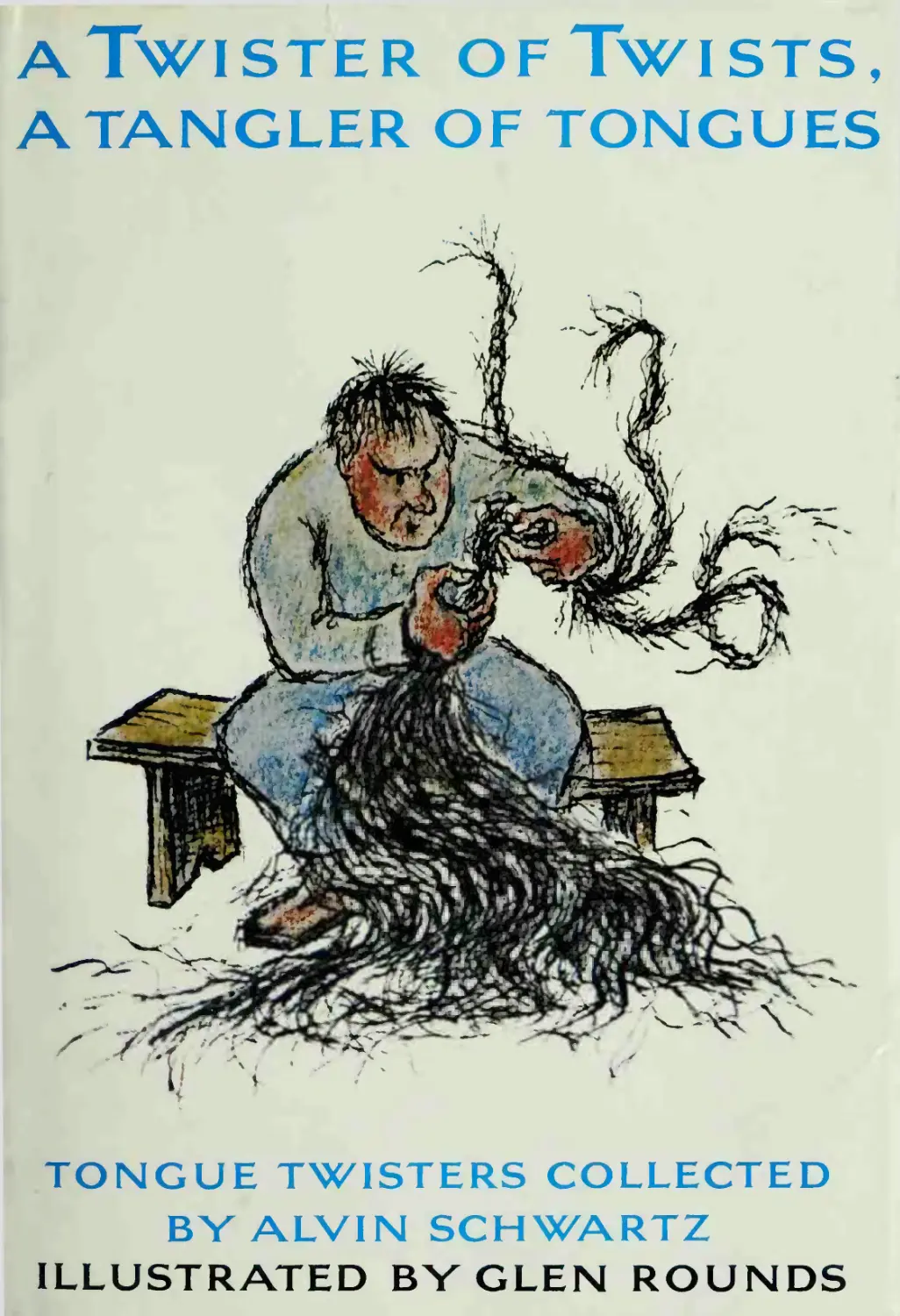
                    a Twister ofTwists,
ATANGLER OF TONGUES
TONGUE TWISTERS COLLECTED
BY ALVIN SCHWARTZ
ILLUSTRATED BY GLEN ROUNDS

a Twister of Twists,
ATANGLER OF TONGUES
TONGUE TWISTERS COLLECTED
BY ALVIN SCHWARTZ
ILLUSTRATED BY GLEN ROUNDS
Try saying “Peggy Babcock^ five times, as
fast as you can. Chances are you can’t,
because your tongue won’t cooperate.
Tongue twisters are designed to tangle
tongues, tickle funnybones, and lead to
gaggles of giggles.
Every tongue twister is a teaser, but
some of the longer ones are also good sto¬
ries. One of the funniest in this collection
concerns a seller of saddles named Sam
Short who’s smitten with Sophia Sophro-
nia Spriggs. This loony love story was
written in the 1890’s by Kate Wheeler
and is one of the few twisters with a
known author. Most were originated by
people long forgotten and were passed by
word of mouth from one generation to
another.
In the process of being passed along,
twisters change. Some of them become re-
(CONTINUED ON BACK FLAP)
Book Club
Edition

a Twister of Twists,
ATANGLER OF TONGUES

a Twister of Twists,
A TANGLER OF TONGUES
TONGUE TWISTERS COLLECTED
BY ALVIN SCHWARTZ
ILLUSTRATED BY GLEN ROUNDS
J. B. LI PPINCOTT COMPANY
PHILADELPHIA AND NEW YORK

Text Copyright © 1972 by Alvin Schwartz
Illustrations Copyright © 1972 by Glen Rounds
All Rights Reserved
Printed in the United States of America

FOR BETSY

CONTENTS
Peggy Babcock and Peter Piper	9
A Twister of Twists	13
Animals and Insects	17
Fighting Men	30
Food and Drink	36
Health	44
Love and Marriage	47
Music	53
Nature	56
Occupations	60
Overwear and Underwear	71
People, Witches, Ghosts	76
Reading, Writing, Arithmetic	82
Travel	86
Other Things	92
Twisters in Other Tongues	99
French, German, Greek,
Hebrew, Hungarian, Italian,
Japanese, Polish, Spanish
To Twist Your Own Twister	111
Notes, Sources, Bibliography	113

PEGGY BABCOCK
AND PETER PIPER
One of the hardest tongue twisters in the English
language is “Peggy Babcock.” Try to say it five times
as fast as you can. If you are like most people I know,
your tongue won’t cooperate.
Every tongue twister is designed to tangle a tongue.
But many of the longer twisters also are good stories.
One of the funniest in this book is about a seller of
saddles named Sam Short and his love affair with
Sophia Sophronia Spriggs. It consists of over three
hundred words, each of which starts with the letter s.
Of course, the best a sensible person can do with such
a twister is to read it aloud once, then give his tongue
a rest.
Tongue twisters exist for the fun of it. But over the
years they also have served other purposes. They have
been used to train radio announcers, to test actors, to
help with problems in speech, and to cure hiccups.
(The prescription: repeat one medium-length twister
five times while holding your breath.) At least one
opera singer sang tongue twisters as part of her daily
practice. And at least one dentist used them to test his
patients’ speech after he installed their new false teeth.
9

Perhaps the most exciting use ever made of a tongue
twister occurred during World War II after Germany
conquered Poland. Those Poles who continued to
fight went into hiding. As a password they used a
twister that someone who was not Polish would have
great difficulty in pronouncing correctly. It was
“Chr^zaszcz brzmi w trzcinie,” which sounds some¬
thing like “Chahn-shcht bzhmee ftschee-neeieh” and
means “The beetle buzzes in the thicket.”
The tongue twister about Sam Short was written in
the i8go’s by Katie Wheeler. But the persons responsi¬
ble for our twisters usually are not known. Only their
work survives, passing by word of mouth (at times
with the help of an author) from one generation to
the next.
In the process some twisters change. The famed
Betty Botter, for example, now also is known as Betty
Butter, Betty Botta, Betsy Butter, and just plain Betty.
Moreover, a half dozen versions of her problem with
bitter butter have come into use. In the southwestern
United States, meanwhile, Peter Piper, the ancient
pickled pepper picker, now has a companion, a prickly
prangly pear picker named Peter Prangle.
The Peter Piper twister is one of the oldest in our
folklore. It has been traced to an English grammar
published in London in 1674, but Peter probably was
roaming the streets even earlier. However, new twist¬
10

ers continue to appear, and by some mysterious proc¬
ess the best take root and spread.
This collection includes twisters on rockets, biscuit
mixers, rubber baby buggy bumpers, Yo-Yo’s, alumi¬
num, preshrunk shirts, and other modem inventions,
each the creation of an unknown author who had dis¬
covered the pleasure of fooling with words. Later in
this book you can learn how to twist your own twisters,
but now try some that already are part of our heritage.
Alvin Schwartz
Princeton, New Jersey
11

A Twister of twists,
Once twisted a twist,
And the twist that he twisted,
Was a three-twisted twist
Now in twisting this twist,
If a twist should untwist,
The twist that untwisted
Would untwist the twist.
13

a Twister of Twists,
ATANCLER OF TONGUES

X *
ANIMALS
AND INSECTS
As the roaring rocket rose,
the restless roosters rollicked.
17

A noisy noise annoys an oyster.
Cows graze in groves on grass
which grows in grooves in groves.
The big black-backed bumblebee.
A critical cricket critic.
18

4 fat dogs frying fritters and
fiddling ferociously.
5 French friars fanning a fainted flea.
6 slippery seals slipping silently ashore.
19

6 silent snakes slithering slowly southward.
6 selfish shellfish.
8 gray geese grazing gaily into Greece.
66 sickly chicks.
20

The rat ran by the river with a lump of raw liver.
Black bug’s blood.
21

The skunk sat on a stump and thunk
the stump stunk.
But the stump thunk the skunk stunk.
A skunk jumped over a stump in a skunk hole.

Once upon a barren moor
There dwelt a bear,
also a boar.
The bear could not bear the boar,
The boar thought the bear a bore.
At last the bear could bear no more
That boar that bored him on the moor.
And so one mom he bored the boar—
That boar will bore the bear no more.
23

24

A tree toad loved a she-toad
That lived up in a tree.
She was a three-toed tree toad,
But a two-toed toad was he.
The two-toed toad tried to win
The she-toads friendly nod,
For the two-toed toad loved the ground
On which the three-toed toad trod.
But no matter how the two-toed tree toad tried,
He could not please her whim.
In her tree-toad bower,
With her three-toed power,
The she-toad vetoed him.
25

A pale pink proud peacock
pompously preened its pretty plumage.
Swan, swim over the sea.
Swim, swan, swim!
Swan, swim back again.
Well swum, swan!
My dame hath a lame tame crane.
My dame hath a crane that is lame.
Pray, gentle Jane, let my dame’s tame crane
Feed and come home again.
26

The sixth sheik’s sixth sheep’s sick.
Sheep shouldn’t sleep in a shack.
Sheep should sleep in a shed.
The wild wolf roams the wintry wastes.
2 7

A shy little she said, “Shoo!”
To a fly and a flea in a flue.
Pete’s pa, Pete, poked to the pea patch to pick a
peck of peas for the poor pink pig in the pine hole
pig pen.
If a woodchuck could chuck wood,
How much wood would a woodchuck chuck,
If a woodchuck could chuck wood?
He would chuck, he would, as much as he
could,
If a woodchuck could chuck wood.
28

Can you imagine
an imaginary
menagerie manager
imagining
managing
an imaginary
menagerie
?
29

FIGHTING MEN
Brisk brave brigadiers brandished broad bright
blades, blunderbusses, and bludgeons.
30

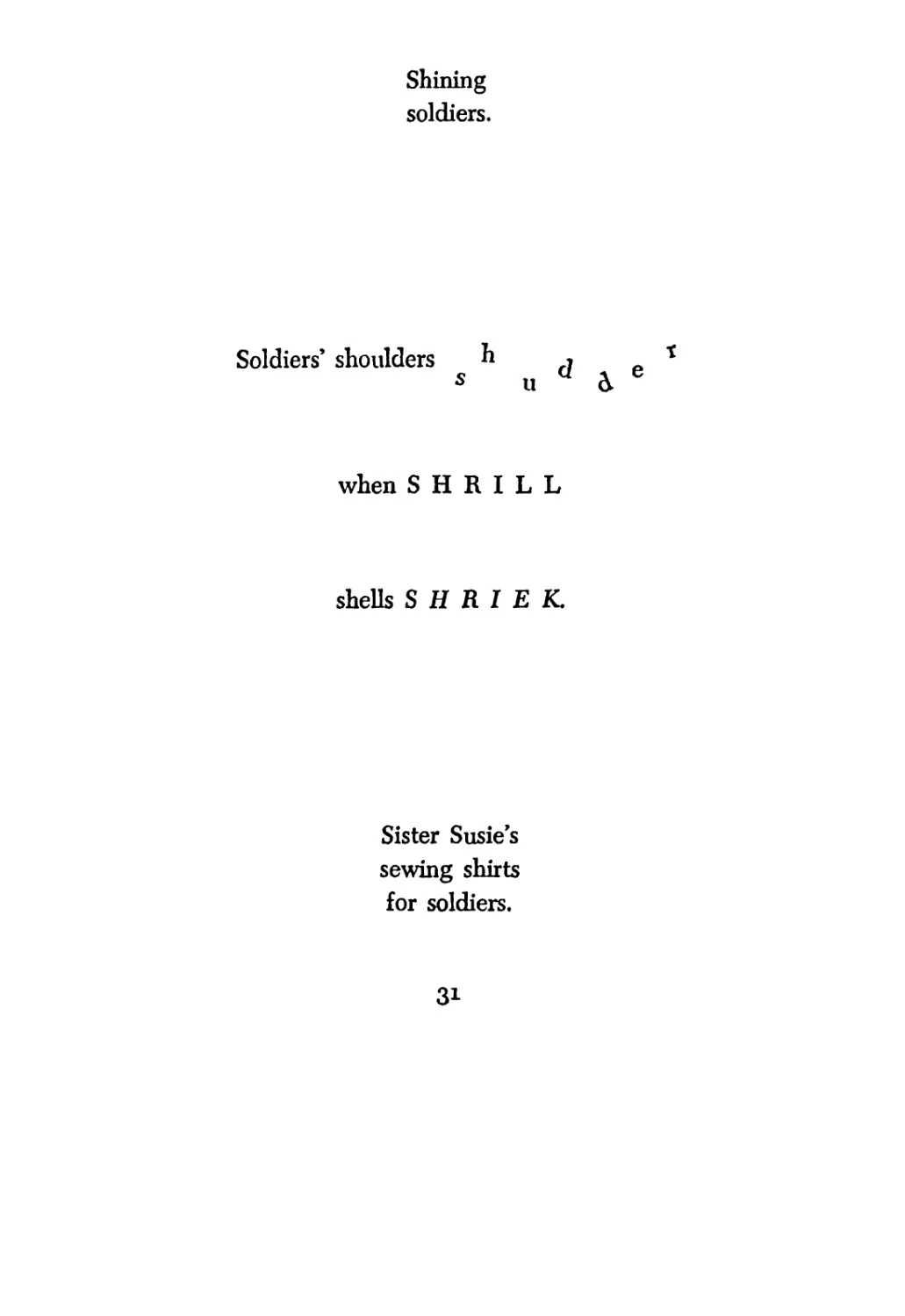
Shining
soldiers.
Soldiers’ shoulders « c
s u
when SHRILL
shells SHRIEK.
Sister Susie’s
sewing shirts
for soldiers.

Six twin-screw cruisers.
Seventy shuddering sailors
standing silent
as
short,
sharp,
shattering
shocks
shake
their splendid ship.
Naughty Nettie’s knitting knotted nighties
for the Navy.
32

Ned Nott was shot
and Sam Shott was not
So it is better to be Shott
than Nott
Some say Nott
was not shot
But Shott says
he shot Nott.
Either the shot Shott shot at Nott
was not shot,
or
Nott was shot
If the shot Shott shot shot Nott
Nott was shot
But if the shot Shott shot shot Shott
then Shott was shot
not Nott.
However,
the shot Shott shot shot not Shott—
but Nott.
33

Mr. See owned a saw
And Mr. Soar owned a seesaw.
Now See’s saw sawed Soar’s seesaw
Before Soar saw See
Which made Soar sore.
Had Soar seen See’s saw
Before See sawed Soar’s seesaw,
See’s saw would not have sawed
Soar’s seesaw.
So See’s saw sawed Soar’s seesaw.
But it was a shame to see Soar so sore
Just because See’s saw sawed
Soar’s seesaw.
34

Bandy-legg’d Borachio Mustachio Whiskerifusti-
cus, the Bald and Brave Bombandino of Bagdad,
helped Abomilique Bluebeard Bashaw of Babel-
mandel to beat down an abominable bumblebee at
Balsora.
35

FOOD AND DRINK
Cuthbert’s custard.
36

Greek grapes.
A big blue bucket of blue blueberries.
A cup of coffee in a copper coffee pot
Double bubble gum bubbles double.
Pure food for four pure mules.
37

Tuesday is stew day.
Stew day is Tuesday.
Frances Fowlers father fried five floundering
flounder for Frances Fowlers father’s father.
I never smelled a smelt that smelled
as bad as that smelt smelled.

TbR Fine
l tuom
miu
«*•*
*?''l
39

Lotty licks lollies lolling in the lobby.
Sly Sam sips Sally’s soup.
Nine nimble noblemen nibble nuts.
40

Betty Botter
bought some butter,
But, she said,
the butters bitter.
If I put it
in my batter,
It will make
my batter bitter.
But a bit
of better butter—
That would make
my batter better.
So she bought
a bit of butter,
Better than
her bitter butter.
And she put it
in her batter,
And the batter
was not bitter.
So ’twas better
Betty Botter
Bought a bit
of better butter.
4i

A box of biscuits, a box of mixed biscuits,
and a biscuit mixer.
Richard gave Robin a rap in the ribs
for roasting his rabbit so rare.
Barbara burned the brown bread badly.

43

HEALTH
Lemon
liniment.
44

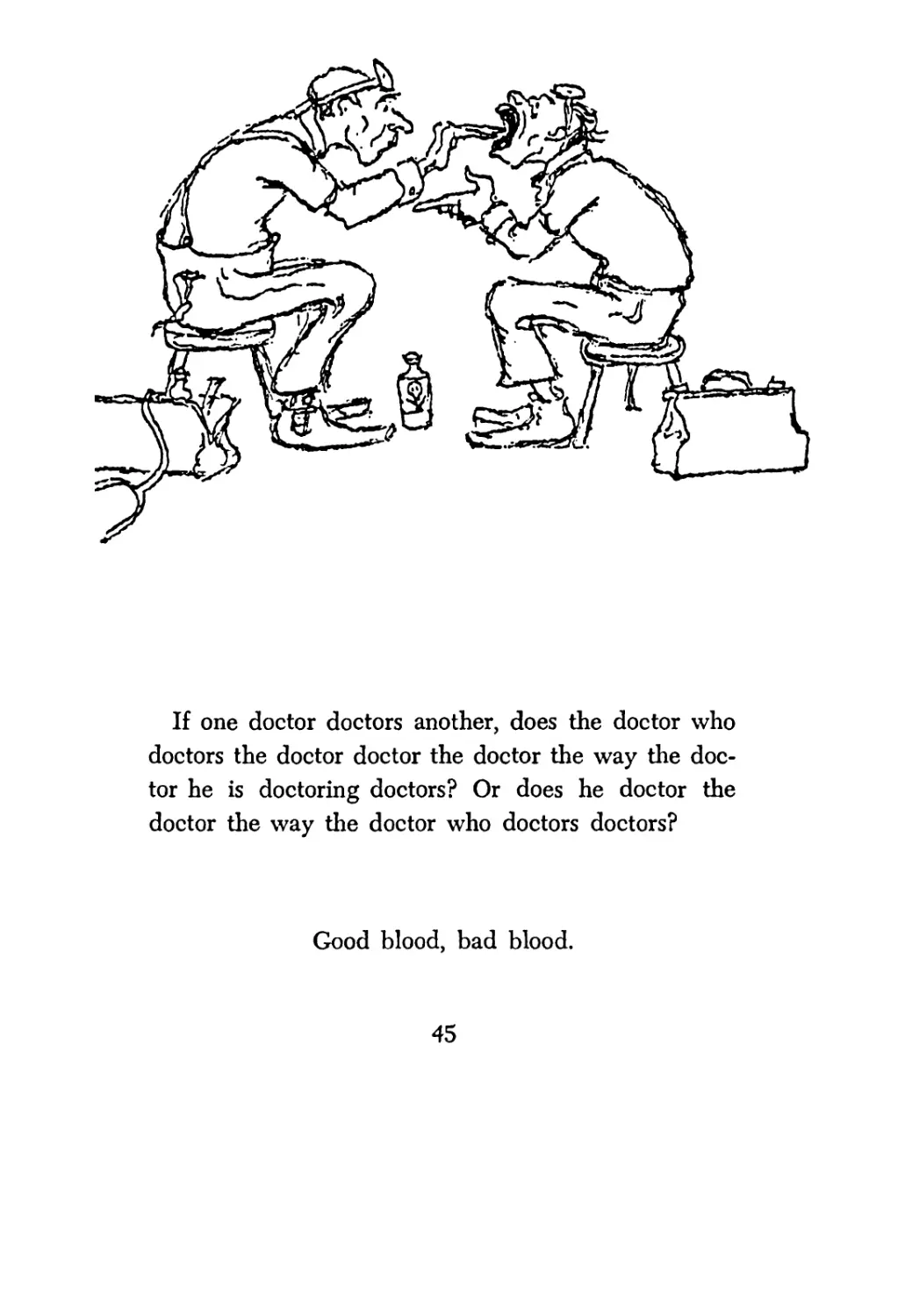
If one doctor doctors another, does the doctor who
doctors the doctor doctor the doctor the way the doc¬
tor he is doctoring doctors? Or does he doctor the
doctor the way the doctor who doctors doctors?
Good blood, bad blood.
45

Theophilus Thistledown,
the successful thistle sifter,
in sifting a sieve of unsifted thistles,
thrust three thousand thistles
through the thick of his thumb.
If, then, Theophilus Thistledown,
the successful thistle sifter,
thrust three thousand thistles
through the thick of his thumb,
see that thou,
in sifting a sieve of thistles,
do not get the unsifted thistles
stuck in thy thumb.
46

LOVE AND MARRIAGE
I saw Esau kissing Kate.
I saw Esau, he saw me.
And she saw I saw Esau.
47

Tho’ a kiss be amiss
She who misses the kisses,
As Miss without kiss,
May miss being Mrs.
Bisquick—Kiss quick!
Kiss her quickly!
Kiss her quicker!
48

A tall eastern girl named Short long loved a big Mr.
Little. But Little, thinking little of Short, loved a little
lass named Long. To belittle Long, Short announced
she would marry Little before long. This caused Little
to shortly marry Long.
To make a long story short, did tall Short love big
Little less because Little loved little Long more?
49

SHREWD SIMON SHORT
Shrewd Simon Short sewed shoes. Seventeen sum¬
mers saw Simon’s small, shabby shop still standing, saw
Simon’s selfsame squeaking sign still swinging swiftly,
specifying:
SIMON SHORT
Smithfield’s Sole Surviving
SHOEMAKER
Shoes Soled • Sewed Superfinely
Simon’s spouse, Sally Short, sewed sheets, stitched
shirts, stuffed sofas.
Simon’s stout sturdy sons—Stephen, Samuel, Saul,
Silas—sold sundries. Stephen sold silks, satins, shawls.
Samuel sold saddles, stirrups. Saul sold silver spoons,
specialties. Silas sold Sally Short’s stuffed sofas.
Simon’s second son, Samuel, saw Sophia Sophronia
Spriggs somewhere. Sweet, sensible, smart Sophia
Sophronia Spriggs. Sam soon showed strange symp¬
toms. Surprisingly, Sam sighed sorrowfully, sang sev¬
eral serenades slyly, sought Sophia Spriggs’ society,
seldom stood selling saddles.
Simon stormed, scowled severely, said, "Sam seems
so silly singing such senseless songs.”
50

“Softly,” said sweet Sally. “Sam’s smitten. Sam’s
spied some sweetheart.”
“Smitten!” snarled Simon. "Scatterbrained simple¬
ton! Sentimental, silly schoolboy!”
Sally sighed sadly. Summoning Sam, she spoke sym-
pathizingly. “Sam,” said she, “Sire" seems singularly
snappish. So, Sonny, stop strolling streets so soberly,
stop singing sly serenades. Sell saddles sensibly, Sam.
See Sophia Sophronia Spriggs speedily.”
“So soon?” said Sam, startled.
“So soon, surely,” said Sally, smilingly, “specially
since Sire shows such spirit.”
So Sam, somewhat scared, sauntered slowly store-
ward, shaking stupendously. “Sophia Sophronia
Spriggs . . . Sam Short’s spouse . . . sounds splendid,”
said Sam softly.
Sam soon spied Sophia starching shirts, singing
softly. Seeing Sam, she stopped, saluting Sam smilingly.
Sam stuttered shockingly. “Sp-sp-splendid s-s-sum-
mer s-s-season, So-So-Sophia."
“Somewhat sultry,” suggested Sophia.
“S-s-sartin,” said Sam.
“Still selling saddles, Sam?” said Sophia.
* An old-fashioned word for Father
51

“S-s-sartin,” said Sam.
Silence, seventeen seconds.
“Sire shot sixteen snipe Saturday, Sam,” said Sophia.
Silence, seventy-seven seconds.
“See sister Sues sunflowers,” said Sophia socially,
stopping such stiff silence.
Such sprightly sauciness stimulated Sam strangely.
So, swiftly speaking, Sam said, “Sue’s sunflowers seem
saying, ‘Sophia Sophronia Spriggs, Samuel Short stroll
serenely, seek some sparkling streams, sing some sweet,
soul-stirring strain. . .
Sophia snickered, so Sam stopped. She stood silently
several seconds.
Said Sam, “Stop smiling, Sophia. Sam’s seeking some
sweet spouse!”
She still stood silently.
“Speak, Sophia, speak! Such silence speculates sor¬
row.”
“Seek Sire Spriggs, Sam,” said Sophia.
Sam sought Sire Spriggs.
Sire Spriggs said, “Sartin.”
53

MUSIC
A tooter who tooted a flute
Tried to tutor two tutors to toot.
Said the two to the tutor,
“Is it harder to toot or
To tutor two tutors to toot?”
53

If to hoot and to toot
A Hottentot tot
Was taught by a Hottentot tutor,
Should the tutor get hot
If the Hottentot tot
Hoots and toots
At the Hottentot tutor?
54

While trying to whistle
Christopher Twistle
twisted his tongue.
Quinn’s twin sisters sing tongue twisters.
This is a zither.
55

NATURE
This thistle seems like that thistle.

3 tree twigs.
6 slim saplings.
3 thick swamps.
Q thin thistle sticks.
57
Really rural.

Beautiful
^abblitvg
brooks
bukbie
between
blossoming
banks.
Georgia’s gorge is gorgeous.
The seedling sea ceaseth seething.
58

Some shun sunshine.
59

OCCUPATIONS
Peter Piper picked a peck of pickled pepper.
A peck of pickled pepper Peter Piper picked.
If Peter Piper picked a peck of pickled pepper,
Where is the peck of pickled pepper
Peter Piper picked?
60

A bootblack blacks boots
with a black blacking brush.
Six silly sisters sell silk to six sickly seniors.
Bonnie Bliss blows big beautiful blue bubbles.
Who will wet the whetstone
while Willie whistles wistfully?
Slim Sam shaved six slippery chins
in six seconds.
61

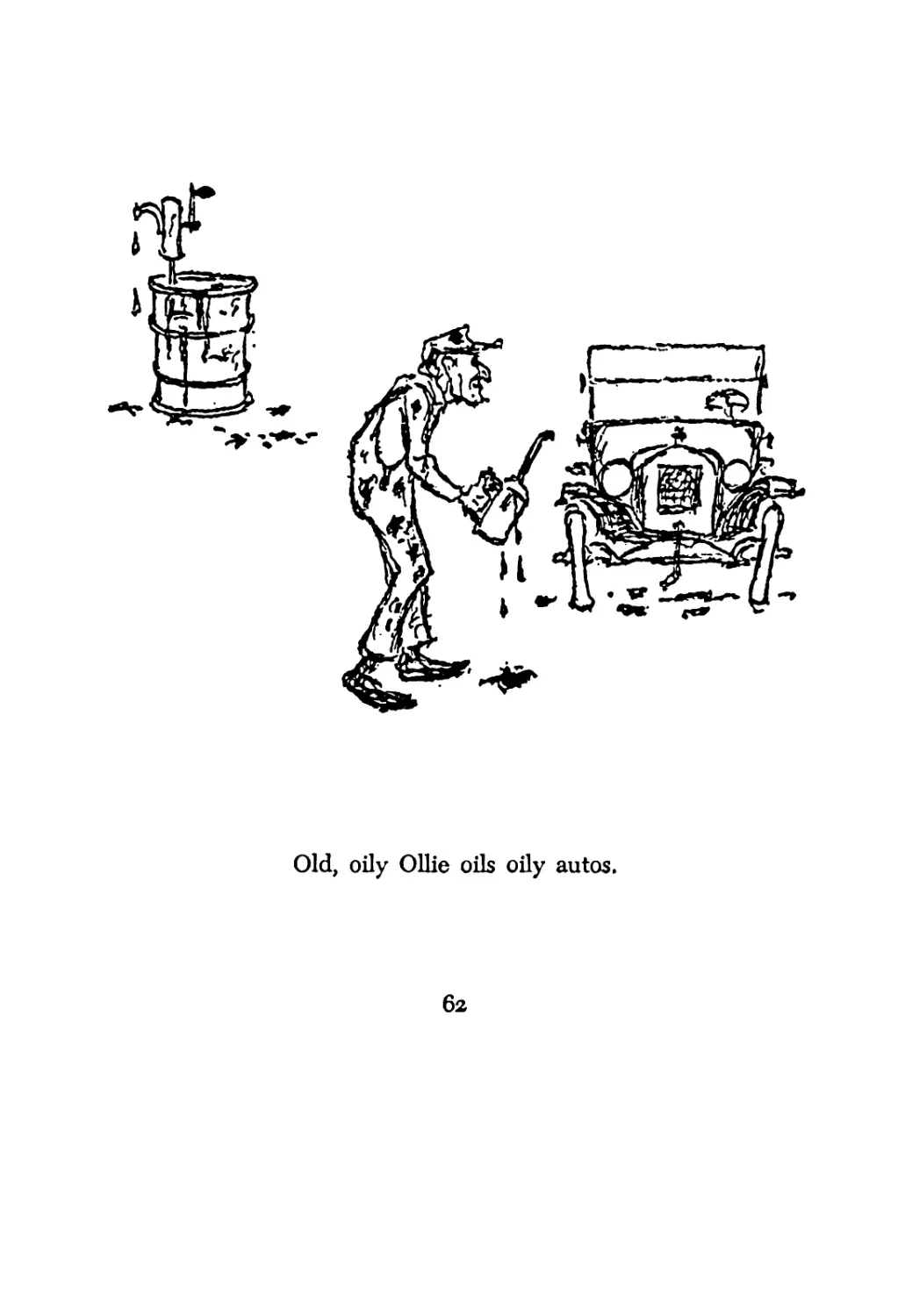
Old, oily Ollie oils oily autos.
62

She stood at the door of Mrs. Smith’s fish sauce
shop welcoming him in.
Sally’s selfish selling shellfish,
So Sally’s shellfish seldom sell.
The sun shines on shop signs.
Flocking shoppers shopping.
If neither he sells seashells,
Nor she sells seashells,
Who shall sell seashells?
Shall
seashells
be
sold
?
63

Wise
wives
whistle
while
weaving
worsted
waistcoats.
She says she shall sew a sheet
She sewed shirts seriously.
64

Rush the washing, Russell!
65

A canner can can « '
As many cans
As a canner can	'	I
A conversation between a woman who has left some
pots to be mended and the repairman:
“Are you copper bottoming urn, my man?”
“No, I’m aluminuming um, mum.”
66

Esaw Wood sawed wood. Esaw Wood would saw
wood. Oh, the wood that Wood would saw! One day
Esaw Wood saw a saw saw wood as no other wood-
saw Wood ever saw would saw wood. Of all the wood-
saws Wood ever saw saw wood, Wood never saw a
wood-saw that would saw like the wood-saw Wood
saw would.
Now Esaw saws with that saw he saw saw wood.
6 7

Wood said he would carry the wood
through the wood.
And if Wood said he would,
Wood would.
Shave a cedar shingle thin.
68

A maid with a duster
Made a furious bluster
Dusting a bust in the hall.
When the bust it was dusted
The bust it was busted,
The bust it was dust, that’s all.
A lively young fisher named Fischer
Fished for fish from the edge of a fissure.
A fish with a grin
Pulled the fisherman in!
Now they are hunting the fissure
For Fischer.
69

regal rural ruler.

OVERWEAR
AND UNDERWEAR
WHO
washed Washingtons
white woolen underwear
when Washington’s washerwoman went West?

His shirt soon shrank in the suds.
Preshrunk shirts.
72

I need not your needles
They’re needless to me,
For needing needles
Is needless, you see.
But did my neat trousers
But need to be kneed,
I then should have need
Of your needles indeed.

Does this shop stock short socks with spots?
Sara saw a sash shop full of showy, shiny sashes.
Shipshape suit shops ship shapely suits.
74

Shoes and socks shock Susie.
75

PEOPLE,
WITCHES,
GHOSTS
Is there a pleasant peasant present?
76

Peggy Babcock.
Tim, the thin twin tinsmith.
Wheedling, weeping Winnie
wails W I L DLY.
77

Which is the witch that wished the wicked wish?
Did you do it? Don’t do itl
Babbling Bert blamed Bess.
78

As I went into the garden
I saw five brave maids
Sitting on five broad beds
Braiding broad braids.
I said to these five brave maids
Sitting on five broad beds
Braiding broad braids,
“Braid broad braids, brave maids.”
Shy Sheila shakes soft shimmering silks.
79

Round and round the rugged rock the ragged
rascal ran.
Amidst the mists and coldest frosts
With barest wrists and stoutest boasts
He thrusts his fists against the posts
But still insists he sees the ghosts.
80

I thought a thought.
But the thought I thought wasn’t the thought I
thought I thought.
If the thought I thought I thought had been the
thought I thought, I wouldn’t have thought so much.
81

READING,
WRITING,
ARITHMETIC
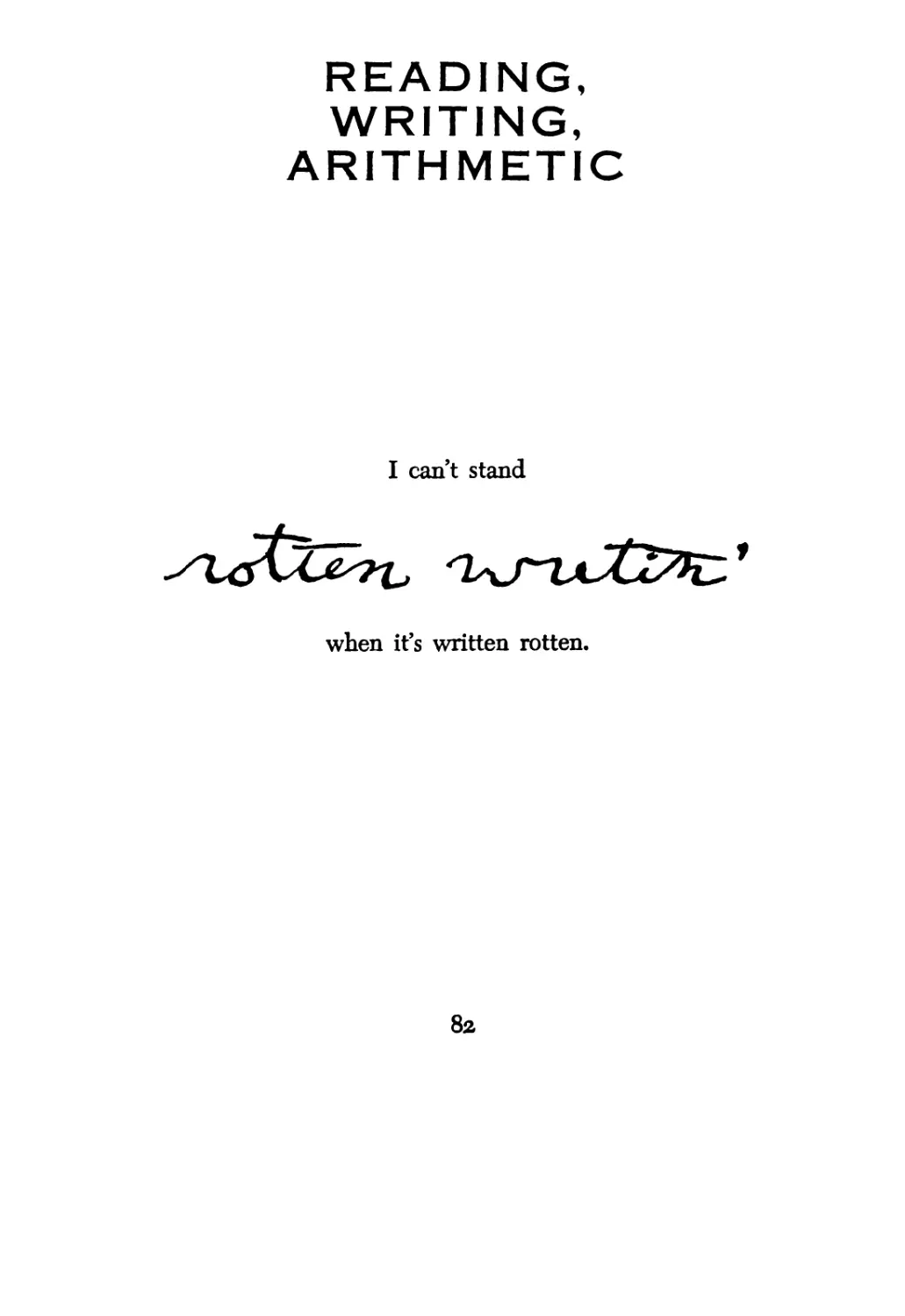
I can’t stand
when it’s written rotten.
82

The bootblack brought the book back.
Literally literary literature.
Blame the big bleak black book!
83

84

Tisbeth lisps lengthy lessons.
Thrice times three,
Twice times two.
A queer quick questioning quiz.
Miss Smith dismisseth us.
85

TRAVEL
Cheap ship trips.
A ship saiieth south soon.

The
sinking
87

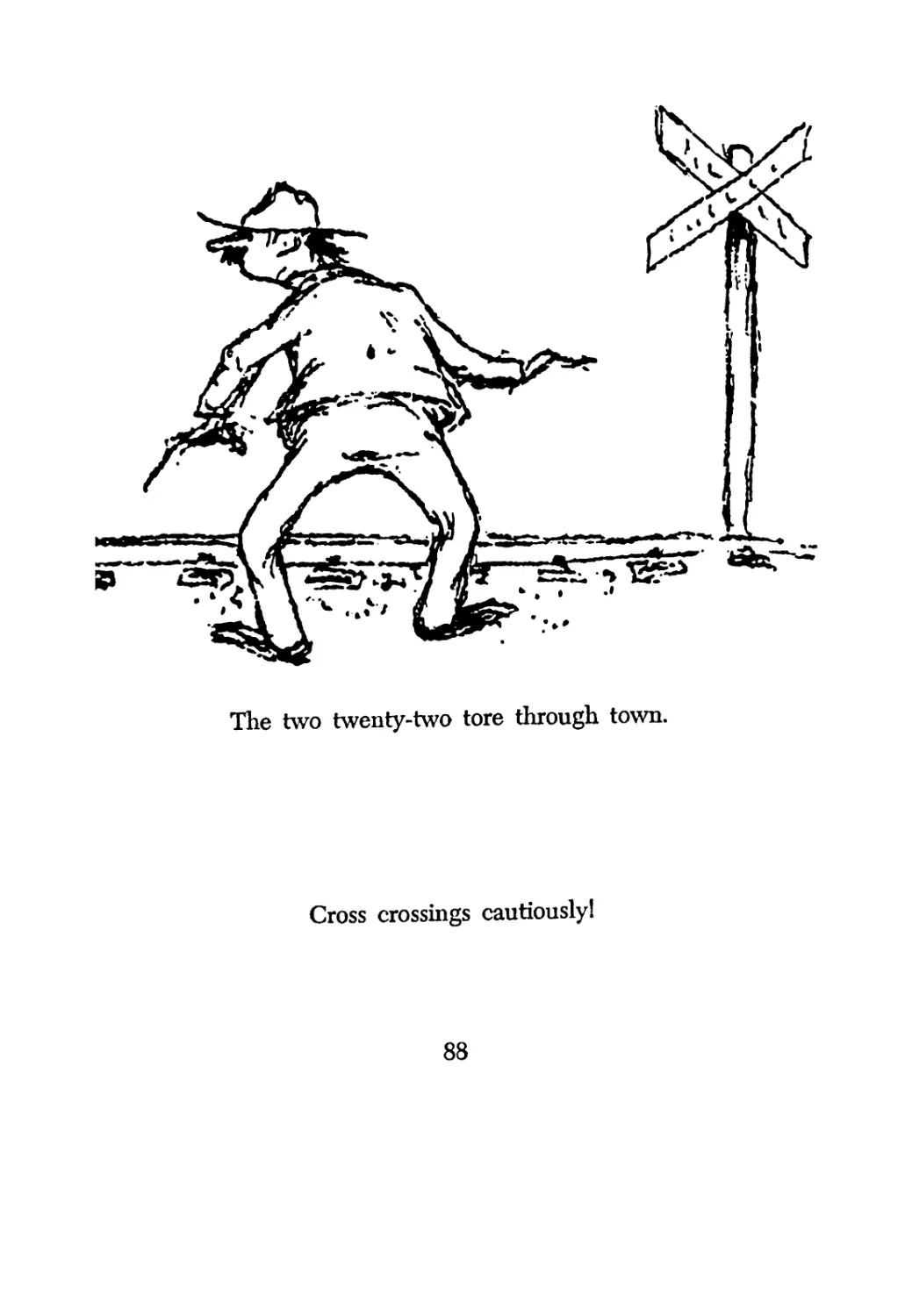
The two twenty-two tore through town.
Cross crossings cautiously!
88

He ran from the Indies
to the Andes in his undies.
I go by a Blue Goose bus.
89

Let little Nellie run a little.
Slim Sam slid sideways.
Unique New York.
90

The dude dropped in at the Dewdrop Inn.

OTHER THINGS
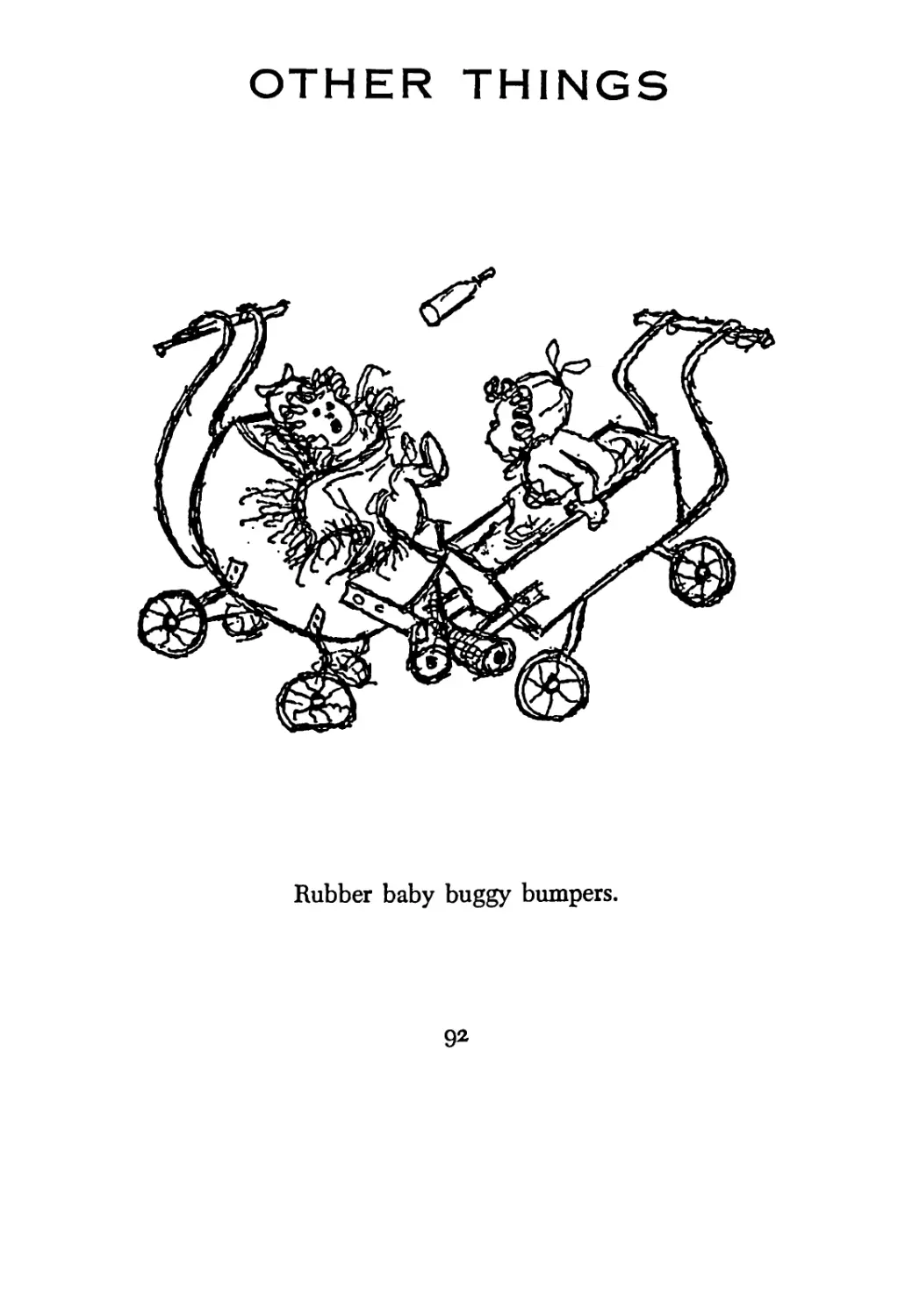
Rubber baby buggy bumpers.
92

Toy boat.
Silver thimbles.
Yellow Yo-Yo’s.
Thin sticks, thick bricks.
93

A black-backed bath brush.
A lump of red leather, a red leather lump.
Red leather, yellow leather.
A knapsack strap.
94

My wife gave Mr. Snipe’s
wife’s knife a swipe.
Tom threw Tim three thumbtacks.
I never felt felt that felt
like that felt felt
95

Strange strategic statistics.
Truly plural.
96

Does
the
wristwatch
shop
shut
soon
?
Which wristwatches
are Swiss wristwatches?
When does the wristwatch strap shop shut?
97

The wild wind whipped Whit from the wharf.
We surely shall see the sun shine soon.
98

TWISTERS IN
OTHER TONGUES
Man speaks In almost three thousand languages, and
in almost every one there are tongue twisters. In Span¬
ish the word for tongue twister is trabalengua, which
is pronounced “tra-ba-fen-gwa” and means “troubled
tongue.” This section contains “tongue troublers” from
nine languages. Their sounds are translated into Eng¬
lish sounds so that if you don’t speak a particular lan¬
guage you still can enjoy the trouble.
99

FRENCH
Diderot dinait du dos d’un dodo dindon.
Dee-de-ro dee-nay du dough dun doh-doh dahn-don.
Diderot dined on the back of a plump turkey.
Le ver vert va vers le verre vert.
Le vhere vhere va vhere le vhere vhere.
The green grub goes to the green grass.
Six sous ces saucissons-ci?!
See soo say so-see-son-see?!
Six cents for these sausages?!
100

GERMAN
Fischers Fritz fischt frische Fische.
Frische Fische fischt Fischers Fritz.
Fishers Fritz fisht frish-eh fish-eh.
Frish-eh fish-eh fisht Fischers Fritz.
Fritz Fischer fishes for fresh fish.
Fresh fish fish for Fritz Fischer.
101

GREEK
Mia irairia ma nia Trairia?
Mi-a papi-a ma pi-a. papi-a.?
One duck, but which duck?
102

HEBREW
TOP TOP TOP TOP
Sah-ra sha-rah sheerrr sa-mayach.
Sarah sings a happy song.
HUNGARIAN
Mit siitsz las sziics, s6s hust? Siitsz las sziics?
Mit sheuts kish seuch, shosh hoosht? Sheuts lash
seuch?
What are you roasting, little hunter? Are you roast¬
ing salt meat?
103

ITALIAN
Paolo, pittore poco pratico, pinse pillole per poco
prezzo.
Paw-lo, pit-fo-rey poko pro-tico, pin-sey piMo-ley
per poko pret-zo.
Paul, an inexperienced painter, painted pills
cheaply.
Un limon, mezzo limon.
Oon lee-mon, medzo lee-mon.
One lemon, half a lemon.
104

JAPANESE
Nama-mugi, nama-gome, namo-tamago.
Raw wheat, raw rice, raw eggs.
POLISH
Nie pieprz wieprza pieprzem.
Nyeh pey-epsch vey-ep-shah pey-ep-schem.
Do not pepper the hog with pepper.
105

SPANISH
Yo no compro coco. Porque como poco coco, poco
coco compro.
Yo no kom-pro koko. Por-kay komo poko koko,
poko koko kom-pio.
I do not buy coconut. Since I eat little coconut, I
buy little coconut.
Mi mama me mima mucho.
Me ma ma me mee-ma moo-cho.
My mother spoils me a lot.
106

Tres tristes tigres trillaron trigo en un trigal.
Tray tree-stays tee-grres tree-yarron tree-go en un
tree-gal.
Three sad tigers threshing wheat in a wheat field.
Compre poco capa parda, porque el que poco capa
parda compra poco capa parda paga.
Kom-prey poko ka-pah par-dah, pour-kay el keh
poko ka-pah par-dah ko m-prah poko ka-pah par-dah
pc-gah.
Buy only a little brown cape, for he who buys only
a little brown cape pays only for a little brown cape.
107

io8

El otorrinolaringologo de Parangaricutirimicuaro
se quiere
desotorrinolaringologoparangaricutirimicuarizar
porque si no se
desotorrinolaringologoparangaricutirimicuarizara
lo van a
desotorrinolarmgologoparangaricutirimicuarizar.
El oto-ree-uo-lah-rine-goAogo deh Paran-gah-ree-coo-
tee-ree-mi-quah-ro
sey kei/ai-reh
des-oto-ree-no-laft-rine-go-logo-paran-gafr-ree-coo-
tee-ree-mi-quah-ree-zar
poui-kay see no sey
des-oto-ree-no-Za/i-rine-go-logo-paran-gah-ree-coo-
tee-ree-mi-quah-iee-zara
low vahn a
des-oto-ree-no-kz/i-rine-go-logo-paran-ga/i-ree-coo-
tee-ree-mi-quah-ree-zar.
The eye-ear-nose-throat doctor in Parangaricuti¬
rimicuaro
wishes
to stop practicing in Parangaricutirimicuaro
because if he doesn’t
stop practicing in Parangaricutirimicuaro
they will make him
stop practicing in Parangaricutirimicuaro.
109

TO TWIST YOUR
OWN TWISTER
The best way to begin is by writing several senseless
sentences whose words each start with the same sound
or the same letter. For example: Fearless, foolish,
friendly Frank Farrington faints fast on Fridays. Just
write down what occurs to you. If you follow the rule
you should tangle a tongue.
As you become experienced try using two different
sounds. Throughout this book there are many such
combinations which can make a twister even more
frustrating. In “Slim Sam slid sideways,” the s and the
si are the trap. In “She sells seashells by the seashore,”
it is the s and the sh. In “Black hug’s blood,” it is the
bl and the bu.
You also can play a tongue-twister game. Only one
other player is needed. Each of you makes up a twister.
Then each, in turn, repeats the other’s twister five
times as fast as he can. If either of you stumbles, he
loses. But if both of you do, or neither, the game goes
on with another pair of twisters and another test of
skill.
111

NOTES,
SOURCES,
BIBLIOGRAPHY

NOTES
A Twister of twists (page 13). The “Twister'* twister,
from which the title of this book is taken, is one of the
oldest in the English language. However, it has
changed considerably since it appeared in 1674 “
Grammatica Linguae Anglicanae by John Wallis, a
grammar published in Oxford, England. Then it read:
When a Twister, a-twisting, will twist him
a twist;/ For the twisting of his twist, he three
times doth intwist;/ But, if one of the twists of
the twist do untwist,/ The twine that untwist-
eth, untwisteth the twist.
Untwirling the twine that untwisteth be¬
tween,/ He twirls, with his twister, the two in
a twine;/ Then, twice having twisted the
twines of the twine,/ He twisteth, the twine
he has twined, in twain.
The twain that, in twining, before in the
twine;/ As twins were untwisted, he now
doth untwine;/ Twixt the twain intertwisting
a twine more between,/ He, twirling his
twister, makes a twist of the twine.
115

Sister Susie’s sewing shirts for soldiers (page 31):
The “Sister Susie” twister actually is part of a song that
was popular in England during World War I. Whether
the twister or the song came first is not known, but
the entire song was a twister of sorts. Sidney Hamer of
Washington, D.C., who was a performer in English
music halls in that period, recalled these lyrics in a
letter to the Library of Congress:
Sister Susie’s sewing shirts for soldiers./ Such
saucy, soft, short shirts our shy young sister
Susie sews;/ Some soldiers send epistles, say
they’d sooner sleep on thistles/ Than the
saucy, soft, short shirts our shy, young sister
Susie sews.
Shrewd Simon sewed shoes (page 50): As noted in
the introduction, the twister about Simon, Sally, and
Sam Short was created in the 1890’s by Katie L.
Wheeler. She called it “Sam Short’s Sparkin’,” or Sam
Short’s courting. The complete version of the “Sam
Short” twister contains 418 words, each starting with
the letter s. To keep the twister to a practical length
for this book, the original was shortened somewhat.
But even in its abridged form, it is a remarkable work.
The complete twister resides in the Folk Song Section
of the Library of Congress. It was contributed to the
library in 1954 by Katie Wheeler’s son, Carlton L.
Wheeler of Penn Yan, New York.
The seething sea ceaseth seething (page 58): This
116

is a variation of one of the most durable twisters in
the United States. The best known version is “The sea
ceaseth and it sufficeth for us,” which some believe to
be of Biblical origin. In the Standard Dictionary of
Folklore, Mythology, and Legend, the folklorist Char¬
les Francis Potter suggests that the twister might have
its roots in the Old Testament’s book of Jonah, “the sea
ceased from her raging” and the New Testament’s
Gospel of Saint John, “Lord, show us the Father, and
it sufficeth us.”
Peter Piper picked a peck of pickled pepper (page
60): The “Peter Piper” twister is without doubt the
best known of our tongue tanglers. It also is among the
most ancient, having appeared with the “Twister”
twister in Grammatica Linguae Anglicanae, the gram¬
mar referred to earlier which was published in 1674.
It is one of some two dozen twisters which make up
an early but undated pamphlet, Peter Pipe/s Practical
Principles of Plain and Perfect Pronunciation. In addi¬
tion to Peter Piper, these tell in alphabetical order of
a weird collection of characters, from Andrew Air-
pump to Walter Waddle.
Each twister follows the same pattern: a statement
(“Peter Piper picked a peck of pickled pepper”); a
question (“Did Peter Piper pick a peck of pickled pep¬
per?”); a second question expressing doubt about the
assumed answer to the first (“If Peter Piper picked a
peck of pickled pepper, where’s the peck of pickled
117

pepper Peter Piper picked?”). Here, for example, is the
report on Questing Quidnunc:
Questing Quidnunc quizzed a queerish
question./ Did Questing Quidnunc quiz a
queerish question?/ If Questing Quidnunc
quizzed a queerish question, what’s the queer¬
ish question Questing Quidnunc quizzed?
She stood at the door of Mrs. Smith’s fish sauce shop
welcoming him in (page 63): This version of the “fish
sauce” twister is from the United States and Canada.
In England, a Mrs. Burgess rather than a Mrs. Smith
operates the fish sauce shop.
Sally’s selfish selling shellfish (page 63): This is but
one of a score of variations of the famous twister “She
sells seashells by the seashore,” all of which rely on the
s-sh trap.
Amidst the mists and coldest frosts (page 80): No
one has demonstrated conclusively what the “mists
and frosts” twister means, but there have been several
explanations. Perhaps the most logical is offered by
Charles Francis Potter, in the Standard Dictionary of
Folklore, Mythology, and Legend, who reports that
during the nineteenth century in New England the
twister was known as “The Drunken Saylor.” At least
one version starts with “Round and round the rock the
ragged rascal ran,” which frequently is treated as a
twister in its own right.
118

SOURCES
A number of tongue twisters in this book were re¬
called from my childhood. Some were acquired from
friends and acquaintances. As word of my project
spread, others were sent to me by persons I did not
know but who had twisters they wanted to share.
Among these, the major contributor was Wallace G.
Scott, a California speech teacher. In addition, the fol¬
lowing folklore archives were important resources:
The Louis C. Johnson Archive at the New York State
Historical Association, Cooperstown, New York. This
collection was gathered in the 1940’s by Professor
Johnson’s students at Albany State Teachers College
(now Albany State College), Albany, New York. It was
made available by Professor Bruce R. Buckley of the
Cooperstown Graduate Programs, and Mrs. Marion
Brophey, librarian in charge of special collections.
The Old Sturbridge Village Archive, Sturbridge,
Massachusetts, directed by Roger C. Parks.
The University of Pennsylvania Folklore Archive,
Philadelphia, Pennsylvania, directed by Professor Dan
Ben-Amos.
The Folk Song Section of the Library of Congress,
Washington, D.C. One resource here was the massive
WPA Folklore Archive assembled on a state-by-state
basis during the great economic depression in the
119

i93°’s. The collectors were unemployed folklorists and
writers the government hired as part of the Federal
Writers Project. Another resource was material assem¬
bled early in the 1950’s by Duncan Emrich, then chief
folklorist at the library, who conducted a nationwide
radio program in which he asked his listeners to con¬
tribute folklore on various subjects, including tongue
twisters. “Sam Short’s Sparkin’” came to the library
through this program. My guide in this aspect of my
research was Joseph C. Hickerson, reference librarian
in the Folk Song Section.
Another important resource was Professor Kenneth
Goldstein of the University of Pennsylvania who
placed at my disposal his extensive personal library of
folklore.
Twisters in languages other than English were pro¬
vided by Professors Valentine T. Bill, J. A. Baer, Paul
Cucchi, Andras Hamori, Mantaro J. Hashimoto, and
Edwin A. Hopkins of Princeton University, Princeton,
New Jersey; Ronald Gendaszek, Herbert Hagens, and
Manuel Morales of Princeton High School; Roslyn
Staras, principal of the Hebrew school at the Princeton
Jewish Center; Professor Manuel Ramos of Hostos
Community College, Bronx, New York; Panayotis G.
Pyrpyris of the New School for Social Research, New
York; Emmanuel Hatziemmanuel of the Greek Ortho¬
dox Archdiocese of North and South America, New
York; and Elsa Granade, Sing Gong Liu, and Stanley
Pashko of Princeton, New Jersey.
120

BIBLIOGRAPHY
BOOKS
Books of particular interest to young people are
marked with an asterisk (*).
Baring-Gould, William S. and Ceil, The Annotated
Mother Goose. New York, Clarkson N. Potter,
1962.
Belts Standard Elocutionist. London, William Mullen
& Son, 1878.
‘Botkin, Benjamin A., and Withers, Carl A., The Illus¬
trated Book of American Folklore. New York,
Grosset & Dunlap, 1958.
Botkin, Benjamin A., Treasury of American Folklore.
New York, Crown Publishers, 1944.
Brewster, Paul G., “Children’s Games and Rhymes,”
Frank C. Brown Collection of North Carolina
Folklore, V. 1. Durham, N.C., Duke University
Press, 1952.
‘Emrich, Duncan, The Nonsense Book. New York,
Four Winds Press, 1970.
‘Emrich, Marian V., and Korson, George C., The
Child’s Book of Folklore. New York, Dial Press,
1947-
‘Halliwell-Phillips, James Orchard, The Nursery
121

Rhymes and Nursery Tales of England. London,
Frederick Wame and Co., 1865.
Howard, Dorothy, Folk Rhymes and Jingles of Ameri¬
can Children. New York, New York University,
1938. Unpublished doctoral dissertation.
Hyatt, Harry M., Folklore from Adams County, Illi¬
nois. New York, Alma Egan Hyatt Foundation,
1935-
•Justus, May T., The Complete Peddler*s Pack: Games,
Songs, Rhymes, 6- Riddles from Mountain Folk¬
lore. Knoxville, Tennessee, University of Tennes¬
see Press, 1967.
Koch, William E., and Sacket, Sidney J., Kansas Folk¬
lore. Lincoln, Nebraska, University of Nebraska
Press, 1961.
Opie, Iona and Peter, I Saw Esau: Traditional Rhymes
of Youth. London, Williams & Norgate, 1947.
 , The Lore and Language of School Children.
London and New York, Oxford University Press,
1959-
 , The Oxford Dictionary of Nursery Rhymes.
London and New York, Oxford University Press,
i95i-
 , The Oxford Nursery Rhyme Rook. London and
New York, Oxford University Press, 1955.
Parkin, Ken, Anthology of British Tongue Twisters.
London, Samuel French, 1969.
122

Peter Pipers Practical Principles of Plain and Perfect
Pronunciation. London, J. Harris, undated.
°Potter, Charles Francis, More Tongue Tanglers <b a
Rigmarole. Cleveland and New York, World Pub¬
lishing Company, 1964.
0	,	Tongue Tanglers. Cleveland and New York,
World Publishing Company, 1962.
"Withers, Carl A., A Rocket in My Pocket: The Rhymes
and Chants of Young Americans. New York, Holt,
Rinehart, & Winston, 1948.
0	,	Treasury of Games, Riddles, Stunts, Tricks,
Tongue-Twisters, Rhymes, Chanting, Singing.
New York, Grosset & Dunlap, 1969.
Wallis, John, Grammatica Linguae Anglicanae. Ox¬
ford, England, 1674.
ARTICLES
Cansler, Loman D., “Midwestern and British Chil¬
dren’s Lore Compared.” Western Folklore, v.2j:i
(1968).
Emrich, Duncan, “The Ancient Game of Tongue Twist¬
ers.” American Heritage, February, 1955, p. 119.
The Golden Era, San Francisco: v.5-17 (1857-68).
123

Gordon, Maxine W., “The Folklore of Vieques, Yauco,
and Loqvillo, Puerto Rico.” Journal of American
Folklore, ^64:55 (1951).
Leland, Charles E., “Possible Origin of a Nursery
Rhyme.” Journal of American Folklore, v.41170
(1891). The possibility, later disproved, that the
name Peter Piper derives from Peter Pipemus, a
seventeenth-century Italian author and priest.
Leventhal, Nancy C., and Cray, Ed, “Depth Collecting
from a Sixth Grade Class.” Western Folklore, v.22:-
159» 231 (1963).
Loomis, C. Grant, “A Handful of Tongue Twisters.”
Western Folklore, v.8:373 (1949).
Mook, Maurice A., “Tongue Tanglers from Western
Pennsylvania.” Journal of American Folklore,
V.7212Q1 (1959)*
O’Brien, Alice Crissman, “Tongue Twisters from Cali¬
fornia.” Western Folklore, v.22:164 (1963).
Potter, Charles Francis, “Alphabet Rimes.” Standard
Dictionary of Folklore, Mythology, and Legend,
v.x. New York, Funk & Wagnalls, 1949.
 , “Tongue Twisters.” Standard Dictionary of
Folklore, Mythology, and Legend, v.2. New York,
Funk & Wagnalls, 1949.
Potts, John William, “Peter Piper’s Proper Pronuncia¬
tion of Perfect English versus Peter Pipemus."
Journal of American Folklore, ^5:74 (1892).
124

Steadman, J. M., Jr., "Tongue-Twisters: Difficult Pro¬
nunciation as a Source of Verbal Taboos.” Amer¬
ican Speech, v.n:203 (1956).
“A Twist of Twisters.” New York Folklore Quarterly,
v.3:246 (1947).
Waugh, F. W., “Canadian Folklore from Ontario.”
Journal of American Folklore, v.3i:4 (1918).
Winslow, David J., “An Annotated Collection of Chil¬
dren’s Lore.” Keystone Folklore Quarterly, v.11:-
151 (1966).
 , “An Introduction to Oral Tradition Among
Children.” Keystone Folklore Quarterly, v.n:43
(1966).
Wintemberg, W. J. and Katherine, “Folklore from
Grey County, Ontario.” Journal of American Folk¬
lore, v.3i:82 (1918).
125

ABOUT ALVIN SCHWARTZ
Alvin Schwartz has written many books for young peo¬
ple and for families on subjects as varied as folklore,
crafts, hobbies, museums, labor unions, and urban
problems. He works in a tiny studio in Princeton, New
Jersey, next to the house where he lives with his wife,
four children, and two cats.
ABOUT GLEN ROUNDS
Glen Rounds spent his childhood on ranches in South
Dakota and Montana. He attended art school in
Kansas City, Missouri, and New York City, and now
lives in Southern Pines, North Carolina. He has illus¬
trated many books for young people.

(continued from front flap)
gional. For example, that famous picker
of pickled peppers, Peter Piper (who first
appeared in an English grammar in 1674),
is transformed in the Southwestern
United States to Peter Prangle, a prangly
prickly pear picker.
Twisters are a form of fun and amuse¬
ment in almost every language spoken.
New twisters keep appearing and, by
some mysterious process, the best of them
take root and spread. Here then is a col¬
lection that includes tongue tanglers on
rockets, biscuit mixers, rubber baby
buggy bumpers, Yo-Yo’s, aluminum, pre¬
shrunk shirts, and other modern inven¬
tions. There are lovable, laughable line
drawings all along the way to add to the
fun. And there are even directions for
twisting your own twisters.
ALVIN SCHWARTZ is a full-time
writer who lives in Princeton, New Jer¬
sey. He is the author of several books for
young people and adults.
GLEN ROUNDS is a well-known illus¬
trator of children’s books. He lives in
Southern Pines, North Carolina.
PRINTED IN THE U.S.A.
5 7 5 8

The “Twister” twister, from which the title of this book is
taken, is one of the oldest in the English language. However,
it has changed considerably since it appeared in 1074 in Gram-
matica Linguae Anglicanae by John Wallis, a grammar pub¬
lished in Oxford, England. Then it read:
When a Twister, a-twisting, will twist him a twist;/
For the twisting of his twist, he three times doth in¬
twist;/ But, if one of the twists of the twist do untwist,/
The twine that untwisteth, untwisteth the twist.
Untwirling the twine that untwisteth between,/ He
twirls, with his twister, the two in a twine;/ Then, twice
having twisted the twines of the twine,/ He twisteth,
the twine he has twined, in twain.
The twain that, in twining, before in the twine;/ As
twins were untwisted, he now doth untwine;/ Twixt the
twain intertwisting a twine more between,/ He, twirl¬
ing his twister, makes a twist of the twine.