/







































































































































Author: Fairbank J.K. Twitchett D.
Tags: history cambridge history of china
ISBN: 0-521-24331-9
Year: 2006
Similar


Text
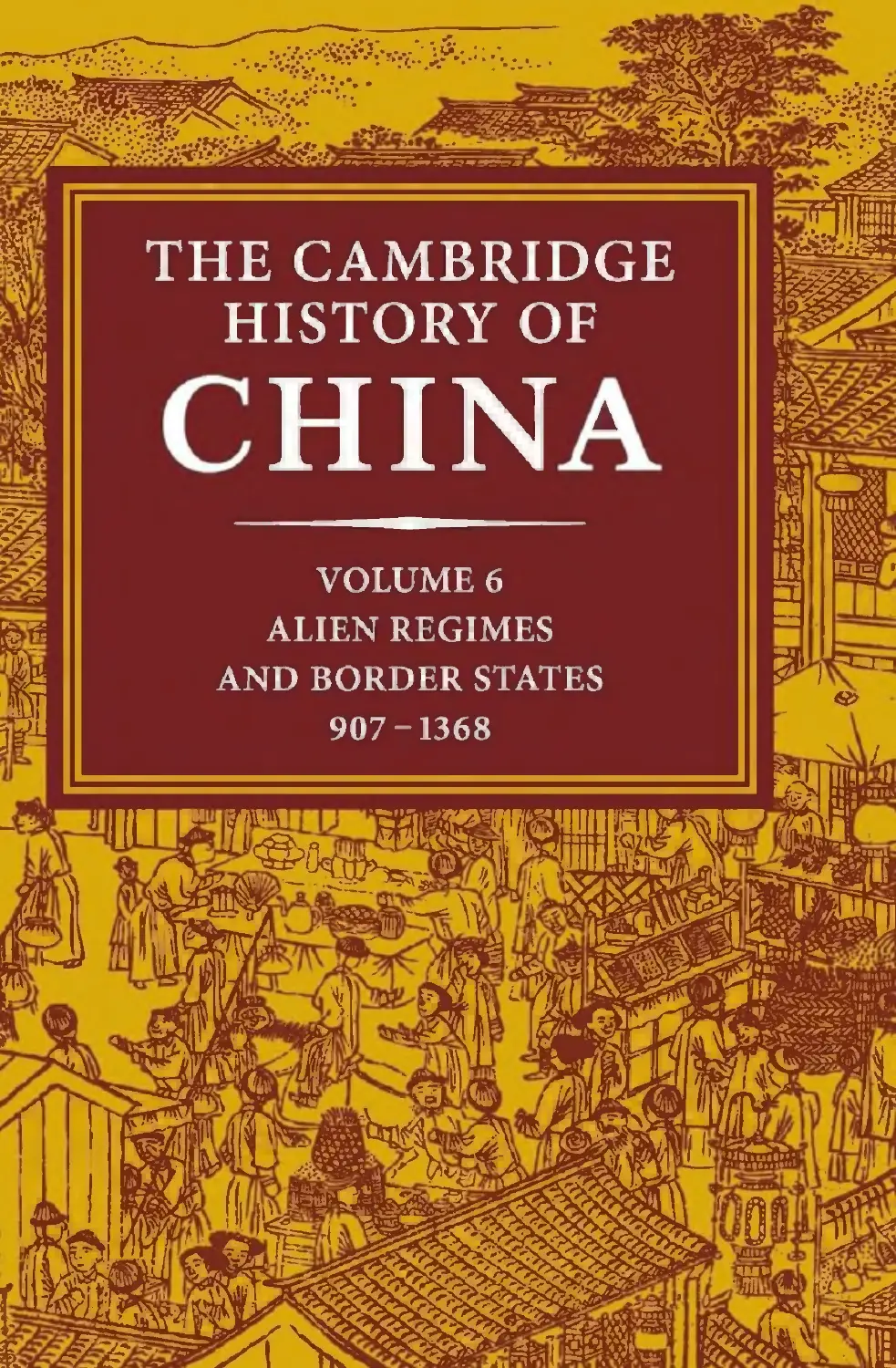
                    THE CAMBRIDGE
HISTORY OF
CHINA
VOLUME 6
ALIEN REGIMES
AND BORDER STATES
907-1368

THE CAMBRIDGE HISTORY
OF CHINA
General Editors
Denis Twitchett and John K. Fairbank
Volume 6
Alien regimes and border states, 907—1368
Cambridge Histories Online © Cambridge University Press, 2008

Work on this volume was partially supported by the National Endowment for
the Humanities, Grants RO-21512-87 an^ ЯО-22077-90.
Cambridge Histories Online © Cambridge University Press, 2008

THE CAMBRIDGE
HISTORY
OF CHINA
Volume 6
Alien regimes and border states, 907—1368
edited by
HERBERT FRANKE and DENIS TWITCHETT
Cambridge
UNIVERSITY PRESS
Cambridge Histories Online © Cambridge University Press, 2008

CAMBRIDGE UNIVERSITY PRESS
Cambridge, New York, Melbourne, Madrid, Cape Town, Singapore, Sao Paulo
Cambridge University Press
40 West 20th Street, New York, NY 10011-4211, USA
www.cambridge.org
Information on this tide:www.cambridge.org/9780521243315
© Cambridge University Press 1994
This publication is in copyright. Subject to statutory exception
and to the provisions of relevant collective licensing agreements,
no reproduction of any part may take place without
the written permission of Cambridge University Press.
First published 1994
Reprinted 2002, 2006
Printed in the United States of America
A catalogue record for this book is available from the British Library.
Library of Congress Cataloguing in Publication Data
(Revised for vol. 6)
The Cambridge history of China.
Vol 1. edited by Denis Twitchett and Michael Loewe;
v. 6 edited by Herbert Franke and Denis Twitchett;
v. 7 edited by Frederick W. Mote and Denis Twitchett;
v. 11 edited by John K. Fairbank and Kwang-Ching Liu;
v. 13 edited by John K. Fairbank and Albert Feuerwerker;
v. 14 edited by Roderick MacFarquhar and John K. Fairbank;
v. 15 edited by Roderick MacFarquhar and John K. Fairbank.
Includes bibliographies and indexes.
Contents: v 1. The Ch’in and Han Empires,
221 B.C.—AD. 220 — v. 3. Sui and T’ang China, 589—906, pt. 1 —
—v. 6 Alien regimes and border states, 710—1368.
1. China — History. I. Twitchett, Denis Crispin. II. Fairbank, John King, 1907—1991.
DS735.C3145	95T .03	76—29852
ISBN-13 978-0-521-24331-5 hardback
ISBN-10 0-521-24331-9 hardback
Cambridge University Press has no responsibility for
the persistence or accuracy of URLs for external or
third-party Internet Web sites referred to in this publication
and does not guarantee that any content on such
Web sites is, or will remain, accurate or appropriate.
Cambridge Histories Online © Cambridge University Press, 2008

GENERAL EDITORS’ PREFACE
When The Cambridge History of China was first planned, more than two
decades ago, it was naturally intended that it should begin with the very
earliest periods of Chinese history. However, the production of the series has
taken place over a period of years when our knowledge both of Chinese
prehistory and of much of the first millennium B.c. has been transformed by
the spate of archaeological discoveries that began in the 1920s and has been
gathering increasing momentum since the early 1970s. This Rood of new
information has changed our view of early history repeatedly, and there is not
yet any generally accepted synthesis of this new evidence and the traditional
written record. In spite of repeated efforts to plan and produce a volume or
volumes that would summarize the present state of our knowledge of early
China, it has so far proved impossible to do so. It may well be another decade
before it will prove practical to undertake a synthesis of all these new discover¬
ies that is likely to have some enduring value. Reluctantly, therefore, we
begin the coverage of The Cambridge History of China with the establishment
of the first imperial regimes, those of Ch’in and Han. We are conscious that
this leaves a millennium or more of the recorded past to be dealt with
elsewhere, and at another time. We are equally conscious of the fact that the
events and developments of the first millennium B.c. laid the foundations for
the Chinese society and its ideas and institutions that we are about to
describe. The institutions, the literary and artistic culture, the social forms,
and the systems of ideas and beliefs of Ch’in and Han were firmly rooted in
the past and cannot be understood without some knowledge of this earlier
history. As the modern world grows more interconnected, historical under¬
standing of it becomes ever more necessary and the historian’s task ever more
complex. Fact and theory affect each other even as sources proliferate and
knowledge increases. Merely to summarize what is known becomes an awe¬
some task, yet a factual basis of knowledge is increasingly essential for
historical thinking.
Since the beginning of the century, the Cambridge histories have set a
pattern in the English-reading world for multivolume series containing
chapters written by specialists under the guidance of volume editors. The
v
Cambridge Histories Online © Cambridge University Press, 2008

VI
GENERAL EDITORS’ PREFACE
Cambridge Modem History, planned by Lord Acton, appeared in sixteen
volumes between 1902 and 1912. It was followed by The Cambridge Ancient
History, The Cambridge Medieval History, The Cambridge History of English
Literature, and Cambridge histories of India, of Poland, and of the British
Empire. The original Modem History has now been replaced by The New
Cambridge Modem History in twelve volumes, and The Cambridge Economic
History of Europe is now being completed. Other Cambridge histories in¬
clude histories of Islam, Arabic literature, Iran, Judaism, Korea, South East
Asia, Central Asia, Africa, Japan, and Latin America.
In the case of China, Western historians face a special problem. The
history of Chinese civilization is more extensive and complex than that of any
single Western nation, and only slightly less ramified than the history of
European civilization as a whole. The Chinese historical record is immensely
detailed and extensive, and Chinese historical scholarship has been highly
developed and sophisticated for many centuries. Yet until recent decades the
study of China in the West, despite the important pioneer work of European
sinologists, had hardly progressed beyond the translation of some few classi¬
cal historical texts, and the outline history of the major dynasties and their
institutions.
Recently Western scholars have drawn more fully upon the rich traditions
of historical scholarship in China and also in Japan, and greatly advanced
both our detailed knowledge of past events and institutions, and also our
critical understanding of traditional historiography. In addition, the present
generation of Western historians of China can also draw on the new outlooks
and techniques of modern Western historical scholarship and on recent devel¬
opments in the social sciences, while continuing to build on the solid founda¬
tions of rapidly progressing European, Japanese, and Chinese studies. Recent
historical events, too, have given prominence to new problems, while throw¬
ing into question many older conceptions. Under these multiple impacts the
Western revolution in Chinese studies is steadily gathering momentum.
When The Cambridge History of China was first planned in 1966, the aim
was to provide a substantial account of the history of China as a benchmark
for the Western history-reading public: an account of the current state of
knowledge in six volumes. Since then the outpouring of current research, the
application of new methods, and the extension of scholarship into new fields
have further stimulated Chinese historical studies. This growth is indicated
by the fact that the history has now become a planned fifteen volumes but
will still leave out such topics as the history of art and of literature, many
aspects of economics and technology, and all the riches of local history.
The striking advances in our knowledge of China’s past over the last
decade will continue and accelerate. Western historians of this great and
Cambridge Histories Online © Cambridge University Press, 2008

GENERAL EDITORS’ PREFACE
VII
complex subject are justified in their efforts by the needs of their own peoples
for greater and deeper understanding of China. Chinese history belongs to the
world not only as a right and necessity, but also as a subject of compelling
interest.
JOHN K. FAIRBANK
DENIS TWITCHETT
Cambridge Histories Online © Cambridge University Press, 2008

Cambridge Histories Online © Cambridge University Press, 2008

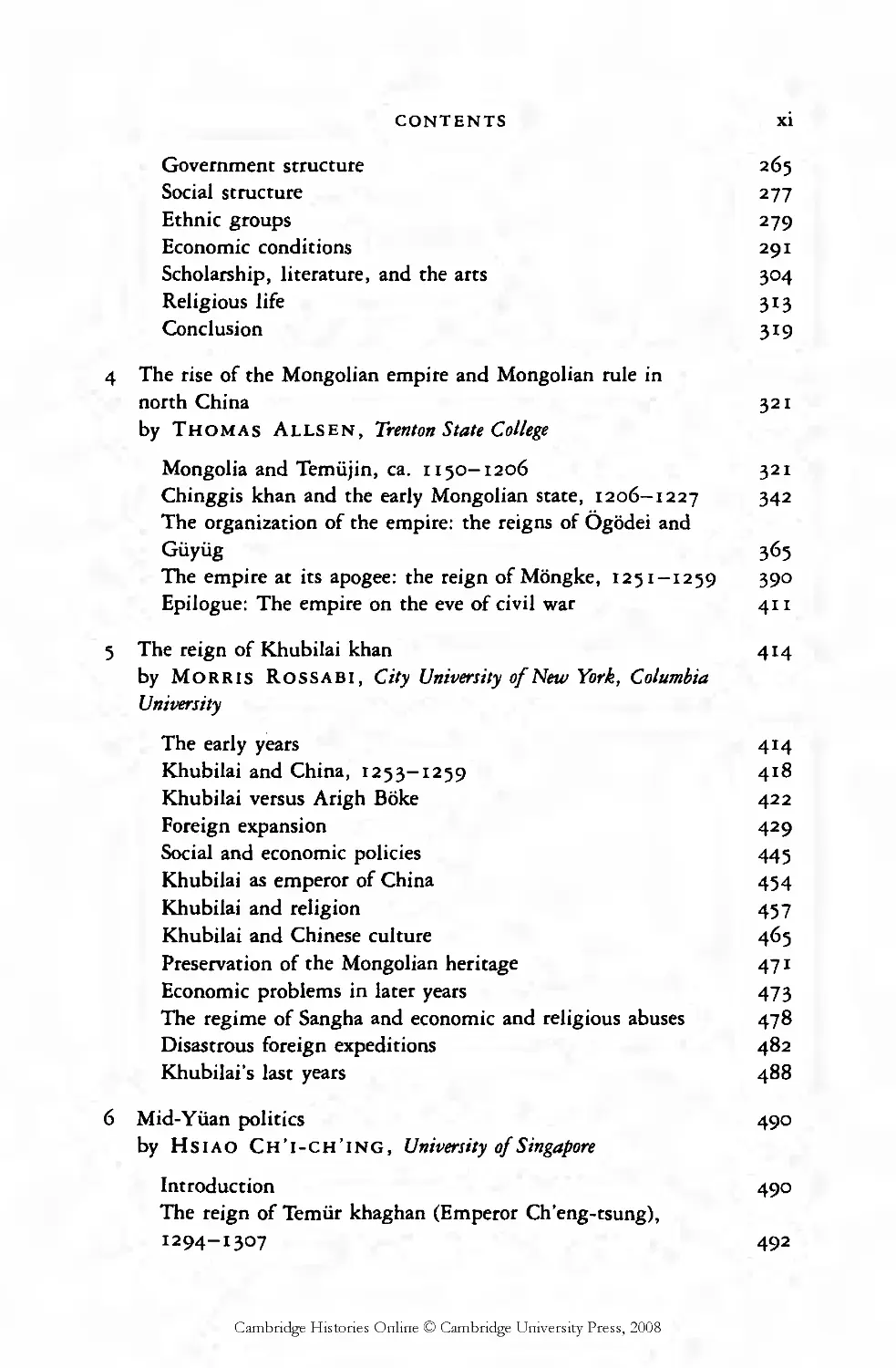
CONTENTS
General editors’ preface	page v
List of maps, tables, and figures	xiv
Preface to Volume 6	xvii
List of abbreviations	xix
Introduction	i
by Herbert Franke, Universitdt Miinchen, Emeritus, and
Denis Twitchett, Princeton University, Emeritus
The Late T’ang balance of power	3
The frontier	7
Foreigners	11
Vassals and overlords	14
Mulristate system	16
Treaty relations	18
Modes of government	21
Multilinguality	30
The Han Chinese under alien domination	36
1 The Liao	43
by Denis Twitchett and Klaus-Peter Tietze
Introduction	43
The predynastic Khitan	44
The background of A-pao-chi’s rise	to	power	53
The rise of A-pao-chi	56
A-pao-chi becomes the new khaghan and ascends the
throne	60
The succession crisis and the reign of T’ai-tsung	68
The succession of Shih-tsung	75
The development of government institutions	76
Relation with regimes in China	80
The reign of Mu-tsung, 951—969	81
ix
Cambridge Histories Online © Cambridge University Press, 2008

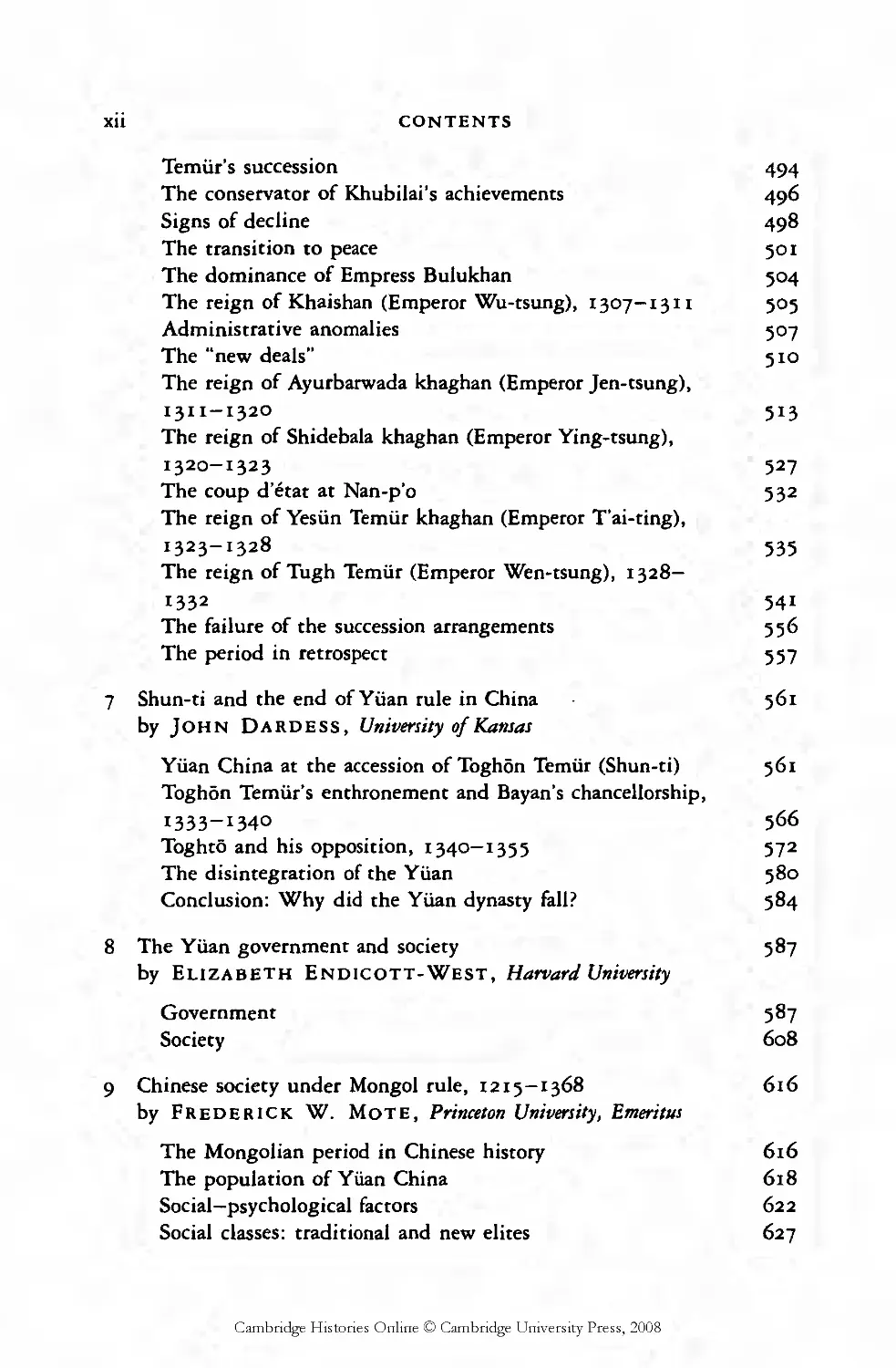
X
CONTENTS
The reign of Ching-tsung, 969—982: confrontation with Sung 84
The regency of Empress Dowager Ch’eng-t’ien	87
Changes in internal government	91
Foreign relations	98
The reign of Hsing-tsung	114
The reign of Tao-tsung	123
The reign of T’ien-tso and the collapse of the Liao	139
Final disaster	149
2	The Hsi Hsia	154
by Ruth Dunnel, Kenyon College
Introduction	154
The ethnogenesis of the Tangut people	155
The surrender to T’ang and settlement in the Ordos	158
The end of the T’ang	161
The Tanguts during the Wu-tai period	164
The Tangut move toward independence, 982-1002	168
Liang-chou and Tangut expansion into Ho-hsi	172
The rise of the Tibetan Tsung-ko dynasty	173
Li Te-ming, 1004-1032	176
Ho-hsi after the Tangut conquest	179
Li Yiian-hao (Wei-ming Nang-hsiao, Ching-tsung), 1032—
1048	180
The succession to Wei-ming Yiian-hao	189
A state in peril: the reigns of I-tsung (1048—1068), Hui-
tsung (1068-1086), and Ch’ung-tsung to 1100	191
The reign of Hui-tsung (1068-1086)	193
Hsia comes of age: Ch’ung-tsung (1086—1139) and Jen-
tsung (1140—1193)	197
The last years of the Hsia state and the Mongolian conquest 205
3	The Chin dynasty	215
by Herbert Franke
General remarks	215
The Jurchen people and their predynastic history	216
The reign of A-ku-ta and the founding of the Chin dynasty 220
From war to coexistence: Chin—Sung relations before the
treaty of 1142	226
The political history of Chin after 1142	235
The annihilation of Chin, 1215—1234	259
Cambridge Histories Online © Cambridge University Press, 2008

CONTENTS	xi
Government structure	265
Social structure	277
Ethnic groups	279
Economic conditions	291
Scholarship, literature, and the arts	304
Religious life	313
Conclusion	319
4	The rise of the Mongolian empire and Mongolian rule in
north China	321
by Thomas Allsen, Trenton State College
Mongolia and Temiijin, ca. 1150—1206	321
Chinggis khan and the early Mongolian state, 1206—1227	342
The organization of the empire: the reigns of Ogodei and
Giiyiig	365
The empire at its apogee: the reign of Mongke, 1251 —1259	390
Epilogue: The empire on the eve of civil war	411
5	The reign of Khubilai khan	414
by Morris Rossabi, City University of New York, Columbia
University
The early years	414
Khubilai and China, 1253—1259	418
Khubilai versus Arigh Boke	422
Foreign expansion	429
Social and economic policies	445
Khubilai as emperor of China	454
Khubilai and religion	457
Khubilai and Chinese culture	465
Preservation of the Mongolian heritage	471
Economic problems in later years	473
The regime of Sangha and economic and religious abuses	478
Disastrous foreign expeditions	482
Khubilai’s last years	488
6	Mid-Yuan politics	490
by Hsiao Ch’i-ch’ing, University of Singapore
Introduction	490
The reign of Temiir khaghan (Emperor Ch’eng-tsung),
1294-1307	492
Cambridge Histories Online © Cambridge University Press, 2008

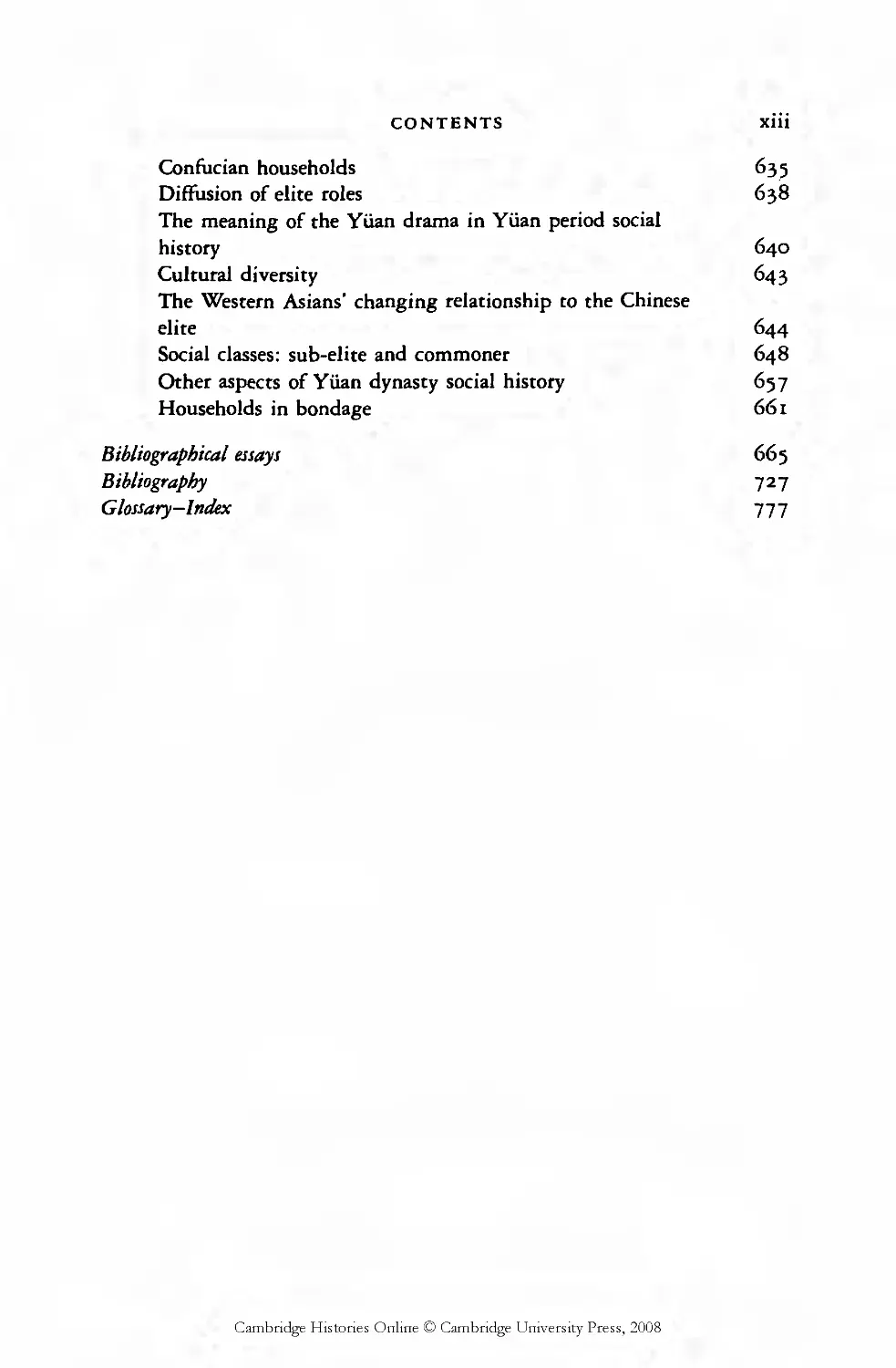
CONTENTS
xii
Temur’s succession	494
The conservator of Khubilai’s achievements	496
Signs of decline	498
The transition to peace	501
The dominance of Empress Bulukhan	504
The reign of Khaishan (Emperor Wu-tsung), 1307—1311	505
Administrative anomalies	507
The “new deals”	510
The reign of Ayurbarwada khaghan (Emperor Jen-tsung),
1311—1320	513
The reign of Shidebala khaghan (Emperor Ying-tsung),
1320-1323	527
The coup d’etat at Nan-p’o	532
The reign of Yesiin Temur khaghan (Emperor T’ai-ting),
1323-1328	535
The reign of Tugh Temur (Emperor Wen-tsung), 1328¬
1332	541
The failure of the succession arrangements	556
The period in retrospect	557
7	Shun-ti and the end of Yuan rule in China	561
by John Dardess, University of Kansas
Yiian China at the accession of Toghon Temur (Shun-ti)	561
Togh5n Temur’s enthronement and Bayan’s chancellorship,
1333-1340	566
Toghto and his opposition, 1340-1355	572
The disintegration of the Yiian	580
Conclusion: Why did the Yiian dynasty fall?	584
8	The Yiian government and society	587
by Elizabeth Endicott-West, Harvard University
Government	587
Society	608
9	Chinese society under Mongol rule, 1215—1368	616
by Frederick W. Mote, Princeton University, Emeritus
The Mongolian period in Chinese history	616
The population of Yiian China	618
Social—psychological factors	622
Social classes: traditional and new elites	627
Cambridge Histories Online © Cambridge University Press, 2008

CONTENTS
Confucian households
Diffusion of elite roles
The meaning of the Yuan drama in Yuan period social
history
Cultural diversity
The Western Asians’ changing relationship to the Chinese
elite
Social classes: sub-elite and commoner
Other aspects of Yiian dynasty social history
Households in bondage
Bibliographical essays
Bibliography
Glossary-Index
xiii
635
638
640
643
644
648
657
661
665
727
777
Cambridge Histories Online © Cambridge University Press, 2008

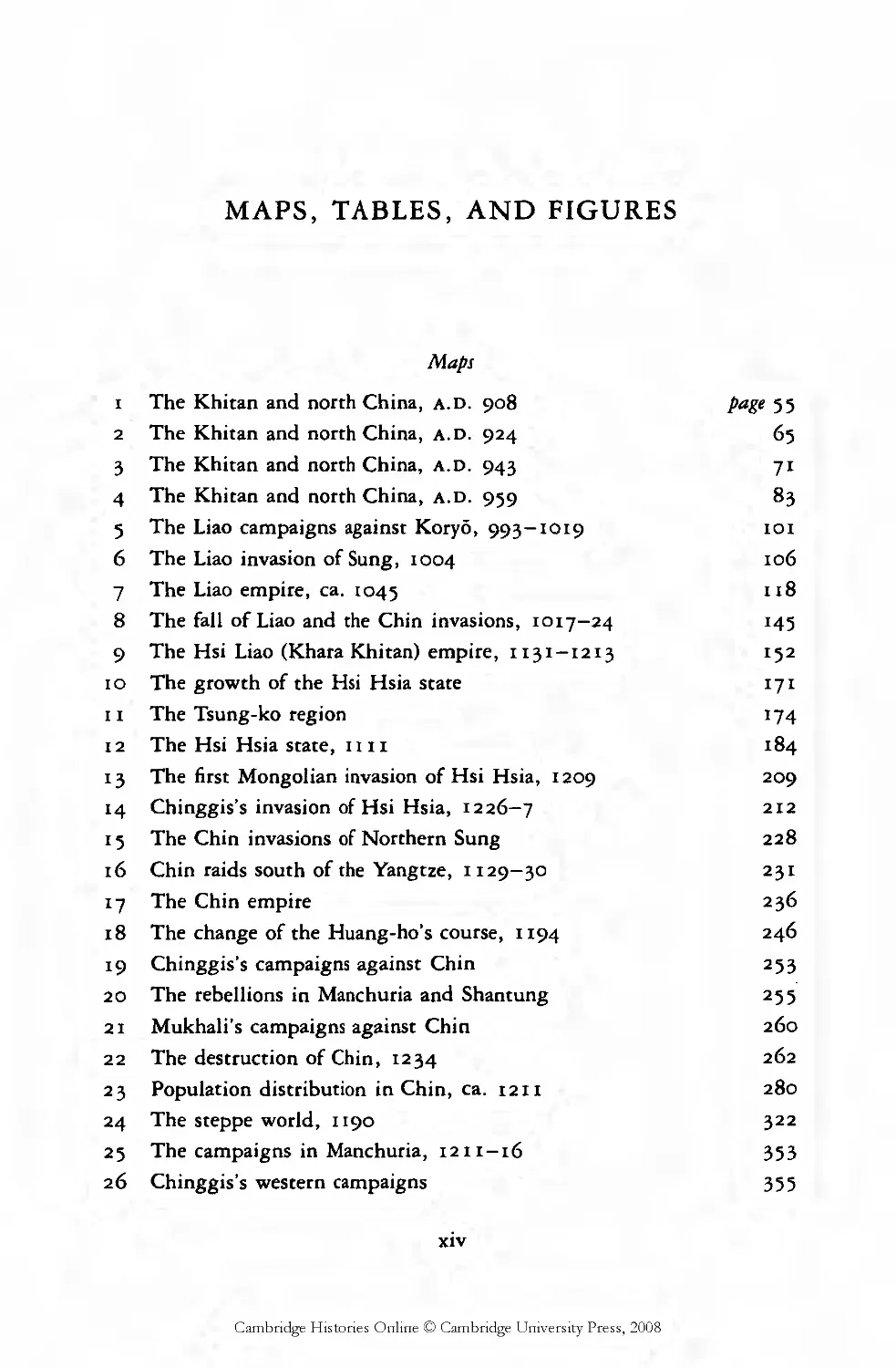
MAPS, TABLES, AND FIGURES
Maps
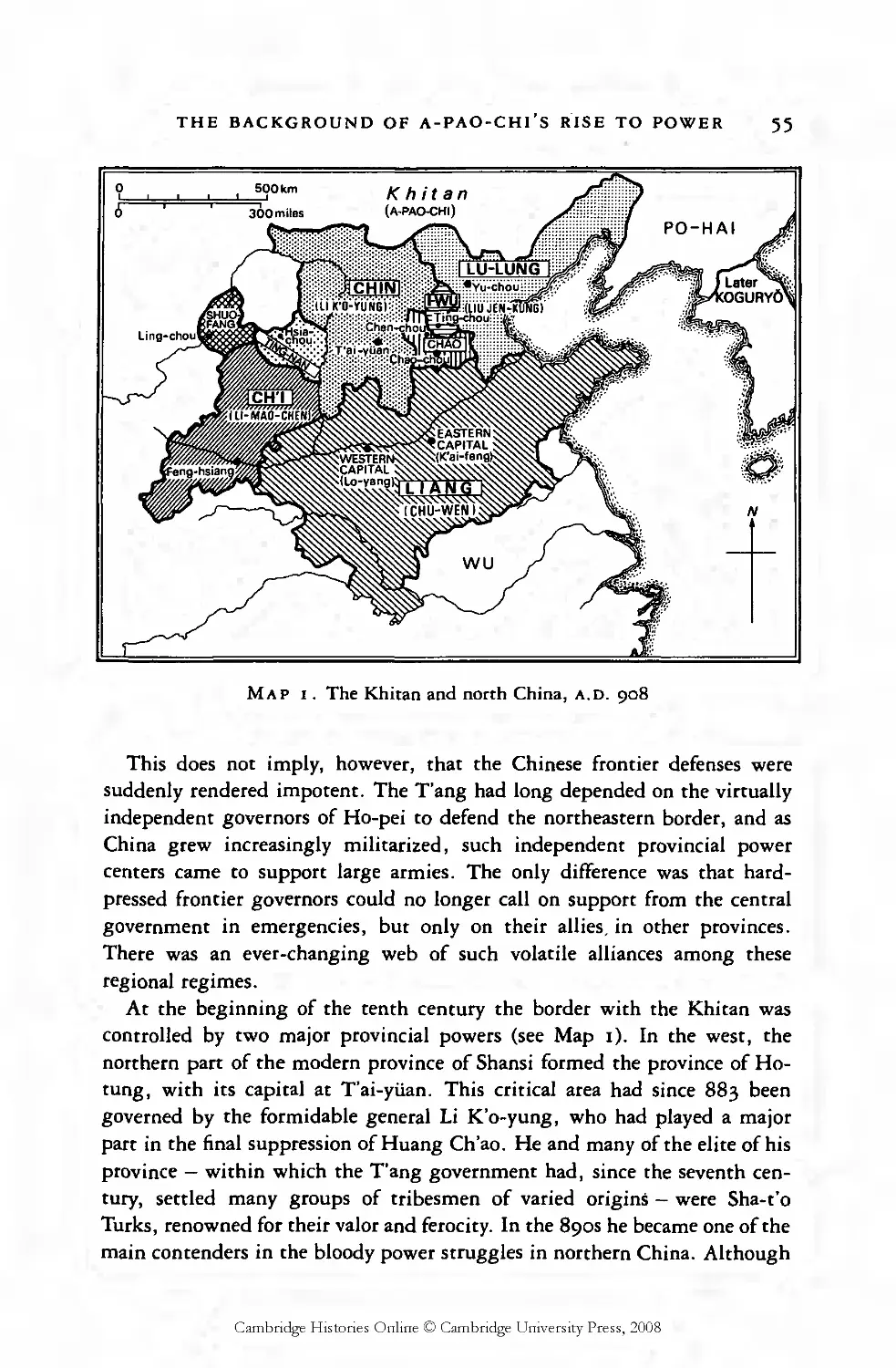
1	The Khitan and north China, a.d. 908	page 55
2	The	Khitan	and north	China,	A.D.	924	65
3	The	Khitan	and north	China,	a.d.	943	71
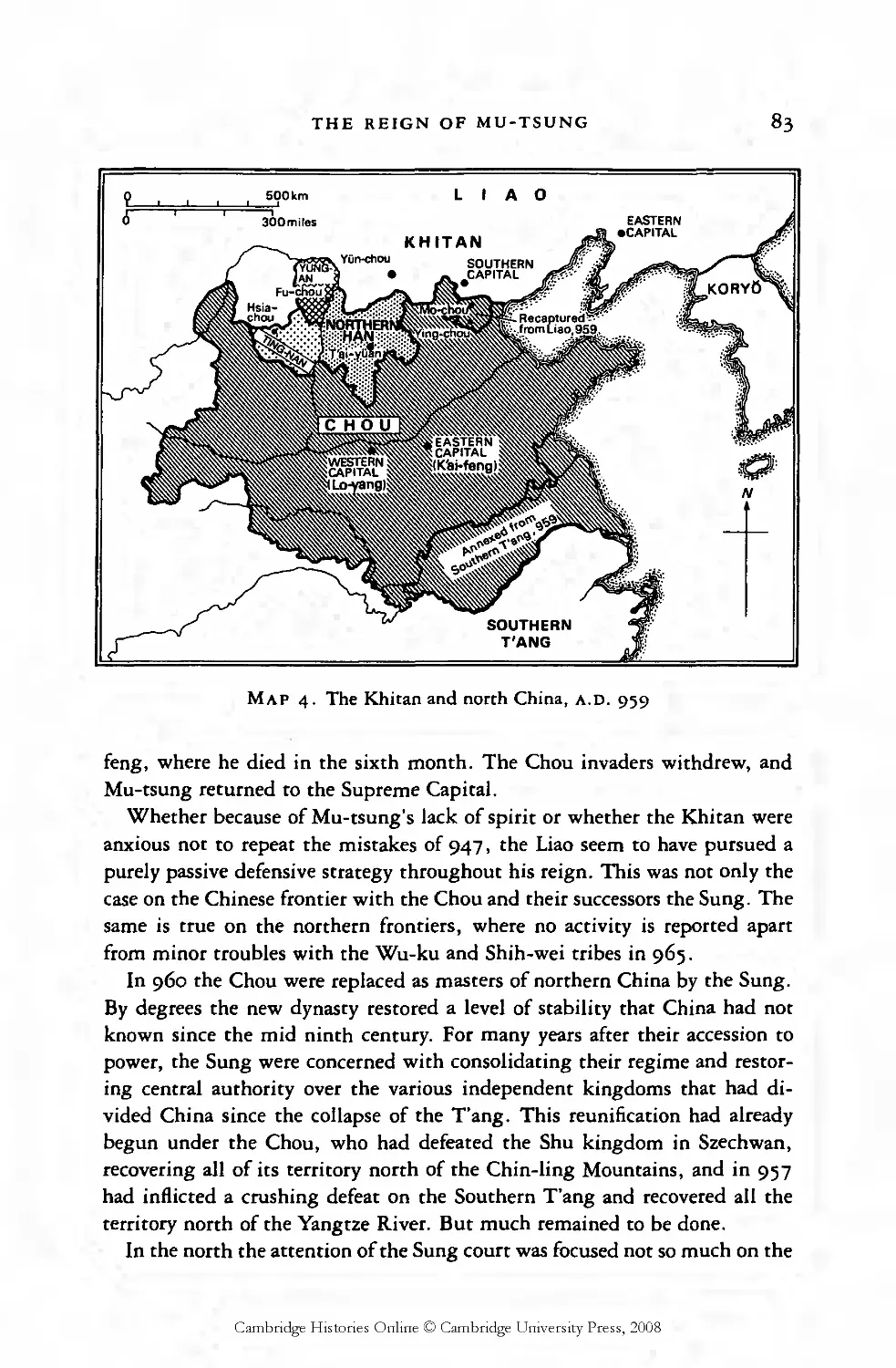
4	The	Khitan	and north	China,	a.d.	959	83
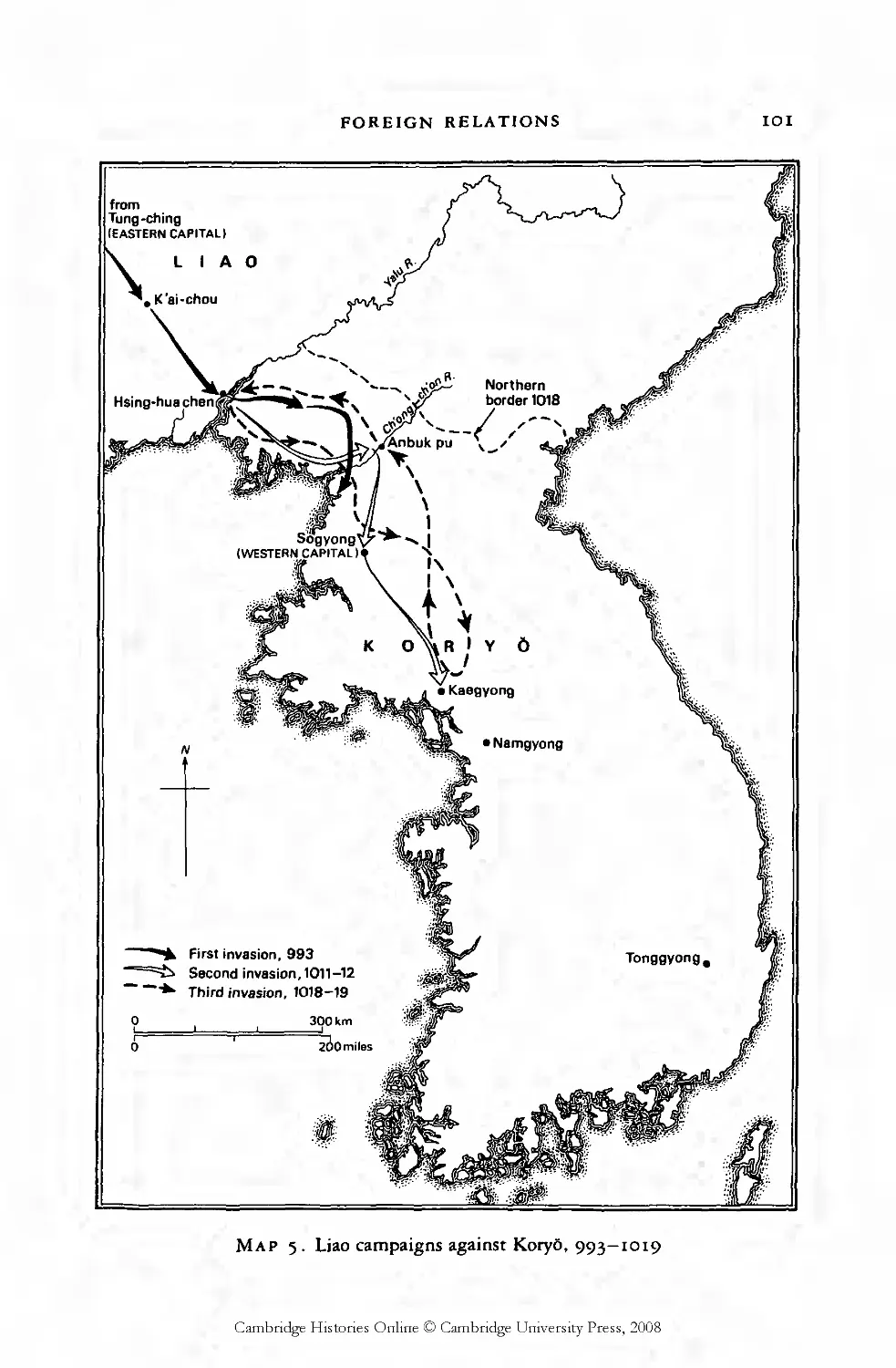
5	The	Liao campaigns against Koryo,	993—1019	101
6	The Liao invasion of Sung, 1004	106
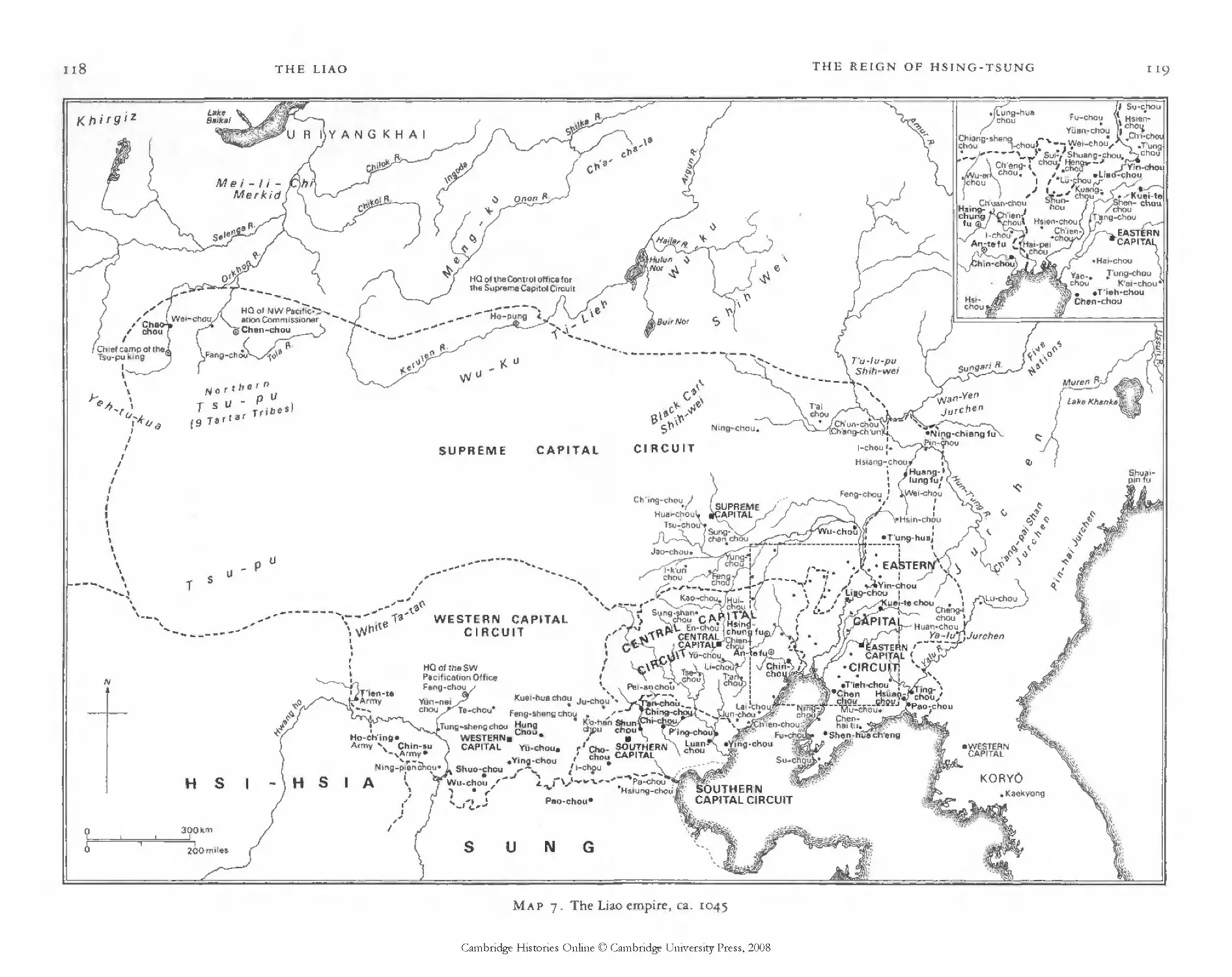
7	The Liao empire, ca. 1045	118
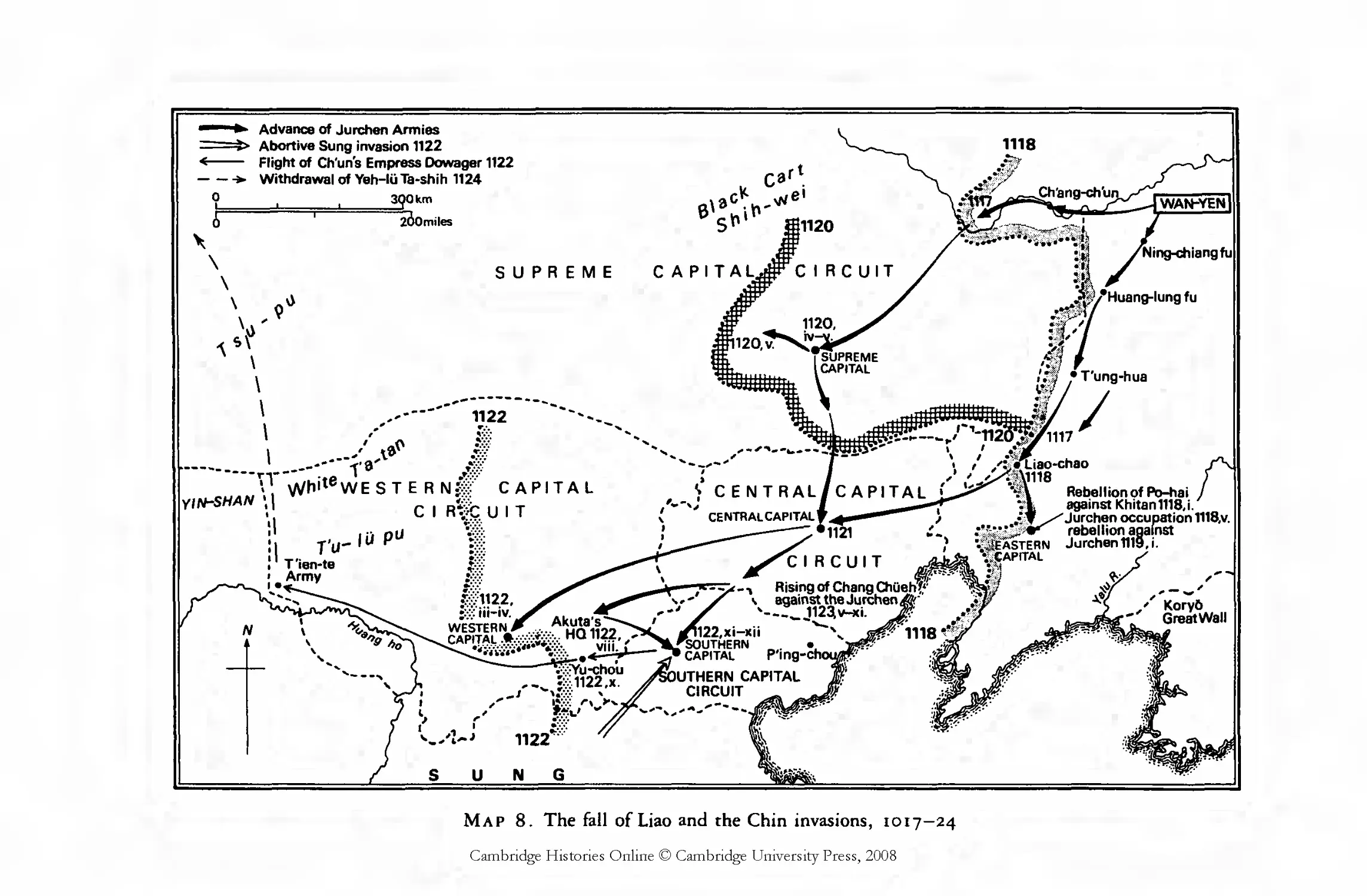
8	The fall of Liao and the Chin invasions, 1017—24	145
9	The Hsi Liao (Khara Khitan) empire, 1131 — 12x3	152
10	The growth of the Hsi Hsia state	171
11	The Tsung-ko region	174
12	The Hsi Hsia state, mi	184
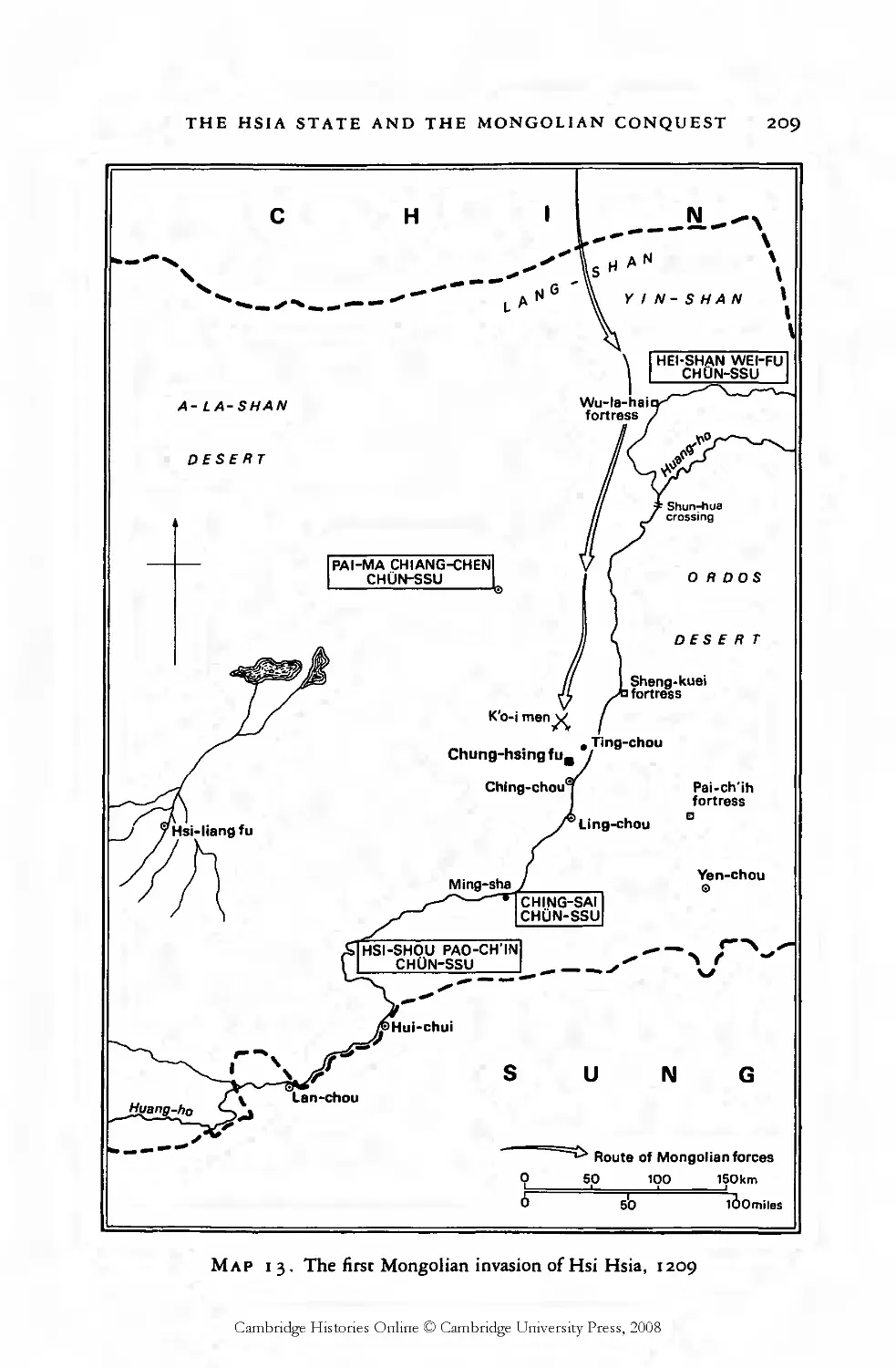
13	The first Mongolian invasion of Hsi Hsia, 1209	209
14	Chinggis’s invasion of Hsi Hsia, 1226-7	212
15	The Chin invasions of Northern Sung	228
16	Chin raids south of the Yangtze, 1129-30	231
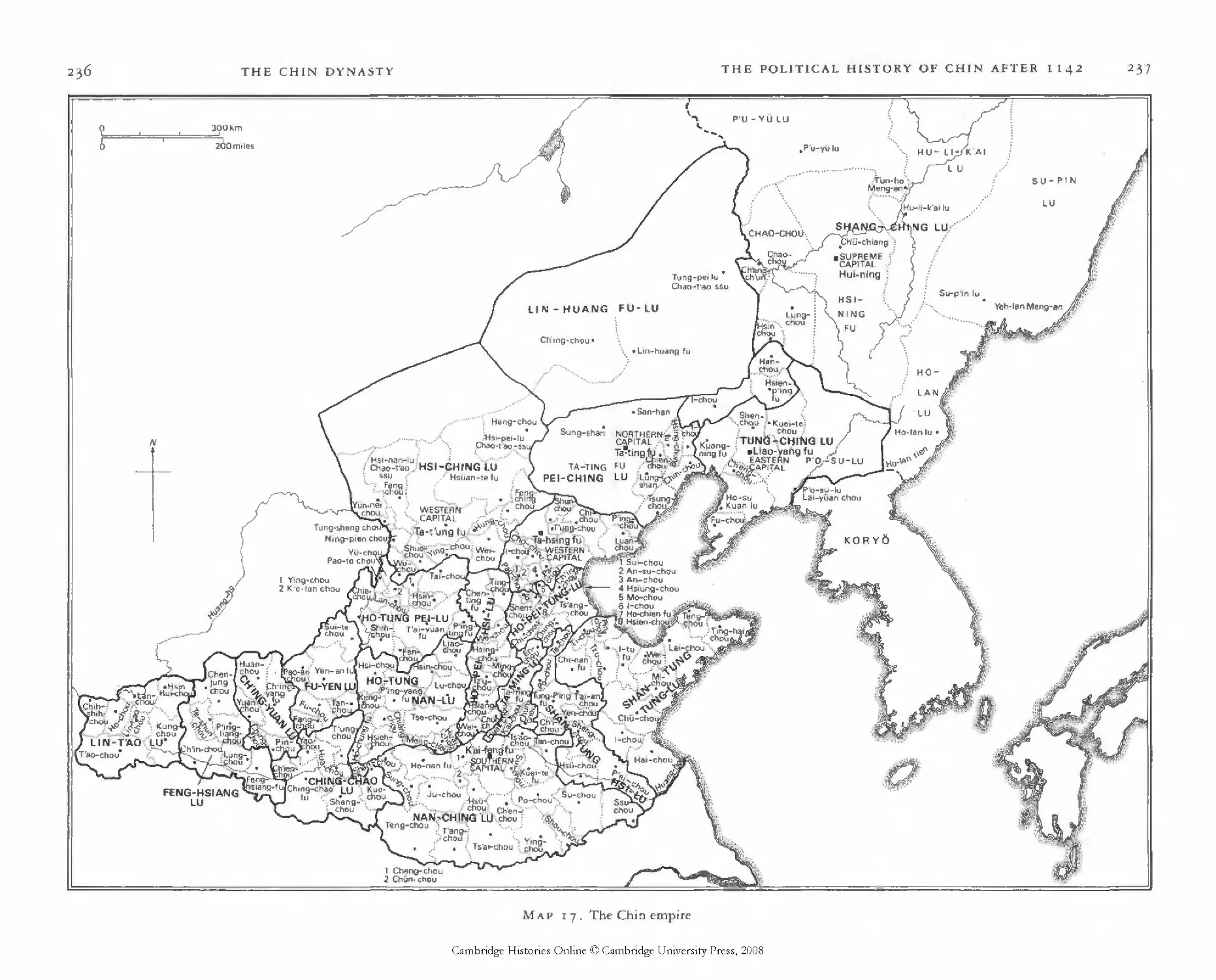
17	The Chin empire	236
18	The change of the Huang-ho’s course, 1194	246
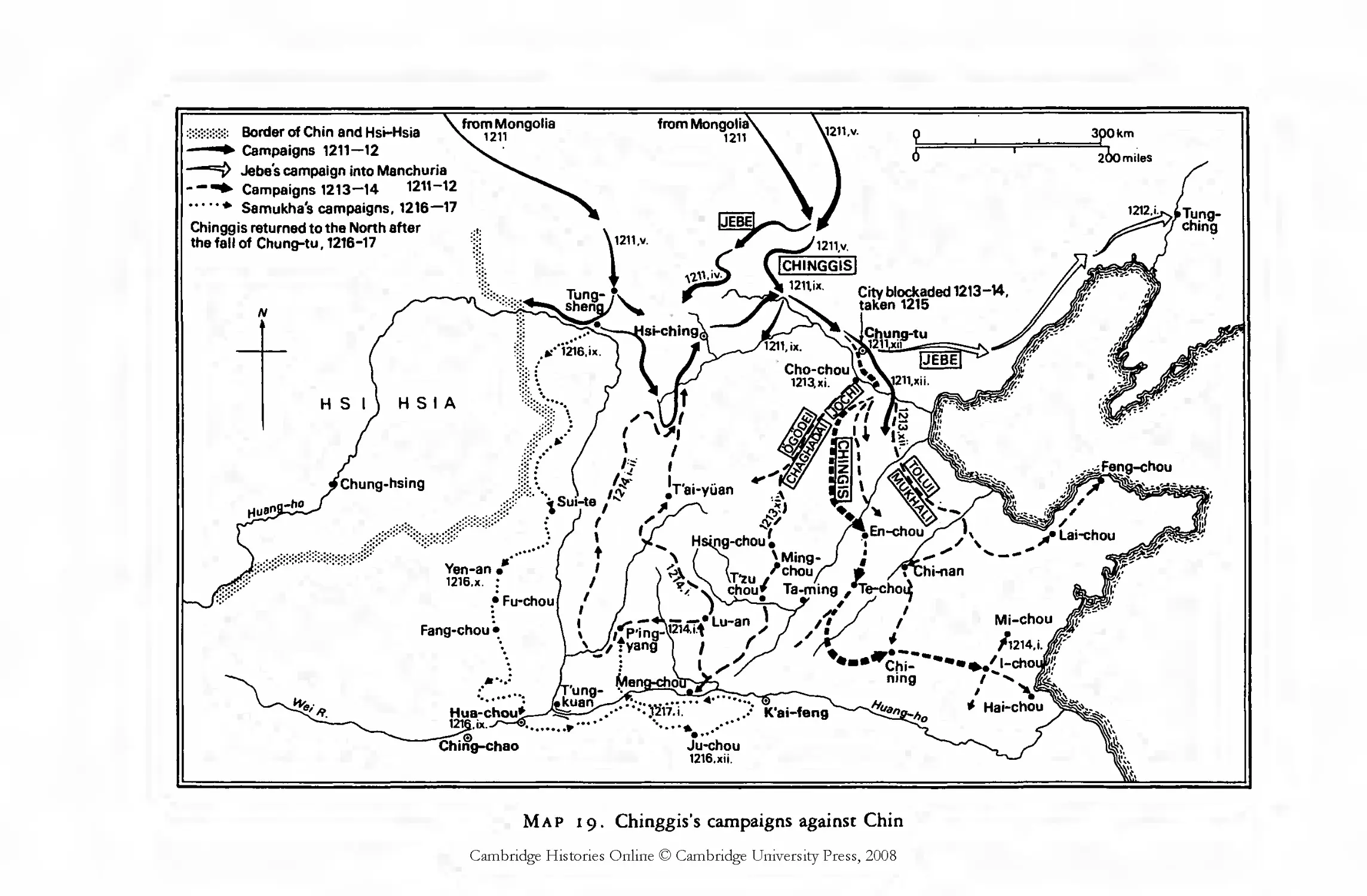
19	Chinggis’s campaigns against Chin	253
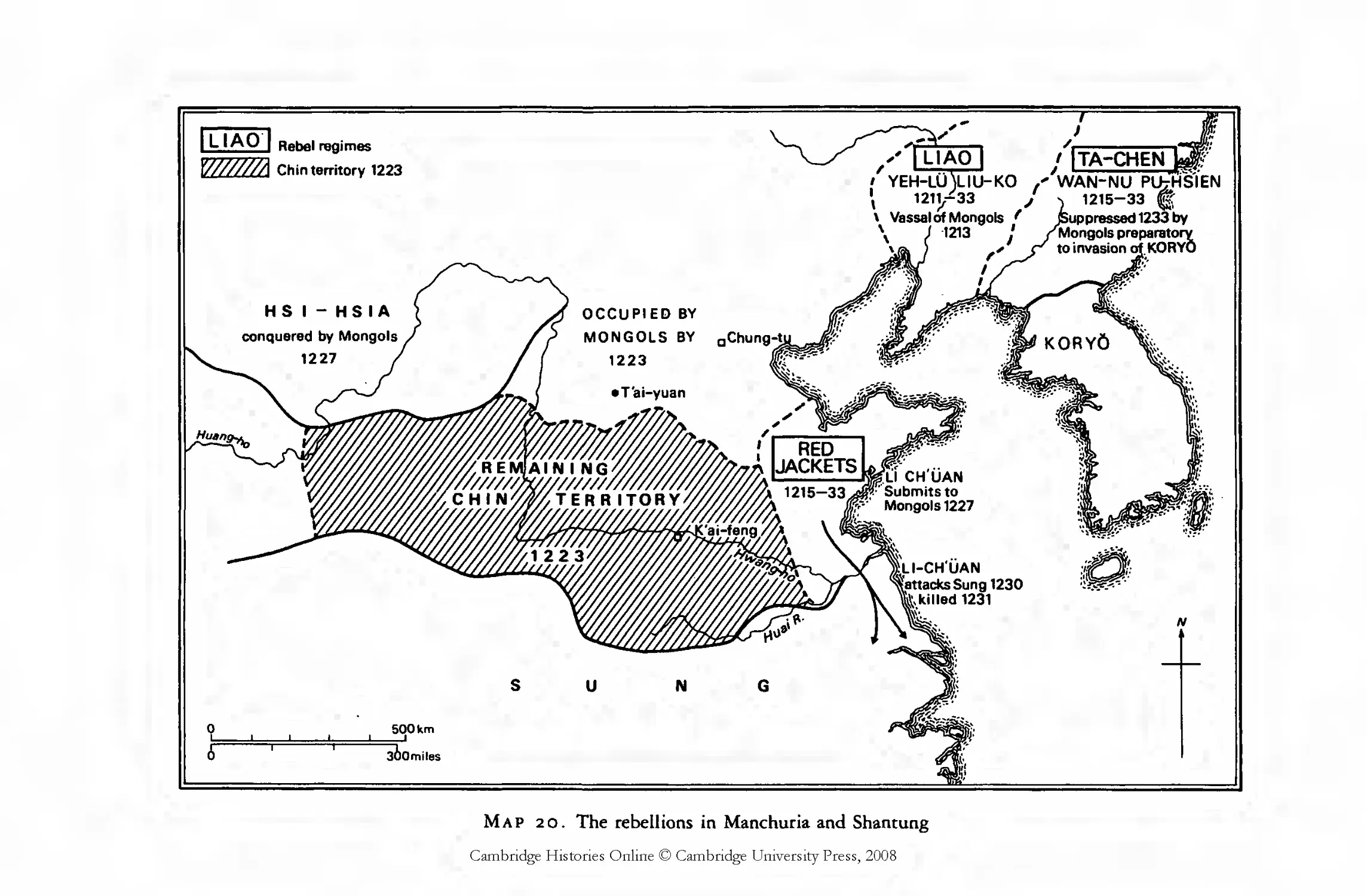
20	The rebellions in Manchuria and Shantung	255
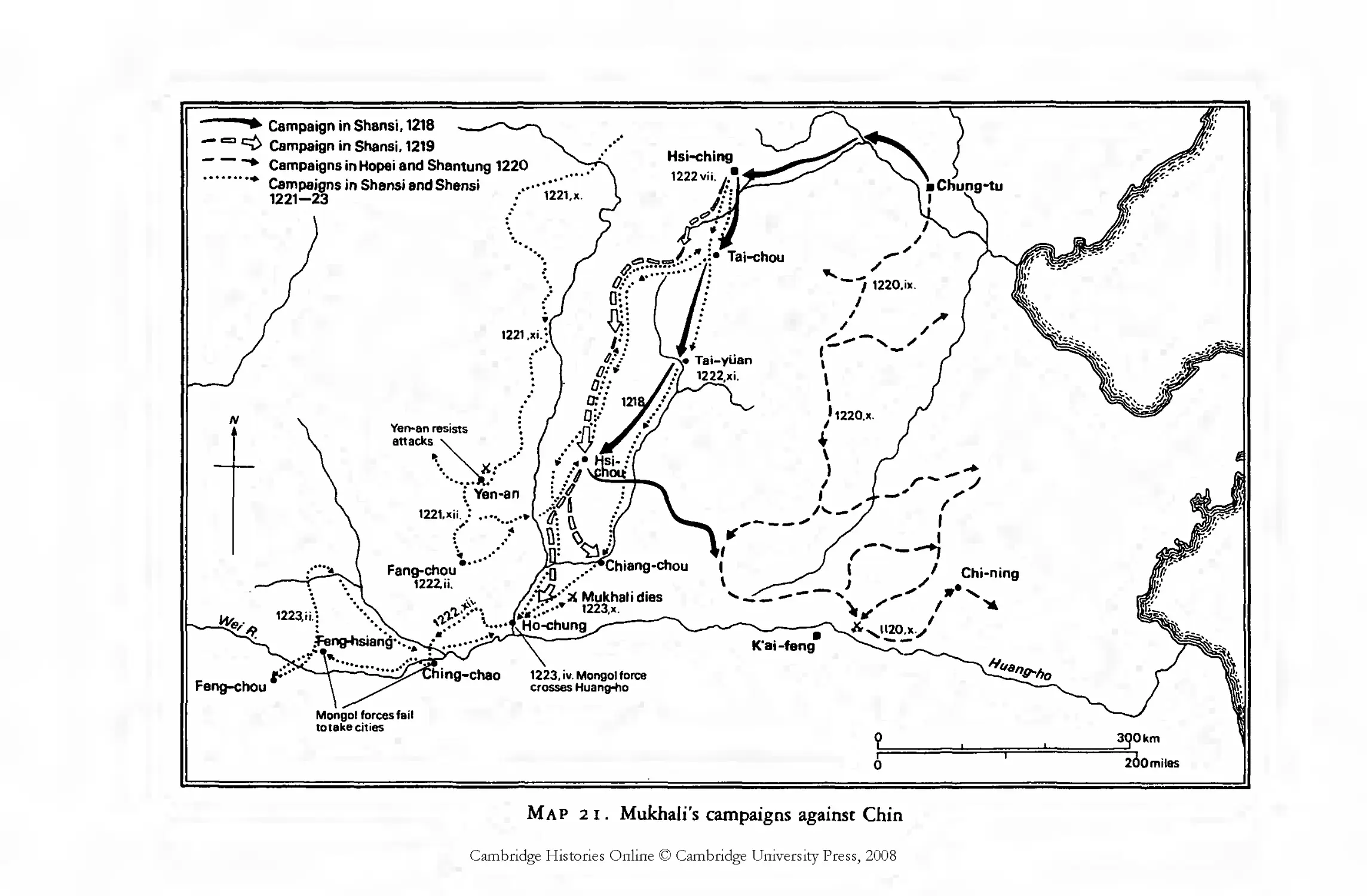
21	Mukhali's campaigns against Chin	260
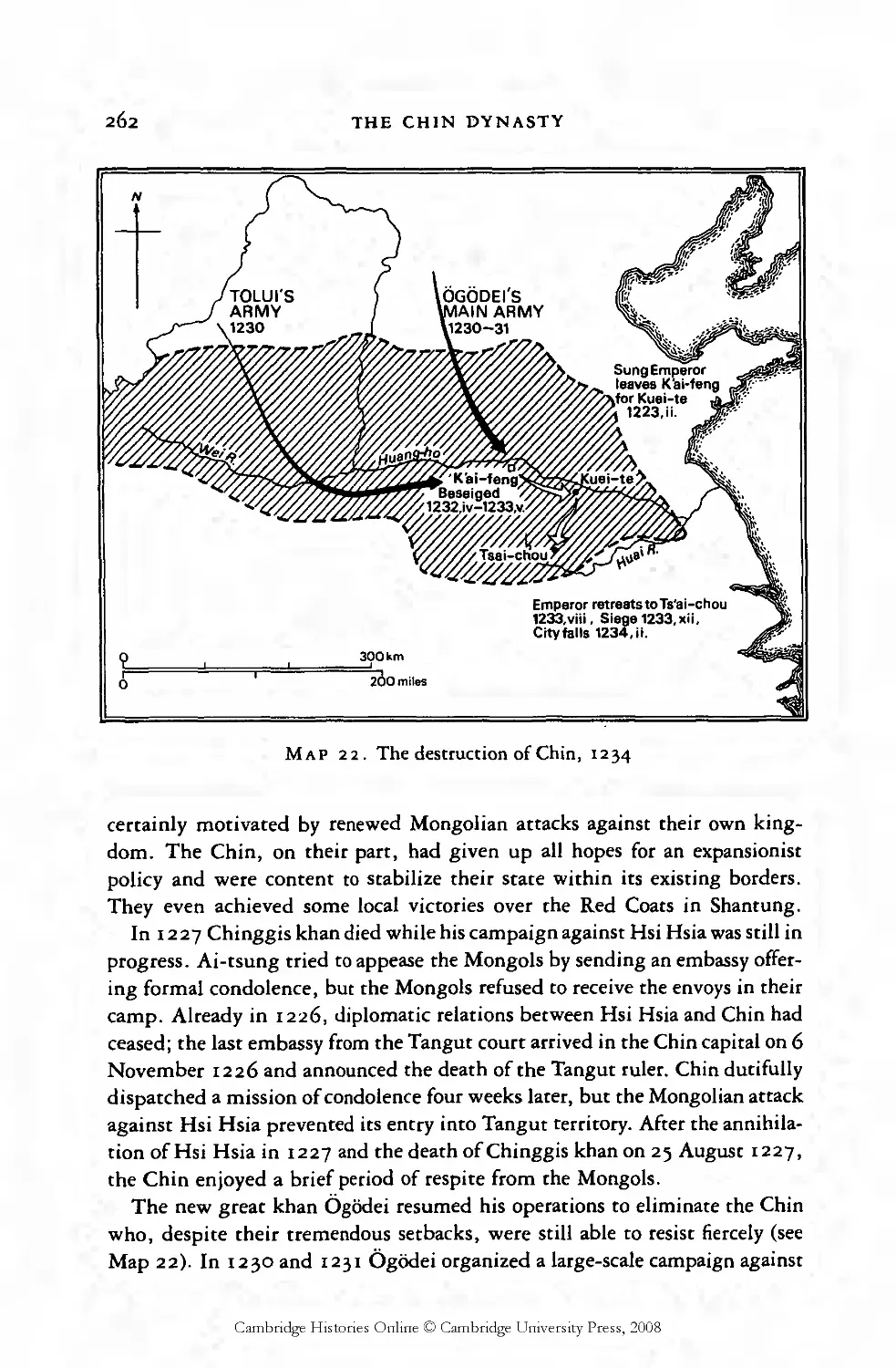
22	The destruction of Chin, 1234	262
23	Population distribution in Chin, ca. 1211	280
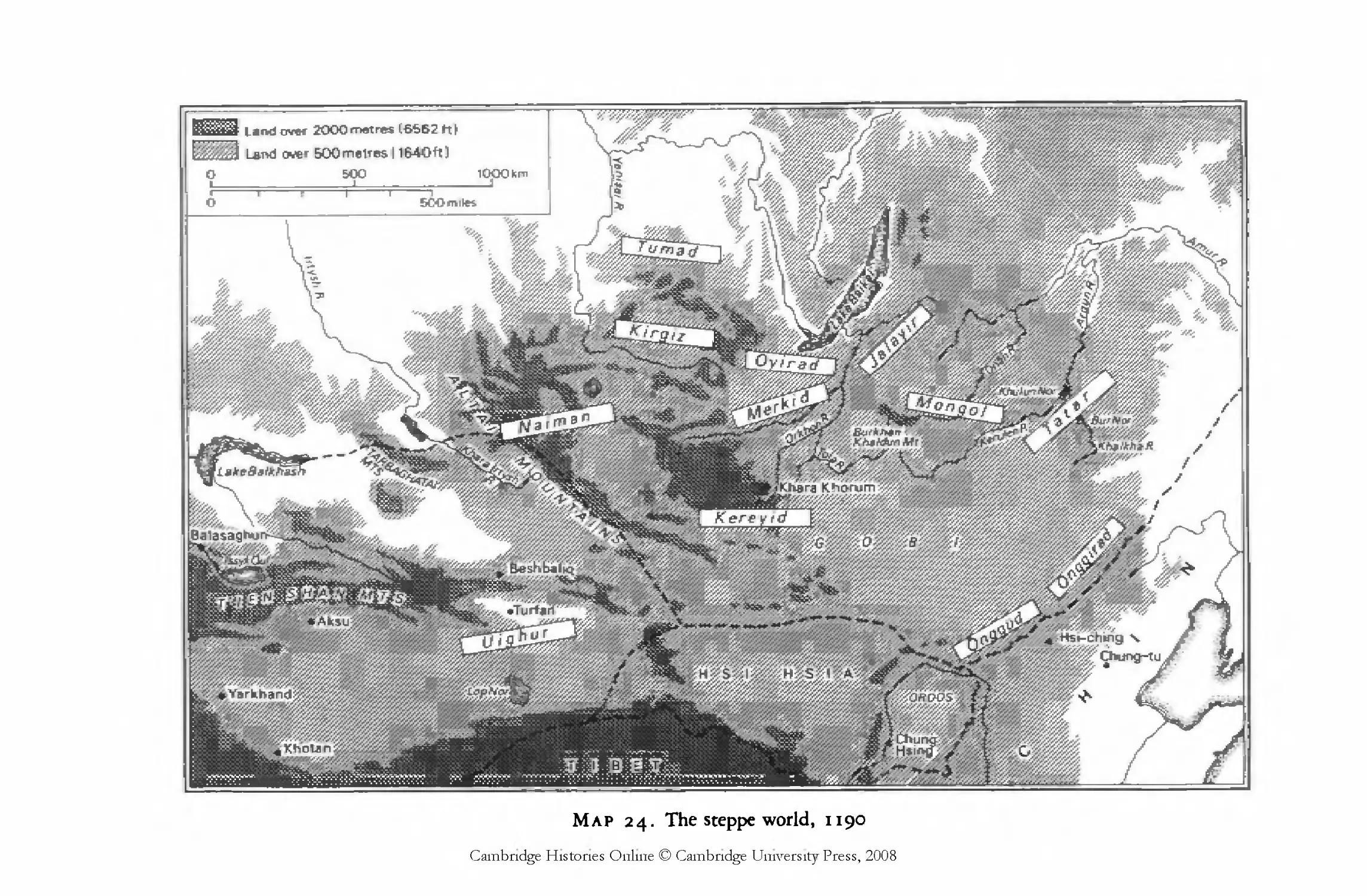
24	The steppe world, 1190	322
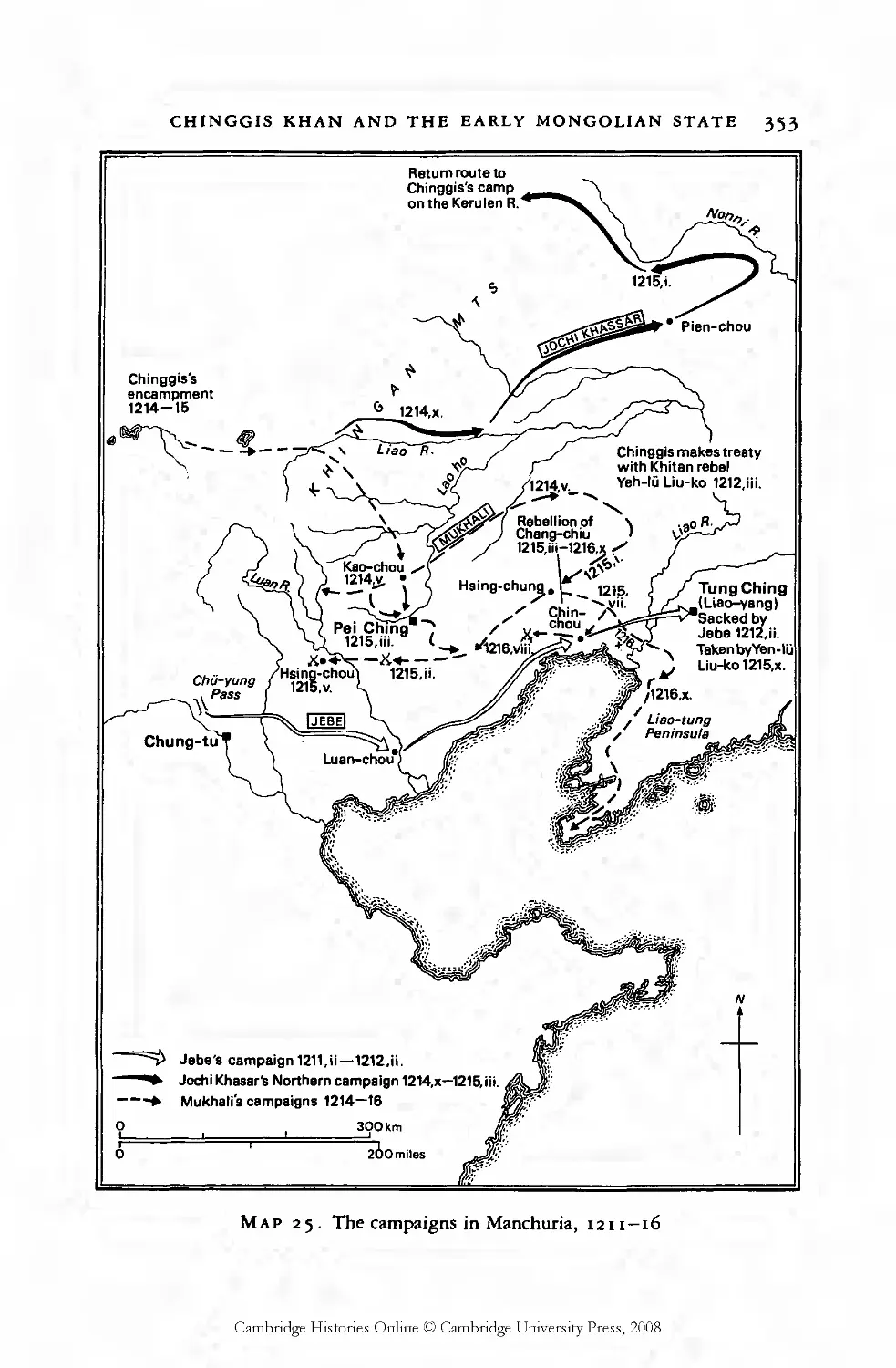
25	The campaigns in Manchuria, 1211 —16	353
26	Chinggis’s western campaigns	355
xiv
Cambridge Histories Online © Cambridge University Press, 2008

MAPS, TABLES, AND FIGURES
xv
27
28
29
30
31
32
33
34
35
36
37
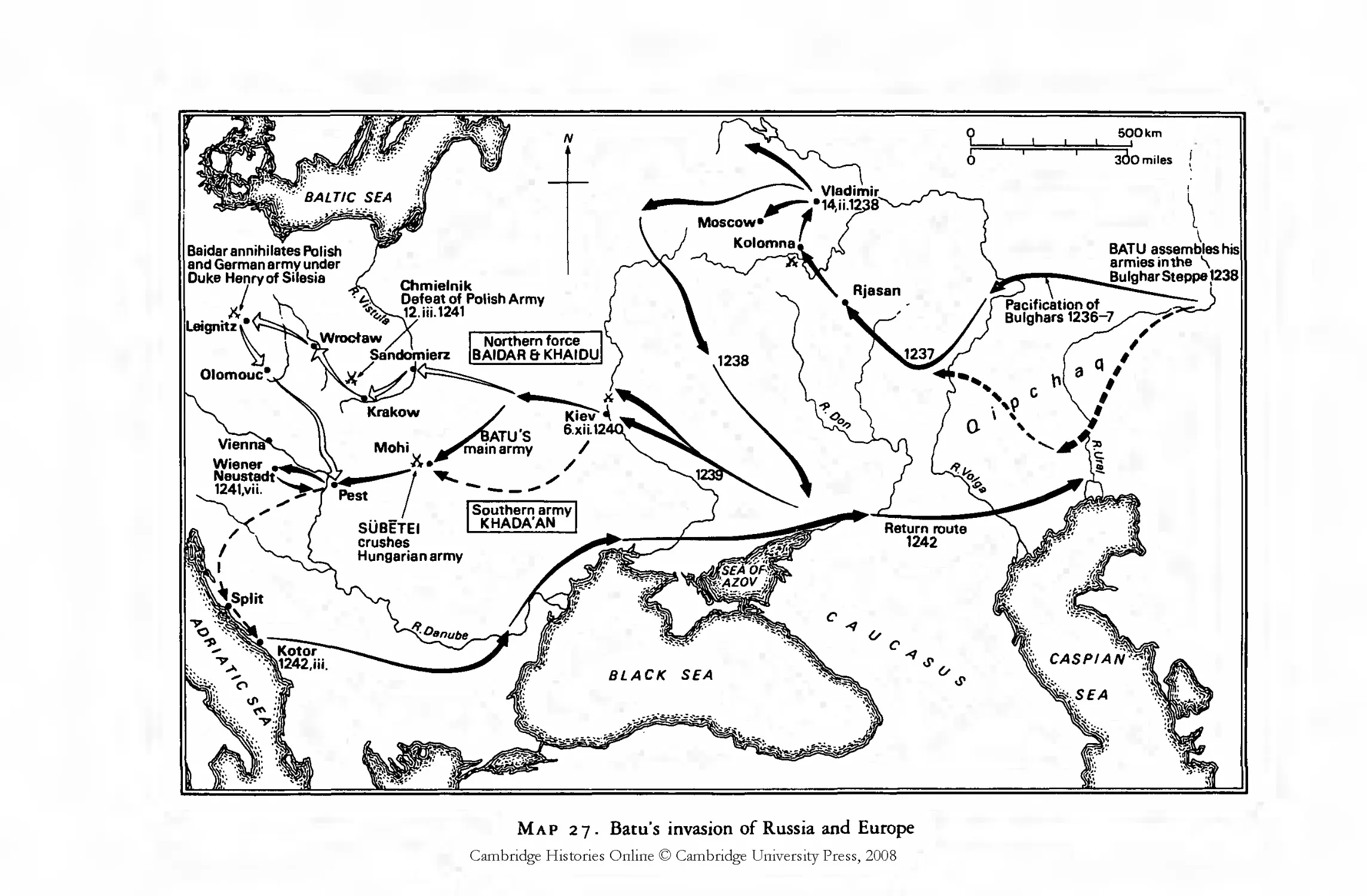
Batu’s invasion of Russia and Europe
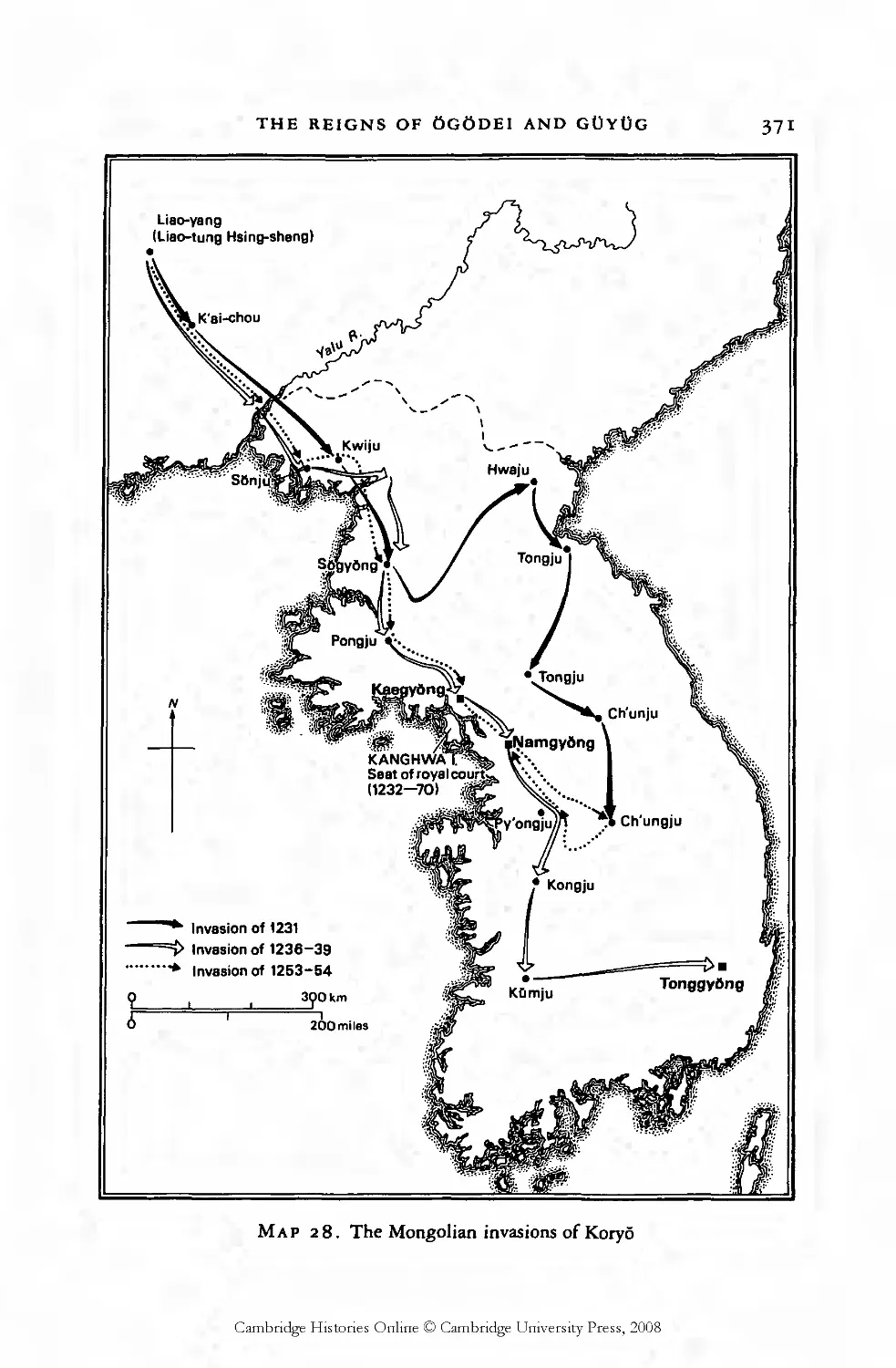
The Mongolian invasions of Koryo
The conquest of Ta-li
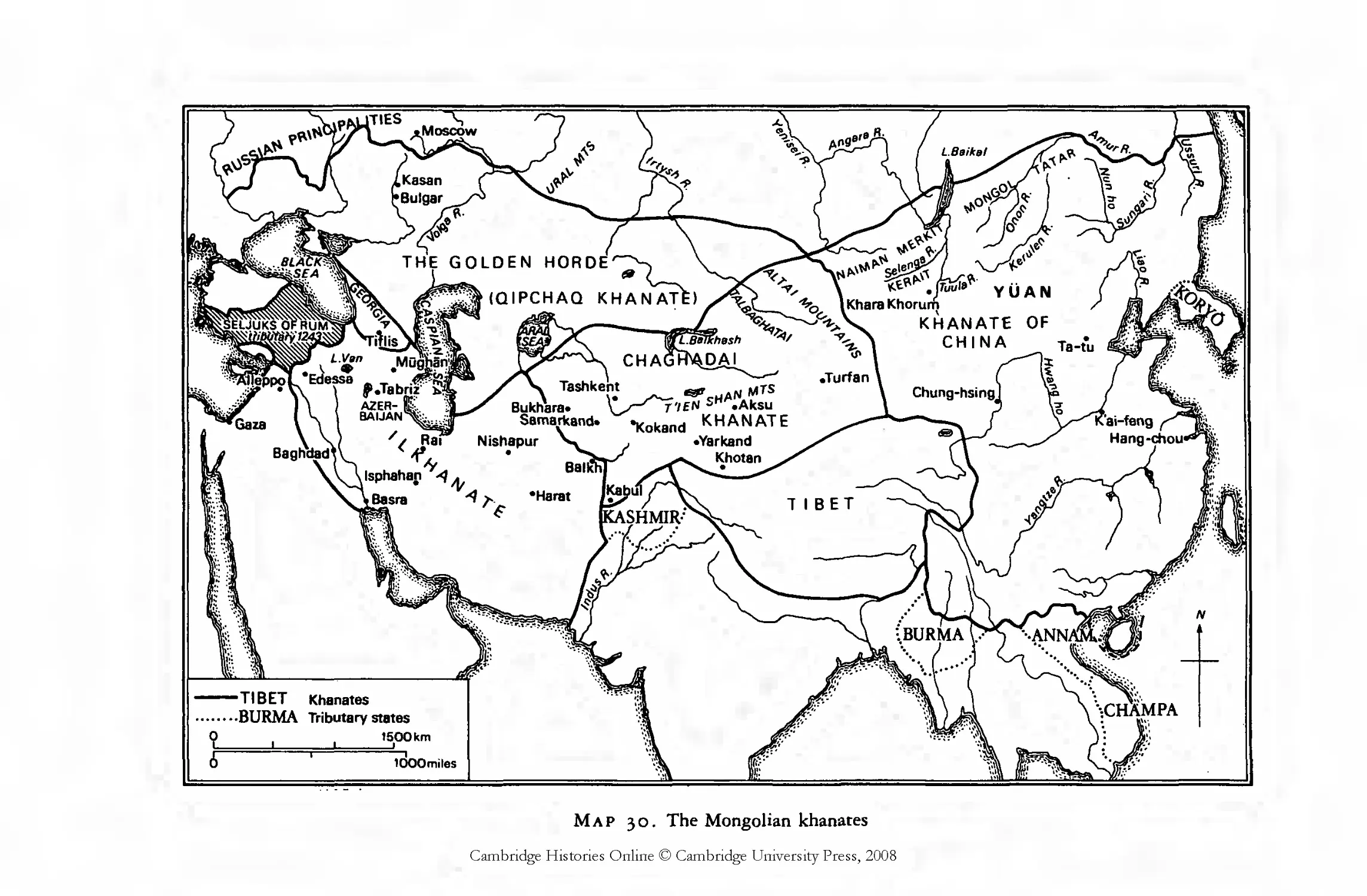
The Mongolian khanates
The conquest of Southern Sung
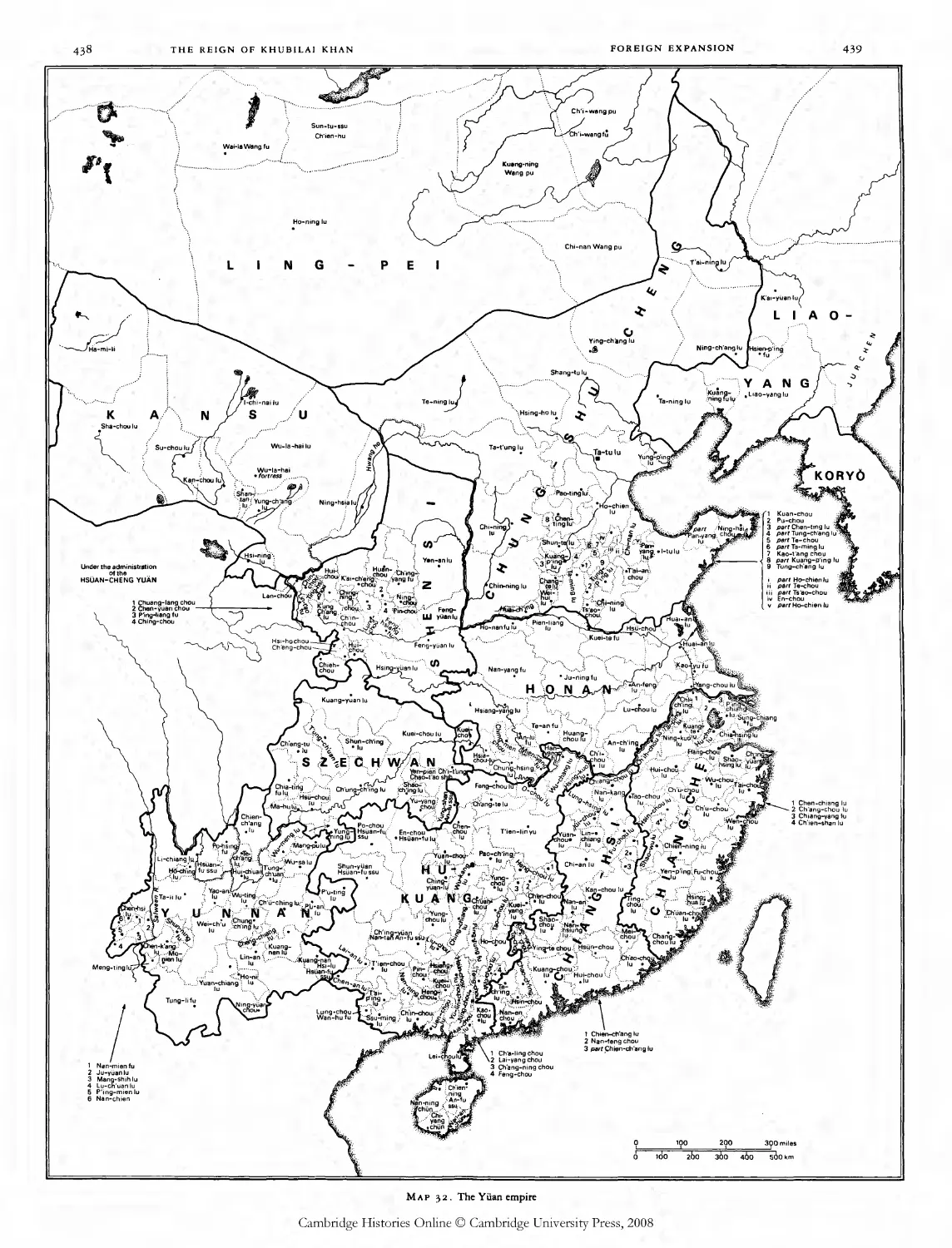
The Yuan empire
The Yuan capital, Ta-tu
The Yuan grain transport system
Khubilai's invasions of Japan
Khubilai’s invasions of Southeast Asia
Registered population distribution of Yuan China
Tables
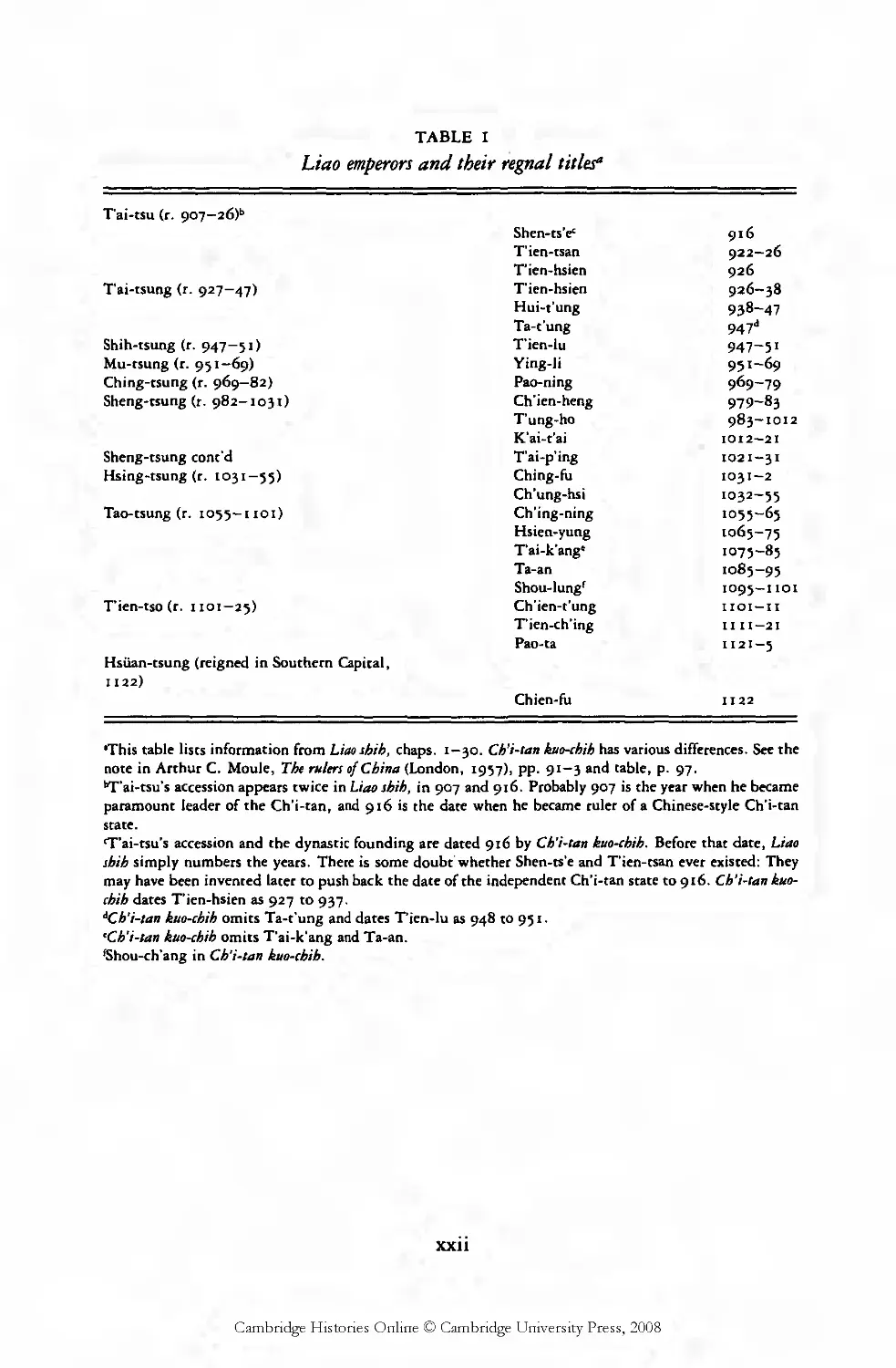
1	Liao emperors and their regnal titles
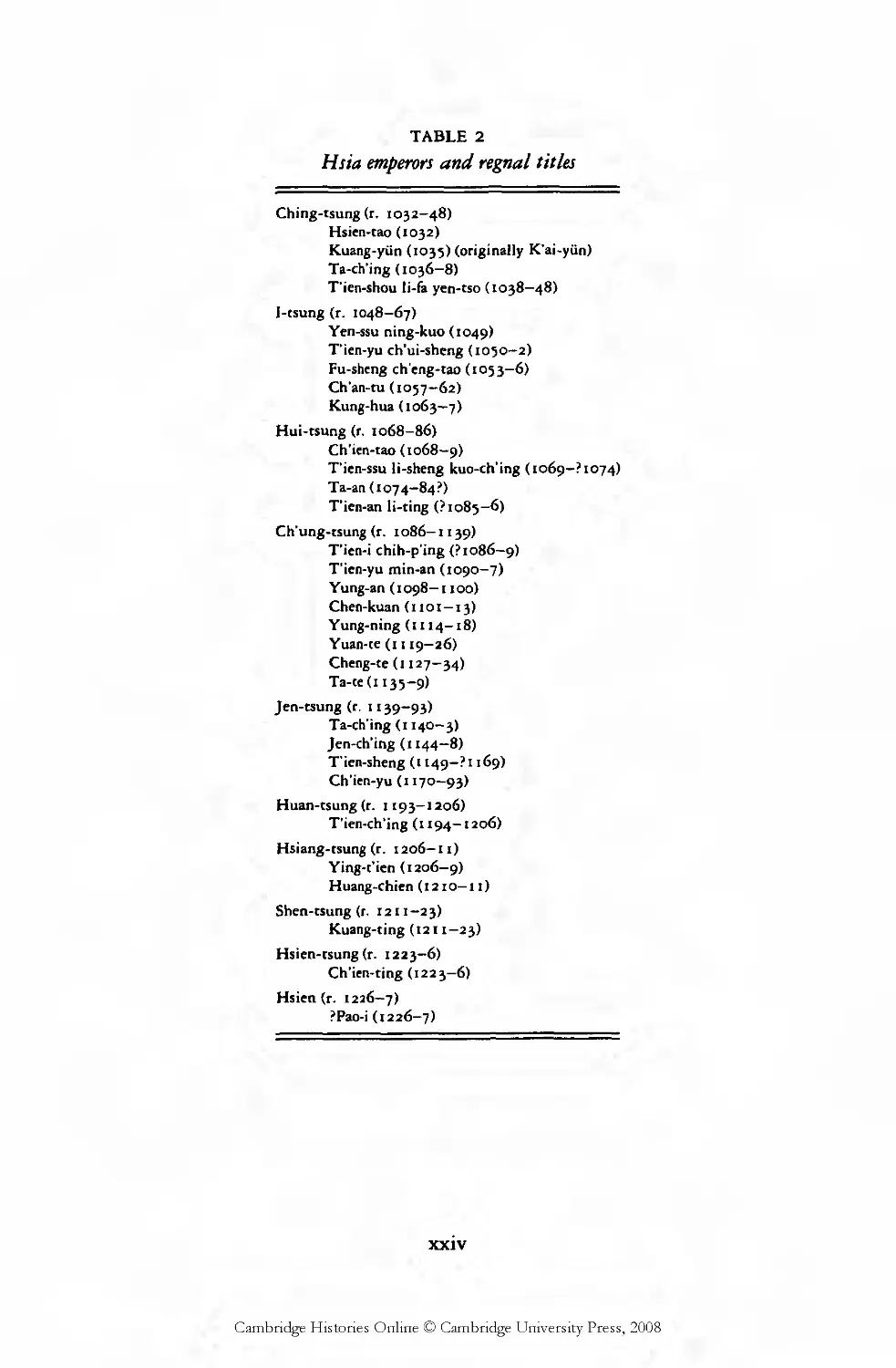
2	Hsia emperors and regnal titles
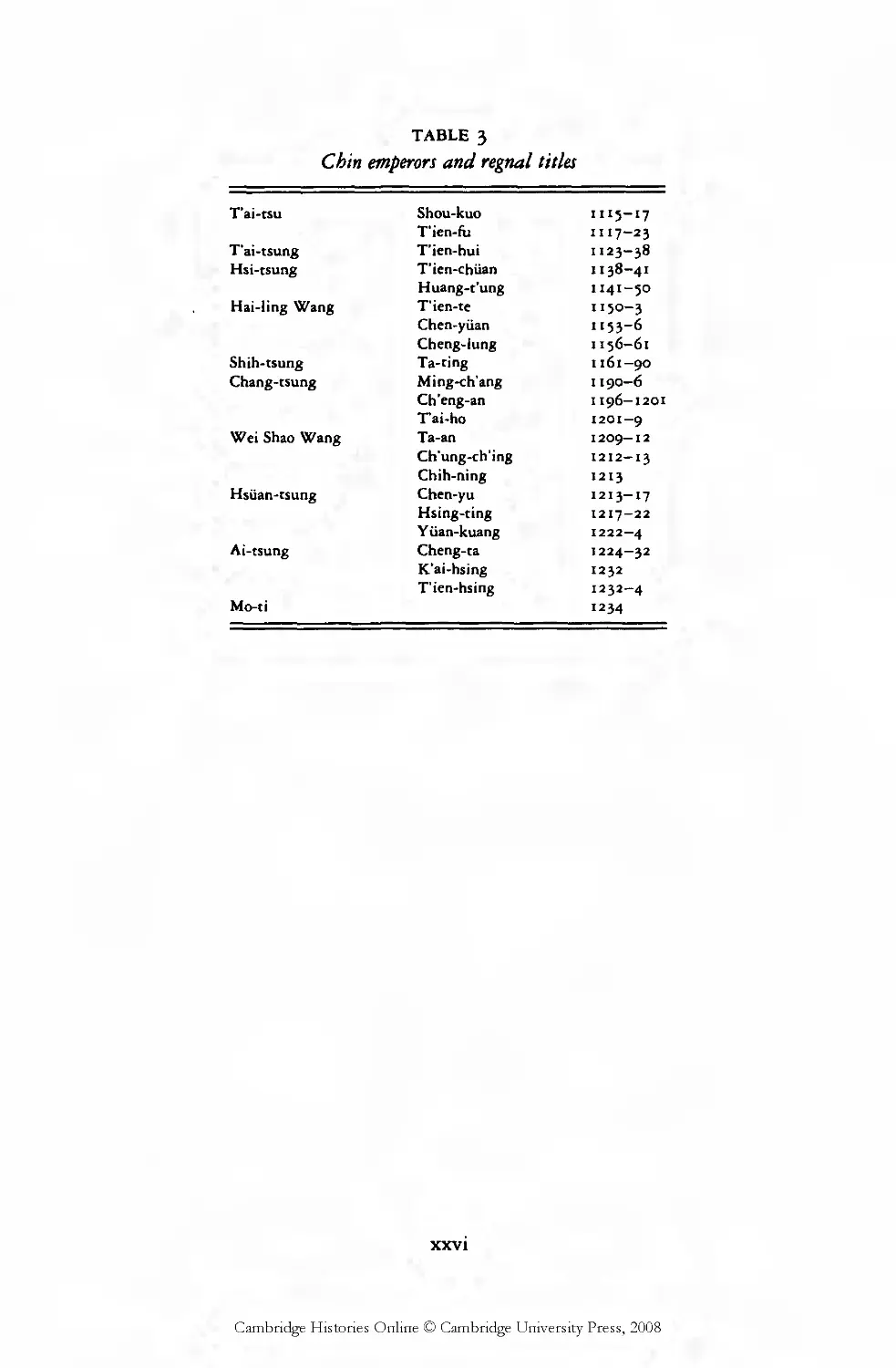
3	Chin emperors and regnal titles
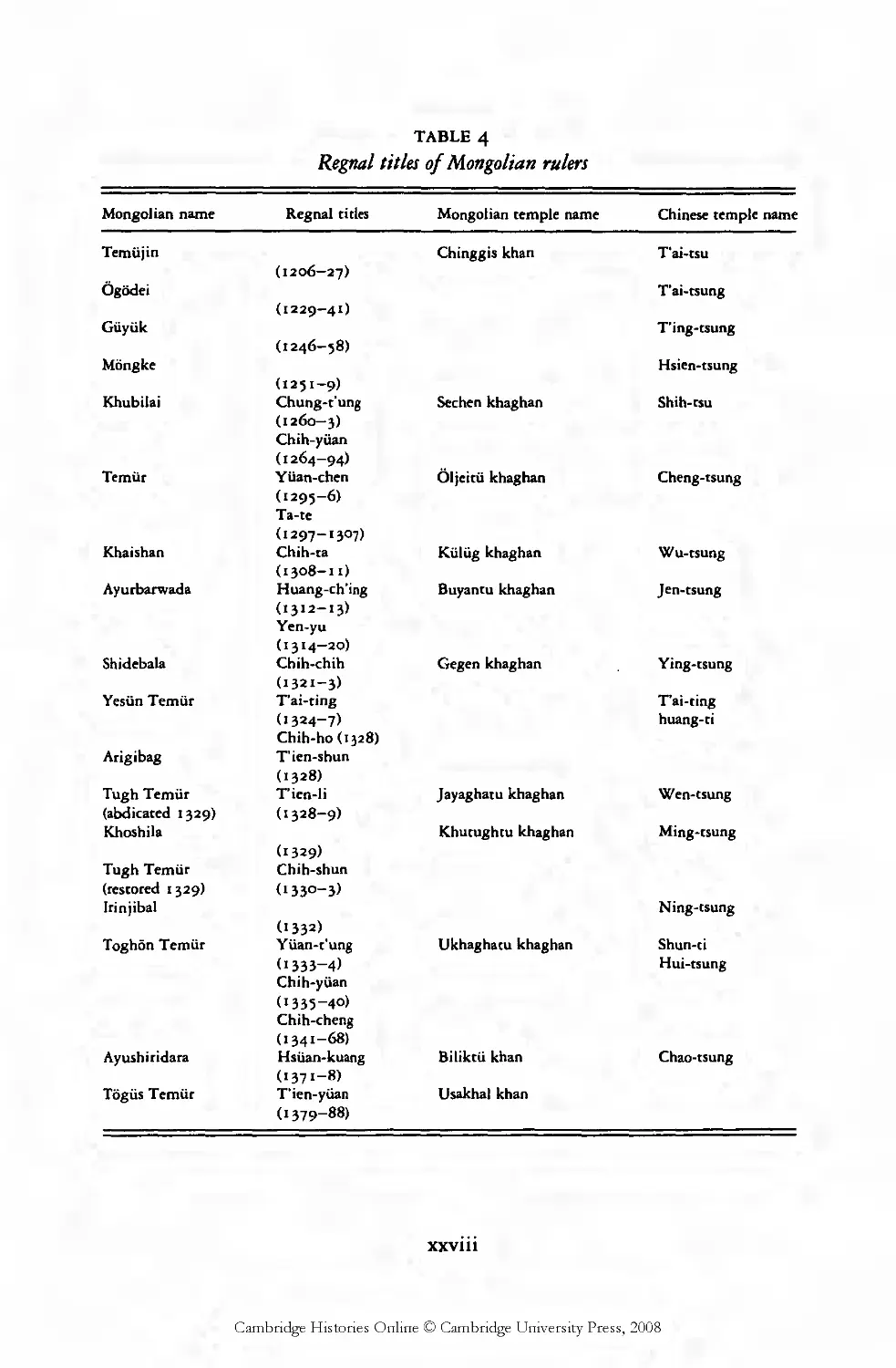
4	Regnal titles of Mongolian rulers
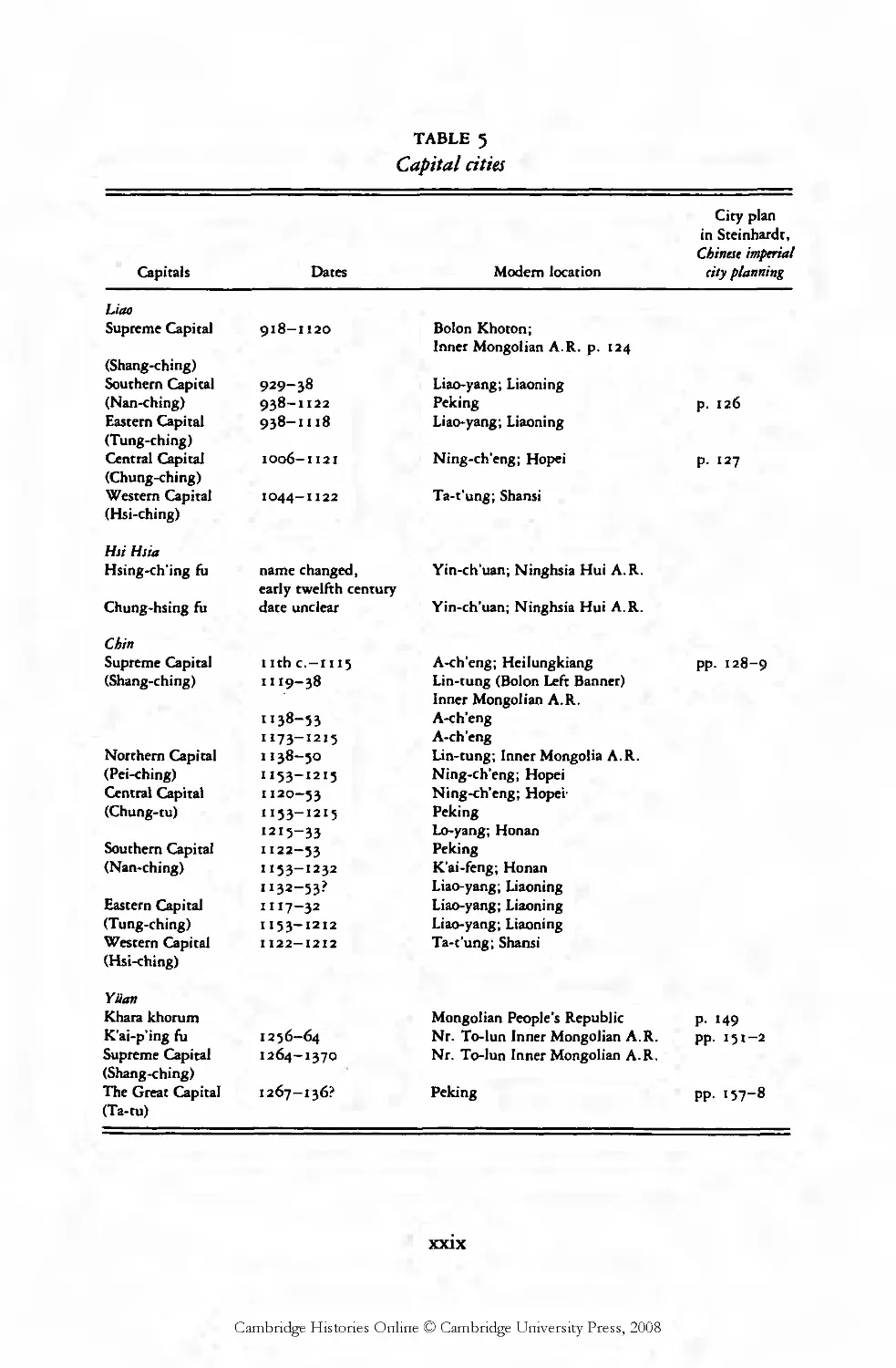
5	Capital cities
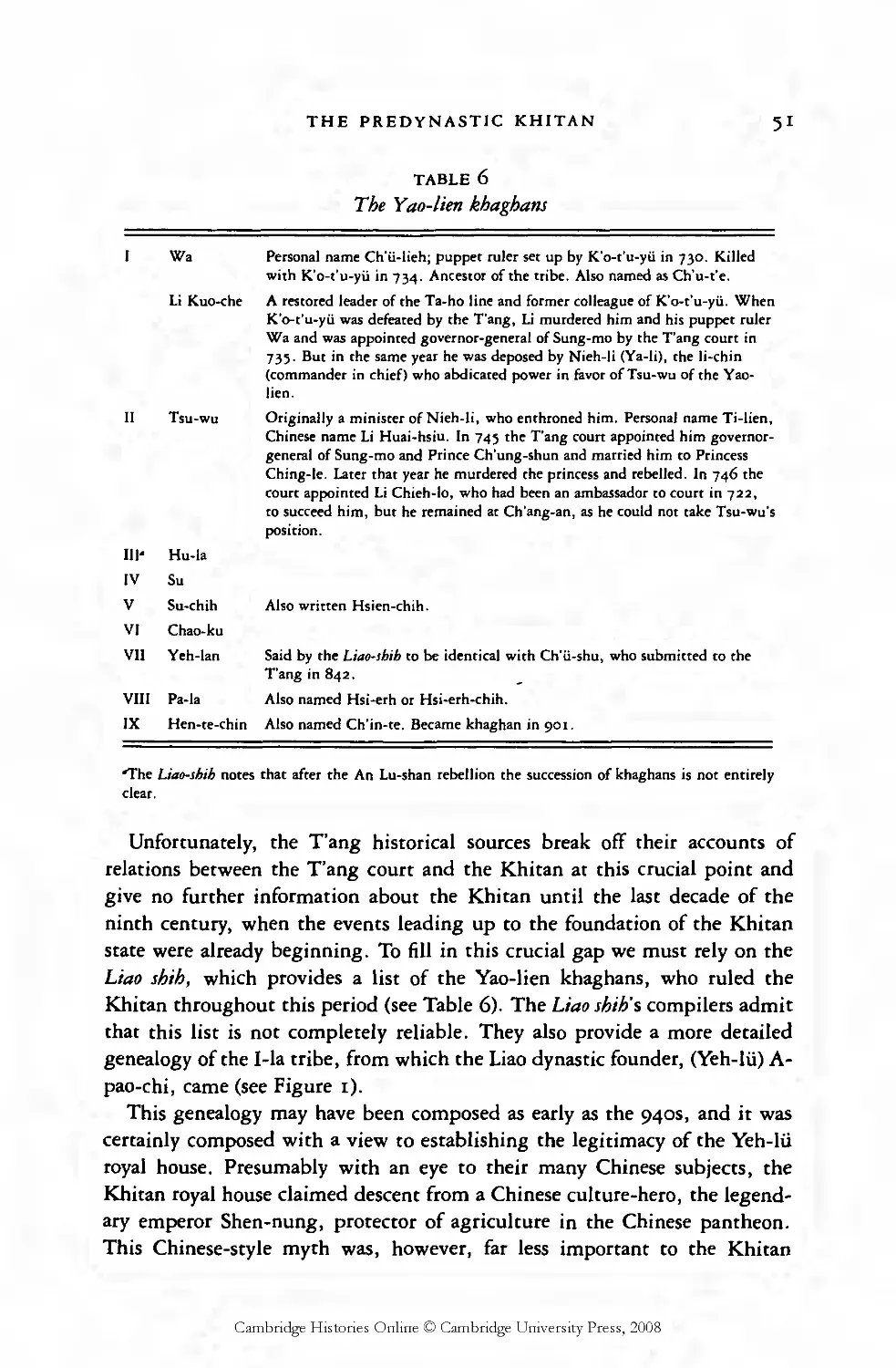
6	The Yao-lien khaghans
7	Total population of Chin
8	Numbers of households registered in Hopei and Shantung
Figures
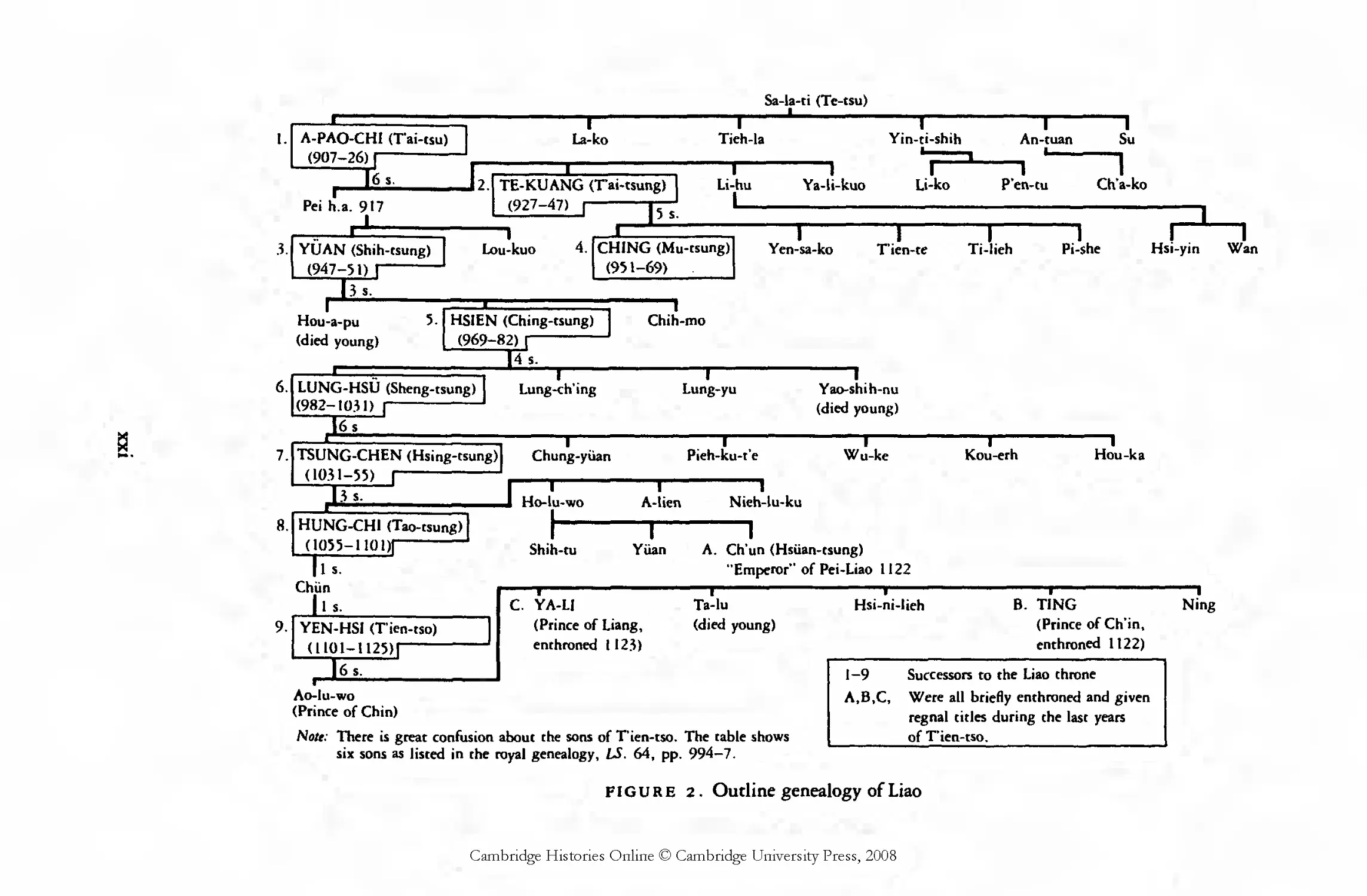
1	A-pao-chi’s descent and the structure of the Yeh-lii clan
2	Outline genealogy of Liao
3	Genealogy of the Hsia ruling house
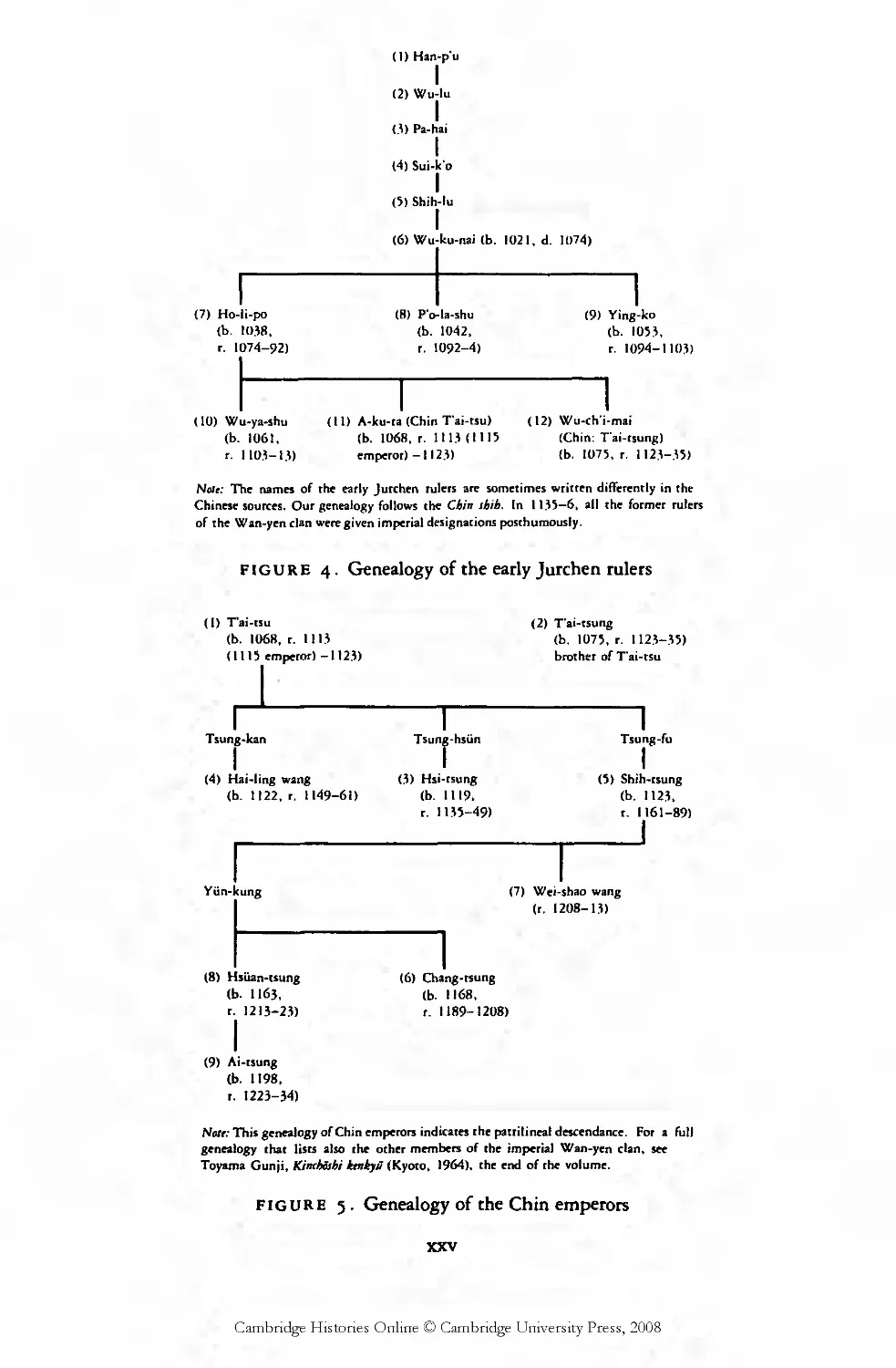
4	Genealogy of the early Jurchen rulers
5	Genealogy of the Chin emperors
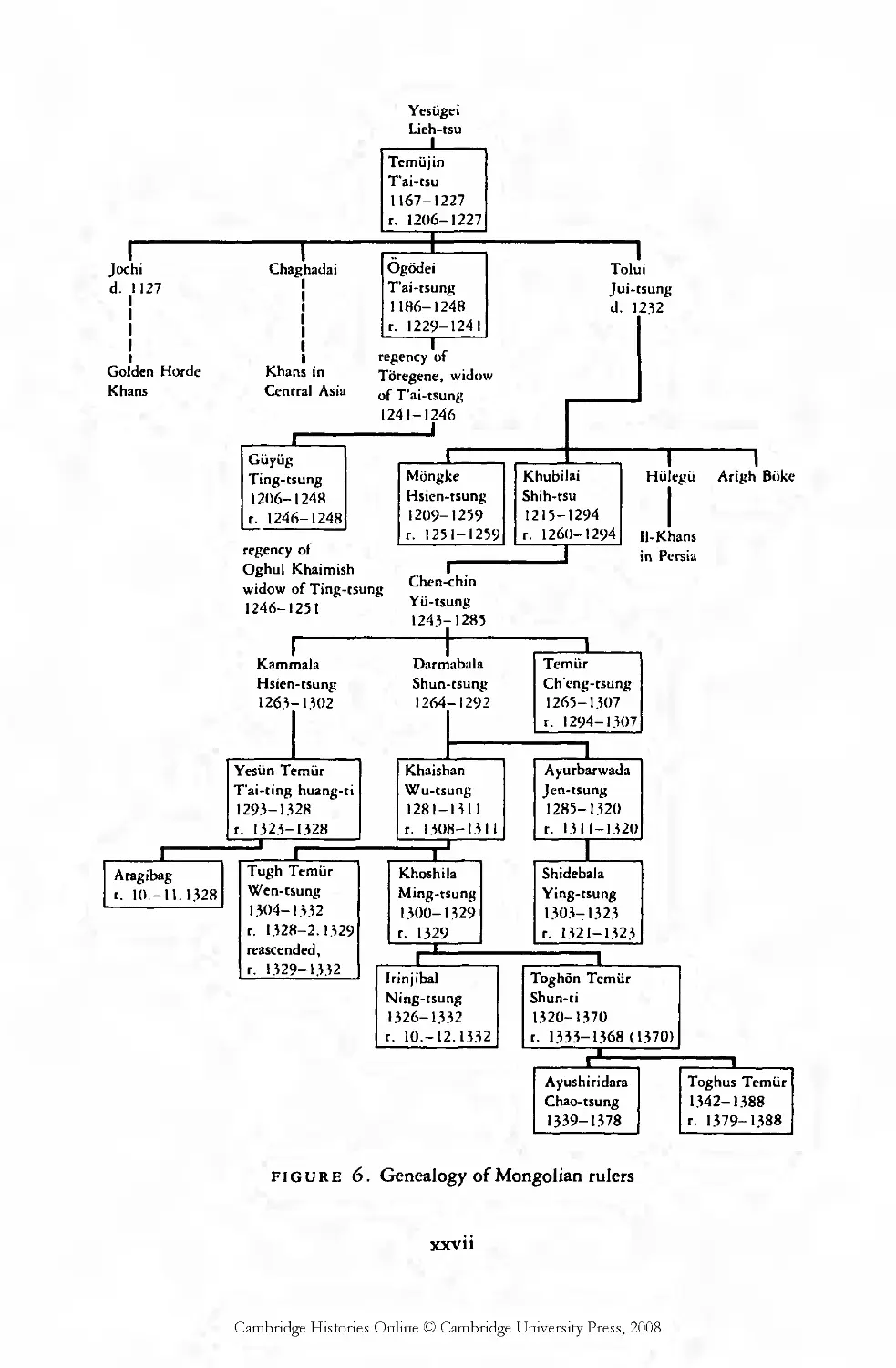
6	Genealogy of Mongolian rulers
369
371
406
425
432
438
456
477
483
486
6l9
xxii
xxiv
xxvi
xxviii
xxix
5i
278
621
XX
xxi
xxiii
XXV
XXV
xxvii
Cambridge Histories Online © Cambridge University Press, 2008

Cambridge Histories Online © Cambridge University Press, 2008

PREFACE TO VOLUME 6
Names and terms in Volume 6 of The Cambridge History of China are transliter¬
ated as follows:
Chinese is romanized according to the Wade-Giles system, which, for all
its imperfections, is employed in most of the serious literature on China
written in English. There are a few exceptions, which are noted below.
Japanese is romanized according to the Hepburn system.
Mongolian is transliterated according to the system found in A. Mostaert,
Dictionnaire ordos, vol. 3, "Index des mots du mongol ecrit et du mongol
ancien” (Peiping, 1944). The only deviations from the Mostaert system are q,
which becomes kh\ y, which becomes gh\ Z, which becomes ch\ /, which
becomes sh; and /, which becomes j.
Tibetan is transliterated according to the system used in Sarat Chandra
Das, A Tibetan—English Dictionary (Calcutta, 1902).
Persian is transliterated according to the Library of Congress system.
Turkic is transliterated according to the system found in V. M. Nadeliaev
et al., Drevnetiurkskii slovar’ (Leningrad, 1969), with the following modifica¬
tions: у becomes gh; Z becomes ch; and / becomes sh.
Chinese and Japanese personal names follow their native form, that is,
with the surname preceding the given name. In the case of Chinese and
Japanese authors of Western-language works, the names are given in the
published form, in which the given name may sometimes precede the sur¬
name (e.g., Hok-lam Chan), and the orthography may employ a system
other than Wade—Giles.
Chinese place names are romanized according to the Wade-Giles system,
with the exception of those places familiar in the English-language literature in
nonstandard postal spellings. For a list of these, see G. William Skinner, Modem
Chinese Society: A Critical Bibliography (Stanford: Stanford University Press,
1973), vol. 1, Introduction, p. xii. Modern place names are generally not
hyphenated (e.g., Hopei is the modern province of that name), whereas contem¬
porary place names are hyphenated (Ho-pei, Hsi-lu, the Chin period circuit).
The maps are based on the standard historical atlas of China: T’an Ch’i-
hsiang, ed., Chung-kuo li-shih ti-t’u chi, 2nd rev. ed. (Shanghai: Chung-hua
xvii
Cambridge Histories Online © Cambridge University Press, 2008

xviii	PREFACE TO VOLUME 6
ti-t’u hsiieh she, 1974—6; Peking: Ti-t’u ch’u-pan she, 1980—1), vol. 6,
covering Sung, Liao, Hsi-Hsia, and Chin, and vol. 7, covering the Yiian
period. Maps 23 and 37 are adapted from the Bulletin of the Museum of Far
Eastern Antiquities, 59 (1987), pp. 214, 215.
The Chinese official titles generally follow Charles O. Hucker’s A Dictionary
of Official Titles in Imperial China (Stanford: Stanford University Press, 1985).
However, for our period, this work is incomplete in some respects. The usage
of titles under all the regimes covered in this volume was constantly changing,
and the reader should remember that the same office title was often used by the
Sung, Liao, Hsia, Chin, and Yiian with somewhat different connotations,
sometimes necessitating differing English translations.
Emperors are referred to by their temple names during their reign and by their
personal names before their succession to the throne. Lists of emperors, giving
the various regnal titles used during their reigns, are provided in Tables 1-4.
Dates normally follow the Chinese form rather than the Western calendar.
The reader should be aware that the Chinese year is normally converted to a
corresponding Western year but that these do not correspond exactly. Thus,
for example, the Treaty of Shan-yiian was concluded in the Chinese year
equivalent to 1004, though this was actually 24 January 1005.
ACKNOWLEDGMENTS
The editors of this volume have faced great problems arising from the complex¬
ity of the period and its sources, and the variety of languages and cultures that
impinge on its story. We wish to express out gratitude to all those members of
the international scholarly community whose advice we have requested on
points of detail and to thank them for their careful responses. In particular, we
wish to acknowledge the assistance of Professor Frederick W. Mote, who read
and commented in detail on all the contributions to this volume, and the
editorial work of Dr. James Geiss, who devoted a decade of meticulous schol¬
arly attention to this and other volumes of The Cambridge History of China. We
also wish to thank Professor Elizabeth Endicott-West, who not only contrib¬
uted her own chapter to this volume but also assisted the editors in ensuring
that the usage of Mongolian, Turkic, Tibetan, and Persian terms is uniform
throughout, and Mrs. Soo-won Kim, who advised us on Korean problems.
Preparing this volume took several years, and our work was made possible
by the generous support of the National Endowment for the Humanities and
by Princeton University.
DCT
HF
Cambridge Histories Online © Cambridge University Press, 2008

ABBREVIATIONS
BIHP
Bulletin of the Institute of History and Philology (Academia Sinica)
(Chung yang yen chiu yuan, Li shih yii yen yen chiu so chi K’an)
cs
Chin shih
CTKC
Ch’i-tan kuo chih
CTS
Chiu T’ang shu
HCP
Hsu Tzu-chih t’ung-chien ch’ang-pien
HJAS
Harvard Journal of Asiatic Studies
HTS
Hsin T’ang shu
HYS
K’o Shao-min, Hsin Yuan shih
JAS
Journal of Asian Studies
KHCPTS
Kuo hsiieh chi pen ts’ung shu
IS
Liao shih
SKCS
Ssu k’u ch’uan shu chen pen
SPPY
Ssu pu pei yao
SPTK
Ssu pu ts’ung k’an
ss
Sung shih
THY
T’ang hui yao
TSCC
Ts’ung shu chi ch’eng
YS
Yuan shih
YTC
Та Yuan sheng cheng kuo ch’ao tien chang
XIX
Cambridge Histories Online © Cambridge University Press, 2008

в
Chih-shen*
Ti-lu-ku*
—I
Sa-la-te* (I-tsu)
Nou-H-ssu* (Su-tsu)
	I
Ko-la
(died young)
Hsia-li
Shu-la
Ti’ieh-la#
7^
Yiin-te-ibib* (Hsiian-tsu) *
Niao-ku-chih
Note: • designates members serving as chieftain (i-H-chin). Some, as shown, served more than one term. Names in italics are A-pao-chi‘s paternal ancestors,
subsequently canonized with imperial titles. No dates can be assigned; Nou-li-ssu was contemporary with the An-Lu-shan uprising (753).
figure i. A-pao-chi’s descent and the structure of the Yeh-lii clan
Cambridge Histories Online © Cambridge University Press, 2008

Sa-la-ti (Te-tsu)
A-PAO-CHI (T'ai-tsu)
(907-26) (
“1
La-ko
	,
Tieh-la
|6 s.
J7
Pei h.a. 917
. 1.
TE-KUANG (T’ai-tsung)
(927-47) |
~l
Li-hu
	1
Ya-li-kuo
Yin-ti-shih
Li-ko
P'en-tu
Ch’a-ko
YUAN (Shih-csung)
(947-51) 1
~ж
—I
Lou-kuo
HI
CHING (Mu-tsung)
(951-69)
Yen-sa-ko
T’ien-te
Ti-lieh
Pi-she
Г1
Hsi-yin
г
Hou-a-pu
(died young)
HSIEN (Ching-tsung)
(969-82)
	I
Chih-mo
ЛИ-
LUNG-HSU (Sheng-tsung)
(982-1031) |
—1бТ^
т
Lung-ch’ing
	1
Lung-yu
Yao-shih-nu
(died young)
7.
TSUNG-CHEN (Hsing-tsung)
(1031-55) I
Chung-yuan
	1
Pieh-ku-t’e
Wu-ke
	1
Kou-erh
	1
Hou-ka
Ж
Ho-lu-wo
	1
A-lien
	I
Nieh-lu-ku
HUNG-CHI (Tao-tsung)
(1055-1101)1
Shih-tu
~T~
Yuan
9.
|1 s.
Chiin
l‘ s
A. Ch un (Hsiian-tsung)
"Emperor" of Pei-Liao 1122
YEN-HSI (T'ien-rso)
(1101-1125)1
C. YA-LI
(Prince of Liang,
enthroned 1123)
Ta-lu
(died young)
Hsi-ni-lieh
B. TING
(Prince of Ch’in,
enthroned 1122)
Ao-Iu-wo
(Prince of Chin)
Note: There is great confusion about the sons of T’ien-tso. The table shows
six sons as listed in the royal genealogy, LS. 64, pp. 994-7.
1-9 Successors to the Liao throne
A,B,C, Were all briefly enthroned and given
regnal titles during the last years
of T’ien-tso.
Ning
FIGURE 2. Outline genealogy of Liao
1
Wan
Cambridge Histories Online © Cambridge University Press, 2008

TABLE I
Liao emperors and their regnal titlesf
T'ai-tsu (r. 907-26^
Shen-ts’e'
916
T'ien-tsan
922—26
T’ien-hsien
926
Tai-tsung (r. 927-47)
T’ien-hsien
926-38
Hui-t’ung
938-47
Ta-t’ung
947d
Shih-tsung (r. 947-51)
T’ien-lu
947-51
Mu-tsung (r. 951—69)
Ying-li
951-69
Ching-tsung (r. 969-82)
Pao-ning
969-79
Sheng-tsung (r. 982-1031)
Ch’ien-heng
979-83
T’ung-ho
983-1012
K’ai-t’ai
IOI2-2I
Sheng-tsung cont’d
T’ai-p’ing
I02I-3I
Hsing-tsung (r. 1031-55)
Ching-fu
IO3I-2
Ch’ung-hsi
1032-55
Tao-tsung (r. 1055-1101)
Ch’ing-ning
1055-65
Hsien-yung
1065-75
T’ai-k’ang*
1075-85
Ta-an
1085-95
Shou-lungf
IO95-IIOI
T’ien-tso (r. 1101-25)
Ch'ien-t’ung
IIOI—II
T’ien-ch’ing
II 11—2 I
Hsuan-tsung (reigned in Southern Capital,
Pao-ta
11 2 I —5
1122)
Chien-fo
1122
•This table lists information from Liao shih, chaps. 1-30. Ctii-tan kuo-chib has various differences. See the
note in Arthur C. Moule, ТЫ rulers of China (London, 1957), pp. 91-3 and table, p. 97.
tT’ai-tsu's accession appears twice in Liao shih, in 907 and 916. Probably 907 is the year when he became
paramount leader of the Ch’i-tan, and 916 is the date when he became ruler of a Chinese-style Ch’i-tan
state.
cT’ai-tsu’s accession and the dynastic founding are dated 916 by Ctii-tan kuo-chib. Before that date, Liao
shih simply numbers the years. There is some doubt whether Shen-ts’e and T’ien-tsan ever existed: They
may have been invented later to push back the date of the independent Ch’i-tan state to 916. Ctii-tan kuo-
chih dates T’ien-hsien as 927 to 937.
*Ctii-tan kuo-chih omits Ta-t’ung and dates T’ien-lu as 948 to 951.
eCtii-tan kuo-chih omits T’ai-k’ang and Ta-an.
f$hou-ch’ang in Ctii-tan kuo-chih.
XXII
Cambridge Histories Online © Cambridge University Press, 2008

#1—10: Holders of the Ting-nan military governorship at Hsia-chou.
Ssu-chung -
___ > _
• T’o-pa Ssu-kung -
1 j (d. 895)
• Ssu-chien
2
Jen-yen
1
Li Jen-fu
4 1
Jen-yu
1
1
r—1
1
1-ching
I-yin I-ch’ao
I-ch’ang
1
6| 5
3
JC'o (Kuang) -yen
K'o-jui
Chi-p'eng
9
Li Chi-ch’ien (963-Ю04): T’ai-tsu
10
Chi-yun
8
Li Te-ming (983-1032): T'ai-tsung
I
Wei-ming Nang-hsiao (Li Yuan-hao): Ching-tsung, r. 1032-48
I
Liang-tso: 1-tsung, r. 1048-67
I
Ping-ch’ang: Hui-tsung, r. 1068—86
J .
Ch‘ien-shun: Ch'ung-tsung, r. 1086—1139
i
Jen-hsiao: Jen-tsung, r. 1139-93
~l
Jcn-yu
Yen-tsung	Ch’un-yu: Huan-tsung
'	r. 1193-1206
An-ch’uan: Hsiang-tsung,
r. 1206-11
Tsun-hsiang: Shen-tsung, r. 1211-23
_l
Te-wang: Hsien-tsung, r. 1223-6
Ch'ing-p’ing chun-wang
I
Hsien, r. 1226-7
Modified from Wu T'ien-ch'ih, Hsi-bsia shih kao (1983), p. 292.
FIGURE з . Genealogy of the Hsia ruling house
xxiii
Cambridge Histories Online © Cambridge University Press, 2008

TABLE 2
Hsia emperors and regnal titles
Ching-tsung (r. 1032-48)
Hsien-tao (1032)
Kuang-yiin (1035) (originally K’ai-yiin)
Ta-ch'ing (1036—8)
T'ien-shou li-fa yen-tso (1038—48)
I-csung (r. 1048-67)
Yen-ssu ning-kuo (1049)
T'ien-yu ch'ui-sheng (1050—2)
Fu-sheng ch'eng-tao (1053-6)
Ch'an-tu (1057-62)
Kung-hua (1063-7)
Hui-tsung (r. 1068-86)
Ch’icn-tao (1068—9)
T'ien-ssu li-sheng kuo-ch'ing (юб9-?Ю74)
Ta-an (1074-84?)
T'ien-an li-ting (? 1085-6)
Ch’ung-csung (r. 1086— 1139)
T'ien-i chih-p'ing (?io86—9)
T'ien-yu min-an (1090-7)
Yung-an (1098-1100)
Chen-kuan (1101 —13)
Yung-ning (1114-18)
Yuan-te (1119-26)
Cheng-te (1127-34)
Ta-te(i 135-9)
Jen-tsung (r. 1139-93)
Ta-ch'ing (1140-3)
Jen-ch'ing (1144-8)
T’ien-sheng (1149—? 1169)
Ch'ien-yu (1170-93)
Huan-tsung (r. 1193-1206)
T'ien-ch’ing (1194-1206)
Hsiang-tsung (r. 1206-11)
Ying-t'ien (1206-9)
Huang-chien (121 o-11)
Shen-csung (r. 1211 -2 3)
Kuang-ting (1211-23)
Hsien-csung (r. 1223-6)
Ch’ien-ting (1223-6)
Hsien (r. 1226—7)
?Pao-i (1226-7)
XXIV
Cambridge Histories Online © Cambridge University Press, 2008

(1)	Han-p'u
I
(2)	Wu-lu
I
(3)	Pa-hai
(7) Ho-li-po
(b. 1038,
r. 1074-92)
(4)	Sui-k'o
I
(5)	Shih-lu
I
(6)	Wu-ku-nai (b. 1021, d. 1074)
(8) P'o-la-shu
(b. 1042,
r. 1092-4)
(9) Ying-ko
(b. 1053,
r. 1094-1103)
(10) Wu-ya-shu
(b. 1061,
r. 1103-13)
(11) A-ku-ta (Chin T’ai-tsu)
(b. 1068, r. 1113 (П15
emperor) - 1123)
(12) Wu-ch'i-mai
(Chin: T'ai-tsung)
(b. 1075, r. 1 123-35)
Note: The names of the early Jurchen rulers are sometimes written differently in the
Chinese sources. Our genealogy follows the Chin shih. In 1135-6, all the former rulers
of the Wan-yen clan were given imperial designations posthumously.
FIGURE 4. Genealogy of the early Jurchen rulers
(1) T’ai-tsu
(b. 1068, r. 1113
(1115 emperor) -1123)
(2) T'ai-tsung
(b. 1075, r. 1 123-35)
brother of T’ai-tsu
Tsung-kan
I
1
Tsung-hsun
I
1
Tsung-fu
1
1
(4) Hai-ling wang
1
(3) Hsi-tsung
1
(5) Shih-tsung
<b. 1122, r. 1149-61)
(b. 1119,
(b. 1123,
r. 1135-49)
r. 1161-89)
1
Yiin-kung
(7)	Wei-shao wang
(r. 1208-13)
(8)	Hsuan-tsung
(b. 1163,
r. 1213-23)
(6) Chang-tsung
(b. 1168,
r. 1189-1208)
(9)	Ai-tsung
(b. 1198,
r. 1223-34)
Note: This genealogy of Chin emperors indicates the patrilineal descendance. For a full
genealogy that lists also the other members of the imperial Wan-yen clan, see
Toyama Gunji, Kinchoshi кепкуй (Kyoto, 1964), the end of the volume.
figure 5. Genealogy of the Chin emperors
XXV
Cambridge Histories Online © Cambridge University Press, 2008

TABLE 3
Chin emperors and regnal titles
T’ai-tsu
Shou-kuo
Ш5-17
T'ien-fu
Ш7-23
T'ai-tsung
T’ien-hui
1123-38
Hsi-tsung
Tien-chiian
1138-41
Huang-t’ung
1141-50
Hai-ling Wang
T’ien-te
1150-3
Chen-yiian
1153-6
Cheng-iung
1156—61
Shih-tsung
Ta-ting
1161-90
Chang-tsung
Ming-ch'ang
i190-6
Ch’eng-an
1196—1201
T’ai-ho
1201—9
Wei Shao Wang
Ta-an
1209-12
Ch’ung-ch’ing
1212-13
Chih-ning
1213
Hsiian-tsung
Chen-yu
1213-17
Hsing-ting
1217-22
Yiian-kuang
1222—4
Ai-tsung
Cheng-ta
1224—32
K’ai-hsing
1232
T’ien-hsing
1232-4
Mo-ti
1234
Cambridge Histories Online © Cambridge University Press, 2008

Yesiigei
Lieh-tsu
figure 6. Genealogy of Mongolian rulers
xxvil
Cambridge Histories Online © Cambridge University Press, 2008

TABLE 4
Regnal titles of Mongolian rulers
Mongolian name
Regnal titles
Mongolian temple name
Chinese temple name
Temiijin
(1206-27)
Chinggis khan
T’ai-tsu
Ogddei
(1229-40
T’ai-tsung
Giiytik
(1246-58)
T’ing-csung
Mongke
(1251-9)
Hsien-tsung
Khubilai
Chung-t’ung
(1260-3)
Chih-yuan
(1264-94)
Sechen khaghan
Oljeitii khaghan
Shih-tsu
Temur
Yiian-chen
(1295-6)
Ta-te
(1297-1307)
Cheng-tsung
Khaishan
Chih-ta
(1308-11)
Kiilug khaghan
Wu-tsung
Ayurbarwada
Huang-ch'ing
(1312-13)
Yen-yu
(1314-20)
Buyantu khaghan
Jen-tsung
Shidebala
Chih-chih
(1321-3)
Gegen khaghan .
Ying-tsung
Yesiin Temur
T’ai-ting
T’ai-ting
(1324-7)
Chih-ho (1328)
huang-ti
Arigibag
T'ien-shun
(1328)
Tugh Temur
T’ien-li
Jayaghatu khaghan
Wen-tsung
(abdicated 1329)
(1328-9)
Khoshila
(1329)
Khutughtu khaghan
Ming-tsung
Tugh Temur
Chih-shun
(restored 1329)
(1330-3)
irinjibal
(1332)
Ning-tsung
Toghdn Temiir
Yuan-t’ung
Ukhaghatu khaghan
Shun-ti
(1333-4)
Chih-yiian
(1335-40)
Chih-cheng
(1341-68)
Hui-tsung
Ayushiridara
Hsiian-kuang
(1371-8)
Biliktu khan
Chao-tsung
Togus Temiir
T'ien-yiian
(! 379-88)
Usakhal khan
xxvui
Cambridge Histories Online © Cambridge University Press, 2008

TABLE 5
Capital cities
Capitals
Dates
Modern location
City plan
in Steinhardt,
Chinese imperial
city planning
Liao
Supreme Capital
(Shang-ching)
918-1120
Bolon Khoton;
Inner Mongolian A.R. p. 124
Southern Capital
929-38
Liao-yang; Liaoning
(Nan-ching)
938-1122
Peking
p. 126
Eastern Capital
(Tung-ching)
938-1118
Liao-yang; Liaoning
Central Capital
(Chung-ching)
1006-1121
Ning-ch'eng; Hopei
p. 127
Western Capital
(Hsi-ching)
IO44-I 122
Ta-t’ung; Shansi
Hu Hsia
Hsing-ch'ing fu
name changed,
early twelfth century
Yin-ch’uan; Ninghsia Hui A.R.
Chung-hsing fit
date unclear
Yin-ch’uan; Ninghsia Hui A.R.
Chin
Supreme Capital
nth C.-1115
A-ch'eng; Heilungkiang
pp. 128-9
(Shang-ching)
1119-38
1138-53
1173-1215
Lin-tung (Bolon Left Banner)
Inner Mongolian A.R.
A-ch’eng
A-ch’eng
Northern Capital
1138-50
Lin-tung; Inner Mongolia A.R.
(Pei-ching)
1153-1215
Ning-ch’eng; Hopei
Central Capital
1120-53
Ning-ch’eng; Hopei-
(Chung-tu)
"53—>215
1215-33
Peking
Lo-yang; Honan
Southern Capital
1122—53
Peking
(Nan-ching)
1153-1232
1132-53?
K’ai-feng; Honan
Liao-yang; Liaoning
Eastern Capital
1117-32
Liao-yang; Liaoning
(Tung-ching)
II53-I2I2
Liao-yang; Liaoning
Western Capital
(Hsi-ching)
I 122—1212
Ta-t’ung; Shansi
Yuan
Khara khorum
Mongolian People’s Republic
P. 149
K'ai-p'ing hi
1256-64
Nr. To-lun Inner Mongolian A.R.
pp. 151-2
Supreme Capital
(Shang-ching)
1264-1370
Nr. To-lun Inner Mongolian A.R.
The Great Capital
(Ta-tu)
1267-136?
Peking
pp. 157-8
XXIX
Cambridge Histories Online © Cambridge University Press, 2008

Cambridge Histories Online © Cambridge University Press, 2008

INTRODUCTION
The four regimes that form the subject matter of this volume have generally
received negative treatment from traditional Chinese historians and have
been viewed as an interruption in the grand sweep of Chinese history. Each
was established by a non-Chinese ruling group, who maintained their own
cultural identity while ruling over a multiethnic state including large Han
Chinese populations, and each controlled large territories that had long been
ruled by Chinese. Each regime presented a challenge to the integrity of
Chinese culture and to China’s deeply rooted assumptions about its cultural
supremacy and international order.
Yet these regimes were remarkably successful. The Khitan Liao dynasty
lasted longer than had any previous Chinese dynasty except for the Han and
the T’ang. For more than a century after the fall of the T’ang dynasty in 907,
the Tangut in northern Shensi and Kansu clung tenaciously to the regional
authority that they had acquired under the late T’ang and then formed their
own empire of Hsia, which as an independent state survived for two centuries
more. More than two centuries after the collapse of Khitan power, the official
historians of the Mongolian Yuan court grudgingly conceded to the Liao the
title of a legitimate dynasty but denied that status to Hsia, who would seem
to us to have had almost as good a claim. Both were long-lasting, stable
regimes, firmly rooted in territories that had been in part settled by Han
Chinese for a millennium, and both regimes survived in the face of a hostile
Chinese regime, the Sung, whose population outnumbered them twenty to
one and whose economic resources were even more overpoweringly superior.
Both fought the Sung to a standstill, forced the Sung to recognize their
existence and parity as sovereign regimes, and extracted large subsidies from
them in exchange for peace.
The Jurchen Chin were still more successful, emerging from what had
always been a remote borderland of the Chinese world first to conquer the
Liao empire and then to wrest control over all of north China from the Sung.
Whereas the Khitan and Tangut had been multiracial border regimes in
which the Han Chinese, though probably the majority of the population and
certainly the producers of much of the country’s wealth, had not been over-
1
Cambridge Histories Online © Cambridge University Press, 2008

2
INTRODUCTION
whelming in numbers, the Chin empire had a burgeoning Chinese popula¬
tion of between thirty million and forty million. The Jurchen regime in
China was necessarily far more of an accommodation to traditional methods
of government than had been those of the Khitan or Tangut. It was also a
state that could claim far more realistically to have been an equal rival to the
Sung, “another China."
The Mongolian Yuan dynasty was quite distinct from its predecessors. For
the Liao, its Chinese domains had been, at least in the beginning, an almost
accidental extension of a regime whose political heart always remained in its
home grasslands. The Jurchen had kept their tribal home territories in the
northeast but soon became essentially a Chinese dynasty with their capital in
China. The Mongols overwhelmed the Hsia and Chin and took possession of
northern China as merely one part of an unparalleled explosion of military
power aimed at world conquest, which made them masters of northern
Eurasia from the borders of Hungary and Poland to the Sea of Japan. The
Mongols’ conception of “All under Heaven” was far grander than anything
dreamed of by the Han, T’ang, or Sung, or indeed by any other Chinese
regime. China became for a while only part of a much larger political order.
By the time Khubilai conquered the Southern Sung and brought the entire
country under Mongolian rule, the Mongolian empire had been fractured
into rival khanates, but China — now the whole of China, with well over ioo
million people — remained just one part of a larger empire. Unlike its prede¬
cessors, when the Yuan regime in China collapsed the Mongols simply
retreated to their homeland in the steppe and, there, continued to be a major
power for several centuries.
Each of these regimes was in its own way successful, and each of their
dominant peoples proved adaptable and yet maintained their own identity.
They controlled large areas of north China for centuries. The region around
Peking, for example, remained in alien hands for well over four centuries,
and the western part of Kansu Province was restored to Chinese control under
the first Ming emperor after six centuries of foreign domination. Moreover,
the whole of north China was under non-Chinese rule for well over two
hundred years.
Although an ever-increasing part of China thus fell into foreign hands,
these regimes may also be looked at in a different light, as a part of a much
lengthier reverse process by which Chinese-style bureaucratic governance
became the political norm in East Asia and was adopted and adapted by
regimes outside Chinese control and beyond what had been traditionally
Chinese territory. This development can be traced back to KoguryS, to the
other Korean kingdoms of Silla and Paekche, to the unified Silla from the
seventh century onward, and to seventh- and eighth-century Japan. The
Cambridge Histories Online © Cambridge University Press, 2008

THE LATE T’ANG BALANCE OF POWER
3
immediate predecessor of the Liao as a stable northeastern state was Po-hai
(Parhae) in southeastern Manchuria (719—926), the conquest of which was
perhaps a more important stage in the establishment of Khitan power than
was the acquisition of the sixteen Chinese prefectures in 937. Po-hai was an
independent state, with five capitals, a sophisticated Chinese-style bureau¬
cratic government, an elite with a mastery of literary Chinese, and a devel¬
oped culture that had emerged and flourished for two centuries on the
borders of the T'ang empire.1 A somewhat similar regime had been in
existence since the early eighth century in Nan-chao, occupying modern
Yunnan.2 3 These two fiercely independent “satellite regimes” of T’ang repre¬
sented the same general political development — the adaptation of Chinese
institutions by non-Chinese populations — one aspect of the larger process by
which surrounding peoples were incorporated into the Chinese institutional
and cultural system.
This could happen in a variety of ways: In the case of the Hsia, Koguryd,
and also Vietnam - which finally threw off Chinese rule in the early tenth
century and became an independent state on the Chinese model* — some of
their peoples had lived under Chinese provincial administration for centuries
and, when they finally broke free to form their own states, continued to
employ familiar methods of government. At the other extreme, Japan, Po-
hai, and Nan-chao occupied areas that had never been effectively ruled by a
Chinese dynasty, but their peoples were familiar with China and its institu¬
tions and imitated familiar Chinese models when they themselves formed
independent states. And these various adaptations took place in a world that
was fundamentally changing.
THE LATE T’ANG BALANCE OF POWER
One of the problems of traditional Chinese historiography in its dealings
with foreign peoples has been its failure to match unchanging theory with
constantly evolving actuality. The ancient ideal of the “five zones of submis¬
sion” envisioned a world in which China, or rather its ruling dynasty, the
bearers of the Mandate of Heaven to control mankind, were the sole legiti¬
mate possessors of unquestioned authority — authority that was at once politi¬
cal, cultural, and moral. The surrounding peoples, the “barbarians” who did
not fully participate in Chinese culture, should in this ideal model voluntar¬
1	On the emergence of Po-hai, see Denis C. Twitchett and John K. Fairbank, eds., Sui and T’ang China,
389—906, pt. 1, vol. 3 of The Cambridge history of China (Cambridge, 1979), pp. 440—3.
2	On Nan-chao, see Charles Backus, The Nan-chao kingdom and T’ang China’s southwestern frontier (Cam¬
bridge, 1981).
3	See Keith W. Taylor, The birth of Vietnam (Berkeley and Los Angeles, 1983).
Cambridge Histories Online © Cambridge University Press, 2008

4
INTRODUCTION
ily submit to the emperor and become his vassals, and their countries would
become a sort of outer perimeter under the emperor’s moral authority but
beyond his real control and outside the realm of civilian direct administra¬
tion. Despite centuries of contacts with the real outside world, this model
persisted as a symbol of the world as the Chinese elite imagined it should be.
Remnants of these attitudes, based on an imaginary world sharply divided
between Chinese and barbarians, continued to undermine China’s relations
with other peoples for centuries after the period covered by this volume.
This was a theory that may have had some validity in the distant past,
when China was surrounded on all sides by peoples with a somewhat lower
level of cultural development and with loose and ill-articulated forms of
political organization. But it had changed forever during the T’ang. In the
Sui period, only one of China’s neighbors, KoguryS in northern Korea and
southeastern Manchuria, had any claim to be a “state” with a mainly seden¬
tary population and stable institutions. All the other border peoples, from
Yunnan to the border of Hopei, were tribal peoples, many of them living a
seminomadic life without any permanent large-scale structures of govern¬
ment, although they might join together to become a potent threat in times
of crisis. Perhaps more important, none of them had a written language
except Koguryd, which employed Chinese. By 750 that situation had com¬
pletely changed: Late T’ang China was ringed with stable states — Nan-chao
in Yunnan; the great aggressive Tibetan kingdom along its long border with
Szechwan, Kansu, and what is now Sinkiang; the 'Abbassid caliphate in the
far west; the Turkish (T’u-chiieh) and later the Uighur “empires” in the
Mongolian steppe; Po-hai in Manchuria; Silla in Korea; and, far away, Japan.
All these states had literate elites, some employing Chinese as a written
language and others using writing systems of their own.
Events in the 750s and 760s had further stabilized this situation. After the
disasters of An Lu-shan’s rebellion, T’ang forces abandoned their far western
protectorates in Sinkiang and also the extensive areas under regular Chinese
civil administration in Turfan, Hami, and the Kansu corridor. All Kansu was
occupied by the Tibetans. From the 730s to the 750s T’ang armies had
intervened in the Pamir region, fought the armies of the ’Abbassid caliph on
the Talas near Ferghana, invaded Nan-chao, and attempted to conquer the
Khitan in the northeast. After 763 the T’ang took up a totally defensive
posture. No T’ang expeditionary force was ever again sent against a neighbor¬
ing state with an eye to conquest. Even when the chance arose in the 850s,
the T’ang court deliberately decided not to reoccupy the lost prefectures of
the northwest.
During the late eighth and early ninth centuries there had gradually
emerged a novel and stable international situation in which the T’ang used
Cambridge Histories Online © Cambridge University Press, 2008

THE LATE T’ANG BALANCE OF POWER
5
diplomacy as much as armed force and in which the other players on the
international scene also gradually evolved stable relationships among them¬
selves that were underpinned by treaties. In 822 the T’ang entered this
interstate system when they finally concluded a treaty with Tibet on the basis
of equality. And China was no longer the center around which international
relations revolved, although ambassadors and embassies continued regularly
to visit Ch’ang-an. In the west the Uighurs, Tibetans, Nan-chao, and the
Arabs were involved in conflicts among themselves and developed their own
network of alliances and treaties, and in the northeast Silla, Po-hai, and
Japan formed another diplomatic network employing Chinese as their com¬
mon language and formalities derived from the T’ang system. In neither of
these networks were the T’ang direct participants.
In 840, the only immediate neighbors of China who were not an organized
state were the tribal nations of the Khitan and Hsi, living to the north of
modern Hopei and in western Liao-ning. They were, for the moment, vassals
of the Uighur khaghans, though they still also retained close and regular
relations with the Chinese court.
Then around 840 the stability of northern Asia began to unravel. First, the
Tibetan kingdom suddenly collapsed, owing to internal causes that remain to
be satisfactorily explained. Almost immediately thereafter the Uighur em¬
pire disintegrated, and the Uighurs abandoned their capital city, Kara-
balghasun, and their homeland in Mongolia to settle in eastern Sinkiang,
Turfan, Hami, and the Kansu corridor. Their Khitan and Hsi vassals trans¬
ferred their loyalty to the T’ang court.
Toward the end of the century came a collapse of central authority that
spread through East Asia like an epidemic: The T’ang empire was destroyed
by Huang Ch’ao’s rebellion and was an empire only in name from 880
onward. Long before its formal end in 907 in reality it had disintegrated into
numerous independent local regimes, competing for hegemony and con¬
stantly at war with one another. For more than half a century after 907,
China was divided among as many as ten regional states. In the last years of
the century, central authority began to break down in Japan; in Korea, the
Silla kingdom broke up into three regional warlord states; in Manchuria, Po-
hai went into a terminal decline; and in the far southwest Nan-chao too fell
apart. The fragmentation of China itself during the Five Dynasties was
paralleled everywhere in East Asia.
It was against this background that the Khitan state of Liao emerged.
There was no sudden breakdown of an international order imposed by the
T’ang, as is sometimes suggested. That order had disappeared forever in the
late eighth century, modified into something quite new and replaced by a
novel framework of international relations. But this, too, had collapsed in its
Cambridge Histories Online © Cambridge University Press, 2008

6
INTRODUCTION
turn, and in a.d. 900 the international situation had been fluid for some
sixty years, and governments were collapsing everywhere. In this situation of
near anarchy, the Khitan gradually, almost accidentally, became players in
the game of warlord politics in north China, as well as in the world of the
steppe, the control of which was their first objective. Moreover, the situation
was to remain fragmented for years to come. In China itself, the political
fragmentation lasted for almost a century, from the fall of Ch’ang-an to
Huang Ch’ao in 880 to the final conquest of the Northern Han by the Sung
armies in 979. For much of that period China was divided into as many as
nine or ten regional states, and until 960 the north was ruled by a succession
of unstable and short-lived military regimes. During that period, military
force determined the shape of politics and continued to be a major factor in
the first decades of the Sung.
Not only was the early tenth century dominated by the generals in north
China; it also was a period during which many of the regional warlords were
non-Han generals, particularly Sha-t’o Turks. Li K’o-yung, the greatest of
these, had been instrumental in putting down Huang Ch’ao and was the de
facto ruler of northern Shansi long before the formal end of the T’ang in 907,
and one of the contenders for power in the constant civil wars that blighted
the twilight of the T’ang in the 880s and 890s. After the fall of T’ang his
state (known as Chin) became an independent entity. In 921 Li K’o-yung’s
successor reunified north China by destroying the Liang and then set himself
up as emperor of the restored Later T’ang dynasty (923—37).
For a quarter of a century, all of north China was under Sha-t’o rule, first
under the Later T’ang and then under their successors the Chin (937-46). Li
K’o-yung had already involved the Khitan in a short-lived alliance as early as
905. By the 920s they were drawn in as full-fledged participants in north
Chinese politics: The Chin were their puppets and ceded to them sixteen
border prefectures with Chinese populations. They were also wooed as allies
by the independent courts of southern China. Between 944 and 947 the
Khitans attempted to invade China, took the Chin capital, destroyed the
dynasty and briefly set up one of their own, but wisely decided that the risks
were too great and withdrew, leaving north China in the hands of yet another
Sha-t’o military dynasty, the Han (947-50). Although this regime soon
collapsed as a dynasty, its successors retained their independence in the
Sha-t’o homeland in Shansi until 979.
Large parts of northern China were thus under the rule of the Sha-t’o for
many years: in the case of northern Shansi, for a century. But the Sha-t’o were
not the only foreign leaders of local regimes on Chinese soil at this time. The
northwest, which was Tibetan-occupied territory until the 840s, was split
among a variety of local warlords: Chinese in Tunhuang; Uighur in Turfan,
Cambridge Histories Online © Cambridge University Press, 2008

THE FRONTIER
7
Kan-chou, and Su-chou; Tibetan in Liang-chou; and Tangut on the southern
borders of the Ordos. The Tanguts, like the Sha-t’o, had been settled in the
region by the T’ang as a frontier garrison force and had clung to their local
power through the disturbed times of the early tenth century. They later
emerged as founders of a powerful multiethnic empire, the Hsia or Hsi Hsia,
which in the early eleventh century assimilated all the fragmented local
regimes of the northwest under its own control. Like the Sha-t’o, the Tanguts
were not alien invaders of Chinese territory but were non-Han people who
had been settled inside the T’ang frontiers by deliberate government policy
and had long been a part of the T’ang provincial and military organization.
The roots of two of our major regimes, the Liao and the Hsi Hsia, can thus
be traced into the political and military turmoil of the late ninth and early
tenth centuries. It is also important to see how they were rooted in the
frontier order established by the T’ang.
THE FRONTIER
Traditional histories of China depict the Khitan, Jurchen, and Mongols as
“outsiders,” inrupting into “Chinese” territory. But this is a misleading
oversimplification that needs to be laid to rest forever.4 In spite of what is
shown in modern historical atlases, the T’ang, like its predecessors, never
had any clearly defined and demarcated northern frontier. People still some¬
times spoke of the “Great Wall,” and some remnants of earlier fortifications
still existed, but this term was used only to express a vague idea of China’s
limits.5 There was never a continuous defensive line or a defined frontier.
There was a line of fortified border prefectures and counties, a few fortresses
in strategic places, and a scattering of military colonies, military stud farms,
beacon signal towers, and military picket-outposts. It was a defense in depth,
with its backbone formed by powerful provincial armies at Ling-chou, Tai¬
yuan, Ta-t’ung, and Peking. Only on the Tibetan frontier did the T’ang
maintain a massive static defense, and only the Tibetan frontier was from
time to time demarcated in disputed areas by mutual negotiation. But in the
north, T’ang control was defined by the extent of the border prefects’ author¬
ity, and this constantly changed.
This “frontier” was further obscured by another aspect of early T’ang
military policy. The tribal peoples of the border districts were brought
4	For an interesting new analysis of the relations between nomadic peoples and their sedentary neighbors,
see Anatoli M. Khazanov, Nomads and the outside world, trans. Julia Crookenden (Cambridge, 1984). For
a new interpretation of China’s relations with its steppe neighbors since the Han period, see Thomas J.
Barfield, The perilous frontier: Nomadic empires and China, ed. Charles Tilly (Oxford, 1989).
5	On this problem, see Arthur N. Waldron, The Great Wall: From history to myth (Cambridge, 1990).
Cambridge Histories Online © Cambridge University Press, 2008

8
INTRODUCTION
partially within China’s political orbit by a complex system of agreements
and understandings through which they were incorporated into a system of
indirect rule, under which their leadership was co-opted into the T’ang
government system “on a loose rein” and given titles, offices, ranks, and
emoluments. The tribal groups were organized in a loose hierarchy of prefec¬
tures (chou) and governments-general (tu-tu-fu) overseen by T’ang border
commanders. They did not in fact participate in the T’ang system of govern¬
ment; rather, their chieftains ruled their peoples according to native custom.
Their hierarchy of Chinese titles was largely a formalization in Chinese terms
of the existing tribal structures, in the stable continuance of which both their
own chieftains and the T’ang government alike had a vested interest. The
tribal leaders were periodically invested with new titles and were given gifts
and subsidies to ensure their continuing loyalty.
The larger and more powerful border peoples and their paramount leaders
were inducted even further into the T’ang order by the bestowal of the T’ang
imperial surname, with the implication of their incorporation into the impe¬
rial family’s system of kinship; by marriage of their rulers with T’ang prin¬
cesses, to establish a dynastic marriage relationship; and by the education of
their future rulers in China as "hostage princes,” usually serving long terms
as officers in the imperial guards. The embassies that attended the Chinese
court often included large numbers of prominent tribesmen in addition to
the ambassador, and these people, too, became familiar to some extent with
things Chinese. None of these measures, of course, went very far in making
Han Chinese out of the tribal leaders. But they were successful in that they
gave tribal leaders a firsthand knowledge of the capital and court and of
Chinese institutions and methods of government, and they produced an
influential minority among those familiar with the Chinese language and
customs. None of the immediate neighbors of T’ang China was really igno¬
rant of China, whether or not they chose to imitate Chinese models.
Thus the idea of a “frontier” in T’ang China was a multilayered one. There
was the outer zone of people who were part of the “Chinese world” by virtue of
their participation in the tributary system; there was an inner zone of tribal
people under very loose indirect rule; and there was the outer limit of the T’ang
military defense system and the outer limit of effective civil government.
There was also, of course, the abiding "ecological frontier” between those
regions suitable for permanent agriculture and those that would support only
a pastoral economy, which limited the possible expansion of a Han Chinese
farming population. And last, there was a frontier sometimes too casually
assumed to be the same as this ecological boundary, between those regions
with a dense more or less homogenous Han Chinese population and those
Cambridge Histories Online © Cambridge University Press, 2008

THE FRONTIER
9
inhabited by other peoples. In the T’ang neither the military defense system
nor the limits of civil administration represented either an ethnic or a cul¬
tural frontier. Many non-Han people had lived for centuries inside these
frontiers, intermingled and intermarried with Han Chinese and other ethnic
groups, some of them partly or wholly assimilated. This had long been so, at
least since the massive settlements of hundreds of thousands of Ch’iang,
Hsiung-nu, Hsien-pei, and other border peoples in Later Han times. There
was a further huge infusion of non-Han invaders during the fourth and fifth
centuries. It is customary to think of these peoples as having been assimilated
fairly rapidly into the Chinese way of life, but in the sixth century many of
them still retained a powerful ethnic and cultural identity of their own, and
some Han Chinese in the border zones adopted some aspects of their non-Han
life-style.
The early T’ang government settled further some large groups of non-Han
people - Ch’iang, Tangut, T’u-yii-hun, Tibetans, Turks, Uighurs, Khitan,
and even Sogdians from Central Asia — in their northern frontier prefectures.
These peoples numbered in the hundreds of thousands. Some willingly as¬
similated and adopted a settled life as farmers, though Chinese attempts to
force this on other groups were bitterly resisted. Others remained primarily
herdsmen. But they were important to the T’ang government, as they over¬
saw the huge government pastures that produced horses for the cavalry and
other livestock. Many of these minority groups retained their tribal structure
and their tribal leaders. Many of their menfolk were enlisted in the T’ang
armies and provided a great part of its cavalry, their own chieftains serving as
their commanders.
The modern province of Kansu, the border areas of eastern Tsinghai, and
the northern parts of Shensi, Shansi, and Hopei formed a broad zone where a
minority of Han settlers and much larger non-Han populations co-existed,
for the most part peacefully, and where garrison troops, Han and non-Han,
with their military settlements and colonies, lived side by side with both
local farmers and semi-nomadic herdsmen. There was some degree of inter¬
marriage, and the identity of these peoples was far from uniform, with some
thinking of themselves primarily as T’ang subjects and others clinging
fiercely to their tribal legacy.
It is thus totally misleading to imagine the T’ang’s northern frontier, even
at the height of its dynastic power, as a sharply delineated national boundary
in the modern sense, clearly defining areas of sovereignty and separating
different peoples. Instead, it was a broad transitional zone in which identi¬
ties, loyalties, and authority were constantly changing and striking new
balances.
Cambridge Histories Online © Cambridge University Press, 2008

IO
INTRODUCTION
The collapse of the T’ang empire between 880 and 907 and the emer¬
gence of various new independent states both inside and outside what had
been T’ang territory brought about sweeping political changes but left the
confused multiethnic borderland of northern China much as before. There
was no longer a Chinese central power, but its local military leadership
remained intact and even more aggressive, as the central restraints had been
removed. The main difference was that the borderland now became the
region from which new military and political forces arose to influence the
rest of northern China. The Sha-t’o Turkish power based in Shansi and the
Tangut regime in the borders of the Ordos had been developed from parts
of the T’ang border military establishment. The Sha-t’o attempt to renew
the T’ang was largely based on a border general’s conception of what T’ang
power had been.
It was also a continuation of an ancient trend: Ever since the rise of Toba
Wei, one centralizing regime after another had been founded by border
generals based in the no-man’s-land of the northern frontier — the Toba
themselves, who rose to power from the Ta-t’ung region; their successors the
Western Wei and Northern Chou, whose rulers were originally commanders
of northwestern garrisons; the Sui who came from the same group; and the
T’ang, who were closely related to both the Northern Chou and the Sui and
had their original power base in T’ai-yiian. All were originally military
regimes, and all were able to mobilize support from both the Han Chinese
and the non-Han worlds.
The same trend continued, but with important differences: The Liao arose
on the northern borders but, after acquiring an important foothold in China,
decided against serious conquest. The Chin arose from being a dependent
people on the northern border of the Liao’s Chinese-style empire. The Mon¬
gols, who are often treated as sui generis, had been as we shall see later
frontier dependents of the Chin for many years before Temiijin’s rise to
power. The difference in the case of the Jurchen and Mongols was that after
the tenth century the frontier itself had moved: The outer frontier of empire
to which the Chin and the Mongols related was not the traditional frontier of
the Chinese world, or the frontier between the Liao and Chin and the Sung,
but that of the “extended Chinese world” brought into being by the Khitan
conquests in Mongolia, Liaoning, Kirin, and Heilungkiang and their estab¬
lishment there of a state and a system of border relationships based on the
T’ang Chinese model. All these peoples came to power not as strangers and
complete outsiders in the Chinese system, but after long having been a part
of it. Living on the fringes they were perhaps better acquainted with the
provincial border than with the real centers of dynastic power and culture,
but to some degree they were participants nevertheless.
Cambridge Histories Online © Cambridge University Press, 2008

FOREIGNERS
II
FOREIGNERS
Just how alien were these peoples to the societies that they conquered by force
of arms? And what did they have in common? In a larger historical perspec¬
tive it is possible to view the dynasties of conquest as one more phase in the
age-old confrontation between the Chinese and their northern neighbors that
has existed since the Western Chou period, when the heartland of Chou in
the Wei River valley was invaded by seminomadic peoples.6
Under the Ch’in and Han, the Hsiung-nu confederation was the chief
adversary of the Chinese, followed in the third century a.d. by the Hsien-pi
and other tribes, who were successful in dominating China’s northern prov¬
inces and establishing states of their own on Chinese soil. After the T’ang
dynasty had lost its hegemony and finally disintegrated into several states
from the early tenth century onward, the border conflict took on a new form.
The reunification of China under the Sung after 960 was paralleled by a
steadily growing consolidation of polities founded by peoples north of the
borders of China proper. It would, however, be wrong to see the polities
founded by the northerners as nomad empires in contrast with the stable
empire of the sedentary Chinese. The peoples who founded the states of Liao,
Hsia, Chin, and Yuan were not, by any means, all nomads. Both the Khitans
and the Mongols in the beginning had an economy based on pastoralism, and
their wealth was predicated on their vast herds of horses, sheep, and camels.
Nevertheless, none of the “nomadic” neighbors of China was exclusively
pastoral. There was always some marginal agriculture and also extensive
trade that supplied them with those goods that could not be produced from
cattle raising. Before their conquests in China, the Khitan had some farming
and permanent settlements, with Chinese artisans and Chinese and Uighur
traders.
The Jurchens were not nomads at all in the strict sense. Even those “wild”
Jurchen living in the forested mountains of eastern Manchuria were a seden¬
tary people, living by hunting, fishing, and some agriculture. They did not
live in tents, but in villages consisting of wooden cabins. The Jurchen in the
plains of Manchuria, which had been a part of the Po-hai state until its
annexation by the Khitans, were not nomads either, although they had huge
herds of horses. These differences in life-style and economy among the
Jurchen are reflected in the terms “civilized” (sbu) and "wild” (sheng) Jurchen,
which were already current under the Liao. The Tanguts, too, had a complex
mixed economy long before their rise to independence. Thus to lump to¬
6	See Herbert Franke, “The role of the state as a structural element in polyethnic societies,” in Foundations
and limits of state power in China, ed. Stuart R. Schram (London and Hong Kong, 1987), pp. 87-112.
Cambridge Histories Online © Cambridge University Press, 2008

12
INTRODUCTION
gether the founders of all these regimes and characterize them as “nomad
invaders” would certainly be a naive oversimplification.
Another simplification of which historians must be aware is terminology.
When we use the terms Khitan, Jurchen, Tangut, or Mongol, we should
remember that each of these terms referred not to a single homogenous
people but a complex reality. The names of Khitan, Jurchen, or Tangut are in
reality those of federations under the leadership of Khitans and so forth. The
names are those of the linguistically dominant groups within these federa¬
tions. The federations themselves were each polyethnic and multilingual, as
the various contributions to this volume will make abundantly clear. The
Khitan federation, for example, included tribes and ethnic groups with
Turkic affiliations such as the Hsi or the Uighurs; others were undoubtedly
Mongols like the Shih-wei or of Tungus stock like the civilized Jurchen, but
the common language within the federation must have been Khitan. Later
the federation was expanded to include Po-hai and Han Chinese. The same is
true for the Jurchens, among whose confederates we find other Tungus tribes
and, in addition, Mongols. The Mongols themselves had absorbed Turkic¬
speaking tribes like the Onggiid, not to mention Central Asians who had
come within the Mongolian orbit after the great expeditions against Central
and Western Asia. The ethnic and linguistic composition of the peoples
bordering on China in the north and west was always fluid: Whole tribes
either voluntarily joined the dominant tribe or were placed under their
leadership by force or persuasion.
It was a common policy of all these peoples to incorporate the warriors of a
subdued or allied tribe into their armies, generally under their previous
commanders. All conquerors followed this same integrative policy in regard
to the Chinese population after the annexation during their conquests of
regions with preponderantly Chinese sedentary settlements. The technical
skills of the Chinese were welcome for the manufacture of weapons and the
operation of siege machinery for use against walled towns. Other Chinese
recruits served as infantrymen, whereas the cavalry remained in most cases
the prerogative of the non-Chinese contingents. The “Khitan,” “Jurchen,”
and “Mongolian” armies were always multinational and included a large
number of Chinese soldiers.
It is therefore rather doubtful that we should view the wars of the Sung
against their adversaries as purely national or racial wars of resistance against
foreigners, and we might even regard the wars between Sung on the one hand
and Liao, Hsia, Chin, or the Mongols on the other as almost a special form of
Chinese civil war in which one side fought under foreign command and
disposed of more or less strong contingents of non-Chinese troops.
Such suggestions are, of course, tentative, and a more definite interpreta¬
Cambridge Histories Online © Cambridge University Press, 2008

FOREIGNERS
13
tion would require more research into warfare in the period from the tenth to
the thirteenth centuries and, above all, a numerical breakdown of the Liao,
Chin, and Mongolian armies according to nationalities. But to cite one
example, when the Chin ruler, the prince of Hai-ling (r. 1150-61), mobi¬
lized his state for a campaign against the Sung in 1159 and 1160, the
predominantly Jurchen meng-an mou-k’o army numbered 120,000 men,
whereas not fewer than 150,000 Han Chinese were conscripted for the cam¬
paign, plus 30,000 sailors for warfare on the waterways and lakes of central
China. The majority of his military rank and file was therefore not “Jurchen”
but Chinese.
Finally, it must be remembered that the antagonism between Chinese and
non-Chinese cannot be construed in the traditional Chinese way as a confron¬
tation between high civilization and barbarism. It cannot, by any means, be
assumed that the conquerors who founded their states on Chinese soil from
the tenth century onward came from nowhere and started from a very low
level of political organization and cultural achievement.
The Hsi Hsia state of the Tanguts was a special case insofar as they were
not conquerors or invaders but had been living for centuries in the same
region, which became the nucleus of their state. The Tanguts’ ethnogenesis
was less one of conquest but, rather, of a gradual absorption of other tribal
elements into a federation that included also Chinese, Tibetans, and smaller
ethnic groups in the Ordos region and what is now Kansu Province. They,
too, could not by the wildest stretch of the imagination be described as
primitive barbarians when they achieved formal independence in the middle
of the eleventh century.
Although it would be an exaggeration to regard the polities of the various
federations as fully sinicized, it is a historical fact that the complex interac¬
tion between the Chinese empires and their so-called barbarian neighbors
had been going on for centuries. One indicator of Chinese influence on the
institutional framework of the neighboring peoples is the many loan words
of official titles that were borrowed from Chinese. By the early T’ang period
the Turks (T’u-chiieh) had already adopted several titles from Chinese. Many
native Khitan official titles were also borrowed from Chinese, for example,
hsin-kun, which in Chinese is chiang-chun "general,” or the title of hsiang-
wen, which occurs in several transcriptions and is derived from Chinese
hsiang-kung, an honorific designation for a chancellor or minister. The Mon¬
gols too, even before the proclamation of Chinggis khan as supreme ruler in
1206, had adopted into their language the Chinese word wang, “king,” as
ong, and t’ai-tzu, “prince,” via the Turkic tays'i, as taisi in Mongolian. Both
words are used in the Secret history of the Mongols. Such loan words show the
prestige and influence of Chinese institutions and terminology even if they
Cambridge Histories Online © Cambridge University Press, 2008

ч
INTRODUCTION
were now employed in a social or political setting different from that of
their Chinese models.
VASSALS AND OVERLORDS
Another aspect of the interaction between Chinese and foreigners that had
begun long before the dynasties of conquest were founded are the tributary
relations and the role of non-Chinese polities in the organization of the
frontier areas. In Chinese political terminology, they were regarded as outer
vassals (wai-ch’en). These vassals were only loosely integrated into the Chinese
orbit; they were expected to appear with local products as tribute at the
Chinese imperial court. The Khitans had done this more or less regularly
since the seventh century A.D., and many Khitan grandees were rewarded
with honorary ranks and noble titles by the T’ang emperors. Some of them
were awarded the surname Li, which shows that they had been given the
privilege of bearing the family name of the ruling T’ang house. Such adop¬
tions were by no means rare and served to draw foreign leaders closer to the
imperial court. The conferment of offices also played a role in the loose
integration of non-Han leaders into the Chinese institutional hierarchy. We
find, for example, that in 649 the Khitans were organized into the
government-general (tu tu-fu) of the Sung-mo region in Manchuria. It is not
always easy to determine to what extent this inclusion in the Chinese outer
hierarchies was purely nominal. Such tribes or nations certainly remained
fully independent in managing their internal affairs. But the resonant Chi¬
nese titles granted to their leaders conferred prestige.
The situation of the Jurchens in the Liao state was similar to that of the
Khitan in the T’ang world. For generations the ancestors of the dynastic
founder A-ku-ta had held the title of commanding prefect (chieh-tu shih) in
the Liao border hierarchy, so that he too was not an absolute newcomer on the
political stage when he assumed the title of emperor in 1115. In addition to
the national Chinese state of Sung, during the Liao dynasty a new center of
political gravity had evolved in the north where the modes of dealing with
frontier populations followed the precedents of T’ang and Sung.
It has been suggested that the case was different for the Mongols and that
they rose to power completely outside the Chinese framework of frontier
organization. This would imply that the Mongolian tribes under the leader¬
ship of Temiijin, who was proclaimed khan in 1206, had not previously been
subject to interaction with an imperial court and that their consolidation as
the dominant power in the steppe region was not affected by their involve¬
ment in tributary relations and the concomitant formalities such as the
conferment of titles by a central power. This interpretation, however, has to
Cambridge Histories Online © Cambridge University Press, 2008

VASSALS AND OVERLORDS
15
be abandoned. It was based on the picture of the early history of the Mongols
before 1206 given in the Secret history of the Mongols. This source represents
Temiijin and the Mongols, both his allies and adversaries, as steppe nomads
completely untouched by Chinese or any other high civilization, without
statehood and without close relations with a Chinese empire. In the second
half of the twelfth century this empire would have been, for the Mongols, the
Chin state, and the Chin dynastic history (Chin shih) is completely silent on
the subject of Mongols as vassals.
The Sung sources, however, give a completely different picture and show
that the ancestors of Chinggis Khan were not only adversaries of the Chin but
also vassals with a state (kuo) of their own.7 It can be easily explained why
both the Secret history and the Chin dynastic history have omitted this epi¬
sode. The Secret history is a romanticized epic in which the career of Temiijin
appears as a rise from the humblest of beginnings to supreme power; there
was no room in this national epic for any mention of the fact that Temiijin’s
ancestors had been vassals of another state. The Chin dynastic history, too,
was compiled under Mongolian rule, and its authors somewhat understand¬
ably omitted all references to the vassal status of Chinggis khan or his
predecessors.
The information from which we may conclude that the early Mongols had
a kuo of their own all comes from Sung sources. It is reported that in 1147
after an outbreak of warfare, the Mongols were pacified by Chin presents and
that the ruler of their state of Meng-ku took an imperial title and adopted his
own reign title (nien-hao), T’ien-hsing (Heavenly Rising).8 The Mongolian
leader under whom this occurred has been identified by some scholars as
Khabul khan, Temiijin’s grandfather who, even according to the Secret history,
“ruled over all the Mongols." Sung sources also mention that Temiijin him¬
self had attended the Chin court in his capacity as one of its outer vassals.9 It
is therefore clear that Temiijin was not, as the Secret history wishes to make us
believe, an adventurer with an obscure tribal background but the descendant
of a princely family that had received recognition, investiture, and gifts from
the Chin court.
These examples show how deeply and how long the leaders of the rising
powers of Khitans, Jurchens, and Mongols had already been exposed to
contacts with a central imperial power and that by the time they were about
to found an imperial state they had achieved a considerable level of political
and cultural sophistication. They knew and understood the “Chinese” sys¬
7	See Charles A. Peterson, “First Sung reactions to the Mongol invasion of the north, 1211—1217,” in
Crisis and prosperity in Sung China, ed. John W. Haeger (Tucson, 1975), p. 248.
8	Yu-wen Mou-chao, Та Chin kuo chih (KHCPTS ed.), 12, pp. 99-100.
9	See Li Hsin-ch’uan, Chien-yen i lai ch'ao yth tsa chi (KHCHTS ed.), 19, p. 585.
Cambridge Histories Online © Cambridge University Press, 2008

INTRODUCTION
l6
tem. Their rise to imperial status took place within the institutional frame¬
work that had dominated Sino-foreign relations, and so it is not difficult to
imagine how foreign rulers themselves might have aspired to become Sons of
Heaven and to hand out investitures or receive tribute instead of being
enfeoffed by, or sending delegations bearing tributes to, their overlords. The
image of the universal emperors of early T’ang who had ruled over a much
larger territory than the Sung had also certainly influenced the leaders of the
neighboring tribal federations, who gradually asserted themselves and eventu¬
ally succeeded in becoming emperors and Sons of Heaven in their own right.
MULTISTATE SYSTEM
The fragmentation of the geographical area of China into several states, each
under its own Son of Heaven, was certainly nothing new for the Chinese.
Such a division had already existed for more than three centuries between
Han and Sui and again came into being during the period of the Five
Dynasties in the early tenth century. Insofar as the simultaneous existence of
a plurality of states is concerned, the period of the dynasties of conquest was
not different from earlier ages of political disunity. But there were some new
elements in the situation.
One of these was a major shift in political centers. The region around
Peking (Yen) had been for centuries a comparatively unimportant border area
in the far north, essentially a border garrison city that did not play a consider¬
able political, cultural, or economic role in China as a whole. When the Liao
made Yen-ching (their Southern Capital, Nan-ching) one of their five capitals
and the principal administrative center for the entire settled region of the
empire, this changed the situation drastically. The Liao were followed by the
Chin who also ruled from Yen-ching, now called their Central Capital,
Chung-tu, and the Mongols whose emperors resided with a large part of their
metropolitan offices in the city, now called the Great Metropolis, Ta-tu.
Both the Chin and the Mongolian Yuan built an imposing imperial city in
what is now Peking, with sumptuous palaces and parks. Much that impresses
the visitor even today goes partly back to the Chin and Yuan periods when
Peking for the first time in history became a national metropolis.
During the Five Dynasties the two cities that had throughout recorded
history been the rival loci of supreme political authority, Ch’ang-an and
Loyang, finally lost their preeminence. After the 88os Ch’ang-an was in ruins
and would never again be more than a provincial capital, and the whole
northwest declined into the backwater. After the Liang set up its capital in
K’ai-feng in Но-nan, the center of the transport network of the eastern plain,
Loyang went into decline as well. K’ai-feng was again adopted as the capital
Cambridge Histories Online © Cambridge University Press, 2008

MULTISTATE SYSTEM
17
by the Sung who reunified the empire. The first step in the transfer of the
center of Chinese political gravity to the northeast took place after 1127
when the Sung lost all of north China and their capital at K’ai-feng. The
Southern Sung regime subsequently established its “temporary capital” at
Hang-chou, which developed into a second metropolis, even more splendid
than K’ai-feng. Meanwhile the Chin, masters of north China, established
their Central Capital at Peking. With the destruction of the Southern Sung
state in the years following 1276, Hang-chou too, lost forever its role as a
national political center, and for almost a century the whole of China was
governed from Peking until the Mongolian court was expelled in 1368 and
withdrew into the Mongolian steppe country. The Ming at first established
their capital in Nanking, but after 1420 the court was moved back to
Peking, where it remained until the end of the empire in this century. This
shift of the political center to the northeast changed Peking, previously a
provincial backwater with no cultural identity, into the capital of a unified
China, a populous metropolitan city producing a wide range of manufactures
and the scene of manifold cultural activities. Economically, however, the
northeast had been an impoverished and unproductive area even before it
bore the full weight of the first Mongolian onslaughts, and Peking remained
dependent on imports of grain from the rich provinces in the Yangtze region,
which in turn necessitated a complete reorganization of the domestic trans¬
port system by both land and water.
As we have seen, China had repeatedly been reunified by regimes originat¬
ing on the northern border. This had happened under the Sui and the Sung
and was reenacted under the Yiian. The idea that China could be unified only
from the north had almost become a stereotype by the thirteenth century, and
it was used as a political argument by Khubilai when after his accession he
proposed that the Sung conclude a peace with the Mongols. Of course both
emperors in Peking and Hang-chou considered themselves as legitimate
rulers over the Chinese world. The aspirations of the Mongols, however,
exceeded by far those of the Chinese states of the past, for the Mongols
regarded as their legitimate domain not only China but the entire world.
This idea was unmistakably expressed in the messages that they sent to rulers
in Western and Central Asia and even in Europe demanding surrender to the
great khan and that show that the term “All under Heaven” (t'ien-hsia) that
had originated in China had for the Mongols a much wider and more compre¬
hensive meaning and included virtually the whole known world as parts of
their “world empire in waiting.” This ideology also lay behind the far-
reaching expeditions that Khubilai dispatched at enormous cost as far away as
Burma, Champa, Java, and Japan. All those countries had, in a loose way,
found a marginal place in the tributary system of the Sung, sending missions
Cambridge Histories Online © Cambridge University Press, 2008

i8
INTRODUCTION
when it suited their rulers. But it had never occurred to the Sung court to try
to enforce tribute by sending military expeditions overseas, despite their
considerable naval power. The imposition by the Mongols of indirect rule
over Tibet can also be seen as an expression of their worldwide ambitions. No
Chinese dynasty had ever exercised any degree of authority over Tibet; the
Sung had been content to stabilize their Tibetan frontiers and left it at that.
The huge economic, technical, and military potential of China was thus used
by the Mongols in the service of an expansionist ideology whose ambitious
aims surpassed anything to which purely Chinese states had ever aspired in
the past.
TREATY RELATIONS
The political organization of the East Asian world before the reunification of
China under the Yuan can be described as an age of treaties. Although in
principle a treaty recognizing other regimes as either legitimate or equal
might seem incompatible with the ideology of an imperial state claiming to
rule over All under Heaven, the conclusion of treaties with other powers had
a long history in China. As early as the second century B.c. the Han had
practiced a policy of appeasement toward the Hsiung-nu and tried to keep
this unruly tribal federation away from China’s borders through gifts, mostly
of silk, and marital alliances, and the making of concessions to neighboring
political entities if these were required by circumstances became a recurrent
element in Chinese international relations. Such agreements were, however,
always considered to be only a temporary and second-best solution in dealing
with dangerous enemies, a solution to which a dynasty might resort when
all-out victory and submission could not be achieved.
The period of the dynasties of conquest in the eleventh and twelfth centu¬
ries was, for the Sung, characterized by a high degree of realpolitik. Neither
the Khitan nor the Jurchen state could be defeated by military means, and
the history of Sung—Liao and Sung—Chin relations became an alternation
between relatively short wars and long periods of peace bought chiefly by
large payments in textiles and silver. The treaty of Shan-yiian concluded early
in 1005 between Sung and Liao became a model for handling later conflicts,
for after the Liao state had succumbed to the Chin the latter regarded
themselves as the legal successors of Liao and therefore entitled to receive the
same gifts from the Sung court as they had done. In addition to the promise
of gifts (which the recipients preferred to call “tribute” (kung), a term meticu¬
lously avoided by the Sung because of its implications of subjection), the
contents of the treaty agreed on the correct delimitation of the borders,
together with rules prescribing how to deal with disturbances in the border
Cambridge Histories Online © Cambridge University Press, 2008

TREATY RELATIONS
19
region and unauthorized crossings of the frontier. The treaties or corollary
agreements also established licensed border markets for state-supervised inter¬
national trade.
But perhaps the most important inherent content of a treaty was the
mutual recognition of the two states, and the establishment of regular diplo¬
matic intercourse between them. Routine embassies went both ways, for
felicitation at the New Year and on the birthday of the other ruler. Other
occasions for sending embassies were death of an emperor or a close relative.
These diplomatic exchanges — which were entirely Chinese in concept, rit¬
ual, and rhetoric — were regulated in great detail on both sides, and much
attention was paid to the ceremonial rules for the travel of the ambassadors
and their reception in audience. Apart from such regular embassies it was
always the practice to send envoys if problems arose or if a treaty was under
negotiation.
This intensive diplomatic intercourse required a great deal of paperwork,
and the contemporary sources have preserved a huge amount of diplomatic
correspondence, so that modern historians find themselves almost over¬
whelmed by the sheer mass of materials. There is hardly a period in Chinese
premodern history for which diplomacy can be studied in such detail as for
the eleventh and twelfth centuries. The Sung, and probably also the Liao and
Chin envoys, had the statutory duty to write a detailed report of the mission
after their return to the home capital. Some of these reports have survived and
provide fascinating information on conditions in the northern states as
viewed by the Sung envoys, and it must be regretted that no similar accounts
from the other side survive.
The recognition of the other imperial states did, however, not imply a true
equality of status. Their ruler’s rank as emperor (huang-ti) was mutually
conceded, but with a fine distinction added: Pseudofamilial terminology
provided a differentiation in status. The two emperors addressed themselves
as older or younger brother or as uncle and nephew so that at least a pretense
of nonequality could be maintained. China was, as a result of this develop¬
ment, ruled in theory by one single fictitious “family.” This implied hierar¬
chical differences between the rival emperors, for in the Chinese family
system no equal status was imaginable. A painful exception from this pattern
was, for the Sung, the treaty of 1141, which stipulated that the Sung were
subjects (ch’en) of the Chin, so that the Sung emperor could be addressed in
Chin correspondence by his family and personal name, a deep humiliation
that was redressed only more than two decades later in 1164 after the Chin
invasion of Sung under the prince of Hai-ling had failed and both sides were
anxious to resume a policy of peaceful coexistence.
From a formal point of view the treaties regulating the bilateral relations
Cambridge Histories Online © Cambridge University Press, 2008

20
INTRODUCTION
differed from Western concepts insofar as no common paper was drafted to
which both sides added their signatures and seals. Instead, each party issued
an oath-letter with identical contents in which adherence to the stipulations
of the agreement was solemnly promised, invoking Heaven and the gods of
the soil. The contents, of course, had to be negotiated beforehand so that the
treaty’s solemnization by oath became a formality. This procedure took for
granted that both sides were acting according to the same standards. In other
words, only those states with similar or nearly similarly organized govern¬
ments and chanceries could be treaty partners. The treaty partners of the
Sung — the Liao, Hsi Hsia, and Chin — all had adopted Chinese institutions
that could guarantee procedural equality. This kind of equality extended also
to the reception of embassies. The rituals surrounding them went back to
ancient Chinese concepts. These rites and ceremonies can already be found
described in the ritual compilations Li-chi and l-li (the Book of rites and the
Book of ceremonials) and reflect the multistate system of the late Chou
period. There was thus a continuity linking preimperial China with the
sophisticated diplomatic procedures of a later age.
There can be no doubt that diplomatic intercourse through embassies and
correspondence strengthened and accelerated the absorption of the conquest
states into the Chinese world. Not only was the procedure modeled on
Chinese precedents; the diplomatic language was Chinese. It does not seem
that any letter from Liao or Chin or Hsi Hsia to the Sung was ever written in
the native language and script or that a parallel text to the Chinese version
was drafted in their own language. We also do not know whether the oath-
letters of the northern states that had to be ritually deposited in their own
ancestral temples were written in the native language. It seems safe to assume
that however multilingual the states might have been, the diplomatic lingua
franca throughout continental East Asia was Chinese.
This had not always been so. When the T’ang emperor Mu-tsung con¬
cluded a treaty with Tibet in 821—2, two versions were drawn up, one in
Chinese and one in Tibetan, and on the occasion of the treaty the Tibetans
erected a stele in Lhasa on which both the Tibetan and the Chinese texts were
inscribed. There is no evidence for such bilinguality in treaties from the
eleventh to the thirteenth century. Even the letters written by the Mongols to
the Sung in the thirteenth century were, it seems, exclusively in Chinese and
not accompanied by Mongolian versions. The Mongols used either Chinese
personnel or non-Chinese who were sufficiently sinicized to conduct their
diplomacy in East Asia, just as the Liao and Chin had done previously. The
national Chinese state of Sung was therefore more or less dispensed from
studying Khitan, Jurchen, Tangut, or Mongolian. We know that some Sung
Cambridge Histories Online © Cambridge University Press, 2008

MODES OF GOVERNMENT
21
envoys had learned to speak a few words of Khitan or Jurchen, but nobody in
Sung China could read their script. The rather detailed regulations for Sung
embassy personnel never included any sort of language training, nor would
any Sung official have been able to read a text in a non-Chinese script. This
isolationist and sinocentric attitude underwent a profound change during the
early reigns of Ming when a Bureau of Interpreters was established that
provided a basic knowledge of foreign languages and scripts for intercourse
with their authorities.
If China went through a period of disunity until 1276, the political
fragmentation was in any case overarched by a common Chinese civilization
in many fields including, as we showed, the technicalities of diplomatic
intercourse. The regionalism inherent in the political division of China was
to some extent balanced by other factors tending to include the "barbarian”
states in a larger cultural unity that was Chinese. The borders of the Sung
state were never hermetically sealed, even though private travel was not
possible for ordinary individuals living on either side of the border. Trade,
diplomacy, and, above all, the memory of a common cultural heritage did
much to alleviate the political division of China, at least for the intellectuals
on both sides of the border. The multistate system that evolved after the Five
Dynasties period remained in its fundamental elements very much Chinese
despite the many foreign influences in the northern states.
It is nevertheless remarkable that outside observers — Marco Polo is an
example - did not realize the basic unity of China. For the fourteenth-
century Europeans, Cathay — a name derived from the Khitan ethnic designa¬
tion and meaning “northern China” — was a country different from Manzi
(southern China), and only in the "age of discoveries” in the sixteenth century
did Europeans become aware that Cathay and Manzi were in reality parts of
that greater unity that we now call China.
MODES OF GOVERNMENT
It is self-evident that each of the states of conquest in China differed from one
another and from the Chinese Sung state in many respects and that their
institutions, even if modeled on those of the Chinese, were by no means
simple copies of that model. At a higher level of abstraction it is, however,
possible to suggest some generalizations that apply in varying degrees to all
these states. All their polities suffered from a deep-rooted conflict between
nativism and acculturation in ruling the multiethnic territories under their
jurisdiction. All were under pressure from the basic antagonism between
autocratic and bureaucratic elements on the one hand and feudal—patrimonial
Cambridge Histories Online © Cambridge University Press, 2008

22
INTRODUCTION
institutions on the other. These conflicting tendencies affected each of those
states at all governmental and administrative levels, as the following chapters
of this volume will amply illustrate.
Personalized authority
A common element that emerges most clearly with the Mongols is the strong
personalization of imperial power. In a warlike tribal society with few or no
government institutions, the personal relations between leader and follower
were of primary importance. The chieftain or ruler would select his close
companions (the Mongolian term is nokor) from among experienced and loyal
fighters, whereas outsiders would be looking for a charismatic leader to
whom they could offer their services. The Chinese political tradition had no
close parallels for such personalized relationships. Even if in later phases the
nokor tie between ruler and companion was formalized through conferment
on the “companion" of a Chinese official title, the social reality still con¬
formed to the inherited usages. Yeh-lii Ch’u-ts’ai (1190—1244), for example,
the famous adviser of Chinggis Khan, appears in Chinese sources as the
holder of a Chinese title, but in fact he must be regarded more as a nokor of
the khan (who honored him with the nickname urtu saqal, “long beard”) than
as a chancellor in the Chinese sense of the word. An important characteristic
of the ruler—companion relationship was that it transcended tribal and na¬
tional barriers. Whoever was thought able to contribute to the ruler’s pres¬
tige and power was welcome without regard to his ethnic or social back¬
ground. In the late Yiian period the personal friends of the emperor were
called i-na, a rendering of the Turkic word inaq, “friend, favorite.” This type
of relationship was, of course, much more feudal than bureaucratic.
Another element that played a great role under the Liao, Chin, and Yuan
was the household of the emperor and, in particular, his bodyguards. The
exercise of imperial power rested less with the institutions copied from the
Chinese than with the households of the ruler and his close relatives. The
Altaic term for the household or camp of a ruler is ordo (in Mongolian) or ordu
(in Turkic and Mongolian), a word from which eventually the English word
horde and its cognates in other European languages were derived. Under the
Liao the emperor’s ordo was the backbone of his military power and his
household organization, which included all sorts of servants, retainers, and
higher and lower dignitaries. Many of the general rules for state offices did
not apply, it seems, to the management of the ordo, which therefore formed a
sort of personal state within the state. Not only the emperor but also the Liao
empresses and princes of the blood had their own ordo. The Chinese term
used for ordo was wang-fu, “princely administration.” Such administrations
Cambridge Histories Online © Cambridge University Press, 2008

MODES OF GOVERNMENT
23
also existed in purely Chinese states such as the T’ang and Sung but there
they were essentially a royal prince’s household service and formed a regular
part of the bureaucracy. The ordo had far broader functions, was more loosely
organized, and was quite different from the parallel Chinese institution.10
Under the Chin the imperial guards and, above all, the personal regiments
(mou-k’o) of the emperor and of the princes functioned to some extent like the
Liao ordo.11 The military units of the Chin imperial guards were mostly
Jurchens, but the mou-k'o families attached to the imperial clan also included
a great number of slaves. Formal princely administrations (wang-fu) were
introduced in 1191, but some such administrations must have existed at least
twenty years earlier than this.
The bodyguards of the Mongols called kesig go back to the times of the
dynastic founder and consisted of elite soldiers and trusted followers selected
regardless of tribal affiliation.12 No clear difference between the bodyguard
and the general household of the emperor can be found. The duties of the
members of the guard were not limited to protecting the emperor’s person;
they also were responsible for the emperor’s domestic services, which accounts
for some of them holding such titles as ba’urchi, “cook,” or ayagchi, "cup¬
bearer. ” It apparently was customary for the higher dignitaries of the guards
and the household to hold Chinese titles in addition to their Mongolian titles.
Under the early Mongolian rulers the kesig organization also assumed the
functions of an administrative body. From the time of Khubilai the kesig lost
some of its previous political importance following the introduction of more
and more Chinese style administrative bodies, but the structural dualism of
coexisting bodyguard—household and formal bureaucratic administration con¬
tinued until the end of Yuan. An important function of the guards was always
that of a reservoir of reliable manpower at the emperor’s disposal for employ¬
ment as his personal agents. Even as late as 1346, guard members (kesigden)
were dispatched to the provinces as supervising governors (darughachi).
Autocrats and joint deliberation
Recent research has done much to modify earlier theories according to which
the dynasties of conquest were governed by despotic autocrats. The personal
power and prestige of their rulers were sometimes extremely great, but it can
10 See Jing-shen Tao, TheJurchen in twelfth-century China: A study of sinicization (Seattle, 1977), pp. 46—51.
11	See Mikami Tsugio, Kindai Joshin shakai no kenkyii vol. 1 of his Kinsht kenkyii (Tokyo, 1972), pp. 109—
418. This work, first published in 1937 under the title Kindai Joshin no Kenkyii, was extensively
revised and supplemented by the author and reprinted in his collected studies on Chin history under
the title Kindai Joshin shakai no kenkyu.
12	See Hsiao Ch’i-ching, The military establishment of the Yuan dynasty (Cambridge, Mass., 1978), pp.
37-48.
Cambridge Histories Online © Cambridge University Press, 2008

24
INTRODUCTION
be shown that all peoples who conquered parts or the whole of China had as a
part of the heritage of their tribal past a strong tradition of deliberative and
joint decision making. The early Khitans selected their leaders at a council of
tribal chieftains and frequently held such a council when planning a cam¬
paign. The Jurchens, too, had the custom before a campaign of convoking a
military assembly at which the action to be taken was discussed by all those
present, including common soldiers. This and other similar customs have
induced some modern scholars to describe early Jurchen society, perhaps
somewhat overenthusiastically, as a “military democracy. ”
Such traditions continued even after the founding of imperial states mod¬
eled on Chinese dynasties. We know, for example, that at the Chin court in
1197, votes were taken among higher-ranking officials in order to determine
what course should be taken against the Mongolian menace. The organiza¬
tion of such a ballot to decide military issues was a survival of native tradi¬
tions of joint decision making and at the same time served as a check on the
emperor’s autocratic power. Similar war councils at which policies and tactics
were discussed also existed among the Tanguts.
By far the most illuminating and best-explored examples of joint decision
making were the Mongols’ diets or tribal convocations, the khuriltai. At
these meetings a new ruler would be elected or proclaimed, a process that can
be sufficiently explained only if one takes into account that the Mongolian
empire was somehow regarded as the family patrimony of the Chinggisid
family. As there was no other formal regulation for the succession, every male
member of the ruler’s clan believed himself a potential successor with a claim
to the throne. The khuriltai assemblies were not electoral in the strict sense of
the word and did not involve the casting of votes. The claimants came to the
khuriltai accompanied by their armed followers, and considerations of power,
prestige, and charisma influenced the ultimate proclamation. A consensus
did not always emerge as the result of the assembly. Sometimes dissenting
pretenders would convoke their own khuriltai, and for this reason even the
reign of Khubilai was more than once threatened by other rival claimants to
the supreme dignity of khaghan. Such pretenders might come from his own
lineage, like Khubilai’s younger brother Arigh Boke, or from another
Chinggiskhanid line, like his rival Khaidu. All this points to a precarious¬
ness of imperial power and its transmission. The fact that so many rulers of
the Liao, Chin, and Yuan eliminated their predecessors or rivals by murder or
banishment may be seen as a direct result of the absence of fixed rules for
inheritance and also of the unpredictable consensual element in proclaiming a
successor. It cannot be attributed to a typically “barbarian" savagery.
The consensual element was also present in the Yiian government system
at lower levels. Collective and deliberative decision making was a standard
Cambridge Histories Online © Cambridge University Press, 2008

MODES OF GOVERNMENT
25
practice in most administrations. The officials had to appear at daily confer¬
ences, and failure to attend was a punishable offense. Such sessions took place
every morning in the offices of the capital and the regional administrative
agencies, down to the counties. The attending officials had to sign their
names or, because many were illiterate, to append their name-seal in the
register to prove that they were present. Among the Chinese terms for these
sessions were yiian-tso, "to sit in a circle,” and yiian-i, "to deliberate in a
circle,” which evoke for us the image of a roundtable conference. Such
procedures differed from the normal Chinese government practice, in which
responsibility for decisions was individual rather than collective, and they
may often have resulted in delay, indecision, and a lack of common purpose
in the bureaucracy.
Central authority
A study of the governmental systems of the dynasties of conquest also reveals
a relatively low degree of centralization, contrary to earlier assumptions that
tended to depict their governments as highly autocratic and centralized. The
Liao dynasty had from early times a dual system of administration, one for
the Khitans and other tribes and one for governing the Chinese population,
called, respectively, the Northern and Southern administrations. Their sys¬
tem of government was a chaotic jumble of offices, and their areas of responsi¬
bility were ill defined. The personal power of great officials far outweighed
the prestige or authority conferred on them by office. A similar system can be
observed for the early reigns of the Chin dynasty. The Jurchen political
system was in the early twelfth century based on the institution ofpo-chi-lieh,
a Jurchen word that may be loosely rendered as “appointed chieftain.” Under
the dynastic founder T’ai-tsu the po-chi-lieh were primarily concerned with
governing the Jurchen population. In 1126 a Chinese bureaucratic system
was formally introduced, but only for the subject Chinese population.
The early Chin system of government seems therefore to have been a
conscious imitation of Liao dualism with, however, the important difference
that the territorial spheres of jurisdiction and administration were less clearly
defined than under the Liao. The interplay between the two types of adminis¬
tration was quite convoluted, and the history of early Chin governmental
structures is therefore singularly complicated. Ruthless action to restructure
the Chin government was taken by the prince of Hai-ling. He tried to
eliminate the influence of the Jurchen aristocracy and to restructure his state
according to Chinese models and to introduce stronger centralization by any
means, including bloody purges. He also abolished the hereditary offices of
most of the meng-an mou-k’o commanders and tried to transform their posi¬
Cambridge Histories Online © Cambridge University Press, 2008

26
INTRODUCTION
tions into those of regular officials who did not inherit their office automati¬
cally but had to be appointed and could be dismissed, if necessary, by the
imperial government. The introduction of a more Chinese bureaucratic sys¬
tem in imitation of T’ang and Sung models resulted, however, in despotism
under a Chinese disguise, for the prince of Hai-ling was skillful in manipulat¬
ing Chinese political traditions so as to augment his own personal power. He
also seems, on the other hand, to have realized that although Chinese institu¬
tions might centralize authority, a full and thorough adoption of Chinese
governmental values might have diminished or checked his own personal
power. Up to the end of the dynasty the Chin governmental system thus
remained a mixture of native traditions with Chinese bureaucratic practice.
Centralism under the Mongols was, despite the popular belief that they
exercised strong centralized power, very limited. The fact that they reunified
China has sometimes obscured the other fact that their government was
characterized by a striking lack of system and a sometimes chaotic fragmenta¬
tion of authority. Tribal units under recognized hereditary leaders continued
to play a prominent role, and their leaders exercised strict personal control
over their own subjects. A special feature of Mongolian rule in China was the
numerous appanages granted to members of the imperial clan, imperial
relatives, and meritorious generals. Such fief holders frequently had their
own armies, and their territories were fiscally more or less exempt from the
control of the financial administrations responsible for taxing the empire as a
whole.
A functional bureaucracy of the Chinese type was first (and imperfectly)
introduced after the Mongols had annexed the northern half of the Chin state
in 1214—15, and further effective steps to create an efficient bureaucracy
were taken only much later, chiefly under Khubilai. But even then the
sinicization of the state structure was anything but uniform. It has, for
example, been said with good reason that the provinces (hsing-sheng) of Yuan
China had quite a different character from the Sung provinces and were more
like governments of external territories or separate vassal states surrounding
the metropolitan domain. They were internally centralized to some extent
but were rather loosely linked with the imperial domain around the capital of
Ta-tu (Peking).13 Viewed from this angle, Yiian China appears almost as a
conglomeration of regions under strong regional governments. This relative
lack of powerful central control certainly contributed to the gradual disinte¬
gration of the state after 1340 when local rebellions and secessionist warlords
threatened the empire’s unity.
13	See David M. Farquhar, “Structure and function in the Yiian imperial government/’ in China under
Mongol rule, ed. John D. Langlois, Jr. (Princeton, 1981), pp. 52—53.
Cambridge Histories Online © Cambridge University Press, 2008

MODES OF GOVERNMENT
27
Even the military system of the Mongols was not strongly centralized.
There was a Bureau of Military Affairs (Shu-mi yiian) in the capital that
established norms for military units throughout China and beyond, but a
system of direct subordination and a strong line of command involved only
the imperial guards and a few other contingents in north China. The guards
themselves were a mixed body of regiments recruited from many nationali¬
ties, ranging from the Ossetes of the Caucasus region to the Jurchens from
Manchuria.
Another unusual feature of Yiian government must also be mentioned in
this context. One of the most important ministries was the Court for Bud¬
dhist and Tibetan Affairs (Hsiian-cheng yiian).14 It had quite diverse and
seemingly incompatible duties: On the one hand it supervised the Buddhist
clergy in the Yiian state, and on the other it acted like a provincial govern¬
ment for Tibet and the adjacent regions, with great powers that even in¬
cluded mobilizing military expeditions in times of unrest. This, however,
did not imply the subordination of authority in local government in Tibet to
the Mongol central government. The heads of this agency were in most cases
Lamaist Buddhist clerics. All this was not only alien to the Chinese political
tradition but also provides another example of the unsystematic structures of
the Yiian government. China under the Yiian was anything but a monolithic
centralized state, despite the fiction offered in the Yiian shih that a Chinese
centralized civil administration prevailed.
Fragmented legal systems
Fragmentation rather than homogeneity was also characteristic of the legal
systems in the states of conquest. Chinese traditional law did not leave much
room for the recognition of ethnic differences, and once a non-Chinese ethnic
group had been absorbed into the state territory, their legal treatment fol¬
lowed Chinese statutory law. The only exception from this rule can be found
in the T’ang code, which ruled that offenses committed between non-
acculturated foreigners (hua-wai jen, “people outside civilization”) should be
judged according to their native customs. If such persons committed offenses
against Chinese, they were prosecuted and punished according to the articles
of the code.15 The basic principle according to which the application of law
follows territorial criteria is in legal theory called ius soli. It is opposed to the
personality principle (ius sanguinis), which allows for different legal treatment
14	See Herbert Franke, “Tibetans in Yiian China,” in China under Mongol rule, ed. John D. Langlois, Jr.
(Princeton, 1981), pp. 296-328.
15	See T’ang lu shu i (Peking, 1983 ed.), {article 48}, 6, art. 4, p. 133; Wallace Johnson, The T'angcode.
Vol. 1: General principles (Princeton, 1979), p. 252.
Cambridge Histories Online © Cambridge University Press, 2008

28
INTRODUCTION
of different ethnic groups. All states of conquest were multinational and
included a large Chinese population; their legal systems generally applied the
principle of ius sanguinis. Under the Liao, Chinese law — that is, codified
T’ang law — was used for the Chinese and the Po-hai population, with,
however, some modifications that consisted chiefly of harsher punishments
than those provided by T’ang law. Tribal customary law was applied to
Khitans and other non-Chinese ethnic groups. The Liao made no attempts to
create a comprehensive and systematic code, although on several occasions,
existing rules and ordinances were collected together and promulgated.*6
The Tangut, by contrast, created very complex codified laws, written in
Tangut, that are an amalgam of T’ang law and Tangut custom. This code has
survived in large part, and a translation is now available.*7
Throughout the twelfth century the laws of Chin remained a mixture of
Chinese law and customary law of the Jurchens and other ethnic groups.
Chinese (T’ang) law was adopted only gradually, a process that culminated in
the T’ai-ho code (T’ai-ho lti), which was promulgated in 1201. The T’ai-ho
code was to a large extent based on the T’ang code and survived the fall of
Chin in 1234, for even after the Mongolian conquest of northern China, it
was still applied to the Chinese population.*8 It was abrogated only in 1271
after the Mongolian regime had adopted the dynastic name of Yiian. But in
spite of their code, Chin law included not a few principles that were alien to
Chinese legal theory and practice, chiefly in family and inheritance law.
Among these we might mention the toleration of levirate and the permission
for sons to set up their own households during the lifetime of their parents.
Compared with T’ang law, the stipulations of the T’ai-ho code, of which
fragments have survived, were sometimes more draconian and tended to
strengthen the authority of the heads of the family over wives and junior
relatives.
The differentiation of law and legal procedure under the Mongols was even
greater than under the preceding dynasties. Jurisdiction was fragmented
according to nationalities.*9 For example, the Bureau of Affairs of the Impe¬
rial Clan (Та tsung-cheng-fu), which had the functions of a court of appeal, 16 17 18 1916	Herbert Franke, “Chinese law in a multinational society: The case of the Liao (907-1125),” paper
presented to the History of Chinese Medieval Law Conference, Bellagio, Italy, August 1981; and “The
‘Treatise on punishments’ in the Liao history,” Central Asiatic Journal, 27 (1983), pp. 9—38.
17	See Evgenii I. Kychanov, Izmennyi i zanovo utverzhdennyi kodeks devisa tsarstvovaniia nebesnoe protsvetanie
(1149—1169), vol. 1 (Moscow, 1988); vol. 2 (Moscow, 1987); vols. 3 and 4 (Moscow, 1989).
18	See Herbert Franke, “Jurchen customary law and the Chinese law of the Chin dynasty,” in State and
law in East Asia: Festschrift Karl Biinger, ed. Dieter Eikemeier and Herbert Franke (Wiesbaden, 1981),
pp, 215—33; also see Franke, “The legal system of the Chin dynasty,” in Collected Studies on Sung history
dedicated to Professor James T. C. List in celebration of his seventieth birthday, ed. Tsuyoshi Kinugawa
(Kyoto, 1989), pp. 387-409.
19	See the introduction of Paul Ratchnevsky, Un code des Yuan (Paris, 1937), vol. 1, pp. v-xeix.
Cambridge Histories Online © Cambridge University Press, 2008

MODES OF GOVERNMENT
29
had only jurisdictional powers over Mongols. Cases involving Central Asians
were decided at the appeal level by the Bureau of Guardianship (Tu-hu fu).
There were a few exceptions to the principle of ethnicity. One of these
concerned mixed marriages. Even if only one of the marriage partners was
Mongolian — husband or wife — Mongolian law had to be applied. The intro¬
duction of mixed courts must also be seen as an expression of the ius sanguinis
principle. For example, all cases between Uighurs, who were subjects of their
holy king, iduq qut of Khara Khocho in Turfan, and Chinese had to be tried
by a mixed court. Special mixed courts were also introduced for certain
professional groups, including military personnel. Serious offenses commit¬
ted by members of the Buddhist or Taoist clergy came under the jurisdiction
of the normal civilian courts, but less serious disputes between laymen and
clergy were jointly decided by the chief monk and the local civilian official.
Cases between the physician and a patient or the patient’s family were to be
decided by a spokesman for the medical profession and the local official. The
same procedure was followed for cases between members of the musicians’
guild and outsiders. In this way, the principle of personality, ethnic, and
professional affiliation pervaded the whole legal system under the Yiian. Law
and the judicature were fragmented to a high degree. Moreover, the Mongo¬
lian regime did not have a comprehensive and systematic code like those of
the T’ang, Hsia, Chin, and Sung. Judicial practice followed the multitude of
individual regulations and ordinances collected in several handbooks. Some
of these have wholly or partly survived, and so it is possible to study the
Yiian legal system in far more detail than is possible for the Liao and Chin.
The standing of officials
A semi-legal practice that had a deep influence on the atmosphere at court
was that of “court beatings.” Under all the conquest dynasties, officials of all
ranks could be punished with beatings, on the order and in the presence of
the emperor himself. At lower administrative levels, too, officials were not
exempt from corporal punishment. Such corporal punishment of officials had
been common under Sui Wen-ti.2° Court beatings had sometimes been car¬
ried out under the T’ang, but only in exceptional cases.21 By contrast the
Sung adhered not only in theory but also in practice to the age-old principle
20	On Sui Wen-ti’s capricious and atrocious cruelty to his officials, see T’ang Ch’eng-ye, Sui Wen-ti cheng
ch'th sbih kungchih yen chiu (Taipei, 1967), pp. 81-3.
21	Some cases occurred during the “reign of terror” under Empress Wu. The most notorious case, that of
Chiang Chiao, an imperial favorite of high rank who was flogged at court under Hsiian-tsung and
subsequently died in 722, was exceptional in that his crime was betraying a personal confidence of the
emperor. His punishment provoked heated protests. The practice was never revived in the last half of
the T’ang. See Chuang Lien, Ming Ch’ing shih shih ts' ung t’an (Taipei, 1972), pp. 4—5.
Cambridge Histories Online © Cambridge University Press, 2008

30
INTRODUCTION
according to which corporal punishments did not extend to the gentry, and
the rites did not extend to the commoners. Such punishments were never
imposed on officials under the Sung. The conquerors, however, disregarded
this traditional Chinese privilege, and such humiliating beatings became a
normal feature of government.22 The flogging of officials, particularly beat¬
ings administered to ministers at the imperial court, can be interpreted as
evidence of barbarian brutality and of imperial despotic behavior. It may,
however, also be viewed as the result of egalitarian tendencies under these
alien regimes that negated the fundamental social and legal barriers that had
strictly separated the members of the bureaucracy (kuan) and the masses of
commoners (min) in traditional China.
In general, under these dynasties a strong, personalized, arbitrary autoc¬
racy at the court and in the immediate entourage of the emperors was
paralleled by an unsystematic administration characterized by the fragmenta¬
tion of authority and even the laxity of routine administration. Their states
were not monolithic and were weakened by diffuse lines of command. The
brutality and unrelenting autocracy that the founder of the Ming dynasty so
frequently displayed may have been a heritage of the sometimes brutal behav¬
ior of the Yuan rulers,23 but it is also perhaps justified to regard the first
Ming emperor’s despotism as a firm attempt to restore and strengthen impe¬
rial power and to get away from the unstructured, loose, and even chaotic
features of Yuan government. He once himself attributed the fall of the Yuan
to their negligence, laxity, and leniency, and from this perception of his
predecessors he tried to preclude similar developments that might endanger
the state and his power as its emperor. If one follows this interpretation, the
Ming state had to be made strong because the state itself had been seriously
weakened under successive alien regimes.
MULTILINGUALITY
The problems of governing and administering a polyethnic society are inevita¬
bly linked with the linguistic situation. It is true that alien regimes had
existed previously in Chinese history, but for the foreign-dominated regimes
of the Six Dynasties period we know next to nothing about the use of the
conquerors’ languages in the Chinese-style states that they had founded, and
none of them had a written language that could be used in government and
administration. From the period of conquest in the tenth to fourteenth
22	See Franke, “Jurchen customary law," pp. 231-2. For a representative selection of cases under the
Liao, Chin, and Yuan, see Chuang Lien, Ming Ch'ing sbih sbib ts’ung t'an, pp. 1—10.
23	See F. W. Mote, “The growth of Chinese despotism: A critique of Wittfogel’s theory of oriental
despotism as applied to China,” Oriens Extrtmus, 8 (1961), pp. 1—41.
Cambridge Histories Online © Cambridge University Press, 2008

MULTILINGUALITY
31
centuries, by contrast, we have ample evidence and even surviving texts that
show clearly how and to what extent the Chinese language and script were
used side by side with other languages and writing systems. Never before had
Chinese been challenged as the sole language of administration as during that
period.
The overwhelming majority of the population in China proper was, of
course, Chinese, and the conquerors had to adapt their ways of government
to the multilinguality of their territories. As far as the spoken language is
concerned, the foreigners in the bureaucracy relied largely on interpreters if
they did not themselves know enough Chinese. For this reason all dynasties
of conquest had interpreters attached to their offices so that they could deal
with the Chinese population, particularly in lawsuits and trials. The use of
intermediaries not only complicated the procedure but frequently led to
abuses. Bribing an interpreter could become a means of influencing a judge’s
decision without his knowing. On the other hand, linguistic competence
became an important factor in rising in the bureaucracy, as can be seen in the
careers of many Yuan ministers.
Unlike the earlier conquerors like the Hsien-pei or T’o-pa, who never had
a script of their own, each of the alien rulers between the tenth and four¬
teenth centuries ordered the creation of a national script. These graphic
systems invented to write non-Chinese languages are of great interest to
linguists, and the ongoing decipherment of some of them must be regarded
as a brilliant achievement of modern scholarship. The Khitans introduced in
920 the so-called large Khitan script and in 925 the small script that seems
to have been syllabic; the single elements or syllabographs are either simple
Chinese characters or shaped like artificially constructed Chinese charac¬
ters.24 The Jurchens, as well, developed two scripts, also called large and
small, in 1119 and 1138, respectively. For some time three written lan¬
guages, each with their own scripts, were used simultaneously in the Chin
state: Chinese for the Chinese and Po-hai, Khitan for the Khitans, and
Jurchen for the Jurchen sectors of state administration. Later in 1191—2 the
Khitan script was officially abolished, and thereafter only Chinese and
Jurchen were recognized as legitimate.
Unfortunately, few specimens of the Khitan and Jurchen scripts have
survived; we have no official documents on paper or silk, only epigraphic
monuments such as inscribed steles or inscriptions on seals and metal imple¬
ments, plus a few graffiti on walls or ceramics. Little progress has been made
in reading Khitan. Although the Jurchen script was graphically modeled on
24	For a succinct discussion, see Daniel Kane, The Sino-Jurchen vocabulary of the Bureau of Interpreters
(Bloomington, 1989), pp. 11-20; and Ch’ing-ko-erh-tai et al., Cb’i-tan hsiao tzu yen chiu (Peking,
1985)-
Cambridge Histories Online © Cambridge University Press, 2008

32
INTRODUCTION
Chinese, Jurchen characters can in only a few exceptional cases be linked with
Chinese originals; rather the majority of Jurchen signs, which included both
semantograms and phonograms, were inventions. They can, however, be
deciphered because of the survival of a bilingual Chinese—Jurchen glossary of
the early sixteenth century, produced by the Ming Bureau of Interpreters.2’
The Tanguts also invented a script that at first glance looks like Chinese but
is in fact entirely unrelated. It was based on exceedingly complicated princi¬
ples including many ideographical compounds. The decipherment of its
more than six thousand different characters was made possible by the great
number of surviving specimens, including epigraphy, manuscript texts, and
printed books, among which were many texts translated from Chinese. It was
once assumed that the Tangut script disappeared with the extinction of the
Tangut state, but in fact it continued to be among the Tanguts right through
the Yuan dynasty, and the last datable specimen of Tangut writing is a
Buddhist stele dated 1502.25 26
The Mongols, who had no national script of their own when they rose to
power after 1200, had the great sense not to try to invent a complex writing
system like that of their predecessors but instead used the alphabetic script of
the Uighurs to write Mongolian. This is still today the official script of the
Mongols in the Inner Mongolian Autonomous Region of the People’s Repub¬
lic of China. No decipherment was therefore needed, nor was it any problem
for modern scholars to read texts in the second national script for Mongolian,
which was devised by the Tibetan ’Phags-pa Lama (1235-80) and was de¬
clared to be the national script in 1269. It was designed to be a universal
script for writing all languages and was. based on the Tibetan alphabet. The
letters, however, were not arranged horizontally as in Tibetan but vertically
so that the script could be used as an interlineary text together with Chinese.
Although no official bilingual documents in Chinese and Mongolian have
survived, with the exception of copies of such documents inscribed on steles,
it has been ascertained that a great part of the Chinese juridical texts written
in colloquial language that survive in several Yuan period collections go back
to the Chinese interlineary versions that accompanied the documents’ origi¬
nal Mongolian texts. As a result, the Chinese of these texts is ungrammatical
because the words follow the very different Mongolian word order and syn¬
tax. The official use of colloquial Chinese was in itself an innovation, for
until the late thirteenth century, only literary Chinese had been used in
25	See Kane, The Sino-Jurchen vocabulary, for the most up-to-date study.
26	See the note by Hsu P’ing-feng in Chung-kuo she-hui k’o-hsiieh yuan k’ao-ku yen-chiu so, ed., Hsin
Chung-kuo te k'ao ku fa hsien ho yen chiu (Peking, 1984), p. 631; and Cheng Shao-tsung and Wang
Ching-ju, “Pao-ting ch’u t’u Ming tai Hsi Hsia wen shih eh’uang,” K'ao ku hsiiehpao, 1(1977), vol. 1,
pp. 133-41-
Cambridge Histories Online © Cambridge University Press, 2008

MULTILINGUALITY
33
government and administration. Even under the Mongols it was, moreover,
never totally displaced by colloquial Chinese, and throughout the Yuan
dynasty many edicts and ordinances were still written in the literary lan¬
guage. We may therefore say that even within the use of Chinese language
and script, some kind of bilinguality developed under the Yuan.
Translation
The pro-Chinese intellectual elites among the foreigners not only frequently
achieved great skill in writing literary Chinese but also invariably tried to
acquaint their compatriots with Chinese literature through translations.
This, too, must be regarded as an innovation; earlier conquerors in the Six
Dynasties period could not give their own people translations of Chinese
texts, as rhey had no written language in which to record them. Not surpris¬
ingly, under the conquest dynasties the selection of Chinese texts for transla¬
tion was largely guided by considerations of what was regarded as useful for
governing the Chinese. Although information on translations into the
Khitan language is scanty and fragmented, it is known that in addition to
laws and medical works, some Chinese histories were translated, namely, the
ninth-century general history T’ung li by Ma Tsung (d. 823) and the Chiu wu-
tai shih (the [old] History of the Five Dynasties), the latter chosen perhaps
because the period of the Five Dynasties coincided with the rise of the
Khitans to imperial power. Another historical work translated under the
Khitan was the Chen-kuan cheng-yao (Important principles of government
from the Chen-kuan period). This collection of conversations between the
T’ang emperor T’ai-tsung and his ministers provides a vividly written hand¬
book on T’ang statecraft that, because of its political style and pragmatic
contents, was much appreciated by all the non-Han conquerors. It was later
translated into Tangut, Jurchen, and Mongolian and, centuries later, into
Manchu. Among the Khitan translations the Confucian classics are notice¬
ably absent, which is surprising because they have always been in the eyes of
the Chinese an essential guide to ruling a state and regulating social rela¬
tions. Khitan emperors and ministers knew and made use of them but
apparently read them in Chinese.
A much fuller selection of Chinese works was translated into Jurchen.
Many Confucian classics were translated, including the Analects (Lun-yii) and
the Meng-tzu. A few Taoist books such as the Tao-te ching were also translated.
Among the histories we find translations of the Ch'un-ch’iu (Spring and
autumn annals), which was of course also one of the Confucian classics, and of
such standard dynastic histories as the Shih-chi (Records of the grand histo¬
rian), the Han-shu (History of the Han dynasty), and the Hsin T’ang shu (New
Cambridge Histories Online © Cambridge University Press, 2008

34
INTRODUCTION
history of the T’ang). Also translated was a collection of seventy-nine model
examination essays (the Ts’e-lin) by Po Chii-i (772-846), which might have
served as an examination crib for Jurchen candidates. From Korean sources
we know that handbooks on strategy and the primer Ch’ien-tzu wen (One-
thousand-character classic) were also available in Jurchen versions. It seems
therefore that the Jurchens were more eager than the Khitans were to have
their nationals informed about Chinese history and civilization. Unfortu¬
nately, not even the tiniest fragment of either the Khitan or the Jurchen
translations has been preserved.
The case is different for the Tanguts, whose translation activities were even
more comprehensive than those of the Jurchens. In contrast with Khitan and
Jurchen translations, we do not have to rely on secondhand information, as
the many Tangut texts that have been discovered include translations of
Confucian classics like the Lun-Yii (Analects) and the Meng-tzu, encyclope¬
dias, and works on statecraft. Military treatises such as the Sun-tzu ping-fa
(Master Sun’s art of war) have survived in Tangut versions, and medical
handbooks were translated from Chinese together with texts on veterinary
medicine, the latter an important field of knowledge for the horse-exporting
state of Hsi Hsia.
The selection of Chinese texts for translation into Tangut was based on
considerations of practical usefulness. The same is true for translations of
books into Mongolian, but with the notable absence of Chinese handbooks
on military strategy, presumably because the Mongols who had conquered
the whole of China did not think that much could be learned from the
Chinese strategists of antiquity. Printed editions of translations from Chinese
are known to have existed and included the Hsiao-ching (Book of filial piety),
the Confucian exegetical work Ta-hsueh yen-i (Expounded meaning of the
Great Learning), the Chen-kuan cheng-yao (Important principles of govern¬
ment from the Chen-kuan period), and several handbooks on statecraft and
administration. Of these, only the Hsiao-ching in Mongolian has survived,
and a small fragment of what was probably the Mongolian translation of the
administrative handbook Та-Yuan t’ung-chih (Comprehensive regulations of
the great Yiian). Other translations were made under the Yuan but never
printed, such as books on medicine and pharmacopoeia, works on political
ethics, and the Shu-ching (Book of documents). Among the titles of unprinted
translations into Mongolian are also several works of an educating and edify¬
ing nature, for example, a collection of anecdotes taken from Chinese history,
and gnomic works. The Chinese originals from which some of these transla¬
tions were made cannot be identified.
All of this concerns what we may term secular literature translated from
Chinese. In terms of quantity, however, the translated Buddhist literature
Cambridge Histories Online © Cambridge University Press, 2008

MULTILINGUALITY
35
must have far surpassed the secular literature. Although Buddhism was both
popular and enormously influential under Liao and Chin, it is not known
whether Buddhist texts were ever translated into Khitan or Jurchen. The
Tanguts, on the other hand, produced a huge corpus of Buddhist scriptures in
their own language and script, translated from the Chinese versions. The
Buddhist canon in Tangut was printed in Hang-chou in 1302, long after the
extinction of the Hsi Hsia state, and some volumes of that edition have
survived, in addition to the great number of Buddhist Tangut texts found in
Khara-khoto. Under the Yiian, many Buddhist works were translated into
Mongolian, partly from Chinese and partly from Tibetan, and some fragments
of printed Buddhist scriptures have been discovered in Central Asia, mainly in
the Turfan region. These represent, however, only a small fraction of the corpus
of Buddhist translations done under the Yuan. An impressive monument of
the multilinguality among Yiian period Buddhist believers are the inscriptions
at the Chii-yung Pass north of Peking. These pious texts exalting the religious
activities of the emperor recorded in six languages — Sanskrit, Chinese, Mon¬
golian (in the ’Phags-pa script), Uighur, Tibetan, and Tangut — were in¬
scribed on the interior walls of a huge gateway that was built in 1345 under the
last Mongolian emperor of China.
It is perhaps a legitimate question to ask to what degree the multilin¬
guality of the states and their administrations was perceived by the masses of
the subjects. The answer can, at best, be speculative. Trials presided over by
a foreign judge who knew no Chinese might well have been the most fre¬
quent occasion for a Han Chinese commoner to be confronted with a lan¬
guage problem. The lowest echelons of administration that had the most
direct contact with the ordinary people were more largely staffed by Chinese
personnel. It was only in the higher political and military offices whose
activities impinged only indirectly on ordinary people that the foreigners
were overrepresented in relation to their overall numbers. This was certainly
the case under the Liao, Chin, and Yiian; there is practically no information
available on the ethnic composition of the Hsi Hsia bureaucracy. We could
advance the hypothesis that under all the dynasties of conquest, millions of
rural Chinese may well have never encountered a foreigner, at least in the
countryside. The cities, as a rule garrisoned by foreign soldiers, were a
different case. In the same way, not many Chinese outside the cities would
have ever seen a document in a foreign language and script.
There was, however, at least one feature of life among the population at
large that constituted a constant reminder of foreign domination. This was
money. Although there were fewer coins with a Khitan inscription than coins
with a Chinese inscription, such coins are known to have existed. Only one
specimen of a coin with a Khitan inscription has been discovered so far, a cash
Cambridge Histories Online © Cambridge University Press, 2008

3 6
INTRODUCTION
datable to the reign period from 1095 to 1101. As far as we know, the
Jurchens never cast cash with Jurchen inscriptions but used only Chinese
script on their coins. The Tanguts issued coins inscribed in both Chinese and
Tangut. The paper money of Chin was exclusively printed in Chinese, with
no Jurchen characters added. Under the Yiian, coins were cast that showed an
inscription in Chinese but spelled with ’Phags-pa characters, and the same is
true for Yiian paper money. The surviving specimens of Yiian paper money
have a long inscription in Chinese, and only the official designation of the
bills was repeated with a transliteration of the Chinese words in ’Phags-pa
script. Everybody who handled money in the Yiian period was therefore
aware that the state issuing the notes and coins was only partly Chinese.
People in the market had yet another opportunity of being reminded of the
multilinguality of the state: Some officially approved weights have survived
bearing inscriptions in Chinese, Mongolian, and Persian (in Arabic script).
THE HAN CHINESE UNDER ALIEN DOMINATION
What were the effects of this long period of foreign domination on the
Chinese population? Certainly the conquests themselves involved great loss
of life, widespread destruction of property, and the disruption and dislocation
of society at every level. This was least with the Liao, who acquired their
Chinese territories by negotiation and under whom disruption and destruc¬
tion affected far more widely the former population of Po-hai, and with the
Hsia, who seem to have taken most of their territory in Kansu intact from the
incumbent regimes. The Chin conquest of the Liao empire met with only
halfhearted resistance and did not cause widespread destruction, but their
conquest of Sung territories in north China involved long years of bitter
warfare and much physical damage and social disruption. The Mongolian
conquest of Hsia and Chin was destructive out of all proportion to these
earlier campaigns. The Mongolian armies all but obliterated the central
territories of Hsia in modern Ning-hsia, and in their conquest of northern
China they wreaked havoc and destruction on settled populations on the same
scale as they had done in Iran, Russia, and northern India, destroying cities,
massacring their populations, and even contemplating turning north China
into pasturelands for their herds.
For a quarter of a century thereafter, north China suffered endemic warfare
and administrative chaos. At the end of the Chin in 1207, its empire had had
a population of about 53 million, at a time when China as a whole is usually
thought to have had between x 10 and 120 million people. By the end of that
century in 1290, the total registered population of China had fallen to less
than 60 million and remained at that level in the late fourteenth century
Cambridge Histories Online © Cambridge University Press, 2008

THE HAN CHINESE UNDER ALIEN DOMINATION
37
under the early Ming. The loss was particularly severe in the northeast. The
population of Hopei and Shantung fell catastrophically to little more than
one-third of its former level in the eighty years between 1207 and 1290.
Many factors make the interpretation of these figures difficult. But there
was clearly a huge loss of population during the thirteenth century, and there
is every reason to attribute much of this to the destruction wrought by the
Mongolian armies in northern China, although other factors probably played
their part. Southern China, by contrast, was invaded and conquered by a
Mongolian Yuan regime already firmly rooted in China and inured to Chi¬
nese ways. Khubilai had every reason to attempt to take southern China
intact as far as possible and with its productive base undamaged, but here too
populations declined seriously over the thirteenth century, though not to the
catastrophic levels in the former Chin territories.
The different Mongolian policies enforced in their conquests in north China
down to 1234, and those imposed in the south in the 1270s, exaggerated
population trends already established under Sung. Although China’s popula¬
tion steadily grew during the eleventh and twelfth centuries, its distribution
began to change radically. In 742 under the T’ang more than 60 percent of the
Chinese people lived north of the Huai River. But by the twelfth century the
situation was reversed, with the majority living in the south. Even though
China’s population as a whole had doubled, the population of the northwest
had actually declined, and that of the northeast remained static, although a
sizable population came to be concentrated around modern Peking, a major
metropolis under Liao and Chin. The Yuan conquest, which devastated the
north but left southern China relatively untouched, accelerated this trend and
left the northwest moribund and the northeast a relative backwater apart from
the region around their capital Ta-tu (Peking). Parts of Hopei did not recover
their mid-T’ang levels of population until the sixteenth century, and they have
never recovered their relative importance.
The conquests themselves were not the only destructive forces unleashed
on the Chinese population by these governments. All the alien dynasties were
military regimes in origin, and all engaged in frequent wars with their
neighbors, both in the sedentary realms of China and Korea and in the
northern steppe. Huge armies were conscripted for their campaigns, both
from the tribal populations, which had always lived in a state of constant
readiness for warfare and provided their cavalry, and from their Han Chinese
subjects, who were used as infantry in campaigns against sedentary states
where static warfare and the reduction of walled cities were necessary. Some
of their campaigns were immensely costly in lives; the Liao invasions of
Korea, the Hsia’s constant wars with the Sung and Chin, and the abortive
invasions of Japan under Khubilai are just a few random examples in which
Cambridge Histories Online © Cambridge University Press, 2008

38
INTRODUCTION
losses were numbered in many tens of thousands. The huge costs of constant
warfare also put a great strain on the material resources of all the states of this
period: Much of the benefit from the vast increase in productivity in Sung
China was dissipated in supporting a huge army. The conquest dynasties
subjected their settled populations to constant arbitrary levies of labor and to
requisitions of goods needed by their military. Their command economies
gradually developed an ever-more complex system of households designated
as producers of specific products or as providers of special services, including
military services, for the state.
Also connected with the organization of these dynasties was a greatly
increased number of slaves and semiservile dependents, both state owned and
in private hands, and a broad tendency toward personal subordination in
society. Slavery was especially widespread under the Jurchen Chin. Each of
these dynasties seems to have permitted members of the ruling house to
establish huge personal followings and to administer their own personal
territories outside central control.
It is realistically impossible to compare the situation of the average Han
Chinese household living under the Sung with that of their contemporaries
living under any of the conquest dynasties: The level of taxation differed
little, and the day-to-day government was not more oppressive. Many people
in the countryside probably rarely set eyes on one of their alien rulers. In the
cites, however, things were different; troops and administrators were sta¬
tioned there, and each of the conquering dynasties brought with them groups
of non-Han merchants and clients who played some part in government,
Uighurs under the Khitan and Uighurs and men from all over Western and
Central Asia (se-mu) under the Yuan.
For the educated Chinese elite, imbued through their education with ideas
of state service as officials, accommodation with the new order was more
difficult. The regions of China controlled by the Khitan and Tangut had
never supported a large, well-educated elite. They had always been cultural
backwaters, and even in a.d. 900 they had for centuries been under military
rule, with the local literati playing a minor role. But in both states, as they
grew to maturity there was great need of literate men in government service.
Many of these came from the Han Chinese population. The Liao eventually
had its own examination system, its own Han-lin academy (which was suffi¬
ciently important to be given a Khitan name), its own state historiographers,
and its Confucian scholars who expounded the classics to its emperors and
heirs apparent. The Southern Administration was almost entirely staffed by
Han Chinese officials. Educated men wrote, published, and acquired surrepti¬
tiously the writings of Sung authors. Buddhism flourished mightily under
imperial patronage, and many of the clergy were probably Chinese. Chinese
Cambridge Histories Online © Cambridge University Press, 2008

THE HAN CHINESE UNDER ALIEN DOMINATION
39
art, too, continued. At least one early Khitan prince was a sufficiently fine
painter for his works to be included in Sung Hui-tsung’s imperial collections:
Some survive today. The wall paintings discovered in Liao tombs are lively
and impressive descendants of the vigorous Chinese tradition of figure paint¬
ing familiar from early T’ang. Liao architects laid out cities on Chinese (or
Po-hai) models and built great temple complexes, some of whose stone
pagodas remain standing.
Clearly, Chinese cultural life — a provincial, rather old-fashioned version,
perhaps, but still basically Chinese — endured and many of the Khitan nobil¬
ity embraced Chinese culture side by side with their own. Many Han Chinese
served in the government, a few of them reaching the highest offices. How¬
ever, the question of ethnic identity was complex. Some of these successful
Han families became increasingly like their rulers, intermarrying with
Khitan noble clans and, if they served long at court, perforce adopting the
Khitan life-style. The average Han Chinese official perhaps retained more of
his cultural heritage but was excluded from real positions of power. Impor¬
tant decisions, especially military decisions, were a preserve for the Khitan
officers at the court.
The Liao government attempted to apply different rules to their Han
subjects and their tribal peoples. But this did not mean that their Chinese
population was misgoverned. Su Ch’e, who visited the Liao court as an
ambassador in 1090, was rather surprised to find that the law was not unduly
weighted against Han Chinese, though he was amazed at the degree of
corruption prevalent.
Nor do the Han Chinese seem to have been disaffected. They were the one
major ethnic group that never once rose up against the Khitan, and at the
very end, when the southern Han Chinese section of the Liao came under
threat simultaneously from the Sung and the Jurchen, the population fiercely
resisted the Sung and then gave up the Southern Capital to the Jurchen
without even token resistance.
It is more difficult to describe the situation under the Tanguts, for our
sources are less full and the ethnic groups within the Hsia state were less
neatly divided geographically than under the Khitan. But here again there
seems to have been a strong continuation of Chinese cultural life, a great deal
of publication and printing in both Tangut and in Chinese, and a lack of sharp
ethnic conflict between the ruling elite and the Han Chinese population.
With the Jurchen conquest the situation was altered. In both Liao and
Hsia the dominant non-Han groups were not greatly outnumbered by their
Han subjects. When the Jurchen conquered the Liao, they inherited the
manageable northern Chinese population of the border provinces, but when
they went on to conquer north China from the Sung, they found themselves
Cambridge Histories Online © Cambridge University Press, 2008

40
INTRODUCTION
in control of a vast and steadily increasing Chinese population of more than
40 million people, almost as many as the entire population of T’ang China in
the eighth century. By 1207 their census listed 53 million people. The
Jurchen were certainly outnumbered by their Chinese subjects by more than
ten to one. Their response to this situation was an interesting and complex
one.
The Jurchen were, naturally, at some pains to preserve their racial identity.
Intermarriage with Chinese was forbidden, and at first the Chinese were
ordered to adopt the Jurchen costume and hairstyle. But at least after 1x52
when Peking became the Central Capital and seat of government, the
Jurchen elite, unlike the ruling group of the Khitan, no longer lived in their
tribal homeland enjoying a peripatetic, seminomadic life-style. A Jurchen
population remained in Manchuria, but the ruling house and a majority of
the hundred or so great Jurchen ruling clans lived in former Liao or Sung
territory surrounded by Han Chinese. The Jurchen, like the Mongols later
on, differentiated between the Chinese populations conquered at different
stages — between the "Northerners,” formerly subjects of Liao, and the
“Southerners” living in old Sung territory. Chin Shih-tsung preferred to
employ former Sung officials. A new policy imposed by the Jurchen was the
settlement of large detachments of Jurchen troops on extensive military
colonies throughout their Chinese territories. These, together with other
government lands, took up a considerable proportion of north China’s farm¬
land and were worked by Chinese dependants.
But Chinese society as a whole was little disturbed: Merchant, artisan,
landlord, and peasant continued their avocations. The literate elite were
drawn into government service, and as the Jurchen established a Chinese-
style central government on T’ang lines, Han Chinese continued to provide
the staff for most government bureaus. High culture was preserved. A huge
amount of literature was written in all genres, canonical exegesis, prose and
poetry, most of it reflecting conservative T’ang or eleventh-century Sung
standards and unaffected by the contemporary innovations under way in
Southern Sung territories, of which Chin scholars remained ignorant.
While Confucianism continued along rather routine paths, independent of
the Tao-hsiieh teaching that was gradually blanketing other forms of thought
in the south, Buddhism and, even more, Taoism flourished under the Jurchen,
and new literary genres aimed at a new semipopular audience — chantefables
and primitive dramatic performances — also emerged. Printing continued to
exhibit a high standard of excellence. Chin culture in which the highly culti¬
vated Jurchen and Khitan participated along with Han Chinese may not have
achieved the polished perfection of the Southern Sung, but it was a sturdy,
independent tradition, equally firmly rooted in the Chinese past.
Cambridge Histories Online © Cambridge University Press, 2008

THE HAN CHINESE UNDER ALIEN DOMINATION
41
The Mongols erupted into the Chinese scene far more violently than had
the Jurchen. Their first major onslaught, on the Tangut state of Hsia, came
closest to the image of the Mongolian terror that gripped the popular imagi¬
nation throughout eastern Europe and Iran. The Tangut state and its sophisti¬
cated culture were almost wiped out. Next it was the turn of the Jurchen
Chin, which was destroyed and its territories reduced to anarchy for almost a
quarter-century.
Until the accession of Khubilai, China was a sideshow for the Mongols,
simply one part of their enormous empire, a rich source of booty and plunder,
captives with special skills, and unrivaled artisans. It was during this period
of the unbridled ravaging of China’s resources that the Han Chinese popula¬
tion living under one of these alien regimes first suffered widespread disrup¬
tion and destruction at every level of society. For the first time, too, the
Chinese elite, with a few personal exceptions, was excluded from government
service.
The conquest of Southern China proceeded quite differently. Khubilai was
determined to erect a state structure incorporating many of the features of a
Chinese empire. But still the Mongols avoided the dependence on Chinese
officials that had characterized the Khitan and Jurchen empires, for the
Mongolian elite had members of other racial minorities, the gentry from
Central and Western Asia, to act as their managers, tax farmers, and interme¬
diaries. Some Chinese literati refused to serve their new masters and deliber¬
ately withdrew from public life to live as recluses. But nonetheless gradually
some Chinese took office; many more served as clerks and minor functionar¬
ies; and the elite literati life, though no longer lived with the primary aim of
service as an official, continued. Many educated men took up new professions
as teachers, doctors, and business managers. Elite “Confucian” values were,
as a result, spread more widely through society than had been the case before.
One area into which they spread was among the ruling elite of Mongolians
and their se-mu allies, many of whom themselves became accomplished writ¬
ers in Chinese and full participants in Chinese culture. To a limited extent a
minority of the non-Han elite was absorbed into the Chinese intellectual
world.
The end of the Yiian came in the mid-fourteenth century, not from inva¬
sion by yet another fresh wave of invaders, but by collapse from within. It is
still far from clear what factors lay behind the many local uprisings that
eventually toppled the dynasty: Natural disasters, epidemics, and a deteriora¬
tion of climate all exacerbated the effects of misrule, exploitation, and admin¬
istrative mismanagement. What is clear is that by the 1340s and 1350s there
was massive disaffection at every level of the Han Chinese population, taking
the traditional forms of banditry on a large scale, emergent sectarian move¬
Cambridge Histories Online © Cambridge University Press, 2008

42
INTRODUCTION
ments, and mutinies among the armies. These phenomena were those tradi¬
tionally associated with the fall of Chinese dynasties, but they were given a
new edge by the fact that the government and many of its agents were
foreigners.
The twenty years of constant civil war that ended in the Ming founding
must have been at least as destructive as the Jurchen conquest of north China,
and more so than the Mongolian conquest of the south. Only the first phase
of the Mongolian conquest of the north exceeded it in ferocity and devasta¬
tion. But even before these civil conflicts broke out, Yuan China had been
subjected to stresses far greater than those caused by the conquests of the
earlier regimes.
Did the dynasties of conquest really represent a major setback in the
"natural” development of Chinese society, the Chinese economy, Chinese
political institutions, and Chinese culture? Without them, would the pattern
of rapid growth and rational organization that had characterized Sung China
in the eleventh century have continued? Did they abort what some scholars
regard as the emergence of a “modern age” under Sung? Or were these Sung
developments in any case a dead end, doomed by limitations on the state’s
effectiveness, by China’s very size and diversity, and by the failure of the
Chinese elite to give due weight and attention to the practical and prag¬
matic? Why did the Ming, when they had finally driven the Mongols from
Chinese soil, not resume the more sophisticated models of government pro¬
vided by the Sung and, instead, continue so many of the institutional develop¬
ments of the Chin and Yiian eras and revert to the T’ang models that all the
conquerors had admired? These are complex questions, perhaps unanswer¬
able. But they certainly suggest that the complicated and diverse periods
covered in this volume deserve detailed scrutiny as a most important integral
stage in China’s development, a period that certainly did not close with the
withdrawal of the last Mongolian armies across the frontier.
Cambridge Histories Online © Cambridge University Press, 2008

CHAPTER 1
THE LIAO
INTRODUCTION
The founding of the Liao dynasty at the beginning of the tenth century
opened a second period of extensive foreign dominance in China, a period
that would last for almost half a millennium and that reached its climax with
the conquest by the Mongols of all of China in 1279. Never before had China
suffered such a degree of political and military domination by foreign peoples
for such a protracted period. The Khitan Liao, the Tangut Hsi Hsia, the
Jurchen Chin, and the Mongol Yuan in turn exercised an ever-increasing
control over Chinese territory. The surviving Chinese regimes were forced to
acknowledge these conquest dynasties on Chinese soil as equal if not superior
powers, to establish permanent diplomatic relations with them on an equal
footing, and to pay them annual subsidies or tribute. Such a state of affairs
was totally at variance with the traditional Chinese worldview, which saw
China as the center of the civilized world around which other peoples and
nations had to orbit, and to which they were expected to display submission
and deference.
Nothing better illustrates the new power of the north Asian tribal peoples
than the fact that throughout Eurasia the name of the Khitan, the founders of
the Liao dynasty, in such forms as Kitaia, Cathaia, or Cathay, became a
synonym for China.1 In Russia and throughout the Slavonic world it still
remains the standard designation for China.
The Khitan in fact controlled only a small and peripheral part of China
proper. But their rule lasted for more than two centuries, and because their
area of domination stretched from the borders of Korea in the east to the Altai
Mountains in the west, it effectively blocked China’s direct communication
with Central and Western Asia. As a consequence, in the west there was an
In writing this chapter I have had constant recourse to the following monumental volume on the Liao:
Karl August Wittfogel and Feng Chia-sheng, History of Chinese society: Liao (907-2125) (Philadelphia,
1949), which is by far the most thorough and comprehensive treatment of the subject in any language.
1 See Paul Pelliot, Notes on Marco Polo (Paris, 1959), vol. 1, pp. 216—29.
43
Cambridge Histories Online © Cambridge University Press, 2008

44
THE LIAO
unavoidable impression that the Khitan, now the intermediaries between
East and West, were the real masters of China. The misleading and exagger¬
ated image that the long period of Khitan rule imprinted on the minds of
contemporaries elsewhere in Asia persisted long after the Khitan dynasty of
Liao had disappeared.
THE PREDYNASTIC KHITAN
The early history of the Khitan is not well documented.2 Chinese historical
sources first mention the name Khitan (Ch’i-tan) in the fourth century a.d.
But there are many anomalies in these early accounts and considerable
confusion about what group of people is referred to under this name. There
does seem to be general agreement that the Ch’i-tan originated from the
Yii-wen branch of the Hsien-pei, the group of peoples that dominated
the northeastern frontier of China from the second century onward. In 345
the Yii-wen were crushed by the stronger Mu-jung group of Hsien-pei, who
had founded the state of Yen, and they split into three tribes, one of which
was called the K’u-mo-hsi, to which the Khitan belonged. In 388 this
group again split to form the K'u-mo-hsi (later usually called simply the
Hsi) and the Ch’i-tan. Wei Shou’s history of the Northern Wei, the Wei shu,
completed in 554, is the earliest of the standard dynastic histories to
mention as independent nations the Ch’i-tan, the K’u-mo-hsi, and the
Shih-wei, all of which it describes as descended from the Hsien-pei.3 At
that time all were nomadic pastoral peoples, the Ch’i-tan living in the
grasslands of the upper valley of the Liao (Shira muren), in what is today
the western part of Liaoning and Kirin provinces bordering on Inner Mon¬
golia. The K’u-mo-hsi lived to the south and west of them in the moun¬
tainous borders adjacent to Hopei and northern Shansi, and the Shih-wei
inhabited the territory north of the Ch’i-tan on the border between Inner
Mongolia and western Heilungkiang.
It is not entirely clear whether by Wei Shou’s time Ch’i-tan was the name
of a separate Khitan nation or whether these people were still a part of a larger
tribal conglomeration called K’u-mo-hsi. To complicate the issue further,
some of the smaller tribes that the Wei shu account of the Khitan identifies as
parts of their nation also appear elsewhere in the same history as quite
independent peoples. These seeming contradictions probably reflect both the
imperfect sources available to Wei Shou when writing his history and also the
fact that during the long Northern Wei period (386—535), the situation
2	The most detailed account of the pre-dynastic Khitan is by Otagi Matsuo, Kittan kodai sbi no kenkyu,
Toyoshi kenkyu sokan, no. 6 (Kyoto, 1939).
3	See Wei Shou et al., eds., Wei shu (Peking, 1974), 100, pp. 2221-4.
Cambridge Histories Online © Cambridge University Press, 2008

THE PREDYNASTIC KHITAN
45
among these peoples was in constant flux: The Khitan first separated from
the K’u-mo-hsi and then gradually developed into a Khitan nation incorporat¬
ing other previously independent tribes. The Khitan were defeated by the
T’o-pa founders of the Northern Wei and became their tributaries. In 479 a
large section of the Khitan, threatened by the expansion of the Jou-jan in
Mongolia, moved southeastward into the middle valley of the Liao. But they
continued to grow steadily stronger into the sixth century.
The precise ethnic affiliations of the Khitan and their neighbors are ob¬
scure. Not surprisingly, the Chinese sources are of little help in solving this
problem. Traditional Chinese historians writing about foreign peoples were
not interested in anthropology or descriptive ethnography but, rather, in the
relationship of the foreign peoples with the Chinese court, even when, as in
the case of the Northern Wei, this was itself the court of an alien dynasty.
The foreign peoples were interesting either because their submission in¬
creased the prestige of the Chinese court or because they threatened China’s
national integrity.
The historians’ identification of the Khitan with the K’u-mo-hsi and
eventually with the Yii-wen, the classification of the Khitan and their neigh¬
bors the Hsi and Shih-wei as being commonly descended from the Hsien-pei,
and even the later attempts to link them with the Hsiung-nu who had ruled
over northern Asia under the Han are thus little more than equations be¬
tween unknowns, for we cannot define exactly the ethnic identity of any of
these peoples. Their names often designated political groupings, rather than
stable ethnic groups, with which the Chinese were in contact. In the no¬
madic society of northern Asia such political groupings were always highly
fluid, with many small and intricately interrelated tribal groups that would
join together in military confederations in times of crisis. These confedera¬
tions were always very unstable and dependent above all on the personal
charisma of their leaders and, after a short period of common purpose and
unity under strong leadership, would inevitably split again.
Contemporary scholars have attempted to solve the problem of Khitan
origins on the basis of linguistic evidence, but studies of the Khitan language
have not so far supplied any solid evidence. We know that syntactically the
Khitan language resembled the Altaic languages (all the languages of the
northern steppe were closely related), but this still leaves a wide range of
choice among the Turkic, Mongolian, and Tungusic subfamilies of Altaic. To
narrow the choice we have a meager vocabulary of some two hundred known
words, half of them listed in the vocabulary appended to the Liao shih, a work
compiled as late as the fourteenth century. Unfortunately, the bulk of this
vocabulary consists of names, titles, and appellations, items that tend to be
readily passed from one language to another. Because the Khitan were long
Cambridge Histories Online © Cambridge University Press, 2008

46
THE LIAO
under the strong political influence of Turkic-speaking peoples, first as vas¬
sals of the T’o-pa, then of the T’u-chiieh, and later of the Uighurs (with
whom the Liao founder’s tribe had long-established marriage relations), it is
quite natural that many of the tribal titles and names of Khitan offices have
Turkic origins. What little we know of the basic vocabulary that tends to be
least affected by word borrowings suggests links between Khitan and either
Mongolian or Tungusic. Thus the Khitan may have spoken either a proto¬
Mongolian language influenced by Tungusic vocabulary or a Tungusic lan¬
guage influenced by Mongolian vocabulary, in either case using many Turkic
loan words.
Evidence from customs and material culture is equally difficult to inter¬
pret, as such things too are liable to be borrowed from other peoples. We
cannot expect such evidence to offer any definite solution to the origins of the
Khitan, particularly because their territories lay in the border area between
the arid grasslands and deserts of the west, inhabited by Turkic or Mongolian
tribes, and the forested plains and mountains of Manchuria to the east, the
home of the Tungusic peoples. It is only natural that Khitan culture should
have traits in common with each of its neighboring peoples.
One cultural trait, however, supports the Wei shu’s statement that the
Khitan, Hsi, and Shih-wei shared a common origin. This is their male
coiffure. As is proved by both textual evidence and Liao mural paintings,
Khitan men shaved their heads in a sort of tonsure, leaving the hair on both
temples hanging down to the shoulders or over the chest. This same hairstyle
was used by both the Hsi and Shih-wei and also by the Hsien-pei, who were
believed to be their common ancestors.
The evidence from customs and material culture gives us little more than
linguistic evidence concerning the Khitans’ ultimate origins. It is clear
enough, however, that their ancestors belonged among the heterogenous
conglomeration of peoples called Hsien-pei. Beyond that we are left in the
realm of conjecture.
The Khitan tribes in the sixth century still formed only a weak confedera¬
tion. In 553 they were disastrously defeated by the Northern Ch’i, who
enslaved a great number of them and drove off much of their livestock.« At
the beginning of the Sui period the Khitan were engaged in constant interne¬
cine warfare, and shortly after 586 some of their tribes became vassals of the
T’u-chiieh Turks, and others submitted to the Sui. The Sui shu (completed in
636) denounces them as the most primitive of all barbarians, a judgment that
probably reflects their still unstable state of organization rather than the level
of their culture. In times of peace, each tribe lived its own life, tending its
4	See Li Pai-yao et al., eds., Pei Ch'i shu (Peking, 1972), 4, p. 57.
Cambridge Histories Online © Cambridge University Press, 2008

THE PREDYNASTIC KHITAN
47
flocks of sheep and horses and hunting in its own territories. Only in case of
warfare did their chieftains meet and elect a temporary leader.5
The Khitans’ political fate was largely determined by their far more power¬
ful neighbors and by the ever-changing balance of power between the succes¬
sive regimes ruling northern China, on the one hand, and belligerent tribal
neighbors to the north, northeast, and northwest, on the other. When China
was strong, as under the T’o-pa Wei in the fifth century, the Khitan were
drawn into its political orbit. When China was relatively weak, they became
vassals of other nomadic peoples such as the T’u-chueh, the Turkic people
who in the sixth century succeeded the Jou-jan as the lords of northern Asia.
Some Khitan tribes in the east even paid allegiance to the state of Koguryo
centered in southeastern Manchuria and northern Korea.
Nevertheless, when temporarily united, the Khitan could become a consid¬
erable military threat, as was proved in 605 when they staged a large-scale
invasion of Sui territory in Hopei and northern Shansi. This provoked a
major Sui punitive expedition, which inflicted grievous losses on the Khitan
nation, leaving them temporarily much reduced in numbers.6
In the 620s and 630s the situation changed radically with the rise of the
T’ang, not only as a powerful Chinese dynasty, but also as a power that
claimed hegemony in the northern steppe following their defeat of the T’u-
chueh in 630. During these years the Khitan again gradually drifted into
China’s political orbit. One of their chieftains visited Ch’ang-an in 623, and
another came to offer formal submission in 628 after calling a conference of
tribal leaders. During T’ai-tsung’s campaign against Koguryo in 645, some
Khitan tribes fought on the side of the T’ang, and in 647 a confederation of
eight tribes under the chieftain, K’u-k’o, of the Та-ho clan submitted to
T’ang suzerainty.7
It is not clear whether K’u-k’o was a temporary leader elected during a
period of crisis or a new type of leader elected for life or whether he had
become leader by hereditary succession. The leader who had led the tribute
mission in 628 had been a member of the same Та-ho clan. It may well be
that by the 640s the Khitan confederation had become more stable and
cohesive under the influence of their erstwhile overlords, the politically more
sophisticated T’u-chiieh. The T’ang court decided to control them indirectly
5	See Wei Cheng et al., eds., Sui shu (Peking, 1973), 84, pp. 1881-2.
6	See Ssu-ma Kuang et al., comps., Tzu chib t'ung chien (Peking, 1956), 180, pp. 5621-2.
7	On the Khitan during the Tang, see Liu Hsii et al., eds., Chiu T’ang shu (Peking, 1975), 199B, pp.
5349-54 (hereafter cited at CTS)\ Ou-yang Hsiu and Sung Ch’i, comps., Hsin Tang shu (Peking,
1975), 219, pp. 6167—73 (hereafter cited as HTS)\ Wang P'u, Tang huiyao (Shanghai, 1935; reprinted
Peking, 1955, 1957), 96, pp. 1717-19 (hereafter cited as THY). See also Denis C. Twitchett and John
K. Fairbank, eds., Sui and Tang China, 589—906, pt. 1, vol. 3 of The Cambridge history of China
(Cambridge, 1979), pp. 314—16, 438—40.
Cambridge Histories Online © Cambridge University Press, 2008

48
THE LIAO
through a strong hereditary leadership loyal to China. To achieve this they
bestowed on K’u-k’o the T'ang imperial surname Li and appointed him
governor-general of Sung-mo, an office specially created for the indirect
management of the Khitan tribes. By these measures the court hoped to
ensure K’u-k’o’s cooperation with the T’ang and the compliance of his fellow
tribespeople.
For a while the T’ang court’s policy worked successfully, and for almost a
century most of the Khitan leaders came from the Li (Та-ho) clan. Following
the pattern common to all the nomadic peoples of northern Asia, however,
the succession did not always pass only to the leader’s direct descendants but
often went instead to mature collateral clan members such as uncles or
brothers and was usually subject to "election” at periodical meetings of the
tribal chieftains. In such a society, in which the ruler exercised direct per¬
sonal authority, there was no way that a child, a weakling, or an incompetent
could be tolerated as ruler. A similar pattern of succession continued into the
Liao dynastic period. Until the 690s, successive members of the Li clan were
appointed to office and noble ranks by the T’ang court, and several served
with distinction as T’ang generals.
Relations between the T’ang and Khitan, however, were by no means
smooth. At the end of the seventh century the T’ang grip on the border
regions was loosened. From the early years of Kao-tsung, when T’ang armies
ranged across Asia from the Tarim basin to Korea, China had gradually
retreated into a defensive posture. The Tibetans had become their main
strategic concern. Meanwhile, from about 680 the T’u-chvieh again grew
powerful and began to reestablish their hegemony in the steppe. The T’ang
attempt to conquer Korea had ended in abject failure, and a new state of
Chen (later to become Po-hai) was emerging in eastern Manchuria. Finally,
the Khitan sought to rid themselves of T’ang tutelage. In 696—7 their leader,
Li Chin-chung, provoked by his mistreatment at the hands of an arrogant
Chinese local official, raised a rebellion and launched a massive invasion of
Hopei, which drove deep into T’ang territory and captured several large
cities, imposing crushing defeats on the T’ang armies. But the invasion
failed, for two reasons. The T’u-chiieh khaghan had no interest in fostering a
rival steppe power, and he attacked the Khitan in the rear, defeating them
and driving off many of their family members and herds. Then when the
T’ang court mobilized new armies against them in 697, the Hsi, who had
originally joined the Khitan in their uprising, changed sides and submitted
to the T’ang. The demoralized Khitan army collapsed and was routed, with
massive casualties. The T’ang swiftly drove the Khitan back from Chinese
territory but could not immediately regain control over them.
It was not until 715, after the decline of T’u-chiieh power and the resur¬
Cambridge Histories Online © Cambridge University Press, 2008

THE PREDYNASTIC KHITAN
49
gence of T’ang expansionism under Hsiian-tsung, that the Khitan again
submitted. In 716 the Khitan chieftain, still a member of the Li (Ta-ho)
clan, appeared in person at the court in Ch’ang-an to present tribute. As
before, the leaders were granted high offices and titular ranks from the T’ang
court and, to strengthen further the bonds, a “princess” from the imperial
clan was given in marriage to their leader, and members of the Khitan ruling
clan were sent to Ch’ang-an as “hostage princes." An indirect administration
incorporating the eight subordinate Khitan tribes was established. The next
few years marked the height of T’ang influence over the Khitan.
Their control, however, proved short-lived. Relations soon disintegrated,
owing to internal dissension among the Khitan. Despite their investiture by
the Chinese court, the leadership of the Li (Ta-ho) clan declined. A Khitan
minister named K’o-t’u-yii emerged as their de facto leader, enthroning and
deposing a succession of kings from the Li clan. Although he never chal¬
lenged the Li clan’s hereditary right to rule and never attempted to usurp
their position himself, he held unchallenged authority. In the late 720s he
attended the Chinese court, where he was treated rudely by the chief minis¬
ter. As a result he developed a deep hatred of the T’ang and on his return in
730 killed the Khitan king, forced the Khitan and Hsi to become vassals of
the T’u-chiieh, and rebelled. Although he and his puppet king were killed by
the Li faction in 734, the T’ang court could not reimpose its control over the
Khitan. Their attempts to impose on them a new leader chosen by them¬
selves ended in failure. Moreover, these internal troubles led to a change of
leadership. The Ta-ho clan, backed by the T’ang court, were replaced by a
new ruling clan, the Yao-lien. We will return to this later.
In 745 the T’ang tried unsuccessfully to restore relations by means of a new
marriage alliance. But this failed; the royal bride was murdered and the
Khitan again rebelled. An Lu-shan, the T’ang military governor of Fan-yang
(modern Peking), then attempted to subjugate them by force. In 751 he
invaded Khitan territory but was defeated with heavy losses. In 755 he again
sent a larger and better-prepared force against them. This time his army was
victorious and the Khitan were routed. But later in the same year An Lu-shan
himself rebelled and invaded Hopei with a force including large contingents
of Khitan, Hsi, and Shih-wei cavalry. A bloody and protracted civil war
ensued in China, a war that threw the empire into disorder for a decade and
brought the T’ang to the verge of destruction. They would never fully
recover.
Many Khitan, Hsi, and Shih-wei continued in T’ang service, especially in
the military. Some of the Khitan and Hsi generals who had served under An
Lu-shan and subsequently surrendered to the T’ang played a significant role
in the semi-independent provinces of Hopei. The important province of
Cambridge Histories Online © Cambridge University Press, 2008

50
THE LIAO
Ch’eng-te, for example, which had a Chinese population of three and a half
million before the rebellion, was ruled by a Hsi family from 762 to 781, then
by three generations of Khitan governors from 782 to 820, and finally by a
family of Uighur descent until the end of the dynasty. The almost equally
large province of Wei-po was governed by a Hsi general from 822 to 826. We
do not know what links these governors kept with their own tribal peoples
beyond the T’ang borders, but they employed fellow Hsi and Khitan exten¬
sively in their armies and provincial administrations.
After 755 it becomes extremely difficult to follow the history of the
Khitan tribal people. They did not take advantage of China’s temporary
weakness to take the offensive against the T’ang and encroach on their
territory, as the Tibetans were doing in the west. Perhaps internal strife and
the heavy losses inflicted on them by An Lu-shan immediately before his
rebellion had seriously destabilized the confederation. In any case, the border
region immediately adjacent to Khitan territory was the stronghold of the
powerful rebel regime. Instead of intervening, the Khitan remained peaceful
and accepted the suzerainty of the Uighurs, who had succeeded the T’u-
chvieh as the lords of northern Asia.
This did not mean breaking all links with the T’ang. Both the Khitan and
the Hsi had long had a special relationship with the military provincial
governors (cbieh-tu shih) of Fan-yang (later renamed Lu-lung), based at mod¬
ern Peking, who had traditionally held the concurrent title of commissioners
for the control of the Hsi and Khitan (Ya Hsi Ch’i-tan shih). After the An Lu-
shan rebellion, the governors of Lu-lung, now semi-independent, retained
this title and its duties for themselves. Because of their considerable military
power, there was little trouble on their border, and the Hsi and Khitan rarely
raided the Chinese frontier. The Khitan, despite their having become vassals
of the Uighurs, regularly sent tribute-bearing missions to China. When
these embassies arrived at the provincial capital at Yu-chou (modern Peking),
the governor would select a few dozen men to visit Ch'ang-an and keep the
remainder at his headquarters. We know of at least thirty such embassies
between 756 and 842. Successive emperors entertained and rewarded their
visitors as custom demanded, but they no longer granted the chieftains
Chinese titles or noble ranks, as the court was well aware that the Khitan
were Uighur vassals.
When after 840 the Uighur empire in the steppe collapsed, the situation
changed again. In 842 the Khitan chieftain Ch’ii-shu renewed the allegiance
to the T’ang, repudiated their former tributary relationship with the
Uighurs, and requested formal investiture from Wu-tsung’s court. The T’ang
government renewed the Khitans’ former official titles to symbolize their
submission.
Cambridge Histories Online © Cambridge University Press, 2008

THE PREDYNASTIC KHITAN
51
TABLE 6
The Yao-lien khaghans
I
Wa
Personal name Ch’ii-lieh; puppet ruler set up by K'o-t’u-yu in 730. Killed
with K’o-t’u-yii in 734. Ancestor of the tribe. Also named as Ch’u-t’e.
Li Kuo-che
A restored leader of the Та-ho line and former colleague of K’o-t’u-yu. When
K’o-t’u-yu was defeated by the T’ang, Li murdered him and his puppet ruler
Wa and was appointed governor-general of Sung-mo by the T’ang court in
735. But in the same year he was deposed by Nieh-li (Ya-li), the li-chin
(commander in chief) who abdicated power in favor of Tsu-wu of the Yao-
lien.
II
Tsu-wu
Originally a minister of Nieh-li, who enthroned him. Personal name Ti-lien,
Chinese name Li Huai-hsiu. In 745 the T’ang court appointed him governor-
general of Sung-mo and Prince Ch’ung-shun and married him to Princess
Ching-le. Later that year he murdered the princess and rebelled. In 746 the
court appointed Li Chieh-lo, who had been an ambassador to court in 722,
to succeed him, but he remained at Ch’ang-an, as he could not take Tsu-wu’s
position.
III*
Hu-la
IV
Su
V
Su-chih
Also written Hsien-chih.
VI
Chao-ku
VII
Yeh-lan
Said by the Liao-shih to be identical with Ch’ii-shu, who submitted to the
T’ang in 842.
VIII
Pa-la
Also named Hsi-erh or Hsi-erh-chih.
IX
Hen-te-chin
Also named Ch’in-te. Became khaghan in 901.
*The Liao-shih notes that after the An Lu-shan rebellion the succession of khaghans is not entirely
clear.
Unfortunately, the T’ang historical sources break off their accounts of
relations between the T’ang court and the Khitan at this crucial point and
give no further information about the Khitan until the last decade of the
ninth century, when the events leading up to the foundation of the Khitan
state were already beginning. To fill in this crucial gap we must rely on the
Liao shih, which provides a list of the Yao-lien khaghans, who ruled the
Khitan throughout this period (see Table 6). The Liao shih’s compilers admit
that this list is not completely reliable. They also provide a more detailed
genealogy of the I-la tribe, from which the Liao dynastic founder, (Yeh-lii) A-
pao-chi, came (see Figure 1).
This genealogy may have been composed as early as the 940s, and it was
certainly composed with a view to establishing the legitimacy of the Yeh-lii
royal house. Presumably with an eye to their many Chinese subjects, the
Khitan royal house claimed descent from a Chinese culture-hero, the legend¬
ary emperor Shen-nung, protector of agriculture in the Chinese pantheon.
This Chinese-style myth was, however, far less important to the Khitan
Cambridge Histories Online © Cambridge University Press, 2008

52
THE LIAO
themselves than was their own legendary account of the founding of their
people. According to this myth, the first ancestor of the Khitan, Ch’i-shou
khaghan, was once riding on a white stallion down the valley of the Lao-ho
River, to its confluence with the Huang-shui River (Shira muren), where he
encountered a woman riding in a cart drawn by a gray ox. The place can be
identified with the ancient grazing grounds of the Khitan and the Hsi. The
man and woman married and produced eight sons, who became the ancestors
of the eight tribes that subsequently made up the Khitan nation. During the
Liao dynastic period, statues of Ch’i-shou khaghan, his wife, and their eight
sons were worshiped at the sacred Mu-yeh Mountain in this same area, the
ceremonies being accompanied by the symbolic sacrifice of a white stallion
and a gray bull.
How ancient this tradition was is impossible to ascertain, but the number of
eight tribes as the nucleus of the Khitan already appears in the earliest sources,
and there seems to have been an almost-unbroken tradition of eight ancient
tribes (with even some degree of continuity in their names) from the fifth
century until the time of A-pao-chi. This legend of eight original tribes was
closely connected with the pre-dynastic system of elected leadership. Every
three years the chieftains of the eight tribes gathered together to elect (or
confirm in his office) one of their number to serve as khaghan of the confedera¬
tion. The khaghan's tenure of office was not for life; he might be removed from
his office and replaced. In such a case he would bear no malice against his
successor and would be allowed to return unmolested to head his own tribe.
Such a form of political organization was not unique to the Khitan but was
also found among other northern peoples. It was a device to ensure that
leadership was in the hands of a capable man enjoying the confidence of his
tribal peers. The “hereditary” leadership first of the Та-ho and later of the
Yao-lien clans was thus not a simple hereditary succession determined by
primogeniture. Although the clan provided a pool of eligible candidates,
succession did not necessarily pass to the senior clan member or even to a
member of the senior generation. Rather, it was a succession subject to
election and periodical confirmation by the leaders of the other tribal groups.
A-pao-chi, the founder of the Liao dynasty, was not a member of the ruling
Yao-lien clan, but of a tribe called the I-la (later given the clan name Yeh-lii).
To give legitimacy to his claim to leadership, the official Liao genealogy
traced the leadership from Ch’i-shou khaghan to a certain Ya-li who was the
direct ancestor of the Yeh-lii clan. Ya-li is rather arbitrarily identified with
Nieh-li or Ni-li, a partisan of K’o-t’u-yii, who is said to have murdered the
Та-ho leader, Li Kuo-che, whom the T’ang had tried to establish as leader
after K’o-t’u-yii’s death in 734. Nieh-li reorganized the fragmented Khitan
tribes after the end of the Та-ho confederation and led the Khitan for some
Cambridge Histories Online © Cambridge University Press, 2008

THE BACKGROUND OF A-PAO-CHl’S RISE TO POWER 53
time before abdicating in favor of a certain Tsu-wu from the Yao-lien clan,
whose members ruled the Khitan for nine generations, adopting for the first
time the title of khaghan. Meanwhile, from generation to generation, Nieh-
li's descendants, the I-la, also seem to have held various high offices in the
confederation. The point of these genealogies is that they demonstrate that
the I-la tribe had an ancestral claim to the leadership that Ya-li/Nieh-li had
long ago relinquished to the Yao-lien.
In 906 or 907 when the last Yao-lien khaghan, Hen-te-chin or Ch’in-te,
was deposed because of his ineffectual leadership, the leaders of the eight
tribes elected in his place the commander in chief of the confederation’s forces
(the yii-yiieh), A-pao-chi, the chieftain of the I-la tribe. The old order had
come to an end.
THE BACKGROUND OF A-PAO-CHl’S RISE TO POWER
It is impossible to understand the sudden emergence of the Khitan as a major
power in northern Asia without first carefully looking at the international
situation at the end of the ninth century. It is tempting to ascribe the
Khitan’s rise simply to the collapse of T’ang authority. But this was only one
part of a complex series of changes that took place in the late ninth century.
The destruction of the Uighur empire by the Kirgiz in the early 840s had
freed the Khitan from their overlords and left a power vacuum in the north¬
ern steppe, which had been dominated by Turkic peoples since the sixth
century. The Khitan no longer had a powerful and well-organized neighbor
to the west and northwest. Although the Chinese historians on whom we
depend for our information naturally concentrate on the success of the Khitan
in establishing a strong dynastic regime, including the northeastern margin
of traditionally Chinese territory, the real success of the early period of
expansion was perhaps their wide-ranging conquests in the steppe and later
in Manchuria. The Khitan’s military efforts were first directed against their
strongest tribal neighbors, the Hsi and Shih-wei. Not until they were sub¬
dued and the Khitan were firmly in control of the area beyond the line of the
modern Great Wall did they turn to attack their more formidable adversaries,
first the rich, powerful, and well-organized Chinese-style state of Po-hai
(Parhae) in eastern Manchuria and then China itself.
It is important to put aside the arrogant presuppositions of Chinese histori¬
ans about the “normative” relationships between “barbarous” tribal pasto-
ralists and a China that was the indisputable center, the cultural, political,
and moral center alike of the human world, and to try to view the relation¬
ship through Khitan eyes. To the Khitan, China was not simply an all¬
powerful neighbor or a source of “superior” culture, but to all the steppe
Cambridge Histories Online © Cambridge University Press, 2008

54
THE LIAO
peoples it was above all immensely, unbelievably wealthy and the producer of
an infinite variety of goods. Some of these were necessities (for none of the
nomadic peoples were entirely self-sufficient); some were luxuries in demand
among the Khitan elite; and some were articles that could be traded to the
neighboring peoples or bartered into the flow of commerce that still stretched
across Inner Asia to the west.
Since An Lu-shan’s rebellion the Khitan had seen their erstwhile overlords
the Uighurs grow enormously wealthy by extracting huge subsidies from the
T’ang court in return for their keeping the peace and trading their only major
asset — a supply of horses for the T’ang cavalry. The great troupes of Khitan
who flocked to Yu-chou under the name of “embassies” were far more anxious
to have the opportunity to acquire Chinese goods for themselves, especially
fine silks, than to have contact with China’s superior civilization, whereas the
governors of Yu-chou, who kept the majority of the members of these embas¬
sies at their own provincial capital, also undoubtedly provided them with the
opportunity to trade, above all to sell the fine horses for which the Khitan
were famous. The Khitan down to A-pao-chi’s time had no territorial ambi¬
tions in T’ang China. They wanted Chinese wealth, Chinese manufactures,
and Chinese captives, especially those with special skills. When these could
not be acquired through trade, their raids across the Chinese border were
swift forays aiming to carry off livestock, captives, and any portable wealth
back to their own people.
In the decades following the collapse of the Uighur empire, the China
faced by the Khitan changed dramatically. In the 840s T’ang China remained
an extremely powerful empire whose armies had repeatedly inflicted crushing
defeats on the Khitan and whose central palace armies could come in over¬
whelming force to the aid of any border province that was critically threat¬
ened. The governors of Hopei, with whom the Khitan had the closest ties,
may have enjoyed a great degree of autonomy, but they had never seriously
tried to break free of the T’ang.
From the mid-870s, however, the T’ang order speedily crumbled in the
face of endemic disorder and massive rebellions. After Huang Ch’ao’s disas¬
trous rebellion was finally crushed in 884, the T’ang court was isolated in the
area around the capital, and the empire was divided among some fifty provin¬
cial regimes, many of them no longer even maintaining the fiction of loyalty
to the throne, and all of them highly militarized. The position was totally
unstable and the emperor powerless, from the 890s a mere puppet main¬
tained by one or other of the northern warlords. When the Khitan came into
contact or conflict with the Chinese after 890, there was no longer any
central power with which they could deal; instead, their dealings were with
the governors of the provinces immediately across the border.
Cambridge Histories Online © Cambridge University Press, 2008

THE BACKGROUND OF A-PAO-CHl'S RISE TO POWER
55
Map i . The Khitan and north China, a.d. 908
This does not imply, however, that the Chinese frontier defenses were
suddenly rendered impotent. The T’ang had long depended on the virtually
independent governors of Ho-pei to defend the northeastern border, and as
China grew increasingly militarized, such independent provincial power
centers came to support large armies. The only difference was that hard-
pressed frontier governors could no longer call on support from the central
government in emergencies, but only on their allies, in other provinces.
There was an ever-changing web of such volatile alliances among these
regional regimes.
At the beginning of the tenth century the border with the Khitan was
controlled by two major provincial powers (see Map 1). In the west, the
northern part of the modern province of Shansi formed the province of Ho-
tung, with its capital at T’ai-yiian. This critical area had since 883 been
governed by the formidable general Li K’o-yung, who had played a major
part in the final suppression of Huang Ch’ao. He and many of the elite of his
province — within which the T’ang government had, since the seventh cen¬
tury, settled many groups of tribesmen of varied origins — were Sha-t’o
Turks, renowned for their valor and ferocity. In the 890s he became one of the
main contenders in the bloody power struggles in northern China. Although
Cambridge Histories Online © Cambridge University Press, 2008

56
THE LIAO
Li K'o-yung was temporarily overshadowed by Chu Wen, in the 920s his
descendants would set up a dynasty of their own, the Later T’ang.
Farther to the east the Khitan faced the province of Lu-lung, the northern¬
most part of Hopei, which, like the other Hopei provinces, had enjoyed
semi-independence for 150 years under hereditary governors who paid no
revenue to the government in Ch’ang-an and refused to allow court-
appointed officials in the territory they controlled. With its center at Yu-
chou, Lu-lung was fiercely independent, and the area had a long history of
anti-Tang feeling. From 895 until 907 it was ruled by a powerful and
bellicose general named Liu Jen-kung, who owed his position to the support
of Li K’o-yung.
To protect its long border against both the attacks of rival warlords and
tribal raids, Lu-lung, which was poor and more sparsely peopled than the
other Hopei provinces and unable to support a large standing army, relied
heavily on well-organized militia forces (t’uan-chieh), especially in its north¬
ern frontier districts. Most of the Lu-lung military were natives of the
province, and many of their families had served in the army for several
generations.8 The militiamen fought not for a distant court and a remote
emperor but for their homes and families. They were noted for their bravery.
They not only repulsed Khitan raids, but under Liu Jen-kung they them¬
selves took the initiative, crossing the border to burn off the Khitans' pas¬
tures, take captives, and drive off their herds of horses, sheep, and cattle.
It is thus possible that it was not so much T’ang weakness that allowed the
Khitan to weld their tribes into a powerful nation at the end of the ninth
century but, rather, that it was the removal of central constraints on the
aggressive border governors in Ho-tung and Lu-lung, and the tough stance
these provinces — Lu-lung in particular — took toward their Khitan neigh¬
bors, that provoked them to unite. The T’ang’s central power may have
vanished forever, but the Chinese border provinces were as powerful and as
thoroughly militarized as before. It was in this situation that A-pao-chi
emerged to turn the Khitan tribes into a powerful dynasty.
THE RISE OF A-PAO-CHI
The founder of the Khitan state was A-pao-chi (872-926), later canonized as
Emperor T’ai-tsu of the Liao (reigned 907—26), although that dynastic name
was not yet adopted in his own lifetime. Born in 872, he came from the I-la
tribe. Later, some years after A-pao-chi’s death, the tribe adopted the sur¬
name of Yeh-lii, which our sources often ascribe retrospectively but anachro¬
8 See Macsui Shuichi, “Roryo hanchin ko,” Shigaku zassbi, 68 (1959)» pp. 1397—1432.
Cambridge Histories Online © Cambridge University Press, 2008

THE RISE OF A-PAO-CHI
57
nistically to clan members of earlier generations. Originally they, like all
other Khitan except the consort Hsiao clan in dynastic times, had no sur¬
names. The I-la tribe had risen to prominence among the Khitan in the last
years of the ninth century, and they ranked only after the Yao-lien, the clan of
the khaghans. Within the I-la tribe, succession to the chieftainship (i-li-chin)
did not descend directly from father to son but followed a pattern common
among the nomadic peoples by which brothers rather than sons often suc¬
ceeded to a title. Figure i shows the line of descent and the holders of the
chieftainship, but their actual order of succession and dates are impossible to
establish. The I-la had built up their power not simply by war and plunder
but also by a system of alliances. They had established a complex pattern of
intermarriage with another clan — later to adopt the surname Hsiao — who
were of Uighur origin and well acquainted with the Chinese border regions.
Under the chieftainship of A-pao-chi’s father Sa-la-ti (posthumously can¬
onized as Te-tsu) the Khitan had begun to practice more advanced agricul¬
ture, to foster the production of iron and salt, and to encourage weaving. Nor
was the power of the I-la confined to their own tribe. A-pao-chi’s paternal
uncle, (Yeh-lii) Shih-lu, already held the most important office among the
Khitan below that of khaghan; he was the yii-yueh, something akin to prime
minister and commander in chief of all the Khitan forces.
A-pao-chi thus grew up among the commanders of a race of nomadic
warriors who were already experimenting with a more varied style of life and
assimilating many Chinese refugees and captives and tribal people into their
society. A man of huge stature and high intelligence, he seems to have known
Chinese, although he deliberately avoided using it in dealings with his fellow
Khitan, fearing that exposure to Chinese ideas might cause them to lose their
identity and martial spirit. A-pao-chi swiftly rose to prominence not simply
because of his parentage but thanks to his military prowess, proved in
constant skirmishes and campaigns against the Khitans’ neighbors. By the
end of the ninth century he was the ta-ma hsueh-sha-li, the commander of the
khaghan’s personal guard.
In 901 A-pao-chi was elected chieftain of the I-la tribe. In this role he
undertook attacks on the Shih-wei to the north, on the Jurchen in the
northeast, and on the powerful Hsi to the south, against whom he directed
repeated forays. In 902 he led a massive raid on the Chinese border province
of Ho-tung. As governor of the province, Li K’o-yung was preoccupied with
preserving his province against Chu Wen, who was steadily consolidating his
power in northern China and had been beaten back by Li K’o-yung from Ho-
tung in 901 and again in 902. A-pao-chi returned from this raid with
95,000 captives and huge numbers of camels, sheep, horses, and oxen. In
903 he again raided northern Ho-tung, taking several cities and capturing
Cambridge Histories Online © Cambridge University Press, 2008

58
THE LIAO
much booty. Toward the end of 903, A-pao-chi turned his attention to Lu-
lung Province, raiding the frontier districts north of present-day Peking. In
the autumn of that year he was elected yu-yueh, commander in chief. He was
still only thirty-one.
His campaigns continued without a break. In 904, 905, and 907 A-pao-
chi mounted campaigns in the north against the Black Cart tribe of the
Shih-wei, and in 906 there were two separate attacks on the Hsi. But his
main attention was now focused on the Chinese border, where he was
increasingly embroiled with the tough frontier forces of Liu Jen-kung, the
governor of Lu-lung. In 9059 A-pao-chi negotiated a peace settlement with
his far more formidable neighbor Li K’o-yung, the Sha-t’o ruler of Ho-tung
and a major contender for power in northern China. At the head of a force
of seventy thousand Khitan and tribal cavalry, A-pao-chi met with Li at
Yiin-chou (present-day Ta-t’ung), where they swore brotherhood, symboli¬
cally exchanging their gowns and horses. Li K’o-yung was, of course,
anxious to preserve his northern border and also to enter into a military
alliance that would stand him in good stead in his ongoing struggle with
Chu Wen; A-pao-chi sought Li K’o-yung’s neutrality while he dealt with
Lu-lung. The treaty shows that A-pao-chi was by now a major force to be
reckoned with, his personal standing eclipsing that of the khaghan, his
nominal ruler. In the eyes of the border Chinese at least, he was already the
leader of the Khitan people.
Meanwhile, hostilities continued on the border of Lu-lung, which was
raided each year from 903 to 907. In one of these cross-border raids an
adopted son of the governor, Liu Jen-kung, was captured. Liu, however,
retaliated by crossing the border each autumn to burn off the grasslands,
thereby denying the Khitan grazing for their herds. On one of these raids
they even took captive a brother of A-pao-chi’s wife. These counterraids
caused great hardship, loss of livestock, and famine among the Khitan, so
that the weak khaghan Hen-te-chin was reduced to bribing Liu Jen-kung to
leave the Khitan pastures intact by giving him large numbers of horses. In
907 Hen-te-chin came up for reelection as khaghan. The tribal chieftains,
shamed by his passive response to Liu Jen-kung, deposed him and elected A-
pao-chi as khaghan in his place.10 A-pao-chi appointed his cousin Tieh-li-t’e
9	T'o-t’o et al., eds., Liao shih, i,p. 2 (hereafter cited as LS) gives the date 905. However, Hsueh Chii-
cheng et al., eds., Chiu Wu-taisbih (Peking, 1976), 137, p. 1828, gives the date as 907, as do Ssu-ma
Kuang et al., comps., Tzu chih t'ung chien, 266, pp. 8676—9. Ssu-ma K’uang’s critical note (k'ao-t)
cites early sources, since lost, in support of both dates.
10	This follows the version of events in Ou-yang Hsiu, comp., Hsin Wu-tai shih (Peking, 1974), 72, p.
886. Hsueh Chu-cheng, Chiu Wu-tai shih, 137, pp. 1827—8, says that A-pao-chi succeeded in the
normal way by election. LS, 1, p. 2, however, gives a quite different account, according to which
Hen-te-chin died at the end of 906, whereupon the Khitan leaders who had received his deathbed
injunction appointed A-pao-chi in his place. However, this must be a falsification. Hen-te-chin
Cambridge Histories Online © Cambridge University Press, 2008

THE RISE OF A-PAO-CHI
59
to replace him as chieftain of the I-la," and his own younger brother La-ko
became chief of the Yeh-lii clan.
Whatever his military successes, A-pao-chi might never have won lasting
control over the Khitan people had he not pursued a constructive strategy
toward the peoples he conquered. His attacks were primarily aimed at acquir¬
ing additional manpower. Captured tribesmen were made followers and at¬
tached to his entourage. Some of them were simple herdsmen, but others,
especially those from among the Hsi and Shih-wei, were skilled metal work¬
ers and artisans. Most of the Chinese captives were settled in his own territo¬
ries, often in what are called “Chinese cities” (Han cb’eng). The first record of
such a settlement dates from as early as 902, when A-pao-chi was still only
the chieftain of the I-la tribe.12 The city, Tung-lou (Lung-hua), was built
near the Khitan founder’s traditional residence and was settled with captives
from northern Shansi. Later, several hundred families of Jurchen captives
were also settled there. We know of some forty other cities of the same sort
established later, some by A-pao-chi’s younger brother An-tuan and some by
other members of the nobility. Often we are told where the Chinese popula¬
tion came from; they seem to have been usually settled as a group taken
during the same campaign.
The Chinese cities were walled (to keep the populace in as much as for
defense) and built on the rectangular Chinese model, with gates on four
sides, lookout towers, streets, and markets with drum and bell towers. Some
had Confucian, Buddhist, and Taoist temples; ancestral shrines; and postal
relay stations. They were not penal colonies or places of exile; rather, they
became lively centers of trade and manufacturing, and many of their Chinese
populace were not prisoners but voluntary refugees from disorder and oppres¬
sion in the Chinese border provinces. These settlers, voluntary and involun¬
tary alike, were largely instrumental in laying the foundations of the Khitan
state.13
A-pao-chi’s strength did not come only from captives, important as was
their role. Many Khitan warriors from all the tribes joined his own personal
following, and he gradually built up a personal power base that undermined
the traditional tribal structure of the Khitan and the balance of power among
remained a powerful chieftain for some time. Ssu-ma Kuang, Tzu chib t’ung chien, 266, p. 8678 (k’ao-i)
cites a lost source recording that in 908 both he and A-pao-chi offered tribute to the Liang court.
11	LS, i, p. 3.
12	LS, 1, p. 2.
13	The most thorough study of these "Chinese cities" is by Yao Ts’ung-wu, "Shuo A-pao-chi shih tai te
Han ch'eng,” Kuo hsiieh chi k’an, 5 (1935), pp. 53-78; repr. in vol. 2 of his Tung-pei shih lun ts'ung
(Taipei, 1959), pp. 193-216. A later study by Sechin Jagchid, "The Kitans and their cities," Central
AsiaticJournal, 25 (1981), pp. 70—88, is also useful, building on the work of the Mongolian historian
Kh. Perlee on the identification of the sites of many Liao cities. See also Ch’en Shu, Ch’i-tan she hui
ching chi shih kao (Peking, 1963; rept. 1978), pp. 83-109.
Cambridge Histories Online © Cambridge University Press, 2008

бо
THE LIAO
the tribes. Eventually he was able to eliminate not only the old leadership
but the system of leadership itself.
A-PAO-CHI BECOMES THE NEW KHAGHAN AND ASCENDS
THE THRONE
The basic annals of the Liao shih tell us that A-pao-chi “ascended the imperial
throne” and founded a dynasty of his own in 907. Other sources date this
event vaguely somewhere between 904 and 922.14 The eleventh-century Hsin
Wu-tai shih gives a different account of the event, saying that A-pao-chi
refused to resign from his position of yii-yiieh or khaghan when his reelection
was due and left the Khitan federation, together with his followers and
Chinese subjects, to set up his own “tribe.” Further confusion arises from the
Liao shih itself, for elsewhere it records a second ceremony of accession in
916. The date 907 itself arouses suspicion, as it coincides with the formal
end of the T’ang. In the context of their known concerns about the legiti¬
macy of the Liao dynastic succession, it was thus a convenient and significant
date for the Liao historians to choose for the beginning of their dynasty.
The confusion may best be reconciled by assuming that A-pao-chi became
the unchallenged leader of the Khitan in the traditional sense in 907 and that
in 916, when he was due to have presented himself once again to the tribal
leaders for reelection, he instead carried out a formal ceremony of accession to
the throne, adopted a reign title, and took on some of the institutional
trappings of a Chinese-style emperor, thus declaring his equality of status
with the Chinese rulers of the Liang.
A great deal happened between these two crucial dates. A-pao-chi contin¬
ued his campaigns to pacify the tribal peoples. In 908 he attacked the Shih-
wei. In 910 and 911, uprisings among the Hsi had to be put down. In 912
he attacked the Chu-pu-ku (or Chih-pu-ku) on the distant northwestern
frontier of his territories in present-day Mongolia. In 915 it was the turn of
14	The precise chronology of the Khitan before the 930s is all but impossible to establish. In the main I
follow the Liao dynastic history (Liao shih), though it is often self-contradictory and at variance with
other historical works dealing with the Five Dynasties and early Sung China. For this early period
confusions abound: A-pao-chi’s name, for example, occurs as A-pu-chi, A-pao-chin, or An-pa-chien.
The date when his posthumous temple name was given appears variously as 926 or 947. The date
when the Khitan state took the dynastic name Liao is given in different sources as 926, 937, 938, or
947. Later it resumed the name Ch'i-tan kuo. The date of the change is given as either 983 or 1013:
The title Liao was resumed in 1066. But the Liao shih does not even record the substitution of the new
dynastic title or the resumption of the dynastic name Liao. Some of these inconsistencies simply
cannot be resolved. Many of course arise from the fact that until later in the tenth century, the Liao
had not developed a systematic dynastic record, and when the record of the early reigns was finally
compiled late in the eleventh century, its compilers confused the issue by projecting back into these
early years developments that in fact date from the mid-tenth century or even later. To annotate fully
every disputed name, event, or date would be impossible without overloading this account with
footnotes.
Cambridge Histories Online © Cambridge University Press, 2008

A-PAO-CHI BECOMES THE NEW KHAGHAN	6l
the Wu-ku (tentatively identified with the Onggirad). Liao dominion was
steadily spreading north and northwestward.
Meanwhile, relations with the Chinese border areas remained strained. In
Lu-lung, the governor, Liu Jen-kung, was deposed in 907 by his son Liu
Shou-kuang, who continued his father’s hostility toward the Khitan. In 909
a Khitan army led by a member of the Hsiao consort family drove deep into
Hopei and defeated Liu Shou-kuang somewhere southwest of present-day
Tientsin. But Liu’s ambitions were set high; in 911 he proclaimed himself
emperor of the independent state of Yen (once the name of An Lu-shan’s rebel
regime) and began to invade the neighboring provinces to enlarge his terri¬
tory. But on the same day that he proclaimed himself emperor, the Khitan
occupied P’ing-chou, west of Shan-hai kuan. In 912 A-pao-chi personally led
an army to attack Liu Shou-kuang. Then in the next year Li Ts’un-hsii — who
had been the Sha-t’o ruler of Ho-tung since the death in 908 of his father Li
K’o-yung and who later became Emperor Chuang-tsung of the Later T’ang
(reigned 923—6) — was alarmed by Liu Shou-kuang’s aggressive actions, de¬
cided to intervene, invaded Lu-lung, and took its capital, Yu-chou. Liu
Shou-kuang was captured and the Yen regime was destroyed; Lu-lung was
incorporated into the Sha-t’o domain, known to its contemporaries as Chin.
Li Ts’un-hsii now ruled effectively over the entire border region fronting
Khitan territory and was steadily consolidating a powerful regime that pre¬
sented a major challenge to the Liang dynasty based in Но-nan that had been
set up by his father’s old rival Chu Wen in 907.
A-pao-chi had, of course, once sworn brotherhood with Li K’o-yung, but
the latter had never forgiven him for subsequently trying to establish friendly
relations with his hated enemy Chu Wen, emperor of the Liang. Li Ts’un-
hsii, in control of the powerful satrapy of Chin, which now encompassed
northern Ho-pei as well as Ho-tung, was a far more powerful and threatening
adversary for the Khitan than Liu Shou-kuang had been. Fortunately for A-
pao-chi, Li Ts’un-hsii was preoccupied with more important ambitions con¬
cerning China. For the time being, therefore, an uneasy truce prevailed on
the Khitan frontier.
Relations with his neighbors were also of secondary importance to A-pao-
chi, for he faced a major problem in maintaining his supreme power among
the Khitan. After his election as leader in 907, his plans to consolidate his
absolute authority did not go unchallenged. The biggest threat came from
his younger brothers and other members of the Yeh-lii clan, who had become
the new Khitan aristocracy following the eclipse of the Yao-lien. In tradi¬
tional Khitan society, succession to both the khaghanate and tribal chief¬
tainships had commonly passed to brothers or cousins. Moreover, custom
demanded that the ruler be reelected every three years, when another mem¬
Cambridge Histories Online © Cambridge University Press, 2008

62
THE LIAO
ber of the tribal council or another candidate from his own clan might be
chosen to replace him. In 910, when his reelection was due, A-pao-chi failed
to go through this procedure, and his brothers, feeling cheated of their own
chances of succession, sought to prevent him from establishing a permanent
dynasty based on succession from father to son, as this would have ended
forever their own claims to leadership. Most resentful was the eldest of A-
pao-chi's younger brothers, La-ko.
In 911 four of the younger brothers rebelled, and in 912 another plot to
assassinate A-pao-chi engineered by the same four brothers was uncovered
before it could be carried out. In 913, when A-pao-chi’s second three-year
term as khaghan came to an end and he again refused to put himself forward
for reelection, a far more serious rebellion, led by his brothers, his uncle, and
his cousin who was chieftain of the I-la, broke out and was suppressed with
much bloodshed. All these rebellions failed, however, and their defeat acceler¬
ated the accumulation of power in A-pao-chi’s hands. But he was not yet a
complete despot. He remained sufficiently enmeshed in the Khitan tribal
system that he could not simply eliminate all his rivals. His brothers’ lives
were spared, although his uncle and cousin and more than three hundred of
their supporters were executed.
To compensate the brothers and other collateral relatives and to prevent
further unrest among the Yeh-lii clan, A-pao-chi combined their families
into the so-called Three Patriarchal Households (san-fu fang), encompassing
all the descendants of A-pao-chi’s grandfather, which became one of the
privileged lineage groups of the Liao empire (see Figure 1). But the dissatis¬
faction over a permanent hereditary leadership among the imperial family
and the struggles over the succession did not cease there. In 917 La-ko again
rebelled and fled to Yu-chou where he was received by Li Ts’un-hsii, ruler of
the Chin, who appointed him a prefect. Later, when Li Ts’un-hsii became
emperor of the Later T’ang in 923, he executed La-ko as a gesture of goodwill
and friendship toward A-pao-chi. In 918 there was another short-lived upris¬
ing led by another of the brothers, Tieh-la. Disputes over the leadership and
succession troubles frequently flared up among A-pao-chi’s descendants.
In 916, when he should yet again have presented himself to the tribal
leaders for reelection, A-pao-chi took still more drastic steps to consolidate
his authority on a permanent basis. First he went through a Chinese-style
accession ceremony, claiming for himself the title of emperor of the Khitan
and adopting a reign title,'5 thus proclaiming his independence of the Liang 1515	There is great confusion about T’ai-tsu’s reign titles Shen-ts’e (916) and T'ien-tsan (922), which some
scholars claim were invented later. The first reign title for which there is independent contemporary
confirmation is that of T’ien-hsien, adopted by A-pao-chi in the last year of his life (926) and also used
under his successor T’ai-tsung. See Arthur C. Moule, The rulers of China (London, 1957), pp. 91 ff.
Cambridge Histories Online © Cambridge University Press, 2008

A-PAO-CHI BECOMES THE NEW KHAGHAN	63
(whose calendar the Khitan had previously used) and signifying that he was
now the equal of the Chinese rulers. Perhaps most significant of all, he
proclaimed his eldest son Pei (900-37; Khitan name, T’u-yti) as heir appar¬
ent. This formally ended the claims of his brothers and other clan members
to the succession and also preempted the rights of the tribal elders to elect
their leader in the traditional way. Pei himself was much influenced by
Chinese culture and most unlikely to revert to the old Khitan custom. Yet
another symbolic gesture toward the founding of a Chinese-style regime was
the establishment of the first Confucian temple, which must have seemed
very out of place among these bloodthirsty and violent warriors, even though
a small minority of Khitan nobles were beginning to become versed in
Chinese letters.
In 918, in another step toward establishing a more permanent regime, A-
pao-chi ordered the building of a great capital city, the Imperial Capital
(Huang-tu), later to be known as the Supreme Capital (Shang-ching). This
was constructed at Lin-huang, north of the Shira muren (a place that later
became the Mongol city of Boro Khoton), in the ancient central territory of
the Khitan tribes. For its construction, mass levies of corvee labor were
mobilized, during the busiest months of the agricultural year: A-pao-chi had
not yet grasped the finer points of Chinese-style governance of an agrarian
population. The work is said to have been finished in one hundred days, but
in fact it continued for some time. Later in the same year he ordered the
construction of Confucian, Buddhist, and Taoist temples at the capital. In
the last year of A-pao-chi’s life the capital was further extended, and a series
of halls and ancestral shrines were built. Eventually the capital covered an
area of 27 li: It was built on a standard Chinese plan with walls, gates, a
street grid, palaces, ministry buildings, temples, courier stations, and so
forth. It was in fact a dual city, for to the south was a separate Chinese city,
with dense housing and markets. It also had a special quarter for the Uighur
merchants, who played a major part in the trade of the north, and lodgings
for envoys from foreign nations. We cannot accurately date the growth of the
city, as parts of the walls were rebuilt in 931, and further construction went
on well into the eleventh century. By then it was only one of five capital
cities.
The construction of a permanent capital symbolized A-pao-chi’s rapid
development of a centralized administration and institutions. Already by this
time A-pao-chi seems to have begun the dualistic form of administration that
continued until the end of the Liao, with a Northern Administration responsi¬
ble for the tribal portion of his domain and a Southern Administration,
organized more closely on the T’ang model, responsible for the sedentary
portion and especially the Chinese population. As early as 910, A-pao-chi
Cambridge Histories Online © Cambridge University Press, 2008

64
THE LIAO
appointed his brother-in-law Hsiao Ti-lu to head his Northern Administra¬
tion. This development culminated in the formal division of the empire in
947 into Northern and Southern divisions (Pei-yiian, Nan-yiian), but the
process was clearly under way long before this. In the later years of A-pao-
chi’s reign, captured Chinese officials played a major role in developing the
administrative system. Han Yen-hui (d. 959), a former provincial finance
official from Lu-lung, devised a tax system and was largely responsible for
designing the Chinese administration of the south.16
Dating the development of changes in governmental organization in this
early period is impossible. Probably much remained personal and informal.
The existence of a fixed capital should not be taken to imply a permanent
government structure with regular premises and a fixed court, as under a
normal Chinese dynasty. Instead, government remained with the emperor’s
entourage, and the court was peripatetic, annually progressing on a circuit of
seasonal hunting grounds (na-po) and, from time to time, accompanying the
emperor on his frequent campaigns.17 The “court” was a great portable city of
tents and pavilions, transported on a train of ox-drawn wagons. The entour¬
age lived partly off the land surrounding their camp: The local inhabitants
were sometimes granted tax exemptions in recompense. In the early days at
least, the imperial palace at the capital was not the expected vast range of
lavish buildings but, rather, the site where the emperor’s tents were pitched
when he was in residence.
In 916 and 917 A-pao-chi once again attempted to intervene in China.
At this time Li Ts’un-hsii and the Liang emperor Mo-ti (Chu Yu-chen) were
locked in conflict, fighting for control of central and southern Hopei.
A-pao-chi seized the opportunity to invade Li Ts’un-hsti’s territory in north¬
ern Ho-tung and Hopei. In 917 the Khitan besieged Yu-chou for two
hundred days and were finally driven off only by the arrival of a powerful
army from Ho-tung led by Li Ssu-yiian, later to become the second em¬
peror, Ming-tsung, of the Later T’ang. In 921 and 922 the Khitan again
invaded Hopei, this time at the request of a local governor nominally allied
to Li Ts’un-hsii and the Sha-t’o leaders in Ho-tung. They easily overran the
main frontier passes, gained control of some Chinese territory east of mod¬
ern Shan-hai-kuan (then known as Yii-kuan), and penetrated as far south as
Chen-chou. Li Ts’un-hsii personally mobilized an army to repel them on
this occasion.
16	LS, 74, p. 1231-2.
17	On the na-po, see Yao Ts’ung-wu, “Shuo Ch’i-tan te na po wen hua,” in vol. 2 of his Tung-pei sbib lun
ts’ung (Taipei, 1939), pp. 1—320. See also the classic study by Fu Le-huan, dating from 1942,
included in revised form in his Uao shib ts’ung k'ao (Peking, 1984), pp. 36-172.
Cambridge Histories Online © Cambridge University Press, 2008

A-PAO-CHI BECOMES THE NEW KHAGHAN
65
Shortly after this the situation in China took a major turn: In 923 Li Ts’un-
hsii finally vanquished the Liang and set up his own Sha-t’o dynasty of Later
T’ang, ostensibly as a restoration of the T’ang. He was now the undisputed
master of northern China, as the Liang emperors had never been. By 925 he
had established control over all northern China except for two minor border
provinces south of the Ordos (Ling-chou and Hsia-chou), and in the autumn
and winter of 925 he defeated the major state of Shu in Szechwan (see Map
2). He was now a formidable adversary for the Khitan. Although there were
still some border scuffles, for the time being A-pao-chi remained neutral and
launched no further campaigns into China on the scale of those of 917.
Instead, he turned his attentions northward and eastward. In 919 the Wu-ku
were finally subdued. Then in 924—5 A-pao-chi led a great expedition into
the steppe, which conquered the tribes of northern Mongolia and reached as
far as the old Uighur capital city Ordu Baliq, on the Orkhon River. While he
himself led his army west into eastern Dzungaria, he sent another force
southwest across the desert to establish his sovereignty over those of the
Uighurs who had settled in the western Kansu corridor, between the Gobi
and the Tibetan plateau. Meanwhile, another Khitan force, led by A-pao-
Cambridge Histories Online © Cambridge University Press, 2008

66
THE LIAO
chi’s second son Te-kuang (Khitan name Те-chin, later to become the Liao
emperor T’ai-tsung; reigned 927—47), crossed the Gobi southward and estab¬
lished Khitan control over the tribal peoples of the Yin-shan area and the
northeastern corner of the Ordos, including remnants of the T’u-yii-hun and
some minor Tangut groups.
In 926, only a year after returning home from these extensive conquests,
A-pao-chi set out on a still more ambitious expedition. The target this time
was the powerful state of Po-hai (Parhae), which ruled over a large area of
eastern Manchuria and the coastal region beyond and with which there had
been border clashes in 924. Po-hai, unlike A-pao-chi’s other adversaries, was
not a tribal federation of nomadic pastoral peoples but a centralized state on
the Chinese model that had long enjoyed stable relations not only with China
but also with Korea and Japan. It was a rich country, with five capitals,
fifteen superior prefectures, sixty-two prefectures, many cities, and, in the
south at least, a largely sedentary agrarian population. Militarily, however, it
proved no match for A-pao-chi’s armies. It fell within two months, and its
king and nobility were removed to the Khitan court. Instead of annexing its
territory outright, A-pao-chi changed its name to the kingdom of Tung-tan
and appointed as its king his eldest son, the Chinese-influenced heir apparent
Pei. Tung-tan became a vassal kingdom, retaining intact for the time being
its own administrative apparatus and even continuing to use its own reign
titles.
Why A-pao-chi acted so cautiously toward Po-hai is not entirely clear. He
may well have thought that the still-immature Khitan system of government
was not yet ready to cope with the very different and far more complex
problems of administering a large territory mostly settled by a sedentary
population and with many cities; he may simply have wished to avoid
antagonizing its numerous and potentially hostile population; and he may
have wished to carve out a permanent appanage for his own designated heir,
who, as it turned out, was not favored by the Khitan nobles to succeed him as
khaghan.
Having swallowed Po-hai, A-pao-chi appears to have resumed his inten¬
tion of expanding into northern China. In 926 there was a court coup in the
Later T’ang capital at Lo-yang. Li Ts’un-hsii had been militarily successful,
but his political organization was unstable. Early in 926 his armies in Ho¬
nan and Hopei mutinied and killed him, replacing him with his adopted son
Li Ssu-yiian (reigned as Ming-tsung, 926—33), a provincial commander from
Hopei. The new Later T’ang emperor sent an envoy named Yao K’un to
report his accession to A-Pao-chi, who was still in Po-hai. Yao later wrote a
detailed account of his reception, which survives and from which we learn
that A-pao-chi announced his intention of first occupying Yu-chou and Ho¬
Cambridge Histories Online © Cambridge University Press, 2008

A-PAO-CHI BECOMES THE NEW KHAGHAN
67
pei and then making a settlement with the Later T’ang.18 When the envoy
demurred, A-pao-chi toned down his territorial demands to simply Chen-
chou and Yu-chou — slightly more than the old province of Lu-lung. The
envoy still refused. At this point A-pao-chi suddenly fell sick and died. In
the subsequent confusion the invasion plan was forgotten, but had he lived
he had clearly intended a major invasion of Hopei.
At his death A-pao-chi was still only fifty-four. He had been leader of the
Khitan for only two decades, but he had transformed them from a local if
powerful tribal confederation into a well-organized regime controlling the
nomadic peoples of Mongolia and Manchuria, as well as the former territories
of Po-hai. His state had incorporated many Chinese from the border regions,
established cities for their residence, encouraged a diversity of industries and
settled farming, and accepted in principle the idea that the regime needed a
dual form of organization, which would be able to administer the settled
farming population of the south and also to govern by more traditional means
the tribal peoples under their dominion.
A-pao-chi had encouraged the importation of Chinese systems of belief and
other aspects of culture. But at the same time he had tried to protect the
Khitan culture, most importantly by providing his people with a writing
system. On his accession the Khitan had been illiterate, and written Chinese
was the only available medium for record keeping. In 920 the first Khitan
script (the ‘‘large script,” an adaptation of the Chinese script to the very
different, highly inflected Khitan language) was presented, and by the end of
A-pao-chi’s reign this script was widely used. In 925, when Uighur envoys
visited the court, the emperor’s younger brother Tieh-la (whom A-pao-chi
recognized as the most clever member of his family) was entrusted with their
reception and, after learning their script (which was alphabetic), devised a
second “small script” for Khitan.
Thus by the end of A-pao-chi's reign it was possible to operate a dual
system of government in which the northern tribal section conducted its
business and kept documents in Khitan and the southern (Chinese) section
used both Chinese and Khitan. This would help the Khitan preserve their
authority and cultural identity, but it also made permanent the conflicting
elements within the Khitan elite, some of whom remained intransigent in
their adherence to tribal values and institutions, whereas others adopted to a
greater or lesser degree the often different ideas and practices from China.
The "dualistic” nature of the state created by A-pao-chi may have been a
18	For a detailed study of this fascinating document, which presents a vivid portrait of A-pao-chi, see Yao
Ts’ung-wu, “A-pao-chi yii Hou T’ang shih ch’en Yao K’un hui chien t'an hua chi lu,” Wen shih cbe
hstieb pao, 5 (1953), pp. 91-112; repr. with revisions in vol. 1 of his Tung-pei shih lun ts’ung (Taipei,
1959). PP- 217-47.
Cambridge Histories Online © Cambridge University Press, 2008

68
THE LIAO
strength, as the Khitan became more and more involved in the Chinese
world, but it was also inherently divisive.
THE SUCCESSION CRISIS AND THE REIGN OF T’AI-TSUNG
According to the arrangement A-pao-chi established in 916, the succession
should have passed automatically after his death to the designated heir appar¬
ent Pei (900—37) without discord.19 But this was not to be. The cultured and
refined Pei — a skilled painter, some of whose works were later included in
the Sung imperial collection; an accomplished writer in both Khitan and
Chinese; a bibliophile with a large personal library and a taste for Chinese
culture; and an expert also in music, medicine, and prognostication — did
not appeal to the traditionally minded Khitan chieftains. A-pao-chi’s per¬
sonal authority had been sufficient to have him made heir apparent, in denial
of all Khitan custom and precedent, but even A-pao-chi seems later to have
realized that his younger son Te-kung was the better candidate, and once A-
pao-chi was dead it soon became clear that a simple transfer of the throne to
Pei was not in the cards.
The decisive factor in the succession was A-pao-chi’s formidable widow,
Empress Ch’un-ch’in (later entitled Empress Dowager Ying-t’ien). She had
been a great power during A-pao-chi’s lifetime, the first of a series of domi¬
nant empresses that gives a special character to the Khitan regime. She had
played an open and active role. Early in the reign Ch’un-ch’in had devised a
plan for A-pao-chi to murder some of the tribal chiefs who opposed him.
Later she established her own military camp (ordo), commanded her own
army of 200,000 horsemen with which she maintained order when A-pao-chi
was away on campaign, and even herself organized campaigns against rival
tribes. After A-pao-chi’s death Ch’un-ch’in took control of all military and
civil affairs. When the time for his interment came, she declined to be buried
together with him according to custom, though more than three hundred
persons were buried with him in his mausoleum. Instead, she cut off her
right hand and had this placed in his coffin while she survived to act as
regent, for, she claimed, her sons were still young and the country was
without a ruler. She remained in firm control while the succession was settled
and exercised great influence for many years to come.
Ch’un-ch’in herself had disapproved of the choice of Pei, and she used all
her influence to have him set aside in favor of his younger brother Te-kuang
(902—47), whom, it seems, even A-pao-chi had eventually acknowledged
19	See Yao Ts’ung-wu, “Ch’i-tan chun wei chi ch’eng wen t’i te fen hsi,” Wen shih che hstiehpao, 2 (1951),
pp. 81-111; repr. in his Tung-рег shih lun ts'ung (Taipei, 1959), pp. 248-82, for a general discussion
of che succession problem under the Liao.
Cambridge Histories Online © Cambridge University Press, 2008

THE SUCCESSION CRISIS AND THE REIGN OF T’AI-TSUNG 69
was the better candidate. Te-kuang was much more a potential leader in the
traditional Khitan tribal mold, although like Pei he was educated and a
capable calligrapher. He had distinguished himself on the battlefield during
the invasion of Ho-pei in 921—2 and played a major role as a commander in
the western campaign of 924—5.
Pei seems to have sensed danger for himself and helped persuade the
Khitan dignitaries at court that he should be passed over in favor of his
younger brother. Months went by with the succession still in doubt. Eventu¬
ally, toward the end of 927 Pei himself approached his mother and formally
withdrew his claim. Te-kuang then succeeded to the throne. He is usually
known by his posthumous temple name of T’ai-tsung.
Pei was still, however, the ruler (Jen-huang wang) of Tung-tan, the
former state of Po-hai. After the prolonged succession problem, T’ai-tsung
regarded Pei as the greatest threat to his own authority and feared that he
would use the wealthy and populous Tung-tan state as a power base from
which to realize his frustrated claims to the Khitan throne. One at least of
Pei’s consorts was a member of the Po-hai royal family. In 929 T’ai-tsung
ordered that the capital of Tung-tan and all its people be moved to Tung-
p’ing (present-day Liao-yang), which was designated the Southern Capital of
the Khitan state. Tung-tan was not abolished, but it was now more closely
integrated into the Khitan empire and gradually lost the special quasi¬
autonomous status it had been granted in 926. Pei seems to have been placed
under surveillance. In 930 he fled by sea to China. He was received with
honor at the Later T’ang court of Ming-tsung in Lo-yang and lived there in
exile until 937, when he was murdered by Shih Ching-t’ang,20 whom the
Khitan emperor had supported to overthrow the Later T’ang regime and who
remained a subservient puppet of the Khitan.
During T’ai-tsung’s reign, actions against the border regions continued.
In 928 there was renewed trouble with the Wu-ku in the north. In 929 the
emperor’s younger brother Li-hu was sent to attack the border area north of
Ta-t’ung, and in 933 he mounted an expedition against some Tangut tribes
that had still not submitted. But the most important aspect of the reign was
the gradual involvement of the Khitan in the political scene in north China.
The regime of the Later T’ang proved to be unstable. Its emperor, Ming-
tsung, had undertaken important reforms of government, restored the power
and influence of his bureaucrats, and built up palace armies that could
outweigh the forces of his provincial generals. But his reign ended badly,
with an attempted coup by one of the princes a few days before his death. His
20	Or according to another account by the last Later T'ang ruler, immediately before Shih Ching-t’ang
took Loyang. See LS, 72, p. 1211.
Cambridge Histories Online © Cambridge University Press, 2008

70
THE LIAO
son Li Ts’ung-hou (temple name Min-ti) lasted only five months, before his
adoptive brother Li Ts’ung-k’o usurped the throne and killed him. At this
point the former Khitan heir apparent, Pei, who had been living under the
protection of Ming-tsung, wrote to his brother T’ai-tsung suggesting that he
invade the Later T’ang empire. This was in 934.
In 936 Li Ts’ung-k’o ordered the powerful governor of Ho-tung, Shih
Ching-t’ang, to be transferred to a post in Shantung where he would be
under closer court control. Shih Ching-t’ang rebelled, and Li Ts’ung-k’o led
an army to attack him in T’ai-yiian. Shih Ching-t’ang was another Sha-t’o
Turk, a son-in-law of the late emperor Li Ssu-yiian, and his rebellion led to
other provincial rebellions against the Later T’ang. Hard pressed by Li
Ts’ung-k’o, he now appealed to the Khitan emperor for military assistance.
T’ai-tsung personally led an army of fifty thousand cavalry across the border
through the Yen-men pass and defeated the Later T’ang army near Shih
Ching-t’ang’s capital at T’ai-yiian. The T’ang regime speedily disintegrated.
In the eleventh month of 936, the Khitan invested Shih Ching-t'ang as
emperor of a new dynasty, the Chin. He was nothing more than a puppet of
the Khitan.
In 937, to curry favor with his new overlord, Shih Ching-t’ang murdered
the unfortunate Pei and, later in that year, agreed with T’ai-tsung that he
would treat him as his father, thus symbolically placing his dynasty on a
footing of inferiority to the Khitan. The Chin monarch seems to have realized
how completely he was entrapped by the Khitan and offered to pay a huge
annual subsidy to the Khitan to compensate for the return of the vital
prefectures of Yu-chou and Chi-chou that they had occupied. The Khitan
refused, and after some difficult negotiations in the next year the Khitan
received the cession of sixteen formerly Chinese prefectures, including a
broad belt from Ta-t’ung to Yu-chou. This new territory gave the Khitan
control of all the strategic passes that defended northern China, and a sizable
foothold in Hopei (see Map 3).
T’ai-tsung had achieved his father’s territorial ambitions and, in the bar¬
gain, had become the nominal overlord of a Chinese emperor. For the first
time a Chinese regime openly acknowledged the suzerainty of an alien dy¬
nasty. The arrangement between T’ai-tsung and his puppet lasted only a few
years and collapsed after Shih Ching-t’ang died in 942. But the results were
far-reaching. The Khitan would hold on to most of the Sixteen Prefectures
until the end of their dynasty. Yu-chou became the new Southern Capital of
the Khitan (the former Southern Capital, center of Tung-tan, now became
the Eastern Capital and grew into a city even larger than the Supreme
Capital). A strong Khitan administration was imposed on the former Chinese
territory, and the Khitan state incorporated a very large Chinese population.
Cambridge Histories Online © Cambridge University Press, 2008

THE SUCCESSION CRISIS AND THE REIGN OF T’AI-TSUNG 71
The northern and northeastern frontier areas of China were now part of the
dominion of the border peoples and would remain beyond Chinese control
until the late fourteenth century. The Khitan, for their part, were also now
inextricably involved in the affairs of the Chinese world.
It is doubtful whether the principal actors understood the momentous
implications of these events. Shih Ching-t’ang was a Turk, not of Chinese
origin, and this may explain why he was not sensitive to the issue of Chinese
subservience to a non-Han regime. He was far more concerned with preserv¬
ing peace with the Khitan so that he could concentrate on his own pressing
internal problems than he was with such niceties of status. During his reign
(936-42) he duly fulfilled his obligations as a vassal and made no objections
when the Khitan entered into closer relations with the states of southern
China, particularly with his neighbor and rival the Southern T’ang. He even
allowed Khitan embassies to southern China to pass through his own terri¬
tory by land, rather than travel by sea, as they had done before.
The Khitan were well aware of events in China beyond the borders of the
neighboring northern regimes. As early as 915 Ch’ien Liu, ruler of the
coastal state of Wu-Yiieh in modern Chekiang, had sent an envoy by sea to
the Khitan court. Wu-yiieh formally acknowledged the supremacy of the
Cambridge Histories Online © Cambridge University Press, 2008

72
THE LIAO
successive regimes in north China. Their motives for also opening relations
with the Khitan were chiefly commercial: They wished to protect their trade
interests in Po-hai and Korea. The Khitan, for their part, sought access to
the seaborne trade with Southeast Asia and the Indian Ocean, to obtain
exotic articles, spices, and luxury goods. The Southern T’ang also established
relations with the Khitan, but in their case the motivation was political.
They wished to form an alliance with the Khitan against the Later T’ang. The
king of Southern T’ang and the Khitan emperor addressed one another as
brothers, thus giving Southern T’ang superior status in Khitan eyes to their
northern neighbors, the Later T’ang. At a single audience in 937 T’ai-tsung
received envoys from the Later T’ang, from the semi-independent governor of
T’ai-yiian, Liu Chih-yiian, and from the newly enthroned emperor of South¬
ern T’ang. The Khitan were thus closely involved in the complex interstate
politics of the various independent regimes in China.
Relations with Southern T’ang were not purely formal. The southern court
provided crucial intelligence to the Khitan about developments in the Chin
in 940, 941, and 943. After the fall of Chin and the Khitan attempt to set up
a regime at K’ai-feng in 947 had ended in failure and withdrawal, the
Southern T’ang again suggested a military alliance against the short-lived
Han regime (948-51) that succeeded the Chin. And as late as 957 they again
provided the Liao with military intelligence about the Chou regime in the
north, which was currently threatening the Southern T’ang.
The relations between the Khitan and the southern states of Wu-Yiieh and
Southern T’ang were at their height in the late 930s and 940s; for a while
Wu-Yiieh even used the Khitan calendar. But T’ai-tsung’s invasion showed
the south what a potential threat the Khitan posed. After the accession of the
Liao emperor Mu-tsung in 951, the politically inactive Khitan leader showed
no interest in intervening in the everlasting power struggles among the
Chinese states. Thereafter both diplomatic contacts and trade with the south¬
ern courts fell off dramatically. They deteriorated even further after 954,
when Mu-tsung’s uncle, who had been sent as an envoy to Southern T’ang,
was assassinated. He thus refused to send any further envoys, although
Southern T’ang envoys reached the Liao in 955 and again in 957, still seeking
help against the Chou.
After the death of Shih Ching-t’ang in 942, relations between the Khitan
and the Chin rapidly deteriorated. Shih Ching-t’ang may have been a Khitan
puppet, but he had quietly restored the authority of his dynasty over the
fractious provinces, strengthened the structure of government, and built up a
strong centralized army. His successor, Shih Ch’ung-kuei (temple name
Ch’u-ti; reigned 942—6), came under the influence of a violently anti-Khitan
court faction led by the commander of the imperial army Ching Yen-kuang,
Cambridge Histories Online © Cambridge University Press, 2008

THE SUCCESSION CRISIS AND THE REIGN OF T’AI-TSUNG 73
and he openly repudiated the former supremacy of T’ai-tsung and his “North¬
ern Dynasty.” In 943 Shih Ch’ung-kuei abolished the privileges of Khitan
merchants at the Chin capital, K’ai-feng, confiscated their property, and sent
their representative, who also managed trade in Chin on behalf of the Khitan
court, back home bearing an insulting letter to T’ai-tsung.
T’ai-tsung decided to invade. At the end of 944, Khitan forces crossed the
border of Hopei at several points, followed by T’ai-tsung’s main army. The
fighting dragged on for three years, and not all of it went the Khitans’ way.
In the late spring of 945 the invading army was seriously defeated, and T’ai-
tsung himself had to flee the battlefield mounted ignominiously on a camel.
But the Khitan persisted, wearing down the Chin armies. The province of
Ho-pei, where most of the fighting took place, was devastated. The outcome
was decided at the end of 946 when Tu Ch’ung-wei, the Chin commander in
chief and uncle of the emperor, surrendered. T’ai-tsung was able to enter the
capital, K’ai-feng, without meeting any resistance.
At the beginning of 947, T’ai-tsung made a triumphal entry into K’ai-
feng riding in the imperial carriage, took up his residence in the palace of the
Chin emperor, and held court in the ceremonial audience hall, demanding
the attendance of the remaining Chin courtiers. The Chin emperor and his
family were sent in exile to the Liao Supreme Capital in Manchuria. The
Chin imperial armies, after the surrender of Tu Ch’ung-wei, were disarmed
and disbanded, and their cavalry horses were confiscated. T’ai-tsung formally
announced a general act of grace, adopted a new dynastic name for the
Khitan state — now to be known as the Greater Liao — and adopted a new
reign title and a new calendar (which had in fact been devised under the Chin
in 939). The new reign title he chose was Ta-t’ung, “Great Unity,” and this
publicly proclaimed that he was determined to make himself emperor of all
north China. The Liao court diarists recorded that more than a million
households of the Chin population had been incorporated into their empire.
But the Chinese population thought otherwise. The Khitan army had
brought no adequate supplies with them and now looted the capital and
plundered the countryside in search of food and forage. Oppressive levies
were imposed on the citizens of K’ai-feng, and everywhere there was resent¬
ment and fear of the invaders’ unbridled violence. The populace began to
attack the Khitan; mutinies and uprisings broke out all over Ho-pei. The
Khitan were totally unprepared to govern such a vast territory, inhabited by a
hostile sedentary population that far outnumbered them. T’ai-tsung com¬
plained to his entourage: "I never knew that the Chinese could be so difficult
to govern as this!”
The Khitan now began to loot the capital thoroughly. It was decided to take
back to Manchuria the entire body of Chin officials. This proved impossible,
Cambridge Histories Online © Cambridge University Press, 2008

74
THE LIAO
but in the third month of 947 they began shipping off to the Supreme Capital
the personnel of the main ministries, the palace women, eunuchs, diviners,
and artisans in their thousands; books, maps; astronomical charts, instru¬
ments, and astronomers; musical treatises and ceremonial musical instru¬
ments; the imperial carriages and ritual impedimenta; the weapons and armor
from the arsenals; and even the copies of the Confucian classics engraved on
stone slabs. While T’ai-tsung stripped bare the palace and government offices,
his troops continued to pillage the city and surrounding countryside.
The Khitan, already harried by popular resistance and guerrilla attacks,
were now faced with a more severe threat. Liu Chih-yiian, the governor of the
fiercely independent Sha-t’o stronghold of T’ai-yiian who had stood aside
when the Khitan invaded Hopei, refused to acknowledge T’ai-tsung as
emperor or to attend his “court” in K’ai-feng. In the second month of 947 he
declared himself the emperor of a rival new dynasty, the Han. Discontented
elements in the neighboring provinces rallied to his banner, posing an imme¬
diate threat to K’ai-feng and Lo-yang. T’ai-tsung was now in a precarious
position, facing not only widespread guerrilla resistance, local uprisings, and
mutinies throughout Ho-pei but also the threat of a full-scale military con¬
frontation with the only major commander in the north whose forces had
remained intact after T’ai-tsung had disbanded the Chin imperial army.
T’ai-tsung wisely decided to withdraw to the north, to “avoid the heat of
summer” as he claimed but, in reality, to avoid being trapped with his army
in an indefensible position deep in hostile territory. He had enjoyed his
occupation of the capital at K’ai-feng for only three months. In the fourth
month the Liao armies and his vast baggage train began to withdraw, con¬
stantly harassed en route by Chinese attacks. The invasion had plainly been a
major miscalculation. T’ai-tsung himself admitted that he had made grave
mistakes in permitting the looting of the countryside, in imposing harsh
penal levies on the cities, and in failing to deal firmly with the provincial
governors, who were still a key factor in the power structure of northern
China. Moreover, his campaign had never won general approval among the
Khitan nobility. Never again would a Liao emperor seriously plan a campaign
of conquest in China.
Shortly before reaching Liao territory in northern Ho-pei, T’ai-tsung, who
was still only forty-five, suddenly fell ill and died at Luan-ch’eng (south of
present-day Shih-chia chuang, Hopei). The Liao, having suffered a major
disaster in their invasion of China, now faced yet another succession crisis at
home.
Meanwhile, Liu Chih-yiian entered K’ai-feng in the sixth month and
established the shortest-lived of the Five Dynasties, the Han (947—50). He
left his provincial capital at T’ai-yiian in the hands of his cousin Liu Ch’ung.
Cambridge Histories Online © Cambridge University Press, 2008

THE SUCCESSION OF SHIH-TSUNG
75
This provincial power base was strong enough to survive the collapse of the
ephemeral Han dynasty. When that fell in 950, Liu Ch’ung declared himself
emperor of the independent regional state of the Northern Han, a state that
would survive until 979 and whose fortunes would remain tied to the Khitan
until the end.
THE SUCCESSION OF SHIH-TSUNG
Immediately after T’ai-tsung’s death, Yeh-lii Yuan (918—51; Khitan name
Wu-yii) the eldest son of Pei, A-pao-chi’s original heir apparent, declared
himself emperor “before his father’s coffin” at Chen-chou in Ho-pei. His
uncle T’ai-tsung had loved him as if he were his own son; he had accompa¬
nied the emperor in his campaign against Chin and had taken part in the
occupation of K’ai-feng, gaining a reputation among the Khitan nobles as a
brave and capable commander. A dignified, generous, and magnanimous
man and a skilled horseman and archer, Yeh-lii Yuan was generally respected.
He reached the Liao Southern Capital (modern Peking) in the sixth month
and marched north at the head of his army.
Yeh-lii Yiian’s assumption of the throne by hereditary right as the eldest
son of A-pao-chi’s eldest son roused the opposition of the still-formidable
empress dowager Ying-t’ien. She supported the claim of her own favorite
third son Li-hu, the younger brother of the deceased emperor. His claim was
not groundless, for in 930 T’ai-tsung had appointed him heir apparent or,
according to some sources, as the imperial great younger brother (huang t’ai
ti). Once again there was a conflict between the Chinese style of hereditary
succession and the Khitan tribal custom of succession by brothers. The
empress sent Li-hu with an army to block Yuan’s return to the capital. When
Li-hu’s army was defeated, the redoubtable old lady led her own army to
confront the new emperor. On the Shira muren, just south of the Supreme
Capital, the two armies faced each other for several days.
The crisis was resolved by the mediation of a royal cousin named Yeh-lii
Wu-chih (916-72). This time the empress dowager was unable to have her
way. Wu-chih and the Khitan nobles rejected Li-hu on the grounds that he
had made himself generally hated because of his cruelty. The empress dowa¬
ger gave in, telling Li-hu that he had brought failure on himself.21
21	LS, 77, pp. 1255—6. An interesting source regarding these events is the account written by Hu
Chiao, a Chinese official of the Chin who had been taken back on the retreat from K'ai-feng in Hsiao
Han’s entourage. After the latter’s execution for his part in a plot in 949, Hu fled east and then
eventually back to China in 953. His account is cited in Ou-yang Hsiu, Hsin Wu-tai shih, 73, pp.
904—8; Ma Tuan-lin, Wen hrien t'ung k'ao, in Shih t’ung (Shanghai, 1936), 345, pp. 2704c—5c. For a
translation, see Edouard Chavannes, "Voyageurs Chinois chez les Khitan et les Joutchen,” pt. 1,
Journal Asiattque, 9th series, no. 9 (1897), pp. 390-411.
Cambridge Histories Online © Cambridge University Press, 2008

76
THE LIAO
The confrontation between the legitimate hereditary heir and the late
emperor's brother was thus resolved in favor of the hereditary heir. But it was
not his hereditary claim that had prevailed; rather, his rival had been rejected
by the nobility because he was personally unacceptable as a ruler. Although
the empress lost, the Khitan principle of “electing” a suitable candidate was
what swayed the decision. Moreover, opposition to the new emperor, whose
posthumous temple name is Shih-tsung (r. 947-51), remained powerful.
Much of his short reign was spent dealing with dissidence among the royal
family and nobility.
Both the empress dowager and Li-hu were banished from court and sent to
live in retirement at Tsu-chou, the Khitan ancestral cult center. (The empress
outlived Shih-tsung and died in 953, aged seventy-four.) If the new emperor
hoped that this would secure his position, he was soon disillusioned. The
internal situation in the Liao remained unstable.
In 948 a plot against the emperor’s life was organized by T’ien-te, the
second son of T’ai-tsung. The conspiracy failed, and T’ien-te was executed.
Although the other conspirators were punished, their lives were spared.
Among them was Hsiao Han, a nephew of the empress dowager who was
married to the new emperor’s sister, A-pu-li. The next year he was involved
in another plot with some dissident nobles. Again, even though he was
proved guilty, the emperor tried to hush up the matter and released him.
Finally in 949 a letter was intercepted in which Hsiao Han was plotting
another uprising, this time with An-tuan, one of A-pao-chi’s surviving
brothers. This time Shih-tsung had had enough; Hsiao Han was executed and
the princess died in prison.
THE DEVELOPMENT OF GOVERNMENT INSTITUTIONS
Shih-tsung was not entirely preoccupied with this constant round of in¬
trigue. During his brief reign there were some important institutional
changes. They were not entirely innovations but, rather, the culmination of
changes that had been taking place gradually for many years. It is difficult to
follow the development of Liao government institutions. The Liao shth22
provides a detailed, if often confusing, picture of the mature government
system as it existed in the early eleventh century, but few clues to the stages
by which various offices and bureaus came into being and almost nothing
about how they intermeshed to form a working system of administration.
Shih-tsung’s reign was clearly a crucial time. Ever since the acquisition of the
sixteen Chinese prefectures in 938, it had been necessary to establish more
22	LS, 45-8, pp. 685-831.
Cambridge Histories Online © Cambridge University Press, 2008

THE DEVELOPMENT OF GOVERNMENT INSTITUTIONS TJ
and more sophisticated government institutions to control the millions of
new Chinese subjects. The temporary occupation of north China brought a
huge number of former Chinese officials into the Liao system and with them
came a tendency to adopt many of the techniques of Chinese administration.
The most striking feature of Liao administration was the dual system of
government that had been gradually emerging for many years. Since early in
the tenth century, it had been customary to divide offices into “northern” and
“southern. ” The imperial clan itself had a southern division, made up of A-pao-
chi’s close relatives of the Six Divisions, and a northern division comprising
more distant relatives. A-pao-chi had appointed northern and southern prime
ministers {pei-fu tsai-bsiang, nan-fu tsai-hsiang). The nature of this system was
symbolized in a decree of T’ai-tsung’s later years that ordered that the offi¬
cials of the Northern Administration and the empress dowager - the arch¬
representative of the old tribal ways - wear Khitan costume and that the
officials of the Southern Administration and the emperor himself dress in
Chinese style. 2з This northern and southern division of government was not a
strictly geographical one; the “Northern Administration” was responsible for
the Khitan and tribal peoples, wherever they lived, and the “Southern Ad¬
ministration” was responsible for the Chinese population, as had been the
Chinese Office (Han-erh ssu) that A-pao-chi had set up in his early years.
At the beginning of Shih-tsung’s reign, immediately after his return to the
Supreme Capital, he formally divided the empire into Northern and Southern
Regions (Pei-mien, Nan-mien). These were true regional divisions of Liao
territory. The Southern Region comprised the predominantly Chinese and
Po-hai areas of the south and east. The Northern Region was the area largely
settled by Khitan and dependent tribal peoples. Because the Northern Re¬
gion also included stable settlements of Chinese, Po-hai, and even Uighurs,
it was given a dual administrative system. It had therefore both a Khitan
Northern Commission for Military Affairs (Ch’i-tan Pei shu-mi yuan) and a
Khitan Southern Commission for Military Affairs (Ch’i-tan Nan shu-mi
yuan). The southern commissioners were usually members of the Yeh-lii royal
clan, the northern commissioners mostly members of the Hsiao consort clan.
The administration of the Northern Region was mainly, though not exclu¬
sively, staffed by Khitan holding traditional Khitan titles. Its most powerful
officers were the Khitan commissioners for military affairs, the prime minis¬
ters of the Northern and Southern administrations (Pei-fu tsai-hsiang, Nan-fu
tsai-hsiang), the Northern and Southern Great Kings (Pei Ta-wang, Nan Ta-
wang), both of whom were members of the royal clan, and the commander in
chief (yu-yiieh). These men controlled all military and tribal affairs, the
23	LS, 56, p. 908.
Cambridge Histories Online © Cambridge University Press, 2008

78
THE LIAO
selection of military commanders, the disposition of the tribal herds, and the
allocation of pastures. Beneath them was a bewildering array of tribal offi¬
cials, an office for the royal clan of the former Po-hai state, and a range of
offices providing services to the imperial house: artisans, physicians, hunts¬
men, and commissioners responsible for the royal herds, stud farms, and
stables. No one could possibly confuse the administration of the Northern
Region with the orderly model of T’ang government. It was essentially a
great tribal leader's personal retinue, and many of its offices were specifically
reserved for members of one or another branch of the royal or consort clans
and filled by hereditary selection (shih-hsiian).
The government of the Southern Region was more of a deliberate creation
than that of the Northern Region, which had evolved from traditional
Khitan institutions. It came into being after 948, when Shih-tsung returned
to the capital following the capture of K'ai-feng and the transportation to the
Khitan capital of great numbers of Chinese officials. It was modeled closely
on the government institutions of T’ang and the Five Dynasties. The Khitan
had used many Chinese titles earlier than this, both before and after the
assimilation of the sixteen border prefectures in 937. But it is unclear how far
these titles had implied the existence of Chinese-style bureaus with any
regular staff. In many cases they were clearly honorific titles, the Khitan
emperors following the old-established practice of the T’ang court in confer¬
ring ranks and honorary offices with no real duties, as a reward for loyal
services.
In 947, however, the Khitan had at last created a Chinese-style dynasty,
with all the outward trappings of a Chinese court. The government of the
Southern Region was designed in imitation of a T’ang model. It was based,
as was the government of the Northern Region, at the Supreme Capital,
where it had its main offices. It had the traditional groups of elder states¬
men, the Three Preceptors (san shib) and the Three Dukes (san kung) to act as
imperial advisers, and a complex bureaucracy at the head of which were three
ministries similar to the three central ministries (san sheng) of early T’ang.
There was a Chinese Commission for Military Affairs (Han-jen Shu-mi
yuan), which combined the functions of the Commission for Military Affairs
(Shu-mi yiian) under the Five Dynasties with those of the T’ang Department
of State Affairs (Shang-shu sheng) and controlled five rather than six execu¬
tive boards; a Secretariat (at first called Cheng-shih sheng; after 1044,
Chung-shu sheng) headed by a grand prime minister (ta ch’eng-hsiang) and
two deputy prime ministers (ch’eng-hsiang) and including a staff of secretaries
and councillors; and a Chancellery (Men-hsia sheng) responsible for drafting
documents. Each of these ministries had, on paper at least, a complicated
bureaucratic establishment similar to its T’ang model, but only the Secretar¬
Cambridge Histories Online © Cambridge University Press, 2008

THE DEVELOPMENT OF GOVERNMENT INSTITUTIONS 79
iat played any significant role in political decisions. There was also the
Censorate (Yii-shih t’ai), the Han-lin Academy, the Office of Historiogra¬
phy, and various groups of court scholars, all organized along T’ang lines.
There was an imperial household department, various specialized courts (ssu)
and directorates (chien), a formal establishment for the heir apparent, and a
military organization of royal guards {wet).
The basic provincial organization also began to take shape along Chinese
lines. Beside the Supreme Capital there was now an Eastern Capital at Liao-
yang, controlling former territories of Po-hai, and a Southern Capital at
modern Peking, controlling the former Chinese territories acquired in 937.
A fourth Central Capital was to be added in 1007, built on the site of the old
Hsi capital, at the time when the Hsi were finally assimilated into the
Khitan state. Last, a Western Capital at Ta-t’ung was established in 1044.
Each of these capitals was not so much an alternative seat of imperial govern¬
ment (as, e.g., Ch’ang-an and Lo-yang had been in early T’ang) as the
regional center of a circuit, a local administrative network. Each of these
circuits seems to have followed administrative procedures appropriate to its
own population. The picture was further complicated during the tenth cen¬
tury by the fact that two of the larger groups of conquered peoples, the Hsi
and Po-hai, retained a great degree of autonomy under their own leaders and
paid tribute as vassals rather than taxes as subjects. Only in the early eleventh
century were these populations fully incorporated into the Liao system of
government.
The viceroys (liu-hou) of these capitals wielded great power over their
circuits, especially those of the Southern and Eastern capitals, who were
among the most powerful men in the Liao system of government. They
presided over a hierarchy of numerous prefectures and counties that provided
the field administration for the settled regions of the empire and that in
many areas coexisted with tribal organizations ruled on traditional lines.
The system of government in the Southern Region was similar, at least in
its outward forms, to that of the T’ang and the Five Dynasties. Many of its
officials, especially at the lower and middle levels, were ethnic Chinese.
Historians familiar with Chinese institutions of the ninth and tenth centuries
may, however, be tempted to ascribe an unreal importance to the holders of
titles which, in the Chinese system, implied great power and influence.
There was one important distinction, however, between the officers of the
Northern and Southern regions, apart from their different racial origins. Liao
emperors were constantly on the move and resided in their Supreme Capital
only for short periods each year as they traveled from one traditional seasonal
hunting camp (na-po) to the next. Twice a year, in the fifth and tenth lunar
months, the officers of both the Northern and Southern administrations were
Cambridge Histories Online © Cambridge University Press, 2008

8о
THE LIAO
summoned to the emperor’s camp for deliberations on state affairs. In winter
the officers of the Southern Administration went south to the Central Capital
to mediate the affairs of the Chinese subjects of the Southern Region. But for
most of the year, as the emperor’s great retinue progressed around the north¬
ern territories, making contact with the leaders of the tribal world, the
emperor was still expected personally to make all the important decisions
affecting the state and to mete out justice. On these peregrinations he was
accompanied by most of the great officers of the Northern Administration,
who lived with him on close personal terms, as much his companions (like
the n'dkor of Mongol times) as his great officers of state. By contrast, only a
handful of officials from the Southern Administration — a single prime minis¬
ter and a small group of secretaries and drafting officials — formed a part of
his regular entourage. Clearly the officials of the Northern Administration,
by virtue of their constant access to the emperor, enjoyed far greater real
power than did those of the Southern Administration.
Thus the Southern Administration was essentially an executive organiza¬
tion for the southern areas and their settled population. The high-sounding
titles of its officers should not conceal the fact that routine decision making
and all military authority (southern officials were specifically excluded from
decisions on military affairs at court) were concentrated in the emperor’s
Khitan entourage drawn from the Northern Administration.
Moreover, we should not be too influenced by the official structure de¬
scribed in the Liao history. Many of the offices seem to have been filled only
sporadically. Power in the Khitan world, in spite of the bureaucratization
that began in Shih-tsung’s time and continued in fits and starts into the
eleventh century, had little connection with a formal and orderly government
structure. It remained to the end far more dependent on an individual’s
personal qualities and his achievements, on his family connections, his per¬
sonal relationship with the emperor and powerful ministers, his friendships,
and his military following. Powerful personalities and brute force still far
overshadowed institutional niceties in the Khitan world.
RELATION WITH REGIMES IN CHINA
Under Shih-tsung, the Liao, in spite of their withdrawal from K'ai-feng,
remained embroiled in the turbulent politics of northern China. In 948 the
Southern T’ang renewed their attempt to form an alliance with the Khitan
against their northern neighbors, this time the new northern regime of the
Han. They were rebuffed. In the winter of 949—50 Shih-tsung launched a
large-scale raid into Hopei, attacking several cities well inside the Han
border and taking many captives and much booty. The Southern T’ang court
Cambridge Histories Online © Cambridge University Press, 2008

THE REIGN OF MU-TSUNG
8l
sent envoys to congratulate the Liao on their victory, perhaps still hoping for
the elusive alliance. In the winter of 950 Shih-tsung himself led another foray
into Hopei.
The situation in China now underwent a major change. The rickety Han
regime at K’ai-feng collapsed at the beginning of 951, when its second
emperor was murdered and replaced by the chief general of his imperial army,
Kuo Wei (904—54), who was enthroned as emperor of the Chou. At the same
time Liu Ch’ung in T’ai-yiian broke away and established himself as ruler of
an independent state of Northern Han in Ho-tung. Once again the Khitan
faced two separate powers on their frontier with China.
The Chou got off to a bad start in their relations with the Liao. Their
envoys who came to inform the Liao of the change of dynasty brought with
them a letter, whose wording offended Shih-tsung, who promptly impris¬
oned them. Later in the year the Chou attacked Liu Ch’ung, who sent an
envoy asking for Liao assistance and bearing a letter in which he humbly
called himself Shih-tsung’s “nephew,” thus accepting Liao superiority. Shih-
tsung sent envoys to invest Liu Ch’ung as emperor to cement their lord and
vassal relationship. The importunate Southern T’ang also renewed their re¬
quest for an alliance against the Chou.
In the late autumn of 951 Shih-tsung took personal command of a south¬
ern expedition against the Chou. But before the army set out, he fell victim
to yet another conspiracy, this time hatched by sons of A-pao-chi’s younger
brothers, seeking once again to assert the claims to the succession of junior
lines of the royal family. The emperor, like many of the Khitan nobles, was
much addicted to drink, and when he and his entourage were helplessly
drunk after having sacrificed to his deceased father in preparation for the
expedition, Ch’a-ko, a son of A-pao-chi's younger brother An-tuan, mur¬
dered him. The conspirators, however, had neglected to gain the support of
the courtiers and thus were summarily executed.
Shih-tsung was only thirty-three, and because he had no grown son, the
succession passed to the eldest son of T’ai-tsung, Ching (931-69; Khitan
name Shu-lii), who is known by his posthumous temple name Mu-tsung.
The southern campaign was abandoned.
THE REIGN OF MU-TSUNG, 951-969
The new emperor was not a distinguished monarch. Like his predecessor,
Mu-tsung was a heavy drinker who would sleep off his excesses for much of
the day, and his attention to public affairs was at best spasmodic. The
Chinese spoke of him as the “Sleeping Prince. ”
Problems with dissident members of the royal family continued. In 952
Cambridge Histories Online © Cambridge University Press, 2008

82
THE LIAO
Lou-kuo, a younger brother of Shih-tsung, hatched a conspiracy, and one of
his uncles and a prominent Chinese official plotted to defect to the Chou.
The plot was crushed and Lou-kuo was executed. In 953 another conspiracy,
led by a son of Li-hu named Wan, came to light. Several of the plotters were
executed, though Wan himself was pardoned. In 959 Ti-lieh, one of Lou-
kuo’s co-conspirators, again plotted rebellion; and in 960 Wan’s elder
brother Hsi-yin, the eldest son of Li-hu, was arrested for plotting a rebellion.
This time Li-hu himself was implicated and died in prison. For the rest of his
reign Mu-tsung’s relatives were quiet.
Mu-tsung was not only inattentive to public business and self-indulgent,
spending inordinate time even by Khitan standards in the hunting field. He
was also violent, cruel, and capricious toward the members of his entourage,
especially when drunk. Indeed, toward the end of his reign, he ordered one of
his great ministers not to execute the sentences he passed when he was drunk
but to let him review them when he had sobered up. The annals of his reign
in the Liao shih are a sorry catalogue of casual cruelties.
Events elsewhere in China made this an unfortunate time for the Liao to be
under the rule of such an incompetent monarch, which virtually paralyzed
the dynasty. The new Chou regime, first under Kuo Wei (r. 951—4) and then
under the competent Ch’ai Jung (Shih-tsung, r. 954-9), was an altogether
better-organized and more powerful state than the earlier of the Five Dynas¬
ties. They finally broke the power of the provincial governors and firmly
reestablished strong central authority.
At the beginning of Mu-tsung’s reign in 952 Liu Ch’ung, emperor of
Northern Han, asked for Liao assistance against the Chou. A force was sent
under Kao Mu-han that helped repel the Chou invaders. In 954 the Chou
again attacked Han, and a Khitan force was once more sent to their aid. The
Liao clearly valued their alliance with the Northern Han, for in that same
year they returned some Han troops who had been taken captive by mistake
and also assisted the Han in putting down local uprisings against the Han in
districts bordering the Liao. On more than one occasion, envoys from the
Han came to Liao to discuss strategic matters.
At the end of 958 the Han sent several envoys to report renewed invasions
by the Chou. Then in early summer of 959 the Chou attacked the Liao in
force. Their armies took the vital I-chin, Wa-ch’iao, and Yii-k’ou border
barriers in the fourth month and then in the fifth month recaptured Ying-
chou and Mo-chou, the southernmost of the Sixteen Prefectures (see Map 4).
The Liao armies retreated in the face of the onslaught. Mu-tsung roused
himself to come south to the Southern Capital to take command, and the
defenses were strengthened to await the Chou army. The confrontation did
not occur, however. The Chou emperor fell sick and had to return to K’ai-
Cambridge Histories Online © Cambridge University Press, 2008

THE REIGN OF MU-TSUNG
83
feng, where he died in the sixth month. The Chou invaders withdrew, and
Mu-tsung returned to the Supreme Capital.
Whether because of Mu-tsung’s lack of spirit or whether the Khitan were
anxious not to repeat the mistakes of 947, the Liao seem to have pursued a
purely passive defensive strategy throughout his reign. This was not only the
case on the Chinese frontier with the Chou and their successors the Sung. The
same is true on the northern frontiers, where no activity is reported apart
from minor troubles with the Wu-ku and Shih-wei tribes in 965.
In 960 the Chou were replaced as masters of northern China by the Sung.
By degrees the new dynasty restored a level of stability that China had not
known since the mid ninth century. For many years after their accession to
power, the Sung were concerned with consolidating their regime and restor¬
ing central authority over the various independent kingdoms that had di¬
vided China since the collapse of the T’ang. This reunification had already
begun under the Chou, who had defeated the Shu kingdom in Szechwan,
recovering all of its territory north of the Chin-ling Mountains, and in 957
had inflicted a crushing defeat on the Southern T’ang and recovered all the
territory north of the Yangtze River. But much remained to be done.
In the north the attention of the Sung court was focused not so much on the
Cambridge Histories Online © Cambridge University Press, 2008

84
THE LIAO
Liao as on the small but stubbornly independent Northern Han state in
Shansi. The rulers of Northern Han, as we have seen, had already established
good relations with Shih-tsung in the early 950s, and the Liao continued to
support them against the Sung. For the Liao their state was an invaluable
buffer zone and a strategic stronghold from which any attempt by the Sung to
strike into the occupied prefectures of northern Ho-pei could easily be out¬
flanked. When in 963 the Northern Han were attacked by the Sung, they
immediately appealed for aid from the Khitan. In 964 a Liao army was
dispatched, which helped repel the Sung invaders. The Liao also reacted
against attempts by the Sung to consolidate the border gains that had been
achieved by the Chou armies in 959. In 963 and again in 967 there were
minor skirmishes on the border to prevent the Sung from fortifying the I-chin
pass that had been overrun in 959. But there were no major hostilities.
In 969 Mu-tsung was murdered. He had spent the whole of the first
month of the year in a furious drinking bout during which he again abused
members of his entourage. In the second month he attended to business long
enough to invest as his vassal the new ruler of Northern Han, Liu Chi-yiian.
But he then again began to act violently and irrationally, butchering some of
his bodyguards. Finally, driven to extremes, six of his personal attendants
murdered him during the night. The Liao were well rid of a bloodthirsty and
totally unpredictable tyrant.
The succession this time passed off without incident. All of A-pao-chi’s
brothers were now dead, and the energies of their descendants seem to have
been exhausted in the round of conspiracies earlier in the reign. No objection
was raised when the throne passed back to the senior royal line. Shih-tsung’s
eldest son was already dead, and the succession went to his second son Hsien
(948—82; Khitan name Ming-i) who reigned from 969 to 982 and is known
by his temple name Ching-tsung.
THE REIGN OF CHING-TSUNG, 969-982:
CONFRONTATION WITH SUNG
By the time the new emperor Ching-tsung came to the Liao throne, the
situation in China had been completely transformed. The Chou dynasty,
which had made rapid strides toward reestablishing political stability in
China, had been crippled by the unexpected death of its emperor, Shih-tsung
(Ch’ai Jung), in 959 and the succession of a six-year-old boy. The boy was
toppled in a military coup led by a general named Chao K’uang-yin (known
by his temple name T’ai-tsu; r. 960—76), who in 960 set up a new dynasty of
his own, the Sung. Sung T’ai-tsu finally broke the local power of the provin¬
cial commanders, who had been the real power holders in China since the late
Cambridge Histories Online © Cambridge University Press, 2008

THE REIGN OF CHING-TSUNG
85
ninth century, and gave his new dynasty a strong central government under
firm civilian control. One by one T’ai-tsu eliminated and brought under
Sung control the independent states that had divided up China south of the
Yangtze; in 963 Ch’u in the central Yangtze basin, in 965 Later Shu in
Szechwan, in 971 Southern Han in Kwangtung and Kwangsi, and in 975
Southern T’ang in Kiangsu, Anhwei, and Kiangsi. When in 976 his younger
brother K’uang-i (temple name T'ai-tsung, r. 976—97) succeeded him to the
throne of Sung, there remained only two independent regimes still to be
incorporated into the empire: Wu-Yiieh in Chekiang and Northern Han in
Shansi. Wu-Yiieh surrendered to the Sung in 978. Only the Northern Han
remained.
The Northern Han, the last remnant of the Sha-t’o Turkish domination of
Shansi, had been closely involved with the Liao since its foundation in 951,
when the first Northern Han emperor had been invested with his title by
Shih-tsung of the Liao. Even the indolent Mu-tsung had understood the
importance of the Han to the Liao’s defensive strategy and had bestirred
himself to help the Han beat off a Sung attack in the early 960s. An
independent Han was greatly to the advantage of the Liao. It reduced the
Liao—Sung frontier to a comparatively short stretch in the Ho-pei plain and
gave Liao an ally that could threaten any attempt by the Sung to strike north
at Liao across the Ho-pei plain by outflanking them from an almost impregna¬
ble base in the highlands of northern Shansi. The Northern Han was, how¬
ever, a small state and quite unable, in spite of the professionalism and
bravery of its troops, to withstand a full-scale war with Sung, except by
relying on its alliance with the powerful Liao empire.
The Han carefully cultivated this alliance. In 971, soon after Ching-
tsung’s accession, they began to send regular monthly courtesy missions to
the Liao court to ensure support. The Sung, nevertheless, were determined to
conquer the Northern Han and in 974 began negotiations with the Liao to
prepare a peace treaty, so as to ensure the Liao’s neutrality when they attacked
the Han.
Beginning in 975 the Sung and Liao began to exchange regular diplomatic
missions. In 977 the Sung even established five official border marshals to
supervise trade with the north. Sung T’ai-tsung may have hoped to stabilize
the border and also to cause a rift between the Liao and their Northern Han
vassal, but if so his efforts were a failure.
In the last year of T’ai-tsu’s reign, 976, the Sung had invaded Northern
Han. The Han asked the Liao court for assistance, and an army was sent that
enabled the Han to repel the invasion. The next year saw a renewed Sung
attack on the Han that brought another request for assistance. The Khitan
again sent troops and cavalry to help the Han defense.
Cambridge Histories Online © Cambridge University Press, 2008

86
THE LIAO
979> after the surrender of Wu-Yiieh, Sung T’ai-tsung mounted a large-
scale invasion of the Han, now the last remaining independent state. The
Liao sent an envoy to the Sung court demanding an explanation and were told
bluntly to stay out of the conflict or they too would be attacked. In the early
spring of 979 the Liao sent armies to the assistance of the Han, but the Sung
armies intercepted them. The Liao suffered crushing defeats and heavy casual¬
ties. In the sixth month the Sung armies took T’ai-yiian, and the Northern
Han emperor surrendered to them. The last of the independent states had
been crushed and annexed.
Sung T’ai-tsung, in the full flush of victory, now, however, made a most im¬
prudent decision. Going against the advice of all his commanders and without
giving his already exhausted and overextended forces any chance to recover
their strength and consolidate their position, he turned east through the passes
in the T’ai-hang range and invaded the Khitan territory in northern Ho-pei,
intent on recovering the Sixteen Prefectures taken by the Khitan in 937.
Advancing to besiege the Liao Southern Capital (at modern Peking) Sung
T’ai-tsung won some preliminary battles with the Khitan forces, but then in
the seventh month the main Sung and Liao armies met in a crucial pitched
battle on the Kao-liang River southwest of the capital.24 It was a total
disaster for the Sung, who suffered enormous casualties. The Liao took many
prisoners and captured huge quantities of weapons and armor, baggage,
equipment, money, and provisions. The unfortunate Sung emperor, who had
been wounded, lost contact with his army, fled the battlefield alone, and
made his way south to safety riding in a donkey cart. Some of his generals,
thinking he was dead, wondered whether they should enthrone the son of the
Sung founder in his place. What had begun as a victorious invasion of
Northern Han ended in an ignominious rout.
For the time being the Liao had the initiative. In 980 Ching-tsung took
command in person of an offensive against the Sung in Ho-pei that recap¬
tured the Wa-ch’iao barrier and defeated a Sung army. In 982 he launched
another campaign, but this time the Liao armies were defeated, and Ching-
tsung was forced to withdraw.
The result of these events was a complete change in the relationship
between the Liao and the Sung, which no longer revolved around the buffer
state of Han. The two great empires now faced each other along a continuous
frontier stretching from the sea to the upper elbow of the Yellow River. And
the Liao continued in possession of the Sixteen Prefectures, which continued
to provoke revanchist feelings at the Sung court. It was only a matter of time
before warfare broke out again.
24	On this battle, see Fu, Liao shih ts'ung k'ao, pp. 29—35.
Cambridge Histories Online © Cambridge University Press, 2008

THE REGENCY OF EMPRESS DOWAGER CH’ENG-T’lEN 87
These troubles with the Sung were not the only military problems of
Ching-tsung’s reign. There were border problems with the Tanguts in 973,
and with the Jurchen in the northeast, who invaded and looted Liao territory
in 973 and again in 976. Both peoples were to cause trouble for the Liao for
many years to come.
In 981 there was an attempted coup aiming to enthrone a son of Hsi-yin,
the son of Li-hu who had been imprisoned under Mu-tsung but later par¬
doned when Ching-tsung came to the throne. A group of captured Chinese
soldiers managed to enthrone Hsi-yin’s son, but the plot failed. Hsi-yin was
forced to commit suicide, and his son was executed.
In the autumn of 982 Ching-tsung, though still a young man, suddenly
fell sick during a hunting trip and died in his camp. In his dying testament
he left the throne to his eldest son Lung-hsii (r. 982—1031; temple name
Sheng-tsung). The new emperor was only eleven years old, and so his
mother, Ching-tsung’s empress Jui-chih (later entitled Empress Dowager
Ch’eng-t’ien), was appointed regent.
THE REGENCY OF EMPRESS DOWAGER CH’ENG-T’lEN
Empress Jui-chih was another of the succession of remarkable women who
played a notable role in Liao public life.25 One of the reasons for this was the
most unusual marriage structure of the Liao royal family, who took their
wives from a single consort clan, the Hsiao, who also provided consorts for
royal princesses and enjoyed the hereditary right to various influential of¬
fices.26 The royal brides, therefore, always came from families deeply in¬
volved in government and politics. Jui-chih was no exception. She was the
daughter of Hsiao Ssu-wen (d. 970), appointed the northern commissioner
for military affairs (pei-уйап shu-mi shih) and northern prime minister (pei-fu
tsai-hsiangY1 at the beginning of Ching-tsung’s reign, and she was made
empress only two months after his appointment. The empress had already
been influential in politics during Ching-tsung’s life. Now she was left in
control of the Liao empire. Although empress dowager, she was not a middle-
aged lady, as the title suggests. She had just turned thirty years old.
The real power during the first half of Sheng-tsung’s long reign, until her
death in 1009, was in the hands of the empress dowager and three remark-
25	For his biography, see LS, 71, p. 1201-2.
26	On this sytem, see Karl A. Wittfogel and Feng Chia-sheng, History of Chinese society, Liao (907—
1125), Transactions of the American Philosophical Society, n.s., vol. 36 (Philadelphia, 1949), pp.
191-2, 206—12 (hereafter cited as Wittfogel and Feng); and Jennifer Holmgren, “Marriage, kinship
and succession under the Ch’i-tan rulers of the Liao dynasty (907-1125)," Toung Pao, 72 (1986),
pp. 44-91*
27	LS, 8, pp. 90. For his biography, see LS, 78, pp. 1267-8.
Cambridge Histories Online © Cambridge University Press, 2008

88
THE LIAO
able ministers, two of whom were Chinese. All three had been in power since
the Sung invasion of 979, and the empress was accustomed to working with
them.
The senior figure was Shih Fang (920-94),28 a native of Chi-chou in
northern Hopei. He had been a scholarly prodigy, who was given the degree
of chin-sbih about 938, as the first "graduate" recorded under the Khitan. His
“degree” in fact was almost certainly a personal honor, as the examination
system was not permanently established for another half-century. When T’ai-
tsung occupied K’ai-feng in 947, he was given charge of ritual and drafting
edicts and subsequently held a succession of posts at the Southern Capital
broken by more than a decade as a Han-lin scholar under Mu-tsung. He was
highly regarded by Ching-tsung and was steadily promoted until in 979 he
became northern prime minister. On Sheng-tsung’s accession in 983 he
attempted to retire but was refused and was given the additional post of head
of the secretariat (chung-shu ling). Shih Fang became an important figure,
setting the tone for a series of reforms covering the recruitment of officials
and the easing of the tax burden on the people and winning wide respect. In
990 he again requested leave to retire and was permitted to reside perma¬
nently at the Southern Capital. In 993 he selected Han Te-jang as his own
successor and was made honorary viceroy of the supreme capital. He died
shortly afterward.
Han Te-jan (941 —1011)29 was also Chinese and also from a Chi-chou
family, but his background was very different from that of Shih Fang. His
grandfather, Han Chih-ku,3° had been captured by the Khitan as a child and
became a member of the household of A-pao-chi’s empress. He soon gained
A-pao-chi’s confidence. The Khitan leader put him in charge of an office to
control his Chinese subjects (Han-erh ssu) and gave him responsibility for
court ceremonial. He and another surrendered Chinese, K’ang Mo-chi,31 who
advised A-pao-chi on the establishment of Chinese cities, were each given
high-sounding titles, tso p’u-yeh and tso shang-shu, respectively, and remained
influential throughout A-pao-chi’s reign. After K’ang’s death in 926, Han
Chih-ku, now president of the Secretariat (Chung-shu ling), held high office
until he died early in T’ai-tsung’s reign. He was the founder of the most
powerful Chinese family in the Khitan state.
28	For his biography, see LS, 79, pp. 1271—2.
29	For his biography, see LS, 82, pp. 1289-91, under his later name Yeh-lii Lung-yun. He appears in the
histories under a series of names. In 1001 the emperor gave him the new personal name Te-ch’ang. In
1004 he was given the imperial surname Yeh-lii and in 1010, just before his death, the new personal
name Lung-yun. He had no son, and the descendants of his brothers, who remained influential until the
fall of the Liao, continued to bear the surname Han. On his family, see Li Hsi-hou, “Shih lun Liao tai Yii-
t'ien Han shih chia tsu te li shih chi wei,” Sung Liao Chin shih lun ts’ung, 1 (1985), pp. 231-66.
30	For his biography, see LS, 74, p. 1233.
31	LS, 74, p. 1230.
Cambridge Histories Online © Cambridge University Press, 2008

THE REGENCY OF EMPRESS DOWAGER CH’ENG-T’lEN 89
His son Han K’uang-ssu (d. 981)32 was a favorite of A-pao-chi’s widow,
the empress dowager Ying-t'ien, and became the director (hsiang-wen, a
Khitan tribal title) of A-pao-chi’s ancestral temple. He was closely involved
with the royal family, survived participation in Hsi-yin’s conspiracy under
Mu-tsung in 960, and became an intimate of Ching-tsung in the 960s while
he was still heir apparent. On his accession to the throne Ching-tsung
appointed him viceroy, first of the Supreme Capital and then of the Southern
Capital, and also commissioner for military affairs (shu-mi shih). During the
Sung invasion of 979 Han K’uang-ssu was defeated and abandoned his
troops. Ching-tsung wished to execute him, but the empress and her family
interceded to save him. In 981 Han K’uang-ssu was appointed “commis¬
sioner for chastisement” of the southwest and died shortly afterward. He not
only enjoyed strong personal influence with Ching-tsung; he also was an
immensely powerful nobleman, with his own private fortress city, which
later became a regular prefecture in 991. He also left five sons, who laid the
foundation of a century of political power for the Han family.33
Han K’uang-ssu’s two eldest sons, Han Te-yiian (d. ca. 980) and Han Te-
jang (941 —1011), both had served in Ching-tsung’s princely household
before his succession. Han Te-yiian held various offices between 960 and
979 and made for himself something of a reputation for corruption before
his death around 980.34 Han Te-jang35 was chosen by Ching-tsung to
succeed his father Han K’uang-ssu as viceroy of the Supreme Capital and
later of the Southern Capital. He distinguished himself in the defense of the
Southern Capital against the Sung invaders in 979 and was appointed
commissioner for military affairs (shu-mi shih) of the Southern Administra¬
tion. When Ching-tsung died, he and Yeh-lii Hsieh-chen received his will
and were responsible for enthroning the young Sheng-tsung. The empress
dowager favored and respected him greatly, and Han Te-jang steadily be¬
came the most powerful individual in the Liao empire. Sung sources, proba¬
bly maliciously, suggest he was the empress dowager’s lover. Eventually in
1004 he was given the royal Yeh-lii surname. His three younger brothers
also filled high positions. The most important of them was Han Te-wei, a
general who succeeded his father as punitive commissioner for the south¬
west and from 983 until the end of the century was mainly responsible for
dealing with the Tanguts.36
The other most powerful persons in the first years of Sheng-tsung were
32	LS, 74, p. 1234.
33	Sec Lo Chi-tsu, Liao Han ch’en shih hsi piao; repr. as no. 35 in vol. 4 of Liao shih hui pien, ed. Yang
Chia-lo (Taipei, 1973), item 35, pp. 2—4.
34	LS, 74, p. 1235.
35	For his biography, see LS, 82, pp. 1289—91.
36	On Han Te-wei’s family and their semi-Khitan status, see Wittfogel and Feng, p. 220 and n. 420.
Cambridge Histories Online © Cambridge University Press, 2008

90
THE LIAO
both Khitan and members of the imperial clan. Yeh-lii Hsieh-chen37 was the
grandson of the commander in chief (yii-yueh) Yeh-lii Ho-lu and had been
recommended to Ching-tsung in 969 by the empress dowager’s father, the
commissioner for military affairs (shu-mi shih), Hsiao Ssu-wen. Ching-tsung
was greatly impressed by him and married him to a niece of the empress. He
distinguished himself in the war with Sung in 979 and won the respect of the
empress dowager. Shortly after Sheng-tsung’s accession, she organized a most
unusual ceremony to ensure his loyalty. The child emperor and Yeh-lii Hsieh-
chen swore a pact of friendship in her presence, exchanging bows, arrows,
saddles, and horses.38 The empress dowager subsequently gave Hsieh-chen
many important responsibilities, making him northern commissioner for
military affairs (shu-mi shih). He remained influential until his death during
the campaign against Sung in 1004. Another Khitan who helped stabilize
the leadership was Yeh-lii Hsiu-ko, the commander in chief, who held this
vital post from 984 until his death at the end of 998 and played a role in all
the campaigns of this period.39
A measure of Han Te-jang’s steadily emerging dominance can be seen in
the fact that when Yeh-lu Hsiu-ko died in 998, Han succeeded to his post as
yii-yueh, and when Hsieh-chen died a year later he also took his post as
northern commissioner for military affairs, holding both of these posts in
addition to his original office as southern commissioner for military affairs.
From 999 to ioii Han held more complete civil and military control over
the Liao government, both of its Chinese and Khitan components, than any
minister had before or after him.40
But while Ch’eng-t’ien was alive, there was no question who was ultimately
in control; these great ministers were the empress dowager’s men, and the new
emperor was thoroughly dominated by his mother, who continued to browbeat
and sometimes strike him in public even when he was a grown man. Immedi¬
ately after the new emperor’s succession she took an extraordinary step to
ensure her power as regent. Before his formal installation on the throne, a Liao
ruler normally went through the important Khitan religious ritual of “rebirth”
(tsai-sheng), in the course of which he was symbolically reborn.41 This con¬
firmed the new emperor’s right to rule in the eyes of the Khitan tribal aristoc¬
37	For his biography, see LS, 83, p. 1302.
38	LS, 10, p. hi.
39	For his biography, see LS, 83, p. 1299.
40	See Wan Ssu-t’ung, Liao ta cb'en nien piao; repr. as no. 33 in voi. 4 of Liao shib hui-pien, ed. Yang Chia-lo
(Taipei, 1973), item 33, pp. 8-9. Han held all three posts from 999 to the seventh month of 1002,
when another Chinese, Hsing Pao-p’u, became the southern sbu-mi sbib.Upon Hsing's death early in
1004, however, this post reverted to Han Te-jang.
41	LS, 53, pp. 979-80; translated by Wittfogel and Feng, pp. 273-4. According to LS, 116, p. 1537,
ic was supposed to be repeated every twelve years. See Shimada Masao, Ryocbo shi no kenkyu (Tokyo,
1979), PP- 339—47; Wang Min-hsin, "Ch'i-tan te ‘ch’ai ts’e Г yu’ ts’ai sheng i,” Ku kung t’u shu chi
k'an, 3, no. 3 (1972), pp. 31-52.
Cambridge Histories Online © Cambridge University Press, 2008

CHANGES IN INTERNAL GOVERNMENT
91
racy. In this instance, the empress dowager herself underwent this ritual, not
once but no fewer than three times, twice in 984 and again in 986. Later
dowager regents also participated in the same ritual of installment in office.
The empress dowager was no capricious tryant but a ruler who deeply
understood the realities of power and the art of governance and who was always
willing to listen to advice. She won the deep loyalty of Liao officials, Khitan
and Chinese alike. She was not only an accomplished civil administrator; in the
pattern of A-pao-chi’s empress (the Ying-t’ien empress dowager) she was also a
military commander, heading her own ordo, which could field ten thousand
cavalry.42 Even when Ch’eng-t’ien was over sixty in 1005 she commanded
armies in the field against the Sung. The Liao shih sums up her achievement
aptly: “Sheng-tsung may be considered the most successful of the Liao emper¬
ors; most of his success must be attributed to his mother’s instruction.”4*
The reign of Sheng-tsung was the crucial period in the development of the
Liao. Between 983 and 1031 a series of bloody and protracted wars stretched
Khitan military capacity to its limits and ended not in total victory but in
agreed settlements and an international equilibrium that ended a century of en¬
demic warfare and instability in northern Asia. The settlement with the Sung
in 1005 and the stalemate with Когуб in 1019-20 marked the end of large-
scale warfare with Liao’s major neighbors. Internally, too, the reign saw the
final peaceful assimilation of the Hsi, the suppression of a serious rebellion by
the peoples of Po-hai, and the pacification of the northwestern tribes. Only the
problem of Liao’s relations with the emergent state of Hsi Hsia and the contin¬
uous trouble with the Jurchen tribes remained to upset the international equi¬
librium during the next reigns. These events produced a balance of power in
northern Asia that lasted until the second decade of the twelfth century. They
took place at the same time as did the fundamental changes that were transform¬
ing the Khitan state from within. It is with these changes, which imposed a
new degree of Chinese influence on the administration, that we shall first deal.
CHANGES IN INTERNAL GOVERNMENT
The examination system
There had been some haphazard examinations of candidates for official service
as early as T’ai-tsung’s reign, but nothing regular or systematic was done
42	LS, 31, p. 367; 35, p. 404.
43	LS, 71, p. 1202. Her elder sister Hu-lien, who was married to Yen-sa-ko, Sheng-tsung’s great-uncle,
was also a successful military commander. After Yen-sa-ko’s death, she undertook, at the head of his ordo,
a pacification campaign against the Tsu-pu tribe in the far northwest, where she founded the fortress city
ofK’o-tun in the Orkhon region. See LS, 13, pp. 145,149. In 1006 she was imprisoned for being part of
a conspiracy, the details of which are obscure. She died in 1007 in confinement. See LS, 14, pp. 162—3;
Yeh Lung-li, comp., Ch'i-tart km chib (Shanghai, 1985), 13, p. 142 (hereafter cited as CTKC).
Cambridge Histories Online © Cambridge University Press, 2008

92
THE LIAO
until the reign of Ching-tsung when in 977 an examination hall had been
established in the Southern Capital.44 The first regular chin-shih examination
was held in 988,45 and they continued to the end of the dynasty, at first
annually, as under the T’ang, and then at more irregular intervals. At first
each examination produced only one or two candidates; but after about a.d.
1000 from twenty to forty candidates, sometimes more, were passed at each
examination.46 Not all these chin-shih were employed: Later, under the Chin
the government claimed that their Liao predecessors had given posts only to
two or three out of every ten graduates.47 Perhaps the practical success of the
examinations in producing a highly literate elite among the Chinese officials
was at first less than their symbolic significance as the public adoption of one
of the normative activities of a regular Chinese dynasty,4® and one that
enshrined Chinese values.
Sons and grandsons of high Chinese officials of the Liao also enjoyed the
hereditary privilege of entry to office (yin) as under the T’ang, and such
entrants generally enjoyed better prospects than did graduates. This practice
fitted with the Khitans’ widespread traditional use of hereditary succession
(shih-hsiian) to office. Many offices were reserved for members of specific
lineages of the Yeh-lii and Hsiao clans. Khitans were debarred from taking
the Chinese examinations. Shortly after Sheng-tsung’s death a prominent
scholarly member of the imperial clan, Yeh-lii Shu-chen, was given two
hundred lashes for allowing his precocious son to sit illegally for the chin-shih
examination.49 The son was, nevertheless, employed and later gained prefer¬
ment because he was also able to prove his mastery of a true Khitan skill,
archery,50 by killing three hares with three successive arrows. The subjects set
for the Chinese examinations also sometimes had a distinctive Khitan flavor:
In 1036 the chin-shih candidates had to compose their rhyme prose (fu) on the
subject “shooting thirty-six bears in a single day”!51
Systematic keeping of historical records
Before Sheng-tsung’s time there seem to have been court diarists, and some
historical, or rather legendary, works had been commissioned. In 941 an
44	LS, 8, p. 64.
45	LS, 12, p. 133.
46	See the table in Wittfogel and Feng, pp. 491-2.
47	T’o-t’o et al., eds., Chin sh'th (Peking, 1975), 51, p. 1129 (hereafter cited as CS).
48	For a good summary of this problem, see Wittfogel and Feng, pp. 454—64.
49	LS, 89, p. 1351.
50	Both he and his father were skilled writers in Chinese, and the son Yeh-lii P’u-lu is said also to have
been able to read the difficult large Khitan script by the age of six. His father was also one of the
officials who advocated granting surnames to Khitan in addition to the Yeh-lii and Hsiao clans.
51	LS, 18, p. 217.
Cambridge Histories Online © Cambridge University Press, 2008

CHANGES IN INTERNAL GOVERNMENT
93
official record was compiled of the legends surrounding the dynastic founder
Ch’i-shou khaghan,52 and under T'ai-tsung the Ch’i hsien chuan (Biographies
of the seven worthies) was written.53
By Sheng-tsung’s time there was already a Historiographical Office and a
director of the national history. In 991 they presented the first Liao veritable
records (shih-lu), with those for Ching-tsung’s reign taking up twenty chap¬
ters. The director Shih Fang was rewarded in traditional style.54 We know
also that during Sheng-tsung’s reign a daily calendar (jih-li), the preliminary
draft from which a later veritable record would be written, was already being
compiled, as in 1003 the officials were warned not to include trivial matters
in it.55 Rules on which matters should be reported for inclusion were made in
1011.56 By the next reign in 1044 we find as head of the Han-lin Academy
and compiler of the national history one of the most remarkable scholars of
the period, Hsiao Han-chia-nu,57 who translated a variety of Chinese histori¬
cal works into Khitan58 and also began the compilation of veritable records
for earlier reigns together with two venerable Khitan scholars, Yeh-lii K’u-yii
and Yeh-lii Shu-ch’eng.59
It appears that in 994 the Liao produced their own calendar for the first
time.60
Codification of law
The gradual sinification of the Liao empire in the 980s that these develop¬
ments exemplify was also marked by a series of legal measures that attempted
to codify in Chinese style the confused and anomalous laws of the early
period, when unwritten Khitan customary law had been applied to the
Khitan and other tribal peoples and T’ang codified law was applied to the
Chinese. The new emphasis on Chinese law as the standard applicable to all
subjects seems to have been directly attributable to the influence of the
empress dowager, who informally decided, on the basis of Chinese law alone,
all disputes brought before her.61
52	LS, 4, p. 49.
53	LS, 77. P- 1259.
54	LS, 13, p. 141.
55	LS, 14, p. 158.
56	LS, 15, p. 169.
57	For his biography, see LS, 103, pp. 1445-50.
58	LS, 103, p. 1450.
59	LS, 103, p. 1450; LS, 104, pp. 1456-7.
60	LS, 42, p. 518.
61	See Wang Cheng, Tung tu shih liieh; repr. in vols. 11—14 of Sung shih tzu liao ts'ui pirn, 1st series, ed.
Ch’ao T'ieh-han (Taipei, 1967), 123, p. 1899; and the notice of the empress dowager's death in Li
T'aoet al., comps., Hsu tzuchih t’ungchim ch’angpim (Peking, 1980), 72, pp. 1645-6 (hereafter cited
as HCP).
Cambridge Histories Online © Cambridge University Press, 2008

94
THE LIAO
In 983 the T’ang legal code that had been presented by the administration
of the Southern Capital was ordered to be translated into Khitan for use by
the officials of the Northern Administration.62 Generally, the punishments
specified in T’ang law were less harsh than those under Khitan customary
usage, and T’ang law was more systematic and rational. Another indication
of the supremacy of Chinese law was a ruling in 994 that any Khitan
committing one of the Ten Abominable Crimes - a purely Chinese concept,
grounded in Confucian ethical values — should be punished in the same way
as a Chinese would.63 The compilation of a revised Chinese-style law code
was ordered in 1027,64 and it was completed after Sheng-tsung’s death.
The employment of Chinese law for all citizens of Liao led to a hostile
reaction among the Khitan. After Sheng-tsung’s death in 1031, the new
emperor’s brother, Yeh-lii Chung-yiian, prime minister of the Northern Ad¬
ministration, requested that each of the five capitals set up a Khitan police
commissioner to supervise the enforcement of the laws, presumably as a
concession to the Khitans’ feelings.65
Sheng-tsung left an excellent reputation as a just emperor, perhaps the best
of the Liao rulers, but even he was liable to deal out arbitrary personal justice,
particularly when drunk. In 1014, as Mu-tsung had once done before him, he
instructed his ministers not to act on any decision he had taken when under the
influence of liquor but to make him review his decision the next day.
The state and agriculture
At the end of the tenth century the Liao economy remained fragmented: The
northern tribes retained their pastoral way of life, dependent on their herds
and on marginal agriculture, but to the south the Hsi people had always
engaged in farming, as had the population of Po-hai, and after the acquisi¬
tion of the Sixteen Prefectures their long-established Chinese agrarian popula¬
tion became more and more the chief center of production and the most
populous part of the Khitan empire. Under Sheng-tsung the government
began to take some measures to improve communications, to encourage the
agrarian sector, and to ensure the just collection of revenues.
Throughout Sheng-tsung’s reign a series of measures permitted and encour¬
aged the exploitation and settlement of wastelands, whose farmers were to
become taxpayers. In some cases, land was distributed together with plow-
62	IS, 10, p. no.
63	LS, 13, p. 145; IS, 61, p. 939.
64	IS, 17, p. 201.
65	For Chung-yiian’s request, see IS, 112, p. 1502. For the much>delayed implementation of the
proposal in 1044, see LS, 19, p. 230.
Cambridge Histories Online © Cambridge University Press, 2008

CHANGES IN INTERNAL GOVERNMENT
95
oxen. Perhaps connected with these measures was a decree of 1014 ordering
that litigation not be allowed to interfere with agriculture. In 996 the
military were prohibited from hunting at improper seasons and damaging
crops. Inspectors were sent to examine the crops and to encourage agriculture
and the planting of fruit trees. The emperor sometimes personally inspected
the harvest.
Similar measures continued until about 1070. One matter that caused
constant contention was the attempt to irrigate land in the Chinese-settled
Southern Capital circuit so as to grow rice. A proposal to do this was rejected
during Ching-tsung’s reign (969—79), and a renewed ban was imposed in
1064. In 1068, permission to cultivate rice was finally given, except along
routes used by the army. It is clear that the government’s objections were
based on military considerations, as a landscape of canals and paddy fields
would have been an impossible terrain for Khitan cavalry operations.
Roads
In Sheng-tsung’s early years (984—9) serious attention was given to building
roads and bridges to provide easier passage for carts and to improving the
courier system, which was essential to the rapid transmission of orders and
information.66 In 1027 a strip of land thirty double paces wide on either side
of official highways was ordered to be kept cleared for security purposes.
Taxation
The history of taxation under the Khitan is all but impossible to unravel. The
tribal population had traditional obligations to provide service and pay levies
imposed by the emperor when these were needed. It seems certain, however,
that most of the government’s regular revenues were levied on the settled
population of the Southern Capital circuit, where there were more tax collec¬
tors than in all the Khitan territories. Taxes there were reputed, by Sung
authors at least, to have been far heavier than in the Sung empire. Labor
services on the Chinese population seem to have followed no regular pattern,
but manpower was mobilized ad hoc, sometimes with little regard to the
annual pattern of agricultural work.
Even in the last years of the dynasty the Liao’s total revenues were not large
by normal Chinese standards. The Khitan first imposed a tax system on its
settled subjects under A-pao-chi’s Chinese adviser Han Yen-hui (882—959)
in 912. They continued to impose a modified version of the two-tax system
66	Wittfoge! and Feng, pp. 164-5.
Cambridge Histories Online © Cambridge University Press, 2008

96
THE LIAO
established under the T’ang, plus various surtaxes such as a levy on agricul¬
tural implements, and they frequently levied manpower for corvee work.
There was a salt monopoly levied on both coastal salt and the product of
inland salt lakes. There was also a tax on liquor and ferments, and various
merchant taxes were levied on market transactions and goods in transit.
During the reign of Sheng-tsung there were no new developments, but the
expenses of the many campaigns clearly brought about some financial strain.
In 991 there was a land survey67 and a general census was taken for the first
time, and in 997 a census was taken of the tribal population of the various
ordos.68 In the 990s the government repeatedly readjusted taxes in various
ways: In 991, inspectors from the north were sent to the region around
Peking to look into the evasion of taxes and corvee duty.69 In 994, the
government ordered that an “equitable” system of taxes be established.70 It is
unclear what this meant; certainly by the end of Sheng-tsung’s reign great
inequities still existed, and so his successors ordered a new reassessment.71 In
995 the taxes of some areas were further increased, and in 997 the taxes of the
Southern Capital circuit under the new system were reduced because they had
become intolerable.72 In 998 further concessions followed,73 and in 1002 the
southern areas were again given tax exemptions, and trade taxes were cut.74
The settlement with Sung in 1005 immediately reduced the strain on the
Liao finances. The annual subsidy paid by the Sung government was the
equivalent of a considerable proportion of the Liao’s total revenues. But in
the next few years new trade taxes were imposed, and the extraordinary levies
continued.
Coinage
The Khitan had made copper cash even before the time of A-pao-chi, and
sometime in T’ai-tsung’s reign (927—47) an official was appointed to control
the minting of cash and iron production. Shih Ching-t’ang, founder of the
puppet Chin regime (936-46) and a loyal vassal of the Khitan, had supplied
large amounts of copper cash to help the Liao economy. But during Shih-
tsung’s reign, the Sung captive Hu Chiao reported that silk, rather than
cash, was the main form of currency even at the capital.75 At first the Khitan
67	LS, 13, p.139.
68	LS, 13, p. 149.
69	LS, 82, p. 1290.
70	LS, 13, p. 145.
71	LS, 59, p. 925.
72	LS, 13, p. 148.
73	LS, 13, pp. 149-5°-
74	LS, 14, p. 157.
75	Ou-yang Hsiu, Hsin Wu-tai sbih, 73, p. 906; LS, 37, p. 441.
Cambridge Histories Online © Cambridge University Press, 2008

CHANGES IN INTERNAL GOVERNMENT
97
depended heavily on coin imported from China, and large numbers of Sung
cash have been found in what were Liao territories. The general use of
metallic coin and the serious minting of cash began only at the end of Ching-
tsung’s reign with the issue of the Ch’ien-heng coinage in 982.76 Another
new minting, the T’ung-ho coinage, began in 983 at Sheng-tsung’s acces¬
sion. A large addition to the stock of coinage came in 996 when a huge cache
of copper coin hidden almost a century before near Peking by Liu Jen-kung,
the former governor of Lu-lung, was discovered. In 1021 a new T’ai-p’ing
coinage was minted, and by the end of Sheng-tsung’s reign there seems to
have been an adequate supply.77 Large amounts of Sung coin circulated in
Liao territory. But the quantities of coin mentioned in our sources are still
very small in comparison with those of T’ang or Sung. After Sheng-tsung’s
time the use of money greatly increased, but the minting of coin failed to
keep up with demand.
By 1055 a crisis in the supply of money seems to have developed. Counter¬
feiting and trade in copper and iron were strictly regulated, and the export of
metals to the Uighurs and Mongols was prohibited.7® From 1056, coinage
was for the first time manufactured in the Eastern Capital.79 80 81 For the rest of
the eleventh century, although new coinages were minted in 1055, 1065,
1074, 1084, 1102, and 1112 and although even the Koryo records speak of
the widespread use of copper cash in Liao, there seems to have been little
control over the quality of the money in circulation. The crude quality of
surviving examples of Liao cash bear this out. By the 1070s the traditional
official reactions to a cash shortage — the prohibition of the manufacture of
copper implements (1084) and bans on exports of metals®0 and of cash
(1088) — begin to appear. In 1090 Su Ch’e, who was sent as an envoy to the
Liao, reported that all the coin circulating there was Sung copper currency.®1
By the early twelfth century, government expenditures began to far outstrip
both revenue and the production of coin, and the dynasty ended with a
serious money shortage.
Building of the Central Capital and the final incorporation of the Hsi
From the time of T’ai-tsung the Hsi peoples, after a series of rebellions and
Khitan punitive expeditions during A-pao-chi’s reign, had finally accepted a
76	Numismatic works claim to identify earlier coinages, but some of these are of dubious authenticity.
See Peng Hsin-wei, Chung-kuo huopi shih (Shanghai, 1958), p. 371.
77	LS, 60, p. 931; Wittfogel and Feng, pp. 181—7; Peng, Chung-kuo huo pi shih, pp. 370-2.
78	LS, 60, p. 931.
79	LS, 21, p. 254.
80	LS, 60, p. 931; 22, p. 270.
81	See Su Ch’e, Luan ch'eng chi (Peking, 1984), 42, p. 938.
Cambridge Histories Online © Cambridge University Press, 2008

98
THE LIAO
position of semi-independence within the Khitan state not dissimilar to that
of Po-hai.82 They had retained their own king, who had his own officials, and
they had paid tribute as vassals, not taxes as subjects, to the Khitan govern¬
ment. During the frontier wars with the Sung in the last decades of the tenth
century, during which their territory was invaded, giving them an opportu¬
nity to break with the Khitan had they so wished, the Hsi people remained
almost entirely loyal. Between 994 and 997 a series of reforms by the Hsi
king’s administration were enacted, and the Hsi people’s former “tribute”
was discontinued. The Hsi king now became a salaried Liao official. Chinese-
style local administrative units were set up to control former Hsi territories,
and Chinese settled there to farm the rich valleys. In 1006 the former
residence of the Hsi king was designated the Khitan Central Capital (Chung
ching).83 In 1007 the site was walled, and a Chinese population was moved
from Liao-tung to settle in the new city: A Liao ancestral temple was built,
together with reception hostels for envoys from Sung, Korea, and Hsia.
Further preparations were made for a visit by Sheng-tsung in 1009 and more
public buildings were constructed between 1018 and 1020.84
The new capital seems to have served for some time as a cult center and a
site for receiving diplomatic missions: The Sung envoys Sung Pu and Lu
Chen visited it in 1008 and left descriptions of it, as did Wang Tseng, who
came in 1013. It had an inner and outer wall, but in Lu Chen’s time it seems
to have been still largely uninhabited. Unlike the four other capitals (the
Supreme Capital, Eastern Capital, Southern Capital, and the Western Capital
that was later established in 1044 at Ta-t’ung), all of which were considerable
cities, it remained relatively small and administered only a limited area, with
few subordinate local administrations and a small registered population,
mainly Chinese and Hsi. But its establishment finally brought the Hsi into
the Khitan state, and from the eleventh century onward they appear less and
less frequently in our sources as a separate people.
FOREIGN RELATIONS
In spite of these wide ranging changes in the internal politics and institutions
of the Khitan state under Sheng-tsung, the most important changes took
place in foreign relations. At his accession, the Liao were still poised on the
brink of war with the Sung, were almost isolated from the Когуб kingdom,
82	On the position of the Hsi in the Khitan state, see Shimada, Ryochosbi no kenkyU, pp. 8-10; Li Han
and Shen Hsiieh-ming, “Liieh lun Hsi tsu tsai Liao tai te fa chan,” Sung Liao Chin sbih lun tsung, i
(1985), pp. 277-94.
83	On the Central Capital, see Shimada, Ryocbo sbi no kenkyu, pp. 443—56.
84	LS, 14, p. 163; 16, pp. 184, 185, 188. Ancestral temples were erected for Ching-tsung in 1019 and
for T'ai-tsu in 1020.
Cambridge Histories Online © Cambridge University Press, 2008

FOREIGN RELATIONS
99
and still suffered constant problems with their tribal dependents, both the
Jurchen in the east and northeast and the various Tangut and Mongolian
tribes in the southwest and west. By the end of his long reign, stable
interstate relations had been established with both the Sung and Когуб
courts, which led to almost a century of peace and stability.
Renewed hostilities with the Sung, 986
The ignominious defeat of Sung T’ai-tsung’s invasion of Liao in 979 left
him avid for revenge and provoked violent reactions at the Sung court. In
980 Li Fang and Hu Meng advised the emperor that the Sung empire
lacked the military capability to renew its assault on the Liao, but the
humiliation of 979 rankled among the ministers, who constantly referred to
the Khitan in colorful pejorative rhetoric as evil and uncivilized barbarians
richly deserving of chastisement. By 985 the Sung were ready to launch
another large-scale invasion, and this time they tried to form an alliance
with the Korean king for a coordinated attack on Liao “in defense of their
common civilized values.”85
In 986 T’ai-tsung could contain his impatience no longer and mobilized a
huge army to drive the Khitan out of the “lost prefectures.” Three army
groups crossed the border simultaneously, at Yen-men and Fei-hu on the Ho-
tung border and from Hsiung-chou in western Ho-pei. The Sung armies at
first overwhelmed the border defenses and made some territorial gains. Some
of the Liao border commanders defected and surrendered to the Sung. But
the tide soon turned, as the Liao generals lured the invaders deep into their
own territories, far from their supply lines, and then surrounded and attacked
them from all sides. The Liao forces won resounding victories on all three
fronts; the Sung suffered heavy casualties and lost large numbers of captives
and huge quantities of supplies and weapons.86
The invasion was yet another military disaster for the Sung, but it also
caused serious disruption and damage in the frontier areas of Liao, where
many people fled their homes; the areas south of the Southern and Western
capitals, the main objectives of the invasion, were devastated and did not
recover for many years. However, thousands of surrendered Sung troops were
incorporated into the Liao armies, and some Sung officials and examination
graduates were absorbed into the Liao civil administration.
85	See Wang Gung-wu, “The rhetoric of a lesser empire: early Sung relations with its neighbors," in
China among equals: The Middle Kingdom and its neighbors, iotb—i4th centuries, ed. Morris Rossabi
(Berkeley and Los Angeles, 1983), p. 53.
86	For a detailed account of the fighting, see Ch'eng Kuang-yii, Sung T'ai-tsung tui Liao chan cheng k'ao
(Taipei, 1972), pp. 95-161.
Cambridge Histories Online © Cambridge University Press, 2008

IOO
THE LIAO
Sung T’ai-tsung and some of his court still were determined to renew
hostilities. In 988 and 989 T’ai-tsung ordered his ministers to debate the
options open to him in dealing with the Khitan. The ministers faced a tricky
task in reconciling the practical realities with their emperor’s preference for
the idealistic solution of asserting Chinese superiority once and for all. A
diplomatic solution to the frontier problem was suggested, though this was
politically possible only as a “temporary expedient” in the face offorce majeure.
But no major new campaign was planned.
Liao relations with Korea
During the final two decades of the tenth century, the Liao found themselves
embroiled in a hostile confrontation not only with the Sung but also with the
troublesome border tribes of the Jurchen, with Korea in the east, and with
the rising Tangut state of Hsia in the Ordos area to the west.
The Khitans’ relations with Korea until the 980s had been of minor
importance. The critical period of the Khitan conquest of Po-hai in 926,
when conflict might have been expected, had coincided with a period of
political fragmentation in Korea. The Silla state had begun to collapse in the
last decade of the ninth century, and rebel leaders had set up three indepen¬
dent states: Later Koguryb in the north, Later Paekche in the southwest, and
a rebel regime led by Wang K6n on the west coast. In 918 Wang K6n
usurped the leadership of Later Kogury6 and established the Koryo dynasty
in the north and northwest (he is known by his temple name T’aejo; r. 918—
43). In 926 Korea was thus split among three states and quite unable to
come to the defense of Po-hai, even had they wished to do so. It was not until
935 that Silla finally surrendered to Koryo and 936 before the Когуб king
T’aejo conquered Later Paekche and reunified the peninsula (see Map 5).
In the following decades, the Когуб kingdom began a systematic expan¬
sion and strengthening of its position in the north, establishing a new
“western capital” at P’y6ng-yang.8? As the self-professed heirs of ancient
Koguryo, their rulers aimed to reconquer the territories north of the Taedong
River, toward the Yalu Valley. There still remained no urgent cause for
conflict with the Khitan, however, as this region was occupied by a variety of
Jurchen and other tribal peoples and by remnants of the Po-hai population.
Moreover, there was powerful opposition at the Когуб court to any territorial
expansion to the north. Many of the nobles and officials strongly believed 8787	This can be followed in the table showing the establishment of new local administrative centers, some
with considerable garrisons, given in Chin Wei-hsien, Cb'i-tan и tungpet cketig tse (Taipei, 1981), pp.
79-81.
Cambridge Histories Online © Cambridge University Press, 2008

FOREIGN RELATIONS
IOI
Map 5. Liao campaigns against Koryo, 993—1019
Cambridge Histories Online © Cambridge University Press, 2008

102
THE LIAO
that the Когуб state should, as in Silla’s time, restrict its aims to the control
of the peninsula.88
Nonetheless, the Khitan conquest of Po-hai, followed by the resettlement
of much of the Po-hai population around Liao-yang, had subtly altered the
situation. Not all the former territories were incorporated into the Liao state,
and not all the Po-hai people had accepted Liao rule in 926. Many members
of Po-hai officialdom had taken refuge in Когуб. Po-hai itself had originally
been founded by remnants of the Kogury6 ruling elite and hence looked on
the northern-oriented Когуб dynasty as distant relatives and potential al¬
lies.®9 Moreover, there were three groups of Po-hai people who remained
independent, beyond the Liao’s eastern border: the northwestern Po-hai in
the Sungari Valley in modem Heilungkiang, a group of Po-hai living west of
the Yalu in Liao-ning, and, most powerful of all, a group who in 926 had
established the independent state of Ting-an (Korean: Chongan) in the upper
valley of the Mu-tan chiang with its capital city Wu-jo at the site of the
former Po-hai Supreme Capital (modern Tung-ching, Kirin).90
In 975 Ting-an came into conflict with the Liao. A Khitan punitive
expedition was sent against it but failed. In 985—6 the Liao again invaded
the area, and in the 980s there was constant trouble with Ting-an and the
various Jurchen tribes living in the Yalu Valley, with whom the Sung had
tried to establish some sort of anti-Khitan alliance. In 991 the Liao estab¬
lished three forts with garrisons and military colonies in the lower Yalu
Valley, to prevent communication by sea between the Jurchen and the Sung.
All these activities threatened Когуб. A Liao plan to invade Когуб in 947
had been aborted when the Когуб king, Chongjong (r. 945—9), mobilized a
large defensive army and the Liao had realized what a powerful adversary
Когуб might be. Until the 980s Khitan—Когуб relations had been at arm's
length, for the Jurchen tribes and Ting-an had provided a buffer zone be¬
tween Koryo’s northern frontier and the Liao border, but by 990 it was clear
that Liao wanted to annex this territory. The new activities by the Liao that
revived the urgency of the situation not only revealed the latent enmity
between Liao and Когуб but also linked it with the broader international
situation.
Когуб had maintained cultural and diplomatic relations with the Sung ever
88	For a clear analysis of the polarization of attitudes at the Koryd court, see Michael C. Rogers,
“National consciousness in medieval Korea: The impact of Liao and Chin on Koryd,” in China among
equals: The Middle Kingdom and its neighbors, iotb—iqtb centuries, ed. Morris Rossabi (Berkeley and Los
Angeles, 1983), p. 152.
89	On this relationship, see Ki-baik Lee, A new history of Korea, trans. Edward W. Wagner (Cambridge,
Mass., 1984), p. 103.
90	On Ting-an, see Wada Sei, “Teian koku ni tsuite," Toyd gakuho, 6 (1915); repr. with revisions in his
Toa shi kenkyii: ManshQ hen, Toyo bunko ronso no. 37 (Tokyo, 1955), pp. 161—89; and Hino
Kaisaburo, “Teian koku,” in vol. 6 of Ajia rekishi j'tten (Tokyo, i960), p. 388.
Cambridge Histories Online © Cambridge University Press, 2008

FOREIGN RELATIONS
IO3
since 962,91 as they previously had with each of the Five Dynasties in turn. In
963 King Kwangjong (r. 949—75) had been invested with his title by Sung
T’ai-tsu. By the tenth century the Koreans were thoroughly imbued with Chi¬
nese cultural influence at all levels and hated, despised, and feared the Khitan.
The Sung emperors were thus building on potent real sentiments when in 985
they attempted to enlist Когуб as an ally in defending a common cultural heri¬
tage. Neither party, however, was willing to put its alliance to the test. Ac¬
cordingly, during the Sung invasion of 986, Когуб had refused to attack Liao.
The Khitan, for their part, believed that Когуб posed a serious potential
threat to their eastern border. Tension had been increased by Khitan attacks
on the Jurchen and Ting-an. The Khitan also may well have feared that
Когуб might encourage the endemic disaffection of the large Po-hai popula¬
tion within Liao, a disaffection that eventually resulted in a major rebellion
in 1029-30.
In 992—3 Hsiao Heng-te,92 viceroy of the Liao Eastern Capital, was or¬
dered to invade Когуб. He crossed the border with a huge army, which he
claimed to number 800,000, demanding the cession to Liao of the former
Koguryd territories both south and north of the Yalu. The Когуб court asked
the Sung for assistance. But none was forthcoming: Once again the Sung-
Когуб “alliance” had proved to be a sham. The Koreans, however, were well
able to take care of themselves and prepared strong defenses. Their king,
S6ngjong (r. 982—97), led a powerful army north to P’y6ng-yang. Mean¬
while, after some fighting the main Liao force advanced as far as the Ch’6ng-
ch’on River. At this point it seems that the Liao command decided that the
conquest of Korea was impossible, and so negotiations began between the
chief Liao general, Hsiao Heng-te, and the Когуб commander, S6 Hui. The
Liao at first offered Когуб the choice between total surrender or annihilation,
and the Когуб was inclined to submit. But S6 Hui’s intrepid persistence
enabled them to reach a negotiated settlement under which Когуб became a
nominal tributary of the Liao and broke off its long-established links with the
Sung. The Korean king was invested with his title by the Liao emperor.
Когуб was left free to deal with the Jurchen tribes south of the Yalu Valley,
which they promptly acted upon: S6 Hui led his army into the area in 994—6
and established forts to maintain peace.93
From 994 onward there were constant exchanges of envoys. In 994
91	See Marugame Kinsoku, “Korai to So to no tsuko mondai,” Chosen gakuho, 17 (i960), pp. 1—50; 18
(1961)» pp. 58-80.
92	For his biography, see LS, 88, pp. 1342-3. He is generally referred to in Korean histories by his style,
Sun-ning.
93	Ki-baik Lee, A new history of Korea, p. 125, and map, p. 127; Han Woo-keun (Han U-gun), Thehistory
of Korea, trans. Lee Kyung-shik (Honolulu, 1971), pp. 138—9. See also Rogers, “National conscious¬
ness in medieval Korea,” pp. 154—6, which questions the veracity of the traditional account.
Cambridge Histories Online © Cambridge University Press, 2008

Ю4
THE LIAO
S6ngjong offered women musicians to Sheng-tsung, who, with a show of
Confucian virtue, declined them. Batches of Korean students were sent to
learn the Khitan language, and in 996 King Sdngjong sent an envoy request¬
ing a marriage alliance. The Liao court permitted him to marry Hsiao Heng-
te’s daughter (whose mother was a princess from the royal family). When
S6ngjong died in 997, the Khitan court duly invested his successor Wang
Chong (posthumous title Mokchong; r. 997-1009) as king in 998.
During the following years the Liao were preoccupied with their invasion
of Sung and the subsequent treaty negotiations. During the wars of 999¬
1000 and 1004 there was no question of the Когуб—Sung alliance’s being
revived: In each case the Когуб king formally congratulated the Liao court on
its victories over the Sung.
War with the Sung
The Sung and Liao forces had confronted each other along the border since
the 980s, with occasional outbreaks of localized fighting. In 994 the Sung
court had made some tentative moves to establish peaceful relations, but
these had been rejected. Both courts had outstanding territorial claims on the
other. Sung irredentists still looked for the total recovery of the "Sixteen
Prefectures” ceded to the Khitan by Chin in 938. Khitan revanchists, embold¬
ened by their easy victories in 986—7, hankered to reconquer Mo-chou and
Ying-chou, the southernmost of the prefectures that had been ceded to them
by Chin in 938 and that the Chou had wrested from them in 959. This area
they referred to as Kuan-nan, “South of the Barriers.”
The late 990s saw a change in the situation. As a result of the war with
Когуб, the threat of a hostile Sung—Когуб alliance had been removed. Mean¬
while, the Tangut Hsia regime in northwest China was becoming a major
irritant on the Sung border, under their warlike chieftain Li Chi-ch’ien, who
had remained obstinately independent after another faction of the Tangut
leadership had surrendered to the Sung in 982. In 986 Li Chi-ch’ien, having
rebelled against the Sung, submitted to the Khitan and was given various
offices and titles as a vassal ruler. In the spring of 989 he was given as a bride
a member of the imperial clan who had been quickly granted the title of
“princess,” and in the next year Li Chi-ch’ien was formally installed by the
Khitan court as the king of Hsia.
There was thus at least a formal alliance between the Khitan and Hsia, but
it was, however, rather precarious. In 992, hearing that the Hsia were
negotiating in secret with the Sung, the Khitan sent a punitive expedition
led by Han Te-jang’s brother Han Te-wei to attack Hsia territory along the
upper course of the Huang-ho River. There were further troubles with other
Cambridge Histories Online © Cambridge University Press, 2008

FOREIGN RELATIONS
105
Tangut tribes living in western territories of the Liao in 997 and in 1001.
But Li Chi-ch’ien remained a Khitan vassal, albeit far from a docile one, and
his forces could threaten the Sung’s lengthy northwestern frontier.
With the accession of Chen-tsung in 997, the Sung court was no longer led
by a soldier-emperor, but by perhaps the most passive of all the Northern
Sung monarchs. There also were changes in the leadership at the Liao court.
In 998 Yeh-lii Hsiu-ko, the long-serving Khitan commander in chief, died.
In late summer of the next year, the emperor promulgated an edict announc¬
ing mobilization for a campaign against the Sung. Just as this campaign was
being prepared, the northern commissioner for military affairs, Yeh-lii Hsieh-
chen, also died, leaving Han Te-jang the most powerful man in the Khitan
kingdom after the emperor and the empress dowager. The Liao armies at¬
tacked first toward the crucial strategic center of Ting-chou, attacking the
county town of Sui-ch’eng. The first Liao assault was repulsed, but in mid¬
winter the Liao won a second battle in the same area. Meanwhile, another
Khitan force advanced farther to the east toward Ying-chou. After inflicting a
heavy defeat on a Sung army near the city, this force advanced south as far as
Lo-shou (modern Hsien-hsien, Hopei). The Liao forces, however, had failed
to take the prefectural cities of either Ting-chou or Ying-chou, and after new
year 1000, the campaign was called off and the armies disbanded.
In the winter of 1001 the Liao armies, this time under the emperor’s own
command, again invaded Sung northeast of Ting-chou and defeated their
forces at Sui-ch’eng. This time the Sung counterattacked farther east, and
after this attack was beaten back, hostilities again came to an end. The
summer of 1002 saw renewed border clashes, and in 1003 the Liao army
under Hsiao T’a-lin renewed its attack on Ting-chou, this time penetrating
as far as Wang-tu, where they captured in battle an important Sung official
named Wang Chi-chung who commanded the forces in the Ting-chou re¬
gion. None of these seasonal campaigns seems to have resulted in any perma¬
nent occupation of Sung territory (see Map 6).
In 1004 the Liao court decided on a full-scale invasion. In the eighth
month, news reached the Sung court that Khitan light cavalry had raided the
area between Mo-chou and Ch’i-chou but had withdrawn, apparently unwill¬
ing to engage Sung forces in battle.94 The prefect of Hsiung-chou, sensing
serious trouble, asked that the authorities in the coastal prefectures open the
floodgates along the canal and on the seacoast, flooding a wide area to
prevent any Khitan advance in that area.95 A few days later the Sung court
ordered the deployment of crack troops to the Ting-chou area and the general
94	HCP. 57, p. 1251.
95	HCP. 57, p. 1252.
Cambridge Histories Online © Cambridge University Press, 2008

THE LIAO
I об
Cambridge Histories Online © Cambridge University Press, 2008

FOREIGN RELATIONS
107
conscription of young men throughout Ho-pei and Ho-tung, to be armed
and trained for local defense.
The invasion began in late autumn, the Liao armies being under the
command of the emperor and empress dowager. A powerful army in the west
first attacked along the same route as in previous years, taking Sui-ch’eng
and Wang-tu.96 But again, instead of taking Ting-chou itself they turned
south to take the prefecture of Ch’i-chou, in the tenth month, and then
swept rapidly southward down the western flank of Hopei. Meanwhile,
another part of the army had split off and attacked Ying-chou, the crucial
stronghold in the northern plain and the center of the Kuan-nan district that
the Khitan hoped to reconquer. The city was besieged for more than two
weeks, a siege bitterly contested by both armies, but the Khitan finally failed
to take the city, and so their army withdrew and joined the advance to the
south. Early in the eleventh month they routed a Sung army in Ming-chou
(northeast of modern Han-tan) and advanced to Shan-yiian (sometimes read
T’an-yuan), just north of the Yellow River, where the Sung had concentrated
their main forces, under Chen-tsung himself, to oppose them. They were
little more than a hundred kilometers from the Sung capital, K’ai-feng.
The scene was set for a climactic battle. In a preliminary sortie the Khitan
general Hsiao T’a-lin,97 who had led the march through Ho-pei, was killed
by a sniper using a long-range crossbow, and the Khitan attack was repulsed.
Khitan forces meanwhile made a quick but destructive raid on the nearby
military prefecture of T’ung-li.
Negotiations to reach a peace settlement had been going on for some
time.9® The Sung were fearful of the military outcome and had been anxious
for a peaceful settlement even before the 1004 invasion began. The Khitan
too, even though they had resorted to armed force, were still willing to
negotiate. On the Khitan side the key personality was Wang Chi-chung, the
Sung official taken by the Khitan in 1003." Having won the confidence of
the empress dowager, he had been appointed a finance commissioner and had
married a woman descended from K’ang Mo-chi, one of A-pao-chi’s earliest
Chinese advisers. Wang Chi-chung had not only been an important Sung
commander; he had also been a personal confidant of Chen-tsung, having
served in his princely household before his accession, and on his palace staff.
96	HCP, 57, pp. 1265-6.
97	Hsiao T'a-iin, whose name appears in Sung sources as Hsiao Ta-lan, was an experienced general who
had fought in earlier campaigns against the Sung, in Korea, and with the empress dowager’s sister
Hu-lien on the Mongolian frontier. See IS, 85, pp. 13x3-14.
98	There are differing versions of these events. Liao inscriptions (see Wittfogel and Feng, p. 355, n. 45,
and LS, 14, p. 160) state that the Sung initiated negotiations. Sung sources state that the Liao were
responsible. See T’o-t’o et al. eds., Sung shih (Peking, 1977), 7, p. 125 (hereafter cited as SS)\ CTKC,
7, p. 4a; HCP, 57, pp. 1268-9, gives a very circumstantial account, which I follow.
99	For their biographies see LS, 81, pp. 1284—%SS, 279, pp. 9471-2.
Cambridge Histories Online © Cambridge University Press, 2008

ю8
THE LIAO
His counterpart on the Sung side was Pi Shih-an (938—1005), who had
served with him in the future Chen-tsung’s household and was now coun¬
cillor. He had encouraged Chen-tsung to go himself to the front and recom¬
mended K'ou Chun (961 —1023) to watch for possible peace initiatives.
With the Liao empress dowager’s approval, Wang Chi-chung submitted a
memorial to the Sung emperor through the Sung prefect of Mo-chou, stating
that the Liao court wished to restore friendly relations.100 This memorial had
been sent after the Liao forces had occupied the territories that they claimed
in Kuan-nan. The Sung emperor was surprised and at first suspected that this
was a trick, but he was finally persuaded to begin negotiations. The prelimi¬
naries were, however, delayed for weeks by the obstreperous conduct of Wang
Ch’in-jo (962—1025), who delayed the Sung envoy. This delay, however,
worked in favor of peace: By the time the Sung envoy, Ts’ao Li-yung (d.
1029), reached the Liao headquarters, both sides were ready to negotiate.
The Sung had halted the Khitan army’s advance and stood opposing it in
overwhelming force in a well-fortified position. The Liao had achieved their
primary objective, the occupation of the Kuan-nan prefectures, and had
penetrated deep into Sung territory.
The Liao hope that the Sung would cede these territories in exchange for
peace did not, however, materialize. Ts’ao Li-yung stubbornly rejected all Liao
territorial claims and offered instead an annual payment of silk and silver,
warning that the only alternative to this offer was continued warfare. That the
Liao gave in and accepted the terms offered by the Sung was probably due to a
realization on both sides that they had reached a military stalemate. The
Khitan realized that their long-term position was far from strong, although
they were within striking distance of the Sung capital. Their army was in much
the same situation that T’ai-tsung had been in when he occupied K’ai-feng in
947. They were boxed into a narrow strip of territory surrounded both on the
east and west by intact Sung forces, and even within their occupied area,
several strategic prefectures and fortresses that had simply been bypassed by
the Liao cavalry still held out. Notable among these strong points were Ting-
chou and Ying-chou. Indeed, the Liao army faced the real danger of being cut
off from its home base and trapped in enemy territory.
The treaty of Shan-yiian, 1004
After only a few days of negotiation a treaty was concluded, and the two
courts exchanged oath-letters stating the terms of peace. They agreed to the
following:
100	HCP, 57, p. 1268; SS, 7, p. 125.
Cambridge Histories Online © Cambridge University Press, 2008

FOREIGN RELATIONS
109
1.	Sung would pay the Liao annually 200,000 lengths of silk and
100,000 ounces of silver as a “contribution to military expenses.”
2.	The border would be carefully demarcated.
3.	Both sides would take strict measures against unauthorized infringe¬
ments of the border, and neither side would disturb the cultivated
lands of the other.
4.	Neither side would give refuge to fugitive criminals.
5.	Existing border fortifications might be repaired, but no new fortifica¬
tions or canals might be built along the border.
6.	Both sides would observe the treaty, which was sworn with a solemn
oath invoking religious sanctions in case of infringement; they would
cultivate friendly relations; and they would respect each other’s territo¬
rial integrity.
Other agreements provided for the repatriation of prisoners and established the
norms for diplomatic and commercial intercourse between the two empires.
The terminology used in this treaty had deep symbolic significance. The
Sung insisted that the annual payments to the Liao be called a “contribution
to military expenses,” to avoid their being given the humiliating title of
“tribute.” Likewise, the payment was to be delivered by a minor Sung official
at the border prefecture of Hsiung-chou, to demonstrate that the court at
K’ai-feng considered it only a financial transaction, not a political act imply¬
ing submission. The Sung court addressed its northern neighbor as the
“Great Khitan state” (Та Ch’i-tan kuo) or the Great Liao State (Та Liao kuo),
and the Khitan referred to it as the “Southern Sung.” The two dynasties
spoke of each other as the “Southern Court” and the “Northern Court.” Their
monarchs entered into a fictitious kinship relationship as “brothers.” The
Sung emperor was to address the Liao empress dowager as his aunt, the Liao
emperor as “imperial younger brother,” and the Liao emperor referred to his
Sung counterpart as “elder brother.”101 This relationship involved them in a
ceaseless round of ritual exchanges, in which the Khitan and Sung envoys
were treated at the other’s court quite differently from those of other states.
Each state observed the taboos on the personal names of deceased emperors of
the other state. Embassies were exchanged on such ritual occasions as the
New Year celebrations, imperial birthdays, the deaths of emperors or their
empresses, and the enthronement of new monarchs.
101	The kinship terms used by the two monarchs in addressing one another and the dowager empresses of
the other court were determined by their actual age and generation and changed with each reign. See
the table in Tao Jing-shen, Two sons of heaven: Studies in Sung-Liao relations (Tucson, 1988), p. 107. In
practice it turned out that the Sung emperor was usually older than his Liao counterpart and thus was
addressed as “elder brother,” but this was the result of chance, not of design. In other reigns the
relationship was that of uncle and nephew, and from 1076 until 1101 the Sung emperor Che-tsung
addressed the long-lived Liao ruler, Tao-tsung, as his “junior grandfather.”
Cambridge Histories Online © Cambridge University Press, 2008

но
THE LIAO
The treaty of Shan-yiian was a great success of political realism over
ideological pretensions. It paved the way for a century of stability and
peaceful coexistence, confirmed and guaranteed by an uninterrupted flow of
missions between the two courts. There were minor infringements, usually
settled by the local authorities, and two more serious crises in 1042 and in
1074—6. But the settlement held. The border between the two states from
the coast to the bend of the Huang-ho River was clearly demarcated and
zealously guarded by both sides, constituting a genuine international frontier
in the modern sense, something unprecedented in China’s history. All in all,
the treaty was remarkably successful and contributed greatly to the long¬
term stability and the economic and cultural progress enjoyed by both states
during the eleventh century.102
The results of the treaty have commonly been misrepresented; in particu¬
lar, the annual subsidies paid by Sung to the Khitan have been described as
having placed a heavy burden on the Sung state. Such was certainly not the
case. The annual quota of silk presented to the Khitan was equivalent to
the production of only a single southern prefecture such as Yiieh-chou. And
the payments must be viewed in the context of Liao—Sung trade as a whole.
Trade had continued uninterrupted after the war of 979, with only brief
breaks during actual hostilities, and resumed on an even broader scale after
the treaty was concluded. In this trade the Sung enjoyed a massive surplus,
and it has been calculated that about 60 percent of the annual silver subsidy
was eventually returned to Sung as payment for various Chinese products,
especially silk, for which there was an insatiable demand in the north.
Whereas the subsidies were not a major outlay for the immensely wealthy
Sung empire, they were far more important to the Khitan, whose revenues
were comparatively meager. They used the silk for their own major internal
expenses, for instance, in building the new Central Capital immediately after
the treaty, and also traded much of it to their neighbors, including the
Uighurs, Tanguts, Koreans, and the tribal peoples of Mongolia.
The arrangement was thus a good bargain for both parties. The Sung
ensured lasting peace at a modest price. The Khitan acquired a steady source
of additional revenue and were able to reduce their southern border defenses
to some degree and to concentrate on internal developments.
102	On the Shan-yiian treaty, see Chiang Fu-tsung, Sung shih hsin t’an (Taipei, 1966), pp. 142 ff.; Wang
Min-hsin, “Shan-yiian ti meng te chien t’ao,” Shih huoyiieh k’an, n.s., 5 (1975), pp. 97-107. The
fullest study of the treaty in a Western language is by Christian Schwarz-Schilling, Dtr Friede von
Shan-yiian (1005 n. Chr.): Ein Beitrag zur Geschichte der chinesischen Diplomatic, Asiatische Forschungen
no. 1 (Wiesbaden, 1959). See also the lengthy review of this work by A. F. P. Hulsew6 in T’oung Poo,
47 (1957)* PP- 445“74> which provides many important corrections.
Cambridge Histories Online © Cambridge University Press, 2008

FOREIGN RELATIONS
III
Resumed warfare with Kory8, ioi 1—1019
Until the death in 1009 of the empress dowager, whose funeral was duly
attended by envoys from Когуб, peace continued on the eastern frontier.
However, in that same year there was a violent coup at the Когуб court.
Kang Cho, governor of the Western Capital (P'y6ngyang) was summoned to
the main capital, Kaegy6ng, to help eliminate a clique that was plotting to
depose King Mokchong. Having done as he had been bidden, Kang Cho
himself murdered the king and enthroned a new ruler, Wang Sun (posthu¬
mous title Hy6njong; r. 1009—31), who was expected to rule under his
tutelage.
The Khitan sent an expeditionary army of 400,000 men across the Yalu
River to punish the murderer of their former vassal, despite pleas from the
new Korean king to halt the campaign. Its chief commanders were Hsiao
P’ai-ya, elder brother of Hsiao Heng-te, and Yeh-lii P’en-nu. A first clash
went Kory6’s way, but in a second attack the Liao were victorious, and Kang
Cho was captured and later killed. The Liao army occupied several border
prefectures north of P’y6ng-yang. The Когуб king offered to surrender, but
the governor of Kaegy6ng murdered the Liao envoys and prepared to resist.
The Liao army now marched south and took Kaegy6ng after winning a
pitched battle outside the city. Hsiao P’ai-ya and Yeh-lii P’en-nu sacked and
burned the capital, destroying the palaces, official buildings, and the Когуб
archives. The Когуб king had taken refuge in the south, but his armies
regrouped. The Liao force began to withdraw to the frontier. The surrendered
districts rose against them, and in the depth of winter the army was mired
down in the mountains and forced to abandon much of their armor and
weapons before eventually recrossing the Yalu.
The Когуб king now sued for peace. But the Liao demanded that he come
to court in person to do obeisance as a vassal and also that he cede key border
areas. The Когуб court refused, and a decade of hostility ensued. Both sides
fortified the frontier regions, and Korean intransigence was strengthened by
an internal coup d’etat that left the generals rather than the civil officials in
control of the Когуб court.
In 1014 the Liao ordered the fortification of several border prefectures and
the construction of a heavily defended permanent pontoon bridge across the
Yalu. From 1015 to 1019 there was incessant warfare, with attacks on Когуб in
1015, 1016, and 1017 in which victory went sometimes to Когуб, sometimes
to the Khitan, but in sum were indecisive. In 1018 a huge new expeditionary
force was mobilized by the Khitan and placed under the command of Hsiao
P’ai-ya. The army crossed the Yalu late in 1018 but was ambushed by a
Cambridge Histories Online © Cambridge University Press, 2008

112
THE LIAO
superior Когуб force, suffering severe losses. The Когуб army had also cut their
line of retreat, and so Hsiao P’ai-ya marched south, planning to take the capital
Kaegy6ng, as in ion. But this time the Koreans had prepared defenses
around the capital, and the Khitan, constantly harried by Korean attacks, were
forced to retreat toward the Yalu. At Kuju, between the Ch’a and T’o rivers,
they were encircled and attacked by the main Когуб forces, which almost
annihilated the Khitan army. Only a few thousand men managed to return to
the Liao border. This was by far the worst defeat suffered by the Khitan during
Sheng-tsung’s reign, and in consequence Hsiao P’ai-ya was stripped of all his
titles and offices and disgraced.
In the late summer of 1019 another great army, including many tribal
troops, was assembled to attack Когуб. But it was now clear to both sides
that neither country could win a decisive victory. In 1020 King Hy6njong
sent envoys to pay tribute to the Liao, and Shen-tsung graciously pardoned
him, in 1022 sending an envoy to invest him formally as king. The tributary
relationship was resumed, and envoys were regularly exchanged. When in
1031 Hy6njong died, his son and successor Wang Hum (T6kchong; r. 1031 —
4) was invested as king by the Liao court. From this date until almost the end
of the Liao, Когуб remained a loyal vassal, and peace prevailed between the
two states.
The Когуб court did not, however, forget the disasters they had suffered in
1010. While repairing the ravages of this decade of major warfare, they thus
set their defenses on a new footing. The rebuilt capital Kaegy6ng was given a
stronger outer wall in 1029, and defensive walls were constructed between
1033 and 1044 along the entire frontier from the mouth of the Yalu to
Y6np’o on the Tonghae (Sea of Japan). Когуб was taking no chances with its
belligerent neighbor.
The Po-hai rebellion, 1029
The end of Sheng-tsung’s long reign was marked by the first really serious
rebellion of a subject people against the Khitan, the great rebellion of the
people of Po-hai.
After the flight of its first king, Pei, in 930, the part of the old territories
of Po-hai that had been incorporated into the Khitan state, the kingdom of
Tung-tan, had been slowly integrated into the Liao administrative system as
the Eastern Capital circuit. Much of the old Po-hai administrative structure
was abolished, and some settlements of Chinese and Khitan were planted in
former Po-hai territory, many of them comprising soldiers from the ordos of
various members of the imperial family. But in one important respect the Po-
hai retained a favored position: For taxation purposes the old Po-hai territo¬
Cambridge Histories Online © Cambridge University Press, 2008

FOREIGN RELATIONS
ИЗ
ries were treated as a tribute-bearing border state, paying an annual levy of
one thousand horses and 150,000 lengths of cloth. io3 There were no mo¬
nopoly taxes levied on salt or wine in the area and only minimal levies on
commerce.
There can also be little doubt that the campaigns against Когуб had
impoverished the Eastern Capital region by their heavy levies of grain and
manpower. Then in the 1020s two successive Chinese tax commissioners at
the Eastern Capital attempted to extend to this region the tax system en¬
forced in the Southern Capital circuit and to impose further harsh levies of
tax and labor service. This seems to have been provoked by conditions in the
Southern Capital, which had experienced several years of famine and was
suffering from a shortage of food and huge tax arrears. The Po-hai people
were ordered to build boats to transport grain to the area around modern
Peking. But the journey was dangerous, and many of these boats and their
crews were lost. These changes caused widespread resentment.
The rebellion was led by Та Yen-lin, a distant descendant of the old Po-
hai royal family, who was an army commander at the Eastern Capital. In
the eighth month of 1029 he imprisoned the viceroy Hsiao Hsiao-hsien and
his wife, killed the offending tax commissioners and the chief military
commander, and declared a new dynasty of Hsing-Liao, with its own regnal
title. He reported his actions to the Когуб court and requested their assis¬
tance. They refused to give him aid, however, and he remained isolated.
Moreover, the Po-hai commander of Pao-chou, a crucial garrison on the
Yalu, refused to join in the rebellion and informed the Khitan regional
commandant, who executed all the potentially mutinous Po-hai troops
under his command. Only a handful of the assimilated Jurchen tribes joined
the rebel regime.
After being defeated, Та Yen-lin, realizing that his forces were no match
for the Liao armies, retreated to defend his capital. Just a year after the
rebellion began, one of his own officers betrayed him, opening the gates of
the Eastern Capital to the Liao army. Та Yen-lin was captured; the remnants
of his army were quickly finished off; and his short-lived dynasty came to
an end.
To obviate any more trouble, the new governor of the Eastern Capital,
Hsiao Hsiao-mu, quickly redressed the injustices committed by the Chinese
tax commissioners and restored order with a light hand. But the old Po-hai
nobility, with the exception of those who had remained loyal, were banished
from the Eastern Capital and resettled along the shore of the Po-hai gulf in an
area controlled from the Central Capital. Many refugees also fled across the 103103 LS, 72, p. 1210.
Cambridge Histories Online © Cambridge University Press, 2008

THE LIAO
114
Yalu into Когуб territory, among them not only Po-hai but many Khitan and
Hsi as well, who eventually settled in Korea.104
THE REIGN OF HSING-TSUNG
Sheng-tsung died in the sixth month 1031. He had been on the throne for
almost half a century and was now sixty years old. On his deathbed he
summoned his trusted ministers Hsiao Hsiao-mu and Hsiao Hsiao-hsien to
supervise the enthronement of his successor. His designated heir, his oldest
surviving son Tsung-chen (1016—53; Khitan name I-pu-chin, subsequently
canonized as Hsing-tsung) succeeded to the throne.
Hsing-tsung was still a boy of fifteen, and a regency was clearly necessary,
but this raised a complicated problem. Hsing-tsung was not the emperor’s
son by his legitimate empress Ch’i-t’ien. Although she had borne him two
sons, both had died in infancy. In 1016, however, one of his lesser consorts,
Nou-chin (entitled Yuan-fei and posthumously entitled Empress Ch’in-ai), a
niece of Han Te-jang and a sister of Hsiao Hsiao-mu, gave birth to a son, the
future Hsing-tsung, and Empress Ch’i-t’ien adopted and raised him.105
Although Sheng-tsung’s dying testament had ordered the new emperor
to preserve Empress Ch’i-t’ien’s life, as soon as he succeeded, Nou-chin
began plotting to remove her so that she herself could become regent.
Accordingly, she had Empress Ch’i-t’ien falsely implicated in plotting rebel¬
lion with two of her most powerful supporters, the emperor’s uncle Hsiao
Pi-ti106 and her own son-in-law, the northern prime minister Hsiao Cho-
pu.107 Hsiao Pi-ti and Hsiao Cho-pu were arrested, sent to the Supreme
Capital, and executed with many of their relatives and partisans. Purges of
their supporters went on for months. Empress Ch’i-t’ien was banished.
Shortly afterward Nou-chin sent agents to murder her, and she committed
suicide.*08
Nou-chin now had herself entitled empress dowager and formally assumed
the regency. Her birthday was declared a public holiday,109 and she was
clearly determined to become the real ruler of Liao. On New Year’s Day 1032
104 On the Po-hai rebellion, see LS, 17, pp. 203—6; Chong ln-ji et al., comps., KorySsa (Tokyo, 1908—
9), 5. pp. 71-73.
103	Empress Ch’in-ai also bore a second son, Chung-yiian, and two daughters.
106	Hsiao Pi-ti was an orphaned nephew of the former chancellor Hsiao P’ai-ya, who had been raised in
the palace and was married to Sheng-tsung’s sister.
107	Hsiao Cho-pu, who also appears as Hsiao Cho-pu and Hsiao Tsu-pu-li, was the first husband of the
much-married princess Yen-mu-chin.
108	LS, 18, pp. 211 —13; 71, pp. 1202-4; 88, p. 1343. CTKC, 8, pp. 68—9, gives a somewhat different
account.
109	LS, 71, p. 1203.
Cambridge Histories Online © Cambridge University Press, 2008

THE REIGN OF HSING-TSUNG
115
she held court, received the homage of the emperor and the members of the
court, and gave audience to the envoys from Sung.110
She also lavishly distributed titles and offices to the members of her own
family, especially to her younger brothers and their supporters. To complete
her dominance, however, Nou-chin needed to replace the young emperor,
who was already chafing with resentment at her actions.111 Although the
emperor was her natural son, he had been raised in Empress Ch’i-tien’s family
and had been closely attached to his adoptive mother. In 1034 the empress
dowager, with her younger brothers, planned to dethrone him and replace
him with his younger brother Chung-yiian,112 whom she herself had brought
up and who, she thought, would be more pliant to her bidding. Chung-
yiian, however, wanted no part of this and informed his brother what was
being planned. The emperor acted at once, stripped the empress dowager of
her seals of office, banished her to Sheng-tsung’s mausoleum at Ch’ing-chou,
and took over the reins of government himself.
Hsing-tsung was not, however, able to eliminate Nou-chin’s power com¬
pletely. Her relatives remained entrenched in many positions of authority. In
1037 the emperor attempted a reconciliation and thereafter began to treat her
with great ceremony, regularly visiting her to pay his respects. She never
forgave him but, rather, resumed her part in a complex pattern of divided
authority.1*3 In 1037 the emperor appointed Nou-chin’s brother Hsiao
Hsiao-mu as northern chancellor. Indeed, no fewer than five of her brothers
subsequently held this post, and members of her family provided the major¬
ity of the northern prime ministers until the 1070s. In 1039 the empress
dowager was allowed to return to the capital, where she underwent the
rebirth ceremony, as Sheng-tsung’s mother had done in the 980s, to reestab¬
lish her position in the eyes of the Khitan nobility.1*4 The Sung court again
began to send separate envoys to pay respects to her as well as those to the
emperor, a practice they had discontinued when she had been banished.**5
In the meantime, Hsing-tsung remained on close personal terms with
some members of the empress dowager’s family. He also had to compensate
his brother Chung-yiian for his part in defeating the coup, appointing him to
the specially honored position of “Imperial Younger Brother,” and thereafter
Chung-yiian filled a succession of the highest-ranking posts — commander in
110	LS, 18, p. 313.
111	CTKC, 8, p. 69.
112	For his biography, see LS, 112, pp. 1501-3. In Sung sources his name is written Tsung-yiian.
113	As late as 1034 she was advocating the succession of brothers, in the Khitan mode, to the Sung envoy
Wang Hung-ch'en, whereas Ching-tsung was reasserting hereditary succession in the Chinese fash¬
ion. She was still, it would seem, backing Chung-yiian as candidate for the throne. See HCP, 177,
pp. 4281-2.
114	LS, 18, p. 222.
115	CTKC, 8, p. 71.
Cambridge Histories Online © Cambridge University Press, 2008

THE LIAO
Il6
chief in 1038, northern commissioner of military affairs, and viceroy of the
Southern Capital from 1045 until the end of the reign. The last seems an odd
appointment, as the post gave Chung-yiian authority over a largely Chinese
population, even though he seems to have been much involved with the
“nativist” Khitan interest at court, as we shall see later.
The politics at Hsing-tsung’s court was thus very complex, with both the
empress dowager and, to a lesser extent, Chung-yiian supported by rival
groups of kinsmen and allies. The first decade and more of his reign was
passed in intricate political maneuvers to establish a balance of power be¬
tween the emperor and these various groups in both the imperial clan and the
consort clan of Hsiao.
In general there were no striking departures from those policies laid down
under Sheng-tsung that tended to favor Chinese methods of governance.
The codification of law was carried an important stage further with the
promulgation of the Hsin-ting t’iao-chib, the first formal codification of
legislation enacted under the Liao. This was heavily influenced by Chinese
models.”6 Containing 547 articles and compiling together all the laws
passed since A-pao-chi’s reign, it was promulgated in 1036 and made
universally applicable. Centralized legal control was further strengthened in
1046 when local administrations were ordered to report all legal cases
annually to the capital.”7 The codified laws were further revised in 1051.118
The new code, however, left unresolved many anomalies between Chinese
written law and tribal custom. Signs of opposition to the increasing
sinification of law and to the favorable treatment enjoyed by the Chinese
element of the population under both Sheng-tsung and the new emperor
began to appear. In 1044, at the suggestion of the pro-Khitan Chung-yiian,
Khitan police inspectors were established at each of the five capitals to
protect the interests of the Khitan under the new legal system.”9 In 1046
Khitan were forbidden to sell slaves to Chinese subjects,120 and in 1043 all
the Chinese living in the southern parts of the empire were forbidden to own
bows and arrows.121
The treatment of the recently rebellious Po-hai people was, on the con¬
trary, relaxed. Under the influence of Hsiao Hsiao-mu, in 1041 the ban
against playing polo in the Eastern Capital circuit, which was regarded as a
116	One of the persons ordered to compile it was Yeh-lii Shu-ch'eng, a skilled translator who had
translated Chinese medical writings into Khitan. Another was Hsiao Те, an expert on ritual and law.
See LS, 89, p. 1349; 96, p. 1400.
117	LS, 19, p. 233.
118	LS, 20, p. 243.
119	LS, 19, p. 230; 112, p. 1502.
120	LS, 19, p. 233.
121	LS, 19, p. 228.
Cambridge Histories Online © Cambridge University Press, 2008

THE REIGN OF HSING-TSUNG
117
form of military training, was lifted,122 and the viceroy of the Eastern Capital
circuit was specially ordered to commend to the central government able
members of his local staff.125
In 1044 the system of regional administration through the circuits at¬
tached to the five capitals was completed when Yiin-chou (modern Ta-t’ung)
was elevated to the status of Western Capital, controlling the western part of
the territories acquired in 938 and the region of the Yin-shan Mountains
north of the great bend of the Yellow River, in what is now Inner Mongo¬
lia.124 This territory had formerly been part of the Southern Capital circuit
and had a fairly large Chinese population (see Map 7).
But the main problem of internal administration during Hsing-tsung’s
reign was the aftermath of the constant wars of Sheng-tsung’s time. It is clear
that these decades of warfare had caused much hardship and disruption
among the population, and there is some evidence that the Khitan war
machine had begun to deteriorate.
The most pressing problem was the burden placed on the people, rich and
poor alike, by the constant levies of manpower and military service, particu¬
larly on the distant western and northern frontiers. Sometime in the late
1030s the emperor asked his ministers for their advice on how to deal with
growing distress and impoverishment, internal discontent, and banditry
arising from excessive demands for corvee and military service. The court’s
most prominent Confiician scholar, Hsiao Han-chia-nu, presented a detailed
memorial advising the withdrawal of overextended garrisons from distant
frontier areas and the cessation of expansionist policies that gained useless
territory and no real advantages for the Khitan. He advocated the concentra¬
tion of military efforts on strengthening the really important frontiers in the
south and east.125 Unfortunately, we do not know the emperor’s response,
but whatever the outcome at the time, similar complaints about the diffi¬
culty and expense of providing logistic support for garrisons in remote tribal
areas continued until the end of the eleventh century.126
To provide a basis for levying manpower, in 1039 a general census was
ordered.127 A registration of the armies and their dependents was ordered in
1046,128 and the military registers were further revised in 1051.129 The army
also seems to have been short of horses, once the Khitans’ major resource. In
122	LS, 19, p. 225.
123	LS, 19, p. 226.
124	LS, 19, p. 231; 37, p. 438.
125	LS, 103, pp. 1446—9; translated in Wittfogel and Feng, pp. 557—9.
126	LS, 104, p. 1455.
127	LS, 18, p. 221.
128	LS, 19, p. 233.
129	LS, 20, p. 243.
Cambridge Histories Online © Cambridge University Press, 2008

Cambridge Histories Online © Cambridge University Press, 2008

118
THE LIAO
THE REIGN OF HSING-TSUNG
Cambridge Histories Online © Cambridge University Press, 2008

120
THE LIAO
1043, therefore, the sacrifice of horses or oxen in funerary ceremonies was
prohibited,130 and in 1048 commissioners were sent out to register horses.*31
There were also misgivings about the troops’ training, particularly the
Chinese units. In 1035 the armies were enjoined to supervise the regular
training of their catapulteers, crossbowmen, archers, and swordsmen.133 In
1046 the emperor watched the exercises of Chinese troops while they prac¬
ticed using catapults and bows,*33 but serious concern about the inferior
skills of the Chinese armies’ catapulteers and crossbowmen continued
through the next reign.*34 These were skills that were irrelevant to the
Khitans' traditional mobile cavalry warfare but essential to their warfare with
their sedentary Chinese and Korean neighbors. Such a concern suggests that
the Khitan generals had learned the lessons of the wars of Sheng-tsung’s
time, when the Liao armies had never succeeded in taking a fortified place of
any size.
Foreign relations under Hsing-tsung
One of the injunctions that Sheng-tsung issued to his heir was to maintain
intact the peace treaty with the Sung,*35 which was the most important factor
in dynastic stability. The regular procession of envoys between the two courts
thus continued uninterrupted. The relationship with Когуб also remained
cautiously amicable. The central problem in foreign relations had shifted to
the southwest, where the Hsi Hsia state had rapidly grown in power. Deeply
involved with both the Khitan and the Sung, the Hsi Hsia threatened to
engulf the whole northern frontier in warfare.
During the early part of the eleventh century the Hsia had paid tribute to
both the Khitan and the Sung, playing the great powers off against each
other to secure their own independence and to gain the opportunity to
enlarge their own territory and influence. Their ambitions were centered in
the west, where they steadily expanded at the expense of the Uighurs (see
Chapter 2). This westward expansion brought them into conflict with the
Khitan, with whom they competed for control of the trade routes to the west,
rather than for territory.
At this time there were three independent regimes in what is now western
Kansu. Liang-chou was under Tibetan warlords. In Kan-chou was a Uighur
state, dominating the central part of the Kansu corridor, and farther west,
130	LS, 19, p. 228.
131	LS, 20, p. 239.
132	LS, 18, p. 217.
133	LS, 19, p. 232.
134	LS, 26, p. 308. This is dated 1095.
135	CTKC, 7, p. 66.
Cambridge Histories Online © Cambridge University Press, 2008

THE REIGN OF HSING-TSUNG
12 I
centered at Tun-huang, was the state of Sha-chou, ruled by the Chinese
warlord family of Ts’ao. This latter seems also to have passed under Uighur
dominance during the early eleventh century. In 1006 the Sha-chou ruler
Ts’ao Shou had sent a tribute mission to Sheng-tsung’s court, which seems to
have encouraged Sheng-tsung to attack the neighboring Uighur state in Kan-
chou. Expeditions were sent against Kan-chou in 1008, 1009, and 1010.
Although the Khitan achieved some limited success, sacking Su-chou and
deporting its population in 1010, these campaigns failed to conquer the area,
which was at the same time under attack from the Hsia. Another expedition
in 1027 laid Kan-chou under siege but failed to take the city, and it ended in
disaster when the retreating Khitan army was ambushed in southwest Mongo¬
lia by the Tsu-pu tribes, who always strongly resisted Khitan attempts to
expand to the west.
The Hsia, meanwhile, continued with their gradual incorporation of the
area known as Ho-hsi (western Kansu). In 1020 they built a new capital city
at Hsing-chou (modern Yin-ch’uan, later renamed Hsing-ch’ing). By 1036
they occupied the Kan-chou area, and although Sha-chou remained at least
semiautonomous until the 1050s, the Hsia claimed that even Khotan, deep
in the Tarim basin, was its vassal. In 1038 the Hsia king Li Yuan-hao
proclaimed himself emperor of the state of Та Hsia and sent an embassy to
K’ai-feng repudiating, in a provocative and insolent letter, his vassal relation¬
ship with the Sung. The new Hsia emperor had been married to a Khitan
princess in 1031 shortly after Hsing-tsung’s accession, but the royal couple
did not agree, and early in 1038, when the princess died, the Khitan court
sent an envoy to inquire into the circumstances of her death.'з6 For some
strange reason the Liao shih makes no mention of Yuan-hao’s assumption of
the imperial title or the Khitan court’s response.
The Sung, meanwhile, took strong action. They first revoked all the titles
that Yuan-hao held from the Sung court, placed a reward on his head, and
suspended the border trade on which the prosperity of the Tanguts heavily
depended. Gradually the relations between the Sung and the new Tangut
state deteriorated, until in 1040 the border clashes escalated into full-scale
war. Fighting dragged on spasmodically until 1044, broken by a series of
negotiations. In spite of all their efforts the Sung armies suffered a succession
of major defeats, the Tanguts proving themselves formidable adversaries.
At the beginning of this confrontation the Liao court did not intervene,
receiving embassies from both sides, each of whom reported their progress in
the war. That the Sung were in serious trouble soon became clear, however,
and after a particularly disastrous Sung defeat in 1042, the Khitan decided to 136136 LS, 18, p. 220; 115, p. 1526.
Cambridge Histories Online © Cambridge University Press, 2008

122
THE LIAO
put pressure on them for territorial concessions in the long-disputed area of
Kuan-nan. This diplomatic pressure led to a peaceful resolution. In 1042 the
Khitan dropped their territorial claims in return for an increase in the annual
subsidy from the Sung court to 200,000 taels of silver and 300,000 bolts of
silk. The treaty confirmed the "fraternal relations” established in 1005, and
apparently the Khitan promised the Sung that they would attempt to
presuade Yiian-hao to conclude a peace agreement with K’ai-feng. The Sung
court believed the Hsia and the Liao to be close allies. But this alliance was
largely imaginary: When in 1043 Yiian-hao requested that the Khitan join
him in attacking Sung, Hsing-tsung refused, and gradually a serious rift
developed between the Hsia and the Khitan.
For some time, Yiian-hao had shown willingness to conclude a peace
agreement with the Sung, but the terms he asked were unacceptable, and his
communications were considered insulting. Negotiations dragged on for two
years and finally came to a conclusion after the Sung court learned that
hostilities had broken out between the Hsia and the Khitan and that a first
Khitan punitive expedition in 1044 had failed.
The war between the erstwhile allies broke out over some Tangut tribesmen
living inside the Liao border who rebelled and sought refuge in Hsia territory
in early summer 1044. The Liao blamed Li Yiian-hao for having instigated the
rebellion of these tribes, though they had almost certainly caused the trouble
themselves by their plans to fortify their Hsia border and to ban the horse trade
on which the tribesmen depended. When the rebellion erupted in 1044, the
Liao immediately sent a punitive expedition into Hsia territory.
The Sung court seized their opportunity to conclude their own negotia¬
tions with Hsia. In the winter of 1044 a treaty with Hsia was signed, under
which the Hsia ruler accepted the status of a Sung vassal. In return the Sung
agreed to pay the Hsia an annual subsidy similar to that paid to the Khitan,
though on a smaller scale: 72,000 ounces of silver and 153,000 bolts of silk,
plus a large quantity of tea annually. Border trade was also regularized, and
markets were opened to the Tanguts. But the treaty contained one major
flaw: Unlike that concluded with the Liao, it failed to define the border
between the states, and consequently there were constant boundary disputes
and outbreaks of warfare for the next seventy years.
Although Sung had taken advantage of the outbreak of war between the
Khitan and the Hsia, the Khitan invasion of 1044 had not gone well. After
the initial invasion ended in heavy defeat and the loss of two of the Khitan
commanders, a major force was mobilized on the frontier. In the ninth
month the emperor’s brother Chung-yiian and the northern commissioner for
military affairs Hsiao Hui were given command of the Liao vanguard armies
for a full-scale invasion. Li Yuan-hao now sent envoys and even came in
Cambridge Histories Online © Cambridge University Press, 2008

THE REIGN OF TAO-TSUNG
123
person to try to make peace with the Liao emperor. But Hsing-tsung’s
counselors were so confident of victory that they persuaded the emperor to
reject the offer of peace and to settle the matter on the battlefield. It was a
disastrous decision. The Liao army was overwhelmed by the Tanguts in a
pitched battle in the Ho-lan Mountains west of the Hsia capital. Many high-
ranking Khitan, including the emperor’s brother-in-law, were captured by
the Tanguts. Hsing-tsung was now forced to accept Yuan-hao’s earlier offer of
submission, and peace was restored.
The defeat upset the emperor and the court alike. In 1048, with the death
of Li Yuan-hao, the Hsia throne passed to an infant prince, and the Tangut
court was enfeebled by a bitter power struggle. The Khitan saw their opportu¬
nity for vengeance, and in the autumn of 1049 a large Liao army invaded
Hsia and advanced on the capital in three separate columns. One group under
Hsing-tsung’s personal command encountered little resistance but was forced
to retreat owing to a lack of water and pasture for its horses. Another column
led by the emperor’s brother-in-law Hsiao Hui advanced south along the
Yellow River, supported by a flotilla of warships and supply vessels, but was
ambushed and seriously defeated with very heavy losses, Hsiao Hui barely
escaping with his life. The third column was slightly more successful. It
raided a separate palace built by Yuan-hao in the Ho-lan Mountains for his
favorite consort. The young widow and several high-ranking Tangut officials
were captured, but this was small consolation for the heavy losses elsewhere.
A second campaign in 1050 was somewhat more successful. Liao forces
plundered the Hsia countryside and accepted the surrender of a Tangut
general. The mother of the infant Hsia emperor petitioned the Liao court,
asking to resume tributary relations, and a formal tribute embassy was sent
to Liao in 1050. However, several years elapsed before the two sides finally
came to terms. Liao finally dropped its demand for the repatriation of the
Tangut tribesmen who had rebelled in 1044, in exchange for compensation,
and so the Tanguts agreed to deliver annual tribute. The Liao kept Yuan-
hao’s widow and retained one of the captured border fortresses. In 1053
peaceful relations were finally restored, but the relationship between the two
states remained extremely cool for several decades.
THE REIGN OF TAO-TSUNG
In 1055 Hsing-tsung, still only thirty-nine years old, fell sick and died on
one of his constant progresses. He left an empire at peace with its major
neighbors. In the previous year he had granted a high-ranking office to the
crown prince of Когуб, at the king’s request. The king of Hsia had sent
envoys requesting a dynastic marriage with a Khitan princess, and another
Cambridge Histories Online © Cambridge University Press, 2008

124
THE LIAO
bearing a solemn oath of amity. At the beginning of 1055 Hsing-tsung had
received the customary embassy from Sung, which presented him with two
trained elephants, and more envoys from Hsia.
Internally, too, Hsing-tsung’s empire was relatively peaceful and prosper¬
ous, though relations with his mother, the empress dowager, remained
strained. His brother Chung-yiian, once put forward as a candidate for the
throne, had been long entrenched as governor of the Southern Capital and
had just had a son.137
Hsing-tsung was succeeded by his eldest son Yeh-lii Hung-chi (1032—
1101; Khitan name Nieh-lin or Ch’a-la, subsequently canonized as Tao-
tsung), who for the past three years had worked together with his father in
conducting the routine business of government.138 139 140 Hsing-tsung clearly in¬
tended that his son should not only succeed him but that when he did so he
should also be prepared to rule. Tao-tsung ascended the throne “before his
father’s coffin,” issued a modest and conciliatory edict to his court, and began
a complex round of ritual acts and sacrifices at the various ancestral tombs
and shrines. Embassies were exchanged, as custom dictated, with Когуб,
Hsia, and Sung. One of the ambassadors from Sung was the famous scholar
and historian Ou-yang Hsiu. The international order established under Tao-
tsung’s father thus continued undisturbed.
There was no immediate dispute over the succession. The empress dowa¬
ger Ch’in-ai had remained resentful about Hsing-tsung’s having excluded her
from a dominant role in politics in 1035 and, even after his death, could not
even pretend to mourn for him, chiding his lamenting widow, “You’re still a
young woman — why distress yourself like this?” Only a year before she had
told a Sung ambassador that she favored the true Khitan form of succession
between brothers, not hereditary succession from father to son.'39 She would
clearly have supported the claims of Chung-yuan, whose title, Imperial
Younger Brother, carried in a Khitan context an implied claim to the throne
and whom she had once plotted to enthrone in Hsing-tsung’s place.
Hsing-tsung himself had clearly appreciated the danger that Chung-yiian
might succeed him. In 1054 he remarked to the Sung ambassador Wang
Kung-chen, “I have a recalcitrant younger brother. If one day he acquires my
kingdom, I fear that the Southern Court [i.e., the Sung} will not be able to
sleep quietly at night!”'40 But in any case, the empress dowager took no
action, even though her brothers and relatives held high positions and could
certainly have influenced the succession. Chung-yiian was given a new dig¬
137	LS, 20, p. 247.
138	LS, 2i, p. 251.
139	HCP, 177, p. 4282.
140	HCP, 177, pp. 4282-3.
Cambridge Histories Online © Cambridge University Press, 2008

THE REIGN OF TAO-TSUNG
125
nity, as imperial great uncle, and was granted unique personal privileges.
The emperor did not address him by his given name, nor did Chung-yuan do
obeisance. But having been accorded these unusual marks of respect, he was
sent back to the Southern Capital to govern its people in the name of the new
emperor. Empress Dowager Ch’in-ai was given the title of grand empress
dowager (t’ai-huang t’ai-hou), and Tao-tsung’s mother, Empress Jen-i, became
empress dowager.141 Chung-yuan was appointed commander in chief iyii-
yiieh) in 1056, and the grand empress dowager fell ill and died at the end of
1058.142
In the early years of Tao-tsung’s reign, two men, Hsiao Ко'4’ and Hsiao
A-la,'44 held great influence at court. The latter was a son of Hsiao Hsiao-mu
and thus was a member of the still extremely powerful clan of the empress
dowager Ch’in-ai. Hsiao A-Ia had been brought up in the palace and had
become a close friend of Hsing-tsung, whom he had served as a state coun¬
selor and as viceroy of the Eastern Capital. He also was married to a royal
princess. On Tao-tsung’s accession he was made northern commissioner for
military affairs, and so he now shared power at court with the opportunistic
Hsiao Ко. The two soon fell out. Hsiao A-la asked to retire but was sent from
court to be viceroy of the Eastern Capital, probably in 1059. In 1061 he
came to court at the time of a great ancestral ceremony14’ and offered harsh
and trenchant criticism of the conduct of the government. Hsiao Ко, the
target of these criticisms, denounced him to the emperor, and in spite of the
empress dowager’s pleas, the emperor ordered Hsiao A-la to be strangled.
The Liao shih, which praises A-la highly for his unswerving loyalty and
political understanding, speculates that had he not been executed, neither
Chung-yiian’s rebellion nor the later execution of the empress and murder of
the heir apparent would have occurred. Be this as it may, the killing of A-la
was a grave political error and the first serious instance of Tao-tsung’s bad
judgment and abiding weakness, his never-failing willingness to believe
slanderous accusations even when they were leveled at those closest to him.
For the time being the court was left in the hands of the self-seeking Hsiao
Ко (who retired in 1062) and Yeh-lii Jen-hsien and Yeh-lii I-hsin.
During these years, the court was riven by intense personal rivalries that
the emperor was too weak to mediate or resolve. Moreover, basic problems
persisted, chief among them the continued tension caused by the progressive
sinification of the Khitan state and the imposition of central authority over
141	LS, 21, p. 232; 71, p. 1204.
142	LS, 2i, p. 256.
143	LS, 113, pp. 1510-11.
144	LS, 90, p. 1355.
145	According to LS, 90, p. 1355, the occasion was the rain ceremony (se-se //); according to LS, 113, p.
1511, it was the southern suburban sacrifice. The latter seems more likely.
Cambridge Histories Online © Cambridge University Press, 2008

126
THE LIAO
what had traditionally been tribal matters. The long-established tendency
toward “rationalization,” centralization, and Chinese influence continued,
even though at first the new emperor was at pains to establish something of a
collegial atmosphere at court, where his officials and Khitan dignitaries
would feel free to offer unconstrained advice.1-*6 Symbolic of these tendencies,
in 1055 all officials, not, as hitherto, only the emperor and members of the
Chinese Southern Administration, were required to wear Chinese court dress
at major ceremonies.146 147
Both the new emperor and his empress were highly cultivated and well
educated in Chinese, and they wrote poetry. He was deeply interested both in
Confucian learning and in Buddhism. Perhaps the most striking evidence of
Tao-tsung’s inclinations in favor of Chinese culture and institutions is the
increased emphasis he placed on Chinese-style education for potential officials
and on the examination system. The numbers of chin-shih passed at each
examination (these were usually held at about four-year intervals) leapt from
fifty or sixty under Hsing-tsung to well over a hundred.1-*8 In 1059 the state
educational system was reformed by the establishment of prefectural and
county schools,1-*9 as well as colleges for higher learning in the five capitals
and the superior prefectures of Huang-lung and Hsing-lung.*5° In 1060 a
second imperial academy (Kuo-tzu chien) was set up at the Central Capital,151 152 153 154 155
in addition to the academy at the Supreme Capital which had been estab¬
lished under A-pao-chi.*52 Finally, ritual observances were ordered in honor
of various Confucian sages and teachers.*55
The emperor became personally involved in the conduct of the examina¬
tions. In 1070 a new special palace examination entitled the “Examination
for the worthy and good” (Hsien-liang k’o) was established, the entrants for
which had to submit 100,000 words of their writings.*54 In 1072 Tao-tsung
himself wrote the questions for both the chin-shih and the palace examination
for the worthy and good.*55
Tensions over the application of Chinese-style law on the Khitan subjects
of Liao surfaced again early in the reign. In 1058 tribal judges (i-li-pi) were
ordered to refer their decisions in all capital cases to the local prefect or
146	For an analysis of the political polarization of Tao-tsung’s reign, see Ch’en Shu, Ch’i-tan cheng chih
shih kao (Peking, 1986), pp. 137-52.
147	IS, 56, p. 908.
148	Wittfogel and Feng, p. 492 (table).
149	IS, 48, pp. 807, 811, 817-21.
150	IS, 48, pp. 807, 811, 820.
151	IS, 48, p. 807.
152	IS, 47, p. 788.
153	LS, 21, p. 258.
154	LS, 22, p. 269.
155	LS, 23, p. 275.
Cambridge Histories Online © Cambridge University Press, 2008

THE REIGN OF TAO-TSUNG
127
magistrate for review. Sentence was not to be carred out unless the prefect
certified that there had been no miscarriage of justice. If anyone claimed the
sentence was unjust, it had to be referred to the central government for a
decision.156 Once again tribal justice was placed under the scrutiny of a
Chinese-style local administration.
Chung-ytian had, as we have seen, interceded on behalf of the Khitan
interest in similar circumstances in 1044. It may well have been an anti¬
Chinese nativist faction that in 1063 led him to attempt a coup d’etat.
The revolt of Chung-ytian in 106у
The sources, which give confused, fragmentary and contradictory accounts of
this affair,157 suggest that Chung-yiian was not the prime mover but that he
was dragged into a conspiracy as a figurehead by his ambitious son Nieh-lu-ku,
who had been appointed southern commissioner for military affairs in 1061,
and a group of dissident noblemen. Chief among these were Yeh-lii T’ieh-pu, a
grandson of Sheng-tsung, and Hsiao Hu-tu, the current husband of Hen-mu-
chin, the daughter of Sheng-tsung and Empress Ch’in-ai. Hsiao Hu-tu was
commissioner for military affairs in the Northern Administration.15®
Nieh-lu-ku at first decided that his father should feign illness so that the
emperor would come to visit him and that they should then take the opportu¬
nity to assassinate Tao-tsung. When in the early autumn of 1063 the em¬
peror went on a hunting trip to the T’ai-tzu Mountains southwest of the
Central Capital circuit (near modern Ch’eng-te), the dissidents seized their
opportunity. They led a detachment of crossbowmen to ambush the emperor
and attack his encampment. Tao-tsung could not at first believe that there
had been a rebellion, although the empress dowager had been forewarned of
the conspiracy by a loyal member of the Yeh-lii clan.159 But in the first
encounter Tao-tsung was wounded and had his horse shot under him. Some
loyal servants saved him, and his mother, the empress dowager, took com¬
mand of part of the guard and helped ward off the attackers. Nieh-lu-ku,
however, was killed by a stray arrow during the initial assault. One of the co¬
conspirators, Yeh-lii Sa-la-chu, who was a member of the emperor’s entour¬
age, led a group of disaffected huntsmen to assist the rebels. But the rebels
had already lost. Their real leader was dead, and they had let slip their initial
156	LS, 2i, p. 256.
157	LS, 22, p. 262; 64, pp. 988—9; 112, p, 1502; ii4,p. 1514 (translated in Wittfogel and Feng, p.
421); CTKC, 9, p. 88.
158	Wang Ting, Fen chiao lu (Pref. 1089), in Pao-yen t'angpi chi, ed. Ch’en Chi-ju (1606; repr. Shanghai,
1922), pp. 2Ь-за, claims that Chung-yiian was also incited by his consort, who had had a quarrel
with Tao-tsung’s young empress.
159	LS, 71, p. 1204.
Cambridge Histories Online © Cambridge University Press, 2008

128
THE LIAO
opportunity to take the royal camp by surprise. Although they proclaimed
Chung-yiian emperor, when dawn came and the battle was joined in earnest,
they were completely routed. Chung-yiian fled southward and committed
suicide in the wilds, cursing himself for having listened to his son’s plan and
becoming involved in the debacle.*60 Hsiao Hu-tu, wounded in the battle,
also fled and drowned himself.
Yeh-lii Ming, the viceroy of the Southern Capital, had been a party to the
plot and, when he received news of Chung-yiian’s defeat, led a force of Hsi
troops into the capital city and armed them, planning to join in the uprising.
But his deputy governor mobilized the Chinese garrison to resist them, and
when urgent orders arrived from the emperor, he arrested and executed Yeh-
lii Ming. A group of envoys who were on a mission to the Sung court at the
time of the uprising were also involved in the conspiracy, and as soon as they
returned to Liao territory, they were arrested and sent to the capital for
execution.
It seems clear that this was not simply another of the recurrent opportunis¬
tic attempts to seize power by rival members of the royal family or the result
of a simple family feud. Rather, it resulted from a wide-reaching conspiracy
by several important and powerful people. What precisely were their motives
it is impossible to say with certainty, but it seems most likely that they
rebelled to prevent further encroachments on the privileges of the Khitan
tribal nobility. Whatever the reasons for the uprising, Tao-tsung’s reaction
was swift and drastic. All the conspirators were executed together with their
immediate families, among them Hsiao Ко, whose son was married to
Chung-yiian’s daughter. There were extensive changes among the holders of
the highest offices.
It was not to be the last serious incident involving the royal clan in Tao-
tsung’s long and generally peaceful reign.
The dominance of Yeh-lii I-hsin and his faction
Even before Chung-yiian’s rebellion, power at the Liao court had been gradu¬
ally shifting into the hands of a group of officials led by Yeh-lii I-hsin (d.
1083; Khitan name Hu-tu-kun). l6‘ A member of the Five Divisions (wu yuan
pu) lineage of the royal clan, I-hsin had risen from an impoverished youth to
become a palace attendant under Hsing-tsung and, by the end of that reign,
to become a guard commander. Under Tao-tsung he was given further favors 160 161160	CTKC, 14, p. 153, and Wang Ting, Fen chiao lu, p. 3b, claim incorrectly that he was executed.
161	For his biography, see LS, no, pp. 1483—6.
Cambridge Histories Online © Cambridge University Press, 2008

THE REIGN OF TAO-TSUNG
129
and in 1059 was appointed southern chancellor and then transferred to the
northern Chancellery in the same year.
I-hsin’s rapid rise to power coincided with the decline of the junior patriar¬
chal line (shao fu chang) of the Hsiao consort clan, which had held great
influence ever since Hsiao P’ai-ya became northern prime minister in 1005.
This office had subsequently been almost monopolized by members of the
junior patriarchal line, and during Hsing-tsung’s reign their power had been
underpinned by the empress dowager Ch’in-ai. Her death in 1058 marked
the real end of their dominance, although some individual members of the
lineage continued to fill high positions.
Shortly before Chung-yiian’s rebellion, I-hsin had cemented a personal
alliance with another powerful man, the then southern chancellor Yeh-lii Jen-
hsien (1013—72; Khitan name Ch’a-la),*62 who had risen to prominence
during the negotiations with the Sung in 1042. Jen-hsien had long been one
of the principal opponents of Chung-yiian and his faction, who in 1060 tried
to engineer his removal from the capital by having him appointed com¬
mander in chief on the troublesome northwestern frontier so as to give them a
free hand at court. I-hsin managed to foil this plan by interceding with Tao-
tsung, and later he and Jen-hsien played crucial roles in defeating the rebel¬
lion.163 After the rebellion they jointly controlled the Northern Commission
for Military Affairs for a while, and in 1065 Jen-hsien became commander in
chief.
For the next fifteen years I-hsin dominated the court and the emperor.
His admittedly hostile biography suggests that although he came to exer¬
cise unrivaled influence, he was essentially a self-interested opportunist,
selecting worthless and corrupt men for office, taking bribes, and allowing
the military to do as they pleased. Only the empress’s family refused to be
dominated by him. Even Yeh-lii Jen-hsien, who at first tried to restrain
some of his more outrageous presumptions, found himself endangered and
willingly accepted the post of viceroy of the Southern Capital, where he
proved a model governor.164
It is difficult to form a balanced picture of I-hsin’s regime. The sources for
the period are virulently hostile to both him and his adherents. In the Liao
shih he and his faction are given a group of unrelentingly negative biogra¬
phies under the rubric “evil ministers.”*65 But these were based largely on
the veritable record written at the command of Tao-tsung’s grandson and
162	For his biography, see LS, 96, pp. 1395-7.
163	IS, no, p. 1484; 96, pp. 1396—7.
164	LS, 96, p. 1387.
165	LS, 110, in. See especially the preface to these chapters (p. 1483) and the historian’s comment (p.
495)*
Cambridge Histories Online © Cambridge University Press, 2008

130
THE LIAO
successor T’ien-tso,*66 who had good reason to hate I-hsin and execrate his
memory, as we shall see. Clearly, I-hsin’s dominance was an interlude that
aroused violent passions, the memory of which was still fresh well into the
twelfth century.
What does seem clear is that I-hsin’s rise to power did not mean any clear
change in policy or a break with the centralizing, pro-Chinese trends that
had continued since Hsing-tsung's reign. Nor was there an end to the ten¬
sions between the centralist, pro-Chinese and the “nativist,” pro-Khitan
interests that underlay Chung-yiian’s rebellion. In Tao-tsung’s time, how¬
ever, these conflicting interests did not result in factions of different racial
composition. Some of I-hsin’s supporters were ethnic Chinese, as were some
of his opponents. It is difficult to perceive the real interests underlying the
personal hatreds and alliances that divided the court.
The emperor was somehwat aloof from these political struggles and also
was weak, suspicious, and easily influenced, always ready to heed slanderous
accusations of disloyalty. He provided no real political leadership but pursued
his own interests. Tao-tsung was a naturally scholarly man: In 1064 he
ordered a search for books lacking in the imperial collections,*67 and he
continued to take a deep personal interest in the examination system, which
was further developed in these years. Tao-tsung also developed an interest in
history. In 1074 the government distributed copies of the Shih chi and Han
shu, *68 and about this time a bureau for compiling a national history for the
Liao was established, which in 1085 produced veritable records (shih lu) for
the first seven reigns.*69 The emperor summoned prominent scholars to
expound various canonical texts before him, and he himself wrote poetry and
prose. He also continued to honor Buddhism,*70 in some cases overriding the
hostility of local officials,*7* and gave lavish patronage to various monks, as
did the empress.
The nativist Khitan resistance to Chinese influences did not, however,
wither away after Chung-yiian’s abortive rebellion. Nor were the Khitan
nobility weakened; in 1069, for example, the government was forced to issue
orders forbidding members of the royal clan from taking advantage of their 166 167 168 169 170 171166	This veritable record was commissioned by T'ien-tso and completed by Yeh-Ш Yen in 1103. The
СЬ'Ыап kuo cbih, which the Liao shih compilers also used as a source, passes over the events of Tao-
tsung’s reign in almost total silence, and what it does say is full of errors. The equally hostile Fen
chiao lu was written by Wang Ting (d. 1106) in 1089. Its survival is due to T’ien-tso’s releasing the
author from banishment to a remote frontier district, where he had been kept as a result of personal
animus by Tao-tsung. See LS, 104, p. 1453.
167	LS, 22, p. 264.
168	LS, 23, p. 276.
169	LS, 24, p. 290; 104, p. 1456.
170	See the sources collected in Wittfogel and Feng, pp. 304—7.
171	LS, 24, p. 284.
Cambridge Histories Online © Cambridge University Press, 2008

THE REIGN OF TAO-TSUNG
131
power to exploit the common people.172 173 Tao-tsung was forced to take mea¬
sures to placate the Khitan interest. For example, in 1067, although he was
then engrossed in his Buddhist studies, Tao-tsung underwent the traditional
“rebirth” ceremony, to reestablish his legitimacy as the leader of the Khitan
nation.175
A number of significant measures began to place restrictions on the Chi¬
nese population. In 1070 they were forbidden to engage in hunting, which
was regarded as a form of military training.174 In 1064 the private publica¬
tion of books was forbidden,175 a measure that can have had an impact only in
those regions with an educated Chinese elite. In 1063,176 1064,177 and
1070,178 prohibitions were placed on the sale of metals, especially copper to
the Hsia and iron to the ever-troublesome Tsu-pu tribes and the Uighurs.179 180 181
In 1064 a ban was placed on the manufacture in the Southern Capital circuit
of patterned satins, as part of sumptuary legislation aimed at its wealthy
population.1®0
Finally in 1070 Tao-tsung, “because he considered that the customs of the
Khitan and Chinese were different and that the national laws should not be
applied indiscriminately,” ordered I-hsin and Yeh-lii Su to revise the laws yet
again.1®1 This revision was a reversal of earlier attempts to produce a univer¬
sally acceptable code heavily influenced by Chinese patterns. The new laws
attempted to define and preserve the traditional differences between Khitan
and Chinese customs. The resulting codification was almost twice the size of
the Hsin ting t’iao chih of 1036, and further amendments and supplements
were added between 1075 and 1085, until the code extended to well over one
thousand articles. These new laws, attempting as they did to combine both
Chinese and Khitan customary laws in a single codification, were so compli¬
cated and so far out of step with actual practice that they proved unenforce¬
able. Finally in 1089 the new laws were abandoned, and the codification of
1036 was reinstated, which remained the basic body of law until the fall of
the dynasty.182
Another sign of the changing times came in 1074, when the scholarly
172	LS, 22, p. 268.
173	LS, 22, p. 267.
174	LS, 22, p. 270.
175	LS, 22, p. 264.
176	LS, 22, p. 262.
177	LS, 22, p. 264.
178	LS, 22, p. 270.
179	LS, 22, p. 270.
180	LS, 22, p. 264.
181	LS, 62, p. 943.
182	LS, 62, pp. 943—6; translated in Herbert Franke, "The ‘Treatise on punishments’ in the Liao
history,” Central Asiatic Journal, 27 (1983), pp. 9-38.
Cambridge Histories Online © Cambridge University Press, 2008

132
THE LIAO
official Yeh-lii shu-chen (d. 1082) suggested granting Chinese-style sur¬
names to all the Khitan tribes, implying the adoption of the Chinese princi¬
ple of surname exogamy. But the emperor rejected this proposal out of hand,
declaring that “the old order should not be changed suddenly. ”,8з
It is clear that the differences and tensions between Khitan and Chinese, or
perhaps between centralizing and pro-tribal interests, continued to influence
politics and that the pro-Chinese measures of the preceding half century had
reached a turning point.
Natural disasters
Another factor that certainly affected the government during much of Tao-
tsung’s reign was the constant threat of natural disasters and famine. From
1065 untii the end of the reign, barely a year went by without some area of
the Liao empire being struck by some natural catastrophe.1®4 At first these
problems mainly affected the southern agricultural regions; later, in the
1080s and 1090s the tribal areas, too, seem to have suffered greatly. These
disasters are usually recorded either because they required the payment of
relief to the local population or because they forced the government to grant
tax exemptions. The government must have constantly lost revenue as well as
faced the great expense of providing relief. There was also widespread suffer¬
ing and reports of great numbers of displaced families and vagrants. But the
government could do little. Even when an opportunity arose, as with the
disastrous floods in the Eastern Capital circuit in 1074, after which orders
were given to build flood control works, the suggestion was opposed on the
grounds that the hardship caused by the necessary levies of labor would
outweigh the benefits.1®5
It is impossible to give any precise estimate of the impact of these natural
disasters. We have no reliable basis even for estimating the Liao population at
this period. It is possible that as in Sung China during the eleventh century,
there had been a large increase in population and that a crisis of subsistence
was in the making. Certainly, Sung territories in northern China also suffered
similar series of natural calamities, especially the devastating locust plagues
that affected the whole region in the 1070s and 1080s. One disaster, how¬
ever, hit the tribal population most cruelly. In the bitter winter of 1082-3 an
unusually heavy snowfall killed enormous numbers (the sources perhaps exag- 183 184 185183	LS, 89, p. 1350.
184	For a collection of some of the source material, see Witttfogel and Feng, pp. 389-95.
185	LS, 105, p. 1460.
Cambridge Histories Online © Cambridge University Press, 2008

THE REIGN OF TAO-TSUNG
133
gerated by putting the number at 60 or 70 percent) of livestock and horses,
the main form of wealth among the nomads.'86
The execution of the empress and the murder of the heir apparent
In 1072 Yeh-lii Jen-hsien, the only man whose influence in any way rivaled
I-hsin’s, died. In 1075 the heir apparent, Prince Chun (1058—77; Khitan
name Yeh-lu-wo, later canonized as Shun-tsung, although he never reigned),
who was both a model Khitan warrior, skilled as a horseman and archer, and a
very intelligent and well-educated young man, began to participate in court
affairs and was given charge of some of the business of the northern chancel¬
lery.'87 Yeh-lii I-hsin perceived in him a potential threat to his own long-
established dominance and influence over the emperor. As a first step he de¬
cided to bring about the downfall of the prince’s mother, Empress Hsiian-i.186 187 188 189In 1075 empress, who was a highly cultivated and well-educated lady, a
poetess and a fine musician, was falsely accused by a palace slave and a minor
member of the office of music of having had a sexual liaison with a musician
member of her household entourage called Chao Wei-i. Yeh-lii I-hsin reported
this slander to the emperor, and although Chao Wei-i strenuously denied the
charge even under torture, I-hsin and his ally the learned Chinese scholar
Chang Hsiao-chieh apparently fabricated evidence in the form of some erotic
poems alleged to have been written by the empress to Chao Wei-i. Chao was
executed together with his whole clan. The empress was ordered to commit
suicide, and her corpse was returned to her family wrapped in a mat as a public
mark of disgrace.'89
Having removed the empress, I-hsin had her replaced by the sister of one
of his henchmen, Hsiao Hsia-mo. This woman, usually referred to by her
186	LS, 24, p. 288.
187	LS, 23, p. 277; 72, p. 1215.
188	Hsiian-i was the posthumous title given to her in 1001; see LS, 27, p. 318. Her title at the time was
I-te. For her biography, see LS, 71, p. 1205. Her epitaphs are included in Chin Yii-fu, Liao ling shih
k'o chi lu (1934); repr. as vol. 1 of Liao Chin Yuan yii wen chin ts'un lu (Taipei, 1974), pp. 8b- 10a.
189	LS, 62, p. 945; 71, p. 1205; 23, p. 277. The affair is described in dramatic detail in the only
historical work surviving from the Liao, the Fen chiao lu of Wang Ting (Pref. 1089). This claims to
have been based partly on eyewitness recollections. Although the Ssu-k’u editors commend its value
as a supplementary source — see Chi Yuan et al., comps., Ssu-k’uch'uanshu tsung mu (Shanghai,
1931; repr. Shanghai, 1934), 52, pp. 1154-5 - it is obviously written from a violently partisan
viewpoint. The Ch’i-tan kuo chih’s biography of the empress, which is wrong in almost everything it
says about her, does not mention her forced suicide. For a detailed study of this incident, see Yao
Ts’ung-wu, “Liao Tao-tsung Hsiian-i huang hou shih hsiang tz’u yuan yii te wen hua te fen hsi,” Wfc»
shih che hsueh pao, 8 (1958), pp. 97—134. Holmgren, “Marriage, kinship and succession,” suggests
(p. 80) that this incident was a struggle between rival wives in Tao-tsung's harem. But this idea is
not supported by the evidence cited. The only other wife mentioned in LS, 7 /, pp. 1205—6, entered
the harem only after the death of the Hsiian-i empress.
Cambridge Histories Online © Cambridge University Press, 2008

134
THE LIAO
later title Hui-fei,190 was recommended to Tao-tsung and was introduced
into the imperial harem. In 1076 another of I-hsin’s enemies, the empress
dowager, died. A few days after her death the new consort, Hui-fei, was
formally installed as the empress.19’ Hui-fei was expected to give I-hsin
direct influence inside the palace and to ensure his family’s future, for her
younger sister was married to one of his own sons.’92
With the empress Hsiian-i and the empress dowager dead, I-hsin was
forced to move swiftly against the heir apparent, who had sworn revenge on
him for the murder of his mother and who enjoyed the sympathy of many of
the court and the people, who saw the empress’s death as a flagrant injustice.
Shortly after her suicide I-hsin had survived a bungled attempt at his assassi¬
nation’93 and was well aware that once the heir apparent succeeded to the
throne, he and his partisans would soon be brought to justice.
Once again I-hsin resorted to slander and subterfuge. In the fifth month of
1077 he had a false report presented to the emperor alleging that a number of
officials, all of them his own enemies, were conspiring to dethrone Tao-tsung
and place the heir apparent on the throne in his place. The emperor found the
accusation unsubstantiated, although for the sake of prudence he assigned the
accused officials to provincial posts. I-hsin now suborned some minor palace
officers to confess falsely to having been involved in the conspiracy, in order
to have the case reopened. Even though the heir apparent was beaten and
interrogated by I-hsin’s henchmen, he denied all the charges, pointing out
that because he would eventually succeed to the throne anyway, he would
have nothing to gain. The interrogators thereupon falsified the evidence and
claimed that he had confessed. The emperor was enraged, reduced the heir
apparent to commoner status, and sent him to be imprisoned in the Supreme
Capital. Shortly after, I-hsin sent emissaries to kill him and to persuade the
viceroy of the Supreme Capital to report that he had died of illness. Tao-
tsung, meanwhile, had almost immediately repented of what he had done in
the heat of the moment and wished to summon the heir apparent’s widow to
court; I-hsin, terrified that the truth would now emerge in full, sent his men
to murder her as well.’94
For the time being I-hsin was safe and secure in his position. Not only had
he removed his main rival for power, but he also had managed to implicate in
the alleged conspiracy a good many of his enemies, who were executed in the
purge that followed. His own partisans were promoted and honored; indeed,
190	LS, 71, p. 1205.
191	LS, 23, pp. 277-8.
192	LS, 71, p. 1205.
193	LS, no, pp. 1484-5.
194	LS, 72, pp. 1215-16; 23, pp. 279-80; no, pp. 1485-8; 62, pp. 945-6.
Cambridge Histories Online © Cambridge University Press, 2008

THE REIGN OF TAO-TSUNG
135
the court attendant whose false testimony had reopened the case was married
to a royal princess.
The fall of l-hsin
Nonetheless, I-hsin’s future remained dependent on the new empress whom
he had introduced into the palace. He had naturally expected that in due
course she would bear a royal heir over whom he could establish dominance.
But the empress remained childless. In desperation I-hsin had her younger
sister divorced from his son and had her, too, received into the royal harem.
But she also failed to produce any children. To make matters worse for I-hsin,
the heir apparent had left an infant son (Yen-hsi; 1072—1128; Khitan name
A-kuo. Reigned as T’ien-tso huang-ti, 1101—25; n0 temple name), born in
1072 or 1075.195 Because the emperor had to decide on an heir, at the urging
of Hsiao Wu-na he chose this grandson over the other possible candidate, his
nephew Ch’un, the son of Tao-tsung’s younger brother Ho-lu-wo (Ch’un,
1063—1122; Khitan name Nieh-li, reigned as emperor of Pei Liao for a few
months in 1122, canonized as Hsiian-tsung).196
This child-heir stood in the way of I-hsin’s ambitions. In 1079, when the
emperor was about to leave for his customary winter hunting expedition,
I-hsin requested that the infant imperial grandson be left behind at the
capital. Immediately various courtiers hostile to I-hsin, convinced that he
planned to murder the prince, protested that the young boy would be left in
danger and volunteered to remain behind to guard him. The emperor was
finally persuaded to take him along in the imperial entourage.'97
This incident seems finally to have awakened the emperor to I-hsin’s
devious and ambitious nature. Accordingly, in 1080 I-hsin was reduced in
noble rank, stripped of the highest office, and sent away to govern Hsing-
chung fu. His days were numbered, however; in the winter of 1081 he was
found guilty of trading prohibited goods with a foreign state and was sen¬
tenced to death. One of his allies had the death penalty reduced on account of
his high status, and so he was banished to Lai-chou on the coast just north of
modern Shan-hai kuan.198 199 Later I-hsin was accused of storing up weapons and
armor and plotting to defect to Sung, and finally, he was put to death.'99
With the fall of I-hsin went the whole of the corrupt faction that had
195	LS, 24, p. 276, gives 1075 as his date of birth. However, it is probably wrong. LS, 30, p. 351,
records his death in 1023 at the age of fifty-four which would put his birth in 1072.
196	LS, 98, p. 1413.
197	LS, 110, p. 1079.
198	LS, 24, p. 286; no, p. i486.
199	LS, 24, p. 288; no, p. i486.
Cambridge Histories Online © Cambridge University Press, 2008

136
THE LIAO
supported him, the most important of them being Hsiao Yii-li-yeh and Yeh-
lii Hsiao-chieh.
Yeh-lii Hsiao-chieh was very different from the corrupt and vicious Khitan
nobles who made up most of I-hsin’s clique. Originally a poor scholar from a
Chinese family named Chang Hsiao-chieh, Yeh-lii Hsiao-chieh had passed
the chin shih examination in first place in 1055. He had enjoyed steady
promotion in the bureaucracy until the early 1060s when he attracted the
emperor’s attention and became northern prime minister. He was granted the
imperial surname after the suicide of the empress, in whose fall he had played
a sinister part. After I-hsin’s fall from power, Yeh-lii Hsiao-chieh, who was
notorious for his insatiable greed and open corruption, was found guilty of
malfeasance of official funds in 1080 and sent in disgrace to a provincial post.
In 1081 he was reduced to commoner status. Later, however, he was allowed
to return to the capital, and he died peacefully sometime in the late 1080s.
When I-hsin was exiled, the new empress was sent away as well, reduced
to the rank of Hui-fei and banished from the palace to serve at the Ch'ien-ling
imperial tomb.200 Her sister was expelled from the palace and returned to her
family.201 The emperor did nothing, however, to rehabilitate the unlucky
victims of I-hsin’s intrigues. The empress was not reburied in an imperial
tomb or granted a posthumous title until 1101, after T’ien-tso’s accession.
The heir apparent was somewhat more fortunate. In 1083 Tao-tsung posthu¬
mously restored his rank, granted him the posthumous title Chao-huai t’ai-
tzu, and reburied him with full imperial ritual at Yii-feng mountain.202 But
the nobles and high officials who had been purged remained dishonored, and
those who had been banished were left to languish. Tao-tsung was not
generous to those who had once roused his suspicion and anger.
The last years of Tao-tsung’s reign, after the fall of Yeh-lii I-hsin, were
comparatively uneventful. Tao-tsung was by now an elderly man (he turned
fifty in 1082), and the active, peripatetic Khitan life-style was strenuous and
demanding, even for an emperor. Only one of his predecessors had lived to
reach his sixtieth birthday. The emperor continued nonetheless to pursue his
200	LS, 24, p. 287; 71, p. 1205.
201	LS, 71, p. 1205. Sometime afterward, in 1086, their mother Hsiao-ku, lady ofYen, was executed
for having formerly seduced the prince of Liang. The prince of Liang was the title of Yen-hsi, the
imperial grandson, from the third month of 1080 until the eleventh month of 1083. The accusa¬
tion seems implausible if Yen-hsi is meant, because at the time of her execution he was still only
eleven years old, and when he held the title prince of Liang, he was between five and eight. It is
probable that the case involved not Yen-hsi but his father, the heir apparent, who had held the
same title from 1063 onward. See LS, 22, p. 263. The case may therefore have resulted from the
heir apparent’s posthumous rehabilitation in 1083. As a result of her execution, Hsiao-ku’s
daughter, the former empress, was reduced to commoner status and sent to live in seclusion. See
LS, 71, p. 1205; 24, p. 292.
202	LS, 72, p. 1216; 24, p. 288.
Cambridge Histories Online © Cambridge University Press, 2008

THE REIGN OF TAO-TSUNG
137
intellectual and religious interests; scholars were summoned to expound
various of the Confucian classics, and monks to lecture on the Buddhist
scriptures. In 1090 a Sung envoy commented at length on his lavish patron¬
age of the Buddhist clergy and their all-pervasive influence in society.203 But
Tao-tsung seems to have become more and more indolent and inattentive to
his political duties. An anecdote tells how in the latter years of his reign he
even resorted to selecting officials for high-ranking posts by having the
candidates roll dice; even the historian who was later to compile the record of
his reign was himself said to have been selected in this way.204
From the late 1080s the imperial grandson Yen-hsi, now prince of Yen,
was carefully groomed to succeed to the throne. In 1086 Tao-tsung solemnly
showed the young prince the armor and weapons of the first emperors T’ai-
tsu and T’ai-tsung and described to him the hardships of the campaigns that
led to the foundation of the dynasty. A few weeks later the prince underwent
the “rebirth” ceremony, an important mark of his destiny as a ruler.205 In
1088 he was appointed to the first of a series of offices, to serve an apprentice¬
ship in government. In the same year he was married,206 and sons were born
in 1089 and 1093,207 a further guarantee of an orderly succession.
The fall of I-hsin and his clique was not followed by any significant shift in
policy. The pro-Khitan reforms of the legal code begun under I-hsin were
continued, and more revisions were carried out in 1085, but these proved
impossible to implement.208 In 1090 the whole new legal system was aban¬
doned, and the laws of 1034 were reinstated. Otherwise, the annals of these
two decades record few administrative measures, except for the granting of tax
exemptions and relief payments for districts stricken by natural calamities.
The most noteworthy events had to do with relations with the neighboring
peoples. Relations with major powers remained generally peaceful. There had
been a troublesome border demarcation crisis with Sung in 1074, but after
lengthy negotiations, this was settled peacefully by diplomacy in 1076.209
The treaty itself held, and the steady exchange of ambassadors continued.
The same was true of relations with Hsia and Koryo: In 1078 the king of
203	See Su Ch’e, Luan ch'eng chi, 42, p. 940. For some information on the scale of Buddhist influence
during the Liao, see Wittfogel and Feng, pp. 291-7.
204	LS, 98, p. 1416.
205	LS, 24, p. 292.
206	LS, 24, p. 297; 25, p. 300; 27, p. 317.
207	LS, 71, p. 1206; 25, pp. 298, 302.
208	In 1090 in a report to the Sung emperor, Su Ch’e commented that the disparity of treatment between
Chinese and Khitan was largely confined to the adjudication of crimes of violence and was not so
unfavorable to the Chinese population as generally believed. He also reported on the universal
corruption and bribery in the Liao legal system. See Su Ch’e, Luan ch'eng chi, 42, p. 940.
209	See Klaus Tietze, “The Liao-Sung border conflict of 1074-76,” in Studia Sino-Mongolica: Festschrift
fur Herbert Franke, ed. Wolfgang Bauer (Wiesbaden, 1979)» pp- 127-51.
Cambridge Histories Online © Cambridge University Press, 2008

!38
THE LIAO
Когуб asked for the cession of territory east of the Yalu River, but this was
refused without causing any break in relations.210
Tao-tsung’s real problems were with the tribal peoples of the northern and
northwestern frontiers. The tribal borderlands of the Liao empire were never
clearly defined, constituting a zone inhabited by fragmented and unstable
tribal groups who were loosely subject to the Liao court. Often some ele¬
ments of the same people would be assimilated into the tribal section of the
Liao empire while others of their relatives lived beyond the borders. The
situation was always fluid, as groups merged and split apart and changed
their allegiance. This situation was particularly complicated for two sets of
peoples: the Jurchen in northern and eastern Manchuria and the Tsu-pu tribes
living in the heartlands of Mongolia, the Orkhon and Selenga valleys.
The Tsu-pu war, 1092—1102
The Tsu-pu were a Mongolian people either identical with or closely related
to the Tatars (Ta-ta, Ta-tan).211 Like the pre-dynastic Khitan, they were a
“nation” comprising various nomadic tribes who would join together when
necessity demanded and could then become a powerful military force. The
Liao classified them as a subordinate people, and they came to court and
rendered tribute fairly regularly. Some of them lived in Liao territory, and
some even served in one of the royal ordos. However, they were fiercely
independent and had bitterly resisted the Khitan whenever the latter had
attempted to expand to the northwest. There had been major trouble with
the Tsu-pu at the turn of the eleventh century: There were outbreaks of
warfare in 997—1000, 1007, 1012—23, and 1027 * almost all of them coincid¬
ing with Khitan attempts to expand into Uighur-controlled territories in
western Kansu. In 1069 there was a renewed Tsu-pu rebellion, which was
put down by Yeh-lii Jen-hsien. After this, friendly relations had been re¬
stored, and in 1086 the Tsu-pu chieftain attended court, and Tao-tsung
ordered the young prince Yen-hsi to befriend him as a potential ally.
In 1089 the Tsu-pu came under the leadership of a powerful chieftain
called Mo-ku-ssu. In 1092 the Khitan attacked some of their neighboring
tribes on the Mongolian border, and during the conflict the Tsu-pu also
became involved. In 1093, led by Mo-ku-ssu, they launched a series of
powerful raids across the northwestern borders of Liao, driving off many of
the state herds of horses grazing there. Several other tribes joined their
210	LS, 115, p. 1522.
211	See Wang Kuo-wei, “Ta-ta k'ao," in his Kuan t'ang chi lin (repr. Peking, 1959), 14, pp. 5b-i2a.
Cambridge Histories Online © Cambridge University Press, 2008

THE REIGN OF T’lEN-TSO AND COLLAPSE OF LIAO
139
rebellion, including the warlike Ti-lieh (Tiriet) living around Hulun-nor (in
western Heilungkiang), who had previously rebelled in 1073. The Tsu-pu
invasion was a serious threat to the Khitan grazing lands, and the court
entrusted its suppression to Yeh-lii Wo-t’e-la, the northern commissioner for
military affairs. It took him eight years of constant heavy fighting to recover
the Liao pasturelands and to force the Tsu-pu to submit. In the spring of
1100 Mo-ku-ssu was captured and sent to the capital, where he was hacked
to pieces. But the war in the northwest dragged on. By the end of the year
Wo-t’e-la was again at war with other northwestern tribes, and peace was not
restored until 1102, when he suppressed these uprisings and beat off a new
Tsu-pu invasion.
This campaign was to be the last military victory of the Khitan, but Tao-
tsung’s reign ended on a successful note. When he died in 1101, his empire
still enjoyed power, stability, internal peace, and the respect of the surround¬
ing peoples.
THE REIGN OF T’lEN-TSO AND THE COLLAPSE OF THE
LIAO
The succession proceeded without incident: The imperial grandson Yen-hsi
accepted the succession before his predecessor’s coffin, announced a new
regnal title, and promulgated the customary act of grace. Immediately he set
about taking posthumous vengeance on I-hsin and his partisans who had
brought about the deaths of his grandmother and his parents. The tombs of
I-hsin and his allies were broken open; their corpses were mutilated; their
posthumous offices and titles were rescinded; and all their families’ posses¬
sions were confiscated and distributed to the families of those they had
killed. The victims of their false accusations were restored to their ranks and
noble titles; their confiscated properties were returned to their families; and
those long banished were brought back to court. The deceased emperor was
interred in his mausoleum together with the remains of the empress who had
been falsely forced to commit suicide. The new emperor’s father, the mur¬
dered heir apparent, was given a posthumous temple name as though he had
actually reigned as monarch.
Having vented his pent-up hatreds, the new emperor seems to have settled
down into a round of routine and inactivity. This inactivity, however, may
well be only a false impression created by the sources. No veritable record was
ever compiled for T’ien-tso’s reign, and the Liao history’s basic annals for his
first decade on the throne is little more than a scrappy itinerary of his
hunting expeditions and travels around his empire, punctuated by the recep¬
Cambridge Histories Online © Cambridge University Press, 2008

140
THE LIAO
tion of ambassadors from neighboring peoples.212 Reports of natural disasters
continue spasmodically, and in 1105 T’ien-tso went out in disguise to see the
sufferings of the people for himself. But he is harshly criticized for his
excessive indulgence in hunting and, above all, for his arbitrariness, vio¬
lence, and personal cruelty.213 There is almost no information about internal
policy decisions, save that in 1105 members of merchant families were barred
from taking the chin-shih examinations, a rather strange and belated adoption
of an old-established Chinese social convention, quite out of place in the
Khitan context, which shows the degree to which Chinese ideas had perme¬
ated government.
Between 1103 and 1105, the Hsi Hsia repeatedly sent envoys asking for
aid during their troubles with the Sung, and on one occasion in 1105, they
asked the Khitan to attack the Sung. The Liao court wisely refused but
cemented its relations with the Hsia by a marriage alliance. It also sent an
envoy to the Sung court asking that they cease their attacks on Hsia and
return the Hsia territories they had seized.
War with the Jurchen
Until 1112 the Khitan state remained apparently secure. T’ien-tso had suc¬
cessfully resisted efforts to involve the Liao in the quarrels of the Sung and
Hsia; the Tsu-pu had returned to their allegiance and sent embassies in 1006,
1110, and 1112; and relations with Когуб remained amicable. In late winter
the imperial entourage, according to custom, went on its seasonal fishing
expedition to the Hun-t’ung River (the modern Sungari) somewhat west of
modern Harbin. Here, again according to custom, the chieftains of the
northeastern tribes, including the “wild” Jurchen from eastern Manchuria,
came to pay homage. At the First Fish Feast at which they were entertained
in the emperor’s camp, the chieftains were expected to get up in turn and
dance, as a symbolic gesture of submission. When it came to his turn, one of
them, A-ku-ta, refused to do so, even after being bidden three times. T’ien-
tso wanted to have him executed for his deliberate act of defiance, recogniz¬
ing in him a potential enemy. But the influential chancellor Hsiao Feng-
hsien dissuaded him, belittling the harm that A-ku-ta could possibly do. It
212	The relevant section of CTKC, 10, pp. 99—100, also dismisses the first decade of his reign in a few
lines, entirely devoted to embassies to the Sung court. The comparatively detailed account of the fall of
the dynasty that follows mostly derived from the Chin jen wang Liao kuo, written by Shih Yuan, a man
from the Liao Southern Capital who surrendered to the Sung and served as an official for many years
before being sent back to the Chin. His book (long lost except for fragmentary quotations) was widely
read in the Sung in the mid-twelfth century. See Fu Le-huan, Liao shib ts'ung k’ao, pp. 168-71.
213	See especially LS, 62, pp. 946—7, and the bitter denunciation made by Yeh-lit Yii-tu when he
surrendered to the Chin in 1121. See also CS, 133, pp. 2847-8.
Cambridge Histories Online © Cambridge University Press, 2008

THE REIGN OF T’lEN-TSO AND COLLAPSE OF LIAO 141
was to prove a fetal miscalculation and a decision that would lead to the end
of the dynasty.
The Jurchen were a Tungusic people whose fragmented tribes inhabited a
broad belt of eastern Manchuria stretching northward from the northern
border of Когуб in the Yalu Valley through eastern Kirin and Heilungkiang
and the maritime province of the Soviet Union north of Vladivostok. (Their
earlier history is outlined in Chapter 3.) They had been in close contact with
the Khitan ever since A-pao-chi’s rise to power and particularly since the
submission of Po-hai. They were powerful enough in the tenth century for
the Sung to have thought of them as a potential ally against the Liao, and
they had periodically caused serious trouble to both the Liao and the Когуб.
By the end of the eleventh century they had long been divided by the Liao
rulers into three broad groups. First were the “civilized” Jurchen (shu Nii-
chih), descendants of the tribes captured by the Khitan in the tenth century
who had been settled in the Liao Valley and were fully assimilated. Farther
north in eastern Kirin Province lived the “obedient” Jurchen (shun Nii-chih),
who were considered a subordinate nation and had close and regular contact
with the court. But by far the largest and most significant group were the
“wild” Jurchen (sheng Nii-chih), who inhabited the middle and lower valley of
the Sungari and the eastern mountains of Heilungkiang. They were nomi¬
nally vassals of the Liao court, but subject to no real control. Each of these
groups was divided into many tribes and clan groups living in small farming
settlements but also pursuing a livelihood hunting, trapping, and herding
animals.
During the eleventh century one of the clans of the “wild” Jurchen, the
Wan-yen, gradually established dominance over their neighbors and welded
the Jurchen tribes into a powerful nation. The Liao court recognized the
Wan-yen as leaders of the Jurchen and conferred on their chieftains the
hereditary title of military governor of the Jurchen (Nii-chih chieh-tu shih).
A-ku-ta was a prominent leader of the Wan-yen, though not yet, in 1112,
their overall chieftain.
In the early years of T’ien-tso’s reign, relations between the Jurchen and
the Liao had become increasingly strained. The Jurchen bitterly resented the
way in which the Liao local officials at Ning-chiang, the main border trading
post, constantly cheated them. They complained of the arrogance of the Liao
envoys who abused their womenfolk and beat their village elders when
traveling through Jurchen territories. And they resented their traditional
obligation to provide the Liao emperors with the special gyrfalcons called hai
tung ch’ing, which bred in the coastal regions, and to obtain them, the
Jurchen had often to fight their way across the territories of their neighbors,
the Five Nations tribes.
Cambridge Histories Online © Cambridge University Press, 2008

I42
THE LIAO
In 1113 A-ku-ta was elected ruler of the Jurchen by the tribal leaders,
succeeding his elder brother Wu-ya-shu (r. 1103-13), and was given the
customary Chinese title of military governor by the Liao court. A-ku-ta
immediately began to harass the Liao, raising a grievance that had rankled for
years: the question of A-shu, a Jurchen chieftain who had opposed the Wan-
yen hegemony and taken refuge in Liao territory. A-ku-ta repeatedly and in
vain demanded his return and began to build fortifications on the frontier. In
the late autumn of 1114, A-ku-ta’s demands having once again been refused
by the Liao court, he attacked Ning-chiang Prefecture, the main frontier
trading station and the place where the Liao emperors had customarily re¬
ceived the Jurchen leaders.
At first T’ien-tso was not seriously alarmed and left the local forces to deal
with the invaders, though he reinforced them with some Po-hai detachments
sent from the vicinity of the Eastern Capital. This modest force was utterly
defeated: The Liao had completely underestimated the strength and ferocity
of the Jurchen. In the tenth month of 1114, T’ien-tso mobilized a force of
select Khitan and Hsi troops under the command of Hsiao Ssu-hsien, the
younger brother of his northern chancellor Hsiao Feng-hsien, but this force,
too, was surprised and defeated on the Sungari River, with very heavy losses.
Hsiao Ssu-hsien, in spite of his incompetence, escaped punishment, which
helped demoralize the Khitan generals. By the end of the year, several border
prefectures near Ning-chiang had surrendered to the Jurchen, and some of
the neighboring tribes had also joined them.
T’ien-tso then turned to diplomacy and sent envoys to open peace negotia¬
tions with A-ku-ta at the beginning of 1115. But late in the first month A-
ku-ta had declared himself emperor of a new Chin dynasty. He rejected the
letters from the Liao court because they addressed him by name, not by his
new title, and he continued to demand the return of A-shu and also the
withdrawal of the Liao garrison from Huang-lung fu, the major administra¬
tive center in the region.
Sporadic border fighting continued throughout 1115, with the Jurchen
usually gaining the upper hand. Meanwhile, both sides prepared for a new
round of warfare.
Early in the autumn of 1115 T’ien-tso assembled a massive army under his
own command, west of the Sungari. In the ninth month, before he could
bring this force into action, A-ku-ta had already conquered Huang-lung fu,
the easternmost major military outpost of the Liao. Then, when T’ien-tso
finally crossed the Sungari River into Jurchen territory in the winter of 1115,
his punitive campaign was undermined by a conspiracy to dethrone him and
install his uncle, Prince Ch’un (1063-1122; Khitan name Nieh-li; posthu¬
mously canonized as Hsuan-tsung), as emperor.
Cambridge Histories Online © Cambridge University Press, 2008

THE REIGN OF T’lEN-TSO AND COLLAPSE OF LIAO
143
The rebellion of Yeh-lti Chang-nu and the Po-hai uprising
The conspirators were led by Yeh-lii Chang-nu, vice-commander of the van¬
guard, a member of the royal clan who was dissatisfied with T’ien-tso’s
leadership. He associated himself with Prince Ch’un’s wife and son and
persuaded other officers to join the conspiracy. The rebels deserted the expedi¬
tionary force and proceeded to the Supreme Capital, sending messengers to
Prince Ch'un, who was then viceroy of the Southern Capital, informing him
of their plan. The prince hesitated, however, knowing that many prominent
' and powerful members of the nobility still backed the emperor. When mes¬
sengers arrived from T’ien-tso advising him to take precautions against the
rebels, the prince thus decided to remain loyal. He beheaded Chang-nu’s
emissaries and sent their heads to the imperial headquarters.
The rebellion did not end immediately, however. The rebels marched
through the Khitan countryside, pillaging and rallying supporters to their
ranks. But they failed to take the Supreme Capital and were finally destroyed
by a small force of loyal Jurchen when they attacked the imperial winter
camp at the Mu-yeh Mountain. More than two hundred guilty nobles were
executed, and their wives and children were condemned to slavery. Yeh-lii
Chang-nu was caught trying to escape to the Jurchen disguised as a messen¬
ger and was later executed by being cut in half at the waist. His quarters were
sent out to be displayed at the other capitals, to discourage other potential
traitors.
Though Prince Ch’un had remained neutral and was not charged with
disloyalty to his nephew and sovereign, the rebellion was not merely an
attempt by a group of Khitan nobles to rescue the tottering empire from
destruction under T’ien-tso’s incompetent leadership. With the exception of
Yeh-lii Chang-nu, because the leading figures in the rebellion were closely
related to Prince Ch’un through birth or marriage, the uprising may be
assumed to have resulted from yet another power struggle within the ruling
clan. It was not the first time that T’ien-tso and Ch’un were rivals for the
throne. Forty years earlier, after Yeh-lii I-hsin had had T’ien-tso’s father
murdered, he had unsuccessfully sponsored Prince Ch’un as the new heir
apparent. When I-hsin fell from power, Prince Ch’un had also lost favor and
had been banished from court. Though Chang-nu’s rebellion failed, it never¬
theless strengthened the prince’s position. To ensure his loyalty, T’ien-tso
gave him the grand title of Prince of Ch’in and Chin and appointed him
commander in chief of the Liao armies, entrusting to him command of the
defense operations against the Jurchen.
The effects of Chang-nu’s rebellion and the previous defeats in 1115 were
felt immediately. Fighting spread into the adjacent Po-hai region, where
Cambridge Histories Online © Cambridge University Press, 2008

144
THE LIAO
disaffection had always been widespread and where a minor rebellion had
occurred in the previous year. At the beginning of 1116 there was a major
uprising at the Eastern Capital. The hated Khitan viceroy was murdered,
and a Po-hai officer named Kao Yung-ch’ang declared himself emperor of the
new state of Та Yiian214 and requested aid from A-ku-ta against Liao puni¬
tive forces. The Jurchen relief force easily repulsed the Liao troops but then
turned on the Po-hai rebels and, in the fifth month, killed Kao Yung-
ch’ang. As a result, the whole region east of the Liao River, more than fifty
prefectures, fell into Jurchen hands. This changed the entire strategic situa¬
tion in the Jurchen’s favor. The war was no longer confined to a distant and
relatively unimportant frontier district, but now threatened the heart of the
Liao empire. Great numbers of Po-hai and Khitan fled to settle in Когуб (see
Map 8).
Expecting the Jurchen to advance west, T’ien-tso ordered his uncle Prince
Ch’un to recruit a new army of select troops from the southern and western
circuits and from the refugees from the Po-hai region. The twenty thousand
men he recruited for his avenging army (yiian chiiri) inflicted more damage on
the civilian population than on the enemy, however, and morale collapsed
everywhere. Rebellion broke out in the southern region among the Chinese
population.215 When the Jurchen attacked Ch’un-chou on the Sungari River
in early 1117, the northeastern army therefore melted away without offering
even token resistance. At the end of the year, the Jurchen crossed the Liao
River, routed Prince Ch’un’s new army in battle, and conquered several
prefectures west of the river. A-ku-ta adopted a new regnal title and pro¬
claimed himself emperor of his new Chin dynasty.
Abortive peace negotiations, 1118—1120
At this critical point, both sides abruptly ceased hostilities, and at the
beginning of 1118 T’ien-tso initiated peace negotiations. Embassies were
exchanged for two years. But the demands of the Jurchen were extremely
harsh: A-ku-ta was not yet ready to destroy the Liao state, but he demanded
to be invested by the Liao court as the emperor of Great Chin. Following the
precedent of the Shan-yiian treaty, he further demanded to be addressed by
the Liao emperor as elder brother, to have numerous Liao princes and prin¬
cesses sent as hostages to the Chin court, to be paid an annual subsidy of silk
and silver, and to be formally ceded the three circuits of the Supreme Capital,
the Central Capital, and Hsing-chung fu. This would have left Liao in
214	According to Ch6ng In-ji, Когуб sa, 14, p. 204. His title is given as emperor of great Po-hai in
CTKC, 10, p. 108.
215	LS, 28, p. 335.
Cambridge Histories Online © Cambridge University Press, 2008

■ 1 Advance ot Jurchen Armies
>> Abortive Sung invasion 1122
<	 Flight of Ch'un's Empress Dowager 1122
	-*■ Withdrawal of Yeh-lii Ta-shih 1124
o	,	1	здокт
£	1	i^Omiles
К*'*'*!'
Ш1120
SUPREME
CAPITA
S\
\
1122
А* Ш
f 9'
0 Wb'teWE S T E R N£f CAPITAL
'	С I R£C U I T
' С E N T RAL# CAPITAL IJP"	Rebellion of Po-hai ,
I	„	vl against Khitan1118,i.
CENTRAL CAPITAL F	/	/f ./Jurchen occupation 1118;v.
*1121	rebellion against
? V^£astern Jurchen TI19, i.
Map 8. The fall of Liao and the Chin invasions, 1017—24
Cambridge Histories Online © Cambridge University Press, 2008

146
THE LIAO
control of only the Southern and Western Capital circuits and deprived of
their tribal homelands. Later in 1118 A-ku-ta softened these demands some¬
what, but the Liao court still balked at his terms in spite of the desperate
situation in which they found themselves. Their remaining territories suf¬
fered a terrible famine in 1118, and there were more local rebellions and a
constant trickle of defections to the Chin. Meanwhile, in the far west the
Tsu-pu had rebelled again.
A-ku-ta also faced his own internal problems. His initial victories came
with unexpected ease, but his campaigns must have stretched the Jurchens’
resources to the limit. Moreover, controlling the newly conquered territory
proved far from easy. At the beginning of 1119 a rebellion against the Chin
occupation erupted in the Eastern Capital. This had to be suppressed, and
order restored. At the end of 1118 the Liao court agreed to invest A-ku-ta as
king of Tung-hai, but A-ku-ta objected both to the title and to the language
of the document of investiture as being humiliating, and so he angrily
rejected the offer in the summer of 1119. He finally grew impatient and
broke off negotiations in the third month of 1120. The hostilities resumed.
Renewed fighting, 1120
A-ku-ta’s first target was the Supreme Capital, which he attacked and cap¬
tured in the fifth month. By doing so he showed his determination to deliver
the coup de grace to the stricken dynasty. Situated in the Liao heartland, the
traditional grazing grounds of the Khitan, the Supreme Capital had long
since lost its political and administrative importance, but it remained the
dynasty's religious and ritual center. The holiest places for the Khitan, such
as the holy Mu-yeh Mountain, lay in its vicinity. The Jurchen invaders looted
and destroyed the buildings at the imperial tombs and other vital religious
sites.
Having achieved his main objective, A-ku-ta now temporarily suspended
his offensive because of the summer heat and distance from his home base,
but the Liao 'did not take advantage of this respite to organize its defenses. In
the autumn of that year T’ien-tso went hunting as usual. The demoralized
court was also once more shaken by internal dissension. Some of the most
powerful men in the Liao state were tired of T’ien-tso’s self-indulgence,
dependence on favorites and sycophants, arbitrary justice and endless levies of
manpower, and requisitions of money and goods. Above all, they resented his
favorite Hsiao Feng-hsien’s ability to prevent the emperor’s hearing their
own proposals or even from learning how truly desperate the situation was.
In the spring of 1121 Lady Wen, the second wife of T’ien-tso and mother of
the prince of Chin, conspired with her brother-in-law, General Yeh-lii Yii-tu,
Cambridge Histories Online © Cambridge University Press, 2008

THE REIGN OF T’lEN-TSO AND COLLAPSE OF LIAO
47
to depose the emperor and install her own son in his stead. The plot was
uncovered by the emperor’s favorite Hsiao Feng-hsien, who was the brother
of a rival consort, Lady Yiian, and hoped to ensure the succession for one of
her sons. Lady Wen was forced to commit suicide, and some of the other
conspirators were executed. Her son, the prince of Chin, in whom everyone
had high hopes, was exonerated. Yeh-lii Yii-tu, the principal conspirator,
escaped with his family and followers and in the fifth month defected to the
Jurchen, who were of course delighted to receive him. He was allowed to
remain in command of his troops, and in the winter of 1121—2 led a Jurchen
army in an attack on the Central Capital. It and the surrounding territory fell
to the Jurchen in the first month of 1122.
At that time T’ien-tso was in or near the Southern Capital. Leaving Prince
Ch’un in command of the Southern Capital circuit, he deserted his court and
embarked on a prolonged flight from the advancing Jurchen, first heading
northwest through the Chii-yung Pass into the Western Capital circuit.
Hsiao Feng-hsien, still determined to ensure the succession for his nephew,
now persuaded the emperor that Yeh-lii Yii-tu and his Jurchen allies were
determined to destroy him and to enthrone the prince of Chin. The emperor
thereupon ordered the unfortunate prince to commit suicide. Shortly after¬
ward T’ien-tso finally tired of Hsiao Feng-hsien’s manipulation and forced
him to commit suicide.
For the next three years T’ien-tso managed to stay always one step ahead of
his pursuers. Four months after leaving the Southern Capital he had retreated
to the inaccessible Yin-shan Range north of the bend in the Yellow River
along the Liao—Hsia border, where he tried to recruit fresh troops from the
local tribes. Hot on his heels, the Jurchen took the Western Capital in the
third month of 1122 but were unable to establish firm control over all the
western circuit. Furthermore, the Tanguts, fearing an invasion of their own
borders, came to the support of the Liao emperor and sent troops to block the
Jurchens’ westward advance. A-ku-ta now arrived from Manchuria and soon
defeated a combined Khitan—Tangut force near the Hsia border. To remove
potential allies of T’ien-tso, to secure their own position, and to prevent
further contacts with the Tanguts, the Jurchen uprooted many of the western
tribes and resettled them east of the Hsing-an Range. T’ien-tso still re¬
mained in hiding in the Yin-shan, and A-ku-ta turned back east to take the
Liao Southern Capital.
After T’ien-tso abandoned them and fled west, severing all communica¬
tion with the court, the high officials of the Southern Capital, led by the Hsi
king and Yeh-lii Ta-shih, had in the third month of 1122 proclaimed Prince
Ch’un their new emperor, citing as justification the precedent of T’ang Su-
tsung’s seizure of the throne during An Lu-shan’s rebellion, when Hsiian-
Cambridge Histories Online © Cambridge University Press, 2008

148
THE LIAO
tsung fled to Szechwan. T’ien-tso was demoted to the rank of a prince (it is
for this reason that he was never granted a temple name).216 The Liao empire
was now split: Tien-tso’s authority, such as it was, was confined to the
remote tribal areas of the far west. The territory controlled by Prince Ch’un
was limited to the sedentary southern regions, and the Liao empire he ruled
was reduced to a minor Chinese frontier state, its officials mostly Chinese,
and the army, once almost entirely composed of Khitan tribesmen, now a
motley mixture of Chinese troops and refugees from the east, under Khitan
or Hsi commanders. To reinforce these none-too-dependable troops, Com¬
mander in Chief Yeh-lii Ta-shih attempted to recruit a new tribal army from
Khitan and Hsi refugees. These recruits, however, were in such poor shape
that they were nicknamed the "emaciated army” (thou chiin) and became more
of a burden on the people of the southern circuit than an influx of new
strength.
Sung involvement
Sung participation in these events had begun some years before. The Sung
court was forewarned of the Jurchen threat to Liao by a defector as early as
1112. In 1117, sensing the imminent collapse of the Khitan state, it had
established diplomatic contacts with the Jurchen under the pretense of
trading for horses, hoping to form an alliance against Liao and divide up its
territories.217 This was a shortsighted and potentially dangerous move. Not
only was the court violating a solemn agreement with a powerful neighbor¬
ing state for no really serious purpose, and thus forfeiting the trust of its
other neighbors; it also was risking overturning the balance of power along
the northern frontier that had kept the Sung secure for more than a century.
The Sung court imagined that it saw the opportunity to regain the Sixteen
Prefectures lost to the Khitan in 937. From the start this was an illusion:
A-ku-ta proved willing to return to the Sung only Yen (the Southern
Capital) and its six dependent prefectures.
The Sung, moreover, were unable to intervene immediately, as they were
heavily engaged elsewhere. After 1107 an uneasy peace had been restored
with the Hsi Hsia. But in 1114 diplomatic relations between the two states
had again collapsed: The Hsi Hsia invaded Sung territory and besieged Ting-
yiian. In 1115 the Sung counterattacked with a huge army and, after causing
216	LS, 29, pp. 343-4; 30, p. 352.
217	Dagmar Thiele, Der A bschluss etna Vertrages: Diplomats zwischen Sung und Chin Dynast it, 1117-1123,
Miinchener Oscasiarische Studien no. 6 (Wiesbaden, 1970), is the most derailed study in a Western
language on the negotiations between the Sung and the Chin. See also the clear account in Tao Jing-
shen, Two Sons of Heaven: Studies in Sung—Liao relations, pp. 87—97.
Cambridge Histories Online © Cambridge University Press, 2008

FINAL DISASTER
149
widespread destruction, met with a shattering defeat. The war dragged on
until 1119, and huge numbers of Sung troops were committed to the front
with Hsi Hsia. In 1119 the combatants finally concluded a peace, and the
Sung court could think seriously about attacking the Khitan.218 But in
1120—1 its attention was again somewhat distracted by the rebellion of Fang
La in Chekiang.219
As long as the Jurchen attacks were directed against the tribal and Po-hai
areas of the Liao empire, Sung interests had not been directly threatened. But
in 1122 when A-ku-ta began to campaign against the western capital and its
circuit, which included several of the Sixteen Prefectures that lay along their
own borders, the Sung suddenly became alarmed. Because of their military
troubles on the border of Hsi Hsia and in the south, the Sung had still not
yet attacked Liao in support of the Jurchen campaigns, as they had under¬
taken to do. Now Liao looked like easy prey, and the Sung regime in K’ai-
feng hoped that the remaining officials and the population of the Southern
Capital circuit would readily submit to a Sung invasion force. A large army
was hastily mobilized by the Sung in the late spring of 1122. An attempt to
persuade the Liao court to surrender failed, and fighting erupted in early
summer. A small force of Khitan and Hsi led by Hsiao Kan and Yeh-lii Ta-
shih, however, warded off the Sung invasion without much trouble.
FINAL DISASTER
Only three months after becoming emperor, Prince Ch’un died. He had no
heir and bequeathed the throne to the prince of Ch’un, who was T’ien-tso’s
son by Lady Yiian. The prince of Ch’in, however, was in hiding with his
father in the west. Prince Ch’un’s wife was therefore appointed empress
dowager and regent,220 but she was powerless to stem the rapid disintegration
of the dynasty. In desperation, most of the Liao’s Chinese subjects were now
looking for any way to save their own lives, and collaboration with the Sung
appeared the most attractive alternative. Li Ch’u-wen, who had helped install
Prince Ch’un as emperor, secretly advocated surrender to the Sung. But the
empress dowager forced him to commit suicide and executed his son for
treason. Then in late autumn of 1122 Kuo Yao-shih, one of her chief generals,
and Kao Feng, the commander of the vital border prefecture of I-chou,
defected with their troops to Sung. Following Kuo Yao-shih’s advice, Sung
218	See Evgenii I. Kychanov, “Les guerres entre les Song du Nord et le Hsi-Hsia,” in ftudes Song in
memoriam Etienne Balazs, ed. Frangoise Aubin, ist series, no. 2 (Paris, 1971), pp. 102—18.
219	See Kao Yu-kung, "Source materials on the Fang La rebellion," HarvardJournal of Asiatic Studies, 26
(1966), pp. 211-40.
220	LS, 29, p. 394.
Cambridge Histories Online © Cambridge University Press, 2008

I5°
THE LIAO
generals again tried to take the Southern Capital. Kuo led his troops into the
city, but his Sung allies failed to halt the arrival of a loyal Khitan relief force
under Hsiao Kan, which almost wiped out the invaders.
The failure of the Sung offensive against the Southern Capital gave A-ku-ta
the opportunity to intervene and take the region himself. The Liao empress
dowager tried repeatedly but unsuccessfully to persuade him to recognize the
prince of Ch’in as his vassal king. But A-ku-ta refused, secure in the knowl¬
edge that the remainder of the Liao territories was his for the taking. In
midwinter of 1122 he broke through the Chii-yung pass and occupied the
Southern Capital without meeting any resistance. The Liao empress dowager,
high Khitan and Hsi officials, and many of the non-Chinese population had
fled the capital by another route immediately before the arrival of the Chin
army and were traveling north into Hsi territory.221 There they split up into
two groups. The Hsi and Po-hai troops followed Hsiao Kan into the Hsi
homeland, where at the beginning of 1123 he set up a short-lived Та Hsi
dynasty that lasted until his death at the hands of his own troops five months
later.222 Yeh-lii Ta-shih, meanwhile, led the empress and the Khitan troops
west to join T’ien-tso. When they finally met the emperor at T’ien-te (north
of modern Urat South Banner, Inner Mongolia) near the Hsia border, Ch’un’s
unfortunate widow was executed for disloyalty, but Ta-shih, even though he
upbraided T’ien-tso for having deserted his court and capital, was spared.
T’ien-tso could not afford to execute so able a general, especially one with
seven thousand experienced soldiers under his command.
Early in the summer of 1123 Yeh-lii Ta-shih was captured in battle by the
Jurchen, who forced him to lead a raid on T’ien-tso’s camp, in which they
captured almost the entire imperial family and entourage. 22з Only one son,
the prince of Liang, managed to escape with his father into the nearby Yin-
shan Mountains. When T’ien-tso decided to accept a Tangut invitation to
seek refuge in Hsia, the prince and his retinue objected and left the imperial
camp, setting out for the Wu-ku and Ti-lieh tribes in the northern Gobi.
There the prince of Liang was briefly established as the “emperor” of yet
another short-lived dynasty. The Tangut ruler, Li Ch’ien-shun, had mean¬
while changed his mind about giving asylum to the imperial Liao refugee.
While T’ien-tso was encamped north of the Ordos waiting for a Tangut
escort, the Jurchen sent a message to the Tangut court warning of the grave
consequences that would ensue if Ch’ien-shun were to give him refuge. To
soften the threat, the Jurchen also offered Hsia a strip of territory along the
Yellow River. In a last futile attempt to win Tangut support, T’ien-tso
221	LS, 29, p. 345.
222	LS, 29, pp. 345-7.
223	LS, 29, p. 346.
Cambridge Histories Online © Cambridge University Press, 2008

FINAL DISASTER
151
formally invested Ch’ien-shun as emperor of Hsia. But the Tangut ruler
ignored this pathetic gesture and some months later, in the beginning of
1124, declared himself a vassal of Chin.
By this time the Liao emperor had recrossed the Yellow River and sought
temporary refuge with the T’u-lu-pu tribe somewhere to the north of modern
Hu-ho-hao-t’e. Yeh-lii Ta-shih, who had escaped from the Jurchen late in
1123, now rejoined him. Pressed by the pursuing Jurchen, the emperor
headed north into Mongolia. His fortunes had now sunk so low that his
entourage had to barter their clothes for food from the Wu-ku and Ti-lieh
tribes. Still, he deluded himself with plans to launch an offensive in the
summer to retake the Western circuit and the Southern Capital. Ta-shih
objected strongly, pointing out the absurd impossibility of such a plan.
When T’ien-tso stubbornly stuck to his intention and began to attack
nearby prefectures, Ta-shih tired of his delusions and decided to go his own
way. In the eighth month of 1124 he declared himself king and led his
followers northwest across the Gobi into northern Mongolia.234 T’ien-tso, as
was inevitable, was defeated and was finally hunted down and captured near
Ying-chou (modern Ying-hsien in Shansi) in the second month of 1125. He
was taken to the Jurchen court in Manchuria and stripped of his imperial title,
being given the title of “king of the seashore” (hai-pin wang), an ironic reference
to the title "king of the Eastern sea” that he had offered A-ku-ta in 1118.
Little is known about T’ien-tso’s life in captivity or about the date and
circumstances of his death. Both the Liao shih and Ch’i-tan kuo-shih report
that he died in captivity at the age of fifty-four. Because the Liao shih gives
1075 as the year of his birth, this places his death in 1128. According to the
Chin shih T’ien-tso was still alive in 1126, when one of his servants falsely
accused him of planning to escape.
T’ien-tso’s capture by the Jurchen marked the end of the Liao, but not that
of an independent Khitan nation. In northern Mongolia, Yeh-lii Ta-shih
established his headquarters in K’o-tun (Chen Prefecture) on the Orkhon
River, the Khitan military and administrative center of this region. He
probably secured the support of the K’o-tun garrison of twenty thousand
warriors and also sought the allegiance of local tribes. He set himself up as
emperor and took the title of gurkhan (ko-erh-han), “universal khan.” But
instead of turning east to do battle with Chin, around the year 1130 Yeh-Lii
Ta-shih led his horde westward in search of new territories. Within a year the
Uighurs had acknowledged his suzerainty, and he had established a foothold
in eastern Transoxiana, after which he gradually conquered the whole area
between the Pamirs and the Aral Sea. 224224 LS, 29, p. 349.
Cambridge Histories Online © Cambridge University Press, 2008

Naiman
I E-i -vj
iKHW^RAZM
*Turfari Hernjl
mШшШж,
Land aver 2000metres |6562ft >
Land over 600 metres (1640fi)
Map 9. The Hsi Liao (Khara Khitan) empire, 1131-1213
Cambridge Histories Online © Cambridge University Press, 2008

FINAL DISASTER	I53
Ta-shih made his capital at Balasaghun (Hu-ssu-ordo), not far from the
western end of Issyk-kul. His empire, which lasted until the beginning of
the thirteenth century, came to be known by the names Khara (black) Khitai
or Western (Hsi) Liao (see Map 9). Evidently his authority did not extend to
northern Mongolia, where he had started his westward trek. An expedition
launched against Chin in 1134 ended in a complete fiasco, and this con¬
vinced Ta-shih of the futility of his attempts to restore Liao rule over its
former territories. Thenceforward the history of Western Liao was associated
with Central Asia and not China and is recorded almost exclusively in Arabic
and Persian sources.225
225 For further details about the Khara-Khitai, consult the excellent appendix dealing with the subject
in Wittfogel and Feng, pp. 619-74.
Cambridge Histories Online © Cambridge University Press, 2008

CHAPTER 2
THE HSI HSIA
INTRODUCTION
At its height in the middle of the twelfth century the Hsia state (ca. 982—
1227) embraced the Ordos and the Kansu corridor. In the northeast it
abutted the Chin empire along the Yellow River; westward it extended
beyond Tun-huang to Yii-men, north to Edzina (O-chi-na; Khara-Khoto) on
the southern rim of the Gobi, and south to Hsi-ning, skirting Lake Kokonor
and the city of Lan-chou. From his capital city of Chung-hsing on the west
bank of the Yellow River in the foothills of the Alashan (Ho-lan Mountains),
the Tangut emperor ruled over a multiethnic, economically diversified popu¬
lation numbering perhaps three million. His subjects included Chinese,
Tibetans, Uighurs, Khitans, and various other Ch'iang and Turkic groups in
addition to the Tangut core.
It is difficult to determine how far the ethnic boundaries between these
groups remained distinct or blurred. No law prohibited intermarriage. The
Tangut, Chinese, and Tibetan languages enjoyed official recognition and
widespread usage. The administrative apparatus bore the outer trappings of
its Chinese models, though its inner workings still remain mostly unknown.
Imperial revenues were derived from taxes, largely in kind, on the products
of animal husbandry and irrigated agriculture, as well as on internal and
foreign trade.1
As the preeminent state religion, Buddhism was lavishly patronized by the
imperial family and court. The synthetic Tangut brand of northern Bud¬
dhism blended Tibetan Tantric and Chinese Mahayana scriptural traditions
in a Sino-Nepalese artistic setting, often referred to as the Khara-Khoto style.
This religion provided the outstanding inspiration of Tangut culture, judg¬
ing by its literary and material remains. Officials and the literate classes
i	There are two comprehensive histories of the Hsi Hsia generally available: Evgenii I. Kychanov, Ocherk
is tori i tangutskogo gosudarstva (Moscow, 1968), and Wu T’ien-chih, Hsi Hsia shib kao (Ch’eng-tu, 1980,
2nd. rev. ed., 1983), thoroughly cover the existing scholarship. Ongoing translation projects and
archaeological excavations continually increase the corpus of Tangut source materials, to which the
present synthesis cannot do full justice. Some of this new material is included in a recent popular
account of Hsi Hsia culture by Shih Chin-po, Hsi Hsia wen hua (Ch’ang-ch’un, 1987).
154
Cambridge Histories Online © Cambridge University Press, 2008

ETHNOGENESIS OF THE TANGUT PEOPLE
155
studied such Chinese classics as the ever-popular Hsiao ching (Book of filial
piety), Lutt yii (Analects of Confucius), or Meng-tzu (Mencius) through
Tangut translations, but they were equally likely to read the works of
Chuang-tzu or Lao tzu, military treatises, divination manuals, or Buddhist
sermons on popular morality. The Tangut emperor cultivated his sacral im¬
age as a Buddhist ruler and accorded high status to the Tibetan lamas at his
court.2
The Tangut empire was at peace throughout most of the twelfth century
and presented a less awesome military aspect than it had one hundred years
earlier, when it had fought bitterly and often with the Chinese Sung empire,
and sometimes also with the Khitan state of Liao, to preserve its indepen¬
dence. After the fall of Liao (1125), it enjoyed reasonably cordial relations
with its Jurchen neighbors to the east and presumably with its trading
partners to the west and north: Kao-ch’ang, Kucha (Ch’iu-tz’u), Khotan (Yii-
t’ien), Khara-Khitai, and the Tatars, Naimans, and Kereyids. On the eve of
the Mongolian conquests, the Tangut state occupied a position of consider¬
able cultural and political standing in East Asia.
This sophisticated state evolved gradually over many centuries. Its dynas¬
tic house traced its primacy among the Tanguts back to the Sui period (581¬
618) or earlier. An independent Tangut state came into being in 982, was
formally proclaimed a “dynasty” in 1038, and was destroyed by the Mongols
in 1227, 245 years after its founding. Recent studies show that remnants of
the ruling clan fled from the Mongols and reestablished themselves, albeit on
a much-reduced scale, in western Szechwan, where they served the Ming as
t’u ssu (local tribal headmen) until they finally died out around 1700. Today,
descendants of these same people are believed to inhabit certain regions of
western Szechwan and to speak a dialect akin to the language of the Hsia
state.5
THE ETHNOGENESIS OF THE TANGUT PEOPLE
The earliest Chinese notices of the Tanguts call them the Tang-hsiang
Ch’iang and describe them as descendants of the western Ch’iang of Han
times. Since antiquity, Ch’iang peoples had occupied the steppes around the
Kokonor (Ch’ing-hai) and the mountainous regions south of the lake around
the headwaters of the Yellow, Ta-t’ung, and Huang rivers. In this border¬
land, which traditionally formed the northeastern Tibetan province of
2	Kychanov, Ocberk istorii, chap. 8; Wang Chung, “Lun Hsi Hsia te hsing ch'i,” Li shihyen chiu, 5 (1962),
p. 32.
3	Wu, Hsi Hsia shih kao, pp. 127—37; Li Fan-wen, "Hsi Hsia i min tiao ch'a chi," Ning-hsia she hui k’o
hsiieh, 1 (1981), pp. 38—62.
Cambridge Histories Online © Cambridge University Press, 2008

156
THE HSI HSIA
Amdo, commingled the ancestors of both Tanguts and Tibetans. Studies of
the Tangut language have demonstrated that Tangut speakers may be classi¬
fied as ancient members of the Tibeto-Burman peoples. Culturally, the
Tanguts shared many traits with other Ch’iang groups.
The name Tangut (Tangghud) first appears in the Orkhon Turkic runic
inscriptions dated A.D. 735. Almost certainly originally an Altaic form,
Tangut was probably derived in turn from a Tibetan self-appellation through
Central Asian mediaries, perhaps Khotanese or Sogdian. In time, Tangut
(transcribed in Chinese as T'ang-wu or T’ang-ku-t’e) became a common
central and north Asian name for certain tribes inhabiting the Amdo-
Kokonor region and even Kansu, and it was used until the nineteenth
century. Its usage is widespread in later Chinese, Turkic, Persian, and Arabic
writings and in the memoirs of nineteenth- and twentieth-century Western
explorers of the Sino-Tibetan borderland.4
In their own language the Tanguts called themselves Mi or Mi-niah (Mi-
nag). Mi-nag (Chinese: Mien-yao, Mi-yao) is also their Tibetan name, first
documented for the seventh century in the T’ang histories as the T’u-fan
designation of Tanguts who became T’u-fan vassals. In later Tibetan litera¬
ture Mi-nag denotes a kingdom in the north, the area northeast and east of
Kokonor, and finally the entire Tangut realm of Hsia. During the eleventh
century the Kokonor Tibetans and the Khotanese referred to the Tanguts of
Hsia by this name in their correspondence with the Sung court. By the
thirteenth and fourteenth centuries Mi-nag (Chinese: Mi-na-ku or Mi-no-
k’o) had become identified with Ho-hsi (Mongolian Khashin), both terms
being used to designate the former lands and subjects of the Hsia state.
Mu-ya and Mu-na are other variants of Mi-nag, found in the toponymy and
lore of western Szechwan. Whatever its origin, the name Mi-nag came to
be a widely applied term whose ethnic and geographical affiliations are still
not entirely clear.’
Throughout their history the Tanguts were influenced profoundly by their
neighbors, especially by the three dominant cultures of continental East Asia:
the Indic-Tibetan, Chinese, and Turko-Mongolian. From the fourth to the
seventh centuries the Kokonor area came under the sway of the Hsien-pei
T'u-yii-hun, whose eponymous founder of the Mu-jung clan had migrated
from Manchuria early in the fourth century. The T’u-yii-hun ruled the
Ch’iang hinterland, living a nomadic life in the lush pasturelands around
4	On the relationship between the Tangut and Ch'iang languages, see Wang Ching-ju, Hsi Hsia yen chits,
vol. 2 (Peking, 1933), pp. 273-88. For a more detailed discussion of the name Tangut and related
issues, see Ruth Dunnell, “Who are the Tanguts? Remarks on Tangut ethnogenesis and the ethnonym
Tangut, "Journal of Asian History, 18 (1984), pp. 78-89.
3 The basic study is by Rolf A. Stein, “Mi-hag et Si-hia. Geographic historique et llgendes ancestrales,”
Bulletin de Г Ё cole Frangaise d* Extreme-Orient, 44 (1947—50), pp. 223—65.
Cambridge Histories Online © Cambridge University Press, 2008

ETHNOGENESIS OF THE TANGUT PEOPLE
157
Kokonor and intermarrying with the indigenous elites. By the Sui period
(581—168) the Tang-hsiang had emerged as the successors of two of the T’u-
yii-huns’ client statelets, Tang-ch’ang and Teng-chih. Their first appearance
in the sources coincided with, and was linked to, the breakup of the first
Turkic empire at the end of the sixth century and the rise of the T’ang
dynasty. By 628-30 T’ang armies had crushed the Turks and dispersed their
T’u-yii-hun allies. Soon after, the armies of the new Tibetan kingdom also
began to attack the T’u-yii-hun from the southwest and to pressure the
Tanguts. By 680 the Tibetans had displaced the T’u-yii-hun in Kokonor,
forcing many Tanguts to flee their homeland.
These events engendered a series of migrations and the eastward resettle¬
ment of steppe and border peoples along or within the northwestern frontier
of T’ang China. The first sizable submission of Tangut households to the
Chinese border authorities, involving the Tangut chieftain T’o-pa Ning-
tsung, had already taken place under the Sui in 584—5 but had required no
resettlement.6 In the sixth and seventh centuries Tangut society comprised a
collection of loosely allied autonomous clan or lineage groups, distinguished
(or ranked) by the number of mounted warriors that each could muster. Their
principal characteristic, according to the Chinese descriptions, was a stub¬
born independence sustained by strong mutual animosities nurtured by con¬
stant raiding and blood feuds. A military emergency might unite them;
otherwise, it was said, mutual intercourse was limited to a triennial gather¬
ing for the sacrifice of animals to heaven. A semisedentary livelihood based
on stockbreeding (sheep, pigs, yaks, horses, and donkeys) and raiding re¬
inforced this preference for autonomy, which both favored and fettered the
evolution of an independent state.7 That state was very much a creation of the
T’o-pa Tanguts and their allies.
From the start the name T’o-pa was attached to the most prominent
Tangut clan. Distinct from all other early Tangut clan names found in
Chinese records, T’o-pa is indisputably a princely Hsien-pei surname, also
borne by the royal house of the Later Wei and by certain clans among the T’u-
yii-hun. That fact has led some scholars to suggest that the T’o-pa Tanguts
were a Tibetanized Hsien-pei elite ruling a largely Ch’iang population, as
their T’u-yii-hun predecessors had done. In the early eleventh century, the
first Hsia emperor himself advanced this interpretation of their origins by
claiming descent from the T’o-pa rulers of the Later Wei. Other modern
6	Wei Cheng (580—643) et el., eds., Sui shu (Peking, 1973), 83, p. 1846. On the emergence of the
Tangut during the sixth to the eighth centuries, see Paul Fried land, “A reconstruction of early Tangut
history” (Ph.D. diss., University of Washington, 1969).
7	Sui shu, 83, p. 1845; Tu Yu (735—812), T’ung tien, in Shih t'ung, comp. Wang Yiin-wu (Shanghai,
1935—7; repr. Taipei, 1965), 190, p. 10121.
Cambridge Histories Online © Cambridge University Press, 2008

158
THE HSI HSIA
scholars, however, regard this claim to kinship with the Later Wei imperial
clan as merely a political expedient and a prop to dynastic legitimacy.8 The
T’o-pa name clearly carried great prestige in both north China and Inner
Asia.
As the politically dominant group, the T’o-pa response to events can be
traced with some certainty: first alliance with the T’u-yii-hun, then avoid¬
ance of Tibetan domination, and finally submission to the T’ang. A similar
pattern is repeated in the Hsi Hsia imperial period: alliance with the
Khitans, struggle against the Ch’ing-t’ang (Kokonor) Tibetans, and, despite
bitter and protracted disagreements, a continued affinity for China (primarily
an economic affinity).
THE SURRENDER TO T’ANG AND SETTLEMENT IN THE
ORDOS
After Chinese armies had recovered the Ordos in 628, the Tangut chieftain
Hsi-feng Pu-lai led the first wave of submissions to the T’ang in 628—9. T’o-pa
Ch’ih-tz’u, a powerful Tangut leader allied by marriage with the T’u-yu-hun
king, Mu-jung Fu-yiin, at first resisted the T’ang court’s blandishments, but
by 635 the T’u-yii-hun ruler had perished, and the reluctant T’o-pa leader and
his followers had been placated and had submitted to the T’ang. In 631 Tangut
territory was divided into thirty-two “loosely controlled” prefectures (chi-mi
chou) under the overall control of a newly created Sung-chou prefectural
government-general (tu-tu fu). T’o-pa Ch’ih-tz’u was appointed governor-
general of Hsi-jung Prefecture. He was also granted the T’ang imperial sur¬
name Li, which, however, the T’o-pa did not adopt until the end of T’ang.
Other Tangut chieftains likewise were appointed as prefects of their newly
reorganized districts. Thus the Ho-ch’ii region around the headwaters of the
Yellow River east of Kokonor, with its population of about 340,000 Tanguts,
came under T’ang sovereignty.
Around this time the T’ang authorities also settled 100,000 surrendered
eastern Turks (T’u-chiieh) in the Ordos, also organized in loosely controlled
prefectures established along tribal lines. The periodic resettlement of Turk¬
ish remnants in the Ordos and in northern Shansi continued throughout the
seventh century. In time, groups of Tanguts and T’u-yii-hun joined them
there.
Tibetan attacks on the weakened T’u-yii-hun began in 638, and pressure
on the Tanguts and other Ch’iang groups mounted as the Tibetan kingdom
8	Okazaki Seiro, Tanguto kodai shi kenkyu (Kyoto, 1972), pp. 23—5, reviews the arguments; Wu, Hsi Hsia
shih kao, pp. 2—4, 8—10, n. 3, advocates the Hsien-pei theory.
Cambridge Histories Online © Cambridge University Press, 2008

SURRENDER TO T’ANG, SETTLEMENT IN THE ORDOS I59
expanded northeastward. By 680 the Tibetans had conquered all of Ch’iang
territory, absorbing among other ethnic groups Tangut elements that were
called the Mi-yao (Tibetan: Mi-nag; the Tibetans called their T’u-yii-hun
subjects ’A-zha). Other Tangut groups, led by the T’o-pa, petitioned the
T’ang authorities for permission to abandon their homeland in the grasslands
of Ho-ch’ii and to move into China. The emigrants were relocated in Ch’ing-
chou (Ch’ing-yang, modern Kansu) and reorganized in several specially cre¬
ated tribal prefectures controlled by the Ching-pien government-general, a
transplantation of the former Sung-chou government-general.
A second migration of Tanguts into T’ang border territories followed in
692. By some accounts this group numbered as many as 200,000 persons, who
were resettled in ten new tribal prefectures established in the southern Ordos,
between Ling-chou and Hsia-chou.9 Toward the end of the seventh century, a
powerful second Eastern Turkish (T’u-chiieh) khaghanate formed in the steppe
and subsequently directed numerous raids against the Ordos and northern
Shansi. Just when the T’ang had concluded a treaty with the Turks and opened
a large border market in Shuo-fang in 721—22, a Sogdian-led revolt of surren¬
dered Turks who had been settled in the Ling-chou and Hsia-chou area en¬
gulfed the Ordos region and required over a year to suppress. Although some
Tanguts joined the uprising, their great chieftain T’o-pa Ssu-t’ai, governor-
general of Ching-pien and a direct descendant of T’o-pa Ch’ih-tz’u, lent sup¬
port to T’ang troops and was duly rewarded.10
The revolt may have been inspired by T’ang efforts to turn the resettled
Turks into farmers. Its failure, however, weakened the formerly paramount
position of the T’u-chiieh and Sogdians in the Ordos, and by the time the An
Lu-shan rebellion began in 755, the Tanguts had become the dominant
people on the borders of the Ordos south of the Yellow River. Moreover, by
744 the second Eastern Turkish khaghanate had collapsed, and control of the
steppes had passed to one of its subordinate tribal unions, the Uighurs. In
time the Uighurs became the Tanguts’ chief rivals for control of the lucrative
horse and livestock trade among the southern steppe, Ho-hsi, the Ordos, and
China.
During the An Lu-shan rebellion (755—63) and the subsequent Tibetan
invasion of northwestern China, many Tanguts seized the opportunity to raid
9	For Tangut migrations and resettlements see Friedland, “A reconstruction of early Tangut history,” pp.
131-36, 165-75, 211, 236, n. 17; Wang Pu(922-82)etal., comps., Tanghuiyao{Sh&ngha\, 1935;
repr. Peking, 1955), 98, p. 1756 (hereafter cited as THY); Ou-yang Hsiu (1007-72) and Sung Ch’i
(998-1061), comps., Hsin Tang shu (Peking, 1975), 221A, pp. 6215-16 (hereafter cited as HTS).
10 Denis C. Twitchett, “Hsiian-tsung," in Sui and Tang China, 589—906, pt. 1, vol. 3 of The Cambridge
history of China, ed. Denis C. Twitchett and John K. Fairbank (Cambridge, 1979), pp. 435—36;
Edwin G. Pulleyblank, “A Sogdian colony in Inner Mongolia,” Toungpao, 41 (1952), pp. 317—56;
Friedland, “A reconstruction of early Tangut history,” pp. 212—216.
Cambridge Histories Online © Cambridge University Press, 2008

i6o
THE HSI HSIA
Chinese border settlements or to join local insurrections along with bands of
T’u-chiieh and T’u-yii-hun. Later, members of these three groups entered the
armies of both the Tibetans and the rebel Uighur commander P’u-ku Huai-en
(764-5). Other Tangut groups, mainly in the Ling-chou Hsia-chou area,
cooperated with the Tibetans, who overran Lung-yu (modern Kansu) and tried
to conquer Ch’ang-an, the T’ang capital. Some of them subsequently returned
to T’ang loyalty; others served as guides for the Tibetan invaders, accepted
appointments and titles, and formed marital alliances with them.
With the partial reassertion of T’ang authority in 765, the disrupted
Ordos population was resettled according to a plan designed to separate the
various groups from one another and from the Tibetans, who now occupied
all of Lung-yu (Ho-hsi and eastern Kansu). Stringent precautions were taken
to sever lines of communication between the Tibetans and the tribal inhabit¬
ants of the Ordos. In this resettlement the Tanguts of Ching-pien and the six
fu of Hsia-chou were moved east of Hsia-chou and north of Yin-chou (modern
Mi-chih in Shensi). T’o-pa Ch’ao-kuang, the Tangut leader at Ching-pien
and the left Yii-lin grand general, was rewarded for his loyalty to the T’ang
court and sent back to pacify his relocated tribespeople.” He was probably a
direct descendant of T’o-pa Ch’ih-tz’u, and although he himself evidently did
not hold the post of Ching-pien governor-general, that office eventually was
bestowed on the principal T’o-pa lineage, which he represented. Its adminis¬
trative seat was moved north from Ch’ing-chou to Yin-chou, and their new
official title gave the T’o-pa prestige in the building of a power base nearby at
Hsia-chou.
The pro-Tibetan Tanguts meantime remained at Ch’ing-chou, chief
among them being the Yeh-li, Pa-li, and P’o-chou clans. One T’o-pa leader,
T’o-pa Ch’i-mei, also remained at Ch’ing-chou, but neither his relationship
with T’o-pa Ch’ao-kuang nor the extent of his involvement with the Tibetans
is mentioned. The resulting realignment openly divided the Tanguts into
two distinct and potentially hostile branches, called in contemporary ac¬
counts the P’ing-hsia group (at Hsia-chou) and the Tung-shan group (at
Ch’ing-chou).12
Although some Tanguts continued to collaborate with the Tibetans, oth¬
ers became the targets of the Tibetans’ cattle raids. Yen-chou, due west of
Hsia-chou and straddling the approach to Ling-chou, seat of the T’ang Shuo-
fang commandery, fluctuated between T’ang and Tibetan control for many
years. In 786 the Tibetans invaded the southern Ordos and penetrated as far
as Hsia-chou, where the Tangut prefect, T’o-pa Ch’ien-hui (the son of T’o-pa
11	HTS, 221 A, p. 6217; Friedland, “A reconstruction of early Tangut history,” pp. 217-26.
12	Wu, Hsi Hsia shih kao, p. 4.
Cambridge Histories Online © Cambridge University Press, 2008

THE END OF THE T’ANG
l6l
Ch’ao-kuang), abandoned the citadel to enemy occupation. The Tibetans
retreated from Hsia-chou the following year but continued their raids on the
Ordos settlements. Tangut tribes outside Hsia-chou gained a similar reputa¬
tion, as a naturally predatory people whose numbers and prosperity grew
apace through cattle breeding, trading, and the raiding of established fron¬
tier settlements. The T’ang government tried periodically to prohibit private
commerce with these tribes, in an unsuccessful effort to stem official corrup¬
tion and abuses and to halt the illicit trade of Chinese silk and weapons in
exchange for Ordos livestock.‘3
Cycles of oppression and retaliatory raids typified the ninth century and
were caused mainly by diminishing T’ang control over its peripheral prov¬
inces. Numerous incidents reveal that the increasing tribal wealth in live¬
stock attracted the greed of Chinese frontier officials, who exploited them by
means of unfair market practices or outright seizure of their animals. In
revenge, the Tanguts, often with Tibetan help, raided border prefectures in
the Hsia-Yen area. The Tang's communication lines to Ling-chou grew ever
more precarious just at the same time as control over livestock production
and horse supplies, so vital to the Chinese and their armies, passed into
Tangut hands.13 14
It is in this context that the name of the Nan-shan Tanguts first appeared,
around 846—9, denoting the Tangut tribes dwelling in the mountains south¬
west of Hsia-chou and north of Yen-an, around Heng-shan. Their leaders
were later identified as Yeh-li chieftains. They were described as poorer and
more contentious than their P’ing-hsia cousins, with whom they constantly
feuded. Perhaps exiles from Ch’ing-chou or Yen-chou, the Nan-shan Tanguts
were caught between the P’ing-hsia group to their north and the Chinese to
their south, each contending to assert control over the border region and its
inhabitants.15
THE END OF THE T’ANG
New configurations of power slowly took shape in the Inner Asian steppes
and in China throughout the latter part of the ninth and most of the tenth
centuries. Following the simultaneous collapse of the Tibetan and Uighur
empires around 840, new bands of homeless marauders overran Ho-hsi and
the Ordos. One group of Uighurs eventually settled in Kan-chou, initially
under the sponsorship of local Tibetan headmen. Here a new Uighur king-
13	HTS, 221A, p. 6217; THY, 98, p. 1757.
14	Fried land, “A reconstruction of Early Tangut history," p. 258.
15	Okazaki, TangHto, pp. 71—5.
Cambridge Histories Online © Cambridge University Press, 2008

l62
THE HSI HSIA
dom took root and gradually extended its sway in the tenth century over the
neighboring oases of Su-chou and Kua-chou.
Tibetan influence in Ho-hsi was reduced still further following the forma¬
tion of a T’ang loyalist army at Sha-chou by a local Chinese, Chang I-ch’ao.
Given the title of the Kuei-i Chun (“Return to allegiance army”) by a grateful
court about 851, Chang’s local regime survived into the tenth century, when
the Sha-chou Kuei-i Chun became an autonomous Chinese outpost in Ho-hsi
under the hereditary rule of the Ts’ao family. Battles were waged between the
Sha-chou regime and its Uighur rivals at Kan-chou. Early in the tenth
century, however, the two groups reached a modus vivendi that served to keep
open most of the time the trade routes from Central Asia to China.16
The Uighurs also maintained friendly relations with the Tibetan-dominated
regime at Liang-chou, and Sha-chou courted close ties with the Buddhist kings
of Khotan (Yii-t’ien), for both regimes remained hostile to the Tibetans. For
all their differences, Khotan, Sha-chou, Kan-chou, and Liang-chou had a
mutual interest in the transit trade through Ho-hsi to the Tarim basin and
beyond that provided them with much of their wealth. These interests were
threatened by the growth of Tangut influence and ambition to control the
transit trade. Although the rulers of China had lost control over Ho-hsi, their
need for its horses did not diminish. On the contrary, their reliance on the
import of horses from this region was pivotal in their dealings with the
Tanguts.
Before the fall of the Uighur khaghanate in Mongolia, Uighur merchants
and envoys to China traveled a route that passed from the Yin-shan south¬
ward across the Yellow River and through the Ordos to Hsia-chou and thence
to the T’ang capital. Their passage through Tangut territory threatened the
Tanguts’ established position in the horse trade with China. Sometime after
840 the frontier horse trade route shifted westward to pass through Ling-
chou, and the Tanguts and Uighurs became bitter rivals in the Ho-hsi trade.
Tangut tribes dwelling along the Ling-chou route menaced imperial envoys
and plundered Uighur caravans, selling the booty to other tribes. Given
Ling-chou’s importance to the Chinese court, notably as its principal horse
procurement center, Tangut raids often prompted the dispatch of imperial
troops to secure the route.
The troubles besetting the T’ang dynastic house at the end of the ninth
century boosted the ambitions of the P’ing-hsia Tanguts in a tangible way.
16	On che Kan-chou Uighurs and Ho-hsi in the ninth and tenth centuries, see J. R. Hamilton, Let
Ouighours a I’ipoque des cinq dynasties d'aprb Its documents cbinois (Parts, 1935); Elizabeth Pinks, Die
Uiguren von Kan-chou in der friihen Sung-Zeit (Wiesbaden, 1968); Maeda Masana, Kasei no rekish 't-
chirigakuteki kenkyU (Tokyo, 1964), pp. 355—62; and the reassessment by Moriyasu Takao, “Uiguru to
Топко," in Tonko no rekisi, vol. 2 of Koza Tonko, ed. Enoki Kazuo (Tokyo, 1980), pp. 305—30.
Cambridge Histories Online © Cambridge University Press, 2008

THE END OF THE T’ANG
163
After the Huang Ch’ao rebellion broke out in 875, north China lost contact
with Ho-hsi. In 873 the senior Tangut leader at Hsia-chou, T’o-pa Ssu-kung,
had already occupied Yu-chou (east of Ching-pien, Shensi) and declared
himself its prefect. When Ch’ang-an fell to Huang Ch’ao at the end of 880,
T’o-pa Ssu-kung led his newly raised Chinese—Tangut army to assist the
loyalist forces in driving the rebels from the capital. For this service he was
rewarded with the appointment in 881 as the acting military governor of the
Hsia, Sui, and Yin prefectures, the former incumbent having defected to the
rebels. Soon the acting title was made permanent, and in 882 his province
was renamed the Ting-nan army, embracing the four prefectures of Hsia, Sui,
Yin, and Yu. Later it also included Ching-pien, which became Ching-chou in
the Wu-tai period.17
T’o-pa Ssu-kung continued to assist the imperial coalition, now under the
command of his rival, the Sha-t’o Turkish leader Li K’o-yung. After Huang
Ch’ao’s defeat in 883, the court awarded the Tangut general several more
high titles, conferred upon him the dynastic surname Li, and enfeoffed him
as duke of the Hsia state (Hsia kuo kung).
The Tanguts and Sha-t’o had first crossed paths in 847, when the Sha-t’o
chieftain Chu-yeh Ch’ih-hsin (later named Li Kuo-ch’ang) supplied the van¬
guard for an imperial punitive campaign against a Tibeto—Tangut—Uighur
raiding party at Yen-chou. Chu-yeh Ch’ih-hsin later earned the imperial
surname for his role in suppressing the P’ang Hsiin rebellion in 869. In the
following decade he warred with border tribes to strengthen his position at
Chen-wu, northeast of Hsia-chou. At least once, in 878, he attacked the
Tanguts. A stalemate resulted, broken finally by the intervention of the
Tanguts’ old allies, the T’u-yii-hun. Eventually, Li K’o-yung, Li Kuo-
ch’ang’s son, crushed his T’u-yii-hun opponents and extended his control
over northern Shansi.18
Meanwhile, the T’o-pa clan carefully expanded its hold on the Ordos
under the T’ang aegis, avoiding unnecessary confrontations or compliance
with Li K’o-yung’s powerful Sha-t’o organization. When T’o-pa Ssu-kung
died in about 895, his brother Ssu-chien inherited the command and ac¬
quired several others as well. Two other brothers later served as military
governors, but the second of these surrendered to Wang Chien, the military
governor of Hsi-ch’uan (western Szechwan) who in 907 founded the state of
Former Shu. By doing so he and his followers opted to leave the Ordos and
return to an area bordering the Tanguts’ ancient homeland.’9
17	HTS, 221 A, p. 6219; Okazaki, Tanguto, pp. 79—84.
18	Sui and Tang China, pp. 700, 759, 785-6; Okazaki, Tangtito, pp. 78-9; G. Мо1ё, The Tu-yu-hun
from the Northern Wei to the time of the Five Dynasties (Rome, 1970), pp. 195-206.
19	Okazaki, Tanguto, p. 88.
Cambridge Histories Online © Cambridge University Press, 2008

164
THE HSI HSIA
THE TANGUTS DURING THE WU-TAI PERIOD
In 907 the T’ang dynasty formally ended with the founding of the Later
Liang (907—23) by Chu Wen, the chief contender for the domination of
north China. Li K’o-yung remained ruler of a powerful independent regime
in Shansi and in 903 had entered into an alliance with the Khitans, thus
confronting Hsia-chou with hostile neighbors to the east. Necessity drew the
Tanguts into an alliance with the Later Liang, and subsequently with any
faction opposed to the Sha-t’o—Khitan axis.
When T’o-pa Ssu-chien died in 908, the succession passed to his adopted
son Li I-ch’ang, the grandson of T’o-pa Ssu-kung. A year later Li I-ch’ang
died in a mutiny in the Hsia-chou army, and the succession passed out of T’o-
pa Ssu-kung’s line into a collateral branch headed by Li Jen-fu, an uncle of I-
ch’ang. Li Jen-fu was a popular officer in the Tangut army at Hsia-chou and
was elected by his peers to the military governorship. Shortly thereafter,
Hsia-chou withstood a month-long siege by the combined forces of Li Mao-
chen, the military governor of Feng-hsiang and Ho-hsi, and Li Ts’un-hsii, Li
K’o-yung’s son and later the founder of the Later T’ang (923—37), who ruled
a powerful independent state in Shansi. A Liang relief force lifted the siege,
and Li Jen-fu was rewarded with high titles. In 922 Li Jen-fu sent five
hundred horses to Lo-yang, perhaps responding to a Liang appeal for aid
against the Sha-t’o.
During this period the Liao founder A-pao-chi campaigned to subjugate the
tribes, including some Tanguts, inhabiting the southwestern border of Khitan
territory. Some Tangut groups began to submit tribute to the Liao court, but
there is no evidence of any formal contacts at this time between the governors
of Hsia-chou and the Khitans. Li K’o-yung’s early friendship with A-pao-chi
had long lapsed by 92 3, when the Sha-t’o Later T’ang replaced the Liang as the
dominant power in north China. Faced with a growing Khitan menace, the
Tangut leader Li Jen-fu perforce acknowledged the new Later T’ang regime,
receiving in return confirmation of his post, more titles, and, in 924,
enfeoffment as prince of Shuo-fang (Shuo-fang wang) and other emoluments.20
Despite this surface cordiality, the Sha-t’o suspected, on the basis of appar¬
ently groundless rumors, a secret alliance between Li Jen-fu and the Khitans.
Hence, when Li Jen-fu died in 933, the Later T’ang court attempted to
establish direct control over the Hsia-chou area. Li Jen-fu’s son and successor,
Li I-ch’ao, was ordered to take up the post of military governor of Chang-wu
at Yen-chou, and the Sogdian incumbent governor of Chang-wu, An Ts’ung-
20 Hsiieh Chii-cheng (912-81), et al., eds., Chiu Wu-tai shih (Peking, 1976), 132, pp. 1746-9; Ou-
yang Hsiu (1007—72), comp., Hsin Wu-tai sbih, (Peking, 1974), 40, pp. 436-7; Okazaki, TangHto,
PP- 135-40.
Cambridge Histories Online © Cambridge University Press, 2008

THE TANGUTS DURING THE WU-TAI PERIOD	165
chin, was to replace him at Ting-nan (Hsia-chou). Naturally such a reassign¬
ment seriously threatened Tangut interests and, as the Later T’ang court had
feared, aroused fierce resistance. Li I-ch’ao reported that he was “prevented”
from departing Hsia-chou. An Ts'ung-chin advanced toward his new assign¬
ment with an escort of fifty thousand soldiers, who proceeded to besiege the
heavily fortified citadel at Hsia-chou. The Tanguts mounted an effective
defense, enlisting the aid of tribal confederates to strip the surrounding
countryside bare and cut the attackers’ supply routes. After more than three
months, the Later T’ang troops were forced to withdraw. Li I-ch’ao then
conveyed his repentance to Lo-yang and was duly confirmed as the military
governor of Ting-nan. In gratitude he presented fifty horses to the Later
T’ang court.21 Hsia-chou continued to flourish, politically and economically.
The source of Tangut wealth was, of course, livestock, particularly the sale
of horses to north China. The Wu-tai annals comment on T’ang Ming-
tsung’s (r. 926—33) dilemma in trying to reduce the vast sums lavished on
unending streams of foreign horse traders traveling to and from the capital,
without jeopardizing the adequate supply of mounts for his army. Uighurs
and Tanguts figured foremost among the horse dealers in Lo-yang. The
Tanguts repaid Ming-tsung’s ample hospitality with drunken singing bouts,
regaling the Sha-t’o monarch with anecdotes from the Ordos. In 929 the
T’ang court announced that in future it would conduct all horse transactions
at the border markets and prohibit foreign merchants from coming to the
capital. But the plan failed, and “the sheep and horses of the tribes did not
cease [to fill] the roads.”22
In addition, other Tangut tribes in the Ling-chou and Ch’ing-chou area
continued to make a livelihood by intercepting and plundering the caravans
of the Uighurs from the west. In 932 a Later T’ang army under Yao Yen-
ch’ou, military governor of Pin-chou (Pin-hsien, Shensi), punished these
tribes for killing a Uighur envoy. Yao Yen-ch’ou also led the army that
accompanied An Ts’ung-chin on his attempt to take up his post at Hsia-chou
the following year, 933. Possibly, Later T’ang fears of collusion between the
Tangut and the Khitan in the raids around Ling-chou encouraged their
attempt to displace the Li (T’o-pa) clan at Hsia-chou in 933. It failed and left
Hsia-chou more independent of China, yet still in a delicate position between
the raiding and feuding Ordos tribes, over whom it clearly desired to increase
its influence, and the greater powers beyond, that is, north China’s slowly
strengthening central government and the burgeoning Khitan empire in the
northeast.
21	Okazaki, Tanguto, pp. 141—35.
22	Wang P’u (922—82), Wu-tai hui yao (Shanghai, 1978), 29, pp. 462—4; Chiu Wu-tai shih, 138, p.
1845; Hsin Wu-tai shih, 74, pp. 912-13.
Cambridge Histories Online © Cambridge University Press, 2008

THE HSI HSIA
166
Li I-ch'ao died in 935 and was succeeded by his brother (the sources disagree
as to who was the elder), I-yin (his name was later changed to I-hsing, to
observe the taboo on the Sung founder’s personal name). Li I-yin governed
Hsia-chou for thirty-two years, until his death in 967. What is known of his
long tenure suggests some patterns both for the future development of the
emerging Tangut state and for Sino-Tangut relations.
Discord within the Li clan led to open rebellion in 943. Li I-min, the
prefect of Sui-chou and younger brother of Li I-yin, plotted to overthrow his
older brother. When the plot leaked, Li I-min fled with his allies (including
another brother) to Yen-chou, a Chinese-controlled prefecture 340 li south of
Sui-chou. Complying with the Hsia-chou chief’s request for the rebels’ extra¬
dition, the Chin court (936-46) directed Yen-chou to return Li I-min’s party
to Hsia-chou for execution. Over two hundred discontented clan members
were implicated, resulting in a purge of the inner ranks. Li I-yin transferred
the loyal official Li Jen-yii from his prefectural post at Yu-chou to replace Li
I-min at Sui-chou. Not long afterward the Yeh-mu, a Ch’iang group settled
in the area, killed Li Jen-yii and absconded southward into Chinese territory.
In 948 Li I-yin requested permission of the Han court (947—50) to cross the
frontier and punish the Yeh-mu. The court refused.23 No causes are cited for
either the earlier rebellion or the Yeh-mu’s grievance against Li Jen-yii.
A few years later, in 952—3, the Yeh-chi (or Yeh-tse) people north of
Ch’ing-chou revolted against the depredations of the Ch’ing-chou prefect.
The court’s attempt to pacify them enlarged the turmoil and exposed the
corruption of its local officials. Here, as so often was the case, the conflict
turned on the comparative prosperity of the tribal peoples, who evidently had
more, particularly more to eat, than did the sedentary communities of devas¬
tated, war-torn north China. Troops sent out by the court often had to feed
themselves and therefore sometimes were allowed to keep the booty of so-
called pacification campaigns.24
In regard to the Khitans, the Hsia-chou Tanguts evinced a cautious atti¬
tude. When Liao armies prepared to march south in 944 against the Khitan-
installed Chin regime, Li I-yin promised the Chin court to send forty thousand
troops eastward across the Yellow River into Khitan territory to create a
diversion. Whether or not he actually did so, the court gave him the title of
Khitan southwest pacification commissioner.
It is not clear what prompted Li I-yin to send troops to the border of
Yen-chou (west of Hsia-chou) in 948, ostensibly in answer to a secret
summons for aid from a rebellious military governor. Perhaps one reason
23	Chiu Wu-tai sbih, 132, p. 1749; Okazaki, Tanguto, pp. 157—9.
24	Hsin Wu-tai shih, 74, p. 913; Wu-tai hui уao, 29, pp. 354-55.
Cambridge Histories Online © Cambridge University Press, 2008

THE TANGUTS DURING THE WU-TAI PERIOD	167
was rivalry with his enemy Kao Ch’ung-ch’iian, Chang-wu military gover¬
nor at Yen-chou. Li’s troops withdrew upon the approach of an imperial
force, but this was the second time that year that Hsia-chou had flexed its
muscles (compare the Yeh-mu incident). To appease the Tanguts, in 949
the Han court enlarged the Ting-nan command by the addition of Ching-
chou and gave Li I-yin the honorary title of chung-sbu ling (director of the
Secretariat): Hsia-chou responded with a gift of horses to the Han court.
After the short-lived Han dynasty fell, Li I-yin negotiated with both the
rival successor courts of Northern Han (951-79, at T’ai-yiian) and Later
Chou (951—60) but in the end formally recognized the Chou and distanced
himself from the Northern Han, who were closely linked with the Khitan.
The Chou wooed Li I-yin by granting him the title of commandery prince of
Lung-hsi (Lung-hsi chiin wang), which had been first held by Li Jen-fu, and in
954 enfeoffed him as prince of Hsi-p’ing (Hsi-p’ing wang).25 Subsequently,
relations remained cordial between Hsia-chou and both the Chou and early
Sung courts. In 962 the Tangut chieftain sent three hundred horses to K’ai-
feng and supported the Sung’s repeated efforts to destroy Northern Han,
which finally succeeded in 979.
Prominent now among the local forces involved in Hsia-chou politics were
the independent and generally hostile Tangut tribes living in Lin-chou and
Fu-chou prefectures northeast of Hsia-chou, in territory once dominated by
the Sha-t’o. Their leaders, the Che clan, were ancient rivals of the T’o-pa and
later faithfully served the Sung court in thwarting the Hsia state. Blood feuds
simmered between the two sides until the mid-twelfth century, when after
the fall of the Northern Sung the Jurchen Chin court transported the remain¬
ing members of the clan far away to Shantung, in the interests of harmony
with Hsia.26
Upon his death in 967, Li I-yin was given the posthumous title of Hsia
king {wang) by the Sung court. The Sung emperor confirmed his son Li
Kuang-jui (K’o-jui) in office, despite its court’s decision in 963 prohibiting
non-Chinese from serving as garrison commanders (chen chiang) along the
northwestern border in Shensi.27 Nevertheless, the balance of power was
shifting in favor of the central government, and the loss of the buffer state
between Sung and Liao along the Tanguts’ eastern frontier when the North¬
ern Han kingdom was destroyed in 979 made their position far more vulnera¬
ble. These events provoked a crisis in the Li clan that came to a head in the
succession problem of 981—2.
25	Chiu Wu-tat shih, 132, pp. 1748-9; Okazaki, TangUto, pp. 161-3.
26	T’o-t'o et al., eds., Chin sbib (Peking, 1975), 128, p. 2761 (hereafter cited as C5*); Han Yin-cheng,
"Lin Fu Chou chien chih yii Che shih yuan liu,” Ning-hsia she hui k'o hsiieh, 1 (1981), pp. 63—7.
27	To-t’o et al., eds., Sung shih (Peking, 1977), 1, p. 14 (hereafter cited as SS).
Cambridge Histories Online © Cambridge University Press, 2008

THE HSI HSIA
168
THE TANGUT MOVE TOWARD INDEPENDENCE, 982-1002
Li K’o-jui died in 978, and his heir survived him scarcely a year. Because the
latter’s son was still an infant, his brother Li Chi-p’eng assumed the military
governorship, apparently without the consent of other clan leaders. This
caused discord among the Li elders, who were split in their attitudes toward
Sung authority. Two opposing camps emerged. The Tangut prefect of Sui-
chou forced Li Chi-p’eng into surrendering to the Sung court, by contesting
the propriety of his succession and appealing for imperial intervention. His
motives are not clear, but as a result Li Chi-p’eng had to accompany the Sung
envoy dispatched to Hsia-chou back to K’ai-feng, and at court he formally
handed over the four prefectures of Hsia-chou, Sui-chou, Yin-chou, and Yu-
chou (in some accounts, Ching-chou is also included) to a delighted Sung
T’ai-tsung. The Sung thus achieved peacefully in 982 what the Later T’ang
had failed to gain by force in 933.
Li Chi-ch’ien, a cousin of Chi-p’eng renowned for his bravery and martial
skills, was born at Yin-chou in 963 and grew up in the service of an elder
kinsman who evidently became his benefactor after his father’s death. This
benefactor is said to have died in an abortive attack on Li Chi-p’eng at Hsia-
chou in 981. When Sung officials proceeded to round up the clan members
for resettlement in the interior of China, Li Chi-ch’ien fled north with his
followers into the P’ing-hsia pasturelands, where he renewed his tribal con¬
nections. Thus the ruling Tangut clan was purged of its more sinified ele¬
ments, most of whom moved willingly into China, leaving the guardians of
the T’o-pa tribal legacy to establish an independent Ordos state.
Li Chi-ch’ien made his first base camp at Ti-chin Marsh, three hundred li
northeast of Hsia-chou. Having raised a force of twenty thousand men, he
began at once to harass the Yin-chou and Hsia-chou prefectures, where the
imposition of Sung control had stirred up tribal unrest.28 In the northern
Ordos and across the Yellow River several large Tangut tribes lived a nomadic
existence. They were accustomed either to send “tribute” horses to the Sung
court in exchange for gifts of tea or silk or to block and harass the Sung horse
convoy route, at first in collusion with the Khitan and later as partisans of Li
Chi-ch’ien. A number of their leaders, however, sought to maintain ties of
fealty with Sung, primarily for economic advantage and prestige, but no
doubt also to enhance their position vis-a-vis Li Chi-ch’ien, who was pressur¬
ing them to join his cause and break with Sung. To do this would have meant
28	SS, 485, pp. 13984—6; Li T’ao (1115-84) et al., comps., Hsii tzu chib t'ung chien ch'ang pien
(Chekiang, 1881; repr. Taipei, 1961), 23, pp. 7a, 14a, 16a; 24, pp. 20b—21a, 22b (hereafter cited as
HCP); Okazaki, TangUto, pp. 173-97. Li Chi-p’eng has an entry in Sung biographies, ed. Herbert
Franke (Wiesbaden, 1976), vol. 2, pp. 521-2.
Cambridge Histories Online © Cambridge University Press, 2008

THE TANGUT MOVE TOWARD INDEPENDENCE	169
refusing to sell horses to Sung agents, which would have been directly
contrary to their own interests.
More troublesome still was the more numerous, heterogeneous Tibeto-
Ch’iang population scattered along his southern frontier with Sung, including
the important Nan-shan Tanguts. Riven by internal divisions and conflicting
loyalties, this population tended to resist all external controls. Many chieftains
regularly offered armed auxiliaries to the Sung in return for gifts generously
bestowed to win either their neutrality or their assistance against Li Chi-
ch’ien.29 Such tenuous allegiances, however, frequently lapsed and often had to
be renewed by force. This worked to the Tanguts’ advantage. Nevertheless,
considering Li Chi-ch’ien’s vastly inferior resources when compared with those
of the wealthy and powerful Sung state, it is remarkable that he succeeded in
welding such fragmented and volatile groups into a solid following.
Li Chi-ch’ien’s strategy to secure the allegiance of the population of P’ing-
hsia and Nan-shan was to present his clan as their protectors against an
oppressive Chinese border administration and at the same time to offer them
marital alliances and the lure of power and plunder. He himself chose a wife
from the powerful Nan-shan clan of Yeh-li, which thereupon became one of
the leading “inner” clans of the early Hsia state. Yeh-li consorts and their
clansmen acquired enormous influence and, for a while, occupied a position
roughly equivalent to that of the Hsiao consort clan among the Khitan.30
Another marriage alliance was established with the Khitan dynastic house.
In 986 Li Chi-ch’ien offered his submission to the Liao court and petitioned
for an imperial bride. He received the princess in 989 and was granted the
title of king of Hsia (Hsia kuo wang) by the Liao emperor in 990.31 This new
alliance was at best an uneasy one. For the Tanguts, submission to Liao never
barred negotiation with Sung, and the triangular relationship that developed
bristled with mutual suspicion and squabbles. Moreover, Tangut tribes resid¬
ing inside the Liao border became a perennial source of friction between the
two states. After concluding a satisfactory treaty with Sung in 1004—5,
Khitans were free to contemplate the threat posed by Tangut competition for
control of the Ho-hsi trade and dominance over their Uighur clients. Still,
the nominal Khitan alliance served to maintain a balance of power useful to
all sides.
Certainly at this time Sung was in no position to antagonize the Tanguts
or to commit many troops to the Ordos frontier. Instead it relied on suasion,
29	SS, 491 and 492, the chapters on the Tang-hsiang and T’u-po, respectively; Lo Ch'iu-ch'ing, "Sung
Hsia chan cheng te fen pu yii pao chai,” Ch'ung-chi hsiiebpao, 6 (1966—7), pp. 223—43.
30	Okazaki, TangSto, pp. 191-2; Karl A. Wittfogel and Feng Chia-sheng, History of Chinese society, Liao
(907-1/23) (Philadelphia, 1949), see esp. sec. 7, "A third culture," p. 20.
31	Okazaki, TangSto, p. 199; T’o-t'o et al., eds., Liao shih (Peking, 1974), iij, pp. 1524-5 (hereafter
cited as LS). Wu, Hsi Hsia shih kao, pp. 92—9, reviews Tangut—Khitan relations.
Cambridge Histories Online © Cambridge University Press, 2008

170
THE HSI HSIA
economic pressure, and intimidation. By fortifying strategic border posi¬
tions, by “pacifying” rebellious non-Chinese groups living within the border
under Sung jurisdiction, and by encouraging tribute-trade contacts with the
Tibetans and Uighurs, it easily exploited Tangut tribal divisions. Through¬
out, the two sides waged a kind of guerrilla warfare. Since 983 the Sung had
restricted border trade and had substituted goods for cash in purchasing
horses, so as to reduce the flow of metal to the Tanguts, who melted down
coin to make weapons. In 993 the court attempted to ban the sale of superior
Tangut salt along the border, hoping to impoverish Li Chi-ch’ien’s partisans
and induce them to surrender. But the ban provoked so much antagonism
and evasion that it was promptly rescinded, although later it was nominally
reimposed.” Although the Sung thus enjoyed an economic advantage, local
punitive campaigns against uncooperative border tribes greatly reduced the
attractions of serving the Sung.
Li Chi-ch’ien’s strategy emphasized diplomacy, military strength, and vari¬
ous compensations for the Sung trade blockade. As early as 984 he tested the
Chinese mood with an offering of horses and camels at Lin-chou. Shortly
thereafter a Sung force raided his camp at Ti-chin, and he barely eluded
capture. In 985, however, he retook Yin-chou, commencing the reconquest of
traditional T’o-pa territories in Ting-nan. With the aid of his Chinese adviser,
Chang P’u, Li Chi-ch’ien recruited Ordos Chinese and tribal chieftains to posts
in the rudimentary government that he set up in the reconquered areas. Chang
P’u later spent several years as a “guest” of Sung T’ai-tsung, but that emperor
failed in all his efforts to induce Li Chi-ch’ien’s surrender.
Unquestionably the Tangut chief’s foremost concern was to establish a
stable resource base. Illegal trade flourished despite Sung prohibitions, and
in 1002 Li Chi-ch’ien opened his own seasonal fairs along the routes to Ling-
chou, attracting many customers. But the P’ing-hsia region had become a
political and economic backwater after decades of warfare and unrest. Even
before the Chinese razed the ancient citadel at Hsia-chou in 994, Li Chi-
ch’ien’s armies were pressing westward toward Ling-chou and southwest to
Lan-chou. By 1001, Tangut troops, now numbering fifty thousand, had
succeeded in cutting Ling-chou’s lifeline to the interior. In the third month
of 1002 the city fell to the Tanguts, becoming their first capital. The
surrounding area along the Yellow River provided a fertile foundation for the
expanding Hsia state” (see Map 10).
Ling-chou was renamed Hsi-p’ing Fu in 1003. Restoration of the canal
system began at once, and Ordos residents were forcibly resettled in the new
32	HCP, 24, p. 20b. Liao Lung-sheng, “Sung Hsia kuan hsi chung ce ch’ing pai yen wen t’i,” Sbih buo
yueh k'an, 5, (1976), pp. 14-21.
33	HCP, 51, p. $a; SS, 485, p. 13988; Okazaki, Tanguto, pp. 205-15.
Cambridge Histories Online © Cambridge University Press, 2008

Map io. The growth of the Hsi Hsia state
Cambridge Histories Online © Cambridge University Press, 2008

172
THE HSI HSIA
capital to enlarge its farming population and tax base. That same year the
Sung court recognized the fait accompli by formally returning to Li Chi-ch’ien
the five Ordos prefectures surrendered by Li Chi-p’eng in 982. Meanwhile,
another front had opened at Liang-chou, five hundred li southwest of Ling -
chou, the hub of tribute-trade traffic and horse commerce between the Kansu
corridor and K’ai-feng.
LIANG-CHOU AND TANGUT EXPANSION INTO HO-HSI
For many years Liang-chou had been governed by a confederation of mixed
Tibeto-Chinese tribes residing in the well-watered valleys, called the Liu-ku,
of the mountains to its south. The confederation was divided into left and
right wings under the nominal leadership of a great chieftain. In 1001 the
fourth-generation incumbent of this position was abruptly displaced by P’an-
lo-chih,34 an obscure but influential figure. P’an-lo-chih’s rise to power has
been attributed to a supposed connection with the powerful rLangs clan of
Sum-pa, which ruled P’an-chou (modern Sung-p’an, Szechwan) and had
supplied high ministers to the Tibetan monarchs.35 Backed by the thirteen
Che-lung tribes, another group associated with Liang-chou, P’an-lo-chih’s
elevation to the leadership of Liu-ku probably resulted from the support of
the Sung authorities in Ch’in-chou (modern T’ien-shui, Kansu), who may
well have viewed him as a stronger deterrent to Li Chi-ch’ien than his
predecessor had been. Nevertheless, the previous Liu-ku chieftain remained
as leader of the left wing and, characteristically, also received Sung backing as
a counterweight to P’an-lo-chih.
The commercial and strategic value of the triangle formed by Hsi-ning,
Lan-chou, and Liang-chou figured in Tangut thinking as early as 985, when
Li Chi-ch’ien sent troops to attack Hui-chou (on the east bank of the Yellow
River, northeast of Lan-chou). Tangut attacks on Liang-chou began in 996 or
earlier and intensified after the capture of Ling-chou. Late in 1003 Li Chi-
ch’ien occupied Liang-chou, accepting the feigned surrender of P’an-lo-chih,
who had fled the city. A Tibetan ambush ensued, however, in which the
Tanguts were routed and their leader was mortally wounded. He died early in
1004 near Ling-chou, at the age of forty-one.36
34 This name is given the reading Po-lo-chih by some Chinese schoJars.
33 On Liang-chou, see Maeda, Kasei, pp. 383—99; Hsu Sung (1781—1848), ed., Sung hui yao chi kao
(Peking, 1936; repr. Peking, 1957; Taipei, 1975), *9$, fang yu 21, pp. 14—23b (pp. 7654-8);
Iwasaki Tsutomu, “Seiryofu Hanrashi seiken shimatsu kd,” Tohogaki, 47 (1974), pp. 25—41, and
"Seiryofu seiken no metsubo to Soka zoku no hatten,” in Suzuki Shun sensei koki kinen Toyoshi ronso, ed.
Suzuki Shun sensei koki kinen Toyoshi ronso henshu iinkai (Tokyo, 1973), pp. 73-88.
36	On discrepancies in the dating of Li Chi-ch’ien’s death, see Tai Hsi-chang’s commentary in his Hsi
Hsia chi (Peking, 1924), in vol. 4 of Chung bua wen shih ts'ung shu, ed. Wang Yiin-wu (Taipei, 1968),
3, pp. 2ob-2ia.
Cambridge Histories Online © Cambridge University Press, 2008

THE RISE OF THE TIBETAN TSUNG-KO DYNASTY	173
Revenge soon followed. A group of Tanguts secretly joined with a Che-
lung splinter group and assassinated P’an-lo-chih in the middle of 1004.
Thereupon the Che-lung confederation collapsed. Its loyalist faction expelled
the others and elected P’an-lo-chih’s youngest brother, Ssu-to-tu, to govern
Liang-chou. Ssu-to-tu promptly gained Sung recognition, but his power base
was considerably diminished. Plague further afflicted the area for years follow¬
ing 1006. Several eminent Liu-ku leaders reportedly defected to the Tanguts
while other tribes gravitated toward a new locus of Tibetan authority that
was forming farther south around the Tsung-ko tribes in the Huang River
valley east of Kokonor at Ho-chou.
THE RISE OF THE TIBETAN TSUNG-KO DYNASTY
Tsung-ko designates the region of Amdo east of Kokonor (in modern eastern
Tsinghai Province) (see Map 11). It was also the name of a town (Tsung-ko-
ch’eng) located midway between modern Hsi-ning (then called Ch'ing-t’ang)
and Le-tu (then called Miao-ch’uan), and of a river (Tibetan: Tsong-kha). The
Tsung-ko tribes first appear in Sung sources as the allies of the loyal Che-lung
faction at Liang-chou.37 After P’an-lo-chih’s death they consolidated an alli¬
ance with the Kan-chou Uighurs to protect their mutual commercial inter¬
ests. The Tsung-ko escorted Uighur merchant-envoys along a route that
bypassed Liang-chou far to the south and traversed Hsi-ning to reach Ch’in-
chou in Sung territory.
Around this time, partly to counter the growing Tangut pressure on the
region, the Amdo elders cast about for a new overlord of suitably venerable
lineage. To the west, in a district of Kao-ch’ang, they found such a person in
Ch’i-nan-ling Wen-ch’ien-pu (997—1065), whose alleged descent from the
Yarlung royal house gave him a stronger claim to Tibetan loyalties than P’an-
lo-chih had proffered. Moreover, he was soon endowed with religious quali¬
ties appropriate to his royal station. Ch’i-nan-ling was first escorted to Ho-
chou, where the local people named him Ku-ssu-lo,38 meaning “son of
Buddha” (Tibetan: rgyal-sras) and aspired to establish him as head of a royal
government. But an ambitious Tsung-ko monk, Li-li-tsun (or Li-tsun), and
the Miao-ch’uan chieftain, Wen-pu-ch’i, abducted Ku-ssu-lo and took him
northwest to K’uo-chou, where, around 1008, he was enthroned as king
(Tibetan: btsan-po) at the age of twelve. As the new regime flourished, it was
37	Iwasaki, “Seiryofu seiken no metsubd," pp. 73-88; Maeda, Kasei, pp. 505—9, 575—7; see Luciano
Petech, “Tibetan relations with Sung China and with the Mongols,” in China among equals: The Middle
Kingdom and its neighbors, ioth—i4th centuries, ed. Morris Rossabi (Berkeley and Los Angeles, 1983),
pp. 176—7, for relevant information from Tibetan sources.
38	This name is also read Chiao-$su-lo by some scholars.
Cambridge Histories Online © Cambridge University Press, 2008

174
THE HSI HSIA
moved again to Li-li-tsun’s seat of power at Tsung-ko-ch’eng. There Li-li-
tsun made himself chief minister and married two (or one?) of his nieces
(some accounts say daughters) to Ku-ssu-lo.
In 1014 Ku-ssu-lo contacted the Sung authorities at Wei-chou (Kansu,
P'ing-liang) and was granted an official appointment. Early in 1015 a joint
embassy from the Tsung-ko leaders reached the Sung court. Already, reports
from Ch’in-chou and Wei-chou officials had indicated that the Tsung-ko
Tibetans boasted of sixty thousand to seventy thousand troops willing to
oppose Tangut advances with the court’s support but that on the other hand,
they were also inciting border tribes to unite and resist Sung penetration of
their pasturelands in the Wei River valley. Furthermore, a power struggle
was coming to a head between Li-li-tsun and his protege. By 1016 Li-li-tsun
had shed his clerical status and had taken wives from sixteen clans. He had
repeatedly petitioned the Sung court for enfeoffment and even requested the
Cambridge Histories Online © Cambridge University Press, 2008

THE RISE OF THE TIBETAN TSUNG-KO DYNASTY	175
title of ts’an-p’u (Tibetan: btsan-po) in defiance of Ku-ssu-lo’s presumed author¬
ity over him. Distrustful of Li-li-tsun but believing that he might prove
useful, in 1016 the court gave him, too, a nominal appointment.
Between 1013 and 1016 the Tsung-ko Tibetans quarreled with their
Uighur allies and blocked the route to Kan-chou. At this time Tangut troops
had stepped up their offensive against the Uighurs and Liang-chou (some
sources credit the Uighur soldiers under P'an-lo-chih’s command with Li
Chi-ch’ien’s death). In 1015 a Tangut garrison again occupied that city but
was ousted in 1016 by the Uighurs who killed Ssu-to-tu. Liang-chou then
returned to joint Tibetan—Uighur control for another fifteen years. Tsung-ko
and Kan-chou resolved their differences after a new Uighur khan was elected
in 1016, but there is evidence suggesting tension and rivalry between the
two peoples over the fate of Liang-chou itself. &
In 1016—17 both Li-li-tsun and Ku-ssu-lo were implicated in a tribal
uprising along the headwaters of the Wei River, provoked in part by the
Sung’s pushing forward its defense perimeter into this territory, building
forts and wood-collecting stations. The unrest culminated in a resounding
Tibetan defeat at the hands of Ts’ao Wei (973—1030), the prefect and pacifica¬
tion commissioner of Ch’in-chou, in the ninth month of 1016. Fighting
continued sporadically into 1017. By 1018 Ts’ao Wei reported that Tibetan
resistance was shattered, that Ku-ssu-lo had retreated, and that all his erst¬
while subjects had submitted hostages to Ch’in-chou. According to some
reports, Ku-ssu-lo held Li-li-tsun accountable for these reverses. Sometime in
the early 1020s, Ku-ssu-lo finally moved to Miao-ch’uan and took its chief¬
tain, Wei-pu-ch’i, as his new minister.39 40
For many years after this, Ku-ssu-lo’s circumstances are obscure. Some¬
time later the Sung authorities in Ch’in-chou sent agents to Miao-ch’uan to
regularize relations with him, in response to his occasional petitions for trade
and recognition. This possibly occurred after the fall of Kan-chou to the
Tanguts in 1028, although the precise dating of the Tangut conquest of Ho-
hsi remains largely guesswork, according to Sung historian Li T’ao (1114—
83).41 Both Ku-ssu-lo and his minister Wen-pu-ch’i received Sung appoint¬
ments in 1032. Just at that time, however, Wen-pu-ch’i mutinied and
imprisoned his master. Ku-ssu-lo escaped, killed his captor, and reestab¬
39 See SS, 49о passim, (esp. p. 14115), and Sung hut yao chi kao, 197, fan i 4, pp. 3-9 (pp. 7701—4), on
the Uighur involvemenc with Liang-chou and Tsung-ko; see also Iwasaki Tsutomu, "Soka jo
Kokushira seiken no seikaku to kito," Chiio daigaku Ajia shi kenkyS, 2 (1978), pp. 1-28.
40	Ku-ssu-lo’s and Li-li-tsun’s names are, however, still coupled in Sung reports as late as 1024. Li-li-
tsun disappears from the record after 1023, when he successfully petitioned the Sung court for a
monthly stipend (despite rumors that he had been killed by Ts’ao Wei's troops in 1016).
41	HCP, ni,p. 17a. Ts’ao Wei has an entry in Sung biographies, vol. 2, pp. 1063-4; and in Ch’ang Pi-te,
Wang Te-i et a!., comps., Sung yen chuan chi tzu liao suo yin (Taipei, 1974-6), vol. 3, pp. 2197—8.
Cambridge Histories Online © Cambridge University Press, 2008

176
THE HSI HSIA
lished his headquarters further upstream at Ch’ing-t’ang. To this fortress
flocked many refugees from the Tangut annexation of Ho-hsi. After Liang-
chou fell to the Tanguts, about 1032, the former Tibetan and Uighur allies of
Ssu-to-tu also swelled Ku-ssu-lo’s following.42
To the extent that is possible to date these events, 1032 stands out as a
turning point in the career of Ku-ssu-lo and the rise of Ch’ing-t’ang as a vital
commercial and political center between Sung, Hsia, Liao, and Inner Asia. It
is also the year in which Li Yiian-hao, the most famous and formidable of the
Tangut rulers, came to power, inaugurating an era of direct confrontation
between the rival regimes at Ch’ing-t’ang and Hsing-chou (the new Hsia
capital).
li te-ming, 1004-1032
We must now look back and retrace events among the Tanguts since the
beginning of the century. Li Chi-ch’ien’s eldest son, A-i (b. 989), succeeded
his father in 1004 at the age of twenty-one and was known thereafter as Li Te-
ming. Intent on pushing the Tanguts’ power westward to Kan-chou and
beyond, Li Te-ming first moved to secure good relations with both Liao and
Sung.
In 1004 the new Tangut ruler was invested by the Liao with the title of Hsi-
p’ing tvang, which was upgraded in 1010 to that of king of Hsia {Hsia kuo
wang), as his father had been styled. However, apart from routine diplomatic
exchanges (presumably the Tanguts sent annual tribute envoys to the Liao
court), Tangut—Khitan relations began to expose their true adversarial colors.
Unrest and rebellion among their northwestern Tsu-pu (Tatar) subjects
prompted Liao to field armies against the Kan-chou Uighurs in 1008, 1010,
and 1026, in an effort to secure its distant borders. Probably none of these
campaigns achieved its intended result in spite of limited local victories.
Likewise, Tangut forces also attacked the Uighurs in 1008, 1009, 1010, and
thereafter. In 1015 they captured Liang-chou, only to be defeated and driven
out by the Uighurs in the next years. It is not likely, however, that Liao and
Hsia acted in concert against Kan-chou, in the light of their rivalry for
control over Ho-hsi and its trade routes, a control that was of marginal
importance to the Liao but was vital to the survival of the Tangut state.43
In 1006 the Liao court had entertained an embassy from the other major
Ho-hsi regime, the state centered at Sha-chou (modern Tun-huang), whose
ruler Ts’ao Tsung-shou solicited investment from both the Sung and the Liao.
42	Two recent studies of Ch'ing-t'ang and Ku-ssu-lo are Chu Ch'i-yiian, "Ku-ssu-lo cheng ch’iian hsing
ch’eng ch’u t’an,” Hsi-tsang yen chiu, 2 (1982), pp. 68-77; and Sun Chii-ytian, “Ch’ing-t’ang lu chi
kao,” Hsi-tsang yen chiu, 2 (1982), pp. 144—55.
43	Iwasaki, "Sieryofu seiken no metsubo,” pp. 79—80; Okazaki, Tanguto, pp. 239—89.
Cambridge Histories Online © Cambridge University Press, 2008

LI ТЕ-MING
177
His heir Ts’ao Hsien-shun, the last recorded Ts’ao ruler of Sha-chou, likewise
contacted both courts upon his succession in 1014. The fact that around this
time Sha-chou rulers began to refer to themselves as the Sha-chou Uighurs,
and later in 1041 to 1042 as the Sha-chou Pei-t’ing khaghanate, has
prompted speculation that Kan-chou had absorbed Sha-chou before its own
conquest. Many Kan-chou Uighurs doubtless resettled in Sha-chou and Kua-
chou at this time, but it was perhaps more likely to have been Uighurs from
the T’ien-shan area who took over Sha-chou in the early 1020s. Moreover,
given the long and initmate relationship between the western Uighurs of
Turfan and the Khitans, a Uighur presence in Sha-chou would block Tangut
ambitions in that region, to Liao’s advantage. Indeed, Sha-chou resisted
absorption by the Tangut for several more decades.44
Liao did not cultivate relations with the Kokonor Tibetans until the 1050s,
but evidently Li-li-tsun did solicit Khitan support, to no avail. In 1018 he
asked permission to send tribute envoys through Hsia territory to the Liao
court. No such embassies are recorded as having arrived, however, presumably
owing to the Tanguts’ opposition. Their refusal of Li-li-tsun’s request, accord¬
ing to one account, induced the Khitan emperor to lead troops, disguised as a
hunting party, on a punitive raid into Tangut territory. Li Te-ming routed the
Liao host and the following year was compensated with investment as king of
Great Hsia (Та Hsia), with a gold seal and the honorary rank of director of the
Department of State Affairs (Shang shu ling).4’ Though its details are dubious,
the episode hints at disruptive tensions between the Tanguts and the Liao
court. Li Te-ming’s efforts to smooth relations succeeded to the extent that he
acquired a royal Khitan bride for his son and heir, Li Yiian-hao, upon the
accession of the new Liao emperor, Hsing-tsung, in 1031.
The conclusion of the treaty of Shan-yiian between Sung and Liao in 1004¬
5 and its subsequent smooth operation had created a favorable climate for Li
Te-ming’s negotiations with China. He may well have delayed his own first
contacts with the Sung in part to await the outcome of the Sung—Liao peace
negotiations. Both sides were eager to come to terms, despite immediate and
irresolvable differences. Although Li Te-ming rejected Sung Chen-tsung’s
initial demands, which included the return of Ling-chou and the submission
of royal hostages to the Sung court (something unprecedented in Tangut
history), a compromise was reached, permitting his investiture in 1006 as
military governor of Ting-nan with the title Prince of Hsi-p’ing and the
granting of silk, cash, and tea and annual donations of winter clothing. Thus
formal tributary relations were established and Sung recognized the de facto
sovereignty of the Tangut ruler. Throughout his reign Li Te-ming pressed the
44	SS, 490, pp. 14123—4; Maeda, Kasei, pp. 560—70; Moriyasu Takao, “Uiguru to Tonkd,” in Tonko no
rekisbi, vol. 2 of Koza Tonko, ed. Enoki Kazuo (Tokyo, 1980), pp. 331—5.
45	LS, 16, p. 183; SS, 485, pp. 13991-2.
Cambridge Histories Online © Cambridge University Press, 2008

178
THE HSI HSIA
Chinese court for greater trade concessions and, less successfully, for the right
to sell Tangut salt across the border. The first government market (ch’iieh
ch’ang) was opened at Pao-an commandery (Chih-tan, Shensi) in 1007. Later,
in 1026 private markets (ho shih ch’ang) were permitted in Ping-chou (mod¬
ern T’ai-yiian) and Tai-chou (modern Tai-hsien) in northern Shansi.
At this time because Sung emperors were committed to maintaining peace
along the borders, minor frontier clashes and flourishing sales of salt and
other contraband did not weaken Li Te-ming’s favorable standing with the
Sung throne. The Tangut royal house prospered as streams of envoys to K’ai-
feng took full advantage of their trading privileges in the Chinese capital to
ensure a steady flow of rich gifts to their monarch. In 1020 a new Hsia
capital was built northwest of Ling-chou on the opposite bank of the Yellow
River, near the site of Huai-ytian-chen. Named Hsing-chou (this was
changed to Hsing-ch’ing fu in 1033), the new center of government enjoyed
a superior strategic position between the Alashan, guarding its rear, and the
Yellow River, flanking its southern and eastern approaches. By the early
twelfth century the Hsia capital was commonly called Chung-hsing, perhaps
a Chinese equivalent of its Tangut name. The Mongolian name, Erighaya,
was probably also derived from the Tangut name of the capital and was used
to refer to the Ning-hsia region.46
During Li Te-ming’s later years his eldest son, Li Yiian-hao, commanded
the Tangut armies in Ho-hsi and gained a reputation as a soldier and strate¬
gist. Many sources recount alleged conversations between father and son, in
which the young prince criticized Li Te-ming’s subservience to the Sung and
his greed for the Chinese products obtained through border trade. He be¬
lieved that his father’s policies were undermining the pastoral basis of Tangut
society and economy, thus threatening their cultural values and no doubt
their military prowess. In particular, Li Yiian-hao denounced Li Te-ming’s
practice of executing trade agents who failed to obtain good bargains in the
Sung markets.4’ The conquest of Ho-hsi, which was largely accomplished by
Li Yiian-hao, beginning with the capture of Kan-chou around 1028, may be
viewed in part as a drive to strengthen the pastoral basis of Hsia society by
expanding westward away from the Chinese agricultural periphery, where
further expansion was in any case impossible.
46	HCP, 96, p. 26b; Tai, Hsi Hsia chi, 5, p. 13b: Chung-hsing occurs regularly in CS 61 and 62, and in
the Tangut law code (in which the Tangut form transcribes the Chinese), thus casting doubt on Wu
Kuang-ch’eng’s account of the adoption of this name in 1205; see his Hsi Hsia sbu sbih (Pref., 1826);
repr. in vol. 88-91 of Shih liao ts'ung pirn bsii pien, ed. Kuang-wen shu-chii pien i so (Taipei, 1968),
39, p. 11a. On the Mongolian and Tangut names, see Kychanov, Oeberk istorii, p. 36, and his “O
nekotorykh naimenovaniiakh gorodov i mestnostel byvshei territorii tangutskogo gosudarstgva,” in
vol. 1 of Pis'mmnyepamiatniki iproblmy istorii i kul’tury naradov vostoka: XI. godicbnaia naucbnaia sessiia
Lo IV. AN. SSSR (Tczisy) (Moscow, 1973), pp. 47-51.
47	SS, 485, p. 13993; Su Shih (1036—1101), Tung-p’o chib lin (TSCCCP ed.), 3, p. 51.
Cambridge Histories Online © Cambridge University Press, 2008

HO-HSI AFTER THE TANGUT CONQUEST
179
Li Yiian-hao’s later policies certainly aimed to define and preserve a dis¬
tinct cultural identity for the Tangut state. Nothing indicates that Li Te-
ming opposed his son’s succession, but the latter’s ambitions already pro¬
voked controversy and concern, as subsequent episodes of violent palace
intrigue reveal.
HO-HSI AFTER THE TANGUT CONQUEST
Chinese records present a confused and incomplete account of the Tanguts’
activities in Ho-hsi and tend to collapse the actual time that it took the Hsia
to conquer and absorb the region. Its pacification is usually dated to the year
1036. Kan-chou was taken around 1028, Liang-chou in 1032. The west¬
ernmost of the Ho-hsi statelets, Sha-chou, however, remained autonomous at
least until 1052—3, the year of its last tribute mission to Sung. A Tangut
reign date of 1074 appears in a cave inscription at Tun-huang, and so by then
Sha-chou was certainly under firm Tangut rule. Maeda Masana suggests that
the expansion of Islamic Kharakhanid control over Kashgar and Khotan, the
latter of which had traditionally been allied with Sha-chou, precipitated Sha-
chou’s submission to Tangut authority. As early as 1038, however, Li Yiian-
hao had claimed Khotan as his vassal, although Khotan seems not to have
accepted this status. After a lapse from 1025 to 1063, Khotanese missions to
Sung resumed, and the Khotanese figured prominently in political and com¬
mercial dealings at Ch’ing-t’ang.48
Any immediate commercial profits that the Tanguts expected to reap from
their occupation of Ho-hsi were undercut when their rivals and prospective
clients began to use trade routes passing north and south of the Kansu
corridor. Merchants from the Tarim basin either traveled north, skirting the
southern Gobi to reach the Khitan court, or detoured southward to Ch’ing-
t’ang, which developed into a thriving entrepot. The Sung court, likewise,
did not ignore the importance of Ch’ing-t’ang as a source of horses, a link
with the Western Regions, and also as a potential military threat as a base for
joint Tibetan-Tangut operations against the Sung. After 1038 the Sung
imported most of their horses from the Tibetans via border markets es¬
tablished in the northwest for this purpose. Court-imposed restraints on
Chinese expansion in this area were completely abandoned in the 1070s,
when Wang Shao was delegated to establish the Hsi-ho circuit, to “pacify”
Kokonor, and to enroll more local chieftains as subsidized clients of the Sung
48	Maeda, Kasei, pp. 565, 628—45; Okazaki, Tanguto, pp. 270-9. Tangut claims to Khotanese suzer¬
ainty are recorded first in Li Yuan-hao’s letter to the Sung court (SS, 485, pp. 13995-6), and later in
Li Yuan's Ch’ing-t’ang lu, a Sung work that survives only in a truncated form in chap. 35 of Sbuo fu,
comp. T’aoTsung-i (facsim. repro., Taipei, 1972), pp. 11a—13a.
Cambridge Histories Online © Cambridge University Press, 2008

i8o
THE HSI HSIA
court.49 Among other effects, the increasingly belligerent activities of the
commanders of Ho-hsi circuit alarmed the other regional powers and brought
about a gradual improvement in Tangut-Khitan relations from the late 1070s
onward. Lively contacts between Hsia and Kokonor flourished at all levels.
In the twelfth century the situation in Ho-hsi was altered significantly. The
short-lived Chinese occupation of Kokonor (in 1099 and again from 1104 to
1119) and the Jurchen conquest of Shensi dispersed the commercial network
at Ch’ing-t’ang and removed any remaining obstacle to the Tangut annexa¬
tion of the area by 1136—7, when Chin formally ceded Kokonor to Hsia.50 By
this time the Tanguts’ trading position had improved considerably, as Hung
Hao’s (1088—1155) diary reveals: Uighur merchants passing through Hsia
territory to Yen (modern Peking, the principal Chin capital in 1153) were
obliged to render a 10 percent tax on their goods to Tangut custom officials,
who took the best of their wares in payment. No doubt an end to warfare with
Sung and the greater stability of Tangut central government from the end of
the eleventh century onward contributed to this development.
Moreover, according to Hung Hao, after the Jurchen invasion of north
China, many Uighurs who had settled in the Ch’in-chou area retreated back
into Ho-hsi and became Tangut tributaries.51 By the mid-twelfth century
Uighurs had come to play a prominent role in the political and cultural
activities of the Hsia state (from the beginning they had been employed as
translators of Buddhist texts). Almost certainly, the Buddhist Khitan rulers
of Khara-Khitai (western Liao) in Central Asia maintained friendly ties with
their Tangut coreligionists, who had loyally supported the Liao dynastic
house in its last desperate days. Finally, it is clear from the Tangut law code
that in the early twelfth century, regular trade and diplomatic relations
existed between Hsia and its neighbors to the north and west.
LI yOan-hao (wei-ming nang-hsiao, ching-tsung),
1032 - 1048
Li Te-ming died in the summer of 1032, shortly after his son had incorpo¬
rated Liang-chou into the Tangut empire.52 Although Sung accounts of Li
49	Liao Lung-sheng, “Pei Sung tui T’u-fan te cheng ts’e,” Tai-wan Sbib fan ta bsueh li sbib hsiieb pao, 4
(1976), pp. 143—4. Wang Shao has an entry in Sung biographies, vol. 2, pp. 1137—41, and in Sungjen
chuan chi tzu liao so yin, vol. 1, p. 203. For an account of his activities, see Ch'en Pang-chan (fl. 1398),
comp., Sung sbib chi sbib pen mo (Peking: 1977), 41.
50	CS, 78, p. 1772; 91, p. 2017; 26, p. 653; but the evidence is obscure and contradictory. See also Wu,
Hsi Hsia sbu sbib, 34, p. 16a—b.
51	Hung Hao, Sung-то chi wen, repr. in vol. 3 of Liao-hai ts'ung sbu, ed Chin Yii-fu (Liao-hai shu-she,
1931-4; repr. Taipei, 1971?), sbang, p. 3a. On Hung Hao, see Sung biographies, vol. 2, pp. 464-5;
and Sung jen chuan chi tzu liao suoyin, voi. 2, pp. 1505—6.
52	Sung hui yao chi kao, 33, li 41, p. 12b. Most accounts date his death to the winter, when the report was
first received by the Chinese court.
Cambridge Histories Online © Cambridge University Press, 2008

LI YUAN-HAG
181
Yiian-hao are heavily colored by rumor and legend, more is known from
Chinese sources about this one Tangut chieftain than about all the other Hsia
rulers combined. As a youth, Li Yiian-hao studied Chinese and Tibetan texts
on Buddhism, law, divination, and military strategy. Upon coming to power
he embarked on a bold program of political, social, and cultural reforms
designed to strengthen the power of the Tangut ruler and to manifest the
distinctive identity of his state. In addition, the proud monarch aspired to
make the Sung court recognize him as an equal of the Khitan ruler. But his
long, exhausting war with Sung (1039—44) ended only in a partial victory for
Hsia, at the expense of the Khitan alliance. Opposition to his centralizing
policies (and perhaps also to his alienation of both Sung and Liao) led finally
to Li Yiian-hao’s assassination and a long devolution of central authority. Yet
he was unquestionably the most talented and imaginative of the Tangut
rulers and left an enduring imprint on the structure of Hsia government as
well as in the popular mind.
A sure dating of the new ruler's activities before 1038 eludes historians, but
several symbolic acts seemed to figure prominently in his scheme of things.
First, he changed the royal surname from Li to Wei-ming (Nwei-mi), a native
name. Thereupon all the “inner” lineages of the ruling clan adopted the new
surname. The Sung authorities continued to use the Sung royal surname Chao,
which their court had bestowed on Li Chi-ch’ien in 991; the Khitans had
continued nonetheless to use the old surname Li. Wei-ming Yiian-hao also
assumed the title of wu tsu, the Tangut equivalent of emperor or khaghan,
which was glossed in Chinese as ch’ing t’ien tzu (“blue son of heaven” or “son of
blue heaven”).53 Next, he altered the current Sung reign title used in Hsia, in
order to observe a taboo on his father’s personal name. Soon an independent
system of Chinese-style reign titles came into use in Hsia, along with Chinese
imperial nomenclature, all having its Tangut equivalents.
The most renowned of Wei-ming Yiian-hao’s nativistic innovations was
the head-shaving decree of around 1034: "When Yiian-hao initially enacted
the head-shaving decree [t’u fa ling], he first cut his own hair and then
ordered all his countrymen to cut their hair. If within three days [someone}
had not followed the order, the crowd was permitted to kill him.”
The top part of the skull was shaved, leaving a fringe across the forehead
and down the sides, framing the face. Variations of this style have been
observed among other Asian peoples (Hsien-pei, Khitan, Po-hai). By con¬
trast, the ancient Ch’iang supposedly wore their hair hanging loose over their
53	On Li (Wei-ming) Yiian-hao’s name and title, see SS, 485, p. 13993; HCP, 111, p. 16b; 122, p. 9b;
Wu, Hsi Hsia shib kao, pp. 30-3; Nikolai A. Nevskii, Tangutskaia filologiia (Moscow, i960), vol. 1,
pp. 48-9. For a discussion of Inner Asian and Chinese imperial titles, see Peter Boodberg, “Dayan,
Cinggis, and Shan-yu,” in the Selected works of Peter A. Boodberg, comp. Alvin P. Cohen (Berkeley and
Los Angeles, 1979), pp. 85—9.
Cambridge Histories Online © Cambridge University Press, 2008

182
THE HSI HSIA
face. Thus it has been suggested that the head-shaving decree represented an
attempt to reform a "backward” Ch’iang custom and to distinguish Hsia
subjects from their Liao, Sung, and T’u-po neighbors.54
Dress regulations were issued, prescribing costume for civil and military
officials and for commoners. Tibetan and Uighur influences have been dis¬
cerned in the Hsia dress code.55
Of far greater import was the dissemination of a Tangut script around
1036. Credit for its creation and elaboration is given to the scholar Yeh-li
Jen-jung (a kinsman of two prominent brothers, the generals Yeh-li Yii-ch’i
and Wang-jung), but work on the script probably had begun under Li Te-
ming and continued over many years. Comprising over six thousand charac¬
ters, the new script was adopted in government offices and schools, where
translations of Chinese and Tibetan works into Tangut began at once. Over
one hundred years later, in 1162, Yeh-li Jen-jung was honored with a posthu¬
mous ode addressed to “the great teacher, Iri.” From the 1040s onward, Hsia
communications with the Sung normally included Tangut forms of Hsia
noble and official titles, which were then adopted (in Chinese transcription)
in the Chinese chancellery and diplomatic documents so as to avoid any
suggestion of parity between the Hsia officials and their Sung counterparts.56
Although Tangut texts of these documents have not survived, at least many
titles of offices, whose meanings in most cases remain unknown, have thus
been preserved in Sung records.
Wei-ming Yiian-hao's military and administrative reforms gave the
Tangut state its basic political shape. It is tempting to see in the civilian and
military nomenclature of Hsia government an expression of that institutional
duality so well known in the Liao state. Certainly Chinese subjects readily
found employment in the bureaucracy, whereas the military naturally re¬
mained the preserve of rhe Tangut elite’s ruling power. However, the divi¬
sion between civilian and military is not an appropriate basis for analyzing
Tangut government, which was not clearly structured along those lines.
Moreover, the dualistic elaboration of the Liao government has no obvious
counterpart in the Tangut state structure. This does not mean that Liao
models did not inspire the architects of Tangut government, but that is a
subject yet to be examined properly.
54	HCP, 115, p. 14b; Okazaki Seiro, "Seika no Ri Genko to tokuhatsu rei,” Tdhogaku, 19 (1939), pp.
77-86.
55	SS, 485, p. 13993; Wang Chung, “Lun Hsi Hsia te hsing ch’i,” p. 21; Wu, Hsi Hsiasbih kao, p. 205;
A. P. Terentyev-Katansky, “The appearance, clothes and utensils of the Tanguts,” in The countries and
peoples of the East, ed. D. A. Olderogge (Moscow, 1974), pp. 215-24.
56	Wu, Hsi Hsia sbih kao, pp. 203, 215-17. Regarding the invention and inventor of the Tangut script,
see Kychanov, Ocherk istorii, pp. 259—62; Nevskii, Tangutskaiafilologiia, vol. 1, pp. 79—80; Nishida
Tatsuo, Seikago no kenkyU: Seikago no sat kosei to Seika moji no kaidoku (Kyoto, 1966), vol. 2, pp. 539-40
of the English summary.
Cambridge Histories Online © Cambridge University Press, 2008

LI Y0AN-HAO
I83
The early Hsia military was highly decentralized, drawing on the indepen¬
dent armies (//’») of tribal chieftains for the bulk of its fighting forces. To
strengthen control over his chieftains-general, the Wei-ming ruler issued a
set of military regulations, presumably dealing with conscription, discipline,
and service rewards. Yet he did not abandon traditional tribal customs of
consultation primus inter pares. Before a military undertaking, he summoned
the chieftains to participate in hunting exercises: “Whenever a catch was
made, everyone dismounted and gathered around a campfire to drink and eat,
cutting off fresh meat, at which time [the ruler} queried each as to his views
and selected the most astute [of them}."’7
Other measures reflect the contemporary expansion of the Tanguts’ borders
and armed prowess. Hsia was divided into twelve military districts called chien
chiin ssu, Army Superintendancies (Kychanov translates these as Military-
Police Boards): six under the Left Wing (tso hsiang), headquartered east of
Hsia-chou and governing the eastern half of the country, and six under the
Right Wing (yu hsiang), nominally headquartered at Kan-chou and governing
the western half of the country (see Map 12).
This typically Inner Asian structure had also characterized the Tibetan
organization at Liang-chou, which may have provided its model. Three
officers, appointed from the ranks of imperial relatives and tribal elders,
headed each of the twelve Army Superintendancies (for their headquarters,
see Map 12). Both Chinese and Tanguts served in subordinate capacities.
Presiding over the entire structure were the two chiefs of the Right and Left
Wings, usually imperial kinsmen or consort relatives, whose power rivaled
that of the throne. Inevitably, fatal tensions arose between these representa¬
tives of the tribal oligarchy and the Wei-ming monarch.
At the height of Wei-ming Yuan-hao’s reign, the Tangut army numbered
from 150,000 to 300,000 troops, most of whom were assigned to garrison the
border and vital interior regions, falling under the jurisdiction of one or
another Army Superintendancy. When a decision was made to mobilize, cen¬
tral authorities dispatched messengers with silver tablets (p'ai-tzu) to the
requisite general, who summoned the needed troops from lists of registered
conscripts. All able-bodied males between the ages of fifteen and sixty were
liable for military service.’8 Acceptance of the silver tablet expressed compli¬
ance with the ruler’s request for troops, but in addition the ruler often swore an
oath with his generals on the eve of battle, as Wei-ming Yiian-hao did in 1038.
Apart from the twelve Army Superintendancies, which evolved into the
principal organs of regional government, the Tangut ruler restructured and 57 5857	SS, 485, p. 13993; Wu, Hsi Hsia shih kao, pp. 200—19.
58	On the Hsi Hsia army, see SS, 485, pp. 13994-5; 486, pp. 14028—9; Wu, Hsi Hsia shih kao, pp.
200-19; Kychanov, Ocherk istorri, pp. 115-32.
Cambridge Histories Online © Cambridge University Press, 2008

Cambridge Histories Online © Cambridge University Press, 2008

184
THE HSI HSIA
LI Y0AN-HAO
185
Map 12. The Hsi Hsia state, 1111
Cambridge Histories Online © Cambridge University Press, 2008

x86
THE HSI HSIA
expanded the bureaucratic apparatus along Sung institutional lines. He cre¬
ated a central Secretariat (Chung-shu sheng), Bureau of Military Affairs
(Shu-mi yuan), Finance Office (San-ssu), Censorate (Yii-shih t’ai), and six¬
teen subordinate bureaus (w«) under the nominal supervision of a chancellor
(shang-shu ling). Top positions in these offices could be held by Tanguts and
Chinese alike. Other appointments carried Tangut titles and were clearly
reserved for the ruling elite, as were the highest military appointments.59 60 61
But behind the facade of Chinese nomenclature, the actual workings of Hsia
government still remain shadowy. Next to nothing is known, for example,
about the government’s fiscal activities.
During the years 1035— 6 Hsia armies campaigned against the Tibetans of
Kokonor, the tribes around Lan-chou, and the Ho-hsi Uighurs. The long-
drawn-out conquest of Ho-hsi has already been discussed. In the Huang
River valley several fierce and prolonged battles took place between Tibetans
and Tanguts, with heavy losses on both sides. Unable to subdue Ch’ing-
t’ang, Wei-ming Yiian-hao nevertheless took advantage of an estrangement
between Ku-ssu-lo and his two elder sons, as well as the son of his murdered
ex-minister, to isolate the Tibetan leader and force him into temporary
retreat west of Ch’ing-t’ang. The Tangut army then marched to Lan-chou, to
secure its rear flank against Tibetan attack and to frustrate Tibetan communi¬
cations with Sung. Hsia troops penetrated to Ma-hsien-shan (north of Lin-
t’ao hsien) and left a fortified garrison to hold the area.®0
Around this time and especially after 1038, the Sung court tried to foster a
united Tibetan front against Hsia, but its efforts yielded little tangible reward.
Ku-ssu-lo’s weakness ultimately posed a greater danger to Hsia by its failure to
impede Sung annexation of the region at the end of the eleventh century.
In numerous recorded instances the Wei-ming ruler dealt swiftly and
summarily with opposition to his policies or his rule. As he made final
preparations for his public enthronement as emperor in the autumn of 1038,
his chief military leader, (Wei-ming) Shan-yii, sought asylum across the Sung
border with his army but was extradited and executed at Yu-chou. The rebel
and his younger brother, the monarch’s paternal uncles, had been the leaders
of the Right and Left Wings of the Hsia army, a clear indication of the depth
of sentiment against Wei-ming Yiian-hao’s imminent rejection of Sung vassal
status. Whatever its misgivings about the Tangut ruler, though, the Chinese
court refused to violate its treaty with Hsia by harboring the would-be
defectors.®1
59	SS, 485, p. 13993; HCP, 120, p. 23b.
60	HCP, 117, pp. I7b-i8a; 119, pp. i6b-i7a; SS, 492, pp. 14161-2.
61	On the rebellion of Shan-yii, see HCP, 122, pp. 8a-9b; Ssu-ma Kuang (1019-86), Su-sbui chi wen
(TSCCCP ed.) 12, pp. la—2a.
Cambridge Histories Online © Cambridge University Press, 2008

LI YOAN-HAO
I87
The imperial elevation proceeded as scheduled. Already the ruler and his
chieftains had sworn an oath, sealed with a libation of blood and wine mixed
in a skull, ostensibly vowing first to attack the Sung’s Fu-yen circuit. Two
brothers of the Yeh-li clan, Wang-jung (also called Kang-lang-ling) and Yii-
ch’i, assumed leadership of the Left and Right Wings, respectively, of the
Hsia army in place of Yiian-hao’s uncles who had attempted to defect. They
were either uncles or brothers of the Yeh-li empress, mother of the heir
apparent, and they wielded great power.62
In the tenth month of 1038, thirty-year-old Wei-ming Yiian-hao was for¬
mally enthroned as emperor of Та Hsia. He proclaimed a new reign title and
perhaps also at this time bestowed imperial titles and temple names on his
father and grandfather. The new emperor then traveled to Hsi-liang Fu (the
official Hsia designation of Liang-chou) to make offerings to the spirits while
his generals mobilized troops. A special embassy set out for the Sung capital
bearing a letter announcing the establishment of the Tangut state as an impe¬
rial power and requesting recognition as a friendly but sovereign western
neighbor, something for which its author clearly expected to have to do battle.
Having had some advance notice of these events, the Sung court was not
entirely surprised. After declining a proposal to execute the Hsia ambassa¬
dor’s party, Sung Jen-tsung (r. 1022—63) proffered the usual courtesies but
refused to accept the gifts of horses and camels. Likewise, the Hsia embassy
rejected his edict and presents and was escorted back to the border. Jen-tsung
then revoked his estwhile subject’s titles and ranks and closed all the frontier
markets. The Wei-ming emperor returned all his Sung paraphernalia of office
with an “impudent” letter.63
The Fan [the Tanguts} and Han are each different countries, and their lands are vastly
dissimilar. This is not a case of usurpation. Why is your resentment so deep? Moreover [I] was
elevated by the throng and, in accordance with ancient T’o-pa tradition, aspire to be emperor.
What is wrong with that?
Negotiations to resolve the disagreement over the Tangut ruler’s status and
how to denote it thereupon commenced and concluded only in 1044. Mean¬
while, the two states engaged in a war of sabotage and attrition, highlighted
by three major Tangut victories. Yeh-li Wang-jung, commander of the Left
Wing, acted as the Tanguts’ chief negotiator with the Sung authorities at
Yen-chou, first with Fan Chung-yen (989-1052) and then with P’ang Chi
(988-1063).
62	The Yeh-li dan is discussed later. For Wei-ming Yiian-hao’s coronation, see HCP, 122, pp. 8b, 10b—
11a, I4b-i5a.
63	HCP, 123, p. 1 ia-Ь. On the course of the ensuing war and negotiations, see Wu, Hsi Hsia shih kao,
pp. 59-71; Evgenii I. Kychanov, “Les geurres entre le Song du Nord et le Hsi Hsia," in Etudes Song in
memoriam ttienne Balazs, ed. Frangoise Aubin, 1st series, no. 2 (Paris, 1971), pp. 106-18.
Cambridge Histories Online © Cambridge University Press, 2008

188
THE HSI HSIA
Until 1042, negotiations were stalled over the Tangut ruler’s refusal to call
himself ch’en (subject) in letters to the Chinese court. In that year, however,
Liao diplomatic intervention and a stunning Tangut rout of the Sung forces
broke the stalemate.64 The Khitans pressed the Chinese for further territorial
concessions in Kuan-nan, a strategic wedge of territory in Ho-pei that threat¬
ened the approaches to K’ai-feng. In the course of dealing with these de¬
mands, the Sung court urged the Khitans to mediate its conflict with Hsia by
applying pressure on their vassal. Further, the Sung court secretly instructed
P’ang Chi to accept the Tangut peace initiatives, agreeing that as long as the
Hsia ruler agreed to accept subject {ch’en) status toward Sung, he could keep
his native title of wu-tsu.
Early in 1043, the Tangut ruler proposed a new formula in a communique
to Jen-tsung: "The son, emperor of the Pang-ni-ting state, Nang-hsiao,
submits a letter to the father, emperor of the great Sung.” Pang-ni-ting
appears to be a variant transcription of the Tangut name for their own
country (written Pai-shang kuo in Chinese), and Nang-hsiao the new per¬
sonal name of Wei-ming Yiian-hao. One Chinese statesman observed that
this address copied the familial protocol then in use in Sung—Liao diplomatic
discourse.6’ The court rejected it.
A few months later the Sung offered terms by which, among other things,
the Tangut monarch would be invested as “ruler” {chu; greater than a king,
wang, but humbler than an emperor, huang ti) and receive annual gifts. Soon
the Tangut side responded with eleven demands, including an increase in the
annual gifts, greater trading privileges for the Tangut envoys, and permis¬
sion to sell white salt to the Chinese. It was again pointed out that here the
Tanguts were imitating the Khitan example. Liao had just settled for an
increase in its annual subsidy instead of the lands in Kuan-nan they had
originally demanded. This apparent mimicry confirmed Chinese suspicions
of collusion between their two northern neighbors Hsia and Liao, and it
greatly perplexed the court when scarcely a year later the supposed collabora¬
tors went to war with each over some rebellious Tangut border tribes.
After the Tangut emperor finally agreed to accept ch’en status, the Sung
extended trading rights to the Tangut envoys at government hostels in K’ai-
feng and increased the annual presents. It would not, however, legalize sales
of Tangut salt.66 Just as negotiations were completed, in the fifth month of
1044 the Khitans invaded Hsia in pursuit of some renegade border tribes.
64	Tao Jing-shen, “Yii Ching and Sung policies toward Liao and Hsia, 1042-44,” Journal of Asian
Studies, 6 (1972), pp. 114—22. Fan Chung-yen has an entry in Sung biographies, vol. 1, pp. 321-30,
and in Sung jen chuan chi tzu liao suo yin, vol. 2, pp. 1648—32.
65	HCP, 139, pp. 6b-7a; SS, 485, p. 13998.
66	HCP, 142, pp. 8a—13b; Wu, HsiHsia shih kao, pp. 69-71.
Cambridge Histories Online © Cambridge University Press, 2008

THE SUCCESSION TO WEI-MING YOaN-HAO	189
Perhaps the Tanguts’ audacious pursuit of diplomatic parity with Liao vis-a¬
vis the Sung court also lay behind the Khitans’ punitive campaign. Warned
by the Liao court not to conclude peace with Hsia just yet, the Chinese warily
withheld the Sung patent of investiture for Wei-ming Yiian-hao. But after
learning of a Khitan defeat the Sung seized the initiative and dispatched its
envoys to conclude the treaty with Hsia in winter of 1044.
Besides the points already mentioned, the treaty with Sung stipulated that
Hsia would receive Sung envoys at Yu-chou, not at the Tangut capital, using
the same protocol (pin k'o It) as it extended to Liao envoys. Border markets
were restored. The annual gifts totaled 255,000 units: 153,000 p’i of silk,
30,000 small chin of tea, and 72,000 liang of silver.67 Clarification of the
boundary between the two states, however, remained subject to discussion.
This failure to clearly demarcate the border was to remain a source of bitter
disputes until the two sides ceased to share a border, after Sung lost its
northern territories to Chin.
Meanwhile, the war with the Khitan continued. Having ably frustrated a
three-pronged Liao invasion of his territory, the Tangut ruler hastened to
mollify the humiliated Liao emperor.68 Relations were temporarily patched
up, but the conflict broke out again several years later, and it is not even
certain that the Liao court ever formally invested Wei-ming Yuan-hao’s
successor, Liang-tso.
THE SUCCESSION TO WEI-MING YOAN-HAO
The various accounts of Wei-ming Yuan-hao’s death and the origins of his
successor are extremely confused.69 Toward the end of the Sung war the
Tangut emperor took as his own wife the intended bride of his son, a lady of
the Mo-i clan. His doing so is usually castigated as incestuous, but perhaps it
was an attempt to loosen the tentacles of the Yeh-li, the empress’s extremely
powerful clan. The Mo-i concubine bore a son. Yuan-hao’s officially desig¬
nated heir was Ning-ling-ko, a son of the Yeh-li empress, and the Yeh-li
elders Wang-jung and Yii-ch’i, who dominated both the court and the
military, doubtless viewed these developments as a serious threat to their own
interests. It was thus arranged to marry Ning-ling-ko to the daughter of the
67	Huang Ch'ing-yiin, “Kuan yu Pei Sung yu Hsi Hsia ho yiieh chung yin chiian ch’a te shu liang wen
t’i,” Chung hsiieh li shih chiao hsiieh, 9 (1957), pp. 19—20.
68	On the Khitan invasion of Hsia, see SS, 483, pp. 13999—14000; LS, 19, pp. 230-1; Shen Kua
(i03i?-95), Meng-hsi [ch’i] pi t’an chiao cheng, ed. Hu Tao-ching (Peking, 1957; repr. Taipei, 1965),
pp. 787-90¬
69 This section draws on the following accounts: HCP, 162, pp. ia—2a; Ssu-ma Kuan, Su-shui chi wen, 9,
pp. 9a-b; 10, pp. 5b, 9a; 11, pp. nb-i2a; Wang Ch'eng (d. ca. 1200), Tung tu shih liieh, repr. in
vols. ii—140 f Sung shih tzu /iao ts'ui pien, 1st series, ed. Chao T’ieh-han (Taipei, 1967) 127, p. 6a-b;
Та \% Hsi Hsia chi, u,pp. 1 ib— 12a; Wu, Hsi Hsia shu shih, 18, pp. I2b-I3a.
Cambridge Histories Online © Cambridge University Press, 2008

190
THE HSI HSIA
empress's uncle (or perhaps brother), Yeh-li Wang-jung. Yeh-li Wang-jung
then invited the emperor to visit his tent on the eve of the wedding, intend¬
ing, apparently, to assassinate him. Word of the alleged plot leaked out, and
Yeh-li Wang-jung, Yeh-li Yii-ch’i, and the members of three Yeh-li lineages
were executed as a result. In some sources these events are dated 1042 or
1043 and blamed on Sung subversion, but it seems certain that they took
place one or two years after the conclusion of the peace treaty with Sung, in
1045 or 1046.
The Yeh-li empress escaped punishment, but at some point later the
emperor demoted her and installed his Mo-i concubine as empress. The
former empress Yeh-li retained enough influence, however, to persuade the
emperor to repent his hasty execution of her blameless kinsmen and to seek
out survivors of the slaughter. As a result of this, the wife of Yeh-li Yii-ch’i, a
member of the prominent Mo-ts’ang clan, was discovered and brought to the
palace. When the emperor began to visit her, the former Yeh-li empress
removed Mo-ts’ang to a temple in the suburbs of the capital, but the emperor
continued his amours. The Sung official history asserts that in the second
month of 1047 the lady Mo-ts’ang bore a male child, named Liang-tso after
the river beside which he was born. Other accounts date his birth two
months after the emperor’s death, which occurred either at the end of 1047 or
early in 1048.70
This child was brought up in the home of his mother’s brother, Mo-ts’ang
O-p’ang, who had served under Yeh-li Yii-ch'i’s command. The Yeh-li em¬
press’s demotion (1047?) spurred the dispossessed heir apparent, with the
connivance of Mo-ts’ang O-p’ang, to avenge the Yeh-li’s misfortunes by
attempting to assassinate the emperor later that year. After stabbing his
father in the nose, the luckless young man fled to Mo-ts’ang O-p’ang’s
residence, where he was promptly arrested and executed, along with the
remaining Yeh-li clan members.
Now the Mo-ts’ang clan, whose elder O-p’ang may have fabricated the
entire scenario to ensure the position of their puppet child-emperor, stepped
into the power vacuum. When the emperor died the day following the
assassination attempt, a council of great chieftains was convened to select a
new ruler. All the tribal elders approved the heir, a cousin of Wei-ming
Yiian-hao, chosen by the deceased ruler before these events and designated
in his dying testament. Mo-ts’ang O-p’ang alone objected, somewhat disin¬
genuously, on the grounds that succession by a cousin would violate the
established practice of primogeniture, and he moreover claimed that the
chosen candidate lacked “merit.” Instead, Mo-ts’ang put forward the bastard
70	SS, 485, p. 14000; see also the sources listed in n. 69.
Cambridge Histories Online © Cambridge University Press, 2008

I-TSUNG, HUI-TSUNG, AND CH’UNG-TSUNG	191
imperial infant as his own candidate, and his elevation, we are told, surpris¬
ingly aroused no dissent. Thereupon the infant became emperor (he was
later given the posthumous title I-tsung and reigned from 1048 to 1068),
and his mother was appointed the empress dowager. Mo-ts’ang O-p’ang
became regent and palace minister (chia hsiang), the de facto ruler of the
Hsia state.
Thus Wei-ming Yiian-hao failed to secure his throne against the tribal
oligarchy, and there followed a half-century of rule by members of maternal
clans, first the Mo-ts’ang, which lasted only fifteen years, and then the more
powerful and politically adroit Liang. This pattern of maternal clan influence
clearly had deep roots in Tangut (and Tibetan) sociopolitical and kinship
traditions.
A STATE IN PERIL: THE REIGNS OF I-TSUNG (1048-1068),
HUI-TSUNG (1068-Ю86), AND CH’UNG-TSUNG TO IIOO
Reviled by contemporary Chinese writers as a stubborn, reckless youngster
and an unworthy successor to his father, as he grew up I-tsung in fact strove
against great odds to protect his own independence and to arrest the declin¬
ing power and prestige of his state. The empress dowager died, the victim of
an intrigue, in 1156. In 1061 I-tsung, now fourteen years old, eliminated
Mo-ts’ang O-p’ang. Seeking more reliable allies than the Mo-ts’ang, he then
married his accomplice, Lady Liang, formerly the unhappy wife of Mo-ts’ang
O-p’ang’s son, and appointed her younger brother, Liang I-mai, as his new
palace minister, with hereditary tenure in office.71 For two generations Liang
empresses and their brothers presided over the precarious fortunes of the
Tangut state. A number of Wei-ming clan members were suppressed, exiled,
or excluded from power. Others, however, were tolerated, chiefly for the
prestige and loyalty that they commanded.
The support of the dominant Liang faction rested in the armed strength of
their various allies among tribal chieftains. They nurtured hereditary blood
feuds with both Sung Chinese frontier officials and their non-Han tribal
subordinates. Thus the ruling Liang faction fostered an attitude of uncompro¬
mising belligerence toward China that constantly endangered the state and
became increasingly difficult to repudiate when once internal opposition to it
intensified. In struggling to assert their own authority against them, the
Tangut emperors, on the other hand, were forced into a posture that often
appears to be pro-Chinese. I-tsung resolved a long-standing border dispute
71	HCP, 184, pp. 10b, 15b; Shen Kua, Meng ch’ipi Pan 25.3, p. 452. On the names of Liang I-mai and
his son, Ch’i-pu, see Pu P’ing (pen name of Li Fan-wen), “Hsi Hsia huang ti ch’eng hao k’ao," Ning-
hsia she hut k'o hsiieh, 1 (1981), pp. 77-8, n. 17.
Cambridge Histories Online © Cambridge University Press, 2008

192
THE HSI HSIA
with Sung, negotiated a new eastern boundary, and arranged for the establish¬
ment of markets previously closed by Sung because of Mo-ts’ang O-p’ang’s
provocative colonizing activities along the Ch’ii-yeh River.
Around the time of Mo-ts’ang O-p’ang’s demise, I-tsung petitioned the
Sung court for permission to replace Tangut rites with Chinese court ritual
and costume.72 Thus commenced a series of seesaw shifts between Han and
Tangut court ceremonial that reflected fluctuations in the relative strength
of the contending pro-Chinese and nativist Tangut factions. Later the em¬
press dowager championed Tangut forms; the emperor switched to Han
usage whenever the chance arose. Chinese symbols, institutions, and even
individuals became weapons (and targets) in the court power struggles at
Hsing-chou.
I-tsung’s gesture signaled more than an assertion of personal autonomy. It
was also an effort to gain Sung recognition and bolster Tangut prestige in
another quarter. Liao had already turned a cold shoulder on the Hsia court
and had begun to woo the Tibetans, with whom the Tanguts still fought
intermittently. In 1058 a Khitan princess, denied to I-tsung, was married to
Ku-ssu-lo’s son and eventual successor, Tung-chan.73 Sung and Hsia mean¬
while waged a perpetual diplomatic tug-of-war, with the Tangut envoys
repeatedly demanding the same dignities accorded their Khitan counter¬
parts. The Sung officials in their turn complained of the inferior quality of
the Tangut emissaries and the defiant tone of their communications; both
sides regularly exchanged insults.
In 1067, by means of a ruse, a Chinese border official seized the Hsia town
of Sui-chou.74 75 In retaliation the Tanguts killed a Sung prefect, who was
exposed as a double-dealing traitor. After lengthy debate, the Sung court
decided to keep Sui-chou, greatly embittering the Tanguts who thereafter
continuously harassed the area. At the end of the year I-tsung died at the age
of twenty, presumably from wounds received in battle. His eldest son, seven-
year-old Wei-ming Ping-ch’ang (Hui-tsung) was enthroned that winter.
I-tsung had initiated a number of reforms, in the process abandoning some
of the precedents governing Chinese—Tangut relations that had been estab¬
lished by his father.73 This, more than his alleged character defects, may
explain Chinese rancor toward him and his policies.
72	SS, 483, p. 14001. Possibly he did so at the instigation of the Liang clan, which Shen Kua claims to
have been of Chinese origin (Mtng ch'i pi t'an, 23.3, p. 432), even though Liang is attested as a
venerable Tang-ch’ang clan name.
73	HCP, 188, pp. 2Ь~за.
74	P'eng Pai-ch’uan (fl. 1113), T’ai-p'ing chih chi t'ung lei, repr. in vol. 10 of Shib yuan ts'ung shu, ed.
Chang Chiin-heng (1917; repr. Taipei, 1966), 15, pp. ib-2a.
75	HCP, 196, p. 23b.
Cambridge Histories Online © Cambridge University Press, 2008

THE REIGN OF HUI-TSUNG
193
THE REIGN OF HUI-TSUNG (1068-1086)
Hui-tsung’s troubled reign, or more accurately that of his mother, the em¬
press dowager Liang, opened with an inconclusive war in 1070-1, sparked
by the Sung refusal to negotiate a settlement of the Sui-chou affair. Thereaf¬
ter the Chinese commenced a massive program of border fortification in the
west, aimed to displace the Tibetans in Ch’ing-t’ang. Treaty relations with
Hsia were repeatedly broken; competition for military merit and its generous
rewards inflamed the ranks of Sung officers with war fever.
In an expansionist mood, the Sung mounted offensives against Hsia in
1081—3, 1091—3, and 1096—9. The Chinese recaptured Lan-chou in 1081
and advanced into Ch’ing-t’ang. As the war continued and the theater of
battle expanded, the Liang clique became more and more dependent on
increasingly independent generals. Chief among these were members of the
royal Wei-ming clan, who dominated the center and southeast of the state,
and their allies the Jen-to clan, who controlled the southwest area bordering
western Shensi and Kokonor.
Meanwhile, Tangut—Khitan relations began to improve, and the hard-
pressed Tibetans also began to cultivate closer ties with Hsia. In 1072 a sister
of the Tangut emperor was married to Tung-chan’s son, Lin-pu-ch’ih
(Rinpoche).76
The young Tangut emperor had grown up under the complete dominance
of his mother the empress dowager Liang and of her younger brother Liang
I-mai. He was married to one of Liang I-mai’s daughters to ensure the
continuation of the Liang family’s hold on imperial power. In 1080 Hui-
tsung, chafing under his mother’s dominance, discarded Tangut court ritual,
which had been restored in 1070 by the empress dowager, in favor of Chinese
ceremonies. A year later the Hsia court uncovered a plot alleged to have been
hatched between the young emperor and his Chinese favorite, Li Ch’ing, to
turn over the southern Ordos to Sung. Li Ch’ing was executed, and Hui-
tsung was temporarily imprisoned in a fortified dungeon five li from the
palace. Instantly the emperor’s adherents rallied their forces to oppose Liang
rule. Chief Minister Liang I-mai in vain dispatched emissaries to their camps
with the silver tablets used to summon them to arms, attempting to make
them affirm their loyalty.
For several months Sung officials breathlessly awaited a resolution of the
internal crisis in the Hsia state. Finally the Sung emperor ordered the mobili¬
zation of a great army under the command of the eunuch-general Li Hsien, to
launch a five-pronged “punitive” attack on the Tangut capital. The five ar-
76 HCP, 233, pp. 6b-7a.
Cambridge Histories Online © Cambridge University Press, 2008

194
THE HSI HSIA
mies, however, failed to converge at the appointed time because their leaders
soon fell to squabbling among themselves. But in 1081 Li Hsien managed to
capture Lan-chou, which had been under Tibetan domination since the
eighth century and had fallen into the Tangut orbit about 1063.77 78 Moreover,
Li and the other generals inflicted considerable damage and devastation
throughout the southern provinces of Hsia, though not without heavy cost to
themselves.
Empress Dowager Liang and her generals at first withdrew to defend the
capital and Ling-chou, while in the southwest Jen-to Ling-ting led the pro-
Wei-ming forces in defending, with heavy casualties, the palaces and govern¬
ment buildings of the T’ien-tu mountain region against Li Hsien’s on¬
slaught. The Jen-to—Wei-ming alliance had its headquarters at the Cho-lo
Army Superintendancy north of Lan-chou.7® Later in 1082, the two rival
parties cooperated to defeat the Sung at Heng-shan in northern Shensi.
In 1083, mounting losses finally induced the Sung to accept the Tanguts’
peace overtures. But the Chinese court’s refusal to discuss a return of cap¬
tured territories ensured the continuation of hostilities, especially around
Lan-chou, where the Sung soon began to consolidate and extend its gains.
A sobered Hui-tsung had evidently resumed his throne in 1083. In 1085
Liang I-mai died, and his son, Liang Ch’i-pu, succeeded him as the new state
minister. The warrior empress dowager died later that year. In 1086 Hui-
tsung too died, bequeathing the throne of Hsia to his three-year-old son,
Wei-ming Ch’ien-shun (Ch’ung-tsung, 1086-1139), under the regency of
his widow, the new empress dowager Liang, who was Liang Ch’i-pu’s youn¬
ger sister. Thus power at the capital Chung-hsing, although now openly
contested, passed from one generation of Liang siblings to the next.
A simultaneous change of leadership in the Sung capital brought a brief
restoration of treaty relations and the return of a few forts. But the border was
rife with rumors of a coup in Hsing-chou, as conflict soon broke out between
the empress dowager and her brother the state minister Liang Ch’i-pu. Bad
feeling also developed in the Liao court, which disliked the new regents.
Liang Ch’i-pu found an ally in the Tibetan leader A-li-ku, the adopted son
and unpopular successor of Tung-chan (d. 1083). A-li-ku’s regime at Ch’ing-
t’ang was challenged by that of his rival, Wen-ch’i-hsin, at Miao-ch’uan,
adjacent to the Tangut southwestern province governed by the Jen-to faction
at Cho-lo. Long-standing differences between the two Tibetan centers had
resulted in friendly relations developing between Miao-ch’uan and the Jen-to
77	P’eng Pai-ch’uan, T’ai-p’ing chihchi t’ung lei, 15, pp. 12a—26a. On Lan-chou under Tangut control,
see Tai, Hsi Hsia chi, 13, p. 9b; and HCP, 226, p. 3a. On Li Hsien, see Sung jen chuanchi tzu liaosoyin,
vol. 2, p. 912.
78	Maeda, Kasei, pp. 593—613.
Cambridge Histories Online © Cambridge University Press, 2008

THE REIGN OF HUI-TSUNG
195
royalist leaders at Cho-lo while the rival Tibetan regime in Ch’ing-t’ang
enjoyed an alliance with Liang Ch’i-pu.79 Extreme instability prevailed in the
Kokonor region throughout the 1090s. A-li-ku’s death in 1096 set in motion
a confused succession contest that the Sung exploited to extend their control
over Kokonor in 1099. At every step they met Tangut resistance.
The long-awaited coup at the Tangut court apparently took place late in
1094. Jen-to Pao-chung, Wei-ming A-wu, and their followers slew Liang
Ch’i-pu and exterminated his clan. The empress dowager, protected by her
own still-considerable military power, evidently sided with the assassins
because she had suspected her brother of plotting against her son, the twelve-
year-old emperor, and herself.80 But the full restoration of Wei-ming royal
authority was not possible in the face of a grave military emergency.
The Sung had mounted offensives against Hsia in 1091 and 1093. Then in
1096 they launched an all-out campaign to destroy Hsia and occupy
Kokonor. The war dragged on until 1099. Alarmed at the ferocity of the
Sung depredations, the Liao court, which was itself embroiled in a long-
drawn-out war with the Tsu-pu in Mongolia, to the north of Hsia, three
times issued stern notes urging the Sung to desist, but to no avail.81 These
four years of violent warfare, along with the long closure of border markets,
brought further deprivation and misery to the Hsia people, ruining their
livelihoods and their lands.
The empress dowager died in 1099, poisoned, rumor had it, by a Liao
envoy for her failure to assist the Khitans to suppress a rebellion of vassal
tribes.82 For months the Sung court spurned Tangut envoys sent to announce
her death and to sue for peace. Determined to end the war and at last free of
Liang dominance, the Wei-ming elders went to extreme lengths to appease
the Sung court.
While the Tanguts were thus negotiating peace in the Chinese capital,
they continued to resist the Sung advance into Kokonor. Nevertheless, the
Sung seized and fortified T’ien-tu and took Hui-chou. While Chinese armies
marched up the Huang River valley in the fall of 1099, the various Tibetan
factions at Miao-ch’uan, Tsung-ko, and Ch’ing-t’ang were in constant agita¬
tion, alternately surrendering and resisting. The Sung command staff was in
almost equal disorder, as generals and their subordinates impeached one
another, were demoted, cashiered, and reinstated in dizzying succession.
Tangut armies also entered the fracas and the Tibetan forces, numbering sixty
79	Maeda, Kasei, pp. 606-9; HCP, 402-4, 444passim; 467, pp. 8a-b.
80	The data are elusive. See for example, Sung hui yao chi kao, 175, ping 8, pp. 3 ib—32a. Wu, Hsi Hsia
shu shih, 29, pp. 15a— 16a, provides the only account of the coup that assigns it a fixed date;
contemporary corroboration remains to be found.
81	LS, 115, p. 1528; HCP, 492, pp. 8b-9a; 507, pp. зЬ~4а.
82	Wu, Hsi Hsia shu shih, 31, p. ib.
Cambridge Histories Online © Cambridge University Press, 2008

196
THE HSI HSIA
thousand or seventy thousand, were still large enough to foil the Sung’s
initial attempts at occupation.83
After the first surrender of Ch’ing-t’ang in the ninth month of 1099, the
town was retaken by the Miao-ch’uan faction, which installed its own candi¬
date as A-li-ku’s successor. The Sung court confirmed this person in office,
and in 1102 he contracted a marriage alliance with the Tangut royal house.
Between 1102 and 1x04 Sung armies reoccupied Ch’ing-t’ang, which had
been renamed Shan-chou in 1099 and was again renamed Hsi-ning in
1104.84 85 By 1109 the Sung government had registered all the Tibetan towns
of Kokonor under Chinese names, but it never effectively controlled this
area. Until the end of Northern Sung (1128), it remained a zone of constant
conflict between the Chinese, on the one hand, and the Tibetans and
Tanguts, on the other.
This account may give the impression that in the late eleventh century
Hsia was an unstable society, embroiled only in factional squabbles and
sporadic warfare with its neighbors. However, there were two major develop¬
ments that also deserve attention. The first was the rapid growth of Bud¬
dhism as the state faith under imperial auspices. This began in Li Te-ming’s
time, if not before. The Liang empresses devoted considerable attention to
the translation of sutras, and by the end of the eleventh century the entire
Tripitaka had been rendered into Tangut. This in itself was a monumental
achievement. Numerous temples, either newly built or restored, were dedi¬
cated. There was a regular exchange of religious adepts and materials with
foreign Buddhist centers such as Liao, Turfan, and Tibet.8’
Second, the Hsia economy and food supply, vulnerable to prolonged dis¬
ruption of its vital trading links with the Chinese, had evolved into a rather
sophisticated mechanism. Once freed from the extraordinary demands placed
on it by constant warfare, it could more than adequately sustain the growing
imperial establishment and permit the remarkable cultural flourishing of the
twelfth century. The Tanguts became famous not only for their livestock,
hunting falcons, and other animals but also for the products of their local
industries. These included their prized camel-hair carpets; printed and illus¬
trated books comparable in quality with the best Sung publications; rhubarb
and other herbal plants; and high-quality salt, which served as a barter
currency in Hsia, much as textiles did in Liao. The Tanguts’ own economic
philosophy is perhaps summed up in a Tangut maxim: “Possessing sheep,
83	HCP, 514, pp. 7a-2oa; 515, pp. 7a-i3a; 516, pp. 3b-22b.
84	SS, 492, p. 14167; 87, pp. 2154-70.
85	Shih Chin-po, “ ‘Hsi Hsia i ching t’u chieh," Wen hsien, 1 (1979), pp. 215-29; Shih Chin-po, Hsi
Hsia wen hua, pp. 75-6. Evgenii I. Kychanov, "From the history of the Tangut translations of the
Buddhist canon," in Tibetan and Buddhist studies commemorating the 200th anniversary of the birth of
Alexander Csoma de Koras, ed. Louis Ligeti (Budapest, 1984), pp. 377—87.
Cambridge Histories Online © Cambridge University Press, 2008

HSIA COMES OF AGE: CH’UNG-TSUNG AND JEN-TSUNG 197
one slaughters cattle in the mountains of the Tangut land; possessing money;
one seeks [profits inj trade with Chinese merchants.”86
HSIA COMES OF AGE: CH’UNG-TSUNG (1086-1139) AND
JEN-TSUNG (1140-1193)
Ch’ung-tsung and his mentors guided the state through its last period of
strife with the Sung and supported the Liao court against its Jurchen conquer¬
ors, the Chin, until its fall in 1124, when necessity forced them to come to
terms with the new masters of north China. Even more important, they
initiated an overhaul of the Tangut government. Although by the end of
Ch’ung-tsung’s reign in 1139 the Shensi border with Chin had still not yet
been stabilized, and Jurchen failures to honor certain territorial promises
continued to irritate the Tanguts, who from time to time asserted their
claims to disputed districts along the Hsia—Chin border, the Hsia state,
which was now more or less completely cut off from Sung, enjoyed a long
period of peace.
The domestic policies of Ch’ung-tsung and his successor Jen-tsung aimed
primarily to strengthen central authority over the army and its leaders, the
still-powerful tribal aristocracy, who naturally resisted any reduction of their
traditional privileges. Notwithstanding imperial efforts at Confucian indoc¬
trination, the loyalties of those leaders to the dynasty were secured by a
contractual compromise between the throne and the great clans, by which
each obtained a guarantee of its position. This compromise was formally
expressed in legal documents and institutional arrangements worked out in
the succeeding decades of the twelfth century.87
In the early years of his real reign (i.e., after his mother’s death in 1099)
Ch’ung-tsung ruled in collegial partnership with the Wei-ming elders who
had returned the young monarch to his throne and were determined to
tighten their clan’s hold over it. First, they had to tame the military bureau¬
cracy, beginning with their own erstwhile allies. In 1103— 4 the emperor
86	Wu, Hsi Hsia shih kao, pp. 170—88; Kychanov, Ocberk istorii, pp. 79—99; Evgenii L. Kychanov, Vnov'
Sobrannye dragotsennye pamye izrecheniia (Moscow, 1974); the Tangut text appears on p. 155 and the
Russian translation on p. 90.
87	See Ruth Dunnell, “Tanguts and the Tangut state of Та Hsia” (Ph.D. diss., Princeton University,
1983), chap. 5, “The structure of Tangut government,” esp. pp. 202-52, much of which is based on
Kychanov’s translation and study of the Tangut law code, all four volumes of which have now been
published. See Evganii I. Kychanov, Izmennyi i zartovo utverzhdennyi kodeks deviza tsarstvovaniia nebesnoe
protsvetanie (1149-1169), vol. 1, Commentary (Moscow, 1988); vol. 2, Facsimile, translation and annota¬
tion, chaps. 1-7 (Moscow, 1987); vol. 3, chaps. 8-12 (Moscow, 1989); vol. 4, chaps. 13-20
(Moscow, 1989). This work includes the original Tangut texts, a Russian translation, annotations,
and a commentary on the annotations. A brief description of the code's contents may be found in
Evgenii I. Kychanov, “Monuments of Tangut Legislation (i2th-i3th centuries)”, in ttudes Tibitaines,
Actes du XXIXe Congrfes international des Orientalistes, July 1973 (Paris, 1976), pp. 29—42.
Cambridge Histories Online © Cambridge University Press, 2008

198
THE HSI HSIA
stripped the Jen-to clan of its military power. Jen-to Pao-chung was demoted
and summoned to the capital on suspicion of treason. Ch’ung-tsung then
granted his own younger brother, Wei-ming Ch’a-ke, a noble title and
command of the Tangut army. An extremely competent general, Wei-ming
Ch’a-ke won several stunning victories over Sung troops during the next
decade and remained one of the most powerful figures in Tangut government
until his death in about 1156.88 89 90 91During the Chen-kuan reign period (1101 —13) — its auspicious reign title
deliberately chosen to invoke the much-admired model of T’ang T’ai-
tsung — Ch’ung-tsung issued the military code entitled "The Jade Mirror
Code of the Chen-kuan Reign” (Chinese: Chen-kuan yu ching t'ung; the origi¬
nal is in Tangut), of which fragments survive.8» The emperor also established
a state school with three hundred pupils supported on government stipends
and endeavored to promote qualified persons to office, especially those with
literary skills. According to a late source, imperial Prince Wei-ming Jen-
chung was literate in Chinese and Tangut, held an inner-court appointment,
and was ennobled in 1120. He became the spokesman for a “civilian” faction
in the government and often denounced the commander in chief, Wei-ming
Ch’a-ke, for corruption and abuse of power.»0 Ch’ung-tsung, and his succes¬
sor after him, shuffled appointments to play the two groups off against each
other.
Consort relatives were evidently kept under strict control. In 1105 the
emperor was married to a Liao princess, but there is no record that either she
or Jen-tsung’s mother, the Chinese concubine Lady Ts’ao, were ever elevated
to the rank of empress. Grateful to Liao for firm support against its Chinese
adversaries, the Tangut royal house cultivated close relations with the
Khitans, even when it must have been clear that their cause was lost, and
aided the last Liao emperor in his flight from the Jurchens. In 1125 Ch’ung-
tsung’s Khitan wife and her son reportedly died of broken hearts after the last
Khitan ruler’s capture by his Jurchen pursuers.»1
In the penultimate year of his reign (1138) Ch’ung-tsung is reported in a
very late source, the nineteenth-century Hsi Hsia shu-shih by Wu Kuang-
ch’eng, to have at last taken an empress, in the person of the daughter of Jen
Te-ching. Jen Te-ching was a surrendered Chinese holding office in Hsia who
later became chief minister, dominated the court for twenty years, and eventu¬
ally tried to carve out his own state in the eastern half of the country. Although
88	According to Wu, Hsi Hsia shu sbih, 36, pp. 10b—1 ib; SS, 486, pp. 140x9—21.
89	Evgenii I. Kychanov, “Svod voennykh zakonov Tangutskogo gosudarstva ‘Iashmovoe zertsala uprav-
leniia let tsarstvovannia Chzhen’-kuan’ (1101—1113)’," Pis’mennye pamiatniki vostoka, 1969 (Moscow,
1972), pp. 229-43.
90	SS, 486, p. 14109; Wu, Hsi Hsia sbu sbih, 32, p. 12b; 33, p. 8a; 34, pp. I5b-i6a.
91	Wu, Hsi Hsia sbu sbih, 33, p. 17b.
Cambridge Histories Online © Cambridge University Press, 2008

HSIA COMES OF age: ch’ung-tsung and jen-tsung 199
the career of Jen Te-ching forms one of the outstanding episodes of twelfth-
century Hsia history, many of its details as related by Wu Kuang-ch’eng lack
corroboration in earlier sources. The daughter who gave him his entree to
court power by becoming first a royal concubine, then empress, and soon after
empress dowager, is nowhere else mentioned. But the story certainly suggests
a comparison between Jen Te-ching’s rise to power and the careers of his
eleventh-century Liang predecessors, despite very altered circumstances.
Ch’ung-tsung died after fifty-three years on the throne, in the sixth month
of 1139, at the age of fifty-six, and he was succeeded by his sixteen-year-old
son Wei-ming Jen-hsiao (temple name Jen-tsung) who would also reign for
more than half a century. These two long reigns at last gave some stability to
the Hsia royal house. After his enthronement, Jen-tsung honored his mother,
Lady Ts'ao, with the title of “state mother” (kuo mu) and appointed as his own
empress a certain Lady Wang, who came from a venerable Tangut clan.92 93 94The first years of Jen-tsung’s reign were troubled with uprisings and
widespread banditry, the result of the serious ravages of war and natural
disaster throughout the north and northwest of China in the previous three or
four decades. According to Wu Kuang-ch’eng (again his account is not
corroborated elsewhere), in 1140 a group of discontented Khitan exiles re¬
belled under the leadership of a certain Li (or Hsiao) Ho-ta. The rebels
surrounded Ling-chou before being crushed that winter. Famine and earth¬
quake sparked serious unrest in the environs of Hsia-chou and Hsing-chou in
1142—3. Jen-tsung enacted tax remissions and relief measures and was
greatly obliged to his Chinese commander, Jen Te-ching, for suppressing Li
Ho-ta and pacifying the tribal uprisings. Jen-tsung reportedly wanted to
reward Jen Te-ching with a palace appointment but was persuaded by his
skeptical counselor, Wei-ming Jen-chung, to keep Jen Te-ching away from
court in a field command post at Ling-chou.и
In the following year, 1144, Jen-tsung began to introduce certain Confu-
cian institutions into the government. First he decreed the establishment of
schools throughout the country, and a secondary school {hs'tao hsiieh) was
opened up inside the palace for imperial scions aged seven to fifteen. Another
school, the Та Han t’ai-hsueh (Superior school of Chinese learning), was
created in 1145. A Confucian cult was formally inaugurated, and orders were
given that temples be built and sacrifices maintained therein throughout the
land. In 1147 examinations for the selection of candidates to office were
instituted.9-» Although it is known from other sources that the Hsia state
granted examination degrees, nowhere does the Tangut law code discuss
92	SS, 486, p. 14024.
93	Wu, Hsi Hsia sbu shih, 35, pp. 9a-! ib, 16a; CS, 134, p. 2869.
94	SS, 486, pp. 14024—5.
Cambridge Histories Online © Cambridge University Press, 2008

200
THE HSI HSIA
examinations of this sort as a method of official recmitment, whereas it does
devote many articles to the regulations governing the inheritance of office
and rank, which probably remained the more common path to office. Finally
in 1148 Jen-tsung established an Inner Academy (Nei-hsueh), of which no
description survives in the Sung history’s terse account, and staffed it with
renowned scholars.
Speculation on the possible motives for these measures must take into
account the contemporaneous rise of the Chin state as the Tanguts’ new
eastern neighbor. In the 1140s and 1150s the Jurchen rulers undertook
similar measures, but on an incomparably vaster scale, as it was their ambi¬
tion to create a Chinese-style court and bureaucracy to match the supreme
position they had achieved in East Asia by means of war and diplomacy.
Tangut envoys traveled yearly to the Chin court and so were reasonably well
informed about Jurchen activities, and vice versa. If the often-faulty Sungshih
chronology is correct, however, then the Tangut reforms preceded those of
the Jurchen by five to ten years; for example, the Chin ruler Wan-yen Liang
(r. 1149—61) decreed the construction of Confucian temples only in 1156, a
decade later than those established by the Tanguts.95 It may be supposed that
the Tangut ruler was motivated more by domestic considerations, namely,
the development of an influential “Confucian” following at Hsing-chou and a
commitment to a more rationalized and ritualized exercise of imperial pre¬
rogative and to the bureaucratic process as a means of combating the per¬
ceived weakness and corruption in the Tangut government and also the deep-
rooted influence of the military elite.
Representative of this military elite, Jen Te-ching evidently had a patron in
the army chief, Wei-ming Ch’a-ke, through whom he sought a position at the
capital. At first, as we have seen, his efforts were blocked by Wei-ming Jen-
chung, but after the latter’s death Jen Te-ching reportedly bribed his way to
court and was made the director of the Department of State Affairs (Shang-shu
ling). Soon he became director of the Central Secretariat (Chung-shu ling),
though it is not certain how long he actually held this post or indeed what
duties it entailed in the Hsia state. After the death of Wei-ming Ch’a-ke in
1156, Jen Te-ching began to concentrate power in his own hands, to appoint
his own relatives to office, and to suppress detractors.96
The Sung shih confirms that in 1160 Jen Te-ching obtained from the
Tangut monarch the noble title of prince of Ch’u, the first and only Chinese
so far known to have been enfeoffed by a Hsia ruler. Many courtiers must
have viewed this as a grave breach of dynastic precedent and a dangerous
95	Tao Jing-shen, The Jurchen in twelfth-century China: A study of sinicization (Seattle, 1976), pp. 41—4.
96	Wu, Hsi Hsia shu shih, 36, pp. 3b—7a, 12a.
Cambridge Histories Online © Cambridge University Press, 2008

HSIA COMES OF AGE: CH’UNG-TSUNG AND JEN-TSUNG 201
arrogation of power, as such honors were normally reserved for meritorious
royal scions. Later that year the chief minister reportedly denounced the
newly established schools as useless Chinese institutions inappropriate to
Hsia society, wasting meager resources in the support of parasitic scholars.
Jen-tsung’s response to this attack on his closest associates, the scholars and
monks, is unknown, but Jen Te-ching was clearly defeated, for the schools
remained intact. In 1161 the emperor went further and also established the
Han-lin Academy to compile the dynasty’s historical records. This inner-
palace agency, along with the Censorate and the schools, became centers of
opposition to the chief minister, whose domains in the Secretariat and Mili¬
tary Bureau were moved outside the inner court in 1162.97
In 1161—2 Hsia became peripherally involved in the Chin war against the
Sung. The Sung authorities in Szechwan tried unsuccessfully to solicit
Tangut support against the Jurchens, while Hsia troops briefly occupied both
Sung and Chin territories in Shensi, which Hsia claimed as its own. Jen Te-
ching probably had a hand in these activities, considering his control over the
army and his subsequent efforts to enlist the support of Szechwan officials for
his private schemes.
From 1165 to 1170 the chief minister labored to create for himself an
independent satrapy in northern Shensi and the Ordos, with his headquarters
at Ling-chou and the nearby Hsiang-ch’ing Army Superintendancy. He fur¬
ther meddled in the troubled affairs of some Chuang-lang (Hsi-fan) tribes
whose homeland now unhappily straddled the ill-defined border region be¬
tween Sung, Chin, and Hsia in the T’ao River valley. In the event, a jurisdic¬
tional dispute arose between Chin and Hsia, presaging the unrest that would
engulf this area in the early thirteenth century. Jen Te-ching then tried
without success to curry favor with the Chin emperor, Shih-tsung (r. 1161 —
89), who shrewdly parried the minister’s veiled overtures. Finding no encour¬
agement in that quarter, Jen Te-ching began to exchange secret messages
with the Sung pacification commissioner in Szechwan. A Hsia patrol cap¬
tured one of the latter’s agents carrying a letter to the chief minister and
forwarded the incriminating document to his emperor, who passed it on to
the Chin court.98
Before obtaining this firm evidence of the Hsia minister’s treachery, the
Chin ruler had received reports from captured Sung spies, among others, of
suspicious activity along his southwestern border. The Chin court also
learned that Jen Te-ching had sent a large number of troops and laborers to
97	SS, 486, p. 14025; Wu, Hsi Hsia sbu shih, 36, pp. I3b-i4b.
98	On the Chuang-lang, see CS, 91, pp. 2016—18. On Hsia contact with Szechwan, see SS, 34, pp.
643-4; 486, p. 14026; Chou Pi-ta (1126—1204), Wen-cbung chi (Chou I-kuo Wen-chung kung wen chi)
(SKCP ed.) 61, pp. I7b-i8a; 149, pp. 16a- 17a; and CS, 61, p. 1427.
Cambridge Histories Online © Cambridge University Press, 2008

202
THE HSI HSIA
repair and fortify Ch’i-an-ch’eng (the former Chi-shih), the Tangut outpost
in Chuang-lang territory. Shih-tsung dispatched officials to investigate, but
they were too late to halt the construction and unable to confirm rumors of a
Sung—Hsia conspiracy. In reply to their inquiry, the Tanguts (i.e., Jen Te-
ching himself) asserted the purely defensive nature of the fortifications."
The death of Jen Te-ching‘s daughter, the empress dowager Jen, in 1169
or 1170, supposedly spurred the chief minister to pressure Jen-tsung to grant
him the eastern half of the country, a statelet that he named Ch’u. To ratify
the deed, Jen Te-ching further persuaded his sovereign to request a patent of
investiture for him from the Chin court. The Chin emperor Shih-tsung
expressed his profound disapproval of the whole affair and privately wondered
why the Hsia ruler could not discipline his unruly subject. He denied the
patent, returned the embarrassed embassy’s gifts, and promised to send an
official investigation. This proved unnecessary.
In the eight month of 1170 Jen-tsung’s own men secretly rounded up and
executed the chief minister, his clan, and his adherents. A Hsia delegation
delivered a letter of gratitude from Jen-tsung to the Chin emperor, politely
averring that no further assistance would be required, except to maintain the
peace and integrity of their common border in the area where the former
minister had caused clashes with the Tibetans.99 100
Even without any reliable sources regarding Jen Te-ching, it is possible to
venture some explanations of the episode, and especially of Jen-tsung’s con¬
duct. First, the Tangut emperor was not an absolute monarch; he was subject
to the restraining influence of traditional tribal practices. One important
institutional restraint was the special position of the chief counselor, espe¬
cially when he was a member of the consort clan (which may or may not have
been the case here). Both in Tibet and among the Uighurs, chief ministers
wielded significant powers, and the influence of their models on Tangut
government is beyond doubt.101
Another important point is that Jen-tsung was the first Tangut emperor
who did not grow up on the battlefield and who did not cultivate close
personal ties with the army. Instead he delegated control of military affairs
first to his uncle Wei-ming Ch’a-ke and then to Jen Te-ching. For a long
time this was a convenient, and from a military point of view, a successful
arrangement. But when need arose, the emperor had to look elsewhere for
support; he could not challenge the military head-on.
99	CS, 91, p. 2017-18.
100	CS, 134, p. 2869-70; Wu, Hii Hiia shu shib, yj, p. 13a.
101	See Sato Hisashi, Kodai Cbibetto shi kenkyS (Kyoto, 1958—9), vol. 2, pp. 11—14, 28-9, 711-38;
Elizabeth Pinks, Die Uiguren von Kan-chou in der friiben Sung-Zeit, pp. 106-7, 114-15; Abe Takeo,
"Where was the capital of the West Uighuts?” in the Silver jubilee volume of the Zimbun kagaku
kenkyusho (Kyoto, 1954), pp. 439-41.
Cambridge Histories Online © Cambridge University Press, 2008

HSIA COMES OF age: ch’ung-tsung and jen-tsung 203
Jen-tsung apparently found that support in the educational and cultural
institutions in which he had been raised and that he fostered all of his life. He
cultivated the civilian norms of Confucianism and propagated the imperial
persona of an aspiring Bodhisattva. Jen-tsung’s patronage of Buddhism and
cultivation of bodhichitta (enlightened mind) are nowhere alluded to in Chi¬
nese chronicles, but extensive Tangut materials reveal the magnitude and
significance of his Buddhist activities, activities that, after all, were the
traditional occupation of every Tangut ruler. That Jen-tsung busily engaged
in accumulating good merit to attract support, to heighten and display his
prestige and moral authority, and thus to undermine his rival in no way
diminishes his religious sincerity. He waged an ideological battle with Jen
Te-ching in which he held all the weapons and ultimately forced his minister
into treachery, repudiating the very values that he needed to legitimize
himself as an independent ruler. When Jen-tsung’s minister was finally
exposed as a traitor, his elimination was a routine matter; whatever justifi¬
ably frustrated elements had banded to his cause now deserted him.
There certainly existed an impulse to split up the Tangut empire into a
Chinese-oriented Ordos state and a steppe-oriented Ho-hsi state. This im¬
pulse reflected deep-rooted geopolitical and cultural realities, not simply a
tribal tendency toward decentralization. But ultimately much stronger was
the contrary impulse to maintain the integrity of the realm, which sprang
from another overarching geopolitical reality: the existence of a system of
interstate relations in which Hsia, Sung, and Liao (later replaced by Chin)
acted as a stable tripod of power in continental East Asia. Neither Sung or
Chin would tolerate the creation of another independent kingdom in north
China; witness the earlier failure of Chin to rule north China through its
puppet regimes of Ch’i or Ch’u.
If Jen Te-ching represented a conservative element in Hsia society discon¬
tented with the direction of change in government policies, Jen-tsung, on the
other hand, embodied the firmly entrenched legitimacy of Wei-ming dynastic
rule and the established territorial integrity of the state. His rule represented a
civilian government headed by a semidivine Buddhist ruler, and his power was
based on a compromise with the military establishment (i.e., with the tribal
aristocracy) by which hereditary privileges were confirmed by the state, in
exchange for loyalty to the throne.102 Many of these points are elaborated in the
Tangut law code: "The revised and newly endorsed code of law of the age of
102	See, for example, the argument in Shimada Masao, Ryocho kamei no kinkyй, Тбуб hoshi ronshu no. i
(Tokyo: Sobunsha, 1978), English summary. One of the first scholars to comment on the Buddhist
aspect of Tangut rulers was Paul Serruys, “Notes marginales sur le folklore des Mongols Ordos,” Han
Hint: Bulletin du centre cfttudes Sinologiquet de Pikin, 3, nos. 1-2 (1948), p. 172. On the Buddhist-
inspired native honorifics for Hsia emperors, see Pu P'ing, “Hsi Hsia huang ti ch'eng hao k'ao,” pp.
70-82.
Cambridge Histories Online © Cambridge University Press, 2008

204
THE HSI HSIA
celestial prosperity” (T'ien-sheng chiu kai hsin ting chin ling), which, perhaps not
coincidentally, was issued at the end of the T’ien-sheng reign period (i 149—
70), about the time of Jen Te-ching’s execution.103
The man who succeeded Jen Te-ching as the dominant minister, Wo Tao-
ch'ung, came from a Tangut family that for generations had supplied histori¬
ographers to the Tangut court. A Confucian scholar and teacher of Tangut
and Chinese, Wo Tao-ch’ung translated the Lunyii (Analects) and provided it
with a commentary, also in Tangut. He wrote as well, in Tangut, a treatise
on divination, a topic of enduring interest to the Tanguts. Both works were
published during his lifetime and were still extant during the Yuan period.
Upon Wo Tao-ch’ung’s death Jen-tsung honored him by having his portrait
painted and displayed in all the Confucian temples and state schools.104
The Tangut emperor Jen-tsung was a superb propagandist who, like his
Jurchen counterpart Shih-tsung, mastered the public role of a virtuous ruler.
But whereas Chin Shih-tsung gained the Confucian reputation of a “Little
Yao or Shun,” Jen-tsung’s path to perfection is strewn with allusions to
Buddhist sainthood.105 Jen-tsung oversaw and participated in the editing and
revision of all the Buddhist translations undertaken at the courts of his
predecessors. Thus, although it was further refined in the Yuan period, by
the end of his reign the Tangut Tripitaka was virtually completed and was
printed in its entirety early in the fourteenth century.106
Religious zeal prompted the emperor’s most eloquent and extensive propa¬
ganda acts. Throughout his reign the emperor and members of his family,
notably his second consort empress Lo (who was of Chinese descent), sponsored
massive printings and distributions of favorite Buddhist texts on various com¬
memorative occasions. The most spectacular of these publications occurred in
1189. Celebrations in that year honoring the fiftieth anniversary of Jen-tsung’s
103	See n. 87.
104 Yii Chi (1272 — 1348), Tao-yuan bsueh ku lu (KHCPTS ed.) 4, pp. 83—4; Ch’en Yuan, Western and
Central Asians in China under the Mongols: Their transformation into Chinese, trans. Ch’ien Hsing-hsi and
L. Carrington Goodrich (Berkeley and Los Angeles, 1966), p. 128, in which the surname Wo is
misread as Kuan; Wu Chi-yu, "Sur la version tangoute dun commentaire du Louen-yu conserve к
Leningrad,” T’oungpao, 55 (1969), pp. 298—315.
105 See, for example, Nevskii Tangutskaia filologiia, vol. 1, p. 82; and the text of Jen-tsung’s dedication
to a newly restored bridge over the Hei-shui in Kansu, in Wang Yao, “Hsi Hsia Hei-shui ch’iao pei
k’ao pu,” Chung yang min tsu hsueh yuan hstieh pat, 1 (1978), pp. 51—63. This stele inscription is
registered in Chung Keng-ch’i, comp., Kan-choufu chih (1779; repr. in Chung-kuofangchih ts'ungshu:
Hua-pei ti fang no. 56i;Taipei, 1976), 13, pp. 1 ib—12a, but did not come to the attention of either
Wu Kuang-ch’eng or Tai Hsi-chang. Jen-tsung’s dedication is translated from the Chinese by E.
Chavannes, “Review of A. I. Ivanov: Stranitsa iz istorii Si-sia (Une page de l’histoire du Si-hia;
Bulletin de l’Acad£mie imp£riale des sciences de Saint~P£tersbourg, 1911, pp. 831-836),” T'oung
pao, 12 (1911), pp. 441-6.
106	Wang Ching-ju, Hsi Hsia yen chiu, vol. 1 (Peking, 1932), pp. 1—10; Heather Karmay, Early Sino-
Tibetan art (Warminster, 1975), pp. 35—45. On Tangut Buddhist activities and the Tangut Tripitaka
before and after 1227, see Shih Chin-po, Hsi Hsia wen hua, pp. 64—105.
Cambridge Histories Online © Cambridge University Press, 2008

THE HSIA STATE AND THE MONGOLIAN CONQUEST 205
accession were highlighted by the printing and distribution of 100,000 copies
of the Kuan Mi-le p'u-sa shang sheng Tou-shuai t’ien ching (Sutra on the visual¬
ization of the Maitreya Bodhisattva’s ascent and rebirth in Tushita Heaven) and
50,000 copies of several other sutras, printed in both Tangut and Chinese.
The year 1189 was a year of changes in East Asia; it also saw the death of
Chin Shih-tsung and the abdication of Sung Hsiao-tsung. Hence the Tangut
ruler had cause for a liberal demonstration of his gratitude to the Buddha.
Despite occasional incidents with the Jurchens, peace had prevailed for most
of his long reign. In general the two courts maintained fairly cordial rela¬
tions, though some disagreements did arise, increasingly so toward the end of
the twelfth century, because of economic and minor territorial disputes.
The Jurchens charged that at border markets the Tanguts traded worthless
gems and jades for their good silk textiles, recalling Northern Sung com¬
plaints about Khotanese envoys flooding Chinese markets with poor jade.
Consequently, the Chin closed the border markets at Lan-chou and Pao-an in
1172 and did not reopen them until 1197. Next complaints arose of illegal
trafficking across the Shensi border, so that the Sui-te market was also shut,
leaving only a market at Tung-sheng and one at Huan-chou. Drought and
famine had swept north China in the 1170s; Tangut border raids increased
during the same period, culminating in 1178 with a Tangut sack of Lin-chou
(which was now in Chin hands). In 1181 the Chin emperor finally reopened
the Sui-te market and granted three-day trading privileges to Tangut envoys
visiting the Chin capital.107
In 1191 some Tangut herdsmen strayed into Chen-jung prefecture and
were chased by a Chin patrol, which they took captive. They then ambushed
and killed a pursuing Jurchen officer. Jen-tsung refused to extradite the
guilty parties, assuring the Chin that he had already punished them.
These, however, were comparatively minor disturbances of generally peace¬
ful relations. After the deaths of Shih-tsung of Chin in 1189 and Jen-tsung in
Hsia in 1193, however, the short reigns of their respective successors proved
to be the prelude to an era of internal disorder and conflict between the
states, the principal cause of which was the growing power and unification of
the Mongols under Temujin (the future Chinggis khan).
THE LAST YEARS OF THE HSIA STATE AND THE
MONGOLIAN CONQUEST
When Jen-tsung died in 1193 at the age of seventy, his eldest son by Empress
Lo, Ch’un-yu (Huan-tsung; r. 1193—1206), ascended the throne at the age of
107	CS, 134, pp. 2870—1; Yii-wen Mou-chao (13th с.), Та Chin kuo chih (KHCPTS ed.), 17 passim.
Cambridge Histories Online © Cambridge University Press, 2008

2о6
THE HSI HSIA
seventeen. Very little is known about Huan-tsung’s reign, but certainly the
most crucial event came with the first Mongolian raid into Hsia territory in
1205.
From 1206 until its destruction in 1227 by Chinggis khan, the Tangut
royal house endured a period of unprecedented instability. But neither inter¬
nal decay nor inherent weakness finally undid the dynasty. Rather, the Hsia
state, like its more powerful neighbors, was destroyed by the Mongols, the
new steppe power whose emergence fatally destabilized the Sung-Chin—Hsia
balance of power in East Asia. Anti-Chin and anti-Mongolian factions
formed at the Hsia court, with usurpation and abdication occurring for the
first time in the state’s history.
Since the 1170s, stirrings from the steppe had occasionally affected Hsia
and Chin and appear in the official records. One reason that the Jurchens
closed three of their western border markets with Hsia was their suspicion of
the Tanguts’ espionage activities and their possible dealings with the Khara-
Khitai far to the west, which they considered hostile to Chin interests.108 It
is also known that a Kereyid prince who was overthrown by Temiijin's father,
probably in the 1170s, found refuge in Hsia, never to be heard of again.
Another Kereyid prince reportedly spent some time in exile among the
Tanguts, who favored him with the honorary epithet of Jakha Gambu
(roughly, “elder state counselor”), by which name he is known to posterity.
Jakha Gambu’s fickle loyalties were tolerated by Temiijin because his brother
To’oril (Ong khan) was Temiijin’s own sworn father and because Temiijin’s
family took several of Jakha Gambu’s daughters in marriage. One of them,
the famous Sorghaghtani Beki, mothered Mongke, Khubilai, and Htilegii.
Another of Jakha Gambu’s daughters evidently married the Tangut king, and
her beauty is said to have inflamed Chinggis khan in his final onslaught
against the Tangut country.109 It seems possible, then, that the Tangut ruling
house had already entered into the steppe network of marriage alliances,
which might help explain their special status later in the Mongolian empire.
The Kereyid connection with Hsia did not end there. After To’oril’s
eventual defeat by Temiijin in 1203, the Kereyid leader’s son, Ilkha
Senggiim, fled through Edzina to northeast Tibet, whence he was driven to
the Tarim basin and finally killed by a local chief.110 Although the Tangut
108	CS, 50, p. 414,5s, 486, p. 14026.
109	Rashid al-Din, Sbomik letopisei, vol. i, pt. 2, trans. О. I. Smirnova (Leningrad, 1952), pp. 109-10,
127; Paul Pelliot and Louis Hambis, trans., Htstoire des campagnes de Gengis Khan, Cbehg-wou Ts’in-
Tcheng Lou (Leiden, 1951), pp. 230, 261; Iurii N. Rerikh (George N. Roerich), “Tangutskii titul
dzha-gambu Kereitskogo,” Kratkie soobsbcbeniia imtituta narodov Azii, 44 (1961), pp. 41-4.
no Rashid al-Din, Sbomtk letopisei, vol. i,pt.2,p. 134; Sbeng u>ucb'in cbeng lu cbiao chu, in Meng-kusbib
liao ssu cbung, ed. Wang kuo-wei (Peking, 1926; repr. Taipei, 1962, 1975), p. 107. The notice in
Sung Lien et al., eds., Yuan shih (Peking, 1976), i,p. 23 (hereafter cited as YS) is misplaced under
the year 1226 as an explanation for Chinggis's invasion in that year.
Cambridge Histories Online © Cambridge University Press, 2008

THE HSIA STATE AND THE MONGOLIAN CONQUEST 207
authorities had apparently refused to grant refuge to the Kereyid fugitive, his
flight across Tangut territory became the pretext for a Mongolian attack on
Ho-hsi in 1205. Several fortified settlements were plundered and many cattle
taken away.111
In 1206 Temiijin was proclaimed Chinggis khan, and a coup in Chung-
hsing brought a new ruler to the Tangut throne. Huan-tsung was deposed by
a cousin, Wei-ming An-ch’iian (Hsiang-tsung; r. 1206—11), and died in
captivity a month later. Grand Empress Dowager Lo was coerced into per¬
suading the Chin court to grant the usurper a patent of investiture.112
Thereafter she disappears from the record, presumably dispatched to a monas¬
tic retirement.
The following year Chin lost the allegiance of the Onggiid and the tribally
mixed border guards (jiiyin; Chinese: chiu) on their northwest frontier, and
the nearby Tangut garrison of Wu-la-hai was sacked by the Mongols.”3 The
Mongols could now invade with impunity both Shansi and the Ordos.
The Mongolian raiding party did not withdraw from Wu-la-hai until spring
of 1208. The Hsia sent a succession of embassies to the Chin capital, presum¬
ably seeking a united front against the Mongolian advance, but unfortunately
for both states, the Chin monarch died that winter without an heir and was
succeeded by a far less competent relative known to history as Wei-shao wang
(deposed in 1213). This prince refused to cooperate with the Tanguts and is
said to have commented: “It is to our advantage when our enemies attack one
another. Wherein lies the danger to us?””4 Whatever actually happened,
Tangut—Jurchen relations deteriorated rapidly from this point onward.
In the autumn of 1209, after receiving the voluntary submission of the
Uighurs ofTurfan, Chinggis khan launched a major invasion of Hsia. Enter¬
ing Ho-hsi through a pass "north of Hei-shui-ch’eng and west of Wu-la-hai-
ch’eng,” Mongolian troops overcame a Tangut army led by an imperial prince
and captured its deputy commander. Advancing to Wu-la-hai, the Mongols
again overwhelmed that garrison, whose commander surrendered, and took
prisoner a high official called Hsi-pi Ou-ta. From Wu-la-hai the Mongolian
army turned south and marched to K’o-i-men, the garrison situated west of
in Wu Kuang-ch’eng’s tale chat becuase of their deliverance from the Mongolian menace on this
occasion the Tanguts changed the name of their capital from Hsing-ch’ing to Chung-hsing, must,
however, be rejected as a fiction. See n. 46; YS, i,p. 13; Rashid al-Din, Sbomik letopisei, vol. i,pt.
2, p. 150; Sbeng wu ctiin cheng lu chiao cbu, p. 118.
112	CS, 134, p. 2871.
113	Paul Buell, “The role of the Sino-Mongolian frontier zone in the rise of Cinggis Qan,” in Studies on
Mongolia: Proceedings of the first North American Conference on Mongolian studies, ed. Henry G. Schwarz
(Bellingham, 1979), pp. 66—8. See also Igor de Rachewiltz's comments on the Jiiyin (chiu) troops in
“The secret history of the Mongols: Chapter eleven,” Papers on Far Eastern History, 30 (1984), pp.
105-7.
114	CS, 62, p. 1480; 12, p. 285; see Та Chin kuo chih, 21, pp. 23-4, for the Jurchen ruler’s remark.
Cambridge Histories Online © Cambridge University Press, 2008

208
THE HS1 HSIA
Chung-hsing to guard the capital. Here, in the rugged Alashan fastness of
K’o-i-men, Mongolian troops engaged a formidable opposing army led by
another imperial prince. Eventually defeating this force and imprisoning its
commander, they proceeded to invest the capital city (see Map 13).
Employing an ancient stratagem, the Mongols diverted waters from the
Yellow River canals to flood the city. But the dikes broke, inundating their
own camp as well and forcing them to lift the siege and withdraw. First,
however, they sent the captive Hsi-pi Ou-ta into Chung-hsing to negotiate
on their behalf. In 1210 the Tangut ruler nominally submitted to Chinggis
khan and handed over a daughter in marriage to the Mongolian chief, as well
as delivering to him a large supply of camels, falcons, and woven textiles."5
Thereby Chinggis secured his western flank before attacking the Chin
state. Not long after, the Tanguts started to harry Chin border prefectures,
whereupon diplomatic exchanges between the two neighbors abruptly de¬
clined and ceased altogether after 1212. In 1211 the Tangut emperor died
under obscure circumstances and was replaced on the throne by a cousin,
Wei-ming Tsun-hsii (Shen-tsung; r. 1211—23; d. 1226). This prince held
the distinction of earning the first native chin-shth degree awarded to an
imperial scion, naturally standing first in his class."6
The dilemma of how to deal with the Mongols and whether or not to
abandon the long-standing alliance with Chin had certainly thrown the
Tangut court into turmoil. Shen-tsung appears to have played all sides at
once. To appease the Mongols, he launched a war against Chin’s southwest
provinces (Lin-t’ao circuit), providing the Tanguts with an opportunity to
avenge old territorial grievances. Control over Lin-t’ao became critical to the
Jurchens after 1214, when in the face of overwhelming Mongolian pressure
they moved their principal capital from Yen-ching (Peking) south to Pien
(K’ai-feng). Because the Sung court had halted delivery of their tribute
payments, Chin was in a desperate financial situation, and their territories in
Shensi became a vital source of food, manpower, and horses for the belea¬
guered Jurchen hemmed in in Honan.
At the end of 1214 a rebellion supported by Hsia engulfed Lan-chou,
seriously undermining the Chin hold on the area for years. Moreover, in 1214
the Tangut court initiated negotiations with the Sung authorities in
Szechwan, proposing joint military action against Chin’s western territories.
These negotiations continued until 1221 but led to only one abortive joint
action in 1220. "? The Jurchens were only once able to field an army against 115 116 117115	YS, 60, p. 1452; 1, p. 14; 169, p. 3977; Rachewiltz, “The secret history,” pp. 84-5.
116	CS, 134, p. 2871.
117	SS, 486, p. 14027; 40; pp. 774-5; Li Hsin-ch’uan, Cbien-yen i lai ch’aoytb tsa chi, repr. in vols. 21—
2 of Sung shih tzu iiao ts'ui pirn, 1st series, ed. Chao T’ieh-han (Taipei: 1967), 19, i chi, p. 8b.
Cambridge Histories Online © Cambridge University Press, 2008

THE HSIA STATE AND THE MONGOLIAN CONQUEST 209
Map 13. The first Mongolian invasion of Hsi Hsia, 1209
Cambridge Histories Online © Cambridge University Press, 2008

210
THE HSI HSIA
Hsia, in the latter half of 1216, when Hsia gave passage to a Mongolian army
that crossed the Ordos to attack Chin territory in Shensi, and provided
auxiliary troops to assist in the Mongolian operations."8
The war with Chin was politically unpopular and economically ruinous for
Hsia. Opposition to it mounted at the Tangut court, and peace feelers were
issued from time to time, but with no result. It also is clear that powerful
voices at the Tangut court disdained the policy of cooperating with the
Mongols, despite a steady stream of Tangut defections to the Mongolian
camp. In the winter of 1217 or early in 1218 a Mongolian force approached
the Hsia capital, either to enforce Tangut compliance with an earlier promise
to support Chinggis’s Central Asian campaign against Khwarazm or to pun¬
ish a Tangut refusal to render such aid. Although it is not clear whether a
battle actually took place, there is no doubt that the Tanguts had defied the
Mongolian order and that a certain Asha Gambu gained notoriety for his
outspoken contempt for the great khan’s pretensions. "9
Chinggis khan deferred reckoning with the Tanguts until after his Central
Asian expedition, on which he embarked in 1219, leaving Mukhali in
charge of operations in north China. The Hsia war against Chin, meanwhile,
showed no sign of slackening. Then, in 1223, everything changed: Mongo¬
lian pressure on both Chin and Hsia temporarily eased after Mukhali’s death
in the third month. At the end of the year Shen-tsung abdicated to his
second son, Wei-ming Te-wang (Hsien-tsung; r. 1223—6), and with a new
Chin emperor also on the throne, negotiations to end the war with Chin
began late in 1224. The peace agreement, formally proclaimed in the ninth
month of 1225, established a fraternal relationship between the two states,
with Chin as the elder and Hsia the younger brother. Each court retained the
use of its own reign titles in correspondence. Subsequent talks cleared up
disputes regarding points of ritual, border markets, and so forth.118 119 120 This
unorthodox arrangement represented a diplomatic triumph for Hsia, albeit a
short-lived one.
The accounts of Chinggis’s last campaign against Hsia and of his death are
extremely confused and full of conflicting details. Most likely Chinggis set
out in the winter of 1225 and invaded Ho-hsi in spring of 1226. Since
withholding auxiliaries for the Mongolian Central Asian campaign in 1219,
the Tanguts had committed further offenses, refusing to send a hostage
118	CS, no, p. 2421; 14, pp. 318-22.
119	YS, 1, p. 20, following CS, 15, p. 334; Rachewiltz, “The secret history of the Mongols: Chapter
eleven,” pp. 95—6. In this passage of the “Secret history,” Chinggis khan’s envoy reminds the Hsia
king that in 1209 he (actually his predecessor) had promised to act as the khan’s right hand (i.e., his
western flank).
120	CS, 17, pp. 375-6; 38, p. 869; no, pp. 2424, 2433-4; 62, pp. 1487-8.
Cambridge Histories Online © Cambridge University Press, 2008

THE HSIA STATE AND THE MONGOLIAN CONQUEST 211
prince to the Mongolian khan’s court and conspiring with various unnamed
powers to resist the Mongols.121
The Secret history of the Mongols relates an incident, nowhere else recorded:
Progressing toward Tangut territory in the winter of 1225, Chinggis stopped
to hunt wild horses and suffered serious injuries when his horse bolted and
threw him. The march was halted and camp pitched to await the khan’s
recovery. As a face-saving measure, Chinggis sent envoys to inform the
Tangut ruler he was being called to account for his reckless impudence. From
the Tanguts’ response, Chinggis would judge whether to withdraw or pro¬
ceed with his invasion. When the Mongolian envoys were received at the
Tangut court, Asha Gambu was again present, for he claimed responsibility
for the reckless words he had spoken earlier and further mocked the Mongols,
challenging them to battle. Upon hearing this reply, Chinggis pledged to
avenge the insult, “Even though we may die, let us challenge their boasts!”122
What lies behind the episode we can only speculate, but it appears that the
Tangut court was again dominated by a powerful minister rather than by its
emperor. Certainly Asha Gambu’s defiant refusal to negotiate or compromise
provoked the Mongols’ devastatingly thorough obliteration of the Tangut
state.
The Mongolian armies first reduced the Tanguts’ Ho-hsi provinces, isolat¬
ing the capital. Hei-shui (Edzina) and neighboring locales fell in the second
month of 1226. From his summer camp at Hun-ch’ui-shan (perhaps the Ch’i-
lien Mountains), the Mongolian khan directed operations against Su-chou
and Kan-chou, and the Mongolian general Siibetei led a separate force to
subdue the Sa-li Uighur prince and other tribes inhabiting the mountains
south of Kan-chou and Sha-chou (see Map 14).
Two Tangut officers in Mongolian service, Ch’a-han and Hsi-li Ch’ien-pu,
participated in the campaigns. At Su-chou, Hsi-li Ch’ien-pu’s elder brother
was commander of the garrison and put up a spirited defense despite his
sibling’s pleas to surrender. When the city fell, the Mongols spared Hsi-li’s
relatives but massacred the rest of the population.123
At Kan-chou, Ch’a-han likewise tried to persuade his own younger brother
and father, who commanded the city’s defenses, to avoid the fate of Su-chou.
The loyalist deputy commander killed them both and refused to surrender.
121	YS, i, pp. 23—4; Paul Pelliot, Notes on Marco Polo (Paris, 1959), vol. 1, pp. 309-11; Igor de
Rachewiltz, “The secret history of the Mongols: Chapter twelve,” Papers on Far Eastern History, 31
(1983), pp. 21—5, 44-55, and “The Hsi-yu lu by Yeh-lu Ch'u-ts’ai,” Monumenta Serica, 21 (1962),
pp. 63-4, n. 138.
122	Rachewiltz, "The secret history of the Mongols: Chapter twelve,” p. 23.
123	YS, 121, p. 2977; 122, pp. 3008-9, 3011; 120, p. 2955. On Hsi-li Ch’ien-pu, see Pai Pin and
Shih Chin-po, “Та Yuan Su-chou lu ye k'o ta lu hua ch’ih shih hsi chih pei,” Min tsu yen ch'tu, 1
(1979), PP- 68-80.
Cambridge Histories Online © Cambridge University Press, 2008

Cambridge Histories Online © Cambridge University Press, 2008

THE HSIA STATE AND THE MONGOLIAN CONQUEST
213
Nevertheless, after Kan-chou’s subjugation Ch’a-han managed to save its
populace, owing to his great prestige and length of service in the Mongols’
cause. Only thirty-six men who had resisted surrender were executed.124
In autumn the main Mongolian army passed southeast to Hsi-ling (Liang-
chou), an important urban center. Its defender, Wo Cha-tse (a descendant of
Wo Tao-ch’ung), surrendered after a brief resistance, and the districts of
Ch’o-lo and Ho-lo quickly followed suit.125
From there Chinggis khan proceeded to cross the Yellow River and march
downstream northeastward toward Ling-chou. By this time it seems that the
Tangut emperor had died of fright, at the age of forty-five. A luckless
kinsman, Wei-ming Hsien, inherited the throne. When the Mongols in¬
vested Ling-chou in the eleventh month, the Tanguts dispatched one last
ambassador to the Chin court, requesting the Jurchens to withhold further
embassies. A large Tangut army under Wei-ming’s command marched south¬
west to relieve the siege of Ling-chou. Chinggis hastened across the frozen
river to meet the advancing relief force and routed it in an icy battle. Yeh-lii
Ch’u-ts’ai witnessed the collapse and sack of Ling-chou in December: “All the
officers contended with each other to seize children, women and valuables.
His Excellency [i.e., Yeh-lii] took only a few books and two camel-loads of
rhubarb.”126
After reducing Ling-chou, Chinggis khan set up his camp nearby at Yen-
chou-ch’uan. Leaving behind an army to close in on the Hsia capital, he
himself then moved southward, again crossing the Yellow River, and ad¬
vanced west through Lin-t’ao to Chi-shih-chou. In spring of 1227 the Mon¬
gol khan swept through Lin-t’ao, conquering its major districts, and halted
to “escape the summer heat” in the Liu-p’an Mountains.127 The khan was an
ailing man, and this is probably where he died.
The siege of Chung-hsing lasted for six months. Finally, the hopelessly
surrounded Tangut monarch capitulated in the sixth month of 1227. News of
Chinggis khan’s death was concealed until Wei-ming Hsien emerged from
the capital walls according to the agreed terms of his surrender. The Mongols
slew him forthwith and sacked the city. Ch’a-han managed to avert a total
massacre and rescued scattered survivors of the debacle.128
It has been suggested that the Mongols’ treatment of the Tangut royal
124	re, 120, pp. 2955-6.
125	VS, 134, p. 3254; 146, pp. 3465-6; i, p. 24. On the reading ch'o, see Paul Pelliot, Review of E.
Haenisch, “Die letzcen Feldziige Cinggis Han's und sein Tod. Nach der ostasiatischen Ueber-
lieferung,“ Asia Major, 9 (1933), PP- 5°3“51* an^ T'oungpao, 31 (1934), p. 161.
126	YS, 146, p. 4355; Rachewiltz, “The His-yu lu,n p. 65, n. 142. Tangut rhubarb was famed for its
medicinal properties.
127	Pelliot, Notes on Marco Polo, vol. 1, pp. 310— u, failed to identify Chi-shih chou as the Chin
prefecture in Lin-t’ao circuit south, not north, of the Yellow River.
128	YS, 120, p. 2956.
Cambridge Histories Online © Cambridge University Press, 2008

214
THE HSI HSIA
family and the unusually sanguinary massacre of the Chung-hsing population
“were meant to provide Chinggis with a suitable escort in the afterlife,” in
which the “virtue” of the enemy king was transformed into a beneficial
protective spirit serving the deceased khan.129
Despite the picture of total devastation painted here, many Tangut sur¬
vived the fall of Hsia and entered Yuan service. As se-mu (Western and
Central Asians) they enjoyed a status and privileges superior to those ac¬
corded to either the Jurchens or the Khitans, let alone the Chinese.130 Central
China (Hopei and Anhwei) harbored small communities of Tanguts who
evidently continued to use their script until the end of the Ming period.
Branches of the royal clan broke away and emigrated to western Szechwan,
northern Tibet, and perhaps even northeast India, becoming local rulers of
secular or Buddhist establishments.131
From their T’o-pa roots to their post-Mongolian manifestations, in legend
and in life, the creators of the Hsia state left behind a complex historical
legacy that is still far from being fully understood or appreciated. Fortu¬
nately, archaeology has supplied an abundance of Hsia texts and other arti¬
facts, far more than now exist from Khitan or Jurchen society. As this
material becomes available in translations and facsimiles published by schol¬
ars in the Soviet Union, China, and Japan, it will one day be possible to write
a cultural and social history of Hsia that does not rely almost exclusively on
Chinese chronicles.
129	Rachweiltz, “The secret history of the Mongols: Chapter twelve,” pp. 49-50.
130	Elizabeth Endicott-West, Mongolian rule in China (Cambridge, Mass., 1989), pp. 66-7: “The sons
and brothers of Mongolian, Muslim, Uighur, Naiman, and Tangut ta-lu-hua-ch'ih [darughachi] were
governed by separate and more favorable yin regulations than the relatives of Khitan, Jurchen, and
northern Chinese ta-lu-hua-ch’ib."
131	Shih Chin-po and Pai Pin, “Ming tai Hsi Hsia wen ching chiian ho shih chuang ch’u tan," K'ao ku
hsiieh pao, 1 (1977), pp. 143-64; Guiseppe Tucci, Tibetan painted scrolls (Rome, 1949), vol. 1, p.
164; Stein, "Mi-nag er Si-hia," p. 237, n. 2; Wu, Hsi Hsia shih kao, pp. 127-37.
Cambridge Histories Online © Cambridge University Press, 2008

CHAPTER 3
THE CHIN DYNASTY
GENERAL REMARKS
It has long been recognized that the dynastic pattern is not a very satisfactory
criterion for periodizing Chinese history. A certain exception must, however,
be made for dynasties of conquest in which the rule of an imperial house is at
the same time a period of foreign domination. One of these is the Chin
dynasty (i 115—1234), which first overthrew the Khitan state of Liao and
continued alien rule over large parts of northern China, although under a
different ruling group, the Jurchen people. It is too easily forgotten that the
region of modern Peking was continuously under non-Chinese rule — with
all the resulting social and anthropological influences — for more than four
hundred years. First the Khitans invaded the north of China, then the
Jurchens came, and finally, from the early thirteenth century onward the
Mongols, who, in contrast with Khitans and Jurchens, were successful in
subjugating the whole of China. The rule of the Chin dynasty and the
Jurchens is therefore a link in the chain of non-Chinese invasions from the
northern border regions into China proper; at the same time, however, the
Chin state had many distinctive features. Not the least important of these
were the methods by which the Jurchens dominated the Chinese. The
Khitans, the Jurchens, and the Mongols in turn each practiced a different
way of government and accepted Chinese civilization to varying degrees. A
comparison of these features may therefore lead to a comparative typology of
alien rule over China.
There are reasons for regarding the Chin dynasty as little more than just
a traditional stage in the foreign domination of northern China. With the
Jurchens, a Tungusic people appears for the first time in world history as an
identifiable entity and as a great political power. After the downfall of the
Jurchen state of Chin, Tungusic tribes did not disappear altogether from the
scene. Centuries later the Jurchens’ direct descendants, the Manchus, re¬
peated the achievements of their forefathers and rose to the status of mili¬
tary dominance. This time, in the seventeenth century, they succeeded
where the Jurchens of the twelfth century had failed: They subjugated the
215
Cambridge Histories Online © Cambridge University Press, 2008

216
THE CHIN DYNASTY
whole of China. We should add that the dynastic name of Chin (Chinese for
“gold”) was the first name of a Chinese dynasty to become known in
medieval Europe. Marco Polo mentions a “gold king” (roi d’or), which is a
faithful rendering of the name that the Mongols had given to the ruler of
the Chin state; the Mongolian words Altan khan mean “Golden khan.” The
account by Marco Polo is, however, fantastic, as he also tells of an encoun¬
ter between the “gold king” and the legendary Prester John. It is therefore
one of the many ironies of historical transmission that the first Chinese
dynastic name to be encountered in a European medieval source was that of
a non-Chinese dynasty.
THE JURCHEN PEOPLE AND THEIR PREDYNASTIC
HISTORY
The origin of the Jurchen people is singularly complex. The difficulties begin
with their ethnic name, which in various sources is rendered in several
different Chinese orthographies. This chapter uses the form Jurchen, which is
warranted by the Chinese transcription Chu-li-chen and seems to be the
original form. Today, however, one frequently encounters the form Jiirched
or Jiirchid in Western scholarly literature. This is in reality the Mongolian
form of the Jurchen name (-d is a Mongolian plural suffix). The form Nii-
chen appears in the early tenth century and is obviously related to the form
Lii-chen, said to be the Khitan pronunciation of the ethnic name. Under the
Liao the syllabic element chen was prohibited because it occurred in the
personal name of the Liao emperor Hsing-tsung, and the Jurchen name was
therefore officially changed to Nii-chih. These inconsistencies have led to
much confusion, particularly in older Western literature. In the sixteenth
century the Jurchen called themselves Jusen, a form clearly derived from the
older form, Jurchen.1
The linguistic affinity of the Jurchen language is, however, clear. The
Jurchens spoke a Tungusic language and therefore belonged to a linguistic
group that, some scholars believe, forms together with the Turkic and Mon¬
golian languages, a genetically related family of languages. Today, Tungusic
languages are still spoken in parts of northeastern Siberia and eastern Man¬
churia. There also is an isolated pocket of Manchu speakers in the Autono¬
mous Region of the Sibe, west of Kuldja in Sinjiang. That the Jurchen
language, which had already become extinct by the end of the sixteenth
century, was a close relative of the Manchu language was early discovered in
i	The various forms of the name and their phonetic problems have been exhaustively studied by Paul
Pelliot, Notes on Marco Polo (Paris, 1959), vol. 1, pp. 376-90.
Cambridge Histories Online © Cambridge University Press, 2008

THE JURCHEN AND THEIR PRE-DYNASTIC HISTORY
217
the West,2 and the Manchus themselves were certainly conscious of their
Jurchen affinities. The Jurchen idiom is also the first Tungusic language ever
recorded in writing. Our chief source for linguistic studies of the Jurchen
language of the twelfth and thirteenth centuries are the words preserved in
Chinese orthography in the Chin shih. Chinese—Jurchen glossaries compiled
during the sixteenth century reflect a later stage of phonetic development,
although they are useful also for a study of the “Old Jurchen” idiom spoken
under the Chin dynasty.
The original homeland of the Jurchens was the densely forested mountain
areas of eastern Manchuria and what is now the Soviet far eastern province
south of the Amur River. Relatively early — that is, in the tenth century —
the Jurchens seem to have spread into the Manchurian plains where the
Sungari River region was a center of their settlements. We should note here
that the Jurchen way of life, as opposed to Chinese sedentary and agricultural
civilization, cannot be described by the simple formula of pastoral nomadism.
In this respect the Jurchens certainly differed from the Khitans and even more
from the Mongols, both of whom corresponded much more closely to the
classical description of pastoral steppe nomadism (no permanent settlements,
living in tents, horses and camels as the chief domestic animals, little or no
agriculture). It seems that the Jurchen peoples had adapted their way of life
and economy to their respective habitat: Hunting and fishing were predomi¬
nant among forest people, whereas among those living in the plains, cattle
raising and agriculture prevailed. The Jurchen raised and even exported
horses, but their chief domestic animals were oxen. Important products of
their country were hunting birds such as falcons and hawks, eagerly sought by
the Khitans and even the Chinese. A study of the tribute and gift lists in Liao
and Chinese sources shows which of the Jurchens’ products were exported:
horses (for which China proper was an inexhaustible market), falcons, gold
and pearls, and forestry products (beeswax, pine seeds, ginseng, the last being
an important item in the Chinese pharmacopaeia). Obviously the Jurchens’
contributions to China’s foreign trade were small, and in the system of tribu¬
tary relations they were for a long time a minor element. But there can be no
doubt that it was just these occasional contacts with more developed states
that generated in the Jurchens a desire to emulate the power and splendor of
such courts as were visited by their envoys from the backwoods of Manchuria.
All Chinese sources agree that the Jurchens were a part of the Mo-ho
(Korean Malgal) tribes who used to live along what is now the border
between Korea and Manchuria. The Mo-ho themselves were not a uniform
2	This discovery was made by Claude de Visdelou (1651 —1737). See his Histoire abrigk de la Tartarie, in
vol. 4 of Bibliotbique orientate (Maestrichc, 1780), p. 288.
Cambridge Histories Online © Cambridge University Press, 2008

218
THE CHIN DYNASTY
ethnic entity but, rather, a conglomeration of various elements. In T’ang
times they had become subjects of the Po-hai kingdom in southern Man¬
churia. Some of the Mo-ho tribes formed a group that later, in the tenth
century, was known as the “Five Nations” (wu-kuo) in the region northeast of
modern Chi-lin and that became an element of the Jurchen people, or, rather,
federation. Another part of the Mo-ho were the seven tribes of the “Black
Water Mo-ho” who settled on the middle and lower Amur River (“Black
Water” (Hei-shui) was one of the names of the Amur). It was from these
Black Water Mo-ho that the first ancestors of the Jurchens originated, if we
are to believe the ancestral traditions current among the Jurchens in the early
twelfth century.
Before describing in more detail the gradual growth of the Jurchen tribes
into a federated nation, a word must be said about their earlier predynastic
history as reflected in Chinese sources. It is not clear at what date the Jurchen
name first appears in Chinese records. The name of the Mo-ho occurs already
during the late fifth century, but the earliest record of a name that could
perhaps be related to the Jurchens is A.D. 748, when an embassy of the great
and the Little Ju-che people presented gold and silver to the T’ang court.
These Ju-che were said to be one of the nine tribes of the Shih-wei federation,
which in T’ang times had extended their domination over parts of northern
and western Manchuria and therefore might well have included some
Tungusic-speaking elements. 5 Otherwise, the Jurchen name disappears until
the early tenth century. It seems that the disintegration of the T’ang empire
in the late ninth century facilitated the formation of new political units in
more than one border region of China proper, and certainly the Jurchens were
no exception. They came as tribute bearers to the Liao court but also sent
their embassies first to the court of Later T’ang (an embassy is recorded in
a.d. 925) and then to the Sung court from 961 onward, mostly by sea via the
Liao-tung peninsula.
The general political situation in the borderlands of China can explain why
the Jurchens appeared just at the time they did. During the ninth century the
Po-hai kingdom, which stretched from the Gulf of Liao-tung to the northeast¬
ern parts of Manchuria, had monopolized the lucrative trade and tribute
relations with China. In 926 the Po-hai state was absorbed into the Khitan
state of Liao, and because of the loose structure of the Liao empire, the more
distant peoples and tribes had a chance, with the disappearance of Po-hai
authority, to establish their own relations with other countries. After 926
those Jurchens who lived in the Manchurian plains, in particular the Liao 33	Paul Ratchnevsky, “Les Che-wei etaient-ils des Mongols?” in vol. i of MManges dt sinologie offerts a
Monsieur Paul Dem'th/ilU, Bibliotheque de I’lnstitur des Hautes Etudes Chinoises, vol. 20 (Paris, 1966),
pp. 235,246-51.
Cambridge Histories Online © Cambridge University Press, 2008

THE JURCHEN AND THEIR PRE-DYNASTIC HISTORY
219
River region, became the direct subjects of the Liao. They are known as the
"Civilized Jurchen," as opposed to their relatives outside Liao domination,
the “Raw" or “Uncivilized Jurchen,” who still followed their old way of life as
forest settlers, hunters, and fishermen. It is not at all clear from which of
these two different Jurchen groups came the succession of envoys and traders
whose arrival in K’ai-feng is recorded during the period from 961 to 1019.
The Jurchen envoys who brought “fine steeds” by sea via Teng-chou in
Shantung may have come from the Civilized Jurchen who raised horses in the
flat plains of Manchuria and who had succeeded in evading the control of
their Khitan overlords. Others may have been emissaries from the Uncivi¬
lized part of the Jurchen nation. We know for certain that the Khitans tried
to prevent the trade and tributary relations of their Jurchen vassals with the
Sung. In 991 they cut off the land route by building palisades near a place
through which travelers from Manchuria had to pass. But Sung—Jurchen
relations continued by the sea route until the beginning of the eleventh
century. In to 10 the Khitans waged a campaign against Koryo in which the
Jurchens took the Korean side. The Khitans suffered a heavy defeat and
retreated. But for the Jurchens, this victory of their Korean ally had the
result that their emissaries for quite some time thereafter reached Sung China
only as members of Korean embassies.
The data of the Chin sources, although they give a highly stylized picture
of the early history of the Jurchens, can be reconciled to some extent with this
outside information just summarized. The tribal chiefs who had been ances¬
tors of the ruling clan of the Chin, the Wan-yen clan, were accorded imperial
designations posthumously in 1136—7, and their advisers are represented as
“chancellors.” This is a feature recurrent in Chinese history, in which there
had always been a tendency to make imperial ancestors, however humble or
barbarian their origins might have been, appear as noble and sinified dignitar¬
ies. As the Jurchens had no written records, their earlier history had to be
transmitted orally. We have no dated evidence for before the time of the
chieftain Wu-ku-nai (1021—74), under whom the consolidation of the vari¬
ous Jurchen clans and their transformation into a nationlike federation began.
Tradition says that Wu-ku-nai was a sixth-generation descendant of the
founder of the Wan-yen clan. This clan ancestor, by the name of Han-p’u,
must therefore have lived sometime around the year 900, which is about
when the Jurchens appear on the diplomatic scene. The social life of the
Jurchens during the tenth and eleventh centuries was still largely determined
by tribal independence and individualism. Although the father of Wu-ku-nai
had already received a military title from the Liao court, such appointments
had little if any meaning and conferred no power or actual functions. They
signified little more than the recognition of a loose sovereignty of the Liao
Cambridge Histories Online © Cambridge University Press, 2008

220
THE CHIN DYNASTY
and the acceptance of a formal vassal status. Even the Chin sources tell us that
in the middle of the eleventh century the Jurchens still had no script, no
calendar, and no offices. Another feature that points to a great measure of
clan independence is the fact that not a few place names in eastern Manchuria
in those times had names like “the town of such and such a person.”
There was much resistance among the tribal chiefs against the rise to
dominance of the Wan-yen clan, and it needed a person of the stature of Wu-
ku-nai, the grandfather of the founder of the Chin dynasty, to overcome the
opposition of other clans. Wu-ku-nai is described as a brave warrior, a great
eater and drinker, and a lover of women. He finally succeeded in extending
his domination over the whole territory of eastern Manchuria from the
Ch’ang-pai shan, the “Ever-White Mountain,” a center of religious worship
on the Korean—Manchurian border, to the “Five Nations” in the north. The
Liao appointed Wu-ku-nai as military governor (chieh-tu-shth) of the Uncivi¬
lized Jurchen, and the Liao emperor even once received him in audience. One
of the actions that contributed to his growing power was the planned increase
in armaments through the purchase of iron and iron weapons from among the
other clans (the Jurchens had a reputation for being skillful blacksmiths). But
the chief reason that Wu-ku-nai was able to forge the recalcitrant tribes and
clans into a more organized power was the desire common to all Jurchens to
remain as independent as possible of their Khitan overlords.
One reason for the Jurchens’ discontent was the bad treatment they had
suffered from the Khitans. The Jurchens were supposed to deliver annually to
the Liao court products of their country, such as pearls, hunting falcons, and
sable furs. It seems that much extortion and violence took place during these
annual meetings of Liao envoys and Jurchen tribute bearers at the trading
posts of the frontier regions. The fact that Wu-ku-nai himself and all his
successors held titles of military governors conferred by the Liao court did
little to make the Jurchens faithful vassals. On the other hand, the contacts
with the Liao state and the resulting acquaintance with the ways of a more
organized and structured type of government led to a growing awareness that
the traditional tribal organization would be insufficient if the Jurchens
wanted to match the Khitans. It was a grandson of Wu-ku-nai who achieved
both formal and factual independence for the Jurchens: A-ku-ta, later can¬
onized as T’ai-tsu.
THE REIGN OF A-KU-TA AND THE FOUNDING OF THE
CHIN DYNASTY
Under A-ku-ta’s predecessor, his elder brother Wu-ya-shu (r. 1103—13), the
Jurchens had already achieved sufficient power to be able to stabilize their
Cambridge Histories Online © Cambridge University Press, 2008

A-KU-TA AND THE FOUNDING OF THE CHIN DYNASTY 221
border with Korea and at the same time to rally more and more tribal groups
and clans to the support of the house of Wan-yen. The Wan-yen clan had their
original home in the valley of the An-ch’u-hu River (modern A-la-ch'u-k’o
River, east of Harbin, a southern tributary of the Sungari). This region was for
many years the center of the Jurchen state and became the site of the Chin
Supreme Capital (Shang-ching, situated near the modern town of A-ch’eng
southeast of Harbin). After the death of Wu-ya-shu, A-ku-ta was proclaimed
ruler of the Jurchens by the tribal elders in 1113 and was also appointed as
military governor by the Liao, following the usage of the past. The tribal
election of rulers had been practiced for a long time among the Jurchens, and
there existed no strict rules for inheritance of the chieftainship, but the choice
was limited to the members of the Wan-yen clan.
Soon afterward, a full-scale war broke out between A-ku-ta’s forces and the
Liao. At first the trained soldiers under A-ku-ta’s command did not exceed a
few thousand, but with each of his victories more leaders joined their forces
with the Wan-yen armies. The war was occasioned — but this was not much
more than a pretext on the Jurchen side — by A-ku-ta’s demands for the
extradition of A-shu, a Jurchen leader who had deserted to the Liao many
years before. The Liao refused to surrender A-shu and ignored all subsequent
demands from the Jurchen side. Within a surprisingly short time A-ku-ta
succeeded in eliminating the Liao armies sent against him and in establishing
himself as the undisputed master of most of Manchuria.
The title of emperor (huang-ti) and the dynastic name Chin, “Gold," were
assumed in the spring of 1115. The name Chin was taken from the name of
the An-chu’u-hu River; an-ch’u-hu meant “golden” in the Jurchen language.4
In adopting a river name as their dynastic designation, the Jurchens were
following the example of the Liao, who had taken their name from the Liao
River in southern Manchuria. At the same time a Chinese-style reign title
(Shou-kuo, “receiving statehood”) was introduced, and A-ku-ta himself took
a Chinese personal name in addition to his native name. Ironically, his
Chinese name was Min, “compassionate.”
Thus A-ku-ta had assumed all the regalia inherent in the position of a
Chinese emperor. But we are informed in the existing sources that the master¬
mind behind this decision was a man of Po-hai origin, Yang P’o, who as a
young man had obtained the chin-shih degree under the Liao. In a memoran¬
dum he pointed out that A-ku-ta should not be content with only the de facto
independence of the Jurchen tribes under his leadership but should aspire to
4	The name of the river can perhaps be reconstructed as *ancuqu, a word that has survived in the Manchu
language as ancun, meaning “earring” and, in some combinations, “gold.” This word is not related to
the Manchu word aisin (gold), which formed part of Aisin Gioro, the family name of the Manchu
emperors.
Cambridge Histories Online © Cambridge University Press, 2008

222
THE CHIN DYNASTY
the higher dignity of an emperor. He also wished to secure formal recognition
of A-ku-ta’s imperial position and outlined the necessary steps in another
memorandum, which is of considerable interest because it enumerates the
qualities thought to be indispensable for legitimate emperorship.
Yang P'o invokes Chinese traditions of establishing a new dynasty by
pointing out that the founders of a state obtained their rank either by a
voluntary cession of power from a preceding dynasty or by the receipt of a
document of investiture. Therefore he drafted a list of ten demands to be
submitted to the Liao emperor. These were, first, recognition of A-ku-ta’s
title Great Holy and Great Enlightened and of the dynastic name of Great
Chin. The use of a jade-ornamented state carriage, of imperial robes and
caps, and of a jade seal should be conceded. Both states, Liao and Chin,
should communicate like elder and younger brothers, that is, adopt the
model of pseudofamilial relationships that had gradually evolved in the
multistate system since the eleventh century in continental East Asia. Regu¬
lar embassies should be dispatched for the New Year festival and the rulers’
birthdays. This, too, had become diplomatic routine since the treaty con¬
cluded between Sung and Liao in 1004. If granted by the Liao, all these
demands would have resulted in an uneasy coexistence between Liao and
Chin and would have permitted the continued existence of the Khitan state.
But other demands put forward by A-ku-ta on the advice of Yang P’o could
hardly have been granted by Liao because they would have affected the
material basis of their state: These were the unconditional cession of the two
circuits of Liao-tung and Ch’un-chou, and the promise to pay annually to
Chin the amount of 250,000 ounces of silver and 250,000 bolts of textiles.
These sums amounted to practically the whole tribute paid annually to Liao
by the Sung. It seems therefore that A-ku-ta and his advisers, from a very
early time on, intended to eliminate the Liao state completely. 5
At the Liao court the danger posed by the Chin was soon recognized, and
the years following the rise of Chin to imperial status were full of halfhearted
attempts to placate the Chin and of abortive military actions against the
Jurchens. In spite of the war between the two states, diplomatic communica¬
tion was not completely severed. However, the more military successes the
Jurchens achieved, the more their demands were increased.
After a defeat of the Liao armies, or rather their wholesale desertion in the
beginning of 1117, A-ku-ta again tried to impose new demands on the totter¬
ing Liao. In 1118 he outlined his conditions for a peace. This time A-ku-ta
demanded to be recognized by the Liao emperor as elder brother, which meant
5	For a detailed account of early Chin-Liao relations, see Herbert Franke, “Chinese texts on the Jurchen:
A translation of the Jurchen monograph in the San cb'ao pet meng hut pirn," Zentralasiatiscbe Studien, 9
(>975). PP- 151-66.
Cambridge Histories Online © Cambridge University Press, 2008

A-KU-TA AND THE FOUNDING OF THE CHIN DYNASTY 223
a reversal of the status proposed in 1115. Liao should cede three more circuits
in Manchuria and send a prince, a princess, and an imperial son-in-law as
hostages to the Chin court. Above all, the diplomatic documents referring to
the relations between Liao and Sung, Hsi-hsia, and Koryo should be submit¬
ted to the Chin court. This would have allowed the Chin to become the
legitimate receivers of the tribute paid hitherto by Sung to Liao and to
assume the status of a major power vis-a-vis the flanking states in the east and
west, Koryo and Hsi-hsia.6
This dilatory attitude on the part of T’ien-tso of Liao was not well received
by A-ku-ta and his court. Repeatedly A-ku-ta refused to accept diplomatic
letters from Liao because they did not sufficiently take into account his newly
acquired imperial status. He could afford to do this because he had in the
meantime conquered the rich and fertile lowlands of southern Manchuria,
including Liao-yang, the "Eastern Capital” of Liao, which was a center of Po-
hai civilization. Many of the Liao military leaders, not only Khitans, but also
members of other tribes such as the Hsi (originally a Turkic-speaking people
living in the southwestern highlands of the Liao empire), defected to the
Chin and were frequently incorporated into the Chin armies together with
their subordinate troops. Sometimes these defectors proved unreliable and
rebelled against their new overlords, but A-ku-ta could crush these short¬
lived revolts very quickly.
At this point it should be remembered that from the beginning, the
Jurchen armies had included many non-Jurchen elements, chiefly drawn
from tribes and ethnic groups who had joined them earlier. A-ku-ta was able
to resolve the problem of military leadership over a multinational army,
whereas the last ruler of Liao proved unable to handle his own ethnically
mixed forces. All the attempts at compromise on the part of Liao failed in the
end. When the Liao court promised to invest A-ku-ta as “King of the State of
the Eastern Sea,” he resisted fiercely, because the title of king (wang) was
plainly inferior to that of emperor of the great Chin, which he had already
assumed years before. The longer the abortive negotiations were protracted,
the stronger A-ku-ta’s position had become in the meantime, and compro¬
mise no longer seemed necessary. The total overthrow of the Liao empire,
although it might perhaps not have been A-ku-ta’s major political objective
in the early stages of his rise to power, was now definitely in sight, certainly
after 1119.
All these successes achieved by A-ku-ta, however impressive they were,
must be regarded as still within the reach of any determined and able
military leader and did not require superior diplomatic skill, except perhaps
6 T’o-t’o et al., eds., Liao shih (Peking, 1974), 28, pp. 336—7 (hereafter cited as LS).
Cambridge Histories Online © Cambridge University Press, 2008

224
THE CHIN DYNASTY
in the handling of his followers. But A-ku-ta was more than just a ruthless
and able general who could score victories against an adversary weakened by
inept leadership, severe internal dissent, and disorganization. He emerged as
a brilliant diplomat and strategist when after 1117 the bilateral Chin-Liao
relations were replaced by a triangular power system that included the Sung.
The fourth powerful state with which the Chin had to reckon, the Hsia
state of the Tanguts, was at that time not yet directly involved. The Tanguts
supported the Liao to some extent before 1124 and it was only afterward,
when Chin and Hsia become contiguous, that the Chin claimed suzerainty
over Hsia, having supplanted the Sung as their direct neighbors. The formal¬
ization of Hsia—Chin relations was achieved under A-ku-ta’s successor Wu-
ch’i-mai and secured for Chin an additional rise in status.7 The Jurchens had,
as we have seen, already established peaceful relations with the Sung court
during the early part of the Northern Sung dynasty, and their rise to hege¬
mony in the north had been followed closely by observers in K’ai-feng.
Recall that after 1005, Liao—Sung relations had been based on a treaty
arrangement whereby the Sung had bought peace on their northern border
through annual payments to the Liao and by formally recognizing the Liao
conquest of the Sixteen Prefectures in north China, including the region of
Yen (Peking). The growing weakness of the Liao having become apparent,
the Sung looked for potential allies to help them recover the never-forgotten
Chinese territories that had been lost to the Khitans during the period of
political disunity in the first half of the tenth century. Now the Chin state,
with its deep-seated grudge against the Liao, became in the eyes of Sung
politicians a natural ally against the Liao, and hopes of recovering the lost
territories with the assistance of Chin began to be entertained in the Sung
capital. In 1117 a Sung envoy was sent to the Chin under the pretext of
buying horses, but in reality to negotiate a Sung—Chin alliance against Liao.
Between 1117 and 1123 Sung envoys traveled altogether seven times to
the Chin court, and six Chin embassies went to K'ai-feng, not counting the
steady flow of diplomatic correspondence. Three major points of negotiation
emerged during these diplomatic contacts: a joint Sung-Chin attack against
the tottering Liao empire, the territorial problems (return of the Sixteen
Prefectures to Sung), and the problem of the annual payments formerly paid
to Liao. The bargaining position of the Sung during those years deteriorated
rapidly because A-ku-ta had soon discovered that in spite of some prepara¬
tions in the Sung empire, the Chin armies would not need to wait for the
assistance of Sung troops to conquer for themselves the southern part of the
7 For a chronological account of Chin—Hsia relations, see chaps. 61 and 62 of T’o-t’o et al., eds., Chin
shth (Peking, 1975) (hereafter cited as CS), and for additional information, the monograph on Hsi Hsia
in chap. 134.
Cambridge Histories Online © Cambridge University Press, 2008

A-KU-TA AND THE FOUNDING OF THE CHIN DYNASTY 225
Liao state, with Yen (Peking) as its center. The Sung, on the other hand,
thought that they could make their own territorial claims acceptable to the
Chin only by offering a military alliance. Soon the Chin also put forward
their claim that they should be regarded as the legitimate successors of Liao
with regard to the annual Sung “tribute” payments.
By the time a formal treaty was finally concluded in 1123 - the first one
between the two states — the military situation had radically changed. Sung
attempts to capture Yen had failed, whereas the Chin armies had not only
forced the Western and the Central capitals of Liao to surrender but, by the
end of 1122, had also been able to conquer Yen, its Southern Capital. The
Liao emperor had already become a fugitive in the far west; the end of his
empire was in sight. With Yen in the possession of the Chin, A-ku-ta’s
position had become unassailable, and the Sung were forced on the defensive.
They had to accept A-ku-ta’s conditions concerning the return of the Yen
region to the Sung. Not all of the six prefectures of the Yen region were to be
handed back to Sung, and in addition to the annual payments formerly
granted to the Liao, the Sung had to pay the Chin a huge compensation for
the loss of tax income from the Yen prefectures.
One might ask why A-ku-ta consented at all to conclude a formal treaty
with Sung, as his military position was so strong. A possible answer is that
he wanted to formalize the question of annual payments. These amounted to
200,000 taels of silver and 300,000 bolts of silk, a sum perhaps not ruinous
to Sung China’s treasuries but important as a source of income for A-ku-ta’s
own young state of Chin. The treaty was, in addition, a way to have his own
imperial status solemnly recognized. The treaty text, as was usual in Chinese
diplomacy since early times, was couched in the form of two parallel and
identical oath-letters, and no differentiation in status between the parties is
implied in the texts of the respective documents. A-ku-ta is addressed as
“August Emperor of the great Chin,” and the Sung ruler accordingly. This
meant that Chin had now achieved a state of equality with Sung, only ten
years after the formal foundation of the Chin as a dynasty.
These oath-letters were exchanged during the third and the fourth month
of 1123. Their texts do not, however, contain any details about how the
cession of the six prefectures to Sung should be carried out. Other details,
such as delimiting the borders, were also left to be worked out in corollary
agreements. The general instability of the situation, together with the points
left undecided, became the reason that instead of leading to a stabilization of
China’s northern border, the treaty of 1123 marked the beginning of a long
period - lasting for almost twenty years - of violent and devastating warfare
that more than once threatened the very existence of Sung China.
By the time A-ku-ta concluded his alliance with Sung, the Liao state had
Cambridge Histories Online © Cambridge University Press, 2008

22 6
THE CHIN DYNASTY
suffered fatal defeats. In 1122 the Liao Central Capital (modern Tsaghan
Suburghan in Jehol Province, Manchuria) fell to Chin armies. The Liao
emperor T’ien-tso fled west. In the Southern Capital (modern Peking) an¬
other member of the Khitan imperial clan was proclaimed emperor but died
soon afterward. Chin armies reached Peking. The Khitans were unable to put
up organized resistance despite local attempts to withstand the onslaught of
the Chin forces. In 1125 the last Liao emperor T’ien-tso was captured and
degraded to the status of a prince. This marked the formal end of the Liao
state that had been such a formidable adversary of Sung China. But in its
place the Sung now had as their northern neighbor a state that was at least as
dangerous an opponent as Liao had ever been. A-ku-ta did not live to see the
final extinction of Liao and the humiliation of Sung; he died a few months
after the treaty of 1123 had been concluded. The foundations he laid re¬
mained, however, the basis for the future exploits of Chin.
FROM WAR TO coexistence: chin-sung relations
BEFORE THE TREATY OF II42
A-ku-ta was succeeded by his younger brother Wu-ch’i-mai (1075-1135),
whose posthumous temple name was T’ai-tsung. The new ruler, like his
deceased brother, displayed great military and diplomatic astuteness in the
rather confused situation that confronted him in 1123. Although an agree¬
ment had been reached with the Sung, the task of implementing the terms of
the treaty was still unresolved. The Sung state was evidently the Chin’s most
formidable potential adversary. So Wu-ch’i-mai tried to strengthen the
Chin’s position on its other borders. The final annihilation of the remnants of
Liao had been relatively easy, but there was still the state of Hsi Hsia on the
Chin’s western border, a state that was certainly not strong enough to be a
serious menace but that could always stir up trouble in the western parts of
the Chin state. Wu-ch’i-mai adopted a conciliatory policy toward Hsi Hsia
and concluded a peace treaty in 1124 by which Hsi Hsia acknowledged the
Chin’s suzerainty by declaring itself an “outer vassal." At the same time the
Chin ordered the repair of its frontier defenses against Когуб, its eastern
neighbor. Some local unrest in the Po-hai districts was also quickly brought
under control, so that the Chin was in a position to concentrate on its
relations with the Sung.
These were, at first, outwardly normal. Despite the outbreak of fighting
in 1124, the Sung, even as late as 1125, sent an embassy to the Chin court in
order to offer formal congratulations on Wu-ch’i-mai’s succession to the
throne. The situation was full of tension but had not yet degenerated into a
full-scale war. Perhaps the chief reason that this occurred was the affair of
Cambridge Histories Online © Cambridge University Press, 2008

CHIN-SUNG RELATIONS BEFORE 1142
227
Chang Chiieh, a case that illustrates the fluid and chaotic conditions result¬
ing from the collapse of the Liao state and the advance of Chin. Chang Chiieh
had been a Liao military governor residing in P’ing Prefecture (modern
Yung-p’ing east of Peking). He assassinated the former Liao commander of
Yen (the Eastern Capital) who had joined the Chin side, under the pretext
that this official had caused unnecessary hardships to the population of Yen, a
great portion of which had been evacuated to P’ing. At the same time Chang
Chiieh declared his allegiance to the Sung and was reappointed by them to
his former office.
All this had happened before the death of A-ku-ta, but his successor was
not slow to react. A Jurchen army attacked P’ing Prefecture. Chang Chiieh
fled to Yen where Kuo Yao-shih, a former Liao commander, had likewise
joined the Sung side. But the Chin regarded Chang Chiieh as a traitor and
rebel and demanded his extradition. The Sung court agreed and gave orders
for his execution; his head was sent to the Jurchen. Kuo Yao-shih thereby
realized that the Sung was not in a position to protect those who had
prematurely declared their allegiance to this state and so submitted to the
Chin, who reinstated him as governor of Peking. The decision by the Chin
court to wage a full-scale war against the Sung was taken in autumn of the
year 1125, and although the Chang Chiieh incident was not its only motivat¬
ing force, it certainly contributed to this decision. Within a few months the
Chin armies occupied the greater part of Shansi and Hopei, and early in 1126
they crossed the Yellow River and laid siege to the Sung capital of K’ai-feng
(see Map 15).
The Sung court found itself in a desperate situation. No auxiliary armies
that could have forced the Chin to lift the siege were in sight. On the other
hand an attack against the walled capital of Sung was a military venture that
could have cost the Chin armies heavy losses in men and materiel. The Chin
commander, Wo-li-pu, the second son of A-ku-ta, therefore accepted the
Sung offer to negotiate a withdrawal of the Jurchen forces. Wo-li-pu had to
conduct his negotiations with the Sung without the possibility of contacting
his ruler Wu-ch’i-mai in faraway Manchuria, but we may assume that he had
full plenipotentiary powers in both military and diplomatic affairs.
The terms demanded by the Chin side for their withdrawal were exorbi¬
tant. The three prefectures of T’ai-yiian, Chung-shan, and Ho-chien were to
be ceded to the Chin (this implied the loss of the greater part of the modern
provinces of Shansi and Hopei). Moreover, an enormous war indemnity was
to be paid in addition to the normal annual payments, and a Sung imperial
prince was to be sent as a hostage to the Jurchen camp. Two versions of the
oath-letter in which the Sung acceded to the demands of Chin have been
preserved, and both reflect the hopelessly inferior position of the Sung. The
Cambridge Histories Online © Cambridge University Press, 2008

Map 15. The Chin invasions of Northern Sung
Cambridge Histories Online © Cambridge University Press, 2008

CHIN-SUNG RELATIONS BEFORE II42
229
annual payments were increased to 300,000 taels of silver, 300,000 bolts of
silk, and 1 million strings of coins.
The war indemnity imposed on the Sung was so high that it amounted to
not less than 180 years of annual payments. As hostage the prince of Kang, a
younger brother of the Sung emperor Ch’in-tsung, went to Wo-li-pu’s camp.
He was accompanied by Chang Pang-ch’ang, a high-ranking official who had
been in favor of appeasing the enemy. The negotiations had lasted for about a
week, and after Wo-li-pu had consented to the revised version of the Sung
oath-letter, he gave orders on 10 February 1126 to lift the siege of the Sung
capital. The continued existence of the Sung state as a power on equal footing
with Chin had been bought at great expense, but, as it turned out, only for a
brief period. One of the immediate results of the military and political
disaster had been the elimination of the chancellor Ts’ai Ching and his
followers, who had dominated Sung politics for many years. Another had
been the abdication of the Sung emperor Hui-tsung (r. 1100—26) in favor of
Ch’in-tsung (r. 1126—7). A side effect of the new situation was that the king
of Когуб declared himself a vassal of Chin in the summer of 1126. The two
major states bordering on Chin — Когуб and Hsi Hsia — had thus now recog¬
nized the overlordship of the Chin emperor.
The war between Sung and Chin soon flared up again. It must remain a
matter for speculation if the reason was that Chin had realized how weak the
Sung was militarily arid therefore resolved to annihilate the Sung empire once
and for all, or whether the reasons that Chin sources give us for the resump¬
tion of fighting were real reasons and not just facile pretexts. As it was, the
Chin soon complained that Sung was breaking the armistice and was even
trying to induce some former Liao generals to attack the Chin. Once again
the Chin armies marched south and crossed the Yellow River in the eleventh
month of 1126 to lay siege to K’ai-feng. This time the resistance of the city
had to be overcome by force. On 9 January 1127 the victorious Jurchen army
entered the city after heavy fighting and pillaged relentlessly. Emperor
Ch’in-tsung and ex-Emperor Hui-tsung, together with a host of courtiers and
family members, were made prisoners; the prince of K’ang, enthroned as the
new emperor (Kao-tsung) tried to organize resistance in regions not yet
threatened by the enemy. The de facto surrender of Sung was total and
became formalized through the degradation of Ch’in-tsung and Hui-tsung to
the status of commoners. In May 1127 the two former emperors were
marched north with their entourage, thus leaving a sort of interregnum in
the central parts of the Sung empire.
The Chin at first did not try to incorporate the territories under their
control into their state but instead set up a new Chinese dynasty under
Chang Pang-ch’ang. The name given to this state was Ta-Ch’u, “Great
Cambridge Histories Online © Cambridge University Press, 2008

230
THE CHIN DYNASTY
Ch’u,” reminiscent of the ancient state of Ch’u in the Yangtze valley. The
capital was Chien-k’ang (Nanking). Chang Pang-ch’ang’s role of a quisling
appointed by the Chin did not, however, last long. He was killed, or rather
forced to commit suicide, on the order of the Sung court. This showed that
Chin domination was still by no means absolute. Also, in the northern
parts of China, numerous towns under loyal commanders still held out, and
in many places the resistance against the Chin was organized by volunteers.
This taxed the military resources of the Chin so much that for the moment
a continued attack into the regions south of the Yangtze River was impossi¬
ble. Another factor that slowed the Chin aggression was the death of Wo-li-pu
and of Wo-lu, another military leader, in 1127 and the death of Che-mu in
1129. They all were close relatives of the emperor. Wo-li-pu was a son,
Wo-lu a cousin, and Che-mu a brother of A-ku-ta. Contrary to Chinese
and, in particular, Sung custom, members of the Chin imperial clan were
prominent in both military and political affairs. Clan affiliation was thus an
extremely important factor in the Chin empire, as contrasted with the more
nonfamilial and, at times, partisan composition of the ruling circles in the
Sung state.
In the next few years following the Sung defeat in 1127, Chin troops tried
repeatedly to gain strategic footholds south of the Yangtze River (see Map
16). This forced the Sung court to abandon Chien-k’ang (Nanking), which
had become the temporary capital in 1129, and to withdraw to Shao-hsing in
Chekiang Province. But even Chekiang was raided by advance forces of the
Chin. The chaotic conditions prevailing in China north of the Yangtze,
however, prevented the Chin from permanently incorporating these areas
into their empire. The whole of the Central Plains was a battleground where
Chin troops, Sung generals, and independent militia leaders fought with no
conclusive results. The Chin tried again to resolve their problems by creating
a buffer state, not only for protection against the Sung, but also in the hope
of attracting more military and civilian defectors from Sung to a state under
nominal Chinese rule. Another reason for this attempt to create a new state in
north China was that the Jurchens lacked the trained personnel with which to
exploit these regions for their own benefit.
Their choice fell on Liu Yii (1079-1143?), a native of Hopei who had
passed the chin-shih examination in about 1100 and had served the Sung in
various provincial and metropolitan offices. When he was prefect of Chi-nan
(Shantung), he changed sides in 1128 and joined the Jurchens. He was
favored by T’ai-tsung and some leading Jurchen generals and finally, toward
the end of 1129, was appointed as emperor of great Ch’i. The capital of this
state was first at Ta-ming in Hopei, but Liu took up residence in Tung-p’ing
(Shantung), his Eastern Capital, and later moved into the former Sung
Cambridge Histories Online © Cambridge University Press, 2008

Map i 6. Chin raids south of the Yangtze, 1129—30
Cambridge Histories Online © Cambridge University Press, 2008

232
THE CHIN DYNASTY
capital at K’ai-feng in 1132. He tried hard to organize north China by
establishing a workable administration and reviving the stagnant economic
life of his territory. Compulsory military service and heavy taxation were
imposed on the population. His troops fought alongside the Jurchens against
the Sung and even scored a few victories, such as the capture of the strategic
town of Hsiang-yang in 1135.
But the Sung counteroffensive under Yiieh Fei in 1134—5 ended in the
reconquest of much of the lost territory. This turn of events did much to
discredit Liu Yii’s military value to the Jurchens. In 1135 his protector, the
Chin emperor T’ai-tsung, died and his successor, a grandson of A-ku-ta, later
canonized as His-tsung (1119—49), proved much less favorably inclined
toward Liu Yu. Late in 1137 the state of Ch’i was abolished and Liu Yu was
demoted from the rank of emperor (huang-ti) to that of prince (wang). It
seems that he was even suspected of having opened secret negotiations with
Yiieh Fei. Liu Yii was transferred first to Hopei and then to the town of Lin-
huang in northwestern Manchuria where he was allowed to end his life in
supervised retirement. The experiment of organizing the Jurchen conquests
as a Chinese puppet state with the help of Chinese defectors had thus failed,
and the Chin were faced with the alternative of either trying to achieve
coexistence with the Sung or continuing their policy of aggression and annihi¬
lation of the Sung.
It is hard to say when the Chin finally realized that the Sung empire could
not be conquered. There had been abortive peace talks as early as 1132. One
factor that perhaps influenced the Jurchen decision to come to terms with the
Sung was the death of the former Sung emperor Hui-tsung in 1135, in Wu-
kuo-ch’eng, a town in the Sungari region of Manchuria where he had been
held as a captive together with the other members of his former court.
The Chin government had appreciated that the imperial prisoners in their
custody were a diplomatic asset of the first order, and therefore their treat¬
ment had been relatively lenient. The gradual improvement of their fate can
be shown from Chin sources (Sung sources remain silent on this point). In the
beginning, in 1127, Hui-tsung and Ch’in-tsung had been degraded to the
status of commoners and in 1128 were forced to pay obeisance to the ances¬
tral spirit of A-ku-ta in the latter’s mausoleum, wearing mourning dress — a
ritual of expiation imposed on supposed war criminals. Then the former
emperors were formally enfeoffed as marquises (hou) with the insulting titles
of Hun-te (Muddled Virtue) and Ch’ung-hun (Doubly Muddled). Six Sung
princesses were given as wives to members of the imperial Wan-yen clan of
Chin. In 1137, the Sung court was formally notified of Hui-tsung’s death,
and when a peace treaty was in sight (1141), Hui-tsung received the posthu¬
mous rank of prince of T’ien-shui chun; his surviving son Ch’in-tsung, that
Cambridge Histories Online © Cambridge University Press, 2008

CHIN-SUNG RELATIONS BEFORE II42
233
of duke (kung) of T’ien-shui chiin — even the Chin respected the status differ¬
ence of generations.
Note also that the name of their new fief was a perfectly neutral one and
not derogatory, as their former titles had been. T'ien-shui was a commandery
at the upper course of the Wei River in the eastern part of what is now Kansu
Province. A few months later Ch’in-tsung was given the emoluments due his
ducal rank. After the treaty had been concluded, the male relatives of the two
emperors who were still in Chin captivity were accorded emoluments, a
privilege that was extended in 1150 to the female descendants of the former
Sung emperors. In other words, the Chin treated their captives as hostages
who could always be used to bring pressure on the Sung. The death of Ch’in-
tsung in 1156, however, deprived the Chin of their principal hostage on
whom they could rely to prevent the Sung from breaking the peace treaty.
This treaty of 1142, which was to regulate Sung—Chin relations for almost
twenty years, was the result of protracted negotiations. The Chin had the
advantage of being able to use the return to the Sung of the coffins of Hui-
tsung, his empress, and the emperor’s mother as a bargaining chip. In
addition they kept up the military pressure by repeatedly sending troops into
the territory south of the Yellow River and in 1140 again conquered the
whole of Honan and Shensi, which had been returned to Sung control early in
xi39 after the conclusion of a preliminary peace. But the conclusion of a
peace treaty would not have been possible if the revanchists had remained in
power at Hangchou, where the Sung had finally established their capital in
1138. The elimination of Yiieh Fei, the most successful and popular of the
Sung generals, by his adversary Ch’in Kuei opened the way toward a final
agreement. In 1141 Yiieh Fei was ignominiously put to death in his prison, a
foul deed that made the advocate of coexistence, Ch’in Kuei, forever a bete
noire in Chinese history.
Almost at the same time, negotiations between Sung and Chin were
initiated. These were extremely involved and protracted. It seems that the
Chin side, through the commander Wan-yen Tsung-pi, signaled to the Sung
that a peace could be obtained by agreeing to make the Huai River the border
between the two states. This was in October 1141. Wan-yen Tsung-pi was
the fourth son of A-ku-ta and had been entrusted with operations in central
China. Two months later the Sung agreed in principle. Extracts from state
letters of both sides have survived in Sung sources; their dates range from
October 1141 to October 1142. But the texts of the treaty itself, or, more
correctly, the oath-letters of Chin and Sung, have not survived. What we
have is an abbreviated version of the Sung oath submitted already by the end
of 114 x. The terms of peace were harsh. The Sung agreed to have the middle
course of the Huai River as a border, which meant that the whole of the
Cambridge Histories Online © Cambridge University Press, 2008

234
THE CHIN DYNASTY
Central Plains was lost to the invaders. Also, the two strategically located
prefectures of T’ang and Teng (in modern Hupei), which were to play a
significant role in the war of 1206, were ceded to Chin. From 1x42 onward,
annual tributes of silver and silk amounting to 250,000 ounces and bolts,
respectively, were to be paid each year in the last month of spring; the
payment was to be delivered to the Chin border town of Ssu-chou on the
northern bank of the Huai River. Additional terms concerned security along
the border. Fugitives from Sung to the north could not be pursued, and no
large garrisons could be stationed in the Sung border prefectures. At the
same time Sung promised not to hide fugitives from the north but to surren¬
der them.
The wording of the Sung declaration is characterized by extreme humility,
which acknowledged the Sung’s new vassal status. Chin is addressed as ‘‘Your
superior state,” whereas Sung termed itself “our insignificant state.” Equally
humiliating was the use of the word “tribute” (kung) for the annual pay¬
ments. But the worst loss of face was that Sung was no longer regarded by
Chin as a state in its own right, but rather, as a vassal, and it is understand¬
able that no Sung source has preserved the text of the Chin decree that
invested Kao-tsung, whose personal name was Chao Kou, as ruler of the
Sung state. It has been preserved, however, in the biography of Wan-yen
Tsung-pi, along with the covering letter accompanying Kao-tsung’s oath-
letter.8 The Sung emperor must have regarded the extorted documents as the
nadir of his career. To call himself “Your servant Kou” must have taxed to the
extreme his gift for self-denial.
The Chin diplomat who presented the investiture document to Kao-tsung
was a Chinese who had formerly been in the service of the Liao and found
employment at the Chin court. He was received by Kao-tsung in a formal
audience on 11 October 1142, a date that must be regarded as the actual end
of hostilities and the beginning of a new period of coexistence. The Chin
withdrew their armies and promised to return to the Sung the coffins of Hui-
tsung and the empresses. It is surprising that the surviving documents of the
negotiations and the short version of Kao-tsung’s oath-letter do not mention
the resumption of trade between the two countries, but this is certainly due
to the deficiency of the sources. In fact, licensed border markets were estab¬
lished, the most important one being Ssu-chou. Trade soon began to flourish
again.
For the Chin the stabilization of their southern border and the final
8	CS, 77, pp. 1755-6. For a general study of treaties between Sung and Chin, see also Herbert Franke,
“Treaties between Sung and Chin,” in titudes Song in memoriam Etienne Baldzs, ed. Fran^oise Aubin, ist
series, no. i (Paris, 1970), pp. 55-84.
Cambridge Histories Online © Cambridge University Press, 2008

THE POLITICAL HISTORY OF CHIN AFTER II42	235
conquest of the Central Plains brought about a gradual shift of their political
and economic centers from north to south (see Map 17). More and more
Jurchens settled in north China; the Chin had at last become a state that was,
ethically and economically, to a great extent Chinese. For the Sung, too, the
consolidation brought about by the treaty proved a considerable asset. De¬
spite the formal vassal status that he had had to accept, Kao-tsung had
stabilized the situation and had, moreover, fulfilled the moral duties of filial
piety by recovering the body of Hui-tsung and securing the release of his
mother. The Chin refused, however, to free Ch’in-tsung, a refusal that was
probably not entirely unwelcome to Kao-tsung, whose position as emperor
would have become precarious had his older brother returned.
THE POLITICAL HISTORY OF CHIN AFTER II42
A period of peaceful coexistence thus seemed to lie ahead after 1142. It was
interrupted twice during the following seventy years, once by the Chin and
once by the Sung, thus demonstrating that revanchism had not died out with
the 1142 treaty and remained a constant matter of controversy in court
circles. The years immediately following the treaty were, however, peaceful
for both states. The Chin state had asserted itself as a power in China proper
and continued to transform itself into a Chinese-style political entity. This
transformation from a more tribal, feudal society into a bureaucratic organiza¬
tion did not take place without some resistance from the more conservative
faction among the Jurchen grandees. The ruler Hsi-tsung (r. 1135-50)
himself had been enthroned when he was a boy and had never taken a
prominent part in the diplomatic and military activities that occurred after
his accession. He left all this to the imperial clan members who held the
highest military and civilian offices. The strong personal leadership shown by
T’ai-tsu and T’ai-tsung was absent in their successor, who was, moreover, not
a very capable person and even more addicted to drinking than was usual
among the hard-drinking Jurchens. As long as the Chin state was not con¬
fronted with any critical situation, a ruler like Hsi-tsung might be tolerated
by the more farsighted members of the imperial clan, and indeed there was
not much to interfere with his pursuit of personal pleasure. It is true that
some border warfare broke out with the unruly inhabitants of the northwest¬
ern steppe regions, but following the Sung example the Chin now adopted a
policy of appeasement.
In this context the Mongols played a prominent role. It seems that already
in the mid-twelfth century their tribe had been consolidated enough to be
regarded by the Chin government as the potential partner of an agreement.
Cambridge Histories Online © Cambridge University Press, 2008

Cambridge Histories Online © Cambridge University Press, 2008

236
THE CHIN DYNASTY
THE POLITICAL HISTORY OF CHIN AFTER II42	237
Map 17. The Chin empire
Cambridge Histories Online © Cambridge University Press, 2008

238
THE CHIN DYNASTY
Chinese sources of Sung provenance record that in 1146-7 the state of the
Mongols was “pacified” and that
its chieftain Ao-lo Po-chi-lieh was invested as assisting state ruler of the Meng. Then peaceful
relations were established, and Chin annually gave them very generous presents. Thereupon
Ao-lo Po-chi-lieh called himself Ancestral Originating Emperor [Tsu-yiian huang-ti] and
proclaimed the era t’ien-hiing [Heavenly Rise], The great Chin had used military force but
eventually could not subdue them [the Mongols] and only sent elite troops that occupied some
strategic points and then returned.9
It is not clear to which Mongolian chieftain the term Ao-lo Po-chi-lieh refers.
It is a composite title; the second half is the Jurchen word bogile, “leader,
chief.” The first half of the title could be a transcription of the Mongolian
word a’urufgh}, “base, camp,” so that the whole title would mean something
like “chief of the camp.” A modern Japanese scholar has suggested that the
title Ao-lo Po-chi-lieh refers to Khabul khan, the grandfather of Chinggis
khan, who indeed, as the Secret history of the Mongols tells us, “ruled over all
the Mongols.”10
In other words, it seems that around 1146—7 the chieftain of the Mongols
had become an “outer vassal" of the Chin state and had been accorded a title
appropriate to his rank. It should not surprise us that both the Secret history
and the Yuan-shih (Yuan history) remain silent on this episode. The Chin shih
(Chin history) also omits to mention it, perhaps because it was compiled
under the Mongolian Yuan dynasty and therefore tended to pass in silence
over anything that could point to a vassal status of the Mongols under the
predecessors of Chinggis khan. It is also significant that all our information
on these early Mongolian-Chin relations comes from Sung sources, which
did not have to consider political prohibitions imposed by Mongolian rule.
In any case it remains a fact that after 1146 the Mongols had already
become a major power in the steppe regions that the Liao government had
formerly found difficult to control. This was to some extent a political
configuration similar to that a generation earlier when the Jurchens them¬
selves had been vassals of the Liao on their eastern frontier and tried to win
formal and factual independence from their overlords. At the same time, in
1146, the Chin tried to win the allegiance of the Western Liao or Khara
Khitai, who under Yeh-lii Ta-shih had founded an empire in Central Asia.
But this diplomatic initiative failed completely, and the chief envoy was
killed on his way to the far west. This same envoy had successfully estab¬
9	This agreement with the Mongols is not mentioned in the Chin sbib, but it appears in Yii-wen Mou-
chao, Та Chin kuo chib (KHCPTS, ed.), 12, pp. 99—100; and in Li Hsin-ch’uan, Chien-yen i lai ch'ao
yth tsa chi (KHCPTS ed.), 19, p. 591.
10	Jicsuzo Талшra, “The legend of the origin of the Mongols and problems concerning their migration,”
Acta Asiatica, 24 (1973), P- 12 •
Cambridge Histories Online © Cambridge University Press, 2008

THE POLITICAL HISTORY OF CHIN AFTER II42	239
lished relations in 1144 with the Uighurs to the west of the Hsi Hsia state.
Unlike Sung, Когуб, and Hsi Hsia, however, the Uighurs did not send
regular courtesy embassies for the New Year festival and the emperor’s birth¬
day every year but appeared only irregularly to pay homage to the Chin with
an offer of local products.
The situation of Chin in the intricate multistate system of East Asia was
thus firmly established. What created an element of instability was the Chin
emperor’s own personality. Apart from his conduct he seems to have suffered
from persecution mania and repeatedly had high officials and even members
of his own clan killed on flimsy pretexts. Inevitably a faction developed
against him, and finally the conspirators murdered him on 9 January 1150.
The conspiracy was headed by the emperor’s cousin Ti-ku-nai, whose Chinese
name was Wan-yen Liang (1122—61). He was duly enthroned as emperor,
but the Chin shih does not recognize him as such; the sources always refer to
him as prince of Hai-ling, Hai-ling wang, and in 1180, many years after his
death, he was even posthumously demoted to the rank of a commoner.
The Hai-ling wang episode
In the rogues’ gallery of Chinese rulers, Hai-ling wang occupies a place of
honor. Sung and Chin sources alike describe him as a bloody monster.
Indeed, in this respect he proved far worse than Hsi-tsung had ever been. For
him it became standard procedure to murder his opponents, including those
from the imperial clan itself. The fact that he transferred the wives and
concubines of the murdered princes into his own harem added, in the eyes of
Chinese historians, lechery to bloodthirstiness. In later centuries he even
became an antihero in popular pornography, where his exploits are embel¬
lished with gusto. But it would be wrong to judge his personality from the
point of view of the moralizing sources alone. Hai-ling wang was in fact a far
more complicated person than the cruel and ruthless usurper he appears to
have been at first sight. There was method and purpose behind his seemingly
senseless acts of violence. He marks the last phase of transition from a more
collective and clan-dominated leadership to monarchic autocracy. At the
same time he was, strange as it may sound, a great admirer of Chinese
civilization, and some part of his ruthless extermination of Jurchen grandees
can be interpreted as a fight against the advocates of the old tribal and feudal
ways of life. Another motivation was the elimination ofWu-ch’i-mai’s descen¬
dants because he wanted to keep the succession to the throne in A-ku-ta’s
lineage. Hai-ling wang was an avid reader and had studied the Chinese
classics and histories. Greatly impressed by the many Sung Chinese whom he
had met after the resumption of diplomatic relations and by their ways, he
Cambridge Histories Online © Cambridge University Press, 2008

240
THE CHIN DYNASTY
had adopted such typically Chinese customs as playing chess and drinking
tea, so that in his youth he had been given the nickname of Po-lieh-han, a
Jurchen phrase meaning something like “aping the Chinese.”11
Under Hai-ling wang’s rule, many reforms that tended to sinify the
Jurchen state and society were introduced, in ritual and ceremony as well as
in fiscal policy and administration. No longer content with the fact that the
political center of the Jurchen state was still to a large extent in the under¬
developed region of Manchuria, he began to shift the existing central agen¬
cies to the south. Yen-ching (Peking), which had hitherto been the Southern
Capital, was reconstructed, and new palaces were built there. In 1152 Hai¬
ling wang took up residence in Yen-ching and had it renamed the Central
Capital. Some years later, in 1157, he even ordered the destruction of the
palaces and mansions of the Jurchen chiefs in the Supreme Capital in north¬
ern Manchuria and had the status of the town reduced to that of a simple
prefecture. He also gave orders to build an imperial residence in K’ai-feng,
the former Sung capital, and made it his Southern Capital.
All this shows how much Hai-ling wang wanted to become a Chinese ruler
instead of a Jurchen leader. But his aspirations went beyond the sinification
of his realm. He regarded himself as the potential overlord of all of China and
considered his legitimacy as the ruler of China to be as good as that of the
Sung. After eliminating, chiefly through murder, those of his opponents who
were in favor of continuing the coexistence policy with Sung, Hai-ling wang
began preparations for a new war of conquest. His pretexts were not subtle:
In 1158 he accused the Sung of violating the 1142 treaty by illicitly purchas¬
ing horses at the border markets.
From 1159 on, Hai-ling wang thoroughly organized preparations for an
all-out attack against Sung. In order to eliminate a possible diversion by
unrest on the border with Hsia, the minister of war was dispatched to inspect
the border and its delimitation. Horses were requisitioned in great numbers;
the total is reported to have been 560,000 animals. A huge store of military
weapons was brought together and provisionally stored in the Central Capital
(Peking). The emperor, having realized that a huge campaign could not take
place with the Jurchen soldiers alone, ordered the registration of Chinese
soldiers throughout the whole country. Such measures met with local resis¬
tance by the Chinese population and the Chin shih records several minor
revolts led by Chinese, particularly in the southeastern region, which bor¬
dered on Sung. The recruitment among the population continued until the
summer of 1161.
Hai-ling wang had also foreseen that an advance into the Sung territory
ii Та Chin kuo chib, 13, p. 103.
Cambridge Histories Online © Cambridge University Press, 2008

THE POLITICAL HISTORY OF CHIN AFTER II42
24I
would have to rely largely on river transport and that naval battles with the
Sung navy were inevitable. For this reason, thirty thousand sailors were
registered, and a great number of barges were confiscated to serve for trans¬
port and as warships. Following the tradition of his ancestors, Hai-ling wang
assumed personal command over his troops and, in the seventh month of
1161, proceeded from the Central Capital to the Southern Capital (K’ai-
feng). Shortly afterward he tried to assert his legitimacy as ruler over the
whole of China by an action that was as desperate as it was cruel. He ordered
the liquidation of all surviving male descendants of the Yeh-lii clan and the
Chao family, thus exterminating any potential pretenders from the former
ruling families of the Liao and Sung empires. It is reported that over 130
persons were killed during the summer of 1161. Hai-ling wang’s ruthless
action aggravated the unrest among the Khitans, who consequently resorted
to open rebellion. A force of ten thousand soldiers had to be diverted to
Manchuria in order to quell the revolts. Another atrocity ordered by Hai-ling
wang was the murder of his own stepmother, the empress dowager, nee T’u-
tan, together with ten of her court ladies. His reason was that she had dared
to criticize the campaign against the Sung.
Apparently there was never a formal declaration of war. Normal diplo¬
matic intercourse in the form of the usual courtesy embassies for congratulat¬
ing the other state for the New Year and the emperor’s birthday continued
uninterrupted throughout the period when Hai-ling wang was already prepar¬
ing his campaign, although the mobilization certainly did not go unnoticed
by the Sung court. In the summer of 1161 the Chin dispatched the usual
embassy to congratulate Sung Kao-tsung on his birthday, and the envoys
were received in audience as late as 14 June 1161. According to the Sung sbih
(Sung history), one of the envoys “behaved insolently” and gave the Sung
court to understand that Hai-ling wang would attack soon. This act of
treason later cost him his life. In any case the Sung were sufficiently warned
and found time to strengthen their border defenses.
Hai-ling wang had concentrated his troops on the Huai River front. He
left K’ai-feng on 15 October; shortly afterward the Chin armies crossed the
Huai (on 28 October) and advanced toward the Yangtze River. The Sung,
who regarded the Yangtze as their most important defense line, were unable
to stop the invaders and to prevent the Chin columns from reaching the river.
They concentrated huge forces on the southern banks of the Yangtze in order
to ward off any attempt to cross the river. On other sectors of the front,
however, the Sung were able to score some local successes by conquering
some Chin prefectures along the western part of the border. This destroyed
any hopes for the "Blitzkrieg” that Hai-ling wang might originally have
cherished.
Cambridge Histories Online © Cambridge University Press, 2008

242
THE CHIN DYNASTY
While Hai-ling wang set up his camp near Yang-chou, some of his subordi¬
nate generals tried to cross the Yangtze River some sixty miles upstream at
Ts’ai-shih (south of modern Ma-an shan in Anhui Province). This attempted
crossing failed on 26 and 27 November 1161. Sung historiographers later
viewed the Chin army’s failure to advance south of the river as a victory of
gigantic dimensions; it was compared with the battle on the Fei River in
a.d. 383 when the southern state of Chin had allegedly defeated the northern
invaders led by Fu Chien, the ruler of the Ch’in state.
The Fei River battle was given in Chinese historiography the dimension of
a paradigm, namely, that the defenders of Chinese civilization were able to
crush an invasion by barbarian northerners. Modern scholarship has shown
that the Fei River battle was, if not a downright myth, at least greatly
exaggerated in importance.12 13 It is a question whether the Ts’ai-shih victory
by the Sung might be a similar case of idealized exaggeration. Sung sources
report that the Sung had only 18,000 soldiers at Ts’ai-shih, whereas the Chin
are said to have had 400,000 men. This is an obvious misrepresentation.
Although 18,000 might be a relatively correct figure for the units concen¬
trated around Ts’ai-shih, the total strength of the Sung armies on the middle
Yangtze front is elsewhere given as 120,000, and so the 400,000 men of the
Chin can refer only to the total strength of the Chin armies under Hai-ling
wang, a figure that also included the many noncombatants attached to the
fighting units. Even the Sung sources disagree as to the attackers’ losses,
either by drowning when crossing the river in their boats or in combat after
having reached the southern bank.
It seems safe to assume that the Chin losses did not exceed more than
about four thousand men. In other words, the defeat at Ts’ai-shih did not by
any means fatally affect Chin power. It must also be remembered that the
defenders enjoyed considerable advantages. Not only were their warships
larger than those of the Chin, a fact admitted on the eve of the battle by a
Jurchen commander, but also the time needed by the Chin leaders to bring
together a sufficient number of boats and soldiers was so great that a surprise
attack was out of the question. Moreover, the Chin were not in a position to
use their most dreaded weapon, their cavalry. A modern Chinese scholar
carefully analyzed the background and the battle itself and concluded that
Ts’ai-shih was a relatively small scale military engagement, ч But the psycho¬
logical effect of the Ts’ai-shih battle was by no means negligible. The Sung
regained confidence and felt strong again.
The eventual outcome of Hai-ling wang’s reckless campaign was, however,
12	Michael C. Rogers, “The myth of the battle of the Fei River (a.d. 383),” T’oung Pao, 54 (1968), pp.
50-72.
13	T’ao Chin-sheng, Chin Hat-ling ti te fa Sung yu Ts'ai-shth chan i te k'ao shih (Taipei, 1963).
Cambridge Histories Online © Cambridge University Press, 2008

THE POLITICAL HISTORY OF CHIN AFTER II42
243
not decided on the battlefield but by other factors. Over the years, Hai-ling
wang had made himself hated even among his own entourage. Not surpris¬
ingly, therefore, he was murdered, together with five of his concubines in his
camp tent near Yang-chou on 15 December 1161 by a group of officers. The
widespread dissatisfaction with Hai-ling wang’s autocratic rule, among aristo¬
cratic Jurchens as well as Khitans, Po-hai, and Chinese, had resulted in a
conspiracy by a comparatively moderate faction of the imperial clan members
to dethrone him and to replace him with his cousin Wu-lu. The latter had
already been proclaimed emperor on 27 October 1161 in Liao-yang, some
weeks before Hai-ling wang was killed. The news of the coup in Liao-yang
had certainly reached Yang-chou by mid-December and thereby prompted
the assassins’ action. The new ruler, later canonized as Shih-tsung (1123—
89), was faced with an extremely difficult situation: Khitan rebellion, unrest
in the Chinese provinces, and the uncertain issue of the campaign against
Sung. It is no small credit to Shih-tsung’s abilities that he proved himself
able to overcome all these problems and to achieve a stature that not only
places him among the great Jurchen leaders but also secures him respect as
one of the most remarkable persons who ever occupied the Chinese throne.
The golden age of Shih-tsung (1161—1189)
The new emperor Yung (originally Wan-yen Wu-lu, b. 1123, r. 1161-89;
posthumous temple name Shih-tsung) was a grandson of the founder of the
dynasty, and his father Wan-yen Tsung-fu had distinguished himself during
the early years of the Chin state. His mother did not come from one of the
Jurchen clans from which the Wan-yen customarily chose their consorts but
was of Po-hai descent. The Po-hai element in the state of Chin formed one of
the culturally advanced segments of the population. Already during Hai-ling
wang’s lifetime the future Shih-tsung had been one of his open opponents
and was therefore not given an executive metropolitan command post but
was appointed as vice-regent of the Eastern Capital, Liao-yang, a central Po-
hai settlement.
When the Khitan rebellion erupted in the summer of 1161, Shih-tsung
was able to subdue unruly Khitan elements in the area under his control.
Because Shih-tsung was supported chiefly by the Po-hai people, and also to
some extent by Jurchen grandees dissatisfied with Hai-ling wang’s reckless
war against the Sung, after he was proclaimed emperor he hastened to the
Central Capital (Peking). The first order he gave early in 1162 was to
withdraw the Chin armies from the Yangtze front, and in spring of that year
he sent envoys to the Sung asking for a resumption of normal relations. But
Shih-tsung was cautious enough not to demobilize his forces, and there was
Cambridge Histories Online © Cambridge University Press, 2008

244
THE CHIN DYNASTY
repeated border warfare both in the Huai region and on the southwestern
front where the Chin state faced the Sung province of Shu (Szechuan). Finally
in 1165 a peace treaty with Sung was concluded that improved the terms for
the Sung. They no longer had to regard themselves as vassals of Chin;
instead, the relationship was to be that of uncle and nephew. This still gave
the Chin a slight ritual and ceremonial advantage over Sung, but at least the
term “vassal” had disappeared. Also, the word “tribute” (kung) was replaced
by the more neutral word “payment” (pi). The amounts to be paid remained
the same and the Huai border was not changed. As a precaution Shih-tsung
ordered sixty thousand soldiers to be garrisoned on the border with Sung
when the border markets were reopened. For forty years after 1165, Chin-
Sung relations remained peaceful.
That the conclusion of a peace with the Sung was delayed for some years
certainly resulted from Sung hopes to take advantage of Chin’s internal
difficulties, namely, the Khitan rebellion. The Khitans, together with the
Hsi, a Turkic tribe, had refused to mobilize for war against Sung and had
taken up arms against their Jurchen overlords. The center of the rebellion was
the northwestern province in the region near the modern Great Wall. Some
Khitan leaders had tried to establish contacts with the Sung in the hope of
obtaining support from them. Shih-tsung, however, was able to defeat the
rebellious forces in the autumn of 1162; some scattered Khitan warriors fled
to Sung. The existing Khitan military units were disbanded, and their
individual members were distributed among the Jurchen units. Only those
Khitan leaders who had remained loyal were allowed to keep their former
ranks. For protection against local elements of doubtful loyalty and also for
defense against the ever-unruly Mongolian neighbors in the northwest, doz¬
ens of country towns in that area were fortified during the following years.
Within a few years Shih-tsung had thus succeeded in stabilizing the
internal and external situation of his state. The remainder of his long reign
saw many reforms in the field of administration, economy, and education.
Apart from some border fighting against the Mongols, the Chin state en¬
joyed uninterrupted peace for more than twenty-five years. Shih-tsung tried
to be a just and economical ruler, and he was given the nickname of "Little
Yao and Shun.”14 Unlike his predecessor, however, he was not an unqualified
admirer of Chinese civilization but had great nostalgia for the frugal Jurchen
ways of life as he saw them embodied among those Jurchens who still lived in
their ancestral homes in Manchuria. He viewed with concern the growing
sinicization of Jurchen aristocracy and commoners and attempted to preserve
their national identity through edicts prohibiting them from adopting Chi¬
14 CS, 8, p. 204.
Cambridge Histories Online © Cambridge University Press, 2008

THE POLITICAL HISTORY OF CHIN AFTER II42
245
nese names or dress. The old residence in Hui-ning was again rebuilt and
raised to the status of Supreme Capital, and in 1184—5 Shih-tsung spent
almost a full year there, reveling in the memory of the glory of his forefathers
and listening to the recitals of bards praising the exploits of A-ku-ta.
It is certainly due to the long period of internal stability and relative
prosperity under Shih-tsung that the Chin state was able to maintain itself
against overwhelming odds in later years. Decline set in under his successor,
not so much through neglect by the Jurchen ruling minority or incompetence
at the highest levels as through the attacks of an enemy who proved even
more dangerous to Chin than the Jurchen had been to the Chinese. The last
years of the twelfth century saw the rise of the Mongolian federation under
Chinggis khan, the first stage in their rise to supremacy and dominion over
all of Eurasia.
Sung revanchism: the war 0/1206—1208
When Shih-tsung died in the beginning of 1189, he was succeeded by his
grandson, as the prince originally appointed as heir apparent had died in
1185. The new ruler, later canonized as Chang-tsung (1168—1208), was not
as strong a personality as his grandfather had been but was full of good
intentions and was also able to maintain some sense of unity among the
members of the imperial clan and the Jurchen grandees who were prominent
in high military and civilian posts. Despite all the prohibitions against the
sinicization of the Jurchens, Chinese ways were adopted by more and more
Jurchens and also Khitans. But there were indications of imminent decline.
The Mongolian menace that had been more a nuisance than a real threat in
previous years now grew to considerable proportions. Another element that
tended to undermine the internal stability of Chin was a factor more or less
beyond the control of even the best of governments. The Yellow River, which
had repeatedly inundated the plains in Hopei and Shantung in previous
years, flooded vast regions in 1194 and formed two new courses (see Map 18).
These catastrophes affected the most fertile and economically important re¬
gions of the state, with the usual consequences: displaced farmers, disrupted
communications, and occasional unrest among the population. Recent re¬
search has attributed the decline of Chin power largely to these natural
causes, which debilitated the economic foundations of the Chin state.*5
The internal conditions of the Chin state were not unknown to the Sung,
although it remains an open question as to how much the Sung knew about
15	Toyama Gunji, Kincho shi kenkyit, Toydshi kenkyu sokan no. 13 (Kyoto, 1964), pp. 565-92, gives a
detailed account of the successive inundations of the Yellow River during the twelfth and early
thirteenth centuries.
Cambridge Histories Online © Cambridge University Press, 2008

246
THE CHIN DYNASTY
Map 18. The change of the Huang-ho’s course, 1194
the rising power of the Mongols. The Chin government under Chang-tsung
at last realized the extent of the Mongolian danger, and after 1192, large-
scale fortifications were constructed on the northwestern border against the
invasions of the Tatar, Onggirad, Salji’ud, and other Mongolian tribes. These
defense measures, together with the repeated “punitive” campaigns into
Mongolian territory, severely taxed the resources of the Chin just at a time
when the Yellow River floods had hit their agricultural surplus areas in north
China. The government resorted to confiscating Chinese-owned lands,
chiefly those of tax evaders, and gave them to reliable Jurchens, with the
inevitable result that relations between the Chinese and Jurchens became
strained.
In these circumstances the Chin had no intention whatever to abandon
their coexistence policy toward the Sung. Their agricultural resources had
Cambridge Histories Online © Cambridge University Press, 2008

THE POLITICAL HISTORY OF CHIN AFTER 1142
247
been affected not only by the Yellow River floods but also by a series of
droughts and devastations by locusts in the provinces bordering on the Sung.
The key area of Shantung was affected even more badly than other regions
were. The Sung court was well aware of the precarious conditions in the Chin
state: A regular source of information was the embassies that twice a year
traveled to the Central Capital (Peking) and crossed just those parts of Chin
territory that had suffered most from the natural calamities.
It is perhaps not sheer coincidence that a relatively great number of the
Sung commanders taking part in the war had been at one time or other
envoys to Chin. From 1204 on, local violations of the border in the Huai
region were committed by Sung military leaders. The Sung minister responsi¬
ble for reviving this revanchism was Han T’o-chou, who had been instrumen¬
tal in enthroning Emperor Ning-tsung in 1194 and had twice (in 1189 and
1195) served as an envoy to the Chin. He either covertly encouraged or
connived at raids by the Sung army into Chin territory, so that the years from
1204 onward are characterized by a gradual escalation of hostilities. These
did not at first interrupt either normal diplomatic intercourse or the annual
payments by the Sung, but the psychological climate at the ceremonies
accompanying the audiences for foreign envoys deteriorated considerably. At
the New Year’s audience at the Sung court in 1206 (5 February), the Chin
envoy mistakenly believed that the Sung courtiers had violated the taboo on
the personal name of the Chin emperor’s father and protested strongly. This
was, of course, interpreted by the Sung as arrogant insolence. All this points
to a growing irritation and instability of the formal relations between the two
powers.
By the summer of 1206 the Sung minister Han T’o-chou thought that at
last the time was ripe to resort to war, and the deputy minister of war, Yeh
Shih (1150-1223), a prominent literatus, was ordered to draft the declara¬
tion of war. He refused, however, because he opposed the war and as a result
was demoted to a provincial post. In his place Li Pi, a follower of Han T’o-
chou and member of the revanchist party, composed the formal decree declar¬
ing war on the Chin, and this was promulgated throughout the Sung empire
on 14 June 1206. Six days later the beginning of the northern campaign was
solemnly proclaimed to Heaven and Earth, to the imperial ancestors, and to
the gods of the land, a ritual that made war irrevocable. In the meantime the
Chin, too, had realized that war was inevitable and resorted to the usual
formalities such as mobilizing their whole armies and solemnizing their
campaign by declaring to their ancestors and gods the breach of the existing
treaty of 1165.
The text of the Sung decree announcing the war has been preserved in its
entirety. It is a document combining moral indignation and accusations
Cambridge Histories Online © Cambridge University Press, 2008

248
THE CHIN DYNASTY
against the Chin, with the assertion that the Chin, through their evil actions
and incompetence, had lost the Mandate of Heaven and thus the legitimate
claim to rule their country. At the same time the document expresses the
firm hope that the Chinese population of the Chin state would rise against
the Jurchens and ally themselves with the Sung.
The Sung forces deployed on the most important front, that along the
Huai River, totaled about 160,000 men. This figure seems to be realistic.
The Chin armies mobilized against the Sung in December 1206 consisted of
135,000 men distributed from east to west, including their forces in Shensi
Province facing the rich Sung province of Szechwan. It seems, therefore, that
the Sung had in the beginning a slight numerical advantage over their
adversaries. But the Sung campaign was soon doomed to fail. It is true that
the Sung were able to take the border town of Ssu-chou on the northern bank
of the Huai River, but this cannot be regarded as a great victory. The town
was, as we know from a Sung observer who visited the place, hardly defended
at all, and its walls consisted of only a low mud rampart. The attempts by
Sung commanders to attack the strategic Chin prefectures of T’ang and Teng
in northern Hupei failed miserably.
Tens of thousands of Sung soldiers deserted and dispersed, due partly to
the weather, however. It had rained heavily for days; the soldiers had to camp
in tents that were soon flooded by water; and provisions did not arrive in
time so that the soldiers suffered from hunger. The hay for the Sung horses
was wet and rotted. Contemporary Sung sources agree that the Sung cam¬
paign was badly organized and incompetently led. On the other hand, in the
autumn of 1206, the Chin armies penetrated deeply into Sung territory and
laid siege to a great number of prefectural towns. They also advanced in the
west and occupied several Sung strongholds in southern Shensi.
The Sung hopes that the Chinese population in the Chin state would
gladly rise up and join the Sung proved to be an illusion. A large-scale
defection of Chinese did not occur. On the contrary, the Sung governor-
general of Szechuan, Wu Hsi, whose family had held high offices in Szechuan
for several generations, declared his allegiance to the Chin, who invested him
as prince of Shu. This was a serious blow to the Sung defenses in Szechuan,
because Wu Hsi had seventy thousand soldiers under his command. Wu Hsi’s
defection took place in December 1206 and threatened the total collapse of
the western front. The Sung were spared the worst, however, when on 29
March 1207 a group of loyal officers murdered Wu Hsi. The war continued,
nonetheless, even though no major and decisive engagements took place after
April 1207.
The first feelers for a resumption of peaceful coexistence were initiated by
the Sung. As in the 1140s, when revanchists and appeasers had stmggled for
Cambridge Histories Online © Cambridge University Press, 2008

THE POLITICAL HISTORY OF CHIN AFTER 1142	249
supremacy, there now emerged forces at the Sung court in Hang-chou that
advocated a policy of coexistence with Chin. Han T’o-chou was dismissed
from his office and soon afterward was murdered (27 November 1207). He
and his clique were held responsible for a war that had been begun irresponsi¬
bly. The Chin were equally disinclined to engage in a prolonged war and
favored a return to normal relations and, above all, the resumption of the
Sung annual payments. They were additionally motivated toward making
peace by the Mongolian menace on their northern frontier. During the
negotiations in the second half of 1207 and in 1208, the Chin had consis¬
tently regarded Han T’o-chou as the chief “war criminal” and had repeatedly
demanded his extradition. When they were informed of his death, they asked
for the delivery of his head as a token of expiation. The Sung finally accepted
the Chin’s demands. In July 1208 the Chin proclaimed the end of the war,
and the Sung formalized the new peace treaty on 2 November 1208. The
annual payments from Sung were raised by fifty thousand ounces of silver and
fifty thousand bolts of textiles, and Han T’o-chou’s head was duly dispatched
to Chin, preserved with lacquer and packed into a box. This gruesome
souvenir of the war was displayed in the ancestral temple of the Chin imperial
family.16
Emperor Chang-tsung lived to see peaceful relations with Sung restored.
He died on 29 December 1208. Throughout his reign, which had lasted for
almost twenty years, he had tried hard to strengthen Chin’s defenses and at
the same time to promote the introduction of reforms that were planned to
convert the Chin state into a body politic modeled on T’ang and Sung
precedents. He was instrumental in introducing a law code in order to unify
the existing disparate legislations. This code, the T’ai-ho lii, was proclaimed
in 1202. It is significant that at about the same time the emperor adopted
the “power” or “element” earth from among the five agents (wu hsing) as the
emblem of his dynasty. This was the outcome of long and protracted discus¬
sions among his political advisers.
In traditional political thought, each legitimate dynasty was assigned one
of the five powers. The Sung had adopted the element fire, and the emble¬
matic color of their dynasty was red. The formal adoption of a cosmic ruling
power was therefore an act of major political significance. It meant that from
then on the Chin dynasty had claimed a place in the legitimate succession of
Chinese imperial states. On the political level the adoption of the earth
power signaled to the world at large, and to the Sung in particular, that Chin
considered itself legitimized to rule All under Heaven, that is, the whole
16	For a detailed study of the 1206 war, see Corinna Hana, Bericbt iibtr die Verteidigung der Stadt Te-an
wahrend der Periode K’ai-hsi, 1205 bis 1208 (Wiesbaden, 1970). See also Herbert Franke, Studien und
Texte zur Kriegsgeschicbte der sudlichen Sungzeit, Asiatische Forschungen no. 102 (Wiesbaden, 1987).
Cambridge Histories Online © Cambridge University Press, 2008

250
THE CHIN DYNASTY
civilized world. The Sung could therefore no longer claim to be the only state
on Chinese soil to exercise legitimate rulership, and it even seems to be a
reasonable assumption that the deterioration of Sung—Chin relations was
partly due to this new self-image of the Chin as a rival legitimate state in the
Chinese sense.17
Altogether, Chang-tsung’s reign marks an apex of sinicization and a reversal
ofShih-tsung’s well-meaning but sometimes impractical nativism. The war of
1206—8 had shown that the military strength of the Chin state was largely
unimpaired and that it continued to be a formidable adversary of the Sung. But
this, together with internal reforms aimed at reconciling the Chinese popula¬
tion with Jurchen rule, was not enough to guarantee the survival of the state
under the onslaught of the Mongols.
The distintegration of the Chin state
The external threat to the Chin state after 1208 coincided with a period
during which the throne was occupied by a ruler whose right of succession
was disputed. It had originally been the custom to have brothers succeed each
other before passing on to the next generation. When Chang-tsung died,
even though he was survived by an elder brother, a court clique enthroned
another prince, Wan-yen Yun-chi, the seventh son of Shih-tsung, born of a
Po-hai concubine. The histories do not accord him the title of emperor, and
hence he is known merely as Wei-shao wang (r. 1208—13).
Mongolian conquests and internal dissension (1208—1215)
Already under Chang-tsung the Chin had made their preparations against
Mongolian invasions by strengthening their northwestern border. A line of
fortifications connected by walls and ditches was constructed, partly using
defense works that had been built during the early reigns of the Chin. It
stretched from the region of modern Tsitsihar in a southwestern direction
parallel to the great Hsingan Mountains as far as Lake Dalai-nor in modern
Inner Mongolia and finally joined the original Chinese Great Wall. The
military value of these fortifications was, however, impaired by the fact that
many of the garrison units stationed along them were of Khitan and Hsi
descent rather than reliable Jurchen troops.
The reasons that Chinggis khan chose the Chin state as a target for his
attacks seem to go back to events in the late twelfth century. The tribe of the
Tatars (the Tsu-p’u of the Liao and Chin sources) had been an enemy of the
17	These problems are exhaustively studied in Hok-lam Chan, Legitimation in imperial China: Discussions
under the Jurchen—Chin dynasty (1115—1234) (Seattle, 1984).
Cambridge Histories Online © Cambridge University Press, 2008

THE POLITICAL HISTORY OF CHIN AFTER II42
251
Mongols for a long time, and bloody feuds had flared up between them time
and again. The Tatars were loosely allied with the Chin, but around 1190
they renounced their allegiance. A punitive expedition against them was
organized by the Chin under the imperial clansman Wan-yen Hsiang in
1196, and the Mongols joined this campaign to take their revenge against
their old enemies. Jurchen and Mongolian forces together penetrated deeply
into Mongolia and at last, in the eighth month of 1196, succeeded in
inflicting a crushing defeat on the Tatars, whose tribal chief perished on this
occasion.
The Mongolian contingents had fought together with their allies from the
Kereyid tribe under To’oril. Their assistance in quelling Tatar power and
aspirations was rewarded by the Chin emperor; To’oril was given the rank of
prince (wang) and was henceforth known as Ong khan, whereas Temiijin (the
name by which Chinggis khan was called before his enthronement as khan in
1206) was invested with a lesser title, probably of Khitan origin. In any case
he had to regard himself from then on as an outer vassal of the Chin, although
the title he had received from the Chin court must have enhanced his prestige
among the other steppe tribes. It is self-evident that after his rise in 1206
Chinggis khan was no longer content to be treated as a Chin vassal and that he
aimed at formal independence from the Chin, however loose his vassal status
might have been. An additional motive might have been the conquest of Chin
territory, a country that must have seemed full of incredible riches to the
steppe nomads. A third motive was perhaps revenge for the death of
Ambaghai khan. Ambaghai had been proclaimed as the successor of Khabul
khan and the leader of the Mongolian federation. He was a cousin of Khabul
and the founder of the Tayichi’ud lineage of the Mongols. He, too, was on bad
terms with the Tatars, who in one of the constant raids on each other took him
prisoner and extradited him to their Chin overlords. The Chin, it seems, then
had him killed cruelly. Chinggis khan, who considered himself a legitimate
successor of Ambaghai khan as leader of the Mongols, perhaps resented the
ignominious death of Ambaghai at the hands of the Chin, but this must
remain speculative in view of the deficiency of our sources.
Finally, yet another reason for Chinggis’s hatred of Chin may well have
been personal biases of the Chin ruler himself. When he was still a minor
Chin prince, Wei-shao wang had accepted the customary tribute presents
from Chinggis khan and, in the eyes of the Mongolian ruler, had behaved
insolently toward him. When they received an order from the ruler of Chin,
the Mongolian tribute bearers should have kowtowed before the representa¬
tives of the Chin state. But when Chinggis khan learned that the new Chin
emperor was Wei-shao wang, who had earlier insulted him, he flew into a
rage and in 1210 broke off tributary relations with Chin, deciding on an all¬
Cambridge Histories Online © Cambridge University Press, 2008

252
THE CHIN DYNASTY
out attack against his Jurchen overlords.18 This decision was certainly
prompted by information that the Chin state at that time was suffering from
a severe famine.
In the spring of 1211 the Mongols advanced on the Chin borders with two
armies, the eastern one led by Chinggis khan himself (see Map 19). The
border fortifications constructed some years earlier under Chang-tsung were
easily overrun, and soon the Mongolian forces were able to take the strategic
pass of Chii-yung kuan that protected the Chin Central Capital (modern
Peking) in the north. The reinforcements sent by the Chin high command
were easily defeated by the Mongols, who then plundered and ravaged the
countryside around the capital. But there was no attempt to invest and take
the city at that time. On the western front the Mongols advanced into Shansi
and thereby prevented Chin auxiliary troops in Shensi, where strong garri¬
sons protected the border with Hsi Hsia, from coming to the rescue of the
Chin armies on the eastern front. All of this shows the strategic ability of
Chinggis khan, but apparently the campaign of 1211 did not yet have
conquest as its objective; it was, rather, a series of reconnaissance raids and
expeditions to pillage the countryside. During the winter the Mongols with¬
drew their armies, which gave the Chin a chance to reorganize their northern
and northwestern defenses.
The Mongols renewed their attacks in the autumn of 1212. In the next
spring, they again took Chii-yung kuan and this time penetrated even more
deeply southward into northern China, devastating parts of Hopei, Shan¬
tung, and Shansi and taking several towns. During the winter of 1213—14
the Mongols effectively blockaded the Central Capital.
All this happened at a time when the Chin court itself was in a state of chaos.
In the eighth month of 1213 Wei-shao wang, a ruler who despite his irregular
succession to the throne had shown a keen concern for the defense of his state,
was killed in a conspiracy. The leader of this plot was Hu-sha-hu from the Ho-
shih-lieh clan, a Jurchen grandee who had been the commander of the Western
Capital (Ta-t’ung in Shansi Province), which had fallen to the Mongols. He
enthroned the elder brother of Chang-tsung, Wu-tu-pu (1163—1223), later
canonized as Hsiian-tsung (r. 1214-23). One of the reasons that led Hu-
sha-hu to do away with Wei-shao wang and to install an emperor whom he
believed he himself could control was apparently that he feared disgrace and
punishment for having lost the strategic areas under his command.
These events happened when Mongolian troops were advancing toward the
Central Capital and their cavalry detachments were already raiding the north¬
ern parts of Hopei, Shantung, and Shansi provinces. There was, however,
18	This is the version given in Sung Lien et al., eds., Yuan sbib (Peking, 1976), i,p. 15 (hereafter cited
as Y5). See also Chapter 4 in this volume.
Cambridge Histories Online © Cambridge University Press, 2008

Map 19. Chinggis’s campaigns against Chin
Cambridge Histories Online © Cambridge University Press, 2008

254
THE CHIN DYNASTY
another factor besides the dissension at the Chin court that had contributed
decisively to the defeats suffered by their armies. Repeated droughts in north
China had led to widespread famine and thereby undermined the logistics of
the Jurchen war machine. In a last-minute effort the government tried to
rally all population groups against the Mongols by abandoning the existing
differentiations among the races. Military and civilian posts were opened to
Khitans and Chinese without the former numerical limitations.
In spring of 1214 the Chin sent envoys to the Mongols to ask for peace and
also offered in marriage a daughter of Wei-shao wang to Chinggis khan. The
Mongols withdrew from the Central Capital. The situation in the north
remained precarious, however, and so Hsiian-tsung decided to transfer his
court to the Southern Capital (K’ai-feng), which was not only in the center of
the agriculturally developed Chinese plains but was also protected from the
north by the Yellow River. This transfer of the capital was interpreted by
Chinggis khan as a preparation for the resumption of war, and so he decided
to march again against the Central Capital. On 31 May 1215 the city
surrendered to the Mongols and former subjects of the Chin such as Khitans
and Chinese who had defected to them. The capital was by far the most
populous and important city conquered so far by the Mongols in East Asia.
At about the same time, diplomatic relations between Chin and Hsia
collapsed, after many years of increasing strain, and a period of intermittent
warfare and intense hostility characterized the decade from 1214 onward.
This unfortunate development replaced the formerly good relations between
Chin and Hsia and was largely the result of factionalism and power struggles
at the courts of both states, which undermined their ability to turn back the
Mongols.
Rebellions in Shantung
The disastrous loss of the Central Capital, a major Chin administrative center
and military stronghold, was paralleled by serious setbacks in other parts of
the state.
In 1214 the Chin had asked the Sung to deliver the payments stipulated by
the treaty of 1208 one year in advance in order to make up for losses suffered
in the past. Instead, the Sung refused to pay at all and thereby aggravated the
fiscal problems in the tottering Chin state. This coincided with the outbreak
of local rebellions in Shantung, a part of China that had throughout history
been a hotbed of social and religious unrest (see Map 20).
The first leading figure of the rebellion was Yang An-kuo. He came from a
fortified village in eastern Shantung inhabited by members of the Yang clan,
who specialized in manufacturing boots and other leather goods, an occupa-
Cambridge Histories Online © Cambridge University Press, 2008

Map 20. The rebellions in Manchuria and Shantung
Cambridge Histories Online © Cambridge University Press, 2008

256
THE CHIN DYNASTY
tion that earned Yang An-kuo the nickname of Yang An-erh, “Yang the
saddler.” Yang, a strong and ruthless man, was the village headman and
already during the war of 1206—8 had emerged as a leader of a group of local
rebels against the Chin authorities. After the war had ended, Yang An-kuo
returned to his allegiance and was rewarded by the Chin government with a
minor prefectural post and a military command. When the Mongolian at¬
tacks in 1213 and 1214 disrupted the administrative machinery of the state,
Yang An-kuo resumed his rebellious activities and began to plunder country
towns in the eastern part of the Shantung peninsula. In the summer of 1214
he even proclaimed himself emperor in a small coastal town (modern P’eng-
lai) and adopted the reign title of T’ien-shun, “Heavenly Obedience.” This
was too much for the Chin authorities who, despite being pressed hard by the
Mongols in the north, mobilized an army against him under P’u-san An-
chen. This expedition was successful, and by late autumn 1214 the strong¬
holds of Yang An-kuo had been reduced. Yang tried to flee by boat but was
captured and killed at the beginning of 1215. His “empire” had lasted hardly
more than three months.
Yang was not the only rebel in Shantung; two more had risen indepen¬
dently in central Shantung. They, too, were eliminated during P’u-san An-
chen’s punitive expedition in 1215. But the general unrest in Shantung
persisted, and the former lieutenants of Yang An-kuo and the other rebels
continued guerilla warfare in the inaccessible mountainous parts of the penin¬
sula. Around 1215 the rebel leaders adopted the color red for their uniforms,
and they were known from then on as the Red Coats (Hung ao). Red has
always been an auspicious color in China, signaling good luck and hope. The
choice of the color red had, in all probability, nothing to do with the
insurgents’ pro-Sung feelings (red was the emblematic color of the Sung,
correlated with the element of fire). Nor can we assign any religious or
sectarian motivations to the various rebel leaders; the aims and objectives of
all these condottieri who disturbed Chin rule in Shantung seem to have been
purely selfish and secular. Each of them tried to carve out for himself a region
in which to build up a center of local power.
When in 1217 yet another devastating flood of the Yellow River prevented
Chin military actions in Shantung, the Sung government tried to use the Red
Coats movement to their own advantage. They offered official ranks to the
rebel leaders and promised them material assistance. One of them was Li
Ch’iian, a colorful person who had become famous for his physical strength
and ruthlessness and was a relative by marriage of Yang An-kuo, either his
brother-in-law or his son-in-law. In 1218 Li Ch’iian was nominated as a
commanding prefect in Shantung by the Sung court, but in fact he was more
or less independent and administered his territory as he pleased. By 1219 the
Cambridge Histories Online © Cambridge University Press, 2008

THE POLITICAL HISTORY OF CHIN AFTER 1142
257
Chin government had lost its control over eastern Shantung where Li Ch’iian
reigned on his own. His submission to the Sung, which in any case had been
a formality, did not last long. From 1225, as the Mongolian armies advanced
into Shantung, Li Ch’iian realized that he would do well to come to terms
with the invaders. In 1227 he declared his allegiance to the Mongols and
later turned against his former protectors, the Sung. In 1230 he even ad¬
vanced with his troops deep into Sung territory and attacked Yang-chou on
the Yangtze River. But this expedition failed, and Li Ch’iian was killed on 18
February 1231. His death marked the end of the Red Coats. In 1231 his
adopted son Li T’an (Marco Polo’s “Liitan sangon”) inherited his office and
continued the warlord career begun by his father. His loyalty turned out to
be as fickle as that of Li Ch’iian: When in 1262 he tried to surrender
Shantung to the Sung, Khubilai khan had him executed.19
In later traditional Chinese historiography and in modern times the Red
Coats “movement” has frequently been labeled as nationalistic and patriotic
and as indicative of antiforeign feelings among the lower classes. The
Shantung insurgents were not, however, motivated by such modern concepts
as nationalism but, rather, were simple adventurers who tried to ally them¬
selves with whichever major power could enhance their own prestige and
emoluments. In normal times none of them would have been able to resist
the Chin state for long, but in the turmoil following the Mongolian inva¬
sions, their rebellions could succeed to a limited extent and thus eliminate
Jurchen control over the eastern part of what remained of their state.
The loss of Manchuria: Yeh-lii Liu-ko and P’u-hsien Wan-nu
The Manchurian homelands of the Jurchens, where many of them still lived,
and, in particular, the comparatively prosperous region of Liao-tung, could
have been an area for retreat for the Chin government. Indeed, a Jurchen
minister had advised Hsiian-tsung to withdraw from the Central Capital
(Peking) to the Eastern Capital (Liao-yang) instead of K’ai-feng. However,
whereas the Liao-tung region was still under the firm control of Chin when
the Mongols attacked in 1211, northern and central Manchuria had already
been lost because of the insurrection of Yeh-lii Liu-ko. Liu-ko was a scion of
the Liao imperial family and, like so many other Khitan insurgents, had
cherished hopes of gaining independence from their Jurchen overlords. With
19 On the Red Coats movement under Yang An-kuo, see CS, 102, pp. 2243—5; and Franqoise Aubin,
“The rebirth of Chinese rule in times of trouble: North China in the early thirteenth century,” in
Foundations and limits of state power in China, ed. Stuart R. Schram (London and Hong Kong, 1987),
pp. 113-46. On Li Ch’iian, see T’o-T’o et al., eds., Sung shih (Peking, 1977), chaps. 476 and 477
(hereafter cited as SS)\ and his biography by Frangoise Aubin in Sung biographies, ed. Herbert Franke
(Wiesbaden, 1976), vol. 2, pp. 542—6.
Cambridge Histories Online © Cambridge University Press, 2008

258
THE CHIN DYNASTY
his followers, mostly Khitan cavalry and soldiers, he declared his allegiance
to Chinggis khan in 1212, quickly gained control of central and northern
Manchuria, and was even allowed to adopt the title emperor of Liao in 1213.
A Chin punitive expedition against him in 1214 failed.
Liu-ko’s puppet state survived until 1233 when the Mongols destroyed it.
The general responsible for the abortive Chin campaign against Yeh-lii Liu-ko
was Wan-nu, a member of the Jurchen P’u-hsien clan. After his defeat by the
Khitan rebels, Wan-nu retired with his troops to the region of the Eastern
Capital in southeastern Manchuria. Like so many others he realized that the
end of Chin was near and therefore tried to carve out a portion of territory for
himself from the remnants of the once-great empire.
In the spring of 1215 Wan-nu, too, declared himself independent, adopt¬
ing the title of king and naming his state Ta-chen. This name was not a
geographical name, as practically all Chinese state names had been before this
(including that of Chin itself, though in this case there were overtones of
Chinese cosmological symbolism). Ta-chen is a highly literary expression
standing for “gold" in Taoist texts. This name, therefore, was meant to
proclaim that Wan-nu regarded himself as the true successor of the Chin, and
to underline this point he also adopted the clan name of Wan-yen, the ruling
house of Chin. The Taoist connotations of the state name and other features
of Wan-nu’s regime were the result of the influence of a very curious person,
the Chinese Wang Kuei. He came from the region of modern Shen-yang and
had been a specialist in fortune-telling and the exegesis of the l-ching (Book of
changes), at the same time being an adherent of the Taoist religion. Al¬
though he lived as a hermit, Wang Kuei’s reputation as a sage must have
been great because he had been summoned to the Chin court as long before as
1190. He had refused and had again refused in 1215 when Hsiian-tsung had
invited him to court and offered him high office. Instead he became the chief
adviser of Wan-nu, whom he continued to serve until he was well over ninety
years old.
Wan-nu saw no chance of regaining the plains of central Manchuria, which
were at that time firmly held by Yeh-lii Liu-ko in alliance with the Mongols,
and so he turned eastward and to the north. His state covered the eastern,
forested, and mountainous part of Manchuria and also included the region of
the former Supreme Capital on the Sungari. Wan-nu’s territories thus bor¬
dered on Koryo, and he would certainly have liked to extend his domination
in that direction, but his invasions into Koryo led to no lasting results. The
state of Ta-chen existed for over eighteen years until the Mongols, during
their campaign against Koryo, advanced against Wan-nu’s strongholds and
took him prisoner in 1233. Wan-nu’s political role can be compared with
Cambridge Histories Online © Cambridge University Press, 2008

THE ANNIHILATION OF CHIN
259
that of the insurgent Li Ch’iian in Shantung: Both established themselves in
border regions far away from the center of the Chin state, and both tried to
remain independent of the advancing Mongols with whom, however, they
sometimes nominally allied themselves.
For the Chin state the loss of Manchuria, first to Liu-ko and Wan-nu and
subsequently to the Mongols, was a severe blow because it cut off the remains
of their state in China from their main horse- and cattle-breeding areas and
from those regions with a substantial Jurchen population, on whose loyalty
they could have relied. As the situation was in 1215, Chin had lost not only
the grain surplus—producing areas of northern Hopei but also the regions
from which they had obtained a great number of their cavalry horses. It is
surprising that despite these formidable, and indeed fatal, losses, Chin was
still able to survive as a state for some years. One reason was certainly that
from 1219 onward Chinggis khan directed the greater part of his forces
westward in order to attack western Asia; another factor may well have been
the fear of the Mongols that united loyal Jurchens and Chinese against a
common foe.
THE ANNIHILATION OF CHIN, 1215-1234
The events of 1215 had reduced the Chin territories to the region around the
Yellow River and transformed it into a buffer state hemmed in by the
Mongols, Hsi Hsia, Li Ch’iian and his Red Coats in Shantung, and, of
course, the Sung in the south. Although the strategic situation seemed
hopeless, the Chin court in K’ai-feng decided to attempt to compensate for
its losses in the north by means of a southern campaign against the Sung. In
1217 it decided to attack the Sung on the Huai River front, but the Chin
troops could not advance as deeply into Sung territory as they had been able
to do in 1206—7. At the same time Hsi Hsia attacked the western borders of
Chin; here, however, the Chin were able to push back the invaders. There
followed a confused series of battles for border towns in the Huai region, with
no decisive results. Repeatedly the Chin sued the Sung for peace (which
always implied the demand for continued payments), but in 1218 the Sung
did not even allow the Chin envoys to enter their territory. Another attempt
to invade Sung followed, this time with some tactical gains but no strategic
success.
In the meantime the Mongols, this time under Mukhali (d. 1223), one of
Chinggis khan’s most able and trusted generals, maintained their relentless
pressure, chiefly in Shansi, where the strong strategic fortress-city of T’ai-
yiian was taken (see Map 21). Hsiian-tsung seems to have planned further
Cambridge Histories Online © Cambridge University Press, 2008

Map 21. Mukhali's campaigns against Chin
Cambridge Histories Online © Cambridge University Press, 2008

THE ANNIHILATION OF CHIN
261
actions against Sung and therefore tried to negotiate for peace with the
Mongols. In 1220 the minister Wu-ku-sun Chung-tuan was sent on an
embassy to Chinggis khan, who was encamped at that time in Transoxania,
and offered to recognize the Mongolian khan as his elder brother in return for
a cessation of hostilities. This attempt to include the Mongolian ruler into
the network of pseudofamilial relations that had existed among the states of
continental East Asia since the tenth and eleventh centuries failed. A second
embassy of the Jurchen grandee was equally unsuccessful. This time,
Chinggis khan recommended to the Chin representative that Hsiian-tsung
renounce his imperial rank and instead become king of Honan (Ho-nan
wang) under Mongolian suzerainty. Chin, however, rejected the offer to be
invested with an inferior rank by the Mongols, and the peace talks therefore
came to an end in 1222.
In 1223 Hsiian-tsung died and his third son, Ning-chia-su (b. 1198;
Chinese names Shou-li and Shou-hsii; r. 1223—34) succeeded him. He was
the last ruler of Chin and was later canonized as Ai-tsung, “Pitiable Ances¬
tor.” The ten years of his rule saw the final collapse of the Chin state and
Jurchen rule. When Ai-tsung assumed the throne, his government had lost
control over practically all the territories north of the Yellow River. Apart
from Honan, the former empire of Chin consisted only of parts of Shantung
and Shansi and the province of Shensi.
After Mukhali’s death, the Mongolian attacks and raids lost some of their
previous vigor while Chinggis khan himself was engaged in the west. One of
Ai-tsung’s first actions was to make peace with Sung (1224). Chin formally
gave up the claim to the annual payments, and Sung agreed to a cession of
hostilities. The ceremonial embassies for the New Year and the rulers’ birth¬
days were discontinued. This meant the end of the normal diplomatic inter¬
course that had governed Sung—Chin relations for almost a century with
occasional interruptions (1160-5 and 1206-8). With regard to Hsi-hsia, Ai-
tsung favored reconciliation after a period of constant border warfare, military
actions that had sometimes been carried out with the Mongols’ assistance. In
1224, negotiations with Hsi Hsia were initiated, and in the ninth month of
1223 a peace treaty was concluded. The Hsia ruler was acknowledged as the
younger brother of the Chin emperor; both states also agreed to use their own
reign titles in diplomatic correspondence, which resulted in a rise in status for
Hsi Hsia because they were no longer considered to be vassals of Chin. The
border trade was also resumed, a vital matter for the Chin because their
cavalry had to rely largely on the import of Tangut horses now that the
grazing grounds of Manchuria had been lost to them. The willingness of the
Tanguts to cease their incursions into Chin territory on the Shensi border was
Cambridge Histories Online © Cambridge University Press, 2008

262
THE CHIN DYNASTY
certainly motivated by renewed Mongolian attacks against their own king¬
dom. The Chin, on their part, had given up all hopes for an expansionist
policy and were content to stabilize their state within its existing borders.
They even achieved some local victories over the Red Coats in Shantung.
In 1227 Chinggis khan died while his campaign against Hsi Hsia was still in
progress. Ai-tsung tried to appease the Mongols by sending an embassy offer¬
ing formal condolence, but the Mongols refused to receive the envoys in their
camp. Already in 1226, diplomatic relations between Hsi Hsia and Chin had
ceased; the last embassy from the Tangut court arrived in the Chin capital on 6
November 1226 and announced the death of the Tangut ruler. Chin dutifully
dispatched a mission of condolence four weeks later, but the Mongolian attack
against Hsi Hsia prevented its entry into Tangut territory. After the annihila¬
tion of Hsi Hsia in 1227 and the death of Chinggis khan on 25 August 1227,
the Chin enjoyed a brief period of respite from the Mongols.
The new great khan Ogodei resumed his operations to eliminate the Chin
who, despite their tremendous setbacks, were still able to resist fiercely (see
Map 22). In 1230 and 1231 Ogodei organized a large-scale campaign against
Cambridge Histories Online © Cambridge University Press, 2008

THE ANNIHILATION OF CHIN
263
the Chin capital of Pien (K’ai-feng). Two columns were set in march, one
under Ogodei’s command in Shansi and the other under Chinggis khan’s
youngest son Tolui in Shensi. The strategic aim was a pincer attack on K’ai-
feng from the north and south. When both armies met in the winter of
1231—2, they were put under the command of Siibetei, a distinguished
warrior whose forces ten years later would spread terror in Galicia and Hun¬
gary. Although the Chin command had sent thirty thousand soldiers to
protect the northern flank of the capital at the Yellow River fords, on 28
January the Mongols were able to cross the river, and on 6 February the first
Mongolian cavalrymen appeared under the walls of the capital. The Chin
court tried feverishly to mobilize all able-bodied males in the capital and to
organize resistance against the attackers, who began their siege operations on
8 April 1232, about two weeks after they had asked for formal surrender and
hostages. Throughout these weeks the Chin government had tried desper¬
ately to come to terms with the Mongols, and several further peace talks took
place during the summer of 1232. These came to a definitive end when on 24
July two Chin officers murdered the Mongolian envoy T’ang Ch’ing in his
hostel, together with some thirty other people. After this act of treachery the
Mongolian attacks were renewed with increased energy.
The situation in the besieged capital became chaotic and hopeless, particu¬
larly after the outbreak of an epidemic in the summer of 1232. The provi¬
sions stored for emergencies soon proved inadequate, and despite ruthless
requisitions of food among the population, the capital suffered from severe
famine. A graphic description of life in the capital during the siege has
survived; it is an eyewitness account by a Chinese intellectual who had held
offices under the Chin.20 His moving account gives evidence of the total
disorganization within the government. Nominations, promotions, demo¬
tions, and executions of suspected traitors followed one another ceaselessly.
On the other hand, it is surprising that the city could be defended at all, for
it seems that the Jurchen and Chinese soldiers were able to put up an effective
defense against the Mongolian forces and their Chinese allies. The siege of
K’ai-feng is also of some interest for the history of military technology,
because gunpowder was used by both parties, if not as a propellant for
projectiles, then certainly for grenades hurled by catapults. These bombs
were used by the defenders of K’ai-feng against men and horses, with deadly
results. Another weapon credited to the inventiveness of Chinese artisans was
a flamethrower (or rocket?), called a “fire lance.” Sixteen layers of strong
yellow paper were pasted together and formed into a pipe over sixty centime¬
20	Liu Ch’i, comp., Kuei cb’ien chib, 11. This has been translated into German by Erich Haenisch in Zum
Untergang zwe'ter Reiche: Bericbte von Augenzeugen aus den Jahren 1232-33 und 1368-70 (Wiesbaden,
1969). PP- 7-26.
Cambridge Histories Online © Cambridge University Press, 2008

264
THE CHIN DYNASTY
ters long. This pipe was filled with a mixture of charcoal made from willow
wood, iron filings, powdered porcelain, sulphur, and niter and was fastened
to a lance. The soldiers handling these weapons carried a small iron box with
glowing embers and, in battle, ignited the fire lances, which ejected a flame
over three meters long. When the explosives were spent, the pipes could be
reloaded.21
In the winter the emperor decided to leave the city while it was still
possible. Followed by a host of loyal Jurchen and Chinese officials, he left for
Kuei-te in Honan where he arrived on 26 February 1233, and later in that
summer, on 3 August 1233, he found refuge in Ts’ai-chou. The capital was
thus left in the hands of the commanding generals. One of these was Ts’ui Li.
He planned to avert the worst for the capital and for himself by preparing to
surrender, because if K’ai-feng had been taken by storm, indiscriminate
slaughter and pillage would have resulted. The officials and generals who
were still loyal to the absent emperor were eliminated, and on 29 May the
city gates were opened to the soldiers of Siibetei. The capital was plundered
in a "normal” way, but it seems that soon barter trade between the inhabit¬
ants and the northerners was permitted; the townspeople gave their last
possessions, valuables, and silk in exchange for rice and grain transported
from the north. Some slaughter occurred nevertheless. Over five hundred
male members of the Wan-yen clan were marched out of the city and massa¬
cred. Ts’ui Li, who might have cherished hopes for a high position in the
Sino-Mongolian hierarchy, did not enjoy the fruits of his coup, as he was
assassinated by a Chin officer whose wife he had allegedly insulted.
The fall of K’ai-feng still left the Mongols to administer the final coup de
grace to the remnants of the Chin imperial court. Ai-tsung’s situation was so
desperate that envoys were sent to the Sung to ask them for grain and to point
out that the Mongols were a great danger and that they would destroy the Sung
in their turn. The Sung commanders of course refused any assistance and
continued to prepare a joint attack with the Mongols against the last Chin
strongholds. But even so, the prefectural town of Ts’ai-chou held out for some
time after the attacks began in December 1233. After an unsuccessful attempt
to flee from the town, Ai-tsung ceded his “throne" to a distant relative and
committed suicide. This man, too, fell in the street fighting when Mongolian
soldiers finally entered the town on 9 February 1234.22 The Chin state and the
21	CS, 116, p. 2548. For the bombs or grenades» see CS, 113, p. 2495-6. For a more recent study, see
Jixing Pan, “On the origin of rockets,” Toungpao, 73 (1987), pp. 2-15.
22	The account of the events in Ts’ai-chou in the Chin sbib is largely based on the Ju-nan i sbib, a text
written by an eyewitness, Wang E. On the author, who lived from 1190 to 1273, see Hok-lam Chan,
“Prolegomena to the Ju-nan i sbib: A memoir of the last Chin court under the Mongol siege of 1234,”
Sung Studies Newsletter, 10, suppl. 1 (1974), pp. 2-19; and Hok-lam Chan, “Wang О (1190—1273),”
Papers on Far Eastern History, 12 (1975), pp. 43-70.
Cambridge Histories Online © Cambridge University Press, 2008

GOVERNMENT STRUCTURE
265
Wan-yen dynasty had come to an end. The Sung, at last, had their revenge, but
as the envoy from Chin had warned them, they had won as a neighbor an even
more formidable adversary than the Jurchens.
The end of a dynasty has always been a favorite topic for Chinese historians
and historical philosophers. They usually try to explain the fall of a state by
deviations from the moral principles embodied in the ethical code of Confu¬
cianism and so do not have many good things to say about the Chin state.
But even orthodox historians would have to admit that the cardinal virtue of
loyalty was alive during the last stages of Chin. There were defectors and
opportunists, but a surprisingly great number of leaders and soldiers,
Jurchen and Chinese alike, remained faithful to the bitter end.
GOVERNMENT STRUCTURE
The rise, decay, and fall of the Chin dynasty are to a great extent linked with
the history of their institutions. The basic feature of their government and
administrative system was the complex interplay between native Jurchen
traditions, features inherited from the Liao state and Chinese (Sung) influ¬
ence. Further institutional changes took place during the dynasty as a result
of the exigencies of the political situation. The interplay of these factors make
the institutional history of Chin a complicated field of research, so that only
the broad outlines of development can be given here.
From tribal council to a Chinese-style government
In their predynastic and early dynastic periods, the early ways of government
among the Jurchen people were very different from the highly hierarchical
and departmentalized Chinese bureaucracy. The following is a description of
Jurchen political structure in the period before the founding of the Chin
state: ‘‘They have no overlord and no name for their state. They live scattered
in the mountains and valleys and elect for themselves a brave and valiant
person as chieftain. A smaller chieftain has one thousand households, a great
one several thousand households.”23
Even long after A-ku-ta and his predecessors had won supremacy and
allied the sometimes-recalcitrant Jurchen tribes under unified leadership,
many of these features dating back to the tribal period still could be found,
particularly in military matters:
From the commanding general down to the soldiers, everybody managed cases of disobedience
on his own. They all had millet gruel and roast meat for food, and there was no difference in
23 Pei feng yang sha lu, \nShuofu, ed. T'ao Tsung-i (Taipei, 1963), 25, p. 24b.
Cambridge Histories Online © Cambridge University Press, 2008

266
THE CHIN DYNASTY
quality between high and low. When their country is involved in great affairs [war], they all
go out into the wilderness and sit down in a circle, drawing in the ashes. Then they deliberate,
starting from the lowest one present. When the council has come to an end, they wash away
[the charcoal], and not a human voice is heard - such is their secrecy. When the army is about
to march, a great reunion with a banquet is held, at which strategic proposals are offered. The
generalissimo listens and then selects among these what is appropriate; then immediately a
special leader is appointed for its execution. When the army returns after a victory, another
great reunion takes place, and it is asked who has won merits. According to the degree of
merit, gold is handed out; it is raised and shown to the multitude. If they think the reward too
small, it will be increased.24
It was a long time before the vestiges of these semiegalitarian customs
disappeared. A-ku-ta, for example, did not expect his officials to kowtow
before him. The gulf that existed in Chinese hierarchical thinking between
an emperor and his subjects was unknown under the early Chin rulers, and
the growing autocracy under Hsi-tsung and Hai-ling wang was, in a certain
respect, nothing but an adoption of Chinese ways. Even as late as 1197,
when the state structure has been patterned after the Chinese model, we find
a curious case of imitation of the old tribal council customs. The question was
whether or not the Mongols should be attacked. A vote was taken among the
highest officials, and the court historians have duly recorded the outcome of
this poll: Out of eighty-four, only five favored an attack; forty-six were for a
defensive strategy, and the rest preferred alternating between attack and
defense.25
On the other hand, some sort of central control became imperative as soon
as the range of government actions was enlarged, through diplomatic con¬
tacts but chiefly through the acquisition of new territories. A-ku-ta therefore
created a system of what may be called prime ministers. These were called po-
chi-lieh in Chinese; the Jurchen word was something like bogile. It survived in
the Manchurian language as beile and was used by the Manchus until the
beginning of the twentieth century as the designation for a high dignitary.
The original meaning of bogile seems to have been “leader, chief,” and it was
already in use in the predynastic period, because A-ku-ta was elected su¬
preme bogile in 1113 when he succeeded his brother.
The assumption of this title supplanted the honorary designation as mili¬
tary governor, which had customarily been conferred on him by the Liao
rulers, and illustrates the high prestige attached to the rank of bogile. Another
proof of this prestige is the fact that only close relatives of the emperor from
the Wan-yen clan bore this title. Usually the various bogile titles established
in 1115 were prefixed by the word gurun (Chinese: kuo-lun), “state, nation.”
24 Pei (mg yang sba lu, 25, p. 25b. See also Та Chin kuo cbih, 36, pp. 278—9, for a brief summary of the
military practices of the early Jurchens.
23	CS, 10, p. 242.
Cambridge Histories Online © Cambridge University Press, 2008

GOVERNMENT STRUCTURE
267
The highest office was that of the “great leader,” held by the presumptive
heir to the throne. Other bogile were called “commanding leader,” “first
leader,” “second leader,” “third leader,” and “assistant leader”; these mean¬
ings have been transmitted through both the Jurchen words (transcribed with
Chinese characters) and Chinese glosses.
The rank of assistant leader was not as high as the others and was mostly
conferred on generals during campaigns. The description of the various bogile
offices in the contemporary sources indicates that there was already some
degree of functional differentiation. The commanding leader was the head of
political affairs in general, with the second and third leaders as his deputies.
There was also a bogile whose chief duties were in the diplomatic field,
namely, the i-shih bogile (the first part of this word is still unexplained).
Although this differentiation may be regarded as the beginning of a special¬
ized bureaucracy (all the bogile had their own subordinate staff), it would be
erroneous to regard these titles as offices in the strict sense. They were far
more a distinction conferred ad personam, because some bogile offices were
abolished when their incumbents died. Many changes were made in the bogile
system, which in its later stages showed Chinese influence even in its nomen¬
clature, until it was abolished altogether shortly before T’ai-tsung died
(II34-5)-
By that time, the Jurchens had expanded their domination not only over
the former territory of the Liao state but also over great parts of northern
China, chiefly Hopei and Honan. They were thus faced with the problem of
how to rule a state comprising many different ethnic groups with different
economic and social backgrounds. In terms of numbers the Chinese certainly
were a majority, including both the Chinese inhabitants of the former Liao
state and those in the newly conquered regions. At first the Jurchens followed
the example set by the Khitans under the Liao dynasty, in which a marked
dualism had existed: The Khitans and their related tribes continued to be
administered by their own tribal organization, whereas the Chinese were
subjected to an administration modeled on Chinese patterns, largely inher¬
ited from the T’ang dynasty.
A similar dualism was practiced after the conquest of the Central Plains.
The Jurchen people were organized into units of their own (the meng-an mou-k’o;
see the next section). For the administration of the newly conquered regions
in China proper, a new authority was created in 1137, named the Mobile
Presidential Council (Hsing-t’ai shang-shu sheng). This organization existed
from 1137 to 1150 and was revived as a measure of military expediency after
1200. The Mongolian Yuan dynasty later took it over from Chin and trans¬
formed it into a full system of provincial administration. The term sheng for
province, which now forms part of the administrative system of the Chinese
Cambridge Histories Online © Cambridge University Press, 2008

268
THE CHIN DYNASTY
People’s Republic, thus goes back to a Chin institution that had lasted
through the Yuan, Ming, and Ch’ing dynasties into the Republican period
after 1911. The Chin name Mobile Presidential Council indicated that it was
originally mobile, that is, not located a priori in a definite town, as all
Chinese administrative units usually were, but assigned to whatever place
seemed politically preferable. At the same time, the organization was not
conceived as an independent unit. It was a branch office of the Presidential
Council (Shang-shu sheng) and thus subordinated to a metropolitan agency.
The transition from the rule of Jurchen generals over the newly conquered
regions and their population to a more centralized type of administration was
carried a great step forward with the creation of this instrument of centralized
control. One of the many duties of the organization was the recruitment of
bureaucratic personnel through civil service examinations. The dissolution of
the state of Great Ch’i in 1136—7 opened the way for former civil servants of
Ch’i to enter the new bureaucracy of Chin. The leading positions remained,
however, a prerogative of Jurchen dignitaries.
The same is true for the Presidential Council itself. It had been established
as early as 1126 in the Supreme Capital in Manchuria at a time when the
campaign against Sung was still in full swing. It soon grew into a full-
fledged prime minister’s office and remained the chief policymaking agency
under the Chin. The name of the council itself as well as those of its various
subordinate offices were Chinese. The leading personnel were mostly mem¬
bers of the imperial clan and other Jurchen dignitaries. In later years some
Khitans, Hsi, and a few Chinese and Po-hai also rose to these most powerful
ranks in the bureaucracy.
The highest office in the Presidential Council was that of left prime
minister (tso ch’eng-hstang). Out of the sixteen persons who held that office
over the years, no fewer than eleven came from the imperial Wan-yen clan;
four were from other Jurchen clans; and one was a Po-hai. The office of right
prime minister was held consecutively by five imperial clansmen, two other
Jurchens, two Po-hai, three Khitans, and two Chinese. The lower echelons of
the Presidential Council showed a larger proportion of Khitans and Chi¬
nese.26 The preponderance of imperial clansmen is interesting because it
contrasts with the usage under Chinese dynasties, in which under both T’ang
and Sung, members of the imperial clan were rarely if ever promoted to
senior ministerial posts.
Clan affiliation was, therefore, for the Jurchen state of Chin, a far more
powerful guarantee of loyalty than was the abstract behavioral code of Confu-
26	Mikami Tsugio, Kindai mji seido no kenkyu, Kinshi kenkyu no. 2 (Tokyo, 1970), p. 217, provides a
cable of the highest offices broken down on the basis of the nationality of the incumbents.
Cambridge Histories Online © Cambridge University Press, 2008

GOVERNMENT STRUCTURE
269
cian state ethics. In regard to the political machinery of the Chin state, the
age-old antagonism between aristocracy and bureaucracy in China was decid¬
edly resolved in favor of the aristocracy and tribal connections, at least among
the highest echelons of executive power.
There were two more councils at the highest level, the Secretarial Council
(Chung-shu sheng) and the Court Council (Men-hsia sheng), but these two
always remained overshadowed by the Presidential Council. For some time
there was also a superchancellor’s office, the director of the three councils (ling
san-shengshih), as part of the hierarchy, but this office was abolished under Hai¬
ling wang in 1156 together with the Secretarial Council and the Court Coun¬
cil. After that date, only the Presidential Council remained. All these offices
had a deep influence on the institutions of the Mongolian Yiian dynasty, in
which the Secretarial Council became the highest political decision-making
agency, whereas the Presidential Council existed only temporarily.
Another central bureau that had a long tradition under Chinese dynasties
was the Censorate (Yii-shih t’ai). It was established in 1138 and continued to
exist until the end of the dynasty. The Censorate increased in importance
under Hai-ling wang and Shih-tsung and was enlarged and raised in status in
1172 and again in 1181. There were also changes introduced in the reign of
Chang-tsung, all tending to enhance the position of the Censorate as a body
for policy criticism and supervision of all branches of the bureaucracy. It is
notable that Shih-tsung in particular preferred holders of the chin-shih degree
as members of the Censorate because he considered them as better suited to
the delicate tasks of their office.
Under the Presidential Council there existed from the 1140s onward the
classical Six Boards, which had been an integral part of the Chinese central
bureaucracy for centuries: the ministries of Revenue, Civil Appointments,
Rites, Works, Punishments, and War. Their organizational structure and
functional differentiation followed the Chinese model prevailing under the
T’ang and Sung (and also the Liao) and therefore need not be described in
more detail. Another central agency to be mentioned here was the Chancel¬
lery (Shu-mi yiian). It had been created in 1123 and, during the campaigns
against the Sung, was transferred to the south and for some time was responsi¬
ble for the affairs of the Chinese population such as taxation, the recruitment
of personnel, and labor service. The Chancellery later developed into a kind
of imperial general staff and constituted the highest central military author¬
ity. In this respect it resembles its Sung counterpart, but in contrast with the
Sung government structure, the Chin Chancellery always remained subordi¬
nate to the Presidential Council.
The proliferation of offices was greatest under Hai-ling wang, who did so
much to transform the Chin state from a tribal and aristocratic body politic
Cambridge Histories Online © Cambridge University Press, 2008

270
THE CHIN DYNASTY
into a Chinese bureaucracy. Toward the end of the twelfth century there was
hardly a central government office that did not have its counterpart in the
Sung state. The names were perhaps different, but the functions were the
same. This is also true for such eminently traditional Chinese offices as those
for astronomy and astrology, national historiography, and the many bureaus
and departments dealing with the administration of the imperial household
and ceremonial affairs.
In one respect, however, the Chin dynasty was a faithful follower of Liao—
Khitan (and Po-hai) precedents. Unlike a proper Chinese dynasty, which
normally had one capital, the Liao had five capitals, as did the Chin. In both
cases this can be interpreted as a remnant of the times when even the rulers
had no fixed abode, but it was also a remnant of a ritualized system of
seasonal sojourns. On a more practical level, the system of multiple capitals
also provided the means to establish centralized agencies in more than one
locality. The five-capital system of the Chin is particularly complicated be¬
cause names like Southern or Central capital were given to different towns in
different periods (see Table 4).
The shift of the main centers of power is clearly reflected in the transfer of
names. Yen-ching (Peking) was the Southern Capital until Hai-ling wang
made it the center of the state. Thereafter it became the Central Capital.
After Peking had been abandoned to the Mongols, Lo-yang became the
Central Capital.
Local government in the predominantly Chinese parts of the state closely
followed the Chinese models as developed under the Sung and T’ang dynas¬
ties, and it is therefore without characteristics peculiar to the Chin govern¬
ment system. Counties (hsien) and prefectures (fu or chou) were the basis of
local administration, and they were administered more or less as they were in
contemporary Sung China. The next-higher administrations, corresponding
to provinces, were the routes (lu), of which there were nineteen. The only
difference between Sung and Chin administration on the local and provincial
level was in the partly military, partly tribal organization of the border areas.
These will be described briefly in the section on the military organization of
the Chin.
Selection of personnel
Even the short outline of Chin government structure in the preceding chapter
showed that the bureaucratic framework of the state called for a great number
of officials. For the later periods of Chin we have figures that give some idea of
the bureaucracy’s numerical strength. In 1193 there were 11,499 officials, of
whom 4,705 were Jurchens and 6,794 were Chinese. This figure is said to have
Cambridge Histories Online © Cambridge University Press, 2008

GOVERNMENT STRUCTURE
271
risen in 1207 to a total of 47,000. It seems, therefore, that the Chin had at
least as many officials as the Sung had in their early northern period (12,700 in
1046).27 How, then, were these great numbers of officials recruited?
As the Liao had done before them, the Chin practiced a dualistic recruit¬
ment policy. They established an examination system on Chinese lines, select¬
ing candidates on the basis of merit. At the same time the selection and
promotion of personnel was handled according to segregationist principles
based on the individual’s group affiliation or personal position. Such institu¬
tions as the operation of the principle of protection (yin), hereditary offices,
and the transfer of military personnel to the civilian bureaucracy played a
major role in recruitment. In both examinations and the principle of favored
social groups the Chin state tried to find means to secure the preponderance
of Jurchen personnel. At the beginning of the dynasty, former Liao officials
were simply incorporated into the Chin administration when the Jurchens
invaded their territory, and the regularization of recruitment policy evolved
slowly.
The Chin examination system began in 1123 when the first examinations
were held. From 1129 onward, triennial examinations for the chin-shih de¬
gree were held; later they were held annually. Originally the examinations
given in the north differed from those given in the south (the newly incorpo¬
rated Sung and Ch’i territories). The northern examination subjects concen¬
trated on poetry and prose literature (which was regarded as easier); those in
the south, on the Chinese classics. One reason for this regional differentiation
may have been the desire to make the examinations easier for the northern
Chinese, who, as former subjects of Liao, were perhaps regarded as more
reliable than the southerners. The examinations on the classics were abol¬
ished for some time but then were revived and reorganized in 1188-90. In
addition to the Five Classics (the books of Changes, Rites, Songs, and
Documents and the Spring and Autumn «.anaIs), the texts used were the
Analects of Confucius, the Meng-tzu, the Hsiao ching, the Yang-tzu (Yang
Hsiung’s Fa-yen), and the Taoist classic Tao-te ching.
Although the positions with executive power, particularly at the highest
levels, were mostly held by Jurchens, Chinese received an important means of
access to the bureaucracy through the chin-shih examinations. Over time,
more and more of the high-ranking Chinese were men who had attained their
ranks through their status as chin-shih graduates, rather than through other
means such as conferment of office ad personam or military achievements. The
non-Chinese and non-Jurchen elements (Khitans, Hsi, and Po-hai) did not
27	For the Sung figure, see Edward A. Kracke, Jr., Civil service in early Sung China, 960-1067, Harvard—
Yenching Institute Monograph Series no. 13 (Cambridge, Mass., 1953), P- 55* The Chin figures are
recorded in CS, 55, p. 1216.
Cambridge Histories Online © Cambridge University Press, 2008

272
THE CHIN DYNASTY
play a significant role in the examinations. Only five Po-hai and one Khitan
seem to have obtained the chin-shih degree during the whole history of Chin.
Emperor Shih-tsung must have realized that whatever its shortcomings,
the examination system provided the government with dependable servants.
He therefore opened a new career for Jurchens by establishing in 1173 a
Jurchen chin-shih degree (until this date there had been no degree require¬
ment for Jurchen officials) and encouraged his countrymen to take the de¬
gree. The object of introducing a separate Jurchen degree may have been
twofold: It was in harmony with the general attitude of Shih-tsung, who
wished to preserve the Jurchen language and customs, and it was perhaps a
calculated measure to bring more Jurchen commoners into the bureaucracy in
place of the sometimes-overbearing and recalcitrant Jurchen aristocrats. But
unlike the Chinese, who eagerly seized the opportunities offered them
through the examinations, the Jurchens as a whole continued to advance their
careers without degree qualifications. Only 26 out of 208 high-ranking
Jurchen officials were chin-shih degree holders. For them, their group privi¬
leges and hereditary privileges remained the chief means of entering and
rising in the hierarchy.
The protection privilege (yin) was an important prerogative of those who
already held office and contributed to the self-perpetuation of the officials as a
class. In the beginning and until the reign of Shih-tsung there was no
limitation on the number of family members whom the higher officials from
the seventh rank upward could nominate and “protect.” Then a gradation was
introduced that fixed a maximum of six protёgёs for officials with the highest
(first) rank, proportionately fewer for those holding lower ranks, and that
denied the privilege altogether for those of the eighth rank and below. This
rule favored, of course, the high officials, the majority of whom were
Jurchens. Hereditary selection as practiced under the Chin had similar ef¬
fects; for example, Jurchens from the imperial Wan-yen clan had the privi¬
lege of entering the palace service without formal protection. Jurchen com¬
moners were also recruited for palace and palace guard service and from such
beginnings could make an official career. This is a clear parallel to the
Mongolian system of imperial guards (kesig). Also, the Jurchen meng-an mou-k’o
system (see Chapter 4), with its hereditary offices, was a form of hereditary
selection based on group status.
Last, the practice of transferring meritorious military leaders to the civil
bureaucracy also favored the Jurchen elements of the population, as the
military organization remained very much a Jurchen preserve during most of
the dynasty. Discrimination was not confined to recruitment. After they had
joined the ranks of officialdom, the Chinese normally rose to higher ranks
more slowly than did their Jurchen counterparts. Promotion was formalized
Cambridge Histories Online © Cambridge University Press, 2008

GOVERNMENT STRUCTURE
273
and based on both individual merit and seniority. Merits were calculated
according to a complex rating system, in an attempt to achieve objectivity.
The selection and promotion of personnel under the Chin dynasty there¬
fore show many dualistic features. But we should emphasize that there was
no monopoly of office for the Jurchens, nor was there any general war on the
recruitment of Chinese. Rather, the Chin state aimed at a compromise and
tried to shape its institutions for recruitment in a way that could be used to
balance the influence of the different groups that made up its population.
The adoption of the civil service examinations for the Chinese, while at the
same time adding some checks and maintaining preferential methods of
promotion for the Jurchen, certainly helped bring about social stability. It
also is certain that examinations played a greater role in personnel selection
under the Chin than under the two other dynasties of conquest, Liao and
Yuan.28
Military organization: meng-an mou-k’o and border administration
The meng-an mou-k’o system was a sociomilitary organization typical of the
Jurchens. It has been much studied, not only because of its inherent interest,
but also because it was in many respects a precursor of the Manchu banner
(niru) system that the Manchus used for establishing military control after
their conquest of China in the seventeenth century.29 The Chinese syllables
meng-an mou-k’o are a transcription of two Jurchen words: Meng-an means
“thousand” and is a loan word from Mongolian (mingghan; Manchu: minggan).
Originally the leader of one thousand men in war was called a meng-an; later
the word also came to designate the unit under his command. Mou-k’o is
explained by the Chin shih as the leader of one hundred men. The word is not,
however, a numeral but is related to the Manchu word mukiin, for which the
dictionaries give the meanings “clan, family, village, herd, tribe,” and so on.
The meng-an mou-k’o system was based on the tribal divisions of the
Jurchens and was not a purely military organization but a comprehensive
social system into which in principle the entire Jurchen population was
organized under A-ku-ta. It soon became the most important military and
political means of control over the subjugated population. The basic unit was
the mou-k’o. The number of households attached to one unit varied. In theory
it should have been three hundred households but in reality was frequently
smaller. Nor did the meng-an have one thousand households, as the name
implies. Normally, a meng-an was composed of seven to ten mou-k’o.
28	For a detailed analysis of the Chin recruitment system, see Tao Jing-shen, “The influence of Jurchen
rule on Chinese political institutions,” Jouma/ of Asian Studies, 30(1970), pp. 121—30.
29	On the meng-an mou-k’o system, see Mikami Tsugio, Kinshi kenkyu, vol. 1, pp. 109—417.
Cambridge Histories Online © Cambridge University Press, 2008

274
THE CHIN DYNASTY
The mou-k’o itself was subdivided into p’u-li-yen (there also are several other
transcriptions of this word), a word probably related to Manchu feniyen,
“flock, herd.” P’u-li-yen, like the other words, designated both the unit and
the title of its leader. The p’u-li-yen had fifty households under his command.
All able-bodied males in a household had to serve as soldiers. Male household
servants were also conscripted and served as auxiliary soldiers (a-li-hsi; cf.
Manchu ilhi, “subordinate, assistant”). Each fully equipped soldier was enti¬
tled to be accompanied by an auxiliary soldier during a campaign. The mou-k’o
in the Manchurian homelands of the Jurchens settled in and around stock¬
aded villages, and most bore the name of their original geographic location,
which they usually retained even after they had been transferred to other
parts of the state.
The formal introduction of this system is said to have taken place under
A-ku-ta in 1114, but it certainly goes back to much earlier times. It under¬
went many changes in the following years. When the Jurchens conquered the
Liao state, they used the meng-an mou-k’o system to organize those Khitan,
Hsi, Chinese, and Po-hai who had surrendered. Hereditary office in the
system was a considerable inducement for Khitan leaders to join the Jurchens
with their subordinates.
The number of households in a Khitan mou-k’o unit was, however, smaller
than among the Jurchens and amounted only to 130. We do not know how
many households were normally attached to a Po-hai or a Chinese mou-k’o. In
one case at least, a Chinese mou-k’o consisted of only 65 households.30 The
formation of new Chinese units came to a stop in 1124, but the number of
Chinese serving in the Chin army must already have been quite considerable,
for during the campaign against Sung in 1126—7, several Chinese divisions
each of ten thousand men fought against their countrymen under Jurchen
command. It is not quite clear how many of these were simply conscripts
drafted for the campaign and how many were part of regular Chinese meng-an
mou-k'o units. The number of soldiers outside the meng-an mou-k’o system
usually varied according to the needs of the military situation. They were
conscripted from the civilian population when an emergency arose and were
disbanded when the campaign had come to an end. During the last years of
the dynasty, when the meng-an mou-k’o system had seriously declined, the
Chinese population, including even high officials and dignitaries, were sub¬
jected to ruthless conscription for military service.
Hereditary office for Chinese and Po-hai unit commanders was abolished
in 1145 but was retained for the Khitan and Hsi units. At the same time, the
existing meng-an mou-k’o were graded into three classes. The first-class units
30	CS, 44, p. 993.
Cambridge Histories Online © Cambridge University Press, 2008

GOVERNMENT STRUCTURE
275
were those commanded by imperial clan members; second-class units were
commanded by other Jurchen; and third-class units were those composed of
Khitans, Hsi, Chinese, and Po-hai. This attempt to give different status to
units of different origin was, however, abolished under Hai-ling wang in
1150. This ruler, who, as we have seen, tried to curb the power of the
Jurchen aristocracy, also ordered the transfer of those units still commanded
by imperial clan members from the Supreme Capital to other towns in the
southern parts of the state. The whole system suffered a severe blow when the
mobilization against Sung was resisted by some Khitan and Hsi units. These
were mostly stationed on the northwestern borders and had good reason to
fear for the safety of their dependents if all their warriors were mobilized for
the campaign, because Mongolian raids were a constant menace in the area.
They rebelled in 1161. After the rebellion was crushed, many of their units
were disbanded, and the households were distributed among the Jurchen
units. Only those who had remained loyal were retained and accorded the
privilege of hereditary office as before.
Another factor impairing the efficiency of the entire system was economic.
As the meng-an mou-k’o units were also administrative and economic units —
similar perhaps to the military colonies under Chinese dynasties — they had
been assigned land for agriculture and were supposed to be economically self¬
sufficient. Many Jurchens had only limited experience of farming and were
unaccustomed to farming in a Chinese environment. Some of them hired
Chinese to work on their land, and they themselves led an idle life, drinking
excessively and neglecting their military skills. Some units were also given
government land of poor quality. Unable to compete with the more skillful
Chinese and exploited by usurious moneylenders, a great number of the
Jurchen commoners in the units were reduced to poverty. They were ex¬
ploited not only by Chinese but also by their own richer and more powerful
countrymen, particularly by members of the imperial clan who had managed
to acquire huge landholdings at the expense of the less fortunate Jurchens
and, of course, the Chinese.
In sharp contrast with earlier times, when the meng-an mou-k’o warriors,
chieftain and commoner alike, lived together like “fathers, sons and broth¬
ers”3' and when a frugal way of life was normal, a deep gulf now arose
between the rich and poor Jurchens. Emperor Shih-tsung showed great con¬
cern for the deteriorating conditions of his impoverished countrymen. Relief
measures were undertaken; government grain was distributed to impover¬
ished units; and agricultural techniques were promoted. Sumptuary regula¬
tions and laws against luxury were enacted to inhibit drinking and extrava-
31	1a Chin kuo chih, 36, p. 278.
Cambridge Histories Online © Cambridge University Press, 2008

276
THE CHIN DYNASTY
gance, and orders for regular military exercises were given. Military colonists
were moved from poor lands to better regions and there was an attempt to
concentrate those Jurchens living scattered among the Chinese into more
closed and compact groups.
A general census of the whole men-att mou-k’o population was taken in
1183, in which not only the people but also their lands, cattle, and slaves
were registered. The results showed such a gross disparity between rich and
poor that Shih-tsung’s government resorted to a redistribution of lands and
confiscation of excessive landholdings. These measures temporarily improved
the situation. To social historians, the census figures are of interest. Apart
from the imperial clan, whose holdings were registered separately, the whole
meng-an mou-k’o population was 6,158,636 persons living in 615,624 house¬
holds. Of these persons, 4,812,669 were commoners (the majority of them
Jurchen), and the rest were slaves attached to individual households. The
number of meng-an was 202, that of mou-k’o 1,878.32 Under Shih-tsung’s
successors, the system apparently lost its effectiveness, and when the Mon¬
gols invaded, the Chin government had to rely more and more on conscripted
troops. But up to the end the meng-an mou-k’o remained the basic organiza¬
tion of the Jurchen military machine.
The emperor and the crown prince had their own mou-k’o. This imperial
guard was called ho-cha mou-k’o (ho-cha is the transcription of a Jurchen word
perhaps related to Manchu hashan, “protection, screen”). The members of
this regiment, numbering several thousand men, were recruited from among
the normal units. Candidates had to be five feet, five inches tall and to pass a
military test. Within the regiment there was a small elite unit, that of the
“close attendants," numbering two hundred warriors. They alone had the
privilege of bearing arms in the presence of the emperor. The members of this
personal bodyguard had to be at least five feet, six inches tall.
The higher command structure of the Chin armies was relatively simple.
Several meng-an mou-k’o formed a wan-hu, literally “ten thousand house¬
holds.” The next-highest office was that of the chief commander (tu-t’ung).
The commander in chief (tu yuan-shuai) acted as generalissimo, but this office
was activated only in times of war. In many respects the higher military
hierarchy of the Chin was modeled on that of their Liao predecessors. This is
also true for the tribal units that had existed under the Liao and that had been
taken over by the Chin, sometimes without even changing their names.
These units were mostly stationed on the northwestern borders and consisted
of Khitans, Hsi, or members of other tribes. Unlike the agricultural meng-an
32	For an analysis of the demographic aspects of the meng-an mou-k'o system, see Ping-ti Ho, "An estimate
of the total population of Sung—Chin China,” in £.tudes Song in memoriam £tienne Baldzs, ed. Frangoise
Aubin, series i, no. i (Paris, 1970), pp. 33-45.
Cambridge Histories Online © Cambridge University Press, 2008

SOCIAL STRUCTURE
277
mou-k’o of the Jurchens proper, these tribal groups were nomad cattle breed¬
ers, a fact that is, for example, reflected in the title commissioner of herds
(ch’iin-ти shih) for some of these units. But like the Jurchen units they were
both military units and self-sufficient socioeconomic communities. Under
the Chin, there were altogether twelve of these commissioners of herds. Some
of them had under their command former members of the imperial camp
guards (ordo) of the Liao and their descendants, but there was also one
commissioner commanding Jurchen tribesmen. It seems that these commis¬
sioners were organized formally at a rather late date, under Emperors Shih-
tsung and Chang-tsung, in connection with the preparations for defense
against the Mongols.
Another feature inherited from the Liao were the chiu units. These were
originally detachments of frontier soldiers. Under the Chin there were nine
chiu units, mostly stationed in northeastern Manchuria. Finally, there were
eight special offices named tribal commanding prefects (tsu-pu chieh-tu shih),
whose names suggest the partly Tangut, Mongolian, Khitan, and Hsi affilia¬
tions of their subordinate populations. They were stationed along the western
and northwestern borders of the state and, like the other organizations, were
military organizations for border defense.
SOCIAL STRUCTURE
It is strangely ironical that the Chin shih, although the official history of a
“semibarbarian" state, has preserved much clearer information about the
system of population control and census taking than most of the other
Chinese dynastic histories have.33 Even for the Sung we have, despite a
wealth of specific data, no very clear picture of the definition of age groups
and similar registration policies. From the relevant chapter in the Chin shih
we have, however, unambiguous information about not only the age groups
but also the methods by which the population was enumerated every three
years. The population registers were based on enumerations made at the
lowest level, that is, by village headmen and, for the meng-an mou-k’o popula¬
tion, by the stockade overseers. The number of headmen per village varied
with the number of households; those with fewer than fifty households had
only one headman, whereas larger villages with three hundred or more
households had four. In the towns and cities the corresponding overseers were
in charge of urban wards or quarters. At the beginning of a census year, these
local overseers had to visit all households and list the names, ages, and sex of
the family members. The figures obtained were added together and then sent
33 This point is stressed by Ho Ping-ti in ibid.
Cambridge Histories Online © Cambridge University Press, 2008

278
THE CHIN DYNASTY
TABLE 7
Total population of Chin
Year
Households
Individuals
Persons per
household
1187
6.789.499
44,705,086
6.59
II9O
6.939,000
45,447,900
6.55
1195
7,223,400
48,490,400
6.71
1207
8,413,164
53.532,i5*
6-33
on to the higher authorities. They had to reach the Ministry of Revenue
within three months after the census had begun. Contrary to the obscurity of
age-group definitions under some other dynasties, the Chin had clearly de¬
fined age groups. Everybody between the ages of seventeen and sixty was
considered an adult (ting)\ the physically handicapped or disabled were,
however, not considered adults.
The figures for three national censuses have been preserved in the Chin shih
(1187, 1195, and 1207). They are of interest not only for the history of Chin
but also because they must be used along with the corresponding Sung
figures if we wish to estimate the total number of Chinese in the twelfth and
thirteenth centuries (see Table 7).
We do not have figures for the earlier years of Chin, and so the population
increase can only be computed over a period of twenty years. The average
annual increment (rate of growth) was 0.9 percent, which must be considered
normal if viewed against other periods of Chinese history (e.g., the average
annual rate of increase was 0.87 percent between 1779 and 1794). The
average number of individuals per household was somewhat higher under the
Chin than under other dynasties, when it was normally between five and six.
The larger households under the Chin dynasty certainly resulted from wide¬
spread slavery. The figures for the meng-an mou-k’o population in 1183, for
example, show that their households averaged 7.8 persons and that the
average number of slaves per household was not fewer than 2.18. The house¬
holds of the imperial clan had a considerable slave population, over 163 per
household. If all these factors are taken into account, it suggests that the size
of the nuclear family as a unit of communal living and consumption was
approximately the same as in other periods of Chinese history.
The population of the Chin state was quite large. In the twelfth and
thirteenth centuries, Chin alone, not to mention the Sung, was far more
populous than any contemporary European country, with well over 53 mil¬
lion people. In 1207 the Chin territories supported almost as many people as
did the whole of T’ang China in 742. We do not know exactly how these
Cambridge Histories Online © Cambridge University Press, 2008

ETHNIC GROUPS
279
many millions were distributed geographically, but the geographical mono¬
graph of the Chin shih gives the number of households for each prefecture.
Unfortunately, this source does not say to which year these figures refer, but
it may be assumed that it was shortly before the Mongolian conquests and the
loss of Manchuria to P’u-hsien Wan-nu in 1215, because the total number of
households is even larger than that of the 1207 census. The geographical
distribution of the population over the area of the Chin empire is shown on
Map 23.
This distribution shows that almost a quarter of the entire Chin population
lived in the Yellow River plains around K’ai-feng (modern Honan). Another
region of great population density was eastern Shantung. The third most
heavily peopled area was Peking and its surroundings. It also is clear that the
Manchurian homelands of the Jurchens were only sparsely populated, although
these low figures might be partly due to difficult communications and corre¬
sponding deficiencies in census taking in these remote districts. It is also
remarkable how few people lived in the strategic area bordering on the Hsi
Hsia state in present-day Kansu. By far the biggest city in the whole Chin
empire was the Southern Capital, K'ai-feng, with 1,746,210 households in
the metropolitan district. The second largest city was the Central Capital
(Peking), with 225,592 households, whereas the old Supreme Capital (Hui-
ning) in Manchuria contained only 31,270 households. The Eastern Capital
(Liao-yang) was only slightly larger, with 40,604 households.
ETHNIC GROUPS
Although we can get a rather clear picture of the distribution of the Chin
population, at least for one single year, we know far less about the relative
strength of the ethnic groups within the Chin state. No statistics show us the
precise percentage of these groups even locally. The figures given for the
meng-an mou-k’o population cannot be used for this purpose because these
military units included not only the Jurchens but also other ethnic groups.
Only a very rough estimate is possible. If in 1183 there were over 4.8 million
free military colonists, it might perhaps be assumed that the greater major¬
ity, say 80 percent of them, were indeed Jurchens and the rest Khitans, Po-
hai, or Chinese, so that the Jurchen population must have been something
like 4 million, considerably less than 10 percent of the total.
Not all Jurchens could consider themselves superior to other ethnic
groups. Those living in the military colonies were segregated from the
surrounding Chinese population, and the privileges for Jurchens were most
strongly felt in the bureaucracy, in which Jurchens not only occupied most of
the important positions but also enjoyed speedier promotion than others did.
Cambridge Histories Online © Cambridge University Press, 2008

Cambridge Histories Online © Cambridge University Press, 2008

ETHNIC GROUPS
281
Intermarriage with Chinese and others was made legal as late as 1191,
although it must have occurred quite frequently earlier. The official national¬
ity policy of the Chin state, however, changed considerably over the years. In
the early period of conquest, the Jurchens tried to impose their clothing and
hairstyle on the Chinese. Like the Manchus in the seventeenth century who
ordered the Chinese to adopt the queue as their hairstyle, their forefathers in
1126 also ordered the Chinese to change their clothing and hairstyle, an
ordinance that was reinforced in 1129. But it does not seem that this rule was
strictly observed, and under the pro-Chinese emperor Hai-ling wang the
Chinese in Honan were allowed to wear their own costume.
Emperor Shih-tsung reversed this policy, not in an attempt to convert the
Chinese into Jurchens, but in order to preserve the Jurchens’ national iden¬
tity. Contrary to earlier state policy, many Jurchens in his time (1161—89)
seem to have adopted Chinese ways of behavior and to have forgotten their
national traditions, including their own language. Therefore the emperor
prohibited the Jurchens from dressing in the Chinese way or from adopting
Chinese family and personal names. The imperial princes who had been given
Chinese names had to resume their Jurchen childhood names. Only the
Jurchen language was to be spoken in the palace, and members of the
imperial bodyguard who had forgotten Jurchen had to relearn it. Jurchen
bards were ordered to perform before the emperor to keep alive the old
traditions. National pride was the reason for another ordinance under Chang-
tsung: In 1191 the Chinese were forbidden to refer to Jurchens as “barbari¬
ans” (fan). But in spite of all these well-meaning attempts to segregate the
Jurchens and preserve their identity, more and more of them merged with the
Chinese majority of their state. Only in the backwoods of Manchuria where a
compact Jurchen population lived, did their language and customs remain
alive. The national crisis and the repeated disasters after 1200 led to their
further assimilation. Equal treatment of meritorious Khitan soldiers was
prescribed in 1201, and differential treatment of non-Jurchen military colo¬
nists was abolished in 1215. One reason for this gradual disappearance of the
Jurchen people’s national characteristics was that the garrisons in which they
lived were dispersed over the whole state. The fact that even under the Chin
the Khitan people remained much more of a close ethnic entity can be
attributed to the remote and marginal areas in which they lived, where they
could maintain their traditional tribal ways of life.
To the Jurchen minority not all Chinese seemed alike. They made a clear
distinction between the “northerners," that is, the Chinese who had been
former subjects of Liao, and the “southerners,” the former Sung subjects in
Honan and Shantung. This is evident from some of the addresses given by
Shih-tsung, who was a shrewd observer. For him, the northerners were
Cambridge Histories Online © Cambridge University Press, 2008

282
THE CHIN DYNASTY
unreliable and cunning and always adapting themselves to circumstances,
whereas he regarded the southerners as straightforward and honest. “Among
the people in the south there are many who are unyielding, dare to speak up
and offer honest criticism.”34 This is a striking difference from the usual
сНсЬё regarding regional characteristics. In our century the northern Chinese
were commonly credited with the characteristics attributed in the twelfth
century to their Honan ancestors, and the "real” southerners, particularly in
Canton, with those of the twelfth-century Pekinese.
Despite the rapid sinicization of the Jurchens, there must have been a
major language problem in the administration of the empire. Chinese peti¬
tions had to be translated into Jurchen during the court proceedings, which
caused delay and not-infrequent misunderstandings, particularly during the
earlier reigns when the knowledge of Chinese was still rare even among the
educated Jurchens. A further complication was the script. A special script for
the Jurchens was created in 1119, the so-called large script, which was
apparently based on the Khitan large script. Another script was invented in
1138, the “small script,” which has survived on a few stone inscriptions and
continued to be used in Manchuria into the sixteenth century. Together with
the Khitan script and Chinese there thus existed three completely different
writing systems, so that there was a script barrier as well as a simple language
barrier between the ethnic groups and within the bureaucracy.
It is interesting that the creation of a national Jurchen script system did
not mean the abolition of the other two scripts. This is easy to understand in
the case of Chinese, which was, after all, the language of the large majority of
the population and of their cultural elite. The diplomatic correspondence of
the Chin state with Когуб, Hsi Hsia, and Sung seems to have been con¬
ducted entirely in Chinese. But within the Chin bureaucracy, the Khitan
script also continued to be widely used, if not the large Khitan script, which
is unusually complicated, then at least the smaller Khitan script, which was
semialphabetical. It was ruled in 1138 that diplomas of appointment for
Chinese and Po-hai were to be written in Chinese, for Jurchens in the smaller
Jurchen script, and for Khitans in Khitan. Throughout the following decades
the Khitan script continued to be used, even in such sensitive offices as the
Bureau of National Historiography. And the greatest nationalist of all Chin
emperors, Shih-tsung himself, praised the Khitan script for being able to
express profound and subtle poetry much better than the Jurchen script
could. This reflects the alphabetic and phonetic character of the smaller
Khitan characters, which could easily render the sounds of Jurchen. Even
more important is the fact that the Khitan script remained for a long time
34	CS, 8, p. 184.
Cambridge Histories Online © Cambridge University Press, 2008

ETHNIC GROUPS
283
the medium through which Chinese literature was propagated to the
Jurchen. Chinese works were translated (or transcribed?) into Khitan and
then from Khitan into Jurchen. It was only under Shih-tsung’s successor that
the use of Khitan was discontinued. In 1191—2 the use of Khitan script was
proscribed, and those officials in the Bureau of National Historiography who
knew only Khitan were dismissed.
It seems strange that in Sung China no efforts were made to become ac¬
quainted with the script of their Jurchen adversaries. When documents or
other materials in Jurchen script were captured, no-one could read them. Later
Chinese dynasties, especially the Ming and Ch’ing, developed an intricate
system of translators’ offices and interpreters’ schools. But the Sung, perhaps
out of national pride, never attempted to do this. In Korea, on the other hand,
things were very different, and the Jurchen language continued to be taught
and learned for centuries, long after the Chin state had disappeared.35
Social classes
Turning from the ethnic problems of the multinational Chin state to its class
structure, we are faced with a certain difficulty. Like all other dynastic
histories, our main source, the Chin shih, records persons, events, and struc¬
tures from the metropolitan and bureaucratic point of view. We do not know
very much about the social conditions and changes among the Chinese popu¬
lation under the Chin. But perhaps we can assume that the reason for the
relative silence of our sources is that no noticeable changes occurred in
comparison with conditions under the Northern Sung. Life in the Chinese
countryside must have been much the same as it was under the Sung, and it is
easy to imagine that city life, too, in a place like K’ai-feng after the violent
events of the actual conquest, was very much what it had been before, the
only difference being the absence of the Sung court and its dignitaries. It
cannot be said that the Jurchen conquest of northern China led to a total
social upheaval. Many Chinese, particularly among the upper class, suffered
personally from the invaders, but the class structure of the Chinese popula¬
tion was not radically altered. Rich, educated, and influential Chinese contin¬
ued to live alongside the exploited masses of laborers, small tenant-farmers,
and poor landowners. Nor can it be proved that exploitation of the peasantry
was any greater under the Chin than under the Liao or Sung. Only in one
35	The complicated situation with regard to the three different scripts used for the Chin written language
is summarized by Karl A. Wittfogel and Feng Chia-sheng, History of Chinese society, Liao (907—1125),
Transactions of the American Philosophical Society, n.s., vol. 36 (1949), p. 253. For studies of the
Jurchen language in Korea, see Hiu Lie, Die Mandschu-Spracbkunde in Korea, Indiana University
Publications, Uralic and Altaic series, vol. 114 (Bloomington, 1972), pp. 7-10, 15-19.
Cambridge Histories Online © Cambridge University Press, 2008

284
THE CHIN DYNASTY
respect was a new factor introduced by the Jurchen conquest, namely, the
appearance of widespread slavery.
As to the upper end of the social ladder we have much information about the
changes within the Jurchen population and its stratification. The highest
social class in the Chin state was, without doubt, the imperial Wan-yen clan.
There were also other Wan-yens, the descendants of nonnoble families of that
tribe, but the family of the chieftains that later became the ruling house of
Chin enjoyed immensely greater prestige and power than did the other Wan-
yens. They were a small elite minority within the national minority of the
Jurchens, but as shown in the preceding chapter, they held many of the
highest offices and, during the early years of the dynasty, practically con¬
ducted both military and political affairs. The figures of the 1183 census show
that there were 170 households containing 982 clan members. To these must
be added 27,808 slaves, or over 163 slaves per imperial clan household. As the
possession of slaves was an important social and economic factor that also
influenced the property tax assessment, the wealth of these households can be
gauged when compared with the average of two slaves per normal meng-an
mou-k’o household. The same disparity is revealed when comparing the land¬
holding of the rank-and-file military colonists. The imperial clan household
had, on average, 2,166 той of land; the rank-and-file household had only 274
той. The wealth and arrogance of imperial clan members, who were mostly
absentee landowners and lived in the capital, and their idleness and extrava¬
gance caused resentment, not only among the population at large, but also to a
stern ruler like Shih-tsung. One of the recurring reproaches was that these
imperial relatives were town dwellers, imitated the Chinese way of life, and
had lost their ethnic identity and forgotten their former military values.
The influence of Chinese civilization on the emperors and the imperial clan
must have begun very early. Nothing would be more wrong than to assume
that A-ku-ta and his entourage were just savages. One important indicator of
the degree of sinicization under the Chin and other dynasties of conquest is
the system of personal names. In all Jurchen families a child was given a
Jurchen personal name at birth, at least as long as the language and the
cultural elements of their past were still alive. Chinese names, however,
appear quite early. Chinese names were also given in addition to Jurchen
names, even in A-ku-ta's own generation. And what is more, these names
conform to the system called p’ai-hang in Chinese, which assigns to all male
members of the same generation certain Chinese characters or character com¬
binations according to a predetermined sequence (sometimes taken from a
specially composed poem). For example, the generation following A-ku-ta
usually had Chinese names whose first character is tsung (ancestor). This was
certainly a conscious imitation of Sung usage, which had, too, a strict
Cambridge Histories Online © Cambridge University Press, 2008

ETHNIC GROUPS
285
onomastic system based on the p’ai-hang principle in use among the imperial
Chao clan.36 The age-old Chinese custom of conferring the imperial clan
name on meritorious outsiders, particularly non-Chinese allied chieftains,
also occurs under the Chin, who granted this inexpensive distinction in thirty
cases. But other Jurchen clan names were also sometimes given with imperial
approval to non-Jurchen officials. Chinese personal names are, in any case,
evidence of the degree of Chinese influence within a Jurchen clan.
The number of Jurchen clans (hsing) is given differently in the sources. For
the predynastic period, Chinese sources speak of the "thirty clans”; another
figure given is seventy-two (this is certainly a round number, seventy-two
being a cosmologically relevant number and therefore sometimes meaning
only several dozen). A long list of the Jurchen clans, ninety-nine in all,
appears in the Chin shih. Counting the imperial Wan-yen family, who are
listed separately, the total would be one hundred. This, too, looks like
systematizing numerology, and even more clan names appear in the body of
the history. A curious distinction is made in the clan list. Eighty-three clans
are given white titles (pai-hao) and sixteen, black titles (hei-hao).*7 It is not
clear to what this distinction between black and white refers. It is possible
that the white clans were regarded as more ancient or superior, because
among the Jurchens, as with the Mongols, white was an auspicious color.38
Of the eighty-three white clans, twenty-seven, including the Wan-yen clan,
had received fiefs in the Jurchen homelands near the Gold River in Man¬
churia; thirty in Hopei; and twenty-six in Kansu. The sixteen black clans
were enfoeffed in Honan and northern Kiangsu, that is, in the southernmost
part of the state. Although no explanation is given in the Chin shih passage,
this differentiation must in some way be connected with the transfer of the
original meng-an mou-k’o organization to the conquered territories. It is not
clear whether these fiefs were only titular ranks or whether they implied
territorial jurisdiction or actual landholding.
36	For genealogies of the Jurchen clans and a list of the various Chinese orthographies of personal and clan
names, see Chen Shu, Chin shih shih pu i wu chung (Peking, i960). On the Chinese p’ai-hang system of
personal names, see Wolfgang Bauer, Der chinesische Personenname: die Bildungsgestze un hauptsachlichsten
Bedeutungsinhalte von Ming, Tzu und Hsiao-ming, Asiatische Forschungen, Monographienreihe zur
Geschichte, Kultur und Sprache der Volker Ost-und Zentralasiens, vol. 4 (Wiesbaden, 1939), pp.
200—10. No systematic study of Jurchen personal names has yet been made, or, for that matter, of
Manchu names that could help explain Jurchen names.
37	The list of ninety-nine clan names appears in CS, 55, pp. 1229—30. A Yuan author, Yao Sui (1239¬
1314), gives a different figure; see his Mu an chi (SPTK ed.) 17, p. 21b. He says that there were 68
“white” and 44 “black” clans, a total of 112. Instead of the term "title" {boo), he uses the term white or
black “writing” (shu). The exact meaning of writing in this context is as enigmatic as is the term
“title” (or “number") used in the Chin shih.
38	On the significance of black and white, see Ch’en Shu, “Но-la Ch’i-tan shuo chien lun T’o-pa kai
hsing ho Yuan tai Ch’ing tai te kuo hao,” Li shih yen chiu, 2 (1956), pp. 67—77. On p. 71 he says that
black sometimes signifies inner, paternal clans and white outer clans linked by marriage. It appears to
be the reverse here.
Cambridge Histories Online © Cambridge University Press, 2008

286
THE CHIN DYNASTY
One more observation can be made. Not all of the one hundred clans were
in fact Jurchens. Among the white clans there are listed some non-Jurchen
clans or tribes, for example, the Khitan Yeh-lii, the Turkic Onggud, and the
Mongolian Onggirad. In addition to the social stratification within the
Jurchen ruling minority, we therefore have also ethnic differences, although
the inclusion of non-Jurchen clans in the list certainly means that they had
been to some extent politically assimilated and integrated in spite of their
previously different ethnic background. All this shows the rather fluid char¬
acter of the aggregation of tribes that was to become the Jurchen nation.
Another social differentiation within the Jurchen nation was the fact that
as a rule, the imperial Wan-yen clan intermarried with only eight clans, all of
indubitable Jurchen origin.39 These eight clans enjoyed considerable social
prestige, and we find many of their members in the highest offices. The
marriage customs of the Chin ruling house therefore fall in between the
Chinese usage, in which in principle there was no limitation on the families
from whom consorts might be taken, and that of the Liao rulers, who chose
their empresses from only one family, as did the Mongolian Yuan emperors.
We earlier mentioned slavery as a characteristic of Chin social structure.
They were the lowest stratum in Chin society. But within the misera
contribuens plebs there again existed a distinct stratification from a fiscal point
of view. The families in the state, apart from the privileged Jurchen nobility
and the tax-exempt Chinese bureaucrats, were classified as follows: taxpaying
families, non-taxpaying families, basic families and miscellaneous families,
regular families and controlled families, government families, slave families,
and families paying double land tax.40 This enumeration is rather unsystem¬
atic because it mixes fiscal, ethnic, and socioeconomic categories, but it gives
a good overall view of the gradations within the masses of the population.
Taxpaying and corvee-liable families were those who owned land. Non¬
taxpaying families were those who were too old, too young, or invalid. Basic
families (pen-hu) refer to the Jurchens, and miscellaneous (tsa-bu) to Khitan,
Chinese, Po-hai, or other ethnic groups, a distinction introduced in 1195,
perhaps in order to avoid the having to pin down the nationality of individu¬
als. Regular families (cheng-hu) is a term designating families who had been
slaves of a meng-an mou-k’o and had subsequently been freed but still remained
under the administration of their respective unit commanders.
The meng-an mou-k’o population as registered in the census of 1183 there-
39	These eight clans, according to CS, 64, p. 1528, were the T’u-tan, T’ang-kuo, P’u-ch’a, Na-ian, P’u-
san, Ho-shih-lieh, Wu-lin-ta, and Wu-ku-lun. Of these, the T’ang-kuo and P’u-ch'a were “black,”
and the rest were “white.” This list is, however, incomplete because in addition to these eight clans,
the P’ei-man clan also had supplied empresses for T’ai-tsu and Hsi-tsung (CS, 63, pp. 1502-3).
40	This enumeration is given in CS, 46, p. 1028. The distinction between the Jurchen and other ethnic
groups (basic and miscellaneous families) is mentioned in CS, 46, p. 1036.
Cambridge Histories Online © Cambridge University Press, 2008

ETHNIC GROUPS
287
fore included all those formerly enslaved persons who were presumably Chi¬
nese. The term cheng-hu could therefore also be rendered as regular families.
Controlled families (chien-hu) were those who were controlled by the Board of
Palace Registers; they were government bondsmen who had been conscripted
from the free population to serve in government agencies, mainly the palace
administration. Government families (kuan-hu) were persons who had already
been slaves and had then been forced to work in imperial workshops. They
were distinguished from “normal” slave families owned by private individu¬
als. The double taxpayers (erh-shui-hu) finally were perhaps more a kind of
slaves than simply a group of persons who were taxed doubly. This group
consisted of families who had been given to Buddhist monasteries by the
emperors of the Liao dynasty. They had to pay both rent to the monastery and
land tax to the government. For all practical purposes they were slaves of the
monasteries. Their numbers must have been considerable, because even at the
end of the twelfth century, temple slavery was denounced, and a decree was
issued that permitted them to be set free.
The pious donation of people to monasteries was a relatively humane
procedure if compared with the wholesale enslavement that occurred during
the military campaigns of the Chin state. It can be assumed that most of
these slaves were people who had been taken captive. Another reason for
slavery common in all periods of Chinese history was self-sale in periods of
famine and distress, or the sale of children at such times. All these reasons for
enslavement as a private slave (as contrasted with a conscripted government
slave) are well attested during the Chin dynasty. The biggest slave owners
were, of course, the members of the imperial clan. When still a prince, Shih-
tsung owned over ten thousand slaves. Slave status was hereditary, so that the
unhappy victims of military enslavement not only had to suffer personally
but their descendants also remained slaves. Marriage between a free woman
and a slave resulted in slave status for the woman; she could, however, sue for
divorce if she had been unaware of her husband’s slave status. If sons or
daughters of freed slaves who had been born while the parents still were
slaves married a free person, they were regarded as free and could even take
the examinations.41
Slavery did not mean in every case absolute poverty at the barest subsistence
level. Sometimes a slave could, perhaps as a majordomo, achieve some influ¬
ence and status. For example, a decree issued in 1190 forbade slaves of the
imperial clan to encroach on merchants or to extort debts under false pretenses.
The redemption of slaves, which was in theory always possible, was han¬
dled differently under different reigns. In the early period, return to a free
41	A detailed description of marriage rules for slaves is given in CS, 45, p. 1021.
Cambridge Histories Online © Cambridge University Press, 2008

288
THE CHIN DYNASTY
status was more or less left to the individual largesse of the owner. In 1116 it
was ruled that a slave could be freed by compensation in kind: One person
could be freed if redeemed with two persons. Later, in 1141, a decree ordered
that the government could free slaves if three bolts of textiles were paid for
one adult male, and two for a woman or child. At a still later date, perhaps
around 1200, payment for redemption could be made in money: The ransom
rate, if the slave had been paid for in money, was fifteen kuan (strings of cash)
for an adult male, and half this sum for a woman or adolescent.42 It seems,
however, that the redemption of slaves by payment was limited to cases in
which slavery had been due to self-sale and similar reasons, not to military
enslavement. In any case, the widespread practice of slavery under the Chin
continued under the Mongols and remained a characteristic of thirteenth-
and fourteenth-century social structure. It goes without saying that the
overwhelming majority of the slave population was of Chinese origin, al¬
though there must have also been Jurchens and other tribal slaves as well.
It should now be clear that the basic unit of Chinese society under the Chin,
as in other periods, was the family. The family system of Chin, at least among
the Chinese population, was certainly not different from that of contemporary
Sung China. Chin legislation concerning marriages and family status is fre¬
quently referred to in our sources. It is not, however, always clear whether the
decrees and ordinances concern the Jurchen population or Chin subjects in
general. Most of the rather detailed rulings seem to point to a conflict between
original Jurchen or other non-Chinese custom and Chinese tradition. Among
the Jurchens as well as the Po-hai people, marriage by elopement was quite
common, a custom that was forbidden in Shih-tsung’s reign. Another custom
conflicting with Chinese usage was levirate and sororate. It had been custom¬
ary among the Jurchens for sons to marry the deceased father’s concubines;
nephews, those of uncles; and brothers, the other brothers’ widows. Both these
ancient traditions were abolished or modified under Shih-tsung: Elopement
was forbidden, whereas sororate and levirate were allowed only for Jurchens
but prohibited for Po-hai and Chinese.43
Another concession to Chinese mores was the introduction of exogamy.
Originally every Jurchen could marry within his own clan, but already under
A-ku-ta, nonexogamous marriages were frowned on and could be ended by
divorce. Under his successor even the sons or daughters of stepfathers or
stepmothers, who were not at all consanguineous, were forbidden to marry.
Concubinage was legal, but in 1151 it was decreed that officials could have
only two concubines. It must remain an open question whether this limita-
42	On the practice of redemption by supplying substitutes, see CS, 2, p. 29; by paying money, 58, p.
■353¬
43 CS, 6, p. 144.
Cambridge Histories Online © Cambridge University Press, 2008

ETHNIC GROUPS
289
tion ever became effective. An indication that adultery — in other words,
sexual freedom for women — was tolerated among the Chin elite is a decree of
1170, which ruled that officials’ wives who had committed adultery should
not enjoy their husbands’ rank. Those women, however, who had obtained
their rank because of their sons’ positions were not affected by this rule. It is
easy to imagine that staunch Confucianists would have denounced such
behavior.
A similar conflict between tribal customs and Chinese traditions occurred
in law. The old law of the Jurchens was, to a great part, based on the ius
talionis (eye for an eye) and on the principle of indemnity (Wergeld in Ger¬
manic law). Lighter crimes were punished by flogging. Murderers were
executed, and 40 percent of their personal property went to the state (ruler or
chieftain), 60 percent to the victim’s family, and the murderer’s family
members were enslaved. But redemption was possible by giving horses,
oxen, or other property to the victim’s family. In this case, the only punish¬
ment inflicted on the culprit was to cut off his ears or nose in order to identify
him as a criminal.
In the transition from tribal to Chinese codified law, several phases can be
distinguished. Under T’ai-tsu the old customs remained largely unchanged,
and also under his successor T’ai-tsung, Jurchen legal customs were applied
along with some laws of the Liao and Sung. The laws were extremely harsh,
and capital punishment for theft of goods exceeding a certain value was
common. The second phase is characterized by attempts to codify the exist¬
ing statutes and the compilation of an eclectic mixture of Sui, T’ang, Sung,
and Liao legal precedents (1145). This compilation was, however, not a
comprehensive code like the T’ang lii sbu i (T’ang code with commentary) or
the Sung hsing t’ung (Encyclopedia of Sung penal law). These laws were
regarded as excessively harsh and cruel.
The third phase in the transitional period was the reign of Emperor Shih-
tsung. He took a great interest in legal matters and ordered the compilation
of a comprehensive collection of laws and statutes. The result was a handbook
of 1,190 articles in twelve chiian; the emperor, however, was dissatisfied
because the text was not always clear and some legal terms had become
obsolete. A thorough revision was therefore ordered. The final stage in the
sinicization of Chin law took place under Emperor Ch’ang-tsung. After some
preliminary codifications the T’ai ho code (T’ai ho lu) was proclaimed and
became effective in the fifth month of 1202.
The T’ai ho code as such has not survived, but the Chin shih gives a
detailed description of its contents.The code had 563 articles (the T’ang 4444	See CS, 45.
Cambridge Histories Online © Cambridge University Press, 2008

290
THE CHIN DYNASTY
code had 502) and was accompanied by a collection of 713 ordinances and a
handbook containing imperial edicts and regulations for the six ministries.
This massive codification of Chinese law under Ch'ang-tsung shows the
energy with which the legal scholars (all of them Chinese) had been at work.
It must be regretted that the T’ai ho code is lost as a whole. But, out of the
563 articles of the code, the legal content of 130 is known through citations
in later juridical works, above all, in the Yuan juridical handbook Yuan tien
chang, so that for roughly one-quarter of the T’ai ho code a comparison with
T’ang and Sung laws is possible.
Some of the differences between codified T’ang law and Chin law can be
explained by economic developments. In the T’ang code the value of illicit
goods or gains was assessed in silk, whereas under the Chin the value was
measured in cash, which shows that monetary economy had become univer¬
sal. From other differences it can be deduced that the Chin code tried to
strengthen the authority of both the state and the family elders. For example,
the punishment for an official who did not carry out his duties within the
prescribed time was more severe under the Chin code. We also find rules in
Chin law that are more severe with regard to offenses threatening the author¬
ity of the head of the family and the husband. Such an offense was not
punishable if a husband “according to reason” had beaten his wife if she had
committed a crime and the result had been fatal. The power of a slave owner
over his slaves was enhanced by the Chin code. If a slave cursed his master,
the T’ang code prescribed exile, but in Chin law it was a capital offense.
Also, some types of sexual crimes were more severely punished than under
T’ang and Sung law.
Of particular interest are those provisions of Chin law that reflect the
multinational character of the state. The ethnicity principle was expressly
given priority. Offenses committed against each other by persons of the same
nationality (t’ung-lei) were to be tried according to the respective customs of
that nationality. Some of the peculiar Jurchen marriage customs also were
permitted by Chin law. Inheritance law differed among the nationalities. The
separation of households during the lifetime of parents or paternal grandpar¬
ents was punishable under T’ang law. But among the Jurchens, sons could set
up their own households as soon as they were able to support themselves, a
custom also to be found among the Mongols. The Chin code expressly
permitted Jurchen sons or grandsons to live separately in their own house¬
holds while their fathers or grandfathers were still alive. The premature
division of family property inherent in this custom may have contributed to
the impoverishment of the Jurchen military colonists, a fact already noted by
a Jurchen minister in the Та-ting period (1161-89).
When the Chin state was absorbed into the Mongolian empire, the T’ai ho
Cambridge Histories Online © Cambridge University Press, 2008

ECONOMIC CONDITIONS
291
code remained in force for the Chinese population in the newly conquered
territories. It was formally abrogated only in 1271, the year when the Mongo¬
lian ruler Khubilai adopted the dynastic name of Yiian. In sum, the legal
development under the Chin from unlimited vendetta to a preponderantly
Chinese system after 1202 must be seen as a parallel to Jurchen societal
evolution from an unstructured clan society to a multinational state modeled
on Chinese precedents. It could perhaps be said that the controlled harshness
of Jurchen justice was, over the years, replaced by the uncontrolled harshness
inherent in the traditional Chinese legal systems. The formal abrogation of
the T’ai ho code therefore marks the end of an important transitional period
in the legal history of northern China.45
ECONOMIC CONDITIONS
Agriculture and pastoralism
Land, under the Chin, was in principle a commodity that could be inherited,
sold, or mortgaged, and there were no general prescriptions regarding what
the individual farmer or tenant had to grow, except for mulberry trees. The
military colonies had a special status, and sometimes it is not quite clear
whether our sources are speaking of land tenure in general or are referring to
the tneng-an mou-k’o land. In addition to the lands in private hands, the
government owned a considerable proportion of the arable land. Either these
fields were regarded as public fields, or they were attached to offices to
provide the officeholders with income in kind. We have no exact figures for
the relative proportions of privately held land, meng-an mou-k’o land, and
government lands, only some stray indications. For example, in 1221
roughly one-quarter of the arable land in Honan belonged to the government
in one or the other form. Also, all lands near the Great Wall, near other
fortifications, and alluvial lands on the banks of the Yellow River were
considered to be government property. This large reserve of land in the hands
of the government was mostly used for distribution to military colonists, but
ordinary farmers were also encouraged to apply for a grant of government
land if it were uncultivated or untenanted. After the disasters of 1214—16,
over half a million military colonists sought refuge in Honan and Shantung
and applied for government land there. It seems that land was frequently
45	As yet there exists no comprehensive study of the Chin legal system in a Western language. A standard
account is given by Niida Noburu in Chugoku hosei shi kenkyU: Keiho (Tokyo, 1959), pp. 453-524.
Equally useful is the study by Yeh Ch'ien-chao, Chin lu chih yen chiu (Taipei, 1972). For early Jurchen
legal customs, see also Herbert Franke, “Jurchen customary law and the Chinese law of the Chin
dynasty," in State and law in East Asia: Festschrift Karl Biinger, ed. Dieter Eikemeier and Herbert Franke
(Wiesbaden, 1981), pp. 215-33.
Cambridge Histories Online © Cambridge University Press, 2008

292
THE CHIN DYNASTY
extorted from its legal owners by government agencies or by Jurchen
grandees, because laws were repeatedly passed against such abuses.
The standardized land allocation policy of earlier centuries (which had
lasted until the early and middle T’ang period) no longer existed under the
Chin, except in the case of the military colonies. For these, a fixed quota was
set for the allotment of land, which varied according to the times and the
locality. The normal allotment for an adult individual was, under Shih-
tsung, 4 cb'ing, 4 той (i ch’ing is roughly equivalent to 14.34 acres, 1 той to
0.14 acres) plus three plow-oxen. A limit for the number of oxen (and,
consequently, the amount of land) was introduced as well, but it seems that
this was valid only in cases of new allotments or the redistribution of lands
and cattle, because a huge disparity had developed over the years between
poor and rich military colonists, just as among the nonmilitary farming
population. We know that in 1183 the military colonists owned around
1,690,380 ch’ing of land. This was a considerable percentage of the total land
under cultivation in the Chin state. The total of cultivated lands can be
figured only indirectly through the tax figures. Land tax was 10 percent of
the yield. A high-class field yielded 1.2 shih (1 shih equals approximately
599.4 liters) per той, a middle-class field 1 shih, and a low-class field 0.8
shih. In 1171 the annual income from land tax was about 9 million shih of
grain. If we take the average yield of 1 shih per той as our basis, the total
taxed lands must have amounted to something like 900,000 ch'ing, or well
over 13 million acres. Although our figures for 1171 and 1183 are separated
by twelve years, we can therefore conclude that in the golden age of Shih-
tsung the greater part of all cultivated lands was in the hands of the military
colonists.
The intensity of agriculture obviously varied from region to region. Ho¬
nan, in particular the area around K’ai-feng, was the definite center of
agricultural production. In 1219, when the territory of Chin had been drasti¬
cally reduced, Honan had 1.97 million ch’ing of arable land, of which less
than half, only 960,000 ch’ing, was cultivated, certainly because of the
widespread flight of the farming population and the military insecurity in
the border areas. The total grain yield (millet and rice) in the state can be
estimated at about 90 million shih per annum, one-tenth of which went to
the government as land tax. The annual government expenditure in grain
was over 9 million shih in 1192 (7 million shih of millet and 2 million shih of
rice). This was used for officials’ stipends and army personnel. We are told
that the average grain consumption of an individual was 5 tou per month, or
6 shih per year. In other words, the average yield from the lands in the whole
state could just feed the population adequately, but good harvests were
Cambridge Histories Online © Cambridge University Press, 2008

ECONOMIC CONDITIONS
293
needed if a food reserve was to be built up. For food production, the Chin
state certainly could not compete with the Southern Sung, where in most
areas more than one annual harvest of rice was possible.
This precarious food situation was early recognized by the Chin govern¬
ment, and great attention was paid to increasing the cultivated area by means
of irrigation, particularly during Chang-tsung’s reign. Magistrates who in¬
creased the irrigated area in their districts were rewarded with promotion.
Another measure for increasing the yield was terraced cultivation (small-plot
farming), meaning that mountain slopes could be farmed. It seems that all
these measures were taken relatively late and applied only locally, so that the
Chin’s overall food situation did not improve radically. It explains also why
rice was one of the commodities imported from Sung into Chin.
Sericulture also played a certain role. Mulberry trees were ordered to be
planted in relation to the landed property of the farming household. We
know the figure for military colonists: One той out of every forty той was to
be planted with mulberry trees; another passage even mentions 10 percent of
the area as obligatory mulberry plantations. Although the great centers of
silk production were in the Sung state and silk was one of the export goods
from Sung, Chin apparently had a textile production of its own, sufficient for
most basic needs.
Cattle breeding on a large scale was concentrated in central and western
Manchuria, northern Shansi, and Kansu, including areas that now belong to
Inner Mongolia. These pasture grounds had been taken over from the Liao,
and the Liao herds had become property of the new overlords. Jurchen
officials were assigned as commissioners of herds, whereas all the minor
herdsmen were Khitan or other tribesmen. The commissioner of herds and
their staffs were recruited from the meng-an mou-k’o population, including
slaves. These officials were held responsible for the number of cattle under
their supervision (horses, camels, oxen, and sheep). If the number decreased
and more than a fixed percentage of the animals died, they would be pun¬
ished and degraded; a higher-than-average increase would be rewarded. It
was regarded as a first-class result if every year the increase was 2 horses,
camels, or oxen, or 4 sheep per every 10 animals and if the death rate among
horses was fewer than 15 out of 100. The Khitan rebellion of 1160—2
reduced the herds of Chin to near extinction; of the nine herding grounds the
animal stock of five was completely broken up and appropriated by the
rebels, who had more livestock than did their Jurchen adversaries. In the
remaining four, only a small part of the herds remained. A long time was
needed to restore the former number of cattle in these regions. Finally, after
some plentiful years, in 1188 the herds had again reached a considerable size.
Cambridge Histories Online © Cambridge University Press, 2008

294
THE CHIN DYNASTY
The government controllers then counted 470,000 horses, 130,000 oxen,
4.000	camels, and 870,000 sheep.46
Pasturelands existed not only in the northern parts of the state but also in
the former Chinese southern provinces, although there they were much
smaller and limited by settled agriculture. In Honan, around K’ai-feng,
63.000	ch’ing of land (only a small percentage of the cultivated land) were
used as pasture, and 35,000 ch’ing in Shansi Province. In view of the great
importance of horses for warfare, all the horses in the state were liable to
confiscation in times of emergency. The herds of the military colonists were
normally replenished from the north so that the loss of the Manchurian plains
in 1215 resulted in a marked decrease of war potential.
Hunting, which had been one of the main occupations of the primitive
Jurchens, became more and more the sport of the ruling minority when the
court as the center of the state was moved south. Originally the Chin
emperors until Hai-ling wang's time imitated Khitan customs by holding
hunts in all the four seasons: fishing and hunting wild geese in spring, deer
in autumn, and tigers in winter. These seasonal expeditions, however, were
no longer possible after the capital had been moved to Peking because it
was felt that these large-scale battue hunts would interfere with agriculture.
So hunting expeditions were limited to one month in winter. Also, for the
military colonists, hunting was limited to two periods of ten days each
winter.
Manufacture and crafts
Although our usual sources do not inform us specifically, we can safely
assume that the arts and crafts of the civilian population in the former Sung
territories of Chin continued to be the occupation of many inhabitants of the
towns. The social structure of Chinese society under the Chin certainly
changed more at the top than at the bottom and intermediate levels, and the
same must have been true for the economic activities of the Chinese. We are
much better informed about government manufacture and the production of
commodities for which a state monopoly existed. These monopoly goods
were salt, wine, yeast, vinegar, tea, incense, alum, cinnabar, tin, and iron.
These were partly, as in the cases of salt and wine, produced under govern¬
ment supervision and traded through government agencies, or as with tea
and cinnabar, they could be imported and sold only with a government
license.
46	The number of horses in the Chin state was less than half the number the Liao had had one century
earlier in 1086, when one million horses were counted in a cattle census (LS, 24, p. 291).
Cambridge Histories Online © Cambridge University Press, 2008

ECONOMIC CONDITIONS
295
The most important commodity from the fiscal point of view was salt. The
center of salt production was in Shantung, mostly the production and market¬
ing centers that had already flourished under the T’ang. There were also some
salt pools and lakes in Manchuria and Mongolia that produced salt for local
consumption, but even their small yields had already been taxed under the
Liao. Salt production was extended when the Jurchen forces conquered the
Chinese Central Plains, and new monopoly offices had to be established.
Altogether seven administrations controlled the production and distribution
of salt; those in Shantung brought in the greatest profit. Salt was sold only
against vouchers (for large quantities) and tickets (for smaller quantities),
which had to be officially endorsed. The weight measures (cases and bags)
differed by region. We have some figures on the retail price of salt: It varied
between thirty and forty-three copper cash per Chinese pound (chin). With
this we may compare the price for one tou (approximately six liters) of rice in
approximately the same period (around 1180): three hundred copper cash. In
other words, if measured by weight, salt was almost as expensive as rice.47
Retail trade was sometimes in the hands of local tycoons who made a
business out of monopolizing the local market, to the detriment of small
shopkeepers and peddlars. This was made possible because the salt vouchers
and tickets were transferable instruments like bank checks or paper money
and were not personalized or rationed. But despite these encroachments by
private money-makers, the government made an enormous profit from the
salt monopoly. The annual proceeds from salt were fixed by a quota system
that regulated production and sales figures and furnished the biggest item of
money income in the national budget. The annual quota before 1198 had
been not less than 6,226,636 kuan, or strings of a thousand cash. This was
later raised to 10,774,512 kuan, a sum that accounted for almost half of the
money revenue.
Another commodity produced in government shops was wine. A wine
monopoly was introduced by former Sung officials along with other fiscal
institutions in 1125. Private wine production was prohibited, just as private
salt production and trading was. The wine monopoly also followed the quota
or, rather, target system, but the few figures in our sources show that the
proceeds from wine were far below those from salt. The chief monopoly office
was in the Central Capital, Peking; it yielded only a few hundred thousand
47	There is little information on retail prices under the Chin dynasty. Only some scattered data on prices
can be found; for example, some prices are given in Lou Yao’s (1137—1213) description of a Sung
embassy to the Chin in 1169—70, the Pei hsing jih lu (TSCC ed.). In a Chin prefecture! town near the
border, Lou Yao had to pay 210 cash for one pound of wheat Hour, 120 cash for one peck (tou) of millet
or some other grain, and 240 cash for one peck of rice (Pei hsing jih lu, shang, p. 12b). For one bolt of
good silk, the price was 2,500 cash in Hopei; for one ounce of floss silk, 150 cash. Horses were even
more expensive than a first-class donkey, which cost 40,000 cash (Pei hsing jih lu, hsia, p. 8b).
Cambridge Histories Online © Cambridge University Press, 2008

296
THE CHIN DYNASTY
kuan annually. It is clear that the law prohibiting private wine making was
frequently disobeyed, particularly in the Jurchen grandees’ households. On
the other hand, some exemptions from the law were legal, such as the
production of wine for special occasions like marriages and funerals. Yeast
was treated like wine from the fiscal point of view; it was subjected to the
monopoly laws mainly because it was an indispensable ingredient for making
wine. A curiosity is that yeast formed a part of an official’s salary in kind,
which also points to private wine making on a large scale.
Like other Chinese dynasties the Chin had many government workshops.
These produced military weapons and such consumer goods as textiles and
embroidery. Printing offices were also run by the government. The govern¬
ment workshops could recruit skilled labor from the population, because in
principle every artisan was registered and liable to labor conscription.
Whereas we are not well informed about labor conditions in nongovernment
industries, we do have detailed figures for industrial wages in the state-run
workshops. For example, conscripted workers in the arsenals received daily
100 copper cash and about one liter of rice; printers were better paid, with a
daily allowance of 180 cash and gifts of textiles. Foremen and supervisors
received correspondingly more, according to a fixed wage-schedule.
Surprisingly, mining was largely left to private enterprise. There were
foundries for gold, silver, copper, and iron. In earlier reigns, gold and silver
production was taxed but became tax exempt under Shih-tsung. In 1192 the
silver smelteries were again taken under government management. An iron
monopoly was introduced rather late, after the loss of Manchuria and the
Peking region to the Mongols in 1219. Metal and coal mining seems to have
been quite highly developed under the Chin.4® To the silver mined in north¬
ern China (chiefly in Hopei) must be added the considerable import of silver
into the state through the annual payments from Sung, so that the govern¬
ment treasuries were able to hoard considerable amounts of silver. Gold and
silver were, however, like all other commodities, subject to a commercial tax
introduced in 1180. We do not have figures that would allow us to compute
the commercial turnover for the whole state in a given year, but we do have
such figures for the region of Peking. Gold and silver sales were taxed ad
valorem at 1 percent, other commodities at 3 percent. For gold, this rate was
later raised to 3 percent, and for other commodities, to 4 percent. The
figures available allow us to calculate the total industrial and commercial
turnover for Peking in 1196 at over seven million kuan, a rise of one-third if 4848	A detailed description of the coal and mining industries is given in Robert Hartwell, “A cycle of
economic change in imperial China: Coal and iron in northeast China, 750—1350 "Journal of the
Economic and Social History of the Orient, 10(1959), pp. 102—59.
Cambridge Histories Online © Cambridge University Press, 2008

ECONOMIC CONDITIONS
297
compared with that during the reign of Shih-tsung in the 1180s.49 But such
figures are meaningful only if we can compare them with those of other parts
of China and their commercial turnover.
Communications and foreign trade
After their conquest of north China, the Chin could take over the existing
transport system of waterways and road networks. Communications were
vital chiefly because large urban centers like Peking depended on grain
transport for food. The situation was better in K’ai-feng because this city was
situated in the midst of a densely cultivated surplus area. The waterways
were much more important than road transport, and there was a large net¬
work of canals and riverways in Honan, Shantung, and Hopei. The northwest¬
ern provinces had to rely more on road transport. Although roads linked the
prefectural and county towns in all parts of the state, road transport was more
expensive than water transport. We know the exact figures for the transporta¬
tion costs of grain, rice, salt, copper coins, and other commodities. They
show that road transport for some of these goods was up to two or three times
more expensive than water transport. Road transport costs also differed ac¬
cording to whether the road went through flat or mountainous country and
also according to the season; the wages for porters were higher in summer and
autumn than in winter or spring. They were still low enough, being 90 and
114 cash per day, respectively.
All these figures are for government transportation of taxes in kind and
local tributes or proceeds from government trade, but they give an indication
of the relative costs of water and road transport. Road transport for private
traders and their caravans was limited to coolies and ox carts because they
were forbidden to use horses for transportation. Government-owned boats
and whole flotillas could be hired on a long-term lease over several years.
Although the hiring costs were equal to the value of goods transported,
payment could be stretched over five years or more. The hire was highest
during the first year (20 percent), so that the goods became more expensive
by one-fifth through transport costs alone.
If the water and road transport system was thus partly under government
management and only partly private, the courier system was for government
use only. A courier network was established very early (in 1124) in connec¬
tion with the campaigns against Liao and Sung. Every fifty li a postal station
was established where fresh horses awaited the dispatch riders. During the
campaign of 1206 an express courier system was introduced; it was consid-
49	CS, 49, p. 1106.
Cambridge Histories Online © Cambridge University Press, 2008

298
THE CHIN DYNASTY
ered very fast because the riders could cover three hundred li per day. The
horses were commandeered from the civilian population - much like the
well-known postal system under the Yuan dynasty. The same abuses were
also common under the Chin, namely, the illicit use of the state posts for
private purposes.
An important aspect of the communication system was the transportation
of goods to and from the established border markets with Sung, Когуб, and
Hsi Hsia. Foreign trade was an important factor in the Chin economy, which
extended beyond the annual payments from Sung. The border between Sung
and Chin did not constitute an “iron curtain,” and no Great Wall separated
the two parts of China. Foreign trade was, therefore, now what had formerly
been domestic trade among different provinces of the same country. Although
trade between Sung and Chin had begun already on a smaller scale after the
establishment of the buffer state ofCh'i (which profited accordingly), commer¬
cial relations between the two states were regularized after the treaty of 1142,
and its corollary agreements had provided licensed border markets on both
sides. For the Sung the main center was the county town of Hsii-i in northeast¬
ern Anhui, where the Huai River met the Pien River on which K’ai-feng was
situated. On the Chin side the center was the prefectural town of Ssu, but
there were other licensed centers, nine more on the Sung side and eleven on
the Chin side. One of these was in Shantung, perhaps for trade by oceangoing
ships. Sung—Chin trade was interrupted only during the war of Hai-ling in
1161—5 and the revanchist war of Sung in 1206—8 and continued more or less
until the last campaign of 1217—18 and the downfall of Chin.
For both states, foreign trade was a sort of state monopoly. Unauthorized
transactions were forbidden, and Sung goods were sold to Chin merchants at
fixed prices through the government. Wholesale merchants from Sung could
not enter Chin territory, only small traders with capital or goods valued at
one hundred strings of cash or less. They needed a permit to enter Chin
territory and, after their return from Chin, a sale certificate for which the
government charged them a tax. The tax was 20 percent of the value; 2
percent more went to the government broker, and 0.4 percent as transporta¬
tion cost to the coolies. The charge on the Chin side was 30 percent.
Moreover, each Sung merchant had to spend three strings of cash, for which
he was entitled to food and lodging. These arrangements were a source of
considerable income to both governments, but they also led to continual
attempts to evade the cumbersome legitimate procedures by smuggling.
Another reason for dissatisfaction was the bribery practiced by the market
overseers. The annual proceeds from Ssu prefecture during the Та-ting period
(1161—89) was 53,467 kuan; the target was raised in 1196 to 107,393 kucm
and thereby doubled. The quota or target system implied that a certain
Cambridge Histories Online © Cambridge University Press, 2008

ECONOMIC CONDITIONS
299
amount of goods had to be traded in order to meet the quota. The largest
import item was tea. It seems that everybody in the Chin state, including the
farmers, drank tea, which of course became scarce if trade was interrupted for
some reason. Attempts to grow tea in Honan had failed, so that Chin was
dependent on imports from the Sung.50
The annual average of imported goods in Ssu Prefecture during the Ta-ting
reign reads like a grocery store’s stock: 1,000 crates of green tea, 500 pounds
each of lichees and longans, 6,000 pounds of kumquats, 500 pounds of
olives, 300 cases of dried bananas, 1,000 pounds of sappan wood (used for
dyeing), 7,000 cases of tangerines from Chekiang, 8,000 cases of oranges,
300 pounds of granulated sugar, 600 pounds of ginger, and 90 bags of
gardenia seeds (also a dye). Other goods, for which the quantities are not
given, were rhinoceros horn, ivory, and cinnabar.51 Although the Sung had
prohibited the export of rice and copper coins to Chin, it seems that rice, as
well as cattle, was sold over the border to Chin. Chin also banned exports of
coins, grain, iron weapons, and armor. The goods exported from Chin were
northern pearls from Manchuria, drugs like ginseng, textiles, and — if avail¬
able for export — horses, although in theory the export of horses was forbid¬
den. Another export commodity from Chin must have been antiquities,
because in 1157 their export was banned. The sale of antiquities to Sung can
be seen as a result of the widespread growth of art collecting among the Sung
intelligentsia. It is difficult to say whether Chin had an adverse or favorable
trade balance with Sung if all items, including the illegal border trade, are
taken together.
Similar border markets existed between the Chin and Hsi Hsia. Hsi Hsia
purchased chiefly textiles and silk and exported horses and jade from Inner
Asia. Licensed markets had been established in 1141 as part of a mutual
agreement between the two states. There was also some trade with Koryo and
the Mongols, but not much is known about commercial relations with these
two nations.
Currency
The money of Chin is a good illustration of Gresham’s law. Chin money plays
a great role in the history of paper money because there were several attempts
to establish a paper currency, which resulted in accelerated inflation. The
basic problem with Chin money was the shortage of copper. Copper was a
monopoly item; the manufacture and sale of copper utensils were in the
50	The economic role of trade between the Sung and the Chin was studied exhaustively by Kato Shigeshi
in his Shina keizai shi kosho, Toyo bunko ronso no. 34 (Tokyo, 1953), vol. 2, pp. 247-304.
51	CS, 30, pp. 1114-15.
Cambridge Histories Online © Cambridge University Press, 2008

Зоо
THE CHIN DYNASTY
hands of the state. When copper began to become scarce, private smelting
and manufacture were allowed, but the government fixed the sale prices. At
the beginning of the dynasty, the coins of Liao and Sung, later also those of
Ch’i, were used, and it was only in 1157 under Hai-ling that the first copper
coins of Chin were cast. The more the economy expanded, chiefly during the
peaceful reign of Shih-tsung, the more acutely the shortage of copper coins
was felt. In spite of heavy punishments, the population began to counterfeit
coins, but these were of worse quality than the government coins. To meet
the shortage, iron coins were issued, but these were discontinued in 1193
because they were impractical. One objective of casting iron coins, which
circulated chiefly in the southern provinces, was to stop the flow of copper
currency into Sung territory. The problem was to have enough copper cash to
serve as legal tender throughout the state for both taxes and private com¬
merce. There were frequent complaints that not enough coins were circulat¬
ing, mainly because they were being hoarded by private individuals. We
know that the total amount of coins in circulation in 1178 was over sixty
million strings of cash (kuan). This is not much considering that the state had
then a population of over forty million people and that the economy was
flourishing. But copper coins were not the only metal in circulation, because
silver ingots were the most common means of payment, at least for larger
transactions.
Paper money was first printed in 1157, after the capital had been moved to
Peking from Hui-ning in Manchuria. It was modeled on Sung paper money.
The period of circulation was limited to seven years, after which the money
was either withdrawn from circulation or exchanged for new notes. In 1189
this limitation was abolished, and only regional restrictions were made. The
denominations followed the coinage system; the bills were issued with a face
value of strings {kuan) and cash {wen) and could be converted into actual cash.
The government tried to keep the amount of paper money issued within
reasonable limits. The total face value of notes was not to be more than the
amount of cash in circulation. At the same time legislation was introduced in
order to limit the amount of coin in private possession.
A new kind of paper money was introduced in 1197, which could be
exchanged for silver. The government treasuries had hoarded a large stock of
silver, a part of which was cast into ingots of fifty ounces each. Money taxes
could be paid either in silver or with the new notes; in some cases half had to
be paid in silver and half in notes. This complicated the currency situation
because the old copper coins continued to circulate, and the exchange rate for
these forms of legal tender was subject to changes. A further complication
was that certain kinds of paper money were restricted to the Central Capital,
Southern Capital, and other cities. The silver-based notes were a relatively
Cambridge Histories Online © Cambridge University Press, 2008

ECONOMIC CONDITIONS
301
sound currency. As long as the government accepted tax payments in paper,
its value could be considered stable.
This situation changed, however, when war broke out in 1206. The
enormous costs of the campaign severely taxed the financial resources of the
state and apparently led to the excessive printing of paper money, especially
when the Mongols attacked. Denominations as high as one thousand kuan
were printed and put into circulation. From then on, the monetary history of
Chin is a series of desperate attempts to stabilize the currency by repeated
issues of paper money. Every few years a new type of money was issued with a
new high-sounding name, but the value in each case sank so low that, for
example, in 1221, eight hundred kuan in paper currency was equivalent to
one ounce of silver. One reason for the rapid depreciation was that with every
new issue the old notes continued to circulate, so that the national economy
was flooded with paper money.
Silver, of course, kept its value but was obviously hoarded by everybody
who could find it. In the four years between 1217 and 1221, paper money
had been devalued at the rate of 40,000 to 1. The effect on the private
economic sector can easily be imagined, and we hear repeatedly that the
merchants and tradespeople were forced to shut their shops because they were
unwilling to sell in exchange for worthless paper.52 Even in the very last
moments of the dynasty, when the court of the emperor had found temporary
refuge in Ts’ai Prefecture, a new paper currency, in theory convertible to
silver, was issued (1233), but a few months later the Chin state disappeared.
The monetary chaos during the last two decades of Chin was not due to
unsound fiscal policies but, rather, was the consequence of military defeats
and the resulting losses in revenue and in general economic productivity.
For many years, chiefly under Shih-tsung and Chang-tsung, Chin money
was certainly as sound as Sung money. The experience of the Chin did not, in
any case, deter the fiscal policymakers of the Yuan dynasty, who for many
years based the Yuan monetary system on a paper currency, much to the
surprise of travelers like Marco Polo, who could not believe their eyes when
they saw that a piece of printed paper could serve as money.
Taxation and the national budget
No state can survive without taxation of some kind. The problems, in
Chinese history as elsewhere, were how much to tax and how to match
52	It should be mentioned as a curiosity that the money of 1223 was printed not on paper but on silk, a
feeble attempt to give it some intrinsic value, however small. A few notes and a printing block for
paper money from this period have survived to this day; see Joseph Mullie, “Une planche & assignats de
1214/ Toungpao, 33 (1937)» pp- 150-7.
Cambridge Histories Online © Cambridge University Press, 2008

302
THE CHIN DYNASTY
income to expenditure. The scholars who compiled the Chin shih in the
1340s under the Yiian did not have a high opinion of Chin fiscal policy. They
wrote a clear and succinct summary of the economic development of Chin as
they saw it.” They pointed out that the desire for quick profits caused long¬
term damage to the people and that the Chin combined in their economic
policy the laxity of Sung with the harshness of Liao and therefore imitated
those features that had brought about the ruin of these two states. The Yiian
authors, of course, had to justify somehow the collapse of Chin, and their
judgment appears overly severe to an unbiased modern observer. The real
decline of Chin set in rather late, after 1200, and it was due much less to bad
legislation and poor civil policies than to foreign politics in which Chin had
fended off ambitious or revengeful neighbors on all sides. Indeed, a great,
and perhaps the greatest, part of the state revenue went to maintain the
military machine.
During the first reigns, the state’s economic situation must be regarded as
excellent. The Chin had inherited the accumulated wealth and reserves of
both the Liao capital and the Sung capital. After the conquest of K’ai-feng
the booty was enormous: 54 million bolts of silk, 15 million bolts of bro¬
cade, 3 million ingots of gold, and 8 million ingots of silver.” When the
artificial buffer state of Ch’i was dissolved in 1137, its treasuries contained
98.7 million strings of cash, 2.7 million bolts of silk, 1.2 million ounces of
gold, 10.6 million ounces of silver, and 900,000 bushels (shih) of grain.53 54 55 A
part of these huge reserves, particularly the textiles and precious metals, may
have already been in store under the Sung and then transferred to Ch’i, but in
any case it constituted a formidable accumulation of capital. This was
steadily increased over many years through the annual payments from the
Sung and through the taxes collected from the Chin population. We may
well ask what became of these vast sums and how they were expended. In
1191 the Chin treasury had only 60,000 ounces of gold (1,200 ingots) left
and 552,000 ingots of silver.
It seems that an inordinate amount of government expenditure was taken
up by gifts. On every possible occasion, gifts were handed out lavishly
according to status. Funerary gifts, rewards for meritorious soldiers from
general down to the last assistant mou-k’o, and marriage gifts to members of
the imperial clan and the court are mentioned over and over again in the Chin
history. In 1142 an imperial relative who had been a victorious general
received 1,000 slaves, 1,000 horses, 1 million sheep, 2,000 ounces of silver,
and 2,000 bolts of textiles. At the opposite end of the ladder we read about
53	CS, 46, pp. 1027-31.
54	Та Chin kuo chib, 32, p. 236.
55	Liu Yu shih chi (Hsiieb hat leipien ed.), p. 36b.
Cambridge Histories Online © Cambridge University Press, 2008

ECONOMIC CONDITIONS
303
gifts of a few strings of cash. When it was reported to the emperor in 1167
that the city jails in Peking were empty, he ordered that three hundred
strings of cash be spent on entertainments for the officials of the capital.
These generous gifts from the imperial treasuries meant that a great part of
the nonconsumable goods (money and precious metals) was in circulation
instead of in reserve, and thus eventually the government spending affected
even the small shopkeepers or the musicians who played at banquets. The
same is true for the money that went into salaries. A part of this money,
whether gifts or salaries, did find its way back to the public treasuries by way
of taxes. The real problem was that the state economy was based not only on
money but also on taxation and expenditure in kind, particularly in grain and
rice. The production of these basic commodities could not easily be increased
and was subject to the whims of nature (drought and flood). Large grain
stocks were, however, vital, to expenditure in kind in normal times, and
more especially in times of crisis when a huge army had to be fed.
There are a few figures available for normal years that show the margins
within which public expenditure operated. In 1171 the total stocks of grain
amounted to 20.7 million shih. The annual revenue in grain was 9 million
shih, of which 7 million went toward normal expenditure, mainly official
salaries. Of the surplus, 1 million was spent on relief to the population in
areas hit by natural disasters. This means that the government granaries held
a reserve sufficient for two years. In 1180 the money income from taxation
was 20 million strings, of which 10 million were spent. This left a consider¬
able surplus on the money side. A few years later, in 1192, the grain and rice
stores were 37.863 million and 8.1 million shih, respectively, amounting to a
reserve adequate to supply the officials and the army for five years. The
money in hand had reached by this time 30.343 million strings, a sum that
could cover all normal expenditures for slightly more than two years. But a
series of bad harvests or a war, or a combination of both, could quickly draw
down these reserves, and this is what happened a few years later.
We have already discussed the importance of the monopoly revenue for
public finance. We now shall describe briefly the major taxes. The land tax
was a tax in kind that was collected twice a year, in summer and in autumn.
The tax rate was determined according to the land held by the taxpayer. For
every той of fields of the best category, 5.3 sheng (about 3 liters) of grain had
to be paid in one year, 0.3 sheng in summer and 5 sheng in autumn, plus a
bundle of straw weighing 15 pounds. It is not clear whether the straw (or
hay) was used as fodder for animals or for building and repair purposes.
Tenants of government land had to pay a rent instead of tax, but this was a
difference only in name. Also, tenants of government-owned buildings in
towns had to pay rent.
Cambridge Histories Online © Cambridge University Press, 2008

304
THE CHIN DYNASTY
In addition to the land tax, a property tax in money (wu-li ch’ieri) was
levied. It was based on an assessment of the total property, not only fields,
but also gardens, orchards, and tree plantations; and number of houses,
horses, oxen, and other cattle. The property tax for military colonists was
based on the number of oxen (niu-t’ou shut). Contrary to the usual privileges
of tax exemption for officials, this property tax had to be paid by everybody
from the highest officials down, and there was no privilege for the Jurchen
population, either.
The property tax caused much resentment because everything depended on
the official evaluation of property. The property census was taken mostly by
government officials, but once by local worthies because of the complaints
about the officials’ ruthless assessments. The property tax system also suf¬
fered from the fact that the condition of the property could change in the
period between two evaluations. Frequently we read that households had
been impoverished but were still assessed on their former property, whereas
the newly rich had to pay tax on only the much smaller property with which
they began. Changes in economic status were therefore common and indicate
the existence of some degree of social mobility. We do not have figures on
how much had to be paid in respect to what kinds of property, but it is
known that in one year (i 198) the proceeds from this tax totaled 2.5 million
strings. This was considerably less than the expected target sum of over 3
million strings. Almost one-fifth of the expected income had to be written
off for reasons of poverty and inability to pay.
A commercial tax was introduced in 1180. The tax rate was 1 percent on
gold and silver and 3 percent on all other commodities. This was later raised to
3 percent for gold and 4 percent for all other commodities. An additional
monetary tax was levied in times of military emergencies, for the first time in
1163. No figures are known, but our sources indicate that extortion must have
been rampant. Finally, the exemption payments in lieu of labor service or
postal horses were a source of money income for the government, but here too
no figures are available. There can be no doubt that within the monetary
sector, by far the biggest item of revenue was the proceeds from the salt
monopoly, but the survival of the state depended largely on grain production,
which was the most variable and precarious factor in the public economy.
SCHOLARSHIP, LITERATURE, AND THE ARTS
The dazzling brilliance of Southern Sung civilization that even after the
Mongolian conquest of China impressed foreigners like Marco Polo certainly
overshadows the achievements of Chin China. We may, however, ask to what
extent this might reflect a value judgment of Chinese intellectuals in later
Cambridge Histories Online © Cambridge University Press, 2008

SCHOLARSHIP, LITERATURE, AND THE ARTS	305
centuries when, particularly under the Ming, the period of foreign domina¬
tion in north China was regarded as a barbarian interruption between Sung
and their own time. It was only under another foreign dynasty, that of the
Manchus, that Chin authors received more attention and their works were
reprinted or collected from various sources. One indicator of the position of
the Chin period in Chinese intellectual and literary history is the inclusion of
Chin works in later anthologies and florilegia. Here we find a notable ab¬
sence; it does not seem that any of the Chin Confucians was accorded a place
in the Great Tradition of Confucian scholarship. It is hard to decide whether
this is due to the bias of later generations or to a real difference in quality.
In sheer bulk the output of Chin intellectuals was considerable, exegetical
scholarship as well as poetry and prose.56 Unfortunately, the great majority of
literary works produced under the Chin are known to us only by their titles;
the works themselves have been lost. This again points to a conscious neglect
in regard to posterity, and it remains a matter for speculation whether or not
this was justified. Tradition, after all, also implies selection, and the select¬
ing process in Chinese tradition bypassed the Chin. The towering figure of
Chu Hsi (1130—1200) eclipsed whatever the more conventional exegetes in
north China had to contribute.
Intellectual conservatism, content with rehashing T’ang and Northern
Sung thought, seems to have been a characteristic of Chinese philosophy
under the Chin. Although the states of Sung and Chin were not hermetically
sealed off from each other, the free flow of communication and scholarly
contacts was drastically reduced, and certainly not many Southern Sung
books became known among Chin intellectuals. The basic works by Chu Hsi
were, in fact, introduced to the north only after the fall of Chin in 1235,
when a Sung scholar, Chao Fu, had been taken prisoner by the Mongols.57
The provincialization of the northern scholars was, therefore, partly the
result of this lack of communication. But this was not the only factor that
might explain the relative unproductivity of the north.
Apart from the destructive effects of prolonged warfare during the first
decades of the Chin state, the brain drain that followed the transfer of the
Sung capital from K’ai-feng to Hang-chou must be taken into account. K’ai-
feng, for two centuries an imperial capital, was reduced to the status of a
provincial town, and for many years Sung visitors who passed through K’ai-
56	The new two-volume edition of the Chib shih published by the Kuo-fang yen-chiu yuan (College of
National Defense) in Taiwan in 1970 contains in vol. 2 a bibliography of works written under the
Chin. This bibliography, compiled by Yang Chia-lo, lists no fewer than 1,351 titles (including
inscriptions on stone).
57	On the slight acquaintance of Chin scholars with Southern Sung Neo-Confucianism, see Wing-tsit
Chan, “Chu Hsi and Yuan Neo-Confucianism," in Yuan thought: Chinese thought and religion under the
Mongols, ed. Hok-lam Ch’an and Wm. Theodore de Bary (New York, 1982), pp. 199—200.
Cambridge Histories Online © Cambridge University Press, 2008

THE CHIN DYNASTY
306
feng deplored the decay of ancient splendor. The depressed intellectual cli¬
mate that prevailed under these conditions changed only gradually.
Under Emperor Hsi-tsung, Confucian state rituals were introduced in
which the emperor himself took part, and in 1140 a forty-ninth-generation
descendant of Confucius was enfeoffed as a duke. The adoption of a Chinese-
style bureaucracy considerably increased the employment opportunities for
Chinese intellectuals during the following years, and toward the end of the
twelfth century, intellectual and artistic life had recovered to a great extent.
By the end of the twelfth century, Chinese, sinicized Jurchen, and Khitan
scholars emerged who were the product of the Chin examination system and
who had profited from the long period of peace under Shih-tsung. These men
represented Chinese culture in its broadest sense when the Mongols invaded
the country. The gradual debarbarization of Mongolian rule in northern
China is the great achievement of these men who had been formed under the
Chin and kept the Chinese tradition alive. Even though none of them may
have reached the intellectual stature of their Southern Sung contemporaries,
the survival of Chinese values in a period of unprecedented violence and
turmoil must be credited to the Chin intellectuals, regardless of their ethnic
origin.
In the natural sciences as in philosophy, the Chin contribution was more in
the line of conservative traditionalism than of innovation. No new theoretical
approaches changed the scientific heritage taken over from the Northern
Sung. Astronomy, which because of its inherent cosmological elements had
always been a practical science in China, found its place in the Astronomical
Bureau. Several calendars were established under the Chin, and the last one,
adopted in 1180, continued to be used long into the Mongolian period before
it was replaced by a new system in 1281. Several works on geography were
compiled, and a few travelogues on parts of the Chin empire written, but
here, as in the field of astronomy, the emphasis was on description rather
than on new theoretical approaches. In contrast, Chinese medicine flourished
under the Chin (and early Yiian), a development that may be linked with the
general interest in Taoist speculation in the north (see the next section).’8
Chinese literature in the Chin state has suffered from the same neglect as
has Chin scholarship. Much was lost in later centuries, and only a handful of
collected works by individual authors have been preserved. To these must,
however, be added the many individual poems included in compilations of 5858	The Chin contribution to the natural sciences was studied by Mikhail V. Vorob’ev, “O estestvennykh
naukakh v chzhurchzhen* skom gosudarsrve Tszin’,” in Istoriia, kul'tura, yazyki narodov Vostoka, ed. Iu.
A. Petrosian (Moscow, 1970), pp. 145—9. Chinese medicine under the Chin is described in Jutta Rail,
Die pier grossen Medizinischulen der Mongolenzeit: Stand und Entwicklung der chinesiscben Medizin in der
Chin- und Yiian-Zeit (Weisbaden, 1970).
Cambridge Histories Online © Cambridge University Press, 2008

SCHOLARSHIP, LITERATURE, AND THE ARTS
3°7
the Ch’ing period. Altogether well over 5,500 poems by almost four hundred
authors have been transmitted in these collections, a remarkable output if one
considers the relatively short duration of the Chin state and its smaller
territory and population in comparison with the Sung. Poetry and prose in
the classical language continued to follow the examples set by Northern Sung
literary figures, above all by Su Tung-p’o, who was highly regarded by Chin
writers throughout the twelfth century.
Literary fashions developed in Southern Sung China apparently did not
spread to the northern state of Chin. In style and form, Chin poetry contin¬
ued T’ang and Northern Sung patterns. Chinese literary historians have
pointed out that the Chin poetic achievement reached its peak at a time when
the Chin state was already on the decline. Yuan Hao-wen (1190-1257), a
distinguished Chin writer who lived into the Mongolian period after the fall
of Chin, compiled the anthology Chung-chou chi (Collections of the central
districts), in which he assembled over two thousand poems by Chin authors.
It includes not only works by authors born under Chin rule but also those by
Sung authors who had taken the Chin side by accepting official appointments
from the Jurchen, a fact that later exposed Yuan Hao-wen to blame by
overzealous literary critics.
The great esteem in which the famous eleventh-century literati of North¬
ern Sung were held perhaps cannot be explained by aesthetic considerations
alone; there might well be underlying political reasons. It was not fortuitous
that writers like Su Tung-p’o, Ssu-ma Kuang, Ou-yang Hsiu, and Huang
T’ing-chien, to name only a few, belonged to the so-called conservative party
that opposed the new policies advocated by Wang An-shih and his followers.
During Hui-tsung’s reign the conservatives were not only out of power, but
even their works were, for some time, proscribed. When the Chin took the
Sung capital in 1127, they attributed the defeat of their adversaries to the
disastrous and, in their eyes, insincere politics of Ts’ai Ching and his clique,
who were partisans of the reform policy inaugurated by Wang An-shih. After
the fall of the capital, Chin emissaries looked for books and manuscripts of
the conservatives, whereas they threw away the works by Wang An-shih that
they found in the metropolitan libraries.59
Yuan Hao-wen himself refused to serve the Mongols and thus continued to
consider himself a loyal subject of the now extinct Chin. His refusal may even
have enhanced his moral stature among the Chinese intellectuals, so that he
became the leading figure in north China during the early years of Mongolian
rule. He began to compile the Chung-chou chi shortly before the fall of the
59	Toyama, Kincho shi kenkyS, pp. 594-618. The Chin had wished со set up Ssu-ma P’u, a grandnephew
of Ssu-ma Kuang, as puppet emperor. Only when he refused did they appoint Chang Pang-ch’ang
instead.
Cambridge Histories Online © Cambridge University Press, 2008

THE CHIN DYNASTY
308
Chin stare, taking as his basis two earlier collections of Chin poetry. His
method, collecting the works of the writers of a single dynasty, was an
innovation, as was the inclusion of short biographies of the authors. Many
later anthologies followed his model. The chief aim of Yiian Hao-wen’s
anthology was to perpetuate Chinese literary values through a time of trou¬
bles and to supply biographical information on persons whose works had, in
his opinion, enough merit to be transmitted to posterity. In other words, not
only literary values but also moral and political criteria determined for Yiian
whom he should include in his anthology. In this latter respect he acted like
the historian that he was, and indeed some of the biographies supplied by
him were later incorporated into the Chin shih.6°
Apart from its value as a historical source, the Chung-chou chi allows an
appraisal of Chin poetry, both regular poems and songs (tz’u). Chinese critics
in later centuries have had an indifferent opinion of the literary qualities of
Chin poetry. It is hard to decide where the bias ends and the objective
criticism begins. There seems, however, to be general agreement that Chin
poets were, as a rule, straightforward and simple, rejecting overartistic for¬
mal experiments. A new note appeared after the Mongolian conquests of
1215, when the Chin state was reduced to a fraction of its former territory
and the fall of the dynasty loomed darkly on the horizon. To sensitive minds
the end of the world seemed imminent, a total absorption of civilized human¬
kind into unspeakable barbarism. Later Chinese literary critics have labeled
the spirit of the poetry that was occasioned by the apocalyptic events between
1215 and 1234 as death and chaos (sang-luan). There are few poems in
Chinese literature that emanate such hopelessness and helplessness as those
written by Yiian Hao-wen and some of his contemporaries in 1233 when the
Chin state finally collapsed.
The collection and anthologies mentioned earlier do not, however, include
one remarkable corpus of poetry that cannot be left out of consideration if we
wish to get a clearer view of the poetic achievements under the Chin. This is
the poetry of the Taoist writers, which is preserved not in the usual literary
collections but in the Taoist canon. Written sometimes in a curious mixture
of classical and vernacular Chinese, these poems are mystical in content and
quite different in subject matter from the poetry of non-Taoist writers. This
kind of religious poetry has not yet been studied and is never even mentioned
in the histories of Chinese literature. But it deserves our interest as both
poetry and an expression of religious feelings among the followers of a 6060	On Yuan Hao-wen and his Chung cbou chi, see Нок-lam Chan, The historiography of the Chin dynasty:
Three studies (Wiesbaden, 1970), pp. 67-119.
Cambridge Histories Online © Cambridge University Press, 2008

SCHOLARSHIP, LITERATURE, AND THE ARTS	309
religion that had been widely adopted by the masses and even by nonofficial
intellectual circles.
Another unorthodox genre of literature under the Chin was the chante-
fables or medleys. The Chinese term is chu-kung tiao, “various modes,” a
name that points to the strong musical element in the genre. They consisted
of shorter or longer suites of songs, each sandwiched between an introduction
and a coda. The songs were grouped by mode and did not just repeat a single
tune. Moreover, spoken and sung parts were interspersed so that in some
ways the chantefables may be regarded as precursors of Yuan opera. The
origin of the chantefable in China is not known, but certainly they go back to
the eleventh century. In contrast with the arias of Yuan operas, the songs of
chantefables are not so much lyrical first-person expressions as dramatized
descriptions. They were usually performed by female professional entertain¬
ers, and indeed they must have been an urban art form, a sort of music-hall
entertainment with a strong mimetic element in addition to the song and
percussion accompaniment. The surviving fragments of the chantefables are
also characterized by their satirical and comical elements. We know the titles
of a great number of chu-kung tiao, and it seems clear that historical romance
and erotic themes constituted their subject matter, but unfortunately only
one text has been preserved in total, a chantefable version of the famous love
story of the “western pavilion,” Hsi-hsiang chi, attributed to a certain Tung
Chieh-yiian.61 All other Chin chantefables are known only through excerpts
and fragments, but one at least, the story of Liu Chih-yuan (895—948), the
founder of the Later Han dynasty in the tenth century, has been sufficiently
well preserved to justify a translation.62 Many studies have been devoted in
recent years to the chantefables of the Chin period, not only because they are
a “missing link” leading to Yiian operas, but also for their intrinsic literary
value. They represent a genre of literature that combined colloquial and
literary language and that must have been extremely popular among the
urban audiences in Chin China.
Another literary form that can be traced back to the Chin period are the
playlets known under the Chinese name of yiian-реп. They were not exclu¬
sively found in northern China, but it seems that they, like the chantefables,
flourished under the Chin. The name yiian-реп means “scripts from the
playhouses” and is frequently applied to Yiian operas as well. They were
originally a variety entertainment combining dance, songs, and burlesque,
61	See Tung Chieh-yiian, Master Tung’s western chamber romance (Tung hsi hsiang chu kung tiao): A Chinese
chantefable, trans. Li-li Ch’en (Cambridge, 1976).
62	M. DoJezhelova-Velingerova and James I. Crump, trans., Liu Cbih-уйап chu-kung-tiao: Ballad of the
hidden dragon, Oxford Library of Hast Asian Literatures (Oxford, 1971). The manuscript of the Chinese
text was discovered in the ruins of Khara Khoto in Ning-hsia Province in northwestern China.
Cambridge Histories Online © Cambridge University Press, 2008

3io
THE CHIN DYNASTY
sometimes with a strong admixture of parody. The little we know about the
Chin yuan-pen shows that they were mostly farcical to the point of bawdiness,
and it must be regretted that of some seven hundred titles known today only
a tiny fraction has survived, and these incompletely.63 Many of the comical
sections of Yuan opera may be regarded as an elaboration of earlier Chin yuan-
pen, again a sharp contrast with the more serious and detached mood of Chin
literature in classical language, in which humor is notably absent. Whereas
the classical literature of the Chin did not greatly influence later ages, its
colloquial literary forms and performing arts did become an integral part of
China's literary heritage.
The Jurchen minority did not contribute to these developments. There
were a few educated Jurchen who had fully absorbed Chinese culture and who
distinguished themselves as poets in the classical language, but their number
was insignificant, and none of the great literary figures of the Chin was of
Jurchen origin. It seems that the Jurchens’ acceptance of Chinese culture was
eager but more passive than active. There was also no attempt to preserve the
Jurchens’ oral poetry by translating it into Chinese, and so the songs of the
Jurchen bards have been lost forever. Only here and there can we get a
glimpse of Jurchen folk poetry, for example, from a shaman’s enigmatic curse
on a murderer.64 The song that Emperor Shih-tsung improvised in 1185 in
his native language was a poem of praise for his ancestors and their hardships
in founding the empire, but its Chinese version recorded in the Chin shih
reads like a stiff and formal composition made up by a Chinese translator, and
it must be presumed that the original Jurchen text was much more colorful
and epic.65
On the other hand, several Chinese works were translated into Jurchen.
None of the original Jurchen books has survived, and we know only the titles
of the translated Chinese books. The titles show that in addition to the
Confucian classics, the translated works deal for the most part with Chinese
statecraft and strategy. In other words, the principle of selection was to
provide the educated Jurchens with those books from which they could learn
the essentials of Chinese scholarship and ethicopolitical rules of conduct.
This excluded belles lettres and fiction. Nevertheless, translation activities
under the Chin were certainly more extensive than they had been under the
Liao and were to be later under the Mongols, a fact that shows the eagerness
of the Chin court, particularly that of Shih-tsung, to acquaint their own
people with the essence of Chinese culture.
A word should be added here on book printing under the Chin. No
63	J. I. Crump, “Yuan-pen, Yuan drama’s rowdy ancestor,” East and West, 14 (1970), pp. 473—91.
64	CS, 65, p. 1540.
65	CS, 39, pp. 891—2.
Cambridge Histories Online © Cambridge University Press, 2008

SCHOLARSHIP, LITERATURE, AND THE ARTS	3II
Jurchen print has been preserved, but there are quite a few extant specimens
of Chinese books printed under the Chin. These show that the craftsmanship
of carvers and printers retained the high standard it had reached under the
Northern Sung. Indeed, some Chin prints can stand comparison with the
finest books printed in Southern Sung times.66
The same cannot be said for painting and calligraphy,6? although a defini¬
tive appraisal of the pictorial arts under the Chin is still lacking. Art histori¬
ans in China, Japan, and the West have always been attracted by the indubita¬
ble excellence and variety of styles that mark the Southern Sung. But this
attraction is in itself evidence that northern China in the twelfth and early
thirteenth centuries did not have much to offer that could be compared with
Southern Sung art. A fourteenth-century work on painting lists forty-seven
painters of the Chin period, but none of them figures prominently in the
current histories of Chinese painting. Moreover, this work seems to have
been based on written records rather than on actual inspection of the paint¬
ings.68 The father of Emperor Chang-tsung and the Hai-ling emperor are
said to have painted. Another imperial clan member among the painters was
Wan-yen T’ao69 (i 172—1232), who was also a distinguished poet and a friend
of literati like Yuan Hao-wen. A few more Jurchen painters are listed and
also two Khitans, one of them Yeh-lii Lii (1131—91), the father of Yeh-lii
Ch’u-ts’ai. But the great majority of painters were Chinese, as could be
expected.
Emperor Chang-tsung was a great patron of the arts. He took a lively
interest in the former Sung imperial collections that had been captured in
1127. Many surviving T’ang and Northern Sung paintings still today bear
the seals of Chang-tsung, for example, the well-known scroll "Admonitions
to the imperial ladies” preserved in the British Museum. Chang-tsung also
appointed as director of his collections a well-known artistic and literary
figure of his time, the painter-poet Wang T’ing-yiin (1151 —1202).70 The
emperor himself was an active calligrapher who tried to emulate the Sung
emperor Hui-tsung as both an artist and a patron of the arts, and he even
imitated Hui-tsung’s style of handwriting, as is shown by the extant colo¬
phons written by him. While waiting for a definitive appraisal of Chin
painting, we suggest that the styles imitated under the Chin were those of
66	К. T. Wu (Wu Kuang-ch’ing), "Chinese printing under four alien dynasties,” Harvard Journal of
Asiatic Studies, 13 (1950), pp. 453-9.
67	For a basic survey of Chin painting and calligraphy, see Susan H. Bush, "Literati culture under the
Chin (1122-1234)," Oriental Art, n.s., 15(1969), pp. 103-12.
68	Hsia Wen-yen, T’u hut pao chien (KHCPTS ed.), 4, pp. 93-96, 129.
69	Susan Bush reads the personal name of Wan-yen T’ao as Shou; see her “Literati culture,” p. 112, n. 5.
70	On Chang-tsung as a collector and calligrapher, see Bush, “Literati culture," pp. 103—4; and Toyama,
Kincho shi kenkyii, pp. 660—75.
Cambridge Histories Online © Cambridge University Press, 2008

312
THE CHIN DYNASTY
the great masters of Northern Sung, above all the academy painters, in other
words, the painters whose works had been transported to the north and
incorporated into the Chin imperial collections. One thing is certain, how¬
ever: The ideal of the gentleman painter, of an educated nonprofessional
artist who combined literary training with the art of the brush, seems to have
become just as fashionable under the Chin as in southern China.
This kind of painting - scroll painting on paper or silk - was in every
respect an art of the elite. No self-respecting gentleman painter would ever
have condescended to adorn the walls of a temple with a fresco. This re¬
mained the reserve of professional painters, but just because of their profes¬
sionalism, most of the men who created such works have remained anony¬
mous. It is sometimes even impossible to date accurately wall paintings and
other decorative pictorial works such as woodcuts.
The same is true for sculpture. Unlike the situation in Japan, the sculptor
has mostly remained an anonymous artist in China. And yet the production
of sculpture in northern China must have been considerable, particularly in
view of the many Buddhist and Taoist temples that were built and that had
to be decorated and provided with statues. The Liao court had previously
patronized Buddhism, and Buddhist art consequently flourished. This devel¬
opment continued after the founding of the Chin dynasty. An interesting
feature of Chin sculpture is the frequent use of stone and marble, which finds
no counterpart in Southern Sung China. Stylistically, Sung traditions were
maintained in north China. Two major tendencies can be distinguished. One
was a simple and archaistic style that tried to imitate T’ang art, sometimes so
successfully that Chinese sculptures manufactured under the Chin or Yuan
and even Ming are passed off by art dealers in our own century as T’ang
works. The other was more pictorial, broad, and fluent; one art historian has
termed it “a kind of plastic baroque.”7* Since 1949 some ancient monuments
from the Chin dynasty, both sculptural and architectural, have been exca¬
vated or recovered and described in Chinese archaeological journals, so that a
more representative corpus of dated or datable works of art is now waiting for
a scholarly treatment by art historians.
It could also be pointed out that some of the more spectacular parts of
modern Peking were constructed in the Chin period. What is known now as
the former imperial city with its beautiful landscaped gardens and lakes was a
summer residence built in 1179 where both Shih-tsung and Chang-tsung
frequently spent the hot months of the year. Under Khubilai khan this
former Chin summer resort was made the winter palace of the Yuan emperors
71	Osvaid Sirtn, “Chinese sculpture of the Sung, Liao and Chin dynasties,” Bulletin of the Museum of Far
Eastern Antiquities (<Ostasiatiska Samlingama) 14 (1942), pp. 45—64. This study is based chiefly on
publications by Japanese archaeologists and art historians.
Cambridge Histories Online © Cambridge University Press, 2008

RELIGIOUS LIFE
313
and has remained a part of the Forbidden City ever since.72 As yet there exists
no history of the arts under the Chin. It seems, however, not premature to
characterize the visual arts in Chin China as conservative and traditional,
perpetuating the stylistic heritage of the T’ang and early Sung.
RELIGIOUS LIFE
Already before the establishment of their own state the Jurchen had come
into contact with Buddhism, in the Po-hai region. As early as the tenth
century a leading Jurchen, A-ku-nai, the elder brother of Han-p’u, the
“first ancestor" Shih-tsu, was a Buddhist. When the Jurchens invaded the
Liao state, they encountered a flourishing Buddhism receiving considerable
patronage from the Liao court. This greatly influenced the attitude of the
Jurchen imperial clan toward the Buddhist religion and also the politics of
the Chin government. In the imperial family, not a few of the empresses
and consorts were pious Buddhists, and the mother of Shih-tsung even
became a nun in her later years. In his younger years Shih-tsung himself
was attracted by Buddhism but later became somewhat detached, although
he continued to favor monasteries and monks. The same is true for Chang-
tsung.
The esteem in which institutionalized Buddhism was held by the Chin
emperors can be measured by their donations. Both secular and Buddhist
sources frequently mention pious donations to the clergy and monasteries.
The amount of these was sometimes considerable. When the Hai-ling em¬
peror granted on one occasion 500 bolts of silk, 50 bolts of other textiles, and
500 ounces of silver, this was still a relatively minor gift compared with
what, for example, Shih-tsung donated in 1186: 2,000 той of fields, 7,000
chestnut trees, and 20,000 strings of cash. Agricultural land was frequently
given to monasteries in addition to cash, so that some religious communities
became huge landowners. Also, the number of temple bondsmen (the double
taxpayers mentioned earlier) was large.
Feeding monks was another way for the lay population to acquire religious
merit, and this too was practiced by the Chin court. The granting of ordina¬
tion diplomas can also be regarded as a kind of donation because normally the
number of candidates for ordination as a monk was restricted. Sometimes
thousands of monks were ordained by imperial privilege in one ceremony. All
this set an example of patronage for other members of the Jurchen aristocracy
and certainly also for well-to-do Chinese.
72	For an historical account of the Chin palaces in Peking, see George N. Kates, “A new dare for the
origins of the Forbidden City,” HarvardJournal of Asiatic Studies, 7 (1943), pp. 180-202.
Cambridge Histories Online © Cambridge University Press, 2008

THE CHIN DYNASTY
3H
On the other hand, this imperial patronage was linked with a strict state
control of Buddhism (and of Taoism). In this the Chin followed not only the
example of Liao but also that of most Chinese dynasties of the past. The Liao
had forbidden the unauthorized ordination of monks as early as 991, and the
Chin repeated this prohibition in 1130. Chin legislation, like that of the
Sung, included detailed regulations concerning the ordination of monks and
nuns.73 Full ordination was possible only after the novices had passed an
examination. They had to show that they were able to read one hundred
words, selected out of five set texts from among the Buddhist scriptures. All
these sutras were Mahayana texts, including the ever-popular Lotus sutra.
The number of candidates was restricted to eighty, and after 1190 the exami¬
nation was to be held only every three years.
A state-controlled hierarchy of Buddhist monks existed, analogous to the
civil bureaucracy. For each administrative unit, a monk of exemplary behav¬
ior was selected by the government authorities as a monk-official, whose
term of office was limited to three years. In cases of minor offenses, these
monk-officials had complete jurisdiction over the monks and nuns in their
districts, although crimes calling for a punishment heavier than flogging had
to be referred to the higher echelons of monastic jurisdiction. Another aspect
of state control was the prohibition of the private foundation of temples or
monasteries without government authorization. All these limitations and
controls were conditioned by the fact that monks were exempted from taxa¬
tion and corvee labor. On the other hand, the state held a widespread sale of
ordination diplomas in times of crisis when the public treasuries needed
money. The first cases of that kind are reported from the year ибо when the
Hai-ling emperor was preparing for his invasion of Sung. The price for a
diploma varied between one hundred and three hundred strings of cash, a
considerable sum of money.
Buddhism under the Chin was very much Chinese Buddhism and in this
respect followed the heritage of Sung. Hardly any attempt was made to
make contact with the Buddhist centers in Tibet, Central Asia, or India,
and no pious monks set out from Chin to collect holy scriptures or to visit
the places where the Buddha had lived and taught. Also, very few monks
from outside China seem to have visited northern China under the Chin.
The case of an Indian monk who preached and performed miracles on Wu-
t’ai shan in the 1130s is quite isolated.74 He seems to have been a follower
of Tantric Buddhism. The schools that flourished most under the Chin were
Ch’an (Zen) and the Pure Land school (Ch'ing-t’u), both long recognized in
73	CS, 55, p. 1234. For monastic jurisdiction, see also Та Cbtn kuo chib, 36, p. 275.
74	Nien-ch’ang, Fo tsu li tai t'ung tsai, in vol. 49 of Taisbo shiruhu daizo kyo, ed. Takakusu Junjiro and
Watanabe Kaikyoku (Tokyo, 1929—34), 20, pp. 685b-c.
Cambridge Histories Online © Cambridge University Press, 2008

RELIGIOUS LIFE
315
China as orthodox and acceptable to the secular authorities (unlike some
other sects).
The contribution of Chin to Buddhist scholasticism was negligible. No new
sutras were translated from the Sanskrit, and none of the authors of Buddhist
works received into the Buddhist canon of the Ming (the one we have today)
lived under the Chin. But this does not mean that Chin Buddhism was
intellectually static. There was a marked tendency toward syncretism, even
among the Buddhist clergy. The leading figure was Hsing-hsiu, also known
under his fancy name Wan-sung (1166—1246). He was equally well versed in
the Buddhist scriptures, the Confucian classics, and Taoist thought and en¬
joyed favor from the Chin court. Some of his works have survived but were not
included in the Ming canon. He was the spiritual teacher of Yeh-lii Ch’u-ts’ai
and also of another remarkable lay Buddhist, Li Chih-ch'un (1185-1231). Li
was not only a versatile writer and poet but also a thinker of some depth. He
wrote the Ming-tao chi-shuo (Collected opinions for propagating the Truth), a
book in which he assembled passages from Confucian and Taoist writers in
order to show that their teachings were compatible with the basic Buddhist
tenets. This conspectus is perhaps the most distinguished specimen of reli¬
gious thinking among the intellectual elite of Chin.75
Lay Buddhism and not imperial patronage was also responsible for print¬
ing the Buddhist canon under the Chin. Between 1148 and 1173 printing
blocks were cut in Chieh-chou (Shansi) and financed by subscriptions raised
through a pious association active in Shansi and Shensi provinces. The Chin
canon comprised over seven thousand chiiati, of which about five thousand
were discovered in 1933 in a monastery in Chieh-chou.76
Buddhism as practiced among the scholar-officials and at court must be
contrasted with the lively sectarian movements. Some of these sects, such as
the White Cloud sect and the White Lotus sect, belong to the ever-present
undercurrent of messianic movements in China, which lasted right into the
nineteenth century. It. has also been said that they were to some extent
influenced by Manichaeism (the color white is frequently associated with the
Manichaeans). These sects were regarded as heterodox by the established
clergy and government authorities alike. Another sect, forbidden in 1190,
was perhaps Tantric because its believers worshipped the Sun Buddha
Vairocana, the highest of the five Dhyani Buddhas in esoteric Buddhism.77
75	The text of Ming taochishuo is preserved in Nien-ch’ang, comp., Fotsulitai t'ung tsai, vol. 49, 20, pp.
695C-99C.
76	Wu, “Chinese printing under four alien dynasties,” pp. 456-7 and plate 4. After 1949 the set was
transferred to the National Library in Peking. Some texts from the Chin canon, which represent a high
level of the printers art, have been reproduced in facsimile.
77	CS, 9, p. 216. See also Igor de Rachewiltz, “The Hsi-yu lu by Yeh-lii Ch’u-ts’ai,” Monumenta Serica, 21
(1962), p. 40, n. 13, for a bibliography.
Cambridge Histories Online © Cambridge University Press, 2008

316
THE CHIN DYNASTY
But the most active and, it seems, the most actively proscribed Buddhist
sect was the Dhuta sect. Sanskrit dhiita (Ch: t'ou-t’o) means "religious obser¬
vance,” and it seems that the adherents of this movement observed special
rituals and taboos of their own. The sect was considered heterodox, and under
the Mongols it was even regarded as a separate religion. Unfortunately we
know nothing about its intellectual or scriptural background because all the
information we have on the Dhutaists comes from hostile sources.78 79 Their
followers were accused of destroying Buddhist images and oppressing monks,
corrupting morals, and, above all, destroying filial piety. But these accusa¬
tions do not mean much, except that they point to a dissatisfaction with
established ways of worship and piety. Many of their followers came from the
artisan and merchant classes, and the persecution they suffered (they were
proscribed in 1188) was probably caused by the movement’s egalitarian
tendencies. The contempt shown by their enemies among the clergy and in
the government is also expressed by the term that was used to designate the
Dhutaists, k’ang-nieh, which might be translated as "chaffy pests.” The viru¬
lent sectarianism in north China under the Chin is, in any case, evidence of
religious vitality as well as socioeconomic disequilibrium among the masses
of the population.
There were also monk-led rebellions under the Chin. Some of these may
have been caused by excessive government control that resulted in resent¬
ment among the monks; others were perhaps nationalistic in origin and
directed against Jurchen rule, but this remains highly speculative. Messianic
rebellions, chiefly of worshipers of Maitreya, the Buddha of the coming
millennium, had flared up intermittently in China since the fifth century,
and some occurred also under the Chin. A rebellion in 1161 in Hopei may
have been a reaction against oppressive government measures imposed in
connection with the war against Sung. The revolt in Hopei and western
Shantung that broke out in 1171 was certainly messianic in origin and based
on a curious interpretation of a passage in the Lotus sutra.7»
With regard to Taoism, we can similarly distinguish between the estab¬
lished religion tolerated and controlled by the state, on the one hand, and
popular movements that were regarded as heretical, on the other. The same
restrictions applied to the Buddhist clergy were also applied to Taoist monks
and nuns: state-supervised ordinations, examinations, and a monastic hierar¬
chy with defined jurisdiction. All this did not differ from the corresponding
regulations under the Sung. Even the five set texts for the examination of
novices were the same as under the Sung: the Tao-te ching and four other holy
78	For a current bibliography on the Dhuta sect, see Rachewiltz, “The Hsi-yu lu,n pp. 38—40.
79	CS, 88, p. 1961.
Cambridge Histories Online © Cambridge University Press, 2008

RELIGIOUS LIFE
3*7
scriptures. But popular religious fervor was perhaps even stronger in Taoism
than in Buddhism, and several new sects or religions appeared in north China
during the twelfth century. They had no connection and little in common
with Taoism in the Sung state, in which the magicoreligious school flour¬
ished under the “Celestial Masters” (the Taoist popes). The northern schools
of Taoism were a quite independent development.
The most important and best-known sect is the Ch’uan-chen sect (Integral
Realization).80 It left such strong impressions on its contemporaries that
already under the Yiian some of the Ch’iian-chen patriarchs appear in dramas
as miracle-working saints. This is not surprising because the history of the
movement teems with bizarre personalities. The founder was Wang Che
(i 112—70), a native of Shansi who had failed the chin-shth examination and
spent many years in solitary meditation. Because of his eccentricities he was
sometimes called "Crazy Wang.” In 1167 he took up residence in the moun¬
tains in the northeastern part of the Shantung peninsula and attracted a large
following. It is perhaps significant that he as well as his major pupils had
received a literary education and came from the middle classes. There was
nothing proletarian about the Ch’iian-chen patriarchs. Wang’s successor was
Ch’iu Ch’u-chi (1148—1227), who became the undisputed leader of this
school and indeed the most prominent Taoist in Chin China. He is famous for
his interview with Chinggis khan in 1219, which resulted in a privileged
position of Taoism under Mongolian rule. But Ch’iu, who is better known by
his assumed name of Ch’ang-ch’un, “Eternal Spring,” had long before been
an important figure. He had even once been received in audience by the Chin
emperor Shih-tsung, in 1188.
Although the Ch’iian-chen sect was basically Taoist, we find a strong
element of syncretism in its teachings. From each of the three religions one
text was selected as embodying the basic truths of enlightenment: from
Confucianism the Hsiao ching (Book of filial piety), from Taoism the Tao te
ching, and from Buddhism the Heart sutra, a concise version of the huge sutra
of Transcendental Wisdom (Prajnaparamita). Ascetic practices, such as com¬
munal fasting, the control of physical desires, and abstention from wine,
meat, and women played a great role. All this was to enable a return to
original celestial integrity. Purification of the soul and meditation were
80	“Integral realization” is the translation of Ch’uan-chen adopted by Igor de Rachewiltz. Other authors
have proposed different renderings of the Chinese term; for example, "perfect realization" (Holmes
Welch) and "completely sublimated” (Arthur Waley). On the Ch’iian-chen sect, see the article by Igor
de Rachewiltz cited in n. 77. See also Paul Demilville, "La situation religieuse en Chine au temps de
Marco Polo,” in Oriente Poliano: Studi e confermze tenute aW Is.M.E.O. in occasione del Vll centenario della
nascita di Marco Polo (1254-1954) (Rome, 1957), pp. 193--236; esp. pp. 196-201. The first Western
scholar to study the Ch’uan-chen sect in some detail was Arthur Waley, in his The travels of an alchemist
(London, 1931), pp. 13-33.
Cambridge Histories Online © Cambridge University Press, 2008

3i8
THE CHIN DYNASTY
considered necessary for eventual salvation and transformation into a “fully
realized man,” chen-jen, who had left the fetters of the world behind and
joined the ranks of the genii. It is important to note that self-discipline and
self-realization were fundamental elements of the way to salvation, rather
than chemical concoctions or magic spells and charms, as in other schools of
Taoism. One would expect that these severe requirements for becoming an
adept would have turned people away rather than attracted them, but in fact
the sect soon gathered a huge following. The Ch’iian-chen movement found
followers even among the social elite, and it is reported that a “mad” adherent
of the sect even became the personal tutor to a high-ranking Jurchen.81
The fanatical elements of this new religion made it suspect, particularly in
Buddhist circles, and in 1190 the Ch’iian-chen sect was formally proscribed.
But this ban did not have the slightest effect, and when the Chin government
began to founder under the Mongolian invasions, the movement even gained
strength, perhaps because in a period of general instability and chaos, the
proposed road to salvation seemed to offer an escape from the somber realities
of life. It has been suggested that the Ch’iian-chen sect was a nationalistic
movement, directed against the Jurchens and their rule, and therefore a kind
of spiritual resistance.82 83 84 But if this were true, it was a passive resistance based
on noncooperation and voluntary withdrawal and not an activist movement
that could easily have led to armed rebellion.
The strong intellectual element in the movement can also be inferred from
the many writings that the Ch’iian-chen patriarchs have left, including po¬
etry. The Ch’iian-chen writers contributed to the perpetuation of Chinese
literary values no less than did their counterparts among the scholar-officials.
The corpus of Ch’iian-chen writings was incorporated into the Taoist canon of
the fifteenth century. ®э
Thanks to the literary activities of the Ch’iian-chen patriarchs, we are well
informed about the history of the whole movement. This is not so for the
other heterodox sects that were founded in north China in the twelfth cen¬
tury, the Grand Unity (T’ai-i), the Primordial Origin (Hun-yiian), and the
True Great Way (Chen-ta-tao) sects. The first two were the subject of an
ordinance restricting their activities in 1191; the last continued to exist
underground and reappeared under the Ming when it was again subjected to
government persecution.®4
81	CS, 119, pp. 2602-3.
82	Ch'en Yuan, Nan Sung ch'u Ho-pti hsin too chiao k’ao (Peking, 1941; Peking, 1958; repr. Peking,
1962).
83	The monastery where Ch’ang-ch'un took up residence in 1224, the White Cloud Monastery (Pai yiin
kuan) in Peking, is indeed the place where one of the two surviving copies of the Taoist canon were
preserved and rediscovered in 1933.
84	Rachewiltz, "The Hsi-yu lup. 42, n. 19.
Cambridge Histories Online © Cambridge University Press, 2008

CONCLUSION
Ъг9
Finally, a word should be said about foreign religions under the Chin. We
know nothing about Islam or Nestorian Christianity, although these religions
may have been practiced by foreigners who had come to north China. But
there is evidence of the existence of a Jewish community under the Chin. In
1163 a synagogue was built in K’ai-feng, a fact recorded in a fifteenth-
century inscription. We may perhaps assume that these Jews had come from
the Middle East (Persia) via the caravan routes in Central Asia, rather than by
sea.®5
CONCLUSION
The survey of Chin history as given in this chapter may, to some readers,
appear too long in view of the relatively short duration of the dynasty. But
what is true for the history of any given period or region in China is also true
for the Chin: A closer study reveals a surprising wealth of significant and
sometimes conflicting details and eventually results in an aversion to general¬
izations about “China.” There existed no “China” as a whole in the twelfth
and thirteenth centuries; rather, there was Chinese civilization that took on
very different shapes in the north and in the south. Each study of Chin
history thus must be a study of regionalism. Seen against the broad horizon of
history, the Chin is a period of transition in some respects, of novel experi¬
ences in other fields like religion and vernacular literature, and of conserva¬
tism in still others. It is hard to decide which characteristic was stronger, the
transitional or the conservative.
Traditionalism certainly contributed much to the emergence of a feeling of
a separate northern identity. Once the Jurchen had given up trying to con¬
quer the south, a sense of growing stability must have pervaded the intellec¬
tual elite, and it is strange that there were no widespread defections to the
south, to the national Chinese state of Sung. It seems that the Chin state and
its ruling elite developed a strong sense of their own legitimacy. They consid¬
ered themselves to be the guardians of the “real” Chinese traditions of the
T’ang and Northern Sung. The surprising endurance of the Chin against
overwhelming odds after 1206, the survival of a state sandwiched between
the revanchist Sung and the invincible Mongols, can perhaps be partly
explained by the increased feeling of legitimacy that must have underlain the
loyalty of officials and soldiers, many of whom preferred death to surrender.
The Chin confirmed their own inclusion in the legitimate succession of
Chinese dynasties in 1203 when the government proclaimed that henceforth 8585	For details on K'ai-feng's Jewish community, see Donald D. Leslie, The survival of the Chinese Jews: The
Jewish community of K’ai-feng (Leiden, 1972). However, the written sources of the Chin dynasty remain
silent, and the building of the synagogue is not mentioned in contemporary sources.
Cambridge Histories Online © Cambridge University Press, 2008

320	THE CHIN DYNASTY
the element earth would be assigned to the Chin dynasty, succeeding the
Sung whose element had been fire.86 This might appear to the modern mind
as a senseless speculation, but to every Chinese in the Middle Ages it meant
much more: At the latest in 1203 the Jurchen state of Chin had, in its own
eyes, become fully Chinese and a legitimate link in the chain of successive
dynasties on the highest, if rarefied, level of cosmological speculation. This
had taken less than a century to accomplish. But in that century the Chin had
traveled the whole way from a rustic tribal society to a state that in many
respects could be considered a fully legitimate element in the Chinese world
order. Modern historians, too, might well consider the Chin as more than
just a barbarian interlude in Chinese history. There can be little doubt that
the achievements of Chin, and the conviction of Chin intellectuals that they
represented true Chinese values, contributed much to the cultural vitality
that enabled them to perpetuate Chinese ways of life under the crushing
onslaught of the Mongols.
86	CS, 11, p. 260. For a general study of this problem, see Chan, Legitimation in imperial China.
Cambridge Histories Online © Cambridge University Press, 2008

CHAPTER 4
THE RISE OF THE MONGOLIAN EMPIRE
AND MONGOLIAN RULE IN NORTH
CHINA
MONGOLIA AND TEMOjIN, CA. II5O-1206
Tribal distribution
Toward the end of 1236 Mongolian armies under the direction of the great
general Siibetei crossed the Volga in force, the right wing moving north into
the Bulghar lands and the Russian principalities, and the left wing into the
north Caucasus and the western Qipchaq steppe. By the time the campaign
was called off in 1241, the princes of Russia had been subdued, and perhaps
even more important from the Mongolian point of view, the numerous
Qipchaq tribes, the last of the nomads of Eurasia to resist them, had been
brought under their control. All of the “peoples of the felt tent” from
Manchuria to Hungary were now members, through choice or compulsion,
of a vast nomadic imperium.
The unparalleled unification of the steppe tribes under the aegis of the
Mongols in the thirteenth century stands in sharp contrast with the divi¬
sion and discord of the twelfth century (see Map 24).' The level of politi¬
cal and social integration in this period was most often the individual
tribe or, at best small, unstable confederations of tribes. The strongest of
these confederations, the Qipchaq in the west and the Khara Khitan in
Jungaria, were able, it is true, to dominate sections of the steppe and its
immediate hinterland, but they were nonetheless pale and imperfect imita¬
tions of the great nomadic empires of the past, such as those created by
the Hsiung-nu, Turks, or Khazars. This lack of political unity was
equally characteristic of the eastern end of the steppe. Some tribes (irgen)
of the Mongolian plateau did maintain their internal cohesion, but others
disintegrated into their constituent elements - clans iobogh), which then
became independent entities competing with one another for pastures, po¬
litical leadership, and the favors of their sedentary neighbors. Although
historical data on the principal tribes of Mongolia, which served as the
initial building blocks of the Chinggisid empire, are limited, their geo- 321321
Cambridge Histories Online © Cambridge University Press, 2008

Land ewer 2000 metres (6562 tt)
Land ewer 500 metres 11540ft)
500
fKnthrrri
ЩШ
ЩШ/
jth*tkh*R
шмтт-
шШВчгЪЬш* «й
фжКЬлЮйп Mt
'Lake&aikfrasi
Balasaghui
(Akiu-
jYarkhani
xmDOs-
К ho ten
Map 24. The steppe world, 1190
Cambridge Histories Online © Cambridge University Press, 2008

MONGOLIA AND TEMtJJIN	323
graphical distribution and the level of their internal integration are known
in broad outline.1
The westernmost of the tribes, the Naiman, were probably of Turkic
origin. They inhabited the southern slopes of the Altai Range and the upper
course of the Irtysh River. The Naiman were a fairly cohesive and stable
group with permanent leaders {khans) until the end of the twelfth century
when a rivalry within the ruling family effectively destroyed their unity.
Culturally, the Naiman were generally more advanced than were the tribes of
central and northern Mongolia, owing to their close proximity to the centers
of Uighur civilization located in the Turfan depression and on the northern
slopes of the T’ien-shan Range. The Naiman learned various administrative
techniques from their sophisticated, sedentary neighbors to the south, and
they shared as well a common religious heritage, a form of Nestorian Chris¬
tianity much influenced by indigenous shamanistic practices.
The Kereyid, to the east of the Naiman, also professed Nestorian Christian¬
ity under the influence of their neighbors. Throughout the twelfth century
they enjoyed stable leadership and some degree of political unity. The core of
their territories was in the upper reaches of the Selenga and Orkhon River
valleys, a region that for both strategic and ideological reasons had long
played a pivotal role in the formation of all successful nomadic confederations
in the eastern steppe.
The southeastern zone of the Mongolian plateau, the heart of the Gobi
region, was inhabited by the Turkic-speaking Onggiid. Their principal settle¬
ment, T’ien-te — Marco Polo’s Tenduc — was located just north of the loop of
the Yellow River near the strategic Ordos Desert, which formed the frontier
between the Chin dynasty and the Tangut, or Hsi-Hsia, kingdom. The well-
established Onggiid princely house, who were firm adherents of Nes-
torianism, considered themselves, at least nominally, vassals of the Jurchens.
The Onggirad, or Khonggirad, to the north of the Onggiid, occupied the
western slope of the Great Khingan Range. They were in contact with the
Chin dynasty by the late twelfth century and appear at that time to have been
rather loosely organized under several different chiefs. The Onggirad regu¬
larly exchanged brides with the Mongols, their immediate neighbors to the
west, a practice that was continued after the founding of the empire.
The steppe region to the south of the Keriilen River was the domain of one
of the more powerful and aggressive tribes of the Mongolian plateau, the
Tatars, who, at the instigation of the Chin, played an active role in the
politics of the steppe. In their efforts to keep the nomads divided and their
1	Louis Hambis, Gengis khan (Paris, 1973), pp. 7-22, provides a succinct discussion of the history and
distribution of the peoples of Mongolia in the twelfth century, on which I have drawn freely. Though
this work is a popular survey, it rests on extensive research.
Cambridge Histories Online © Cambridge University Press, 2008

324
THE RISE OF THE MONGOLIAN EMPIRE
own frontiers secure, the Jurchens assiduously promoted conflict between the
Tatars and neighboring tribes, particularly the Kereyid and Mongols. Owing
to the great success of this policy, feuding among these tribes, carried on
with a murderous intensity, became endemic by the mid-twelfth century.
Chinggis khan’s own tribe, the Mongols, lived between the Keriilen and
Onan rivers, that is, just to the north of the Tatars. Throughout the third
quarter of the twelfth century they were sharply divided among themselves
and thus frequently fell victim to the depredations of their neighbors (see
section “Early history of the Mongols”). Of all of the nomads of the eastern
steppe, the Mongols were perhaps the most divided and the least likely, it
would seem, to provide the leadership that would unify the “peoples of the
felt tent.”
To the northwest of the Mongols were the lands of the Three Merkid.
Divided, as their name suggests, into three branches, each with its own leader,
the Merkid ranged along the lower course of the Selenga, south of Lake Baikal.
Though they occasionally combined forces to undertake raids on their neigh¬
bors, the Three Merkid, like other tribes in or near the forest zone - such as
the Kirgiz of the upper Yenesei and the Oyirad living immediately west of Lake
Baikal - did not possess a high degree of internal cohesion.
The social order
These tribes of Mongolia, as was the case among the steppe nomads in
general, were constructed from a varying number of hypothetically related
lineages, obogh, that traced their ancestry back through the paternal line to a
putative founder.2 Because its membership was deemed to be of one bone
iyasun), that is, descended from a common progenitor, the lineage was an
exogamous unit that regulated marriage. Its leadership determined migra¬
tion routes, distributed pasturelands, organized hunts and raids, and made
political decisions concerning entrance into or withdrawal from tribal confed¬
erations. A distinctive feature of these lineages is the frequency and ease with
which they bifurcated: When lineages increased in number or experienced
internal discord, they segmented into sublineages that in turn could multi¬
ply and develop into new lineages. Because sublineages were frequently in
the process of splitting off the original stem and becoming lineages in their
own right and, further, because large, militarily successful lineages acquired
many of the characteristics of a tribe, there is considerable vagueness and
2	On Mongolian society and economy, see Sechin Jagchid and Paul Hyer, Mongolia's society and culture
(Boulder, 1979), pp. 19—72, 245-96; B. Vladimirtsov, Le regime social des Mongols: Le Feodalisme nomade
(Paris, 1948), pp. 39—158; and Elizabeth E. Bacon, Obok, a study of social structure in Eurasia (New
York, 1958), pp. 47-65.
Cambridge Histories Online © Cambridge University Press, 2008

MONGOLIA AND TEMOjIN
325
confusion in the sources regarding social nomenclature, and this makes it
difficult to establish the exact status of an individual segment or its relation¬
ship to other segments at any given time.
Though defined in genealogical terms, the lineage and the tribe were
essentially political entities composed of individuals whose ties of blood were
more often fictive than real. In the steppe, common political interest was
typically translated into the idiom of kinship. Thus, the genealogies of the
medieval Mongols (and other tribal peoples) were ideological statements
designed to enhance political unity, not authentic descriptions of biological
relationships. This explains why political formations based on such lineages
and tribes, themselves arbitrary and temporary constructions, were by nature
dynamic, flexible, and unstable. It also explains why nomadic confederations
and empires coalesced with such lightning speed and then just as rapidly
disintegrated as a consequence of internal tension or external pressure.3
Below the level of the lineage and sublineage was the nomadic camp, the
ayil. This was the basic production unit in the Mongols’ pastoral economy,
normally consisting of a single extended family with its own tents iger) and
herds. For purposes of cooperative labor or local defense, several ayil might
temporarily come together to form a giire’en, literally a “circle,” that is, a
lager or encampment encircled by tents and wagons.
Besides the division into descent groups, Mongolian society was separated
into several loosely constructed estates — nobles, commoners, and depen¬
dents. The nobles advanced claims to such status as the direct descendants of
a lineage’s eponymous progenitor. This estate provided political leadership
for lineages and tribes. There were, however, no strict rules of succession or
appointment to positions of authority, and there was considerable latitude in
selecting leaders. In the main they were chosen on the basis of their personal
attributes and experience, through an informal consensus of prominent mem¬
bers of the lineage. Proper genealogical credentials were, of course, an asset
but not a necessity; noble antecedents could always be fashioned to accommo¬
date an able and successful leader. For elevation to the rulership of a tribe or
confederation, a more formal procedure was adopted — the convocation of a
diet, or khuriltai, composed of nobles and worthies.
The junior and collateral lines of the descent group formed the commonal¬
ity, called the “black hairs” or “black heads,” that made up the bulk of the
population. The nobles normally possessed larger herds and enjoyed access to
the best pasturelands, but no sharp social distinction was drawn between the
two estates, nor was there any dramatic difference in life-style. At the bottom
3	See the discussion in Rudi Paul Lindner, “What was a nomadic tribe?” Comparative Studies in Society and
History, 24 (1982), pp. 689-711.
Cambridge Histories Online © Cambridge University Press, 2008

326
THE RISE OF THE MONGOLIAN EMPIRE
of the social scale were found the bo’ol, slaves or bond servants, usually acquired
in raids on nearby tribes or sedentary peoples. Both single persons and entire
descent groups could be made the dependents of others; that is, an individual
could become the personal bond servant of his captor, and a lineage, or part
thereof, defeated in battle might collectively become the dependents, or cli¬
ents, of the victorious obogh. Bo’ol, whether individuals or parts of lineages,
were obliged to work for their masters as domestics, herders, or agricultural
laborers and to take up arms on their behalf in time of war. Though clearly in a
subordinate position, bo’ol were often treated as part of the family and achieved
de facto freedom even without formal manumission.
The nokod (singular, nokor), or “companions,” of major lineage chiefs or
tribal khans were another important estate in medieval Mongolian society.
They formed the retinue of an aspiring chief or khan, providing him with
military and political advice and undertaking in general any commission
desired by the lord, from tracking down stray animals to acting as his
personal emissaries in diplomatic negotiations. In return for their service, the
nokod received protection, provisions, and food. True boon companions, they
fought, lived, ate, and drank with their master. The nokod were recruited
from all social strata. Some were members of the nobility who by free
association attached themselves to a ruler of a tribe or lineage not his own,
and some were bo’ol who had demonstrated their ability and loyalty on the
battlefield, for example, the famous commander Mukhali, whom Chinggis
khan elevated from dependent to companion status. Though socially diverse,
the nokod did share one common characteristic: None, so far as we know, were
blood kin of their masters.
Structurally, then, the tribes of twelfth-century Mongolia were fairly com¬
plex entities. Typically, the core of such a tribe was composed of lineages and
sublineages that for political purposes claimed a common ancestry based on a
communally recognized but artificially contrived genealogy. Attached to the
core were various nonkinsmen: lineages associated through marriage, depen¬
dent individuals and client lineages made subordinate through military de¬
feat and capture, and nokod recruited from various external sources.
Economic conditions
The primary occupation of the inhabitants of the Mongolian plateau was
herding domesticated animals. Each of the five principal types of animals
kept by the Mongols — horses, sheep, camels, cattle, and goats - had its
specific uses, and was valued according to a well-established order of prece¬
dence. Horses, the prized possession of the pastoral nomads, were used as
military mounts, for transportation, and for herd control. Without them, the
Cambridge Histories Online © Cambridge University Press, 2008

MONGOLIA AND TEMOjIN
327
extensive, mobile economy of the steppe nomad would have been impossible.
In second place and by far the most numerous of the herd animals were sheep,
which together with goats, the lowest category, supplied meat and wool.
Third in precedence were camels, employed as beasts of burden mainly in the
arid Gobi region to the south. The fourth-ranked long-horned cattle, also
found in substantial numbers, contributed meat, hides, and transportation.
The famous large-wheeled carts (ger tergen) that carried the tents of tribal
leaders were pulled by teams of oxen. All of the animals provided milk, the
by-products of which, such as ayiragh (fermented mare’s milk, the Turkic
kumis), yoghurt, and various kinds of cheese, were staples in the Mongols’
diet. Even the droppings of the animals were used, serving when dried as the
major source of fuel in the barren steppe.
The frequent controlled movement of the herds in search of water and
fodder was neither aimless nor unbounded. There was a well-established
annual cycle from spring to summer to winter camp; the latter, often shared
by several related ayils, was usually a more permanent facility situated in a
protected river valley. Because their herds were complex, composed of ani¬
mals with different rates of movement and divergent food and water require¬
ments, the herder at migration time had to make very fine calculations
concerning daily distances traveled, routes taken, anticipated weather condi¬
tions, and the like to accommodate the disparate needs of his beasts. Any
major migration of their complex herds (together with people and posses¬
sions) was thus a complicated problem in logistics requiring careful planning
and execution - training that the Mongols were later to put to good use in
their far-ranging military campaigns.
Given the harsh environmental conditions and the consequent limited capac¬
ity of the Mongolian plateau to sustain herds of beasts, it was essential that the
nomads distributed themselves evenly over all the available pasturage. One of
the crucial functions of the lineage was to facilitate a peaceful distribution, to
adjudicate internal disputes over grazing land, and to protect its members
from outside competitors. Individual herdsmen therefore thought in terms of
guaranteed seasonal access to portions of the lineage’s territory rather than of
personal, permanent ownership of land — in other words, usufruct rather than
proprietary rights.
Although the Mongols had a strong commitment to pastoral nomadism,
hunting also played a role in their economy. It augmented their food supply,
provided furs and hides for clothing or trade, and helped control populations
of predators, especially wolves, that were a constant threat to their herds.
Large-scale cooperative hunts on the lineage or sublineage level functioned as
a form of military training, sharpening individual skills and promoting
coordination among formations drawn from various kinship groupings.
Cambridge Histories Online © Cambridge University Press, 2008

328
THE RISE OF THE MONGOLIAN EMPIRE
In the forested regions of southern Siberia, the relative importance of
hunting in the tribal economy increased substantially, so much so that the
medieval Mongols always distinguished the “peoples of the forest,” hoi-yin
irgen, from those who lived in the steppe. Though hunting was their main¬
stay, the tribes of Siberia - Oyirad, Buriats, Khori Tumad, and so forth -
had horses, pursued a nomadic (albeit nonpastoral) life-style, and were always
considered part of the basic manpower pool on which expanding, steppe-
based tribal confederations customarily drew.
Agriculture was not an independent branch of the nomad’s domestic econ¬
omy, but it was not unknown among the peoples of Mongolia: The Siberian
tribes, at least those in the Yenesei region, cultivated fields, as did the
Onggiid along the Great Wall. In fact, none of the pastoralists of the Eur¬
asian steppe could claim a purely nomadic economy, unconnected with and
untouched by the sedentary world. Indeed, pure nomadism is a hypothetical
construct, not a social reality. Pastoral nomadism can most usefully be
viewed as a continuum that ranges from near sedentary transhumant commu¬
nities to a theoretically possible, but never realized, “pure” form of nomad¬
ism, that is, a society deriving everything it uses or consumes from its own
herds.4 The need for supplemental winter food and forage for the herds and
the desire for luxury goods such as tea and textiles was ever present among
the nomads. And because their own economy could never fully meet the
demand for these goods, nomads were necessarily compelled to turn to their
sedentary neighbors for agricultural products. In the case of the tribes of
Mongolia, this meant continuous economic interaction with China. The
preferred means of acquiring the desired products was the payment of “trib¬
ute” in the form of furs, hides, horses, or whatever to the Chinese in return
for “bestowals,” such as grain, metal implements, and luxury items. If the
Chinese, who were largely self-sufficient, refused the proffered exchange, the
nomads would threaten force. In short, the steppe people used war and the
threat of war to extort the right to offer tribute to the Middle Kingdom.
This economic exchange always involved the nomads in an intricate web of
political relationships with the Chinese, who used the tributary system as a
means of controlling or manipulating the barbarians for their own ends.
Thus, from the Chinese standpoint, the purpose of the bestowals — goods,
noble titles, or brides — was, on the whole, political rather than economic.5
Interaction of this nature provided an important impetus, though un¬
intended on the part of the Chinese, for state formation among the steppe
4	Douglas L. Johnson, The nature of nomadism: A comparative study ofpastoral migrations in southwestern Asia
and northern Africa (Chicago, 1969), pp. 1—19, discusses the concept of a nomadic continuum.
5	These points are brought out with great clarity by Sechin Jagchid in “Patterns of trade and conflict
between China and the nomads of Mongolia,” Zentralasiatische Studien, 11 (1977), pp. 177-204.
Cambridge Histories Online © Cambridge University Press, 2008

MONGOLIA AND TEMOjIN
329
peoples: Nomads formed larger political unions — confederations — and cre¬
ated formal state structures primarily for conducting relations with and
fending off threats from settled states. This is the reason that major nomadic
empires normally evolved near the frontiers of sedentary polities and not in
the innermost recesses of the Eurasian steppe.6
Early history of the Mongols
The broad contours of the ethnogenesis and early history of Chinggis khan’s
own tribe, the Mongols, are fairly well established.7 The first mention of the
ethnonym “Mongol” (more properly, Mongghol) is found in the T’ang dynas¬
tic histories in the form Meng-wu. In these texts the Meng-wu are always
described as a branch of a larger ethnic grouping known to the Chinese as the
Shih-wei. In their earliest identifiable homeland, the area south of the Amur
River in the general vicinity of the Lesser Khingan Range, the Shih-wei eked
out a meager existence through a combination of primitive agriculture, pig
raising, hunting, fishing, and pastoralism. Though they had a reputation as
fearsome warriors, the Shih-wei seldom posed a threat to their neighbors,
owing to the absence of any form of centralized, tribal authority: Lacking a
supreme ruler, political leadership was widely diffused among innumerable
heredity chieftains whose power, such as it was, did not extend beyond the
local community. According to the T’ang sources, the Shih-wei were counted
as dependents of the Turk khaghanate, which held sway over the Mongolian
plateau between 553 and 745.
Sometime during the tenth century the Meng-wu component of the Shih-
wei began a movement westward toward the Argun River, where they be¬
came subjects of the Khitan (Ch’i-tan), to whom they were linguistically
related.8 They continued their migrations westward and southward and fi-
6	In “The Hsiung-nu imperial confederation: Organization and foreign policy, "Journal of Asian Studies,
41 (1981), p. 45, Thomas J. Barfield argues persuasively that nomadic confederations form in response
to external stimuli provided by neighboring sedentary states with which the nomads continuously
interact and not as a consequence of internal evolution (i.e., as the result of changing class structure).
For the contrary view, see S. Nacagdorz, “L'organisation sociale et son d£veloppement chez les peuples
nomades d’Asie centrale,” Etudes Mongoles, 5 (1974), pp. 135—44.
7	The most extensive discussion of the ethnogenesis of the Mongols and related groups is L. L. Vik¬
torova’s Mongoly: Proiskhozhdenie naroda i istoki kul'tury (Moscow, 1980). See also Evgenii I. Kychanov,
“Mongoly v VI—pervoi polovine XII v.,” in Dal'nii Vostok i sosednie territarii v srednie veka, ed. V. E.
Larichev (Novosibirsk, 1980), pp. 136—48; Paul Ratchnevsky, “LesChe-wei, £taient-ils des Mongols?”
in vol. 1 of MManges de sinologie offerts a Monsieur Paul DmUville (Paris, 1966), pp. 225-51; and Louis
Hambis, “L’histoire des Mongols avant Gengis-khan d'aprfcs les sources chinoises et mongoles, et la
documentation conservee par RasTd-al-Dln,” Central Asiatic Journal, 14 (1970), pp. 125-33.
8	On the early history of the Mongolian language and its relationship to Khitan and Hsien-pi, see Louis
Ligeti, “Le Tabghatch, un dialecte de la langue Sien-pi,” in Mongolian Studies, ed. Louis Ligeti
(Amsterdam, 1970), pp. 265-308; and D. Kara [Gyorgy Kara], Knigi mongot’skikb kocbetmikov (Mos¬
cow, 1972), pp. 8-13.
Cambridge Histories Online © Cambridge University Press, 2008

330
THE RISE OF THE MONGOLIAN EMPIRE
nally established themselves in the Onan—Keriilen area during the eleventh
century. The movement of the Meng-wu from northern Manchuria to eastern
Mongolia required an increased commitment to the pastoral elements of their
mixed economy. New animals, camels and sheep, were added to their herds
of cattle and horses, and the part-time, limited pastoralism of the forest zone
gave way to the full-time, extensive pastoralism typical of the steppe.
The Mongols' own legendary account of their origin does not indicate their
original home and only hints at the migration that brought them to the
Onan—Keriilen region. According to this creation myth, which is contained
in the Secret history,9 the progenitors of the Mongolian people were a blue-
gray wolf, whose birth was ordained by Heaven, and a fallow doe, whose
origin is left unexplained. Departing from an undisclosed clime, the couple
crossed a sea or lake, also unnamed, and then occupied the region around
Burkhan Khaldun, a mountain now identified with Khentei Khan in the
Khentei Range near the headwaters of the Onan and Keriilen. Here was born
the only offspring of this union, Batachikhan, a human male, from whom all
the numerous Mongolian lineages originated.
In the eleventh generation, we are told, a descendant of Batachikhan
named Dobun Mergen married a young woman, Alan Gho’a, of the Khorilar
lineage. She bore her husband two sons during his lifetime, and after Dobun
Mergen’s demise she gave birth to three additional sons fathered by a super¬
natural being riding on a moonbeam. The youngest of the three, Bodenchar,
was the founder of the Borjigin obogh, the most ancient of the Mongolian
lineages, into which Temiijin, the future Chinggis khan, would later be
born.
This genealogy of Chinggis khan’s early ancestors, although full of fanciful
and mythical elements, reveals several interesting features of Mongolian
social structure that have important historical implications. First, the line
between Batachikhan and Chinggis khan is not reckoned solely on the basis
of paternal descent, as one would expect. A woman, Alan Gho’a, by the
Mongols’ own “official” accounting, is a vital link in the genealogical chain
leading from the mythical past to the historical present. Her prominent and
honored position in an otherwise exclusively male line of descent points up
the high status of women in Mongolian society and anticipates the crucial
role they later were to play in the emergence and consolidation of the empire.
Second, tribes as well as lineages had mythical ancestors. Although in theory
9	See Francis Cleaves, trans., The secret history of the Mongols: For the first time done into English out of the original
tongue, and provided with exegetical commentary (Cambridge, Mass., 1982), sec. 1-42 (pp. 1-10) (hereafter
cited as Secret history). For a comparison of the Mongols’ creation myth with those of the Turks and other
Inner Asian peoples, see Denis Sinor, “The legendary origin of the Turks,” inFolklorica: Festschrift for Felix
J. Oinas, ed. Egle Victoria Zygas and Peter Voorheis (Bloomington, 1982), pp. 223-57.
Cambridge Histories Online © Cambridge University Press, 2008

MONGOLIA AND TEMOjIN
331
all members of the Mongolian tribe and its senior lineage, the Borjigin, were
consanguines, the membership of each included groups of nonkinsmen. The
integration of alien elements - client lineages or groups to whom they were
politically allied — was accomplished by the simple expedient of “discover¬
ing” common ancestry in the dim and legendary past. Thus as we argued
previously, tribes and lineages were to a large degree artificial creations,
manufactured by means of genealogical manipulation, the mythical ancestors
providing Active ties of kinship to biologically unrelated segments. Such
manipulation, allowing as it did the ex post facto creation of shared lines of
descent (and therefore mutual obligations) between disparate kin and ethnic
groupings, was a common and essential ingredient in the process of state
formation among the steppe nomads.
The first of the ancestors of Chinggis khan about whom there seems to be
authoritative information is Khaidu, a great-great-grandson of Bodenchar in
the senior line. According to data preserved by Rashid al-Din,10 Khaidu
exercised a loose suzerainty over several Mongolian lineages and successfully
brought the Jalayirs, a tribe living a nomadic life along the Keriilen, under
his control. No dates are given, but Khaidu appears to have been active
during the last decades of the Liao dynasty (907—1125).
It is, however, Khaidu’s grandson Khabul who is usually given credit for
founding the first Mongolian “state. ” He took the title khaghan and “ruled all
the Mongols.”11 During his reign, Rashid al-Din informs us, tensions devel¬
oped between the Mongols and the Jurchens, the latter apparently viewing
the growth of Mongolian solidarity as a threat to their security. To neutralize
the danger from this quarter, the Jurchens decided on negotiations to bring
the Mongols into their tributary network. They invited Khabul to court,
where a diplomatic fiasco ensued. The Mongolian leader, after first gorging
himself at a banquet, began drinking heavily and, in an outburst, laid hands
on the imperial person, tweaking the emperor’s beard, and had to be sub¬
dued. Initially, the Chin emperor (the Altan or “Golden” khan of the Mongo¬
lian and Persian sources) decided to let the outrage go unpunished and
allowed Khabul to depart for home. Having second thoughts, however, he
sent officials in pursuit to bring the upstart chieftain back to court for
chastisement. The emperor’s agents caught up with Khabul only to be en¬
ticed into a trap and killed. The Jurchens were deprived of revenge when
Khabul died shortly after these events.
There is no direct confirmation in the Chinese sources concerning this
episode, but the Chin annals note that between 1135 and 1147 the Mongols
10	Rashid al-Din, JamV al-Tavarikb, ed. B. Karim! (Tehran, 1959), vol. 1, pp. 177-97, supplies the
most detailed account of Chinggis khan’s immediate ancestors (hereafter cited as Rashld/Karsml).
11	Secret history, sec. 52 (p. 11).
Cambridge Histories Online © Cambridge University Press, 2008

332
THE RISE OF THE MONGOLIAN EMPIRE
were continuously harassing the northern frontiers, necessitating extensive
military countermeasures.12 Although a connection between the Jurchens’
abortive diplomatic negotiations with Khabul and the Mongolian raids seems
likely, this cannot be established with certainty: The Chin records never
associate Khabul by name with the frontier disturbances and one can only
infer, on the basis of general chronological considerations, that he was the
Mongolian ruler during the decades in question and hence the likely instiga¬
tor of the raids.
In any event, animosity between the Jurchens and Mongols continued
unabated following Khabul’s death. Shortly afterward, the Mongols, through
their matrimonial ties to the Onggirad, became embroiled in a bitter quarrel
with the Tatars. The Jurchens lent their support to the latter in an effort to
weaken and divide their unruly neighbors. Confronted with these formidable
opponents, the Mongols hurriedly convened a khuriltai and selected Ambaghai
as the new khan. The founder of the Tayichi’ud lineage, Ambaghai was a
descendant of Charakhai, the second son of Khaidu, and thus was a cousin of
the deceased Khabul. His reign, apparently a short one, ended when he was
captured by the Tatars and dispatched to the Chin court, where he was nailed
to a wooden donkey and left to die a slow and painful death. The Mongols then
settled on Khutula, the third son of Khabul, as Ambaghai’s successor. The
return of the office of khan to the Borjigins left the descendants of Ambaghai,
the Tayichi’ud, embittered; this was the source of the deep enmity that devel¬
oped between the two lineages in later years. .
Of Khutula’s reign we know only that he launched a series of unsuccessful
attacks against the Tatars in revenge for their part in Ambaghai’s execution.
Nothing is said of the circumstances surrounding his demise, nor is there any
mention of a successor. The decline and disintegration of Mongolian power
and solidarity, whatever its precise causes, can be dated with fair assurance to
the 1160s, the decade of Temiijin’s birth.
Although the unity temporarily achieved under Khabul, Ambaghai, and
Khutula constituted a step in the direction of state formation, it was nonethe¬
less a hesitant and tentative one, the significance of which is easily over¬
stated. The three were essentially tribal war leaders, or khans, to whom
authority was granted for the duration of hostilities; they were not permanent
emperors, or khaghans, as anachronistically reported in the Secret history. And
certainly none of the available evidence even hints at the emergence at this
time of any kind of administrative machinery or lines of authority indepen¬
12	Tamura Jitsuzo, “The legend of the origin of the Mongols and problems concerning their migration,"
Acta Asiatica, 24 (1973), pp. 9—13, collects, translates, and analyzes most of the relevant Chinese
materia] on these conflicts. For additional notices, see Yii-wen Mou-chao, Та Chin kuo chih (KHCPTS
ed.) 10, p. ia; 12, pp. 2a, 3a.
Cambridge Histories Online © Cambridge University Press, 2008

MONGOLIA AND TEMOjIN
333
dent of and in competition with the traditional kinship structure.13 The
experience and memory of this brief unity may have contributed to the
consolidation of the Mongolian nation, but it bequeathed nothing in the way
of institutional foundations on which the later empire of the Great Mongols
could build. The preliminary work would have to be done anew.
Тети jin’s family and youth
Yesiigei, Chinggis khan’s father, was the third son of Bartan Ba’atur, the
second son of Khabul khan. A member of the Kiyad yasun, a sublineage of
the Borjigin founded apparently by his immediate ancestors, Yesiigei is first
mentioned in connection with the Mongols’ struggle against the Tatars. At
the time of Ambaghai’s capture and execution, which must have occurred
in the 1150s or 1160s, we are informed that Yesiigei abducted his bride-
to-be, Ho’eliin, of the Onggirad lineage, from a Merkid tribesman to
whom she was betrothed. After marrying the willing Ho’eliin, he partici¬
pated in the raids against the Tatars, raids presumably initiated by Khu-
tula, his uncle.
Upon his return from one of these attacks, Ho’eliin gave birth to Temiijin,
the first of her four sons, somewhere in the Onan River valley. The sources
provide scant additional data regarding Temiijin’s early childhood, not even a
precise birth date, although it is virtually certain that he came into the world
in the year x 167.14 At the age of eight Temujin was taken to the Onggirad,
his mother’s lineage, in search of a suitable wife. For his son, Yesiigei selected
Borte, the nine-year-old daughter of Dei Sechen, one of the Onggirad chief¬
tains. Leaving Temiijin behind with his future father-in-law as a gesture of
good faith, Yesiigei departed for his own camp. On his way he encountered a
group of Tatars and joined in their feast. His hosts recognized him as the
leader of a costly raid against them and secretly decided on revenge. His food
was poisoned, and when Yesiigei reached home three days later, he fell ill and
died before his eldest son could be brought to him.
Yesiigei’s demise soon proved to be more than just a personal loss for his
family. During his lifetime Yesiigei, though not a wealthy or influential
figure, had acquired a small following of retainers and had, apparently,
advanced some claim to leadership among the Borjigins. Following his
death, which presumably took place in 1175 or 1176, his relatives and
13	The case for a Mongolian "state” in the twelfth century is argued by N. Iszamc, "L'Etat feodal mongol
et les conditions de sa formation,” ttudes Mongol#, 5 (1974), pp. 127-30; the contrary case is made by
Jean-Philippe Geley, “L’Ethnonyme mongol к l’6poque pre-cinggisqanide (XII sifccle),” ttudes Mon¬
goles, 10 (1979), pp. 59-89; and Nikolai Munkuev, “Zametki о drevnikh mongolakh,” in Tataro—
Mongoly v Azii / Evrope, ed. S. L. Tikhvinskii, 2nd ed. (Moscow, 1977), pp. 377—85.
14	On Temujin’s birth date, see Paul Pelliot, Notes on Marco Polo (Paris, 1959), vol. 1, pp. 281—8.
Cambridge Histories Online © Cambridge University Press, 2008

334
THE RISE OF THE MONGOLIAN EMPIRE
supporters began to melt away. The Tayichi'ud, who had harbored a grudge
against the Borjigins since Khutula’s election, were the first to decamp.
Yesiigei’s near relatives and dependents shortly joined the migration, urged
on by Ambaghai’s aggrieved widows. This attempt to isolate Temiijin’s
family, seemingly a deliberate one, was in the end successful despite
Ho’eliin’s determined efforts to stop the defections.
Ho’eliin, her four sons, and a few loyal retainers were left behind in the
region of the Upper Onan to fend for themselves. Deprived of their herds and
the economic support of their kinsmen, they were reduced to fishing and
grubbing roots for sustenance. Temiijin and his brothers thus grew to early
adulthood in conditions or poverty and extreme want.
It was during this period of trial that the young Temiijin first demon¬
strated his capacity for cold-blooded calculation and ruthless, decisive action
in a violent confrontation with his two half-brothers, Begter and Belgiitei
(both of whom were offspring of a concubine of Yesvigei). Their difficulties
arose initially over a disputed catch of fowl. After a second such incident in
which Begter and Belgiitei deprived Temiijin and his full brother Jochi
Khasar of a fish that they had hooked, the deeply aggrieved Temiijin deter¬
mined to have his revenge. With the aid of Jochi Khasar, he trapped Begter
on a hill overlooking their camp. Approaching from opposite directions
Temiijin and Jochi Khasar coolly shot with their arrows the offending half¬
brother. Ho’eliin roundly denounced the two for murdering her stepson,
mainly, it seems, on the grounds that this act weakened the family at a time
when they were vulnerable to outside attack. Temiijin quietly took his
mother’s abuse but never expressed any sorrow or feelings of guilt over this
grisly affair. As he was to show frequently in later life, Temiijin was not a
man to suffer lightly any affronts to his pride; those who challenged his
dignity or impeded his path to power were always made to pay a heavy
penalty for their imprudent behavior.
The period of forced isolation, five or six years in duration, came to a
temporary and unwanted end shortly after Begter’s death. As Ho’eliin had
forseen, the Tayichi’ud, fearing retribution, returned to check on Yesiigei’s
progeny. Finding that five of the six sons had survived and grown into young
adulthood, the Tayichi’ud surrounded the family and demanded that they
give up the eldest, Temiijin, presumably as a hostage to guarantee the
behavior of the others. Temiijin, who was fourteen or fifteen at the time, fled
his mother’s camp, concealing himself in a dense wood for nine days. Hunger
finally drove him from the forest, and the waiting Tayichi’ud immediately
descended on him. Placed in a cangue, he lived as a prisoner among the
Tayichi'ud for some time, being rotated to a different ayil every fortnight.
This humiliating and extremely uncomfortable existence came to an end
Cambridge Histories Online © Cambridge University Press, 2008

MONGOLIA AND TEMOjIN
335
when Temujin managed to escape with the aid of a friendly Suldus tribes¬
man, Sorkhan Shira, who was a client of the Tayichi’ud.
Temujin made his way back to his family, and reunited they sought
sanctuary in the mountains south of Burkhan Khaldun. Here life remained
difficult - their diet consisted largely of marmots and field mice - and none
too secure. Their possessions, meager as they were, soon attracted the atten¬
tion of some passing bandits, who made off with several geldings. Temujin
set out in pursuit of the miscreants and, after various tribulations, returned
in triumph with the stolen horses to his appreciative family. This venture is
particularly noteworthy in that Temujin began the process of building a
personal retinue by acquiring in the course of this quest his first follower and
companion, Bo’orchu.
The episode, moreover, seems to have considerably increased Temiijin’s
self-confidence. In any event, shortly afterward he traveled to the Onggirad
territory to claim his wife-to-be, Borte, who had been betrothed to him years
before. Dei Sechen unhesitatingly recognized his pledge to the long-deceased
Yesiigei and gave his daughter in marriage to the determined suitor. By this
union Temiijin not only gained a wife whose intelligence and strength of
character was a major asset in his rise to power, but he also had reestablished
ties with an old ally, the Onggirad. His family’s period of isolation and
rejection was over at last.
Ong khan as ally
Immediately following his wedding, Temiijin turned his attention to the
establishment of ties of friendship and alliance with another nearby tribe, the
Kereyid. He presented himself to their leader, To’oril, more commonly
known by his title Ong khan, using Borte’s dowry, a black sable coat, as his
offering. Temiijin reminded the chieftain that as a former anda, or “sworn
friend,” of his deceased father, Yesiigei, Ong khan was now “like a father” to
him.‘5 Ong khan acknowledged the legitimacy of this claim and offered to
help gather up the scattered people of his new protege, Temiijin. The very
fact that a person of Ong khan’s stature made such a pledge had immediate
and beneficial effects: Old servitors who had strayed at Yesiigei’s death began
to return to the fold, swelling the numbers of Temiijin’s followers.
Shortly after his return from the meeting with Ong khan, Merkid tribes¬
men, led by Toghto’a, raided Temiijin’s camp and carried off Borte in rather
belated retaliation for Yesiigei’s abduction of Ho’eliin. Temujin, who had fled 1515	On this institution, see Fujiko Isono, “A few reflections on the anda relationship,” in vol. 2 of Aspects
of Altaic civilization, ed. Larry V. Clark and Paul H. Draghi (Bloomington, 1978), pp. 81—7.
Cambridge Histories Online © Cambridge University Press, 2008

THE RISE OF THE MONGOLIAN EMPIRE
ЗЗб
ignominiously to the safety of Burkhan Khaldun when the raid commenced,
naturally turned to his patron for assistance in securing Borte’s safe release.
Ong khan agreed and suggested that they also seek the support of Temiijin’s
boyhood friend and anda, Jamugha, the leader of the Jadaran, one of the
Mongolian lineages. Detailed plans were made, and in 1184, approximately
nine months after Borte’s capture, the united forces of Temiijin, Ong khan,
and Jamugha moved against the Merkid, who were camped on the Kilgho
River, an affluent of the Selenga. With little advance warning of the enemy’s
approach, the Merkid were unable to mount effective resistance and were
routed. Borte was recovered unharmed, and much booty was taken. Many
Merkid were captured or killed, but the main force under Toghto’a managed
to evade the pursuit and found refuge in the forests of southern Siberia. In the
aftermath of victory, people in substantial numbers began to flock to
Temiijin’s standard. Some were relatives, members of the same sublineage,
the Kiyad yasun, and others nonkinsmen seeking a position in his fast¬
growing retinue.
Temiijin and his anda Jamugha at first planned to continue their military
partnership and to travel together. However, competition for retainers and
latent rivalry over the right to reunify the scattered Mongolian lineages
caused tension between the two, and at Borte’s insistence Temiijin finally
broke with his old comrade and took an independent course. The decision of
the Tayichi’ud, Temiijin’s former tormentors, to align themselves with
Jamugha further served to widen the breach.
Following the rift, Temiijin moved to the Upper Keriilen, where his
adherents, in the main his own kindred, convened a khuriltai on the shores of
the Koko Naur, the “Blue Lake.” At this convocation, held sometime be¬
tween 1187 and 1189, Temiijin assumed the title of khan16 and made known
his pretension to the leadership of all the Mongolian peoples. Although in
strict genealogical terms, Temiijin, whose line traced its descent through
Bartan Ba’atur, the second son of Khabul khan, was nominally junior to the
descendants of Okin Barkhagh, the eldest son of Khabul khan, this did not
constitute a serious obstacle on the new khan’s path to power. His own
family’s credentials were sufficiently prestigious to establish a basis for his
claims of leadership, claims that could be tested and validated in political
and military competition with rival lines.
To indicate his seriousness of purpose to friend and foe alike, the new khan
immediately set about organizing a household establishment appropriate to
his new status. From among his companions (nokod) he appointed cooks,
16	The Secret history, sec. 123 (p. 55), states that Temiijin was given the more grandiose title of Chinggis
khan (Oceanic Ruler) at this time, but it seems more likely that the latter title was conferred only in
1206, after he had unifted all the tribes of Mongolia.
Cambridge Histories Online © Cambridge University Press, 2008

MONGOLIA AND TEMOjIN
337
herders, quiver bearers, wagoneers, and chamberlains. Two of his earliest
companions, Bo’orchu and Jelme, were given supervisory posts. The house¬
hold and its staff tended the new khan’s personal needs and economic inter¬
ests and served as the kernel around which the imperial guard and imperial
administration later formed.
News of Temiijin’s elevation was sent to Ong khan, who received the
tidings with pleasure, and to Jamugha, who did not. A clash between the
two rivals was not long in coming. Jamugha, outraged at the slaying of a
younger relative by one of Temiijin’s followers, marched his forces on the
Mongolian leader’s ordo (camp). The outcome of the battle, fought at Dalan
Baljud, a locale in the Keriilen basin near the Senggiir River, is variously
reported in the sources, but in all probability the day belonged to Jamugha.
His victory, however, was by no means decisive; it was only the first round of
what developed into a lengthy and bitter struggle. Moreover, immediately
after the battle Jamugha’s behavior alienated many of his own supporters, in
consequence of which, the leaders of the Mangghud and Uru’ud at the head of
their respective lineages came over to Temiijin. Their defection must be
reckoned as a political gain for the Mongolian chieftain that gave him and his
supporters a measure of consolation in the aftermath of defeat.
In the years following the battle of Dalan Baljud, which took place in the
late 1180s, little is known of Temiijin’s activities or his whereabouts until he
reappears on the scene in 1196 as an ally of the Chin. What transpired in the
intervening years is difficult to establish owing to the vagueness and confu¬
sion of the sources. There is, however, one episode of importance that is
generally dated to these years — Ong khan’s temporary fall from power.
According to this reconstruction of events, Ong khan, who had once before
experienced such a decline of fortune in Yesiigei’s lifetime (i.e., before 1176)
was again forced to flee his domain in the face of a rebellion in his own
family. On this occasion he left Mongolia and found sanctuary with the
Khara Khitan.
After a lengthy but unspecified period of exile, Ong khan returned home
friendless and in great need. Because of his past services Temiijin received the
hapless refugee with kindness and helped him restore his authority over the
Kereyid sometime in 1195 or 1196.17 Whatever the precise dates of his exile,
Ong khan was certainly back in Mongolia by 1196, for in that year he and
Temiijin launched a joint attack on the Tatars.18 The Chin dynasty had
17	See Hambis, Gengis khan, pp. 47, 57.
18	Although the date of the attack on the Tatars is confirmed by Chin sources - see Paul Pelliot and
Louis Hambis, trans., Histoire des campagnes de Gengis khan (Leiden, 1951), vol. 1, pp. 195-9 ~ the
timing of Ong khan’s restoration is still in dispute. Paul Ratchnevsky, Cinggts-khan: Sein Leben und
Wirken (Wiesbaden, 1983), pp. 48-9, argues that Ong khan’s restoration did not occur until 1197
and that therefore he did not participate in the 1196 campaign against the Tatars. Li Tse-jen, Ch'eng-
Cambridge Histories Online © Cambridge University Press, 2008

338
THE RISE OF THE MONGOLIAN EMPIRE
turned on their old allies in 1195, and here was a glorious opportunity to
wreak vengeance on a common enemy, the Tatars, who had, as Temiijin put
it to Ong khan, “made an end of [our] grandfathers and fathers.”19 The
proposal was accepted, and in the spring of 1196 the combined forces of the
Kereyid, Mongols and Jurchens administered a major defeat to the Tatar
tribes in the Onan—Keriilen area. Victory brought in its wake the opportu¬
nity to plunder the defeated and to recruit additional followers. It also
brought rewards of a less tangible character: In return for their service to the
Chin, the Jurchens granted to Ong khan the title "prince” (Chinese: wang;
Mongolian: ong) and bestowed on Temiijin a lesser title, ja’ud khuri, the
meaning of which is somewhat obscure.20 Although the titles were clearly
honorary in nature, they conferred on their holders a measure of prestige, and
in the political culture of the steppes, anything that enhanced personal
stature was an asset.
Once the campaign was concluded, Temiijin for the first time undertook
an offensive (ca. 1197) without Kereyid support, a punitive expedition
against the Jiirkin, an erstwhile ally who had reneged on their pledge to join
the attack on the Tatars. He soundly defeated them, executed their leaders,
and made dependents of the survivors. Not only had he taught a memorable
lesson in loyalty and military discipline, but in exterminating the Jiirkin
ruling strata, who were descendants of Khabul khan’s eldest son, Okin
Barkhagh, Temiijin had rid himself of the only Mongolian noble line senior
to his own (see Table 6).
Unification of the steppe peoples
Although Temiijin had successfully dealt with the Jiirkin unaided and by
now enjoyed a certain stature independent of his relationship with Ong khan,
he still required his mentor’s support in tackling bigger game. Around 1199
the two launched a joint campaign against the numerous, but divided,
Naimans in the west.21 Jamugha, ostensibly reconciled with his anda, accom-
cbi-ssu ban hun chuan (Taipei, 1970), pp. 104—5 107—8, contends that Ong khan participated in the
attack on the Tatars, was then exiled, and was subsequently restored to power by Temiijin in 1198. In
my view, the exile and restoration of Ong khan took place before 1196, not after. In any event, he
assuredly took part in the 1196 assault on the Tatars.
19	Secret history, sec. 133 (p. 62). On the importance of vengeance in Mongolian culture, see Larry V.
Clark, “The theme of revenge in theSecret history ofthe Mongols," in vol. 2 of Aspects of Altaic civilization,
ed. Larry V. Clark and Paul A. Drag hi (Bloomington, 1978), pp. 37—57.
20	This somewhat puzzling title, perhaps of Khitan origin, is discussed at length by Paul Pelliot in Notes
on Marco Polo, vol. 1, pp. 291—5.
21	There is considerable confusion in the sources concerning the chronology of Chinggis khan’s cam¬
paigns between 1199 and 1202. I have followed the reconstruction in Hambis, Gengis khan, pp. 61¬
76, throughout this section.
Cambridge Histories Online © Cambridge University Press, 2008

MONGOLIA AND TEMOjIN
339
panied them. They confronted one of the two Naiman khans, Buyirugh, who
ruled the mountain lineages, at Lake Kishil Bashi on the northern slopes of
the Altai. Naiman resistance was soon overcome, and Buyirugh fled north¬
ward to the Upper Yenesei.
Tayang khan, the ruler of the Naiman of the steppe, who had earlier
refused to assist his brother and rival, Buyirugh, now felt himself menaced
and belatedly dispatched reinforcements to fend off further Mongolian—
Kereyid encroachments. The victors, now on their way home, encountered
the fresh Naiman contingents along the Bayidaragh, a river in the southern
foothills of the Khangai Range. Because it was dusk when the opposing
forces met, the battle was postponed until morning. If the account in the
Secret history can be believed, Jamugha, who still secretly nursed a grudge
against his anda, cunningly persuaded the weak-willed Ong khan to abandon
Temiijin, leaving the latter to face the Naiman troops alone. The Kereyid
stealthily departed under cover of darkness, and only at daybreak was their
treachery discovered. The conspirators’ plans, however, badly miscarried.
The Naiman reinforcements did not attack Temiijin as anticipated but moved
against the retiring Kereyid chieftain, catching him unawares. Forsaken by
Jamugha, the hard-pressed Ong khan had to request help from his recently
betrayed comrade. Temiijin mounted a rescue operation that succeeded in
extracting Ong khan from his difficult predicament. The latter was naturally
grateful to his savior and begged forgiveness. Inexplicably, Temiijin accepted
his apologies, restored the Kereyid’s properties and peoples, and the two
settled their differences for the time being.
Following the Naiman campaign, Temiijin fought a brief, indecisive battle
with the Merkids, led by his old nemesis, Toghto’a, and then turned his
attention to the Tayichi’ud. In 1200 the Mongolian leader, with the assis¬
tance of Ong khan, attacked his near kinsmen along the banks of the Onan,
inflicting heavy losses on them. Those of their leaders who fell into Mongo¬
lian hands were summarily executed. Those spared, mainly women and chil¬
dren, Temiijin distributed among his followers.
In the face of Temiijin’s continuing successes, Jamugha, again an open
enemy, now forged an opposing coalition with himself at its head. Granted the
title ofgiirkhan (universal khan) along the Arghun River in 1201 by an alliance
of twelve tribes, which included, among others, the Jadaran, Merkid,
Naiman, Oyirad, and the remnants of the Tayichi’ud, Jamugha planned an
immediate offensive. Temiijin, forewarned of his intention, went out to meet
his enemy in the company of his old but none-too-reliable ally, Ong khan. In
the ensuing confrontation, fought along the Keriilen in a blinding storm, the
Mongolian chieftain launched a determined and timely spoiling attack that
thoroughly disorganized the opposition’s advance guard commanded by the
Cambridge Histories Online © Cambridge University Press, 2008

340
THE RISE OF THE MONGOLIAN EMPIRE
Naiman Buyirugh khan. By the time Jamugha arrived on the field with his
troops, the issue had been decided in Temiijin’s favor. Seeing the hopelessness
of the situation, Jamugha turned on his defeated and demoralized allies,
despoiled them, and made off toward the Arghun River. Ong khan pursued
the retreating Jadaran, while Temiijin devoted his energies to tracking down
and settling with the remaining Tayichi’ud. Battle was finally joined along the
Tula River. Though severely wounded in the engagement, Temiijin directed
his troops to a clear-cut victory. Vanquished again, their leadership systemati¬
cally exterminated, the Tayichi’ud were broken once and for all.
In the winter of 1201-2 Temiijin contented himself with resting his
troops in anticipation of a final showdown with the hated Tatars. On the eve
of the campaign he issued explicit orders to his army, sternly reminding them
that their first duty was to kill Tatars, not to acquire booty. Anyone caught
looting before the fighting ended would be subject to harsh punishment. The
attack came in the autumn of 1202 and resulted in a crushing defeat for the
Tatars along the Khalkha River. The survivors were rounded up, penned, and
then mercilessly put to the sword. Only women and children were spared.
Another old score was satisfactorily settled; Yesiigei had been avenged; and
his son was now master of all of eastern Mongolia.
Temiijin’s spectacular rise to prominence and power called for a further
readjustment in his relationship with Ong khan. The Kereyid, for once
reading the situation correctly, at last realized that the Mongolian chieftain
was no longer a subordinate, but an equal whose long-term aspirations could
be achieved only at the expense of his own interests. Rather than fight it out
with his former protege, Ong khan sought a compromise. At Ong khan’s
behest he and Temiijin renewed and reaffirmed their ties as father and son in a
solemn ceremony held on the banks of the Tula in early 1203. In formalizing
Temiijin’s status as an adoptive son, Ong khan was offering to make the
Mongolian chieftain his legitimate heir. Thus the aging Kereyid could live
out his remaining days in tranquillity and honor, and his ambitious “son”
would in time inherit overlordship of the peoples of central Mongolia.
Temiijin promptly accepted, but not surprisingly the offer excited the
jealousy of Ong khan’s natural son and heir presumptive, Senggiim. The
latter tried to dissuade his father from finalizing the accord and vociferously
opposed a corollary agreement that would have joined in marriage his youn¬
ger sister, Cha’ur Beki, with Temiijin’s eldest son, Jochi. When his initial
remonstrations were rebuffed by his father, Senggiim fell under the influence
of the ubiquitous Jamugha, who urged him to act on his own behalf to secure
his rightful inheritance. Senggiim concluded that Temiijin would have to be
eliminated but hesitated to act without his father’s consent. He therefore
pressed his rather spineless father on the issue until the weary Ong khan gave
Cambridge Histories Online © Cambridge University Press, 2008

MONGOLIA AND TEMtJJIN
341
way, agreeing, tentatively at least, to his own son’s proposal to kill the
ambitious Mongolian chieftain. Senggum thereupon set his plans in motion.
He announced in the spring of 1203 that he was no longer opposed to his
sister’s wedding to Jochi, in order to lure Temiijin to a celebratory feast at
which he intended to assassinate his unwanted new “brother.” Temiijin,
however, learned of the plot on his way to the celebration and escaped before
Senggiim’s agents could strike.
The sequence of events at this point is somewhat jumbled in the sources
but can plausibly be reconstructed in the following fashion.22 Upon receiving
information of the plot against his life, Temiijin and a few followers took
refuge on the Baljuna (variously reported as a river or a lake) located south of
the Khalkha River. Though greatly outnumbered by the pursuing Kereyid
forces, his retainers never wavered. Moved by their loyalty, Temiijin drank
from the bitter waters of the Baljuna and swore an oath to remember always
their steadfastness and fidelity. From there they moved to a nearby locality,
the Khalakhaljid sands, where, reinforced by Mongolian contingents, Temii-
jin engaged the Kereyid troops. The Mongols emerged victorious but suf¬
fered heavy casualties. Perhaps still outnumbered, they withdrew down¬
stream along the Khalkha River.23 Temiijin passed the summer in northeast
Mongolia searching out new recruits, rallying his forces and parleying with
his opponents, whom he reproached for their double dealing. In the autumn
he moved back to the west, established his camp between the Onan and
Keriilen rivers, and prepared for a decisive encounter with the Kereyid. He
surprised his foes, who were camping, it appears, somewhere in the southern
Bayan Ula Range and, after a three-day battle, overwhelmed them. Ong
khan escaped, only to perish later at the hands of the Naiman. The whole of
his people were made dependents and distributed among the victorious army.
With central Mongolia, that is, the former Kereyid territories, in his
grasp, Temiijin now controlled the strategic Orkhon River valley, which gave
his nomadic armies easy access to the Ordos Desert and China beyond, as well
as to the migration and invasion routes leading through the Altai to Jungaria
and thence to the western Eurasian steppes.24 Mongolian dominion over Ong
khan’s former lands also meant that the Naiman had a new and menacing
22	My description of the events from the time of Chinggis khan's flight from Senggum to the Mongolian
leader’s Anal defeat of Ong khan some months later is based on Francis W. Cleaves's exhaustive study,
"The historicity of the Baljuna covenant,” HarvardJournal of Asiatic Studies, 18 (1955), PP- 357-421,
particularly pp. 378-81, 387-92.
23	See also the reconstruction by Ratchnevsky in £inggis-khan, pp. 64—8, who argues that Temiijin, on
discovering Senggiim’s plot, first fled to the Khalakhaljit sands, where he was defeated by the
Kereyid; then, with his few remaining supporters, he took refuge at Baljuna, where the oath was
sworn.
24	On the strategic importance of this region in steppe history, see Larry Moses, "A theoretical approach
to the process of Inner Asian confederation,” itudes Mongoles, 5 (1974), pp. 115—17.
Cambridge Histories Online © Cambridge University Press, 2008

342
THE RISE OF THE MONGOLIAN EMPIRE
neighbor on their eastern frontier. The Naiman khan, Tayang, feeling threat¬
ened, proposed an alliance with the Onggiids, hoping to interest the latter in
a two-pronged attack against the Mongols. However, the Onggiid ruler, Ala
Khush Digid Khuri, wisely declined and soon informed Temiijin of the
Naiman’s intentions.
Despite hesitation on the part of some of his advisers, Temiijin insisted on
war with the Naiman, and set about reorganizing his forces on a decimal
basis, creating units of ten, a hundred, and a thousand, for the forthcoming
campaign. In May 1204, after appropriate shamanist ceremonies in honor of
their battle standard (tugh), the Mongolian contingents marched west to do
battle with the Naiman. The armies met on the southern slopes of the Altai
Range. The Naiman and their allies — the Merkid and Oyirad, as well as
Jamugha and his Jadarans - suffered a major defeat, and the Mongols added
many new recruits to their ranks.
Tayang fell in the fighting, but Jamugha, who seems always to have
abandoned his allies on the eve of a crucial battle, did so again and temporar¬
ily avoided capture. He remained at large, wandering in the steppe for
several months until he was betrayed by his few remaining followers and
brought to Temiijin. After personally inquiring into the prisoner’s actions
and attitudes, the Mongolian chieftain had Jamugha, his anda and rival, put
to death.
CHINGGIS KHAN AND THE EARLY MONGOLIAN STATE,
1206- 1227
The khuriltai of 1206
Although dissident elements among the Merkid and Naiman continued to
resist25 and the forest tribes had yet to be subjugated, Temiijin was effectively
the master of the Mongolian plateau by 1205. To formalize his status and to
proclaim the formation of this new and powerful confederation, a great
khuriltai was convoked in the following year, the Year of the Tiger. The site
selected for this solemn occasion was the source of the Onan. No further
geographical details are provided, but it seems certain that the diet was held
in the vicinity of Burkhan Khaldun, the holy mountain of the Mongols,
where their mythical progenitors, the blue-gray wolf and the fallow doe,
begat Batachikhan, the founder of all the Mongolian lineages.
Unfortunately, there is no authoritative register of the participants. How¬
ever, from a lengthy roster of individuals appointed to high military office at
25 Merkid and Naiman resistance continued in various forms until 1219, when it was finally suppressed.
Cambridge Histories Online © Cambridge University Press, 2008

CHINGGIS KHAN AND THE EARLY MONGOLIAN STATE 343
the conclusion of the khuriltai, which is perserved in the Secret history, it is
apparent that representatives of all the recently submitted tribes and lineages
were in attendance, as well as Temiijin’s nokod and immediate kinsmen.
Once assembled, the first order of business was raising Temiijin’s white
battle standard flying nine horses or yak tails, an act full of symbolic meaning
to the steppe peoples. White, perhaps under Manichaean influence, was consid¬
ered the most auspicious color among the nomads, and the number nine,
following indigenous tradition, had long been associated with good luck and
other magical properties. Thus the unfurling of the tugh signified and adver¬
tised Temiijin’s personal good fortune, or charisma, the possession of which,
according to the political notions of the steppe, gave him the right to exercise
sovereignty over the “peoples of the felt tent. ” If Rashid al-Din’s account of the
proceedings is accepted,26 the khuriltai then granted Temiijin the title of
Chinggis khan, usually interpreted to mean “Oceanic Ruler,” that is, universal
sovereign. The title, according to the Persian historian, was publicly conferred
on Temiijin by Teb Tenggeri, the chief shaman.27 Now formally enthroned,
Chinggis khan addressed his ethnically diverse adherents - henceforth to be
known collectively as Mongols28 — and expressed his gratitude for their aid
and loyalty. The ceremonies at an end, Chinggis khan turned to the crucial
business of organizing his domain.
Administration
When on the eve of the Naiman campaign of 1204, Chinggis khan organized
his armies on the decimal system, he also created a personal bodyguard (kesig).
As initially constituted, the guard consisted of a day watch (turgha’ud) of
seventy men, a night watch (kehte’iid) of eighty, and a detachment of braves
(1ba’atud) numbering one thousand. The kesig as an institution emerged di¬
rectly out of the household establishment that Chinggis khan had first formed
in the late 1180s. Its personnel, like that of the household, was recruited from
26	The Secret history, sec. 123 (p. 55), notes that Temiijin received this title long before the khuriltai of
1206. If this is correct, the latter diet simply reconfirmed a long-held title. However, I prefer Rashid
al-Dln's version of events, for two reasons: First, it seems more logical that Temiijin would have
received such a grandiose title after, rather than before, his unification of Mongolia, and second, the
Secret history often employs titles anachronistically.
27	Rashld/Karlml, vol. 1, p. 308. A Mongol of the Khongkhotan lineage, Teb Tenggeri, also known as
Kokochii, was an early supporter and influential adviser of Temiijin. He fell from grace shortly after
the khuriltai of 1206, when his efforts to provoke discord between Chinggis khan and his brother Jochi
Khasar were exposed. By Chinggis khan’s explicit order, the once-powerfol shaman was killed in a
wrestling match with another of the Mongolian ruler’s brothers, Temiige Odchigin. On this episode,
see Jean-Paul Roux, "Le chaman gengiskhanide,” Anthropos, 54 (1959), pp. 424-7.
28	It is typical of nomadic polities that the leading tribe of the confederation gives its ethnonym (which
has become politicized) to the whole, even though its membership includes many heterogeneous,
unrelated ethnic groupings.
Cambridge Histories Online © Cambridge University Press, 2008

344
THE RISE OF THE MONGOLIAN EMPIRE
his nokod. And organizationally, it is difficult if not impossible to distinguish
between the two bodies, as guardsmen (kesigden) served simultaneously as
protectors of the khan’s person and as domestics who tended his private needs
and looked after his possessions. In this latter capacity, kesigden held appoint¬
ments as chamberlains (cherbi), stewards (ba'urchi), quiver bearers (khorchi),
doorkeepers (e’iitenchi), and grooms (aghtachi). The guards, moreover, super¬
vised the activities of the female attendants and minor functionaries such as
camel herders and cowherds; took care of the khan’s tents, carts, weapons,
musical instruments, and regalia; and prepared his food and drink.29
As Chinggis khan's power and possessions continued to grow, so naturally
did the kesig’s administrative and economic responsibilities. His dramatic
expansion of the kesig from 1,150 to ten thousand men in 1206 was not
therefore motivated exclusively by considerations of security or prestige; it
was primarily designed to meet the growing administrative needs of the
nascent Mongolian empire. And because the guard/household establishment
provided both personal service and the machinery through which Chinggis
khan administered his rapidly multiplying subjects, territories, and eco¬
nomic interests, it accompanied him wherever he went — on a campaign or
on a hunting trip. Thus the “central government” of the early Mongolian
state, in essence the imperial guard, was located wherever its sovereign chose
to alight.
Chinggis khan also created at this time a new office, that of chief judge
(yeke jarghucht), to supervise and coordinate the activities of the recently
expanded administrative system. He selected for this post the Tatar found¬
ling Shigi Khutukhu, a member by adoption of his immediate household.
The duties of the chief judge were manifold. By Chinggis khan’s express
order, he was to divide and apportion subject people, that is, decide how they
were to be distributed among military units and the khan’s family. As his
title suggests, Shigi Khutukhu was the highest legal authority in the empire;
in cooperation with select members of the kesig he was to try all evildoers and
was granted the power of life and death over the guilty. Of equal moment, he
was instructed to institute and maintain a “Blue Register” (Koko Debter) in
which all judicial decisions, including Chinggis khan’s own legal pronounce¬
ments (jasagh), were to be preserved in order to establish precedents for
future legal decisions. All matters relating to the apportionment of peoples
were recorded in it as well. The Koko Debter was therefore a combination of
law code and population register.30
29	Hsiao Ch’i-ch’ing, The military establishment of the Yuan dynasty (Cambridge, Mass., 1978), pp. 34-8.
30	Pavel Poucha, “Uber den Inhale und die Rekonstruktion des ersten mongoiischen Gesetzbuches,” in
Mongolian studies, ed. Louis Ligeti (Amsterdam, 1970), pp. 377-415; and Liu Ming-shu, “Yuan tai
chih hu k’ou ch’ing ts’e,” Chung-kuo wen hua yen chiu bui k'an, 7 (1947), pp. 101—6.
Cambridge Histories Online © Cambridge University Press, 2008

CHINGGIS KHAN AND THE EARLY MONGOLIAN STATE 345
The introduction of regular record-keeping procedures in 1206 was ren¬
dered possible by Chinggis khan's farsighted decision, made several years
earlier, to transcribe his native tongue into a written form. In 1204, when
the Naiman were defeated, an Uighur official, T’a-t’a T’ung-a (Tatar
Tonga?), who served at their court, fell into Mongolian hands. After an
extended interview with the educated prisoner, Chinggis khan ordered him
to adapt the Uighur script to Mongolian and then teach the new alphabet to
his sons. Shigi Khutukhu, Chinggis khan’s “fifth son" by adoption, must
have been among the first to master the alphabet and to write in his native
language. T’a-t’a T’ung-a also gave instructions concerning the use of seals in
the conduct of official business, which the Mongols quickly adopted.31
The military establishment
The decimal system that Chinggis khan introduced into the Mongolian
armies in 1204 followed well-established steppe traditions. The scale on
which it came to be applied was, however, unprecedented. No figures are
available on the number of units formed in 1204, but there is a complete
order of battle of the Mongolian army as of 1206 preserved in the Secret history
and a similar list for 1227 contained in Rashid al-Dm’s “Collected chroni¬
cles.”32 According to the former source Chinggis khan created ninety-five
units of a thousand (imingghan) from the greatly enlarged manpower pool
available to him following the defeat of the Naiman and the consequent
surrender of sundry other tribes in 1205—6. To this figure must also be added
the 10 mingghan that formed his personal bodyguard. The figures for 1227,
the time of Chinggis khan’s death, indicate that the number of mingghan
mobilized from the tribes of Mongolia had grown to a total of 129. It is
highly unlikely that these units maintained for long their paper strength, but
in theory at least, the strength of the purely Mongolian component of
Chinggis khan’s army ranged between 105,000 and 129,000. As the Mon¬
gols expanded territorially, the same system was imposed on subject
peoples — both nomadic and sedentary — so that by the mid-thirteenth cen¬
tury the size of the Mongolian army, though unrecorded anywhere, was
certainly many times the 1206 or the 1227 figure.
The mingghan, not the more famous tiimen (unit of ten thousand), was the
basic structural element of the army in Chinggis khan’s day. When the need
arose, ten mingghan were grouped together to form a temporary tiimen. A
commander of one of the subordinated mingghan was entrusted with the
31	Sung Lien et al., eds., Yuan shih (Peking, 1976), 124, p. 3048 (hereafter cited as YS).
32	Secret history, sec. 202 (pp. 141-2); and Rashld/Kariml, vol. 1, pp. 399-413.
Cambridge Histories Online © Cambridge University Press, 2008

346
THE RISE OF THE MONGOLIAN EMPIRE
command of the larger formation, while, however, continuing to lead his
own unit of one thousand. All of Chinggis khan’s generals, it appears, held
permanent commissions as commanders (noyan; plural, noyad) of one thou¬
sand and continued to function as such, even when placed in charge of large
field armies. Most of the commanders were companions of the Mongolian
chieftain and members of his household. For this reason many of the highest-
ranking officers in the army bore such seemingly insignificant titles as shep¬
herd (khonichi), steward, and quiver bearer.
As a fighting force, the success of the Mongolian army rested on its
mobility, discipline, and maneuverability. They enjoyed no technological
superiority over their enemies; they possessed no secret weapon. By nature,
all nomadic armies are mobile, but none was as disciplined as the forces of
Chinggis khan. The legal pronouncements (jasagh) of Chinggis khan, as far
as they have come down to us, seem mainly concerned with military disci¬
pline. The extant fragments indicate that the punishments for disobedience
were severe and that military units were held collectively responsible for the
behavior of individual members.
The ability of commanders to coordinate effectively the movement of
major formations on the battlefield was another hallmark of the Mongolian
military machine. This maneuverability was achieved by frequent peacetime
exercises, usually in the form of vast hunting expeditions in which the army
participated as units. It was also a matter of discipline. Mongolian field
commanders were expected to adhere strictly to prearranged operational
plans. If a unit failed to appear at the proper place at the specified time, its
commanding officer was promptly punished, no matter what the excuse
offered.33
The Mongolian army, in addition to its primary task, had important
administrative functions. The membership of the minggban created in 1204
and 1206 included soldiers on active service together with their families
and dependents. Each minggban was then a military formation and an organ
of local government under the control of the same official, the noyan. The
imposition of the decimal system afforded Chinggis khan an opportunity to
undermine tribal authority and loyalty and to replace it, to some extent,
with military discipline and solidarity. Old enemies such as the Tatars,
Kereyid, or Naiman were systematically broken up as tribal groups and
assigned piecemeal to composite units of one thousand or distributed as
dependents (bo’ol) of minggban made up of other peoples. Only old tribal
33	On the weaponry, training, and discipline of the Mongolian army, see Denis Sinor, “The Inner Asian
warrior," Journal of the American Oriental Society, ioi (1981), pp. 133—44; and Denis Sinor, “On
Mongol strategy," in Proceedings of the fourth East Asian Altaistic conference, ed. Chen Chieh-hsien
(Tainan, 1975), pp. 238-49.
Cambridge Histories Online © Cambridge University Press, 2008

CHINGGIS KHAN AND THE EARLY MONGOLIAN STATE 347
allies of demonstrated loyalty were allowed to form their own ethnically
homogenous mingghan. The Onggirad, for instance, were allowed to form
into mingghan as a tribe with their own chief as commander. But even in
such cases, the tribe, whatever its record of fidelity, was nonetheless encased
within a new institutional framework and subject to rigid military disci¬
pline. The mingghan was as much an instrument of social control as it was
of military mobilization.
The Mongols’ ideology
During the early thirteenth century the Mongols elaborated an ideological
system that, to their own satisfaction in any event, legitimized the sover¬
eignty of the Chinggisid line and justified their expansionist policies. The
system was certainly in place by the 1240s, but the precise time at which
these doctrines were first articulated and propagated remains unclear. It
seems reasonable to assume, however, that Chinggis khan and his advisers
devoted some attention to the matter of legitimation at his enthronement in
1206. Although other components of Mongolian ideology may have been
added later, it is convenient to summarize the entire system at this juncture.
The Mongolian conception of sovereignty, like that of many other Eur¬
asian peoples, was rooted in the notion of sacral kingship. In the Mongols’
own formulation, sovereign power was conferred on an earthly ruler by
Eternal Heaven (Mongke Tenggeri), the sky god and chief deity of the
steppe nomads. As Heaven’s chosen instrument, Chinggis khan enjoyed the
protection and assistance of Mongke Tenggeri, which guaranteed the long¬
term success of his military and political ventures. The special good fortune
that accompanied his rise to power was thus a manifestation of heaven’s
favor. The narrow escapes, the timely warnings of danger, and the unex¬
pected victories on the field of battle all served to identify Chinggis khan as
the earth’s sole legitimate sovereign. His white battle standard with nine
tails, as noted earlier, symbolized and affirmed his good fortune and hence
his sovereign rights.
Chinggis khan’s pretensions were further buttressed by his control of the
Orkhon River valley and its surrounding mountains, the Otiiken-yish of the
Turkic inscriptions, the core territory of all previous nomadic polities of the
eastern steppe. According to pre-Mongolian Turkic traditions, good fortune
(qut) and imperial power were strongly associated with possession of these
holy mountains. The Mongols, it is true, had their own holy mountain,
Burkhan Khaldun, where their khans had to be invested, but it is significant
that when Chinggis khan chose a site for the imperial capital he selected
Khara Khorum, located in the heart of the Otiiken-yish, a decision designed
Cambridge Histories Online © Cambridge University Press, 2008

348
THE RISE OF THE MONGOLIAN EMPIRE
presumably to harness the good fortune that inhered in the region and to
sway opinion in the nomadic world at large.34
The sovereignty bestowed on Chinggis khan and subsequently bequeathed
to his successors was universal in character. In the orders of submission custom¬
arily sent to neighboring states before initiating hostilities, the Mongols
claimed the right, if not the duty, to bring all the world under their dominion.
All nations outside their frontiers were considered members of the Mongolian
empire-in-the-making, and all were required to accept Mongolian suzerainty
without question or hesitation. Because in Mongolian eyes their expansion was
divinely sanctioned, anyone refusing to submit was thereby thwarting the will
of Heaven and deserving of the harshest punishment.35
The claim of a Mandate of Heaven and universal sovereignty echo well-
known Chinese political doctrines, but exact Turkic parallels can also be
found for all elements of Mongolian ideology. Although direct Chinese influ¬
ence cannot be ruled out, it seems more probable that the Mongols were
introduced to these ideas, whatever their original provenance, through the
mediation of the Turks, especially the Uighurs, whose influence on the
Mongolian state in its formative years was extensive.36
Early conquests
Besides serving to confirm and consolidate Chinggis khan’s hold on the
eastern steppe, the khuriltai of 1206 laid plans for various new military and
diplomatic initiatives. Soon after its deliberations concluded, a mop-up opera¬
tion was mounted against Buyirugh khan and his followers, which resulted
in the Naiman’s death.
In the following year, 1207, Chinggis khan dispatched emissaries to the
forest tribes of southern Siberia. His orders of submission had the desired
effect: The Kirgiz of Upper Yenesei, the Oyirad, and other forest peoples of
the Baikal region peaceably capitulated, presenting tribute of furs, falcons,
and geldings to their new sovereign. With their northern border secure and
fresh conscripts in the offing, the Mongols could now direct their attention
toward their neighbors in the south.
By 1207 there were unmistakable signs that the Chin frontier defense
34	Chinggis khan designated Khara Khorum as his capital in 1220, but construction did not begin until
1235 during the reign of Ogodei. See YS, 58, p. 1328.
33 The pioneering work on Mongolian ideology is Eric Voegelin's “The Mongol orders of submission to
the European powers, 1245-1255,” Byzantion, 15 (1940-1), pp. 378-413. See also the important
article by Igor de Rachewiltz, “Some remarks on the ideological foundations of Chinggis khan’s
empire,” Papers on Far Eastern History, 7 (1973), pp. 21-36.
36	For the Turkic parallels, see Peter B. Golden, “Imperial ideology and the sources of political unity
amongst the рге-cinggisid nomads of western Eurasia,” Archivum Eurasian Mtdii Aevi, 2 (1981), pp.
37-76.
Cambridge Histories Online © Cambridge University Press, 2008

CHINGGIS KHAN AND THE EARLY MONGOLIAN STATE 349
system was beginning to erode. The Jurchens had been unable to prevent the
unification of the steppe peoples under Mongolian auspices, and their chief
march warden in the Gobi, the Onggiid Ala Khush Digid Khuri, was openly
treating with Chinggis khan. Their problems were further exacerbated when
the Jiiyins (Ch: Chiu), an ethnically mixed people inhabiting the sensitive
Chin—Tangut—Onggiid border regions, who frequently served the Chin as
military auxiliaries, revolted against their overlords, complaining of inequita¬
ble treatment. Believing that the Onggiid prince was at the center of the
turmoil, the Jurchens had Ala Khush Digid Khuri assassinated, in the hope
that he would be replaced by a member of the Onggiid princely house loyal
to the Chin court. Their plans, however, misfired. The successor, a nephew
of the murdered prince, immediately broke with the Jurchens and formally
acknowledged Mongolian suzerainty.57
With the strategic Onggiid territories under his control, Chinggis khan
was now in a position to strike a major blow at either the Chin dynasty or the
Tangut kingdom of Hsi Hsia. He decided to settle first with the Hsi-Hsia,
whose territories he had previously reconnoitered in 1205 and 1207. A large
army was assembled and marched south, entering Tangut territory in the late
spring of 1209. The Mongolian forces, under Chinggis khan’s personal com¬
mand, defeated the Tanguts’ frontier garrisons and pushed on to the Hsi Hsia
capital, Chung-hsing (present-day Yin-ch’uan, Ning-hsia) on the Yellow
River, which they placed under siege in October. When direct assaults
proved unavailing, the Mongols endeavored to divert the waters of the Yellow
River in order to inundate the besieged city. Their plan, however, miscar¬
ried. The irrigation canals of the Yellow River plain burst their dikes,
flooding the Mongolian positions as well as the Tangut capital. In the face of
this unexpected turn of events, both sides decided to seek an end to hostili¬
ties. The negotiations, which commenced in January 1210, produced an
acceptable compromise: The Tangut ruler acknowledged his subordination to
the Mongols and pledged to support their future military operations with
troops. In return Chinggis khan lifted the siege and withdrew his armies
from Hsi Hsia territory. The Mongolian khan then returned to the steppe
with a new wife, a Tangut princess, and enhanced prestige; for the first time,
his armies had bested the forces of a major sedentary power.
Shortly after arriving home Chinggis khan accepted the submission of two
other sedentary peoples, the Uighurs and Qarluqs. In this case, however,
their submission was voluntary, not compelled. The Uighurs, long depen¬
dents of the Khara-Khitai kingdom (centered in Jungaria and Semirechie) 3737	Paul D. Buell, “The role of the Sino-Mongolian frontier zone in the rise of Chinggis qan,” in Studies on
Mongolia: Proceedings of the first North American conference on Mongolian studies, ed. Henry G. Schwartz
(Bellingham, 1978), pp. 63—8.
Cambridge Histories Online © Cambridge University Press, 2008

350
THE RISE OF THE MONGOLIAN EMPIRE
had for some years grown increasingly restive under the oppressive rule of
their overlords. In 1209 the Uighurs, provoked beyond endurance, rose in
rebellion and killed the much-hated and tyrannical Khara-Khitan political
resident in their capital. Seeking Mongolian protection, Barchuq Art Tegin,
the Uighur ruler, hastened to communicate a pledge of loyalty and service to
Chinggis khan. The latter was delighted and commanded Barchuq to present
himself to the Mongolian court with appropriate tribute. After some delay,
occasioned by Chinggis khan’s operations against the Tanguts, the Uighur
ruler finally had his audience in the spring of 1211 beside the Keriilen River.
As the ruler of the first sedentary state to join the empire voluntarily,
Barchuq was made Chinggis khan’s honorary “fifth son” and was ranked first
among the princes (wang) of dependent states.38 Second in rank was the
Qarluq Turk Arslan khan, the ruler of Qayaliq, a city in the Ili valley, whose
audience followed Barchuq’s. Like his Uighur counterpart, Arslan khan had
become disenchanted with Khara-Khitan overlordship and willingly changed
masters when the opportunity presented itself.
Both contributed auxiliaries to the Mongolian army, but most impor¬
tantly, the Uighurs, a numerous and culturally sophisticated people, pro¬
vided their new masters with a reservoir of experienced administrative and
clerical personnel on which Chinggis khan and his successors drew exten¬
sively. Their heavy dependence on the Uighurs for services of this nature
accounts for the substantial Turkic influence on Mongolian chancellery prac¬
tices, financial institutions, and political doctrine.
Initial attacks on the Chin
The Chin dynasty, the Mongols’ next opponent, possessed a large and effec¬
tive army, but the demands placed on it were extensive. In the west they were
engaged in a border war with the Tanguts, and in the south they confronted
the Sung dynasty, which had never relinquished its hopes of recapturing the
north. As recently as 1206-8 the two powers had clashed, and though the
Chin had emerged victorious, the security of its southern frontier was a
continuing source of concern.
Chinggis khan, fully informed of Chin troop dispositions, took the first
step toward hostilities in 1210 when he broke off tributary relations (begun
around 1195) with the Chin court. He delayed the actual test of arms,
however, until the following year, by which time he had subdued the
Tanguts. Having no other immediate enemies, Chinggis khan could now
38	On this episode, see Thomas T. Allsen, “The Yuan dynasty and the Uighurs of Turfan in the 13th
century," in China among equals: The Middle Kingdom and its neighbors, loth—iqtb centuries, ed. Morris
Rossabi (Berkeley and Los Angeles, 1983), pp. 246-8.
Cambridge Histories Online © Cambridge University Press, 2008

CHINGGIS KHAN AND THE EARLY MONGOLIAN STATE 351
afford to concentrate his forces against the Chin, his most powerful neigh¬
bor. 39 The Mongolian formations departed from the Keriilen early in the year
and by spring reached the Onggiid territory, which they used as a staging
area for their forthcoming invasion. The center and left, that is, eastern,
wing of their army, led by Chinggis khan, assaulted and captured many
fortifications along the Chin’s northern frontier, including Chii-yung kuan, a
pivotal garrison guarding the approaches to its capital, Chung-tu (modern
Peking). The Jurchen court dispatched sizable reinforcements to their endan¬
gered borders, but these contingents were defeated piecemeal as they moved
to the north. The Chin defenses were so disorganized by these setbacks that
elements of the Mongolian army were able to reach and pillage the environs
of Chung-tu. In the meantime, the right, that is, western, wing of the
Mongolian army under Chinggis khan’s sons advanced into Shansi, taking a
few cities, ravaging the countryside, and, most important, tying down en¬
emy troops. When the order to withdraw came in the beginning of 1212,
both wings of the Mongolian army returned to the north, abandoning most,
if not all, of the Chin territories that they had occupied. By all available
indications, the campaign of 1211 had as its immediate goal booty and
information, not the acquisition of territory.39 40
The Chin forces quickly reoccupied their northern frontier regions and
prepared for the next onslaught. In the fall of 1212 the Mongols returned and
began pressuring the Jurchens’ outer defenses. Key garrisons such as Chii-
yung kuan had to be reduced a second time, and this was achieved in 1213
only after Chinggis khan committed additional forces to the task. Once the
frontier defenses were pierced, the Mongols struck rapidly south, penetrating
much deeper into Chin territory than they had done previously. When they
reached the agricultural areas north of the Yellow River, the army divided
into three groups that spread devastation throughout Shantung, Hopei, and
shansi. Some cities were taken and looted, but in general the Mongols
concentrated their attention on the open countryside, bypassing strong
points whenever possible.
In late 1213 the Mongolian armies, having wreaked great destruction in
the Chin heartland, began moving back to the north. This time, however,
they retained control of all major frontier passes and left a force around
Chung-tu to enforce a close blockade. Efforts to invest the city proved
unsuccessful, but the alarmed Chin emperor was induced to negotiate. He
offered the Mongols much tribute — gold, silk, and horses — in return for an
39	On the campaigns against the Chin, see Henry D. Martin, The rise of Chingis khan and his conquest of
NortbChina( Baltimore, 1950; repr. New York, 1971), pp. 113-219.
40	Secret history, sec. 248 (pp. 184—5); ar*d Sechen jagchid, “Patterns of trade and conflict between China
and the nomads of Mongolia,” Zentralasiatische Studien, 11 (1977), p. 198.
Cambridge Histories Online © Cambridge University Press, 2008

352
THE RISE OF THE MONGOLIAN EMPIRE
end of hostilities. They accepted these terms and, as agreed, discontinued
their blockade in the spring of 1214. The Jurchen court, unnerved by the
experience, used this respite to depart from Chung-tu for K’ai-feng, which
they established as their new capital in the summer of 1214.
When the departure of the ruling house became known to Chinggis khan
later in the fall, he immediately ordered his forces back to the recently besieged
city. All attempts to take Chung-tu by storm failed, owing to the dogged
resistance of its garrison. Finally Chinggis khan arrived on the scene in January
1215 and took direct control of the operations. When it became apparent that
the Mongols had turned aside Chin relief armies, the garrison’s morale gave
way, and the city surrendered to the attacking forces at the end of May. In the
weeks following its capitulation, the capital was systematically sacked and
partially destroyed by fire. His immediate military goal accomplished and the
vast booty properly inventoried, Chinggis khan left Chung-tu for Mongolia,
leaving behind garrisons in the captured Chin territories.
The loss of its capital was not, however, the only serious setback suffered
by the Chin at this time. In 1212 the Mongolian general Jebe penetrated the
Liao River valley and toward the end of the year temporarily seized Tung-
ching (modern Liao-yang), the eastern capital of the Jurchen. The occupation
of this city, a major defeat in itself, helped, in turn, ignite a widespread
rebellion among the Khitan (Ch’i-tan), another Manchurian-based people,
who had been unwilling subjects of the Chin since the fall of their own
dynasty, the Liao, in 1115. Taking full advantage of the growing discomfi¬
ture of their opponents, Mongolian armies in 12x4 successfully attacked
Chin positions east and west of the Liao River. Tung-ching was again occu¬
pied in 1215 and subsequently became the main base for the Khitan rebel
leader, Yeh-lii Liu-ko, who now formally acknowledged Mongolian suzer¬
ainty.41 By the following year a large part of Manchuria, the Jiirchen home¬
land, was in enemy hands (see Map 25). A concentrated Mongolian assault at
this juncture might well have brought the Chin dynasty to the point of
collapse, but events unfolding in Turkestan would soon cause Chinggis khan
to direct the bulk of the Mongols’ military efforts westward for nearly a
decade.
Campaign in the west
Mongolian involvement in the Western Regions, the Hsi-yii of the Chinese,
began in 1208 when a punitive expedition was mounted against a coalition of
41	On Khitan uprisings against the Chin, see Sechen Jagchid, "Kitan struggles against Jurchen oppres¬
sion: Nomadism versus sinicization,” Zentralasiatische Studien, 16 (1982), pp. 165-85.
Cambridge Histories Online © Cambridge University Press, 2008

CHINGGIS KHAN AND THE EARLY MONGOLIAN STATE 353
Cambridge Histories Online © Cambridge University Press, 2008

354
THE RISE OF THE MONGOLIAN EMPIRE
renegade Merkid and Naiman tribesmen who had established a base of opera¬
tions along the upper Irtysh in western Mongolia42 (see Map 26). The Mongo¬
lian forces overwhelmed the rebels and killed their leader, Toghto'a,
Chinggis khan’s long-time enemy. The surviving Merkid first fled to the
Uighur realm and subsequently to the Qipchaq steppe, while the remaining
Naiman escaped into the territory of the Khara-Khitan, or Western Liao. The
leader of the latter group was Giichiiliig, whose father, Tayang khan, had
died fighting the Mongols in 1204.
At the time of Giichiiliig’s flight, the Khara-Khitan state was engaged in a
struggle with Khwarazm, a Muslim state embracing most of western Turke¬
stan and Khurasan (Afghanistan and northern Iran). The Naiman chieftain
fished in these troubled waters for a while, finally allying himself with the
Khara-Khitan sovereign. He soon emerged as the ruler’s chief adviser and
used this position of trust to seize power within the Khara-Khitan realm in
I2i 1. The waning fortunes of the Western Liao revived rapidly under the
energetic leadership of Giichiiliig. He forced the Khwarazmshah, Muham¬
mad, to pull back in the region of the upper Syr Darya and in 1213—14
extended his sway over the predominately Muslim population of the Tarim
basin.
The success of the Naiman usurper began to draw Chinggis khan’s atten¬
tion westward just as word of the Mongolian ruler’s triumphs in China
reached Sultan Muhammad. In 1215 the Khwarazmshah sent a diplomatic
mission to Chinggis khan in north China in order to gather intelligence
about the new power in the east. Chinggis khan cordially welcomed the
ambassadors, indicating his desire for peaceable relations and commercial
intercourse with his neighbor to the west. To this end, the Mongolian ruler
dispatched a return embassy to Muhammad that arrived in Khwarazm in the
spring of 1218. Negotiations commenced, and several days later the sultan
agreed to a treaty of peace and friendship with Chinggis khan. The amicable
phase of their relationship was, however, soon brought to an abrupt end by a
dramatic incident at Utrar, a Khwarazmian city on the upper Syr Darya.
Shortly after the treaty was concluded, the city’s governor, apparently with
the foreknowledge of the sultan, massacred the members of a large Mongolian-
sponsored trade caravan and seized their merchandise. In response, Chinggis
khan hastened an embassy to the Khwarazmshah, demanding the punishment
of the offending official and the return of the confiscated goods. For reasons
that are hard to fathom, given his knowledge of the Mongols, Muhammad
42	The western campaign is discussed in detail by Wilhelm Barthold, Turkestan down to the Mongol
invasion, trans. T. Minorsky, 3rd ed. (London, 1968), pp. 355—457; and Ilia P. Petrushevskii,
“Pokhod mongol’skikh voisk v sredniuiu Агии v 1219—1224 gg. i ego posledstviia,” in Tartaro-
Mongoly vAzii i Europe, ed. S. L. Tikhvinskii (Moscow, 1977), pp. 107-39.
Cambridge Histories Online © Cambridge University Press, 2008

,3 E-ane w-ih
i Q ipchaq-ftussiao
V army t222 v
■Kazan
P JW»«*
Assembly area for
Chinggis's armies
4	1219
Lake
Batkai
[Mar к scf l
I22\v*
X	<1220.11У1	/ 1
<BufcharajjT ash^gm
fi S I- H S I A
Hsfog-cti'iragfuJ
Nishapuc.
1221. rv. \
XI Mirvl221.a
> BalkhT
'Herat*?!
Muftaif
*221ж1 i
Region controlled by Chinggis
Jetoe's 1218 exped ition agai nst former
territories of Khara Khitai
Chbnggis's main army
Subsidiary Mongolian armies
Jebe and Subetei pursue Mohammed of
Khwarazm. After has death И 2 20,xi \ they
continue into the Caucasus a rd Southern
Russia .returning to join Chinggks in 1223.
Jebe d ies during return through Gipchaq
in 1223.
KXXJ rmtes
Land over 2000 metres
Map 26. Chinggis’s western campaigns
Cambridge Histories Online © Cambridge University Press, 2008

356
THE RISE OF THE MONGOLIAN EMPIRE
rebuffed these entreaties and contemptuously put Chinggis khan’s emissary to
death. The Mongolian ruler, infuriated by these outrages, prepared for war.
Before confronting his new enemy, however, Chinggis khan had to com¬
plete operations on two other fronts. First, in the north, a rebellion of the
forest tribes — Oyirad, Tumad, and Kirgiz — required attention. The upris¬
ing began in 1217 and continued to spread until the winter of 1218—19
when Jochi, in command of the right wing of the Mongolian army, reached
southern Siberia and quickly pacified the rebellious tribesmen.43 Second, east
Turkestan had to be cleared of Giichuliig and the Khara Khitan. Operations
in this quarter had begun in 1216 under Jebe, who was now ordered to
dispose of the Naiman without further delay, a commission he carried out
successfully. By the end of 1218 Giichiiliig was dead, and the Khara-Khitan
territories, which fronted on those of the Khwarazmshah, were occupied by
Mongolian forces.
His lines of communication to the west now secure, Chinggis khan assem¬
bled a large force along the Irtysh. Composed of Mongolian regulars and
numerous auxiliaries mobilized from vassal states, the army moved against
Khwarazm in the summer of 1219. The main force under Chinggis khan
advanced on the enemy’s population centers south of the Syr Darya, while a
covering force led by Jochi entered the steppe regions north of the river,
engaging the nomadic Qipchaq and Qangli, who were closely allied to the
Khwarazmian ruling house. Rather than meet the invader in the open field,
Muhammad, contrary to the advice of his generals, used his army, which was
numerically superior to that of the Mongols, to garrison the major cities of
the realm. Although the decision probably cost him any chance of victory, it
did force the Mongols into a series of time-consuming and destructive siege
operations: The reductions of Utrar, Khwarazm, Harat, and Samarkand were
particularly bloody affairs, in which the Mongols drove unarmed prisoners of
war against heavily defended walls to provide “human camouflage” for their
assaulting forces. Moreover, to add to the carnage, once taken, several cities
rose up against their new masters and had to be subdued a second time. In
such cases, savage reprisals, normally in the form of mass executions, were
visited upon the population.
When he became aware that his strategy had failed, Muhammad panicked
and fled to an island in the Caspian Sea, where he died around 1221. His son
and successor, Jalal al-Din, continued to offer a spirited resistance with the
meager forces at his disposal. In pursuit of the energetic and dashing Jalal al-
Drn, Mongolian contingents tracked him from northern Iran through Af¬
43	The Secret history, sec. 239 (pp. 173—4), mistakenly places Jochi’s campaign against the forest peoples
in 1207. For a discussion of the confusion in the Secret history's chronology, see Paul Pelliot, Notes
critique d’histoire Kalmouke (Paris, i960), vol. 1, pp. 5, 57 (n. 39), 60 (n. 58).
Cambridge Histories Online © Cambridge University Press, 2008

CHINGGIS KHAN AND THE EARLY MONGOLIAN STATE 357
ghanistan into India and then back to Iran and Azerbaijan. To the Mongols’
frustration he always managed to elude capture, but heroics of this nature
could not long forestall the collapse of the Khwarazmian state. By 1223
Turkistan and Khurasan had been subjugated and Mongolian garrisons and
governors (darughachi) installed in all urban centers. Despite the hopelessness
of his cause, Jalal al-Din refused to capitulate and continued his futile defi¬
ance until his death at the hands of Kurdish bandits in 1231.
With organized resistance coming to an end in the Khwarazmian realm,
the Mongols began preparations for their next series of conquests. Siibetei
and Jebe, who were campaigning in Georgia and Azerbaijan at this time,
asked permission to cross the Caucasus and attack the Qipchaqs. Chinggis
khan readily consented, and in 1221 Siibetei commenced his famous raid, or,
more accurately, reconnaissance in force, into western Eurasia. Accompanied
by an army of three ttimen, he moved into the south Russian steppe and in the
late spring of 1223 defeated the combined forces of the Russian princes and
western Qipchaqs at the battle of the Kalka River (a small stream flowing
into the Sea of Azov). Siibetei next scouted the Russian principalities as far
west as the Dnieper and then turned back east, fighting a brief engagement
with the Volga Bulghars before returning to western Mongolia in 1224. The
necessary intelligence having been gathered, Jochi was ordered to launch a
follow-up campaign to bring the western steppe under Mongolian dominion.
Chinggis khan in the meantime had withdrawn the bulk of his armies
from Turkestan, reaching the Irtysh in the summer of 1224 and central
Mongolia in the spring of 1225. Back at home, he planned yet another
campaign: In 1223 the Tangut ruler had without warning withdrawn his
forces, which had been supporting Mongolian operations against the Chin,
and the Mongolian leader was determined to exact a heavy penalty for this
faithlessness.
Mukhali's campaigns against the Chin
When Chinggis khan reached the Keriilen in late 1215 or early 1216,
Mongolian operations against the Chin were scaled down temporarily but not
halted. Mukhali, one of Chinggis khan’s most able and trusted generals,
continued his efforts to clear the Liao River valley of Jurchen forces, a task
that he completed in 1216. After occupying the major cities of the region,
Mukhali went to Mongolia in the fall of 1217 to report to his sovereign.
Pleased with his work, Chinggis khan gave him the title of kuo-wang, or
“prince of the realm,” and placed him in overall command of a new campaign
to seize those parts of north China still in Jurchen hands, that is, the land
south of the T’ai-ho Range.
Cambridge Histories Online © Cambridge University Press, 2008

358
THE RISE OF THE MONGOLIAN EMPIRE
Mukhali returned to the south in the same year and set up military-
administrative headquarters at Chung-tu (now renamed Yen) and Hsi-ching
(modern Ta-t’ung). The forces at his disposal included 23,000 troops of the
left wing of the Mongolian army, augmented by 77,000 Chinese, Jurchen,
and Khitan auxiliaries that had either surrendered or defected to the Mongols
during the earlier fighting with the Chin. As a matter of policy the Mongols
encouraged and rewarded such defections, and the results had been gratify¬
ing: Many Chin commanders, especially those of non-Jurchen origin, came
over with their units intact. It was the addition of these crucial auxiliaries,
which comprised three quarters of the troops available to Mukhali, that
enabled the Mongols to maintain unremitting pressure on the Chin even after
the greater part of their army, the center and right wing, had been with¬
drawn from north China and committed in the west.-*4
In the initial phase of the new campaign, the Mongols launched a three¬
pronged attack from Chung-tu and Hsi-ching designed to wrest Shansi,
Hopei, and Shantung from Chin control. Pushing into Hopei with the center
and main column, Mukhali soon encountered stiff resistance. Cities had to be
taken by direct assault, at high cost to both sides. On several occasions cities
won at such a high price were lost and had to be retaken. Though the going
was difficult, Mukhali was nonetheless making slow progress. In 1218,
leaving the Chin defector Chang Jou behind to consolidate Mongolian gains
in Hopei, Mukhali shifted his attention to Shansi.
T’ai-yiian, the main Chin bastion in the northwest of the province, was
taken in October, and the Mongols were then able to drive steadily to the
south. By the end of 1219 only the southernmost strip of Shansi remained
outside Mongolian control. Mukhali now returned to central Hopei and
received the surrender of the remaining Chin-controlled cities, including the
key garrison at Ta-ming, during the summer and fall of 1220. Thereafter he
pressed on into western Shantung, taking its chief city, Chi-nan, in October,
without a fight.
The relatively easy campaigning of 1220 was made possible by the Chin
dynasty’s ill-advised military involvement in the south. In 1217, during the
lull in the fighting with the Mongols, the Chin emperor had foolishly
consented to open a campaign against the Sung, which had suspended its
tribute payments to the Jurchen court three years earlier. The series of annual 4444	The number of troops available to Mukhali was carefully calculated by Huang Shih-chien in “Mu-hua-li
kuo wang hui hsia chu chiin k'ao," Yuan sbib lun ts'ung, i (1982), pp. 37—71. For accounts of the
campaign, see Igor de Rachewiltz, “Muqali, Bol, Tas and An-t’ung," Papers on Far Eastern History, 15
(1977). PP- 45—55; and Martin, The rise of Chingis khan, pp. 239-82. On the role of the Sung in the
Mongolian—Jurchen conflict of 1217—25, see Charles A. Peterson, “Old illusions and new realities:
Sung foreign policy, 1217—1234," in China among equals: The Middle Kingdom and its neighbors, iotb-
14th centuries, ed. Morris Rossabi (Berkeley and Los Angeles, 1983), pp. 204-20.
Cambridge Histories Online © Cambridge University Press, 2008

CHINGGIS KHAN AND THE EARLY MONGOLIAN STATE 359
offensives launched by the Chin between 1217 and 1224 were often success¬
ful on the local level, but they never brought decisive victory. The Sung,
refusing to negotiate despite initial setbacks, continued to resist and on one
occasion in the summer of 1219 even managed to destroy a major Jurchen
army in the Han valley.
The Chin decision to divide their military effort proved costly. The mar¬
ginal gains at the expense of the Sung in no way compensated them for their
losses to the Mongols in the north and in the long run clearly undermined
their ability to cope with Mukhali’s forces. Undaunted, however, in 1220 the
Chin mobilized a new army and prepared a counterthrust in the hope of
recouping some of their losses. Though initially formed, it appears, to strike
at eastern Shantung, where an army of anti-Jurchen Chinese rebels (the
Hung-ao or Red Coats) had been organized, the new force soon attracted
Mongolian attention. Once he became aware of its existence, Mukhali moved
south from Chi-nan in late 1220 and attacked the new Chin army at Huang-
ling kang, a ford on the south bank of the Yellow River not far from K’ai-
feng. He decisively defeated his foes, and with this victory the Mongols
extended their control over most of the Jurchen territory north of the Yellow
River, except for eastern Shantung, which remained in the hands of the Red
Coats, and Shensi, which remained under Chin authority.
Placing Chinese defectors in charge of the surrendered areas, Mukhali
returned to the north, conducting mop-up operations along the way. In the
meantime, the Chin court, its counteroffensive having failed, sent an em¬
bassy headed by Wu-ku-sun Chung-tuan to Chinggis khan in the west to
discuss possible terms. The Mongolian demands that the Chin emperor
accept the title of prince (wang), and thus recognize Chinggis khan as his
sovereign, and that Shensi be evacuated were, however, considered excessive,
and so the hostilities continued.
Mukhali renewed pressure on the Chin by initiating a major campaign in
Shensi and eastern Kansu (Kuan-chung) in mid-1221. After first crossing the
Ordos (with the acquiescence of the Tanguts, who also contributed auxiliary
contingents numbering fifty thousand), Mukhali spent the remaining part of
the year and the beginning of the next reducing the major cities of northern
and central Shensi. In the spring of 1222 he left one of his lieutenants,
Monggii Bukha, in charge of operations in Shensi and crossed the Yellow
River into Shansi to forestall a new Chin offensive in this quarter. In the
fighting that followed, the Mongols took Ho-chung and other fortified cities
along the river. In Shensi, meanwhile, Monggii Bukha had become bogged
down in extensive blockade operations. Even after the return of Mukhali and
his troops to Shensi in the fall of 1222, the Mongols were still unable to force
the capitulation of many key cities, including Ch’ang-an and Feng-hsiang.
Cambridge Histories Online © Cambridge University Press, 2008

THE RISE OF THE MONGOLIAN EMPIRE
360
The sudden withdrawal of the Tangut auxiliaries at this critical juncture
further undermined the Mongols’ military position. His striking power now
much reduced, Mukhali lifted the siege of Feng-hsiang in early 1223, and
following a brief retaliatory attack on the Hsi Hsia frontier, he moved back to
Shansi, where he shortly after fell ill and died (in March or April).
The deceased commander was immediately replaced by his brother,
Dayisun, but the Mongolian offensive had lost its momentum. Making the
most of this opportunity, the Chin hastily ended hostilities with the Sung,
moved its troops back into southern Shansi, and recovered some of the
territory previously lost to the Mongols. Supported by the Sung, with whom
they were loosely allied, the Red Coats also took advantage of the situation to
extend their hold in Shantung and, briefly, to seize territories in Hopei. This
latter move precipitated a rebellion by Wu Hsien, a former Chin commander
who had recently defected to the Mongols. In 1225 he changed sides once
again, this time throwing his lot in with the Sung. In the face of these
setbacks and Chinggis khan’s determination to deal next with the perfidious
Tanguts, the Mongols had to content themselves with a holding operation in
north China for the following few years.
Administration of north China
The Mongols, as Chinggis khan himself recognized, knew little of the “laws
and customs of cities” and were ill equipped to undertake the administration
of complex sedentary societies on their own. It was therefore necessary to
recruit numerous technical specialists, particularly people with experience in
government or commerce who were willing to help the Mongols administer
and exploit the agricultural and urban populations under their control. Even
before his invasion of the Chin, Chinggis khan began building up a cadre of
such specialists from among the Khitan and Chinese officials who, for a
variety of reasons, left Chin service and submitted to the Mongols.45 By the
time operations commenced against the Jurchens in 1211, Chinggis khan
had in his entourage a body of advisers who were intimately familiar with
both the Chin administrative system and conditions in north China.
As the Mongolian campaign gathered momentum, the number of defec¬
tors increased markedly. Officials of Chinese origin were most numerous in
this second wave, but for the first time a few Jurchens also came over to the
Mongolian camp and offered their services. Civil officials who defected or
surrendered without resistance were routinely left in their old posts adminis-
45	In preparing this section I relied heavily on Igor de Rachewiltz’s excellent study, “Personnel and
personalities in North China in the early Mongol period,” Journal of the Economic and Social History of the
Orient, 9 (1966), pp. 88-144.
Cambridge Histories Online © Cambridge University Press, 2008

CHINGGIS KHAN AND THE EARLY MONGOLIAN STATE 361
tering hsien (counties) and chou (prefectures). Their principal responsibilities
were to maintain order and mobilize the resources of their areas for the
benefit of the Mongolian military machine.
Chinese and Khitan military commanders who switched sides participated
in operations against the Chin either independently or in association with
Mongolian armies. Such commanders were confirmed in office by Chinggis
khan or later by Mukhali. They received official titles in Chinese or Mongo¬
lian and were given emblems of authority (Mongolian: gerege or baisa; Chi¬
nese: p’ai-tzu) as an indication of their new status.
To coordinate their military and administrative efforts, the Mongols, draw¬
ing on Chin precedents, created a series of Hsing-t'ai-chung-shu-sheng,
Branch Secretariats. Formed initially in the early twelfth century as branches
of the Shang-shu sheng, the Secretariat of State Affairs, the supreme adminis¬
trative organ of the Chin government, the Hsing-sheng, as they were called
for short, were established mainly in newly conquered territories and later on
in frontier areas threatened with attack. The officer in charge, also termed a
hsing-sheng, was given plenipotentiary powers within his jurisdiction, which
in Chin times normally corresponded to a lu, or “circuit” (which was divided
into several prefectures, or chou).
The Mongols were quick to adapt this institution to their needs. In 1214 the
first Branch Secretariat was established, whose head was the Mongolian gen¬
eral Samukha Baghatur. The Khitan Shih-mo Ming-an was appointed h.sing-
ofYen-ching (Chung-tu) in 1215 following its capture. After 1217 when
major campaigning was resumed, there was another wave of Chinese defec¬
tions, and for the first time some Han Chinese were made hsing-sheng.
Like their Chin counterparts, the Mongolian-appointed hsing-sheng re¬
ceived full discretionary powers upon assuming office. Most were military
men, and given the importance of the post, they were carefully screened
before being appointed. Although the office of hsing-sheng was, on the surface
at least, alien to the Mongolian tradition, it was effectively integrated into
the Mongolian sociopolitical system.46 Chinese or others appointed to this
office were given an appropriate military rank and, in some cases, granted a
commission in the guard, becoming thereby a companion (nokor) to Chinggis
khan or his prince of the realm, Mukhali. To guarantee their fidelity, the sons
of such officials were held as hostages in units of the kesig. Thus a Chinese
hsing-sheng, in terms of the extent of his combined military—administrative
authority, formal rank, and relationship to the court, was a rough equivalent
to a senior Mongolian commander (noyan) of a mingghan or tiimen.
Because ties of loyalty in the Mongolian system of governance were highly
46	Rachewiltz, “Personnel and personalities,” pp. 128-32.
Cambridge Histories Online © Cambridge University Press, 2008

362
THE RISE OF THE MONGOLIAN EMPIRE
personal, an office of any type or importance was normally hereditary. This
was true of the hsing-sheng: Sons succeeded fathers, and over time these
commands were transformed into private domains. In the long run this
process of “feudalization” was to have undesirable consequences from the
standpoint of the Mongolian court, but in the short term it was an efficient
way of consolidating its hold on newly won territories in north China.
At the apex of the Mongolian administrative system in occupied China
stood the viceroy, Mukhali. He undoubtedly communicated with Chinggis
khan, but on the whole he enjoyed extensive autonomy. Chao Hung, a Sung
emissary who visited Mukhali’s camp in 1221, compared him with a Chinese
emperor, though he knew that in truth he was not a sovereign ruler.-*7
Certainly no other Mongolian commander was ever entrusted with as much
authority and freedom of action as that granted to the kuo-wang.
In the course of his lengthy campaign against the Chin, Mukhali naturally
became familiar with some aspects of Chinese culture. Chao Hung noted that
the kuo-wang’s clothes and regalia were Chinese, as were the court procedures
followed at his camp. On the other hand, the same observer reported that
women were conspicuous at Mukhali’s court and that they drank and con¬
versed freely with men, all of which testifies to the strength and persistence
of Mongolian social customs.4® Not surprisingly, the Mongolian regime in
north China as it developed in the first half of the thirteenth century was
composed of a complex blend of Chinese, Jurchen, Khitan, Uighur, and
Mongolian administrative techniques and social usages, which was typical of
the hybrid polities that had formed along China’s steppe frontier since the
collapse of the Han dynasty.
Mongolian policy in north China
The Mongolian campaigns against Chin caused widespread destruction, loss
of life, and social dislocation. Their tactic of isolating major cities by devastat¬
ing their hinterlands meant that both urban and rural populations suffered
grievous casualties and privation. An envoy of the Khwarazmshah Muham¬
mad who reached Chung-tu shortly after its surrender in 1215 encountered
there a most grisly scene: The area around the former Chin capital for the
distance of several days’ march was strewn, he reports, with the bones of
uncounted dead, and disease, spread owing to the great number of unburied
corpses, continued to claim new victims, including members of his own 47 4847	Chao Hung, Meng-ta pei lu, in Meng-ku sb'th liao ssu chung, ed. Wang Kuo-wei (1926; repr. Taipei,
1962, 1975), 5b; and Erich Haenisch and Yao Ts’ung-wu, ed., Meng-ta pei-lu und Hei-ta sbib-lueb:
Chinesische Gesandtenbericbte iiber die friihen Mongolen, 1221 und 1237 (Wiesbaden, 1980), p. 35 (here¬
after cited as Cbinesiscbe Gesandtenbericbte).
48	Chao Hung, Meng-ta pei lu, 13a, Cbinesiscbe Gesandtenbericbte, p. 79.
Cambridge Histories Online © Cambridge University Press, 2008

CHINGGIS KHAN AND THE EARLY MONGOLIAN STATE 363
party.49 As Chinese officials entered Mongolian service in greater numbers
after 1217, conditions improved somewhat, especially after Mukhali was
persuaded to order his armies to cease the wanton destruction of life and
property. Nevertheless, throughout the 1220s, north China was still an
active theater of operations, and the death toll among the civilian population
remained extremely high.
Those who survived the military onslaughts, pestilence, and food short¬
ages and who came under Mongolian administrative control faced many new
trials. The Mongols, from the inception of their state, always made heavy
demands on their subjects. One of the chief obligations of surrendered peo¬
ples was the provision of auxiliary troops to support further Mongolian
expansion. Because siege and blockading operations were new to the Mongols
and, moreover, needed a great deal of manpower, Chinese formations were
quickly mobilized and utilized for this task. Some of these Chinese units
came over to the Mongols intact with their officers, whereas others were
newly recruited from the civilian population by the Chin officials who had
retained their posts under the new regime. By 1213 Chinese auxiliaries,
variously called Han chun (Han armies) or hei chun (black armies), were in
action against the Jurchens. These forces were steadily built up during the
campaign and at the time of Mukhali’s death substantially outnumbered the
Mongolian contingents.
In addition to military conscription, the Chinese were forced to supply their
overlords with a lengthy list of goods and services. Before Ogodei’s reign, there
is no evidence of the existence of a unified system of revenue collection in any of
the sedentary regions of the Mongolian state, including north China. Al¬
though data on the situation in former Chin territories between 1211 —1227
are scarce, it appears that, as was their practice elsewhere in active combat
zones, the Mongols simply demanded what they required from the surrendered
population as the need arose. Thus, tax collection was an ad hoc, irregular
arrangement, essentially an endless series of extraordinary requisitions and
exactions to meet the contingencies of war.50 For the most part, the Mongols
collected taxes in kind, for example, in grain, clothing, mounts, and weapons
(or metal implements that could be converted into weapons). In the terminol¬
ogy of this era, all obligations to the state — whether military service, corvee,
or taxes in kind or coin — were subsumed under the name of requisition, alba
49	Minhaj al-Dln Juzjanl, Tabaqat-i Ndsiri, ed. W. Nassau Lees (Calcutta, 1964), pp. 335—6; and
Minhaj al-Dln Juzjanl, Tabaqat-i nasirt, trans. H. G. Raverty (New Delhi, 1970), vol. 2, p. 965.
50	YS, 153, p. 3609, records that Liu Min was placed in charge of tax collection in the Yen-ching
(Chung-tu) area in 1223. This may indicate that a more orderly and familiar system of exactions was
introduced into certain localities at this time, but it certainly provides no evidence for the existence of
a unified, centrally controlled program of regularized revenue extraction in north China as a whole
before the 6scal reforms of the 1230s.
Cambridge Histories Online © Cambridge University Press, 2008

364
THE RISE OF THE MONGOLIAN EMPIRE
khubcbtri (Chinese: cb’ai-fa). The only category of the population of north
China exempt from these various imposts was religious dignitaries. In 1219
the Ch’an monk Hai-yiin obtained a grant of immunity for his Buddhist
followers, and in 1223 the Mongolian court extended this privilege to the
Taoist Ch'iian-chen sect and subsequently to other major religious groups -
Muslims, Christians, and so on in their domain.51
As we noted, the harsh conditions in north China were eased slightly when
Chinese influence in the administration increased after 12x7. Attempts were
made to rebuild destroyed facilities, restore agriculture, and revive social and
educational institutions. But such efforts were local in nature and never
received the active backing of the Mongolian regime. Significant improve¬
ments would have to await the final conquest of the Chin dynasty and the
reforms of Yeh-lii Ch’u-ts’ai in the early and mid-12 30s.
The Tangut campaign and the death of Chinggis khan
When Chinggis khan departed for Khwarazm, he asked the Tanguts for
auxiliaries, a request that, contrary to their earlier pledge to the Mongols,
was not fulfilled. Several years later the Tanguts, having second thoughts,
sent troops to help Mukhali wrest Shensi from the Chin in order to restore
their standing with the Mongols. But in early 1223, in yet another reversal
of policy, which reflected deep divisions within their court, the Hsi Hsia
unexpectedly withdrew these formations. Such fickle behavior on the part of
a dependent state was both a military menace and a challenge to Mongolian
prestige and could not be tolerated; the Tanguts would have to be called to
account and brought permanently into line.
To test the mood of the Hsi Hsia court, or perhaps to divide it further,
Chinggis khan in the spring of 1225 made a proposal that afforded the
Tanguts a final opportunity to subordinate themselves peaceably to the Mon¬
golian state: Their sovereign, Wei-ming Te-wang, was forthwith to send a
son to Chinggis khan’s camp as a hostage to guarantee his future fidelity. The
Hsi Hsia, however, failed to respond to the offer and in the fall of 1225
further provoked the Mongols by signing a peace treaty with the Chin.51 52 War
was now inevitable.
Unlike the invasion of 1209, which saw a quick thrust toward Chung-
hsing, the campaign of 1226 had as its initial objective the conquest or
neutralization of the western portion of the Hsi Hsia kingdom in order to
51	Tao-chung Yao, “Ch’iu Ch’u-chi and Chinggis khan," Harvard Journal of Asiatic Studies, 46 (1986),
pp. 201-19.
52	Martin, The rise of Cbingis khan, pp. 283-308; Pelliot, Notes on Marco Polo, vol. 1, pp. 304-30; and
Evgenii I. Kychanov, “Mongolo-Tangutskie voiny i gibel’ gosudarstva Si Sia,” in Tartaro-Mongoly v
Azii i Evrope, pp. 46—61.
Cambridge Histories Online © Cambridge University Press, 2008

THE REIGNS OF OGODEI AND GOYOG
365
isolate the capital and court from the rest of the country. Hostilities com¬
menced in the spring of 1226 with an attack on Khara Khoto — the Etzina of
Marco Polo and the Hei-shui of the Chinese — an important Tangut outpost
in the western Gobi. The Hsi Hsia garrison there was soon overrun, and the
Mongolian forces moved south into the Kansu corridor to reduce the cities of
Su-chou and Kan-chou. By the end of summer both had fallen, the former
with great loss of life. Chinggis khan, who had been directing both opera¬
tions from the coolness of his headquarters in the foothills of some nearby
mountains, now reorganized his forces, sending one column westward to
Kua-chou and the other eastward to Hsi-liang. The latter, one of the main
urban centers of the Hsi Hsia kingdom, capitulated without a fight in
August. The victorious and still-fresh Mongol force was then ordered to cross
the Yellow River and press toward the Hsi Hsia capital, Chung-hsing. In late
1226 they reached and besieged Ling-chou, an important fortified garrison
south of the capital. When the Tangut ruler, reacting to this threat, dis¬
patched a large army to relieve the beleaguered city, Chinggis khan hurriedly
crossed the Yellow River with reinforcements and routed the advancing relief
force. By early 1227 Chung-hsing itself was under siege, and by the end of
the summer it was on the verge of collapse.
Once his troops had surrounded Chung-hsing, Chinggis khan struck south
in the direction of the Wei River valley, attacking positions along the west¬
ern frontier of the Chin throughout the spring and summer of 1227. In
August, however, the Mongolian chieftain became ill and soon died, appar¬
ently from complications arising from injuries that he had suffered in a riding
accident in the fall of 1225. His death, which occurred somewhere south of
the Liu-p’an Mountains, was temporarily kept secret, and in accordance with
his deathbed wishes, operations against the Hsi Hsia capital continued until
September, when the city was taken and sacked.
Once the Tangut kingdom was destroyed, the body of Chinggis khan was
taken back to Mongolia and buried on Burkhan Khaldun. Forces were left
behind to consolidate recent gains, but further offensive operations were
curtailed while the royal clan, their chief advisers, and commanders repaired
to the Mongolian homeland to mourn the loss of their leader and to put in
order the affairs of the realm.
THE ORGANIZATION OF THE EMPIRE: THE REIGNS OF
OgOdeiand gOyOg
The Chinggisid dispensation and the khuriltai of 1229
Chinggis khan had first faced the issue of succession in 1219 on the eve of his
invasion of Khwarazm. On the advice of a junior wife, Yesiii, who pointed
Cambridge Histories Online © Cambridge University Press, 2008

366	THE RISE OF THE MONGOLIAN EMPIRE
out the many personal hazards he would face in the forthcoming campaign,
the Mongolian leader decided to resolve this crucial matter without further
delay. In the ensuing court discussion, a violent quarrel soon broke out
between the two leading candidates, his eldest sons, Jochi and Chaghadai.
The latter, seeking to advance his claim on the throne, openly questioned
Jochi’s paternity, calling attention to the fact that his elder brother had been
born immediately after Borte’s release from a period of captivity among the
Merkid. An altercation followed, and it was apparent to their father that
their personal differences were irreconcilable and that neither would ever
willingly accept the elevation of the other. To avoid a disputed succession,
Chinggis khan consequently turned to his third son, Ogodei, as a compro¬
mise candidate. This solution proved acceptable to his other three sons, all of
whom publicly and solemnly swore to their father that they would respect
this decision and that at the appointed hour they would unhesitatingly give
Ogodei their loyalty and support. To eliminate any possibility of doubt on
this score, on his deathbed some eight years later Chinggis khan reaffirmed
Ogodei’s right to the throne.53
As an additional measure to minimize tension and conflict among his
descendants, in the years before his death Chinggis khan assigned each of his
sons territories and peoples of their own. In theory each would maintain
himself on his respective lands but would recognize the sovereignty of
Chinggis khan’s chosen successor and actively collaborate with the latter in
further expanding the empire’s frontiers. Jochi, the eldest, as Mongolian
custom dictated, was the first to receive his territory, the Irtysh region,
sometime in 1207 or 1208. This, by order of his father, was later extended to
include the steppe regions of western Eurasia and the Russian principalities.
When the other sons were assigned their lands is not known, but it was
probably in the early 1220s. Under this dispensation Chaghadai received
west Turkestan, the Tarim basin, and the western Tienshan region. Ogodei
obtained Jungaria and the western slopes of the Altai, and Tolui, the youn¬
gest son and therefore the guardian (odchtgin) of his father’s hearth, received
the Mongolian homeland.54 North China, as far as can be determined, was
not included in any of the assignments at this time; presumably it was among
the territories that Chinggis khan retained under his own authority and
subsequently passed on to his successor.
Of equal importance, Chinggis khan also made provisions to divide the
53	Secret history, sec. 254—5 (pp. 189-97); RashTd/Kariml, vol. 1, p. 443; and Rashid al-Dln, The successors
of Genghis khan, trans. John A. Boyie (New York, 1971), p. 18 (hereafter cited as RashTd/Boyle).
54	'Ata Malik JuvaynF, Ta’rlkh-i jahan gusha, ed. MFrza Muhammad Qazvlnf (London, 1912), vol. 1, p.
31 (hereafter cited as Juvaynl/Qazvlnl); 'Ata Malik JuvaynJ, The history of the world conqueror; trans.
John A. Boyle (Cambridge, Mass., 1958), vol. 1, pp. 42-3 (hereafter cited as Juvayni/Boyle); and
Bartold, Turkestan down to the Mongol invasion, pp. 392-3.
Cambridge Histories Online © Cambridge University Press, 2008

THE REIGNS OF OGODEI AND GOyOG	367
native Mongolian component of his armies among his sons and other rela¬
tives. He bequeathed 4,000 troops to each of his three eldest sons and lesser
numbers to various other kinsmen. The remainder of the army, 101,000
men, not previously apportioned, came into the possession of Tolui, who, as
the odchigin, by nomadic convention received his father’s residual estate.55
Tolui, of course, was expected to place these armies, the heart of the Mongo¬
lian military machine, at the disposaal of the empire and, initially at least,
did so. In later decades, however, Toluid control of this force would greatly
affect the power relations among the increasingly competitive Chinggisid
lines.
The most vexing issues of succession and inheritance having been antici¬
pated and disposed of during Chinggis khan’s lifetime, the first transfer of
power within the Mongol empire was accomplished with minimal discord.
Tolui was put forward as an alternative candidate, but his cause was not
pressed vigorously. It may well be that his candidacy was never intended as a
serious challenge to Ogodei but was advanced, rather, as a means of laying
the foundation for future Toluid claims on the Khaghanate. In any event, no
open breach occurred, and preparations for Ogodei’s enthronement slowly
moved forward. First Chinggis khan had to be properly buried and imperial
kinsmen and military commanders called in from the far reaches of the
empire. For the duration of the interregnum, Tolui, as guardian of the
Mongolian homeland, was placed in charge of the affairs of state, that is,
became regent.56
When the accord was achieved and the preliminaries were completed, the
khuriltai was at last convened at Kode’e Aral, an area near the Keriilen River,
sometime in the fall of 1229. Following Chinggis khan’s directive, those
assembled formally offered the throne to Ogodei, who, after several polite
and ritualistic refusals, was finally “persuaded” to accept, assuming the old
Turkic title khaghan, or emperor, as a means of distinguishing himself from
his brothers, who now bore the title of khan. To demonstrate their acceptance
of his elevation, Ogodei was lifted onto the throne by his chief potential
rivals for the crown, his brothers Tolui and Chaghadai and his uncle Temiige
Odchigin. Then, in the words of the Secret history, the guards and quiver
bearers were “delivered unto Ogodei khaghan”; that is, the reins of govern¬
55	Rashid/Kart mi, vol. i, pp. 399—417, provides a complete breakdown of the division, unit by unit. It
needs to be emphasized, however, that this listing includes only those formations raised in Mongolia
proper. Although specifics are lacking, it is clear that in addition to the four thousand “Mongol
regulars,’* who served as a kind of cadre, each of the eldest three sons also had at his disposal locally
recruited auxiliary contingents. Thus, the strength of the armies under the ocntrol of Jochi, Ogodei,
and Chaghadai in 1227 was actually much greater than the figures reported by Rashid al-Dln. For
further discussion, see John Masson Smith, “Mongol manpower and Persian population,"Journal of the
Economic and Social History of the Orient, 18 (1975), pp. 273-5.
56	YS, 115, p. 2885.
Cambridge Histories Online © Cambridge University Press, 2008

368
THE RISE OF THE MONGOLIAN EMPIRE
ment were placed in his hands. The enthronement ceremonies at an end, a
large celebratory feast was held at which the new khaghan dispensed gifts and
thanks to the assembled notables.57
Renewed expansion and the fall of the Chin
Ogodei, who had spent most of his life on campaign, began his reign with a
burst of martial energy. The frontiers of the empire, in accordance with the
decisions reached at the recently concluded khuriltai, were to be pushed
vigorously outward in a number of directions.
One of the most pressing tasks left over from his father’s reign was the
conquest of the Qipchaq steppes and the Russian principalities. Chinggis
khan had given this important assignment to Jochi as early as 1221 or 1222,
but the latter, despite his father’s mounting anger, never devoted his full
attention to the task. After Jochi’s death in 1227, a few months before that of
his father, operations in this quarter, halfhearted as they had been, came to a
complete halt. Upon becoming khaghan, Ogodei immediately restarted this
campaign. In 1229 he dispatched three fresh tiimen to clear out the lower
Volga region in preparation for a major assault on the western end of Eurasia.
The eastern Qipchaq tribes who occupied the area between the Volga and the
Ural rivers put up unexpectedly fierce resistance to the invading armies, thus
disrupting and delaying for several years the Mongols' plans for follow-up
operations west of the Ural Mountains.
In 1235, after discussion at the highest levels, the old warrior Siibetei was
sent to the Volga with reinforcements. Arriving on the scene in 1236, he
soon overwhelmed the opposition and then struck westward into Russia and
the Qipchaq steppes, which were brought under Mongolian sovereignty by
124158 (see Map 27). In conformity with Chinggis khan’s earlier directives,
Ogodei dutifully assigned this vast tract of territory to Jochi’s sons. Orda, the
eldest, received the lands between the Irtysh and the Urals, and Batu, the
second son, the Russian principalities and the western Qipchaq steppe.
There were unfinished tasks, too, in the Middle East. In 1230 Ogodei
placed one of his guardsmen, Chormakhan, in charge of Mongolian forces in
the area and directed him to track down the elusive Jalal al-Din, who was
still trying to organize an anti-Mongolian coalition in western Iran. After
first consolidating his hold on Khurasan, Chormakhan moved into the
57	Secret history, sec. 269 (p. 209); Juvaynl/Qazvlnl, vol. 1, pp. 144-9; Juvaynl/Boyle, V°1 1» pp- 183¬
9; and YS, 2, p. 29. On Ogodei’s new tide, see Igor de Rachewilcz, “Qan, qa'an and the seal of
Guyug,” in Documenta barbarorum: Festschrift fur Walter Heissig zum 70. Geburtstag, ed. K. Sagaster and
M. Weiers (Wiesbaden, 1983), pp. 272-81.
58	Thomas T. Allsen, “Prelude to the western campaigns: Mongol military operations in the Volga-Ural
region, 1217—1237," Archivum Eurasiae Medii Aevi, 3(1983), pp. 5—24.
Cambridge Histories Online © Cambridge University Press, 2008

37°
THE RISE OF THE MONGOLIAN EMPIRE
Transcaucasus in pursuit of the last Khwarazmshah. In 1231 when news
reached the Mongolian commander that this troublesome rebel had been
killed by bandits, he redirected his energies toward Asia Minor, where the
Seljuqs of Rum held sway. They, like the eastern Qipchaqs, gave a good
account of themselves, and it was only in 1243, following long and arduous
campaigning, that the Mongolian army in west Asia, now under the com¬
mand of Baiju, Chormakhan’s successor, could claim effective control of the
Seljuq domains.
In northeast Asia Ogodei mounted a sizable campaign against Korea (see
Map 28). The Mongols had first entered the peninsula in 1218 during their
conquest of Manchuria. Unable to withstand the invading force, the Koryo
court agreed to pay an annual tribute in return for the withdrawal of the
Mongolian army. Upon receipt of the first installment of tribute, the Mon¬
gols, as agreed, departed. In 1225, however, the Mongols’ chief tax collector
died under mysterious circumstances, and so Ogodei used this incident to
justify launching a new attack on Korea in the fall of 1231. By December
Mongolian troops had surrounded Kaegyong, the capital, forcing the Korean
king to offer his submission. The Mongolian demands on their new subjects
were onerous and unending, and in the summer of 1232 the Koreans re¬
volted, killing the Mongolian agents (1darugbachi) stationed in the north of
the country. The Korean ruler, realizing that Mongolian retaliation would
not be long delayed, abandoned Kaegyong for the security of Kanghwa, an
island just off the coast in the Yellow Sea. In response to these challenges, the
Mongols launched another series of campaigns to compel Korean acceptance
of their dominion. With time out for a truce between 1241 and 1247, the
struggle went on until 1259, when the Koreans finally acquiesced to the
foreign occupation.59
Despite these heavy commitments elsewhere in Eurasia, Ogodei was also
determined to deal with yet another piece of unfinished business - the de¬
struction of Chin. When Mukhali died in 1223, the Chin had rallied and
retrieved some territories occupied by the invaders. Intent at the time on
punishing the Tanguts, the Mongols were forced to restrict their operations
in north China. Although sporadic fighting continued through the later
1220s over various frontier regions, the Mongols made no attempts to deal a
death blow to the Chin dynasty in their last bastion, Honan.
Ogodei began preliminary operations against the Chin in 1230. The Mon¬
gols were soon made painfully aware that the Jurchen state, though much
battered, was still capable of mounting a vigorous defense and that new plans
59	Gari Led yard, “The Mongol campaigns in Korea and the dating of the Secret history of the Mongols
Central Asiatic Journal, 9 (1964), pp. 1 —16.
Cambridge Histories Online © Cambridge University Press, 2008

THE REIGNS OF OGODEI AND Gt)Y(jG
371
Cambridge Histories Online © Cambridge University Press, 2008

372
THE RISE OF THE MONGOLIAN EMPIRE
would have to be devised and additional forces gathered to deliver the coup
de grace. The Mongols therefore reorganized their armies and in 1231 put
into action a new strategic plan. The left wing of the army, led by Siibetei,
took up position in Shantung, the center, under Ogodei, moved into Shansi,
and the right wing, commanded by Tolui, advanced into Shensi. The latter
force subsequently entered northern Szechuan and asked the Sung govern¬
ment’s permission to cross its territory preparatory to a surprise attack on
K'ai-feng from the southeast. This huge enveloping movement was designed
primarily to avoid the necessity of reducing the formidable T’ung-kuan forts
that commanded the western approaches to the Chin capital.
Their request for rights of transit denied, the Mongols simply forced a
passage along the Sung border. In early 1232 Tolui’s troops routed a major
Chin force at San-feng and then resumed their march on K’ai-feng. By
summer all three columns were concentrated around the capital, and Siibetei
assumed control of the combined Mongolian armies. Following the transfer
of command, both Ogodei and Tolui became seriously ill. The khaghan, who
was on his way back to Mongolia when the sickness struck, recovered, but his
brother, who had accompanied him north, weakened and died later that year.
Siibetei, in the meanwhile, increased pressure on the beleaguered city
throughout the fall, and in February 1233, the Chin emperor, Ai-tsung, fled
the capital. Several weeks later, the abandoned and demoralized garrison
capitulated, and in May the gates of K’ai-feng were opened to the Mongols.
The Chin emperor, now in desperate straits, took refuge in Ts’ai-chou in
southwest Honan and appealed to the Sung court for assistance. The latter,
hoping to regain territories long lost to the hated Jurchens, rejected the Chin
overtures and instead negotiated an alliance with the Mongols. Despite
increased pressure, the city continued to hold out. In the fall of 1233 the
combined Mongolian—Sung armies converged on Ts’ai-chou; after several
months of resistance Ai-tsung, realizing that there was no escape and no hope
of victory, killed himself. Shortly thereafter, on 9 February 1234, Ts’ai-chou
fell and, with it, the Chin dynasty.
In the aftermath of the fighting, the Sung, eager to benefit from the
Jurchen collapse, made an ill-advised attempt to occupy the whole of Honan.
The Sung forces, woefully inadequate to the task, were soon put to flight by
the Mongols, who had no intention of sharing the spoils of victory with their
recent ally.
Administrative restructuring
To govern this huge and continually expanding domain, the new emperor,
following precedent, fashioned his central administrative apparatus from the
Cambridge Histories Online © Cambridge University Press, 2008

THE REIGNS OF OgODEI AND GOyOG
373
personnel of the guard/household establishment, the majority of whom came
to him as part of his father’s legacy.60 At the head of his central chancellery,
Ogodei selected the Nestorian Christian Chinkhai (Chen-hai), originally a
chamberlain in his father’s household establishment. A Kereyid (though in
some sources he is said to be a Uighur), he had been in Mongolian service at
least since 1203. In his early career he was given a series of military and
administrative commissions, which he successfully discharged. It was not,
however, until the beginning of Ogodei’s reign that Chinkhai suddenly rose
to prominence as chief minister of the empire. Many other key officials in his
administration, most notably Yeh-lii Ch’u-ts’ai, were recruited in a similar
manner. Not surprisingly, then, the style of government at the center none¬
theless remained much as it had been under Chinggis khan. On the regional
level of government, however, the acquisition of numerous sedentary sub¬
jects, both urban and rural, necessitated some significant adjustment of the
machinery through which the empire was administered. In Chinggis khan’s
day the Mongols had been content to place newly conquered sedentary popula¬
tions under the control of the responsible theater commander, who func¬
tioned as an all-powerful governor-general, as, for example, Mukhali had
done in north China. Nonnative specialists, for example, Uighurs in China
and Chinese in Turkestan, were brought in to assist the Mongolian adminis¬
tration, but this did not eliminate the conquerors’ heavy dependence on
native administrative institutions and personnel, which they systematically
co-opted for their own purposes.
To ensure that these local elites loyally obeyed orders and advanced impe¬
rial interests, the Mongols placed special officers, darughachi, in key popula¬
tion centers, in auxiliary military commands, and at the courts of dependent
states. In the early years of the empire these officers, who oversaw census
taking, tax collection, military recruitment, and the like, were selected from
among the grand khan’s nokod. The first darughachi mentioned in the sources
is Jabar Khoja (Cha-pa-erh Huo-che), who was posted to Peking sometime
between June 1214 and May 1215.61 The institutional roots of this office are
not known with certainty, but it has been connected with the Chin office of
hsing-sheng and with the basqaqs of the Khara Khitai kingdom, whose duties
paralleled those of the later darughachi. A word of Turkic origin, basqaq is an
60	Secret history, sec. 269 (p. 204), says chat those who guarded Chinggis khan were transferred to
Ogodei upon his elevation. Although it is true that the bulk of the kesig went to Ogodei, the Shu
’ab~i panjganah (an unpublished genealogical supplement to Rashid al-Dln’s Jami ’al-Tavartkh), folio
105I— юбг and I27r~l, which provides a lengthy list of the individuals inherited by all four sons,
makes it clear that the “personal thousand” of Chinggis khan, the most elite contingent in the
imperial guard, was transferred to Tolui. Compare also Rashid/Karimi, vol. 1, p. 555; and Rashid/
Boyle, p. 163.
6t VS, 120, p. 2961.
Cambridge Histories Online © Cambridge University Press, 2008

374
THE RISE OF THE MONGOLIAN EMPIRE
exact semantic equivalent of the Mongol darughachi, both of which words
mean "one who presses.”62
Ogodei’s major innovation in the system that he inherited was to reduce
the administrative responsibilities of the theater commanders, whose primary
duty after all was military conquest, and to turn over these tasks to full-time
“civilian officials,” who could devote their energies exclusively to fiscal and
administrative matters. In 1229 he created the first two such civilian-led
Branch Secretariats, one for eastern and western Turkestan and the other for
occupied north China. Later on, once a firm Mongolian bridgehead had been
established in the Middle East in the 1240s, a third secretariat was estab¬
lished in northern Iran.
The purpose behind this restructuring was to assert the grand khaghan’s
primacy over the riches of the empire’s sedentary sector, particularly over
tribute and revenues that were being siphoned off by members of the impe¬
rial family at the local level. The interests of the latter, though certainly
subordinated, were by no means ignored under the new system, and by the
end of Ogodei’s reign it had become established practice to allow interested
regional khans and other imperial princes to place their personal representa¬
tives on the staffs of the Branch Secretariats and to have a voice in the
selection of their chief executive officers. The work of these administrations
was thus to some extent a joint undertaking of the entire Chinggisid line,
with the grand khan enjoying the status of primus inter pares. This joint
system of governance, it appears, first evolved in the Turkestan administra¬
tion, in consequence of disputes that arose between Ogodei and the regional
khan, Chaghadai, and was later applied in China and Iran.6*
The first head of the Turkestan chancellery was Mahmud Yalavach, a
Turkish-speaking Khwarazmian merchant who entered Mongolian service in
1218 as a diplomatic envoy (hence his name, Yalavach, Turkic for messen¬
ger). All of the sedentary regions between the Aral Sea and the Tangut lands
fell within his jurisdiction. Mahmud Yalavach’s appointment established an
enduring family tradition of administrative service to the Chinggisid dy¬
nasty; for at least four generations his numerous descendants were continu¬
ously in the employ of various Mongolian princely lines in Turkestan and
China.64
62	On the office of darughachi, see Francis W. Cleaves, “Darugha and gerege,” Harvard Journal of Asiatic
Studies, 14 (1951), pp. 493—326. On the possible relationship between darughachi and basqaq, see
Istvan Vasary, “The origins of the institution of basqaqs," Acta Orientalia Academiae Scientiarum
Hungaricae, 32 (1978), pp. 201-6.
63	Paul Buell, “Sino-Khitan administration in Mongol Bukhara, "Journal of Asian History, 13 (1979), pp.
121— 51, was the first to point out the collegial nature of these Branch Secretariats, which he calls
“joint satellite administrations,” and to trace their evolution.
64	For a brief history of this family, see Thomas T. Allsen, “Mahmud Yalavach,” in vol. 1 of Yuan
personalities, ed. Igor de Rachewiltz and Hok-lam Chan (forthcoming).
Cambridge Histories Online © Cambridge University Press, 2008

THE REIGNS OF OGODEI AND GOyOG
375
Mahmud Yalavach’s counterpart in north China was the renowned Yeh-lii
Ch’u-ts’ai, a sinicized Khitan descended from the Liao ruling house. A man
of broad intellectual and spiritual attainments, he was an adherent of both
Confucianism and Ch’an Buddhism. Like his father before him, he led an
active public life, serving the Chin dynasty in a variety of administrative
capacities. Yeh-lii Ch’u-ts’ai was in Chung-tu when it fell in 1215, and three
years later, by imperial command, he traveled to Mongolia for an audience
with Chinggis khan. Greatly impressed with the Khitan, the Mongolian
ruler placed him in his retinue as a scribe (bichechi) and court astrologer.
In 1219 Yeh-lii Ch’u-ts’ai accompanied his master to Central Asia and did
not return to China until 1226. During the interregnum the regent, Tolui,
sent him to the former Chin capital to quell a disturbance that had broken
out in the vicinity. He soon accomplished his mission and returned to Mongo¬
lia in time for Ogodei’s enthronement. Here, in 1229, north China was
given into his charge.6’
Yeh-lii Ch’u-ts’ai and his reforms
As a loyal servitor of the Mongols for over a decade and as a man intimately
familiar with the Chinese scene, Yeh-lii Ch’u-ts’ai possessed all of the requi¬
site qualifications for the new post of chief tax collector for north China
created by Ogodei. His appointment, however, did not sit well with some
elements of the Mongolian hierarchy, who rightly feared that the khaghan’s
main purpose in placing a man with Yeh-lii Ch’u-ts’ai’s background and
views into such an office was to assert direct imperial control over revenue
collection at the expense of their own interests. This concern was shared as
well by the Chinese military commanders in Mongolian service. Even though
the latter at times actively supported Yeh-lii Ch’u-ts’ai’s efforts at reviving
Chinese cultural life, they, too, had become accustomed to governing their
domains with minimal external interference in the chaotic conditions of the
1220s. Like their Mongolian counterparts, they therefore tended to view
with deep suspicion any attempt at administrative or fiscal centralization.65 66
Yeh-lii Ch’u-ts’ai’s disturbing proposals for fiscal reform first emerged
during debate concerning the general direction of imperial policy that devel¬
oped at the beginning of Ogodei’s reign.67 At these discussions Begder (Pieh-
tieh), a court official and spokesman of an extremist faction, seriously put
65	Igor de Rachewiltz, "Yeh-lii Ch’u-ts’ai (1189-1243): Buddhist idealist and Confucian statesman,” in
Confucianpersonalities, ed. Arthur F. Wright and Denis C. Twitchett (Stanford, 1962), pp. 189-201.
66	Hsiao Ch’i-ch’ing, "Yen Shih, 1182—1240,” Papers on Far Eastern History, 33 (1986), pp. 119—22.
67	On Yeh-Ш Ch’u-ts’ai’s fiscal and administrative reforms, see Rachewiltz, “Yeh-lii Ch’u-ts’ai,” pp.
201—7; and Nikolai TS. Munkuev, Kitaiskii istochnik 0pervykh mongol'skikh khanakh (Moscow, 1965),
pp. 34-6.
Cambridge Histories Online © Cambridge University Press, 2008

376
THE RISE OF THE MONGOLIAN EMPIRE
forward a plan to depopulate north China and convert its agricultural lands
into pasture for Mongolian herds! Yeh-lii Ch’u-ts’ai was able to turn aside this
appalling proposal by arguing forcibly that if a regular scheme of taxation
were introduced into the area, revenues would increase dramatically, much to
the long-term benefit of the imperial coffers. Persuaded that such a program,
if successful, would enhance his power as khaghan, Ogodei offered the
Khitan an opportunity to implement his policy recommendations on a trial
basis. Yeh-lii Ch’u-ts’ai had won this round in what proved to be an ongoing
debate at court and now had to demonstrate that his measures would generate
revenue at the promised levels.
The first formal step in the implementation of Yeh-Lii Ch’u-ts’ai’s plan was
taken toward the end of 1230, when Ogodei appointed revenue commission¬
ers (cheng-shou k’o-shui shih) for each of the ten circuits (lu) in occupied
China.68 All were of Chinese origin, for the most part former officials of the
Chin dynasty. They were to oversee the collection of taxes on the basis of an
entirely new system devised by Yeh-lii Ch’u-ts’ai. Under the new regime
every adult would pay a fixed tribute (ch’ai-fa) assessed in silk yarn, the rate
for villagers being considerably higher than that levied on urban dwellers.
Cultivators also had to pay a set amount of grain per household, regardless of
the amount and quality of their land, whereas those in the cities paid a
supplemental levy in silk yarn to provide food for official couriers in transit.
For the most part, taxes assessed in silk yarn were commuted into silver for
payment to the government. Though hardly equitable, this system did estab¬
lish firm categories of taxation and did specify clearly the basis of assess¬
ment.69 As intended by their author, taxes — at least in theory — were now
regular and predictable. More important from the Mongolian point of view,
they did indeed produce more revenues.
Ogodei was so delighted with the results that in 1231 he named Yeh-lii
Ch’u-ts’ai his chief of the Secretariat (chung-shu ling); that is, he was given
responsibility for the overall administration of north China. In his new
capacity, however, he was still subordinate to the Central Secretariat headed
by Chinkhai, who had to countersign all official documents issued by the
chung-sbu ling before they could be considered valid.70 Nevertheless, Yeh-lii
Ch’u-ts’ai’s fiscal success had strengthened his hand, and he used his in¬
creased influence to push for yet more reforms.
68	re, 2, 36.
69	The fullest account of early Mongolian fiscal practices is contained in the Hei ta sbih lush, in Mtng-ku
shih liao ssu chung, ed. Wang Kuo-wei (1926; repr., Taipei, 1962, 1975), I3a-b, a work prepared by
P’eng Ta-ya and Hsu T’ing, two Sung envoys who traveled in north China between 1234 and 1236.
For a translation and analysis of the relevant passages, see Herbert F. Schurmann, “Mongolian
tributary practices in the 13th century,” Harvard Journal of Asiatic Studies, 19 (1956), pp. 312—18.
70	P'eng, Hei ta sbih liieh, 10a; and Cbinesische Gesandtenbericbte, p. 133.
Cambridge Histories Online © Cambridge University Press, 2008

THE REIGNS OF OGODEI AND GOyOG
377
Although conditions in north China had been improved somewhat by
these early measures, many problems remained unresolved, and new ones
soon surfaced. For one thing, the Mongols were not long satisfied with the
tax rates as originally set; between 1231 and 1234, for example, the grain
assessment jumped from two to four bushels per household. Further, the
Mongols were unable to refrain from their old habit of exacting extraordinary
levies above and beyond the regularly scheduled taxes. These difficulties
arose in part because it was the practice of the Mongolian authorities first to
calculate state expenditures and then to establish tax quotas to meet their
budgetary requirements. As expenses increased, new tax rates were set, or
special levies were introduced at short notice to make up the expected short¬
fall. Such deficits could be generated by changes in imperial policy, by new
military campaigns, for example, but many were simply the result of the
personal greed of the Mongolian leadership. Tribute in the form of silver that
came into their possession was regularly invested with Hui-hui (Inner and
Central Asian Muslim) merchants, who then either used this capital to buy
goods for trade or lent it to the populace at extremely high interest rates.
These partnerships (called ortaq in Turkic, wo-t’o in Chinese, and ortogh in
Mongolian) between princes and merchants were frequently very profitable,
and so members of the Mongolian hierarchy were always anxious to acquire
additional capital for new commercial ventures.71
Among the Mongolian leadership there was no worse offender in this
regard than the khaghan himself. Ogodei freely gave huge sums of cash to
ortogh merchants for investment. On several occasions he reportedly gave
individual merchants five hundred ingots of gold or silver (balish in Persian)
for this purpose. To indicate the magnitude of this sum, it must be remem¬
bered that in 1230 Yeh-lii Ch’u-ts’ai collected only ten thousand silver ingots
(Chinese: ting) from his entire jurisdiction. Despite the protests of his minis¬
ters, particularly Mahmud Yalavach, the khaghan continued this practice to
the end of his reign.72 With monies leaving the treasury at this rate, it is not
surprising that there was always pressure to readjust the tax quotas upward.
The misery caused by higher taxes was not, however, the only mischief
caused by the ortogh merchants. As agents of the khaghan or of a powerful
prince, they used their connections to extort goods and monies from the
population. A frequent trick employed by these merchants in north China
was to claim falsely but vociferously that goods they had purchased with a
prince’s money had been stolen and thus to force the local population, who
feared official retaliation, to make good their “losses.”
71	Peng, Hei ta sbtb liieh, I5a-b; and Cbinmscbe Gesandtenbericbte, p. 152.
72	Juvaynl/Qazvlm, vol. 1, pp. 166—6, 170—7; and Juvaynl/Boyle, vol. 1, pp. 209-10, 213-15.
Cambridge Histories Online © Cambridge University Press, 2008

378
THE RISE OF THE MONGOLIAN EMPIRE
The fact that there continued to be a large floating population in north
China after 1231 was a further and sure sign that conditions had not yet
returned to normal. Despite the reforms, many people (one contemporary
estimate says 50 percent of the total population) still had a great incentive to
abandon their homes simply to avoid the seemingly endless demands of the
state and the depredations of its agents. Others had disappeared from the tax
rolls because they were made slaves and retainers of high Mongolian officials.
Yeh-lii Ch’u-ts’ai, sensitive to this problem, proposed to Ogodei in 1234
that a census be taken in north China to discover the hidden and floating
population in order to return them to their homes and the tax rolls. The
khaghan agreed and deputed Shigi Khutukhu, the original keeper of the Blue
Register, to conduct an enumeration. The census, which got under way in
1234, occasioned new debate at court over future revenue policies. Even
though he was satisfied with the established categories of taxes, Yeh-lii Ch’u-
ts’ai argued for fundamental changes in the methods of assessment. In his
opinion, tribute should henceforth be collected on the basis of the household,
not individual adults, as had been the practice in China since 1231. The
Mongols, however, preferred the system of individual assessment, a method
that was still in effect in Turkestan, where Mahmud Yalavach had introduced
his own fiscal reforms in the early 1230s. In the end, a compromise was
reached whereby the older poll tax assessed on individual adults was greatly
diminished and a new household tax, also to be paid in silk, was introduced.
On the whole, Yeh-lii Ch’u-ts’ai had won his point. In regard to the agricul¬
tural tax, his suggested revision was accepted as it stood. The levy on grain,
initially assessed at a flat rate on each household, would now be based on the
quantity and quality of land owned.
When the census was completed in 1236, the new system was introduced.
The results were gratifying: With more equitable methods of assessment in
place, the burden on individual households was substantially reduced, in
some cases by as much as 90 percent. But thanks to the expansion of the tax
base following the conquest of Honan in 1234 and the registration of the
hitherto hidden or floating population, total government revenues were main¬
tained. Yeh-lii Ch’u-ts’ai was now at the height of his power and influence,
but trouble was brewing on the horizon.
The eclipse of Yeh-lii Ch'u-ts’ai
Following an initial period of imperial activism, from the mid-1230s on¬
ward, Ogodei became less and less interested in the administration of his
realm. As he began to devote himself to drinking, dalliance, and extrava¬
gance, local and regional interests energetically reasserted their influence.
Cambridge Histories Online © Cambridge University Press, 2008

THE REIGNS OF OGODEI AND GOyOG
379
The turning point in this struggle between the proponents of princely auton¬
omy and the partisans of centralized imperial control were the years 1236 and
1237.
The first unmistakable indication that Yeh-lii Ch’u-ts’ai was beginning to
lose the khaghan’s ear came in 1236, when Ogodei decided to enlarge dramati¬
cally the system of princely appanages (Mongolian: kbubi; Chinese: fen-ti) in
north China. By imperial decree all senior princes and princesses were to
receive large tracts of agricultural land as a supplemental sources of personal
income. The sons of Jochi, for example, were granted 41,302 households in
P’ing-yang, and Chaghadai was given 47,330 households in T’ai-yiian.7^
Although Yeh-lii Ch’u-ts’ai did manage to extract another decree from
Ogodei that stipulated that tax collection and military recruitment within
individual appanages were to remain under the jurisdiction of the imperial
court, the granting of kbubi on this vast scale constituted a major setback for
the advocates of centralization. As Yeh-lii Ch’u-ts’ai had no doubt foreseen,
the central government, without an active and energetic khaghan intent on
enforcing his will, did not in practice exercise much authority within the
appanages, and the members of the attached households, lacking any form of
protection, were subject to endless abuse and exploitation.
Yeh-lii Ch’u-ts’ai had undeniably lost a vital battle but persisted nonethe¬
less in his efforts at reform. This time he turned his attention to administra¬
tive reorganization. The Mongols themselves had already taken a step in
this direction. With the collapse of the Chin dynasty in 1234, the Mongols
soon became aware that their own law, the jasagh of Chinggis khan, had
limited utility in regulating a sedentary society, and they therefore decided
to apply throughout their Chinese territories the Chin statutory code, the
T’ai-ho lii, first promulgated in 1201 and designed on the basis of T’ang
models. Although this was a welcome development, Yeh-lii Ch’u-ts’ai now
had in mind plans of much greater scope that would lead eventually, he
hoped, to the full restoration of Confucian-style government in north
China.
To achieve this objective, Yeh-lii Ch’u-ts’ai first sought Ogodei’s permission
in 1237 to hold civil service examinations throughout the north as a means of
restoring the Chinese literati, who had suffered great privation and loss of
status in the preceding decades, to their accustomed role in government. The
khaghan gave his blessing for this phase of the program, and Yeh-lii Ch’u-ts’ai
in the following year organized examinations in all circuits. Over four thou¬
sand applicants passed (one-fourth of whom were slaves or prisoners of war at
the time of the examination), but few of the successful candidates, much to the 7373 YS, 2, p. 35; 95, p. 2414.
Cambridge Histories Online © Cambridge University Press, 2008

380
THE RISE OF THE MONGOLIAN EMPIRE
Khitan minister’s bitter disappointment, were ever called for actual service.74
Instead, for the most part they were used as administrative advisers in their
home localities. The Mongols had no intention of turning over the governance
of north China (or any other conquered territory) entirely to indigenous offi¬
cials. In fact, the role of foreign administrative specialists, principally Uighur
and Turkestanis, in the government of north China continued and even grew in
the coming years.
Yeh-lii Ch’u-ts’ai’s inability to gain acceptance of his administrative pro¬
gram was a further demonstration of the limits of his influence. Future events
would show that not only was he unable to extend his reforms but that the
measures already in place also were by no means immune from attack,
particularly his fiscal policies so painfully implemented over the preceding
decade. At the center of this assault stood the Inner and Central Asian
merchants whose exploitative practices Yeh-lii Ch’u-ts’ai had never been able
to curb effectively. Their influence among the Mongolian hierarchy, always
strong, steadily increased at Yeh-lii Ch’u-ts’ai’s expense, and in 1239 Ogodei
was persuaded to farm out the taxes of north China to a Muslim merchant,
Abd al-Rahman (Ao-tu-la-ho-man, An-tu-la-ho-man), thus bypassing the
regular system of revenue collection. The tax quota established for that year,
not unexpectedly, was raised substantially to 44,000 ingots of silver. Early in
the following year, the khaghan, pleased with the merchant’s results, placed
the tax farmer in charge of the tax bureaus of north China.75 The victory of
the merchant faction was now temporarily complete.
Some idea of the baleful impact of the new policy on China’s population
can be gleaned from an edict that Ogodei felt constrained to issue toward the
end of 1240. According to this document, the populace and officials had
been compelled to borrow large amounts of money from the ubiquitous Inner
and Central Asian (Hui-ho) merchants in order to meet their increased tax
obligations. The rates charged were so high that the interest often equaled
the principal within a year’s time. In light of this, the khaghan "magnani¬
mously” decreed that henceforth the interest could not legally exceed the
original amount borrowed.76
Under Abd al-Rahman’s regime, the ortogh merchants — operating simulta¬
neously as tax farmers and moneylenders — were clearly reaping huge divi¬
dends at the expense of the Mongols’ Chinese subjects. It is difficult, in fact,
to imagine a more ruinous and exploitative economic system than the one
74	On the plight of the Confucians in this period, see Makino Shuji, “Transformation of the sbih-jen in
the late Chin and early Yiian,” Acta Asiatica, 45 (1983), pp. 1-26.
75	YS, 2, p. 36; and Sbeng wu cti'tn cbeng lu cbiao cbu, in Meng-ku shib liao ssu chung, ed. Wang Kuo-wei
(1926; repr. Taipei, 1962, 1975), p. 106b.
76	VS, 2, p. 37.
Cambridge Histories Online © Cambridge University Press, 2008

THE REIGNS OF OgODEI AND GOYOG
38l
prevailing in north China at this time: Tax farmers placed high bids with the
court for the right to collect taxes, thus forcing the tax quotas ever upward.
The merchants, of course, collected as much as possible over the set quotas to
maximize their profits. Because few people could pay such elevated rates,
they were forced to turn to ortogh merchants (themselves tax formers) for loans
on usurious terms. The capital of the latter, it should be remembered, was
provided by the Mongolian court or by imperial princes who had obtained it
in the first instance in the form of taxes from their hapless subjects!
Thus, by the end of Ogodei’s reign, Yeh-lii Ch’u-ts’ai’s influence at court
had evaporated, and his program of reform was in shambles. He retained his
title of chung-shu ling and continued on as royal astrologer, but he was no longer
consulted on affairs of state. The most revealing indication of his eclipse came
in 1241, when Ogodei was finally moved to reverse his destructive financial
policies in north China. Conditions had so deteriorated that the khaghan
determined to remove Abd al-Rahman from office and reinstitute a more
regular system of tax collection. Having come to this conclusion, however, it is
significant that Ogodei turned not to Yeh-lii Ch’u-ts’ai but to another Central
Asian Muslim, Mahmud Yalavach (Ya-lao-wa-ch’ih), a Turkic-speaking
Khwarazmian, who until 1239 had been head of the Branch Secretariat of
Turkestan. Evidently, Ogodei felt that he could not, in the prevailing political
climate at court, return the administration of north China to Yeh-lii Ch’u-ts’ai
or any other champion of Chinese interests.
It should not be assumed, however, that in bypassing the Khitan for
Yalavach the court had opted for a continuation of Abd al-Rahman’s policies,
even in modified form. Mahmud Yalavach, though he never stood high in the
valuation of his Chinese associates, was a reformer in his own right. He had
regularized the collection of taxes in Turkestan, opposed the extravagance of
Ogodei’s court, and fought against the extension of the appanage system
within his former jurisdiction. Although it is true that he was unable to
curtail the rampant official corruption and ceaseless quarreling among the
appanage holders during his short tenure in office — late winter of 1241 to
spring of 1242 — his appointment nonetheless represented a change of impe¬
rial policy in north China.77
In sum, then, even though Yalavach’s policies paralleled those of Yeh-lii
Ch’u-ts’ai in many respects, his assignment in place of Abd al-Rahman
clearly signaled the end of the Khitan’s personal influence. Yeh-lii Ch’u-ts’ai
died in 1243 in Khara Khorum during the regency of Toregene (1241—6),
honored but unheeded.
77	For a brief and generalized description of conditions in north China in this period, see Yao Sui, Mu an
chi (SPTK ed.), 15, p. 4a.
Cambridge Histories Online © Cambridge University Press, 2008

382
THE RISE OF THE MONGOLIAN EMPIRE
The death of Ogodei and the regency of Toregene
Following the completion of the Chin campaign, in which the khaghan had
actively participated, the imperial princes urged Ogodei to remain in Mongo¬
lia, to live the good life, and to enjoy the vast bounty generated by the
Chinggisids’ successful imperial venture. The khaghan, desiring to lead the
forthcoming campaign against the Russian principalities, at first rejected
their entreaties but was “persuaded” in the end to heed their advice.7® From
the mid-i23os onward, Ogodei, bowing to the princely pressure as well as to
his personal inclinations, led a life of luxury and leisure, spending most of his
time hunting and drinking. The resulting political vacuum was eagerly filled
by the khaghan’s second wife, Toregene, who soon consolidated her authority
at court and began issuing imperial edicts in the name of her rapidly failing
husband.
By the end of his reign Ogodei was drinking so heavily that a special court
functionary was named to count and thereby control the number of wine
goblets that he emptied daily. Such measures, however, were to no avail, and
on ii December 1241, while on a hunting trip, Ogodei succumbed at age
fifty-six, following a lengthy drinking bout. The second khaghan of the
Mongolian empire was buried apparently in or near his personal appanage in
Jungaria, and not with his father at Burkhan Khaldun.78 79
According to Mongolian social custom, when a male head of household
died, his widow was to administer his estate in trust and to assume his
authority until the eldest son came of age. The Mongolian ruling house
continued to respect this principle, long sanctioned by social convention,
utilizing it as a mechanism for the transference of political authority within
the early Mongolian empire. The empire itself, in other words, was looked
upon as the patrimony of the imperial family and treated accordingly. Thus,
when Ogodei died his widow, Toregene, already in firm control of the court,
also took up the administration of his estate, that is, acted as regent of the
empire until such time as a new male head of the imperial family, a khaghan,
could be confirmed in office by a khuriltai.80
Once Toregene, known in the Chinese sources as Liu Huang-hou (Sixth
Empress Dowager),81 assumed office, she endeavored to engineer the en¬
78	Juvaynl/Qazvlnl, vol. i,pp. 156-7; and Juvaynl/Boyle, vol. i,pp. 198—9.
79	See John A. Boyle, “The burial place of the great khan Ogedei," Acta Orientalia, 32 (1970), pp. 45—50.
80	This principle was not applied following the death of Chinggis khan because his principal wife, Borte,
the mother of his potential successors, had predeceased him. Furthermore, Chinggis khan’s final
illness was of brief duration, and none of his secondary wives had the opportunity to establish her
ascendancy at court.
81	In all likelihood, her actual title was not liu huang hou (sixth empress dowager) - she was in fact his
second empress — but ta huang hou (great empress dowager), which is a direct translation of her
Mongolian title, yeke khatun. Apparently this confusion arose among Chinese writers of the thirteenth
Cambridge Histories Online © Cambridge University Press, 2008

THE REIGNS OF 0g0DEI AND GOyOG
З83
thronement of her son Giiyiig (r. 1246—8), in the face of considerable opposi¬
tion. Those resisting his candidacy, led by Batu, Jochi’s second son and khan
of the Golden Horde, were in the end unable to prevent Giiyiig’s elevation,
but they did manage to delay a final decision on the matter for about four and
one-half years. And throughout this artificially prolonged interregnum, the
able and determined Toregene ruled over the affairs of the empire in her
deceased husband’s name.
In the military sphere, however, Toregene’s authority was somewhat cir¬
cumscribed. Major military undertakings in progress at the time of Ogodei’s
death, such as the invasion of central Europe, were automatically halted, as
the Mongolian princes and most high-ranking commanders had to return
home to confirm a successor. Some campaigning was resumed under
Toregene, but in all cases the objectives as well as the scale of the operations
were clearly limited. Baiju, for instance, was allowed to complete his destruc¬
tion of the Seljuqs of Rum, and an operation of equally narrow scope was
mounted against Sung-held territories south of the Huai River, which culmi¬
nated in the Mongol occupation of Shou-chou (modern Shou-ch’un in Anhui)
in 1245.82
In administrative and fiscal matters, however, there are many indications
that the regent enjoyed wide powers and that she chose to exercise this power
to its fullest extent. In 1244, for example, Toregene authorized the issuance
of new coinage in the Transcausasian provinces in order to facilitate the
collection of the poll tax, an initiative that anticipated Mongke khaghan's (r.
1251—9) more systematic and extensive efforts to monetize imperial revenues
in the next decade.®3 That the regent was no mere caretaker is evidenced
further by her personnel policies. She dismissed Chinkhai (Chen-hai) and
many other central government officials from office and made sweeping
changes, too, in the leadership of the Branch Secretariats: Korgiiz in Iran,
Masiid Beg in Turkestan, and Mahmud Yalavach in China, all appointees of
Ogodei, were soon removed. Yalavach, much hated by Toregene, was forced
to flee for his life from her agents, finally finding sanctuary with Koten,
Ogodei’s second son.
Toregene replaced the departed Khwarazmian with the previously dis¬
missed Abd al-Rahman. China was once again delivered into the hands of the
rapacious tax farmer. Although little is known of the economic and social
policies pursued in north China during Toregene’s regency, it is a reasonable
century, because the characters for six (liu) and great (ta) are graphically similar. See Igor de
Rachewiltz, "Some remarks on Toregene’s edict of 1240," Papers on Far Eastern History, 23(1981), pp.
42-3.
82	YS, 2, p. 38.
83	M. A. Seifeddini, “Monety s nadpis'iu uluq mangul ulus bek’,” Numizmatika i Epigrafika, 9 (1971),
pp. 115-21.
Cambridge Histories Online © Cambridge University Press, 2008

384
THE RISE OF THE MONGOLIAN EMPIRE
conjecture that they were similar in character to those of Abd al-Rahman’s
first administration.
The elevation of Giiytig and dissidence among the imperial princes
Although her personnel changes, undercutting as they did the collegial
character of the Branch Secretariat, displeased some of the Mongolian
princes, none openly challenged Toregene on this issue. Her power, as her
opponents recognized, was transitory in nature, and her more unpalatable
policies could always be reversed at some future date. On the question of
succession, however, Toregene encountered strong resistance. Because the
Mongols’ weakly developed system of determining succession, nomination
by the ruling khaghan, was easily circumvented in practice, any transference
of imperial power inevitably became the focal point of intense political
struggle and in the long run led to armed conflict among the princes, all of
whom, in principle at least, were eligible for the throne.84 Therefore, because
the long-term interests of the entire imperial family, as well as the personal
ambitions of its individual members, were at stake, in order to obtain her
ends Toregene was forced to negotiate this critical issue with all the inter¬
ested parties.
The major sources of opposition to Toregene's plan to place her eldest son,
Giiyiig, on the throne were two. First, because Ogodei had nominated his
grandson Shiremiin (who was the eldest son of Kochii, the deceased
khaghan’s third son), there was discontent and resistance within the regent’s
own family.®5 This explains why Toregene’e enemies, such as Mahmud
Yalavach, were able to find safety with other Ogodeid princes and why she
felt compelled to remove her husband’s ministers. Although Shiremiin’s
candidacy was successfully derailed by Toregene, a second and more formida¬
ble line of resistance immediately surfaced among collateral branches of the
royal house.
Giiyiig had made powerful enemies among his fellow princes, the most
important of whom was Batu, the khan of the Golden Horde and the ac¬
knowledged leader of the Jochids. The two openly despised each other; the
cause of their deep-seated enmity went back to personal disagreements that
broke out during the campaign of 1236—41 in western Eurasia. At issue was
a question of seniority and precedence, which became so heated that Ogodei
was forced to intercede to settle the matter in Batu’s favor.86 This naturally
84	On the nature of succession struggles among steppe peoples, see Joseph Fletcher, “Turko-Mongolian
monarchic tradition in the Ottoman empire,” Harvard Ukrainian Studies, 3-4 (1979—80), pp. 236-51.
85	Rashld/KarTml, vol. 1, p. 445; and Rashld/Boyie, p. 19.
86	Secret history, secs. 275—6 (pp. 215-17).
Cambridge Histories Online © Cambridge University Press, 2008

THE REIGNS OF OGODEI AND GtJYtjG
385
further embittered the relationship between the two princes and between
Giiyiig and his father and may have been at the root of Ogodei’s decision to
bypass his son in favor of his grandson Shiremiin.
When, in 1241, word reached the still-feuding Mongolian princes in the
west that Ogodei was dangerously ill, Giiyiig immediately left the campaign
and hastened to his father’s side, presumably to patch up their differences and
thereby advance his own claims to the khaghanate. The emperor died before
his son could reach him, but Toregene had already taken positive action on
her son’s behalf. With perhaps unseemly haste, given her husband’s recent
demise, she hurriedly convoked a khuriltai in the fall of 1241 in the hope of
securing quuick approval of Giiyiig’s succession.
Although he harbored no imperial ambitions of his own, Batu was deter¬
mined to deny the throne to his hated adversary, Giiyg. He therefore declined
the invitation to join the khuriltai, claiming a severe attack of gout as an
excuse. By such tactics the Jochids managed to delay Guy tig’s enthronement
for several years.®7 In the meantime, Toregene continued to press her case,
using her position and influence to acquire support for her son. After much
intrigue and political infighting, the regent secured the necessary consensus
within the imperial house, and in the suummer of 1246, a new khuriltai held
on the Keriilen duly elevated Giiyiig to the emperorship. Batu, bitterly
resentful, resisted to the end, refusing to appear at Giiyiig’s enthronement,
again claiming illness, and sending in his stead his older brother, Orda, to
represent his family at the official ceremonies.
Open conflict between the antagonists had been avoided, but the Jochids’
acceptance of the new khaghan had been tendered grudgingly and reluc¬
tantly. The extent of the opposition to Giiyiig’s elevation is revealed in the
statement by the author of the Tartar relation, a contemporary of these events,
that the new emperor had been elected “by a majority of one.”87 88 89 This, of
course, was not literally true, but it did accurately mirror the growing
political tension among the Mongolian princes. Further evidence of the
division within the ruling house is the fact that another claimant for the
throne, Temiige Odchigin, the youngest brother of Chinggis khan, hoping
to profit from the widespread dissension, tried to seize the khaghanate for
himself without benefit of a properly constituted khuriltai. As the Franciscan
friar Carpini phrased it, because “he wanted to rule without an election,” he
was put to death with the concurrence of the assembled princes.®9 For the
87	Rashld/Karlml, vol. i, pp. 523—4; and Rashld/Boyle, p. 120.
88	R. A. Skelton et al,, The Vinland map and the Tartar relation (New Haven, 1965), p. 84.
89	Christopher Dawson, ed., The Mongol mission: Narratives and letters of the Franciscan missionaries in
Mongolia and China in the thirteenth and fourteenth centuries (New York, 1955), p. 25 (hereafter cited as
Mongol mission).
Cambridge Histories Online © Cambridge University Press, 2008

386
THE RISE OF THE MONGOLIAN EMPIRE
first time a member of the royal clan had been killed as a consequence of
internal power struggles.
Giiyiig thus assumed office in a climate of hostility and suspicion. Subse¬
quent succession crises would prove even more costly in human life and in the
end would undermine the unity and power of the empire of the Great
Mongols.
Giiyiig’s administration of the realm
At the time of his enthronement, Giiyiig was forty years of age. Like most
Mongolian princes, his youth had been spent on military campaign; he had
fought against the Chin and participated in the conquest of the northern
Caucasus in 1239—40. As far as one can tell from the meager evidence, he
had had little or no civil administrative experience before his elevation.
Giiyiig commenced his reign by showering his supporters, from princes of
the blood to lowly scribes, with an array of costly gifts — jewels and finery, as
well as grants of money. In emphasizing his extraordinary generosity on the
occasion of his enthronement, the Persian sources leave the distinct impres¬
sion that this was no mere show of imperial munificence but a political payoff
on a gigantic scale for debts incurred in acquiring the khaghanate.90 Indeed,
throughout his brief and generally ineffectual reign, Giiyiig continued the
practice of lavishing presents on members of the royal clan and the army,
much to the detriment of the imperial coffers.
As an additional gesture of goodwill, the new emperor restored to office
most of the administrative personnel dismissed during Toregene’s regency.
Chinkhai was returned to his post as head of the Central Secretariat, together
with his former associates. The administration of Turkestan was once again
entrusted to Masud Beg, and his father, Mahmud Yalavach, was placed in
charge of the Branch secretariat for north China, with the title of great judge
(yeke jarghuchi).9‘ Abd al-Rahman, Toregene’s agent in China, was stripped
of his responsibilities and subsequently put to death. Although the previous
regime had been reconstituted for the most part, Giiyiig was able to place a
few of his own men in positions of power, principally his atabeg, or tutor,
Khadakh, a Nestorian Christian of Naiman origin who, according to Carpini,
held the office of “procurator of the whole empire.”92
This restoration of the collegial principle in the governance of the empire,
most certainly a concession wrung from the Ogodeids by other princely lines
90	Juvaynl/Qazvml, vol. i, p. 209; and JuvaynT/Boyie, vol. 1, pp. 254—5.
91	Ch’eng Chii-fu, Hsiieh-lou chi (Ни-pet hsien cheng i shu ed.), 25, p. 17b.
92 Mongol mission, pp. 66—7. For his title, atabeg, see Juvaynl/Qazvml, vol. i,p. 213; and Juvaynl/Boyle,
vol. 1, p. 259.
Cambridge Histories Online © Cambridge University Press, 2008

THE REIGNS OF OGODEI AND GOyOG
387
as the price for their support of Giiyiig’s candidacy, appears to have been
honored in both spirit and practice by the new khaghan. When, for instance,
irregularities were reported in the management of imperial land grants in Ta¬
ming circuit (contemporary Hopei) during the first year of Giiyiig’s reign,
the incident, a matter of some significance, was investigated jointly by the
Tangut Hsi-li Ch’ien-pu, a representative of the imperial court, and by Bujir
(Pu-chih-erh), a long-time servitor in the Toluid household. It is interesting
to note that the crucial documents in the case, the papers of the Ta-ming
censor, were placed in the custody of the Toluids' agent, not the khaghan’s.93
Giiyiig’s princely partners took an active interest in the business of the
empire.
Unfortunately, further data on the administrative arrangements and mea¬
sures in north China are extremely scarce for this period. Even the activities
of its chief judge, Mahmud Yalavach, are unknown. From the available
records, it appears that Giiyiig’s major administrative undertaking was an
effort to compile fresh population figures for the empire. An order for a
census of the Chinese territories was issued late in 1247, and similar endeav¬
ors, though clearly limited in scope, are reported for Iran and the Russian
principalities at about the same time. The results and actual compass of the
enumeration in China are nowhere recorded, perhaps because they were never
completed, if indeed they were even begun.94
In general, under Giiyiig’s stewardship the imperial government lacked
vigor and exhibited a pronounced tendency toward decentralization, if not
fragmentation. Local officials, in consequence, enjoyed ample opportunity to
exploit the subject population, and this in turn led to outbreaks of “banditry"
and rebellion in the countryside and cities of north China.95 The erosion of
central authority was due in part to the Jochids’ intransigence, but the
situation was aggravated by Giiyiig’s own failings as a leader. His father’s
son, he was a dedicated drinker from an early age; chronic illness also took its
toll, and by the time he ascended the throne he was in such a weakened
condition that he had neither the vitality nor the inclination to take an active
part in managing the empire’s affairs. He developed no general plan of action
around which to mobilize the energies of his people, and his policy initia¬
tives, few in number, were never forcibly implemented. Initially, for in¬
stance, he made a great show of calling in all unauthorized imperial decrees
(jarligh) and badges of authority (gerege) issued under Ogodei and Toregene,
93	YS, 122, p. 3012; and Yao Sui, Mu an chi, 19, pp. юЬ-иа.
94	For details and documentation on this registration, see Thomas T. Allsen, “Mongol census taking in
Rus’, 1245—1275,” Harvard Ukrainian Studies, 5 (1981), pp. 36—38.
95	Hu Chih-yu, Tzu-shan ta ch’iian chi (SKCS ed.) 151, pp. 20b— 2 ia, describes several such outbreaks in
the period betwen 1247 and 1249.
Cambridge Histories Online © Cambridge University Press, 2008

388
THE RISE OF THE MONGOLIAN EMPIRE
but he himself soon became equally lax in this regard, and his successor,
Mongke, had to bring such abuses under control once again. What energies
Giiyiig did possess he seems to have expended in partying, hunting, and
keeping a wary eye on Batu.
To add to the woes of the empire, Giiyiig was profligate in the extreme.
His ceaseless bestowals of money and rarities on his backers assumed enor¬
mous proportions and soon alarmed his more responsible ministers. Court
criticism on this score, however, carried little apparent weight with the
khaghan, for by his own declaration he desired above all to surpass the record
of munificence and openhandedness of his father.»6 In this he certainly made
a most promising start: The Persian chronicles record that by the time of his
death Giiyiig had written drafts against the imperial treasury totaling
500,000 silver ingots (bdlish) to pay for the luxury items that he distributed
to his supporters.These numbers may be exaggerated, but it is clear that
Giiyiig was heavily involved with and financially indebted to the ortogh
merchants. The extensiveness of his dealing with the ortogbs and their conse¬
quent influence at court suggest that the abusive practices of these merchants
so common during Ogodei’s reign — tax farming, usury, peculation, and
extortion — were again the order of the day.
The death of Giiyiig and the regency of Oghul Khaimish
During Giiyiig’s short reign, military operations were few and restricted in
scope. In 1246—7 there were limited attacks on Sung positions in Hupei and
Anhwei, and about the same time Eljigidei, the new commander in west
Asia, undertook some minor campaigning in Iran. The Mongols’ uncharacter¬
istic lack of aggressiveness in this period is obviously connected with the
continued tensions among the princes of the blood. Batu’s grudging accep¬
tance of Giiyiig’s sovereignty was, of course, at the center of their divisions,
and because an open conflict between the two seemed imminent, the princes
were unwilling to commit large numbers of their troops to a new round of
external expansion. The empire, in brief, was edging toward civil war, and
the potential antagonists were husbanding their resources for the inevitable
clash of arms.
Though the sources are somewhat vague, the available evidence seems to
indicate that Giiyiig, with uncustomary decisiveness and resolve, made the
first move to force a showdown with Batu. In the fall of 1247 the khaghan 96 9796	Rashld/Karlml, vol. i, p. 574; and Rashld/Boyle, p. 188.
97	Juvaynl/Qazvml, vol. 3, pp. 83-5; and Juvaynl/Boyle, vol. 2, pp. 603—4.
Cambridge Histories Online © Cambridge University Press, 2008

THE REIGNS OF OGODEI AND GOyOG
389
left Mongolia for his appanage in the Ili River region, ostensibly on a tour of
inspection. In fact, as his subsequent actions demonstrate, the true purpose
of the “tour” was to position himself unobtrusively in Jungaria for a surprise
strike at his rival’s territories, which lay farther to the west. What event, if
any, triggered his decision to move against the Jochids at this particular time
is unknown. In any case, once he reached Jungaria, Giiytig immediately set
about reorganizing and expanding his force preparatory to the attack. By
imperial decree the khaghan ordered that “one man from every one hundred
Mongol households be enlisted as 'braves’ ” (pa-tu-lu; Mongolian: badur).98 99
Because the latter were an important element in the imperial guard, function¬
ing as the khaghan’s advance guard and as elite shock troops," it is clear that
Giiyiig was contemplating offensive action in the near future.
His preparations completed, in the spring of 1248 the khaghan set out
from his base in Jungaria with a large army, heading in a westerly direction.
Batu was at this time camped at Ala Qamaq, a locale south of Lake Balkash,
and was therefore in the general line of march of Giiyiig’s massed troops. At
this juncture, Tolui’s widow, Sorghaghtani Beki, who was outwardly on good
terms with the Ogodeids, secretly dispatched a messenger to alert Batu to the
khaghan’s movements and hostile intentions, an action obviously calculated
to win Jochid support for her carefully orchestrated campaign to place her son
Mongke on the imperial throne.
Batu received the timely warning and readied his forces for the expected
onslaught. The long-awaited confrontation was, however, averted when
Giiyug’s frail constitution finally gave way and he died at Khum Sengir
(Heng-hsiang-i-erh), a place one week’s march from Besh Balikh, the Uighur
summer capital on the northern slopes of the T’ien Shan Mountains. With his
demise the campaign was called off. Giiyug’s body, on the orders of his
widow, Oghul Khaimish, was taken back to his appanage in Jungaria for
burial.
Despite his open hostility to the Ogodeids, Batu readily conceded Oghul
Khaimish’s right to act as regent of the empire until a khuriltai confirmed a
successor. Her powers, however, were circumscribed, for Batu stipulated that
she had to retain the services of the deceased khaghan’s ministers and officials
and that massive purges of administrative personnel, as had occurred under
Toregene, would not again be tolerated.100
Unlike the opposition, which quickly rallied around Mongke, Tolui’s el¬
98	YS, 2, p. 39. Giiyiik's plans for an attack on Batu are also noted in Yiian Chiieh, Ch'ing jung cbu sbih
chi (SPTK ed.), 34, pp. 24b—25a.
99	Sec Hsiao, The military establishment of the Yiian dynasty, p. 36, for details on the “braves.”
100	Juvayni/QazvTni, vol. 1, pp. 217—18; and Juvaynl/Boyle, vol. 1, p. 263.
Cambridge Histories Online © Cambridge University Press, 2008

390
THE RISE OF THE MONGOLIAN EMPIRE
dest son, the Ogodeids had difficulty settling on their own candidate for the
vacant throne. Oghul Khaimish was forced to spend most of her time con¬
tending with the discord inside her own family and preventing the elevation
of the Toluid standard bearer. Under these circumstances, Juvaynl states,
very little governmental business was transacted during the interregnum
except “negotiation with merchants, the provisional allocation of sums of
money to every land and country and the dispatch of relays of churlish
messengers and tax gatherers.”101
Specifics are lacking on the categories and rates of taxation in force in the
sedentary sector of the empire during the regency of Oghul Khaimish, but
information on the tax (khubcbir) levied on the nomads’ herds is available in
the “Records of the horse administration of the great Yuan.”102 According to
edicts preserved in the collection, the schedule for this tax, which constituted
the main fiscal obligation of the nomadic population to the central govern¬
ment, was fixed initially at one animal per hundred in 1234. Under this
system, herders with fewer than one hundred animals paid no tax at all.
Unaccountably, by an edict issued in July 1250, Oghul Khaimish and her
advisers raised the rate to one animal in ten, an increase of dramatic propor¬
tions. The rationale behind this measure is difficult to fathom, as it presum¬
ably had the effect of weakening rather than strengthening the support of the
nomadic population — the vital military core of the empire — for the Ogo-
deid cause at the very height of the struggle over the throne. Their shortsight¬
edness in this regard is perhaps symptomatic of the overall ineptitude dis¬
played by the Ogodeids in their fruitless efforts to keep the khaghanate
within their own family.
THE EMPIRE AT ITS APOGEE: THE REIGN OF MONGKE,
125 I — 1259
Mongke and his rivals
The Ogodeids, divided by internal rivalry and unable to close ranks behind a
single candidate of their own, shortly found their claims on the throne
vigorously contested by another Chinggisid line, the Toluids. The Toluids
had long been preparing for this day under the leadership of Tolui’s widow,
Sorghaghtani Beki (d. 1252), a woman of great force and political acumen
101	Juvaynl/Qazvlnl, vol. i, pp. 219; and Juvaynl/Boyle, vol. 1, pp. 264—65. The translation is taken
from Boyle.
102	Та Yuan та cbeng chi (K’uang-t'ang hsiieh cfoiin ts'ung shu ed.), 1, pp. 29b—30a. For a translation of the
relevant passages, see C. R. Bawden and S. Jagchid, “Some notes on the horse policy of the Yiian
dynasty," Central Asiatic Journal, ю (1965), pp. 254-5.
Cambridge Histories Online © Cambridge University Press, 2008

THE REIGN OF MONGKE
391
who had presided over her family’s fortunes since the death of her husband in
1232.103
Sorghaghtani Beki’s campaign to place her son Mongke on the throne was
meticulously planned. As a first step she patiently sought to create for the
Toluids an image of unstinting and disinterested service to the empire. To
give moral substance to this claim, she insisted that her family remain
officially neutral in the princely disputes that broke out in the 1230s and
1240s and that they accept the decisions of the khuriltais with good grace.
On her advice, too, the Toluids always cooperated with the reigning khaghan
and actively supported the empire’s campaigns of conquest with their large
armies. Though somewhat contrived, this carefully fashioned reputation for
unswerving loyalty to the Chinggisid legacy would later be invoked by the
Toluids as clear evidence of their qualifications for and moral right to the
empire’s highest office.
Sorghaghtani Beki also took the lead in seeking from the collateral lines
support for Mongke’s candidacy. While maintaining friendly and correct
relations with the Ogodeids, she and her family covertly cultivated the
friendship of the Jochids, showing great concern for Batu’s failing health and
paying him the deference that was his due as the head of the senior
Chinggisid line. Given his hostility toward the Ogodeids and his own lack of
interest in the khaghanate, Batu was a natural ally of the Toluids in their bid
for the throne. Sorghaghtani Beki’s timely warning to Batu on the eve of
Guyiig's planned strike to the west was thus a natural by-product of the
secret understanding that bound together the two families.
The Jochids, for their part, openly expressed their solidarity with the
Toluid cause, immediately after Giiyiig’s death. Determined that no more
Ogodeids would sit on the throne, Batu hastily called for a khuriltai at Ala
Qamaq (where he had been awaiting Giiyiig’s armies), making it clear to all
that Mongke was his choice for emperor. The Ogodeids refused to attend this
khuriltai, claiming that the selection of a new khaghan had to take place in
the Onan—Keriilen area. In this they received the support of the sons of
Chaghadai and so were able to delay the diet’s opening.
But beyond preventing the immediate confirmation of the Toluid candi¬
date, there was little else on which the Ogodeids did agree. Two of Giiyiig’s
sons, Nakhu and Khoja, made public their claims on the throne, as did their
cousin Shiremiin. All three established separate courts, each with its own
group of supporters, and Oghul Khaimish was, in consequence, unable to
forge a common front against the opposition.
103	For a sketch of her remarkable career, see Morris Rossabi, "Khubilai khan and the women in his
family," in Stadia Sino-Mongolica: Festschrift fiir Herbert Franke, ed. Wolfgang Bauer (Wiesbaden,
1979)* PP- 158-66.
Cambridge Histories Online © Cambridge University Press, 2008

392
THE RISE OF THE MONGOLIAN EMPIRE
In the meantime, the supporters of Mongke, undeterrred by earlier rejec¬
tion, persisted in their efforts to convince the Ogodeids to participate in the
diet. Finally, after much cajoling, the agents of the Toluids managed to
extract an agreement from Khoja and Nakhu at least to send representatives
to the khuriltai even if they would not come in person. On this basis the Ala
Qamaq diet, dominated by the lines of Tolui and Jochi, got under way in
I250.104
Coming straight to the point, Batu opened the proceedings by proposing
Mongke for the throne and urging his immediate confirmation. The khuriltai
was about to do so when a messenger unexpectedly arrived from Oghul
Khaimish to argue the cause of Shiremiin, who was now put forth, rather
belatedly, as the Ogodeid candidate. While pleading his case, when the
emissary noted that Shiremiin had been duly nominated by Ogodei as his
successor, the Toluids responded by pointing out that the deceased khaghan’s
instructions on this score had been blatantly violated years ago by his own
family and were thus no longer in force. ,05 Unable to counter this argument,
Shiremiin’s spokesman sat down. Batu and Uriyangkhadai, the son of
Siibetei, next addressed the throng, ordering those assembled to acclaim
Mongke as khaghan, which they did without further debate. After a proper
show of reticence, Mongke assumed the throne. Sensitive, however, to Mon¬
golian tradition and the criticisms of their opponents, the Toluids decided to
convene a second khuriltai in the Onan-Keriilen area to confirm officially and
enthrone formally the new emperor.
During the interim, Sorghaghtani Beki and Batu again tried to persuade
members of the opposing lines to relent and accept Mongke’s elevation. After
a year of effort a few Ogodeids and Chaghadaids came over to the Toluids;
with these defectors in hand, the second, formal khuriltai was convened in
the summer of 1251 at Kode’e Aral, where Chinggis khan had been en¬
throned in 1206. Batu himself did not attend but sent his brothers and sons
with a large security force. Also present were descendants of Chinggis khan’s
brothers and the few Ogodeid and Chaghadaid princes. Technically, then, all
branches of the imperial family were represented. To the surprise of no one,
the gathering confirmed Mongke’s first election without a word of dissent. A
celebration followed, in which the new khaghan was especially solicitous to
those who had broken with their families to attend; all were handsomely
rewarded for the sacrifices that they had made on his behalf.
Those who had boycotted the two khuriltais were now faced with a difficult
104	On the date of this khuriltai, variously reported as 1249 or 1250, see Paul Pelliot, Les Mongols et la
papauti(Paris, 1923; repr. Peking, 1939; repr. Peking, 1959), vol. 3, pp. 199-201, n. 3.
103 YS, 3, p. 44; and Rashid al-DintJami’al-Tavarikh, ed. A. A. Alizade (Moscow, 1968), vol. i,pt. 1,
pp. 140—1 (hereafter cited as Rashid/Alizade).
Cambridge Histories Online © Cambridge University Press, 2008

THE REIGN OF MONGKE
393
choice: either to acquiesce in the fait accompli or to undertake to depose the
khaghan. After consultation with their families, Nakhu and Shiremiin, the
belated Ogodeid candidate for the throne, opted for the latter alternative and
decided on a desperate and dangerous course of action: Publicly announcing
that they were coming to congratulate Mongke on his coronation and thereby
to acknowledge his right to the throne, they secretly resolved to assassinate
the unsuspecting khaghan and his immediate supporters.
Audacious and well prepared, their plot was close to success when it was
suddenly exposed by mere chance. While searching for a lost animal, a
falconer in Mongke’s household accidentally came across a wagon from
Shiremiin’s baggage train that had broken down and been left behind. Discov¬
ering that weapons had been carefully concealed in the cart, he hurried back
to the imperial camp to warn his master of a probable attack. Once the
disbelieving khaghan was convinced that this intelligence was true, he sent
Menggeser, the head of his personal guard, to deal with the threat. The
conspirators, unaware that their plans had been revealed, were easily dis¬
armed and taken into custody.*06 Disunity and ineptitude had cost the
Ogodeids the throne, and their ill-starred attempt to recoup their losses
would soon cost many of them their lives.
Purge, consolidation, and legitimation
Fearful of further plots against his life and thirsting for revenge, Mongke
initiated a ruthless and wide-ranging purge in the wake of the princes’ plot.
Troops of the Jochids and Toluids were formed into a huge jerge (Mongolian
for a line of soldiers drawn up in a semicircle) and ordered to sweep Mongo¬
lia, Jungaria, and Turkestan for accomplices of the accused princes. The
latter, already in custody, were tried by the khaghan himself. Khoja, Nakhu,
Shiremiin, and others later implicated in the conspiracy were found guilty,
and all, after an initial period of exile or confinement to a military camp,
were put to death. Oghul Khaimish and Shiremiin’s mother, Khadakhach,
were also tried. Taken to Sorghaghtani Beki’s camp, they were accused of
treason and black magic. After enduring much humiliation and physical
abuse, they were either executed or, as some sources have it, allowed to
commit suicide.
The ministers of Ogodei and Giiyiig, Chinkhai, Khadakh, and their associ¬
ates, were brought before Mongke’s chief judge, Menggeser. Convicted of
inciting Nakhu and Shiremiin to rebellion, most paid for their crimes with 106106	This episode is recounted in a variety of independent sources, for example, YS, p. 1351; Mongol
mission, pp. 147-8; Juvaynl/Qazvlnl, vol. 3, pp. 39-47; and Juvaynl/Boyle, vol. 2, pp. 574-9.
Cambridge Histories Online © Cambridge University Press, 2008

394
THE RISE OF THE MONGOLIAN EMPIRE
their lives. As long-time servitors of the rival Ogodeid line they could not
simply switch allegiance and join the new regime: A Mongolian prince and
his retainers rose together and fell together.
Smaller fry were tried by special traveling tribunals (jarghus) that Mongke
dispatched throughout the empire. In Harat, Afghanistan, for instance, a
pro-Chaghadaid scribe was identified by Mongke’s agents and, following
extensive interrogation to determine the extent of anti-Toluid feeling among
the Mongolian-appointed officials in the area, was put to death.107 Even in
far-off Iraq the tribunals managed to ferret out and punish dissidents and
rebels.
The blood purge was by no means limited to the imperial family and
government officials: It touched as well the heads of all dependent states,
each of whom was required to travel to Khara Khorum for a personal inter¬
view with the new khaghan. Those who had remained neutral or had sided
with the Toluids retained their positions, whereas those who had exhibited
Ogodeid sympathies were quickly eliminated. Salindi, the Uighur iduq-qut,
was discovered to have been in league with Oghul Khamish and, on
Mongke’s command, was beheaded. The iduq-qut's brother and successor,
Ogriinch, who had demonstrated his fidelity to the Toluid cause, served as
Salindi’s executioner. The same fate befell the ruler of Klrman, a satellite
state in Iran.
The total number of victims is not known, but it was unquestionably
large: Menggeser claimed that he had himself tried and executed seventy-
seven ministers and officials, and from the testimony of contemporary wit¬
nesses, including Mongke himself, it is certain that the ranks of the Ogodeid
and Chaghadaid princes were thinned considerably.108 Apparently, few oppo¬
nents slipped through Mongke’s nets, for there were only isolated instances
of princely insubordination throughout the remainder of his reign.
The victory of the Toluids led, naturally, to major adjustments in the
relations among the imperial princes. First, Mongke in essence created two
new regional khanates in 1251 when he placed his younger brothers Khubilai
and Hiilegii in charge, respectively, of China and west Asia. By this move he
solidified Toluid control over the most economically productive regions of
the empire and thereby strengthened his hand in dealing with the other
princely lines.
Those among the Ogodeids who had come to terms with the khaghan were
given widely scattered territories in Inner Asia. Khaidu (Hai-tu), a grandson
107	Sayf ibn Muhammad, Ta'rtkh-i namah-i Harat, ed. Muhammad Zubayr al-Siddiqi (Calcutta, 1944)*
pp. 172-81.
108	Mongol mission, p. 203; and Gandzaketsi Kirakos, Istoriia Armtnii, trans. L. A. Khanlarian (Moscow,
1976), p. 236.
Cambridge Histories Online © Cambridge University Press, 2008

THE REIGN OF МйЫСКЕ
395
of Ogodei, was granted the city of Qayaliq south of Lake Balkash, and his
brother Melik (Mieh-li) was given land along the Irtysh. The “tame"
Ogodeids, in consequence, had minimal resources at their command and
were carefully separated from one another. It would be nearly two decades
before the fortunes of the family were revived by Khaidu.
In regard to the Chaghadaids, the reigning, pro-Ogodeid khan, Yesii
Mongke, was deposed and executed and replaced by his nephew Khara
Hiilegu, who had held the office previously from 1242 to 1246. Dismissed
by Giiyiig in favor of Yesii Mongke, the embittered Khara Hiilegu had
become an early adherent of the Toluid cause. A sickly man, he died before
reaching his ordo (camp) in Turkestan and, by imperial decree, was succeeded
by his young son Mubarak Shah, with his widow, Orghina, acting as regent.
Thus the two rival lines were temporarily reduced to impotence and
subordinated to the will of the khaghan. Of necessity, Mongke’s relations
with Batu were conducted on a much different basis. The Jochid was, genea¬
logically speaking, senior to Mongke and had been his chief supporter in the
struggle for the throne. The khaghan therefore accorded Batu special esteem
and was properly thankful for his aid. But this does not mean, as is some¬
times assumed, that Batu was an all-powerful kingmaker who obtained, in
return for securing the throne for the Toluids, the western half of the empire
for himself.109 The Toluids, in truth, came to power largely through their
own efforts. Sorghaghtani Beki was the real kingmaker, and Toluid control of
the bulk of Chinggis khan’s army tipped the balance of power in their favor.
In fact, Mongke never conceded any of his imperial prerogatives to Batu in
diplomatic or military matters. Foreign emissaries entering Jochid territory
were always sent on to Khara Khorum to negotiate directly with the
khaghan. And the emperor could and did commit sizable contingents of
Jochid troops to campaigns that benefited other princely lines, as, for exam¬
ple, in the case of Hiilegii’s attack on Baghdad in 1257—8. Internally, the
affairs of the Golden Horde were governed by the two in partnership: All
major administrative operations - census taking, revenue collection, and so
forth — were jointly undertaken by agents of the khaghan and the Jochids.
Theoretically, the principle of joint administration was operative in the other
regional khanates as well, but in practice the partnership was equal only
within the confines of the Golden Horde. Elsewhere in the empire — Central
Asia, China, and Iran - the emperor clearly held a dominant position vis-a¬
vis the regional khan.
At the same time that they were busily consolidating their power, the
109	This is the argument of Wilhelm Barthold in htoriia Turkatana, repr. in his Sochineniia (Moscow,
1963), vol. 2, pt. 1, p. 148.
Cambridge Histories Online © Cambridge University Press, 2008

39 6
THE RISE OF THE MONGOLIAN EMPIRE
Toluids devoted considerable attention to the problem of legitimation. The
succession had obviously been disputed, and Mongke felt compelled to jus¬
tify his elevation to the Mongolian people at large.
As the centerpiece of the argument the Toluids stressed the “constitutional¬
ity” of the two khuriltais that had confirmed Mongke in office. They pointed
out that all branches of the royal house had been duly represented and that thus
the convocation represented a true consensus. Conversely, they emphasized the
Ogodeids’ treacherous betrayal of the decisions of these properly constituted
khuriltais. To get this message across, the purge trials were used as forums;
properly encouraged, the Ogodeid princes fell all over themselves at court
confessing their sins and acknowledging the legality of the two diets and
therefore Mongke’s right to the crown. To buttress their claim on the throne,
the Toluids portrayed Mongke as the living embodiment of the Chinggisid
tradition, a man who was uniquely qualified for the office by virtue of his rigid
adherence to the letter and spirit of thejasagh. Mongke’s own proud assertion
that he “followed the laws of [his] ancestors [and] did not imitate the ways of
other countries”110 neatly summarizes this side of the Toluid case. In a further
effort to wrap themselves in the mantle of the founding father, in 1252 the
Toluids began official worship of Chinggis khan. At the same time Tolui, who
was buried next to his father, was retroactively made a khaghan and also
became the object of officially sponsored veneration.
To counter the Toluid claims, the Ogodeids simply argued that Chinggis
khan had intended, by nominating Ogodei as his successor, to reserve the
khaghante for his third son’s family, and consequently, Mongke, whatever his
qualifications or endorsements, could not be considered a legitimate em¬
peror. Their premise, of course, was disputed by the Toluids, who attributed
statements to Chinggis khan and Ogodei that contradicted this claim.
Whether or not this or any other Toluid assertions were true is beside the
point; what is important is that they established a credible case in favor of
their legitimate succession, which they broadcast widely and effectively.
Administrative apparatus
Long before his accession Mongke had formed a shadow government in
anticipation of the day when imperial power would pass into Toluid hands.111
The new Central Secretariat that replaced the regime of Chinkhai and
Khadakh was headed by Menggeser, the commander of the imperial guard. A
Mongol of the Jalayir tribe, Menggeser, who held the title of yeke jarghuchi,
no YS, 3, p. 54.
111	This section is based on my article “Guard and government in the reign of the grand qan Mongke,”
Harvard Journal of Asiatic Studies, 46 (1986), pp. 500-21.
Cambridge Histories Online © Cambridge University Press, 2008

THE REIGN OF MONGKE
397
was responsible for the day-to-day operations of the central government and
also looked after the management of princely appanages. Next in line was the
Kereyid Bulghai, a Nestorian Christian. He was in charge of scribes and
chamberlains, scheduled audiences, and recorded memorials. When Mengge-
ser died in 1253, Bulghai assumed his deceased colleague’s duties, without,
however, relinquishing any of his original functions.
Under both administrations, the Central Secretariat, called Chung-shu
sheng in Chinese, was subdivided into various departments, each with its
own chief. There were departments for sacrifices and shamans, for control of
the ortogh merchants, for the postal relay stations (Jam), and for the imperial
treasuries and arsenals. In these upper echelons of the administration the
responsible officials were almost entirely Mongols. On the clerical level,
however, the majority were non-Mongolian, as each senior minister needed a
host of scribes fluent in the principal languages of the empire, that is,
Chinese, Tibetan, Uighur, Tangut, Persian, and Mongolian, to assist him in
his work. This clerical staff was so large and the record keeping so extensive
that a third of Khara Khorum was set aside for their exclusive use. They lived
and worked in a number of large tents and always accompanied the khaghan
on his travels.
Following a well-established practice, Mongke recruited his central govern¬
ment personnel from his own guard/household establishment, the core of
which had come to him as an inheritance from his father. The careers of
Menggeser and Bulghai illustrate this pattern of recruitment. The forebears
of both men had first entered service as low-ranking members of Chinggis
khan’s guard. When Chinggis khan died, their families were inherited by
Tolui, under whom Menggeser and Bulghai commenced active careers as
officers in the guard. Both then served Sorghaghtani Beki after her husband’s
demise and finally rose to prominence in Mongke’s household establishment
in the years before his accession. This pattern of recruitment and service
holds true as well for low-level officials. All of the Chinese scribes in the
Central Secretariat whose careers can be traced also started out as bichechi in
either Tolui’s or Mongke’s kesig. In short, the competence and loyalty of all of
Mongke’s officials had been tested and confirmed by years of service in the
Toluid household before the reins of government were placed in their hands.
Because of this recruitment practice, it is difficult or perhaps meaningless to
try to make any clear-cut institutional distinction among guard, household,
and central government in the early Mongolian empire. For all intents and
purposes, they were a single body, one that functioned simultaneously as a
security force, elite military unit, court, and imperial government.
Below the Central Secretariat Mongke retained the system of regional
administrations first instituted by Ogodei. Called appropriately "Moving”
Cambridge Histories Online © Cambridge University Press, 2008

398
THE RISE OF THE MONGOLIAN EMPIRE
Secretariats (Ch: Hsing shang-shu sheng), they were in effect mobile
branches of the Central Secretariat. The men that Mongke selected to head
these secretariats — Mahmud Yalavach in China, Mas’iid Beg in Turkestan,
and the Oyirad Mongol Arghun Akha in Iran — all were holdovers from
Giiyiig’s reign. All three survived the change in regime because they were
experienced administrators and, in theory at least, were the representatives of
the entire Chinggisid line in the sedentary sector of the empire.
Mongke respected the principle of collegiality at the regional level, allow¬
ing interested Mongolian princes to name representatives (called nokor in the
Persian sources) to serve on the staffs of the Branch Secretariats. In China, for
instance, one of Mahmud Yalavach’s principal assistants was Chao Pi, a
Chinese associate of Khubilai. The Khwarazmian’s other assistant, we should
note, was Bujir, a long-standing member of the khaghan’s own household.
The same situation obtained in Iran, where Batu, Hiilegii, Sorghaghtani
Beki, and Mongke all had their designated nokod on Arghun Akha’s staff.
On the local level, native elites, for example, the nobility in the Russian
principalities or the monastic organizations in Tibet, were normally left in
place to carry out governmental functions under the watchful eye of
darughachi (usually termed basqaqs in the western territories), who were
appointed by the khaghan from among his retainers.
The system of governance was thus essentially the same as had evolved
under Mongke’s predecessors. Mongke in fact was no innovator: He simply
used the institutions bequeathed to him. He was, however, a forceful and
tireless administrator who successfully dominated the governmental appara¬
tus. He was able, of course, to exercise immediate and firm control over his
Central Secretariat, as he and his staff lived, worked, ate, and drank together.
And under his direct supervision the Central Secretariat rigorously monitored
the work of its regional branches from above, continuously auditing their
account books and interviewing their officials. In addition, Mongke’s nokod
attached directly to the Branch Secretariats monitored these bodies from
within, and his darughachi carefully scrutinized their activities from below,
reporting back any irregularities to the throne. Extremely well informed
about, and deeply involved in, all phases of the administration of his realm,
from planning through implementation, Mongke was in most instances able
to push his policies through against the opposition of princely or other
parochial interests.
.	Imperial design
Unlike his predecessor Giiyiig, Mongke came to the throne with a well-
conceived program of action in mind. His grand design for the empire,
Cambridge Histories Online © Cambridge University Press, 2008

THE REIGN OF MONGKE
399
which envisioned both internal reform and external expansion, fully en¬
gaged, as intended, the attention and energy of the Mongolian people,
nobility and commonality alike, and contributed significantly to the success
of his reign.112
The khaghan first announced his reform measures shortly after the
khuriltai of 1251. Their purpose was to ensure the central government free
access to the resources of the empire and to curtail the irregular exactions
of princes and officials.113 As a first step, Mongke rescinded all the tablets
of authority, seals, and jarlighs issued since Chinggis khan’s day. This was
designed to deprive his competitors for the resources of the empire of the
means of continuing their unwarranted appropriation of goods and ser¬
vices. He also severely restricted their use of the jam, the postal relay
system. Princes, officials, religious dignitaries, and ortogb merchants had
become accustomed to using the jam for their personal needs, thus clog¬
ging the empire’s lines of communication and adding to the already heavy
burden on those households of the populace assigned to maintain the relay
stations. Henceforth only officially authorized personnel would be allowed
access to this system. The powers of the appanage princes also came under
close scrutiny; they would no longer be permitted to summon or tax the
people in their personal domains without first consulting the imperial
court.
Last and most important, Mongke instituted a unified and regular system
of assessing and collecting taxes throughout the entire realm. And as a
corollary measure to ensure maximum tax yields, the khaghan decreed that
territories already under Mongolian dominion be economically rehabilitated
and that in active theaters of operations, destruction and killing be kept at a
minimum; abandoned agricultural lands and devastated cities contributed
nothing of value to the imperial treasuries.
The effectiveness of this series of reforms is difficult to measure. Certainly,
destructive practices continued, as witnessed by the sack of Baghdad in
1258. But even though old habits died hard, it it equally true that Mongke
was seriously endeavoring to stem unnecessary damage to the sedentary
sector. Mongolian officers who grossly violated his instructions were, in fact,
severely punished. On one occasion in 1258 the emperor had the attendants
of his son Asudai (A-su-tai) flogged for interfering with agricultural work in
China. At the same time he meted out the death penalty to other officers who
had seized vegetables from the gardens of Chinese peasants. In another case, a
112	Rubruck, who visited Mongke in 1234, notes the Mongols’ pride in their accomplishments and their
expectation that soon everyone in the world would surrender to them. See Mongol mission, pp. 149—50.
113	Consistent accounts of these measures are available in YS, p. 45; Juvaynl/Qazvlnl, vol. 3, pp. 75—8;
and Juvaynl/Boyle, vol. 2, pp. 598—9.
Cambridge Histories Online © Cambridge University Press, 2008

400
THE RISE OF THE MONGOLIAN EMPIRE
Mongolian tiimen commander accused of murdering a Persian civilian was put
to death before the gates of Tus, a city in Khurasan, where the crime had
been committed.1 '■*
The program of revitalization also produced some practical results. The
economic life of Turkestan’s urban centers, severely damaged in the period
1219—23, was restored to preconquest levels, and certain areas in China,
such as Hsing-chou in Hopei, were also rebuilt. In regard to the rest of his
reforms, Mongke brought the ortogh merchants under control, drastically
reduced court expenditures, and successfully implemented and enforced his
new tax measures. Data on conditions within the appanages are limited,
but the khaghan intervened in these domains whenever he felt that imperial
interests were at stake (see the section “Khubilai and north China” for
details).
In alleviating and equalizing the burdens of his subjects, Mongke was not
motivated by ethical considerations, but by the desire to gain unfettered
access to and control of the resources necessary to fuel his plans for expansion.
He intended to launch simultaneously major invasions of Sung China, Korea,
and west Asia, and so anyone, from predatory prince to peasant tax evader,
who prevented or impeded the flow of resources earned Mongke’s wrath and
enmity. The subject populace was still to be squeezed, but on a regular and
systematic basis and only under the supervision of imperial agents.
By combining internal reform with a new round of expansion, Mongke
accomplished two major objectives: First, he kept the divided Mongolian
mling elite busy at all times preparing for and executing military operations,
and second, he was able to concentrate authority at the center and thereby
consolidate his hold on the throne, in the name of procuring resources for
military campaigns. Under these circumstances, it was difficult for disgrun¬
tled princes to challenge Mongke’s authority at a time when the empire was
engaged in carrying out Chinggis khan’s mandate to his people to conquer
the world. Most Mongols, whatever their other differences, generally agreed
that the principal business of the Mongolian empire was to conquer and
subdue.
However self-serving the policies may have been, it should not be assumed
that Mongke was merely manipulating the words and memory of Chinggis
khan for his personal benefit. He seems to have sincerely believed that the
Mongols had a great mission — universal dominion — and that it was incum¬
bent on him to make his grandfather’s mandate a reality. 114114	YS, p. 51; and Rashld/Alizade, p. 154.
Cambridge Histories Online © Cambridge University Press, 2008

THE REIGN OF MONGKE
401
Mobilization
In order to secure the resources needed for further campaigns of conquest,
Mongke called for a new and definitive census of the entire realm. Designed
to identify and mobilize the empire’s wealth and talent for war, this census
tabulated animals, orchards, and sources of raw material (e.g., iron and salt
deposits), as well as people. In both extent and thoroughness, Mongke’s
inventory far surpassed the earlier efforts of Ogodei and Giiyiig.115 116The enumeration commenced in China in 1252 under the general direc¬
tion of Bujir, Mongke’s agent on Mahmud Yalavach’s staff. Supplemental
censuses were taken in 1255, 1257, and 1258 to uncover the displaced
population and to register the inhabitants of newly surrendered areas. In west
Asia the census was conducted by Arghun Akha. In close association with the
khaghan’s personal representatives, he surveyed Afghanistan, Iran, Iraq, and
the Transcaucasus between 1253 and 1258. The registration in the Golden
Horde was first ordered in 1254. Actual counting began in the north
Caucasus in 1254 and culminated in Novgorod, the northernmost of the
Russian principalities, in 1259.
In the latter case, as in all others, the census teams were composed of
representatives of the khaghan, the regional khan, and other interested mem¬
bers of the imperial family. The data accumulated were entered into registers
that, when completed, were sent directly to Mongke. With up-to-date cen¬
sus figures at their disposal, the Central Secretariat could make a reasonably
accurate estimate of the quantities of taxes and numbers of military recruits
that they could expect from a given province or dependent state, thus mak¬
ing it difficult for local authorities to withhold resources from the center.
The tax obligations of the populace were individually fixed at the time of
the registration according to a system pioneered by Mahmud Yalavach in
Turkestan during the 1230s. Under his scheme there were three basic catego¬
ries of taxes: a head tax (khubchir) in coin imposed on all adult males, an
agricultural tax (khalan) paid in kind by the rural population, and a commer¬
cial tax (tamgha) on all business transactions collected in cash in urban
markets and at numerous customs stations."6
The khubchir, as formulated by Muslim chroniclers of the period, was
assessed everywhere in the empire in accordance with an individual’s ability
to pay, the original rate per annum varying between one dinar for the poor to
eleven dinars for the wealthy. In practice, this formula was applied only in the
115	See Allsen, “Mongol census caking in Rus\” pp. 38—52.
116	On the evolution of the categories of taxation, see John M. Smith, “Mongol and nomadic taxation,”
HarvardJournal of Asiatic Studies, 30 (1970), pp. 46-86.
Cambridge Histories Online © Cambridge University Press, 2008

402
THE RISE OF THE MONGOLIAN EMPIRE
Islamic portions of the empire, where the system had originally been devised
and tested. In China the principle of graduated taxes was retained, but the
khubcbir (Chinese: k’o-ch’ai or ch’ai-fa) was modified in several important
respects to conform to Chinese customs. It was collected there on the basis of
households, not individuals, and payment was accepted in precious goods,
especially silk floss, as well as in silver. Further, the original maximum rate
of six liang of silver and one-half chin of silk floss per year per household was
soon reduced. Thus, with the exception of the increased importance of the
silver component, the k’o-ch'ai under Mongke was much the same as it had
been following Yeh-lii Ch’u-ts’ai’s revenue reforms of 1236.
To facilitate the collection of this tax, Mongke made a concerted effort to
place more currency into circulation throughout the empire, at least in those
areas that had prior experience with a monetary economy.117 118 In China a
Superintendency of Paper Money (Chiao-ch’ao t’i chii-ssu) was established by
imperial order in 1253. There is no doubt that the superintendency actually
issued bills, for Rubruck examined specimens in Khara Khorum in 1254,
but the extent to which this currency circulated and its role in the payment of
k’o-ch’ai are not indicated in the Chinese sources. However, as Rubruck
expressly states elsewhere in his work that the Chinese daily paid their
Mongolian overlords fifteen hundred iascot (Turkic, yastuq, “pillow” or ingot)
of silver in addition to an unspecified amount of silk,”8 it seems permissible
to infer that paper money was not widely used for tax purposes, at least in the
early years of Mongke’s reign.
In Turkestan, Iran, and the Transcaucasus there is sure evidence that by the
mid-12 50s local mints were producing large quantities of dinars and that the
khuhchir was in fact collected in this coin. Within the confines of the Golden
Horde, only the Volga Bulgars paid tribute in coin; in the Russian principali¬
ties, which had no tradition of minting coin, the Mongols were content to
collect the khubchir (dan’ in Russian) in furs or other high-value commodities.
Among the nomadic population, the khubchir was still calculated accord¬
ing to the size of herds. Under Mongke, the excessive one-in-ten rate inaugu¬
rated by Oghul Khaimish was quickly abrogated, and the former rate of one
per hundred head was restored.
As for agricultural taxes, the Mongols for the most part followed local
usage. In China they retained the system elaborated by Yeh-lii Ch’u-ts’ai, in
which the tax was assessed on the basis of the quantity and quality of land.
And in west Asia the customary Islamic tithe prevailed.
In summary, then, Mongke established three categories of taxes to be
117	Barthold» Istoriia Turkestana, p. 149, was the first to point out Mongke’s efforts to monetize the
taxes.
118	Mongol mission, pp. 144, 169-70.
Cambridge Histories Online © Cambridge University Press, 2008

THE REIGN OF m0NGKE
403
applied in all the sedentary regions of the empire. The basis of assessment
and rates were clearly stated for each category, and in the case of the tribute
and agricultural levies it was stipulated that they were to be collected only
once a year. Although inequities continued and extraordinary levies were
never completely eliminated, a sustained effort was made to adjust the tax
schedules to local traditions and economic realities. But even allowing for
such accommodations, which were normally introduced at the regional level,
a fairly uniform and regular system was imposed on the empire’s extremely
heterogeneous population.
The recruitment of manpower for the Mongols’ war effort also was inti¬
mately tied to the census. Following the registration, the population of north
China was divided into three basic categories: military households, civilian
households, and appanage households. Those in the military category were
organized into tiimen (Chinese: wan-hu, literally “ten thousand families”),
groups that in theory could field ten thousand infantry to fight as auxiliaries
alongside Mongolian regulars. Although the total number of new troops
mobilized during Mongke’s reign is unknown, it must have been consider¬
able, judging from the figures reported for various localities: Twenty thou¬
sand troops were raised in Shantung in 1255, and Georgia yielded ten tumens
by 1257. The Mongols’ field armies at this time were thus both large and
international in character. The armies that invaded the Sung between 1253
and 1259 contained, besides Mongolian and Turkic contingents, Chinese,
Tanguts, Koreans, Uighurs, and Alans, the last a north Caucasian people
impressed into service following the census of 1254.
In addition to regular military recruitment, the census was used to identify
skilled craftsmen, who were then put to work in imperial arsenals, mines, and
the like or employed as specialist troops in the army. Some idea of the effective¬
ness and flexibility of the Mongols’ manpower mobilization system can be
gleaned from the fact that a unit consisting of one thousand “crews” of Chinese
artillerymen accompanied Hiilegii to the west and helped breach the walls of
Baghdad in 12 5 8. Mongke was able to supply his brother with these troops be¬
cause all the metal workers, carpenters, and gunpowder makers in north China
had been registered as catapult operators (p’ao-shou) during the census of 1252
and placed on separate rolls. When it was subsequently determined that such
specialists would be needed in west Asia, Mongke and his advisers had only to
consult the proper rolls to find the desired number of qualified personnel.
New conquests
At the khuriltai of 1251, agreement had been reached and planning begun for
a series of campaigns in west Asia, Korea, and southwest China. Determined
Cambridge Histories Online © Cambridge University Press, 2008

404
THE RISE OF THE MONGOLIAN EMPIRE
to fulfill Chinggis khan’s mandate and confident that his mobilization mea¬
sures would produce the necessary troops and materiel, Mongke moved
swiftly to implement the new program of conquest. By the following year,
preparations were well enough advanced to start all three operations at once.
Contingents assigned to the west Asian campaign were assembled in west¬
ern Mongolia. In the summer of 1252 the advance guard departed, and in the
following year, the main force. Though nominally under the control of the
emperor’s brother Hiilegii, the conduct of field operations once the armies
reached their destination had been entrusted to Ked Bukha, the commander
of the vanguard and a steward in Mongke’s household.
Because of the great distances involved and the large quantities of men,
animals, and siege equipment in his train, the logistical problems were
immense, and Hiilegu’s progress to the west was necessarily measured. The
bulk of his forces reached Khurasan in 1256, where they were reinforced by
contingents from the Golden Horde and the Chaghadai khanate and by
numerous local auxiliaries - Persians, Armenians, and so on — mobilized on
the basis of the recent census. The formidable weight of these combined
forces fell first on the Ismailis (known to the Europeans as the Assassins), an
Islamic religious order famed and feared for their use of assassination as a
political weapon. Ensconced in a network of castles in the mountains of
northwestern Iran, the Assassins initially offered fierce resistance, but after
months of continuous battering they began to give way; by early 1257 most
of their strongholds had capitulated and their leader was in Mongolian hands.
Mongke, cognizant of their special skills and wary of attempts on his life,
ordered all surviving Ismailis, starting with the grand master of the order, to
be put to the sword.
Hiilegii next moved his massed armies toward Baghdad, the seat of the
'Abbasid Caliphate. Mustasim, the caliph, refused Hiilegu’s order of submis¬
sion and thereby condemned to death himself and most of the citizens of
Baghdad. The Mongolian columns converged on the city in late 1257 and
established a close siege. Baghdad fell to Ked Bukha’s assault forces in
February 1258 and was then given over to pillage and massacre for seven
blood-filled days.
In the meantime, several subsidiary campaigns were under way: The secon¬
dary cities of Iraq and western Iran were under attack, and sizable expeditions
had been sent into Kashmir and Slstan. With the completion of these opera¬
tions in 1259, Hiilegii had fulfilled Mongke’s commission to secure a firm
Mongolian (and Toluid) hold on west Asia. Hiilegu’s efforts to extend his
119	This campaign is treated in detail by John A. Boyle in “Dynastic and political history of the 11*
khans,” in The Saljuq and Mongol periods, vol. 5 of The Cambridge history of Iran, ed. John A. Boyle
(Cambridge, 1968), pp. 340-52.
Cambridge Histories Online © Cambridge University Press, 2008

THE REIGN OF MONGKE
405
newly created realm still farther in the direction of Syria resulted, however,
in a major disaster when in September of the following year, the Egyptian
Mamliiks crushed the invading armies at 'Ain Jalixt and made the Mongolian
commander, Ked Bukha, their prisoner.120 121At the other end of Asia, the campaign against the Koreans commenced in
late 1252 under the direction of Prince Yekii (Yeh-ku), the eldest son of Jochi
Khasar, Chinggis khan’s brother. Mongke’s choice of commanders in this
instance was a poor one: Unreliable and insubordinate, the prince badly
mismanaged matters and so in 1253, on the khaghan’s orders, was replaced
by Jalayir (Cha-la-i-erh), an officer in the imperial guard. The latter made
some progress in the next five years but was unable to overcome the Koreans’
spirited resistance, forcing Mongke to send large reinforcements to the penin¬
sula in 1258. Even with fresh units in the field, it took another year of
strenuous campaigning before the Koreans reluctantly acknowledged Mongo¬
lian overlordship.
On the southern Chinese front, large Mongolian forces were also in mo¬
tion. In order to avoid a costly frontal assault on the Sung, which would have
required a risky forced crossing of the lower Yangtze, Mongke decided to
establish a base of operations in southwestern China, from which a flank
attack could be staged. To this end, in the late summer of 1252 he ordered
his brother Khubilai to invade and occupy the Nan-chao, or more properly
the Ta-li, kingdom ruled by the Tuan family in Yiinnan, which adjoined the
Sung’s more weakly defended western and southwestern frontiers.12' Starting
from Shensi, the Mongolian armies reached the T’ao River, an affluent of the
upper Yellow River, in the fall. The advance force under the Chinese general
Wang Te-ch’en then penetrated the Szechwan basin, defeated the local Sung
garrisons, and established a major Mongolian base in the city of Li-chou
(later called Pao-ning). The path to the south now cleared and his lines of
communication secure, Khubilai, with the main force, advanced on the Ta-li
kingdom. In the fall of 1253, after traversing wild and mountainous terrain,
Khubilai set up headquarters on the Chin-sha River in western Yiinnan.
Here he divided his troops into three columns and marched on Ta-li, the
capital of the kingdom (see Map 29).
Between December 1253 and January 1254 the kingdom was subdued,
and even though its ruler had rejected Khubilai’s submission order, the
capital and its inhabitants were spared. As they had done on many other
120	John M. Smith, " *Ain Jalut: Mamluk success or Mongol failure?” HarvardJournal of Asiatic Studies,
44(1984), pp. 307-45¬
121 The fullest account of this campaign in the Chinese sources is found in the biography of
Uriyangkhadai, the field commander in charge of the opeation. See YS, 121, pp. 2979-81. See also
Otto Franke, Cescbichte des chinesischen Reiches (Berlin, 1948), vol. 4, pp. 316—19.
Cambridge Histories Online © Cambridge University Press, 2008

4<э6
THE RISE OF THE MONGOLIAN EMPIRE
1 " ^ Eastern Army Wang te-ch'en
“=£> Central Army Khubilai
““ Western Army Uriyangkhadai
*■ Uriyangkhadais subjugationof Ta-li
	Boundaries of Ta-li kingdom follow
Tfen CtVi-hsiang Chunq-kuo ii-shih
li-t u chi УЫ6. d.75-6. Both the
western and southern boundaries
are probably far beyond the area
actually controlled by Ta-li.
	 Boundaries of Fu and Chun in Ta-li
Map 29. The conquest of Ta-li
Cambridge Histories Online © Cambridge University Press, 2008

THE REIGN OF MONGKE
407
occasions, the Mongols left the native dynasty in place under the supervision
of Mongolian officials. The king, Tuan Hsing-chih, was later sent to Mongke
and invested with the title of Mo-ho-lo-ts’o, or Maharajah (literally, “great
king").
At the end of 1254 Khubilai returned to Mongolia to consult with his
brother the khaghan. Siibetei’s son Uriyangkhadai, whom Mongke had as¬
signed to Khubilai as expedition commander, remained in the southwest
conducting campaigns against the local Man and Lolo tribes. His efforts at
pacification proved successful, and following a clash with Sung troops he
returned north to Kansu in early 1257. From here he sent emissaries to
Mongke's court informing his sovereign that Yiinnan was now firmly under
Mongolian control. Pleased, the emperor honored and generously rewarded
Uriyangkhadai for his fine achievement.
Uriyangkhadai subsequently returned to Yunnan and began preparing for
the first Mongolian incursions into Southeast Asia. In late 1257 he entered
Annam, forcing the ruling Tran dynasty to seek safety on an offshore island.
In the spring of the next year the Annamese king, recognizing the futility of
further resistance, recognized Mongolian suzerainty by sending his son as a
hostage to the imperial court.
The stage was now set for Mongke’s own appearance on the scene and the
commencement of the long-planned conquest of the Southern Sung.
Khubilai and north China
The administration of north China during Mongke’s reign was conditioned
to a considerable extent by his relationship with his younger brother
Khubilai, the basic characteristics of which are best revealed by comparing
the latter’s position in China with Hiilegii’s somewhat analogous status in
west Asia.
The similarity of their situations came about through the conscious design
of the emperor: Khubilai and Hiilegu were granted their princely jurisdic¬
tions at the same time, in the fall of 1251, and as Rashid al-Din notes, the
khaghan specifically and pointedly paired together the two princes on this
occasion as his right and left wings.122 Their commissions, too, were identi¬
cal. Hiilegii was to extend and consolidate Mongolian—Toluid power in west
Asia, and Khubilai was to do the same in east Asia. To carry out their tasks,
both were given Mongolian field armies commanded by officers, Ked Bukha
and Uriyangkhadai, whom Mongke had selected from his personal guard. For
administrative purposes, each prince was allowed to build up a cadre of local
122	Rashid/Karlml, vol. 2, p. 685.
Cambridge Histories Online © Cambridge University Press, 2008

4<э8
THE RISE OF THE MONGOLIAN EMPIRE
specialists, mainly Central Asian Muslims in Hiilegii’s case and Chinese in
Khubilai’s, to help them rule their domains. In both instances, however,
Mongke reserved the right to appoint and discharge key officials within his
brothers’ jurisdictions. Both, in other words, were tl-khans, subordinate
khans, whose rights to their territories were entirely contingent on the
emperor’s will. And neither, because their lands had been granted to them by
their elder brother in a secondary dispensation, had the stature of the other
regional khans, such as the Jochids and Chaghadaids, whose lands and titles
had been allotted to them in Chinggis khan’s original dispensation.
Although their status was essentially the same and their functions likewise
identical, the two brothers' personal relationships with Mongke nonetheless
differed in several important respects. Hiilegii, for his part, was content with
his station. He advertised his subordination to the emperor by formally
adopting the title tl-khan and, as far as the records show, had no serious
disagreements with Mongke.
Khubilai, on the other hand, was much more restive and willing to test
the khaghan’s authority. Harboring ambitions of his own and closer to the
seat of imperial power, and therefore to the scrutiny of the central govern¬
ment, Khubilai frequently clashed with the khaghan and his agents. In
1252, for example, he had a dispute with Bujir, whom he found too willing
to impose the death penalty on Chinese subjects for minor breaches of the
law. And prompted, no doubt, by his Confucian advisers, who were trying to
prevent the introduction of Muslim financial practices into their homeland,
Khubilai in the same year expressed to the throne his displeasure over the
reappointment of the Khwarazmian Mahmud Yalavach as head of the Branch
Secretariat of north China. Subsequent conflict over administrative proce¬
dures between Mahmud and Chao Pi, Khubilai’s representative on his staff,
merely reflected the ongoing tension between the khaghan and his younger
brother.
Their most serious confrontation, however, erupted in 1257 over Khubi¬
lai’s administration of north China. Beginning in 1251, the year he obtained
princely jurisdiction over the region, Khubilai launched a series of reforms in
Honan, Ching-chao (in Shensi), and Hsing-chou (in modern Hopei) designed
to reinstitute Chinese-style government in these areas and to restore their
economies. In 1252, when Mongke announced his decision to distribute new
appanages to the imperial family, Khubilai, at the urging of one of his most
trusted Confucian counselors, Yao Shu, requested and received the strategic
and fertile Wei River valley as his personal share (khubi). Two years later,
following the Yunnan campaign and his meeting with the khaghan,
Khubilai went to his appanage and, with the aid of his advisers, continued
his efforts at administrative reform and economic revitalization. His work in
Cambridge Histories Online © Cambridge University Press, 2008

THE REIGN OF MONGKE
409
Ching-chao, as well as in Honan and Hsing-chou, met with considerable
success and progressed undisturbed until 1257. In this year a major investiga¬
tion of Khubilai’s activities was suddenly and unexpectedly launched by
Mongke, who correctly suspected that his brother was endeavoring to build
up in Ching-chao and Honan an independent power base from which he
might eventually challenge the throne.
The inquiry, initiated ostensibly by complaints of corruption in Shensi,
was headed by 'Alamdar (A-lan-ta-erh), the assistant garrison commander of
Khara Khorum. His investigating team, moving swiftly through the prov¬
inces of Honan and Shensi, seized a multitude of administrative records and
subjected local officials to harsh interrogation. On the basis of their findings
and with, of course, the knowledge and approval of the emperor, the board of
inquiry dismissed Khubilai’s chief pacification officer (hsiiart-fu shih) in Shensi
and summarily executed some of his underlings. As a further display of his
imperial power, Mongke ordered the imposition of extraordinary levies on
the province, which, after some minor adjustments in the methods of pay¬
ment and delivery, were exacted in full.
Although outraged by this turn of events, Khubilai was in no position to
defy the emperor at this time. On the advice of Yao Shu he exercised his only
viable option and traveled to Mongolia in early 1258 to reaffirm his loyalty
and beg his older brother’s indulgence. The latter, placated by this show of
submissiveness, drastically curtailed Khubilai’s administrative authority in
north China but took no further punitive action against him.
His preemptive purge a complete success, Mongke now considered the
matter closed, and as an indication that his trust in Khubilai had been
restored, the emperor invited his contrite brother to help plan and execute
the second phase of his assault on the Sung. ,2i
The assault on the Sung and the death of Mongke
Once the success of Uriyangkhadai’s campaign in Yunnan seemed assured,
Mongke had begun to give serious consideration to a large-scale and direct
attack on the Southern Sung. Starting in 1254, Mongolian raids and recon¬
naissances along the Sung’s northern borders were stepped up, and a program
of political warfare was initiated, designed to induce Sung frontier officials to
defect. In the summer of 1256, citing as his casus belli the imprisonment of
Mongolian envoys by the Sung, the khaghan formally announced his inten¬
tion of attacking the Sung and held preliminary discussions on a plan of 123123	On Khubiiai’s reforms and his subsequent confrontation with the emperor, see Hsiao Ch’i-ch’ing,
Yuan tai shih hsin t’an (Taipei, 1983), pp. 285-94; and Hok-lam Chan, “Yao Shu (1201-1278),”
Papers on Far Eastern History, 22 (1980), pp. 25—8.
Cambridge Histories Online © Cambridge University Press, 2008

410	THE RISE OF THE MONGOLIAN EMPIRE
military action. In early 1257 assault troops were deployed to the south, and
Mongke made known his resolve to lead in person one of the three invasion
armies committed to the campaign. A year later the emperor moved south
through the Gobi, where he met with Khubilai and other princes to go over
the details of the forthcoming operation. By the spring of 1258 Mongke and
his force reached the Liu-p'an Mountains of Kansu and established a tempo¬
rary camp. Here he stayed throughout the month of May, making final
preparations for his drive into Szechwan.
Although it had been partially occupied by the Mongols at the time of
Khubilai’s attack on Ta-li, Szechwan still contained a formidable Sung pres¬
ence. The Sung commanders committed their available forces to defend a
number of fortified cities scattered throughout the province. Mongke there¬
fore divided his troops into three separate columns and began the task of
reducing these garrisons one by one. At the head of one column, the emperor
penetrated northern Szechwan in the fall of 1258, taking several cities by
storm, and then proceeded to Li-chou, which had been under Mongolian
control since 1253. After inspecting its defenses he moved his army into the
heart of the Szechwan basin, where he spent the rest of 1258 besieging
various cities and accepting the surrender of numerous Sung officials. In early
1259 he moved to western Szechwan to attack Ya-chou (now Ya-an), which
he took in January.
Mongke then turned back east and advanced on Ho-chou, a major garrison
city on the Chia-ling River, around which he concentrated a considerable
part of his forces. Assaults on the city began in February and were intensified
throughout the spring and summer. Ho-chou, however, put up a stout
defense, successfully repelling all the Mongolian assaults, and in July, unable
to take the city, Mongke ordered the siege lifted. Leaving behind three
thousand men to blockade Ho-chou, the emperor sent the bulk of his troops
against Ch’ung-ch’ing in the south of Szechwan. In the meantime two addi¬
tional Mongolian armies had entered the conflict, invading Sung territory
from different directions. Khubilai, commanding the central army, opened
up a new front in Hupeh in August 1259, moving against the Sung city of
O-chou on the middle Yangtze, while the eastern wing, commanded by the
Mongolian prince Taghachar, made for northern Huai-nan (modern Anhwei
Province). In conjunction with these operations, Uriyangkhadai struck north¬
east into Sung territory from southern Yiinnan, with the objective of joining
Khubilai's forces on the Yangtze.
Now simultaneously assailed from the north, west, and south by Mongo¬
lian field armies, the Sung defenses were gravely threatened, and the very
survival of their dynasty was in serious jeopardy. The dire situation in which
they found themselves was, however, shortly alleviated. On 12 August 1259,
Cambridge Histories Online © Cambridge University Press, 2008

THE EMPIRE ON THE EVE OF CIVIL WAR	411
Mongke died, of either dysentery or wounds inflicted by a Sung catapult, in
the mountains outside Ho-chou.124 His commanders halted operations in
Szechwan, returned his body to the north, and informed the imperial family
of his death. When Khubilai received word of his brother’s demise in the
following month, he terminated his siege of O-chou and immediately called
off all further campaigning in China.
For the Sung dynasty, Mongke’s death meant a twenty-year reprieve, and
for the Mongolian empire, a new and divisive succession crisis, from which it
would never fully recover.
EPILOGUE: THE EMPIRE ON THE EVE OF CIVIL WAR
The Mongolian empire reached the high point of its power under Mongke.
He effectively centralized imperial authority and, in so doing, procured the
resources to complete the conquests of Chinggis khan and Ogodei in west
Asia and Korea, to extend Mongolian rule into southwest China, and to
begin the subjugation of the Sung. Yet for all his concrete achievements,
Mongke also bears heavy responsibility for the discord and strife that immedi¬
ately followed his death. Through errors of commission and omission
Mongke, the advocate of centralization, helped sow the seeds of a civil war
(1260—4) fhat forever shattered the unity of the Mongolian empire.
By far the most damaging of these errors was Mongke’s failure to provide for
an uncontested line of succession within his own family. So far as is known,
Mongke never explicitly stated his choice of successor. He may well have
meant to indicate his preference for his younger brother, Arigh Boke, by
leaving him in command at Khara Khorum when departing for the south in
1258, but if this indeed was his intention, then he unwisely and unaccount¬
ably took no further steps to advertise and solemnize his choice or to strengthen
Arigh Boke’s position. The resulting ambiguity led, of course, to the contend¬
ing claims of Khubilai and Arigh Boke, and the split among the Toluids in
turn gave disgruntled members of collateral lines the opportunity to reassert
and advance their own disparate and often-conflicting claims and interests.
The surviving Chaghadaid princes, still smarting from Mongke’s purge of
their family, moved swiftly to establish their independence in Turkestan. In
1260 Alghu, a grandson of Chaghadai, easily deposed his cousin Mubarak
Shah, the Toluid appointee. Henceforth, the Chaghadai khanate, which had
designs on Afghanistan and east Turkestan, was almost constantly at war
with the Il-khans of Iran and the grand khans of China.
124	On the cause of his death, see Sergei A. Shkoliar, Kitaiskaia doognvtrtinaia artilleria (Moscow, 1980),
PP- 336-7, n. 18.
Cambridge Histories Online © Cambridge University Press, 2008

412
THE RISE OF THE MONGOLIAN EMPIRE
The Ogodeids, even more embittered by the events of 1251, displayed the
same independent attitude. Khaidu, a grandson of Ogodei, was the first of
his family openly to defy imperial authority. In 1256 he had arrested and
then refused to return to court an envoy sent to him by the khaghan.
Mongke, presumably preoccupied with the approaching campaign against
the Sung, took no action against the rebellious prince. Then, when the
struggle for the succession between Khubilai and Arigh Boke broke out,
Khaidu did what he could to encourage the conflict, hoping, of course, to
bring about the ruin of the house of the Toluids.123 As an Ogodeid, he
naturally felt that the office of khaghan belonged exclusively to his family
and, at the first opportunity, organized (1269) a coalition of Mongolian
princes in Central Asia that contested Khubilai’s and his successors’ right to
the throne into the early years of the fourteenth century. From the perspective
of Khubilai, who was forced to wage a long and costly war against Khaidu,
Mongke’s failure to crush the Ogodeid champion at the very first sign of
rebelliousness must have seemed an inexplicable and unpardonable blunder.
Trouble was brewing, too, in the Jochid realm. Batu died around 1255
and, with Mongke’s approval, was succeeded by two short-lived descendants,
first by a son, Sartakh (r. ca. 1255—7), and then by a very young grandson,
Ulaghchi (r. 1257). Upon the death of the latter, Berke, a brother of Batu,
came to the throne, again with Mongke’s consent. A recent convert to Islam,
Berke also sided with Arigh Boke in 1260 and made war on Khubilai’s ally,
the Il-khan Htilegii. Some Muslim chroniclers of the era126 attribute his
enmity toward the Il-khan to pious outrage over the destruction of Baghdad,
long the spiritual center of the Islamic world, but the real source of Berke’s
dissatisfaction with Hiilegu was the disposition of territories in the Trans-
caucasus. In 1252 Mongke had granted Georgia (Ch’ii-erh-chih)127 to Berke
but Hiilegu, covetous of this populous country, ignored the Jochid prince’s
rights in the region, an affront that prompted Berke’s invasion of Iran in
1262 and his alliance with the Il-khans’ principal adversaries, the Mamluks
of Egypt. For the first time a Mongolian prince of the blood had allied
himself with a foreign power in a dispute with another Mongolian khan.
The succession crisis of 1260 thus swiftly exposed the latent personal
animosities and territorial rivalries among the Mongolian princes that had for
the most part lain hidden beneath the surface during Mongke’s reign.
Khubilai’s decisive victory over Arigh Boke in 1264 did nothing to eradicate
125	YS, 153, p. 3619; and Pelliot, Notes on Marco Polo, vol. i, pp. 126-7.
126	Minhaj al-Dln Jiizjanl, Tabaqat-i nasirt, ed. W. Nassau Lees (Calcutta, 1964), pp. 430-1; and
Tabaqat-i Nasirt, tracts. H. G. Rafferty (New Delhi, 1970), vol. 2, pp. 1253-7.
127	У5, 3, p. 45. This Chinese form, Ch u-erh-chih, goes back to Gurj, the standard Persian and Arabic
name for Georgia; see Pelliot, Notes on Marco Polo, vol. 2, pp. 738-9.
Cambridge Histories Online © Cambridge University Press, 2008

THE EMPIRE ON THE EVE OF CIVIL WAR	413
these deep divisions and produced at best a temporary and exceedingly
tenuous restoration of unity. For all intents and purposes, there were now
four independent regional khanates in existence, each pursuing its own sepa¬
rate interests and objectives. Only the Il-khans remained loyal to Khubilai,
but even they, while still recognizing the supremacy of the khaghan in
China, exercised extensive autonomy in the conduct of their internal affairs.
The four khanates continued to interact with one another well into the
fourteenth century, but they did so as sovereign states; they formed alliances,
fought one another, exchanged envoys, and traded commercial products.
And in the case of Yuan China and Il-khan Iran, there was an extensive
program of cultural and scientific interaction. But the four khanates never
again pooled their resources in a cooperative military endeavor. The cam¬
paigns against the Southern Sung and the 'Abbasid Caliphate were the last
unified military ventures of the Mongolian empire. The Mongols’ mandate to
bring the known world under their dominion was never to be realized.
Cambridge Histories Online © Cambridge University Press, 2008

CHAPTER 5
THE REIGN OF KHUBILAI KHAN
THE EARLY YEARS
In 1229, when Khubilai’s uncle Ogodei, rather than his father Tolui, had
been selected as the successor to Chinggis khan, it had seemed unlikely that
Khubilai would play more than a subsidiary role in Mongolian history. Few
could have foreseen that he would eventually become the most powerful
figure in the Mongolian domains.
One of those who did was his remarkably competent and intelligent
mother Sorghaghtani Beki. Like her near contemporary Eleanor of Aqui¬
taine, Sorghaghtani raised four sons — Mongke, Khubilai, Hiilegii, and
Arigh Boke — who became monarchs. Both women dedicated themselves to
their sons’ careers and did not halt their efforts until their sons were en¬
throned. Sorghaghtani’s contemporaries regarded her as one of the greatest
women of her age. The Hebrew physician Bar Hebraeus, quoting a poet of
his era, wrote about her that “if I were to see among the race of women
another woman like this, I should say that the race of women was far superior
to men."1 Without her political savoir-faire and the training she provided
them, her sons would not have succeeded in replacing the house of Ogodei as
the main Mongolian royal line.
Sorghaghtani profoundly influenced her sons. First of all, she ensured that
they were literate, an indispensable skill for those who aspired to rule a great
empire. In addition, by her own example, she taught them some basic
political principles. In her appanage in north China, for example, she did not
exploit her Chinese subjects, nor did she plunder the region. She recognized
that tax revenues would increase if she promoted, instead of interfered with,
the native agrarian economy. Her policy of religious toleration also made an
impression on her sons. Though she herself was a Nestorian Christian, she
contributed funds and other tangible support to Buddhist monasteries, Tao¬
ist temples, and Islamic religious academies (madrasa).2 She assumed that
1	E. A. Wallis Budge, trans., The cbronography of Gregory Abii’l Faraj the son of Aaron, the Hebrew physician
commonly known as Bar Hebraeus (London, 1932), vol. 1, p. 398.
2	John Andrew Boyle, trans., The successors of Genghis kban: Translated from the Persian of Rashid al-Dtn
(New York, 1971), pp. 199-200.
414
Cambridge Histories Online © Cambridge University Press, 2008

THE EARLY YEARS
415
patronage of the religions in her realm would make it easier for her to govern.
In administering her lands, she recruited several Chinese advisers to devise
suitable institutions to regulate her Chinese subjects. The political lessons
were not lost on her subjects.
Sorghaghtani gave birth to Khubilai on 23 September 1215, the year that
Chinggis khan had seized Peking. The sources regarding Khubilai’s child¬
hood, education, and travels are limited. It seems clear, however, that his
upbringing was left to his mother, for his father Tolui was away on military
campaigns in Central Asia or China during Khubilai’s childhood and adoles¬
cence. Sorghaghtani recruited a Uighur named Tolochu to teach Khubilai to
read and write Mongolian.3 She made sure that he was exposed to Chinese
ways through her Chinese advisers, although strangely he was never taught
to read Chinese. She was also responsible for Khubilai’s first official position.
She cajoled her brother-in-law Ogodei into granting Khubilai as his appa¬
nage jurisdiction over Hsing-chou, a region in Hopei, which in 1236 had a
population of ten thousand households. Following his mother’s example,
Khubilai sought good relations with his Chinese subjects by fostering agricul¬
ture and pursuing a policy of religious toleration. Also like his mother, he
gathered around him a coterie of advisers, most of whom were Chinese.4
Later in his career, he would consult Nestorian Christians, Tibetan Bud¬
dhists, and Central Asian Muslims and would not limit himself to Chinese
counselors.
Khubilai’s earliest advisers were an eclectic lot. The monk Hai-yiin
(1205—57) introduced him to the precepts and practices of Buddhism
and arranged a meeting between him and Liu Ping-chung (1216—74),
who proved to be one of Khubilai’s most invaluable counselors. Chao Pi
(1220—76) lectured Khubilai on Confucianism. But Yao Shu (1201—78)
was unquestionably the most influential of his Confucian advisers, for he
was a “practical and versatile scholar who skillfully adapted his classical
learning to changing circumstances.”5 His pragmatism and realism ap¬
pealed to Khubilai and the Mongol nobility. Yao Shu’s advice was always
couched in logic that the Mongols could understand. A few Confucian
advisers served Khubilai only reluctantly. Chao Fu, one of these less-than-
enchanted counselors, was once summoned by Khubilai. During their con¬
3	On Tolochu and the influence of other Uighurs on the Mongols, see Igor de Rachewiltz, “Turks in
China under the Mongols: A preliminary investigation of Turco-Mongol relations in the 13th and 14th
centuries," in China among equals: The Middle Kingdom and its neighbors, 10th—14th centuries, ed. Morris
Rossabi (Berkeley and Los Angeles, 1983), pp. 281-310.
4	On these advisers, see Hsiao Ch’i-ch’ing, “Hu-pi-lieh shih tai ch'ien ti chiu lu k’ao,” Ta-lu tsa chih, 25,
no. 1 (July 1962), pp. 18—20; 25, no. 3 (August 1962), pp. 24-6; and Yao Ts’ung-wu, "Hu-pi-lieh
han tui yii Han hua t’ai tu te fen hsi,” Ta-lu tsa chih, 11,1 (July 1955), pp- 22—32.
5	Chan Hok-lam, "Yao Shu (1201 — 1278),” Papers on Far Eastern History, 22 (1980), p. 45.
Cambridge Histories Online © Cambridge University Press, 2008

416
THE REIGN OF KHUBILAI KHAN
versation, Khubilai asked him how to subdue the Southern Sung. Chao
replied, “The Sung is my mother and father land. There is no way that I
will lead others to attack my mother and father. ”6
Despite such occasional resistance, Khubilai developed a kind of “kitchen
cabinet” of advisers. He could seek their counsel on practical problems or
could discuss Confucian morality with them. No other Mongolian noble had
recruited so many Chinese Confucians. Such a large retinue was not needed to
help him rule his own appanage in Hsing-chou. Clearly, Khubilai foresaw a
more important role for himself in the Mongolian domains, particularly in
China. His advisers, for their part, served him for a variety of reasons. Some
were attracted by monetary rewards or exemption from labor service or other
duties. Others hoped to restore unity and order to China and thought that
the Mongols had the best chance of unifying north and south China. Still
others worked for Khubilai in order to improve the lot of their people and to
seek to sinicize the Mongols.
Khubilai did not, however, limit himself to Confucian scholars as advisers
and administrators. His Chinese subjects might not be entirely trustworthy,
and they were not competent to help Khubilai fulfill all his responsibilities.
For military advice and assistance, for example, he relied on Mongolian
commanders. He entrusted his current and his later military campaigns to
the Mongols. He turned to Uighurs and other Turks as translators and
interpreters, local governors, and secretaries. By the time of Mongke’s death
in 1259, therefore, Khubilai had recruited advisers and administrators repre¬
senting a variety of different religions, ethnic groups, and occupations.
Although he was not the first Mongol to seek advice and assistance from the
peoples they had subjugated — Ogodei and Mongke had done so before
him — he was unique in having such a large coterie of advisers.
One of Khubilai’s influential advisers was his wife Chabi. The sources
yield few details about her life and career, bur they do reveal that she was a
suitable mate for a man who aspired to be a ruler of a great empire. She
advised Khubilai to prevent his Mongolian retainers from converting the
fertile farmland in his appanage to grazing areas for their flocks. Her reason
was that if he encouraged such conversions, he would not only disrupt the
native agrarian economy but would also alienate his Chinese subjects. Chabi
was also a fervent Buddhist and was, in particular, attracted by Tibetan
Buddhism. Her firstborn son was given the name Dorji (from the Tibetan
rDorje). She no doubt prompted Khubilai to invite such Buddhist monks as
Hai-yiin to his territory and to discuss the complexities of Buddhist dogma
6	Sung Lien et ai., eds., Yuan shih (Peking, 1976 ed.), 189, p. 4314 (hereafter cited as YS).
Cambridge Histories Online © Cambridge University Press, 2008

THE EARLY YEARS
417
and doctrine with them. Her enthusiasm for Buddhism surely motivated his
patronage of that religion. In sum, Khubilai considered her views seriously.
Yet this distinguished group of advisers, including his wife Chabi, did not
bring Khubilai into prominence until his brother Mongke’s accession to the
khaghanate in 1251. Khubilai remained a shadowy figure and is scarcely
mentioned in the Mongolian, Chinese, or Persian sources of that era. With
his older brother's usurpation of power, however, Khubilai began to assume
greater responsibilities and is accorded more attention in the histories of that
period. He appears to have helped persuade Mongke to challenge the house of
Ogodei for control of the Mongolian domains. With his brother’s success in
1251, Khubilai joined the inner circle of decision makers at court and was, in
part, responsible for the relatively lenient treatment accorded to Mongke’s
opponents in the struggle for the khaghanate.
Khubilai’s first significant assignment during Mongke’s reign entailed a
military expedition. Mongke wanted to continue the expansionist policies of
his predecessors, and he ordered his younger brother Hiilegii to extend
Mongolian control into the Middle East. Khubilai, the third brother, was to
command an expedition against the kingdom of Ta-li in the modern province
of Yunnan. Control over this region in southwest China would offer the
Mongols still another base from which to attack the Southern Sung dynasty.
Khubilai received Mongke’s order to launch this expedition in July 1252,
but he did not move toward Ta-li until September 1253.7 The preparations
for his campaign against Ta-li were particularly important, for it was his first
major assignment. Finally, at the age of thirty-six, he was granted responsibil¬
ity for a vital military objective. He did not wish to spoil this opportunity to
prove himself as a military commander.
In the late summer of 1253 Khubilai was prepared to undertake the
mission that Mongke had assigned him. Starting from Shensi, he marched
his troops toward Ta-li. Before launching an attack, Khubilai dispatched
three emissaries to demand that Ta-li submit. Tuan Hsing-chih, the king,
and Kao T’ai-hsiang, the leading minister, who was the real power behind
the throne, responded by executing the three envoys. Khubilai thereupon
unleashed a three-pronged assault on the kingdom, and his troops defeated
the enemy, compelling a retreat to the capital. The Chinese sources credit
Yao Shu with preventing unnecessary bloodshed. He reputedly persuaded
Khubilai to order his men to fashion a silk banner with a message assuring
7	On this campaign and its significance, see VS, 4, pp. 59-60; Hsia Kuang-nan, Yuan tai Yun-nan sbih ti
ts'ung k’ao mu lu (Shanghai, 1935), p. 107; Yang Shen, Nan-chao yeh sbih (repr., Taipei, 1969), pp.
184-6; and Constantin M. d'Ohsson, И is tom da mongols depuis Tchinguiz-Khan jusqu’a Timour-Bey ou
Tamerlan (The Hague, 1834), vol. 2, pp. 310-14.
Cambridge Histories Online © Cambridge University Press, 2008

418
THE REIGN OF KHUBILAI KHAN
the inhabitants of the capital that their lives would be spared if they capitu¬
lated. With this guarantee in hand, Ta-li opted for surrender. Khubilai kept
his word: The population was unharmed; their system of government was
scarcely altered; and the Tuan family was allowed to share power with
Khubilai’s appointee as pacification commissioner (hsiian-fu shih).
Khubilai's first military expedition was thus a triumph, for he had accom¬
plished what Mongke had wanted. His forces had suffered few casualties, yet
he had extended Mongolian control into a vital region — a base from which to
launch an invasion of southern China and a thoroughfare for an expansion of
trade with Burma and India. He had proved himself in Mongolian eyes by
leading a successful military campaign. Acceptance into the Mongolian nobil¬
ity required a display of one’s skills as a military leader, and Khubilai had
now shown his mettle, ensuring him increased stature among his fellow
Mongols.
KHUBILAI AND CHINA, I253-I259
Returning to his appanage after his triumphant campaign in the southwest,
Khubilai began to focus his attention on the administration of his lands.
With the support and assistance of his Confucian advisers, he had promoted
agriculture, issued paper money to encourage commerce, and collected taxes.
His domains, in short, became stable and prosperous, allowing Khubilai to
concern himself with long-range plans. He sought guidance in his efforts
from a Buddhist monk named Liu Ping-chung, a remarkable poet, calligra¬
pher, painter, mathematician, and astronomer whom Hai-yiin had intro¬
duced to Khubilai.8 Liu advised Khubilai to nurture, protect, and employ
Confucian scholars, whom he portrayed as national treasures. He also urged
the Mongolian prince to build schools to train these scholars, to restore the
traditional civil service examinations, and to reintroduce the ancient Chinese
rituals and musical ceremonies. Finally, he proposed fixed tax and military
obligations that did not unduly burden Khubilai’s Chinese subjects. Khubi¬
lai approved all these proposals except for the revival of the civil service
examinations. He did not want to commit himself totally to the use of
Chinese, or at least to Chinese-speaking advisers and officials.
Perhaps the most significant collaboration between Liu and Khubilai was
the construction of a capital within the Mongolian prince’s new domains in
the sedentary world. In 1256, they selected a location north of the Luan
River and thirty-six miles west of the Ch’ing dynasty town of Dolon-nor in
8	On Liu's programs, see Hok-lam Chan, “Liu Ping-chung (1216-1274): A Buddhist-Taoist statesman
at the court of Khubilai khan,” Toung Pao, 53 (1967), pp. 98—146.
Cambridge Histories Online © Cambridge University Press, 2008

KHUBILAI AND CHINA
419
Inner Mongolia. This site was cooler in summer than was north China, was
surrounded on all sides by mountains, and had sufficient water for a town of
moderate size. It lay about ten days’ journey from Peking along the edges of
both the Chinese agrarian frontier and the Mongolian pasturelands.9 Tradi¬
tional Mongols thus could not accuse Khubilai of abandoning his heritage
and siding with the Chinese. Yet he had signaled a change in focus to his
Chinese subjects.
Still another signal for Khubilai’s sedentary subjects was that K’ai-p’ing,
the name of the new town, was modeled on Chinese capitals of the past. The
placement of many of the buildings was based on the prescriptions of the
ancient Chinese text entitled the I ching (Book of changes). The town was
divided into three sections. The outer city was in the shape of a square
surrounded by an earthen wall twelve to eighteen feet high. Most of the
population lived in this area in mud or board houses, and several Buddhist
temples were also located here. The second section was the Inner City, which
contained the residences of Khubilai and his retinue. A brick wall ten to
sixteen feet high surrounded the whole Inner City. The Imperial Palace
(Chinese: Ta-an ко, Pavilion of great harmony), which was built on an
earthen platform, was the principal focus of this section. Inside the palace,
“the halls, rooms, and passages all [were} gilded and wonderfully painted,
within which pictures and images and birds and trees and flowers and many
kinds of things, so well and so cunningly that it [was] a delight and a wonder
to see.”10 Numerous palaces and government buildings were also scattered
around the Inner City. The hunting reserve, composed of meadowlands,
woods, and streams and located north of the Outer City, was the last section
of K’ai-p’ing. A variety of tame animals, principally deer, were kept in this
park for Khubilai's hunts. Also roaming in this park were special breeds of
white mares and cows whose milk “no one else in the world dared
[drink] . . . except only the great Kaan and his descendants.”11
Witnessing all these developments in Khubilai’s domains, Mongke must
have feared that his younger brother was identifying with his Chinese sub¬
jects. Mongke’s officials also accused Khubilai of using Chinese laws to
administer his lands and of eschewing the traditional Mongolian laws. In
1257, Mongke sent two aides to investigate conditions in Khubilai’s lands.
Uncovering what they claimed were numerous infractions and transgressions
9	On this capital, see Yoshito Harada, Shang-tu: The summer capital of the Yuan dynasty (Tokyo, 1941);
Komai Kazuchikai, "Geno no Joto narabi ni Daito heimen ni tsuite,” Toa ronso, 3 (1940), pp. 129—
39; and Ishida Mikinosuke, “Gen no Joto ni tsuite," invol. 1 of Nihon daigaku soritsu shichijunen kinen
rombunkai, ed. Nihon daigaku (Tokyo, i960), pp. 271—319.
10	Arthur C. Moule and Paul Peliiot, Marco Polo: The description of the world (London, 1938), vol. 1, p.
185.
11	Ibid., p. 187.
Cambridge Histories Online © Cambridge University Press, 2008

420
THE REIGN OF KHUBILAI KHAN
of the law, they arrested and executed several high-ranking officials.12 But
the purge did not reach Khubilai himself. Within a few months, Mongke
faced two critical problems, and he felt that Khubilai’s assistance would be
invaluable in resolving them. The first was a religious conflict between the
Buddhists and the Taoists that had escalated into pitched battles and the
destruction of temples and monasteries. The second was the conquest of
southern China, by far the wealthiest region of the Middle Kingdom. Khubi¬
lai and his Chinese advisers could help Mongke resolve the Buddhist—Taoist
dispute as well as gain the allegiance of the Chinese in the south. Mongke
thus arranged a meeting with his younger brother early in 1258, and the two
had a reconciliation. In effect, they both needed each other.
Shortly after their meeting, Khubilai convened a conference of three hun¬
dred Buddhists, two hundred Taoists, and two hundred Confucian scholars
and court officials to debate the issues on which they disagreed. He would
judge the conflicting claims of the two religious groups. Both the Taoists and
the Buddhists sought supremacy and were willing to appeal to the secular
authorities for assistance. Basing their arguments on the so-called bua-hu
(conversion of the barbarians) theory, the Taoists asserted that Lao Tzu had
left China for the western regions, where he had transformed himself into the
Buddha and had started to propagate the teachings of Buddhism. They
implied that Buddhism was simply a vulgarized form of Taoism that Lao Tzu
developed in order to appeal to the less sophisticated people of India. The
Taoist debaters relied on the evidence found in two ancient texts, the Hua-hu
ching (Book on the conversion of the barbarians) and the Pa-shih-i hua-t’u
(Illustrations of the eighty-one conversions).13 Their Buddhist opponents,
however, in particular the Tibetan ’Phags-pa lama, questioned the authentic¬
ity of these works. They pointed out that early Chinese writings, including
Ssu-ma Ch’ien’s great historical account, the Shih chi (Historical records), did
not mention the two works. The ’Phags-pa lama suggested that the two texts
were later forgeries, and Khubilai agreed with this assessment.
The Mongolian prince offered the Taoists one chance to redeem them¬
selves. He invited them to perform the magical feats at which they claimed
to be proficient. Unable to meet this challenge, the Taoists were judged to be
the losers in the debate. Khubilai ordered all copies of the two Taoist texts
burned and all the property confiscated by the Taoists to revert back to their
12	YS, 158, p. 3713.
13	Joseph Thiel, “Der Streit der Buddhisten und Taoiscen zur Mongolenzeit,” Monumenta Serica, 20
(1961), pp. i—81; Noritada Kubo, “Prolegomena on the study of the controversies between Buddhists
and Taoists in the Yuan period,” Memoirs of the Research Department of the Toyo bunko, 25 (1967), pp.
39-6 j.
Cambridge Histories Online © Cambridge University Press, 2008

KHUBILAI AND CHINA
421
Buddhist owners.1'* He did not proscribe Taoism but merely curbed what he
believed to be Taoist excesses. A vindictive purge would have enraged the
Taoists, and their many sympathizers would have impeded the Mongols’
efforts to govern north China. Khubilai’s decision, as well as his moderation
in punishing the Taoists, appears to have met with the approval of his
Chinese subjects.
Having acquitted himself with distinction at the debate, Khubilai re¬
ceived a new assignment. Toward the end of 1258, Mongke devised a plan for
the conquest of southern China. He would deploy his forces along four
fronts, with the troops under his own personal command first seeking to
occupy Szechwan and then marching eastward. Khubilai would then lead his
detachment from K’ai-p’ing and cross the Yangtze River at O-chou on the
central Yangtze, where he would engage the Sung forces. The other detach¬
ments would move from Yunnan and from the Liu-p’an shan area in Shensi
toward the Sung stronghold at Hsiang-yang. The Mongols clearly hoped for a
quick victory in the west that would induce the Sung to capitulate. But
Mongke’s own campaign did not fulfill his expectations, for he encountered
stiff resistance from the Sung forces. After taking Ch’eng-tu in March 1258,
his expedition was bogged down vainly attempting to take the strongly
defended city of Ho-chou (modern Ho-ch’uan county, Szechwan) throughout
the last half of 1258 and the first seven months of 1259. Then on 11 August,
Mongke died while on campaign in the vicinity of Ho-chou.
The Mongolian campaigns throughout Eurasia came to a standstill after
Mongke’s death. His own troops did not make any further advances and did
not link up with the three other divisions attacking the Sung. In the Middle
East, Mongke’s younger brother Hiilegii, who had expanded the lands under
Mongol control in the west, hastily headed back toward the Mongolian
homeland, leaving only a small detachment to guard his newly conquered
domains. This disruption in the Mongolian world was due to the lack of an
orderly succession to the khaghanate. The leader with the greatest military
power often emerged victorious.
The struggle for the throne in 1259 was conducted within the house of
Tolui. It was more than a struggle between two men, for it reflected a major
division within the Mongolian elite. Khubilai, who was attracted by the
civilizations he had helped conquer and who sought advice and aid from the
subject populace, represented the Mongols, who were influenced by and tried
for an accommodation with the sedentary world. His younger brother Arigh
Boke emerged as the defender of traditional Mongolian ways and values. The
14	Edouard Chavannes, “Inscriptions et pieces de chancellerie chinoises de l’ipoque mongole,” T'oung
Pm, 9 (1908), pp. 381-4.
Cambridge Histories Online © Cambridge University Press, 2008

422
THE REIGN OF KHUBILAI KHAN
world of the steppe was, to him, more attractive than was the world of the
sown. He mistrusted his older brothers Hiilegii and Khubilai and considered
them to be tainted by foreign values and attitudes. The stage was thus set for
a fraternal combat concerning the future direction of the Mongolian empire.
Yet the struggle was delayed for a few months. In mid-September 1259,
Khubilai learned of Mongke’s death from a messenger dispatched by his half¬
brother, who requested that he return to the Mongolian homeland for the
election of the new khaghan. Khubilai had just reached the northern banks of
the Yangtze River and was preparing for an invasion of the south. According
to the Yuan shih, he told the messenger, “I have received imperial orders to
come south. How can I return without having achieved merit?”1’ The Persian
historian Rashid al-Dln substantiates this account, noting that Khubilai
responded, "We have come hither with an army like ants or locusts: How can
we turn back, our task undone, because of rumors?”15 16 It seems likely that
Khubilai wanted to triumph over the Sung in order to improve his chances in
the struggle for the khaghanate. He would enter the contest as a successful
military leader. Thus he did not return to the north immediately.
KHUBILAI VERSUS ARIGH ВОКЕ
Khubilai’s troops persisted in their campaign against the Southern Sung
through the winter of 1259. They first crossed the Yangtze and then laid
siege to the heavily fortified town of O-chou. A victory here would have
bolstered Khubilai's prestige in the Mongolian world, but the Sung defend¬
ers of the town were determined not to surrender. The Southern Sung chancel¬
lor (ch’eng-hsiang) Chia Ssu-tao was, however, willing to compromise. He
dispatched an envoy to offer Khubilai an annual payment of silver and textiles
in return for a pledge to maintain the Yangtze as their common border.
Khubilai’s Confucian adviser Chao Pi commented, “Now, after we have
already crossed the Yangtze, what use are these words?”17 Khubilai was
intent on victory.
The succession crisis saved the Sung. Arigh Boke mobilized his troops
right after Mongke’s death and began to create alliances with influential
Mongolian nobles. Early in 1260, one of his allies marched toward Khubi¬
lai’s town of K’ai-p’ing. Chabi, who had stayed behind while her husband
was on campaign, immediately sent an envoy to inform Khubilai of his
younger brother’s plans and actions. Khubilai would have to abandon the
15	VS, 4, p. 61.
16	Boyle, The successors of Genghis khan, p. 248.
17	Herbert Franke, "Chia Ssu-tao (1213—1275): A ‘bad last minister,’ " in Confucian personalities, ed.
Arthur F. Wright and Denis C. Twitchett (Stanford, Calif., 1962), p. 227.
Cambridge Histories Online © Cambridge University Press, 2008

KHUBILAI AND ARIGH ВОКЕ
423
siege of O-chou and depart for the north to counter Arigh Boke. He with¬
drew most of his troops from O-chou, leaving only a token force to preserve
the territorial gains he had made.18 Capitalizing on Khubilai’s sudden with¬
drawal, Chia Ssu-tao authorized an attack on the small detachment of Mongo¬
lian troops, quickly defeating them and reoccupying the Sung territories.
Chia deliberately portrayed this minor engagement as a great victory, mislead¬
ing the Sung court and contributing to its resolve to reject any compromise
with the Mongols.
Meanwhile Khubilai marched toward and reached K’ai-p’ing in the spring
of 1260. The Yuan shih reveals that numerous princes “begged” Khubilai to
take the throne. After three ceremonial “refusals,” he acceded to their wishes,
and on 5 May a hastily convened khuriltai elected him as the great khan.
Because much of the Mongolian nobility did not attend the meeting,
Khubilai’s election could be and was challenged. Within a month, for exam¬
ple, Arigh Boke was proclaimed as the rival great khan in the old Mongolian
capital of Khara Khorum. Arigh Boke could count on the support of two of
the three remaining principal khanates, the Golden Horde of Russia and the
Chaghadai khanate of Central Asia. Khubilai’s only supporter was his brother
Hiilegii, who himself faced serious threats to his authority in the Middle
East. While en route back to Mongolia, Hiilegii had learned that the
Mamluk rulers of Egypt had defeated his forces at ’Ain Jalut (in Syria) in
September 1260.19 Moreover, the Golden Horde, seeking to dislodge
Hiilegii from Azerbaijan along the Russian-Persian border, had declared war
on him. Hiilegii’s attention was thus diverted elsewhere, and so he could be
of little help to Khubilai in the struggle for succession.
Khubilai was compelled to rely on the resources of China and on his
Chinese subjects for support. He issued a proclamation, which was actually
composed by his Confucian adviser Wang O,20 admitting that Mongolian
military skills were insufficient to rule China. A sage who cultivated good¬
ness and love and who governed in accordance with the traditions of the
ancestors was needed to unite the Chinese, and he implied that he was just
the man. He also advocated a reduction of the tax and corvee burdens on the
people.21 A few days after issuing this proclamation Khubilai adopted the
Chinese reign title chung-t’ung (literally, “moderate rule”),22 although he did
so without adopting a Chinese name for his dynasty. The governmental
18	VS, 4, pp. 62—3.
19	Bernard Lewis, “Egypt and Syria,” in vol. iA о(The Cambridge history of Islam, ed. P. M. Holt, Ann K.
S. Lamb ton, and Bernard Lewis (Cambridge, 1970), pp. 212-13.
20	See Chan Hok-llam, “Wang О (1190—1273),“ Papers on Far Eastern History, 12 (1975), pp. 43—70.
21	For the text of the proclamation, see YS, 4, pp. 64-5.
22	Also interpreted as “pivotal succession. ” See Morris Rossabi, Khubilai Khan: His life and times (Berkeley
and Los Angeles, 1988), p. 243, n. 12.
Cambridge Histories Online © Cambridge University Press, 2008

424
THE REIGN OF KHUBILAI KHAN
institutions that he developed, the Chung-shu sheng (Central Secretariat)
and the Hsiian-wei ssu (Pacification commissions), resembled the traditional
Chinese ones. Khubilai, in effect, wished to signal to all the Chinese that he
intended to adopt the trappings and style of a typical Chinese ruler. The
Southern Sung Chinese, however, were not receptive to such concessions.
They detained Hao Ching, the envoy sent by Khubilai to negotiate a diplo¬
matic settlement of their conflict. Hao remained a prisoner at the Sung court
from 1260 until the successful launching of Khubilai’s military campaigns
against the southern Chinese in the 1270s.
Khubilai himself was able to use the resources of north China but sought
to deny supplies from the sedentary world to Arigh Boke. Based in Khara
Khorum, Arigh Boke needed to import most of his provisions, and Khubilai
was determined to sever his younger brother’s supply lines. Kansu and
northwest China were controlled by one of Khubilai's allies, as were the
Uighur lands farther west. Arigh Boke’s principal source of support was the
Chaghadai khan Alghu, who was based in Central Asia. Alghu at first helped
Arigh Boke in his efforts to seize the throne, but disputes over their individ¬
ual shares of tax revenues and spoils finally drove them apart. After 1262,
therefore, Arigh Boke had no dependable allies and no reliable source of
supplies. It was only a matter of time before he would have to abandon his
struggle for the throne. After several skirmishes, in 1263 he surrendered to
Khubilai. Conveniently enough for Khubilai, he died within a few years
while still in captivity, giving rise to speculation that he had been poisoned.
Despite Arigh Boke’s death, Khubilai still faced other threats to his author¬
ity. Doubts over the legitimacy of his succession continued to haunt Khubilai
in his efforts to portray himself as the khaghan of the Mongolian domains23
(see Map 30).
Similarly, Khubilai’s acceptance as the emperor of China was tenuous, and
rival claimants emerged. His first challenger was Li T’an, the ruler of the I-tu
district in Shantung Province. The Chinese sources depict Li as a "rebellious
minister” because he eventually turned against Khubilai. Thus he is per¬
ceived as a rebel rather than as a loyalist dedicated to the establishment of a
Chinese dynasty. Such misrepresentation aside, Li posed a direct threat to
Khubilai’s claim to be the emperor of China. Earlier, Li had cooperated with
Mongke in campaigns against the Sung and had raided several Sung coastal
towns. When Khubilai ascended to the throne in China in 1260, therefore,
there seemed to be no reason to harbor suspicions about Li’s loyalty to the
Mongols. Moreover, Li was the son-in-law of Wang Wen-t’ung, whom
23	On his efforts to achieve legitimacy, see Herbert Franke, From tribal chieftain to universal emperor and
god: The legitimation of the Yuan dynasty (Munich, 1978), pp. 25-52.
Cambridge Histories Online © Cambridge University Press, 2008

Cambridge Histories Online © Cambridge University Press, 2008

426
THE REIGN OF KHUBILAI KHAN
Khubilai had just appointed as chief administrator (p’ing-chang cheng-shih) in
the Central Secretariat (Chung-shu sheng), one of the most influential posi¬
tions in his government.
In 1260 and 1261, Khubilai sent gold and silver to Li to cover the costs of
campaigns against the Sung. Late in 1261, however, Li prepared to break
away from Khubilai and to effect an agreement with the Chinese in the
south. Having access to wealth derived from the valuable reserves of salt and
copper in Shantung, Li had the resources to mount a major challenge to
Mongolian rule. He may have received assurances of support from the Sung
and must have determined that trade and other economic relations with the
Chinese in the south could offer more benefits than could friendly relations
with the Mongols. As an ethnic Chinese, he may, in addition, have felt
loyalty to the Sung. Whatever his motivations, on 22 February 1262, he
rebelled against those whom he had earlier accepted as his overlords.
Khubilai responded immediately by dispatching several of his most trusted
military men to deal with the troublesome Chinese leader. Shih T’ien-tse and
Shih Ch’u, two of Khubilai’s leading generals, together with his Confucian
adviser Chao Pi, set forth to crush Li’s rebellious forces. Their numerical
superiority made itself felt within a few months, and by early August Li had
been defeated and captured. The court’s troops placed Li in a sack and had
him trampled to death by their horses, a method of execution usually re¬
served for princes. His father-in-law Wang Wen-t’ung was executed shortly
thereafter, and Wang’s complicity in the rebellion and “treachery” was widely
publicized in order to justify his punishment.24
Li T’an’s revolt was a turning point in Khubilai’s reign, for it made
Khubilai increasingly suspicious of the Chinese. A rebellion in an important
economic area led by an important Chinese leader with the covert support of
a trusted Chinese court official of the highest rank must surely have affected
Khubilai. He would, from this time on, naturally hesitate to rely exclusively
on his Chinese aides to rule China and would instead seek assistance from
non-Chinese advisers. Even before he became the great khan and the emperor
of China, Khubilai had recruited advisers from diverse ethnic backgrounds.
But Li T’an’s rebellion raised even greater doubts about reliance on the
Chinese. Khubilai became more keenly aware of his need for non-Chinese
advisers and officials.
His wife Chabi supported such efforts at governance. She aspired to be the
24	Secondary studies of Li’s rebellion include those by Otagi Matsuo, MRi Dan no hanran to sono seijiteki
igi: Moko cho chika ni okeru Kanchi no hokensei to sono shukensei e no tenkai,” Toyoshi kenkyu, 6
(August-September 1941), pp. 253—78; Sun K’o-k’uan, "Yuan ch’u Li T’an shih pien te fen hsi,” Та
lutsachib, 13 (1956), pp. 7-15.
Cambridge Histories Online © Cambridge University Press, 2008

KHUBILAI AND ARIGH ВОКЕ
427
empress of a powerful state, not simply the wife of a tribal chieftain.25 Her
patronage of officials with diverse backgrounds, especially Tibetans, also
complemented Khubilai’s policies. Yet they both recognized that the bulk of
their subjects were Chinese and that some accommodation with Chinese
values and institutions was essential.
The early administrative system that Khubilai fostered was designed to
attract the support of the Chinese and to reflect the concerns of the Mongols.
Unlike the preceding Chinese dynasties, however, Khubilai’s newly devised
government did not institute civil service examinations. These examinations,
preparation for which necessitated repeated exposure to and empathy for
Confucian doctrines, had since the seventh century provided many of the
officials for earlier dynasties in China, and they had been adopted by the Liao
and Chin in the north. Khubilai, however, was not anxious to commit
himself to a coterie of advisers and officials shaped by a Chinese ideology.
Moreover, he wanted the power to appoint his own officials. The institutions
he established would, nonetheless, be familiar to his Chinese subjects.
The Central Secretariat (Chung-shu sheng), a traditional Chinese govern¬
mental agency, took charge of most civilian matters, as it received the reports
sent to the throne and drafted the laws. The head of the Central Secretariat
(chung-shu ling) consulted with Khubilai on major policy decisions, which
would then by implemented by six functional ministries supervised by the
prime minister of the left (tso cb’eng-hsiang) and the prime minister of the
right (yu ch’eng-hsiang).26 The Privy Council (Shu-mi yiian) was responsible
for military affairs, and the Censorate (Yii-shih t’ai) spied on and wrote
reports to the emperor about the officials throughout his domains. Although
much of this framework of central administration resembled that of earlier
Chinese dynasties, the system of local control was different. China was
divided into provinces, each of which was administered by a prime minister
(ch’eng-hsiang) who was assisted by branch offices (hsing-sheng) of the Secretar¬
iat. The emperor also appointed special representatives (darughachi), usually
Mongols or Central Asians, to check on the activities of provincial officials as
well as those of the local officials of the 180 circuits (lu) into which the
provinces were divided.
25	YS, 114, p. 2871. Francis W. Cleaves, “The biography of the empress Cabi in the Yuan shih,"
Harvard Ukrainian Studies, 3-4 (1979-80), pp. 138-50.
26	The six ministries were (a) Personnel, which oversaw the civilian officials; (b) Revenue, which
conducted censuses, collected tax and tribute, and regulated the circulation of money; (c) Rites, which
managed the court ceremonies, festivities, music, sacrifices, and entertainments; (d) War, which
operated the military commands and colonies and the postal stations, requisitioned military supplies,
and trained the army; (e) Justice, which enforced the laws and administered the prisons; and (f) Public
Works, which repaired the fortifications, managed the dams and the public lands, and devised the
rules for artisans.
Cambridge Histories Online © Cambridge University Press, 2008

428
THE REIGN OF KHUBILAI KHAN
Khubilai’s political system differed from those of earlier Chinese dynasties
in significant ways. First, he divided the population into three ethnic
groups, with the Mongols occupying the most prominent positions, followed
by the so-called se-mu jen, Western and Central Asians. The inhabitants of
north China, known as Han jen, at first constituted the lowest-ranked group,
though after the conquest of south China, the Chinese of the south, known as
the Nan jen, became the lowest group and were excluded from some of the
most important civilian positions. Khubilai recognized that the Mongols
needed to retain control if they were to avoid being engulfed by the far more
populous Chinese (who outnumbered them by at least thirty to one). There
was, in general, a much greater emphasis on control than under previous
Chinese dynasties.
Khubilai was concerned that his officials, many of whom were not Mon¬
gols, remain loyal, honest, and incorruptible. Thus “the [Mongol] censorial
system . . . was far more pervasive than any preceding one, and its degree of
tightly knit centralization was never once had in China’s censorial history. ”37
Khubilai sought to maintain the officials’ loyalty as well as to prevent their
abuse of power. Officials who were corrupt or lacked zeal in carrying out their
duties or imposed excessive taxes on their subjects were to be severely pun¬
ished. Khubilai simultaneously needed new regulations to control and domi¬
nate the Mongolian leadership. Many Mongolian nobles had been granted
appanages (Chinese: fen-ti) since the time of Ogodei, and within their own
areas they considered themselves supreme and brooked scant interference.
Khubilai had to bring these appanages under the supervision of the central
government, insisting that their rulers abide by the laws and regulations
devised by his government. Moreover, he anticipated that he, not the appa¬
nage holders, would levy taxes and recruit a state army.
Recent studies suggest that Khubilai’s efforts at control were fruitless.
One scholar writes that “with the important exception of the appointment of
officials . . . the central government’s engagement in empire-wide adminis¬
tration was at best transitory or limited to very restricted activities.”38 The
Central Secretariat, in this view, functioned effectively only around Khubi¬
lai’s old domain and his capital; Khubilai’s dominance over local affairs was
not as pervasive as he wished. Similarly, his control over local officials and
appanage holders was limited. Throughout his reign, he issued edicts aimed
at corrupt or obstreperous officials, indicating that he was occasionally frus¬
trated in his attempts to impose his own rule. Yet these failures should not be
exaggerated, for by the early 1260s Khubilai had established an administra- 27 28 *27	Charles Hucker, The censorial system of Ming China (Stanford, Calif., 1966), p. 27.
28	David Farquhar, “Structure and function in the Yuan imperial government," in China under Mongol
rule, ed. John D. Langlois, Jr. (Princeton, 1981), p. 51.
Cambridge Histories Online © Cambridge University Press, 2008

FOREIGN EXPANSION
429
tion for China that appeared on paper to be workable. It appeared familiar to
the Chinese, but it differed sufficiently from previous Chinese systems to
accommodate Khubilai’s and the Mongols’ values and systems and their
greater need for controlling their subjects.
FOREIGN EXPANSION
Having established a government in China, Khubilai now turned his atten¬
tion to foreign relations. Like his Mongolian predecessors, Khubilai knew
that he had to persist in territorial expansion. His success as a ruler, in
Mongolian eyes, would be measured in part by his ability to incorporate
additional wealth, people, and territory into his domain. Similarly, the
Chinese believed that a good ruler would induce foreigners to submit and to
accept China’s supremacy. They would be inexorably attracted to China
because of the ruler’s virtue and the glory of his state. Both the Mongolian
and the Chinese worldviews thus led Khubilai to emphasize expansionism.
The manner in which he came to power may also have impelled him to seek
foreign conquests. Because he had been challenged by his own brother, there
was a real question of his legitimacy as the ruler of the Mongolian world.
Khubilai may have tried to quell such doubts by embarking on foreign
military campaigns, as additional conquests would bolster his reputation
among the Mongols.
The conquest of the Sung
Khubilai’s campaigns against the southern Sung were also prompted by
considerations of security. Like any other Chinese dynasty, the Sung aspired
to reunify China. Revanchism played an important part in policy debates at
the Sung court, and though the Sung military was at that time relatively
weak and did not pose any immediate threat to the Mongols, it could be
revitalized, and one of its first objectives would be the retrieval of the
northern Chinese lands conquered by the Mongols. Khubilai would seek to
subjugate the Sung before it could become a more powerful adversary. The
Sung’s considerable wealth was still another attraction. The land in south
China was fertile, a vital consideration for the north, whose population often
outstripped its food supplies and which could make good use of grain sur¬
pluses from the south. The Sung’s seaborne trade with Southeast Asia, India,
and the Middle East had enriched its coastal towns, another economic induce¬
ment for Khubilai.
But the conquest of south China entailed numerous obstacles. Though the
Mongolian armies and cavalry had been successful in northern climates and
Cambridge Histories Online © Cambridge University Press, 2008

430
THE REIGN OF KHUBILAI KHAN
terrain, they were not accustomed to the climate or terrain of the south. They
were not prepared for the punishingly high temperatures of the semitropical
regions of south China. Neither were they ready for the diseases, the para¬
sites, and the mosquito-infested jungles in the south and southwest. Their
horses could not readily adjust to the heat; nor could they forage as easily in
the southern farmlands as they could in the steppe. The Mongolian troops, in
addition, needed to employ military techniques they had scarcely, if ever,
used before. To cope with the Sung navy, for example, they would be
required to construct boats, recruit sailors, and become more proficient in sea
warfare. On land, they would need to lay siege to populous, well-defended
towns and cities. In fact, the Sung had the largest population and the most
resources of any of the lands invaded by the Mongols. The subjugation of this
great Chinese empire would thus entail enormous expense and effort.
The Sung was, on the surface, prosperous. Such lively cities as the capital,
Hang-chou, craved and had the resources to pay for luxuries. Hang-chou had
splendid restaurants, tea houses, and theaters; “no other town had such a
concentration of wealth.”29 Southern Sung prosperity derived from both
widespread domestic trade and commerce with other countries in Asia and
the Middle East. The Sung government, recognizing the potential revenues
to be garnered from trade, appointed maritime trade superintendants (t’i-chii
shih-po shih) in the most important ports, employed merchants to supervise
the state monopolies and allotted them a higher status in society, and encour¬
aged foreign merchants to trade with China. As the seaborne commerce
flourished, the Sung’s concern for shipping and, as a result, for naval power
grew. The court developed the navy to counter piracy along the coast, and its
great ships with their rockets, flamethrowers, and fragmentation bombs
became an important branch of the Sung armed forces, posing an obstacle to
Mongolian conquest. з°
Despite its commercial prosperity and its naval power, the Sung confronted
serious internal political and economic difficulties by the middle of the thir¬
teenth century. Many large landlords had, through good management, oppres¬
sion of the peasants, or favors from relatives in the bureaucracy, accumulated
vast estates and had been granted a tax-exempt status. As more and more land
was removed from the tax rolls, the court could not meet its fiscal obliga¬
tions. Eunuchs and relatives of the empresses played important roles in court
deliberations on policy, occasionally overruling high officials. The expendi-
29	Jacques Gernec, Daily life in China, on the eve of the Mongol invasion, 1250-1216, trans. H. M. Wright
(New York, 1962), p. 84. On Hangchow, see also Arthur C. Moule, Quinsai, with other notes on Marco
Polo (Cambridge, 1957).
30	Lo Jung-pang, “Maritime commerce and its relation to the Sung navy," Journal of the Economic and
Social History of the Orient, 12(1969), p. 81.
Cambridge Histories Online © Cambridge University Press, 2008

FOREIGN EXPANSION
431
tures on the military rose steadily, though corruption and inefficiency ham¬
pered its effectiveness. Starting in the early 1260s, Chancellor Chia Ssu-tao
attempted to initiate reforms and to curb profiteering eunuchs, imperial
relatives, and bureaucrats. He purged some of these men and brought his own
allies into prominent positions, thereby polarizing the court and alienating
and increasing the size of the opposition. By the time of its confrontation
with the Mongols, therefore, the Sung court was bitterly divided.
Initially, Khubilai was not belligerent in his dealings with the Sung. In
1260, his envoy Hao Ching had proposed that the Sung acknowledge
Khubilai as the Son of Heaven in return for virtual self-rule and an opportu¬
nity to enjoy the greater prosperity offered by the Mongols’ support of
commerce. The Sung detained Hao and did not respond to Khubilai’s second
embassy of 1261 led by Ts’ui Ming-tao and Li Ch’tian-i.3' Khubilai nonethe¬
less continued to make conciliatory gestures to the Chinese in the south. He
released Chinese merchants whom his troops had captured along the border;
he was generous in his treatment of defectors from the Sung; and he persisted
in offering a peaceful resolution to the hostilities.
Because the Sung rejected any diminution of its sovereignty, however,
armed conflict was inevitable. Minor clashes occurred from 1260 onward,
with a major battle in Szechwan in 1265. The war began in earnest in 1268
and lasted until 1279 (see Map 31). The battle of Hsiang-yang, which was
fought from 1268 to 1273, was the longest campaign in the war and proved
to be the most critical. Hsiang-yang, located on the banks of the Han River,
was a strategic objective of crucial importance, the last stronghold en route to
the central basin of the Yangtze. The Chinese had constructed almost impreg¬
nable fortifications there, including, as Rashid al-Dln writes, "a strong
castle, a stout wall, and a deep moat.”31 32 To overcome the defenders’ resis¬
tance, the Mongolian troops needed naval supremacy on the Han River to
prevent the arrival of supplies and reinforcements from the Sung capital. The
Mongolian forces also required proficiency in siege warfare and artillery. To
provide this expertise, Khubilai selected an international group of command¬
ers, eventually recruiting Mongols, Chinese, Uighurs, and Persians for his
army and Koreans and Jurchens for his navy.
The siege was begun in the fall of 1268, but a total blockade was not
instituted until much later. The Sung thus was able to send supplies and
reinforcements to its beleaguered garrison through the first three years of the
siege. Meanwhile Khubilai repeatedly authorized reinforcements of his own
to place additional pressure on the defenders of Hsiang-yang. From April
31	VS, 5, p. 82.
32	Boyle, The successors of Genghis khan, p. 290.
Cambridge Histories Online © Cambridge University Press, 2008

432
THE REJGN OF KHUBJLAI KHAN
Cambridge Histories Online © Cambridge University Press, 2008

FOREIGN EXPANSION
433
1269 to April 1270, for example, he dispatched about 100,000 men and at
least 5,000 boats to his commanders in the area. But Hsiang-yang’s defend¬
ers remained adamant in their unwillingness to surrender. By early 1272,
however, the Sung court encountered more numerous obstacles in breaking
the blockade. From that time on, Hsiang-yang was on its own. Yet the
Mongolian commanders recognized that they could not storm the castle and
the forts without incurring heavy casualties. They could be tied down indefi¬
nitely if they chose to avoid such bloodletting. They needed help to break the
stalemate.
Two Muslim engineers provided the assistance that the Mongols sought.
Khubilai’s nephew, the Ilkhan Abakha of Persia, responded to the great
khan’s pleas for help by dispatching Ismail and ’Ala al-Dln to China.33 The
two Muslims reached Hsiang-yang late in 1272 and built a mangonel and a
catapult capable of hurling huge rocks over a considerable distance. By the
end of the year, the Mongolian troops began to use these devices. According
to one account, “when the machinery went off the noise shook heaven and
earth; everything that [the missile} hit was broken and destroyed.”34 With
such strong artillery support, the Mongols could finally storm the town, and
the remaining Sung forces, battered by the barrage of rocks and projectiles,
could not withstand the enemy troops. By March 1273, the gallant Sung
commander Lii Wen-huan surrendered, and a siege of almost five years’
duration came to an end.
The morale of the Sung court sank, and Chia Ssu-tao was discredited after
the fall of Hsiang-yang. Chia tried to bolster his reputation by personally
taking charge of the Sung armies resisting the Mongols. He knew that the
advancing Mongols would be moving southeastward toward the Sung capital
at Hang-chou and decided to make his stand to the northwest, near the city
of Yang-chou. With a force of 130,000 men, Chia awaited the enemy. To
strengthen his own invasion forces, Khubilai decided to appoint one man as
overall leader of the invading Mongols.
In the summer of 1273, Khubilai chose Bayan, probably the most gifted
military man of his generation, to assume command of his expeditionary
forces. Bayan had already distinguished himself in the Mongolian campaigns
in Persia and the Middle East under Hiilegu and in the conquest of Ta-li, but
he was now granted his most important commission.35 Recognizing the
supreme significance of this enterprise, Bayan made elaborate preparations
for the expedition. He also encouraged and welcomed Chinese defectors.
33	For their Chinese biographies, see YS 203, pp. 4544-5.
34	Moule, Quinsai, p. 76.
35	Francis W. Cleaves, “The biography of Bayan of the Barin in the Yuan shib, ” HarvardJournal of Asiatic
Studies, 19(1956), pp. 185-303.
Cambridge Histories Online © Cambridge University Press, 2008

434
THE REIGN OF KHUBILAI KHAN
Having completed his planning and his training of the troops, Bayan crossed
the Yangtze at Han-k’ou in January 1275. A firece naval and land battle en¬
sued, but within a short time the Chinese forces were compelled to retreat. In
mid-March, Bayan finally met his chief adversary, Chia Ssu-tao, at Ting-chia-
chou, not far from Yang-chou. The two sides were equally matched except for
the Mongols’ artillery equipment, which included mangonels and catapults.
The artillery spelled the difference; Bayan routed the Sung forces and inflicted
heavy casualties. Chia’s troops began to desert, and he was forced to regroup
and retreat. His political enemies in the Sung capital at Hang-chou now had
the opportunity they sought. They stripped him of his offices and had him
banished to the southern province of Fukien. En route, his captors killed him.
The Sung court was in a state of confusion and chaos. As the Mongols
continued to press forward, the Chinese royal family faced other difficulties.
The young emperor Tu-tsung died suddenly on 12 August 1274, and his
four-year-old son Hsien succeeded him. Hsien’s grandmother, the empress
dowager Hsieh, acted as regent for her grandson, but she was ill and bereft of
good advisers, particularly as more and more influential Chinese defected to
the Mongols. Meanwhile, after the battle of Ting-chia-chou, Bayan’s troops
had besieged Yang-chou and occupied one town after another. In many cases
the Sung military and inhabitants simply surrendered. The empress dowager
had no choice other than capitulation. At the end of 1275 she sent envoys
offering to pay tribute to the Mongols. But Bayan refused these offers,
asserting that he would settle for nothing less than unconditional surrender.
In late January 1276, the empress dowager finally conceded that the Sung
emperor was Khubilai’s subject and gave up the dynasty’s seal to Bayan.36
Graciously accepting the surrender of the Sung, Bayan escorted the royal
family to Khubilai’s residence in the north, admonishing his men not to
plunder and pillage. Similarly, Khubilai was solicitous of the surrendered
royal family. Though he confiscated some of their jewelry and robes, he
provided residences, an income, and attendants for the empress dowager and
the empress. The young emperor was also accorded the luxuries to which he
had grown accustomed, but he was soon exiled to Tibet where he became a
serious student of Buddhism and eventually left his palace in 1296 to take
monastic vows; in 1323, he was finally forced to commit suicide.
Despite the capture of Hang-chou, however, the conquest of the Sung was
still not completed. A few Sung loyalists had fled to the south, taking the
emperor’s two half-brothers with them. On 14 June 1276, they gathered
together in Fu-chou to enthrone the older half-brother, a seven-year-old, as
Emperor Shih. Faced with such a child emperor, the Sung loyalists needed a
36	YS, 9, p. 176.
Cambridge Histories Online © Cambridge University Press, 2008

FOREIGN EXPANSION
435
strong regent to ensure the survival of their cause. Instead, the leading
officials differed in their policies, and no single regent was selected. Their
lack of unity and constant wrangling weakened the Sung and emboldened the
Mongolian-led forces to advance southward as rapidly as possible.
A force under a Uighur general, Arigh Khaya, drove southwest through
Hunan and modern Kwangsi. By the end of the year, another army under the
Mongolian commander So-tu (Sodu) had occupied Fu-chou, compelling the
Sung loyalists to retreat farther south to the port of Ch’iian-chou. P’u Shou-
keng, the Muslim superintendent of maritime trade at Ch’iian-chou, at first
welcomed the fleeing Sung emperor and his entourage, but shortly thereafter
disputes flared up, with P’u feeling that the Sung officials were arrogant and
overbearing.37 In April 1277, he transferred his loyalty to the Mongols, an
important defection for Khubilai, for P’u had a fleet of fine ships at his
command. Meanwhile, the Sung loyalists moved south from one port to
another throughout the year, starting from Ch’ao-chou and on to Hui-chou
and winding up in Kuang-chou at the end of the year. So-tu pursued them
constantly, and by February 1278, he had occupied Kuang-chou (modern
Canton). The Sung loyalists still did not surrender; they fled yet again. But
the pressures, the rugged life, and the continuous changes in climate and
environment all took their toll on the child emperor, and on 8 May he died
just before his tenth birthday.
His death dealt a blow to the Sung loyalists, but their leaders Chang Shih-
chieh and Lu Hsiu-fu managed to rally them for one last time. They en¬
throned the deceased Emperor Shih’s half-brother Ping and ruled in his
name. By this time, they were based in the southeastern extremity of China
on the island of Nao-chou off the Lei-chou peninsula. Yet again the Mongols’
persistent attacks compelled them to flee, this time to the island of Yai-shan,
across the waters from Kuang-chou. The Mongols countered with a blockade
of the island. On 19 March 1279, the Sung fleet attempted to break through
the blockade, but during the ensuing battle Lu Hsiu-fu, with the child
emperor in his arms, drowned. The last Sung emperor had perished at sea,
and the Sung dynasty had at last fallen to the Mongols. Three months later
Chang Shih-chieh lost his life when a hurricane battered his flotilla. A few
Sung loyalists escaped to Champa where they planned to recover their
strength and to mount a challenge to Mongolian domination of China. But
they were unable to do so. 3737	On P'u Shou-keng, see Kuwabara Jitsuzo, “On P'u Shou-keng: A man of the Western Regions who
was the superintendent of the Trading Ships’ Office in Ch’Uan-chou toward the end of the Sung
dynasty, together with a general sketch of trade of the Arabs in China during the T'ang and Sung
eras," Memoirs of the Research Department of the Toyo bunko, 7 (1935), pp. 1—104; and Maejima Shinji,
“Senshu no Perushiyajin to Ho Juko,” Shigaku zasshi, 23 (1932), pp. 236—321.
Cambridge Histories Online © Cambridge University Press, 2008

436
THE REIGN OF KHUBILAI KHAN
By 1279, Khubilai and the Mongols had crushed the remnants of the Sung
dynasty. But Khubilai now faced perhaps a more formidable task, for he
needed to gain the allegiance of the Chinese whom he had just subdued. To
win their confidence and support, he could not appear to be merely a “barbar¬
ian” conqueror interested principally in exploiting the resources of south
China. Rather, Khubilai needed to establish a government that served the
Mongols and yet did not overly oppress the local people. Continuity in some
policies and personnel would also smooth the transition to Mongolian rule.
Khubilai thus ordered his military men to permit the Chinese to conduct
their economic affairs generally unhindered. He also attempted to recruit
Chinese officials for his government, and many talented southerners worked
for the Mongols. Some scholars and officials, however, refused to serve the
Mongols and devoted themselves to nonpolitical pursuits. A few, such as the
renowned scholar-soldier Wen T’ien-hsiang, flaunted their loyalty to the
Sung and were either imprisoned or executed by the Mongols.3® Yet no major
Sung insurrections are recorded for the remainder of Khubilai’s reign, a
remarkable indication of his ability to institute Mongolian rule, with as few
difficulties as he did, over the most populous country in the world (see Map
32).
The subjugation of Korea
Khubilai was similarly successful in pacifying Korea. In 1258, his brother
Mongke had dispatched an expedition to quell disturbances and to bring
Korea under Mongol control. This show of arms led to the submission of
Когуб, signaled by the arrival at the Mongolian court of a hostage, Crown
Prince Chon. Khubilai and the young Korean got along well, and in the
following year when both Mongke and the Korean king died, Khubilai sent
Ch6n, accompanied by an escort of Mongolian troops, back to Korea to
assume the throne as King W6njong. In turn, Wfinjong quickly demon¬
strated his loyalty and “virtuousness” by sending the next crown prince as a
hostage to Khubilai’s court. For the next decade, relations between Korea
and the Mongolian dynasty improved steadily. W5njong sent tribute to the
Mongols, and Khubilai reciprocated with lavish gifts, permitted Korean
merchants to trade in China, and supplied the Koreans with grain and meat
in time of economic distress.
Khubilai even helped his ally in times of political turbulence. In 1269, a 3838	On Wen T’ien-hsiang, see William A. Brown, Wen T’ien-hsiang: A biographical study of a Sung patriot
(San Francisco, 1986); on other officials who refused to serve the Mongols, see Frederick W. Mote,
“Confucian eremitism in the Yuan period,” in The Confucian persuasion, ed. Arthur F. Wright (Stan¬
ford, Calif., i960), pp. 202—40.
Cambridge Histories Online © Cambridge University Press, 2008

FOREIGN EXPANSION
437
military commander named Im Yon engineered a coup d’etat against
Wfinjong. Within a month after learning of the successful putsch, Khubilai
sent a detachment of three thousand troops to oust the forces of the rebel and
to reinstate Wonjong on the throne. By 1273, the last insurgents had been
driven to Cheju Island, off the southern coast of the mainland. To cement his
relationship with the Korean royal family, Khubilai had his daughter be¬
trothed to the Korean crown prince, a practice that was continued by the
future rulers of the Mongolian dynasty in China. In turn, the Koreans sent
annual tribute missions with marmots, otters, silver, falcons, ceramics, and
medicines to China until Khubilai’s death; they forwarded their population
registers to Khubilai’s court; and they offered provisions to the Mongolian
resident commissioners who were sent to the Korean court. Part of Cheju
Island was converted into a grazing area for horses that were offered as tribute
or in trade to the Mongols. By the mid-1270s, therefore, Korea had been
pacified, and Khubilai had enforced Mongolian military and economic de¬
mands on the Koreans.39
The invasion of Japan
Perhaps Khubilai’s most onerous demand on the Koreans was for assistance in
his relations with Japan. Though the Koreans had been plagued by Japanese
pirates, known as wako (Korean: waegu), throughout the early thirteenth
century, they wished to avoid becoming entangled in Mongolian—Japanese
relations. In 1266, for example, they dissuaded an embassy sent by Khubilai
to Japan from continuing its journey, by describing the rough seas and
turbulent weather around the Japanese islands. Enraged by the Koreans’ lack
of cooperation, Khubilai sternly reprimanded them, and in 1268 he sent
another embassy in which the Koreans did participate. The Japanese shogun
and his regent Hojo Masamura, who typified the samurai virtues of pride and
patriotism, would not accept the status of vassals of the Mongolian rulers of
China. They thus rebuffed the overtures of the embassy and did not even
respond to Khubilai’s letter, in which he referred to the Japanese emperor as
the “king of a little country.” Embassies sent in 1271 and 1272 were ac¬
corded the same treatment, and both returned to China with descriptions of
their discourteous and insulting reception in Japan. Khubilai could not
permit the Japanese to defy him indefinitely.
In 1274 Khubilai began organizing a punitive expedition to compel the
Japanese to accept a tributary status. The mission, composed of 15,000
39	Chong In-ji et al., comps., Koryo-sa (Tokyo, 1908-9), vol. 1, p. 570; VS, 6, p. 122; William E.
Henthorn, Korea: The Mongol invasions (Leiden, 1963), pp. 154—60; Louis Hambis, “Notes sur
l’histoire de Согёе & Гёроцие mongole,” T'oung Pao, 45 (1957), pp. 179-83.
Cambridge Histories Online © Cambridge University Press, 2008

Cambridge Histories Online © Cambridge University Press, 2008

438
THE REIGN OF KHUBILAI KHAN
FOREIGN EXPANSION
439
Map 32. The Yuan empire
Cambridge Histories Online © Cambridge University Press, 2008

442
THE REIGN OF KHUBILAI KHAN
Mongolian, Chinese, and Jurchen soldiers and 6,000 to 8,000 Korean
troops, guided by 7,000 Korean sailors, departed from Happ’o (near modern
Pusan) in Korea and headed for Japan. They took the islands of Tsushima and
Iki and then landed at Hakata on the eastern coast of Kyushu. It was not a
very large and imposing force, for Khubilai completely underestimated the
resistance that the Japanese could muster. Though the Japanese could not
match the Mongols’ long-range weapons, such as the crossbow and cata-
paults, and their commanders were not as experienced as the Mongolian
leaders were, they had prepared coastal defenses, were fighting on their own
lands, and were more familiar with the terrain and the climate.
On 19 November the Japanese appeared to be losing the first battle against
the Mongols at Hakata, but unexpectedly a gale-force storm struck that
night. The Japanese were accustomed to such “unnatural” occurrences and
simply took cover in whatever shelter they could find. But the Mongols were
terrified and were persuaded by their Korean underlings to return to their
ships and head for the open seas until the storm subsided. The results were
disastrous: The winds, waves, and rocks shattered a few hundred ships, and
about thirteen thousand lives were lost.40 The expedition thus ended in
disaster for the Mongols, and the remaining forces sailed for home and
reported on the fiasco to Khubilai. Because he was attempting to suppress
once and for all the Southern Sung, he could not immediately avenge himself
on the Japanese. Instead, in 1275, he sent still another embassy, whose
envoys were promptly executed by the cocky Japanese authorities. Although
Khubilai could not allow such an outrageous act to go unpunished, some
years would elapse before he could send a punitive force against the Japanese.
Khubilai and Central Asia
Meanwhile, in the Chaghadhai khanate in Central Asia, Khubilai confronted
a foe who wished to wrest control from him. Unlike his relations with Korea
and Japan, which posed no real threats to his own position, his relations with
Central Asia involved a hostile challenger who could lay claim to the Mongo¬
lian throne. His principal antagonist, Khaidu, was not only a Mongol but
also a member of the royal family, a grandson of the great khan Ogodei.
Because Central Asia shared a common border with Khubilai’s domains,
hostile relations would subject his frontier lands in northwest China to hit-
and-run attacks, the kinds of raids that the nomads of Inner Asia had perenni-
40	George Sansom, A history of Japan to 1334 (Stanford, Calif., 1958), pp. 440-4; Ryusaku Tsunoda and
L. C. Goodrich, Japan in the Chinese dynastic histories (South Pasadena, Calif, 1951), pp. 74—6. See also
Kawazoe Shoji, “Japan and East Asia,” in MedievalJapan, ed. Kozo Yamamura, vol. 3 of The Cambridge
history of Japan (Cambridge, 1990), pp. 396-446.
Cambridge Histories Online © Cambridge University Press, 2008

FOREIGN EXPANSION
443
ally inflicted on Chinese peasants. After these raids, the nomads would
simply flee into the vast open spaces of the Central Asian steppes or deserts
and evade the pursuing armies of the sedentary peoples. Such attacks imper¬
iled the long-distance caravan trade across Eurasia that Khubilai sought to
foster and that required secure towns and oases in Central Asia. If hostile
groups controlled these essential halting places, they could disrupt this
commerce.
Khubilai’s cousin Khaidu represented the Mongolian nomadic values that
threatened the increasingly sedentary Mongolian dynasty in China. Khaidu
enjoyed the life of the nomad and lord of pastoral herdsmen, not the life of
the governor and ruler of peasants. His habitat was the open spaces, not a
grand palace in a populous capital city. He favored the pastoral nomadic
society rather than the sedentary agricultural society ruled by a central govern¬
ment and staffed by a bureaucracy. The Chinese sources unfairly portray him
as a plunderer and a treacherous renegade. But he did not intend either to
destroy the flourishing towns in the region or to dismantle their commercial
bases. In fact, Khaidu actively discouraged the pillaging of the Central Asian
oases and must have instructed his underlings not to harass their inhabitants.
Instead, he levied taxes on the towns, and the revenues he derived were used
to support his forces. Nonetheless, he appeared to be the defender of the
Mongolian heritage that, in his view, Khubilai had betrayed.41
The precise date of the onset of hostilities between Khubilai and Khaidu is
difficult to establish. As early as 9 July 1266, Khubilai had appointed his son
Nomukhan as pei p’ing wang (prince of the pacification of the north), intend¬
ing that the young man take charge of the military affairs of north China and
prevent incursions onto the soil of northwest China. Yet five years elapsed
before Khubilai actually assigned his son to the Central Asian outpost of
Almalikh (modern Huo-ch’eng, Sinkiang), to protect that region from
Khaidu’s incursions. Khubilai also erred grievously in sending several cous¬
ins of Nomukhan’s to accompany him, for they all engaged in bitter disputes
that impeded the expedition and finally led to its failure.
Nomukhan made little progress in crushing the dissidents in Central Asia.
He succeeded in developing supply lines for his troops, but he could not
readily engage the enemy. Khaidu’s forces organized guerrilla-like operations
against his troops but would not fight traditional battles. Whenever they
found themselves outnumbered or in distress, they simply fled into the
41	The hostile Chinese views of Khaidu may be found in K’o Shao-min, Him Yuan shih (Tientsin, 1922;
author’s 2nd revised ed., Peking, 1930); repr. in Erhshih umshih, ed. Erh shih wu shih k'an hsing wei
yuan hui (Shanghai, 1935; repr. Taipei, 1962-9; and other recent facsimile reprints), p. 6850; T’u
Chi, Meng-wu-erh shih chi (Taipei, 1962), 74, pp. 6a~7b; Shao Yiian-p'ing, comp., Yuan shih leipien
(1699; repr. Taipei, 1962, 1968), pp. 1595-7.
Cambridge Histories Online © Cambridge University Press, 2008

444
THE REIGN OF KHUBILAI KHAN
steppelands or desert, terrain with which they were familiar. Nomukhan’s
forces were frustrated because they could not easily pursue the highly mobile
guerrilla forces and engage them in combat. To break the deadlock, in 1275
Khubilai sent his wife's nephew An-t’ung (1245-93), a capable and promi¬
nent figure who was at that time right prime minister iyu Ch’eng-hsiang), to
assist Nomukhan. On arriving at Nomukhan’s encampment, An-t’ung
quickly recognized that factionalism divided the various princes on the expe¬
dition and was hampering effective operations. By siding with Nomukhan,
however, he too became embroiled in these disputes.
In late 1276, the princes who accompanied Nomukhan plotted to sabotage
his expedition. The conspirators, who included two of Arigh Boke’s sons and
one of Mongke’s sons, seized Nomukhan and delivered him to the khan of the
Golden Horde of Russia, and they turned over An-t’ung to Khaidu.42 Their
captors detained the two men for almost a decade but did not harm them.
The conspirators were disappointed, however, to discover that Khaidu equivo¬
cated on an alliance with them; he did not want them in his domains. Shortly
thereafter, they migrated to what they perceived to be a safer location, the
Mongolian steppe. Eventually, both the khan of the Golden Horde and
Khaidu, unable to raise a ransom for the two captives and seeing no gain
from continuing to detain them, released Nomukhan and An-t’ung. Khubi¬
lai warmly greeted his son and his nephew when they returned in 1284 and
once again granted them their old positions and titles.
Khubilai had not been idle during the decade that elapsed between the
seizure and release of Nomukhan and An-t’ung. On learning of the capture of
Nomukhan, he had dispatched Bayan, his ablest and most renowned general,
to retrieve his son. Bayan, who had just returned from his extremely success¬
ful campaigns against the Southern Sung dynasty, was repeatedly frustrated
in his efforts. Like Nomukhan himself, Bayan was unable to engage the
enemy, as Khaidu’s forces continually eluded his troops. Nomukhan’s
leaderless troops also made some valiant attempts to free Khubilai’s son, but
they too failed to secure his release.
Khubilai eventually acknowledged that he could not control Central Asia
and was compelled to accept Khaidu as the de facto ruler of the area. Even his
most prominent general had been unable to extend Khubilai’s suzerainty into
Central Asia. Admitting his failure, he reluctantly relinquished his position
in the steppelands and oases of the region. He retreated to the more defensi¬
ble confines of Chinese settlement, allowing Khaidu free rein beyond these
villages. Yet he could not prevent Khaidu from raiding these villages, which
had been his primary objective. The difficulties he encountered were that the
42	Boyle, The successors of Genghis khan, p. 266.
Cambridge Histories Online © Cambridge University Press, 2008

SOCIAL AND ECONOMIC POLICIES
445
supply lines required to maintain his armies and the friendly local inhabit¬
ants were long and fragile; that the constant harassment and elusiveness of
the nomads irritated and intimidated his soldiers and allies alike; and that
the self-sufficiency he sought to achieve for the oases and towns in the region
was never realized. In short, Khubilai’s foray into Central Asia had achieved
nothing.
He was more successful in resisting challenges in Mongolia. The conspira¬
tors who had betrayed his son Nomukhan had moved to Mongolia and
planned an attack against the traditional Mongolian capital at Khara
Khorum. Khubilai and his government were much better prepared to cope
with such a threat in Mongolia than they were farther west. They had, for
some time, encouraged agriculture in the regions around Khara Khorum, by
remitting taxes and disseminating knowledge of more advanced farming
techniques to the local people.43 They had also founded postal stations to
provide a strategic and commercial link with the new Mongolian capital in
north China and had sent craftsmen to help the natives develop their own
artisan class. Such measures had gained for them the support of the local
people, who thus cooperated in the campaigns against the rebellious princes.
Early in 1279, Khubilai’s troops launched an expedition to crush the dissi¬
dents. With the help of the local people, they defeated and captured the
princes within a few months. By the end of the year, Mongolia had been
preserved as part of Khubilai’s domain.
SOCIAL AND ECONOMIC POLICIES
While engaged in the conquests of southern China and Korea and the pacifica¬
tion of Inner Asia and Mongolia, Khubilai was not unmindful of the difficul¬
ties he faced in north China. The China that he sought to rule in 1260
confronted serious problems that he needed to address. It had not truly
recovered from the destruction caused by the Mongolian conflicts with the
Chin dynasty from 1211 to 1234. Its peasants were uncertain about the
intentions of their Mongolian rulers. They needed to be reassured that their
lands would neither be confiscated nor would arbitrary and exorbitant taxes
be imposed on them. But the succession struggle with Arigh Boke and the
conflict with the Southern Sung hampered commerce, and the lack of an
accepted legal code caused great confusion. The system of education was
in disarray because the civil service examinations, the focus of formal educa¬
tion in China, had been suspended. The formal religions could not gauge 4343	John Dardess, “From Mongol empire to Yuan dynasty: Changing forms of imperial rule in Mongolia
and Central Asia," Monumenta Serica, 30 (1972—3), pp. 143—60.
Cambridge Histories Online © Cambridge University Press, 2008

44 6
THE REIGN OF KHUBILAI KHAN
Khubilai’s and the Mongols’ policies toward them. The Buddhist hierarchy
recognized that Khubilai was sympathetic, but the Taoists did not know
whether the new government woud discriminate against them. The Confu-
cians worried that the Mongols would abandon the traditional court rituals
and would downgrade the status of scholars. Perhaps most important,
Khubilai’s Chinese subjects were concerned about their position. They would
surely be excluded from certain high offices, but would they be discriminated
against in other ways?
Khubilai needed to respond to such questions and to deal with these
problems if he wished to create order in Chinese society. The government
agencies that he had formed were valuable mechanisms, but they required
direction. Khubilai had to articulate the political, social, and economic
policies that he meant them to implement. He had to disclose his plans for
ruling rather than merely exploiting China, and his officials might then
emulate and assist him in seeking to govern the sedentary civilization. Some
scholars have wondered about Khubilai's own involvement in the decisions
that charted the course for the early years of his reign. Did he take an active
role in devising the policies and programs pursued during this time? Or did
his Chinese advisers merely present him with proposals that he, with little
reflection, then adopted? To be sure, Khubilai did not originate many of the
policies that were subsequently implemented. Yet he did not sit back and
simply await proposals. He actively solicited suggestions. One of his officials
quotes him as saying: "Those who present memorials to make proposals may
present them with envelopes sealed. ... If the proposals are useful, the
Court will liberally promote and reward the persons who make the propos¬
als.”44 Wang Yiin, a contemporary observer, tells us that Khubilai partici¬
pated in the deliberations at court. In the space of a week in May 1261, for
example, Wang had three audiences with Khubilai to discuss governmental
affairs.
Before embarking on a planned, orderly program to define and clarify his
social, political, and economic ideals, Khubilai was required to relieve the
misery of the people in north China. The wars preceding the Mongolian
takeover caused much destruction and enormous loss of life in north China.4’
Such devastation clearly entailed great suffering for the survivors. In the first
few years of his reign, Khubilai repeatedly responded to appeals for assistance
and tax exemption from numerous regions in his domains. The Chinese
44	Lao Yan-shuan, "The Cbung-t'ang shib-chi of Wang Yiin: An annotated translation with an introduc¬
tion” (Ph.D. diss., Harvard University, 1962), p. 24.
45	HoPing-ti, Studies on depopulation of China, 1368-1953 (Cambridge, Mass., 1959), p. 258; see John
Langlois’s brief remarks on this demographic problem in the introduction to China under Mongol rule,
p. 20.
Cambridge Histories Online © Cambridge University Press, 2008

SOCIAL AND ECONOMIC POLICIES
447
sources record that he often waived or reduced taxes on areas that were
experiencing economic difficulties. He also provided paper money, grain,
and clothing to villages afflicted by natural disasters.46 Together with such
immediate measures, however, he also needed to develop a long-range pro¬
gram for China’s economic recovery.
One of the pivots of such a program was the encouragement of agriculture.
In 1261, Khubilai founded the Office for the Stimulation of Agriculture
(Ch’iian-nung ssu) which, in turn, selected men knowledgeable in agronomy
to help the peasants make the best use of their land. The office submitted to
the central government annual reports on agriculture, sericulture, and water
control projects. Khubilai eventually organized a large bureaucracy to pro¬
mote the more efficient and productive use of the land. He ordered the
construction of granaries to store surplus grain as insurance against shortages
of food in bad times. His concern for his sedentary subjects was demonstrated
in an edict of 1262 that prohibited the nomads’ animals from roaming in the
farmlands. He did not want his own Mongolian people to encroach on and
perhaps cause additional damage to the valuable territory of the peasants.47
Khubilai also sought to help the peasants organize themselves for eco¬
nomic recovery. In 1270, he gave official standing to the organizations
known as she, composed of about fifty households under the direction of a she-
chang, or village leader, to stimulate agricultural production and to promote
reclamation. Khubilai gave the she the mandate of properly farming, plant¬
ing trees, opening up barren areas, improving flood control and irrigation,
increasing silk production, and stocking the lakes and rivers with fish.
Khubilai and his advisers conceived of the she as self-help organizations for
the peasants, but they also intended to graft other functions onto them. They
hoped to use the she to restore stability in the countryside and to aid in
surveillance and in the conduct of censuses.48
Perhaps the government’s most innovative objective was to employ the
new organization to promote universal education. Each she was entrusted
with the task of setting up schools for the children in the villages. The
peasant children would attend the schools when little labor was required on
the farms. The chronicles of the period make grandiose claims for this
educational system. By 1286, there were, according to the dynastic history,
20,166 she schools. But this figure seems inflated, for the leaders of the she,
recognizing what was expected of them, probably exaggerated their reports
46	For some of these relief efforts, see YS, 4, pp. 70—1; 5, pp. 83—6; 6, pp. 113—14.
47	Та Yuan ts'ang k'u chi (Peking, 1936), pp. 1—3; Paul Ratchnevsky, Uncodedes Yuan (Paris, 1937), vol.
1, pp. 189-90.
48	Inosaki Takaoki, “Gendai shasei noseijiteki kosatsu,” Toyoshi kenkyu, 13 (July 1936), pp. 6—10; Yang
Ne, “Yuan tai nung ts’un she chih yen chiu,” Li shih yen chiu, 4 (1965)4, pp. 117—34.
Cambridge Histories Online © Cambridge University Press, 2008

448
THE REIGN OF KHUBILAI KHAN
to the central government, conveying an image of a growing number of
schools. The vision of a universal education system was certainly never ful¬
filled; indeed, there is little evidence that she were ever organized throughout
China.49 Yet this vision reveals that Khubilai and his advisers embraced the
concept of a literate peasantry whose interests the government would serve.
No longer would the Mongolian rulers of China concern themselves exclu¬
sively with the nomads. The peasants also would receive a fair share of their
attention.
An even clearer indication was the government’s efforts to limit the finan¬
cial burdens on the peasants. Khubilai devised a fixed, regular system of
taxation, dispensed with tax farming, and reduced the power of the appa¬
nages. Under the new system, the previously unpredictable payments that the
peasants had been compelled to make to the appanages would now be remitted
to the government and then divided equally between the appanages and the
central government. The peasants would pay annual grain taxes and would not
need to be concerned about capricious levies imposed by the appanage holders.
They would also be liable to a head tax, as were other segments of the
population, including craftsmen and clerics. Their other principal burden was
corvee obligations, which could be as onerous as taxes. Khubilai built roads
and a capital city, extended the Grand Canal, and organized a postal relay
system, all of which required vast investments of labor. Yet he sought,
throughout his reign, to limit excessive demands on the peasants and, on
occasion, waived other taxes on those called on for corvee. He could not
control all his officials, however, and some labor demands on the peasants were
unreasonable. It seems clear though that Khubilai, unlike many traditional
Mongols, did not seek merely to exploit the Chinese peasants.50
Like his forebears, Khubilai cherished artisans. Unlike the traditional
Chinese, he accorded craftsmen a high status. Because the Mongols had few
craftsmen of their own, they relied on foreigners for the craft articles they
required. Khubilai thereby set up a number of offices in his government both
to organize and to safeguard the welfare of artisans. His household agencies,
for example, included the Bureau for Imperial Manufactures (Chiang-tso
yuan), which was charged with providing jewelry, clothing, and textiles for
the court. To win the artisans’ allegiance, Khubilai enacted favorable regula¬
tions. The government offered them fairly good salaries, rations of food and
clothing, and exemptions from corvee labor. It also permitted them to pro¬
49	See Herbert F. Schurmann, Economic structure of the Yuan dynasty : Translation of chapters 93 and 94 of the
Yuan shih, Harvard—Yenching Institute Studies, vol. 16 (Cambridge, Mass., 1956; repr. 1967), p.
47¬
30 Aritaka Iwao, “Gendai no nomin seikatsu ni tsuite,” Kuwabara Hakusbi kanreki kinen Toyoshi ronso, ed.
Kuwabara Hakushi kanreki kinen shukugakai (Kyoto, 1934), pp. 951-7.
Cambridge Histories Online © Cambridge University Press, 2008

SOCIAL AND ECONOMIC POLICIES
449
duce articles for sale as long as they fulfilled their annual quotas for the court.
In return for these privileges, however, the court mandated a hereditary
artisan class. By the late thirteenth century, about 300,000 families were
classified as artisan households and could not detach themselve from this
designation. Despite this restriction, craftsmen, in general, profited from
Mongolian rule in China.’1
Merchants were perhaps the group that benefited the most from Khubilai's
policies. Chinese dynasties had imposed numerous restrictions on merchants
because the Confucian scholar-officials disapproved of trade. Khubilai did
not share this bias, however, and in fact accorded merchants high status.
Ortogb, or merchant associations composed primarily of Muslims, received
government support. During the early years of the Mongolian conquests, the
ortogh had provided badly needed loans to the Mongolian nobility. In 1268,
Khubilai, as a reward, created the “General Administration for the Supervi¬
sion of the Ortogh" to lend money at low interest to the ortogh. The ortogh used
this money principally to finance trade caravans. Taxes on the commercial
transactions of the ortogh and of Chinese merchants amounted to the low
figure of з'/j percent.’2
To facilitate trade and to promote the welfare of the merchants, Khubilai
instituted the use of paper currency on a wider scale than at any other earlier
period in Chinese history. In 1260, Khubilai issued three types of currency,
but the Chung-t’ung yiian-pao-ch’ao, backed by a silver reserve, prevailed over
the others and gained the confidence of the Chinese. The court’s willingness
to accept taxes in paper money instilled trust in the new currency. The
stability of the currency helped foster trade and thus promoted the interests
of the merchants. The system operated well until 1276, for the governmennt
kept tight controls on the amount of paper notes printed. In 1260, the court
printed paper money to the face value of 73,352 ting (silver ingots), and by
1265, the amount had gradually increased to 116,208 ting.” In 1276, the
court, faced with staggering expenses for the military campaigns in southern
China and Japan, dramatically expanded the sum it printed to 1,419,665
ting. The revenues derived from the successful conquest of southern China
nevertheless permitted the court to keep inflation under control.
Khubilai’s government also assisted trade and merchants by improvements
in the system of transport. The extension of the Grand Canal to the Mongo-
51	Chii Ch’ing-yiian, “Yiian tai hsi kuan chiang hu yen chiu: Chib jen wei Yuan tai kuan chii chiang hu
shih nu li te jen men,” Shih huoyuek k'an, i (1935), pp. 367—407; compare the abridged translation
by John de Francis and E-tu Zen Sun, “Government artisans of the Yuan dynasty," in Chinese social
history: Translations of selected studies (Washington, D.C., 1956), pp. 234-46.
52	Morris Rossabi, “The Muslims in the early Yiian dynasty,” in China under Mongol rule, ed. John D.
Langlois, Jr. (Princeton, 1981), pp. 282-3.
53	YS, 93, pp. 2371-2.
Cambridge Histories Online © Cambridge University Press, 2008

450
THE REIGN OF KHUBILAI KHAN
lian capital in north China and the construction of roads were two of these
notable achievements. Marco Polo was greatly impressed by these roads and
wrote:
He [Khubilai] has had trees planted there beside the ways on either side two or three paces
distant the one from the other . . . the great khan has had this done so that each may see the
roads, that the merchants may be able to rest there in the shade, and that they may not lose the
way.54
The most remarkable improvement in transport involved the postal relay
system. China had had postal stations and relays at least since the Han
dynasty, but the Mongolian rulers vastly extended the system. The postal
stations were designed for the transmission and delivery of official mail, but
they were also available to traveling officials, military men, and foreign state
guests, aided in the transport of foreign and domestic tribute, and facilitated
trade. They were not intended as hostels for merchants, but they came to be
used as such and were vital links in the networks of foreign and domestic
commerce. By the end of Khubilai’s reign, China had more than 1,400 postal
stations, which in turn had at their disposal about 50,000 horses, 1,400
oxen, 6,700 mules, 4,000 carts, almost 6,000 boats, over 200 dogs, and
1,150 sheep.55 The individual stations were anywhere from fifteen to forty
miles apart, and the attendants worked in the stations as part of their corvee
obligations. In an emergency, the rider-messengers could cover up to 250
miles a day to deliver significant news, a remarkably efficient mail service for
the thirteenth, or any other, century. Despite abuses by officials, merchants,
and attendants, the postal system operated efficiently, a fact to which numer¬
ous foreign travelers, including Marco Polo, attested.’6
All of these developments demonstrated Khubilai’s concern for merchants
and his efforts to encourage trade. Unlike many Chinese, Khubilai and his
Mongolian supporters were not biased against traders. The evidence from
contemporary observers ^кагёв that during Khubilai’s reign, the Mongols
did indeed succeed: Merchants did prosper. Marco Polo, for example, writes:
"I believe there is not a place in the world to which so many merchants come
and that dearer things and of greater value and more strange come into this
town . . . than into any city of the world.”57
Other occupational groups fared better under Khubilai than under the
Chinese emperors. Physicians were one such group that benefited from Mon¬
54	Moule and Peiliot, Marco Polo, vol. i, pp. 248-9.
55	Yuan Chi (Kuo-fan), Yuan sbihym cbiu lun chi (Taipei, 1974), p. 243. For a comprehensive study of
the postal relay system, see Peter Olbricht, Das Postwesen in China unter der Mongolenberrschaft im 13,
und 14. Jahrbundert (Wiesbaden, 1954).
56	Moule and Peiliot, Marco Polo, vol. 1, p. 246.
57	Ibid., pp. 235-7.
Cambridge Histories Online © Cambridge University Press, 2008

SOCIAL AND ECONOMIC POLICIES
451
golian rule. As a pragmatist, Khubilai valued medicine and accorded doctors
a higher social status. He established branches of the Huang-hui ssu (Impe¬
rial Hospitals), staffed primarily by Muslim doctors, in K’ai-p’ing and in
north China to care for the court. Mongolian officials consulted Muslim
physicians, and thirty-six volumes of Muslim medicinal prescriptions were
added to the Imperial Library.
Khubilai also set up an Imperial Academy of Medicine (T'ai-i yuan) which
specified the criteria for selecting instructors of medicine, supervised the
training of physicians and the preparation of medical texts, devised the
examinations to certify doctors, and took charge of all physicians and pharma¬
cies. It weeded out unfit doctors as well as ensuring that those candidates
who failed the examinations would not practice. As Joseph Needham points
out, ‘‘There was a general move ... to raise the intellectual standing of the
physicians. ”}S In this effort, the court founded four major medical schools in
the capital, all of which were influenced by Persian medical practices.59
These efforts bore fruit, for medicine attracted members of the Chinese
elite in greater numbers than earlier dynasties did. The court did not disdain
the medical profession, and the elite began to regard it as a useful and
lucrative occupation that offered access to influence through the doctor’s
patients and conformed to the Confucian emphases on righteousness and
altruism. Physicians often received exemptions from corvee labor, another
attraction for those considering a medical career.
Khubilai also valued scientists and sought to promote their work. He
offered them financial support and attempted to elevate their status in Chi¬
nese society. Learning that the Persians had made sufficient scientific discover¬
ies, he invited the astronomer Jamal al-Dln to China to expound these
innovations. Arriving at the court in 1267, Jamal al-Dln brought along
sundials, an astrolabe, a terrestrial globe, a celestial globe, and a new and
more accurate calendar, known to the Chinese as the Wan nien li. Four years
later, Khubilai founded the Institute of Muslim Astronomy (Hui-hui ssu
t’ien chien) to recruit and attract Persian and Arab astronomers to his court.
Later the Chinese astronomer Kuo Shou-ching (1231-1316) used the Persian
diagrams and calculations to devise another calendar, the Shou shih li, which,
with minor revisions, was employed through the Ming dynasty.60 Under
Khubilai’s patronage, geographers and cartographers prospered. Arab and
58	Joseph Needham, “Medicine and Chinese culture,” in his Clerks and craftsmen in China and the West
(Cambridge, 1970), p. 263.
59	On these schools, see jutta Rail, Die vier grossen Medizinscbulen der Mongolenzeit: Stand und Enttvicklung
der chinesischen Medezin in der Chin- und Yiian-Zeit (Wiesbaden, 1970).
60	E. S. Kennedy, “The exact sciences in Iran under the Saljuqs and Mongols,” in The Saljuq and Mongol
periods, ed. John A. Boyle, vol. 5 of The Cambridge history of Iran (Cambridge, 1968), pp. 668-73; YS,
7, PP- 136; 164, pp. 3845-52.
Cambridge Histories Online © Cambridge University Press, 2008

452
THE REIGN OF KHUBILA1 KHAN
Persian travelers and traders brought information about Asia and Europe so
that “geography in China [flourished], incorporating data on the non-Chinese
world taken from Arab sources.”6' Clergy and artists were two other groups
favored by Khubilai, and his attitudes toward them will be more clearly
revealed in later discussions of religion and art.
In sum, Khubilai sought to dispense with the discriminatory practices
against occupational groups that had not fared well under the Chinese dynas¬
ties. Merchants, physicians, and scientists were accorded more benefits and
attracted more court concern, as Khubilai clearly hoped to gain their support
in ruling China. He had also pledged not to exploit the peasantry and had, in
fact, stimulated improvements in agriculture. The principal group whose
interests were undercut by the Mongols was the landed elite from whose
ranks derived the bulk of the governing scholar-official class. Khubilai and
the Mongols had displaced them as the rulers of the country. Without the
civil service examinations, the Chinese elite had few options. Some acqui¬
esced and served the Mongols; others abandoned public life and became
recluses or dabbled in the arts; and still others, disgruntled with Mongolian
rule, formed a potentially disruptive force. The Chinese elite was the major
group that felt excluded from the benefits accorded to other classes and
professions by the Mongols. Yet Khubilai and his court tried to appease them
by retaining certain government offices, the Han-lin Academy, the Director¬
ate for the Diffusion of Confucian Texts, the Archives, and the Imperial
Diarists’ Office, in which scholar-officials remained prominent.
The military was still another group whose relations with the court needed
definition. Khubilai’s main concern was that Mongolian control of the mili¬
tary not be jeopardized, and the organization and regulations he developed
reflected that objective. In 1263, he reestablished the Privy Council (Shu-mi
yuan) to supervise the Imperial Bodyguards, the kesig (the traditional body¬
guards for the Mongolian khans), and the myriarchs (those who commanded
ten thousand troops). These units were composed mainly of Mongolian cav¬
alry, and the infantry consisted principally of ethnic Chinese. All Mongolian
adult males were liable for conscription, and certain Chinese families were
designated as hereditary military households. They were exempted from half
the taxes imposed on ordinary citizens but, in return, needed to supply
themselves, occasionally a heavy financial burden.61 62 These burdens, together
with graft, corruption, and the extortion of funds by officers from their men,
eventually led to desertions and a decline in the armed forces, but these
problems did not become troublesome until after Khubilai’s death.
61	Herbert Franke, “Si no-Western contacts under the Mongol empire, "Journal of the Royal Asiatic Society:
Hong Kong Branch, 6 (1966), p. 59.
62	Hsiao Ch’i-ch’ing, The military establishment of the Yiian dynasty (Cambridge, 1978), pp. 16—25.
Cambridge Histories Online © Cambridge University Press, 2008

SOCIAL AND ECONOMIC POLICIES
453
Much more worrisome was the recruitment of Chinese forces. Khubilai
could not afford to rely excessively on the Chinese and needed to balance
them with Mongolian troops. Accordingly, as bodyguards for himself and for
the court, he employed the Mongol kesig. Similarly, in stationing garrisons
along the borders, he sensed the need to maintain Mongolian dominance
among those troops.
Khubilai recognized, too, that Mongolian control of military supplies and
equipment was essential. The court, for example, prohibited the Chinese
from buying and selling bamboo, which could be used for bows and arrows;
bamboo was monopolized by the court.63 Khubilai also sought to guarantee
for the court a dependable supply of horses suitable for warfare. As the
Mongols in China began to settle in the sedentary world, they faced the same
problems as did the Chinese in acquiring horses. To provide the government
with the horses it required, Khubilai ordered that one out of every hundred
horses owned by Chinese subjects be turned over to the court. He also
reserved the right to purchase horses, compelling the owners to sell their
animals at official prices. Chinese families who attempted to conceal their
steeds or who sold them privately would be severely punished. The govern¬
ment agency known as the Court of the Imperial Stud cared for its horses and
managed its pasturelands, which were concentrated in Mongolia, north and
northwest China, and Korea. Though the sources occasionally refer to horse
smuggling and other abuses, the court, during Khubilai’s reign, had access
to a sufficient number of horses.64
Another of the court’s concerns was the creation of a legal code for its
domain. The jasagh, the traditional Mongolian legal regulations, lacked the
sophistication necessary to rule a sedentary civilization; rather, it reflected
the values of a nomadic society and was unsuited to China. On coming to
power, Khubilai retained the law code of the Jurchen Chin dynasty, but by
1262 he ordered Yao Shu and Shih T’ien-tse, two of his most trusted and
influential advisers, to devise a new code that was more suitable for his
Chinese subjects. These laws began to be implemented in 1271, but Mongo¬
lian laws, practices, and customs affected this new code.
The Mongols apparently introduced greater leniency into the Chinese legal
system. The number of capital crimes amounted to 135, less than one-half
the number mandated in the Sung dynasty codes. Criminals could, following
Mongolian practice, avoid punishment by paying a sum to the government.
Khubilai could grant amnesties, and he did so, even to rebels or political
63	Inosaki Takaoki, "Gendai no take no sembaiken to sono shiko suru igi,” Toyoshi kenkyU, 16 (September
*957). PP- 29-47.
64	Та Yuan та cheng chi (Peking, 1937), pp. 1—3; C. R. Bawden and S. Jagchid, "Some notes on the
horse policy of the Yiian dynasty,” Central Asiatic Journal, 10 (1965), pp. 261-3.
Cambridge Histories Online © Cambridge University Press, 2008

454
THE REIGN OF KHUBILAI KHAN
enemies. Officials of the provincial or central government routinely reviewed
local judicial decisions on serious crimes in order to prevent abuses of the
rights of the accused. Because there have not been any careful studies of this
code in operation, it is difficult to tell whether these statutory reforms
translated into a more lenient and flexible system than under the earlier
Chinese dynasties. Yet the legal ideals embodied in this code supported by
Khubilai and the Mongols did indeed appear less harsh than earlier Chinese
ones.65
KHUBILAI AS EMPEROR OF CHINA
Though Khubilai wished to be considered as more than the emperor of
China, he was unable to coerce the other khans into accepting his authority.
As the khaghan of the Mongols, he aspired to universal rule and sought
recognition of his status as the undisputed ruler of all the Mongolian do¬
mains. The Golden Horde in Russia had supported Arigh Boke’s candidacy
as the khaghan and were not reconciled to Khubilai’s victory. Khaidu, who
controlled the Chaghadai khanate of Central Asia, was an implacable foe of
Khubilai’s. Only Khubilai’s brother Hiilegii, the founder of the Ukhanate of
Persia, and his descendants accepted Khubilai as khaghan, but they were
essentially self-governing. The Golden Horde and the Ilkhans were entan¬
gled in their own conflict over their claims to the pasturelands of Azerbaijan,
diverting attention from their relationships with the khaghan.
With such limited acceptance of his position as khaghan, Khubilai increas¬
ingly became identified with China and sought support as emperor of China.
In order to attract the allegiance of the Chinese, he needed to portray himself
as and to act like a traditional Chinese emperor. He would have to reinstate
some of the Confucian rituals and practices if he hoped to attract the support
or at least the acquiescence of the Chinese scholar-officials or the elite.
Khubilai remained a Mongol and would not abandon Mongolian values, yet
he recognized that he had to make some adjustments to garner such support.
Khubilai’s clearest signal to his Chinese subjects was his shift of the capital
from Mongolia to north China. With the assistance of his adviser Liu Ping-
chung, he conceived of the idea of moving the capital from Khara Khorum to
the modern city of Peking. In 1266, he ordered the construction of a city
that came to be known as Ta-tu (great capital) to the Chinese and as
Khanbalikh (city of the khans) to the Turks. The Mongols called it Daidu, a
transliteration directly from the Chinese. Though a Muslim supervised the
65	Paul Heng-chao Ch’en, Chinese legal tradition under the Mongols: The code of 1291 as reconstructed
(Princeton, 1979), p. xix, argues generally that the Yuan code was indeed more lenient and flexible
than were earlier Chinese codes.
Cambridge Histories Online © Cambridge University Press, 2008

KHUBILAI AS EMPEROR OF CHINA
455
whole project and numerous foreign craftsmen took part in the construction,
the city was Chinese in conception and style. The planners followed Chinese
models, as Khubilai wanted Ta-tu to serve as a symbol of his efforts to appeal
to the traditional Chinese scholars and Confucians. He chose, however, to
build the capital on an unconventional site. Unlike earlier Chinese capitals
that were, for the most part, situated near the Yellow River or one of its
tributaries, Ta-tu was located close to China’s northern border (see Map 33).
Khubilai selected this site, which had been the site of the Liao and Chin
capitals, partly because he perceived that his domains included more than
just China and partly because he wished to retain control over his homeland
in Mongolia. An administrative center in north China would offer him a
listening post and a base from which to assert his authority over his native
land. Ta-tu’s major deficiency was its inadequate reserves of grain. To cope
with this shortage, Khubilai imported vast quantities of food from south
China and eventually lengthened the Grand Canal to reach all the way to the
capital.
The Muslim architect Yeh-hei-tieh-erh and his associates constructed Ta-
tu as a typical Chinese capital, albeit with some Mongolian touches. The city
was rectangular and enclosed by a wall of rammed earth. Within this outer
wall were two inner walls surrounding the Imperial City and Khubilai’s
residences and palaces, to which ordinary citizens were denied entry. The city
was laid out on symmetrical north—south and east—west axes, with wide
avenues stretching in geometric patterns from the eleven gates that permitted
access into the city. The avenues were broad enough so that “horsemen can
gallop nine abreast.” On all the gates were three-story towers that served to
warn of impending threats or dangers to the city.66 All of the buildings in the
Imperial City, the khan’s own quarters and those of his consorts and concu¬
bines and the hall for receiving foreign envoys, as well as the lakes, gardens,
and bridges, were remarkably similar to those in a typical Chinese capital.
Yet Mongolian decor was evident in some of the buildings. In Khubilai’s
sleeping chambers hung curtains and screens of ermine skins, a tangible
reminder of the Mongols’ hunting life-style. Mongolian-style tents were set
66	Two fourteenth-century sources, the Nan ts’un ch’o keng lu by T’ao Tsung-i and the Ku kung i lu by
Hsiao Hsun, offer useful descriptions of the layout and the actual buildings of Peking at that time.
Nancy Schatzman Steinhardt used these two texts in her “Imperial architecture under Mongolian
patronage: Khubilai’s imperial city of Daidu” (Ph.D. diss., Harvard University, 1981). See also her
article “The plan of Khubilai Khan’s imperial city," Artibus Asiae, 44 (1983), pp. 137-58. Chinese
archaeologists have also begun to explore some of the remains of the Mongols’ capital of Ta-tu (Daidu).
For examples of their recent discoveries, see Yuan Ta-tu k’ao ku tui, “Yuan Ta-tu te k’an ch’a ho fa
chtieh," K’ao ku, 1 (1972), pp. 19-28; Yuan Ta-tu k'ao ku tui, “Chi Yuan Ta-tu fa hsien te Pa-ssu-pa
tzu wen wu,” K'ao ku, 4 (1972), pp. 54—7; Yuan Ta-tu k’ao ku tui, “Pei-ching Hou Ying-fang Yuan
tai chu chu i chih,” K'ao ku, 6 (1972), pp. 2-15; Chang Ning, “Chi Yuan Ta-tu ch’u tu wen wu,’’ Kao
ku, 6 (1972), pp. 25-34.
Cambridge Histories Online © Cambridge University Press, 2008

456
THE REIGN OF KHUBILAI KHAN
CHIEM-TE GATE	AN-CHEN GATE
KEY:
IMPERIAL PALACE CITY (Inner enclosure)
1.	YEN-CH'UN HALL
2.	ТА- MING PALACE
IMPERIAL cm (Outer enclosure)
3	HSING-CHING PALACE OP EMPRESS DOWMZR
4	LUNG-FU PAUCE OF HEIR APPARENT
5	WAN-SUI ISLAND
IMPERIAL PALACES
MINISTRIES
TREASURIES AND GRANARIES
BUKHIST TEMPLES
TAOIST TEMPLES
Map зз . The Yuan capital, Ta-tu
Cambridge Histories Online © Cambridge University Press, 2008

KHUBILAI AND RELIGION
457
up in the imperial parks, and Khubilai’s sons often lived in them rather than
in the palaces. When one of Khubilai’s wives was in the last stages of
pregnancy she moved into one of these tents to give birth.67 Khubilai
brought grass and dirt from the Mongolian steppe for his royal altar, another
reminder to himself and his fellow Mongols of their heritage. The paramount
influence, however, remained Chinese.
Possibly the clearest manifestation of the Chinese influence on the city
were the temples that Khubilai ordered built near his palaces. The construc¬
tion of the Great Temple (T’ai miao) illustrated his desire to gain favor with
the Confucian elite. Reverence for the ancestors was vital to the Chinese, and
the building of the Great Temple indicated that Khubilai intended to main¬
tain the rituals associated with ancestor worship. He also had tablets fash¬
ioned for eight of his ancestors, including Chinggis, Ogodei, and Mongke.
The same motives doubtless prompted him to build the Altars of the Soil and
Grain in the capital. In 1271, he ordered that annual sacrifices be conducted
at these altars in the Chinese style, in order to propitiate the gods and ensure
bountiful harvests. He even built a shrine for Confucius where court officials
made offerings to the Chinese sage and conducted annual ceremonies.
Khubilai rarely took part in these ceremonies; instead he sent Chinese advis¬
ers to represent him.
Khubilai first held court in his new capital in the first month of 1274. As
Ta-tu became more of a Chinese-style capital city, K’ai-p’ing or Shang-tu,
Khubilai’s original summer capital, the "Xanadu” of Samuel Taylor Cole¬
ridge, was converted to other uses. It became the principal site for the
continuance of the Mongols’ traditional shamanistic rituals, which continued
to be practiced there throughout Yuan times.68 It would serve more and more
as Khubilai’s summer retreat and hunting park than as a real capital, a place
where he could retain and reaffirm his connections with traditional Mongo¬
lian pursuits. Shang-tu, more Mongolian than Chinese in its lack of a massive
governmental apparatus, also offered welcome relief for the Mongolian khan
from the oppressive style of life obligatory for a Chinese emperor.
KHUBILAI AND RELIGION
Another of Khubilai’s efforts to ingratiate himself with his Chinese subjects
involved his policies toward the religions in his realm. Although he himself
continued to observe the practices of the Mongols’ shamanistic religion, his
mother’s training had impressed on him the political significance of offering
67	Paul Ratchnevsky, “Uber den mongolischen Kult am Hofe der Grosskhane in China," in Mongolian
studies, ed. Louis Ligeti (Amsterdam, 1970), pp. 417-43.
68	See, for example, Y5, 77, pp. 1923—7, esp. p. 1924.
Cambridge Histories Online © Cambridge University Press, 2008

458
THE REIGN OF KHUBILAI KHAN
patronage and support for the leading religions in a newly conquered land. In
the 1260s, Khubilai needed to devise a relationship with the various Chinese
religions that buttressed his position as ruler of China and hence ensured
Mongolian control of the country. Even before he assumed the title of em¬
peror, he had attempted to appeal to Chinese religious dignitaries, but now
his efforts took on greater significance and urgency.
Khubilai wished, first of all, to cultivate good relations with the Confu-
cians. By 1267, the year the construction of Ta-tu began, he had ordered the
building of the Imperial Ancestral Temple (T’ai-miao) and the preparation of
ancestral tablets for the practice of dynastic ancestor worship, and he had
designated a calendar for the country, a vital task for the ruler of an agricul¬
tural society. His selection of a name for his dynasty would be an all¬
important signal to Confucians. The adoption of a Chinese name rich in
Chinese symbolism would indicate that Khubilai wished to blend with some
Chinese traditions. In 1271, Khubilai, at Liu Ping-chung’s suggestion,
chose the name Та Yuan from the I ching (Book of changes). Yuan referred to
the “origins of the Universe” or “the primal force,” but most important, this
name for the new dynasty had direct associations with one of the works of the
Chinese canonical tradition.69
In the same year, Khubilai reinstituted at the court the traditional Confu-
cian rituals and their accompanying music and dance. Proper performance of
these rituals was essential if the court was to avert imbalances in nature that
led to floods, droughts, or earthquakes. Khubilai not only ordered their
reintroduction but also had his Confucian advisers teach the ceremonies to a
selected group of about two hundred Mongols, another telling indication of
his desire to ingratiate himself with the Chinese.70
Further proof of Khubilai’s sensitivity to Confucianism and Chinese values
may be gleaned from the training and education that he prescribed for his
second son, whom he eventually designated as his successor. With the help of
the Buddhist monk Hai-yiin, he had chosen a Chinese Buddhist name, Chen-
chin (True gold), for this son.71 Determined that Chen-chin receive a first-
rate Chinese education, he assigned Mao Shu, Tou Mo, and Wang Hsiin,
three of his most prized Confucian advisers, to tutor the young man. These
learned men introduced Chen-chin to the Chinese classics and presented him
with an essay summarizing the political views of some of the emperors and
ministers of earlier Chinese dynasties.
69	Maurizia Dinacci Saccheci, “Sull’adozione del nome dinastico Yuan,” Annali Utituto Orientatedi Napoli,
31, n.s. 21 (1971), pp. 553-8.
70	YS, 67, pp. 1665-6; 88, p. 2217.
71	This name is sometimes given the Mongolian reading "Jingim,” but strictly speaking, this is incor¬
rect.
Cambridge Histories Online © Cambridge University Press, 2008

KHUBILA1 AND RELIGION
459
Khubilai also ensured that his young son was exposed to the other reli¬
gions and cults in his Chinese domain. Chen-chin thus received instruction
from a Buddhist monk, the ’Phags-pa lama, who wrote a brief work entitled
Ses by a rab-gaal (What one should know), to offer his young student a
description of Buddhism.72 A leading Taoist master provided him with an
introduction to that mystical religion. Pleased with Chen-chin’s growing
acceptance by the Chinese, Khubilai gave his son ever-increasing responsibili¬
ties and repeatedly promoted him, culminating in 1273 with the designation
of Chen-chin as heir apparent. In so designating his own successor, Khubilai
made a complete break with Mongolian custom, by preempting the normal
process of election, and followed the normal procedure of a standard Chinese
dynasty.
Still another way of attracting the Confucian scholars was to provide
tangible support for the propagation of their views. Khubilai promoted, for
example, the translation of Chinese works into Mongolian. Such Confucian
classics as the Hsiao ching (Book of filial piety) and the Shu-ching (Book of
documents), as well as Neo-Confucian writings such as the Ta-hsiieh yen-i by
Chen Te-hsiu (1178—1235), were translated under Khubilai’s patronage.73
By making these texts available to the Mongolian elite, Khubilai showed the
Chinese that he respected Confucian ideas. He also impressed the Chinese
scholars by recruiting some prominent literati to teach their own people as
well as Mongols and Central Asians. One of the most renowned such recruits
was Hsii Heng (1209—81) whom Khubilai appointed chancellor of the Impe¬
rial College in 1267. Hsii, universally recognized as one of the greatest
scholars of his age, pleased his Mongolian patron because in his teaching he
concentrated on practical affairs. He succeeded because he “did not go into
speculative, metaphysical matters or ‘things on the higher level.’ ”74 In his
advice to Khubilai, he emphasized pragmatic considerations, an attitude
certain to gain him favor at the Mongolian court.
Khubilai’s favorable reaction to suggestions for writing a dynastic history
in the traditional Chinese style also met with the Confucians’ approval.
Confucianism, with its emphasis on the past and on the use of historical
models as guides to behavior, provided an impetus to such officially endorsed
historiographical projects. In August 1261, the Confucian scholar Wang О
(i 190—1273) proposed that the historical records of the Liao and Chin dynas¬
72	Constance Hoog, trans., Prince Jin-gim's textbook of Tibetan Buddhism (Leiden, 1983); Herbert Franke,
“Tibetans in Yuan China,” in China under Mongol rule, ed. John D. Langlois, Jr. (Princeton, 1981), p.
307 ‘ ..
73	Walter Fuchs, “Analecta zur mongolischen Ubersetzungsliteratur der Yiian-Zeit,” Monumenta Serica,
11 (1946), pp. 33-64¬
74 Wing-tsit Chan, “Chu Hsi and Yuan Neo-Confucianism,” in Yuan thought: Chinese thought and religion
under the Mongols, ed. Hok-lam Chan and Wm. Theodore de Вагу (New York, 1982), p. 209.
Cambridge Histories Online © Cambridge University Press, 2008

460
THE REIGN OF KHUBILAI KHAN
ties, as well as those of the early Mongolian rulers, be collected.75 He also
suggested that the court establish a History Office under the Han-lin Acad¬
emy (to be known as the Han-lin kuo-shih yuan) to assemble the records and
then compose the histories of the Liao and Chin dynasties. Khubilai, who
ostensibly did not share the Chinese enthusiasm for historical writing, none¬
theless approved the founding of a History Office, another decision by which
he hoped to gain the approval of the Confucians.
Khubilai naturally needed to appeal to religions and cults other than
Confucianism if he wished to be perceived as the ruler of China. One of the
religious groups that he was especially anxious to influence was the Muslims.
Islam had reached China as early as the T’ang dynasty, and by Khubilai’s
time, Muslim merchants, craftsmen, and soldiers — most of them immi¬
grants from Central Asia, but some of them Chinese converts to Islam — were
to be found throughout the country, though they tended to be concentrated
in the northwest and southeast. Khubilai pursued a benevolent policy toward
the Muslims because they were useful to him in governing China. By recruit¬
ing Muslims for his government, Khubilai made himself less dependent on
Chinese advisers and officials. He thus permitted them to form virtually self¬
governing communities with a shaikh al-lslatn (Chinese: hui-hui t’ai-shih) as
their leader and a qadi (Chinese: hui-chiao-t’u fa-kuan) as their interpreter of
Muslim laws. The Muslim quarters had their own bazaars, hospitals, and
mosques, and they were not prevented from using their native languages or
following the dictates of Islam. Khubilai, in fact, appointed Muslims to
important positions in the financial administration and accorded them spe¬
cial privileges. He exempted them from regular taxation and recruited them
as darughachi (commissioners), a position that few Chinese could hold. The
Muslims were grateful and responded by loyally serving the court. The most
renowned of these Muslims was Saiyid Ajall Shams al-DIn, from Bukhara,
who was appointed in 1260 as pacification commissioner of a district in north
China and eventually wound up as the governor of the southwestern province
of Yunnan.76
The Buddhists were still another group whose support Khubilai wished to
cultivate. As early as the 1240s, he himself had received instruction from the
Ch’an Buddhist monk Hai-yiin, but he had soon found Ch’an Buddhism too
abstruse and unworldly for his purposes. It appeared to lack any concern for
practical affairs, as, for example, when a Ch’an master had told Khubilai that
75	Hok-lam Chan, “Wang О (i 190-1273),” Papers on Far Eastern History, 12 (1975), pp. 43-70, and
“Chinese official historiography at the Yuan court: The composition of the Liao, Chin, and Sung
histories,” in China under Mongol rule, ed. John D. Langlois, Jr. (Princeton, 1981), pp. 56-106, esp.
pp. 64—6.
76	Rossabi, “Muslims in the early Yuan dynasty,” pp. 258-99.
Cambridge Histories Online © Cambridge University Press, 2008

KHUBILAI AND RELIGION
461
“all things are nothing but the Mind only.”77 The Tibetan form of Bud¬
dhism, however, provided a much more suitable vehicle for Khubilai’s pur¬
poses. Tibetan monks had played an active role in secular and political affairs
for decades, and they offered greater expertise in practical matters than did
the Ch’an monks.
The Tibetan monk the ’Phags-pa lama (1235-80) proved to be Khubilai’s
closest ally among the Buddhists. The ’Phags-pa lama had spent much of his
childhood at the Mongolian court and, through his long association with the
Mongols, had absorbed many of their values. Yet he was also the nephew of
one of the principal leaders of the Sa-skya sect of Tibetan Buddhism, in
which Khubilai had been given a consecration in 1253, and as such he was
respected, if not revered, by his own people. He could give valuable help to
Khubilai in both China and Tibet. The Mongolian monarch thus treated him
extraordinarily well. Members of his family were married to members of the
Mongolian imperial clan. In 1260, Khubilai appointed the ’Phags-pa lama to
the new position of state preceptor (kuo shih) and, early in the following year,
placed him in charge of all the Buddhist clergy.
By 1264, Khubilai had founded the Supreme Control Commission
(Tsung-chih yuan) to administer Tibet and to supervise government relations
with the Buddhists, and the ’Phags-pa lama became its first director. The
’Phags-pa lama’s authority in Tibet was challenged in a rebellion led by the
’Bri-gung-pa order, a rival Buddhist sect, but in 1267 Khubilai dispatched
troops to help restore the young Buddhist cleric to power. After his forces
crushed the dissidents in 1268, Khubilai reinstated the ’Phags-pa lama, but
he also stationed a Mongol as a pacification official (hsiian wei shih) in Tibet to
help keep the country under control.7®
Khubilai expected that the ’Phags-pa lama and his fellow Buddhists would
repay him by providing him with the religious sanction he needed. The
Tibetan Buddhist did indeed fulfill his side of the bargain, as he delineated the
spheres of authority of the church and the state, concluding that “the heads of
the religion and of the state are equal.”79 He identified Khubilai with
Manjusri, the Boddhisattva of Wisdom, and also portrayed him as the Univer¬
sal Emperor (Sanskrit: Cakravartin), in the Buddhist tradition. To heighten
the connections between his sect and the emperor, the ’Phags-pa lama pro-
77	Translated in Yun-hua Jan, "Chinese Buddhism in Ta-tu: The new situation and new problems,” in
Yuan thought: Chinese thought and religion under the Mongols, ed. Hok-lam Chan and Wm. Theodore de
Вагу (New York, 1982), p. 395.
78	For sources on the ’Phags-pa lama, see Miyoko Nakano, Л philological study in the 'Phags-pa lama script
and the Meng-ku tzu-yun (Canberra, 1971), pp. 152—65; Herbert Franke, "Tibetans in Yiian China,”
pp. 296—328, esp. pp. 305—11; Luciano Petech, “Tibetan relations with Sung China and with the
Mongols,” in China among equals: The Middle Kingdom and its neighbors, 10th—14th centuries, ed. Morris
Rossabi (Berkeley and Los Angeles, 1983), pp. 173—203.
79	Franke, From tribal chieftain to universal emperor and god, p. 61.
Cambridge Histories Online © Cambridge University Press, 2008

462
THE REIGN OF KHUBILAI KHAN
posed the initiation of court rituals associated with Buddhism. Annual proces¬
sions and parades, which were designed to destroy the “demons” and to protect
the state, were organized on the fifteenth day of the second month, and music,
rituals, and parades also were scheduled in the first and sixth months of the
year. The Buddhist clergy’s participation in these ceremonies offered Khubilai
greater credibility with the Buddhists in his domains.
Khubilai, in turn, rewarded the Buddhists with special privileges and
exemptions. Buddhist monks were granted a tax-exempt status for much of
his reign; the court supplied funds for the construction of new monasteries
and temples as well as for the repair for some that had been damaged during
the Buddhist—Taoist disputes; and the government provided artisans and
slaves to work in the craftshops and on the lands owned by the monasteries.80
Government support, subsidies, and exemptions enabled the monasteries and
temples to become prosperous economic centers and helped ensure Buddhist
support for Khubilai’s policies.
Taoism was still another of the religions from which Khubilai sought
sanction and assistance. Khubilai’s support for the Buddhists in their debate
with the Taoists in 1258 had not endeared him to the Taoist hierarchy. Yet he
was entranced by their reputed magical powers and recognized their strong
appeal to the lower classes. The court thus provided monies for the construc¬
tion of Taoist temples and offered them some of the same exemptions and
privileges that it had accorded to the Buddhists. A few of the Taoist leaders
recognized the need for an accommodation with the Buddhists and the
Mongols and sought first to reconcile the three teachings of Confucianism,
Buddhism, and Taoism. Later they served Khubilai and his court by perform¬
ing the sacrifices and ceremonies associated with the Taoist cults, in particu¬
lar the worship of T’ai-shan, a vital imperial cult. Their willingness to
conduct these ceremonies for Khubilai signaled a kind of support that was
transmitted to ordinary believers in Taoism, and the Taoists remained rela¬
tively quiescent for the first two decades of Khubilai’s reign.
Khubilai and the Western Christians
Khubilai even sought to secure support and assistance from the small Chris¬
tian population within China, as well as from foreign Christians. Christian
emissaries, such as John of Plano Carpini and William of Rubruck, had
reached the Mongolian court during the reigns of Khubilai’s predecessors,
and several craftsmen, such as the renowned artisan Guillaume Boucher, had
80	Nogami Shunjd, “Gendai dobutsu nikyo no kakushitsu,” Otani daigaku kenkyu nempo, 2 (1943)» pp.
250-1; Paul Ratchnevsky, “Die mongolische Grosskhane und die buddhistische Kirche,” in Asiatica:
Festschrift Friedrich "Weller zum 65. Geburtstag, ed. Johannes Schubert (Leipzig, 1954), pp. 489—504.
Cambridge Histories Online © Cambridge University Press, 2008

KHUBILAI AND RELIGION	463
served the great khan Mongke.81 But Khubilai made a concerted effort to
invite and recruit foreign Christians.
Marco Polo was the most renowned Christian in the exchanges between
East and West in Khubilai’s time.82 The Venetian traveler, whose book was
to be the sole source of information for Europeans on China for many years to
come, reputedly reached China in 1275.83 Marco tells us that his father and
uncle, Nicolo and Maffeo Polo, preceded him to China. The two merchants
had left Venice in 1252, had engaged in trade in Constantinople for some
years, and had traveled in Russia and Central Asia until they reached
Khubilai’s court in late 1265 or early 1266. According to Marco, Khubilai
“beamed with the greatest kindness" and “received them with great honour
and makes them great joy and very great festival.”84 After some polite
conversation, Khubilai made his request: He asked the Polos to persuade the
pope to send one hundred learned Christians with them when they returned
to China. They could, he claimed, help convert his subjects to Christianity.
Yet his principal motive in making this request was to attract learned men to
help him administer his domains in China. With his eclectic attitude toward
religion, Khubilai was not particularly eager for conversions to Christianity
among his own people. But he needed to persuade the Polos and the Chris¬
tian hierarchy that he wanted the learned Europeans to help in guiding his
peoples to Christianity.
When the Polos returned to the Christian world in 1269, they faced
disappointments. They soon learned that Pope Clement JV had died in the
previous year, impeding their plans to fulfill Khubilai’s request and to return
81	See the charming book by Leonardo Olschki, Guillaume Boucher: A French artist at the court of the khans
(Baltimore, 1946).
82	Herbert Franke, “Sino-Western contacts under the Mongol empire,” p. 54. The literature on Marco
Polo and his book is voluminous. The best translation is the work by Arthur C. Moule and Paul
Pelliot, Marco Polo: The description of the world; also useful is Henry Yule’s The book of Ser Marco Polo, 3rd
ed., rev. by Henri Cordier (London, 1903). This edition was supplemented by Henri Cordier in Ser
Marco Polo: Notes and addenda to Sir Henry Yule's edition, containing the results of recent research and discovery
(London, 1920). The finest study of Polo’s book is Leonardo Olschki’s Marco Polo's Asia (Berkeley and
Los Angeles, i960).
83	Some scholars have speculated that Marco Polo may never have reached China and that some of the
incidents he recounts were derived from conversations that he had with Persian or Arab merchants or
travelers. See, for example, John W. Haeger, “Marco Polo in China? Problems with internal evi¬
dence," Bulletin of Sung and Yuan Studies, 14 (1978), pp. 22—30. Marco’s own words give rise to these
doubts. He claims, for example, to have assisted the Mongols in their siege of the Sung stronghold at
Hsiang-yang, but that battle ended in 1273, tw0 years before he allegedly arrived in China. There are
other discrepancies as well as obvious exaggerations and some curious omissions in his accounts. These
doubts, however, are for from conclusive, as Herbert Franke concluded in his “Sino-Western contacts
under the Mongol empire,” p. 54. See also Francis W. Cleaves, “A Chinese source bearing on Marco
Polo’s departure from China and a Persian source on his arrival in Persia,” Harvard Journal of Asiatic
Studies, 36 (1976), pp. 181-203. Recently such doubts were laid permanently to rest by Yang Chih-
chiu, who in his Yiian shib san lun (Peking, 1985), pp. 97-132, produced conclusive proof of Marco
Polo’s presence in China during Khubilai’s reign.
84	Moule and Pelliot, Marco Polo, vol. 1, p. 77.
Cambridge Histories Online © Cambridge University Press, 2008

464
THE REIGN OF KHUBILAI KHAN
to China as soon as possible. Just as they resolved to leave without a papal
blessing, a new pope was elected, and they received an audience. They could
not, however, obtain the requested one hundred learned Christians. In any
case, they set forth, in 1271, for the great khan’s court. Accompanied by
Nicolo’s son Marco, they finally arrived in China in 1275. Khubilai must
have been dismayed that the one hundred learned men he had sought did not
accompany them, but he was evidently impressed with Marco’s intelligence
and abilities. According to Marco’s account, the great khan dispatched him
to various locations in China and Southeast Asia to act as the emperor’s “eyes
and ears” and to bring back reports on the sites he visited.85
Similarly, Marco was struck by Khubilai’s abilities. Marco saw the great
khan at the height of his powers and described him in a flattering light.
Marco assessed Khubilai as “without contradiction the greatest lord that ever
was born in the world or that now is."86 He described, in some detail, the
court banquets, the celebrations of the New Year, and the hunting and
hawking forays led by Khubilai and reported on such curiosities as paper
money, coal, and the postal system, all of which would impress Europeans.
Khubilai must have been pleased with the young European’s identification
with and apparent admiration for the Mongols. He recognized that it was in
his best interests to treat the young man well, particularly if he wished to
entice more Europeans to his court.
Khubilai could further ingratiate himself to the Europeans through a toler¬
ant policy toward Christianity. His mother had paved the way by embracing
Nestorianism. Khubilai did not become a Christian, but he employed Nes-
torians at court. He did not restrict the practice of Nestorianism, and Marco
commented on the churches he came across in Kan-chou, Su-chou, and other
small towns in the northwest. Khubilai also exempted clerics from taxation
and conscription. Eventually, he founded a special government agency, the
Office for Christian Clergy (Ch’ung fu ssu), to supervise the Nestorian clerics
in his domains.87 His dispatch of two Nestorian prelates to the Middle East
was still another indication of his efforts to appeal to Christians.
In 1275—6, Rabban Sauma and Rabban Markos left Ta-tu to visit the holy
sites in Jerusalem; they probably could not have traveled through north
China and Central Asia without Khubilai’s approval and support. Rabban
Sauma met with the Mongolian Il-khan in Persia and would eventually be
sent by one of the Il-khans to negotiate an alliance with the Europeans. He
had an audience with the pope in Rome, and was granted interviews with
85	This may be another of Marco's exaggerations. See John W. Haeger, “Marco Polo in China?” pp. 26-7.
86	Moule and Pelliot, Marco Polo, vol. 1, p. 77.
87	Arthur C. Moule, Christians in China before the year 1550 (London, 1930), pp. 131—2, 225-8; YS, p.
2373-
Cambridge Histories Online © Cambridge University Press, 2008

KHUBILAI AND CHINESE CULTURE
465
King Philip the Fair of France in Paris and with King Edward I of England in
Bordeaux. These meetings also did not lead to the importation of learned
Christians to Khubilai’s court, nor did they inspire the formation of an
alliance with the Europeans. Yet they indicated that the Yuan court tolerated
Christianity, sought Christian officials in government, and welcomed contact
with the larger Christian world.88 89KHUBILAI AND CHINESE CULTURE
As emperor of China, Khubilai wished to portray himself as a patron of
Chinese culture. He could not appear to be a crude, unsophisticated “barbar¬
ian” if he wanted to be accepted as the Chinese Son of Heaven. The Mongo¬
lian rulers had, from earliest days, prized the works of good craftsmen, a
tradition on which Khubilai could capitalize to support the arts, particularly
handicrafts, in China. Yet he could not abandon the trappings of Mongolian
culture lest he be accused by Mongolian traditionalists of favoring the Chi¬
nese. Moreover, as great khan, he had a responsibility to promote the cultural
expressions of the diverse ethnic groups within his domains. He could not
afford to be associated exclusively with Chinese culture. To maintain all of
these various cultural strands in balance required constant vigilance and
occasional shifts in policy.
Khubilai’s policy toward the written language in his domains reveals his
characteristic response to cultural questions. The fiscal, military, and welfare
responsibilities of his new government necessitated proper written records.
Yet the Mongols had had scant experience with collecting and preserving
such records. A serviceable written language was essential, and during the
reign of Chinggis khan the Mongols had developed a script for their own
language based on the Uighur Turkic alphabet. But Khubilai relied initially
on Chinese scribes, who normally wrote in classical Chinese. He compelled
them, however, to write in colloquial Chinese (pai-hua) both because "the
adoption of the classical language would have implied yielding culturally to
China”®9 and because the colloquial was more accessible to those Mongols
who had studied Chinese. Most court documents were written first in Mongo¬
lian, and many were, by a laborious process, translated into colloquial Chi¬
nese. Yet the Uighur script was not as precise as it needed to be in transcrib¬
ing the sounds of the Mongolian language. Moreover, it was unsuitable for an
88	H. A. Wallis Budge offers a complete translation of the Syriac text of the travels of the two prelates in
The monks of Khubilai khan, emperor of China (London, 1928). See also Morris Rossabi, Voyager from
Xanadu: Rabban Sauma and the first journey from China to the West (New York, 1992).
89	Igor de Rachewiltz, “Some remarks on the language problem in Yuan China,” Journal of the Oriental
Society of Australia, 5 (1967), p. 68.
Cambridge Histories Online © Cambridge University Press, 2008

466
THE REIGN OF KHUBILAI KHAN
accurate transcription of Chinese and could not fulfill Khubilai’s plans for a
widely applied official script.
Khubilai hoped to use the script that he adopted to help unify his realm
and to assert his claim to universal rule. He wanted to go beyond the written
languages, the Chinese characters and the Uighur script, available to him at
that time. As the ruler of a domain in which various ethnic groups resided
and many languages were spoken, Khubilai wanted a script that could be
employed to transcribe all of these diverse languages. He aspired, in short, to
the development of a universal script. What he failed to recognize, however,
was that the imposition of an unfamiliar written language would not readily
be accepted. An artificially designed script, no matter how accurate or effec¬
tive, would encounter insurmountable difficulties with people attached to a
tradition-laden written language.
Khubilai was nonetheless determined to develop a better and more univer¬
sal script. He assigned to the Tibetan ’Phags-pa the task of creating a new
script, and by 1269 the 'Phags-pa lama had submitted a new alphabet
consisting of forty-one letters and based on Tibetan. The 'Phags-pa script,
sometimes referred to as the "square script” because of the square shape of the
letters, was more precise than the Uighur script in its rendering of the sounds
of colloquial Mongolian. It also more accurately reflected the sounds of other
languages, including Chinese, in Khubilai’s realm. The 'Phags-pa lama al¬
phabet appeared ideally suited to transcribe all the languages in Khubilai’s
domain, to serve as a universal script, and to contribute to the unification of
the frequently antagonistic peoples under Mongol rule. Khubilai proudly
designated it as the Mongolian script (Meng-ku tzu) and eventually referred to
it as the state script (kuo tzu). He ordered that court documents be written in
the state script and founded academies expressly for the propagation of the
new script.90
Yet Khubilai’s expectations remained unfulfilled, for the script was not
readily adopted. Even his own officials evaded the regulations mandating its
use in court documents. The schools that he had founded in 1269 were also
not as effective as he would have wished. A report in 1272 by one of his
officials indicated that the children and relatives of his Chinese bureaucrats
were not studying the new script. Despite his efforts and repeated admoni¬
tions, the 'Phags-pa alphabet never replaced either the Uighur script or
Chinese characters. Few examples of'Phags-pa writing have survived. A few
inscriptions on seals, coins, paper money, and porcelain and a few edicts and
90	On the new script, see Nicholas Poppe, trans., and John R. Krueger, ed., The Mongolian monuments in
'Phags-pa script (Wiesbaden, 1957); and Nakano, A phonological study in the 'Phags-pa lama script.
Cambridge Histories Online © Cambridge University Press, 2008

KHUBILAI AND CHINESE CULTURE	467
Buddhist texts have been found, but Chinese and the Uighur script remained
dominant.91 With the fall of the dynasty, it disappeared.
The failure of the ’Phags-pa script should not be attributed to its technical
inadequacies; linguists consider it a marvel of phonetic accuracy and flexibil¬
ity. But it was officially devised and imposed from above, even though it
manifests the court’s concern for a universal script and a written language
that reflected the colloquial language of its time. Khubilai wanted to use the
’Phags-pa script to promote the diffusion of the colloquial language in writ¬
ing. By accentuating the colloquial, he showed that he did not need to abide
by the Chinese scholar-officials’ rules or methods of governance, which en¬
tailed the use of the classical language and stressed knowledge and applica¬
tion of history to current policy decisions. It should not be surprising there¬
fore that the colloquial also began to be employed outside court writings.
The colloquial seeped into Yuan literature, and the vernacular and the popu¬
lar arts flourished as never before in Chinese history.
The Chinese theater, in particular, blossomed during Khubilai’s era and
the reign of his immediate successors. The growth of cities in the late Sung
and early Yuan periods had offered a fitting environment for the rise of the
drama, for it provided the audience as well as the funds needed for perfor¬
mances. Without an urban culture and patronage from the government and
private citizens, theater could not prosper. The Yiian cities did indeed sup¬
port a great theater. At least 160 plays from that time have survived, and over
500 more were performed and written, though they are no longer extant.
Districts with dozens of theaters sprouted in many of the cities. Actors and
actresses, who had always previously been treated as social pariahs, found
themselves in a more enviable position, at least during the early years of
Mongolian rule. The Yiian dramas are described as “variety entertainments”
because sketches — interspersed with songs, dances, and acrobatics — were
characteristic of the genre, making it more accessible and more appealing to a
popular audience. Professional playwrights as well as Chinese scholars, who
were denied access to official posts because of the abolition of the civil service
examinations, wrote the majority of the plays.
Both Khubilai and the Mongolian court promoted the theater. They did so
first by their lack of interference; playwrights could broach a variety of subjects
without fear of government censorship. On a more positive note, Khubilai and
his officials ordered the staging of a number of performances at court. They also
91	YS, 7, p. 142; David Farquhar, "The official seals and ciphers of the Yuan period,” Monunmenta Serica,
25 (1966), pp. 362—93; M. Aurel Stein, Innermost Asia (Oxford, 1928), vol. 1, pp. 441—55; Koyama
Fujio, “Pasupa moji aru Shina furu toji,” Gasetsu, 1 (1937), pp- 23—31; John Ayers, “Some characteris¬
tic wares of the Yiian dynasty,” Transactions of the Oriental Ceramic Society, 24 (1957), pp- 69—86.
Cambridge Histories Online © Cambridge University Press, 2008

468
THE REIGN OF KHUBILAI KHAN
appear to have served as patrons for a number of playwrights, and their
espousal of the colloquial facilitated the task of the playwright and contributed
to the development ofYuan theater. The Chinese playwrights were responsible
for their own artistic creations. Yet Khubilai and his own Mongolian under¬
lings contributed to an environment that encouraged or at the very least did
not undercut the Yuan theater. He knew that a good emperor ought, in
Chinese eyes, to be a patron of the country’s culture and that the theater, as a
developing art form in China, ought to be supported.92
Khubilai cannot be given credit for the development of the novel and for
the larger number of printed texts available in China. His cultural and
literary policies nevertheless offered favorable circumstances for growth.
Khubilai’s emphasis on the colloquial was a boon to novelists, who often
portrayed characters of a lower-class origin. The use of the vernacular permit¬
ted novelists to reproduce the patterns of speech of the ordinary person and to
present a broader range of characters.
The court also promoted the wider diffusion of written texts, as printing
under the Yuan sustained the high standards that had been reached under the
Sung.93 In 1269, Khubilai founded a special office to print books under
official sponsorship, and by 1286, land was assigned to academies, which
used the income to print texts. The growth in printing offered more access to
books and initiated the rise in literacy characteristic of the Ming and Ch’ing
dynasties.
Painting was another aspect of culture affected by the court. Khubilai and
his fellow Mongols found painting accessible, for they did not have to
overcome a formidable language barrier to appreciate it. The khans’ own
vanity also made them responsive to visual representations. Khubilai had a
formal portrait of himself painted and then commissioned the artist, Liu
Kuan-tao, to paint him in action during a hunt. He had the Southern Sung’s
Imperial Painting Collection transported to Ta-tu, where several Chinese
connoisseurs cataloged it. The Sung paintings provided the foundation for
his own collection, which grew as a result of his patronage of certain artists
and his acquisition of some of their paintings. Some art historians have
emphasized the negative impact, or the lack of influence of Khubilai and the
Mongolian rulers on Chinese painting, but recent interpretations give some
credit to the Yuan court.94
92	A good study of theater during this time is that by James I. Crump, Chinese theater in the days of Kublai
khan (Tucson, 1980).
93	К. T. Wu, “Chinese printing under four alien dynasties,” HarvardJournal of Asiatic Studies, 13 (1950),
p. 459; see also Chih-ching (С. T.) Hsia, The classic Chinese novel: A critical introduction (New York,
1968), p. 8.
94	Sherman E. Lee and Wai-kam Ho, Chinese art under the Mongols: The Yuan dynasty (1279-1368)
(Cleveland, 1968), p. 1.
Cambridge Histories Online © Cambridge University Press, 2008

KHUBILAI AND CHINESE CULTURE
469
Some of the great Chinese painters, it is true, rejected employment or
collaboration with the Mongols, but just as many were assisted and cherished
by the early Yuan court. Some who refused to accept positions with the
foreign conquerors became recluses {yin-shih), whereas others remained loyal
to the conquered Sung dynasty and concealed their antipathy for the Mongols
by turning to private pursuits. Painting was one such notable pursuit, and a
group of so-called amateur painters, as distinct from the official Imperial
Academy painters of Sung times, took shape.
The literary men’s painting (wen-jen hud) that they evolved emphasized the
emotional responses of the artist, which naturally allowed the painters to
express their hostility toward the Mongols in discreet ways. Cheng Ssu-hsiao
(1241—1318), for example, was renowned for his paintings of the Chinese
orchid, and when “asked why he depicted it without earth around its roots, he
replied that the earth had been stolen by the barbarians.”95 Kung K’ai (1222—
1307), Ch’ien Hsiian (ca. 1235-ca. 1301), and other painters also employed
their art as a subtle means of social protest. On the other hand, the court
employed some of the great Chinese painters of the Yuan in official positions.
It appointed Li K’an (1245-1320), the most famous painter of bamboo, to be
the minister of personnel; Kao K’o-kung (1248—1310) was granted a position
in the Ministry of Works in 1312; and the calligrapher Hsien-yii Shu (1257?—
1302) was employed in the Censorate and the Court of Imperial Sacrifices.
Khubilai subsidized many others through sinecures in his government.
Chao Meng-fu (1254—1322) was the most renowned of Khubilai’s support¬
ers among the painters. Because Chao was descended from the Sung imperial
family, his conversion to the Mongols boosted Khubilai’s credibility and
legitimacy among the Chinese. To those who criticized him for abandoning
the loyalist cause and serving the “barbarians,” Chao responded that “each
person lives his life in this world according to his own times.”96 Despite
considerable opposition by Mongols who doubted Chao’s loyalty, Khubilai
appointed the painter to the Ministry of War, and Chao responded by per¬
forming his tasks conscientiously. He proposed reforms in the postal service
and reductions in taxes on the Chinese. In art, he found greater freedom
under the Mongols than in the previous Sung dynasty. The Sung Imperial
Academy had, he argued, established standards that stultified painters,
whereas the new Yuan rulers did not interfere with the artistic creations of
the painters and also exposed them to new subjects and themes - for exam¬
ple, the depiction of horses.
95	James Cahill, Hills beyond a river: Chinese painting of the Yuan dynasty (New York, 1976), p. 17.
96	Mote, "Confucian eremetism in the Yuan period,” p. 236; Herbert Franke, “Dschau Mong-fu: Das
Leben eines chinesischen Staatsmannes, Gelehrten und Kiinstlers unter der Mongolenherrschaft,”
Sinica, 15 (1940), pp. 25—48.
Cambridge Histories Online © Cambridge University Press, 2008

470
THE REIGN OF KHUBILAI KHAN
Khubilai and the Mongols’ influence on crafts was even more pronounced.
When Khubilai took power in China, he followed the policies of his Mongo¬
lian predecessors in ensuring a good supply of artisans who could produce the
articles that he and his people prized and needed. He devised organizations
under the Ministry of Works to supervise and control the artisans in China,
and he offered numerous privileges, including exemptions from most taxes,
to craftsmen but made corresponding levies on their time or on their produc¬
tion. No wonder, then, that technical and aesthetic advances were made
during his reign. The court promoted, in particular, ceramic production, for
it recognized the potential for revenue in this industry. It could obtain the
porcelains it needed and could trade the rest with Southeast Asia and the
Middle East for handsome profits. The kiln sites of Te-hsing, An-fu, Te-hua,
Lung-ch’iian, and Ching-te-chen were located in southeast China and could
easily ship porcelains to foreign lands from the great ports in the region. The
Yuan potters, who were granted great flexibility by the Mongols and were
not inhibited by the Sung canons of taste, could innovate, and such experi¬
mentation resulted in the production of beautiful porcelains. The blue-and-
white porcelains originated in the Mongolian period, as did white porcelains
and some celadons.97
Khubilai also had an indirect influence on Chinese architecture. His Ti¬
betan adviser the ’Phags-pa lama was greatly impressed by a newly con¬
structed Buddhist temple in his native land and learned that the Nepalese
craftsman A-ni-ko (1244—1306) had designed the building. The ’Phags-pa
lama took the Nepalese artisan with him back to China in 1265 and intro¬
duced him to Khubilai, who also formed a favorable impression of the young
foreigner. Khubilai assigned him a number of projects, and A-ni-ko re¬
warded his patron by designing a Buddhist temple and a pavilion in a park in
Ta-tu, an ancestral temple in Cho-chou, and a temple in Shang-tu. Clearly
delighted with A-ni-ko, Khubilai named him, in 1273, the head of the
Directorate General for the Management of Artisans, making him the super¬
visor of all craftsmen in China. Khubilai’s wife Chabi, who also was en¬
chanted with the foreign architect, arranged a marriage for A-ni-ko with a
high-born Chinese woman, a descendant of the Sung royal family.98 Khubilai
and his family thus recognized a great craftsman and welcomed and rewarded
him for his efforts.
Neither Khubilai himself nor the Mongols as a whole made a direct
97	Margaret Medley, Yuan porcelain and stoneware (New York, 1974); Paul Kahle, "Chinese porcelain in
the lands of Islam,” Transactions of the Oriental Ceramic Society, 18 (1940—1), pp. 27—46; and John A.
Pope, Fourteenth century blue and white: A group of Chinese porcelains in the Topiapu Sarayi Miizesi, Istanbul
(Washington, D.C., 1952).
98	Ishida Mikinosuke, “Gendai no kogei Nebaru no ozoku Aniko no ten ni tsuite,” Moko gakuho, 2
(1941), pp. 250-1.
Cambridge Histories Online © Cambridge University Press, 2008

PRESERVATION OF THE MONGOLIAN HERITAGE
471
contribution to China’s arts and crafts. Yet their patronage of the arts is
undeniable, and such support promoted advances in the arts. Similarly, by
allowing artists and artisans great freedom and flexibility, they inspired
innovation and experimentation. As foreigners themselves, they were not
averse to introducing non-Chinese forms and ideas into Chinese art. Khubi-
lai’s patronage of A-ni-ko, for example, led to the appearance of Tibetan and
Nepalese forms in Chinese architecture. Khubilai’s sponsorship of Chinese
and non-Chinese alike, of course, boosted his claims to universal rule.
PRESERVATION OF THE MONGOLIAN HERITAGE
Khubilai needed to be accepted as the sovereign of China, but he also had to
assert himself as the khan of the Mongols and the ruler of the non-Chinese
domains under Mongolian control. An overly strong identification with the
Chinese detracted from his image as a ruler of the vast Mongolian territories.
Khubilai could not appear to find Chinese civilization more attractive than
his own and had to avoid being engulfed by Chinese culture. Eventually he
developed policies aimed at preserving the Mongols’ uniqueness and identity.
He generally attempted to discourage fraternization between the Mongols
and the Chinese.
Khubilai distinguished between his own governmental practices and those
of the Chinese. The civil service examinations were not reestablished until
1315, twenty years after his death, thus dispensing with what had been, for
educated Chinese, the most common traditional means of entering the bu¬
reaucracy. The financial administration was placed in the hands of non¬
Chinese. Censors were stationed as spies on officials throughout the empire,
and there appears to have been a greater emphasis on control than in any
earlier dynasty. The military seems also to have been more prominent than
under traditional Chinese dynasties. Some scholars have suggested that the
Mongols ushered in an era of increased violence and brutality at court, but
such accusations are difficult to substantiate.99 It seems unlikely that brutal¬
ity could be attributed more to the Mongolian heritage than to Chinese
traditions. Flogging and brutalization of officials did not suddenly emerge in
the Mongolian era.
Khubilai took some positive steps to preserve Mongolian rituals and cus¬
toms. He continued to perform some of the traditional Mongolian ceremo¬
nies and to conduct Mongolian-style sacrifices to mountains, rivers, and
trees, employing shamans to perform the traditional rituals. Every August, 9999	Frederick W. Mote, “The growth of Chinese despotism: A critique of Wittfogel’s theory of oriental
despotism as applied to China,” Oriem Extremus, 8 (1961), pp. 17—18.
Cambridge Histories Online © Cambridge University Press, 2008

472
THE REIGN OF KHUBILAI KHAN
for example, before leaving Shang-tu to spend the fall and winter in Ta-tu, he
conducted the ritual of scattering mare’s milk, which reputedly ensured a
year of good fortune. It consisted of sacrificing a horse and a few sheep,
bowing toward Heaven, calling out Chinggis khan’s name, and scattering
mare’s milk from specially bred horses. In this way, Khubilai honored his
ancestors and sought their blessings for the following winter. When a mem¬
ber of the imperial family was ill, Khubilai ordered that he or she be placed
in a yurt and that two sheep be sacrificed daily until the ailing one had
recovered. Before Khubilai went into battle, he poured out a libation of
koumiss, invoking the assistance of Heaven against his enemies.100
Khubilai affirmed secular Mongolian practices as well. Unlike Chinese
women, Mongolian women did not adopt the practice of foot binding, and
Khubilai did not impose the restrictions on them that were enforced on
Chinese women. Most Mongols continued to wear their native costume, and
elaborate, extravagant feasts, more reminiscent of the nomads’ celebrations,
with almost uncontrolled eating and drinking, were held on Khubilai’s
birthday and at the start of the New Year. At these feasts the guests drank
enormous quantities of liquor. The alcoholism that was so much a part of
early Mongolian history, and indeed of the life-style of all the northern
peoples, apparently persisted into Khubilai’s reign.
The great khan’s fascination with the hunt was perhaps the most telling
indication of the retention of Mongolian ways. According to Marco Polo,
Khubilai was accompanied on hunts by trained lions, leopards, and lynxes
who chased and often captured boars, oxen, bears, and wild asses. He also
took about five hundred gerfalcons with him to snatch other birds from the
sky. An enormous retinue of falconers, hunters, and soldiers accompanied
Khubilai on these hunts.101
Khubilai succeeded admirably in charting a cultural policy that affirmed
the Mongolian heritage, accepted Chinese practices, and strove for universal-
ism. He wished to appear in different guises to the different audiences he
faced. To the Mongols, he seemed to be a staunch defender of his native
traditions. He took part in hunts, married Mongolian women, and sought to
preserve their rights. To the Chinese, he assumed the role of patron of the
arts. He subsidized Chinese painters, potters, and other craftsmen and al¬
lowed freedom of expression for Chinese dramatists and novelists. To the rest
of his domains, his espousal of a universal script and his encouragement and
support for foreign craftsmen in China inspired a cosmopolitanism in Yuan
100	Ratchnevsky, “Uber den mongolischen Kult am Hofe der Grosskhane im China," pp. 426—8, 434—
42.
101	Moule and Pelliot, Marco Polo, vol. 1, p. 231.
Cambridge Histories Online © Cambridge University Press, 2008

ECONOMIC PROBLEMS IN LATER YEARS
473
culture that no doubt added to Khubilai’s luster as a ruler of a realm not
confined merely to China.
ECONOMIC PROBLEMS IN LATER YEARS
The year 1279 proved to be a watershed in Khubilai’s reign. Until that time,
he had scarcely experienced any failures in his undertakings. He had crushed
all opposition, including that of his younger brother. He and his advisers had
established a government based on Chinese models but not dominated by
Chinese ideals and forms. His two capitals at Shang-tu and Ta-tu were well
planned, functional, and beautiful. He had, through a carefully considered
policy, gained favor with most of the religious leaders in his realm. His armies
had conquered the rest of China and had asserted Mongolian control over Korea
and Mongolia. He had encouraged the creative arts and had recruited some of
the ablest artisans in the land to produce exquisite articles for the court and the
elite and for use in foreign trade. His most conspicuous failure had been his
abortive invasion of Japan, but he could rationalize this defeat by blaming it on
the natural disaster, the terrible storm, that devastated his forces. All else in
the first two decades of his reign seemed to be proceeding smoothly.
But appearances were deceptive. Some difficult problems lay beneath the
surface. Some Confucian scholars were not reconciled to Mongolian rule, and
their dissatisfaction became even more pronounced with the amalgamation of
the Southern Sung into the Yiian domains. The scholars in the south had not
experienced foreign domination, and quite a few eventually refused to collabo¬
rate with the Mongols. Khubilai himself began to slow down after 1279.
Now in his late sixties, he was afflicted with health problems. Gout plagued
him and made it difficult for him to walk.
The most pressing problem that Khubilai faced was finances. His construc¬
tion projects, his support for public works, and his military expeditions
entailed vast expenditures. To obtain the needed funds, Khubilai turned to
the Muslim finance minister Ahmad, whom the Yiian dynastic history classi¬
fies as one of the "villainous ministers” and who is reviled by both Chinese
and Western sources.102 In his defense, we should recognize that Ahmad
knew that he would be judged by the amount of revenue he collected for the
court. The more funds he raised, the greater his power, prestige, and income
would be. He surely profited from his position, but it must be remembered
that his accusers (those who wrote the Chinese accounts) were officials unsym¬
pathetic to his policies.
102	Herbert Franke, “Ahmed: Ein Beitrag zur Wirtschaftsgeschichte Chinas unter Qubilai,” Oriens, i
(1948), pp. 222-36.
Cambridge Histories Online © Cambridge University Press, 2008

474
THE REIGN OF KHUBILAI KHAN
From 1262, when he was apppointed to the Central Secretariat, until his
death in 1282, Ahmad directed the state financial administration. He first
increased the number of households on the tax registers from 1,418,499 in
1261 to 1,967,898 in 1274.103 He then imposed higher taxes on merchants,
instituted state monopolies of new products, and forbade the private produc¬
tion of certain commodities. In short, Ahmad’s policies were lucrative for the
state treasury. Yet the Chinese sources accuse him of profiteering and
cronyism. They assert that he capitalized on the new taxes and monopolies to
enrich himself. Moreover, they denounce him for appointing Muslims to
prominent positions and for attempting to place his own inexperienced and
perhaps unqualified sons in influential posts in the bureaucracy. Viewed from
a different perspective, however, the Chinese accusations appear less serious.
Bringing like-minded associates and relatives into government was perfectly
sensible. If Ahmad were to overcome opposition and implement his policies,
he needed to place his supporters in influential positions. He did impose
heavy taxes and high prices, but his position at court — not to mention
possible promotions and rewards — depended on his ability to satisfy the
Mongols’ revenue requirements. He was a dedicated and effective agent of
the Mongolian court, which had a considerable and pressing need for income.
Ahmad’s policies, however, aroused the opposition of some leading Chi¬
nese at court. Khubilai’s Confucian advisers resented Ahmad’s power and
accused him of profiteering and of having a “sycophantic character and
treacherous designs.” By the late 1270s, the heir apparent Chen-chin had
joined the opposition. Chen-chin objected to the prominent positions ac¬
corded to Ahmad’s sons and relatives. On 10 April 1282, while Khubilai was
in his secondary capital at Shang-tu, a cabal of Chinese conspirators lured
Ahmad out of his house and assassinated him. Within a few days,
Khubilai returned to the capital and executed the conspirators. But his
Chinese advisers eventually persuaded him of Ahmad’s treachery and corrup¬
tion. The evidence they used against Ahmad was suspect, but Khubilai was
convinced of the Muslim minister’s guilt and so had his corpse exhumed and
hung in a bazaar; then he allowed his dogs to attack it.
Yet the elimination of Ahmad did not resolve Khubilai’s financial prob¬
lems. His revenue requirements became even more pressing after Ahmad’s
death because he initiated several military expeditions to Japan and Southeast
Asia. Simultaneously, by the early 1280s, Khubilai had lost some of his most
faithful Chinese advisers, including Hsii Heng, Yao Shu, and Wang O, all of
whom had died by that time. Their deaths offered non-Chinese counselors
103	See ibid., p. 232.
104	See Moule, Quinsai, pp. 79—88, for an account of this cabal and its plot to kill Ahmad.
Cambridge Histories Online © Cambridge University Press, 2008

ECONOMIC PROBLEMS IN LATER YEARS
475
greater opportunities to influence him. Khubilai’s own infirmities com¬
pounded these troubles and may, in part, have accounted for his abdicating
more and more of his responsibilities as a ruler.
The Chinese sources accuse Lu Shih-jung, another of the so-called villain¬
ous ministers, of capitalizing on Khubilai's difficulties to increase his own
power. After Ahmad’s death, Lu became the head of the Ministry of the Left
in the Central Secretariat, with jurisdiction over much of the financial admin¬
istration in China. Like Ahmad, he attempted to increase the government’s
revenues in order to meet the mounting costs at court. He sought to augment
the government’s income from monopolies, to impose higher taxes on foreign
trade, to issue more paper money (an easier way to pay government debts),
and to staff the tax offices with merchants.105 Lu’s economic programs engen¬
dered the same hostility as did those of Ahmad, his predecessor as financial
administrator. The Chinese accused him of profiteering, cronyism, and ex¬
ploitation of his own people and of persecuting, hounding, and even execut¬
ing rivals and enemies. The accuracy of many of these charges is subject to
doubt because the sources do not reflect Lu’s own version of events. Like
Ahmad, Lu simply attempted to raise desperately needed revenues, but his
efforts earned the enmity of many of his fellow Chinese. Again, Crown Prince
Chen-chin led the opposition to Lu, who was arrested by May 1285 and
executed by the end of the year. His death may have removed a man that the
Chinese perceived to be an exploiter, but it did not alleviate the fiscal
problems faced by the court.
Aside from fiscal problems, Khubilai also faced difficulties in achieving
the economic integration of the Southern Sung into his realm. A truly
unified and centralized China was essential if Khubilai wished to fulfill any
other economic or political objectives. Khubilai first sought to ingratiate
himself with the Chinese in the south by releasing many of the soldiers and
civilians whom his armies had captured. Then he issued edicts aimed at the
economic recovery of south China, including prohibiting Mongols from
ravaging the farmlands and establishing granaries to store surplus grain and
to ensure sufficient supplies in times of agricultural distress. The court did
not generally confiscate land from the large estates of the southern landown¬
ers. Nor did it undermine their power; it simply added another layer - the
Mongolian rulers — at the top of the hierarchy. The land taxes it imposed
were not onerous and, in times of distress, were waived. Salt, tea, liquor and
other commodities were monopolized, but the resulting prices were not
burdensome. Khubilai encouraged maritime commerce, one of the bases of
105	Herbert Franke, Geld und Wirtschaft in China unter der Mongolenherrsehaft: Beitrage zur Wimcbaftsge-
schichte dtr Yiian-Zeit (Leipzig, 1949), pp. 72—4.
Cambridge Histories Online © Cambridge University Press, 2008

47 6
THE REIGN OF KHUBILAI KHAN
the south’s prosperity. Self-interest surely was a motivating factor in these
policies, for the economic recovery of the south would eventually mean
greater profits.
Despite his efforts, the hostile feelings of some Chinese in the south did
not subside, hampering Khubilai’s economic program. There were several
uprisings against Mongolian rule. In 1281, Khubilai’s troops crushed the
first of these, which was led by Ch’en Kuei-lung, by beheading — if we trust
the Chinese historians — twenty thousand of the rebel soldiers. One hundred
thousand Mongolian troops were required to overwhelm a more serious rebel¬
lion in Fukien. Other insurrections continued until the end of the reign.
Most of those who resisted the Mongols, however, did not resort to such
violent means. A few refused to serve the Mongols, feeling that the “barbari¬
ans” were not interested in Chinese civilization and thought. Others founded
special academies to pursue their own intellectual interests while simply
avoiding involvement with the Mongols. Such opposition deprived Khubilai
and the Yuan court of badly needed expertise while the continuing turbu¬
lence compelled them to station troops in the south, at great expense. In
sum, the south was not totally integrated by the end of Khubilai’s reign, and
the economic problems, together with political disruptions, continued to
plague the Yuan court in this region.
His efforts in the south having been partially unsuccessful, Khubilai set
about fulfilling the needs of his core territories in the north. Having estab¬
lished his capital in Ta-tu, Khubilai was required to ensure a steady supply of
grain for his new city, which compelled him to import grain from the more
fertile areas in south China, as the region around Ta-tu did not grow enough
food for its needs. At first, Khubilai relied on Chu Ch’ing and Chang Hsiian,
two pirates who had cooperated with the Mongolian general Bayan in his
military campaigns against the Southern Sung, to transport grain by sea
along the eastern coast of China to the north. Their first shipment in 1282
was exceptionally successful, as over 90 percent of the grain reached the north
and only six ships were lost in the treacherous waters along the coast. For
about four years, Chu and Chang received exclusive and lucrative contracts to
transport the desperately needed grain. They became, as a result, “two of the
wealthiest and most influential men in southeast China.”106 In the mid-
1280s, however, typhoons and unfavorable conditions wreaked havoc with
these shipments and convinced the court that an alternative route for trans¬
porting the grain was needed (see Map 34).
The court decided to lengthen the Grand Canal to a point where grain
106	Lo Jung-pang, “The controversy over grain conveyance during the reign of Qubilai Qagan, 1260¬
94,” Far Eastern Quarterly, 13 (1952), pp. 262—6.
Cambridge Histories Online © Cambridge University Press, 2008

ECONOMIC PROBLEMS IN LATER YEARS
477
Map 34. The Yuan grain transport system
Cambridge Histories Online © Cambridge University Press, 2008

478
THE REIGN OF KHUBILAI KHAN
shipments could easily reach Ta-tu. This project entailed the construction of
a 135-mile-long canal from Ch’ing-ning to Lin-ch’ing in Shantung Province;
from Lin-ch’ing, goods could be transshipped on the Wei River to Chih-ku, a
short distance from Ta-tu. Grain could thus be transported from the Yangtze
directly to Khubilai's capital. By February 1289, the extension was com¬
pleted, and the new canal, known as the Hui-t’ung, was opened to boat
traffic.107 The expenses entailed in the extension of the canal were enormous.
About three million laborers took part in its construction, for which the
government expended vast sums of money. Maintenance was also costly, and
the huge expenditures necessitated by the canal no doubt contributed materi¬
ally to the fiscal problems plaguing the Mongolian court in the late 1280s.
THE REGIME OF SANGHA AND ECONOMIC
AND RELIGIOUS ABUSES
Sangha was the last of the triumvirate of "villainous ministers” who at¬
tempted to deal with the court’s fiscal problems under Khubilai. Like Ah¬
mad, he was not Chinese, but his ethnic origins are obscure. Historians had
assumed that he was an Uighur, but recent studies suggest that he was a
Tibetan. He first came into prominence as a member of the staff of the
Buddhist ’Phags-pa lama. Khubilai was impressed with Sangha’s capabilities
and resourcefulness, and sometime before 1275 he appointed the young
Buddhist as head of the Tsung-chih yuan, the office in charge of Tibetan and
Buddhist affairs. Here, too, Sangha proved extremely successful, particularly
in crushing a revolt in Tibet in 1280 and subsequently stationing garrisons,
establishing an effective postal system, and pacifying the various Buddhist
sects in the region. After the murder of Ahmad in 1282 and the execution of
Lu Shih-jung in 1285, Sangha became the dominant figure in the govern¬
ment. As such, he attracted the same kinds of criticism that his predecessors
had. He eventually was accused of corruption, theft of Khubilai’s and the
state’s property, and disgusting carnal desires. Some of the most prominent
men of the 1280s, including the renowned painter and official Chao Meng-
fu, opposed him and warned Khubilai of his nefarious intentions.108 It seems
clear, however, that Khubilai prized Sangha’s talents, for he continued to
promote the Buddhist, naming him the minister of the right in December
1287.
107	YS, 15, p. 319.
108	Herbert Franke, “Sen-ge: Das Leben eines uigurischen Staatsbeamten zur Zeit Chubilai’s dargestellt
nach Kapicel 205 der Yuan-Annalen,” Sinica, 17 (1942), pp. 90-100. Luciano Petech, “Sang-ко, a
Tibetan statesman in Yuan China,” Acta Orientalia Academiae Scientiarum Hungaricae, 34 (1980), pp.
193—208.
Cambridge Histories Online © Cambridge University Press, 2008

SANGHA AND ECONOMIC AND RELIGIOUS ABUSES
479
Which of Sangha’s policies attracted the hostility of Chinese officials? One
was his active support for foreigners in China. He served as a patron for
Uighur scholars and painters; he persuaded Khubilai to halt a government-
sponsored campaign against Muslims; and he sponsored the founding of the
National College for the Study of the Muslim Script in 1289. His role as
protector of the foreigners did not endear him to the Chinese. Sangha’s
financial policies also drew hostile reactions. He introduced a higher tax on
commerce and increased the price of salt, tea, and liquor. More onerous was
his reform of the paper currency, which was threatened by a potentially
devastating inflation. In April 1287, Sangha replaced the old notes with a
new unit known as Chih-yiian ch’ao, which was named after Khubilai’s reign
title of Chih-yiian. The old currency would be exchanged on a five-to-one
basis for the Chih-yiian notes. Those Chinese who were forced to exchange
their less valuable old notes at less-than-satisfactory rates were thus incensed
by the decline in their net worth.
Sangha’s reputation among the Chinese was particularly damaged by his
apparent involvement with and support of a Buddhist monk named Yang
Lien-chen-chia. Yang, who came from China’s western regions and may have
been a Tibetan or possibly a Tangut, had been appointed as the supervisor of
Buddhist teachings in south China (Chiang-nan tsung-she chang shih-chiao),
almost as soon as the Southern Sung had been toppled. io9 In this office, he
served under the jurisdiction of Sangha, who was in charge of Buddhist
affairs for all of China. Yang constructed, restored, and renovated numerous
temples and monasteries in south China, but he also converted some Confu-
cian and Taoist temples into Buddhist ones. Such conversions generated great
hostility among the Chinese.
Even more upsetting to the Chinese were the methods that Yang used to
raise funds for the construction and repair of the temples and monasteries. In
1285, he broke open the tombs of the Sung royal family and ransacked the
valuables buried with emperors and empresses. He plundered 101 tombs and
removed 1,700 ounces of gold, 6,800 ounces of silver, in jade vessels, 9
jade belts, 152 miscellaneous shells, and 50 ounces of pearls.110 Yang used
these precious goods to pay for the erection and restoration of the Buddhist
temples, and he also converted some of the palace buildings into Buddhist
temples. To make matters worse, he employed forced laborers to rebuild and
convert these temples and expropriated land from the big landowners to
109	On Yang Lien-chen-chia, see Herbert Franke, “Tibetans in Yuan China,” in China under Mongol rule,
ed. John D. Langiois, Jr. (Princeton, 1981), pp. 32-5.
no T’ao Hsi-sheng, “Yuan tai Mi-le pai lien chiao hui te pao rung,” Shih huo yiieh k'an, 1 (1935), pp.
132-3; Yen Chien-pi, “Nan Sung liu ling i shih cheng ming chi chu ts’uan kung fa hui nien tai
k’ao,” Yen-ching hsiieh pao, 30(1946), pp. 28—36.
Cambridge Histories Online © Cambridge University Press, 2008

480
THE REIGN OF KHUBILAI KHAN
provide revenues for their maintenance. The southern landowners were infuri¬
ated by the high-handed expropriation of their lands and by the tax exemp¬
tions granted to the temples. The landowners also began to accuse Yang of
profiteering, corruption, and womanizing.
A more serious transgression of which Yang was accused was the desecra¬
tion of the corpses of the Sung royal family. The body of one of the last
emperors was said to have been exhumed, hung from a tree, and then
burned, and as a final indignity the bones were reburied amidst the bones of
horses and cows.111 Yang was blamed for this outrage, but official historians
are so violently hostile to him that it is difficult to determine how much
credence should be given to this account. Why would Yang deliberately and
needlessly provoke the wrath of the southern Chinese by acts that violated
and grated on Chinese sensibilities? Such a gratuitous deed hardly makes any
sense and is scarcely credible. Yang’s positive accomplishments can be
gleaned only through inference. He was a devout Buddhist who tried to
promote the interests of his religion, and Buddhism did indeed flourish in
the south during his era. By 1291, there were 213,148 Buddhist monks and
42,318 temples and monasteries in the country, due partly at least to his
patronage.112
Yet Yang’s abuses rankled the southern Chinese and reflected on his patron
Sangha. Both were, from the standpoint of the Chinese, exploitative and
oppressive. The Chinese officials reviled them for their financial and personal
misdeeds, and finally these accusations compelled action. On 16 March
1291, Khubilai relieved Sangha of his responsibilities and placed him under
arrest. By August, the decision had been made to execute him.”3 The last of
the three villainous ministers now was dead, yet the three men’s actions
reflected on Khubilai, as the ruler who had appointed them. One minister
after another had taken charge, and each had become for a while the virtual
ruler of the country. Within a few years, however, each in turn was chal¬
lenged, accused of serious crimes, and eventually either executed or mur¬
dered. Many lower officials doubtless wondered whether there was a guiding
figure in China. Was Khubilai really in charge of his realm, and was he aware
of the empire’s affairs and of his subordinates’ actions? He had begun to
pursue policies that were on occasion diametrically opposed to those he had
earlier upheld. The religious toleration that had been a cornerstone of his
policies and had been vital to the Mongols’ success appeared to have been
abandoned. Problems with the religions of China intensified.
in Paul Demieville, “Notes d’arch6oiogie chinoise,” Bulletin de I’Ecole Frangaise d'Extreme-Orient, 25
(1925), pp. 458—67; repr. in his Cboix £ etudes sinologiques (1921—1970) (Leiden, 1973), pp. 17—26.
112	Ratchnevsky, “Die mongolische Grosskhan und die buddhistische Kirche,” p. 497.
113	Y5, 16, p. 344.
Cambridge Histories Online © Cambridge University Press, 2008

SANGHA AND ECONOMIC AND RELIGIOUS ABUSES 481
It may seem surprising, for example, that Khubilai in the late 1270s and
early 1280s began to issue anti-Muslim regulations, for he had earlier re¬
cruited numerous Muslims for his government, and until 1282 Ahmad
remained his supreme finance minister. But Khubilai may have recognized
that the Muslim financial administrators had generated hostility in China.
He may also have been concerned about the growing power of the Muslims in
government. Whatever the motivation, he issued an edict in January 1280,
prohibiting the Muslim method of slaughtering sheep and imposing the
death penalty on transgressors.114 Shortly thereafter, he forbade the practice
of circumcision.
Khubilai’s repressive acts were inspired more by political considerations
than by a hatred of Islam. He was concerned about an overly powerful Muslim
presence in government and about the possibility that their exactions might
precipitate a rebellion. His anti-Muslim policy persisted until 1287.115 By
then it had become clear to Khubilai that foreign Muslim merchants would not
continue to arrive in China if he persisted in persecuting Muslims. He there¬
fore relented and rescinded his anti-Muslim edicts. The change in policy may
also have been prompted by his recognition of the important positions occu¬
pied by Muslims. He himself had appointed one Muslim, Saiyid Ajall Shams
al-DIn, as the governor of the province of Yunnan, where he had done a
remarkable job in sinicizing that remote region without imposing Islam on its
inhabitants. The achievements of such remarkable Muslims as Saiyid Ajall
must have weighed heavily in Khubilai’s decision to curb his anti-Muslim
policies.
Khubilai’s policies toward the Buddhists and Taoists also aroused antago¬
nisms. The Buddhist—Taoist debates of 1258, over which Khubilai had
presided, had not concluded the strife between the two religions. Hostilities
persisted into Khubilai's reign. In 1280, according to the Chinese accounts,
some Taoist monks deliberately set fire to the Ch’ang-ch’un Taoist temple in
Ta-tu and sought to place the blame on a Buddhist monk. The court assigned
several officials to investigate, and they uncovered the Taoists’ scheme. Two
of the Taoists were executed; one had his nose and ears chopped off; and six
others were exiled."6
This incident offered Khubilai a pretext to weaken the Taoists even fur¬
ther. Late in 1281, he ordered that all the Taoist texts other than Lao tzu’s
Tao te ching be burned and that the printing blocks be smashed and obliter¬
ated. Simultaneously, he forbade the Taoists from selling charms and com¬
pelled some of the monks to convert to Buddhism. Taoism survived, but its
114	YS, 10, pp. 217-18.
115	Boyle, The successors 0/Genghis khan, p. 294.
116	Kenneth Ch’en, Buddhism in China: A historical survey (Princeton, 1964), p. 425.
Cambridge Histories Online © Cambridge University Press, 2008

482
THE REIGN OF KHUBILAI KHAN
political and economic influence was undercut. The Buddhists, who had
gained a smashing victory, gloated over the defeat of their religious rivals and
became increasingly assertive. Throughout the 1280s, the Buddhists ac¬
quired more and more wealth, land, and authority, and the sources are
replete with the accounts of abuses by such Buddhists as Sangha and Yang
Lien-chen-chia. These Buddhists began to alienate the Chinese, and the
Mongols, as foreigners, were also tarnished by their deference toward and
support of the Buddhists, particularly those from Tibet and other regions
outside of China.
DISASTROUS FOREIGN EXPEDITIONS
Khubilai’s difficulties within China presaged similar catastrophes abroad. A
lack of control characterized both domestic and foreign policies. The bal¬
anced executive authority that Khubilai had exercised seems to have been
dissipated. Ill-considered decisions tended to be the rule rather than the
exception. As both the emperor of China and the khan of khans, Khubilai
encountered relentless pressure to prove his worth, virtue, and acumen by
incorporating additional territory into his domains. He thus initiated several
ill-conceived and foolhardy foreign ventures.
The second invasion of Japan
The most prominent such venture was the new expedition to Japan. After the
failure of the first expedition in 1274 and repeated rebuffs by the Japanese
shogun of Khubilai’s invitations to send tribute embassies to China, Khubilai
prepared to launch another invasion of Japan. Seven years elapsed, however,
before he could actually dispatch an expedition; only after the pacification of
the Southern Sung could he once again turn his attention to Japan.
Khubilai chose a multiethnic leadership for the campaign - a Korean as
the admiral, Fan Wen-hu as the Chinese general, and Hsin-tu as the Mongo¬
lian general. He provided his generals with a massive invasion force: 100,000
troops, 15,000 Korean sailors, and 900 boats."7
The Yuan military command planned a two-pronged assault on the Japa¬
nese islands (see Map 35). Forty thousand troops from north China, trans¬
ported in Korean ships, were to link up on the island of Iki with forces
departing from Ch’iian-chou in Fukien and would then jointly attack the rest
of Japan. The soldiers from the north, however, set forth alone in the spring
of 1281 because the larger southern force had encountered delays. By June, 117117 YS, ii, pp. 226, 228.
Cambridge Histories Online © Cambridge University Press, 2008

4*.
00
Map 35. Khubilai’s invasions of Japan
Cambridge Histories Online © Cambridge University Press, 2008

484
THE REIGN OF KHUBILAI KHAN
the northern forces had occupied Iki, and so they then headed for the main
island of Kyushu. Meanwhile, the southern troops had finally completed
their preparations and headed for a rendezvous in Kyushu. With such a
powerful military machine and with such momentum, victory ought to have
been within their grasp."8
Yet the expedition failed miserably. Tensions between the Mongolian com¬
manders and the Chinese leaders weakened the expeditionary force. The
Chinese troops, who comprised the vast majority of the soldiers, had scarcely
any stake in the combat and so did not exert themselves to put up a strong
fight. Moreover, when they landed in Kyushu, they were afforded no protec¬
tion from either their enemies or the elements. They had to camp out in the
open without a castle, stronghold, or town that would provide adequate
defense and from which they could make forays against the enemy. The two
armies fought for almost two months, but no clear victor emerged. Then a
natural catastrophe interceded to dash the hopes of the Mongols. On 15
August 1281, a typhoon struck the coast of Kyushu, and almost one-half of
the Mongolian force perished during the storms. The Japanese maintained
that the typhoon was sent by the gods to protect their country, that it was a
“divine wind” (Japanese: kamikaze) and a guarantee that the gods would
never allow Japan’s enemies to conquer and occupy their territory.
For the Mongols, the defeat was a devastating shock. Their failure shat¬
tered their mantle of invincibility, as Khubilai’s subjects now realized
that the Mongols were vulnerable. One of the principal underpinnings of
their power — the psychological edge of terror that they held over their
opponents — was badly shaken, if not destroyed. Most damaging of all was
the tremendous expense incurred in the expedition, which precipitated
some of the revenue problems that compelled Khubilai to turn to such
financial administrators as Ahmad and Lu Shih-jung, whom the Chinese
hated and despised. Khubilai’s efforts once again reveal the same lack of
control noticeable in his financial policies of the 1280s.
Campaigns in Southeast Asia
Similarly, Khubilai’s campaigns in Southeast Asia were, for the most part, ill
conceived and resulted in some devastating reverses. These expeditions were
inspired by the Mongols’ traditional expansionist ambitions as well as
Khubilai’s personal need for new conquests to give him additional claims to
legitimacy. Neither he nor the court considered the tropical heat and rain, 118118	A useful summary of the Japanese campaign is given in Ch’en Pang-chan, comp., Yuan sbih chi shih
pen mo (Peking, 1979 ed.), pp. 25-31.
Cambridge Histories Online © Cambridge University Press, 2008

DISASTROUS FOREIGN EXPEDITIONS	485
the dense forests, and the diseases of the south, to all of which the Mongols
were unaccustomed.
Hostilities had first erupted in Southeast Asia as early as the 1270s (see
Map 36). In 1273, Khubilai had sent three emissaries to the kingdom of
Pagan in Burma to request the dispatch of tribute to China. King Narathiha-
pate (r. 1256—87), a vain despot who described himself as “Supreme com¬
mander of 36 million soldiers, swallower of 300 dishes of curry daily” and
sexual mate of 3,000 concubines,1*9 executed the hapless envoys for daring to
suggest that he humble himself to the great khan. In 1277, Khubilai ordered
Nasir al-Dln, the son of his trusted Muslim retainer Saiyid Ajall, to lead an
expedition to Pagan to avenge the murder of the three envoys. In the critical
battle, Narathihapate had the advantage of employing elephants. Nasir al-
Dln instructed his archers to take aim at the elephants, which were totally
unprotected. The elephants stampeded, and the tide turned to the Mongols’
advantage.120 But Narathihapate himself was not captured, and Nasir al-Dln
returned to China without having pacified Pagan.
Khubilai then turned to Champa (then roughly equivalent to modern South
Vietnam), whose king, Jaya Indravarman VI, was hostile to the Mongols. The
monarch of Champa refused to accompany a tribute mission to the Yiian court
and rebuked several of Khubilai’s envoys. In 1281, Khubilai responded by
sending Sodu (So-tu), one of his leading officials in Canton, on a punitive
expedition against him. Sodu, commanding a force of one hundred ships and
five thousand men, landed on the coast of Champa, but the guerrilla warfare
that the king employed prevented the Mongols from making any headway.
Khubilai then decided to seek the cooperation of the kingdom of Annam
(present-day North Vietnam) against its neighbor to the south. Its king, Tran
Thanh-ton, although he had sent embassies to Khubilai’s court, was not,
however, eager to have Mongolian troops cross his land to reach Champa, and
so he too fiercely resisted the Mongolian forces led by Sodu and Khubilai’s son
Toghon. Guerrilla warfare, heat, and disease took their toll on the invaders,
and in a decisive battle fought at Ssu-ming on the border with Yunnan in the
summer of 1285, the Mongols were defeated and Sodu was killed.
A second expedition, led by Nasir al-Dln and Khubilai’s grandson Esen
Temur, later joined by Toghon, campaigned in Annam in 1286 and 1287
and even reached Hanoi but was forced to withdraw because of the heat and
the unfavorable environment, much to Khubilai’s anger. The Annamese king
and the king of Champa recognized, however, that the Mongols would
continue to plague them unless they offered pro forma acquiescence to the
119	Shelley Mydans and Carl Mydans, “A shrine city, golden and white: The seldom-visited Pagan in
Burma," Smithsonian Magazine, October 1974, p. 79.
120	Moule and Pelliot, Marco Polo, vol. 1, pp. 289-90.
Cambridge Histories Online © Cambridge University Press, 2008

486
THE REIGN OF KHUBILAI KHAN
Cambridge Histories Online © Cambridge University Press, 2008

DISASTROUS FOREIGN EXPEDITIONS
487
great khan. They therefore began to send tribute, and the Mongolian expedi¬
tions against them ended in the late 1280s. In 1287, Khubilai sent one more
expedition, led by his grandson Esen Temiir, against the “insolent” king of
Pagan. The campaign was successful; the king, Narathihapate, was over¬
thrown; and his successors offered tribute to the Mongolian court.121 The
expedition, however, had been costly, and it is difficult to justify the Mongo¬
lian expenditures.
It is even more difficult to justify the more renowned and spectacular
campaigns against Java. In 1289, Khubilai sent an ambassador named Meng
Ch’i to seek the submission of Java. The Javanese king, Kertanagara, fearful
that the Yuan court wished to take away his control over the spice trade in
Southeast Asia, responded by branding the face of the unfortunate envoy.
Khubilai used this incident as a pretext to initiate a military expedition
against Java. He appears not to have learned his lesson from the failure of his
naval expedition against Japan. Again, he outfitted a large seagoing force to
punish a ruler who had done violence to one of his envoys. In 1292 the
expedition set forth from Ch’iian-chou, and early in the following year most
of the troops landed in Java. They were so successful initially that a Javanese
rebel took advantage of Kertanagara’s weakened position to attack and kill
him. Kertanagara’s son-in-law Prince Vijaya offered his “submission” to the
Mongolian forces and pledged to assist them in crushing the rebels. And he
did so but then betrayed the Mongolian expedition. He ambushed a large
Mongolian detachment, forcing the rest of the troops to flee and to set sail for
China.122 Yet another of Khubilai’s expeditions had resulted in failure, and
its vast expense contributed further to the court’s growing fiscal problems.
Rebellions in Tibet and Manchuria
Perhaps a more damaging confirmation of Khubilai’s gradual loss of control
was the outbreak of rebellion in regions theoretically under his direct jurisdic¬
tion. These challenges to his authority were blows to Khubilai’s claims as
both emperor of China and khan of khans. The first outbreak occurred in
Tibet a few years after the death in 1280 of Khubilai’s staunchest Tibetan
ally, the 'Phags-pa lama. The ’Bri-gung, a rival of the ’Phags-pa lama’s Sa-
skya sect, rebelled in 1285, and Khubilai needed to send a punitive force in
1290 to restore Sa-skya and, ultimately, Mongolian authority.123 A second
121	VS, 14, pp. 286, 289, 303; 15, pp. 311, 326-7, 330; 16, p. 333.
122	On the Java campaign, see the dated but still not wholly superseded article by W. P. Groeneveldt,
“The expedition of the Mongols against Java in 1293 a.d.,“ China Review, 4 (January—February
1876), pp. 246-54.
123	Turrell V. Wylie, "The first Mongol conquest of Tibet reinterpreted," Harvard Journal of Aliatic
Studies, 37 (1977), pp. 131-2.
Cambridge Histories Online © Cambridge University Press, 2008

488
THE REIGN OF KHUBILAI KHAN
rebellion erupted in Manchuria, led by its Mongolian commander, Nayan,
who allied himself with Khubilai’s Central Asian enemy, Khaidu. Khubilai
must have believed that the threat posed by Nayan was critical, for he
personally led the campaign against the dissident leader. Marco Polo claimed
that his forces consisted of 460,000 men, a figure that is certainly greatly
inflated.134 In any case, Khubilai recruited a sizable force, and despite his age
and his ailments, he had himself carried to the battlefield in a palanquin
mounted on the backs of four elephants. In the autumn of 1287, the two
sides faced each other, and for a full day they were evenly matched, but late
in the day the tide turned against the Nestorian Christian Nayan. Khubilai
captured him and had him executed.
khubilai’s last years
Despite this victory, Khubilai had, in the 1280s, generally encountered
frustrations in his dealings with foreign lands. These years also brought him
personal tragedy and grief. His favorite wife, Chabi, who had long been a
source of support and sound advice, died in 1281, and her son and his own
designated successor, Chen-chin, succumbed in 1285. Chen-chin had been
carefully groomed to be the next emperor of China and his successor as khan.
His early death while still in his forties must have shattered Khubilai and
contributed to the gloom at his court. He turned more and more to drink and
food for comfort. He drank excessively, which contributed to his health
problems. Obesity and gout plagued him for his remaining years. The Chi¬
nese sources reveal that by the end of his life, he was extremely dispirited and
depressed. He weakened during the winter of 1293—4, and on 18 February
he died in his palace.
The achievements of Khubilai's reign were remarkable. Like the other
Mongolian khans, Khubilai continued to embark on military campaigns. His
most stunning victory was his conquest of Southern Sung China, a territory
with over fifty million people and vast wealth and resources at its command.
This campaign, which required more sophisticated planning and logistics
than had many earlier Mongolian campaigns, ensured Khubilai’s status as a
great commander among the Mongols. But his political achievements were
probably as impressive. He wished to persuade the Chinese that he was
becoming increasingly sinicized while maintaining his Mongolian credentials
with his own people. He set up a civilian administration to rule, built a
capital within China, supported Chinese religions and culture, and devised
124	See also Paul Pelliot, Notes on Marco Polo (Paris, 1963), vol. 2, pp. 788-9; and Jozef L. Mullie, De
Mongoolse Prim Nayan (Brussels, 1964).
Cambridge Histories Online © Cambridge University Press, 2008

KHUBILAI S LAST YEARS	489
suitable economic and political institutions for the court. Yet he did not
abandon his Mongolian heritage. Khubilai retained numerous Mongolian
customs, employed Mongols in key positions in government and the mili¬
tary, and dispensed with the civil service examinations so that he would not
be limited to Chinese for government posts. Despite his flaws and the
difficulties he faced in the last decade of his reign, Khubilai left his successors
a stable and generally prosperous state.
Cambridge Histories Online © Cambridge University Press, 2008

CHAPTER 6
MID-YUAN POLITICS
INTRODUCTION
"Mid-Yuan” refers to the period between the death of the great dynastic
founder, Khubilai khan (Emperor Shih-tsu, 1260-94), in 1924 and the acces¬
sion of the last Yuan monarch, Toghon Temiir khaghan (Emperor Shun-ti, r.
I333_68), in 1333. During these thirty-nine years, nine khaghans ascended
the throne in quick succession, resulting in frequent bureaucratic turnovers
and reversals of state policies. It was, therefore, a politically volatile and
turbulent period, the events of which gradually but steadily emasculated the
great and powerful empire left behind by Khubilai and paved the way for the
downfall of the dynasty under Toghon Temiir.
The mid-Yuan khaghans inherited from Khubilai not only a great empire
but also its multifarious problems.1 Khubilai had successfully transferred to
China the center of gravity of the previously steppe-based Yeke Monggbol Ulus
or "Great Mongolian Nation” and made the Yuan the first dynasty of con¬
quest to rule the whole of China as well as the Inner Asian steppes. He had
further provided his far-flung multiracial and multicultural empire with a
workable institutional framework by synthesizing Chinese and Inner Asian
systems and adorning it with the symbols of legitimacy drawn from Mongo¬
lian, Chinese, and Buddhist sources.2 Because of all this, Khubilai was
subsequently regarded by his heirs as the most revered dynastic founder and
ancestor whose mantle should be strictly preserved. The problems left by
Khubilai to his heirs, nevertheless, were as great and complex as the empire
itself.
1	The assessment of Khubilai’s role and legacy in the following paragraphs is largely based on the
following works: Yao Ts’ung-wu, “Yuan Shih-tsu Hu-pi-lieh han: T’a te chia shih t’a te shih tai yu t’a
tsai wei ch'i chien chung yao ts'o shih,” in vol. 6 of Yao Ts'ung-чш hsien sheng ctiiian chi, ed. Ch'en
Chieh-hsien and Cha-ch’i Ssu-ch'in (Taipei, 1972), pp. 399—416; Chou Liang-hsiao, Hu-pi-lieh
(Chang-ch’un, 1986); Zhou Liangxiao (Chou Liang-hsiao), “On Khubilai khan,” Social Sciences in
China, 2 (1981), pp. 177—94; Pa> Kang, “Kuan yii Hu-pi-lieh fu hui Han fa te li shih k’ao ch’a,”
Chung-kuo shih yen chiu, 4 (1981), pp. 93-107; Otagi Matsuo, Hubirai han (Tokyo: 1941); Morris
Rossabi, Khubilai khan: His life and times (Berkeley and Los Angeles, 1988).
2	Herbert Franke, From tribal chieftain to universal emperor and god: The legitimation of the Yuan dynasty
(Munich, 1978).
490
Cambridge Histories Online © Cambridge University Press, 2008

INTRODUCTION
491
Fundamentally, the position of the Yiian state in both China and the
broader Mongolian empire needed to be carefully reconsidered and defined,
and further adjustments made accordingly. Did China constitute the most
important part of the empire and its primary object of rule? Or was it merely
a part of the universal Mongolian empire to whose maintenance all of China’s
resources should be devoted? The problems of satisfactorily answering these
questions had serious and far-reaching implications for the Yuan rulers. On
the one hand, Khubilai’s claim to be the khaghan of all Mongols was difficult
to substantiate and was seriously challenged from the start by his Inner Asian
cousins. The Yiian were still at war with the Ogodei and Chaghadai khanates
at the time of his death. On the other, the pulls of the steppe tradition made
Khubilai reluctant to strike deeper roots in China by completely basing his
dynasty on the traditional Chinese model of government. This slowed down
the process of acculturation within the Yiian state and left a number of
important problems to his heirs.
Politically, the system of government created by Khubilai was the product
of a compromise between Mongolian patrimonial feudalism and the tradi¬
tional Chinese autocratic-bureaucratic system. Under the original Mongolian
system, imperial relatives and the meritorious retainers of the imperial family
all enjoyed hereditary political, economic, and military privileges. Even
though Khubilai did try to curtail the privileges of these aristocrats, he did
not go far enough in this direction, for fear of violating one of the fundamen¬
tal principles of the Mongolian state, the idea that the empire was the joint
patrimony of all the descendants of Chinggis khan. Consequently, the aristo¬
crats continued to enjoy much influence and advantages in every sphere of
public life, which proved to be a serious source of financial strain and political
instability under his heirs. In the meantime, Khubilai’s attempts to centralize
and bureaucratize his government, however imperfect they were, enabled the
bureaucrats to acquire a much larger share of power than had their predeces¬
sors in the pre-Khubilai era. The bureaucrats were to become an important
focus of power, often overshadowing the imperial princes and even competing
with the throne for power in the post-Khubilai era.
Culturally and socially, the vast gap between the Mongolian and se-mu
(Western and Central Asian) elites and their Chinese subjects needed to be
bridged. This gap existed partly because the Chinese in general suffered
political and social discrimination under an ethnically based system of social
stratification. It was especially serious among the educated Chinese elite
because Confucian learning and scholars were not given the degree of esteem
that they had been accorded previously under native Chinese dynasties. The
Yiian government recruited the members of its ruling elite on the basis of
ascription rather than achievement. There was, therefore, little incentive for
Cambridge Histories Online © Cambridge University Press, 2008

492
mid-yOan politics
the Mongols and the se-mu to absorb Chinese learning. Consequently, al¬
though the traditional Chinese elite (the Confucian scholars) were not given
their share of power, the Mongolian and the se-mu elites remained, to a
significant extent, strangers to the Chinese cultural tradition and socially
isolated from the native populace. This dichotomy gave the Yiian regime a
strong “colonial” coloration.
Diplomatically and militarily, the Yiian foreign policy under Khubilai, as
under the previous Mongolian khaghans, had been “imperialistic," always
ready to mobilize all available human and material resources under its control
in a continuous quest for a greater empire.3 It had become clear by the last
years of Khubilai’s reign, however, that foreign conquests had reached the
point of diminishing returns, for the empire had already attained its maxi¬
mum geographical limit. Was it now the right time to begin to concentrate
all energies on internal consolidation rather than on external expansion?
Finally, the Yiian government had been plagued by chronic financial
problems from the outset, owing to its excessive military expenditures,
lavish imperial grants, and other court expenses and so had been forced to
rely on se-mu financial experts to raise the necessary funds by exploitative
methods. Consequently, there were recurrent conflicts between these finan¬
cial experts and the advocates of Confucian ideas of frugality in government
and the lightening of the people’s tax burden. A drastic curtailment of
governmental spending would certainly have been financially desirable but
would have been politically difficult to implement, as it would have affected
the very basis of the Mongolian state in China.
In sum, great as his achievements undoubtedly had been, Khubilai’s lega¬
cies were not entirely positive. The challenges faced by his mid-Yiian heirs
were not merely a question of preserving the mantle of his government but
also one of responding creatively to the problems left behind by the great
dynastic founder and also to the new stresses that appeared after his death.
What was required was to strike deeper roots for the regime in China by
reforming it further along traditional Chinese lines and ameliorating some of
its colonial characteristics yet at the same time preserving dynastic security
and the privileges of the conquering elites.
THE REIGN OF TEMUR KHAGHAN (EMPEROR CH’ENG-
tsung), 1294- 1307
A more specific but still important problem that Khubilai failed to resolve
for his heirs was that of the imperial succession, which had always been a
3	Thomas T. Allsen, Mongol imperialism: The policies of the Grand Qan Mongke in China, Russia and Islamic
lands, 1251-1259 (Berkeley and Los Angeles, 1987), p. 7.
Cambridge Histories Online © Cambridge University Press, 2008

THE REIGN OF TEMOR KHAGHAN
493
source of instability and tension in Mongolian imperial history. Khubilai’s
inability to clear up this problem was partly the result of the incompatibility
of the Mongolian concept of the empire as the joint patrimony of all of
Chinggis khan’s descendants and the Chinese concept of autocratic rule. It
was also partly the result of some specific incidents that occurred during his
reign.4 Because Khubilai had not been able, nor had he intended, to recast
completely the patrimonial—feudal Mongolian state in the Chinese mold of
an autocratic system of government, the traditional claim of the imperial
princes to elect a new khaghan in an assembly (kburiltai) could not be denied
whenever the matter of succession arose.5
Khubilai’s attempt to assert his prerogative as emperor in the Chinese
fashion by designating his eldest son by his principal wife as the heir appar¬
ent had been aborted when his designated heir apparent, Chen-chin (1243¬
85), died in 1285, nine years before Khubilai himself died.6 Consequently,
in the post-Khubilai era, the throne was frequently and often bitterly con¬
tested between those who based their claims on the nomination made by the
previous khaghan and those who claimed their rights to be “elected.”
The pattern of contention for the throne in the post-Khubilai era differed
from that of earlier times in three ways. First, the scope of contestants was
now limited to the descendants of Khubilai, especially, and almost exclu¬
sively, to those of Chen-chin. Because it was the common understanding
among the Mongols that the Yiian dynasty was the creation of Khubilai, the
members of other branches of the imperial clan could take part in the election
of a new emperor as the supporters of one or other of the contestants for the
throne, but they could not enter the contest as candidates themselves. That
the descendants of Chen-chin enjoyed the foremost claim to the throne was
based on the fact that Chen-chin was Khubilai’s eldest son and his designated
heir.
4	For a comprehensive study of the succession crises of the Yuan dynasty as a whole, see Hsiao Kung-
ch’in, "Lun Yuan tai huang wei chi ch'eng wen t’i,” Yuanshih chi pet fang min tsushihyen chi и chi k'an, 7
(1983)» pp. 22-39; see also his study on the succession crises of the period of the Yeke Mongghol Ulus
(i.e., the Mongolian empire before Khubilai’s accession), “Lun Та Meng-ku kuo te han wei ch ch'eng
wei chi,” Yuan shih chi pei fang min tsu shih yen chiu chi k'an, 5 (1981), pp. 48-59. On the lack of an
effective system of succession in nomadic societies in general, see Joseph Fletcher, "Turco-Mongolian
monarchic tradition in the Ottoman empire," Harvard Ukrainian Studies, 3-4 (1979-80), pp. 236—51,
and “The Mongols: Ecological and social perspectives,” HarvardJournal of Asiatic Studies, 46(1986), pp.
11-50, esp. pp. 17-18, 24-8.
5	On the khuriltai’s function in “electing” the Mongolian khaghans, see Yanai Wataru, “Moko no kokkai
sunawachi ’kurirutai’ ni tsuite,” in Shigaku zasshi, 28, (1917), no. 4, pp. 321-47; no. 5, pp. 457-84;
no. 7, pp. 688—722; repr. in his Mokoshi kenkyii, ed. Iwai Hirosato et al. (Tokyo, 1930), pp. 361—447;
Chou Liang-hsiao, “Meng-ku hsiian han i chih yu Yuan ch’ao huang wei chi ch’eng wen t’i,” Yuanshih
lun ts'ung, 3 (1986), pp. 31—46; Elizabeth Endicott-West, “Imperial governance in Yiian times,”
HarvardJournal of Asiatic Studies, 46, (1986), pp. 523-49, esp. pp. 525-40.
6	On Chen-chin’s death and its impact, see Huang Shih-chien, “Chen-chin yu Yiian ch’u cheng chih,”
Yiian shih lun ts'ung, 3 (1986), pp. 193-204.
Cambridge Histories Online © Cambridge University Press, 2008

494
mid-yOan politics
Second, the powerful bureaucratic faction in the court played an increas¬
ingly important role in creating new khaghans at the expense of the imperial
clansmen.? In the traditional Mongolian system it was the imperial princes and
consorts who had decided the “electoral” process. Officials (noyad) had partici¬
pated in the khuriltai as the retainers of imperial clansmen, but they were never
allowed to have an independent voice. The increasingly important role played
by the bureaucrats in this regard was clearly the result of Khubilai’s effort to
centralize and bureaucratize the government and the consequent weakening of
the patrimonial—feudal character of the Yuan government.
Third, the succession to the throne was often contested, and it alternated
between candidates based in China, who normally enjoyed bureaucratic sup¬
port at the capital, and candidates based in the steppe, who usually com¬
manded a powerful field army. Such alternations between candidates of sharply
different interests and backgrounds, coupled with a series of very short reigns,
led to wide swings in the government’s policies generally and in its cultural
orientation particularly, making the politics of the period very volatile.
temOr’s succession
The first succession crisis broke out immediately after Khubilai’s death in
February 1294, for Khubilai had never established his grandson and Chen-
chin’s second son, Temiir (1265-1307), with full credentials as his heir.
After the death of Chen-chin in 1285, the aging Khubilai khaghan appar¬
ently could not decide on a successor for quite some time. According to the
Persian historian Rashid al-Dln, it was Temur’s mother and Chen-chin’s
principal wife, Kokojin (K’uo-k’uo-chen, also known as Bairan ekechi, or
Po-lan yeh-ch’ieh-ch’ih; d. 1300), who was the active promoter of her son’s
cause.7 8 However, even though Temiir was given the seal of the heir apparent
in July 1293 when he was sent to Mongolia as the princely overseer of all
forces in the steppe,9 he was not given the panoply of an heir apparent that
had previously been accorded to his father. This may have reflected Khubi¬
lai’s reservations about his grandson’s suitability as the future khaghan, for
he knew very well that Temiir was a drunkard.10 Thus the question of
succession still hung in the balance at the time of Khubilai’s death.
7	See Hsiao Kung-ch'in, "Lun Yuan tai huang wei chi ch'eng wen t'i,” p. 30.
8	John Andrew Boyle, trans., The successors of Genghis khan: Translated from the Persian of Rashid al-Din
(New York, 1971), pp. 300-1. According to Chinese sources, it was the Uighur Buddhist-Confucian
official Arghun Sali (A-lu-hun Sa-li, 1245-1307) who originally suggested to Khubilai that Temiir
would be a suitable heir apparent. See Sung Lien et at., eds., Yisanshih (Peking, 1976), 130, p. 3177
(hereafter cited as YS).
9	YS, 18, p. 381.
10	Boyle, The successors of Genghis khan, p. 301; YS, 134, p. 3261.
Cambridge Histories Online © Cambridge University Press, 2008

temOr’s succession
495
Temtir’s rival for the throne was his elder brother Kammala (Kan-ma-la,
1263—1302). As the eldest son of Chen-chin, Kammala was as eligible as
Temur was to be their grandfather’s successor. Moreover, he enjoyed as much
military backing as did his younger brother, for he had served as commander
in Mongolia for many years and had been appointed in 1292 as the prince of
Chin to take charge of the "four ordos of Chinggis khan and the troops and
land of the Tatar.”11 However, Temiir apparently enjoyed an advantage over
his elder brother: Not only had he been designated by Khubilai as the heir
apparent, but he also had Kokojin’s blessing. This was important because she
had been favored by Khubilai for her virtue and was widely influential.
Although the identity of Kammala’s mother remains uncertain, the fact that
Kokojin sided with Temiir may suggest that Kammala was not her own
son.13
Equally significant was the important bureaucratic support that Temiir
commanded. The three executors of his will appointed by Khubilai — Us
Temiir (Yii-hsi T’ieh-mu-erh, 1242-95), the grandson of Chinggis khan’s
distinguished companion Borju (d. 1227) and the manager (chih-уйап) of
the Bureau of Military affairs (Shu-mi yuan); Bayan (Po-yen, 1236—94) of
the Barin tribe, the conqueror of the Sung and for many years the com¬
mander in chief of the armed forces on the northern and northwestern
frontiers; and Bukhumu (Pu-hu-mu, 1255—1300), a Turkish Qangli Confu-
cian statesman and manager of governmental affairs (p’ing-chang cheng-shib)
of the Secretariat (Chung-shu sheng) — all had established close relation¬
ships with Temiir or his mother in one way or another.1’ In addition to this
trio, Oljei (Wan-tse, 1246-1303), the grand councillor of the right of the
Secretariat, had accompanied Temiir to Mongolia as a senior adviser.14 It is
not known whether Khubilai’s will contained any specific instruction to put
Temiir on the throne, but all these powerful bureaucrats apparently worked
in that direction.
When the khuriltai was convened on 14 April 1294 at Shang-tu, the
summer capital, there was no lack of supporters for Kammala’s candidacy.15
Nonetheless, they were outpowered and outmaneuvered by Temiir’s support-
11	YS, 29, p. 637; 115, p. 2895.
12	Although Kammala’s biography in the Yuan shih states that he was the son of Kokojin, Kokojin’s
biography in the same work fails to mention him among her sons. See YS, 115, p. 2893, and 116, pp.
2896—7; see also Chou Liang-hsiao, “Meng-ku hsiian han i chih yii Yiian ch’ao huang wei chi ch'eng
wen t’i,” p. 43.
13	See YS, 119, p. 2498; 127, p. 3115; 130, pp. 3163-73; SuT'ien-chiieh, Yuan cb’ao mingch'en shih liieh
(Chien-an, 1335; repr. Peking, 1962), 4, p. 12a; Francis W. Cleaves, “The biography of Bayan of the
Barin in the Yuan shih," HarvardJournal of Asiatic Studies, 19 (1956), pp. 185—303, esp. pp. 269—70.
14	YS, 130, pp. 3173-4.
15	On Rashid al-Dln’s interesting but totally unconvincing account of the way in which the dispute was
resolved in the khuriltai, see Boyle, The successors of Genghis khan, p. 321.
Cambridge Histories Online © Cambridge University Press, 2008

496
mid-yOan politics
ers. Indeed, Us Temiir is said to have persuaded Kammala to lead the way in
urging Temiir to accept the crown.16 In the meantime, Bayan, the great war
hero, took a more forceful posture in making Temur’s candidacy acceptable to
the dissenters. It is said that standing on the steps of the audience hall with a
sword in his hand, Bayan recited Khubilai’s will and explained why Temiir
should be enthroned. As a result, we are told, “the Princes of the Blood,
trembling, hurried to the hall to make obeisance.”17 It is clear that the
prestige of Bayan and Us Temiir and the powerful military and bureaucratic
machinery behind them accounted for much of the influence that they ex¬
erted in the khuriltai. The decisive role played by these leading bureaucrats in
deciding who should be the new khaghan was unprecedented in the history of
the Mongols, portending the many bureaucratic kingmakers of the future.
THE CONSERVATOR OF KHUBILAl’S ACHIEVEMENTS
Temiir’s thirteen-year reign began on a conservative note. As the direct
inheritor of Khubilai’s empire, Temiir khaghan expected, as did his subjects,
to be the conservator of his grandfather’s mantle. In the edict proclaiming
his enthronement issued on 10 May 1294, the new khaghan officially an¬
nounced his intention to preserve the established pattern (ch’eng-kuei) of his
grandfather’s reign.18 This was to become the fundamental principle of his
government.
The conservative nature of Temur’s reign is clearly shown by its continuity
with Khubilai’s last years, in terms of both its principal government person¬
nel and its major policy lines. In addition to honoring the senior Mongolian
statesmen of Khubilai’s reign with lofty honorific titles, Temiir khaghan
retained in his government most of the ministers of the Secretariat who had
been appointed by Khubilai after the downfall of the powerful Tibetan
Sangha (Sang-ко) in 1291, to mollify the effects of Sangha’s fiscal policies.’9
Oljei remained the grand councillor of the right (yu ch’eng-hsiang) and was the
sole grand councillor until Harghasun (Ha-la-ha-sun, 1257-1308) was ap¬
pointed as the grand councillor of the left (tso ch’eng-hsiang) in 1298.
Oljei, the leading figure in Temur’s early administration, was a senior
statesman known principally for his caution and leniency rather than for his
ability.20 Harghasun, who became the most influential figure in the govern¬
ment after Oljei’s death in 1303, was from a distinguished Mongolian
16	Su T’ien-chiieh, Kuo ch'ao wen leHSPTK ed.), 23, p. 7a.
17	Cleaves, “The biography of Bayan of the Batin in the Yuan shih, ” pp. 270— 1.
18	YS, 18, p. 381-2.
19	YS, 112, pp. 2803-13; T’u Chi, Meng-wu-erh shih chi (Wu-chin, 1934; repr. Peking, 1958), 157, pp.
13a-18a.
20	On Oljei, see Su T’ien-chiieh, Yuan ch'ao ming ch’en sbih liich, 4, pp. ia-2a; YS, 130, pp. 3173-4.
Cambridge Histories Online © Cambridge University Press, 2008

THE CONSERVATOR OF KHUBILAl’S ACHIEVEMENTS 497
Oronar family and was well known not only for his ability and uprightness
but also for his sympathy for Confucianism.21 Another influential figure early
in Temur’s reign was the Qangli statesman Bukhumu.22 Having been
brought up in the palace and educated by a leading Neo-Confucian scholar,
Hsii Heng (1209-81), in the School for the Sons of the State (Kuo-tzu
hsiieh), Bukhumu was one of the best-known non-Chinese Confucian
scholar-officials in the entire Yuan period. First serving as the manager of
governmental affairs (p’ing-chang cheng-shih) and then as the vice-censor in
chief (yu-shih chung-ch'eng), his main role was that of Confucian advocate and
remonstrator in Temiir’s court.
These senior Mongolian and se-mu statesmen were assisted by an array of
Chinese administrators and Muslim financiers. The Chinese officials included
Ho Jung-tsu, Chang Chiu-ssu (1242-1302), Liang Te-kuei (1259-1304),
and Ho Wei (1254-1310), who were of varied ideological persuasions and
political backgrounds. Among the Muslim financiers, Majd al-Din (Mai-
chu-ting) and AIT (A-li) had been in Ahmad’s and Sangha’s administrations
under Khubilai.23 The most prominent Muslim, however, was the great-
grandson of the renowned Muslim statesman Saiyid Ajall Shams al-Din
(1211—79), Bayan, who is described by Rashid al-DIn as “an extremely great
and powerful vizier” in charge of the Sahib divan, which in Persian usually
refers to a Ministry of Finance.24 It is apparent that Temur was continuing
Khubilai’s policy of maintaining a racially and ideologically balanced cast of
central administrators.
Under Oljei and Harghasun, the administration adopted policies that were
designed to ensure political and social stability. In the fiscal field, the cancel¬
lation of tax debts that had accumulated since the beginning of Khubilai’s
reign was a policy that had already been adopted after Sangha’s downfall.25
Such cancellations were continued in Temur’s reign, and exemptions from
levies and taxes were granted several times for part or all of the country.26
Temiir khaghan was strongly opposed to imposing any additional fiscal bur¬
den on the people in order to increase revenues, and accordingly in 1302 he
prohibited the collection of anything beyond the established tax quotas.27
Ideologically, Temiir’s administration showed respect for Confucianism
21	Su T’ien-chueh, Kuo ch'ao wen lei, 25, pp. ia—10a; Su T'ien-chueh, Yuan ch'ao ming ch'en shib liieh, 4,
pp. 2b—7b.
22	On Bukhumu, see Chao Meng-fa, Chao Meng-fu chi, ed. Jen Tao-pin (Hangchow, 1986), pp. 158—62;
YS, 130, pp. 3163-773.
23	See Yang Chih-chiu, “Yiian tai Hui-hui jen te cheng chih ti wei,” in his Yiian shih san lun (Peking,
>985). PP- 245-82, esp. pp. 254-9.
24	Boyle, The successors of Genghis khan, p. 322.
25	YS, 18, p. 383.
26	YS, 96, pp. 2470-6.
27	YS, 20, p. 440.
Cambridge Histories Online © Cambridge University Press, 2008

498
mid-yOan politics
and Confucian scholars. Shortly after his accession, Temur issued an edict to
revere Confucius.28 Mainly under the instigation of Harghasun, a new tem¬
ple of Confucius was built in Ta-tu, where the School for the Sons of the State
was relocated, and it increased its enrollment of students.29 Harghasun was
particularly close to Confucian scholars and is said to have always sought
their advice on important policy decisions.30
SIGNS OF DECLINE
In the Yuan shih, Temiir’s reign is coupled with that of Khubilai as the peak
of the Yiian dynasty.31 But there already were signs showing that his reign
marked the beginning of the decline of the Yiian government. The khaghan
himself lacked his grandfather’s kind of intellectual and physical vigor that
was necessary to provide adequate imperial leadership. Nor was his minister
Oljei strong enough to provide substitute leadership. The government seems
to have lost both administrative vigor and fiscal health under the two men’s
excessively indulgent and procrastinating administration. There was a huge
expansion of government personnel. Even though the combined quota for
officials at the court and the capital was set at 2,600,32 the Censorate re¬
ported in 1294 that the number of officials on the payroll in the capital
amounted to 10,000 and that there were even more in the provinces.33 In
fact, the situation became so serious that the Secretariat was ordered in 1303
to weed out all supernumeraries.34 The huge increase in the number of
official supernumeraries, however, was not matched by any improvement in
administrative efficiency. As Cheng Chieh-fu pointed out in the T’ai-p’ing ts’e
(Treatises for the great peace) submitted to the government in 1303, even
though the Chih-yiian hsin-ko (Chih-yuan new code) promulgated by
Khubilai in 1291 had required officials to settle ordinary cases in five days,
cases of medium importance in seven days, and cases of major importance
within ten days, it usually took an official half a year to settle an unimportant
matter and a whole year for an important case.35 The khaghan was so exasper¬
28	YS, 18. p. 386.
29	YS, 20, p. 441; 21, pp. 467, 471.
30	YS, 136, p. 3293.
31	YS, 93, p. 2352.
32	Та Yiian sheng cheng kuo cb'ao tien cbang (rev. and expanded 1322 ed.; repr. Taipei, 1972), 7, p. 26a
(hereafter cited as YTC).
33 YS, 18, p. 383.
34 YS, 21, p. 447.
33 For Cheng’s memorial, see Shao Yiian-p’ing, Yuan sbih let pien, ed. Jen-ho Shao shih (1699; rePr- in
Sung Liao Chin Yiianpteh shih, comp. Hsi Shih-ch’en, Ch’ang-sha, 1797), 25, pp, 1 ia—22a. For the
relevant passage in the 1291 code, see Paul Heng-chao Ch’en, Chinese legal tradition under the Mongols:
The code of 1291 as reconstructed (Princeton, 1979), pp. 108—9.
Cambridge Histories Online © Cambridge University Press, 2008

SIGNS OF DECLINE
499
ated by the widespread problem of bureaucratic procrastination that in 1294
he reprimanded the ministers of his Secretariat and even expressed his nostal¬
gia for the administrative efficiency that had existed under the infamous
Sangha.J6
The government was further plagued by endemic corruption, and the
reign saw a succession of such scandals. The greatest corruption scandal at the
highest level of government occurred in 1303. In the previous year Chu
Ch’ing (1237-1303) and Chang Hsiian (d. 1303) were accused of serious
offenses.37 They had been pirates and salt smugglers before they had defected
from the Sung to the Yiian with a large number of ships at the time of the
conquest of Sung. Subsequently they had made legendary fortunes from
managing the maritime transportation of grain for the Yiian government and
by operating overseas trade on their own account. Their trial resulted in the
imprisonment of all their families and the confiscation of their properties.
The investigation also led to the discovery that their two families had paid
bribes to several high-ranking officials in the central government. Saiyid
Ajall Bayan, Liang Te-kuei, Tuan Chen, and Arghun Sali, all managers of
governmental affairs, and four other ministers of the Secretariat were cash¬
iered on the same day for accepting bribes.3® Even Oljei was impeached for
the same offense.39 To weed out corruption, the enraged khaghan promul¬
gated twelve articles on corruption, and in the late spring of 1303 he sent
officials to make investigations in seven regions of the empire.40 Their investi¬
gations led to the conviction of 18,473 officials and clerks, and the illegal
profits they uncovered amounted to 45,865 ting. Even this figure was appar¬
ently an underreporting.41 The khaghan, however, did not persist with his
effort to suppress corruption. Not only did Oljei come out of the corruption
scandal totally unscathed, but most of the ministers who had been dismissed
from office for accepting bribes also were reinstated within the next two
years.42
36	VS, 18, p. 388.
37	On Chu’s and Chang's case, see Uematsu Tadashi, “Gendai Konan no gomin Shu Sei Cho Sen ni tsuite:
sono chusatsu to zaisan kambotsu wo megutte,” Toy os hi kenkyu, 27 (1968), pp. 292-317; Tien Ju-
k’ang “Mongol rulers and Chinese pirates,” History Today, 33 (1983), pp. 33-8.
38	У5, 2i, p. 449. Rashid al-DTn states that eleven ministers were arrested but were saved by Tan-pa
(1230-1303), the imperial preceptor. The reason he gives for the arrest is that they had accepted
commissions from some merchants for purchasing jewelry for the court. See Boyle, The successors of
Genghis khan, p. 330. On Tan-pa’s intervention, see Herbert Franke, “Tan-pa: A Tibetan lama at the
court of the great khans,” in Orientalia Wenetiana, vol. 1, ed. Mario Sabattini (Florence, 1984), pp.
157-180.
39	YS, 21, p. 448.
40	YS, 21, p. 449. For the text of the twelve articles, see YTC, 46, pp. ib-2a.
41	YS, 21, pp. 449, 456; for the report submitted by Liu Min-chung, who was sent to investigate, see
his Chung an chi (SKCS ed.), 7, pp. 1 ib— 21b.
42	УУ, 2i, pp. 460—5.
Cambridge Histories Online © Cambridge University Press, 2008

500
MID-YtJAN politics
The problems of official supernumeraries and bureaucratic corruption only
partly explain the government’s increasingly serious financial difficulties that
were to plague the Yuan throughout the rest of the dynasty. Another major
reason for financial stress was the constant giving of lavish grants to members
of the nobility, especially to imperial relatives.43 Khubilai had been prudent
in making such grants and was known for being “miserly” in treating the
members of his clan. Beginning with Temur, however, the Yuan khaghans
made much more generous grants to imperial relatives and meritorious offi¬
cials, in addition to the quota of regular annual grants (sui-tz’u) that had been
fixed by Khubilai. This generosity was politically necessitated by the need to
reward these relatives and officials and to retain their support as the rivalry
for the throne became increasingly bitter. On Temur’s enthronement in 1294
the imperial relatives were given 400 percent more gold and 200 percent
more silver than the sums they had previously received as annual gifts.44 In
addition, Temiir frequently made enormous special grants to individual impe¬
rial relatives for one reason or another. Grants given to three imperial sons-
in-law in 1294, for example, amounted to more than 120,000 taels of
silver.45
These excessive grants soon exhausted the imperial treasury.46 The Secretar¬
iat reported in 1294, two months after Temur’s enthronement, that the
treasury had left only 270,000 ting of paper currency after paying the imperial
relatives their gifts for attending the ceremony.47 Early the next year the
Secretariat again reported that nearly all the wealth accumulated in
Khubilai’s reign had been used up to pay grants to imperial relatives and
meritorious officials.48 In short, as a result of the special nature of Mongolian
politics in the post-Khubilai era, political bribes in the form of imperial
grants became one of the ways that the Yiian government became financially
exhausted.
Because Temur’s administration was opposed to increasing the tax quotas,
there was no way that it could cover its deficits other than by using its silver
monetary reserves. The government thus ordered in 1294 that out of 936,950
taels of silver kept as a monetary reserve by the Stabilization Bureaus (P’ing-
43	On the imperial grants in various forms, see Shih Wei-min, “Yuan sui tz’u k’ao shih,” Yuan shih lun
ts’ung, 2 (1986), pp. 144—53; Iwamura Shinobu, Mongoru sbakai keizaishi no kenkyii (Kyoto, 1964),
PP- 421-32¬
44	YS,	18,	p.	382.
45	YS,	18,	p.	382.
46	The revenues collected by the Yuan government in 1298 were 19,000 taels of gold, 60,000 taels of
silver, and 3.6 million ting in paper currency. See YS, 19, p. 417. On the relations between the grants
and the income of the government, see Tayama Shigeru, “Gendai zaiseishi ni kansuru oboegaki - shushi
no gaku о chushin to shite,” in Toyo no seiji keizai (Hiroshima, 1949), pp. 191—266.
47	YS,	18,	p.	384.
48	YS,	19,	p.	402.
Cambridge Histories Online © Cambridge University Press, 2008

THE TRANSITION TO PEACE
501
chun k’u) of the various routes, only 192,450 taels should be kept for the
original purpose, and the rest was to be sent to the capital — apparently to
pay for current expenses. Four years later, another 200,000 ting were taken
out of the reserves. By 1299 the government’s financial situation had deterio¬
rated so much that half of its expenditures had to be covered by the monetary
reserves.49 50 This draining of the monetary reserves in turn greatly weakened
the credibility of the paper currency system and touched off an inflationary
spiral that was even more harmful than the one that had taken place in the
1280s. 5°
THE TRANSITION TO PEACE
Temiir’s reign was significant as the transition between a period of continuing
conquests and one of general peace. All the foreign conquests that Khubilai
had launched late in his reign had ended in failure. Apparently admitting
that further conquests would be fruitless and costly, Temur khaghan reversed
the expansionist policy of his ancestors. Immediately after his enthronement
he canceled the campaign against Annam planned by Khubilai in the last year
of his reign and instead readmitted Annam as a tributary state. In 1298
Temiir rejected a recommendation to renew the invasion of Japan and instead
in the following year sent a monk to that island country on a peace mission.51
The only foreign campaigns launched in Temur’s reign were those against
Burma in 1300—1 and against Pa-pai hsi-fu, a small state in present northern
Thailand and eastern Burma, in 1301-3. Although both these campaigns
ended in failure, they were not attempts at foreign conquest. The campaign
against Burma was launched to punish the Burmese for dethroning a king
who had recognized Yiian suzerainty, and that against Pa-pai hsi-fu was a
police action against a border state that was expanding rapidly at the expense
of the Yuan.52
The greatest political and military achievement of Temiir khaghan was
the successful conclusion of the protracted and costly war with Khaidu (ca.
1235—1301) and Du’a (r. 1282—1307), the khans of the Ogodei and
Chaghadai khanates, who had begun to challenge Khubilai’s authority as
49	YS, 18, pp. 387; 19, p. 417; 20, p. 426.
50	Peng Hsin-wei, Chung-kuo huo pi shih (Shanghai, 1958), pp. 409-10; Maeda Naonori, “Gencho jidai
ni okeru shihei no kachi hendo,” in his Gencho sbi no kenkyu (Tokyo, 1973), pp. 107-43.
51	YS, 208, p. 4630; 209, p. 4650.
52	УУ, 211, p. 4639; Su T’ien-chueh, Kuo ch'ao wen lei, 42, pp. 32а~зза; Yuan ch'ao cheng mien lu (TSCC
ed.). This work has been translated into French; see Edouard Huber, “Etudes indochinoises: V. - La
Fin de ladynastie de Pagan,” Bulletin de Vkole fran$aise <?extreme-orient, 9 (1909), pp. 633-80, esp. pp.
662-80.
Cambridge Histories Online © Cambridge University Press, 2008

502
mid-yOan politics
the khaghan in 1268 or 1269.53 54 55 This achievement, however, did not come
easily. Despite Khubilai’s continual efforts for a quarter of a century to
strangle his Central Asian enemies by denying to them the food-producing
sedentary areas, Khaidu and Du’a still remained resilient at the time of
Khubilai's death, extending their control over Uighuristan and frequently
invading Mongolia.
Throughout the greater part of his reign Temur was obliged to devote
large resources to the defense of Inner Asia and actually suffered a serious
setback in Mongolia early in his reign. On one winter night in 1298, Du’a
launched a surprise attack at Ho-erh-ha-t’u against the main forces of the
Yuan army in Mongolia under the command of Prince Kokochii (K’uo-k’uo-
ch’u, d. 1313), Temur’s uncle who had replaced Temur as the overseer of all
Yuan forces in the steppes. The ensuing battle resulted in the capture of
Temur’s son-in-law, the prince of Kao-t’ang, Korgiiz (K’uo-li-chi-ssu, d.
1298), and the decimation of the Yuan forces in Mongolia.54
The Yiian position in Mongolia was restored only after its defense system
had been reorganized under Khaishan (Hai-shan, 1281-1311). Khaishan
was the eighteen-year-old son of Temur’s elder brother Darmabala (1264—92)
who was appointed in 1299 to replace the feckless Kokochii.55 In addition to
the Mongolian troops under various princes and the Qipchaq troops under
the veteran general *Chong ’ur (Ch’uang-wu-erh, 1260—1322) who had
originally been stationed in Mongolia, Khaishan was also given Chinese
troops from the imperial guards {wet) as well as fresh Mongolian troops from
China.
The restrengthened Yiian army turned to the offensive the next fall and
defeated Khaidu south of the Altai Mountains. A more historically decisive
battle took place at T’ieh-chien-ku and Khara Khada (Но-la ho-ta) east of the
Altai Mountains in September 1301 when Khaidu and Du’a launched their
last offensive. The encounter itself was perhaps inconclusive, as the Chinese
and Persian sources contradict each other about its results.56 What was
53	On the war against Khaidu and Du'a, see Wilhelm Barthold, Turkestan down to the Mongol invasion,
trans. T. Minorsky, 3rd ed. (London, 1968), pp. 492—4; Paul Pelliot, Notes on Marco Polo (Paris,
1959), vol. i, pp. 124-9; Etani Toshiyuki, “Kaido no ran ni kansuru ichi kosatsu,” in Tamura
Hakushi shoju Toyoshi ronso, ed. Tamura Hakushi taikan kinen jigyokai (Kyoto, 1968), pp. 89-104;
John D. Dardess, "From Mongol empire ro Yuan dynasty: Changing forms of imperial rule in
Mongolia and Central Asia," Monumenta Serica, 30 (1972—3), pp. 117—65; Hsiao Ch’i-ch’ing, The
military establishment of the Yuan dynasty (Cambridge, Mass., 1978), pp. 56—8.
54	On this defeat see Boyle, The successors of Genghis khan, pp. 326—7; Liu Ying-sheng, "Yiian ch’ao yii
Ch’a-ho-t’ai han kuo te kuan hsi,” Yuan shih lun ts'ung, 3 (1986), pp. 56—81; esp. pp. 76—7.
55	YS, 22, p. 477; Matsuda Koichi, “Kaishan no seihoku Mongoria shussei," Tohogaku, 64 (1982), pp.
73—87. Matsuda, however, erroneously gives the date of Khaishan’s commission as 1298.
56	YS, 22, p. 477; Boyle, The successors of Genghis khan, p. 329; Liu Ying-sheng, "Yuan ch’ao yu Ch’a-ho-
t’ai han kuo te kuan hsi," pp. 78-9.	.
Cambridge Histories Online © Cambridge University Press, 2008

THE TRANSITION TO PEACE
503
important was its indirect result, for Du’a was wounded in the battle and
Khaidu died soon thereafter, perhaps of a wound he had suffered.57
With the death of Khaidu, the main stumbling block to peace among the
Mongolian khanates was removed. It was Du’a, Khaidu’s ally, who took the
initiative for peace. Tired of his hopeless challenges to the authority of the
khaghan and more concerned with establishing his own supremacy in Central
Asia, Du’a first manipulated to have Chapar (Ch’a-pa-erh), Khaidu’s son,
succeed Khaidu as the ruler of the Ogodei khanate in the summer of 1303.
Then in the fall of the same year he persuaded Chapar to join him in
proposing to Temur that they cease their hostilities, making known their
willingness to recognize Temur’s authority as the khaghan of all Mongols.
Temiir responded to this proposal quickly and favorably. Though a
khuriltai for peace, as was proposed by Du’a, was never held, an agreement on
the cessation of war was nevertheless achieved. A mission sent jointly by
Temiir, Du’a, and Chapar arrived at the court of Il-khan Oljeitii (r. 1304—16)
in early 1304, seeking the latter’s agreement to the peace proposal and the
reestablishment of unity among all Mongols.5® The peace agreement meant
much to Oljeitii as well as to the rulers of the other Mongolian khanates. In a
letter to the king of France, Philip IV, in 1305, Oljeitii proudly announced
the peace that had been achieved in the Mongolian world and urged the
European princes to follow their example.59
Though the peace achieved in 1303 was short-lived, it not only reestab¬
lished the nominal suzerainty of the Yiian over other Mongolian khanates,
but it also gave the Yiian the opportunity to remove permanently the threat
from Central Asia by separating the heirs of Chaghadai from those of Ogodei.
As soon as the external pressures decreased, however, Du’a and Chapar,
who had been allies, soon clashed with each other over the question of
territory. In this conflict Temiir backed Du’a, and in the fall of 1306 Temiir
sent an army commanded by Khaishan across the southern Altai to his aid.
57	On the contradictory accounts on Khaidu’s death, see Wilhelm Barthold, Four studies on the history of
Central Asia, trans. V. Minorsky and T. Minorsky (Leiden, 1956), vol. r, pp. 128-30; Liu Ying-
sheng, MShih chi Wo-k’uo-t'ai han kuo mo nien chi shih pu cheng," Yiian shih chi pei fang min tsu shih
yen chiu chi k'an, to (1986), pp. 48-59, esp. pp. 49-50.
58	The most detailed account of the peace of 1303 is given by the Persian historian Qashani in Tarlkh-i
VljaytQ, ed. Mahin Hambly (Tehran, 1969), pp. 32-5. Chinese accounts may be found in Su T’ien-
chiieh, Kuo ch'ao wen lei, 26, pp. 13b—14a; YS, 21, pp. 454, 456. For some studies, see Wladysbw
Kotwicz, “Les Mongols, promoteurs de l’id6e de paix universelle au d£but du XII-е (nr] sifccle,"
Rocznik Orientalistyczny, 16 (1953), pp. 428—34; Saguchi Toru, "jQyon seiki ni okeru Gencho daikan
to seiho san-oke to no rentasei ni tsuite,” Kita Ajia gakuho, 1 (1942), pp. 151-214; Liu Ying-sheng,
“Yuan tai Meng-ku chu han kuo chien te yiieh ho chi Wo-k’uo-t’ai han kuo te mieh wang,” Hsin-
chiang ta hsiieh hsiieh pao, 2 (1985), pp. 31-43; Liu Ying-sheng, “Shih chi Wo-k’uo-t’ai han kuo mo
nien chi shih pu cheng,” pp. 50—1.
59	Antoine Mostaert and Francis W. Cleaves, Les lettres de 1289 et 1305 des ilhan Arghun et Oljeitu a
Philippe le Bel (Cambridge, Mass., 1962), pp. 55-85.
Cambridge Histories Online © Cambridge University Press, 2008

504
mid-yOan politics
Attacking Chapar’s forces from the rear, Khaishan captured several members
of Chapar’s family and advanced as far as the Irtysh River. Chapar had no
choice but to surrender to Du’a.60
Chapar was later dethroned by Du’a, probably in 1307, and his younger
brother Yangichar (Yang-chi-ch’a-erh) was established by Du’a as the puppet
khan of the Ogodei ulus. Forced by circumstances, Chapar surrendered to the
Yuan in 1310 during Khaishan’s reign, thus marking the end of the Ogodei
ulus that had challenged the Yuan on the battlefield for nearly forty years.
Du’a and his successors recognized Yuan suzerainty most of the time, repeat¬
edly sending tribute missions to Ta-tu. Peace was subsequently maintained
between the Yuan and the Chaghadai ulus with the exception of a short
period from 1316 to 1320.61 Thus by the end of his reign Temiir had
established nominal Yuan suzerainty over the whole Mongolian world,
thereby succeeding where his grandfather had failed.
THE DOMINANCE OF EMPRESS BULUKHAN
Though he was able to restore peace in the Mongolian world, Temiir khaghan
was unable to ensure harmony in his own family and court or to arrange a
smooth succession to himself. Because of heavy drinking in his youth, he
suffered from chronic illness in his later years.62 Taking advantage of this
situation, Empress *Bulukhan played an active part in the court as well as in
family affairs. From a distinguished Mongolian noble family of the Baya’ud
clan, Bulukhan was made empress in 1299 after the khaghan’s principal
consort, Shirindari (Shih-lin-ta-li), had died earlier that year. The death of
the empress dowager Kokojin the next year undoubtedly made Bulukhan
even more politically influential.
Bulukhan was apparently a woman of ability, for her biography in the
Yuan shih, even though basically hostile in tone, concedes that the govern¬
mental policies enacted under her influence were for the most part “just and
appropriate.”63 The prosecution of Chu Ch’ing and Chang Hsiian for corrup¬
tion in 1302—3 was engineered by her, and the enormous amount of property
subsequently confiscated from their families went to her Household Service
(Chung-cheng yuan) and immeasurably strengthened her own finances.64 In
60	YS, 22, p. 477; Su T’ien-chiieh, Kuo ch'ao wen lei, 23, p. 13b; Liu Ying-sheng, “Shih chi Wo-k’uo-t’ai
han kuo mo nien chi shih pu cheng,” pp. 51 —3.
61	Thomas T. Allsen, “The Yuan dynasty and the Uighurs of Turfan in the 13th century,” in China among
equals: The Middle Kingdom and its neighbors, 10th—14th centuries, ed. Morris Rossabi (Berkeley and Los
Angeles, 1983), pp. 2811—310; esp. p. 259.
62	Boyle, The successors of Genghis khan, pp. 301—2.
63	YS, 114, p. 2873.
64	Wang Feng, Wu ch'i chi (TSCC ed.), 4 hsia, p. 205; YS, 21, p. 459; see also Uematsu Tadashi,
“Gendai Konan no gomin Su Sei Cho Sen ni tsuite,” pp. 48-53.
Cambridge Histories Online © Cambridge University Press, 2008

THE REIGN OF KHAISHAN
505
June 1305 she made her son, Te-shou, the heir apparent. To ensure the boy’s
smooth succession in the future, all the potential rivals were removed from
the court. Darmabala’s son Ayurbarwada (Ai-yu-li-pa-li-pa-ta, 1285—1320)
was sent in August to Huai-chou (Ch’in-yang, Honan) as the prince of Huai -
ning. But unexpectedly, the heir apparent Te-shou died in January 1306.65
Thus when Temur khaghan died without an heir on 2 February 1307 at the
age of forty-one, the question of his succession remained unresolved.
THE REIGN OF KHAISHAN (EMPEROR WU-TSUNG), 1307¬
13 11
Temiir’s successor, Khaishan, came to the throne after a violent conflict that
involved many imperial family members and top bureaucrats. When Temur
died without an heir, alliances were immediately formed on the basis of
existing aristocratic and bureaucratic factions, each supporting its own candi¬
date for the throne.66 One alliance was led by Empress Bulukhan herself and
was supported by some senior officials of the Secretariat under the leadership
of Akhutai (A-hu-t’ai, d. 1307), its grand councillor of the left, and the
officials of the Household Service for the empress. They intended first to
make Bulukhan the regent and eventually to put Ananda (A-nan-ta, d.
1307), the prince of An-hsi, on the throne.®7 The other alliance was led by
the grand councillor of the right, Harghasun, and was supported by Prince
Tura (T’u-la, d. 1309), a great-great-grandson of Chaghadai, and Yakhudu
(Ya-hu-tu, d. ca. 1310), a descendant of Tolui. They fought for the candi¬
dacy of Darmabala’s sons, Khaishan and Ayurbarwada.68
Each of the two factions had advantages. The assumption of the regency by
Bulukhan after her husband’s death was legitimate in terms of the Mongolian
imperial tradition. Her protege, Ananda, as the son of Chen-chin’s younger
brother Manggala (Mang-ko-la, d. 1278) and thus the late khaghan’s cousin,
65	VS, 21, pp. 465, 467. The identification ofTe-shou as Bulukhan's son is tentative. Although YS 114,
p. 2873, indicates that Empress Shirindari was Te-shou’s mother, Rashid ‘al-Din, Yang Yu, and T’ao
Tsung-i all hold that Te-shou was Bulukhan’s own son. See Boyle, The successors of Genghis khan, p.
319; Yang Yu, Shan chit hsin hua (Chih pu tsu tsai ts’ung shu ed.), p. 13b; and T’ao Tsung-i, Nants'un
ch'o keng lu (Peking, 1959), 5, p. 76. The Persian chronicle Mu’izz ’l-Ansab says that Temur khaghan
had four sons, of whom the name of the first is given as "Qung-taiSI,” which apparently means huang
t’ai tzu and refers to Te-shou. But it fails to identify this Qung taiSi's mother. See Louis Hambis, Le
chapitre cvii du Yuan che. Les genealogies imperiales mongoles dans Thistoire chinoise offcielle de la dynastie
mongole, T’oung Pao Supplement no. 38 (Leiden, 194$), p. 136. For a discussion of both Te-shou’s
relationship with Bulukhan and his death, see Han Ju-lin, "Hsi pei ti li cha chi,” in his Ch'iung lu chi
(Shanghai, 1982), pp. 69—89, esp. pp. 83—4.
66	On the succession crisis of 1307, see John W. Dardess, Conquerors and Confucians: Aspects of political
change in late Yuan China (New York, 1973), pp. 12-17; Hsiao Kung-ch’in, “Lun Yuan tai huang wei
chi ch’eng wen t’i,’’ pp. 26—30.
67	YS, 22, pp. 477-9; 24. PP- 535-6; 114, pp. 2873-4.
68	YS, 117, pp. 2907-10.
Cambridge Histories Online © Cambridge University Press, 2008

506
mid-yOan politics
had strong claims to the throne by way of generational seniority.69 Ananda’s
position, however, was weakened when the issue of lineage was brought into
question. A strong argument was put forward by Khaishan and by Ayurbar-
wada’s partisans that "collateral sons were not eligible for the succession,” for
Ananda was the only contender for the throne in the post-Khubilai era who
was not a descendant of Chen-chin. Moreover, although Ananda had under
his command the Tangut territory and a large army and had played an
important role in the war against Khaidu and Du’a, he was a newcomer at the
capital and lacked any sizable local army to back up his candidacy. Equally
damaging was the fact that he was a pious Muslim, a clear political disadvan¬
tage at a time when the Yuan imperial family had become increasingly
Buddhist.70
The other faction was disadvantaged by the fact that neither of its candi¬
dates was in the capital at the time of Temiir khaghan’s death. Khaishan was
still in western Mongolia and Ayurbarwada in his fief at Huai-chou. Never¬
theless, these two brothers had a stronger claim to the throne than Ananda
did, as they were the grandsons of Chen-chin. Moreover, both had sufficient
credentials for their candidacies. Khaishan had been the hero of the war in
Inner Asia and still commanded the most powerful military machine in the
empire. His younger brother Ayurbarwada, on the other hand, had a reputa¬
tion as a paragon of Confucian virtue and was popular among the Chinese.71
But their seizure of the throne could not have succeeded without the support
of Harghasun, who not only controlled the administrative machinery of the
state but who also had taken charge of the imperial guards after Temiir
khaghan fell ill. As the grand councillor of the right, he was able to use
delaying tactics by refusing to countersign the orders issued by Empress
Bulukhan and denying to her faction the use of all seals and treasuries, while
at the same time he sent messengers to hasten the arrival at court of Khaishan
and Ayurbarwada.72
When Ayurwarbada arrived in Ta-tu, he stormed the palace on 4 April
with the troops given to him by Harghasun, in the process killing Akhutai
and arresting Prince Ananda and Empress Bulukhan. With the opposition
thus eliminated, the choice between the two brothers remained a difficult
issue. Although Ayurbarwada enjoyed the advantage of having the capital
under his control, Khaishan was not only senior in age but also enjoyed
military superiority over his younger brother. With their mother, Targi (Та-
69	On Ananda and his family, see Matsuda Koichi, “Gencho chi no bumposei — Anseio no jirei wo
chushin to shite,” Sbigaku zassbi, 88 (1979)» pp. 1249-86.
70	Boyle, The successors of Genghis khan, pp. 323—8; see also Wen Yii-ch’eng, “Yuan An-hsi wang yii
tsung chiao,” K’ao ku yii wen wu, 4 (1984), pp. 95-7.
71	Dardess, Conquerors and Confucians, pp. 13—15.
72	Liu Min-chung, Chung an chi, 15, pp. 12a—b.
Cambridge Histories Online © Cambridge University Press, 2008

ADMINISTRATIVE ANOMALIES
5°7
chi, d. 1322), as the arbitrator, a mutually acceptable agreement was reached
whereby Ayurbarwada would dissolve the regency that he had established
after the palace coup d’etat. In turn, Khaishan would make his younger
brother the heir apparent after his own enthronement. The subsequent en¬
thronement of Khaishan, who had arrived from Mongolia with thirty thou¬
sand soldiers, at Shang-tu on 21 June 1307, was performed properly in the
manner of a khuriltai.1^ It is clear, however, that the succession crisis of 1307
was not resolved here. Rather, it was the bureaucratic support at the capital
lent by Harghasun and, to a lesser extent, his own powerful field army from
Mongolia that enabled Khaishan to seize the throne. The khuriltai was no
more than a ritual performed after the event to provide the necessary aura of
legitimacy to the forceful seizure of the throne by Khaishan’s faction.
ADMINISTRATIVE ANOMALIES
Khaishan khaghan, who was to reign for only three and a half years, was the
exact opposite of his predecessor in terms of political style. Whereas Temiir
khaghan had striven to preserve Khubilai’s pattern of rule, Khaishan held
little regard for it. In a memorial submitted in 1310 the Chinese censor
Chang Yang-hao (1270—1329) bluntly pointed out that every policy of the
khaghan differed from those of Khubilai, and he asked whether the khaghan
believed that by disregarding Khubilai’s model of government he could
create one of his own.73 74
Khaishan’s political orientation can be partly understood from his early
life.75 Although for a short while he had shared with Ayurbarwada the tu¬
torship of the Confucian scholar Li Meng (1265—1321), he apparently was
little affected by Confucian culture. He had spent all his early adulthood as the
supreme commander of the Yuan forces in the steppe and had always been
engaged in field action. Khaishan exemplified the typical impetuosity and
simplicity of a nomadic warrior and was impatient with the bureaucratic rules
and administrative precedents so painstakingly instituted by his great¬
grandfather. Lacking trust in the existing bureaucratic establishment at Ta-tu,
only two months after his enthronement, he transferred Harghasun to Mongo¬
lia as the grand councillor of the left of the newly established Branch Secretariat
of Ling-pei, despite the great contribution that Harghasun had made to his
own seizure of the throne.76 Thereafter Khaishan relied mostly on the personal
retainers and commanders he had brought with him from Mongolia.
73	Hsiao Kung-ch’in, “Lun Yuan tai huang wei chi ch’eng wen t’i,” pp. 28—30.
74	Chang Yang-hao, Kuei t'ien lei kao (SKCS ed.), 2, p. 36.
75	YS, 22, pp. 477-8.
76	YS, 136, p. 3294.
Cambridge Histories Online © Cambridge University Press, 2008

5<э8
mid-yOan politics
Having little regard for the established system, Khaishan freely gave away
inflated noble and official titles and filled the government with supernumerar¬
ies who had few or no proper qualifications. Apparently in order to court
support for his authority, he granted nineteen princely titles in 1307 and
1308 alone, fourteen of which were princes of the first rank (i-tz’u wang). Of
the fourteen recipients, only two were the sons of the khaghans, thus totally
disregarding Khubilai’s unwritten law that only the sons of khaghans could
be made princes of the first rank.77 Khaishan gave out honorary titles and
ranking bureaucratic appointments even more indiscriminately. As Chang
Yang-hao pointed out, there were even cases of actors, butchers, and Bud¬
dhist and Taoist clergymen being given the titles of ministers of the Secretar¬
iat, and artisans who were given the title of dukes (kuo-kung) and councillors
(ch’eng-hsiang). This statement is by no means an exaggeration, as it can be
corroborated from our sources.78
In addition to this sort of arbitrariness by the khaghan, another practice
that contributed to the swelling of the bureaucracy as well as to the deteriora¬
tion of the administration in Khaishan’s reign was the issuance by court
attendants (chin-shih) of orders dealing with personnel, financial, and legal
matters for their own gain, without going through the proper channels of
government. The “court attendants” in these cases clearly refer to palace
officials and members of the imperial guard, kesig, who were close to the
khaghan and the empress dowager Targi.7» Within two months of the
khaghan’s enthronement, as many as 880 requests for appointments through
palace edicts (net chiang-chih) had been made, 300 of which were granted.
Despite repeated protests from the Secretariat, this practice continued, for
such orders were very likely issued with the full knowledge of Empress
Dowager Targi, who often exerted a strong hand in governmental affairs, if
not with the compliance of the khaghan himself.80
The rapid expansion of the bureaucracy can be clearly seen at the top
levels. It was reported in 1307 that there were no fewer than fourteen
ministers in the Secretariat and four censors in chief.8' One year later the
Bureau of Military Affairs reported in a memorial that the number of the
bureau’s chief officials had jumped from six in Khubilai’s time to thirty-two
in 1308.82 In order to save the cost of supporting this tremendously swollen
77	Noguchi Shuichi, “Gendai Mushu cho no ogo juyo ni csuice: genshi Shoohyo ni kansuru ichi kosacsu,”
in Ajia shominzoku ni okeru shakai to bunka: Okamoto Keiji sensei taikan kinen ronshii, ed. Okamoto Keiji
sensei taikan kinen ronshu kankokai (Tokyo, 1984), pp. 271—305; Li Tse-fen, Yuan sbih hsin chiang
(Taipei, 1978), vol. 3, pp. 349-51.
78	Chang Yang-hao, Kuei t’ien lei kao, 2, pp. ioa-b; YS, 22, pp. 481, 484, 501; 23, p. 524.
79	On the influence of the kesig, see Ch’i-ch’ing Hsiao, The military establishment of the Yuan dynasty, p. 41.
80	YS, 22, pp. 485, 487, 492, 497; 23, pp. 509, 516.
81	Y5\ 22, p. 481.
82	YS, 22, p. 501.
Cambridge Histories Online © Cambridge University Press, 2008

ADMINISTRATIVE ANOMALIES
509
bureaucracy, the khaghan issued an order in 1307 to dismiss the supernumer¬
aries and to bring the total number of officials in line with the quota that had
been set by Temiir khaghan in the previous year. The order apparently
produced no practical results, however, as the khaghan himself admitted two
years later that there were just as many supernumeraries as in the past.83
The increase in the size of the bureaucracy naturally entailed great adminis¬
trative costs. The financial strain this caused was made worse by Khaishan’s
personal spending, which was even more lavish than Temiir’s. Khaishan
made the grants to the princes and officials who attended his enthronement
ceremony in accordance with the amounts set by his predecessor. But because
of the lack of funds, only 1.7 million of the 3.5 million ting needed had
actually been disbursed for this purpose by the fall of that year.84 Huge
amounts, moreover, were spent on the construction of Buddhist temples at
Ta-tu and Shang-tu and on the sacred mountain Wu-t’ai, on the building of
residences for court officials, and on the purchase of jewelry.8’ Even more
costly was the building of a new palace city at Ongghochatu called Chung-tu
(modern P’ai-ch’eng-tzu, in Chang-pei, Hopei) to provide a comfortable
stopover for the Khaghan during his annual progresses between the two
capitals.86
Because of the lack of reserves inherited from his predecessor and his own
reckless spending, Khaishan encountered financial difficulties quite early in
his reign. Only four months after his accession, the Secretariat summed up
the government’s financial situation thus: Of the 4 million ting collected as
state revenue, only 2.8 million had actually reached the capital as revenue for
the central government. However, 4.2 million ting had already been spent
since the accession; thus there was a deficit of 1 million ting that could not be
paid.®7 The total government expenditure for the year 1307 was 10 million
ting of paper notes and 3 million shih of grain.88 Facing such enormous
deficits, Khaishan dug further into the monetary reserves for his expendi¬
tures. By the fall of 1310, 10,603,100 ting had been borrowed from the
monetary reserves for current expenditures.®9 In addition, salt licenses (yen-
yin) also were frequently sold in advance to help make up the deficit.90
83	YS, 22, p. 504; 23, p. 527.
84	YS, 22, pp. 481, 486.
85	YS, 22, pp. 486, 488, 489, 496, 497, 504, 509; 23, p. 517.
86	On the construction of Chung-tu, see YS, 22, pp. 493, 495, 498. See also Yanai Wataru, "Gendai no
higashi Moko,” in his Mokoihi ktnkyu (Tokyo, 1930), pp. 585-661, esp. pp. 640-3; Pelliot, Notes on
Marco Polo, vol. 1, p. 322; and Cha-ch’i Ssu-ch'in (Sechin Jagchid), "Yuan tai Chung-tu k'ao," Pien
cbengyen chin so menpao, 18 (1987), pp. 31-41.
87	YS,	22,	p.	488.
88	YS,	23,	p.	510.
89	YS,	23,	p.	516.
90	YS,	22 pp.	491, 495.
Cambridge Histories Online © Cambridge University Press, 2008

5ю
mid-yOan politics
Having exhausted all existing resources, Khaishan’s government was there¬
fore facing a fiscal problem of crisis proportions.
the “new deals”
Khaishan khaghan’s response to the mounting fiscal crisis was not to adopt a
policy of retrenchment by cutting down expenses and dismissing supernumer¬
ary personnel, as he was repeatedly urged to do by his officials. Instead, he
made a bold attempt to increase state revenues by resurrecting the Depart¬
ment of State Affairs (Shang-shu sheng).91 This department had been estab¬
lished twice in Khubilai’s reign, under the leadership of the two se-mu
financiers, Ahmad and Sangha, in order to increase state revenue. But it was
abolished in both cases because of the widespread resentment caused by its
highly exploitative policies.
Shortly after his accession Khaishan approved a recommendation to reestab¬
lish the department from the commissioner for Buddhist and Tibetan affairs
(hsiian-cheng yuan shih), Toghto (T’o-hu-t’o, d. 1311), a Uighur and an old
retainer of the khaghan. The idea, however, was dropped as a result of
protests from the Censorate.9* But as the fiscal health of the government
deteriorated further, the office was finally reestablished in September 1309
when both Yiieh Shih (d. 1311) and Pao-pa (d. 1311) urged the khaghan to
restore the department in order to carry out financial reforms.93
Although the Secretariat retained its jurisdiction over most routine govern¬
mental matters, the Department of State Affairs was supposed to deal only
with policies relating to fiscal reform. But the new Department of State
Affairs soon took over most of the important functions of the Secretariat in
finance, personnel, and legal matters and was given a large measure of
discretionary power. All Branch Secretariats were renamed “Branch Depart¬
ments of State Affairs,” and through them the tentacles of the Department of
State Affairs were extended to all parts of the empire. The moving spirits of
the new department were Toghto, the grand councillor of the left, San-pao
nu and Yueh Shih, both managers of governmental affairs, and Pao-pa, the
assistant administrator of the right. Both Toghto and San-pao nu were old
retainers of Khaishan.94 Yiieh Shih is known to have been an official in
91	On the history of the Department of State Affairs, see Aoyama Koryo, Gencho shoshosho ko (Tokyo,
1951).
92	YS, 22, pp. 488-9.
93	YS> 23, p. 513.
94	On Toghto, see K’o Shao-min, Hsin Yuan shih (Tientsin, 1922; authors 2nd rev. ed.; Peking, 1930),
*99» PP- 11 b~ 13a (hereafter cited as HYS). On San-pao nu, see Ch'eng Chii-fu, Hsueh-lou chi (SKCS
ed.), 2, pp. nb-i2a.
Cambridge Histories Online © Cambridge University Press, 2008

THE NEW DEALS
5”
Khubilai’s reign who had been dismissed for corruption.95 Nothing is known
about Pao-pa before his appointment; presumably he was appointed for his
expertise in state finance.
Central to Khaishan’s “new deals” were monetary reforms. New bills called
the “silver notes of the Chih-ta era" (Chih-ta yin-ch’ao) were issued to replace
the existing Chung-t’ung and Chih-yiian paper notes. An exchange rate of
five to one was established between the new notes and those of the Chih-yiian
currency issued in 1287 which, in turn, were five times greater in value than
were the Chung-t’ung notes issued in 1260 — a vivid indication of the rate of
inflation during the previous half-century. To strengthen the value of the new
paper notes, gold and silver were demonetarized, and for the first time in the
Yuan two kinds of copper coins were minted, called, respectively, “circulat¬
ing treasure of the great Yuan” (Ta-yiian t’ung-pao) and “circulating treasure
of the Chih-ta era” (Chih-ta t’ung-pao). These monetary reforms were designed
to absorb the mounting inflation and to make up for the ever-increasing
deficits in the budget. The new bills issued in 1310 alone amounted to 1.45
million ting, which was the equivalent of 36.3 million ting of the old Chung-
t’ung bills, more than seven times the amount issued in any of the three
preceding years and more than three and a half times the amount issued in
1302, the previous peak in the issue of paper money under the Yuan.96
Other measures were also taken to augment the state revenues: The selling
price of salt licenses issued under the state monopoly was raised by 35 percent
over the price at the end of Temur’s reign.97 The ban on liquor production
was lifted, and liquor tax control bureaus were established to collect taxes on
liquor. The tax debts, which had been canceled in Temiir’s reign, were
collected again. A grain tax surcharge of 2 percent was imposed on the
wealthy families of Chiang-nan with annual incomes over fifty thousand shih.
To make the tax collection more effective, the merits of tax collectors were
evaluated on the basis of the percentage increase in the taxes they collected
over the tax quota of 1307. To stabilize food prices, ever-normal granaries
Оch’ang-p’ing ts’ang) were established in various localities, and the quota for
the maritime shipment of grain from the Yangtze valley was drastically
95	Y5\ 15, p. 319; 17, p. 366. For a summary of the epitaph for Yiieh Shih written by Yu Chi, see
Ch’ien Ta-hsin, Ch’ien yen t'ang chin shih wen pa wei (Changsha, n.d.), 19, pp. 29a-b.
96	On the monetary reforms, see YS, 23, pp. 515—20; 93, pp. 2370-1; Herbert F. Schurmann, Economic
structure of the Yuan dynasty: Translation of chapters 9 3 and 9 4 of the Yuan shih (Cambridge, Mass., 1956;
repr. 1957), pp. 139—40; Herbert Franke, Geld und Wirtschaft in China unter der Mongolenherrshaft:
Beitrdge zur Wirtschaftsgeschichte der Yuan-Zeit (Leipzig, 1949), pp. 57-9; N. Shatzman Steinhardt,
“Currency Issues in Yuan China,” Bulletin of Sung—Yuan Studies 16 (1980), pp. 59—81, esp. pp. 68—9.
97	YS, 23, p. 520. See also Maeda Naonori, “Gencho jidai ni okeru shihei no kachi hendo," in his Gencho
shi no kenkyU (Tokyo, 1973), pp. I18—20. For a discussion of the salt prices in the Yuan, see Chen Kao-
hua, “Yiian tai yen cheng chi ch’i she hui ying hsiang,” Li shih lun-ts'ung, \ (1964), pp. 175-217.
Cambridge Histories Online © Cambridge University Press, 2008

512
mid-yOan politics
increased, reaching 2.93 million shih in 1310.98 Only a few measures were
adopted to reduce the government’s expenditures, including a modest reduc¬
tion in the number of chief officials in the Secretariat, the Censorate, the
Bureau of Military Affairs, and the Bureau of Transmission (T'ung-cheng
yuan) and the dismissal of supernumeraries in various offices.99
In retrospect, the Department of State Affairs and the reforms it was
designed to implement seem to have been doomed from the start. The earlier
attempts to set up the department in Khubilai’s reign had already proved its
unpopularity beyond doubt and had left an image in the public mind of a
highly oppressive and exploitative institution. The department, as a result,
encountered strong opposition from the outset. It was established against the
advice of Tas Bukha (T’a-ssu Pu-hua), the grand councillor of the right of the
Secretariat, and of the officials of the Censorate.100 Its policies were strongly
criticized by Inal Toghto (T’o-t’o), an older retainer of Khaishan and grand
councillor of the right; by the Chinese scholar-officials Ching Yen, Chang
Yang-hao, and Kao Fang (1264-1328); and by the officials of the Cen¬
sorate.101 Several Chinese officials appointed to the department refused to
take up their posts.102 Moreover, even though the new policies may have
succeeded in increasing state revenue, the excessive issues of paper notes and
the sharp rise in the prices of salt licenses certainly created greater inflation¬
ary pressures and caused prices to soar even higher.103
Any effective attack on the budget deficits and inflation would have
entailed drastic cuts in the expenditures of the court and government. This,
however, would not only have been contrary to Khaishan’s general policies
but would also have been extremely unpopular with the aristocracy and the
bureaucracy and hence politically undesirable. Khaishan opted for an easy
way of solving his fiscal difficulties. But the inflationary methods he adopted
actually aggravated the problems facing his government. The reforms, in any
case, were not given the opportunity to run their natural course, for they all
were nullified only sixteen months after their inception, following Khai¬
shan’s death in January 1311 and Ayurbarwada’s succession to the throne in
the early spring.
98	Schurmann, Economic structure of the Yuan dynasty, p. 124. On the maritime transportation of grain,
see also Wu Chi-hua, “Yuan ch’ao yii Ming ch’u hai yiin,” Chung-yangyen chtu yuan, Li shih yii yen yen
chiu so chi k'an 28 (1956), pp. 363—80.
99	YS, 23, pp. 511, 520, 522.
100	YS, 22, p. 488; 23, p. 513.
101	YS, 23, p. 518; 175, pp. 4091, 4094; HYS, 201, p. 156.
102	Ma Tsu-ch’ang, Ma Shih-t’ien mn chi (Ming [1368—1644] ed.); repr. in Yuan jen wen chi chenpen ts'ung
k'an, ed. Wang Te-i (Taipei, 1985), 12, p. 146; YS, 176, p. 4168.
103	Ch’ang-ku-chen-i, Nung t'ien yiihua (TSCC ed.), shang, p. 6b; Ch'iian Han-sheng, “Yuan tai te chih
pi," Chung-yang yen chiu yuan. Li shih yii yen yen chiu so chi k’an 15 (1948), pp. 10—48; repr. in vol. 1
of his Chung-kuo ching chi shih lun ts'ung (Hong Kong, 1972), pp. 369-416, esp. p. 403.
Cambridge Histories Online © Cambridge University Press, 2008

THE REIGN OF AYURBARWADA KHAGHAN
513
THE REIGN OF AYURBARWADA KHAGHAN (EMPEROR JEN-
tsung), i 3 i i - i 320
Early orientations
Ayurbarwada’s succession to his elder brother Khaishan’s throne in April
1311 was the first peaceful and smooth transition in Yuan imperial history.
This was made possible by the fact that Khaishan had designated his younger
brother as the heir apparent in June 1307, in accordance with their earlier
agreement, and had subsequently appointed him as the titular head of the
top central administrative organs, just as Khubilai had done when grooming
Chen-chin to be his successor.104 In view of the fraternal love between
Khaishan and Ayurbawada and the peaceful way in which one succeeded the
other, one might expect a general continuity in policy and personnel between
the two reigns. But what was to happen early in Ayurbarwada’s reign was
actually the opposite: a political purge of Khaishan’s chief ministers and a
reversal of most of his policies. These reversals of policies can be traced to
Ayurbarwada’s cultural and ideological orientation and his uneasy political
relationship with his late brother.
Since his early teens, Ayurbarwada had been tutored by the Confucian
scholar-official Li Meng, who injected into his impressionable mind Confucian
ethical and political precepts that would strongly affect his future political
attitudes.105 First as a prince in Huai-chou and then as Khaishan’s designated
heir apparent, Ayurbarwada had further surrounded himself with such Chinese
scholars as Ch’en Hao( 1264—1339), Wang I, Wang Yiieh(i2 52-i333), Chao
Meng-fu (1254—1322), Wang Chieh (1275—1336), Chang Yang-hao, Shang
Yeh (1244-1319), Yao Sui (1201-78), and Hsiao K’u (1241-1318); the
artists Shang Ch’i and Wang Chen-p’eng; Chaghan (Ch’a-han), a se-mu scholar
from Balkh who was to become a great translator; and Sewinch Khaya (Hsiao-
yiin-shih Hai-ya, 1286-1324), the great Uighur san-ch’ii lyricist. Conse¬
quently, Ayurbarwada was not only able to read and write Chinese and appreci¬
ate Chinese paintings and calligraphy, but he also had a thorough grasp of
Confucian learning and Chinese history.106 Strongly influenced by Confucian
political ethics as he was, Ayurbarwada was naturally opposed to the exploit¬
ative policies carried out by the Department of State Affairs under Khaishan.
104	YS, 22, p. 480; 24, p. 536.
105	YS, 175, p. 4084.
106	On the influence of Chinese culture on Ayurbarwada, see Y5, 24, pp. 535—6; Yoshikawa Kojiro, “Gen
no shotei no bungaku," in vol. 15 of Yoshikawa Kojiro zensbii (Tokyo, 1969), pp. 232—303, esp. pp.
235-40. Herbert Franke, “Could the Mongol emperors read and write Chinese?" Asia Major, 3 (1952),
pp. 28—41, esp. pp. 31-3; Dardess, Conquerors and Confucians, pp. 13-15; and Lo Hsien-yu, “Yuan
ch’ao chu ti Han hua shu-i,” Min tsu yen chiu, 5 (1987), pp. 67—74, esp. PP* 7*“72.
Cambridge Histories Online © Cambridge University Press, 2008

514
mid-yOan politics
Ayurbarwada’s relations with his elder brother seem to have been as po¬
litically delicate as they were fraternally warm. Because he was the one who
had actually seized the throne for his brother, Khaishan always seems to
have suspected Ayurbarwada of himself harboring imperial designs. Ayur¬
barwada’s mentor, Li Meng, had left the government immediately after
Khaishan’s accession because he had been accused of having advised Ayur¬
barwada to keep the throne for himself. Ayurbarwada found it impolitic to
speak out in Li Meng’s defense.107 In view of Ayurbarwada’s position,
Wang Yiieh, deputy administrator (chan-shih ch'eng) of the heir apparent’s
establishment, repeatedly urged him to keep a low political profile.108 Even
so, San-pao nu, the manager of governmental affairs of the Department of
State Affairs, and Li Pang-ning, the chief eunuch, had suggested replacing
Ayurbarwada as the heir apparent with Khaishan’s own son, Khoshila
(1300-29).109 Ayurbarwada seemingly exerted little influence over his elder
brother’s policies, but his disagreement with them remained concealed
until his own enthronement.
The purge
Disagreeing with his elder brother’s policies and aspiring to make the Yuan
government more Confucian, Ayurbarwada carried out a bloody purge and
reversed most of his elder brother’s policies immediately before and after his
accession. On 30 January 1311, only three days after Khaishan’s death,
Ayurbarwada abolished the Department of State Affairs and had its chief
ministers - Toghto, San-pao nu, Yiieh Shih, Pao-pa, and Wang P’i -
arrested and executed.110 In the following months the Chih-ta paper notes
and coins were abolished and recalled, and the Chung-t’ung and Chih-yiian
notes were restored as the only official currency. A general retrenchment
entailed trimming the bureaucracy to the 1293 level and reducing those
offices that had been raised in rank to the original status they had had in
Khubilai’s time. The various public building projects initiated by Khaishan
also were halted.111
Ayurbarwada enhanced the importance of Confucian scholar-officials in the
government. In addition to appointing Mongols and se-mu as grand coun¬
cillors, he successively appointed his mentor, Li Meng, and Chang Kuei
(1264—1327), a scholar-general from one of the most distinguished northern
107	YS, 174, p. 4087.
108	YS, 178, p. 4140.
109	YS, 138, p. 3324; 204, p. 4551.
110	YS, 24, p. 537.
hi YS, 24, pp. 545-6, 549, 552.
Cambridge Histories Online © Cambridge University Press, 2008

THE REIGN OF AYURBARWADA KHAGHAN
515
Chinese military families, as managers of governmental affairs of the Secretar¬
iat, giving them a large share of power in running the government. Among
his earliest acts, Ayurbarwada summoned to the capital sixteen older officials
who had served in Khubilai’s court, including the famous scholars Li Ch’ien
(1234—1312), Hao T’ien-t’ing (1261 —1317), Cheng Chii-fu (1249—1318),
and Liu Min-chung (1243-1318), many of whom were subsequently ap¬
pointed to high offices, and the others served as councillors.112 Ayurbarwada
also repeatedly ordered the selection of learned men to be members of the
Han-lin Academy and the Academy of Scholarly Worthies (Chi-hsien
yuan)."3 His appointment of so many Confucian officials to important posts
was by no means merely decorative. With their guidance and support, early
in his reign the new khaghan was to take some important steps to reform the
Yuan state further along Chinese and Confucian lines.
The revival of the civil service examinations
The most important aspect of Ayurbarwada’s effort to reform the Yuan state
was his vigorous attempts to make the bureaucracy more Confucian in its
composition. Confucian scholars had not before played an important role in
the Yuan government mainly because their type of learning had never in the
earlier reigns been regarded as an appropriate basis for bureaucratic recruit¬
ment. Although most of the high-ranking offices were filled in accordance
with ascriptive criteria — through either heredity or the exercise of the yin
privilege - that is, appointment to a lower office by virtue of one’s father’s
nomination — most of the officials of the middle and lower ranks came into
service by way of service as clerks. Consequently, most of the officials were
not educated in Confucianism nor were they Confucian in their political
orientation.
To improve the educational standards of the officials appointed through
the yin privilege, it was stipulated in 1311 that the Chinese candidates for
official appointment through the yin privilege would be required to pass a
test in one of the classics and a historical work and that successful candidates
in this test would be given substantive appointments without going through
a probationary period.”4 The test was to be optional for the Mongolian and
se-mu candidates, but they too would be appointed to offices one grade higher
than that to which they were originally entitled if they had passed the test.
And perhaps to reduce the competition for the scholar-officials, the highest
possible rank attainable by any official who had started as a clerical officer in
112	YS, 24, p. 537.
113	YS, 24, pp. 545-8.
114	YS, 83, p. 2061.
Cambridge Histories Online © Cambridge University Press, 2008

5i6
mid-yOan politics
local government was lowered from the fourth to the fifth rank."5 The most
significant institutional change made by Ayurbarwada, however, was to re¬
vive the civil service examination system.
The revival of this examination system, which had became increasingly
important as the major channel of elite recruitment under the native Chinese
dynasties, had repeatedly been debated but never put into effect during
Khubilai’s reign. Its revival was put off indefinitely for two reasons.1’6 First,
because the Yiian government relied mainly on ascriptive criteria for elite
recruitment, the adoption of the examination system would undermine the
hereditary and yin privileges of the Mongolian, the se-mu, and, to a lesser
extent, Chinese elite families. As such it was objectionable. Second, there
was sharp disagreement even among Chinese scholar-officials about the value
of the examination as an effective system of elite recruitment and about
which curriculum should be adopted. One school favored adoption of the
system practiced under the Sung and Chin dynasties, which had tested
candidates’ literary skills as well as their knowledge of Confucian classics.
Opposing this view, Neo-Confucian scholars, heavily influenced by the great
Sung master Chu Hsi’s ideas about the examinations, urged the exclusion of
literary composition from the curriculum and an exclusive emphasis on under¬
standing the classics and current affairs.
Because this debate was inconclusive, no action was taken to revive the
examinations until Ayurbarwada’s reign. By then the situation had changed.
The growing need to improve the standard of the civil service and the
expressed desire by the khaghan himself to identify his administration more
closely with Confucianism gave rise to repeated pleas to revive the examina¬
tions.117 By this time, because the ascendancy of Neo-Confucianism had been
clearly established in Yiian official circles, the position formerly propounded
by the Neo-Confucianists was now accepted without much argument by
those involved in the deliberations.
The new examination system, promulgated in 1313 and put into practice
for the first time in the following two years, clearly favored the Neo-
Confucian position. In its curriculum, classical learning was emphasized at
115	YS, 183, p. 4220; see also Hsii Fan, Yuan tai It chih yen cbiu (Peking, 1987), pp. 53-4.
116	On the reasons for the long delay in reviving the examination system under the Yiian, see Abe Takeo,
“Gendai chishikijin to kakyo,” in his Gendaishi no kenkyu (Tokyo, 1972), pp. 3-53; Ting K’un-
chien, “Yuan tai te k’o chu chih tu,” Hua hsuebyiieh k'an, 124 (1982), pp. 46-57; Yao Ta-li, “Yiian
tai k’o chii chih tu te hsing fei chi ch'i she hui pei ching,” Yiian shih chi pet fang min tsushibyen cbiu cbi
k'an, 6 (1982), pp. 26-59, esp. pp. 33-8; Wm. Theodore de Вагу, Neo-Confucian orthodoxy and tbe
learning of the mind-and-heart (New York, 1981), pp. 53—4; Yuan-chu Lam, “On the Yiian examina¬
tion system: The role of northern Ch’eng-Chu pioneering scholars,” Journal of Turkish Studies
{Festschrift for Francis W. Cleaves), 9 (1985), pp. 15-20.
117	YS, 175, p. 4089; 178, p. 4142; and Huang Chin, Chin-bua Huang bsien sbeng wen cbi (SPTK ed.),
43. p- 5b.
Cambridge Histories Online © Cambridge University Press, 2008

THE REIGN OF AYURBARWADA KHAGHAN
517
the expense of literary refinement. It further prescribed Chu Hsi’s version of
the Four Books as the authoritative texts for all candidates and the commen¬
taries by Chu Hsi and other Sung masters on the Five Classics in an addi¬
tional test for Chinese candidates. This innovation, which was generally
followed in the Ming and Ch’ing dynasties, had a historical significance that
went beyond the Yuan itself and helped consolidate Neo-Confucianism as the
state’s orthodoxy."8
Besides this, the new examination system had some special features that
reflected the peculiar multiracial society under the Yiian. Under the new
system, Mongolian and se-mu candidates not only were given easier tests than
those required of their northern and southern Chinese counterparts; they also
were assured “equal representation” under a racial quota system that prescribed
an equal number of successful candidates at the provincial level — seventy-
five — to each of the four ethnic and geographical groups. Moreover, in order
not to undermine the privileged positions of the old elite families and to upset
the existing system of recruitment, the quota for the successful candidates at
the metropolitan level was purposely kept low, to a maximum of 100 per
examination. The sixteen examinations later administered under the Yiian
produced a total of only 1,139 successful metropolitan candidates (chin-shib).
The number of officials so recruited came to only slightly more than 4 percent
of all ranked civil officials in that period.118 119 The examination system therefore
by no means posed a serious threat to the interests of the members of the elite
families who enjoyed hereditary or yin rights to official appointment.
The system instituted by Ayurbarwada should be considered a compromise
between the Chinese ideal of equal opportunities in public service and the
sociopolitical realities of the Yiian as a dynasty of conquest. Nevertheless, his
revival of the examination system still had cultural as well as sociopolitical
significance. By making Confucian learning a basis for elite recruitment, it
gave Chinese scholars a legitimate path to officialdom. Southern Chinese
scholars especially benefited, as hitherto they had been largely excluded from
the government under the Yiian. Moreover, the examination system encour¬
aged the Mongols and the se-mu, especially those who did not belong to elite
families, to study Chinese thought, thus accelerating the sinicization of the
alien conquerors.120
118	De Вагу, Neo-Confuctan orthodoxy, pp. 57—66.
119	Yao Ta-li, “Yiian tai k’o chii chih tu ce hsing fei chi ch'i she hui pei ching,” pp. 47—8. On the civil
examination system set up by Ayurbarwada and its subsequent development, see also Miyazaki
Ichisada, “Genchd chika no Mokoteki kanshoku wo meguru М3 Kan kankei - как у о fukko no igi no
saikentd,” TSyoshi kenkyu, 23 (1965), pp. 428—91; Yang Shu-fan, “Yuan tai k’o chii chih tu,” Kuo li
cheng chib ta hsiieh bsiieb pao, 17 (1968), pp. 99—120.
120	Hsiao Ch’i-ch’ing, "Yuan tai k’o chii yii ching ying liu tung - i Yiian-t’ung yiian nien chin shih wei
chung hsin," Han bsiieb yen chiu, 5 (1987), pp. 129-60.
Cambridge Histories Online © Cambridge University Press, 2008

5i8
mid-yOan politics
Codification
Codification of the law was another area in which Ayurbarwada’s efforts to
reform the Yuan state produced the desired results. Perhaps because of the
unsurmountable difficulties in legislating a uniform legal code for a multi¬
cultural society and perhaps also because of the reluctance by the Mongolian
ruling elites to have their power circumscribed by such a code, the Yuan state
had never enacted a national statutory code. Its absence caused the Chinese
officials great anxiety, and various efforts were made to compile laws and
subsidiary legislation to serve as references for use in conducting their duties.
The earliest of those remedial measures, the Chih-yuan hsin-ko (Chih-yiian
new code) promulgated in 1291 had been largely a collection of noncriminal
ordinances.121 Later efforts at codification in the reigns of Temiir and
Khaishan produced few results.
Ayurbarwada quickly took action to remedy this situation. In the same
month that he was enthroned in X311, he instructed the Secretariat to
systematize the codes and regulations promulgated since the beginning of
Khubilai’s reign. This compilation and editing was completed in I3i6.122
The process of reviewing the collection, however, took much longer than
expected. It was not until 1323, more than two years after Shidebala’s
succession to the throne, that the code was formally promulgated under the
title Та Yuan t'ung chih (Comprehensive institutions of the great Yiian). The
new code consisted of more than 2,400 legal documents promulgated since
the beginning of the dynasty and was divided into four categories: tuan-li
(decided precedents), t’iao-ko (articles and codes), chao-she (decrees and amnes¬
ties), and ling-lei (miscellaneous ordinances).123
Though still short of being a comprehensive statutory code, the Та Yuan
t'ung chih, in the view of a modern legal historian, "marked a mature stage in
Yuan legal history because of its substantial content and its adoption of the
structure of the Chinese traditional code as represented in the T’ai ho lii," the
code of the Chin dynasty, which, in turn, had been modeled on the T’ang
code.124 However, as the code of a dynasty of conquest, the Та Yuan t’ung chih
did not accept completely the previous Chinese codes. In many ways it
reflected Mongolian customs and the institutional features peculiar to the
121	See Ch’en, Chinese legal tradition under the Mongols, pp. 14—23; and Uematsu Tadashi, “Ishu Shigen
shinhaku narabini kaisetsu,” Toyoshi kenkyii, 30 (1972), pp. 1-29.
122	See Ch’en, Chinese legal tradition under the Mongols, pp. 24—6; Po-chu-lu Ch'ung, “Та Yiian t’ung chih
hsii,” in Kuo ch’ao wen lei, 36, p. 7a.
123	A part of the t'iao-ko section of the Та Yiian t’ung chih has survived and was reprinted in 1930 by the
National Peking Library under the title T’ung chih t’iao ко (Code of comprehensive institutions).
124	Ch’en, Chinese legal tradition under the Mongols, p. 29.
Cambridge Histories Online © Cambridge University Press, 2008

THE REIGN OF AYURBARWADA KHAGHAN
519
dynasty.125 The Та Yuan t’ung chih and the Yuan tien cbang (Institutions of the
Yiian), also compiled in Ayurbawada’s reign by either the local government
of Chiang-hsi or private authors, were two milestones in Yuan legal history,
reflecting the Yuan's growing sophistication as a conquest dynasty.
Translation and publication of books
Ayurbarwada khaghan’s fondness for Chinese culture and his and his officials’
(especially the Mongols and the se-mu) desire to benefit from Confucian
political wisdom and Chinese historical experience can be seen in the number
and nature of the books translated or published with Ayurbarwada’s authoriza¬
tion.126 The Chinese works translated into Mongolian included the Confu¬
cian classic Shang shu (Book of history);127 the Sung compendium compiled
by Chen Te-hsiu (1x78-1235), Ta-hsiieh yen-i (Extended meaning of the
Great Learning); two works concerned with the great T’ang monarch T’ai-
tsung (r. 627—49), the Chen kuan cheng yao (Essentials of the government of
the Chen-kuan period) by Wu Ching (670—749) and the Ti-fan (Plan for an
emperor) written by T’ai-tsung himself for his heir apparent; and the great
history the Tzu chih t’ung chien (Comprehensive mirror for aid in government)
by Ssu-ma Kuang (1019-86).
Chinese works published with Ayurbarwada’s endorsement include the
Confucian classic the Hsiao ching (Book of filial piety); the Lieh nii chuan
(Biographies of women) by Liu Hsiang (ca. 77-76 B.c.); studies of the
Spring and Autumn Annals by the T’ang scholar Lu Ch’un, as well as the
Yiian official agricultural work Nung sang chi yao (Essentials of agriculture
and sericulture).128
125	See Huang Shih-chien, “Та Yuan t’ung chih k'ao pien,” Cbang-kuo she hut k’ohsiieh, 2 (1987), pp.
157-71; see also Abe Takeo, “Daigen tsusei no kaisetsu,” in his Gtndaishi no kenkyU (Tokyo, 1972),
PP- 253-319¬
126 On the translation of Chinese works into Mongolian during the Yuan dynasty, see Walter Fuchs,
“Analecta zur mongolischen Ubersetzungsliteratur der Yiian-Zeit," Monumenfa Serica, 11 (1946), pp.
33—46; Herbert Franke, “Chinese historiography under Mongol rule: The role of history in accultura¬
tion,” Mongolian Studies, 1 (1974), pp. 15—26. For some of the studies and annotated translations of
the Hsiao ching, the only surviving Mongolian translation of the Chinese works done in the Yuan
dynasty, see F. W. Cleaves, "The first chapter of an early Mongolian version of the Hsiao Ching," Acta
Orientalia Academiae Scientarum Hugaricae, 36 (1982), pp. 69-88; “The second chapter of a Mongo¬
lian version of the Hsiao ching," in K. Sagaster and M. Weiers, eds., Documenta Barbarorum. Festschrift
fur Walter Heissig zum 70. Geburtstag (Wiesbaden, 1983), pp. 272—81; "The eighteenth chapter of an
early Mongolian version of the Hsiao ching," HarvardJournal of Asiatic Studies, 45 (1985), pp 225-54.
See also Igor de Rachewiltz, “The preclassical Mongolian version of the Hsiao-ching,” Zentralasia-
tischen Studien, 16 (1982), pp. 7—109; "More about the preclassical Mongolian version of the Hsiao-
ching," Zentralasiatischen Studien, 19(1986), pp. 27—37.
127	On the following translated works, see YS, 24, pp. 536, 544; 25, p. 565; 26, p. 578; 137, p. 3311;
181, p. 4172.
128	See YS, 24, p. 536; 26, p. 587.
Cambridge Histories Online © Cambridge University Press, 2008

520
mid-yOan politics
Although the list of the Chinese works published under Ayurbarwada’s
auspices reflects his duty as the Son of Heaven in promoting popular morality
and material welfare, the selection of works for translation also reveals his
pragmatic aims. When he ordered the translation of the Cbm kuan cheng yao,
he gave as his reason the benefits that the state might gain from the work and
expressed his wish that the Mongols and the se-mu would study the translated
text.129 It is apparent that the Mongolian monarch wished that the Mongo¬
lian and the se-mu elites, including himself, would learn from Confucian
political philosophy and Chinese historical experience, especially that of the
glorious T’ang T’ai-tsung’s reign, in order to govern the Yiian state better.
Failure in curtailing aristocratic privileges
Ayurbarwada’s attempt to reform the Yiian state along traditional Chinese
lines could not go very far, as he was unable to centralize the administration
by diminishing the administrative and judicial powers and economic privi¬
leges of the Mongolian princes. Despite Khubilai’s centralization policies, the
Mongolian princes had been left with considerable administrative, military,
fiscal, and judicial powers in those areas under their appanage administrations
(t'ou-bsia).li° Further reduction of their powers was politically hazardous, for
it would have entailed a frontal challenge to one of the most fundamental
principles of the Mongolian-Yiian empire. Ayurbarwada’s attempts to reduce
the powers of the princes were aborted precisely for this reason.
In the winter of 1311 the khaghan ordered the abolition of the jarghuchi
(judges, Chinese: tuan-sbih kuan) of the various princely establishments and
placed all Mongolian violators of the law under the jurisdiction of the battal¬
ions (ch’ien-hu) to which they directly belonged.13" Because the jarghuchi, as
representatives of their respective princes, had been in charge of judicial
matters concerning the Mongols under the appanage administration, their
abolition apparently meant the removal of the princes’ direct jurisdiction
over the Mongols under them.*32 The khaghan’s order seems to have been
129	YS, 24, p. 544.
130	The literature on the appanages known as the t’ou-bsia under the Yiian is vast. See, for example,
Murakami Masastsugu, “Gencho ni okeru toka no igi,” Moke gakuho, i (1946), pp. 169-215;
Iwamura Shinobu, Mongoru sbakai keizaishi no kenkyii (Kyoto, 1964), pp. 401—69; Paul Ratchnevsky,
“Zum Ausdruck Youhsia' in der Mongolenzeit," in Collectanea Mongolia: Festschrift fiir Professor Dr.
Rintchen zum 60. Geburtstag (Wiesbaden, 1966), pp. 173-91; and Chou Liang-hsiao, “Yiian tai t’ou
hsia fen feng chih tu ch’u tan," Yiian shih lun ts'ung, 2 (1983), pp. 53-76; Hung Chin-fii, “Ts’ung
t’ou hsia fen feng chih tu k’an Yuan ch’ao cheng ch’iian te hsing chih," Cbung-yang yen yuan lisbihyii
yen yen chi so chi-k'an, 58 (1987), pp. 843—907.
131	YS, 24, p. 547.
132	On jargucbi, see Tamura Jitsuzo, CbUgoku seifuku ocho no kenkyii (Kyoto, 1971), vol. 2, pp. 444-63;
Cha-ch’i Ssu-ch'in (Jagchid Sechin), “Shuo Yiian shih chung te cha-lu-hu-ch’ih ping chien lun Yiian
ch’u te Shang shu sheng,” in vol. 1 of his Meng-ku shib lun ts'ung (Taipei, 1980), pp. 241-363.
Cambridge Histories Online © Cambridge University Press, 2008

THE REIGN OF AYURBARWADA KHAGHAN
52I
enforced only for a short time, for it is known that both the prince of Chin,
Yestin Temur (Yeh-sun T’ieh-mu-erh; the future emperor T’ai-ting, r. 1323—
8), and the prince of Chou (Khoshila; Ho-shih-la), Khaishan’s son and the
future emperor Ming-tsung (r. 1329), were allowed in 1316 to have several
jarghuchi appointed under them.133
The khagan’s attempt to undercut the princes' administrative power pro¬
voked still more powerful opposition and also ended in failure. Urged by
Temiider (T’ieh-mu-tieh-erh, d. 1322), the grand councillor of the right, in
1315 the khaghan ordered that the right of the princes to appoint darughachi
(ta-lu-hua-chih), “overseers,”134 135 in their appanages would be taken over by the
Secretariat, and the enfeoffed princes would be allowed to appoint only
deputy darughachi.133 One year later, even the right of the princes to appoint
their own deputy darughachi was abrogated. Because the darughachi had been
the chief official of the administration of a territorial division under an
appanage and the post was usually filled by a personal retainer of the prince
concerned, these moves provoked strong criticisms from certain imperial
princes and from the Censorate, which charged that the administrations had
departed drastically from both Chinggis khan’s agreement with his brothers
and the system set up by Khubilai. In the face of these accusations, the court
was forced to withdraw its reform and in 1317 again allowed the appanage
holders to appoint their own darughachi.136
Little effort was made in Ayurbarwada’s reign to curtail the various impe¬
rial grants that had been so lavishly granted to the princes by Khaishan. In
the month of Khaishan’s death, Ayurbarwada disbursed 39,650 taels of gold;
1,849,050 taels of silver, 223,279 ting of paper notes; and 472,488 lengths
of silk to the princes who had come to attend his enthronement.137 138 Both the
annual grants and those for special purposes continued to be as generous as in
Khaishan’s reign.13® The khaghan could not make any great reduction. Such
imperial grants were a part of the Mongolian system, and he needed to ensure
133	YS, 25, pp. 572—3; YTC, 9, p. 7a Sec also the discussion by Elizabeth Endicott-West in her Mongolian
rule in China: Local administration in the Yuan dynasty (Cambridge, Mass., 1989), pp. 96-7.
134	Darughachi is a Mongolian term that literally means the “one who presses,” in the sense of affixing a
seal, hence the chief official of an office. Under the Yiian system, the darughachi were placed above
titular officials of many central and local government offices. Their function was mainly supervisory
rather than executive. With few exceptions, only Mongols and the se-mu were qualified to serve as
darughachi. See Francis W. Cleaves, “Darugha and gerege,” Harvard Journal of Asiatic Studies, 16
(1953), PP- 237—59; Cha-ch’i Ssu-ch’in, “Shuo Yiian shih chung te ta lu hua ch’ih,” pp. 465-631.
Elizabeth Endicott-West’s Mongolian rule in China is the most systematic study of the darughachi.
135	YS, 25, p. 569.
136	YTC, 9, pp. 9a-ioa; YS, 25, pp. 573-4; 26, p. 579. See also Elizabeth Endicott-West’s comment
in “Imperial governance in Yiian times,” Harvard Journal of Asiatic Studies, 46 (1986), p. 545, and
her Mongolian rule in China, pp. 97-101.
137	YS, 24, p. 538.
138	Shih Wei-min, “Yuan sui tz’u k’ao shih,” p. 148; see also HYS, 78, pp. 7b-9a.
Cambridge Histories Online © Cambridge University Press, 2008

522
mid-yOan politics
the continued support of the princes, initially for his own enthronement and
later for the appointment of his son Shidebala as the heir apparent, in
violation of the agreement earlier made with his late brother. Moreover, such
grants were necessary because the princes had been impoverished and ur¬
gently needed financial subsidy from the court in the form of grants. Accord¬
ing to the statistics of 1319, the total number of “five-household silk house¬
holds” (wu-hu-ssu hu) on which the members of nobility depended for their
income had sunk to approximately one-fourth of their original quota set in
1236 when the system had been first established by Ogodei khagan (r. 1229—
41).139 The khaghan could not decrease their income further without seri¬
ously undermining the nobility system, which was an important cornerstone
of the dynasty’s political structure.
Economic and fiscal policies
Ayurbarwada’s failure to curtail the imperial grants was just one of the
reasons for his inability to restore the government’s fiscal health. The main
reason was that the khaghan did not have any effective economic—fiscal
policy, nor was he persistent enough in carrying out his other policies. His
basic economic concept was typically Confucian: The way to alleviate the
sufferings of the people was to be sparing in punishments and to lighten taxes
so that they could lead their lives in their own way.140 Consequently, in
addition to abolishing Khaishan’s exploitative policies, Ayurbarwada’s admin¬
istration attempted to reduce government expenditures by stopping the pub¬
lic building projects begun by Khaishan, cutting the numbers of supernumer¬
aries, and imposing a tighter but still moderate rein on the imperial grants.
If they had been carried out systematically, these policies could have cut
governmental spending. But they were not: The efforts to abolish supernu¬
merary offices and to curtail imperial grants were not continued.141 The
khaghan had no other plan to increase state revenue other than by encourag¬
ing agriculture early in his reign.142
More drastic measures were taken in 1314 and 1315 when Temiider
assumed his second term as grand councillor. It is not certain how many of
these new measures, which were reminiscent of those of Khaishan’s time,
can be attributed to the khaghan himself. As we shall see shortly, because
Temiider was Empress Dowager Targi’s protege, the khaghan could exert
little control over him, and Temiider’s biography in the Yuan shih attri¬
139	Iwamura, Mongoru shaka't keizaishi no kenkyii, pp. 438—61.
140	YS, 26, p. 577.
141	Li, Yuan shih hi in chiang, vol. 3, pp. 377-8.
X42 YS, 24, pp. 538, 552, 556, 558.
Cambridge Histories Online © Cambridge University Press, 2008

THE REIGN OF AYURBARWADA KHAGHAN	523
butes all these measures to him.143 The measures that Temiider took to
increase state revenue included the reestablishment of the state monopoly
over foreign trade under the reinstituted Maritime Trade Supervisorate
(Shih-po t’i-chii ssu) and the advance sale of salt licenses and iron products
made by governmental foundries.144 But the most important of Temiider’s
programs was renewing the cadastral survey (ching-li) carried out previously
under Sangha.145
This cadastral survey was first proposed by Chang-lii, a manager of
governmental affairs left over from Khubilai’s administration, and aimed at
increasing the total land tax by discovering landholdings that had been
fraudulently omitted from the tax registers.146 The program required land¬
owners in the three provinces of Chiang-che, Chiang-hsi, and Но-nan to
report the size of their actual holdings to the authorities within forty days;
failure to comply would result in severe punishment. If implemented prop¬
erly, this survey would not only have greatly increased the state revenues,
but it would also have helped establish a more equitable tax structure.
Indeed, in the former Sung territories the rich landowners often did not pay
taxes on their estates, but the poor still had to pay taxes even on land that
they had already sold.
When the survey was put into effect in the winter of 1314, ineffective
implementation by overzealous or corrupt officials caused widespread hard¬
ship and resentment, especially among the rich landowners in southern
Chiang-hsi. As a result, a serious revolt broke out at Ning-tu in Chiang-hsi
in the fall of 1315, and its leader, Ts’ai Wu-chiu (r. 1315), proclaimed
himself the king of Ts’ai.147 Although the revolt was suppressed within two
months, the government had to scrap the survey program completely and in
1316 even exempted the taxes on those lands that had been voluntarily
declared.148 Consequently, Temiider’s move to enhance state revenue, which
was itself a deviation from Ayurbarwada’s main policy line, ended dramati¬
cally and abruptly. There is little indication of any further positive move by
the government to strengthen its financial position.
143	YS, 205, pp. 4577-8.
144	YS, 94, p. 2402; 205, p. 4578; Schurmann, Economic structure of the Yuan dynasty, pp. 224, 233.
143 On Sangha’s cadastral survey, see Tadashi Uematsu, “The control of Chiang-nan in early Yuan,'' Acta
Asiatica, 45 (1983), pp. 49—68, esp. pp. 57-60.
146	W, 25, pp. 466, 467, 571; 94, p. 2353; Schurmann, Economic structure of the Yuan dynasty, pp. 31¬
2; and Yang Yti-mei, “Yuan tai Chiang-nan t’ien fu sui chih k'ao,” Chung-kuo It shih hsiieh hui shih
hsiiehchi k’an, 21 (1989), pp. 143-70, esp. pp. 155-7.
147	On Ts’ai Wu-chiu’s revolt, see Ch’en Kao-hua, "Yuan tai ch’ien ch’i ho chung ch’i ко tsu jen min te
ch’i i tou cheng,” in vol. 2 of Chung-kuo nung min chan cbeng shih lun ts’ung, ed. Lu Shu-ch’ing
(Honan, 1980), pp. 286—320, esp. pp. 306-8; Yang Ne and Ch’en Kao-hua, comps, Yuan tai nung
m'tn chan cheng shih liao hui pien (Peking, 1985), vol. 1, pp. 151—9.
148	YS, 93, p. 2353; Schurmann, Economic structure of the Yuan dynasty, p. 38.
Cambridge Histories Online © Cambridge University Press, 2008

524
mid-yOan politics
Factional struggles
Ayurbarwada khaghan failed to achieve his ambition in reforming the Yiian
state not only because of resistance from the imperial princes but also because
his court was constantly plagued by bitter factional struggles. The khaghan
was never the complete master of either his own house or his court, for his
power was always greatly circumscribed by his mother, Empress Dowager
Targi, and her henchmen. Targi, originally from the hereditary imperial
consort clan, the Onggirad, was a woman of domineering character and
questionable morality.149 The khaghan never took any effective action to
check her dominance. Consequently, under her patronage, her favorites in
the Household Service of the empress dowager (Hui-cheng yuan) and in the
Palace Provisions Commission (Hsiian-hui yiian) came to form a center of
power rivaling the Secretariat. Among her favorites, Temiider was the domi¬
nant figure in Ayurbarwada’s reign and in the early part of Shidebala’s reign,
and the bitter power struggle around him immobilized Ayurbarwada’s gov¬
ernment in the last two years of its existence.
Though from a distinguished Mongolian family, Temiider owed his power
and survival completely to the patronage and protection of the empress
dowager.1,0 His steppingstone to power was the Palace Provisions Commis¬
sion, which was in charge of the provisions and cuisine of the palace. As head
of the commission since the beginning of Khaishan’s reign, Temiider won the
favor of the empress dowager and forged a close relationship with her that
remained his political trump card throughout the rest of his life. The empress
dowager appointed Temiider the grand councillor of the right, perhaps
against Ayurbarwada’s wishes, in February 1311, two months before the
khagan’s actual accession. Temiider served in that top administrative post for
two years before his departure from the Secretariat for the first time in the
spring of 1313.151 After being forced out of the Secretariat he is said to have
strengthened his ties with Shiremiin (Shih-lieh-men), the commissioner of
the Household Service of the empress dowager, and with other of her favor¬
ites.152 With her renewed support Temiider was triumphantly reappointed to
the Secretariat in the fall of 1314.155
149	For Targi’s biography, see YS, 116, pp. 2900—3. On the importance of the Household Administra¬
tion of the empress dowager (Hui-cheng yiian) as a center of power, see Fang Kuang-ch'ang, “Yiian-
shih k’ao cheng liang p’ien," Wen shih, 1 (1988), pp. 229-53, esP* 23I-3-
150	Temiider belonged to the Siikener, a subclan of the Barin. His grandfather, Biirilgidei (Pu-lien-chi-
tai), was a distinguished general during Mongke's reign. His uncle, Khulu Bukha (Hu-lu Pu-hua),
was the grand councillor of the left at the beginning of Khubilai’s reign. See T’u, Meng-wu-erb sbib
chi, 122, p. ib.
151	According to his biography in the Yiian shih, Temiider resigned in 1313 because of ill health (YS,
205, pp. 4576-81). We learn elsewhere, however, that he was actually dismissed for his crimes. See
Yu Chi, Tao yiian hsiieb ku lu (SPTK ed.), 16, p. ib.
152	Yu Chi, Tao yiian hsiieh ku lu, 16, p. ib; YS, 175, p. 4075.
153	YS, 25, p. 566.
Cambridge Histories Online © Cambridge University Press, 2008

THE REIGN OF AYURBARWADA KHAGHAN
525
It is said that during his second term as the grand councillor of the right,
Temuder became even more corrupt and despotic, “promoting and demoting
officials according to his whims.”154 Two antagonistic factions soon emerged:
One was centered on Temuder, and the other was composed of Li Meng,
Chang Kuei, the Khitan Hsiao Baiju (Pai-chu, d. 1320), a manager of
governmental affairs of the Secretariat, and the censors headed by the Tangut
Yang Dorji (Tuo-erh-chih, 1279-1320) and the Onggiid Chao Shih-yen
(1260—1336).155 The clash came toapeakin the summer of 1317 when more
than forty censors impeached Temiider on the grounds of corruption, extor¬
tion, tyranny, and factionalism. So overwhelming was the evidence that the
khaghan ordered Temiider’s arrest. However, because Temuder still enjoyed
the empress dowager’s protection, the khaghan could do nothing more than
finally dismiss him from the grand councillorship.156 157Another round of clashes came in the early summer of 1319, when more
than forty censors under the leadership of Chao Shih-yen, the vice—censor in
chief, protested to the throne regarding Temiider’s appointment to the presti¬
gious post of grand preceptor of the heir apparent (t’ai-t’zu t’ai-shih) and cited
a list of more than ten crimes that he had committed. Notwithstanding,
Temiider’s appointment was maintained at the insistence of the empress
dowager. Chang Kuei, the manager of governmental affairs, who had also
protested Temiider’s appointment, was flogged, on the empress dowager’s
orders, for his opposition. By this time, all of Temiider’s main detractors had
been forced into retirement or exile. As the grand preceptor of the heir
apparent, Temuder thus was able to control the government during the
remaining six months of Ayurbarwada’s reign.'57
On the surface, the conflict between Temuder and his detractors appears to
have been a typical case of an evil and corrupt prime minister pitted against
loyal ministers and conscientious censors. Examined more deeply, however,
the conflict was a bitter power struggle at the highest level of the govern¬
ment, with significant political and ideological implications. On the one
hand, behind Temuder and his allies in the palace stood Empress Dowager
Targi. Unlike the later powerful ministers of the reigns of Tugh Temiir (r.
1328-32) and Toghon Temiir (r. 1333-70), El Temiir (d. 1333) and the
Merkid Bayan (d. 1340), who overshadowed their sovereigns with their own
personal power, Temiider remained to a large extent the creature of the
empress dowager and depended on her continued support for his survival.
154	YS, 176, p. 4112.
155	yst 175. P- 4073; 179. PP- 4153-4; 180, pp. 4164-5; 205, pp. 4578-9.
156 YS, 26, p. 579; 205, p. 4579; Yu Chi, Too yuan hsiieh ku lu, 16 pp. ib—2a; 18, pp. 3b—4a; Huang
Chin, Chin-hua Huang hsien sheng wen chi, 43, p. 4b.
157	YS, 26, p. 589; 205, pp. 4579-89; Hsu Yu-jen, Chih cheng chi (Liao-ch'eng, Shantung, 1911); repr.
in vol. 7 of Yuan jen wen chi chenpen ts’ung k’an, comp. Wang Te-i (Taipei, 1985), 76, pp. 19b—20a;
Yu Chi, Taoyiian hsiieh ku lu, 18, pp. iob-иа.
Cambridge Histories Online © Cambridge University Press, 2008

526
mid-yOan politics
Temiider’s self-enhancement meant the enhancement of the empress dowa¬
ger’s role in the government. In opposing her, it is likely that behind the
impressive alignment of Temiider’s detractors lay the encouragement, if not
the active support, of Ayurbarwada khagan himself. Indeed, the khaghan
must have resented his mother’s ceaseless meddling in his government and
her repeated intervention to put her favorites into powerful positions against
his own wishes.
Though not ideologically oriented, Temiider’s faction, which consisted
exclusively of Mongolian and the se-mu officials, was primarily interested in
preserving the status quo, in which they had a great stake. They were,
therefore, antipathetic toward the khaghan’s reforms. Though not exactly a
financier in the manner of Ahmad and Sangha,158 Temiider was not reluctant
to adopt fiscal policies deemed by his detractors to be exploitative. His
detractors, although a racially mixed group, were mostly Confucian scholar-
officials united by their sympathy for the khaghan’s reforms. They looked on
Temiider and his partisans as a stumbling block to the achievement of their
political goals.
The reason for the Confucian detractors’ failure to bring down Temiider
was twofold: First was the khaghan’s weakness in relation to his mother. The
khaghan is known to have been an exemplary filial son "who never changed
his attitude in serving the empress dowager.”159 Filial piety was not only
inherent in Ayurbarwada’s nature, but it was also a cornerstone principle in
the Confucian government over which he hoped to preside. Unwilling to
oppose or offend his mother, the khaghan could therefore not eliminate
Temiider. Second, the khaghan’s Confucian policy was both politically and
ideologically unacceptable to the establishment. The policy threatened to
undermine the traditional political and economic privileges of the imperial
princes and the Mongolian and se-mu officials. Consequently, the struggle of
the Confucian faction against Temiider evoked little support from the Mongo¬
lian and the se-mu elite.
Ayurbarwada khaghan died on 1 March 1320 at the age of thirty-five. His
reign had begun with great hope and determined action and is still character¬
ized by spme historians as “the Confucian rule of the Yen-yu era” (Yen-yu ju-
chih).l6° But in fact, although it added more Chinese features to the Yiian 138 * * * * * * *138 John Dardess refers to Temiider as one of “the successors of the financial managers of Khubilai’s time”
(Conquerors and Confucians, p. 37). However, unlike Ahmad and Sangha, who were originally
outsiders in the Mongolian imperial establishment and employed by Khubilai exclusively for their
fiscal expertise, Temiider was always a part of the establishment, and his rise to power had nothing to
do with financial matters.
159	YS, 26, p. 594.
160	Sun K'o-k’uan, “Chiang-nan fang hsien yii Yen-yu ju chih,” in his Yiian tat Han wen hua te huo tung
(Taipei, 1968), pp. 345-63.
Cambridge Histories Online © Cambridge University Press, 2008

THE REIGN OF SHIDEBALA KHAGHAN
527
state, it failed to curb the vested interests of the Mongolian and the se-mu
elites and hence did not fundamentally affect the “constitution” of the
Mongolian—Yiian state.
THE REIGN OF SHIDEBALA KHAGHAN (EMPEROR YING-
tsung), 1320-1323
Peaceful succession
Ayurbarwada was succeeded by Shidebala, his eighteen-year-old son, on 19
April 1320. This was the only succession in the Yiian dynasty that took
place peacefully according to the Chinese principle of primogeniture. The
succession was peaceful mainly because Ayurbarwada had already taken care
of possible disputes. Some sources claim that it was a part of the original
agreement between Khaishan and Ayurbarwada that the throne would go to
one of Khaishan’s sons after Ayurbarwada’s death.16' The authenticity of
these sources, however, remains dubious, as the records concerning this
matter must have been revised in favor of Khaishan’s sons after they had
regained the throne in 1328. The idea of designating Shidebala, instead
of Khoshila (1300—29), Khaishan’s eldest son, is attributed variously in
our sources to Empress Dowager Targi, to Temiider, and to Ayurbarwada
khaghan himself.161 162
Perhaps it was the general opinion in Ayurbarwada’s court that the line of
succession should be kept among Ayurbarwada’s sons rather than revert to his
elder brother’s, for Ayurbarwada had carried out a bloody purge against
Khaishan’s ministers and had reversed all Khaishan’s policies immediately
after his death. In any event, Shidebala had been designated as heir apparent
in 1316 and was made the nominal head of both the Secretariat and the
Bureau of Military Affairs one year later.'63 To ensure Shidebala’s succession,
Khoshila, his potential rival, was awarded the title of king of Chou and sent
away from the capital in 1315.164 At one time Ayurbarwada had even toyed
with the idea of abdicating the throne in favor of his son.165 As a result of all
these arrangements, Shidebala succeeded to his father’s throne without any
opposition, three months after Ayurbarwada’s death.
161	YS, 31, p. 639; 138, p. 3324.
162	YS, 27, p. 579; 31, p. 693; 116, p. 2902; 138, p. 3325.
163	YS, 25, p. 575.
164	YS 25. p. 572; 31, p. 693.
165	Wei Su, Wei T’ai-p’u wen hsii chi (Wu-hsing, 1914); repr. in vol. 7 of Yiian jen wen chi chen pen ts'ung
k’an, comp. Wang Te-i (Taipei, 1985), 7, pp. 17b—18a.
Cambridge Histories Online © Cambridge University Press, 2008

528
mid-yOan politics
Temuder’s reign of terror
Between Ayurbarwada’s death in March 1320 and his own death in October
1322, Temiider attained even greater power than he had enjoyed under
Ayurbarwada. He was reappointed as the grand councillor of the right for the
third time by a decree of Targi, now the grand empress dowager, only three
days after Ayurbarwada’s death.'66 Because he enjoyed the full support of the
grand empress dowager and because the khagan was an inexperienced young
man whom he had supervised closely in his role as the grand preceptor of the
heir apparent during the previous two years, Temiider was able to consolidate
his power with ease, by placing his relatives and partisans in strategically
important posts and by taking revenge against those who had attacked him
or had proved uncooperative in the past. Among his partisans, Hei-lii and
Mai-lii, the sons of his close ally "Treshiba (I-lieh-shih-pa), and Chao Shih-
jung were successively made managers of governmental affairs of the Secretar¬
iat. Mubarak (Mu-pa-la) and Chang Ssu-ming (1260—1337) were appointed,
respectively, assistant administrators of the right and the left of the Secretar¬
iat.'67 In addition, Tegshi (T’ieh-shih, d. 1323) was appointed censor in
chief, and through him Temiider was able to control the traditional strong¬
hold of his enemies, the Censorate.'68 Temiider also placed several of his own
sons in important posts.'69
To root out the opposition, Temiider staged a reign of terror against his
political enemies. Yang Dorji, Hsiao Baiju, and Ho Sheng (Bayan) (1264—
1320), the regent (liu-shou) of Shang-tu, who had exposed Temiider’s corrup¬
tion in one way or another, all were executed on various fabricated charges.170
Li Meng, the late khagan’s mentor, was demoted to academician expositor in
waiting (shih-chiang hsueh-shih) of the Academy of Scholarly Worthies, and to
underline his disgrace the tombstones of his ancestors were demolished.'7'
Chao Shih-yen, who had led the censorial attack against Temiider in 1319;
Wang I, the manager of the governmental affairs; Kao Fang (1264—1328), the
assistant administrator of the right of the Secretariat; and Han Jou-yii (1260—
1333), a councillor of the Secretariat all were framed by Temiider and were
saved from death only by the khaghan’s personal intervention.'72 Thus, early
in Shidebala’s reign, Temuder’s power nearly amounted to a dictatorship.
166	YS, 27, p. 598.
167	YS, 27, p. 598; 112, pp. 2282-5.
168	YS, 207, p. 4600.
169	YS, 27, pp. 623, 626.
170	YS, 205, p. 4580; 179, pp. 4154, 4151,4157; Yii Chi, Too yuan bsiieb ku lu, 13, p. 6a; 16, p. 2a;
18, p. 4a.
171	YS, 175, p. 4089.
172	YS, 27, p. 605; 136, p. 3303; 176, p. 4112; 205, pp. 4580-1.
Cambridge Histories Online © Cambridge University Press, 2008

THE REIGN OF SHIDEBALA KHAGHAN
529
Shidebala’s self-assertion
Shidebala, the young khaghan, however, did not sit with folded hands. The
throne soon became the focus of loyalty for the Confucian scholar-officials in
their struggle against the powerful Temiider. The khaghan was prepared for
such a role, for he had been as well educated in Chinese as his father had
been. When he was the heir apparent, court officials had repeatedly urged his
father to appoint reputable scholars to educate him.173 Among his tutors
were the Chinese scholars Wang Chi and Chou Ying-chi; K’o Chiu-ssu
(1290—1343), who was to become an eminent painter, calligrapher, and
connoisseur; and Sewinch Khaya, the great Uighur lyricist.174 Deeply af¬
fected by Confucianism as well as by Buddhism, Shidebala could cite T’ang
poems from memory and also was a creditable calligrapher. I75
From the beginning of his reign, Shidebala showed a political indepen¬
dence and resolution beyond his years. He had dared to defy his grand¬
mother’s instructions even before his accession when she requested the replace¬
ment of Ayurbarwada’s court officials with her own proteges. Indeed, the
grand empress dowager was so enraged by his independence that she is
quoted as saying, “We should not have raised this boy!”'76 In a masterly
move to counter the influence of the grand empress dowager and Temiider, in
the summer of 1320, Shidebala appointed the twenty-two-year-old Baiju
(Pai-chu, 1298—1323) as the grand councillor of the left.
This appointment brought the young emperor two political advantages.
First, Baiju’s illustrious family background helped him rally the support of
the old Mongolian aristocracy. The influence of Baiju’s family was unparal¬
leled among the Mongols, for he was a descendant of the great Mukhali
(1170—1223), Chinggis khan’s companion and general, and the grandson of
An-t’ung (1245—93), the popular grand councillor of Khubilai.177 Second,
Baiju was uniquely qualified among the Mongols to rally support from the
Confucian scholar-officials. An-t’ung had become a legendary figure for his
brave defense of the Confucian principles of the government against Khubi-
173	YS, 26, p. 585; 174, p. 4061.
174	VS, 187, p. 4269; Yu Chi, Too yuan hsiieh ku lu, 19, p. 10b; Ou-yang Hsiian, Kuei chat chi (SPTK
ed.), 9, p. 21a; Yang Lien, Kuan Yiin-shih p'ing chuan (Urumchi, 1983), p. 187; Tsung Tien, K’o
Chiu-ssu nienp'u (Shanghai, 1963), p. 187. On Sewinch Khaya, see Richard J. Lynn, Kuan Yiin-shih
(Boston, 1980).
175	T’ao Tsung-i, Shu shih hui yao (Hung-wu {1368-98} ed.; repr. Wu-chin, 1929; repr. Shanghai,
1984), 7, p. la; Hsu Yu-jen, Chih cheng chi, 73, p. 61b; Yoshikawa Kojiro, “Gen no shorei no
bungaku,” pp. 240—3; Herbert Franke, “Could the Mongol emperors read and white Chinese?” p.
73¬
176 YS, 27, p. 599; 116, p. 2902.
177	On the influence of Baiju’s family, see Hsiao Ch’i-ch’ing, “Yuan tai ssu ta Meng-ku chia tsu,” in his
Yuan tai shih hsin t’an (Taipei, 1983), pp. 141-230.
Cambridge Histories Online © Cambridge University Press, 2008

530
mid-yOan politics
lai’s se-mu financiers.178 Baiju himself had received a good Confucian educa¬
tion and, as the commissioner for ritual observances (t’ai-ch’ang li-t shih) since
1315, had established close relationships with many Confucian scholars.179
Thus the khaghan and Baiju formed a young and vigorous team, able to
circumscribe Temiider’s influence in various ways and to protect Confucian
scholar-officials from Temiider’s persecution.
The conflict between the two parties reached a climax only two months
after the khaghan’s enthronement, when a conspiracy to dethrone the
khaghan and, perhaps, to put Udus Bukha (Wu-tu-ssu Pu-hua), his younger
brother, on the throne in his place was discovered.180 Because all the alleged
conspirators were well-known favorites of the grand empress dowager and
partisans of Temiider, the khaghan was uncertain how to deal with them. It
was Baiju who encouraged the khaghan to take swift action and to execute
them before the grand empress dowager and Temiider could intervene.
Temiider himself, however, escaped unscathed and was even given a part of
the properties confiscated from the conspirators.1®1
Biology, nevertheless, favored the young khaghan. The aging Temiider’s
health was failing, and so the khaghan was able to give more power to Baiju.
After Temiider’s death in October 1322 and that of the grand empress dowager
a month later, the khaghan was able to dismantle his faction.1®2 In the early
half of the next year the late Temiider and his partisans were attacked for
misappropriating public funds and for accepting bribes, and a thorough exco¬
riation of Temiider was carried out at the instigation of the Censorate. ‘®з The
faction that had exerted nearly unchallenged influence at the court for more
than a decade was greatly weakened, but it was not yet finished.
The reform of the Chih-chih era
With both the grand empress dowager and Temiider out of his way,
Shidebala khaghan was now completely his own master. Among his first
moves after Temiider’s death he appointed in December 1322 Baiju as grand
councillor of the right. As the sole grand councillor throughout the rest of
Shidebala’s reign, Baiju combined in his person the roles of prime minister,
178	On An-t’ung, see Igor de Rachewiltz, "Muqali, Bol, Tas and An-t’ung," Papers on Far Eastern History,
15 (1978), pp. 45—62.
179	On Baiju, see Huang Chin, Chin-hua Huang hsien sheng turn chi, 24, pp. ia—8a; YS, 136, pp. 3300—6;
K’uang Yii-ch’e, “Pai-chu chi ch'i hsin cheng,” Nei Meng-ku she hui k’o hsiieh, 5 (1984), pp. 59-62.
180	YS, 27, p. 602; YTC, hsin chi, cbao-ling (decrees), p. 5a. Yang Chih-chiu contends that the alleged
conspiracy was fabricated by Shidebala in order to isolate the grand empress dowager; see Yang,
“Yuan tai Hui-hui jen te cheng chih ti wei,” pp. 262-3.
181	YS, 27, p. 603; 136, p. 3301; 175, p. 4075.
182	YS, 205, p. 4580.
183	YS, 28, pp. 626, 630-1; 124, p. 3046; 136, p. 3304; 205, p. 4581.
Cambridge Histories Online © Cambridge University Press, 2008

THE REIGN OF SHIDEBALA KHAGHAN
531
moral preceptor, and remonstrator. He recruited for the government a great
number of Chinese scholar-officials, many of whom had resigned when
Temiider was in power. Heading this list, Chang Kuei, a veteran administra¬
tor, was reappointed manager of governmental affairs and became Baiju’s
chief partner in carrying out reforms.184 Among other former senior officials,
both Wu Yiian-kuei (1251 —1323) and Wang Yiieh were appointed grand
academicians of the Academy of Scholarly Worthies (Chi-hsien yiian), and
Han Ts’ung-i was appointed grand academician of the Institute for the Glori¬
fication of Literature (Chao-wen kuan). These three elderly scholars were
concurrently appointed as councillors to the Secretariat. Several famous schol¬
ars were appointed to the Han-lin Academy: Chao Chii-hsin; Po-chu-lu
Ch’ung (1279—1333), the famous essayist; and Wu Cheng, now in his
seventies.1®5 The Confucian scholar-officials thus regained a large measure of
respect and influence in Shidebala’s court.
With the guidance and assistance of Baiju and these scholar-officials, the
khaghan carried out a number of reforms, some of which were merely revivals
or extensions of his father’s policies.186 He revived his father’s policy of
retrenchment and attempted to impose stricter discipline on the bureaucracy.
He proclaimed again his father’s principle that all supernumerary posts cre¬
ated after Khubilai’s reign be abolished and then proceeded to eliminate many
offices subordinate to the personal establishments of the empress dowager and
the empress.187 A set of rules (chen-chu t’ai-kang) was promulgated in February
1323 that required censors to expose various kinds of official malfeasance.188
It was approximately at this same time that the Та Yiian t’ung chih was
revised in order to rationalize the administration and facilitate the dispensa¬
tion of justice.1®9 In the field of finance, a corvee-assistance scheme (chu-i fa)
was adopted by May 1323m alleviate the people’s onerous burden of perform¬
ing corvee.190 191 The government also stipulated that landowners set aside a
certain proportion of the lands registered under their ownership from which
revenues could be collected to cover corvee expenses. The apparent purpose of
this system was to relieve the corvee burdens of small landowners, as they
were not required to contribute to the scheme.19*
184	YS, 175, p. 4074.
185	YS, 26, pp. 626-7; 183, p. 4220.
186	On Shidebala’s reforms, see Hsiao Kung-ch'in, “Ying-tsung hsin cheng yu Nan-p'o chih pien,” Yuan
shih chi pei fang min tsu shih yen chiu cb k'an, 4 (1980), pp. 36-46.
187	YS, 26, pp. 625; 175, p. 4079.
188	YS, 28, pp. 628-9; Nan t’aiptiyao, I, pp. 14a-15b, in Yung-le la lien (cepr. Peking, i960), chiian
2610-11.
189	YS, 28, pp. 628—9. See also Po-chu-lu Chung's preface to the Та Yiian Tung chih in Kuo ch’ao wen lei,
36, pp. 6a~9a.
190	YS, 28, p. 630; see Ch'en Kao-hua, “Yiian-tai i fa chien lun," Wen chih, n (1981), pp. 157-73.
191	Huang Chin, Chin-hua Huang hsien sheng wen chi, 27, pp. 9b—10a; 10, pp. 1 lb—12b.
Cambridge Histories Online © Cambridge University Press, 2008

532
mid-yOan politics
Though Shidebala was determined to continue his father’s reforms, he was
neither emotionally mature nor ideologically consistent. He was, after all,
still only twenty years old at the time of his death in 1323. Though he made
bold attempts to curtail governmental expenditures, he still enjoyed pomp
and extravagance. Most extravagant was his patronage of Buddhism.
Shidebala was as ardently devoted to Buddhism as he was to Confucian¬
ism, and he even once asked Baiju whether that religion could be relied on to
rule the empire.192 He personally visited Wu-t’ai, the sacred mountain in
Shansi, sent monks abroad for scriptures, and repeatedly funded the copying
of scriptures in golden letters. Moreover, he ordered a temple greater in size
than its Confucian counterpart to be built in every prefecture, in honor of
’Phags-pa (1235-80), the Tibetan lama who had been honored as the impe¬
rial preceptor (ti-shih) in Khubilai's reign. Most costly of all was the construc¬
tion of the Та chao-hsiao temple on the Shou-an Mountain west of Ta-tu,
which took three years and the labor of tens of thousands of soldiers. So
obsessed with the project was the khaghan that he executed or exiled four
censors who remonstrated against it.19*
Perhaps also because of Shidebala’s fanatical devotion to Buddhism, Islam
suffered particularly severe discrimination during his reign.19* The mosque
in Shang-tu was demolished to make room for a ’Phags-pa temple. The Hui-
hui Directorate of Education (Hui-hui kuo-tzu chien), which was in charge of
teaching the Persian language, was abolished.195 And Muslims other than the
clergy were required to pay two taels of silver as pao-yin, the household tax
payment in silver, from which they had previously been exempted.
the coup d’6tat at nan-p’o
Regardless of the merits of Shidebala’s reign, it came to an abrupt and
tragic end on 4 September 1323 when the imperial party had encamped at
Nan-p’o, thirty li south of the summer capital, on its way back from
Shang-tu to Ta-tu. Late that night, Tegshi, the censor in chief, assisted by
the Asud Guard (A-su wei) under his command, stormed the imperial
camp, killing both the khaghan and Baiju.196 Directly participating in this
coup d’etat were, among others, Esen Temur (Yeh-hsien T’ieh-mu-erh), the
192	Huang Chin, Chin-hua Huang hsien-sheng wen chi, 24, p. 5a.
193	The Grand Chao-hsiao Temple is presently known as the Wo-fu Temple on the Western Hills. See
Cbih cheng chi, 47, pp. 69a~7ib; Ch'en Kao-hua, Yuan Ta-tu (Peking, 1982), p. 74.
194	On Shidebala’s anti-Muslim policies, see Yang Chih-chiu, "Yuan tai Hui-hui jen te cheng chih ti
wei,” pp. 263-4.
19; On the Hui-hui Directorate of Education, see Huang Shijian, “The Persian language in China during
the Yuan dynasty,” Papen on Far Eastern History, 34 (1986), pp. 83-95.
196 On the Nan-p’o incident, see YS, 28, pp. 632-3; 29, pp. 637-8; 136, p. 3305; 207, p. 4600; and
Hsiao Kung-ch’in, "Ying-tsung hsin cheng yii Nan-p'o chih pien,” pp. 43—6.
Cambridge Histories Online © Cambridge University Press, 2008

THE COUP d’etat at nan-p'o
533
manager of the Bureau of Military Affairs; Shiktiir (Shih-t’u-erh), the com¬
missioner of the Grand Agricultural Administration (Та ssu nung); Chigin
Temur (Ch’ih-chin T’ieh-mu-erh), the former manager of governmental
affairs of the Secretariat; Oljei (Wan-che), the former manager of govern¬
mental affairs of the Branch Secretariat of Yunnan; *Sodnam, Temiider’s
son and a former secretarial censor; and another *Sodnam, Tegshi’s younger
brother and the commissioner of the palace provisions. Besides these high-
ranking officials, five princes were involved: Altan Bukha (An-t’an[t’i} Pu-
hua), the younger brother of the prince of An-hsi, Ananda; Bolod (Po-lo),
the prince of Chi and grandson of Arigh Boke, Orliig Temur (Yiieh-lu
T’ieh-mu-erh), the son of Ananda and the recently enfeoffed prince of An-
hsi; Kiiliid Bukka (unidentified); and Ulus Bukha (Wu-lu-ssu Pu-hua), a
descendant of Mongke khaghan.
After killing the khaghan, the conspirators rushed back to Ta-tu and
seized control of the government. At the same time, envoys were sent to
Yes (in Temur, the prince of Chin, in Mongolia, requesting him to become
the new khaghan.
The list of conspirators reflects the nature of the conflict that had culmi¬
nated in the assassinations. Tegshi, the chief conspirator, was both an impe¬
rial relative and a former protege of Temtider. He was from the Ikires, the
hereditary imperial consort clan, and the son of Princess *Ilig Khaya (I-li
Hai-ya), Temiir khaghan’s daughter.197 Even more significant, *Sugabala
(Su-ko-pa-la, d. 1327), his sister, was the empress of the young khaghan,
Shidebala.198 Tegshi himself, however, had become the foster son and pro¬
tege of Temiir. After serving as commissioner of palace provisions in
Ayurbarwada’s reign, Tegshi emerged as one of the most powerful officials
early in Shidebala’s reign, as the censor in chief and the chief military
commissioner of the imperial guards, the Chung-i and the Asud. Though
he had been implicated in a major corruption scandal during the purge
directed against the Temiider faction, Tegshi had nevertheless been par¬
doned by imperial decree, apparently because of his status as imperial
brother-in-law. Like Tegshi, most of the other conspirators had been among
the Mongolian and se-mu allies of Temiider. As a result they had been
dismissed from office or were on the verge of dismissal. Their fear of
punishment was aggravated as the purge against Temiider’s partisans deep¬
ened in 1323. They, therefore, joined the conspiracy against the khaghan in
order to save themselves.
Significantly, five out of the sixteen named conspirators were princes.
197	For Tegshi’s biographies, see УУ, 207, pp. 4599—4600; T’u Meng-wu-erb shih chi, 122, pp. 46-53.
198	YS, 114, p. 2876.
Cambridge Histories Online © Cambridge University Press, 2008

534
mid-yOan politics
Their actual participation in the conspiracy seems, however, to have been
more widespread than the Ijst of conspirators suggests. Kiimeijil (Hsii-mai-
chieh, d. 1325), the grand councillor of the right of Yesiin Temur, the new
khaghan, told the khaghan shortly after his accession that Mai-nu was the
only one among the imperial clansmen (tsung-ch’i) who had taken part in the
conspiracy and had remained loyal to the court.1" The relationship of the
princes with Temiider remains unknown.
The princes as a group seem to have had ample reason for resenting
Shidebala khaghan. Twice in his short reign, he had canceled the annual
grants to the princes because of financial stringency — an act unprecedented
in the history of the dynasty.199 200 Moreover, in order to increase imperial
authority, Shidebala seems to have been stricter than his predecessors were
in enfeoffing princes201 and to have attempted to discipline them more
stringently.202 He had carried out these actions in disregard of the tradi¬
tional privileges of the imperial clansmen, thereby prompting them to
revolt.
In brief, the tragedy at Nan-p’o was staged by the persecuted remnants of
Temiider's faction in alliance with the discontented Mongolian princes.
Viewed from a broader perspective, the assassination of Shidebala khaghan
seems to have been the culmination of the conflict between two political
groups that had existed at least since the beginning of Ayurbarwada’s
reign.203 Ayurbarwada and Shidebala, aided by their sinicized Mongolian
ministers and Chinese scholar-officials, had made vigorous efforts to trans¬
form further the Yuan state along traditional Chinese lines, which meant
increased centralization and bureaucratization. On the other hand, the fac¬
tion led by Empress Dowager Targi and her proteges Temiider and Tegshi
seems not only to have fought for their own interests but also to have
represented a much wider constituency among the Mongolian and se-mu
aristocracy and officials who were naturally disposed to oppose the reforms
that had threatened to diminish their hereditary political and financial privi¬
leges. Though Shidebala enjoyed a brief period of triumph after the deaths of
Targi and Temiider, his further actions prompted the conspiracy that led to
his own tragic death.
199	YS, 29, p. 642.
200	YS, 27, p. 606; 28, p. 621.
201	During Shidebala's three-and-a-half-year reign, only seven imperial relatives wee re enfeoffed as
princes, whereas fifteen were enfeoffed during Temur's reign, twenty-eight during Khaishan's reign,
and chirty during Ayurbarwada's reign. See Noguchi Shuichi, "Gendai kohanki no ogo juyo ni
tsuite," Shigaku 56, no. 2 (1986), pp. 169-99.
202	See, for example, YS, 28, p. 632.
203	Hsiao Kung-ch'in, "Ying-tsung hsin cheng yii Nan-p'o chih pien," pp. 41-3.
Cambridge Histories Online © Cambridge University Press, 2008

THE REIGN OF YESON TEMt)R KHAGHAN
535
THE REIGN OF YESON TEMOR KHAGHAN (EMPEROR T’AI-
ting), 1323-1328
Shidebala’s successor, Yesiin Temur,204 was not merely the principal benefi¬
ciary of the conspiracy that had led to the murder of Shidebala but was also
very likely a participant in it. From his family background and early history
it can easily be imagined that Yesiin Temur might have harbored imperial
ambitions. As we have already seen, his father, Kammala, the eldest son of
Chen-chin, had been a serious contender for the throne in 1294. Inheriting
his father’s mantle as the prince of Chin and the guardian of the four ordo of
Chinggis in 1302, Yesiin Temiir was the most senior in line among Chen-
chin’s grandsons and hence had been as eligible as Khaishan and Ayurbar-
wada had been for the throne in 1307. In the following reigns, Yesiin Temiir,
with a large fief and powerful army in Mongolia, not only became one of the
princes most respected by the court, being showered with various imperial
favors, but he also emerged as the undisputed leader of the princes in the
steppe. He undoubtedly shared with the other princes the discontent with
the measures that Shidebala had taken against them as a group.
Without the tacit agreement, if not the active encouragement, of Yesiin
Temiir, Tegshi and the other conspirators probably would not have dared to
commit regicide, the first such incident in Mongolian imperial history. It is
known that Daula-shah (Tao-la-sha, d. 1328), the administrator (nei-shib) of
Yesiin Temur’s princely establishment, had established close contact with the
conspirators and that the latter had informed Yesiin Temiir of their plot two
days before the actual murder, proposing to elect him as the new khaghan
204	YS, 29, pp. 637—8. Both Yesiin Temur’s age at death and the date of his birth remain uncertain
because the relevant passages in the basic annals of his reign in the Yuan shih are contradictory. The
year of his birth is given as the “thirteenth year of {the] Chih-ytian [reign]” (1276), and his age at the
time of his death in 1328 is given as 36 sui (VS, 29, p. 637; 30, p. 687). In a recent note Kao Wen-
te argued that although 1276 is correct for his date of birth) his age at death should be changed to 33
sui. See Kao Wen-te, “Yiian T’ai-ting ti shou nien cheng wu," in vol. 1 of Min-tsu shih lun ti'ung, ed.
Chung-kuo she hui k'o hsiieh yiian min tsu yen chiu so min tsu shih yen chiu shih (Peking, 1987), p.
38. I do not accept Kao’s argument, and share with A. C. Moule and Li Tse-fen the view that the
“thirteenth year,” given in the Yuan shih, is a mistake for the “thirtieth year” of the Chih-yiian reign
(1293). See Arthur C. Moule, The rulers of China (London, 1957), p. 103; Li Tse-fen, Yuan shih hsin
chiang, vol. 3, p. 481. My reason is threefold: First, Kammala, Yesiin Temur’s father, was born in
1263 (YS, 115, p. 2893). It would seem biologically impossible for him to have had a son when he
was only thirteen years old. Second, Yesiin Temiir is said to have been born in the “residence of the
prince of Chin” (YS, 29, p. 637). Kammala, however, became the prince of Chin only in 1292.
Third, in the decree proclaiming his enthronement, Yesiin Temiir referred to both Khaishan and
Ayurbarwada as "elder brothers” (ko-ko) (YS, 29, p. 638). Yesiin Temiir is also referred to as "younger
uncle” (shu-fu) by Tugh Temiir, Khaishan’s son, in one of his decrees (YS, 32, p. 709). Because
Khaishan was born in 1281 and Ayurbarwada in 1283, Yesiin Temur, as their younger cousin, could
not have been born in 1276. It is likely that he was born in 1293 and died in 1328 at the age of
thirty-five.
Cambridge Histories Online © Cambridge University Press, 2008

5з6
MID-YUAN politics
should the planned assassination be successful. The basic annals of Yesiin
Temur’s reign in the Yuan sbih state that Yesiin Temiir did try to warn
Shidebala khaghan about the plot as soon as he had learned about it but that
the assassination had taken place before his messenger reached Shang-tu. This
version of the story, however, is probably a whitewash concocted by Yesiin
Temur’s partisans after his enthronement. 2°5 Tugh Temiir (r. 1328 and
1329—32), who seized the throne from Yesiin Temiir’s son in 1328, later
alleged that Yesiin Temiir had actually colluded with Tegshi in the murder,
and his accusation was perhaps not unfounded.206
The purge
Whatever his relationship with the conspirators, as soon as he had received
the imperial seal sent by the conspirators, Yesiin Temiir enthroned himself on
the bank of the Keriilen River in Mongolia on 4 October, exactly one month
after Shidebala’s murder. Even though his accession was the result of a bloody
coup d’etat, in the edict issued to proclaim his enthronement Yesiin Temiir
defended his legitimacy as the new khaghan on the basis of his seniority
among the grandsons of Chen-chin and also the consensus reached among the
princes and ministers in Mongolia and China.207
Perhaps in accordance with his original agreement with the conspirators,
on the day of his accession Esen Temiir was made the grand councillor of the
right, and Tegshi, the manager of the Bureau of Military Affairs. This
agreement, however, was not to be honored for long, for one month later,
once his party had established initial control over the two capitals, the new
khaghan launched a bloody purge against his erstwhile allies, simultaneously
in Ta-tu and Shang-tu. Esen Temiir, Tegshi, and other bureaucratic partici¬
pants in the coup d’etat were executed, and the five princes who had been
directly involved were exiled to distant places.208 The purge of the conspira¬
tors was Yesiin Temiir’s masterstroke to boost his legitimacy. That is, he had
205	YS, 29, pp. 637-8; 136, p. 3305; 207, p. 4600.
206	VS, 32, p. 709.
207	YS, 29, pp. 638—9. Of all the edicts proclaiming the enthronement of Yuan khaghans, T’ai-ting’s is
the only one written in the vernacular Chinese language of the time and clearly reflects that it was
translated from a Mongolian original. This shows that there were no Chinese literati accompanying
Yesiin Temiir at the time of his enthronement. The text in classical Chinese now found in the Ch’ien-
lung editions of the Yuan sbih is a later rendition. See Chang Yuan-chi, Chiao sbih sui pi (Taipei,
1967), pp. U2a-i3b.
208	YS, 29, pp. 639—41. Yesiin Temiir may have reached a secret agreement with the officials in Ta-tu
who remained loyal to the late Shidebala khaghan. Under the leadership of Chang Kuei, this group of
officials sent a letter to Yesiin Temiir urging him to accept the throne and to eliminate the conspira¬
tors. See Chang Kuei’s epitaph by Yu Chi in Su T’ien-chiieh, Kuoch'ao wen lei, 52, pp. 17b-18a. The
relevant passage is missing in Yu Chi, Too yuan bsueb ku lu, 18, p. 12a; see also pp. 12b—13a for the
early reactions of the officials in Ta-tu to the murders.
Cambridge Histories Online © Cambridge University Press, 2008

THE REIGN OF YESON TEMOR KHAGHAN
537
to draw a strict line between himself and the act of regicide, which was
inexcusable from the viewpoints of both Mongolian and Chinese political
ethics. In a spirit of revenge, the Chinese officials repeatedly urged the new
khaghan to extend the purge to all former allies of Temiider and Tegshi and
their families.209 But the khaghan refused because it was not in his interest to
rely completely on one political faction in the bureaucratic establishment by
eliminating another.210
Principal members of the court
In regard to the principal numbers of his court as well as the khaghan
himself, Yesiin Temiir’s was in all likelihood the most “un-Chinese” of all the
administrations in the post-Khubilai era. Born in Mongolia in 1293, Yesiin
Temur came to the throne as a mature man at the age of thirty-one. He had
come from a steppe background and is not known to have had any Chinese
education. His chief ministers were mostly senior members of his princely
administration brought from Mongolia, including Kiimeijil and Tas Temur
(T’a-shih T’ieh-mu-erh, d. ca. 1335), who served successively as grand coun¬
cillors of the right; Daula-shah, who served as the manager of governmental
affairs of the Secretariat, then as censor in chief, and finally as grand coun¬
cillor of the left and was apparently the moving spirit behind the administra¬
tion; and Andachu (An-ta-ch’u), the manager of the Bureau of Military
Affairs.211
Perhaps because of the influence of Daula-shah, who was himself a Muslim,
the Muslims gained unprecedented importance in this administration.212 In
the Secretariat there were two Muslims who served as managers of governmen¬
tal affairs: Ubaidallah (Wu-po-tu-la, d. 1328), who had twice served in the
same capacity in Ayurbarwada’s and Shidebala’s reigns but had been dismissed
by Temiider, and Bayanchar (Po-yen-ch’a-erh), the brother of Saiyid Ajall
Bayan. In the Bureau of Military Affairs, both Mahmud-sha (Ma-mu-sha),
Daula-shah’s elder brother, and Hasan Khoja (A-san Ho-che) were its manag¬
ers. Even Hasan (A-san), who had collaborated in Shidebala’s murder, was kept
on as the vice—censor in chief. None of Yesiin Temur’s Mongolian and Muslim
ministers is known to have had a deep understanding of Chinese culture.
In contrast with the Muslims, the Chinese exerted little influence on the
administration. As the manager of governmental affairs, Chang Kuei was the
209	YS, 29, pp. 641, 646, 648; 175, p. 4075; Hsii Yu-jen, Chih cheng chi, 76, pp. 2ob-2ib.
210	Subsequently, even the confiscated properties of the executed conspirators were returned to their
families; see YS, 29, pp. 649-50.
211	YS, 29, p. 639; T’u, Meng-tvu-erh shih chi, 157, pp. 26a—28a.
212	Yang, “Yuan tai Hui-hui jen te cheng chih ti wei,” pp. 264-6.
Cambridge Histories Online © Cambridge University Press, 2008

538
mid-yOan politics
only high-ranking minister remaining from the previous administration and
the only Chinese of any importance in the new government. His influence,
however, was limited, as his recommendations often went unheeded. Aging
and ailing, he retired from the Secretariat in 1325 to become the honored but
politically unimportant Han-lin academician recipient of edicts.213 214 215 216 The other
Chinese officials in the Secretariat, such as Yang T’ing-yii, Hsu Shih-ching
(Hsu Heng’s son), Shih Wei-liang (1273—1347), and Wang Shih-hsi, all
were junior members.2*4 Thus Yesiin Temiir’s administration marked a sharp
break with the previous administrations and established the ascendancy of
men of both steppe and Muslim backgrounds.
Reconciliatory policies
Given his own background and that of his chief ministers, Yesiin Temiir
could not, of course, have been expected to continue the reforms of
Ayurbarwada and Shidebala. But Yesiin Temiir’s administration by no means
represented a complete reversion to the steppe tradition. As the emperor of a
dynasty in China, he could not turn back the clock of history. And as a ruler
who had seized the throne by intrigue and violence, he needed to rally the
widest possible support. The main tone of his administration, therefore, was
reconciliatory, as he tried to win support from all key political and religious
groups. To win the support of the bureaucratic establishment, the khaghan
compensated for the injustices done by Temiider to many officials. The names
of officials who had been killed, such as Yang Dorji, Hsiao Baiju, and Ho
Sheng, were posthumously cleared. Li Ch’ien-heng and Cheng Kuei, the
censors who had been exiled, and Wang I and Kao Fang, the members of the
Secretariat who had been dismissed, all were recalled and reappointed within
a few months of Yesiin Temur’s enthronement.2*3 To compensate for the
murder of Baiju, his young son Darmashiri (Ta-erh-ma-shih-li) was ap¬
pointed chief military commissioner of the Tsung-jen Guard formerly com¬
manded by Baiju.2*6
In order to strengthen his legitimacy as khaghan of all the Mongols and to
halt the revolt of the princes, Yesiin Temiir made strenuous efforts to win the
goodwill of the princes of all branches of the imperial clan. Special care was
taken to reconcile with the descendants of Darmabala, from whose hands he
had acquired the throne. In 1324, he recalled two sons of Khaishan, Tugh
Temiir, who had been exiled by Shidebala to Hainan Island, and Amugha
213	YS, 175, pp. 4074-83.
214	YS, 112, pp, 2826—8.
215	YS, 29, p. 640.
216	YS, 29, p. 643.
Cambridge Histories Online © Cambridge University Press, 2008

THE REIGN OF YEStlN TEMOR KHAGHAN
539
(A-mu-ko), who had been exiled to Ta-t’ung in Shansi.217 Tribute was se¬
cured in 1327 from Khoshila, Tugh Temur's elder brother, who had fled to
Chaghadai territories after his unsuccessful revolt against Ayurbarwada. In¬
deed, the exchange of gifts and tributes with the Chaghadai khans, Kebek (r.
1320-7) and Eljigidei (r. 1327-30), with the Il-khan Abu Said (r. 1317¬
35), and with the Qipchaq khan Uz-beg (r. 1313-41) became more frequent
than ever before.218 To consolidate further the support of the imperial clans¬
men, Yesiin Temur enfeoffed or reconfirmed twenty-four princes, compared
with only seven enfeoffments made in Shidebala’s reign.219 He also reversed
the trend toward making the empire’s military structure less feudal, by
assigning many princes to military commands in China proper as well as in
the steppe.220
The annual and special grants that Shidebala had either suspended or
curtailed were restored. In fact, the khaghan was so indulgent to the princes
that he permitted some of them who had committed serious crimes to go
unpunished. Toghto (T’o-t’o), the prince of Liao, a descendant of Temiige
Odchigin, Chinggis’s younger brother, is a case in point. Toghto was known
to have killed more than one hundred persons of his own household. But the
khaghan took no action against him, despite repeated impeachments by the
Censorate.221 Thus in order to win the support of the princes, Yesiin Temiir
not only reversed Ayurbarwada’s and Shidebala’s policy of curtailing the
patrimonial—feudal privileges of the princes, but he also relaxed his control
over them.
In the cultural and religious realms, too, Yesiin Temiir tried to win the
widest possible support. As the emperor of China, Yesiin Temiir duly showed
his respect for the Confucian tradition. He dispatched officials to offer sacri¬
fices at Ch’ii-fu, the sage’s birthplace, shortly after his own accession. He also
rejected proposals to scrap the civil service examinations and to reduce the
number of sacrifices at the Imperial Shrine (T’ai-miao) from once a quarter to
once a year.222 Most significant and rather surprising was Yesiin Temiir’s
revival of the classics colloquium (ching-yen).
The classics colloquium, an old Confucian institution, was a kind of
imperial seminar during which distinguished scholars expounded to the
217	YS, 29, p. 656; 30, p. 680.
218	Saguchi Torn, “JQshi seiki ni okeru Gencho daikan со seiho san-бке to no rentasei ni tsuite,” pp.
173—8¬
219 See Hsiao Kung-ch'in, “Ying-tsung hsin cheng yu Nan-p’o chih pien.”
220	YS, 29, pp. 646, 647, 649, 651; 30, pp. 669, 670, 672, 677, 678, 669; 117, p. 2910.
221	УУ, 29, pp. 644, 646; 175, p. 4076; Hsu Yu-jen, Chih cheng chi, 76, pp. 22a-b. See also Horie
Masaaki, “Temuge Occhigin to sono shison," Toyo shien, 24-5 (1986), pp. 225—70, esp. 240—50;
and Yeh Hsin-min, “Ou-ch'ih-chin chia tsu yii Meng Yuan han t'ing te kuan hsi," Nei Meng-ku ta
hsiieh hsuebpao (Che-she-pan), 2 (1988), pp. 14-26.
222	YS, 29, pp. 640, 641; 172, p. 4027.
Cambridge Histories Online © Cambridge University Press, 2008

540
mid-yOan politics
emperor the tenets of the classics and their relevance to the problems of the
day. Though it had been informally held from time to time since Khubilai’s
time, the colloquium had never been formally revived under the Yiian.
Because Yesiin Temiir was not proficient in the Chinese language, the classics
colloquium was conducted through translation after its revival in 1324. The
lecturers included such eminent Chinese scholars as Wang Chieh (1275—
1336); Chao Chien; Wu Cheng; Yii Chi (1272-1348); Ts’ao Yiian-yung (d.
1329); Teng Wen-yuan (1259-1328); Chang Ch’i-yen (1285-1352); Khutu-
lugh Tormish, the great Uighur translator; and Arukhui (A-lu-wei), the
famous Mongolian lyricist.
The original scope of the lectures was restricted to previously translated
texts, but several other works were compiled and translated specially for the
purpose.225 The actual function of the lectures was perhaps no more than to
educate and acquaint the Mongolian sovereign with Chinese political ideas
and the dynasty’s history. But the lectures apparently exerted little influence
on the actual political orientation of the government, as Chao Chien, the
grand academician of scholarly worthies who had originally proposed the
establishment of the colloquium, expressed his disappointment in 1327 that
no single policy had originated from the lectures in the colloquium.22-*
Yesiin Temiir did not revere Confucianism exclusively. As a typical Mongo¬
lian ruler, he also favored Islam and, in particular, Buddhism. Apparently
due to the influence of the Muslim ministers in his government, Yesiin
Temiir showered Islam with favors. Public funds were used in 1304 to build
the mosques in Shang-tu and Ta-t’ung in Shansi.225 And in the same year
Dashman (Ta-shih-man) and Erke’iin (Yeh-li-k’o-wen), Muslim and Chris¬
tian clergymen, respectively, were exempted from corvee.226 Muslim mer¬
chants, especially, reaped great profits from the government. Although the
debts owed by the ortogh (Muslim merchant associations) to the government
were canceled in 1324, the court paid more than 400,000 ting in the same
year and another 102,000 ting three years later to Muslim merchants to settle
the debts accumulated through the purchase of curios.22?
The khaghan’s patronage of Confucianism and Islam was in both cases
politically motivated, but his patronage of Buddhism was a matter of per¬
sonal faith. He was as much devoted to the religion as Shidebala had been. In
addition to spending enormous sums on the construction of Buddhist tem-
223	YS, 29, p. 644; Yu Chi» Too yiian lei kao (Yiian Fu-chou lu ju hsiieh, 1343); repr. in vols. 4 and 3 of
Yiian jen wen chi cben pen ts'ung k’an, comp. Wang Te-i (Taipei, 1983), 33, pp. 16b—18a.
224	Yu Chi, Taoyiian lei kao, 33, p. 17b.
223 YS, 29, p. 648.
226	YS, 29, p. 652.
227	YS, 30, p. 678; 175, p. 4077; Elizabeth Endicott-West, “Merchant associations in Yiian China: The
ortoghAsia Major, 2 (1989), pp. 127-54, esp. pp. 149-51.
Cambridge Histories Online © Cambridge University Press, 2008

THE REIGN OF TUGH TEMOR
541
pies and pagodas and on performing sacrifices,228 Yesiin Temiir asked Kun
Dgah blog ros pa, the imperial preceptor, to perform repeatedly the cere¬
mony of initiation for himself and his family. Indeed, the favor enjoyed by
the imperial preceptor was so great that in 1326 Bsod-nams btsang-pa (Sou-
nan tsang-pu), his younger brother, was appointed the prince of Pai-lan (sa
len dbang) and married to an imperial princess, and when his elder brother
came to the capital, the officials of the Secretariat were ordered to honor him
with a feast on the way.229 Not only were the members of the family of the
imperial preceptor greatly honored; many Lamaist monks also were granted
honorific titles and given gold or jade seals.230 Yesiin Temiir was, indeed, an
upholder of the Mongolian tradition of treating all religions with impartial
honors. But this was done, of course, at great financial and other cost.
THE REIGN OF TUGH TEMOR (EMPEROR WEN-TSUNG),
1328-1332
The war of restoration
The death of Yesiin Temiir khaghan at the age of thirty-five in Shang-tu on
15 August 1328 immediately touched off the bloodiest and most destructive
succession struggle of all Yiian history, a struggle that resulted in the impe¬
rial line’s shifting back to the Khaishan house for the rest of the dynasty.231
After Yesiin Temur’s death, his young son, *Aragibag (A-la-chi-pa, d.
1328), also known by his reign title as Emperor T’ien-shun, who had been
designated as heir apparent four years earlier, was duly enthroned at Shang-tu
in October by Daula-shah, the grand councillor of the right; Toghto, the
prince of Liao; and Ongchan (Wang-ch’an d. 1328), the nephew of Yesiin
Temiir and the recently invested prince of Liang.
Despite this, a coup d’etat had already taken place in Ta-tu, with the
objective of restoring the sons of the late Khaishan khaghan as the legitimate
successors to the throne.232 The attempt to restore Khaishan's imperial line
had been a political undercurrent ever since 1316 when Ayurbarwada desig¬
228	Cha-ch'i Ssu-ch’in (Sechin Jagchid), Meng-ku yu Hsi-tsang li shih kuan hsi chib yen cb'tu (Taipei, 1978),
pp. 289, 294-5.
229	YS, 30, p. 669. On Bsod-nam btsang-po, see Louis Hambis, Le cbapitre cviii du Yuan che: Les Fiefs
attribute aux membres <U la famille impteiale et aux ministres dt la cour mongole efapres I'bistoire cbinoise
officielle do la dynastie mongole, Monographies du T’oung Pao, vol. 3 (Leiden, 1954), p. 137. See also
Ch’en Ch'ing-ying, "Yiian-ch’ao tsai Hsi-tsang so feng P’ai-lan wang,” in Hsi-tsang yen cbiu, 4
(1983), pp. 29—32, for a discussion of the title of the prince of Pai-lan.
230	YS, 202, p. 4521.
231	On the restoration of 1328, see Dardess, Conquerors andConfucians, pp. 31-52; see also Hsiao Kung-
ch’in, “Lun Yuan tai huang wei chi cheng wen ti,” pp. 32-6.
232	YS, 31, p. 694; 32, p. 704; 138, p. 3326.
Cambridge Histories Online © Cambridge University Press, 2008

542
mid-yOan politics
nated Shidebala, his own son, instead of Khoshila, Khaishan’s eldest son, as
the heir apparent. The death of Yesiin Temur merely gave this undercurrent
an opportunity to surface.
The restoration movement involved three key figures. Although Khoshila
and Tugh Temur, his half-brother, emerged as the dual candidates for the
throne, El Temur, an old follower of Khaishan, was the actual moving spirit
behind the movement. Both Khoshila and Tugh Temiir had suffered political
persecution during Ayurbarwada’s and Shidebala’s reigns. Khoshila, invested
as the prince of Chou, had been sent away from the capital to remote Yunnan
in 1316 in order to clear the way for Shidebala's designation as heir apparent.
In protest, Khoshila staged a pointless and abortive revolt in Shensi and
subsequently, for the next twelve years, became a political refugee in the
Tarbagatai region in Central Asia under the protection of the Chaghadai
khans.233 Shidebala had exiled Tugh Temiir to the tropical island of Hainan
in 1321. After being recalled by Yesiin Temiir three years later, Tugh Temiir
was then sent to Chien-k’ang (Nanking) and Chiang-ling (Chiang-ling,
Hupeh), with the title of the prince of Huai.234 Significantly, as the perse¬
cuted sons of a former khaghan, the two brothers still enjoyed a measure of
sympathy among the imperial princes and, more importantly, the lingering
loyalty of some of their father’s followers who had survived various political
vicissitudes. But it was mainly due to El Temiir’s political ingenuity and
military power that Khaishan’s line was restored.
El Temiir was from a Turkish Qipchaq family that had achieved great
distinction in the steppe wars against the rebel princes Nayan (Nai-yen d.
1287), Khaidu, and Du’a.235 Both Chong’ur (Ch’uang-wu-erh, 1260—
1322), El Temur’s father, and El Temiir himself had been generals loyal to
Khaishan in the steppe wars and his supporters in his seizure of the throne.
Consequently, the family’s fortune reached its zenith during Khaishan’s
reign. It had, however, suffered heavy losses in the following two reigns. At
the time of Yesiin Temiir khaghan’s death, El Temiir was holding the rela¬
tively modest but pivotal post of assistant manager (ch'ien-yiian) of the Bureau
of Military Affairs. It was probably the combination of partisan loyalty to
Khaishan’s house and his personal ambition to restore his family glory that
motivated El Temiir to conspire against Yesiin Temiir’s heir.
Not everyone who participated in the movement had ties as close as El
Temur’s to Khaishan’s house or had the restoration of Khaishan’s imperial line
233	YS, 31, pp. 693—4; see also the study on Khoshila by Fujishima Tateki, "Gen no Minso no shogai,”
Otani shigaku, 12 (1970), pp. 14-28.
234	YS, 35, p. 387; 32, p. 703.
235	On El Temiir, see YS, 138, pp. 3326-34; Ma Tsu-ch'ang, Ma Sbih-t'itn wen chi, 14, pp. 6b-ua; see
also Dardess, Conquerors and Confucians, pp. 10-11, 39-50.
Cambridge Histories Online © Cambridge University Press, 2008

THE REIGN OF TUGH TEMOR
543
as his main motive for joining the movement. Some may have been motivated
by the desire to avenge Shidebala’s murder,236 whereas others joined the
movement because they disliked or felt threatened by Daula-shah and Toghto
and Ongchan.237 In its initial stage, the movement should therefore be consid¬
ered an attempt by Darmabala’s descendants to restore rule. But because by
this time there were no surviving heirs of Ayurbarwada, restoring the sons of
Khaishan to the throne became the movement’s rallying cry.23®
El Temiir organized the movement as soon as Yesiin Temiir khaghan had
fallen ill in the late spring of 1328, planning to stage a coup d’etat simulta¬
neously in the two capitals. Though relatively junior in rank, El Temiir
enjoyed the advantage of being in control of the imperial guards in Ta-tu
during the khaghan’s absence, for it was normal Yiian practice for the chief
officials of the Bureau of Military Affairs and of the Secretariat to accompany
the khaghan on his annual trip to the summer capital. Collaborating with
Aratnashiri (A-la-te-na-shih-li), the prince of Hsi-an who had been assigned
to take charge of the capital during the khaghan’s absence,239 El Temiir
successfully stormed the palace at dawn on 8 September, rounding up
Ubaidallah and the remaining officials of the administration in Ta-tu. In
Shang-tu, however, eighteen of El Temiir’s collaborators were discovered and
executed. Thus the two capitals fell into the hands of opposing camps.
After seizing control of Ta-tu, El Temiir immediately organized a tempo¬
rary government and notified Tugh Temiir in Chiang-ling and Bayan of the
Merkid tribe in Ho-nan.24° Bayan, a former junior aide to Khaishan in the
steppe wars, emerged as another important figure in the restoration.241 As
the manager of governmental affairs of the Но-nan Branch Secretariat, Bayan
was able to seize control of that strategically located province, raise consider¬
able armies and funds, and personally escort Tugh Temiir to Ta-tu, where
Tugh Temiir was enthroned on 16 October, promising to abdicate in favor of
Khoshila, his elder brother, when he arrived from Central Asia.
In the ensuing conflict, the loyalists at Shang-tu had a more just cause, for
they were supporting the designated heir of the late khaghan. This moral
236	Jen Su-ko, one of Shidebala’s former confidants, is said to have initiated the idea of a revolt to avenge
Shidebala’s murder. He discussed this idea with Su-su, a Uighur and former assistant director of the
right of the Hu-kuang Branch Secretariat, and persuaded El Temiir to lead the movement even before
Yesiin Temur’s death. See YS, 184, pp. 4235-7.
237	YS, 32, p. 704. Daula-shah is said to have arrogated power to himself and to have protected Muslim
merchants and corrupt officials. See YS, 32, p. 707; 182, p. 4194; 176, p. 4112.
238	On the heirs of Ayurbarwada, see Hambis, Le chapitre cvii du Yuan che, p. 138.
239	Aratnashiri was the son of Tura, the prince of Yiieh; see Hambis, Le cbapitrt cvii du Yuan che, pp. 57—
8, 61-2.
240	YS, 31, pp. 694-5; 32> PP- 704-5; 138. PP- 3326-7.
241	On the Merkid Bayan, see YS, 138, pp. 3335-9; Ma Tsu-ch'ang, Ma Shih-t'ien wen chi, 14, pp. ia—
5a; Louis Hambis, "Notes prtliminaires & une biographie de Bayan le Mark it," Journal Asiatique, 241
(1955), pp. 215-48; Dardess, Conquerors and Confuciaru, pp. 53-74.
Cambridge Histories Online © Cambridge University Press, 2008

544
mid-yOan politics
advantage, however, was not enough; rather, it was the military power and
the political considerations of the participants, not any considerations of
legitimacy, that were the decisive factors in the post-Khubilai succession
struggles.
In contrast, the Ta-tu restorationists enjoyed enormous geographical and
economic advantages over the loyalists. They had at their disposal the exten¬
sive human and material resources of Chung-shu, Но-nan, Chiang-che,
Chiang-hsi, and Hu-kuang provinces, whereas the loyalists at Shang-tu en¬
joyed the support of only Ling-pei, Liao-yang, Shan-hsi, Ssu-ch’uan, and Yiin-
nan provinces, all of which were either economically poor or geographically
peripheral.2-*2 Equally important was the fact that no one on the loyalist side
could match the leadership of El Temur, who constantly moved with single¬
minded determination and superb political acumen and military prowess.
Initially, the loyalist forces had the upper hand, being able to break
through the Great Wall at several points and penetrate as far as the outskirts
of Ta-tu. Personally leading the fighting on several fronts, El Temur, how¬
ever, was able to turn the tide quickly in the restorationists’ favor. What
proved fatal to the loyalists was a surprise attack launched by the restora¬
tionists from Manchuria and eastern Mongolia. Perhaps under the influence
of Bukha Temur (Pu-hua T’ieh-mu-erh), El Temiir’s uncle and the head of the
Eastern Mongolian Chief Military Command (Tung-lu Meng-ku chiin tu
yuan-shuai fu), many of the eastern Mongolian princes supported the restora-
tionist cause. Their army, under the command of Bukha Temur and Orliig
Temiir (Yiieh-lu T’ieh-mu-erh), the prince of Ch’i and a descendant of
Chinggis khan’s younger brother, surrounded the city of Shang-tu on 14
November, at a time when most of the loyalist forces were involved on the
Great Wall front. Thunderstruck, the Shang-tu court was compelled to
surrender on the very next day. Daula-shah and most of the leading loyalists
were taken prisoner and later executed. Aragibag, the young khaghan, was
reported to be missing.2-*} With the surrender of Shang-tu, the way to
restoring Khaishan’s imperial line was cleared.
The capitulation of the loyalists at Shang-tu did not mean complete vic¬
tory for the restorationists. Loyalists elsewhere carried on fighting for much
longer. Indeed, the loyalists in Shansi did not lay down their arms until
December 1328,242 243 244 and their counterparts in Szechwan surrendered only in
the following May.245 With the support of the province’s aboriginal tribes,
242	Dateless, Conquerors and Confuciam, pp. 39-42.
243	YS, 32, pp. 605—715; 138, pp. 3326—31; Ma Tsu-ch’ang, Ma sbih-t'ien wen cbi, 14, pp. 6a-l I ia.
244	On the Shansi loyalists, see YS, 32, pp. 712-19; 137, pp. 3314-17.
245	On the Szechwan loyalists, see YS, 32-3. See also Feng Ch’eng-chun, “Yuan tai te chi ко Nan-chia-
t’ai," in his Hs't-yii Nan-bai sbih и k'ao cheng lun chu hui cbi (Kowloon, 1976), pp. 200-16, esp. pp.
213-16.
Cambridge Histories Online © Cambridge University Press, 2008

THE REIGN OF TUGH TEMOR
545
the loyalists in Yiinnan under the leadership of Prince Tiigel (T’u-chien), a
follower of Ongchan, fought doggedly and persistently for more than four
years and gave up their cause only in March 1332.246 All in all, the war of
restoration and its repercussions made the entire reign of Tugh Temur a war-
torn era.
Regicide at Ongghochatu
The war with the loyalists, however, constituted only a part of the restora¬
tion. The most dramatic and tragic episode of this entire process took place
between Khaishan's two sons. Although neither Tugh Temiir nor El Temiir
was prepared to turn over the throne to Khoshila, who had so far played no
part in the restoration effort, due deference had to be shown to him, as he was
the eldest son and legitimate heir of Khaishan and the restoration had been
made in his name. Consequently, after the seizure of Shang-tu, the Ta-tu
court duly notified Khoshila, urging him to come and assume the throne.
Accompanied by the Chaghadai khan, Eljigidei, Khoshila in response en¬
throned himself on 27 February 1329 north of Khara Khorum on his way to
China from the Tarbagatai region and appointed Tugh Temiir as his heir
apparent, in accordance with the precedent set by their father and uncle.
Mistaking Tugh Temur’s and El Temiir’s polite gesture as a sincere offer,
Khoshila had proceeded to appoint his own loyal followers to important posts
in the Secretariat, the Bureau of Military Affairs, and the Censorate, thus
threatening to undermine the political machinery so painstakingly created by
Tugh Temiir and El Temiir in China. But this only strengthened El Temiir’s
determination to get rid of him.247 248The two royal brothers met on 26 August in a seemingly joyful reunion at
Ongghachatu, where Khaishan khaghan had built the city of Chung-tu. Four
days later, however, Khoshila was found dead. On 8 September Tugh Temiir
assumed the throne at Shang-tu for the second time. The death of Khoshila
was apparently the result of a conspiracy masterminded by El Temiir, proba¬
bly in collaboration with Tugh Temiir. The basic annals of Khoshila’s reign
in the Yuan shih state that the luckless khaghan died of violence.24® Ch’iian
246	On the Yunnan loyalists, see Y5\ 33—6; Francis W. Cleaves, “The Lingji of Aruy of 1340,” Harvard
Journal of Asiatic Studies, 25 (1964—65), pp. 31-79; Tu Yii-t’ing, Yuan tai Lo-lo-ssu shih liao chi k'ao
(Chengtu, 1979), pp. 30-43.
247	YS, 31, pp. 696—7; Fujishima Tateki, “Gen no Mins5 no shogai,” p. 22. Khoshila and his followers
apparently were not fully aware of the circumstances under which they lived and consequently
handled the situation badly. According to an oral tradition still current in the early Ming dynasty,
Khoshila’s retainers treated El Temur discourteously when he went to Khoshila’s camp in Mongolia
to present the imperial seal, thus making him both angry and fearful. See Hu Ts’ui-chung, Yuan shih
hsii pien (SKCS ed.), 10, p. 15a.
248	YS, 31, p. 701.
Cambridge Histories Online © Cambridge University Press, 2008

546
MID-YtjAN politics
Heng, a private historian, states explicitly that he was poisoned and that El
Temur directed his murder.249 Late in 1340 Toghon Temiir khaghan (Em¬
peror Shun-ti, r. 1333—70), Khoshila’s son, blamed Tugh Temiir for his
father’s death and, in revenge, posthumously expelled the latter from the
Imperial Shrine.250
Khoshila’s failure to win the throne as a “steppe candidate,” as his father
had done twenty years earlier, is seen by some historians as reflecting the final
passing of the steppe frontier as a factor in Yuan politics and the triumph of
the Yuan dynasty over the Mongolian empire.25' Certainly the importance of
the princes in the steppe region seems to have decreased after the restoration
of intra-Mongolian peace in 1303 and the establishment of the bureaucratic
Branch Secretariat of Ling-pei in Mongolia during Khaishan’s reign. This
fact, however, had not prevented the seizure of the throne by Yesiin Temiir in
1323 as a “steppe candidate” in close collaboration with the conspirators in
Shidebala’s court.
More important were the vast differences between Khoshila and his father
in regard to the bureaucratic support they enjoyed in the capital and the
military power at their disposal. As the princely overseers of all forces in the
steppe region, Khaishan had always been a part of the Yuan imperial estab¬
lishment and had kept in close contact with the court. He thus was the
favored candidate of the bureaucratic establishment in the capital under the
leadership of Harghasun when the succession crisis had broken out, and
although at first Ayurbarwada gained control of the court, he dared only to
assume the title of regent, not the imperial title.
By contrast, Khoshila had been a political refugee in distant Central Asia
for twelve years, and by the time of the regicide, Tugh Temiir and El Temiir
had already created their own powerful political machinery in China, to
which Khoshila was a complete stranger. Moreover, as the supreme com¬
mander of the most powerful field army in the empire, Khaishan had taken
thirty thousand men with him when he set out to contend for the throne,
whereas Khoshila, as an erstwhile refugee, brought with him to Onggho-
chatu only eighteen hundred guardsmen and so stood no chance whatever of
overpowering his younger brother by force.252 Khoshila’s failure to capture
the throne, therefore, should be attributed to his personal status as a political
249	Ch’iian Heng, Keng shen wai shih, in Pao yen t'ang pi cbi, ed. Chen Chi-ju (1906; repr. Taipei, 1965),
p. ib; Helmut Shulte-Uffelage, trans. and ed., Das Keng-sben wai-shih: Pint Quelle zur spaten Mon-
golenzeit, Ostasiatische Forschungen, Sonderreihe Monographien no. 2 (Berlin, 1963), p. 27.
250	YS, 40, p. 856.
231 For example, to Dardess, “Khaishan’s accession was the product of an as-yet unstabilized frontier,”
but his effective integration of Mongolia into an imperial system whose controlling authority lay in
China and not in Mongolia made it “impossible for his eldest son to follow in his footsteps." See
Dardess, Conquerors and Confucians, p. 30.
252	Hsiao Kung-ch’in, “Lun Yuan tai huang wei chi ch’eng wen t’i,” p. 33.
Cambridge Histories Online © Cambridge University Press, 2008

THE REIGN OF TUGH TEMtjR
547
refugee and his lack of political and military support rather than to the
declining importance of the steppe region in Yuan imperial politics.
Explaining the forces that enabled the restoration of Khaishan’s imperial
line in 1328-9, it has been claimed that the motivation behind the coup
d'etat of 1328 was not based on any single issue but, rather, from a tangle of
personal and group interests that linked the restorationist camp together.253
These included the desire to restore the imperial line of Khaishan, the at¬
tempts of the se-mu — particularly the Turkish elements in the bureaucracy —
to seize power, and the attempts of the Confucian scholar-officials to expand
their influence within the bureaucracy.
The importance of the restoration camp’s racial and ideological bonds
should not, however, be overemphasized. Feng Ch’eng-chiin (1885-1946)
advanced the theory that the restoration was a struggle of the Turkish
Qipchaqs and Asuds against the incumbent Muslims and Mongols.254 But
although the leaders of the loyalist and restorationist camps were Muslims
and Turks, respectively, on both sides Mongolian princes and officials played
as important a role as did their Muslim and Turkish colleagues.
The relationship between the Confucian scholar-officials and the restora¬
tion camp also seems tenuous.255 The leaders of the group certainly were not
themselves Confucian in orientation. Nor did any prominent Confucian
scholar-official, with the exception of the Onggiid Chao Shih-yen, actively
participate in the restoration. Neither race nor ideology, therefore, was an
important factor in the restoration. Rather, it was the idea of restoring
Khaishan’s imperial line that brought together a group of princes and bureau¬
crats who had been estranged from Yesiin Temiir’s rule, and this idea was
used effectively as a rallying cry to advance their partisan interests and
personal ambitions.
The joint dictatorship of El Temur and Bay an
The four-year reign of Tugh Temur was dominated by the Merkid Bayan and
especially by El Temur. As the persons who had been chiefly responsible for
making the restoration possible, El Temur and Bayan acquired a measure of
power and honor that had never before been attained by any official in
Mongolian imperial history. El Temur was given the titles of prince of T’ai-
ping; darkhan, a prestigious Mongolian title; and grand preceptor, the high¬
est Chinese honorific title.256 He was the grand councillor of the right and
253	Dardess, Conquerors andConfuciam, p. 42.
254	Feng Ch’eng-chiin, “Yuan tai te chi ко Nan-chia-t’ai,” p. 206.
255	Dardess, Conquerors and Confucians, p. 32.
256	YS, 138, pp. 3332-3; Dardess, Conquerors and Confucians, pp. 46-50.
Cambridge Histories Online © Cambridge University Press, 2008

548
mid-yOan politics
the only councillor for most of the reign, and he also held successively the
posts of manager of the Bureau of Military Affairs, censor in chief, chief
administrator of the heir apparent’s establishment (Kung-hsiang fu), and
grand academician of the Pavilion of the Star of Literature (K’uei-chang ко ta
hsiieh-shih). As such, El Temur’s power covered all the political, military,
censorial, and cultural activities of the government.
To safeguard his power, in 1329 El Temiir established the Chief Military
Commission (Ta tu-tu fu), which enabled him to control directly six of the
imperial guards, including three composed of fellow Qipchaqs. The imperial
favor was also expressed in familial terms. El Temiir was allowed to take as
his wives one of the late Yesiin Temiir khaghan’s consorts as well as forty
women of the imperial clan. The power that El Temiir enjoyed can also be
seen in the status of his relatives. His uncle, Bukha Temiir; Sadun (Sa-tun)
and Darindari (Ta-lin-ta-Ii), his younger brothers; and *Tangkish (T’ang-chi-
ssu, d. 1335), Sadun’s son, all were appointed to important posts, and three
of El Temiir’s four sisters were married into the imperial house.
The Merkid Bayan’s power and honor were second only to that of El
Temur.2” As the only other person who was allowed to hold three or more
concurrent posts, Bayan was successively given the honorary titles of defender
in chief (t'ai-ivei), grand guardian if’ai-pao), and grand mentor (t’at-fu), and
he served as censor in chief, grand councillor of the left, and for more of the
time, as manager of the Bureau of Military Affairs, among many other
concurrent assignments. Like El Temiir, Bayan was given direct command
over two elite military units, the Chung-i Guard and the Hsiian-i Brigade
(Wan-hu), and he was invested as the prince of Chung-ning. To cap all these
honors, he was given a great granddaughter of Khubilai as his consort.
Again, as in El Temiir’s case, Bayan’s relatives shared his power.
Despite his great power, Bayan seems to have been content with playing
second fiddle to El Temiir, and a modus vivendi was apparently maintained
between the two, perhaps on the basis of their past comradeship during the
steppe war under Khaishan and in the recent restoration. Together, they
undoubtedly represented a new type of powerful minister in Mongolian—
Yuan imperial history, quite different from Bayan of the Barin, Us Temiir,
Harghasun, or Temiider in the past. Although Bayan of the Barin, Us
Temur, and Harghasun each played an important role in placing their
khaghans on the throne, they remained obedient and loyal once their
khaghans had been enthroned, as a Mongolian noyan was supposed to be
toward his khaghan. Temiider was powerful and scheming, but he de¬
pended on the support of Empress Dowager Targi and had no independent 257257	YS, 138, p. 3337.
Cambridge Histories Online © Cambridge University Press, 2008

THE REIGN OF TUGH TEMl)R
549
power base of his own. By contrast, El Temur and Bayan were not only
kingmakers in the true sense of the word, but they also built their own
power bases in the bureaucracy and the military. Throughout his short
reign, they overshadowed Tugh Temur, whose role was mainly restricted to
that of nominal emperor, symbol of legitimacy, and dispenser of titles and
honors.
Political development and fiscal policies
Coming to power through a coup d’etat in the name of restoring Khaishan’s
imperial line, Tugh Temur’s administration carried out a bloody purge
against its enemies and made some moves to justify the name of the restora¬
tion. The purge against the supporters of Yesiin Temiir’s heir was carried out
thoroughly and mercilessly after the surrender of Shang-tu in November
1328. Not only were the leading loyalists killed or exiled, but their proper¬
ties also were confiscated.25® This vengeful spirit was so pervasive in the court
that there was even a suggestion to kill all the officials who had followed
Yesiin Temur on his annual trip to Shang-tu.259
In addition, to make Yesiin Temiir’s line illegitimate, not only was the
khaghan denied a posthumous temple name, but the chamber in the Imperial
Shrine where the tablet of Kammala, Yesiin Temur’s father, had been placed
also was destroyed. Furthermore, the purge was extended to Khoshila’s
followers. Khoshila’s three senior supporters who had survived their lord’s
murder were either executed or dismissed from office in 1330 on one ground
or another.260
To justify the restoration, *Baidasha (Po-ta-sha, d. 1332), the commis¬
sioner of palace provisions in Khaishan’s administration, and Yeh-erh-chi-ni,
Khaishan’s manager of the Bureau of Military Affairs, were made honorific
grand mentor and defender in chief, respectively.261 Moreover, the honors of
San-pao nu and Toghto, the senior minister in Khaishan’s Department of
State Affairs who had been executed and vilified by Ayurbarwada khaghan,
were restored and their confiscated properties returned to their families.
Apart from the old followers of Khaishan, the participants in the restoration
were given most of the positions of importance in the administration.
Significantly, because Yesiin Temur’s administration had been marked by
the dominance of Muslims, not one single Muslim held a position in Tugh
Temiir’s central government, and only a few held posts in the provincial
258	VS, 32, pp. 716-24.
259	YS, 175, p. 4096.
260	YS, 34, pp. 759, 761, 766.
261	YS, no, p. 3792; 124, p. 3058; T’u, Meng-wu-erh ihih chi, 156, pp. nb-i2a.
Cambridge Histories Online © Cambridge University Press, 2008

550
MID-Yt)AN politics
administrations, a serious blow to the Muslims and one from which they
were never able to recover under the Yuan.262
Equally importantly, the Chinese Confucian scholar-officials and their
sinicized se-mu colleagues were also unable to exert much influence on the
administration. Of the few Chinese se-mu scholar-officials who served as
managers of governmental affairs, the highest possible position that could be
attained by a Chinese, Ching Yen and Wang I held the post only for one and
eight months, respectively.2бз The Onggiid Chao Shih-yen served in that
capacity for one year, but Chao had by this time become senile and tended to
ingratiate himself with El Temiir. He was retired from the Secretariat in
1330 after being impeached by the Censorate.264
Because Tugh Temur's accession was so transparently illegitimate, it was
more important for his regime than for any previous reign to rely on liberal
enfeoffments and generous awards to rally support from the nobility and
officialdom. During his four-year reign, twenty-four princely titles were
handed out, nine of which were of the first rank. Of these nine first-rank
princes, seven were not even Khubilai’s descendants.265 Not only were the
imperial grants restored in 1329, but all the properties confiscated from the
Shang-tu loyalists also were given to princes and officials who had made
contributions to the restoration; in all, 125 individual properties are esti¬
mated to have changed hands.266
Action was also taken to win recognition from the other Mongolian
khanates. In 1329, apparently after the murder of Khoshila, Naimantai (Nai-
man-t’ai, d. 1348), a descendant of Mukhali, was sent to the court of
Eljigidei, the Chaghadai khan and a chief supporter of Khoshila’s candidacy,
taking with him as a gift an old seal originally given by Ogodei khaghan to
Chaghadai one century earlier, apparently to mollify the Changhadai khan’s
anger over Khoshila’s murder.267 A more general diplomatic offensive was
made in the following year when three princes were sent as envoys to the
Chaghadai, Qipchaq, and Ilkhanate. The three western khanates responded
favorably to this gesture. In the remaining three years of the reign, the
Qipchaq sent two tribute missions to Tugh Temur’s court; the Chaghadai
sent four; and the Ilkhanate sent as many as eight.268 Thus Tugh Temur was
able to reestablish suzerainty over the Mongolian world for himself and to
262	Yang, "Yuan tai Hui-hui jen te cheng chih ti wei,” pp. 266—9, 281.
263	YS, 175, p. 4069; T’u, Meng-wu-erh shih chi, 157, pp. 29a-b.
264	YS, 34, p. 762.
265	Noguchi Shuichi, "Gendai kohanki no ogo juyo ni tsuite,” pp. 65-7.
266	YS, 32, pp. 716—24; Dardess, Conquerors and Confuciam, p. 51.
267	YS, 139, p. 3352.
268	Saguchi Torn, “Jushi seiki ni okeru Gencho daikan to seiho san-dke to no rentaisei ni tsuite,” pp.
174-8.
Cambridge Histories Online © Cambridge University Press, 2008

THE REIGN OF TUGH TEMOR
551
maintain a close relationship with the three western khanates. It therefore is
difficult to regard the restoration of 1328 as a turning point in the relations
of the Yuan with the broader Mongolian world.269
Despite these efforts, discontent with Tugh Temur’s illegitimacy lingered
among the nobility and bureaucracy and constituted an important source of
political instability. There were at least eight plots against the imperial court
during his reign, involving several princes and many of the highest-ranking
officials in the government.270 Of these plots, only that in 1330 led by
Koncheg-beg (K’uan-ch'e po), the manager of the Bureau of Military Affairs,
is known to have been made in the name of Khoshila’s heirs.271 The motiva¬
tions for the other conspirators remain uncertain. But these plots clearly
reflect the discontent among the ruling class with Tugh Temiir’s regime.
Political stability was further undermined by the increasing incidence of
natural calamities and by uprisings of ethnic minorities. The provinces of
Shan-hsi, Chung-shu, Но-nan, Hu-kuang, and Chiang-che all were hit seri¬
ously and frequently by either droughts or floods, and millions of people lost
their homes.272 Such widespread calamities were immensely costly and also
politically damaging. The frequent uprisings of ethnic minorities in southern
China and especially in the southwest also concerned the government.
Before Yesiin Temiir’s reign, China had been relatively free from popular
rebellions since Khubilai’s successful suppression of numerous uprisings in
the former Sung territories in the immediate postconquest era. Yuan control,
however, began to break down in those regions inhabited by ethnic minori¬
ties. According to a study of these popular uprisings, between 1295 and
1332 only 24 took place in China proper, whereas 131 occurred in regions
inhabited by ethnic minorities.27* Of these 131 uprisings, 65 broke out
during Yesiin Temiir’s reign and 21 in Tugh Temiir’s. Of the 86 rebellions in
these two reigns, no fewer than 50 were in Hu-kuang and 28 in Yiinnan.
Some of them were quite large and required the government to use enormous
resources to suppress them.
The revolt of so many indigenous groups was due not simply to the
misgovernment of these two reigns but also to the cumulative grievances of
these groups against the Yiian government’s exploitation and harsh control of
them. The occurrence of so many revolts of ethnic minorities during these
two reigns aggravated the financial difficulties of the Yiian government and
also reflected the progressive weakening of its local control over these border
269	This is the contention of Dardess, Conquerors and Confucians, pp. 7—8.
270	YS, 32, p. 740; 34, pp. 759, 761; 35, pp. 776. 778, 789. 793; Зб. P- 803.
271	YS, 38, p. 816.
272	Li, Yuan shih hsin chiang, vol. 3, p. 543.
273	Ch'en Shih-sung, “Shih lun Yiian tai chung ch’i te shao shu min tsu ch’i i,” in Yiian shih lun chi, ed.
Nan-ching ta hsiieh li shih hsi Yiian shih yen chiu shih (Peking, 1984), pp. 563-82.
Cambridge Histories Online © Cambridge University Press, 2008

552
MID-YUAN politics
regions, foreshadowing the outbreak of large-scale rebellions in China proper
in the following reign of Toghon Temur.
Although the government was financially as hard pressed as it had been in
the previous reigns, there was no return to Khaishan’s “new deal.” In addi¬
tion to the traditional causes of financial strain, the added costs of the war
against the loyalists, the suppression of the revolts by the ethnic minorities
and the relief needed by victims of natural calamities heavily taxed the
resources of Tugh Temiir's government. The war against Shang-tu in 1323
alone, as a censor pointed out, cost the government a sum several times
greater than its annual income.274 The campaigns against the loyalists of
Yiin-nan are known to have cost at least 630,000 ting of paper currency in
1330 alone.275 For relief of the refugees devastated by natural calamities, the
government spent 1,349,600 ting of paper currency and 251,700 shih of
grain in the single year of 1329.276 Because of these and other expenses, the
government is known to have had a budget deficit of 2,390,000 ting in
1330.277
The government did not attempt to boost its income by any drastic means.
The only measure adopted to increase revenue was the continuation of Yesiin
Temur’s policy of selling offices.278 The government did try to curtail its
spending on such items as imperial grants, Buddhist sacrifices, and palace
expenses. For example, the princes and officials who were entitled to grants
of more than five ting of gold or silver for attending the enthronement were
given only two-thirds of the rate originally fixed by Khaishan.279 The num¬
ber of Buddhist sacrifices performed annually in Shang-tu was also reduced in
1330 from 165 to 104.280 And in a general retrenchment of the imperial
guards and palace services in the same year, the number of guardsmen,
falconers, cooks, and other persons engaged in various services in the palaces
was cut by more than 10,000.281 By these and other measures the govern¬
ment was able to keep its deficit within manageable figures. In the meantime
the government had sufficient grain reserves at its disposal, as shipments
from the Yangtze region to the capital had been pushed up to an all-time
high, reaching 3,340,306 shih in 1329.282 With a manageable deficit and
large quantities of grain in reserve, the government did not have to resort to
printing paper currency to solve its financial problems. Partly because of
274	YS, , p. 700.
275	Li, Yuan shih hsin chiang, vol. 3, p. 527.
276	YS, 34, p. 755.
277	YS, 184, p. 4238.
278	YS, 96, pp. 2476-7; 139, p. 3352.
279	VS, 33, p. 739¬
280 YS, 34, p. 763.
281	YS, 34, p. 765.
282	YS, 93, p. 2369; Schurmann, Economic structure of the Yuan dynasty, p. 125.
Cambridge Histories Online © Cambridge University Press, 2008

THE REIGN OF TUGH TEMOR
553
this, general commodity prices were kept at the level attained in Ayurbar-
wada’s reign.2®}
Patronage of Chinese arts and letters
With his actual power greatly circumscribed by El Temiir and Bayan, Tugh
Temiir khaghan devoted much of his time and energy to creating a sinicized,
Confucian image for his court. His actions in this regard were partly necessi¬
tated by the need to improve his own prestige and legitimacy in the eyes of
his Chinese subjects, but they partly reflected his personal interests.2®4 Proba¬
bly the most erudite and versatile of all the Yuan khaghans, Tugh Temiir
showed a wide range of scholarly and artistic interests quite early in his life
and had surrounded himself with many distinguished Chinese literati and
artists when he served as the prince of Huai in Chien-k’ang in 1325— 8.385 He
is known to have had a good knowledge of the Chinese language and history
and also to have been a creditable poet, calligrapher, and painter. Also a
collector and connoisseur of Chinese painting and calligraphy, Tugh Temiir
has been compared with the two versatile emperors Sung Hui-tsung (r.
1101-25) and Chin Chang-tsung (r. 1189-1208). It has even been sug¬
gested that he may have taken Hui-tsung as his model.
Posing as a cultivated Chinese sovereign, Tugh Temiir adopted many
measures honoring Confucianism and promoting Chinese cultural values. For
example, the khaghan sent an official to Ch’ii-fu in 1329 to offer sacrifices to
Confucius on his own behalf,2®6 and in the following year he awarded lauda¬
tory titles to several past Confucian sages and masters.2®7 The khaghan
himself performed the suburban offerings (chiao-ssu) to Heaven in 1330,
thereby becoming the first Yuan monarch to perform in person this impor¬
tant traditional Chinese state observance.2®8 To promote Confucian morality,
the court each year honored many men and women who were known for their
filial piety and chastity.2®9
To prevent the Chinese from following Mongolian and hence un-Confucian 283 284 * 286 287 288 289283	Maeda, “Gencho jidai ni okeru shihei no kachi hendo," pp. 139—40.
284	John D. Langlois, Jr., “Yu Chi and his Mongol sovereign: The scholar as apolog ist," Journal of Asian
Studies, 38(1978), pp. 99—116.
283 On Tugh Temurs understanding of Chinese culture, see Kanda Kiichiro, “Gen no Bunso no furyo ni
tsuite,” in Haneda Hakushi shoju kinen Toyoshi ronso, ed. Haneda Hakushi kanreki kinenkai (Kyoto,
1950), pp. 477-88; Yoshikawa Kojiro, “Gen no shotei no bungaku," pp. 243-76; Lo Hsien-yu,
“Yiian-ch’ao chu ti Han hua shu i,” pp. 72—3.
286	YS, 37, p. 730; 172, p. 4028.
287	YS, 34, pp. 763, 770.
288	YS, 34, p. 768; 72, pp. 1791—2. See also Franke, From tribal chieftain to universal emperor and god, pp.
32-3¬
289 YS, 34—6, passim.
Cambridge Histories Online © Cambridge University Press, 2008

554
mid-yOan politics
customs, the government decreed in 1330 that men who took their widowed
stepmothers or sister-in-law as wives, in violation of their own community’s
customs, would be punished. In the following year, a law was promulgated
that explicitly stated that northern and southern Chinese were forbidden to
make such marriages.290 In the meantime, to encourage the Mongols and the
se-mu to follow the Chinese customs, the officials of these two ethnic groups
were allowed in 1329 to observe the Chinese custom of three years of mourn¬
ing for deceased parents. This was the reversal of a decision made by Yesiin
Temur khaghan in the previous year to strip Mongolian and se-mu officials of
their jobs if they followed the Chinese custom by taking leave for mourning.
This reversal also paved the way for the imposition, by Toghon Temur’s court
five years later, of the Chinese mourning custom on all the Mongols and the
se-mu.291
The most concrete of the khaghan's efforts to patronize Chinese learning
was his founding of the Academy of the Pavilion of the Star of Literature
(K’uei-chang-ko hsiieh-shih yiian).292 First established in the spring of 1329,
this institution was designed to undertake “a number of tasks relating to the
transmission of Confucian high culture to the Mongolian imperial establish¬
ment. ”29э These tasks included the elucidation of the Confucian classics and
Chinese history to the khaghan; the education of the scions of high-ranking
notables and the younger members of the kesig; the collection, collation, and
compilation of books; and the appraisal and classification of the paintings and
calligraphic works in the imperial collection. Of the 113 officials successively
serving in the academy, there were many distinguished Chinese literati,
including such scholar-writers as Yu Chi (1271 — 1348), Hsu Yu-jen (1287—
1364), Chieh Hsi-ssu (1274-1344), Sung Pen (1281-1334), Ou-yang
Hsiian (1283—1357), Su T’ien-chiieh (1294—1352), and K’o Chiu-ssu.294 In
addition, there were the best Mongolian and se-mu scholars of Chinese learn¬
ing of the time: Khutulugh Tormish, a great Uighur translator; Chao Shih-
yen, an Onggiid scholar-statesman; A-yung (d. 1335), a Kereyid poet; Nao-
nao (1295—1345), a great Qangli calligrapher; Temur Tash (T’ieh-mu-erh
290	YS, 34, p. 766; 103, pp. 2643-4; see also Henry Serruys, "Remains of Mongol customs in China
during the early Ming,” Monumenta Serica, 16 (1957), pp. 137—90, esp. pp. 174-6.
291	YS, 30, p. 686; 38, p. 823; 83, p. 2086. On the influence of Chinese mourning customs on the se-
mu, see Ch’en Yuan, Western and Central Asians in China under the Mongols: Their transformation into
Chinese, trans. Ch’ien Hsing-hai and L. Carrington Goodrich, Monumenta Serica Monograph no. 13
(Los Angeles, 1966), pp. 241-52.
292	On the Academy of the Pavilion of the Star of Literature, see the following studies: Chiang 1-han,
Yuan tai Kuei-chang ko chi Kuei-changjen wu (Taipei, 1981); Fu Shen, Yuan tai huangshihshu bua shou
ts'angshih liieh (Taipei, 1981); Langlois, "Yii Chi and his MongQl sovereign,” pp. 106-8.
293	Langlois, “Yii Chi and his Mongol sovereign,” p. 108.
294	On the personnel of the academy, see Chiang 1-han, Yiian tai Kuei-chang ko chi Kuei-chang jen wu, pp.
77-178.
Cambridge Histories Online © Cambridge University Press, 2008

THE REIGN OF TUGH TEMfjR
555
Ta-shih, 1302—47), a Qangli Neo-Confucian; and Tai Bukha (T’ai Pu-hua,
1304—52), a young Baya’ud chin-shih who was to become one of the most
versatile of the Mongolian literati. This list undoubtedly represented the
largest concentration of scholarly and artistic talents from all ethnic groups to
serve together in a single governmental body in the Yiian dynasty.
Concentrating so many talents in one governmental organ to perform
various literary, artistic, and educational activities was unprecedented not
only in the Yiian dynasty but also in Chinese history. The nearest comparison
was perhaps the Academy of Scholarly Worthies under T’ang Hsiian-tsung.
The academy’s activities had considerable political significance. They were a
part of the campaign to improve the khaghan’s image by applying “a care¬
fully prepared veneer of ‘civilization’ to his court.”295 The cultivation of the
arts and literature, nevertheless, was also an official extension of the
khaghan’s personal interests. He spent much of his leisure time, of which he
had plenty, in the academy, practicing calligraphy and viewing its art collec¬
tion. Yii Chi, the mastermind behind the academy, and K’o Chiu-ssu, the
painter, enjoyed his particular favor. Yii Chi employed his substantial talents
in the khaghan’s cause by drafting edicts justifying the khaghan’s legitimacy
and by flattering the khaghan in various essays and poems, and K’o Chiu-ssu
pleased the khaghan by authenticating and appreciating the art collection
with him.296
The academy was responsible for compiling and publishing a number of
books.297 But its most important achievement and a hallmark of Tugh
Temur’s reign was its compilation of the Cbing shih ta tien (Grand canon for
governing the world), a vast institutional compendium.298 The purpose of
bringing together and systematizing all important Yiian official documents
and laws in this work according to the pattern of the Hui-yao (Comprehensive
essentials of institutions) of the T’ang and Sung dynasties was apparently to
demonstrate that Yiian rule was as perfect as that of early Chinese dynasties.
This ambitious project was placed under El Temiir’s overall supervision, but
it was Yii Chi who assumed the main responsibility. Started in May 1330,
the project was completed in thirteen months. The end product was a work
of eight hundred chiian grouped in ten sections. The first four sections dealt
with matters concerning the khaghans and the imperial house. For the
295	Langlois, “Yu Chi and his Mongol sovereign," p. 106.
296	On K’o Chiu-ssu's role, see F. W. Cleaves, “The ‘Fifteen “Palace poems” ’ by K’o Chiu-ssu,” Harvard
Journal of Asiatic Studies, 20(1957), pp. 391-479.
297	See Chiang I-han, Yiian tai Kuei-chang ko chi Kuei-chang jen wu, p. 75.
298	The most comprehensive study of the Ching shih ta tien is Su Chen-shen’s Yuan cheng shu “Ching shih ta
tien" chih yen chiu (Taipei, 1984). See also Herbert Franke, Geld und Wirtschaft in China unter der
Mongolenherrschaft, pp. 25—31; Franz Schurmann, Economic structure of the Yiian dynasty, pp. ix—xiv;
Hsiao Ch'i-ch’ing, The military establishment of the Yuan dynasty, pp. 67-9; Langlois, “Yii Chi and his
Mongol sovereign," pp. 108—10.
Cambridge Histories Online © Cambridge University Press, 2008

556
mid-yOan politics
compilation of these sections, many Mongolian documents that had hitherto
been inaccessible to the Chinese were translated into Chinese. The last six
sections, dealing with governmental matters, were arranged in the manner of
the Confucian classic the Chou li (Rites of Chou), and the Hui yao. As the
repository of official Yuan documents, the Ching shih ta tien was the pride of
the khaghan and also of great benefit to later historians. It provided the basis
for the various treatises (chib) of the Yuan shih, which was compiled at the
beginning of the Ming dynasty. Though the compendium itself was lost
sometime between 1509 and 1605, many parts survived as a consequence of
being incorporated into the Ming encyclopedia Yung-lo ta tien (Great canon of
the Yung-lo era).299 These surviving parts still constitute important sources
for the institutional history of the Yiian dynasty.
Despite its remarkable achievements, the academy cannot be considered to
have been successful in making the government Confucian. Because the
bureaucracy was dominated by El Temiir and the Merkid Bayan, who did not
share the khaghan’s sinophile proclivities, the academy’s influence was effec¬
tively contained within the palace grounds. Perhaps because of the Confucian
implications of the academy and the excessive imperial attention it enjoyed,
its officials were repeatedly impeached by censors on a variety of grounds.
Compelled by circumstances, therefore, its chief officials offered their joint
resignation in 1330.299 300 Yii Chi, for one, believed that his work in the
academy had no impact on the government’s policies.301 Finally, El Temiir
seized control of the academy in early 1332, just six months before the
khaghan’s death. El Temur’s taking control of the academy was in part
intended to restrict its members’ independent access to the khaghan.302 After
Tugh Temiir’s death, the academy’s flowering soon came to an end. Although
the academy did help the khaghan add a facade of Confucianism to his court,
its impact on the government as a whole, however, was limited.
THE FAILURE OF THE SUCCESSION ARRANGEMENTS
Throughout his brief reign, Tugh Temiir seems to have been obsessed by
the problem of his own illegitimacy as emperor and by the question of his
own successor. Both he and his principal consort, Empress Budashiri (Pu-
ta-shi-li, d. ca. 1340), originally intended to pass the throne to Aratnadara
(A-la-t’e-ta-la, d. 1331), their eldest son. Anatnadara was invested in
299	On the dissemination of the Ching shih ta tien and its surviving texts, see Su, Yiian cheng shu “Ching
shih ta tien" chih yen chiu, pp. 13-18, 33-78.
300	Chiang I-han, Yiian tai Kuei-chang ko chi Kuei-chang jen wu, p. 20.
301	YS, 181, p. 4178.
302	Dardess, Conquerors and Confucians, p. 48.
Cambridge Histories Online © Cambridge University Press, 2008

THE PERIOD IN RETROSPECT
557
March 1330 as the prince of Yen, a prestigious title previously held only by
Chen-chin, and Aratnadara was then designated as heir apparent in January
1331.303 By this time, preparatory measures to ensure Aratnadara’s smooth
succession had already been taken: the murder of Empress Babusha (Pa-pu-
sha), Khoshila’s principal wife, and the exile to Korea in May 1330 of
Toghon Temur.304 These proved unnecessary, however, as Aratnadara died
about one month after his designation as heir.305
This, the premature death of his son, completely upset Tugh Temur’s plan
for succession. Moreover, he also seems to have begun to be haunted by the
fear of retribution for what he had done to his own elder brother. He
therefore asked El Temiir to take care of *Gunadara (Ku-na-ta-la), his second
son, and changed the latter’s name to El Tegiis (Yen T’ieh-ku-ssu), meaning
“perfect harmony.”306 Thus when the khaghan died on 2 September 1332, at
the age of twenty-eight, the issue of succession had not yet been decided.
It is said that on his deathbed the khaghan expressed remorse for what he
had done to his elder brother and his intention to pass the throne to Toghon
Temur, Khoshila’s eldest son, instead of El Tegus, his own son.307 Fully
aware of his own role in Khoshila’s death, El Temiir was quick to realize the
harm that the enthronement of any of Khoshila’s sons could do to himself,
and he consequently proposed to place El Tegiis on the throne.308 When
Empress Dowager Budashiri, who perhaps shared her husband’s fear of retri¬
bution, rejected this plan, Khoshila’s second son, the six-year-old Irinjibal
(Emperor Ning-tsung), was chosen as a compromise candidate, and he was
enthroned in Ta-tu on 13 October 1332. Again, the child khaghan died
unexpectedly after only fifty-three days on the throne.309 The death of
Irinjibal marked the end of the mid-Yiian period and thus paved the way for
the thirty-five-year reign of Toghon Temiir, his elder brother.
THE PERIOD IN RETROSPECT
This chapter shows that the mid-Yiian rulers missed the opportunity afforded
by the general peace in the country to make further constructive changes on
the basis of what Khubilai had left them. Throughout most of this period,
the country was free from foreign wars, campaigns of conquest, and popular
303	YS, 34, pp. 754-70. For a translation of the Empress Budashiri's biography in the УЗ, see F. C.
Cleaves, "The Sino-Mongolian inscription of 1335 in memory of Chang Ying-jui,” Harvard Journal of
Asiatic Studies, 13 (1950), pp. 1-131, esp. pp. 35-6, n. 35.
304	YS, 34, p. 756; 38, p. 815; 114, p. 2877.
305	YS, 34, p. 774.
306	YS, 35, p. 790; 36, p. 802.
307	Ch'iian Heng, Keng shen wai shih, pp. ra-b; Schulte-Uffelage, Das Keng-shen wai-shih, pp. 27-8.
308	YS, 38, p. 815.
309	On Irinjibal, see YS, 37.
Cambridge Histories Online © Cambridge University Press, 2008

558
mid-yOan politics
revolts, as the khaghans had inherited a powerful and peaceful empire from
Khubilai and they had abandoned the expansionist, imperialist policy pur¬
sued by their ancestors. Moreover, they succeeded in restoring peace in the
Mongolian world and maintaining their suzerainty over other Mongolian
khanates. They were unable to consolidate their gains, however, mainly
because of the chronic and treacherous conflicts within the ruling class itself.
Bitter struggles to control the throne made the politics of the period both
brutal and volatile. During these 39 years, nine khaghans ascended the
throne, reigning on average for only 4.3 years. Six of these nine became
khaghan only after heated disputes or even armed struggles. Two of the nine
were killed, and another was reported missing after being overthrown.310
Not only did the khaghans fall victim to these recurrent struggles; there also
were frequent massive turnovers of personnel at the highest level of the
government, as bloody purges always followed in the wake of a succession
struggle. Making the politics even more volatile, these disputes often in¬
volved rival candidates, with bases in China and the steppe.
Though it was clear that the steppe candidates could not succeed in
gaining the throne without the support of leading bureaucratic factions in
China, the alternations between the khaghans of sharply different back¬
grounds inevitably resulted in drastic changes in governmental policies and
even affected its cultural orientation. The aggravation of succession disputes
in the post-Khubilai era can thus be attributed to the contradictions between
the Mongolian concept of the empire as the joint patrimony of all descen¬
dants of Chinggis khan and the Chinese concept of autocratic rule, to the
continuing tension between the steppe and the sedentary parts of the empire,
and to the rise of powerful ministers and bureaucratic factions.
This rise of powerful and dominant ministers in the mid-Yiian was un¬
precedented in Mongolian-Yuan history. It was the result of Khubilai’s
policy of centralization and bureaucratization, which, though far from being
complete, enabled the bureaucrats to acquire more power at the expense of
the imperial princes, who had shared power to some degree with the
khaghan. The power of the bureaucrats was further enhanced at the expense
of the throne as the succession disputes worsened, as bureaucratic support
now became more important than the backing of the imperial princes for a
candidate hoping to win the throne. As a result, not only was more power
concentrated in the hands of the leaders of bureaucratic factions, but the
relationship of bureaucratic strong men to the monarch also was changed.
Bayan of the Barin, Us Temiir, and Harghasun all played important roles
310	The average life span of the six khaghans who were not killed or overthrown was only 29.3 years; this
sharply contrasts with the life spans of the first five Mongolian khaghans, which averaged 38.2 years,
and may reflect the biological as well as the political degeneration of the Mongolian royal house.
Cambridge Histories Online © Cambridge University Press, 2008

THE PERIOD IN RETROSPECT
559
in putting their candidates on the throne, but they still belonged to the old
school of Mongolian noyad and remained absolutely loyal and obedient to the
throne once the new khaghan was in place. Temiider exemplified the transi¬
tional type. Although still lacking a solid independent power base and
utterly dependent on Empress Dowager Targi’s support for his political
survival, he was able to defy the authority of both Ayurbarwada and
Shidebala and, early in Shidebala’s reign, to establish his own reign of terror
against his detractors. El Temiir and the Merkid Bayan represented the
ultimate power of bureaucratic strong men. They were “kingmakers” in the
true sense of the word, and they also kept a tight grip on the governmental
activities in all spheres. With the rise of such men, the throne as the focus of
all loyalty and the source of all authority was therefore weakened.
Factional conflict was the corollary of the succession crises and the rise of
bureaucratic strongmen. Factions were formed among the bureaucrats, usu¬
ally in alliance with groups of imperial princes, to support or fight against a
powerful minister and to control the throne.
Apart from power, factional struggles also sometimes had ideological im¬
plications. They often were fought to control the direction in which the state
was moving, whether it should be further sinicized and centralized or
whether its Mongolian character and the patrimonial—feudal privileges of the
Mongolian and se-mu elites should be retained.
The bitterness of factionalism and its ideological implications can be seen
most clearly in the prolonged and bitter conflict during Ayurbarwada’s and
Shidebala’s reigns between Temiider’s faction and their Confucian opponents.
Temiider’s faction stood for the status quo and strongly resisted those of the
khaghan’s policies that were supported by their Confucian enemies. This
conflict paralyzed the government in the later part of Ayurbarwada’s reign
and led to Shidebala’s assassination. In the reigns of Khaishan and Yesiin
Temiir, the old Mongolian school apparently held the upper hand over the
Confucian scholar-officials, whose voices were muted. Similarly, in Tugh
Temur’s reign, El Temiir and the Merkid Bayan dominated the court. Even
though imperial princes and high-ranking bureaucrats repeatedly plotted
against them or the khaghan, such conspiracies were easily suppressed.
Although the khaghan trusted the Confucian scholar-officials, they were
unable to exert much influence on the government’s policies, which were
tightly controlled by El Temiir and the Merkid Bayan.
The recurrence of succession crises and the rise of bureaucratic strongmen
and factionalism added to the political turbulence and volatility of the period
and weakened the Yiian government. But the government was also plagued
by such problems as a swollen but increasingly inefficient bureaucracy, finan¬
cial shortages, and inflation. The government was further enervated by the
Cambridge Histories Online © Cambridge University Press, 2008

mid-yOan politics
560
debilitation of its armed forces. Although these problems are usually associ¬
ated with dynastic decline, the fact that the Yuan was a dynasty of conquest
and the special political situation of the mid-Yiian undoubtedly made them
worse.
The mid-Yiian government did make some improvements. It tried to
incorporate the Mongolian state more closely into China by further reforming
it along Chinese lines, especially during the reigns of Ayurbarwada, Shide-
bala, and Toghon Temur. Ayurbarwada enhanced the importance of Confu-
cian scholar-officials in the government, reinstituted the civil service exami¬
nation system in order to make the bureaucracy more Confucian, compiled a
new code of laws to rationalize the administration and facilitate the dispensa¬
tion of justice, and sponsored the Mongolian translation of Chinese books in
order to acquaint the Mongolian and se-mu elites with the Chinese historical
experience and philosophical wisdom. To centralize the administration, the
government attempted to curtail the aristocrats’ privileges. Shidebala contin¬
ued his father’s reforms or expanded them. Tugh Temiir made even greater
efforts to promote Confucian values and patronize Chinese arts and letters.
Even during the reigns of Khaishan and Yesiin Temiir - the two khaghans
with the strongest steppe backgrounds — there was no complete reversion to
the Mongolian steppe tradition.
All of these changes did not, however, add up to a fundamental transforma¬
tion of the Yuan state. Even the innovating monarchs did not change the
Yuan state much, for fear that a radical departure from their forefathers’
pattern of rule would provoke strong conservative opposition. Ayurbarwada’s
attempts to curb the elite’s privileges failed precisely because of conservative
opposition. And the civil service examinations was never expanded to the
point that it would seriously undermine the elite families. Other innovative
measures meant nothing more than adding a sinicized and Confucian veneer
to a sociopolitical structure that remained essentially unchanged. Thus the
Yuan government remained partly patrimonial—feudal and partly bureau¬
cratic in structure. Confucianism was still one of many "religions” that
competed with one another for imperial attention. The vast political and
social gaps between the Mongolian and se-mu elites and the Chinese subjects,
although somewhat narrowed, remained unbridged. What was left by the
mid-Yiian monarchs to Toghon Temiir, the last Yiian khaghan, was a state
that had been greatly weakened by the constant and violent conflicts within
the ruling class itself and a state whose roots in Chinese society, though deep,
were still not deep enough.
Cambridge Histories Online © Cambridge University Press, 2008

CHAPTER 7
SHUN-TI AND THE END OF YUAN RULE
IN CHINA
yOan china at the accession of toghon temOr
(SHUN-Tl)
When Toghon Temur, barely thirteen years of age, was brought to the
summer capital, Shang-tu, and installed there as the tenth emperor of the
Yuan dynasty in July 1333, the realm he nominally headed had long been
under stress, owing in part to complex, endemic tensions among its ruling
elites and in part to troubles of long standing in China itself. Although there
was no sign of imminent collapse, it is still a little ironic that of all the Yuan
emperors, it was his reign, the last in China, that turned out to be the
longest. It is not so ironic that as passive a ruler as he turned out to be, the
whole quality of political life during his reign came to constitute a powerful
negative example to the builders of the next dynasty, the Ming. Toghon
Temur (often referred to by his temple name, Shun-ti) reigned in China, or at
least Ta-tu, until 1368.1 He died in Mongolia in 1370. The history of his
reign raises the grand question, Why did the Yuan dynasty fall as and when
it did? To that question there appears to be no simple answer. There was
certainly no lack of energetic effort on the part of Mongols and Chinese alike
to save it.
The younger emperor inherited a system of government whose size, com¬
plexity, and costliness stemmed both from its need to provide offices and
employment for a large minortiy population of privileged Mongols and
foreigners and from the fact that although the state was mainly a public
bureaucracy, it was in part also the private patrimony of the imperial house
and of certain high-ranking elites. A short description of these special fea¬
tures, as they had evolved by 1333, will serve to give some background to
the march of events during Toghon Temur’s troubled reign.
There was not one imperial capital, but two. The principal capital was Ta-tu
(on the site of modern Peking), and the summer capital was Shang-tu, some
i	Toghon Temur was given the posthumous name Shun-ti by the Ming court. For a brief biography, see
Herbert Franke, “Toghon Temur,” in the Dictionary of Ming biography, ed. L. Carrington Goodrich and
Chaoying Fang (New York, 1976), pp. 1289-93.
561
Cambridge Histories Online © Cambridge University Press, 2008

562 SHUN-TI AND THE END OF YUAN RULE IN CHINA
two hundred miles north in the steppes of Inner Mongolia. Toghon Temur
was enthroned in July 1333 in Shang-tu and returned to Ta-tu in September
or October. Subsequently he faithfully removed his court to Shang-tu every
summer, as a remnant of the nomadic life-style of his forebears. Each year,
until the destruction of Shang-tu by Chinese rebels in January 1339 put an
end to the custom, in the fourth lunar month Toghon Temiir moved north
and in the eighth returned to Ta-tu. The trip north was time-consuming: In
1347 it took twenty-three days.2 Thus the emperor spent about a month and
a half on the move each year, traveling at the leisurely pace of about ten miles
per day. Each year he took with him a large retinue of officials, who worked
from “branch” offices in Shang-tu during the summer months. These annual
circuits were accomplished at a cost no one has yet tried to calculate, and they
involved a great array of logistical support systems, transport and courier
services, and a host of special traveling agencies. In the 1330s and 1340s,
two southern Chinese literati-officials, Huang Chin and Hu Chu, wrote
enthusiastic, poetic descriptions of these scenic journeys and of the summer
capital. Hu Chu’s, the earlier such description, elicited a great deal of
favorable comment.3
The main capital, too, impressed the literati from south China, and it is to
them we owe several late descriptions and accounts, ranging from the young
Hu Chu’s awed reactions to its magnificence and opulence set amid a large
population of very poor people (it was an expensive place to live), to T’ao
Tsung-i’s detailed notes on it, and to Hsiao Hsiin’s careful inventory, written
in 1368, just before the new Ming government deliberately demolished the
city.4 The outer walls measured 28.6 kilometers around. The walled imperial
compound toward the city’s southern edge, with its central court, palaces,
and lake, took up approximately a twelfth of the entire intramural urban area
(see Map 33).
That the Yuan regime still encompassed a patrimonial dimension is evi¬
dent in the existence of what amounted to a sort of semipublic, superficially
bureaucratized business empire with holdings in such fields as farming,
palace and temple construction, and manufacturing. Manufacturing took in
everything from the procurement of raw materials to the shipment, storage,
and distribution of an astounding range of items, mainly luxury goods. Some
three hundred workshops and other enterprises, mostly in north China, drew
on a labor pool of registered hereditary artisan households to turn out fabrics
of all kinds, foodstuffs, beverages, jewelry, carriages, ironware, felt, tiles,
2	Huang Chin (1277-1357), Huang Wen-hsien chi (TSCC ed.), 7» pp. 7ib~72b.
3	Hu Chu (1276—ca. 1353), Ch’un-pai chat hi kao (TSCC ed.), 2, pp. 5a ff.
4	Hou Jen-chih and Chin T’ao, Pei-ching shih hua (Shanghai, 1980), pp. 61—95.
Cambridge Histories Online © Cambridge University Press, 2008

yOan china at the accession of toghon temOr 563
leather goods, and much more.5 Their output was consumed directly by the
upper echelons of the conquest elite; some of it was also put on sale in the
stores of the capital. The owners of these businesses were the members of the
imperial family, their consorts, and the highest court officials; but the em¬
peror could and did reassign these assets, and political overturn at the top
ensured their periodic confiscation and redistribution.
Counting patrimonial as well as civilian and military posts and their
authorized support staff, the Yiian bureaucracy numbered some 33,000 at
the beginning of Toghon Temur’s reign. It was a multinational body, as
roughly 30 percent of all positions were occupied by non-Chinese. Statutory
specifications reserved certain positions for members of one or another ethnic
group, but these specifications were often quietly circumvented and on occa¬
sion were openly disregarded or revised.
Most government offices regularly employed a mixture of people of differ¬
ent ethnic origins, and modes of accommodation had to be worked out in
order that the work of government might proceed smoothly.6 Official proce¬
dure required uneasy compromises between the Chinese sense of hierarchy
and personal authority and responsibility and the Mongol conciliar tradition.
Functions of state were performed in at least four written languages: standard
literary Chinese; a strangely colloquialized chancery Chinese; Mongolian; and
to judge from the regular assignment of “Muslim” (Hui-hui) clerks to impor¬
tant government bodies, probably also Persian.7 Translators and interpreters
were regular employees of bureaucratic agencies.
It all worked better than one might suppose. Deliberate efforts were
constantly made to foster ethnic cohesion in officialdom in the only way that
it could be done: by encouraging loyalities to specific institutions. For exam¬
ple, late in the Yiian, a large number of stone inscriptions (t’i ming chi) were
carved and displayed to advertise the duties and the signal importance of
various government agencies, high and low, and to list the names of all the
current incumbents of their offices, thus to build a sense of common purpose
among all the different kinds of people who held the positions. There still
remains a complete history of one Yiian office, the Directorate of the Palace
Library, which was compiled as late as the 1360s, and it shows how persistent
a sense of institutional identity could be for the Chinese, Mongols, Muslims,
and other ethnic elements that made up its large staff.8 Politically the most
5	Li Kan, Yuan tai she but ching chi shib kao (Wuhan, 1985), pp. 229—43 (tables); and Oshima Ritsuko,
“The cbiang-bu in the Yiian,” Acta Asiatica, 45 (1983), pp. 69-95.
6	Elizabeth Endicott-West, “Imperial governance in Yuan times,” Harvard Journal of Asiatic Studies, 46,
(1986), pp. 523-49, touches on this problem.
7	Huang Shijian, “The Persian language in China during the Yiian dynasty,” Papers on Far Eastern History,
34 (1986), pp. 83-95.
8	Wang Shih-tien (fl. 14th c.), ed., Pi sbu cbien cbib (SKCS ed.).
Cambridge Histories Online © Cambridge University Press, 2008

564 SHUN-TI AND THE END OF YUAN RULE IN CHINA
important manifestation of interethnic institutional cohesion in Toghon
Temur’s reign was to be found in the Censorate, whose members insisted on
their right of remonstrance and who therefore played a pivotal role in high-
level political processes right to the end of the Yuan dynasty.
Foreign participation in government helped bloat its size. To take one
example, the high court of justice, whose jurisdiction was limited to cases
involving Mongols or aliens in the two capitals, employed a staff of ninety-
six, headed by forty-two Mongolian judges (jarghuchi), each of whom held
the very high civil service rank of iB and enjoyed the accompanying high
salary and perquisites.9 The problem of overstaffing (Jung kuari) was voiced
occasionally at court in Toghon Temur’s time, but for political reasons the
Yuan ascendancy was never able to go too far for too long in cutting supernu¬
merary positions, despite the shortages of revenue.
There were several recruitment paths for the bureaucracy in the late Yiian.
Most lower officials served an apprenticeship as clerks or Confucian school¬
teachers. Young members of the conquest elite (and some Chinese) were first
groomed and informally scrutinized as kesigden, hereditary guards or house¬
men to the monarch and his family. The descendants of three warriors who
had been Chinggis Khan’s closest comrades headed this corps, which came to
number some thirteen thousand young men, and it has been characterized as
a “cradle of officialdom” and the "citadel of the Yiian ruling class.”10 The
kesigden enjoyed what was known in Chinese as ken chiao, literally, “roots and
feet,” an invidious reference to their having an aristocratic leg up on everyone
else.
The triennial Confucian examination system, instituted in 1315, was
statistically a minor port of entry into the lower bureaucracy (there was a
total of only some 550 chin shih degree holders by 1333, at most 2 percent of
the officials), but as a matter of politics it was crucial. The system was
heavily weighted in favor of Mongols (a small pool of candidates and an easy
examination) and against southern Chinese (a huge pool of candidates and a
demanding examination), yet despite these statutory inequalities, the system
did create a common outlook and interethnic cohesion among the degree
holders.
The examination round of 1333, which had begun in the spring, ended with
the final palace examination in the ninth lunar month of that year, shortly after
the young emperor’s return to Ta-tu from Shang-tu.11 This was the first
examination under the Yiian to produce its full quota for all ethnic groups,
9	Sung Lien ec al., eds., Yiian shih (Peking, 1976), 87, pp. 2187—8 (hereafter cited as YS).
10	Hsiao Ch’i-ch'ing, The military establishment of the Yiian dynasty (Cambridge, Mass., 1978), pp. 39—44;
see also his Yiian tai shih hsin t'an (Taipei, 1983), pp. 141-230.
11	Sung Chiung (1294—1346), Yen-sbib chi (SKCS ed.), 15, p. 13a.
Cambridge Histories Online © Cambridge University Press, 2008

YUAN china at the accession of toghOn temOr 565
clear evidence of growing interest in the examinations and the spread of higher
education. The graduation list from that year is still extant.12 It shows, among
other things, that the fifty Chinese were, as a group, a bit older than the fifty
non-Chinese, with median ages (sut) of thirty-one and twenty-eight, respec¬
tively. It also shows that 92 percent of the Chinese were married, as against
only 74 percent for the others. Interestingly, the Mongols and members of
other minorities were heavily intermarried with Chinese: In all, 58 percent of
them had Chinese mothers, and of those married, nearly 70 percent had
Chinese wives. Everyone, irrespective of ethnic origin, tended to receive simi¬
lar kinds of first appointments as local officials. The second name on the non¬
Chinese list is Yu Ch’iieh, a Tangut of undistinguished ancestry from Honan
Province and, in that sense, typical of the obscure, non-Chinese youth for
whom the examinations were the likeliest road to fame and fortune. Yu Ch’iieh
will be met later as an outstanding local official and reformer. He also became a
talented poet and litterateur in Chinese; his works still survive.*3
The chin-shih class list of 1333 thus captures for a certain moment in time
some of the intricate cleavages and blendings that characterized the Yuan
ascendancy: institutionalized ethnic preference alongside widespread inter¬
marriage; a conquest society well on the way to assimilating some of the
moral values and literary and administrative traditions of its colonial inferi¬
ors; and a Chinese elite that had come actively and fully to participate in the
foreign dynasty that ruled them.
Yuan government in 1333 still weighed unevenly on the two principal
regions of China, the north and the south. Especially striking was the mainte¬
nance of so dense a network of local administrative units in north China, a
region that had borne the brunt of the wars of the Mongol conquest and had
then suffered further depopulation by continual emigration to the south or to
the cities, repeatedly visited as it was by floods, earthquakes, droughts,
locust infestations, epidemics, and famine.*4 Yang Wei-chen did not exagger¬
ate when stating (in 1348) that the population of an entire northern county
{hsien) was often smaller than that of a single southern Chinese lineage (tsu). *5
South China, much richer and more heavily settled, was, as a matter of
deliberate policy, more lightly administered. In proportion to its population,
its local government officials were only one-fifth as numerous as those in the
north, and its population paid nothing approaching the north’s rates of
12	Fully annotated in Hsiao Ch’i-ch’ing, "Yiian-t’ung yuan nien chin shih lu chiao chu,” Sbib huo yueb
k'an, 13 (1983), pp. 72-90, 147-62.
13	Yu Ch ueh (1303—58), Ch'ing-yang hsien sbeng wen chi (SPTK ed.).
14	Contemporary references to these conditions are quoted in Aritaka Iwao, "Gendai no ndmin seikatsu ni
tsuite,”inKuwabaraHakusbikanrekikinenToyosbironso{Kyoto, 1934), pp. 979ff.;and WuHan, “Yuan
ti kuo chih peng k’uei yii Ming chih chien kuo,” Ch'ing-hua bsueb pao, n (1936), pp. 359—423.
15	Yang Wei-chen (1296-1370), Tung-wei-tzu wen chi (SPTK ed.), 4, pp. 9b-iob.
Cambridge Histories Online © Cambridge University Press, 2008

566 SHUN-TI AND THE END OF YtlAN RULE IN CHINA
taxation. By way of tacit compensation for this disparity, the northern Chi¬
nese were officially favored over the southern, especially in the matter of
eligibility for bureaucratic positions.
Finally, in 1333, the Yuan dynasty was funding itself from a wide variety
of sources. Besides taxes on land and commerce, there were state cash invest¬
ments in many commercial enterprises, and outright state control of farms
and especially of saltworks. By 1333, income from the national salt mo¬
nopoly had steadily risen to provide a maximum of some 7.6 million ingots
{ting; each nominally equivalent to 50 ounces of silver) in paper cash yearly,
enough to meet about 80 percent of central revenue needs. A sea transport
system moved vast quantities of grain from the Yangtze delta up to Ta-tu,
where it fed the whole conquest establishment, plus the large numbers of
poor people and dependents of all kinds who inhabited the city, and provided
grain for the Mongolian people living in the steppes to the north. These vital
shipments peaked in 1329. Soon thereafter the amounts began to slide, at
first gradually (there was a 25 percent shortfall by 1341) and then catastrophi¬
cally. The Yuan dynasty had almost exhausted further possibilities for raising
income and in fact would soon be caught between diminishing revenues and
rising costs.16
So much for a short tour d’horizon of late Yuan China at Toghon Temur’s
accession, two decades before things began to fall apart. It is important to
bear in mind how close all these events were to the age of Khubilai (r. 1260¬
94), even though eight emperors had come and gone in the meantime.
Several senior officials in their sixties in 1333 had come of age and begun
their careers in the time of the dynasty's founder. Khubilai was still very
much a living memory, as Bayan’s chancellorship would show.
toghOn temOr’s enthronement and bayan’s
CHANCELLORSHIP, 1333-1340
It is not absolutely certain who Toghon Temiir really was. In 1340, he
officially and publicly asserted that he was indeed a legitimate descendant of
Khubilai, in the sixth generation, the elder son of the assassinated emperor
Khoshila (posthumous temple name, Ming-tsung; r. 1329) and a Qarluq
(Turkish) consort. However, Tugh Temiir (posthumous temple name, Wen-
tsung; r. 1328, 1329—32) had earlier issued an edict (drafted by Yu Chi, one
of the most respected and influential of the Chinese literati of his time) that
16	The principal work on Yuan finance is still that by Herbert Franke, Geld und Wirtscbaft in China unter
der Mongolenberrscbaft: Beitrdge zur Wirtsbaftsgescbicbte der Yiian-Zeit (Leipzig, 1949). See also Herbert F.
Schurmann, Economic structure of the Yuan dynasty: Translation of chapters 93 and 94 of the Yuan sbih
(Cambridge, Mass., 1956; repr. 1967).
Cambridge Histories Online © Cambridge University Press, 2008

toghOn thmOr and bayan’s chancellorship 567
declared, apparently on the authority of the husband of Togh5n Temiir’s wet
nurse, that Toghon Temiir was not really Khoshila’s son.*7 There was also a
story, widely believed, that Toghon Temiir was actually the son of a Chinese
hither (a descendant of the Sung emperors) and a Muslim mother and that
Khoshila had adopted him.18 Accordingly, Toghon Temiir had been exiled at
the age of ten to an island off the coast of Korea and, at the age of twelve,
removed to what is now Kuei-lin in Kwangsi Province, where he reportedly
spent the year before his recall and enthronement taking lessons from a
Buddhist monk in the Analects and the Hsiao ching (Book of filial piety) and
making friends with a troop of monkeys, symbols of his birth year (1320).
Upon Tugh Temiir (Wen-tsung)’s death in September 1332, Toghon
Temiir was bypassed in favor of his younger half-brother Irinjibal, a child of
six, but that child died in December 1332, after reigning for only two
months. There followed an interregnum for the next seven months, during
which time the kingmakers of Ta-tu maneuvered on behalf of their favorite
candidates. The politically dominant clique, that of El Temiir and his kins¬
men, backed the candidacy of Tugh Temiir’s young heir, El Tegiis. El Tegiis’s
mother, Budashiri, argued that El Tegiis was still too young and recom¬
mended that he instead be made the heir apparent to Toghon Temiir. She
eventually got her way, in part by allowing El Temiir to marry one of his
daughters to Toghon Temiir, but most of all because she won the support of
Bayan, a Mongol of the Merkid tribe, who was on the verge of becoming the
dominant political personality of his time. He was already a senior official
with concurrent leading positions in the Bureau of Military Affairs (or Privy
Council, Shu mi yiian), various praetorian guard units, and inner-palace
agencies. As a result of his assistance in securing Toghon Temiir’s succession,
in 1333 Bayan finally obtained the highest civil appointment of all, the
chancellorship of the right (grand councillor of the right, yu ch’eng hsiang). In
1335, he became chancellor (ch’eng hsiang) pure and simple, a position that he
held from 1333 until his overthrow in 1340.
Clearly, Toghon Temur’s intended role was that of a temporary figurehead.
He was a thirteen-year-old child, untrained, still officially illegitimate, and
easily disposable; indeed, he was advised to stay in the shadows and take no
direct part in ruling the empire. He later stated, surely with some truth, that
he had spent his early years as emperor in constant fear. It was a very shaky
beginning for what turned out to be a long, if somewhat passive, reign.
In the summer of 1335, Chancellor Bayan carried out a bloody coup
17	John D. Langlois, Jr., “Yu Chi and his Mongol sovereign: The scholar as apologist, "Journal of Asian
Studies, 38(1978), p. hi; YS, 181, p. 4180.
18	The case in favor of this story has been pressed by Wan Ssu-t’ung (1638-1702) in Kengshen chiin i shih,
repr. in vol. 4 of Shih liao ts'ung pirn (Taipei, 1968).
Cambridge Histories Online © Cambridge University Press, 2008

568 SHUN-TI AND THE END OF YUAN RULE IN CHINA
against the surviving members of the family of his former colleague El
Temiir, all of whom he charged with treason. He then set in motion an
extraordinary program of reaction, designed, as the Yuan shih (Official his¬
tory of the Yiian) has it, to “impose the old regulations.”19 Toghon Temiir’s
reign title (nien bao) was changed to Chih-yuan, exactly the same as the title
Khubilai had used from 1264 to 1294. With all possible literalism, Bayan
seized the calendar, turned its pages back to the era of the Yiian founding,
and restarted it. What could that have possibly meant? Why did he do it?
Bayan’s personal experiences provide a few clues. He and his ancestors had
been kesigden, hereditary housemen to the khaghan and his family. As a
youth, Bayan had served as warrior-houseman to Prince Khaishan, and for
bravery in action in the last of the steppe wars (1300—6), he was awarded the
title ba’atur (valiant) at a traditional princely convention, or khuriltai. When
Khaishan became emperor (posthumous temple name, Wu-tsung; r. 1307—
11), Bayan assumed a series of high central posts and military commands in
China. After 13x1, he served effectively in high-level provincial positions,
during which time he donated large tracts of farmland (given to him by the
emperor) to the kesig and to the Tibetan Buddhist hierarch who was chaplain
to the Yiian court. In 1328 he had been a major power behind the succession
of Khaishan’s son Tugh Temiir (Wen-tsung). He was, as his biography says,
"resolute, serious, intelligent, and decisive,”20 at least in his earlier years. All
this appears to draw a portrait of an aristocrat of long and wide experience,
with deep personal, ethnic, and institutional loyalties to the more specifically
Mongolian side of that Sino-Mongolian hybrid, the Yiian dynasty.
It is clear that Bayan believed that things had drifted in undesirable
directions in the forty years since Khubilai’s death and that he wanted to
restore the status quo ante. But whatever that might mean, it was in no way
clarified by the imperial edict that announced the readoption of the Chih-
yiian reign title. The edict spoke vaguely of portents of celestial warning. It
said that although the realm was enjoying prosperity and peace, the astrolo¬
gers had noted irregularities and that these called for improving government
by way of reviving the old norms (chiu tien) that had worked so well under
Khubilai.21 In other words, major and perhaps painful changes were prom¬
ised, at a time when things were officially acknowledged to be fairly quiet in
the realm. Because there was no general sense of crisis, because there was no
broad spectrum of political and moral support for what he was trying to do,
and because his program lacked clear definition, Bayan was soon obliged to
use some very forceful means to impose his will.
19	YS, 138, p. 3338.
20	YS, 138, p. 3335.
21	YS, 38, p. 830.
Cambridge Histories Online © Cambridge University Press, 2008

TOGHON TEMOR AND BAYAN’S CHANCELLORSHIP 569
In all that follows, it is important to try to establish what Bayan himself
had in mind and to distinguish that from what his many opponents, Chinese
and non-Chinese alike, believed that he had in mind.
There were two main parts to Bayan’s reforms. One part, often overlooked,
stemmed from his considerable administrative knowledge and experience in
China, and it aimed at alleviating distress and improving the general welfare
of the realm. Palace expenditures were cut (with the expenditure levels of
Khubilai’s era sometimes used as a target); the salt monopoly quotas were
reduced; and conscientious and continuing efforts were made to provide
timely and appropriate relief to areas throughout the country that had been
stricken by famine and other disasters. So far, so good.
It was the other part of his effort, the attempt to reestablish the ruling
system as Bayan thought Khubilai had originally designed it, that in the end
proved impossible to carry through. What this mainly entailed was reimpos¬
ing in both the military and political spheres the sharp lines of ethnic
separation that, in Bayan’s view, constituted the absolute bedrock of Yuan
rule in China. To attempt this amounted to putting half a century of history
into reverse, and evidently Bayan had no idea at the outset just how difficult
that would be.
Cultural and social relationships among the Mongols, other foreigners,
and the native Chinese elites of north and south had long obscured the once-
simple ethnic distinctions, which were now shot through with ambiguities
and complex cross-shadings. Many ambitious Chinese had accommodated
themselves to Mongol ways by adopting Mongolian names (a practice Bayan
frowned upon), learning the Mongolian language, intermarrying, and, in a
variety of ways, insinuating themselves into the Mongolian power structure.
On the other side of the coin, many Mongols and other foreigners found
China and the Chinese congenial.
Take, for example, A-jung (d. ca. 1335), a Mongol of the Kereyid tribe, a
kesigdei to the same Khaishan whom Bayan had served, and a competent civil
and military administrator — in short, someone to all appearances much like
Bayan. But A-jung went culturally in a wholly different direction from Bayan:
He liked gambling, hunting, and playing ball, and he was also a student of
Chinese history and an admirer of south China’s lush landscapes. He owned a
Hunan retreat called the Plum Moon Estate where he planted several hundred
plum trees22 and enjoyed his cultivated pleasures in the close company of
Chinese literati. Bayan’s reimposition of ethnic separatism had the effect of
placing in doubt interethnic personal relationships such as these, as well as pa¬
tronage and career expectations. Therefore, Bayan’s plans had no appeal what¬
22	Sung Chiung, Ytn-shih chi, 8, pp. I3a—I5a; YS, 143, pp. 3420—1.
Cambridge Histories Online © Cambridge University Press, 2008

570
SHUN-TI AND THE END OF YtJAN RULE IN CHINA
soever to A-jung (who mournfully predicted to Yii Chi that Bayan would soon
abolish the Confucian examination system) or to the many others like him. At
the elite level, foreigners and Chinese could no longer be cleanly separated.
This was at the heart of the political troubles encountered by Bayan’s program.
Specifically, Bayan’s reassertion of the foreign ascendancy in China cer¬
tainly included the disarming of all Chinese (and Koreans) and the confisca¬
tion of their horses. He forbade the Chinese henceforth from learning Mongo¬
lian or foreign scripts, although the measure was soon rescinded, and he
reserved a range of leading positions in the bureaucracy exclusively for the
Mongols and foreigners in China. It may have been zealous local officials,
rather than Bayan himself, who ordered the confiscation of all iron agricul¬
tural tools and outlawed Chinese opera and storytelling. It was no part of
Bayan’s actual policies, but it was indeed indicative of the mass psychology of
the time and the apprehension that his policies aroused among the Chinese,
that the chancellor was widely believed to have ordered a nationwide
roundup of all unmarried Chinese children and the extermination of all
Chinese bearing the five most common surnames.
One of Bayan’s actual measures that provoked intense opposition at the
elite level was his cancellation late in 1335 of the examination system. This
measure affected all ethnic categories: northern Chinese, southern Chinese,
Mongols, and other foreigners. In particular it dashed not only the career
hopes of educated Chinese, but also those of many young Mongols and
foreigners who lived in the provinces of China, without access to the kesig or
to influential people in the capital. Much of their lives and energies had been
focused on studious preparation for the examinations. What, then, was the
point of abolishing the system and arousing their opposition?
There is no simple answer. The decree canceling the examinations did not
venture to offer a rationale. When challenged later, Bayan was unable to offer
a satisfactory defense of the measure. Still, he stood firm, and the examina¬
tions scheduled for 1336 and 1339 were never held.
The most articulate proponent of abolishing the examinations was not
Bayan, but Cherig Temiir of the Turkic Arghun tribe. Like Bayan, he had
served in the kesig as a youth and had then had a distinguished career as a high-
level administrator and military commander. No extremist, Cherig Temiir was
knowledgeable and competent and particularly experienced in handling fam¬
ine relief. What distressed him about the examinations was the expense they
entailed: He had witnessed the commandeering of state transport and the
outlay of scarce resources to make the arrangements for the examinations at the
provincial level. He also urged that the school subsidies earmarked for examina¬
tion candidates be used instead to support the kesigden
23 YS, 142, pp. 3403-6.
Cambridge Histories Online © Cambridge University Press, 2008

toghOn temOr and bayan’s chancellorship
571
Yet the issue went much further than that; it was not solely a matter of
reducing expenses and reallocating resources. Khubilai had never held exami¬
nations. Since their institution in 1315, newly minted chin shih had enjoyed
something of an unfair advantage in competing with young clerks and transla¬
tors for entry-level positions in the regular bureaucracy, and they had, or
were thought to have, better chances for subsequent promotion. Holding a
degree was beginning to challenge service in the kesig for prestige. But a chin
shih degree was no guarantee of administrative competence: Bayan himself
and many others stood witness to that. Rather, abolishing the examinations
was a way to underscore the value of aristocratic hereditary privilege and of
demonstrated practical experience. In preparation for government service,
the study of the Confucian canon, though certainly not proscribed, was
relegated to a secondary position.
So much for the reforms. Following aristocratic custom, after his rise to
the chancellorship Bayan began to accumulate vast personal assets. Chinese
sources hostile to Bayan are careful to list these in detail. He also came to
hold a first-class princely fief and an awesome range of concurrent official
positions over central and palace organs, capital guard units, and patrimonial
business agencies. So crowded were the streets with officials when Bayan’s
birthday was celebrated in 1338 that one elderly Chinese official of high rank
was nearly trampled to death.24 The chancellor’s own progresses through the
capital featured a large and impressive military escort that reportedly made
the emperor’s entourage look modest by comparison. Perhaps Bayan, his
political aims at least superficially achieved, was beginning to grow compla¬
cent and corrupt.
But his position remained insecure. Bayan soon found he had enemies
among a higher stratum of aristocracy than his own. Four enemies whom he
prosecuted were princes of the blood. One of them, Chechegtii (prince of
T’an), posted in command of troops in Mongolia, was arrested in 1338,
brought to Ta-tu, and publicly executed outside one of the east gates. That
was perceived as a grossly unjust act. The prince was held in popular esteem
in the capital, and his standing was also high in Confucian circles in south
China, because he had kept a southern scholar at his court for a time and had
respected his advice.25
And far down the social scale, out in the provinces of China, ominous
commotions came to Bayan’s attention. There were several small-scale millen-
arian uprisings in Honan, Kwangtung, and Kiangsi, which were quickly
24	Yang Yii (1285-1361), Shan chii hsin hua (TSCC ed.), p. 17a. This work has been translated by
Herbert Franke; see his Beitrdge zur Kulturgeschichte Chinas unter der Mongolenherrschaft: Das Sban-kii sin-
hua dis Yang Yii (Wiesbaden, 1956).
25	Wei Su (1303-72), Wei T'ai-p’u chi (Wu-hsing, 1913), 8, pp. 8a-9b.
Cambridge Histories Online © Cambridge University Press, 2008

572 SHUN-TI AND THE END OF YtlAN RULE IN CHINA
suppressed, but Bayan was quick to suspect that much wider conspiracies lay
behind them. Late in 1339, a frustrated and unhappy Chinese clerk named
Fan Meng carried out a mass murder of officials and seized Pien-liang, the
provincial capital of Honan. He was soon caught and killed, but Bayan
insisted that a huge Chinese conspiracy lay behind this incident, too, and
demanded the most vigorous investigation and prosecution of everyone even
remotely implicated, as well as a general purge of ethnic Chinese from certain
sensitive bureaucratic positions.
It was all too much. There were too many presumed enemies. Bayan’s
chancellorship had come to something of a dead end. The principal engineer
of Bayan’s ouster was none other than his nephew Toghto, a young man to
whom he had accorded every kind of preferential treatment. In March 1340,
in a very carefully arranged coup, Bayan was removed from all his offices and
banished, first to Honan and then to the far south. He died in April on the
way to banishment.
TOGHTO AND HIS OPPOSITION, 1340-1355
The coup against Bayan represented to some degree a revolt of a younger
generation of Mongols against an older one, a generation more acclimatized
to China than its predecessors had been. With the demise of Bayan, the effort
to restore the era of Khubilai was dead as a political ideal. Political conflict
shifted to wholly new ideological ground.
Toghto was about twenty-six years of age and well on the way to becom¬
ing the most brilliant figure of his time. He is described as having been tall
and strong and a superior bowman. He had had ten years of grooming in
the kesig, had served in leadership positions in the palace, and had devel¬
oped impressive skills in backstairs intrigue. He had a modicum of Confu-
cian learning as well, absorbed from his southern Chinese family tutor, Wu
Chih-fang.
As things turned out, Toghto would have two terms as chancellor of the
right: from 1340 to 1344 and from 1349 to 1355. As things also turned out,
late Yuan political history at the central level came to assume a certain
periodic rhythm, with different administrations succeeding each other, each
using a different set of guiding ideas, on average about every five years. Thus
after Bayan had dominated the scene from 1333 to 1340, there followed
Toghto, from 1340 to 1344. An interlude dominated mainly by Berke
Bukha lasted from 1344 to 1349, and this was followed by Toghto’s return to
power, from 1349 to 1355. After 1355, the rhythm was broken, as the
breakup of the Yuan realm was by then well under way, and the beleaguered
central government no longer had effective political control of the country,
Cambridge Histories Online © Cambridge University Press, 2008

TOGHTO and his opposition
573
although it still remained a focus of loyalty and a source of legitimacy even in
some of the parts of China that it no longer directly governed.
At first glance, the study of these post-Bayan administrations seems uncon¬
nected to an understanding of the imminent collapse of the dynasty, because
none of them lacked for ideas or elan and all were willing to take on and
remedy the major problems of the time and to make changes. Hardly effete
and no longer reactionary, high administration after the fall of Bayan came
into the hands of vigorous men of insight and capability. Under Toghto, the
approach to political solutions was predominantly centralist. Under Berke
Bukha, the approach was just the reverse - to give as wide a latitude as
possible to provincial and local initiative. It seems highly problematical
where responsibility for the Yuan collapse should be assigned: to the leaders
personally, to systemic flaws, or to crisis conditions in China too overwhelm¬
ing for any government to handle?
Toghto’s first administration certainly exhibited fresh new spirit. The
young leader was quick to distinguish his regime as something wholly differ¬
ent from Bayan’s. A new reign title was decreed to show this. Bayan’s purges
were called off. Positions that Bayan had closed to the Chinese were reopened
to them. Many of the great Chinese literati came back to the capital from
voluntary retirement or from administrative exile. The examination system
was restored. Bayan's old adherents were dismissed. Bayan himself died in
exile only a month after his removal.
Toghto also gave a few early signs of a new and positive direction in central
government. He spearheaded an effort — ultimately unsuccessful for techni¬
cal reasons - to provide an all-water transport route from the sea through the
capital to the Shansi foothills.16 Following that came a project, this time
successful, to find funds for and finish the long-stalled official histories of the
Liao, Chin, and Sung dynasties.26 27
The administration also permitted a new visibility to the emperor Toghon
Temur. Now nineteen, he had been allowed a minor role in the planning of
the anti-Bayan coup. In July 1340, the young emperor issued a posthumous
denunciation of his uncle Tugh Temiir and rid himself of his palace handlers
and rivals. He sent his aunt Budashiri, the grand empress dowager, into exile
and also arranged the exile, and possibly also the subsequent murder, of his
cousin and designated successor, El Tegiis. His own infant son, Ayushiridara,
he entrusted to Toghto’s household for feeding and care. The ruler now began
26	See John W. Dardess, Conquerors and Confucians: Aspects of political change in late Yuan China (New York,
1973). PP* 79—80.
27	On the latter, see Hok-lam Chan, "Chinese official historiography at the Yuan court: The composition
of the Liao, Chin, and Sung histories,” in China under Mongol rule, ed. John D. Langlois, Jr.
(Princeton, 1981), pp. 56-106.
Cambridge Histories Online © Cambridge University Press, 2008

574
SHUN-TI AND THE END OF YtjAN RULE IN CHINA
to appear in person to conduct Confucian state sacrifices, to listen to Confu-
cian lectures, and to host state banquets.
In June 1344, after a series of local rebellions had broken out in widely
scattered areas of China, the emperor accepted Toghto’s unusual request to
resign his office.28 The several short-lived administrations that followed from
1344 and 1349 developed an agenda very different from Toghto’s, for some
compelling reasons. The cumulative effects of years of natural disasters
throughout China, together with the continued spread of banditry and other
signs of civil disorder, demanded that central government give special atten¬
tion to improving provincial and local administration so as to handle these
problems. Mainly this required two things: ensuring the appointment of men
of quality and ability to local positions and giving those people discretionary
authority in handling relief and other problems - in effect, decentralizing
national relief efforts.
One of the principal figures of this period, Berke Bukha, had been an
effective provincial official and had discovered at first hand (when dealing
with the aftermath of the great Hangchow fire of 1341) that one had to
violate central regulations in order to issue relief before it was too late.2»
Similarly, local military garrisons needed blanket authorization in order to
combat roving bandits. And in handling disasters or civil disturbances, local
officials needed to dictate less and to do more to gain the cooperation of the
local people. In 1345, the administration sent out twelve investigation
teams, each headed jointly by a Chinese and a non-Chinese official, to visit
every part of the realm, correct abuses, and do whatever was needed to “create
benefits and remove harm” for the people. Also, the boundaries of some local
jurisdictions in Honan were carefully redrawn in order to coordinate more
efficiently the antibandit efforts.30
Toghon Temiir was encouraged to participate in certain aspects of this new
program. In person he exhorted newly appointed local officials to achieve
good results, and he took part in rewarding and promoting those who had
done outstanding work at the local level.
Yet, far from abating under this new administrative approach, troubles
mounted in Yiian China in the 1340s. The troubles appeared to be of such a
nature, or on such a scale, that piecemeal initiatives by local officials, or local
conciliation, were inadequate to deal with them. The central government
was now also faced with chronic revenue shortfalls. Maritime grain shipments
28	For the details, see Dardess, Conquerors and Confucians, pp. 80-1.
29	Sung Lien (1310—81), Sung Wen-bsien kung ch'uan chi (SPPY ed.), 49, pp. 6b—1 ia; Yang Yii, Shan chu
bsinbua, pp. 35а~з6Ь; YS, 51, p. 1100, and 138, p. 3366.
30	For the latter, see Su Tien-chiieh (1294-1352), Tzu hsi wen kao; repr. invol. 30( Yuan taicbenpen wen
cbt buik'an (Taipei, 1970), pp. 12a—15a; Yang Wei-chen, Tung-wei-tzu wen chi, 4, pp. 9b-iob.
Cambridge Histories Online © Cambridge University Press, 2008

TOGHTO and his opposition
575
had not only seriously declined, from a peak of 3.34 million bushels in 1329
to 2.6 million in 1342; but beginning in 1348, they continued only at the
pleasure of a major piratical operation led by Fang Kuo-chen and his broth¬
ers, whom the authorities had failed to suppress and therefore tried to concili¬
ate.31 In addition to that, the Yellow River, swelled by prolonged rains, kept
breaching its dikes and finally began shifting its course, creating widespread
havoc and ruin.32 A different administrative strategy seemed to be in order,
and after some complex struggles within the bureaucracy, in August 1349
the emperor recalled Toghto to office as chancellor of the right. Radical
solutions were now sought and implemented.
Enthusiasm ran high among Toghto and his partisans. It reportedly was
said at the time that
the earlier [Yuan] prime ministers lacked renown, and nothing in the way of ceremonial,
literary, or institutional achievement is remembered of them. But [Toghto] wants to under¬
take great acts and dazzle the world; he wants to surpass the old methods of the ancestors, and
leave behind an immortal name in the historical records.33
It may be argued that these words accurately capture the euphoria of the
moment. Surely none of what followed would even have been attempted
without there having been a powerful belief in government circles that all
crises were soluble, that the world could be remade overnight on orders from
the top.
All of Toghto’s new plans entailed central direction and control.34 New
ideas from below were welcomed, but once accepted, it was the central
government that implemented them. Regional or local initiative was now
heavily restricted.
To take Toghto’s major projects in their chronological order, the first
answered the need to find more revenue immediately. It was not thought
feasible to try to increase rates on the traditional tax sources (land, salt,
commerce, etc.), most of which were continuing to shrink. Consequently the
decision was taken late in 1350 to print a new issue of (inadequately backed)
paper currency — two million ingots’ worth in the first run in 1351 — and to
circulate it by way of government payments for materials and labor.35
31	See Dardess, Conquerors and Confucians, pp. 88—9.
32	See ibid., p. 87.
33	Ch’iian Heng (fl. 14th c.), Keng shen wai shib; repr. as voi. 3 of Shih liao ts’ungpien (Taipei, 1968), pp.
I9a-b. This translation differs slightly from both that in Dardess, Conquerors and Confucians, pp. 96—
97, and that in Helmut Schulte-Uffelage, trans. and ed., Das Keng-shen wai-shih: Eine Quelle zurspdten
Mongolenzeit (Berlin, 1963), p. 56.
34 For a detailed account of Toghto’s second regime, see Dardess, Conquerors and Confucians, pp. 93—118.
35	Yuan money is the subject of a large bibliography. The standard Western-language authority is still
Herbert Franke’s Geld und Wirtschaft in China unter der Mongolevhcrrschaft. A recent contribution is
Nancy S. Steinhardt’s "Currency issues of Yuan China,” Bulletin of Sung and Yuan Studies, 16 (1980),
pp. 59-81.
Cambridge Histories Online © Cambridge University Press, 2008

576 SHUN-TI AND THE END OF YOAN RULE IN CHINA
Following the instant solution of the financial question, the government
next announced, in April 1351, its plan to tame the Yellow River, by
rechanneling it along its lower course, so that it would again flow into the sea
south of the Shantung peninsula. There was much opposition to this idea,
and Toghto and his people were well aware that nothing like it had ever been
done before. Yet, funded by the new currency issue, the Yellow River¬
rerouting project was begun in May and was brought to a successful conclu¬
sion in December of the same year, 1351; 170,000 troops and civilian
workers took part in the work. An official commemorative inscription by
Ou-yang Hsiian celebrates this triumph of hydraulic engineering in great
technical detail.36
Meanwhile, in the summer of 1351, there broke out in the Huai valley
region, at some distance from the river project, first one, then another, and
then still another popular uprising in what rapidly spread to become a
nationwide social explosion of extraordinary proportions, as bandits, reli¬
gious sectarians, and other dissidents ran amok, moving from place to place
capturing administrative cities, pillaging stores, killing officials, and set¬
tling local scores. These rebellions are described at great length elsewhere.37
Suffice it to relate here that far from reeling in shock from this catastrophic
outbreak of disorder, Toghto and his people acknowledged it, quickly ac¬
cepted the challenge of dealing with it, and over the next three years (by
1354) definitely gained the upper hand. In a sense, central authority came to
view national pacification as one more large-scale problem that it was already
equipped and competent to deal with.
It has been asserted that owing to corruption, mismanagement, and the
like, the regular Yuan armies had grown too decadent to defend the dynasty
from these upheavals.38 There may be much truth in this assertion, but the
fact remains that no matter what their condition or state of training, there
were never at any time enough regular Yuan troops to handle the nationwide
breakdown of order that set China aflame in the early 1350s. Some Mongo¬
lian units were undisciplined and poorly prepared at the outset, but if they
lost some early encounters with the insurrectionary forces, they soon won a
good many more. Yuan military units of every description and national
origin were pressed into service, and especially in south China, local defense
militias, Chinese armies recruited for the occasion, played a major part in
36	YS, 66, pp. 1646—34. This remains untranslated, as far as I know, but is briefly discussed in Joseph
Needham et al., Science and civilization in China, vol. 4, Physics and physical technology, pt. 3, Civil
engineering and nautics (Cambridge, 1971), pp. 323, 344; and Yang Lien-sheng, Excursions in sinology
(Cambridge, Mass., 1969), pp. 222-3.
37	See the chapters by Frederick W. Mote and Edward L. Dreyer in F. W. Mote and D. C. Twitchett,
eds., The Ming dynasty, 1368—1644, pt. i,vol. 7 of The Cambridge history of China (Cambridge, 1988).
38	For example, Hsiao, The military establishment of the Yuan dynasty, p. 63.
Cambridge Histories Online © Cambridge University Press, 2008

TOGHT0 and his opposition
577
turning back the rebel tide. The rebellions could not have been handled
otherwise.39
It is remarkable that Toghto managed not only to create a nationwide
apparatus of pacification but also to keep effective control over it. By always
assembling and disassembling the larger military groups, by constantly trans¬
ferring commanders from place to place, by not allowing the heads of any
single government agency or princely establishment to dominate any major
operation, and by carefully keeping supply organizationally distinct from
other military operations, Toghto was able to prevent a downward slippage of
military power into regional hands and to prevent military commanders from
establishing provincial power bases. The largest, or at least the symbolically
most important, campaigns Toghto chose to command in person: He led a
successful expedition in 1352 to recapture Hsii-chou (in present-day north¬
west Kiangsu Province), an especially critical administrative center, and to
restore order in the Huai valley area.
While all these military operations were going on, the maritime grain
shipments from south China were ended. Rather than negotiate with the
pirate Fang Kuo-chen, who was still active, with a view to resuming the
shipments to the capital, Toghto decided instead to make a rice basket of
the greater metropolitan area itself. This decision was consistent with Togh-
to’s whole centralist approach to administration. It was a colossal and ex¬
tremely costly undertaking, being allocated five million ingots in new paper
currency — two and a half times more than the cost of rerouting the Yellow
River.
North China was unusually wet in the Yiian period, and earlier trials had
shown that rice could indeed be grown there. In 1353, a supervisory branch
office of agriculture (fen ssu nung ssu) was set up there, which recruited two
thousand dike builders and paddy farmers from the south for a year’s paid
service as technical advisers to the native farmers, who were unfamiliar with
rice cultivation, and other farmers were brought in from Shantung to aug¬
ment the local population. Other state farm systems were established in
Honan Province and in southern Manchuria. It is not wholly clear how
successful these new state-run farms actually became, because of Toghto's
imminent political downfall and the continuation of the civil wars, but as a
bold plan to revolutionize north China’s age-old forming traditions over¬
night, it is an example of Toghto’s vision of the limitless possibilities of
inspired government.
Late in 1354, Toghto took personal command of a second grand military
expedition, this time against the city of Kao-yu (just north of Yang-chou, on
39	Details are given in Dardess, Conquerors and Confucians, pp. 104 ff.
Cambridge Histories Online © Cambridge University Press, 2008

578 SHUN-TI AND THE END OF Yt)AN RULE IN CHINA
the Grand Canal), which was occupied by a former salt smuggler, Chang
Shih-ch’eng. This expedition, as it turned out, was Toghto’s last official act.
Had the siege of Kao-yu in fact forced Chang Shih-ch’eng’s surrender, which
was all but inevitable, the back of the nationwide rebellions would have been
resoundingly broken. Even as it was, those rebels still active had been chased
into hiding or were barely surviving. But while the siege was still in prog¬
ress, in a stunning act of misjudgment and bad political timing, Toghon
Temiir suddenly issued Toghto an order of dismissal and banishment.
Toghto, unfortunately for the dynasty, obeyed. The siege thereupon disinte¬
grated. The Yiian lost the military and political initiative. The rebellions, all
but quashed, took on a new form and new life. It is from this crucible that
the successor dynasty, the Ming, emerged and thirteen years later reunified
China.
Why was Toghto dismissed? There seem to be several considerations,
probably one of which was a well-established five-year cycle of administrative
turnover. Over a period of five years or so, corruption, favoritism, and
personal ill feelings seem to have reached a critical point within each succes¬
sive late Yiian ruling faction; this was certainly the case in Toghto’s circle, in
that it was Khama, one of his own disaffected adherents, who took a leading
role in the palace intrigues that led to his downfall. Moreover, Toghto’s
ambitious programs had pretty much run their course and achieved their
purposes. The Yellow River was tamed, and the various insurrectionary
movements were all but destroyed. There was nothing left of Toghto’s na¬
tional agenda but details. It was time for a change.
In this connection, one must reckon with those in government opposed to
Toghto not so much on personal grounds but because they held different
beliefs about the appropriate goals and operating procedures of government.
Toghto’s ambitious activism demanded discipline and centralization. The
Censorate was held in check; provincial and local officials were given very
little initiative; and military commanders were given the least possible free¬
dom of action. There is clear evidence that at least some of the officials who
had served the administrations of 1344-9 disliked Toghto’s tight controls
and resented the protection he gave his own loyal partisans. These men now
demanded a return of the decentralized mode of governance and a greater
scope for the institutional, regional, and personal initiative that characterized
it. This philosophical conflict reminded some contemporaries of the struggle
between the reform and conservative factions in the late Northern Sung.
Toghon Temiir also had his own reasons for removing Toghto, who, like
his uncle Bayan before him, had grown very powerful. Perhaps inadvertently,
he had shown this power to the emperor by delaying his agreement to the
formal investiture of Ayushiridara as heir apparent. Toghon Temiir was an¬
Cambridge Histories Online © Cambridge University Press, 2008

TOGHTO and his opposition
579
gered and upset. What was it that had poisoned relationships between the
chancellor and the imperial house?
By all the signs, Toghon Temur, now thirty-four years of age, had with¬
drawn into a kind of semiretirement.40 He was regularly participating with a
select circle of adepts, and an all-female dance ensemble and orchestra, in the
sexual rituals of Tibetan Buddhism. On at least one occasion, he sponsored a
holy circumambulation of the imperial palace grounds by a group of 108
monks. He was also having built a huge pleasure boat (the model for it was of
his own making) for sailing on the lake in the imperial palace, and he himself
also had a major hand in the design and fashioning of a large, technically
elaborate clepsydra, or water clock.41 Perhaps in order to accommodate the
new boat, a costly project was later undertaken to dredge the palace waterways.
Meanwhile, Toghon Temur authorized a series of steps to allow his oldest
son, Ayushiridara, to learn about and assume some responsibilities for govern¬
ment. In 1354 Ayushiridara was about fifteen years old. At the age of nine he
had been ordered to learn Uighur writing (Wei-wu-erh wen tzu), and at the
age of ten, Chinese. Shortly after this, in 1349, with elaborate and solemn
ceremony, a special Chinese-style academy was set up in the palace for
Ayushiridara, with a tutorial staff of nine men. A senior tutor, Li Hao-wen,
compiled four textbooks on Chinese subjects especially for his young pupil.
Four years later a Household Administration for the heir apparent (Chan-
shih yiian) was established, with a staff of no fewer than eighty-three officials
and clerks. Other, independent offices for the heir apparent controlled a
ceremonial guard plus two regular guard units, and in addition there were
assigned to Ayushiridara 250 housemen (ayimagh kesigden) of his own. The
housemen received 27,500 ingots in cash grants, and Ayushiridara’s consort,
100,000 more. An unused palace was selected and repaired for Ayushiridara
to live in. He was given the privilege of appointing his own officials, and late
in 1354 (while Toghto was out on campaign) he was given the power of
review (ch’i) over all official business sent up to his father, the emperor. In
sum, Toghon Temur created by degrees a new, large, and costly center of
political influence within the palace, headed by his designated heir. All that
remained was to conduct the final official ceremonies of Ayushiridara’s instal¬
lation as heir apparent.
The obvious inference is that Toghto delayed those ceremonies because he
considered the rise of Ayushiridara a threat to himself. Yet Ayushiridara and
Toghto were actually very close. Ayushiridara’s childhood was spent in
40	In one view, the emperor’s interest in government peaked during Toghto’s first incumbency (1341 —4).
See Fujishima Tateki, "Gen no Juntei to sono jidai," Qtani gakuho, 49 (1970), pp. 50—65.
41	Joseph Needham et a!., Heavenly clockwork: The great astronomical clocks of medieval China, 2nd ed.
(Cambridge, 1986), p. 140.
Cambridge Histories Online © Cambridge University Press, 2008

580 SHUN-TI AND THE END OF YtjAN RULE IN CHINA
Toghto’s house, and when at age ten he was given his earliest tuition in Chinese
books (the Hsiao ching), his instructor was Toghto’s family tutor, Cheng
Shen.42 Moreover, Toghto personally contributed 122,000 ingots toward the
building of a Buddhist temple outside one of the north gates of Ta-tu, so that
prayers might continually be offered for Ayushiridara’s well-being.
Another possible reason for the delay may have been that because Ayushi-
ridara was not a son by a principal consort, Toghto considered him unquali¬
fied. Ayushiridara’s mother was a former palace maid and tea server of
Korean nationality, of whom Toghon Temur was very fond. He had made
her second empress (// erh huang hou) in 1340, an act that many people had
opposed, in view of the low place that the Mongols had assigned to the
Koreans as a race and the effect of her new status on the complex issue of
Yuan relations with Korea.43 Toghon Temur’s principal empress, a self-
effacing Mongolian woman, bore only one male child, who died in infancy.
The dates of his short life are not known, but if he were alive in 1353—4,
then Toghto’s hesitancy on the investiture question becomes understand¬
able. But all this is speculation: Toghto may simply have been too busy
dealing with the empire’s crises to schedule the event. All that really
matters is that the emperor suspected the delay to have been deliberate. In
April 1355, after Toghto’s removal, the solemn investiture ceremony was at
last carried out.
THE DISINTEGRATION OF THE YOAN
The emperor may have considered the dismissal of Toghto a fairly routine
measure, something he had done on a number of occasions in the past,
without the integrity of the dynasty having been compromised as a result.
But the dismissal of Toghto in fact put an end to the Yuan as an integrated
political system, largely for the reason that unlike the period of decentraliza¬
tion from 1344 to 1349, various new military and administrative structures
had been created in many parts of China in response to the insurrections after
1351 that had both the manpower and resources to act independently and
soon did so. Official appointments at the regional level and below could no
longer be made by the authorities in Ta-tu as a matter of central bureaucratic
prerogative, as had normally been the case earlier. The provinces of China fell
into the hands of autonomous regional figures (warlords is perhaps the right
word), some of whom had earlier been rebels and others commanders of
antirebel forces. From 1355 to 1368, Yiian central government did the best
42	Sung Lien, Sung Wen-bsien kung cb'iian chi, 49, pp. 6b-1 ia.
43	For the Korean side of this story, see Hsiao, Yuan tat shib bsin t'an, pp. 231-62.
Cambridge Histories Online © Cambridge University Press, 2008

THE DISINTEGRATION OF THE YUAN
58l
it could to retain at least the token loyalty of its self-supporting commanders
in the field and to negotiate diplomatically the nominal surrender of former
rebels, men like Fang Kuo-chen and Chang Shih-ch’eng. Meanwhile, the
leaders of other rebel movements (e.g., Ch’en Yu-liang and Chu Yiian-chang)
emerged after Toghto’s downfall to build new and stronger regional govern¬
ments and, on the whole, to maintain consistently hostile attitudes toward
the Yiian. Thus the Yiian central government itself became in many respects
no more than a regional government, controlling in China only the capital
and its outlying areas, although it retained to the end a residual legitimacy as
the government of all of China (see Chapter 9).
The most significant development of Toghon Temur’s last years in China
(1355-68) was the rise of the Ming dynastic movement based in Nanking
and, in particular, the alliance it struck in 1360 with the leaders of what was
in fact a fundamentalist, Confucian moral-political revolution. This revolu¬
tion took shape in the general conditions of late Yiian rule, in the insurrec¬
tions of 1351 to 1354, and in the dynastic disintegration that followed
Toghto’s dismissal.
The problem of the origin of this moral revolution deserves more than the
few paragraphs available here, because it involves such subtle filaments as the
history of society and family, taxation and resource mobilization, legal his¬
tory, and the development of Confucian thought.41* Suffice it to say that this
revolution gathered its force at the grass roots, principally in southeast
China. One early manifestation of it can be traced to 1342 and the successful
demonstration of a pilot project in tax and service reform in Shao-hsing
Prefecture, a negligible producer of revenue.
But in this small crack in the giant structure, as it were, Confucian-
minded activists in both office and private life effected in the face of many
obstacles an equitable reapportionment of fiscal obligations, by combining
the reform with a campaign of moral reawakening. The local community was
deliberately polarized into good and evil through the revival of the ancient
village drinking ceremony (hsiang yin chiu li), in which the selfish and recalci¬
trant were publicly exposed and disgraced and the virtuous were honored.
This project was repeated in 1350 in Chin-hua and Ch’u-chou prefectures;
here Yu Ch’iieh, the Tangut encountered earlier on the non-Chinese portion
of the chin-shih list of 1333, was a guiding official hand. Again, the work was
exhausting; the revenue benefit to the Yiian government was almost nil; and
44	Recent work in this direction includes Paul Heng-chao Chen, Chinee legal tradition under the Mongols:
The code of 1291 as reconstructed (Princeton, 1979); Jennifer Holmgren, "Observations on marriage and
inheritance practices in early Mongol and Yiian society with particular reference to the levitate,”
Journal of Asian History, 20 (1986), pp. 127—92; and John D. Langlois, Jr., “Political thought in
Chin-hua under Mongol rule,” in China under Mongol rule, ed. John D. Langlois, Jr. (Princeton,
1981), pp. 137-85.
Cambridge Histories Online © Cambridge University Press, 2008

582 SHUN-TI AND THE END OF YUAN RULE IN CHINA
the effort was made at so low a level in the official administrative hierarchy
(and so irrelevant to the thrust of Toghto’s central planning) that it quite
escaped the notice of the court. However, it was celebrated as a great moral
triumph in local Confucian writings, and these radiated disproportionately
wide influences. If the Yuan authorities in Ta-tu took little note of these
influences, the Ming founders soon would.45
It is also in the writings of local Confucians that one discovers “public”
reactions to the mass insurrections and the breakdown of Yuan central author¬
ity after 1355. There was a general consensus that the insurrections were an
inevitable popular response to the size, cost, and corruption of the Yuan
government and to the heavy and iniquitous revenue demands that this
produced. To remedy these abuses it was generally agreed that the costs of
government must be cut severely and that all corruption be resolutely purged
from bureaucracy. (The Yuan state was never in a position to proceed very far
along these lines, and eventually it was the Ming state that made frugality a
guiding policy.)
As to the regionalization of Yuan rule after 1355, Confucian opinion was
divided, and there was indeed a dilemma in it. Some contemporary Confu¬
cian writers argued that the appointment of autonomous regional warlords
like Fang Kuo-chen or Chang Shih-ch’eng as Yuan provincial officials was
congruent with the ancient Chou pattern of “feudal”, decentralization and
hence legitimate, provided that the regional leaders obeyed the court and
conducted themselves in accordance with the strictest ethical standards. It
was believed they would do this if the Confucians could exert enough moral
pressure on them. This line of argument was totally unrealistic, but it
promised a reduction of armed conflict and was attractive enough to help
keep Yuan loyalism alive in many parts of south China into the 1360s.
A small but powerful minority of Confucians argued the opposite, and this
was a voice of moral revolution. In their view, regionalization was no good at
all; it simply masked the perpetuation of the iniquity, the acquisitiveness,
the self-aggrandizement, and the chronic favoritism and corruption that had
brought the Yuan to its present sorry state in the first place. A dynasty that
rewarded criminals with the highest of its offices and honors must forfeit all
claim to the moral leadership of society.
One of the most forceful and articulate partisans of this line was Liu Chi,
the thirty-eighth name (of fifty) on the Chinese part of the chin shih list of
1333. Liu Chi had held several low-ranking local and provincial posts
through the early 1350s, in which he had ample opportunity to nourish his
45	John W. Dardess, “Confucianism, local reform, and centralization in late Yuan Chekiang, 1342-59,”
in Yuan thought: Chinese thought and religion under the Mongols, ed. Hok-lam Chan and Wm. Theodore
de Вагу (New York, 1982), pp. 327—74.
Cambridge Histories Online © Cambridge University Press, 2008

THE DISINTEGRATION OF THE YUAN
583
outrage at the malfeasance and cover-ups in which he found many of his
official superiors engaging. He was early on so implacable an enemy of Fang
Kuo-chen that on one occasion he was imprisoned after the court decided, in
the interest of preserving the peace, to try to accommodate the pirate rather
than suppress him. Later, in 1356, Liu was appointed to the modest post of
registrar in the Chiang-Che Branch Bureau of Military Affairs that had just
been established in Hangchow (one of many examples of the proliferation of
Yuan bureaucracy in the crisis years of the 1350s). As registrar, Liu Chi was
at once sent to inland Chekiang, where a superior, Shih-mo I-sun, administra¬
tive assistant in the same agency, had charge of several prefectures. What
follows is a singular and crucial episode in late Yiian history.
It is important to try to reconstruct this scene because of its direct implica¬
tions for the future of China. Far away in Ta-tu, the Yiian central govern¬
ment coped as best it could with a very confused national situation. Provin¬
cial officials now enjoyed plenipotentiary powers. As of March 1356, all
ethnic qualifications were dropped for local official appointees. Rebels aban¬
doned the war-wrecked Huai region of central China to set up base areas
elsewhere: Chu Yiian-chang, leading what was still to some extent a religious
sectarian movement, crossed the Yangtze River and took Nanking; Chang
Shih-ch’eng, saved at Kao-yu by the emperor’s cashiering of Toghto, came
south and took Soochow. The Chiang-Che provincial governor Dash Temur, a
Confucian-trained Khangli aristocrat, desperate for expedients, tried setting
the warlords against one another, cooperating first with one and then with
another. In 1356 he induced Fang Kuo-chen to help in a fight against Chang
Shih-ch’eng. The Chiang-nan Branch Censorate liked this strategy. But the
Chiang-Che Branch Bureau of Military Affairs resolutely opposed it, in part
because the governor himself had regularly appointed to that body men who
hated Fang Kuo-chen. Each agency had its own army. In addition, there
existed independent militia forces, which compounded the confusion by their
penchant for unpredictably switching sides. This is how badly fragmented
Yiian authority had become by 1356.
Liu Chi and Shih-mo I-sun and their colleagues occupied one small splin¬
ter near the bottom of this shattering system; yet it was they, and they alone,
who possessed the clarity of moral vision to advertise openly their thought
and action in the provincial interior as the only possible working model of
the kind of effort needed to bring about a true and lasting restoration of
Yiian rule in China. In the provincial interior, good and evil completely
disentangled themselves and migrated to the opposite ends of an almost
Manichaean polarity. All good was altruistic and centralizing. All evil was
self-interested and particularistic or regionalizing. One would achieve local
pacification by placing all resources and leadership at the head of the forces
Cambridge Histories Online © Cambridge University Press, 2008

584 SHUN-TI AND THE END OF YtlAN RULE IN CHINA
of good and directing them passionately and relentlessly against the forces of
evil (i.e., landlords and “bandits” believed to be in league with Fang Kuo-
chen). Shih-mo I-sun was infinitely more than an administrative assistant in
the Branch Bureau of Military Affairs in an obscure corner of southeast
China. He was, according to Liu Chi, a world-saving hero whose true
destiny was to rectify and restore the Yiian dynasty, just as two thousand
years earlier, Duke Huan of Ch’i had rescued the failing Chou.
In 1357, the Yiian court agreed to give minor promotions to Shih-mo
I-sun and Liu Chi and their circle, but it refused to raise them to a more
influential level in the Yiian bureaucracy. The policy of regionalization would
continue. Liu Chi thereupon resigned in despair and, as did several other
Confucian theoreticians from the provincial interior at this time, wrote out
his thoughts on morals and politics. In 1360, these ideologues joined the
future Ming founder, Chu Yiian-chang, who had just invaded their territory.
And so it was the first Ming emperor, rather than Toghon Temur, who made
effective use of the techniques of tax equalization and popular mobilization
that had been recognized in Chiang-Che Province since 1342, who adopted
the cause of moral absolutism the Yiian had refused in 1357, and who
eventually fastened upon China a centralization of an unprecedentedly harsh
kind.46
CONCLUSION: WHY DID THE YOAN DYNASTY FALL?
For some years after its retreat to the steppe in 1368, the Yiian court
maintained its claim to China, but it never seems to have gone beyond self¬
serving fantasy to make any sober-minded effort to understand the reasons for
the catastrophic collapse of its rule there. By contrast, that collapse was so
fresh and vivid in the minds of the Ming founders that to an appreciable
extent, they explicitly fashioned the Ming to counteract what they seriously
thought to have been the causes of the Yiian breakdown. Put simply, their
prescription was that if bureaucracy were cut in size and unflinchingly
purged of any sign of selfish and corrupt behavior, and if the emperor himself
took direct charge of things and acted without fear or favor (as Toghon Temiir
had most lamentably failed to do), the ruling system would truly reinforce
fundamental Confucian moral principles, and a millennium of peace and
plenty would ensue.
Were these Ming policies based on a correct or fair assessment of the
Yuan’s shortcomings? Did the Yiian collapse because Toghon Temiir ne¬
46	John W. Dardess, Confucianism and autocracy: Professional elites in the founding of the Ming dynasty
(Berkeley and Los Angeles, 1983).
Cambridge Histories Online © Cambridge University Press, 2008

WHY DID THE YOAN DYNASTY FALL?
585
glected his duties, allowing factional struggle in the bureaucracy to intensify
and corruption to grow unchecked? Perhaps. At least, it does seem possible
to interpret broadly the events of the 1350s and 1360s as an example of what
may happen when a large, privileged ruling elite is faced with worsening
deficits in its national resource base: A division of the realm into autonomous
parts does afford regional elites closer access to resources.
It would be hard indeed to build a persuasive case on behalf of Toghon
Temur’s ability to provide inspiring leadership. Toghto tackled energetically
the problem of maintaining continued central control over national resources
and personnel, in part, of course, through the desperate expedient of printing
more and more unbacked paper money, an inflationary measure that could
not have continued indefinitely (in fact, paper money had already become
worthless and ceased to circulate in 1356). It might be argued that the
integrity of the Yuan realm was sustained as long as it was only by the
extraordinary personal talents of Toghto and that, inopportune as his dis¬
missal may have been, centralized Yiian rule would have not long survived
him anyway. The lessons that the Ming founders drew from the chaotic
events of the late Yiian did have some rational basis.
But it may be worth recalling that the fourteenth century was calamitous
everywhere. Within and beyond the various Mongol empires, from Iceland
and England at one end of Eurasia to Japan at the other, societies were
suffering plagues, famines, agricultural decline, depopulation, and civil up¬
heaval. Few societies were spared at least some of the symptoms. China was
spared none of them. No fewer than thirty-six years in the fourteenth century
had exceptionally severe winters, more than in any other century on record.47
In the greater Yellow River region, major floods and droughts seem to have
occurred with unprecedented frequency in the fourteenth century.4® Serious
epidemics broke out in the 1340s and 1350s.49 Famines were recorded for
almost every year of Toghon Temiir’s reign, leading to great mortality and
costing the government vast sums in relief.’0 These natural disasters created
huge numbers of uprooted and impoverished people, fodder for the revolts
that wracked the realm in the 1350s.
The various late Yiian regimes all tried seriously to alleviate these disas¬
ters. None ignored them. Yiian medical and food relief efforts, by all appear¬
ances, were both conscientious and sophisticated. Indeed, the history of
Toghon Temur’s reign raises the question whether any regime could have
47	Sec H. H. Lamb, Climate: Present, past and future (London, 1977), vol. 2, p. 447. For details on the
extremely severe cold during Toghon Temur’s reign, see YS, 51, pp. 1097-8.
48	Chao Kang, Man and land in Chinese history: An economic analysis (Stanford, 1986), p. 203.
49	YS, 51, p. x 11 x.
50	YS, 51, pp. 1109-10.
Cambridge Histories Online © Cambridge University Press, 2008

586 SHUN-TI AND THE END OF Y0AN RULE IN CHINA
coped with these repeated large-scale disasters any better than the Yiian did.
It might well be the case that the long-term cumulative effects of such
repeated natural calamities were too great for any government to handle and
that if normal conditions had prevailed in China, the Yiian dynasty might
have lasted much longer than it did.
The principal factors and the chains of causation in the fall of the Yiian
will certainly be studied and debated for a long time to come. Yet we should
recollect that the Yiian was not in any direct sense a victim of the blind forces
of history. In 1368 it was forcibly driven out of China by a consciously
extremist, morally revolutionary movement that, by the most diligent ef¬
forts, through sheer determination and hard struggle, took every advantage
of the palpable weaknesses of the Yiian government of the 1350s and 1360s
to impose its own vision of peace and order on China. The Yuan government
itself had been given an opportunity to endorse that same vision, and it had
understandably declined it. In the direct sense, the Yiian fell at last because
the Ming founders willed it.
Cambridge Histories Online © Cambridge University Press, 2008

CHAPTER 8
THE YUAN GOVERNMENT AND
SOCIETY
GOVERNMENT
The structure of Yuan government took shape during the reign of Khubilai
(Emperor Shih-tsu, r. 1260—94). Although institutional functions and forms
shifted throughout the Yiian period, the essential components of the govern¬
ment bureaucracy formulated under Khubilai remained intact until the end
of the dynasty in 1368.
Khubilai himself supplied many of the innovations in government. He
heeded the advice of Chinese, Khitans, Jurchens, Turkic Uighurs, Tibetan
Buddhists, and Mongols in order to create a bureaucratic system that re¬
flected all these various cultures. The official terminology of Yiian bureau¬
cracy might lead to the conclusion that Khubilai merely adopted an almost
purely Chinese structure of government, but in fact, the Yiian bureaucracy
consisted of a mixture of different political and cultural elements. Even the
"purely Chinese” elements of Yiian bureaucracy can be traced to Khitan Liao,
Jurchen Chin, and Chinese T’ang-Sung governments.
The strongest Chinese influence at Khubilai’s early court came from Liu
Ping-chung (1216—74), a Ch’an Buddhist and confidant of the Mongolian
emperor. Under the direction of Liu Ping-chung and a small group of Chi¬
nese advisers, including Wang О (1190-1273), Yao Shu (1202-79), and
Hsii Heng (1209—81), a central government administration was established
within the first decade of Khubilai’s reign.1 The traditional Chinese tripar¬
tite division of authority among civil, military, and censorial offices was kept
intact (at least on paper) by the establishment of the Central Secretariat
(Chung-shu sheng) to manage civil affairs, the Privy Council (Shu-mi yiian)
to manage military affairs, and the Censorate (Yii-shih t’ai) to conduct inter¬
nal surveillance and inspection.2 The actual functioning of both central and
1	See Нок-lam Chan, “Liu Ping-chung (1216—74): A Buddhist—Taoist statesman at the court of
Khubilai Khan,” T’oung Pao, 53 (1967), pp. 98—146. Liu Ping-chung’s biography is in Sung Lien et
al., eds., Yuan shih (Peking, 1976), 157, pp. 3687-95 (hereafter cited as YS). See also Hok-lam Chan,
“Wang О (1190—1273)," Papers on Far Eastern History, 12 (1975), pp. 43—70.
2	The following on Yuan central government relies on David M. Farquhar’s “Structure and function in
the Yiian imperial government,” in China under Mongol rule, ed. John D. Langlois, Jr. (Princeton,
587
Cambridge Histories Online © Cambridge University Press, 2008

588
THE yOan government and society
local government agencies reveals a great deal of overlap between civil and
military jurisdictions. Such overlap, for which the Mongols were much
criticized by Chinese scholar-officials, derived from the Mongols’ traditional
reliance on military institutions and offices as the core of governance.
In spite of the Mongols’ inclination to entrust power to the military, a self-
contained civilian bureaucracy was created in China. At the very top of the
Yuan civilian government, as it took shape under Khubilai, was the Central
Secretariat, first established under Ogodei (T’ai-tsung) in 1231 but, as with
most Yuan institutions, clearly defined only under Khubilai. The Central
Secretariat was the nerve center of the entire civilian bureaucracy. Most other
agencies in the Yuan structure of communication and control were ultimately
responsible to it. All memorials to the emperor, with the exception of those
written by high-ranking military and censorial officials, for example, passed
through the Central Secretariat. In turn, that office was empowered to make
recommendations, draft regulations, and make responses subject to imperial
approval. In addition to its role as communication center, the Central Secre¬
tariat controlled official appointments to virtually all civilian offices in the
empire. However, appointments to the military, the Censoraite, the Bureau of
Imperial Etiquette (Hsiian-hui yiian), and the Bureau of Buddhist and Ti¬
betan Affairs (Hsiian-cheng yiian), and to certain offices in the hereditary
appanages were handled through their own channels.
At various times in the Yiian, a Secretariat of State Affairs (Shang-shu
sheng) was established, only to be abolished again. The Yiian, however,
never employed all three of the traditional three secretariats (or three depart¬
ments, san-sheng) that had existed in T’ang times, that is, the Shang-shu
sheng, the Chung-shu sheng, and the Men-hsia sheng (Chancellery).3 In its
reliance on only one such central government secretariat rather than on three,
the Yiian most resembled the Jurchen Chin dynasty, which in 1156 had
abolished two of its three secretariats, leaving only the Secretariat of State
Affairs, to which the six ministries were subordinate in Chin times.
It is doubtful whether this reliance on one rather than three secretariats
signified a centralization of government in Yiian times. Many other factors
conspired against centralization: notably, the tendency of the military bureau¬
cracy to encroach on the civilian sphere, the existence of semi-independent
appanages outside regular government control, and the wide latitude taken
by regional and local officials despite the pyramidal structure of communica¬
tion and control.
1981), pp. 25—53; Paui Ratchnevsky, Un code des Yuan, vol. i (Paris, 1937); and the “Monograph on
officials" {Pat kuan chib), in YS, chaps. 85-92.
3	YS, 85, p. 2121. See Charles O. Hucker, A dictionary of official titles in imperial China (Stanford, 1985),
pp. 28-31, 40-4, 55-7.
Cambridge Histories Online © Cambridge University Press, 2008

GOVERNMENT
589
The top official in the Central Secretariat was the chung-shu ling, in
Khubilai’s reign a post assumed by the heir apparent. Because the chung-shu
ling was most often left vacant throughout the Yuan, the next two subordi¬
nate officials, the councillor of the right (yu ch’eng-hsiang) and the councillor
of the left if so ch’eng-hsiang), were in effect the highest civil officials in the
empire. They in turn had direct control over the six ministries, the ministries
of Personnel (Li-pu), Revenue (Hu-pu), Rites (Li-pu), War (Ping-pu), Pun¬
ishments (Hsing-pu), and Works (Kung-pu.)
Of the six ministries, all formally established under Khubilai, the Minis¬
try of Personnel was arguably the most influential, by virtue of its power to
appoint civilian officials throughout the empire. Regional and local officials,
the only civilian officials with whom commoners might have had direct
contact, were regularly evaluated by the Ministry of Personnel for promo¬
tion, demotion, and transfer once in office. Such appointed officials were
supposed to serve terms of either thirty lunar months (if they served in the
capital) or three years (if they served in the provinces), but in reality, Yuan
regulations refer frequently to cases of excessively long tenure in office.
The Ministry of Revenue was charged with overseeing population cen¬
suses, taxation records, state treasuries, currency, and government manufac¬
turing. One of this ministry’s most important duties was enforcing the
numerous and elaborate Yuan regulations concerning paper currency. Be¬
cause the Yuan government was committed to the empirewide circulation of
paper notes, the procedures necessary for printing and administering paper
currency were extensive. The government’s deep concern is suggested by the
fact that counterfeiting paper money was punishable by death.4
In terms of political and economic authority, the jurisdiction of the Minis¬
try of Rites was far more narrowly defined than that of either the Ministry of
Personnel or the Ministry of Revenue. Court ceremonies, music, assemblies,
and sacrifices came under its aegis, as did such matters as granting posthu¬
mous titles, provisioning the imperial kitchen, and manufacturing the impe¬
rial seals. The authority of the Ministry of Rites did, however, extend beyond
the limited sphere of court etiquette into the realm of sumptuary regulations,
marriage rites, mourning rites, and burial rites, all of which affected com¬
moners to a certain degree. In addition, the ministry upheld the rights of the
different ethnic groups in Yuan China to practice their own particular rituals
and not to have to conform to Chinese standards. Uighurs, for example, were
4	See the regulations on counterfeiting in Та Yuan sheng cbeng kuo ch’ao tien cbang (facsimile repr. of rev.
and expanded 1303 ed., Taipei, 1972), chap. 20 (hereafter cited as YTC). On Yuan paper currency, see
Lien-sheng Yang, Money and credit in China: A short history (Cambridge, 1952; repr. 1971), pp. 62—6; a
more extensive treatment appears in Herbert Franke, Geld und Wirt sc haft in China unter der Mon-
golenherrschaft: Beitrdge zur Wirtschaftsgeschichte der Yiian-Zeit (Leipzig, 1949), pp. 34—106.
Cambridge Histories Online © Cambridge University Press, 2008

590
THE YUAN government and society
directed to conduct their mourning in accordance with their own regulations;
if they were to ignore their own mourning customs and follow instead
Chinese practices, they would be subject to confiscation of their property.5
The Ministry of Rites was also charged with administering the state schools
and regulating religious establishments.6
Of the six ministries, the Ministry of War was the least significant, as the
real military authority in Yuan times resided in the Privy Council (Shu-mi
yiian). The Privy Council, established in 1263, was at the pinnacle of a
separate military bureaucracy, whereas the Ministry of War was subordinate
to the Central Secretariat within the civilian bureaucracy. The insignificance
of the Ministry of War is demonstrated by the fact that the Ping chib (Mono¬
graph on the military) in the Yiian shih (Official history of the Yiian) does not
even mention the Ministry of War in its description of the structure of the
Yiian military, instead stating that "the Privy Council was set up to take
overall charge.”7 All military offices, including the imperial guard (su-wei),
were ultimately responsible to the Privy Council in the military chain of
command.
The main duties of the Ministry of War were to manage the population
rosters of military colonies and postal personnel, manage the requisitioning
of animals for military purposes, and oversee the provisioning of postal relay
stations. By 1320, however, the Ministry of War had relinquished its jurisdic¬
tion over the postal relay stations to the Bureau of Transmission (T’ung-
cheng yiian), which had been created in 1276 separate from the military
bureaucracy to supervise the postal relay system. All in all, the powerlessness
of the Ministry of War reflects the Mongols’ discomfort at having their
military establishment subordinate to a civil branch of government. By
investing power in the Privy Council the Yiian rulers were able to keep
military affairs separate and secret from the civilian bureaucracy. In fact, the
description of the Privy Council in the Yiian shih opens with the observation
that it was “charged with responsibility over military armaments and secret
[military] affairs throughout the empire.”8
The Ministry of Punishment’s duties were drafting criminal laws, review¬
ing cases involving capital punishment, and registering criminals’ depen¬
dents and confiscated goods. In comparison with that of earlier dynasties, the
Yiian Ministry of Punishments gained in importance because it took over the
5	YTC, 29-30. For regulations governing Uighur mourning, see YTC 30, pp. 8a-b. This passage is
translated by Francis W. Cleaves in “Uighuric mourning regulations," Journal of Turkish Studies, 1
(1977)» pp. 65—93. The extent of the ministry’s confiscation was said to be half the property.
6	See YTC, 31-2, for its regulations on state schools; for regulations on religion, see YTC, 33.
7	У5, 98, p. 2508. Chapter 98 of the YS was translated by Ch’i-ch’ing Hsiao in The military establishment
of the Yiian dynasty (Cambridge, 1978).
8	YS, 86, p. 2155; Ratchnevsky, Uncodedes Yuan, vol. 1, p. 140.
Cambridge Histories Online © Cambridge University Press, 2008

GOVERNMENT
591
responsibilities for judicial review that in previous times had rested with the
Grand Court of Judicial Review (Ta-li ssu). The Grand Court originated in
Northern Ch’i and Sui times and functioned as the highest legal agency in the
Chinese empire, but it did not exist as such in Yiian times. For a brief time,
from 1283 to 1285, a Grand Court existed in name only as a temporary
redesignation of the Court of Justice for Uighurs (Tu-hu fo).9 Thus, by not
having a Grand Court of Judicial Review, the Ministry of Punishments
resolved and implemented legal decisions, which were subject only to an
occasional revision by the Central Secretariat or the emperor himself.
As powerful as the Ministry of Punishments was in the Yiian legal system,
its authority did not extend to legal cases involving Mongols and Uighurs.
The former were adjudicated by the Grand Court of the Imperial Clan (Та
tsung-cheng fo), and cases involving Uighurs and other Western and Central
Asians fell under the jurisdiction of the Court of Justice for Uighurs. Mem¬
bers of different ethnic groups were to be tried and punished in accordance
with their own laws and customs.10 Thus, Mongolian judges known as
jarghuchi (transcribed as cha-lu-huo-ch’ih and translated into Chinese as tuan-
shih kuan), under the aegis of the Grand Court of the Imperial Clan, resolved
legal disputes involving Mongols. Cases involving members of more than one
ethnic group were decided by a mixed board consisting of Chinese and
Mongols. After 1328, such cases were handled by the Court of the Imperial
Clan.
The sixth ministry, the Ministry of Works, supervised government work¬
shops, the repair of fortifications, the assignment and labor of government
artisans, the evaluation of artisan officials, and the conscription of laborers for
government projects.
The very existence of the six ministries, which had been part of the
traditional Chinese central government since Sui and T’ang times, tends to
create the impression of a thoroughly sinicized bureaucratic administration in
Yiian China. The actual functioning of these ministries, however, reflects
how Mongolian priorities and policies could reshape and redirect those insti¬
tutions. The hollowness of the Ministry of War and the limits imposed on the
jurisdictions of the Ministry of Punishments, for instance, are examples of
Mongolian adaptation.
Mongolian regional and local governance reflects further divergence from
standard Chinese notions of regional and local governance. The Mongols
9	On the Grand Court in рге-Yiian times, see Hucker, A dictionary of official titles in imperial China, p.
468. On the Yiian Ministry of Punishments, see Paul Heng-chao Chen, Chinese legal tradition under the
Mongols: The code of 1291 as reconstructed (Princeton, 1979), pp. 78—9.
10	For examples of differing application of laws according to ethnic groups, see Ch’en, Chinese legal
tradition under the Mongols, pp. 82—4. The name of the Та tsung-cheng fu (Grand Court of the Imperial
Clan) was abbreviated to Tsung-cheng fu during the reign of Emperor Jen-tsung (r. 1311-20).
Cambridge Histories Online © Cambridge University Press, 2008

592
THE YUAN GOVERNMENT AND SOCIETY
extensively used branch, or regional, administrations, attaching the prefix
hsing to such central government agencies as the Central Secretariat and the
Privy Council to create Branch Secretariats (Hsing chung-sbu sheng or hsing-
sbeng) and Branch Privy Councils (Hsing shu-mi yuan). The Mongols were
not the first Inner Asian people to rely on branch administrations to govern
the empire. The term hsing t’ai, or regional administration, was first em¬
ployed by the Wei dynasty of the Three Kingdoms period (a.d. 220-64)to
refer to predominantly military local administrations established on a tempo¬
rary basis.11 Most important as a precedent for the Yuan regional administra¬
tions were the Branch Secretariats of State Affairs (Hsing t’ai shang-shu
sheng), which the Jurchen Chin dynasty set up to oversee both military and
civil affairs in the provinces.12
In Yuan times, the branch administrations were of two types: permanent
and temporary.13 The Central Secretariat and the Censorate exerted bureau¬
cratic authority down to the local level through permanently established
Branch Secretariats and Branch Censorates. Only in the event of a military
emergency would the Privy Council establish Branch Privy Councils, all of
which would be abolished once the emergency had passed. A few other
examples of temporary branch administrations can be found in the early Yuan
period when military and civil authorities were still preoccupied with consoli¬
dating their power. In 1263, for example, an imperial decree ordered a
Branch Ministry of Finance (Hsing hu-pu) to be established in Shan-hsi to
assess and collect that region’s taxes.14 In 1276, another Branch Ministry of
Finance was established in Ta-ming Prefecture in north China to print paper
money for circulation in Chiang-nan, presumably after the conquest of South
China had been completed.15 In 1274, a Branch Ministry of Works (Hsing
kung-pu) was given jurisdiction over two thousand slaves who had deserted
their masters.16 Such temporarily established regional ministries were the
exception, however; Yuan sources do not indicate that the ministries of
Personnel, Rites, War, or Punishments ever exerted their authority through
branch or regional administrations.
The permanently established Branch Secretariats (Hsing chung-sbu sheng or
11	On the regional administration from the third to seventh centuries, see Aoyama Кбгуб, “Rekidai
kodai ko,” Taiboku teikoku daigaku bunsei gakubu shigaku ka кепкуй nembo, 2 (1935), pp. 143-66.
12	Jing-shen Tao, "The influence of Jurchen rule on Chinese political institutions,” Journal of Asian
Studies, 30 (1970), pp. 121-30; and Jing-shen Tao, The Jurchen in twelfth-century China: A study of
sinicization (Seattle, 1977), pp. 35-6, 43-4.
13	The following description relies on YS, 91; Ratchnevsky, Un code des Yuan, vol. 1; and Elizabeth
Endicott-West, Mongolian rule in China: Local administration in the Yuan dynasty (Cambridge, Mass.,
1989).
14	YS, 5, p. 90.
15	YS, 9, p. 183; 157, p. 3697.
16	YS, 8, p. 158.
Cambridge Histories Online © Cambridge University Press, 2008

GOVERNMENT
593
hsing-sbeng), which numbered eleven in all, were formally established during
Khubilai’s reign in order to manage the affairs of lesser territorial-
administrative units, to pacify frontier areas, to manage the transport of
grain, and to take overall charge of military and civil affairs at the regional
level. They were directly answerable to the Central Secretariat in terms of the
structure of communication and control. Initially, in the decades before
Khubilai’s reign, when the Mongols were engaged in pacifying north China,
persons charged with both civil and military responsibilities were often
designated as hsing-sbeng, but their actual duties had not yet been fixed by
statute. In the pre-Khubilai period, such official designations as hsing-sbeng
were at times used interchangeably with darughachi (Ta-lu-hua-ch’ih) and liu-
sbou. Despite the consolidation of separate civil and military bureaucracies
under Khubilai, civil and military jurisdictions were united at the level of
the Branch Secretariats. The Branch Secretariats held authority over most
garrison troops stationed throughout the empire, except in dire emergencies
when Branch Privy Councils were temporarily established.
At least on two occasions (in 1287 and 1309), the Hsing chung-sbu sheng
(Branch Secretariats) were briefly redesignated Hsing shang-sbu sheng (Branch
Secretariats of State Affairs), later to be reinstated with their original names.
This sort of redesignation is typical of Yuan institutional history. As far as we
can determine, such changes in office names were usually not accompanied by
changes in actual functions.
Some historians have stressed the independence and autonomy of the
Branch Secretariats vis-a-vis the Central Secretariat, but there seems to be
little in Yuan sources to substantiate that view. In its description of the
duties and offices of the Branch Secretariats, the Yuan sbih alludes to their
authority to appoint their own clerks, interpreters, seal keepers, messengers,
and other lowly subbureaucratic personnel “according to need,” but there is
no evidence that hsing-sbeng had any wider latitude in their power of appoint¬
ment at the higher or more important levels of administrative authority.17
Yiian civilian government departed from earlier patterns and precedents in
Chinese governmental history in the multiplicity of its levels of sub¬
metropolitan government and in the sheer number of civilian officials staff¬
ing those units of government. Thus, the levels of government subordinate
to the Branch Secretariats were (in descending order): circuit (tao), route (/»),
prefecture (san-fu or fu), subprefecture (chou), county (hsieri), and special
districts under the jurisdiction of lu or fu called lu-shih ssu. Not every unit
was necessarily present on every level in the administrative hierarchy. In
17	David Farquhar described the Branch Secretariats as “separate vassal states.” See his “Structure and
function in the Yiian imperial government,” p. 52.
Cambridge Histories Online © Cambridge University Press, 2008

594
THE yOan government and society
other words, eight of the eleven Branch Secretariats directly administered
prefectures that were not subordinate to an intermediate route. In addition to
administering seven routes, the Branch Secretariat of Kan-su (Kan-su teng-
ch’u hsing chung-shu sheng) also directly administered two subprefectures.
The units of government subordinate to the Branch Secretariat of Korea
(Когуб), the so-called Invade the East Branch Secretariat (Cheng tung teng-
ch’u hsing chung-shu sheng), were somewhat different because the king of
Korea in Yiian times served as the Secretariat’s chief councillor and was
authorized to select his own subordinates.18 19 For a brief time in the year 1281,
the same year as their second unsuccessful invasion of Japan, the Mongols
established a Branch Secretariat of Japan (Jih-pen hsing chung-shu sheng).‘9
Needless to say, this ephemeral secretariat had no staff and no authority based
in Japan; its establishment reflected only the Mongols' optimism concerning
eastward expansion, and their intention to use Korea as a base for invading
Japan.
The Branch Secretariat of Ling-pei, which governed the Mongols’ home¬
land, also was organized differently. Despite Ling-pei’s great size, it lacked a
differentiated substructure. The Ling-pei Branch Secretariat governed one
route, the Ho-ning lu, but no additional administrative units came under its
aegis.
Below the Branch Secretariat, the next unit of government was the circuit
(fad). Those circuits administered by Pacification Offices (Hsiian-wei ssu)
were particularly important as coordinators of civil and military affairs at the
regional level. The Pacification Offices themselves handled military affairs in
frontier areas and supervised troop movement and provisioning at the local
level. The circuit as a territorial unit of government was also a part of the
Censorate’s field operations. Surveillance Bureaus (Su-cheng Lien-fang ssu) of
the Censorate were established in the circuit, whose number over the years
increased from eight in 1277 to twenty-two after 1299. It is not entirely
clear whether the geographical boundaries of those circuits administered by
the Branch Secretariats and the Pacification Offices were identical to the
geographical boundaries of circuits as units of the Censorate’s Surveillance
Bureaus.20
The next administrative level below the circuit was the route (lu). Routes
18	See YS, n, pp. 231, 236.
19	On Korea in Yiian times, see William E. Henthorn, Korea: The Mongol invasions (Leiden, 1963). On
the “Invade the East” Branch Secretariat, see Ikeuchi Hiroshi, Man-Sen shi kenkyu: chtisei, vol. 3
(Tokyo, 1963), pp. 119-74. Ikeuchi points out that it is also called the "Invade Japan” Branch
Secretariat (Cheng Jih-pen hsing-sheng) in the Yiian shih.
20	On the Pacification Offices and circuits (too), see YS, 91, p. 2308; Ratchnevsky, Un codedes Yuan, vol.
1, P- 93» n* U and Yeh Tzu-ch’i, Ts'ao mu tzu (Peking, 1959; repr. 1984) 3, p. 64. On the
Surveillance Bureaus and the circuits, see YS, 86, pp. 2180-2; Ratchnevsky, Un codedes Yuan, vol. 1,
pp. 169-70, 179; and Farquhar, "Structure and function in the Yuan imperial government,” p. 34.
Cambridge Histories Online © Cambridge University Press, 2008

GOVERNMENT
595
were classified as either "upper” or "lower” depending on population or
strategic position. In similar fashion, subprefectures and counties were classi¬
fied as upper, middle, or lower, depending on population, whereas prefec¬
tures were not differentiated. The Yuan shih notes that the prefectures’ duties
of encouraging agriculture and supervising the ao-lu (a’urugh), or military
households, were the same as those of the routes.
A similar feature existed at all levels below the Branch Secretariat. For
each, a darughachi was appointed at the same rank and with the same salary
and amount of office land as the other principal official. For example, the
head official of a county, the magistrate (hsien-yin), was allotted the same
salary and amount of office land as was the county darughachi, and the two
officials were equal in rank. Although the initial impulse behind this system
of dual staffing may have been inspired by an occupation mentality, the
darughachi of the civilian bureaucracy from Khubilai's reign onward enjoyed
few exclusive privileges or prerogatives.
The Yuan regulations concerning carrying weapons contain one of the few
indications that civil darughachi were given preferential treatment over their
civilian government counterparts. An imperial decree issued in 1263, early in
Khubilai’s reign, specifically grants permission to Mongols, Uighurs, Mus¬
lims, ortogh merchants, hunting households, police, and darughachi to bear
arms (bows and arrows).21 Yet a Yuan scholar-official, Wang Yiin (1227—
1304), in his impassioned essay on Yuan arms control, singles out only
military households, ortogh merchants, police, hunters, and Muslims as
groups allowed to carry bows and arrows. Moreover, he states that provincial
civil officials of the third rank and below, who were prohibited from carrying
weapons, were defenseless in the face of armed mounted highwaymen.22
Darughachi are notably absent from Wang Yiin’s list of privileged arms-
bearing groups. The highest rank that a civilian darughachi could obtain was
Rank 3a (at the level of an upper route), thus reinforcing Wang Yiin’s observa¬
tion that all nonmetropolitan officials below Rank 2b were subject to the same
regulations regarding carrying arms. In other Yuan regulations concerning
weapons, civilian darughachi, along with Western and Central Asian officials,
are given permission — but only if there were no available Mongolian military
officials — to enter military arsenals for supervisory purposes.23
Like their colleagues’ duties, the daily duties of the darughachi consisted
mainly of supervising the work of other bureaucrats, rather than engaging in
such tasks as tax collection, which would have brought them in direct
contact with local populations. Even in terms of ethnic categories, the
21	YTC, 35, pp. 2b~3a.
22	Wang Yiin, Ch’iu-chien hsien sheng ta ctiuan wen chi (SPTK ed.), 84, pp. 6b—7a.
23	YTC, 35, pp. 3a-b.
Cambridge Histories Online © Cambridge University Press, 2008

596
THE yOan government and society
darughachi could not always be distinguished from other chief officials of
regional—local government. Khubilai’s imperial decrees reserving the office
of darughachi for Mongols (or Western and Central Asians if there were no
Mongols) proved difficult to enforce, and the Mongolian office of darughachi
was sometimes filled by Chinese.
Because of their limited population, Mongols with the training and skills
to serve as local darughachi were in short supply. The local gazetteers of the
Yuan period attest the wide range of nationalities and religions among
darughachi - Mongols, Muslims, Uighurs, Nestorian Christians, Chinese,
Jurchens, Qipchaq, Qangli, Tanguts, and others. In a very real sense, the
office of darughachi epitomizes the evolution of Mongolian rule in China over
the course of the Yiian dynasty. Though forced by the constraints of ruling a
sedentary society to alter their institutions, the Mongols nonetheless pre¬
served those same institutions in one form or another until the end of the
dynasty.
Under the Yiian government, the number and power of subbureaucratic
personnel grew tremendously. Because civil service examinations, instituted
only in 1313, did not provide a significant path for career advancement in
the Yiian, many people with scholarly training, and some without, worked
their way up through unranked or low-ranking positions in the clerical
subbureaucracy to attain, at a relatively advanced age, a ranked, salaried
position as a local official.**
This process was different from the Ch’ing dynasty process, in which
private secretaries (mu-yu), often with advanced examination degrees, would
remain as secretaries for long periods while awaiting a suitable opening in the
Ch’ing bureaucracy. Unlike the Ch’ing mu-yu, Yiian clerks did not have
examination degrees, and their advancement was subject to regularly sched¬
uled evaluations at intervals of thirty or forty months.
For instance, after serving for thirty months as a county clerk (hsien ssu-li)
and passing an evaluation, a person could be promoted to clerk in a prefec¬
ture or a subprefecture for another thirty-month term. If he passed that
evaluation, he could be appointed clerk at the route level. A route clerk had
to weather three more evaluations, or a total of ninety months, in that office
before being considered for a position in the regular bureaucracy. Altogether,
on the way to reaching a low-ranked position in the local government bureau¬
cracy (i.e., a position not appreciably higher than the highest clerkship), a
person who worked his way up would have spent twelve and a half years as a
clerk. However, there was no guarantee of promotion after a thirty-month 2424	The following relies on chap. 5 of Endicott-West, Mongolian rule in China; and Makino ShGji, Gendai
kotokan no taikeiteki kenkyu (Tokyo, 1979), pp. 5-73, esp. pp. 65-6.
Cambridge Histories Online © Cambridge University Press, 2008

GOVERNMENT
597
term; clerks were often transferred from one specialized domain (e.g., a
granary clerk or jail clerk) to another at the same level. Contemporary critics
of the Yiian government noted that clerks were transferred from local to
central government posts and then back again without any great concern for
continuity in such posts.25
Becoming even a county clerk was not automatic. At the age of fourteen or
fifteen, a person would most likely begin as a lowly writer’s assistant (t’ieh-
shu) and could remain an unsalaried writer’s assistant for ten years. Thus this
person might attain the position of county clerk in his mid-twenties and, if
he were lucky, the position of route clerk by the age of forty.
Yiian clerks were much vilified by Chinese scholars, who were quick to pin
the blame for the bureaucracy’s multifarious malfunctioning on them.
Though they certainly were literate, Yiian clerks usually had had limited
classical textual learning and were adept at substituting legal professionalism
for ethical considerations. Therefore they were contemptible in the eyes of
Chinese scholars, whose Confucian training was not readily converted into an
official position. The new legal professionalism, which distinguished Yiian
from earlier clerks, undoubtedly better prepared them for the demands of
holding office. Conversely, however, the legal knowledge and skills for which
the clerks were renowned allowed them to exert far greater control over
government affairs on a day-to-day level than was ever before possible. Many
exhortations urged local government officials to reestablish control over their
own clerks.26
Specialized government agencies
The Grand Bureau of Agriculture (Та Ssu-nung ssu), the Directorate of Water¬
ways (Tu-shui chien), and the maritime trade and ortogb merchant-control
administrations were fiscal agencies outside the streamlined structure of civil¬
ian government, but they were equally important and more specialized.
Even before a formal agriculture bureau had been created, Khubilai in the
first year of his reign (1260) ordered pacification commissioners (hsiian-fu
shihi) throughout China to select people skilled in agriculture to serve as
"agriculture-encouragement officials.”27 The Yiian shih praises Khubilai for
25	Hu Chih-yu, Tzu-shan ta ch’iian chi (SKCS ed.), 22, p. 31a.
26	See Ch’en, Chinese legal tradition under the Mongols, pp. 88-98; and John D. Langlois, Jr., “Political
thought in Chin-hua under Mongol rule,” in China under Mongol rule, ed. John D. Langlois, Jr.,
(Princeton, 1981),pp. 184-5. For example, see Chang Yang-hao (1270-1329), Mu minchungkao, in
Wei cheng chung kao (SPTK ed.), pp. iob-nb, 13a.
27	For agricultural agencies, see YS, 87, pp. 2188-9; 93» PP- 2354—7; see also Ratchnevsky, Un codedes
Yuan, vol. 1, pp. 188—91; and Herbert Franz Schurmann, Economic structure of the Yiian dynasty:
Translation of chapters 93 and 94 of the Yiian shih (Cambridge, 1956; repr. 1967), pp. 43-64.
Cambridge Histories Online © Cambridge University Press, 2008

598
THE YUAN government and society
promptly turning his attention to China’s economic foundation, asking rhe¬
torically, “How indeed can the Liao and Chin [rulers] be compared [with
Khubilai)?”
The eastern Mongols’ commitment to remaining in China is reflected not
only in Khubilai’s shifting the capital from Mongolia to China in 1260 but
also in the numerous efforts from 1260 onward to make China’s agricultural
economy prosper. In 1261 the first bureau to supervise agriculture, the
Agriculture-Encouragement Bureau (Ch’iian-nung ssu), was created, to be
superseded in 1270 by the Bureau of Agriculture (Ssu-nung ssu). The Bureau
of Agriculture was charged with managing all affairs pertaining to agricul¬
ture, sericulture, and irrigation. Special agriculture and irrigation experts
were dispatched to investigate and report back on local officials’ successes and
failures in promoting agriculture. In fact, records of such activities were
taken into account at their end-of-term evaluations.
Later, in 1270-1, the Bureau of Agriculture was renamed the Grand
Bureau of Agriculture (Та ssu-nung ssu), and in spite of three more name
changes (Nung-cheng yuan, Wu-nung ssu, and Ssu-nung ssu), it remained
the Grand Bureau of Agriculture from 1286 on.28
A decade after the conquest of the Southern Sung, Regional Branches of
the Grand Bureau of Agriculture (Hsing Та ssu-nung ssu) were established in
Chiang-nan (south China) in 1288. In 1295 under Temur Khaghan (Ch’eng-
tsung), however, they were abolished, but this does not necessarily mean that
post-Khubilai Yuan emperors deemphasized agriculture. Local officials, espe¬
cially darughachi, continued to be held responsible for promoting and protect¬
ing agriculture in local society. One Yuan source attributes the initial cre¬
ation of the Regional Branches of the Grand Bureau of Agriculture in south
China to an attempt to investigate powerful families who were hiding their
agricultural assets from taxation. According to this source, because such cases
of concealment were found not to be numerous, the regional branches were
abolished in 1295.29
There is no question that the government’s involvement in, and supervi¬
sion of, agriculture began under Khubilai. Not only did Khubilai’s reign see
the creation of agriculture-supervising agencies, but his Bureau of Agricul¬
ture also printed and distributed an agricultural handbook called Nung sang
chi yao, which an early Yuan encyclopedia states was printed in order that
28	Schurmann, Economic structure of the Yuan dynasty, p. 48, writes that the Grand Bureau of Agriculture
was abolished in 1290 and never again reestablished. I see no direct evidence that it was abolished
then. In feet, YS, 87, p. 2188, has several post-1290 references to the bureau's officials; VS, 17, p.
372, refers to the Chiang-nan Branch Grand Bureau of Agriculture in 1293; and YS, 43, p. 908,
refers to the appointment of T’o-t'o (Toghto) as head of the Grand Bureau of Agriculture in 1353.
29	Та Yuan kuan cbih tsa chi, in vol. 9 of Hsiieb sbu ts'ung pien, ed. Chi-Fo-t’o (Taipei, 1971), pp. 5a—b.
See also Farquhar, "Structure and function in the Yuan imperial government,” pp. 41-2.
Cambridge Histories Online © Cambridge University Press, 2008

GOVERNMENT
599
“the people of the empire would read its contents and acquire its skills.”30
The handbook’s original preface by Wang P’an, a Han-lin academician,
admits that the Nung sang chi yao was compiled from the contents of previous
agricultural handbooks; in other words, the book’s information about agricul¬
tural techniques was not new. Rather, the purpose of the handbook, accord¬
ing to Wang P’an, was to educate government agricultural officials.3*
In addition to its publishing effort, the Yuan government in the early
1270s established agricultural communities {she), utilizing an earlier form of
local social organization. The unsalaried appointees of the she were to encour¬
age agricultural production, maintain charity granaries (i-ts’ang), supervise
taxation and corvee obligations, and set the proper moral tone in their units.
The she unit itself was to consist of fifty households, but whether these units
were in fact superimposed on all of China’s villages in the thirteenth century
is open to question. The creation of a state institution in local society is,
however, entirely consistent with Khubilai’s thirty-four-year effort to revital¬
ize the Chinese economy after decades of warfare.
The Directorate of Waterways, like the Grand Bureau of Agriculture, was
a specialized civilian agency, charged with overseeing canals, dikes, irriga¬
tion systems, bridges, and locks.32 First instituted in 1291, the Directorate
of Waterways was given jurisdiction over the Waterways Supervisorate (Ho
tao t’i-chii ssu) in 1292, thus centralizing all matters concerning interior
waterways. Not surprisingly, the government established Branch (Hsing-)
Directorates of Waterways to manage local problems and natural disasters.
Similar to the Grand Bureau of Agriculture and the Directorate of Water¬
ways were those agencies set up to regulate maritime trade and, in particular,
to regulate the activities of the ortogh (Muslim partnership) merchants.33
Before the Mongols conquered south China, no such supervisory agencies had
been established. It was only during Khubilai’s reign that the Yuan govern¬
ment, in order to encourage foreign trade and thereby profit from it through
maritime trade taxes, reestablished the Maritime Trade Bureau (Shih-po ssu).
In doing so, the Yuan followed Sung precedent. The Sung in 1087 had set up
a Maritime Trade Bureau in Ch’iian-chou, an important port city on the
Fukien coast, and the Yuan established its first bureau there in 1277. The
number of Maritime Trade Bureaus rose to seven by 1293, as Khubilai’s
30	Chen Yiian-ching, comp.» Shib lin kuang chi (Chien-an, 1330—3; repr. Peking, 1963), 12, p. la.
31	Nung sang chi yao (SPPY ed.), p. ia.
32	УУ, 90, pp. 2295—6; Ratchnevsky, Un code des Yuan, vol. 1, p. 267, no. 2; Hucker, A dictionary of
official titles in imperial China, p. 542; and Farquhar, “Structure and function in the Yuan imperial
government,” pp. 42-3.
33	On maritime trade, see Schurmann, Economic structure of the Yuan dynasty, pp. 222-36. Sources on the
ortogh merchants and attempts to regulate their activities are cited in Elizabeth Endicott-West,
“Merchant associations in Yuan China: The ortogh," Asia Major, 3rd. series, vol. 2, pt. 2 (1989), pp.
127-54.
Cambridge Histories Online © Cambridge University Press, 2008

боо
THE yOan government and society
financial advisers at the court sought to fill the government treasury through
percentage levies on cargoes and trade taxes.
Jurisdiction over the Maritime Trade Bureaus shifted: At one time they
were put under the local salt administration offices, and at another point they
were placed under the main mercantile agency, called the Supervising Money
Bureau (Ch’iian-fu ssu). The history of overseas trade in Yuan times is closely
tied to the history of those foreign, mainly Muslim, merchants whose trade
partnerships with the Mongolian imperial family and government officials
were referred to as wo-t’o (Mongolian: o[r]to[gh], from the Turkic ortaq; also
Persian iirtaq, derived from the Turkic ortaq). There even was an unsuccessful
attempt in 1286 by one of Khubilai’s advisers, Lu Shih-jung, to ban all
private foreign trade in order to let the government and the ortogh merchants
monopolize overseas trade.34
The Supervising Money Bureau was not the first Yiian agency set up to
regulate ortogh merchants' activities. In 1268 the General Administration for
the Supervision of the Ortogh (Wo-t’o tsung-kuan fu) was first established.
Regional offices (Wo-t’o so or Wo-t’o chti) were established as early as 1269.
In 1280 the General Administration was replaced by the Supervising Money
Bureau, which oversaw the entrusting of imperial funds to ortogh merchants.
Such funds were used by the merchants for moneylending, for financing
overland trade caravans to Western Asia, and for maritime trade. Thus, the
fact that the Supervising Money Bureau was given jurisdiction over the
Maritime Trade Bureaus in 1286 signifies the overwhelmingly important role
that ortogh merchants played in maritime trade, as contrasted with the lesser
role of private merchants. Ortogh merchants accordingly developed an unpopu¬
lar image among Chinese literati.
The military
Scholars have long debated the degree of militarization in Yiian government
and society. It is clear that separate civil and military bureaucracies existed,
though there also is evidence that military officials did not always refrain from
meddling in civilian affairs, and vice versa. Although it may be tempting to
describe an essentially Chinese civilian bureaucracy and an essentially Mongo¬
lian military, our discussion of Mongolian innovations in, and alterations of,
civilian bureaucracy makes such a clear-cut dichotomy less probable.35
Another issue is whether the military establishment was purely Mongolian.
34	YTC, 22, p. 47a.
35	Herbert F. Schurmann wrote about “the duality of Chinese bureaucracy and Mongol military” in his
article “Problems of political organization during the Yuan dynasty,” Trudy XXV Mezhdunarodnogo
kongressa vostokovedov, 5 (Moscow, 1963), pp. 26—30; esp. p. 27.
Cambridge Histories Online © Cambridge University Press, 2008

GOVERNMENT
601
Even in the decades of the conquest of north China — that is, before Khubilai’s
reign — the Mongols, by virtue of their limited numbers, found it necessary to
absorb foreign troops into their ranks. Central Asian Turks, Jurchen defectors
from the faltering Chin dynasty, Khitans eager to oppose the Chin, and
Chinese conscripts all contributed to the defeat of the Chin. Ethnic differentia¬
tion was the rule in Yuan military organization. The so-called Han armies
CHan chun) consisted of northern Chinese, Khitans, Jurchens, and Koreans,
whereas the Mongolian army (Meng-ku cbiin) and the tammachi (t’an-ma-ch’ih
chun) consisted of Mongols. Inhabitants of the conquered Southern Sung were
organized into the newly adhered armies (hsin-fu chun).
The elite imperial guard (su-wei), organized under Khubilai to augment
the kesig (the Mongolian aristocratic guard first instituted by Chinggis), was,
however, ethnically mixed. Half of its units consisted of Western and Central
Asians and Mongols, and half were Chinese guardsmen. By the early four¬
teenth century, the ethnic composition of the imperial guard had already
been affected by its very appeal. Lured by financial and status rewards, a
great number of Chinese commoners entered the kesig, in spite of the Yuan
government’s attempts to maintain the kesig as a reservoir of Inner Asian
military strength.
In regard to administrative organization, the units of the imperial guard
were under the jurisdiction of the Privy Council (Shu-mi yuan), which was at
the apex of the separate military bureaucracy. The council did not, however,
exert direct control over garrison troops stationed in the Branch Secretariats
outside the metropolitan province. The myriarchies (wan-hu fu, M: tiimen)
from which the garrison troops were drawn were answerable to the Branch
Secretariats, which of course were territorial administrations in the civilian
bureaucracy. This meshing of civil and military authority at the regional level
was apparently aimed at facilitating cooperation between the two. Neverthe¬
less, as we mentioned earlier, in dire military emergencies, as in the case of
insurrections against the dynasty, a temporary Branch Privy Council would
be established until the emergency had passed.
Civil and military jurisdictions overlapped in their administration of the
agricultural colonies that supported troops (t’un-t’ien). Some of these lands
and their households were administered directly by the Privy Council; some
were run by the Grand Bureau of Agriculture; some were directed by the
Court of Imperial Etiquette (Hsiian-hui yuan), to provide special products for
the palace and other government offices; others were under the Central
Secretariat; and still others were run by the Branch Secretariats.36
36	See YS, 100, pp. 2558-79; YS, 87, p. 2204; Farquhar, “Structure and function in the Yuan imperial
government,” p. 50; and Hsiao, The military establishment of the Yuan dynasty, p. 177.
Cambridge Histories Online © Cambridge University Press, 2008

602
THE YUAN government and society
The civil and military bureaucracies also shared jurisdiction over the
a’urugh (ao-lu), or military households. Administration of the a’urugh house¬
holds would naturally seem to be part of the military bureaucracy: Conscript¬
ing soldiers and collecting provisions were military affairs. Nonetheless, in
1268 the jurisdiction over these military families was handed over to local
civil officials, and the special military offices administering the a’urugh were
abolished. Civil officials then proceeded to ignore the a’urugh households’
special exemptions and levied taxes on those living within their jurisdictions.
The Privy Council, in what must be seen as a civil-military jurisdictional
dispute, thereupon suggested that those local civil officials with authority
over a’urugh households be made subordinate to the Council and even subject
to its civilian ratings for demotion and promotion.37
Both the civilian and military bureaucracies had in common the Mongo¬
lian emphasis on inheriting offices. One of the main avenues to civilian office
in Yuan times was hereditary privilege (yin-pu), that is, the privilege granted
to high-ranking officials by which they could nominate their sons and grand¬
sons for civilian office.3® The sons of Yuan military officers — mainly Mon¬
gols and Western and Central Asians — could inherit their fathers’ offices
upon their death, retirement, or even promotion. The traditional Mongolian
emphasis on loyalty as the primary virtue made inheritance of military office
in the eyes of the Mongolian rulers a desirable method of ensuring the
officers’ reliability. Of course, this emphasis on loyalty eliminated any system¬
atic search for competence and talent, as evidenced by the deterioration of the
officer corps as early as the turn of the fourteenth century. Thus, by the
1260s, even though members of both the civil and military bureaucracies
benefited from fixed salaries, traditional Mongolian values such as loyalty
and the belief in hereditary principles determined the evolution of those
bureaucracies in China.
The Censorate
Members of both the civil and military bureaucracies were subject to the
scrutiny of the Censorate, the third of the three major divisions in Yuan
government.39 The Yiian Censorate differed from earlier dynasties’ censorial
37	See Hsiao, The military establishment of the Yiian dynasty, pp. 81, 193, 135—6; and Endicott-West,
Mongolian rule in China, chap. 2.
38	On the use of the yin privilege in Yiian China, see Elizabeth Endicott-West, “Hereditary privilege in
the Yuan dynasty, "Journal of Turkish Studies (Festschrift for Francis W. Cleaves), 9 (1986), pp. 15-20; on
inheritance of office in the military bureaucracy, see Hsiao, The military establishment of the Yuan
dynasty, pp. 25—7.
39	The following section on the Yiian Censorate is based on YS, 86, pp. 2177-82; Charles O. Hucker,
"The Yiian contribution to censorial history,” Bulletin of the Institute of History and Philology, extra vol.
4 (i960), pp. 219-27; Charles 0. Hucker, The censorial system of Ming China (Stanford, 1966), pp.
Cambridge Histories Online © Cambridge University Press, 2008

GOVERNMENT
603
establishments in its greater scope of activity and greater number of officials.
The increase in numbers of officials and their more extensive activities are
related to the proliferation of organizational levels within the Censorate
itself. The Censorate simply mirrored the overall trend in Yuan regional-
local government toward the multiplication of jurisdictional levels and the
consequent rise in the number of officials necessary to staff the more elaborate
structure.
The Mongolian Censorate in Ta-tu had a staff of thirty-two investigating
censors (chien-ch’a yii-shih), and the two permanently established Branch Cen-
sorates (Hsing Yii-shih t’ai) in Chiang-nan and Shan-hsi had twenty-eight
and twenty investigating censors, respectively. Also, two temporary Branch
Censorates were established in Ho-hsi (from the late 1270s to 1283) and
Yunnan from 1290 to 1297.
Although the Branch Censorates were granted surveillance jurisdiction
over the eleven Branch Secretariats, up to twenty-four Surveillance Offices (at
first called T’i-hsing an-ch’a ssu and later renamed Su-cheng lien-fang ssu)
maintained surveillance over the lower levels of civil government.
The Censorate’s involvement in the government’s daily activities is clearly
indicated by Yuan governmental regulations that refer to bureaucratic revi¬
sion (chao-shua) or record checking (shua-chiian). Censorial officials were en¬
listed in the tedious activities of examining, correcting, or verifying dates,
signatures, seals, and calculations in the daily records."*0 The records of all
government agencies from the Central Secretariat down to the county were
regularly checked by censorial officials. Only those records pertaining to
militarily sensitive matters were exempted from such checking; for. instance,
information concerning numbers of troops and numbers of horses was consid¬
ered top secret.
The Yuan Censorate’s range of duties was also expanded to include
remonstration, an activity that had traditionally been the prerogative of
specific offices of remonstration outside the Censorate. From Yuan times
on, the different activities of surveillance and remonstration coexisted in the
Censorate.
The Yuan Censorate was a politically active institution and so was not
above taking part in court intrigue and factional fighting. A politically
motivated memorial of impeachment by a censor, for example, led to the
dismissal of the powerful chancellor of the right, Toghto, late in 1354, whose
25—8; Hucker, A dictionary of official titles in imperial China, p. 61; and Hung Chin-fu, Yuan tai chien
ch'a chih tu yen chiu (Taipei, 1972).
40	See YTC, 6, pp. 14a—18b; Ratchnevsky, Un code des Yuan, vol. 1, pp. 40—1; Hucker, “The Yuan
contribution to censorial history," p. 221; and Hung Chin-fu, Yuan tai chien ch’a chih t’u, Yen chiu, vol.
2, pp. 74a—77b.
Cambridge Histories Online © Cambridge University Press, 2008

6o4	THE YUAN government and society
fall is generally seen by historians as a disastrous turning point in the dy¬
nasty’s fortunes.
Although the top censorial offices in the capital were, with few exceptions,
filled only by Mongols or Western and Central Asians, the lower-ranking
(Rank 7a) offices of the investigating censors (chien-ch’a уй-shih) were open to
Chinese (Han-jen). In fact, the first twelve posts for investigating censors in
the Metropolitan Censorate were filled by Chinese in 1268. Although Mon¬
gols came to outnumber Chinese in 1282, it is still noteworthy that in 1285
two southern scholars (nan-ju) also were appointed. In the Chiang-nan
Branch Censorate in 1286, fourteen new positions as investigating censor
were designated for Mongols, and only four for Chinese. Yet the fact that a
few Chinese literati, some with either chin-shih degrees (after 1315) or earlier
careers as government school instructors, became investigating censors dem¬
onstrates that the Censorate was far from being an exclusive preserve for
Mongols and Western and Central Asians.41
Imperial agencies and bureaus
Outside the tripartite framework of civilian, military, and censorial offices
were a number of agencies whose duties revolved around the emperor’s own
establishment and those of other members of the imperial family. In fact,
some categories of Yuan households were administered directly by imperial
agencies and bureaus, such as the various bureaus in the imperial establish¬
ment set up to supervise artisans, and hunting and falconry households.42
Among the most important of those agencies in charge of ensuring the
imperial family’s well-being was the Bureau of Imperial Etiquette (Hsiian-
hui yiian). This bureau, whose staff was very large in Yuan times, was a
Chinese-style agency with precedents in the T’ang, Sung, Liao, and Chin.
First instituted under Khubilai in 1278, the Bureau of Imperial Etiquette
took over the management of imperial household duties, such as provisioning
the imperial kitchens, duties that in the рге-Khubilai era had been per¬
formed exclusively by the kesig, the imperial guard.43 The kesig, however, was
not entirely displaced by the Chinese-style bureau, because members of the
imperial guard actually served in agencies subordinate to it, such as the
Court of Imperial Attendants (Shih-cheng fu).
41	For examples of such Chinese literati, see Li Tse-fen, Yiian shih bsirt chiang (Taipei, 1978), vol. 4, p. 439.
42	In his article “Structure and function in the Yiian imperial government,” David Farquhar separates
those agencies concerned with the emperor’s well-being from those concerned with other members of
the imperial household, which differs from the categorization used here.
43	On the Bureau of Imperial Etiquette and its many subordinate agencies, see YS, 87, pp. 2200-13;
Ratchnevsky, Un code des Yuan, vol. 1, pp. 143-6; and Hsiao, The military establishment of the Yiian
dynasty, pp. 39—40.
Cambridge Histories Online © Cambridge University Press, 2008

GOVERNMENT
605
This mixture of Mongolian and Chinese elements was a persistent feature
of Yuan bureaucracy. We can also identify a purely Mongolian agency with
no Chinese precedents, the Agency of Men and Things Gone Astray, or Lan-i
chien, under the aegis of the Bureau of Imperial Etiquette. This agency was
charged with overseeing displaced goods, animals, and people (mainly
slaves), finding their owners, and, if that proved impossible, handing them
over to the imperial household. The duties of the Agency of Men and Things
Gone Astray clearly reflected Mongolian notions of property management
and of what belonged within the sphere of the imperial family; on the other
hand, one is not surprised to find this agency subordinate to the Bureau of
Imperial Etiquette, a thoroughly Chinese institution.
In addition to the many directorates that oversaw the material well-being
of the imperial household, the emperor’s ritual and intellectual activities
were served by the Han-lin and National History Academy (Han-lin chien
kuo-shih yuan) and the Mongolian Han-lin Academy (Meng-ku Han-lin
yiian), among others.
The joining together of the Han-lin Academy and the National History
Office into one joint academy was an institutional innovation undertaken by
Khubilai in 1261 on the advice of the senior Han-lin academician Wang O.44
This apparently stemmed from Wang’s attempt to convince Khubilai of the
need to begin compiling standard histories of the Liao and Chin as well as the
records of the pre-Khubilai Mongolian rulers. In 1264, with the removal of
the capital to Ta-tu (modern Peking), the Han-lin and National History
Academy was formally established, and the foundations for the composition
of the Liao and Chin dynastic histories were laid.
In addition to the Han-lin and National History Academy, there was also a
Mongolian Han-lin Academy, which drafted imperial decrees in Mongolian
and translated state documents from Mongolian into Chinese and other
languages, and vice versa.45 A copy of every document was made in the
’Phags-pa script, an alphabetic script based on Tibetan and written vertically,
as was the Uighur script, which had been adopted by the Mongols in 1204.
Uighur writing continued to be used in the Yiian along with the newer
’Phags-pa script, although an imperial decree of March 1269 ordered the
’Phags-pa script to be used in all government documents from then on.
44	See Hok-lam Chan, “Chinese official historiography at the Yiian court: The composition of the Liao,
Chin, and Sung histories,” in China under Mongol rule, ed. John D. Langlois, Jr. (Princeton, 1981) pp.
62-4; Chan, “Wang О (1190—1273)," pp. 54-57; YS, 87, p. 2189; and Ratchnevsky, Un code des
Yuan, vol. 1, pp. 148—9.
45	On this office, as well as on the Mongolian schools and the use of Mongolian in Yiian official
documents, see YS, 87, pp. 2190—1; Ratchnevsky, Uncodedes Yuan, vol. 1, pp. 149—51; Lien-sheng
Yang, “Marginalia to the Yuan tien-chang, ” in his Excursions in sinology (Cambridge, 1969), pp. 126—8;
and Endicott-West, Mongolian rule in China, chap. 3.
Cambridge Histories Online © Cambridge University Press, 2008

боб
THE YUAN GOVERNMENT AND SOCIETY
Officials with the right to present memorials to the throne were required to
use the Mongolian script. The Mongolian Han-lin Academy was thus of
central importance in the network of official communications to and from the
throne, as Mongolian, not Chinese, remained the official language in Yuan
China.
The Mongolian Han-lin Academy also administered the Mongolian Direc¬
torate of Education (Meng-ku kuo-tzu chieri) and the Mongolian National
University (Meng-ku kuo-tzu hsiieh), which educated the sons and younger
brothers of both Mongolian and Chinese nobles and officials. Similarly,
Mongolian language schools (Meng-ku tzu-hsiieh), established in the routes in
1269, accepted a set number of sons, grandsons, younger brothers, and
nephews of all officials without reference to ethnic background. The ethnic
composition of classes at the Mongolian National University in 1315 was 50
percent Mongolian, but unfortunately, we have no evidence for the route-
level Mongolian language schools. Anecdotal evidence shows, however, that
Mongolian language instruction was available to Chinese seeking advance¬
ment in the Yuan bureaucracy.
The Chinese equivalents of the Mongolian Directorate of Education and
the Mongolian National University were administered by the Academy of
Scholarly Worthies (Chi-hsien yuan).*6 The National College (Kuo-tzu chieri)
admitted the sons and grandsons of court officials of the seventh rank and
above, whether Chinese, Mongolian, or other. Court officials of the third
rank and above could recommend exceptionally gifted commoners to attend
the National College as “free auditors.” The Academy of Scholarly Worthies
itself was detached from the Han-lin Academy in 1285 when it was assigned
the additional responsibility of watching over Taoist affairs, through state-
appointed Taoist administrators, at all Taoist monasteries.
In its capacity as watchdog of the Taoist establishment in Yuan China, the
Academy of Scholarly Worthies was not significantly different from the
Bureau of Tibetan and Buddhist Affairs (Hsiian-cheng yuan), which directly
supervised the Buddhist clergy in China, as well as exerting nominal author¬
ity over Tibet. Another parallel may also be drawn: The academy’s supervi¬
sion of Taoism by appointing Taoist “officials” in the temples was akin to the
YUan government’s regulation of both the so-called public or state schools
46	The following discussion of the Academy of Scholarly Worthies, the Bureau of Tibetan and Buddhist
Affairs, and the Yuan schools is based on Y5, 87, pp. 2192-3; Ratchnevsky, Un code des Yuan (Paris,
1972), vol. 2, pp. 25—6; Yan-shuan Lao, “Southern Chinese scholars and educational institutions in
early Yuan: Some preliminary remarks,” in China under Mongol rule, ed. John D. Langlois, Jr.
(Princeton, 1981), pp. 107—33; K’o-k’uan Sun, “Yu Chi and southern Taosim during the Yiian
period," in China under Mongol rule, ed. John D. Langlois, Jr. (Princeton, 1981), pp. 212-53, esP*
pp. 223-4; Herbert Franke, “Tibetans in Yuan China,” in China under Mongol rule, ed. John D.
Langlois, Jr. (Princeton, 1981), pp. 296-328, esp. pp. 311-15; and Ruby Lam, “The role of shu-
yiian in Yuan China” (unpublished paper).
Cambridge Histories Online © Cambridge University Press, 2008

GOVERNMENT
607
and the private academies (shu-уйап). Public school instructors (chiao-shou), as
well as headmasters (shan-chang) of privately funded academies, were ap¬
pointed to, or confirmed in, their educational posts by the government.
If the Yiian government had intended to co-opt religious and educational
establishments by incorporating them structurally into the official bureau¬
cracy, then it had at best a mixed success. Many of the top officials of the
Bureau of Tibetan and Buddhist Affairs were Buddhist monks or laymen,
which may explain why the bureau granted such generous tax exemptions to
Buddhists (and, in fact, even to Taoists, Muslims, and others). Such tax
exemptions caused great friction between the bureau and provincial authori¬
ties. Along the same lines, the surge in numbers of newly established private
academies during the last three decades of the Yiian was undoubtedly con¬
nected to the fact that people who donated land to private academies were
exempt from corvee labor, and in the late Yiian, corvee obligations had
grown increasingly burdensome.
There were other specialized agencies serving the imperial family, the
names of which clearly reflected their functions: for example, the Academy of
Calendrical Studies (T’ai-shih yuan), the Institute of Astronomy (Ssu-t’ien
chien), the Institute of Muslim Astronomy (Hui-hui Ssu-t’ien chien), and the
Imperial Academy of Medicine (T’ai-i yiian). Some agencies managed the
artisan households assigned to the heir apparent and the empress. Some of
these artisans and their households were classified as civilian ipiin-chiang) and
others as cb’ieh-lien-k’ou (colloquial Mongolian: ger-in k’e’ii; literary Mongo¬
lian: ger-iin kobegiid), literally, “sons of the yurt,” or slave artisans. The
assignment of designated hereditary craftsmen households to members of the
imperial family and nobles in the Yiian was a remnant of the early Mongols’
custom of transporting whole populations of skilled artisans and laborers
from one locale to another for construction projects.
In addition to grants of artisan households, the Mongolian rulers also
granted territories (including their populations), especially in north China,
to Mongolian princes, nobles, and meritorious officials. The terminology
describing such grants varied, but the most significant units were the t’ou
hsia, which may be translated loosely as “appanages,” and the fen ti, or
“apportioned territories. Recipients of appanages were generally permitted
to appoint, subject to imperial approval, the darughachi and the judges
(jarghuchi or tuan-shib kuan) of their territories, but lesser officials were
appointed through regular government channels. The struggle between the 4747	The secondary literature on the appanages (t’ou hsia) is extensive. See, for example, Huang Ch’ing-
lien, Yiian tai hu chi chih tuyen chiu (Taipei, 1977), pp. 41—7; 209; and Endicott-West, Mongolian rule
in China, chap. 4. See also Isenbike Togan, “The chapter on annual grants in the Yiian shih" (Ph.D.
diss., Harvard University, 1973).
Cambridge Histories Online © Cambridge University Press, 2008

6о8
THE yOan government and society
imperial court and the imperial princes for fiscal and political control over
the appanages continued throughout the Yiian and contributed to the con¬
stant instability at the very apex of the government.
The dynastic history of the Yiian, the Yiian shih, devotes a chapter to
annual grants (sui-tz’u), which were grants in silver and silk in north China
and paper currency in south China. Most of the grant recipients were mem¬
bers of the imperial family or of Mongolian noble families, and the source of
the grants was the Chinese population in the apportioned territories. House¬
holds in such territories generally paid taxes to both the grantees and the
Yiian government in Ta-tu. We should point out that the annual grants
chapter in the Yiian shih was unprecedented. No previous dynastic history
included such a chapter because the practice was itself purely Inner Asian and
derived from the early Mongolian custom of distributing conquered peoples
or tribes as shares to members of the ruling family. As is the case with so
many Yiian government institutions and practices, the Chinese official no¬
menclature readily peels away to reveal the Inner Asian core.
SOCIETY
The separation of state and society into two different realms of inquiry is a
modern construct on which historians habitually rely when researching and
writing about China. The thirteenth-century Mongols, however, would have
recognized no such separation. Originating as a tribal, military society, the
pastoral nomadic Mongols of the early and mid-thirteenth century evidenced
little social stratification. Extremes in wealth are far less radical and far less
easy to measure in pastoral nomadic societies than in sedentary, agricultural
societies.4® For instance, the members of Chinggis khan’s early retinue, the
so-called nokod (plural of rnkor, companion), were treated by Chinggis as his
equals. As Chinggis khan’s power grew, the nokod became privileged body¬
guards and household attendants. In fact, they became the nucleus of the
kesig or imperial guard, while at the same time they were treated by Chinggis
as younger brothers. In Chinggis khan’s own lifetime, the line between state
and society, each mobilized for warfare, would have been difficult to draw.
Mongolian society naturally had its full complement of rituals and taboos,
all well documented by the Franciscans and Dominicans who visited Khara
Khorum. In comparison with traditional Chinese expectations regarding the
use of court ritual to define privilege and social status, however, the Mongols
at the court in Ta-tu must have appeared excessively informal and, indeed, 4848	For an interesting discussion, see Ernest Geilner, "Anomalies of no fixed abode,” Times Literary
Supplement, 13 March 1981, p. 273.
Cambridge Histories Online © Cambridge University Press, 2008

SOCIETY
609
lax in attending to ritual activities. It is thus fitting to begin a discussion of
Yiian society at the very top of the social scale, with a few insights into the
nature of Mongolian court life.
The informal atmosphere at the Mongolian court in Ta-tu is apparent in
the fact that the Mongolian rulers did not observe the use of taboo names at
court.49 Chinese observers also noted the alien (in their eyes) table manners
and cuisine that the Mongols preferred to Chinese cuisine.50 For instance, the
Mongols’ use of small steel daggers to carve meat at mealtime was not
calculated to elevate their image in the eyes of Chinese literati-officials.
This is not to say, however, that the Mongols ignored all Chinese rituals.
Under persistent pressure from Chinese literati, the Mongolian rulers acqui¬
esced in carrying out Confucian rites, such as the suburban offerings to
heaven, but they did not usually attend them in person. One may surmise
that the imperial family felt more comfortable with the Buddhist rituals
introduced by the ’Phags-pa Lama. The imperial family attended in person
the Buddhist celebratory processions and plays in the first month of the New
Year at which Chinese, Muslim, and Tangut musicians entertained.51 The
ruling Mongols also continued to practice shamanist rituals and apparently
saw no conflict of interest in deriving legitimacy from more than one
ideological—religious tradition.
Even the way in which the Mongols lived in their imperial city of Ta-tu
bespeaks a continuing adherence to the customs of the steppe. There can be
no doubt that Ta-tu as an imperial city used models of Chinese architecture,
yet the fact that well into the fourteenth century a number of Mongolian
rulers and other members of the imperial family chose to live in tents set up
in the city’s imperial park, instead of in the palaces, is not without signifi¬
cance. The tents were placed in steppe grass that Khubilai had imported from
Mongolia and planted in the imperial parks. One of the imperial parks even
sported a felt pavilion, and animal skins were a part of the wall decor inside
the palace. The other imperial capital, Shang-tu, was by all accounts used
mainly as a game reserve and hunting park for the imperial family once the
imperial city of Ta-tu had been completed.52
All these details concerning table etiquette, ceremonial, housing, and
hunting suggest that the imperial family was, for the most part, less than
49	Yeh Tzu-ch’i, Ts'ao mu tzu, 3, p. 59; YTC, 28, pp. 6b—7a.
50	Frederick W. Mote, “Yuan and Ming," in Food in Chinese culture: Anthropological and historical perspec¬
tives, ed. К. C. Chang (New Haven, 1977), pp- 195—257, esp. pp. 204-8.
51	The best work on the role of ritual in the legitimation of the Yiian is that by Herbert Franke, From
tribal chieftain to universal emperor and god: The legitimation of the Yiian dynasty (Munich, 1978), esp. pp.
32—5, 60-1.
32 For a thorough description of Yuan Ta-tu, see Nancy Riva Shatzman Steinhardt, “Imperial architec¬
ture under Mongolian patronage: Khubilai’s imperial city of Daidu” (Ph.D. diss., Harvard University,
1981).
Cambridge Histories Online © Cambridge University Press, 2008

6lO	THE yOan government and society
enthusiastic about imitating Chinese material life and was more or less
indifferent to Chinese culture. There were, of course, exceptions to this. The
Yuan emperor Wen-tsung (Tugh Temiir; r. 1328-32) supported scholarship
and the arts, in one instance by founding the Pavilion of the Star of Literature
(K’uei-chang ко) in the imperial city.53 The ruling Mongols also evinced
great interest in the Hsiao ching (Book of filial piety), ordering it to be
translated into Mongolian (the ’Phags-pa script), printed, and distributed
among the imperial princes.54
Outside the imperial family itself, a small but significant number of
Mongols, most with elite rather than commoner backgrounds, studied and
even excelled in Chinese scholarship, literary pursuits, and the arts.55 56 Some
of these accomplished Mongolian literati were the products of mixed mar¬
riages (Chinese mothers and Mongolian fathers) and were obviously raised in
a Han Chinese cultural milieu. Even though the number of Mongols learned
in Chinese culture represented only a tiny percentage of all Mongols in
China, that tiny percentage was on the increase in late Yuan times.
Chinese culture made little overall impact on the Mongols as a people, and
conversely, Mongolian court life found little reflection in China at large.
Given this peculiar situation of a self-contained nation within a nation, one is
still left with the question of how Chinese society functioned and fared under
foreign, nonsinicized rulership.
An earlier stereotype of Chinese society in Yuan times is that the Mongols
imposed a strictly enforced class system on all of society.’6 The four ethnic
classes, in order of descending privilege, consisted of the Mongols them¬
selves; the se-mu jen, or Western and Central Asians; the Han jen, or the
various peoples in the former Jurchen Chin territory in northern China; and
finally the southern Chinese (nan jen) inhabitants of the territory of the fallen
Southern Sung dynasty. Various scholars over the past half-century have
dispelled the notion that a sort of caste system was at work in Yuan China. It
is quite easy, in fact, to find examples of Chinese holding official positions
53	See John D. Langlois, Jr., “Yii Chi and his Mongol sovereign: The scholar as apologist,” Journal of
Asian Studies, 38 (1978), pp. 99-116; and Steinhardt, “Imperial architecture under Mongolian
patronage,” p. 38.
54	See Francis W. Cleaves’s comments on the appeal of the Hsiao ching to the Mongols in his “The first
chapter of an early Mongolian version of the Hsiao ching," Acta Orientalia Acadmiae Scientiarum
Hungaricae, 36 (1982), pp. 69-88, esp. p. 70. See also Herbert Franke, “Chinese historiography
under Mongol rule: The role of history in acculturation,” Mongolian Studies, 1 (1974), pp. 15-26, esp.
pp. 22-4.
55	This relies on Hsiao Ch’i-ch’ing, “Yuan tai Meng-ku jen te Han hsiieh," in Kuo chi Chung-kuo pirn
ch'tang hsiieh shu hui i lun wen chi (Proceedings of the international conference on China border area studies), ed.
Lin En-hsien (Taipei, 1985), pp. 369-428.
56	The following pages on Yuan society rely mainly on Meng Ssu-ming, Yuan tai she hui chieh chi chih tu
(Peking, 1938; repr. Hong Kong, 1967); and Hon-ming Yip, "The class system of Yuan society: A
critique of Meng Siming’s Yuandai shehui jieji zhidu," Journal of Asian Culture, 4 (1980), pp. 82—106.
Cambridge Histories Online © Cambridge University Press, 2008

SOCIETY
6l I
(such as darughachi) that according to government regulation they were not
entitled to hold. The frequent exceptions to the Yuan regulations, which
attempted to set aside certain offices for specific ethnic groups, indicate a fair
degree of political mobility, although the paths to office were nonetheless not
seen as traditional by Chinese scholars.
This is not to say, however, that the ruling Mongols did not attempt to
construct a differentiated society, in which they themselves and their
preconquest allies — the Western and Central Asians — would benefit most.
Although demographic realities dictated their employment of Chinese at
virtually all levels of government, the Mongols nonetheless withheld certain
privileges for non-Han ethnic groups.
In regard to ethnic elites, certainly the Turks were the most relied-on and
privileged group after the Mongols themselves in thirteenth- and fourteenth-
century China. This privileged position is easily explained by the special
relationship forged between the various Turkic tribes and the Mongols in the
early thirteenth century.57 By 1225, the Uighur, Qarluq, Qangli, Qipchaq,
Onggiid, Kereyid, and Naiman (whether the last two were Turkic or Mongo¬
lian is debatable) all had submitted to Chinggis khan. The Mongols adapted
the Turkic Uighur vertical script to their spoken language, and the Turks,
many of them Uighur, served as military advisers, secretaries, imperial
tutors, and civil administrators to the Mongols in the pre-Khubilai period.
In this period, the lingua franca on the eastern steppe was Turkic, not
Persian.
During Khubilai’s reign, a large number of Turks continued to be em¬
ployed at the court as imperial advisers, tutors to the princes, translators, and
military officers. Khubilai’s mother, Sorghaghtani Beki, was, after all, a
Kereyid princess, and Khubilai had grown up surrounded by Turkic advisers.
In post-Khubilai Yuan China, Turks excelled in political intrigue, the most
prominent political personage among them being the Qipchaq El Temiir
(Yen T’ieh-mu-erh, d. 1333).
Among the various groups of Turks, the Uighurs were most responsible for
bridging the gap between Chinese and Mongolian culture. Many Uighurs
were translators and interpreters of Chinese and other languages into Mongo¬
lian, and several were unquestionably sinicized, as can be seen in their
literary and scholarly achievements in Chinese. The majority of Western and
Central Asians who held chin-shih degrees were Uighurs.
Yet it would be inaccurate to define elites in Yuan China only in terms of
their ethnic origins. Some elite groups seem to have been favored by the
57	See Igor de Rachewiltz, “Turks in China under the Mongols: A preliminary investigation of Turco-
Mongol relations in the 13th and 14th centuries,” in China among equals: The Middle Kingdom and its
neighbors, soth-iqth centuries, ed. Morris Rossabi (Berkeley and Los Angeles, 1983), pp. 281-310.
Cambridge Histories Online © Cambridge University Press, 2008

6l2
THE yOan government and society
Mongols more on account of their religion or their commercial utility. An
example is the Muslim ortogh. The members of these merchant associations
formed partnerships (ortogh) with the Mongolian imperial family. According
to the Chinese sources they were Muslims, but specific information on their
ethnic background is scanty. The Yuan regulations dealing with taxation and
corvee attempt to clarify the taxation category of ortogh merchants: They were
not exempted from household taxes just because they were Muslims or mer¬
chants. An exemption was extended only to Muslim military households or
Muslim clergy households that “reside within Muslim mosques and, more¬
over, are without livelihoods.” The ortogh merchants, despite their privileged
business relationship with the imperial family, were subject to the same tax
and corvee obligations as were commoners.’8 But the ortogh merchants were
perceived by Chinese literati as a highly favored commercial—religious elite
and were accused of tax evasion and usurious moneylending practices. Un¬
doubtedly, some ortogh merchants were guilty of these charges, but it is also
likely that the Mongols were not at all displeased that Muslims should bear
the brunt of such hostility, as it was then deflected from the Mongols
themselves.
Some Chinese merchants fared well under Mongolian patronage. Two
former pirates who had surrendered their fleets to the Mongols in the 1270s,
Chang Hsiian and Chu Ch’ing, amassed fortunes from their central role in
transporting grain from south China to Ta-tu. During their lifetimes, Chang
and Chu not only were allowed to print currency but also were granted
military titles usually reserved for Mongols and Western and Central Asians,
and they were exempted from corvee obligations. Although Chang Hsiian
was eventually executed and Chu Ch’ing died in disgrace, the successes of
these two Chinese merchants showed that the Mongols in China, as in other
parts of Eurasia under their control, heavily rewarded commercial agents who
served the imperial court.
In addition to ethnic, religious, and commercial elites, the Mongols also
favorably treated the old landholding elite left over from Southern Sung
China. The conquest of north China had caused far more economic disloca¬
tion among the Jurchens and Chinese in the north than the conquest of south
China caused for southern Chinese landlords. In fact, the importance of south
China as a revenue base prevented the Mongols from tampering with that
area’s socioeconomic order. Thus hereditary appanages and apportioned terri¬
tories were carved out mostly in the north. The Mongols’ full cognizance of
the importance of southern China to the overall economy is reflected in their
58	T'ung chih t’iao ko (Peking, 1930), chap. 2, pp. I4b-i5a. On Muslims in general in Yuan China, see
Morris Rossabi, “The Muslims in the early Yuan dynasty," in China under Mongol rule, ed. John D.
Langlois, Jr. (Princeton, 1981), pp. 257-95.
Cambridge Histories Online © Cambridge University Press, 2008

SOCIETY	613
completion under Khubilai of the Grand Canal, the all-important economic
and political link between the Yangtze region and the capital, Ta-tu.
South China’s landowners benefited greatly under the Yuan’s economic
policies, except when the Tibetan Buddhist cleric Sangha (Sang-ко), as impe¬
rial adviser under Khubilai in the late 1280s to 1291, initiated a campaign to
call in unpaid taxes. Once Sangha had been executed and his unpopular
financial policies reversed, south China was no longer subject to such onerous
tax collection. Thus, the southern Chinese landowning population can be
seen as an economic elite, largely left to its own devices in the Yuan period.59
The Mongols devised household categories based mainly on occupation to
describe and keep track of both the elite and nonelite population of Yuan
China.60 Nonelite households that produced and manufactured goods, such
as peasant, artisan, and mining households, were mainly composed of Han
and southern Chinese, whereas Mongolian households were classified typi¬
cally as military households, hunting households, and postal households.
Western and Central Asians were generally categorized as military house¬
holds, ortogh households, merchant households (not all foreign merchants
were ortogh), and religious households. Most of the categories were heredi¬
tary, and from the Mongols’ point of view, each served the state. The Mon¬
gols granted tax and corvee exemptions and other privileges according to
both ethnic criteria and the relative importance of the household’s occupation
to the state economy.
The granting of government stipends and exemptions from corvee and
military obligations to scholarly households (ju-hu), however, would seem to
contradict these criteria. The Mongolian emperors acquiesced to memo¬
rialists’ requests for favorable status for the scholarly households, most likely
in order to appease that small but important segment of the population. In
1276 the ju-hu numbered only 3,890, a small enough group for the Mongols
to waive certain of their state obligations. The number of scholarly house¬
holds remained relatively low, in large part because this category of house¬
hold was not hereditary; an incompetent scholar could lose his status.
At the very bottom of Yuan society were various types of slaves. The Yuan
period vis-a-vis earlier periods in China’s history saw an increase in the
number of slaves. Historians have looked to the internal dynamics of
preconquest Mongolian society to explain this phenomenon. Although the
trend among scholars in the People’s Republic of China has been to describe
the early thirteenth-century Mongols as passing through a slave-holding
59	See Uematsu Tadashi, “The control of Chiang-nan in early Yuan,” Acta Asiatica, 45 (1983), pp. 49-68.
60	See Huang Ch’ing-lien, Yuan tai hu chi chih tu yen chiu; Oshima Ritsuko, “The Chiang-hu in the
Yuan," Acta Asiatica, 45 (1983), pp. 69—95; Hsiao Ch’i-ch’ing, “Yuan tai te ju hu: Ju shih ti wei yen
chin shih shang te i chang,” in his Yuan tai shih hsin t’an (Taipei, 1983), pp. 1—58.
Cambridge Histories Online © Cambridge University Press, 2008

614
THE yOan government and society
stage on the way to an early stage of feudalism in the linear Marxist scheme of
historically determined socioeconomic stages of development through which
all peoples pass, Soviet and Mongolian People’s Republic scholars resolutely
hold that the Mongols skipped the slave-holding stage, thus moving directly
from a clan to a feudal society.6' Although these debates are not of direct
interest to us here, they do exemplify the difficulty that historians experience
in describing the role of slaves in early Mongolian society. Although the
thirteenth-century Mongols did indeed have slaves — usually non-Mongolian
war captives rather than indigenous slaves — it would not be correct to
describe slave holding as a fundamental characteristic of the Mongols’ tribal
and clan-based pastoral nomadic society and economy.
Slavery was of particular importance to the economy of Mongolian soldiers
in Yuan China.62 The Mongols kept captives from military campaigns, and
many of these captive slaves (ch’ii-k’ou) and their families were allocated to
soldiers for use in cultivating their lands, as Mongolian soldiers were loath to
till the soil themselves. Many of the captive slaves were Chinese, and by the
turn of the fourteenth century, so many of these captive slaves had run away
that Mongolian military households became impoverished, and ironically,
Mongolian men and women themselves began to be exported as slaves to
India and Islamic countries, starting as early as the late thirteenth century.
Although most slaves in Yuan China were thirteenth-century prisoners of
war, there also is evidence of the continuing enslavement, as well as the
buying and selling, of slaves throughout the Yuan period. Some were cap¬
tives taken during internal rebellions, but others were apparently just arbi¬
trary victims enslaved by officials and soldiers. Contemporary Yuan observers
deplored the existence of slave markets in Ta-tu, remarking that people were
being treated like cattle. To the Mongols, however, the category of slave was
indeed connected conceptually with ownership of animate and inanimate
objects. This is demonstrated by the existence of the so-called Agency of Men
and Things Gone Astray (Lan-i-chien), in which the disposition of runaway
slaves, lost material goods, and lost cattle was not differentiated.
Yuan government and society reflect both continuities and breaks with the
Chinese past. Yuan political institutions and styles of governance were based
on Mongolian, Inner Asian, and Chinese precedents, often difficult to disen-
61	See, for instance, Kao Wen-ce, Meng-ku nu li chib yen chiu (Koke Khota, 1980); and Lu Ming-hui, “San
shih nien lai Chung-kuo Meng-ku shih yen chiu kai k’uang,” in Meng-ku shih yen chiu lun wen chi, ed.
Lu Ming-hui et al. (Peking, 1984), pp. 240-3. On the treatment of Mongolian social development
and Yiian history in the Soviet Union and the Mongolian People’s Republic, see Elizabeth Endicott-
West, “The Yuan,” in Soviet studies of premodern China, ed. Gilbert Rozman (Ann Arbor, 1984), pp.
97-110.
62	See Hsiao, The military establishment of the Yiian dynasty, pp. 21, 29—30; and Tetsuo Ebisawa,
"Bondservants in the Yiian,” Acta Asiatica, 45 (1983), pp. 27—48. The Japanese scholarship on slaves
in Yuan China is extensive.
Cambridge Histories Online © Cambridge University Press, 2008

SOCIETY
615
tangle from one another. The Mongols often used Chinese means to achieve
specifically Mongolian goals (e.g., the use of the Chinese hereditary yin
privilege to maintain ethnic elites) and again used Mongolian means to
achieve goals that any dynasty on Chinese soil inevitably strove to attain (as
in the establishment of the Mongolian office of darughachi to oversee local
government).
The particular needs of the Mongolian ruling elite led to governing mea¬
sures that probably would not have arisen indigenously. Historians of Yuan
China continue to assess the unique elements in Mongolian rule, or more
specifically, to define what constituted “un-Chinese” (actual or perceived)
ways of governance. Identifying, explaining, and assessing Yuan governmen¬
tal institutions and social practices reconfirm for historians the distinctive
character of the era of Mongolian rule.
Cambridge Histories Online © Cambridge University Press, 2008

CHAPTER 9
CHINESE SOCIETY UNDER MONGOL
RULE, 1215-1368
THE MONGOLIAN PERIOD IN CHINESE HISTORY
The great khan (more properly, khaghan) Khubilai, who had taken that title
denoting supreme rule of the Mongolian empire in 1260, took a further step
at the end of the year 1271: He proclaimed that starting with the New Year,
his government in China would be called the Great Yuan dynasty. He was
acting on the advice of Chinese and sinified non-Chinese counselors, and his
proclamation employed allusive wordings from Chinese tradition supplied by
them. They devised the terminology to place the alien conquest dynasty
within the traditions of Chinese statecraft, to express for him benevolent-
sounding objectives vis-a-vis his Chinese subjects and their cultural tradi¬
tions.1 That gave an appropriate mask to, but did not conceal, the fact that
the Mongols had come into China to enrich themselves and sustain their
military empire beyond China. They were under pressure to maintain their
military and political superiority in China in order to exploit the resources of
the world’s largest and richest nation. They altered their approaches to that
problem successively throughout the 150 years from Chinggis khan’s early
campaigns against the Jurchen Chin dynasty in 1215 until the Mongols were
driven out of China in 1368. Khubilai khan’s ceremonious adoption of
Chinese dynastic forms in 1272 began the period of greatest Mongolian
adaptation to Chinese influences on the patterns of government. Khubilai’s
long and illustrious reign also marked the fullest regularization of Yiian
governing procedures. But we must note that in not all of these matters did
he accept Chinese “guidance” designed to detach Mongolian rule from its
origins in the other body of historical experience on which the Mongols drew:
the traditions of the steppe and the norms of the Mongolian empire.
The Chinese at that time and since have nonetheless accepted the period of
Mongolian rule as a legitimate dynasty in their political tradition. And
despite cogent reasons today for seeing that century and a half, as the Chinese
always have, as an era in Chinese social history, we must not let this obscure
i	For a translation of the edict proclaiming the dynasty and a discussion of its significance, see the
introduction to John D. Lang lo is, Jr., ed., China under Mongol rule (Princeton, 1981), pp. 3-21.
616

THE MONGOLIAN PERIOD IN CHINESE HISTORY
617
for us the fact of extraordinary changes in the management of Chinese society.
We must note the consequences of those for Yuan social history and must
attempt to assess their consequences for post-Yuan history as well. In the
long-range view, the continuities nonetheless dominate. We see no fundamen¬
tal displacement and redirection of the course of national history of the kind
that historians describe for Russia, induced by the Mongolian destruction of
Kiev in 1240 and the Golden Horde’s subsequent domination of the Russian
state until 1480.2 In East Asia the Mongolian conquests terminated some
histories, transformed others, and created new nations, most notably their
own.
The early years of Mongolian dominance witnessed, from 1215 to 1234,
the destruction of the Jurchen and Tangut states that lay largely within the
northern borders of China, and the dislocation or virtual extinction of their
peoples. There was nothing comparable to that in the case of the Chinese
nation. It was spared the direct onslaught of the early campaigns of con¬
quest, and in any event its massive size may have buffered it against such
thoroughgoing dislocations. Mongolian patterns of conquest changed some¬
what after the 1240s. The later Mongolian conquerors, Mongke (r. 1250—
9) and Khubilai (r. 1260—94), under whom China was brought into the
Mongolian empire, dealt with their sedentary subjects more purposively
and more effectively in the interests of the Mongolian state than had their
formidable warrior predecessors. Their policies also better served the inter¬
ests of their conquered subjects; in some measure, a congruence of interests
was worked out. This is not to ignore the troubling departures from the
normal Chinese order of things that ensued. Eventually, however, the Chi¬
nese felt that they had survived and triumphed over an unprecedented
disaster in the Mongolian conquest of their venerable civilization.
Apart from these externally imposed crises and the Chinese adaptation to
them, there also are cogent arguments to support the idea that the Yiian
dynasty coincided with a watershed in Chinese historical development. Some
of the net changes in Chinese civilization evident by the end of the period,
particularly in the realms of government and statecraft thought, can be seen
as culminations of trends long present in China, though enhanced by the
special conditions of Mongolian rule. On the other hand, we must also take
2	Charles J. Halperin, Russia and the Golden Horde: The Mongol impact on medieval Russian history (Blooming¬
ton, 198;), though not contradicting what has here been called the “fundamental displacement and
redirection of the course of history” in the case of Russia, nonetheless emphasizes cultural continuities
and sees incidental benefits to Russia arising out of the “Mongol impact.” Halperin aims to correct
Russian historians’ consistent ignoring of all good consequences of Mongolian overlordship in Russia.
In contrast, the Chinese, though critical, have tended to deemphasize the destructive aspects of alien
rule in China and to emphasize cultural continuity, nonetheless imputing the “good” to Chinese
cultural superiority, not to the alien presence.

6i8
CHINESE SOCIETY UNDER MONGOL RULE
account of the disruptive change and the varied Chinese responses to all the
new factors introduced by the alien presence. The point of view adopted here
is that the latter, the set of circumstances directly attributable to the Mongo¬
lian overlordship, accounts for much in both political and social history. It is
more difficult to marshal supporting evidence from the life of the society at
large than it is from the political sphere. This chapter will attempt to suggest
the kinds of issues in social history that give the Yuan dynasty its interest and
importance in the minds of historians today.
THE POPULATION OF YUAN CHINA
Some of the most basic facts about Yuan society remain subject to speculation
and debate. The most glaring example is the uncertainty about the size and
distribution of the Chinese population. A later section of this chapter will
show that the Yuan government went beyond all precedent in its effort to
classify and register its subjects according to status and occupation, in order
to serve its social management objectives. The actual counting of households
and individuals, nonetheless, was less directly relevant to the Yuan fiscal
system than it had been under Chinese dynasties, and the administrative
machinery responsible for the census, taxation, and land registration was not
notably efficient. The quality of these data is thus more than usually suspect.
Historical demographers point to the figures from a census in 1290, late in
the reign of Khubilai khan, as the most reliable of the Yuan period. As
reported in the Yuan shih,3 it registered 13.19 million households containing
58,834,711 persons (see Map 37).
The historians note, however, that no figures are given for the newly
conquered province of Yunnan, for a number of widely scattered prefectural
and county level administrative units, for people "dwelling in mountains and
marshes” and other remote places, or for several large categories of residents
such as monks and priests, the military, and households in bondage to
appanages.
The only other nationwide figures from the Yiian following the conquest
of the Southern Sung are supposedly from a new census dated 1330; they
show an insignificant increase, and there is reason to believe that they are
largely figures carried over from 1290, not the result of a new census. The
number of individuals per household in the 1290 census figures is about 4.5,
low but not impossible. It seems plausible that the population of Yiian China
shortly after the conquest of Southern Sung in the 1270s was in the range of
65 million persons. The 1290 figures closely match those provided by the
3	Sung Lien et al., eds., Yiian shib (Peking, 1976), 58, p. 1346 (hereafter cited as YS).

THE POPULATION OF YtTAN CHINA
619
Map 37. Registered population distribution of Yuan China

620
CHINESE SOCIETY UNDER MONGOL RULE
best early Ming census, that of 1393, which registered 10,652,789 house¬
holds and 60,545,8x2 individuals. There the mean household size is 5.68,
but the total of 60.5 million individuals is very close to the Yuan figures of a
century earlier. One long-standard work expresses the opinion that the actual
population in 1393 was larger, and it shows that fiscal considerations took
precedence in the census taking, allowing the undercounting of non¬
taxpaying young children, widows, and the infirm (although that would
raise still further the ratio of individuals to households).4 5 The Yuan figures of
1290 thus seem to be corroborated by the early Ming figures of 1393.
Our confidence in those figures is challenged by the fact that the popula¬
tion of China had been substantially greater in Sung times. The Northern
Sung government in 1109 registered 20 million households (implying a total
population of more than 100 million), and the combined registered popula¬
tion of Chin and Southern Sung (i.e., more or less the same area) in about the
year 1200 has been calculated to be over 100 million.5 It is difficult to
believe that the population of China was reduced by one-half during the
thirteenth century and was still that low at the end of the fourteenth century
after a quarter-century of recovery from the Yuan period. Yet if we assume
that administrative laxity - meaning the inability to conduct a thorough
census — or the intentional omission of some groups (e.g., the captive house¬
holds granted in fief to Mongolian leaders’ appanages) offers an adequate
explanation for the low 1290 figures,6 it would be reasonable to assume that
the more comprehensive early Ming figures from 1393, when administrative
rigor was in force, would show a marked increase. At least, one could assume
that the household figure was closer to reality, even if the counting of
individuals was skewed by fiscal considerations. Instead, they corroborate the
1290 figures. Although none of these census registrations should be inter¬
preted as the result of a thorough attempt to count all the individuals in
China, as their purpose was fiscal management and not demographic research
per se, it is probably true that they indicate the general contours of popula¬
tion increase and decrease and of distribution. Thus one must assume that
there was a catastrophic reduction in China’s population between 1200 and
1400, the most extreme in the history of China.
A closer look at some of the figures strengthens that assumption. The Chin
dynasty’s registration of 1207 gives a total population — essentially that of
China north of the Huai River — of 8.4 million households containing 53.5
4	Ho Ping-ti, Studies on the population of China, 1368-1953 (Cambridge, Mass., 1959), pp. 10—12.
5	Ho Ping-ti, “An estimate of the total population of Sung-Chin China,” in ttudes Song in memoriam
itienne Balazs, 1st series, no. 1, ed. Fran^oise Aubin (Paris, 1970), pp. 33-53.
6	For a discussion of census-taking procedures in the Yuan, see Huang Ch’ing-lien, Yuan tai hu chi chib tu
yen chiu (Taipei, 1977), pp. 128-35.

THE POPULATION OF YUAN CHINA
621
TABLE 8
Numbers of households registered
in Hopei and Shantung
1207
1290
1393
3.3 million
1.3 million
1.1 million
million persons (6.36 persons per household). Southern Sung China in 1223
registered 12.6 million households, which, at an estimated ratio of five per¬
sons per household (Sung census procedures did not include all persons in
counts of individuals; in any case, the estimated ratio of five persons per
household is low), gives a figure of 63 million persons. Those two registrations
taken together provide the basis for estimating the total population of China in
the year 1215— the year that the Mongols commenced their incursions into
north China — in the range of 110 million to 120 million. When we look at
the distribution of the Yuan registered population in 1290, we see that the
greatest losses occurred in the North China plain, the region that suffered most
severely from Mongolian—Jurchen warfare between 1215 and 1234, from loose
management leading to constant disorder throughout the decades from 1235
until Khubilai’s accession in 1260, and finally, from the revolts of Hopei and
Shantung warlords early in Khubilai’s reign. The 1290 census shows figures
for the population of the administrative subdivisions that are more or less the
same as those for Hopei and Shantung and that can be compared with the
census registrations for those same areas in 12077 and 1393, as in Table 8.
The household figure of 3.3 million in 1207 implies a total population of
17 million to 20 million persons. Roughly one-third that number were
registered in 1290 in those two provinces; decreases on that order are typical
for all north China, including Honan, Shansi, and Shensi. The region proba¬
bly did not recover the late-twelfth- and early-thirteenth-century level of
population until the late sixteenth century. Yet we are not certain whether
these reductions in the registered population were caused by the failures of
administrative machinery to record people or by the actual loss of people. If
the latter, we do not know whether people fled disorders in a great series of
internal migrations, were killed in warfare, died as a consequence of famine
and epidemics attendant on the disorders, or were lost through forestalled
births because of hardships and dislocations.
7	The figure for 1207 is derived by extrapolating from T’o-t’o et al., eds., Chin shih (Peking, 1975), 24,
pp. 572-8; 25, pp. 599—616; 26, pp. 627—9 (hereafter cited as CS), omitting three chou later included
in Kiangsu and seven fu and chou later included in Honan. The figure for 1290 is based on VS. 58, pp.
1347-83. The figure for 1393 is from Ho Ping-ti, Studies on the population of China, Table 3, p. 10.

622
CHINESE SOCIETY UNDER MONGOL RULE
That the thirteenth and fourteenth centuries were a long period of repeated
disasters throughout much of north China is strongly supported by descrip¬
tive information, yet the precise facts of population history cannot be derived
from that. If migration from one locality in China to another were a signifi¬
cant factor, we might expect the migrants’ descendants to show up in the
1393 census, but they do not. One might assume a combination of these
factors, but the net loss from warfare and calamity plus the forestalled
replacement attributable to long decades of hardship presents itself as the
inescapable conclusion. It is troubling to face a large riddle of this kind: If
modern historians cannot know with more precision about the size and
distribution of the population and the causes of its fluctuations, what can
they say with assurance about the social history of the period?8
Although the quantitative data have so far failed to resolve the riddles of
the Yuan period’s population history, fortunately the qualitative information
allows historians to come to more satisfying, though by no means undis¬
puted, conclusions about the life of Chinese society under Mongolian rule.
SOCIAL-PSYCHOLOGICAL FACTORS
The Chinese people had experienced alien rule at several points in their
history, but never before over their entire nation. After a number of probing
campaigns into north China throughout the decade following acceptance of
Chinggis khan’s leadership by his Mongolian and allied compatriots in 1206,
Mongolian armies first conquered the two other alien states then occupying
northern parts of China: The Tangut Hsi Hsia state in the northwest fell in
1227, and the Jurchen Chin dynasty, whose conquest had required twenty
years, finally collapsed in 1234. At that stage in their history - while their
armies simultaneously drove westward across Asia and into Europe — the
Mongols’ goal was to defeat any nation or fortified city foolish enough to
resist them, but not to occupy and govern it. North China was repeatedly
crossed by armies and ravaged; local military leaders were often left in loose
8	A recent and thorough exploration of historical materials relevant to the Yuan population problem is
offered by Ch'iu Shu-shen and Wang T’ing in “Yuan tai hu k’ou wen t’i ch’u i,” Yuan sbth lun ts'ung, 2
(1983), pp. 111-24. This study accepts the Yuan period registration figures just cited, proposing that
they represent a 20 percent underreporting. It then estimates that a maximum figure for the Yuan
period was reached some decades after the registration of 1290, in about 1340 and that it can be
calculated to have reached 19.9 million households and 90 million persons, figures that were reduced
again by the late Yuan warfare to 13 million households and over 60 million persons by the end of the
dynasty in 1368. This solution compounds the dilemma by proposing wide fluctuations both up and
down, without analyzing the annual rates of increase between 1290 and 1340 that would have been
necessary to produce the high estimate for 1340 or without explaining why such rates would not have
been present again in stable years after 1368. Also, it requires two catastrophic reductions in the actual
population, ranging from 33 to 30 percent, one following the peak of around 1213 and another
following that of 1340. Nonetheless, this study merits careful consideration.

SOCIAL-PSYCHOLOGICAL FACTORS	623
control, only to fight among themselves; and thus ad hoc arrangements to
maintain peace and order in some places emerged from the local society.
This general instability in north China began to change in the 1250s when
Khubilai, grandson of Chinggis and younger brother of the great khan
Mongke, was delegated to deal with problems on the China rim of the
Mongolian world empire. Khubilai campaigned in southwest China in
1253-4 and conquered Yunnan, and in the late 1250s he became deeply
involved in north China, not as conqueror but as governor, utilizing Chinese
and other assistance. Then, after the death of Mongke and succession to his
title as great khan in 1260, Khubilai became the actual ruler of China north
of the Huai River boundary with the Southern Sung, and the claimant to
universal rule over the Mongolian world. This claim he never substantiated,
but his increasing involvement in China, including the completion of the
Mongolian conquest of the Southern Sung in the 1270s, led to longer-range
planning and more responsible governing in China. Ruling over that vast
sedentary nation - then as always the largest society in the world - was to
prove a new kind of challenge for the remarkable Mongolian conquerors.
Successive phases of the conquest brought differing Chinese responses.
This alien conquest meant conflicting things to the Chinese, especially to
the literati who understood it best. On the one hand, China was again
unified for the first time since the tenth century. After the fall of the South¬
ern Sung to Khubilai’s generals, some Chinese joyously observed that people
in the long-separated southern and central provinces could again travel to
such venerated sites of Chinese antiquity in the north as the tomb of Confu¬
cius in Shantung and the capitals of Han and T’ang in Shensi. The reunifica¬
tion of all Chinese under one regime bearing the Mandate of Heaven was a
fact of momentous psychological import. At the same time, however, the
fallen Sung dynasty was revered as an age of civil virtues and cultural
florescence. In all-too-stark a contrast, the Mongols were aliens whose mili¬
tary prowess, not cultural achievement, was what most impressed the con¬
quered. Whether these steppe warriors would in time succumb to civilizing,
that is, to Chinese ways, appeared at best uncertain. Some Chinese of the
time rejected Mongolian rule, declined to serve the new regime, and re¬
mained resentfully loyal to the fallen Sung in ways supported by Chinese
tradition. Fear of the Mongols’ military might and the initial rejection of
them as unworthy rulers over the center of civilization undoubtedly intensi¬
fied such reactions through the end of the thirteenth century and perhaps
thereafter.
Nevertheless, Chinese civilization knew only one criterion for legitimating
a new dynasty, and the Mongols could be seen as meeting that test. The
Mandate of Heaven theory did not demand that China’s rulers be Chinese,

624
CHINESE SOCIETY UNDER MONGOL RULE
only that they accept the conceptual framework on which the Chinese impe¬
rial institution rested (cheng) and that they bring all the Chinese under one
unified rule (t’ung).9 The mandate theory implied a common ground of
humane ethical and social values, the adherence to venerable ritual norms,
and a well-worked-out pattern of civilian rule through a bureaucracy of merit
as measured by the standards of Confucian cultivation.
Khubilai claimed this mandate for his Mongolian imperial house, though
he might otherwise have ignored its demands and ruled simply by force. He
claimed the mandate formally in 1272 when the new Yuan dynasty was
proclaimed, and his claim was validated when he succeeded a few years later
in ending the Sung dynasty by conquest. At that juncture, Khubilai de¬
manded the formal abdication of the last Sung ruler, to whom he then
granted a minor title and income. The Mongols possessed clear-cut military
superiority; nonetheless, they were punctilious in meeting these Chinese
formalities. They may have calculated, correctly, that this would weaken
further Chinese military and psychological resistance, by demonstrating that
the Sung ruler had acknowledged the transfer of the mandate. It also paved
the way for Chinese to serve in the new civil government.
The manner in which all this was done, contrasting with earlier Mongo¬
lian practice, shows how far Khubilai and his generation of Mongolian
leaders then on the scene in China had adapted to conditions there. Nonethe¬
less, the Mongolian government thereafter failed to measure up to Chinese
ideal norms. Khubilai was the one Mongolian ruler who best understood
China, and he made brilliant beginnings in devising the accommodations
that might meet both Mongolian imperial needs and Chinese expectations.
Nonetheless, despite serious efforts by some outstanding Mongolian adminis¬
trators, a corps of Inner Asian and Western Asian assistants (the se-mu jen),
and large numbers of officials drawn from the Chinese elite, all striving to
bring reasoned and orderly governing to the Chinese nation — albeit under
the necessity to maintain Mongolian prerogatives — the Yuan dynasty never
became a normal age in the long political history of China. There was an
unresolved incompatibility between the military structure of power that
directly served Mongolian imperial interests, and the gradually more fully
established Chinese forms of civil government.
Another problem was that after Khubilai’s long and politically percipient
reign, the succeeding Mongolian emperors to the end of the dynasty in 1368
were mostly short-lived and ineffectual, often puppets of competing factions.
9	Richard L. Davis, "Historiography as politics and Yang Wei-chen's ‘Polemic on legitimate succession’,"
T'oung Pao, 59 (1983), pp. 33—72. For background on the "legitimate succession” issue, see Hok-lam
Chan, Legitimation in imperial China: Discussions under the Jurchen-Chin dynasty (i 115-1234) (Seattle,
1984)-

SOCIAL-PSYCHOLOGICAL FACTORS
625
Mongolian power was thus weakened by being used in an increasingly disor¬
derly fashion. The quality of civil government declined. The glaring discrep¬
ancies between nominal standards and actual practices induced cynicism and
despair among many of the governed and governors alike. Only a few Chinese
took this as grounds for expressing their doubt that the Mongols had gained
the mandate legitimately; many more began to foresee their early loss of it.
To say that the Chinese elite accepted the legitimacy of the Mongolian
overlordship may be going too far, although no doubt many merely acqui¬
esced in it, in an effort to make the best of a bad situation. That circumstance
was not unknown under Chinese dynasties. In any event, Confucian ideas
about the importance of serving the legitimate rulers and of loyalty to ruler
and dynasty from which one has accepted appointment to office continued to
provide binding norms of behavior. The anomalies in Chinese responses to
Mongolian rule are intricately convoluted.10
Modern historians, who must see the Yuan dynasty as an extraordinary
period, get less direct assistance on this point than they might have expected
from contemporary observers and traditional Chinese historiographers. In
claiming the Yuan dynasty as an era in their own history, the Chinese have
always overlooked the fact that Yuan China was an appendage of a larger
world empire. They have been oblivious to the fact that Mongolian history
had its own integrity quite apart from the movement of Chinese history, even
when the two histories overlapped to the great extent that they did during
the Yiian dynasty.11 Today we must acknowledge that both the China-
centered and the Mongolian empire-centered histories of the period are valid
and that we should attempt to transcend the limitations of both. Nonethe¬
less, it is the Chinese record that provides the principal documentation for
both. And that record must be used perceptively in order for us to under¬
stand the relationship of the two societies and the way in which their juxtapo¬
sition generated special conditions in China.
We cannot expect the Chinese of the past, even those of the recent past, to
have analyzed the Chinese—Mongolian relationship in ways that we will find
completely appropriate today. For example, the Chinese record often ex¬
presses dismay at Mongolian social delinquencies and political shortcomings.
At the same time, it is committed to upholding Chinese cultural faith in the
role played by Chinese institutions and ideals and to expressing confidence
that what formed the familiarly Chinese component of Yiian period govern-
10	Frederick W. Mote, "Confucian eremicism in the Yuan period,” in The Confucian persuasion, ed. Arthur
F. Wright (Stanford, i960), pp. 202-40.
11	The contemporary Chinese scholar Li Tse-fen called this the first of the three “defects” (pi) of Chinese
historiography on the Yiian period; see the preface to his Yuan shih hsin chiang (Taipei, 1978), vol. 1,
p. 2. Contemporary scholarship in Taiwan and mainland China shows increasing awareness of this
shortcoming but has not overcome it.

626
CHINESE SOCIETY UNDER MONGOL RULE
ment constituted its essential element. We, however, can see that it counted
for far less than they believed and that the special elements stemming from
Mongolian norms also must be given their true weight.
Most Chinese professed to believe that the Mandate of Heaven had been
justly bestowed on the Mongolian great khans, enabling them to win the
Chinese throne. We today perceive that Mongolian military effectiveness
gave them their unaided victory, and we are apt to see the Chinese view of
that as post facto rationalization, if not naivete. The Chinese believed, or
hoped, that the conquerors undertook in some measure to govern in tradi¬
tional modes because they acknowledged the superiority of humankind’s
single civilization. We, on the other hand, perceive that the Mongols in
China, as in the steppe, in Central Asia and Persia, and in Russia, adapted
fluidly to various civilizations in all the realms they conquered. What the
Chinese have observed as obeisance to their universal culture was in fact
pragmatic decision about how best to serve Mongolian interests in all places
and times.12
Thirteenth- and fourteenth-century Chinese writers and officials often
professed to see childlike virtues of simplicity and honesty, generosity and
trust, in the Mongols: They were to some degree “noble savages” while at the
same time they were backsliders on the road to civilization. But we can
perceive that the Mongols, whatever their endearing or awesome qualities,
had a shrewd understanding of how to best exploit their conquered popula¬
tions. Khubilai khan led in identifying Mongolian long-range interests with
the China base of their international power, but not to the abandonment of
the Mongolia-centered concerns. Subsequently, some degree of adaptation to
China at the expense of Mongolian mastery of the steppe may have been
under way by mid- and late-Yiian times; modern historians disagree about
how far the process may have gone or what the eventual outcome might have
been had the Mongols continued to rule from Peking for another century.
That question, however intriguing, is historically irrelevant. The Mongols
were driven out from China in 1368 at a time when they still were, essen¬
tially, aliens — people of the steppe. That largely explains the failings of their
governing in China, as well as their subsequent existence as a powerful nation
12	Thomas T. Allsen, Mongol imperialism: The policies of the Grand Qan Mongke in China, Russia, and the
Islamic lands, 1251-1259 (Berkeley and Los Angeles, 1987), pp. 221-5.
13	In a pioneering study of Mongols during the Yuan dynasty who acquired some measure of Chinese
learning and cultural skills, Hsiao Ch’i-ch'ing studied seventy-eight individuals whose attainments
are attested to in Yuan period writings. He concluded that toward the end of the Yuan dynasty,
significant numbers of Mongols from the elite strata had become “Confucianized" and that had the
dynasty not fallen, the trend toward cultural adaptation would have grown stronger. See his confer¬
ence paper “Yuan tai Meng-ku jen te Han hsiieh,” in Kuo chi Cbung-kuo pien chiang bsiieh shu hut i lun
wen chi (iProceedings of the international conference on China border area studies), ed. Lin En-hsien (Taipei,
1985)» PP- 369-428.

SOCIAL CLASSES: TRADITIONAL AND NEW ELITES 627
in Mongolia. Their failings in governing China, however, were the most
telling of the special conditions of life for their Chinese subjects. The Chinese
adaptations to those special conditions will be the focus of what follows.
SOCIAL classes: traditional and new elites
It has long been customary to see in the Sung dynasty era (960—1279) a
significant lessening of all lingering barriers to upward and downward social
mobility. That is, in Sung society, elite status was individually achieved
through merit as measured by the civil service examinations or by other
displays of personal energy and ability. The older pattern by which great
family wealth and advantage ensured de facto elite status and political posi¬
tion through successive generations, by the Sung period gave way to a more
Confucian ideal of an open society in which a new kind of elite of merit was
recruited from a broad social base to rise into personally achieved, non¬
hereditary official rank and so to dominate society.14
Recent scholarship has modified this view somewhat but has not invali¬
dated it. The open society ideal had a lively impact on social consciousness,
and to greater extent than in other premodernized societies in both East and
West. China before the Mongolian conquest had become a society having no
aristocracy by ascription, no legally privileged or legally disfranchised (in the
sense of being denied access to upward mobility or official status) closed
classes, and no segment of its population bound to place or to occupation.
There are, to be sure, some small exceptions to these generalizations, at both
the top and the bottom of the social scale, but they are insignificant. The
awareness of living in an open society was pervasive; it contributed much to
the social expectations and behavior of all, rich and poor, urban and rural,
official and commoner.
Enjoying the greatest measure of social prestige and favor from the state
that the scholar-official elite had ever known in history, the Sung period
literati could not doubt that they were the proper leaders of society and
government. They had benefited from the revived Confucianism, or Neo-
Confucianism, and for three centuries had triumphed over previously com¬
petitive Buddhism and Taoism, gaining great self-assurance concerning the
rightness of Confucian norms.
Scholars and officials - expectant, actual, or retired - all were designated
ju (pronounced “rue” and meaning, in this period of Chinese history, men of
Confucian education or just men of cultivation); to be a ju was the most
14 That view of the Sung period is best summarized inSaeki Tomi andChikusaMasaaki, So no shin bunka,
vol. 6 of Toyd no rtikishi, ed. Saeki Tomi (Kyoto, 1967).

628
CHINESE SOCIETY UNDER MONGOL RULE
gratifying and most highly rewarded condition of the individual in Sung
society. Even beyond its expected application to the scholar-official elite
group, the most honored painters became ju artists; the most learned physi¬
cians became ju doctors; and even military leaders strove to merit the appella¬
tion ju general (with, however, no noticeable improvement in the military
strength of the Sung state). The state recognized and encouraged this trend
by means of various legal, economic, and institutional adaptations. This
group of natural social leaders thus had the most at stake in the Sung period
status quo. They had seen their ideals strongly supported even by the alien
Chin or Jurchen dynasty of conquest in north China. Despite the loss of the
north to those precursors of the Mongols, self-confidence marked the South¬
ern Sung elite mind-set; they had the most to lose, the most to be bitter
about, from the social changes that the Mongolian conquest effected.15
Nomadic societies of the steppe were organized quite differently. Although
in actual practice the fluid demands for able military leadership kept the elite
status relatively open to men of exceptional ability, these tribal military
societies were nonetheless organized on the principles and ideals of closed
social classes, of hereditary privilege even when individually earned, of inher¬
ited occupations and statuses, and of differentiations among people based on
real or mythical blood lines. The Mongols brought such a social system with
them into China and struggled to make it work to serve their interests as
conquerors.
Among them, too, ideal and actual patterns diverged in some degree, but
the contrast between their social expectations and those of the Chinese was
stark. For the Chinese at that stage in their social development to have come
under the rule of a conquering nation bringing with it such different experi¬
ence in organizing society was a greater shock than it might have been at an
earlier time in Chinese history. The social history of the Yuan turns on
matters such as how, through successive modifications, the Mongols applied
their ideas of rule, to what extent those ideas were realized when applied to
Chinese society, how the Chinese resisted and adapted to Mongolian govern¬
ing norms, and to what extent the unprecedented circumstances brought
lasting changes to the Chinese social base.
The Yiian dynasty was an interval of alien rule between the native Chinese
Sung dynasty and the native restorationist regime of the Ming dynasty. It is
clear that the tone and modes of politics in early Ming contrasted sharply
with those of the Sung, and one can ascribe this in no small part to the
cumulative effects of Mongolian rule. It is much less clear that the structure
15	See Hsiao Ch’i-ch’ing, “Yuan tai te ju hu: Ju shih ti wei yen chin shih shang te i chang,” Tung fang wen
hua, 16 (1978), pp. 151—78; repr. in his Yiian tai shih hsin t'an (Taipei, 1983), pp. 1-58.

SOCIAL CLASSES: TRADITIONAL AND NEW ELITES 629
or spirit of Chinese society underwent profound or enduring alteration,
despite some observable influences for change (not all of which were dysfunc¬
tional or counterproductive). To be sure, many Chinese of the literate elite
deplored the interruptions that Yiian rule brought to venerated patterns of
social and political life, but at the same time they were strongly inclined, in
their focus on ideal forms and on continuities, to overlook or discount the
cumulative consequences of such interruptions. To repeat a point made ear¬
lier, we must read their reflections on their times with care and insight.
Soon after the Mongols’ conquest of the Chin in north China between
1215 and 1234, Mongolian governors in that part of China, under the
distant leadership of the great khans Ogodei (r. 1229-41) and Mongke (r.
1250-9), began to devise systems for maintaining the distinction between
conquerors and conquered and for exploiting the latter to support their
Eurasia-wide military campaigns. "Census taking was the key to Mongolian
efforts to mobilize the human and financial resources of the sedentary regions
of the empire. The object of the registration was to facilitate the assessment
of taxes, to identify skilled craftsmen and technicians, and to recruit military
personnel.”16 The idea of census registration for fiscal management was
Chinese; the Mongols probably first encountered it in their contacts with the
Khara-khitan (Western Liao) state founded in the early twelfth century by
sinicized Khitans fleeing the Jurchen conquest of the Liao empire, or among
the Uighurs of Chinese Turkestan who provided administrative experts to
both the Khara-khitan and Chinggis khan early in the thirteenth century.17
In China the Mongols made adaptations of their own governing methods
and their borrowed administrative systems. In the earlier decades of their
conquests in China, they applied principles common to their conquests
everywhere: They regarded captive peoples and conquered nations as booty,
as mere property, and so they enslaved them. Seizure and plunder on the field
of battle were rights of Mongolian soldiers. Real estate and the people,
animals, houses, and goods on it were granted as rewards to leading military
commanders and associates of the ruler. At the highest level those formed
appanages of the principal military associates, often enfeoffed as princes.
Within the conquering hordes, the Mongols of course held the ruling
positions, but they rapidly came to accept many associates in their empire
building. Already by the death of Chinggis khan in 1227 the Mongolian
war machine included many Inner and Western Asian peoples from non-
16	Thomas T. Allsen, “The Yiian dynasty and the Uighurs of Turfan in the 13th century,” in China among
equals: The Middle Kingdom and its neighbors, 10th—14th centuries, ed. Morris Rossabi (Berkeley and Los
Angeles, 1983), p. 262.
17	Allsen, “The Yiian dynasty and the Uighurs of Turfan,** pp. 246—8 et passim. See also Huang Ch’ing-
lien, Yuan tai hu chi chih tu yen chiu, pp. 128-35.

630
CHINESE SOCIETY UNDER MONGOL RULE
Mongolian nomadic steppe groups, from the great oasis communities of
sedentary peoples, and from other states. Some had been conquered and
forcibly incorporated, and others had voluntarily associated themselves with
the Mongols. Many of those were granted privileged status, along with
duties and obligations, as companions in the great tasks of conquest. In the
Chinese records they are referred to as the peoples of the various nations (chu-
kuo jen) or people of varied categories (se-mujen). Those terms are often loosely
translated as “Western Asians,” for in fact most of them were natives of the
regions to the west of China.
Of unusual importance among these Western Asians, numerically and func¬
tionally, were the Uighurs, who had gained a special relationship with the
Mongols in 1209 by voluntarily declaring themselves vassals, before Chinggis
khan subjected them to any form of coercion.18 Previously the Uighurs had
created one of the great nomadic states, in the eighth and ninth centuries,
when they were in close but hostile relationship to T’ang China. In the middle
of the ninth century they were driven west into Turkestan (modern Sinkiang),
where they underwent several kinds of transformations. They became seden¬
tary peoples, farming and trading in the rich oases. They also began to give up
their ardent Manicheism for Buddhism and Nestorian Christianity, and by the
thirteenth century some were beginning to convert to Islam.
The Uighurs brought with them considerable knowledge of Chinese ad¬
ministrative practices, becoming specialists in trade, finance, and civil gov¬
erning and serving in the partially sinicized Khara-khitan (Western Liao)
state as well as in their own territories. They also had become literate, having
adapted to their Turkic language an alphabetic script derived from the Syriac.
The Uighurs’ close association with the Mongols as trusted allies and able
warriors as well as masters of technical services demanding literacy meant
that the Mongols were predisposed to rely on them for aid in governing
China. Among the twenty or more groups covered by the classification se-mu
jen, the Uighurs were preeminent.
The se-mu jen, Western Asians, came to constitute a legally acknowledged
second class in the Mongolian state. As that state absorbed, first, north
China and then all of China, two more legally established class distinctions
were created. Under the Mongols the conqueror—conquered differentiation
was given a breadth of meaning and a declaration of permanence that it had
not received under earlier conquerors. Within the twenty years after the Chin
18	Allsen, “The Yuan dynasty and the Uighurs of Turfan”; and Igor de Rachewiltz, “Turks in China
under the Mongols: A preliminary investigation of Turco-Mongol relations in the 13th and 14th
centuries,” in China among equals: The Middle Kingdom and its neighbors, toth—iqtb centuries, ed. Morris
Rossabi (Berkeley and Los Angeles, 1983), pp. 281-310. Uighur leaders had received the Mongols'
favorable attention as early as 1204.

SOCIAL CLASSES: TRADITIONAL AND NEW ELITES 631
state was conquered in the years 1215—34, twenty million or more sedentary
people — primarily the Chinese of north China but also the Tanguts (Hsi-
hsia), Po-hai (Parhae), Koreans, and others resident in the region - were
brought under Mongolian rule.19
These newly conquered subjects were designated, for administrative pur¬
poses, as the Han jen. To the Chinese that term meant (as it does today)
themselves, the entire Chinese cultural or ethnic community, and of course
most of the Mongols’ subjects given this legal designation at this time were
Chinese. But the term also was used to categorize all others who had been
subjects of the Chin state in north China, whether Chinese or not and
whether sedentary or not.20 With the further conquest of the Southern Sung
in 1275—9, a fourth classification was instituted — nan jen, southerners — to
accommodate the fifty million or more Chinese who had been subjects of the
Southern Sung.21
This was the notorious system of four legal classes by which the Mongols,
in the earlier years of their rule in China, tried to create by the promulgation
of laws, a social order that ran counter to all the features of Chinese social
structure and social ideology. No systematic proclamation of the fourfold,
ethnically defined stratification — Mongols, Western Asians, Han jen, and
Nan jen — seems ever to have been issued. Yet even before the conquest of the
fourth and largest category, the tables of organization and the regulations for
the conduct of civil governing worked out early in Khubilai’s reign fully
incorporated those distinctions and gave them legal force. Indeed, they held
legal force until the end of the Yuan dynasty a century later. These regula¬
tions were applied with discriminatory effect in all matters regulating the
lives of people relative to the state: They affected taxation, determined qualifi¬
cation for appointment to office, differentiated rights and privileges in adjudi¬
cating civil and criminal disputes at law and in determining penalties,
established exemptions from liabilities, and were the basis for granting many
kinds of privilege. Some of the advantages offered by this system to the
favored two upper categories matched the privileges and favors that civil
service official status had formerly given to scholar-officials in the Sung
dynasty, but civil service official status was won through merit examinations.
The Yuan system was imposed on all without regard to merit; it was heredi¬
tary; and in principle it allowed the individual or family no escape from an
assigned status.
19	Earlier in this chapter, a figure of more than 50 million was given for the registered population of the
Chin state in 1207; less than half that number can be accounted for in early Yuan census registrations.
20	Ch’ien Ta-hsin, Shib ch'ta chat yang hsin lu (Pref. 1799; repr. Shanghai, 1935, 1957)» 9» pp. 205—6,
“Han jen pa chung,” identifies eight ethnic groups included under the category Han jen.
21	Yao Ts’ung-wu, "Hu-pi-lieh p’ing Sung i hou te nan jen wen t’i," in vol. 7 of Yao Ts’ung-tvu hsien thing
ch'iian chi, ed. Ch’en Chieh-hsien and Cha-ch’i Ssu-ch’in (Taipei, 1982), pp. 1—86.

632
CHINESE SOCIETY UNDER MONGOL RULE
From the ruler’s point of view, the system of four classes possessed its own
rationality. It was an expedient way of maintaining the rulers’ interests, of
gaining assistance from and giving reward to reliable associates so that they
would perform basic military and civil tasks, and of keeping the conquered in
safely subordinate roles. This system appears to have come about through a
series of ad hoc measures for dealing with the ever-larger set of pressing
governing tasks while the Mongols continued their focus on conquests far
and wide. It thus represents an advance over the stage of conquering for
immediate plunder, as it displays a perceptive sense for giving to constituent
groups in society clearly defined functions and obligations, rewards and
duties.
This system of four classes must be seen in relation to the highly complex
household registration system put in place by the Mongols.22 That device
both complemented and extended the fourfold system of ethnic social classes.
It granted certain functional (occupational) household classifications to Mon¬
gols and all their subjects. Most important, it classified the conquered popu¬
lations, especially the Chinese, in either the Han jen or the nan jen classes,
according to their productive significance to the rulers. One scholar tabulated
eighty-three household classifications.23 These classifications mainly desig¬
nated specialized skills and productive functions and were designed to ensure
that successive generations of the families so categorized would continue in
those occupations. This was without precedent in the history of Chinese
institutions. Here we see that a nomadic, wholly militarized tribal society,
selectively using many kinds of advice and experience, was able to work out
and supervise an elaborate system of social statuses and productive functions
for the management of an entirely different kind of society. Even though the
fourfold social class system and the interlocking one of occupationally differ¬
entiated household registration classifications were short range in social vi¬
sion and ad hoc in their evolution, they represent a not-inconsiderable
achievement. That should be assessed from the ground of Mongolian history
as well as within the context of Chinese social history.24
One must, in any event, conclude that the Yuan design of imposed social
classes and hereditary occupational statuses did not work well, probably
could not have been made to work well, and was not rigorously maintained
because its anomalies were obvious. But it was not abandoned. It frustrated
the best administrators, irritated the governed, stood in the way of needed
22	Huang Ch’ing-lien, "Yuan tai hu chi chih tu yen chiu,” pp. 13-18.
23	Ibid.,pp. 197-216.
24	Meng Ssu-ming's Yuan tai she hut ehieh chi chih tu (Peking, 1938) is now fifty years old and has not been
superseded. It leaves many issues unresolved. See the comment by Hsiao Ch’i-ch’ing in his Yuan tai
shih hsin fan (Taipei, 1983), pp. 43-4, n. 25.

SOCIAL CLASSES: TRADITIONAL AND NEW ELITES 633
change, yet lingered to the end of the dynasty, and even influenced institu¬
tional developments in the succeeding Ming period.
Our interest here, however, lies in understanding how all the special
circumstances of Yiian rule affected the lives of China’s people. The imposi¬
tion by force of a two-tiered privileged elite composed of Mongols and
Western Asians who monopolized the benefits of status and authority struck
directly at the existence of the old Chinese elite of learning and cultivation
and their traditions of political and social leadership. Their responses ran the
gamut from bitter complaint and defiance to hesitant acceptance or passivity.
Eventually, however, most of them accepted the Yiian rule, many going so
far as to accept posts in government under the somewhat demeaning circum¬
stances of being quite junior associates of their cultural inferiors.
An interesting phenomenon in this Chinese elite adaptation is that the
presence of an alien elite holding the real power did not eliminate the
prestige accruing to literati in Chinese society, nor did it wholly dismantle
the economic foundation of elite status among the conquered. That is, Chi¬
nese scholar-official types, even though they were cut off from holding higher
office, continued to be accepted by the ordinary people as the leaders of local
society. As far as one can see in contemporary writings, commoners’ attitudes
toward the “proper” claimants to social superiority were not greatly affected
by the conqueror’s new order. And rich Chinese whose wealth came from
landholding or commerce — although subject to confiscation in the early
decades of Mongolian rule in the north — by Khubilai’s time in many cases
found that their wealth was not notably less secure than it had been under the
Sung.
In fact, then, the new conditions of Yuan rule as systematized under
Khubilai in the last decades of the thirteenth century permitted the coexis¬
tence of two elites, one de jure and one de facto. At first the former had many
advantages, and the latter suffered great psychological and varying degrees of
material deprivation. Yet the old Chinese elite — even in the more exposed
north of pre-Khubilai times and still even less so in the newly conquered
Sung south — were not subjected to any intent on the part of the conquerors
to eliminate them and revolutionize the social order. The preexisting Chinese
elite were forced to adapt to rude and uncomfortable circumstances; most did
so, and some prospered. Yet there also were many who, as individuals and
not in politically organized conspiracies, nonetheless derided the conquest
and repudiated the Yiian dynasty and many more who chose the path of
passive resistance and withdrawal, to become in some cases the subject of
legend and myth.25 A strong spirit of resistance was engendered in the first
25	See Mote, "Confucian eremitism in the Yiian period," pp. 202-40.

6)4
CHINESE SOCIETY UNDER MONGOL RULE
generation following the conquest in the north, and a still more marked
display of loyalist sentiment is evident in the Sung territories that fell to
Khubilai’s armies in the 1270s.
The most persistent but nonetheless unfounded myth is that of the “ten
ranks” supposedly imposed on Chinese society at the time of Khubilai’s
conquest. According to this bit of folklore, Mongols and Western Asians
were, of course, outside the system and superior to the Chinese. With
officials and clerks assigned to the top two ranks, the scale descended to
prostitutes in the eighth rank; Confucian scholars were in the ninth; and
beggars were granted the tenth and lowest ranking in the society. Half a
century ago it was clearly demonstrated that the de facto elite of the Chinese
social order, while beset by economic uncertainties and psychological rebuffs,
in fact maintained themselves as a superior stratum in society.26 They no
longer had access to the civil service system of examinations for gaining
status, office, and wealth. They were forced to cooperate with the de jure
elite, displaying a variety of noble and less than noble motives. But the
Chinese elite survived the Mongolian experience with their culture intact, if
not wholly unmodified by the stresses and opportunities of the age.
It also must be pointed out that even though the fourfold system of social
classes did not eliminate the preexisting Chinese elite or attempt to reduce all
Chinese to one debased economic level, neither did it ensure superior eco¬
nomic status for all Mongols and Western Asians. Despite their legally
guaranteed privileges of many kinds, these two privileged classes displayed a
full range of economic statuses, with many slipping into poverty, even into
indebtedness to Chinese. Their richer members were quite naturally drawn
into association with their Chinese counterparts, as their poorer ones suffered
the same poverty as did the Chinese lower strata.
A principal consequence of Mongolian discriminatory regulations, al¬
though not the intended consequence, was to induce a general condition for
the Chinese elite of idleness or underemployment, without destroying its
group consciousness and cohesion. The Mongols meant to keep the Chinese
out of the highest positions in government and to keep the civil service from
becoming an arena of uncontrolled Chinese action. Whether the de facto
Chinese elite, denied those crucial supports to their status, would survive as
an elite group in society was simply not of concern in Mongolian political
strategy.
Throughout the dynasty no more than a handful of Chinese ever achieved
the higher substantive offices in administration. Eventually, fewer and fewer
tried. The majority of those qualified by Chinese standards for holding office
26 Meng, Yuan tat she hui cbieb chi cbib tu, passim.

CONFUCIAN HOUSEHOLDS
635
were discouraged by the milieu from devoting their lives to the civil service
career. Dual staffing of offices gave superior rank and authority to Mongols
and Central Asians, who were not required to demonstrate the objective
qualifications that their Chinese inferiors normally possessed.
The tone of public life under these circumstances did as much as restrictive
regulations did to induce apathy in the Chinese elite. On the one hand, it
distorted (from the traditional point of view) the makeup of officialdom, and
on the other, it so altered the career prospects for self-identifying Confucian
literati that many of them betook themselves into varied and unusual careers.
Those who could afford to live in idleness often devoted their lives to art or
scholarship, to good works, or to frivolity. Many more, of course, could not
afford to live such lives. They had to find work. Their literacy could be
employed in humble occupations as clerks, teachers, medical practitioners,
fortune-tellers, or lesser callings. Some entered the Buddhist or Taoist clergy,
if not often as ordained monks, then as lay associates of the local religious
institutions. With the single career ideal of holding office "temporarily”
suspended and its normative influences thereby weakened, the would-be
scholar-official of Yuan times often found himself drawn into curious byways.
CONFUCIAN HOUSEHOLDS
Some of the elite of learning encountered the novel fate of being classified
under “Confucian households” in the household registration system. The
social duty assigned to that category of persons was solely “to study so as to be
available for appointment.” A somewhat anomalous phenomenon, this aspect
of the Yuan dynasty’s social system merits further discussion.27 Confucian
households (ju-hu), in this technical Yiian period sense of the term, designated
the households of individuals who were expected to constitute a functional
category of mid-level service personnel, that is, members of a hereditary
occupation obligated to provide specific services generation after generation.
Such a conception of “Confucian household” was previously unknown.
Dating back to the early decades of the Mongols’ rule over north China,
this classification was analogous to special categories already decreed for the
Buddhist, Taoist, Nestorian, and Muslim clergy, as well as those for
geomancers, prognosticators, shamans, and other religion-defined house¬
hold classifications. The Mongols encouraged all the professional religious
with favors, grants, and exemptions. When one sect gained a favor, others
disputatiously claimed and usually won parallel treatment. But the Confu-
cians did not regard themselves as members of a religious sect and tended to
27 The following discussion draws on Hsiao Ch’i-ch’ing, “Yiian tai te ju hu.”

636
CHINESE SOCIETY UNDER MONGOL RULE
disdain the professional practitioners of religions. Nonetheless, in the Chi¬
nese usage of that time, religions were called teachings (chiao), as were
Confucian doctrines.
To the Mongols this analogy was undoubtedly exact enough. And so this
functional classification was bestowed on the Confucians on the advice given
to the great khan Ogodei, under quite special conditions. As the Mongols
completed their destruction of the Chin state in north China in the 1230s, a
cruel fate descended on the population. Commanders victorious in the field,
as we have seen, were allowed to seize property, livestock, and people,
making slaves or bond servants of the latter, without regard to their social
position. In 1238, observing the social loss in the failure to make more
purposive use of human talent, the highly sinicized Khitan adviser at
Ogodei’s court, Yeh-lii Ch’u-ts’ai,28 proposed the addition of the “Confucian
household” category to the household registration system. He had previously
gained exemptions from taxes and services for them, also on analogy to the
favored status of the Buddhist and Taoist clergy. The new household registra¬
tion category confirmed those gains for them, an important tactical consider¬
ation at the time. It remained in force to the end of the dynasty 130 years
later.
At first a relief measure to protect men of learning at a time of great
distress, this household registration category became a fixed part of the
dynasty’s institutional system. Yeh-lii’s intention had been to use the special
household classification as a first step and then to draw systematically on the
literati that it protected to staff the administration throughout the entire
government. He was not successful in realizing that larger objective. His
influence at court waned, and after his death in 1243 the Confucian literati
were for a time without a sympathetic spokesman of great influence.
During the reign of the great khan Mongke (1250—9), Khubilai - who
was Mongke’s younger brother and future great khan — served as his
brother’s viceroy on the China front, with responsibility for governing north
China. He was susceptible to Confucian persuading in this matter. In the
early 1250s he issued regulations offering greater protection to Confucian
households, and he sought to locate and release other men of cultivation who
had languished in slavery since the Mongolian conquest of the Chin. The
government’s offer of significant exemptions from kinds of taxation and other
privileges brought a rush of applicants for Confucian household status; rich
families with no particular pretensions to learning bribed local officials,
causing criticism among Mongolian officials and leading to the imposition of
28	Yeh-lii had previously served Chinggis khan but acquired greater influence under Ogodei; see Igor de
Rachewiltz, “Yeh-lii Ch’u-ts’ai (1189—1243): Buddhist idealist and Confucian statesman/’ in Confu¬
cian personalities, ed. Arthur E Wright and Denis C. Twitchett (Stanford, 1962), pp. 189-216.

CONFUCIAN HOUSEHOLDS	637
qualifying examinations. By that means almost four thousand households in
north China were certified in 1276 for that status.
By the time of the conquest of the Southern Sung in the years 1275-9,
attitudes toward the Confucian literati were more favorable than they had
been forty years earlier in the north. Orders were issued forbidding military
commanders in the field from capturing and enslaving them. Local authori¬
ties were ordered to judge which households truly merited the special status,
and the military authorities were required to follow their decisions. A decade
or more passed during which further additions to the Confucian household
category were made, as part of the process of absorbing the Chinese popula¬
tion of the Sung south. Finally, it was declared that all Confucian households
so registered in the census of 1290 would remain in that hereditary status
thereafter. Rough estimates indicate that as many as 100,000 such house¬
holds were registered in the south, plus the 4,000 in the north, together
considerably less than 1 percent of all registered households. Those are the
outlines of the system as it developed through the earlier years of the Yuan
dynasty.
Confucian household registration presented many anomalies. Tradition¬
ally, Confucian scholars were proud to belong to families marked by ‘‘the
fragrance of books generation after generation.” Thus they could accept the
idea of hereditary service, but they could find no Confucian principles for
defending the inclusion of those not individually qualified or for excluding
talented men not born to that status. Moreover, to be held comparable, in
the eyes of the state, to monks and geomancers — to be looked upon as the
clergy of an organized religion — demeaned them by association.
The principal defect in the system, in the Confucians’ eyes, was that it did
not establish them as an elite with ensured access to high office. Although
the system might work to certify certain individuals as possessing qualifica¬
tions in some portion of classical learning so as “to be available for appoint¬
ment,” it did not provide that those who excelled in studies should automati¬
cally go on to serve in office. In short, it did not function as a substitute for
the lapsed examination system. That was because throughout the dynasty,
the important offices were largely reserved for Mongols and Western Asians,
who either inherited their offices or enjoyed preference in appointments. The
government needed a large number of Chinese skilled in the traditional
paperwork of administration, but Chinese who were employed in those posts
had limited career opportunities. Most of the educated sons sent to serve
from those specially designated Confucian households had to bow their heads
and take subofficial postings as clerks in local government or low official
posts as local education officials, in either case having dim prospects for
advancement.

638
CHINESE SOCIETY UNDER MONGOL RULE
On the one hand, then, the Confucian household status carried with it
certain economic advantages, although the amounts of stipend and types of
tax and service exemptions varied unreliably. Those meager advantages could
not be compared with the prospects for economic security that civil service
careers had offered in Sung and Chin times. Confucian households were far
from the bottom of the social ladder, but they also were far from the top.
Their economic benefits were far from satisfying, given their self-esteem and
sense of proprieties, and the psychological rewards were pitifully insignifi¬
cant. Therein lay the root of so much elite bitterness.
When the examinations were finally reinstituted in 1315 (after being
announced in 1313), the literati, whether registered in Confucian households
or not, were euphoric. A way out for them, and the proper way at that,
would at last be provided. But the civil service examinations during the
remaining years of the Yiian, held triennially on sixteen occasions between
1315 and 1366, awarded only 1,139 chin-shih degrees (although the quota of
100 per year would have allowed 1,600). According to the regulation, half of
those were to be awarded to Mongolian and Western Asian candidates who
took simpler examinations judged by lower standards. Including those, the
averge production of chin-shih degrees was only about 23 new ones per year, a
small fraction of the average for Sung and Chin times. Moreover, the Yiian
examinations were so tainted by collusion and cheating that self-respecting
scholars tended to avoid them. In short, the restitution of the examination
system, however important it was to bringing ambitious aliens into the
Chinese cultural modes, and despite the cheer it initially brought to Chinese
literati ever hopeful that civilization was triumphing, did not materially alter
the gloomy prospects of Confucian scholars. It is not surprising that many
men of literary and scholarly talent sought careers elsewhere and often pur¬
sued ways of life that would have been most irregular in other ages.
DIFFUSION OF ELITE ROLES
Much of the cultivated talent in Chinese society, for the reasons that have
been indicated, was forced to find avenues for less-than-ideal expression,
mostly apart from government and at humble levels of society. This group
may have formed a quite large talent pool. One might calculate that they
numbered perhaps 500,000 educated men, on the assumption that, with
their families, they may have constituted 5 percent of the total population.29
29	For purposes of a loose calculation, one may use the low figure of 60 million Chinese in the reign of
Khubilai. One might calculate the total number of persons in the families of the cultivated elite as
follows: If 5 percent of the total population, or 3 million people, belonged to elite families averaging 6
persons per household and if one of those was an adult male, that would produce a figure of 300,000
adult male members of the elite. This is merely a plausible estimate, unsupported by any verifiable data.

DIFFUSION OF ELITE ROLES
639
The civil service examinations had produced their last Chin dynasty chin-shih
in 1233 in the north, and in 1274 in the Sung south. The chin-shih examina¬
tions were not resumed until 1315, and then on a much smaller scale.
The civil service examinations both recruited talent for official employ¬
ment and held out the goal guiding career preparation to all would-be elite
members of society. Those who passed the examinations and gained official
status thereby were, in all times, only a select number from a larger group of
similarly prepared men. After coming under Mongolian rule in the mid¬
thirteenth century, leftover chin-shih, as well as tens of thousands of qualified
expectants, had little access to appropriate employment. Yet the talent pool
to which their high education gave them entry continued to grow. The high
value their society placed on that kind of education plus the confidence that
it would someday again be utilized continued to draw aspirants for literatus
status into the time-honored path of scholarly preparation. This condition
was unchanged by the conquest and its aftermath. Members of the de facto
elite continued to be produced; what else was there for young men in such
families to do?
The state’s lack of concern for traditional ways of establishing social leader¬
ship, if anything, intensified the Confucian commitment to education. Much
private energy of otherwise frustrated “scholars of high purpose” was devoted
to teaching.30 A self-perpetuating elite of education, despite dwindling for¬
tunes, political apathy, and the need to be ingenious in devising survival
techniques, nonetheless was on the scene and in a position to make unusual
contributions to society that, under the abnormal Yuan conditions, provided
novel outlets for their talents.
The impact of the traditionally defined elite on the life of the entire society
thus was different from that of other ages. First, because they were not drawn
off into isolating high positions in government, they could live more closely
with their larger kinship groups, and they shared more closely the life of the
community, whether they resided in rural or urban settings. If, for example,
for reasons of economic self-interest or considerations of physical protection,
the Confucian literati sought some kind of relationship with the local Bud¬
dhist temple, they became involved with the religious life of the community.
If they were forced to teach elementary students for a living, or did so out of a
sense of duty when otherwise they would have had to remain idle, they
became involved in the lives of those ordinary families who could give a son
such schooling. If they had to assume the tasks of lowly clerks in local offices
of government, they saw government from an angle of vision usually denied
30	Yan-shuan Lao, "Southern Chinese scholars and educational institutions in early Yuan: Some prelimi¬
nary remarks," in China under Mongol rule, ed. John D. Langlois, Jr. (Princeton, 1981), pp. 107-33.

640
CHINESE SOCIETY UNDER MONGOL RULE
to persons qualified for elite status in society, and they brought their kind of
historical and philosophical knowledge to bear on jobs that normally were
performed without access to such intellectual resources. If these Confucians
had skills as painters or calligraphers but now had to sell their art to earn
their living, they came to recognize the conditions of the marketplace and
the uses that non-aesthetes had for art. If management skills that could not
find their outlet in administration had to be turned to commerce, the world
of commerce stood to grow in certain kinds of sophistication, as its elite
entrepreneurs grew in practical knowledge.
In short, the shocks that the abnormal conditions of Yuan life had on the
elite surely did bring suffering to many individuals and certain kinds of social
loss to the larger society, but they also created a great potential for new
growth and change. The difficult tasks of reconstructing these aspects of
Yuan social history are only now beginning to attract scholarly attention.
THE MEANING OF THE YUAN DRAMA IN YOAN PERIOD
SOCIAL HISTORY
The history of Yiian drama (tsa-chii) offers a revealing sidelight on the interac¬
tion of elite and popular culture and on roles new to Yiian times that the
Chinese elite of cultivation could play in fostering that interaction. The
history of Yiian drama has long been misinterpreted, used to sustain myths
about the extent to which the de facto elite of Yiian times suffered humilia¬
tion and deprivation. As early as the fourteenth century, Chinese writers
began to embroider the notion that the drama suddenly emerged full blown
from the minds of impoverished scholars who, unable to take their proper
roles in society, were forced to earn their living by writing vulgar entertain¬
ments for their crude Mongolian and Western Asian masters. According to
this interpretation, the unprecedented concentration of displaced and eco¬
nomically desperate geniuses in an activity in which their profound cultural
resources were perforce turned to inventing a vehicle explains the sudden
burst of masterpieces for the popular theater. The partial truths in that
explanation make it diabolically appealing, but it is essentially wrong.
It is true that drama as a literary art form developed rather late in Chinese
history and then suddenly flowered within a rather short space of time. All of
the foremost masterpieces of the tsa-chii form of drama (loosely known as the
Yuan drama) were produced by a small group of talents within the space of
about two generations.31 Moreover, the dramas do indeed present the dual
31	Chung-wen Shih, The golden age of Chinese drama: Yuan tsa-cbii (Princeton, 1976), pp. 3—19; James I.
Crump, Chinese theater in the days of Kublai khan (Tucson, 1980), pp. 3-30.

THE MEANING OF DRAMA IN Yl)AN SOCIAL HISTORY 641
and, to Chinese traditional minds, the mutually exclusive elements of high
literary value and popular entertainment.
This phenomenon demanded special explanation, and the traditional expla¬
nation, exaggerated through the centuries, was accepted uncritically until
early in the twentieth century. Then, a period of reevaluation of China’s
literary heritage plus greater Chinese and Japanese interest in the place of the
Mongols in East Asian and world history led to a reassessment of Yiian
drama. This phase of reinvestigation culminated in Yoshikawa Kojiro’s Gen
zatsugeki kenkyii (Research on Yiian drama), which in addition to providing
strictly literary analysis, also examines the issues of authorship and audience
as elements in Chinese social history.32 Yoshikawa stressed the interactions
among writers, actors, and audience, including alien and Chinese patrons, in
bringing Yiian drama to a sudden flowering.
The history of Yiian drama’s hitherto-ignored antecedents has also been
more fully revealed, in part because archaeological evidence has demanded a
closer study of documentary records. It is now clear that the process by which
Yiian drama flowered in the thirteenth century had been one of longer
standing and that the art form was ready to flourish with or without the
Mongolian conquest.33 Reassessing that history, a writer who, like Yoshi¬
kawa, is interested both in literary and in social history, sees in the special
circumstances of the Yiian period the explanation for much of Yiian drama’s
character and the causes of its further development:
There has been, in the past two decades, enough archaeological evidence unearthed to show
that a long popular dramatic tradition has existed in China since at least the eleventh century.
This evidence refutes the earlier statements that the Mongols were responsible for the rise of
drama through their dispossession of the literati. It also refutes the assumption that it was the
literati who brought the dramatic form to its height. What seems more plausible is that
drama, as a self-sustaining and self-developing tradition, had by the thirteenth century simply
matured to the point that it offered a suitable and attractive vehicle for literary expression.
Under the Mongols, the elite writer of the north found himself adrift in an unfamiliar world,
cut off from social and political success and denied the peer respect that the traditional forms of
literature would have provided. Given the time and the opportunity to consort with actors on
an intensive and prolonged basis, he began to participate in dramatic activities, writing scripts
and perhaps even performing. Thus, the elite writer from this transitional period onward
played a major part in developing drama from a purely performing art to a written literature.34
In social terms, the most significant consequence of Mongolian overlordship
may have been the temporary diffusion and dispersion of the Chinese elite
32	See Yoshikawa Kojiro, Gen zatsugeki kenkyii (Tokyo, 1948, rev. ed., 1954), pp. 72-241; and Cheng
Ch'ing-mao, trans., Yiian tsa chiiyen chiu (Taipei, i960), pp. 44-162.
33	Idema, Wilt and Stephen H. West, Chinese theater 1 s00—1450: A source book (Wiesbaden, 1982), pp.
1—94, et passim.
34	Stephen H. West, “Mongol influence on the development of northern drama," in China under Mongol
rule, ed. John D. Langlois, Jr. (Princeton, 1981), pp. 434—65.

642
CHINESE SOCIETY UNDER MONGOL RULE
social roles. The social history of the Yuan drama offers one illustration of
that.35
To extend this argument, one can see parallel developments in all the elite
spheres of activity. Contradictory developments affected two polar groups
within the old elite. Those lacking independent means often were forced into
broader interaction with the lives of common people and into creative roles in
mass culture in an age that was conducive to innovation. This was true not
only in drama but also in thought and popular religion, in government at the
lowest levels in which men of elite qualifications would not normally have
served, in extending applied technology (as in agriculture and medicine), and
no doubt in other ways that scholars have not yet identified and studied. By
contrast, however, some of the old elite having secure wealth — especially
true in the less disturbed south China — and disdaining the trends of the
times and vulgar associations, became perhaps less relevant to the daily life of
their own society. They could not serve in government or would not, and so
they lacked the practical Confucian impulse to lead responsible public lives.
These are the hypothetical extremes; many more examples of the former kind
than of the latter come readily to mind, but both were present.
In their two different ways, these two types of displaced Yuan literati
elite, and the entire spectrum of elite society, produced an enormous harvest
of art and literature. The special conditions produced by Mongolian over¬
lordship in some areas of cultural development exerted a constructive force.
During the long reign of Khubilai khan in the last four decades of the
thirteenth century, the Mongolian capital at Ta-tu (modern Peking) was
built on a vast scale, exhibiting dazzling features of city layout and architec¬
ture, supported by hydraulic engineering works of a high order. The alien
elite of Mongols and Western Asians included Persians and Arabs versed in
astronomy and mathematics and other fields of knowledge from Middle
Eastern and Levantine centers. Some of that knowledge was exchanged with
Chinese counterparts in the Yuan capital, where the worldview of the rulers
was not confined to the Chinese past. Of still greater import in the minds of
Chinese then and since has been the fact that Mongolian rule reunited the
long-separated northern and southern parts of the Chinese cultural sphere.
Trends in thought, classical scholarship, statecraft, and science as well as
those in calligraphy, painting, and poetry had diverged and acquired distinc¬
tive qualities. These divergent trends now were drawn into the matrix of the
cosmopolitan Mongolian capital and spilled over into the great cities of the
provinces. Yuan China provided a far broader spectrum of elite - and ex¬
35	Shao Hsun-cheng, “Yuan tai te wen hsileh yii she hui," T’u shu yueh k'an, 3 (1943); rePr- *n sbih
lun ts'ung, 1 (1982), pp. 221—4. Shao's views anticipate those of more recent writers.

CULTURAL DIVERSITY
643
elite — social patterns than was normal for China. At the same time, it
provided an arena for kinds of stimulus and interaction that the Chinese elite
had not experienced since the great days of the T’ang. Much of that, as we
have noted, was not valued by the elite of the time and was denigrated by
succeeding ages, but may be assessed anew in our time.
For social history, the Yiian as an interval between the Sung period and the
Ming, despite the shocks it delivered to the traditional elite, demonstrates
the tenacity of China’s social structure and of its normative ideals. The
“temporary” diffusion of elite roles continued to be regarded as merely tempo¬
rary, as improperly irregular, for more than a century. A persistent, virtually
unshakable view of what society should be helped sustain it through a cen¬
tury of makeshift compromises. All the pressures, both the intended and the
incidental, of the Yiian era failed to deflect China from the course of social
development on which it had long been set. In ways not yet fully appreci¬
ated, they also induced fruitful responses to unusual conditions.
CULTURAL DIVERSITY
Cultural historians cannot but be intrigued by the remarkably diverse ele¬
ments of Eurasian cultures that the pax Mongolica allowed to assemble in
China in the thirteenth century. The Mongolian emperors welcomed trade
and traders (as Chinese rulers did not), sought out craftsmen in all the
regions they traversed, patronized all the religions they encountered, and
eagerly employed assistants in governing in their multiethnic, pan-Eurasian
civil service. Much of that diversity lingered on in China into the fourteenth
century, after the division of the Mongolian world into four autonomous
khanates and the waning of the brief general peace that the early great khans
had imposed on their vast realms.
By the fourteenth century, travelers from the farthest western extensions of
the empire to the easternmost domains in China became far fewer, but
communities of non-Chinese remained behind in the Chinese capital and
throughout the provinces. The religious communities included Arab and
Persian Muslims as well as the more recently Islamicized groups from east of
the Pamirs; both Nestorian and Roman Christians from Inner Asia all the
way to the Levant; Manicheans; Jews; Buddhists of diverse non-Chinese
backgrounds; and various kinds of Siberian and East Asian shamanists. Repre¬
sentatives of virtually all the peoples then residing east of the Pamirs had
communities in China at that time, and several from west of the Pamirs were
also known.
Many alphabets as well as three variants on the Chinese ideographic
script (Khitan, Jurchen, and Tangut) were in use, and texts written in them

644	CHINESE SOCIETY UNDER MONGOL RULE
were read by people residing in or traveling through China. Spoken lan¬
guages then in use in China included almost all the Sino-Tibetan and Altaic
languages that historians think then existed, as well as the important
western Asian and some European tongues. Such variety of costumes, man¬
ners, rituals, foods, arts and crafts, techniques, philosophies, and doctrines
as might be encountered in China of Khubilai’s time had not been seen
there since the great days of T’ang Ch’ang-an in the seventh and eighth
centuries.
What were the cultural and social consequences of that contact with
diversity? Specific consequences such as distinct new currents in taste, new
styles in art, music, literature, or architecture or new movements in native
religion or thought appear to have been marginal and are at best vaguely
suggested. The Chinese elite of this period cannot be said to have been truly
cosmopolitan in the sense of taking an interest in alien peoples, ideas, and
things for their own sake. There is not much writing from the period that
explores the exotic and displays delight in knowing about it. On the con¬
trary, much of the writing carelessly confuses one distant place with another,
mixes up Manicheism with Nestorianism or with Buddhism, or cites a
foreign word then in current use but says that there is no way of knowing
what it really means. Solutions to such problems were not at all beyond the
reach of truly inquisitive minds. Perhaps if the rulers of China at that time
had been Chinese whose military exploits had brought all the forms of
diversity into China, men of learning would have reached out to understand
them. Instead, with few evident exceptions, it was all part of the phenome¬
non of alien rule, something to be borne, not delighted in. Whatever the
reasons, we see little impact of the Yuan period’s alien cultural resources on
Chinese life of that time or of subsequent ages.
THE WESTERN ASIANS’ CHANGING RELATIONSHIP TO THE
CHINESE ELITE
This discussion of elite life in Yuan times cannot conclude without first
taking note of the fate of those Western Asians (se-mu jen) who held de jure
elite status in Yuan society. If the Chinese were not much interested in
whatever contributions those interesting aliens may have made to their civili¬
zation, they were deeply interested in the sinicization of the foreigners. That
interest has continued to the present and with little difference in attitude. An
eminent modern scholar wrote:
From the time when the Liao, Chin, and Sung observed only a fitful peace, communica¬
tions between north and south China were interrupted for three hundred years.
Beginning with the Yuan, the doors were thrown open, and tens of thousands of square

WESTERN ASIANS AND THE CHINESE ELITE	645
miles of territory on our northwest were added to the domain. Se-mu people also lived in
Chinese territory without restriction.
As the culture of our land was open to all, and as the people from the western regions
admired it, they took to it unconsciously.36
That statement, written in the 1920s, could have been written at any time
from the Yiian period onward; it is totally sinocentric. Although its author
criticized those Chinese of the past who failed to appreciate the cultural
achievements of sinicized foreigners under Yiian rule, he himself was inter¬
ested in the impact of China on the aliens, and not in the reverse of that.
The nonetheless valuable work of historical scholarship from which those
lines are quoted studies the sinicized lives and accomplishments of 133 men
and women of se-mu background who lived in Yiian China. What interests
the author particularly is the persuasive force of Confucian (to a lesser
extent of Chinese Taoist and Buddhist) ideas per se, but this does not fully
represent all the dimensions of those persons’ acculturation. That is, they
were capable of becoming culturally dual or plural, able to live in the
Mongolian- or Turkic- or Persian-speaking worlds of their rulers and associ¬
ates, and, eventually, also able to function in cultivated Chinese society.
That they were attracted to Chinese civilization and, in some cases, fully
mastered its content and its forms has always seemed to demonstrate the
superiority of China. Quite naturally, this has been a satisfying observation
for Chinese of the Yiian period and since. Moreover, there is a large mea¬
sure of objective truth in it. But modern historians can also see other kinds
of meaning in that record.
There is no doubt that the pull of China’s civilization on the peoples of the
steppe was very strong. Throughout the two centuries of their Liao dynasty
(906—1125), the Khitans managed to have their tribal aristocracy become in
large part culturally dual while their common people remained outside that
cultural process. Yet despite their intellectual sophistication and mastery of
Chinese high culture, the Khitans remained “people of the steppe,” not
significantly detached from the values of their nomadic life. The Jurchens
who conquered them, as well as most of north China, at the beginning
imitated the cultural duality of the Khitans, but only very briefly. The
Khitans had only a foothold on the edge of sedentary life; the Jurchens ruled
almost half of China. The Jurchens quickly transformed their way of life,
adapting enthusiastically to Chinese norms and in the process losing their
own language and essentially all of their original culture, even though retain¬
ing some Jurchen institutional features and their warrior ethos.
36 Ch’en Yiian, Western and Central Asians in China under the Mongols: Their transformation into Chinese,
trans. Ch'ien Hsing-hai and L. Carrington Goodrich, Monumenca Serica Monograph no. 13 (Los
Angeles, 1966), p. 287.

646
CHINESE SOCIETY UNDER MONGOL RULE
Of all the northern neighbors and conquerors of the Chinese, the Mongols
were the least affected by sedentary civilizations, whether they encountered
sedentary peoples in China or elsewhere in Eurasia. They displayed in China
little elite acculturation on the Khitan pattern,” much less the wholesale
assimilation of the Jurchens. This kept them in some ways strong, yet it also
made them more dependent on se-mu assistance to mediate between them and
their Chinese subjects and to perform the routine tasks of governing. For
almost a century after Chinggis khan, few Mongols in official ranks learned
to speak Chinese, and still fewer learned to read and write, although that
number was increasing late in the dynasty. To the end of the dynasty there
were Mongolian and se-mu officials serving in China who were illiterate in
Chinese. Three of four of the last Mongolian emperors from Jen-tsung (r:
1312—21) onward were in some measure literate in Chinese,3® but they did
not, however, establish that as a model for their people. Mongolian cultural
self-confidence and a deep attachment to the values of steppe life, not a lack
of the capacity to learn, kept them apart from the seductions of China’s
civilization.
The se-mu jen, Western Asians, were given high status and great leeway in
administering; the Mongols could trust them, knowing they were fully
dependent on their masters for their positions in China. Ample opportunity
to acquire wealth did not give the se-mu jen independence. Their situation
was difficult. On the one hand, they had to accomplish assigned tasks in
order to satisfy their masters’ wishes; on the other hand, they had to learn
how to be effective in Chinese society in order to accomplish those tasks.
They were true middlemen, of necessity in constant communication with
their superiors and with their inferiors, alternately on the cultural ground of
both. Polylinguality was common among them, rare among both Mongolian
overlords and Chinese subjects. As a hypothetical example, a Uighur official
in the Ministry of Revenue had to use Mongolian at court, perhaps Persian or
a second Altaic language among his fellow se-mu colleagues both at the office
and socially, and he would find it most useful if he could read Chinese
administrative documents or at least converse with his Chinese clerks di¬
rectly. The latter condition may not have been common in the thirteenth
century, but it did become the norm in the fourteenth century.
Ch’en Yuan’s study just quoted shows that 130 or more Western Asians
went much further than merely becoming functionally literate in Chinese;
37	But note the study of incipient Mongolian Confucianization by Hsiao Ch’i-ch’ing, “Yuan tai Meng-ku
jen te Han hsiieh” (cf. n. 13).
38	That has been demonstrated independently by both Herbert Franke and Yoshikawa Kojiro; see
Herbert Franke, “Could the Mongol emperors read and write Chinese?” Asia Major, 3 (1952), pp. 28¬
41; and Yoshikawa Kojiro, “Gen no shotei no bungaku — genshi sosetsu no ichi,” in vol. 15 of
Yoshikawa Kojiro zenshii (Tokyo, 1969), pp. 232—303.

WESTERN ASIANS AND THE CHINESE ELITE	647
they acquired an outstanding command of traditional Chinese cultivation.
Their numbers included painters and calligraphers, poets and dramatists,
classical scholars and model scholar-bureaucrats. They must be seen as the
most noteworthy examples in that respect among the Western Asian sector of
society resident in China; less noteworthy examples whose achievements have
not been recorded but who were able to function on Chinese cultural ground
must have numbered in the thousands. One can see that as the decades went
by the intermediary group drew closer to the de facto Chinese elite in
sympathies, special skills, and cultural ideals.
By the mid-fourteenth century the Mongolian court obviously had become
an unreliable guarantor of the Western Asian people’s futures. Return to
their Inner Asian or Western Asian homelands must have been for many a less
attractive alternative, and so they wholeheartedly adapted to the idea of
becoming Chinese. To their credit, the Chinese were generally open-minded
about that, even when they chose to interpret it as proof of the superiority of
Chinese civilization. To many of the aliens caught in this dilemma, it may
have represented the better choice among less than perfect alternatives, a
practical-minded but not an ideal solution. That the children and grandchil¬
dren of immigrants, especially of economically favored immigrants, should
excel in their adopted homeland does not demand special explanation from
late-twentieth-century observers of our world. That the Chinese of past times
have found it intrinsically fascinating, as well as a strong confirmation of
their cultural pride, also is quite understandable.
In 1368 the Mongols accompanying the court departed before the advanc¬
ing Ming armies. A smaller number remained behind permanently, most of
those in specially approved garrison communities where they could exist as
unassimilated Mongols in military groups under their own commanders,
subsidiary to the new Ming armies.39 But by far the greater number of those
Mongols who departed from China to rejoin their compatriots in the steppe
did so with their way of life essentially unchanged by their experience in
China.
We do not know much about what happened to the Western Asians in
China at that time. Some retreated with the Mongolian court to Khara
Khorum, but many, perhaps most, remained in China. Merely by adopting
Chinese names, they could set their families on the way to being wholly
absorbed, for in their physical appearance they were not strikingly distinct.
A few were prominent in the period of the Yuan—Ming transition, earning
39	How the Mongols departed to reconstitute their society in Mongolia is not clear; there was no orderly
withdrawal en masse, but the presumption must be that most of them eventually returned to
Mongolia. See Henry Serruys, The Mongols in China during the Hung-wu period, M£langes chinois et
bouddhiques no. 11 (Bruges, 1939), chaps. 3, 6 et passim.

648
CHINESE SOCIETY UNDER MONGOL RULE
commendations from the Ming founder for exemplary Confiician behavior in
loyal service to the doomed Yuan dynasty. They were held up as models to
shame Chinese who performed less well in that stressful period. What does
not emerge from the record is to what degree these Western Asians may have
retained elements of their original cultures, using those to enrich the Chinese
life around them. Yet it is clear that these two elite groups - the de jure elite
of the se-mu peoples and the Chinese de facto elite — originally mutually
suspicious if not openly hostile and originally on different cultural footings,
had gradually drawn closer together, eventually merging into one elite sector
of society. We must assume that a similar process was simultaneously under
way among the common folk of both societies.
SOCIAL CLASSES: SUB-ELITE AND COMMONER
Military households
The effort of the Mongols to alter fundamentally the Chinese social order,
through the division into four legally defined classes and through the work¬
ings of the household registration system fixing hereditary occupational classi¬
fications, has been discussed. Particularly noteworthy was their effort to
create eighty or more hereditary occupational groups encompassing the entire
society, which were in effect intended to be closed occupational classes, set
apart from one another and each held in its own special relationship to the
government. Two groups were of particular strategic concern to the Mongo¬
lian state: One was the military households, and the other was the group of
household classifications for artisans and skilled craftsmen. The military
profession and the artisans merit further discussion, as they offer a glimpse
into the lives of ordinary people, and the experiments with these strategically
important social groups reveal the problems of social management that faced
the Mongols in China.
Long before the Yiian period the principle that the military arm of China’s
civilian government should be constituted of civilian conscriptees drawn
from society at large was firmly established. Yet no reliably workable and
consistent system for accomplishing that was ever developed — in sharp con¬
trast with the increasingly effective system of training and recruitment for
staffing the bureaucratic civil government. The Sung dynasty, ideologically
antimilitary yet beset by the most demanding military needs, was one of
unending experimentation with professional guard troops, conscript armies,
border garrisons occasionally using non-Chinese soldiers, and village-based
militia forces. To the end of the dynasty the Sung had problems with conscrip¬
tion systems in particular and was plagued by widespread evasions, deser¬

social classes: sub-elite and commoner
649
tions, and administrative corruption. Thus although we can say that there
existed a long-accepted principle of the civilian-soldier who served in the
armed forces under civilian, nonprofessional control, the Sung experience
displayed all too clearly that there was a striking dearth in the Chinese
tradition of successful models for its operations.
The succession of steppe invaders who constituted the ultimately fatal
threat against which the Sung struggled for three centuries were precisely the
opposite: They were from militarized societies with weak, almost nonexistent
civil institutions. Military status for their warriors, virtually all the males
between fourteen and fifty-nine, was hereditary. Among China’s historic
enemies the Mongols in particular had realized the highest degree of militari¬
zation ever seen in human history, with the entire society mobile and de¬
ployed for war and every human and animal prepared to contribute directly
to military goals. They recognized few professions other than that of fighter,
and they knew themselves to be the world’s best fighters. Thus it is not
surprising that they would believe their model of the hereditary military
profession to be successful and would attempt to extend it universally to
other societies under their control.
This feature of Mongolian military strength matched an institutionally
insoluble Chinese weakness. Perhaps it is thus not surprising that after living
for a century under the Mongolian attempt to duplicate their military system
within the society Of China, the Chinese who took over the reins after
expelling the Mongols in 1368 would be inclined to retain this system. The
Mongolian system provided four categories for military households, or cbiin
hu.*° The first was labeled simply “Mongolian,” and the second one was for
so-called tammachi military households, that is, Mongols and associated
steppe nomads from the southern rim of Mongolia.40 41 The other two catego¬
ries were for the Han-chiin (essentially the Chinese who came over to the
Mongolian side in the pre-1250 phase of the conquest) and the hsin-fu-chun
(newly adhered armies) absorbed at the time of the conquest of Southern
Sung in the 1270s. Their status and treatment were different.
During the century of militarily imposed rule over China, the Mongols
retained the hereditary military categories comprising the vast bulk of their
own society, and they extended similar categories to the bulk of the Inner and
Western Asian populations absorbed during their conquests, many of whom
were brought into China. They also drew heavily on the Chinese population
40	For a detailed analysis, see Ch’en Kao-hua, "Lun Yiian tai te chiin hu," Yuan shih tun ts’ung, I (1982),
pp. 72-90.
41	There has been considerable scholarly investigation of the tammachi armies. Recent publications
include Yang Chih-chiu, Yiian shih tan lun (Peking, 1985), pp. 1-66; and Chia Ching-yen, 'T'an-ma-
ch’ih chiin k’ao," Yiian shih lun tt’ung, 2 (1983), pp. 23-42.

650
CHINESE SOCIETY UNDER MONGOL RULE
for army recruits and organized analogous military sectors of the Chinese
population to accommodate them.42
As early as 1232, Ogodei’s field commanders in north China were autho¬
rized to organize local Chinese warlord armies into the Mongolian command,
designating them chiliarchies or myriarchies, thus organizationally analogous
to their Mongolian counterparts, and establishing the distinction between
civilian {min) and military (chiin) households for the conquered population.
According to official statistics for 1241, the military households in north
China at that time constituted one-seventh of the total population, and in
some districts the proportion was as high as one-third.43 Obviously, Chinese
men at arms organized into the so-called Han-chun units were a significant
component of the Mongolian army in China, from the initial conquest of north
China onward.44 Some exceptional Chinese in the north who had served in the
Chin cavalry or who had experienced the frontier warfare against steppe armies
were in many ways equal to the Mongols; similarly socialized by analogous
experience, they could fight alongside them as peers. But they were not typical
of Chinese soldiery. Most were village farmer conscriptees.
The surrendered Sung armies in the 1270s, the "newly adhered armies,”
were absorbed into the Mongolian military machine, provided with Mongo¬
lian or Western Asian commanders, and deployed to the various fronts in
East Asia on which Khubilai campaigned. The Mongols would have been
unable to meet their manpower needs without them. Khubilai’s navies,
essential to the conquest of Southern Sung in the 1270s and to the attempted
invasions of Japan and Indonesia, were made up entirely of surrendered
Chinese and Korean forces. In some regions local militia also were taken into
the military system and either retained in their regions for policing purposes
or added to major field campaigns.
All of these types of Chinese-manned armed forces were classified under
the two categories of Chinese military household; each household was re¬
quired to supply one fighting man on active service at all times, generation
after generation. Military households were favored. They received certain
exemptions from taxes and service obligations and drew stipends and grants
of money and food. Among commoners in the Chinese population, these
households were a relatively privileged group. At the same time however, the
household was required to equip and support the soldier on duty and to
replace him if he deserted, was killed, or died; this could be a heavy burden.
42	Hsiao Ch’i-ch’ing, The military establishment of the Yuan dynasty (Cambridge, Mass., 1978) is the
standard work on the military organization of the Yuan dynasty; the following discussion is indebted
to it at many points.
43	YS, 98, pp. 2507-22, esp. p. 2510, as quoted by Ch’en Kao-hua in “Yuan tai te chiin hu,” p. 73, n. 9.
44	Sun K’o-k’uan, Meng-ku Han chiin chi Han wen hua yen chiu (Taipei, 1958), pp. 1—5.

SOCIAL CLASSES: SUB-ELITE AND COMMONER	651
The central features of this military system were hereditary status, separa¬
tion from the society at large in their relation to the government, and direct
subordination to the Bureau of Military Affairs (Shu-mi yuan) through re¬
gional and local military officials. There is administrative logic in this way of
solving the military needs of the time if one overlooks the nature of Chinese
society. The system, once in place, was kept in force through the century of
Yuan history. Its defects, obvious as time wore on, were frequently criticized,
but no essential changes were made. This institutional rigidity was character¬
istic of many aspects of Yuan history after Khubilai’s reign.
From the beginning, this military system ran counter to the ideological
and organizational tendencies of Chinese society. Chinese men seldom
wanted to be soldiers, and when restricted to that disdained career, they often
sought ways to escape. The favors accruing to their professional status did not
outweigh the liabilities. Initially, and through the conquest of the Southern
Sung, the system served to supply large numbers of soldiers at minimal cost
in money and management. Thereafter, under the sharply declining adminis¬
trative effectiveness after Khubilai’s reign, it also became clear that the Yuan
military machine, although it continued to function more successfully where
Mongolian units were involved, was by and large undermanned, badly
trained, undisciplined, and lacking in proper equipment to the point of
being useless. Late in the dynasty, local warlord armies, some nominally loyal
to the regime and others in open rebellion against it, repeatedly demon¬
strated that the Mongolian government no longer commanded a reliable force
with which to coerce them or the population at large. General disorder and
civil war ended the dynasty. It had been founded by means of military
superiority, and it fell because of military weakness.
A number of factors contributed to that failure. One was the Mongols’
uncertainty about how far to accept non-Mongolian soldiers or generals as full
partners. In the civilian sphere Chinese officials could bear the main burdens
of daily work but were not admitted to the highest ranks of decision-making
officialdom. The infiltration of Chinese into the military, even as lower-
ranking officers and soldiers, was a still more sensitive issue. The Mongols
did not wish to create among the Chinese population any military force that
might encourage a centrifugal military tradition, one whose interests could
diverge from Mongolian priorities.
Before Khubilai’s reign, when the problems of governing a sedentary
Chinese population had not yet assumed high importance, Chinese warlords
were given full acceptance as able associates; they enjoyed high rank and trust
as long as they demonstrated military abilities. During Khubilai’s reign, the
emphasis was on institutional regularization. The most powerful northern
Chinese warlords and their myriarchies were brought under closer control.

652
CHINESE SOCIETY UNDER MONGOL RULE
Some, to be sure, retained their hereditary positions to the end of the
dynasty, but their freedom of action was greatly curtailed. After Khubilai’s
reign, suspicion of Chinese and discrimination against them in high places
increased, and accordingly, Chinese military units and leaders were granted
less acceptance.4’
During the reign of Shun-ti, the last emperor, who ruled from 1333 until
the end of the dynasty, the case of Wang Pao-pao well illustrates the court’s
suspicions of Chinese military men. Wang was the son of a Chinese father and
a Turco-Mongolian mother, a daughter of Chaghan Temiir who had made
himself the warlord of Honan Province.46 Wang Pao-pao became Chaghan’s
adopted son and heir, eventually succeeding to command the powerful Ho¬
nan regional army. The emperor granted Wang Pao-pao the Mongolian name
Toghto in recognition of his loyalty and important service to the throne.
Wang as Toghto went all the way in assuming Mongolian identity and in
displaying unalterable loyalty to the Yuan cause while remaining indepen¬
dent of court politics.
In the decade of military struggles leading to the founding of the Ming
dynasty, Chinese rivals could not buy this man nor could they defeat him.
Indeed, the Ming founder honored Toghto posthumously as his most worthy
opponent, although some Chinese literati scorned him as a cultural turncoat.
Although Toghto was the principal military supporter of the Yuan in its last
phase, the Mongols’ suspicion of him as a Chinese, an outsider, dominated
the court’s deliberations on how to use his indispensable military support,
keeping him at a distance and failing to use him properly. There was, in fact,
no secure place for most Chinese military associates of the Mongols, not even
for a Wang Pao-pao who was half steppe warrior by blood and wholly
Mongolian by self-identification. The Chinese subsequently were more suc¬
cessful in accepting and utilizing Mongolian military groups in early Ming
society, although those groups were in most cases, whether by choice or
design, communally separate for some generations.47
The Yuan system for establishing hereditary military households in Chi¬
nese society failed, in part, because the Mongols felt that they must maintain
a distance separating themselves from their conquered sedentary populations
45	In his analysis of the military households, Chen Kao-hua wrote: “One basic principle of Yuan
government was to promote racial discrimination and to create separation and contradiction between
the ethnic groups. The Mongol army units, the tammachi armies, and the Han [Chinese] armies all
served as instruments of the state's control; nonetheless, both in their levels of compensation and in
their deployment, there were wide discrepancies in the generosity shown to them and in their
closeness [to the rulers}. The Mongol government exerted its fullest efforts to preserve the special
status of the Mongol and tammachi armies.” See “Yuan tai te chun hu,” p. 78.
46	John W. Dardess, Conquerors and Confucians: Aspects of political change in late Yuan China (New York,
1973)» PP- i32-46.
47	Henry Serruys, The Mongols in China during the Hung-wu period, passim.

SOCIAL CLASSES: SUB-ELITE AND COMMONER	653
and thus would not effectively integrate them into their military machine.
That was possible because the Chinese military units were never the sole, or
even the main, component of the Mongolian army. The Mongols benefited
from a mystique of invincibility that lingered long after it was deserved. But
the major part of the explanation is that their system, modeled on Mongolian
institutions, was imposed on Chinese society without regard for congruence.
On the one hand, the alien rulers could not create on command the structural
conditions that would have been necessary to make it work in the way it did
in their own nomadic society. And on the other hand, Chinese society, unless
restructured, could not absorb that model of military organization into its
dominant and enduring cultural patterns. A third element in its failure
reflects a general condition hastening the rapid decline of the Yuan dynasty
in the fourteenth century: In both the Mongolian and the Chinese armed
forces, the management became utterly corrupted and debased, subjecting
common soldiers and their families to unbearable exploitation. They re¬
sponded by deserting in large numbers or by refusing to fight. They no
longer were soldiers.
Artisans
Artisan households presented somewhat different problems. The Yiian house¬
hold registration system provided a number of different artisan (kung, chiang)
classifications. Some designated specific specializations in production, such
as ceramics, smelting, weaving and dyeing, wine and oil making, and salt
production. In the Chinese language the designation of artisan was not
extended to skilled workers in all productive activities, for example, fishing,
milling, food processing, and some others, although the registration system
also established separate household classifications for those.
In short, the system did not grow naturally out of Chinese concepts or
linguistic usages; it was conceptually Mongolian, reflecting their sense of
social functions. This is particularly apparent in the case of three classes of
artisans (chiang) that were specially favored in the Yiian system and given
differential status to bring them under close government supervision. The
three of greatest importance to the Yiian rulers were the categories of artisans
for construction or engineering works, for those who produced items for
military use, and for those who supplied government offices and produced
luxuries for elite consumption. They were designated as government artisans,
military artisans, and civilian artisans.4® All were specially favored by exemp¬
tions and grants of rations, salaries, and other forms of material support. 4848 Huang Ch'ing-lien, "Yuan tai hu chi chih tu yen chiu,” pp. 81-3.

654	CHINESE SOCIETY UNDER MONGOL RULE
These artisan households were comparable to the military households in
the degree to which their favored treatment set them apart from other
commoner households. Many people sought artisan household status; indeed,
their numbers had to be restricted, and proof of competence occasionally had
to be demonstrated. It was well known that in times of warfare, Mongolian
army commanders in the field were under rigorous orders to identify and
protect all kinds of artisans when populations otherwise were subjected to
slaughter or enslavement. Accordingly, in such circumstances many ordinary
people claimed to be artisans to save their lives. The numbers of artisans
taken in battle thus would appear to be inflated. One historian calculated
that the number of artisans employed in government workplaces midway
through Khubilai’s reign was 400,000.49
Western Asians as well as Chinese were registered in artisan households.
Artisans were taken captive in the early Mongolian campaigns in Central
Asia, when great cities famed for their crafts, such as Bukhara and Balkh,
were captured, and some of those craftsmen were brought eastward. Most of
those in China, however, had been specially sought out in the Chinese
population. The bureaucratic management of skilled workers was carried out
on a vast scale, and they became one of the more important components of
Yiian government.50
The so-called government artisans were attached to various government
agencies, to produce their products or construct buildings, bridges, fortifica¬
tions, and the like, as ordered. The military artisans were attached to the
military registers and so were not under civilian control. They produced
mainly weapons, armor, wagons, siege machinery, and so forth. Civilian
artisans were under jurisdiction of the civil authorities, mostly under the
Ministry of Works; it appears that their numbers included workmen skilled
in many fields, those of military significance as well as others. All three
groups were required to perform assigned tasks for a certain number of
months each year, or they were assigned quotas of work to be performed.
After that they could hire themselves out for pay or make products for sale.
Many details of the system remain unclear, though further research could add
considerably to our knowledge.
The management of artisans under the Yiian dynasty system clearly re¬
flected the place of artisans in Mongolian society before their conquests of any
sedentary peoples. The few skilled artisans native to Mongolian society were
held in the highest regard. The outstanding example is the blacksmith, whose
skills were crucial to the maintenance of the armies. Blacksmiths typically
49	Chii Ch’ing-yiian, "Government artisans of the Yiian dynasty,” in Chinese social history: Translations of
selected studies, trans. and ed. John de Francis and E-tu Zen Sun (Washington, D.C., 1956), pp. 234-46.
50	Sun K’o-k’uan, Meng-ku Han chiin chi Han wen bua yen chiu, pp. 66—74.

SOCIAL CLASSES: SUB-ELITE AND COMMONER	655
traveled with armies and also served as fighters. Early in the period of
Mongolian rule in China, artisan households from Western Asia and the
Chinese population were required to supply a quota of men who could also
serve as soldiers.51 Within the societies they conquered, the Mongols dis¬
played little regard for farmers or scholars; they honored the professional
religious of all kinds, but in particular they valued the artisan classes for their
strategic relationship to the conduct of war. Skilled craftsmen also were the
source of less essential but eagerly sought luxury goods: furs, textiles, jew¬
elry, leather products, fine steel objects, and the like. Thus the Mongols were
in the habit of classing artisans as prize booty even before they entered China.
In China the system under which artisans were organized invited corrup¬
tion and evasion and other forms of misuse. One example from the base level
of society illustrates this. The family of the future Ming founding emperor,
Chu Yuan-chang, had been registered as a "gold-panning household,” one of
the artisan household classifications. They then lived in southern Kiangsu,
near modern Nanking, where in the fourteenth century there was little gold
production. They appear, rather, to have been professional gold panners who
washed gold from ore-bearing sands, and they were obligated to produce and
present to the government a certain quantity of gold dust each year. Failing
to locate sources of such gold but unable to escape the household classifica¬
tion and its obligations, they had taken in desperation to tenant farming in
order to exchange agricultural products for gold in the marketplace. But
merchants with official protection manipulated the price of gold in order to
extort more money. The head of the Chu household, like many in similar
circumstances, found it necessary to flee with his family into the Huai River
region north of the Yangtze. There, as migrants liable to capture and prosecu¬
tion, they were all the more susceptible to exploitation by landlords who
took in the family as sharecroppers; they had to work vacant land desolated
by war and disaster.
The history of this family through the two generations before the birth of
Chu Yuan-chang himself in 1328, in a destitute household forced constantly
to move about in search of livelihood, exemplifies the evils of the system.
This story of a desperately poor family can be reconstructed only because it
produced a future emperor. Otherwise we know very little about the impact
of the household registration on the lives of ordinary artisans or, indeed, on
the lives of the farmers who constituted the vast bulk of the population.
Nonetheless, the little that we do know strongly suggests that the system did
not fit the needs of society, that it was neither economically rational nor
socially equitable. If those qualities are not prominent in the social histories
51 Ibid., pp. 66-7.

656
CHINESE SOCIETY UNDER MONGOL RULE
of most countries in the thirteenth and fourteenth centuries, they nonetheless
are more apparent in Chinese social history in both pre- and post-Yiian
times.
Curiously, the emperor of the succeeding Ming dynasty who had experi¬
enced the inequity of the system in his own family and who made discerning
efforts to improve the lot of China’s poorest farmers nonetheless retained the
Yuan concept of hereditary military and artisan households, attempting to
keep them separately registered and tied to hereditary occupational status.
Otherwise the Ming did not maintain the elaborate differentiation of house¬
holds imposed in the Yiian; instead, they established essentially four classifi¬
cations: official, commoner, military, and artisan.52 Only the latter two were
hereditary, and in the case of each, the system broke down, soon failing to
provide the necessary manpower for the army or for the government
workplaces. The Ming founder’s judgment in this was faulty. One must
assume that the special circumstances of breakdown and disorder in the late
Yiian had deprived him of experience with Chinese society under normal
conditions, thereby distorting his judgment.
During the Yuan period, however, the systems for administering artisan
households functioned quite differently from that for military households,
and so the two must be evaluated separately. The Yiian government had
nothing to fear or to lose from sponsoring the widest development of the
artisanate; it did not threaten any Mongolian prerogatives. The lives of
artisans saved in warfare repaid the conquerors and the entire society, many
times over. The broadly conceived organization and the large numbers of
skilled workers deployed contributed directly to the regime’s readiness for
war and to its capacity to build and rebuild cities, restore public works, and
provide lavishly for its elite. This organization undoubtedly helped preserve
and diffuse skills, maintain traditions of craftsmanship, and enrich society.
To be sure, these men’s skills might have been better preserved and diffused,
and society made richer still, if there had been no alien conquests. But given
such incursions as historical realities, one must be grateful for whatever
amelioration of disaster the Mongolian focus on craftsmen provided. It
clearly strengthened the Mongolian regime, and it also helped Chinese soci¬
ety survive.
52	Salt-producing households (tsao bu) also were a hereditary occupational group whose specialized
productive function was highly important for revenues and the Ming defense system. See Ray Huang,
Taxation and governmental finance in sixteenth-century Ming China (Cambridge, 1974), pp. 189—224. It
should be noted, however, that Wang Yuquan, in a forthcoming study, shows that the early Ming
employed an elaborate system of more than 80 household categories, showing the influence of the
Yiian model.

yOan dynasty social history
657
OTHER ASPECTS OF YOAN DYNASTY SOCIAL HISTORY
Cities
North and south China underwent distinctly different patterns of social
change following the Chin conquest of the Northern Sung in the early
twelfth century. Differences between north and south China stemming from
the ecology have always been present. During periods of national unity, the
impact of those differences on patterns of social life and cultural expression
has tended to diminish. From the tenth century onward the differences in the
natural setting were coupled with those caused by the alien incursions, the
dislocations of warfare, altered networks of trade, and changes in the modes
of government reflecting the interests of alien rulers. The Jurchen Chin
conquest of the entire north in the 1120s was the culmination of two centu¬
ries of such disturbances; it deepened the division of north and south China
that was finally overcome by the Mongolian reunification in the 1270s.
When the Mongolian dynasty at that time reunified China by force of
arms, there were striking differences between the economically declining
north and the flourishing south — by which is meant the “historical south” of
the Yangtze drainage area in central China and the southeast coastal prov¬
inces. Population shifts are the most obvious indicator of those differences.
The north, which had included the demographic center of China well into
T’ang times, now held at best one-third of the population. It supported
much less regional trade, was served by its poorer and much more expensive
land transport routes, and now contained far fewer cities of large size. The
Mongolian ruler, to be sure, had built a magnificent capital at Ta-tu (modern
Peking), and one designed according to classical Chinese imperial plan,55 but
it probably held at most 500,000 inhabitants. Although that put it in the
first rank of world cities at that time, it was not as large as the Sung or earlier
capitals in Chinese history. The former Southern Sung capital at Hang-chou
remained at that time the greatest city in China, with a population close to 1
million.53 54 Other than Ta-tu, no cities in Yiian north China had populations
in excess of 100,000. The former Northern Sung capital at K’ai-feng had
been in the range of 1 million in the eleventh century but had dwindled after
its abandonment by the Sung court early in the twelfth century. In the late
thirteenth century the entire prefecture in which it was located had a regis¬
tered population of only 185,000 persons.
53	NancyS. Steinhardt, “The plan of Khubilai khan’s imperial city," Artibus Asiae, 44(1983), pp. 137—58.
54	Gilbert Rozman, Urban networks in Ch'ing China and Tokugawa Japan (Princeton, 1973), pp. 30—6.
This work offers a systematic survey of urbanism in Chinese and Japanese history.

658
CHINESE SOCIETY UNDER MONGOL RULE
Below the Huai River line that separated north and south China from Chin
dynasty times until the Mongolian reunification, there were many great
Yuan period cities with populations from 250,000 to 500,000 and some that
were larger. Separate population figures for cities apart from the county or
prefecture by which they were administered usually do not exist, but the
1290 census figures for the prefectures in which major cities were located tell
the story: Yangchow’s prefecture had a registered population of 1.5 million;
nearby Ch’ang-chou Prefecture had 1 million; Chia-hsing (adjacent to Hang¬
chou in northern Chekiang) had 2.25 million; several other Chekiang and
Kiangsu prefectures had from 1 million to 2.5 million registered inhabitants;
and for Jao-chou Prefecture in northern Kiangsi, which included the great
ceramics center at Ching-te-chen, we find a (scarcely credible) figure of more
than 4.5 million inhabitants. The population densities indicated by such
figures not only indicate the probable size of urban concentrations, but they
also can be taken as an indicator of labor available for crafts and industry, of
specialized agricultural production for commercial distribution, and of well-
developed water transport by inland waterways and coastal shipping to main¬
tain the dense populations.
The core region of central—south China appears to have remained economi¬
cally well integrated, as we know it had been in the Southern Sung period
preceding the Mongolian conquest.55 The Japanese social historian Shiba
Yoshinobu calls attention to the “medieval Chinese commercial revolution”
that elsewhere has been described as a “fundamental transformation” of Chi¬
nese society between a.d. 750 and 1000, in which the striking feature is the
"enormous expansion of trade,” accompanied by "progressive urbanization and
the emergence of an identifiable urban class with its own sub-culture.”56 The
development that had transformed China in the immediate pre-Mongolian
centuries was not sustained in north China after 1125, but it continued apace
in the Sung south. The questions before us with regard to cities, urban culture,
trade, and the commercialization of the agrarian sector of the economy are to
what extent the reunification of China helped the north regain momentum
during the Yiian and whether Yuan rule depressed the economy in the south.
The Mongols favored the ortogh, merchant associations of Western Asians
that were given both trading privileges and fiscal duties in service to the
state. Ortogh merchants operated throughout the breadth of the Yiian empire
from Persia and the Mediterranean to China and Korea; they may have
55	Shiba Yoshinobu, “Sung foreign trade: Its scope and organization,” in China among equals: The Middle
Kingdom and its neighbors, lotb-iqth centuries, ed. Morris Rossabi (Berkeley and Los Angeles, 1983),
pp. 89-115. See also Shiba Yoshinobu, Sodai shogyo shi kenkyii (Tokyo, 1968) or the abridged
translation by Mark Elvin, Commerce and society in Sung China (Ann Arbor, 1970).
56	The quotations are from Denis C. Twitchett, “Merchant, trade and government in late T’ang,” Asia
Major, 14 (1968), p. 63.

YUAN dynasty social history
659
contributed to a more international character in China’s long-range trade at
this time. Did ortogh privileges disrupt trading patterns in China, or did they
contribute to the overall growth of commerce and add to China’s wealth? It is
not possible to give full answers at this time.57 58 The reputation of the ortogh in
Yuan China is one of base collusion with the Mongolian overlords whose
capital, wrung from the exploited Chinese population, was then lent to the
ortogh to finance their, at best, shady operations that harmed government and
people. The Mongols and Western Asians in high positions clearly did lend
money to the ortogh merchants, who in turn lent it at usurious rates to units
of local government that could not otherwise meet tax payments or to indi¬
viduals facing similar financial needs, and then they relied on their special
relation with the governors to collect their debts. The merchants’ reputation
for unbridled avarice may be exaggerated, but ordinary persons seem to have
regarded them as the cause of much general suffering. Descriptive comments
of the time often note that the Western Asian ortogh merchants “understood
the ways of cities,” where commerce was conducted, and ruthlessly used
those skills to fatten their own purses and those of their Mongolian masters.
There are some descriptions of life in great cities such as Ta-tu and Hang¬
chou in Yuan times. Hang-chou greatly attracted Mongolian and Western
Asian officials, religious personnel, and merchants to its scenic beauties and
mild climate, its luxury and entertainment. The high levels of urban sophisti¬
cation for which it was famous in the last decades of the Sung survived the
conquest.5® Marco Polo came to know the city well during his years in China,
1275 to 1291. He called it “the most noble city and the best that is in the
world.” But that great city suffered destructive fires in the mid-fourteenth
century and exchanged hands several times in the civil wars of the late Yuan.
That it underwent a decline throughout the dynasty seems clear. No other
cities give evidence of having experienced notable expansion. The reopening
of the Grand Canal undoubtedly had a beneficial impact on the domestic
economy. Operations had not been affected in its southern portion, from
Hang-chou to the Yangtze, but the canal had to be reconstructed in northern
Kiangsu, and it was extended north from the Yellow River to reach Ta-tu. It
was damaged by Roods and intercepted by warfare from the 1340s onward.
The economic integration of north and south was at first aided by the canal’s
reconstruction but then failed to gain full and lasting benefit. Large trading
57	Two new studies of the ortogh appeared as this chapter was being prepared. See Thomas T. Allsen,
“Mongolian princes and cheir merchant partners, 1200—1260,” Asia Major, 2 (1989), pt. 2, pp. 83—
126; and Elizabeth Endicott-West, “Merchant associations in Yuan China: The ortoghAsia Major, 2
(1989), pt. 2, pp. 127-54.
58	The city is magnificently described in Jacques Gemet, Daily life in China on the eve of the Mongol
invasion, 1250-1276, trans. H. M. Wright (New York, 1962). This work first appeared in French as
La vie quotidienne en Chine, a la vielle de Гinvasion Mongole, 1250—1276 (Paris, 1959)*

66о
CHINESE SOCIETY UNDER MONGOL RULE
cities along its northern portion revived but did not flourish. No sector of the
economy appears to have genuinely flourished during Yiian times, but there
was a wide variation in regional conditions.
Some of the most direct and colorful information about the life of urban
China in Yiian times comes from the Yuan dramas (tsa-chu), whose social
history we have already discussed. Many of those depict the lives of ordinary
persons in familiar settings, and although their plots may be fanciful, the
dramas nonetheless reveal a wide range of urban pursuits, show the interac¬
tion of urban and rural life, expose us to the cycle of festivals and religious
observances that punctuated the year, and depict the attitudes toward rich
and poor, toward officials, and occasionally toward aliens then resident in
China. Some of the dramas have been well translated, but their analysis as a
resource for the study of Yiian society is as yet only beginning.59 The same is
true of the great compendium of case law and precedents, the Yiian tien
chang, and other kinds of documentation of Yiian social history.60
Rural life
If our knowledge of urban society is inadequate, the situation with regard to
the lives of the vast majority of all Chinese, the village-dwelling farmers and
small craftsmen and traders who constituted the rural sector of society, is
even less satisfactory. The dramas, informal notes and sketches (pi-chi), and
other unofficial and informal kinds of historical source materials are less
frequently informative about rural life than about urban life, or about the
elite in various settings. Nonetheless, the possibility exists for developing a
much more detailed understanding of some aspects of rural society than has
yet emerged.
The base level of government was built on two systems of local manage¬
ment derived from earlier Chinese practice. At the beginning of Khubilai’s
reign, his government ordered that the various categories of households be
brought under local supervision. In cities and towns and their immediate
suburbs, as well as in rural areas, the households were organized into what we
might call wards, or precincts, for which a variety of Chinese names were
used, differently designated in different parts of the country. Their heads,
nominally chosen by acclamation, appear in fact to have been selected with
county government concurrence from among the largest taxpayers. Their
59 See George A. Hayden, Crime and punishment in medieval Chinese drama: Three Judge Pao plays, Harvard
East Asian Monograph no. 82 (Cambridge, Mass., 1978). This work uses courtroom dramas to
explore concepts of social justice. Many of the Yuan dramas have now been translated.
60	For a comment on studies of the Yiian tien chang, see my “Note on traditional sources for Yiian history”
in this volume.

HOUSEHOLDS IN BONDAGE
661
duties were to supervise tax collection, labor duties, and other levies on the
population, as well as to be responsible for order.
Early in his reign, Khubilai ordered that rural households of all occupa¬
tional categories, but principally farming households, be organized into she
communes, nominally of fifty households each. The she system was extended
to south China after the conquest of the Southern Sung, but bits and pieces of
evidence indicate that the she varied widely in size and might include several
hundred households. At the beginning, nominally at least, the she units were
responsible for supervising and promoting agriculture and rural rehabilita¬
tion. Eventually, the she units tended to be amalgamated with the wards and
precincts of the tax-collecting and peacekeeping base-level organization.
There is suspicion that neither system was universally applied or effectively
maintained. Yet both show that the patterns of communal organization more
or less natural to the society were acknowledged and utilized for social
management purposes, much as they had been used under previous dynas¬
ties.6' To most Chinese farmers, petty tradesmen, or craftsmen in rural areas,
the hereditary household categories and the fourfold system of social classes
probably were less demanding impositions on their daily lives than they were
for urban and suburban populations.
HOUSEHOLDS IN BONDAGE
The aspect of Yuan rule that most directly affected rural life was the attach¬
ment of total local populations — sometimes in numbers running to thou¬
sands or even tens of thousands of households — along with their farming
lands, to conquering army leaders. The Mongolian practice was for con¬
quered peoples to be included among the kinds of war booty that could be
seized during military operations or to be granted to the appanages of impe¬
rial relatives and meritorious officers, removed from the regular population
registers, and placed in a status like that of serfdom or slavery. The term for
that category of persons was ch’ii-k'ou (meaning something like "captives”).62
this practice was most widespread in north China early in the conquest, but
it continued in some degree through the reign of Khubilai and was extended
into the southern provinces.63
In 1235, immediately following the Mongolian conquest of the Chin
dynasty, an attempt was made to count and register households. The motive
61	See Elizabeth Endicott-West’s chapter on government in this volume and also her study Mongolian rule
in China: Local administration in the Yuan dynasty (Cambridge, Mass., 1989) pp. 119—22 et passim.
62	For a collection of impressionistic materials on ch'ii-k'ou and persons held in other kinds of bondage,
see Li Kan, Yuan tai she hui ching chi shih kao (Wuhan, 1983), pp. 38—58.
63	Examples from Khubilai khan's reign are given in Li Tse-fen, "Yuan tai te she hui,” in vol. 5 of his
Yuan shih hsin chiang (Taipei, 1978), pp. 348-528, esp. pp. 506-11.

66г
CHINESE SOCIETY UNDER MONGOL RULE
was to determine the number of households claimed in fief by the appanages
of the military leaders and to fix uniform tax and service schedules for the
entire population. The number of households then held by appanages was
found to be in excess of 760,000, out of a total registered population of
roughly 2 million households.64 The Yuan court attempted to place the
administration of the appanages under officials of its appointing, in order to
share in the revenues drawn from the "captive” households, but fief holders
tended to regard those as their private property, to conceal actual numbers,
and to exploit their productive capacities to the fullest extent. Some of the
north China appanages were held by Chinese military leaders (Han-chiin) who
held their fiefs in hereditary right, just as the Mongols and Western Asians
held theirs. The central government’s interests conflicted with those of their
military nobles in the exploitation of the conquered Chinese population, a
conflict that continued throughout the dynasty. The ordinary people had no
way of protecting themselves in this conflict of interests, except to flee their
homes and become vagrant households or wandering individuals. A large
portion of the reduction in north China’s registered population between 1215
and 1260 thus must be explained by such large-scale internal migrations.
Khubilai khan and his advisers saw the seriousness of both the competition
with nobles over the control of captive populations and the disruption of
rural life caused by the excessive exploitation of them. They attempted to
implement broad measures to curb excesses and to stabilize the agricultural
villages. Through the she system of promoting agriculture and the wards and
precincts for tax collection and security, just described, Khubilai’s govern¬
ment attempted to reduce and to administer directly the rural households
assigned to appanages and to make their tax and service obligations similar to
those of free farming households. Yet Khubilai khan could not abandon the
Mongolian institution of the appanage with its attached serf and craftsmen
households. The compromise was to appoint supervising administrators to
the appanages and to grant annual payments from the revenues to the fief
holders. That did not fully succeed in eliminating evasion and exploitation
and other points of conflict with the central government. During Khubilai’s
long reign, about 15 percent of the population still was registered as attached
households, and the concealed numbers may have been equally high. Abuses
of the ultimate sources of revenue, the producing farmers and craftsmen,
continued through the dynasty.
In managing its rural population, the Yuan government retained forms of
taxation and service obligations established before 1260 in the north and
64	See the table in Han Ju-Iin et al., Yuan ch'ao shih (Peking, 1986), vol. i,p. 222, and the accompany¬
ing discussion.

HOUSEHOLDS IN BONDAGE
663
applied a different system, the two-tax system inherited from the Sung
dynasty, in the south. This is evidence of both the government’s realistic
flexibility and its administrative weakness. That weakness, obvious to all,
encouraged the abuses of landlordism and truancy throughout China, but
particularly in the richer southern provinces. The economic circumstances of
rural China remained poor. Under Khubilai some gains were made in agricul¬
tural rehabilitation but were again lost under his weaker successors. This is
attested in various ways, particularly by the many references in contemporary
documents to large numbers of migrant people {liu min).6*
One other window on this aspect of Yiian history is opened by the exten¬
sive accounts of popular religion and the associated rebellious movements
during the late Yiian. Messianic doctrines, remotely Manichean in deriva¬
tion, predicted the imminent triumph of the Buddha Maitreya who would
appear at the moment the world reached its darkest and its people were the
most desperate. Millions of rural Chinese, mostly from north of the Yangtze
River, were persuaded to believe that the world of mid-fourteenth-century
Yiian China was on the verge of descending to that nadir and that therefore it
soon would be transformed into golden, blissful radiance once again. Para¬
dise would be realized on earth.
One implication of such doctrines’ success is that rural life was indeed very
harsh, lending credibility to the idea that the worst had been attained and
that its sudden reversal was at hand. This idea made masses of the ordinary
people susceptible to a leadership claiming some affinity with the Buddha
Maitreya, and many such leaders so portrayed themselves. Another implica¬
tion is that the traditional Confucian-minded elite, even though their pres¬
tige in the eyes of society remained intact, could nonetheless exert only a
weakened local leadership, so that large numbers of ordinary people were less
subject to elite normative influences. One feature of the late Yiian rebellions
is that the elite most commonly sided with the government in its ineffectual
suppression of the sectarian revolts. Other purely secular rebellions of the
desperate farming population also arose in great number, many of them
starting as no more than movements of community self-defense against ban¬
ditry that the government was unable to suppress. Study of the fourteenth-
century rebellions has progressed greatly in recent years, a synthesis that will
reveal the contours of rural society more fully and describe the actual condi¬
tions of daily life may soon be at hand.66
65	Ch’iu Shu-shen and Wang Ting, “Yiian tai hu k’ou wen t’i ch’u i,” pp. 116—18.
66	See Chapter 7 in this volume and also my discussion of the popular rebellions leading to the founding
of the Ming dynasty in "The rise of the Ming dynasty, 1330—1350," in The Ming dynasty, 1368—1644,
pt. 1, vol. 7 of The Cambridge history of China, ed. Frederick W. Mote and Denis C. Twitchett
(Cambridge, 1988), pp. 11-57, esp. PP- 12-43.

664	CHINESE SOCIETY UNDER MONGOL RULE
We must return to the point with which this chapter opened: We face the
dilemma of being unable to state how many people — within the largest
tolerable margins of error - inhabited China in Yuan times or of knowing
how to account for the large decreases indicated by the difficult-to-interpret
figures available to us. As long as the answers to a question of such basic
importance are still not within our grasp, we can at best raise other questions
about the entire range of historical issues, survey the recent scholarship to
which it is relevant, and propose summary statements of limited, temporary
usefulness. Yuan history intrigues us because there seems to have existed in
that important segment of time a conjunction of influences, of currents
making for social change, that might be expected to possess great explana¬
tory value for our understanding of Chinese history.

BIBLIOGRAPHICAL ESSAYS
I	. THE LIAO
Traditional sources
The Liao is a particularly poorly documented period. Its government, like all Chinese
bureaucracies, produced a mass of paperwork, written in both Chinese and Khitan.
But little of this documentation survived the fall of the dynasty, and nothing remains
today.
The peculiar nature of the Liao government was an important factor in the poverty
of the historical record. Although it supported court diarists and a historiographical
office, its historians never achieved the smooth routines and professional competence
of their successors under the Chin, let alone of their Sung contemporaries. One
reason for this was the fact that even until the end of the dynasty the Liao never had a
static capital, palace, court, and government on the Chinese model. The Khitan
court remained peripatetic, the emperors never abandoning their annual tours around
their empire and their annual visits to the four seasonal camps (na-po). This style of
government was not conducive to keeping orderly state archives. Nor was the per¬
sonal arbitrary style of government at every level, and the Liao’s fragmented adminis¬
trative structure, divided into northern (tribal) and southern (Chinese) bureaus, the
former keeping some of their records in Khitan and the latter exclusively employing
Chinese.
The Liao court employed court diarists' who, as at a Chinese court, kept court
diaries (ch’i-chii chu) recording the emperor’s acts. These diaries were supposed to be
kept secret, but emperors sometimes interfered, demanded to see what the diarists
were recording about their administration, and punished them if they refused.2 By the
end of the tenth century the Liao also maintained a Historiographical Office (Kuo-shih
yiian) on the T’ang model, with a director and three compilers, some of them Khitan
and some Chinese. * They regularly recompiled the court diaries into a daily record. In
the reign of Sheng-tsung (982—1031) they also began compiling "veritable records”
(sbih-lu) for preceding reigns; the first was presented to the throne in 991.4 In the reign
1	T’o-t’o et al., eds., Liao shih (Peking, 1974) (hereafter cited as LS) 47, p. 776.
2	LS, 23, p. 278.
3	A Khitan named Yeh-lii Lu-pu-ku held the title of director of the national history in T’ai-tsung’s reign,
but it is doubtful if an office of historiography existed so early. See LS, 47, p. 781.
4	LS, 13, p. 141; LS, 79, p. 1272.
665
Cambridge Histories Online © Cambridge University Press, 2008

666
BIBLIOGRAPHICAL ESSAYS
ofTao-tsung (1055—no i) the compilation of a “national history” was commissioned,
and in 1085 the Historiographical Office presented to the throne veritable records for
all the reigns down to that of Hsing-tsung.’ These together provided a chronological
history of the dynasty from its founding to 1055, and this compilation probably
presented the first systematic account of the early reigns. After Tao-tsung’s death, his
successor T’ien-tso (1101—25) commissioned a continuation extending the veritable
records down to his own accession in 1101. This was completed in 1103 under the
direction of Yeh-lu Yen and contained seventy chapters.5 6 7 This work survived until
early Ming times. No veritable record was ever compiled for T’ien-tso’s reign.
The Liao emperors also commissioned at least two histories of the pre-dynastic
Khitan. The first was a record of the dynastic ancestor Ch’i-shou khaghan, which was
completed in 941 and may have been written in Khitan. 1 The second was a twenty-
chapter history of the imperial line written in Chinese in 1044 by Hsiao Han-chia-nu,
the director of the national history.8 9 Hsiao Han-chia-nu was anxious to give both his
ruler and the members of the Khitan elite a sense of history in the Chinese fashion, and
so he translated a group of Chinese historical works into Khitan: the Tung li, a general
history by the ninth-century author Ma Tsung; the (Chiu) Wu-tai shih of Hsiieh Chii-
cheng, then the standard history of the Five Dynasties; and the Chen-kuan cheng-yao of
Wu Ching, a somewhat idealized account of the discussions between the Tang
emperor T’ai-tsung and his ministers.’ This last work seems to have appealed greatly
to non-Chinese rulers from the north, who could readily empathize with the personal,
collegial style of government it described. It was later translated into Tangut,
Jurchen, Mongolian, and Manchu.
The historians and scholars at the Liao court were also aware of historical writing
in Sung China, in spite of strict Sung restrictions on the export of books.10 11 In 1096 a
Chinese courtier at the Liao court protested to Tao-tsung about the insulting treat¬
ment given to the Khitan in Ou-yang Hsiu’s Hsin Wu-tai shih, in which they are
simply included among the barbarian peoples, despite the Sung court’s having
recognized the Liao as their equals. He suggested that the Sung be given the same
treatment in the Liao’s own dynastic record."
The conquest of the Liao by the Jurchen Chin, who were later far more thoroughly
subjected to Chinese cultural influences, made it natural that they should undertake
5	LS, 24, p. 290.
6	LS, 27, p. 320; 98, p. 1416.
7	LS, 4, p. 49.
8	LS, 103, p. 1450.
9	LS, 103, p. 1450.
10	After 1006 the Sung government embargoed all sales of books at the border markets, apart from the
Confucian canonical works and their, commentaries. Individuals who broke the ban were to be
punished, and the books were confiscated by the authorities. See T’o-t'o et al., eds., Sung shih (Peking,
1977), 186, p. 4562; I.i T'ao et al , comps., Hsu Tzu chih t’ung chun cb'angpirn (Peking, 1979), 64, p.
1423. The Liao had an equally strict ban on the export of books to Sung. Offenders were liable for the
the death penalty. See Shen Kua, Meng-ch’ipi-t’an {Hsin cbiao-cbeng Mmg ch’i pi t'an) (Peking, 1958),
15, p. 160. See also Karl A. Wittfogel and Feng Chia-sheng, History of Chinese society, Liao (907¬
1125), Transactions of the American Philosophical Society, n.s., vol. 36 (Philadelphia, 1949) (here¬
after cited as Wittfogel and Feng), p. 302, n. 41.
11	LS, 104, pp. 1455-6.
Cambridge Histories Online © Cambridge University Press, 2008

BIBLIOGRAPHICAL ESSAYS
667
the compilation of a standard dynastic history for their Liao predecessors. But the
question was complicated by disputes over whether the Liao could claim to have been
a legitimate dynasty. Although the Liao had acquired all the outward forms and
status of a Chinese-style imperial dynasty and had been recognized as their equals by
the Sung court, it never controlled more than a small margin of northern China.
Even after two centuries of continuous contact with Sung China and the absorption
of large numbers of Chinese subjects, its rulers remained only partially sinified. It
was a difficult question for the historiographers whether Liao should be treated as a
marginal frontier regime and thus be dealt with in a supplement to the histories of
the Five Dynasties and the Sung, or whether it should be considered as a full-fledged
legitimate northern dynasty, separate from the Sung and deserving a dynastic history
of its own, as were the Northern Wei and their sixth-century successors. This
question remained unresolved until the fourteenth century and even then was settled
only by the arbitrary decision of a Mongolian chief minister, who overruled the
ideological prevarications of his orthodox Chinese historians.
The first attempt to write a Liao history came under the Chin emperor Hsi-tsung
(1:135—50) who ordered Yeh-lu Ku, a descendant of the Khitan ruling family, to
write a history of Liao, a task that he turned over to a disciple and fellow Khitan,
Hsiao Yung-ch’i. This history, in seventy chapters, was completed in 1148.12 13 It was
not, however, found to be satisfactory, and from 1189 until 1206 the Chin Historio¬
graphical Office was engaged in a full-scale official project to compile a Liao history.
The work was constantly interrupted by political bickering, and the history, still
incomplete, was eventually presented to the throne by Ch’en Ta-jen in 1207.
Under the Yiian, emotional discussions about the legitimate status of the Liao again
delayed the undertaking of a dynastic history, until finally in 1343 the chief minister
Toghto (T'o-t’o) was placed at the head of a commission entrusted with preparing
dynastic histories of the Liao, Chin, and Sung, and he put a stop to these interminable
arguments. The Liao history that the commission produced, the existing Liaoshih, was
completed in little more than a year in 1344 and printed in 1345.14 Because it remains
our main source for the period, a few points about it need to be made.
Unusually for a standard dynastic history, the Liao shih was written more than two
centuries after the Liao had come to an end, after two highly disruptive changes of
dynasty and at a time when the official archives of the Liao government had long
been destroyed. It is most unlikely that the compilers had access to any of the Khitan
documents from the period, although there were some scholars at the Mongolian
court who could still read the Khitan script. Nor does it seem that they had access to
any Liao archival materials in Chinese.
The Liao shih was mostly based on three already existing works: the extended
“veritable records” compiled under Yeh-lu Yen in 1103, the incomplete Liao history
12	T’o-t’o et al., eds., Chin shih (Peking, 1975) (hereafter cited as C5“), 4, p. 84; 89, p. 1988; 125, p.
2720.
13	CS, 12, p. 282; 125, p. 27271.
14	Hok-lam Chan, “Chinese official historiography at the Yiian court: The composition of the Liao,
Chin, and Sung histories,” in China under Mongol rule, ed. John D. Langlois, Jr. (Princeton, 1981).
Cambridge Histories Online © Cambridge University Press, 2008

668
BIBLIOGRAPHICAL ESSAYS
edited under Ch’en Ta-jen and presented to the Chin court in 1206, and the Ch’i-tan
kuo chih.15 The last was an account of the Liao in twenty-seven chapters completed by
a Southern Sung scholar named Yeh Lung-li at the imperial command, probably in
1247.15 16 It gives a picture of the Liao entirely based on Sung written sources and very
much from a Chinese viewpoint. Still a valuable work, it is the only one of the Liao
shih’s main sources that survives. The other two histories were lost during the Ming.
There is an integral translation of the Ch'i-tan kuo-chih into Russian, by V. S.
Taskina.17 18Ch’ing period critical scholarship
The Liao shih was carelessly compiled. It is not only full of internal contradictions
and historical inconsistencies, but it is also frequently at variance with material in
the Chin shih and the Sung shih (which were compiled simultaneously by the same
team of historians), with the two standard histories of the Wu-tai period, with Sung
histories such as the Hsu Tzu chih t’ung chien ch’ang pien, and with other contemporary
literary sources. The text-critic historians of early Ch’ing times had a field day with
the errors and inconsistencies in the text and with the history of the period, and their
painstaking critical work is an essential source for modern historians.
The first to undertake a systematic study of the Liao was Li E (1692—1752) who
compiled a Liao shih shih i,s in which he brought together additional material culled
from almost four hundred Sung and Yuan works. His book was supplemented by
Yang Fu-Chi (1747—1820) in his Liao shih shi i pu.19 Both Ch’ien Ta-hsin (1782—
1804) and Chao I (1727—1814) wrote extensive notes on the Liao period. In the late
nineteenth century Li Yu-t’ang (1843-1902) rearranged the materials collected by Li
E and Yang Fu-chi under a scheme of topical headings, in his Liao shih chi shih pen
mo.20
In this century, textual research on the Liao shih has been continued by such
scholars as Feng Chia-sheng and Lo Chi-tsu. Their principal works are conveniently
available in Chao T'ieh-han, ed., Liao shih chiao k'an chi. This includes Feng Chia-
sheng, Liao shih ch’u chiao; Lo Hsi-tsu, Liao shih chiao k'an chi; Feng Chia-sheng, Liao
shih yii Chin-shih, Hsin, Chiu Wu-tai shih hu cheng chit lieh; and Feng Chia-sheng, Liao
shih yuan liu k’ao.21 Other historians have examined the epigraphical evidence remain¬
15	There is clear evidence of this in the preface to the monographs on ritual. See LS, 49, p. 834.
16	The preface is dated 1180. However, this date must be wrong, as the author received the chin shih
degree in 1247. The regnal title in the preface is probably miscopied. See the preface to the index Ch'i-
tan kuo chih t’ung chien published by the Centre franco-chinois d’ltudes sinologiques (Peking, 1949;
repr. Taipei, 1968). See also the extensive collection of critical postfaces and notes on the book
appended to the 1983 Shang-hai ku-chi ch’u-pan she edition, p. 239.
17	Facsimile reproduction of Yeh Lung-li (E-lun i)'s Ch’i-tan kuo-chih, with Russian translation, introduc¬
tion, commentary, and indexes by V. S. Taskina, Istoriia gosudarstva Kidanei (tsidan’ go chzbi): Perevods
kitaiskogo, wedenie, kommentaril i prilozheniia (Moscow, 1979).
18	Li E, Liao shih shih-i, in Liao shih hui pien, ed. Yang Chia-lo (Taipei, 1973), vol. 3, no. 9.
19	Yang Fu-chi, Liao shih shi-i pu, in Liao shih hui pien, ed. Yang Chia-lo, vol. 3, no. 10.
20	Li Yu-t’ang, Liao shih chi shih pen mo, 3 vols. (Peking, 1980).
21	Chao T’ieh-han, ed., Liao shih chiao k’an chi, in Sung Liao Chin Yuan ssu shih tzu liao ts'ung k’an (Taipei,
1971).
Cambridge Histories Online © Cambridge University Press, 2008

BIBLIOGRAPHICAL ESSAYS
669
ing from the period, in both Khitan and Chinese. The labors of these scholars have
cleared up many difficult points, but much remains obscure. The Liao will always
remain one of the less well-documented periods of Chinese history.
A convenient resource for modern historians of the Liao is the ten-volume Liao
shih hui pien33 compiled under the direction of Yang Chia-lo. This brings together
all the major sources, the textual and critical works just mentioned and many
others, together with a large selection of modern scholarship down to the 1960s
(the tenth volume is a reprint of Wittfogel and Feng’s History of Chinese society: Liao
[907—1125]). A supplementary volume, Liao shih hui pien pu,2> was published in
1974-
Two compendia of Liao writings published in the last decade are important re¬
sources. Ch’en Shu’s Ch'iian Liao wen provides an exhaustive collection of Liao writ¬
ings, including inscriptions, in Chinese.34 For a similar complete collection of
writings in the Khitan language, see the collaborative volume by Ch’ing-ko-erh-t’ai
(Chinggeltei) and others, Ch'i-tan hsiao tzuyen chiu,35 which also includes material on
the current state of decipherment of the Khitan script and language.
Modem scholarship
Early Western historians of China paid almost no attention to the Liao. The first to
devote more than a few lines to the subject was V. P. Vasil’jev, a Russian-language
study of the history of eastern Central Asia, published in 1859. The first book on the
subject was by H. C. von der Gabelenz, Geschichte der grossen Liao,22 23 24 25 26 27 28 29 30 a translation of a
Manchu abridgment of the Liao shih published in 1877. There was an almost
contemporary study by H. H. Howorth, “The northern frontagers of China, part v:
The Khitai or Khitans,’’37 and a long section was devoted to the Khitan in E. H.
Parker’s A thousand years of the Tartars.2*
But serious modern scholarship on the subject began with the study by Edouard
Chavannes, “Voyageurs chinois chez les Khitans et les Joutchen”3» in Journal
Asiatique, which translates travel accounts concerning the Khitan by the Chinese
envoys Hu Ch’iao, Wang I, Fu Cheng, and Sung Huan.
This, however, did not stimulate further study of the subject, and apart from the
archaeological descriptions by Joseph Mullie, the next Western contribution of note
was Rolf Stein’s lengthy study and translation from the Liao chib,*° the Shuo fu
abridgment of the Chi-tan kuo-chih. This deals imaginatively and in great detail with
22	Yang Chia-lo, Liao shih hui pien, io vols. (Taipei, 1973).
23	Yang Chia-lo, Liao shih hui pien pu (Taipei, 1974).
24	Ch’en Shu, Ch'iian Liao wen (Peking, 1982).
25	Ch’ing-ko-erh-t’ai et al., Ch'i-tan hsiao tzu yen chiu (Peking, 1985).
26	H. C. von der Gabelenz, Geschichte der grossen Liao aus dan Mandscbu iibersetzt (St. Petersburg, 1877).
27	H. H. Howorth, “The northern frontagers of China, part v: The Khitai or Khitans,” in Journal of the
Royal Asiatic Society, n.s. 13 (1881), pp. 121-82.
28	E. H. Parker’s A thousand years of the Tartars (London and Shanghai, 1893).
29	Edouard Chavannes, “Voyageurs chinois chez les Khitans et les Joutchen,” Journal Asiatique, 9th
series, vol. 9 (1897), pp. 377-422; 9th series, vol. 11 (1898), pp. 361-439.
30	Rolf Stein, “Leao-Tche,” T'oungPao, 35 (1939), pp. 1—154.
Cambridge Histories Online © Cambridge University Press, 2008

BIBLIOGRAPHICAL ESSAYS
670
questions relating to the kinship system and social structure and with the customs
and observances of the Khitan.
Karl August Wittfogel and Feng Chia-sheng’s massive volume on the Liao, History
of Chinese society: Liao (907—x /23),31 which was published in 1949, is unquestionably
the most important single contribution to Liao historical studies yet published in any
language. It not only provides a detailed and systematic analysis of every aspect of
Liao social organization, economic life, administration, and institutions, but it also
provides copious translations from the original sources and an exhaustive bibliogra¬
phy of secondary scholarship in all languages down to its date of publication. It does
not, however, attempt to give an integrated chronological history of events, and
because of its rigid compartmentalized structure it is difficult to derive from it an
overall picture of secular developments. Largely because its awkward structure makes
it hard to read, it has not received the general recognition it deserves. It is essential
reading for any scholar interested in the period.
Perhaps because Wittfogel and Feng’s work was so comprehensive and broke so
much new ground, in the years since its completion, little of consequence has been
written on the Liao in Western languages. The one exception has been the field of
foreign relations. The main Chinese contribution to Sung—Liao diplomatic relations
was Nieh Ch’ung-ch’i’s major essay “Sung Liao chiao p’ing k'ao,”31 32 which first
appeared in 1940 and is reprinted in his Sung shih ts'ung k’ao. Fu Le-huan (1913—66)
also wrote extensively on the same general field. See his volume of collected essays
entitled Liao shih ts'ung k’ao.33 Recent Western scholarship has reacted against the
negative traditional Chinese view of the Khitan as inferior “barbarian” neighbors of
the Sung and has concentrated on the emergence during the period of a real
multistate system. Several articles in the excellent symposium volume edited by
Morris Rossabi, China among equals: The Middle Kingdom and its neighbors, 10th—14th
centuries:* Those by Wang Gung-wu, Tao Jing-shen, and Michael Rogers33 34 35 are
pertinent to this question and establish a picture of the emergence in northeast Asia
in the tenth and eleventh centuries of a multistate system, in which the Khitan and
Liao participated as an important power. The monograph by C. Schwartz-Schilling,
Der Friede von Shan-yuan (1003 n.Chr.),36 deals with events leading to the Sung—Liao
treaty of 1005. Klaus Tietze, “The Liao-Sung border conflict of 1074—76,”37 gives a
detailed account of one subsequent crisis in interstate relations that was settled
31	Wittfogel and Feng.
32	Nieh Ch’ung-ch’i, “Sung Liao chiao p'ing k’ao," Yen-cbing hsiiehpao, 27 (1940), pp. 1—5i;repr. in his
Sung shih ts'ung k'ao, 2 vols. (Peking, 1980), vol. 2, pp. 283-387.
33	Fu Le-huan, Liao shih ts'ung k'ao (Peking, 1984), pp. 174-286.
34	Morris Rossabi, ed., China among equals: The Middle Kingdom and its neighbors, loth— 14th centuries
(Berkeley and Los Angeles, 1983).
35	Wang Gung-wu, “The rhetoric of a lesser empire: Early Sung relations with its neighbours"; Tao Jing-
shen, “Barbarians or northerners: Northern Sung images of the Khitan”; and Michael Rogers, “Na¬
tional consciousness in medieval Korea: The impact of Liao and Chin on Когуб," in Rossabi, China
among equals.
36	C. Schwartz-Schilling, Der Friede von Shan-yuan (1005 n.Chr.): Ein Beitragzur Geschichte der chinesischen
Diplomatic {Wiesbaden, 1959).
37	Klaus Tietze, “The Liao—Sung border conflict of 1074—76," in Studia Sino-Mongolica: Festschrift fur
Herbert Franke, ed. Wolfgang Bauer (Wiesbaden, 1979), pp. 127-51.
Cambridge Histories Online © Cambridge University Press, 2008

BIBLIOGRAPHICAL ESSAYS
671
without hostilities. Dagmar Thiele, Der Abschluss eines Vertrages: Diplomatic zwischen
Sung und Chin Dynastic my—1123, >s gives a detailed account of the last years of the
dynasty, though its primary focus is on Sung-Chin relations rather than the Liao.
T’ao Ching-shen (T’ao Chin-sheng) presented a full account of Sung-Liao relations in
his Sung—Liao kuan hsi shihyen chiu.59 His English-language study of the same theme,
Two Sons of Heaven,*0 appeared after this chapter was completed.
Two recent Ph.D. theses, as yet unpublished, also deal with Liao foreign relations:
Janet Novey, "Yii Ching, a Northern Sung statesman, and his treatise on the Ch’i-tan
bureaucracy,”38 39 40 41 and Melvin Thlick-len Ang, "Sung—Liao diplomacy in eleventh- and
twelfth-century China: A study of the social and political determinants of foreign
policy.”42 43 44 45 46 The latter is almost exclusively a study of the Sung officials appointed as
diplomatic envoys to Liao.
A number of significant works on Liao history have appeared in Chinese. The
rich and imaginative studies by Fu Le-huan, whose early death in 1966 was a major
loss to Liao studies, were reprinted in his posthumous Liao shih ts’ung k’ao.** The
most notable and prolific Liao historian in the People’s Republic has been Ch’en
Shu, whose Ch’i-tan she hui ching chi shih kao44 is perhaps the most ambitious
attempt by a Chinese historian at analyzing Liao society and its economy. Its
analysis differs from that of Wittfogel and Feng and is at times somewhat more
systematic than the thin and fragmented evidence would seem to justify. It is also
static and gives little sense of secular change. Ch’en Shu’s most recent book, Ch’i-
tan cheng chih shih kao,4’ contains a series of interesting and sometimes original
essays on aspects of Khitan social and governmental institutions and on various
political incidents and issues. A general account written for a nonscholarly audience
is by Ch’en Shu, Liao-tai shih hua,*6 Also of interest is Chang Chen-ming’s Ch’i-tan
shih liieh.47 48 A great part of this also deals with socioeconomic and institutional
matters, but it is more integrative and gives more of a sense of historical develop¬
ment. A much more detailed and systematic treatment of Liao history is that by
Shu Fen, Liao shih kao,4® which was not available to me until after the completion
of this chapter.
Perhaps the best general outline of Liao political history is contained in a set of
detailed lecture notes by Yao Ts’ung-wu, posthumously published after his death in
38	Dagmar Thiele, Der Abschluss eines Vertrages: Diplomatic zwischen Sung-und Chin Dynastie 1117—1123
(Wiesbaden, 1971).
39	T'ao Chin-sheng (Tao Jing-shen), Sung Liao kuan hsi shih yen chiu (Taipei, 1984).
40	T’ao Chin-sheng (Tao Jing-shen), Two sons of heaven (Tucson, 1988).
41	Janet Novey, “Yii Ching, a Northern Sung statesman, and his treatise on the Ch’i-tan bureaucracy,”
Ph.D. diss., Indiana University, 1983.
42	Melvin Thlick-len Ang, ’’Sung-Liao diplomacy in eleventh- and twelfth-century China: A study of the
social and political determinants of foreign policy,’’ Ph.D. diss., University of Pennsylvania, 1983.
43	Fu Le-huan, Liao shih ts’ung k’ao (Peking, 1984).
44	Ch’en Shu, Ch’i-tan she hui ching chi shih kao (Peking, Shang-hai, 1963; repr. 1978).
45	Ch’en Shu, Ch’i-tan cheng chih shih kao (Peking, 1986).
46	Ch’en Shu, Liao tai shih hua (Cheng-chou, 1981).
47	Chang Cheng-ming, Ch’i-tan shih liieh (Peking, 1979). According to the author’s postface, this book
was actually completed around 1963.
48	Shu Fen, Liao shih kao (Wu-han, 1984).
Cambridge Histories Online © Cambridge University Press, 2008

672
BIBLIOGRAPHICAL ESSAYS
1971 and edited for publication with his collected writings by T’ao Chin-sheng.49
Professor Yao wrote several excellent studies of Liao political and institutional his¬
tory, which are notable for both their imaginative understanding of complex events
and their scrupulous scholarship. The most important are included in his Tung-pei
shih lun ts-ung, and they also are reprinted in Liao shih hut pirn and its supplement.
Since the 1930s much of the best work on Liao history, and especially on its
society and legal institutions, has come from Japanese scholars. The most important
contributions are the series of exhaustive and systematic studies by Shimada Masao:
on the Liao law codes (with Takigawa Masajiro),’1 Liao society,’2 the Liao govern¬
ment institutions,” Liao society and culture,the Liao bureaucratic system,” and
various studies of Liao history.’6 These studies are particularly thorough and detailed
in regard to legal and administrative institutions. Their conclusions on law are
summarized and further developed in a forthcoming study by Herbert Franke,
“Chinese law in a multinational society: The case of the Liao (907—1125),”” a paper
presented at the History of Chinese Medieval Law conference in Bellagio, Italy, in
1981. The same author has also published an integral translation with full commen¬
tary of the monograph on law from the Liao shih,’8
Two interesting contributions to the study of Liao kinship were published by
Jennifer Holmgren: “Marriage, kinship and succession under the Ch’i-tan rulers of
the Liao dynasty (907—1125)”’9 and “Yeh-lii, Yao-lien and Та-ho: Views of the
hereditary prerogative in early Khitan leadership.”49 50 * * 53 * * * 57 58 * 60
On Liao Buddhism, the best account is still that in Nogami Shunjo, Ryo Kin no
Bukkyo.6l
On Liao material culture, the first important evidence came from archaeology,
especially from the excavation of the Liao imperial tombs. Joseph Mullie, “Les
anciennes villes de l’empire des grands Leao au Royaume mongol de Barin’'62 63 and
“Les sepultures de K'ing des Leao,”6’ first drew the attention of Western readers to
49	Yao Ts’ung-wu, “Liao Chin Yuan shih chiang-i (chia): Liao ch’ao shih,” in Yao Ts’ung-wu bsien-sheng
ch'uan-cbi, comp. T’ao Chin-sheng (Taipei, 1972), vol. 2.
50	Yao Ts’ung-wu, Tung-pei shih lun ts'ung, 2 vols. (Taipei, 1959); repr. in Yang Chia-lo, Liao shih butpien
(Taipei, 1973).
31	Takigawa Masajiro and Shimada Masao, Rydritsu no kenkyu (Tokyo, 1943).
32	Shimada Masao, Ryodai sbakaishi kenkyU (Kyoto, 1932).
53 Shimada Masao, Ry osei no kenkyu (Tokyo, 1954; repr. Tokyo, 1973).
34 Shimada Masao, Ryo no shakai to bunka (Tokyo, 1936).
33	Shimada Masao, Ryocho kansei no kenkyu (Tokyo, 1978).
36 Shimada Masao, Ryochoshi no kenkyu (Tokyo, 1979).
57	Herbert Franke, “Chinese law in a multinational society: The case of the Liao (907-1125),” paper
presented at the History of Chinese Medieval Law Conference, Bellagio, Italy, 1981.
58	Herbert Franke, "The ‘Treatise on punishments’ in the Liao history,” Central Asiatic Journal (1983),
pp. 9-38.
39 Jennifer Holmgren, “Marriage, kinship and succession under the Ch’i-tan rulers of the Liao dynasty
(907-1125),” T’oung Pao, 72 (1986), pp. 44-91.
60	Jennifer Holmgren, “Yeh-lii, Yao-lien and Та-ho: Views of the hereditary prerogative in early Khitan
leadership,” Papers on Far Eastern History, 34 (Canberra, 1986), pp. 37—81.
61	Nogami Shunjo, Ryo Kin no Bukkyo (Kyoto, 1933).
62	Joseph Mullie, “Les anciennes villes de 1'empire des grands Leao au Royaume mongol de Barin,”
T’oung Pao, 21 (1922), pp. 105-231.
63	Joseph Mullie, “Les sepultures de K’ing des Leao,” T’oung Pao, 30 (1933), PP* I"25*
Cambridge Histories Online © Cambridge University Press, 2008

BIBLIOGRAPHICAL ESSAYS
673
the physical remains of Liao. The field was developed by Japanese archaeologists,
beginning with the anthropologist-archaeologist Torii Ryuzo (1870-1953). His
series of articles in the early 1930s, “Ryodai no hekiga ni tsuite,’’64 in Kokka,
introduced the startling wall paintings discovered in the royal tombs. They were
followed by the publication of his Kokogaku jo yori mitaru Ryo no bunka,6* which
presents a large collection of plates; the text seems never to have been published. See
also his Ryo no bunka wo saguru.66 On the early Japanese excavations, see also Tamura
Jitsuzo and Kobayashi Yukio’s study of the Ch’ing-ling, the mausoleum of Sheng-
tsung,67 and Shimada Masao’s report on the site of Tsu-chou.68 An interesting and
more up-to-date account of the Ch’ing-ling tomb and its paintings is that by Tamura
Jitsuzo, Keiryo no hekiga.69
Since the 1950s other tombs containing paintings and a wide variety of artifacts
have been discovered by Chinese archaeologists. Three Western studies imaginatively
used this material to illustrate aspects of Khitan life: Ellen Johnston Laing, “Patterns
and problems in later Chinese tomb decoration”;70 Linda Cooke Johnson, “The
wedding ceremony for an imperial Liao princess: Wall paintings from a Liao dynasty
tomb in Jilin”;71 and Albright Rorex, "Some Liao tomb murals and images of
nomads in Chinese paintings of the Wen-chi story.”72 73On Liao ceramics and kiln sites, see William Watson, T'ang and Liao ceramics,™
and Lin Wen-hsin and Chu Tzu-tang’s descriptive work on Liao ceramics in the Liao¬
ning Provincial Museum.74 See also the exhibition catalogue by Mino Yutaka, Ceram¬
ics in the Liao dynasty, published in 1973, which includes an excellent bibliography to
that date.7*
One field in which the Liao produced unquestioned masterpieces was architecture.
Over thirty major buildings, constructed of both stone and timber, survive, some
incorporating important technical innovations. The classic descriptive work on Liao
and Chin architecture is the collection of fine photographs published by Sekino
Tadashi and Takejima Takuichi in 1934 and the accompanying study by Takejima
that appeared ten years later.76 The most beautiful of all Liao buildings, the great
wooden pagoda at Ying-hsien in northeastern Shansi, is the subject of a monograph
64	Torii Ryuzo, “Ryodai no hekiga ni tsuite,” Kokka 490, pp. 272-80; 491, pp. 283-9; 492, pp. 313—
17; 493. PP- 343-5° (1931 >•
65	Torii Ryuzo, Kokogaku jo yori mitaru Ryo no bunka: Zufu, 4 vols. (Tokyo, 1936).
66	Torii Ryuzo, Ryo no bunka wo saguru (Tokyo, 1937).
67	Tamura Jitsuzo and Kobayashi Yukio, Keiryo (Kyoto, 1953).
68	Shimada Masao, So-shU jo {Tokyo, 1955).
69	Tamura Jitsuzo, Keiryo no hekiga (Kyoto, 1977).
70	Ellen Johnston Laing, “Patterns and problems in later Chinese tomb decoration,” Journal of Oriental
Studies, 16(1978), pp. 3—20.
71	Linda Cooke Johnson, “The wedding ceremony for an imperial Liao princess: Wall paintings from a
Liao dynasty tomb in Jilin," Artibus Asiae, 44 (1983), pp. 107—36.
72	Albright Rorex, “Some Liao tomb murals and images of nomads in Chinese paintings of the Wen-chi
story,” Artibus Asiae, 45 (1984), pp. 174-98.
73	William Watson, T'ang and Liao ceramics (New York, 1984).
74	Li Wen-hsin and Chu Tzu-fang, Liao-ning sbeng po-wu-yiian tsang Liao tz’u hsiian-ehi (Peking, 1961).
75	Mino Yutaka, Ceramics in the Liao dynasty: North and south of the Great Wall (New York, 1973).
76	See Sekino Tadashi and Takejima Takuichi, Ryo Kin jidai no kenchiku to sono Butsuzo, 2 vols. of plates
(Tokyo, 1934); and Takejima Takuichi, Ryo Kin jidai no kenchiku to sono Butsuzo (Tokyo, 1944).
Cambridge Histories Online © Cambridge University Press, 2008

674
BIBLIOGRAPHICAL ESSAYS
by Ch'en Min-ta, published in 1980.77 A useful summary can be found in Nancy
Schatzman Steinhardc's Chinese traditional architecture, published in 1984.78 79 Finally,
on the related subject of city planning, Nancy Schatzman Steinhardt’s Chinese impe¬
rial city planning includes plans of the Superior Capital, the Southern Capital, and the
Central Capital.7®
2. THE HSI HSIA
The history of the Hsi Hsia was little studied until this century, surprising when one
considers its considerable intrinsic importance. Theirs was a dynasty that for two
centuries played a major role in the international politics of north China and Inner
Asia, which had its own individual and complex system of institutions and a highly
sophisticated culture. However, the Hsi Hsia was never deemed a legitimate dynasty
by orthodox Chinese historians, perhaps because it occupied territories that, even in
T’ang times, had been only on the borders of the Chinese world. As a result, no
standard history was ever compiled for the Hsi Hsia: When the histories of Liao and
Chin — the other non-Chinese dynasties of the period — were finally compiled under
the last Yuan emperor in 1344—5, after decades of acrimonious dispute over the
legitimacy of the two dynasties, there was never any suggestion that the Hsi Hsia
should receive similar treatment.
In regard to Chinese official historiography, the record of the Hsia was therefore
relegated to the lieh-chuan (biography section) devoted to their state in the three
dynastic histories of Sung, Liao, and Chin1 that were compiled together in the
1340s. These chapters, like the accounts of other "foreign” states, focused not on the
internal events and institutions of the Tangut state, but on its relations with the
other powers in the Chinese world. Moreover, the source material from which they
were compiled was almost exclusively Chinese. The Hsia, like the Liao and the Chin,
had their own historiographers, but their books, together with the Hsi Hsia state
documents written in Tangut, were destroyed during the Mongolian conquest in
1227. With the lapse of time, knowledge of the Tangut script and language gradu¬
ally disappeared, and so what monuments written in Tangut script remained were
unintelligible until recent decades.
Many documents relating to the Hsi Hsia survive in Sung histories and literary
works, beyond what is included in the dynastic histories. The names of a few
specialized Sung works concerning the Hsia, most of them works on border defense
and strategy, survive in bibliographies, but the books themselves have long been
lost.1 The only exception, the Hsi Hsia shih liieh by Wang Ch’eng, which has existed
as a separate title since the thirteenth century, is in fact, as the Ssu-k’u editors noted
in the eighteenth century, merely the chapter on Hsia from Wang Cheng’s Tung tu
77	See Ch'en Min-ta, Ying-hsien mu t'a (Peking, 1980).
78	See Nancy Schatzman Steinhardr, Chinese traditional architecture (New York, 1984), pp. 109—19.
79	See Nancy Schatzman Steinhardt, Chinese imperial city planning (Honolulu, 1990), pp. 122—8.
1	T’o-t’o et al., eds., Sung shih (Peking, 1977) 485—6, pp. 13981—14033; T’o-t'o et al., ecis., Liao shih
(Peking, 1974) 105, pp. 1523-30; T’o-t’o et al., eds., Chin shib (Peking, 1975) 134, pp- 2865-79.
2	See Wu T’ien-ch’ih, Hsi Hsia shib kao (Ch’eng-tu, 1983), pp. 338—9, for details.
Cambridge Histories Online © Cambridge University Press, 2008

BIBLIOGRAPHICAL ESSAYS	675
shih Itieh (of 1186) published as a separate book and given a new title by a later
publisher.3
Attempts to synthesize a history of the Hsia from all surviving Chinese sources
began in the eighteenth century. Among the scholars who wrote on the Hsia were
Hung Liang-chi, whose Hsi Hsia kuo chih was never completed, and Ch’in En-fu,
whose Hsi Hsia shu was destroyed soon after its completion. Two major nineteenth-
century works were printed and still survive: Wu Kuang-ch'eng's chronological
history Hsi Hsia shu shih in forty-two chapters, completed in 1825—7, and Chang
Chien’s topical history, Hsi Hsia chi shih pen mo in thirty-six chapters, completed in
1884. Both remain important to modern historians. Most of the source material for
the Hsi Hsia chi shih pen mo can readily be identified in other works. The Hsi Hsia shu
shih, on the other hand, contains a great deal of important information that cannot be
found elsewhere. However, because the provenance of much of Wu Kuang-ch’eng’s
material is unclear and sometimes dubious, his book, valuable as it is, needs to be
used with caution.
The most recent attempt at this type of traditional historical synthesis was the Hsi
Hsia chi completed by Tai Hsi-chang in 1927. Unlike his predecessors, the author of
this carefully compiled work identifies his sources and lists the works he consulted.
The only major Sung source that he did not use is the Sung hui yao, which was not yet
published in his time.
A short but still useful study of these early histories was published in 1943 by the
prolific scholar of Chinese historiography Chu Hsi-tsu.4
Discovery of Tangut documents and the decipherment of the language
Sometime before Tai Hsi-chang’s work was published, the study of the Tanguts and
the Hsi Hsia was greatly advanced with the discovery of a great body of original
documentation in the Hsi Hsia language and script. Some Hsi Hsia documents were
found by Sir Aurel Stein and Paul Pelliot at Tun-huang. In 1908 and 1909 a Russian
expedition led by Major P. K. Kozlov discovered and excavated the remains of a Hsi
Hsia city at Edzina (Khara-Khoto). Among their discoveries was the tomb of a noble
Buddhist lady containing thousands of books and documents, both printed and
manuscript. The same area was later investigated by Sir Aurel Stein, Langdon
Warner, and the expedition led by Sven Hedin, and although their discoveries were
not on such a grand scale as Kozlov’s, more documents came to light. Still other
documents were discovered by Chinese archaeologists in recent decades. This new
documentation, although it could not yet be deciphered, provided a large body of
historical evidence from the Tangut themselves, not from their Chinese neighbors.
Some tentative studies about the Tangut language had already been published
before these discoveries, based on a few bilingual stone inscriptions, notably by M.
G. Deveria at the very end of the nineteenth century, but to all intents and purposes
the language was still unreadable. The serious study of the Tangut language was
3	See Chi Yiin et al., comps., Ssu k’u cb'iian shu tsung mu t’i yao, 66, p. 1443.
4	Chu Hsi-tsu, "Hsi Hsia shih chi k’ao,” in Shuo wen ytieh k’an, 3 (1943), pp. 25-30.
Cambridge Histories Online © Cambridge University Press, 2008

676
BIBLIOGRAPHICAL ESSAYS
begun in 1909 by A. I. Ivanov, who later compiled a Tangut dictionary, largely
based on a printed Tangut—Chinese glossary that was included among the Kozlov
finds, and worked on some of the other materials. In 1922 he was sent with the
Soviet diplomatic mission to Peking, where he made contact with various Chinese
scholars, notably the brothers Lo Fu-ch’eng and Lo Fu-ch’ang, sons of Lo Chen-yii,
and Wang Ching-ju, and he encouraged them also to pursue their study of Tangut.
Ivanov also influenced another Russian scholar named N. A. Nevskii, who later
began making a systematic catalogue of the Kozlov collection in Leningrad. Unfortu¬
nately for Tangut studies, in 1937 both Ivanov and Nevskii fell victim to Stalin’s
purges, and their manuscripts were confiscated.
World War II also brought an end to serious studies of Tangut in China. For a
while, almost the only serious work in the field was that by the Japanese scholars
Ishihama Juntaro and his pupil Nishida Tatsuo, who worked mainly on Tangut
Buddhist texts.
In the late 1950s and 1960s, Tangut studies were revived in the Soviet Union,
where a group of young scholars at last achieved a level of skill in reading Tangut that
enabled them to interpret with confidence new types of material, some of it of
immense historical value. From that time is dated the first modern Western sum¬
mary of Tangut history, E. I. Kychanov’s Ocherk istorii tangutskogo gosudarstva,5 a work
still necessarily largely based on Chinese sources but written with a knowledge of the
Tangut material.
Shortly afterward, there appeared two thorough studies of the early history of the
Tanguts based exclusively on Chinese sources: Paul Friedland’s dissertation, "A
reconstruction of early Tangut history,”6 and a detailed Japanese study on the same
topic by Okazaki Seiro.7 The only comprehensive study of Hsia in English is the
Ph.D. dissertation by Ruth Dunnell,8 which incorporates the results of most Soviet
and Chinese scholarship down to 1983.
These studies appeared at much the same time as the general revival among
Western sinologists of interest in China’s neighboring peoples, which began in the
late 1960s and has flourished during the last two decades. We can now look more
deeply at the Tanguts’ relations with China and also at those with their Khitan,
Uighur, and Tibetan neighbors and see the complex world of north China and its
bordering peoples in all its variety.
Recent Chinese scholarship
In China, too, there has been a renaissance of Hsi Hsia and Tangut studies since the
late 1970s, which has produced a lively periodical literature on both linguistic and
historical subjects. The most important Chinese study to date is Wu T’ien-ch’ih’s
5	E. I. Kychanov, Ocherk istorii tangutskogo gosudarstva (Moscow, 1968).
6	Paul Ftiedland, "A reconstruction of early Tangut history” (Ph.D. diss., University of Washington,
1969).
7	Okazaki Seiro, Tangiilo kodaishi kenkyii (Kyoto, 1972).
8	Ruth W. Dunnell, "Tanguts and the Tangut state of Та Hsia” (Ph.D. diss., Princeton University,
1983).
Cambridge Histories Online © Cambridge University Press, 2008

BIBLIOGRAPHICAL ESSAYS
677
draft history of Hsi Hsia, first published in 1980 and since republished in an
expanded and revised edition.» This is the best synthesis of Tangut history currently
available.
The range of issues addressed by Chinese scholars can be gauged from the anthol¬
ogy of previously published articles edited in 1984 by Pai Pin.9 10 11 12 13 14 15 16 Other scholars who
have published collections of articles on Hsia history and culture include Li Fan-
wen," Ch’en Ping-ying,'2 and Li Wei.1* Of these authors, Ch’en Ping-ying attempts
to incorporate Tangut-language materials, and Li Wei confines himself to Chinese
sources.
Li Fan-wen is an experienced Tangut linguist who has published a facsimile and
Chinese translation of the Tangut dictionary of homophones entitled T’ung-yin
Although some of Li’s phonological reconstructions have been contested, his work
remains an indispensable resource, along with the facsimile and Chinese translation
of another Tangut dictionary, the Wen-hai, by Shih Chin-po, Pai Pin, and Huang
Chen-hua.15 Shih Chin-po has also published an important monograph on Tangut
Buddhism.'6
More recently the Hsi Hsia wen wu,17 18 19 an illustrated catalogue of Tangut artifacts,
with introductory essays, edited by Shih Chin-po, Pai Pin, and Wu Feng-yun,
presents a large portion of the extant relics of Hsia culture and their sites in excellent
photographic reproductions (including many color plates), together with copious
documentation.
The most important aspect of this new Chinese scholarship is the integration into
Hsi Hsia studies of newly readable Tangut texts and also a wide range of new
archaeological discoveries that provide invaluable and completely new evidence on
the Tanguts’ material culture, life, and art.
Russian scholarship, too, continues to provide important new work. The linguist
Ksana Kepping has published many skillful translations and analyses of Tangut texts
from the Leningrad archives.'8 The most significant contribution based on Tangut-
language material is undoubtedly E. I. Kychanov's monumental study and transla¬
tion of the almost-complete Hsia law code.'» Its now completed publication will
enable historians to achieve a completely new level of understanding of Hsi Hsia
social institutions, government, and the process by which the Tanguts adapted
Chinese written law to the needs of their own, different world. More recently, a
9	Wu T’ien-ch'ih, Hsi Hsia shih kao (Chengtu, 1980; 2nd rev. ed., Chengtu, 1983).
10	Pai Pin ed., Hsi Hsia shih tun wen chi (Yin-ch’uan, 1984).
11	Li Fan-wen, Hsi Hsia yen chin tun chi (Yin-ch’uan, 1983).
12	Ch'en Ping-ying, Hsi Hsia wen wu yen chin (Yin-ch’uan, 1983).
13	Li Wei, Hsi Hsia Shih yen chin (Yin-ch'uan, 1989).
14	I.i Fan-wen, T’ung-yin yen chiu (Yin-ch’uan, 1986).
15	Shih Chin-po, Pai Pin, and Huang Cheii-hua, Wen-hai yen chiu (Peking, 1983).
16	Shih Chin-po, Hsi Hsia Fo chiao shih liieh (Yin-ch'uan, 1988).
17	Shih Chin-po, Pai Pin, and Wu Feng-yiin, Hsi Hsia wen wu (Peking, 1988).
18	See the review article by Ruth Dunnell, “Soviet Scholarship on Medieval China, 1982-1987," Bulletin
of Sung-Yiian Studies, 20(1988), pp. 137-42.
19	E. I. Kychanov, llmennyi i zanovo utverzhdennyi kodtks devisa tsarstvovaniia nebesnoe protsvetanie (1149-
ггбэ), vol. 1 (Moscow, 1988); vol. 2 (Moscow, 1987); vol. 3 (Moscow, 1989); vol. 4 (Moscow, 1989).
Cambridge Histories Online © Cambridge University Press, 2008

678
BIBLIOGRAPHICAL ESSAYS
translation and study of the Tangut code of military law was written by E. I.
Kychanov and Herbert Franke,20 which clarifies many issues concerning military
organization under the Hsia and compares parallel institutions under the Sung.
3. THE CHIN DYNASTY
The basic source for the Chin dynasty is the history of Chin (Chin shih)1 compiled
under the Yuan dynasty in 1344—5 by a committee headed by the Chinese scholar
Ou-yang Hsiian (1283—1357) and sponsored by the chancellor Toghto (1314-55).
The original printed edition of 1345 has been partly preserved. A later Yuan edition
printed in 1348 still exists and was republished in 1958 in a photolithographed
edition in Shanghai. The edition most widely used until recently was the Po-na pen
edition2 (1931), which is a composite facsimile made up of two incomplete Yiian
editions. This text is reliable apart from some typographical and copying errors.
Altogether, over thirty different printed editions and manuscripts of the Chin shih are
known today. The Po-na pen edition has been superseded by the eight-volume punctu¬
ated and annotated Chung-hua shu-chii edition published in Peking in 1975, which
is cited in our footnotes. Another punctuated edition in two volumes was published
in Taipei in 1970;3 it is much inferior to the Chung-hua shu-chii edition but still
useful because much additional material on the Chin dynasty, such as a bibliography
of Chin literature in Chinese, has been included.
The contents of the Chin shih are arranged according to the traditional model used
for dynastic histories. It is composed of imperial annals (ti-chi), treatises (chih),
chronological tables (piao), and biographies (lieh-chuan). The last category, as is
customary, also includes monographs on relations with other states (Hsi-hsia and
Korea). The Chin shih is, however, distinguished from other histories of Chinese
dynasties by two features. A chronological table lists embassies, treaties, and other
relevant events in foreign relations, which is a convenient guide to Chin’s relation¬
ships with its neighbors (Sung, Hsi-hsia, Korea, and Liao). The other peculiarity is
to be found at the end of the work. It is a list of foreign, that is, non-Chinese, names
and terms occurring in the Chin shih, with a Chinese translation of these Jurchen
words. There is also a list of Jurchen clan names with their Chinese equivalents, some
of which can be shown to be translations of the Jurchen names. These materials are of
great importance for a study of the Jurchen language of the twelfth and early
thirteenth centuries. However, the attempt by the scholars of the Ch’ien-lung reign
(1736—95) to supply Manchu etymologies for the foreign words occurring in the
Chin shih is largely based on fantasy. For this reason, the Chin shih у it chieh (Explana¬
tion of words in the Chin history),4 first published in 1781, should be disregarded.
20	E. L. Kyfanov and Herbert Franke, Tangutische andchinaische Quellen air Militdrgesetzgebnng dts st. bis
13. Jahrhunderts, Philosophisch-Historisch Klass Abhandiungen: Nate Folge, Heft to4. Bayerischen Akade-
mie der Wissenschaften, Munich, 1990.
1	Chin shih (Peking, 1975).
2	Po-na pen edition of the Chin shih, published in 1931.
3	Chin shih (Taipei, 1970).
4	Chin ting Chin shih yii chieh (Peking, 1781).
Cambridge Histories Online © Cambridge University Press, 2008

BIBLIOGRAPHICAL ESSAYS	679
Also, those editions of the Chin shih and other contemporary sources that have
suffered the ‘'improvements” of the Ch’ien-lung scholars cannot be used today.
The Chin shih was based chiefly on primary Chin materials such as the shih lu
(veritable records) of the individual Chin rulers, biographies included in literary
works, and occasionally other contemporary sources. The corpus of primary sources is
relatively homogeneous, and so there are fewer internal discrepancies in the Chin shih
than in the other two histories compiled at the same time in the 1340s, the Liao shih
and the Sung shih, the histories of Liao and Sung. The best modern study of the
compilation and sources of the Chin shih and the most comprehensive survey of
editions before 1970 is that by Hok-lam Chan, The historiography of the Chin dynasty:
Three studies.5
The use of the Chin shih has been greatly facilitated by several important modern
reference tools. A first guide to collections of biographies, including those of Chin
shih, was number 35 of the Harvard-Yenching Institute Sinological Index Series,
Combined indices to thirty collections of Liao, Chin and Yuan biographies.6 7 A complete
index to all personal names was prepared by Ts’ui Wen-yin, Chin shih jen ming so yin
(Index to personal names in the Chin shih).’’ Even more useful is the very detailed
index, amounting to almost a concordance to the Chin shih, compiled under the
direction of Onogawa Hidemi, Kinshi gokai shiisei (A concordance to the Chin shih), in
three volumes.8 This comprehensively lists not only personal and geographical names
but also all important terms occurring in the work. It is based on the Po-na-pen
edition, whereas the index by Ts'ui Wen-yin refers to the new punctuated Peking
edition of 1975.
Another contemporary source of some importance is the Та Chin kuo chih (Records
of the great Chin state).9 This work, which was based on Chin and Sung primary
sources, has been ascribed to Yii-wen Mou-chao, but the date of its compilation
remains uncertain (perhaps mid-thirteenth century). It is organized according to the
model of the standard dynastic histories, beginning with the imperial annals. These
are followed by biographies of thirteen statesmen of the formative period of the state
and of some thirty Chinese literati active under the Chin. Special chapters are
devoted to the puppet states of Ch’u and Ch’i. The treatises are very brief and much
less comprehensive than are those in the Chin shih. The Та Chin kuo chih is, neverthe¬
less, a source not to be neglected because it contains some details not found in the
Chin shih and includes the full texts of several political documents, such as treaties
between Sung and Chin. Using the materials in the Та Chin kuo chih is easy because
there exists a rather full index by Wu Hsiao-ling et al., Та Chin kuo chih t’ung chien
(Index du Та Kin kouo-tche).IO
Another collection of documents is the Та Chin tiao fa lu (Records of submission
5	Chan Hok-lam, The historiography of the Chin dynasty: Three studies (Wiesbaden, 1970).
6	Combined indices to thirty collections of Liao, Chin and Yuan biographies (Peking, 1940).
7	Ts'ui Wen-yin, Chin shih jen ming so yin (Peking, 1980).
8	Onogawa Hidemi, Kinshi gokai shiisei (Kyoto, 1960—2).
9	Yii-wen Mou-chao, Та Chin kuo chih. A modern annotated edition is Та Chin kuo chih chiao cheng, ed.
Ts’ui Wen-yin (Peking, 1986).
10	Wu Hsiao-ling et al., Та Chin kuo chih Tung chien (Peking, 1949).
Cambridge Histories Online © Cambridge University Press, 2008

68о
BIBLIOGRAPHICAL ESSAYS
and attack under the great Chin)." It contains mainly diplomatic correspondence,
treaties, and edicts concerning the relations between Chin and Sung in the crucial
years 1123 to 1127. Unfortunately, the most accessible editions are disfigured by the
“reforms” of orthography carried out under Ch’ien-lung. Nevertheless, the work
remains a mine of information on the military and political situation during the
collapse of the Northern Sung state.
The last months of the Chin state in 1233—4 are the subject of a diary written by a
former Chinese official of the Chin, Wang E (1190-1273), who after the fall of the
Chin state joined the victorious Mongols. His Ju nan i shih (Neglected facts from Ju-
nan)" describes in great detail the desperate attempts of the court of the last Chin
ruler to survive the combined attacks of the Sung and Mongolian armies. The text
was studied by Hok-lam Chan in “Prolegomena to the Ju-nan i shih: A memoir of the
last Chin court under the Mongol siege of 1234.”ч Hok-lam Chan also wrote a
valuable piece on another important late Chin text, the Kuei ch’ien chih (Records
written in retirement), by Liu Ch’i (1203-50), in his book The historiography of the
Chin dynasty.14 The Kuei ch’ien chihcontains many biographies of late Chin personali¬
ties, anecdotes based mostly on personal experience, and other details of life in K’ai-
feng during the last years of the Chin state. It also includes an eyewitness account of
the conquest of K’ai-feng by the Mongolian armies, which has been translated by
Erich Haenisch in his Zum Untergang Zweier Reiche.16 Among the Chin sources we
should also mention the Chin author Chang Wei’s forty-chapter Та Chin chi li
(Collected rites of Chin).17 It is a voluminous text describing the Chinese rituals and
court ceremonials under the Chin dynasty in much greater detail than do the corre¬
sponding chapters of the Chin shih.
It goes without saying that among the contemporary sources, the collected works
of Chinese authors writing under the Chin are of primary importance. They include
many biographies that have been conveniently indexed in two recent works, by
Umehara Kaoru and Kinugawa Tsutomu, Ryo—Kin—Gen jin denki sakuin (Index to
biographies of Liao, Chin, and Yuan persons),18 and Igor de Rachewiltz et al., Index
to biographical material in Chin and Yuan literary works.19 The latter is particularly
useful because it also includes biographical materials from Taoist works of the
Ch’iian-chen sect contained in the Taoist canon (Tao-tsang),20 as well as biographical
information taken from Buddhist historiography. 11 12 13 14 15 16 17 18 19 2011	Та Chin tiao fa la (Shanghai, 1959, TSCC ed.).
12	Wang H, Ju-nan i shih (Shanghai, 1959, TSCC ed.).
13	Chan Hok-lam, "Prolegomena со the Ju nan i shih: A memoir of the last Chin court under the Mongol
siege of 1234," Sung Stadia Newsletter, 2, supp. 1, pp. 2—19.
14	Chan, The historiography of the Chin dynasty, pp. 121—66.
15	Kuei ch’ien chih (Peking, 1983).
16	Erich Haenisch, Zum Untergang zweier Reiche: Berichte von Augenzeugen aus den Jahren /232—33 and
1268-70 (Wiesbaden, 1969), pp. 7-26.
17	Chang Wei, Та Chin chi //(Shanghai, 1936, TSCC ed.).
18	Umehara Kaoru and Kinugawa Tsutomu, Ryo-Kin-Genjin denki sakuin (Kyoto, 1972).
19	Igor de Rachewiltz et al., Index to biographical material in Chin and Yuan literary works, 3 vols.
(Canberra, 1970, 1972, 1979).
20	Tao-tsang (repr. Taipei, 1962).
Cambridge Histories Online © Cambridge University Press, 2008

BIBLIOGRAPHICAL ESSAYS
681
Also valuable as historical sources are two anthologies of Chin literature contain¬
ing much material that cannot be found in the surviving collected works of Chin
authors. These are by Chuang Chung-fang (1780-1857), Chin wen ya (Florilegium
of Chin literature),21 and Chang Chin-wu, Chin wen tsui (Complete collection of Chin
literature).22 23 Both anthologies are now easily accessible in modern reprints. The Chin
wen tsui, in particular, contains much important information, including the texts of
inscriptions on stelae and other epigraphical material. The two works are arranged
according to literary genres, so that it is relatively easy to locate a source even
without an index. The Chung chou chi,** an anthology of Chin poetry compiled
between 1233 and 1249 by Yuan Hao-wen (1190-1257), is also a good biographical
source because it provides a short biography of each writer represented in the anthol¬
ogy. This work was analyzed by Hok-lam Chan.24 25 26Our description has centered on Chin writings. But of almost equal importance
are the Sung sources. Without them no history of the Chin dynasty or of the long
struggles between Sung and Chin could be written. The amount of material to be
gathered from Sung sources is staggering. It is perhaps not an overstatement to say
that it is difficult to find works of a political nature written under the Southern Sung
that do not mention the Jurchen state of Chin at some place or other. This is above all
true of the annalistic sources of Southern Sung date. Among these the most volumi¬
nous and informative is the San ch’ao pei meng hui pien (Collected documents on the
treaties with the north during three reigns), compiled around 1196 by Hsu Meng-
hsin (1126-1207). It covers events from 1117 to 1162 and also contains valuable
details on the рге-dynastic Jurchen. The 250 chapters of this compilation include a
great number of original documents such as letters, instructions, memorials, and
reports from ambassadors and other officials. The overwhelming mass of information
in the San ch’ao pei meng hui pien makes it possible to write an almost day-to-day
account of crucial events, for example, the fall of the Northern Sung in 1126—7. The
current edition is that published by Yuan Tsu-an in 1878, which was recently
reprinted.2’
Other important sources are the embassy reports that have preserved some eyewit¬
ness accounts of conditions in the Jurchen state. A bibliographical study of the extant
embassy diaries was made by Herbert Franke, “A Sung embassy diary of 1211 —1212:
The Shih Chin lu of Ch’eng Cho. "*6 Other accounts of embassies were translated nearly
a century ago by Edouard Chavannes — who excelled in so many other fields in Chinese
studies - in his articles "Voyageurs chinois chez les Khitans et les Joutchen”27 and “Pei
21	Chuang Chung-fang, Chin wen ya (Taipei, 1967).
22	Chang Chin-wu, Chin wen tsui (Taipei, 1967).
23	Yiian Hao-wen, comp., Chung chou chi (SPTK ed.).
24	Chan, The historiography of the Chin dynasty, pp. 67-119.
25	Hsii Meng-hsin, comp., San ch’ao pei meng hui pien (Yiian Tsu-an, 1878; repr. 4 vols., Taipei,
19 66).
26	Herbert Franke, “A Sung embassy diary of 1211-1212: The Shih Chin lu of Ch’eng Cho,” Bulletin de
I’tcole Franfaise d’Extrcme-Orient, 69(1981), pp. 171-207.
27	Edouard Chavannes, "Voyageurs chinois chez les Khitans et les Joutchen, "Journal Asiatique (1897 and
1898).
Cambridge Histories Online © Cambridge University Press, 2008

682
BIBLIOGRAPHICAL ESSAYS
Yuan Lou, recit d’un voyage dans le nord par Tcheou Chan."28 29 30 31 32 33 Another text based on
personal experience among the Jurchen is Sung mo chi wen (Personal experiences in the
northern deserts),2® written by Hung Hao (1088—1155), who was sent as an ambassa¬
dor to Chin in 1129 and detained by the Chin who kept him interned until 1143 when
he was released. The most complete edition of this work, which also includes sections
omitted in the transmitted text, is that in the Yii-chang ts’ung shu. Much of the material
on the early period of Chin in the San ch’ao pei meng hui pien was taken from the Sung mo
chi wen, which is a fascinating firsthand account of life in the north in the 1130s.
It should be evident that the sources for the Liao and Yuan dynasties are also of
some importance in studying the formative stage and the collapse of Chin. The
dynastic histories of Liao (Liao shih) and Yuan (Yuan shih) must therefore be con¬
sulted for the period before 1125 and for the early thirteenth century, respectively. A
completely independent source of great importance for the relations between the
Jurchen and the Korean state of Когуб is the Kory6-sab° (History of Когуб) by Ch6ng
In-chi, which covers the period from 918 to 1392. It can be used for checking the
Chin and Sung sources with regard to events on the northern borders of Когуб.
Secondary scholarship on the Chin
The scholarly study of Chin history was practically nonexistent in Yuan and Ming
China. Only after the Manchus had conquered China in the seventeenth century did
interest in the Chin state and in the Jurchen as the ancestors of the Manchus revive.
In 1646, only two years after the formal establishment of the Manchu Ch’ing
dynasty, an adaptation of the annalistic parts of the Chin history was translated into
the Manchu language. This book, Aisin gurun-i suduri bithes' (Annals of the “gold”
state), was translated into French by Charles J. de Harlez in 1887. The first Chinese
scholar to apply textual criticism to the Chin shih seems to have been Shih Kuo-ch’i
(fl. 1790—1820). His Chin shih hsiang chiao>2 (Comparative details concerning the
Chin history) is a valuable contribution to a better understanding of the Chin shih,
above all in pointing out inconsistent orthographies and discrepancies among various
chapters of the Chin shih. A large part of Shih Kuo-ch’i’s emendations were incorpo¬
rated into the 1975 Chung-hua shu-chii edition. The first attempts to compile an
anthology of Chin literature by Chang Chin-wu and Chang Chung-fang date from
the first half of the nineteenth century. But these activities were isolated, and Chin
studies in China resumed only in the early twentieth century, for example, in the
works of Wang Kuo-wei (1877-1927), who studied the border fortifications built in
the 1190s by the Chin against the Mongols. *}
28	Edouard Chavannes, “Pci Yuan Lou, Ricit dun voyage dans le Nord par Tcheou Chan," Young Pao
(1904), pp. 162—92.
29	Hung Hao, Sung mo chi wen, in Yii-cbang ts’ung shu (Nan-ch'ang, 1915).
30	Ch6ng In-chi et al., comps., Koryd-sa, 3 vols. (Tokyo, 1908—9).
31	Aisin gurun-i suduri bithe, translated in Charles J. de Harlez, Histoire de Vempire Kin ou Empire d’Or,
traduit de VAisin Gurun (Louvain, 1887).
32	Shih Kuo-ch’i, Chin shih hsiang cbiao (Peking, 1975).
33	Wang Kuo-wei, “Chin chieh hao k'ao,” Yen cbing hsiieh pao, 1 (1927), pp. 1 —14.
Cambridge Histories Online © Cambridge University Press, 2008

BIBLIOGRAPHICAL ESSAYS
683
Until very recently scholarly interest in the Chin dynasty was much greater in Japan
than in China. This interest coincided with political developments in Japan, which
regarded Manchuria as a Japanese sphere of influence. Already before World War I,
Japanese scholars had made considerable contributions to the history of Manchuria in
Chin times, particularly in the field of historical geography. The studies by scholars
like Inaba Iwakichi and Ikeuchi Hiroshi supplied a solid foundation for later genera¬
tions of scholars. Some of their authoritative studies were translated into German in
1912 and 1914 under the direction of Shiratori Kurakichi.34 * These volumes also have
an excellent index and are most useful to modern students who can read German but
not enough Japanese to consult the original Japanese version.33 Even since World War
II the flow of scholarly Japanese publications on the Chin and the Jutchen has
continued without interruption. Two large-scale standard works deserve particular
mention. Mikami Tsugio’s monumental Kinski kenkyii (Research on Chin history)36 37 38 39 is
a revised collection of his many previous articles on problems in Chin history. The first
volume, Kindai Joshin shakai no kenkyii (Research on the society of the Jurchen of the
Chin period) (1972), is a meticulous study of the pre-dynastic and early dynastic
Jurchen people and gives a detailed account of the rise of the Jurchen to dynastic
power. The second volume, Kindai seiji seido no kenkyzU (Research on the political
system of the Chin dynasty) (1970), is concerned with government and institutional
structures from early dynastic times on. Volume 3, Kindai seiji shakai no kenkyii
(Research on government and society of the Chin dynasty) (1973), concerns the
problems of Jurchen control over the subject populations in the Chin state, the
unification of the Jurchen tribes, and the preservation of Jurchen culture in a Chinese
environment, and it also includes a chapter on Chin—Когуб relations. All three
volumes have indices. Another Japanese standard work is by Toyama Gunji, Kincho shi
kenkyHsi (Research on the history of the Chin dynasty). Like Mikami Tsugio’s work, it
is mainly a collection of earlier studies. Some of these deal with national minorities in
the Chin state, others with Chin—Sung relations and the role of the Mongols in the
twelfth century. An important contribution from Toyama Gunji is his study of the
role of Yellow River floods in the eventual decline of Chin economic power.
In the West, practically no comprehensive works on the Chin existed until re¬
cently, apart from the pioneering studies by Edouard Chavannes. The chapters on the
Chin in volumes 4 and 5 of Otto Franke’s Geschichte des chinesischen Reiches38 were for
many years the most comprehensive account of Chin history in a Western language
but must now be considered somewhat outdated. They are, however, still useful for
their accounts of Sung—Chin relations and of military events. A mine of information
is Lucien Gibert’s Dictionnaire historique et geographique de la Mandchourie.39 Although
no references to sources are given in this alphabetically arranged dictionary, it
34	Shiratori Kurakichi, Beitrdge zur historischen Geographic der Mandschurei, 2 vols. (Tokyo, 1912—14).
33 Shiratori Kurakichi, Yanai Wataru, Matsui Hiroshi, and Inaba Iwakichi, Manshu rekishi chiri, 2 vols.
(Tokyo, 1913; repr. Tokyo, 1940).
36	Mikami Tsugio, Kinshi kenkyii, 3 vols. (Tokyo, 1970—3).
37	Toyama Gunji, Kincho shi kenkyii, Toyoshi kenkyii sokan no. 13 (Kyoto, 1964).
38	Otto Franke, Geschichte des chinesischen Reiches, 5 vols. (Berlin, 1930-54).
39	Lucien Gibert, Dictionnaire historique et gtograpbique de la Mandchourie (Hong Kong, 1934).
Cambridge Histories Online © Cambridge University Press, 2008

684
BIBLIOGRAPHICAL ESSAYS
provides many relevant data on Chin personalities and the peoples of ancient Man¬
churia. As a first source of information it remains distinctly valuable.
The best comprehensive Western-language history of the Jurchen and the Chin
state is by a Russian scholar, M. V. Vorob’ev, Chzhurchzheni i gosudarstvo Tszin’*° (The
Jurchens and the state of Chin). Published in 1975, it brilliantly describes and
analyzes events and socioeconomic structures. (For a review in a Western European
language, see Herbert Franke's in Monumenta Serica.*') Another important compre¬
hensive study is by Jing-shen Tao, The Jurchen in twelfth-century China: A study of
sinicization,*2 published at almost the same time as Vorob’ev’s book. It is much more
than a study of sinicization, as the title would suggest; it describes government
institutions, the recruitment of personnel, and also the economic situation of the
Jurchen. A brief study of Chin society and economics, including the fiscal system, is
that by Herbert Franke, Nordchina am Vorabend der mongolischen Eroberungen: Wirtschaft
und Gesellschaft unter der Chin-Dynastie 1115—1234.**
Among the contributions of contemporary Chinese scholars, mention must be
made of Ch’en Shu’s Chin shih shih pu wu chung** (Five supplements to the Chin
history). This work is indispensable for the study of the history of the Jurchen clans,
Jurchen personal names, and Jurchen genealogy. A particularly useful feature of
Ch’en Shu’s book is the list of variant readings for transcriptions of Jurchen names in
different sources. Generally speaking, a linguistic study of Jurchen personal names in
light of comparative Tungusic studies is long overdue, and Ch’en Shu’s book would
be an excellent basis for Jurchen onomastics.
For socioeconomic conditions under the Chin we have now several detailed stud¬
ies. Ho Ping-ti’s “An estimate of the total population in Sung-Chin China”"» was the
first and is easily the best study of population figures under the Chin. The foreign
trade of Chin was examined by Kato Shigeshi, “So to Kinkoku to no Boeki ni tsuite”
(Trade between the Sung and Chin states), and “Sokin boeki no okeru cha sen oyobi
kinu ni tsuite” (On tea, copper coins, and textiles in Sung—Chin trade), first pub¬
lished in 1937 and 1935, respectively, and reprinted in the author’s Shina keizaishi
kosho.*6 The flow of currency between Chin and its neighbors was covered by Sogabe
Shizuo in Nissokin kahei koryiishi*~> (History of currency exchange among Japan, Sung,
and Chin). Illicit trade between Sung and Chin was considered by Ch’iian Han-sheng
in "Sung—Chin chien ti tsou ssu mao i”40 41 42 43 44 * 46 47 48 (Smuggling trade between Sung and Chin).
40	M. V. Vorob’ev, Chzhurchzheni i gosudarstvo Tszin' (Moscow, 1975).
41	Herbert Franke, Monumenta Serica, 32 (1978), pp. 404-8.
42	Tao Jing-shen, The Jurchen in twelfth-century China: A study of sinicization (Seattle, 1976).
43	Herbert Franke, Nordchina am Vorabend der mongolischen Eroberungen: Wirtschaft und Gesellschaft unter der
Chin-Dynastie 1115—1254 (Opladen, 1978).
44	Ch’en Shu, Chin shih shih pu wu chung (Peking, i960).
43 Ping-ti Ho, “An estimate of the total population in Sung—Chin China,” Etudes Song in memoriam
Ёиеппе Baldzs, 1, (Paris, 1970).
46	Kato Shigeshi, "So to Kinkoku to no boeki ni tsuite,” 1937, “So Kin beki no okeru cha sen oyobi kinu
ni tsuite,” 1935; repr. in Shina keizaishi kosho (Tokyo, 1953), vol. 2, pp. 247—304.
47	Sogabe Shizuo, Nissokin kahei koryiishi (Tokyo, 1949).
48	Ch’iian Han-sheng, "Sung-Chin chien ti tsou ssu mao i, ” Bulletin of the Institute of History and Philology,
Academia Sinica, 11 (1944), pp. 425-47.
Cambridge Histories Online © Cambridge University Press, 2008

BIBLIOGRAPHICAL ESSAYS
685
A brief but succinct description of the Chin economy is that by Chang Po-ch’uan,
Chin-tai ching-chi shih-liieh*> (Outline of economic history of the Chin dynasty). The
tea monopoly of the Chin was competently described by Hok-lam Chan in “Tea
production and tea trade under the Jurchen-Chin,”5° and the rather inefficient wine
monopoly of the Chin was discussed summarily by Herbert Franke in “A note on
wine.”49 50 51 52 53 54There are several modern studies in Western languages concerning the diplomatic
and military relations between Sung and Chin. Dagmar Thiele, Der Abschluss eines
Vertrages: Diplomatic zwischen Sung-undChin-Dynastie 1117-1125,)* describes in great
detail the attempts of the Sung government to conclude a treaty with the emerging
state of Chin in order to overthrow the already-toppling Liao dynasty, and the
eventual break between Chin and Sung that led to the annihilation of the Northern
Sung state.
A textual study of the treaties between the two powers is that by Herbert Franke,
“Treaties between Sung and Chin.”55 This covers the period up to the peace treaty of
1141 and also gives some information on later agreements. An episode of the war
between the two states in 1205—8 is the subject of Corinna Hana’s Bericht iiber die
Verteidigung der Stadt Те-an wdhrend der Periode K’ai-hsi 1205 bis 1208. и This book
includes not only a profusely annotated translation of the siege diary written by an
eyewitness of the battles for the strategic town of Те-an but describes also the various
embassies between Sung and Chin that led to a renewal of earlier treaties and the
resumption of a precarious coexistence between Sung and Chin. Another study
dealing with the Jurchen defector P’u-hsien Wan-nu, who established an ephemeral
state of his own in Manchuria, is that by Iwai Hirosato, “The source and meaning of
Ta-chen, the dynastic title of P’u-hsien Wan-nu.”55 The relations between the Chin
state and Когуб have been much studied by Michael.C. Rogers, “Studies in Korean
history II: Kory6’s military dictatorship and its relations with Chin,” and "The
regularization of Когуб—Chin relations (1116—1131).”56 These articles are based on
both Chinese and Korean sources.
The civilization of the early Jurchen has been studied through translations of
relevant texts; see Herbert Franke, “Chinese texts on the Jurchen: Translation of the
49	Chang Po-ch’iian, Chin-tai thing chi shih liieh (Shen-yang, 1981).
50	Chan Hok-lam, "Tea production and tea trade under the Jurchen—Chin dynasty,” ed. Wolfgang Bauer,
Stadia Sino-Mongolica, Ftsticknft fur Herbert Franks (Wiesbaden, 1979), pp. 104-25.
51	Herbert Franke, “A note on wine,” Zentralasiatische Studien, 8 (1974), pp. 241-5.
52	Dagmar Thiele, Der Abschluss eines Vertrages: Diphmatie zwischen Sung und Chin Dynastie 1117—S12}
(Wiesbaden, 1971).
53	Herbert Franke, "Treaties between Sung and Chin,” in Izludes Song in memoriam ttienne Baldzs, 1,
(1970), pp. 55-84.
54	Corinna Hana, Bericht iiber die Verteidigung der Stadt Те-an wdhrend der Periode K’ai-hsi Г203 bis 1208
(Wiesbaden, 1970).
55	Hirosato Iwai, "The source and meaning ofTa-chen, the dynastic title of P'u-hsien Wan-nu," Memoirs
of the Research Department of the Toyo bunko, 9 (1937), pp. 111-61.
56	Michael C. Rogers, "Studies in Korean history, II: Koryd’s military dictatorship and its relations with
Chin,” T’oung Poo, 47 (1959), pp. 42—62; Michael C. Rogers, "The regularization of Когуб—Chin
relations (1116-1131)," Central Asiatic Journal, 6(1961),pp. 51-84.
Cambridge Histories Online © Cambridge University Press, 2008

686
BIBLIOGRAPHICAL ESSAYS
Jurchen monograph in the San ch’ao pet rneng hut pienand “Chinese texts on the
Jurchen II: A translation of chapter one of the Chin shih.’’iS The material culture of
the Jurchen, particularly in their рге-dynastic period, is now relatively well known,
thanks to excavations by Soviet archaeologists. The remnants of Mo-ho (the ancestors
of the Jurchen) civilization are the subject of E. I. Derevianko’s Mokheskie pamiatniki
srednogo Amur(Mo-ho monuments of the middle Amur).
Jurchen tombs in the Soviet coastal province have yielded much interesting mate¬
rial; see V. E. Medvedev, Kul’tura Amurskich Chzhurchzhenei Konets X-Xl vek (po
materialam gruntovykh mongil’nikovf° (The civilization of the Amur Jurchen in the late
tenth and eleventh centuries). Another comprehensive study of Jurchen remains is by
V. D. Len’kov, Metallugiia i metalloobrabotka и Chzhurchzhenet v XII veka (po materialam
issledovanii Shaiginskogo gorodishcha)61 (Metallurgy and metal work among the Jurchen
of the twelfth century based on materials from the village of Shaiginsk). A conve¬
nient summary of the results of Soviet archaeology is the article by A. P. Okladnikov
and V. E. Medvedev, “Chzhurchzheni Priamur’ia po dannym arkheologii”62 (The
Amur region Jurchen according to archaeological data).
Unfortunately, there has not yet been any attempt to present the findings of the
Soviet archaeologists in a Western European language. We are in a better position in
regard to Chinese art and archaeology in the Chin state. Many recent Chinese
excavations in Manchuria have been published in archaeological journals such as Wen
wu and K’ao ku. The article by Susan H. Bush, “Literati culture under the Chin
(i 122—1234),”6з broke new ground in establishing Chinese painting under the Chin
as a separate phenomenon independent of Southern Sung developments. Important
material for the architectual history of Peking in the Chin period is available in G.
N. Kates, “A new date for the origins of the forbidden city.”6'' A comprehensive
description of Buddhist art under the Chin is that by Sekino Tadashi and Takejima
Takuichi, Ryokin jidai no kenchiku to sono butsuziA* (Architecture and Buddhist sculp¬
ture under the Liao and Chin dynasties). A fully documented art history of the Chin
has yet, however, to be written.
Chinese literature under the Chin, which was seminal for some popular literary 57 58 59 60 61 62 63 64 6557	Herbert Franke, “Chinese texts on the Jurchen: A translation of the Jurchen monograph in the San
ch'ao pet meng but pien," Zentralasiatische Studien, 9 (1975), pp. 119—86.
58	Herbert Franke, “Chinese texts on the Jurchen, II: A translation of chapter one of the Chin sh'th,"
Zentralasiatische Studien, 12 (1978), pp. 413—52.
59	E. I. Derevianko, Mokheskie pamiatniki Srednogo Amur (Novosibirsk, 1975).
60	V. E. Medvedev, Kul’tura Amurskich Chzhurchzhenei Konets X-Xl vek (po materialam gruntovykh
mogiVnikov) (Novosibirsk, 1977).
61	V. D. Len’kov, Metallurgiia i metalloobrabotka и Chzhurchzhenei v Xll veka (po materialam issledovanii
Shaiginskogo gorodishcha) (Novosibirsk, 1974).
62	A. P. Okladnikov and V. E. Medvedev, “Chzhurchzheni Priamur’ia po dannym arkheologii’o,” Prob-
lemy DaVnego Vostoka, 4 (1974), pp. 118-28.
63	Susan H. Bush, “Literati culture under the Chin (1122—1234),” Oriental Art, n.s., 15 (1969), pp.
103-12.
64	G. N. Kates, “A new date for the origins of the forbidden city,” Harvard Journal of Asiatic Studies, 2
0943)» PP- 180—202.
65	Sekino Tadashi and Takejima Takuichi, Ryokin jidai no kenchiku to sono Butsuzo, 2 vols. of plates
(Tokyo, 1934).
Cambridge Histories Online © Cambridge University Press, 2008

BIBLIOGRAPHICAL ESSAYS
687
genres, has been repeatedly studied in the West, for example, in J. I. Crump, "Yuan-
pen, Yuan drama's rowdy ancestor,”66 67 and Stephen H. West, Vaudeville and narrative:
Aspects of Chin theater.*” The most famous of the Chin chantefables was translated and
studied in M. Dolezelova-Velingerova and J. I. Crump, Liu Chih-уйап chu kung tiao:
Ballad of the hidden dragon.68
Although Buddhism was favored by the Chin court, the most important religious
innovation of this period was the emergence of the Taoist Ch’iian-chen school. The
first author to acquaint the West with these developments was Arthur Waley, in his
Travels of an alchemist,69 70 who used Taoist literature for his book. An authoritative
study of the Ch’iian-chen school is that by Ch’en Yiian, Nan-Sung ch’u Ho-pei hsin tao-
chiao k'ao70 (A study of renewed Taoism in Hopei at the beginning of Southern Sung).
His interpretation of the Ch'iian-chen school as a Chinese anti-Jurchen movement
seems not quite to the point, but as a source book, Ch’en Yiian’s work remains
unrivaled.
The best study of the law of the Chin dynasty is by Yeh Ch’ien-chao, Chin lit chih
yen Mu’1 (A study of Chin law). The author not only analyzes the textual evidence for
customary law of the Jurchen but also compares the remnants of the Chin codes with
T’ang law. A brief study of the interplay of Jurchen customary law and the codified
Chinese law under the Chin is that by Herbert Franke, “Jurchen customary law and
the Chinese law of the Chin dynasty. ”72
Finally, some bibliographical information must be given on the study of the
Jurchen language and script. There is a survey of extant documents in Jurchen scripts
by Osada Natsuki, “Joshin moji to genson shiryo”73 74 75 (The Jurchen script and its
remaining documents), but this is now outdated because of new discoveries in
Manchuria and elsewhere. Our modern knowledge of the Jurchen script goes back to
a glossary with appended documents compiled under the Ming in the early sixteenth
century. The glossary is arranged according to categories. For each word the original
Jurchen characters, the phonetic transcription in Chinese, and the meaning in Chi¬
nese are supplied. The language of this invaluable document is late Jurchen.
Another late Jurchen vocabulary, but without script, was published by Ishida
Mikinosuke, “Jurfica."7'' The pioneer study of the glossary with script was made by
Wilhelm Grube, Die Sprache und Schrift der Ju(en,T> who deciphered the 871 Jurchen
66	J. I. Crump, "Yiian-реп, Yiian drama's rowdy ancestor," East and Wat, 14 (1970), pp. 473-91.
67	Stephen H. West, Vaudeville and narrative: Aspects of Chin theater (Wiesbaden, 1977).
68	M. Dolelelova-Velingcrova and J. I. Crump, trans., Liu Chih-уйап chu kung tiao: Ballad of the hidden
dragon (Oxford, 1971).
69	Arthur Waley, Travels of an alchemist: The journey of the Taoist Ch’ang-ch’un from China to the Hindukusb at
the summons of Chingiz Khan. Recorded by his disciple Li Chih-ch'ang (London, 1931).
70	Ch'en Yiian, Nan-Sung ch’u Ho-pei hsin tao chiao k’ao (Peking, 1941; repr. Peking, 1962).
71	Yeh Ch’ien-chao, Chin lit chih yen chiu (Taipei, 1972).
72	Herbert Franke, “Jurchen customary law and the Chinese law of the Chin dynasty,” in State and law in
East Asia: Festschrift Karl Biinger, ed. Dieter Eikemeiet and Herbert Franke (Wiesbaden, 1981), pp.
215-33.
73	Osada Natsuki, "Joshin moji to genson shiryo," Rekishi kyoiku, 18 (1970), pp. 25-31.
74	Ishida Mikinosuke, "Jurfica," in Ikeuchi hakushi kanreki kinen Toyoshi ronso (Tokyo, 1940), pp. 39—57;
repr. in his Toa bunkashi toko (Tokyo, 1973), pp. 71-86.
75	Wilhelm Gnsbe, Die Sprache und Schrift derju&n (Leipzig, 1896).
Cambridge Histories Online © Cambridge University Press, 2008

688
BIBLIOGRAPHICAL ESSAYS
words contained in the original manuscript. After Wilhelm Grube, many more
scholars in Japan and Europe have studied the Jurchen language and script. Louis
Ligeti contributed important improvements to previous studies, especially of
Jurchen phonology, in his articles: “Note pr£liminaire sur le dechiffrement des petits
caracteres Jou-tchen”76 and “Les inscriptions djurtchen de Tyr. La formule от mani
padme hum. ”77 Whereas Grube had only one single manuscript of the glossary and the
accompanying documents at his disposal, a new study that might be regarded as
definitive used additional manuscripts preserved in Japan. This is the book by
Gisaburo N. Kiyose, A study of the Jurchen language and script: Reconstruction and
decipherment.78 79The phonology of the Jurchen language studied by scholars like Grube and Kiyose
is that of a period around 1500 and therefore is different from the old Jurchen of the
twelfth and thirteenth centuries. The script recorded in the Ming manuscripts of the
glossaries is, however, similar to and to a great extent identical with the old Jurchen
script found in stone inscriptions. These range in date from 1185 to 1413. It
therefore has been possible to decipher these inscriptions to a certain extent, insofar
as they used characters already known from the Ming bilingual glossary.
The best study of the surviving inscriptions in Jurchen script is now that by Chin
Kuang-p’ing and Chin Ch’i-tsung, Nu-chen yii yen wen tzu yen chiu79 (Study of the
Jurchen language and script). The authors succeeded in proposing plausible readings
and translations for the greatest part of the extant inscriptions. This epigraphic
material is not perhaps very informative in content, and for historians the surviving
Chinese inscriptions from the Chin period are much more important. The old Jurchen
texts are, however, invaluable as evidence of the multilingual culture of the Chin
state. Almost all known texts in Jurchen script are on stone or metal (such as seals),
but a single piece of Jurchen writing on paper has survived. It is kept in the Leningrad
Oriental Institute and was published some years ago, see D. Kara et al., “Pervaia
nakhodka chzhurchzhen’skikh rukopisnykh tekstov na bumage” (The first find of
Jurchen manuscript texts on paper).80 The paper manuscript is still undeciphered.
The best modern study of the Sino-Jurchen glossary without script is that by D. A.
Kane, The Sino-Jurchen vocabulary of the Bureau of Interpreters.8l Its language probably
reflects an even later stage than does the language of the glossaries with script.
76	Louis Ligeti, "Note prlliminaire sur le dichiffrement des petits caracteres Jou-tchen," Ada Orimtalia
Academiae Scientiarum Hungaricae, 3 (1933), pp. 221—8.
77	Louis Ligeti, “Les inscriptions djurtchen de Tyr. La formule от mani padme hum," Acta Orientalia
Academiae Scientiarum Hungaricae, 12 (1961), pp. 5-26.
78	Gisaburo N. Kiyose, A study of the Jurchen language and script: Reconstruction and decipherment (Kyoto,
1977)*
79	Chin Kuang-p’ing and Chin Ch’i-tsung, Nu-chen yii yen wen tzu yen chi (Peking, 1980). This work was
the basis for the dictionary of Jurchen characters by Chin Ch’i-tsung, Nii-chen wen tz’u tien (Peking,
1984)-
80	D. Kara et al., “Pervaia nakhodka chzhurchzhen’skikh rukopisnykh tekstov na bumage,” Pis'mennye
Pamiatniki Vostoka (1969), pp. 223-38.
81	D. A. Kane, The Sino-Jurchen vocabulary of the Bureau of Interpreters (Ph.D. diss., Australian National
University, 1975). A revised and enlarged edition is that by Daniel Kane, The Sino-Jurchen vocabulary of
the Bureau of Interpreters (Bloomington, 1989).
Cambridge Histories Online © Cambridge University Press, 2008

BIBLIOGRAPHICAL ESSAYS
689
It is obvious that this brief bibliographical essay cannot do justice to all the
scholarly achievements in the field of Chin historical studies. The selection of titles
has been, to a certain extent at least, subjective. It will, however, have demonstrated
that our present state of knowledge is due to the individual and fragmented efforts of
scholars in many different countries. There have been few attempts at a broad
synthesis. It is striking that in many cases little if any attention was paid to Japanese
scholarship in China, and vice versa. And in both countries, even the leading
scholars blithely ignore the achievements of Western scholarship. The result is some
unnecessary duplication of effort because the available sources are more or less the
same. In any event, a comprehensive bibliography of Chin studies remains a definite
desideratum because it could help bridge the existing gaps among scholars in this
field from all countries.
A NOTE ON TRADITIONAL SOURCES FOR YUAN HISTORY*
The official history of the Yuan
The modern historian’s essential resource for the study of the Yuan period is the Yuan
shih (Official history of the Yuan) in 210 chiian, compiled during 1369 and 1370.
The printing blocks for the first edition were engraved late in 1370; it has been
frequently edited and reprinted. The standard edition of the work now is the punctu¬
ated, collated edition (tien chiao pen) in fifteen volumes,1 published by Chung-hua
shu-chii in 1976, which is also available in various facsimile reprintings. The Po-na
edition of the twenty-four dynastic histories2 includes a facsimile of the 1370 edi¬
tion, slightly marred by the editors’ efforts to restore unclear or missing characters
from the copy used for photo duplication.э
It has often been noted that this large history, composed of 47 chiian of basic annals
(pen-chi), 8 chiian of tables (piao), 58 chiian of treatises (chih), and 97 chiian of
biographies (lieh-chuan), was compiled in greater haste than the other dynastic histo¬
ries were, and in consequence it suffers from inadequate preparation and careless
editing. Although it is true that errors abound,4 the work’s defects by the standards
of traditional Chinese historiography are somewhat offset in the minds of modern
scholars by its other virtues. That is, the work consists in significant part of undi¬
gested and verbose raw materials hastily copied into it at length, reflecting all too
little of the historian’s analysis and judgment. Thus, it lacks the internal coherence
*By F. W. Mote.
1	Sung Lien et al., eds., Yuan shih (Official history of the Yuan) (Peking, 1976), in 210 chiian.
2	The Po-na edition of the twenty-four dynastic histories {erh shih ssu shih) (Shanghai: Commercial Press,
>935)-
3	See the discussion of editions and editorial procedures in the preface to the 1976 edition.
4	See the examples cited in Chao I (1727—1814), Nien erh shih cha chi chipu-pien, Tu Wei-yiin, ed. (Taipei,
1975) ch. 29, pp. 642-78; and Ch’ien Ta-hsin (1728-1804), Shih chia chai yang hsin lu (Shanghai,
>935; «pi. 1957), ch. 9, pp. 195-225.
Cambridge Histories Online © Cambridge University Press, 2008

690
BIBLIOGRAPHICAL ESSAYS
and succinct exposition of the meticulously polished Ming shih (Official history of the
Ming), on which a succession of commissions toiled on and off over a span of ninety
years. Yet precisely because the Yuan shih was not refined in that way, it rather fully
preserves the materials on which it drew, many of which otherwise no longer exist.
Moreover, the two commissions of scholars who worked on the Yuan shih in
Nanking, the new Ming capital, under the general direction of Sung Lien (1310—81)
and Wang Wei (1322—72) — a total of sixteen scholars who worked for 188 days in
1369 and fourteen scholars who worked for 143 days in 1370 (with, of course, a staff
of scribes and assistants) — all were men who had lived, and many of whom had
served, under the Yuan government and thus had direct knowledge of the period.
Nonetheless, it is astonishing that such a work could be put together in a mere 331
days. It might be doubted that any of its compilers could have read it through before
it was submitted to the throne.
The first of the two historical commissions, working in 1369, brought the work
down to the year 1333, the beginning of the reign of Toghon Temiir, the emperor
Shun (r. 1333—68, died in Mongolia in 1370). Those compilers utilized what are
referred to as the “veritable records" (shih-lu) of thirteen reigns; “thirteen reigns”
refers to all the great khaghans and succeeding emperors from Chinggis khaghan to
Irinjibal, the emperor Ning-tsung, who died in the spring of 1332 after reigning for
only fifty-three days. The thirteen veritable records and other archival materials were
saved from probable destruction by the heroic actions of a few Chinese scholar-
officials serving the Mongolian government in September 1368 as the Ming armies
entered the Yuan capital at Ta-tu (modern Peking).’ Those archives were promptly
transported to Nanking and in the following year were made available to the Yuan
History Commission. As the responsible officials stated in their “Memorial for
presenting the Official history of the Yuan," they felt compelled to terminate their
account in 1333 because of the lack of a veritable record covering the last reign and
thus produced a truncated work in 159 chiian.5 6
But such an incomplete history was considered intolerable, and so a second Yuan
History Commission was established in the following year, 1370, to bring the
political account to 1368. Of course, no committee was established to compile a
veritable record for the reign of Toghon Temiir; that would not be done by a
succeeding dynasty. Nonetheless, more materials were sought, biographies were
added, and other portions of the work were supplemented, producing a total of 53
new chiian. The first commission’s 159 chiian work plus the second commission’s 53
new chiian should have produced a work with a total of 212 chiian instead of the 210
chiian found in the final product. The discrepancy has been explained variously: Some
of the new chiian probably were combined with others among the first 159 chiian.
It is impossible to know much about the veritable records of thirteen reigns, as no
5	See the biography of Wei Su by Hok-tam Chan in L. Carrington Goodrich and Chaoying Fang, eds.,
Dictionary of Ming biography (New York and London, 1976) (hereafter cited as DMB), p. 1465. The
preservation of Yuan archives at Peking in 1368 is also discussed by Francis Cleaves in the introduction
cited in n. 20.
6	See Francis Woodman Cleaves, “The memorial for presenting the Yuan shih,” Asia Major, 3rd series, 1
(1988), pp. 59“69-
Cambridge Histories Online © Cambridge University Press, 2008

BIBLIOGRAPHICAL ESSAYS
691
portion of them is known to exist now, nor were they described by historians of
historiography in the past who might have examined them. They were not, in any
event, the products of daily record keeping at the court, as were the veritable records
of Chinese historiographical tradition.7 Nonetheless, they probably came into being
as a consequence of the urgings of history-minded Chinese scholars at the Yiian
court.
In 1260 the scholar-official Wang O, who had served the former Chin dynasty
(before its annihilation in 1234) and who had joined Khubilai’s entourage in the
1250s, urged Khubilai khaghan to establish a Historical Bureau to compile, some¬
what after the fact, the veritable records for all the preceding reigns before the
historical knowledge was lost. Accordingly, in 1262 a decree was handed down,
commanding Wang О and others to give special attention to historical issues,
leading them to seek out records and oral traditions, although the Mongolian rulers
were opposed to allowing their Chinese subjects full access to their historical records
and oral traditions.8
The resulting book, (Huang Yuan) Sheng wu ch’in ch’eng lu,9 which was compiled
shortly thereafter, has sometimes been credited to Wang O, but that is not generally
held to be true today. It is broadly informed and more accurate than the subsequently
written-down Secret history, especially in its coverage of the political narrative.10
Similarities of wording in the basic annals (which are derived from the veritable
records) show that it became a principal source used in compiling the veritable
records of the reigns of Chinggis khan (posthumously designated Emperor T’ai-tsu),
Ogodei khaghan (T’ai-tsung), Giiyiig khaghan (Ting-tsung), and Mongke khaghan
(Hsien-tsung), all of whom are granted basic annals (chiian 1—3) in the Yuan shih.
These preceded the basic annals of Khubilai himself, imposing a Chinese pattern of
imperial reigns on the exploits of the first four Mongolian great khans, even though
none of the four proclaimed himself, or was in his own time regarded as having been,
an emperor of China. Those chapters in the Yiian shih are, however, fragmentary at
best, showing that the efforts to compile veritable records for their lives had not been
fully successful in recovering the necessary historical information.
It is not known to what extent historians in the 1260s or, for that matter,
thereafter to the end of the Yiian dynasty, may have had access to Mongolian sources,
oral or written. From the 1260s onward, however, the veritable records for the nine
reigns from Khubilai to Ning-tsung were prepared at the end of each reign, although
7	See L. S. Yang, "The organization of Chinese official historiography: Principles and methods of the
standard histones from the Tang through the Ming dynasty,” in W. G. Beasley and E. G. Pul-
leyblank, eds., Historians of China and Japan (London, 1961), pp. 44-59. The organization of the
Official history of the Yiian Commission receives special notice.
8	Нок-lam Chan provides an excellent discussion of Wang Os influence on historiography at the early
Yuan court; see his "Wang О (i 190-1273),” Papers on Far Eastern History, 12 (September 1975), pp.
43—70, esp. pp. 54—7. This is a provisional version of a biography to be included in the Yuan
Biographical Project, under the direction of Igor de Rachewiltz.
9	Sheng wu ch'in cheng lu chiao chu. In Meng-ku shih liao ssu chung, ed. Wang Kuo-wei (Peking, 1926; repr.
Taipei 1962, 1975).
10	There is a partial translation begun by Paul Pelliot that was continued and published by his student L.
Hambis: Histoire des campagnes de Gengis khan (Leiden, 1951).
Cambridge Histories Online © Cambridge University Press, 2008

692
BIBLIOGRAPHICAL ESSAYS
there is no evidence that a regular system for recording the daily words and deeds of
the rulers was established to produce the ch’i chii chu (Diary of action and repose) on
the model of previous official Chinese historiography to serve as the basis for compil¬
ing veritable records upon the demise of a ruler. Nonetheless, the basic annals of
most reigns in the Yiian shih from the reign of Khubilai khagan (Emperor Shih-tsu)
onward, however they may have been compiled, are unusually detailed and verbose,
though poorly edited.
The treatises (chib) in 53 chiian appear to have been largely compiled from the
Ching shih ta tien,1' a massive compilation in 880 (or, as sometimes reported, in 800)
chiian, prepared by scholars of the K’uei-chang ко (Pavilion of the star of literature),
an imperial library and art collection founded by Tugh Temiir, the emperor Wen-
tsung (r. 1328—32), to serve as an imperial academy.13 Compilation of the Ching shih
ta tien was principally under the supervision of Yu Chi (1272—1348), a leading
literary official during the later Yuan period.13 The vast work was never printed. All
manuscript copies seem to have disappeared before the end of the Ming dynasty. Less
than 5 percent of it remains today, principally as items copied into the Yung-lo ta tien
in the first decade of the fifteenth century, a work that itself has survived only in
small part. Because the manuscript copy of the Ching shih ta tien was at their
disposal, however, it has long been surmised that the compilers of the Yuan shih were
able to compile the treatises by drawing directly from it. Indirect evidence for this
has been noted; for example, the Ti-li chih (Treatise on administrative geography)14
chapters 58-63 includes changes in administrative geography through the year 1331
but none thereafter. Scholars have long echoed the observation of Ku Yen-wu (1613—
82) that the texts of the treatises read like working documents from government
offices, preserving terminology and references peculiar to such materials but not
expected in historical writings.'5
There is no i-wen chih (Treatise on literature), a serious deficiency. That led
Ch’ien Ta-hsin (1728—1804) to compile the Pu Yuan shih i wen chih (A treatise on
literature to supplement the Official history of the Yuan),'6 among his other detailed
studies of Yuan history (including his notable table of tribal lineages, the Yuan shih
shih tsu piao,17 which may have been intended for a new Yuan shih that he failed to
complete).
The six tables (piao) in eight chiian of the Yiian shih are for imperial consorts, the
imperial house lineage, princedoms, imperial princesses and their consorts, the three
dukes (san kung), and chief ministers (tsai-hsiang). They are somewhat incomplete,
and they introduce the names of many high-ranking officials for whom there are no 11 12 13 * 15 16 1711	See Su Chen-shen, Yuan chmg shu Ching shih ta tien chih yen-chiu (Taipei, 1984), p. 270, for a useful
study of the Ching shih ta tien. Su is critical of the way that the work was used by the Yiian shih
compilers.
12	See Chiang I-han, Yiian tai K’uei chang ko chi K’uei chang jen wu (Taipei, 1981).
13	John D. Langlois, Jr., "Yu Chi and his Mongol sovereign: The scholar as apologist," Journal of Asian
Studies, 38(1978), pp. 99-116, esp. pp. 108-10.
[4 Yiian shih, chaps. 58-63.
15	Ku Yen-wu, Jih chih lu, ch. 26, "Yiian shih."
16	Ch’ien Ta-hsin, Pu Yiian shih i wen chih (Kiangsu, 1874). Preface dated 1791.
17	Ch'ien Ta-hsin, Yuan shih shih tsu piao (Kiangsu, 1874). Preface dated 1791.
Cambridge Histories Online © Cambridge University Press, 2008

BIBLIOGRAPHICAL ESSAYS	693
biographies in the biographical chapters of the work, a serious anomaly by Chinese
historiographical standards.
The biographies (lieh-chuan) in ninety-seven chiian are the most frequently criti¬
cized portion of the Yuan shih. In no fewer than nine cases, for example, one
individual (all non-Han persons) appears as the subject of two biographies, although
his name is written differently, as if two different persons were being recorded. In
many cases the name of one person is written differently in different chapters. Many
other faults in the biographies have been pointed out, especially during the Ch’ing
dynasty when several important attempts were made to supplement or supersede the
Yuan shih. Of particular concern then was the inadequacy of all kinds of information
on the pre-1260 portions of Mongolian history. That concern remains; in this century
it has until recently been addressed primarily by Japanese and Western historians. A
high point of interest in the Yuan period by Chinese scholars was reached in the late
eighteenth and nineteenth centuries,'8 but probably no Han Chinese historians
during all of Ming and Ch'ing times ever acquired a sound working knowledge of
Mongolian. Their emphasis was mainly on China in the period of alien rule, not on
the Mongols themselves.
The Secret history
The Mongols’ most important record of their own early history is the so-called Secret
history of the Mongols, usually called in Chinese Yuan ch’ao pi shih (Secret history of the
Yuan dynasty). Its name in Mongolian as reconstructed from the Chinese-character
transliteration is Mongghol-un ni’ucha tobchiyan, which is more correctly translated
into Chinese as Meng-ku pi shih, with the same meaning as the English title. Both
Chinese names are now used. The existing translation into Chinese accompanied by a
transliteration using Chinese characters as (highly imperfect) phonetic symbols is the
only surviving written version and has been the basis for all modern reconstructions
of the original Mongolian text and for its translations into modern Chinese, Japanese,
and Western languages.'9
Scholars do not agree on the date when the Secret history was composed, the date
when it was first written down in Mongolian (using Uighur script), the date when it
was first translated into Chinese, or the date when it was first published. The 18 1918	See Cheng Ho-sheng, “Ch'ing ju tui yii Yuan shih hsiieh chih yen chiu," Shih ti hsiiehpao, 3, no. 4
(December 1924), pp. 1—23; and 3, no. 5 (March 1925), pp. 1—22. Also Tu Wei-yiin, Ch'ing tai shih
hsiieh yii shih chia (Taipei, 1984).
19	See the introduction of Francis Woodman Cleaves, The secret history of the Mongols, for the first time done
into English out of the original tongue and provided with an exegetical commentary, pt. I (translation) (set in
type, 1957; Cambridge, Mass., 1982), pp. xvii—lxv. For references to other scholarship on the Secret
history, see Thomas T. Allsen, The Mongols in East Asia, twelfth—fourteenth centuries: A preliminary
bibliography of boob and articles in Western languages, Sung Studies Newsletter (Philadelphia, 1976), esp.
pp. 7—10; and Sechin Jagchid (Cha-ch’i Ssu-ch’in), Meng-ku pi shih hsin i ping chu shih (A new
translation of the Secret history of the Mongols with commentary), with an introduction by Yao Ts'ung-wu
(Taipei, 1979). The latest translation of the Secret history into English is that by Igor de Rachewiltz,
published serially in Papers on Far Eastern History, nos. 4, 5, 10, 13, 16, 18, 21, 23, 26, 30, and 31
(Canberra, 1971-85).
Cambridge Histories Online © Cambridge University Press, 2008

694
BIBLIOGRAPHICAL ESSAYS
complex story of its transmission, first as an oral work and then as a written text in
Mongolian and in Chinese transliteration and translation, was extensively examined
by Francis Woodman Cleaves in the introduction to his translation. Cleaves argues
that the text was first written down between 1228 and 1264. Some scholars, how¬
ever, place this date as late as 1340. He accepts as highly.likely the date of 1368-70
for the translation into Chinese with accompanying transliteration, yet he agrees that
there is no evidence that it was used by the compilers of the Yuan shih. It is also
unclear whether the translation-with-transliteration, after being made on command
of the Ming court in 1382, was published (in 1387?) along with the Hua i i yu, an
imperially ordered glossary of Mongolian terms with Chinese equivalents, or
whether a manuscript version of it was merely consulted by its two Uighur compil¬
ers. Fragments of a Hung-wu period printed version of the latter still exist, but
whether existing fragments of a printed version of the Secret history were printed at
the same time is the subject of scholarly disagreement.
No matter how many questions about the provenance of the Secret history are
eventually resolved, all scholars agree that it is of first-rank importance for the study
of Yiian history and Mongolian civilization. It first narrates in storyteller fashion the
legendary origins of the Mongolian tribe and then offers a more detailed historical
account, starting with the early life of Chinggis khaghan and running to late in the
teign of his son and successor Ogodei khaghan, that is, to about 1240.
The contemporary scholar Yao Ts’ung-wu characterized the Secret history as follows:
“When one goes beyond the Chinese standard histories and Chinese historical docu¬
mentation, it is the only large-scale historical work written in Mongolian and from a
Mongolian point of view that directly reports on the life of peoples of China’s border
regions beyond the Great Wall.” He values it for reliably reporting aspects of history
ignored by the Chinese histories.20
This book’s form is somewhat more literary than historiographical, causing it to
be criticized by some for its obvious inaccuracies and its mythic narrative style, while
being praised by others for the richness of its social history content. The Secret history
lay unnoticed by Chinese scholars through most of Ming and Ch’ing times, to be
rediscovered in the nineteenth century. First the Chinese scholar Ku Kuang-ch’i
(1776—1835) found a copy that he collated and made known to scholars in 1805;
then a Russian priest stationed in Peking, known as the Archimandrite Palladius,
produced his translation into Russian in 1877, basing that on the accompanying
abridged Chinese translation (not on a reconstructed Mongolian text), using a manu¬
script derived from the Yung-lo ta tien. That translation, however imperfect, made
the work known in the West and initiated a century of interest in the book beyond
China's borders. It has become a specialized field of scholarship bearing on Yiian
history.
20	Yao’s essay on the study of the Secret history is reprinted as a preface to Sechin Jagchid's Chinese
translation of the work, cited in n. 19. Jagchid’s preface (pp. 21-4) adds further information on
studies of the work up to 1978.
Cambridge Histories Online © Cambridge University Press, 2008

BIBLIOGRAPHICAL ESSAYS
695
Chinese knowledge of Mongolian history beyond China
Some knowledge of Mongolian oral traditions and of the then-still-not voluminous
writings in Mongolian, existed among Chinese scholars in Yuan times and is re¬
flected in Chinese writings available to the two historical commissions, but in early
Ming times the extent of such knowledge still appears to have suffered from general
Chinese indifference as well as from the Yuan tradition of withholding it from
Chinese scholars.31 This is unfortunate. The Yuan shih had to function for the
Chinese not only as their history of the Yuan dynasty in China after 1260, the year of
Khubilai’s accession (more properly, after his proclamation of the founding of the
dynasty and the adoption of the name Yuan in 1272) but also as their primary record
of the entire Mongolian national history in the thirteenth and fourteenth centuries.
Somewhat anomalously, the Chinese took pride in the vast extension of the empire
created by the force of Mongolian arms yet did not seek to know the historical
details. Then as now, that empire (by reason of its alien rulers having been accepted
as legitimate emperors of China) was seen as a triumph for China, not as that of a
Mongolian world empire to which the Chinese were subject. The Yuan shih, how¬
ever, virtually ignores the Mongolian empire beyond China and Eastern Asia, caus¬
ing a serious gap (but one not seriously regarded, with a few notable exceptions) in
Chinese historians’ knowledge.
This knowledge gap did not begin to be filled until the late nineteenth century. It
was especially the diplomat Hung Chiin (1840-93) who, while stationed in Berlin
and St. Petersburg, discovered European and Western Asian sources and current
scholarship, thereby bringing into his awareness startling new information that
could greatly supplement Mongolian and Chinese history.21 22 23 Much of this new mate¬
rial, via Hung’s translations of it, was incorporated into the Hsin Yuan shih (New
official history of the Yuan) written by K’o Shao-min (1850-1933) and published in
1922.2з Yet in general, Chinese awareness of the Mongols as major players on the
stage of world history quite apart from their place in Chinese history or, alternatively
stated, apart from China’s place in Mongolian history, or even the acceptance by the
Chinese of Mongolian history and civilization as proper subjects of study have had to
await the broadening of the Chinese worldview in the twentieth century. Scholars in
China, including Chinese as well as Mongolian, Manchu, and other Inner Asian
scholars, have made important contributions to that broadening of Chinese horizons
during the past one hundred years. They have built on a tradition of historiographi¬
cal scholarship that for several centuries was focused on revising and supplementing,
or superseding, the Yuan shih.
21	See Langlois, “Yu Chi and his Mongol sovereign,” p. 109.
22	See Hung's biography by Tu Lien-che in Arthur W. Hummel, ed., Eminent Chinese of the Ch'ing period
(Washington, D.C., 1943—4), pp. 360-1. Hung translated into Chinese some medieval Western
Asian materials as well as some then current European scholarship relevant to Western Asian sources.
23	K’o Shao-min, Hsin Yuan shih (New official history of the Yuan) (Tientsin, privately published,
1922).
Cambridge Histories Online © Cambridge University Press, 2008

696
BIBLIOGRAPHICAL ESSAYS
Ming and Ch’ing scholarship on the official history of the Yuan
Awareness of the need to improve the faulty Yuan shih dates back virtually to its first
publication in 1370. Hsieh Chin (1369—1415) appears to have been commanded by
the first Ming emperor, late in the Hung-wu reign period (1368—98), to prepare a
corrected version, but nothing came of that.2* Little further study of Yuan history
followed during Ming times,25 the important exception being the Yuan shih chi shih
pen mo26 (Official history of the 'Yuan retold in topical format), in twenty-seven chiian,
completed in 1606 by Ch’en Pang-chan (d. 1636). That substantial retelling of Yuan
history, by one of the scholars who had just completed a similar reworking of Sung
history, is highly regarded in Chinese historiographical tradition.
For a number of reasons, the Ch’ing period, in contrast with the Ming, was one of
renewed interest in the Yiian period. A succession of works produced then impor¬
tantly supplement and correct the Yiian shih but do not supplant it. The more
important of those are the following:27
1.	Shao Yiian-p’ing (ca. 1664), Yuan shih lei-pien,2S 42 chiian, completed in
1693. A not-entirely satisfactory attempt to supersede the Yuan shih, arrang¬
ing the contents on the pattern of the Sung dynasty institutional history,
T'ung chih, by Cheng Ch’iao (1102—60).2s
2.	Ch’ien Ta-hsin (1728-1804). In addition to producing the two “supple¬
ments” intended for the Yiian shih, Ch’ien devoted much of his long and
brilliant scholarly career to textual and critical studies that are said to have
been intended to produce a new Yiian shih. Manuscript portions of such a
work are reported to have been seen by nineteenth-century scholars, but it is
unlikely that more than a few studies toward such an undertaking were in fact
produced. Ch’ien’s various writings contain a large number of critical studies
of topics relevant to the Yiian period. Note in particular Ch’ien’s Shih chia chai
yang hsin lu, 20 chiian, also his Nien erh shih k’ao i,*° 100 chiian, and his
collected works, the Ch’ien yen t’ang wen chi,*1 70 chiian. Ch’ien’s specialized
studies of Yiian history were discussed in the context of Ch’ing period histori¬
ography by Cheng Ho-sheng and Tu Wei-yun (cf. note n).
3.	Wang Hui-tsu (1731-1807), Yiian shih pen cheng, 50 chiian.*2 The title
stresses "verification of facts” (pen cheng); this is Ch’ing critical scholarship of a 24 25 26 27 28 29 30 31 3224	See Hsieh Chin's biography in Ming shih (Peking, 1974), 147, p. 4120.
25	Li Ssu-ch'un, Yiian shih hsiieh (Shanghai, 1926), pp. 58-61, notes three or four other works relevant to
Yiian history produced during Ming times.
26	Ch'en Pang-chan, Yiian shih chi shih pm mo (Peking, 1955, repr. 1979).
27	Li Ssu-ch’un’s Yiian shih hsiieh, though more than fifty years old, still provides a useful discussion of
Ch'ing period scholarship on the Yiian, esp. on pp. 61-74.
28	Shao Yiian-p'ing, Yiian shih lei-pitn. Original printed edition, 1699.
29	See the brief reference to this work in Hok-lam Chan, "Chinese official historiography at the Yiian
court: The composition of the Liao, Chin, and Sung histories," in China under Mongol rule, ed. John D.
Langlois, Jr. (Princeton, 1981), p. 103 and n. 140.
30	Ch'ien Ta-hsin, Nien erh shih k’ao i (Peking, 1935; repr. 1958).
31	Ch’ien Ta-hsin, Ch'ien yen t’ang wen chi (Shanghai, 1929).
32	Wang Hui-tsu, Yiian shih pen cheng, 2 vols. (Peking, 1984).
Cambridge Histories Online © Cambridge University Press, 2008

BIBLIOGRAPHICAL ESSAYS	697
high order, focusing on the correction of errors, omissions, and misrendered
names.
4.	Wei Yuan (1794-1856), Yuan shih hsinpirn, 95 chiian, completed in 1853.”
The first full-scale rewriting of Yuan history in the format of a standard
history, using the Secret history and Yuan period writings of many kinds.
5.	Tseng Lien (b. i860), Yuan shu,34 102 chiian. A reworking of Wei Yuan’s
work just cited; of limited usefulness today but further evidence of the impor¬
tance of Yuan history in later Ch’ing critical scholarship.
6.	Hung Chiin (1840—93), Yuan shih i wen chengpu30 chiian.
7.	T’u Chi (1856—1921), Meng wu erh shih chi. This is a notable late work of
traditional scholarship. As an official stationed in Manchuria in the 1890s,
T’u became interested in the geography of China’s northern frontiers and
spent the last twenty years of his life studying the history of the Mongolian
nation, calling his work The historical record of the Mongols. That choice of title
is to indicate that the work is a history of the Mongolian nation, not of the
Yuan dynasty in Chinese history. He was influenced by the new knowledge
introduced by Hung Chiin. In many ways, The historical record surpasses all
other Ming and Ch’ing works in the field, including K’o Shao-min’s Hsin
Yiian shih (1919—30),33 34 35 36 in breadth of materials used and in accuracy. It is a
work of high reference value for scholars today.37 38The Yiian tien chang and other specialized topics in Yiian history
The Yiian tien chang, sixty chiian, is a compilation of codes and regulations issued
from about 1270 to about 1320. As a legal scholar described it:
The text consists of a huge collection of codes, ordinances, precedents, cases, and bureaucratic notes, thus
reflecting the rich variety of the legal and social life of the Yuan dynasty. Many items in the Yuan tien
chang were written in the style of Chinese bureaucratic documents by governmental clerks and bureaucrats
who were familiar with administrative and legal matters during the Yuan dynasty. Colloquial language
was also prevalent in the text. In addition, many items were translated directly from documents issued in
the Mongolian language. Owing to these special features the Yuan tien chang was often downgraded by
traditional Confucian scholars.*8
The Yiian tien chang is a virtual encyclopedia of Yiian period social history and
government. Because, however, so much of the text is in the peculiar style of Yiian
period colloquial Chinese and further reflects, in many cases, the diction and gram¬
mar of Mongolian documents that underlie the Chinese texts, it has been difficult to
33	Wei Yuan, Yuan shih hsin pien (Kiangsu, 1905).
34	Tseng Lien, Yiian shu (Shao-yang, 1911).
35	Hung Chiin, Yiian shih i wen cheng pu (Kiangsu, 1897).
36	K'o Shao-min, Hsin Yiian shih (Tientsin, 1922; 2nd rev. ed. Peking, 1930); repr. in Erh shih wu shih,
ed. Erh shih wu shih k’an hsing wei yuan hui (Shanghai, 1935; repr. Taipei, 1962—9).
37	For a critical discussion of T’u Chi’s worth in relation to other traditional histories of the Yiian period,
see Yu Та-chiin, “Lun T’u Chi te Meng-wu-erh shih chi," Yuan shih lun ts'ung, 3 (1986), pp. 219—30.
38	Paul Heng-chao Ch’en, Chinese legal tradition under the Mongols: The code of 1291 as reconstructed
(Princeton, 1979), pp. 31-2.
Cambridge Histories Online © Cambridge University Press, 2008

698
BIBLIOGRAPHICAL ESSAYS
read and also is offensive to cultivated Chinese because of the crudeness of its lan¬
guage. Since its publication in 1908 by the noted legal scholar Shen Chia-pen, the
Yuan tien chang has drawn the attention of scholars in China and Japan and has become
an important special field of Yuan history studies, involving historical linguists, legal
scholars, institutional historians, and many others. The Shen Chia-pen edition, based
on faulty manuscripts circulated over several centuries, was standard for all scholars
working on the text until 1972 when the Palace Museum (Taipei) published a
facsimile of the 1320 edition that is far superior.« Japanese scholarship on the text
and related historical problems has been particularly noteworthy. *°
The special problems of the style of colloquial Chinese used in official contexts in
Yuan times extend beyond the Yuan tien chang to other kinds of materials. Research
on the texts of stele inscriptions, the so-called pat hua pet, has become a special field
of study in recent times, as has that of the language of Yuan drama. These are, of
course, interrelated problems, both as linguistic and as social study (see Chapter 9).
All three subjects (Yuan tien chang, pai hua pei, and Yuan drama) have drawn the
attention of scholars only in the twentieth century and have quickly developed as
scholarly undertakings, in which researchers from many countries have made signifi¬
cant contributions to a common fund of knowledge.
In general, twentieth-century scholarship on the Yuan period has become an
international effort, perhaps more so than that on any other period of pre-modern
Chinese history. In no small measure, this is because the Mongolian empire of the
thirteenth and fourteenth centuries directly impinged on the national histories of
western Asian and eastern European states. But it also reflects the strategic signifi¬
cance of Mongolian studies for Japan, Russia, Great Britain, and other powers in the
nineteenth and twentieth centuries. Sinological traditions bearing on Yuan history
have remained strong in China, and at the same time new scholarly approaches have
been introduced from outside. For an example of the latter, in the years between the
two world wars a number of Chinese scholars went to Japan and Europe to study
Mongolian and other Altaic and Western Asian languages; they returned to China to
initiate such scudies in the Chinese universities and research institutions. They also
were responsible for introducing and stimulating extensive translations of modern
Japanese and Western scholarship. Because of continuing interactions between Chi¬
nese and Mongolian scholars, on the one hand, and centers of scholarship abroad, on
39	Yuan tien chang, published under the full title: Та Yuan sheng cheng kuo ch'ao tien chang (Taipei: National
Palace Museum, 1972), 60 chiian, in 16 We. Appended to the final volume is an important biblio¬
graphic essay by Ch’ang Pi-te of the museum staff.
40	Representative examples are the products of the Yuan tien chang Research Group {Gen tensho kenkyiihan)
of Kyoto University in the 1940s and 1930s, which produced Gen tensho sakuin ko, a topical index to
the Yuan tien chang in 1957 (repr. Taipei, 1973), and a special issue of Toko gakuho (Kyoto), 24 (1954),
devoted to issues in Yuan tien chang research. More recent is the chronological index to the work
compiled by Uematsu Tadashi, Gen tensho nendai sakuin (Tokyo, 1980). A careful editing of chapters
39 through 37, those relevant to the Ministry of Justice — that is, the chapters defining offenses and
their punishments - was published under the title {Kotei bon) Gen tensho keibu by Iwamura Shinobu and
Tanaka Kenji, 2 vols. (Kyoto, 1964, 1972). For a fuller review of relevant Japanese scholarship, see
Uematsu Tadashi, "Institutions of the Yuan Dynasty and Yuan Society," Gest Library Journal, 5 (Spring,
1992).
Cambridge Histories Online © Cambridge University Press, 2008

BIBLIOGRAPHICAL ESSAYS
699
the other, one can almost speak today of “national schools” of Yuan dynasty and
Mongolian studies.'*1 That has had a continuing impact on Yuan history studies in
China as well.
The scope of recent publications in the field is far too vast to be reviewed here but
is well indicated by the bibliographic citations in the various chapters of this volume.
4. THE RISE OF THE MONGOLIAN EMPIRE AND MONGOLIAN
RULE IN NORTH CHINA
The rise of the Mongolian empire is well documented in a variety of contemporary
and near-contemporary sources, of which the Mongolian, Chinese, and Persian are
the most important.
Though sometimes undervalued because of its mythic features, chronological
vagueness, and the ongoing debate over its authorship, date of compilation, and
textual history, the Secret history of the Mongols remains a key source for the reigns of
Chinggis khan and Ogodei. Completed sometime in the middle decades of the
thirteenth century, the Secret history (more properly the Chinggis Khaghan-u huja’ur,
The origin of Chinggis khan) supplies a unique perspective on the emergence of their
empire, revealing, as no other source can, Mongolian motives and goals. Of equal
importance, it contains a vivid picture of the development of Mongolian institutions
in their formative stage. We now have the translation by Francis W. Cleaves of The
secret history of the Mongols,1 and a second English rendering, by Igor de Rachewiltz, is
in the offing.
For the reigns of the first four emperors, the Yuan shih (Official history of the
Yuan), compiled in 1369, is somewhat disappointing, owing mainly to the loss and
destruction of the early Mongolian records. The monograph sections, for example,
rarely give extensive coverage of the period before Khubilai. The basic annals are also
brief, and many key figures, for example, Mahmud Yalavach, lack biographies. The
inadequacies of the Yuan shih can in part be compensated for by the biographical data
found in the extant literary collections (wen chi) of the period. The “spirit-way stelae”
of Yeh-lii Ch’u-ts’ai, found in the Yuan wen leiJ of Su T’ien-chiieh (1294—1352),
includes important data edited out of his Yuan shih biography. Information on other
important personages in the early empire (e.g., Chinkhai, Siibetei, etc.) can be
located in Igor de Rachewiltz et al., Index to biographical material in Chin and Yuan
literary works s
Ambassadorial reports and travel accounts are another vital source for this period.
These include the Meng ta pei lu by the Sung envoy Chao Hung, who journeyed to
41	For a survey of one of these, see Elizabeth Endicott-West, "The Yuan,” in Soviet studies of pre-modem
China, ed. Gilbert Rozman (Ann Arbor, 1984), pp. 97-110. Current surveys of Yiian studies in other
countries are not presently available.
1	Francis W. Cleaves, The secret history of the Mongols: For the first time done into English out of the original
tongue and provided with an exegetical commentary (Cambridge, Mass.; London, 1982).
2	Su T'ien-chiieh, Kuo ch'ao wen lei (SPTK ed.).
3	Igor de Rachewiltz et al., Index to biographical material in Chin and Yiian literary works, 3 vols.
(Canberra, 1970-9).
Cambridge Histories Online © Cambridge University Press, 2008

700
BIBLIOGRAPHICAL ESSAYS
north China in 1221, and the Hei ta shih liieh, a joint work by P’eng Ta-ya and Hsii
T’ing, who traveled to Ogodei’s court on diplomatic missions in 1234 and 1235,
respectively. The Hsiyu chi by Li Chih-chang, which records the journey of the Taoist
master Ch’ang Ch’un to Central Asia from 1221 to 1223 for an interview with
Chinggis khan, contains the only eyewitness description of the empire’s founder.
There is an English translation of this by Arthur Waley, The travels of an alchemist: The
journey of the Taoist Ch’ang Ch’un from China to the Hindukush at the summons of Chinghiz
khan.« In a different category is the Sheng wu kh’in cheng lu"> (Record of the personal
campaigns of the holy warrior), a work of unknown authorship, which gives a
chronological account of the reigns of Chinggis khan and Ogodei. Though often
laconic, this text is of great interest, for it goes back to a Mongolian original no
longer extant. The latter was translated into Chinese sometime before 1285 and was
subsequently used by the compilers of the Yuan shih as one of their sources for the
basic annals of the first two emperors. The Chinese texts of these four works are
available in Wang Kuo-wei, ed., Meng ku shih liao ssu chung.4 5 6 7Documentary materials from the period before Khubilai are, on the whole, rather
limited. The major administrative manuals of the Yuan were compiled in the early
fourteenth century, and the documents they contain date from the reigns of Khubilai
and his successors. There are, however, references in these later decrees and memori¬
als to the policies of Ogodei and Mongke, and in some instances the actual contents
of earlier documents, usually imperial decrees, are quoted or summarized. The
preparation of a full guide to such references in the Yuan tien chang of 1322 and the
Tung chih t’iao ko of 1321 would greatly facilitate research into the history of the
early empire. For the present, the index to their contents by date, compiled by
Uematsu Tadashi, Gendensho nendai sakuin,7 is a very useful aid.
The Persian sources for the reigns of the first four khans contain many data not
found elsewhere. Of these the most comprehensive is the Jami 'al-Tavarikh (Collected
chronicles), a work completed during the reign of the Il-khan Oljeitu (1304-16), by
Rashid al-DIn, a high functionary at the Mongolian court of Iran. Because of his
official status and court sponsorship of the project, Rashid al-DIn was given access to
now-lost Mongolian records and narratives to prepare his account of Chinggis khan
and his immediate successors. One of his sources is clearly the same Mongolian
chronicle that was translated into Chinese under the title Sheng wu ch’in cheng lu. The
only complete, but by no means satisfactory, edition of the text is by B. Karlml.8 9
The sections on Ogodei, Giiyiig, and Mongke were translated by John A. Boyle, The
successors of Ghengis khan.* Another of Rashid al-Dln’s works, the Shu ’ab-i panj-
ganah,10 forms a genealogical supplement to his “Collected chronicles” and contains,
4	Arthur Waley, The travels of an alchemist: The journey of the Taoist Ch'ang Ch'un from China to the
Hindukush at the summons of Chinghiz Khan (London, 1931).
5	Sheng wu ch’in cheng lu, in Meng-ku shih liao ssu chung, ed. Wang Kuo-wei (Taipei, 1970).
6	Wang Kuo-wei, ed., Meng-ku shih liao ssu chung (Taipei, 1970).
7	Uematsu Tadashi, Gendensho nendai sakuin (Kyoto, 1980).
8	Rashid al-Din,Jami ‘al-Tavarikh, 2 vols., ed. B. Karlml (Teheran, 1939).
9	Rashid al-Din, The successors of Ghengis Khan, trans. John A. Boyle (New York, 1971).
10	Rashid al-DIn, Shu 'ab-ipanjgdnah, ms., Topkapi Sarayi Museum, cat. no. 2932.
Cambridge Histories Online © Cambridge University Press, 2008

BIBLIOGRAPHICAL ESSAYS
701
as well, many data on the titles and ethnic background of officials who served at the
courts of Chinggis khan, Ogodei, and Mongke. Unfortunately, there is as yet no
printed edition of this unique and important manuscript.
In preparing his history of the reigns of Ogodei, Giiyug, and Mongke, Rashid al-
Dln frequently used Juvaynl’s Tarkikh-i jahan-gusha" (History of the world con¬
queror), finished in around 1260, of which there is an excellent edition by Muham¬
mad Qazvlnl and a fine translation by John A. Boyle. Juvaynl, a mid-level official in
the Mongolian administration in Iran, was intimately familiar with the politics and
personalities of the 1240s and 1250s and, although generally pro-Mongolian and
always pro-Toluid, his narrative is crucial to this period, especially in regard to
matters of taxation and administration. Another Persian historian who chronicles the
rise of the Mongolian empire from its inception to 1259 is JuzjanI, whose work, the
'Xabaqat-t-nasirP2 (The tables of Na$Iri), is a useful corrective to Juvaynl’s rather pro¬
Mongolian attitude. JuzjanI, as an outsider hostile to the invaders, presents their
conquest of the Islamic lands in a much different light. There is a serviceable but
rather eccentric translation of JuzjanI by H. G. Raverty, Tabaqat-i-nafiri. ч In look¬
ing at the period of the early empire, these three Persian historians should always be
consulted jointly and their data carefully compared.
European accounts of the early Mongols are not numerous, but the travelogues of
Carpini, who journeyed to Mongolia in 1245—7, and Rubruck, who made the trip in
1253—5, are fascinating descriptions of the empire at its height. Rubruck, in particu¬
lar, was an attentive and critical observer of the Mongolian scene, and his account
provides much information on the political relations among the Chinggisid princes,
Mongolian policy in conquered lands, and an unsurpassed picture of Khara Khorum,
the imperial camp. These two works can be found in Christopher Dawson, ed., The
Mongolmission. •«
The state of the field of early Mongolian history is revealed in the fact that the first
scholarly biography of the empire’s founder did not appear until 1970, when Li Tse-
fen published his fine study, Ch’eng-chi-ssu ban hsin-ch’uan(A new biography of
Chinggis khan). More recently, Paul Ratchnevsky produced an equally solid biogra¬
phy: Chinggis khan, sein Leben und Wirken.16 Although popular in format, the succinct
account of Louis Hambis, Gengis-khan,'1 remains an excellent introduction to the
subject. On the reign of Ogodei, see N. Ts. Munkuev, Kitaiskii istocbnik 0 pervykh
mongol’skikh khanakh18 (A Chinese source on the first Mongolian khans), which
concentrates on the reforms of Yeh-lii Ch’u-ts’ai. This topic is also explored by Igor
de Rachewiltz, “Yeh-lii Ch’u-ts’ai (1189—1243): Buddhist idealist and Confucian 11 12 13 14 15 16 17 1811	*Ata Malik Juvaynl, Tarkikb-i jahan-gusha, 3 vols., ed. Mlrza Muhammad QazvTnT (London, 1912¬
37); and *Ata Malik Juvaynl, The history of the world conqueror, 2 vols. trans. John A. Boyle (Cambridge,
Mass., 1938).
12	Minhaj al-Dln JuzjanI, Jdbaqat-i-na^trt, ed. W. Nassau Lees (Calcutta, 1864).
13	Minhaj al-Dln JuzjanI, Jabaqat-i-na\iri, trans. H. G. Raverty, 2 vols. (New Delhi, 1970).
14	Christopher Dawson, ed., The Mongol mission (New York, 1955).
15	Li Tse-fen, Ch'eng-chi-ssu han hsin-ch'uan (Taipei, 1970).
16	Paul Ratchnevsky, Chinggis khan, sein leben und wirken (Wiesbaden, 1983).
17	Louis Hambis, Gengis-khan (Paris, 1973).
18	N. Ts. Munkuev, Kitaiskii istochnik 0 pervykh mongol'skikh khanakh (Moscow, 1965).
Cambridge Histories Online © Cambridge University Press, 2008

702
BIBLIOGRAPHICAL ESSAYS
statesman.”1» Paul Buell's dissertation, “Tribe, Qan and Ulus in early Mongol China:
Some prolegomena to early Yuan history,”19 20 is an important contribution to the
study of Ogodei’s reign and to Mongolian institutions in general. For Mongke’s
tenure as khaghan, see Thomas T. Allsen, Mongol imperialism: The policies of the grand
Qan Mongke in China, Russia and the Islamic lands 125 7—59.21 22 23 24 *The best study of the Mongolian campaigns in Central Asia is still to be found in
W. Barthold’s now-classic Turkestan down to the Mongol invasion.'12 For the assault on
the Chin dynasty, a subject deserving of a fresh study, see H. Desmond Martin’s
rather outdated The rise ofChingis khan and his conquest of north China.23 The political
side of the conquest is discussed by Igor de Rachewiltz in his important essay
"Personnel and personalities in north China in the early Mongolian period. ’’2* See
also Yuan personalities,2’ which includes biographies of numerous officials, Chinese
and foreign, who served the early Mongolian rulers in north China. On the fate of the
Confucian literati in north China, see Makino Shuji, “Transformation of the shih-jen
in the late Chin and early Yiian.”26
The fiscal policies of the early khans are discussed in detail by H. Franz Schur-
mann in “Mongol tributary practices of the thirteenth century,”27 and John Masson
Smith, "Mongol and nomadic taxation.”28 29 30 31 On their governmental style, see Paul
Buell, “Sino-Khitan administration in Mongol Bukhara,”2» and Thomas T. Allsen,
“Guard and government in the reign of the grand Qan Mongke, 1251-59.”3°
One of the most difficult problems facing the student of this period is the plethora
of Mongolian and Turkic technical terms found in the sources. In searching for
explanations, one should first consult Gerhard Doerfer, Tiirkische und Mongolische
elemente im Neupersischen.*1 The field as a whole is greatly indebted to Paul Pelliot and
Francis W. Cleaves, who carried out much of the philological spadework on which
later historical studies are based. Moreover,. their technical studies often contain
valuable historical discussions. Pelliot’s entry on Chinggis khan in his Notes on Marco
19	Igor de Rachewiltz, “Yeh-lii Ch’u-ts'ai (1189—1243): Buddhist idealist and Confucian statesman," in
Arthur F. Wright and Denis C. Twitchett, eds., Confucian personalities (Stanford, 1962), pp. 189-216.
20	Paul Buell, “Tribe, Qan and Ulus in early Mongol China: Some prolegomena to early Yiian history"
(Ph.D. diss., University of Washington, 1977).
21	Thomas T. Allsen, Mongol imperialism: The policies of the grand Qan Mongke in China, Russia and the
Islamic lands 125/-59 (Berkeley and Los Angeles, 1987).
22	W. Barthold, Turkestan dottm to the Mongol invasion, 3rd ed. (London, 1968).
23	H. Desmond Martin, The rise of Chingis khan and his conquest of north China (Baltimore, 1950).
24	Igor de Rachewiltz, "Personnel and personalities in north China in the early Mongolian period,"
Journal of the Economic and Social History of the Orient, 9 (1966), pp. 88-144.
2; Igor de Rachewiltz and Hok-lam Chan, eds., Yuan personalities, vol. 1 (Wiesbaden, forthcoming).
26	Makino Shuji, "Transformation of the shih-jen in the late Chin and early Yiian," Acta Asiatica, 45
(1983), pp. 1-26.
27	H. Franz Schurmann, “Mongol tributary practices of the thirteenth century," Harvard Journal of
Asiatic Studies, 19 (1956), pp. 304-89.
28	John Masson Smith, "Mongol and nomadic taxation,” Harvard Journal of Asiatic Studies, 30 (1970),
pp. 48-85.
29	Paul Buell, “Sino-Khitan administration in Mongol Bukhara, "Journal of Asian History, 13 (1979), pp.
121-51.
30	Thomas T. Allsen, "Guard and government in the reign of the grand Qan Mongke, 1251-59,"
Harvard Journal of Asiatic Studies, 46 (December 1986), pp. 495—521.
31	Gerhard Doerfer, Tiirkische und Mongolische elemente im Neupersischen, 4 vols. (Wiesbaden, 1963-75).
Cambridge Histories Online © Cambridge University Press, 2008

BIBLIOGRAPHICAL ESSAYS
703
Polo32 addresses and solves some vexing chronological problems, and Cleaves’s “The
Sino-Mongolian inscription of 1240"32 33 34 35 provides, unexpectedly, important data on
the Mongols’ postal relay system. In the absence of a Doerfer-like reference work on
the Mongolian and Turkic words in the Chinese sources, a guide or index to the
numerous terms discussed in the monographs and articles of Pelliot and Cleaves
would be a most welcome and useful contribution to the field.
For bibliographical works on the Mongolian empire, see Denis Sinor, Introduction d
Vetude de I’Eurasie centrale3* and Thomas T. Allsen, The Mongols in East Asia, twelfth-
fourteenth centuries: A preliminary bibliography of books and articles in Western languages.33
More extensive and more up to date is Henry G. Schwarz’s Bibliotheca Mongolica,36
which covers works in English, French, and German.
5. THE REIGN OF KHUBILAI KHAN
The Chinese primary sources for the reign of Khubilai khan are fragmentary and
diverse. The pen chi (basic annals) of Khubilai’s reign in the Yuan shih are a useful
chronological record and should be read along with the biographies of notable figures
found in the same history. The later Hsin Yuan shih by K’o Shao-min, the Yuan shih
leipien by Shao Yuan-p’ing, and the Meng-wu-erh shih chi by T’u Chi supplement the
biographies of the Yuan shih and provide valuable details not found in the Yuan
dynastic history. Essays in Ch’en Pang-chan’s Sung shih chi shih pen mo and Yuan shih
chi shih pen mo offer useful thematic treatments, not a simple chronology, of impor¬
tant events, particularly of military campaigns.
Fiscal and government regulations and problems during Khubilai’s reign are
covered extensively in the Yuan tien chang, the principal administrative handbook of
the Yuan period published in the 1330s. The histories of the two dynasties con¬
quered by the Mongols, the Chin shih and the Sung shih, provide not only an antidote
to the Mongolian viewpoint but also a glimpse of the Chin and Sung responses to the
Mongols. Charles A. Peterson used these two sources, among others, in two impor¬
tant articles on Sung reactions to the Mongol invasion of northern China.1
Other primary Chinese sources focus on specific aspects of Khubilai’s career and
reign. The Pien wei lu2 and Nien-ch’ang’s Fo tsu li tai t’ung tsai3 give the principal
accounts of the Buddhist—Taoist debates of 1258 and 1281. The Nan chao yeh shih
32	Paul Pelliot, Notes on Marco Polo (Paris, 1959)» vol. 1, pp. 281—363.
33	Francis Woodman Cleaves, “The Sino-Mongolian inscription of 1240," Harvard Journal of Asiatic
Studies, 23 (i960—1), pp. 62—75.
34	Denis Sinor, Introduction a I'itude de I’Eurasie centrale (Wiesbaden, 1963), pp. 294—319.
35	Thomas T. Allsen, The Mongols in East Asia, twelfth—fourteenth centuries: A preliminary bibliography of
books and articles in Western languages (Sung studies research aids, 1; Philadelphia: Sung Studies Newslet¬
ter, 1976).
36	Henry G. Schwarz, Bibliotheca Mongolica (Bellingham, 1978).
1	Charles A. Peterson, “Old illusionsand new realities: Sung foreign policy, 1217—1234,” in China among
equals: The Middle kingdom and its neighbors, ioth-i4th centuries, ed. Morris Rossabi (Berkeley and Los
Angeles, 1983), pp. 204—39; and “First Sung reactions to the Mongol invasion of the north 1211—17,”
in Crisis and prosperity in Sung China, ed. John Winthrop Haeger (Tucson, 1975), pp. 215—52.
2	Hsiang-mai, Pienwei lu, Taisho Tripitaka, vol. 52, pp. 751-81.
3	Nien-ch’ang, Fou tsu li tai Fung tsai, Taisho Tripitaka, vol. 49, pp. 477—735.
Cambridge Histories Online © Cambridge University Press, 2008

704
BIBLIOGRAPHICAL ESSAYS
(translated by Camille Sainson)4 5 describes Khubilai’s campaign in Yunnan before he
assumed leadership of the Mongolian world. Specialized texts deal with the Yuan
dynasty’s important relations with Korea (Yuan Kao-li chi shih),* its grain tax policies
(Та Yuan ts’ang k’u chi),6 7 its horse administration (Та Yuan та cheng chi),1 and its
innovations in sea transport (Та Yuan hat yiin chi).8 The writings of such prominent
Yuan officials and cultural figures as Chao Meng-fu yield insights into and anecdotes
about the personalities, both Chinese and Mongolian, who played a vital role during
Khubilai's reign.
Because the Yuan was part of a larger Mongolian world, the writings of foreign
historians and travelers are invaluable sources. The contemporary observations of the
Persian historians JuvainI, Rashid al-Dln, and Jiizjanl (the first two translated into
English by John A. Boyle and the third by H. G. Raverty)9 10 offer perceptive and
unique accounts of Khubilai’s court, and the Korean chronicle, Chong In-ji’s Koryd-
sa completed in 1451, provides an indispensable record of the Yuan’s relations with a
land that had frequent and extended contacts with China. The works of Christian
envoys to the Mongolian domains are conveniently translated in Christopher Daw¬
son’s The Mongol mission10 and by William Rockhill in The journey of William of
Rubruck to the eastern parts of the world.11 12 Marco Polo, the most renowned European
traveler to China in this era, offers an unsurpassed description of Khubilai's reign at
its height. The translation of Marco’s work by A. C. Moule and Paul Pelliot, Marco
Polo: The description of the world,13 supplemented by their extensive (separately pub¬
lished) notes13 14 15 16 17 and by Leonardo Olschki’s Marco Polo’s Asia,14 supply a remarkable
portrait of Khubilai, his court, and the China of his time. The Mongolian chronicle,
the Chaghan teuke,'1 offers what purports to be a combination of shamanist and
Buddhist views of Khubilai and his ancestors. Later Mongolian chronicles such as the
Altan Tohchi,16 are so imbued with Buddhism that they cannot be accepted as
unbiased, accurate accounts. The Tibetan account, the Blue annals,'1 the Syriac
record of Bar Hebraeus,18 19 and the Armenian description of King Het’um’s travels'9
are useful, though not as significant as the other more detailed foreign chronicles.
4	Camille Sainson, Nan-tchao у e-che, histoireparticulibre de Nan-tcbao (Paris, 1904).
5	Anon., Yuan Kao-li chi shib, in Shih liao ts’ungpirn, ssu-pien (Taipei, 1972).
6	Anon., Та Yuan ts’ang k’u chi, in Sbib liao ts’ungpien, ssu-pien (Taipei, 1972).
7	Anon., Та Yuan та cheng chi, in Shih liao ts'ung pien, ssu-pien (Taipei, 1972).
8	Anon., Та Yuan hat yiin chi, in Shih liao ts’ung pien, ssu-pien, ed. Hu Ching (Taipei, 1972).
9	See “Bibliographic Note for Chapter 4,” nn. 8—13.
10	Christopher Dawson, ed., The Mongol mission: Narratives and letters of the Franciscan missionaries in
Mongolia and China in the thirteenth and fourteenth centuries (New York, 1955).
11	William Rockhill, The journey of William of Rubruck to the eastern parts of the world (London, 1900).
12	A. C. Moule and Paul Pelliot, Marco Polo: The description of the world (London, 1938).
13	A. C. Moule, Quinsai, with other notes on Marco Polo (Cambridge, 2937); and Paul Pelliot, Notes on
Marco Polo, 3 vols. (Paris, 1958-73).
14	Leonardo Olschki, Marco Polo’s Asia (Berkeley, i960).
15	Klaus Sagaster, trans., Die weisse Geschicbte {Wiesbaden, 1976).
16	Charles R. Bawden, trans., The Mongol chronicle Altan Tobci (Wiesbaden, 1955).
17	George Roerich, trans., The blue annals, 2nd ed. (Delhi, 1976).
18	Wallis Budge, trans., The chronography of Gregory Abu 7 Faraj the son of Aaron, the Hebrew physician
commonly known as Bar Hebraeus, 2 vols. (London, 1932).
19	The description was explicated by John Andrew Boyle in “The journey of Het’um, king of Little
Armenia, to the court of the great khan Mongke," Central Asiatic Journal, 9 (1964), pp. 175-89.
Cambridge Histories Online © Cambridge University Press, 2008

BIBLIOGRAPHICAL ESSAYS
7°5
Modem secondary scholarship
The only Western-language biography of Khubilai is Morris Rossabi’s Khubilai khan:
His life and times,™ which also contains a comprehensive bibliography of Asian- and
Western-language sources. Other works by the same author that deal with Khubilai
and his family include "Khubilai Khan and the women in his family”20 21 and the
article “Chinese myths about the national minorities: Khubilai khan, a case study.”22
Other biographies in Chinese and Japanese, such as those by Chou Liang-hsiao,23
Katsufuji Takeshi,24 Li Tang,25 and Otagi Matsuo26 are based exclusively on East
Asian materials and scarcely consult Middle Eastern sources or secondary Western-
language scholarship.
Khubilai’s early life and his advisers and career are covered by Rossabi and in the
articles by Hsiao Ch’i-ch’ing,27 Yao Ts'ung-wu,28 Hsia Kuang-nan,2’ and particularly
in Hok-lam Chan’s articles on Khubilai’s advisers Liu Ping-chung30 and Yao Shu.3'
There are several detailed studies of Khubilai’s capital cities, the most detailed
being Nancy S. Steinhardt’s dissertation on Ta-tu.32 Harada Yoshito,33 Komai
Kazuchikai Ishida Mikinosuke,33 35 and, most recently, Nancy S. Steinhardt36 have
written extensively on Khubilai’s summer capital at Shang-tu, and Kiselev has
reported on the Soviet excavations at the ancient Mongolian capital of Khara
Khorum.37 38Secondary sources on Khubilai’s early policies include David M. Farquhar’s study
of the structure of Yuan government3® and Herbert Franke’s From tribal chieftain to
20	Morris Rossabi, Khubilai Khan: His lift and times (Berkeley and Los Angeles, 1988).
21	Morris Rossabi, "Khubilai khan and the women in his family,” in Studia Sino-Mongolica: Festschrift fiir
Herbert Franke, ed. Wolfgang Bauer (Wiesbaden, 1979), pp. 153—80.
22	Morris Rossabi, "Chinese myths about the national minorities: Khubilai khan, a case study," Central
and Inner Asian Studies, 1 (1987), pp. 47—81.
23	Chou Liang-hsiao, Hu-pi-lieh (Ch’ang-ch’un, 1986).
24	Katsufuji Takeshi, Fubirai kan (Tokyo, 1966).
25	Li T’ang, Yuan Shih-tsu (Taipei, 1978).
26	Otagi Matsuo, Fubirai kan (Tokyo, 1941).
27	Hsiao Ch’i-ch’ing, "Hu-pi-lieh shih tai ch’ien ti chiu lii k’ao," Ta-lu tsa chih, 25, nos. 1 (1962), pp.
16-23, and 3 (1962), pp. 22-7.
28	Yao Ts’ung-wu, “Hu-pi-lieh han tui yii Han-hua t’ai tu ti fen hsi,” Ta-lu tsa-chih, 11, no. 1 (1955),
pp. 22-32.
29	Hsia Kuang-nan, Yuan tai Yun-nan shih ti ts’ung k’ao mu lu (Shanghai, 1935).
30	Hok-lam Chan, "Liu Ping-chung (1216—1274): A Buddhist-Taoist statesman at the court of Khu¬
bilai Khan,” T'oungPao, 53 (1967), pp. 98-146.
31	Hok-lam Chan, "Yao Shu (1201-1278),’’ Papers on Far Eastern History, 22 (1980), pp. 17-50.
32	See Nancy R. S. Steinhardt, "Imperial architecture under Mongolian patronage: Khubilai’s imperial
city of Daidu" (Ph.D. diss., Harvard University, 1981), as well as her article "The plan of Khubilai
Khan’s imperial city," Artibus Asiae, 44 (1983), pp. 137-58; and her Chinese imperial city planning
(Honolulu, 1990), pp. 154-60.
3	3 Harada Yoshito, Shang-tu: The summer capital of the Yuan dynasty (Tokyo, 1941).
34	Komai Kazuchikai, “Gen no Jotonarabi ni Daito no heimen ni tsuite," Toaronso, 3(1940),pp. 129-39.
35	Ishida Mikinosuke, "Gen no Joto ni tsuite,” Nihon daigaku zoritsu shichijutsu kinen rombun shu, 1
(i960), pp. 271-319.
36	Steinhardt, Chinese imperial city planning, pp. 150—4.
37	S. V. Kiselev, ed., Dretmemongol’skiegoroda {Moscow, 1965).
38	David M. Farquhar, "Structure and function in the Yuan imperial government,” in China under Mongol
rule, ed. John D. Langlois, Jr. (Princeton, 1981), pp. 25—55.
Cambridge Histories Online © Cambridge University Press, 2008

7<э6
BIBLIOGRAPHICAL ESSAYS
universal emperor and god: The legitimation of the Yuan dynasty,39 which offers a fascinat¬
ing glimpse into Khubilai’s political acumen. Franz Schurmann’s works on the Yuan
financial administration,'*0 give rich detail about Khubilai’s economic policies.
Other social and economic problems are the subject of articles by Iwao Aritaka on
peasants,4' by Lo Jung-pang on the extension of the Grand Canal,42 by Chii Ch’ing-
yiian43 and Weng Tu-chien44 on craftsmen, and by Murakami Masatsugu,47 Otagi
Matsuo,46 and, most recently, Thomas Allsen47 and Elizabeth Endicott-West48 on
the ortogh. The postal relay system is the subject of a book by Peter Olbricht.4» Hsiao
Ch’i-ch'ing7° and Gunther Mangold7' are the most recent students of the Mongolian
and Yuan military. The legal innovations of the Yuan are dealt with by Paul Ch’en72
and Paul Ratchnevsky.53
Intellectual developments during Khubilai’s reign are beginning to receive atten¬
tion. The articles in the volume edited by Hok-lam Chan and William Theodore
deBary discuss the Yuan and Neo-Confucianism.74 The position of Buddhism is
explored in articles on the discord between Buddhists and Taoists under the Yuan by
Nogami Shunjo77 and by Paul Ratchnevsky.76 The conflicts between the Buddhists
and the Taoists are also described by Josef Thiel.77 The contributions of the Tibetan
39	Herbert Franke, From tribal chieftain to universal emperor and god: The legitimation of the Yuan dynasty
(Munich, 1978).
40	See Herbert F. Schurmann, Economic structure of the Yuan dynasty: Translation of chapters 93 and 94 of the
Yuan shih, Harvard—Yenching Institute Studies, vol. 16 (Cambridge, Mass., 1936), and his “Mongo¬
lian tributary practices of the 13th century,” HarvardJournal ofAsiatic Studies, 19(1936),pp. 304-89.
41	Iwao Aritaka, “Gendai no ndmin seikatsu ni tsuite,” Kuwabara Hakushi kanreki kinen toyoshi ronso
(Kyoto, 1935), pp. 951—7¬
42 Lo Jung-pang, "The controversy over grain conveyance during the reign of Qubilai Qagan, 1260—94,”
Far Eastern Quarterly, 13 (May 1952), pp. 262—6.
43	Chii Ch’ing-yuan, “Yuan tai hsi kuan chiang hu yen chiu,” Shih huo, 1 (1935), pp. 367-407;
summary translation in E-tu Zen Sun and John de Francis, Chinese social history: Translations of selected
studies (Washington, D.C., 1956), pp. 234-6.
44	Weng Tu-chien, "Wo-t’o tsa k’ao," Yen-ching hsiiehpao, 29 (1941), pp. 201-18.
43 Murakami Masatsugu, “Gench5 ni okeru senfushi to attatsu,” Toho gakuho, 13 (1942), pp. 143—96.
46	Otagi Matsuo, “Attatsu sen to sono haikei,” Toyoshi kenkyu 32, no. 1 (1973), pp. 1-27; no. 2 (1973),
pp. 23-61.
47	Thomas T. Allsen, “Mongolian princes and their merchant partners,” Asia Major, 3rd series, vol. 2,
pt. 2 (1989), pp. 83-126.
48	Elizabeth Endicott-West, “Merchant associations in Yuan China: The ortogh," Asia Major, 2 (1989),
pp. 127-54.
49	Peter Olbricht, Das Postwesen in China unter der Mongolenherrschaft im 13 und 14 Jahrhundert (Wiesba¬
den, 1954).
50	Hsiao Ch’i-ching, The military establishment of the Yuan dynasty (Cambridge, Mass., 1978).
51	Gunther Mangold, Das Militarwestn in China unter der Mongolenherrschaft (Bamberg, 1971).
52	Paul Ch'en, Chinese legal tradition under the Mongols (Princeton, 1979).
53	Paul Ratchnevsky, Un codedes Yuan, 4 vols. (Paris, 1937-85).
54	Hok-lam Chan and William Theodore deBary, eds., Yuan thought: Chinese thought and religion under the
Mongols (New York, 1982).
55	See Nogami Shunjo, “Gendai ddbutsu nikyo no kakushitsu,” Otani daigaku kenkyu nempo 2 (1943), pp.
213—65, and also his “Gen no senseiin in tsuite,” Haneda hakushi shoju kinen Toyoshi ronso (i960), pp.
779-95¬
56 Paul Ratchnevsky, “Die mongolische Grosskhane und die buddhistische Kirche,” Asiatica: Festschrift
Friedrich Weller zum 65. Geburtstag (Leipzig, 1954).
57	Josef Thiel, “Der Streit der Buddhisten und Taoisten zur Mongolenzeit,” Monumenta Serica, 20 (1962),
pP. 1-81.
Cambridge Histories Online © Cambridge University Press, 2008

BIBLIOGRAPHICAL ESSAYS
7°7
Buddhist monk ’Phags-pa have not yet been accorded a full-scale study. Luciano
Petech's “Tibetan relations with Sung China and with the Mongols”’8 and Herbert
Franke’s “Tibetans in Yuan China”’® and, to a lesser extent, Miyoko Nakano’s study
of his new script6® are good starting points, but more research is needed on ’Phags-
pa's influence. The role of the Muslims has been studied by Morris Rossabi.58 59 60 61 Sun
K’o-k’uan, in his article “Yii Chi and southern Taoism during the Yuan period,”62 63 64 65
and in numerous other books and articles in Chinese, has written about the new
Taoist orders and the Taoist influence on the Yuan. The Christian relationship with
the Mongols is described in A. C. Moule’s Christians in China before the year ryyo6’
and in the translations by E. A. Wallis Budge6'* and by James A. Montgomery6’ of
accounts by Nestorian monks who traveled to the Middle East and Europe.
The Yuan court’s cultural patronage has received some attention from scholars and
has served as an antidote to the image held of the Mongols’ savagery and barbarism.
The new alphabet devised by ’Phags-pa was analyzed by Nicholas Poppe66 and by
Nakano Miyoko.67 Mongolian patronage of the theater is mentioned in a book by
James I. Crump68 and in Stephen H. West’s article on Mongol influence on the
Chinese drama.6® Sherman Lee and Ho Wai-kam, Chinese art under the Mongols: The
Yuan dynasty (1279—1368);70 James Cahill, Hills beyond a river: Chinese painting of the
Yuan dynasty 1279—1368;7' and Margaret Medley, Yuan porcelain and stoneware,72 all
explore the Yiian influence on art, including painting, ceramics, sculpture, and
textiles.
Not all the foreign military campaigns initiated by Khubilai have been adequately
studied. William Henthorn, in his Korea: The Mongol invasions,7’ offers insights into
the expansion in Korea. Sir George Sansom’s A history of Japan to 133474 and Hori
58	Luciano Petech, “Tibetan relations with Sung China and with the Mongols,” in China among equals:
The Middle Kingdom and its neighbors, ioth—i4th centuries, ed. Morris Rossabi (Berkeley and Los
Angeles, 1983), pp. 173-203.
59	Herbert Franke, “Tibetans in Yuan China,” in China under Mongol rule, ed. John D. Langlois, Jr.,
(Princeton, 1981), pp. 296-328.
60	Miyoko Nakano, A phonological study in the ’Phags-pa script and the Meng-ku tzu-yun (Canberra, 1971).
61	Morris Rossabi, “The Muslims in the early Yuan dynasty,” China under Mongol rule, ed. John D.
Langlois, Jr. (Princeton, 1981), pp. 257-95.
62	Sun K’o-k’uan, “Yu Chi and southern Taoism during the Yiian period,” in China under Mongol rule, ed.
John D. Langlois, Jr. (Princeton, 1981), pp. 212—53.
63	A. C. Moule, Christians in China before the year 1550 (London, 1930).
64 E. A. Wallis Budge, trans., The monks of Kublai khan, emperor of China (London, 1928).
65	James A. Montgomery, trans., The history of Yaballaha III (New York, 1927).
66	Nicholas Poppe, trans., The Mongolian monuments in 'Phags-pa script, ed. John R. Krueger (Wiesbaden,
I957>-
67	Nakano, A phonological study.
68	James 1. Crump, Chinese theater in the days of Kublai khan (Tucson, 1980).
69	Stephen H. West, "Mongol influence on the development of northern drama,” in China under Mongol
rule, ed. John D. Langlois, Jr. (Princeton, 1981), pp. 434—65.
70	Sherman Lee and Ho Wai-kam, Chinese art under the Mongols: The Yiian dynasty (1279-/368) (Cleve¬
land, 1968).
71	James Cahill, Hills beyond a river: Chinese painting of the Yiian dynasty 1279—1368 (New York, 1976).
72	Margaret Medley, Yiian porcelain and stoneware (New York, 1974).
73	William Henthorn, Korea: The Mongol invasions (Leiden, 1963).
74	George Sansom, A history of Japan to 1334 (Stanford, 1958).
Cambridge Histories Online © Cambridge University Press, 2008

7<э8
BIBLIOGRAPHICAL ESSAYS
Kyotsu’s dissertation, “The Mongol invasions and the Kamakura bakufu,”7’ are
helpful guides regarding the expedition against Japan.75 76 In his “From Mongol em¬
pire to Yuan dynasty: Changing forms of imperial rule in Mongolia and central
Asia,”77 John W. Dardess provides a useful survey of the campaigns against Khaidu.
The expeditions in Southeast Asia, particularly those against Java, badly need addi¬
tional modern research.
The decline evident in the last years of Khubilai’s reign also requires further study.
Herbert Franke’s forty-year-old study of Ahmad78 needs to be updated. His study of
Sangha79 has been supplemented by a recent study by Luciano Petech.80 But more
research is essential to a clearer view of the roles of these two officials as well as that of
Lu Shih-jung, the last of the so-called villainous ministers of the Yuan shih. The
activities of Yang Lien-chen-chia should also be reexamined, for Paul Demieville’s
essay on the subject, “Les tombeaux des Song meridionaux,”81 appeared over sixty
years ago. Herbert Franke’s article in China under Mongol rule is the beginning of a
reevaluation of Yang’s role in the pillaging of the Sung tombs.82
6. mid-yOan politics
The political history of the mid-Yiian period is far less well studied than that of other
periods of the Mongolian Yuan dynasty. This neglect by historians can be partly
attributed to the period’s seeming lack of historical significance as a confused period
sandwiched between the glorious and historic reign of Khubilai khaghan, the dynas¬
tic founder, and that of Toghon Temur, its “bad last ruler.” To a lesser degree, the
neglect can also be attributed to the relative shortage of and lack of variety in its
source materials.
Unlike the periods of the early Mongolian khaghans and Khubilai, there is little
75	Hori Kyotsu, “The Mongol invasions and the Kamakura bakufu" (Ph.D. diss., Columbia University,
1967).
76	There is a huge Japanese secondary literature on the Mongol invasions. The classic study is that by
Ikeuchi Hiroshi, Genko no shinkenkyu (Tokyo, 1931). More recent works include those by Yamaguchi
Osamu, Moko shurai (Tokyo, 1964; repr. 1979); Hatada Takashi, Genko (Tokyo, 1965); Abe Yukihiro,
Moko shurai (Tokyo, 1980); Aida Niro, Moko shurai no kenkyu (Tokyo, 1971); and Kawa2oe Shoji, Moko
shiirai kenkyu shiron (Tokyo, 1977), which presents a historical analysis of new studies. See also the
chapter by Ishii Susumu in Medieval Japan, ed. Кого Yamamura, vol. 3 of The Cambridge history of
Japan (Cambridge, 1990), pp. 131-48.
77	John W. Dardess, “From Mongol empire to Yuan dynasty: Changing forms of imperial rule in
Mongolia and central Asia,” Monumenta Serica, 30 (1972-3), pp. 117—65.
78	Herbert Franke, “Ahmed: Ein Beitrag zur Wirtschafesgeschichte Chinas unter Qubilai,” Orient, 1
(1948), pp. 222-36.
79	Herbert Franke, “Sen-ge: Das Leben eines uigurischen Staatsbeamten zur Zeit Chubilai’s dargesteilt
nach Kapitel 205 der Yuan-Annalen,” Sinica, 17 (1942), pp. 90-113.
80	Luciano Petech, “Sang-ко, a Tibetan statesman in Yuan China," Acta Orientalia Academiae Scientiarum
Hungaricae, 34 (1980), pp. 193-208.
81	Paul Demieville, “Les tombeaux des Song n^ridionaux,” Bulletin de I’Ecole Frartfaise ePExtreme-Orient,
25 (1925), pp. 458-567; repr. in his Cboix deludes sinologiques (192/-1970), ed. Yves Hervouet
(Leiden, 1973), pp. 17-26.
82	Franke, “Tibetans in Yuan China,” pp. 296—328, esp. pp. 321-5.
Cambridge Histories Online © Cambridge University Press, 2008

BIBLIOGRAPHICAL ESSAYS
709
surviving historical material concerning the period in the Mongolian and Western
languages. Of the Persian sources, Rashid al-DIn’s Jami’ al-Tavartkh, “Collection of
chronicles,” which is invaluable to the study of the history of the early Mongolian
empire as a whole, covers the period only up to the reign of Temur khaghan. This
account of Temiir’s reign is now available in J. A. Boyle’s English translation1 as well
as in Russian and Chinese translations. For the post-Temur period, al-Qashanfs
Tarikh-i UljaytU, “History of Oljeitii,”2 3 and Wassaf’s Tarikh-i Wassdf “Wa$$af’s
history, "3 are available only in the Persian originals and are useful mainly for the
study of Yuan’s relation with the western khanates. The study of the political history
of the mid-Yiian, therefore, depends mainly on Chinese sources.
Of the Chinese sources, the pen chi (basic annals) of various reigns and the biogra¬
phies of the important figures of the period in the Yiian shih are the basic and
indispensable sources for reconstructing the political history of the period. As an
official history hastily put together at the beginning of the succeeding Ming dynasty,
the Yiian shih is well known for its shortcomings.4 5 Most of historians’ criticisms of
the Yiian shih as a whole can be applied to the parts dealing with this period.
First, there are no biographies of the principal ministers of Khaishan’s and Yesiin
Temur’s reigns. The accounts of the Yiian shih, therefore, must be supplemented by
and corroborated with the relevant materials in the wen-chi (collected literary works)
of the authors of the mid- and late Yiian, many of whom were actively involved in
the government, as well as in the various later compilations of Yiian history by Shao
Yiian-p’ing,7 T’u Chi,6 and K’o Shao-min.7 The most useful wen-chi for this period
include those by Chao Meng-fu, Ch’eng Chii-fu, Liu Min-chung, Chang Yang-hao,
Huang Chin, Yu Chi, Chieh Hsi-ssu, Ma Tsu-ch'ang, Su T’ien-chiieh, Ou-yang
Hsiian, Hsii Yu-jen, and Wei Su. The anthology Kuo ch’ao wen lei,8 9 compiled by Su
T’ien-chiieh, also contains much material not available elsewhere; its coverage,
however, stops at the 1310s. Another compilation by Su T’ien-chiieh, Yiian ch’ao
rning ch’en shih liieh,» the biographies of important officials from the beginning of the
Mongolian empire to Temiir’s reign, is useful only for the early part of our period. Pi-
chi (collections of miscellaneous notes) by mid- and late-Yiian authors including
Ch’ang-ku Chen-i’s Nung t’ien yii hua,10 11 Yang Yu’s Shan chit hsin huaK’ung Ch’i’s
1	Rashid al-DIn, The successors of Genghis khan, trans. John A. Boyle (New York, 1971).
2	AI-QashanI, Tarikh-i UljaytU, ed. Mahin Hambiy (Tehran, 1969).
3	Wa§$af, Tarikh-i Wassaf, lithograph ed. (Bombay, 1852-3), reedited by Mohammed Mahdi Isfahan!
(Tehran, 1959-60).
4	Sung Lien et al. eds., Yiian shih (Peking, 1976) (hereafter cited as YS).
5	Shao Yiian-p’ing, Yiian shih lei pien, Sao-yeh shan-fang ed.
6	T’u Chi, Meng wu erh shih chi, ed. Chieh-I-i (Peking, 1934).
7	K’o Shao-min, Hsin Yiian shih (Tientsin, 1922; author's 2nd rev. ed., Peking, 1930); repr. in Erh shih
wu shih, ed. Erh shih wu shih k’an hsing wu yiian hui (Shanghai, 1935; repr. Taipei, 1962—9, and
other recent facsimile teprints) (hereafter cited at HYS).
8	Su T’ien-chiieh, comp., Kuo ch’ao wen lei (SPTK ed.).
9	Su T’ien-chiieh, comp., Yiian ch’ao ming ch’en shih liieh, (1335 ed.; tepr. Peking, 1962).
10	Ch'ang-ku Chen-i, Nung t’ien yii hua (Pao-yen t’ang pi chi ed.).
11	Yang Yii, Shan chii hsin hua (Chih pu tsu chai ts'ung shu ed.). It was translated into German by
Herbert Franke, Beitrage zur Kulturgeschichte Chinas unter der Mongolenherrschaft (Wiesbaden, 1956).
Cambridge Histories Online © Cambridge University Press, 2008

7io
BIBLIOGRAPHICAL ESSAYS
(K'ung K’e-ch’i) Chih cheng chih chi,22 and T’ao Tsung-i’s Nan ts’un ch'o keng lul* all are
occasionally useful as supplements to the Yuan sbih’s accounts.
For studying institutional developments, the chih (treatises) sections of the Yuan
shih are the most convenient source. The materials in the chih, however, must be
supplemented by such collections of basic documents as the Yuan tien change and
T’ung chih t’iao ko,15 whose coverage stops at 1322 and 1315, respectively. Other
useful basic materials for studying Yuan institutions include the surviving sections of
the Ching shih ta tien,'6 the institutional compendium compiled in 1330-1, and the
several official compilations made in Toghon Temur’s reign. The latter include the
Hsien t’ai t’ung chi'7 and Nan t’ai pei yao,18 both of which deal with the Censorate, and
the Pi shu chien chih, which deals with the Palace Library.'9
The political history of the mid-Yiian received due attention in modern-style
histories only in recent years. The best political narrative can be found in the Yuan
ch’ao shih.20 This was edited by Professor Han Ju-lin, the leading authority on the
Yuan history in China, but written by the staff members of the history department of
Nanking University, including the prominent Yuan historians Ch’en Te-chih and
Ch’iu Shu-shen. As a full-length modern historical account of the period, its publica¬
tion in 1986 was an important milestone in the history of Yuan studies. An equally
useful account of Yuan politics can be found in the Chung-kuo t’ung shih,2' which was
written by another team of Chinese Yuan experts, including Ts’ai Mei-piao, Chou
Liang-hsiao, and Chou Ch’ing-shu.’Li Tse-fen’s Yuan shih hsin chiang22 provides the
most lengthy, but not always a reliable, account of mid-Yiian politics.
Except for the narrative histories by d’Ohsson and Henry Howorth in the last
century, mid-Yiian politics did not receive the attention of Western scholars until the
publication of John Dardess’s Conquerors and Confucians2* seventeen years ago. Even
though he was concerned primarily with the political changes in Toghon Temur's
reign, the author devoted the first two chapters of the book to the mid-Yiian as the
necessary background for his discussion of late-Yiian politics. Although disagreeing
with his main thesis that the restoration of Khaishan’s imperial line in 1328 marked
the Yiian’s irrevocable secession from steppe politics and the beginning of the 12 13 14 * 16 17 18 19 20 21 22 2312	K'ung Ch'i (K'ung K'e-ch'i), Chib cheng chib chi, invols. 321-4 of Wu Ch’ung-yao, ed., Yuebyat'ang
ts’ung shu (repr. of 1853 ed.; Taipei, 1965).
13	T’ao Tsung-i, Nan isung ch'o keng lu (Peking, 1958).
14	Ta Yuan sheng cheng kuo ch’ao lien chang (Yuan tien chang) (Yuan ed., repr. Taipei, 1973) (hereafter cited
as YTC).
13 A part of the t'iao-ko section of the Ta Yuan t'ung chih has survived and was reprinted in 1930 by the
National Peking Library under the title T’ung chih t'iao ko (Code of comprehensive institutions).
16	For a complete list, see Su Chen-shen, Yuan cheng shu Chin shih ta tien chih yen chiu (Taipei, 1984), pp.
40-50, 64-74.
17	Hsien t’ai t’ung chi in Yung-lo ta lien (Peking, i960), chiian 2608-9.
18	Nan t’ai pei yao, in Yung-lo ta lien (Peking, i960), chiian 2610—11.
19	Pi shu chien chih (Kuang ts'ang hsiieh chiin ed.).
20	Han Ju-lin, comp., Yuan ch’ao shih, 1 vols. (Peking, 1986).
21	Ts’ai Mei-piao, Chou Liang-hsiao, Chou Ch'ing-shu et al., Chung-kuo t’ung shih, vol. 7 (Peking,
1983L
22	Li Tse-fen's Yuan shih hsin chiang, vol. 3 (Taipei, 1978).
23	John Dardess, Conquerors and Confucians: Aspects ofpolitical change in late Yuan China (New York, 1973).
Cambridge Histories Online © Cambridge University Press, 2008

BIBLIOGRAPHICAL ESSAYS
711
“thorough Confiicianization” of the Yuan political life, my chapter in the Cambridge
history has greatly benefited from Dardess’s incisive observations and analyses.
In addition to Dardess’s book, John D. Langlois, Jr.’s article on Yu Chi24 covers
the reign of Tugh Temiir through the career of this great Chinese literatus who
devoted himself to enhancing Tugh Temur’s legitimacy and authority. Louis
Hambis, the eminent French scholar of the Yuan period, also wrote an article on the
Merkid Bayan,25 the bureaucratic strongman active during Tugh Temiir’s reign and
the early part of Toghon Temur’s reign.
Studies of the succession crises in the mid-Yiian and the early Mongolian Yuan
period are plentiful. Yanai Wataru’s classic study of the khuriltai,26 the assemblies
during which the khaghans were supposedly “elected" by the Mongolian nobles, first
published in 1917, is now dated. The most complete and up-to-date studies of the
succession crises are two articles by Hsiao Kung-ch’in,27 which deal with the early
Mongolian khaghans and the Yuan. He attributes the recurrent succession crises in
the Yuan to the incomplete transformation of the Mongolian political system. Even
though the “election” of a new khaghan in a khuriltai in the steppe tradition had
become no more than a ritual, the concept of “election” was still manipulated by
various factions to put their own candidates on the throne.
Chou Liang-hsiao recently published an article that shows that in regard to ritual,
the imperial successions in the Yuan still followed the Mongolian tradition.28 Two
articles by Joseph Fletcher29 and another by Elizabeth Endicott-West,30 though not
dealing with the mid-Yiian, are conceptually useful in the study of the mid-Yiian
succession crises. Fletcher contends that the nomads possessed no other system of
succession than armed struggle, a phenomenon that he dubs “bloody tanistry.”
Endicott-West views the khuriltai not as an assembly of election but one of acclama¬
tion and political consultation. She uses the existence of this institution to refute the
theory that Mongolian rule helped China’s autocratic tradition.
Apart from the works of Dardess, Langlois, and Hambis, studies of important
political events and figures exist only in Chinese and Japanese. Uematsu Tadashi’s
article on the execution by the Yuan court in 1309 of Chu Ch’ing and Chang
24	John D. Langlois, Jr., “Yu Chi and his Mongol sovereign: The scholar as apologist, "Journal of Asian
Stadia, 38 (1978), pp. 99-116.
25	Louis Hambis, "Notes prtliminaires & une biographie de Bayan le Markit "Journal Asiatiqut, 241
<1953). PP- 215-48.
26	Yanai Wataru, “Moko no kokkai sunawachi ‘kurirutai’ ni tsuite,” repr. in Mokoshi kenkyii, ed. Iwai
Hitosato (Tokyo, 1930), pp. 361—447.
27	Hsiao Kung-ch'in, "Lun Yuan tai huang wei chi ch’eng wen t’i," Yuan shih chi pei fang min tsu shih yen
chiu chi k'an, 7 (1983), pp. 22—39; “Lun Та Meng-ku kuo te han wei chi ch'eng wei chi,” Yuan shih
chi pei fang min tsu shih yen chiu chi k'an, 5 (1981), pp. 48—59.
28	Chou Liang-hsiao, “Meng-ku hsiian han i chih yii Yuan ch’ao huang wei chi ch'eng wen t’i," Yuan shih
lun ts’ung, 3 (1986), pp. 31-46.
29	Joseph Fletcher, “Turco-Mongolian monarchic tradition in the Ottoman empire,” Harvard Ukrainian
Stadia, 3-4 (1979-80), pp. 236-51, and “The Mongols: Ecological and social perspectives," Harvard
Journal of Asiatic Stadia, 46, (1986), pp. 11—50.
30	Elizabeth Endicott-West, “Imperial governance in Yuan times," HarvardJournal of Asiatic Stadia, 46
(1986), pp. 523-49.
Cambridge Histories Online © Cambridge University Press, 2008

712
BIBLIOGRAPHICAL ESSAYS
Hsiian,31 two wealthy southern Chinese officials, uses their case to illustrate the
political alignments late in Temur’s reign, contending that the case was engineered
by Empress Bulukhan’s faction to strengthen its financial base in preparation for
controlling the throne after Temur’s death. Matsuda Koichi explored the early life of
Khaishan khaghan, especially his role in the steppe war against Khaidu.32 Sun K’o-
k'uan, among his many pieces, wrote an article on what he calls “the Confucian rule”
of Ayurbarwada’s reign.33 Hsiao Kung-ch’in’s study of the murder of Shidebala
khaghan in 1325*4 sees it as a result of the conservative reaction of the Mongolian
and se—mu aristocracy and the bureaucracy to the sinicizing reforms carried out by the
young monarch. K’uang Yu-ch’e considered the contributions of Baiju, grand coun¬
cillor of the left, to Shidebala’s reforms.33 35 Fujishima Tateki examined in a brief
article36 the tragic life of Khoshila, who was murdered in 1229. In sum, the existing
studies of the mid-Yiian court politics are still far from being sufficient. Among
other things, the "new deal” carried out by Khaishan khaghan to increase the state’s
revenue and the politics and policies of Yesiin Temur’s government have not been
carefully investigated. The key political figures of the period — Harghasun, Li
Meng, Daula-shah, and El Temur - all merit biographical research. And the exact
ideological alignments of various factions also need to be further explored.
Because the Yiian state was only partly bureaucratic and partly patrimonial-
feudal, the appanaged nobility, imperial relatives, and meritorious officials played an
important role in imperial politics. The appanaged nobility, collectively known in
Chinese as t'ou-hsia, has received much scholarly attention. In addition to the earlier
studies by Wu Han, Murakami Masatsugu,37 Iwamura Shinobu,3® Paul Ratchnev-
sky,39 Chou Liang-hsiao,4° and Hung Chin-fu41 have each written a substantial
article on the t’ou-hsia as a system of political, military, judicial, and fiscal privileges
and on its development in the Yiian. There is also a growing literature on the study
of individual princely and noble houses. The following are particularly relevant to
the scrutiny of mid-Yiian politics: Ebisawa Tetsuo’s42 and Horie Masaaki’s43 studies
31	Uematsu Tadashi, "Gendai Konan no gomin Su Sei, Cho Sen ni tsuite,” Toyolbi benbyH, 27 (1968), pp.
46-71.	.
32	Matsuda Koichi, "Kaishan no seihoku Mongoria shussei,” Tohogabu, 64 (1982), pp. 73-87.
33	Sun K’o-k’uan, “Chiang-nan fang hsien yii Yen-yu ju chih," in Yuan tai Han wen hua te hm lung, ed.
Sun K’o-k’uan (Taipei, 1968), pp. 345—63.
34	Hsiao Kung-ch'in, “Ying-tsung hsin cheng yii Nan-p’o chih pien," Yiian shib chi pei fang min tin sbih
yen chin chi k'an, 4 (1980), pp. 36-46.
35	K'uang Yii-ch’e, “Pai-chu chi ch'i hsin cheng,” Nei Meng-bu she bui k'o hsiieh, 5 (1984), pp. 59-62.
36	Fujishima Tateki, “Gen no Minso no shogai," Otani shigaku, 12 (1970), pp. 12—28.
37	Murakami Masatsugu, "Gencho ni okeru toka no igi,” Mobo gakubo, 1 (1940), pp. 169-215.
38	Iwamura Shinobu, Mongoru shahai beizaishi no benbyH (Kyoto, 1964), pp. 401-69.
39	Paul Ratchnevsky, "Zum Ausdruck t'ouhsia in der Mongolenzcit,” in Collectanea Mongolica (Wiesba¬
den, 1966), pp. 173-91.
40	Chou Liang-hsiao, “Yuan tai t’ou hsia fen feng chih tu ch’u t’an,” Yiian sbih lun u’ung, 2 (1983), pp.
53-76.
41	Hung Chin-fu, “Ts’ung t’ou hsia fen feng chih tu k’an Yuan ch’ao cheng ch’iian te hsing chih,” Chung
yang yen chiu yuan it sbih yii yen yen chiu so chi k’an, 58 (1987), pp. 483—907.
42	Ebisawa Tetsuo, “Mongoru teikoku no toho sanoke ni kansuru shomondai,” Saitama daigaku kiyo, 21
(1972), pp. 31-46.
43	See Horie Masaaki, “Temuge Otchigin to sono shishon,” Toydshien, 24-5 (1986), pp. 225—70; and
Cambridge Histories Online © Cambridge University Press, 2008

BIBLIOGRAPHICAL ESSAYS
713
of the so-called three eastern ulus, the descendants of Chinggis khan’s younger
brothers; Matsuda Koichi’s study of the house of the prince of An-hsi, Ananda;44 and
Chou Ch’ing-shu’s study on the royal house of the Onggiid tribe.45 Hsiao Ch’i-ch'ing
also looked at the descendants of the four distinguished companions of Chinggis
khan, demonstrating their political durability and their patrimonial—feudal and
bureaucratic character.46 These past studies emphasized the t’ou-hsia as a system of
hereditary privileges; more attention needs to be paid to the actual roles played by
this stratum of nobility in imperial politics vis-a-vis the bureaucracy.
The various Western and Central Asian ethnic groups, collectively known as the
se—mu, played important but varied roles in Yuan politics. The vicissitudes of these
groups' political fortunes are a topic that has attracted much attention. The follow¬
ing investigations are relevant to the mid-Yiian politics: Yang Chih-chiu’s study of
the Muslims;47 Igor de Rachewiltz’s study of the Turks as a whole;48 Lu Chiin-ling’s
and Ho Kao-chi's joint article on the Turkish Qangli, Qipchaq, and Asud tribes¬
men;4» T’ang K’ai-chien’s study of the Tangut;50 and Sechen Jagchid’s (Cha-ch’i Ssu-
ch’in)5' and Herbert Franke’s studies on the Tibetans.52 These studies show that the
functions and fortunes of these se—mu groups in the Yiian government varied greatly.
Now we should analyze the political role of the se—mu as a group in regard to their
changing fortunes.
Yiian’s position in the Inner Asian steppes and its relations with the western
khanates were important, as they affected the Yiian ruler’s position as the khaghan of
all Mongols but also the government’s political and cultural position in China. The
literature on Yuan’s war and peace with Khaidu’s and Du’a’s camp is plentiful and
still growing. W. Kotwicz, an eminent Polish scholar, published his pioneering
study fifty years ago on the peace of the Mongolian world achieved in 1303.55 Etani
his earlier article, "Mongoru — Gencho jidai no toho san-urusu kenkyii josetsu,” in Tohogaku ronshU:
Ono Katsutoshi hakushi shoju kinen tohbgahu ronshU, ed. Ono Katsutoshi hakushi shoju kinenkai (Kyoto,
1982), pp. 377-410.
44	Matsuda K5ichi, “Gencho chi no bunposei - Anseio no jirei о chushin to shite,” Shigaku zasshi, 88
1*979). PP- 1249-86.
45	Chou Ch’ing-shu, “Wang-ku pu shih-chi,” in Chung-km Meng-ku shih hsiieh hut ch'ettg U ta hui chi nien
chi-k’an (Huhehot, 1979), pp. 147—206.
46	Hsiao Ch’i-ch’ing, "Yiian tai ssu ta Meng-ku chia tsu,” in his Yuan tai shih hsin t’an (Taipei, 1983),
pp. 141-230.
47	Yang Chih-chiu, “Yiian tai Hui-hui jen te cheng chih ti wei,” in his Yiian shih san tun (Peking, 1985),
pp. 245-82.
48	Igor de Rachewiltz, "Turks in China under the Mongols: A preliminary investigation of Turco-Mongol
relations in the 13th and 14th centuries," in China among equals: The Middle Kingdom and its neighbors,
ioth—tqth centuries, ed. Morris Rossabi (Berkeley and Los Angeles, 1983), pp. 281—310.
49	Lu Chiin-Iing and Ho Kao-chi, “Yiian tai te A-su Ch’in-ch’a K’ang-li jen,” Wen shih, 16 (1982), pp.
117-30.
50	T’ang K’ai-chien, “Yiian tai Hsi-hsia jen te cheng chih ti wei,” Kan-su min tsu yen chiu, 1—2 (1987),
pp. 10—26.
51	Cha-ch'i Ssu-ch'in (Sechin Jagchid), Meng-ku yii Hsi-tsang li shih kuan hsi chih yen chiu (Taipei, 1978).
52	Herbert Franke, “Tibetans in Yiian China,” in China under Mongol rule, ed. John D. Langlois, Jt.
(Princeton, 1981), pp. 296—328.
53	W. Kotwicz, “Les Mongols, promoteurs de l'idee de paix universelle au debut du XIII-е [sic] sibcle,"
Rocznik Orientalistyczny, 16 (1953), pp. 428-34.
Cambridge Histories Online © Cambridge University Press, 2008

7i4
BIBLIOGRAPHICAL ESSAYS
Toshiyuki, a Japanese scholar, wrote an article on Khaidu's war with the Yuan, и Liu
Ying-shen is currently the most active researcher on the Yuan’s relations with the
Central Asian khanates and has written several articles on the subject, comparing the
Chinese and the Persian sources.54 55 * 57 58 The lengthy articles by Saguchi Torn, the senior
Japanese Mongolist, on the 1303 peace and on later Yuan relations with the western
khanates, published in 1942, still are useful in regard to the Yuan's post-1303
relations with the western khanates.’6 Thomas Allsen documented the struggle
between the Yuan and the Ogodei and Chaghadai khanates for the control of
Uighuristan.” In addition to his study of the changing Yiian relations with the
steppe, in his Conquerors and Confucians, Dardess wrote an interesting and well-
researched article on the limitations of the Yuan’s efforts to control Mongolia and
Central Asia from distant China, attributing the loss of Central Asia in the late
1320s to what he calls "spatial limitations.”’8
The study of the political history of a period cannot entirely omit the political,
judicial, economic, and cultural institutions and policies of its government. The
new political institutions of the mid-Ytian, the Department of State Affairs (Shang-
shu sheng), which was established by Khaishan to increase the state’s revenue, was
the subject of a monograph by the Japanese scholar Aoyama Koryo.59 The civil
service examination system restored by Ayurbawarda was investigated by Miyazaki
Ichisada,60 Yang Shu-fan,6* Yao Ta-li,62 and Ting K’un-chien.6’ Hsiao Ch’i-ch’ing
studied the impact of the restoration of the civil service examinations on the elite’s
mobility on the basis of the chin-shih of the 1333 class.64 65 Concerning judicial
developments, Paul Ratchnevsky’s Un code des Yuan65 remains a rich mine that every
student of Yiian institutional history must explore. Paul H. C. Chen’s monograph
Chinese legal tradition under the Mongols,66 though chiefly dealing with the code of
54	Etani Toshiyuki, “Kaido no ran ni kansuru no ichi kosatsu,” in Tamura hakusbt shoju Toyosbi ronso
(Kyoto, 1968), pp. 89-104.
55	Liu Ying-sheng, “Shih-chi Wo-k’uo-t’ai han kuo mo nien chi shih pu cheng,” Yuan shih chipei fang
min tsu sbib yen chiu chi k'an, io (1986), pp. 48—39; “Yiian-tai Meng-ku chu han kuo chien te yiieh ho
chi Wo-k'uo-t’ai han kuo te mieh wang,” Hsin-cbtang ta hsueh hsiieh pao, 2 (1985), pp. 31-43.
36 Saguchi Torn, “Jushi seiki ni okeru Gencho daiken to seihd san-бке to no rentaisei ni tsuite,” Kita Ajia
gakuho, 1 (1942), pp. 151-214.
57	Thomas T. Allsen, “The Yuan dynasty and the Uighurs of Turfan in the 13th century,” in China among
equals: The Middle Kingdom and its neighbors, ioth—i4th centuries, ed. Morris Rossabi (Berkeley and Los
Angeles, 1983), pp. 281-310.
58	John D. Dardess, “From Mongol empire to the Yuan dynasty: Changing forms of imperial rule in
Mongolia and Central Asia,” Monumenta Serica, 30 (1972-3), pp. 117-65.
59	Aoyama Koryo, Gencho shoshosho ko (Tokyo, 1951).
60	Miyazaki Ichisada, “Gencho chika no Mokoteki kanshoku wo meguru Mo Kan kankei-kakyo fukkd
no igi no saikento,” Toyosbi kenkyu, 23 (1965), pp. 428-91.
61	Yang Shu-fan, “Yiian-tai к’о-chuchih-tu," Kuo li cheng chib ta hsiieh hsiiehpao, 17(1968),pp. 99-120.
62	Yao Ta-li, “Yuan tai k’o chu chih tu te hsing fei chi ch’i she hui pei ching,” Yiian shih chipei fang min
tsu shih yen chiu chi k’an, 6 (1982), pp. 26-59.
63	Ting K’un-chien, “Yuan tai te k'o chu chih tu,” Hua hsiieh yiieh k’an, 124 (1982), pp. 46-57.
64	Hsiao Ch’i-ch’ing, “Yuan tai k’o chu yu ching ying liu tung, I: Yuan-t'ung yuan nien chin shih wei
chung hsin,” Han hsiieh yen chiu, 5 (1987), pp. 129-60.
65	Paul Ratchnevsky, Un code des Yiian, 4 vols. (Paris, 1937-85).
66	Paul Heng-chao Ch’en, Chinese legal tradition under the Mongols: The code of 1291 as reconstructed
(Princeton, 1979), pp. 108-9.
Cambridge Histories Online © Cambridge University Press, 2008

BIBLIOGRAPHICAL ESSAYS
715
1291, also surveys the activities of codification in the mid-Yiian as well as its other
periods.
There is no single work that focuses exclusively on the mid-Yiian period’s fiscal
and economic policies. Rather, we must rely on the works that deal with the Yuan
period as a whole. Of these, the sections on taxes, maritime transportation, paper
currency, and governmental monopolies in Schurmann’s Economic structure of the Yuan
dynasty67 are good starting points. Tayama Shigeru wrote on the revenues and expen¬
diture of the Yuan government.67 68 The monetary system receives the fullest treatment
in Herbert Franke's Geld und Wirtschaft in China unter der Mongolenherrshaft, in which
he contends that the Yuan never issued an excessive amount of paper currency and
that the currency policy had no direct influence on the dynasty’s ultimate collapse.6 70 71 72®
Franke’s thesis varies in different ways from the findings of Ch’iian Han-sheng,7°
Maeda Naonori, Iwamura Shinobu,7' and P’eng Hsin-wei.7J The annual imperial
grants (sui-tz’u) given to imperial relatives, which constituted a serious financial
drain on the government, were examined by Shih Wei-min.73 74 The maritime transpor¬
tation of grain from the lower Yangtze valley to the capital region, which was crucial
to the support of the central government’s economic and political stability, was
considered by Wu Chi-hua.™
There have been many studies of the cultural orientation and policies of the mid-
Yiian court. Yoshikawa Kojiro’s examination of the Yuan khaghans' competence in
the Chinese high culture,75 first published in 1943—5, remains the most comprehen¬
sive work on the subject. Herbert Franke’s article "Could the Mongol emperors read
and write Chinese?”76 parallels Yoshikawa’s work but was written independently.
Both articles show that most of the mid- and late-Yiian monarchs commanded
varying degrees of competence in Chinese high culture. The patronage of the arts
and letters by Tugh Temur khaghan was explored by Chiang I-han and Fu Shen in
their studies of a key institution created by the khaghan for that purpose, the
Pavilion of the Star of Literature (K’uei chang ко).77 Fu’s work also covers Toghon
Temur’s reign. The translation of Chinese works into Mongolian under the auspices
67	H. F. Schurmann, Economic structurre of the Yuan dynasty (Cambridge, Mass., 1956; repr. 1967), pp.
139-40.
68	Tayama Shigeru, “Gendai zaiseishi ni kansuru oboegaki - shushi no gaku о chflshin ro shite,” in Toyo
no seiji keizai (Hiroshima, 1949), pp. 191-266.
69	Herbert Franke, Geld und Wirtschaft in China unter der Mongolenherrschaft (Leipzig, 1949), pp. 57—9.
70	Ch'iian Han-sheng, “Yuan-tai re chih-pi,” repr. in his Chung-kuo thing chi shih lun ts’ung, vol. 1 (Hong
Kong, 1972), pp. 369-416.
71	Iwamura Shinobu, Mongoru shakai keizaishi no kenkyU (Kyoto, 1968), pp. 421-32.
72	P’eng Hsin-wei, Chung-kuo huopi shih (Shanghai, 1958), pp. 409-10.
73	Shih Wei-min, "Yuan sui-tz’u k’ao shih,” Yuan shih lun ts'ung, 3 (1986), pp. 144-53.
74	Wu Chi-hua, "Yiian-ch’ao yii Ming ch’u hai yiin,” Chung yang yen chiu yuan, li shih yii yen yen chiuso chi
k’an, 28 (1956), pp. 363—80; repr. in his Ming tai she hui thing chi shih lun ts’ung, 2 vols. (Taipei,
1970), vol. 1, pp. 125-54.
75	Yoshikawa Kojird, “Gen no shotei no bungaku," in Yoshikawa Kojiro zenshU, vol. 15 (Tokyo, 1969),
pp. 233-303.
76	Herbert Franke, “Could the Mongol emperors read and write Chinese?” Asia Major, n.s. 3 (1952), pp.
28-41.
77	Chiang I-han, Yuan tai K’uei-chang ko chi K’uei-chang jen wu (Taipei, 1981); and Fu Shen, Yuan tai
huang shih shu hua sou ts'ang shih liieh (Taipei, 1981).
Cambridge Histories Online © Cambridge University Press, 2008

7i6
BIBLIOGRAPHICAL ESSAYS
of various emperors was considered by Walter Fuchs,78 Herbert Franke,7» and Igor
de Rachewiltz.80
To dispel the general misconception that the Mongols in the Yuan were generally
ignorant of Chinese culture, Hsiao Ch’i-ch’ing devoted two articles to 102 Mongols,
the majority of them officials in the mid- and late-Yiian periods, who mastered this
culture.81 82 * The se-mu elite’s competence in Chinese was demonstrated convincingly by
Ch’en Yuan in his famous book Yuan Hsi-yii jen hua hua k’ao, which was first
published in the 1920s and is now available in English translation.87
But there is still no reliable work on how well the steppe culture was retained by
the Yuan court and the Mongolian elite. Thus our picture of the cultural orientation
of the Yiian state and the Mongolian elite remains one-sided and incomplete, as we
can clearly see that the Mongols in China were progressively sinicizing, but we are
uncertain about what aspects of their steppe culture they retained as the Yiian regime
matured and aged as a dynasty of conquest.
7.	SHUN-TI AND THE END OF YOAN RULE IN CHINA
For the reign of Shun-ti, the main source is the Yuan shih, the standard dynastic
history published very early in the Ming. However, it is important to note that the
Yiian shih was actually compiled in two stages. The first and major installment,
covering the period from the beginning down to the reign of Ning-tsung (1332),
was finished in August 1369. For the reign of Shun-ti, 1333 to 1368, a second and
rather different project was required. Because no veritable record {shih lu) had been
kept at the Yiian court in Shun-ti’s time and because the Yiian institutional encyclo¬
pedia (the Ching shih ta tien of 1332) had not been continued, the Ming government
had to conduct a special search for source materials. Accordingly, some dozen envoys
were sent to different parts of the realm to collect such materials and forward them to
the history office in Nanking. Sung Lien’s collected works contain a fairly detailed
account of how the most important of these missions, which was sent to the former
Yiian capital, conducted its work.
There had never been kept a veritable record for the thirty-six years of Shun-ti. The historiographers had
nothing to consult, and the era was missing. Accordingly, Ts’ui Liang, minister of rites, Huang Su, the
secretary, and I issued guidelines. Eleven envoys were sent to various parts of the realm to collect
everything of historical relevance and send it in. What is now named Pei-p’ing was the former Yuan
78	Walter Fuchs, "Analecta zur mongolischen Ubersetzungsliteratur der Yiian-zeit," Monumenta Serica,
11 (1946), pp. 33-46.
79	Herbert Franke, "Chinese historiography under Mongol rule: The role of history in acculturation,”
Mongolian Studies, 1 (1974), pp. 15—26.
80	Igor de Rachewiltz, "The preclassical Mongolian version of the Hsiao-ching," Zentralasiatische Studien,
16 (1982), pp. 7-109.
81	Hsiao Ch'i-ch’ing, “Yuan tai Meng-ku jen te Han hsiieh," in Kuocbi Chung-kuo pien chiang bsiieb sbu hui
i tun wen chi (Taipei, 1985), pp. 369—428; and his "Yiian tai Meng-ku jen Han hsiieh tsai t'an," in
Yang Lien-sheng et al., eds., Kuo shih shih lun: T'ao Hsi-sheng hsien sheng chin cb’ih Jung ch'ing chu shou
tun wen chi, 2 vols. (Taipei, 1988), vol. 2, pp. 373—88.
82	Ch’en Yiian, Western and Central Asians in China under the Mongols, trans. and annotated by Ch’ien
Hsing-hai and L. C. Goodrich (Los Angeles, 1966), pp. 241-52.
Cambridge Histories Online © Cambridge University Press, 2008

BIBLIOGRAPHICAL ESSAYS
717
capital, and Shantung was also an important place, and {it was understood that} documents of the period
must survive there. In view of these considerations it was decided to send someone of official rank. Lii
Chung-shan of Chang-kung [Kan-chou, Kiangsi}, at the time food director [ssu shah] in the National
University, was thus chosen for this mission.
On 13 August 1369, Lii left [Nanking] for the north by government conveyance. On 6 September he
arrived in Pei-p’ing. He gathered together all edicts, memorials, notices of appointment and dismissal,
and official requests that were available as documents. Anything pertinent that was in foreign script was
translated. Every kind of nondocumentary source — things relating to imperial travel, secret palace affairs,
political criticism, folk songs, and all references to moral behavior, outlawry, and portents that could be
found in private histories, inscriptions, and the collected writings of Confucians — was assiduously con¬
sulted. The Confucian student Wei Yu [Wei Su’s elder son} and others were sent out to the prefectures of
Luan [Shang-tu] and Yen-nan [southern Hopei} with strict deadlines [for submitting materials}. Lu
opened his office in the former National University on 16 September and finished all the work on 30
November. Altogether eighty boxes [of materials were prepared]. Each was wrapped with Kao-li ts’ui-cbih
[Korean green paper?} for shipment to the Branch Secretariat, where official seals were applied, [and the
whole lot was then] forwarded to Nanking.
On 4 December Lii departed for Shantung. The Yellow River was then frozen, and two to three feet of
snow covered the ground. He proceeded along the road by oxcart, ice accumulating in his beard and
moustache with every breath he took. On 27 December he arrived in Chi-nan, where he consulted
materials much along the lines of what he had already done in Pei-p’ing. In addition, he collected four
hundred squeezings of inscriptions in Pei-p’ing, and one hundred more in Shantung. These were duly
sealed [and forwarded}, as earlier. On 9 April he finally returned to the capital [Nanking}.
At length the historiographers were gathered, and I had the materials necessary to complete forty-eight
[more chiian of the dynastic history}. These were presented to the throne that summer {23 July 1370].1 2Despite these earnest efforts at collecting information, the dynastic history’s cover¬
age of the late Yuan tends to be spotty and haphazard. The whole project was done
with such speed largely for the reason that Shun-ti and his successor, Ayushiridara,
were still active in Mongolia and had not relinquished their claim to be the legiti¬
mate rulers of China. The publication of the Yuan shih was intended as a clear signal
to everyone within and beyond China that the Yuan dynasty should be considered as
officially over and done with.
Several unofficial accounts that served as sources for the later portions of the Yuan
shih have survived independently. Some of these have been translated and annotated,
notably Yang Yu’s Shan chu hsin hua, by Herbert Franke;3 4 the Keng shen wai shih by
Helmut Schulte-Uffelage;* and the second part of Erich Haenisch’s Zum Untergang
Zweier Reiche,** which translates a diary of Shun-ti's flight north, 1368-70. For
further information, the reader should consult Herbert Franke, “Some aspects of
Chinese private historiography in the thirteenth and fourteenth centuries,” Historians
of China andJapan, ed. W. G. Beasley and E. G. Pulleyblanku
A rich and varied body of source material for the late Yiian, as yet little exploited,
1	Sung Lien, Sung wen hsien ch’iian chi (SPPY ed.), 7, pp. 158-b.
2	Herbert Franke, Beitrdge zur Kulturgeschichte Chinas unter der Mongolenberrscbaft. Das Shan-kii sin-hua des
Yang Yu (Wiesbaden, 1956).
3	Helmut Schulte-Uffelage, Das Keng-shen wai-shih. Eine Quelle zur spdten Mongolenzeit (Berlin, 1963).
4	Erich Haenisch, Zum Untergang zweier Reiche (Wiesbaden, 1969).
3	Herbert Franke, “Some aspects of Chinese private historiography in the thirteenth and fourteenth
centuries,” in Historians of China andJapan, ed. W. G. Beasley and E. G. Pulleyblank (London, 1961),
pp. 115-34-
Cambridge Histories Online © Cambridge University Press, 2008

7i8
BIBLIOGRAPHICAL ESSAYS
may be found in the collected literary works (wen chi) of contemporary people,
principally but not exclusively of Chinese ancestry. Exhaustive lists of editions and of
library holdings in Japan have been prepared by Yamane Yukio and Ogawa Hisashi6
and, for mainland China, by Chou Ch’ing-shu.7
The study of the late Yuan period was begun in the West only recently, and a great
deal remains to be done. In China, its study goes back at least to 1936 and Wu Han’s
long and detailed article “Yuan ti kuo chih peng k’uei yii Ming chih chien kuo”8 9
(The fall of the Yuan empire and the rise of the Ming). One of the most active centers
of new publication is the Research Institute for the History of the Yuan Dynasty at
the University of Nanjing (Nan ching ta hsiieh li shih hsi, Yuan shih tsu), which
issues the annual periodical Yuan shih chipei fang min tsu shih yen cbiu chi k'arp (Studies
in the history of the Yuan dynasty and of the northern nationalities). Since 1982, the
Research Society on Yuan History (Yuan shih yen chiu hui) has also published an
ongoing series of collected articles on Yuan history, entitled Yuan shih lun ts’ung.10
Given that the late Yuan to some extent involves Altaic and Mongolian studies and
Ming history, as well as studies of the Yuan itself, keeping abreast of new work can
be difficult. Two useful newsletters with occasional coverage of work on the late
Yiian are the Bulletin of Sung-Yiian Studies, formerly the Sung Studies Newsletter, and
Ming Studies.
8.	the yOan government and society
The primary sources that yield the most information about the Yiian government are
the Yiian shih (Official history of the Yiian, compiled 1369—70), the Yiian tien chang
(Institutions of the Yiian dynasty, compiled 1320-2), and the T’ung chih t'iao ko (Code
of comprehensive institutions, compiled 1321).1 Because the veritable records (shih-lu)
of the Yiian imperial reigns are no longer extant, historians today do not have anywhere
near the volume of primary source materials on the Yiian that they have for the Ming
and Ch'ing periods.2 On the one hand, although the Yiian shih preserves much of the
original source material, on the other hand, it tends to abridge material, at times
6	Yamane Yukio and Ogawa Hisashi, eds., Nihon genson Genjin bunshu mokuroku (Tokyo, 1970).
7	Chou Ch’ing-shu, ed., Yuan jen wen chi pan pen mu lu (Nanking, 1983).
8	Wu Han, "Yiian ti kuo chih peng k’uei yii Ming chih chien kuo,” Ch’ing hua hsiieh poo, 11 (1936), pp.
359-423.
9	Yiian shih chi pei fang min tsu shih yen chiu chi k’an, Research Institute of the History of the Yiian
Dynasty, University of Nanjing.
10	Yiian shih lun ts’ung, Research Institute for the History of the Yiian Dynasty, University of Nanjing ed.
(Peking, Chung-hua shu-chii), vol. 1, 1982; vol. 2, 1983; vol. 3, 1986.
1	For brief descriptions of the Yiian tien chang (YTC) and the T’ung chih t’iao ko (TCTK), see the handy
reference dictionary entitled Chung kuo li shih ta tz’u tien: Liao, Hsia, Chin, Yiian shih (Shanghai:
Shanghai tz’u-shu ch’u-pan, 1986), pp. 55—66 on YTC, and pp. 16—17 on TCTK. See also the
chapter on the Yiian in Chen Kao-hua, Chung kuo ku tai shih shih liao hsiieh (Peking, 1983), pp. 311—
53. See also the introductory essay to the 1986 People’s Republic of China edition of the TCTK: Yiian
tai shih liao ts’ung k’an: T’ung chih t’iao ko (Che-chiang ku-chi ch’u-pan-she), pp. 1—5.
2	A recent reappraisal of the process by which the Yiian shih was compiled is that by Yeh Yu-ch’iian and
Wang Shen-jung, " Yiian shih t’an yiian,” Wen shih 27 (1986), pp. 177—94; see pp. 178—83 on the fete
of the Yuan veritable records. See also Francis Woodman Cleaves, "The memorial for presenting the
Yiian shih,” Asia Major, 3rd series, vol. 1, pt. 1 (1988), pp. 59-69.
Cambridge Histories Online © Cambridge University Press, 2008

BIBLIOGRAPHICAL ESSAYS
719
merely alluding to, or summarizing, documents that are more fully preserved in the
Yuan tien chang and T'ungchih t’iaoko. In this respect, the Yiianshih itself can be viewed
as a secondary source, as its editors were removed by as much as three or four genera¬
tions from some of the events whose descriptions they compiled.
The difficult colloquial style of language of the documents in the T'ung chih t’iao ko
and the Yuan tien chang has deterred scholars from exploring more fully the contents
of these works. Herbert Franke aptly described the peculiar language of these docu¬
ments as “a sort of translationese Chinese in Mongolian word-order.”3 Mongolian
versions of many of these documents must have existed, as the Yuan administration
was bilingual, unlike the Khitan Liao and Jurchen Chin administrations, which used
Chinese as their official language. Those imperial decrees that are specifically referred
to as sheng-chih in the Yuan tien chang and other Yuan sources were translated from
Mongolian into colloquial Chinese.4 The reading and interpretation of sheng-chih
requires some knowledge of Mongolian because the decrees incorporate Mongolian
syntax.
Japanese and Soviet scholars have contributed much to the deciphering of the
Yuan tien chang and the T’ung chih t’iao ko. One of the most recent contributions to
this field is the monograph by the Soviet linguist I. T. Zograph entitled Mongol'sko-
kitaiskaia interferentsiia: iazyk mongol’skoi kantseliarii v kitae (Moscow, “Nauka,”
1984). Zograph’s work uses for analysis the Yuan period colloquial-language stone
inscriptions, which were published in the People’s Republic of China in 1955 by the
Yuan historian Ts’ai Mei-piao.5 The Japanese scholars Iwamura Shinobu and Tanaka
Kenji published a two-volume annotated version of the Board of Punishments chap¬
ters (chiian 39—57) of the Yuan tien chang; appended to the first volume of their work
are two useful essays, one by Tanaka Kenji and the other by Yoshikawa Kojiro, on the
documentary style of language in the Yuan tien chang.6 7Translations of Yuan administrative and legal regulations into French and English
have enriched the field of institutional history. Paul Ratchnevsky’s four-volume
annotated translation of the entire monograph on punishments and laws (hsing fa
chih) in the Yuan shih (chiian 102—5) also includes many translated portions of
relevant documents from the Yuan .tien chang. The third volume of Ratchnevsky’s
work, the index, is invaluable for tracing Yuan institutional terminology.? Paul
3	Herbert Franke, "Chinese historiography under Mongol rule: The role of history in acculturation,"
Mongolian Studio I (1974), p. 16.
4	For an interesting discussion, see Lien-sheng Yang, "Marginalia to the Yuan tien chang," in his Excursions
in Sinology (Cambridge, Mass.: Harvard University Press, 1969), pp. 126-35, C5P' PP- 126—30.
5	Ts’ai Mei-piao, Yuan taipai huapei chi lu (Peking: K’o-hsiieh ch'u-pan-she, 1955).
6	Iwamura Shinobu and Tanaka Kenji, Gentensho keihu dai issatsu (Kyoto: Kyoto University Press, 1964);
and Iwamura Shinobu and Tanaka Kenji, Gentensho keihu dai nisatsu (Kyoto University Press, 1972).
The two essays appended to the first volume are Yoshikawa Kojiro’s "Gentensho ni mieta kanbun ritoku
no buntai,” pp. 1—45; and Tanaka Kenji’s "Gentensho ni okeru Mobun chokuyakutei no bunsho," pp.
47-161.
7	Paul Ratchnevsky, Un code da Yuan (Paris: Librairie Ernest Leroux, 1937); Ratchnevsky, Un code dts
Yuan, vol. 2 (Paris: Presses universitaires de France, 1972); Ratchnevsky and Fran^oise Aubin, Un code
da Yuan, vol. 3, Index (Paris: Presses universitaires de France, 1977); Ratchnevsky, Un code da Yuan,
vol. 4 (Paris: College de France, Institut des hautes 6tudes chinoises, 1985).
Cambridge Histories Online © Cambridge University Press, 2008

720
BIBLIOGRAPHICAL ESSAYS
Ch’en reconstructed and translated the text of the Yuan code promulgated in 1291,
the Chih у Hart hsin ko.s
Some Yuan political and economic institutions are not specifically described as
such in the monograph sections of the Yuan shih. The office of darughachi receives no
special attention in the Po kuan chih (Monograph on official posts) in the Yuan shih,
and the institution of the ortogh (Muslim merchant associations working in partner¬
ship with the Mongolian elite) receives no special section in the Shih huo chih
(Monograph on financial administration). Such peculiarly Mongolian or Inner Asian
institutions seem to have evaded the usual categories of information in Chinese
historiographical conventions, and thus modern-day historians must draw on a wide
variety of Yuan sources to piece together descriptions of these institutions. Among
these other sources are the Yuan literary collections (wen chi), which provide impor¬
tant details on Mongolian political and fiscal policies. A useful topic index to the
170 extant Yuan and early Ming period literary collections was published in the
People’s Republic of China in 1979.8 9 The ten extant Yuan period local gazetteers,
reprinted in Taiwan in 1980, provide some insight into how government institutions
functioned in specific locales.10
Finally, the secondary scholarship in English that has contributed most to the
reconstruction of Yuan civil, military, legal, and fiscal institutions was produced
by two generations of students trained by Professor Francis W. Cleaves. Among
those Ph.D. dissertations directed by Professor Cleaves and later published as
monographs are H. F. Schurmann’s Economic structure of the Yuan dynasty: Translation
of chapters 93 and 94 of the Yuan shih (1956); Ch’i-ch’ing Hsiao’s The military
establishment of the Yuan dynasty (1978); Paul Ch’en’s Chinese legal tradition under the
Mongols: The code of 1291 as reconstructed (1979); and Elizabeth Endicott-West’s
Mongolian rule in China: Local administration in the Yuan dynasty (Cambridge: Har¬
vard University Council on East Asian Studies, Harvard—Yenching Institute Mono¬
graph Series no. 29, 1989). Two other as yet unpublished manuscripts that origi¬
nated as Ph.D. dissertations under Professor Cleaves are Isenbike Togan’s “The
chapter on annual grants in the Yuan shih," 2 vols. (Ph.D. diss., Harvard Univer¬
sity, 1973); and Yiian-chu Lam’s "The first chapter of the ‘Treatise on selection and
recommendation’ for the Civil Service in the Yuan shih" (Ph.D. diss., Harvard
University, 1979).
Professor Cleaves’s five dozen or so articles themselves treat a wide variety of topics
ranging from the purely philological to the literary, cultural, and historical aspects of
the Yuan dynasty. A bibliography of Cleaves’s articles published between 1934 and
1985 appears in the Festschrift volume dedicated to him.11
8	Paul Heng-chao Ch’en, Chinese legal tradition under the Mongols: The code of 1291 as reconstructed
(Princeton, N.J.: Princeton University Press, 1979).
9	See Lu Chun, comp., Yuan jen wen chi p'ien mu fen lei so yin (Peking: Chung-hua shu-chii, 1979).
10	Sung Yuan ti fang chih san shih ch'i chung, 12 vols. (Taipei: Kuo-t’ai wen-hua shih-yeh, 1980).
11	See NiguZa BiZig. Pi wen sbu. An anniversary volume in honor of Francis Woodman Cleaves. Published as the
Journal of Turkish Studies, 9 (1985), pp. v-vii.
Cambridge Histories Online © Cambridge University Press, 2008

BIBLIOGRAPHICAL ESSAYS
721
9.	CHINESE SOCIETY UNDER MONGOL RULE
The social history of the Yuan period shares many of the problems and the sources, as
well as the modern scholarship that the authors of the other chapters in this volume
have discussed. Yet some further comments on sources and problems of scholarship
bearing specifically on problems of Yuan social history may not be out of place here.
Late in the nineteenth century and early in the twentieth, contacts with West¬
ern historians introduced the Chinese to medieval European and Western Asian
sources and aroused a new kind of Chinese awareness of the Mongols’ Eurasian
empire. Previously paid little attention in China, in that era’s atmosphere of
heightened nationalism, the Chinese identified with the Mongolian conquests as a
valued phase of Chinese history and began to take a broader look at the steppe
societies as components of the modern Chinese nation. Simultaneously, however,
that same element of nationalism also led them to resent the Mongols as alien
conquerors and occasionally, somewhat anachronistically, to decry the thirteenth-
and fourteenth-century Chinese who had collaborated with them in ruling China.
In short, the earlier culture-centered attitudes toward the period began to be
replaced by modern nationalistic ones, leading to quite different evaluations of that
era, especially of its social history. Modern scholarship on the social history of the
Yuan dynasty thus is fraught with tensions and contradictions. To complicate the
scene, much recent scholarship on the period within China is not only committed
to fairly rigid Marxian doctrinal views, but it must also accommodate both the
claims of the period’s essentially Chinese social history and those of the nomadic
steppe societies to that set of rigidities, while also incorporating a large volume of
new scholarly material derived from archaeological evidence and new combings of
the traditional sources. Social historians are therefore constantly challenged to
evaluate and make the best possible use of a large and interesting body of old and
new materials.
In the last half of the nineteenth and early twentieth centuries, Mongolian studies
were of greatest pertinence to the Russians and the Japanese, both of whom had
imperial interests in Mongolia and its bordering lands. Their scholarly researches, as
eventually also the French and German, and more recently the British and American
Mongolian studies, understandably were heavily philological. They also involved
sinology in topics in which Chinese-language materials bore on the research into
Mongolian texts. The classic example is the so-called Secret history of the Mongols,
discussed in the “Note on traditional sources for Yuan history” appended to this
volume. The study of Yuan period social history, like that of all fields of Yuan
history, still depends heavily on sound philological and historiographical research.
That is, as the focus of our scholarly endeavors broadens, the basic skills still must be
The author acknowledges with deep gratitude the oral and written advice and criticism received from
Professor Hsiao Ch’i-ch'ing on an earlier draft of this essay; it has been substantially revised in light of that
assistance, but Professor Hsiao has not seen the final version and is not to be held responsible for any
remaining shortcomings.
Cambridge Histories Online © Cambridge University Press, 2008

722
BIBLIOGRAPHICAL ESSAYS
those of the pioneering Mongolists and sinologists. An acceptance of that principle
guides the comments that follow.
Mongolian studies, of course, form an independent field of research. Many emi¬
nent Mongolists have not been students of China, yet the histories of the Mongols
and the Chinese have been so intimately interlocked through much of the history of
the present millennium that scholars who combine Mongolian studies with Chinese
studies make an indispensable contribution. Joseph Fletcher argued forcefully and
effectively for an “integrative history” that would include all of Asia, in his essay
“Integrative history: Parallels and interconnections in the early modern period 1500—
1800. Had his untimely death not intervened, Joseph Fletcher would have applied
that concept in chapters to be written for this and other volumes of The Cambridge
history of China. The ideal of a more closely integrated history of China and Mongolia
and other East and Inner Asian peoples is fully accepted by all the chapter authors in
this volume. It is, however, an ideal difficult to achieve.
A good example of that difficulty in the field of Yuan social history is provided by
the work of the great Russian Mongolist B. IA. Vladimirtsov (d. 1931) whose study
of nomadic feudalism was published posthumously in 1934.3 This was translated
into French by Michel Carsow as La regime social des Mongols: La Fiodalisme nomade,3
into Japanese by a government agency (1941), and from Japanese into Chinese.* That
and Vladimirtsov’s life of Chinggis khan’ are repeatedly cited by scholars, including
many of those mentioned in this chapter. There is good reason to wish to understand
the nature of Mongolian society when assessing the impact of Mongol ideas about the
social management of other societies that came under their rule. Yet Vladimirtsov’s
theory of nomadic feudalism, by which he attempted to fit Mongolian history into
the same universal pattern that informs his understanding of Russian and Western
history, is not without its critics. Note the review by Lawrence Krader, “Feudalism
and the Tatar polity of the Middle Ages.”6 Although Vladimirtsov’s work has
induced Chinese and Mongolian, as well as other scholars, to try to apprehend the
nature of Mongolian society and to bring their understanding of it to bear on their
analyses of social conditions in the Yuan period, that effort has not yet reached a high
level of sophistication and usefulness. The field is moving toward “integrative his¬
tory,” but it has a way to go.
The largest modern history of the Yuan period in Chinese does indeed include a
lengthy chapter on Yuan society; that is Li Tse-fen’s Yiian shih hsin chiang.1 This 1 2 3 4 5 6 71	Joseph Fletcher, "Integrative history: Parallels and interconnections in the early modern period 1500-
1800Journal of Turkish Studies, 9(1985), pp. 37-57.
2	B. IA. Vladimirtsov, Obihchestvennyi itroy Mongolov: Mongolskii kochevoy feodahzm (Leningrad, 1934).
3	Michel Carsow, trans. and ed., La Regime social da Mongols: La Federalism nomade (Paris, 1948).
4	Boris IA. Vladimirtsov, Meng-ku she hui chih tu sbib, trans. Chang Hsing-t'ang and Wu Chan-k'un
(Taipei, Chung-kuo wen hua ch'u pan shih yeh wei yuan hui, 1957; rpt., 1967). Another translation
directly from the Russian original is that by Liu Jung-chiin, trans., Meng-ku she bui chib tu shih (Peking,
1980).
5	B. IA. Vladimirtsov, Gengis-kban, trans. Michael Carsow (Paris, 1948).
6	Lawrence Krader, "Feudalism and the Tatar polity of the Middle Ages,” Comparative Studio in Society and
History, 1 (1958—9), pp. 76—99.
7	Li Tse-fen, Yiian shih hsin cbiang (Taipei, 1978), vol. 5.
Cambridge Histories Online © Cambridge University Press, 2008

BIBLIOGRAPHICAL ESSAYS
723
massive work includes careful investigations of many problems present in the accumu¬
lation of Ch’ing and more recent scholarship on Yuan history. It is a noteworthy
addition to, and virtually the culmination of, that native tradition and at many
points is a most useful work. Nonetheless, the treatment of social history, even in
this very large work, is superficial.
The study of Chinese social history in the Yuan period has not yet drawn as much
attention as have political and institutional, literary, art, and intellectual history. In
mainland China the focus has been largely on Yuan social structure, presented in
simplistic class analysis and, in particular, on the popular rebellions of the late Yuan.
Though often doctrinaire, this intense combing of the documentary evidence and
ingenious use of the new archaeological materials have contributed significant new
data. An important example of this is the compilation entitled Yuan tat nung min
chan cheng shih liao hut pien (Compilation of historical materials relevant to the peasant
wars of the Yuan dynasty).8 Part 1, compiled by Yang Ne and Ch’en Kao-hua, covers
the years 1237 to 1350. Part 2, in two volumes, compiled by Yang Ne, Ch’en Kao-
hua, Chu Kuo-chao, and Liu Yen, covers the rebellions other than that of Chu Yiian-
chang, in the years 1351 to 1368. Part 3, in one volume, compiled by Yang Ne and
Chen Kao-hua, is devoted to the rebellion of Chu Yiian-chang and the founding of
the Ming dynasty, in the years from 1328 to 1367. This work will greatly facilitate a
thoroughgoing reassessment of popular rebellions in the Yuan period, particularly
those of the final decades of Yuan rule.
A leading figure in Yuan history studies was Han Ju-lin (d. 1986), who was a
student of Paul Pelliot in Paris in the 1930s and was thoroughly conversant with
Western, including Soviet, scholarship. His impact on modern Chinese historical
study of the Yuan can be seen in the two-volume History of the Yuan dynasty,»
produced under his general supervision by a group of his associates at the Center for
Yuan History Studies at the University of Nanking, which he founded and headed
for many years. This work is one of the best modern dynastic histories to have been
produced in mainland China. Nonetheless, its sections on social history are frag¬
mented and thin. A collection of Han's writings, entitled Ch’iung-lu chi,l° was
published in 1982.
The state of Yuan history studies in mainland China since 1949 is the subject of an
important review essay appended to the volume Yuan shih lun chi (Essays on Yuan
history) published by the Center for Yuan History Studies at the University of
Nanking in 1984; it includes several important studies relevant to social history.
This volume also includes a selective bibliography of articles and books published
between 1949 and 1980, classified by subfields. “
In Taiwan, stimulated by the presence of the late Professor Yao Ts’ung-wu who 8 9 10 118	Yang Ne, Ch’en Kao-hua et al., comps., Yuan tat nung min chan cheng shih liao hui pien, 4 vols.
(Peking, 1985).
9	Han Ju-lin, Yuan ch’ao shih (Peking, 1986).
10	Han Ju-lin, Ch’iung lu chi: Yuan shih chi hsi pei min tsu shih yen chiu (Shanghai, 1982).
11	Nan-ching ta hsiieh li-shih hsi, Yuan shih yen chiu shih, comps., Yiian shih lun chi (Peking, 1984), p.
770. Note appendices: "1949—1980 nien te Chung-kuo Yuan shih yen chiu," and "1949—1980 nien
pu fen Yuan shih lun wen mu lu.”
Cambridge Histories Online © Cambridge University Press, 2008

724
BIBLIOGRAPHICAL ESSAYS
also studied in Europe (principally in Germany) in the 1930s, a generation of Yuan
specialists have been active. Some have gone abroad to gain training in Mongolian
studies, a field until recently not widely offered in Chinese universities. Professor
Yao’s most important writings, published in Tung-pei shih lun-ts’ung'1 and Yao Ts’ung-
wu hsien-sheng ch’iian chi,'* focus on the sinification of steppe peoples, a focus that has
been emphasized in Chinese studies of the conquest dynasties, whether justified by
quotations from Karl Marx or prompted by nationalistic conviction. This kind of
scholarship has gained considerably in sophistication since the publication in the
1920s of Ch’en Yuan's Yuan bsi-yii jen hua hua k’ao, the 1935 revised edition of which
has been reprinted in a collection of Ch’en Yuan’s writings, Yuan shih yen chiu.
Ch’ien Hsing-hai and L. Carrington Goodrich published their annotated translation
of Chen’s study in 1966, under the title Western and Central Asians in China under the
Mongols: Their transformation into Chinese.12 13 14 15 16 17Most of Yao Ts’ung-wu’s students in Taiwan and abroad have concentrated on
political and institutional researches. A senior scholar of Yao’s generation greatly
influenced by him is Sun K’e-k’uan, one of the most prolific writers in recent decades
on Yuan subjects. Sun’s work was described and evaluated by John D. Langlois, Jr.,
in the volume edited by him, China under Mongol rule.16 Sechin Jagchid also was
influenced by Yao; his many writings on Yuan history combine Mongolist and
sinologist skills. That ideal is well represented in the work of several contributors to
our volume. These scholars’ combination of Mongolian and Chinese scholarly qualifi¬
cations represents one of the field’s important and hopeful trends.
Few subfields of Yuan social history are well developed, yet there are several in
which particularly useful scholarly achievements may be noted.
The potentially high value of the Chinese pi-chi (collections of scholars' notes and
sketches) was pointed out by Herbert Franke, sinologue and Mongolist at the Univer¬
sity of Munich who studied under Erich Haenisch. Franke has written on an extraor¬
dinarily broad range of periods and topics; see the Festschrift for his sixty-fifth
birthday, Studia Sino-Mongolica.11 Franke presented the first and still the only pub¬
lished integral translation and annotation of a Yuan period pi-chi in his Beitrdge zur
kulturgeschichte Chinas unter der Mongolenherrschaft: Das Shan-kii sin-hua des Yang Yii.18
He also published a general introduction to the genre, pointing out its usefulness,
above all, for social history; see his “Some aspects of Chinese private historiography
12	Yao Ts'ung-wu, Tung-pei shih tun ts’ung (Taipei, 1959).
13	Yao Ts'ung-wu, Yao Ts'ung-um hsirn sheng ch’iian chi (Taipei, 1971—82).
14	Ch’en Yuan, Yiian Hsi-yii jen hua hua k’ao (rev. ed. 1935); repr. in his Yuan shih yen chiu (Taipei, 1977).
15 Ch'en Yuan, Western and Central Asians in China under the Mongols: Their transformation into Chinese,
trans. Ch'ien Hsing-hai and L. Carrington Goodrich, Monumenta Serica Monograph no. 15 (Los
Angeles, 1966).
16	John D. Langlois, Jr., ed., China under Mongol rule (Princeton, 1981), pp. 212-53.
17	See Wolfgang Bauer, ed., Studia Sino-Mongolica, Festschrift fur Herbert Franke, Miinchener Oscasiatische
Studien no. 25 (Wiesbaden, 1979); and the bibliography of Franke's writings, pp. 451-70.
18	Herbert Franke, Beitrdge zur Kulturgeschichte Chinas unter der Mongolenherrschaft: Das Shan-kii sin-hua des
Yang Yii, Abhandlungen fur die Kunde des Morgenlandes, vol. 32, no. 2 (Wiesbaden, 1956).
Cambridge Histories Online © Cambridge University Press, 2008

BIBLIOGRAPHICAL ESSAYS
725
in the thirteenth and fourteenth centuries,” in Historians of China and Japan, ed.
William G. Beasley and E. G. Pulleyblank.19
Modern studies of the Yuan system of social classes were initiated by the preemi¬
nent Japanese historian of the Yiian period, Yanai Wataru (1875—1926), in a work
known in Chinese translation as Yiian tai Meng-Han se-mu tai-yii k’ao,2° published
in the mid-1950s in a translation by Ch’en Ch’ing-ch'iian. I have not located a
copy of the Japanese original edition, published first in 1916. A number of Yanai’s
outstanding scholarly works on Yiian period and Mongolian institutional history
were published in Chinese translations in the 1930s. Yanai's work on the social
classes, however, apparently was not known to Meng Ssu-ming when he wrote his
extensive study Yiian tai she hui chieh chi chih tu (Social classes in China under the
Yiian dynasty).21 Meng's monumental work may be considered the most important
publication on Yiian social history for almost half a century, until the 1970s when
several works significantly supplementing it began to appear. Also of importance
from the 1930s is Chii Ch’ing-yiian’s pathbreaking study of artisans in the Yiian,
well known in the abridged English translation appearing in Chinese social history22 23 24 25
in 1956.
Among the more recent works significantly supplementing the scholarship on
Yiian social history are publications by Hsiao Ch’i-ch’ing, a student of Yao Ts’ung-
wu, Sechen Jagchid, and Francis W. Cleaves; his collected studies, called Yiian tai
shih hsin t’an (New investigations into Yiian history),2’ appeared in 1983. His
student Huang Ch'ing-lien’s monograph on the Yiian household registration system,
Yiian tai hu chi chih tu yen chiu,24 was published in 1977. A number of smaller studies
bearing on the social history of the period also have appeared. The time has come for
a new synthesis of this field. A step toward that, albeit a preliminary one, is the book
Yiian tai she hui ching chi shih kao (Draft economic and social history of the Yiian
dynasty)2’ by Li Kan, published in 1985.
Hok-lam Chan has been the principal contributor to studies of popular beliefs and
folklore in the Chin, Yiian, and Ming periods (as well as having produced many
monographs and articles on other Yiian history subjects). His article “The White
19	Herbert Franke, “Some aspects of Chinese private historiography in the thirteenth and fourteenth
centuries,” in Historians of China and Japan, ed. William G. Beaseley and Edwin G. Pulleyblank
(London, 1961), pp. 115—34.
20	Yanai Wataru, "Gendai shakai san kaikyu (shikimoku ko),” Man-Sen chiri reiJkishi kenkyu hokoku
(December 1916); trans. into Chinese by Ch’en Chieh as Yuan tai Meng-Han se-mu tai-yii k'ao (Shang¬
hai, n.d.; repr. Taipei, 1963).
21	Meng Ssu-ming, Yuan tai she hui chieh chi chih tu, YenchingJournal of Chinese Studies, Monograph series
no. 16(1938; repr. Hong Kong, 1967).
22	Chii Ch'ing-yuan, “Yiian tai hsi kuan chiang hu yen chiu: Chih jen wei yiian tai kuan chii chiang hu
shih nu li te jen men,” Shih buo yiieh k'an, 1 (1935), pp. 367—401. An abridged English translation
appears in Chinese social history: Translations of selected studies, trans. John de Francis and E-tu Zen Sun
(Washington, D.C., 1956), pp. 234—46.
23	Hsiao Ch’i-ch’ing, Yuan tai shih hsin t'an (Taipei, 1983).
24	Huang Ch’ing-lien, Yiian tai hu chi chih tu yen chiu (Taipei, 1977).
25	Li Kan, Yiian tai she hui ching chi shih kao (Wuhan, 1985).
Cambridge Histories Online © Cambridge University Press, 2008

726	BIBLIOGRAPHICAL ESSAYS
Lotus—Maitreya doctrine and popular uprisings in Ming and Ch’ing China”26 deals
importantly with popular religion in the late Yuan as an element in the rebellions
out of which the following dynasty was founded. This subject has been pursued most
notably in mainland China at the Center for Yuan History Studies at the University
of Nanking, where the scholar most active in this subject area has been Ch’iu Shu-
shen. The center publishes two journals of special interest: Yuan shih chi pei fang min
tsu shih yen chiu chi k’an (Quarterly for researches on Yuan history and northern border
peoples history) and Yuan shih tun ts’ung (Collected essays on Yuan history).
The other designated Center for Yuan History Studies in the People’s Republic is
located at the University of Inner Mongolia, Huhehot. The leading scholars in the
field of Yuan history at the Institute of History, Chinese Academy for the Social
Sciences (Peking), are Ch’en Kao-hua, who writes on social and institutional subjects,
and Chou Liang-hsiao, who writes on political and pre-Yiian Mongolian history.
Elizabeth Endicott-West’s research on Yuan local government2? and her study of
the ortogh merchant associations in pre-Yuan and Yuan times, along with that by
Thomas T. Allsen, have important implications for Yuan social history.28 Morris
Rossabi’s new biography of Khubilai khan (1988) adds significantly to our knowl¬
edge of the reign of the greatest of the Yuan rulers, during which much of the social
legislation was implemented and regularized. Rossabi's volume and his article
"Khubilai khan and the women in his family’’29 reveal the social history of the Yuan
court and imperial household and describe the greatly different social styles of
Mongolian and Chinese elites at that time.
26	Нок-lam Chan, “The White Lotus-Maitreya doctrine and popular uprisings in Ming and Ch’ing
China,” Sinologica, io (1968—9), pp. 211-33.
27	Elizabeth Endicott-West, Mongolian rule in China: Local administration in the Yuan dynasty (Cambridge,
Mass., 1989).
28	Thomas T. Allsen, “Mongolian princes and their merchant partners, 1200—1260,” Asia Major, 3rd
series, 2 (1989), pc. 2, pp. 83—126; and Elizabeth Endicott-West, “Merchant associations in Yuan
China: The ortogh," Asia Major, 3rd series, 2 (1989), pt. 2, pp. 127-54.
29	Morris Rossabi, “Khubilai khan and the women in his family,” in Studia Sino-Mongolica: Festschrift fur
Herbert Franke, ed. Wolfgang Bauer, Miinchener Ostasiatische Studien no. 25 (Wiesbaden, 1979), pp.
153-80.
Cambridge Histories Online © Cambridge University Press, 2008

BIBLIOGRAPHY
Abe Takeo Tc Sl$ HI ^ . “Daigen tsusei no kaisetsu fc. TV IS $!l CD Щ 1Й ."In Abe
Takeo, Gendaishi no kenkyii ж, 1X 5ti <0 W ‘Зъ Tokyo: Sobunsha, 1972, pp.
253-319.
Abe Takeo. “Gendai chishikijin to kakyo tv ft № Ш Л t Щ .’’In Abe Takeo,
Gendaishi no kenkyii TV ft l£ CO ©f . Tokyo: Sobunsha, 1972, pp. 3—53.
Abe Takeo. “Where was the capital of the West Uighurs?” In the Silver jubilee volume
of the Zimbun kagaku kenkyusho. Kyoto: Ky5to daigaku jimbun kagaku kenkyujo,
r954> PP- 435-50-
Abe Yukihiro Ш ШШЖ ■ Moko shiirai Ш H ^5 . Tokyo: Kyoikusha, 1980.
Aida Niro fl Ш —	. Moko shiirai no kenkyii ШЖ CO W 3% ■ Tokyo: Yoshikawa
kobunkan, 1971.
Allsen, Thomas T. “Guard and government in the reign of the grand Qan Mongke.”
HarvardJournal of Asiatic Studies, 46(1986), pp. 500—21.
Allsen, Thomas T. “Mahmfld Yalavach.” In Yuan personalities, ed. Igor de Rachewiltz
and Hok-lam Chan. Wiesbdden: Otto Harrassowitz, forthcoming.
Allsen, Thomas T. “Mongol census taking in Rus’, 1245—1275.” Harvard Ukrainian
Studies, 5 (1981), pp. 32-53.
Allsen, Thomas T. Mongol imperialism: The policies of the Grand Qan Mongke in China,
Russia, and the Islamic lands, 1251—1259. Berkeley and Los Angeles: University of
California Press, 1987.
Allsen, Thomas T. “Mongolian princes and their merchant partners, 1200-1260.”
Asia Major, 3rd series, 2 (1989), pt. 2, pp. 83-126.
Allsen, Thomas T. The Mongols in East Asia, twelfth—fourteenth centuries: A preliminary
bibliography of books and articles in Western languages. Sung Studies Research Aids no.
1. Philadelphia: Sung Studies Newsletter, 1976.
Allsen, Thomas T. "Prelude to the western campaigns: Mongol military operations
in the Volga—Ural region, 1217-1237.” Archivum Eurasiae Medii Aevi, 3 (1983),
pp. 5-24.
Allsen, Thomas T. “The Yuan dynasty and the Uighurs of Turfan in the 13th
century.” In China among equals: The Middle Kingdom and its neighbors, 10th—14th
centuries, ed. Morris Rossabi. Berkeley and Los Angeles: University of California
Press, 1983, pp. 243-80.
Al-Qashani. See Kashani.
Ang, Melvin Thlick-len. “Sung-Liao diplomacy in eleventh- and twelfth-century
727
Cambridge Histories Online © Cambridge University Press, 2008

728
BIBLIOGRAPHY
China: A study of the social and political determinants of foreign policy.” Ph.D.
diss., University of Pennsylvania, 1983.
Anonymous. Hsien t’ai t'ung chi Ш ШШ %& ■ Included in Yung-lo ta tien ЯС Ш ,
chiian 2608—9. Peking: Chung-hua shu chii, i960.
Anonymous. Nan t’ai pei yao Inffil. Included in Yung-lo ta tien Ж S ^ ft ,
chiian 2610—11. Peking: Chung-hua shu chii, i960.
Anonymous. Ta Yuan hat yun chi ^ ж, Ш Я 1й . 2 Chiian. Ed. and reconstructed by
Hu Ching Ш . Hsiieh-t’ang ts'ung ko S S S Я. Repr. in Shih liao ts'ungpirn, ssu
pien ЗЩ- Ш Ш И Ш . Taipei: Kuang-wen shu chii, 1972.
Anonymous. Ta Yuan та cheng chi	Repr. Shih liao ts’ung pien, ssu pien
’ ЕЭ Ш . Taipei: Kuang wen shu chii, 1972. Also Kuo-hsiieh wen-k’u,
1937 ed.	_
Anonymous. Ta Yiian ts’ang k'u chi Л 7C It Ш ®B . Repr. Shih liao ts’ung pien, ssu pien
i !Rf S ’ И Ш . Taipei: Kuang wen shu chii, 1972. Also Kuo-hsiieh wen-k’u,
1936 ed.
Anonymous, Yiian Kao-li chi shih 7L itS Ш Щ. Repr. Shih-liao ts’ung pien, ssu pien
Taipei: Kuang wen shu chii, 1972.
Aoyama Koryo W ill &	. Gencho shoshosho ko 7t 19 N6 It '-Щ # . Tokyo: Meiji
daigaku bungaku kenkyiijo, 1951.
Aoyama Koryo. "Rekidai kodai ко Ш ft fr Ш # .” Taihoku teikoku daigaku hunsei
gakubu shigaku ka kenkyii nempo	,2
(1935). PP- 43-66.	_
Aritaka Iwao W iS5 Й1. “Gendai no nomin seikatsu ni tsuite
И X ■ ” In Kuwahara Hakushi kanreki kinen Toyoshi ronso Ц Ш 1? d: M ® iiE ^ Ж
# 5Ё ti Ш , ed. Kuwabara Hakushi kanreki kinen shukugakai
Kyoto: Kobundo, 1934, pp. 945-97.
'Ata Malik Juvaynl. The history of the world conqueror. 2 vols. Trans. John A. Boyle.
Cambridge, Mass. : Harvard University Press, 1958.
'Ata Malik Juvaynl. Tarikh-i jahan gusha. 3 vols. Ed. MIrza Muhammad Qazvinl.
London: Luzac, 1912-37.
Aubin, Frangoise. “Geographie administrative et defense nationale en Chine: L’Ex-
emple des dernieres annees des Chin (Kin). ” In Studia Sino-Mongolica: Festschrift fur
Herbert Franke, ed. Wolfgang Bauer. Miinchener Ostasiatische Studien no. 25.
Wiesbaden: Franz Steiner, 1979, pp. 83—8.
Aubin, Fran^oise. “The rebirth of Chinese rule in times of trouble: North China
in the early thirteenth century.” In Foundations and limits of state power in
China, ed. Stuart R. Schram. London: School of Oriental and African Studies,
University of London, and Hong Kong: Chinese University Press, 1987, pp.
113-46.
Ayers, John. “Some characteristic wares of the Yiian dynasty.” Transactions of the
Oriental Ceramic Society, 29(1957), pp. 69-86.
Backus, Charles. The Nan-chao kingdom and T’ang China’s southwestern frontier. Cam¬
bridge: Cambridge University Press, 1981.
Bacon, Elizabeth E. Obok: A study of social structure in Eurasia. Wenner—Gren Founda¬
Cambridge Histories Online © Cambridge University Press, 2008

BIBLIOGRAPHY
729
tion for Anthropological Research, Publications in Anthropology no. 25. New
York: Wenner—Gren Foundation for Anthropological Research, 1958.
Barfield, Thomas J. "The Hsiung-nu imperial confederation: Organization and for¬
eign policy.''Journal of Asian Studies, 41 (1981), pp. 45—61.
Barfield, Thomas J. The perilous frontier: Nomadic empires and China. Ed. Charles Tilly.
Oxford: Basil Blackwell, 1989.
Barthold, Wilhelm (Vasilii V. Bartol’d). Four studies on the history of Central Asia.
Trans. V. Minorsky and T. Minorsky. 3 vols. Leiden: Brill, 1956—62.
Barthold, Wilhelm (Vasilii V. Bartol’d). Istoriia Turkestana. Repr. in Wilhelm Bar¬
thold, Sochineniia, vol. 2, pt. 1. Moscow: Izdatel’stvo Vostochnoi Literatury,
1963.
Barthold, Wilhelm (Vasilii V. Bartol’d). Turkestan down to the Mongol invasion. Trans.
T. Minorsky. 3rd ed. E. J. W. Gibb Memorial Series, n.s., no. 5. London: Luzac,
1968.
Bauer, Wolfgang. Der chinesische Personenname: Die Bildungsgesetze and hauptachlichsten
Bedeutungsinhalte von Ming, Tzu und Hsiao-ming. Asiatische Forschungen. Mono-
graphienreihe zur Geschichte, Kultur, und Sprache der Volker Ost-und Zentral-
asiens no. 4. Wiesbaden: Otto Harrassowitz, 1959.
Bauer, Wolfgang, ed. Studia Sino-Mongolica: Festschrift fur Herbert Franke. Miinchener
Ostasiatische Studien no. 25. Wiesbaden: Franz Steiner, 1979.
Bawden, Charles R. The Mongol Chronicle Altan Tobci. Wiesbaden: Otto Harrasso¬
witz, 1955.
Bawden, C. R., and S. Jagchid. “Some notes on the horse policy of the Yuan
dynasty.” Central Asiatic Journal, 10 (1965), pp. 246—68.
Boodberg, Peter. “Dayan, Cinggis, and Shan-yii.'’ In Selected works of Peter A.
Boodberg, comp. Alvin P. Cohen. Berkeley and Los Angeles: University of Califor¬
nia Press, 1979, pp. 85-9.
Boyle, John A. “The burial place of the great khan Ogedei.” Acta Orientalia, 32
(1970). PP- 45-50.
Boyle, John A. “Dynastic and political history of the II Khans.” In The Saljuq and
Mongol periods. Vol. 5 of The Cambridge history of Iran, ed. John A. Boyle. Cam¬
bridge: Cambridge University Press, 1968, pp. 303-421.
Boyle, John A. "The Journey of Het’um, king of Little Armenia, to the court of the
great khan Mongke.” Central Asiatic Journal, 9 (1964), pp. 175—89.
Boyle, John A., trans. The successors of Genghis Khan: Translated from the Persian of
Rashidal-Dtn. New York: Columbia University Press, 1971.
Brown, William A. Wen T'ien-hsiang: A biographical study of a Sung patriot. San
Francisco: Chinese Materials Center Publications, 1986.
Budge, E. A. Wallis, trans. The chronography of Gregory AbH'l Faraj the son of Aaron,
the Hebrew physician commonly known as Bar Hebraeus. 2 vols. Oxford: Oxford
University Press, 1932.
Budge, E. A. Wallis, trans. The monks of Kublai khan, emperor of China. London:
Religious Tract Society, 1928.
Buell, Paul D. "The role of the Sino-Mongolian frontier zone in the rise of Cinggis
Cambridge Histories Online © Cambridge University Press, 2008

73°
BIBLIOGRAPHY
Qan.” In Studies on Mongolia: Proceedings of the first North American conference on
Mongolian studies, ed. Henry G. Schwartz. Bellingham: Center for East Asian
Studies, Western Washington University, 1979, pp. 63—76.
Buell, Paul D. “Sino-Khitan administration in Mongol Bukhara "Journal of Asian
History, 13 (1979), pp. 121-51.
Bush, Susan. “Literati culture under the Chin (1122—1234)." Oriental Art, n.s., vol.
15 (1969), pp. 103-12.
Cahill, James. Hills beyond a river: Chinese painting of the Yuan dynasty. New York:
John Weatherhill, 1976.
Cambridge history of China. See Twitchett, Denis C., and John K. Fairbank.
Centre d’etudes sinologiques de Pekin, comp. Та Chin kuo chih t'ung chien Ш Ш
IS Ш (Index du Та Kin Kouo Tche). Peking, 1949; repr. Hong Kong: Lung-men
shu-tien, 1967.
Centre franco-chinois d’etudes sinologiques, comp. Ch’i-tan kuo chih t’ung chien Ш fl
Ш Ш- i® ® . Chung-Fa Han hsiieh yen chiu so t’ung chien ts’ung k’an Ф Si®
fiff 5Й: #T $1Ш ТУ no. 12. Peking, 1949; repr. Taipei: Ch’eng-wen ch’u-pan she,
1968.
Cha-ch’i Ssu-ch’in +L Щ Wi Ш. (Sechin Jagchid). Meng-kupi shih hsin iping chu shih Ш
Ш !Ё. ffi M Ш sf. W . Taipei: Lien-ching ch’u-pan shih-yeh kung-ssu, 1979.
Cha-ch’i Ssu-ch’in (Sechin Jagchid). Meng-ku yii Hsi-tsang li shih kuan hsi chih yen chiu
. Taipei: Cheng-chung shu-chii, 1978.
Cha-ch’i Ssu-ch’in (Sechin Jagchid). “Shuo Yuan shih chung te cha lu hua ch’ih ping
chien lun Yuan ch’u te shang shu sheng
ЙШ'I .’’In vol. 1 of Cha-ch’i Ssu-ch’in, Meng-ku shih lun ts’ung Ш iS S. Ш Ш .
Taipei: Hsiieh-hai shu-chii, 1980, pp. 233—363.
Cha-ch’i Ssu-ch’in (Sechin Jagchid). “Yuan tai Chung-tu k’ao 7П ТС Ф Й5 Щ .” Pten
cheng yen chiu so nien pao 1Й Ш % #T Ч-18 , 18(1987), pp. 31—41.
Chan, Hok-lam (Ch’en Hsiieh-lin). “Chinese official historiography at the Yuan
court: The composition of the Liao, Chin, and Sung histories.” In China under
Mongol rule, ed. John D. Langlois, Jr. Princeton, N.J.: Princeton University Press,
1981, pp. 56-106.
Ch’an, Hok-lam (Ch’en Hsiieh-lin). The historiography of the Chin dynasty: Three
studies. Wiesbaden: Franz Steiner, 1970.
Chan, Hok-lam (Ch’en Hsiieh-lin). Legitimation in imperial China: Discussions under the
Jurchen—Chin dynasty (1115-1234). Seattle: University of Washington Press,
1984.
Chan, Hok-lam (Ch’en Hsiieh-lin). “Liu Ping-chung 39 ^ & (1216-74): A
Buddhist-Taoist statesman at the court of Khubilai khan." T'oung Pao, 53 (1967),
pp. 98-146.
Chan, Hok-lam (Ch’en Hsiieh-lin). “Prolegomena to the Ju-nan i shih: A memoir of
the last Chin court under the Mongol siege of 1234.” Sung Studies Newsletter 10,
suppl. 1 (1974). PP- 2-19.
Chan, Hok-lam (Ch’en Hsiieh-lin). “Tea production and tea trade under the
Jurchen—Chin dynasty.” In Studia Sino-Mongolica: Festschrift fur Herbert Franke, ed.
Cambridge Histories Online © Cambridge University Press, 2008

BIBLIOGRAPHY
731
Wolfgang Bauer. Miinchener Ostasiatische Studien no. 25. Wiesbaden: Franz
Steiner, 1979, pp. 104-25.
Chan, Hok-lam (Ch’en Hsiieh-lin). “Wang О (i 190—1273).” Papers on Par Eastern
History, 12 (1975). PP- 43-70-
Chan, Hok-lam (Ch’en Hsiieh-lin). “The White Lotus—Maitreya doctrine and popu¬
lar uprisings in Ming and Ch’ing China.” Sinologica, 10 (1968—9), pp. 211—33.
Chan, Hok-lam (Ch’en Hsiieh-lin). “Yao Shu (1201—1278).” Papers on Far Eastern
History, 22 (1980), pp. 17-50.
Chan, Hok-lam (Ch’en Hsiieh-lin), and William Theodore de Bary, eds. Yuan
thought: Chinese thought and religion under the Mongols. New York: Columbia Univer¬
sity Press, 1982.
Chan, Wing-tsit. “Chu Hsi and Yuan Neo-Confucianism.” In Yuan thought: Chinese
thought and religion under the Mongols, ed. Hok-lam Ch’an and William Theodore de
Bary. New York: Columbia University Press, 1982, pp. 197—231.
Chang Cheng-ming Щ1ЕЩ. Ch'i-tan shih liieh Ш. ft £ B§ . Peking: Chung-hua shu-
chii, 1979.
Chang Chin-wu И Ц , comp. Chin wen tsui	. Soochow, 1895; repr.
Taipei: Ch'eng-wen ch’u-pan she, 1967.
Chang Ning Ш Щ-. “Chi Yiian Ta-tu ch’u t’u wen wu	K’ao
ku, 1972:6, pp. 25-34.
Chang Po-ch’iian ill 1 . Chin tai ching chi shih liieh ft ® Ш Й1 B§ . Shenyang:
Liao-ning jen-min ch’u-pan she, 1981.
Chang T’ing-yii НЭШ et al., eds., Ming shih ВД j£ . 28 vols. Peking: Chung-hua
shu-chii, 1974 ed.
Chang Wei ШШ . Та Chin chi li Х.&ШШ. TSCC ed.
Chang Yang-hao ЩЩ.Щ. Kuei t’ien lei kao Ш Ш ШII . SKCS ed.
Chang Yang-hao. Mu min chung kao ft й S S . In Wei cheng chung kao	Ш 5& ftr .
SPTKe d.
Chang Yuan-chi H 7Ё ffl . Chiao shih sui pi Ri if . Taipei: Shang-wu yin-shu
kuan, 1967.
Ch’ang-ku-chen-i SSSi . Hung t’ien yii hua ШШМШ . TSCC ed.
Ch’ang Pi-te it#, Wang Te-i Igi, Ch’eng Yiian-min ШжШ , and Hou
Chiin-te	, comps. Sung jen chuan chi tzu liao so yin	6
vols. Taipei: Ting-wen shu-chii, 1974—1976.
Chao Hung Ш St. Meng Та pei lu ШШШ Ш . In Meng-ku shih liao ssu chung
, ed. Wang Kuo-wei Ш S Ш. Peking, 1926; repr. Taipei: Cheng-chung
shu-chii, 1962, 1975.
Chao 111. Nien erh shih cha chi It — $. Ш 13 . Ed. Tu Wei-yiin О.Ш.Ш . Nien erh
shih cha chi chi pu pien it — SE $ii Ш Ж ffi Ш ■ Taipei: Ting-wen shu-chii, 1975.
Chao Kang. Man and land in Chinese history: An economic analysis. Stanford, Calif.:
Stanford University Press, 1986.
Chao K’ang-min	Han Wei ШШ , et al. “Kuan yii Shan-hsi Lin-t’ung ch’u
t’u te Chin tai shui yin te chi ко wen t’i
fill fnlS ."Wenwu, 1975:8, pp. 73-81.
Cambridge Histories Online © Cambridge University Press, 2008

732
BIBLIOGRAPHY
Chao Meng-fu iii . Chao Meng-fu chi SIS# . Ed. Jen Tao-pin f£ ШSt •
Hangchou: Che-chiang ku chi ch’u pan she, 1986.
Chavannes, Edouard. “Inscriptions et pifeces de chancellerie chinoises de l'epoque
mongole.” T’oung Pao, 5 (1904), pp. 357-447; 6 (1905), pp. 1-42; 9 (1908), pp.
297-428.
Chavannes, Edouard. “Pei Yuan lou it ШШ : Recit d’un voyage dans le Nord par
Tcheou Chan Щ № ." T’oung Pao, 5 (1904), pp. 162-92.
Chavannes, Edouard. Review of A. I. Ivanov, “Stranitsa iz istorij Si-sia (Une page de
l'histoire du Si-hia; Bulletin de l’Academie imperiale des sciences de Saint-
Petersbourg, 1911, pp. 831-836).” T’oung Pao, 12 (1911), pp. 441-6.
Chavannes, Edouard. “Voyageurs Chinois chez les Khitan et les Joutchen,” pt. 1.
Journal Asiatique, 9th series, no. 9 (1897), pp. 377—442; pt. 2. Journal Asialique,
9th series, no. 11 (1898), pp. 361-439.
Ch’en Ch’ing-ying I® Ш 3?. “Yuan ch’ao tsai Hsi-tsang so feng Pai-lan wang тс Ш
H ЙМЗ1 ." Hsi-tsang yen chiu Щ Й Sf , 1983:4, pp. 29-32.
Ch’en Kao-hua Й ili . “Lun Yuan tai te chiin hu fi in ft Й Щ Я .” Yuan shih lun
ts’ung 7c£Hlf , 1 (1982), pp. 72-90.
Ch’en Kao-hua. Yuan Ta-tu 7C А Й5 . Peking: Pei-ching ch’u pan she, 1982.
Japanese ed.; trans. Satake Yasuhiko tt 4f Ш-. Gen no Taito: Maruko Porojidai no
Pekin 7C (О ■ YJl/ПтК □ CD it Ж . Tokyo: Chu5koronsha, 1984.
Ch’en Kao-hua, “Yiian tai ch’ien ch’i ho chung ch’i ко tsu jen min ch’i i tou cheng 7C
. ” In vol. 2 of Chung-kuo nung min chan cheng
shih lun ts’ung Ф Ш §k й it # Й fi Ш , ed. Lu Shu-ch’ing 'ИЁ Ш Ш . Honan: Ho¬
nan jen-min ch’u-pan she, 1980, pp. 286—320.
Ch’en Kao-hua. “Yiian tai i fachien lun зи ТС Ш Ш f® li . Wenshih ~$C £ , 11(1980),
PP- 157-73-
Ch’en Kao-hua. “Yiian tai yen cheng chi ch’i she hui ying hsiang jt ft Ш Ш Ж Ж tt
^	.” Li shih lun ts’ung, 1 (1964), pp. 175—217.
Ch’en, Kenneth. Buddhism in China: A historical survey. Princeton, N.J.: Princeton
University Press, 1964.
Ch’en, Li-li. SaTung Chieh-yiian.
Ch’en Ming-ta W Щ Ш . Ying-hsien mu t’a	. Peking: Wen-wu ch’u-pan
she, 1980.
Ch’en Pang-chan )BK Щ S® , comp. Sung shih chi shih pen то Ф !Ё Ж Ш Ф 5k . 3 vols.
Peking: Chung-hua shu-chii, 1977.
Ch’en Pang-chan, comp. Yiian shih chi shih pen то 7C £	Ш . Kiangsi:
Chiang-hsi shu-chii, 1874. Peking: Chung-hua shu-chii, 1955; repr. 1979.
Ch’en, Paul Heng-chao. Chinese legal tradition under the Mongols: The code of 1291 as
reconstructed. Princeton, N.J.: Princeton University Press, 1979.
Ch’en Ping-ying ШШ Ш . Hsi Hsia wen wu yen chiu H Ж JC. Ш tff % . Yin-ch’uan:
Ning-hsia jen min ch’u pan she, 1985.
Ch’en Shih-sung 011Й: tS . Meng-ku ting Shu shih kao f Si i . Ch’eng-tu:
Ssu-ch’uan she hui k’o hsiieh ch’u pan she, 1985.
Ch’en Shih-sung. “Shih lun Yiian tai chung ch’i te shao shumin tsu ch’i i я&Штс
Cambridge Histories Online © Cambridge University Press, 2008

BIBLIOGRAPHY
733
."In Yiian shih lun chi 7Ё !Ё Ht Hi , ed. Nan-ching ta
hsiieh li shih hsi Yuan shih yen chiu shih	' 7Z &.W $£ Ш .
Peking: Jen-min ch'u-pan she, 1984, pp. 565—82.
Ch'en Shu Ш Si . Chin shih shih pu wu chung 5Ё fa £ Ш . Peking: K’o-hsiieh
ch’u-рап she, i960.
Ch’en Shu. Ch'i-tan cheng chih shih kao	8 . Peking: Jen-min ch’u-pan
she, 1986.
Ch’en Shu. Ch'i-tan she hui ching chi shih kao Й Pf tfc # Я 8? ЗЁ $5 . Peking: Sheng-
huo tu-shu hsin-chih san-lien shu-tien, 1963; repr. 1978.
Ch’en Shu, ed. Ch’iian Liao-wen	Peking: Chung-hua shu-chii, 1982.
Ch’en Shu. “Ha-la Ch’i-tan shuo — chien lun T’o-pa kai hsing ho Yuan tai Ch’ing tai
tekuohao	ft itt ® §£ .’’ Li shih yen
chiu, 1956:2, pp. 67-77.
Ch’en Shu. Liao tai shih hua H 1Ё g£. Cheng-chou: Но-nan jen-min ch’u-pan she,
1981.
Ch’en Yuan К Ш . Nan Sung ch’u Ho-pei hsin too chiao k'ao	.
Fu-jen ta hsiieh ts’ung shu	SI no. 8. Peking, 1941. Peking: K’o-
hsiieh ch’u-pan she, 1958; repr. Peking: Chung-hua shu-chii 1962.
Ch’en Yuan. Western and Central Asians in China under the Mongols: Their transformation
into Chinese. Trans. Ch’ien Hsing-hai and L. Carrington Goodrich. Monumenta
Serica Monograph no. 15. Berkeley and Los Angeles: University of California
Press, 1966.
Ch’en Yuan. Yuan Hsi-yii jen Hua hua k’ao ft Э Ш А Щ ft Щ . Rev. ed., 1935; repr.
in Ch’en Yiian, Yuan shih yen chiu ft Hi % . Taipei: Chiu-ssu ch’u-pan she,
1977-
Ch’en Yiian-ching ISS 7Ё Ш , comp. Shih lin kuang chi ^ # @113 . Chien-an: Ch’un
chuang shu yiian, 1330—3; repr. Peking: Chung-hua shu-chii, 1963.
Cheng Ch’iao Ш ffi . Tung chih jffi Ш. KSCPTS ed.
Cheng Ho-sheng !№ @ Ш . “Ch’ing ju tui yii Yiian shih hsiieh chih yen chiu fS Ш Ш
ft ^ Wft .” Shih ti hsiieh pao Hi tfe Щ Ш. 3, no. 4 (December 1942), pp.
1-23; and 3, no. 5 (January 1925), pp. 1-22.
Cheng Shao-tsung jffi Ш tk and Wang Ching-ju 3: Ш ftl ■ “Pao-ting ch’u t’u Ming tai
Hsi Hsia wen shih ch’uang	.” K’ao ku hsiieh pao,
1977:1, pp. 133-41.	.
Ch’eng Cho Ш ^ . Shih Chin lu Ш&Ш ■ Pi-lin-lang kuan ts’ung shu Ш M Ш Ш Ш Ш
ed.
Ch’eng Chii-fu ШШЗъ. Hsiieh-lou chi ШШШ . Hu-pei hsien cheng i shu Й8 it Ш Я
Ш ed. Also SKCS ed.
Ch’eng Kuang-yii	. Sung T’ai-tsung tui Liao chan cheng k’ao ^ Ш Ш ® #
Щ . Taipei: Shang-wu yin-shu kuan, 1972.
Chi Yiin Щ et al., comps. Ssu k’u ch’iian shu tsung mu t’iyao Bit f
4 vols. Shanghai, 1931; repr. Shanghai: Shang-wu yin-shu kuan, 1934.
Chia Ching-yen W Ш Ш . “T’an-ma-ch’ih chiin k’ao Ш Ш ftW Щ . Yiian shih lun
ts’ung ft Й Ш IS , 2 (1983), pp. 23-42.
Cambridge Histories Online © Cambridge University Press, 2008

734
BIBLIOGRAPHY
Chiang Fu-ts’ung ШШШ . Sung shih hsin t’an jfe #f Ш . Taipei: Cheng-chung shu-
chii, 1966.
Chiang I-han Л — Ш. Yuan tai K’uei-cbang ko chi K’uei-cbang jen wu Ж, И Ш Rs! Ж
А.УЗ . Taipei: Lien-ching ch’u-pan shih-yeh kung-ssu, 1981.
Ch’ien Ta-hsin Ш 'X Wf . Cb’ien yen fang chin shih wen pa wei ШЩ'Й.&'БЗСШМ, .
Chang-sha: Lu shih chia shu, n.d.
Ch’ien Ta-hsin. Ch’ien yen fang ch'tian shu	. 1806. 3rd rev. and
expanded ed. Changsha: Lung shih chia shu, 1884.
Ch'ien Ta-hsin. Ch’ien yen fang wen сЫЩЩ’й.ЗС.Щ.. 1884; repr. Shanghai: Shang-wu
yin-shu kuan, 1929.
Ch’ien Ta-hsin. Nien erh shih k’ao i tf —	# Л • Pref. 1782. Peking: Shang-wu
yin-shu kuan, 1959 ed.
Ch’ien Ta-hsin. [Pu} Yuan shih i wen chih\J jniSXil. Pref. 1791. Kiangsu:
Chiang-su shu-chii, 1874.
Ch’ien Ta-hsin. Shih chia chaiyang hsin lu ~h Ш ’Ш Й Ш Ш . Pref. 1799. Shanghai:
Shang-wu yin-shu kuan, 1935; repr. 1957.
Ch’ien Ta-hsin. Yuan shih shih tsupiao ft 5Ё JX; Ш Ш . Pref. 1791. Kiangsu: Chiang-su
shu-chii, 1874.
Ch’i-tan km chih 15 IS . See Yeh Lung-li.
Ch’i-tan kuo chih t’ung chien Щ Я ® Ж $1. See Centre franco-chinois d'etudes
sinologiques.
Chin Ch’i-rsung jiz Ш Ш . Nii-chen wen tz’u tien "ic. Л ? Л . Peking: Wen wu ch’u
pan she, 1984.
Chin Kuang-p’ing	and Chin Ch’i-tsung ук ШШ . Nii-chen yii yen wen tzu yen
chiu	. Peking: Wen-wu ch’u-pan she, 1980.
Chin shih ^ Й . See T’o-t’o.
Chin Wei-hsien ?fl Ш . Ch’i-tan te tung pei cheng ts’e ШРЫЬЖЗкШШ . Taipei:
Hua-shih ch’u-pan she, 1981.
Chin Yii-fu й S2 Ш!. Liao ling shih k’o chi lu Ш 15 M ШШ.. 1934; repr. as vol. 1 of
Liao Chin Yuan yii wen chin ts’un lu	. Taipei: T’ai-lien kuo-
feng ch’u-pan she, 1974.
Ch’in ting Chin shih yii chieh ifc Я; jfe Й! i§ . Vols. 3 and 4 of Ch’in ting Liao Chin
Yuan san shih yii chieh	SM . Kiangsu: Chiang-su shu-chii,
1878.
Ch’ing-ko-erh-t’ai M Ш Ш {Chinggeltai], Ch’en Nai-hsiung ШТЬШ, Hsing Fu-li
ЩШШ , Liu Feng-chu ШШШ , and Yii Pao-lin T Й Ш? . Ch’i-tan hsiao tzu yen
chiu Ш 4' ^ 2E . Peking: Chung-kuo she-hui k’o-hsiieh ch’u-pan she, 1985.
Chinesische Gesandtenberichte. See Haenisch, Erich, and Yao Ts’ung-wu.
Chiu T’ang shu Щ Ш Ш . See Liu Hsu.
Chiu Wu-tai shih SStti .See Hsiieh Chii-cheng.
Ch’iu Shu-sen № Ш Ш- and Wang T’ing 3: 5Ш . “Yuan tai hu k’ou wen t’i ch’u i 76
О Ш Ш $$ Ш	.” Yuan shih lun ts’ung тс $.ШШ , 2 (1983), pp. hi—24.
Ch5ng In-ji SE US fit et al., comps. Koryo sa iU Ш £ . 3 vols. Tokyo: Kokusho
kankokai, 1908—9 ed. Also 3 vols. Seoul: Asea munhaksa, 1965—71.
Cambridge Histories Online © Cambridge University Press, 2008

BIBLIOGRAPHY
735
Chou Ch’ing-shu И fit ffi . “Wang-ku pu shih chi tE "if pB	In Chung-kuo
Meng-ku shih hsiieh hui ch'eng li ta hui chi nien chi k'an
Hfl] . Hu-ho-hao-t’e [Huhehot]: Chung-kuo Meng-ku shih hsiieh hui, 1979,
pp. 147-229.	_
Chou Ch’ing-shu, ed. Yuan jen wen chi pan pen mu lu	Nanking:
Nanching. ta hsiieh (Nan ching ta hsiieh hsiieh pao ts’ung k'an	f Sf El )
1983.
Chou Liang-hsiao. See also Zhou Liangxiao.
Chou Liang-hsiao IIS. Hu-pi-lieh Щ. ?!(. Ch’ang-ch’un: Chi-lin chiao yii ch’u
pan she, 1986.
Chou Liang-hsiao. "Meng-ku hsiian han i chih yii Yuan ch’ao huang wei chi ch’eng
wen t’iM ^ Ш Ft Ш Ш Ш 7L Ш SL (Й. Ш & ШYuan shih lun ts’ung л; Ф it 31, 3
(1986), pp. 31-46.
Chou Liang-hsiao. “Yuan tai t’ou hsia fen feng chih tu ch’u t’an 7Z (X&~F ft Xi Ы
S	Yuan shih lun ts’ung 7C 1Ё.ШШ , 2 (1983), pp. 53-76.
Chou Pi-ta Щ >Ё' A. Wen-chung chi ~$C ®. Ш (Chou l-kuo Wen-chung kung wen chi Ml Ш
1ХЙЙХ* ). SKCP ed.
Chu Ch’i-yiian ШШШ . “Ku-ssu-lo cheng ch’iian hsing ch’eng ch’u t’an Щ Wr ® Ш
ШШ $LV] Ш .” Hsi-tsang yen chiu B18f?E , 1982:2, pp. 68—77.
Chu Hsi-tsu A # ffl. “Hsi Hsia shih chi k’ao ffili Sf.’’ Shuo wen yiieh k’an, 3,
no. 11 (1943). PP- 25-30.
Chii, Ch’ing-yiian I® Й1 IS . “Government artisans of the Yuan dynasty.” In Chinese
social history: Translations of selected studies, trans. and ed. John De Francis and E-tu
Zen Sun. Washington, D.C.: American Council of Learned Societies, 1956, pp.
234-46.
Chii Ch’ing-yuan. “Yuan tai hsi kuan chiang hu yen chiu: Chih jen wei Yuan tai
kuan chii chiang hu shih nu li te jen men 7G (X ffi Й Ш F ffi ■ M Ш Ш 7G
ttf	Shih huo yiieh k’an А Ш Я TU , 1 (1935), pp.
367-401.
Ch’iian Han-sheng it Ш Щ-. Chung-kuo ching chi lun ts’ung Ф Ш $2 ffi Ш Ш . 2 vols.
Hong Kong: Hsin Ya yen chiu so, 1972.
Ch’iian Han-sheng. “Sung Chin chien te tsou ssu mao i ^ 4 FI Й Й ft Й § .”
Chung yang yen chiu yuan, Li shih yii yen yen chiu so chi k’an, 11 (1944), pp. 425—47.
Repr. in vol. 1 of Ch’iian Han-sheng, Chung-kuo ching chi shih lun ts’ung. Hong
Kong: Hsin Ya yen chiu so, 1972, pp. 211—33.
Ch’iian Han-sheng. “Yuan-tai te chih-pi 7C W IK $F.” Chungyangyen chiu yuan, Li
shih yii-yen yen chiu so chi k’an, 15 (1948), pp. 1—48; repr. in vol. 1 of Ch’iian Han-
sheng, Chung-kuo ching chi shi lun ts'ung. Hong Kong: Hsin Ya yen chiu so, 1972,
pp. 369-416.
Ch’iian Heng Ш Ш . Keng shen wai shih ЙФЯ-i . Repr. as vol. 3 of Shih liao ts'ung
pien £	38 Ш , ed. Kuang-wen shu-chii pien-i so HXf	. Taipei:
Kuang-wen shu-chii, 1968.
Ch’iian Heng. Keng shen wai shih Ш Ф A . In Pao-yen fang pi chi ft Ш Ш.	S , ed.
Ch’en Chi-ju ili, 1606; repr. Taipei: I-wen yin-shu kuan, 1965.
Cambridge Histories Online © Cambridge University Press, 2008

736
BIBLIOGRAPHY
Chuang Chung-fang Й (Ф Тз , comp. Chin wen ya &ЗСШ- 1891; photolithographic
repr. Taipei: Ch’eng-wen ch’u-pan she, 1967.
Chung Keng-ch'i ШШШ , comp. Kan-chou fu chih tt :Ж )£f	. 1779. Repr. in
Chung-kuo fang chih ts’ung фи: Hua-pei ti fang Ф HI	H '	, no.
561. Taipei: Ch’eng-wen ch’u-pan she, 1976.
Chuang Lien Й ffi.. Ming Ch’ing shih shih ts'ung t’an tf £ ЩЩ IS. Taipei: Hsiieh-
sheng shu-chii, 1972.
Chung-kuo she hui k’o hsiieh yuan k’ao ku yen chiu so ФЩЦ Hi
ftffi , ed. Hsin Chung-kuo te k’ao ku fa hsien ho yen chiu
Щ % . Peking: Wen-wu ch’u-pan she, 1984.
Clark, Larry V. “The theme of revenge in the Secret history of the Mongols. ” In vol. 2 of
Aspects of Altaic civilization, ed. Larry V. Clark and Paul A. Draghi. Indiana
University Uralic and Altaic Series no. 134. Bloomington: Indiana University
Press, 1978, pp. 37-57.
Cleaves, Francis W. “The biography ofBayan of the Barin in the Yuan shih." Harvard
Journal of Asiatic Studies, 19 (1956), pp. 185-303.
Cleaves, Francis W. “The biography of the empress Cabi in the Yuan shih." Harvard
Ukrainian Studies, 3—4 (1979-80), pp. 138-50.
Cleaves, Francis W. “A Chinese source bearing on Marco Polo’s departure from China
and a Persian source on his arrival in Persia. ” HarvardJournal of Asiatic Studies, 36
(1976)	, pp. 181-203.
Cleaves, Francis W. "Darugha and gerege." Harvard Journal of Asiatic Studies, 16
(1953). PP- 237-59.
Cleaves, Francis W. “The eighteenth chapter of an early Mongolian version of the
Hsiao ching." Harvard Journal of Asiatic Studies, 45 (1985), pp. 225-54.
Cleaves, Francis W. "The ’Fifteen “Palace poems” ’ by K’o Chiu-ssu.” Harvard
Journal of Asiatic Studies, 20 (1957), pp. 391—479-
Cleaves, Francis W. “The first chapter of an early Mongolian version of the Hsiao
ching." Acta Orientalia Academiae Scientiarum Hungaricae, 36 (1982), pp. 69—88.
Cleaves, Francis W. “The historicity of the Baljuna covenant,” Harvard Journal of
Asiatic Studies, 18 (1955), pp. 357-421.
Cleaves, Francis W. “K’uei-k’uei or Nao-nao?” Harvard Journal of Asiatic Studies, 10
(1947), pp. 1-12.
Cleaves, Francis W. “The lingji of Aruy of 1340.” Harvard Journal of Asiatic Studies,
25 (1964-5), pp. 31-79-
Cleaves, Francis W. "The memorial for presenting the Yuan shih.” Asia Major, 3rd
series, 1 (1988), pp. 59-69.
Cleaves, Francis W., trans. The secret history of the Mongols: For the first time done into
English out of the original tongue, and provided with an exegetical commentary. Vol. 1.
Cambridge, Mass.: Harvard University Press, 1982.
Cleaves, Francis W. “The Sino-Mongolian inscription of 1335 in memory of Chang
Ying-jui.” Harvard Journal of Asiatic Studies, 13 (1950), pp. 1-131.
Cleaves, Francis W. “Uighuric mourning regulations. "Journal of Turkish Studies, 1
(1977)	. PP- 65-93.
Cambridge Histories Online © Cambridge University Press, 2008

BIBLIOGRAPHY
737
Cordier, Henri. Ser Marco Polo: Notes and addenda to Sir Henry Yule’s edition, containing
the results of recent research and discovery. London: Murray, and New York: Scribner,
1920.
Crump, James I. Chinese theater in the days of Kublai khan. Tucson: University of
Arizona Press, 1980.
Crump, James I. “Yuan-pen, Yuan drama’s rowdy ancestor.” East and West, 14
(1970), pp. 473-91-
Dardess, John W. Confucianism and autocracy: Professional elites in the founding of the
Ming dynasty. Berkeley and Los Angeles: University of California Press, 1983.
Dardess, John W. "Confucianism, local reform, and centralization in late Yuan
Chekiang, 1342—59.” In Yuan thought: Chinese thought and religion under the Mon¬
gols, ed. Chan Нок-Lam and William Theodore de Вагу. New York: Columbia
University Press, 1982, pp. 327—74.
Dardess, John W. Conquerors and Confucians: Aspects of political change in late Yuan
China. New York: Columbia University Press, 1973.
Dardess, John W. "From Mongol empire to Yuan dynasty: Changing forms of
imperial rule in Mongolia and Central Asia.” Monumenta Serica, 30 (1972—3), pp.
117-65.
Davis, Richard L. “Historiography as politics and Yang Wei-chen’s ‘Polemic on
legitimate succession’.” T'oung Pao, 59 (1983), pp. 33-72.
Dawson, Christopher, ed. The Mongol mission: Narratives and letters of the Franciscan
missionaries in Mongolia and China in the thirteenth and fourteenth centuries. New York:
Sheed and Ward, 1955.
De Вагу, William Theodore. Neo-Confucian orthodoxy and the learning of the mind-and-
heart. New York: Columbia University Press, 1981.
De Francis, John, and E-tu Zen Sun, trans. and eds. Chinese social history: Transla¬
tions of selected studies. Washington, D.C.: American Council of Learned Societies,
1956.
de Harlez, Charles J., trans. Histoire de l'empire de Kin ou empire d’Or, Aisin-Gurun-
l-Suduri Bithe traduit du Mandchou. Louvain: Charles Peeters, 1887.
Demieville, Paul. “Notes d’archeologie chinoise.” Bulletin de I’Ecole Frangaise d’Ex-
treme-Orient, 25 (1925), pp. 458-67. Repr. in Paul Demieville, Choix d’etudes
sinologiques (1921-1970), ed. Yves Hervouet. Leiden: Brill, 1973, pp. 17-26.
Demi6ville, Paul. “La Situation religieuse en Chine au temps de Marco Polo.” In
Oriente Poliano: Studi e conferenze tenute all' Is. M. E. 0. in occasione del VII centenario
della nascita di Marco Polo (1254—1954), ed. Istituto Italiano per il Medio ed
Estremo Oriente. Rome: Istituto Italiano per il Medio ed Estremo Oriente, 1957,
pp. 193-236.
Demieville, Paul. "Les Tombeaux des Song meridionaux. ” Bulletin de I’Ecole Frangaise
d’Extreme-Orient, 25 (1925), pp. 458-567. Repr. in Paul Demieville, Choix
ctitudes sinologiques (1921—19yd), ed. Yves Hervouet. Leiden: Brill, 1973, pp.
17—26.
Derevianko, Evgeniia I. Mokheskie pamiatniki Srednogo Amura. Novosibirsk: Nauka,
1975-
Cambridge Histories Online © Cambridge University Press, 2008

738
BIBLIOGRAPHY
Dictionary of Ming biography. See Goodrich, L. Carrington.
Dolezelova-Velingerova, M., and James I. Crump, trans. Liu Chih-yiian chu-kung-
tiao: Ballad of the hidden dragon. Oxford: Clarendon Press, 1971.
Dunnell, Ruth. "Soviet scholarship on Medieval China, 1982—1987.” Bulletin of
Sung—Yuan Studies, 20(1988), pp. 137-42.
Dunnell, Ruth. “Tanguts and the Tangut state of Та Hsia.” Ph.D. diss., Princeton
University, 1983.
Dunnell, Ruth. “Who are the Tanguts? Remarks on Tangut ethnogenesis and the
ethnonym Tangut ."Journal of Asian History, 18 (1984), pp. 78-89.
Eberhard, Wolfram. “Die Chin im chinesischen Theater.” In Studia Sino-Mongolica:
Festschrift fur Herbert Franke, ed. Wolfgang Bauer. Miinchener Ostasiatische
Studien no. 25. Wiesbaden: Franz Steiner, 1979, pp. 345—52.
Ebisawa, Tetsuo Щ W Щ Ш . “Bondservants in the Yuan.” Acta Asiatica, 45
(1983), pp. 27-48.
Ebisawa Tetsuo. "Mongoru teikoku no toho sanoke ni kansuru shomondai у 3' )l/
Ъ ШШ Ш .” Saitama daigaku kiyo Я? Ж Ш ,40 H ,
21 (1972), pp. 31-46.
Endicott-West, Elizabeth. “Hereditary privilege in the Yuan dynasty. ” Journal of
Turkish Studies (Festschrift for Francis W. Cleaves), 9 (1985), pp. 15—20.
Endicott-West, Elizabeth. “Imperial governance in Yuan times.” Harvard Journal of
Asiatic Studies, 46(1986), pp. 523-49.
Endicott-West, Elizabeth. "Merchant associations in Yuan China: The ortogh." Asia
Major, 3rd series, 2 (1989), pp. 127—54.
Endicott-West, Elizabeth. Mongolian rule in China: Local administration in the Yuan
dynasty. Cambridge, Mass.: Harvard University Press, 1989.
Endicott-West, Elizabeth. “The Yuan.” In Soviet studies of premodem China, ed.
Gilbert Rozman. Ann Arbor: University of Michigan Center for Chinese Studies,
1984, pp. 97-110.
Etani Toshiyuki Ш . “Kaido no ran ni kansuru ichi kosatsu Jj 'f К *7 О SL
(Г В§ T Ъ —	In Tamura Hakushi shoju Toyoshi ronso Е0Т1Ш:1гй!1$Ж#5Ё
ai Ш. , ed. Tamura Hakushi taikan kinen jigyokai	.
Kyoto: Tamura Hakushi taikan kinen jigyokai, 1968, pp. 89—104.
Erh shih wu shih ~ + S , ed. Erh shih wu shih k’an hsing wei yuan hui -
Til ff §1 Й # . Shanghai: K’ai-meng shu-tien, 1935.
Fang Kuang-ch’ang Й i!. “Yuan shih k'ao cheng Hang p’ien 7C £ Щ H M Ш .”
Wen shih JA, 1988:1, pp. 229-53.
Farquhar, David M. The government of China under Mongolian rule — A reference guide.
Miinchener Ostasiatische Studien no. 53. Stuttgart: Franz Steiner, 1990.
Farquhar, David M. "The official seals and ciphers of the Yuan period.” Monumenta
Serica, 25 (1966), pp. 362-93.
Farquhar, David M. “Structure and function in the Yuan imperial government.” In
China under Mongol rule, ed. John D. Langlois, Jr. Princeton, N.J.: Princeton
University Press, 1981, pp. 25—55.
Feng Ch’eng-chiin Ш M Ш. "Yiian tai te chi ко Nan-chia-t’ai 7C fA 1Й fM Ж o' . ”
Cambridge Histories Online © Cambridge University Press, 2008

BIBLIOGRAPHY
739
In Feng Ch’eng-chiin, Hsi-yu Nan-hai shih ti k'ao cheng lun chu hui сЫЩЩШШ&.Ш
Щ H it Ш M в . Kowloon: Chung-hua shu-chii Hsiang-kang fen chii, 1976, pp.
200-16.
Feng Chia-sheng МШЩ-. Liao shih ch’u chiao It 1ЯЙ. Repr. in Liao shih chiao
k'an chi Й? Й1Й 12. In Sung Liao Chin Yuan ssu shih tzu liao ts'ung k’an 3= Ш ^
7Ё Ш ЗЁ Ш it TO , ed. Chao T’ieh-han S& IS. Taipei: Ta-hua yin-shu kuan,
1971, pp. 1—260.
Feng Chia-sheng. Liao shih yii Chin shih hsin chiu Wu-tai shih hu cheng chii li S4
ilfSEttiSSSM . Repr. in Liao shih chiao k’an chi. In Sung Liao Chin
Yuan ssu shih tzu liao ts'ung k’an, ed. Chao T’ieh-han. Taipei: Ta-hua yin-shu kuan,
1971, pp. 517-84-
Feng Chia-sheng. Liao shih yuan liu k’ao Ш i® ЙЕ Щ. Repr. in Liao shih chiao k’an
chi. In Sung Liao Chin Yuan ssu shih tzu liao ts’ung k’an, ed. Chao T’ieh-han. Taipei:
Ta-hua yin-shu kuan, 1971, pp. 585-657.
Fletcher, Joseph. “Integrative history: Parallels and interconnections in the early
modern period, 1500—1800.” Journal of Turkish Studies, 9 (1985), pp. 37-57.
Fletcher, Joseph. “The Mongols: Ecological and social perspectives.” HarvardJournal
of Asiatic Studies, 46 (1986), pp. 11-50.
Fletcher, Joseph. “Turco-Mongolian monarchic tradition in the Ottoman empire.”
Harvard Ukrainian Studies, 3—4(1979—80), pp. 236—51.
Fo tsu li tai t'ung tsai	See Nien-ch’ang.
Franke, Herbert. “Ahmed: Ein Beitrag zur Wirtschaftsgeschichte Chinas unter
Qubilai.” Oriens, 1 (1948), pp. 222—36.
Franke, Herbert, trans. Beitrdge zur Kulturgeschichte Chinas unter der TAongolenherr-
schaft: Das Shan-ku sin-hua des Yang Yii. Abhandlungen fur die Kunde des
Morgenlandes, vol. 32, no. 2. Wiesbaden: Franz Steiner, 1956.
Franke, Herbert. “Die Belagerung von Hsiang-yang: Eine Episode aus dem Krieg
zwischen Sung und Chin, 1206—1207.” Society and history: Essays in honor of Karl
August Wittfogel, ed. G. Ulmen. Berlin: de Gruyter, 1978, pp. 351—7.
Franke, Herbert. “Chia Ssu-tao (1213-1275): A ‘bad last minister.’ ” In Confucian
personalities, ed. Arthur F. Wright and Denis C. Twitchett. Stanford, Calif.:
Stanford University Press, 1962, pp. 217—34.
Franke, Herbert. “Chinese historiography under Mongol rule: The role of history in
acculturation.” Mongolian Studies, 1 (1974), pp. 15-26.
Franke, Herbert. “Chinese law in a multinational society: The case of the Liao (907—
1125).” Paper presented to the History of Chinese Medieval Law Conference,
Bellagio, Italy, August 1981.
Franke, Herbert. “Chinese texts on the Jurchen: A translation of the Jurchen mono¬
graph in the San ch’ao pei meng hui pien.” Zentralasiatische Studien, 9 (1975), pp.
119—86.
Franke, Herbert. “Chinese texts on the Jurchen II: A translation of chapter one of the
Chin shih." Zentralasiatische Studien, 12 (1978), pp. 413—52.
Franke, Herbert. “Could the Mongol emperors read and write Chinese?” Asia Major,
n.s., 3 (1952), pp. 28-41.
Cambridge Histories Online © Cambridge University Press, 2008

74°
BIBLIOGRAPHY
Franke, Herbert. Diplomatic missions of the Sung state, 960—1276. Canberra: Austra¬
lian National University, 1981.
Franke, Herbert. “Dschau Mong-fu: Das Leben eines chinesischen Staatsmannes,
Gelehrten und Kiinstlers unter der Mongolenherrschaft.” Sinica, 15 (1940), pp.
25-48.	^
Franke, Herbert. “Etymologische Bemerkungen zu den Vokabularen der Jurfen-
Sprache.” In Florilegia Manjurica in memoriam Walter Fuchs, ed. Michael Weiers and
Giovanni Stary. Asiatische Forschungen no. 80. Wiesbaden: Otto Harrassowitz,
1982, pp. 7—18.
Franke, Herbert. From tribal chieftain to universal emperor and god: The legitimation of the
Yuan dynasty. Munich: Verlag det Bayerischen Akademie der Wissenschaften,
1978.
Franke, Herbert. Geld und Wirtschaft in China unter der Mongolenherrschaft: Beitrdge гиг
Wirtschaftsgeschichte der Yiian-Zeit. Leipzig: Otto Harrassowitz, 1949.
Franke, Herbert. “Jurchen customary law and the Chinese law of the Chin dynasty.”
In State and law in East Asia: Festschrift Karl Bunger, ed. Dieter Eikemeier and
Herbert Franke. Wiesbaden: Otto Harrassowitz, 1981, pp. 215-33.
Franke, Herbert. "The legal system of the Chin dynasty.” In Collected studies on Sung
history dedicated to Professor James T. C. Liu in celebration of his seventieth birthday, ed.
Tsuyoshi Kinugawa. Kyoto: Dohosha, 1989, pp. 387—409.
Franke, Herbert. Nordchina am Vorabend der mongolischen Eroberungen: Wirtschaft und
Gesellschaft unter der Chin-Dynastie. Geisteswissenschaften, Vortrage — Rheinisch—
Westfalische Akademie der Wissenschaften no. G 228. Opladen: Westdeutscher
Verlag, 1978.
Franke, Herbert. "A note on wine.” Zentralasiatische Studien, 8 (1974), pp. 241-5.
Franke, Herbert. “Review ofVorob’ev, M.V., Chzhurzheni igosudarstvo Tszin’.” Monu-
menta Serica, 32 (1978), pp. 404-8.
Franke, Herbert. “The role of the state as structural element in polyethnic societies.”
In Foundations and limits of state power in China, ed. Stuart R. Schram. London:
School of Oriental and African Studies, and Hong Kong: Chinese University
Press, 1987, pp. 87—112.
Franke, Herbert. “Sen-ge: Das Leben eines uigurischen Staatsbeamten zur Zeit
Chubilai's dargestellt nach Kapitel 205 der Yiian-Annalen.” Sinica, 17 (1942),
pp. 90-113.
Franke, Herbert. “Sino-Western contacts under the Mongol empire.” Journal of the
Royal Asiatic Society: Hong Kong Branch, 6 (1966), pp. 49—72.
Franke, Herbert. “Some aspects of Chinese private historiography in the thirteenth
and fourteenth centuries. ” In Historians of China andJapan, ed. William G. Beasley
and Edwin G. Pulleyblank. Oxford: Oxford University Press, 1961, pp. 115—34.
Franke, Herbert. “Some folkloristic data in the dynastic history of the Chin.” In
Legend, lore and religion in China: Essays in honor of Wolfram Eberhard on his seventieth
birthday, ed. Sarah Allan and Alvin P. Cohen. San Francisco: Chinese Materials
Center, 1979, pp. 135-53.
Cambridge Histories Online © Cambridge University Press, 2008

BIBLIOGRAPHY
741
Franke, Herbert. Studien und Texte zur Kriegsgeschichte der siidlichen Sungzeit. Asiatische
Forschungen no. 102. Wiesbaden: Otto Harrassowitz, 1987.
Franke, Herbert, ed. Sung biographies. 4 vols. Wiesbaden: Franz Steiner, 1976-8.
Franke, Herbert. “A Sung embassy diary of 1211-1212: The Shih-Chin lu of Ch’eng
Cho.” Bulletin de I’Ecole Franfaise d’Extreme-Orient, 69 (1981), pp. 171-207.
Franke, Herbert. Tangutische und chinesische Quellen zur Militdrgesetzgebung des 11. bis
13. Jahrhunderts. See Evgenii I. Kychanov.
Franke, Herbert. “Tan-pa, a Tibetan lama at the court of the great khans.” In vol. 1
of Orientalia Venetiana, ed. Mario Sabattini. Florence: Leo S. Olschki, 1984, pp.
157-80.
Franke, Herbert. “Tibetans in Yuan China." In China under Mongol rule, ed. John D.
Langlois, Jr. Princeton, N.J.: Princeton University Press, 1981, pp. 296—328.
Franke, Herbert. “Treaties between Sung and Chin.” In fitudes Song in memoriam
Etienne Baldzs, 1st series, no. 1. Paris: Mouton and Ecole pratique des hautes
etudes, 1970, pp. 55-84.
Franke, Herbert. “The ‘Treatise on punishments’ in the Liao history.” Central Asiatic
Journal, 27 (1983), pp. 9-38.
Franke, Herbert. “Women under the dynasties of conquest.” In La Donna nella Cina
imperiale e nella Cina repubblicana, ed. Lionello Lanciotti. Florence: Leo S. Olschki,
1980,	pp. 23-43.
Franke, Otto. Geschichte des chinesischen Reiches. 5 vols. Berlin: W. de Gruyter, vol. 1,
1930; vol. 2, 1936; vol. 3, 1937; vol. 4, 1948; vol. 5, 1952.
Friedland, Paul. “A reconstruction of early Tangut history.” Ph.D. diss., University
of Washington, 1969.
Fu Le-huan ЩШШ. Liao shih ts’ung k’ao If. Peking: Chung-hua shu-chii,
1984.	_
Fu Shen Ф. Yuan tai huang shih shu hua shou ts’ang shih I'tieh
i& B§ . Taipei: Kuo-li Ku kung po wu yuan, 1981.
Fuchs, Walter. "Analecta zur mongolischen Ubersetzungsliteratur der Yiian-Zeit.”
Monumenta Serica, 11 (1946), pp. 33—64.
Fujishima Tateki Ш Ms Ш. Ш . “Gen no Juntei to sono jidai 7C СО Щ ^ t ■? <0
B# .” Otanigakuho	, 49 (March 1970), pp. 50—65.
Fujishima Tateki. "Gen no Minso no shogai ТССОВДткСО^ЁШ." Otani shigaku §
, 12 (1970), pp. 12-28.
Gabelentz, Hans Conon von der. Geschichte der grossen Liao aus dem Mandschu ubersetzt.
St. Petersburg: Commissionaire der kaiserlischen Akademie der Wissenschaften,
1877.
Geley, Jean-Philippe. “L’Ethnonyme mongol a l’epoque pre-finggisqanide (XII sife-
cle).” Etudes Mongoles, 10 (1979), pp. 59-89.
Gellner, Ernest. “Anomalies of no fixed abode.” Times Literary Supplement, 13 March
1981,	p.273.	^
Gentensho sakuin-ko 7C Л Ж Ш 31 Щ . See Kyoto daigaku jimbun kagaku kenkyujo
Gentensho kenkyu han.
Cambridge Histories Online © Cambridge University Press, 2008

742
BIBLIOGRAPHY
Gernet, Jacques. Daily life in China on the eve of the Mongol invasion, 1250—1276.
Trans. H. M. Wright. New York: Macmillan, 1962.
Gernet, Jacques. La Vie quotidienne en Chine d la veille de I’invasion Mongole, 1250—
1276. Paris: Hachette, 1959.
Gibert, Lucien. Dictionnaire historique et gkgraphique de la Mandchourie. Hong Kong:
Imprimerie de la Societe des Missions-Etrangers, 1934.
Golden, Peter B. "Imperial ideology and the sources of political unity amongst the
pre-Cinggisid nomads of western Eurasia." Archivum Eurasiae Medii Aevi, 2
(1982), pp. 37-76.
Goodrich, L. Carrington, and Chaoying Fang, eds. Dictionary of Ming biography. 2
vols. New York: Columbia University Press, 1976.
Groeneveldt, W. P. “The expedition of the Mongols against Java in 1293 A.D.”
China Review, 4 (January—February 1876), pp. 246—54.
Grube, Wilhelm. Die Sprache undSchrift derJulen. Leipzig: Otto Harrassowitz, 1896;
repr. Peking: Licoph Service, 1939.
Haeger, John W. “Marco Polo in China? Problems with internal evidence.” Bulletin
of Sung and Yuan Studies, 14 (1978), pp. 22-30.
Haenisch, Erich. Zum Untergang zweier Reiche: Berichte von Augenzeugen aus den Jahren
1232—35 und 1268—70. Wiesbaden: Otto Harrassowitz, 1969.
Haenisch, Erich, and Yao Ts’ung-wu. Trans and ed. Peter Olbricht and Elisabeth
Pinks. Meng-ta pei-lu und Hei~ta shih-liieh: Chinesische Gesandtenberichte iiber die
frtihen Mongolen 1221 und 1237, nach Vorarbeiten von Erich Haenisch und Yao
Ts’ung-wu ubersetzt und kommentiert von Peter Olbricht und Elisabeth Pinks:
Eingeleitet von Werner Banck. Wiesbaden: Otto Harrassowitz, 1980.
Halperin, Charles J. Russia and the Golden Horde: The Mongol impact on medieval Russian
history. Bloomington: Indiana University Press, 1985.
Hambis, Louis, trans. Le chapitre cviii du Yuan che: Les Fiefs attribute aux membres de
la famille imperiale et aux ministres de la cour mongole d'apres I’histoire chinoise of-
ficielle de la dynastie mongole. Monographies du T’oung Pao, vol. 3. Leiden: Brill,
1954.
Hambis, Louis, trans. Le chapitre cvii du Yuan che: Les Genealogies imperiales mongoles
dans I’histoire chinoise officielle de la dynastie mongole. Avec des notes supplemental par
Paul Pelliot. T’oung Pao suppl. no. 38. Leiden: Brill, 1945.
Hambis, Louis. Gengis khan. Paris: Presses Universitaires de France, 1973.
Hambis, Louis. “L’Histoire des Mongols avant Genghis-khan d’apres les sources
chinoises et mongoles, et la documentation conservee par RaSId-al-Dln. ” Central
Asiatic Journal, 14(1970), pp. 125-33.
Hambis, Louis. “Notes preliminaires a une biographie de Bayan le Markit."Journal
Asiatique, 241 (1953), pp. 215-48.
Hambis, Louis. “Notes sur l’histoire de Coree a l'epoque mongole.” T’oung Pao, 45
(i957>. PP- 151-218.
Hamilton, James R. Les Ouighours a I’epoque des cinq dynasties d’apres les documents
chinois. Paris: Presses Universitaires de France, 1955.
Han Ju-lin ffi #. Ch’iung lu chi: Yuan shih chi hsi pei min tsu shih yen chiu Щ Ш
Cambridge Histories Online © Cambridge University Press, 2008

BIBLIOGRAPHY
743
Ш ■ тс5Ё1ЖШ&Ш;Ш£1ЩЗъ . Shanghai: Shang-hai jen-min ch’u-pan she,
1982.
Han Ju-lin, comp. Yuan ch’ao shih 7C 5Ё . 2 vols. Peking: Jen-min ch’u-pan she,
1986.	.
Han Woo-keun (Han U-giin). The history of Korea. Trans. Lee Kyung-shik. Honolulu:
East-West Center Press, 1971.
Han Yin-ch’eng ШШ Щ. “Lin, Fu chou chien chih yii Che shih yuan liu Ш? 'Ж Ш
Я Ш ffi 5Т,ШШ .” Ning-hsia she hut k’o hstieh f I tt t Й , 1981:1, pp. 63—7.
Hana, Corinna. Bericht iiber die Verteidigung der Stadt Те-an wahrend der Periode K’ai-
hsi, 1205 bis 1208. Wiesbaden: Franz Steiner, 1970.
Haneda Tom Ш Ш Ж . “Gencho ekiden zakko Ж.ШЩ	. Тбуб bunko so
kan; Eiraku daiten, keisei daiten tan-sekima fukusei bon no fuhen Ж № IS TO •
71<й^сЛ ’	CO Wt Ш . Tokyo: Тбуб bunko, 1930.
Rpt. in Haneda Hakushi shigaku rombun shti, jokan, rekishihen Ш ES W ± Ж Щ li 3C
^ ’ it i US (Kyoto, Toyoshi kenkyii sokan 3, 1-2, pp. 32-114).	'
Hanedu Torn. “Moko ekiden ко W~& Щ ШЩTokyo, Toyo kyokai chosabu gakujutsu
hokokuM №■ Ш 'Ш Ш SB Ш Ш ® •£, vol. 1, 1909. Repr. in Haneda Hakushi shigaku
rombun shit, jokan, rekishihen (Kyoto: Toyoshi kenkyii sokan, 3, 1-2, pp. 1—31).
Harada, Yoshito. Shang-tu: The summer capital of the Yuan dynasty. Tokyo: Toa
kokugakukai, 1941.
Hartwell, Robert. “A cycle of economic change in imperial China: Coal and iron in
northeast China, 750—1350 ."Journal of the Economic and Social History of the Orient,
10 (1959), pp. 102-59.
Hatada Takashi 1ШЯ. Genko: Moko teikoku no naibu jijo Ж. 5S :	SB
Щ 1f . Tokyo: Chuokoronsha, 1965.
Hayden, George A. Crime and punishment in medieval Chinese drama: Three Judge Pao
plays. Harvard East Asian Monographs no. 82. Cambridge, Mass.: Harvard Uni¬
versity Press, 1978.
Henthorn, William E. Korea: The Mongol invasions. Leiden: Brill, 1963.
Hino Kaisaburo 0 И5 И H . “Teian koku S$i." In vol. 6 of Ajia rekishi jiten
7 ’7 7 i Й $ Й . Tokyo: Heibonsha, i960, p. 388.
Ho, Ping-ti. “An estimate of the total population of Sung—Chin China.” In fitudes
Song in memoriam Etienne Baldzs, 1st series, no. 1, ed. Frangoise Aubin. Paris:
Mouton and Ecole pratique des hautes £tudes, 1970, pp. 33—53.
Ho Ping-ti. Studies on the population of China, 1368—1953. Cambridge, Mass.: Har¬
vard University Press, 1959.
Holmgren, Jennifer. “Marriage, kinship and succession under the Ch’i-tan rulers of
the Liao dynasty (907-1125)." T’oung Pao, 72 (1986), pp. 44-91.
Holmgren, Jennifer. “Observations on marriage and inheritance practices in early
Mongol and Yuan society with particular reference to the levitate.” Journal of
Asian History, 20(1986), pp. 127—92.
Holmgren, Jennifer. “Yeh-lii, Yao-lien and Та-ho: Views of the hereditary preroga¬
tive in early Khitan leadership." Papers on Far Eastern History, 34 (1986), pp.
37-81.
Cambridge Histories Online © Cambridge University Press, 2008

744
BIBLIOGRAPHY
Holt, P. M., Ann K. S. Lamb ton, and Bernard Lewis, eds. The Cambridge history of
Islam. 2 vols. Cambridge: Cambridge University Press, 1970.
Hoog, Constance, trans. Prince Jin-gim’s textbook of Tibetan Buddhism. Leiden: Brill,
1983.
Hori Kyotsu. The Mongol invasions and the Kamakura bakufu. Ph.D. diss., Columbia
University, 1967.
Horie Masaaki Щ it ШВЛ . “Mongoru — Gencho jidai no toho san-urusu kenkyu
josetsu	У zOk —	."In Tdhogaku
ronshU: Ono Katsutoshi hakushi shoju kinen	Ш	Ш Щ Si
& , ed. Ono Katsutoshi hakushi shoju kinenkai 4' Щ (Ш ^ ff ± Ш f#13 & # .
Kyoto: Ryukoku daigaku Toyo shigaku кепкуukai, 1982, pp. 377-410.
Horie Masaaki. “Temuge Otchigin to sono shison 7 lx V "J ¥ У t ■? CD -f
Ш .’’ Toyoshien Ш	, 24—25 (1986), pp. 225-70.
Hou Jen-chih ISL^. and Chin T’ao sfe . Pei-ching shih hua it M A ©. Shanghai:
Jen-min ch’u-pan she, 1980.
Howorth, Sir Henry Hoyle. “The northern frontagers of China. Pt. V: The Khitai or
Khitans.” Journal of the Royal Asiatic Society, n.s., 13(1881), pp. 121-82.
Hsia, Chih-tsing. The classic Chinese novel: A critical introduction. New York: Columbia
University Press, 1968.
Hsia Kuang-nan Ж % Ш. Yuan tai Yiin-nan shih ti ts’ung k’ao mu lu	Ш
Ш Щ @ Ш . Shanghai: Chung-hua shu-chii, 1935.
Hsia Wen-yen I ~%M , comp. T’u hui poo chien HiSl KHCPTS ed.
Hsiang-mai # Й1 . Pien wei lu Ш Ш . Taisho Tripitaka, vol. 52, pp. 751-81.
Hsiao Ch’i-ch’ing Mf Ш Ш . "Hu-pi-lieh shih tai ch’ien ti chiu lii k’ao & Я1 B# ft
Г $1 SB U IS J Щ . ” Ta-lu tsa chih	, 25.no. 1 (July 1962), pp. 16-22:25,
no. 2 (July 1962), pp. 25-8; 25, no. 3 (August 1962), pp. 22-7.
Hsiao, Ch'i-ch’ing. The military establishment of the Yiian dynasty. Cambridge, Mass.:
Harvard University Press, 1978.
Hsiao, Ch’i-ch’ing. “Yen Shih, 1182—1240.” Papers on Far Eastern History, 33
(1986), pp. 113-28.
Hsiao Ch’i-ch’ing. “Yuan tai k’o chii yii ching ying liu rung - i Yiian-t’ung yiian
nien chin shih wei chung hsin
Ф 'Ci' .” Han hsiieh yen chiu SI Щ ffl % , 5 (1987), pp. 129—60.
Hsiao Ch’i-ch’ing. “Yuan tai Meng-ku jen Han hsiieh tsai t’an Ж, it iS АШЩЩ
W .’’In Kuo shih shih lun: T’ao Hsi-sheng hsien sheng chiu ch’ih jung ch’ing chu shou lun
wen chi IS ЗЁ ?? tit •	,ed. Yang Lien-sheng
ШШШ. . 2 vols. Taipei: Shih-huo ch’u-pan she, 1988, vol. 2, pp. 373-88.
Hsiao Ch’i-ch’ing. “Yiian tai Meng-ku jen te Han hsiieh 7C iXW A Ш Щ.” In
Kuo chi Chung-kuo pien chiang hsiieh shu hui i lun wen chi Hi й* Ф Щ Й 319 Ш # Ш
itl (Proceedings of the international conference on Chinese border area studies), ed.
Lin En-hsien	Taipei: Kuo-li cheng-chih ta-hsiieh, 1985, pp. 369-428.
Hsiao Ch’i-ch’ing. Yiian tai shih hsin t’an Tt ft Й Si Ш . Taipei: Hsin wen-feng ch’u-
pan kung-ssu, 1983.
Hsiao Ch’i-ch’ing. “Yiian tai ssu ta Meng-ku chia tsu 76 И A W i& Ш- Ш .” In
Cambridge Histories Online © Cambridge University Press, 2008

BIBLIOGRAPHY
745
Hsiao Ch’i-ch’ing, Yuan tai shih hsin t’an 7E It Ш . Taipei: Hsin wen-feng
ch’u-pan kung-ssu, 1983, pp. 141—230.
Hsiao Ch’i-ch’ing. “Yuan tai te ju hu: Ju shih ti wei yen chin shih shang te i chang 7E
ft ft ft p :	Tung,fang wen hua Ж % £ it, 16
(1978), pp. 151-78. Repr. in Hsiao Ch’i-ch’ing, Yuan tai shih hsin t’an 7C ft Ж ffi
W . Taipei: Hsin wen-feng ch’u-pan kung-ssu, 1983, pp. 1—58.
Hsiao Ch’i-ch’ing. “Yiian-t’ung yuan nien chin shih lu chiao chu Jt Ш 7П Ж Ш ± Ш
i£ .” Shih huo yiieh k'an M Я ТУ , 13 (1983), pp. 72-90, 147-62.
Hsiao Hsian W i&l, comp. Ku kung i lu № ’S Ш Ш . In Pei-p’ing k’ao it Ж Щ. Peking:
Pei-chung ch’u-pan she, 1963.
Hsiao Kung-ch’in f	“Lun Та Meng-ku kuo te han wei chi ch’eng wei chi Ira
.” Yuan shih chi pei fang min tsu shih yen chiu chi k’an
тъ$.ЖЗкЯВ,Ш!£.Ш!?£ШФ1 ,5 (1981), pp. 48-59.
Hsiao Kung-ch’in. “Lun Yuan tai huang wei chi ch’eng wen t’i ti 7C ft Ш. Ш Ж Ря]
S . ” Yuan shih chi pei fang min tsu shih yen chiu chi k’an тс&ЖЗкЯ&ШЙШЗь
SPJ, 7 (1983). PP- 22-39.
Hsiao Kung-ch’in. “Ying-tsung hsin cheng yii Nan-p’o chih pien	Ш Ш Ш
1Z. Ш ■ ” Yuan shih chi pei fang min tsu shih yen chiu chi k’an 7C Ж Ж it js й Ш Ж iff
% Ж ТУ ,4 (1980), pp. 36-46.
Hsin T’ang shu ffi Ш Ш . See Ou-yang Hsiu and Sung Ch’i.
Hsin Wu-tai shih Ш TL ft $1. See Ou-yang Hsiu.
Hsu Fan It Л . Yuan tai li chih yen chiu 7cft'$lMW$i. Peking: Lao tung jen shih
ch’u pan she, 1987.
Hsii Meng-hsin Ш 1?	, comp. San ch'ao pei meng huipien H Ш it Ж # Ш . Ed. of
Yuan Tsu-an Ш ffl :2c , 1878. Rpt. in 4 vols. Taipei: Wen hai ch’u pan she, 1966.
Hsii Sung Ш , comp. Sung hui yao chi kao ФЙ Ш:ШШ. Photographic repr. of ms.
Peking, 1936; repr. Peking, 1957; repr. Taipei: Hsin wen-feng ch’u-pan she,
1975-
Hsii tzu chih t’ung chien ch’ang pien Ш Ш № ffi Ш Hk Ш . See Li T’ao.
Hsii Yu-jen Iff i . Chih cheng chi 1Ш1. Liao-ch’eng, Shantung, 1911; repr. in
vol. 7 of Yuan jen wen chi chen pen ts’ung k'an 7G Л it Ж ^ Ж il fll , comp. Wang
Te-i I8i, Taipei: Hsin wen-feng ch’u-pan kung-ssu, 1985, pp. 1-367.
Hsiieh Chii-cheng I? ® IE et al., eds. Chiu Wu-tai shih If 2 ft Ж . Peking: Chung-
hua shu-chii, 1976 ed.
Hu Chih-yii ffi Ш Ш.. Tzu-shan ta ch'iian chi	. SKCS ed.
Hu Chu ffi St. Ch’un-pai chai lei kao Ш Й W M ffi . TSCC ed.
Hu Ts’ui-chung ffi fi5 Ф . Yuan shih hsii pien ytSiMM'. SKCS ed.
Huang Chin ft Ш . Chin-hua Huang hsien sheng wen chi afe Щ ft 9c ife it Ж . SPTK ed.
Huang Chin. Huang Wen-hsien chi ft 'X ЙК Ж . TSCC ed.
Huang Ch’ing-lien Ш Ш Ш . Yuan tai hu chi chih tu yen chiu 7t ft Ж If й Й iE .
Taipei: Kuo-li T’ai-wan ta-hsiieh wen-hsiieh yuan, 1977.
Huang Ch'ing-yiin ft Ш Ш . “Kuan yii Pei Sung yii Hsi Hsia ho yiieh chung yin
chiian ch’a te shu liang wen t’i
Chung hsiieh li shih chiao hsiieh Ф Щ Ш Ж Ш. Щ , 1957:9, pp. 19—20.
Cambridge Histories Online © Cambridge University Press, 2008

746
BIBLIOGRAPHY
Huang, Ray. “Ming fiscal administration.” In The Ming dynasty, 1368-1644, pt. 2,
vol. 8 of The Cambridge history of China, ed. Frederick W. Mote and Denis C.
Twitchett (forthcoming).
Huang, Ray. Taxation and governmental finance in sixteenth-century Ming China. Cam¬
bridge: Cambridge University Press, 1974.
Huang Shih-chien Щ Ш. “Chen-chinyii Yuanch’uchengchihЖ Щ 7C ffl Ш in."
Yuan shih lun ts’ung tL £il, 3 (1986), pp. 193-204.
Huang Shih-chien. "Mu-hua-li kuo wang hui hsia chu chim k’ao
Ш Щ. Щ Yiiah shih lun ts’ung 76 £ ii Ш , 1 (1982), pp. 57-71.
Huang Shih-chien. "Та Yuan t'ung chih k’ao pien 7П il Ш Щ Ш.” Chung-kuo she hui
k’o hsiieh Ф III tt # Ш ^ ,2 (1987), pp. 157-71.
Huang Shijian (Huang Shih-chien). “The Persian language in China during the Yuan
dynasty." Papers on Far Eastern History, 34 (1986), pp. 83-95.
Huber, Edouard, "Etudes Indochinoises: V. — La Fin de la dynastie de Pagan.”
Bulletin de I’Ecole Frangaise d1Extreme-Orient, 9 (1909), pp. 633—80.
Hucker, Charles O. The censorial system of Ming China. Stanford, Calif.: Stanford
University Press, 1966.
Hucker, Charles O. A dictionary of official titles in imperial China. Stanford, Calif.:
Stanford University Press, 1985.
Hucker, Charles O. “The Yuan contribution to censorial history.” Chung yang yen chiu
yuan li shih yii yen yen chiu so chi k’an	.
Bulletin of the Institute of History and Philology, Academia Sinica, extra vol. 4 (i960),
pp. 219-27.
Hulsewe, A. “Review of Christian Schwarz-Schilling, Der Friede von Shan-Yiian
(1005 n. Chr.): Ein Beitrag zur Geschichte der chinesischen Diplomatic. ” T’oung Pao, 47
(1959). PP- 445-74-
Hummel, Arthur W., ed. Eminent Chinese of the Ch'ing period. 2 vols. Washington,
D. C.: U.S. Government Printing Office, 1943—44.
Hung Chin-fu	Ш . "Ts’ung t’ou-hsia fen feng chih tu k’an Yuan ch’ao cheng
ch’iian te hsing chih”	4ff . Chung yang yen
chiu yuan li shih yii yen yen chiu so chi k’an, 58 (1987), pp. 483—907.
Hung Chin-fu. Yuan tai chien ch’a chih tu yen chiu	. 2 vols.
Taipei: Kuo-li T’ai-wan ta-hsueh li-shih-hsiieh yen-chiu-so, 1972.
Hung Chiin §-). Yuan shih i wen chengpu Ж. Й Щ ~$C M? fi . Yiian-ho, Kiangsu: ed.
of Lu Jun-hsiang Ш $1^,1897.
Hung Hao . Sung mo chi wen Ш M. Repr. in vol. 3 of Liao-hai ts’ung shu Ш
ШШШ , ed. Chin Yii-fu SSHSi , Та-lien: Liao-hai shu-she, 1931-4; repr.
Taipei: I-wen yin-shu kuan, 1971 (?]. Also TSCC ed.
Idema, Wilt L., and Stephen H. West. Chinese theater 1100—1430: A source book.
Wiesbaden: Franz Steiner, 1982.
Ikeuchi Hiroshi	Genko no shinkenkyU Jt Ш CO W % . 2 vols. Tokyo: Toyo
bunko, 1931.
Ikeuchi Hiroshi. Man—Senshikenkyi. Vol. 3: ChUsei Щ Ш $.№ Зъ ■ Ф1. Tokyo:
Yoshikawa kobunken, 1963.
Cambridge Histories Online © Cambridge University Press, 2008

BIBLIOGRAPHY
747
Imai Hidenori ^	^ M . “Kincho ni okeru jikan meigaku no hatsubai # §9 1C
Toho shiikyo Ж Ш Ш , 45 (1975), pp. 48-70.
Imai Hidenori. "Kindai Joshin no shinko — Saiten wo chushin to shite 4 Ш Й
fs ftp — Ш Л ti Ф 'L't U d In Toyogaku ronshU: Mori Mikisaburo Hakushi shoju
kitten Mif Щ M Ш ■ & H Ш H $5 I# dr M Ш IB &	, ed. Moti Mikisaburo
Hakushi shoju kinen jigyokai^f	Kyoto: Hoyu
shoten, 1979, pp. 773—90.
Inosaki Takaoki #611й. "Gendai no take no sembaiken to sono shiko suru igi 7C
К<П№<ПЩШШ £ % OMfri' % ЖШ •” Toyoshi kenkyii Ш # A % , 16
(September 1957), pp. 29-47.
Inosaki Takaoki. “Gendai shasei no seijiteki kosatsu 7C ft tt ©J <F> Ш й Й Щ !§>
Toyoshi kenkyii f if Й , 15 (July 1956), pp. 1—25.
Ishida Mikinosuke H Ш £ ШЗ . "Gendai no kogeika Neparu no ozoku Aniko no
den ni tsuite ft ft CO I® Щ.}	И /g ^ <75 ^ gfc (Л T ■ ” Moko
gakuho	2 (1941), pp. 244-60.
Ishida Mikinosuke. "Gen no J5to ni tsuite 7C (7) Jl Ш 1C St О T .” In vol. 1 of
Nihon daigaku soritsu shichijiinm kinen rombunshii 0 rfc dr ^ tO V dr + ^ ft
Ж , ed. Nihon daigaku	. Tokyo: Nihon daigaku, i960, pp.
27I_3I9-
Ishida Mikinosuke. “Jurfica. ” In Ikeuchi hakushi kanreki kinen Toyoshi ronso (Ё Й W dr
ЯЛЯ2л§:Ж#Й1||1Й	. Tokyo: Sayubo kankokai, 1940, pp. 39—57. Repr. in
Ishida Mikinosuke, Toa bunkashi soko Ш 55 ft Й S£ Щ . Tokyo: Toyo bunko,
1973. PP- 71-86.
Ishii Susumu. “The decline of the Kamakura bakufu.” In Medieval Japan, ed. Кого
Yamamura, vol. 3 of The Cambridge history of Japan. Cambridge: Cambridge Uni¬
versity Press, 1990, pp. 128—75.
Isono, Fujiko. “A few reflections on the anda relationship." In vol. 2 of Aspects of
Altaic civilization, ed. Larry V. Clark and Paul A. Draghi. Indiana University
Uralic and Altaic Series no. 134. Bloomington: Indiana University, 1978, pp.
81 _7-
ISzamc, N. "L’Etat feodal mongol et les conditions de sa formation." Etudes Mongoles,
5 (1974). PP- I27_3°-
Iwai, Hirosato. “The source and meaning of Ta’chen, the dynastic title of P’u-hsien
Wan-nu.” Memoirs ofthe Research Department ofthe Toyo bunko, 9(1937), pp- in—61.
Iwamura Shinobu ё ft Ш . Mongoru shakai keizaishi no kenkyii dr У 3’ lH± # Ш. Щ
CD 5ff . Kyoto: Kyoto daigaku jimbun kagaku kenkyujo, 1968.
Iwamura Shinobu and Tanaka Kenji ШФШ-, eds. (Koteibon) Gentensho: Keibu ( Ш
5Ё If ) 7C $ Ш '• JBJ SB . 2 vols. Kyoto: Kyoto daigaku jimbun kagaku kenkyujo,
1964, 1972.
Iwasaki Tsutomu e Л. “Seiryofu Banrashi seiken shimatsu ko IS Ш ffi Ш
Ш #5 dd % .” Tohogaku Ж fs Щ , 47 (1974), pp. 25—41.
Iwasaki Tsutomu. “Seiryofu seiken no metsubo to Soka zoku no hatten Й Ш Й Ш IS
CD l$t t t ж Щ Ш <T) Ш Ш ."In Suzuki Shun sensei koki kinen Toyoshi ronso Ш
,ed. Suzuki Shun sensei koki kinen Toy5shi ronso
Cambridge Histories Online © Cambridge University Press, 2008

748
BIBLIOGRAPHY
henshuiinkai	.Tokyo:
Yamakawa shuppansha, 1975, pp. 73—88.
Iwasaki Tsutomu. "S5ka jo Kokushira seiken no seikaku to kito
WtttSiii . ” ChUS daigaku Ajia shi kenkyti	E ,2
(1978), pp. 1-28.
Jagchid, Sechin. See also Ch’a-Ch’i Ssu-ch’in and C. R. Bawden.
Jagchid, Sechin. "Kitan struggles against Jiirchen oppression: Nomadism versus
sinicization.” Zentralasiatische Studien, 16 (1982), pp. 165—85.
Jagchid, Sechin. “The Kitans and their cities.” Central AsiaticJournal, 25 (1981), pp.
70—88.
Jagchid, Sechin. “Patterns of trade and conflict between China and the nomads of
Mongolia.” Zentralasiatische Studien, 11 (1977), pp. 177—204.
Jagchid, Sechin, and Paul Hyer. Mongolia’s society and culture. Boulder, Colo.: West-
view, 1979.
Jagchid, Sechin, and Van Jay Simons. Peace, war, and trade along the Great Wall:
Nomadic-Chinese interaction through two millennia. Bloomington: Indiana University
Press, 1989.
Jan, Yun-hua. "Chinese Buddhism in Ta-tu: The new situation and new problems.”
In Yuan thought: Chinese thought and religion under the Mongols, ed. Hok-lam Chan
and William Theodore de Bary. New York: Columbia University Press, 1982, pp.
375-4I7-
Johnson, Douglas L. The nature of nomadism: A comparative study of pastoral migrations
in southwestern Asia and northern Africa. University of Chicago, Department of
Geography. Research paper no. 118. Chicago: University of Chicago Press, 1969.
Johnson, Linda Cooke. “The wedding ceremony for an imperial Liao princess: Wall
paintings from a Liao dynasty tomb in Jilin.” Artibus Asiae, 44(1983), pp. 107-36.
Johnson, Wallace. The T’ang code. Vol. 1: General principles. Princeton, N.J.: Prince¬
ton University Press, 1979.
Juvaynl. See 'Ata Malik Juvaynl.
Juzjanl. See Minhaj al-Din JuzjanT.
Kahle, Paul. "Chinese porcelain in the lands of Islam.” Transactions of the Oriental
Ceramic Society, 18 (1940—1), pp. 27—46.
Kanda Kiichird W И В — HP . “Gen no Bunso no fiiryo ni tsuite 7П <D JC. ^ <Г> ®
ti gfc О T .’’In Haneda Hakushi shoju kinen Toy os hi ronso 50ШЯ±й1#РпЕ&Ж
ЗЁ M Ш , ed. Haneda Hakushi kanreki kinenkai ЭДШЯ±)М111вй;§£# .
Kyoto: Toyoshi kenkyukai, 1950, pp. 453-68.
Kane, Daniel A. “The Sino-Jurchen vocabulary of the Bureau of Interpreters. Ph.D.
Diss., Australian National University, 1975.
Kane, Daniel A. The Sino-Jurchen vocabulary of the Bureau of Interpreters. Bloomington:
Indiana University Research Institute for Inner Asian Studies, 1989.
Kao Wen-te iIXS. Meng-ku nu li chih yen chiu W ИЯ M ШУ W % . Koke Khota:
Nei Meng-ku jen-min ch’u-pan she, 1980.
Kao Wen-te. "Yuan T’ai-ting te shou nien cheng wu тс Ш 5Ё if? H ^ Ш Ш .” In vol.
1 of Min tsu shih lun ts’ung	ed. Chung-kuo she hui k’o hsiieh yuan
Cambridge Histories Online © Cambridge University Press, 2008

BIBLIOGRAPHY
749
min tsu yen chiu so min tsu li shih yen chiu shih
. Chung-kuo she hui ко, Peking: Chung-hua shu-chii, 1987,
p. 38.
Kao Yu-kung. “Source materials on the Fang La rebellion.” HarvardJournal of Asiatic
Studies, 26(1966), pp. 211—40.
Kara, D. [Kara, Gyorgy], Knigi mongol’skikh kochevnikov. Moscow: Nauka, 1972.
Kara, D., E. I. Kychanov, and V. S. Starokov, “Pervaia nakhodka chzhur-
chzhen’skikh rukopisnykh tekstov na bumage.” Pis’mennye Pamiatniki Vostoka,
1969, pp. 223-38.
Karmay, Heather. Early Sino-Tibetan art. Warminster: Aris and Phillips, 1975.
Kates, George N. "A new date for the origins of the Forbidden City.” Harvard
Journal of Asiatic Studies, 7 (1943), pp. 180-202.
Kato Shigeshi ШШШ .Shina keizaishi kosho ШШ Ш . 2 vols. Toyo bunko
ronso Ж # X ® at Ж no. 34. Tokyo: Toyo bunko, 1952-3.
Katsufuji Takeshi ШШШ . Pubirai kan M. $b %!l fF . Tokyo: Jimbutsu shuraisha,
1966.
Kawazoe Sh5ji. “Japan and East Asia.” In Medieval Japan, ed. Kozo Yamamura, vol.
3 of The Cambridge history of Japan. Cambridge: Cambridge University Press,
1990, pp. 396-446.
Kawazoe, Shoji 111 Й5 08 ~ .Moko shiirai kenkyii shironЦ: Ш 3)5 Щ 5Ё Ml- Tokyo:
Yuzankaku, 1977.
Kennedy, E. S. “The exact sciences in Iran under the Saljuqs and Mongols.” In The
Saljuq and Mongol periods, ed. John A. Boyle, vol. 5 of The Cambridge history of Iran.
Cambridge: Cambridge University Press, 1968, pp. 659—79.
Khazanov, Anatoli M. Nomads and the outside world. Trans. Julia Crookenden. Cam¬
bridge: Cambridge University Press, 1984.
Kirakos, Gandzaketsi. Istoriia Armenii. Trans. L. A. Khanlarian. Moscow: Nauka,
1976.
Kiselev, Sergei V., ed. Drevnemongol’skie goroda. Moscow: Nauka, 1965.
Kiyose, Gisaburo N. A study of the Jurchen language and script: Reconstruction and
decipherment. Kyoto: Horitsu bunkasha, 1977.
K’o Shao-min ffl iS . Hsin Yuan shih 7C £. Tientsin: T’ui keng t’ang 11 ffl ‘Ш. ,
1922; 2nd rev. ed. Peking: 1930. Repr. in Erh shih wu shih -tli , ed. Erh
shih wu shih k’an hsing wei yuan hui — + Ei£f!lfT§lil# . Shanghai, 1935;
repr. Taipei: K’ai-ming shu-tien, 1962—9.
Komai Kazuchikai Щ # ft! 3? . "Gen no Joto narabi ni Daito no heimen ni tsuite 7C
<7)_t	." Toa ronso Ж Si H Ж , 3 (1940), pp.
129-39.
Kotwicz, Wladyslaw, "Les Mongols, promoteurs de l’idee de paix universelle au
d£but du XII-е [sic] sifecle.” In La Pologne au VI-е congres international des sciences
historiques. Warsaw: 1933, pp. 199—204. Repr. in Rocznik Orientalistyczny, 16
(1950, actually published 1953), pp. 428-34.
Koyama Fujio ds ill Ж ± Jz . "Pasupa moji aru Shina foru toji AiGX¥i -5
ЯРЙЙШ Gasetsu Ж1Й, 1(1937), pp. 23-31.
Cambridge Histories Online © Cambridge University Press, 2008

75°
BIBLIOGRAPHY
Kracke, Edward A. Civil service in early Sung China, 960-1067. Harvard-Yenching
Institute Monograph Series no. 13. Cambridge, Mass.: Harvard University Press,
*953-	.
Krader, Lawrence. "Feudalism and the Tatar polity of the Middle Ages.” Comparative
Studies in Society and History, 1 (1958-9), pp. 76-99.
Ku Yen-wu 6ШК , ed. Huang Ju-ch’eng Ш ЙС fiit . Jih chih lu chi shih: wai ch’i
chung	: Я-tl . Shanghai: Shang-hai jen-min ch’u-pan she,
1985.
K’uang Yu-ch’e ШЩШ . “Pai-chu chi ch’i hsin cheng Щ & Ж ffi Ш." Nei Meng-ku
she hui k’o hsiieh Й Ш I*T tt # Щ Ш , 1984:5, pp. 59-62.
Kubo, Noritada. “Prolegomena on the study of the controversies between Buddhists
and Taoists in the Yuan period.” Memoirs of the Research Department of the Toyo
bunko, 25 (1967), pp. 39—61.
K'ung Ch’i (K’ung K’e-ch’i) ?L Щ . Chih cheng chih chi Ш IE Ж13 . In Yiieh ya t’ang
ts’ung shu # Ш. lit ifi в , ed. Wu Ch’ung-yao ffi ^ ffi . Repr. Taipei: I-wen yin-
shu kuan, 1965; vols. 321-4.
Kuwabara Jitsuzo. “On P’u Shou-keng Ш H R : A man of the western regions who
was the superintendent of the Trading Ships’ Office in Ch’iian-chou towards the
end of the Sung dynasty, together with a general sketch of trade of the Arabs in
China during the T’ang and Sung eras. ” Memoirs of the Research Department of the
Toyo bunko, 2 (1928), pp. 1-79; 7 (1935), pp- 1-104.
Kychanov, Evgenii I. “From the history of the Tangut translations of the Buddhist
canon.” In Tibetan and Buddhist studies commemorating the 200th anniversary of the
birth of Alexander Csoma de Koros, ed. Louis Ligeti. Budapest: Akademiai Kiad6,
Г984, pp. 377-87-
Kychanov, Evgenii I. Izmennyi i zanovo utverzhdennyi kodeks devisa tsarstvovaniia nebesnoe
protsvetanie (1149-1169). Vol. 1, Moscow: Nauka, 1988; Vol. 2, Moscow: Nauka,
1987; Vol. 3, Moscow: Nauka, 1989; Vol. 4, Moscow: Nauka, 1989.
Kychanov, Evgenii I. “Les Guerres entre les Sung du nord et le Hsi-Hsia.” In Etudes
Song in memoriam Etienne Balazs, ed. Frangoise Aubin, 2nd series, no. 2. Paris:
Mouton, 1971, pp. 106—18.
Kychanov, Evgenii I. “Mongol—Tangutskie voiny i gibel’ gosudarstva Si Sia.” In
Tataro—Mongoly v Azii i Europe, ed. S. L. Tikhvinskii. 2nd ed. Moscow: Nauka,
1977.	PP- 46-61.
Kychanov, Evgenii I. “Mongoly v Vl-pervoi polovine XII v.” In Dal’nii Vostok i
sosednie territorii v srednie veka, ed. V. E. Larichev. Novosibirsk: Nauka, 1980, pp.
136—48.
Kychanov, Evgenii I. "Monuments of Tangut legislation (12th-13th centuries).” In
Etudes Tibetaines. Actes du XXIXe Congres international des Orientalistes, July
1973. Paris: L’Asiatheque, 1976, pp. 29—42.
Kychanov, Evgenii I. “O nekotorykh naimenovaniiakh gorodov i mestnostet byvshei
territorii Tangutskogo gosvdarstva. ” In vol. 1 of Pis’mennye pamiatniki i problemy
is ton i i kul’tury naradov vostoka: XL Godichnaia nauchnaia sessia LO IV. AN. SSSR
CTezisy). Moscow: Nauka, 1975, pp. 47—51.
Cambridge Histories Online © Cambridge University Press, 2008

BIBLIOGRAPHY
751
Kychanov, Evgenii I. Ocherk istorii tangutskogo gosudarstva. Moscow: Nauka, 1968.
Kychanov, Evgenii I. “Svod voennykh zakonov Tangutskogo gosudarstva ’Iashmovoe
Zertsala upravleniia let tsarstvovaniia Chzhen' — Kuan’ (1101 —1113).” In Pis’men-
nye pamiatniki post oka, 1969. Moscow: Nauka, 1972, pp. 229—43.
Kyfanov {Kychanov], Evgenii I., and Herbert Franke. Tangutische und chinesische
Quellen zur Militdrgesetzgebung des 11. bis 13. Jahrhunderts. Munich: Bayerischen
Akademie den Wissenschaften, Philosophische—Historiscbe Klasse Abhandlungen: Neue
Folge, vol. 104, 1990.
Kychanov, Evgenii I. Vnov’ sobrannye dragotsennye pamye izrecheniia. Moscow: Nauka,
1974.	^
Kyoto daigaku jimbun kagaku kenkyujo Gentensho kenkyu han я # * * л x m
, comp. Gentensho sakuin-ko zoku han 7C ft Ш Ш ЧI
ffli . Kyoto: Kyoto daigaku jimbun kagaku kenkyujo, 1957. Repr. as Gentensho
sakuin-ko. Taipei: Wen-hai ch’u-pan she, 1973.
Laing, Ellen Johnston. “Patterns and problems in later Chinese tomb decoration.”
Journal of Oriental Studies, 16 (1978), pp. 3—20.
Lam, Ruby. “The role ofshu-уйап in Yuan China.” Unpublished paper.
Lam, Yuan-chu. “On the Yiian examination system: The tole of northern Cheng-Chu
pioneering scholars ."Journal of Turkish Studies, Festschrift for Francis W. Cleaves, 9
(1985), pp. 15-20.
Lamb, H. H. Climate: Present, past and future. 2 vols. London: Methuen, 1977.
Langlois, John D., Jr., ed. China under Mongol rule. Princeton, N.J.: Princeton
University Press, 1981.
Langlois, John D., Jr. "Political thought in Chin-hua under Mongol rule.” In China
under Mongol rule, ed. John D. Langlois, Jr. Princeton, N.J.: Princeton University
Press, 1981, pp. 137-85.
Langlois, John D., Jr. “Yii Chi and his Mongol sovereign: The scholar as apologist.”
Journal of Asian Studies, 38 (1978), pp. 99-116.
Lao, Yan-shuan. “The Chung-t’ang shih-chi of Wang Yiin: An annotated translation
with an introduction.” Ph.D. diss., Harvard University, 1962.
Lao, Yan-shuan. "Southern Chinese scholars and educational institutions in early
Yuan: Some preliminary remarks.” In China under Mongol rule, ed. John D.
Langlois, Jr. Princeton, N.J.: Princeton University Press, 1981, pp. 107—33.
Ledyard, Gari. “The Mongol campaigns in Korea and the dating of the Secret history of
the Mongols." Central Asiatic Journal, 9 (1964), pp. 1-22.
Lee, Ki-baik. A new history of Korea. Trans. Edward W. Wagner. Cambridge, Mass.:
Harvard University Press, 1984.
Lee, Sherman E., and Wai-kam Ho. Chinese art under the Mongols: The Yiian dynasty
(1279—1368). Cleveland: Press of Case Western Reserve University, 1968.
Len’kov, Vitalii D. Metallurgiia i metalloobrabotka и Chzhurchzhenei v XII veka (po
materialam issledovanii Shaiginskogo gorodishcha). Novosibirsk: Nauka, 1974.
Leslie, Donald D. The survival of the Chinese Jews: The Jewish community of K'ai-feng.
Leiden: Brill, 1972.
Lewis, Bernard. “Egypt and Syria.” In The central Islamic lands, ed. P. M. Holt, Ann
Cambridge Histories Online © Cambridge University Press, 2008

752
BIBLIOGRAPHY
К. S. Lambton, and Bernard Lewis, vol. iA of The Cambridge history of Islam.
Cambridge: Cambridge University Press, 1970, pp. 175-230.
Li Fan-wen. See also Pu P’ing.
Li Fan-wen ^ ?S X. “Hsi Hsiai min tiaoch’achi ВМЯйШШрЕ."Ning-hsiashe
hui k'o hsiieh Ф Ж Ф ^ , 1981:1, pp. 38—62.
Li Fan-wen. Hsi Hsia yen chiu lun chi 2§ Ж Ш % si IB . Yin-ch’uan: Ning-hsia jen
min ch'u pan she, 1983.
Li Fan-wen. “T'ung-yin” yen chiu (s] iia 5ff 3E. Yin-ch’uan: Ning-hsia jen min ch’u pan
she, 1986.
Li Han ^ )S and Shen Hsueh-ming it Ш ЭД . “Liieh lun Hsi tsu tsai Liao tai te fa
chan	.” Sung Liao Chin shih lun ts'ung й? ЙЁ Ife X it H ,
1 (1985), pp. 277-94.
Li Hsi-hou Ф Ш Ш. ‘‘Shih lun Liao tai Yii-t’ien Han shih chia tsu te li shih ti wei IS
. ” Sung Liao Chin shih lun ts’ung $
iiS£ , i (1985), pp. 251-66.
Li Hsin-ch’uan $ ‘it Ш. Chien-yen i lai ch’ao yeh tsa chi Ш	&iЖ Ш Ш Ш IB. Repr.
in vols. 21—2 of Sung shih tzu liao ts’ui pirn	1st series, ed. Chao
T’ieh-han Ш Й8 Я? . Taipei: Wen-hai ch’u-pan she, 1967. Also KHCPTS ed.
Li Kan ^ # . Yuan tai she hui ching chi shih kao	Wuhan: Hu¬
pei jen-min ch’u-pan she, 1985.
Li Pai-yao Ф Й Ш et al., eds. Pei Ch’i shu УЬЩЩ . Peking: Chung-hua shu-chii,
1972 ed.
Li Ssu-ch’un ^ ffi &Ё . Yuan shih hsiieh 7G Й Щ . Shanghai: Chung-hua shu-chii,
1926.
Li Tang ^ Ш . Yuan Shih-tsu yt Й ffi . Hong Kong: Hsiang-kang Hung-yeh shu-
chii, 1978; Taipei: Ho-Lo t’u-shu ch’u-pan she, 1978.
Li T’ao ^ Ш et al., comps. Hsii tzu chih t’ung chien ch’ang pien	.
Peking: Chung-hua shu-chii, 1979-ongoing ed. Also Chekiang, 1881; repr.
Taipei: Shih-chieh shu-chii, 1961.
Li Tse-fen ^ РУ 3? . Ch’eng-chi-ssu han hsin chuan M I=f fF W . Taipei: Chung-
hua shu-chii, 1970.
Li Tse-fen. Yuan shih hsin chiang 7C Й IS . 5 vols. Taipei: Chung-hua shu-chii,
1978.
Li Wei Щ Ш. Hsi Hsia shih yen chiu BI4 Й5Е. Yin-ch’uan: Ning-hsia jen min
ch’u pan she, 1989.
Li Wen-hsin ^ X fa. Liao-ning sheng po wu kuan ts’ang Liao tz'u hsiian chi if
. Peking: Wen-wu ch’u-pan she, 1962.
Li Yuan $ Ш . Ch’ing t’ang lu Щ Щ Ш . 12th century. In chuan 35 of Shuo/« aft Я5,
comp. T’ao Tsung-i Ш Ш . Fascim. repro. Taipei: Shang-wu yin-shu kuan,
1972.	_	_
Liao Chin Yuan chuan chi san shih chung tsung ho yin te Ш Ik 7L Ш Ш Ш Ш Ц\ Ш
(Combined indices to thirty collections of Liao, Chin, and Yiian biographies).
Harvard—Yenching Institute Sinological Index Series, vol. 35. Peking: 1940.
Liao Lung-sheng Ш ВЙ IS. ‘‘Pei Sung tui T’u-fan te cheng ts’e
Cambridge Histories Online © Cambridge University Press, 2008

BIBLIOGRAPHY
753
Kuo li T’ai-wan Shih-fan ta hsiieh li shih hsiieh pao
(1976), pp. 141-77-
Liao Lung-sheng. “Sung Hsia kuan hsi chung te ch’ing pai yen wen t’i ^ Ж Вй Ф
Й W Й H f“3 61	Shih huo yiieh k’an й Ш Я ТУ, 5 (1976), pp. 462—9.
Liao shih Ш ■£ . See T’o-t’o.
Lie, Hiu. Die Mandschu-Sprachkunde in Korea. Indiana University Publications, Uralic
and Altaic Series, vol. 114. Bloomington: Indiana University Press, 1972.
Ligeti, Louis. “Les inscriptions djurtchen de Tyr. La formule от man't padme hum.”
Acta Orientalia Academiae Scientarum Hungaricae, 12 (1961), pp. 5—26.
Ligeti, Louis. “Les Noms mongols de Wen-tsong des Yuan.” T’oung Pao, 27 (1930),
pp. 57-61.
Ligeti, Louis. “Note prfliminaire sur le dechiffrement des petits caracteres Jou-
tchen.” Acta Orientalia Academiae Scientarum Hungaricae, 3 (1953), pp. 221-8.
Ligeti, Louis. “Le Tabghatch, un dialecte de la langue Sien-pi." In Mongolian studies,
ed. Louis Ligeti. Amsterdam: B. R. Griine'r, 1970, pp. 265—308.
Lindner, Rudi Paul. “What was a nomadic tribe?” Comparative Studies in Society and
History, 24 (1982), pp. 689—711.
Liu Ch’i 81 TP , comp. Kuei ch'ien chih §? ffi <lS . Repr. Peking: Chung-hua shu-chii,
1983.
Liu Feng-chu 81Я,M and Yu Pao-lin 3i Й tt. “Nii-chen wen tzu Ta Chin tesheng t’o
sung chiao k’an chi	. “In Min tsu yii wen lun chi
Л Ш tin Ш li , ed. Min tsu yii wen pien chi pu й Ш in X Ш H 95 . Peking:
Chung-kuo she-hui k’o-hsiieh ch’u-pan she, 1981, pp. 292—344.
Liu Hsii ШЧ Bfej et al., eds. Chiu Vang shu SSS.. Peking: Chung-hua shu-chii,
1975 ed.
Liu Min-chung 8Ш Ф. Chung an chi Ф HL SKCS ed.; also repr. in vol. 1206 of
Ying yin Wen-yuan ko Ssu k’u ch’iian shu	Taipei: Shang-wu
yin-shu kuan, 1986, pp. 1—200.
Liu Ming-shu 8J IS US . “Yuan tai chih hu k’ou ch’ing ts’e 7C ^	# ffif .”
Chung-kuo wen huayen chiu hut k'an Ф BS JC it tiff 3S M PJ ,7 (1947), pp. 101—6.
Liu Ying-sheng 8) 82 M. “Shih chi Wo-k’uo-t’ai han kuo mo nien chi shih pu cheng
ЩШ Ш ~a ТгШЭИ	Ш .“ Yuan shih chi pei fang min tsu shih yen chiu chi
k'an 7t & Ж It В, Ш ffi $£ Ш , 10 (1986), pp. 48-59.
Liu Ying-sheng. “Yuan ch’ao yii Ch’a-ho-t’ai han kuo te kuan hsi 7C Ш fS и №
.” Yuan shih lun ts’ung тс i Ш Ш , 3 (1986), pp. 56-81.
Liu Ying-sheng. “Yuan tai Meng-ku chu han kuo chien te yiieh ho chi Wo-k’uo-t’ai
han kuo te mieh wang	.”
Hsin-chiang ta hsiieh hsiieh pao Dr	2 (1985), pp. 31-43.
Liu Yii shih chi ШШШШ . TSCC ed.
Lo Chi-tsu ШШШ, comp. Liao Han ch’en shih hsipiao Ш Ш E tS %	. Repr. as no.
35 in vol. 4 of Liao shih hui pien	, ed. Yang Chia-lo ШШ SS . Taipei:
Ting-wen shu-chii, 1973.
Lo Chi-tsu. Liao shih chiao k'an chi Ш £ Ш §b IB . 1st ed., 1938; 2nd rev. ed.,
Shanghai, 1958; repr. in Sung Liao Chin Yuan ssu shih tzu liao ts’ung k’an ^ Ш ife 7C
Cambridge Histories Online © Cambridge University Press, 2008

754
BIBLIOGRAPHY
И l£ Ш $4 Ш ТУ , ed. Chao T’ieh-han Ш Ш ^ . Taipei: Ta-hua yin-shu kuan,
1971. PP- 261-515.
Lo Ch’iu-ch’ing ШШШ . “Sung Hsia chan cheng chung te fan pu yii pao chai ^
Ch’ung-cbi hsiieh pao	S, 6 (1966—7), pp.
223-43.	_
Lo Hsien-yu 1S№. “Yiian ch'ao chu ti Han hua shu i ТйШШ^ SI it ШШ .” Min
tsu yen chiu	1987:5, pp. 67—74.
Lo Jung-pang. "The controversy over grain conveyance during the reign of Qubilai
Qaqan, 1260—94.” Far Eastern Quarterly, 13 (1954), pp. 263-85.
Lo Jung-pang. “Maritime commerce and its relation to the Sung пячу." Journal of the
Economic and Social History of the Orient, 12 (1969), pp. 57-101.
Lou Yao Ш Ш . Pei hsingjih lu it ff 0 Ш . TSCC ed.
Lu Chiin-ling lit Ш. and Ho Kao-chi (“J iti Й. "Yuan tai te A-su, Ch’in-ch’a,
K’ang-li jen	’ SIA." Wen shih X it!, 16 (1982), pp.
117-30.
Lu Ming-hui Ш Ш ffi . “San shih nien lai Chung-kuo Meng-ku shih yen chiu kai
k’uang Н +	.“In Meng-ku shih yen chiu lun wen chi
Ш	& ffl %vMl	M ,ed. Lu Ming-hui et al. Peking: Chung-kuo she-hui k’o-
hsueh ch'u-pan she, 1984, pp. 240—5.
Lynn, Richard J. Kuan Yiin-shih. Boston: Twayne, 1980.
Ma Tsu-ch’ang IBS. Ma Shih-t’ien wen chi ISfflil . Ming (1368—1644)
ed.; repr. in vol. 6 of Yiian jen wen chi chen pen ts’ung k’an	Vi ,
ed. Wang Te-i TLW-Ш . Taipei: Hsin-wen feng ch’u-pan kung-ssu, 1985, pp.
509—681.
Ma Tuan-lin M> ffii Ш . Wen hsien t’ung k’ao Ш Ш Щ . In Shih t'ung + 1® . Shanghai:
Shang-wu yin-shu kuan, 1936.
Maeda Masana М Ш IE 45 . Kasai no rekishi-chirigakuteki kenkyU
. Tokyo: Yoshikawa kobunkan, 1964.
Maeda Naonori Id ffl Ж ft . “Gencho jidai ni okeru shihei no kachi hendo 7C Ш	ft
(Cdslt -5 (О ШШ%&Ш .“In Maeda Naonori, Gencho shi no kenkyU	$L
<D ff % . Tokyo: Tokyo daigaku shuppankai, 1973, pp. 107-43.
Maejima Shinji M ft§ (в ^ . “Senshu no Perushiyajin to HoJuko Й !Ж О iffi ffi A t
ili .” Shigaku £ Щ , 25 (1952), pp. 256-321.
Makino Shuji ft Wf Щ — . Gendai kotokan no taikeiteki kenkyU ТП'№'^'®ИГ60Й1^Й
ffl ?£ . Tokyo: Taimedo, 1979.
Makino, Shuji. "Transformation of the shih-jen in the late Chin and early Yiian.” Acta
Asiatica, 45 (1983), pp. 1-26.
Mangold, Gunther. Das Militdrwesen in China unter der Mongolenherrschaft. Bamberg:
Aku Fotodruck, 1971.
Martin, Henry Desmond. The rise of Chingis khan and his conquest of north China.
Baltimore: Johns Hopkins University Press, 1950; repr. New York: Octagon,
1971.
Marugame Kinsaku A IS зЁ ft. “Korai to So to no tstikd mondai ЯШ b Я* t О Ш
Sfli .” Chosen gakuho Щ Ш Щ Ш » 17 (i960), pp. 1-50; 18(1961), pp. 58-82.
Cambridge Histories Online © Cambridge University Press, 2008

BIBLIOGRAPHY
755
Matsui Shuichi tt Щ — . “Roryu hanchin ко ШШШШЩ Shigaku zasshi Ж Щ
US , 68(1959), pp. 1397-1432.
Matsuda Koichi fefflf “Gencho chi no bumposei — Anseio no jirei wo chiishin
to shite тсШШ <Г) ft M $*J — ^ Ш} 3i (Г) Щ Ш & Ф >L' к l T" Shigaku zasshi
f iS , 88 (1979), pp. 1249-86.
Matsuda Koichi. "Kaishan no seihoku Mongoria shutsujin Л A :У 7 У <T>
У 3* U 7 fcb Ш .” Tohogaku Ж Ts Щ , 64 (1982), pp. 73-87.
Matsuura Shigeru !£ 5c. “Kindai Joshin shizoku no kosei ni tsuite At tX # Ш R
ЙЙЙЙ 1C "7 T Toyoshi kenkyii Ж ?¥ Ж Щ % , 36, no. 4 (March 1978),
pp. 1-38.
Medley, Margaret. Yiian porcelain and stoneware. New York: Pitman, 1974.
Medvedev, Vitalii E. Kul’tura Amurskikh Chzhurchzhenei konets X—Xl vek (po mate-
rialam gruntovykh mogil’nikov). Novosibirsk: Nauka, 1977.
Meng Ssu-ming W Ш-Щ . Yiian tai she hui chieh chi chih tu 7C it # Р® Ш ШУ Ш .
Yencbing Journal of Chinese Studies, Monograph series no. 16. Peking, 1938; repr.
Hong Kong: Lung-men shu-tien, 1967.
Meng Та pei liieh W Ш Ш B§ . See Chao Hung.
Mikami Tsugio H _h AK #§ . Kindai Joshin shakai no kenkyii	.
Vol. 1 of Mikami Tsugio, Kinshi kenkyii ife Ж W % . Tokyo: Chiiokoron bijitsu
shuppan, 1972.
Mikami Tsugio. Kindai seiji seido no kenkyii	Vol. 2 of Mika -
mi Tsugio, Kinshi kenkyii Ife £	. Tokyo: Chiiokoron bijitsu shuppan, 1972.
Mikami Tsugio. Kindai seiji, shakai no kenkyii	. Vol. 3 of
Mikami Tsugio, Kinshi kenkyii 44. Tokyo: Chiiokoron bijitsu shuppan,
1973-
Ming shih ВД Ж . See Chang T’ing-yii.
Minhaj al-DIn Jiizjani. Tabaqdt-i nasiri. Ed. W. Nassau Lees. Calcutta: Calcutta
College Press, 1964.
Minhaj al-DIn Jiizjani. Tabaqdt-i nasiri. 2 vols. Trans. H. G. Raverty. New Delhi:
Oriental Books Reprint Corporation, 1970.
Mino, Yutaka. Ceramics in the Liao dynasty: North and south of the Great Wall. New
York: China Institute in America, 1973.
Miyazaki Ichisada Ш Щ Ж 5Ё . "Gencho chika no M5koteki kanshoku wo meguru
Mo Kan kankei — kakyo fiikko no igi no saikento 7C ВД 1ft
<•***«« - тштт<?)Ж.т<пщтм :'ТдУшкепкУй%плщ%,
23 (1965). pp- 428-91.
Мо1ё, Gabriella. The T’u-yii-hun from the Northern Wei to the time of the Five Dynasties.
Rome: Istituto Italiano per il Medio ed Estremo Oriente, 1970.
Moriyasu Takao	. “Uiguru to Топко A AY Ъ Ш. Ш .’’In Tonko no
rekishi Ш. Ш <D Ш Ж , vol. 2 of Koza Tonko ШШШШ., ed. Enoki Kazuo Ш — Ш .
Tokyo: Daito shuppansha, 1980, pp. 297—338.
Moses, Larry. “A theoretical approach to the process of Inner Asian confederation.”
Etudes Mongoles, 5 (1974), pp. 113—22.
Mostaert, Antoine, and Francis W. Cleaves. Les Lettres de 1289 et 130у des ilhan
Cambridge Histories Online © Cambridge University Press, 2008

756
BIBLIOGRAPHY
Arghun et Oljeitii a Phillipe It Bel. Cambridge, Mass.: Harvard University Press,
1962.
Mote, Frederick W. "Confucian eremitism in the Yuan period.” In The Confucian
persuasion, ed. Arthur F. Wright. Stanford, Calif.: Stanford University Press,
i960, pp. 202—40.
Mote, Frederick W. “The growth of Chinese despotism: A critique of Wittfogel’s
theory of oriental despotism as applied to China." Oriens Extremus, 8 (1961), pp.
1-41-
Mote, Frederick W. “Yuan and Ming." In Food in Chinese culture: Anthropological and
historical perspectives, ed. К. C. Chang. New Haven, Conn.: Yale University Press,
1977, pp. 195-257.
Mote, Frederick W., and Denis C. Twitchett, eds. The Ming dynasty, 1368-1644,
pt. 1, vol. 7 of The Cambridge history of China. Cambridge: Cambridge University
Press, 1988.
Mote, Frederick W., and Denis C. Twitchett, eds. The Ming dynasty, 1368—1644,
pt. 2, vol. 8 of The Cambridge history of China (forthcoming).
Moule, Arthur C. Christians in China before the year 1550. London: Society for
Promoting Christian Knowledge, 1930.
Moule, Arthur C. Quinsai, with other notes on Marco Polo. Cambridge: Cambridge
University Press, 1957.
Moule, Arthur C. The rulers of China. London: Routledge & Kegan Paul, 1957.
Moule, Arthur C., and Paul Pelliot. Marco Polo: The description of the world, 2 vols.
London: Routledge and Sons, 1938.
Mullie, Joseph L. “Les Anciennes Villes de l’empire des grands Leao au royaume
mongol de Barin.” T'oung Pao, 21 (1922), pp. 105-231.
Mullie, Jozef [Joseph] L. De Mongoolse print Nayan. Mededelingen van de Konink-
lyke Vlaamse Academie voor Wetenschappen, Letteren en Schone Kunsten van
Belgie. Klasse der Letteren, vol. 26, no. 3. Brussels: Paleis der Academien, 1964.
Mullie, Joseph [Jozef] L. “Une planche a assignats de 1214.” T'oung Pao, 33(1937),
pp. 150-7.
Mullie, Joseph L. “Les Sepultures de K'ing des Leao.” T’oung Pao, 30 (1933), pp.
1-25.
Munkuev, Nikolai TS. Kitaiskii istochnik 0 pervykh mongol’skikh khanakh. Moscow:
Nauka, 1965.
Munkuev, Nikolai TS. “Zametki о drevnikh mongolakh.” In Tataro-Mongoly vAzii i
Europe, ed. S. L. Tikhvinskii. 2nd ed. Moscow: Nauka, 1977, pp. 377-408.
Murakami Masatsugu tt -h IE — . “Gencho ni okeru senfushi to attatsu 7C ВД (С Ш
-tf -5 Ж Й s] £	8Й, .” Toho gakuho {Tokyo) ШУз ФШ , 13 (1942), pp. 143—96.
Murakami Masatsugu. “Gencho ni okeru toka no igi тс (I (t ■S ЙТ(Of Й.”
Moko gakuho Ш S' Щ $8 , 1 (1940), pp. 169-215.
Murakami Masatsugu. “Mongoru cho chika no hbyusei no kigen у a* ;u Ш № T
<D it &<F) ®	.” Toyogakuho f	44 (1961), pp. 305-39.
My dans, Shelley, and Carl Mydans. “A shrine city, golden and white: The seldom-
visited Pagan in Burma.” Smithsonian Magazine, October 1974, pp. 72-80.
Cambridge Histories Online © Cambridge University Press, 2008

BIBLIOGRAPHY
757
Nacagdori, S. "L'Organisation sociale et son d6veloppement chez les peuples no-
mades d’Asie Centrale.” Etudes Mongoles, 5 (1974), pp. 135-44!
Nakano, Miyoko. A phonological study in the 'Phags-pa script and the Meng-ku tzu yiin.
Canberra: Australian National University Press, 1971.
Nan-ching ta hsiieh li shih hsi Yuan shih yen chiu shih	li i
% Ш , comp. Yuan shih lun chi xiili. Peking: Jen-min ch’u-pan she, 1984.
Needham, Joseph. Clerks and craftsmen in China and the West. Cambridge: Cambridge
University Press, 1970.
Needham, Joseph. “Medicine and Chinese culture.” In Joseph Needham, Clerks and
craftsmen in China and the West. Cambridge: Cambridge University Press, 1970,
pp. 263-93.
Needham, Joseph, et al. Heavenly clockwork: The great astronomical clocks of medieval
China. 2nd ed. Cambridge: Cambridge University Press, 1986.
Needham, Joseph, et al. Civil engineering and nautics, pt. 3 of Physics and physical
technology, vol. 4 of Science and civilization in China. Cambridge: Cambridge Univer¬
sity Press, 1971.
Nevskii, Nikolai A. Tangutskaia filologiia. 2 vols. Moscow: Izdat. vostochnoi li-
teratury, i960.
Nieh Ch’ung-ch'i 3S Ш №£. "Sung Liao chiao p’ing k'ao IS	Ш Щ. ” Yen-ching hsiieh
раоШШЩШ, 27(1940),pp. i—51. Repr. in vol. 2 of Nieh Ch'ung-chi, Sung shih
ts’ung k’ao ^ JS#. Peking: Chung-hua shu-chii, 1980, pp. 283—387.
Nien-ch’ang & #. Fo tsu li tai t’ung tsai № ffl Ш ft j® ® . In vol. 49 of Taisho shinshii
daizokyo lE ffi Ш сКШ Ш , ed. Takakusu Junjiro	and Watanabe
Kaikyoku Ш 18 Ш Л1. Tokyo: Taisho issaikyo kankokai, 1929-34, pp. 477-735.
Niida Noboru	Chiigoku hosei shi kenkyii: Keiho Ф Ш ©J £ W 5E ■ Ж1 Ш .
Tokyo: Tokyo daigaku shuppankai, 1959.
Nishida Tatsuo i§Hi# . Seikago no kenkyii: Seikago no sai kosei to Seika moji no
kaidoku ШЖШ<пт% : aif ЯЯШЙс ЬШЖЗС^<Г>МШ .2 vols.
Kyoto: ZayQho kankokai, 1964—6.
Nogami Shun jo %f -t Ш W. "Gendai dobutsu nikyo no kakushitsu 7C ft Ш № — Ш <T>
Ш #1. ” Otani daigaku kenkyii nempo	IS, 2(1943), pp. 213-65.
Nogami Shunjo. “Gen no senseiin ni tsuite тс <7) Ж Ш. ffi, (I Ш О T .’’In Haneda
hakushi shoju kinen Toyoshi ronso	. Kyoto:
Toyoshi kenkyiikai Ш W $L Щ ’Зъ Ha , 1950, pp. 779—95.
Nogami Shunjo. Ryo Kin no Bukkyo Ш Ife (О Щ Ш.. Kyoto: Heirakuji shoten, 1953.
Noguchi Shuichi iOi“. "Gendai kohanki no ogo juyo ni tsuite К,	CD
ЕЕ Ш Ш. ШIZ о О T •” Shigaku Й Ш , 56 (1986), pp. 53-83.
Noguchi Shuichi. “Gendai Mushu cho no ogo juyo ni tsuite: Genshi Shoohyo ni
kansuru ichi kosatsu 7cft5t?HS!OEE§&}§#t	T l 7Z i	IZ .
M ~t -5 —	In Ajia shominzoku ni okeru shakai to bunka: Okamoto Yoshiji sensei
taikan kinen ronshii T7 T7Js; К tl St tt -2> tfc # t. 3C it, :	-
if	, ed. Okamoto Yoshiji sensei taikan kinen ronshii kankokai M
—	. Tokyo: Kokusho kankokai, 1984, pp.
271-305.
Cambridge Histories Online © Cambridge University Press, 2008

758
BIBLIOGRAPHY
Novey, Janet. "Yii Ching, a Northern Sung statesman, and his treatise on the Ch’i-
tan bureaucracy." Ph.D. diss., Indiana University, 1983.
Nung sang chi yao Й H Л H . SPPY ed.
Ohsson, Constantin M. d’. Histoire des mongols depuis Tchinguiz-khan jusqu’a Timour
Bey ou Tamerlan. 4 vols. The Hague: Les Freres Van Cleef, 1834.
Okazaki Seiro Ш № . “Seika no Ri Genko to tokuhatsu rei Е1й¥л:1 i
Tohogaku f J 1, 19 (1959), pp. 77-86.
Okazaki Seiro. TangUto kodaishi kenkyu у — hSfti. Kyoto: Kyoto daigaku
Toyoshi kenkyukai, 1972.
Okladnikov, Aleksei, P., and Anatolii P. Derevianko. Dalekoe proshloe Primer’ia i
Priamur’ia. Vladivostok: 1973.
Okladnikov, Aleksei P., and V. E. Medvedev. “Chzhurchzheni Priamur’ia po dannym
arkheologii.” Problemy Dal’nego Vostoka, 1974:4, pp. 118—28.
Olbricht, Peter. Das Postwesen in China unter der Mongolenherrschaft im 15. und 14.
Jahrhundert. Wiesbaden: Otto Harrassowitz, 1954.
Olschki, Leonardo. Guillaume Boucher: A French artist at the court of the khans. Balti¬
more: Johns Hopkins University Press, 1946.
Olschki, Leonardo. Marco Polo’s Asia. Berkeley and Los Angeles: University of Califor¬
nia Press, i960.
Onogawa Hidemi d' Ш 111 ^ SI . Kinshi goi shiisei iz Ж Ш Ш Ж . 3 vols. Kyoto:
Kyoto diagaku jimbun kagaku kenkyujo, 1960—2.
Osada Natsuki 1Ш1 ffi . "Joshin moji to genson shiryo	t Ш. Ш Щ ."
Rekishi kyoiku, 18, pt. 7 (1970), pp. 25—31.
Oshima Ritsuko. “The chiang-hu in the Yiian.” Acta Asiatica, 45 (1983), pp. 69—95.
Otagi Matsuo Й S1Й Щ . “Attatsu sen to sono haikei $$ РИШ t. f <D W M ■"
Toyoshi kenkyu 32, no. 1 (1973), pp. 1-27; 32, no. 2 (1973), pp. 23—61.
Otagi Matsuo. Fubirai kan Ш Ш ft . Tokyo: Fuzambo, 1941.
Otagi Matsuo. Kittan kodai shi no kenkyu	. Toyoshi kenkyu
sokan Ж # Ж W % 3S ТУ no. 6. Kyoto: Toyoshi kenkyukai, 1959.
Otagi Matsuo. “Ri Dan no hanran to sono seijiteki igi: Moko cho chika ni okeru
Kanchi no hokensei to sono shiikensei e no tenkai	ШШ* h % ЙЙЙЙ
ЖШ:	С К It -5 ИЙЯМИ] i*	.”
Toyoshi kenkyu Л 0ft , 6 (August—September 1941), pp. 253-78.
Ou-yang Hsiu ШШ Ш , comp. Hsin Wu-tai shih ffi TLiX (original title: Wu-tai
shih chi E ft Ж 12 ). Peking: Chung-hua shu-chii, 1974 ed.
Ou-yang Hsiu, and Sung Ch’i ^ 715 , comps. Hsin T’ang shu Ш ШШ . Peking:
Chung-hua shu-chii, 1975 ed.
Ou-yang Hsiian iBS. Kuei chai chi if SPTK ed.
Pai Kang Й Ш. “Kuan yii Hu-pi-lieh fu hui Han fa te li shih k’ao ch’a IS Ш Ж ‘ib ?!l
.” Chung-kuo shih yen chiu Ф IS 5Ё fiff 5S , 4 (1981), pp.
93-107.
Pai Pin Й §S , ed. Hsi Hsia shih lun wen chi SIJ it #. Yin-ch’uan: Ning-hsia
jen-min ch’u pan she, 1984.
Pai Pin, and Shih Chin-po Б ^	. “Та Yiian Su-chou lu Ye-k’o ta lu hua ch’ih shih hsi
Cambridge Histories Online © Cambridge University Press, 2008

BIBLIOGRAPHY
759
chih p.ei fz 7C Ш #1 B§ til ЖГ Ш Ш Тс Я* 1Й Я £ 5? .” Min tsuyen chiu Bz Ш №	, i
(1979), pp. 68—80.
Pan, Jixing. “On the origin of rockets.” T’oung Pao, 73 (1987), pp. 2-15.
Parker, Edward H. A thousand years of the Tartars. London and Shanghai: Kelly &
Walsh, Ltd., 1895; 2nd ed. London: Kegan Paul, Trench, Tribner; and New
York: Knopf, 1924; repr. New York: Dorset, 1987.
Pelliot, Paul. Les Mongols et la papaute. Paris: Librairie Auguste Picard, 1923; repr.
Peking: Licoph Service, 1939.
Pelliot, Paul. Notes critiques d’histoire Kalmouke, vol. 1. Paris: Librairie d’Amerique et
d’Orient, i960.
Pelliot, Paul. Notes on Marco Polo. 3 vols. Paris: Imprimerie Nationale, Librairie
Adrien-Maisonneuve, 1959, 1963, 1973.
Pelliot, Paul. Review of E. Haenisch, “Die letzten Feldziige Cinggis Han’s und sein
Tod. Nach der ostasiatischen Ueberlieferung” (Asia Major, 9 {1933], pp. 503¬
51). T’oung Pao, 31 (1934). PP- I57-67-
Pelliot, Paul, and Louis Hambis, trans. Histoire des campagnes de Gengis Khan, Cheng-
wou Ts’in-Tcheng Lou. Leiden: Brill, 1951.
P’eng Hsin-wei Ш fa Ш . Chung-kuo huo pi shih titSJ . Shanghai: Shang-hai
jen-min ch’u-pan she, 1958.
P’eng Pai-ch’uan Ш Ш 14 . T’ai-p’ing chih chi t'ung lei fa Ш Ш Ш. . In vol. 10 of
Shih yuan ts’ung shu ЙЯ11 , ed. Chang Chiin-heng Ш i$l ffi . 1917. Repr.
Taipei: Ch’eng-wen ch’u-pan she, 1966.
P’eng Ta-ya Ш Л Ш , comp., and Hsu T’ing ffi Ш , annot. Hei Та shih liieh iii
. In Meng-ku shih liao ssu chung f	, ed. Wang Kuo-wei 5E H Ш .
Peking, 1926; tepr. Taipei: Cheng-chung shu-chii, 1962, 1975.
Petech, Luciano. “Sang-ко, a Tibetan statesman in Yuan China.” Acta Orientalia
Academiae Scientiarum Hungaricae, 34 (1980), pp. 193-208.
Petech, Luciano. "Tibetan relations with Sung China and with the Mongols.” In
China among equals: The Middle Kingdom and its neighbors, 10th—14th centuries, ed.
Morris Rossabi. Berkeley and Los Angeles: University of California Press, 1983,
pp. 173-203.
Peterson, Charles A. “First Sung reactions to the Mongol invasions of the north,
1211-1217.” In Crisis and prosperity in Sung China, ed. John W. Haeger. Tucson:
University of Arizona Press, 1975.
Peterson, Charles A. “Old illusions and new realities: Sung foreign policy, 1217—
1234.” In China among equals: The Middle Kingdom and its neighbors, ioth-!4th
centuries, ed. Morris Rossabi. Berkeley and Los Angeles: University of California
Press, 1983, pp. 204—39.
Petrushevskii, Ilia P. “Pokhod mongol’skikh voisk v sredniuiu Aziiu v 1219-1244
gg. i ego posledstviia." In Tataro-Mongoly у Azii i Europe, ed. S. L. Tikhvinskii.
2nd ed. Moscow: Nauka, 1977, pp. 107—39.
Pinks, Elizabeth. Die Uiguren von Kan-chou in der friihen Sung-Zeit. Wiesbaden: Otto
Harrassowitz, 1968.
(Po-na pen) Eth shih wu shih С01ЙФ) “+£!&. See Erh shih wu shih.
Cambridge Histories Online © Cambridge University Press, 2008

760
BIBLIOGRAPHY
Pope, John A. Fourteenth-century blue and white: A group of Chinese porcelains in the
Topkapu Sarayi Miizesi, Istanbul. Washington, D.C.: Freer Galley of Art, 1952.
Poppe, Nicholas. “Jurchen and Mongolian.” In Studies on Mongolia: Proceedings of the
first North American conference on Mongolian studies, ed. Henry G. Schwartz. Belling¬
ham: Center for East Asian Studies, Western Washington University, 1979, pp.
30-7.
Poppe, Nicholas, trans. The Mongolian monuments in 'Phags-pa script. Ed. John R.
Krueger. Wiesbaden: Otto Harrassowitz, 1957.
Poucha, Pavel, "liber den Inhalt und die Rekonstruktion des ersten mongolischen
Gesetzbuches.” In Mongolian studies, ed. Louis Ligeti. Amsterdam: B. R. Griiner,
1970, pp. 377-4!5-
Pu P’ing b V- (Li Fan-wen). “Hsi Hsia huang ti ch’eng hao k’ao
Ning-hsia she hui k'o hstieh Ф Ж tt # Щ Щ , 1981:1, pp. 70—82.
Pulleyblank, Edwin G. "A Sogdian colony in Inner Mongolia." T’oung Pao, 41
(1952), pp. 317-56.	_
QashanI, Abii al-Qasim 'Abd Allah Ibn 'Ali. Tartkh-t UljaytH. Ed. Mahin Hambly.
Tehran: Bungahi Tarjameh va Nashr-i Kitab, 1969.
Rachewiltz, Igor de. “The Hsi-yu lu ЙЙ:® by Yeh-lii Ch'u-ts’ai	.”
Monumenta Serica, 21 (1962), pp. 1—128.
Rachewiltz, Igor de. “More about the preclassical Mongolian version of the Hsiao-
ching." Zentralasiatische Studien, 19 (1986), pp. 27—37.
Rachewiltz, Igor de. “Muqali, Bol, Tas and An-t’ung.” Papers on Far Eastern History,
15 (1977). PP- 45-62.
Rachewiltz, Igor de. "Personnel and personalities in north China in the early Mongol
period.” Journal ofthe Economic and Social History ofthe Orient, 9(1966), pp. 88-144.
Rachewiltz, Igor de. “The preclassical Mongolian version of the Hsiao-ching."
Zentralasiatische Studien, 16(1982), pp. 7—109.
Rachewiltz, Igor de. "Qan, qa’an and the seal of Guyiig.” In Documenta Barbarorum:
Festchrift fur Walter Heissig zum 70. Geburststag, ed. K. Sagaster and M. Weiers.
Wiesbaden: Otto Harrassowitz, 1983.
Rachewiltz, Igor de, trans. “The Secret History of the Mongols.” Papers on Far
Eastern History, 4(1971), pp. 115-63; 5 (1972), pp. 149-75; 10(1974), pp. 55¬
82; 13 (1976), pp. 41-75; 16 (1977). PP- 27-65; 18 (1978), pp. 43-80; 21
(1980), pp. 17-57; 23 (1981), pp. 111-46; 26 (1982), pp. 39-84; 30 (1984).
pp. 81-160; 31 (1985), pp. 21-93.
Rachewiltz, Igor de. “Some remarks on the ideological foundations of Chinggis
khan’s empire.” Papers on Far Eastern History, 7 (1973), pp. 21-36.
Rachewiltz, Igor de. "Some remarks on the language problem in Yuan China.”
Journal of the Oriental Society of Australia, 5 (1967), pp. 65-80.
Rachewiltz, Igor de. “Some remarks on Toregene’s edict of 1240.” Papers on Far
Eastern History, 23 (1981), pp. 38-63.
Rachewiltz, Igor de. “Turks in China under the Mongols: A preliminary investiga¬
tion of Turco-Mongol relations in the 13th and 14th centuries.” In China among
equals: The Middle Kingdom and its neighbors, 10th—14th centuries, ed. Morris
Cambridge Histories Online © Cambridge University Press, 2008

BIBLIOGRAPHY	761
Rossabi. Berkeley and Los Angeles: University of California Press, 1983, pp.
281-310.
Rachewiltz, Igor de. "Yeh-lii Ch'u-ts’ai (1189-1243): Buddhist idealist and Confu-
cian statesman." In Confucian personalities, ed. Arthur F. Wright and Denis C.
Twitchett. Stanford, Calif.: Stanford University Press, 1962, pp. 189-216.
Rachewiltz, Igor de, et al. Index to biographical material in Chin and Yiian literary
works. 1st series (with Miyoko Nakano). Canberra: Australian National University
Press, 1970. 2nd series (with May Wang). Canberra: Australian National Univer¬
sity Press, 1972. 3rd series (with May Wang). Canberra: Australian National
University Press, 1979.
Rachewiltz, Igor de, Hok-lam Chan, Hsiao Ch’i-Ch’ing, and Peter W. Geier, eds. In
the service of the khan: eminent personalities of the early Mongol-Yiian period (1200¬
1300). Wiesbaden: Otto Harrassowitz, 1992.
Rail, Jutta. Die vier grossen Medizinschulen der Mongolenzeit: Stand und Entwicklung der
chinesischen Medizin in der Chin- und Yiian-Zeit, Wiesbaden: Franz Steiner, 1970.
Rashid гЛ-Din.Jamt al-Tavarikh, vol. 1, pt. 1. Ed. A. A. Alizade. Moscow: Nauka,
1968.
Rashid al-Dln. Jamt al-Tavdrikh. 2 vols. Ed. B. Karlml. Teheran: Iqbal, 1959.
Rashid al-Dln. Sbomik letopisei, vol. 1, pt. 2, Trans. О. I. Smirnova. Leningrad:
Nauka, 1952.
Rashid al-Dln. Shu 'ab-ipanjganah. Manuscript, Topkapi Sarayi Museum, Catalogue
no. 2932.
Rashid al-Dln. The successors of Genghis khan. Trans. John A. Boyle. New York:
Columbia University Press, 1971.
Ratchnevsky, Paul. “Les Che-wei £taient-ils des Mongols?” In vol. 1 of Melanges desinol-
ogie offerts a Monsieur Paul DemUville. Bibliotheque de l’lnstitut des Hautes Etudes
Chinoises, vol. 20. Paris: Presses Universitaires de France, 1966, pp. 225-51.
Ratchnevsky, Paul. Cinggis-khan: Sein Leben und Wirken. Wiesbaden: Franz Steiner,
1983.
Ratchnevsky, Paul. “Die mongolischen Grosskhane und die buddhistische Kirche."
In Asiatica: Festschrift Friedrich Weller zum 65. Geburtstag, ed. Johannes Schubert.
Leipzig: Otto Harrassowitz, 1954, pp. 489-504.
Ratchnevsky, Paul. “Uber den mongolischen Kult am Hofe der Grosskhane in
China.” In Mongolian studies, ed. Louis Ligeti. Amsterdam: B. R. Griiner, 1970,
pp. 417-43-
Ratchnevsky, Paul. Un code des Yuan. 4 vols. Vol. 1: Paris: Librairie Ernest Leroux,
1937; vol. 2: Paris: Presses Universitaires de France, 1972; vol. 3: Paris: Presses
Universitaires de France, 1977; vol. 4: Paris: Coltege de France, Institut des
Hautes Etudes Chinoises, 1985.
Ratchnevsky, Paul. “Zum Ausdruck 't’ouhsia’ in der Mongolenzeit." Collectanea
Mongolica: Festschrift fur Professor Dr. Rintchen zum 60. Geburtstag. Wiesbaden: Otto
Harrassowitz, 1966, pp. 173-91.
Rerikh, Iurii N. (George N. Roerich). “Tangutskii titul dzha-gambu Kereitskogo.”
Kratkie soobshcheniia instituta rtaradov Azii, 44 (1961), pp. 41—4.
Cambridge Histories Online © Cambridge University Press, 2008

762
BIBLIOGRAPHY
Rockhill, William. The journey of William of Rubruck to the Eastern parts of the world.
London: Hakluyt Society, 1900.
Roerich, George. The blue annals. 2nd ed. Delhi: Motilal Banarsidass, 1976.
Rogers, Michael C. “The late Chin debates on dynastic legitimacy.” Sung Studies
Newsletter, 13 (1977), pp. 57-66.
Rogers, Michael C. “The myth of the battle of the Fei River (a.d. 383).” T’oung Pao,
54 (1968), pp. 50-72.
Rogers, Michael C. “National consciousness in medieval Korea: The impact of Liao
and Chin on Koryo. ” In China among equals: The Middle Kingdom and its neighbors,
10th— 14th centuries, ed. Morris Rossabi. Berkeley and Los Angeles: University of
California Press, 1983, pp. 151—72.
Rogers, Michael C. “The regularization of Koryo-Chin relations (1116-1131).”
Central Asiatic Journal, 6 (1961), pp. 51-84.
Rogers, Michael C. "Studies in Korean history, II: Koryo’s military dictatorship and
its relations with Chin.” T’oung Pao, 47 (1959), pp. 42-62.
Rorex, Albright. “Some Liao tomb murals and images of nomads in Chinese paint¬
ings of the Wen-chi story.” Artibus Asiae, 45 (1984), pp. 174-98.
Rossabi, Morris, ed. China among equals: The Middle Kingdom and its neighbors, 10th—
14th centuries. Berkeley and Los Angeles: University of California Press, 1983.
Rossabi, Morris. “Chinese myths about the national minorities: Khubilai Khan, a
case study.” Central and Inner Asian Studies, 1 (1987), pp. 47—81.
Rossabi, Morris. "Khubilai Khan and the women in his family." In Studia Sino-
Mongolica: Festschrift fur Herbert Franke, ed. Wolfgang Bauer. Munchener Ostasia-
tische Studien no. 25. Wiesbaden: Franz Steiner, 1979, pp. 153-80.
Rossabi, Morris. Khubilai Khan: His life and times. Berkeley and Los Angeles: Univer¬
sity of California Press, 1988.
Rossabi, Morris. “The Muslims in the early Yuan dynasty.” In China under Mongol
rule, ed. John D. Langlois, Jr. Princeton, N.J.: Princeton University Press, 1981,
PP- 257-95-
Rossabi, Morris. Voyager from Xanadu: Rabban Sauma and the first journey from China to
the west. New York: Kodansha, 1992.
Roux, Jean-Paul. “Le Chaman gengiskhanide.” Anthropos, 54 (1959), pp. 401-32.
Rozman, Gilbert, ed. Soviet studies ofpre-modem China: Assessments of recent scholarship.
Ann Arbor: Center for Chinese Studies, University of Michigan, 1984.
Rozman, Gilbert. Urban networks in Ch’ing China and Tokugawa Japan. Princeton,
N.J.: Princeton University Press, 1973.
Saccheti, Maurizia Dinacci. “Sull’adozione del nome dinastico Yiian.” Annali, Istituto
Orientate di Napoli, 31 (1971), pp. 553-8.
Saeki Tomi f£ 1Й Ш and Chikusa Masaaki О? Ш Ш . So no shin bunka 5(5 W $т 5C it-.
Vol. 6 of Toyo no reikishi Ш&- (D Ш , ed. Saeki Tomi. Kyoto: Jimbutsu oraisha,
1967.
Sagaster, Klaus. Die weisse Geschichte. Wiesbaden: Otto Harrossowitz, 1976.
Saguchi Toru □ Ш . “Jiiyon seiki ni okeru Gencho daikan to seiho san-oke to
no rentaisei ni tsuite	— У
Cambridge Histories Online © Cambridge University Press, 2008

BIBLIOGRAPHY
763
<П й Ф tt (I 8t I5 Т	Kita A]ia gakuho it 55 Ш 3§ I? $8 , i (1942), pp.
151-214.
Sainson, Camille. Nan-tchao ye che, histoireparticuliere de Nan-tchao. Paris: Imprimerie
Nationale, Ernest Leroux, editeur, 1904.
Sang Hsiu-yiin	. “Chin shih Wan-yen shih hun chih chih shih shih Sfe iiL %
” Chung yang yen chiu yuan li shih yii yen yen chiu so chi k'an Ф
(Bulletin of the Institute of History and Philology,
Academia Sinica), 39(1969), pp. 255-88.
Sansom, George B. A history of Japan to 1334■ Stanford, Calif.: Stanford University
Press, 1958.
Sat5 Hisashi	. Kodai Chibetto shi kenkyii ~£s ft	Ь 5Ё !5f :?S .2 vols.
Kyoto: Kyoto daigaku Toyoshi kenkyukai, 1958—9.
Sayf ibn Muhammad. Ta’rikh-i namah-i Harat. Ed. Muhammad Zubayr al-Siddlql.
Calcutta: Baptist Missionary Press, 1944.
Schulte-Uffelage, Helmut, trans. and ed. Dans Keng-shen wai-shih: Eine Quelle zur
spdten Mongolenzeit. Ostasiatische Forschungen, Sondetreihe Monographien no. 2.
Berlin: Akademie-Verlag, 1963.
Schurmann, Herbert F. Economic structure of the Yuan dynasty: Translation of chapters 93
and 94 of the Yuan shih. Harvard—Yenching Institute Studies, vol. 16. Cambridge,
Mass.: Harvard University Press, 1956; repr. 1967.
Schurmann, Herbert F. "Mongolian tributary practices of the thirteenth century.”
HarvardJournal of Asiatic Studies, 19 (1956), pp. 304-89.
Schurmann, Herbert F. “Problems of political organization during the Yuan dy¬
nasty.” In vol. 5 of Trudy XXV Mezhdunarodnogo kongressa vostokovedov. Moscow:
Izdatel’stvo Vostochnov Literatury, 1963, pp. 26—30.
Schwartz-Schilling, Christian. Der Friede von Shan-yiian (1003 n. Chr.): Ein Beitrag
zur Geschichte der chineschen Diplomatie. Asiatische Forschungen no. 1. Wiesbaden:
Otto Harrassowitz, 1959.
Seifeddini, M. A. “Monety s nadpis’iu ‘ulug mangul ulus-bek’.” Numizmatika i
epigrafika, 9(1971), pp. 115-21.
Sekino Tadashi PS ST Й and Takejima Takuichi ЙЙ4 — . Ryo Kin jidai no kenchiku
to sono butsuzo Ш $i ft У Ш Ш b Ж У Ш Ш .2 vols of plates. Tokyo: Toho
bunka gakuin Tokyo kenkyujo, 1934.
Serruys, Henry. The Mongols in China during the Hung-wuperiod. Melanges Chinois et
Bouddhiques no. 11. Bruges: L’Institut Beige des Hautes Etudes Chinoises, 1959.
Serruys, Henry. “Remains of Mongol customs in China during the early Ming.”
Monumenta Serica, 16(1957), pp. 137—90.
Serruys, Paul. “Notes marginales sur le folklore des Mongols Ordos. ” Han-Hiue SI Ш :
Bulletin du Centre d’Etudes Sinologiques de Pikin, 3 (1948), pp. 15—210.
Shao Hsiin-cheng ШШ1Е. “Yuan tai te wen hsiieh yii she hui 7Z (fi JC Щ Ш
T’u shu yiieh k’an if fl TO , 3 (1943). Repr. in Yuan shih lun ts’ung Ж, It Ш , 1
(1982), pp. 221-4.
Shao Yiian-p’ing HP IS ¥ , comp. (Hsii hung chien lu) Yiian shih lei pien ( ШЪЬШШ )
7t $11 . Jen-ho Shao shih С Й HP R , 1699; repr. in Sung Liao Chin Yiian pieh
Cambridge Histories Online © Cambridge University Press, 2008

764
BIBLIOGRAPHY
shih ^ ЙЁ 3s 7Ё 5j!I , comp. Hsi Shih-ch’en, IS t£ E . Ch’ang-shu: Hsi shih Sao-
yeh shan-fang, 1797.
Shao Yiian-p’ing, comp. Yuan shih lei pien 71699. Repr. in vols. 49—58 of
Shih liao ts'ung pien hsii pien	, ed. Kuang-wen shu-chii Ш % 9 Щ .
Taipei: Kuang-wen shu-chii, 1968.
Shen Kua it fS . Meng hsi {ch’i} pi t'an chiao cheng W Ш Щ Ш&.Ш., ed. Hu Tao-ching
Й8 Ш fi? . 2 vols. Shanghai: Shanghai ch’u pan kung ssu, 1956; repr. Taipei: Shih-
chieh shu-chii, 1965.
Sheng-wu ch’in cheng lu chiao chu	.In Meng-ku shih liao ssu chung W
й #4 И Ш , ed. Wang Kuo-wei 3E HI Ш . Peking, 1926; repr. Taipei: Chung-
cheng shu-chii, 1962, 1975.
Shiba, Yoshinobu. Commerce and society in Sung China. Trans. MarkElvin. Ann Arbor:
Center for Chinese Studies, University of Michigan, 1970.
Shiba Yoshinobu № Ш Is . Sodai shogyoshi kenkyii ^ ft Й Ш $1 ffl % . Tokyo:
Kazama shobd, 1968.
Shiba, Yoshinobu. “Sung foreign trade: Its scope and organization.” In China among
equals: The Middle Kingdom and its neighbors, ioth-i4th centuries, ed. Morris
Rossabi. Berkeley and Los Angeles: University of California Press, 1983, pp.
89-115.
Shih Chin-po . 5& Ш . Hsi Hsia Fo chiao shih liieh ЙЭЙ8Й® . Yin-ch’uan:
Ning-hsia jen min ch’u pan she, 1988.
Shih Chin-po. “ ‘Hsi Hsia i ching t’u’ chieh ШЖШ ШШШ .” Wen hsien. X ЙК , 1
(1979). PP- 215-29.
Shih Chin-po. Hsi Hsia wen hua В S JC it. Ch’ang-ch’un: Chi-lin chiao yii ch’u pan
she, 1986.
Shih Chin-po and Pai Pin Й Ш . “Ming tai Hsi Hsia wen ching chiian ho shih
ch’uang ch’u t’an	.” K’ao ku hsiieh pao # c!j Щ ® ,
1977:1, pp. 143-64-
Shih Chin-po, Pai Pin, and Huang Chen-hua ft Ш Щ . “Wen-hai” yen chiu ~X Щ ffl % .
Peking: Chung-kuo she hui ко hsiieh ch’u pan she, 1983.
Shih Chin-po, Pai Pin, and Wu Feng-yun	. Hsi Hsia wen wu В Ж ЗС $3 •
Peking: Wen wu ch’u pan she, 1988.
Shih, Chung-wen. The golden age of Chinese drama: Yuan Tsa-chii. Princeton, N.J.:
Princeton University Press, 1976.
Shih Kuo-ch’i ШШ ffi . Chin shih hsiang chiao Ife t¥ ft . TSCC ed.
Shih Wei-min JftS. “Yiian sui tz’u k’ao shih 7E Ш Ш # Ш . ” Yiian shih lun ts'ung
тс £ It $S ,3 (1986), pp. 144-53.
Shimada Masao А Ш IE 615 . Ryo no shakai to bunka Ш О tt # t X fb . Tokyo:
Kobundo, 1956.
Shimada Masao. Ryocho kansei no kenkyii Ш Ш "S Ш О W 5E. Toyo hoshi ronshu Jfi Ffi
i£ £ li Ш no. 1. Tokyo: Sobunsha, 1978.
Shimada Masao. Ryocho shi no kenkyii ШШ £. <T) ffl %E . Tokyo: Sobunsha, 1979.
Shimada Masao. Ryodai shakai shi kenkyii ,Ш it # Й Ш . Kyoto: Sanwa shobo,
1952.
Cambridge Histories Online © Cambridge University Press, 2008

BIBLIOGRAPHY	765
Shimada Masao. Rydsei no kenkyii SS ®i C7) STf . Tokyo: Nakazawa insatsu kabushiki
kaisha, 1954; repr. 1973.
Shimada Masao. So-shU jo ffl #1 Ш . Tokyo: Bunkodd shoten, 1955.
Shiratori, Kurakichi, ed.; Yanai, Wataru; Inaba, Iwakichi; and Matsui, Hitoshi.
Beitrdge zur historischen Geographie der Manschurei. (Translation of their Manshu
rekishi chiri). 2 vols. Tokyo: Vetlag der Siidmandschurischen Eisenbahn A.G.; vol.
1, 1914; vol. 2, 1912.
Shiratori Kurakichi Silo, Yanai Wataru ®Й5, Matsui Hitoshi	, and
Inaba Iwakichi	n.. ManshU rekishi chiri 1Й Ш £ ift 5S .2 vols. Tokyo:
Minami Manshu Tetsudo kabushiki kaisha, 1913; repr. Tokyo: Maruzen, 1940.
Shkoliar, Sergei A. Kitaiskaia doognestrel’naia artilleria. Moscow: Nauka, 1980.
Shu Fen ifc . Liao shih kao Ш Й! Ш . Wu-han: Hu-pei jen-min ch’u-pan she,
1984.
Sinor, Denis. “The Inner Asian warriors. "Journal of the American Oriental Society, 101
(1981), pp. 133-44.
Sinor, Denis. “The legendary origin of the Turks.” In Folklorica: Festschrift for Felix J.
Oinas, ed. Egle Victoria Zygas and Peter Voorhies. Bloomington, Ind.: Research
Institute for Inner Asian Studies, 1982, pp. 223—57.
Sinor, Denis. "On Mongol strategy.” In Proceedings of the fourth East Asian Altaistic
conference, ed. Ch’en Chieh-hsien. T’ai-nan: National Ch’eng-kung University,
1975, pp. 238-49.
Siren, Osvald. “Chinese sculpture of the Sung, Liao and Chin dynasties.” Bulletin of the
Museum of Far Eastern Antiquities (Ostasiatiska Samlingama), 14 (1942), pp. 45-64.
Skelton, R. A., trans. The Vinland map and the Tartar relation. New Haven, Conn.:
Yale University Press, 1965.
Smith, John M. “ 'Ain Jaliit: MamlQk success or Mongol failure?” HarvardJournal of
Asiatic Studies, 44 (1984), pp. 307-45.
Smith, John M. “Mongol and nomadic taxation.” Harvard Journal of Asiatic Studies,
30 (1970), pp. 46-86.
Smith, John M. “Mongol manpower and Persian population. "Journal of the Economic
and Social History of the Orient, 18 (1975), pp. 270—99.
Sogabe Shizuo Й ШШШШ . Nissokin kahei koryUshi	. Tokyo:
Hobunkan, 1949.
Ssu-ma Kuang s] Щ . Su-shui chi wen T$ IB И . TSCC ed.	.
Ssu-ma Kuang et al., comps. Tzu chih t’ung chien Ш ШШ . Peking: Chung-hua
shu-chii, 1956 ed.
Stein, M. Aurel. Innermost Asia, vol. 1. Oxford: Clarendon Press, 1928.
Stein, Rolf A. “Leao-Tche.” T’oungPao, 35 (1939), pp. 1-154.
Stein, Rolf A. “Mi-ftag et Si-hia: Geographie historique et legendes ancestrales.”
Bulletin de I’Ecole Frangaise d’Extreme-Orient, 44(1947—50), pp. 223-65.
Steinhardt, Nancy S. Chinese imperial city planning. Honolulu: University of Hawaii
Press. 1990.
Steinhardt, Nancy S. Chinese traditional architecture. New York: China Institute in
America, 1984.
Cambridge Histories Online © Cambridge University Press, 2008

76б
BIBLIOGRAPHY
Steinhardt, Nancy S. “Currency Issues in Yuan China.” Bulletin of Sung—Yuan Stud¬
ies, 16(1980), pp. 59-81.
Steinhardt, Nancy S. “Imperial architecture under Mongolian patronage: Khubilai’s
imperial city of Daidu.” Ph.D. diss., Harvard University, 1981.
Steinhardt, Nancy S. “The plan of Khubilai Khan’s imperial city.” Artibus Asiae, 44
(1983), pp. 137-58.
Su Ch’e Ш Ш. Luan ch’eng chi ШШШ. 3 vols. Peking: Chung-hua shu-chii, 1984 ed.
Su Chen-shen Ш Ш Ф . Yuan cheng shu Ching shih ta tien chih yen chiu теШШ
Л ё. Wf % . Taipei: Chung-kuo wen-hua ta-hsiieh ch’u-pan pu, 1984.
Su Shih Ш SS . Tung-p’o chih lin SSStt . TSCC ed.
Su T’ien-chiieh Ш ffi , comp. Kuo ch’ao wen lei ШШТСШ . SPTK ed.
Su T’ien-chiieh. Tzu-hsi wen kao ШШЗСШ . Repr. in Yuan tai chen pen wen chi hui
k’an 7€ Ф ЗС. Ш Ш Til . Taipei: Kuo-li chung-yang t’u-shu kuan, 1970.
Su T’ien-chiieh. Yuan ch’ao ming ch’en shih liieh Jt H %з E Щ B§ . Chien-an, 1335;
repr. Peking: Chung-hua shu-chii, 1962.
Su T’ung-ping Ш IH ilfi . See Chuang Lien.
Sui and T’ang China, 589—906. See Twitchett, Denis C., ed.
Sui shu ШШ . See Wei Cheng.
Sun Chii-yiian ШШШ . “Ch’ing-t’ang lu chi kao Ш Ш$кШШ .” Hsi-tsang yen chiu
, 1982:2, pp. 144—55.	.
Sun K’o-k’uan	“Chiang-nan fang hsien yii Yen-yu ju chih tLffi Ш Ш Ш Ш
$6 Ш tp . ” In Yuan tai Han wen hua te huo tung	ed. Sun K’o-
k’uan. Taipei: Chung-hua shu-chii, 1968, pp. 345—63.
Sun K’o-k’uan. Meng-ku Han cbiin chi Han wen hua yen chiu
% . Taipei: Wen-hsing shu-tien, 1958.
Sun K'o-k’uan. "Yii Chi and southern Taoism during the Yuan period.” In China
under Mongol rule, ed. JohnD. Langlois, Jr. Princeton, N.J.: Princeton University
Press, 1981, pp. 212-53.
Sun K’o-k’uan. “Yuan ch’u Li T’an shih pien te fen hsi 7L ffl V Ш Й #	.’’
Ta-lu tsa chih ft Hi SI IS , 13, no. 8 (1956), pp. 7—15.
Sung biographies. See Franke, Herbert, ed.
Sung jen chuan chi tzu liao so yin Л Ш 13 Ш ^ Ш 31 . See Ch’ang Pi-te.
Sung Chiung 5k Ш . Yen-shih chi S5$. SKCS ed.
Sung Lien й? Ш . Sung Wen-hsien kung ch’iian chi ^ Ш & ^ Ш . SPPY ed. 1936;
repr. Taipei: Chung-hua shu-chii, 1965.
Sung Lien et al., eds. Yuan shih 7C ЗЁ. 15 vols. Peking: Chung-hua shu-chii, 1976 ed.
Sung shih 5f= 5Ё . See T’o-t’o.
Ta Chin kuo chih Л fz Ш Ш- .See Yii-wen Mou-chao.
Ta Chin tiao fa lu ife 5E5 -K IS . TSCC ed.
Ta Yuan kuan chih tsa chi Л X ИГ ©J H SB . In vol. 9 of Hsiieh shu ts’ung pien Ф ffi Ш
M , ed. Chi-Fo-t’o 16ЙЕ. Taipei: I-wen yin-shu kuan, 1971.
Ta Yiian sheng cheng kuo ch'ao tien chang	. Facsimile repr. of rev.
and expanded 1303 ed., Taipei: Kuo-li ku-kung po-wu yiian, 1972.
Tai Hsi-chang ШШ Ж . Hsi Hsia chi SSiil. 1924; repr. in vol. 4 of Chung hua wen
Cambridge Histories Online © Cambridge University Press, 2008

BIBLIOGRAPHY	767
shih ts'ung shu Ф Ш Si ЗЁ i£ # , ed. Wang Yiin-wu IE It E . Taipei: Hua-wen
shu-chii, 1968.
Takejima Takuichi	. Ryo Kin jidai no kenchiku to sono butsuzo Ш Зл ft GO
ШШ t Ж <T> Ш Ш . Tokyo: Ryubun shokyoku, 1944.
Takigawa Masajiro H Л1 Ш УК 6B and Shimada Masao M Ш IE 615 . Ryoritsu no kenkyii
Ш Щ Z. fiff % . Tokyo: Osaka yogo shoten, 1943.
Tamura Jitsuzo Ш tf Ж йг . Chiigoku seifuku ocho no kenkyii ФЩШШИЕШ<ПЩ$ъ .
2 vols. Kyoto: Toyoshi kenkyukai, 1964—71.
Tamura Jitsuzo. Keiryo no hekiga ШШ Ю ШШ . Kyoto: Dohosha, 1977.
Tamura Jitsuzo. “The legend of the origin of the Mongols and problems concerning
their migration.” Acta Asiatica, 24 (1973), pp. 1—19.
Tamura Jitsuzo and Kobayashi Yukio d' ff Ш . Keiryo Ш Ш . Kyoto: Kyoto
daigaku bungakubu, 1953.
T’ang Ch’eng-yeh Ш Ш Ш . Sui Wen-ti cheng chib shih kung chih yen chiu Pf X Ш fn
Щ ffl Зъ . Taipei: Shang-wu yin-shu kuan, 1967.
T’ang K’ai-chien ШШШ . “Yuan tai Hsi Hsia jen te cheng chih ti wei 7П ft Ш Ж Л ЙТ
Ш. to 1ft fi .” Kan-su min tsu yen chiu	nos. 1—2 (1987), pp. 10—26.
T’ang lit shu i Ш ШШШ . Peking: Chung-hua shu-chii, 1983 ed.
Tao, Jing-shen. “Barbarians or northerners: Northern Sung images of the Khitan.”
In China among equals: The Middle Kingdom and its neighbors, ioth-i4th centuries,
ed. Morris Rossabi. Berkeley and Los Angeles: University of California Press,
1983, pp. 66—86.
Tao, Jing-shen. “The influence of Jurchen rule on Chinese political institutions.”
Journal of Asian Studies, 30(1970), pp. 121-30.
Tao, Jing-shen. The Jurchen in twelfth-century China: A study of sinicization. Seattle:
University of Washington Press, 1977.
Tao, Jing-shen. "Political recruitment in the Chin dynasty. ” Journal of the American
Oriental Society, 94 (1974), pp. 24—35.
Tao, Jing-shen. Two sons of heaven: Studies in Sung-Liao relations. Tucson: University of
Arizona Press, 1988.
Tao, Jing-shen. "Yii Ching and Sung policies toward Liao and Hsia, 1042-44.”
Journal of Asian History, 6(1972), pp. 114—22.
T’ao Chin-sheng Й f 4 (Jing-shen Tao). Chin Hai-ling ti te fa Sung yii Ts’ai-shih
chan i te k'ao shih	Ш	Щ Ш . Taipei: Kuo li T’ai-
wan ta hsiieh wen hsiieh yiian, 1963.
T'ao Chin-sheng. Sung Liao kuan hsi shih yen chiu j® ВIIU5f	. Taipei: Lien-
ching ch’u-pan shih-yeh kung-ssu, 1984.
T’ao Hsi-sheng ffi Ш . “Yiian tai Mi-le Pai-lien chiao hui te pao tung it ft Ш Ш
6 IS Ш # (И) II If) .” Shih huo yiieh k’an Й ff Я f!l , 1 (1935), pp. 152—5.
T’ao Tsung-i ШжШ. . Nan ts’un ch’o keng lu Ш M Ш Ш Ш . Peking: Chung-hua shu-
chii, 1959 ed.
T'ao Tsung-i. Shu shih hui yao f JtS . Pref. 1376. Hung-wu [1368—98] ed.;
2nd ed. Wu-chin, 1929; repr. Shanghai: Shang-hai shu-chii, 1984.
Tartaro-Mongoly v Azii i Europe. See S. L. Tikhvinskii.
Cambridge Histories Online © Cambridge University Press, 2008

768
BIBLIOGRAPHY
Taskin, V. S., trans. E Lun-i (Yeh Lung-li), Istoriia gosudarstva Kidanei (Tsidan' go
chzhi): Perevod s kitalskogo, wedenie, kommentaril i prilozheniia. In Pamiatniki
pis’merinos ti vos t oka, 81, no. 35. Moscow: Nauka, 1979.
Tayama Shigeru Ш ill Ш . “Gendai zaiseishi ni kansuru oboegaki — shiishi no gaku wo
chushin to shite yififtt	Z ЖШ - № Ж <П Ш It Ф ‘Cs t LT.”In
Toyo no seiji keizai MW- V) ЖШ . Hiroshima: Mokukoku shoten, 1949, pp.
191—266.
Taylor, Keith W. The birth of Vietnam. Berkeley and Los Angeles: University of
California Press, 1983.
Terentyev-Katansky, A. P. “The appearance, clothes and utensils of the Tanguts.” In
The countries and peoples of the East, ed. D. A. Olderogge. Moscow: Nauka, 1974,
pp. 215-24.
Thiel, Joseph. "Der Streit der Buddhisten und Taoisten zur Mongolenzeit.” Monu-
menta Serica, 20(1961), pp. 1—81.
Thiele, Dagmar. Der Abschluss eines Vertrages: Diplomatie zwischen Sung und Chin
Dynastie, my—1125. Miinchener Ostasiatische Studien no. 6. Wiesbaden: Franz
Steiner, 1971.
T’ien Ju-kang. “Mongol rulers and Chinese pirates.” History Today, 33 (1983), pp.
33-8.
Tietze, Klaus. “The Liao—Sung border conflict of 1074—76.” In Studia Sino-
Mongolica: Festschrift fiir Herbert Franke, ed. Wolfgang Bauer. Wiesbaden: Franz
Steiner, 1979, pp. 127—51.
Tikhvinskii, S. L., ed. Tartaro-Mongoly v Azii i Europe, Moscow: Nauka, 1977.
Ting K’un-chien ТШЙ . “Yuan tai te k’o chu chih tu 7Ё ft ift Щ # $!l (S .” Hua
hsiieh yiieh k'an Щ Щ Я ffl , 124 (1982), pp. 46-57; 125 (May 1982), pp. 28-51.
Togan, Isenbike. “The chapter on annual grants in the Yuan shih." 2 vols. Ph.D.
diss., Harvard University, 1973.
T’o-t’o ИЙ ЯЙ et al., eds. Chin shih sS. Ж . 8 vols. Peking: Chung-hua shu-chti, 1975
ed. Also 2 vols. Taipei: Kuo-fang yen-chiu yuan, 1970 ed.
T’o-t’o et al., eds. Liao shih Й?5Ё . 5 vols. Peking: Chung-hua shu-chii, 1974 ed.
T’o-t’o et al., eds. Sung shih 5Ё . 40 vols. Peking: Chung-hua shu-chii, 1977 ed.
Torii Ryiizo	Kokogakujo yori mitaru Ryo no bunka: Zufu % 'ЙГ f L J: *) Й
fa £ Ш CD Ж {t, ■ ffl IS 4 vols. Tokyo: Tdhobunka gakuin, Tokyo kenkyusho,
1936.
Torii Ryiizo. Ryo no bunka wo saguru Ш О Ж it It W %> . Tokyo: Shokasha, 1937.
Torii Ryuz5. "Ryodai no hekiga ni tsuite Ш "ft <D §1Й (I Sfc T .” Kokka Ш Щ ,
490, pp. 272-80; 491, pp. 283-9; 492, pp. 313-17; 493. PP- 343-50 (1931).
Toyama Gunji ill Щ № . Kinchoshi kenkyU	Toyoshi kenkyii sdkan Ж
# Й1 W % TU no. 13. Kyoto: Toyoshi kenkyukai, 1964.
Ts’ai Mei-piao Ш SI Ш, , Chou Liang-hsiao i Й f , and Chou Ch’ing-shu SO ffi Й} .
Chung-kuo t'ung shih.	, vol. 7. Peking: Jen min ch’u pan she, 1983.
Ts’ai Mei-piao ШШШ , ed. Yuan tai pai hua pei chi lu 7C ft Й IS W Ш Ш . Peking:
K’o-hsiieh ch’u-pan-she, 1955.
Tseng Lien © Ш . Yuan shu 7C S . Shao-yang: Tseng shih Ts’eng-i t’ang, 1911.
Cambridge Histories Online © Cambridge University Press, 2008

BIBLIOGRAPHY	769
Ts’ui Wen-yin IX® . Chin shih jen ming so yin 4 J A ^ f ?l . Peking: Chung-
hua shu-chii, 1980.
Tsung Tien m Л . K’o Chiu-ssu shih liao Л S 4 S . Shanghai: Shang-hai jen-min
ch’u-pan she, 1963.
Tsunoda, Ryusaku, and L. C. Goodrich. Japan in the Chinese dynastic histories. South
Pasadena, Calif,: P. D. and lone Perkins, 1951.
Tu Lien-che. “Hung Chun.” In vol. 1 of Eminent Chinese of the Ch’ing period, ed.
Arthur O. Hummel. Washington, D.C.: U.S. Government Printing Office,
1943, pp. 360-1.
Tu Wei-yun ftil . Ch’ing tai shih bsiieh yit shih chia Ш {X >5. Ji Ш . Taipei:
Tung-ta t’u-shu yu-hsien kung-ssu, 1984.
Tu Yu tt . T’ung tien Я Л . In Shih t’ung + IS , comp. Wang Yun-wu IfE .
Shanghai, 1935—7; repr. Taipei: Hsin-hsing shu-chii, 1965.
Tu Yii-t'ing tt S Щ . Yuan tai Lo-lo-ssu shih liao chi k’ao jcftliii flSf .
Chengtu: Ssu-ch’uan min-tzu ch’u-pan she, 1979.
T’u Chi M Щ . Meng-wu-erh shih chi Ш Ж Hi !3 . Wu-chin, Kiangsu: Chieh I-i,
1934; repr. Peking: Ku-chi ch’u-pan she, 1958; Peking: Chung-hua shu, 1962.
Also Taipei: Shih-chieh shu-chii, 1962; repr. 1968.
Tucci, Guiseppe. Tibetan painted scrolls. 2 vols. Rome: La Libreria dello stato, 1949.
Tung Chieh-yiian. Master Tung’s western chamber romance (Tung Hsi-hsiang chu-kung-
tiao): A Chinese chantefable. Trans. Li-li Ch’en. Cambridge: Cambridge University
Press, 1976.
T’ung chih t’iao ko Я йШ Ш . Peking: Kuo-li Pei-p’ing t’u-shu-kuan, 1930.
Twitchett, Denis C. “Merchant, trade and government in late T’ang.” Asia Major, 14
(1968), pp. 63-95.
Twitchett, Denis C., and John K. Fairbank, eds. Sui and T’ang China, 589—906, pt.
1. Vol. 3 of The Cambridge history of China. Cambridge: Cambridge University
Press, 1979.
Tzu chih t’ung Men ’S ia Ш Ш . See Ssu-ma Kuang.
Uematsu, Tadashi tUfelE . “The control of Chiang-nan in early Yuan.” Acta
Asiatica, 45 (1983), pp. 49-68.
Uematsu Tadashi. "Gendai Konan no gomin Shu Sei Cho Sen ni tsuite: Sono
chiisatsu to zaisan kambotsu wo megutte
T : f	tftt&t & & tb Cot ■” Toyoshi kenkyd	,27
(1968), pp. 46-71.
Uematsu Tadashi. Gentensho nendai sakuin li, ^ Ш ^ (X Ш . Tokyo: Dohosha,
1980.
Uematsu, Tadashi. “Institutions of the Yuan Dynasty and Yuan society.” Gest Library
Journal, 5 (1992), pp. 57-69.
Uematsu Tadashi. “Ishu Shigen shingaku narabini kaisetsu^fe H Г 31 7C Й J Ш & \Z
Ш 1Й •” Toyoshi kenkyd	, 30 (1972), pp. 1-29.
Umehara Kaoru ШШШ and Kinugawa Tsuyoshi Л1 Й , comps. Ryo Kin Genjin
denki sakuin	. Kyoto: Kyoto daigaku jimbun kagaku
kenkyiijo, 1972.
Cambridge Histories Online © Cambridge University Press, 2008

77°
BIBLIOGRAPHY
Vasary, Istvan. “The origin of the institution of basqaqs." Acta Orientalia Academiae
Scientarum Hungaricae, 32 (1978), pp. 201—6.
Viktorova, L. L. Mongoly: Proiskhozhdenie naroda i istoki kul'tury. Moscow: Nauka,
1980.
Visdelou, Claude de. Histoire abregee de la Tartarie. In vol. 4 of Bibliotheque orientale:
Ou dictionnaire universel, contmant tout ce qui fait connoitre des peuples de I’Orient, ed.
Barthelemy d’Herbelot de Modainville. Maestricht: J. E. Dufour & P. Roux,
r78o.
Vladimirtsov, Boris IAkovlevich. Gengis-kban. Trans. Michel Carsow. Introduction
historique par Rene Grousset. Paris: Librairie d’Amerique et d’Orient Adrien-
Maisonneuve, 1948.
Vladmirtsov, Boris IA. The life of Genghis khan. Trans. Prince D. S. Mirsky. Boston:
Houghton Mifflin, 1930.
Vladimirtsov, Boris IA. Obshchestvennyj stroj Mongolov: Mongol’skii kochevoj feodalizm.
Leningrad: Nauka, 1934.
Vladimirtsov, Boris IA. La Regime social des Mongols: Le Flodalisme nomade. Trans.
Michel Carsow. Paris: Librairie d’Amerique et d’Orient Adrien-Maisonneuve,
1948.
Vladimirtsov, Boris IA. Meng-ku she hui chih tu shih Ш с& ti # Ш S £ . Trans.
Chang Hsing-t’ang ffi M Ш . Taipei: Chung-kuo wen hua ch’u pan shih yeh wei
yiian hui, 1957; repr. Taipei: Shih Chung hua ch’u pan shih yen wei in hui, 1967.
Vladimirtsov, Boris IA. Meng ku she hui chih tu shih. Trans. Liu Jung-chiin S3 H Ш .
Peking: Chung-hua she hui k’o hsiieh ch’u pan she, 1980.
Vladimirtsov, Boris IA. Moko shakai seidoshi W t± # ШЗ К £ . Trans. Gaimusho
chosabu. Tokyo: Gaimusho, 1934.
Voegelin, Eric “The Mongol orders of submission to the European powers, 1245—
1255Byzantion, 15 (1940-1), pp. 378—413.
Vorob’ev, Mikhail V. Chzhurchzheni i gosudarstvo Tszin’ (X V.—1234 g.): Istoricheskii
Ocherk. Moscow: Nauka, 1975.
Vorob’ev, Mikhail V. “O estestvennykh naukakh v chzhurchzhen’skom gosudarstve
Tszin’.’’ In Istoriia, kul’turayazyki narodov Vostoka. Ed. YU. A. Petrosian. Moscow:
Nauka, 1970, pp. 145-9.
Wada Sei ftl ffl W . "Teian koku ni tsuite	." Toyo gakuho 3H Ф
ffz, 6(1915); repr. with revisions in Wada Sei, Toa shi kenkyU: Manshu hen Ж 35
filf ■ Й ffl Тбуб bunko ronso ШШЗСШШШ no. 37. Tokyo: Toyo bunko,
1955. PP- 161-89.
Waldron, Arthur N. The Great Wall: From history to myth. Cambridge: Cambridge
University Press, 1990.
Waley, Arthur. The travels of an alchemist: The journey of the Taoist Ch’ang-ch’un from
China to the Hindukush at the summons of Chingiz khan. Recorded by his disciple Li
Chih-ch’ang. London: Routledge and Sons, 1931.
Wan Ssu-t’ung Ш ffi HI , ed. Keng shen chiin i shih	. Repr. in vol. 4 of
Shih liao ts’ungpien Si Щ Ш Ш . Taipei: Kuang-wen shu-chu, 1968.
Wan Ssu-t’ung. Liao ta ch’en nien piao Ш E> . Repr. as no. 33 in vol. 4 of Liao
Cambridge Histories Online © Cambridge University Press, 2008

BIBLIOGRAPHY
771
shih huipien il , ed. Yang Chia-lo Ш Ш- f§ . Taipei: Ting-wen shu-chii,
J973-	.
Wang Ch’eng I fS . Tung tu shih liieh ШШШВ&. Repr. in vols. 11—14 of Sung shih
tzu liao ts’ui pien	S, 1st series, ed. Chao T’ieh-han Ш Ш Ш . Taipei:
Wen-hai ch'u-pan she, 1967.
Wang Ching-ju 3E ffl Й1. Hsi Hsia yen chiu Й1Б5Е. 3 vols. Vol. 1: Peking: Kuo li
chung yang yen chiu yuan li shih yii yen yen chiu so, 1932, special suppl. no. 8.
Vol. 2: Peking: Kuo li chung yang yen chiu yuan li shih yii yen yen chiu so, 1933,
special suppl. no. 11. Vol. 3: Peking: Kuo li chung yang yen chiu yuan li shih yii
yen yen chiu yiian, 1933, special suppl. no. 13.
Wang Chung 3E SS . “Lun Hsi Hsia te hsing ch’i ШШ Ж ШШ ."Li shih yen chiu
, 1962:5, pp. 20-32.
Wang E Ifi .Ju-nan i shih ЙС Ш Ш V . TSCC ed.
Wang Feng . Wu ch’i chi Ж M . TSCC ed.
Wang Gung-wu. “The rhetoric of a lesser empire: Early Sung relations with its
neighbors.” In China among equals: The Middle Kingdom and its neighbors, 10th—14th
centuries, ed. Morris Rossabi. Berkeley and Los Angeles: University of California
Press, 1983, pp. 47-65.
Wang Hui-tsu 3: M ffi . Yuan shih pen cheng Ж. & Ф il . 2 vols. Peking: Chung-hua
shu-chii, 1984 ed.
Wang Kuo-wei I IS Ш . "Chin chieh hao k’ao Зё Щ- Ш =# ." Yen-ching hsiieh pao, 1
(1927), pp. 1-14.
Wang Kuo-wei. “Ta-ta k’ao ЩШЩ." In Wang Kuo-wei, Kuan fang chi tin Ш&Ш
. Repr. Peking: Chung-hua shu-chii, 1959, pp. 634—86.
Wang Min-hsin 3: й ia . “Ch'i-tan te 'ch’ai ts’e i’ ho 'tsai sheng i'lSfl-ffa ffiHUJ $1
Г Щ ife Ш J ” Ku kungt’u shu chi k’an Sfc Hf ffl К Ж f!l, 3, no. 3 (1973), pp. 31-52.
Wang Min-hsin. “Shan-yiian ti meng te chien t’ao	Shih huoyiieh
k’an ft ft Я ТУ , n.s., 5 (1975), pp. 97-107.
Wang P’u 3: ffl T’ang hui yao fff Й S'. 3 vols. Shanghai: Shang-wu yin-shu kuan,
I935;repr. Peking: Chung-hua shu-chii, 1955.
Wang P’u et al.: Wu-tai hui yao Ж ft H . 3 vols. Shanghai: Shang-hai ku-chi ch’u-
pan she, 1978 ed. Also KHCPTS ed.
Wang Shih-tien 3: d: §A , ed. Pi shu chien chih	. SKCS ed.
WangTe-i	, comp. Yiian jen wen chi chen pen ts'ung k’an	8
vols. Taipei: Hsin wen-feng ch’u-pan kung-ssu, 1985.
Wang Ting Ж ffl . Pen chiao lu	. Pref. 1089. In Pao yen fang pi chi Ш ШЙ. Ш
Ж , ed. Ch’en Chi-ju ШШШ . 1606; repr. Shanghai: Wen-ming shu-chii, 1922.
Wang Yao 3E ft. “Hsi Hsia Hei-shui ch’iao pei k’ao pu В Ж ffl ёК Щ ffl # ffl. ” Chung
yang min tsu hsiieh yiian hsiieh pao	, 1978: i, pp. 51-63.
Wang Yiin iff. Ch’iu-chien hsien sheng ta ch’iian wen chi PI ^	Ж .
SPTK ed.
Wassaf ('Abd Allah Wassaf al-Hadra). Tarikh-i Wassdf. Lithograph ed. Bombay:
1852-3, re-ed. Mohammad Mahdi Isfahan!. Tehran: 1959—60.
Watson, William. T’ang and Liao ceramics. New York: Rizzoli, 1984.
Cambridge Histories Online © Cambridge University Press, 2008

772
BIBLIOGRAPHY
Wei Cheng Ш Ш , Ling-hu Te-fen ^ ШШШ , et al., eds. Sui shu PS Ш . Peking:
Chung-hua shu-chii, 1973.
Wei Shou Ш №. . Wei shu Ш Ш . Peking: Chung-hua shu-chii, 1974.
Wei Su Ш % . Wei T’ai-p’u chi йЗь-ШШ. . Wu-hsing: Liu shih Chia yeh t’ang Si R
ШШШ. , 1913. Repr. in vol. 7 of Yiianjen wen chi chen pen ts’ung k’an
, comp. Wang Te-i 3i '(Й Ш . Taipei: Hsin wen-feng ch’u-pan kung-ssu,
1985, pp. 369-485.	_
Wen Yu-ch’eng Ш. ЕБ. № . “Yuan An-hsi wang yii tsung chiao 7Ё S Э 3£ H 5s?	."
K’ao ku yii wen wu % ЙГ i® % Ш , 1984:4, pp. 95—7.
Wei Yuan, Ш Ш . Yuan shih hsin pien 7C St ffi M . Kiangsu: Shen wei t’ang, 1905.
Weng Tu-chien ft Я fit . “Wo-t’o tsa k’ao 1$ lift Ш Щ .” Yenching hsiieh pao, 29
(1941), pp. 201—18.
West, Stephen H. “Jurchen elements in the northern drama Hu-t’ou-p’ai." T’oung
Pao, 63 (1977). PP- 273-95.
West, Stephen H. “Mongol influence on the development of northern drama.” In
China under Mongol rule, ed. John D. Langlois, Jr. Princeton, N.J.: Princeton
University Press, 1981, pp. 434—65.
West, Stephen H. Vaudeville and narrative: Aspects of Chin theater. Miinchener
Ostasiatische Studien no. 20. Wiesbaden: Franz Steiner, 1977.
Wittfogel, Karl A., and Feng Chia-sheng. History of Chinese society, Liao (907-1125).
Transactions of the American Philosophical Society, n.s., vol. 36. Philadelphia:
American Philosophical Society, 1949.
Wright, Arthur F., ed. The Confucianpersuasion. Stanford, Calif.: Stanford University
Press, i960.
Wright, Arthur F., and Denis C. Twitchett, eds. Confucian personalities. Stanford,
Calif.: Stanford University Press, 1962.
Wu Chi-hua ^ Ш Щ . “Yuan ch’ao yii Ming ch’u hai yiin” тс 1Й JChung-
yang yen chiu yuan, Li shih yii yen yen chiu so chi k'an, 28(1956),pp. 363—80. Repr. in
Wu Chi-hua, Ming tai she hui ching chi shih lun ts’ung Щ	ШЩ ШШ: 2 vols.
Taipei: Taiwan hsiieh sheng shu chii, 1970, vol. 1, pp. 125—54.
Wu Chi-yu. “Sur la version tangoute d’un commentaire du Louen-yu conservee a
Leningrad.” T’oung Pao, 55 (1969), pp. 298-315.
Wu Han И&. “Yuan ti kuochih peng k’uei yii Ming chih chien киоте
(Й ЩЩ	.” Ch’ing-hua hsiieh-pao if Щ ^ 18 , 11 (1936), pp. 359—423.
Wu Hsiao-ling	et al., comps. Та Chin kuo chih t’ung chien ~R. Ш M SS
(Index du Та Kin Kouo-tche). Peking: Centre franco—chinois d’etudes sinologiques,
1949.
Wu Kuang-ch’eng ^ № Ш. . Hsi Hsia shu shih ШЖШЩ . Pref., 1826; repr. in vols.
88—91 of Shih liao ts’ung pien hsii pien	, ed. Kuang-wen shu-chii
pien iso Ш JCW MiW ft . Taipei: Kuang-wen shu-chii, 1968.
Wu, К. T. (Wu Kuang-ch'ing). “Chinese printing under four alien dynasties.”
Harvard Journal of Asiatic Studies, 13 (1950), pp. 447—523.
Cambridge Histories Online © Cambridge University Press, 2008

BIBLIOGRAPHY
773
Wu-tai shih chi S ft 5Ё HH . See Ou-yang Hsiu.
Wu T’ien-ch’ih ^ А Ш. Hsi Hsia shih kao BISiffl. Chengtu: Ssu-ch'uan jen-min
ch’u-pan she, 1980. 2nd rev. ed. Chengtu: Ssu-ch’uan jen-min ch’u-pan she,
1983.
Wylie, Turrell V. “The first Mongol conquest of Tibet reinterpreted.” Harvard
Journal of Asiatic Studies, 37 (1977), pp. 103—33.
Yamaguchi Osamu ill П Ш , Moko shtirai f	Tokyo: Togensha, 1964, repr.
1979.
Yamamura Kozo, ed. Medieval Japan. Vol. 3 of The Cambridge history of Japan.
Cambridge: Cambridge University Press, 1990.
Yanai Wataru S5 Й S . “Gendai shakai san kaikyu (shikimoku ко) 7E ft %L # Ei Ki
Ш. (	@ % )," Man—Sen chiri rekishi kenkyii hokoku	.
1916. Trans, into Chinese as Yuan tai Meng Han Se-mu taiyii k'ao 7E ft Ш Ш fe S
ffi Я Щ by Ch'en Chieh $£ Й and Ch’en Ch’ing-chiian IS! iff M . Shanghai, n.d.;
repr. Taipei: Shang-wu yin-shu-kuan, 1963.
Yanai Wataru. “Moko no kokkai sunawachi ‘kurirutai’ ni tsuite iSOlt IP t,
Г 9 U A* 9 -f J (Й О T •” Shigaku zasshi ill», 28 (1917), no. 4, pp.
47; no. 5, pp. 457-84; no. 7, pp. 688-722. Repr. in Yanai Wataru, Mokoshi
kenkyii SA Й 5, ed. Iwai Hirosato S' # А Ш et al. Tokyo: T5ko shoin,
1930, pp. 361-447.	.
Yanai Wataru. Mokoshi kenkyii fAi f Й . Tokyo: Toko shoin, 1930.
Yang Chia-lo Ш Ш. S§ , ed. Liao shih hui pien й! £ Ш Ш . 10 vols. Taipei: Ting-wen
shu-chii, 1973.
Yang Chia-lo, ed. Liao shih hui pien pu Ш M Ш Ш . Taipei: Ting-wen shu-chii,
I974’ _ _
Yang Chih-chiu Ш . Yiian shih san lun 7E ■£ _r. fmi . Peking: Jen-min ch’u-pan
she, 1985.
Yang Chih-chiu. “Yiian tai Hui-hui jen te cheng chih ti wei 7cftEl[HlA0^i&fpS&
it .” In Yang Chih-Chiu, Yiian shih san lun Eil. Peking: Jen-min ch’u-pan
she, 1985, pp. 245-82.
Yang Lien Ш Ш . Kuan Yiin-shihp’ing chuan Ж Ш E Щ Ш . Urumchi [Ti-hua]: Hsin-
chiang jen-min ch’u-pan she, 1983.
Yang, Lien-sheng. Excursions in sinology. Cambridge, Mass.: Harvard University
Press, 1969.
Yang, Lien-sheng. “Marginalia to the Yiian tien-chang." Harvard Journal of Asiatic
Studies, 19 (1956), pp. 42-51; repr. in Lien-sheng Yang, Excursions in sinology.
Harvard—Yenching Institute Studies no. 24. Cambridge, Mass.: Harvard Univer¬
sity Press, 1969, pp. 126-35.
Yang, Lien-sheng. Money and credit in China: A short history. Harvard—Yenching
Institute Monograph Series, vol. 12. Cambridge, Mass., 1952; repr. Cambridge,
Mass.: Harvard University Press, 1971.
Yang, Lien-sheng. “The organization of Chinese official historiography: Principles
Cambridge Histories Online © Cambridge University Press, 2008

774
BIBLIOGRAPHY
and methods of the standard histories from the T’ang through the Ming dynasty. ”
In Historians of China and Japan, ed. William G. Beasley and Edwin G. Pulley-
blank. Oxford: Oxford University Press, 1961, pp. 44-59.
Yang Ne Ш ift . "Yiian tai nung ts’un she hui yen chiu 7C Ш tt tt # W % "Li
shih yen chiu Ш £	% , 1965:4, pp. 117—34.
Yang Ne and Chen Kao-hua W iS5 Щ , et al., comps. Yiian tai nung min chan cheng shih
liao hui pien	vols. Peking: Chung-hua shu-chii, 1985.
Yang Shen Ш Ш . Nan-chao yeh shih Й IS 1? X . Repr. Taipei: Hua-wen shu-chii,
1969.
Yang Shu-fan ШШШ . "Yiian tai k’o chii chih tu 7П Щ Щ ®J Й .” Kuo li cheng chih
ta hsiieh bsiieh pao	, 17 (1968), pp. 99-120.
Yang Wei-chen Ш Ш-Ш . Tung-wei-tzu wen chi Ш Ш X Ж . SPTK ed.
Yang Yii Ш Щ . Shan chit hsin hua Ш ® Ш IS . TSCC ed.
Yang Yii-mei SWi. “Yiian tai Chiang-nan t’ien fu shui chih k'ao 7C £E Ш Ш 1R
Chung-kuo li shih hsiieh hui shih hsiieh chi k’an Ф Ш Ш Й1 ®	Ш TO, 21
(1989), pp. 143-70.
Yao Sui ШШ. Mu an chi ft Ш Ж ■. SPTK ed.
Yao Ta-li	"Yiian tai k’o chii chih tu te hsing fei chi ch’i she hui pei ching 7П
ft Ш Щ Ы S. tij ft Ш Ж Ж	Я . ” Yiian shih chi pei fang min tsu shih yen chiu
chi k’an	, 6 (1982), pp. 26-59.
Yao, Tao-chung. "Ch’iu Ch’u-chi and Chinggis khan.” Harvard Journal of Asiatic
Studies, 46(1986), pp. 201-19.
Yao Ts'ung-wu Sfe Щ . “A-pao-chi yii Hou T’ang shih ch’en Yao K’un hui chien
t’an hua chi lu И Ш Ш Ш Ш Ш Ш И, ШШ Ш .” Wen shih che hsiieh pao
X ife ffi Ш 18	, 5 (1953), pp. 91—112. Repr. with revisions in vol. 1 of Yao
Ts’ung-wu, Tung-pei shih lun ts’ung it ЗЁ Hi St . Taipei: Cheng-chung shu-chii,
1959, pp. 217-47.
Yao Ts’ung-wu. "Ch’i-tan chiin wei chi ch’eng wen t’i te fen hsi Ш Я H ffi. Ш Ш P9
® W .” Wen shih che hsiieh pao X Й Ш Ф Ф8 , 2 (1951), pp. 81-111. Repr. in
vol. 1 of Yao Ts’ung-wu, Tung-pei shih lun ts’ung Ж it, X tt it . Taipei: Cheng-
chung shu-chii, 1959, pp. 248—82.
Yao Ts’ung-wu. “Hu-pi-lieh han tui yii Han hua t’ai tu te fen hsi Ш-. $b Я1 FF Ш Ш Ш
(t ® S Й Й ?f .” Ta-lu tsa chih А Ш HIS , 11, no. 1 (July 1955), pp. 22—32.
Yao Ts’ung-wu. "Hu-pi-lieh p’ing Sung i hou te nan jen wen t’i 3?	?!( V A LI Ш
Й A fo] Щ . ” In vol. 7 of Yao Ts’ung-wu hsien sheng ch’iian chi Ш № Ш 9c Ш
, ed. Ch’en Chieh-hsien ШШ9с and Cha-ch’i Ssu-ch’in tL iff %Jf D; . Taipei:
Cheng-chung shu-chii, 1982, pp. 1—86.
Yao Ts’ung-wu. "Liao Chin Yiian shih chiang i (chia): Liao ch’ao shih Й! jiz 7C £ Ш
Ш ( Ф ) ■ Ш ВД i£ ,” comp. T’ao Chin-sheng PS tf 4. . Repr. as vol. 2 of Yao
Ts’ung-wu hsien sheng ch’iian chi ЙШ pjtiil , ed. Ch’en Chieh-hsien Ш 88
9c and Cha-ch’i Ssu-ch’in 0.Щ ffi Ш . Taipei: Cheng-chung shu-chii, 1972.
Yao Ts’ung-wu. “Liao Tao-tsung Hsiian-i huang hou shih hsiang tz’u yiian yii te wen
hua te fen hsi Ш Ш m ЖШ Ш. IB ft Ш Ш Ш Ш (ft it ft tfr .” Wen shih che
hsiieh pao X Ш IS , 8 (1958), pp. 97-134.
Cambridge Histories Online © Cambridge University Press, 2008

BIBLIOGRAPHY
775
Yao Ts’ung-wu. “Shuo A-pao-chi shih tai te Han ch’eng	”
Kuo hsiieh chi k’an	, 5 (1935), pp. 53—78. Repr. in vol. 1 of Yao Ts’ung
wu, Tung-pei shih lun ts’ung Ж it Ж H Ш . Taipei: Cheng-chung shu-chti, 1959,
pp. 193-216.
Yao Ts’ung-wu. “Shuo Ch’i-tan te na po wen hua 1Й M Я Й ffi W SC ft .’’In vol. 2 of
Yao Ts’ung-wu, Tung-pei shih lun ts’ung Ж it Ж tra il . Taipei: Cheng-chung shu-
chii, 1959, pp. 1-30.
Yao Ts’ung-wu. Tung-pei shih lun ts’ung Ж itЖ Ш . 2 vols. Taipei: Cheng-chung
shu-chii, 1959.
Yao Ts’ung-wu. Yao Ts’ung-wu hsien sheng ch’iian chi $li Ж ЖЖЙЖ , ed. Ch ’en
Chieh-hsien ШШ9с and Cha-ch’i Ssu-ch’in tL of ffi ffi. (Sechin Jagchid). 7 vols.
Taipei: Cheng-chung shu-chii, 1971—82.
Yao Ts’ung-wu. “Yuan Shih-tsu Hu-pi-lieh han: T’a te chia shih, t’a te shih tai yii t’a
tsai wei ch’i chien chung yao ts’o shih 7C1S M Ш № '• Ш Й Ш Ш ’ Ш 6*1 B# ft JfiJ
tE {& ЙВ Ш H If Ш .’’In vol. 6 of Yao Ts’ung-wu hsien sheng ch’tian chi 1
fttll , ed. Ch’en Chieh-hsien ШШ 9c and Cha-ch’i Ssu-ch’in tL Ж ffi .
Taipei: Cheng-chung shu-chii, 1972, pp. 399—416.
Yeh Ch’ien-chao	. Chin lit chih yen chiu & Ш *9 ffi Зъ . Taipei: Shang-wu yin-
shu kuan, 1972.
Yeh Hsin-min Ж ffi S . “Wo-ch’ih-chin chia tsu yii Meng Yuan han t’ing te kuan hsi
” Nei Meng-ku ta hsiieh hsiieh pao (Che she pan)
S (tf f± )S), 1988:2, pp. 14-26.
Yeh Lung-li ШШ.Ш , comp. Ch’i-tan kuo chih	. Shanghai: Shang-hai ku-
chi ch’u-pan she, 1985.
Yeh Lung-li. See also Taskin, V. S.
Yeh Tzu-ch’i if Ts’ao mu tzu Ж ^ ?. Peking: Chung-huashu-chii, 1959 ed.;
repr. 1984.
Yen Chien-pi ffl®® . “Nan Sung liu ling i shih cheng ming chi chu ts’uan kung fa
hui nien taik’ao Й ^/7 it Ж Ш £ Ж If Ш g Ж ft # Yen-ching hsiieh
pao ISfi , 30 (1946), pp. 27—50.
Yip, Hon-ming. “The class system of Yuan society: A critique of Meng Siming’s
Yiiandai shehui jieji zhidu.” Journal of Asian Culture, 4 (1980), pp. 82—106.
Yoshikawa Kojiro ef HI Ф % 6|5 . “Gen no shotei no bungaku 7$ .”
In vol. 15 of Yoshikawa Kojiro zenshU с? 111 ^ ^ 6P ii: § . Tokyo: Chikuma shobo,
1969, pp. 232—303.
Yoshikawa Kojiro. Gen zatsugeki kenkyU 7С.ШШШ % . Tokyo: Iwanami shoten,
1948; 2nd rev. ed. 1958. Trans, by Cheng Ch’ing-mao Ш ffi 7% as Yuan tsa chiiyen
chiu теШШШЗъ . Taipei: I-wen yin-shu kuan, i960.
Yoshikawa Kojiro. “Genkyo kinsen ki 7C Й Ж Ш 15	.’’In vol. 14 of
Yoshikawa Kojiro zenshU Jl| ф 9K @5 W . Tokyo: Chikuma shobo, 1968, pp.
453-68.
Yii Chi Ш Ж . Tao-yiian hsiieh ku lu Ш Hi Ш Ж Ш.. KHTS ed. Also SPTK ed.
Yii Chi. Tao-yiian leikaoW. 0 !®$SYuan Fu-chou lu ju hsiieh тсШШ Ш Щ , 1345;
repr. in vols. 5 and 6 of Yiian jen wen chi chen pen ts’ung k’an 7П	§f ,
Cambridge Histories Online © Cambridge University Press, 2008

Tl6	BIBLIOGRAPHY
comp. Wang Te-i 3i Ш Ш . Taipei: Hsin wen-feng ch’u-pan kung-ssu, 1985; vol.
5, pp. 251-644; vol. 6, pp. 1-471-
Yii Ch'iieh Ж ffi . Ch’ing-yang hsien sheng wen chi f	. SPTK ed.
Yii Ta-chiin Ж ^ $} . ''Lun T’u Chi te ‘Meng-wu-erh shih chi’ Ш Я ^	fi
12 .” Yuan shih lun ts’ung тс Й H Ш , 3 (1986), pp. 219-30.
Yii-wen Mou-chao Ж ~$C. Ш BS . Та Chin kuo chih A41S . KHTS ed.
Yii-wen Mou-chao. Та Chin kuo chih chiao-cheng ife Ш M fit ШЕ . Ed. Ts’ui Wen-yin
P . Peking: Chung-hua shu chii, 1986.
Yuan ch’ao cheng Mien lu Ж.ШШШ Ш . TSCC ed.
Yuan Chi (Kuo-fan) ft S (ШШ). Yuan shih yen chiu lun chi 7E W ЗъШШ . Taipei:
Shang-wu yin-shu kuan, 1974.
Yuan Chiieh ft Щ . Ch’ing jung chit shih chi Ш Ш it.Ж . SPTK ed.
Yuan Hao-wen" тс№Ш, comp. Chung chou chi Ф I . SPTK ed.
Yuan jen wen chi chen pen ts'ung k'an тсЛЗсШ&^Ш Vi. See Wang Te-i.
Yuan shih JC See Sung Lien.
Yuan Ta-tu k'ao ku tui 7G ^ Ш Щ Л Ш . "Chi Yiian Ta-tu fa hsien te Pa-ssu-pa tzu
wen wu вй тс ffl it Ш A S E ^ Щ K’ao ku Щ ~xS , 1972:4, pp. 54—7.
Yiian Ta-tu k'ao ku tui. “Pei-ching Hou Ying-fang Yiian tai chii chu i chih it Ж /й
ЯШ тс ft g ft Й й .” K’ao ku % ЙГ , 1972:6, pp. 2—15.
Yiian Ta-tu k'ao ku tui. "Yiian Ta-tu te k’an ch’a ho fa chiieh ТС^К^^ШШ^ОШ
Ш .” K’ao ku, 1972:1, pp. 19-28.
Yiian tai nung min chan cheng shih liao hui pien 7Cftlill5sit-?’i£ils4ft!lf!..See Yang Ne.
Yiian tien chang 7C ft Ж . See Та Yiian sheng cheng kuo ch’ao tien chang.
Yule, Henry. The book of Ser Marco Polo. 3rd ed. rev. by Henry Cordier. 2 vols.
London: Murray, 1903.
Yung-lo ta tien Ж Ж ft . Fragments. Peking: Chung hua shu chii, i960; repr.
Taipei: Shih-chieh shu chii, 1962.
Zhou Liangxiao (Chou Liang-hsiao). "On Khubilai khan.” Social Sciences in China. 2
(1981), pp. 177-94-
Cambridge Histories Online © Cambridge University Press, 2008

Cover illustration: from To do meishozue Volume 3
(Osaka/Kyoto 1805) by Okada Gyokuzan (1737-1812).
Reproduced by kind permission of the Syndics of
Cambridge University Library.
Cambridge
UNIVERSITY PRESS
www.ta mbri dge.org