/
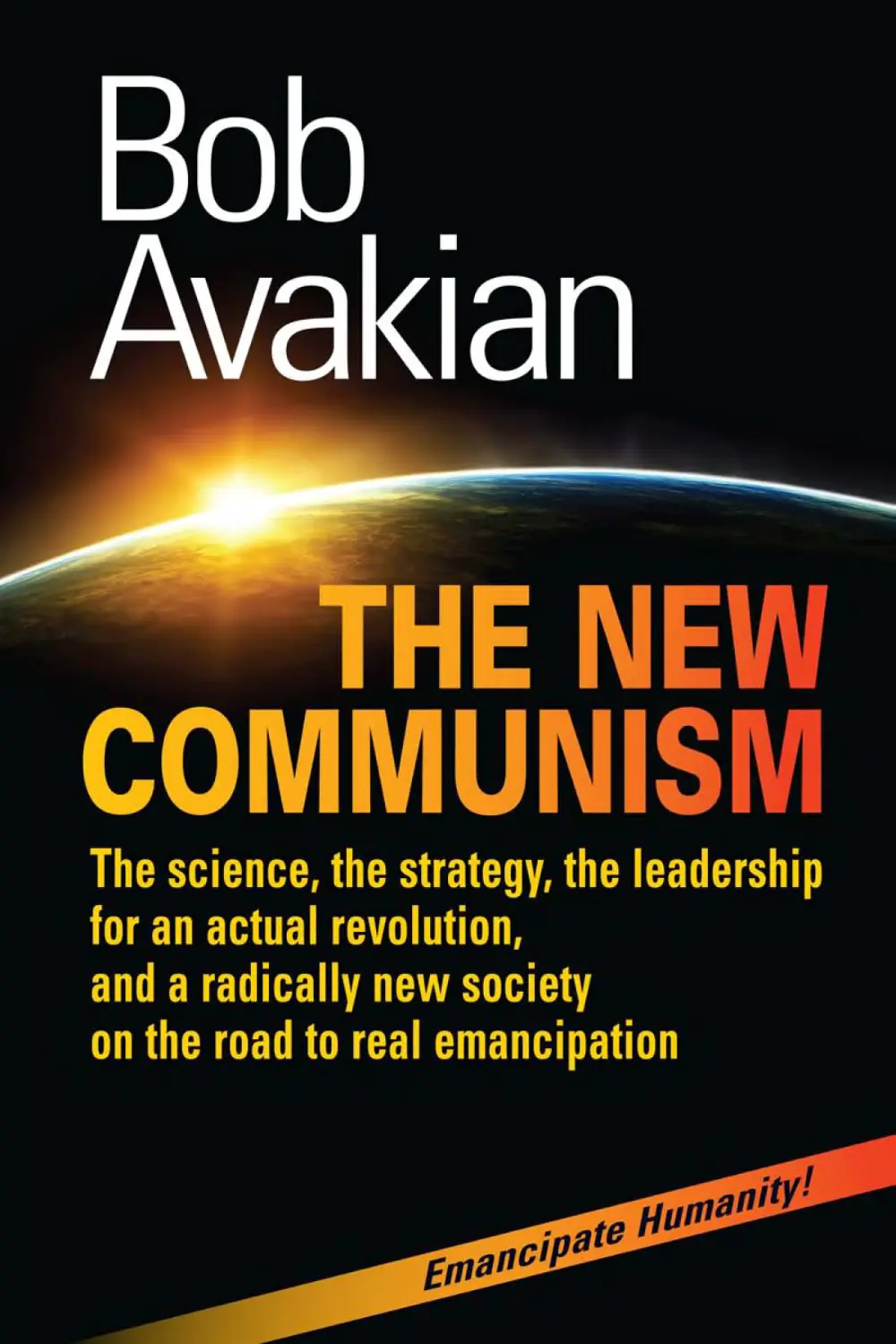


Author: Avakian B.
Tags: history capitalism dialectics communism materialism philosophy of history
ISBN: 978-0-9977798-3-7
Year: 2016



Text
Bob
Avakian
THE NEW
COMMUNISM
The science,
science, the
the strategy,
strategy, the
the leadership
leadership
The
for an
an actual
actual revolution,
revolution,
for
and aa radically
radically new
new society
society
and
on the
the road
road to
to real
real emancipation
emancipation
on
Insight Press
Chicago
Copyright © 2016 by Bob Avakian. All rights reserved.
Bob Avakian image: Artwork courtesy of RCP Publications
FIRST EDITION
First printing: 2016
Published as eBook and in PDF in 2017 by Insight Press.
ISBN: 978-0-9977798-3-7 (PDF)
Insight Press
4044 N. Lincoln Ave. #264
Chicago, IL 60618
www.insight-press.com
Library of Congress Control Number: 2016950143
Contents
i
Contents
Publisher’s Note . . . . . . . . . . . . . . . . . . . . . . . . . . . . . . . . . . . . . . . . . v
Introduction and Orientation . . . . . . . . . . . . . . . . . . . . . . . . . . . . . 1
Foolish Victims of Deceit, and Self-Deceit . . . . . . . . . . . . . . 11
Part I Method and Approach,
Communism as a Science . . . . . . . . . . . . . . . . . . . . . . . 35
Materialism vs. Idealism . . . . . . . . . . . . . . . . . . . . . . . . . . . . 39
Dialectical Materialism . . . . . . . . . . . . . . . . . . . . . . . . . . . . . 45
Through Which Mode of Production . . . . . . . . . . . . . . . . . . 48
The Basic Contradictions and Dynamics of Capitalism . . . . 57
The New Synthesis of Communism . . . . . . . . . . . . . . . . . . . 78
The Basis for Revolution . . . . . . . . . . . . . . . . . . . . . . . . . . . . 92
Epistemology and Morality, Objective Truth
and Relativist Nonsense . . . . . . . . . . . . . . . . . . . . . . . . . . . . 93
Self and a “Consumerist” Approach to Ideas . . . . . . . . . . . 98
What Is Your Life Going to Be About?—
Raising People’s Sights . . . . . . . . . . . . . . . . . . . . . . . . . . . . 104
ii
Contents
Part II Socialism and the Advance to Communism:
A Radically Different Way the World Could Be,
A Road to Real Emancipation . . . . . . . . . . . . . . . . . . 107
The “4 Alls” . . . . . . . . . . . . . . . . . . . . . . . . . . . . . . . . . . . . . 109
Beyond the Narrow Horizon of Bourgeois Right . . . . . . . . 118
Socialism as an Economic System
and a Political System—And a
Transition to Communism . . . . . . . . . . . . . . . . . . . . . . . . . . 131
Internationalism . . . . . . . . . . . . . . . . . . . . . . . . . . . . . . . . . 138
Abundance, Revolution, and
the Advance to Communism—
A Dialectical Materialist Understanding . . . . . . . . . . . . . . 151
The Importance of the “Parachute Point”—
Even Now, and Even More With An Actual Revolution . . 157
The Constitution for the New Socialist Republic
in North America — Solid Core with a Lot of
Elasticity on the Basis of the Solid Core . . . . . . . . . . . . . . 160
Emancipators of Humanity . . . . . . . . . . . . . . . . . . . . . . . . . 180
Part III The Strategic Approach to
An Actual Revolution . . . . . . . . . . . . . . . . . . . . . . . . . . 185
One Overall Strategic Approach . . . . . . . . . . . . . . . . . . . . . 188
Hastening While Awaiting . . . . . . . . . . . . . . . . . . . . . . . . . 193
Forces For Revolution . . . . . . . . . . . . . . . . . . . . . . . . . . . . . 206
Separation of the Communist Movement from the
Labor Movement, Driving Forces for Revolution . . . . . . . . 211
National Liberation and Proletarian Revolution . . . . . . . . . 219
Contents
iii
The Strategic Importance of the Struggle for the
Emancipation of Women . . . . . . . . . . . . . . . . . . . . . . . . . . . 222
The United Front under
the Leadership of the Proletariat . . . . . . . . . . . . . . . . . . . . 227
Youth, Students and the Intelligentsia . . . . . . . . . . . . . . . . 237
Struggling Against Petit Bourgeois Modes of Thinking,
While Maintaining the Correct Strategic Orientation . . . . 244
The “Two Maximizings” . . . . . . . . . . . . . . . . . . . . . . . . . . . 245
The “5 Stops” . . . . . . . . . . . . . . . . . . . . . . . . . . . . . . . . . . . 248
The Two Mainstays . . . . . . . . . . . . . . . . . . . . . . . . . . . . . . . 251
Returning to “On the Possibility of Revolution” . . . . . . . . . 260
Internationalism—Revolutionary Defeatism . . . . . . . . . . 264
Internationalism and an International Dimension . . . . . . . 272
Internationalism—Bringing Forward Another Way . . . . . 272
Popularizing the Strategy . . . . . . . . . . . . . . . . . . . . . . . . . . 277
Fundamental Orientation . . . . . . . . . . . . . . . . . . . . . . . . . . 279
Part IV The Leadership We Need . . . . . . . . . . . . . . . . . . . . . . 281
The Decisive Role of Leadership . . . . . . . . . . . . . . . . . . . . 283
A Leading Core of Intellectuals—and the
Contradictions Bound Up with This . . . . . . . . . . . . . . . . . . 295
Another Kind of “Pyramid” . . . . . . . . . . . . . . . . . . . . . . . . . 300
The Cultural Revolution Within the RCP . . . . . . . . . . . . . . 318
The Need for Communists to Be Communists . . . . . . . . . . 328
A Fundamentally Antagonistic Relation—
and the Crucial Implications of That . . . . . . . . . . . . . . . . . . 330
iv
Contents
Strengthening the Party—
Qualitatively as well as Quantitatively . . . . . . . . . . . . . . . 334
Forms of Revolutionary Organization, and the “Ohio” . . . . 340
Statesmen, and Strategic Commanders . . . . . . . . . . . . . . 344
Methods of Leadership, the Science
and the “Art” of Leadership . . . . . . . . . . . . . . . . . . . . . . . . 348
Working Back from “On the Possibility”—
Another Application of “Solid Core with a Lot of
Elasticity on the Basis of the Solid Core” . . . . . . . . . . . . . 379
Appendix 1:
The New Synthesis of Communism:
Fundamental Orientation, Method and Approach,
and Core Elements—An Outline
by Bob Avakian . . . . . . . . . . . . . . . . . . . . . . . . . . . . . . . . . . . . . . . . . . 383
Appendix 2:
Framework and Guidelines for Study and Discussion . . . . . . . . . . . 391
Notes . . . . . . . . . . . . . . . . . . . . . . . . . . . . . . . . . . . . . . . . . . . . . . . . . . 401
Selected List of Works Cited . . . . . . . . . . . . . . . . . . . . . . . . . . . . . . . 415
About the Author . . . . . . . . . . . . . . . . . . . . . . . . . . . . . . . . . . . . . . . . 423
Publisher’s Note
This book consists of the major opening day presentation
given by Bob Avakian to a conference held in the summer of
2015 which was attended by members and supporters of the
Revolutionary Communist Party. This talk provided the basis
for several days of lively and substantial discussion, informed
by “Framework and Guidelines for Study and Discussion,”
which is included as an appendix to this work.
This book is a masterwork and a master class—it is a living
laboratory of the new synthesis of communism developed
by Bob Avakian. It is also striking in its ability to combine
high level revolutionary communist theory and modeling
of revolutionary leadership with a visceral, colloquial and
passionate style that will resonate with and be accessible
to a wide variety of readers.
This thought-provoking book is sure to challenge stereotypes
and conventional thinking.
Introduction and Orientation
This gathering is taking place at a very important time,
when masses of the oppressed in this country, and in particular those most bitterly oppressed, have been rising up—
refusing to take the brutality and murder to which they are
continually subjected, particularly by the police, acting as the
enforcers of this system of oppression—and these uprisings
have been joined by people from other sections of society.
Rebellion and resistance on this level around such a crucial contradiction and “fault line” of this system, the depth
and determination of this rebellion and resistance, and the
way in which it has continued, and continues to “flare up”
with new outrages—this is something that has not been seen
in a long time. And, with the aim of propelling this resistance to a qualitatively higher level and concentrating it in
a qualitatively more powerful way, impacting all of society,
and the larger world—and, from our standpoint, working to
make this serve the strategic goal of an actual revolution that
will put an end to this, and other outrages that concentrate
major social contradictions of this system, as embodied in
2
Bob Avakian
the “5 Stops”1—a massive mobilization of people, demanding that the outrage of police brutality and murder, as well
as mass incarceration, must be stopped, has been called for
this fall, RiseUpOctober,2 focused in New York City on the
days of October 22–24, putting forward the challenge to all
of society around this: Which side are you on? All this poses
great potential, great necessity, and great challenges for those
working for an actual revolution that would put an end to this,
and to all, oppression. At the same time, in the larger context in which this is taking place, the contradictions within
this system are sharpening, internationally as well as within
particular countries, and in some places—many places, in
fact—these contradictions are boiling over. And there is the
fundamental reality that communist revolution, and nothing less, is necessary to deal with the egregious outrages and
injustices, and the profound contradictions, that mark the
current world and the system of capitalism-imperialism that
still dominates the world, at the cost of so much suffering for
the masses of humanity.
In this context, in reading reports on work in various
areas over the recent period, and looking at our website
(revcom.us) in particular, I think of the comment by people in Baltimore, when people went out to them with revolution—and it’s a comment you hear quite frequently when you
go out to masses of people, taking the revolution to them.
They sharply posed the question: “Will you be here? We’ve
seen people come here, we’ve seen groups come and go and
talk a lot of talk. But is this serious? Will you be here?” This
is a very important question and poses a very direct challenge for us. We have to meet this with the answer “yes” in
the immediate sense, but also in the most profound and
THE NEW COMMUNISM
3
all-around sense. We have to be here, now—and we have to
be here for the whole thing. Whether any particular individual is there at a given time, that’s not the question that’s really
at stake; it’s whether or not the movement for revolution and,
above all, the Party, the leadership that people need to get out
of this nightmare, is going to be there, in an overall and fundamental sense, because when you get down to it, ultimately
the people really do have nothing if they don’t have a party
based on the science that can lead them to emancipate themselves and emancipate all of humanity. This is true whether,
at any given time, the people know it or not.
And I was thinking about something even heavier when
reading about the work being done in Baltimore: the comment of a woman, one of the basic masses in Baltimore, who
said, “I am getting worried”—when people were bringing the
revolution to her—“I’m getting worried.” Now, you might
say, why was she getting worried? She explained: “Because
I am beginning to hope.” Now, think about what that means
for the masses of people, that they are afraid to hope. Afraid
to hope that maybe the world doesn’t have to be this way, that
maybe there is a way out of this. Afraid to hope, because their
hopes have been dashed so many times. Now, we know there’s
a ruling class out there. We know how, along with the vicious
repression they carry out, they maneuver and manipulate
whenever the people rise up. We have seen it already again
in Baltimore, for example: Oh, all of a sudden there’s a crime
wave, they say; and they insist that they have to come down
even heavier with the police and that they need the federal
authorities to come in and help out the police, because the
masses are running wild, and the police can’t go out and kill
them with impunity, right now.
4
Bob Avakian
So, all this is why people say, “I’m getting worried.” They
are afraid to hope. And if we don’t intend to meet the responsibilities that we have, if we don’t intend to follow through
when we go to people and say there is a way out of this, we
should get up and leave right now. Because the masses of people do not need anyone else who comes along, fly-by-night,
and leaves them to the miserable conditions they will be subjected to, and the even worse horrors of this system coming
down on them. We have to mean it when we say we’re serious
about revolution.
This brings us to the question of for whom and for what
are we doing what we’re doing. This is not about any individuals, including ourselves. This is one of the first things
you have to come to grips with—that this is not about any
individual, but is about something much bigger. Look, many
people do come to revolution out of their own direct experiences, what this system has done to them, even though they
don’t understand it’s a system—or even if they have heard
this word “system,” they don’t really know what that system
is. But a lot of people do come to this out of their own direct
individual experience—they don’t immediately understand
that it’s part of a larger picture of what’s happening to literally
millions and even billions of people around the world. This
is the understanding we have to bring to them. But, first of
all, we have to understand: for whom and for what? This is
for the emancipation of humanity. This is for the masses of
oppressed humanity who desperately need this revolution.
It’s not about anything else—and it’s certainly not about ourselves; it’s not about our egos, it’s not about whether we look
good or don’t look good, or any of these kinds of questions
that should be completely out of the picture.
THE NEW COMMUNISM
5
I’ve talked about this before, but think about it in these
terms: People are going to go out here to make a revolution, and the people who are acting as the leadership, as the
vanguard, are going to sacrifice, there are going to be big
sacrifices. You don’t make a revolution without tremendous
sacrifice, and if we don’t understand that, once again, we
should just fold up and go away. There’s going to be suffering.
There’s going to be dying. There’s going to be terrible repression. There’s going to be torture. I’m not saying this to make
some kind of religious-sounding appeal—“let’s gather up our
courage like monks whipping themselves”—or something
like that. But this is the reality of what you have to go through
to get to a better world.
And here is what makes it even harder, ideologically, in
terms of how you think about this, how you feel about this.
People are going to sacrifice in all kinds of ways. And let’s
say you have a revolution, and you’ve lost comrades, you’ve
lost friends and loved ones—you’re part of the vanguard
of this revolution, or you’re part of the masses who are the
backbone of this revolution, and you’ve lost many friends
and many comrades, you’ve seen people torn away, tortured,
subjected to all kinds of horrors. Meanwhile, a lot of people
sat there with their arms folded, or even sniped at you from
the sidelines and tried to undermine everything you were
doing. And then you get to the new society and you have a
new constitution—think about the Constitution for the New
Socialist Republic in North America3—you have a new constitution, and all of a sudden, all these people who didn’t do
a damn thing to help the revolution, and maybe even tried
to undermine it, come out of the woodwork, and every time
you’re trying to do something with the economy, or you’re
6
Bob Avakian
trying to build new political institutions and bring into being
new social relations, or you’re sacrificing for the world revolution—they come along and they go blee, blee, blee, blee,
blee, blee, blee, blee, blee, blee, with all their little petty complaints about how they don’t have this and that, that they had
in the old society. You feel like saying to them: “Shut the fuck
up! You didn’t do a damn thing when people were out here
sacrificing and dying in all kinds of terrible ways, and now
you want to come around with your little petty complaints.”
But you can’t do that. And that’s what makes it so hard. You
can’t do that. You can struggle with them, you have to struggle with them. You can say, “You don’t know what the hell
is going on. You don’t understand any of the contradictions
we’re up against, and you should try to actually come to grips
with what we’re doing here and what we’re up against.” You
can struggle like crazy with people. You have to. But you can’t
take revenge on them. You can’t even say, “Who the hell are
you to raise any criticisms of what we’re doing, because you
didn’t do anything to help—in fact, you tried to undermine
things when people were out here fighting and dying.” Why
can’t you do that? For whom and for what? This is not about
us. If we aren’t prepared to sacrifice, then we’re not serious.
This is about getting to a different world where all these horrors for the masses of people don’t go on any longer. And
that’s the way we have to approach this. This is our role. This
is our responsibility to the masses of people of the world who
are suffering so terribly—and, what makes it all the worse,
suffering so unnecessarily.
So this has to be our orientation in everything we do, in
the way we struggle with each other, in the way we struggle with masses of people. There’s a need for a tremendous
THE NEW COMMUNISM
7
amount of struggle. But for whom and for what? This is what
we have to keep uppermost in our mind.
Now, I want to turn to the question of why are you here,
in particular. Many of the people here come from among the
basic masses of people, or have ties with basic masses. And,
in any case, people here generally can play a very important
role as “levers,” if you want to put it that way, in bringing
forward to the revolution growing numbers of people, from
among basic masses, as well as students and others.
So, with that in mind, let me turn to the purpose and
aim and the approach in what we are doing here—what it is,
and what it is not. To begin, as I think you’ve been advised,
this presentation will cover a lot of ground, speaking to fundamentals of the communist revolution, and what should
guide us in working to bring about an actual revolution.
Then we will grapple together with key points that have been
raised. So everybody should buckle in, in your seatbelts, and
get ready for the ride. There will be a great deal to “take in,”
but that’s because, as Mao once put it, so many deeds cry
out to be done—to rise to the challenges and responsibilities
we face, to do all we can to work actively for the revolution
that is so urgently needed by the masses of humanity, and to
continually bring forward more people to join the ranks of
this revolution and the Party as its leading core. Here, I want
to emphasize this important point of orientation: No matter whether we have been involved for a long, or a relatively
short, period of time, we all have to keep on learning—and
everyone here is fully capable of taking part in the process of
what we are doing here and contributing to it while learning
from it. We should all have the approach of wrestling together
and struggling, in a good way, with each other, based on a
8
Bob Avakian
sense of the importance of the questions we’ll be digging into.
Everybody should fully plunge into the discussion following
this presentation—and do so with a conquering spirit, based
on an understanding of the need, and the basis, for everyone to apply a scientific method and approach to the biggest
problem facing humanity: how to put an end to this system
that is the fundamental source of so much misery and torment in the world, and bring something radically different
and much better into being. It’s with this orientation and this
goal in mind that we should grapple deeply with what will be
discussed here, learning and contributing as much as we can.
This is an unusual opportunity—to, in a sense, “step back”
and dig into these big questions. And it is very important, even
with everything going on in the world, and all the responsibilities we have in relation to this, that we have carved out
the time to get into the big questions we will be taking up
here. But it needs to be understood that this is NOT just some
kind of “study group” or “discussion group” in some aimless
sense, where “interesting ideas” are batted around just for our
own intellectual stimulation or enjoyment—or as some kind
of “diversion” from what we are normally concerned with. We
will be dealing here with theory, and going deeply into some
things on a high level of theoretical abstraction. Ooh, right
away that may sound scary. And it’s gonna be challenging. But
this is a challenge we should all welcome, because whether
or not there is going to be a scientific approach to revolution
and a group of people, a growing group of people, organized
to apply that science to really transforming the world toward
an actual revolution—that makes all the difference for the
masses of people. What we will be doing here is, in one sense,
far removed from what, spontaneously, masses of people are
THE NEW COMMUNISM
9
concerned with and thinking about on a daily basis; but it
has everything to do with whether the masses are going to
be brought forward and led to emancipate themselves and
contribute to the emancipation of humanity from the systems
and relations of oppression and exploitation that weigh down
on masses of people all over the world, and all the horrors that
flow from this. For it is a very real and profound truth that
without revolutionary theory—theory based on a consistently
scientific method and approach, and in particular the scientific method and approach of dialectical materialism—and
without this theory being taken up and applied by growing
numbers of people, there can be no emancipating revolution,
and the horrendous outrages and abuses to which the masses
of humanity are continually subjected will go on—and on. It
is also profoundly true that anyone who applies themself to
this, and does the work, can take up this scientific method
and approach, can continually deepen their grasp of this
theory and the ability to apply it and popularize it, learning
and doing in a dialectical—a mutually reinforcing—relation
between theory and practice. With this understanding, the
basic orientation and goal here is to make leaps, real leaps, in
grasping this theory in order, then, to return it to practice—
and not just “any old kind of practice,” but practice, guided
by this theory, which is in fact aimed at revolution, an actual
revolution, and nothing less.
To return for a minute to what the approach is NOT—it
is not, and must not be, an approach where things are taken
up here in a certain “heavy” and lofty way, and then this is
forgotten, or “put aside,” in returning to the “normal, everyday” situation and political work that all too often is marked
by the implementation of some other orientation, method
10
Bob Avakian
and approach. Nor can people’s approach here be, “Let me
see if there are some things here that are useful for the work
I am doing”—for then that work will not be the kind of work
it needs to be; it will be something else than really working
for an actual revolution. And, to emphasize it again, because
it can’t be emphasized too many times: Our grappling here
with crucial points of theory and of strategy should not be
approached as some kind of “educational experience,” in the
bad sense—as a kind of “scholastic exercise,” which will then
find its mirror image in practice divorced from communist
theory and from actively working for an actual revolution. At
the same time, the point here is not to create expectations of
being able to “master,” all at once, everything that is gone into
here—and, in terms of this opening presentation, the way to
approach it is not to try to fully “digest,” right away, every one
of the points that is spoken to (or to become frustrated if that
proves not to be possible!). A lot of points will be returned
to, things will be woven together, and by the end hopefully
things will become clear which perhaps weren’t clear right
at first; and then we’ll go into the discussion where things
will be drawn out more fully. So the point is to take in this
presentation overall and keep in mind the process here, in
which this presentation will serve as the introduction to and
the foundation and framework for several days of vigorous
discussion and struggle. To be clear also, the point is not to
leave here with the expectation of taking everything that has
been learned here and “force feeding” it, all at once, to people we are working with and going out to: “Hey, let me tell
you, I’ve just learned a whole bunch of heavy stuff!” The purpose, what we are aiming for here, is to get a much stronger
grounding in what we will be engaging here—and, above
THE NEW COMMUNISM
11
all, method and approach—with the orientation of correctly
linking theory and practice; and, as we go forward from here,
continuing to grapple with and grasp communist theory,
more fully and deeply, in dialectical relation with carrying
out this, and no other, line—this, and no other, method and
approach—taking the basics of this to people, and working
with them to get into this more deeply as we join with them
in fighting the power, while at the same time we are consistently fighting, in the appropriate ways and with the right
spirit, for this line, and no other, to in fact be the line that
is in command in giving impetus and direction to building
a movement for an actual revolution, with the Party as its
leading core.
Foolish Victims of Deceit, and Self-Deceit
Now, let’s move right into the substance of this presentation. Let’s begin with a statement by Lenin which not only
has great importance in an overall sense but is also highly
relevant in today’s world. Lenin said:
People always were and always will be the foolish
victims of deceit and self-deceit in politics until
they learn to discover the interests of some class or
other behind all moral, religious, political and social
phrases, declarations and promises. The supporters
of reforms and improvements will always be fooled
by the defenders of the old order until they realize
that every old institution, however barbarous and
rotten it may appear to be, is maintained by the
forces of some ruling classes.4
12
Bob Avakian
This is a very important statement by Lenin, so let’s dig
into it. Let’s begin with the first sentence: “People always
were and always will be the foolish”—notice what he
says—“victims of deceit and self-deceit in politics....” In other
words, people get fooled, and they fool themselves, “until they
learn to discover the interests of some class or other behind
all moral, religious, political and social phrases, declarations
and promises.” Now, you can see this right around you in
the electoral process—the whole circus around the bourgeois
elections that is being promoted now. You can’t even turn on
the news without having someone like Donald Trump stuck
in your face. And then here comes Hillary Clinton. Will Joe
Biden run or not? And what about Bernie Sanders? You can’t
get away from it. You’d think the election were next week—
and it’s more than a year away. But they want you to focus on
this, and they want you to think that this is about you—that
somehow these people represent you—when in fact they represent what? A ruling class that’s ruling over you and ruling
over the masses of people. Beyond just the relentless hype,
even the serious contention that goes on through this bourgeois electoral process is contention among candidates for
the position of presiding over a literally, and massively,
murderous system of exploitation and oppression, on a
world scale. To the degree that people do not recognize this,
it is not because it is not true, but because, to invoke again
Lenin’s critical insight, they have not learned to recognize the
interests of the ruling class behind all this, and they remain
the foolish victims of deceit and self-deceit.
There is this old saying that George W. Bush couldn’t get
right. The actual saying is: “Fool me once, shame on you; fool
me twice, shame on me.” But this goes even further, because
THE NEW COMMUNISM
13
not only do they fool people over and over again with this
electoral process, but they often fool you while they’re telling you they’re fooling you. I was watching this commentator, this guy named Jonathan Alter, who was on MSNBC
the other day talking about the elections, and he said Bernie
Sanders, everybody knows he’s not really gonna be the candidate, but he can generate a lot of enthusiasm and momentum, and then that’ll be very helpful to Hillary Clinton when
she runs. They’re telling you what they’re doing, how they’re
manipulating you. They’re manipulating you right now and
telling you, “Hey, by the way, we’re manipulating you.”
So shame on you, if you don’t get it. But then there’s the
self-deceit, where people don’t want to get it to a certain
degree. I made the statement one time about liberals, that
liberals have an oedipal complex. Now, Oedipus was this
character in Greek mythology who ended up, unknowingly,
sleeping with his mother; and then, when he found out that
that’s what he’d done, he stabbed his own eyes out. So I said,
liberals have an oedipal complex: It’s not that they want to
sleep with their mother, it’s that they deliberately blind themselves—blind themselves to the reality of what’s going on in
the world. This is a real problem with liberals.
And there’s the phenomenon I call “Fisher-Price ruling
class.” Now maybe you all are familiar with Fisher-Price—
they make toys for kids, right? They have a little tea set, and
kids can come out and pretend—there’s no tea in there, but
they can pretend they’re having a tea party. Or they make
little trucks and kids can pretend they’re driving on a highway, while they’re puttering around in their little trucks.
Well, now you’ve got what I call “Fisher-Price ruling class,”
where you turn on something like Bill Maher on TV, and
14
Bob Avakian
here’s Alec Baldwin, the actor, talking about, “This is what
we ought to do in Iraq.” What do you mean “we,” white man?
You’re not running the fucking country. But they’ve got
these people—you know, Hollywood people, “Meathead”
Rob Reiner and the rest—trying to act like they’re gonna
shape what the politicians do, ignoring—or being ignorant
of—the fact that the system is gonna dictate what the politicians do. People like that are just playing around with little
Fisher-Price toys, pretending like they have some role in the
running of the government.
And then there’s the role of the media, and in particular the “news” media. These are not vehicles for providing
people information about important things in society and
the world—and they are certainly not “objective,” if that
means presenting reality as it actually is, nor are they a “free
press,” in the sense of not being beholden to and controlled by
powerful interests. They are in fact the propaganda machinery
of the capitalist-imperialist ruling class. This is not “rhetoric,”
but something which can be, and has been, clearly demonstrated on the basis of scientific analysis of these media: who
owns and controls them, how they “manage” and distort
what information they provide (and don’t provide) to people,
and what this has to do with the basic relations in society.
But people will not see this—and see through the ways these
media operate to shape and manipulate their understanding
of things—until, again, they learn to recognize the interests of
this ruling class behind these media, as well as all other major
institutions in society.
You can see this same kind of phenomenon with things
like the environment. You’ll see people do really good exposure, deep and all-around exposure, of the desperate situation
THE NEW COMMUNISM
15
with the environment, where things really are on the precipice of going over to where it will be very hard, if not impossible, to reverse the damage to the environment; these people
go through all that, graphically bringing this alive, and then
they get to the end and they act as if everything they just said
had no meaning. They start talking about, “If you recycle this,
or you get a hybrid car, that is gonna solve the problem”—a
problem they just described as so enormous that it would be
impossible to solve it in that way. But they’re deceiving themselves because they can’t see beyond the confines of the existing system, or they resist seeing beyond the confines of the
existing system. So, as Lenin so sharply characterized it, they
remain supporters of reforms and improvements who are
always the foolish victims of deceit, and self-deceit. As long
as they stay within this framework, they’re always fooled by
the defenders of the old order, because they haven’t yet realized that every old institution, however barbarous and rotten it may appear to be, is maintained by the forces of some
ruling classes.
Or think of what some people say about police murder:
put cameras on the police. Well, I think we know that there
was a video of what happened to Eric Garner! They have had
cameras taking pictures of many other people murdered by
the police, but the idea is that, somehow, if you record it,
that’s gonna change things. Or if you have “sensitivity training” for the pigs—you know, let’s get the pigs to be more
“sensitive”—so now, instead of oinking when they murder
someone, they first say, “Excuse me sir, may I shoot you?”—
BAM! All these illusions, because people don’t understand
that every old institution, however barbarous and rotten it
may appear to be, is maintained by the forces of some ruling
16
Bob Avakian
class. The police are part of the forces of the ruling class and
its state apparatus of repression. They’re part of the machinery that enforces, on behalf of the ruling class, and with all
the violence they deem necessary, the existing system of
exploitation and oppression. And you cannot reform that
away. Now, it isn’t enough to just say that; if you can’t make
the case, then you might as well not bother to say it, because
you’re not going to convince anybody. So, we need to get into
that more deeply, to the scientific basis for understanding
why this is so.
But we have the problem, which I pointed to in
Ruminations and Wranglings,5 that every class wants to
“remake the world in its image.” In other words, you’ve
got people in the middle class who are always promoting
reforms and things like that, because they don’t want things
to “get out of control,” they don’t want the conflicts in society to become really sharp, because then they’ll be caught
where? Right in the middle. They have a sort of privileged
position, even as many of them don’t like a lot of abuses that
are perpetrated under this system. This is something spoken
to very powerfully in the Interview with Ardea Skybreak
that you have all read (SCIENCE AND REVOLUTION: On
the Importance of Science and the Application of Science to
Society, the New Synthesis of Communism and the Leadership
of Bob Avakian).6 So, people like this are strongly inclined
toward the sentiment: “Let’s not have things get extreme.” As
if it’s not extreme what’s happening with the environment.
As if it’s not extreme what’s happening to women all over the
world. As if it’s not extreme what’s happening to people in the
inner cities, with the police and with their conditions overall. As if it’s not extreme what’s happening with immigrants,
THE NEW COMMUNISM
17
being driven thousands of miles from one part of the world to
another because of wars and overall desperate conditions. As
if it’s not extreme with people being blown apart by bombs in
all these different countries where wars are going on. “Oh no,
let’s not have things become too extreme,” say people in the
middle class because, even though they can’t do it, in their
minds they’re constantly trying to remake the world into one
where all these conflicts can somehow be resolved without a
lot of chaos, upheaval and destruction.
Here is something important to understand: The way
people look at things is a reflection—not in a mechanical oneto-one sense, but in a fundamental sense it is a reflection—of
the position and inclinations of some social group or some
class of people in society. Now, why am I emphasizing that
we shouldn’t approach this in a mechanical way? Because
people can and do take up the viewpoint of a social group or
class other than the one that they themselves are part of. For
example, basic masses, who are not in the middle classes, can
take up the outlook that’s common among the middle class.
They can get influenced by that. Or they can get influenced
by ideas that come directly from the ruling class: “Well, you
can’t do anything about this or that problem because it’s all
human nature.” Who hasn’t heard that? Or: “Nothing can be
done about that because it says right in the Bible that nothing’s gonna happen until the book of Revelation is fulfilled.”
These are ideas that are pumped at people by the ruling and
dominant institutions; and, in a fundamental sense, these
ideas represent the viewpoint of a class of people that wants
people to believe that you can’t do anything about the problems of society and the suffering of people—or that the most
you can hope for is a few petty reforms—because this class,
18
Bob Avakian
this ruling class, wants to keep the existing system going the
way it is. In a basic sense, we can say that every class either
wants to keep the world as it is, or to remake it in line with
what it would like it to be, whether there’s actually a basis for
that in reality or not.
But we have to go further. It is true—a very important
truth pointed to by Lenin—that all these outmoded institutions are maintained by the forces of some ruling class; and
it is also an important truth, understood correctly and not
mechanically, that every way of looking at the world reflects
the viewpoint, or the approach, of one class or another; but
if you stop there, you could still be trapped within the confines of going for reforms: “This ruling class is dominating
things too much, so, like Bernie Sanders says, let’s take away
some of the power and some of the wealth from those people, and spread it out more in society.” You could still look
at the existing framework and just try to rearrange things so
they wouldn’t be so dominated by one class, or so that things
wouldn’t be so prejudiced toward the middle classes, or however you look at it. We have to dig deeper. We have to ask the
questions: What are classes rooted in? And can you change the
system of class relations, the system where some classes dominate others, within the existing system—or does it require a
complete break with that system in order to change this?
This gets us to a question which I’ll be touching on a number of times: through which mode of production are problems
addressed. I’ll come back to that and we’ll dig into it, so if it
isn’t clear right now what that’s getting at, that’s OK. But here
we need to focus on the question: what are classes, in the scientific sense—what are they rooted in? The middle class, the
bourgeois ruling class, the proletarian class, the people on the
THE NEW COMMUNISM
19
bottom of society: what are these classes rooted in? They’re
rooted in a system of production. So let’s dig into that further.
This takes us to a famous statement by Marx that I’ll also
keep coming back to, for reasons that should become increasingly clear. This statement by Marx has come to be known
as the “4 Alls.” Marx said that the goal, the final aim, of the
communist revolution is the abolition of all class distinctions
among people; the abolition of all the production relations
(the economic relations) on which those class distinctions
rest; the abolition of all the social relations—such as the relations between men and women, or between different peoples and nations, or between intellectuals and people who do
manual labor—that go along with and correspond to those
production relations; and the revolutionization of all the ideas
that go along with those social relations. In this very concentrated formulation, what Marx was making clear is that, in
order to really change the world to get rid of all exploitation
and oppression, you have to get to a communist world where
you no longer have some classes dominating and exploiting
others and no divisions among people by class, the way the
world is now so sharply marked. You have to get rid of and
transform the economic relations that give rise to those class
differences among people; you have to transform the social
relations that go along with those economic relations; and
you have to transform the ideas that arise from and reinforce
relations of exploitation and oppression.
Now, again, I’ll come back to this and we will be going
into it more fully, but the fact is that the actual character
and goal of the communist revolution is constantly distorted
by people who are in fact defenders of the existing order.
For example, someone like Hannah Arendt wrote a book,
20
Bob Avakian
The Origins of Totalitarianism,7 and the way she presented
the communist goal of getting beyond classes was (to only
very slightly vulgarize what she said) that the communists
go out and shoot all the people who are in classes other than
the proletariat. That (again with only slight exaggeration) is
how people like Arendt present it: communists want to eliminate classes, so they’ll just kill all of the bourgeoisie, then
they’ll kill all the people in the middle classes (the petite
bourgeoisie), and so on, until finally there will just be one
class, the proletariat, and somehow everybody left in society
will be proletarians and communists. This reminds me of a
TV program I saw on PBS a little while ago. It was a mystery
set in the period shortly after World War 2, when the Soviet
Union and the U.S., with Britain on the side of the U.S., were
locked in the Cold War. Well, as it turned out, the mystery
was about espionage being carried out by somebody in the
British military who was a secret agent of the Soviets, a “dastardly” agent. And, finally, he’s exposed, and then he gives his
final lament. He says, “All my life I’ve been dedicated to the
goal of communism: one world, one mind, everybody equal.”
This is how the bourgeoisie likes to present the goal of communism—one world, with everybody thinking exactly alike
(one mind), and everybody equal—and you could imagine
what kind of equality that would be.
In opposition to this kind of ridiculous distortion, the
point is that to eliminate classes you don’t go about killing
all the people in the different classes, except for the proletariat. No, you transform the underlying conditions that give rise
to these differences among people, you transform the social
relations between people, like between men and women,
or oppressor and oppressed nations (or “races,” as they’re
THE NEW COMMUNISM
21
sometimes referred to), or between people who work mainly
with their minds, carrying out mental labor, and other people who work mainly with their hands, so to speak, carrying
out manual labor. You have to overcome, through a radical transformation of society and ultimately the world as a
whole, all these things while you’re also revolutionizing the
ideas, the ways of thinking, of people, in order to get beyond
these oppressive divisions among people. Today, clearly, we
have class divisions in the world—very profound ones, very
exploitative ones, very oppressive ones—and, in order to
get beyond them, you have to get beyond all the things that
are the soil out of which those class differences arise, and by
which they are maintained.
Now, to go even deeper with this—and we do have to
go even deeper: What are the basic relations in society that
give rise to an economic system and economic relations?
This is something around which some people have done a
lot of work for us, and there’s a rich treasure house of things
that we can learn from. Marx did a lot of work for us. Engels
along with him. Lenin. Stalin sometimes, sometimes not.
Mao did a lot of work for us. Well, going back to the beginning of communism, Marx made the discovery, by doing a
lot of work—spending years and years in a library, studying
and sifting through a lot of things—to bring to light what was
basic but was not obvious, which is the fact that the fundamental relations in any society are the relations between the
forces of production and the relations of production.
Now, what do we mean by that? The forces of production
are all the things that go into producing something: land, raw
materials (minerals, oil, things like that), factory buildings,
technology of various kinds, and people with their knowledge
22
Bob Avakian
and abilities. All those things are the forces that you can rely
on to produce things and to innovate and to keep developing
production. What are the relations of production? The relations of production are the economic relations that people
enter into—not by just choosing what kind of relations they
want to have, but the relations they enter into to carry out
production in accordance with what the character of the productive forces is.
Let me illustrate this from the history of this country.
Let’s look at the period after slavery was (mainly) ended
through the Civil War, back in the 1860s—I say “mainly”
ended, because they still found new ways, even after the Civil
War, to maintain slavery in the South among Black people.
For example, they would pass vagrancy laws where, if you
were in an area and you couldn’t show that you had a job, you
were declared to be a vagrant, and you’d be arrested and put
in prison—and then you could be legally forced to do slave
labor. So this is a way that, even after, in the main, slavery was
abolished in this country, they still maintained some ways in
which they enslaved Black people, particularly in the South.
But in the main, they did away with slavery through the Civil
War. And then after about a decade or so of a lot of turmoil,
things were enforced in such a way that, rather than being
literal slaves on the plantations in the South, Black people in
their masses, and some poor white people, were forced to be
tenant farmers and sharecroppers still working for big landowners, often in plantation-like agriculture. How did this
operate? Well, each of these tenant farmers or sharecroppers
would have a little plot of land that they would work, usually with a plow pulled by a mule or a horse—that’s why if
you go back and listen to blues music from that period you’ll
THE NEW COMMUNISM
23
hear things about the mules, how stubborn they are—won’t
do what they’re told to do, and so on and so forth—and the
trouble people have getting them to do what they’re supposed
to do. So the mules would pull a plow, and the sharecroppers
would plow a small plot of land, and then they would harvest
the crops; but they were in a system—economically, and with
all the laws on top of that—which forced them to turn over a
large share of the crop to the big landowner who had loaned
them money to buy the tools and so on, in many cases. And
then—by tradition, custom, and laws, and Ku Klux Klan terror—the sharecroppers were forced to buy almost everything
they needed themselves from a store that was owned by the
company, or by the big landowner. So, lo and behold, they’d
work all year long, get a harvest, turn in their harvest—and
when they got ready to get their share of money for the part
of the crop that they didn’t have to turn over to the landlord,
it turned out they didn’t get anything, they were actually in
debt to the store, often owned by the same landowners. So
they could never get off the land and go somewhere else,
because they were always in debt; and if they tried to leave,
here came the police and the Ku Klux Klan—“You’re in debt,
boy”—and they’d bring you back if they didn’t kill you.
This went on after the Civil War until World War 2 in the
1940s. Now, one of the things that happens—this has been
true in an overall sense in the history of human society, but
it’s particularly so under this system—is that a lot of new
technology gets developed when the ruling classes go to war.
They have a need to develop technology in order to improve
their war making. Then, out of that, they turn it to civilian
uses a lot of times, coming out of the war. And this happened
through World War 2. As a result of World War 2, there was a
24
Bob Avakian
lot more impetus, a lot more push, given to the development
of new technology. And, in the South, you had production of
a lot of tractors, and a lot of automatic picking machines. So
instead of a mule, or a horse, pulling a plow, you had a tractor that would plow the ground. Obviously, this was much
more efficient, it could cover a lot more ground in a shorter
period of time with less physical labor by the person working
it. And the picking machines were a lot faster than individuals dragging a bag of cotton behind them, picking the cotton
by hand. To step back further for a minute, when you go back
to slavery, cotton became the big product of slavery and was
actually one of the main things that was sold on the world
market to propel the U.S. economy to rise as a major economy over a century or so, from the 1800s into the 1900s; and
it was the development of a certain technology that enabled
cotton to play that role in the U.S. economy and in the whole
world market. What was it? It was a little thing called the
cotton gin. It was invented in the early 1800s, and what it did
was to make it much easier and quicker to separate out the
cotton fiber from all the seeds and all the other parts of the
cotton that were no good for making textiles, out of which
clothes would be made. So, because of that little technical
innovation, you had the horrors of slave-produced cotton on
a massive scale going on for generations and generations in
the 1800s in the U.S.
Now, if you read something like the book that I mentioned in the Dialogue with Cornel West,8 the book by
Edward Baptist, The Half Has Never Been Told,9 you will get
a real picture of the horrors of this. I was watching—oh man,
sometimes it’s really hard to not just completely go wild—I
was watching TV the other night and there was this skeptic,
THE NEW COMMUNISM
25
a secular guy, anti-religious guy named Michael Shermer,
and he was exposing how the Bible is an outmoded way of
thinking—making the point: who wants to live in a society
where you have to kill children if they’re disobedient to their
parents, you have to kill all the gay people, and so on and so
forth—but then the moderator who was interviewing him
asked him (this was on C-SPAN, I think): “Well, has America
been mainly a moral force for good in the world?” And
Shermer says, “Oh, yes. Of course, we’ve had our setbacks,
like slavery.” And he went on like that. And he talked about
how free markets and a political system of democracy is the
best way to have a good system, and the best basis for changing things when there are problems. “A setback?!”—slavery
was just, you know, a little setback. But you read that Edward
Baptist book, and you’ll see that he calls the slave system, and
in particular the raising of cotton by the slaves—it’s a very
apt, very correct way to describe it—he calls it “the whipping
machine.” Because that is the way the cotton-growing slave
system operated—this was true of the slave system in general, but cotton was a concentrated example of this, and you
saw it in the movie 12 Years A Slave: On a cotton plantation,
every slave had a quota for how much they had to pick for the
day. If you didn’t meet the quota, you were whipped, mercilessly. If you did meet the quota, they would raise your quota.
So then, you’d be whipped again until you met that new
quota. And on and on. This was what was driving the system
of cotton plantation slavery. “A little setback!” And, when
you read on in that book by Baptist, you find that thousands
of women, African women, were bought by slaveowners in
order to be raped—systematically raped, constantly raped.
That is the system that provided a great part of the basis for
26
Bob Avakian
the United States to build itself into a major world economic,
and military, power. It was not a little setback!
But when World War 2 came along—now we’re coming
back closer to the present time—tractors, picking machines,
and so on, were introduced in a big way. Well, a tractor is not
efficient on a small plot of land. Imagine, you’re driving a
tractor and you’re trying to drive it around a space just as big
as this place where we’re meeting. It’s very hard to maneuver
it, you can’t do much. To be really efficient, you have to have
a big area over which to use the tractor. So that meant getting
rid of all these little small plots of land that all these sharecroppers worked on (and, again, the reason they were called
“sharecroppers” is because they had to share the crop: they
grew the crop, they harvested the crop, but then they had
to share a big part of it with the landowner, the plantation
owner). So, when they brought in the tractors they got rid
of these kinds of small plots, over time—but not over that
much time, really only a couple of decades—and then they
didn’t need as many people working on the land by hand,
because machines were replacing people. So what happened?
All of a sudden, millions of people—who had wanted desperately to get away from this land, and from everything that
it captured them up in, but who had been forced to stay on
this land—were now forced off the land in large numbers,
instead of being violently and forcibly maintained on the
land under the old sharecropping system. Then you got this
massive migration, where millions of Black people went to
the North and to the West—leaving the South, to get away
from the horror there, hoping they’d find a better life elsewhere. But what drove that—what were the underlying factors driving that? What drove that were changes in the forces
THE NEW COMMUNISM
27
of production, in the machinery in particular, that was given
a push off of World War 2.
Now, here’s what’s important to understand. It wasn’t just
that somebody wanted to get a more efficient way of raising cotton. It was also that these landowners in the southern
U.S. were driven by competition, in places far away, as well as
other places in the U.S. itself. If you go back and read analysis
by the RU (the Revolutionary Union), the forerunner of the
Party—if, for example you read Red Papers 6 10—you’ll see
some of this discussed there. As far away as Pakistan, way
over on the other side of the world, you had cotton growing
that was developing further, and in Arizona you had cotton
growing that was being developed through more modern
means of irrigation. So the cotton growers in the South were
not just looking around for a better way to have cotton produced, in some general and abstract sense: they were forced,
out of competitive compulsion, to introduce this new technology. Here you see the nature of the capitalist system. It’s
not just one big association of capitalists, with all the capitalists working together to exploit people. It’s all these different
capitalists, in far-flung parts of the world—and that’s all the
more so today: in far-flung parts of the world—it’s all these
capitalists in competition with each other, forcing each other
to find ways to more efficiently produce, and more effectively
exploit people, even if that means throwing a bunch of people out of work, or off the land, or whatever.
So, you see, the relations of production (the relations
people enter into in producing things) changed with these
changes in the forces of production. When they brought in
the tractors and the other machinery, then people no longer were organized into small landowners, or people renting
28
Bob Avakian
small plots of land and renting machinery and working as
individuals on small plots of land. Instead, they were thrown
off the land in large numbers; they were drawn toward the
cities, where they started working in bigger groupings of people, in factories and places like that, where you have maybe
thousands of people all working together. That is a different
relation that people then had to the process of producing
things than they had when they were small farmers. So these
changes in the forces of production—and in particular the
machinery that came in—propelled changes in the relations
of production.
And this also gave rise to big changes socially—or,
a better way to put that is that it provided a new platform
on which social changes could be fought for. So then what
did you get coming out of these big changes? You got the
civil rights movement. Not automatically as a result of the
changes in technology and the changes in the relations that
people were entering into to produce, but on that foundation. People found themselves not tied to a particular piece
of land. They found themselves freed from that, although
not freed from oppression. They went into the cities, in large
numbers. And people also came back from World War 2, a
lot of Black soldiers, where they were segregated in the U.S.
armed forces. I mean, it was not good to be fighting for these
imperialists anyway, but on top of that, Black people, as well
as Mexicans and some others, were not even allowed to fight
in the same units with white soldiers. So they go into this
war, they go over to all parts of the world, they’re “fighting
for democracy, for freedom,” they’re told, and then they
come back and they’re still “second class citizens”—“niggers,”
“spics,” this and that—and they can’t go here and they can’t
THE NEW COMMUNISM
29
go there. They’re a grown man but they have to step off the
sidewalk when some 15-year-old white boy comes their way.
But many said, No, we don’t have to do that any more, we’re
in a different position now.
So then you’ve got a tremendous struggle. But it wasn’t
predetermined what would result from all this, there was no
guarantee that it would result in some positive change. All
the forces of the old order didn’t say, “Oh yeah, OK, you’re in
a different economic position now; so, of course, you should
have certain rights.” No, they didn’t say that. There was a tremendous fight that went on, and the forces of the old order
used the police and the Ku Klux Klan, once again, to terrorize people and try to defeat their struggle.
But then there were larger forces of the U.S. ruling class,
who were looking at the picture of the country as a whole,
and looking beyond that to the whole world, where they were
in this Cold War with the Soviet Union, and they wanted to
present America, as they always do, as the “land of freedom
and democracy.” You know how they always talk about the
president of the United States: “the leader of the free world.”
So, they wanted to present America as the land of freedom.
Well, how does it look if you’re presenting America as the
land and the beacon of freedom, of democracy, and you’re
segregating and terrorizing and murdering all these people
inside your own country? It doesn’t look so good. So the representatives of the ruling class in a larger sense, the Kennedys
and people like that, said, “We’ve gotta allow some changes
because things are changing in the society, but also because
we’re in this contest throughout the world and we’re gonna
lose out if we don’t make some changes. The Soviet Union
is over there saying: ‘Look at America! It talks about how it’s
30
Bob Avakian
a land of freedom, but look what it’s doing to all these Black
people, lynching them and shooting them down; look what
it’s doing to all these Mexicans in the Southwest. That’s no
land of freedom and democracy.’” Well, it was pretty hard to
argue against that. So they had to make certain concessions
finally. All these things, all these changes, were fought out,
but they were fought out on a certain platform, or a certain
foundation, of what was going on in the basic economic system, and the changes that were taking place there. Of course,
in a larger sense, all this was taking place within the overall
framework of the capitalist system, and that is why, although
there were major changes—and specifically major changes
in the situation of Black people—this did not bring about
the end of oppression, even as it did bring about significant
changes in the forms of that oppression.
Now, I’ve talked about the relations of production. So
let’s get into that a little more. Again, Lenin did some valuable work for us which we should utilize. Lenin analyzed
that there are three basic parts to the relations of production.
One is ownership, whether or not you own what’s called the
means of production: land, raw materials, factories, machinery and technology of various kinds. That’s the first and most
fundamental thing in terms of relations of production. Do
you own or do you not own means of production? Now you
know what it means if you don’t own them: you got to go
to work for somebody who does. Everybody knows about
that. You don’t own a factory, you don’t own a hospital, and
so on—well, you got to try to find a job from somebody
who does, that’s the deal. So ownership (or non ownership)
of technology, land, other means of production—that’s the
THE NEW COMMUNISM
31
most basic thing about the economic relations, the relations
of production.
The next thing is what’s your role in the overall division
of labor in society. This refers to the fact that there’s a whole
process through which society is functioning, through which
it’s producing the basic things people need to live and to
reproduce. What role do you play in that? If you’re an owner
of means of production, then you command all the people
who work for you. If you’re somewhat lower down—say,
you’re somebody in management—then you kind of occupy
a middle position. You work for people who have ownership of means of production, but you also order a bunch of
other people around below you. Or, if you’re working as an
intellectual, in academia, or someone in a similar position,
then you’re also sort of in a middle position in the overall
division of labor of society. Or you may be on the bottom of
society—either you have no job and you’re scuffling the way
you can, or you get a job and somebody exploits you. And
to get that job, you have to go and sell yourself. That’s what
you do. You go in for a job interview and they say, “Well,
now, let’s go into your history,” and all that. Sometimes they
want you to piss in a bottle, and sometimes they want to
know everything about your personal history, they want to
know if you have ever been arrested, or do you have a felony
conviction. And you can’t say, “What the fuck, just give me
the job, goddamn it, I’m hungry!” You’re out the door. You
can’t even more politely say, “Excuse me, but that’s kind of a
personal question, don’t you think?” No, because the person
interviewing you is in that middle position working for the
people who own the means of production, and you don’t own
any, so you’re in a powerless position, because if you don’t
32
Bob Avakian
satisfy them, they don’t hire you. And you can’t go in there
and turn things around and say, “Well, OK, since we’re having question and answer, let me ask you a question: Does the
company you work for own anything in Bangladesh? Are you
responsible for any of those fires over there in Bangladesh
where all those women died in the fires in those factories?”
Your ass is out the door. You don’t get to ask questions like
that. That’s because, in the division of labor, you’re on the
bottom. You own no means of production and you don’t
have a lot of intellectual skills. You’ve been prevented from
developing the kind of intellectual skills that might enable
you to work in a more privileged position. You don’t have a
college degree or a post-graduate degree that enables you to
go into medicine and be a doctor, or go into management,
or be working for one of the internet companies developing
new technology, and so on. You are on the bottom.
And then we get to the third part of the relations of production: what is your share in the distribution of the overall
income of society? Think about it. If you’re on the top, owning means of production, you may own billions of dollars,
or hundreds of millions of dollars, worth of factories and
machinery, and so on—not just in one country, but in many
parts of the world—so you’re going to get a big share of the
wealth. Even if you reinvest a lot of it to keep the process going
and compete with others, you’re going to get a big share of
the wealth. If you’re in the middle, with a certain amount of
intellectual skills or owning a small amount of means of production—maybe you’re a small store owner or something,
you own a little means of production or distribution but you
don’t own much—then you’re going to get a lesser share. And
if you’re on the bottom, owning nothing except your ability
THE NEW COMMUNISM
33
to work, and you don’t have a lot of highly developed skills,
intellectual training, degrees and so on, you’re going to get a
small share.
So if you put those three things together—whether you
own a lot of means of production, or you own a little bit, or
you own none; what your role is in the overall division of
labor of the society; and consequently what share you have
in the distribution of society’s wealth—then you can identify pretty much the class structure of a society. In very basic
terms, you have the people at the top, the bourgeoisie (which
is a French word that basically means capitalists, the capitalist class); then you have the petite bourgeoisie (“petite” is a
French word that means small) so you have the small bourgeoisie, the “in between” class, made up of owners of a small
amount of means of production, and people who’ve developed intellectual skills, have degrees, and so on, people in
management or in medicine, and so on—and then you have
the people at the bottom, the proletariat, which is a word that
means people who don’t own anything except their ability to
work. This is why you have different classes in society—it’s all
related to what the economic system is and what people’s role
is in that overall economic system.
So when we think about getting beyond class distinctions, we have to think about changing all that, as well as
changing the kinds of social relations where men oppress
women, where one “race,” or nationality, oppresses others,
where some people have advantages over others in terms
of having a high degree of intellectual training, degrees and
so on, where they can work with their minds mainly, while
other people, who of course also have minds and think, are
forced to carry out manual labor. You have to get beyond all
34
Bob Avakian
those things if you want to get rid of exploitation and oppression. This enables us to understand more deeply Lenin’s
statement about how people are the foolish victims of deceit
and self-deceit until they learn to recognize the class interests involved in things going on in society and the world as a
whole. You have to look to the classes in society and see what
economic and social relations, and what system of political
power that enforces those relations, do different ideas serve.
What class interests do those ideas actually express? Those
corresponding to the outlook and interests of the big bourgeoisie? Or of the petite bourgeoisie? Or of the lower masses
of people, the proletariat and the poor people?
But beyond that, if you just do that and you don’t dig
deeper for the roots of all this, then it’s like the difference
between a cow and a sheep. A cow comes along and eats
the vegetation, but it leaves the roots. A sheep pulls everything up by the roots. That’s why in the Old West, they used
to have all these range wars between the sheep owners and
the cow owners: the cow owners got pissed off at the sheep
owners because the sheep came along and pulled up all the
plants, so then the cows couldn’t graze, whereas the cows just
grazed along the surface so the plants would still grow back.
Anyway, without getting too far afield with this awkward
metaphor (!), the point is this: If you just look at classes, and
that’s all, you’re not going to get to the roots. And if you want
to really change something, you have to get to the roots.
So, with that as a basic introduction and orientation,
there are four main parts to the rest of this presentation.
Part I
Method and Approach,
Communism as a Science
To get into this, let’s start with some basic and essential
questions: 1) Is the world actually a horror for the masses of
humanity? 2) Is revolution, and the final goal of a communist
world, the necessary means for radically changing all this, to
eliminate oppression and exploitation, and the plundering
of the environment? 3) Can such a revolution actually succeed, can a radically different and liberating society and world
really be brought into being? Those are three big questions.
Now, I imagine that we can all recite the “correct answers” to
these questions: yes, yes, and yes. And the substance of these
answers—the compelling reasons why those are the answers
in fact—all this is brought to life in talks and writings of mine
and, in an ongoing way, through the website revcom.us and
Revolution newspaper. But here we need to focus on this
question: How, with what method, do we arrive at these
answers—by religiosity and just repeating dogma, or by some
other means? And what approach do we take to understanding things in general? This has everything to do with epistemology—with the theory of knowledge, how people acquire
knowledge and how they know whether something is true,
whether it has to do with reality or not. In other words, questions such as: What is truth? Is there objective reality—believe
it or not, that’s a question that is hotly debated in society—is
38
Bob Avakian
there objective reality and can we come to know it, and how
do we go about knowing the truth about reality? We are never
going to get where we need to go without a correct, scientific
method and approach for knowing the world as it really is,
and as it is moving and changing. And we are never going to
get where we need to go without challenging not only what
people think but, even more fundamentally, how they think—
and how they “approach the world.”
The science of communism—communism as a science—
this is another thing that’s thrown around a lot. But this
question, communism as a science—whether in fact communism is a science, whether it meets and applies the standards and methods of science, and whether it can, and needs
to be, applied to society and to transforming society—all this
is sharply contended not only in this society, and the world,
overall and in general, but also specifically among many who
claim to be seeking some kind of “progressive” or radical
change, and even among many who proclaim themselves to
be “communists,” “Maoists,” and so on. All this is spoken to
in very important ways in the Interview with Ardea Skybreak,
SCIENCE AND REVOLUTION: On the Importance of Science
and the Application of Science to Society, the New Synthesis
of Communism and the Leadership of Bob Avakian, as well
as in the article, the polemic, in Demarcations #4, “Ajith—A
Portrait of the Residue of the Past.”11 And those works definitely deserve to be returned to and dug into repeatedly. Now,
again, I would expect that, at least at this point, people here
would answer “yes” to the question of whether communism
is a science that must be applied to changing reality, and in
particular the reality of human society—although it does need
to be asked, and we should ask ourselves, whether people have
THE NEW COMMUNISM
39
actually thought this to be true before now, and have acted
consistently in accordance with that. But, rather than directly
pursuing that question, right now, let’s instead get into some of
the basic elements of communism as a science.
To begin with a basic question: what is science? This,
too, is spoken to in a very straightforward, substantial and
compelling way in the Interview with Ardea Skybreak,
emphasizing that science is an evidence-based process (in
that Interview, she says many times: you can’t just tell me
this and tell me that, show me the evidence, I want to see
the evidence). Science is an evidence-based process which
seeks to understand reality—not just the surface phenomena
and what is immediately apparent, but the broader patterns
and deeper relations of things in the real world of material
reality—things as they actually are, and as they are changing.
Rather than going into that further here, because we
don’t have infinite time, I will refer people to that part of
the Interview with Ardea Skybreak—and to the Interview
as a whole—which is, once again, definitely something that
should be repeatedly returned to and dug into. But here let’s
explore this question: We communists often say that dialectical materialism is a thoroughly scientific method and
approach—in fact, the most thoroughly and consistently scientific method and approach—but why is this so?
Materialism vs. Idealism
Here we get to materialism versus idealism. First of all,
there is the question: what is materialism? Materialism has
everything to do with and flows from the scientific method
and approach. Materialism means that you approach, and
40
Bob Avakian
seek to understand, the world as it, in fact, objectively exists.
It means that you understand that there is a material reality
and that all of reality, all of existence, is made up of material
reality and nothing else. Engels, who along with Marx, was
the founder of the communist movement, made the point, a
very important point, that there are, in basic terms, two fundamental and two fundamentally opposed schools of philosophy: one is idealism and the other is materialism.
Now, we have to understand these terms not as they’re
often used by people in everyday language, but in a scientific way. A lot of times people use idealism in a positive way:
so-and-so is very idealistic, they have high ideals, meaning
they have a lot of principles and they’re not narrow-minded
or selfish or whatever. But in the philosophical sense, idealism, the school of idealism, means that you think that reality
is an extension of ideas—that’s why it’s called idealism, you
think reality is an extension of ideas—ideas in the mind of
individuals. For example: “Maybe this doesn’t exist for you,
but it exists for me.” We hear this kind of thing all the time,
this relativism: “Well, that may be your truth, but my truth
says something different. God may not exist for you, but God
definitely exists for me.” No! If god exists at all, then god
exists for everybody. See, that’s the thing we have to recognize. Either there’s a god or there’s not. God is not the kind
of thing that can just exist in one person’s mind—unless it’s
your own personal god that you just made up, and then that’s
easy to deal with. But the idealist school of thought in philosophy says that the reality that we perceive is an extension of
ideas—either different individuals’ ideas or the ideas of one
great mind, which is another way of saying what? God. So,
naturally, you can’t test those ideas against reality, because
THE NEW COMMUNISM
41
their basis exists within the mind of either some supposed
god or of individual human beings. And this is completely
out of line with reality—the idea that there are multiple realities depending on each individual’s, or some supposed god’s,
thinking or feelings or ideas or whatever—it’s completely out
of keeping with the actual reality. (Ooh, there’s that scary
concept again, objective reality, actual reality. We’re on the
verge of totalitarianism now!)
Engels also made the point that one of the ways we know
this, that material reality actually exists, is that we can interact
with it—not only learn about it, but change it. And when we
change it, it changes the same way for everybody. Different
people may respond to how it changes in different ways, or
have different feelings or thoughts about it, but it changes
objectively. So that’s the philosophical school of materialism,
as Engels pointed out. The school of materialism, as opposed
to idealism, says that the material world objectively exists
independently of any individual, or any supposed god, and
their ideas and thinking. And that, in fact, individuals and
their thinking is a process of material reality itself—people’s
brains, nervous systems, and so on—this is what goes into
thought. Now, it’s true, we don’t understand everything about
how this works, although more is constantly being learned,
and at the same time there is struggle over how to interpret
what’s being learned in many cases. But we do know that the
human nervous system and brain are actual material reality that undergoes actual material processes, and that’s what
thoughts are constituted of. And those thoughts in turn are
ultimately, and in a fundamental sense, a reflection of objective reality, a reflection in the mind of the thinking person.
These ideas may be a correct or an incorrect, an accurate or
42
Bob Avakian
an inaccurate, reflection of reality, but that’s what they ultimately are, some reflection of reality. So that’s a fundamental
dividing line, between materialism and idealism.
Now it’s true that, for example, in art, in culture, often
things will be presented which are different than actual material reality. And that’s a good thing. You wouldn’t want to
see art that only, always and simply, reflected reality back to
you just exactly the way it is. You want it presented in different ways, including many ways that are not in keeping with
how reality actually is, which can inspire and challenge and
provoke you to think, including about actual reality. So there
is that role in art. But that art, that culture, is still a reflection of material reality in the final analysis. That’s the raw
material—the actual reality out there is the raw material out
of which art is built, even if it deliberately distorts and skews
it in order to present things in a different way. So we’re back
again to this fundamental dividing line between a materialist understanding and an idealist mis-understanding of how
things actually are.
What we mean by materialism, as one of the two opposing schools in philosophy, is different once again than the way
this is often used in everyday life—for example, how preachers sometimes use this term, or how it is often used in popular language—meaning something like consumerism: “That
person’s very materialist,” meaning they want to go out and
grab a bunch of consumer goods, they’re continually consumed with shopping, buying more video games, or shoes,
or whatever. Or, sometimes materialism is used by religious
people and others to refer to people who are very narrow and
grubby: they’re philistine—they don’t think about big things,
they’re very “materialistic” in the sense of wanting to just deal
THE NEW COMMUNISM
43
with the narrowest scope of things, and don’t have much use
for big philosophical questions, or questions of “spirituality,”
and so on. But, in the scientific sense, in terms of the two
basic schools of philosophy, materialism means that you recognize that material reality objectively exists, that everything
that actually exists is made up of material reality, in many
different forms, and that this includes the minds of people
and their thoughts.
Now, once again, people sometimes say things like: “Well,
maybe the world objectively exists, but we can’t actually know
it as it objectively exists, we can only know it as we perceive
it, or as we construct it in our minds, out of our perceptions.”
Engels pointed out the prominent philosopher Immanuel
Kant was an example of that. But without going into all that
right now, the point is, as Engels made clear, that even people who argue in that way are still in the philosophical camp
of idealism, because if you say we can’t really know anything
about reality outside of how we perceive it, or how we construct it in our minds, then in effect you’re saying that the
only material reality there is, or the only material reality you
can be certain of, is the material reality you perceive and how
you perceive it, or “construct” it. All that falls into the philosophical school of idealism that says that reality exists in the
minds of people, or in the mind of one great god, and then
everything else is an extension of that. So, once again, this is a
fundamental dividing line in how you approach understanding the world and therefore your ability to change it. It may
sound like we’re talking about obscure theoretical abstractions, but everybody here, I’m sure, in talking to people, runs
into this kind of thinking—the idealist way of thinking—in
all different kinds of forms. You get it in very sophisticated
44
Bob Avakian
theses sometimes—or sometimes not very sophisticated
feces—from some of these academics. And you get it in very
down-on-the-ground everyday terms from “regular people.”
Again, “That may be true for you, but it’s not true for me.”
Or, “How can we really say what’s true?” Or, “God may not
exist for you, but I know God exists for me—without God I
couldn’t have done this, I couldn’t have done that, I couldn’t
have gotten off drugs, so God exists for me, anyway.” I’ve even
had people tell me: “Well, you may not believe in God, but I
believe God sent you here to do this.”
We hear this kind of thing in all different kinds of forms
all the time. And it’s very important that we approach things
correctly in how we deal with this and how we struggle over
this with people. I mean, you’re not going to go to the masses
of people and say, “Now, listen, you have to understand there
are two basic schools of philosophy—Engels pointed out...”
“What the fuck are you talking about?!” No, you have to
break this down for people—it’s not that you should water it
down, but you have to break it down, you have to make this
accessible to people. At the same time, you have to remain
firmly grounded in the basics here. Otherwise, you’re going
to lose your bearings, you’re not going to be able to struggle
in a good way with people, because people will set all kinds
of terms on which they want to discuss and struggle with
you about things, and you have to recast the terms back to
what they actually are, or else you get lost and run around in
a circle. I think everybody has experienced this at one time
or another.
So that’s materialism as opposed to idealism, two basic
schools of philosophy: one in accord, in correspondence,
THE NEW COMMUNISM
45
with how things actually are, and one completely out of line
(upside down, if you will) in terms of how things actually are.
Dialectical Materialism
We don’t just talk about materialism, however, and this
is an important point. The science, the scientific method and
approach, is dialectical materialism. Why? Because reality is
not static. As we’ve seen, and as I’ve been referring to, reality
is constantly in the process of change. Reality is made up of
contradiction—and we’ll get into that. Dialectics is a word of
Greek origin that means dealing with conflict, or opposing
things, or contradiction. It means recognizing and dealing
with contradiction and the struggle between things in contradiction. Reality is made up of things that, as an expression
of contradiction, are constantly moving and changing in one
form or another: sometimes it’s a relatively minor change, and
then sometimes there’s a big leap in how things change from
one thing to another. There are all kinds of simple as well as
more complex ways in which this happens. An example of a
simple way is that you boil water and it heats up and eventually becomes steam. But (this is an important point too):
it’s not just water, water, water—and then, whoomp, all of a
sudden, it’s steam. It’s undergoing relatively minor changes
and then it makes a leap to become something else. This goes
on in all kinds of ways in reality. So, if you just have a materialist approach, you’re going to end up being very determinist,
that is, you’re going to bow down to material reality as it is
and not see the possibility for change, or at least not major
change, because you’ve only done half the work, so to speak.
You’ve seen and recognized that the actual material reality
46
Bob Avakian
out there is what exists, and all that exists is material reality,
and what is true is what corresponds to that material reality. But you haven’t recognized the contradiction, the motion
and the change, so all you can see at any given time is what
is—you see the possibilities of what can be as determined and
confined by what already is—and then you’re a slave to that,
you bow down to that, you limit yourself to that, because you
don’t see the contradictions, not only those contradictions
which are more apparent but the deeper contradictions that
are really driving things and driving changes, and that hold
the potential for change, even as they also pose obstacles to
that. That’s the struggle we have to wage—to grasp the basis
for change, and to bring about change on the basis of the
contradictions within material reality, and in particular the
deeper, fundamental and driving contradictions.
So we have to be dialectical materialists. We have to look
for, and work to understand, things as they actually are, and
as they are moving and changing. And it takes work. I’m
going to give some examples of that as we go along. It takes
work. You have to work. If you want to make a revolution,
you have to work, OK? If it were easy, if we could just fall into
it, then that would have happened a long time ago, because
there are plenty of horrors in the world, there is plenty of
reason for people to want a different world. But there are also
all kinds of things pulling on them in other ways, all kinds of
contradictions that they’re caught up in. So you have to work,
you have to dig for the deeper contradictions. Yes, you should
recognize the ones that are right on the surface, but you have
to dig for the deeper ones, the underlying ones, the driving
ones. And this is in accord with reality. It’s not that it’s better
not to be determinist—“Let’s be dialectical because that way
THE NEW COMMUNISM
47
we won’t be slavish to objective conditions, it’s much better
that way and we’ll feel better.” No. This is the way reality actually is. It actually objectively exists, and truth does, in fact,
mean that your ideas, if they are true, are in correspondence
with objective reality, as it is, but also as it’s full of contradiction and is moving and changing. And only if you get these
two elements and you correctly synthesize them, and you’re
actually understanding particular aspects of reality but also
understanding this in its relation to the larger context—only
if you do that can you have a consistently and thoroughly
correct approach to reality. Of course, that doesn’t mean you
understand everything at any given time, or that you understand what you do understand perfectly, necessarily. But this
is the only method and approach for actually getting at reality as it actually is—and as, in fact, it is moving and changing.
It’s for these reasons that we need to be dialectical materi
alists, and not because it’s some religion of ours. It’s because
this corresponds to reality. And by the way, dialectics that
lacks materialism—there’s a lot of that in the world too.
People talk about contradiction all the time, but it’s floating
around in the air, with no basis in material reality. Whether
they call it contradiction or not, people talk about contradictions all the time, things in conflict. But is that actually
rooted in material reality, or is it ideas in their head that are
out of keeping with material reality?—because the way they
see the world has been influenced by the dominant way of
thinking that’s promoted in this society, which, to greatly
understate it, is not scientific.
So it’s not because we like this better, or that we’re communists and therefore we are supposed to be dialectical materi
alists. No. We’re dialectical materialists because that actually
48
Bob Avakian
is the method and approach that corresponds to the way the
world really is, and it gives you the basis for understanding
and, yes, changing the world, in accordance with how it actually objectively is and how it’s moving and changing through
contradiction and struggle.
Through Which Mode of Production
Another point of materialism—dialectical materialism—
that I want to return to and go into further here, is something that’s in the compendium Break ALL the Chains!
Bob Avakian on the Emancipation of Women and the
Communist Revolution.12 Now, I have to laugh, because
nobody’s touched something in that compendium, at least as
far as I know. There’s an article in that compendium (which
was previously unpublished but has now been published as
a separate article, as well as being included in that compendium): “Can This System Do Away With, or Do Without,
The Oppression of Women?—A Fundamental Question, a
Scientific Approach to the Answer.”13 And when I say nobody
has touched this, what I mean is that there are a series of
questions that are posed in that article: If you’re going to say
that the oppression of women can be done away with, without a communist revolution—can be done away with under
the present system—then you’ve got to answer some very
basic questions of the kinds that are indicated in that article.
And I didn’t put that in there just because I thought it would
be fun to include those questions—it’s actually posing a challenge: Let’s see if people can come up with a way that you
can do away with the oppression of women under the current system. And again, at least as far as I am aware, no one
THE NEW COMMUNISM
49
has yet taken up that challenge. But, anyway, the point is that
what we’re about is not a religion. We have to be materialists,
dialectical materialists. If somebody could show us that you
can do away with the oppression of women under this system, well then there are still plenty of reasons to get rid of
this system, but that wouldn’t be insignificant, if you could
do away with the oppression of women under this system.
Now, to be clear, I’m not being agnostic here: “Oh we don’t
know...” No, I’m firmly convinced, on a scientific basis, that
the answer to this question is that you can’t—you can’t do
away with the oppression of women under this system. But
the point of posing those questions in that article was to try
to provoke and inspire people to take up a certain method, to
actually investigate and probe reality as materialists, dialectical materialists, rather than just going on faith like a religion,
or just because somebody who seems to know what they’re
talking about said that, so it must be true, which gets us into
all kinds of trouble all the time.
If you’re going to go out and win over masses of people,
you better have something underneath what you’re talking
about. You go out and say: “We’ve gotta fight against the
oppression of women and we gotta make revolution because,
for one thing, we can’t get rid of the oppression of women
under this system.” But what if somebody says, “Why not?”
Uh-oh. You see, this is what I’m talking about—this problem
of religiosity. We have to keep working. People come up with
plenty of theories about how you can do that—how you can
get rid of all kinds of oppression under this system—when in
fact you can’t really do that. But we have to be able to answer
these things for the masses of people. If you want to win people to what they need to understand about the world, and to
50
Bob Avakian
act in accordance with that, then you better have something
underneath it that you’re working with.
And notice that this particular article begins with an
important point. It begins by saying: “Through which mode
of production will any social problem be addressed? That
is the most fundamental question.” Well, here again, that
sounds like some sort of heavy thing, or a good communist
nostrum. But why is it true? Or is it true? These are questions
people should be grappling with continually.
Now, what do we mean by mode of production? People
have heard the word “mode” maybe most often when you
have pie—you know, pie “à la mode,” pie with ice cream. Well
“mode” doesn’t actually mean ice cream—it means a way (or,
in this case, a style) of doing something. It’s from the French,
à la mode, and it means: in a certain way, in a certain style
(just as it came to be a certain style to have pie with ice cream
on it). So that’s why it’s called à la mode (pie à la mode, pie
with ice cream). Mode means a way of doing things. A mode
of production is a way that production and the exchange of
what’s produced is carried out, a system through which production, and exchange, is organized and carried out. That’s
what we mean by a mode of production.
To really dig into these things, to understand the importance of the mode of production, we actually have to be scientists and be scientific and—here’s the thing—not be afraid
of the real world. You know what? If the real world showed
that all these horrors we talk about all the time can be done
away with, without a revolution, then we could all go on
vacation. OK? But that’s not the reality. As scientists, we have,
and we should have, nothing to fear from reality, no reason
to run away from it because, uh-oh, it might prove that our
THE NEW COMMUNISM
51
dogma isn’t really real—doesn’t really have any basis to it.
If that’s the way we’re proceeding, then we are not going to
get anywhere. That is a very flimsy and very brittle way of
approaching things, which will be punctured very easily. So
we have to do the work.
Why is it said in that article, that through which mode of
production will any social problem, such as the oppression
of women, be addressed is the most fundamental question?
Does that mean that the oppression of women is simply an
economic matter that is reducible to just whatever the mode
of production is, whether it’s a capitalist or a feudal mode of
production, and so on? Does it mean that it’s just reducible
to that? No. The oppression of women existed before capitalism, it existed before feudalism. Here, too, Engels did a lot of
work, and others have done work—Ardea Skybreak wrote a
book about this, Of Primeval Steps and Future Leaps,14 speaking to the origins of human beings and the origins, and the
deeper causes, of the oppression of women, and the road to
emancipation out of that. And more work, ongoing work,
needs to be done to deepen our understanding of this, as of
things in general. But there is a basic grounding of understanding of where the oppression of women arose from and
how, in fact, it can be finally eliminated. But the reason that
this article says, “Through which mode of production will
any social problem be addressed?” is the most fundamental thing is because, in a fundamental sense, anything you’re
doing in society is shaped and ultimately limited by whatever the economic system is (which, again, is another way
of saying “the mode of production”). Now, in today’s world,
especially living in a parasitic society like the U.S., most people have no idea about this, especially if you get away from
52
Bob Avakian
people who are actually producing material things—you get
into the middle strata, and so on—people generally have no
idea, or no real understanding, about the basic reality that, if
there’s not a way of producing and distributing the material
requirements of life, human beings can’t live and can’t reproduce, they’ll die out.
You know most people, especially if you get into more
privileged strata in society, they just think things are there.
You go to the grocery store, of course the shelves are full of
things. Or you go to a video games store, of course there are
video games there. You go to the mall, of course there are all
kinds of stores with all kinds of stuff. But where does all this
come from? How many people really think about where this
comes from and how all this takes place? People just assume
these things are going to be there, because somebody else,
somewhere else, is doing all the work to produce all those
things. And the question: What is the way in which that gets
done, what is the mode of production through which all this
takes place?—people don’t think about that or have no real
understanding about that. But it’s fundamental, if you think
about it.
There was a movie made a while ago—I didn’t see it,
unfortunately, although people said it maybe wasn’t that great
artistically, but it was making an important point. The title of
the movie was A Day Without a Mexican. It was making the
point: What if all the Mexicans, who are always slandered—
and now there are people like Donald Trump aggressively
putting out this slander—what if all those Mexicans stopped
working for a day? What would happen? Well, you can expand
that and say: What if all the people, all over the world, who
produce and distribute all these things that people use every
THE NEW COMMUNISM
53
day, stopped working for a day or a week or a month? All of
a sudden, people would say, “Hey, what the hell’s going on,
the shelves are empty!” So this is something that is basic to
society, not only that things get produced but how they get
produced. What relations do people enter into in carrying
out the production of things? In other words, we’re back to
the relations of production, what relations people enter into
in producing and distributing and transporting these things.
Another way to say that, once again, is what’s the mode of
production through which all this is done? That sets the basic
terms for everything that happens in society. It isn’t everything that happens in society, but it’s the foundation and sets
the basic terms for everything that happens in society. If you
think about it, that’s pretty obvious, for the same reason that
this movie was made. If people stopped producing those
things, everything would grind to a standstill.
And if you try to do something in society that’s basically out of line with the mode of production of the existing system, then either you’re going to fail—or you’re going
to have to make a revolution. So, more thinking should go
on, more work should go on: Why is this true, that through
which mode of production is the most important, the most
fundamental question—not the only, but the most important
and the most fundamental question—to be posed? When
you’re taking up any kind of question in society, any form of
oppression, anything that you feel needs to be changed, the
most fundamental question is what is the mode of production that’s setting the basis and the ultimate terms and the
ultimate limits for what can be changed and how?
As I have said, we’ve got to do the work—and, by the way,
I’m not gonna do all the work here. A good part of what I’m
54
Bob Avakian
doing here is posing questions which we’ll dig into, because
we all have to do this work, and it’s no good if we have an attitude that somebody else, somewhere else, will do the work
and we’ll just follow along. Everybody has to dig in and work
on these things. If we are going to be serious, we all have to do
this work. Yes, some of us have been at it longer, have more
experience and have developed in certain ways to be able to
do this, but we all are capable of doing this and we all have
to throw in fully and do it. So, an important part of what I’m
going to be doing here is posing questions. And this is a big
question: Is it true that through which mode of production
will any social question, including the oppression of women,
be addressed, is the most fundamental question? And why is
that true? I said a little bit about that, but I want to throw it
out as a question for people to grapple with.
And, look, you run into this all the time: What goes on
in this society and the world is that, constantly, people just
say any old thing they feel like saying, or they repeat what
they heard from their friend, their professor, and so on. I
was reading a report where someone we encountered said,
“I went to my gender studies class”—I think you might
guess what’s coming, maybe you’re familiar with this kind of
thing—“I went to my gender studies class and the professor
said The Communist Manifesto15 doesn’t talk about women,
so we need something else.” Well, you might read the fucking thing, to start with. I mean, The Communist Manifesto
is not a manifesto about the oppression of women, but it’s
very radical—it actually calls for the abolition of the family,
for one thing. It talks about the oppression of women. OK?
And then, as I referred to, Engels wrote a whole book called
The Origin of the Family, Private Property and the State,16
THE NEW COMMUNISM
55
which deals extensively with this question of the oppression
of women and the means for putting an end to that oppression. Have you read it? Do you know anything about what’s
in there? Quit talking nonsense.
I mean, really, there’s just a lot of nonsense that people get
away with. Now, you can’t ultimately blame the people themselves, but we do have to struggle with people. That’s not an
acceptable method, just to be repeating what is said by your
gender studies professor, because your gender studies professor very likely has got a thing going where they want to do
something other than have a real revolution, so they’re going
to tell you The Communist Manifesto is no good, stay away
from that. You can’t just accept that. People gotta be critical
thinkers. We need critical thinkers, and we need to struggle
with people that they need to be critical thinkers. Whether
they agree with us right away or not, the first thing people
can do is be critical thinkers. And especially when anything
is coming from the dominant institutions of society, immediately be a critical thinker, because there is a proven record
that these people are world class liars. And you know what
else, they don’t even understand their own system, or the
world as a whole.
Think about it. There are not only the deceptions that
the ruling class puts down on the people, keeping them from
understanding things; there is also the way in which the representatives of this ruling class deceive themselves. For example, they actually believe that everybody in the world wants
to have a system just like theirs, with a hierarchy with them
sitting on the top. So they decide: We’ll go into Iraq, we’ll
invade Iraq and they’ll all welcome us. Except for a few people
we’ll have to shoot down and bomb to oblivion, everybody
56
Bob Avakian
else will welcome us. Like Dick Cheney said, they’ll give us
flowers, they’ll put flowers on the soldiers’ weapons. They’ll
welcome us, and they’ll all want to have a society just like
America—with the kind of free markets and democracy we
have—of course under our domination.
Well, it didn’t turn out that way. Because the people in
countries like Iraq have a whole history, they also have a culture of their own that goes back thousands of years. Plus, the
imperialist system that these people like Cheney are presiding over has been creating all kinds of havoc in these countries even before they invaded, and this is producing all kinds
of forces who want to go some place other than have a society
that’s a mirror image of America. But people like Cheney,
and other ruling class representatives and operatives, don’t
even really understand their own system.
I remember when the Egyptian uprising was in full swing,
the “Arab Spring” which reached a high point in Egypt a few
years ago. I was watching CNN and there was that guy Eliot
Spitzer on there—remember him, he used to be governor of
New York until they discovered he was going to prostitutes,
so he was kicked out of the governorship, but then CNN gave
him a job for a little while. He was an anchor of a show on
CNN, and while the Arab Spring was going on and things
were reaching a high point in Egypt, he had on this Islamic
fundamentalist who was in Britain but was connected to
the Islamic fundamentalists, the Muslim Brotherhood, in
Egypt. And Eliot Spitzer—you could almost see this physically, but you could hear it in his voice—he was swaggering
around, telling this Islamic fundamentalist: “See, everybody
in Egypt, everybody everywhere, wants to live like we live in
America. Everybody wants to have democracy like we have
THE NEW COMMUNISM
57
in America. And people like you, history’s running right by
you. You’re irrelevant. History is going by you.” Well, the
Islamic fundamentalist answered, very simply, “Just wait and
see.” Now, this Islamic fundamentalist wasn’t scientific. That’s
definitional, OK. You’re an Islamic fundamentalist, you’re
not scientific. That’s basic. But he had a certain sense of some
of the deeper things going on in Egyptian society—that the
havoc that imperialism had created, economically, socially,
politically, had produced the soil for many people to gravitate, at least in the short term, toward the Islamic fundamentalist program. And you saw that when they finally let
them have a “democratic election” in Egypt: they voted in
the Muslim Brotherhood, they voted in the Islamic fundamentalists. So these capitalists, these imperialists, they don’t
even understand their own system, because their view of it is
distorted through the relations and the ideas that correspond
to a system of exploitation and oppression, and that view is
out of line with reality.
Well, what we have to do is dig deeper into that system
and the actual relations and dynamics that do characterize
and define it.
The Basic Contradictions and
Dynamics of Capitalism
Raymond Lotta, in the polemic (in Demarcations #3)17 on
why anarchy is the principal form of motion, and the driving force, of capitalism and its fundamental contradiction,
makes the following statement: “The basic change wrought
by bourgeois society is the socialization of production.” Let’s
dig into this.
58
Bob Avakian
First of all, let’s contrast this with other—prevailing, but
incorrect—notions of what is most important about this
bourgeois society we live in. The people who rule this society
don’t say, “The main thing we did was socialize production.”
They say, “The great thing about this society is the sanctity of
the individual and individual rights. Now, of course, we have
had certain minor flaws, like slavery, but it’s the sanctity of
the individual and individual rights which is the most impor
tant change brought about by this society. When people lived
under monarchies, when people lived in a feudal system with
lords of the manor and all that kind of stuff, and the serfs
were doing all the work, people didn’t have that, individual
rights, and their sanctity as individuals was not upheld; but in
this society that’s the great thing, we recognize and celebrate
and institutionalize the sanctity of the individual and individual rights.” Well, they should hope that you don’t look too
closely at their system, because, if you do, you’ll see that for
millions, and ultimately billions, of people around the planet
who are crushed and pulverized by the daily workings of this
system—whether people in garment factories in someplace
like Bangladesh, or people in Honduras or El Salvador, or
people in Pakistan—you will see that their individual rights,
and their individuality, is hardly sanctified. It counts for
nothing under the grinding dynamics of this system, which
literally pulverizes them into the earth. But, these bourgeois
rulers will still insist, it’s the sanctity of the individual and
individual rights that is what characterizes, and is so great
about, this system.
Now, besides exposing what hypocrisy and what a towering lie that is, and how it’s profoundly contradicted by
the reality of how this system actually operates, here and
THE NEW COMMUNISM
59
throughout the world—how this system grinds down people,
and when people rise up against it, they shoot them down,
they assassinate them day after day after day, or pulverize
them with weapons of mass destruction of various kinds—
besides all that, let’s look at what is actually most fundamental and essential about this system. Let’s look at Raymond
Lotta’s statement that the socialization of production is the
most important change brought about with the development
of capitalist society, and see how this relates to the nature of
this system as a whole.
What do we mean by socialization of production? We
mean people not working each on their own little plot of
land, or in their own little workshop with their own tools.
You do have some “hipsters” who raise chickens in their
backyards these days, but mainly people don’t work on their
own, on their own small plots of land or with their own tools
in their own little workshop, making the things they consume. Overwhelmingly, things are made by thousands, ultimately millions and even billions of people, working in an
internationalized process, so that the things people consume
are overwhelmingly made by other people—not individuals working all by themselves, but people gathered together
under one roof, or in different sites of production, working as
part of a collective process, carrying out work that can only
be done collectively, and can’t be done by individuals working on their own.
Now, of course, it’s not true that there was no socialization of production before capitalism. If you go back to the
process of building the pyramids in Egypt, for example,
they had procession lines, or whatever—people passing the
stones, one to the other, to make the pyramids. So, in a sense
60
Bob Avakian
that was socialized labor. That was a bunch of people, in that
case being forced—some of them were outright slaves, some
of them were more like artisans, but they were being forced
to work together to build these pyramids. But that, first of all,
was very primitive compared to the socialization that today
is carried out on this very modern machinery. And it did not
characterize how things were produced and distributed in
the society and the world as a whole in those previous eras,
in the way it does in this era of capitalism—there was still, up
until the capitalist system fully developed, a lot of production
carried out by individuals on their own plots of land, or in
their own small workshops, with their own tools, sometimes
exchanging what they produced, but often consuming what
they produced themselves. So, even while there was socialized production in previous eras, capitalism represents a
qualitative change in the role of socialized production.
It’s also been pointed out that, in this age of highly glob
alized capitalist imperialism, not only is production highly
socialized, with a lot of people working together to make
things—for example, on an assembly line nobody makes a
whole product, each person just works on a part of what will
become the finished product—but these days this process is
also much more internationalized. So, for example, a car is
not made, from beginning to end, in an auto plant in Detroit
(and this is why a lot of people in Detroit aren’t working
now); it’s made in far-flung parts of the world—part of it is
made in one country, then that’s shipped to another country
where another part is made, then to another country where
another part is made, and then finally the finished product
might be put together in Mexico, for example—all because
it’s cheaper to do it that way, where you can pay people low
THE NEW COMMUNISM
61
wages in all these different countries, than it would be to do
it in this country. So that’s why you used to have, in Detroit,
mammoth auto plants like the River Rouge complex, where
tens of thousands of people were employed, but those jobs
are almost entirely, if not entirely, gone, and the production
has gone to all these different places, because it’s cheaper,
actually, to make a part in one country and transport it to
another country, then make another part and do the same
thing again, than it would be to do it all in the United States,
with the wages you’d have to pay to keep stability in this
country. So this is the way production is carried out under
capitalism: It’s more and more socialized and, these days
especially, more and more globalized, internationalized.
This is fundamental to how the capitalist mode of production operates. What is also a very important and defining
feature of capitalism is that, along with this highly developed
socialization and the increasing internationalization of production, things are produced and exchanged as commodities.
Now, what is a commodity? You hear this all the time, “commodity,” you hear the word all the time. A commodity is something which is produced to be exchanged. I used this example
back in 2003 in the talk, Revolution: Why It’s Necessary, Why
It’s Possible, What It’s All About:18 Let’s say you’re making
chocolate chip cookies in your own house. You get all the
different ingredients (I think I said, in that talk, that you use
milk, but you don’t always use milk; but let’s leave that aside).
You get the flour and the sugar and the butter and the chocolate chips, and so on; you make up the dough; and you bake
the cookies. And then you call in all the kids and the neighbors to share them, or you eat them all yourself, and that’s
it. There’s no money exchanged, there’s nothing exchanged
62
Bob Avakian
for them, nobody gives you anything, you just make them
and eat them, or share them with others. But then somebody
comes along and says, “Mmmm, boy, your chocolate chip
cookies are realllly good—you should go into a start-up business with these chocolate chip cookies.” So you start producing these cookies to be exchanged, to sell them. But then you
find that you can’t produce them all by yourself—not enough
to be able to sell them on the scale you need to—so you make
your kids start working for you. And then, of course, you’ve
got problems! But anyway, you expand further—you set up
an assembly line making the cookies, but the kids start eating
the cookies, and you slap their hands away and say, “No, you
can’t eat those cookies, we’ve gotta sell them now.” Oh, you’re
into it now! But anyway, you’re producing these cookies now,
not to eat them yourself, you’re producing them to sell them.
They’ve become a commodity—something that’s produced,
not to be immediately used, but to be exchanged. But here’s
the trick: A commodity is something which has to have
exchange value—in other words, it can bring a price, you can
get something to be exchanged for it, money or something
else. But, at the same time, in order to have exchange value,
it also has to have use value. Somebody has to find it useful.
In other words, if everybody were to decide that they don’t
like chocolate chip cookies, then you would have put all this
money into buying all the ingredients, and the other costs
of producing the cookies, but you would go out of business
because nobody’s buying them. Or if most people don’t find
your particular brand of chocolate chip cookies useful, that is
to their taste, then somebody else will beat you out.
So a commodity has got this contradiction built into it,
that it has a potential exchange value—in other words, it is
THE NEW COMMUNISM
63
produced to be exchanged, to get money or some other thing
back in exchange—but in order to get that exchange value
realized (in order to get money, or some other commodity,
exchanged for it), it has to be useful in some way, and it has
to be more useful than all the different variations of more or
less the same product that other people are making and putting out into the market. This has to do with the anarchy of
capitalism, which we’ll talk about in a little while. But a major
phenomenon that characterizes capitalism, that goes along
with the socialization of production, is that, overwhelmingly,
things are produced and exchanged as commodities, that’s the
generalized way in which things are done under capitalism.
If you think about your own life experience, you know that
everything that you need, or that in any case you consume,
is something you have to exchange another commodity for
(in general, money). Production and exchange of commodities
becomes generalized under capitalism. But that is not all. A
particular commodity plays a crucial role under capitalism.
That commodity is labor power. Now, what is labor power?
Labor power is the ability to work, in general. Not a specific
kind of work you do, but the ability to work in general. If you
think back to what I was saying earlier, when you go looking
for a job, what are you doing? You’re telling somebody: I can
work. Unless you’re highly skilled and you can bargain a bit
on that basis, you generally don’t go in and say: “I will do this
job for you, but not that job.” You go in and say, “I can work,
do you have a job?” And then they tell you how they’re going
to use you. They tell you how your ability to work, your labor
power in general, will be used.
So, if you don’t own means of production, if you’re just a
poor person or a regular person, this is the commodity that
64
Bob Avakian
you have that may enable you to live—on the basis of selling
that commodity. You’re not an outright slave—you don’t literally sell yourself to the owner of the factory, or the hospital, or whatever it might be; and whoever might employ you
doesn’t own you for the rest of your life. You go and sell your
ability to work. You don’t sell yourself. They don’t buy you
like a slave, they buy your ability to work for as long as it’s
profitable for them—and if it becomes not profitable, or not
profitable enough, you’re out the door. This is different than
outright slavery. If you’re a slaveowner, and you buy a slave,
you’ve spent a certain amount of money on that slave, and
you have to keep that slave, and work that slave, at least until
you make back what you paid for that slave; and then hopefully, from your point of view as a slaveowner, you keep them
longer to make more money, or else you’re just spinning your
wheels. But under capitalism, if you’re a capitalist, you don’t
buy people—you buy their ability to work. And that commodity—the ability to work, in general, labor power—is at
the heart of capitalism.
Why? Because, when people are put to work, they spend
part of the day creating value, in the products they work on,
that is equal to the value of their labor power. What is the
value of labor power? I’ll get more fully into why this is so
in a little while, in discussing the law of value, but the fact is
that the value of labor power is determined in the same basic
way as the value of all other commodities, and the value of
your labor power is what is required to maintain you alive
and able to keep on working, and to bring forward new generations of people who can do the same. So they pay you a
certain wage—let’s say $15 an hour, whatever it might be.
That’s based on how much skill you’ve developed, and how
THE NEW COMMUNISM
65
much value—how much socially necessary labor time—is
embodied in the development of that skill. And you have
to go and exchange what you get as a wage (or salary) for
all these different commodities that you need to live—food,
clothing, shelter, electricity, health care if you can get it, and
so on and so forth. So, when you’re working on this job, part
of the day is made up of the time that it takes to earn the
amount of money that’s equal to your wage. And the rest of
the day belongs solely to the capitalist. Let’s say that, working
on these products, you can produce value equal to what your
wage is in three hours. But you don’t get to go home then.
You don’t get to say, “OK, I made the amount of value equal
to my wage, so I’m going home now.” They say, “No, we own
your labor power, you’re gonna keep on working for another
five hours or more, producing wealth for us, producing surplus value—value beyond the value that’s equal to what you
need to live.” All that surplus value goes to the capitalist. And
the more that they can reduce the time that it takes for you
to produce the value that’s equal to what you need to live
(equal to your wage), the more extra value (surplus value)
they get out of the labor that you are carrying out, along with
everybody else working for them. So this is why you see that
the capitalists are constantly seeking to find ways to reduce
the cost of production, and to have more produced in the
same amount of time, in order to be able to compete with
other capitalists, all of whom are trying to do the same in
order to be able to sell more, more profitably, than the other
capitalists.
Now, think about it this way. Let’s say you’re working
on shoes, and you can make 10 pairs of shoes in an hour,
working on the machinery with everybody else. Not just you
66
Bob Avakian
personally, but this process you’re part of produces 10 pairs
of shoes in an hour. Then they bring in some new technology that makes it possible to produce 20 pairs of shoes in
the same hour. Alright, now the capitalist has doubled the
amount of shoes produced in that unit of time (an hour).
The cost of production of each pair of shoes is actually going
to go down, because it took less time to make each. So then,
this capitalist can charge a little bit less than the other capitalists who are working with the old way of producing things;
he can charge a little bit less but still make more profit and
outcompete the other capitalists and get more and more for
himself, and buy out or push out many of his competitors.
These are the dynamics of capitalism, and this need to outcompete other capitalists is what’s driving each capitalist
(or each group of capitalists) to push their workers harder,
to make them work faster, and to go all around the world
and find people they can make work for lower wages; and
to bring in new means of cheapening the cost of producing things, in a given amount of time, in order to be able to
lower the costs of production and the selling price of their
products, to outcompete their rivals and accumulate more
profit. Now that’s a somewhat simplified explanation. But it
does get to the basic dynamics of how capitalism works and
why they’re constantly moving their operations from one
part of the world to another, shutting down factories here,
going to Indonesia—a company like Nike goes to Indonesia,
makes shoes, then whoops, they go over to Vietnam—and,
if you think about it, what a terrible tragedy that is, that the
Vietnamese people heroically fought to keep the U.S. imperialists from dictating to them and forcing them to live under
their domination; several million Vietnamese people gave
THE NEW COMMUNISM
67
their lives, and now they’re being exploited by U.S. corporations as miserable, desperate wage slaves. But this is the
way capitalism operates. They go to Indonesia. They go to
Vietnam. They go to Guatemala. They go to Colombia. They
go wherever they can go—Pakistan, whatever it might be,
Egypt—they go wherever they can get the cheapest production costs in order to be in a position to outcompete the other
capitalists, all of whom are trying to do the same. And this
is why you don’t get just one single association of capitalists
sitting on top of the system, just working together to keep
everybody else down and exploited; even as they’re exploiting people, they’re also in fierce competition with each other.
This gets us to the basic point of why anarchy is the principal form of motion, and the driving force, of capitalism
and its fundamental contradiction. Now what do we mean
by anarchy? There are a lot of different ways that anarchy or
anarchism is expressed—some people proclaim themselves
anarchists, and we’ll talk about them. But anarchy, basically,
means something—a thing or a process—which is not consciously regulated. It might be regulated in some way, but it’s
not consciously regulated in the society overall. So let’s talk
about anarchy and how it fits into this capitalist system—why
anarchy of production is the main driving force of capitalism, and why this driving force of anarchy forces the capitalists to constantly intensify the exploitation of the people
who are working as their wage slaves—the proletarians, the
people without means of production who have to sell their
labor power—and why the capitalists are constantly going
from one part of the world to another to find people they can
exploit even more ruthlessly. What needs to be understood—
and right now is very little understood—is that it’s not just
68
Bob Avakian
that they’re greedy, but that there are driving compulsions
that the capitalists themselves are under, which force them
to constantly do these things, including to more intensely
and viciously exploit the people who are working under their
command.
Now, in the polemic by Raymond Lotta in Demarcations #3,
“On the ‘Driving Force of Anarchy’ and the Dynamics of
Change,” an important statement of mine is cited, which gets
to the heart of this, so I’m going to get into some of this and
break it down a bit. It begins:
It is the anarchy of capitalist production which is,
in fact, the driving or motive force of this process
[of capitalist production], even though the contradiction between the bourgeoisie and proletariat is
an integral part of the contradiction between socialized production and private appropriation.
That’s the first sentence of this statement, and let’s stop
there for a minute, because there’s a lot packed into that.
What does it mean, “the contradiction between socialized
production and private appropriation”? Well, we talked about
what socialized production is: a lot of people working on a
production process, not a bunch of individuals each producing things with their own means of production—their own
little plot of land, or their own tools, or whatever. So that’s the
socialization of production. But while production under capitalism is carried out in this kind of socialized way, the people
who control it and appropriate the products of it, and make
the profit from it, are individuals, or corporations, groupings
of capitalists. So, thousands and ultimately millions of people
work in this process socially, but a small number of people in
THE NEW COMMUNISM
69
different aggregates, different groupings of corporations and
other forms of capitalism, takes the products as their private property and sells them, accumulating for themselves
the profit that comes from doing that. The people who do
the work in a socialized way don’t get the product that they
work on. That goes to a capitalist (or group of capitalists)
that pays them a wage; and then, as previously discussed,
they have to go out and buy other things, other commodities. So you don’t work in an auto plant and, at the end of
the day, you can say, “Well, I’ve worked here three weeks, I
think I’ve produced the value of a car, so I’m gonna drive it
home.” How many years in prison would you get for that? So,
it’s private appropriation on the basis of socialized production.
That’s the fundamental contradiction at the heart of capitalism. But what I quoted, just a minute ago, says that it’s the
anarchy of capitalist production which is the driving force of
this process. And then that statement goes on to elaborate:
“While the exploitation of labor-power is the form by and
through which surplus value is created and appropriated, it
is the anarchic relations between capitalist producers, and not
the mere existence of propertyless proletarians or the class contradiction as such, that drives these producers to exploit the
working class on an historically more intensive and extensive
scale.” And: “This motive force of anarchy is an expression
of the fact that the capitalist mode of production represents
the full development of commodity production and the law
of value.”
What does this mean? Well, I have talked about what
commodities are, and how, under capitalism, in general
things are produced not to be used directly by the people who
produce them, but as things to be exchanged in society (and
70
Bob Avakian
the world) as a whole, through a whole network of relations
that are held together by money (or things which act as a
stand-in for money). This is what it means to say that the capitalist mode of production represents the full development of
commodity production. OK, so far maybe so good. But what
about this law of value? The law of value says this: the value of
any product—that is, any commodity, anything produced and
exchanged—is equal to the amount of socially necessary labor
time to produce that particular commodity. And the reason
that anarchy is at the heart of this, is that all these capitalists are engaging in commodity exchanges with each other,
as well as commodity exchanges with consumers, and it’s all
tied together by this law of value—that’s what regulates it in
the ultimate sense, even as it’s a bunch of different capitalists
accumulating privately, in competition with each other, in the
same field of production or in different fields of production,
or in the realm of finance, and so on. But, once again, underneath all this is this socialized process of production.
Now, if it were the case that you just had one big group of
capitalists exploiting people, and you didn’t have this whole
commodity system, then this one big group of capitalists could
regulate things and keep all this madness from happening,
where people are thrown out of work, plants are closed down,
corporations go from one part of the world to another, with all
the consequences of that for people. I mean, look at Detroit. I
made this point, in REVOLUTION—NOTHING LESS!19 that,
after the rebellion in Detroit in 1967, all of a sudden the ruling
class said, “Ooh, we got a big problem here in Detroit, we’ve
got all these Black people without jobs, they’re being discriminated against, and brutalized by the police, we better go out
and hire a bunch of them, give them a well-paying job in the
THE NEW COMMUNISM
71
auto plants”—and they went out and hired thousands of Black
people right after the rebellion. Now all those jobs are gone.
Detroit is a basket case where large parts of the people in the
city can’t even consistently get clean water. Why? Because of
the dynamics of capitalism—the unregulated character, the
anarchic character of capitalism, where these different aggregates of capitalists, privately appropriating socially produced
wealth unto themselves, in different segments, are in competition not only with each other in a particular country but are in
competition with capitalists all over the world, and therefore
they are constantly having to change the way they produce
things, constantly having to shift the arena, or the part of the
world in which they’re operating, in order to try to outcompete
each other, with the threat of going under if they aren’t more
efficient than the others. If they don’t more efficiently exploit
people, they will go under, or be reduced to second-class capitalist status, on the verge of going under, even if they’re billion
dollar corporations.
When I was a kid, for example, Sears was a big department store. When I was really young they even had the Sears
Roebuck catalog: You didn’t order things with your smart
phone, you got a catalog and ordered things through the mail
from the catalog. Well now, Sears is still around, but it’s not
big like Walmart or something, because Walmart came in,
found cheaper ways to do things, paying people low wages
in the South, then expanding into many parts of the world,
particularly the Third World. It’s got operations in places
like Bangladesh. The factory that collapsed on the women
and killed them in scores, and the fires in the factories there
that killed hundreds, were making products for Walmart,
and that’s why Walmart could sell them more cheaply than
72
Bob Avakian
Penney’s or Sears or whatever, and so Penney’s and Sears are
in danger of going under—and forget about Kmart, it’s just
kind of limping along.
Or there is the situation with the major supermarket
chain A&P, which we now hear is going under. And where is
Radio Shack now? Or, to go further back, where is the Kaiser
automobile (there is Kaiser Health Care, but where is the car
that Kaiser used to make)?
These are just a few examples—many others could be
cited. This is an expression of the anarchy of capitalism—it’s
not all regulated from one center, it’s all these different capitalists in fierce competition with each other, even sometimes
huge groupings of capitalists controlling billions of dollars
but always under the threat of going under if they can’t do
things more profitably than others who are in the same field,
or in some other field, who then buy them up or drive them
out of business altogether.
This is the nature of capitalism. Things are constantly
changing. I once made this comment to people: You know,
things are going along in the economy and then some twit
invents an app, and then all of a sudden everything changes.
One of these guys coming out of Stanford, or wherever,
invents some new device, some new technology, that both
makes it possible, and at the same time makes it more and
more necessary, to do something through the internet, more
productively and efficiently; and then some of the previous
ways of doing things get undermined. Think about Uber and
taxis. Uber is undercutting the taxi business, and you had this
big thing in France where all the taxi drivers were trying to
burn down Uber, because it’s putting all the taxi drivers out
of work. Well, this is just an example, again, of the anarchy of
THE NEW COMMUNISM
73
capitalism. Somebody comes up with a new innovation for
how to organize the production or the distribution of things
more efficiently, with greater profit, with less costs of production—and BOOM, the people who had their money in
the more traditional way of doing things, even if they’d been
doing well for a while, may go under.
These are the basic dynamics of capitalism. For the reasons I’ve been speaking to, there is the continual competition, with even big fish getting eaten up by more efficient
“sharks.” And, at the same time, all these capitalists are
linked, and ultimately regulated, by the law of value—they’re
all tied together by the reality, expressed as the law of value,
that the value of things produced is equal to the amount of
socially necessary labor time that goes into their production.
And this contradiction—capitalists, or groups of capitalists,
that exist and operate as separate units of capital, while at the
same time they are bound together by, and forced ultimately
to proceed on the basis of, the law of value—this is what leads
to the anarchy of capitalism, what leads to anarchy being the
driving force of capitalism and the key expression of capitalism’s fundamental contradiction, between socialized production and private appropriation. That anarchy is what
drives the capitalists to exploit and oppress people in all the
ways that we’re all too familiar with, including giving not a
damn if you worked for them for 30 years and your children
are dependent completely on the wages or salary that you
earn—if it’s more profitable to shove you out the door and
go somewhere else, that’s just the rules of the game, baby, too
bad for you, because it’s do that or die on the part of the capitalists, because they’re in competition with a whole bunch of
other capitalists.
74
Bob Avakian
As a sharp illustration of this, there was a very good
article20 on the revcom.us site about this capitalist who
had investments in Bangladesh but who wanted to be a
socially-conscious capitalist. This article ran down all the
ways in which he tried to do things differently, do them in a
way that would not so viciously exploit the women working
in the plants that he owned—not have them in such horrific
conditions, give them more social benefits—and how he was
forced to give that up by this very driving force of anarchy, by
the competition from other capitalists doing things in more
efficient, more ruthless ways. So even though he was a goodhearted capitalist—and that may sound like an oxymoron (a
contradiction in terms), but he was actually a good-hearted
capitalist—still, he couldn’t keep up his “kind capitalism”
because of the basic dynamics of what drives capitalism.
This is very important to understand, because it shows
why you can’t reform this system. You can’t, for example,
get capitalists to act more responsibly toward the environment. Look at Obama. He’s the “green president.” Yet he’s
opened up all this oil drilling in all these new areas, which
is going to heighten the environmental disaster that’s already
developing, because the U.S.—that is, the ruling class, the
capitalist-imperialists that Obama represents—they are in
competition with other capitalists all around the world for
sources of oil, and to be able to produce oil more cheaply.
And oil is a strategic resource that has everything to do with
military power. Militaries run on oil, and the U.S. military
is one of the world’s largest, if not the largest, consumer of
oil. So, even if Obama wanted to be an “environmental president,” in a real sense, the dynamics of this capitalist system
wouldn’t allow him to do that. This is what so many people
THE NEW COMMUNISM
75
don’t understand. They constantly are deceived, and deceive
themselves, because they don’t understand the fundamental dynamics and “rules” of the system they live under and
how that sets the terms for what is, and is not, possible in
terms of changing things. Even if something seems to make
a lot of sense and to be rational from the point of view of
the needs and interests of humanity as a whole, if it doesn’t
fit into those dynamics of capitalism, if it can’t be made to
work through the relations and dynamics of capitalism, it
won’t happen under this system. And that’s why the situation with the environment is getting worse and worse. Yet,
here you have someone like Jared Diamond who wrote this
overall very good book, Guns, Germs, and Steel,21 talking
about why the world’s the way it is, and why it came to be
that in some parts of the world people have a lot more technology and power, while in other parts of the world people
have much less and are oppressed by the people who have
more, and so on. He has a certain amount of materialism,
even some dialectics thrown in there, but then when he looks
at the environment,22 he sees the desperate situation with the
environment, the tremendous havoc that’s being wreaked on
the environment, and the fact that it’s almost reaching a tipping point where it won’t be possible to undo this, and what
does he come up with? The idea that we have to go convince
the heads of these corporations that it’s in their interests, it’s
in accordance with their bottom line, to be more rational
about the environment—that’s what he comes up with! He
just completely throws out the kind of basic understanding
that went into Guns, Germs, and Steel, even with certain limitations in that book. He just deceived himself because, even
though he had a certain understanding to a certain level,
76
Bob Avakian
he didn’t really deeply grasp the basic dynamics of how this
system works and how you can’t change it into something
else just by talking to people about what would be better for
the Earth and for the people of the Earth, in the abstract.
This, once again, gets to the fundamental question of why
this system cannot be reformed and why you have to have a
completely different system in order to address these social
problems of such great magnitude, like the environment,
or the oppression of women, or the oppression of different
nations and peoples.
Now, it’s not that the contradictions of the economic system—the fundamental contradiction of capitalism, between
socialized production and private appropriation, and within
that the driving force of anarchy—it’s not that this is the only
significant part of reality, the only significant contradiction
in this society or in the world as a whole. There are other
very important contradictions which have a certain life and
a certain dynamic of their own. For example, the oppression
of women: As I have pointed out, this arose way before capitalism. And so did the oppression of one group of people
by others, in a number of different forms. But at this point,
with the system of capitalism, with its tentacles reaching out
and ensnaring the whole world within its overall dynamics,
all these different contradictions now take place within the
fundamental framework of the capitalist system. So while
these different social contradictions have to be addressed in
their own right, and they have their own dynamics—and you
can’t simply say, “If we want to get rid of the oppression of
women, we just have to change the economic system,” you
have to do a lot more than that—still, in regard to such things
as the oppression of women, and even as you’re addressing
THE NEW COMMUNISM
77
this in its own right, ultimately what you’re able to do will be
determined by what the character of the economic system is,
because it’s fundamentally the functioning of the economic
system that sets the basic terms, and the basic limits, of what
can take place. So even if a problem didn’t arise with the capitalist mode of production, it is now taking place within a
world where the dynamics of that economic system fundamentally and ultimately set the stage and the terms within
which you are operating.
To summarize this crucial point, we could put it this
way: Ultimately, the mode of production sets the foundation
and the limits of change, in terms of how you address any
social problem, such as the oppression of women, or the
oppression of Black people or Latinos, or the contradiction
between mental work and manual work, or the situation with
the environment, or the situation of immigrants, and so on.
While all those things have reality and dynamics in their own
right, and aren’t reducible to the economic system, they all
take place within the framework and within the fundamental
dynamics of that economic system; and that economic system, that mode of production, sets the foundation and the
ultimate limits of change in regard to all those social questions. So, if you want to get rid of all these different forms
of oppression, you have to address them in their own right,
but you also have to fundamentally change the economic system to give you the ability to be able to carry through those
changes in fundamental terms. To put it another way: You
have to have an economic system that doesn’t prevent you from
making those changes, and instead not only allows but provides a favorable foundation for making those changes.
78
Bob Avakian
We’ll come back to some of these themes. I know they’re
complicated, and political economy is something that’s
particularly difficult. I’ll talk more about that later, includ
ing some of my own experience with taking up political
economy and having to struggle through it, but also why
it is necessary to do this—to get a basic understanding of
this and, over time, continue to deepen that understanding. Otherwise, we’ll be skimming along the surface, talking
about how we need revolution, not reform, but not really
having a grounding in why that’s so, and therefore not really
being able to convince people when they raise those questions that we sometimes wish they wouldn’t raise, but which
actually do need to be raised because we really do need to
deal with the real world and not just keep to a narrow little
sphere where we feel comfortable saying all the things that
we’ve learned to say.
But, at this point, let’s move on to other very important
questions.
The New Synthesis of Communism
Earlier this year (2015), I wrote “The New Synthesis
of Communism: Fundamental Orientation, Method and
Approach, and Core Elements—An Outline”23 which was
posted, and featured prominently, on revcom.us and in
Revolution newspaper; and in publishing and featuring
it, it was emphasized that this Outline is important itself
and also an important companion to the Interview with
Ardea Skybreak, which people should continue to study and
to use and popularize broadly.
THE NEW COMMUNISM
79
This Outline on the new synthesis of communism provides a basic sense of the scope, and of the essential scientific
method and approach and strategic orientation, that marks
the new synthesis as a further, qualitative development of
communism; and it should provide important guidelines
for further engagement with and immersion in the new synthesis. Here, rather than going through the whole Outline,
which is available for people to read and dig into—and people should go back to it repeatedly—I want to discuss the
importance of, and further stimulate, serious study of not
only the Outline itself but the content of the new synthesis it
is summarizing, in a concentrated way.
In the first part of this Outline (the “Introductory Point
of Orientation”) it says the new synthesis is still a “work in
progress,” even while it represents a qualitative development
of the science of communism. Now, I have to say that I’m
constantly astounded by the ways in which people can distort things in order to take the heart out of them and reduce
communism to revisionism. What do we mean by revisionism? Revising the revolutionary heart out of communism
and turning it into a feeble approach to tinkering around the
edges of things, striving only for some reforms, and, even in
the name of communism, keeping things within the confines
of the capitalist system, its relations, its ways of thinking. So
I’m constantly astounded by how people can take things having to do with communism, even things talking about the
further development of communism, and refashion them
into paltry revisionism. Now the reason I say that is I heard
a report recently indicating that when this Outline came
out—and in the Outline it was said that the new synthesis is,
in a real sense, a “work in progress,” since I am still actively
80
Bob Avakian
applying myself to leading and learning from many different
sources, but it is correct to say that this new synthesis represents a qualitative development of communism—someone
who should know better said, “Well, the important thing
here is that it’s still a ‘work in progress.’” No, clearly what was
being emphasized as the main thing, and what is objectively
the case, is that this new synthesis is a qualitative development of communism, even as it’s still being worked on. If you
reverse this, and emphasize as the main thing that it’s still a
“work in progress,” then you don’t really have to take it all
that seriously: it’s just a “work in progress,” it’s not really “all
that,” it’s just something somebody is working on, and maybe
someday it will develop into something really important. In
fact, the reality, and the important point, is that in terms of
the fundamental and most essential element of the new synthesis—which is its scientific method and approach, the further development of communism as a science—and all that
flows out of, and is informed by, that, in all these different
areas (including the strategy for revolution, the nature of the
society we’re going for, the internationalist orientation of our
whole struggle), communism as a science has been further
developed, in a qualitative way.
But let’s stop for a minute and speak to this: Who cares
if communism has been further developed? At this point, a
lot of people will say, “I’m not a communist, so I don’t care
if communism has been further developed.” Well, first of all,
if you’re not a communist, you should be. The fact is that, as
spoken to earlier, communism represents the most consistent and systematic way of understanding and transforming
the world, not just in some general and abstract sense, but
toward a certain goal which the science of communism—not
THE NEW COMMUNISM
81
a religion, but the science of communism—reveals to be possible as well as desirable. You see, it’s not like, “Oh, we’d like
to have a communist world without exploitation and oppression, so let’s find a science that will get us there.” No. The fact
that there can be—not that there’s any guarantee of this, but
through struggle there is a possibility to have—an entirely
and radically different world, a communist world without
exploitation and oppression, that fact itself is scientifically
determined by examining the actual dynamics of human
society throughout history, how it has changed, what that has
led to, and what possibilities that now has opened up. So even
the goal of communism, in the first place, is a scientifically
determined goal, not something we just wish could be true.
And then, in order to get to that goal, the means for achieving that goal also have to flow out of a scientific method and
approach, because if you’re not being scientific, if you’re not
actually examining the world the way it actually is, and as it is
moving and changing through contradiction and the struggle
between opposing forces, then you will not be able to achieve
the kind of change that needs to be achieved, and you will
constantly fall into being deceived and into self-deception.
So that’s why it’s important that the science of communism
has been developed further, in a qualitative way, by building
on what has gone before, in the main, but also casting off certain secondary aspects of the previous understanding of communism, which actually ran counter to, were in opposition
to, its essentially scientific character. Since the time of Marx
up through Mao, communism has been mainly scientific in
its method and approach. But there have been elements in it
that have run counter to that scientific method and approach,
and the new synthesis is taking what is positive, is building
82
Bob Avakian
on the essential parts that were positive, but is also rejecting,
casting off or recasting in a more correct light some of the
things from the earlier times in the development of communism that were not thoroughly scientific. Now, that doesn’t
mean that everything about it is perfect, it doesn’t mean that a
hundred years from now some other people won’t come along
and say, “Well this thing here is not quite right.” That has to do
with the nature of science, as opposed to religion. It’s something that’s constantly developing. I spoke to people one time
about Mao’s statement, where he said that ten thousand years
from now, we will all look rather foolish. This is undoubtedly
true—and maybe it will be in even less time than that. What
Mao meant was that for us communists, as well as people
more generally, our understanding will be shown to be very
undeveloped, relative to what people will learn in future generations, assuming people are still here in the world.
But the main aspect of communism is not that it’s foolish.
It’s that it’s scientific and, at the same time, one of the essential qualities of a science is that it’s constantly developing, it’s
constantly subjecting itself to criticism, as well as listening
to and learning from the criticism of others. It’s constantly
interrogating itself, to use that phrase, as well as investigating
and interrogating reality, and constantly developing. But, like
all science, it doesn’t go back to zero every time something
new is learned. It builds on what has been shown to be true
before, even while it’s open to the understanding that at least
parts of what were known to be true, or thought to be true
before, could be wrong. That’s the nature of science. Whether
in biology or physics or chemistry or astronomy or any other
field of science, that’s the way you proceed. You proceed on
the basis of a certain core understanding that’s been shown,
THE NEW COMMUNISM
83
through the scientific method of investigating and synthesizing reality, to be true; and you go out and apply that to new
problems, to new experience, always being open to the possibility that even parts of what you knew to be true at a given
time may not be true, but not just going back to the drawing board and starting all over as if you don’t know anything
every time you go out to investigate reality. You have to have
a core of knowledge that’s been shown to be true through
the scientific method, with which you go out to learn more,
even as you’re open to considering that what you know at a
given time may not be correct in certain aspects, or even a
part of it may be entirely wrong and you have to throw that
out—but you don’t throw out the whole core of accumulated
knowledge.
So the significance of the new synthesis of communism is
not that communism as a science, and its application in many
different spheres, has been invented anew, but it has been further developed in many of these key areas, and this provides a
qualitatively new basis for people, not just here, but throughout the world, to carry on the struggle to get beyond a world
full of all the horrors that we’re now living under.
In an earlier talk24 I made the comparison between Marx
and Darwin. Darwin, as people know, developed, or systematized, the theory of evolution, showing not only that
things had evolved, which a number of other people had an
idea might be true, but also what was the essential means
and mechanism through which that took place—that it was
descent with modification that held the possibility of new
species developing. Without going into all that now, it was a
major revolution in human thought, what Darwin brought
forward, the theory of evolution. Marx, who was alive at the
84
Bob Avakian
time, was very impressed by what Darwin had brought forward. Marx recognized the importance of this in terms of its
being a qualitative breakthrough in the scientific approach
to reality, and when Marx wrote his major work, Capital,25
he actually wanted to dedicate it to Darwin because of his
recognition of the importance of what Darwin had done;
but Darwin was uneasy about that—he was already catching
enough hell for going up against religious forces, and everything else—so Marx didn’t do it. But that reflected Marx’s
recognition of the importance of what Darwin had brought
forward with the theory of evolution. And I made the point
in an earlier talk that what Marx did in the realm of human
society—scientifically approaching, analyzing and synthesizing, human society and its historical development and the
driving contradictions and forces in that—was equally a revolution in human thought, on the level of what Darwin had
contributed to natural science. It is really true that you cannot
do natural science today if you don’t proceed on the basic
foundation of what Darwin brought forward, even though a
few things that Darwin thought were not actually quite correct, and important things have been learned since Darwin’s
time. Darwin, for example, didn’t know anything about
genetics. That particular branch of science had not been
developed yet in Darwin’s time. But genetics has come along
and confirmed, very strongly, Darwin’s basic understanding
of the theory of evolution.
What Marx did in the realm of human society and its
transformation was on the level of what Darwin did in the
realm of the natural sciences, in the realm of biology in
particular. And yet you hear all kinds of fools, who pre
sent themselves as learned scholars and so on, talking about
THE NEW COMMUNISM
85
human society and “democracy this,” and the “elections that,”
and “power structures this,” and how supposedly society is
shaped by power relations being imposed, rather than understanding the basic dynamics that underlie the development
of human society. All these people pontificating and holding forth, ignoring, discounting or distorting everything that
Marx has brought forward to enable us to understand the
basic dynamics of human society, its historical development
and its transformation. It really is like people babbling about
human society—you hear it all the time, you can go on any
college campus and hear it forever—babbling about human
society without mentioning, or ignoring or distorting, Marx;
they’re in the same sort of category as people who would try
to explain the natural world and the development and further transformation of species on the Earth without basing
themselves on, or even by opposing, Darwin.
This is how important what Marx brought forward actually is. It’s like human beings were groping in the darkness,
trying to understand why they were in the situation that they
were in, and someone came in and shined a powerful searchlight onto the whole picture and revealed all the things that
were going on, not just around them, but down at the base
that was setting the terms for everything they were experiencing. And, since that time, communism has been further
developed. It’s a living science. It went through qualitative
development when Lenin systematized some new understanding, about imperialism—how capitalism had developed
further into a worldwide system—and other dimensions of
communism. And Mao brought forward a further leap in the
development of communism: showing, for example, that in
socialist society there remains the struggle between different
86
Bob Avakian
classes—that socialism is not a society where everybody is
for socialism and there are no essential conflicts or contradictions, in the economic system, or in the social relations,
or in the political system, or in people’s thinking—that in
fact socialist society is a dynamic society, in transition, that
has to go forward to the complete achievement of communism, together with people throughout the world, or it will
be dragged backward to capitalism. And Mao analyzed not
only that there continued to be classes and class struggle in
socialist society, and most decisively the struggle between
the proletariat and the bourgeoisie and between the socialist road and the capitalist road, but that this assumed a concentrated expression within the communist party itself, the
leading force within socialist society. This was not something
understood before Mao, or not systematically understood.
So communism has gone through these different leaps in
its development. And, back in the day, when people like myself
came forward and became communists, we recognized this
fundamental dividing line in the communist movement at
that time between those people who recognized the importance of what Mao had done—building on Marx and building on Lenin, but taking another leap—versus those people
who refused to recognize that or rejected it, even if they
called themselves communists, people who looked to places
like the Soviet Union or Cuba or Vietnam as a model of what
communism should be like, when in fact they were nothing
of the kind. I remember, for example, someone wrote an article in opposition to the idea that Mao represented a further
leap in communism, and they argued: “Why is everybody
putting so much attention on Mao? What about Fidel Castro
in Cuba, or what about Le Duan (who was the head of the
THE NEW COMMUNISM
87
party in Vietnam after Ho Chi Minh died)? Why aren’t their
ideas just as important as Mao’s?” Well, one basic reason.
They weren’t correct, they weren’t communist. They weren’t
a further development of the science of communism, they
were a departure from it that took things away from understanding the world scientifically and being able to transform
it in the direction of communism. So we had no trouble with
this, no hesitation. We took on all comers: If you’re a communist in the world today, you’re with Mao, you’re a Maoist.
If you’re not with Mao, if you’re not a Maoist, you can call
yourself a communist from the time you get up till when you
brush your teeth at night, but you are not a communist. We
went to battle with this. You want to call yourself a communist and talk about Cuba, let’s talk about what’s going on in
Cuba. That’s not on the road to communism. You don’t want
to get with Mao, let’s talk about why you need to. So we were
out there, with a basic scientific certitude. You’re a communist, you’re with Mao. That’s it, baby.
And every week from China they would send a magazine,
the Peking Review (it wasn’t called Beijing then, it was called
Peking). If you can imagine—our standards weren’t so great
in those days, in some ways—I actually got this magazine
mailed to my home address. That’s not the way we should do
things, but that’s the way we did some things back in the day:
the Peking Review came right to my house addressed to me. I
don’t know what the mailman thought of it, but I’d get it every
week, and it had articles about China and the world, what
revolutionary struggles were going on in the world, how they
were building a socialist economy in China, how they were
dealing with social questions like the oppression of women,
what the struggles were inside the Chinese Communist Party,
88
Bob Avakian
between people who were with Mao and fighting to go forward on the socialist road, going toward communism, and
people, even people in high positions, who were revising
communism to rationalize going into a capitalist way of doing
things—people called revisionists, people in authority taking
the capitalist road. There would be this struggle: what are the
people in authority taking the capitalist road saying, and why
is it wrong; and what are the people with Mao saying, and
why do we have to get with that? Every week there would be
these articles, and when I knew it was coming, I’d wait anxiously for the mailman to arrive. I’d get my Peking Review, I’d
rip open the envelope it came in and start reading the Peking
Review. Every week we looked to the Peking Review to give us
guidance on how to understand what was happening in the
world, what the big questions were, what revolutionary struggles were going on, and what the Maoists in the world were
doing about all this.
So we had no trouble with saying, if you want to really
be a communist, you gotta be a Maoist. But things keep on
developing. That was a long time ago. Many things have happened since then, including the restoration of capitalism in
China. Shortly after Mao died in 1976, the revisionists, the
people on the capitalist road, though still using the name
communism, restored capitalism in China—they seized
power and restored capitalism, and viciously put down the
revolutionaries who opposed that. Well, work has had to be
done to understand that and to keep on grappling with the
contradictions we are up against in the world—not with the
goal of bringing forward a new stage of communism in some
abstract sense, but so we can address the real profound problems and the great needs of actually making the revolution
THE NEW COMMUNISM
89
we need to make, in order for people to get on the road of
being able to emancipate themselves and get beyond this
madness that the masses of people in the world are chained
down in. And the fact is that the result of this is that there has
been a qualitative leap, a new synthesis, in the development
of communism.
To put this in a concentrated way, what is embodied in this
new synthesis is a further revolution in human thought—a
further revolution which proceeds from the fundamental
scientific basis of communism, since its founding by Marx
(together with Engels), and is, in an overall sense, within the
same fundamental framework, but at the same time involves
a qualitative leap in the development of communism. Of
course, as I have stressed many times, there will remain the
ongoing need, as there is with all sciences, to continue to
learn more and further develop communism, through the
dialectical back-and-forth between work in the theoretical
realm and further developments in the world, including the
development of a revolutionary struggle whose ultimate
aim is a communist world. But what is crucial to grasp at
this point is the reality that the new synthesis represents and
embodies a qualitative resolution of a critical contradiction
that has existed within communism in its development up to
this point, between its fundamentally scientific method and
approach, and aspects of communism which have run counter
to this. This new synthesis has, most decisively, established
communism on a firmer and more consistent scientific basis.
So today, two things are true. First: Humanity, the
masses of oppressed humanity, and ultimately humanity
as a whole, really does need revolution and communism.
Only through the revolution leading to communism, and
90
Bob Avakian
the ultimate achievement of a communist world without
exploitation and oppression, can all these horrors that people
are subjected to in their billions around the globe actually be
brought to an end, and can there be the basis for the environment to be dealt with in a way that doesn’t further destroy
the potential for human life. So that’s fundamental. This is a
fundamental truth: Only if there are people who actually are
communists and are struggling to lead people on the road of
making communist revolution—only to the degree that that
is happening is there a way out of this madness and is there
a means for finally ending the long night to which humanity
has been subjected for millennia and millennia. That’s one
thing that’s true.
The other thing that’s true is this: The new synthesis of
communism, in terms of method and approach to understanding and transforming human society, and the application of this method and approach to crucial contradictions
and problems of revolution, represents a decisive qualitative leap in the development of the science of communism.
In 1975, it was objectively true that if you were not with
Mao and not taking up what Mao had brought forward, you
were not a communist.
In 2015, it is objectively true that if you are not with the
new synthesis and the leadership that has brought this forward, you can call yourself whatever you want, but you are not
a communist, you are not taking up and applying the scientific
understanding the masses of people in the world need to get
free and to emancipate humanity.
All this speaks to the importance of this new synthesis of
communism, and why people should care.
THE NEW COMMUNISM
91
And, from this, the importance of a revolutionary communist vanguard really basing itself on, consistently applying, and contributing to the further development of, this new
synthesis should clearly stand out. There is an urgent need
for this new synthesis to be taken up, broadly, in this society
and in the world as a whole: everywhere people are questioning why things are the way they are, and whether a different
world is possible; everywhere people are talking about “revolution” but have no real understanding of what revolution
means, no scientific approach to analyzing and dealing with
what they are up against and what needs to be done; everywhere people are rising up in rebellion but are hemmed in,
let down and left to the mercy of murderous oppressors, or
misled onto paths which only reinforce, often with barbaric
brutality, the enslaving chains of tradition; everywhere people need a way out of their desperate conditions, but do not
see the source of their suffering and the path forward out of
the darkness.
At the same time, in order to have a real sense of the content and the significance of the new synthesis, it is important
to have a basic understanding of what it is building on—what
it is a further synthesis of. In the course of this presentation,
much of that will be (and, to some degree, already has been)
gone into; but all this—both the new synthesis itself and
essentials of communist theory that it is proceeding from
and further synthesizing—all this is something that is very
important to continue to get a deeper grounding in. And
here, again, the Outline on the new synthesis provides an
important foundation and guideline for doing that.
92
Bob Avakian
The Basis for Revolution
Here is another statement that concentrates a great deal:
The basis for revolution resides in the defining contradictions
of this system, which cannot be resolved under this system.
We don’t, or we shouldn’t, proceed from “the way the world
is,” in a static sense—lacking, once again, an understanding of
contradiction and motion—for that will only lead to remaining trapped within “the world as it is.” We need to proceed on
the basis of grasping the underlying and driving contradictions in any system or process, the change this gives rise to,
and the potential this holds for profound radical change if,
in fact, it does. This is something which has been repeatedly
hammered at, from many different angles, in my talks and
writings. This is also something that is spoken to, again in a
very compelling way, in the Interview with Ardea Skybreak.
But it is something which has—all too much, and all too
often—been forgotten, lost sight of, or turned away from,
including by many in the movement for revolution, even
within the ranks of the Party, which has the responsibility
to be the leading core of the revolution that is so desperately
needed. This is something that needs to change—now—and
it is something we need to grapple with seriously. For now,
I’ll just leave that as something for people to reflect on—
and we will definitely come back to this: why we have to be
grounded in a scientific understanding of where the basis for
revolution lies, and the fact that it doesn’t lie in what people
are thinking or doing at any given time, or what your gender
studies professor told you, or what you heard from somebody on the street corner last week, but resides in the actual
contradictions that define this system and which cannot be
resolved under this system.
THE NEW COMMUNISM
93
Epistemology and Morality,
Objective Truth and Relativist Nonsense
Now, let’s return to the question of epistemology—and
more specifically, epistemology and morality. I have made
the point—and this is also in BAsics26—that there is a place
where epistemology and morality meet.27 What does that
mean? It means that, if you come to understand certain
things, then the question poses itself: What do you do about
what you’ve come to understand? Do you follow it, or do you
turn away from it, or adulterate it, water it down and change
it into something else? These are the places where epistemology and morality meet. And this doesn’t happen just once, it
happens repeatedly in life and in an ongoing way, for every
one. The challenges repeatedly pose themselves. As you’re
learning about life and the world, what do you do with what
you’re learning?
This brings us back to a scientific approach to the truth,
especially as this is posed, once again, against wrong ways
of approaching the world—and, in particular, let’s talk some
more about relativism. This is out there in a big way, and it’s
openly promoted, especially in academia—maybe I’ve got a
“jones” about this, but not without good reason—you get this
nonsense that, not only is there no objective reality, but that
the mere claim that there is objective reality, and that you
can come to know it, is a “totalitarian” concept. If you haven’t
heard this yet, well, you won’t have to wait very long before
you do. This is all over the place, in one form or another, but
this is particularly so in academia, especially in this form:
“To talk about the truth, that’s a totalizing concept—it’s not
leaving room for other people’s ideas, it’s totalitarianism, it’s
94
Bob Avakian
frightening—that’s what led to all the bad problems of the
twentieth century, people talking and acting in that way, as if
there’s objective reality and there’s truth that corresponds to
objective reality.”
But, to go back to what was said earlier, there is in fact
objective reality—and truth is in fact a correct reflection of,
or in correspondence with, actual objective reality. That’s
what truth is. And, yes, it’s true, nobody can ever know all of
the truth about everything, and we should always be open to
the idea that what we understand to be true about any particular thing may not be fully correct, or may even turn out
to be essentially wrong. But we are not, and we should not
be, agnostics: “Oh, who knows what’s true, you can’t really
tell anything about the real world.” No. We proceed from the
real world, we interact with the real world, we test our ideas
against the real world, and we draw scientific conclusions
from that, based on evidence and based on synthesizing,
drawing from the patterns in reality that emerge and can be
identified from the accumulation of evidence. This is very
important for us to insist upon.
Actually, when you think about it, everybody who’s a relativist is a relativist until it really matters to them. “I don’t
believe that anybody can really tell what objective truth is.
But, you know, for the last few weeks I haven’t been feeling
well, so I went to the doctor. And the doctor tells me, ‘I’m
gonna run some tests.’ And then they call me back later and
say, ‘We ran some tests and it turns out you’ve got a problem
with your kidney.’ Well, who are you to say I’ve got a problem
with my kidney?” That’s not the way people, even the most
diehard relativists, proceed when it really matters to them.
Then they all of a sudden discover that there’s actually a real
THE NEW COMMUNISM
95
world and actually people who understand it and have something to say about what you might do to change it.
This relativism is not a correct way to approach reality
or to understand reality, and it does great harm when people
insist on it. It is not “totalitarian” to say that there is objective
reality, that we can engage it and we can transform it. We can
learn about it, and, yes, keep on learning, and keep on refining what we’ve learned, and maybe even discard some things.
But there is an accumulation of knowledge by proceeding in
this kind of way, with this kind of method and approach. And
you don’t, and won’t, get anywhere you need to go by denying
and opposing this approach to reality and truth.
Here’s another example of how people are relativists until
it really matters to them. The most relativist person becomes
a parent. They have a little kid. The little kid wants to walk
across the street, right in the middle of traffic. “Well, that’s
your reality, little Johnny or little Susie: if you don’t think
those cars exist, I don’t want to force you to believe that they
do.” No! “Stay here on the sidewalk, you can’t walk out in
front of those cars, those cars are real. That’s true.” “Mommy/
daddy you’re totalitarian.”
We have to understand: this is not a way that people can or
should actually go through the real world. And we really have
to go after this relativism, because it’s doing a great deal of
harm. It’s keeping people from not only engaging and learning about the world, but from acting on all the horrible outrages that are going on. It’s paralyzing them, telling them that
they can’t be certain about anything, or it’s not their “place,”
because of this relativist identity politics. It’s somebody else’s
“place” to do something about that, and how dare you care
about and act about something which is “my property,” my
96
Bob Avakian
oppression that belongs to me. I heard about how somebody
went on campus with one of the posters showing all the people
who’ve been killed by the police, and someone came up and
said, “I don’t like that poster, you’re making me feel unsafe.”
Oh, boo-hoo! What about the masses of people in the world
who aren’t safe? What about the women who can’t go through
the world and be safe? What about the masses of people in the
inner cities being shot down by the police, being tormented
and tortured by just the daily workings of this system every
day? What about what’s happening with the environment?
What about the little children that their parents send from
Central America to cross the border by themselves into this
country because of the havoc that imperialism is wreaking on
their countries, and they find this horrific treatment they get
upon coming here? What about all that, while you’re trying
to carve out a little safe haven for yourself, a little privileged
place where you can be safe? How ’bout we get into the real
world and talk about what’s really going on and what needs
to be done? Cut out all this boo-hoo shit, and let’s talk about
what really needs to happen to have a kind of world where the
masses of people can feel safe and can breathe.
Now, out of all of academia, perhaps the university that
should be given the prize as being the center of relativist
identity politics bullshit is the University of California, Santa
Cruz. It specializes in identity politics, relativist bullshit. And
it’s interesting that it’s chosen as its mascot the banana slug—
the Santa Cruz Banana Slugs. As somebody pointed out,
that’s a perfect icon, a perfect mascot, a perfect representative
of the identity politics of UC Santa Cruz, because a banana
slug has almost no substance and no backbone.
THE NEW COMMUNISM
97
In BAsics 4:1028 it’s pointed out that if you proceed in
this kind of way, with this kind of relativist identity politics, ultimately you’re going to be trapped within a world
where might makes right, and the people with more power
are going to force their version of the world on everybody
else—which is what’s happening now. Think about it. The
police have their narratives. I was watching, believe it or not,
Fox News the other day. And they had this retired pig on
there, complaining about how Obama sent somebody from
the Justice Department to go to the funeral of a “thug,” referring to Mike Brown. This is the narrative of the police, and
they right now have a lot more guns and a lot more means
for enforcing their narrative over your narrative. And what
about the ruling class, with all of its nuclear weapons and
everything? Their narrative is that they have the best possible system in the world, and anybody who opposes them is
going to bring horrors in the world, and therefore needs to
be crushed, unless they give it up. So, if it’s a matter of whose
narrative is up against who else’s narrative—well, then, in the
real world, the narrative that’s going to prevail is the narrative
of the people who have the most power to enforce their narrative. We have to get beyond that. And in order to get beyond
that, you have to have an epistemology and an approach to
morality that proceeds on the basis of what is actually true:
that there is objective reality and that we can come to know
it—never perfectly, all at once, but we can accumulate more
and more knowledge and apply it to change the world and
learn more, even discarding some things we thought were
true as we continue to accumulate and strengthen that core
knowledge. If we don’t proceed in that way, we are going to
remain trapped within this horrific world the way it is, and in
98
Bob Avakian
the immediate, people are going to be paralyzed from rising
up to fight back against the abuses and injustices. If you can’t
really know anything to be true, how can you act with any
firmness and determination about anything?
So, in the society at large, but in a particular and concentrated way in relation to the campuses and students, we
have to set out to do nothing less than transform the whole
atmosphere and culture on campuses and among students as
part of building resistance to crimes of this system and, most
fundamentally, a revolution to do away with this system and
its crimes.
Self and a “Consumerist” Approach to Ideas
Also akin to this is what I call a “consumerist” approach
to ideas. It’s not an approach of saying, “Do ideas actually
correspond to reality?”—but, rather, “Do I like them?” It’s
like you’re shopping for shoes or going to a movie. “Do I like
this, or do I not like this?” I read a report where a copy of the
film of the Dialogue with Cornel West was sent to someone
who’s an intellectual, and they wrote back and said, “Well,
you know, there’s a little too much passion in this for my
taste.” I mean, we could spend the rest of our time here (and
a long time beyond) talking about what’s wrong with that.
First of all, it was pointed out to this person: This is not really
a matter of taste—people are talking about what’s happening to real people in the real world. And it was also pointed
out: Your taste, by the way, can change—it can change based
on what you understand. This is something we really have to
struggle with people about, because you run into this all the
time. Here again is epistemology and morality. People find
THE NEW COMMUNISM
99
a way to dismiss things that make them uncomfortable, by
acting like a consumer. And we have to challenge not only
the particularity of what’s wrong with the way they respond
to a specific thing, but the whole methodology and the whole
approach. We have to tell them: “Look, I’m sorry, but that’s
not an acceptable way to go through the world, that’s not an
acceptable way to approach life, to decide whether something’s to your taste or not. And, frankly, it’s rather parasitic,
too. You have the privilege to sit there and decide on a basis
like that. People who are being shot down in the street, or
people whose kids are starving, don’t have the luxury of
deciding on that basis. They may have all kinds of wrong
ideas, but they don’t have the luxury of deciding whether
basic things about reality are to their taste or not.”
Now it’s not that we should jack people up—“you petit
bourgeois asshole,” or whatever—but we should be struggling with people. This is not an acceptable way to approach
life and to approach ideas. Is it true, or not true? If it’s true,
it should be to your taste—or, if it’s not to your taste, you
should change it. If there’s something about reality that you
find distasteful, then you should go about changing that
reality—and we’ll argue with you, too, about whether you
should find it distasteful or not, if we don’t agree. But that’s
the question: Is it true or not, and then what do you do about
it? We have to struggle with people, straight up, that this is
the way you have to approach the world.
“Who are you to say that this is the way we have to
approach the world?” Well, we can struggle about that, too.
It’s like what’s said in Birds and Crocodiles [Birds Cannot
Give Birth to Crocodiles, But Humanity Can Soar Beyond the
Horizon29]: “Who are you to say?” is the wrong question here.
100
Bob Avakian
It’s not “who are we?”—the question is what is the reality?
What is the way to understand and engage with reality and
change reality? That’s the question, not who are you or who
are we.
All of this touches a great deal on the question of “self,”
this solipsism that exists in a very pronounced way in this
society. Solipsism is the philosophical notion that the only
existence that you can be certain of is your own existence.
That’s what’s called philosophical solipsism. And you see this
a lot. Now, to be clear, people—at least most people—don’t
go around saying, “I’m an advocate of philosophical solipsism.” But they act very much like only their own existence is
all that matters, and whatever is important to them is what’s
important. “Maybe something else is important to somebody
else, if they exist. But what’s important to me is what matters.”
And, as I pointed out in the Dialogue with Cornel, the “selfie”
is kind of a perfect icon for the culture that’s being promoted
these days. Not that every “selfie” picture is bad. I’m talking
about the whole cultural icon and the elevation of the “self ”
above everything and everyone else. And we have to understand as dialectical materialists—not in a crude way, but as
dialectical materialists—how this relates to a society based
on commodity production, where everything is a commodity, or if it isn’t already a commodity, it’s rapidly on its way to
being transformed into a commodity.
If you’ve watched sports, for example, over the decades, it
used to just be, “OK, now we’re gonna have a time-out.” But
you can’t just have a simple time-out any more, it has to have a
commercial tag. Now we’re having the Pepsi time-out. Every
thing is becoming more and more commodified. I mean, it’s
a commodity system to begin with, but everything is being
THE NEW COMMUNISM
101
commodified. And then, of course, the biggest quintessential
commodification is the brand—“I want to develop my brand.”
Developing your brand is the most important thing you could
do. This was in an article30 on the revcom.us website: when
people were reaching out to some people with some prominence and influence and asking them to come out in support
of the April 14th demonstrations against police brutality and
murder and mass incarceration,31 one person who’s referred
to (anonymously) in the article said, well, I don’t want to tarnish my brand by being associated with this. The article very
correctly said, fuck your brand, my friend—look what’s going
on with the masses of people.
But think about that mentality!—I don’t want to tarnish
my brand by being associated with this. This is a commodity
society where everything is turned into a commodity, everything is the cash nexus. It even affects the masses of people. I
don’t know if, or to what degree, this is still a significant phenomenon, but among some women among the basic masses,
facing the reality of what life is like and a lot of the—I don’t
want to use the word “predatory,” because of how that’s used to
dehumanize the basic masses in particular—but confronted
with a lot of ways men have related very badly to women, a
lot of the women became very cynical and came up with the
phrase: “no romance without finance.” This is the influence
of commodity relations and of the system overall. To be clear,
it’s not a matter of blaming these women. It’s the fact that
people are living in a horrible society where people are just
using and abusing each other in all kinds of ways. That’s what
this system is working to reduce people to all the time, and
that’s the outlook that gets generated, out of the spontaneity
of the system, as well as being constantly pumped at people,
102
Bob Avakian
even in seemingly more “benign” or harmless ways: Follow
your dreams—but your dreams are always about yourself. It’s
never, “I have a dream of a different world without exploitation or oppression.” Instead, it’s “I’m gonna do my start-up
business,” or “I’m gonna become a highly developed academic,” or “I’m gonna become a politician,” or this or that.
Everything gets reduced to these kinds of terms. Sometimes
it’s very crude, and sometimes it may seem a little more lofty,
but it’s all encased in these commodity relations and driven
by these commodity relations.
Here another comment by Lenin shines a really impor
tant and brilliant light on things. Lenin talked about how
capitalism forces everyone to calculate with the stinginess of
a miser. Now think about it: forces everyone. You’re in competition for a job. You’re in competition for a promotion. You’re
in competition to get admitted to a college. You’re in competition for a scholarship. You’re in competition with people
everywhere you go in this society. Your very livelihood might
depend on beating somebody else out for something. So this
is the way this system works. Even if people have better inclinations, it constantly forces them to calculate with the stinginess of a miser: what am I getting that is keeping somebody
else from getting it? This is how you’re forced to think and act
under this system, even if you don’t want to.
And another thing Lenin said was that capitalism puts
into the hands of individuals what has been produced by all
of society (or really, all of the world, which Lenin also understood). In other words, we talked about the socialization of
production, and how you don’t consume what you produce,
but all the stuff that’s produced through this whole international network of organizing production ends up in individual
THE NEW COMMUNISM
103
commodity exchanges, where everyone, as an individual, has
to find a way to get what money they can to buy necessities
(or other things they might want). So, along with the private
capitalist appropriation of socialized production, you’ve got
all these atomized individuals in competition with each other.
This is something that will be returned to later, but here
what is important to emphasize is the way that relativism and
solipsism are very much bound up with all this. And, again,
this is bound up with the parasitism of this society, especially
for the people in the middle strata who have more privileged
positions. They have the luxury, as I was saying earlier, to
approach things in this way—to approach ideas like a consumer: “Is that something I like, do I want to consume that
idea, or is that something that makes me uncomfortable, or
doesn’t interest me? Never mind if it has to do with really big
things going on in the world, if it doesn’t interest me, or it
isn’t to my liking or my taste, I’ll just leave it alone.”
All this is a reflection of a commodity society, and one
which is also highly parasitic. What do we mean by parasitic? Sucking the lifeblood out of other people, like a vampire. Plundering the rest of the world. Preying on the masses
of people—yes, tens of millions in this country, but literally
billions of people around the world whose exploitation and
suffering is the foundation on which the wealth of this society
is based, and part of which is parceled out to some of the more
privileged people, especially, in this society. It’s not hyperbole
to talk about parasitism in this way—vampire-like living off the
exploitation of people around the world. This is not something
we have made up because it makes the system look bad—it’s
the reality of how this system functions. There is plenty of substance to that, which is there for people to dig into.
104
Bob Avakian
What Is Your Life Going to Be About?—
Raising People’s Sights
All this goes on while, as pointed out in the polemic
against Alain Badiou32 in Demarcations #1, the system of
capitalism-imperialism “hums in the background,” destroying lives and crushing spirits. And people are conditioned—
by family, by friends, by society in the larger sense—that the
way you should approach life is not to question why things
are the way they are, and not to question whether they could
be different, but just to find your place within the world as
it is, and do the best for yourself and maybe a small circle
of people around you (your family and your really close
friends), having no sense of the larger forces at work that are
shaping things. Let’s face it: that is how most people spontaneously approach things—how they are shaped and conditioned, living under this system, to approach things. The
very basic question of what your life is going to be about gets
shaped, once again, by the system—its basic relations and
dynamics, and the culture that arises on the basis of that. It’s
pursue your dreams, it’s how are you going to make your way
in this world as it is. As opposed to stepping back and questioning whether the world has to be this way—and, from that
perspective, what should your life be about?
Toward the end of my Memoir33 this question is spoken
to: What are you going to do with your life? Are you gonna
put your snout in the trough and try to scarf up as much as
you can, are you just gonna try to do the cutthroat thing and
beat everybody else out? Or could you give your life to making a really different, and much better, world? And people do
get drawn toward that, but then once again the system has
THE NEW COMMUNISM
105
well-worn channels and ruts to funnel them into—including
charities, and so on. These things may do, or may have the
orientation of trying to do, some good things, and the people
who get drawn to them may have good intentions; but, ultimately and fundamentally, it ends up reinforcing the world
as it is. Yet, spontaneously, most people just go along with all
this. As I said, people are conditioned by the society at large,
and also by their immediate family and friends, that this is
the only realistic way to approach the world.
I’m going to talk about this more, a little bit later—what
we might call the “George Carlin point.” I don’t know if you
are familiar with this routine by the comedian George Carlin,
where he starts off talking about how certain kinds of parents
just let their kids do all kinds of messed up things, and he
goes on talking about this for a while, and then he shifts and
says: “He’s not gonna say something bad about little kids, is
he?” And he immediately follows this up with: “Yes, he is!”
Well, to give you a preview: “He’s not gonna say that youth
should rebel against their parents, is he?” “Yes, he is!”
But the basic point is this: We need to fully recognize, and
act on, the importance of lifting people’s sights, and lofting
their “dreams”—bringing to them an awareness and basic
understanding of those larger forces at work, encouraging
and enabling them to experience how important and uplifting
it is to approach the world with the restless curiosity and critical thinking of the scientific method—to question, to concern oneself with and, yes, agonize over the state of the world
and the conditions of the masses of humanity, searching for
answers to all this, on a scientific basis, and seriously engaging whether revolution and communism is the solution.
106
Bob Avakian
To be clear, I’m not saying you just go to people and say,
“You know, it’s very uplifting to do this,” and they respond,
“Oh, I wish somebody had told me that earlier, let me get
into it right now.” This is going to be a matter of a tremendous amount of struggle. But struggle that’s both down on
the ground and very lofty at the same time, that’s the point.
Because we do need to make all this a powerful force and
“pole of attraction” for growing numbers of people. “Jolts”
in society, social upheaval and mass resistance, will provide
more favorable ground for doing this, and we should seize
on every opening this provides, but here again we cannot tail
spontaneity and hope for objective developments to do our
work for us—we have to wage struggle, in a compelling way,
and bring forward an inspiring world outlook and method,
morality and meaning to life, embodied in the communist
revolution and its goal of emancipating humanity, to wrench
people out of the rut, and the pit, into which the workings
of this system casts and grinds down people. Without this,
masses of people will never come to see the need, or the possibility, for a radical change in society and the world, will
never be won to revolution and communism.
Part II
Socialism and the
Advance to Communism:
A Radically Different
Way the World Could Be,
A Road to Real Emancipation
The “4 Alls”
This takes us back to the “4 Alls” that I spoke about earlier. This is based on what Marx wrote in The Class Struggles
in France 1848–1850,34 where he said that the dictatorship
of the proletariat (which we’ll talk about more) is a transition to what the Chinese communists during the Cultural
Revolution in China characterized, in a concentrated way, in
the formulation the “4 Alls.” To review: Marx said specifically the dictatorship of the proletariat is the transition to the
abolition of all class distinctions, of all the production relations on which those class distinctions rest, of all the social
relations that correspond to those production relations, and
the revolutionization of all the ideas that correspond to those
social relations. Now, right away, it should be pretty apparent
that not only is there a great deal concentrated in that formulation, but there’s a lot of complexity bound up in it. This is
something you’re gonna hear over and over again—complex
and complexity. Before I’m done you’ll say, “Can’t we get him
to stop saying complexity all the time?!” But reality is complex, and there’s a lot of complexity concentrated in this formulation of the “4 Alls.” Yes, it’s a nice formulation—but it’s
also a very complex formulation because there are all kinds
of contradictions involved.
There are contradictions within each of these “4 Alls,”
and contradictions between all of them. For example, getting
110
Bob Avakian
rid of class distinctions. The world is full of classes and class
struggle. Moving beyond that is a process full of contradiction. You have the struggle of different classes, even as you’re
trying to move beyond classes. So you have to correctly handle that contradiction. There’s struggle between different
classes and different social forces in society, and—broadly
speaking, without being narrow and mechanical—there
are the different roles that different classes and social forces
play in society. And that changes as well. For example, I’ve
made the point that in socialist society the proletariat is not
the same as in capitalist society. The proletariat is the main
exploited class in capitalist society, but it is not essentially an
exploited class in socialist society. And that has some conservatizing influences—people’s situation changes, their lot
improves, and maybe they’re a little more comfortable now.
So there are lots of contradictions, even just bound up with
that, abolishing class distinctions.
Now, here’s another contradiction. This is Marx’s point,
and something that relates to what was touched on earlier:
You can’t abolish class contradictions if you don’t abolish
the economic relations which are the basis for and give rise
to those class distinctions. You have a system that is based
on commodity production and, more than that, a system in
which the essential commodity is labor power, the ability to
work—that’s the defining commodity of capitalist society,
much as they try to hide it. They talk as if capitalism is just
somebody doing a start-up—that’s capitalism. No, capitalism
is exploiting other people. Capital is the control over and the
use of the labor power (the ability to work) of other people.
That’s what capital is. Now, think about it, today they’re so
crude they even talk about “human capital.” What does that
THE NEW COMMUNISM
111
mean? People and their ideas, as well as their ability to work,
that can be harnessed to the machinery of capitalist exploitation. That’s what they mean when they talk about “human
capital.” They talk about human beings as “human capital.”
That gives you an inkling, a little insight, into the nature of
this system and its culture. Marx pointed this out: Capital is
not just a thing, it’s a social relation, a social relation in which
one group of people owns the means of production, while
many others do not; and that second group of people, who
do not, have to work for the first group in order to live. They
have to create more wealth, more capital, for the capitalists—
and, if they don’t, they can’t work, even if their kids can’t eat
as a result. So capital is a social relation, it’s not just a thing,
not just money, it’s not just machinery. You’re going to have
all kinds of technology and machinery in communist society,
but it won’t be capital. This is an important thing to understand. So, if you don’t get rid of the relations in which labor
power is a commodity, you can’t get rid of class distinctions.
And if you don’t get beyond all commodity relations, if you
don’t get beyond even the use of money, then you can’t get
rid of class distinctions, because as long as you have money,
money can be turned into a means to exploit other people.
Engels, in talking about this, used a Latin phrase—he said
about money: non olet, meaning it doesn’t smell. In other
words, money doesn’t come with something printed on it
that says: “I am now going to be used, as capital, to exploit
other people.” It’s just money. But as long as you have money,
you can hire other people, you can turn it into capital. So in
order to eliminate class distinctions, you have to get beyond
all that, you have to get beyond the thing that defines commodity production, which is the law of value.
112
Bob Avakian
The law of value was spoken to earlier, in talking about
the driving force of anarchy under capitalism, where it was
pointed out that the law of value says that the value of any
commodity is equal to the amount of socially necessary labor
time that goes into producing it. This understanding, and
its full implications, was systematized by Marx. Notice that
Marx used the phrase “socially necessary,” because people
work at different rates and you can’t just take an individual—
how an individual works—and make the value equal to that.
But, on a societal level, the norm of what it takes (the necessary labor) to produce something corresponds to what
its value will be. That’s why in Part 1 of Making Revolution
and Emancipating Humanity,35 in the polemic against Karl
Popper, I answered his claim that the value of things is determined by supply and demand, which is a common thing you
hear. I pointed out: Yes, supply and demand influences the
price of something, but it doesn’t determine the basic value;
that’s why it would be very, very unusual for a candy bar to
cost as much as an airplane. The reason is that the amount
of labor—the socially necessary labor—that has to go into
making an airplane is many, many, many times what it takes
to make a candy bar. So the law of value says that the value
of things is determined by the social standard of what’s the
necessary amount of labor time that has to go into producing
something. And this is important: If production is still being
determined by the law of value, then you can’t get beyond
classes, because you’re still in a society where things are
based on commodity relations and there’s always the potential in that situation for labor power itself to be turned into a
commodity and for people to be exploited.
THE NEW COMMUNISM
113
And here is something else that is hidden in capitalist
society which everyday people don’t see, and even a lot of
communists don’t understand deeply enough. When you
exchange commodities, what is actually happening? We do it
every day, right? You go to a store and these days you usually
don’t pull out money, you pull out a credit card, or maybe
sometimes you do pay cash. But whatever you do, you pay a
certain amount for something. That something is a commodity, which has been produced by people somewhere, probably
in various stages. Let’s say it’s a car: raw materials have to be
gathered, it has to go through a bunch of machinery, all that
machinery and the raw materials have to be transported, and
so does the finished product. There’s all the labor that goes
into every part of that process, until you have a car waiting for
you to buy it. And that’s true for commodities in general—I’m
just using cars as an example. So what is really happening
here, what is most fundamentally happening here? You take
this commodity, money, that you have gotten by doing some
work—I mean, maybe you did some crime, and that’s one way
to get money, but, in that case, here’s a point Marx made: Even
if people get their wealth by plundering other people, there
still has to be production underneath it. Somebody had to do
the work to make whatever it is that people are plundering.
You see? But, if you didn’t do crime, then you did some kind
of work. That also involves commodity relations, the work
you did: you’re selling your labor power to some capitalist,
and you get back another commodity, money, in exchange
for that. Then you take that commodity money and you buy
food and clothes, you pay for housing, you get a car if you
can do that (or you go on the subway or some kind of rapid
transit), and so on. What is actually happening here, at the
114
Bob Avakian
base of all this, is that different amounts of labor are being
exchanged. You are actually engaging in an exchange relation
with somebody, in Mexico, or in Bangladesh, or in Honduras,
or some other place, who’s making the things that you are
buying. You’re actually engaging in an exchange of labor with
them, maybe an unequal one or whatever, but that’s what
you’re doing—you’re exchanging labor. At the root of all this,
when you tear away all the external layers, what’s going on is
an exchange of labor. Whatever labor you put in, to get that
money, and whatever labor they put in, to make that thing,
is being exchanged. But it doesn’t get directly exchanged. It’s
not like you’re doing barter with somebody in Honduras or
Bangladesh or Pakistan. Things get exchanged through a
very complex process that goes through a lot of stages—and,
at each important stage of this, there are the capitalists who
are appropriating (taking for themselves), as profit, part of
what has gotten produced, part of the value that has gotten
produced. And in order to get to communism, you have to
get all that stuff out of the way—get beyond all that stuff, so
that, once again, what you’re doing is just exchanging things
between people, without all the relations of exploitation
which are there at every stage of the process under a system
of exploitation.
Now, there’s still a lot to be understood and in the future to
be worked out concretely about how you would do exchange
under communism without money. Are you going to have
certificates that entitle you to certain things? Well, then, how
do you prevent even those certificates from being turned into
capital and the basis to exploit people? You know, in prison
you don’t have money, but all kinds of things, cigarettes or
other things, can become commodities that are used to get
THE NEW COMMUNISM
115
an advantage over other people. So a lot of work is going to
have to go on to figure out how you do exchange without
re-creating the basis for exploitation. But the point is, if you
don’t get beyond this system of commodity exchanges, and
the law of value which regulates them, then you can never
implement the slogan of communism, in any full sense.
What is that slogan? “From each according to their ability,
to each according to their needs.” This means that you’re not
calculating through money anymore. Communist society—
you won’t have it until people have gotten beyond the idea
that they need more than somebody else, just to have more
than somebody else. And that has to do with the fourth of
the “4 Alls,” right?—the revolutionization of all the ideas that
go along with social relations of oppression and exploitation.
But at the base of all this is the system of production relations, the economic system, the mode of production—and
you can see how complex this is.
Now, the point is not to say, “Damn!—this is so complex we’ll never deal with it, so why don’t we adjourn and
go do something else?” No, that’s not the point. The point
is, you have to understand the fundamentals of what’s going
on here and, yes, what the complexity is. If we’re going to
lead this, we have to be grounding ourselves continually in
understanding all the contradictions that are involved. Not
all at once—you don’t understand everything all at once. If
you haven’t read any political economy, or never had people talk to you about political economy—how the economy
actually works and how that relates to the society overall—
then you’re not going to understand it. But you can learn. I’ve
told this story before: At a certain point, way back in the early
1970s, I decided, “Well, I see now that we can’t really do this
116
Bob Avakian
communism thing if we don’t understand any political economy, so I guess I’m gonna have to go read Marx’s Capital.” I
wasn’t particularly intimidated to begin with. I’ve been fortunate to have a certain level of education, I know how to read
even fairly complicated things. I’m more privileged than a
lot of people in that way. So I opened the book, the first volume of Capital, and I started reading about commodities and
everything—and three or four times I just took the book and
threw it across the room: “Goddamn, why can’t this mother
fucker just write more simply?!” But, you go back to it and
you wrestle with it and then, after a while, “Oh, I see, OK.”
And I talked to other people who’d read more, who knew
more about this than I did. Some of them weren’t even that
good, but they understood some of this stuff, so I was willing
to learn. You have to be willing to learn, even from people
who aren’t necessarily very good, if they have something to
teach you. And you work your way through it. Now just to be
clear, I’m not saying everybody has to go read Capital. There
are several volumes, and they’re long and, yes, complex. But
we have to keep working on understanding the world. If you
want to transform it, if you want to get beyond all this nightmare madness, you have to put in the work.
So this “4 Alls” is not just a clever formulation that they
came up with during the Cultural Revolution in China.
It concentrates a great deal, including the need to uproot
and move beyond these different social relations that aren’t
directly related to the economy—they’re related to the economy, but they aren’t a direct extension of the economy—the
oppression of different nationalities and peoples, the oppression of women, what we refer to as the mental/manual contradiction, and so on. All these things are bound up with
THE NEW COMMUNISM
117
the mode of production, the economic system, even as they
also have a life of their own. They have a reality of their own,
which you also have to deal with, in dialectical relation with
transforming the economy and transforming people’s thinking and moving beyond class distinctions.
So, the point here is that this “4 Alls” formulation captures something very important: It’s what we’re going for—
the ultimate goal, the world we’re aiming for—where you
can actually implement the slogan, and it really can be real:
“From each according to their ability, to each according to
their needs.” And until we get to the achievement of what’s
represented by those “4 Alls,” we cannot get to a world that’s
completely gone beyond exploitation and oppression and
the ravaging of the environment. So that is the ultimate goal,
what we’re aiming for. I’ll come back to that later, but what
I’m stressing here is that we have to look beneath the surface.
When you hear various formulations—the “4 Alls,” “team of
scientists,” and so on—yes, these formulations are important,
they capture something, it’s not like they’re bad or insignificant, they’re important, they concentrate important things.
But we have to dig into them and keep learning about what
they concentrate, or else we can’t do what we need to do. And
everybody has to do this, on whatever level you’re able to
do it at a given time. Everybody can pitch in, everybody can
learn. The reason everybody can learn is because this has to
do with real life in the real world. It’s not just some up-inthe-air metaphysical blah-blah that’s spinning fairy tales that
have nothing to do with the real world. But—here it comes
again—the real world is complex. The complexity shouldn’t
scare us, it shouldn’t intimidate us; we should recognize it
and engage it fully. As I’ve said before—and this is also a
118
Bob Avakian
point made in the Interview with Ardea Skybreak—in any
phenomenon there’s both complexity and simplicity. There’s
the core of it, what’s basic about it, and then there are all the
contradictions bound up with it; and you have to grasp the
core of it, the sort of simple basic component of it, and then
you have to grapple continuously with the complexity of it.
Beyond the Narrow Horizon of Bourgeois Right
This brings me to another very important point: beyond
the narrow horizon of bourgeois right—there’s another one
of those phrases. “Why is he always talking about getting
beyond the narrow horizon of bourgeois right? What does
that have to do with what we’re doing now?” Well, if we don’t
have a clear understanding of what it is we’re aiming for, then
we’re bound to get pulled down into the terms of whatever
we’re doing at a given time. And the contradiction is that we
do have to do what we’re doing at a given time—we do have
to fight the power, we do have to unite with people to resist
oppression. We can’t stand to the side like a bunch of religious dogmatists and say: “Well, you know, that struggle’s not
gonna do you any good, we need a revolution, so when you
come to your senses, come talk to me and I will give you a
lecture.” No! We have to mobilize people to struggle against
these outrages. This can’t be allowed to just go down. What
they’re doing to people in the world, what they’re doing to
people right around us—this can’t be allowed to go down—
people have to fight this, they have to push back, they have to
put the ruling class back on its heels. Even in order to make
a revolution, this is crucial, as well as for people not to be
crushed and demoralized in immediate terms. What Marx
THE NEW COMMUNISM
119
said is true: People cannot rise up for greater things if they’re
crushed into broken wretches.
And that’s a lot of what we see happening to the masses
of people—many times they feel like broken wretches.
They actually internalize the idea that something’s wrong
with them, because this is constantly pumped at them. I
was talking with somebody recently and they were making the point: Even the thing about god, for oppressed people, if you’re constantly going through a society where you
feel degraded—and not just externally degraded, but you’ve
internalized this degradation—you feel that you’re less than
human because you are constantly made to feel this way, there
must be something wrong with you or there must be something wrong with the people around you, because look what
they’re always doing; every time it looks like something good
is gonna happen, people start fucking over each other. “There
must be something wrong with us.” This is a lot of what people have internalized. It’s another crime of the system, that
it’s made people internalize this. And this comrade made the
point: “Look, even the belief in god, if you feel like a broken
wretch—not just beaten down, but you feel like something’s
wrong with you—then maybe you can still have some worth
because this god loves you anyway, despite what you are.”
There are a lot of powerful pulls like this on masses of people. And when we struggle with people, it’s not because we’re
contemptuous and look down on them; and it’s certainly not
because we want to take away their sense of worth; it’s because
we want to enable them to understand that this doesn’t have
to be. But if we’re gonna get out from underneath this, we
have to have a scientific approach to reality as it actually is,
and as it’s full of contradiction and moving and changing.
120
Bob Avakian
So this is why these things are so important to get into—
because we actually have to be a vanguard for the masses of
people. A vanguard doesn’t mean you go out and boss the
masses of people around; that’s not the point at all. It means
that you understand the way out of this, and you struggle like
hell with people to enable them to see it, so they can fight
more consciously and bring forward more and more people
to do that. That’s the responsibility you take on. That’s the
responsibility we’ve taken on, because it’s needed—because,
on their own, the masses of people are going to be dragged
down, dragged down physically and dragged down men
tally—and, to use that term, without giving it any kind of
religious meaning, dragged down “spiritually”—dragged
down by the workings of this system and the way even the
masses of people internalize a lot of what this system pumps
at them, and a lot of what it forces them to do.
That’s the thing about commodity relations. Earlier, I
referred to Lenin’s point about commodity relations: that
capitalism—which is the highest form of, and the generalization of, commodity relations—forces everyone to calculate
with the stinginess of a miser. Now, think about that once
more. This is what we experience all the time. People will
say: “What am I gonna get out of this, is this gonna make any
money for me?” And it’s not just that people are greedy—
of course, there are a lot of greedy people in this society,
it’s constantly encouraged—but for a lot of people, this is a
matter of necessity. “How am I gonna feed my kids? Am I
gonna pay this bill so my electricity doesn’t get cut off, or am
I gonna buy this food? And what food can I buy with this
little money that I got? And, yeah, I watched that program
where they told me how to eat healthy, but can I afford to
THE NEW COMMUNISM
121
buy those foods that they say are healthy?” All these kinds of
questions. People are forced to calculate that way, that’s what
this commodity system of capitalism does.
And, to go back to that other important thing Lenin
said—that capitalism puts in the hands of individuals what
is produced by all of society (in fact, all of the world, and
Lenin understood that, too): capitalism puts in the hands
of individuals what’s produced by a system—a system of
exploitation—that encompasses all of the world. That’s what
I was getting at earlier, in talking about exchanges of labor.
You don’t make all the things that you use. It’s a whole social
process, a socialized process, production that’s a highly internationalized process now. You can go home and look in your
closet or whatever—look at your clothes and, if you find any
made in America, let me know. And this is true for a lot of
things that are consumed. This is an internationalized process. But it ends up putting in the hands of individuals things
that are produced by all of society, produced now all over
the world. Of course, it’s not that we don’t want individuals
to have personal items, that’s not the point. The point is that
there’s a socialized process here, and there are capitalists who
accumulate capital out of all this socialized production, who
then keep it going by using that as the basis to exploit more
and more. This is the system we’re living under, and people
are not going to spontaneously understand this, because
they’re completely caught up in it. Materially and in terms of
their thinking, they’re completely caught up in it. As miserable as it is for so many people, as horrific as it is for so many
people, they are not going to come to see the essence of this,
and the way out of this, on their own.
122
Bob Avakian
This is why we talk about getting beyond the narrow horizon of bourgeois right. In the first part of Making Revolution
and Emancipating Humanity, I started off talking about this:
After watching the 2003 film, Revolution: Why It’s Necessary,
Why It’s Possible, What It’s All About, this high school student
says he really liked it—“I agree with everything in there, and
I really liked the vision of the future society”—but, he went
on, “if I invent something, I want to get more for it.” And
there we go, we’re off to the races, because, in order for that
to be true, you have to have the whole set of relations that you
say you don’t like. But people are not going to come to understand that this is all bound up with the system of exploitation, and all those things that are talked about in the “4 Alls,”
unless somebody who has been able to get this understanding brings it to them and struggles with them about it. And
this question of whether we’re thinking about bourgeois
right, or thinking beyond it, is not just a question for the far
stages of socialism; it has everything to do with people’s orientation now. If your orientation is “I wanna get more,” then
we’re not gonna get anywhere beyond this system. It’s not
that everybody’s going to give up every aspect of that before
we make a revolution—if we think that, we’ll never have a
revolution. There are going to be a lot of people who fight for
this revolution who are still going to be caught up in various
bourgeois ways of thinking, including the idea that they want
to get more. But there has to be a force at the core, a growing
force—thousands and ultimately millions—who are moving
beyond that way of approaching the world, moving beyond
calculations made with the stinginess of a miser, calculations
of bourgeois right. Because bourgeois right, as I pointed out
in Making and Emancipating Part 1, is a way of thinking—or
THE NEW COMMUNISM
123
it is a set of relations as well as ideas—that correspond ultimately to commodity production and commodity relations.
And we have to get beyond commodities, in the relations
between people and in people’s thinking.
Now, in relation to this, I wanted to quote something
from a fairly recent book. It’s from the “Prologue” of this
book, The American Way of Poverty: How the Other Half
Still Lives,36 by Sasha Abramsky, who is sort of a good liberal
writing about how there is still a lot of poverty in America.
But he feels obliged at the beginning of this book to state the
following: “After all, no society in human history has ever
successfully banished poverty; and no polity with a modicum of respect for individual liberty has entirely negated the
presence of inequality.” Now let’s break this down. First of all,
to borrow a phrase from Marx (and maybe at the same time
to borrow a phrase from the movie, Cool Hand Luke): What
we have here is a poverty of philosophy—a poverty of imagination and of understanding. It’s true that nowhere, neither
in the Soviet Union nor in China when they were socialist,
did they completely abolish poverty. They were starting from
situations of very impoverished masses of people, but they
made tremendous strides toward abolishing poverty. And, at
the end of his life, when Mao was battling—on his deathbed, basically—with these revisionists who have since come
to power and restored capitalism in China, that was a big
part of the struggle. The revisionists were arguing—and they
now have implemented and are celebrating—that if we go the
capitalist route, we can elevate sections of the population out
of poverty. And they declare now that they’ve raised several
hundred million people out of poverty. But what they’ve done
in essence is created the most crass and horrible society, the
124
Bob Avakian
most crude kind of commodity relations, where they have
these newborn entrepreneurs—in other words, newborn
exploiters (some millionaires, even some billionaires)—but
the masses of people are still enmeshed in horrible conditions of poverty, hundreds and hundreds of millions of people, and all the old social relations—prostitution, and all
kinds of other horrific things—have come back with a vengeance. What Mao was arguing was this: We have to stay
on the socialist road; we have to lift up the entire people,
step by step, out of poverty, rather than going for a “get rich
quick” thing of making China a powerful modern country
and raising up certain parasitic bourgeois strata, and certain
privileged petit bourgeois strata, while the masses of people continue to suffer. Unfortunately, the wrong side in that
struggle won out. But, before that, with the socialist system,
they had made tremendous gains in eliminating poverty, and
you can read about that in the special issue of Revolution—
the Interview with Raymond Lotta37—about the history of
communism and the lessons for the future of humanity. It
is pointed out there, for example, that when the revolution
triumphed in China, around 1950, life expectancy on the
average was something like 32 years. That’s how long people
lived on the average. And by the time capitalism was restored
(or by 1975, just before it was restored), life expectancy in
China had doubled to something around 65. And that was
pretty near world standards at that time. Coming from this
tremendous background and situation of massive poverty,
that was a tremendous change, through which a lot of people had been lifted out of dire poverty. So, on the one hand,
this guy Abramsky just wipes out this whole experience, or
discounts it.
THE NEW COMMUNISM
125
And then you get to the second part, which is put in
language that we should break down a little bit: “no polity
with a modicum of respect for individual liberty,” he says—
in other words, no society, with even a minimum of respect
for individual liberty—“has entirely negated the presence
of inequality.” And the implication of what he’s saying is
not just that this hasn’t been done, but that you shouldn’t
do that—that if you try to eliminate all inequality, you are
bound to violate people’s rights, bound to violate civil liberties. In other words, you could only do that by “totalitarian”
means—this is, in essence, what he’s saying. And, here again,
we see the total lack of what? Of the ability to see beyond
the narrow horizon of bourgeois right. To see beyond this
to where a society would actually operate on the principle of
“From each according to their ability, to each according to
their needs.” Here’s the thing about communism: It’s not like
Alain Badiou, and these opportunists who have taken up a
lot of his thinking, argue—it’s not that communism is just the
urge to equality. No. Communism involves moving beyond
equality. It’s moving beyond where equality is a question.
Why? Because we want gross inequality? No. Because when
you move to communism, and you get beyond commod
ity production and exchange and the law of value—and you
go according to ability and need, as the slogan says—then
you’ve actually gotten to a point where equality doesn’t figure
in. Marx pointed out—and this is something that was also
brought out in the Cultural Revolution in China—that every
equality also involves inequality. For example, if you are
working on a job next to me, and you’re a single mother with
three kids and I’m just a guy taking care of myself, we get the
same wage, but it’s not really equal. It’s equal, but it’s unequal,
126
Bob Avakian
because you have much greater needs, so the wage you get
doesn’t give you equality with me in a real sense, because I
don’t have as many people who are dependent on me. And
then there’s also the fact that everybody and all their abilities
are not equal. This is something that was brought out in the
Ardea Skybreak Interview very powerfully. What about the
idea that everybody should be equal? And she responds, why
do people say such stupid things?! Then she goes on to say,
look, everybody doesn’t have the same inclinations, the same
strengths, they can’t do all the same things with the same
quality, and so on. And I don’t feel badly, she says, if some
people can do some things better than me—if somebody is a
high level artistic performer and they get up on the concert
stage, I don’t think I should be up there trying to match them
in what they’re doing.
It’s like that ad—maybe you’ve seen it—where they say,
OK today for this symphony performance, instead of having
the world class violinist Itzhak Perlman, we’re gonna have
Rhea Perlman, the comedian, play the violin. And she comes
out and goes arreee-a-reee-reee, making a horrible screeching sound with a violin. No, everybody is not equal in everything. So if you and I are doing the same work, the work we
do, what we put in, may not be equal in terms of the quality
of our work. So when we get the same wage, it’s equal, but
it’s unequal, because you’re actually contributing more with
your work, the quality of your work is higher. When you get
beyond commodity relations, you deal with need, with people contributing and then getting back on the basis of need—
you’ve removed the question of equality and inequality from
the picture. You’re just going according to people’s abilities
and needs.
THE NEW COMMUNISM
127
So, once again, if you can’t see beyond this narrow horizon of commodity relations, then you can’t see how you
could have a society in which you have no poverty and at
the same time there is a flourishing of people’s intellectual,
cultural and social life, and even the question of rights would
have no meaning in the sense in which it does today.
In any case, rights are always a contradictory thing.
Rights are always a matter of contradiction—the rights of
certain people are always in contradiction with the rights of
other people, and rights always have limits on them. Think
about this—you have probably heard this, although it’s
almost always misquoted—you hear people say: “Freedom
of speech is not absolute; you can’t shout ‘fire!’ in a crowded
theater.” See, they usually don’t state it quite correctly: You
can’t shout “fire!” in a crowded theater, if there is no fire.
But, anyway, that is a limitation on free speech. Now, in this
society—here’s another contradiction—they always talk as if
things are in terms of the individual and individual rights,
but fundamentally they’re in terms of social relations. And
that’s true of speech, and limitations on speech. Shouting
“fire!” in a crowded theater, when there is no fire, does harm
socially—and, more specifically, it does harm to the interests
of the ruling class, it undermines their ability to maintain
order and stability and to have people believe that they can
run a well-regulated society. Of course, it might also harm
individuals who could get trampled in this situation, but
that’s not the fundamental and essential reason that there is
this limitation on free speech. It’s the social effect—and, more
specifically, the way in which this would affect the interests of
the ruling class—that is the decisive and determining thing.
128
Bob Avakian
To illustrate this further, let’s take the example of murder. Why can’t you murder someone? Because it’s harmful
to the individual you murder? No, that’s not the essential
reason. Of course that’s true—it obviously does harm the
individual who is murdered—but that’s not the fundamental
reason. The fundamental reason is because it’s adjudged to
be harmful to society, adjudged by the people who rule this
society to be harmful to the kind of society they’re trying to
maintain and enforce. At the same time, there are a number
of situations in which the ruling class and its political representatives determine that the killing of people is definitely in
their interests, and in these situations they not only allow but
encourage and even insist that people should be killed: They
defend and “legitimize” things like the continual murders,
particularly of Black and Latino people, by police; and they
not only uphold, but celebrate as “heroic,” the mass slaughter
carried out by the imperialist military of the U.S.
Or to take another example, one which doesn’t involve
physical violence: They don’t outlaw insulting people at this
point. (A lot of people on the internet should feel grateful
for that.) Yet to insult people is clearly injurious—you can
really hurt people by insulting them. But it’s not considered,
by the ruling class of society and its political representatives,
to be socially harmful enough—not harmful enough to the
interests of that ruling class—that it should be outlawed.
Yes, there are civil laws about libel and slander. But everyday
insults go on all the time, and there is no civil or criminal
law regulating that. And, if you think about it, you are legally
allowed to do all kinds of things to people that are bad for
them. If you are a capitalist, you are allowed to exploit them,
you’re allowed to fire them, or lay them off from their job,
THE NEW COMMUNISM
129
and not give a shit if they can’t live or feed their kids. That’s
very bad for them. But it’s considered to be societally acceptable, because it conforms to the way the dominant system
operates and it conforms to the interests of a dominant class
that is deciding what’s in the interest of society.
The point is this: If you want to get beyond the situation where such things are decided by a ruling class and its
representatives—and where the interests of that ruling class
are determined and declared to be the interests of all of
society—again, you have to get beyond the “4 Alls,” you have
to get beyond commodity relations, you have to get to communism. It’s not that, in such a communist future, people
won’t have any sense of responsibility to society, or to other
people; in fact, that will be a much greater motivating factor
for people, but it won’t be conditioned and shaped by—or, to
put it that way, it won’t be “filtered through”—class and social
relations that embody exploitation and oppression.
All this is very much bound up with another critical
insight of Marx’s—that, as he put it: Right can never be higher
than the economic structure of society, and the culture conditioned thereby. That is another way of saying that rights
are determined and limited by the system that dominates in
society—the economic system, the mode of production, and
the superstructure of politics and laws, as well as ideas and
culture, which arise on the basis of, and reinforce, that mode
of production. This has everything to do with what is emphasized in Democracy: Can’t We Do Better Than That? 38—that
communism means getting beyond democracy. Now, this has
been a big point of struggle also in the communist movement.
Far too many people who call themselves “communists” want
to refashion communism into another form of bourgeois
130
Bob Avakian
democracy. They aren’t seeing beyond the narrow horizon
of bourgeois society and bourgeois right to a whole different
kind of world. It’s very interesting—this book, Democracy:
Can’t We Do Better Than That? was reprinted recently by a
publisher in India, and there had to be a struggle because it
was raised: “Couldn’t we call it Democracy: Can’t We Make
It Better?”—which would do away with the whole point of
the book! But, rather than go into that further, I’ll raise these
questions as things to be dug into as we go forward here,
and in an ongoing way: What does getting beyond democracy and beyond equality have to do with Marx’s statement
that right can never be higher than the economic structure
of society, and the culture conditioned thereby? And what
does it have to do with getting beyond the narrow horizon of
bourgeois right?
Now, again, you can’t go up to people and say: “Listen,
before we fight the attacks on the right to abortion, and before
we raise hell about this pornography, the first thing we have
to do is discuss the ‘4 Alls.’ So we’re gonna set up some classes,
and for the next six months we’re gonna discuss this, because
it’s very complex.” No! We have to fight the power and transform the thinking of the people. We do need to be getting
into all these things with people, but again, not in a scholastic
way. On the other hand, while we shouldn’t do that, we do
have to understand that, for people to actually become conscious of why they are in the situation they’re in, and what
is the situation for the masses of people in the world—and
what is the way forward out of all this—we have to get into all
these things with people. But we have to do it in a living way.
And this gets back to the point that we have to do the work
ourselves. Because if you want to break this down for people,
THE NEW COMMUNISM
131
you have to work to really get it, and keep on working to get
it more and more deeply. People have questions, and sometimes their questions are really hard, because people do think
about life, and when you present things to them, they do have
things to say about it, and questions to raise. And this is very
important for their emancipation—to understand the basic
dynamics of what’s going on, to understand concepts like the
narrow horizon of bourgeois right, and why and how we have
to get beyond it. Again, as you go out to people, when they
say, “I can’t worry about that, I gotta feed my kids,” you can’t
just respond: “Listen, we just have to get beyond the narrow
horizon of bourgeois right.” No, obviously that is not how we
should respond. But we do have to get into this with people:
“Let’s get to a world where that question of how you’re gonna
feed your kids is not a question anymore. Why should we
be living in a world where anybody has to think about how
they’re gonna feed children?” We definitely need to get into
these things—but we have to do it in a living way.
Socialism as an Economic System and a
Political System—And a Transition
to Communism
In talking about the radical alternative and the road to
communism, it’s been pointed out that socialism is three
things: It’s a radically different socialist economic system; a
radically different political system, the dictatorship of the
proletariat; and a transition to communism. This is something that comes through very clearly in the Constitution
for the New Socialist Republic in North America. And, once
again, what do we run into?—contradiction. This is full of
132
Bob Avakian
contradiction: Each of these three elements—a radically different economic system, a radically different political system,
a transition to communism—each is full of contradiction,
and there are contradictions between all three of them. This
can come down very concretely, and it has in the history of
socialist countries that have existed so far. Being a base area
for the world revolution, for example, can come very acutely
into contradiction with defending the socialist state from
attack, both from within—from exploiters and reactionaries within the socialist state who want to bring back the old
system—and from outside, by imperialists and other powerful forces. And any time you get to the point where the
seizure of power will come on the agenda, all these contradictions will start posing themselves very sharply. We saw
this, for example, in Nepal: These contradictions started posing themselves very acutely when they got near to the threshold of going for the seizure of power. (I’ll come back to this,
and get into it a little more deeply, later.)
And a radically different economic system—that’s full of
contradictions. In socialist society, you’re still dealing with
commodity relations, to a significant degree and for a long
time. You still have to take into account the law of value, even
while you can’t let it be the thing regulating the economy.
Now, some people, like anarchists and some others, don’t
understand why, if you’re going to have a different society,
you have to do things like pay a physicist or a doctor more
than a factory worker. The reason is that the law of value is
still there. What does that mean? There is a certain amount
of socially necessary labor that goes into enabling someone
to develop the ability to be a doctor or a physicist, which is
significantly greater than the amount of labor that goes into
THE NEW COMMUNISM
133
being able to work in a factory, or in a warehouse or something like that. This is just a fact. You may restrict that, but
if you don’t recognize that and you try to pay a physicist or
a doctor the same as a factory worker, or somebody working in a hospital as an orderly, let’s say, you’re going to have
real problems with your economy. Let’s go back to what I was
speaking to earlier: what’s happening in these commodity
exchanges? Exchanges of labor, ultimately. Well, then if you
try to pay a physicist or a doctor the same as a factory worker
or an orderly in a hospital, your system is going to get out
of whack economically, because you’d be exchanging labor
disproportionately—and you actually do have to have a functioning economy. People like anarchists don’t think about
things like that—they just think that you can do this magically, or essentially by spontaneity. “Let’s have the workers
in each factory run their own factory”—that’s an idea common to anarchists, and some others. Well, then, how are they
going to exchange things between factories, by what means
are they going to do that? If you try to eliminate money right
away, then you run into Cambodia under the Khmer Rouge,
and we don’t want that. In other words, you’d have to force
a lot of things, and it won’t work—people will rebel against
it. So, then, to try to enforce this, you’d have to use all kinds
of dictatorship against people who shouldn’t be dictated
over—this will turn into a bad, a reactionary dictatorship. (I
will also have a little more to say about the experience of the
so-called, but not really, communists, the Khmer Rouge, in
Cambodia a little later.)
So, even in developing a socialist economy, while you’re
quickly taking ownership of the major means of production—
the factories, and the land, and so on—and ultimately all
134
Bob Avakian
means of production are being taken out of the hands of
individuals and transformed into the social property of the
society as a whole—which is in line with how they’re actually produced, socially—it takes a while to accomplish even
that. And even while you do that, there are still for a long
period all these commodity relations, there’s still the use of
money, there are still significant remnants of the old division
of labor—in particular the mental/manual contradiction we
talk about (some people working with ideas, and other people doing the physical work). Those are major contradictions
that you can’t eliminate right away, and they are bound up
with getting beyond commodity production. You have commodity exchanges between different units of the economy—
for example, different sectors of the economy are selling
machinery to each other, or parts to each other—and then
you have commodity relations in the consumption by individuals of different necessities, personal items, and so on.
Now this is quite different than in capitalist society. I
remember when I was in China in 1971, and one of the people in our delegation was someone from the Young Lords
Party; we were in a department store and he wanted to get
one of those things that was called a Mao jacket, that a lot of
the Chinese people wore. He was talking to the clerk working
in the store, and he said to her: How much does that cost?
And she said five yuan (that is the Chinese currency). And
then, without thinking, he asked her: Is that a fair price?
And everybody cracked up. She answered: It’s the same price
everywhere.
That was the price—you don’t have capitalism where different units of capital are competing with each other. That
was the price, five yuan. Go down the street to another store,
THE NEW COMMUNISM
135
five yuan. So it’s different. You have a planned economy that’s
using the resources for the social good and the needs of the
people—both their immediate material needs, but also their
intellectual and cultural needs—but you still have commodity relations, you still have to put down five yuan.
So there are all these contradictions in the economic
system.
And there are contradictions in the political system. You
have the dictatorship of the proletariat. Now, remember in
the Skybreak Interview she says: dictatorship of the proletariat, get over it, you’re living under a bourgeois dictatorship
right now—and, by the way, the dictatorship of the proletariat is a very good thing.
The dictatorship of the proletariat means, as set forth in
the Constitution for the New Socialist Republic, that the institutions of society, the political institutions and so on, have to
be vehicles for the communist revolution. Well, that’s a very
good thing. But there are a lot of contradictions bound up
with that, too, because, for one thing, what’s an appropriate
vehicle, or institution, at one stage to advance the revolution
becomes outmoded, becomes a drag on that revolution, at
another stage. So then you have to transform that institution.
Plus, you don’t just have the proletariat, you have all these different classes, and you have contradictions among the people
who make up the proletariat. When we get to the “parachute
point,” we’ll talk about that—that you have all these different forces, different social classes and strata in socialist society, and you can’t do away with them until you’ve done away
with the material basis for them—not by the Khmer Rouge
model of smashing everybody down to an equal level, but by
moving beyond the economic and social relations that underlie
136
Bob Avakian
these class and social differences. (Again, I will come back to
the situation, and real problems, with the Khmer Rouge a
little later.)
Then there’s the contradiction that you need a vanguard
party to exercise the dictatorship of the proletariat, but the
party itself can be turned around into its opposite, into a vehicle for restoring capitalism and enforcing the exploitation
and oppression of the masses of people. The party doesn’t
exist in a vacuum. It exists within the larger society and in
the context of the class struggle going on in that society; and
the influence of the social relations and the economic relations and the ideas that are out in society as a whole exists
within the party as well. In some important ways this takes
a concentrated expression within the party. Along with this,
you have the influence on the party of the larger world, of the
international situation, which will likely be, for some time,
dominated by imperialists and other exploiters. So, on the
one hand, you need the vanguard, but within that vanguard
itself you will have intense struggle over whether that vanguard’s going to stay on the road of socialism toward the goal
of communism, or whether it’s going to be turned around
into an instrument that carries out the restoration of capitalism, sometimes in the name of communism. So, again, this
is complex. I keep saying complex—and complex should not
be a word that frightens us. Complex calls on us to do work,
and keep on doing it as we go forward.
But, that’s not all of it. Out of these three elements—that
is, a new, radically different economic system, a radically
different political system, and a transition to communism—
the transition to communism is, and has to be, the principal, the main, one. And that’s full of contradiction, too,
THE NEW COMMUNISM
137
because you do have to have a functioning socialist system—
economically, politically, socially, and so on—even as you’re
moving forward on the communist road and transforming
the existing socialist system through ongoing revolutionary struggle. And again, there’s a whole world out there, and
when socialist countries come into existence here and there,
at least for a long period of time it’s very likely that most of
the world is still going to be ruled by imperialists and other
exploiters. And they’re not going to like what you’re trying
to do, to put it mildly. They’re going to try to intervene in all
kinds of ways—through espionage, through sabotage of your
economy, as well as through political intrigue, and through
outright military attack, if they can do it. So that’s full of contradiction—being a transition to communism is itself full
of contradiction, and is acutely in contradiction with these
other aspects of what a socialist society is.
Again, the point is not: “Oh, my god, if you’d have told
me, back when I first got involved in this, that this was going
to involve all these complex problems, I would have gone
and done something else.” No—that’s not the point. Look,
none of us, when we first get involved, understand all this
complexity—and maybe that’s a good thing! But, nevertheless, we do have to come to terms with it. It’s what it is. It’s not
like there’s no resolution to these things, but you’re not going
to be able to lead people through this if you aren’t working on
really grasping the complexity, the contradictions involved,
and then working and struggling to transform this in the
direction that it needs to go. That’s what this is about. It’s not
to promote a sense of defeatism—quite the contrary. The
more we understand this, the more we have the basis to go
to work on it. And there is a material basis, a basis in the real
138
Bob Avakian
world, to go to work on it. There are a lot of things working
against it, but there is also the fundamental fact that, without this revolution, these contradictions can’t be resolved in
a way that is actually in the interests of the broad masses of
humanity. That’s what we have fundamentally going for us—
but then we have to do the work.
Internationalism
This brings me again to the question of internationalism,
because a socialist state really does have to be primarily a
base area for the world revolution, for the masses of humanity in fighting to move beyond exploitation and oppression.
Now a base area for the world revolution, that’s another
nice-sounding thing, isn’t it? But it’s also full of contradiction and difficulty, and we’ve seen this in the history of the
communist movement and socialist states that have existed
so far. Both in the Soviet Union and in China, they came
very sharply up against this. And this is no joke. In the late
1960s and early ’70s, when China was socialist, it was facing a
Soviet Union where capitalism had been restored—the Soviet
Union was imperialist itself, and aggressively so. It had a big
arsenal of nuclear weapons, and was threatening China, and
actually had drawn up plans for the possible use of some tactical nuclear weapons against China, and to carve up China
and subordinate China overall to the Soviet Union. So this
is a big deal. How do you deal with that? How, specifically,
do you deal with that in relation to the class struggle inside
the socialist country to keep advancing and transforming the
society on the road of socialism, and how do you deal with it
in terms of the world as a whole?
THE NEW COMMUNISM
139
Well, they were up against great difficulty, great necessity,
but they didn’t deal with it all that well. They essentially tried
to repeat, mechanically, a policy and an approach which
was correct at an earlier stage of the revolution in China,
but didn’t conform to advancing the revolution at the stage
where things were then. To explain this a bit and provide
background: In the early stages of the Chinese revolution,
in the 1930s, Japan invaded China and its armies occupied a
significant part of China. Japan was clearly intending to subordinate China as a whole and reduce it to basically a colony
of Japan, and was well on the road to doing so. By the way,
here’s something for nationalists: When Japan did this, they
did it with a big nationalist slogan—Asia for the Asians. That
was their slogan—Asia for Asians: get these British imperialists and all these other Westerners out of here—Asia should
be for the Asians. And, of course, what they meant was that,
since the Japanese were the best Asians and the most developed, why, they should rule Asia with what they called their
“co-prosperity sphere.” So, there is something to learn from
that, too. I don’t want to get too far afield here, but there are
things to learn from that—lessons for nationalists in particular, but also more generally. But, in any case, in that period
the Chinese Communist Party correctly made the analysis
that Japan was the main immediate enemy, and that it was
possible, and necessary, to have an alliance with the forces
they’d been fighting against up to that point—the political and military forces representing the big capitalists and
landlords in China, what was called the Guomindang, the
party headed by Chiang Kai-shek. The communists had been
fighting a civil war against the Guomindang for a number
of years, but at that point they said, OK, we’re going to put
140
Bob Avakian
that civil war to the side, we’re even going to unite with these
forces as much as we can, in order to fight to drive Japan out
of China. Now, they did have to fight the Guomindang at
times, during this period of the united front against Japan,
because the Guomindang never gave up on trying to crush
the communists—they were actually more interested in
fighting the communists than fighting Japan. So that was
another complex situation they had to deal with. But, in
that situation, Mao was very clear, very explicit: He said,
the Guomindang, the Chiang Kai-shek forces, yes they’re a
ruling force in China, but basically they’re beholden to the
British and American imperialists, and they’re going to do
what the British and American imperialists tell them to do,
so that’s why we can have a united front and join with them
to fight Japan, because these imperialists will want them to
do that. He was very clear on why they were doing what they
were doing and how they needed to go about it. And, in that
phase, they actually were able to finally defeat Japan, in the
context of the overall war, World War 2, that was going on;
and then they were able to go on and defeat the Guomindang
after that, when that came to the fore, once again, as the main
contradiction for the revolution to face.
But then, jumping ahead to the period during the 1970s,
when China was a socialist state, they tried to apply the same
kind of approach—basically putting the Soviet Union in the
place of Japan and saying the Soviet Union is the main enemy,
the most aggressive imperialist—yes, there are two superpowers, the United States as well as the Soviet Union, but
the Soviet Union is the main danger. They were looking at
what was the immediate danger to China, which was actually
more the Soviet Union than the U.S. at that time. But they
THE NEW COMMUNISM
141
tried to generalize that into a strategy for the whole international communist movement and the whole worldwide
struggle, and that didn’t work, because the Soviet Union was
not a greater enemy to the people of the world than the U.S.
was. So this was an attempt to mechanically apply something
which was correct earlier but did not apply in this later international situation. I can’t go into all of this here, but I do think
it’s important to touch on some of this. This approach led to
some very bad things where the Chinese government was
promoting big time oppressors and lackeys of imperialism in
the Third World as leaders of the people. The Shah of Iran,
Haile Selassie in Ethiopia (whom the Rastafarians believe
was the Messiah—but, with no apologies to Rastafarians, he
was actually a lackey of western imperialism), Marcos in the
Philippines who was a brutal dictator sitting on the throne in
the Philippines and a puppet of the U.S. imperialists—they
brought oppressive rulers like that to China as part of building this united front against the Soviet Union, and they hailed
them as great leaders of the Third World, or of their countries,
or whatever. Well, this disoriented the whole international
communist movement. I remember being in China in 1974
and not making very many friends there, because we went
there and we basically said: “What is this, what are you doing?
We don’t agree with this. You can’t present brutal oppressors
like this as heroes of the people.” Well, you could just feel the
temperature in the room go down about 30 degrees. But you
have to do what you have to do. Not stupidly—we didn’t go
there and insult them, we just said, “Look, we don’t think this
is right, this is doing harm.” As I said, we didn’t make ourselves many friends in doing this. But that’s not the point. The
point is you have to have the larger interest in mind.
142
Bob Avakian
So this is an illustration, without going on and on, of
how complex it can be to handle the contradiction between
advancing the world revolution and defending the socialist
state, both of which are extremely important. It’s no good for
the world revolution if you lose a socialist state, as we did
with China in the 1970s, on top of losing the Soviet Union,
with the restoration of capitalism there in the 1950s. We’ve
been feeling the negative effects of this for decades now, in
terms of the relations in the world, in terms of the thinking
of the people, in terms of the freedom it’s given to the imperialists and reactionaries to just pile on against everything
that we’re about and everything the masses of people actually need. So this is a very acute contradiction. But you’re
only going to have a chance—you’re only going to have the
basis to correctly struggle to find the right resolution of
these contradictions—if you have the fundamentally correct
understanding of the material and ideological questions and
contradictions involved.
This brings me to BAsics 2:12. In the article, the polemic,
by the OCR of Mexico, Communism or Nationalism? 39 they
quote BAsics 2:12 and go into why it’s important. And I just
want to touch on this a bit here. BAsics 2:12 sets out the
fundamental basis and key principles that internationalism
should be grounded on. And this, too, is something that is
worth continually returning to and grappling with: what it
says, and what it means, but also how it might apply—or how
it does apply—to different situations at different points in the
development of things. So here’s what it says:
The achievement of [the necessary conditions for
communism] must take place on a world scale,
through a long and tortuous process of revolutionary
THE NEW COMMUNISM
143
transformation in which there will be uneven development, the seizure of power in different countries
at different times, and a complex dialectical interplay
between the revolutionary struggles and the revolutionization of society in these different countries...[a
dialectical relation] in which the world arena is fundamentally and ultimately decisive while the mutually interacting and mutually supporting struggles
of the proletarians in different countries constitute
the key link in fundamentally changing the world
as a whole.
Now, there’s a tremendous amount that is concentrated in
that. What it’s saying is basically that there’s a world system,
a world system of capitalism-imperialism, and this world
system sets the stage overall, including for what happens in
particular countries. At the same time, there are obviously
different countries, and different countries have their own
internal contradictions and struggles, which interact with
things going on in other countries, as well as interacting with
the situation in the world as a whole.
This statement refers to a long and tortuous process, in
other words, a process full of twists and turns. It’s not like the
idealist notions of Trotskyites and other opportunists who
think that you have to have revolution in a whole bunch of
countries all at once or you can’t build a socialist economy
and a socialist society; and you especially have to have socialist revolution in industrially developed countries—in other
words, the imperialist countries—or you’re doomed, they
insist. In fact, it may be in a “backward” country, economically,
as it has been so far, where you have an actual breakthrough
and make a revolution that takes the road of socialism. But,
144
Bob Avakian
in any case, you’re not going to conquer the whole world all at
once. So then, how do you deal with the relations between the
breakthroughs you make and the revolutionization of society
there, where you’ve established a socialist state, and the other
revolutionary struggles in the world—and how do you do
that in the context where you recognize that the overall world
situation is what’s most determining and setting the objective
stage that you’re operating on?
This is one of the things—a fundamental point of orientation and method—that was also stressed in the polemic
by Raymond Lotta on how anarchy is the principal form
of motion and the driving force of capitalist relations: Are
you actually going to operate on the basis of, as Lenin put
it, a materialist analysis and a materialist estimate of what is
actually going on in the world, and what is actually setting
the stage that you’re operating on—or are you just going to
proceed from a bunch of wishes, essentially? “The masses are
oppressed, they’re gonna fight back against their oppression,
so we’re gonna make a revolution.” Yes, of course, the revolutionary struggle of the masses is crucial—that’s the whole
point of saying that the mutually interacting and mutually
supporting struggles of the proletarians in different countries constitute the key link in changing the world. You’re not
gonna make revolution through the capitalist system just collapsing at some point, and then people saying, “Oh, I guess
we need a different society.” It is the struggle of the people
that’s going to make the breakthroughs—that’s the key link,
it’s the thing you grab ahold of to change the world. But, in
turn, if you’re not proceeding on the basis of what the actual
material conditions are that you’re operating within, then
you can’t do it. Once again, it’s a matter of: Are you going to
THE NEW COMMUNISM
145
be scientific, materialist and dialectical, or are you just going
to proceed subjectively on the basis of wishes and ideas in
your head, or romanticism about the masses? “The masses
are oppressed, the masses will make revolution, end of the
discussion”—well, that’s not going to do it.
It was pointed out in the polemic, Communism or
Nationalism? by the OCR in Mexico: Look at the recent
financial and economic crisis that hit in 2007, 2008: that is
not something that happened in one country and then spilled
over to another, and then another. That crisis was owing to
the dynamics of the capitalist system on a world scale. Yes,
there were the particularities of different countries and the
interactions between what happened in different countries,
but this was a crisis brought about by the internal contradictions and dynamics of the capitalist system on a world scale.
In that polemic it was also pointed out that something like
World War 1—that was not something internal to a particular country that just happened to spill over to other countries. That was the imperialists fighting it out on a world
scale—that was what led to that war, and what essentially
and principally defined it. All the different countries in the
world, just about, became caught up in that war—and this
was even more so in World War 2, which took place on an
even greater scale. So it’s the overall development of things
on a world scale that’s setting the stage. But there are also,
at the same time, the particular contradictions and relations
within and between different countries. And then there is the
conscious initiative of the communists leading the masses of
people on the basis of scientifically analyzing and dealing
with all this, which provides the key link, the basis to make
breakthroughs, to make revolution.
146
Bob Avakian
So, again, I can only touch on this briefly here, but this is
something we should be continually going back to, to understand the fundamental and essential dynamics involved,
which we have to really grapple with, continuously, to understand them more deeply and understand them as they’re
changing, in order to be able to correctly lead the masses of
people to get out from under this horrific system that causes
so much unnecessary suffering.
In this polemic by the OCR of Mexico, which is in
Demarcations #4, they discuss both the material basis and
the ideological basis for internationalism. The material basis
being the fact that there’s a whole world system and not just a
bunch of different systems within different particular countries, all self-contained, that somehow then interact with
each other on the foundation of their essential self-containment. So that’s the material basis of internationalism. There’s
the operation of the system of imperialism on a world scale.
It operates economically, and that has real effects on people,
sometimes even driving people in the millions from one
country all the way to other parts of the world (coming from
Nepal, or someplace else, they end up working in Bahrain,
in 120 degree weather, dying in the heat). And this world
system operates not only economically but also politically
and diplomatically. It operates militarily. All that, on a world
scale, in an overall and fundamental sense, is setting the stage
for what we have to do—setting the stage, as the principal
aspect, in dialectical relation with the struggles of various
kinds that this gives rise to—and, above all, the revolutionary
struggles of the masses of people, especially as they are led by
conscious and organized communist forces.
THE NEW COMMUNISM
147
But then the OCR polemic also speaks about the ideological basis for internationalism (the ideological basis meaning
the way, or method, of thinking). Mao made the point in one
of his important philosophical works, “On Contradiction,”40
that it is the internal contradictions within a thing that provide the basis for it to change. He gave the example of an
egg and a stone: an egg, at the right temperature, can produce a living being, but a stone cannot. Why? Because of the
internal contradictions and dynamics within the one and the
other. Because of its internal nature, a stone does not have the
basis to produce a living being, and no matter how much you
heat it up, it’s not going to produce one. Mao used this as an
example to illustrate that internal contradictions are the basis
for change within a thing. And he made the point, using this
same example, that the temperature that might be applied to
an egg can be the immediate cause of change, it is an external
condition which can be a cause of the change, but it’s not the
fundamental basis for the change. It’s like heating up water.
The reason water can turn into steam is because of the internal nature of, and the internal contradiction within, water.
The heating is the immediate cause of the change, while the
internal nature of water is the basis for the change. So this
was an important point made by Mao. But, unfortunately,
at times he applied this in a kind of one-sided way, beyond
the point where it was correct. Let me put it this way: Even
while Mao was fundamentally internationalist, there was a
tendency in Mao to say that each country has its own internal contradictions and that’s the fundamental basis for revolution within that country. He was applying the principle that
the internal contradictions are the basis for change—which
is a correct and very important principle, and something that
148
Bob Avakian
was not clearly grasped and acted upon in the communist
movement up to that point (it’s not that there was no understanding of that, but there was still a lot of unclarity about
that). But the problem is that, in the era of capitalist imperialism, internal contradiction applies differently.
This is another one of those complexities—there are different levels of the organization of matter. A country, to put it
simply, is one level of the organization of matter—countries
and the people in them (and everything else in them) are
made up of matter in motion, in many different forms. The
world arena, the world as a whole, is another level of the
organization of matter. So, in one sense, or on one level, the
internal contradictions within a country are the basis for it to
change, but in turn that country is part of a larger whole, the
larger world, and it’s the internal contradictions of that larger
world as a whole which are, in the final analysis, more determining, even of what happens within a particular country.
To illustrate this, an example that’s used in this polemic by
the OCR of Mexico is the human body, and the different levels
of the organization of matter in the human body (this example was used in an article of mine, “‘Crises in Physics,’ Crises
in Philosophy and Politics,”41 which is found in Demarcations
#1, and it was also used in this OCR polemic). The human
body is made up of a lot of different cells, and it’s made up
of different organs—the liver, the kidney, the heart, and so
on and so forth. Each of those particular levels of the organ
ization of matter have their own internal contradictions—
kidneys have their own internal contradictions, livers have
their own internal contradictions, the same with the heart,
and so on. But, in turn, they’re part of a larger body, and what
is happening to that larger body (or the person as a whole)
THE NEW COMMUNISM
149
is, in an overall sense, more determining of what happens
even to those internal organs than just the internal contradictions of those internal organs themselves. Now, here’s the
complexity of it, once again: it’s not like the internal organs
don’t affect the body as a whole. If you have contradictions
that cause your heart to fail, it’s obviously going to affect your
whole body. And the same with other organs, like your liver
or your kidney. So there is, once again, a contradictory, a
dialectical, relation. But overall, the body—the person as a
whole—interacting with the larger environment, is the entity
that is most determining; the contradictions within that body
are mainly what determines what happens to the body as a
whole, even though, at a particular time, what’s happening to
a particular organ of the body—based on its internal contradictions, in interaction with the rest of the body and with the
larger environment—can become the concentration point of
what’s happening to your body as a whole, just like a particular country in the world can become the concentration point
of the contradictions in the world.
Now, Stalin made some incorrect statements, and had
some problems with his method, but in one of his more correct statements, Stalin said about the Russian revolution of
1917: The reason they were able to break through to make
a socialist revolution in Russia at that time, during World
War 1, is because the contradictions of the world system
became heightened and became very sharply concentrated
in Russia at that time. It was those worldwide contradictions, interacting with the particular contradictions within
Russia, that led to that becoming a concentration point
where a breakthrough was made. And the same basic principle applies now, only even more so, because we have a
150
Bob Avakian
much more highly developed international system, including economically. One of the things that is also pointed out
in that OCR polemic is that a lot of different products that
you consume are not made just in one country. Here again
is the example of the automobile—different parts are made
in different countries, and then the final assembly is in yet
another country. And that’s related to the whole “information revolution,” etc., etc., that has heightened this globalization. It was also pointed out in this OCR polemic that there
is a significant aspect of internationalization of services as
well—like, if something goes wrong with your computer, you
have to call a call center in India to talk about what’s wrong
with your computer. This is another expression of how internationalized things are.
So, our understanding of this—this relation of different
levels of the organization of matter, and how the contradictions within those different levels interact with each other—
this is the ideological basis for having a correct approach to
internationalism. This is a matter of our application of the
scientific method, and specifically how we understand the
internal/external contradiction. Do we understand it in living terms, where there are different levels of the organization
of matter, or do we understand it in static terms, where you
just look at a particular part of reality—what are the internal
contradictions there—and you conclude that this is bound to
be shaping what’s happening within that part of reality? We
need to look, yes, at the particularity of the thing in question
(a country, for example) but in turn situate that in the larger
reality and look at the larger level at which matter is organ
ized, the level of the world system as a whole.
THE NEW COMMUNISM
151
So, again, I would definitely recommend this article, this
polemic by the OCR of Mexico, Communism or Nationalism?
What it’s dealing with is complex—there’s that word again—
which means it’s hard. OK. But it’s also very rich, it’s getting
into a number of very important questions. And, again, the
point is not that everybody has to run out and read everything all at once. I’m emphasizing things that people should
be digging into over time, and back and forth with actually
engaging in revolutionary work and revolutionary struggle—
fighting the power, and at the same time carrying out the
struggle to transform the thinking of the people, while continuing to deepen our own basis to be able to do that, both
individually but above all collectively. It’s a matter of all of
us working together and helping each other in a real sense,
including through a lot of struggle, to grasp these things and
be able to apply them as we go forward.
Abundance, Revolution,
and the Advance to Communism—
A Dialectical Materialist Understanding
Next, I want to speak briefly to this question, or contradiction, of abundance and revolution in the transition to communism. This is discussed toward the end of Part 1 of Birds
and Crocodiles. And I made the point in REVOLUTION—
NOTHING LESS! 42 that, if you just look at the world as a
whole, there’s plenty enough technology to meet all the
material—and, yes, the cultural—needs of people throughout the world. But we live in a very lopsided world, with
massive impoverishment of people all over the world, especially in the Third World. We live in a world dominated by a
152
Bob Avakian
capitalist-imperialist system and by exploiting classes. And
therefore it’s not the case that the material potential to meet
the needs of the people can be realized under the present
relations that dominate the use of the material conditions of
life in today’s world.
So, you can look at the world and say it’s absolutely outrageous that any children are starving in Africa, or anywhere
else, or that people are going hungry right down the block,
or that people don’t have decent health care, or that they’re
forced to eat food that’s not healthy because they can’t afford
food that would be more healthy, or they don’t even have
access to the knowledge to be able to determine what would
be more healthy—all those kinds of things—it’s absolutely
outrageous, it’s absolutely unnecessary. But it’s not so simple as saying, “OK, let’s just wish all the reactionary forces
in the world out of the way, and then we’ll take all this stuff
and do the right thing with it.” In order to make use of this
potential, and to further increase the potential, you have to
have a revolution to overthrow the existing ruling classes
and the existing systems, and their economic relations and
social relations, so that you can actually marshal and utilize
the resources that are there in a way that increasingly meets
the needs of the people and provides for future generations,
while dealing with the environment in a way that’s not just
plundering it and making the potential of human life more
and more imperiled. So this, again, shows that there’s an
acute contradiction between the material abundance that
objectively is there, and the need for revolution to be able to
get to that abundance, and also to increase it, in a way where
it can be utilized for the needs of the people—both material
THE NEW COMMUNISM
153
needs and broader cultural, social, and intellectual needs,
and so on.
You need abundance not just to meet people’s needs in
a general sense, but you also need sufficient abundance to
be able to overcome relations that either are exploitative and
oppressive or contain the seeds of exploitation and oppression. For example, take the division of labor in society. In
today’s world, most people are not working in the intellectual
realm, they’re not working with ideas. They’re doing backbreaking physical labor, if they can find work at all. In order
to get beyond that, you not only have to go to work on that
contradiction, but you also have to, at the same time, create
enough abundance in society, and ultimately in the world as
a whole, so that in order to produce and reproduce the material requirements of human life, and to expand the basis for
doing this, people only need to work a very few hours of the
day doing that. If everybody, or most people in the world,
have to spend most of their waking hours doing physical
labor, they are not going to be able to have the circumstances
or to develop the abilities to be able to engage in all kinds
of different realms, like dealing with the politics of society,
engaging in culture and intellectual endeavor, and so on,
even on a basic level. Among other things, they’re just gonna
be too damned tired to do it. Plus, they’re not going to have
the time and the resources. So, even in order to overcome
these kinds of oppressive divisions, between people who’ve
had the ability to acquire skills in the intellectual realm and
the cultural realm, and people who have to do all the physical
labor almost all day long, you not only have to work on transforming that contradiction but you also have to, at the same
time, increase the abundance of society, and the means for
154
Bob Avakian
creating more abundance, so that people only have to work
a few hours a day carrying out physical labor, and they have
many more hours in the day to learn how to do many other
things. If you don’t do that, you can’t overcome these oppressive relations.
And this—I will resist using the word “complex” again
(although I guess I just did), but this is another one of those
contradictions, or a number of interconnecting contradictions on different levels, that we have to be grappling with.
We have to understand that we do live in a very lopsided
world. I’m going to come back to this more fully later: I was
reading this book on Africa called The Looting Machine 43—
which has its limitations, but it does do a lot of exposure. It
speaks to these grotesque conditions where a handful of rulers in many African countries are in league with—the author
just refers to this as corporations and so on, but these local
rulers in Africa are in league with foreign capital and imperi
alism. This handful of corrupt, self-serving ruling elites is
amassing literally billions of dollars, in countries which have
tremendous material wealth (gold, oil, and other valuable
raw materials). Africa is one of the richest continents, if not
the richest, in the entire world—materially, in terms of these
kinds of raw materials. But the masses of people are living
in these absolutely desperate miserable conditions. This is a
kind of microcosm, a smaller-scale picture, of the world as a
whole. And you really acutely come up against the fact that
only by overthrowing the existing system—and going on to
overthrow and transform all these relations that are captured
in that formulation of the “4 Alls”—only in this way can you,
in a real sense, get to that potential to meet the needs of the
people and utilize it in a way that really does meet the needs
THE NEW COMMUNISM
155
of the people, while also dealing correctly with the very
urgent situation with the environment.
This is something we need to really grapple with and,
at the same time, we need to do exposure around this—
hard-hitting exposure of this lopsidedness in the world and
how it’s enforced by this existing system. We need to bring out
to people, in a compelling way: Look, if you really understand
this, if you really see the world as it is, this is another thing that
cries out for the radical transformation of the world. But that
radical transformation can only happen with a revolution. It’s
not just a matter of redistribution of the wealth as it now exists,
within the system that now exists. You see, sometimes you
get these populists—I notice that Bernie Sanders is running
for president, and he’s running out all this social-democratic
economism. He says you have the super rich and they have
too much money, there’s tremendous income inequality,
and we need some redistribution. Well, it’s not a matter of
redistributing what exists; it’s a matter of transforming the
basic relations in society, and fundamentally in the world as
a whole. First of all, within this system there are real limits
to how much you could redistribute wealth without undermining the whole system. Because it’s not just these greedy
people, or these too-powerful corporations, and so on. It’s
important to understand, when you talk about corporations,
billionaires and so on, corporations that control billions and
billions of dollars (like Carl Sagan said about stars: BILLIONS
AND BILLIONS... but anyway), it’s not like they’re just sitting
on a pile of money. Their money is invested in all kinds of
things, and they are in competition with other capitalists who
also control billions and billions of dollars. They are all compelled to outdo each other, or they’ll be driven under, as I was
156
Bob Avakian
talking about earlier. If you tax them too heavily, to redistribute some of the wealth, you’re actually going to put them at
a disadvantage in competition on a worldwide level, and the
economic system is going to come unraveled, or go into very
deep crisis. So, even in that sense, there’s a limit to how much
you could redistribute the wealth.
But even more fundamentally, it’s not a matter of redistributing what exists—it’s a matter of transforming the world
as a whole. Let’s say you took all the existing wealth and you
redistributed it more or less equally among everybody in the
world. Well, pretty soon you’d have the world right back the
way it is—the way it is now would come right back, because
you haven’t transformed any of those things that correspond
to the “4 Alls.” You haven’t transformed the economic relations and the economic system; you haven’t transformed the
social relations; you haven’t transformed the class relations;
you haven’t transformed the thinking of the people. Again,
we’re dealing with a basic point of materialism, dialectical materialism. If human society is going to function, and
human beings are going to survive and reproduce, society has
to interact with nature, with the rest of natural reality, in one
way or another. We’re back to: through which mode of production will all this be done? With this capitalist-imperialist mode
of production, even if you took all that wealth and re-divided
it, very quickly you’d have the same situation back, as long as
you left all those things that are represented by the “4 Alls”
intact and operating as they do now. This is what people
don’t understand spontaneously. A lot of people can gravitate
toward, “Some folks have too much money, let’s take some of
it away from them and give it to people in need.” Sometimes
that may come from a good place, be a positive sentiment.
THE NEW COMMUNISM
157
But if you don’t understand the deeper dynamics here, the
actual contradictions you’re dealing with, and the fact that
systems operate according to certain fundamental principles
that are rooted in their actual contradictions, you’re not going
to understand the way out of this horrible mess that humanity
is in as a result of the system we live under.
The Importance of the “Parachute Point”—
Even Now, and Even More With
An Actual Revolution
Now, I want to come back to the “parachute point,” which
I referred to earlier, and which is discussed in “The Basis,
the Goals, and the Methods of the Communist Revolution.”44
This involves another set of contradictions that we will have
to deal with, and you can see it already today in particular
struggles: people unite with you, and then maybe the struggle ebbs and they’re all flying off in different directions and
want to come up with different programs, and so on—or perhaps the struggle intensifies, and different people and forces
want to use it for different programs and, in some cases, to
pimp off the struggle. Well, that will be magnified, that will
be magnified greatly, with the actual seizure of power and the
emergence of a new society. Lenin discussed different conditions for a revolution, particularly in an imperialist country
like this one: He said that not only does the ruling class have
to be in a really desperate situation, fighting among its own
ranks and effectively unable to rule in the way that it’s traditionally ruled; and not only do the masses have to be unwilling to live in the way that they’re normally subjected to and
normally more or less put up with; but also, in order to have
158
Bob Avakian
a revolutionary situation, the weak, halfhearted and vacillating friends of the revolution have to be politically paralyzed.
In other words, the kinds of political programs that are like
what you hear now—let’s get body cameras for the police,
or let’s get more Democrats in office to protect the right to
abortion, or whatever—all these kinds of reformist schemes
and halfhearted efforts have to be discredited, among what?
Among masses of people, not just among a few. You’re dealing
with acute contradictions in a revolutionary situation, and
as an important element of what goes into a revolutionary
situation, these kinds of reformist programs have to become
increasingly exposed and recognized by masses of people as
bankrupt and not dealing with the problem. And you do see
that, or aspects of that, in the situation today—many times
people say to us, “Well, I don’t really agree with you, but
nobody else is doing anything, so I guess I have to hold my
nose and unite with you.” Now, some people are more positive than that, but you even hear it essentially in that form.
Well, that kind of thing gets magnified when masses of people recognize that the present system is thoroughly bankrupt
and illegitimate and needs to go—or something radical has
to happen in society, in any case—and all these other programs have been proven, not just for a handful of people,
but for large numbers of people, to be totally unable to deal
with what people themselves recognize as the problems that
urgently require some kind of solution.
For the vanguard of the revolution—which at such a time
has grown from thousands to tens of thousands, perhaps to
hundreds of thousands, but it’s still a small part of society as
a whole—this situation enables it to rally millions and tens of
millions around its banner, to fight for revolution. But then
THE NEW COMMUNISM
159
the dust clears, so to speak—you fight through and, whatever
the protracted character of the struggle might be, you actually come out the other end having defeated the forces of the
old order and having established a new society and a new
state—and then all the differences people had with what you
represent are not just going to go away all at once. And not
recognizing that, or not understanding the full dimensions
of that, has been something of a problem in the history of
the communist movement. Not that people like Mao didn’t
recognize this kind of complexity—to say that would be
ridiculous. Mao spoke all the time about these kinds of complexities. Still, in the history of the communist movement
overall there’s been something of a tendency to assume that
if people are with you at that time when everything comes to
a head and the seizure of power can be, and has to be, carried
out, then they are going to stay with you all the way through
to communism. But that’s not the way it is.
First of all, new contradictions emerge once you get into
a new society—which means that people who were with you
are then pulled in different directions, because of the way
new contradictions have emerged, or old contradictions are
assuming new forms. Secondly, there’s the fact that people
who rallied to your banner when there seemed to be no other
way out, now don’t see things exactly that way. Just because
they were with you at the crucial moment, when a revolutionary situation ripened, doesn’t mean they’re gonna stay
with it, in a straight line, once the immediate crisis has been
resolved, even if it’s been resolved by revolutionary means
and the bringing into being of a new society. So, this meta
phor of the “parachute” is helpful to make clear that, at the
time of a revolutionary crisis and the actual struggle for
160
Bob Avakian
power, you see the “closing up,” so to speak, of the contradictions, like a parachute when it’s tightly together. People rally
tightly around the solid core of the revolution. But then you
get into the new society and, like a parachute, things open
back out and all the contradictions assert themselves again,
in some old ways and in many new ways as well. Having a
scientific grasp of this is an important part of understanding how you lead a revolution through all these contradictions, both now and in a greatly heightened and magnified
way when it comes to the seizure of power and then actually
building a new society and making it a base area of the world
revolution, above all, while dealing with all the very complex,
and at times very acute, contradictions that have to be confronted when you are leading a socialist state.
The Constitution for the New Socialist Republic
in North America—Solid Core with a Lot of
Elasticity on the Basis of the Solid Core
I’ve mentioned a number of times the Constitution for the
New Socialist Republic in North America, and you can see a
lot of these contradictions and these principles being taken
into account and applied in that Constitution. But it’s definitely my sense that people have not studied this Constitution
nearly as carefully as they should, nor returned to it in the
way they should; nor have people been using it with other
people in the way they should. I’m not saying none of that’s
happened, but my sense is that this has not happened nearly
in the way and on the scale that it should. For that reason
and, more fundamentally, because of the importance of what
is concentrated in this Constitution, I want to examine here
THE NEW COMMUNISM
161
some of the ways in which contradictions are dealt with in
this Constitution, getting into this as a way of both illustrating some important questions of method and principle and
spurring people to dig into this Constitution and utilize it
more fully in building the movement for revolution.
Now, it’s been said many times—and this is one of those
things like “team of scientists,” and so on, that can become
a dead, meaningless phrase—that this Constitution is an
application of the new synthesis of communism. But, what
does that mean, and what are some of the ways in which
that stands out? Well, in the most basic sense, the principle
of “solid core with a lot of elasticity on the basis of the solid
core”45 is something that is part of the foundation of this
Constitution—it runs through the entire Constitution, as well
as being explicitly mentioned in the Constitution.
Let’s examine some of the ways in which this principle
is applied in this Constitution. First of all, there’s the relation
between the vanguard party and the state. And here’s another
set of contradictions. This relation shouldn’t be understood
in a sort of mechanical sense, as if the party itself is the solid
core in an organizational sense. Rather, it’s what the party
represents in a concentrated way—the recognition of what’s
at the heart of this Constitution—that the institutions of
socialist society have to be instruments for the advancement
of the communist revolution. That’s what the party is based
on, and that’s what gives the party its solid core role. It’s all the
things that I’ve been talking about here, in terms of the need
to go forward to communism on a world scale, and how that
applies in all these different dimensions. It’s people who are
proceeding from that kind of understanding and orientation,
and with that strategic approach. That is what the solid core
162
Bob Avakian
is. It’s not identical to the party itself. It should include the
party, but the party itself is and will be full of contradictions.
There will be some people in the party who won’t in fact be
operating according to that orientation—not that we’re saying that’s OK, but that’s a fact that has to be recognized and
struggled with. And, at any given time, on the other hand,
there will be people who are not formally in the party but
who will—more or less, or in essential terms—be operating
according to those principles.
So, the party and the state are not identical. It’s not like
the Badiouists46 and others like to portray things—it’s not “the
party-state paradigm” in the sense that the party and the state
are the same; it’s not that, with this Constitution, the state is
a direct extension of the party, including institutionally, so
to speak. It’s more that the party represents a world outlook,
a method and approach, a strategic orientation, and a set of
policies flowing from that, that it’s fighting for in the society,
that it’s working to win more and more people to, by working through the contradictions that we’ve been talking about.
So, there is a contradiction between the party and the state,
they’re not identical. And there is a contradiction between
the solid core of this whole line—understanding that in broad
terms—and the operation of the state. It’s not one uniform,
monolithic thing, and it’s not one linear, straight-line extension where everything the party says is what the state has to
do and does. If you read this Constitution, you’ll see that it’s
explicitly stated that this is not the way it should work, not the
way it will work in accordance with this Constitution.
Then there’s also the contradiction between the vanguard
party and the broader society. This goes back, again, to the
“parachute point”: You will have a lot of different forces in
THE NEW COMMUNISM
163
socialist society that are operating according to a mixed
bag, and sometimes according to principles which are different from, and in some cases even opposed to, the main
direction represented by the solid core—this is allowed for
in this Constitution. At the same time, you have the vanguard, and you have certain core principles that are embodied in the Constitution. This Constitution is not anything
anybody wants to make out of it. There is definitely a solid
core to this Constitution, in the way things are set forth—
first of all, in the way things are set forth in the Preamble
to the Constitution and the way it says very explicitly that
the institutions of this society have to be vehicles for the furtherance of the communist revolution. That’s essential to the
solid core. This means you can’t say, “I’m in accordance with
this Constitution, but I want to restore capitalism.” Well, let’s
break that down further. You can say that, because the right
to say that is embodied in this Constitution; so if you say that,
you are abiding by the Constitution, in the sense that, with
this Constitution, you have a right to say that; but that’s not
what the Constitution says is the aim and the purpose of the
society. So that’s another contradiction. People have a right
to say that, but it’s not what the solid core is, as embedded
and embodied right in the Constitution.
This principle of “solid core with a lot of elasticity on the
basis of the solid core” applies not only to the state apparatus (the police, the military, the executive, etc.) but to the
government overall: with regard to all government institutions, there is both the solid core, as characterized here, and
there is the elasticity on the basis of the solid core. As the
Ardea Skybreak Interview puts it, it is not the case that this
is just a big mush, where the elasticity is not based on the
164
Bob Avakian
solid core and it goes all over the place. At the same time,
once again, it is not all solid core, in the sense that whatever the party decrees will be what happens. As an illustration of this, let’s look at how elections are envisioned in
this Constitution. I don’t know how much people have paid
attention to this, but a tremendous amount of thought and
work went into the exact, the very precise, percentages for
voting that are in the beginning of the Constitution where
it’s talking about the legislature on the national level. What
was the guiding thinking and what are the guiding principles here? Why does it say, in relation to the proportions of
the election process, 20% instead of 60%, or something else?
Why were those specific percentages chosen, in talking about
the way the national legislature would be elected? The guiding principle—and this is another example of solid core and
elasticity on the basis of the solid core, and another example
of the principle that’s sometimes stated as being willing to
go to the brink of being drawn and quartered (to the brink
of being pulled apart in all directions), even under socialism, and even as you’re struggling to take things continually
on the communist road—the guiding principle is that these
percentages for voting are set up so that if the overwhelming
majority of people in the society turned against everything
that we were trying to do, they could actually vote to reverse
it all. If you examine what’s there—and I would be willing to
bet that not that many people have approached it this way
and really looked at it in this way, but if you examine what’s
actually there, it’s set up so that, if a very large majority of the
people decided they didn’t want this system any more, they
could actually vote it out. But, on the other hand, it would
take a lot of people feeling that way.
THE NEW COMMUNISM
165
Why is that done? Just so the petite bourgeoisie would
be neutralized, and stop complaining all the time? No. Given
that it would take such a large majority to overturn this (to
vote out this socialist system), it clearly operates on the basis
of the solid core of what this is all about; at the same time, it’s
also presenting necessity and a challenge to the vanguard—
which does represent the solid core in an overall sense,
although not just in some organizational sense—it’s presenting a challenge to the vanguard by having it set up this way,
so that the vanguard can’t just act like, “Well, we’re in power
now, we can do whatever we want, and who cares how we do
it and what the masses of people think about it.” No, you’ve
actually got to go out and work among the masses and continually win them to this. All this is finely calibrated, in how
things are constructed in this Constitution, as an expression
and a means of handling that contradiction in that way, so
that the solid core is maintained, but you’re actually willing
to go to the brink of being drawn and quartered, particularly if you take a wrong turn, and large numbers of people in
society are dissatisfied with you.
And don’t think that couldn’t happen—even with the
people who suffered terribly under the old society. It happens
now. Again, I go back to things like what’s been happening in
Baltimore: people rose up heroically, and now what’s going
on? The authorities are using the fact that the masses are going
at each other, in order to buttress the idea that the police have
to use their brutal power to keep order and keep down all the
craziness that they blame the masses for getting caught up in.
This reminds me of things I’m familiar with from back in the
day in Chicago, where I used to live in the 1970s. There was
a phenomenon involving some of the big real estate interests
166
Bob Avakian
in the Chicago area (of the kind that Obama became all tied
in with a little later, but here I’m thinking back to the period
of the 1970s, before Obama came along), and when these big
real estate interests wanted to “turn a neighborhood” that
had been mainly white, and they wanted to get people to flee
the neighborhood so they could buy up the houses cheaply
and then resell them at a big profit, these real estate interests
would work with the police. They had a whole unit within
the Chicago police that was responsible for dealing with the
gangs—and that had infiltrated the gangs—and they would
put out the word through their contacts: If you go over into
this neighborhood and create mayhem and havoc, we won’t
do anything about it. Well, pretty soon, even the white people
who weren’t coming from such a bad place would get up and
leave, sell their property cheaply, because the neighborhood
became intolerable; and then Black people were allowed,
even encouraged, to buy those homes, but they would be
charged a price much higher than what the houses had just
sold for. So the real estate interests made a real killing in that
way. And there’s the thing where the police take people from
one gang, or one set, and if they want to get some shit going,
they arrest them, or pick them up, and then dump them off
in the neighborhood of another gang or another set—and
the shit flies. And then, after awhile, it’s got its own momentum, the police don’t even have to do anything. Well, this is
the kind of thing the police still do, not just in places like
Chicago but more generally—and they do it especially when
the masses rise up.
So, there’s all this complexity that you have to deal with,
when you’re working to build a movement for revolution.
And the same kind of thing happens when you have actually
THE NEW COMMUNISM
167
made the breakthrough and established a socialist state and
you’re on the road of building socialism and moving toward
communism. There are forces who are not going to like what
you’re doing. So what are they going to do? They’re going to
try to sabotage your economy. They’re going to try to turn
the people against each other, as well as turning them against
the socialist state. They may not come out openly and say,
“Restore capitalism,” when that’s not popular. But if they can
mess things up and create enough chaos, then some people
will say, “Well, maybe we do need the old system back, because
at least then we had order, at least then things functioned.”
Again, this kind of thing happens now when people rise up
in struggle. And then pretty soon the masses say: “Goddamn,
I guess we do need the police, because somebody’s gotta keep
order here.” We have to deal with that contradiction, by the
way. That’s our responsibility. If they’re stirring up this shit,
or just on their own the masses are getting caught up in this
shit, transforming that situation in a positive direction is our
responsibility. We can’t be the police among the people—and
we certainly can’t act like the police of this oppressive bourgeois state—but that’s our responsibility, to transform that
situation and, through a tremendous amount of struggle, get
the masses of people on the road they need to be on. We’re
never gonna make a revolution if we don’t take responsibility
for all of this, including dealing with the needs of the masses
in this kind of situation. If we don’t, then the masses are gonna
be pulled toward accepting the idea that, “Maybe we do need
the police back in here, much as they’ve messed us over and
brutalized us and killed us, because things are just too crazy
without this.” If we don’t deal with this, then, even when they
rise up, the masses are gonna get caught up, once again, in
168
Bob Avakian
the oppressive order of the system that exists. Now, clearly,
this is not easy, and I’m not saying it’s easy—it’s very difficult.
But we have to apply ourselves and do the work to figure out
how to handle these contradictions, even now, because we
can’t let the system come back at the masses in this way. They
come back in all kinds of ways—they come back with overt
brutal repression, but they also come back with ways they get
the masses turned against each other and starting to doubt
themselves: “Maybe we were better off with the police doing
this shit, maybe they do have to do this shit they do.” Well,
transforming that situation is our responsibility.
Imagine, if you get to socialist society—you will have the
same kind of contradictions: people trying to sabotage and
undermine your economy, and turning the masses against
each other. You will have forces out there that are antagonistic to what you’re doing—remaining imperialists and other
reactionaries in the world, and inside the country itself—and
they can be very adept at finding ways to turn the people
against you by creating hardships for the people. So then
people say, “Look, I like you revolutionaries, but goddamn,
at least we could do something to get something to eat in
the old society; now you guys, your economy’s completely
broken down. I’m sorry, but we gotta get you out of there and
get somebody in who will at least get us something to eat and
a roof over our heads.” And, by the way, if there is a socialist
revolution, as I’ve pointed out before, we are responsible then
for the needs of the people. I don’t mean like social workers,
but we are responsible, the vanguard is responsible, for leading the society to meet the needs of the people. And there are
lots of forces who will work to turn the people against you on
the basis that you are not meeting the people’s needs.
THE NEW COMMUNISM
169
Someone raised a criticism of this Constitution for the
New Socialist Republic in North America, and more generally
of our Party’s line: Isn’t the problem that the socialist revolutions that have taken place so far have been in countries
like China, where the people were desperately poor and they
needed something to eat, and all their other material needs
needed to be immediately taken care of, and that’s why they
couldn’t apply this principle of having a lot of intellectual
ferment and dissent? Well, those are real contradictions. But
think about this country, where you’ve got all these middle
strata, and expectations they have of all these things—like
designer coffee by the cup, and so on—all this stuff that
they’re used to, as part of their daily life, and as a result of the
high degree of parasitism that their conditions rest on. And
you don’t make a revolution and then all the very advanced
productive forces that existed before are just there at your
disposal in the same way and to the same extent they were
before the revolution. There’s gonna be a lot of destruction—
some of it an inevitable by-product, so to speak, of the struggle, and some of it deliberately carried out by the forces of
the old order, even as they’re finally going down to defeat. So
you’re gonna have contradictions from that side, too. You’re
going to have some people who have been desperately poor
and have urgent immediate needs, but you’re also going to
have people from the middle strata who are used to a certain
standard of living, and you have to deal with those contradictions too.
At the time of the Russian revolution, because the
German working class had a higher standard of living than
the Russian working class when they made the revolution
in Russia, in speaking to an international organization of
170
Bob Avakian
communists, Lenin said: We may have to tell the workers
in Germany that, if they have a revolution there, wages will
go down for a while. Many people objected: You can’t say
that. But Lenin insisted: We gotta say that, because that’s the
material reality. In order to meet the all-around needs of
society, we may not be able to maintain the standard of living that the German workers are used to, because of German
imperialism.
These are the kinds of contradictions you have to deal
with. For example, in this country there is a section of unionized workers that’s used to a relatively high standard of living. Now, they’ve broken down the unions a great deal in this
recent period—it is a very different picture than it was, say,
40 years ago when the unions were more powerful and had
much more influence. But, still, these kinds of contradictions
involving these middle strata, broadly speaking, will assert
themselves in the new, socialist society.
So, all of this is being taken into account with this
Constitution for the New Socialist Republic, and it is very
finely crafted and calibrated to give expression—even, literally, in a numerical sense—to the contradictions that I have
been examining.
Or, let’s take another example. What does this Constitution
actually say, and what does it not say, in terms of the New
Socialist Republic having troops, and so on, in other
countries? I’ve heard of people saying, in promoting this
Constitution: “This Constitution says that the new socialist
state won’t have troops in other countries.” No, it does not say
that. If you read it carefully, what it says is that this state “will
not station its forces, nor establish bases, in another country,
except in circumstances where this is clearly in accord with
THE NEW COMMUNISM
171
the wishes of the masses of people in that country and where
such action would actually be a manifestation of the internationalist orientation and other fundamental principles and
objectives set forth in this Constitution and would contribute to the advance of revolutionary struggle in the world in
accordance with these principles and objectives.” Again, this
is very finely crafted language—not to be clever, but to deal
with actual contradictions. Should we make it a principle
that a socialist state would never intervene to assist a revolution in another country, even militarily? I don’t think so.
Now, if you try to substitute for the masses of people there,
and impose your will as a military force of a state from the
outside, that’s a whole other thing, and that won’t lead to a
good result. Stalin once said, at the end of World War 2, that
wherever any force stations its troops, there it can impose
the social system it wants to impose. Well, there was a certain short-term truth to that, but there were a lot of contradictions and problems bound up with that which came very
sharply to the fore in Eastern Europe not long after the end
of World War 2. We don’t have time to go into all that, right
now. But, again, these contradictions can be very acute.
There is the principle that you don’t treat other countries,
and the people in other countries, the way the imperialists
do. But, at the same time, you’re not gonna make it a principle or an absolute that you would never cross a boundary,
never cross a border, to assist a revolution. That would be
wrong. That would be against internationalism. So, how you
handle that is another, yes, very complex—and at times quite
acute—contradiction.
People should go back and look at the way this is handled
in this Constitution, because once again it is very carefully
172
Bob Avakian
worded. Why? Because, if you’ll pardon a sort of simplified
formulation, it’s actually meant to be a blueprint for the society
we’re aiming for. It’s not just meant to be a bunch of good ideas
to appeal to people—“Let’s say this for that group, and that for
that group, so everybody will like us.” No, that’s not the way
we do things. It’s actually meant to put forward: these are the
methods, principles, guidelines, and policies which should be
applied and followed. Now, when we get there, maybe some
things will be proven to be in need of change. But right now,
it’s the very best we can do, and it’s actually quite good in grappling with contradictions and presenting methods, principles,
and guidelines for how these contradictions should be dealt
with. People should really look at it as a living thing that’s actually presenting: this is what we’re going for.
We should be popularizing this in a very bold way. People
often raise the criticism to us: “You always say what you’re
against—you’re very negative, you’re against this, you’re
against that, you always say what you’re against—but you
don’t say what you’re for.” Well, yes, we do—and guess what,
it’s not the Democratic Party! But here’s what we’re for—right
here, right in this Constitution. A lot of grappling with contradictions went into this Constitution. As I said, it wasn’t just:
“Let’s come up with things that will appeal to this group, and
things that will appeal to that group.” That’s not how we proceeded at all. It was a matter of doing the best possible—it was
dealing in the best possible way with the contradictions that
could be anticipated, and what are the principles and guidelines that should be followed to deal with these contradictions. And some of it is very detailed and very precise. People
should grapple with, and people should utilize, this document
in that kind of way, with that kind of understanding.
THE NEW COMMUNISM
173
Or let’s take another contradiction: Why is the possibility
of a draft, for the armed forces of the New Socialist Republic,
included in this Constitution? Why doesn’t it say that you
can just rely on people volunteering? Well, it does make the
point that people volunteering is the main aspect—the main
thing that should be relied on—winning people politically
and ideologically. In a discussion I had with someone who
grew up in China, they said that when China was a socialist
country, people in China—the youth in particular—were just
tremendously inspired to join the People’s Liberation Army,
to defend the socialist state and back up the revolution in the
world. People wanted to do this, they wanted to be defenders
of the revolution. So there is a lot of that sentiment and orientation that can be relied on. On the other hand, there’s a relation between necessity and freedom here, that you’re going
to be dealing with. Why does it say, in this Constitution, that
you can’t teach creationism in the schools, that the science of
evolution is going to be taught as a fact? Why not just leave it
up to people to decide, why not see if anybody likes creationism and wants it taught in the schools? No! You have to set
certain terms—this point has been repeatedly emphasized,
and for good reason—you have to set certain terms. That’s the
solid core you set—and you actually create necessity for other
forces by setting certain terms. And then you struggle things
out on that basis. This point has been illustrated by using
the example of the movie, from a few years ago, Remember
the Titans. In the situation that movie was dealing with, in
a city in the South several decades ago, they integrated the
schools there, they integrated the football team in what had
been essentially an all-white school, and they even replaced
the previous white coach with a Black football coach. And
174
Bob Avakian
then they said: Now, let’s deal with the struggle that has to
be waged around this. They didn’t go to all the white people
and say: “Do you want to integrate the school and integrate
the football team and, on top of it, have a Black coach for the
football team?” Guess what they would have said?
There are all kinds of things like that in this Constitution.
Why does it talk about socializing ownership of the means
of production? Why not just leave it to people to vote how
they want the economy to run? Because you have to have a
solid core, certain fundamental principles, and you have to
set terms and create certain necessity. And we aren’t yet at
the point—and we won’t be at the beginning stage that this
Constitution is talking about—where you can rely solely on
people volunteering for the armed forces if the very existence
of your republic is in danger. There’s a certain necessity you
put on people. Now, if you rely on that, then you’re on a slippery slope toward becoming like a bourgeois state, and you’re
exercising power more and more in that way. But, put it this
way: There is a certain value and importance, when you have
the freedom to do so, to set certain necessity, to set certain
terms, and then struggle things out from that standpoint.
Now, in this regard there’s something important to learn
from the experience of the struggle in Nepal, which turned
out to be a negative experience in the end. Roughly 10 years
ago now, as the Nepal Party was approaching and wrestling
with the prospect of the seizure of power in the country as
a whole, as a result of the people’s war they’d been waging,
and other struggles going on in that society—as this was
becoming an increasingly direct and immediate question, an
important point was raised to them when they were making all kinds of appeals to the middle classes there on the
THE NEW COMMUNISM
175
basis of bourgeois democracy. What was emphasized was
this: You, Nepalese comrades, are facing great necessity, but
you should not create unnecessary necessity for yourselves.
What was being said was: “Look, you are in a small country, surrounded by two big reactionary countries, India and
China, both ruled by powerful bourgeois exploiting classes,
and even in the short term you are up against an army, the
Nepalese army, that is still more powerful than you are. And
there are the U.S. imperialists looming in the picture, too. So,
even in terms of going for the seizure of power, as well as trying to restructure the economy and radically transform the
society, you have a great deal of difficulty, or necessity, that
you have to deal with. And, yes, you do have to win over significant parts of the middle classes in order to complete the
revolution, and in order to go forward to a new society. That’s
the necessity you objectively face. But you should not create
unnecessary necessity for yourselves.” What was meant by
that was: Don’t appeal to the middle classes on the basis of
bourgeois democracy, because then they’re gonna demand
that you live up to it. Go to them on the basis that you are
making a revolution which is not a bourgeois revolution,
not aiming for bourgeois democracy, which is instead a new
democratic revolution, led by the proletariat as a transition
to socialism and as part of the world communist revolution,
and there is a place for you (people in the middle classes) in
that revolution. And then proceed to struggle with them on
that basis. In that way, instead of creating unnecessary necessity for yourself, you are creating necessary necessity for the
middle classes, by setting the terms on the right basis.
Now, is this just an arbitrary thing, where you can choose
to set the terms any way you want? No. They had won the
176
Bob Avakian
basis to set the terms in this way by what they had done so far
with the advance of the revolution. They had a material basis
to do this. In the criticism that was raised, it wasn’t a matter of,
“don’t do it this way, do it that way,” in the abstract—it was not
just a contest of competing ideas, in the abstract. It was: You
have established the material basis to put this necessity on the
middle classes. Another way to put that is: Here’s your solid
core toward the middle classes; set the terms on that basis,
and on that basis open up the elasticity. Don’t go appealing to
them on the basis of their bourgeois-democratic prejudices
and inclinations, and then try to fight for a solid core—which,
unfortunately, is more or less what the Nepalese Party did,
and we’ve seen the results, which are not good.
So this is another point related to why you have a provision for a draft in this Constitution for the New Socialist
Republic in North America: Yes, you don’t want to, and you
shouldn’t, rely on that strategically, but there’s the correct and
necessary approach of, on the basis of having state power,
creating certain terms. Just like in Remember the Titans, you
create certain terms, that’s your solid core, and then you go
forward from there. You do that on the basis of the material
conditions that you’ve brought into being through struggle.
Everything is a matter of transforming necessity into
freedom. It’s not a matter, it’s never a matter, of absolute freedom. This is not anarchism—which after all is essentially
idealism and essentially a variant of bourgeois democracy,
particularly one characteristic of the petite bourgeoisie, that
wants no constraints, wants no limits on its pursuit of whatever it wants to pursue. In the real world, there are always
constraints, there are always limits, there are always obstacles that are posed to what any social force wants to do, and
THE NEW COMMUNISM
177
it’s a question of how you transform necessity into freedom,
overcoming obstacles and fighting through contradictions
in accordance with what you’re aiming for. And we know
that it’s not just a question of what you’re aiming for in the
abstract—it’s not that we just come up with some ideas of
what we’d like the goal to be—we know there is a material
basis for this. If there were not a material basis, then you
couldn’t transform the necessity into freedom on this road of
communist revolution, you would be incapable of doing so.
But this is the way we have to understand things: There’s
never absolute freedom—even under communism, there’s
not absolute freedom. Let me tell you something. You’re living on a fault line, and an earthquake erupts, you do not have
absolute freedom! There’s a lot of necessity all of a sudden.
OK, in a communist world, there are no class distinctions,
you have gone beyond all the “4 Alls”—but you have an
earthquake. Well, you’ve got a lot of necessity! You can think
of other things that come from the natural world, or necessity that arises out of the social contradictions. You’re always
going to have that, including under communism. You never
have absolute, unlimited resources at any point. There will
always have to be decisions made. Even when you don’t have
class distinctions, you don’t have exploitation, you still have
limitations, and decisions that have to be made: what are we
gonna do about this, versus what are we gonna do about that.
The point has been made that, in socialist society, some people will think, at a given time, that you should build a health
clinic, while other people will think you should build a park.
They might both be desirable. Which one is correct under
the given circumstances, or how do you go about doing one
and laying the basis to be able to do the other down the road?
178
Bob Avakian
All these kinds of contradictions—in socialist society, but in
communist society as well, you have to deal with these things.
There’s never any such thing as absolute freedom, without
any limits, any constraints; there’s always necessity imposing
on you, which you have to figure out how to transform in the
direction of freedom in order to gain more initiative—and
then you will face new necessity that you have to transform.
This is an ongoing and never-ending process.
One of the things that should really be understood about
this Constitution for the New Socialist Republic, in most fundamental terms, is that this Constitution is dealing with a very
profound and very difficult contradiction: the contradiction
that, on the one hand, humanity really does need revolution
and communism; but, on the other hand, not all of humanity
wants that all of the time, including in socialist society. So
this Constitution is set up to provide the basic methods and
means to deal with that contradiction. You don’t just have a
popular vote every few years that is set up in such a way that
the result is that one day you have socialism, the next day you
go back to capitalism, and then you try to create socialism
again—which would be impossible, because then you’d get
everything bound up with capitalism back, and once again
you’d have to go through everything you had to go through
to try to get to the point of overthrowing the capitalist system. And, frankly, nobody’s going to support that kind of idiocy. So, at times, a lot of the people may want to be going in
a different direction, but you’ve got the institutional means
to keep the socialist system going toward the ultimate goal of
communism, unless overwhelmingly the people are against
you; but, at the same time, this Constitution is constructed
in such a way that you have to repeatedly win the masses of
THE NEW COMMUNISM
179
people to fight to stay on the socialist road. You need to get to
communism, but you’re not going to get to communism by
putting guns in the backs of the people and force-marching
them to communism. You have to continually win them to
that, fighting through all the contradictions that get posed,
including the ones that the enemies put in your way, or
accentuate, in order to turn the people against you.
There are other examples from this Constitution that I
want to pose later. But what is being discussed here is the
recognition of this basic contradiction that this Constitution
is dealing with, and the methods and principles that are
involved in this Constitution, which run through this entire
Constitution but also have to run through everything we do,
in leading other people: in leading the party, if that’s what
our responsibility is; in leading the masses, if that’s what
our responsibility is; or all of that. Whatever it might be,
the same principles and methods have to be applied and
grappled with. And a point that was made in the Interview
with Ardea Skybreak, which I really think is important to
emphasize, is that it’s no good at all, it tells you something is
very wrong, if you have a situation where people have been
around and part of something for years and decades, and
they haven’t been advancing. What the hell’s going on?! The
point’s even been made: you couldn’t have that in any other
institution in society—you’d be fired if you were working for
some capitalist and you just kept doing things the same old
way and on the same old level—after a while, your ass would
be out the door! Well, we don’t operate on those principles,
but there is a point to be learned, that people should keep on
advancing—not so we can make more profit for a handful of
people, but quite the opposite—because there are great needs
180
Bob Avakian
that have to be met in order to build the movement for an
actual revolution. Everybody should be advancing, and we
should be bringing forward new people all the time.
Emancipators of Humanity
The last thing I want to say under this Part II, about the
new society, is the point that’s made in the Ajith polemic
(“Ajith—A Portrait of the Residue of the Past” in Demarcations
#4), where it speaks to the fact that this formulation, “emancipators of humanity,” is not just a nice sounding phrase, or
just a moral declaration—that we should be emancipators of
humanity in some abstract moral sense. It’s not just that it’s
better to be an emancipator of humanity than to be out for
revenge. Well, yes it is better. But the point—and the point
that’s made in that polemic against Ajith—is that a tremendous amount of complexity, a tremendous amount of analysis and synthesis of contradictions, is concentrated in this
seemingly simple formulation, “emancipators of humanity.”
Interestingly, and significantly, in the Ajith polemic this actually comes in the section under the heading “‘Simple Class
Feelings’ and Communist Consciousness.” This is posed as
a contradiction, which it is, objectively, in the real world. In
other words, simple class feelings—hatred of oppression, a
desire to get out from oppression—that’s not the same thing
as communist consciousness. People like Ajith argue that,
out of the position of the oppressed in society, and their basic
class feelings, the consciousness that you need for revolution, for what he conceives of as communist revolution, will
more or less spontaneously emerge—or that, in any case, the
oppressed have a special ability and a special predisposition, so
THE NEW COMMUNISM
181
to speak, to grasp communist consciousness. And the point’s
made, in this polemic against Ajith, that there’s a qualitative
difference, and a leap involved, between simple class feelings
and actually becoming a conscious emancipator of humanity, having communist consciousness. People are oppressed,
they have basic feelings as a result. And many people are not
so narrow-minded. You’ll hear people say: “This has to stop,
not just here, but all over the world.” People have sentiments
that come out of their conditions where they do identify with
other oppressed people. And, as emphasized in this polemic,
those basic sentiments are something very important that
we have to unite with; but we also have to carry on struggle
for people to make a leap beyond just simple class feelings,
because that’s not the same thing as really understanding the
world as it is, and as it is moving and changing, and what is
the necessary means for moving beyond the world as it is.
There’s a vast difference. Everybody who’s been through that
process of making that leap, or is in the process of making
that leap, knows it’s a big deal, that it isn’t just the same thing
as how you feel when you start to recognize how much you’re
being messed over, or how other people are being messed
over, and something’s gotta be done about that. That’s a very
important sentiment, but there’s a big leap from that to really,
scientifically, understanding the need and the possibility to
radically transform the world to emancipate humanity.
The fact that there is a lot of complexity concentrated in
this formulation “emancipators of humanity”—that is true
in two senses: First of all, it’s emancipators of humanity. This
was taken partly from Marx’s statement, that the proletariat
can only emancipate itself by emancipating all of mankind.
In other words, you have to transform the whole world. You
182
Bob Avakian
have to achieve the “4 Alls”—on a world scale—or else the
proletariat, as a class, will remain in its exploited condition
because, as long as you have this system in effect, as long as
those are the fundamental relations and the process of capitalist accumulation constitutes the underlying and fundamental
dynamics that sets the stage for things, you’re going to have an
exploited class of people, of necessity. Only by abolishing all
that, throughout the world, achieving the “4 Alls” in that sense
on a worldwide scale, can those people who are the exploited
class of proletarians actually emancipate themselves. You can’t
do the one without the other. So there is that dimension, and
obviously that includes the whole dimension of internationalism, as I was speaking to earlier, referring to BAsics 2:12 47 and
related points.
But there’s also another dimension, which is the whole
question of what goes into actually transforming society. In
other words, the achievement of the “4 Alls” in that sense—
not just in terms of internationalism, but in terms of what
goes into really uprooting the basis for exploitation and
oppression—let’s put it that way. When you talk about emancipators of humanity, that’s concentrating everything that
goes into carrying out this radical transformation—and,
yes, this is posed against just taking revenge. That’s one of
the important ways in which this formulation was brought
forward, the way in which it is directly posed against the idea
that this revolution is about taking revenge—taking revenge
on the current exploiters, or taking revenge on anybody
who’s a little bit better off than you are, and so on. This revolution is not about that. It is about getting to a whole different
world where all these things that go on now no longer have a
basis and can’t go on any longer. That’s what this is about, and
THE NEW COMMUNISM
183
when we say that we are calling on people to be emancipators
of humanity, we’re calling on them to fight through to achieve
all that. So, it’s the “4 Alls” in that sense too—to achieve everything that’s concentrated in those “4 Alls” is what it means to
be an emancipator of humanity. It means to bring into being
a whole different world, without all these economic relations
of exploitation, without all these class distinctions, without
all these social relations of oppression, without all the ideas
that arise from and reinforce these relations of exploitation
and oppression. All that, as well as the whole international
dimension, is concentrated in the formulation, and the call
to people, and the struggle with people, to not just be fighting
to get rid of a particular form of oppression that might affect
you more directly, or the group of people in society that you
are most directly a part of and might be spontaneously more
concerned about, but to uproot and move beyond all of this.
This world is not a world that anybody should have to live
in. And there is a basis to move beyond all of this, but it’s a
tremendous struggle, and that’s what we have to win people
to see, and to fight for.
Part III
The Strategic Approach to
An Actual Revolution
First of all, the question poses itself: What is an actual
revolution? A lot of people have a lot of misconceptions about
this, or throw the word “revolution” around. “Occupy,” that
was a revolution. What happened in Egypt, that was a revolution. But they weren’t—those were not revolutions. You
could say that, in a certain sense, in Egypt there was a revolution that was aborted, or stopped short. Some abortions are
bad. Aborted revolutions are bad. Anyway, what is an actual
revolution? You’ll see this statement running continually on
revcom.us, where it says:
An actual revolution is a lot more than a protest. An
actual revolution requires that millions of people
get involved, in an organized way, in a determined
fight to dismantle this state apparatus and system
and replace it with a completely different state apparatus and system, a whole different way of organ
izing society, with completely different objectives
and ways of life for the people. Fighting the power
today has to help build and develop and organize
the fight for the whole thing, for an actual revolution. Otherwise we’ll be protesting the same abuses
generations from now!
188
Bob Avakian
This is profoundly true, and once again there’s a lot that’s
concentrated in that paragraph. So let’s get into this whole
thing.
One Overall Strategic Approach
I want to begin by talking about what is our strategic
approach to an actual revolution, an approach which applies
particularly to an imperialist country like this, even as it may
have some important application more generally. This strategic approach to revolution is one overall strategic approach,
with different, distinct but also inter-related, stages. Now,
what do I mean by that? I mean that we’re working toward
an actual struggle of millions of people to, as that statement
says, dismantle this state power, break the hold of this state
power over the masses of people, which is enforced through
massive violence, and bring into being a different state power
and a different system. That’s what this is all aiming toward.
And, at any point, in whatever we’re doing, whatever part of a
division of labor we might be part of, or whatever particular
struggle we’re engaged in—whatever it might be—we should
always be proceeding from that orientation, that everything
we’re doing has to be building toward that.
That’s different than saying that we’re going for the seizure
of power now, which we are not. That’s why I emphasized
that these stages are distinct. But they’re also inter-related—
they’re part of one overall strategic approach. It’s not like
we’re doing political work now, with one strategy, and then,
someday in the great distant future, we’ll do something else
with a different strategy. There are forms of struggle, there are
approaches, and so on, that are appropriate to the particular
THE NEW COMMUNISM
189
stage we’re in. But it’s still one overall strategic approach, one
overall strategic orientation. Otherwise, it’s not about revolution. Even though these stages are different and distinct, and
have their own particularities, they’re still part of one overall
strategic approach, and if we wall them off, in some absolute
sense, then we’re no longer working for revolution—we’re
just puttering around, doing some things now that really are
unconnected to what we need to be doing: working for an
actual revolution.
And this gets us to “On the Possibility of Revolution,”48
which is another document which is way under-utilized in my
definite sense of things: both in terms of whether people study
it seriously, and go back to it repeatedly, and whether—in the
appropriate ways, and not in inappropriate ways—they popularize what’s there, and discuss and struggle over the content
of that with people very broadly. If we’re not doing that, then,
once again, what is it we’re doing? With all that we are doing,
what do we think we’re doing it for? A lot of work went into
“On the Possibility.” Why? Because, for some reason, people
felt like working hard? No. Because this is a very difficult contradiction—how to actually go for the seizure of power—and
we’re still far from having a fully developed understanding of
how to deal with this. But “On the Possibility of Revolution” is
a breakthrough that gives us the basic principles and means for
going to work on how to do that. It gives us the basic guidelines, the strategic orientation and the foundation to work to
further develop our understanding of how to actually fight
through to carry out the seizure of power when the conditions
have come into being for that. And if this is not what we’re
aiming to do—what’s spoken to in a concentrated way in “On
the Possibility”—then we’re not really about what we say we’re
190
Bob Avakian
about. There is an important difference between recognizing
that this is not what we’re doing now—going for the seizure of
power—on the one hand, and, on the other hand, recognizing
that it is what we’re aiming for, and that everything we’re doing
is laying the groundwork for this, even while it’s a separate
stage of things from what we’re actually doing now.
So, in a real sense, we have to be working back from “On
the Possibility of Revolution.” And you can’t work back from
something if you’re not deeply grounded in it—that’s sort
of elementary, as they say. You have to be deeply grounded
in this, in order to be working back from it. You have to be
going back to it and posing the question, not is this what I’m
doing now?—that would be very mechanical, if that’s the way
you proceeded, and in fact would be very harmful—but am
I working in such a way that is leading toward that, and not
just me individually, but is everything we are doing overall
contributing to getting to the point where that’s what can be
taken up? Otherwise, once more, we’re not working for revolution. And it’s not just rhetoric, and certainly not hype, to
say that without this revolution, all the things that go on in
the world, and all the ways the masses suffer, will just keep
going on, generation after generation. That’s very true. And
it’s very important.
Even now, we have to be doing some strategic thinking,
and we have to be proceeding in a certain way, flowing from
the necessary strategic orientation. For example, if you read
what’s said about “On the Possibility of Revolution” in Part
2 of Birds and Crocodiles, you will see that it’s talking about
the problem of “encirclement.” It’s talking about the very
acute contradiction, a very pronounced contradiction of this
society, that, on the one hand, you have tens of millions of
THE NEW COMMUNISM
191
people among whom, if there were a real possibility of revolution, many would immediately leap to it, even without fully
understanding what it is. Another way to put that is: people for whom daily life really is a living hell, they desperately
need, and feel the need, even if in a sort of unformed sense,
for a way out of this. But, on the other hand, you have broad
sections of society for whom that is not the daily reality. You
have an increasingly apartheid society in America, along
lines of nationality, but even in terms of social classes. You
have an increasingly enclaved, privileged section of the population which is deliberately gating itself and sealing itself
off from the rest of society—yes, especially from Black people and Latinos and other oppressed nationalities, but even
from lower sections of the white people in this society. This
is a very sharp contradiction—how are you going to make a
revolution with that?
What’s being talked about, in terms of “encirclement and
suppression,” is that if this revolution jumps off, at a certain
point, with people feeling they have no other way out, and
they are willing to wage a desperate struggle even against
big odds—if that can be limited and contained to just those
people who most desperately need it, it is almost certainly
going to be crushed, with terrible consequences. So, if that’s
the case, we have to realize that this is an acute contradiction
that we have to be working on—not some time in the future,
we have to be working on it right now, and in an ongoing
way. I’m going to talk some about this, but we need to keep
working on this problem: How do we transform this situation so that, when the time comes, it’s not going to be the case
that they can easily contain this revolution to those sections
of the people that they’d, frankly, just as soon kill off anyway,
192
Bob Avakian
if you want to get right down on the ground with it. If that
were the situation we were faced with, well, we’d have to do
the best we could, but it’s not the situation we want, and it’s
not the situation we need in order to have a real chance at
winning—and that is the point, after all.
So we have to be thinking about this now. We can’t be
saying, “Well, when some future time comes, maybe people
will have to deal with the problem of how not to have that
situation where they just come in and cordon off an area
and start bombing the shit out of it—end of the revolution.”
Just think about that. These people, these imperialists, are
absolutely ruthless. There’s a point in “On the Possibility”
about the utility of force, meaning that they can’t necessarily
use everything they have in their arsenal. But that doesn’t
mean that they won’t throw a lot at people. Anybody who
thinks they’re not going to try to just absolutely pulverize any
attempt at a real revolution is not thinking seriously. We have
to both go to work on that problem at a strategic level, even
now, and we have to politically work on those contradictions,
now and in an ongoing way. We can’t have a lot of people in
the middle strata talking, derogatorily and in racist terms,
about the inner cities as “Africa this and that”—as if it’s a
different country, and one they don’t like—just to cite one
sharp example. We can’t have that! I’m going to talk about
the roads to transforming that—I’m going to get into that
some—but this is an acute contradiction. And if we are not
proceeding in a way to have the best possible prospects—not
an easy thing, but the best possible chance of winning—then,
to go back to that woman in Baltimore, we are giving people
a sense of false hope. And that is criminal. That is absolutely
criminal. As I have emphasized, there is going to be sacrifice,
THE NEW COMMUNISM
193
on all levels—from the basic masses to the leadership of the
whole thing—there are going to be tremendous sacrifices.
That’s inevitable—that is inevitable, OK? But we cannot proceed in such a way that we’re not taking this seriously, and
that we aren’t struggling now, and struggling in an ongoing
way, to create the most favorable conditions, as opposed to
very unfavorable ones.
Hastening While Awaiting
Now, this gets to the point about “hastening while
awaiting”—which is another one of those things that everybody can repeat, but what does it mean, and does it really have
any importance? We got this formulation from Mao. During
the war against Japan, which I discussed earlier, Mao talked
about how, in resisting—militarily, in that case—Japanese
occupation and aggression against China, they didn’t have the
basis to go over to the offensive right away, to drive out the
Japanese. They had to fight, for a certain period of time, on
the defensive; they had to avoid major encounters that could
be decisive in terms of the outcome of the whole thing. In that
situation, Mao used the formulation: we are hastening while
awaiting—awaiting changes in the international situation, in
that case. In other words, as World War 2 broke out, there
was a whole larger struggle against Japan, or in which Japan
was enmeshed—most of all, the inter-imperialist contradiction between Japan, Germany, and Italy, on one side, and the
U.S. and Britain (and France, sort of) on the other side. (I
say France was sort of involved because it was occupied by
Germany and divided in half, and so it wasn’t able to fight
very much for most of the war.) Anyway, without getting into
194
Bob Avakian
all the details of that, this was what Mao was talking about:
waging the war of resistance against Japanese occupation, hastening while awaiting changes in the international situation.
Now, obviously, we have not only adopted but also adapted
this; we’re not waging a military struggle now, and we’re not
awaiting changes in the international situation in the same
way they were in China—we’re hastening while awaiting
the development of things toward a revolutionary situation,
which obviously involves the whole international dimension,
for the reasons I was discussing earlier about how the world
system is ultimately decisive. But what we mean by this relates
to the “three prepares” that we’ve been popularizing—we’re
working on preparing the terrain (preparing the ground is
another way to say that), preparing the masses of people, and
preparing the vanguard—and the hastening part is that, in
the context of all the objective contradictions we’re confronting, we’re working to accelerate the development of things
toward an actual revolutionary situation. That’s what’s concentrated in that formulation, the “three prepares,” so that
if a revolutionary situation, or when a revolutionary situation, does develop, we’re in the best possible position to go
for everything at that point. We’re hastening while awaiting.
We’re not just awaiting “one fine day” when we can start getting serious about talking to people about revolution, or we
can stop just throwing the word around like everybody else
and start really “meaning” it—awaiting like that would be
criminal.
But, while we’re hastening, we are awaiting. Awaiting
is part of the formulation, it’s part of the contradiction, it’s
part of the strategy. Why are we awaiting? And what are we
awaiting? We’re not awaiting Godot. We’re not waiting for
THE NEW COMMUNISM
195
some deus ex machina (some god-like force from outside the
contradictions of the material world) to intervene and create,
oh finally, a basis for revolution. We’re not even looking or
waiting for “the great god, the masses” to come and create
for us a revolutionary situation—“Oh, when the masses get
ready, then everything will be fine; they’ll all want a revolution, and they’ll all come to us and say, ‘Please lead us to
make a revolution.’” If you think that’s gonna happen, you
are in for a big disappointment. You could think: “It’s just not
fair, we’ve been out here since 1996 with the National Day
of Protest against police brutality and murder, criminalization of a generation and repression. Now a lot of people are
talking about police brutality and murder, but everybody’s
not coming to us and saying, ‘Lead us, please,’ because we’ve
been out here for 20 years. It’s just not fair.” Well, tough shit.
That’s not the way it works, OK? And if you think that is what
is going to happen with a revolution—finally everybody’s
gonna come around and say, “Please lead us, because you’ve
been out here talking about revolution forever”—forget it. So
we’re not waiting for something like that. But we are awaiting
while we’re hastening. Why? Maybe this sounds, as they say,
counter-intuitive, like it’s self-contradictory in a bad sense,
but it isn’t. Why are we awaiting? Because we are actually
serious about making a revolution. It’s the same principle
Mao emphasized in their situation, in the fight against Japan.
There were people in China who said, “We gotta go at the
Japanese all-out, right now—we can’t just carry out actions
from a strategically defensive position, we’ve got to take the
offensive.” And Mao said, if we do that, we’re just gonna be
crushed. If you read Mao’s military writings about the resistance against Japan, you’ll see this over and over again: We
196
Bob Avakian
cannot take the strategic offensive against Japan right away,
we don’t have the basis and the forces to do that at this point.
If we do that, we’re going to be crushed. So, if you’re serious
about defeating Japan, you have to fight during a whole stage
of strategic defensive in order to get to where you can go over
to the offensive. And if you try to just lash out and take the
offensive right away, you’re going to be crushed, because we
still have meager and weak forces compared to this powerful
juggernaut, which Japan still is.
So, awaiting is part of being serious, if it’s combined with
hastening. Why don’t we just jump off and do a few things
that make us feel good now? There’s a pull, a temptation, in
that direction if you’re serious about this. But if we do that,
we’re not actually serious about making a revolution. If we
were to just jump off like that, we would get crushed, with
terrible consequences for the revolution, and for the masses
of people who in fact desperately need this revolution.
Now look, the point is made in “On the Possibility”—and
I want to stress this point because things should not be misinterpreted and vulgarized in a social-pacifistic kind of way
(socialist in name but pacifist in content)—if you read “On
the Possibility,” just like the Constitution for the New Socialist
Republic, it is a very carefully and finely crafted statement, not
as some kind of intellectual exercise, but because of all the
many different contradictions it’s dealing with, including the
existence of the enemy, and what that enemy will do if you
act foolishly or speak foolishly. And at one point in “On the
Possibility” it emphasizes something that is also in the document “Some Crucial Points of Revolutionary Orientation—
In Opposition to Infantile Posturing and Distortion of
Revolution”:49 If you try to implement a strategy like urban
THE NEW COMMUNISM
197
guerilla warfare—attempting to wage armed struggle with
the aim of bringing down this system when the conditions
do not exist for that—this will be a strategy that can only
amount to substituting for the masses of people, because it
won’t bring forward, and it won’t be able to bring forward,
the masses of people, and you’re just going to be isolated and
crushed before you could bring forward the masses of people to be part of such an armed struggle. At the same time,
“On the Possibility” makes a point of emphasizing that this is
different than the masses of people rising up spontaneously
against their oppressors, or defending themselves in a given
situation. Anyone with a decent orientation should be able to
understand why that is justified. (I’m paraphrasing what’s in
the document “On the Possibility of Revolution” where things
are stated very precisely, and people can and should study that
document carefully.) You can’t use the fact that we can’t go
over now to the form of struggle they were using in China
in resisting Japan—you can’t use that to say that, whenever
masses of people rise up, well, that’s the wrong strategy.
I had a direct experience with this, back in the day. I
remember there was a situation in San Francisco, back in
the 1960s, where the pigs went into this Black Panther Party
office in San Francisco and shot up the office. People from the
surrounding neighborhoods—hundreds, even thousands—
went out to the streets and rebelled in the face of this; but
the Panthers went around and told people to get out of the
streets and come to a meeting later. When I talked to Panther
leaders and argued with them that this was a bad thing to
do, they justified this by saying, “This rebellion was a form
of spontaneous struggle, and we’re not for spontaneity.” Well,
guess what? Hundreds, even thousands of people were in the
198
Bob Avakian
streets rebelling—but only 25 people showed up at the meeting. It was meaningless. You don’t do that when masses of
people are rising up. You get my point. You don’t do that.
That is different than the important principle that you
can’t substitute for the masses of people. If you go out as a
force that’s trying to substitute itself for the masses of people, or if you follow a strategy that means you can be easily
contained and killed off before you could ever bring forward
masses of people into the struggle you’re waging, then you
are doing the wrong thing. You have to have the right conditions, the necessary conditions. Look, even for the people who desperately need a revolution, they are not going
to support something that’s going to bring down heavy shit
against them if they’re not convinced it’s really necessary and
something worth sacrificing for. Now, to be clear, this is not
a recipe for tailing the masses—it’s an emphasis on being scientific. So, awaiting—again, maybe this sounds, as the phrase
goes, counter-intuitive, or ironic—but awaiting is part of
being serious, if it is combined with hastening. But we have
to understand what it means, and what it doesn’t mean, to
say that this is not the time to jump off into things. It isn’t—
but there’s a difference between us, as a conscious vanguard
force, and what the masses spontaneously do; and you better
be able to recognize and handle that contradiction correctly,
and not in the way that the BPP did in that situation back in
the day, because they killed off the struggle of the masses in
that situation. So I want to emphasize that point.
“Oh, you’re just awaiting,” some people might say, in
misrepresenting our strategic orientation. No, we’re not just
awaiting. We are hastening while awaiting, but the awaiting aspect is part of a serious, strategic approach. I’m using
THE NEW COMMUNISM
199
an analogy here—for anybody who’s listening, I’m using an
analogy, because it is a different road, a different strategy,
different forms of struggle, etc.—it’s analogous to why Mao
said, we can’t take the offensive right away. We have to strain
against the limits of the objective situation and transform it
to the greatest degree possible at any point; but if you just
try to ignore, or just arbitrarily and willfully step over, the
objective conditions, and act as if you have some whole other
set of conditions, when you don’t, you’re on the road to being
crushed. And that, too, is a betrayal of the masses of people.
So the point is to be hastening while awaiting.
I don’t have time to go into all this now, but I do want to
refer people, as has been done before, to the first six paragraphs
of Part 2 of Making Revolution and Emancipating Humanity,50
where it talks about this very question of hastening while
awaiting and what that means, and correctly understanding the relation between what we’re doing and the development of the objective situation—how we work to transform
the objective situation as much as we can, as fast as we can,
while, at the same time, recognizing that there are larger forces
at work. There are the contradictions of the system itself, and
there are different class forces—the ruling class and different
middle class forces, and so on—who are also trying to change
the objective conditions in accordance with how they see their
interests. All that’s part of what we’re working on—but working toward a very definite goal: getting to the point where it is
possible and right to go all-out for the seizure of power. I won’t
go into more detail about that here, because we don’t have time
right now, but I would strongly urge people to go back to and
grapple with what’s in those six paragraphs that begin Part 2
of Making Revolution and Emancipating Humanity, because it
200
Bob Avakian
has everything to do with the correct orientation and strategic
approach of hastening while awaiting.
I will point to this—an analogy with something said by
Lenin that is discussed there, in the beginning of Part 2 of
Making and Emancipating: Lenin analyzed that in imperialist countries there were certain sections of the working class
that got bought off from the spoils of imperialism; and he
said, nobody can say exactly where these more bourgeoisified, better-off sections of the working class are going to
fall out when the revolution actually comes. Nobody can say
exactly, he insisted—we’ll have to see in the actual event. And
in those six paragraphs, that formulation—“nobody can say
exactly”—is used precisely to make the point that you don’t
know, when you’re working on things, where it’s all going to
lead. That point is also made in the strategy statement (“On
the Strategy for Revolution”51) that you don’t know where the
“jolts” in society are going to lead. Uprisings of the masses,
for example—you don’t know what mix that might become
part of. But what you do know is that you have to be working
to push things as far as you can, as fast as you can, toward
the goal of revolution, and consolidate, to the greatest degree
possible, the forces for revolution out of each such situation,
so that you’ve advanced through it and, as that strategy statement talks about, you’re on a higher plane from which then
to carry forward further work toward the goal of revolution.
Now, I mentioned earlier that I’m constantly amazed by
how things can get twisted into revisionism. You try to use
a formulation to help concretize and concentrate things for
people, and then it gets turned into something else. It was
reported that, in a discussion about this point (nobody can
say exactly where things will go when you’re working to
THE NEW COMMUNISM
201
advance things toward revolution), somebody actually interpreted this to mean: “Well, nobody can say, so that means
you just kinda go out and do what you can do, and nobody
can really say if it’ll lead to anything.” No! That’s not the
point. The point is exactly the opposite. Nobody can say in
advance that there are gonna be “x” limits to where things
might go. That’s the point being emphasized. It is very frustrating, I have to say, how things seem to be re-fashioned into
revisionism, far too often—into a recipe for bowing down
to the objective conditions—when the whole point is how
to work as much as possible to transform the objective conditions, and not to, in advance, or at any point, set arbitrary
limits on where it might go. We don’t know where everything
might go, because there are too many things happening in
the world, and we can’t calculate perfectly all of that at any
given time. You don’t know where all these things are going
to go. One thing leads to another—interacts with another—
leads to another—and maybe it goes certain ways and doesn’t
go further...and then maybe it does. And that’s the point
here, that we shouldn’t set arbitrary limits on how far things
might go at any given time, while we also shouldn’t just try to
overstep where things are at at any given time. That’s another
contradiction we have to handle correctly.
Navigating this is very difficult. You know, in Greek
mythology you have Scylla, a dangerous rock, and Charybdis,
an equally dangerous whirlpool, narrowly set apart, and ships
had to navigate through this narrow opening. If you went
too far one way, you hit the rocky terrain, you were shipwrecked; if you went too far the other way, you went down
in the whirlpool. Well, that’s what we have to deal with a lot.
I mean, not the one or the other—but neither! In making
202
Bob Avakian
revolution, you have to navigate these kinds of things all the
time, and you’re not always going to do it in the best way
possible, but we have to strive to handle this in the best way
we possibly can, not just individually, but collectively, struggling with each other, in the appropriate ways, through the
appropriate channels, in the appropriate spirit, in order to
learn how to do this better—learn from our mistakes, but
also learn from our advances and build on that.
Moving on, here are some important questions relating
to strategy. As I said, I’m not gonna do everything here—all
the work—some of it is gonna be in the form of questions for
people to think about and grapple with.
There are a couple of paragraphs that appear regularly
on revcom.us, which are also found in BAsics 3:30: “Some
Principles for Building A Movement for Revolution.” And,
again, this is one of those things where the language is very
carefully chosen and things are formulated in as precise a
way as possible. Here is the first of these two paragraphs:
At every point, we must be searching out the key
concentrations of social contradictions and the
methods and forms which can strengthen the
political consciousness of the masses, as well as
their fighting capacity and organization in carrying
out political resistance against the crimes of this
system; which can increasingly bring the necessity,
and the possibility, of a radically different world to
life for growing numbers of people; and which can
strengthen the understanding and determination
of the advanced, revolutionary-minded masses in
particular to take up our strategic objectives not
merely as far-off and essentially abstract goals (or
THE NEW COMMUNISM
203
ideals) but as things to be actively striven for and
built toward.
You notice that I’m underlining, emphasizing certain
things here. Now, let’s go back to the first part of this: “At
every point, we must be searching out the key concentrations
of social contradictions....” What’s meant by that is the kinds
of things that are formulated in the “5 Stops” that regularly
appear on the revcom.us website. Those are all major concentrations of social contradictions, contradictions that this system cannot resolve, certainly not in the interests of the broad
masses of people and ultimately of humanity as a whole. Now,
why do I emphasize this? Someone who was criticizing this
approach said, “Why do you want to go around looking for,
searching out, the key concentrations of big social contradictions? Why don’t we do something that will have real meaning
to people right away? Why don’t we do like the Panthers did
and have a Breakfast for Children program and feed people?”
Well, in the history of the Black Panther Party, when it took up
things like the Breakfast for Children program, it didn’t necessarily have to be, but it became in fact, something that was part
of going in the direction of reformism. This was part of a trend
that was later formulated as a basic line—“survival pending
revolution”—meaning that what you are trying to do is meet
the needs of the people under this system while you are just
passively waiting for one day when you can have a revolution.
But there are two things wrong with that, two very big things.
One, you cannot meet the needs of the people under this system; if you could, then why would you work for a revolution,
with everything that goes into that? You cannot meet the needs
of the people under this system. It’s not that you should pay
no attention to the needs of the people. But you’re not going
204
Bob Avakian
to be able to meet the needs of the masses of people who are
exploited and oppressed under this system, even their very
basic material needs for food, shelter and so on. And second
of all, by trying to do that, you’re burrowing in, putting your
head down and burying yourself in the present conditions,
and you’re giving up on trying to build for a revolution. So
what’s being emphasized here, in these two paragraphs (“Some
Principles for Building A Movement for Revolution”), in opposition to that kind of reformist approach, is the importance
of looking for the big contradictions in society around which
people can be moved and which get to the deep fault lines of
the system—like fault lines for an earthquake—the deep contradictions which lie at the very base of this system which, if
people move around them, begin to deepen the cracks in the
whole system and create more favorable conditions to actually
bring the system down and replace it with something much
better. So that’s why it says we must be searching out the key
concentrations of social contradictions.
And then the second paragraph says this:
The objective and orientation must be to carry out
work which, together with the development of the
objective situation, can transform the political terrain, so that the legitimacy of the established order,
and the right and ability of the ruling class to rule,
is called into question, in an acute and active sense,
throughout society [in other words, not just for a
handful, but for masses of people broadly in society]; so that resistance to this system becomes
increasingly broad, deep and determined; so that
the “pole” and the organized vanguard force of revolutionary communism is greatly strengthened; and
THE NEW COMMUNISM
205
so that, at the decisive time, this advanced force is
able to lead the struggle of millions, and tens of millions, to make revolution.
Notice that it doesn’t say, “wait for the development of the
objective situation.” It says, “carry out work which, together
with the development of the objective situation...”—in other
words, together with things that are happening that are bigger than what we can affect at any given time through the
work and struggle we are carrying out. We’re working on
things, affecting as much as we can, but there are also bigger
things happening that are beyond what we can affect at any
given time. So we carry out work which, together with the
development of the objective situation, hastens the development of things toward a revolutionary situation.
Now, I’ve said this many times already, in speaking to
important points that are being discussed, but it’s worth saying again in relation to these two paragraphs: a tremendous
amount is concentrated in this statement, which appears regularly on revcom.us and is also found in BAsics 3:30. So this,
in its various parts and as a whole, is something that should
be gone back to repeatedly as both a guide and a measure
of how—or even whether—we, in our particular responsibilities and as a whole, are really working to build toward an
actual revolution.
And this, obviously, is closely related to the more elaborated statement put out by the Party, “On the Strategy
for Revolution.” So, in relation to this, here are some more
questions:
Thinking about what this statement (“On the Strategy
for Revolution”) says about hastening while awaiting, and
206
Bob Avakian
in particular “jolts” in society (and the world), how does
this relate, on the one hand, to the six paragraphs at the
beginning of Part 2 of Making Revolution and Emancipating
Humanity, which I touched on here, and how does it relate to
what is said in what I just read, “Some Principles for Building
A Movement for Revolution”?
To what degree, in how you are working to contribute
to the revolution, do you continually go back to this strategy statement (as well as “Some Principles for Building A
Movement for Revolution”) as a guide and measure, and
what is your sense of this in terms of how this is approached
more generally by people in and around the Party and the
movement for revolution?
Which brings me to the next point, and some more
questions. “Fight the Power, and Transform the People,
for Revolution”—this is a formulation that is pivotal to the
Party’s strategic approach to revolution, and is popularized
through the work of the Party. How do we understand the
dialectical, the contradictory, relations in this—the contradictions between the two aspects of this (fight the power, and
transform the people) and, in turn, how all this relates to preparing the basis for revolution?
These are some questions to think deeply about and
grapple with.
Forces For Revolution
Let’s dig further into the strategic approach to revolution.
What are the main forces for revolution, and what are other
groups in society where large numbers of people have to be
THE NEW COMMUNISM
207
won either to be actively involved, or to be supportive, or at
least to have a stance of “friendly neutrality” toward the revolution (in other words, at least not opposing it)? Obviously,
this relates to the point I was emphasizing before about not
being encircled, surrounded, and crushed. What are key contradictions that have to be confronted—where necessity has
to be transformed into freedom and initiative for the revolutionary forces, in significant ways—to create the basis to go
all-out with a real chance of winning?
First, it is important to recognize that revolution can not
and will not be made by just spreading the idea of revolution
around, and perhaps getting some positive responses. (Hey,
thumbs up on Facebook!... Tweet out a message in favor of
revolution!) Yes, it is very important to propagate the need for
revolution, in a living and compelling way; but here is a point
that needs to be emphasized: Accumulating organized forces
for revolution is, and must be, a key objective in building
toward an actual revolution; and whether or not real advances
are continually being made in accumulating such organized
forces is a key measure of progress—or lack of progress—in
building the movement for an actual revolution. Here we can
take something from Marx and adapt it to the current point:
Accumulate, Accumulate, Accumulate!—Accumulate more
and more capital!—that, said Marx, is the Moses and prophets
for the bourgeois. Well, we can say for the proletarian revolution: Accumulate, Accumulate, Accumulate!—Accumulate
organized forces for this revolution!—that must be a crucial
commandment and guide!
And it’s not just accumulate over here, off in some
corner. We could put it this way: It’s accumulate, impact;
accumulate further, impact more; accumulate further...
208
Bob Avakian
and on and on—even while taking into account the larger
picture of what’s happening out in the world at large, as is
pointed to at the beginning of Part 2 of Making Revolution
and Emancipating Humanity. What do I mean by accumulate, impact? I mean that when you have organized forces,
you can have a magnified impact on political situations and
on the political terrain overall. To just take an important
but relatively small-scale example, compared to the society
as a whole, imagine if, in these upsurges in Ferguson or in
Baltimore, you had an organized force of revolutionary communists of even a hundred people who were able to come
on the scene, putting forward that program and organizing
people around that program in the midst of that upsurge—
think of the way that you could change all the dynamics in
that situation. Whereas, if you have a few people there, who
are even doing very good work, your ability to impact that
situation is gonna be so much more limited. Now, you still
have to try to impact it to the maximum degree—and, to do
that, one of the things you have to do is to get very good at
agitation, which is something we really need to strengthen
and develop. But imagine if you could have a major impact
in situations like this.
I was watching this thing on CNN when Don Lemon was
out in the street interviewing somebody in the aftermath of
the massacre of Black people in that church in South Carolina.
Now, someone portrayed Don Lemon this way, and I think
this really captures something about the role he plays: “I’m
Don Lemon—I’m not really a Black man, but sometimes I
play one on TV.” That gets to an important aspect of the role
he plays as a puppet for the powers-that-be. But, in any case,
Don Lemon was out interviewing somebody, playing his
THE NEW COMMUNISM
209
usual Uncle Tom role, and this Black woman came up behind
him and started yelling, and they were live so it was hard for
them to cut away, it took them a while to cut away. She started
yelling, “Talk about the anger, Don. Don’t talk about the forgiveness, talk about the anger, talk about the anger, Don.
Obama’s an Uncle Tom, too, Don. Talk about how Obama’s
an Uncle Tom, Don. Talk about the anger. Are you talking
about the anger, Don? Don, you’re an Uncle Tom.” Now, this
is one woman standing behind him. Imagine if you had a
hundred people, not saying exactly what that woman was
saying but even more impacting the situation with compelling agitation proceeding from a revolutionary communist
understanding. Then it changes everything. It changes the
whole terrain—even with that number of organized forces,
you’re changing the whole terrain. And then every force in
society has to react differently.
Or think about this: Every time the masses rise up now,
you have this situation where—here they come again—these
“community leaders,” which is an updated version of what
the ruling class and its mouthpieces used to call “Responsible
Negro Leaders.” They are mobilized by the ruling class: religious figures of various kinds (not all of them, but too many
of them), so-called community leaders, and others, including some who claim to be on the side of the people—they
come out there in the situation where the people are angry,
they’re in the street and they’re confronting the police, and
these forces form a line, linking arms together, and they
face the people. Now imagine if you had a force of even 30
people in that situation that came out there and said, “You
motherfuckers are facing the wrong way! If you’re supposedly standing with the people, you should be forming a line
210
Bob Avakian
opposing the pigs. Those are the ones harming the people.
Turn around and face down the pigs!” You change the whole
terms—and then the Don Lemons really have to “go to commercial!” You are affecting the terrain by having organized
forces united around a revolutionary line. Even in a situation
like that, it goes out to the world, especially in this age of
the internet. It goes all over the place. And then people do
want to know: Who are those forces that did that? Who are
those forces that stood with the people and stood between
the police and the people, facing the police and not allowing the police to attack the people? Who are those people
who, while they were doing this, said, “We’re doing this for
revolution, to get rid of this brutality and murder, and all
the other shit that people are going through in this country
and around the world”? See, when you have organized forces
moving like that, then you seriously impact the situation,
and then you draw more forces. It’s not that they all join up
with you right away, or that you should bring them fully into
the ranks of revolution right away, before they even have a
chance to get a basic understanding of what this revolution
is all about. There’s work and struggle that has to go on. But
you’re able to get this dynamic going where you’re growing,
you’re wielding your organized forces for revolution in a way
to significantly impact society and drawing people to you,
and through struggle accumulating more organized forces...
and then you are able to do more to affect the situation, once
again through a lot of struggle. This is the dynamic we have
to advance while, once again, not narrowing our sights to
just that dynamic, but looking at the whole world and how
we affect the whole world toward the goal of revolution. But
this is why we have to be seriously working to accumulate
THE NEW COMMUNISM
211
organized forces for revolution and to wield those forces to
impact the terrain, and accumulate and impact more, while
not approaching that in a narrow and linear way (as if everything will just go forward, from advance to advance, in a simple straight line, directly out of what we’re doing).
This is the correct basis for the point that’s made, and
for correctly understanding the point that’s made, in “On
the Strategy for Revolution,” about the “thousands” and their
relation to the “millions.” It’s not just some vague notion of
“thousands of people” who sort of go “thumbs up” on the
idea of revolution (or even are very enthusiastic about it). If
you’re talking about leading millions, you need an organized
force of thousands of people, a growing number of people, in
the thousands, who are oriented, organized, trained and led
to be an actual revolutionary force and pole of attraction—
not some vague bunch of electrons floating around with no
real solid core.
Separation of the Communist Movement
from the Labor Movement,
Driving Forces for Revolution
With this understanding and orientation, let’s look further at the question of forces for, and the strategic approach
to, this revolution. First of all—briefly, but importantly—on
the bedrock and driving forces. In the Outline on the new
synthesis of communism, one of the components of this
new synthesis that’s pointed to is the separation of the communist movement from the labor movement. This is a very
important point.
212
Bob Avakian
In early Marxism, there was a more or less direct identification of the organized working class in large-scale production, and an increasingly unionized working class, as the
main base and backbone force for a revolution, or for socialism (whatever people’s idea was of that). And you still find
these various opportunist groups, Trotskyites and others,
who all the time want to talk about the labor movement and
the trade unions as somehow the basis for socialism. Now,
I don’t have time to go into everything about this, but it’s
important to recognize—and this has been pointed out in
different writings and talks of mine—that, over time, there
has been an increasing separation of the communist movement from the labor movement. Not to say that the proletariat, or the working class, that’s employed, is not an important
part of the proletarian revolution. That’s not the point; the
point is that it’s not out of the dynamics of the trade unions,
or even the workers in large-scale production, that the driving forces, and the main fighting forces, for revolution are
going to come.
Now, if we look at this historically, we see that in the
Chinese revolution Mao had to go directly up against this,
because in the revolution in Russia, the first successful socialist revolution in history (leaving aside the short-lived and
quickly crushed Paris Commune in 1871), even though Russia
was a country largely made up of peasants (small farmers),
there was a newly developing proletariat in the urban areas,
and the Russian communists (the Bolsheviks, as they were
called) did base the uprising, which kicked off the revolution
in Russia, mainly in the urban areas among the workers in the
factories, as well as some of the soldiers and sailors that were
in the armed forces of the Russian government, but came
THE NEW COMMUNISM
213
over to revolution. But then this problem came more sharply
to the fore: This was a largely peasant country and, unfortunately, the Bolsheviks hadn’t done much work among the
peasantry, they didn’t really know much about the peasantry
when the revolution started up. This posed some acute contradictions for them. That’s not to say that the way they proceeded wasn’t correct for the situation they were in, but this
did involve some real problems. And then, when it came to
the Chinese revolution, the communists there tried to carry
out the revolution, at first, on the basis of the Russian revolutionary model, and they got crushed. They tried to have
uprisings of the workers in the urban areas of China, when
these workers made up a tiny percentage of the population.
Well, that whole attempt was drowned in blood. This was in
the 1920s. But it was out of that bitter experience that Mao
came to a very important strategic understanding about the
revolution in China: not only is this a majority peasant country, he said, but where we can actually get the struggle going,
and not be crushed immediately—because the ruling powers
don’t allow any kind of serious opposition—is in the countryside, among the peasants, where, for a number of reasons,
the reach of the government and the forces of repression of
the government are weaker. He showed how they could build
the revolutionary struggle based in the countryside—wage
a revolutionary war there, relying mainly on the masses of
peasants—and surround the cities; and then, eventually, take
the cities militarily on the basis of having waged a protracted
people’s war in the countryside.
Of course, everybody in the communist movement,
or among the so-called socialists, didn’t stand up and go,
“Hey, hey, what a great innovator! What a brilliant thinker
214
Bob Avakian
that Mao is, what a tremendous strategist!” The Trotskyites,
for example, insisted that this was a fake revolution. They
argued that, since the peasantry constituted a petit bourgeois
force—which a lot of them did, they were small owners in the
agricultural sphere—therefore, these Trotskyites and others
argued, this was not a real proletarian revolution. And they
actually opposed it—in many cases, they actually went over
to the side of the counter-revolution, because they insisted
this wasn’t a real socialist revolution and, they claimed, it was
wrecking the prospect of making a real socialist change. Even
within the Chinese Communist Party—I don’t have time to
go into all of this now, but there was tremendous struggle,
and Mao was largely isolated and essentially put under house
arrest by the leadership of the Chinese Communist Party for
about a year, around 1930, because the central leadership of
the Party at that time still was trying to cling to the Russian
model, and denounced what Mao was doing as some sort
of renegade action on his part, which was going to lead to
disaster. So, it was necessary to fight that through. But there
you see a separation—in that circumstance, and that particular road of revolution, there was a definite separation of the
communist movement from the labor movement.
Now, in a qualitatively different way—not with the same
particular strategic approach, not with the same forms of
struggle: we’re not waging a protracted people’s war, right
from the beginning, as Mao led people to do in China, that’s
not what we’re doing now, but in a different way, because of
different material conditions—the same fundamental principles apply in this country. As noted earlier, Lenin pointed
out that, with the development of capitalism into capitalist
imperialism, you had what he called a split in the working
THE NEW COMMUNISM
215
class. You had a section that became somewhat bought off
and bourgeoisified as a result of being bribed, as he put it,
with the spoils of imperialist plunder in the colonial areas.
And then you had what he referred to as the lower and
deeper sections of the proletariat—a truly impoverished
and severely exploited lower and deeper section of the
proletariat—which was the social basis for a revolution that
would lead to socialism, with the ultimate goal of communism. That understanding implied some separation of the
communist movement from the traditional labor movement.
But in a country like this one, owing to the actual material
conditions and contradictions, this separation is, of necessity, even more pronounced. This is a society which is highly
parasitic. As I spoke to earlier, you have broad sections of
the middle classes, broadly speaking, including bourgeoisified workers, that derive real spoils from the international
plunder and exploitation by imperialism. On the other hand,
you not only have people in the lower and deeper sections of
the proletariat, you also have people, many people, who have
become somewhat de-proletarianized, technically speaking.
What do I mean by de-proletarianized? There are millions of
people, particularly in the inner cities, some of whom may
work, at least at times, but many of whom are more or less
permanently locked out of working at this stage of things,
because of the way imperialism has developed. Look again at
Baltimore—there used to be all these industrial jobs in that
city. Yes, as Carl Dix has pointed out,52 if you were employed
there, and you were Black, you worked in the shit jobs and
you never got out of that situation. But there was industrial
labor there on a big scale. All that is closing down, or has
closed down. Or you can talk about Gary, Indiana, which at
216
Bob Avakian
one point had the largest steel plant in the entire world, if I
remember correctly, employing tens of thousands of people.
Now, it’s completely closed down, and Gary is like a ghost
town. You have masses of people there, many of whom were
formerly employed proletarians (or their parents or grandparents were employed proletarians) and now they are in a
situation where they sometimes are able to work, perhaps,
but a lot of times they are not able to work. But they are a
social force whose fundamental needs and interests can
only be met through the proletarian revolution. They are a
social force that has a lot of pulls on them in contradictory
directions, because of the conditions of existence into which
they’ve been forced, including pulls that lead away from the
proletarian revolution in the short term; but they are in a
fundamental situation of desperate conditions which, once
again, can only be resolved and transformed through the
proletarian revolution—understanding that not in some sort
of “labor movement” sense, but as a struggle to overthrow
capitalism and move on to a communist world, ultimately.
So here, there is a very significant separation of the communist movement from the traditional labor movement.
Lenin once said that the living soul of Marxism is the concrete
analysis of concrete conditions. Now, I have to say that this is
one of those phrases, or formulations, that probably should
be ranked very high up among the misused statements of
Marxism. But it happens to be true, if correctly understood
and applied. If you’re looking at forces for revolution, and
what are the contradictions that give rise to the actual basis
for revolution, you do have to analyze the conditions concretely: what are the actual social relations in the society, and
what are the social forces that meet—to put it this way—two
THE NEW COMMUNISM
217
basic criteria: 1) their most fundamental needs and interests
can only be met by a communist revolution, a proletarian
revolution in that sense; and 2) they are desperately in need
of this revolution. That’s where you have to look, with all the
contradictions involved.
Among the peasants in China, there were all these contradictions that the communists had to deal with. You never
get a bunch of people who are perfectly suited to the proletarian revolution! As Mao said, when he wanted to start up
the people’s war there in China, he went to what he called
the “brave elements.” He said, I went to the people who were
willing to fight and die. We are familiar with people like this,
right? They fight and die for bullshit all the time. But Mao
said, when I wanted to start the people’s war, I went to people
who weren’t afraid to fight and die—and there were all kinds
of contradictions, all kinds of problems. But that’s where he
went, because you have to start with people who are willing
to do what needs to be done.
Well, I’m not saying that can be directly applied or is
directly transferable to here, I’m just making the point that
you can’t be rigid and dogmatic. You have to think about the
actual contradictions and work on those contradictions, creatively but scientifically—creatively, on the basis of science.
So, for example, when they started up a peasant-based armed
struggle in China, you can imagine what it was like leading
those brave elements with a communist line. Everything
was not perfect. There was a lot of struggle within the ranks
of the revolution. It’s not a matter of coming down on the
masses, that’s just the way it is. The existing system impacts
and influences people, creates certain tendencies among
them. What are you gonna do with that: hold your nose, or
218
Bob Avakian
go to work on these things? That’s the question. So, they went
to the peasantry, and they got all kinds of tendencies that
were problems. One of the most pronounced of these was
what Mao referred to as the “roving rebel band” tendency.
In other words, instead of being a disciplined force, fighting
for an actual revolution and carrying out policies that were
appropriate to the particular conditions at the time, you had
this tendency of people who just wanted to be out kind of
roving around the countryside, fighting the enemy but also
somewhat plundering the people. That’s why, if you look at
those points of attention and rules of discipline that they had
for the people’s army in China,53 they didn’t come up with
those just because they sounded good, or with the notion
that, maybe if we have good principles, people will think
we’re good people. No, they wrote them because, in many
cases, people weren’t doing the right thing. They had a lot of
very poor people, poor peasants, who wanted to go grab up
everything they could, even when they were fighting in the
revolutionary ranks, because they were poor and desperate,
not because they were greedy in some abstract sense.
So there are all these contradictions. You don’t get a readymade stereotype of a perfect proletarian revolution—you’ll
never get that—and if you wait for that, you will be waiting
for some god that will never come. You have to analyze the
actual social contradictions, the social forces, and then go to
work on fighting through to lead people in the way that takes
things in the direction of an actual resolution of the contradictions which is in the fundamental interests of the people.
Now, in this society, you do have a lot of desperate people out
there who do meet those two criteria that I mentioned, just
a little while ago; but they’ve also got a lot of pulls on them,
THE NEW COMMUNISM
219
in a lot of different ways, and the system works on them. For
example, you get an uprising in response to the police murdering someone, and you get a temporary gang truce, and
then, boom!—maybe all it takes is one or two scores to settle,
and then you’ve got that whole bad dynamic going again: “We
gotta settle this score—you killed my cousin,” or whatever—
this and that, back and forth. This is what we have to take
responsibility for transforming—working and struggling to
get people out of that and into the revolution. Nobody else
is taking responsibility, nobody else can take responsibility, for leading this where it needs to go, in order for these
masses, and the broad masses of the oppressed, to actually
get emancipated. That’s our responsibility. We can’t overstep
what we can do at any given time, and try to act like we can
lead everything and do everything all at once, but this is our
responsibility, in a fundamental sense and from the strategic
standpoint, and we have to work to be able to influence and
lead things as much as possible at any given point. We can’t
think that this is somehow somebody else’s responsibility.
National Liberation and Proletarian Revolution
And then there’s another strategic dimension to things,
which was also referred to in the Outline on the new synthesis: the relation between the national question and the proletarian revolution in the U.S.—the struggle of Black people
and other oppressed peoples in the U.S. and the overall proletarian revolution, and the relation between those things.
Now, I have to say that I’ve been continuing to read more
about slavery, and I’m repeatedly struck by the fact that, to
put it that way, BAsics 1:154 sounds smarter and smarter the
220
Bob Avakian
more I read about slavery in this country! I read that book by
Edward E. Baptist, The Half Has Never Been Told, and there’s
another book, The Empire of Cotton,55 by Sven Beckert, who
makes a statement that’s very similar to BAsics 1:1. He says
that it was on the basis of cotton, which means on the backs
of slaves, that America built its economy. And he demonstrates how that’s so. This is reality. This is not just something
we say to sound smart or to have a strong indictment of this
system, or whatever—this is the actual reality of this country
and its history, which has direct effects right down to today.
And what is still operating in this country as a very
important contradiction is something that was pointed out
two centuries ago by a French visitor to the U.S. who studied what was going on in this country, Alexis de Tocqueville.
He was actually a conservative in the context of France, but
he had some interesting observations and insights about the
U.S. While he praised the American political system, he also
talked about what we might call the “money grubbiness” of
Americans (although he didn’t use that particular phrase).
In America, he said, everybody wants to know what any idea
has to do with making money right away. So he had some
insights about America and Americans. But his most impor
tant and strategically significant insight was his observation
that in America, as he saw it, they have a really good system
going there, but there’s just one thing that could cause it all
to come undone, and that’s the question of slavery. He actually pinpointed what remains a very crucial contradiction in
this country, this contradiction that’s existed from the time
of slavery down to today—this contradiction which cannot
be resolved under this system, in a way that would put an
end to oppression of Black people, and can only be resolved
THE NEW COMMUNISM
221
through a revolution which puts an end to this system and
replaces it with a radically different system, on the road to
abolishing all exploitation and oppression. This has everything to do with the following statement of mine that continually appears now on revcom.us:
There is the potential for something of unprecedented beauty to arise out of unspeakable ugliness:
Black people playing a crucial role in putting an end,
at long last, to this system which has, for so long, not
just exploited but dehumanized, terrorized and tormented them in a thousand ways—putting an end
to this in the only way it can be done—by fighting
to emancipate humanity, to put an end to the long
night in which human society has been divided into
masters and slaves, and the masses of humanity
have been lashed, beaten, raped, slaughtered, shackled and shrouded in ignorance and misery.
And, along with the role of Black people, as a pivotal
and potentially very powerful force for the revolution that
is needed, there is the oppression of large numbers of people of other nationalities, including millions of immigrants,
who have a potentially very important role in this revolution as well. At the same time, there are a number of contradictions among and between these different sections of
oppressed people—some of which are acutely posed now—
and once again it is our responsibility to lead people to struggle through these contradictions, to forge unity on the basis
of their common, and fundamental, interests, and to fully
realize and give life to their potential as makers of revolution
and emancipators of humanity.
222
Bob Avakian
The Strategic Importance of the Struggle
for the Emancipation of Women
The oppression of women, and the fight for their emancipation, has to be recognized, in its full dimensions, as a strategic question—both within this country and in the world
as a whole—something which can and must play a crucial
role in the overall fight to uproot all oppression and exploitation and emancipate all of humanity. This is spoken to in
BAsics 3:22,56 and it’s elaborated on more fully in Unresolved
Contradictions, Driving Forces for Revolution Part 3,57 where
the point is made that one of the things that stands out in
the world today is the way in which the contradictions that
are bound up with the oppression of women are becoming
more and more pronounced and acute. Part of this is owing
to changes in the way in which globalized imperialism operates. Let’s put it this way: The exploitation of the proletariat
in many parts of the world is, to a very significant degree, the
exploitation of women. That’s not entirely the case, but it’s
very significantly so.
That is one objective factor which is clashing against
some of the traditional forms of the oppression of women.
With regard to these fundamentalist religious forces in the
world, they are, at their very core, reactionary, murderous
patriarchal forces—if one thing defines them, above all it is
that—and one of the reasons this reactionary fundamentalism has become such a major phenomenon is this dramatic
change in conditions, with so many women out in the world
more, and being exploited as proletarians as a significant part
of this. There has been the uprooting of much of the peasantry in many countries throughout the Third World—the
THE NEW COMMUNISM
223
hurtling of people into urban shantytowns. Here, again,
what’s emphasized in those six paragraphs at the beginning
of Part 2 of Making Revolution and Emancipating Humanity
comes into play: You can’t know all that will result from all
the different things happening in the world, including what
comes about as a result of the workings of the system, and
what other class forces are doing—you can’t anticipate fully
all the changes this might lead to—but you do have to work
on all that, including what these other class forces are trying
to do in working on the situation. Even the creation of larger
middle class forces in many of these Third World countries—
whether it’s China, India, or elsewhere, even in many African
countries that are so plundered by imperialism, you still have
a significant development of middle classes in a way that you
didn’t have a few decades ago—even that kind of development is itself contradictory. On the one hand, it causes a
problem for the communist revolution. The middle classes,
we have to win them over, at least to a significant degree,
but goddamn, it can be a real problem in the short run! You
get my point—you get the spirit in which I’m saying that. In
any case, this phenomenon of significantly increased middle strata in many Third World countries is contradictory,
not only in a general sense but also specifically in regard
to the woman question, because you have many more educated women, for example, in the middle strata, and this is
sharply clashing up against a lot of traditional ways in which
women are oppressed. One of the reasons why you have horrific things like these mass rapes in India and other outrages
is because of these changes that are undermining and challenging a lot of the traditional forms of oppression, including
specifically patriarchal oppression. But there hasn’t been any
224
Bob Avakian
kind of revolutionary transformation. So this leads to a very
explosive, a very volatile, situation, which gives rise in the
short run to many horrific things.
And then you can look within this country: It has been
pointed out that, with the changing nature of the economy,
along with large numbers of women working in lower tier,
lower paid jobs, you have a lot more women professionals, a
lot more women in the middle class generally who are themselves working, many more women college graduates, and so
on. Things like this are vastly different than a few decades ago.
And this, too, has its very contradictory effects—all this personal empowerment, and “let me start up my entrepreneurial
thing, or let me get into a business executive position and learn
how to be just as cutthroat as the men,” on the one side. But,
on the other side, this is clashing up against the traditional
relations, and in this country, too, it is calling forth, or is a
major factor in calling forth, all this fundamentalist madness,
in this case Christian Fascist fundamentalism. For example,
the whole assault on the right to abortion. And speaking of
this, there is something we really should emphasize: These
dark ages fanatics are not just going after abortion, they are
moving very directly now in opposition to birth control as
well. As kind of an aside, but an important one, this really
illustrates what’s actually involved here. This point has been
made before, but I want to really drive it home, that this opposition to birth control, as well as abortion, sharply illustrates
how much this is about the subjugation of women and treating
them as breeding machines, as well as sex objects, and how it’s
not at all about “the killing of babies.”
But, to return to the main point here, the contradictions between significant social changes affecting women in
THE NEW COMMUNISM
225
particular, up against traditional expressions of the oppression of women, are assuming acute expression; and this
question—of the oppression, and the struggle for the emancipation, of women—is objectively posing itself in a much
more pronounced way. It needs to be taken up on a much
greater scale, as a major part of the proletarian revolution—as
an important fight in its own right, but also, in a fundamental sense, as a crucial part of the revolution whose ultimate
goal is a communist world without any form of oppression or
exploitation.
Look at the treatment of women around the world and in
this country. You cannot live in this country without being
constantly assaulted with the degradation of women. Along
with the widespread sexual assault and sexual degradation
of women, as well as attacks on something as basic as their
right to determine when, or even whether, to have children,
think about child-rearing. With the changes that have taken
place, where a large number of births in this country involve
single women, it’s obvious who’s taking responsibility for the
child-rearing in those situations. And within families with a
husband and wife, it is still overwhelmingly the women who
are taking care of the children and the household, while many
of them are also working outside the home. This is not just
a superficial phenomenon—or just a “relic” of past relations
in the family; it is linked to, and in an overall sense a part
of, deeply rooted patriarchal relations, which—going back
to the point about the mode of production—are rooted in
relations of commodity production and exchange, where the
exploitation of the commodity labor power is the means for
accumulating capital, in competition with other capitals. All
this is not incidental to this system—it cannot be abolished
226
Bob Avakian
by reforms within this system or by getting more “enlightened
people” in positions of authority. A scientific analysis, digging
into the fundamental relations and dynamics of this system,
will powerfully illustrate why it is not possible to abolish the
oppression of women under this system.
A couple of thought experiments, as they say, can help
drive home this fundamental point. Could you abolish
the traditional family under this system? And if you abolished that family, how would you deal with things like the
inheritance of private property? Or how would you end the
oppression of women under this system while maintaining
the family? These are questions for us to grapple with ourselves, but also to pose to other people. If you’re going to
be serious about ending this oppression, let’s talk just about
whether you could do those things under this system. The
truth is, you cannot. But, again, rather than just saying that
and affirming it like religious dogma, we need to do the work
to really get into why that is so, in order to have the necessary
grounding ourselves to be able to win many more people to
that understanding, as a crucial part of bringing them forward to the overall revolution we need.
There is not going to be any communist revolution which
tries to sidestep this question or puts it into a secondary, subordinate place. This must be recognized, not just out of moral
conviction—although that, too—but out of strategic considerations. It obviously shouldn’t be a goal to have a revolution without the emancipation of women being a prominent
aspect of that revolution, but in any case it isn’t possible—
you’re not going to be able to get seriously on the road of
a communist revolution without this figuring prominently
into everything you’re doing.
THE NEW COMMUNISM
227
And, again, we don’t go by populism or by superficial
phenomena. We don’t go by what most people are doing or
thinking at any given time. We go by looking to and analyzing the more deeply rooted contradictions at the base of
this system, of which the oppression of women is a very, very
profound one. Right now there is not nearly the mass motion
and struggle around this contradiction that there needs to
be. But that does not mean that it’s not a deep-seated contradiction. It means that there are other contradictions involved
that also have to be struggled through to bring forward the
kind of mass struggle around this that there needs to be, and
to link it with the overall revolutionary struggle whose ultimate goal is communism. And this is strategically very favorable. It’s bound up with a lot of contradictions which have
aspects that are unfavorable in the short run, but in an overall sense, and strategically, this is very favorable. If you want
to talk about a group in society whose fundamental need to
be able to breathe, and to live as human beings, cannot be
met other than through the communist revolution, there’s no
group for whom that’s more true than the masses of women.
The United Front under
the Leadership of the Proletariat
We have based ourselves on the strategic orientation of
United Front under the Leadership of the Proletariat, and
it is important to say that this remains the correct strategic
orientation—even though the proletariat isn’t going to make
the revolution, and even though the middle classes give us
a big headache! In light of what I have spoken to so far, I
think you can understand that statement in the sense and in
228
Bob Avakian
the spirit in which it is made. The revolution that is needed
will not come about through some kind of struggle of “class
against class”—“the working class fighting back against the
capitalist class”—in some narrow sense. The revolution that
is needed is one that represents and embodies the interests
of the proletariat in the largest sense—putting an end to all
exploitation and oppression—and, proceeding in accordance
with that orientation, it must unite broadly all those who
suffer exploitation and oppression, all those who are outraged by this exploitation and oppression. Again, it’s not that
employed workers and their struggle are irrelevant or unimportant. Look, for example, at the strikes and demonstrations
at places like McDonald’s and Walmart. These are actually
among lower tier workers, and they are in fact important. We
do need to relate to them—work to have them become part
of the movement for revolution, or to bring growing numbers of the masses who are involved in these struggles closer
to and into the ranks of this revolution. But that’s not the
strategic basis on which the revolution can be, and is going
to be, made. Here again is the point on the separation of the
communist movement from the labor movement. At the
same time, as I spoke to earlier, there are broad strata in society that have to be won, to active involvement, or to support,
or at least to friendly neutrality, if we’re not going to fail and
be crushed in the attempt at revolution. And, as for the most
bedrock forces, the driving forces and main fighting forces
for this revolution—which do number in the millions and
tens of millions potentially—if they’re not organized into a
revolutionary force and led by a correct strategy, even if they
find themselves desperately rising up, but they are without
support from large numbers of people from other parts of
THE NEW COMMUNISM
229
society, they will just be millions of people who are crushed
and pulverized. So we have to understand that, as Lenin
once put it, we have to go among all sections of the people in
building this proletarian revolution—and not just go among
those we can more readily identify as more urgently needing, or more fundamentally needing, this revolution. Again
referring to a formulation by Lenin, we have to be, not trade
union secretaries of the reformist struggle for better conditions under this system, but “tribunes of the people”—going
among all sections of society, exposing the system and bringing out, in a living, scientific way, the need for revolution and
what that revolution is aiming for. Otherwise, what we’re
looking forward to is the continuation of what is, presently,
and the further development of what is presently, which right
now is very unfavorable, a very unfavorable social and political polarization.
You have all these reactionary forces tied in with powerful
sections of the ruling class; they show up as “Oath Keepers”
in places like Ferguson, arming themselves as potential
forces of suppression of the uprising of the oppressed masses.
They’re in Texas and Arizona, chasing down immigrants and
carrying out other reactionary actions. They’re in other parts
of the country as well. And these forces, if there were any
attempt at revolution, would be organized forces, and actually armed forces, working hand-in-hand with the state, to
crush this revolution. When it comes down to the struggle
for the seizure of power, as is pointed out in Part 2 of Birds
and Crocodiles, there will be a struggle, a civil war, between
two sections of the people—this will almost certainly be a
significant part of the struggle for the seizure of power. We
shouldn’t think that it is just going to come down to the
230
Bob Avakian
masses of people against the state. There are gonna be these
reactionary forces in the field. But, on the other hand, we
shouldn’t acquiesce to and consign ourselves to an unfavorable polarization. We need to be working, as we’ve said
many times, on repolarizing as much as possible—winning
as much as possible of the middle strata (and other forces
which are not the bedrock basis for this revolution) to active
involvement, to support, or at least to friendly neutrality
toward this revolution.
Here is a point that’s been made before: You have this
kind of pyramid, with the ruling class at the top, and on one
side of this are openly reactionary and fascistic forces, like
all those clowns—and worse than clowns—competing even
now for the Republican nomination. Jesus Christ! Donald
Trump, 75% of the news these days is about Donald Trump.
But there’s a reason for that. Not just one section of the ruling
class, but the ruling class as a whole feels it’s important to
have this atmosphere of anti-immigrant hysteria, and other
reactionary fascistic kinds of programs, put forward as part
of “legitimate political discourse.” And the more openly reactionary and fascist section of the ruling class, on one side
at the top of this pyramid, is very aggressively pushing its
program, while the other side is continually conciliating with
that—and even when they fight back, they mainly fight back
to conciliate and compromise more. Then you go down the
two sides of the pyramid, and you get the different social
bases in society: you get those forces in society that more
spontaneously gravitate toward the ruling class programs and
policies that are promoted as “liberal” or “progressive”; and,
on the other side, you have those who more spontaneously
gravitate toward openly reactionary fascistic-type programs
THE NEW COMMUNISM
231
and policies. Well, we have to repolarize this to a very great
degree—and we not only have to win over large numbers of
those who are presently “under the wing” of the section of
the ruling class presenting itself as “liberal,” or “progressive”
(as embodied, more or less, in the Democratic Party); we also
have to win over, or politically neutralize, as much as possible, those who now look to the section of the ruling class that
is more openly reactionary and fascistic (as represented by
the core of the Republican Party). It is important to be clear
on this: There are decisive and deep-going contradictions
around which there are very real differences within the ruling class, in terms of how to deal with those contradictions—
and the sharpening of those differences, to the point where it
becomes increasingly difficult for the ruling class as a whole
to maintain relative unity in its ranks and continue ruling in
a way that maintains the “normal functioning” of its system,
is one of the key elements in the development of a revolutionary situation—but the coming civil war is not going to
take shape in terms of the “liberal section” of the ruling class
waging some kind of all-out fight against the fascist section of
the ruling class. That’s not how it’s gonna go—and that’s not
the situation, and the polarization, that we want and need.
The alignment in society has to be radically transformed—
winning growing numbers of people, not just among the
basic masses but more broadly as well, away from a position
of subordination and “allegiance” to one or another section
of the ruling class and to the system that this ruling class as a
whole represents and enforces.
These things are—here comes that word again—complex.
An actual revolution might involve a significant element of
fighting against attempts to undermine or to eliminate certain
232
Bob Avakian
aspects of bourgeois-democratic rights (things like the right
to protest); and we, as scientific communists, have to know
not only how to correctly wage but to lead that aspect of the
fight, without allowing it to be, or to remain, on the terms of
bourgeois democracy (just preserving the bourgeois system
with the rights you’re supposed to have under this system). In
the book Democracy: Can’t We Do Better Than That? the point
is made that the contradiction between the professions of
bourgeois democracy and the reality of what it means to live
under what is in fact the dictatorship of the bourgeoisie—that
contradiction is a constant source of two things: a constant
source of struggle, of resistance and rebellion, against the way
in which the ruling class and its state constantly trample on
supposed rights under this system; and, at the same time, a
constant source of regenerating illusions (“If we could just
have our rights, if everybody could just be treated equally,”
and so on and so forth). Well, we have to know how to handle
that contradiction in a way that doesn’t reinforce bourgeois
democracy—which is, in reality and in essence, bourgeois
dictatorship—but instead leads toward the overthrow of the
bourgeois (capitalist) system that this dictatorship maintains
and enforces. Here enters in another important point from
Lenin, which we have to grasp firmly: Lenin emphasized that
a socialist revolution is not made in some kind of simpleminded way where one army lines up somewhere and says,
“we’re for socialism,” and another army lines up and says,
“we’re for imperialism.” Nothing that simpleminded will ever
lead to a revolution. There is, and will be, all kinds of complexity in the field, including forces who are all over the map
and going this way and that.
THE NEW COMMUNISM
233
Now, speaking of maps, this relates to the point I’ve
made before, using the metaphor of a multi-colored and
multi-layered map—although I don’t know if people have
understood that metaphor, and what it’s getting at, correctly.
That metaphor is speaking to social contradictions and contradictory social phenomena and trends. What it’s getting
at is that there are different ways that people in society can
be identified and “categorized”—for example, population
by gender, population by “race,” population by income and
social status, identification of people according to whether
they hold different beliefs, and so on—and these things both
overlap and separate people out. For example, you have in the
middle strata, or particularly in the educated middle strata, a
growing move toward secularism. A lot of atheists are coming out of the closet these days. And this growing phenomenon of secularism among educated middle strata is definitely
a positive development. But, they have a lot of shit that keeps
them away from the revolution. You can think of what is represented by that skeptic Michael Shermer, to whom I referred
to earlier—on the one hand, opposition to religious obscurantism and a fairly passionate advocacy of critical thinking and rational thought, but on the other hand a striking
blindness regarding the actual reality of capitalism and its
consequences, and what can only be described as a kind of
shamefaced apology for the horrors that are embodied in the
history of this country and the development of capitalism
here, including the reality and role of slavery in all this. And,
at the same time, among this section of the middle class in
particular, there is at this point all the relativism, as well as
anti-communism, with which we are all too familiar. This is
very sharply dissected in the Interview with Ardea Skybreak,
234
Bob Avakian
where she speaks about the contradictory attitudes that are
common among these people: Well, we kinda want radical
change, but, uhhhh, we kinda don’t. But there is this positive
development toward secularism, as well as some other positive sentiments and inclinations among these strata.
Then you’ve got the people who are the real bedrock base
for this revolution, and who most desperately need this revolution, but who are, more than ever right now, steeped and
mired in a lot of religious obscurantism.
So, if you have a simpleminded approach, you’re never
going to get anywhere. All you can do is add up the negative
parts: We can’t get to the middle strata because they’re all
caught up in this, “Eh, we kinda do, but, eh, we kinda don’t;
oh, and my life’s not so bad, personally, if you don’t mind my
saying so, and even if you do”; and, on the other hand, you
have masses who are, yes, terribly oppressed, but they’re overwhelmingly caught up in religion right now, and this is a real
chain on them. You could look at that and conclude that we’re
never gonna get anywhere. But if you are being scientific—if
you are applying dialectical materialism, in a living way—
you recognize that these are contradictions we’re faced with,
and the question is: How are we going to work on them, in
which direction are we working on these contradictions? How
do we carry out work and struggle so that, as Mao put it, we
mobilize all positive factors? Not by making them up in our
imaginations—or by trying to “add up” the positive elements
in a linear and mechanical way, while ignoring the negative
side of things—but by working on the actual contradictions
with an approach that, yes, unites with and builds on the positive aspects, and at the same time transforms and repolarizes
people, and in that way combines all positive factors. These
THE NEW COMMUNISM
235
are all the kinds of things you have to deal with if you actually
want to get out from this horror show that masses of people are
forced to live under, day after day, generation after generation.
Now, I referred to this earlier, and it’s a very marked feature of the society right now—the fact that today, as compared to, say, 50 years ago, this society is much more rigidly
divided into different strata and much more enclaved. In other
words, there is a widening and hardening of class and social
divisions, not just along “racial lines,” or in terms of national
oppression, but also more broadly in terms of different social
groups in society. There’s an interesting book in this regard
called Our Kids: The American Dream in Crisis,58 by Robert
D. Putnam. He goes into various dimensions of how different
things are now than they were 50 years ago or so. He talks
about a city he grew up in, which is on Lake Erie in Ohio. It
used to be that there were differences among people there—
there were a few Black people in the town, but there were
also class differences among the majority white people—but,
even with these differences, the people intermingled more.
They went to the same schools, they even socially hung out
together. Now, he says, there’s a strip of land that’s miles long,
along the lake, and these nouveau riche-type people, from
the high-tech industries, and so on, live there in gated communities. And then you have a lot of people, mainly white
people in this case, living in miserable conditions, maybe
only a mile away. This is another phenomenon which, strategically, is favorable but poses a lot of contradictions in the
short run. One of the reasons it’s strategically favorable is
suggested by the subtitle of this book, The American Dream
in Crisis, because the “American Dream” is what we could
call a “cohering myth” of this society, an ideological glue that
236
Bob Avakian
holds it together, and a key prop for the legitimacy of this
system in this country. In other words, the idea that if you
work hard, you can make it, or at least your kids will do better than you did. And, for a lot of people now, including a lot
of white people, that’s not true any more. How many people
who are 30 years old, or even older, are living at home now?
Who the hell ever heard of that before?! When I was growing
up, nobody wanted to live at home when they were in their
30s—not even their 20s! But this is a significant social phenomenon now. If you look back to the period coming off of
World War 2, at least for many white people, even if you were
in the working class, you could make a jump into the middle
class by going to college. A lot of people went, in one leap,
into a fairly significant middle class position off of going to
college. That is not what’s going on now, on anything like the
same scale, and that’s significant. There’s about a quarter to a
third of the population that’s doing very well, economically,
is even very well off compared to earlier periods. But there
are large sections of people for whom wages and earnings
have stagnated, and they even find it difficult to get a job a lot
of times. This is a phenomenon we should understand more
deeply. But it is really important, from the strategic standpoint, the degree to which the “American Dream” loses its
grip, ceases to be quite such a powerful force as a cohering
myth and a prop for the legitimacy of the whole system.
Now, once again, this relates to what is being gotten
at, with the metaphor of the multi-layered, multi-colored
map—understanding that, again, to refer to contradictory
trends among different sections of the people, as well as in
society overall. There are definitely negative aspects that
go along with this undermining of the “American Dream.”
THE NEW COMMUNISM
237
In some expressions, it drives people into openly reactionary and fascist-type positions and organizations, while in
some other cases it just leads people into demoralized ways
of life. One expression of that is the growing phenomenon
of people, including people throughout rural areas and in
small towns, addicted to drugs like oxycontin—pain-killing
drugs—and then going on to heroin. But, at the same time,
there are positive factors which we should also recognize and
work on, from a strategic standpoint, toward revolution. It’s
all to the good, strategically, if the “American Dream” myth
is undermined. It doesn’t immediately produce all positive
results by any means; but, strategically, it’s a favorable factor, and one we have to actively work on, in moving things
toward revolution.
Youth, Students and the Intelligentsia
In this connection, we have to recognize the important
potential role of youth. It’s true that, right now, a lot of the
youth are not in a very good place—or it’s hard to tell what
place they’re in, because you can’t get their faces out of their
phones! Nonetheless, it’s not the case that they never think
about anything bigger than their apps. In any case, they still
have the qualities of youth. And, in a minute, I’m going to
come back to the George Carlin point that I referred to earlier.
There is definitely a struggle to be waged with youth, and the
potential for something positive to come out of this, because
youth are at that crossroads in life where the question of what
your life is going to be about does pose itself, objectively, and
many do wrestle with that question. But right now, as I spoke
to earlier, even the better parts of this are mainly funneled and
238
Bob Avakian
channeled into making your way within the world as it is, or
giving up on doing so. So there is a big struggle to be waged
with these youth—to inspire them, but also to rupture them
out of the pit and the rut into which they’re cast and maintained. And—here comes the George Carlin point: He’s not
gonna say that the youth should turn against their parents,
the way they did in the 1960s, is he? Well, yes, he is. But the
way youth turned against their parents in the 1960s was not
just to consign their parents to the garbage dump, as hopelessly backward and reactionary. It was to break with the way
the parents were conditioning them to just go along with the
way things were, and it involved struggling like hell with your
parents about these big questions in the world, and to try—
not without any success—to win them over to a significant
degree, the parents and the older generation. Of course, we do
have to recognize that things now are not exactly the same—
things are not posed the same way, and they’re not spontaneously nearly as favorable as the coming together of things,
the conjuncture, that turned into the ’60s movement—but I
still think there is a question of the role of youth here, because
youth are not so riveted into the way things are—and we have
to think creatively and work creatively to find the ways to
bring that forward, to bring forward the positive elements in
that and to further develop them.
Speaking about parents today, particularly parents in the
middle strata, there’s another thing you never had back in the
day—at least not on anything like the scale on which it exists
now—this phenomenon called “helicopter parents,” hovering all around the affairs of their kids, even when they go off
to college. You hear all these professors complaining because,
if the professors have the nerve to give the kid a B+ instead of
THE NEW COMMUNISM
239
an A, the parents contact them and complain about the grade
they gave their kid. This kind of shit has got to go: What kind
of self-respecting youth wants to have “helicopter parents”
hovering around?
This is going to involve a lot of struggle—it’s not going
to happen just because youth are youth. The youth, too, are
shaped by the larger things going on in the world at any given
time, and some of the youth, in certain periods, can be quite
bad. So, it’s not some kind of romantic idea about youth, but I
do think there’s still that contradiction of being at that crossroads of life, objectively, and that is something we have to
think about, and work on, from a strategic standpoint.
And, within the broader category of youth, there is the
particularity of students, including students at the more elite
colleges. There is a reason why, historically, whenever there’s
been any kind of radical movement in society, or revolutionary movement, students have been a significant part of
and played a significant role in that. But my sense is that we
have not put ourselves, in the way we need to, to figuring out,
and carrying out, a systematic approach to bringing forward
a radical student movement and a real revolutionary and
communist current within that. We have not applied ourselves, the way we need to, to dealing with the contradictions
involved in that. There are the qualities of youth, and the
qualities of students—wanting to search out things for themselves, not wanting to be told what to think, and so on—there
are all those kinds of things, which are not entirely negative
by any means, even with all this relativist nonsense going on.
From a strategic standpoint, we certainly shouldn’t have an
attitude that critical thinking, even when it’s turned against
us—that is, even when it leads to hard questions about what
240
Bob Avakian
we are setting out to do—is negative in its main aspect. But
we also shouldn’t tail this. We have to know how to work on
these things. As a movement, as a party, we have to develop
a more systematic approach to this. You can’t go from no
radical student movement to a mass radical student movement in one week or one month—although it does need to be
emphasized that there are situations when a great deal needs
to be, and can be, achieved in a short, telescoped period of
time, with systematic work. In fact, this is one of those times,
and we have to put ourselves to it. We have to develop concretely, and actually implement, a way of going to work on
this, because I will say again that there will never be a revolution without a significant component of a radical student
movement, within which the pole of revolution and communism is a significant and growing force: both a force of
attraction and also a force that’s contending within that student movement, as well as in the broader society, fighting to
win people to communist revolution. I’m going to talk about
this some more when I get to the question of leadership, but
people who work in the realm of ideas and who propagate
ideas in various ways have a disproportionate influence—
an influence greater than their numbers—in terms of how
they can affect society. This is something that can be wielded
on behalf of one program or another—ultimately one class
and one system or another. And we have to go to work on
developing a force that’s actively wielding this ability and this
influence for the revolution we need.
What goes along with that, as much as we can sardonically laugh about our frustration with how things are now
with academia and the intelligentsia—all the petit bourgeois
predispositions, predilections, and everything that drives
THE NEW COMMUNISM
241
you crazy, the individualism and relativism, and all the rest
of it with the intelligentsia—we cannot fail to recognize both
the need and the importance of what’s been referred to as
the “transfer of allegiance” of a significant section of the
intelligentsia, understanding that to include people in the
arts as well as people in academia, and others. What does
that mean, the “transfer of allegiance”? It means that, instead
of going along with—and doing things that, at least objectively, serve to reinforce—the existing system, people come
over to the side of revolution and communism and wield
their intellectual and artistic abilities to influence people in
that direction and contend through polemics and in other
ways against lines that actually serve the existing system. So
you need this “transfer of allegiance.” You need it among the
intelligentsia broadly. And you need ferment in the arts—
with, again, a radical and communist pole contending within
that. Even as the current situation can be very frustrating in
this regard, for the reasons I have referred to, we have to have
a systematic approach to this, guided by an overall strategic
orientation. Not that we’re going to win over all the artists, or
all the academics and people in the intelligentsia as a whole,
by any means, in the short run. But there does need to be
work done to actually bring around to the position of revolution and communism a significant section of the intelligent
sia, broadly understood, even if this is quantitatively a small
percentage at this point. Yes, we know—we have heard from
these people all this stuff like, “You have some good things
to say, but I really don’t like the way you always promote BA
and make so much out of one person all the time.” Well, we
have to take that on, straight up, in a compelling way. And
we have to work through these contradictions: What is this
242
Bob Avakian
about, what is going on in the world, and what is people’s
responsibility in relation to that?
This goes back to a point I made in Observations on Art
and Culture, Science and Philosophy59 about Bob Dylan—back
in the day, not so much now. I made the point: Look, if we
had tried to sit down with Bob Dylan and tell him everything
about what he should do with his art, it would have turned
out very badly. Not only because of his individualist streak,
but for larger reasons. But, if we had been in a position to
sit down and talk and struggle about the world, that might
have led to some very positive things. And some people
were struggling with him, by the way—people in Progressive
Labor (PL), people in the CP (Communist Party)—they were
doing a lot of work with him, a lot of very bad work with bad
lines. And, along with his own individualism, that contributed a lot to the sour place he ended up in, becoming cynical very quickly, writing the song “My Back Pages” which is
almost explicitly an anti-communist song.
I don’t want to get off into all that right now, but the point
is that we should be engaging and struggling, in a good way,
with people, first and fundamentally, about the world. “OK,
let’s talk about the world.” We don’t do this enough: “What
do you think about what’s going on in the world? Do you
see problems in the world? What do you think the problems
are? What do you think they stem from? What do you think
the answer to that is?” “Well, I don’t know.” “Well, then, let’s
talk about it.” Now, if people want to discuss their particular
approach to art, or something like that, of course we should
do that; but we should have a very broad approach to this,
as opposed to a narrow one and an instrumentalist one—
just trying to get people to be an instrument of what we are
THE NEW COMMUNISM
243
doing at any given time, just trying to get them to do things
without discussing the bigger questions with them. We
should be struggling with people about the world. I remember when I met with one artist a number of years ago, and
we had talked about a lot of things—including the point I
made about James Brown in the Dialogue (we found we both
had that same position on James Brown, going way back, so
that was a good thing: “Don’t come around, James, with all
that ‘I’m Black and I’m proud’ bullshit, we know what you’ve
been doing all this time, fronting for the powers-that-be”).
Anyway, after we talked about that for awhile, then this artist
said, very sincerely: “You know, I’d really like to produce a
great work.” And I responded, “Well, that’s not really something I set out to do, to produce great works; I just set out to
meet great needs.”
I think this is the kind of thing we should be talking about
with artists, as well as people more generally. There are a lot
of great needs in the world, needs of humanity, to put it in
broad terms. Not that everything you do in the realm of art
has to have some direct political point, or something; but, in
an overall sense, we should struggle with people over what are
the problems in the world, what are the needs of the masses of
people, and how do you contribute to doing something about
that. And, of course, we should struggle with people that they
should be won to communism, and they should stop talking
so much about how they don’t like it when we put forward
one person, Bob Avakian, as the leader we need, and instead
actually go about familiarizing themselves in a serious way
with what BA is about, what he has brought forward, and
what that means for the masses of humanity. That should be
part of an overall process, because we do have to win over
244
Bob Avakian
growing numbers of people in the arts, and in the intelligent
sia broadly, to revolution and communism. This is important
in two senses: 1) it’s important that in the realm of art there
be people producing works which actually are doing what I’m
talking about, including some which explicitly come from a
communist standpoint, although not only that; and 2) people in the intelligentsia can do a lot of good and important
work. I referred to this book Our Kids: The American Dream
in Crisis. Now the author of that book is not a communist,
by any stretch of the imagination, and he is discussing things
fully within the framework of the existing system; but people
who have been able to develop intellectual skills can do a lot
of good and important things, and we need them to do that.
We need to have a very broad embrace, very wide arms, on
the basis of being firmly grounded in the necessary solid core.
Struggling Against Petit Bourgeois Modes of
Thinking, While Maintaining the Correct
Strategic Orientation
While, in everything we do, we need to unite as broadly
as possible—proceeding in a way that gives expression to a
broadness of mind and generosity of spirit—there is, at the
same time, the need to struggle against and ideologically
combat not only the direct and indirect influence of the ruling
bourgeoisie itself, but also, very importantly, the influence of
lines and programs that are, in a broad sense, representative
of the middle strata (the petite bourgeoisie). Another way to
put this is that a lot of what we’ll be doing, particularly in
the ideological realm, will be waging class struggle which is
not directly against the bourgeoisie, but against ideas which
THE NEW COMMUNISM
245
are representative of the petite bourgeoisie but keep people
chained to the current system and the rule of the bourgeoisie. This is something Engels pointed out a long time ago. He
said, Marx and I spent very little time struggling with direct
representatives of the bourgeoisie. Most of our struggles
were carried out, he said, with people—phony socialists and
other opportunists—who were speaking not in the name of
the bourgeoisie, but in the name of other sections of society,
even at times in the name of the proletariat, in the name of
socialism, and so on.
This will be true in general—that, in order to win people
to a correct understanding of the world, a lot of your time
and effort has to go into waging struggle against ideas that
are more representative of, will more find their home among,
sections of the middle strata, rather than the ruling class—
even though, ultimately, they keep people chained to this
system and to the rule of the bourgeoisie.
And here’s the tricky part again: We have to develop our
ability to do this, and do it in a good way, while not letting
go of, not losing sight of, but in fact maintaining, the strategic orientation of winning over as much of the middle strata
as possible, both in more immediate and particular struggles but, above all and fundamentally, in terms of the whole
revolutionary process—maintaining and applying the strategic revolutionary orientation of United Front under the
Leadership of the Proletariat.
The “Two Maximizings”
Part of this strategy is embodied in the formulation: the
“two maximizings.” This refers, in basic terms, to maximizing
246
Bob Avakian
resistance and the development of a revolutionary movement
and organized revolutionary forces among the basic masses,
and among the middle strata. This goes back to the strategic
point about the encirclement. But, in more immediate terms,
the fact is that you are not going to bring forward masses of
people in the struggle against this system, including those
most desperately oppressed and in need of revolution, if it’s
a self-contained thing—contained just to them—if they feel
that the rest of society is lined up against them, not just that
the powers-that-be are against them, but all the other sections of society are against them as well. And on the positive
side, to the degree that people come forward from among
the middle strata to join with the basic masses, as we’ve
seen happening recently, it both is heartening to the basic
masses in the immediate sense, but also gives them a sense
that maybe bigger change could be possible. I was thinking
about this in looking at the revcom.us website recently when
it posted responses of different people to that statement I
read earlier about something of unprecedented beauty arising out of unspeakable ugliness and the role of Black people
in relation to making revolution. One young Black guy was
quoted as saying, “I agree with this—it is really heavy. It has
all the ugliness right there, and it says that can bring out the
beauty. I think something beautiful I’ve seen is more white
people backing up Black people. That is beautiful.... We do
need a revolution, but how?” This is the kind of thing that
not only heartens people but gets them to thinking about
the possibility of really big change. But that’s never going to
fully develop, in the way it needs to, if the people who are
kept on the bottom of society are isolated among themselves,
no matter how heroically they stand up and struggle. At the
THE NEW COMMUNISM
247
same time, from an overall strategic perspective, middle
strata people, or as many of them as possible, have to be won,
not only to be supportive of things in a general sense, but to
be part of the movement for revolution and, in more immediate terms, part of important resistance against the crimes
of this system. And, besides just having these two sections
of the people in motion, we need to develop the “positive
synergy,” so to speak—the positive back and forth dialectical reinforcement—between these two sections, the ways
in which they positively reinforce each other and give each
other a sense of strength and a sense of the larger picture and
the basic relations: we need to maximize that, as well.
A lot of opportunists who look at oppression, and the
struggle against oppression, as a cottage industry (or, in the
parlance of the times, as a start-up business), get very upset
when people from other strata, or other social groupings,
encroach upon their territory, as they see it: “This is our
struggle, you have nothing to do with this and no right to say
anything about it!” But the masses of people, who don’t have
capital invested in their own oppression, are very heartened
when they see people involved from other strata. They know
that this means something significant. They want more people like that involved. They don’t want people coming in and
ordering them around—acting like they’re idiots who don’t
know anything and telling them what to do in that kind of
way. But they do want people—more and more people—to
join in, because they have a basic understanding, even if not a
fully developed scientific understanding, that the more that’s
the case, the more favorable things are going to be, even in
fighting against their immediate oppression, and all the more
so as they get a broader and deeper strategic perspective.
248
Bob Avakian
So this is a very important principle, these “two
maximizings”—getting these two sections of people in motion,
and mutually supporting and mutually reinforcing each other.
Here again is Mao’s formulation: mobilizing all positive factors, and mobilizing as well the positive interaction, even with
all the contradictions that are involved in all this.
The “5 Stops”
Here I want to talk about the “5 Stops” that appear regularly now on the revcom.us website. This is not just, “Oh,
here are five good things to talk about, or five things that are
wrong in society,” in some general sense. This is a strategic
formulation. If you go back to “Some Principles for Building
A Movement for Revolution,” these “5 Stops” represent concentrations of major social contradictions; and they are contradictions which are not resolvable under this system. Think
about this: The genocidal persecution of Black and Brown
people, police brutality and murder and mass incarceration;
the oppression of women, and oppression based on gender
and sexual orientation; what’s happening to the environment; the hounding and terrorizing of immigrants; and the
wars of occupation and crimes against humanity being carried out under the domination of this system—all these are
major concentrations of social contradictions, contradictions
which are not resolvable under this system, certainly not in
a way that would be in the interests of the masses of people,
or ultimately humanity as a whole. So that’s the point: They
represent concentrations of major social contradictions, and
they are contradictions that this system cannot resolve in
the interests of the masses of people—both things are very
THE NEW COMMUNISM
249
important, they have strategic implications. It’s not just,
“Oh, they’re concentrations of social contradictions—isn’t
that interesting?” But because they are, and as a reflection
of the fact that they are, concentrations of major social contradictions, they speak to what a lot of people are concerned
about in one way or another, or to one degree or another. Not
everybody is concerned about all five of them, but probably
everybody is concerned about at least one of them, and some
people are probably concerned about all of them. (It’s kind
of like that Lincoln statement—or was it Bob Dylan?: You
can fool some of the people all of the time; you can fool all
of the people some of the time; but you can’t fool all of the
people all of the time. Sorry, I couldn’t resist that detour!)
Anyway, this is the point: These “5 Stops” speak to things
that, in one way or another, to one degree or another, people are concerned about, because they are concentrations of
major social contradictions.
Way back in the days of the RU (Revolutionary Union), we
used to have this formulation: develop fighters on one front
into fighters on all fronts. And we should go further and say:
strategically develop them into fighters for the whole thing.
But there is an important point to this: People get drawn into
motion by their concern about one thing or another, but people are not closed-minded—everybody’s not closed-minded
and narrow-minded. Many people don’t say, “Oh, this is my
issue, I don’t care about that other stuff ”—not everybody
thinks like that, even though some opportunists do. In fact, a
lot of people don’t think like that. As they learn about other
things, many people get interested, they develop a broader
vision, as they come in contact with people who bring this
to them. This is an important part of why I have been giving
250
Bob Avakian
emphasis to Lenin’s point about going among all sections of
the people. There is the “apartheidization” of this society, but
we can’t accept that. We have to knock that down. We have to
send parents whose kids have been killed by the police onto
the college campuses to talk to students: “This is the reality
of what goes on out here.” It’s not that most students, when
they hear about that, don’t care. But right now, for the most
part, they don’t know anything about it. And, look, I hate
to say it, but a lot of them have had their thinking conditioned not only by the ruling class in a general sense, but also
by other people. I’m sorry, but since the 1980s, there have
been more than a few Reaganites running around among the
basic masses, people whose outlook is very similar to Ronald
Reagan, in terms of an overwhelming focus on just getting
rich, in ruthless competition with other people. You see it in
hip-hop—“get rich or die trying”—all this kind of crap. Now,
of course, that is not all there is to hip-hop; but that kind
of culture has been promoted by the ruling class, because it
serves their interests. And it’s had an effect, not just on the
basic masses, but on a lot of these middle strata people: their
view of the basic masses is, to a significant degree, influenced
by and filtered through that culture. They don’t know the
basic people, but what they know, or think they know, is filtered through that culture. So this is something we have to
combat, bringing to people an understanding of the actual
relations in society and how this affects people.
We have to go among all sections of the people. Through
work and struggle with people, we have to enable them to
develop from people concerned about, and fighting on, one
front into fighters on all fronts—and, fundamentally, fighters
for the whole thing, to get rid of this, all these “5 Stops,” and
THE NEW COMMUNISM
251
everything that’s concentrated there in terms of the whole
system which gives rise to this repeatedly, spews it forth like
a sewer backing up.
So this has strategic importance, these “5 Stops.” People
should understand how this relates to our strategic orientation of United Front under the Leadership of the Proletariat,
because it’s not just a question of different interest groups:
“Oh, you are interested in this, and you over there are
interested in that, and somehow we can sort of add that all
up”—“intersectionalism” that will somehow add up to a proletarian revolution. No. There needs to be the solid core running through all this. But these “5 Stops” are areas of concern
for people and, if you want to use a somewhat homely phrase
(or metaphor), they are on-ramps for people to get involved
with the struggle, and to connect with people who are concerned about many different things, as well as people who are
concerned about the whole thing. I’m not sure to what degree
these “5 Stops” have really been understood in the way they
should be. Why is it we keep having them on the website so
prominently? People should think about that: What are the
strategic implications of that?
The Two Mainstays
And then we have what the Party has identified as the
“two mainstays” of its overall work to build a movement for
revolution, and the Party as its leading core. What do we
mean by “mainstays”? We mean the basic things that are the
ongoing foundation for all the work we do, the foundation
on which we carry out our overall work to build for an actual
revolution. There is the first mainstay, the leading edge of our
252
Bob Avakian
overall work: the promotion and popularization of the new
synthesis of communism and the leadership of Bob Avakian
(BA). This now takes a concentrated form in the BA
Everywhere campaign,60 a campaign of massive fund-raising
to project the new synthesis of communism and the leadership of BA broadly, with major impact in all parts of society.
In the Interview with Ardea Skybreak, the importance
of the promotion and popularization of the new synthesis
of communism and the leadership of BA, as concentrated
now in the BA Everywhere campaign, is emphasized. And
here are some more questions: How should we understand
the importance of this—the BA Everywhere campaign, and
beyond that this first mainstay as a whole—the importance of
this overall in building a movement for revolution, with the
Party as its leading core, the importance in terms of carrying
out the strategic orientation of United Front under the
Leadership of the Proletariat? And what does this have to do
specifically with the aspect of Leadership of the Proletariat?
Why is this one of the “two mainstays”—why, in fact, do we
say that this is, that it must be, the leading edge of our overall
work to build the movement for revolution and the Party as
its leading core?
In this connection, I want to talk about some formulations that we’ve developed in relation to this mainstay and the
work around it. The first is what we call the role of Huxleys.
When Darwin came forward with the theory of evolution, as
you can imagine, it was very controversial. In fact, Darwin
held off, for some time, in actually publishing The Origin of
Species because he not only wanted to work things through
and get everything right, but also because he knew that a
shit storm would come when he put this out, that he would
THE NEW COMMUNISM
253
be attacked by all kinds of religious forces and other people
who were upholders of tradition. For a number of reasons,
Darwin himself, while he was prepared for that, was not in
the best position to go out broadly in society and fight for
what was represented by what he’d brought forward. But this
guy Thomas Huxley, who was a scientist himself, recognized
the importance of what Darwin had done, what a breakthrough it was, what a revolution it was in human understanding. So Huxley said, I’m gonna go out and fight for this,
I’m gonna go everywhere. He went among the intelligentsia,
he went among the poor people in London—he went everywhere, and explained to people what this theory of evolution
was and why it was so important. And he was not ashamed to
call himself—in fact, he very boldly called himself—Darwin’s
bulldog, taking on all comers who attacked the theory of
evolution.
Analogously, we have people whose role is to be out in
the world, propagating and fighting for this new synthesis
and the leadership that has brought forward this new synthesis, acting as pit bulls in fighting for this. We know that
this is controversial. It’s going up against a lot of things that
people are invested in—people who want to play around the
edges of the system but keep everything going the way it is,
in fundamental terms—with attitudes like: “Well, we kind of
want some kind of changes, but uhhhh, not too much”; or
“This is our turf here, we’re pursuing our petty interests by
pimping off the oppression of people and the fact that people are rising up against it, so we don’t want you to bring
that stuff in here that might do away with all this, because
then what’s gonna happen with the capital we’ve invested in
this?” Our Huxleys have to take on the responsibility to go
254
Bob Avakian
everywhere, propagating and fighting for the new synthesis
and the leadership that has brought forward this new synthesis, not only in order to take on the petty opportunist attacks
on this, but for the more positive reason that people really
need to know that there is a science that has been further
developed through this new synthesis of communism that
people can take hold of and fight consciously to achieve their
own emancipation, and the emancipation of people everywhere, and advance to a whole new world and a whole new
future for humanity.
The other formulation—which speaks to the role of
people far beyond just these relatively few Huxleys who are
focusing on this, in this kind of concentrated way—is drawn
from the Chinese revolution and in particular the Cultural
Revolution in socialist China. And that is the role of what
they called “barefoot doctors.” Before the revolution triumphed in China in 1949, the masses of people, particularly
the great majority of people in the countryside in China, did
not have access to any kind of health care, even basic health
care. So, along with developing more doctors, they also
trained millions of people who were called barefoot doctors,
people from among the peasants who were trained, not in
very sophisticated, elaborate medicine that takes a long time
to learn (like, say, brain surgery) but in the very basic elements of health care. And then these barefoot doctors were
dispatched throughout the countryside to bring, for the first
time, basic health care to the masses of people. Using that as
kind of an analogy, or metaphor, what we’re saying is that, in
addition to the Huxleys, there needs to be a larger, and growing, force that is popularizing, and fighting to win people to
take up—or at least win people to seriously engage—the new
THE NEW COMMUNISM
255
synthesis of communism and the leadership that has brought
forward this new synthesis. There is the need for the Party
overall and, more broadly, people in the movement for revolution around the Party, to be barefoot doctors in this sense.
And let me emphasize this: Not only is the Ardea Skybreak
Interview important in an overall sense, and something people should repeatedly go back to for what they can learn from
it overall, but it also is a model of carrying out—compellingly,
boldly and with substance—the role of Huxleys in particular,
but also the role of barefoot doctors.
So that’s on the first mainstay, the leading edge of our
overall revolutionary work. And then there’s the other mainstay, the pivotal role of the website, revcom.us, and the newspaper, Revolution. Here, another important statement by
Lenin deserves serious reflection: He said that, in the revolutionary movement in Russia, the role of the newspaper (and
today this involves the website in particular, as well as the
print newspaper) constituted the better part of preparation
for the eventual insurrection (the struggle to seize power).
So, here are some more questions: Why is the website/newspaper one of the “two mainstays” of our revolutionary work?
What is said on the website about this? What does it mean
to wield this pivotal instrument for revolution in line with
this understanding of its role, as that is put forward on the
website?
In this connection, I want to speak briefly about the
importance of agitation and propaganda, which is something
the website puts forward in a concentrated way—puts it out
to the world, especially these days given the role of the internet. Lenin talked about agitation and propaganda, what they
have in common and how they are different. What they have
256
Bob Avakian
in common is that they both involve exposure of the system
and bringing out to people the need to overthrow the system
and move beyond it. Propaganda, Lenin explained, does this
in a more complex way. It might take a number of different
contradictions and show how they interconnect and are all
rooted in the same system and, therefore, to get rid of these
things, you have to overthrow and move beyond this system.
Agitation, Lenin explained, speaks essentially to one contradiction and deals with it in a very sharp way. And especially with agitation, Lenin emphasized, it is very important
to, as he put it, catch the enemy (the ruling class) red-handed:
when there is yet another murder by police, or another one
of the crimes against humanity committed by the imperialist military in the course of their endless wars, or they’re
exposed torturing people—whenever these outrages, and
countless others, happen—you have to be able to jump on it,
quickly, and bring out the essence of what it shows about the
system, without going, right then, into all the complex relations that might interconnect with that on different levels,
which is the role of propaganda. Lenin made the point that,
through powerful propaganda, but especially through sharp
and penetrating agitation, you can move people even more
powerfully than you can through direct calls on them to act
(although such calls to act also play an important role). With
a really skilled core of agitators, you can influence the direction of mass movements and mass struggles way out of proportion to the number of people that you have at any given
time. So this is something that really needs to be worked on,
in a concentrated way.
Let me give an example of what I mean by agitation. In a
church in South Carolina, in delivering what was supposed
THE NEW COMMUNISM
257
to be a eulogy for Black people murdered there by a white
supremacist, Obama actually had the nerve to say that the
murder of these Black people was part of God’s plan. Right
at the funeral, when loved ones of people murdered are sitting there. And the truth is that many people were swayed by
this sickening speech by Obama. So, this obviously needed
to be sharply penetrated and exposed, in a timely way. In
situations like this, we need to have something up on our
website within a few hours: “Look at this. What kind of system has, as its head, somebody who actually says that the
murder of these people was part of some plan by God? And
what kind of God is that who would have a ‘plan’ like that?!”
Boom! And then, you could go on after that and, through
propaganda, draw out different connections, showing how
this relates to the whole history of the oppression of Black
people and the nature of this system. But, boom!—you go
after something like this right away and pose things sharply:
What a crime, on top of a crime, for the president to go there
and say: “This is part of God’s plan. Your loved ones who
were slaughtered, that was God doing that with his greater
plan.” That should have been called out, boom!—like that.
We can’t let them get away with outrages like this. We have
to catch them red-handed when the ugliness of their system is sitting out like that for everyone to see, but people are
blinded by the way they’ve been indoctrinated and shaped by
the system. We have to cut through that, like a sharp knife,
and bring out what the real relations are. And I can guarantee
that, if there had been a few good agitators in that church
at that time, who’d gotten up and done just that, with really
sharp agitation, you would have had a really good shit storm
in that church. Not everybody would have liked it, but it
258
Bob Avakian
would have caused a really great ripple throughout the whole
thing, throughout the country, throughout the whole world.
We have to be able to move to do that kind of thing quickly.
If you go into the Bob Avakian portal on the revcom.us
website, where there is a bibliography of my works, you will
find in that bibliography “Putting Forward Our Line—In
a Bold, Moving, Compelling Way.”61 It is about agitation
and propaganda, and one of the important points it makes,
which I want to stress here, is that in doing agitation especially, but also propaganda—in general in exposing the system and showing why it can’t be reformed, and needs to be
overthrown—we really have to start not from definitions or
abstract things that we just play around with in our heads,
but instead we need to proceed from real life and draw out the
real relations of things. As part of illustrating this point, an
example—a very negative example—is cited, drawing from
when I was in China in 1974. I was in the northern part of
China near the border with North Korea, and we were having
a meeting late in the afternoon. And China at that time was
still coming from being a very poor country, so they didn’t
have heat all the time, even in the guest houses where they
put up people who came from other countries. They only had
the heat on for a few hours a day, in order to save electricity
for the country as a whole. So I was really cold—it’s cold up
there in that part of China at that time of the year (it was in
the fall). They gave each of us a padded cotton jacket, and I
put that on, but I was still cold. I crawled under the covers of
the bed in the guest room, and I was looking for some way
to distract myself from being so cold, until the time when we
would go to the meeting place, where there would be some
heat. Well, there was a shortwave radio there, so I put on
THE NEW COMMUNISM
259
the shortwave radio and searched for an English language
broadcast, and finally I found one, a news report from North
Korea. I listened to this for a few minutes, and by then I was
cracking up. Here’s more or less how this news report went:
Comrades. I’m very happy to report that a most
important meeting has just been held of the
National Front for the Unification of the Fatherland.
Present at the meeting were so-and-so, General
Secretary of the National Front for the Unification
of the Fatherland; also comrade so-and-so, First
Vice Chairman of the National Front for the
Unification of the Fatherland. Also in attendance
were comrades so-and-so and so-and-so, Second
and Third Vice Chairmen of the National Front
for the Unification of the Fatherland. At this meeting, comrade so-and-so, General Secretary of the
National Front for the Unification of the Fatherland
gave a most important speech. In this speech, comrade so-and-so, General Secretary of the National
Front for the Unification of the Fatherland, emphasized that the unification of the fatherland is very
important.
It went on and on like this, and I was doing what you’re
doing—laughing—I literally fell out of the bed laughing.
But there was also something very disturbing about it. Now,
North Korea is not really a socialist country at all—it’s more
like some sort of feudal monarchy with the Kim family in
succession ruling over it. But it’s portrayed, and it portrays
itself, as a communist country. Well, this is a very good example of how not to do propaganda and agitation.
260
Bob Avakian
Again, this negative example is cited in “Putting Forward
Our Line—In a Bold, Moving, Compelling Way,” to emphasize that we have to start from reality in doing propaganda
and agitation—giving people a living sense of what the continuing crimes of the system are, what they are rooted in and
flow from, how they connect up to other things, and what is
the solution to all this. We have to sharpen our ability to do
propaganda, but especially agitation; we need to develop, one
after another, cores of people who can go in the midst of mass
struggles, and other key situations, and turn the whole thing
in the right direction through very sharp exposure, catching
the enemy red-handed and, metaphorically speaking, drawing the blood of the enemy by exposing their real nature and
how it comes out in the real world.
Returning to “On the Possibility of Revolution”
Now, in moving toward concluding this Part III, I want
to return to “On the Possibility of Revolution,” in light of
everything that’s been spoken to so far. As is pointed out in
Part 2 of Birds and Crocodiles, there is a need for continual
grappling with the strategic problem of how we would actually carry out the struggle for the seizure of power—and,
more specifically, the problem that I’ve been repeatedly, and
for good reason, hammering on: the problem of “breaking
out of the encirclement,” of the areas where the most bedrock and driving forces for revolution will be concentrated,
particularly in the inner cities. Related to that is the problem of counter-insurgency against the masses, even before
there is an insurgency, or even in the early stages of an insurgency. This, again, is what we have seen happening with what
THE NEW COMMUNISM
261
they’re doing in places like Baltimore: “Oh, the masses rose
up, well we had to indict some pigs for murdering somebody,
which we don’t usually do, so now there’s this big crime
wave, and we gotta bring the police back in full-force and
come down even harder on the masses.” This is all part of
a counter-insurgency by the ruling forces when there’s just
a beginning of an uprising by the people, before there’s an
all-out struggle for revolution. The powers-that-be are not
just trying to put down the immediate struggle; they are
thinking strategically, from their side, putting in place things
that they can see they will need if the struggle breaks all out
of bounds and becomes much more full-blown, and especially if it links up with the revolutionary communist forces.
That’s one of their worst nightmares, and for very good reasons: If these Black and Latino masses, concentrated in the
inner cities and among the immigrants, link up with communists bringing them a scientific understanding of what
the problem is, and what the solution is, that will become
a tremendously powerful force that will be very difficult for
them to contain, and very difficult for them to keep from
spreading its impact and influence throughout society, seriously undermining their system and its standing in the world
at large. Related to that, we can see that they are working
consciously on their counter-insurgency against the masses,
even before there is a revolutionary situation. They are not
sitting around waiting for when this becomes full-blown, or
waiting for the time when the spontaneous outpouring and
upsurge of these basic masses links up with people bringing
a scientific understanding and a disciplined revolutionary
organization to that. Everything related to what is characterized as the “militarization of the police”—this is not just
262
Bob Avakian
to keep the people down now, although it is that. It is also
conscious preparation. Because, on some level, even though
they do not have a scientific understanding of this, in a very
basic way those who are the representatives and operatives
of the ruling class know that they have no solution for the
miserable conditions of these millions and tens of millions of
people they have concentrated right in the very heart of their
empire. If we allow that to go on unopposed, along with the
“apartheidization” in society, then this problem of the bedrock forces for the revolution being encircled, suppressed,
crushed and pulverized, becomes all the more acute, even in
the short run, but especially in strategic terms.
Now, along with what’s spoken to in “On the Possibility”
and in Part 2 of Birds and Crocodiles, there is a basic analysis
that should serve as a strategic guideline: When it comes to
the actual struggle for the seizure of power—when people are,
in their millions, fighting all-out for the seizure of power—at
the beginning of this, the side of the imperialists (of the ruling class and reactionary forces in their camp) would likely
still be very powerful in military terms, although weak, and
in crisis, politically; while the side of the revolutionary people would be weak, at the beginning, in military terms, but
strong, and on the rise, and having a great deal of initiative,
politically, which then would have to be transformed into
initiative militarily. So, in terms of the overall implications
of that, proceeding from that strategic analysis, what would
then be required would be to work to transform the situation
to where the other side becomes increasingly weak, militar
ily, and eventually isolated and finally defeated, while the side
of the revolutionary people gains more and more strength,
in terms of its fighting capacity, without, at any given time,
THE NEW COMMUNISM
263
overstepping the bounds of what it’s capable of doing, without
engaging prematurely in battles which would be decisive in
determining the whole outcome of the struggle—and which,
if engaged in prematurely, would almost certainly be lost by
the revolutionary side. So, in an overall sense, it would be a
matter of pitting strategic strength against strategic strength;
but also, at any given point, and all along the way, pitting
strength, including strategic strength, on the revolutionary
side, against weakness on the other side—pitting political
strength, and what that can translate into at a given time,
against the political weakness of the other side and how that
can be taken advantage of, in what would then be an actual
military struggle for the seizure of power.
To explain this a little further, we can make a comparison
to an approach Mao developed in the people’s war in China.
This was concentrated in the formula: in strategy, one against
ten; in tactics, ten against one. Now, what he meant by that
was that, at the initial stages of the people’s war, the forces
of the government, the forces of the old order, were much
stronger than the revolutionary forces—not only much more
heavily armed, but also much bigger, with many more soldiers—something like ten times as many. So, Mao said, in
terms of our strategic situation starting out, they are ten
times stronger than we are; but, in every fight we wage, we
must take the initiative to shape things and to engage in battle where we have the advantage in the exact opposite ratio—
where we, in a particular engagement, are ten times stronger
than the other side. In other words: only fight a small part of
their overall force, at any given time, don’t try to take on the
whole thing all at once.
264
Bob Avakian
So, these are things that need to be thought about and
grappled with—it’s not what we’re doing now (whoever’s
listening)—but it is necessary to be carrying out preparation mentally, if you will: developing theory and strategic
doctrine that could be applied when there are the necessary
conditions—when the system is in deep crisis and there are
millions of people who are ready to fight, all-out, and are willing to put everything on the line for that. So, this is something
we have to be thinking about, even now. We can’t have the idea
that, Oh, some fine day we’ll start thinking about how we’re
gonna actually go about the seizure of power—because, if
we do that, then in fact we’ve given up on the goal of seizing
power. This is something I’ve been emphasizing, over and over
again, and for very good reason. It is something that can’t be
emphasized too many times. We have to be serious about this,
and we have to approach all of it strategically and do the work
that has to be done in the right way, and not in the wrong way,
so we don’t set ourselves up to be pulverized, but we do give
the masses of people a real chance to go at it and win.
Internationalism—Revolutionary Defeatism
What do I mean by revolutionary defeatism, and why
is it so important? Revolutionary defeatism means that you
oppose the actions of your own government and ruling class
in carrying out their wars, which are wars for empire. It
means that you welcome any setbacks they suffer in those
wars, because that weakens their oppressive hold over
masses of people, here and in the world more generally. Now,
we do have to recognize that we have a different situation
than back in the day with the war in Vietnam. In those days,
THE NEW COMMUNISM
265
the National Liberation Front (NLF) in Vietnam was a revolutionary organization of the people in South Vietnam who
were waging the fight, along with the government and people in North Vietnam, against the U.S. imperialists. And the
leader of that struggle, until he died in the late 1960s, was Ho
Chi Minh, who called himself a communist but was actually
more of a revolutionary nationalist. Beginning soon after the
end of World War 2, Ho Chi Minh led the armed struggle
of the Vietnamese people to drive out the French, who had
colonized Vietnam, and then to drive out the Americans,
who, beginning in the 1950s, attempted to replace the French
as the colonial master of Vietnam. Now, back in those days
we used to go to demonstrations and people would march
through the streets chanting, “Ho, Ho, Ho Chi Minh, NLF
is gonna win.” It felt very good, and it was right to do it. It
was right to be on the side of the Vietnamese people and Ho
Chi Minh leading them. It wasn’t just that you wanted your
government to lose the unjust war it was waging, you could
actually be on the side of the people fighting against your
government, because those people represented a righteous
cause, they represented a real struggle against imperialism.
They weren’t going around attacking civilians. They were
fighting against the military of U.S. imperialism that had
invaded their country and was bombing it massively. So, in
those days, you could actually be with the people fighting
against the U.S. government, the U.S. imperialists.
Today, unfortunately, the situation is different and not
as favorable in the short run. Nobody coming from a decent
place should want to root for these reactionary Islamic
jihadists who are in fact also enforcers of brutally oppressive relations—particularly, but not only, horrific patriarchal
266
Bob Avakian
relations—and who, in the service of that, carry out all kinds
of depraved slaughter of ordinary civilians. So you cannot, if
you’re coming from the right place, identify in any way with
these forces and support them. Now, there are some people
around the world who call themselves leftists or even communists or Maoists, people like this guy Ajith, who try to put a
pretty face on these Islamic fundamentalist jihadists and insist
that they are anti-imperialists, that they’re waging an anti-
imperialist struggle. But the fact is that, while they may fight
against the U.S., they do not represent a positive, progressive,
let alone a revolutionary force; and where they have succeeded
in exercising power, their rule is brutally oppressive. That has
been shown repeatedly in the real world. In your mind, you
can try to make these people into something other than what
they are, but that can only do a great deal of harm, because in
the real world they are not a positive force, even while, coming
from where they’re coming from, they’re opposing U.S. imperialism, to some degree, although not in any thoroughgoing
way and not toward any positive end.
This makes for a difficult situation because, especially
given how parasitic U.S. society is—where significant sections of the people, particularly among the middle strata,
receive some share of the spoils from imperialist domination and plunder in the world—when the U.S. government is
able to point to the continuing atrocities carried out by these
Islamic fundamentalists, this reinforces the tendency for
people to side with, or at least not to seriously oppose, their
own country and government in the wars it is waging against
these Islamic fundamentalists. It makes it easier for people
to go along with what is, and take the position: “I don’t really
like these wars, but look at these other people; we have to do
THE NEW COMMUNISM
267
something about groups like ISIS.” Never mind the fact that
Saudi Arabia, a big ally of the U.S., beheads a lot more people than ISIS does, and embodies and enforces all kinds of
horrendous oppression, against women and others. But still,
people can say, “Well, look at these people, like ISIS.” This
makes it easier for people not to do the hard thing of going
up against their own government in the wars it is waging.
Yes, it is true: the Islamic fundamentalists who are opposing these imperialists are no good, they don’t pose a positive
alternative. But that does not make the wars of empire being
fought by this government just wars. This situation has gone on
way too long and needs to be frontally and deeply challenged.
These are wars for empire. These are unjust wars. They are carried out with massive means of destruction, killing civilians
in the hundreds of thousands, torturing people in the service
of these wars. This should be opposed and opposed strongly.
It is not acceptable that people just take the stand, “Yes, I wish
those wars would be over with, but we gotta do something
about these Islamic fundamentalists.” It is crucial that people
come to see what the nature of these wars being waged by
their government actually is, and why these wars have to be
actively opposed; and even if you can’t, and shouldn’t, support
the other side, you still have to have the basic approach of welcoming the defeat of your own government in the wars it is
waging. The defeat of these imperialists should be welcomed
because, number one, their wars are unjust, even if the people
opposing them are also unjust. And, two, every such defeat
weakens this system and its ruling class and brings closer the
time when people can actually bring it down and bring something liberating into being in its place.
268
Bob Avakian
Now, if you think back to around 2002–2003, with the
Bush regime in power, as the core of the ruling class, when
they invaded Iraq there was massive opposition to that invasion, for a short period of time. In fact, in terms of numbers, there were more people in that period demonstrating
against the invasion of Iraq than there were people protesting
against the Vietnam War, except for a few very high points
of mass opposition to that war. But, unlike the situation with
the Vietnam War—where people learned more and more
about the nature of this system and came to see their own
country and their own government as imperialists, however
they understood that, and came to view the violence that
this government was waging in wars like Vietnam as totally
illegitimate—the opposition to the invasion of Iraq in 2003
was much more superficial. It didn’t last as long because
it didn’t go as deep. And there was a lot of what I call “Bill
Maher-ism” in this opposition. Now, if you watched Bill
Maher on TV at the time of that invasion of Iraq, you heard
him put forward this basic position: It is a mistake to go
into Iraq. We should be going after the actual terrorists—we
should be going harder into Afghanistan, we should be going
more after these Islamic fundamentalists. Iraq really has
nothing to do with what happened on 9/11 (September 11,
2001). It’s wrong to be sending our forces into Iraq, instead of
sending them where they need to go.
That kind of stand did contribute to people opposing that
particular invasion of Iraq. And think about the mess they
made by going into Iraq. Now, I don’t usually find myself
in agreement with someone like Rand Paul, a reactionary
Republican, but I do have to say I agree with his assessment on
this point. He has said: Look what’s happened. We went into
THE NEW COMMUNISM
269
Iraq, and what did we get? ISIS. We went into Libya and got rid
of Qaddafi in Libya, what did we get? More Islamic fundamentalists. Now we’re trying to bring down Assad in Syria. What
are we getting? ISIS, more Islamic fundamentalists.
While of course coming from a completely different—and
fundamentally opposed—orientation, I do have to say that,
in terms of analyzing the problems these invasions, etc., have
caused for the imperialists, Rand Paul has a point. But, among
other things what this reflects, on a deeper level, is that these
imperialists don’t actually understand their own system. They
invaded Iraq, thinking they were going to be able to keep
everything under their control, and now it’s become one big
mess—including, in a big way, for them. But a big problem
we have is that this is a very parasitic society—and the ruling class has very consciously moved with that basic reality
in mind in waging these wars. Back in the days of Vietnam,
there was a draft—not like the draft in the New Socialist
Republic in North America—this was a draft that forced you
to go into the imperialist army and fight on their behalf. Now,
it is not the case, although it is frequently said, that the reason
there was so much opposition to the Vietnam War is because
people were afraid of being drafted and forced to fight in that
war. People opposed that war on political grounds and moral
grounds as an unjust, illegitimate and immoral war—masses
of people, millions and millions of people, in this country,
came to that position. But the fact that there was a draft did
figure into the situation. If you were a college student you
got a deferment—you didn’t have to go into the military, as
long as you were in college. And a lot of people stayed in college a lo-o-o-n-n-n-n-g time (“Oh, I think I’ll go to graduate
school!”). People without deferments did all kinds of things
270
Bob Avakian
to get out of the draft. In those days they wouldn’t allow gay
people in the military, so people would pretend to be gay
when they went to the draft board. Or people actually shot
themselves in the foot, so they’d be disabled and couldn’t be
drafted. This is how much people opposed this war, which
had never happened before, on that kind of scale, in the history of wars waged by the U.S. government. That’s how broad
and how deep the opposition was.
But the ruling class learned from this. And what they
determined is that, instead of drafting people, they’ll have a
“volunteer” army, relying largely on the fact that, economically,
many people don’t have many options, so they can be induced
to volunteer. And, of course, they have carried out repeated
propaganda campaigns to make people think it is honorable,
and even glorious, to be in this imperialist military. So now
you have this situation where a lot of poor people, particularly
in rural white areas, as well as the inner cities, feel the compulsion to go in the military, or some people get revved up with all
this patriotic American chauvinism, and they go into the military. But most people in this country can avoid that, at least
at this point. And this is very consciously approached by the
ruling class. They don’t want a situation where people, in their
broad ranks throughout society, have to consider whether they
want to fight in these wars or not. So now you have a situation where the ROTC comes back on the college campuses,
and nobody’s opposing it. During the Vietnam War, ROTCs
were driven off many campuses by the anti-war movement.
Masses of students took the stand: get that imperialist military
off campus, out of the university. But now, they’ve brought the
ROTC back. And you’ve got all these veterans, many of whom
have done two, three tours in Iraq and Afghanistan, who are
THE NEW COMMUNISM
271
coming back and getting government funds to go to college.
All this has exerted a significant negative influence on the
campuses. And, on the commercial airplanes, it’s: “Make way
for our wounded warriors and our soldiers to come on first,
thank you for your service.” This is not being opposed the way
it should be, because not enough struggle has been carried out,
in a consistent way, to confront people with the actual nature
of these wars, the nature and role of the imperialist military
that is carrying out these wars, and the nature of the system on
behalf of which these wars are waged.
In this connection, I have to say that it is very striking that in looking at what have been the responses to the
Ardea Skybreak Interview, there is the glaring fact that,
almost literally, no one has commented on, and expressed
strong agreement with, the part of that Interview where she
emphatically states her opposition to national chauvinism and
jingoism, in particular the idea that, somehow, Americans are
more important than other people, where she expresses her
disgust with things like the national anthem and the Pledge
of Allegiance and calls on people, especially people viciously
oppressed under this system, to think about what it is they are
saluting, and why they are saluting the symbols of the system
that is oppressing them. The lack of response to this—the lack
of passionate agreement with this—is in fact quite disturbing,
because without this kind of righteous outrage and hatred for
these symbols, and the allegiance they express for this murderous system of U.S. imperialism, there can never be any
sustained powerful resistance to the crimes of this system, let
alone an actual revolution to put an end to it and its towering crimes. So, this is something to seriously reflect on—and
move to change, beginning right now.
272
Bob Avakian
Internationalism and an International Dimension
In addition to what has been said about how, when it
comes down to the struggle for the seizure of power, there
will be aspects of a civil war between two sections of the
people—and in addition to what has been emphasized about
the need to deal with the problem of encirclement, suppression and pulverization—another dimension of this that has
to be taken into consideration is that this will not only be
a struggle that must be internationalist in its basic orientation, but it is also likely to have a significant aspect of being
international. The point has been made that the borders of
this country are anything but sacred to us. If you look at
the Constitution for the New Socialist Republic, specifically
in regard to what is now the Southwest of the U.S., you can
see that it is taking account of the close interconnection—
historically, in the present time, and looking to the future—
between what goes on in (what is now) the U.S., and what
goes on to the south. And, given that, when it comes down
to it, there would almost certainly be, in significant measure,
the interconnection and interpenetration of revolutionary
struggle in (what is now) the U.S. and revolutionary struggle
to the south, strategic thinking and work needs to be carried
out, in terms of the international dimension of this.
Internationalism—Bringing Forward Another Way
This is another important aspect of our internationalist
responsibilities. We have to look soberly and scientifically
at the current configuration, or alignment, of things in the
world, and in particular what we have identified as the “two
THE NEW COMMUNISM
273
outmodeds”62—on the one hand, imperialism, and on the
other hand, reactionary Islamic fundamentalist jihadism—
and the way these two forces actually do reinforce each other,
even while opposing each other, with the very negative effect
this exerts in the world. This is a situation where the more
the imperialists do what they do, the more they create fertile ground for Islamic fundamentalism. There have even
been cases where, in countries like Lebanon, people who for
a long time had been secularists, have declared themselves
Islamicists, in order to fight against Israel and the U.S. imperialists behind Israel. This is not a unique phenomenon. So, on
the one hand, you have that kind of terrible effect; and then,
as the other side of this dynamic, the more that these reactionary Islamic fundamentalists do what they do, the more
it makes other people rally to the side of the imperialists—
they look at this and say, you can’t have anything to do with,
you can’t support, something horrific like this, carrying out
all these crimes: forcing women to be slaves, slaughtering
people of other religions, or people they regard as “heretical”
Muslims, and so on. This is a deadly dynamic, where each
of these outmodeds reinforces the other, and it keeps going
around in a vicious cycle.
When you look at that, you see the great importance of
breaking through this in the world as a whole—bringing
forward another way—bringing forward revolution on the
communist road, as a radical emancipatory alternative
to that dynamic—to both of these outmodeds. Even while
this is far from all of our internationalist responsibilities,
it is a major part of our internationalist responsibilities. To
give this a living expression, imagine if there were a force
of people coming forward in the hundreds of thousands in
274
Bob Avakian
this country who were taking a stand against the wars being
carried out by the government of this country—making clear
that they were not in favor of Islamic fundamentalism, but
putting their emphasis on opposing the wars of their own
government, of U.S. imperialism. Imagine the effect it would
have in the world if, instead of people here either passively
going along with, or even actively supporting, these wars carried out by their government in the name of fighting Islamic
fundamentalism, there were thousands, tens and hundreds of
thousands, actively mobilizing to oppose these wars. Think
of the message that would send to people around the world
and the way it would enable them to see that what the government of the U.S. does and represents is not what the people of this country stand for, and that there’s a different way
than rallying to Islamic fundamentalist jihadism that people
can oppose what the government of this country is doing.
That is a very important part of our internationalism. I’m not
saying we can bring that forth just because we want it, or out
of nothing, but it’s something we have to have a strategic orientation of working toward.
And just think about this. While this, too, is not all of
our internationalist responsibilities, actually making a revolution in this country, and even moving significantly toward
that revolution, has a tremendously positive potential role
in terms of repolarizing masses of people all around the
world. But, having said that, let me make this clear right
away: When I speak of the impact of even moving significantly toward such a revolution, this must not be taken as
a recipe for stopping short of revolution—for adopting in
effect the revisionist orientation of “the movement is everything, the final aim nothing.” No! Our firm orientation, and
THE NEW COMMUNISM
275
all of our work, must be based on the understanding that,
as it’s put in BAsics 3:1: “We need a revolution. Anything else,
in the final analysis, is bullshit.” Now, notice it says “in the
final analysis”—it doesn’t say that every struggle short of
revolution is no good. In fact, it goes on to make the point
that it is important to unite with people in many struggles
that, in themselves, are short of revolution, while making
clear that we need to do so with the orientation of building
toward the revolution that is needed. It is really, profoundly
true that nothing short of revolution can put an end to the
deep-seated contradictions of this system, and the outrages
this continually gives rise to. But, with that orientation, and
proceeding on that basis, making real advances toward that
revolution can have a major and very powerful impact in the
world, in a very positive way.
The emergence of a really powerful movement aiming
toward revolution in this country: think of the effect of that
throughout the world. “What? A revolution in the United
States? People actually going for the overthrow of this imperi
alism?” That would change, almost overnight, the way a lot of
people think about what is possible, and desirable. It would
have a major impact in the world, contributing very greatly
to the positive repolarization that is urgently needed. And
that, in turn, would strengthen the basis for actually making revolution here—which, in turn again, would obviously
create much more favorable conditions in the world.
A number of people have commented—including some
of these fundamentalists themselves—that, a few decades
ago, many of these Islamic fundamentalists would have
been Maoists. This is something interesting and important
to think about. Why are they now not Maoists, and instead
276
Bob Avakian
are Islamic fundamentalists? Because of what has happened
in China, with the restoration of capitalism there and what
China has become, because of the way things have gone in
the world overall, with the effects of imperialism, and so on,
many of these people have turned to a fundamentalist jihadist ideology and program as a very misguided way of opposing imperialism, or at least some of the crimes carried out
by western imperialism. But this is not just misguided—it
is not just a wrong way to oppose things—it is an outright
and thoroughly reactionary ideology, program, and course of
action. Let’s face it—it is also a way that doesn’t require you
to break with patriarchy, to say the least. It doesn’t require
you to break with a lot of traditional ways of thinking and
acting; in fact, it reinforces a lot of these highly obscurantist
and oppressive traditions. So it’s “easier,” for a lot of people,
especially for males, but not only for them. You can go along
with a lot of the spontaneity and a lot of tradition’s chains,
even where you are the direct victim of this. Think about it:
In very immediate terms, say inside a family, women often
play a significant role in enforcing the patriarchal relations,
not only because they are forced, and often terrorized, into
doing this, but because they themselves have been caught
up in the chains of these traditional relations, and they
often don’t see a way they can have a meaningful life other
than by going along with, or even serving to reinforce, this.
Tradition’s chains—they don’t just oppress and enslave people physically; they also chain people, including masses of
women, ideologically. This is something we have to recognize; and we have to wage compelling struggle around this,
ideologically, as well as politically and practically.
THE NEW COMMUNISM
277
On the positive side—or in terms of positive potential—
think about the implications of turning that statement on its
head: A few decades ago, many of these Islamic fundamentalist jihadists would have been Maoists. Well, just imagine
if there is a communist movement that’s gaining strength,
really moving toward an actual revolution in this country,
as well as making important advances in other parts of the
world: think about the potential, through struggle, for that
to repolarize—or to contribute significantly to the repolarization of—masses of people, not just in this country, but in
the world as a whole, in a much more favorable way. This
is also an important part of our internationalist orientation
and our internationalist responsibility. We have to make
revolution here because we need a revolution here, but we
also have to contribute, in the greatest way we can, to the
world revolution and the struggle for communism. And one
of the important dimensions of that is making revolution
here, which will have tremendous positive repercussions,
especially as this is done on the basis of internationalism,
in terms of orientation and in terms of political work and
struggle. We should have this constantly in mind as an
important part of our fundamental orientation and sense
of responsibility.
Popularizing the Strategy
This is something that also needs to be strongly emphasized: popularizing the strategy for revolution is an important part of carrying out that strategy. To be clear, I don’t
mean popularizing this in all the details in which it’s been
discussed here; but, in basic terms, popularizing that there
278
Bob Avakian
is such a strategy, and what this strategy is, among masses
of people of all different strata, is a very important part of
carrying out that strategy. If we think we should just proceed
according to some sort of “temple of secret knowledge,” as it’s
been put—we have this “great strategy” we’re carrying out,
but we don’t think the masses of people need to know about
it—then we’re not actually carrying out that strategy. Think
about it: One of the first things masses bring up is, “How are
you actually gonna do this? How you gonna deal with this?
How you gonna deal with that?” Yes, sometimes this kind of
thing just gets raised as an excuse for not getting involved.
But many, many times these are very serious questions that
people have. So that, in kind of a negative sense, makes the
point: If you don’t put this strategy out there, you’re really
cheating the masses of people, you’re not really giving them
the way to be part of this revolution, because they won’t have
a sense that you know what the hell you’re doing, that you’re
proceeding according to a strategy that has a basis in the real
world to go somewhere.
And on the positive side, the more that people do get a
sense of that, the more they can be drawn toward this revolution, because they can see that there is actually a strategic
approach and plan for how to go about this. Not that everything’s been solved, and it’s all been worked out—there’s a
great deal more work to be done—but it’s very important
that there is an actual strategy, and that people are systematically proceeding on the basis of that strategy. Masses of
people need to know about that in order to become part of
it, and to contribute to applying and, yes, further developing
that strategy. So this is a very important point that I think is
also overlooked a lot: We don’t talk to the masses the way we
THE NEW COMMUNISM
279
should about how we’re proceeding to actually build a movement for revolution and preparing, in the appropriate ways
now, to carry out an actual revolution. And if we don’t do
that, then once again we’re not serious. We can say all we
want, “We ARE building a movement for revolution”—but if
we don’t popularize the strategy for this revolution, then we
are not doing that.
Fundamental Orientation
Now, as a final thought on this overall point of strategy.
The orientation and approach in all of this must be one of
going to people, particularly among those who most desperately need this revolution, but more broadly as well—among
students and among other sections of the people—not in
some “aimless way,” lacking any strategic purpose and “revolutionary urgency,” just awaiting passively, and without
passion, for “one fine day” when the prospect of revolution will somehow “magically” become “real,” but, instead,
working with, and being alive with, the very clear orientation and message: We ARE building a movement for revolution, for an actual revolution, and we ARE building the
Party as its leading core; and in this way, to call on, work
with, and work to organize, growing numbers of people to
become part of this, while giving them a living sense of the
larger picture, the strategic thinking and approach and the
leadership that is giving shape and direction to this process
overall, not just in one small corner but in the whole society
and with the whole world in view and in mind—to push
forward the “three prepares” (prepare the ground, prepare
the people, and prepare the vanguard), really getting ready
280
Bob Avakian
for the time when millions can be led to fight, all-out, for
the seizure of power, with a real chance of winning, to clear
the ground of this outmoded, illegitimate, rotten, bankrupt,
and murderous system, and open the way to a radically different and emancipating society and world.
Part IV
The Leadership We Need
The Decisive Role of Leadership
Let’s start with a very basic point: Leadership is decisive.
As Mao put it, where there is oppression there will be resistance: the masses of oppressed people will repeatedly rise
up and fight back against their oppression. But where that
struggle ends up, and whether it can be taken all the way to
an emancipating revolution, a new society and ultimately a
new world, without exploitation and oppression and all the
suffering and destruction that goes along with that, depends
on leadership—on the line, the worldview, the method and
approach, the strategy and program of the force which gains
the leadership in the struggle against oppression.
Notice that I said “the force which gains the leadership.”
Why did I put it this way—and what is the importance of
this? Well, one of the things this is emphasizing is that there
is always going to be a struggle over who’s in the leading
position, and therefore where things are being led. It’s not a
matter of things falling into anyone’s lap—unless it’s the ruling class, or other forces that will have spontaneity going for
them and will lead things in the wrong direction—but especially if the leadership the masses actually need, to make the
revolution they need, is really going to gain the leading position, it’s going to be a process of, yes, complex, and at times
284
Bob Avakian
very fierce, struggle. Once again, if we think it’s just a matter
that eventually the masses will see the need for a revolution
and they’ll come seeking us out and ask us to lead them—
well, we’ll be in for a very bad surprise! Even to the degree
that something like that might happen, we wouldn’t be able
to handle it correctly, if that’s our orientation and approach.
There has to be a fight—this goes back to the point a little
while ago, that much of the struggle we carry out, particularly in the ideological realm, is struggle against other lines
and programs which do not directly flow from and represent
the ruling class but are more representative of intermediate
strata, but which, nonetheless, lead people back into, or keep
them chained within, the killing confines and dynamics of
this system.
Now, I mentioned earlier the book The Looting Machine.
The full title is The Looting Machine: Warlords, Oligarchs,
Corporations, Smugglers, and the Theft of Africa’s Wealth.
The author, Tom Burgis, starts off the first chapter of the
book speaking about Chicala, which is a shantytown slum
in Luanda, the capital city of Angola; and he talks about
how there isn’t much that is in the wall separating Chicala
from the rest of the city, other than a lot of sewage, as well
as fear. This called to mind something I wrote earlier about
the piles of garbage and human waste that little children in
Luanda and other parts of Angola are playing amidst, while
a few miles away there are tall buildings serving as glittering
monuments to the power of the wealthy. You see this now in
China, in Shanghai and other cities, but even in Luanda and
places like that—these glittering skyscrapers, symbols of this
vast wealth in a very few hands. And Angola is a particularly
poignant example, because the ruling force now in Angola
THE NEW COMMUNISM
285
is what proceeded from the Movement for the Liberation of
Angola (the MPLA), which was the nationalist force leading
the struggle against Portuguese colonialism, which dominated Angola, and then a civil war against forces backed by
apartheid South Africa and the U.S. This was fought out for
decades in Angola. The clique now ruling in Angola came
directly out of that—the heads of the country now were the
leaders of the MPLA, and those who have succeeded them.
Burgis makes the point that the daughter of the leader of
the MPLA—Isabel dos Santos—is the first female billionaire
in Africa. Isn’t that a shining example of “empowerment”?!
You can just hear minions and mouthpieces of the system
celebrating this—a female billionaire in Africa—while you
get this vivid picture of the literal garbage and waste that the
masses of people are living in, surrounding these glittering
symbols of all this wealth that has, in a real sense, been looted
from these countries and from the masses of people.
In reading this, you could think about—and a lot of people would think about—what a tragedy this is, what a horrible situation, what terrible corruption. Some would note the
role of multinational corporations in all this, and talk about
how the corporations have way too much power, and these
days perhaps a few might talk about imperialism, in some
general sense. Now, all that might be in the right direction
and with the right spirit, but what struck me immediately, as
I got into reading this book—and what struck me repeatedly
in reading it—is how this screams out the need for an actual
socialist transformation of these societies. Again, it’s back to
the mode of production point, and the compelling reality
that if you don’t have a leadership that bases itself on a scientific understanding of all this, you are going to end up in a
286
Bob Avakian
terrible situation, despite the struggle and sacrifice of masses
of people, including the struggle and sacrifices of the forces
leading them. In other words, the leadership in these places
like Angola, they end up saying things like, “We learned
that money is power—if you don’t have money, you can’t do
anything.” So, just like the revisionists in China, who took
China back down the capitalist road while still pretending to
be communists in some vague sense, these forces in places
like Angola go about accumulating wealth through capitalist
means, with the claim that this somehow benefits the masses
of people. In China they literally had the slogan, “To Get
Rich is Glorious”—they replaced the slogan during the time
of Mao, “Serve the People,” with the slogan “To Get Rich is
Glorious.” I remember hearing a story about one of the party
cadre in China after the revisionist coup happened and they
put away the slogan of “Serve the People” and the orientation of serving the people by advancing the revolution, and
started talking about how everybody should try to get rich,
because that would be for the benefit of the country. And
one of these Chinese Communist Party cadre, now under
this revisionist leadership that was promoting this bourgeois
line, actually said to another party cadre: “Well, you know, we
used to talk about serve the people; but aren’t I a people?” So
you can see how the ideological corruption sets in when the
dominant line is changed in this way and is being pumped at
people, even people who definitely once knew better. They
get caught up in this idea that if we all go out for ourselves,
we’ll make a lot of money and then we can do something
good for the masses of poor people. So this slogan, “To Get
Rich is Glorious,” was supposed to inspire people to make a
lot of money, and that would develop the economy and help
THE NEW COMMUNISM
287
the people. And in reading The Looting Machine you see this
rationalization repeated by the heads of government in these
different African countries: Well, if we amass a lot of wealth,
then we can do something for the people.
Now, again, many of these people fought under very difficult conditions for decades. They were up against apartheid South Africa, which was a very powerful country at the
time, and was being backed up by the U.S., even as the ruling
class of the U.S. put up some pretense of opposing apartheid.
Going up against that, the MPLA in Angola relied somewhat on the Soviet Union, which was a real problem, but
they waged a lot of self-sacrificing struggle. Why did things
end up this way? Well, there were major shifts in the world
and world relations, including the fact that the Soviet Union
as such collapsed and its empire went out of existence in its
previous form, with Soviet social-imperialism (socialism in
name but imperialism in fact) being replaced by an openly
capitalist-imperialist Russia, and China now on the road
of capitalism. All this was disorienting, and all the more
so because people weren’t scientific enough. Forces like the
MPLA were eclectic—their viewpoint was a mishmash of
nationalism and some aspects of communism, it was not a
consistently scientific communist approach. And so, when
these new conditions hit, what did they end up doing? They
became nouveau bourgeois exploiters, and at the same time
accomplices (and basically appendages) of imperialism,
accu
mulating tremendous wealth for themselves, on the
backs of the masses of people.
Here we get back to a point that was made, toward the
beginning of this presentation, on the base and the superstructure—the economic system, the mode of production,
288
Bob Avakian
and how it sets the terms for things in society overall, and
how, in turn, the superstructure that arises on that economic
base serves to reinforce it. In other words, the political and
ideological superstructure—the political system, the laws,
the culture, the ideas that dominate in the society—have to
be in accordance with that mode of production, or the society can’t function. So if you go down the road of saying we’re
gonna use capitalist means to get a lot of wealth, if that’s the
mode of production that’s operating, then you have to have
a superstructure of laws, political institutions, culture and
ideology, and so on, that goes along with and enforces that
capitalist system, even if you once had a different set of ideas.
Think about this specifically in terms of the culture and
the ideology. I talked about this earlier, the idea that the
bourgeoisie always promotes—that the great thing about
bourgeois society, the major change it brought about, was
elevating the individual to the prime place in society, putting
forward the sanctity of the individual and the importance of
individual rights. I discussed how that’s a complete farce and
completely in conflict with how bourgeois society actually
operates—by exploiting masses of people and crushing and
pulverizing literally billions of people around the world. But
the idea of individualism is very much in keeping with and
very much serves the bourgeois exploitative mode of production. The idea that everybody should be out for themselves is reinforced by the fact that you are in competition
with everybody else—for jobs, for promotions, for scholarships, for admission to college, for whatever it might be. So
that is encouraged and fostered by the mode of production,
by how the economic system works and how it affects people.
And then, in the superstructure, it is reinforced with the idea
THE NEW COMMUNISM
289
that the most important thing is the “self ”—the “self ” is the
center of everything. No matter what else is going on in the
world, the most important thing, the thing that you should
be concerned about, above all, is yourself. That’s the only way
you can go through the world. This is constantly pumped at
people, and it constantly gets reinforced even when people
try to break with it. It requires a tremendous struggle to get
out of the framework that, when everything is said and done,
“I am the most important thing in the world.” And, besides
the way in which this goes along with the bourgeois notion
that the striving for individual acquisition/private accumulation of wealth is the most legitimate and productive motive
force in social development, it conforms to the interests of
the ruling class because, if you have a society where everyone
is thinking that way, you’re never going to be able to bring
about any kind of significant social transformation. You’re
going to remain stuck within a system where people are being
exploited and oppressed, but everybody is out for themselves
in competition with everybody else.
Now, imagine if you had a radically different super
structure—if you had art and culture, widely and consistently disseminated over the TV, the internet, and so on,
promoting the idea that people should think first and foremost about the greater good of the people in the world as a
whole, instead of themselves. That would definitely undermine the way this system works. Or take another example of
how the superstructure has to relate to the base. If you look
at ads on TV or watch the news on TV, they’re always promoting these entrepreneurs, people who start up little businesses; there are ads for getting business cards so you can
more effectively advertise your business; and “Oh, I have this
290
Bob Avakian
little clever idea about making muffins, so I started a business”; and on and on and on. Now imagine if, instead of that,
they continually told people the truth: “It’s not that often that
a small business becomes a big money-making enterprise; a
high percentage of small businesses fail, sooner or later, and
many of them fail quickly; so forget it, don’t get all caught
up in the mythology of business entrepreneurship.” Imagine
if, every time you turned on the TV, you heard that kind of
message! Well, that would not serve the functioning of this
system. They want people to think that everybody can succeed in business, if they try hard and have the right initiative. In reality, of course, only a small number of people can
actually be big-time capitalists, but it’s very good for the big
capitalists, and for the system overall, if everybody thinks
they might have a chance to do it. So, if you had a whole set
of ideas being promoted that were actually telling people the
truth about this, it would completely undermine that.
Or what if program after program on television, and
everything you saw through the internet, were telling people:
“Look, let’s be honest with ourselves. The reason this country
is so wealthy and powerful is not because there have been a
bunch of people who innovated a lot of things. It’s because we
brought millions of people from Africa in chains and drove
them viciously to produce wealth, while we killed off large
sections of the indigenous population and stole their land;
through a war of aggression we seized half of Mexico’s territory and extended the slave system into large parts of that territory; we grabbed up places like the Philippines and Puerto
Rico as colonies as we moved to dominate more and more of
the world; and now we’re plundering throughout the world,
especially the Third World, ruthlessly shackling large swaths
THE NEW COMMUNISM
291
of humanity to our juggernaut of exploitation, threatening
and unleashing massive slaughter and destruction to enforce
all this. That’s really why we’re so wealthy and powerful.”
Well, you’d get some assholes who’d say, “OK, good, as long
as I get mine.” But a lot of people would say, “Wait a minute—
that’s how all this has come about? What’s going on here? I
don’t want to live in a world where that’s what we’re doing.”
So you can’t have ideas dominating in the superstructure, in
the culture, in the media and so on, that are completely out
of keeping with the functioning of the underlying economic
system and the interests and needs of the ruling class of that
system—which is, in a real sense, as Marx put it, the personification of the exploitative dynamics of that system.
This is what has happened with the restoration of capitalism in China, and with what the ruling elites in countries like
Angola are doing. If you’re going to go down the capitalist
road and use the capitalist mode of production as the basis
economically for your society and your means of accumulating wealth, then you’ve got to promote the ideas that go
along with that—such as the idea that if a few of us make a lot
of money, then we can do something good for the masses of
people, even as we’re brutally exploiting and oppressing the
masses of people and collaborating with capitalist exploiters
in other countries. (And these days China is playing a big
role in plundering Africa and exploiting the people there.)
So you see that what your economic system is, is going to set
the terms for what kind of political structure, but also what
kind of ideas, gets instituted and promoted to reinforce that
economic system.
Only with a vanguard that has a scientific approach
and understands that you have to transform the mode of
292
Bob Avakian
production, fundamentally, and, along with it, all the other
aspects of those “4 Alls,” could you correctly deal with this
howling contradiction, of tremendous natural wealth in
these countries on the one hand and, on the other hand, the
terrible situation for the people, where, even while a small
handful become incredibly rich and certain other strata are
elevated to privileged middle class positions, the masses of
people are chained in poverty and misery. It goes back to
this basic point: There is all this tremendous wealth, but if
you have a mode of production that relies upon capitalist
accumulation—in this case, local capitalists in league with
the international capital of the imperialist system—there’s
no way that the tremendous natural wealth is going to be
utilized for the benefit of the masses of people, and above
all their need to be freed from exploitation and the poverty
and misery that flows from that.
The Looting Machine goes through a number of different countries, and this same fundamental point strikes you
over and over. And, again, Angola is a particularly acute
and particularly poignant case of this, because of the whole
anti-colonial struggle there. It isn’t like you’re dealing with
people who have just been corrupt lackeys and puppets of
imperialism all along—and that makes it all the more painful to see this acute contradiction between the natural wealth,
and the wealth of a small number, and, on the other side, the
miserable conditions of the masses of people. But, of course,
that’s not what spontaneously a lot of people would get out
of reading a book like this. What they would likely conclude
instead is, “You see, revolutions, they all go bad, people who
lead revolutions become powerful and become corrupt—
power corrupts, absolute power corrupts absolutely,” all the
THE NEW COMMUNISM
293
spontaneous bourgeois-inspired thinking that people are
conditioned to fall into—when the real and profound lesson
is exactly the opposite of that, and it’s staring you in the face, if
you have the eyes, that is, the scientific method and approach,
to see it. This is a very important lesson, that life is constantly
teaching us, once you have a scientific, dialectical materialist
approach to reality. Without it, of course, you’re left to draw
all the wrong conclusions, all the wrong lessons from what
happens over and over again to the masses of people.
Here’s another striking example: El Salvador. This is a
country where, in the 1980s, there were revolutionary forces
fighting against regimes kept in power by the U.S.—but revolutionary forces which weren’t all the way revolutionary. They
were essentially revisionist forces, with a somewhat communist outer appearance but with a program that amounted to
trying to change things within the existing framework, and
not carry out a thoroughgoing revolution. Nevertheless,
they fought, and sacrificed greatly, in fighting against these
regimes—terrible, murderous regimes—that were imposed
by the U.S. And then came the collapse of the Soviet Union,
whose support these forces in El Salvador were counting on,
and then Cuba was able to give less support to these forces,
because Cuba itself had been relying on the Soviet Union. So
the movement in El Salvador gave up the pretense of revolution, abandoned any element of armed struggle, and folded
itself into the existing ruling structure, becoming a political
party operating within the existing system of elections and
the framework of the existing system overall. And meanwhile, what was happening? During the course of this war that
was going on in El Salvador in the 1980s, and because of the
desperate conditions of the masses there, a lot of people fled
294
Bob Avakian
north, ending up in Mexico, or even coming all the way to the
U.S. and settling in the urban areas. Well, they ran into the
conditions that immigrants face in this country—a lot of them
undocumented, being forced into the shadows. And a lot of
the youth grew up in the inner city conditions and adopted the
inner city culture, which was strongly influenced by gang life.
So you had a lot of these youth from El Salvador whose families
were forced out because of what imperialism and the regimes
that imperialism had imposed on their country were doing to
the people there. They came to the U.S., they found themselves
trapped in the conditions of many immigrants here, and a lot
of the youth went into the gangs. And then what happened?
At a certain point, a lot of these immigrants, including many
of the youth, were forced out from the U.S.—forced to go back
to El Salvador, back into conditions that remained ones of desperation for the masses of people. And many of the youth took
the gang culture and gang structures they’d become part of, as
a result of being in urban areas in the U.S., and set that up in El
Salvador. Terrible gang wars began to take place in El Salvador
on a scale that had never happened there before.
So you see the workings of imperialism here, but you also
see what happens when you have a force, as you had in El
Salvador in the 1980s, that fights against the existing oppressive system, but doesn’t really base itself on a thoroughgoing
scientific revolutionary communist approach, and ends up
compromising with that system. You get this horrible mix
of conditions—the youth slaughtering each other, and the
people generally in the slums of El Salvador being caught up
in these terrible conflicts among the gangs, adding a further
murderous element to the oppressive conditions imposed by
the system overall.
THE NEW COMMUNISM
295
All this emphasizes once more the point that really needs
to come through in all this: Without a real communist leadership, the masses of people will always be subjected to horror after horror after horror, even if the particular forms of
that might change in one way or another.
A Leading Core of Intellectuals—and the
Contradictions Bound Up with This
This puts in the proper perspective the absolute necessity,
and the crucial role, of a revolutionary communist vanguard
party. At the same time, we do need to clearly recognize and
confront the contradictions bound up with this. I touched
on this somewhat before, but I want to come back to it and
go into it from some different angles. In Ruminations and
Wranglings, I examined the role of intellectuals as a leading
core of the Party and the revolution—the political and literary
representatives of the proletariat, in the fundamental sense—
and the contradictions involved with this. I pointed out that
this applies, regardless of where the people come from who
make up this leading core, as intellectuals. Whatever their
background is, the same basic contradictions apply.
To put it very simply, what do I mean by intellectuals?
Not necessarily somebody with a Ph.D. or some specialized
formal education. I mean people who have developed the
ability to work with ideas and grapple with theory systematically, if not always correctly. Now, let me get into that “if
not always correctly” point a little bit. It’s not just a matter of
reading and studying theory. It’s a matter of correctly dealing
with theory in relation to the real world, and going back and
forth between theory and the practice of implementing that
296
Bob Avakian
theory to change the world, and drawing the lessons from
that, as well as drawing lessons from life more broadly. If you
set out, like the forces in El Salvador, or Angola, or Cuba, on
the wrong basis, you will draw the wrong lessons and your
theory will not be in accord with actual reality and the way
it needs to be transformed in order to emancipate people. I
think of what Mao said one time about the big socialist of
Lenin’s time, Kautsky. He was a reformist socialist, but he
was the big shot in the socialist movement in Lenin’s time,
until the Russian revolution. The party headed by Kautsky
in Germany was the biggest socialist party in the world: it
had millions of supporters, it had seats in the Parliament of
Germany, it had leading positions in a lot of trade unions.
Well, in his typically provocative “Maoesque” way, Mao said:
Reading and studying theory is important, but it’s not just a
matter of reading. With people like Kautsky, the more they
read, the stupider they get.
This gets to a very basic point: What method and approach
are you applying when you’re grappling with theory? Is it scientific, or is it some other kind of method and approach?
It’s worth getting into this further here. Spontaneously,
among the masses of people, there is both a lot of respect, even
exaggerated respect, for intellectuals, and a lot of resentment
toward them, at one and the same time. But, given where we
are, right now, in the actual development of human society—
not in any sense of how things were bound to go, but where
things have actually developed to—it’s a simple fact that the
leading core of the revolution that is needed is going to be, of
necessity, people who have developed intellectual skills and
abilities. You cannot lead a revolution just on revenge—we’re
back to the Ajith polemic—you cannot just go on simple
THE NEW COMMUNISM
297
class feelings, just on a hatred for oppression, or a sense of
resentment toward those a little better off. And you cannot
do it with an anti-intellectual attitude. The theory that we
need to lead this revolution has to deal with very complex
reality, and it takes work and struggle to develop the ability
to grapple with theory on that level. Now, again, this applies
regardless of where the people come from who make up the
leading core. We know of the phenomenon of people who
come out of very hard conditions who, for a combination of
reasons, have been able to develop into advanced intellectuals. We’ve cited the example of our comrade, whom we lost,
Wayne Webb (Clyde Young), who came out of prison—he
didn’t come out of a university with the privilege of having
a highly developed education there, he came out of a hard
life and out of prison, but he turned himself into a prison
intellectual, and into a revolutionary and a communist. That
was a great thing, a very inspiring thing, but it’s not an exceptional thing. Well, it’s exceptional in one sense, but it’s not
exceptional in the sense that only one or two people can do
that. But, again, it takes work. It’s very hard to develop yourself as an intellectual in prison—that should be obvious. The
conditions are not very conducive to that, to say the least.
There’s a lot pushing in the opposite direction. So, to fight
through and do that is a real achievement—and especially
to do it for the emancipation of humanity is something very
precious—but it’s not something that only one or a few people can do. In fact, others have done or are doing this, and we
need many more people to do it.
But it is also necessary to understand that, once you do
that, you are different than you were before. It doesn’t mean
that you’ve forgotten everything you’ve learned through
298
Bob Avakian
your life experience, or that you’ve turned into some kind
of intellectual snob—unless you have. That’s been known to
happen, too. But, in any case, you still have all that life experience, yet you’re not the same. And, mainly, that’s a positive
thing: You’ve become an emancipator of humanity, you’ve
become a revolutionary intellectual, capable of grappling
with these complex ideas, and leading other people to do so.
But, whether you come out of prison, wherever you come
from (I sound like Peter Tosh now: “don’t care where you
come from”... but anyway) whether you come out of prison,
whether you come out of the housing projects, whether you
come from somewhere on the border of Mexico, or from
Mexico, or from Guatemala, or whether you are a South Asian
refugee—whatever background you have and wherever you
come from—if you develop these skills and abilities, you are
different than you were before. You have become an intellectual—and that’s not a dirty word. Wherever they come from,
intellectuals who actually take up the cause of the emancipation of humanity, and the communist outlook and method
that’s necessary to lead to that emancipation, are tremendously precious. We should never have a narrow-minded
philistine attitude of looking down on, devaluing and denigrating, intellectual development, or people who have that
development, unless they’re using it for purposes that are
against the interests of the masses of people. And even then,
we should struggle with them, at least for awhile, to see if we
can win them away from that. But we should have a real, scientific appreciation for the importance of intellectual development. We should nurture it and develop it among people
from everywhere.
THE NEW COMMUNISM
299
At the same time, there are real contradictions bound up
with this. You have to deal in the realm of ideas and a lot of
theoretical abstraction in order to be able to develop line and
policy to lead the revolution, in order to deal with all the
complex contradictions that I’ve been talking about and that
we confront out there in the world, so to speak. And, when
you get into the position of having those abilities and skills,
and dealing on that level with the realm of ideas, there is a
pull away from what it needs to be put to the service of. It is a
very strong pull, if you think about what I said earlier—living
in a society where you’re constantly told that “self ” is the most
important thing and whatever skills you develop you should
use for yourself, first and above all. It’s a pull on everybody.
It’s not just people who have a fancy education, in a formal
sense—a university degree or a Ph.D., or whatever. There is
a crucial role for communist intellectuals and communist
statesmen, if you want to use that term, in actually developing the struggle that can lead to the revolution we need. You
need to be able to deal not only with contradictions in the
abstract—at a high level of theoretical abstraction—you also
need to be able to deal with people, and the contradictions
as they express themselves in and through real live people.
The process of revolution is not a process of turning on a
machine. Revolution is made by people. To deal with all this
takes solid core and elasticity. It takes firmness and flexibility
(or, with regard to flexibility, what is described by the French
word souplesse) to be able to handle these things in a way
that’s neither giving up on the whole thing nor, on the other
hand, rigid and inflexible, dogmatic and doctrinaire.
300
Bob Avakian
Another Kind of “Pyramid”
I’ve spoken earlier about the “pyramid point”—the pyramid with the ruling class at the top, the contention among
the different forces within the ruling class at the top, and how
this relates to contradiction and struggle in the larger society, and world. But, in talking with people sometimes, I’ve
also made a point about another kind of “pyramid.” I got to
thinking about this when Nixon went to China in the 1970s
and met with Mao, as well as others in the leadership of the
Chinese Communist Party. And, even more than Nixon, I was
thinking about Henry Kissinger, who conceives of himself
as more of an intellectual than Nixon, who liked to think of
himself and present himself as more of a practical politician,
or even a regular man of the people. But anyway, Kissinger
was Nixon’s “right hand man,” particularly on foreign policy,
and he traveled with Nixon when Nixon went to China in the
early 1970s. Kissinger sat down and talked with Mao in Mao’s
study, surrounded by all these books, and they had all these
philosophical discussions—here was Mao engaging in all
these philosophical discussions with Henry Kissinger, a representative of U.S. imperialism. And, in reflecting on this, I’ve
wrestled with this: Besides the problems with the “opening to
the West” on the part of Mao and the Chinese Communist
Party—the whole policy bound up with this “opening,” and
the very real problems I mentioned earlier about the way
they promoted the Shah of Iran, and other oppressive rulers,
as part of an anti-Soviet united front—putting the problems
with that aside, the fact is that, as a leader of a revolutionary movement, or as part of a vanguard of the revolution
(whether you’re a leader of the vanguard or just a “regular
member” of the vanguard), and then as a leader of a new
THE NEW COMMUNISM
301
socialist society and state, you are going to be in situations
where you are representing the proletariat, in the largest
sense, in interacting with people who are coming from different places and, at least objectively, are representatives of
different classes. Think about it: Even in building struggles
now, isn’t there a significant aspect of diplomacy that gets
involved, where, if you’re building broad movements, you
have to meet with lots of different forces and you have to
have unity, as well as struggle? A lot of times, there needs
to be a lot of struggle, but you still have to strive for unity
on a certain level. For example, if you’re gonna take up the
battle around mass incarceration, you have to unite with a lot
of forces who are coming from a lot of different places, and
there is a bundle of contradictions, some aspects of which
may not be very good at all. And here’s where this statesman
role and having a certain amount of diplomacy comes in. So,
whether you become a head of a socialist state and you find
yourself having to meet with someone like Henry Kissinger,
or not, you will at times find yourself in this position where
you’re meeting, sort of “up here” (up above the reality of daily
life and struggle, so to speak), engaging with these representatives of different classes.
So this is the other “pyramid point”: You are representing masses of people, exploited and oppressed masses of the
whole world—that’s the grounding underneath you. I mean
this not in a sense of tailing the masses, but that’s what you’re
standing on, in a scientific sense, the interests of the broad
masses of people in the world. But then, you get “up there,”
where you meet with these people—you sit in a room, you go
out to coffee, whatever you do—you’re engaging with somebody who, at least objectively, represents some other class;
302
Bob Avakian
and, as somebody who’s a leader and has developed certain
intellectual abilities, you can get into all kinds of discussions
about all kinds of questions with people—and it’s not necessarily bad to do so. Overall, it is good to do so. But you can
feel a certain pull to lose sight of what you’re standing on and
what you represent when you’re doing this—you can get kind
of pulled into this realm that seems to be somehow above the
fray. It may be literally out of the fray at a given moment (that
is, not immediately in the midst of a struggle), but it appears
to be above the struggle of classes, appears to be above the
fundamental conflicts that are going on. Well, this can exert a
pull on you to forget what it is you represent and what has to
guide everything you do. So, this is a different kind of “pyramid” contradiction.
I have to say, I felt this very acutely in the Dialogue with
Cornel West. You can’t have a narrow philistine attitude, a
dismissive attitude, toward people who hold religious beliefs,
for example—and this makes it very complicated. In that
Dialogue I did my very best to be really scientific and allsided in dealing with something like the ideas of the Black
theologian James Cone. I emphasized that I didn’t want to
oversimplify this, that it’s not simple. I went into the complexity and the contradictions involved in the ideas he puts
forward, and I didn’t present it as all negative, because that
would not have been correct, would not have corresponded
to reality. And then, after the Dialogue, he attacks what I
did in the Dialogue. You end up being attacked because you
criticize and bring to light the limitations and wrong directions that some of these ideas represent. But that is not the
end of the story—you still have to persevere in carrying out
the approach of unity-struggle-unity, so long as there is an
THE NEW COMMUNISM
303
objective basis for that approach. This is a matter of principle
and of strategic orientation.
In situations like this, dealing with people with whom
there is a basis for unity, as well as some significant differ
ences, you do have to extend the hand of unity, and it isn’t
just a mechanical process. Now, if you want to use that term,
this process is not “devoid of social content,” or class content, but there is the human aspect to this, too. You’re dealing
with real human beings. You’re not a machine, and you’re not
dealing with machines.
So, you can get caught up in all that, and it can pull on
you. You can do two things wrong. First, you can refuse to do
this—refuse to engage with people with whom you may have
significant differences—and then there’s not going to be a
revolution. This relates to an important point from Lenin. He
said, even for the basic masses, everyone who makes a revolution with the orientation that they had their chance to go at
it, now it’s my turn—everyone who approaches it like that, is
making revolution with the outlook of the petite bourgeoisie.
And such people will never be able to lead things where they
need to go. Well, there are a lot of people who spontaneously
are inclined that way, and get pulled that way. But if we go
about things that way, we won’t get where we need to go. This
may be somewhat difficult to understand, but I think it’s an
extremely important point: If you hold your nose and refuse
to engage with anyone who disagrees with you, or whom you
can recognize as representing some other class, we are never
going to have a revolution.
The other mistake you can make—on the other side, so
to speak—is this: If you do what you need to do, in all its
dimensions, with all the complexity involved, you are going
304
Bob Avakian
to find yourself pulled away from the orientation you need
to maintain—pulled toward “we’re all just good people here.”
“Hail fellow, well met,” as they say in Shakespeare—we’re all
good people here, we all want good things. But, the fact is,
we don’t all want all the same things. We may want some of
the same things, but there are a lot of things that are not the
same, a lot of things that are different, about what we want,
what we’re striving for. And there has been this whole wrong
approach of working with people by “meeting them halfway,”
instead of applying solid core and elasticity on the basis of
the solid core—wide arms but based on the solid core. This
is the point that needs to be driven home: remaining continually grounded in that solid core of what this needs to be all
about, and what it needs to be aiming toward.
This goes back to what I began with: being grounded in
for whom and for what—in the largest sense, not in a narrow sense of tailing the masses, but what are the fundamental
interests of the masses of people of the world, and what’s necessary to actually realize those interests. There’s a constant
pull and a constant struggle, if you’re playing this kind of a
role—on whatever level, and in whatever capacity—the tendency to get pulled away from that solid core and to forget
what it is you have to represent and fight for. Or, on the other
hand, the tendency to do that in a narrow and a rigid and a
dogmatic way, which doesn’t reach out and embrace people
broadly and bring them into the process, while not giving up
the solid core. So this is a tricky, a difficult contradiction, and
the more you do this, the more you feel the acuteness of this:
Acting in the role of a politician, in a good sense—or statesman, in a good sense—for the communist revolution, is a
necessity, or we won’t have this revolution; but this will exert
THE NEW COMMUNISM
305
contradictory pulls on you, and you can get in this rarified
atmosphere and forget what it is that this has to be all about.
In connection with this, one of the things we have to
think about is why are so many people, including so many
communists, pulled so often toward compromising their
basic principles, toward just trying to go along with the
way things are, and attempting to fit what we’re supposed to
be about into the way things are, rather than struggling to
change things. Why are people so afraid of being far out in
front of where most people are at? Well, you can understand
the pull, because you don’t want to be isolated. But the fact is,
if what we are doing and what we are fighting for is not vastly
different than where most people are at, it’s not any good. As
the revolutionaries in China emphasized, particularly during
the course of the Cultural Revolution there, Going against
the tide, when the tide is wrong, is a communist principle.
The fact is that, where most people are at now, is not
where people need to be. Where most people are at is shaped
and conditioned by how this society, how this system, is
working on them. So if we want to lead people where things
need to go, there’s gonna be that tension, that contradiction,
that we have to be out in front, fighting with people that this
is where they need to go, while many things are pulling on
them another way and you stand out as being different. But
being different in that way is very good and very important,
as long as you work and struggle to bring more people forward along the same path. Being radically different than the
rest of society is what we need to be—including being radically different than the so-called “movement,” because that
“movement” isn’t about anything that’s going to lead to what
people really need, and in many ways is actually working
306
Bob Avakian
against that. That’s not true for all of it; but, in terms of the
organized “movement,” it’s true for a lot of it.
I was thinking about this in these terms: Which “M”
should we base ourselves on—the “movement” or materialism, dialectical materialism? We need to base ourselves on
materialism, dialectical materialism, what the application
of that shows to be the fundamental need—not where most
people are at, at a given point, but what a scientific dialectical
materialist analysis shows us is the need and the basis for
transforming things. Earlier, in talking about revolutionary
defeatism, I noted that I was struck by the fact that, in hearing reports and in reading things that people have written,
on the basis of reading the Interview with Ardea Skybreak,
as far as I know, no one commented on the section in that
Interview where she speaks passionately about hating the
national anthem, hating the Pledge of Allegiance, hating the
flag and people saluting the flag. I expected that a lot of people would say, “Wow, me, too—I’m really glad to hear somebody say that!” And the fact that this didn’t happen—that
people commented about a lot of things that struck them
in that Interview, things they learned a lot from, but there
was a glaring lack of commenting on, expressing agreement
with, this part of the Interview—raised the question, particularly in terms of revolutionary defeatism: Is this another case
where people don’t want to be standing out? Do people not
want to be out there, opposing this “thank you for your service,” and hand over your heart, saluting the flag?
Skybreak points out: It’s terrible, you go to a sporting event, or some other event, and they play the national
anthem, and these basic youth—not all of them, but way too
many of them—stand up and put their hand over their heart.
THE NEW COMMUNISM
307
Maybe they even join in singing about “the land of the free
and the home of the brave.” For god’s sake (if you’ll pardon
the expression), here’s this system that’s crushing them, has
enslaved them, exploited them, oppressed them and people
all over the world, and they’ve got their hand over their heart,
singing along about “the land of the free and the home of the
brave.” And we don’t hate that? We don’t see what a terrible
thing that is, how much harm that’s doing to the masses of
people, that they’re told that this is the way to be respectable
and make your way in the world and you should be loyal
and patriotic toward your country that’s brutally oppressing
you and people all over the world? We don’t think we should
stand up against that? I’ll tell you one thing: If even a couple
of people went to an event like that, sat among basic masses
of people and called that shit out when it started to happen,
a lot of good things would get turned loose: a lot of good
struggle and a lot of sentiments that are just barely beneath
the surface. More than a few people would say, “Yeah, what
the hell am I doing, anyway?” We have the responsibility to
do this.
Once again, we need to clearly understand that masses
of people are never going to come to the place of seeing the
need to overthrow this system, and bring into being a radically different system, if they don’t learn about and act on the
real nature of the system they live under and the government
and ruling class that presides over it, and what it does to
people all around the world, as well as to themselves. So this
struck me in a negative way, that people weren’t commenting
on this. We should be out there challenging this shit. We used
to have that shirt—I think it’s still around—the T-shirt which
has, on one side, Tommie Smith and John Carlos, from the
308
Bob Avakian
1968 Olympics, when the national anthem was played and
they raised their fists in the air with their heads down, as an
act of protest and rebellion. For that, they were thrown out
of the Olympics, and their entire lives were conditioned in
a very negative way because of that stand they took. These
were world-class athletes, but they weren’t being built up into
doing commercials for Pepsi, and Wheaties, and so on and
so forth. They had to scramble to find any kind of a job after
that. But they took this stand, a defiant and heroic stand.
(I also noticed, by the way, that recently on the revcom.us
website, there was an article celebrating the white sprinter
from Australia, who supported what they were doing, which
was another important thing.63 It was important to bring out
the role of that person, because he did stand with them—he
didn’t pre-empt what they were doing, he didn’t put himself
in the middle of it, but he stood with them and defended
what they did.) Anyway, we have had that T-shirt and, along
with that picture of Tommie Smith and John Carlos, it said:
“We need a lot more of this.” And then, on the back, there is
an athlete down on one knee pointing towards the sky in that
all-too-familiar religious posture, and the caption says: “Not
this!” Well, we need a lot more of “this”—the kind of stand
taken by Tommie Smith and John Carlos—and not this (the
slavish posture of down on your knees, praying and giving
praise to some non-existent god).
But to return to intellectuals, and their relation to revolution, another contradiction bound up with the role of intellectuals as, in Marx’s formulation, the political and literary
representatives of a class, is that in every revolution that has
taken place so far, the political and literary representatives of
a class are different than that class itself. This has been true in
THE NEW COMMUNISM
309
the bourgeois revolution, and not just in the proletarian revolution. Here we get to another important point of Marx’s,
about the shopkeeper and the democratic intellectual: Marx
points out that, in terms of how they approach the world,
in their daily lives, they may be as far apart as heaven and
earth; but the democratic intellectuals, much as they may
philosophize in lofty realms and talk about the rights of the
people and so on, do not, in the world of ideas, get beyond
the limits of bourgeois right, any more than the shopkeeper
gets beyond this in the realm of practical everyday activity. This same basic principle applies when such intellectuals lead a bourgeois revolution: They are different than the
actual class of capitalists that they objectively represent, even
as they remain within the same realm, within the same limits
of bourgeois relations and the rights that correspond to that.
But this contradiction—between intellectuals and the
class they lead in making revolution—becomes much more
acute when it comes to the proletarian revolution. In the
bourgeois revolution, the masses fight and die, and an exploiting class comes to power, if that revolution is successful—an
exploiting class led by its intellectuals, its political and literary representatives. In the proletarian revolution it has to be
different—but it isn’t automatically different. So here’s a very
sharp contradiction: This revolution, too, is led by people
who are different than the masses of people they are leading, even if some of them came, originally, from among those
masses. That was my point earlier—they are different. They
have developed these intellectual capacities—here again is
that other “pyramid point”: you can use those capacities you
have developed for one class or another. You can go over to
using them for the capitalist system, even if you didn’t start
310
Bob Avakian
out intending to do that. That’s one of the things about intellectuals: As I pointed out in Ruminations and Wranglings,
they can detach themselves, so to speak, from one class and
attach themselves to another class, even though their position in society corresponds, more or less, to that of the petite
bourgeoisie, the middle class. In other words, they can take
up the cause of one class or another, and use the same intellectual skills, more or less—not the same science, but the same
basic intellectual skills—on behalf of one class or another.
In the bourgeois revolution, it doesn’t matter that an
exploiting class comes to power, and it doesn’t matter that the
intellectuals who lead it are in the service, ultimately, of that
exploiting class. I’m being deliberately provocative here. By
saying “it doesn’t matter,” what I mean is this: that’s the nature
of the bourgeois revolution. I don’t literally mean it doesn’t
matter—actually it matters a great deal—but that’s the nature
of the bourgeois revolution. The proletarian revolution, however, has a whole different character and aim. The proletarian
revolution has to lead to the end of exploitation, as its ultimate
goal, the end of all oppression. But it still, for a long time,
requires a group, even if it’s a growing group, of intellectuals to
lead it; and those intellectuals can detach themselves from the
proletarian cause and go over to the cause of the bourgeoisie—
not just as an act of willfulness—they consciously decide to
betray the revolution—but mainly because the material contradictions in the world still provide the basis for the capitalist road to be taken, instead of the socialist road leading to
communism. And this will be true for a long time, even in
socialist society. So, as opposed to the bourgeois revolution,
it matters a great deal whether this revolution, the proletarian
revolution, ends up bringing to power (or bringing back to
THE NEW COMMUNISM
311
power), a group of exploiters, or proceeds on the road of communism, with the goal of doing away with all systems and
relations of exploitation and oppression.
These are some of the contradictions that have to be confronted, if you’re going to play a leading role, at various levels, in a revolution. It doesn’t matter where you start out: The
more you develop and the more responsibility you have, the
more these contradictions are going to be part of what you
have to deal with, in your own role but beyond that in the
larger world, because this is not just a matter of individuals,
it’s a social phenomenon—it has to do with the conditions
that still exist, and will exist for a long time, even after you’ve
overthrown capitalism, even after you establish the dictatorship of the proletariat and embark on the socialist road. It’s
going to be a constant struggle for the leadership to stay on
the socialist road, and to bring forward more and more people to be leaders on that road, and not some other.
I remember when the coup happened in China in 1976.
For those of you who have read my Memoir, you know that
one of my “mentors” (if you want to use that phrase) was
someone named Leibel Bergman—he was the one who introduced me to communism. Of course, I knew about communism, but he really brought me into a communist orientation.
At the same time, he was strongly influenced by revisionism—meaning ideas and programs that are put forward in the
name of communism or socialism but actually cut, or revise,
the revolutionary heart out of it and keep things within the
framework and confines of capitalist relations and capitalist
political rule. So he was, on the one hand, a communist who
introduced me to communism in a systematic way, but also
strongly influenced by revisionism. He’d lived through the
312
Bob Avakian
period when the Soviet Union was socialist, in the 1920s, ’30s
and ’40s, and into the early 1950s, but then in the mid 1950s
the Soviet Union was taken back down the road of capitalist restoration. And then, when the same thing was happening again in China in the late 1970s, that merged with some
other weaknesses of Leibel’s, and he just couldn’t deal with the
reality of yet another capitalist restoration in what had been
a socialist country. I remember when I said to him, “Man,
what’s happening in China is a revisionist coup, people who
are taking things back to capitalism have seized power there,
we gotta come out against this.” He angrily replied, “There
you go again, telling everybody what to do—now you think
you gotta tell the Chinese people what’s good for them.” And
I answered, “Yeah, that’s what we’re supposed to do. That’s
what Mao said. Mao said, ‘If in the future revisionists come
to power in China, the communists in the world should unite
with the 90 percent of the Chinese people whose interests are
against revisionism, and work with them to overthrow the
revisionists.’ So that’s what we’re supposed to do.”
Another time, when I was arguing with Leibel Bergman
about what was happening in China, I made the observation
about Zhou Enlai, who was a major leader in China: “Well,
it looks to me like he’s thrown in with the revisionists.” And
Leibel angrily responded: “Why would Zhou Enlai want to
go revisionist?” I said, “It’s not really a matter of what he
wants to do, that he wants to go revisionist, it’s a matter of
line.” Here’s what happens: You come to these crossroads, one
after another, where you face new challenges. Engels made
this point: Revolution doesn’t develop in a straight line, it
develops through stages; and at every stage, some people get
stuck. There are new contradictions that pose themselves,
THE NEW COMMUNISM
313
and what was good enough to get you to point A is not good
enough any more. You have to make new breakthroughs,
new ruptures, new leaps. As I’ve been speaking to, very acute
contradictions pose themselves repeatedly along this road,
and there are very powerful pulls to come back within the
bourgeois realm, to put it that way. I mean, think again about
these people in Angola, those who are in power there now.
We can’t say that they all started out as corrupt, self-seeking
profiteers and looters. No, even though their outlook was an
eclectic mishmash—nationalism mixed in with some communist inclinations—and that was a real problem, most of
them were sincere revolutionaries of a kind, with a mixed
bag of nationalism and communism, which wasn’t good
enough. It’s not a matter of not being sincere—you come
up against contradictions repeatedly, and if you don’t keep
applying yourself more and more deeply to grasp and apply
the scientific method of communism in grappling with how
you keep on the road leading to where you need to go—if
you don’t keep re-grounding yourself in the scientific understanding that this is where we have to go, or these problems
will not be solved, what the masses are going through will
not be eliminated, so we have to find a scientific way to keep
going on this road—if you don’t do that, you will get pulled
onto the other road, whether you want to or not. This gets
posed very acutely for the top leadership of a party and a
broader revolutionary movement, but it gets posed for every
body who’s involved.
So, this is a contradiction we have to recognize—we have
to keep fighting even to recognize, let alone to stay on, the road
of going to communism. You cannot do it by spontaneity, and
going along with whatever is right on the surface at a given time.
314
Bob Avakian
And, to come back to the situation in Cambodia in the 1970s,
you cannot do this the way the Khmer Rouge, the so-called
communists in Cambodia, tried to do things. The accusation
has been made that they persecuted everybody who wore
glasses—in other words, people who were intellectuals—and
that accusation is only a slight exaggeration. They did adopt an
orientation that everybody who’d had any privilege above the
basic masses in the old society should be put at least into the
category of highly untrustworthy people, if not into the outright enemy camp. And, as far as I understand things from the
study I have done of this, they dealt with a whole bunch of real
contradictions all in the wrong ways. For example—nobody
talks about this any more, but at the time, if you were living
through it, you were definitely aware of this—the U.S. imperialists bombed the shit out of Cambodia. They killed a lot of
people, destroyed a lot of things, and installed and backed a
brutal puppet dictatorship in Cambodia that persecuted a lot of
people, as part of these imperialists’ overall war in Indochina.
In fighting this U.S.-backed regime, the Khmer Rouge had
their base areas in part of the countryside in Cambodia. When
the U.S. stopped the bombing and pulled out its main military forces from Indochina, that regime collapsed and the
Khmer Rouge came to power. But then they took real contradictions and grabbed ahold of the wrong ends of them,
repeatedly. For example, they took this position: There are
some people who lived in the base areas that got bombed and
attacked when we were waging the war against the old regime,
and the U.S. behind it. Those people in the base areas really
had it hard, so those are people we can trust. But the people
who didn’t live in the base areas, they’re not very trustworthy.
So those people were all put under suspicion.
THE NEW COMMUNISM
315
Well, there was a real contradiction there, which was part
of larger contradictions, but that was absolutely the wrong
way to deal with it. You’re making potential enemies out of
many people who should not be enemies. And things are
more contradictory than that. Not everybody, including not
all the basic peasants, who lived in the base areas were highly
advanced revolutionaries either. It was more complicated than
that. So they just made a mess out of these real contradictions.
And they did the same thing in the economy. They basically tried to eliminate, or largely eliminate, right away, any
kind of commodity exchanges, because they calculated: If we
allow commodity exchanges and money, and some private
property, and so on, those things are just going to eat up what
we’re trying to do. Instead of the correct approach of Mao,
who said: These are real contradictions, but under the dictatorship of the proletariat, these things can only be restricted,
you can only restrict bourgeois right, you can’t eliminate all
these contradictions, especially not right away—contradictions like those between mental and manual labor, the use
of money, the persistence of commodity relations—all those
things we can only restrict, Mao said, until we get to a whole
different place, not just in China, but in the world as a whole.
I talked earlier about what the material basis is for why that
is the case, that for some time under socialism you can only
restrict these things. So, Mao had the correct way of dealing
with these contradictions, but the Khmer Rouge had a really
crude way of dealing with it, which was this way of thinking: because these things will tend to give rise to capitalist
impulses, we have to stomp them all out. And, as a result
of that, they undermined the economy and in that way, too,
316
Bob Avakian
made enemies out of a lot of people that they shouldn’t have
made into enemies.
I don’t have time now, and I don’t want to try here, to
go into a more elaborate analysis about Cambodia under
the Khmer Rouge, but there are a lot of important lessons
by negative example to learn from this. These are the kinds
of contradictions you have to deal with, if you’re gonna be
part of leading a revolutionary movement. And in a strategic
sense, we can say two things about this: It gives you a terrible and repeated headache; and we should welcome it. Both
things are true, because this is what leads to where we need
to go—working and struggling through these contradictions
in the right way, with the right orientation of for whom and
for what, and with the right scientific, dialectical materialist
method and approach.
And then, whether you’re in a socialist country and are
“a party in power,” to use that as shorthand, or if you’re in a
country where a revolution has not yet been made, another
contradiction that you face is the influence of the larger world,
the “outside world”—in a certain sense, the influence of society and the world as a whole—on and within the vanguard
party that’s working to transform that whole world. This is
a lot of what we’re dealing with. We can put it this way: The
necessity to have a vanguard party is an expression of and
flows out of the very contradictions that you’re working to
overcome through the communist revolution. While you’re
working on this, those very contradictions—including the
contradiction between those people who work in the realm
of ideas and those who work more in physical labor—pose
the need for a vanguard party to lead this process. All these
deep-seated contradictions that can’t be eliminated once and
THE NEW COMMUNISM
317
for all, right away—those contradictions are the very things
that both require you to have a vanguard, and that pose the
possibility of that vanguard being pulled off the correct path.
And, again, there is, in a more general sense, the influence of
the larger world out there, the prevailing society, and what
prevails in the world at large—not just ideologically, although
that’s very important, but practically, in terms of the economy, in terms of the social relations, and all the influences
this exerts on everybody in society, including people in the
ranks of the revolution. All this finds its expression within
the vanguard, both before and after the revolutionary seizure
of power.
This negative influence, to put it that way, has been
especially pronounced in this recent period of the last few
decades, since the defeat of the revolution, the overthrow of
socialism and the restoration of capitalism, in China. And
you can think about a country like the U.S., which is not just
any old country, but the most highly parasitic imperialist
power in the world as a whole, and certainly one of the most
parasitic in the history of humanity, with the effects of this on
broad strata of the people, the constant pulls—all the things I
was talking about earlier, in terms of the “self,” and commodity relations, all the ideological pulls toward individualism,
and so on, as well as the effect of the material conditions,
rooted in the mode of production and the corresponding
social relations—the necessity and pulls all that exerts on
people. The party that needs to play the vanguard role in the
revolution is not—even if it tries to be, it cannot be—sealed
off from the larger society and world; and if it does try to seal
itself off, there’s something very wrong to begin with, which
we’ll talk about. So, in a country like this, all these influences
318
Bob Avakian
are particularly pronounced and exert a powerful pull, even
among the revolutionaries, even within the vanguard party.
This is true before—and in even more pronounced and acute
terms after—the seizure of power, when the party is then the
leadership of the new socialist society, and is in a position
either to lead people to continue on the socialist road, toward
the final goal of communism in the world as a whole, or to
drag society back toward capitalism. That’s not a contradiction we can just wish away. It’s something we have to recognize and struggle with repeatedly, on the basis of a scientific
method and approach.
The Cultural Revolution Within the RCP
Now, those general observations bring me to this Party
in particular. There has been—it was recognized, more than
a dozen years ago now, that there was a need for—a Cultural
Revolution within this Party, with everything that implies: a
thoroughgoing struggle to transform the whole direction the
Party was taking, and the whole character the Party was taking on. This stood in very acute contradiction to the indispensable need for this Party to actually be a revolutionary
communist vanguard. Why was it necessary to do something
as drastic as this?—and it was and is something drastic, to
have a Cultural Revolution within this Party. Because, owing
to a lot of the factors that I’ve mentioned, and some others that I’ll touch on, the whole character of this Party was
beginning to turn into its opposite, was very seriously on the
precipice, on the very edge, of descending into not being a
revolutionary communist vanguard, and degenerating into
just a clique of reformists who had lost the whole orientation
THE NEW COMMUNISM
319
of scientifically going after the problem of radically changing
society, bringing about the kind of profound transformation
that’s represented by the communist revolution. All this had
become very powerfully asserted within this Party, despite
and in opposition to the “official line” of the Party and my
work and the leadership that I was struggling to provide, to
keep the Party on the road of revolution and communism.
There were a lot of different manifestations of this. People
here should be familiar with much of this, but there was a
whole way in which the Party was turning into what we’ve
described as an alternative lifestyle: just a place to hang out
with other people who didn’t like the way the world was. The
goal of revolution was going out of consideration—it was
some far-off, abstract thing that maybe, “one fine day,” some
other people would make—while this Party would just sort
of keep the banner fluttering weakly in the wind. There was a
turning inward, there was a tailing after identity politics, and
other reformist trends, rather than an approach of “solid core
with a lot of elasticity on the basis of the solid core” (even if
that specific formulation had not yet been brought forward,
that was the basic orientation and approach that should have
been what people were basing themselves on, but instead they
were going somewhere else). The work that I was doing, which
has been further developed since but which was already quite
developed in the direction of what I have outlined about the
new synthesis of communism: All of that was being ignored—
perhaps “appreciated” on one level and then put on a shelf
to gather dust—or it was being opposed, either directly or,
to use the parlance of the times, passively aggressively. The
whole orientation of being a vanguard of an actual revolution
320
Bob Avakian
was being given up on—which, it hardly needs saying, was a
betrayal of everything the Party is supposed to be about.
In confronting this, it was necessary to approach and
analyze it scientifically. Are we still for—do we still understand the need for—the dictatorship of the proletariat? Do
we still understand that the goal is communism—and that
communism is not just some vague idea of equality, but actually what Marx was talking about when he put forward what
has been encapsulated in the formulation the “4 Alls”? Do we
even understand that you need a vanguard party—which is
kind of a sharp contradiction if you think about the fact that
you’re supposed to be a vanguard party, yet you’re falling into
questioning whether you need a vanguard party—and is there
the orientation that this has to actually be a vanguard party,
not some gathering of veteran activists from a previous era
when people felt more revolutionary, and felt buoyed up by
revolutionary struggle in the world, which has since ebbed?
All this did become concentrated around my leadership and
the work that I was doing, because, as I said at the time, these
questions—do you need the dictatorship of the proletariat?
is the goal communism in the sense of what Marx set forth,
in fundamental terms? do we actually have to overthrow this
system? do we need a vanguard party, that is an actual vanguard of communist revolution, to lead in achieving all this?
and what method and approach do we need to learn from
the experience of the past, and from broad spheres of human
activity, in order to forge forward on this road?—these were
the kinds of questions I was working on, assuming, for a long
time, that this whole Party was in the same place, grappling
with these same contradictions, when it turned out not to be
the case at all, with very few exceptions, on every level of the
THE NEW COMMUNISM
321
Party. In fact, the rest of the Party was leaving all that aside
and—again with very few exceptions—going off into something else, which really didn’t have to do with revolution and
communism at all, even if the words were still spoken.
Now, here, let me speak to the question: Why was I doing
the work I was doing? Once again, we’re back to for whom
and for what. I wasn’t doing this work for myself. When I
was young, in middle school and then even more so in high
school, my life got changed in a very major way by coming
into contact with people that I hadn’t really known that much
before, in particular Black people. I started learning about
their situation and how that relates to what goes on in this
society as a whole. I was drawn to the culture—not just the
music and the art overall, but the whole way of going through
the world—of the Black people who became my friends, and
the world they introduced me to. And I came to the point of
recognizing: these are my people. Now, I knew they had a different life experience than I did. But these are my people—I
don’t see a separation—it’s not like there are some other people “over there” who are going through all this and somehow that’s removed from me. These are my people. And then
I began to recognize more deeply what people were being put
through, the oppression they were constantly subjected to,
the horrors of daily life as well as the bigger ways in which the
system came down on them. And as I went further through
life and began to approach the question of what needs to be
done about this, and was introduced to taking up a scientific approach to this, I realized that my people were more
than this. I realized that my people were Chicanos and other
Latinos and other oppressed people in the U.S.; they were
people in Vietnam and China; they were women... they were
322
Bob Avakian
the oppressed and exploited of the world... and through some
struggle, and having to cast off some wrong thinking, I have
learned that they are LGBT people as well.
These are my people, the oppressed and exploited people
of the world. They are suffering terribly, and something has
to be done about this. So it is necessary to dig in and systematically take up the science that can show the way to put an
end to all this, and bring something much better into being.
You have to persevere and keep struggling to go forward in
this way. And when you run into new problems or setbacks,
you have to go more deeply into this, rather than putting it
aside and giving up.
So this is why I’ve been doing the work that I’ve been
doing. And this question of what I was doing, the leadership I was providing and what this had brought forward,
became the central question—or, as we have put it, the
cardinal question—of this Cultural Revolution within the
RCP, because this concentrates the fundamental question of
whether this Party is going to be a vanguard of the future, or
a residue of the past.
This was a very sharply posed, in fact a very dire, situation because, a real vanguard party is a really precious thing
for the masses of people. Look, how many times can the
masses of people say—in going through life in this shithole
of a system—how many times can they say: “We have a force
that’s really on our side, all the way, and won’t stab us in the
back, or stop short of what we need”? How many times can
people say that in the course of their lifetime, and can it really
be true? So, it is a precious thing for the masses of people to
have a party like that, which did come out of the upsurge of
the 1960s and into the early ’70s, and was, in fact, the most
THE NEW COMMUNISM
323
important achievement that came out of that whole period
and that whole upsurge in this country. Lots of things went
backward; lots of forces either got crushed, or went off track,
or gave up; lots of people got demoralized, settled in and
accepted, went along with, the way things are, or got broken
down by the workings of this system—people who’d once
been much better. This Party came through that and didn’t
do that. But over the decades since, it was worn down by the
workings and the influences of this system, and by the fact
that people had not been carrying forward the struggle to
resist and overcome that, and to follow the leadership that
was leading them to have that not happen, and instead to
fight to forge further forward on the road we need to be on.
Still, you just can’t throw away a party—unless it’s absolutely
clear that it can’t be brought back from the road of revisionism and is going into the sewer.
I have to say that, in the twelve years since the Cultural
Revolution in this Party was initiated, there have been many
times when I’ve said: “Well, we’re just not succeeding with
this Cultural Revolution, we’re still not getting this Party
back on the road it needs to be on.” This comes up in lots
of little ways as well as big ways. For example, I was reading
a report about somebody working around RiseUpOctober,
and they were carrying out correspondence with a minister
they wanted to get involved in this important struggle. Well,
the minister sent this comrade an email—this was during the
time when the finals of the NBA, the professional basketball
championships, were going on, and this was in the Bay Area,
where the NBA team there, the Golden State Warriors, was
in the championship series, playing against the Cleveland
Cavaliers—and the minister is all caught up in this, and in
324
Bob Avakian
part of his email, while talking about political questions,
he also says that he really hopes the Warriors win. And the
comrade sends back an email and, among other things, says,
Yeah, I hope the Warriors win, too; but, by the way, you really
ought to listen to this NBA talk by BA.64
Now, there is a really acute contradiction involved here:
The NBA talk by BA is all about how the NBA is not a real
contest that takes place mainly on the basketball court, but is
more governed by the marketing strategy of the NBA executives, and that they shape the way the playoffs and the championship get worked out. So what’s happening on the court is
happening on the court, but it’s being governed by much bigger things, by billion dollar marketing, which is much more
shaping which teams are gonna be playing in the championship series, and which will win. So here you have this person
saying, Listen to this NBA talk by BA, but, yeah, I hope the
Warriors win, too.
If I were the minister reading this, I’d be thinking, “Well,
you send me this talk by BA, but, when I listen to it, it seems
like you don’t really believe what he says, because you’re also
talking about how you hope the Warriors win.” So that, to
understate it, is kind of a problem. Once again you have two
kinds of goods you’re promoting here. On the one hand,
you’re trying to develop something that is very important,
RiseUpOctober, but you’re tailing this minister. Instead of
coming at it like we have different ideologies, and different views of the fundamental problem and solution, but we
have a common interest in fighting this horrible police brutality and murder and mass incarceration, and therefore we
should work together to make RiseUpOctober as powerful
as it can be, you’re trying to find a way to sort of suck up
THE NEW COMMUNISM
325
to this minister, if you want to put it crudely. “Yeah, I want
the Warriors to win, too”—instead of presenting the world
the way it actually is, including what the NBA is, and then
uniting and struggling from that standpoint. This is perhaps
a small-scale example—and I don’t want to blow this one
example, in and of itself, out of proportion, and pick on the
person who fell into this kind of thing in this case—but the
fact is that this type of thing has gone on, and still continues
to go on, over and over again: You come with a mishmash of
communism and populist reformism, and try to maneuver
around and tail people, in order to get them to do what you
want them to do in the immediate situation, forgetting the
larger picture and where it all needs to go.
So this is a real problem, and sometimes it gets discouraging. But, we still need to keep the struggle going, for two
very important reasons. Under the present conditions, it
would be very difficult to bring into being a new party that
could play the vanguard role that’s needed. You don’t just create a party because you want to—you don’t just conjure up
a party out of your head—and you can’t just call one forth
out of nothing, or out of conditions which at this time are
not very favorable for creating that. Secondly—and this is
very important—there is still a significant number of people
in this Party who do want to be what they’re supposed to
be, who do still want this Party to be the vanguard it needs
to be, and there are many people out there who need to be
brought into this Party on the basis of what it needs to be,
and not on something opposed to that. So, even with all the
disappointments, we have to keep carrying forward the fight
for that. But I’m just putting this out in very straight terms:
This Cultural Revolution has not yet been fully won in this
326
Bob Avakian
Party. And it is not a Cultural Revolution that has ended, by
the way. All too often you hear people talking as if it’s a thing
of the past—like, “Yeah, back in the time when we had this
Cultural Revolution in the Party....” There are all too many
people, on different levels of the Party, referring to this in the
past tense—but that is not the case.
The fact is that this Cultural Revolution is still
continuing—but in some new forms and in a new framework: continuing the struggle to further transform the Party
in the context of transforming the larger world, building
the movement for an actual revolution, and, yes, bringing
forward waves of new people as a key part of building and
strengthening the Party as the leading core of that revolution, even as we’re continuing the struggle to transform the
Party to be more and more what it needs to be.
In this connection, here is a very important question:
Why should people join this Party if it has been necessary,
and it is still necessary, to carry out this kind of Cultural
Revolution in order for this Party to be the vanguard it needs
to be? There’s an answer to that question, but the answer is
not a simple or superficial one. The answer is that many more
people, wave after wave of people, should join this Party—on
the right basis. But there are a lot of different dimensions to
that answer, and it is important to grapple deeply with this
question.
Now, in speaking about the continuing need for this
Cultural Revolution, I’m not saying this to spread negativity.
I’m being scientific. This is my best scientific understanding—and, collectively, it’s the best scientific understanding
of the leadership of the Party. There is still a struggle to be
waged. The masses of people need this vanguard. Now, it
THE NEW COMMUNISM
327
would be worse for this Party to betray what it’s supposed to
be about, than if it had never existed. And we can’t allow that
to happen. But that’s the challenge—and, look, there’s nothing mystical about this. These kinds of pulls and this kind
of struggle will go on within every party—otherwise you
wouldn’t have had the restoration of capitalism in China; you
wouldn’t have had so many parties which were once good,
or relatively good, but went completely off course when they
couldn’t correctly deal with things like the coup in China and
the restoration of capitalism there, and many other impor
tant changes in the world. So, once more, it comes back to the
basic things I’m stressing here: the need for science, and the
need for the orientation of constantly, on a scientific basis,
coming back to the question of for whom and for what. And
what is the content of that “what”? And how do we fight for
that in the world at large, as the main thing, but also, at the
same time, fight for it within the ranks of the revolutionary
movement and the Party that does need to be at the core,
leading that revolutionary movement?
So, we should dig deeply, think deeply and grapple
deeply, with this question. This is still a real challenge. But
look, if I thought this Party were hopeless, I wouldn’t be here,
I’d be doing something else to form a different party. I’m not
doing that, not because, “Oh, I just can’t let go of this.” It’s
because you make a scientific assessment that there is a basis
for this Party to be what it needs to be; and, as a key aspect of
that, there are the forces—forces inside the Party, and others
who are at this time still outside the Party—who want to fight
to go forward on this road, and who need to be led to fight
forward on this road, including new people coming into the
Party. But we all have a role to play in that—if you’re in the
328
Bob Avakian
Party, or not at this time in the Party, we all have a role to
play, based on a scientific recognition of the reality and the
great need. This goes back to what I said earlier: Leadership
is decisive, and without a vanguard party based on the science of communism—and, yes, the new synthesis as a further, qualitative advance of that science of communism—the
masses of people, ultimately, have nothing, whether they
know that or not at any given time. It is not an exaggeration
to say that, without that leadership, they are ultimately left
completely at the mercy of this merciless system. That’s just
how real and how great the stakes are.
The Need for Communists to Be Communists
This raises another point I spoke about at the beginning
of this Cultural Revolution in the RCP. And that is the phenomenon that, as I put it then, most of the time, most communists are not communists. Now, this is obviously a problem! So,
what do I mean by that? I mean that people, even people who
sincerely consider themselves and want to be communists,
are influenced strongly by all the pulls of living in a world
which obviously is not communist and is powerfully pushing
things in the opposite direction, in terms of how the system
operates, the ways of thinking it promotes, and the influence
of all that on people. And it seems that communists, living in
this world of bourgeois relations, have many times found it
very difficult, in their own thinking, to get beyond the realm
of bourgeois right; to get beyond thinking that all we need to
do, or the most important thing we need to do, is improve
democracy; to get beyond thinking that we just need to have
more equality; to get beyond thinking that, for example in a
THE NEW COMMUNISM
329
country like China (and this was a major theme of the revisionists there), since China for centuries has been trampled
on by all these other powers in the world, what is needed,
and what should be the basic goal, is to build China up as a
powerful country so that it can take its rightful place in the
world—which then strongly influences things to go on the
road of capitalism, because that seems to be a kind of “shortcut” to building up the country as a power to contend with
all the other powerful countries in the world—and this takes
the place of thinking about the whole world and how to move
beyond oppression and exploitation for the masses of people
in the whole world. You see, another form of bourgeois right
is just thinking in terms of “my nation, my people, my country” in opposition, at least objectively, to every other nation,
people and country. Where does my nation, where does my
people, where does my country stand in relation to everybody
else? It becomes a contest of commodity relations on the level
of nation to nation, or people to people, or country to country.
A lot of communists have had a very hard time getting
beyond that whole way of thinking and instead approaching
things with the orientation: yes, we make revolution in particular countries; yes, we have to struggle against the inequalities
that are embedded in this system, within and between nations
and countries; but the goal is way beyond that. The goal is to
get to a radically different world where we have moved beyond
all the things that constantly give rise to inequality and oppression and exploitation, all the things that are concentrated in
that formulation of the “4 Alls.” A lot of communists—or people who call themselves communists—have forgotten about
the “4 Alls.” They just concern themselves with the immediate struggle and what they can do to improve things here and
330
Bob Avakian
there within the given framework, particularly the framework
of the particular country they’re in. I’ve referred a number of
times to the polemic in Demarcations #4, “Ajith—A Portrait of
the Residue of the Past.” I’ve also referred to another important
polemic against Ajith, by the OCR of Mexico, Communism or
Nationalism? which is also in Demarcations #4. These polemics go deeply into the difference between actually being a communist and working toward the “4 Alls,” on the one hand, and
working for something less, even in the name of communism,
on the other hand.
What all this points to is the need for a continuing struggle
for communists to actually be communists, to be guided by
what communism is really about: the application of the scientific method and approach of communism, aiming for the
goal of what’s concentrated in the “4 Alls,” all over the world,
and not looking at things in terms of something more shortterm, more narrow and limited. In other words, communists,
too, have to continually struggle to break themselves out of
the confines, beyond the narrow horizon, of bourgeois right,
in terms of their basic orientation and approach. This struggle
is ongoing, and will be ongoing, because this is not happening
in a vacuum—it is happening in a world where bourgeois relations and bourgeois right are constantly asserting their influence on people, in the way this system works and the way it
conditions and propagandizes people to think and act.
A Fundamentally Antagonistic Relation—
and the Crucial Implications of That
I want to focus now on a point that is emphasized in the
Interview with Ardea Skybreak, and it’s something that needs
THE NEW COMMUNISM
331
to be repeatedly emphasized: In fundamental terms, the relation between the Party and the ruling class of this society
and its state—which, after all, despite its outward trappings
of democracy, is in essence and in fact a dictatorship of the
bourgeoisie, with everything that means—this relationship is, after all, an antagonistic relation. Let’s get into what
that means and the implications of it. Whatever the particular status is, at any given time, of that relation, and whatever the outward appearances of that are—in other words,
whether the powers-that-be are fully going after the Party,
or apparently ignoring it, or infiltrating it on a certain level
but to appearances not doing more—whatever the particular
expression of that relationship is or appears to be at a given
time, it is always an antagonistic relation, which means it is
one in which, ultimately, one side has to destroy the other.
That’s what it means when it’s antagonistic. It doesn’t mean
this will fully come to a head immediately—and, again, we’re
not setting out right now to overthrow the system and go for
the seizure of power—but that doesn’t change the fact that
this relationship is, fundamentally and in its essence, antagonistic all the time.
The Ardea Skybreak Interview goes on to point out that
there are, among the representatives and functionaries of this
ruling class and its state, those who recognize and take seriously the threat posed to this system, even potentially, by an
actual vanguard party and its leadership, and especially outstanding leaders when they emerge. Here it’s worth thinking
about a comment by Donald Rumsfeld, who was the Secretary
of Defense under George W. Bush when they invaded Iraq. (By
the way, I just have to say, as a matter of method: I never really
agreed with the criticism of Donald Rumsfeld’s statement
332
Bob Avakian
about “known unknowns” and “unknown unknowns,” which
he made during the Iraq war. When asked, at a certain point
about the situation there, he said, there are some things we
just don’t know, and he added: “There are known unknowns....
But there are also unknown unknowns.” Many people ridiculed him for that statement. But I thought he had a point,
methodologically. There are things that you know that you
don’t know, and then there are things you don’t even know
about that you may not know. He was correct about that. So,
even though it’s Donald Rumsfeld, you have to be scientific.)
But, to get back to the more important point here: Rumsfeld
was asked, why are you going after these Islamic fundamentalists with such a vengeance? In response, he made an analogy
which we should think about seriously. It demonstrates that
there are some people in the ruling class who think strategically. His analogy was this: Back when Lenin wrote that little
pamphlet What Is To Be Done? in the early 1900s, if we had
known everything that would lead to, we would have crushed
it right then.
So this is something to think about. You have people in
the ruling class who think about things in that kind of way,
and they don’t always wait until things pose an immediate
threat to them before they pay attention to them and recognize the potential threat. Maybe not all the representatives of the ruling class approach things that way, but there
are representatives who pay attention to these things and
call the attention of others to it. And the question sharply
poses itself: To what degree is this understanding clearly and
firmly grasped among the ranks of the Party and the movement for revolution—and to what degree are the standards
of this Party and this movement an expression of a correct
THE NEW COMMUNISM
333
understanding of this fundamentally antagonistic relation—
or to what degree are the standards an expression of something else?
Now, besides the Ardea Skybreak Interview, there was
an important article that I’m sure you’re familiar with—the
article about watching the movie Fruitvale Station with BA.65
There were two basic points made in that Fruitvale Station
article. One of them more or less corresponds to the point
in the Skybreak Interview about the rare combination represented by BA: someone who is highly developed theoretically
and has brought forward very advanced theory, and at the
same time has a deep understanding of and a deep identification with the masses of the oppressed. That was one of the
points—that was the first point—that this Fruitvale Station
article was making. It wasn’t just “Look how sensitive BA is,
he isn’t the stereotype of a cold, machine-like communist”—
that was a point, but the essential point was the same point
that’s in that section of the Ardea Skybreak Interview about
the rare combination. And then, flowing from that, was the
point that was explicitly emphasized in that Fruitvale Station
article: We had better recognize what this means, what we
have here, and do everything we can to prevent the other
side from taking it away from the masses of people. And
the question, again, poses itself: How much, in reading the
Ardea Skybreak Interview, did people really pause on this
section that I’m referring to, speaking to this antagonistic
relationship, and how much did it make them think of what
was emphasized in that Fruitvale Station article? These are
questions people should think about and grapple with.
334
Bob Avakian
Strengthening the Party—
Qualitatively as well as Quantitatively
So, with everything I’ve said about the contradictoriness
of this Party, there is, in fact, a great need to strengthen this
Party, quantitatively and qualitatively—with growing numbers of people, and with people who come into this Party
and join the fight to further rupture it onto the revolutionary
road, and have it more thoroughly be on the revolutionary
road. There’s a need for that—I’m gonna say it straight up—
there is a very real and great need for that. There’s a need
to wield BAsics as a “handbook” of revolution, communist
revolution, in a consistent way. There’s a need to use the film
of the Dialogue with Cornel West and REVOLUTION—
NOTHING LESS! There’s a need to consistently use the
website revcom.us, not simply as some sort of “guide” for
communists alone, or as a place where you can find interesting information, but as a crucial means to influence and provide leadership for broad masses of people, as well as the Party
and the ranks of the revolutionary movement at any given
time. The website is being developed with that purpose in
mind—to build the revolutionary movement, and to continually draw forward new people toward and into that
movement, aiming for an actual revolution and a radically
different world. That’s what is said about the website when
you look on the website itself. And there is the importance
of the print newspaper for those people, prisoners and some
others, who don’t have access to the internet—who can’t
access the website, as such—but can get the newspaper, even if
it’s interfered with a lot. The Ardea Skybreak Interview, as
well as the Outline on the new synthesis of communism,
and Demarcations 66—these are also important resources
THE NEW COMMUNISM
335
to go back to repeatedly, for people to really develop as
communists, and to popularize and utilize broadly.
I think many of us, if not all of us, have had this experience: One of the ways you most learn, and develop as a communist, is by seeing the contention of opposing lines. A lot of
times, things aren’t clear to you—what are these differences
about? Then you see them sharply posed in polemics, and
you recognize what the issues are, what the contention is all
about, and why this matters. This is something Lenin brought
out in What Is To Be Done? 67 He recalled a discussion he had
with a representative of the economist trend in Russia (the
economist trend argued that the way to build the socialist
movement was to concentrate on leading the trade union
struggle and other everyday struggles of the working class,
and somehow out of that you could move toward socialism).
Lenin polemicized strongly against that economist trend—
making very clear why it was wrong and how it would never
lead to a revolution that would go on the road of socialism. In
opposition to that, as I spoke to earlier, he insisted that communists have to be tribunes of the people—going among all
sections of the people, exposing the system in broad terms,
and bringing forward the need for communist revolution. He
argued compellingly that the proletarians are never going to
come to a position of seeing the need for revolution and communism if this is approached from within the narrow sphere
of their own experience and their own immediate struggle.
So these were very clearly opposed views—Lenin’s, on the
one hand, and the economist trend, on the other. Yet, in that
essay (What Is To Be Done?), Lenin recounted how he was
talking with this economist and they seemed to be agreeing
on everything—but, at a certain point in their discussion, a
336
Bob Avakian
question came up over which they found themselves in sharp
disagreement, and then they realized that they didn’t agree
on anything! And this is not a unique experience. You know
how it goes—it all sounds good—everybody’s for the same
things. But then, at a certain point, it becomes clear, if things
are posed sharply, that people do not agree, and are not for
the same things, at all.
Now, sometimes disputes are not really about anything
important. Especially among various opportunist trends,
like the Trotskyites, their disputes are meaningless, or worse,
because it’s all idealism, it’s all a contestation of ideas in their
head which don’t really deal with or correctly reflect the real
world. Therefore, there’s a constant tendency among them to
split and split and split, because if the test of your ideas is
not the real world, then you can always find something to
disagree over—and, believe me, intellectuals are very good at
doing that, especially if they don’t get back to the actual reality. Now, let me emphasize again, I’m not anti-intellectual,
but I do recognize the contradictions that exist in the world,
including among the intellectuals. In fact, I count myself as
an intellectual, and, as I have emphasized, the masses need
revolutionary and communist intellectuals. But, if you’re
divorced from the real world, if your ideas are not in correspondence with the real world, and if the real world is not
the ultimate test of your ideas, you can always find things to
disagree about that you can never resolve, and therefore you
split and split again. Well, those kinds of polemics and splits
are useless, and worse.
But struggles and polemics that are waged over substantive things that have to do with the real world are very
important, because you discover whether people actually
THE NEW COMMUNISM
337
agree, or whether they’re really talking about completely
different things and completely different means for arriving
at them, and you can see more clearly what difference this
makes in terms of changing—or not changing—the world.
This happens over and over again. This is why Demarcations
is so important. The different polemics against Ajith are very
important. Ajith wrote a whole long thing, about 100 pages,
with the title Against Avakianism.68 Well, a number of different people, including communists from different countries, wrote substantial answers to that, and much of this has
been published in Demarcations. It’s very important to get
into these things: What is being said by way of opposing the
new synthesis of communism? What is correct in opposition to that attack on the new synthesis? And why is this new
synthesis correct? We shouldn’t act as if we are what people
accuse us of being. People say we’re a cult. Well, if you don’t
have any substance underneath what you’re talking about,
that’s what you’re going to be. You go around talking about
this new synthesis, and so on, but what if somebody asks:
“Well, what is this new synthesis?” “Oh, well, that’s a different
story—I don’t know what it is, I just know I’m supposed to
talk about it.” That, to say the least, is not very convincing;
that is not going to get us where we need to go.
So, things like Demarcations, the Ardea Skybreak Inter
view, the Outline on the new synthesis of communism—
these are very important and substantial things that people
should go back to repeatedly. I happen to enjoy reading
polemics, because I like to see the lines sharply posed, and
opposed. But even if at first it’s difficult, you have to fight
your way through these things, because it really is a matter of
life and death, ultimately. It really does have everything to do
338
Bob Avakian
with whether the masses are actually going to get out of this
nightmare or not.
At the same time—this is another important point
to emphasize, and it is emphasized in the Interview with
Ardea Skybreak: While we want, and we need, to struggle to
win people to be communists, this is not “all or nothing, all
at once,” and it shouldn’t be approached that way. The point
is made in that Interview: There is a place for everyone who
can’t stand this world as it is and wants to work for a radically
different world—there’s a place, and there needs to be a place,
to be a part of and contribute to this movement for revolution, while you are learning more about it. As it is put in that
Interview: You don’t have to go from zero to 60 right away, and
we shouldn’t insist that people do that. We shouldn’t be putting those demands on people, and we shouldn’t be running
them around, keeping them busy all the time, while never
engaging in any discussion and struggle with them over what
this is all about—which, unfortunately, is all too common a
tendency. It’s not that there aren’t many pressing things—as
Mao said, so many deeds do cry out to be done. We have far
too few forces and there’s so much we need to do. But it’s not
the correct approach, and you won’t solve the problem and
make breakthroughs, if you just run people around and run
them into the ground, or expect them to be 24/7 revolutionaries the first week that they’re getting involved. There has to
be a process, and we have to lead people through this process—which, yes, involves struggle, sometimes very sharp
struggle, but it has to make allowance for the fact that it is
a process, and that people need to work their way through
contradictions. We have to lead them in this process of working through contradictions, and not expect them to zoom
THE NEW COMMUNISM
339
forward at breakneck speed, in a straight line—and we definitely should not just fill them up with busy work, without
any time to really get into what this is all about. That’s one of
the reasons why people will not stick around—if you just get
them to do, do, do, do, do, and you never go into the deeper
questions of what this is about, why there’s a basis for this,
and how we’re proceeding strategically, and why therefore
we shouldn’t get thrown off by temporary twists and turns,
or ebbs and flows in the struggle, because we have a deeper
grounding and a deeper understanding of what the basis is
for all this, and here’s how we’re going to work on this. If you
don’t take the time to go into that, and struggle with people
over that, people are going to continually fall away, because
you’re putting incessant demands on them, and they’re running up against obstacles and they don’t understand the
larger—and, yes, complex—process, so they expect things to
go forward in a straight line, and they don’t have a basis for
dealing with it when that doesn’t happen.
We have to have the right combination, the right synthesis. We used to have that formulation of struggling all day
against the powers-that-be, and talking about big things all
night. Maybe today, as some people have suggested, it might
be the opposite: maybe the night’s when the resistance (the
“fight the power”) goes on, in the main, and it’s during the
day that you talk about big things of theory, and strategy,
and so on. But even there, there has to be some rhythm and
pacing, in the sense that you have to allow for people to go
through a process, even while you’re struggling with them to
keep going forward in that process, but not expecting them
to just come zooming along, zero to 60, in a straight line.
340
Bob Avakian
So, that point in the Interview with Ardea Skybreak—
and, again, the whole Interview—is a really important
resource for Party members, and those close to the Party
at any given time, but also for people who are newly coming around, and even people in society much more broadly
who don’t even know anything about communism—and
what they do “know” is all wrong. That’s also why the special issue of Revolution on communism, its history, and how
this relates to the future of humanity, the special issue with
the Interview with Raymond Lotta (“You Don’t Know What
You Think You ‘Know’ About... The Communist Revolution
and the REAL Path to Emancipation: Its History and Our
Future”) is so important. It’s very important to be steeped in
that, and to popularize and use it broadly with people.
Forms of Revolutionary Organization,
and the “Ohio”
Besides the Party, which is the most important form of
organization of the masses, in relation to their fundamental need for a revolution whose ultimate aim is a communist world, there are other important forms of revolutionary
organization. There are the Revolution Clubs, which is an
important form of basic revolutionary organization of masses,
particularly when they are new to the revolution. Now, again,
if people come into this and stay in the same place, and kind
of find a niche, a little resting place, for years and years, that’s
a problem—that means we’re not doing what we need to do.
Not everybody is going to advance forward. Some people are
going to learn more about this and decide they don’t want to
be part of it, because they don’t want to give their lives to this,
THE NEW COMMUNISM
341
even if they’re sympathetic. At the same time, many people
should be moving forward. But, particularly for people who
are newer, the Revolution Clubs embody a means for them
to take part in the revolution in an organized way, while they
are learning more about this.
There is an important role for this kind of organization
in terms of “representing” for the revolution: boldly putting
forward this revolution, being a “pole of attraction,” drawing growing numbers of people around and into the ranks
of the revolution, and popularizing the leadership for this
revolution (the Party and BA). And there is a role for the
Revolution Clubs as what we might call a “conveyor belt” to
the Party. Now, that may be sort of a crude metaphor, but
what it speaks to is that the Revolution Clubs should provide
a way for people to work through the contradictions they are
confronting, as they are taking part, in an organized way, in
the revolution, with many of them moving toward the Party
and getting to the point where they want to, and should,
become part of the Party and contribute to the revolution in
that way, and on that level, which is yet a higher level than
something like the Revolution Clubs.
So, here is a question about the Revolution Clubs: How
does “solid core with a lot of elasticity on the basis of the
solid core” apply to building the Revolution Clubs, with
their two main slogans: “Humanity Needs Revolution and
Communism” and “Fight the Power, and Transform the
People, for Revolution”?
Now, in addition to the Revolution Clubs, we need to
have a living and creative orientation toward the emergence
or development of other forms of revolutionary organization among the masses. It’s not that the Revolution Clubs
342
Bob Avakian
are unimportant—they are very important. But we shouldn’t
have a stereotyped approach to things. In the course of the
upheavals that are going to go on, and people rising up, and
in the course of our working and struggling with people,
they may suggest other forms of organization, or themselves
work to bring into being other forms of organization, which
are expressions of the same basic revolutionary line; and, as
opposed to having a rigid approach to this—as if everything
has to be just one way, and the development of new forms
of revolutionary organization is somehow a problem—we
should have an open and creative approach toward the development of different forms of revolutionary organization as
things unfold, while continuing to recognize, and to give
expression to, the importance of the Revolution Clubs. Here’s
the important point: All this needs to be guided, in a fundamental sense, by the same overall line and the same strategic
goal—in other words, the same solid core.
This brings me to what we call the “Ohio.” This is a metaphor that was developed by some of us who are football fans.
Way back in the day, we watched the Ohio State marching
band performing at halftime of football games. They had this
script “Ohio” that they spelled out (and I see that they still do
this): They start with the “O,” and individual members of the
band are marching through as they form the “O”; then the
ones who have been part of the “O” go on and start forming
the “H”; and then they move on to form the “I”; and then the
last “O.” Meanwhile, other people come in and take over the
first “O”—and so on it goes. If you look at the script “Ohio”
being spelled out, there are people at every point, in each of
the letters, but it’s not all the same people in the same place.
They’re moving through it. So we adopted this as a metaphor
THE NEW COMMUNISM
343
for the process that needs to go on, where things have, at
any given time, an actual identity, while people are moving
through them. In other words, a revolutionary movement at
any given time has an identity, in the way this “Ohio” does,
as people are moving through it, but it’s not always the same
people remaining in the same place. People are supposed to
be moving through it. (Otherwise, if the band did this script
“Ohio,” and the first group of people didn’t move, you wouldn’t
have the word “Ohio”—you’d just have one big mess.)
Now, it might seem somewhat silly to draw from things
like a band performance at football games, but that just illustrates the principle that we can and should draw from all different parts of life. And this is actually a helpful metaphor:
It gets at both the fact that there’s a need for, and an identity
to, organized forms through which people can be part of and
contribute to the revolution, while they are continuing to learn
and are in motion, but also that this will turn into its opposite
if, in an overall sense, people only go so far and then get stuck
in the same place. The point is for many of them to be moving
through this and advancing more and more along the path
toward joining the Party; and work and struggle should be
carried out with them, with that orientation and that objective in mind—helping them to advance to the point where
they meet the criteria and standards for being in the Party,
and on that basis join the Party and continue to develop, and
to contribute, in the context of being in the Party.
Now, again, some people may come to more clearly
understand what this is all about and say, “Well, I don’t
wanna devote my life to that, I wanna fall back and do something else, or be supportive in a less involved and committed
way.” OK, we should find the ways to work with people like
344
Bob Avakian
that, to the degree that we can. But many people should be
moving forward, even while this movement, and organized
forms like the Revolution Clubs, have their identity.
The same basic principles apply to people who are in the
Party. I referred earlier to the point that is emphasized in the
Interview with Ardea Skybreak—that it’s no good if people are
in the Party for years and decades and they stay on the same
level. If you’ve been in the Party for a long time, and you’re
still just on the same basic level as when you joined—doing
the same thing you did years ago—something’s very wrong!
Where’s the “Ohio” as applied to that? This is another principle and another contradiction that we have to grapple with.
Statesmen, and Strategic Commanders
In moving toward a conclusion, I want to come back to
this point about “statesmen,” and strategic commanders of
the revolution. What does this mean? Well, there are different dimensions to this. Most basically, it means grasping,
applying, and contributing to the development of, the theory
and strategic approach for communist revolution; that’s the
most basic thing it means to be a strategic commander of
the revolution. It means you understand your role, and act,
as an overall leader of the revolution—whatever your place
or position is within the revolution, or within the vanguard
party of the revolution, you think and act, in the appropriate
ways, as someone who is contributing to the overall leadership of this revolution, as opposed to just being a cog in the
machine and making an absolute out of a division of labor.
A party needs a division of labor, it needs people doing
different tasks and working on different fronts of the overall
THE NEW COMMUNISM
345
revolutionary movement. It also has, and needs to have, a
structure which—no apologies to “Occupy”—is not just horizontal, but is also vertical. In other words, you have people
on different levels of the Party who correspondingly have
more or less responsibility for the whole thing. And that goes
along with the epistemological dimension to this because,
without being mechanical or rigid about this, there is, there
should be, a general correspondence between the level of
the Party that you’re on and your ability to contribute, and
especially to lead—both in the sense of the “raw material”
that you have to work with (that is, the information that
is coming to you, through Party channels, as well as other
sources) and in the sense of your ability to synthesize things
and develop line and policy. So, if you’re in the very top leadership of the Party, you have a lot more “raw material” that’s
feeding in from the world overall, as well as specifically from
the work of the Party, from the different levels of the Party,
and you have correspondingly more responsibility for synthesizing that into line—into theory, strategy, policy, and so
on. But everybody at every level has the same fundamental
responsibility, and should have the same orientation that
they are responsible for the whole revolution. In that fundamental sense, it doesn’t matter what role you have in the
overall division of labor. You might be working on a particular thing, such as Stop Patriarchy,69 but you’re not a “Stop
Patriarchy communist.” You are a communist who might be
working, primarily, in Stop Patriarchy, or SMIN (Stop Mass
Incarceration Network),70 or other things. Your fundamental
responsibility is to contribute as much as possible to working
through all the contradictions that have to be fought through
to advance on the road of revolution and get to the point
346
Bob Avakian
where we can actually go all-out with a real chance of winning. This means thinking critically, and raising criticism, in
the right spirit and in the right way, through the right channels, if you think things are off track or things are not being
taken up which should be taken up. This same basic principle
applies more broadly to people who are not yet in the Party
but are moving through the “Ohio” as part of the broader
movement for revolution: they should have the same fundamental orientation of contributing everything they can to
the revolution, even though people who are part of the Party
can approach this on a still higher level, as part of a more
advanced collective organization and process.
The basic principle and fundamental orientation is this:
Take responsibility for the revolution as a whole. This is what
it means to be a strategic commander of the revolution.
Related to this is the important point Lenin emphasized: the need to go among all sections of the people—
advocating for, winning people to, and, yes, organizing them
into the revolution in different forms and on different levels. Doing this as a representative of the proletariat, in the
largest sense—in other words, the emancipation of humanity
through the advance to communism. As a representative of
that, we should be going among all sections of the people.
If they don’t agree: “OK, then, what’s your analysis of what’s
going on in the world, and what needs to be done about it?
Or if you don’t think anything needs to be done about it, let
me tell you a few things and see what you think about that.”
We should be eagerly taking on this responsibility and taking
up this orientation of going among all sections of the people
in this way. We should be chomping at the bit, as the saying goes: “Let me go to those college students and tell them
THE NEW COMMUNISM
347
what’s going on out here in the real world that they’re sheltered from!” Not in a way of tearing them down—“Oh, you’re
soft, you haven’t been through anything, you don’t know what
it’s like”—no. But let’s engage with people, let’s struggle in a
good way with people: “Look, here’s what the hell is going
on out here. This is what this system actually is about, and
what it does to people, while it hides this from people like
you. You need to know this, and you shouldn’t want to live
in a world where this is what’s going on. You wanna live in a
world where the police shoot down people in cold blood, and
then mock their family when they shed tears—that’s a world
you wanna live in? You wanna live in a world where every
time you turn around there’s some kind of assault on women,
either physically or in terms of their basic humanity? That’s
a world you want to live in? Well, if you don’t, let’s talk about
why the world’s this way, and what can be done about it.”
We should be eager—let’s go among all sections of the
people. Something Cornel West said at the Dialogue has a
lot of important truth to it, and we should apply this in a creative way. Speaking about Black people—and while there’s a
particularity about that, it’s true about the basic masses more
generally—he said, “Historically Black rage has always been
the central threat to the status quo. Historically, not because
Black people have a monopoly on truth, goodness and beauty,
but because when Black folk wake up, lo and behold, all people who are subordinated and dominated can get in and
wake up. This is what we understand together. This is why
we’re here.” That’s true! And that’s something that should be
wielded by us, as representatives of that in the fullest sense.
Let’s go among all sections of the people and be very bold
about it, and very firm about it. If people give us shit, we
348
Bob Avakian
should give it back to them—but in a good way, in a way
that’s lofty and pointing them toward what really matters, not
petty things.
This involves correctly carrying out unity-struggle-unity
with different people and forces, both in struggling around
the fundamental understanding of problem and solution
(what’s the problem in the world, what’s the solution), as well
as in relation to particular struggles, around one of those
“5 Stops,” for example—struggles which, if we do our work
in the way we should be doing it, can contribute to the movement for revolution, even if many of the people involved at a
given time are not yet won to revolution. That’s another contradiction we have to handle correctly, that’s another expression of the “Ohio,” so to speak. We need both revolutionary
organization, and broader mass organization, of people
standing up and fighting back, fighting the power. And we
need to work so that all of this contributes to the revolution
that is needed.
Methods of Leadership, the Science
and the “Art” of Leadership
The last major point I want to talk about in this presentation is methods of leadership, the science and the “art” of
leadership. I want to start by drawing from some important
developments over the last few decades to illustrate this.
Some people are more familiar with some of this, and some
people less, but in the period of the 1980s there was a people’s
war that was developed in Peru, led by the Communist Party
of Peru. It made a lot of advances. Now, there were things
about their line that we did not agree with. There were ways
THE NEW COMMUNISM
349
in which we felt they were veering toward religiosity, or actually lapsing into religiosity, with the idea that communism
was the inevitable development of matter in motion. We
raised these things and struggled over them. But, at the same
time, because this was an important struggle that emerged in
the world where people were trying to fight on the communist road, and mobilize masses to do that, we supported that
and built support for it. And then, at a certain juncture, when
this people’s war was making significant advances, the ruling
class in Peru (with the U.S. imperialists behind this) moved
more decisively against the Party leading this: they did surveillance, they found out where the leadership, including
the top leader, Gonzalo, was located, and they busted in and
arrested them.
This situation presented a number of acute challenges for
the international communist movement, including for our
Party, which had played an important role in the development of the Revolutionary Internationalist Movement (the
RIM), which was an international organization of Maoist
parties, including the Party in Peru. For the reasons I summarized, we had taken the approach of supporting the people’s war in Peru, even while we had significant differences
over some important questions of orientation and method,
and we were struggling over those differences—without,
by the way, advertising it to the whole world to prove how
smart we were, or how much better than the Party in Peru
we understood things, or any of that kind of nonsense, which
has nothing to do with what we are, and need to be, about.
We carried out struggle in the way we thought would contribute to, rather than undermine, the revolution they were
waging, and the overall struggle this was part of in the world.
350
Bob Avakian
But when this arrest took place, some new contradictions
posed themselves very immediately and very acutely. There
was a very real possibility that the regime there would move
to execute Gonzalo. So, immediately, we and some others
associated with the RIM moved to build a movement internationally to defend Gonzalo—to work against the possibility of his being executed. We (in saying “we,” I mean the
RIM) organized delegations to go to Peru and put pressure
on the regime not to carry out such an execution, and to
demand that Gonzalo and the other leaders be released. At
the same time, ideological struggles were growing more and
more sharp, including within the Party there. Their difficulties were compounded by their tendencies toward religiosity,
which found concentrated expression in terms of their view
of Gonzalo: they basically regarded him as infallible, incapable of making mistakes, or at least any serious mistakes.
As an aside here, but a relevant one, I always have to laugh
at the bourgeoisie and their mouthpieces and intellectual
camp followers when they say things like, “You communists,
you think people like Mao are infallible,” blah, blah, blah.
Well, I have to say: “What about the Pope, motherfuckers?!”
They celebrate the Pope as a great man. The Catholic Church
actually declares that the Pope is infallible in matters of faith
and morals—that’s the doctrine of the Catholic Church. Can
you imagine if we said that the leaders of the communist
movement are infallible when it comes to matters of politics
and ideology?! Every time you hear them going on and on
about this, you have to say the hypocrisy is quite astounding. “Oh, the revered leader, the Pope. Have they elected a
new Pope—is the smoke coming out of the Vatican?” These
“anti-totalitarian” bourgeois minions and hangers-on in the
THE NEW COMMUNISM
351
media, etc., don’t say, “What a bunch of dogmatic totalitarians, these Catholic authorities, actually proclaiming that
their leader is infallible!” Anyway, to return to the matter at
hand: The Party in Peru had a tendency to treat their leader
as more or less beyond question and beyond criticism—they
put him in a special category, which we didn’t agree with and
struggled against, as part of some broader ideological questions we were struggling over, particularly tendencies toward
religiosity. But, again, there’s the question: What do you do in
the face of the enemy—when the enemy is moving viciously
against people who are striving to lead things on the road of
revolution and communism, even if you think they are making some significant mistakes? You have to make a scientific
analysis, you have to apply dialectical materialism. What do
you understand to be the main thing—or, to put it another
way, what do you understand to be the principal aspect of
the contradiction? Is the principal aspect, the defining and
main character, that this is a righteous struggle on the road of
revolution, which, however, is making some significant mistakes? Or is it basically on the wrong road and going toward
the wrong place? That’s a fundamental question you have to
determine. And then, if you determine that it’s fundamentally correct, even with serious shortcomings, you have to
support it, all the more so when it is under serious attack
from the enemy.
But then things got still more complicated. Within
a year or so, the regime in Peru came out with statements
and videos they attributed to Gonzalo, saying that the Party
should fight for negotiations for a peace accord to end the
people’s war in Peru. Well, things became very sharp. What
do you do about this? How do we approach this? This was,
352
Bob Avakian
obviously, a new and significant development. The government is claiming this is what’s happening, and it is a major
development if the leader of this Party is calling for negotiations to end the people’s war. Well, the rest of the leadership of the Party there—that is, the leadership that remained
outside of prison—simply refused to investigate this scientifically. Instead, they carried further their kind of religious
approach: Because they had built up Gonzalo in such a way
as to make him essentially infallible, they refused to even
consider the possibility that he was calling for negotiations
to end the people’s war. Therefore, they insisted, this had to
be a hoax perpetrated by the government, and that’s the end
of the discussion.
Well, we said, no, you can’t do that—you have to approach
this scientifically. You can’t simply dismiss this, just because
it would be a very negative thing. You can’t say, “I don’t want
to believe that, because it would have very negative consequences, so I’m just going to say it’s not true, and not look at
it.” We argued: First of all, we have to investigate and authenticate, that is, we have to find out if these statements being
attributed to Gonzalo are authentic, we have to do our best
to determine if Gonzalo is actually calling for negotiations
to end the people’s war. And while we’re investigating that,
we also have to, even more fundamentally, evaluate whether,
whoever is saying this, it is correct or not to call for such
negotiations. We can’t just simply dismiss it. You can’t say
there’s never a time when you would enter into negotiations
with the regime that you’ve been fighting against. There have
been times in the history of the communist movement when
it has been correct to do that. I pointed out earlier that, in
the Chinese revolution, at a certain point they shifted gears,
THE NEW COMMUNISM
353
entered into negotiations and formed a united front with the
very force they’d been fighting against, life and death. So,
you can’t automatically say this is wrong. You have to look
into it: What are the reasons being given for this? What are
the conditions being pointed to as the basis for this call for
negotiations? Is it a correct analysis of the conditions, of the
necessity? Is it a correct analysis of what to do in the face of
this necessity?
Struggle over this went on inside the ranks of the RIM
for several years, where we were fighting to get that to be the
approach. And it was very difficult, because again the Party
there—the leadership that remained outside of prison—was
insisting, “No, this is a hoax, there’s nothing to look into,
there’s nothing to analyze, there’s nothing to evaluate, and
if you say there is, then you’re just aiding the imperialists
and the regime in Peru who are perpetrating this hoax.” So,
this was a very difficult contradiction to deal with. Because
we were struggling for a scientific approach to this, we got
viciously attacked by people declaring themselves supporters
of the Party in Peru. We were denounced as counter-revolutionary, I was slandered as an agent of U.S. imperialism, and
so on and so forth. These are some of the things you have to
go through if you’re serious about actually getting where we
need to go. This is what it means, and what it involves, to be a
strategic commander of the revolution, to take responsibility
for the revolution, including in its international dimension.
It’s not that we were trying to run the revolution in Peru,
but we were doing our best to act on the responsibility to
contribute everything we could to the advance of the revolution in the world as a whole. And that means, at times,
that you have to struggle with people in other countries
354
Bob Avakian
about the course of the revolution there. It’s like when Leibel
Bergman told me: “There you go again, telling the Chinese
people what to do.” Well, that was a juncture where we had
to become involved in struggling over what had happened in
China, and what to do about it. And this was the case with
the situation that had become acutely posed in Peru.
Well, finally, after several years, the RIM did put out a
statement which basically said: We cannot at this point fully
resolve the question of whether Gonzalo is actually calling
for negotiations to reach a peace accord to end the people’s
war, but whoever is calling for it, it’s wrong, and here’s why.
(A big part of the reason why we couldn’t determine, definitively, if Gonzalo was actually calling for these negotiations
was because he was in prison, and the authorities wouldn’t let
people from the delegations sent by the RIM talk to Gonzalo
in prison and pose the question: Are you actually calling for
this or not?) But it needs to be emphasized that this statement that finally came out from the RIM wasn’t just—snap—
like that. We did a lot of work to analyze different situations
where negotiations had been entered into by revolutionary
forces that had been at war with a ruling regime. We analyzed as best we could what were the actual conditions in
Peru with the development of the struggle there. On that
basis, we wrestled with the question: Was it right or wrong to
call for negotiations to end the people’s war? And we came to
the conclusion that it was wrong.
All this involved a lot of intense struggle. As I said, it
involved being called CIA agents every other week, and so on
and so forth. But you have responsibility—your responsibility
is not just to the movement or to the organized forces as they
exist at any given time. That’s part of it, but your fundamental
THE NEW COMMUNISM
355
responsibility is to the masses of people in the world, and you
always have to proceed from that. This doesn’t mean that, in
carrying out that responsibility, you don’t have to take into
account—or, to put it in positive terms, in carrying out that
responsibility you do have to take into account—what the
advanced forces, the vanguard forces in a particular country,
or in general, are doing and saying. But you still have to apply
science to figure out what is right, what is the road that leads
forward, and what is the road that leads to the wrong place,
into the swamp, especially at crucial junctures like the one
that shaped up in Peru at that point.
Now, even after the RIM issued that statement, on the
basis of the kind of approach I’ve summarized, the forces that
were promoting the idea that this was a hoax didn’t give up.
They actually managed to reverse things and get a statement
signed by the RIM several years later that denounced this as
a hoax, even at the point where it was becoming increasingly
clear that it was not a hoax—that, in fact, Gonzalo had been
calling for a peace accord all this time. Even when the evidence was more and more strongly pointing to that, people
would not give up on the claim that this was a hoax. And it’s
worth noting that one of the main people pushing for this
continuation of the “hoax line” was Ajith—who, along with
far too many others, proceeds with an orientation that we
can’t be thoroughly and consistently scientific, we just have
to go by what we think, at any given time, will advance the
revolution—which is a very narrow, pragmatic approach to
the question of what will advance the revolution.
If what will supposedly advance the revolution is going
against material reality and inventing a reality to superimpose on the actual reality, then that’s not a revolution that
356
Bob Avakian
you want to be advancing. If your method for doing what’s
good for the revolution is inventing “truths”—and, to put
it in somewhat crude terms, conning the masses of people
into believing that things are not as bad as they might be at
a given time—if that’s your way of going about doing what’s
good for the revolution, that’s not a revolution we should be
part of, because that’s not going to take things where they
need to go. You’re not going to be able to deal with all the real
world contradictions that you have to deal with, if that’s the
method you’re using. And it’s not accidental, or incidental,
that someone like Ajith argues that communism is not a science in the same way that other sciences are—that communism is different, that its “truths” are significantly determined
by the subjective element of the position and class feelings of
the masses of the oppressed, that this is more determining of
what’s true than a scientific approach, and that it’s dogmatic
to insist that science applies to revolution just as much as
it does to any other sphere of material reality. Well, again,
denying the scientific character of communism—and substituting subjective notions of “truth” (what you’d like to be
true)—that is a method and approach that can only lead to
someplace other than revolution aiming for communism.
So it’s not surprising that someone like Ajith is attacking the
new synthesis for its insistence that communism is a science,
which has to apply the same basic principles and methods of
science in general, and that we have to be consistently scientific, and investigate and deal with the real world as it actually
is, and as it’s moving and changing.
Another experience I want to touch on here, which also
holds important lessons in terms of method and approach, is
the experience with Nepal, where, unfortunately, at another
THE NEW COMMUNISM
357
critical juncture (the coming together and concentration of a
lot of contradictions), the leadership of the Party there went
off the revolutionary road. I referred to this earlier in talking
about how the argument was made to them: You comrades
face a lot of great necessity, but you should not impose unnecessary necessity on yourself. And here, once again, the question was posed: With a revolution that, in an overall sense,
you consider to be part of the same revolution in the world
that you’re a part of—even if it has its own particularity, as
the revolution in every country does—what do you do when
you can see that this revolution is going off track and will
plunge over a cliff if it keeps going the way it’s going? As people should know, we wrote many letters to the Party in Nepal,
sharply raising criticisms of the line they were pursuing after
a certain point.71 Now, when we first started recognizing this,
around 2005–2006, we didn’t come out in Revolution newspaper and say: “The revolution in Nepal is not being led in
accordance with the new synthesis of communism, therefore
it’s no good.” No! That’s not what we did at all. We raised,
in letters that were not at the time made public: Here is our
understanding of the actual contradictions you’re dealing
with, and here is why we think you’re dealing with them in
the wrong way. If you give up on the goal of overthrowing the
present regime, and instead try to go on the parliamentary
road of electing yourself into a position of running the government under the present system, and with the present state
still in power and in effect, you are going to be swallowed up
by that system, and all the gains of the revolution that you’ve
achieved so far—waging people’s war in the countryside,
establishing revolutionary political power in parts of the
countryside, carrying out some land reform, lifting certain
358
Bob Avakian
burdens of oppression from women—all that’s going to be
given up, and the revolution will end up being abandoned
and defeated.
What were the conditions and contradictions they were
confronting? At that point, besides the people’s war they were
waging in the countryside, there was a big upsurge in the cities, in particular the capital, Kathmandu. The country was
being ruled by a monarchy, and there was a mass movement
that got to the point of demanding the abolition, the overthrow, of the monarchy. Now, it was correct that they couldn’t
stand aside from that movement, and act aloof, as if, “Oh,
we’re off over here doing our people’s war, and that struggle in
the capital doesn’t mean anything, that’s just a bunch of bourgeois reformist stuff.” It was correct for them to take part in
and fight to lead that upsurge in the capital in a revolutionary
direction. But in the process of it, they came to accept, more
and more, the terms that were being set by that movement,
as it was. To go back to what Leibel Bergman raised in regard
to Zhou Enlai, the question is not “Why would the Nepalese
comrades want to go revisionist?” It’s not that they “wanted”
to go revisionist. There were certain shortcomings in their
understanding of things all along, and there were some in
the leadership who were more and more openly arguing for
a bourgeois-democratic orientation, but mainly they were on
the road of revolution and making important advances on
that road. But they ran up against certain new obstacles and
contradictions—they came up against the prospect of not just
fighting more limited battles in the countryside against outposts of the police and sections of the Nepalese army, but actually having to fight the backbone of the Nepalese army. Behind
that was India threatening to intervene to put things down if
THE NEW COMMUNISM
359
the revolution got too far, and the U.S. and other imperialists
were looming in the picture, as well as China, which pretended
to be supportive in some ways, but if the Nepalese Party continued on the revolutionary road, would turn against it. These
were very real things that they had to deal with.
In this context, we waged several years of struggle, very
concretely. And every time they raised to us, “You don’t
understand, this is what we’re up against,” we did not say,
“It doesn’t matter, you’re violating basic principle.” We very
seriously dug into what they raised to us, the conditions
they were pointing to when they said, “We have to do this
because this is what we’re up against.” We did not dismiss
any of that out of hand. We went into all of it, to evaluate it as
thoroughly as we could. We even questioned: Well, maybe in
this situation they do have to do this. But we always arrived
at the conclusion that, no matter how difficult it would be
to remain on the correct road, if they went on the road they
were increasingly taking—the road of accommodation with
the existing system and state power—they would give up the
whole thing. There was certainly no guarantee of victory—
they might get defeated if they persevered on the road of
revolution, and that would constitute a serious setback, not
just in that country but for the revolution in the world as a
whole—but it would be much worse to throw away the revolution by taking the road of revisionism and betraying the
masses of people who were willing to sacrifice to fight for this
revolution, because they had come to see it in their interests.
Here again we see the difference between dialectical
materialism and determinism in the name of materialism,
where you analyze the conditions before you, but you don’t
look at the larger picture and the deeper underlying dynamics
360
Bob Avakian
and contradictions. For example, on the one side, it’s true
that, had they continued on the road of revolution, there
would have been a real possibility of powerful forces—India,
perhaps China, maybe even the U.S. or other imperialists—
intervening more directly against them. But it also would have
raised the banner of revolution and communism powerfully
in the world and set off a lot of contradictions, or sharpened
a lot of contradictions, including in countries like India. And
if they’d been able to hold out for a while, things could have
gotten very sharp in India, in terms of exposure of the Indian
government for its role in opposing the revolutionary struggle in Nepal. Once again you come to a juncture like this and
you don’t know in advance, you can’t say, how all this might
turn out; but if you just look at what’s immediately before you
and the difficulties you’re up against right then, and you don’t
grasp the potential to transform necessity into freedom and
set off a whole chain of events which might get contradictions going in a whole different way, in your more immediate
circumstances and more broadly in the world as well, then
you’re going to take the road of revisionism because it seems
to be more “realistic.”
In relation to this situation, in assessing our responsibilities and recognizing the need to struggle sharply, we
understood that the point is not to act like a “petty critic”
finding fault with and poking at every little thing you don’t
agree with. It’s so ironic, you hear certain opportunists saying, “The RCP, they just denounced what was happening in
Nepal on the basis of a misreading of a few Marxist works,
like the Critique of the Gotha Programme72 and The State and
Revolution.73” This from people who never carried out any
scientific analysis of the actual concrete conditions facing
THE NEW COMMUNISM
361
the revolution in Nepal, but were just trying to jump on a
bandwagon to say, “Well, we can still call ourselves Maoists
even while we’re betraying everything we’re supposed to have
been about.”
At every stage, every key juncture, we were very assiduously, very systematically, digging into things. Even far into
this process, when it had become more and more clear that
the Nepalese comrades were going completely onto a trajectory leading to disaster, there were a few times when there
would be a little spark of something that raised the possibility that maybe they were trying to get back on the right road,
and each time we would jump at that and try to figure out if
there were something there that could and should be united
with and encouraged. This was our approach even for some
time after we had published our letters openly, which put the
whole struggle out to the world—for several years after that,
whenever there was any kind of a spark, we would look very
seriously into it. Why? Because this was not some kind of
contest to determine who was the “better Marxist.” The reason we didn’t go along with what they were doing in Nepal
was not out of any considerations like that. The orientation
with which we proceeded, and what we were doing our best
to analyze—and this is what I want to really drive home—is
this: What is actually going to advance the revolution that
the masses of people need, and what is going to take it over
a cliff? Once again, it’s a question of applying science to the
question of for whom and for what. This is what it means to
be a strategic commander of the revolution.
Now, just a few more points, and then I’ll conclude.
Here is another example—perhaps a seemingly small
one—regarding the science and the “art” of leadership, and
362
Bob Avakian
the relation between them. This goes back to the time when
there was the revisionist coup in China, in 1976, and then,
for over a year, we had this very intense struggle within our
Party—and, in a concentrated way, within the leadership of
the Party—over how to evaluate this coup. Although the RU
(Revolutionary Union) had existed for a number of years
as the forerunner of the Party, the Party itself had just been
formed in 1975, and then, within a year—wham!—we were
hit with this: In China, the seeming revolutionaries, the
people who were with Mao, were arrested and denounced
as a counter-revolutionary “Gang of Four.” The people
who seemed most closely allied with Mao are arrested and
denounced as counter-revolutionaries, and people like Deng
Xiaoping—who you knew were sharply opposed to Mao—
are, after a little while, being brought back into positions of
power and authority. What do you do in response to that?
Well, we had an intense struggle within the Party, over
the course of more than a year, because there were people
in the leadership of the Party who wanted to support this
coup: Leibel Bergman, and some others, whom we called
Mensheviks—harking back to the Russian Revolution, and
the people who were opponents of Lenin. They wanted to
support this coup, for two reasons. First, because it would
make things much more difficult, in more immediate and
narrow terms, if you didn’t support this coup. You wouldn’t
get to go to China anymore, and you would be on the “outs”
with a powerful country that was still pretending, for a time,
to be revolutionary and socialist. You couldn’t go to masses
of people and say, “China is a great inspiration as a socialist
country.” When the masses of people would raise, “Prove it
to me that you can really do this,” you couldn’t say, “Well,
THE NEW COMMUNISM
363
there’s China.” Of course, you shouldn’t rely on that kind of
approach anyway, that isn’t scientific. But if you have a kind
of pragmatic approach, you could try to hold up the existence of China as a supposed socialist country as “proof ”
that this can be done. But, especially in more immediate
terms, there were all kinds of difficulties that would arise, if
you did recognize the reality of what had happened. Well,
these Mensheviks in our Party didn’t want to do that—they
approached this very pragmatically: what will work in the
short term, what “truths” will be best for things in the short
run. And the second reason they supported this coup is that
they actually liked the program of the revisionists better than
they liked Mao’s program. “They need to get down to the
practical nuts and bolts of developing the economy, and cut
out all this singing and dancing in the factories, all this culture that is just a waste of time”—that, believe it or not, was
actually put forward by one of the leading Mensheviks, in
defending this coup and arguing that it should be supported.
As if Mao and the “Gang of Four” didn’t care about developing the economy.
Here I have to tell a story about when I was in China in
1971. At that time already, this struggle, between communism and revisionism within the Chinese Communist Party,
was getting sharper, and the revolutionary forces were being
accused of not caring about developing the economy. All
they wanted to do was talk about revolution and the class
struggle, they didn’t care about developing the economy—
that was the accusation. Well, when we went to Shanghai,
which was where the revolutionary forces, the so-called
Gang of Four and their followers, had their strongest base,
we were hosted at a dinner. And something happened which
364
Bob Avakian
went against the whole stereotype of dogmatic communists.
The guy hosting the dinner was a member of the Central
Committee of the Chinese Communist Party—and, unfortunately, he was arrested, and I believe executed, as a consequence of the coup. But, at this dinner, we were treated
to a very special dish, fresh water crab, a real delicacy. And,
at one point, as we were eating this crab, the leading comrade hosting the dinner started enthusing about how great
this crab was, and he declared: “The person who invented
crab is a genius!” Well, I’m thinking, this is a little different
than the stereotype of the dogmatic communist. But earlier,
before that dinner, we had a meeting where this same leading comrade went on, for something like an hour, regaling
us with statistic after statistic after statistic relating to how
they were developing the economy in Shanghai, and using
that to help the economy in the surrounding rural area, and
contributing to the development of the socialist economy in
the country as a whole. I’m sitting there listening, and after
a while I say to myself, “OK, we get it, we get it, you’re being
accused of not developing the economy, but you are developing the economy.” But the point is that the revolutionary
leaders in the Chinese Communist Party felt the need to go
into details about production like that, because of the attacks
that were coming down on them—and specifically the accusation that, since they were, very correctly, putting emphasis
on the importance of the class struggle, the struggle between
the socialist road and the capitalist road, that was somehow
supposed to mean that they didn’t concern themselves with
developing the economy, which was not only a false but an
absurd accusation.
THE NEW COMMUNISM
365
So, when the coup happened in China a few years later,
those of us who recognized the need to analyze what had happened scientifically did a tremendous amount of work. We
were combing through every source we could find, including intelligence service reports from Hong Kong, which was
then under the rule of the British, and from Taiwan, which
is where the counter-revolutionaries went under the protective umbrella of the U.S. imperialists (when the Chinese
revolution succeeded on the mainland in 1949, the counter-
revolutionaries of the old ruling class went to the island of
Taiwan). We were reading reports from the intelligence services out of Hong Kong, and out of Taiwan, which were purporting to tell what had been happening, before the coup,
in the internal struggles inside the Chinese Communist
Party. What were the so-called Gang of Four saying? Hua
Guofeng—who was the nominal leader at the time of the
coup—what was he saying? What was the role of Deng
Xiaoping in all this? And I remember, at one point, there was
something that struck me (something that I, and others, did
believe was authentic): In these intelligence service reports,
as you combed through them, you saw an exchange of notes
between two of the leaders of the “Gang of Four”: Jiang Qing,
who was Mao’s widow, and Zhang Chunqiao, who was a
major theoretical leader of the revolutionary camp. In this
exchange, they were talking about the new naval uniforms—
new uniforms that the revisionists were proposing for the
Chinese navy. Jiang Qing’s note stated strongly that she
really didn’t like those new navy uniforms, that they were
very bourgeois. And she definitely had a point. If you look
at the uniforms of the Chinese military now, and compare
them to the very simple uniforms of the People’s Liberation
366
Bob Avakian
Army when Mao was there, it’s a vast difference. Those uniforms from Mao’s time were deliberately simple uniforms, as
an expression of the fact that this was not a military with
heavy divisions of rank, and all that—there were some differences of rank, but they weren’t emphasizing that, they were
emphasizing that this was a people’s army, an army of revolution, an army linked with the masses of people. In contrast to that, the present uniforms are an outward expression
of how the Chinese military, under a bourgeois regime, has
become a standard, conventional bourgeois military. And
this was already apparent when these new naval uniforms
were being proposed—this was even before Mao died, but he
was largely out of the picture because he was sick, and basically dying. So, Jiang Qing said, “I really don’t like these navy
uniforms that are being proposed, they’re really bourgeois.”
I still remember what Zhang Chunqiao wrote back: He said,
“I agree with you, comrade, about these uniforms, but there
are many good comrades in the navy who are enthusiastic
about these uniforms, so we really shouldn’t make it a point
of struggle right now.”
I remember thinking to myself: That’s the nuance, the
subtle difference, that is so important here. Now, why? It
wasn’t that Zhang Chunqiao was tailing the people in the
navy, and saying that their sensibilities should count for more
than matters of principle. What was he doing? He was analyzing different contradictions, and different levels of contradictions. What was the larger picture here? How did this
proposed change in the navy uniforms relate to that larger
picture? Is this something we should focus the struggle over
right now? Or will it lead to confusion, rather than clarifying
matters, if we focus a lot of struggle over this right here, right
THE NEW COMMUNISM
367
now, when a lot of people will spontaneously not understand
why we’re making such a big deal about these uniforms? So,
he concluded, even though the criticism of these uniforms is
correct, we still shouldn’t make this a big focus of struggle
now. And I remember saying to myself, and other comrades,
at the time: See, that’s the subtle difference in terms of leadership, that difference between the two of them. Not that Jiang
Qing wasn’t in the right place, and wasn’t on the right side, but
that’s the subtle difference, in terms of the “art” of leadership.
But, turning to the larger picture, so this can be understood more fully, what was going on at the time was that there
were two, antagonistically opposed, camps within the leadership of the Chinese Communist Party, right up to the very top
level, with Mao sick and dying and not able to affect much. At
that point, basically all Mao could do was give very basic direction; when he spoke it was like little gusts of wind that came
out, and he was only able to articulate a sentence or two at a
time. He was still trying to give direction, but he was largely
out of the picture. And you had these two camps within the
Party that had developed over a whole period of time. One of
them, consisting to a large degree of veteran leaders from way
back in the Chinese revolution—most of them veterans of the
Long March74 in the course of the Chinese revolution—just
wanted to develop China into a powerful modern country,
and were willing and, in fact, determined, to adopt capitalist
principles and capitalist means for doing that. And then you
had other people who were grouped around Jiang Qing and
Zhang Chunqiao, who were determined to stay on the revolutionary road of transforming Chinese society, and ultimately
the world as a whole, toward the final goal of communism and
the achievement of the “4 Alls.” This struggle was very intense,
368
Bob Avakian
ranging over a number of decisive questions, but it had not
been resolved when Mao died. I mentioned Hua Guofeng.
When Mao was basically out of the picture, Hua Guofeng
was made the acting head of things. Although in some ways a
compromise between the two fundamentally opposed camps
within the leadership of the Chinese Communist Party, Hua
leaned more toward the revisionist camp, and after Mao died,
Hua ended up acting decisively in the interests of the revisionists by ordering the coup that arrested the “Gang of Four.”
Beyond Hua, the revisionist “veterans” in the top leadership
of the Chinese Communist Party had powerful positions
themselves, and/or powerful connections with the leading
people, in key institutions, in particular the military. And
they were preparing the military to be the backing for, and
the ultimate enforcers of, the coup. On the other side, you
had someone like Zhang Chunqiao who, as part of this whole
struggle, actually was put into the position of being the political leader of the military. He was the head of the political
department of the military, which obviously would involve a
lot of influence within the military. But all these veteran revisionists were saying: No way is Zhang Chunqiao going to be
the political leader of this military.
Now, in the context of this intensifying struggle, with its
truly monumental implications, you could say that something
like how to assess, and handle, the question of the naval uniforms seems like a minor matter. Taken by itself, that might
have been relatively true, but the point is that, precisely in this
context, if this were handled incorrectly, the negative effect
could be magnified. What was involved here, around the
naval uniforms, was not essentially a matter of “diplomacy,”
nor simply a matter of being “sensitive” to the comrades in
THE NEW COMMUNISM
369
the navy, even good comrades who liked these uniforms. It
did involve that, and taking things like that into account is
part of the “art” of leadership. But, more essentially, what is
involved is distinguishing secondary contradictions from
more decisive ones—both with regard to a particular problem (in this case, that of the navy uniforms), and in terms of
how this fits into the larger situation and the contradictions
that characterize that larger situation. To put it another way,
it involves an application of “solid core with a lot of elasticity
on the basis of the solid core,” and concretely analyzing, scientifically, what that means in a given situation. This kind of
method and approach is fundamentally what makes possible
the right combination—or, better said, the right synthesis—of
firmness and flexibility, in dealing with many particular situations and things overall. And the fact is that situations similar
to this will arise continually in the course of building a movement for revolution and providing leadership to this process,
as well as in providing leadership, on different levels, within
the Party that must be the leading core of that revolution.
Here a story relating to Zhang Chunqiao is relevant.
When the coup happened in China, and the “Gang of Four”
were being attacked, I talked with somebody who was very
familiar with the situation in China, who had lived there for
a number of years and had spent a lot of time in Shanghai,
which is where Zhang Chunqiao came out of. I asked, what
do you think about the attacks on the “Gang of Four”? And he
said, basically, this is bullshit. He talked about Zhang’s ability
as a leader—recalling, for example, that he sat in a meeting
where Zhang Chunqiao talked for eight hours without any
notes. Well, I immediately replied: “That’s my man! Here we
go!” But, besides the affinity I might feel for someone with
370
Bob Avakian
the ability, and the inclination, to talk at length, the larger
point is that this illustrated how Zhang Chunqiao was not a
dogmatist, that he had a grasp of communist principles and
methodology and could apply them in a living way. Relating
this to something like this navy uniforms question, the point
is that, in a certain sense, in dealing with a problem on that
level, Zhang Chunqiao could readily distinguish principal
from secondary contradictions, without having to mechanically work it through, like a kid learning how to walk.
And the point is that we should all be aiming to get to the
point where, in many instances, we can do this as a matter
of method we generally, and in an overall way, apply without having to stop to think about applying that method. We
all have to learn how to do that, and we all have to keep on
learning, and do the necessary work involved—and sometimes, all of us will have to apply ourselves very conscientiously and systematically to struggling with questions like:
What are major and secondary contradictions here, and what
is the relation between them? Reality continues to change,
and there are always further developments in theory that are
brought forward in response to this. For example, it’s very
likely true—almost certainly true—that Zhang Chunqiao
had never heard of the formulation: “solid core with a lot of
elasticity on the basis of the solid core.” But he was applying the basic principles and methods that go into that formulation. The point is that there is an “art” to communist
leadership (and knowing how to handle something like this
navy uniforms contradiction is an example)—but that “art”
of leadership is fundamentally based on and proceeds from
a scientific method and approach and a clear sense of the
strategic goal.
THE NEW COMMUNISM
371
Now, just one more or two more examples, on the “art” of
leadership and its relation to the science of leadership. Back
in the 1970s, when the RU was working to unite forces to form
the Party, we were in a kind of liaison relationship, a working
relationship, with some other organizations, including the
Black Workers Congress (the BWC). And some people from
the BWC did become part of this Party, which is a very good
thing. But, at that time, very sharp struggle developed which
was basically over nationalism versus communism—or communism versus an eclectic combination of nationalism and
communism. One of the forms this took was that the BWC
leadership was arguing that, as the Communist International
(the Comintern) had analyzed, more than 40 years earlier
(I believe this was in a Comintern Resolution of 1928), the
Black national question in the U.S. was essentially a question
of the Black peasantry (small farmers, sharecroppers and
others) in the South. Therefore, the BWC argued, invoking
this Comintern Resolution, the key to ending this oppression
was the right to form a separate Black republic in the South.
Now, you’ll notice that in the Constitution for the New
Socialist Republic, it upholds the right of self-determination,
the right to form a separate republic, for the Black nation
within what has been the U.S.—within the New Socialist
Republic when it’s formed. But the question back then was,
not is there a right to do this, but is that right the heart of
the struggle to end the oppression of Black people? And a
lot depended on this. We were arguing that, yes, Black people are an oppressed nation, and, yes, there is a right to
self-determination of that oppressed nation, but that nation
is no longer primarily a peasant nation anchored to the land
and spread, more or less evenly, throughout the rural areas of
372
Bob Avakian
the South. Instead, we analyzed, this Black nation has become
much more proletarianized, concentrated in the urban areas
of the South as well as the North, and much more closely
and directly linked to the proletarian revolution itself, even
while there definitely remains a question of national oppression, which has to be taken up in its own right. (This has
to do with what I was talking about at the beginning of this
presentation, in terms of changes that were brought about
in the forces of production and the relations of production
in the rural South, coming out of World War 2 and continuing since then.) So, a very sharp struggle developed: Was the
heart of the oppression, and the fight for the emancipation,
of Black people the right to form a separate Black republic
in the South—or was that a right, but it wasn’t at the heart of
what the struggle for the emancipation of Black people, and
the revolution overall, should be about?
I remember very well that, particularly because this was
being raised by the BWC, I spent a considerable period of
time, weeks and weeks, in a local library where I was living
at that time (in Maywood, Illinois, just outside Chicago),
looking into the census reports from every state in the
South—looking at where Black people were concentrated in
the South. First of all, I looked into the question: how many
Black people lived in the North, and how many were still
in the South at that time? More than 40 years earlier, when
this resolution was written by the Comintern, overwhelmingly Black people lived in the South, and mainly they lived
in the rural South, as sharecroppers and tenant farmers, and
so on. Then World War 2 came along, and there were a lot
of changes. So at this time, when I was doing this research,
it was about 50–50: a lot of Black people had gone on the
THE NEW COMMUNISM
373
“Great Migration” to the North, millions of people; it was
about 50 percent in the South and 50 percent in other parts
of the country—the North, and the West.
I went further, digging into these census reports. Black
people in the South—the 50 percent of Black people overall who were in the South—where did they live? And it was
striking—the degree to which Black people in the South
had become concentrated in the urban areas. For example,
I remember that, in looking at the Black population in different states, county by county, it turned out that there were
more Black people in Fulton County, which is where Atlanta
is, than in the rest of Georgia. And the same kind of thing
was true in Texas: there were many, many times the number
of Black people in Harris County (which is where Houston
is) as there were in any rural county in Texas. And it went
on and on, as you looked into the statistics: South Carolina,
North Carolina, and so on—you went through each of these
states and you could see the pattern developing that there
had been a major change, a major transformation not only in
the sense that Black people had migrated, in their millions, to
the North, but that the ones who remained in the South were,
overwhelmingly, no longer peasants living and working in
the rural areas, spread out more or less evenly on the rural
farmlands. They had come into the urban areas and were
then proletarians in much greater numbers than those who
remained in the rural areas as farmers and sharecroppers.
The BWC was dogmatically invoking this statement from
Stalin: the national question is in essence a peasant question.
And, they claimed, if you say it’s not a peasant question, then
you’re negating the national question, you’re not recognizing national oppression. Our position was: Look, you can’t
374
Bob Avakian
approach this dogmatically. You have to proceed on the basis
of what are the actual conditions of people: Are they peasants
spread out over and working on the land, or are they people
who’ve mainly migrated to the North—to the cities of the
North, and the West—and to cities in the South itself? And
what is their social position?
It wasn’t just a question of where they were located. In
moving into the cities, they related to the economy in a different way. They became, in large numbers, wage workers,
where they could get employment—working in large groups
in factories and other work sites—rather than being peasants, spread out on small plots of land and fitting into the
economy in that way. So there was a major change in terms
of their relation to the economic system, to the mode of production, and you had to look not just at where were they living, but what went along with that in terms of their social
position, and what implications that had for the revolutionary struggle. In approaching this with that kind of scientific
method, it became clear that the masses of Black people were
much more proletarians than they were peasants. I remember one of the people writing polemics against us, on behalf
of the BWC, quoted that Comintern resolution and went on
to argue: The resolution of the peasant question cannot come
about under the rule of imperialism. So said the Comintern,
in 1928; therefore, it could not have happened. But we said,
Wait! We wrote back and demanded: Where in your dusty
books, oh dogmatists, does it say that this change could
not possibly come about?—because, in fact, it has. And just
because, at a certain point, the Comintern analyzed things
a certain way—you can’t superimpose that on reality. You
have to look, you have to investigate, to see what actually has
THE NEW COMMUNISM
375
happened. Has this done away with the oppression of Black
people as a people, as a nation? No! Has this changed substantially the conditions and the forms in which that oppression is taking place and, consequently, how it relates to the
overall revolutionary struggle? Definitely yes!
So, we didn’t just say, “Oh, we have a new theory here
about the national question.” We did a lot of work. I remember, it wasn’t like today, when you can go on the internet to
do research. I had to pick up these big, heavy census tracts: I
would go to a library in Maywood and put these heavy books
down on a table and go through each county, in state after
state, writing down the statistics for each county very systematically, because you have to be systematic and scientific. Look,
if the BWC was right, they were right. And that would have
had significant implications. If they were wrong, they were
wrong. And there were serious implications that way, too.
But to cap this story off—and illustrate again the
point about the relation between the science and “art” of
leadership—a little bit later than this, after the split between
us and the BWC, as well as the Puerto Rican Revolutionary
Workers Organization (formerly the Young Lords Party) had
become complete—I was on a party-building speaking tour
going around the country. Well, in Cincinnati, I was in the
middle of my speech—and the security was not very good,
to say the least, because all of a sudden, I hear this ruckus at
the entrance to the place, and in marched these members of
the BWC. They proceeded to go right up to the front of the
room, where I was—you can evaluate how good the security was! They unfurled this map that was shaded to show
how many Black people were in the South. This was done
by state, but not by county. Their map just showed, by state,
376
Bob Avakian
where Black people were. Well, they came in and defiantly
held up this map. So, I decided: since the security is shot to
shit, I might as well just go ahead and make the best of this
situation. I said, OK, I’m glad you brought that map, because
there are a lot of important things we can learn by looking
more deeply at what the situation is. And then I proceeded
to talk about how, if you shaded the map differently—not
focusing on how many Black people there were in different
states, but if you looked at it in terms of where they were
within the states—it would present a completely different
picture of what the situation of Black people actually was.
And then I proceeded to go through this: for example, if you
look at Fulton County or you look at Harris County, and so
on. And at one point, in the middle of this—you can imagine this very tense situation, where they are defiantly holding
this map, and I’m illustrating points, using their map—I said,
“Would you mind raising the map up a little bit?” And they
did! So, I continued, using their map to help illustrate what
were the significant facts about the Black population in the
South (and the North and West) and what that said about
their actual relation to the system—to the mode of production, and to the system overall.
What was involved here was a combination of the science
and the “art” of leadership. It wasn’t just a matter of not being
cowed in some abstract sense, or dealing with a difficult situation with a certain amount of finesse. It was a matter of
having a scientific method and approach, and proceeding on
that basis to do the work to actually see if reality conformed
to what the BWC was arguing, or if it was very different. That
was the basis for being able to deal with situations like the one
that arose with that event in Cincinnati. It was necessary to
THE NEW COMMUNISM
377
have a dialectical materialist approach, because if you went at
it superficially, you might not understand the significance of
this transformation—from being more or less evenly spread
out, through all these rural counties, to being concentrated
overwhelmingly in the urban areas. But if you’re approaching
it as a materialist, a dialectical materialist, you see that this
represents a very significant change in the situation of Black
people. It certainly doesn’t do away with their oppression as
a people, it doesn’t do away with their status as an oppressed
nation which, yes, has the right to self-determination; but it
radically changes the concrete conditions of this, and there
are real implications to that, strategically and in terms of
how you go about fighting this oppression, how the right to
self-determination fits into that, and how this relates, in turn,
to the overall revolution aiming for communism. This is the
difference between lazybones dogmatists—who say, “Well,
40 years ago, the Comintern said this couldn’t happen, so
it can’t happen, so it didn’t happen”—and actually having a
scientific method and approach. That scientific method and
approach was the foundation for being able to quickly adjust
to a very difficult situation, and even, in a certain way, enlisting those BWC people to help in illustrating an important
point that they didn’t want illustrated—that the actual picture was vastly different than what they were presenting.
Finally on this point about the science and the “art” of
leadership, I was reading on the revcom.us website a statement by Art Blakey II,75 who was donating to the campaign to
raise money to get BAsics to Baltimore for the masses there. I
was assuming that this Art Blakey II was the son of that wellknown jazz drummer, and I was thinking that, if I were in a
position to do so, I would like to not only convey my thanks
378
Bob Avakian
for his contribution but also to mention something about my
friend Billy from back in the day. Those of you who have read
From Ike to Mao and Beyond, know that Billy was into the
“life”—he did some bad things, but he had a good heart nonetheless. He was killed in one of these after-hours clubs—one
of these situations where he got caught up in somebody else’s
business, the kind of bullshit basic masses all too often get
caught up in. And, when I saw this note from Art Blakey II,
I was thinking about the fact that one time, when I ran into
Billy, and we were catching up, although I knew he was into
the “life,” I was hoping there was still more there, and I was
gonna struggle with him, so I asked him what he was into, and
we talked about different things. Well, at one point, I asked
him what kind of music he was into, and he said, “I’m really
into Art Blakey.” So, when I read this note from Art Blakey II,
it made me think about this, and (assuming he was the son of
that Art Blakey), I wanted to convey something which would
express my thanks, but also tell this story about my friend
Billy, because maybe it would mean something to him.
It might not seem that this has much of anything to do
with leadership, and in particular the “art” of leadership, but
in fact it does. There is a dimension to this leadership that
proceeds on the basis of the scientific method and approach
but also involves something akin to the “navy uniform”
point. It has to do with the right synthesis of solid core and
elasticity. But, without falling into humanism, it also has to
do with the humanity of what we’re all about—the emancipation of humanity, but also living that in the present while
we’re fighting for the future. In other words, it has everything
to do with what kind of society and world we’re aiming for,
THE NEW COMMUNISM
379
and how the leadership we provide should be in line with
that and also be a model of that.
Working Back from “On the Possibility”—
Another Application of “Solid Core with a Lot of
Elasticity on the Basis of the Solid Core”
To bring this to a conclusion, I want to stress, once more,
the importance of working back from “On the Possibility.”
And more specifically, the point that, in doing so, there is
a need to apply, and continually learn to better apply, the
very important principle of centralization, concentrated as
centralization of line—centralization in terms of ideological
line, above all method and approach, as well as political line
and strategy—and, at the same time, centralization in terms
of fundamental and overall organizational “architecture” and
functioning; all that on the one hand, while at the same time,
and on the other hand, there is a lot of scope given to decentralization, in terms of initiative at lower levels and in local
areas, and the corresponding attention to specific conditions,
etc., within the same overall organizational framework, and
the same overall ideological and political line and strategic
orientation. This is another application of “solid core with a
lot of elasticity on the basis of the solid core.” This applies, in
one way, now—during the period when the “three prepares”76
are being worked on, and the conditions for revolution, that
is, for the all-out struggle for the seizure of power, have not
yet been brought into being—and it will apply in a different
way, with even greater strategic implications, once the conditions for that struggle have been brought into being, and
such a struggle is actually underway.
380
Bob Avakian
If we don’t have the right combination, the right synthesis, of centralization and decentralization, as spoken to here,
we’re going to be much more vulnerable to the attacks that
will come from the enemy. If everything is too top-heavy,
and everything relies only on initiative at the top, then the
approach of the enemy—and specifically what they refer to as
their decapitation strategy (just lop off the top leadership and
everything will fall apart or become highly vulnerable)—will
be much more effective and much more punishing. So there
needs to be a lot of decentralization, of people taking initiative. But at the same time, if that initiative is not grounded in
the same overall orientation, the same method and approach,
the same strategic orientation—if it’s not grounded in that
solid core—then it will go off in all kinds of directions and
we won’t be working together as what we actually need to
be, in the right sense: a conscious organized revolutionary
machine.
Here is something that needs to be very clearly and firmly
grasped: It is a matter of strategic importance to develop a
large core of experienced and tested leaders—not just “tens”
but at least hundreds of such leaders, on all levels—firmly
grounded in the line, above all the scientific method and
approach of the new synthesis, and capable, on that basis, of
taking initiative to lead, including in situations of sharpening contradictions and the intensification of repression and
even attempts at violent suppression by the powers-that-be,
throughout the process of advancing the “three prepares”;
and then, when the conditions come into being, this core
of tested leaders needs to be capable of giving direction to
thousands, and in turn millions, to fight all-out, in a unified
way, for the seizure of power. Whether or not such a cadre of
THE NEW COMMUNISM
381
leaders—in the hundreds, at least—is developed, will have
a significant bearing on whether or not all the work we are
doing now is really preparing for revolution, and whether
there is a real chance of winning when the time comes.
So, in conclusion: makers of revolution, emancipators of
humanity—that, and nothing less, is what we are called on
to be, and to bring forward in greater and greater numbers.
A vanguard of the future, not a residue of the past—that is
the challenge that must be met, and the struggle that must
be waged. Going forward from what we’re doing here, back
out into the world—the world of the movement for revolution and the Party as its leading core but, beyond that, the
larger world, and its transformation, which is the scope and
the purpose of what this revolution and this Party are, and
must be, all about: bringing alive, applying in a living way,
propagating and fighting in a compelling way for, what has
been grappled with and learned here, and the revolutionary line and leadership it represents—to consistently build
for an actual revolution, concretely accumulate organized
forces for this revolution, and continue to further transform
and strengthen the Party as the force at the core of this revolution. This is what we must be all about, what we must be
determined to do.
Appendix 1
The New Synthesis of Communism:
Fundamental Orientation,
Method and Approach,
and Core Elements—An Outline
by Bob Avakian
Summer, 2015
Introductory Point of Orientation. The new synthesis is, in a real
sense, a “work in progress,” as I am still actively applying myself
to leading and to learning, from many sources, and hopefully this
new synthesis will continue to be further developed and enriched
as a result of ongoing work in the theoretical realm in dialectical
relation with further developments in the world and in particular the further advance of a revolutionary struggle whose ultimate
aim is a communist world. But it is correct to say that, as a result
of work I have carried out, over a number of decades, summing
up the experience of the communist revolution and socialist states
and drawing from many diverse spheres of human activity and
thought, there is already a further, qualitative development in
the science of communism that is embodied in the fundamental orientation, method and approach, and the core elements, of
384
The New Synthesis of Communism: An Outline
the new synthesis. Because of the importance of what this represents—and the importance of presenting this in a form that is
both concise and concentrated, as well as an accurate rendering,
to serve as a basic grounding and guideline and to encourage
and facilitate further engagement with the new synthesis—I have
written the following outline. As with the new synthesis itself, this
outline is not something final but a reflection of what has been
brought forward up to this point, and the qualitative leap this represents, even as this is a process that is ongoing; it provides a
basic indication of the essential method and approach, and other
important components, of the new synthesis. In what follows, the
different dimensions where communism has been further developed through this new synthesis are indicated, followed by some
of the key sources where these points are spoken to (in some
cases works by others, which speak to important aspects of the
new synthesis, are cited; but where no authorship is indicated, the
reference is to a work of mine).
Method and Approach: Communism as a Science—
Further Development of Dialectical Materialism
• Freedom and necessity—a further synthesis:
Neither the emergence of the human species nor the
development of human society to the present was
predetermined or followed predetermined pathways.
There is no transcendent will or agent which has
conceived and shaped all such development, and
nature and history should not be treated as such—as
Nature and History. Rather, such development occurs
through the dialectical interplay between necessity
and accident and in the case of human history between
underlying material forces and the conscious activity
and struggle of people.
(This statement of mine is cited by Ardea Skybreak in
Of Primeval Steps and Future Leaps, and this understanding
of freedom and necessity is discussed in the film BA Speaks:
Appendix 1
385
REVOLUTION—NOTHING LESS! and in “Ajith—A Portrait
of the Residue of the Past,” by Ishak Baran and K.J.A., in
Demarcations #4.)
• Epistemology: a scientific theory of knowledge. Against
relativism.
(SCIENCE AND REVOLUTION: On the Importance of
Science and the Application of Science to Society, the New
Synthesis of Communism and the Leadership of Bob Avakian,
An Interview with Ardea Skybreak, available at revcom.us;
“Ajith—A Portrait of the Residue of the Past”)
• Epistemology and morality. Against “might makes right,” and
how relativism and “truth as narrative” ultimately lead to
“might makes right.”
(BAsics 4:10; Away With All Gods!—Unchaining the Mind
and Radically Changing the World, especially Part Four;
BAsics 5:11; “Ajith—A Portrait of the Residue of the Past”)
• Epistemology and partisanship. In the relation between being
scientific and being partisan, being consistently scientific is
principal, and the basis for being, correctly and fully, partisan
to the proletarian revolution and its goal of communism.
(“Ajith—A Portrait of the Residue of the Past”)
• Against populism and populist epistemology. Against
reification—the mistaken concept that the oppressed,
because of their exploited condition and place in society,
have a “special purchase on the truth,” and in particular a
special ability to understand the dynamics of society and
its transformation. Against religiosity/religious tendencies
in communism.
(BAsics 4:11; Observations on Art and Culture, Science and
Philosophy; “‘Crises in Physics,’ Crises in Philosophy and
Politics,” in Demarcations #1; Communism: The Beginning of
a New Stage, A Manifesto from the Revolutionary Communist
Party, USA)
386
The New Synthesis of Communism: An Outline
• A consistently scientific political economy, a consistently
dialectical materialist approach to the relation between the
economic base and the superstructure of politics and ideology.
(“On the ‘Driving Force of Anarchy’ and the Dynamics of
Change,” by Raymond Lotta in Demarcations #3; “Can This
System Do Away With, or Do Without, The Oppression of
Women?—A Fundamental Question, a Scientific Approach
to the Answer,” in the compendium Break ALL the Chains!—
Bob Avakian on the Emancipation of Women and the
Communist Revolution; Birds Cannot Give Birth to Crocodiles,
But Humanity Can Soar Beyond the Horizon, Part 1)
• Beyond democracy and equality. A further development of
Marx’s profound insight that the advance to communism
involves society, and the people who make up society,
moving “beyond the narrow horizon of bourgeois right,”
in their material conditions and in their thinking, and
his critical understanding that right can never be higher
than the economic structure of society, and the culture
conditioned thereby.
(Democracy: Can’t We Do Better Than That?; Making
Revolution and Emancipating Humanity, Part 1)
• “Solid core with a lot of elasticity on the basis of the
solid core.”
(Observations on Art and Culture, Science and Philosophy;
Science and Revolution: On the Importance of Science
and the Application of Science to Society, the New Synthesis
of Communism and the Leadership of Bob Avakian, An
Interview with Ardea Skybreak)
• “Emancipators of humanity.” The communist revolution is
not about revenge, or “the last shall be first, and the first
shall be last,” but is about emancipating humanity, ending all
exploitation and oppression throughout the world.
(“Ajith—A Portrait of the Residue of the Past”)
Appendix 1
387
Internationalism
• The material basis and philosophical basis, and the overall
approach, of communist internationalism.
(BAsics 2:12; “Advancing the World Revolutionary
Movement: Questions of Strategic Orientation”; “Communism
or Nationalism?,” a polemic by the OCR, Mexico, in
Demarcations #4)
• Summing up the first wave of the communist movement/
socialist states.
(Conquer the World? The International Proletariat Must and
Will; Unresolved Contradictions, Driving Forces for Revolution,
Part 2 and Part 3; Communism: The Beginning of a New Stage,
A Manifesto from the Revolutionary Communist Party, USA;
“You Don’t Know What You Think You ‘Know’ About... The
Communist Revolution and the REAL Path to Emancipation: Its
History and Our Future,” An Interview with Raymond Lotta,
Revolution #323, November 24, 2013)
The Strategic Approach to Revolution, Particularly
in Imperialist Countries Such as the U.S.—
But with Implications More Generally
• Lenin’s What Is To Be Done?—revived and “enriched”—in
terms of heightened emphasis on putting the problems of the
revolution before the masses, but also on how communist
consciousness must be “brought from outside” the direct
experience and struggle of the masses, the importance of the
ideological realm, and transforming the thinking of the people;
and on the need to “push on” objective developments, a
further development of a core element in What Is To Be Done?
Hastening while awaiting—acting to transform the objective
situation to the maximum degree possible at any given time,
while being tense to new, and perhaps unforeseen (or even
unforeseeable), events and how other class/social forces
are themselves “working on” the objective contradictions
388
The New Synthesis of Communism: An Outline
from their own point of view and in line with how their
representatives perceive their interests.
(The first six paragraphs of Part 2 of Making Revolution and
Emancipating Humanity)
Mao emphasized the dialectical relation between matter and
consciousness, and stressed the need to be oriented to be
prepared for unexpected developments; but precisely this
kind of orientation, understanding, method and approach is
synthesized—in a fuller, higher and more concentrated way—
in the new synthesis.
(This informs “Some Principles for Building A Movement
for Revolution” and the statement “On the Strategy for
Revolution,” by the Revolutionary Communist Party, USA.)
• Separation of the communist movement from the labor
movement. Analysis of the bedrock base and driving force for
revolution, and the broader united front under the leadership
of the proletariat.
(Birds Cannot Give Birth to Crocodiles, But Humanity Can
Soar Beyond the Horizon, Part 2)
• The role of intellectuals as political and literary representatives
of a class, and the contradictions bound up with this in the
proletarian revolution.
(Ruminations and Wranglings: On the Importance of
Marxist Materialism, Communism as a Science, Meaningful
Revolutionary Work, and a Life With Meaning)
• The pivotal role of the Black national question, the pivotal
relation between national liberation and proletarian
revolution, in the U.S.
(Communism and Jeffersonian Democracy; “The Oppression
of Black People & the Revolutionary Struggle to End All
Oppression”; the films REVOLUTION AND RELIGION: The
Fight for Emancipation and the Role of Religion; A Dialogue
Between CORNEL WEST & BOB AVAKIAN; Revolution:
Why It’s Necessary, Why It’s Possible, What It’s All About; and
Appendix 1
389
BA Speaks: REVOLUTION—NOTHING LESS!; Constitution for
the New Socialist Republic in North America (Draft Proposal),
from the Revolutionary Communist Party, USA)
• The crucial role—and the even further heightened role
in today’s world—of the struggle for the emancipation of
women and its relation to the proletarian revolution and its
goal of emancipating all humanity through the advance to a
communist world.
(BAsics 3:22; Unresolved Contradictions, Driving Forces for
Revolution, Part 3; Break ALL the Chains!—Bob Avakian on the
Emancipation of Women and the Communist Revolution)
• The seizure of power.
(“On the Possibility of Revolution,” by the Revolutionary
Communist Party; Birds Cannot Give Birth to Crocodiles, But
Humanity Can Soar Beyond the Horizon, Part 2)
Building the New Society,
Advancing to a New World
• Carrying forward the socialist transformation of society, as
part—fundamentally a subordinate part—of the overall world
revolution toward the ultimate goal of communism.
(Views on Socialism and Communism: A Radically New
Kind of State, a Radically Different and Far Greater Vision
of Freedom)
• The “parachute point”—the “opening out” of social relations
and the expression of social and class contradictions with the
consolidation of the new socialist state.
(The Basis, the Goals, and the Methods of the Communist
Revolution)
• “Solid core with a lot of elasticity on the basis of the solid
core,” applied to socialist society. Recognition of the need
for the dictatorship of the proletariat, and the leadership
of a communist vanguard, during the socialist transition to
390
The New Synthesis of Communism: An Outline
communism, and at the same time a heightened emphasis on
the importance of dissent and ferment, politically, intellectually,
culturally, on the foundation of and as a key part of exercising
the dictatorship of the proletariat and carrying forward the
transition toward communism, and, with the achievement of
communism, the abolition of dictatorship of any kind.
(Observations on Art and Culture, Science and Philosophy;
“Alain Badiou’s ‘Politics of Emancipation’: A Communism
Locked Within the Confines of the Bourgeois World,” by
Raymond Lotta, Nayi Duniya, and K.J.A., in Demarcations #1)
• The role of a socialist constitution, rights of the people and the
rule of law with the dictatorship of the proletariat.
(Birds Cannot Give Birth to Crocodiles, But Humanity Can
Soar Beyond the Horizon, Part 1; Constitution, Law, and
Rights—in capitalist society and in the future socialist society,
Selections from the writings of Bob Avakian and excerpts from
the “Constitution for the New Socialist Republic in North
America (Draft Proposal)” from the Revolutionary Communist
Party, USA)
• The relation between abundance and revolution, within a
socialist country and internationally.
(Birds Cannot Give Birth to Crocodiles, But Humanity Can
Soar Beyond the Horizon, Part 1)
• All this is embodied, applied and amplified in the
Constitution for the New Socialist Republic in North America
(Draft Proposal).
Conclusion/Summary. What is most fundamental and essential
in the new synthesis is the further development and synthesis of
communism as a scientific method and approach, and the more
consistent application of this scientific method and approach to
reality in general and in particular the revolutionary struggle to
overturn and uproot all systems and relations of exploitation and
oppression and advance to a communist world. This method and
approach underlies and informs all the core elements and essential components of this new synthesis.
Appendix 2
Framework and Guidelines
for Study and Discussion
The presentation by Bob Avakian—THE NEW COMMUNISM:
The science, the strategy, the leadership for an actual revolution,
and a radically new society on the road to real emancipation—is
a sweeping, comprehensive document of world-historic importance. At the same time as it has great immediate relevance, it
also provides, in an overall and ongoing way, a foundation and
strategic orientation in relation to the basic questions of human
emancipation it speaks to, which are indicated and concentrated
in the title. In order to facilitate the kind of serious and deep
engagement with which this document should be approached—
both the particular parts of this presentation and the decisive
questions they address and, most fundamentally, the method and
approach that underlies and runs through the presentation overall—the following provides a framework and guidelines for both
individual study and collective discussion of this document.
392
Framework and Guidelines for Study and Discussion
Introduction and Orientation
1. Why does this Presentation begin by emphasizing the
question: “for whom and for what?” Why, at the same time,
does it emphasize the importance of theory and method?
2. In BA’s opening presentation in the Dialogue with Cornel
West, there is a section that speaks to “what if” the world
could be radically different (and gets into a number of
particular “what if’s”).
What is the reason and purpose for including this in that
presentation—what role and aim does this have there? And
how have you—and, as far as you are aware, how have
others—understood and approached this?
3. If what Lenin argues is true—about people being the foolish
victims of deceit and self-deceit in politics, etc.—why is this
true? And what is the importance of this, in relation to the
transformation of society, and the ending of all exploitation
and oppression?
Part I
Method and Approach, Communism as a Science
1. Why is method and approach the most fundamental and
essential thing in the new synthesis of communism?
2. Why is it correct that “Everything that is actually true is good
for the proletariat, all truths can help us get to communism”?
• Why is “class truth” wrong?
• Why is it the case that, in the relation between being
partisan and being scientific, being scientific is principal?
Appendix 2
393
3. BAsics 4:10 argues that relativism—and treating truth
as subjective, and a matter of “narrative,” rather than
correspondence to objective reality as the criterion of truth—
will ultimately contribute to remaining trapped within a
world where “might makes right.” Is this true, and if so why?
And what does this question of epistemology have to do with
getting beyond such a world?
4. What is the difference between materialism—dialectical
materialism—and determinism (or “determinist realism”)?
5. In an episode of the TV show The Good Wife there is a
scientist who makes the statement that human beings are
just clusters of atoms, like everything else in nature. What is
correct—and what is incorrect—about that statement? How
can it be determined whether what is correct, or incorrect,
about this statement is the main thing—the principal aspect?
6. How should the following statement by Raymond Lotta,
cited in the Presentation, be understood: “The basic
change wrought by bourgeois society is the socialization of
production.” How does this relate to the fact that capitalism
represents and embodies the generalization of commodity
production and exchange—and the key and pivotal role
of labor power (the ability to work) as a commodity under
capitalism?
7. Why is it that “through which mode of production?” is
the most important question in how any social problem
is addressed? What is the relation between this and the
understanding that this system cannot be reformed, but must
be swept away?
8. What difference does it make whether the driving force
of anarchy (the contradiction between anarchy and
organization in capitalist production and accumulation) or
the class struggle between the bourgeoisie and the proletariat
is the more important expression of the fundamental
contradiction of capitalism?
394
Framework and Guidelines for Study and Discussion
9. Is “solid core with a lot of elasticity on the basis of the solid
core” just a policy—or is it something more, and if so what?
10. Which is principal—which is the main and most decisive
aspect—in the relation between epistemology and morality?
Part II
Socialism and the Advance to Communism:
A Radically Different Way the World Could Be,
A Road to Real Emancipation
1. The “4 Alls”
• Why is the goal of the communist revolution not
“equality”? What does getting beyond democracy and
beyond equality have to do with Marx’s statement that
right can never be higher than the economic structure of
society, and the culture conditioned thereby, and with
getting beyond the narrow horizon of bourgeois right?
• What is the materialism, and the dialectics, of the “4 Alls,”
and how should the interrelation of these “4 Alls” be
understood?
• Marx begins the statement on the “4 Alls” by talking about
how the dictatorship of the proletariat is the transition to
the achievement of these “4 Alls.” Why is the dictatorship
of the proletariat necessary for this?
2. BAsics 2:12
• Why is what is said in BAsics 2:12 correct, and what is
its importance? How is this different from how this has
been widely understood in the international communist
movement?
• What does BAsics 2:12 have to do with why it is that,
while socialism is three things—a radically different
Appendix 2
395
economic system; a radically different political system;
and a transition to communism—a socialist state must be,
above all, a base area for the world revolution?
3. What is the relation between meeting the needs of the
people in socialist society—broadly understood as meaning
cultural as well as material needs—carrying forward further
the transformation of economic and social relations, and
the political and ideological superstructure, and supporting
the world revolution? How, in turn, is this connected to the
relation between abundance and revolution in the advance
to a communist world?
4. The Constitution for the New Socialist Republic in North
America
• How is this Constitution an application of solid core with
a lot of elasticity on the basis of the solid core? What does
the “parachute point” have to do with this?
• Why is there provision for a military draft in this
Constitution? And why is there inclusion of measures that
may be taken in an emergency situation, which restrict the
rights of the people? What does this have to do with the
relation between necessity and freedom, and the principle
that right can never be higher than the economic structure
of society, and the culture conditioned thereby?
5. “Emancipators of Humanity”
• What does it mean that there is a great deal concentrated
in the call to be “emancipators of humanity”?
• What is the relation between materialism and morality in
this formulation: “emancipators of humanity”?
396
Framework and Guidelines for Study and Discussion
Part III
The Strategic Approach to An Actual Revolution
1. Why, and in what way, is it correct to speak of strategically
“working back” from “On the Possibility of Revolution” and
that there is one overall strategic approach for revolution,
with distinct but interrelated stages?
2. How should the relation between “hastening” and
“awaiting” a revolutionary situation be understood and
applied?
3. Discuss the content of “Some Principles for Building A
Movement for Revolution” and the questions posed in the
Presentation about this and “On the Strategy for Revolution.”
4. Speak to the question posed in the Presentation about
the dialectical relations involved in “Fight the Power, and
Transform the People, for Revolution.”
5. The United Front under the Leadership of the Proletariat
(UFuLP) strategy
• Why is this the correct and necessary strategic orientation
for revolution?
• What is the meaning and importance of the separation of
the communist movement from the labor movement, and
what is the relevance of this for revolution in this country?
• What is the importance of the “two maximizings”?
• It has been said that there can be no revolution without
a powerful student movement with a strong current
favorable to revolution and communism within that
student movement. Why is that true?
• Why is it important for a section of the intelligentsia—
understanding this to mean people in the arts, as well as in
academia, and others—to be won to this revolution?
Appendix 2
397
•D
iscuss the point in the Presentation about the relation
between the importance of waging struggle against lines,
programs, tendencies, etc., that are representative of the
petite bourgeoisie, and maintaining and applying the
strategic orientation of UFuLP.
• Why is the oppression of Black people an “Achilles heel”
for this system in this country?
• Why is what is said in BAsics 3:22, about the
emancipation of women and its relation to the communist
revolution, correct, and why is it correct to say that, in
today’s world more than ever, the woman question—the
struggle for the emancipation of women and the relation
of this to the communist revolution—is more pronounced
and more important than ever?
6. Internationalism and This Revolution
• What is the importance of “revolutionary defeatism,”
particularly in a country like the U.S.? To what degree
is this orientation understood and taken up by people
opposing the crimes committed by U.S. imperialism—and,
more particularly, how well is this understood and applied
as a matter of basic orientation, in terms of people in and
around the Party and the movement for revolution?
• Discuss what is said in the Presentation about how
revolution in (what is now) the U.S. not only needs to be
internationalist in its fundamental orientation but also may
have a significant aspect of being international.
• How does bringing about revolution here relate to
“bringing forward another way” in key parts of the world,
and the world as a whole?
7. The promotion and popularization of the new synthesis of
communism and the leadership of BA
• Why is this promotion and popularization, as concentrated
now in the BA Everywhere campaign, a crucial part—one
of the two mainstays and the leading edge—of building the
398
Framework and Guidelines for Study and Discussion
movement for revolution and the Party as its leading core?
How should the accusation of “cult” be understood and
answered in relation to this?
• In the Interview with Ardea Skybreak, the title is SCIENCE
AND REVOLUTION: On the Importance of Science and
the Application of Science to Society, the New Synthesis of
Communism and the Leadership of Bob Avakian. To what
does “On the Importance” apply in that title?
8. Discuss what is said—including the questions posed—in the
Presentation about the role of the website/newspaper, as the
second mainstay of the Party’s overall and ongoing work.
9. Why is popularizing the strategy an important part of
carrying out this strategy?
Part IV
The Leadership We Need
1. If “the masses make history,” why is it true that leadership is
decisive in order for the masses, and humanity as a whole, to
be emancipated?
2. Why should people join the RCP if it has been necessary,
and is still necessary, to carry out a Cultural Revolution
within the RCP to keep it on the road of revolution and
communism?
3. Discuss what is said, including the questions posed,
in the Presentation—drawing from the Interview with
Ardea Skybreak—about the fundamentally antagonistic
relation between what is represented by this Party, and its
leadership, in particular BA, and the ruling class.
Appendix 2
399
4. What is the importance of having a party in this country
based on the new synthesis of communism and the
leadership of BA? What particular internationalist
responsibilities does this place on this Party, and generally
those upholding and applying this new synthesis?
5. The “Ohio”
• How should this be understood and applied in building
the movement for revolution and the Party as its leading
core?
• What is the role and importance of the Revolution Clubs in
relation to this “Ohio” (as well as more generally)?
6. “Strategic commanders of the revolution”
• What is the meaning and importance of this formulation?
Does this apply only to the leadership of the Party, or more
broadly?
• How does the discussion in the Presentation on methods
of leadership, and in particular the science and the “art” of
leadership—and the relation between the two—relate to
being “strategic commanders of the revolution”?
Conclusion
1. What is most fundamental and pivotal in this Presentation?
2. What is the relation between the basic orientation of “for
whom and for what?” and the role of a consistently scientific
method and approach, overall and specifically in relation to
human society and its revolutionary transformation toward
the goal of a communist world without exploitation and
oppression?
Notes
1. The “5 Stops” refer to the following demands that reflect key concentrations of social contradictions:
STOP Genocidal Persecution, Mass Incarceration, Police Brutality
and Murder of Black and Brown People!
STOP The Patriarchal Degradation, Dehumanization, and
Subjugation of All Women Everywhere, and All Oppression
Based on Gender or Sexual Orientation!
STOP Wars of Empire, Armies of Occupation, and Crimes Against
Humanity!
STOP The Demonization, Criminalization and Deportations of
Immigrants and the Militarization of the Border!
STOP Capitalism-Imperialism from Destroying Our Planet!
(These “5 Stops” are available in poster and leaflet forms at revcom.us.)
2. In response to a call co-initiated by Carl Dix (spokesperson for the RCP)
and Cornel West for a massive mobilization in New York City on October
22–24, 2015 to stop police terror and murder, thousands took part in three
days of action. RiseUpOctober started with the reading at Times Square of
the names of the Stolen Lives, those killed by police; the next day this was
followed by nonviolent direct action to shut down Rikers Island prison;
and then on the third day this culminated in a march and rally of nearly
4,000 people. Through the work building for these three days and through
the actions themselves, a political and moral challenge was issued in society: Murder by police must stop—Which Side Are You On?
3. Constitution for the New Socialist Republic in North America (Draft
Proposal). Authored by Bob Avakian, and adopted by the Central
Committee of the Revolutionary Communist Party, USA, 2010 (RCP
Publications, 2010). Also available at revcom.us.
4. V.I. Lenin,“TheThree Sources and Three Component Parts of Marxism”
(March 1913, Collected Works, Vol. 19 pp. 23–28, Progress Publishers)
as cited in Bob Avakian, Phony Communism is Dead...Long Live Real
402
Notes pages 16–54
Communism! Second Edition (RCP Publications, 2004) and Making
Revolution and Emancipating Humanity, a talk by Bob Avakian, serialized
in Revolution beginning October 21, 2007, in issues #105 through #120,
available at revcom.us and also contained in Revolution and Communism:
A Foundation and Strategic Orientation, a Revolution pamphlet, 2008.
5. Bob Avakian, Ruminations and Wranglings: On the Importance of Marxist
Materialism, Communism as a Science, Meaningful Revolutionary
Work, and a Life with Meaning. From a talk given in 2009. Revolution,
May–September 2009. Available at revcom.us.
6. Ardea Skybreak, SCIENCE AND REVOLUTION: On the Importance
of Science and the Application of Science to Society, the New Synthesis
of Communism and the Leadership of Bob Avakian, An Interview with
Ardea Skybreak (Insight Press, 2015). Also available at revcom.us.
7. Hannah Arendt, The Origins of Totalitarianism (Harcourt, Brace and
Co., 1951).
8. REVOLUTION AND RELIGION: The Fight for Emancipation and the Role
of Religion; A Dialogue Between CORNEL WEST & BOB AVAKIAN. Film
of the November 2014 dialogue available as a 2-DVD set from revcom.us.
9. Edward E. Baptist, The Half Has Never Been Told: Slavery and the Making
of American Capitalism (Basic Books, 2014).
10. Revolutionary Union, Red Papers 6: Build the Leadership of the Proletariat
and its Party, June 1974.
11. Ishak Baran and K.J.A., “Ajith—A Portrait of the Residue of the Past”
in Demarcations: A Journal of Communist Theory and Polemic, Issue
Number 4, Winter 2015. Available at demarcations-journal.org and revcom.us.
12. Bob Avakian, Break ALL the Chains! Bob Avakian on the Emancipation
of Women and the Communist Revolution (RCP Publications, 2014).
Also available at revcom.us. Printed sampler edition available from The
Bob Avakian Institute at thebobavakianinstitute.org.
13. Bob Avakian, “Can This System Do Away With, or Do Without, The
Oppression of Women?—A Fundamental Question, a Scientific Approach
to the Answer,” Revolution #398, August 3, 2015. Available at revcom.us and
also included in Break ALL the Chains! Bob Avakian on the Emancipation
of Women and the Communist Revolution (RCP Publications, 2014).
14. Ardea Skybreak, Of Primeval Steps and Future Leaps: An Essay on the
Emergence of Human Beings, the Source of Women’s Oppression, and the
Road to Emancipation (Banner Press, 1984).
15. Karl Marx and Frederick Engels, The Communist Manifesto, 1848.
Notes pages 54–93
403
16. Frederick Engels, The Origin of the Family, Private Property and the State,
1884.
17. Raymond Lotta, “On the ‘Driving Force of Anarchy’ and the Dynamics
of Change—A Sharp Debate and Urgent Polemic: The Struggle for a
Radically Different World and the Struggle for a Scientific Approach to
Reality” in Demarcations: A Journal of Communist Theory and Polemic, Issue
Number 3, Winter 2014. Available at demarcations-journal.org and revcom.us.
18. Revolution: Why It’s Necessary, Why It’s Possible, What It’s All About,
a film of a talk by Bob Avakian (Three Q Productions, 2003). Available
through revcom.us; selected clips available at youtube.com/revolutiontalk;
the full talk, in English and Spanish, is available for online viewing at
RevolutionTalk.net.
19. BA Speaks: REVOLUTION—NOTHING LESS! Bob Avakian Live. Film of
a talk given in 2012. For more on this film and to order the DVD set, go
to revcom.us.
20. “Everyone’s Talkin’ About Inequality—Let’s Talk About the System
Causing It: Lesson from Bangladesh,” Revolution #326, January 12, 2014.
Available at revcom.us.
21. Jared Diamond, Guns, Germs, and Steel: The Fates of Human Societies
(W.W. Norton & Company, 1997).
22. Jared Diamond, Collapse: How Societies Choose to Fail or Succeed
(Viking Penguin, 2005).
23. Bob Avakian, “The New Synthesis of Communism: Fundamental
Orientation, Method and Approach, and Core Elements—An Outline,”
Summer 2015. See Appendix 1. Also available at revcom.us.
24. The Material Basis and the Method for Making Revolution. A talk given
by Bob Avakian in 2014. Audio and text available at revcom.us.
25. Karl Marx, Capital, 1867.
26. Bob Avakian, BAsics, from the talks and writings of Bob Avakian (RCP
Publications, 2011). Available as a free eBook at revcom.us.
27. BAsics 5:11
“There is a place where epistemology and morality meet. There is a
place where you have to stand and say: It is not acceptable to refuse
to look at something—or to refuse to believe something—because
it makes you uncomfortable. And: It is not acceptable to believe
something just because it makes you feel comfortable.”
BAsics, from the talks and writings of Bob Avakian
404
Notes pages 97–123
28. BAsics 4:10
“For humanity to advance beyond a state in which ‘might makes
right’—and where things ultimately come down to raw power relations—will require, as a fundamental element in this advance, an
approach to understanding things (an epistemology) which recognizes that reality and truth are objective and do not vary in accordance with, nor depend on, different ‘narratives’ and how much
‘authority’ an idea (or ‘narrative’) may have behind it, or how much
power and force can be wielded on behalf of any particular idea or
‘narrative,’ at any given point.”
BAsics, from the talks and writings of Bob Avakian
29. Bob Avakian, Birds Cannot Give Birth to Crocodiles, But Humanity Can
Soar Beyond the Horizon. From a talk given in 2010. Available as an
eBook from insight-press.com. Also available at revcom.us.
30. Lenny Wolff, “Wanted: People of Conscience to TAKE A STAND,”
Revolution #381, April 6, 2015. Available at revcom.us.
31. April 14, 2015 marked a day of nationwide demonstrations against
police murder. These actions were called for by Carl Dix (spokesperson
for the RCP) and Cornel West as a means to retake the political offensive
in this struggle.
32. Raymond Lotta, Nayi Duniya, and K.J.A., “Alain Badiou’s ‘Politics
of Emancipation’: A Communism Locked Within the Confines of
the Bourgeois World” in Demarcations: A Journal of Communist
Theory and Polemic, Issue Number 1, Summer–Fall 2009. Available at
demarcations-journal.org and revcom.us.
33. Bob Avakian, From Ike to Mao and Beyond: My Journey from Mainstream
America to Revolutionary Communist, A Memoir by Bob Avakian (Insight
Press, 2005).
34. Karl Marx, The Class Struggles in France, 1848–50, 1850.
35. Making Revolution and Emancipating Humanity
Part 1: “Beyond the Narrow Horizon of Bourgeois Right”
Part 2: “Everything We’re Doing Is About Revolution”
A talk by Bob Avakian, serialized in Revolution beginning October 21,
2007, in issues #105 through #120. Available at revcom.us and also
included in Revolution and Communism: A Foundation and Strategic
Orientation, a Revolution pamphlet, 2008.
36. Sasha Abramsky, The American Way of Poverty: How the Other Half Still
Lives (Nation Books, 2014).
Notes pages 124–161
405
37. Raymond Lotta, “You Don’t Know What You Think You ‘Know’ About...
The Communist Revolution and the REAL Path to Emancipation: Its
History and Our Future,” an Interview with Raymond Lotta. Special issue
of Revolution #323, November 24, 2013. Available at revcom.us. Also available as an eBook from insight-press.com. See also thisiscommunism.org.
38. Bob Avakian, Democracy: Can’t We Do Better Than That? (Banner Press,
1986).
39. Revolutionary Communist Organization, Mexico (OCR), “Communism
or Nationalism?” in Demarcations: A Journal of Communist
Theory and Polemic, Issue Number 4, Winter 2015. Available at
demarcations-journal.org and revcom.us.
40. Mao Tsetung, “On Contradiction,” 1937.
41. Bob Avakian, “‘Crises in Physics,’ Crises in Philosophy and Politics,”
in Demarcations: A Journal of Communist Theory and Polemic, Issue
Number 1, Summer–Fall 2009. Originally appeared in Revolution #161,
April 12, 2009. Available at demarcations-journal.org and revcom.us.
42. BA Speaks: REVOLUTION—NOTHING LESS! Bob Avakian Live. Film of
a talk given in 2012. For more on this film and to order the DVD set, go
to revcom.us.
43. Tom Burgis, The Looting Machine: Warlords, Oligarchs, Corporations,
Smugglers, and the Theft of Africa’s Wealth (PublicAffairs, 2015).
44. Bob Avakian, “The Basis, the Goals, and the Methods of the Communist
Revolution.” Drawn from a talk to a group of Party members and supporters in 2005. Available at revcom.us.
45. As the Constitution of the RCP explains:
[I]n this new synthesis as developed by Bob Avakian, there must
be a solid core, with a lot of elasticity. This is, first of all, a method and approach that applies in a very broad way.... A clear grasp
of both aspects of this [both solid core and elasticity], and their
inter-relation, is necessary in understanding and transforming reality, in all its spheres, and is crucial to making revolutionary transformations in human society....
Applied to socialist society, this approach of solid core with a lot of
elasticity includes the need for a leading, and expanding, core that
is clear on the need for the dictatorship of the proletariat and the
aim of continuing socialist revolution as part of the world struggle
for communism, and is determined to continue carrying forward
this struggle, through all the twists and turns. At the same time,
there will necessarily be many different people and trends in socialist society pulling in many different directions—and all of this can
406
Notes pages 162–196
ultimately contribute to the process of getting at the truth and getting to communism. This will be intense at times, and the difficulty
of embracing all this—while still leading the whole process broadly in
the direction of communism—will be something like going, as Avakian has put it, to the brink of being drawn and quartered—and repeatedly. All this is difficult, but necessary and a process to welcome.
For an important discussion of “solid core with a lot of elasticity
on the basis of the solid core,” see Ardea Skybreak, SCIENCE AND
REVOLUTION: On the Importance of Science and the Application of
Science to Society, the New Synthesis of Communism and the Leadership
of Bob Avakian, An Interview with Ardea Skybreak (Insight Press, 2015).
Also available at revcom.us.
46. “Badiouists” refers to those who subscribe to the political philosophy
and social theories of Alain Badiou. For an analysis and critique of
Badiou’s views, see the polemic by Raymond Lotta, Nayi Duniya, and
K.J.A., “Alain Badiou’s ‘Politics of Emancipation’: A Communism
Locked Within the Confines of the Bourgeois World” in Demarcations:
A Journal of Communist Theory and Polemic, Issue Number 1, Summer–
Fall 2009. Available at demarcations-journal.org and revcom.us.
47. BAsics 2:12
“The achievement of [the necessary conditions for communism]
must take place on a world scale, through a long and tortuous process of revolutionary transformation in which there will be uneven
development, the seizure of power in different countries at different
times, and a complex dialectical interplay between the revolutionary struggles and the revolutionization of society in these different
countries...[a dialectical relation] in which the world arena is fundamentally and ultimately decisive while the mutually interacting
and mutually supporting struggles of the proletarians in different
countries constitute the key link in fundamentally changing the
world as a whole.”
BAsics, from the talks and writings of Bob Avakian
48. “On the Possibility of Revolution,” Revolution #102, September 23, 2007.
Available at revcom.us and also included in Revolution and Communism: A
Foundation and Strategic Orientation, a Revolution pamphlet, May 1, 2008.
49. “Some Crucial Points of Revolutionary Orientation—in Opposition
to Infantile Posturing and Distortions of Revolution,” Revolution
#102, September 23, 2007. Available at revcom.us and also included in
Revolution and Communism: A Foundation and Strategic Orientation, a
Revolution pamphlet, May 1, 2008.
Notes page 199
407
50. Making Revolution and Emancipating Humanity, Part 2: “Everything We’re
Doing Is About Revolution” begins with the following six paragraphs:
“Enriched What Is To Be Done-ism”
Hastening while awaiting—not bowing down to necessity
Next I want to talk about “Enriched What Is To Be Done-ism” and
its role in building a revolutionary and communist movement. I want
to begin by reviewing some important points relating to the whole
orientation and strategic approach of “hastening while awaiting” the
development of a revolutionary situation in a country like the U.S.
I spoke earlier about the outlook and approach of revisionist “determinist realism”*** which, among other things, involves a passive
approach to objective reality (or necessity), which sees the objective
factor as purely objective—and purely “external,” if you will—and
doesn’t grasp the living dialectical relation between the objective and
subjective factors and the ability of the latter (the subjective factor—
the conscious actions of people) to react back on and to transform
the former (the objective factor—the objective conditions). In other
words, this “determinist realism” doesn’t grasp the essential orientation, and possibility, of transforming necessity into freedom. It doesn’t
really, or fully, grasp the contradictoriness of all of reality, including
the necessity that one is confronted with at any given time. So, one
of the essential features of “determinist realism” is that it dismisses as
“voluntarism” any dialectical grasp of the relation between the subjective and objective factors, and sees things in very linear, undifferentiated ways, as essentially uniform and without contradiction, rather
than in a living and dynamic and moving and changing way.
Of course, it is necessary not to fall into voluntarism. There are many
different ways in which such voluntarism can be expressed, leading to
various kinds of (usually “ultra-left”) errors and deviations, if you will—
including in the form of giving in to infantilist or adventurist impulses—
all of which is also extremely harmful. But—particularly in a protracted
or prolonged situation in which the objective conditions for revolution
(that is, for the all-out struggle to seize power) have not yet emerged—by
far the much greater danger, and one that is reinforced by this objective
situation, is this kind of determinist realism which doesn’t grasp correctly the dialectical relation between the objective and subjective factors,
and sees them in static, undialectical, and unchanging terms.
It is true that we cannot, by our mere will, or even merely by our
actions themselves, transform the objective conditions in a qualitative
sense—into a revolutionary situation. This cannot be done merely by
our operating on, or reacting back on, the objective conditions through
408
Notes page 199
our conscious initiative. On the other hand, once again a phrase from
Lenin has important application here. With regard to the labor aristocracy—the sections of the working class in imperialist countries which
are, to no small extent, bribed from the spoils of imperialist exploitation and plunder throughout the world, and particularly in the colonies—Lenin made the point that nobody can say with certainty where
these more “bourgeoisified” sections of the working class are going to
line up in the event of the revolution—which parts of them are going
to be with the revolution when the ultimate showdown comes, and
which are going to go with the counter-revolution—nobody can say
exactly how that is going to fall out, Lenin insisted. And applying this
same principle, we can say that nobody can say exactly what the conscious initiative of the revolutionaries might be capable of producing,
in reacting upon the objective situation at any given time—in part
because nobody can predict all the other things that all the different
forces in the world will be doing. Nobody’s understanding can encompass all that at a given time. We can identify trends and patterns, but
there is the role of accident as well as the role of causality. And there
is the fact that, although changes in what’s objective for us won’t come
entirely, or perhaps not even mainly, through our “working on” the
objective conditions (in some direct, one-to-one sense), nevertheless
our “working on” them can bring about certain changes within a given
framework of objective conditions and—in conjunction with and as
part of a “mix,” together with many other elements, including other
forces acting on the objective situation from their own viewpoints—
this can, under certain circumstances, be part of the coming together
of factors which does result in a qualitative change. And, again, it is
important to emphasize that nobody can know exactly how all that
will work out.
Revolution is not made by “formulas,” or by acting in accordance
with stereotypical notions and preconceptions—it is a much more
living, rich, and complex process than that. But it is an essential characteristic of revisionism (phony communism which has replaced a
revolutionary orientation with a gradualist, and ultimately reformist
one) to decide and declare that until some deus ex machina—some
god-like EXTERNAL FACTOR—intervenes, there can be no essential
change in the objective conditions and the most we can do, at any
point, is to accept the given framework and work within it, rather
than (as we have very correctly formulated it) constantly straining
against the limits of the objective framework and seeking to transform
the objective conditions to the maximum degree possible at any given
time, always being tense to the possibility of different things coming
Notes pages 200–215
409
together which bring about (or make possible the bringing about of)
an actual qualitative rupture and leap in the objective situation.
So that is a point of basic orientation in terms of applying materialism, and dialectics, in hastening while awaiting the emergence of a
revolutionary situation. It’s not just that, in some abstract moral sense,
it’s better to hasten than just await—though, of course, it is—but this
has to do with a dynamic understanding of the motion and development of material reality and the interpenetration of different contradictions, and the truth that, as Lenin emphasized, all boundaries in nature and society, while real, are conditional and relative, not absolute.
(Mao also emphasized this same basic principle in pointing out that,
since the range of things is vast and things are interconnected, what’s
universal in one context is particular in another.) The application of
this principle to what is being discussed here underlines that it is only
relatively, and not absolutely, that the objective conditions are “objective” for us—they are, but not in absolute terms. And, along with this,
what is external to a given situation can become internal, as a result
of the motion—and changes that are brought about through the motion—of contradictions. So, if you are looking at things only in a linear
way, then you only see the possibilities that are straight ahead—you
have a kind of blinders on. On the other hand, if you have a correct,
dialectical materialist approach, you recognize that many things can
happen that are unanticipated, and you have to be constantly tense to
that possibility while consistently working to transform necessity into
freedom. So, again, that is a basic point of orientation.
***The subject of “determinist realism” is spoken to in Part 1: “Beyond
the Narrow Horizon of Bourgeois Right”—available at revcom.us—
and, in the serialization of Part 1, is found in “Marxism as a Science—
In Opposition to Mechanical Materialism, Idealism and Religiosity,”
in Revolution #109, November 18, 2007.
51. “A Statement from the Revolutionary Communist Party: On the Strategy
for Revolution,” Revolution #224 online, February 11, 2011. Available at
revcom.us and also available in BAsics, from the talks and writings of
Bob Avakian (Chicago: RCP Publications, 2011). BAsics is available as a
free eBook at revcom.us.
52. “Carl Dix: The New Jim Crow at the Baltimore Sparrows Point Steel
Mill,” Revolution #386, May 11, 2015. Available at revcom.us.
410
Notes pages 218–235
53. The “Three Rules of Discipline and Eight Points for Attention” were
issued in 1928 by Mao for the people’s army, which was then fighting
against the Guomindang:
Three Rules of Discipline:
Obey orders in all your actions.
Do not take a single needle or piece of thread from the masses.
Turn in everything captured.
Eight Points for Attention:
Speak politely.
Pay fairly for what you buy.
Return everything you borrow.
Pay for anything you damage.
Do not hit or swear at people.
Do not damage crops.
Do not take liberties with women.
Do not ill-treat captives.
54. BAsics 1:1
“There would be no United States as we now know it today without slavery. That is a simple and basic truth.”
BAsics, from the talks and writings of Bob Avakian
55. Sven Beckert, Empire of Cotton: A Global History (Knopf Doubleday
Publishing Group, 2014).
56. BAsics 3:22
“You cannot break all the chains, except one. You cannot say you
want to be free of exploitation and oppression, except you want
to keep the oppression of women by men. You can’t say you want
to liberate humanity yet keep one half of the people enslaved to
the other half. The oppression of women is completely bound up
with the division of society into masters and slaves, exploiters and
exploited, and the ending of all such conditions is impossible without the complete liberation of women. All this is why women have
a tremendous role to play not only in making revolution but in
making sure there is all-the-way revolution. The fury of women
can and must be fully unleashed as a mighty force for proletarian
revolution.”
BAsics, from the talks and writings of Bob Avakian
57. Bob Avakian, Unresolved Contradictions, Driving Forces for Revolution,
edited transcript of a talk given in the fall of 2009. Available at revcom.us.
58. Robert D. Putnam, Our Kids: The American Dream in Crisis (Simon &
Schuster, 2015).
Notes pages 242–333
411
59. Bob Avakian, Observations on Art and Culture, Science and Philosophy
(Insight Press, 2005).
60. Through the BA Everywhere campaign, and in other ways, the RCP
works to promote and popularize the leadership of Bob Avakian and the
new synthesis of communism he has brought forward; this is the leading
edge of the all-around revolutionary work of the RCP. Information on
the BA Everywhere campaign is available at revcom.us.
Also working “to preserve, project, and promote the works and vision of
Bob Avakian with the aim of reaching the broadest possible audience”
(as put forward in its Mission Statement) is The Bob Avakian Institute, a
nonprofit institute organized for educational purposes. Information on
The Bob Avakian Institute can be found at thebobavakianinstitute.org.
61. Bob Avakian, “Putting Forward Our Line—In a Bold, Moving,
Compelling Way,” published in two parts in Revolutionary Worker: Part
1, #1177, December 1, 2002; Part 2, #1178, December 8, 2002. Available
at revcom.us.
62. In Bringing Forward Another Way, a talk given by Bob Avakian in 2006,
he analyzed these “two outmodeds”—increasingly globalized western
imperialism (or “McWorld/McCrusade”) and Islamic fundamentalist
Jihad—and the relation between them:
What we see in contention here with Jihad on the one hand and
McWorld/McCrusade on the other hand, are historically outmoded strata among colonized and oppressed humanity up against
historically outmoded ruling strata of the imperialist system. These
two reactionary poles reinforce each other, even while opposing
each other. If you side with either of these “outmodeds,” you end
up strengthening both.
While this is a very important formulation and is crucial to understanding much of the dynamics driving things in the world in this
period, at the same time we do have to be clear about which of
these “historically outmodeds” has done the greater damage and
poses the greater threat to humanity: It is the historically outmoded ruling strata of the imperialist system, and in particular the
U.S. imperialists.
63. “An Open Letter to Middle Class People, Especially Middle Class White
People,” Revolution #400, August 17, 2015. Available at revcom.us.
64. Bob Avakian, “The NBA: Marketing the Minstrel Show and Serving the
Big Gangsters,” one of the 7 Talks from 2006. Audio available at revcom.us.
65. “Watching Fruitvale Station With Bob Avakian,”
August 24, 2014. Available at revcom.us.
Revolution #349,
412
Notes pages 334–367
66. As indicated on its website, Demarcations: A Journal of Communist
Theory and Polemic “seeks to set forth, defend, and further advance the
theoretical framework for the beginning of a new stage of communist
revolution in the contemporary world.” This journal promotes the perspectives of the Revolutionary Communist Party, USA. It is available at
demarcations-journal.org and also revcom.us.
67. V.I. Lenin, What Is To Be Done?, 1902.
68. In July 2013, Ajith, the Secretary of what was then the CPI (M-L)
Naxalbari, a Maoist party in India, published a polemic entitled “Against
Avakianism.” It appeared in Naxalbari, the theoretical journal of that
party.
69. Stop Patriarchy is a mass organization of women, and men, whose essential mission is indicated by its main slogan, “END PORNOGRAPHY
AND PATRIARCHY: THE ENSLAVEMENT AND DEGRADATION
OF WOMEN.” The RCP, which played a key role in the initiation of Stop
Patriarchy, works to develop this organization as a powerful force in the
fight against attacks on the right to abortion and birth control, and the
sexual degradation and all-around oppression of women, and to build
this struggle in a way that contributes to the revolution that is needed to
put an end to this, and to all, oppression. Information on Stop Patriarchy
is available at StopPatriarchy.org, and also revcom.us.
70. Stop Mass Incarceration Network (SMIN) is a mass initiative in which
the RCP has played an initiating and leading role. SMIN has been deeply
engaged in the struggle against mass incarceration and police terror and murder, as well as having been an initiator of RiseUpOctober.
Information on SMIN is available at stopmassincarceration.net, and also
revcom.us.
71. These letters were openly published in 2009. See Revolutionary Communist Party, USA, “On Developments in Nepal and the Stakes for the
Communist Movement: Letters to the Communist Party of Nepal (Maoist) from the Revolutionary Communist Party, USA, 2005–2008 (With a
Reply from the CPN[M], 2006),” January 29, 2009. Available at revcom.us.
72. Karl Marx, Critique of the Gotha Programme, 1875.
73. V.I. Lenin, The State and Revolution, 1917.
74. The Long March, one of the most extraordinary military feats of the
20th century, was a major turning point of the Chinese Revolution. In
1934, Mao led 100,000 Red Army fighters and communist organizers
on a 6,000-mile long march to regroup and reorganize forces for revolution. They trekked through dangerous swamplands and treacherous
Notes pages 377–379
413
mountains. They fought warlord and reactionary armies. They spread
revolution wherever they went. When the Long March reached its destination, only 10,000 people had made it. But because of the Long March
the revolution was able to go forward.
75. “BAsics to Baltimore Pledge from Art Blakey II—Jazz Musician/
Activist,” Revolution #388, May 25, 2015. Available at revcom.us.
76. The “three prepares” refers to the following slogan, advanced by the
Revolutionary Communist Party:
“Prepare the ground, prepare the people, and prepare the vanguard—get ready for the time when millions can be led to go for
revolution, all-out, with a real chance to win.”
Selected List of Works Cited
Works by Bob Avakian
BAsics, from the talks and writings of Bob Avakian (Chicago:
RCP Publications, 2011). Available as a free eBook at revcom.us.
“The Basis, the Goals, and the Methods of the Communist
Revolution.” Drawn from a talk to a group of Party members and
supporters in 2005. Available at revcom.us.
BA Speaks: REVOLUTION—NOTHING LESS! Bob Avakian Live. Film
of a talk given in 2012. For more on this film and to order the DVD
set, go to revcom.us.
Birds Cannot Give Birth to Crocodiles, But Humanity Can Soar Beyond
the Horizon. From a talk given in 2010. Available as an eBook from
insight-press.com. Also available at revcom.us.
Break ALL the Chains! Bob Avakian on the Emancipation of Women
and the Communist Revolution (Chicago: RCP Publications, 2014).
Available at revcom.us. Printed sampler edition available from The
Bob Avakian Institute at thebobavakianinstitute.org.
Bringing Forward Another Way. From a talk given in 2006. Revolution,
March–September 2007. Available at revcom.us and as a pamphlet
from RCP Publications.
416
Selected List of Works Cited
“Can This System Do Away With, or Do Without, The Oppression
of Women?—A Fundamental Question, a Scientific Approach to
the Answer.” Available at revcom.us. Also included in Break ALL
the Chains! Bob Avakian on the Emancipation of Women and the
Communist Revolution (Chicago: RCP Publications, 2014).
“‘Crises in Physics,’ Crises in Philosophy and Politics,” Demarcations:
A Journal of Communist Theory and Polemic, Issue Number 1,
Summer–Fall 2009. Originally appeared in Revolution #161, April 12,
2009. Available at demarcations-journal.org and revcom.us.
Democracy: Can’t We Do Better Than That? (Chicago: Banner Press,
1986).
From Ike to Mao and Beyond: My Journey from Mainstream America
to Revolutionary Communist, A Memoir by Bob Avakian (Chicago:
Insight Press, 2005).
Making Revolution and Emancipating Humanity
Part 1: “Beyond the Narrow Horizon of Bourgeois Right”
Part 2: “Everything We’re Doing Is About Revolution”
Revolution October 2007–February 2008. Available at revcom.us
and also included in Revolution and Communism: A Foundation and
Strategic Orientation, a Revolution pamphlet, 2008.
The Material Basis and the Method for Making Revolution. A talk given
in 2014. Audio and text available at revcom.us.
“The NBA: Marketing the Minstrel Show and Serving the Big
Gangsters,” one of the 7 Talks from 2006. Audio available at
revcom.us.
“The New Synthesis of Communism: Fundamental Orientation,
Method and Approach, and Core Elements—An Outline,” Summer
2015. See Appendix 1. Also available at revcom.us.
Observations on Art and Culture, Science and Philosophy (Chicago:
Insight Press, 2005).
Selected List of Works Cited
417
“Putting Forward Our Line—In a Bold, Moving, Compelling Way,”
published in two parts in Revolutionary Worker: Part 1, #1177,
December 1, 2002; Part 2, #1178, December 8, 2002. Available at
revcom.us.
REVOLUTION AND RELIGION: The Fight for Emancipation
and the Role of Religion; A Dialogue Between CORNEL WEST &
BOB AVAKIAN. Film of the November 2014 dialogue available as a
2-DVD set from revcom.us.
Revolution: Why It’s Necessary, Why It’s Possible, What It’s All
About, a film of a talk by Bob Avakian (Three Q Productions, 2003).
Available through revcom.us; selected clips available at
youtube.com/revolutiontalk; the full talk, in English and Spanish, is
available for online viewing at RevolutionTalk.net.
Ruminations and Wranglings: On the Importance of Marxist
Materialism, Communism as a Science, Meaningful Revolutionary
Work, and a Life with Meaning. From a talk given in 2009. Revolution,
May–September 2009. Available at revcom.us.
Unresolved Contradictions, Driving Forces for Revolution
Part I: “Once More on the Coming Civil War... and Repolarization
for Revolution”
Part II: “(Some Observations on) The International Movement”
Part III: “The New Synthesis and the Woman Question: The
Emancipation of Women and the Communist Revolution—
Further Leaps and Radical Ruptures”
Revolution, November 2009–April 2010. Entire talk available at
revcom.us.
Works by the Revolutionary Communist Party, USA
Constitution for the New Socialist Republic in North America (Draft
Proposal). Authored by Bob Avakian, and adopted by the Central
Committee of the Revolutionary Communist Party, USA, 2010
(RCP Publications, 2010). Also available at revcom.us.
418
Selected List of Works Cited
“On Developments in Nepal and the Stakes for the Communist
Movement: Letters to the Communist Party of Nepal (Maoist) from
the Revolutionary Communist Party, USA, 2005–2008 (With a Reply
from the CPN[M], 2006),” January 29, 2009. Available at revcom.us.
“On the Possibility of Revolution,” Revolution #102, September 23,
2007. Also included in Revolution and Communism: A Foundation
and Strategic Orientation, a Revolution pamphlet, May 1, 2008.
Available at revcom.us.
“Some Crucial Points of Revolutionary Orientation—in Opposition
to Infantile Posturing and Distortions of Revolution,” Revolution
#102, September 23, 2007. Available at revcom.us and also included in
Revolution and Communism: A Foundation and Strategic Orientation,
a Revolution pamphlet, May 1, 2008.
“A Statement from the Revolutionary Communist Party: On the
Strategy for Revolution,” Revolution #224 online, February 11, 2011.
Available at revcom.us and also available in BAsics, from the talks and
writings of Bob Avakian (Chicago: RCP Publications, 2011). BAsics is
available as a free eBook at revcom.us.
Additional Works
Abramsky, Sasha. The American Way of Poverty: How the Other Half
Still Lives (New York: Nation Books, 2014).
Baptist, Edward E. The Half Has Never Been Told: Slavery and the
Making of American Capitalism (New York: Basic Books, 2014).
Baran, Ishak and K.J.A. “Ajith—A Portrait of the Residue of the Past,”
Demarcations: A Journal of Communist Theory and Polemic, Issue
Number 4, Winter 2015. Available at demarcations-journal.org and
revcom.us.
Beckert, Sven. Empire of Cotton: A Global History (New York: Knopf
Doubleday Publishing Group, 2014).
Burgis, Tom. The Looting Machine: Warlords, Oligarchs, Corporations,
Smugglers, and the Theft of Africa’s Wealth (New York: PublicAffairs,
2015).
Selected List of Works Cited
419
Diamond, Jared. Collapse: How Societies Choose to Fail or Succeed
(New York: Viking Penguin, 2005).
————. Guns, Germs, and Steel: The Fates of Human Societies (New
York: W.W. Norton & Company, 1997).
Engels, Frederick. The Origin of the Family, Private Property and the
State, 1884.
Lenin, V.I. The State and Revolution, 1917.
————. “The Three Sources and Three Component Parts of
Marxism,” 1913.
————. What Is To Be Done?, 1902.
Lotta, Raymond. “On the ‘Driving Force of Anarchy’ and the
Dynamics of Change—A Sharp Debate and Urgent Polemic:
The Struggle for a Radically Different World and the Struggle
for a Scientific Approach to Reality,” Demarcations: A Journal of
Communist Theory and Polemic, Issue Number 3, Winter 2014.
Available at demarcations-journal.org and revcom.us.
————. “You Don’t Know What You Think You ‘Know’ About...
The Communist Revolution and the REAL Path to Emancipation:
Its History and Our Future,” an Interview with Raymond Lotta.
Special issue of Revolution #323, November 24, 2013. Available at
revcom.us. Also available as an eBook from insight-press.com. See
also thisiscommunism.org.
Lotta, Raymond, Nayi Duniya, and K.J.A., “Alain Badiou’s ‘Politics
of Emancipation’: A Communism Locked Within the Confines
of the Bourgeois World,” Demarcations: A Journal of Communist
Theory and Polemic, Issue Number 1, Summer–Fall 2009. Available at
demarcations-journal.org and revcom.us.
Mao Tsetung. “On Contradiction,” 1937.
Marx, Karl. Capital, 1867.
————. The Class Struggles in France, 1848–50, 1850.
————. Critique of the Gotha Programme, 1875.
420
Selected List of Works Cited
Marx, Karl and Frederick Engels. The Communist Manifesto, 1848.
Putnam, Robert D. Our Kids: The American Dream in Crisis (New
York: Simon & Schuster, 2015).
Revolutionary Communist Organization, Mexico (OCR),
“Communism or Nationalism?” Demarcations: A Journal of
Communist Theory and Polemic, Issue Number 4, Winter 2015.
Available at demarcations-journal.org and revcom.us.
Revolutionary Union, Red Papers 6: Build the Leadership of the
Proletariat and its Party, 1974.
Skybreak, Ardea. Of Primeval Steps and Future Leaps: An Essay on the
Emergence of Human Beings, the Source of Women’s Oppression, and
the Road to Emancipation (Chicago: Banner Press, 1984).
————. SCIENCE AND REVOLUTION: On the Importance of
Science and the Application of Science to Society, the New Synthesis of
Communism and the Leadership of Bob Avakian, An Interview with
Ardea Skybreak (Chicago: Insight Press, 2015). Available at revcom.us.
“Watching Fruitvale Station With Bob Avakian,” Revolution #349,
August 24, 2014. Available at revcom.us.
About the Author
BOB AVAKIAN (BA) is the architect of a whole new frame-
work of human emancipation, the new synthesis of communism.
This new synthesis is based on more than 40 years of revolutionary work critically analyzing and drawing from past revolutionary
experience and theory, and a broad range of human activity
and thought. It is a continuation of, but also represents a qualitative leap beyond, and in some important ways a break with,
communist theory as it had been previously developed.
Fundamental and essential to this new synthesis of communism is its emphasis on applying a thoroughly and consistently
scientific method and approach to understanding the dynamics
of society and to charting pathways for its revolutionary transformation. By breaking with aspects of communism that have
run counter to its scientific method and approach, Bob Avakian
has qualitatively advanced communism as a science, and in so
doing, has created the foundation and point of departure for a
new stage of communist revolution which he argues is urgently
needed in the world today.
This scientific method and approach is key to the breakthroughs of the new synthesis which include: deepening the
understanding of internationalism; developing new insights
into the strategic approach to revolution, which reveal the actual
possibility of making revolution, even in a country like the U.S.;
and re-envisioning how to go forward in the struggle to create a
424
Bob Avakian
radically new—and truly emancipatory—society. Bob Avakian
is the author of the landmark work the Constitution for the New
Socialist Republic in North America, which provides a comprehensive, visionary, and at the same time concrete, framework
and guide for building this new society as an important part
of advancing towards a communist world free of exploitation
and oppression.
Bob Avakian has been the Chairman of the Revolutionary
Communist Party, USA since its founding in 1975. He has dedi
cated his life to serving the cause of revolution and the emancipation of humanity, and has consistently taken responsibility
for leading the movement for revolution—both theoretically
and practically. As a leader, he embodies a rare combination:
someone who has been able to develop scientific theory on a
world-class level, while at the same time having a deep understanding of and visceral connection with the most oppressed,
and a highly developed ability to “break down” complex theory
and make it accessible to a broad audience.
To learn more about Bob Avakian and the new
synthesis of communism and to access his works,
go to www.revcom.us/avakian/index.html.
Information about Bob Avakian is also available through
The Bob Avakian Institute, www.thebobavakianinstitute.org.
Also from
Insight Press
SCIENCE
AND
REVOLUTION
On the Importance of Science and
the Application of Science to Society,
the New Synthesis of Communism and
the Leadership of Bob Avakian
An Interview with Ardea Skybreak
In the early part of 2015, over a number of days, Revolution
conducted a wide-ranging interview with Ardea Skybreak. A
scientist with professional training in ecology and evolutionary
biology, and an advocate of the new synthesis of communism
brought forward by Bob Avakian, Skybreak is the author of, among
other works, The Science of Evolution and the Myth of Creationism:
Knowing What's Real and Why It Matters and Of Primeval Steps
and Future Leaps: An Essay on the Emergence of Human Beings, the
Source of Women's Oppression, and the Road to Emancipation. This
interview was first published online at www.revcom.us.
$11.95 (+shipping/handling)
(773) 329-1699
http://www.insight-press.com