/
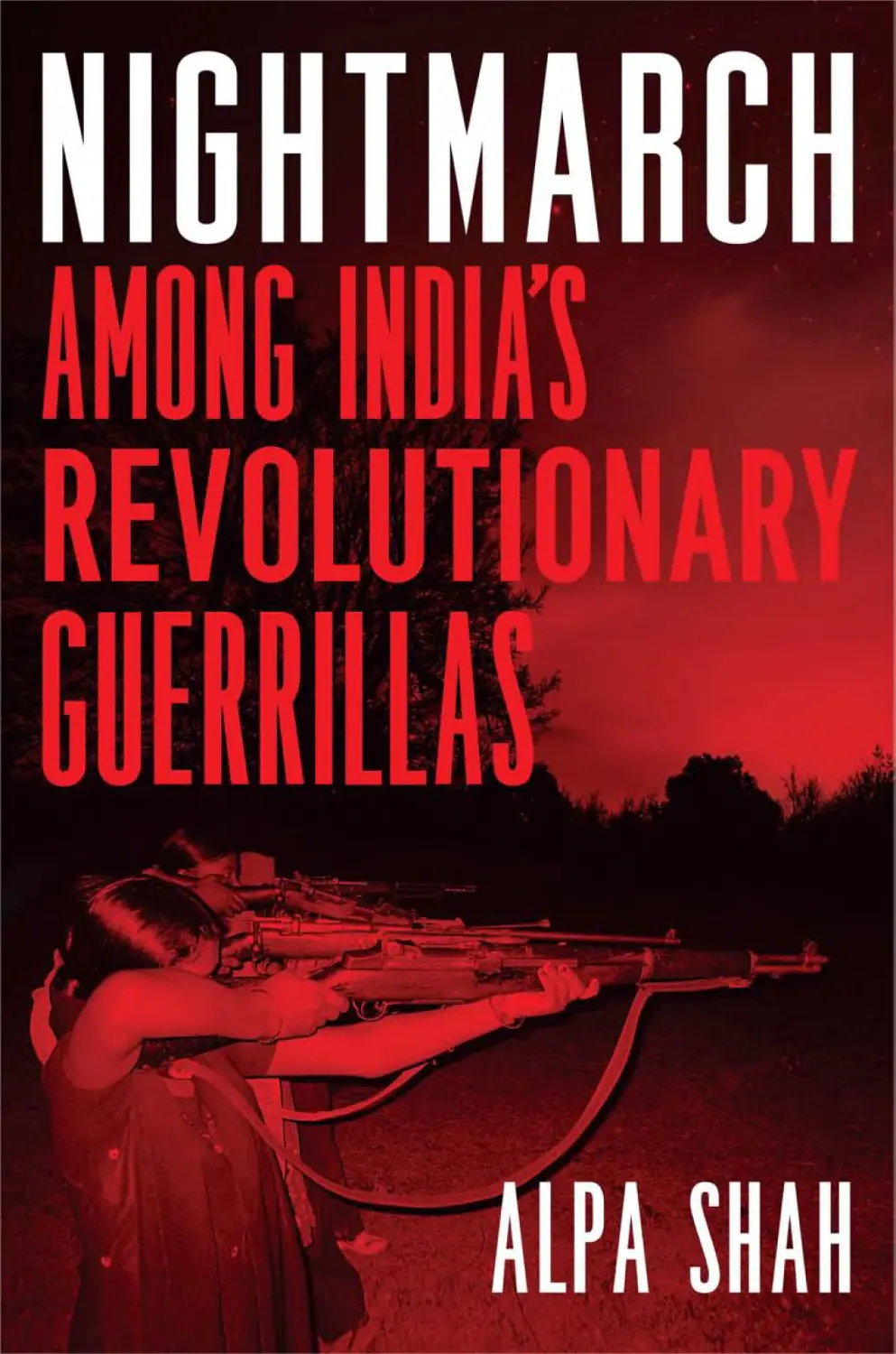


Author: Shah A.
Tags: politics international relations india history of india
ISBN: 978-0-226-59047-9
Year: 2019




Text
NIGHTMARCH
‘A story that could not be more important, told with the perfect balance of cleareyed realism, thoughtful criticism, and abiding love. Shah brings the Indian forests
to life, from the terrors and intimate details of daily existence to the visions of the
future that move rebels to risk everything. Nightmarch reveals what anthropology can do in the hands of a master willing to take genuine risks in the name of
human freedom.’
—David Graeber, author of Bullshit Jobs and Debt: The First 5,000 Years
‘Compassionate, courageous and uncommonly observant. This is an extraordinary
work of rigorous, reflective and deeply engaged scholarship, full of unexpected
insights. At the same time, it manages to be haunting, lyrical, occasionally harrowing—more compelling than some of the best fiction writing.’
—Harsh Mander, human rights activist and author of Fatal Accidents of
Birth, Looking Away and Ash in the Belly
‘One of the most gripping, engaging and accessible books I’ve encountered on the
Naxalites. Shah fearlessly bears witness to the upheavals caused by India’s rising
inequalities, while also asking many urgent, difficult questions. She addresses
head-on the guerrillas’ zero-tolerance policy towards informers, their tenuous
relationship with mining corporations, their dogmatic political philosophy and
their blind faith in the future of the armed struggle.’
—Meena Kandasamy, author of When I Hit You
‘An eloquent and compassionate account of revolutionaries whose voices are rarely
heard. Shah skilfully analyses the individual motivations for the Naxalites’ radical
commitment, their failures, and the deep history of exploitation and neglect that
has provoked their struggle for liberation.’
—David Lan, theatre producer and author of Guns and Rain
‘Brave, brilliant and beautifully written, Nightmarch is an anthropological tour
de force. Shah portrays the Naxalites’ revolutionary dedication with love, respect
and analytical acumen, while laying bare the tragic contradictions of their armed
struggle.’
—Philippe Bourgois, author of In Search of Respect: Selling Crack in
El Barrio and Righteous Dopefiend
‘Nightmarch is an outstanding work, combining ethnographic depth with almost
cinematic vividness. From an extraordinary inside perspective, Shah reveals a
complex interplay among the Naxalites of political ideals, cultural values, personal attachments, and the lure of money.’
—Sherry B. Ortner, Distinguished Professor of Anthropology, UCLA
‘Riveting, finely textured, and acutely perceptive, Nightmarch is a model of what
ethnography can offer. Shah captures both the Naxalite insurgency’s contradictions and its human promise against the background of the crippling indignities
and exclusions of Indian society.’
—James C. Scott, author of Against the Grain
NIGHTMARCH
Among India’s
Revolutionary
Guerrillas
Alpa Shah
The University of Chicago Press
The University of Chicago Press, Chicago 60637
© 2019 by Alpa Shah
All rights reserved. No part of this book may be used or reproduced in any manner
whatsoever without written permission, except in the case of brief quotations in
critical articles and reviews. For more information, contact the
University of Chicago Press, 1427 E. 60th St., Chicago, IL 60637.
Published 2019
Printed in the United States of America
28 27 26 25 24 23 22 21 20 19
1 2 3 4 5
ISBN-13: 978-0-226-59016-5 (cloth)
ISBN-13: 978-0-226-59033-2 (paper)
ISBN-13: 978-0-226-59047-9 (e-book)
doi: https://doi.org/10.7208/chicago/9780226590479.001.0001
First published in the United Kingdom by C. Hurst & Co (Publishers) Ltd., 2018.
Also published by HarperCollinsPublishers India, 2018.
Library of Congress Cataloging-in-Publication Data
Names: Shah, Alpa, 1976– author.
Title: Nightmarch : among India’s revolutionary guerrillas / Alpa Shah.
Description: Chicago : The University of Chicago Press, 2019. | Includes
bibliographical references and index.
Identifiers: LCCN 2018042646 | ISBN 9780226590165 (cloth : alk. paper) | ISBN
9780226590332 (pbk. : alk. paper) | ISBN 9780226590479 (e-book)
Subjects: LCSH: Naxalite movement. | Guerrillas—India. | Communism—India.
Classification: LCC HX393.5 .S525 2019 | DDC 322.4/20954—dc23
LC record available at https://lccn.loc.gov/2018042646
This paper meets the requirements of ANSI/NISO Z39.48-1992
(Permanence of Paper).
For Kundan and Madhu
© S.J. Ballard (2018)
Capital
State capital
Village
AFGHANISTAN
CHINA
Uttarakhand
PAKISTAN
Dehradun
Delhi
NEPAL
Ut
Rajasthan
ta
Jaipur
r
Pr
BHUTAN
Lucknow
ad
es
h
Naxalbari
Patna
Bihar
Gandhinagar
Madhya
Pradesh
Bhopal
Ranchi
ip
Ra
g
tis
at
ar
h
MYANMAR
Odisha
Bhubaneswar
Bay of
Bengal
Chh
Mumbai
West
Bengal
Kolkata
ur
Gujarat
BANGLADESH
Jharkhand
Maharashtra
Te
la
n ga n
a
Hyderabad
Karn
at a
Arabi an
Sea
Amaravati
ka
Andhra
Pradesh
Bengaluru
Chennai
Ker
ala
Tamil
Nadu
I nd ia n
Ocean
N
Thiruvananthapuram
SRI LANKA
The state of Telangana, shown on the
map, was officially formed only in 2014.
Maoist-affected areas based on official 2009 data
maps made by the Institute for Conflict Management
Map of India showing Maoist-affected areas at the time of field research.
Author’s Disclaimer
This is a work of non-fiction. To protect the identities of
the people involved, I have used pseudonyms. I have also
pseudonymised the noms de guerre used by the guerrillas, as
these names are themselves widely known in the local villages
and by the police. I have only kept original names of those people
who have died whose families will no longer be under threat.
Where changing names is not enough to protect someone’s
identity, I have muddied some of their identifying features,
usually by drawing on a similar character, at times having to
merge parts of their stories. The point of the central characters
is to represent archetypal figures who have come together in this
movement. I have also changed the names of most places. I was
present at all of the events described in this book.
Contents
Preface
xi
PART ONE: Going Underground
1. Following the Call
3
2. Half a Century of Armed Resistance
12
3. Living in a Mud Hut
40
PART TWO: Prashant, the Kid among the Goats
4. Meeting the Guerrillas
49
5. The City in the Forest
57
6. Dressing as a Man
63
PART THREE: Gyanji, an Agile Mind
7. Night One
73
8. Sacrifice, Renunciation, Liberation and Violence
84
9. Morning One
107
PART FOUR: Kohli’s Home Away from Home
10. Night Two
115
11. Egalitarian Ideals, Humaneness and Intimacy
126
12. Night Three
151
x
Contents
PART FIVE: Vikas, Frankenstein’s Monster
13. Night Four
161
14. Accelerating the Reach of the State and Capital
170
15. Night Five
194
PART SIX: Somwari’s Autonomy from the
Shackles of Patriarchy
16. Night Five, Continued
203
17. Gender, Generation, Class and Caste
208
18. Night Six
229
PART SEVEN: What Came to Pass
19. Night Seven
235
20. Incarnations
252
Fieldnotes on Making New Futures
260
A Bibliographic Essay on the Naxalites
270
Notes
297
Index
311
Acknowledgements
324
About the Author
327
Photographs follow page 150.
Preface
DEEP IN THE FORESTED hills of Jharkhand, on a freezing
December night in 2008, I made my way past three sentry
posts to a solitary mud hut set apart from the rest of the
village. The soft-spoken, slightly balding, middle-aged man
inside went only by a nom de guerre, Gyanji. Like the guerrilla
platoon outside guarding their leader, Gyanji was dressed in
olive-green fatigues and carried all his worldly belongings in
one small rucksack. But in the dim light spreading from the
kerosene lamp, I noticed the tender soles of his light-skinned
feet. Over the years that I have lived in those forests, I found
out that for twenty-five years Gyanji had been constantly
on the move in the rural backwaters of India, often sleeping
under the stars in the forest, rarely staying more than a few
days in one place. But in contrast to the dark broad feet of
the tribal soldiers outside, layered with years’ worth of skin
which made them as tough, dry and cracked as the red earth
they had walked barefoot since they were born, Gyanji’s feet
were still soft from the childhood care and protection they had
received in his parents’ upper-caste home.
xi
xii
Preface
In the hills, where the local tongue of Nagpuria trilled through
the forests like song, and even India’s majority language, Hindi,
was a rarity, Gyanji’s polished English stood out. I discovered
that he could recite Percy Bysshe Shelley and George Bernard
Shaw, that he had a master’s degree in mathematics, and that
his siblings included a bank employee, an accountant, and a
computer scientist who had emigrated to Canada. It was only
Gyanji who had gone astray from the upper-middle-class path
laid out by his parents. Inspired by the revolutionary spirit in
the universities around him and by the peasant rebellions that
had been sweeping through India in the three decades before, at
the age of twenty-four, Gyanji cut ties with his family and took
the oath of becoming a ‘Professional Revolutionary’. He joined
a group of men and women who had renounced the comforts
of their homes and their university classrooms, ‘declassed’ and
‘decasted’ themselves and, in a long tradition of revolutionary
Marxism-Leninism, resolved to fight oppression, injustice and
inequality to make a more humane world. It was the Indian
equivalent of being a ’68 Parisian rioter or an American
counterculture drop-out – except that while radicalism, for
many in the West, proved a temporary home, for Gyanji and
his comrades it was a life-altering choice. Today these people
call themselves the Communist Party of India (Maoist) – also
known as the Naxalites, or Maoists – and are leading what is
now the world’s longest ongoing armed revolutionary movement.
Although an armed force of less than 10,000, and now mainly
confined to the hills and forests of central and eastern India, the
Naxalite rebels have haunted and taunted the Indian state for
the last fifty years. The foot soldiers of their ‘People’s Liberation
Guerrilla Army’ come mainly from India’s tribal communities,
popularly called Adivasis. The Adivasis make up 8.6 per cent
of the total population of India, accounting for more than 100
Preface
xiii
million people – about the number of inhabitants of Germany or
Vietnam. Considered lowly, ‘savage’ and wild by the dominant
castes and classes, for centuries Adivasis were left on the margins
of Indian society. They survived in the jungles by cultivating
whatever little land they had, living off forest resources by
hunting and gathering fruits and flowers, and chopping wood
to build their houses, fuel their hearths and make their ploughs
and digging sticks. Increasingly squeezed out of their forest
homes by the state and corporations, today they migrate for a
few months far away from their homes to the construction sites
and factories of the towns and the cities where they are used for
the most gruelling, backbreaking and hazardous work, providing
the cheap labour fuelling the Indian economic boom.
The Adivasi foot soldiers were often fighting for reasons very
different from the abstract ideals of leaders like Gyanji. On a
wider level, theirs is a struggle for tribal autonomy, against a
state that they see as repressive, brutal and prejudiced. But for
any individual Adivasi, their reasons for joining the Maoists
were often more personal. Take, for example, Kohli, a gentle,
sensitive sixteen-year-old Adivasi youth with radiant dark skin
and a coy smile, whose rifle was nearly as tall as himself, and
who insisted on carrying my bags when he was once assigned as
my bodyguard. He had run away to live with the guerrillas after
a trivial fight with his father about a glass of spilt milk while
working in his tea-shop. Rather than breaking with their pasts,
as Gyanji did, the Adivasi youth found in the guerrilla armies a
home away from home, and often moved in and out of them as
though they were visiting an uncle or aunt.
To the government in New Delhi, however, both Gyanji and
Kohli are simply terrorists, a dangerous cancer that must be
eradicated. Fifty years after the rebels initiated their fight, India’s
media and government bodies were driven into an anti-Maoist
xiv
Preface
frenzy by an attack on Central Reserve Police Forces patrolling
the construction of a road in the central state of Chhattisgarh.
On 25 and 26 April 2017, the bodies of twenty-six soldiers were
wrapped in the Indian tricolour and garlanded with marigolds, a
flower used in most Hindu rituals. They were airlifted from the
forests of Sukma district to their far-flung hometown cremation
sites, from the foothills of the Himalayas to the banks of the
Yamuna more than 700 miles away. Many of them came from
backgrounds just as poor as those of the men who had killed
them, joining the security forces being one route out of rural
destitution.
That was just one of the many bloody skirmishes between
the Naxalites and the Indian state. In recent years, the insurgents
have blown up security forces, derailed trains that defy their
blockades, killed people they deem are police informers and
delivered summary justice in their ‘people’s courts’. Reporting
these incidents, news bands reading ‘Latest Terrorist Attack’
appear regularly across national TV channels, creating a climate
of fear among the Indian middle classes for whom large sections
of rural central and eastern India are now ‘no-go zones’. Data
collected by the National Consortium for the Study of Terrorism
and Responses to Terrorism contracted for the US Department of
State’s annual country report on terrorism presents the Maoists
as the third-most prolific terrorist group in the world by total
attacks in 2016, after the Islamic State of Iraq and Syria (ISIS)
and the Taliban.1
The latest Indian government campaigns against the rebels
began over a decade ago. In 2006, two years before I began living
in their guerrilla strongholds as a social anthropologist, and
two years after the three major armed Naxalite groups united
as the Communist Party of India (Maoist), then Prime Minister
Manmohan Singh declared the rebels the single gravest internal
Preface
xv
security threat facing the country and labelled them ‘terrorists’.
This signalled a new wave of security operations to hunt down
the Maoists and to silence their sympathisers and supporters.
Painting a ‘Red Corridor’ from the borders of Nepal in the north
down to Andhra Pradesh in the south, the Indian intelligence
agencies claimed that 40 per cent of India’s land area was
affected, encompassing twenty of the twenty-eight states, and
223 of 640 districts. The numbers are hard to verify and were
possibly inflated to justify an increase in security and defence
budgets. Indeed, more than 100,000 soldiers were dispatched
to surround the Maoist guerrilla strongholds in the centre and
east of the country. They were accompanied by a squadron of
helicopters and special forces teams with exotically implausible
names such as ‘CoBRA’, ‘Jharkhand Jaguar’, and ‘Greyhounds’,
who were trained in jungle warfare schools to fight the guerrillas
with their own tactics.
Human rights activists argue that behind the state’s desire
to destroy the Naxalites and ‘civilise’ the Adivasis is the aim
of cleansing the region for the extraction of minerals.2 Under
the Adivasi forests in the states of Jharkhand, Chhattisgarh,
Odisha, Andhra Pradesh and Telangana lie some of India’s
most lucrative reserves of coal, iron ore, bauxite, copper,
manganese, mica and more. Business analysts have claimed
that Indian mining is a success story in waiting. Powerful
corporations have signed deals to exploit the resources and
to acquire land for mining operations, steel factories and
power plants. Mittal, Essar, Vedanta, Rio Tinto and Posco are
scouting out the landscape. But the historic laws, which the
Adivasis fought for in colonial times, prevent their lands from
being easily sold to non-Adivasis, to outsiders. The Adivasis,
and the Naxalites who live among them, stand squarely in the
way of India’s economic boom.
xvi
Preface
In the villages where I lived among the guerrillas, the security
forces’ search-and-destroy missions generated terror. Those who
could, fled to neighbouring villages as the patrols mounted the
hills. Villagers had been allegedly used as human shields by
the security forces and as informers to find the Maoists in the
forests. Others had been caught in the crossfire and brutally
beaten by soldiers during raids, accused of harbouring the rebels.
Scenes from Vietnam War movies played out regularly in the
forests of India. Like in Vietnam, generals boast of better ‘kill
ratios’ to the media. In the last decade, according to the South
Asia Terrorist Portal, which drew on Ministry of Home Affairs
figures, more than 7,500 people have been killed, of whom 57
per cent have been civilians, 23 per cent security forces and 20
per cent Maoists.3
In the aftermath of the Sukma attacks, the home minister,
Rajnath Singh, called a high-level meeting of government
ministers, police, security forces and intelligence agencies to plot
an invigorated counterinsurgency approach. ‘We need to bring
aggression into our policy. Aggression in thinking, aggression
in strategy, aggression in deployment of forces, aggression in
operations, aggression in development and aggression in road
construction,’ Rajnath Singh said.4 The government promised a
final objective: a coordinated battle on security and development
fronts that would be fought to the finish and won.
New Delhi has pledged many times in the past to destroy the
Maoists and yet they endure. Every year in November, across
the forests that are their strongholds, the Maoists celebrate
the deceased in a martyrs’ week. These meetings of guerrillas
in clearings in the forest, lined with crepe paper bunting and
memorials draped in red cloth, are ephemeral as all traces
of their presence must be erased to evade the security forces.
Nevertheless, they fly their red flags painted with a hammer and
Preface
xvii
a sickle, sing the socialist anthem ‘The Internationale’ and, in
remembering the thousands that have been killed, they seek to
regenerate life in the revolutionary spirit from the dead.
How and why does this armed rebellion for a communist
society, a struggle that seems anachronistic to the rest of the
world, persist in the heart of the world’s largest democracy, the
birthplace of non-violence, a country poised to become one of
the most powerful economies on the planet?
I crossed paths with the guerrillas when, towards the end of
my doctoral field research in 1999–2002, they started to enter the
Adivasi rural area of Jharkhand where I was then living. At the
time, I saw them as protection racketeers, not unlike the Sicilian
Mafia, extorting money from state development schemes and big
business in return for safeguarding against their own violence.
But in later years, as I followed their progress from London, I
was intrigued by the fact that so many Adivasis were joining the
Maoists, and felt compelled to understand why.
I knew I had to return to Jharkhand to conduct ethnographic
research and that hallmark praxis of social anthropology,
participant observation: deep immersion over a long period of
time – at least a year or more – into the lives of people who are
initially strangers, learning their language, seeking to know and
experience the world through their perspectives and actions in as
holistic a manner as possible. Undertaking such long-term, openended field research seemed crucial in order to move beyond
the cursory impressions, based on interviews or a visit of a few
days, that had begun to emerge of the Maoists. Staying with
the Adivasi communities in a guerrilla stronghold seemed the
obvious way to arrive at a more nuanced understanding of their
predicament than those that had often emerged in comparable
contexts – whether in the Vietnam War or Peru’s Shining Path
insurrection – which argued that people were stuck between
xviii
Preface
two armies, or coerced into revolutionary support, or turned to
the guerrillas because of either some utilitarian benefits or the
long-standing grievances they addressed. But it was not until
2008, coincidentally as the latest round of its counterinsurgency
campaigns were launched by the Indian government, that I was
finally able to return to Jharkhand.
I went with modest ambitions: to spend time among the
Adivasis in order to understand how life had changed for them
in the face of this revolutionary movement allegedly fighting
for a more equal society. I didn’t expect to see a guerrilla, let
alone meet one. But during my stay, I soon realised that the
guerrillas were everywhere – in every house, in every village
and in every forest. I had by chance ended up living in what the
Naxalites considered their ‘Red Capital’, one of the two guerrilla
strongholds in India. As the state’s counterinsurgency operations
escalated, outsiders were prohibited from entering the guerrilla
areas unless accompanied by the security forces. Those who
dared to venture in without informing the authorities rarely
stayed more than a few hours, at most a few days.
As the situation became increasingly dangerous, I considered
returning to London. But the stories of the people I had met
in the Red Capital had already pulled me too far into this
little-known world. I was compelled to venture increasingly
undercover. My field research had grown into something far
more ambitious than I could have ever imagined.
Nightmarch refers to an unexpected seven-night trek with a
Naxalite guerrilla platoon, undertaken in 2010 alongside new
intensive counterinsurgency operations, when I found myself
dressed as a man in an olive-green guerrilla uniform. The only
woman, and the only person not carrying a gun, I set out with
a group of fighters, under the cover of darkness, to walk 250
kilometres from one part of India to another. Unravelling across
Preface
xix
this march, the book draws on four and a half years of living
as an anthropologist amidst India’s Adivasi people, with one
long spell outside the guerrilla strongholds and another within.
Nightmarch is then my journey into this underbelly of the
subcontinent to understand why, behind the mask of a shining
‘new India’, some of the country’s poor shunned the world’s
largest democracy and united with revolutionary ideologues
to take up arms against rising inequality. Revealing one of the
world’s most intractable and under-reported rebellions, the book
reflects on why a seemingly failing revolution has endured in
India and the ways in which it is undermined. It shows how,
amidst proliferating contradictions, revolutionary motivations
are sustained and subverted at the same time.
Focusing on both the perspectives of the revolutionary
ideologues and the poor rural communities who were joining
them, at the heart of Nightmarch are the nuances, complexities
and ironies of the protracted encounter between guerrilla leaders
and their foot soldiers. Nightmarch reveals the story of young
tribal boys, born into mud huts, who seasonally migrate for
work – carrying bricks on their shoulders in faraway kilns,
building the sky-scrapers of a brand-new India – but also march
in the guerrilla columns to recite poetry, sing revolutionary songs
and bear arms. It tells the story of well-heeled, highly educated
Indians who leave the security of their families when their
conscience and sense of justice are assaulted by the inequalities
of their country, and move underground for years on end in the
service of higher ideals. But Nightmarch is also the story of youth
who grow up learning to read and write in the guerrilla armies
and yet come to have more ordinary dreams – of money to buy
a plot of land in the city to build a two-storey brick house and to
send their children to English-medium private schools – and who
eventually betray the guerrillas. It is the story, too, of women
xx
Preface
who run to the revolutionary family in the hope of finding more
egalitarian homes, and of their struggle with patriarchy within
the guerrilla hierarchies. And it is also the story of villagers
whose lives get ripped apart by the conflict between the guerrillas
and the counterinsurgency security forces who turn for solace
to the spiritual sects of extreme Hindu right-wing organisations.
In short, Nightmarch not only shows why people from
very different backgrounds come together to take up arms to
change the world, but also what makes them fall apart and
turn against each other and their goals. It is a meditation on
the contradictions, limitations and paradoxes of emancipatory
ambitions, revolutionary desires and guerrilla action. It
highlights the fundamental dilemmas of dreamers and reformers
who choose revolutionary pathways to make the world a more
just and equitable place and how, despite their sacrifices and
commitments, their ideals are undermined by their own human
frailties. It is a reflection on economic growth, rising inequality,
dispossession and conflict at the heart of contemporary India.
PART ONE
Going Underground
1
Following the Call
I BEGAN THE JOURNEY from Ranchi city in the dark, in the
bracing bitter cold before sunrise one February morning in
2010. The message had arrived the night before. The phone
rang and I recognised the voice at the other end. ‘Two p.m.
tomorrow’, was all it had said. And then the line went dead.
By dawn the bus was slowly climbing into the hills. Through
the cracked panes of the window glass I watched a procession of
men pushing bicycles heaped with jute sacks bursting with coal.
Like a line of ants carrying food crumbs three times their size, the
men were walking alongside the vehicles on the road, their dark
naked backs shining with sweat. They would have started work
at two in the morning, packing coal scavenged from working
mines, from abandoned beds, or dug out of seams found in
village common lands. They were transporting the coal to local
traders who would sell it to city households, local businesses,
small factories and brick kilns.
It was Sebastião Salgado, known for travelling the world
documenting the perilous conditions of human existence created
by globalisation and economic liberalisation, who first painted
a penetrating picture in my imagination of the men and women
3
4
N i g h t m a rc h
in the coalfields of what is today the Indian state of Jharkhand,
literally meaning ‘land of the forests’. The Royal Festival Hall
in London was hosting an exhibition of his photographs and I
happened to be walking along the South Bank of the Thames.
With their pickaxes on their backs and their faces and clothes
covered in coal, the silver lips of the coal miners of eastern
India stood out as though they had been painted on with an
expensive fluorescent white lipstick. In a curious subversion of
signs of exhaustion, the bags under their eyes were similarly a
silvery white. It was as though they were signalling their dignified
resolution to fight on, saying that this grinding work in these
bleak surroundings could never break them. Their intent and
determination was hauntingly piercing. Now they were so close,
just on the other side of the bus window.
The bicycles disappeared up a mud track at the side of the
road. I realised why when we came to an abrupt halt amidst
a discord of honking buses, jeeps and cars. It was by now
unbearably hot. The forests had given way to dry barren land.
Clouds of dust engulfed us and smoke rose out of cracks in the
ground. Finding it hard to breathe, I tied a handkerchief covering
my nose and mouth.
The road had caved in along a half-kilometre stretch, leaving
a huge crater with a roaring fire in its pit. This was one of the
infamous subterranean coal fires of Jharkhand that turn large
tracts of ground into a burning honeycomb. This one had begun
in an abandoned coal mine and then spread rapidly along the
seam of coal that ran right under the road, making it subside.
No one had yet taken responsibility for fixing the damage.
Not the private mining companies, the Central Coalfields (a
subsidiary of Coal India, which was an undertaking of the
Government of India), or the district administration. It could
take years to repair.
Following the Call
5
Nearby villagers had ingeniously created a dusty, rocky track,
going past their mud huts, for the vehicles to manoeuvre through.
Groups of young men in their late teens and early twenties,
dressed in jeans, their chests bare, with caps or bandanas tied
around their heads, blocked three sections of the new dirt road.
From the bus, I watched middle-class passengers shrink into the
back seats of their cars, instructing their chauffeurs to roll up the
windows, apparently afraid of the youths who had surrounded
their cars and were knocking at their windows with sticks. The
young men were demanding a fee of Rs 10 and shouting angrily
at those who didn’t comply.
The owners of the national and multinational corporations
behind these mining developments lived a life of opulence.
Indian billionaires were buying some of the most expensive
houses in London’s Mayfair and Kensington. One mansion
was rarely enough. Stately homes in the English countryside
were as likely to be among their assets as multi-storey houses
in India’s metropolitan cities. Yet, at night, the footpaths of
Mumbai are crowded with the slumbering bodies of people who
have nowhere else to make their home. Indeed, India remained
a country of extreme polarities, with more poor people than
anywhere else in the world: 800 million people living on less than
two dollars a day and eight states having more poor people than
twenty-five of Africa’s poorest countries put together.1
With no access to the privileged worlds of the Indian
developers behind the mining, Rs 10 seemed a pittance to
demand as some kind of taxation for the suffering of those who
lived here, whose homes had either subsided into the crater, or,
if left standing, were caked in the dirt, dust and pollution of
the traffic.
By noon the pace of the bus had picked up again. I knew we
had crossed from Jharkhand into Bihar when we left the winding
6
N i g h t m a rc h
hill roads behind, and flat rice fields began to whizz past. The
sun was now so strong that a mirage hung above the tarmac.
The instruction was to arrive in a town just over 200
kilometres from Ranchi city, in the middle of the great Asian
route, the Grand Trunk Road. Sher Shah Suri, founder of the Sur
Empire with its capital in Delhi, built the road in the sixteenth
century to stretch from Chittagong in Bangladesh to Kabul in
Afghanistan. My destination was a town flanked by the Morhar
and Sorhar rivers, a spot where Sher Shah Suri had once hunted
down a lion. It was now just another dusty nondescript place
with no characteristics to reflect its imposing name: Sherghati,
‘Lion Pass’.
Sherghati was also the place where the first known meteorite
from Mars landed on Earth in 1865, the Shergottite meteorite.
Famous amongst astronomers, I had seen a part of the meteorite
in the Sedgwick Museum of Earth Science in Cambridge on my
way to lectures in the Geography Department next door. What
with the meteorite, the spontaneous combustion of coal, and
now the insurgents, the area has been explosive for the last three
centuries.
As the bus veered off the tarmac and jolted to a dusty stop, I
anxiously peered out through the window at Sherghati’s bazaar. I
had been told that the guerrillas would send a ‘receiver’, a person
to meet me, and guide me to their forest hideout. But how long
would it take to spot the man? Vegetable vendors, watch sellers,
chicken and goat dealers and cosmetics merchants, traders of all
sorts swarmed between the buses, vans and jeeps. People were
buying and selling, drinking chai, or just loitering and passing
time. What would happen if the ‘receiver’ was not there? How
long should I wait? When did the last bus back to Ranchi leave?
There were many tales of what could go wrong at this
stage. One that would send the guerrillas into great hoots of
Following the Call
7
laughter was about a Naxalite leader from the south of India
who was waiting for his ‘receiver’ outside a busy temple in
Jharkhand, holding a bunch of bananas as a signal. As he stood
in anticipation under a banyan tree, a monkey crept up on him,
snatched the bananas and ran up the tree. Unperturbed by the
stones being thrown at it from below, the monkey calmly ate the
bananas, watching the angry man beneath him. To the leader’s
further distress, bananas were out of season in Jharkhand and,
though he searched high and low, there was no way of buying
them in the vicinity. In the end, the allotted time for the meeting
came and went and he had no choice but to return to the city
where he had begun. It took six months to rearrange his trip to
the forests of Jharkhand. From then on, the Naxalites agreed
that both parties needed at least two objects to recognise each
other, a common greeting, and, in many cases, a second meeting
time in case things went wrong at the first.
A short podgy man climbed on to the bus with a carton of
small tins. His well-rehearsed chant, almost a song, advertised
a coal-black powder that miraculously left teeth sparkling
white. No doctor, dentist or toothpaste could match its magic,
he claimed, as passengers bought his product. An old woman
in a rainbow-striped sari, carrying a basket of small newspaper
packages full of peanuts, followed him. Behind her a teenage
boy selling a multitude of battery-powered torches squeezed
on board. Torches were an essential item, as there were no
streetlights in the town and the villages were not electrified.
As the hustle and bustle of the bus stop engulfed us on the
vehicle, I became ever more anxious about the ‘receiver’. I
scanned the horizon and, from the height of the bus, spotted a
red cap in the distance. The cap’s owner was a tall dark man
with a newspaper rolled up under his arm. Everything was as it
had been described.
8
N i g h t m a rc h
My black hair was neatly oiled into a slick bun and I had
wrapped a cheap flowery red and yellow chiffon sari around
me to blend in among the local people. But taller and lighter
skinned than the local women, I knew I still stood out in this
male-dominated environment and thought that the ‘receiver’
would be able to identify me. Nevertheless, as agreed, I carried
a loaf of bread. Object in hand, I approached the ‘receiver’.
The man did not look at me. He wore a neatly ironed, plain
white collared cotton shirt, beige trousers, and a pair of imitation
black leather slip-on shoes which, although gleamingly polished,
had worn-out soles, and I could see that he had a squint.
‘You must be tired?’ he asked. ‘Yes,’ I replied. A sigh of relief.
Passwords uttered. Job done.
I followed the man in silence, not knowing what lay ahead.
Nobody was expected to speak except to get from one place to
the next. It was essential to protect our anonymity, especially
with the counterinsurgency operations now surrounding us.
The man walked to another bus stand. It was for intra-state
transport but was busier than the inter-state terminal. The bus
we boarded was heaving with people to such an extent that it
leaned precariously to one side. Men sat across the roof. The
fittest youths hung from the ladder at the back. A line of legs
even dangled across the windscreen. The ‘receiver’ disappeared
halfway down the crowds standing in the aisle of the bus. As a
woman, I was offered a space to sit perched on top of the piping
hot gearbox gurgling with oil, and shared this with five other
women. My knees knocked against those of the woman on the
seat opposite me, and one of her two young daughters climbed
on to my lap. To my right a row of dusty plastic gods lined the
cracked windscreen. Ganesh, the elephant god, was surrounded
by garishly flashing lights.
Following the Call
9
With great ceremony, the bus hooted its departure out of
Sherghati. The conductor chanted the bus’s destination at the top
of his voice, in a repetitive machine-gun mantra. As the bus left
the stand, there was a last-minute dash of people trying to climb
aboard, ramming their bodies into any remaining space. We
were soon on the highway and then we turned down a quieter
potholed mud road. Despite the bumpy, uncomfortable journey,
I was overcome with tiredness and fell asleep.
The thunder of heavy vehicles made me jump up with a start.
We were surrounded by tanks and armoured troop carriers,
some as large as the bus. It was an Indian security force patrol
out on what had become popularly known as ‘Operation Green
Hunt’, the intense counterinsurgency measures that were aimed
at eliminating the guerrillas and that had escalated over the last
few months. About 100,000 state counterinsurgency forces,
called the Central Reserve Police Force (CRPF), had been sent
to reinforce state police forces and surround the hilly forests of
central and eastern India. The Border Security Force (BSF) and
Indo-Tibetan Border Police (ITBP) were also mobilised. Ten
CoBRA (Commando Battalion for Resolute Action) battalions,
elite forces specially trained to fight a guerrilla like a guerrilla,
were being raised and dispersed. A fleet of ten armed helicopters
from the Indian Air Force were to be at hand to support
these troops.
Journalists were increasingly being kept out of the guerrilla
areas unless it was to show some dreaded terrorist encounter.
Some journalists had reported that they were being paid not
to write at all.2 Anyone found ‘supporting’ the Maoists could
be prosecuted under Section 39 of the Unlawful Activities
(Prevention) Act, the Union Ministry of Home Affairs declared
in 2008. Human rights activists had already been arrested and
10
N i g h t m a rc h
imprisoned. One of the most famous cases was that of Binayak
Sen, a paediatrician and human rights activist, who was first
arrested in 2007, under the Chhattisgarh Public Security Act
of 2005, charged with sedition and with allegedly helping the
Maoists set up a network to fight the state. He would later,
in 2010, be sentenced to life imprisonment and only granted
bail after an international campaign for his release supported
by dozens of intellectuals including Noam Chomsky, and the
award of several international human rights and peace awards.
But most such acts of silencing were going unreported. Scores
of activists, lawyers and journalists who tried to enter the
guerrilla strongholds to pressure the police into upholding its
constitutional responsibilities, keep a civil war at bay, or even
simply to find out what was happening in the heart of India were
chased out with violence or its threat.
I shrank down into my makeshift seat, worrying that even
though I was of Indian origin, my ‘Western-ness’ would stick
out. If the security patrol noticed me, too many questions would
have to be answered.
We got off the bus at the next village. It was built around
a strip of roadside shops with a busy open-air market in front
of them. The locals seemed to ignore the convoy of the security
forces, but my mouth was dry and my stomach in knots. This
was the machinery of war deployed to kill the people I was
hoping to meet.
Quickly slipping past the men and women sitting on the
roadside with baskets of aubergines, peas and tomatoes to sell,
we made our way into a small hardware stall. From there we
watched the security forces drive through the village. I counted
at least twenty vehicles. This would have meant at least 500
armed men.
Following the Call
11
I was on my way to conduct a long-awaited interview with
one of the Maoist Central Committee leaders. One of India’s
most wanted men, he had been underground for more than
thirty years. This was someone I was yet to meet, although for
the past year and a half I had been living amongst the Adivasis
of Lalgaon, a place the Naxalites called their ‘Red Capital’, deep
in the forested hills of Jharkhand. This was only meant to be
a short trip. Two days at most, I had been told. But it already
promised to be much more than that.
My stomach heaved. Perhaps it was something I had eaten?
Or was it from the constant jolting and lurching of the bus and
the stench of diesel and exhaust fumes that had engulfed us as
we bounced along the bumpy roads? Or maybe it was anxiety
about the military convoy I had just seen?
2
Half a Century of Armed Resistance
IT IS HARD TO imagine now that Soviet Russia or Maoist
China inspired an Indian revolutionary struggle that
endures. But the Naxalites did indeed emerge from the world
communist movement and from the Communist Party of India
this movement had nurtured in the early 1920s. Like other
communist organisations, their goal was to fight through all
available means, including armed force, for the overthrow of
the bourgeoisie, the abolition of the state and for the creation
of a communist society. No one knew what this society would
look like except that it would be one where there was no
private property, no division of mental and manual labour,
and above all no social and economic inequality. Although the
experiments to achieve those ends failed in China and Russia
as the state turned capitalist and grew, rather than withering
away, the dream of this classless society of freedom, equality
and creativity has continued to inspire revolutionaries.
How to get there has always been the key question that
divides the left. Anarchists promoted various means involving
direct action to overthrow the authority of the state and organise
small autonomous communes. Others, following the Bolsheviks
12
Half a Century of Armed Resistance
13
in Russia, argued for a strategy to build broad mass movements
involving peasants, soldiers and all oppressed groups, with the
organised working class at its heart. In most parts of the world
this meant the creation of communist parties, led by those people
considered more ‘conscious’, sometimes called a vanguard. Over
the years, parties have differed in opinion on several matters –
whether to work within the parliamentary systems of states or
whether to turn to arms and go entirely underground; whether
the actions should be organised in stages of development or
whether they should be spontaneous; whether the movement
should be led by the urban working classes or centrally involve
the peasantry; whether the struggle should begin in the cities as
an insurrection or whether it should seep in from the countryside
and slowly take over the urban areas.
After India’s independence from British colonial rule, major
factions began to develop in the Communist Party in the
subcontinent. In the mid-1950s, as the US built a Cold War
alliance with Pakistan, the Soviet Union developed a closer
relationship with India. The Soviet communist government
wanted the Indian communists to be supportive of India’s first
prime minister, Jawaharlal Nehru, and his Congress Party,
tone down their criticism of the Indian state and work within
the parliamentary system. But the Congress government had
earlier – in the 1940s – led a brutal attack on the communists
in Telangana, which divided the Indian left on the direction
they were receiving from the Soviet Union.1 Moreover, relations
between the Soviet Union and China were souring. Mao Zedong
had begun criticising the Communist Party of the Soviet Union
for turning capitalist and repudiating the need for revolutionary
underground war, and the Sino-Soviet split which followed left
some of the Indian communists sympathising with Mao while
others backed Russia’s Nikita Khrushchev. The 1962 India-China
14
N i g h t m a rc h
border disputes that led to the Sino-Indian war accentuated the
divide among the Indian communists. Hundreds of Communist
Party of India members supporting China were imprisoned for
betraying India while their comrades simply looked on. And so,
as those incarcerated debated and remobilised in Kolkata’s Dum
Dum jail – prisons are so often a conduit for further mobilisation
– the party finally split into those who were pro-Russian,
and those who were pro-Chinese and who argued that it was
important to set up a different revolutionary tradition in India.
These Indian radicals – who would later call themselves the
Communist Party of India (Marxist-Leninist) – said that despite
the separation of India from Britain, colonialism persisted and
the economy was still overwhelmingly feudal. They claimed
that the country had not gained real independence but had
simply been passed over to Indian friends of the colonial empire.
Inspired by the protracted war of the Chinese peasantry that
Mao Zedong once led, they said that what India needed was
the revolutionary strategy that Mao had deployed against the
Japanese in the 1930s when conditions in China were similar to
those of India, and that Mao had continued to pursue against
Chiang Kai-Shek’s Chinese Nationalist Party, the Kuomintang.
They set the stage for a protracted people’s war that would
mobilise peasants in the countryside, establish rural bases and
organise an army of poor landless labourers and exploited
peasants. The hope was that they would eventually encircle the
cities in a bid to capture state power in the fight for a global
communist society.
These revolutionaries began with a small uprising in May
1967 in the West Bengal village of Naxalbari, from which they
get their name. There, led by Charu Majumdar and Kanu Sanyal,
peasants and labourers occupied land, reclaimed it as theirs and
demanded that the landlords cancel all their debts and end inter-
Half a Century of Armed Resistance
15
generational bondage. After several months of demonstrations
and occupations, the protest escalated after one of the largest tea
plantations undermined the workers’ strikes by laying them off.
The workers seized the harvest, a landlord was lynched, other
landlords ran away. When the police mounted an operation to
crush the resistance, an arrow released by the occupiers instantly
killed a police inspector. The next day the police retaliated. They
opened fire on the protesters, killing eleven people, including
eight women and two infants, and ignited rebellion across the
countryside.2
The uprising in Naxalbari was brutally crushed. But the
Chinese Communist Party declared that a ‘peal of spring thunder
has crashed over India’. They broadcast the Naxalbari events
widely on Peking Radio, announcing the establishment of a red
area of rural revolutionary armed struggle in the country. There
had already been communication between Charu Majumdar
and the Chinese Communist Party. A communist farmer had
travelled across the Himalayas to give Majumdar’s ‘Historic
Eight Documents’ to Mao Zedong. These writings outlined
the ideological principles of the militant communist movement
that the Naxalite leader was proposing for India and that were
a tribute to the path laid by the Chinese leader.3 Later, in 1967,
Kanu Sanyal and three other comrades also travelled through
Nepal and across the mountains to China, where they met the
People’s Liberation Army, received three months of military
training and political education and eventually even had an
audience with Mao Zedong and Zhou Enlai before returning
to India. Sanyal reported that Mao Zedong’s parting words to
them were, ‘Forget everything you have learnt here in China.
Once back in Naxalbari, formulate your own revolutionary
strategies, keeping in mind the ground realities over there.’4 But
‘China’s Chairman is our Chairman; China’s Path is Our Path,’
16
N i g h t m a rc h
became one of the main slogans raised by those early Naxalite
revolutionaries.
News of the Naxalbari rebellion spread quickly across India
and similar struggles erupted far away in the forested and hilly
tracts of Srikakulam in Andhra Pradesh, Koraput in Orissa, and
the plains of Bhojpur in Bihar and Birbhum in West Bengal. In
some of these places the mobilisations drew on an older history
of rebellion. For instance, there was the Telangana uprising of
1946–51 against the feudal lords and the Nizam of Hyderabad,
who, the local communists said, continued to rule as a monarch
even after the proclamation of Indian independence. There, the
Indian communists had raised the slogan ‘China’s Path Is Our
Path’ and had mobilised peasant farmers and labourers against
feudal lords to take over 3,000 villages, redistributed the land to
the poor, and established village communes reminiscent of Soviet
mirs to administer the region. The government had retaliated
and sent in the army to erase the resistance and annexe the
Hyderabad state into the Indian union. That military invasion
was brutal and it has only been recently acknowledged that,
at a modest estimate, 30,000-40,000 people were killed and
at least 10,000 alleged communists arrested.5 Yet, the idea of
guerrilla insurgency and peasant rebellion had also inspired and
empowered people in the region. In the late 1960s, revolutionary
parties all over India sought to rekindle these earlier memories
of rebellion, overthrow and sometimes annihilate oppressive
landlords, redistribute land to the poorest, remove them from
bondage and cancel their debts.
Drawn by the romance of the Naxalbari rebellion, many
bright urban youths from upper- and middle-class families felt
compelled to leave their homes and their college classrooms to
work with the poor in the villages. They saw themselves aligning
with a range of anti-colonial Maoist movements emerging across
Half a Century of Armed Resistance
17
the globe. At the time, Maoism inspired people to engage in
revolutionary change in widely different places in the world.
The Cultural Revolution had just been launched as a radical
movement to get rid of capitalism and traditional elements in
Chinese society, and the violent purges and killings of the period
were not yet known. Maoism became an ideological repertoire
of some note not only in many countries of the global South, but
also in Europe, notably in France and Italy, and in Denmark and
other Scandinavian countries. It influenced many intellectuals,
from Simone de Beauvoir and Jean-Paul Sartre, to Michel
Foucault and Julia Kristeva.6
In Latin America, a whole range of guerrillas led by urban
intellectuals adopted Maoist guerrilla warfare, establishing
themselves amongst marginalised populations in mountainous
and hilly terrains, appropriating various indigenous symbols
and beginning protracted people’s wars. This is as true of the
initial spread of the Sandinistas and the Popular Liberation Army
(EPL – Ejército Popular de Liberación) in Colombia (who later
turned to electoral politics) as it is of the Zapatistas in Mexico
(who then became what is essentially an indigenous people’s
autonomy movement) and the Shining Path in Peru.
In Zimbabwe, the anti-colonial Zimbabwe African National
Union (ZANU) guerrilla movement, led by Robert Mugabe,
adopted various Maoist elements in its spread. In Haile Selassie’s
‘feudal’ Ethiopia, the militant Eritrean People’s Liberation
Front (EPLF), heavily inspired by Maoist ideology, established
the Republic of Eritrea. In Congo, Kabila formed a People’s
Revolutionary Party, supported by the People’s Republic of
China, which established a secessionist Marxist state to the
west of Lake Tanganyika. In Turkey and northern Iran, the
Kurdish Worker’s Party (PKK – Partiya Karkerên Kurdistanê)
was for decades influenced by the strategy of Maoist people’s
18
N i g h t m a rc h
war (although, like the Zapatistas, today their struggle is most
often cast as an eco-feminine autonomy movement). In Southeast
Asia, the Communist Party of the Philippines and its New
People’s Army, also influenced by Maoism, was being formed. In
Cambodia, the Khmer Rouge army, with support from People’s
Republic of China, was amassing in the jungles to the east of the
country. Maoism was flourishing everywhere.
Perhaps one of the main reasons why Maoism as an idea
spread widely across much of the global South in comparison to
other forms of leftist social movements was Mao’s theorisation
of the role of the peasantry in revolutionary change. Earlier
forms of Marxism saw the proletariat – of which the classic
image was the dehumanised urban factory worker – as the truly
revolutionary class that would usher in a classless society. They
regarded the peasantry as reactionary and a force that would
disappear from history because they would be uprooted from
their land and would eventually join the urban proletariat.
Mao turned this received wisdom on its head and argued for
revolutionary history to be made by peasants who would
lead a war from the countryside. In a context in which mass
industrialisation and the formation of a proletariat was absent
from the history of many nations, Maoism therefore enabled a
vast swathe of the global South to be the potential harbinger of
revolutionary social change.
In addition to this focus on the peasantry, Maoism as an
idea was also popular for at least two other reasons. First, Mao
saw capitalism as inextricably tied to foreign imperialism and
therefore argued that revolutionary change had to be thought
of as a worldwide struggle of the forces of socialism against
those of imperialism. Mao thus became immediately relevant
for many who were fighting colonialism and who either headed
anti-colonial movements against the imperial nations or were
Half a Century of Armed Resistance
19
developing critiques against their own national elites who they
argued had allied with colonial forces. Second, Maoism allowed
for the translation of a wide range of local conditions and
problems through the political, organisational and leadership
method which Mao called the ‘mass line’, central to which was
consulting with the masses and interpreting and incorporating
their suggestions within the revolutionary framework. ‘From the
masses to the masses’ – as the mass line was referred to – was
based on investigating the conditions of people, learning about
and participating in their struggles, gathering ideas from them,
and creating a plan of action based on their concerns in light of
the revolutionary goal. The implication was that Maoism could
flourish in discrete ways in different parts of the world, based on
local conditions, and with little to do with Maoism elsewhere,
or, for that matter, as it existed in China.
In India, the mobilisation of peasants and landless poor was
accompanied by intellectual and cultural activity, as well as
attacks on government buildings and the educational system.
New journals and periodicals such as Liberation and Dakshin
Desh (Southern Country, referring to India in relation to the
Himalayas, with China being the Northern Country) were
published to circulate and disseminate the ideology behind
the struggles: why India was semi-colonial and semi-feudal;
why Indian independence was a ‘sham’; why elections must be
boycotted. Images and idols of national leaders like Gandhi,
who were said to sustain the colonial system in India, were
smashed. New radical theatre developed with plays such as The
Arrow to uphold Naxalbari, The Call of Lenin, and Vietnam
Unvanquished.
The government continued its unyielding crackdown and
many leaders and sympathisers were killed by the police or
disappeared after being arrested. 7 Charu Majumdar was
20
N i g h t m a rc h
imprisoned and died in police custody in 1972. Almost 32,000
suspected Naxals were imprisoned by 1973, many held for years
in jail without trial.8 Splits had already developed between the
different revolutionaries on what should be the way forward,
and critiques of Majumdar had emerged. Nevertheless, a whole
generation of city youth had been radicalised and the seeds of
rebellion had been sown in the countryside. On the streets of
Kolkata and on college campuses, demonstrations had broken
out supporting peasant uprisings and protesting police repression.
Those not imprisoned carried out slow and patient underground
work amongst the peasants and, from the late 1970s on, some of
those who had come out of jail went to colleges and villages to
fight again in various parts of the country. The initial Naxalite
uprising continued to inspire new generations of youths in India
to take up arms to fight for revolutionary change.
Over the years, the Indian revolutionaries sought to form
alliances with and learn lessons from the Shining Path in Peru
and the Communist Party of the Philippines. They nurtured the
Nepali Maoists who, from 1996, fought a ten-year civil war
against the Nepali government, and were later instrumental in
the dismantling of Nepal’s Hindu monarchy. They formed an
emerging set of revolutionary parties working in various parts
of the country, all adopting Mao Zedong’s strategy of protracted
people’s war, with their own cultural troops and their own
magazines and journals.
They had differing positions on various issues – for instance,
the balance in focus between use of arms and mass organising,
or the extent to which parliamentary electoral politics should
be used. Marxist-Leninist revolutionaries all over the world had
taken the position that participation in parliamentary elections
could only ever be a means to an end and that the right to vote
for a particular candidate or policy must not be mistaken for
Half a Century of Armed Resistance
21
real power or democracy.9 Electoral participation was thus
seen by many revolutionaries as an invaluable (if limited) tool
for the working classes to present their ideas, programmes
and counter the forces of the ruling classes. But the eventual
revolutionary goal was to take power to establish something
much more democratic that would include direct control of the
workplaces and the land by the producers. Some parties – like
the Communist Party of India (Marxist-Leninist) Liberation
– turned to electoral politics. But others took the position
that participation in elections in India meant being a part of a
system that was corrupt to the core with bribes, extortion and
the syphoning off of public funds crucial to its entire operation,
and which would corrupt anyone who tried to fight for a seat;
and it was therefore best to boycott electoral participation
entirely. There was the Maoist Communist Centre in Bihar,
Jharkhand and parts of West Bengal, the Communist Party of
India (Marxist-Leninist) Party Unity in other parts of Bihar, the
Communist Party of India (Marxist-Leninist) People’s War in
Andhra Pradesh in the south, and several other smaller groups,
sometimes fighting each other over territories.
Everywhere the high theory of the Indian Maoist analysis
of the economy translated on the ground into a fight against
inequality and for social justice; the fight against oppression
by landlords, against caste discrimination, for labour rights
and land rights. Everywhere they sought to mobilise the most
marginalised people and demand their dignity be respected and
their rights protected. Urban educated city youths were sent to
work amongst the rural poor in ‘go-to-the-village’ campaigns.
They armed themselves with sickles and knives until raids on
police stations produced guns. As armed squads spread in the
rural areas, so too did cultural troops singing revolutionary songs
and staging plays. Everywhere the revolutionaries were criticised
22
N i g h t m a rc h
for their excessive use of violence, in particular their willingness
to kill those they called ‘class enemies’ – landlords, state officials
and police informers. Everywhere they faced state repression.
***
In the 1980s some of the agricultural plains of the country
became infamous as India’s ‘flaming fields’, due to the fierce caste
wars fought between the Naxalites and their supporters, and the
dominant caste landlords. In the state of Bihar, for example, one
of the poorest areas of India, the plains were marked by great
disparities between the high-caste landlords who controlled
large swathes of land, and the smaller farmers and especially the
landless Dalits who worked for the landowners as agricultural
labourers and were treated like serfs.
Labelled as impure and polluted, the Dalit castes, once
popularly known as ‘untouchables’, had been treated all over
India as though they should not be touched. Forced to carry out
the most lowly and ‘polluting’ of tasks, such as removing dead
cattle and human excrement, their alleged impurity – which was
religiously prescribed – affected every aspect of their life. Their
bodily fluids were believed to be contaminating. Dalits were not
allowed to touch the food of higher castes, drink water from
their wells, walk across the thresholds of their houses or pray
in their temples. The ‘impurity’ of Dalits was even said to affect
the air, and therefore defined where they were allowed to live.
Their hamlets were restricted to the southern edges of villages,
in the belief that wind rarely blew from south to north, limiting
the risk of polluted air contaminating higher-caste settlements.
Treated akin to animals, Dalits were expected to remove
their shoes when passing through common or upper-caste parts
of the village, to hold their heads low in front of a person of
higher caste, to never dare look them in the eye. Paid a pittance
Half a Century of Armed Resistance
23
for their labour, they were often forced to take loans from their
higher-caste employers for expenses related to births, marriages,
deaths and health, at interest rates that ensured that they would
never be able to repay, tying them to work for these dominant
castes, often across generations, like slaves.
Although some of the makers of the modern independent
nation state recognised and tried to address the problems
of these extreme hierarchies and inequalities in India, social
discrimination based on caste and tribe persists in India. Under
the Dalit leader Bhimrao Ambedkar, a new Constitution was
adopted which not only abolished untouchability but also
reserved special places for India’s low castes and tribes in higher
educational institutions, government services, and in the lower
houses of the central and state legislatures. Classifying the Dalits
‘Scheduled Castes’ and the Adivasis ‘Scheduled Tribes’, some
Dalits (and Adivasis) have indeed benefited from these measures
of affirmative action and over time the ritual dimensions of caste
have declined. But, far from dying out as an anachronism, caste
oppression continues to be entrenched in the modern economy.10
Across India, it is still overwhelmingly the low castes who
do the jobs no one else will, who work for the higher castes as
low-paid agricultural labourers usually bonded by advances
they have to take to survive, who do the most difficult, insecure,
casual manual labour in factories and in construction where they
are hired through labour contractors, on zero-hours contracts,
and fired at a moment’s notice. Caste violence prevails in many
forms – from verbal abuse and discrimination in schools and
jobs, to rape and murder. And although, as late as 1989, a
Prevention of Atrocities Act was introduced in Parliament to
further protect Adivasis and Dalits, when people dare to rise
against their oppression and exploitation, they are most often
repressed and silenced, the police complicit.
24
N i g h t m a rc h
When the Naxalites spread their struggles in the plains of
Bihar, inspired by Mao Zedong and replicating the strategies
against feudalism taken by Peru’s Shining Path and the
Communist Party of the Philippines, they tried to infiltrate
the Dalit households to free them from their servitude to the
dominant castes. They held secret night-time meetings in the
Dalit colonies, mobilising them to hold their heads high against
their oppression and join the Naxalite armies. They killed several
of the most oppressive landlords, chased others away to the
cities, seized their land and redistributed it among the landless
and small farmers. They organised rallies, protests and labour
strikes demanding that landlords raise wages for labourers,
eliminate forced and bonded labour and give more equitable
terms for redistributing the fruits of sharecropping. They publicly
beat men who had sexually harassed working women and they
descended en masse into government offices to demand clean
drinking water, better housing and healthcare.
The high-caste landlords retaliated against the Naxalites
and their supporters. They wreaked havoc in the villages that
sympathised with the Naxalites by forming private armies or
militias which went by names such as Ranvir Sena, Bhumi Sena
and Sunlight Sena. The Senas (armies) came with their own war
cry: ‘There is only one remedy for the Naxalites, cut them down
by six inches.’ Dalits, in particular, were massacred overnight.
They were often decapitated, as the slogan promised, to make
them six inches shorter. Men, women and children were killed.
Eight one night, nine another night, twenty-two another, twentyfive and thirty-five – so the growing slaughter continued as the
police looked on. The houses of Naxalite supporters were burnt
to the ground. The guerrillas could no longer take shelter in the
houses, and the rice fields provided safety only when the crop
was tall. There was nowhere to hide.11
Half a Century of Armed Resistance
25
So, in the late 1980s, following Mao Zedong and Che
Guevara’s tactics, hoping to find India’s Yan’an, a base area
away from the Indian state from which they could progress
their fight, the Naxalites went in search of better geographical
terrain for guerrilla warfare and began to retreat into the hills
and forests of central and eastern India – into what are now the
states of Jharkhand and Chhattisgarh, and into southern Odisha,
northern Andhra Pradesh and Telangana, southeastern Madhya
Pradesh and parts of Maharashtra and West Bengal.
One such ideal guerrilla territory was Lalgaon, where I lived.
A thickly forested, vast flat-topped plateau of about thirty
dispersed villages and 40,000 people, it rose from the plains as
a mesa, locally known as a pat, composed of Deccan lava. It was
bound to the north by the wide Auranga River, to the south by
the North Koel River, and dissected by many smaller streams
and rivulets so that in the monsoon it was completely cut off
from the plains.
These new lands were also ideal territory to develop
guerrilla zones as they were virtually devoid of state presence.
And so it was that while in most other parts of the world,
armed communist struggles began to decline after the fall of
the Berlin Wall and China’s shift to state capitalism, in India,
despite episodes of intense repression and periods in which it
seemed all was quiet in the countryside, the Naxalite movement
continued to mobilise the most socially discriminated groups:
the Adivasis.
***
Although they had encountered Adivasis before, when they
arrived in these remote regions, the Naxalite leaders, who came
from the cities and the agricultural plains, knew little about the
tribal people that dominated these forested hills, the communities
26
N i g h t m a rc h
of Hos, Santhals, Gonds, Konds, Murias, Koyas and many other
Adivasi groups. In Lalgaon, there were the Oraons, the Mundas,
the Kherwars, the Lohras, the Birhors, the Paharias, the Birjias,
the Asurs and the Agarias – some of whom still lived off hunting
and gathering from the forests and moved their homes seasonally
depending on what they were collecting.12
For centuries before, these Adivasis had migrated further
and further into the shelter of the forests and the hills, seeking
to move away from the hierarchies and oppression they faced
elsewhere, creating communities that were rather different
from those of the caste-divided plains.13 Although government
programmes, activists and scholars in India often consider
Adivasis alongside Dalits as India’s most oppressed and poorest
communities, in the hills where Adivasis had some direct access
to land and forests, they were not dependent on other groups
for their everyday survival in the way that Dalits were in the
agricultural plains. In the plains, different caste groups lived in
close proximity in nucleated villages, unequally dependent on
each other. Higher and dominant castes marked the top of the
social hierarchy, controlling the land and most other important
resources. Dalits were right at the bottom, with no land of their
own to farm in most places and nothing but their labour to sell
to make ends meet. But the closer you got to the forests, the
less the influence of interdependency and hierarchy between
groups that mark caste society in the plains, and the greater the
autonomy people had over their own lives.14 In the remotest
of such areas, Adivasi communities lived in dispersed houses,
surrounded by the forests in which they hunted and which they
cleared to grow grain and crops, some groups still practising
shifting cultivation, clearing one patch of forest to cultivate for
a few years and then moving on to other areas. This autonomy
Half a Century of Armed Resistance
27
to sustain themselves on their own terms, though, has come to
be persistently undermined.
Like tribal groups all over the world, outsiders who came to
these areas thought its forest dwellers to be savage, barbaric and
primitive. ‘Jungli’ is what they were called in India, a derogatory
term accusing them of being as wild as the forests they inhabited.
The British colonial state and the Mughals before them
nevertheless wanted revenue from their land as they did across
the country. They introduced outsiders – usually higher castes
from the plains – to control, ‘tame’ and settle the populations.
The newcomers tried various strategies, like forcibly moving the
people and resettling them in villages that looked more like those
of the plains and indebting them through outside moneylenders,
turning them into bonded labourers. Although some Adivasi
communities succumbed, many either retreated further into
the hills or fought the outsiders off. In the end, although some
higher castes scattered across the forests and hills,15 most of
these outsiders preferred to stay in the more accessible towns
away from the forests and the hills, trying to do their jobs from
a distance.
From the late nineteenth century, alongside attempts at
land settlement and alienation, commercial logging developed
when the forests were found to be a rich resource for railway
sleepers, for the building of military ships, and for hardwood
furniture. The pattern of extraction was old and global. It was
what colonial empires across the world – whether British,
Spanish or Dutch – were built on. Timber taken by the Raj can
today be traced in the well-preserved stately homes of England.
Grand rooms in Buckinghamshire, Bedforshire and Berkshire
can be found bursting with delicately carved chests of drawers,
ivory inlaid dressing tables, the occasional Bengal tiger rug, and
28
N i g h t m a rc h
antique clocks made of the teak and ebony extracted from these
forests of central and eastern India and those of the Himalayas.
The forest dwellers suffered in more ways than one. From
roaming the landscape, living on different patches of land,
hunting and gathering, and cultivation by shifting, as the forests
became ‘reserved’ or ‘protected’ the forest dwellers were slowly
forced into more permanent settlements on the forest fringes.
Many small villages, some of fewer than fifty households,
developed. The settlement of the forests also introduced a new
population of outsiders who came to work the forests and serve
the markets opened by forest harvesting and moneylending. In
Lalgaon these were middle-caste Hindu (Sahus – termed OBC,
or Other Backward Classes, by the Indian government) and
Muslim traders who came from the plains of Bihar. They lived
together in the most accessible part of the region where the
weekly market, called the haat, was based. Most of them were
businessmen and traders. Not interested in farming, they did not
try to accumulate land for tilling and mainly left the Adivasis
to cultivate the terrain and to gather the forest fruits. But they
introduced new markets of money which heavily indebted the
Adivasis while, at the same time, the forest officials tried to deny
the Adivasis access to the forest resources they had lived off.
The Adivasis fought back against the persistent attempts at
their dispossession. The Mundas, the Kols, the Hos, the Santhals,
the Bhumij, the Chero all strung their bows and arrows to attack
the outsiders responsible for their plight. Rebellions in various
parts of the central and eastern Indian hills arose across the late
eighteenth, nineteenth and early twentieth centuries.
One of the most striking of these rebellions (although not the
first) was the Santhal Hul. It in fact began two years before the
1857 Sepoy Mutiny against the British East India Company that
is considered to be India’s First War of Independence. Between
Half a Century of Armed Resistance
29
1855-56, tens of thousands of Santhals, led by two brothers,
Sidhu and Kanhu, tried to kill the landlords and moneylenders
introduced by the British government who had dispossessed the
Adivasis of their land and forests and turned them into bonded
labourers. But the simple bows and arrows, sickles and knives
of the Santhals were no match against the British government,
which sent in troops on elephants with cannons and muskets.
These colonial forces destroyed and burnt down entire villages,
killed ten thousand Santhals, including the two brothers who
had led them, and crushed the rebellion.16
But the resistance persisted in various parts of the country.
The rebellion that is perhaps the most well known is that of
Birsa Munda in 1899–1901.17 Although only said to have lasted
a month and killed fewer than thirty people, it lives on today
as a symbol of tribal resistance against their alienation from
their land and forests, and Birsa’s portrait hangs in the Indian
parliament as the only Adivasi to have such an honour. The
Birsa movement became a historic marker of Adivasi resistance
perhaps because in its aftermath some protective measures were
finally put into place. Mediated by Christian missionaries, the
Chotanagpur Tenancy Act – often considered the Magna Carta
of the Adivasis – was an attempt to stop Adivasi land and forests
from being sold off to outsiders so that they wouldn’t simply be
turned into abject wage labour.
Despite the introduction of various such land protection
measures – which eventually got enshrined in the Fifth and Sixth
Schedules of the Indian Constitution – these laws have been
persistently undermined. And, when India separated from British
rule, although heavy logging was by then officially prohibited,
the Indian state continued the exploitative legacy of the forests in
new ways. A black market endured for lucrative forest products
and the looting of Adivasi resources continued.
30
N i g h t m a rc h
From the 1970s, after most of the forests had been depleted,
the Indian forestry agenda turned from harvesting the forests
to protecting them under a new conservation agenda that was
taking over the world. Parts of Lalgaon became a Tiger Sanctuary
and National Park, further curtailing the rights of Adivasis from
those forests, this time to protect the tiger.
The new conservation agenda also affected the outsiders
who had come from the plains of Bihar. While in the heyday of
forest harvesting, the outsiders had earned a good living, when
forestry turned to conservation, although some continued to
run the illicit rackets of logging and smuggling out other forest
products (usually moving out of the forests to live in the district
headquarters), many became increasingly impoverished. They
sought to earn a living from grocery shops, trading in nontimber forest products such as flowers from the mahua tree used
to make wine, taking government contracts – for example, for
Public Distribution System shops which sold subsidised rations
provided by the state for the poor – and other small enterprises
such as tailoring. Those who failed in enterprise migrated away
seasonally as casual wage labour to other parts of the country,
although rarely doing the heaviest manual labour jobs which
Adivasis and Dalits are used for. Meanwhile, the Adivasis
continued to try to farm and live off the forests. As their access
to the resources around them was increasingly restricted, they
also migrated seasonally as casual wage labour to do the most
gruelling of work – like making and carrying heavy loads of
bricks in brick factories – that the higher castes would consider
demeaning.
Neither the British Raj nor the Indian state made substantive
attempts to develop basic infrastructure for the people who
lived in these regions. The idea of their savagery and barbarism
had stuck and the officials who were given responsibility for
Half a Century of Armed Resistance
31
these Adivasi forests and hills made few attempts to integrate
those they considered as beyond the pale of civilisation as equal
and rightful citizens of the Indian state. They considered their
deputations to these areas as ‘punishment posts’.
Even at the cusp of the new millennium, as the world
marvelled at India’s economic growth rates, there was no
provision of electricity or running water, healthcare or sanitation
in any of the villages in which I lived in Jharkhand. Efforts
to encourage literacy were also negligible, and in most of the
villages I visited, up to 90 per cent of the Adivasi population
was illiterate. Although there were a few schools that dotted the
landscape, it was not until the 2000s that schools were being
built everywhere. Most people I knew did not have enough
education to consider applying for the ambitious constitutional
provision for jobs in the state sector that were to be reserved
for Adivasis and Dalits in proportion to their representation in
the total population.18
Although they lived right under the state’s extractive regime,
historically the Adivasi response to these outsiders was to keep
them at arm’s length, resisting with a culture that was antithetical
to that of the outsiders. ‘We are people of the Jungle Raj, the
forest kingdom,’ many an Adivasi elder proudly said to me. I
came to understand Jungle Raj as emblematic of an Adivasi
counterculture, a way of life formed in negotiation with but also
opposition to the high-caste outsiders.
***
In a country whose society is often seen as one of quintessential
hierarchy – as exemplified by its caste system – these forestdwelling communities were exceptional for their relatively
egalitarian values, and the dignity and pride with which they held
these values, when compared to the caste-divided hierarchical
32
N i g h t m a rc h
communities of the plains of India. This is not to say that there
was no hierarchy amongst Adivasis or to suggest that all Adivasi
groups were equally egalitarian, but to mark that in relation to
the stark, caste-based inequalities of the agricultural plains, the
communities of these hills and forests were notable for their
egalitarian spirit that left them relatively free from unequal social
divisions. Egalitarian values appeared in many aspects of Adivasi
life: in how families were organised in autonomous kin groups;
the ways in which communities were led; in their attitudes to
production and consumption; and especially in gender relations.
Some scholars have said that India’s forest-dwelling
communities were marked by social systems of anarchy in
that they were ordered societies without the forms of rule that
represent enduring structures of domination and exploitation.19
In some of the Munda and Oraon villages that I came to know
intimately, local leaders were selected through an exceptional
randomised process. A spirit possessed a blindfolded person,
the possessed person moved around all the houses of the village,
and the house where the spirit left the person was the house of
the new leader. These practices of spiritual sortition were so
democratic that it was a lottery as to who would be the next
leader. This was an Ancient Athenian form of democracy, once
regarded as the principal model of democracy, with a tribal
twist. Leaders did not dictate orders but facilitated discussions
to resolve disputes by consensus, a process that could take days
to reach agreements – what anarchists have called ‘democracy by
consensus’. They were also responsible for cultivating communal
fields whose crops were to be used for feeding the entire village
three times a year and given to anyone facing hardship, as a
kind of social security net or a welfare state. Not everyone felt
that they could hold the responsibility of leading and some
passed on the role to others they considered more appropriate.
Half a Century of Armed Resistance
33
Although not prevalent everywhere, this ideal of leadership was
remarkable for being based on the values of society marked by
the egalitarianism of sharing responsibility in looking after each
other, and not on status, rank, charisma or wealth.20
Indeed, internal stratification based on the accumulation
of wealth has not typically been encouraged within Adivasi
society.21 Foraging and producing to meet not much more than
subsistence needs was common, as many lived mainly just for
the moment. Eating, drinking and making merry were a central
part of daily Adivasi sociality but this consumption was first
and foremost about sharing with others and not about showing
your superiority, or marking yourself apart from others. Mutual
and collective aid through systems of non-monetised labour
exchange between households was crucial for survival. Adivasis
proudly continued collective hunting and gathering and shared
the fruits of their labour just as they participated in communal
labour exchange: you help me build my house, I will help you
build yours, or you help me sow my fields today, I will help you
sow yours tomorrow. People were valued as masters of their own
production and consumption and when they couldn’t survive on
what they found around them and had to participate in wage
labour for some parts of the year, they often did so in a similar
spirit, as ‘wage gatherers’, seeing wages as just another form of
gathering for subsistence.22
Perhaps most striking, in a country so marked by inequality
between men and women, was the relative gender equality and
the social, sexual and economic freedom that women had across
the forests of central and eastern India in comparison to the
higher-caste societies of the plains. Not only did women work
outside the household (with some women even going on hunts),
it was common to find men cooking and doing other domestic
work such as washing clothes, collecting water, sweeping and
34
N i g h t m a rc h
looking after children. And when there was drinking and
dancing, Adivasi women participated alongside men with equal
fervour. It often struck me that the communities that I lived with
had a form of gender equality that surpassed the conditions in
the West that decades of feminist movements had fought hard for.
Although these values were constantly being undermined
and attacked, Adivasis could maintain their egalitarian
countercultures partly because state officials had not taken an
interest in co-opting them into their project of citizen-making,
but especially because they still had some direct access to the
material resources of forests and land, which gave them the
autonomy to live on their own terms, and to reproduce their
communities and values, without much interference from or
being too dependent on others.
It was in the lands of these relatively egalitarian communities
that the Naxalite leaders found themselves, seeking to nurture
their revolutionary struggle for an egalitarian society. A
protracted encounter of different egalitarian ideals and practices
– that of the Naxalites and that of the Adivasis – followed, albeit
surrounded by the tensions of hierarchy and inequality fraying
at the possibilities of their conjuncture. Nevertheless, although
so many outsiders had failed to infiltrate these forests, from the
1990s in particular, the people of these areas became the main
support base of the Naxalites and it is here, in the heart of the
country, that the guerrillas grew in strength, consolidating their
armies.
***
For many years, the underground leaders of the various
revolutionary parties had talked of unity, and in 2004 these
talks bore fruit, creating what is now called the Communist
Party of India (Maoist) and their People’s Liberation Guerrilla
Half a Century of Armed Resistance
35
Army (PLGA) to escalate their war against the Indian state.
Since then, they have been called Maoists in the press and by
the police. They themselves use both Naxalite and Maoist and
in the villages in their strongholds they take on several names
including ‘The Party’ and ‘Jungle Sarkar’(meaning the ‘Forest
State’).23 Although the numbers change all the time, and with
such clandestine armies that are constantly on the move it is easy
to project a greater force than is in fact the case, by 2010 there
were an estimated 10,000 guerrilla soldiers and the numbers
were said to be rising.
Working outside of the Indian state boundaries, they created
their own parallel state with state-like structures and their own
geographical demarcations, which superseded the Indian borders
and were based mainly on topographical continuities and the
homes of the various oppressed communities. Heading it all,
in a pyramidal structure, was the Central Committee, with its
Politburo overseeing the various State-level Committees that
executed the political-organisational work of the movement.
Bihar-Jharkhand-Chhattisgarh was the state area in which I lived
and Dandakaranya, which straddled southern Chhattisgarh,
northern Andhra Pradesh, southern Odisha and Maharashtra,
was considered the foremost guerrilla stronghold. Within each
of these Maoist states were Regional Committees, followed by
Zonal Committees, under which there were Area Committees
overseeing the work of party cells and mass organisations (the
latter were non-violent and led by and consisted of people who
were not underground). Those who were mobilised to contribute
to the political work began right at the bottom and were slowly
promoted up the ladder. Although each region had its own
socio-cultural history and specific tactical needs, the aim was
to achieve unity in strategy across the areas. Programmes of
mobilisation and also leaders could therefore be found deputed
36
N i g h t m a rc h
across states; for example, in Jharkhand it was common to find
people from Andhra Pradesh working alongside those from West
Bengal and Bihar.
These political structures were supported by the military force
of the People’s Liberation Guerrilla Army. Villagers who wanted
to join the armies were first recruited into local area squads. If
they lasted, they would be promoted to a platoon (a force of
about thirty soldiers), then a company (around eighty to ninety
soldiers) and finally a battalion (of several hundred soldiers).
People’s militias consisted of villagers who could come together
to fight with arms – usually swords, sticks, bows and arrows
– only when necessary. There were also mass fronts – farmers’
movements, anti-displacement and anti-mining fronts, women’s
movements – organisations that worked openly to mobilise
people to fight against issues that affected them daily. But these
mass fronts were usually kept separate from the armies to protect
them as they were open and not underground and therefore more
vulnerable to state repression.
The Indian state’s solution to this growing force was
development under the barrel of a gun, although there were those
in government who had argued against such a security-centred
approach.24 The links between the economic growth model of
the government and the war to be waged against the Maoists
were explicit. In 2009, Prime Minister Manmohan Singh said
in Parliament, ‘If left-wing extremism continues to flourish in
important parts of our country which have tremendous natural
resources of minerals and other precious things, that will
certainly affect the climate for investment.’ The man behind
the offensive which followed, Home Minister P. Chidambaram
(also the erstwhile finance minister), was previously a corporate
lawyer representing several mining corporations as well as a
non-executive director of Vedanta – a British mining company
Half a Century of Armed Resistance
37
– which planned to excavate bauxite in many parts of India.25
The following year, the home secretary said that the insurgents
blocking $80 billion of investments would be subdued within
three years. But, in 2014, the Maoists persisted and the new
home minister, Rajnath Singh, promised to wipe them out in
another three years. In 2017, another end was promised with a
renewed aggressive fight to choke the rebels.
There were some attempts at ‘peace negotiations’, most
notably in Andhra Pradesh in 2004. A ceasefire was agreed
for a period to facilitate talks. Senior leaders came out of the
forests and engaged in talks with the government. The first
round discussed many of the Naxalite demands including the
withdrawal of cases against people who had been agitating, the
release of political prisoners and the removal of awards for the
arrest of wanted revolutionary leaders. Also discussed was land
distribution to the poor. But no agreements were made, and
after this round the government was reluctant to continue the
ceasefire for the second round of talks. The talks broke down
in January 2005. The government claimed that the Naxalites
had used the ceasefire to consolidate their armies while the
Naxalites said that the government had used the period of the
talks to get information about their top leaders and networks.
The government repression that followed was intense, destroying
the movement in Andhra Pradesh.26
In 2010 peace negotiations were considered again but ceased
when the Maoist Central Committee leader responsible for the
negotiations, Cherukuri Rajkumar, who went by the nom de
guerre Azad (meaning freedom), was killed. The Maoists claimed
that the government was once again using the talks to wipe
out their leadership. They said that Azad had been killed in a
‘fake encounter’ – an extra-judicial killing that was presented
as a staged confrontation – marking a long history of such
38
N i g h t m a rc h
fabrications. Villagers, foot soldiers and leaders have been picked
up by the police, brutally tortured in custody and killed, and
then had their bodies strewn in faraway forests to be presented
to the world as having been killed by the police acting in selfdefence during an encounter with the Naxalites, even though
there were marks of torture all over their mutilated bodies.27
Over the time I spent in Lalgaon, the National Human Rights
Commission recorded that there were more than 200 reported
cases of fake encounters across the country, most of which were
in Naxalite areas.28
The most brutal form of counterinsurgency measures began
after the 2004–05 ‘peace negotiations’. In the Dandakaranya
region of southern Chhattisgarh, to which the Naxalites had
retreated after the repression in Andhra Pradesh, from 2006,
local youth were armed and mobilised to cleanse the area of
people in what was called Salwa Judum, meaning ‘purification
hunt’ in the local Gondi language. Headed and nurtured by a
local politician – who called the mobilisation a ‘Peace March’
– the hunt recruited upwardly mobile educated youth from
both the middle castes and the Adivasis, and backed by the
police and government funding and weapons, they attacked
the Adivasi villages and villagers who were seen as Naxalite
supporters.29 Entire villages were plundered and burned down,
children thrown into fires and pregnant women killed; hundreds
of women were raped, others mutilated and murdered, and more
than 350,000 people were forced to leave their homes, according
to human rights activists.30 It was reminiscent of the brutality
of British counterinsurgency tactics used to kill the support of
the National Liberation Army of the Malayan Communist Party
more than sixty years before. In Chhattisgarh, many people were
killed and others forcibly evacuated into resettlement camps
that they saw as being like prison compounds. The corporations
Half a Century of Armed Resistance
39
were waiting to enter the region. But the Naxalites claimed that
these counterinsurgency programmes only served to increase
their ranks.
As their village support grew, the Naxalite cadres expanded
and so did the territories they controlled – at least for a while,
before the security forces boxed them in – so that they could
walk from one Indian state to the next and rely on support from
sympathisers along the way.
3
Living in a Mud Hut
HOW DID I FIND myself here? It is difficult to say where exactly
my journey began. Perhaps it was before I was born in an
Indian suburb of Nairobi. In the late 1920s my grandparents
sailed the monsoon winds from the poor, dry and dusty villages
by the Gulf of Kutch in Gujarat to eke out a living in Africa.
They followed a well-trodden path, promoted at the turn of
the twentieth century by the British Raj, who, having laid the
Indian Railways in the late 1800s, took contract labourers
from India to build train tracks from the Kenyan port of
Mombasa to Lake Victoria. Upon his arrival in Mombasa, my
grandfather, then aged sixteen, headed for Nairobi to make a
new life for himself.
My grandmother, Moti, who had not laid eyes on my
grandfather before she was married off to him by uncles and
aunts, went to join him a year after their marriage. She set sail
on a small dhow carrying eighty passengers. A few weeks into
their journey the monsoon winds failed. Stuck in the doldrums
of the Indian Ocean for three days, their drinking water was
running out. There, in the crowded heat of the hull, is where
fifteen-year-old Moti, on her way to an unknown land and an
40
Living in a Mud Hut
41
undiscovered husband, thought that they would all die. In the
toughest moments of my journeys in eastern India, I thought
of my grandmother’s fortitude in the face of this uncertainty,
and my own fear and suffering would pale into insignificance.
Although my grandparents were illiterate, they worked hard
and invested everything into the education of future generations,
sending my father to medical school at the Makerere University
in Uganda. By the time I was born, from sweeping the floors of
other people’s shops, my grandfather had established his own.
Our story was fairly common of a certain generation of migrant
East African Gujaratis. Others were more ambitious. Some of my
father’s friends set up the first sweet factories of Africa, the first
textile mills and the first oil refineries in Kenya. Others expanded
their industries across the globe to West Africa and South East
Asia and now feature high up on the global lists of wealthy
Africans and British Asians worth at least two billion dollars.
My father taught me, though, to question the inequities that this
accumulation of wealth entailed and made me acutely aware of
the plight of the local Kikuyu, Akamba and Luo labourers on
the backs of whom it was built.
Over the years my father responded to the values being
embraced by those around him with a strong anti-materialist
outlook. While his friends sat luxuriously in air-conditioned
Mercedes-Benzes, my father proudly insisted on filling his twelveseater van with twice the number of people it was meant for and
driving them across the country, arguing that a car was for one
purpose only: to get as many people as possible from point A
to point B. And as his friends poured their newly accumulated
wealth into seeking the advice of spiritual gurus, venerating
Jain monks and sinking gold into the foundation of new marble
temples, my father turned more and more secular. From my
42
N i g h t m a rc h
father I learnt to question the injustices of the world around me.
But I also learnt to question him.
I was fifteen when my family moved to England, and by then
it was expected that girls would go to university and find paid
work because it was no longer possible to sustain most middleclass Gujarati households on just one salary. Like the choice
of a suitable boy for marriage, a suitable job for a woman had
strict boundaries. From my father’s point of view at that time,
the purpose of higher education for me and my three sisters was
to find dignified jobs in public service – to become a dentist,
optometrist or pharmacist, for instance – that would allow us to
have reasonable working hours and fulfil our main duty – to look
after our children, husbands and wider family. I had different
desires, however. Naïve as I was, I wanted to reach beyond the
family and make the world a better place for all.
I read geography at Cambridge and then went on to work with
various international development organisations. From teaching
displaced children in the slums of Delhi for a small charity, I
found myself walking through the sparkling glass atrium of
the World Bank in Washington, DC, working as an intern in
their ‘Poverty Reduction and Economic Management’ unit.
But I became disillusioned by what seemed to be a widespread
approach that turned poverty into an industry, benefiting from
poverty-related activities, rarely questioning the underlying
inequalities that produced it. I increasingly believed that
projects aiming to tackle inequality must begin from the diverse
perspectives and experiences of the marginalised, oppressed and
excluded people whose lives they wished to change but whose
voices were rarely heard, often silenced. I returned to university
to embark on a PhD, with these thoughts uppermost.
It was at university that I discovered both the Naxalites
and what social anthropologists call ‘participant observation’,
Living in a Mud Hut
43
that rather quaint praxis of ethnographic research that few
anthropologists have the time to pursue today. Participant
observation was proposed in the early twentieth century by
the Polish-born British anthropologist Bronislaw Malinowski,
returning from field research in the South Pacific Trobriand
Islands, as an antidote to research done from distant armchairs,
through data obtained second-hand from missionaries or travel
writing, or through a few interviews or short investigative
visits. Involving an intense involvement with people in their
own cultural environment by living with them over an
extended period of time, learning their language, observing
and participating in their daily lives, exploring all aspects of
their lives in as holistic a way as possible, long-term participant
observation had the ability to give us novel insights about the
world and unveil hidden processes that we might never be
able to see otherwise.1 It seemed important to be trained as an
anthropologist as a route to the answers I needed for the making
of a better world. So, aged twenty-three, as a budding doctoral
student of anthropology, I set off for India.
I chose to go to the other side of the country rather than to
where I had roots, to a place where distant aunts or uncles would
not inhibit my movements out of a sense of protection or social
decorum, to the remote forests and hills of the far east of India
where I knew no one. There, in the state of Jharkhand, I lived
for two and a half years with the Munda Adivasi tribal people
in a village of a hundred mud houses that had no electricity or
running water.
It was one of the poorest and most remote parts of the world
and seemed to be a good base from which to understand, from
the grassroots, the virtues and limits of the various attempts
at addressing poverty and inequality – whether it was by
international development agencies or by grassroots social
44
N i g h t m a rc h
movements. I wanted to know how different attempts at social
transformation, whether initiated by the state or by non-state
organisations, were experienced and engaged in by India’s
Adivasis, some of the most marginalised people in the world.
In Jharkhand I saw how development funds were syphoned
off by the local elites before they could reach the poorest people.
I saw how NGO workers came to the forest villages in their
Land Rovers, spoke to the local elite to fulfil their ‘participatory
community development’ mission, and then rushed back to the
city under the ‘safety’ of the daylight hours, while the poor tribals
hid in the forests until the outsiders had gone. I saw too how
on election days, votes were bought and voting boxes stolen by
the goons of the strongest parties, and how the poorest tribals
wanted to keep the state away from their lives. And I saw the
corporate officials of international management consultancies,
exploring the mining potential of the region for multinational
corporations, being greeted with garlands of marigolds as they
landed at Ranchi airport to figure out how to overcome the
problems of land acquisition from Adivasis.
It was not until the end of this period in Jharkhand that I first
stumbled upon the Naxalites. Their forest armies were expanding
in the area and they were recruiting my village friends.
‘They are just criminals,’ said my research assistant then. She
was a middle-class, upper-caste girl from Ranchi city.
On the surface of things, it appeared that she was correct.
Indeed, that is how I wrote about them in my first book, In the
Shadows of the State: the Naxalites as protection racketeers,
taking over the local markets of rent-seeking. In exchange for
introducing them to the villages, they were offering my friends
protection with their guns to syphon off some of the money
that came into the area as development funds for infrastructural
projects such as the building of roads, dams or bridges. This was
Living in a Mud Hut
45
money that usually went into the pockets of the locally powerful
people – the politicians, the state officials, the contractors and
the village elites.
But my doctoral supervisor, one of the world’s finest
professors of anthropology, came to visit me in the village
where I lived in Jharkhand, and asked in his characteristically
understated manner, ‘Are they really just a bunch of thugs?’ The
question kept bothering me.
I had to return to London to write my PhD thesis but I kept
track of news about the Naxalites from afar. Although life
back at home took over – I became a university lecturer, I had
students to teach, I got married – I became increasingly drawn
to what the Naxalites were trying to achieve. They had come
together, or so they said, to overthrow one of the most powerful
and unequal states in the world in the hope of creating a more
egalitarian future for everyone. They seemed to be immersed
in the lives of the communities I had left in central and eastern
India, living as I had once done, as one of them. As Indian
economic growth rates were rising, their underground armies
were reported to be swelling. Yet, internationally, at the time
there seemed to be a conspicuous silence around India’s war
within. Unlike movements such as that of the Zapatistas in the
Chiapas in Mexico, the Naxalites remained largely unknown to
the Western intellectuals and students who came to revere other
similar faraway indigenous peoples’ struggles in their own anticapitalist movements. I knew I had to get back to those forests
of Jharkhand to understand how and why the Adivasis were
taking up arms to fight for a different world.
That’s how, when the global financial crisis hit between 2008
and 2010, ten years after I had first gone to Jharkhand, I found
myself living for a year and a half in a village in an area the
guerrillas called their ‘Red Capital’, Lalgaon. I could not have
46
N i g h t m a rc h
predicted that the Indian government would launch its military
might to eliminate the guerrillas exactly when I stepped back
into Jharkhand.
‘Operation Green Hunt’ began in the autumn of 2008.
Trainloads, busloads and truckloads of troops poured in from
all over the country and made their barracks across the plains
of central and eastern India in schools, hospitals and any other
public building they could find. Although surrounding the
Adivasi hills where I lived, they did not dare to climb up into
the forests unless they were in a force of 500 or more. On those
patrols, drivers were sent ahead to scout in tanks and bulletproof
vehicles, but the troops all came on foot as the land mines the
Maoists had laid under those tracks were targeted at blowing
up the vehicles. The road to Lalgaon, where I lived, was thought
to be the most mined road in India.
Journalists were prohibited from going into the guerrilla
areas unless accompanied by the security forces. Sympathetic
journalists and human rights activists defending the rights of
India’s low castes were jailed.2 The police tapped the few existing
phone networks out of the guerrilla strongholds. When I realised
that I couldn’t call my husband back in England for weeks on
end, for fear of being discovered as a foreign voice speaking a
foreign language dialling a foreign land, I wondered what I was
doing in that wilderness. But I was already too immersed in
trying to understand the lives of my new sisters and brothers,
aunts and uncles, nephews and nieces.
Then, at the peak of these counterinsurgency operations,
in February 2010, came this long-awaited invitation for an
interview with a Maoist Central Committee leader whom I had
not yet met. I left my mud hut in Jharkhand to travel to the
neighbouring state of Bihar for what I thought would be just a
two-day trip.
PART TWO
Prashant, the Kid among
the Goats
4
Meeting the Guerrillas
THE SECURITY FORCE VEHICLES had passed but my stomach
was still churning as we waited in the hardware shack on the
dusty roadside, tucked away from the market stalls. A younger
man in blue denim appeared from the side of the shack, as
though he had also been waiting.
The man with the squint had been given only enough
information to bring me from the bus stop to this shack. He had
no idea about what was to happen next. This kind of secrecy – of
people being given only the necessary information, no more, to
perform a well-defined task – was crucial in a context of war. It
would make it difficult to be stalked. Moreover, if one of us were
arrested, we would have only very limited information about
each other’s movements to give to the police under torture. I
had not spoken to the man with the squint, but simply following
him had transformed him into a familiar, reassuring figure in this
unknown terrain. I was nervous as I watched him leave. Bidding
farewell to the man with the squint, I followed the man in jeans.
We soon left behind the noise of the market. In front of us lay
open rice fields. In the distance, mud houses marked a village.
Still further were the hills – our destination, I guessed. To our
49
50
N i g h t m a rc h
right, across the flat plains, the tops of the armoured carriers and
tanks were moving off along the road towards another village.
We scrambled down into a parched riverbed with dry scrub
and bushes on either side, and followed it away from the market
village. The man in jeans said it was a longer route than walking
across the rice banks, but in the riverbed we were less visible and
would meet fewer people.
We stopped twice. Each time because I needed to vomit.
Embarrassed about slowing us down, I was happy that no fuss
was made about it. The man in jeans simply stepped aside until
I was ready to move on. He did, however, switch on his mobile
phone. He was making a call for a motorbike. Alarmed, I stopped
him and said we should continue as planned, afraid of the extra
attention and delay that stopping and searching for a motorbike
might cause.
At dusk, we entered the empty courtyard of a mud house
at the edge of a village. The young man told me to wait there
and disappeared. I sat on the doorstep, resting my back against
the padlocked door of the house. The step was coated with the
customary mix of mud and fresh cow dung, making it as smooth
and shiny as a dark brown chocolate slab. Twenty minutes later
it was getting dark, the young man had not returned, and the
arched crescents marking the fingertips of the person who had
plastered the step that morning eerily jumped out at me. I drew
in the sweet smell of the mud and dung to calm myself down.
I became fixated on watching the second hand of my
wristwatch turn. But time works in a completely different way
in rural India. People would wait for six or eight hours on a
railway platform for a delayed train, without becoming angry
or frustrated. Or, if a bus were held up for a few hours with a
puncture, passengers would wait without making a fuss. Young
men could spend hours simply watching time pass. I tried to
Meeting the Guerrillas
51
remind myself of the hours of waiting I had already done over
the last year and a half in the ‘Red Capital’ where I had made
my home in the forests of Jharkhand. I needed to be patient.
The young man returned half an hour later. He said we
should continue to the last village before the hills as the ‘Green
Hunt’ patrol had returned to its base. The security forces had
completed their daytime show of power and the nights, he said,
always belonged to the Maoists.
We walked for another half an hour more, past the last mud
house, and towards the hills whose dark contours stood out
against the blue midnight sky. Suddenly, in the moonlight, a tall
and sinewy silhouette approached us with the contours of an
AK-47 slung across his shoulders. Out of the shadows behind
him appeared at least ten more men.
‘Lal salaam, didi (Red salute, sister),’ he said, as he put his
hand out to shake mine and then raised his fist in the air in the
customary Naxalite greeting.
‘I am Prashant,’ he said.
His voice was unexpectedly sweet and melodious. The name
‘Prashant’ was a nom de guerre. Guerrillas were always given
a new name, usually that of a recently fallen soldier who could
be collectively remembered through the renaming of a guerrilla.
The change of name was important to protect the identity of the
guerrillas and their families outside of the movement. Most of the
younger Naxalites, however, would not be confident enough to
introduce themselves by name, even if they had prior knowledge
of the person they were meeting. There was something very
generous and welcoming about the way Prashant presented
himself to me.
I wanted to introduce myself in return but could not recall
what name I had been given for this journey. It had changed so
many times.
52
N i g h t m a rc h
When he came up close, I saw Prashant could not have been
much older than thirty. Smartly dressed in the guerrilla olivegreen uniform, he held a green cap in one hand. Silky dark brown
hair flopped across his forehead, framing a chiselled face with
a fine nose, high cheekbones, and flawless, light, glowing skin.
His broad open smile immediately put me at ease.
Prashant rolled out a mat under a peepul tree. He said the
‘Green Hunt’ patrol had caused some confusion. Half of the
guerrillas were waiting for us at another village. They would
soon be with us.
He opened his rucksack and pulled out a stainless-steel
beaker. Reaching into his pocket, he extracted a tightly folded,
small, newspaper-wrapped packet and unravelled it, revealing
a white powder. He poured the powder into the beaker with
water, stirring the mixture with a twig. It was salt and sugar. It
had already been relayed to him that I was unwell and he had
got the necessary ingredients for rehydration. I drank the mixture
and lay on the mat.
I knew there would be a lot of waiting ahead, much
organising, and more walking that night, but there was no longer
any need for me to be alert. I was in their hands. I closed my
eyes, drifting in and out of sleep. It was then that I also drifted
from the ‘overground’ to the ‘underground’ world that belonged
to the guerrillas.
***
A soft grey light was spreading across the sky although it was
still quite dark. It took me a minute to get my bearings. I was
under a tamarind tree. Birds were singing and people talking.
Sick and tired the previous night, I had barely noticed guerrilla
leaders arriving, soldiers milling around me, and decisions being
Meeting the Guerrillas
53
taken about how far we were going to proceed towards our
destination before laying our heads down to rest.
The cold iron barrel of a battered rifle that looked like it
hadn’t been used in years was staring at me. It separated me from
a small, hunched body under a coarse brown blanket. The only
exposed part was a peacefully sleeping golden wheat-coloured
face, deepened in tone by years of being in the sun. It was Gyanji,
a senior Maoist leader whom I had first met in Jharkhand more
than a year earlier and who had arranged this trip to Bihar.
Gyanji opened his eyelids and smiled at me, the wrinkles deep
around his warm and playful eyes. He sat up and stretched his
arms out, yawning, and asked if I had managed to get some sleep.
Remarking that it was a crisp and cold morning, he pulled on
the olive-green jumper that he had used as a pillow. He picked
up a pair of thickset, black, plastic-framed glasses lying next to
him, placed them on the bridge of his nose, and rapidly combed
what little hair he had with a small, pink, plastic-toothed comb.
A shock of white roots peeped out from beneath the arch of jetblack hair that framed his balding head. Clearly the dye was of
poor quality and Gyanji had not had time to apply it recently.
But it revealed to me that despite his spartan lifestyle, Gyanji
cared about his appearance, and this was a humanising quality.
Carefully folding his blanket and bedsheet, he unzipped a
neatly packed blue rucksack and slipped the bedding into place.
Maoist guerrillas on the move always slept fully clothed, only
removing their shoes, so within seconds they were up and ready
to go. I looked at him feeling very dishevelled, for I knew that
he had only two pairs of clothes and probably had not been able
to bathe in days, but he was so immaculately dressed that there
was not a single crease in his olive-green uniform.
To Gyanji’s left, flanked by a boulder, another senior leader
was awaking. Upon seeing him, I recalled that it was this leader
54
N i g h t m a rc h
who had brought us to our sleeping spot when it was decided
that it was too late to reach our destination the previous night.
The earth was flat between the boulders and the leafy tamarind
tree had attracted him for the warmth it would provide during
the night.
Other guerrillas were scattered across the hillside around us,
amidst the rocks and the bushes. Everyone was getting ready to
move. Folding up bedding, straightening uniforms, putting on
shoes. There were about twenty of us altogether.
Under a nearby guava tree I could see Prashant rubbing his
eyes, rolling up the blue plastic sheet on which he had slept. I
told Gyanji how warm and kind Prashant had been the night
before. Gyanji nodded his head and said that Prashant was one
of the finest of the younger generation. Intelligent and loyal, he
was respectful of and respected by young and old alike. He was
an inspiring teacher to the lower-level cadres and one of their
best soldiers. They had high hopes for him, Gyanji said.
***
Prashant and I became friendly over the next few days. I learnt
from him that he was born into a family of small farmers
in a mud hut not far from the rice fields of south Bihar that
surrounded us. These were the territories that in the 1980s had
become infamous as India’s ‘flaming fields’, where the Naxalites
built their strongholds then.
It was a time of revelry and excitement for poor village
children, Prashant remembered. The guerrillas had started
recruiting supporters from not just the lowest castes but also
from among the small farmers of the middle castes, like those
from Prashant’s community who were traditionally cattle
herders. They moved from village to village with their guns,
rallying people to fight for their rights. They brought their
Meeting the Guerrillas
55
cultural wing to sing songs and beat drums. And they held secret
meetings with villagers at night to plan armed action.
At that time, Prashant was bored at school. The teachers
rarely showed up. If they did, they taught by rote, endlessly
regurgitating facts and figures that had little relevance to their
young lives. Prashant regularly skipped class to graze his family’s
goats in the forest. It was there that he ran into the guerrillas and
watched with curiosity as they went about their daily routine.
Fascinated, he went to look for them every day. The Naxalites
got to know him as the bright-eyed kid among the goats.
The guerrillas let Prashant hang around as they cleaned
and polished their weapons, sometimes allowing him to help.
He watched them practise military drills, read and write
propaganda, wash clothes and cook food. Mesmerised by their
songs of revolution, he wanted to learn how to use their guns.
One winter’s day, as his brothers were out grazing the buffalo,
cows and goats, and his mother and father were irrigating and
weeding the mustard fields, Prashant ran into the forest where
the Naxalites were based. He went with nothing but a brown,
woollen shawl. He said he wanted to stay.
He later learnt that his mother stopped eating and cried day
and night for two weeks after he left. His uncles scoured the
forests looking for him. His father sought the help of an educated
neighbour to write to the Naxalites, asking them to send his son
back home.
Three weeks later Prashant returned home. He said his
mother clung to him, kissed him and stroked his hair until her
tears ran dry. She fed him chicken curry and milk as a treat.
Prashant remained quiet throughout, but when the meal was
over and his mother had calmed down, he touched her feet as a
sign of respect, and told her that he was prepared to do anything
for her apart from one thing. He said he would not leave his
56
N i g h t m a rc h
new Naxalite family to return to his village. He was not yet ten
years old.
Like many children who come to the Naxalites, Prashant
became a part of their cultural troop, a non-armed wing of the
movement. There he learned to compose songs, read and write.
Having grown up knowing only the local dialect of Bhojpuri, in
the guerrilla armies he learned Hindi and picked up a smattering
of English. Kranti, Vidroh and Samyavad – Revolution, Revolt
and Communism – became his mantras. Marx, Engels, Lenin
and Mao, his gods.
The excitement of this new life must have been palpable.
Prashant met American comrades from the Revolutionary
Communist Party, activists from Nepal, soldiers from
the Communist Party of the Philippines and heard about
revolutionary struggles across the globe. He watched as the
Americans ate awkwardly with their hands, and the Nepalis
made bombs with pressure cookers. He was amused that the
Filipinos commenced their morning exercises by rotating their
heads; in India, they always began the routine with the feet.
But in the 1990s, when the high-caste landlords escalated
their retaliation against the Naxalites and their supporters, the
Ranvir Sena burnt Prashant’s cousin’s house to the ground.
Soon the house in which he was born was also reduced to
embers. Angry, many of his cousins, who had previously only
been sympathisers, joined the Naxalite armies. Prashant himself,
by then sixteen years old, was ready to become a full-fledged
Naxalite soldier.
5
The City in the Forest
LED BY PRASHANT, WE climbed further into the rocks,
descended into a forest in single file and stopped by a stream.
The water was no more than a few centimetres deep, barely
a trickle between the rocks, but it was more than enough for
our purpose.
Gyanji gave me a bright blue and yellow used polythene
packet with a picture of potato crisps. ‘Lay’s,’ it read, ‘India’s
Magic Masala.’ The packet had been neatly snipped at one
end to make a perfect spout when full of water. Everyone was
pulling out similar packets that had once contained mustard oil,
sunflower oil, peanuts or crisps.
It was a stop for a communal ‘do number (number two)’,
to attend to the call of nature, empty your bowels, and clean
yourself with water.
As the guerrillas dispersed behind various trees, bushes and
rocks, Prashant placed a bar of soap on a rock for everyone to
use when they were done and then helped me to fill my packet
with water. I nervously took the packet away, holding it by
the spout to stop the water from spilling. Finding a thicket of
57
58
N i g h t m a rc h
bamboo to crouch amidst, I soon discovered that the packet
would balance perfectly when laid to rest against a rock.
Fifteen minutes later, we were all set to move off. This
synchronised ‘call of nature’ both amazed and amused me. Going
to the toilet was not an invisible and private bodily function, but
recognised as a daily communal need along with eating food or
quenching one’s thirst together.
We walked on, still in single file. The terrain changed rapidly
from the green forest to the rocky hills. Gyanji was in front of
me as we picked our way through the craggy landscape. It was
as though a large granite mountain had crumbled there some
centuries before. Acacia trees and thorny bushes sprouted from
the cracks between the rocks. It was not yet the dry season but
already the landscape felt barren.
After an hour and a half of walking, a young man dressed
in an olive-green uniform, with an old rifle slung across his
shoulder, appeared among the bushes. Behind him were five
similarly dressed men, several metres apart. The first sentry post
to our destination, I suspected.
‘Lal salaam, lal salaam (Red salute, red salute),’ we greeted
them one after another, as they shook our hands and raised their
clenched fists in the air. The last soldier was wearing a printed
black T-shirt bearing the legend, ‘I’m unreliable, inefficient,
unpredictable, unorganised, undisciplined, immature, but I’m
fun!’ A message in stark contrast to the disciplined line that the
soldiers had formed to greet us, it made me smile.
We walked on, passing two more sentry posts, and then we
plunged back into forested terrain. Suddenly the early morning
light burst through a clearing in the trees. I blinked my eyes
in disbelief. In front of us, bathed in sunlight and framed by
the granite hills on three sides, lay a colourful spectacle of
interwoven trails reaching out like a spider’s web. Carved out of
The City in the Forest
59
the shrubbery, the trails were lined at waist height by garlands
of rainbow bunting. Crepe paper, carefully cut into triangles,
neatly glued on to jute rope by dozens of hands. The trails led
from one large tent to another.
I had met the Maoists in their camps many times in the forests
of Jharkhand but nothing could have prepared me for this. It
was a small, festive city in the middle of the hilly forests. I felt
as though we had stumbled upon Lindon of Gil-galad, haven
kingdom of the elves in Tolkien’s The Lord of the Rings. A far cry
from the dazzling skyscrapers and shopping malls of Gurgaon
erected to permanently tower over New Delhi, it was equally
impressive for its grandeur and impermanence. It could be taken
down within a couple of hours and not a trace of it would be
detectable to the unfamiliar, untrained eye.
The tents housed the various sections of the guerrilla army.
There was also a medical tent, a tailor’s tent and a ‘computer
room’ consisting of a dirty, battered, chunky Dell laptop and a
bashed-up grey printer all wired to run off a tractor battery. At
one end lay a series of small-tented cubicles. Pits were dug for
latrines; one even had a white porcelain squat lavatory seat.
In the centre of the web stood a large bright red and yellow
tent with a green roof. Seating at least a hundred people, this
was the central meeting room. Seven framed black and white
photographs hung on one wall of red cloth. Marx, Engels, Lenin,
Stalin and Mao Zedong all in a line. Below these international
gurus were Charu Majumdar and Kanhai Chatterjee, the two
Naxalite leaders of the 1960s whom these Maoist guerrillas now
commemorated as the instigators of the Indian struggle. All the
photographs were garlanded with marigolds. In one corner of this
wall of photos, someone had pinned a rudimentary handmade
drawing of a person holding a gun to the head of Prime Minister
Manmohan Singh. Next to this was a similar portrait of Sonia
60
N i g h t m a rc h
Gandhi, the Italian-born president of the Congress Party, who
had married into the Nehru-Gandhi dynasty that had, with the
exception of a few years, presided over Indian politics since the
country’s separation from British rule.
At one edge of the camp, there was a large open space – a
field – where at least 200 young men were gathered. One group
was running around the field in an anti-clockwise direction,
side-stepping every ten metres. Another group was doing the
same but running in the opposite direction. Those in the middle
were in ten disciplined lines, throwing themselves into the air
in a synchrony of star jumps. This was the People’s Liberation
Guerrilla Army performing their daily morning exercise drills.
The kitchen was perhaps the most striking because of its
organisation. Sacks of rice and lentils stacked high on top of each
other formed two demarcating walls, while a trickling stream
was a third boundary. To provide clean drinking water to the
camp, a well had been ingeniously dug into the side of the stream,
fortified with large rocks, and was worked by a pulley system. In
the middle of the kitchen three trenches of varying lengths had
been dug. Each had roaring fires with large aluminium vats atop.
Rice and dal or potato curry on the boil, I suspected. Young men
were sitting cross-legged on the ground, rolling out chapattis for
those who would not eat rice.
We had walked into the conference of the State-level
Committee of the Maoists, a meeting that took place once every
five years, and which brought together all the guerrillas from the
neighbouring districts of the states of Uttar Pradesh and Bihar.
For some it had been a fourteen-night-long trek to get here. It
was hard to know how many of the total People’s Liberation
Guerrilla Army were at this meeting, perhaps about 400. I was
told that similar conferences were simultaneously taking place
across the country in other parts of Jharkhand and across the
The City in the Forest
61
forests of central and eastern India in Chhattisgarh, West Bengal,
Odisha and Andhra Pradesh.
At each conference, the Maoist activities of the previous years
would be analysed and evaluated, future plans generated, and
solutions to problems found. This was the place where crucial
decisions would be collectively discussed, with exhaustive
debates, to eventually be put to the vote, with the majority
decision binding on all. That was the theory of it at least.
Germinated in the Paris Commune, it was called ‘democratic
centralism’ by Lenin, who used it to build the Bolshevik Party.
The conferences were also where the Maoist practices of
criticism and self-criticism unfolded. These were the elaborate
public confessions and denunciations of mistakes that each
soldier had made; an attempt to reinforce group cohesion
and discipline used by many Maoist-inspired parties, from the
Zimbabwe National Liberation Army to the Khmer Rouge.
The conference was also where promotions were decided and
political and military training delivered to the cadres.
Above all, for the Maoist leaders, it was a space in which to
redevelop the feeling of a community and commitment to the
cause that united the guerrillas, to renew solidarity. Dispersed
fighters, working in various parts of the country and sometimes
in isolation, came together for a few weeks, ideally to strengthen,
form and reform bonds between them. The hope was to create a
casteless, classless microcosm of the future utopian community
that they were all fighting for.
In contrast to the surrounding caste-divided villages of India,
in the guerrilla community caste names were eliminated – every
individual became a comrade, born with a new name. While
respect for elders was to be shown by calling them ‘dada’ or
‘didi’ (elder brother or elder sister) or by adding the suffix ‘ji’,
material differences were to be erased. The idea was that people
62
N i g h t m a rc h
came to the guerrillas with nothing and were given everything
deemed necessary for their existence. One uniform and a set of
plain clothes, one blanket, one bedsheet, one plastic sheet, one
rucksack and a bar of soap. The division of labour according to
the caste, class and gender hierarchies that existed in the world
outside was also to be eradicated. Cooking rotas were to involve
all, men and women alike. And while lower-level cadres were to
learn to read, leaders were to dig the toilet pits.
I realised that this was not going to be just a two-night stay.
Prashant showed me to a relatively small but spacious tent in
which the four other women in the camp slept. Two of the girls
– they were not much older than eighteen – immediately took
me a short way into the forest amid the privacy of some mango
trees. A bucket of water was waiting for me.
A girl with dark skin covered in foam was washing her hair
nearby and smiled at me. Around her breasts, she had fastened a
black underskirt that reached down to her knees. I followed suit,
unwinding my sari, knotting my blue sarong around me, soaping
myself under its folds. Fortunately, over the last year and a half,
I had already mastered the art of bathing fully clothed. The girls
gathered around me, laughing and teasing. ‘Can we soap your
back for you, didi?’ they asked. ‘Is Lifebuoy soap sufficient or
do you need Dove, didi?’
I was intrigued by the assumptions they made about my class
background. No matter how long I lived in the jungles, it seemed
my status would remain inscribed on my persona – on my body,
the way I walked, the way I talked. They weren’t supposed to
know about my history, so I could hardly tell them that I had
lived amongst the Adivasis for several years and that in fact I
preferred the black silt they found in the banks of rivers to wash
my hair.
6
Dressing as a Man
WASHED AND DRESSED, ONE of the girls offered to take me
to the kitchen for breakfast. We passed a tent where several
men were resting and reading. My eye caught the cover of a
book about the Russian communist revolutionary, Alexandra
Kollontai, lying on top of some bags, but then I saw Prashant.
He was sitting on the ground with his legs stretched out
straight in front of him, deeply immersed in a moth-eaten
paperback with stained yellow pages. Reluctant to disturb him,
I nevertheless ended up catching his attention.
Smiling, Prashant joined us. I asked him what he was reading.
He had several books on the go including some romantic poetry
by Tagore and Green Poems by Gulzar. The one he was reading,
however, was a book on basic medicine. ‘Green Hunt’ had made
it very difficult to get fellow comrades to hospitals or doctors and
he wanted to learn how to treat at least basic illnesses and wounds
so that they were less dependent on the ‘outside’ world, he said.
In the kitchen, we were surrounded by young men, all in
uniform, cooking, eating and joking. It did not take much to
realise that Prashant was one of those ever-cheerful, gregarious
and charming people who talked to everybody and seemed to
63
64
N i g h t m a rc h
be loved by most. He brought over a plate heaped full with a
mixture of chickpea flour and onions and a raw green chilli to
spice things up. He was also carrying a small bowl with a slimy
green paste. It was chilli and garlic roasted on the fire and ground
into a paste with a dash of mustard oil, and provided flavour
when there was nothing else to eat with rice. ‘Bomb chutney,’ he
called it and asked if I would like to try it.
My tongue felt numb as we walked to a nearby clearing in
the forest after we had eaten.
‘What kind of a name is that?’ asked a spindly but confident
and assertive old man with piercing eyes. He was sitting crosslegged on the ground in a sunny spot wearing just a lungi
around his waist. Two boys were standing on either side of him,
massaging his back and arms. The dark folds of skin glistening
across his torso revealed he was at least seventy years old.
‘It’s a man’s name,’ he said, ‘not fit for a woman,’ he continued.
‘Find another one.’
I had been introduced as ‘Durga’ after the fearless, invincible
and inaccessible Hindu goddess of power, responsible for the
creation, preservation and destruction of the world. I liked the
name as I felt in need of her strength.
He looked me up and down. The tight jeans and fitted kurta
top that I had changed into suddenly felt far too revealing. He
called Prashant to get some new clothes for the ‘guest’.
‘Yes, Bimalji,’ replied Prashant. I realised then that this was
the man I had come to interview, the oldest veteran of the
struggle in this part of India. I protested that I had other clothes
that were drying but Prashant had already disappeared through
the trees.
I watched the two boys place a shoulder each under Bimalji’s
armpits to help him get up and walk. How had he survived as
one of India’s most wanted men in a guerrilla army that was
Dressing as a Man
65
constantly on the move? As though reading my thoughts, Bimalji
laughed, ‘There’s no retirement from revolution.’
In the male leaders’ tent, Bimalji began his story. It was 1969,
two years after the initial Naxalite uprising. He had been posted
as a teacher in a poor village school, not far from where we
were sitting, when he met a comrade who was editing a journal
for the revolutionary cause. Attracted to this leader and his
message, the young Bimalji wanted to join their fight against
the exploitation of the landless labourers and small landholders
by the feudal high-caste landlords in Bihar. The revolutionaries
were looking for eager youth like him and, within a few years, he
left his teaching post to carry out their underground work in the
agricultural plains of Bihar. By the 1980s he was sent to the city
of Dhanbad, often referred to as the Coal Capital of India, where
for twenty years he worked with industrial workers and the trade
unions, and helped in editing and publishing a magazine called
Lal Chingari (Red Spark).
Upon hearing the name of the journal, I realised then that he
was one of the handful of leaders who had begun the Maoist
Communist Centre (MCC), reputed to be the most ruthless and
violent of all the Naxal groups. For many years, the MCC had
been fighting the group that some of the other leaders I knew had
belonged to. The founders of the MCC – Kanhai Chatterjee and
Amulya Sen – had kept their distance from Charu Majumdar.
They had criticised some of Majumdar’s policies – such as the
annihilation of those individuals belonging to groups they
labelled as ‘class enemies’ – and, from their early days, had
sought to prioritise the creation of base areas from which the
state should be kept out. And although the Communist Party
of India (Maoist) now resurrected both Charu Majumdar and
Kanhai Chatterjee as its leaders, for years the MCC had been
at loggerheads with those who claimed the heritage of the
Communist Party of India (Marxist-Leninist) à la Majumdar. In
66
N i g h t m a rc h
the late 1990s, as they found themselves engaging in turf wars
in Bihar, the battles between the various Naxal factions were
intense and killed so many people that the Maoists now called
that period their ‘Black Chapter’.
I looked around me at the four other men in the tent – two
were busy on a laptop, one was reading and the other sleeping
– who had once belonged to warring factions. Tonight, Bimalji
would be sleeping next to men he had once ordered to be killed.
How did it feel? I was about to ask him about these inner-party
differences. How could men who had tried to murder each other
now work together? But, perhaps sensing my uncomfortable
questions, he changed tack.
‘Forty-two years of history cannot be recounted just like this,’
he said. ‘We need to begin much further back, with the 1962 war
with China, in fact.’ His tone had transformed and suddenly I
found myself being given what seemed a well-versed lecture
on the official history of the Naxalites, as was to be told by a
Communist Party of India (Maoist) leader. Perhaps he realised
that his tale had begun with too personal a history, that he had
said too much, that I might ask too many difficult questions, but,
as his monologue continued, my exhaustion took over and, I am
ashamed to say, I fell fast asleep.
It was eight hours later that I awoke to the streaks of hot pink
and orange light. Bimalji had apparently dissuaded the others
from waking me. The setting sun was beaming into the tent.
Prashant was waiting with his arms outstretched, holding a
cloth bag. ‘Didi,’ he said, giving me the bag, ‘you like red, don’t
you? The clothes you were wearing were red.’ I opened the bag
and found an embroidered cotton salwar suit. I went out to try
it on behind the trees. A full deep red skirt flowed from a tight
lime green and gold bodice that clung to my torso, pushing my
breasts up. The churidar trousers were more skin-tight than my
Dressing as a Man
67
jeans. What would Bimalji say to Prashant’s purchase? I draped
the green chiffon dupatta across my chest as a mark of my
modesty and returned to the tent.
***
Although I had come to meet Bimalji, I found my formal sessions
with him long and tedious, and it was difficult to get beyond the
well-trodden histories that I already knew. He always seemed on
guard and I could never get a word in edgeways to ask a question
that might get us beyond the official histories and positions that the
Maoists were keen to propagate. But, as is so often the case with
long-term open-ended ethnographic research, formal interviews
are frequently the least revealing, and the most interesting
things happen when you cannot possibly anticipate them.
Two nights into my stay at the guerrilla camp, I realised that
Gyanji would be walking from Bihar, with a platoon, back to
Lalgaon in Jharkhand where I had come from and where I had
lived for the previous year and a half. There, in the surrounding
forests, a similar State-level Committee meeting for that area
was to be conducted. The only safe way to travel across the
country was on foot under cover of darkness, marching in
military formation with the protection of a platoon, company or
battalion. To protect themselves and their wider movement, the
Maoist soldiers were instructed not to take public transport or
private vehicles. The guerrilla armies would cover long distances
– often several hundred kilometres – walking continuously over
nights for even weeks, from one part of the country to another,
to get to ‘safe’ zones or to where they had been deputed.
I asked Gyanji if I could return to Lalgaon with him in the
platoon. I wanted to experience what it was like to be continually
‘on the move’. Short of becoming a ‘Professional Revolutionary’,
as they put it, joining them for this march back to Jharkhand
would mark the last piece of my research.
68
N i g h t m a rc h
The Maoists had often taken journalists on tours that
lasted several days in their forest strongholds and I had walked
with them many times in the forests in their ‘Red Capital’ in
Jharkhand. But my request that night in January 2010 was to go
on a journey of a different sort, one on which they would never
normally include an outsider.
As I overheard conversations in the camp, I realised that their
reservations about letting me go on the Nightmarch reflected
my own apprehensions. It was a very long distance, about 250
kilometres, depending on which route was taken. Not only
would we march from Bihar to Jharkhand across at least four
districts, we would also have to cross two major rivers and two
busy highways. We would drink from whichever waterholes we
found and eat whatever the local people could provide for us.
The pace would need to be maintained at over thirty kilometres
most nights. Hunted ruthlessly by the state, we had to march in
the safety of darkness – all under cover of night and without the
light of a torch to avoid drawing attention to ourselves. I would
be the only outsider and the only woman.
Above all, there were security concerns. We would traverse
territory that the Maoists did not control. ‘Enemy zones’ that
were riddled with the military barracks of ‘Operation Green
Hunt’ and its frequent patrols. Areas that were controlled by
the Tritya Prastuti Committee (TPC), a mercenary gang allegedly
supported by the state. The Maoists themselves often hesitated
to make the journey because there was little room for slowing
down, falling sick or making mistakes. It took Gyanji three days
and much consultation with the other leaders to respond to my
request.
Then, one morning, Prashant presented me with a grey
cardboard box. I opened it and felt a rush of heat through my
body. There, wrapped in white tissue paper, were green running
shoes. I had foolishly come with only a pair of sandals, unaware
Dressing as a Man
69
that a two-night stay might turn into a three-week journey. I
realised that my proposal had been accepted.
The camp tailor stitched a uniform for me on the day of
departure. Olive-green shirt and trousers, too large for my waist,
were held by a belt. Would Bimalji approve of this attire that
drowned my femininity? I tucked my hair into a green guerrilla
cap. Moving with an all-male platoon, Prashant said, I would
draw less attention and be safer if I could pass as a man.
Prashant introduced me to my bodyguard, someone who
would look after me and stay by my side always, even when
I had to wash. A young man, not much older than sixteen,
stepped forward and shyly held out his hand. He smiled at me,
his brilliant white teeth standing out against his dark, almost
black, shining skin.
As with some of the others who were to join our platoon, I
recognised him immediately from the villages where I lived back
in Jharkhand. He was an Adivasi – from the Oraon tribe – and
over the course of the last year I had come to know his family
well. His father was the only Adivasi to own a teashop in the
village and I had spent many hours there. This young man had
often served me tea. I had not spoken to him much more than
to ask for a drink or a snack or the bill, but had noticed that he
was always quiet, polite and deferential.
Prashant introduced him as ‘Kohli’ although I knew his name
to be different. Oraons are often finely built but, even so, Kohli
was small for a sixteen-year-old. The rucksack on his back
loomed wider than him and the butt of the INSAS rifle, slung
across his left shoulder, came all the way down to his calves. The
rifle was lighter and better than the one Gyanji carried, but how
quickly could Kohli manoeuvre it in battle?
I recalled, though, how he and the other young Adivasi boys
I knew wielded with incredible precision their homemade bows
and arrows and catapults cast out of thick rubber bands strung
70
N i g h t m a rc h
across branched twigs. I had seen them playfully practising their
shooting skills, smashing small rocks into pieces from a long
distance, and even hunting down birds and rabbits in the forest
for an evening meal.
Prashant reassuringly told me that I would be in good hands
and that Kohli would look after me. He asked me to give my navy
cloth bag to Kohli but I declined, keen to carry my own weight.
It contained not much more than a notebook and pen, a mike
and recorder, a bottle for drinking water, my Lay’s plastic cover
to fill with water for the call of nature, one change of underwear,
a jacket which doubled as a pillow, a sleeping bag, a thin scarf
which I could lie on or use as a towel, a pair of flip flops and the
embroidered red salwar dress that Prashant had brought for me
for easy escape from ‘underground’ to ‘overground’.
The farewells lasted half an hour. The sun was low in the sky.
We were in the field at the edge of the camp. Rising out of the
martyr’s memorial erected in the centre of the field, a red flag
with a white hammer and sickle waved high in the sky. A crowd
had gathered to say goodbye. They created a large outer ring in
the field. They were singing revolutionary songs in Hindi. The
socialist anthem, the ‘Internationale’, rang through the forest,
sung at the top of their voices. Other songs about comrades
departing on a journey followed, urging us in their melodies
to take care with every step. Songs that warned that the enemy
surrounded us. Our platoon lined up on the inside of the circle
facing everyone else. There were thirty of us.
‘Lal salaam, lal salaam, lal salaam.’ I shook at least two
hundred hands. The final hand I held was Prashant’s. It was the
last time I saw him. I did not know then how short Prashant’s
life would be.
PART THREE
Gyanji, an Agile Mind
7
Night One
THE RULES OF MARCHING had to be learned fast. Always
walk in single file. Keep the gap between you and the person
in front of you as small as possible. Follow the orders of the
Platoon Commander. The platoon was divided into three
sections, each with a Section Commander. Follow your Section
Commander and stay with your section, even when you sleep.
Keep your weapons by you, ready for action at any time.
Everyone, except for me, had a gun. Three AK-47s, some
INSAS rifles, several .303s, some Sten guns and the rest police
rifles. They had all been stolen from the police, as was the case
with most of the Naxalite weapons. The lead section, Section
A, had the best weapons and soldiers, and was to fight in the
event of attack while Section B, which housed the leadership,
would retreat with Section C. I was in Section B with Gyanji,
his bodyguard and Kohli.
Communication from one end of the platoon to the other
took place via designated runners. Section Commanders carried
walkie-talkies but their use was restricted to emergencies for
fear of interception by the security forces. At the front of the
73
74
N i g h t m a rc h
platoon, a scout who knew the route was to lead. Bringing up
the rear, a sweeper brushed away footprints, erasing the traces
of our presence on dusty or muddy paths.
I was told more rules: at the beginning and end of each
stage of the journey, pay attention to the roll call. Know the
rendezvous point – RV for short – for the next stretch of the
march, should we lose each other. At night, when it was difficult
to distinguish friend and foe, always use the code questions when
approached by anyone. For the first night, it was: ‘Who are you?’
The response, ‘I am a Shankar. Who are you?’ To which the reply
was, ‘I am Krishna.’
After walking for two hours, we stopped on a hillock outside
the village where our Section Commander had grown up. Like
Prashant, he was from a family of small farmers who had once
been cowherds and went by the surname Yadav. In the 1980s
the Naxalites had driven away the high-caste landlords who
owned large tracts of land from this village and redistributed
their lands amongst small farming families like that of our
Section Commander. The village was therefore full of people
whom the Naxalites could depend on, which is why the guerrillas
considered it a ‘safe’ zone.
Gyanji said the area we were in was also safer than the terrain
that lay ahead because we were by the border between Bihar
and Jharkhand. Borders were regularly used by the guerrillas to
evade the security forces. If chased by the police from one state,
they crossed over into the next state to escape further pursuit.
The state police forces rarely coordinated with each other and it
was unlikely that the Bihar police would cross into the territory
of their Jharkhand counterparts or relay information in time for
the Jharkhand police to intercept the fleeing guerrillas on their
side of the border. Such inefficiencies and lack of coordination
Night One
75
amongst the ruling elites must be used to guerrilla advantage,
said Gyanji.
Although it was a ‘safe’ area, following guerrilla best practice,
we waited for darkness to engulf us before descending into
the village for our dinner stop. The sky was full of bulbuls,
starlings and thrushes fluttering and dancing in the air in circles,
chirping loudly before they returned to their nests for the night.
Soon after, bats flew out of their roosts, their darting and sharp
manoeuvring markedly different from that of the birds. When
smoke was rising from most of the huts as their hearths were
lit, we climbed down.
Two ‘runners’ from the platoon had been sent ahead to
request one plate of food from thirty different houses in the
village. It felt strange to be at the receiving end of this hospitality.
Over the previous year, in Lalgaon, I had become used to taking
a plate of rice to the guerrillas when they stopped by with no
time to cook for themselves. Somwari, the Oraon tribeswoman
in whose house I lived in Lalgaon, and whom I called my ‘sister’,
insisted that the plate was heaped so full that rice fell off it. She
said the boys would be tired and weary and needed to eat well.
We gave them a share of whatever we had cooked for ourselves:
rice and usually one other preparation as accompaniment.
Perhaps a lentil dal, a spinach broth, a tomato chutney, or, if
there were vegetables, some curry made from those. Once in
a while, though, would come a day when we had only a green
chilli with salt to spare.
The platoon broke up as everyone dispersed into the village
to eat. I retreated into the foyer of a house with my bodyguard
Kohli and our section. Staying in the shadows, I followed the
rules we had agreed upon to draw as little attention to myself as
possible. But Kohli and the young men who were looking after
76
N i g h t m a rc h
me found it difficult to remember that I was supposed to be a
man. ‘Didi, are you okay?’ they asked. ‘Didi, can I fill your water
bottle? There is a hand pump here,’ they said.
A decision had to be taken about how far to proceed that
night. To continue much further would have meant leaving
the safety of the forested areas and of the border zones, and
marching across the exposed agricultural plains, across a busy
highway, and traversing more rice fields before safer territory
could be reached again. The journey would take another six
hours. Perhaps eight.
I felt everyone’s eyes on me, wondering whether I would make
it. Would I last the whole journey? Gyanji had carefully plotted
all the points at which I could safely be sent out, transiting from
‘underground’ to ‘overground’ by motorbike or bus.
I thought about what I knew of Gyanji’s own physical
challenges. He was an intellectual with an agile mind but his
body was not made to trudge through the forests of eastern
India. Although he never talked about it, over the course of the
time I had spent with him, I discovered that he suffered from a
sharp abdominal pain. I had seen him collapse flat on the ground
in the middle of a meeting of guerrillas, gasping to recover from
the pain. Kohli said that it was a gift born of his inability to eat
on time, to get two meals a day.
Years of wearing the polyester olive-green uniform in the
sweltering heat without washing for days on end had given
Gyanji an itchy body rash. Sometimes there was no time to
wash for eight days in a row, he had confessed. Two days ago, I
had overheard Bimalji trying to convince Gyanji to give up the
uniform and wear cotton pyjamas in the platoon. But Gyanji
insisted that he did not want treatment that privileged him above
the rest. I had also learnt that he suffered from a bad ankle. After
Night One
77
several hours of continuous walking it would simply give way
and make him fall.
Thinking of Gyanji’s fortitude despite all these ailments made
me determined to walk the whole way, to try not to falter on a
single step, and not be the reason for any delay. I told Gyanji I
was prepared for what lay ahead. He raised his eyebrows at me.
I could feel his eyes gently asking me whether I was sure. But
he turned around and told the Platoon Commander we were
ready to go.
As it turned out, the Platoon Commander, Vikas, was not
ready himself. Of the Platoon Commanders I had met, he was
the one I liked the least. I had come to think of him as ‘the
interrogator’. The first time I had met him was one night six
months into my stay in Lalgaon, when, with a different platoon,
he passed through the hamlet where I lived. I took a plate of
rice and spinach from our house to the bamboo grove where
his platoon was resting, curious to see them as they were said
to have come from afar.
When they had eaten, he returned my visit by sending two
of his armed guards to Somwari’s house where I lived. They
led me back out into the village and to a nearby disused room
with crumbling walls where Vikas was waiting in a dark corner,
sprawled out across an old charpoy. Arrogantly throwing
questions at me, he asked who I was and why I was there. He
appeared to have no interest in my responses and instead went
on to talk at me, recounting stories of spies who had entered the
forests but were never seen again. ‘Do you know what we do to
them?’ he asked. ‘We cut them open and throw them in the gutter,
pumping their bodies with bullets till they look like a sieve.’
When he let me go, I tried not to reveal that I was shaking
even though I knew it had been just a show of power. A few
78
N i g h t m a rc h
days later, when more senior leaders called me to the guerrilla
camp in the forest where he was staying, he looked down at his
feet and blushed. But I was left with the bitter taste of that first
meeting in Lalgaon.
Everyone was now ready to march on and cross the flat rice
fields, but Vikas argued it would take several hours for all of
us to be fed. He said it would be 10:00 p.m. before we could
continue the journey again. We would reach our destination only
by four in the early morning provided we walked non-stop all
night. Vikas persuaded Gyanji and the Section Commanders that
it was not a good idea to persevere that night.
We found a grassy area with several mahua trees to rest under,
a half-hour walk from the village. Although I knew that a mahua
tree had many uses – wine was distilled at home from its small
yellow flowers, cooking oil was pressed from its seeds – what I
did not know was that the Naxalites considered it to be the very
best to sleep under because its large flat leaves trapped the air
beneath it, preventing the daytime warmth from escaping into
the sky at night.
Sleeping positions under the trees were mapped, sentry rotas
agreed. Mats and blankets were rolled out. While some of the
soldiers tossed them out hastily, Gyanji took great care to clear
the patch of earth on which he would sleep, laid out a mat, and
stretched a pressed bedsheet perfectly across it. A very luxurious
bed, he joked. No matter how rough or rudimentary the
conditions, it was still possible to differentiate degrees of comfort.
He was not what I had expected of a leader. Although he
could be firm, Gyanji was soft-spoken, had none of the oratory
skills of other charismatic leaders, was of small build, and
had a quiet and almost reticent demeanour. Even though he
considered the war against the state and the need to train new
soldiers necessary, it seemed to me that he was uninterested
Night One
79
in the techniques of making landmines or in the plots to loot
guns. He would rather watch the dance of starlings and read
late nineteenth-century European and Hindi-Urdu poetry, short
stories and novels, alongside Marx.
There was soon a chorus of snoring men around me.
Somebody was complaining that his neighbour had selfishly
cocooned himself in the one blanket they shared, without leaving
any cover for his freezing friend.
I had too many thoughts to be able to sleep. The moon
was very bright that night. It made me pensive. What were the
emotional costs of living underground for a leader like Gyanji?
With Kohli and Gyanji’s bodyguard asleep between us, I told
Gyanji that I could never contemplate joining them. It was not
just the difficulties I had with the cycles of violence they were
caught up in. Nor was it just the question of whether their
methods and programmes were appropriate or not. The first and
insurmountable barrier was that I could not withstand leaving
behind my beloved family and not seeing them again. I could
never break their hearts, I said.
I didn’t ask how his children lived with a big question mark
about who their father was. There were many families in India
where the man would send money home from Dubai or Doha
and visit his loved ones only once a year. However, this migration
is perhaps easier for a child to comprehend when compared
to having a father who had taken up armed struggle in the
wilderness in the heart of the country.
Gyanji, I could see, was staring at me, but I could not read his
thoughts until he spoke. ‘Don’t you think that we all have the
same concerns?’ he asked. He had not seen his mother for the
last two years and even if he wanted to, he could not. He said,
‘Do you know, I’ve been told she is so worried about me that
she cries herself to sleep every night?’
80
N i g h t m a rc h
A little agitated, he continued, ‘You know our wives, many
of them live like widows. Do you think we haven’t broken all
of their hearts?’
I felt remorse for what seemed to be an insensitive reflection
on my part. Gyanji carried on and he told me about his best
friend Paresh, killed in an encounter in 1992, and of the pain of
visiting Paresh’s mother who could only see in Gyanji a reflection
of her son. He told me about Nimesh, another close friend, who
in 1999 went in search of his kidnapped fiancée and fell into the
trap of a gang sponsored by the state. The gang made him watch
his beloved being raped, before killing them both. Gyanji said
he went to visit Nimesh’s mother at their mansion in a wealthy
suburb of Delhi to find that, after the murder of her son, she had
become both deaf and dumb.
By the time I met him, Gyanji had been underground for more
than twenty years. As a young man, he had more or less broken
off links with his parents and siblings to create a new family
with the rebels underground. Many young guerrillas – men and
women – turned to him as a pseudo-father. He was reputed to
be kind and gentle but also firm and derived immediate respect
from those he came in contact with. I was already so used to
seeing him as a father figure in the underground army that it
was easy for me to forget that it was at the cost of him breaking
ties with his own family.
Gyanji soon joined the discord of snoring men. But I lay
awake, gazing at the dark patches on the moon, reflecting on
the things I had learnt about him.
A phone was ringing. I had been drifting off into sleep but was
jolted wide awake with the sound. Its shrill tone seemed so out of
place amidst the silence of the night that it made me tense. It was
late, perhaps past midnight. Who could be calling at this time?
Usually there was no phone reception in these areas and one had
Night One
81
to climb hillocks or ask the local people from where the network
of a distant cell phone tower could be accessed. Moreover, we
were under strict instructions not to use our phones during the
march unless absolutely necessary for they could be intercepted
or tapped or triangulated by the Indian police; it was an easy
way for them to know our whereabouts.
The phone abruptly stopped ringing and I heard Gyanji
whispering that he would call back. I watched him get up and
disappear into the distance. Who was it? Whom did he need to
call at this hour? But I didn’t like to ask.
The night was so clear and the sky so bright that I could see
Gyanji’s silhouette pacing up and down on the dark outline of
the nearby hillock. Clearly something was up, he seemed to walk
faster and faster. Five metres paced in one direction, five metres
the other way, back and forth, again and again.
He returned after what seemed like an eternity. His shoulders
were slouched; his upright bearing and customary poise had
disappeared. From within my sleeping bag, I whispered to ask
if he was okay.
It was his wife, he said to me in English, clearly not wanting
the others to hear him. She was crying because their son was
having trouble keeping up with classes at school. She wanted
him to go out of the forests to meet them. He could not do that.
They had had an argument.
I was surprised. I knew that Gyanji was married. He had told
me that his wife was a ‘Professional Revolutionary’ too. But
‘going out’ meant going ‘overground’, away from the protection
of the forests and the underground army. It was a lot to ask.
Gyanji was a highly wanted man. The police had
promised a reward for anyone who brought him in. Rs 1
lakh in cash. Special security teams had been developed
with the specific aim of hunting him down. Gyanji said that
82
N i g h t m a rc h
arrested comrades had, under torture, been interrogated
for information about him and had a recording of his voice
played back to them. Athough the police had somehow
managed to get his voice recording, they did not yet have a
picture of him.
‘I thought she was with you, with the Naxalites,’ I said.
She was once, he said sombrely, but she had left. It had been
against his wishes, but she was determined to support their three
boys and give them a better and more stable upbringing than
what they could provide with a nomadic lifestyle. Now he rarely
saw any of them, except very occasionally, perhaps once in six
months, whenever they could arrange to meet in a safe house
in a small town or when she was able to come and visit him in
a jungle where he was based. However, as the security forces
grew stronger, it had become increasingly dangerous to make
the passage from ‘underground’ to ‘overground’.
Settling back under the blanket between his bodyguard and
Kohli, he said he didn’t know what to do because they were
under strict instructions not to venture out of the safety of the
underground armies. I could hear the anguish in his voice. He fell
silent and I could sense his retreat into something deep within
him. I didn’t know how much more to ask and then heard his
soft snoring.
‘Chai?’
It was still dark, but I looked up to find Gyanji standing next
to me, holding out a stainless-steel beaker full of piping hot
syrupy-sweet tea.
‘Five-star treatment!’ I groaned, climbing out of my sleeping
bag and rolling it up. The milk smelt like honey.
‘It’s my only weakness,’ Gyanji confessed with a mischievous
look in his eyes.
Night One
83
He was clearly in a better mood and had slept well. I, on the
other hand, had kept thinking about his wife and what it must be
like to be married to a man you rarely saw and could not discuss
with friends and acquaintances, who would not be around for
your children when you needed him. Would Gyanji indeed break
the rules and leave the forests for her? Was his need for tea the
only weakness that Gyanji felt he had?
8
Sacrifice, Renunciation, Liberation
and Violence
GYANJI REPRESENTED A GENERATION of people who
became ‘Professional Revolutionaries’ – that’s what the
Naxalites called them, ‘PR’ – who had been underground
for more than twenty years. They came from a very different
background – a much more privileged one – than that of the
Dalit ‘untouchable’ landless labourers who had been attracted
to the Naxalites in the plains, or of the Adivasi tribal youths
who later joined the guerrilla armies in the forests and hills.
The elderly and middle-aged male Professional
Revolutionaries (women were rare), like Gyanji, came from
well-to-do middle-class families, from the dominant castes of
their ancestral villages, often the highest castes. They had usually
been well-educated in the big cities. Many held postgraduate
degrees and could switch, as Gyanji did, in one sentence from
rustic Bhojpuri to fluent English the next.
Gyanji’s own family once owned large tracts of land in Bihar.
His father had been a government engineer, a prized and coveted
job for a family like his. He had provided for and encouraged
84
Sacrifice, Renunciation, Liberation and Violence
85
his four children to get university degrees, move to the city and
secure jobs that matched his own.
Like others before him, it was at university that Gyanji said
he was ‘politicised’. In the 1970s and 1980s, a whole generation
of youth was awakened in radical politics within the colleges and
the universities of India’s large cities – Kolkata, Delhi, Mumbai,
Patna, Warangal, Hyderabad. Gyanji’s inspiration, like that of
his friends, came at first from a dynamic teacher in college.
He joined a group of students who put aside their formal
learning for their university degrees and set up radical reading
groups. In the daytime, they studied for the most technical and
scientific of degrees – mathematics, as Gyanji was pursuing,
or chemistry, engineering, biology or physics, as others were.
But at night, they cast aside their equations, algebra, formulae,
regression charts and graphs, and morphed into revolutionaries,
discussing how to bring ‘heaven on earth’ and create a communist
society. Reading world history and debating its conjunctures,
they discussed how they could remake it.
Interspersed with poetry, they began with the basics: reading
Marx, Lenin and Mao Zedong, Charles Bettelheim’s history of
the USSR and William Hinton on China. They covered a lot of
ground. They thought about the virtues and limitations of Sartre’s
existentialism, watched Foucault from afar and progressed on
to the Marxist debates of their day. Paul Sweezy versus Maurice
Dobb; 1 did capitalism develop from the internal contradictions
of feudalism or was it an external force that overrode feudalism?
What was feudalism? Was India capitalist or feudal?
Reading books, however, was never enough, Gyanji had said,
recalling Marx, ‘Philosophers have hitherto only interpreted the
world in various ways, the point is to change it.’2
They felt that they were part of a world history of student
mobilisation, linking hands with the protests against the Vietnam
86
N i g h t m a rc h
War, the uprisings in Paris and the rise of the American Black
Panthers. Fired by the passions of those before them in faraway
places who had taken to the streets, fought abuses, prejudices
and inequalities, and challenged their governments, Gyanji
told me that they cycled to the slums at the edge of their cities.
There they saw the face of poverty, exploitation, oppression and
repression. Moved by the injustices around them, they fought for
basic human rights and equality, and wanted to mark themselves
apart from the general middle-class apathy, insensitivity and
wilful blindness to the poor.
After completing his degree, Gyanji began preparing for
exams for entry into the Indian Administrative Service, where the
cream of the country sought to serve the Government of India.
It was here that he thought that he would be able to fight for
the disenfranchised poor. He now spent his nights preparing to
join the Indian state. During the day, however, like many others
who came to join the Naxalites, Gyanji worked for the human
rights movements.
For a few years, he went on ‘fact-finding’ missions to expose
the atrocities committed by high-caste landlords against their
low-caste labourers. They uncovered and publicised the stories
of thousands of poor men and women cheated, thrashed and
raped by their employers. He wrote about people who were
worked into the ground for the benefit of others who then, when
they could no longer use and abuse them, discarded their bodies
as they would animals’. He found story after story of police
collusion and the perpetration of similar crimes within police
offices and stations.
The more he worked for the local branch of the civil liberties
movement, the more he lost faith in the Indian parliamentary
process, and the more he felt that the idea of India as a
democracy was a farce. He said he began to see that the state
Sacrifice, Renunciation, Liberation and Violence
87
was corrupt from top to bottom and despite measures to include
marginalised populations it preserved the interests of India’s
elites. He concluded that even the most sincere government
servants made little difference; they could not act in isolation
from the overall system and were either forced to compromise
themselves and their principles or were completely sidelined by
others.
Working with the civil liberties movements to call the state to
account and agitate for reforms began to have clear limitations
for Gyanji. What was needed was a revolution to change the
entire social system.
It was at that point that Gyanji abandoned his ambitions of
serving the government and pleaded with his university teacher
that it was time for him to be introduced to those who had
taken up arms. He wanted to accompany those fighters to the
countryside and live with the rural poor to mobilise them in a
struggle against their oppression. He was ready to take the oath
to become a ‘Professional Revolutionary’, a PR.
In the villages of Bihar not far from Patna where Gyanji
was, those who had been released from jail after the repression
of the initial Naxalbari struggle were trying to rebuild their
revolutionary parties once more. Gyanji was embraced into the
fold of one – the Communist Party of India (Marxist-Leninist)
Party Unity.
Like those who joined the Naxalites alongside him, by
virtue of having committed himself for so many years to the
revolutionary party, Gyanji slowly rose into the upper echelons
of leadership to develop the new communities of revolutionaries
from the later generations. It is these older revolutionaries, the
students of the 1970s and 1980s who broke with their families
and the worlds they had grown up in, who have led and
sustained the guerrilla struggle to what it is today. Many – such
88
N i g h t m a rc h
as Gyanji – married within the party; some left their wives and
husbands for new ones underground; others remained single.
Having children was not encouraged during the war but they
adopted new generations of youths such as Kohli as children of
the revolution. Trying to live their ideals, they broke with their
past rooted in their erstwhile families and created new families
and new worlds underground.
***
One early evening in Lalgaon, about six months before I
embarked on the march, I was returning home from a nearby
village when I crossed a hill where Gyanji’s platoon was based.
Seeing me pass, Gyanji sent his bodyguard to invite me for a cup
of tea. Poking the twigs to reignite a fire, Gyanji seemed rather
melancholic. As I sat down on the ground beside him, he said,
‘When we began, we all thought that the revolution was just
around the corner. Who would have thought that decades later
we would still be here, fighting against the odds?’
Over time, he said, they had all realised that they would not
see the fruits of their struggle in their own lifetime. The world
had changed rapidly and an equal society on a global scale
became an ever-distant vision. But, he went on, ‘We have to keep
this dream alive. If not for our children, then for the generations
that will follow.’
I asked him if he had ever considered leaving the Naxalites.
He looked at me intensely but was silent. ‘Once,’ he eventually
replied, ‘in the late 1990s.’
I waited, not wanting to ask more than he wanted to
reveal. But he said no more. It was only later, as I tried to piece
together Gyanji’s life history, that I realised from what I had
learnt from others that Gyanji had left when there had been a
major disagreement amongst the Naxalites about the correct
Sacrifice, Renunciation, Liberation and Violence
89
interpretation of the Indian economy. It was a question about
the extent to which India was ‘semi-feudal’ or ‘capitalist’, and the
period went down in Naxalite history as the ‘two-line struggle’.
Although, as any anthropologist ought to, I learnt the
language of the people I was studying, the local dialects of
Nagpuri and Sadri in this case were not enough. I wasn’t trained
in the language of these communists and it took me several more
years to understand the political economy vocabulary of what
they called ‘the modes of production’ that was so important
to the Naxalites and over which they seemed to have so many
disagreements; over which splits and factions were allegedly
formed. For instance, the debates over what exactly made an
economy ‘semi-feudal’ or ‘capitalist’ from their point of view.
Was a feudal economy one in which land was colonised by
just a rich minority with the rest of the population working for
these landowners, partly bonded and indebted to them over
generations? Was the presence of people selling their labour for a
wage a sufficient condition to say that the economy had transited
to a capitalist one, or did farmers also need to be accumulating
and investing and reinvesting the surplus they generated from
agricultural production to deserve this title for the economy?3
How the economy was classified mattered to the guerrillas
because it was the basis of the strategy they would use in their
war. It determined the extent to which they would work in
rural areas, as opposed to the cities. Whether they would fight
a protracted Maoist, clandestine, rural-based war, or whether
they would take on non-violent open mobilisation of people in
the cities, in preparation for a final insurrection, as proposed
by Lenin. It also determined the extent to which they were
willing to use the formal procedures of elections within the
Indian parliamentary process or bypass them altogether. If they
analysed the economy to be semi-feudal, they would fight an
90
N i g h t m a rc h
underground rural war. Whereas if capitalism was concluded to
prevail, they would first pursue non-violent mobilisation using
parliamentary elections.
I learnt from several people who left the revolutionaries that,
in the ‘two-line struggle’ of the late 1990s, not only were there
internal disagreements about how to analyse the Indian economy,
but also that democratic norms of discussion and debate within
the party had been flouted. Despite research which showed
otherwise, certain powerful leaders maintained that the country
was semi-feudal; the analysis remained the same and therefore
nothing changed. I imagined that Gyanji – then a sensitive and
idealistic young man – was so disappointed in and disillusioned
by how the debate was handled that it temporarily broke the
movement’s spell over him.
But years later, as I sat with him in Lalgaon, he reflected more
generally that indeed there were many frustrating problems
within the movement. They faced them daily. Everywhere there
were individuals who sought to make their name or fortunes,
he said. People who wanted their names to be recorded in
history, their egos to be pampered, their deeds and thoughts to
be recognised as heroic achievements and for their lives to be
remembered as a unique story. When he looked around him,
however, he said, he saw no better alternative.
There was no other movement or organisation in India,
Gyanji said with a conviction that seemed hard to question, that
had men and women who were more sincere, more honest and
more committed in seeking to bring about change collectively
for a better world. These were people, he said, for whom it was
enough to simply keep alive that hope, that dream of a different,
more egalitarian, future. They sought no individual returns or
personal recognition for devoting their lives toward this end.
For them the individual was, as it should be, he said, just a point
Sacrifice, Renunciation, Liberation and Violence
91
in history. According to Gyanji, these were people who have
erased themselves from history, who have sacrificed themselves
for the cause.
That day, Gyanji went some way towards answering a
question that had always perplexed me: what drove intelligent
men like him to callously sever all connections with their pasts
for what was just a dream, perhaps even a fantasy? What gave
them the strength to withstand loss after loss and keep on
fighting, committing their lives so fully to a different future that
might never materialise and for which they would never get
individual recognition?
Clearly, outrage at the forces of inequality, the regimes of
exploitation and the deep discrimination that surrounded them
was not enough. Many of us who are overcome by fury about
these very issues are often left despondent rather than hopeful
about ever being able to take on and change the world. A
conviction that theirs was the correct ideological path wasn’t
the answer either. As was so clear from Gyanji’s own doubts,
there was much internal debate about how to analyse the
Indian economy and what path the struggle should take. What
then compelled their intellect to strive for a utopian human
community, devoting their lives to fight together, when the
circumstances were so clearly set against them?
***
As Gyanji had implied, one idea that seemed crucial to keeping
alive the dream of an ideal human community was sacrifice.
Once seen as a means of appeasing and obliging the gods, by
the end of the nineteenth century some scholars said sacrifice
was about much more than the giving of gifts to deities. Though
considered primarily in religious contexts, sacrifice became seen
as a crucial means for people to enter an imagined world that
92
N i g h t m a rc h
is sacred, that is ‘other-worldly’, and bring its influence to bear
in the world of their everyday lives, a world that is prosaic,
transient and ordinary.4
Through this lens, the idea of sacrifice can be a supremely
creative force. It enables people to transcend and overcome the
ordinary world they live in, to join forces with the imagination
of a different world, the world of the extraordinary, in order
to create and breathe life from that ideal world into the here
and now. People offering themselves in sacrifice can create
new solidarities between themselves based on the idea of
that extraordinary future world, which in turn would help
build the utopian human community of their imagination in
the present.
Naxalite leaders like Gyanji were born into fairly affluent
dominant-caste families that were enmeshed in perpetuating
the very systems and ideas that the revolutionaries condemned.
These were families that owned large tracts of land and were
steeped in long histories of exploitation and oppression of the
low-caste labourers who worked for them. They were families
who valued education as a means of bettering themselves, whose
younger generations secured salaried government or corporate
sector jobs, building city apartments and houses served by
multiple servants. Some even sent their children to study in the
US and the UK, often to get MBAs, work in New York and
London, and sometimes returning to India with new ideas of how
to make more money, comfortably sliding into the top echelons
of a deeply segregated country. While there were exceptions,
increasingly, these families lived in a world that celebrated the
values of individualism and material accumulation, reproducing
the inequalities of the world. Bearing this burden of the baggage
bestowed by their privileged backgrounds, cutting ties with their
families, crushing their personal histories and destroying their
Sacrifice, Renunciation, Liberation and Violence
93
past personas were crucial measures for the Naxalite leaders to
engender a new world.
Across the world, most acts of sacrifice take place through
symbolic violence – for instance, mutilations of the body, the
killing of animals, or the consumption of food – where the body
part, animal or food is a representation of the human participants
making the offering. Such rituals represent people metaphorically
crushing their everyday mundane worlds and symbolically killing
themselves in order to participate in creating an immortal moral
world which conquers, transforms and encompasses the world of
the present. A central creative force in sacrifice, this rebounding
violence negates the everyday world, allowing its participants
to reach out to something that surpasses it and then colonises
it with the ideas of another world.5 Not innate to people, this
violence is a symptom of their attempt to create a world beyond
the one in which their everyday lives are trapped.
Superhuman goals like that striven for by Gyanji and his
fellow leaders – the creation of an ideal world with an equal and
democratic human community in the here and now – are so set
against the values of the everyday world that surrounds them
that they come at considerable human cost. Indeed, like many
of the leaders I met, Gyanji fully expected a brutal end. Not in
battle – as face-to-face battles in guerrilla wars were rare – but
in police custody. Many of Gyanji’s comrades had been picked
up in the cities, brutally tortured for information, and then killed
extra-judicially to be presented in one of India’s infamous ‘fake
encounters’. Gyanji said that in the eyes of the police, he was
far too important a leader for them to let him live as they were
determined to ‘cut off the head of the movement’. However
the guerrillas ended up dying, for any revolutionary cause, the
greatest sacrificial force is the giving of human life itself: human
sacrifice. When revolutionaries sacrificed themselves and thus
94
N i g h t m a rc h
the world around them to create a world of their dreams, their
death and destruction would regenerate life itself to become
creative forces.
The direct opposite of sacrifice, its antonym, is suicide.
Commenting on a friend who had hanged himself from a ceiling
fan, Gyanji once scoffed, ‘What an individualistic selfish act! It is
for nobody. It does not contribute, create or construct anything.
The struggle against self-seeking individualistic thinking is harder
than the struggle against the enemy.’ I think that Gyanji saw
suicide as the consequence of an individual leaving one moral
world but with no other world to create.6 A place of torment
caused by insatiable passions and limitless desires that can never
be fulfilled, because there is no creative project to make and
contain them.
That is perhaps why the rituals of martyrdom, celebrated in
the month of November in an annual festival in villages across
their strongholds, were the most important celebration for the
Naxalites. Martyrs’ Day marked the death of people who had
sacrificed their lives to create a new moral world, transforming
them into immortal celestial bodies leading the path forward,
passing on the dreams of an imagined future society, entrusting
others to realise them. Martyrdom transformed the emotions
provoked by the brutal deaths of comrades in the struggle
from being a sentimental weakness into a powerful creative
emotional force.
Moreover, although their lives may have taken all sorts of
complex twists and turns, and even though only after death is the
person’s real name publicly revealed for the first time, in death a
perfect legend was created in the myths of martyrdom. Stories of
martyrs all had a common theme: courageous men and women
sacrificing themselves for the people, living simply amongst the
poor, taking up their struggles. Every martyr was valourised as
Sacrifice, Renunciation, Liberation and Violence
95
representing the virtues of generosity, kindness and selflessness,
as a person who had no space for the creeds of self-interest,
caste or class. Martyrdom enabled the creation of the perfect
revolutionary, fighting the cause of the oppressed, representing
the future utopian world, the abstraction of an ideal to lead the
revolutionary struggle.
Perhaps this was one of the reasons why, for men like Gyanji,
the burden of the blood that the thousands of martyrs of the
movement had shed weighed so heavily. The dead comrades
represented not only the loss of people one knew as individuals,
they also became the anchors that grounded the future imagined
world into one’s everyday reality. Martyrs gave the lifetranscending permanence that was necessary to penetrate the
present world with ideas of the extraordinary future world the
guerrillas wanted to create. The burden of the martyrs contained
a legacy; it was the means by which those in the movement
sought to constantly improve themselves; it was the essence of
what it means to be the perfect human.
‘Living martyrs?’ Is that what marked out men like Gyanji
who had renounced their lives and broken the bonds of their
pasts in order to create a world that was more equal and more
democratic? Suspended between the living and the dead, waiting
for their own deaths, they already marked the new egalitarian
future and tried to live as and embody its ideal human subject.
***
The more I had dwelt on the uniqueness of these Naxalite
leaders, the more I found myself reminiscing of the Sunday
afternoons when I had tagged along with my grandfather to the
ornate marble Jain temples of Nairobi where I grew up, to pay
respects to the deities amidst the monks. On some occasions, we
went to the Digambar temple where I was always reduced to
96
N i g h t m a rc h
staring at my feet because the Jain monks there had left behind
everything – everything – in their search for liberation. Symbols
of enlightenment in a conservative society, it was always rather
shocking as a child to be exposed to their nudity. Only a few days
before setting out on this trek with Gyanji, on the bus ride to the
Naxalite territory in Bihar, I had passed a line of naked monks
marching on the highway. They would only eat food that was
offered to them and they carried absolutely nothing with them.
Was there a continuity between the figure of the communist
revolutionary and a long history of renunciation for liberation
in India?
As it turned out, I was not that far off the mark with the
comparison between renouncers and revolutionaries. Like
several of the other leaders I met, Gyanji had once been on the
Hindu path of renouncing this world of hierarchy, waiting for
his individual liberation. Coming into his teens, he had turned
vegetarian. Rejecting everything but the very basic items of
clothing and food to live on, uninterested in girls, he proclaimed
celibacy. He said he spent his time reading Vedic texts and gazing
into the setting sun on the banks of the Ganges, hoping to one
day be enlightened by God. He was waiting as a yogi to be
shown the path of escape from this world and its endless cycles
of rebirth, a liberation that would take him into another world
of equality – Nirvana.
The figure of the yogic renouncer has played a special role
in the Hindu cosmos.7 While their numbers are small, and it is
generally men of higher-caste origin who are found renouncing,
any person (from any caste or gender)8 can become an ascetic.
At one end of the spectrum there are the naked or semi-naked
monks with shaven heads or ropes of uncut, matted hair living
austerely on alms only and meditating in complete solitude for
hours on end;9 at the other end there are the human-flesh-eating,
Sacrifice, Renunciation, Liberation and Violence
97
excrement-consuming, prostitute-fornicating ascetics, such as the
Aghori of Banaras, who proclaim a radical equality in which there
is no distinction between the Brahmin and the untouchable.10
These ascetics all seek to acquire the transcendental knowledge
that will liberate them individually from time and the endless
cycle of suffering and rebirth, into another world of equality.11
But Gyanji said he realised the selfishness of seeking liberation
only for himself – as desired by the renouncer – because of the
influence of his university teacher and the political mobilisation
around him. In seeking to attain equality outside of this world
by himself, the renouncer ensured the endurance of hierarchy in
the world that he renounces.12 Gyanji turned from the path of
renunciation, which aimed to liberate the individual in a different
world, to one liberating for communal ends in this world, with
his first political task as a Naxalite being to distribute a pamphlet
on ‘the Death of God’.
The stark social hierarchies of Indian society have come handin-hand with a long tradition of putting renunciation to work
for political purposes. Gandhi, clad in his white loincloth, is
perhaps the obvious example. Although their political purposes
were different, like Gyanji, some of these historical renouncers
had turned away from seeking their individual liberation through
departure to another more equal world, and instead sought to
question the inequalities of the present. They had subverted the
religious monk ideal of extinguishing the future and leaving the
world for their own personal freedom,13 and instead committed
themselves to creating a liberated world for everyone.
In the case of Gyanji and his comrade friends, this path
of liberation meant working with others to create a world of
radical equality in the here and now, marking a new future in
the present, generating a parallel, more equal world. And it also
98
N i g h t m a rc h
meant fighting for a better world for the whole of society (not
just a few individuals).
So perhaps the alleged difference between India’s yogic gurus,
renouncers preaching non-violence such as Gandhi, and the highcaste Naxal leaders who renounced their worlds to create a new
liberated society underground wasn’t as vast as I had thought at
first. ‘Gandhians with Guns’, they were called.14 Revolutionary
violence was a sacred calling. Perhaps it was the long history
of renouncing the social hierarchy of Indian society that partly
explains why contemporary India both exports yogic gurus and
continues to produce armed communist insurgents.
On the one hand, Hindu, Buddhist or Jain monks renounce
the hierarchies of their society to liberate themselves individually
from the endless cycles of rebirth to reach an eventual future
world of equality. On the other hand, India’s Naxalite guerrillas
break with their pasts to commit to a caste-less and class-less
community, seeking to liberate the whole of society for a more
equal future to be fought for in the present. Whereas one seeks
emancipation for the individual in the future, the other works
for the ideal of liberation for communal ends in the present.
But both involve a conviction and commitment, a faith in
the means to an end, which, like following a religious doctrine,
is hard to shake. They are both willing to sacrifice everything,
including themselves, to attain their ideals of liberation. Taking
up arms is then merely one of the means to this end. Whether one
agrees with these revolutionary methods or not, the hierarchies
of Indian society have themselves produced some of the world’s
most committed pursuers of a more equal society.
Gyanji, I knew, would not think much of my musings. To
suggest the homology between violence, sacrifice, martyrdom,
renunciation and revolution to him and his comrade leaders
would be perceived by them as the equivalent of Marxist
Sacrifice, Renunciation, Liberation and Violence
99
blasphemy. It is not just that they are too close for comfort; such
comparisons are also the antithesis of the Naxalite understanding
of the utterly secular world that they are producing, in which
there would be no place for religion and which should only
be analysed through the mantra of class analysis. But it was
this closeness between renouncers and revolutionaries, turning
revolutionary violence into a sacred calling, that meant that men
like Gyanji, who were once chided by their friends for not being
able to harm an ant, or so I heard, were able to take up arms.
***
I was compelled to question my own position on revolutionary
violence from the time I first met Gyanji in December 2008. He
was in the middle of what they called ‘a cooking lesson’ when
I arrived, in a forest clearing in Lalgaon where they had set up
camp for a couple of nights. A circle of fifteen young men in
uniform were seated on the ground around an older man who
was a Central Committee member, and another man they called
their ‘chemistry teacher’. The older man had a weighing scale in
front of him and was measuring out flour, mixing it with butter
and sugar. ‘How much flour?’ he asked. ‘250 grams,’ someone
responded.
Interrupting the lesson, a flustered young man rushed in,
dripping with sweat as if he had been running a marathon. His
arrival was met with raucous laughter. He had apparently spent
the day running from village to village but failed to return with
the one crucial ingredient he had been sent out to get: ten litres of
cow’s urine. Cows were abundant, but the young man had been
too embarrassed to ask their owners whether he could collect
their pee in a bottle.
I was confused. The purpose of the lesson only became clear
to me when we descended into a ravine to test the ‘recipes’.
100
N i g h t m a rc h
Some did not work. Others were considered mediocre. The best
concoctions hurled the large boulders, under which they had
been placed, high into the sky and blasted them into little pieces.
Flour, butter and sugar were all code words for various
substances such as potassium chlorate, nitric acid, methanol and
sulphur. Cow’s urine was needed to make ammonium nitrate.
All the ingredients had been placed into a small plastic container
with a detonator and linked to a camera flash via a long wire.
The clicking of the flash triggered the detonator, exploding the
contents of the container. They were making and testing the
infamous Naxalite manual landmines, the main deterrent that
kept the security forces out of these guerrilla strongholds.
The bombs tested that day were no more than 250 grams
each, but the final bombs would be anything between four and
twenty kilograms, depending on the type of vehicle that was to
be attacked. They would be laid beneath the dirt track where the
vehicle would pass, either in a triangle shape or, for maximum
impact, in a ‘W’ formation. The aim was to kill the government
soldiers but keep intact the weapons inside the vehicle. Four
kilograms of gelatine was enough to blow up a jeep while
ensuring that the weapons could be retrieved. Eight kilograms
would destroy the weapons as well.
‘What’s your stand on violence?’ the Central Committee
leader, Arunji, whom I was also meeting for the first time, asked
me later that evening as we sat around a bonfire in the clearing.
I knew it was a test to understand to what extent I was friend
or foe. I found myself floundering. The truth was that I really
didn’t know.
Violence, Gyanji said afterwards, is simply a means to an end.
No significant revolutionary change has taken place in the world
without violence, he said. No change of regime, no change of
state power: the English Revolution, the French Revolution, the
Sacrifice, Renunciation, Liberation and Violence
101
Cuban Revolution, all the anti-colonial revolutions. He could
carry on, he said.
‘Our violence here is not indiscriminate or anarchic, we do
not condone terrorism,’ he clarified. Their targets, he explained,
were very specific. In the feudal areas, their violence was against
the landlords. In the tribal-dominated hilly forests, they targeted
mainly the Indian security forces. He said they let the government
teachers, the health workers and the development workers carry
on their activities. It was only the police and forest guards they
attacked. Civilians were out of the question. Their methods,
he said, were very different from those of the suicide bombers
of 9/11. Those, he said, were acts of terrorism, for they killed
innocent people.
He said that the Indian government and its representatives
only shone the public light on the Naxalite arms. ‘But,’ he said,
‘look at the everyday violence inflicted on the people here by the
ruling elites. Sixty years of what they call independence from
colonial rule but it is only poverty they have brought. They have
looted the people’s land and forests and given them nothing in
return. No sanitation, no electricity, no running water. People
are dying prematurely of disease and are reduced to living like
animals. In fact, worse than animals. The ruling classes pamper
their poodles but thrash their servants.’
His language was emotional but I knew that to some extent
he was correct. A farmer killed himself in India every half hour
because he was in debt, a child under five died every fifteen
seconds, hungry and sick, and people were regularly killed or
imprisoned for fighting against low wages or trying to protect
the small bit of land they had. Meanwhile, the number of dollar
billionaires kept rising. Gyanji said it was easy to focus only on
the guerrilla guns and forget this wider ‘structural violence’, the
violence inherent and endemic in the social and institutional
102
N i g h t m a rc h
structures that prevented people from satisfying even their basic
human needs.
The violence of the oppressed is often seen as a response to the
violence of the oppressor.15 But over the time I lived in Lalgaon,
my reservations about these binaries grew. The oppressed were
never just one homogenous group of people. What about those
who were co-opted by or turned to the other side? Or those
whom the Naxalites shot dead as police informers, betrayers
or traitors?
I had already heard stories of the men in Lalgaon – there
were at least three – who over the years had been killed by
the Naxalites as police informers. The most talked about had
been a contractor who was reputed to corner the contracts of
development programmes from the local state office but kept
all the money for himself. He had two wives, was rumoured to
have a mistress as well, and was deeply unpopular, for he was
said to care only for himself. The Naxalites suspected him of
selling information about their movements to the police and
eventually held a ‘people’s court’ to decide what to do about him.
The villagers administered him two hundred lashes, but when
his punishment was meted out it was said that he was so strong
his body didn’t even flinch. Eventually the guerrilla squads put
five bullets through his head and left his body at the riverbank
as an example to potential renegades.
Gyanji said that killing was an extreme measure, only to be
used against those people who couldn’t be brought into the fold.
But, I wondered, who was it who decided if this was the case?
Was it justifiable to take anyone’s life in this way? Would it not
evolve into a reign of fear amongst the people and never-ending
cycles of violence whose primary victims were ‘the oppressed’?
Moreover, were the Adivasis being pitted against each other
through the spread of this insurgency in ever more sophisticated
Sacrifice, Renunciation, Liberation and Violence
103
ways? The Indian government had taken lessons about
counterinsurgency operations against guerrillas from other parts
of the world. Poor Adivasi youths from areas neighbouring the
guerrilla strongholds were being used to front the anti-Maoist
security forces to fight their Adivasi brothers and sisters.
I realised the significance of the state using Adivasi youths
when one evening the security forces climbed up into the hills,
as they did every three weeks on their combing operations,
occupying the Lalgaon school and turning it into their barracks.
On such occasions, I usually left the village as I was concerned
that if the state forces knew I was living there, in the name of my
own security, they would ask me to leave and not allow me back
in unless I was accompanied by them. But it was already late
afternoon by the time their armoured vehicles crested the hills
that day and it would have been an arduous eight-hour journey
back to Ranchi city, one that I would have had to undertake
mostly at night. Moreover, I had been in Lalgaon long enough
to think that if I didn’t venture out of the house and kept a low
profile, I would be safe and could leave undetected early the next
morning. In fact, I had become so complacent that after 7:00
p.m., when the security forces were supposed to be confined
within the school, I was enjoying the evening breeze by the
front door, which I had left ajar, and was seated on the floor in
Somwari’s house, teaching her seven-year-old daughter to read
by the light of a kerosene lamp.
A shadow fell across our doorway. I was stunned to see two
young men dressed in army gear. ‘Didi, do you have some?’
they asked, not specifying what. I could barely breathe but I
was quick to realise that they had come searching for mahua,
the wine that Adivasis distil from the mahua flower. I went into
the interior room of the mud house to get Somwari, hoping I
could hide in the kitchen while she dealt with them. But they
104
N i g h t m a rc h
realised that something was amiss. I heard them speaking
Nagpuria, the language spoken in my doctoral research site, a
day’s journey away. They were asking each other whether I was
really Somwari’s sister as I had claimed.
I knew I had to find the courage to talk to them. Although I
was shaking inside, I walked out confidently. Somwari stood by
staunchly, her arms crossed, as though she were my bodyguard,
or so I later teased her. In my clearest Nagpuria I authoritatively
asked the young soldiers where they were from. They were
taken aback that I could speak to them in their own dialect.
As it happened they had newly been recruited just six months
ago, and I knew not only the villages where they were from but
also a doctor for whom one of them had previously worked
as a chauffeur. Establishing myself as their village elder sister, I
reprimanded them for breaking the rules and coming out of their
barracks at night in search of booze. I told them what they knew
very well, that they might lose their jobs if the Superintendent
of Police found out what they had been up to.
And so we became complicit in each other’s transgressions
and I knew that they would not reveal my presence in the village
to the Superintendent. In the process, I fondly came to see them
as Adivasi youths, just like the ones I lived amidst. Those young
men had been recruited into the Jharkhand Jaguars, a unit
specially formed to fight the guerrillas with their own tactics.
They were to be in the frontline of operation, and those most
likely to die in encounters with the guerrillas.
As is so often the case with war, the poor were now being used
to fight the poor. Targetted recruitment of Adivasi boys into the
police and the security forces had begun. In neighbouring states
like Chhattisgarh, the police had armed Adivasi boys as Special
Police Officers and armed Adivasi vigilante groups, recruiting
Sacrifice, Renunciation, Liberation and Violence
105
from the very communities the Naxalites lived amidst, pitting
the poor against the poor to kill each other.
Over the year that I came to know Gyanji, I told him my
concerns. I said that in the end they would never get rid of the
politicians who collaborated with the multinational companies
and created government economic policy that generated
inequality; instead, the Naxalites would kill the hundreds of
young Adivasi soldiers who were being used by the state armies.
Gyanji said it was true that the young men who fronted the
security forces would be the Naxalites’ first casualties. In an
attempt at justification, he said that when these men worked for
the state, they became an arm of the state; the Naxalites would
never target the same men when they came back home to their
villages, off-duty, to visit their families.
I wasn’t convinced by this response, but other thoughts were
also pressing. ‘Is it not often the case that the power flowing from
the barrel of your gun will reproduce the very systems that you
are trying to extinguish?’ I asked.
Gyanji looked away at that point and his thoughts seemed to
be elsewhere. Eventually he said, ‘It is one of the biggest problems
that a clandestine underground movement faces.’ He was talking
about the Naxalites as an abstract entity for a moment.
He added that state repression of the kind being generated
against them dangerously reduced their revolutionary activities
to military strategy alone. In the face of this despair, it was hard
to keep hope alive, making it far too easy to start replicating the
violence of the oppressor.
This state repression, he continued, gave them little space to
work with the people. It did not allow them to develop political
consciousness, political education or mass mobilisation. The
danger, he said, was that people joined the Maoists without
sharing their vision and imagination of a different world. And
106
N i g h t m a rc h
in that context, the gun became just a means of accelerating
their upward social mobility within the very systems the Maoists
sought to crush.
By the time he finished I could see that I had touched a raw
nerve, so I paused that conversation.
9
Morning One
BEHIND GYANJI, KOHLI, WRAPPED in a shawl, was squatting
in front of the curved aluminium pot in which tea was boiling.
The makeshift cooker was a small fire burning within a triangle
formed by three large stones. As he added twigs to stoke the
fire and occasionally crouched down to blow at it, the warm
orange flame lit up his smooth dark face.
I squatted next to Kohli and copied him as he warmed his
palms at the hearth, gently turning them towards his body and
then the flames. It was always nippy at this time in the morning,
before the sun rose, but the heat of the fire and the tea soon
warmed me up.
Gyanji was talking to the soldiers nearby. Section B (which
included Kohli and Gyanji’s bodyguard) had men he knew
intimately, but the rest of the platoon (Sections A and C) had
soldiers from a different part of Jharkhand to the areas where
he generally worked. Their gentle banter was disrupted as Vikas,
the Platoon Commander, went over to them.
I heard Vikas say, ‘But we do have time. We can’t start walking
until late afternoon anyway. It’ll be a nice treat for didi.’
107
108
N i g h t m a rc h
I could not quite hear Gyanji, but he seemed annoyed. I asked
Kohli, who was still next to me, what was going on, uneasy that
my name might be being used as an excuse for something I did
not understand.
Kohli said the problem was Vikas. He was insisting that
we get a chicken from the village and cook it for breakfast,
proposing the very things that Gyanji detested. Kohli said that
Gyanji abhorred this kind of behaviour because it marked
the Naxalites as being a cut above the villagers; chicken was
expensive and most villagers would only cook it on special
occasions. The case would be different, Kohli explained, if there
were a village celebration, a ritual, or a commemoration, when
everybody would have chicken. But to slaughter a chicken on an
ordinary morning like this, Kohli explained, tarred the guerrillas
with the same brush as the state and forest officials who rode
roughshod over the villagers and their livestock.
Eventually Gyanji came over to us and sat by the fire. He said
to Kohli, who was looking gloomy, ‘What’s up, the revolution
must be fought with a smile!’ But he seemed to be talking as
much to himself as he was to Kohli.
Vikas and the Section Commanders had decided that we
would stay in this forest for most of the day and then start
walking before dusk. Gyanji told Kohli that it was probably a
good time to take my uniform to the tailor in the nearby village.
Despite the belt, my trousers kept slipping down; I had to stop
every fifty yards or so to roll down the waistband and was
worried that I was slowing everyone down. Screened by a clump
of bushes, I changed into the red salwar dress – the one that
Prashant had brought for me – and gave my uniform to Kohli.
The morning light was shining through the trees. Those not
on sentry duties had broken twigs off a nearby acacia tree to
use as toothbrushes and were huddled in groups scrubbing their
Morning One
109
teeth intensely. Like all cleaning rituals, brushing teeth was a
communal task. Every so often the men stopped to spit out the
fibres, chat a little, and then scrub their teeth again in a cycle of
brushing, spitting and talking.
It was a skill. My grandmother had taught me to use those
sticks when we lived in Nairobi. Despite the availability of
toothbrushes, and the fact that acacia sticks were sourced all
the way from the Great Rift Valley and brought to our house
in the city, she preferred to brush her teeth as she had done in
the villages in Gujarat. The ritual took time and the intense
concentration it required was curiously meditative. One edge of
the stick was chewed to moisten it and split the fibres, creating
a brush like tip. Teeth were scrubbed over and over, up and
down, and finally, when the twig was so soggy that it could bend
in half, the curve was used to clean the tongue. The used twig
could be discarded anywhere to disintegrate without polluting
the environment. I looked at my modern plastic toothbrush.
It didn’t have quite the same effect and certainly was far from
eco-friendly.
When the teeth were done it was time to attend to the guns.
Everyone was given rifle training. But would any of these
guerrilla fighters ever use their guns in battle? The Naxalites
avoided meeting the state forces in face-to-face encounters and
focused on guerrilla warfare – ambushes for selected killings,
seizure of weapons, and keeping the state forces out of their
strongholds through the planting and detonating of landmines.
Perched on rocks and under the trees, the guerrillas
dismantled their weapons. Some soldiers had wrapped oil-soaked
cloth around the twigs and deftly cleaned the inside of their
gun barrel. Others were polishing their receivers with scarves
or towels, paying attention to the nooks and crannies, until the
metal shone.
110
N i g h t m a rc h
This was another communal cleaning ritual, more dangerous
than the last one. I had met a soldier who had injured his hand
while cleaning a gun that happened to be loaded. He was lucky,
he said; others had died through such careless mistakes.
I walked over to Vikas who was brandishing his AK-47.
‘Every rifle has its own story,’ he proudly declared.
Most of the rebels’ rifles had been hijacked from the police
and from wealthy rural elites known to keep arms. During my
sojourn in another Adivasi area of Jharkhand ten years ago, one
into which the Naxalites had wanted to expand then, I knew
that the first action of the guerrillas when they entered an area
was to disarm it. They attacked remote rural police stations to
steal their arsenal and twisted the arms of the rich rural elites
into handing over their guns. It was a tactic that not only gave
them weapons but also the monopoly on violence in the region,
crucial to forming a parallel state there.1
I had heard first-hand about the looting of weapons from
my friend, an elderly Austrian lady who had once lived with her
high-caste Gujarati husband, a retired teacher, in a rural idyll in
Jharkhand that had long been home to a community of AngloIndians. One night, in 1992, the Naxalites had kidnapped her
because her husband had denied that he had two guns when
an armed squad had visited them a few days earlier. In fact, her
husband had heard about Naxalites seizing guns from other rich
neighbours and had deposited his two weapons at the police
station for ‘safe-keeping’. The guerrilla squad had walked my
Austrian friend a few hours into the forest, given her lunch and
dinner, and at night found her a bed to sleep in in one of the
huts in a nearby village. She said the incident made them leave
their beautiful home amidst the birds, deer and the forest and
take up a high-rise flat in a gated compound in the safety of the
city. But she was struck by the respect with which the Naxalites
Morning One
111
had treated her, calling her ‘aunty’, insisting she ate one more
roti, even finding milk (which was a luxury in the area) for her
to drink, and explaining how they needed the guns to fight the
war for the poor. As soon as her husband retrieved his rifles
from the police station and handed them over to the squads,
they delivered her home.
Vikas wanted to tell me the story of his weapon, so I listened.
He had got it two years ago from the state of Odisha, he boasted.
It was part of a Maoist operation that had acquired legendary
status amongst the guerrillas and had been widely reported in
the Indian press. In Nayagarh in 2008, Maoist guerrillas had
simultaneously attacked the district armoury, the police training
school armoury, the police stations and several police outposts.
Three platoons had marched from Bihar through the forests
of Jharkhand and into Odisha for that mission, Vikas said. It had
taken them two weeks and they had met cadres from all over the
country who had travelled equally long distances to get there.
There were, in total, 360 guerrilla fighters. They synchronised
their raid to first disconnect all communication lines into
Nayagarh, disrupt its power supply and block all the entry points
into the town. Then they rode into town in trucks, buses, jeeps
and motorbikes and seized all the arms they could find. Fifteen
police personnel and one townsman died in the process, but
they recovered a huge cache – 1,200 weapons and more than
1,00,000 rounds of ammunition. There were so many guns that
they had not known what to do with them. They stashed some
of the weapons in a nearby wildlife sanctuary, hoping to go back
for them at a later point. Even carrying two or three rifles each,
they couldn’t take them all back, he said smugly, caressing his
AK-47 which was one of the 400 guns that made it back into
the guerrilla squads.
112
N i g h t m a rc h
In comparison to Gyanji’s police rifle, Vikas’s rifle was slick.
Its rounded magazine and polished barrel stood out against the
wooden buttstock and pistol grip.
Such weapons had surrounded me for at least a year, but
it was still hard not to feel uneasy around them. As I watched
Vikas carefully polishing the butt, I recalled Gyanji’s haunting
remarks to me some time before, about how the barrels of these
clandestine guns could reproduce the violence of the oppressors.
At that moment, the journey that lay ahead seemed to hinge on
purifying the pollution that could creep into the revolutionary
firearms.
PART FOUR
Kohli’s Home
Away from Home
10
Night Two
THE RUSTLING OF FEET through leaves on the forest bed cut
the silence of the mid-afternoon. Alert, I closed my notebook,
threw it in my bag, slipped on my shoes and jumped up. We
had been resting under the trees, waiting to embark on our first
full night of walking towards our destination in Jharkhand.
Guerrilla soldiers emerged one after another through the
bushes. I counted twenty-five young men. It was another platoon.
The villagers had told them that we were in the vicinity, their
Platoon Commander said. Like us, they were also on their way
back home from the State-level Conference but were heading
back to the borders of Chhattisgarh where their regular areas
of operation lay. Gyanji said we could walk together for a few
hours until our paths diverged. They split up into small groups.
One lot joined me under the canopy of trees where I had been
writing. The rest joined the sentries in their various positions.
Two hours before sunset, the whistle blew. I took my position
behind Kohli as we assembled in six rows for the roll call. As yet
unused to the routines of life in the platoon, I hesitated when
it was my turn. I was grateful when Kohli shouted out ‘fifteen’
115
116
N i g h t m a rc h
on my behalf. Each soldier rapidly relayed his number one after
another, until the last one declared ‘fifty-five’.
I concentrated on following Kohli’s footsteps. Darkness
would soon engulf us and I thought it would be easier to walk
if I could intuitively fall into the rhythm of his pace.
Clambering down the steep granite face of the hills,
meandering around towering rocky outcrops, we began the
descent into a gorge. Below us lay a forest of acacia and plas
trees in full bloom covered with large bulbous crimson flowers.
I was taken aback to find myself in a long line that looked like
an army of ants, weaving through a carpet of bright red towards
the rice fields that stretched out as far as the eye could see, up to
the horizon marked by the blue hills of Jharkhand.
Those were the forests and fields of the Jungle Raj – as the
Adivasis who lived there often called it – that undulated over
thousands of square kilometres and into the states of West
Bengal, Odisha, Chhattisgarh, Maharashtra, Madhya Pradesh
and Andhra Pradesh. The landscape would change dramatically
over the year. In a month’s time, in March, the sweet scent of
the small white flower of the sal trees would float across the
air, making one feel intoxicated and light-headed; it was a time
when romances blossomed, the forest dwellers said. Soon after,
the ground would be parched and pock-marked with black
patches where forest fires were deliberately spread in a controlled
manner to clear the undergrowth for the easy collection of the
pulpy flowers that were shed by the mahua trees during the night,
forming a yellow carpet.
These magical moments would then be swept away by the
hot winds, called lat, that relentlessly blew day and night over
the bleak landscape as though a hairdryer had been permanently
switched on, and the temperature would soar towards 50
degrees Celsius. There was no relief from this heat. The trees
Night Two
117
lost their leaves and were reduced to spindly sticks reaching out
to the sky. Forest hideouts, in which the guerrillas could remain
camouflaged, would now be few and far between. The ground
water levels would sink so low that only pits dug deep into dry
riverbeds could produce water. The security forces used the
adverse conditions of these months to scale up their patrols. It
would feel as though everything had been left bone dry, gasping
for the first rain of the monsoon, when the rivers would flow
fast again, curtailing easy access by the security forces to the
guerrilla strongholds; the jungle and the fields would turn lush
and green once again.
How many more platoons would be making their way
towards various parts of those forests? Although the Naxalites
had not yet formed guerrilla bases anywhere in the country,
they regularly crossed from one zone that was a stronghold to
the next.
Halfway down the gorge, the path forked. It was time to
part with the other platoon. The two platoons stood facing
each other for the ritual goodbye. A shake of hands followed by
raising the right fist with a ‘lal salaam’. I watched the platoon
walk westwards and disappear through the trees. I wondered
what obstacles they would face on their journey. When the last
of them was gone, we headed south, towards the Jungle Raj, the
terrain that had been deemed inhospitable for centuries by many
outsiders but a place that the Naxalite guerrillas considered
their home.
Crossing a rocky outcrop, a high-pitched buzz rose above
the sound of the wind whistling through the trees. Bees. The
intricacies of the architecture of the hives were magnificently
displayed on the underside of the rock.
Gyanji turned around, his eyes brimming with mirth. ‘Do
you recall the passage about bees in Marx’s Capital?’ he asked.
118
N i g h t m a rc h
‘A spider conducts operations that resemble those of a weaver,
and a bee puts to shame many an architect in the construction
of her cells. But what distinguishes the worst architect from
the best of bees is this, that the architect raises his structure in
imagination before he erects it in reality,’ Gyanji recited.1
Imagination is indeed what makes us different as humans from
these other living creatures. These words of Marx, emphasising
our ability to imagine another world and to set about building it,
appeared to be the crux of Gyanji’s commitment to the Naxalites
for the past twenty-five years. They enabled him to endure
the never-ending hardships, disappointments and tragedies of
life underground, while preserving his optimism for creating
a different world, keeping his hope alive and nurturing new
recruits like Kohli to achieve this end goal.
‘Didi, let me carry your bag now,’ Kohli said, turning around.
I had lost count of the number of times Kohli offered to relieve
me of my bag. We had only just begun a long journey and I did
not feel comfortable being given special treatment, especially in a
society of people where the norms of the division of labour were
to be broken down and everyone had to pull their own weight.
Darkness fell rapidly as it always does in this part of the
world, so close to the equator. Soon the big orange ball of the sun
that had dropped behind the trees would disappear completely
for ten hours. With the loss of daylight, the contrast between
Kohli’s black hair, black belt and green uniform was erased; he
became a charcoal silhouette.
The landscape came alive with night sounds: the chirping of
crickets, the occasional buzzing of a mosquito and the croaking
of frogs and toads. The hum of a whole new community of
creatures made me acutely aware of these nocturnal beings
which, like the guerrillas, were now busy creating new worlds
under cover of night.
Night Two
119
Although Kohli earnestly recommended that I use my torch,
as none of the thirty guerrillas in the platoon had one in hand,
I was reluctant to inadvertently draw attention to our presence
with a light in the pitch dark. Apart from marching guerrillas,
there were not many other circumstances that would produce a
line of moving lights in this remote landscape. But Gyanji said
that one light would make no difference, for it could be a stray
villager walking around.
I reached into my bag for the cheap but reliable black plastic
torch I had bought in a local bazaar in Jharkhand. It had replaced
the posh metallic purple-coloured, heavy Maglite torch sold to
me in London’s Covent Garden for its refined optics, power and
durability, but which had inexplicably stopped working within a
month of being in rural Jharkhand. I flicked on the switch. Before
I knew what was happening, I found myself floundering and
on my knees. The light was blinding and I had lost my footing.
Kohli grabbed my arm and crouched down. He told me
to take it easy and not try to stand up immediately. He asked
whether I had twisted my ankle and wanted to make sure I was
okay before I rose. His soft concerned voice was soothing.
Embarrassed, I picked myself up, feeling gauche and clumsy.
Would I ever learn to move as nimbly as the rest of this platoon?
Gyanji held out my fallen cap. I twisted my hair back under its
green canvas, conscious of keeping the platoon waiting. Kohli
gently insisted that it was time I gave my bag to him. I looked
at him reluctantly. But Gyanji agreed.
We carried on. Kohli suggested that I might in fact find it
easier to walk without the light and that my eyes could easily
adjust to the low visibility. Taking my torch away, he told me to
follow the back of his trainers and place my foot exactly where
his had been. The most important rule, he said, was to steer clear
of dark patches.
120
N i g h t m a rc h
As my eyes grew accustomed to the dark, a white trail
miraculously appeared before me. That was the path I needed
to take. The dark patches were uneven ground, holes that could
sprain one’s ankle. In the light of the torch, the trail disappeared.
It took some time to find it again. Kohli was right. Once you
learnt how to see your way, it was easier to walk in the dark.
We marched on but drew to a halt at the edge of the gorge
from where the treacherous journey across the open rice fields
would begin. We waited there for the two ‘runners’ who were
sent ahead to scope out the terrain to return with intelligence
on the movements of the Indian security forces.
Everyone took turns to go off into the bush – ‘ek number’,
that is, number one for a pee, and ‘do number’ or number two
for more. It would be our last stop for a few hours.
‘All men to the right-hand side and all women to the left,’
Kohli announced. He was repeating the rule with a tactfulness
I found rather endearing. He did not wish to make an issue of
the fact that I was the only woman.
The temperature dropped rapidly with the fall of the night.
As everyone dispersed, Kohli laid a fire. The twigs were soon
crackling merrily. Reaching into his bag, Kohli brought out a
battered Bisleri mineral water bottle, half full of white liquid –
a mixture of milk and water. Kohli knew what Gyanji craved.
Amazed that we were going to have tea, I gazed at the long
thick eyelashes that framed Kohli’s almond-shaped eyes, as he
bent over the fire. Why exactly had he left Lalgaon to live his
life amid these fighters?
The two runners reappeared, panting. They reported that
a 200-man column of the security forces, on a patrol to comb
the area for us, had spent the day occupying a school just half
a kilometre away. Fortunately for us, they had just returned to
their main camp fifteen kilometres further south. It was safe for
Night Two
121
us to move on and cross the agricultural plains to reach the cover
of the next forested area.
Gyanji turned to Vikas and said that we must avoid the main
security force camp at all costs and asked whether he knew the
route through the village of Behra.
Vikas seemed preoccupied and was playing with his mobile
phone. There was no reception in these areas unless you climbed
a hill. What was he doing? It was a rather flashy device with a
large screen and fluorescent green digits that lit up, certainly not
the bottom-of-the-range Nokia device that everyone else carried.
Vikas insouciantly assured Gyanji that he was certain of the
lay of the land and that we were in safe hands with him, Vikas,
spearheading our expedition. A look of frustration crossed
Gyanji’s face. Perhaps he was a little disappointed with Vikas’s
flippancy, but he was trying not to show it. He told Vikas to put
his phone away, that it was late and we should get going.
I took my place behind Kohli once again when the line formed
and we marched on. The terrain changed rapidly. When the trees
disappeared, a midnight-blue sky heaving with stars opened up
above us, revealing a vast patchwork of rice fields in front.
The new challenge was to learn to balance oneself walking
on the bunds, the narrow raised banks that divided the fields
and retained water during the monsoon. Like the forest tracks,
in the dark the bunds appeared as a white trail. Every muscle in
my body was tense. Outside of the forests, it felt different. We
were clearly very exposed on the plains.
Cutting through the songs of the insects echoing in the night,
the harshness of a motorised rumble grew steadily louder into a
reverberating drone. In the distance, a halo of bright white light
appeared. It loomed increasingly larger, like a UFO that had
landed in the middle of the fields.
122
N i g h t m a rc h
Above the deafening sound, Gyanji raised his voice at Vikas.
‘Why are we going this way?’ he asked. I realised that the halo
of light was the CRPF barracks and the noise, the generators
used to power the camp. Although the surrounding villages
were without electricity and shrouded in darkness, the camp
was floodlit. Soon the lampposts skirting the camp rose into
the sky. At this pace, we would be at the barbed wire fence of
the barracks in no time. Around 3,000 security force men were
camped there. I did some quick arithmetic in my head: a hundred
of them for every one of us.
Furious, Gyanji told Vikas that it seemed he didn’t know
where he was going. He was supposed to be familiar with every
tree and undulation of the land here. ‘What are you doing all
day? Are you only wining and dining with the contractors?’
Gyanji barked at Vikas.
‘Stop!’ someone cried out behind us.
Several people were huddled together on the ground about ten
metres behind us. Kohli and Gyanji ran towards them. A young
man was lying flat on his back.
Gyanji told everyone to be quiet and to take position. He
asked the Section Commanders to turn off their walkie-talkies.
Here, so close to their barracks, the security forces may have
mechanisms to intercept them.
Gyanji knelt by the young man who was shivering. His name
was Bildeo. I had noticed him when we had stopped at the end
of the gorge as he had been vomiting. A few days ago, Bildeo
had suffered from malarial fevers and Gyanji and some of the
other leaders had been concerned about him joining the march,
but Bildeo was determined to return to his home in Jharkhand.
Kohli extracted a large white plastic kit from his rucksack.
Unzipping it, he shone his torch inside. It was stuffed with
medicine, syringes and bandages.
Night Two
123
‘Don’t worry, it is going to be okay,’ Kohli said tenderly to
Bildeo. ‘We’re all here to look after you.’
Gyanji felt Bildeo’s forehead, neck and hands and took his
temperature, handing over the thermometer to Kohli, as it was
too dark for him to see. Kohli said it was over 104 degrees
Fahrenheit. Gyanji asked Kohli whether he had some glucose
and quinidine and he reached into his own bag for his orange,
floral-printed bedsheet. This he gave to Vikas, instructing him
to get two men to build a makeshift stretcher.
Meanwhile, Kohli filled a syringe, turned up Bildeo’s sleeve
and injected his arm. Gyanji later told me that although Kohli
was young, he was very bright. He spent all his free time learning
to read and had quickly picked up basic healthcare.
Two men appeared with a couple of long strong branches and
fastened the orange bedsheet between them. Bildeo was lifted
on to the sheet and four men hoisted one end of the branch
on to their shoulders. Gyanji told Vikas to move to the rear of
the platoon and assigned a young man from the area in Vikas’s
place to lead us towards Ambla village, four kilometres to the
west of the camp. With Bildeo on the stretcher, we were ready
to march on.
We skirted around the military camp. The generators were
deafening. It felt as though we were circling around a Venus
flytrap that would devour us, its poisonous light to be avoided
at all costs.
The pace was very fast. About forty-five minutes later we
reached the first house of the village. It was too close to the
security force camp to stop but we knew we were now on the
right track. Another two hours of trudging followed. Every
half an hour there was a quick changeover of the men carrying
Bildeo. We marched in total silence until we covered the fifteen
kilometres between the camp and the safety of a forested area.
124
N i g h t m a rc h
As the sky disappeared and the darkness of the canopy
of trees engulfed us, I immediately relaxed. It was amazing
how quickly one could grow accustomed to perceiveing one’s
environment from an entirely different perspective. Once places
of danger and mystery in my imagination, now the very same
forests had turned into a zone of safety.
We marched on and finally arrived at the outskirts of the
village where we could seek some medical help for Bildeo and he
could be moved to the safety of the houses of some sympathisers
to be looked after by a doctor. We stopped and assembled in
three columns. When the roll call was over, Gyanji told me to
take a break with the rest of the platoon. He disappeared into
the darkness with Vikas to make arrangements for Bildeo.
Exhausted, I sat under a sal tree, rested my back against its
wide trunk and stretched out my aching legs. I was relieved
that we were taking time out and, as I relaxed, I could feel the
knots deep within my shoulder blades and under my neck slowly
loosen, and the tension dissipate.
‘Child soldiers,’ I thought, looking at the contours of several
of the young fighters who stood in formation around me; that’s
what they were called in the media. The words conjured a picture
of children forced out of their homes, some even abducted, and
then indoctrinated into the rebel cause. It was an image that
was global in its production and reach – from Sierra Leone
to Nepal, into the offices of the Save the Children Fund, and
through our letterboxes. I had heard of the reports from the
Indian police chiefs about coerced conscription of children by
the Maoists. These were the reports that were being perpetuated
amongst India’s chattering middle classes, which got picked
up by Amnesty International and eventually made it into the
UN Secretary General’s annual report on children and armed
conflict. They meant well, but how much did the evocation of
Night Two
125
‘child soldiers’ explain about the lives of these youths and how
they had ended up in the rebel armies?
Kohli, as attentive as ever, offered me some water. Touched
by his constant care, I asked him the question that was at the
forefront of my mind, ‘Kohli, what happened, what made you
join this Jungle Sarkar (the Forest State)?’
Kohli stopped smiling and looked down at the ground. Even
in the dark, I could sense a shadow cast over his face. I had
clearly touched a raw nerve. Should I have been so bold?
11
Egalitarian Ideals, Humaneness
and Intimacy
KOHLI’S FATHER HAD HIT him for spilling milk on the floor.
It was only a small cupful but Kohli was smacked across his
face. In response, Kohli threatened to run away. That was when
he first tried to live with the Naxalite squads.
I knew Kohli’s father, Mangra Oraon, well. He was a jolly,
kind and generous man. His teashop was my favourite haunt
to soak up the village gossip as many people stopped by. Under
two brick walls and a corrugated iron sheet, open on either
side to the elements, Mangra had built three mud stoves fired
with wood and had set up wooden tables with long benches on
either side for customers to comfortably pass time with cups
of his steaming brew and snacks. One stove was dedicated to
a constant supply of sickly sweet milky tea. On the other two,
Mangra fried samosas stuffed with potatoes, dried fruit and
peanuts – singaras, they were locally called – and floury onion
bhajias, all served with a deliciously tangy tamarind and chilli
chutney. There was always a sweet or two on offer too. On
special days, like the weekly village haat (market), when people
126
Egalitarian Ideals, Humaneness and Intimacy
127
came from neighbouring villages to sell their produce and meet
each other, he deep-fried rotis made from rice and lentil flour
and served them with a hot chickpea curry.
It was unusual for an Adivasi to have a teashop. Most
Adivasis survived by farming, grazing their animals, and foraged
for fruits, roots, flowers and leaves from the forests. Needs not
met by these subsistence strategies were fulfilled by working
as manual wage labourers, carrying heavy loads on heads or
across shoulders in the vicinity of the village, or by migrating as
labourers to other Indian states for six months of the year. Small
enterprises or businesses were normally run by local Hindus and
Muslims. Kohli’s father was the only Adivasi in the region to try
his hand at one.
The tea-shack, though, could barely make ends meet and
relied heavily on the assistance of Kohli and Kohli’s siblings.
Kohli’s youngest brother, only six years old, following in his
father’s footsteps, was also enterprising. He set up a fried
eggs stall in front of his father’s shack. The boy took pride in
perfecting the eggs, seasoning them with chilli, onion, salt and
pepper, and only reluctantly left the stall to go to school.
I remonstrated with Kohli that surely a father’s transient
annoyance was not reason enough to join the Naxalite armies.
Kohli agreed with this, adding that at the time his father had
good reason to be stressed out. It had been the start of spring
and the Adivasi festival of Sarhul that hailed their New Year.
People from nearby villages had converged in their hamlet,
so the teashop was doing brisk business. Sarhul was held on
different dates in different villages so that they could all attend
each other’s rituals and celebrations. The ancestral spirits of
the Adivasis that inhabited the forests and rocks and trees were
appeased to ensure a fruitful year ahead and there was a special
ritual sacrifice in the Adivasi sarna – the sacred grove. On this
128
N i g h t m a rc h
day of spiritual celebration, Mangra was overwhelmed with the
rush of customers at his stall and was understandably tense.
Kohli had never wanted to work in the tea shack anyway
and his recalcitrance on this busy day was the final straw for his
exhausted father. The previous year Kohli had run away with
his older brother to work in a brick kiln in West Bengal for six
months. Kohli’s angst stemmed from his resentment towards his
father’s incessant parental supervision.
What about school, I asked Kohli. School, he declared, was
a waste of time. I knew this was true because I used to teach
there myself, for a few hours a day, whenever I could spare the
time. I was usually the only teacher at the school, although, on
the books, there were four teachers in all and a headmaster.
There were no benches to sit on. The textbooks, ordered eight
months before, were yet to arrive. The headmaster, apparently
a paedophile, was said to have raped four girls. The school was
a front to channel away funds received as salaries and money
and materials for cooking free midday meals, to add to the black
money reserves of the building construction contractors. The
midday meal scheme, a government initiative to discourage child
labour and encourage literacy by supplying free meals to schoolaged children, and consequently to increase school enrolment,
was in fact notorious in these areas for feeding the black-market
supply of kerosene, rice and dal. The traders and contractors
responsible for distributing the subsidised fuel and oils meant
for the schools sold off the provisions for a profit.
Although school buildings were now being erected everywhere
as part of a central government scheme funded by the World
Bank, UNICEF and the UK’s Department for International
Development (DFID) since 2000, their purpose was unclear.
In a village in the high forests of Lalgaon consisting of fewer
than a hundred households, there were two separate schools
Egalitarian Ideals, Humaneness and Intimacy
129
simply because the village’s two hamlets fell into two different
revenue villages. Neither school had any teachers on site, but
no contractor would refuse to build a school as money could be
syphoned off the whole way through the construction process,
from the foundations to the finishing.
While building schools seemed, above all, to be a good source
of black money for the unscrupulous, they had increasingly
become convenient places for the security forces to host their
barracks. Most of these barracks in schools were temporary but
some new school buildings – there was one nine kilometres from
where I lived – were in fact constructed with the dual purpose of
serving as army bases. These new schools were the only buildings
in the entire area erected in fortified compounds, usually two
storeys high, with police sentry outposts on the rooftop and
window-holes through which soldiers could open fire on any
perceived threats.
Kohli went on to explain that on the evening that his father
hit him, in the midst of all the singing and dancing of Sarhul, the
Maoist Zonal Commander of their area, Parasji, a close friend
of his father, visted their home. Kohli had pleaded with Parasji
to take him to the squads, but the Naxalite leader refused. Kohli
said he should have known that Parasji would never go against
his father’s wishes.
However, early the next morning, when Kohli had gone into
the forest for his morning ablutions, he passed the guerrilla squad
that his sister Anju had joined, and decided to stay with them.
That same evening, when Anju’s squad went to provide support
for a platoon from Odisha, camping out in the Bhiwandi forest,
he saw Parasji again. Anju’s Squad Commander had insisted that
Kohli be taken to Parasji, who was addressing a meeting with
the platoon in the forest.
130
N i g h t m a rc h
Kohli was apprehensive about meeting Parasji face-to-face.
Deeply embarrassed, he just stared at Parasji’s feet. He fully
expected Parasji to send him back home but, to his surprise,
Parasji said, ‘I see, you came anyway.’ With a rueful expression
on his face, Parasji told Kohli that his father would be very upset,
but patted the boy’s head. Kohli knew then that all would be
okay.
There were five other boys who had joined the guerrilla
squads at around the same time. I had met all of them. One – a
fourteen-year-old Kherwar boy – had been sent by his parents.
His father had caught him drinking by himself at home on
several occasions and eventually asked Parasji if he could take
him into the guerrilla armies and try to instill a modicum of
discipline in the lad. The second – a sixteen-year-old Birhor boy
– had just come back from the brick factories in Odisha where
he had gone with his parents. He had become very sick in Odisha
and so, when he returned home, he decided to go and live with
the squads. When I met him, he had been with the squads for
six days although he said he had done a month-long stint with
them earlier. The third was a boy who had come to the armies
because he was upset that his step-mother, who he lived with,
gave more food to her real son than she did to him. There was
also my neighbour’s son, an Oraon boy. One of six children, his
father was a construction labourer in Chennai. He simply wanted
to be with the ‘jungle police’. The last boy was from a village
high up in the hills – where the two non-functional schools had
been built. His father had worked hard to save money to buy
him a bicycle to go to the school near where I lived, but instead
the boy cycled to the bazaar and spent his time watching the
men there play cards. His parents, deeply disappointed when
they eventually found out, were naturally angry with him. In a
fit of sulks, the lad moved out of his parents’ home and went
Egalitarian Ideals, Humaneness and Intimacy
131
to live with his neighbours. When his parents, in the hope that
their son would return home, convinced the neighbours to stop
encouraging the boys’ defiance by feeding and sheltering him,
the teenager decided to join the guerrilla armies.
Kohli’s story of running away to the guerrilla squads to
escape parental pressures was quite common, one I had heard
many times in all shapes and forms. Moving in and out of the
squads seemed like the most natural thing to do for the Adivasi
and lower-caste youths who joined the guerrilla armies in these
parts of India. While parents and grandparents would hide the
guerrillas when necessary and provide them with a plate of food
when asked, it was their children and sometimes grandchildren
who joined the armed squads. What struck me was that almost
every story of Adivasi and low-caste youths joining the guerrillas
in these forests and hills had a similar beginning to that of Kohli:
a fight with a parent or a sibling, a love affair forbidden in the
villages but accepted in the Naxalite armies, a desire to leave
home and see another world. Despite their individual twists
and turns, what was significant in all these stories was how,
for those who recounted them, the Naxalites had come to be
another home.
Kohli’s sister, Anju, a year younger than him at fifteen, had
also run away from home to join the guerrilla armies to be with
a boy in one of the platoons who had declared his love for her.
Her parents did not find him a suitable match. He was from a
different tribe – a Munda not an Oraon – and in any case an
Adivasi girl was not supposed to choose her own husband. She
followed in the footsteps of Tara, her older cousin, who had
earlier joined the squads and married a man in the guerrilla
armies.
Anju’s fourteen-year-old cousin, Lila, followed suit. In awe
of her older cousin, Lila wanted to go where so many other
132
N i g h t m a rc h
young people had gone, fascinated by the excitement of life on
the move. With a voice like a nightingale’s, Lila soon became
a driving force of energy, singing and dancing in the Naxalite
cultural division. Lila flourished in the guerrilla armies,
but Anju’s fate was different. After six months, her parents
convinced Anju to return to the village and marry a man they
had chosen for her. Mangra laughed when he told me about it,
‘She’s done her revolution; now it’s time to start life.’
Adivasi weddings are usually simple affairs. But Mangra had
spent a fortune on Anju’s wedding. Somwari, in whose house I
lived, criticised Mangra. She said he was getting too influenced
by his Hindu neighbours. Outside his mud house, Mangra
erected a regal wooden stage draped in red and yellow cloth,
decorated with colourful flashing lights, and with a centrepiece
of two golden thrones for the bride and the groom. He hired a
generator for electricity, erected marquees to house all the guests
and made enormous vats of curry. He even travelled to Ranchi
city to buy makeup for Anju. Since nobody used such products
in the village, I was given the responsibility of dressing Anju.
Unzipping the bag of cosmetics, I was amused to find pale pink
foundation for Anju’s almost black skin, bright red lipstick,
several shades of green eyeshadow, powder, bindis, bangles
and safety pins. There was even men’s eau de toilette for Anju;
Mangra had only basic literacy and clearly hadn’t understood
the label.
My artistic efforts were in vain. The mascara streaked Anju’s
face as she cried her way through the night of ceremonies.
Mangra and his wife regretted having forced Anju to marry a
boy she did not care for. Much later, I bumped into Mangra in
distress in the village. He had received a letter from Anju, who
now lived with her in-laws in a village about thirty kilometres
Egalitarian Ideals, Humaneness and Intimacy
133
away. Mangra confided that Anju was unhappy in her new home
and wanted to return to the forest armies.
***
Boys and girls like Kohli and Anju joining the Naxalites often
marked a kind of adolescent rebellion which had a longer
history in the area. Kohli had alluded to it. It was hard to resist
comparing Adivasi youths running away from home to live with
the guerrilla armies and Adivasis escaping home for six months
of the year to carry bricks in the kilns at the peripheries of India’s
growing metropolitan cities.
A few years ago, in the spring of 2002, I had travelled
overnight by train to follow several Adivasi friends from another
village in Jharkhand, the village in which I had lived then, to
one of the thousands of brick factories on the banks of the
River Hooghly outside Kolkata. There, on the shores of that
murky grey vastness, Adivasis came to do all the work that the
local Bengalis considered demeaning to themselves. They broke
their backs carrying bricks in and out of kilns. Men shouldered
wooden poles weighed down with hampers of bricks at either
end. The women balanced a plank of wood on their heads upon
which were stacked two columns of eight bricks. Line after line
of workers, moving brick after brick. Unregistered, unprotected
and undocumented, it was on the backs of these invisible armies
of low-caste labourers that a brand new India was being forged.
I lived with my village friends in the dismal slum that the brick
kiln owners called ‘housing’ for just over a week, marvelling at
the fact that they would have to live there for twenty-four more.
The mud houses in the villages were like palaces in comparison.
In the same way that the CRPF camps seemed to devour the
darkness of the villages with their floodlights, the brick kiln was
surrounded with lamp posts and lit throughout the night while
134
N i g h t m a rc h
the labour camp adjacent to the kiln was shrouded in darkness.
In the slum camp, we ate, drank and slept in tiny rooms with
galvanised tin roofs so low that you could not stand upright.
They absorbed the sweltering heat to such a degree that during
the daytime the ceiling was too hot to touch. Six people, barely
able to squeeze into the room, slept side-by-side and were
savaged all night by mosquitoes. Three taps served 500 people
with drinking water. There was no sanitation, just the riverbank
for both bathing and defecating.
Adivasis going to the brick kilns were almost always duped
by the contractors and employers who hired them, returning
home with meagre savings, if any, to show for all their hard
work. Despite these horrific conditions, the youths perceived
their own participation in this migration as a temporary space
away from the constraints of village life. Freedom from parents,
freedom to live out their fantasies with prohibited love affairs
and an opportunity to see a different world.
There were, of course, important differences between
migrating as construction labour and joining the guerrilla armies.
Differences that led Kohli to join the Naxalites. Although at first
sight, living with a guerrilla squad may seem a more dangerous
proposition than working in a brick factory, everyone knew that
the construction industry was responsible for large numbers of
deaths and serious injuries. Indeed, according to a report by
the UN International Labour Organisation in 2005, there were
40,000 industrial fatalities in India per year (about sixty times
more deaths than those reported to be the result of the Naxal
conflict annually).1 Moreover, in the guerrilla armies there was
the opportunity to learn to read and write, acquire medical skills,
and operate new technologies – mobile phones, computers and
guns. And although the guerrillas were not paid, there were
also no contractors who swindled them. On Anju’s wedding
Egalitarian Ideals, Humaneness and Intimacy
135
day, exasperated by her attempts to tighten her petticoat, Lila
succinctly summed up the differences between staying in the
villages and migrating as manual labour, versus living in the
guerrilla armies: ‘Didi, can’t you see – all those who stay with
the Jungle Sarkar get fat!’
Perhaps life for Adivasi youths was indeed more comfortable
in the Naxalite armies than going out to work but what struck
me was how, just as the opportunity to migrate to distant places
for six months of the year had become part and parcel of the
social fabric of Adivasi life in the hills and forests, so too had
the ability to join the Naxalites.
***
Like so many guerrilla insurgencies, the Naxalites aimed to
follow Mao’s proposal, made famous by Che Guevara: ‘the
guerrilla must move amongst the people as a fish swims in the
sea.’ But given the long history of Adivasis keeping outsiders at
arm’s length in this region, how had the Naxalites befriended
the Adivasis? Why did the Adivasis come to treat the guerrilla
armies as a home away from home?
Some time during the start of my stay in Lalgaon, Kohli’s
father, Mangra, had talked to me about the arrival of the
guerrillas. It was an October evening and I had walked to their
house at the edge of the forest, just five minutes away from where
I lived with Somwari.
Their courtyard was a very busy place. A room was being
erected to the side of the main hut and the new mud walls
glowed golden brown in the late evening sun. A neat pile of
tiles lay in front of the room. Painstakingly hand-moulded by
Kohli’s parents, the clay had been slowly baked over three days
in an oven they carved into the earth. Eight men were laying
the roof, an intricate framework of bamboo poles on which the
136
N i g h t m a rc h
mud tiles tightly clasped each other. These homemade tiles were
far better than any of the factory-manufactured ones that had
become fashionable in the local towns. Like the mud walls, the
handmade terracotta tiles kept the house cool in the summer and
warm in the winter. And when the rain fell on the tiles, it rang
through the house like a dancing melody.
Somwari and her husband had been there since early that
morning, helping to build the room. Everyone offered their
labour for free, knowing that Kohli’s parents would do the same
for them. This form of labour exchange, a common practice
between Adivasi households, was called ‘madaiti’ (‘help’).
Adivasis built each other’s houses, sowed each other’s fields, and
harvested each other’s crops without getting paid, just for the
goodwill that they would do the same for the other when needed.
At the end of the day, the person whose work was being done
always threw a party to mark their appreciation of this solidarity.
Arriving towards the end of the building activities, I went
to help Somwari stitch together sal leaves into plates and cups
for the party, using the veins of discarded leaves as thread.
Adivasis in Lalgaon lived off the nature that surrounded them,
creating things that were biodegradable. Their forested homes
had barely been touched by the waste generated by the world
of consumerism. It was rare to find polythene bags or plastic
bottles in Adivasi haats or plastic utensils or furniture in their
houses. They took great care of both their houses and their
surrounding environment, wrapping their shopping in leaves,
cloth baskets, or pouches they had made in the folds of their
saris or lungis. Winnowing baskets, fishing nets, pots and pans,
bows and arrows were all made at home or by nearby craftsmen
from local materials. It was also a rare case that, no matter how
poor, one found a house that was not spotlessly clean.
Egalitarian Ideals, Humaneness and Intimacy
137
Kohli’s mother had prepared a simple meal of rice and
spinach broth to feed all those who had come to help build the
house. But what everyone was gasping for at the end of a hard
day’s work was the rice beer she had been brewing over the
previous eight days and the fresh mahua wine she had distilled
the night before. With the last of the mud tiles placed on the
roof, the atmosphere was jovial. Laughter echoed over the
clank of the nearby hand pump as the water gushed out and
people washed the mud off themselves. Soon the merry crowd
was seated around the courtyard, relaxing and drinking. Kohli’s
mother served fried spicy pork alongside the beer and the wine.
Somebody began beating the mandar, a local drum, and soon
several men and women were holding hands, dancing in a circle.
As the party sang and whirled into the night, Mangra began
to talk of the guerrillas. He said that in the beginning all the
Oraon Adivasi families I could see around me viewed the
guerrillas with the same suspicion as they did the forest guards
and the police, and gave them a wide berth.
Although the Naxalites wore a slightly different uniform
from the state officials’, their leaders were also of high caste,
light-skinned and tall. Like other outsiders, the Naxalites seemed
at first to court the very people whom the Adivasis mistrusted.
These were the middle-caste Sahu traders in the village market
from whom Adivasis bought their kerosene, oil and spices. A few
of these traders doubled up as contractors controlling the trade
in forest products from the region and for whom the Adivasis
scoured the forests for kendu leaves to make the Indian bidi
cigarettes, mohallan leaves for leaf plates, sal seeds to make oil
and soap, and truffles and other delicacies that got a high price
in the market. These traders gave Adivasis a pittance for their
labour, piled their Tata trucks high with the valued goods, and
thundered out of the forests, leaving behind a cloud of dust.
138
N i g h t m a rc h
Over time, however, Mangra said, the Naxalites won them
over. How, I asked. Mangra flicked his torch on and asked me
to follow him.
We walked across the rice fields and into the centre of the
village. A stone’s throw from his tea-shack, Mangra pointed to
a ruin. A pile of concrete rubble stood out amidst all the mud
constructions. I had noticed it before. It was the Forest Rest
House. The Naxalites bombed it and then set fire to the seven
trucks that were parked outside, which the contractors used
to take away logs. The forest rangers had been threatened by
the Naxalites before, but after that action they never returned.
Mangra said that that was when they first began to refer to the
Naxalites as our Jungle Sarkar, our Forest State.
The next attacks, Mangra said, were on criminals who had
long roamed the forested regions. A highwayman, who held
up trucks and public jeeps to rob the people on board before
disappearing into the forest, was apprehended about forty
kilometres away but brought back to Lalgaon to be killed. Three
bullets were fired into his head and his body was left at the river
crossing for all to see.
Then, Mangra said, the Jungle Sarkar got rid of the
contractors who had won state tenders to collect kendu leaves
from the area. The kendu leaf collection was the region’s most
lucrative trade and until then had been dominated by a few
Brahmin families from the agricultural plains who controlled
both the formal economy and the black market in leaves. The
Jungle Sarkar, Mangra said, not only replaced these crooks with
men from the village but they also raised the wages for the leaf
collection.
At first it reinforced the similitude in my mind between the
Naxalites and the Sicilian mafiosi. A group that muscled in,
shoved out the big boys, and replaced them with their own.
Egalitarian Ideals, Humaneness and Intimacy
139
The Naxalites seemed to be a protection racket, albeit one that
incorporated the local people on more agreeable terms and
perhaps with a greater threat of violence than their predecessors.
But Mangra said that the Jungle Sarkar also established
schools and free health camps. They built and funded four
schools in the vicinity, although if you visited them you would
think that they were run by a private group, an NGO. They also
schooled the youths who joined the guerrilla armies. Mobile
health camps were held in the local villages at least thrice a year.
The guerrillas brought in doctors from outside the region and
provided medicines for free. I later saw one of the health camps
in operation in Lalgaon. It had attracted hundreds of people from
all the nearby villages. In an area where there were no doctors or
functioning healthcare centres and where the fees of unregistered
medical practitioners and witchdoctors could plunge households
into serious debt, I began to see why, for people like Mangra, the
Naxalites had tried much harder to serve them than the state.
Mangra, however, was not done trying to explain to me the
reach of the Naxalites. Most importantly, he said, it was those
imperceptible little things that you couldn’t easily measure – the
small things – that counted. I asked him what he meant.
***
Mangra began by recounting his first meeting with Parasji.
When the guerrilla leader appeared in their courtyard, Mangra
was eating his supper. He usually hid whenever an outsider was
thought to be poking about in the village, leaving his wife to
say he wasn’t home and that he had gone into the forests. But
that evening Parasji surprised them. He came after dark – most
outsiders would make sure to leave the forest areas by dusk – and
caught them off-guard. There was no time to escape, so Mangra
decided to take control of the situation.
140
N i g h t m a rc h
He sent Kohli to borrow a neighbour’s chair but Parasji
insisted on sitting on the floor on an old jute sack, just as
everyone else did in the villages. Mangra said he looked weary,
as though he had been hunting in the woods. Parasji, addressing
Kohli’s mother with great respect as chachi (aunt), asked her
whether there was any leftover food. The request threw her into
a panic. That night, as there was absolutely nothing else in the
house to eat, she had only made a meagre corn meal, ghatha,
which they would never serve guests.
Parasji seemed to sense the woman’s distress and said that just
a little bit of ghatha would do. He forestalled her, however, from
fetching milk from the village to serve with the ghatha. When
Kohli returned with the pale pink plastic chair, they were taken
aback that Parasji gently refused it, saying that they should never
bring one on his account or for any other Naxalite.
It was a cold winter and Parasji spent the night with them,
sleeping in the front room. He was running a fever, so they
covered him with all the blankets that they could find. At dawn
Mangra brought the local quack – the only kind of doctor in
the vicinity – who had a quick look at Parasji, gave him some
malaria medicine, and advised him to rest. Within a few hours
a Naxalite squad came by and took Parasji away.
Mangra said Parasji returned a few days later to thank them
for looking after him and to reimburse them for the quack’s fees.
That was how their friendship began. After Parasji, the family
also met Gyanji, Ashokji, Ganeshji, Madhusudanji and other
Naxalites. But it was Parasji, Mangra said, who held a special
place in their family.
Over time they understood these men as fellow human beings
and started to differentiate between them – that some Naxalites
were ‘soft’ and others ‘hard’; some easily lost their patience and
others were peacemakers; some were shambolic and others
Egalitarian Ideals, Humaneness and Intimacy
141
perfectionists; some were full of energy and others were lazy
layabouts. They sought out Gyanji for advice on all kinds of
decisions – into which school to enrol their child and into which
family to give their daughter’s hand in marriage. They teased
Sureshji for his tedious orations, saying, ‘Everything has a price
but Sureshji’s speeches were free.’ Nonetheless, be it Parasji,
Sureshji or Gyanji or any one of the other Naxalite leaders, ji
was a local affix of respect which was curiously used by even the
local police for the rebel leaders – there came to be, over time,
a big difference in the way the villagers treated the Naxalite
guerrillas and the way they treated other high-caste outsiders.
Security and conflict experts have debated whether people
are coerced or whether it is greed or grievance that leads them
to throw in their lot with rebel movements such as that of the
Naxalites. In the absence of adequate reporting and research, the
situation infamously referred to in Guatemala as ‘caught between
two armies’,2 became known in India as the ‘sandwich theory’,
where people were sandwiched between the fire of the state and
that of the Maoists.3 Slowly, first-hand accounts of these regions
emerged, giving more agency to people’s involvement with the
guerrillas.
Just as the debates on the Vietnam War had drawn attention
to the rational, cost-calculating economic peasant who
participated in revolution only to improve his future position,4
and others have more recently emphasised the role of greed in
their econometric analysis of worldwide civil conflicts,5 in India
some analysts have stressed the significance of utilitarian benefits
in joining the rebels. The Naxalites were marauders whose
financial predation and indiscriminate looting drew angst-ridden
youth and poverty-struck tribals to them. The most explicit of
such perspectives mapped the Maoist spread on to mining areas
to show that the mines served as a cash register for a loose
142
N i g h t m a rc h
confederation of militias whose local commanders were in it
for the money alone; it was no coincidence that the rebels were
found in India’s mineral-rich areas, for it was the prospect of
extortion from that wealth which explained their proliferation.6
Rejecting the role of greed, others stressed the role of
grievance and the significance of the moral economy in granting
people the agency to participate in the insurgency.7 They focused
on the significance of extensive poverty, low literacy rates, limited
employment opportunities, social oppression and human rights
violations, which moved people into rebellion; those on the
margins of survival joined the guerrillas because the insurgents
addressed their grievances.8 An extreme version of the grievance
argument turned revolutionary mobilisation into a politics of
identity, and in recent years spotlighted the dispossession of
Adivasis from their land and forests by mining developments,
turning the Naxalites into an Adivasi movement.9 A spontaneous
uprising of India’s last original inhabitants came about as a result
of this dispossesion, consisting of Adivasis who had nothing left
but to take up arms to fight for their land to prevent their own
annihilation. The politics of communism was, thus, superseded
by the politics of indigeneity.
Clearly, the Naxalite effort to set up health camps and
schools, and their attempts at mobilising people around land
rights or forest rights were important in winning support. But
over the time I lived in Lalgaon, I realised that, regardless of
the success or failure of their programmes and campaigns, the
much deeper appeal of the Naxalites stemmed from the respect
and dignity with which they treated the Adivasis, looking upon
them as equal human beings.
What mattered the most in winning over Adivasis was
the Naxalite ideology of egalitarianism which guided their
humaneness and subtle interactions between people. The
Egalitarian Ideals, Humaneness and Intimacy
143
Naxalites paid attention to how one was spoken to, the tone
of voice that was used, the terms of respect with which they
addressed people. They paid attention to the way a house was
entered, whether they left their footwear outside the door or not,
whether they sat on the floor or on a chair above everyone else.
They made it a point to share food, drink and even eat from the
same plate. They joked and teased the villagers with the ease of
familiarity. It was these, the ‘small things’ as Mangra had said,
that enabled the guerrillas to win local people’s hearts and minds.
The Naxalite ability to develop relations of emotional
intimacy, based on their egalitarian ideals, is why boys like
Kohli felt comfortable joining the guerrilla armies and had
faith in leaders like Parasji or Gyanji. In the armies, over time,
new recruits could get enthused about the Naxalite political
struggles for better wages, land and forest rights, or calling the
state to account. Some became interested in preserving their
tribal languages and creating a written script, as the Naxalites
had encouraged in the Gond tribal areas of Chhattisgarh. A
few Adivasis even became interested in communist history and
ideology, in debating the necessity of revolutionary war against
the Indian state, and in the vision of a wider global march to a
communist society. But in attracting Adivasis to their armies, the
humaneness of the rebels was perhaps more important than the
material grievances they addressed.
The egalitarian values that led them to treat others as
equal human beings also explained why Naxalite armies were
considered a sanctuary for society’s misfits. There was, for
instance, Sureshji, a Naxalite Zonal Secretary, who was the son
of a Dalit mother and sired by a higher-caste man whose identity
he did not know. In the villages of the plains where he was born,
not only was Sureshji ostracised for being a Dalit and a bastard,
but he also suffered from leprosy, a disease highly stigmatised
144
N i g h t m a rc h
in India. He had a BA in History and had worked for an NGO,
but it was only when he joined the Naxalites that he felt he was
treated with dignity.
Jitesh was another kind of misfit: an Oraon who had ended
up working as a servant for an Indian Administrative Service
officer since he was twelve years old. A school teacher had got
him the job, to cook the officer’s food in return for an education.
He served the officer for six years in Delhi and Rohtasgarh.
Meanwhile, back home in Lalgaon his brother was accused
of murdering his neighbour and Jitesh’s name was filed in the
case as a collaborator. His brother joined a Naxalite platoon
to evade capture and jail. Jitesh, on return from Rohtasgarh,
went to live in his mother’s natal village. There he fell in love
with a girl from a different tribe and before they knew it, a
child was born out of wedlock. Now that he had to provide for
his daughter and her mother, he had no option but to bring his
new family back to Lalgaon, where he had a house and some
land. Haunted by the murder accusations wherever he went,
he too joined a Naxalite platoon. His parents were distressed;
one son with the Naxalites was acceptable, but two was too
much. What if they lost both sons? Although he eventually
decided they were right and went to work as a manual labourer
in Gujarat, the Naxalites had provided a safe haven for him
when he could not fit back into village life for fear of being
incarcerated for the murder.
As more and more Adivasis spent time with the Naxalites,
and married men and women in their armies, the guerrillas
became a part of the kinship networks in the area. Whereas for
high-caste leaders, like Gyanji, joining the movement had meant
breaking with their past and their families, for the Adivasi youth
who formed the rank and file of the movement, the Naxalites
represented a continuity rather than stark rupture from the
Egalitarian Ideals, Humaneness and Intimacy
145
life they lived, a home away from home. While the Indian
government keenly represented the guerrillas as terrorising and
coercing Adivasis into the movement, Adivasi youth moved freely
in and out of the guerrilla armies, almost like they were visiting
an uncle or an aunt.
Ideology and politics, often treated as abstract theoretical
concepts or ones associated with people in high places, are
inscribed into our everyday lives – in the way we behave towards
each other and the relationships we forge. It was the ideology of
the Naxalites – the priority they gave to developing egalitarian
values – that generated their daily efforts to supersede the deep
hierarchies of caste and class that mark Indian society, thus
creating an affinity with the Adivasi communities they found
themselves amidst. Imagining and attempting to create a more
egalitarian world, they nurtured bonds of emotional intimacy
and familial networks running between the villages and the
guerrilla armies, such that Adivasi youths moved in and out of
the squads as though they were another home. And though the
same bonds eventually also came to undermine rebel support,
it was the development of these kinship relations between the
armies and the villages that enabled the guerrillas to move
amongst the people as a fish swims in the sea.10
***
As the years went by, more Adivasi children went to live with
the Naxalites, and the guerrillas’ presence became ever more
pervasive in their day-to-day lives. They had become, after all,
‘our Jungle Sarkar,’ Mangra said.
After getting rid of the forest officials, police, thieves and
contractors, and establishing their own schools and mobile
camps, the Naxalites took up redistributive measures. They filled
the ponds with little fish for communal fishing. People fished
146
N i g h t m a rc h
together with mosquito nets and village-made fishing baskets
and shared the harvest.
Although the Naxalites did not take away anyone’s land for
redistribution – they said that here in the hills everyone was only
just about getting by – they redistributed forty acres that had
once been taken by the state for a cooperative farm. The state
farm, like many state projects, had never functioned and the
Naxalites split the land into two parts. Half the land was to be
equally shared between the fifty Kherwar Adivasis who lived in
the vicinity and had only small parcels of land. The other half
was used to cultivate rice for the guerrilla armies. They also gave
disused state buildings – for instance, those that once belonged
to the forest officials – as homes to poor families whose houses
were collapsing.
They redistributed, too, the right to pick mahua flowers from
the forests. Although some people owned mahua trees on their
land, the trees in the forest officially belonged to the state forest
department though it gave the people of the area the right to
use their produce. In April, villagers would sleep under the trees,
waiting for the drip-drop of the pulpy small yellow blossom at
dawn. The flowers were collected, dried and then distilled into
mahua wine. In times of need, many households lived off the
money earned from selling the dried flowers or the wine. Mahua
wine was sold at Rs 12 a bottle. My sister, Somwari, usually
made five bottles a week, earning her enough to buy spices, soap,
kerosene oil, matches and other essentials for the week. The trees
were valued not only as a source of wine but also because their
seeds could be pressed for cooking oil. However, although the
village population had increased, the number of mahua trees had
not. There was not an endless supply of trees to meet everybody’s
needs. The Naxalites conducted a survey of the mahua trees in
the forest and then, over the course of many meetings with all
Egalitarian Ideals, Humaneness and Intimacy
147
the villagers, re-divided the trees to make sure every household
had equal access to them.
Apart from these forms of redistribution, any major dispute
in the village, especially those between the higher castes and the
Adivasis, were soon being settled in ‘people’s courts’ set up by
the Naxalites. State courts, notorious for taking years to resolve
disputes, leaving families crippled in debt and eventually settling
in the favour of those who paid the most as bribes, had in any
case been discarded by most villagers. The Naxalite people’s courts
gained the reputation of delivering justice fast and at no cost. In
Lalgaon, I had seen these people’s courts resolve a battle between
two brothers over the right to pick the flowers from eight mahua
trees in the forest, decide whether or not an inter-caste elopement
deserved to be reprimanded and even make a ruling on the
allotment of a tract of land to enable someone to build a house.
The Naxalites also arranged other activities, Mangra said. In
the rainy season there were football tournaments in which teams
from all the surrounding villages participated. In 2009, I saw one
in operation. Thirty-two teams, each representing a village, had
entered the competition and for several days the area behind
my house turned into a festival. Bamboo posts were erected
as goals, a mike and generator system were brought from the
nearest town and stalls were set up around the field selling tea,
fried eggs, chickpeas and tobacco. I was invited by the young
men to distribute the prizes and found myself handing over a
ten-kilogram goat along with a 7,000-rupee silver shield to the
winning team. The team that came second got a seven-kilogram
goat and a 5,000-rupee bronze shield and the one which came
third, a five-kilogram goat and a 3,000-rupee copper shield. Five
gas lamps were awarded to the best players. I was told that Rs
1.5 lakh was spent in total. It all ended in a dance party on the
playing field.
148
N i g h t m a rc h
In the winter, the Naxalites organised a festival to
commemorate the Adivasi anti-colonial rebel heroes, attracting
thousands of people to Lalgaon until late into the night. The first
time it took place in 2003, 20,000 people gathered for over ten
days in Lalgaon. Guests were invited from Ranchi and as far away
as Delhi – including journalists, human rights activists and some
politicians. Electricity generators were brought in. Dance troupes,
music bands and street theatre acts came from afar in a celebration
of the revolutionary spirit. A famous sculptor was brought from
Rohtasgarh in Bihar to make a memorial of the tribal rebels,
twenty feet high into the sky. The villagers criticised the Jungle
Sarkar for getting an artist from the plains whose sculptures of the
legs of the rebel leaders were made as though they were of people
from the plains; they complained they were so fat that they looked
like they had elephantiasis. An Adivasi artist, they said, would
have created more life-like Adivasi tribal rebels. However, despite
these minor quibbles, the festive spirit was fondly remembered and
resurrected annually, albeit on a smaller scale, and the memorial
left a lasting impression on the Lalgaon landscape.
The guerrillas expended the most energy on their protests
and rallies. Daytime marches, torch-lit processions and road
blocks; the villagers participated in all of them, Mangra said.
Under banners protesting against privatisation, liberalisation and
globalisation, they demonstrated against inflation, agitated for
employment under the National Rural Employment Guarantee
Act and picketed against the corruption in the Public Distribution
System of food for the poor. They burned effigies of Prime
Minister Manmohan Singh, Deputy Chairman of the Planning
Commission Montek Singh Ahluwalia, responsible for many
of the trade and liberalisation reforms of the Indian economy,
and Home Minister P. Chidambaram. Mangra chuckled as he
recalled the exaggerated potbellies of the effigies, made by the
Egalitarian Ideals, Humaneness and Intimacy
149
villagers to reflect the politicians’ insatiable appetite for the food
and resources meant for the poor.
The local agitations were followed by several other rallies to
escalate their grievances to the district capital, to Ranchi city,
and even to Delhi as part of wider open mass organisation of
the Naxalites formed to protest the displacement of Adivasis in
the name of national development – displacement by dams, steel
plants and power plants.
Mangra said, ‘Before the Naxalites arrived, many of us
weren’t even aware what a “minister” was. We didn’t know that
the National Rural Employment Guarantee Act was to ensure
us work. We had no idea that we were entitled to Below Poverty
Line cards to get subsidised rations. Most of us had never left
the region to even venture to Ranchi city, let alone Delhi. The
Naxalites educated us on what was due to us from the state; in
fact, on what the state was supposed to be.’
***
But the more involved the Naxalites got in their lives, the more
the problems that emerged, Mangra said. Some people felt left
out of the organisation of the festivals and the tournaments.
Some accused others of not turning up at the rallies. Parents
didn’t always like the people that their children had become after
being with the guerrilla armies and were worried that they would
lose them altogether. Some people were left unhappy about the
decisions taken in the people’s courts. Some people were tried in
the people’s courts for allegedly being police informers and those
judged guilty were shot dead, creating fear amongst everyone.
And then came the violence of the security forces of the state
into the hills.
The state security began climbing into the hills in a force of
500 or more and used the local school and the disused primary
150
N i g h t m a rc h
health centre as barracks. They allegedly had no qualms about
being brutally oppressive towards the villagers or forcibly taking
them to enter the forests, using them like shields to protect from
Naxal attacks and to also track the guerrillas.
On one occasion, during my sojourn in Lalgaon, the rebels
blew up the health centre in an attempt to prevent the security
forces from occupying the building. Open firing between the
two sides followed and the next morning the villagers paid the
price. Women recounted how the security forces had torn down
their doors, pulled them out by their hair and accused them
of harbouring ‘terrorists’. One woman was so scared that she
fainted. Another woman died of a heart attack as she watched
her son and husband being mercilessly beaten.
In a neighbouring village, in April 2009, at the time of the
Lok Sabha election, the CRPF arbitrarily killed five villagers,
claiming they were Maoists. The guerrillas had blown up two
CRPF soldiers who were part of a polling party going to man the
electoral voting booths, and the security forces were retaliating.
People from Lalgaon left in truckloads on a rally to protest the
killings of the villagers.
Everyone was now afraid whenever the security forces
crested the hills, terrified of getting caught in a crossfire with the
Maoists. Moreover, they said, the guerrillas could escape into
the woods, but those left behind in the villages had to face the
brunt of police brutality. Those who could, fled to the houses of
their relatives in other villages when the state forces came to the
villages. Others considered joining the guerrilla columns. Still
others wanted to abandon the area entirely.
ةܐ0DUFKLQJZLWKWKHJXHUULOODSODWRRQRP%LKDUWR-KDUNKDQGܙ
3KRWRE\$OSD6KDK
ܑة0DRLVW6WDWHOHYHOFRQIHUHQFHLQDIRUHVWLQ-KDUNKDQGܙ3KRWRE\
$OSD6KDK
ةܒ5XGLPHQWDU\GUDZLQJRI3ULPH0LQLVWHU0DQPRKDQ6LQJK&RQJUHVV
3DUW\3UHVLGHQW6RQLD*DQGKLDQGDKHOLFRSWHUUHSUHVHQWLQJJRYHUQPHQW
FRXQWHULQVXUJHQF\RSHUDWLRQVIRXQGSLQQHGWRWKHZDOORIDWHQWLQWKH
0DRLVW6WDWHOHYHOFRQIHUHQFHLQDIRUHVWLQ%LKDUܙ3KRWRE\$OSD
6KDK
ةܓ5 ROOFDOOLQD0DRLVWSODWRRQ-KDUNKDQGܙ3KRWRE\$OSD6KDK
ةܔ$UULYLQJDWDWHPSRUDU\JXHUULOODIRUHVWFDPSIRUDؽFRRNLQJOHVVRQؾ
-KDUNKDQGܗ3KRWRE\$OSD6KDK
ةܕ$ 1D[DOLWH JXHUULOOD UHDGLQJ D QHZVSDSHU LQ DQ $GLYDVL KRXVH LQ
-KDUNKDQGܘ3KRWRE\$OSD6KDK0DQ\$GLYDVLVOHDUQHGWRUHDG
DQGZULWHLQWKHJXHUULOODDUPLHV
ةܖ3DLQWLQJWKH0DRLVWDJ-KDUNKDQGܘ3KRWRE\$OSD6KDK
ةܗ7KHFROOHFWLRQRINHQGXOHDYHVXVHGIRUPDNLQJWKH,QGLDQFLJDUHWWH
ELGLعRQHRIWKHPDLQVRXUFHVRI0DRLVWIXQGLQJ-KDUNKDQGܘ
3KRWRE\$OSD6KDK
ةܘ7KH IRUHVWHG KLOOV RI WKH JXHUULOOD VWURQJKROG LQ WKH &KRWDQDJSXU
3ODWHDX-KDUNKDQGܘ3KRWRE\$OSD6KDK
ةܙ%XUQLQJWKHHJLHVRI3ULPH0LQLVWHU0DQPRKDQ6LQJK'HSXW\
&KDLUPDQRIWKH3ODQQLQJ&RPPLVVLRQ0RQWHN6LQJK$KOXZDOLDDQG
+RPH0LQLVWHU3&KLGDPEDUDPDWD0DRLVWGHPRQVWUDWLRQLQWKH
IRUHVWVRI-KDUNKDQGܗ3KRWRE\$OSD6KDK
ةܚ2UDRQ $GLYDVLV VKDULQJ
ODERXUWRVRZHDFKRWKHUؾV
HOGVZLWKULFH-KDUNKDQG
ܘ3KRWRE\$OSD6KDK
$GLYDVLV RHQ KHOS HDFK
RWKHU WR SODQW FURSV DQG
EXLOGKRXVHVZLWKQRSD\
PHQWعMXVW ZLWK WKH
JRRGZLOO WKDW WKH RWKHU
ZRXOG GR WKH VDPH IRU
WKHP DQG IRU D SDUW\ DW
WKHHQGRIWKHGD\
ةܛ2UDRQ PRWKHU DQG GDXJKWHU
GU\LQJPDKXDRZHUVWRPDNH
PDKXDZLQH-KDUNKDQGܘ
3KRWRE\$OSD6KDK0DNLQJ
DQGVKDULQJKRPHPDGHDOFRKRO
LV D FHQWUDO SDUW RI $GLYDVL
VRFLDO OLIH 1RW RQO\ GR PHQ
DQG ZRPHQ DQG VRPHWLPHV
FKLOGUHQ RSHQO\ GULQN WKH
EUHZWRJHWKHUEXWWKHGULQNLV
VDFUHGDQGWKHUVWGURSVDUH
DOZD\V JLYHQ WR WKH DQFHVWRUV
DQGWKHVSLULWV
ܜ:
DONLQJZLWK6RPZDULDQGP\QHLJKERXUVWRWKH0DRLVW,QWHUQDWLRQDO
:RPHQؾV'D\FHOHEUDWLRQVLQDIRUHVWLQ-KDUNKDQGܘ3KRWRE\
$OSD6KDK
*ةܝRYHUQPHQWELOOERDUGRHULQJFRPSHQVDWLRQSDFNDJHVIRU0DRLVWVWR
ؽVXUUHQGHUؾZLWKWKHLUDUPV6XNPD&KKDWWLVJDUKܞ3KRWRE\
$OSD6KDK
ةܞ,QGLDQVHFXULW\IRUFHPDUW\UVؾPHPRULDO6XNPD&KKDWWLVJDUKܞ
3KRWRE\$OSD6KDK
12
Night Three
ALTHOUGH WE WERE ONE man down, I felt a new spring
in my step. I knew I had no choice but to fully place my trust
in the guerrillas. I was completely in their hands and had to
let go of all my fears to concentrate on mastering the art of
night walking.
A tinkle of water echoed in the darkness. Soon a small stream
appeared in front of us as a black ditch. A soldier from Section
A was deputed to stand at one end and shine his torch steadily
across it. We forded the brook one after another. I had learnt that
the gleam of one solitary light in the dark would pass unnoticed
whereas twenty-nine torchlights switching on and off might
raise alarm.
As soon as we all reached the opposite bank, Vikas rounded
us up. He said a highway lay ahead. It was unlikely to be busy
so late at night but, if it was, we were to split into our sections
and go across in small groups, taking care to duck behind the
bushes and not get caught in the glare of a headlight.
We had walked for less than ten minutes when we heard what
sounded like crashing waves. Rolling in one after another, they
got louder and louder. It was the sound of mammoth trucks
151
152
N i g h t m a rc h
hurtling down the highway. From behind a bamboo thicket, we
watched them thunder past. They were travelling in a convoy,
twenty metres apart from each other, going at about fifty miles
an hour. It seemed dangerously fast for the potholed road they
were on. Their headlights beaconed out like antennae, lighting
up the rear of the truck ahead of them. Curiously enough they
were not honking, which is usually the first indication of vehicles
on the road in India, even when there is nothing to beep at.
They were conveying coal in their open backs, Gyanji
whispered, wondering why they were on a diversion from the
major highway artery that they would normally travel upon.
These were beasts on a silent mission, tearing through the
country in the darkness of the night.
Like the security force camp that we had crossed a few hours
ago, the coal trucks seemed like they were on an alien hunt, aloof
from the rest of the environment. They were the latest face of
the ‘development’ mission that for centuries had been looting
the forests, land and water from the Adivasis. The new growth
gurus had promised that if the mining development across the
country were accelerated, it could create six million jobs.1 But
they never talked about sharing the profit with the locals, nor
did they guarantee that local people would get the best of the
new jobs.
Mining operations in Jharkhand had historically seen the
influx of outsiders who took away the benefits; Bihari or Bengali
high-caste middle-class men and women who had, over the last
century, settled in cities such as Ranchi, Dhanbad or Jamshedpur
to occupy the new housing, the new schools and promenade in
the newly manicured parks, whether they now belonged to Tata
or the Central Coalfields. For instance, the Adivasi village of
Sakchi became Jamshedpur, popularly dubbed ‘Tatanagar’, once
Jamshed Tata built a steel plant there. The Tata Group went on
Night Three
153
to become India’s largest multinational conglomerate and is now
operating steel plants in the UK as well. Meanwhile, the Adivasis
who lived on the land of the original steel plant can be found
trying to eke a living by scouring the waste for iron discarded
in the smelting process.
The latest mining developments promised barbed-wire fences,
security guards and mining mafia rising around the new migrants
to keep the locals out. The few locals needed as collaborators
could perhaps penetrate these new internal borders but most
Adivasis would have no other option but to live on the margins
of the mines, towns and cities, scavenging for a livelihood on the
fringes of the developments, reduced to abject poverty. With their
autonomy over their lives taken away, they might, if lucky, seek
a daily-wage job carrying coal or iron ore, becoming another
silver-lipped dark face on a Sebastião Salgado photograph. But it
was just as likely that they would be displaced entirely from the
region, forced right out, enabling the mining companies to crow
in jubilation, as they have in other parts of the country (such as
in Odisha) that they have reduced the number of the poor.
For the moment, however, there were some hiccups curtailing
the expansion of the mining companies. They couldn’t easily
access the land. The Adivasi rebellions of the late 1800s against
the colonial government taking over their land had, with the
intervention of some Christian missionaries, eventually resulted
in special protection being granted to Adivasi lands. Only an
Adivasi could buy the land of another Adivasi. These protection
measures were constitutionally reinforced and other laws were
added – such as the need for the consensus of at least 80 per
cent of the local people to buy their land. Although Memoranda
of Understanding had been signed between large multinational
corporations and the government, it wasn’t easy to acquire land.
154
N i g h t m a rc h
Human rights activists had claimed that this was the real
reason behind ‘Operation Green Hunt’. In the name of fighting
the guerrillas, the government was covering the rich mining areas
with military barracks to make life brutally unpleasant, accusing
locals who did not comply with them of being Maoists so that
eventually they would either be forced to leave or could simply
be arrested or killed. It was a slow clearing of the ground, a slow
purging of the people.2
The last of the trucks sped past. We counted at least fifty of
them. In front of us lay a bare tarmac road and then the rice fields
again. The coast was clear. We ran across, one after another. The
paved road beneath felt cold and hard.
It was past ten o’clock when we finally reached the outskirts
of the village where we were to have our dinner. We had been
walking for at least five hours. Two runners had been sent ahead
of the platoon to ensure one plate of food was kept aside from
thirty different houses so that all the fighters could eat. Once
again we congregated in the forests by the village, waiting in the
peripheries while it was decided who would eat at which house.
‘Now you’ve truly become a guerrilla; it’s the trademark of
a soldier to be able to fall asleep anywhere anytime.’ Gyanji’s
chuckle woke me up. I seemed to have learnt the art of taking
short power naps, shutting my eyelids at any opportunity and
entering deep sleep at the drop of a hat.
Food was ready. I followed Gyanji to a house in the middle
of the main hamlet. I was sorry to awaken the residents of the
house who had already gone to sleep.
‘Lal salaam,’ greeted the old woman who opened the heavy
wooden door to the mud house, holding a kerosene lamp aloft.
Laying out jute sacks on the floor for us to sit on, she brought
out the steel plates on which food had been kept aside for us.
Gyanji was very apologetic about the lateness of our visit, but
Night Three
155
she said it was no trouble at all. She fetched a stainless-steel jug
of water. Gyanji and I sat in the front room of the house while
Kohli and Gyanji’s bodyguard remained outside to keep watch.
I wondered whether Gyanji knew about Kohli’s reasons for
joining the Naxalites. I knew the story the Naxalites liked to tell
– and which their supporters in New Delhi liked to hear (those
who revelled in the fact that there were still remnants of a leftist
agenda being played out somewhere in the distant hinterlands of
the country). It was that the Adivasis had little choice but to take
up arms to defend themselves against the land grabs by mining
operations and development projects instigated by multinational
corporations in collusion with the Indian state.
‘Yes,’ sighed Gyanji. Boys like Kohli are wonderful, he said.
The problem is that they are so sweet and so innocent. That’s
how the Adivasis generally are, he said. ‘They just come and go
as they please, moving back and forth between their villages and
the guerrilla armies,’ he said. When they went for a short time, it
was no cause for concern, Gyanji said, for although the Naxalites
did not permit it, the boys needed to quench their thirst.
I bit my tongue. I didn’t like his high-caste prejudice – the
flip side of the image of the wildness, savagery and barbarism
of the Adivasi was an idea of their innocence, vulnerability and
gullibility. Despite their egalitarian ideals which seemed to have
won the guerrillas some success in attracting Adivasis to their
movement, it seemed hard for even the most sensitive leaders to
overcome these deep-seated high-caste stigmas towards India’s
tribes.
Our views about alcohol were also not in sync. The Naxalites
forbade any form of alcohol consumption in their guerrilla
squads. They were even against its production in the villages.
It was a sore point between Gyanji and me and we had argued
about this issue before. My perspective was that homemade
156
N i g h t m a rc h
alcohol and its consumption by Adivasis in villages like those of
Lalgaon was a crucial part of Adivasi sociality and the guerrillas
ought not to interfere. Rice beer (hadia) and mahua wine were
sacred and men and women together equally partook in their
consumption. Guests were usually welcomed with hadia or
mahua. There was even an old saying that only enemies were
given one cup, friends were always served two or more.
The Adivasi culture of drinking was very different from that
of most Indian households, in which men would rarely admit
publicly that they consumed alcohol but in fact spent fortunes on
expensive Indian-made spirits such as Royal Challenge whisky
or Old Monk rum. These were imbibed behind closed curtains,
without women present and often consumed quickly and guiltily.
I had told Gyanji that his own prejudices about drinking alcohol
were based on such high-caste masculine cultures of drinking
and that this Adivasi custom was very different and ought to
be valued.
I couldn’t help myself. ‘I understand that you can’t have
drunken soldiers in times of war when the enemy is at your
threshold, but perhaps every now and again, you should brew
alcohol in the armies – Adivasi-style – for special occasions, and
let everyone have just a bit of fun,’ I suggested.
‘You can’t mummify your Adivasis as they are,’ Gyanji
retorted. It was no use valourising and preserving what they
have right now, he said; they had to change. ‘Whether you like
it or not, it is inevitable that their cultures will be obliterated
with development.’
There was a fundamental difference between our perspectives.
For a movement so keen on building an egalitarian world,
ultimately their path seemed to be based on ignoring the forms
of egalitarianism that were already alive and well in Adivasi
communities. It was an issue that had divided the communist
Night Three
157
movement. There were people still debating what Marx and
Engels had really thought about the Russian mir, a form of early
common ownership of land, and whether it could pass directly
from that peasant form to higher forms of communist common
ownership, or whether it was necessary for Russia to go through
the same process of historical development as England had and
which included the spread of capitalism.3 But this was neither
the time nor the place to argue about the stages of the revolution
versus the virtues of working with revolutionary utopianism, so
I let Gyanji’s comment pass.
The problem, he said, was that young Adivasi men often went
away from the squads and did not return. It was then that the
Naxalites felt they had failed in delivering a political education.
People came to them from very different backgrounds, he said,
but they needed to be educated to recognise the violence and
inequities around them, and to want to change the world. They
needed to be prepared, he said, to take on not just the world
around them but also the structures and injustices that they could
not see. They needed to understand the Naxalite programme of
long preparation to seize power and commit to it. But this is
where we often fail, Gyanji said. It was one of the reasons that
he felt they needed to start recruiting from the universities and
colleges again.
‘If there is only continuity rather than the ability to imagine
change and act towards it, we might just as well all be bees,’
Gyanji said.
We rinsed our plates outside and returned to rest in the front
of the house to wait for the others to finish eating. The silent
act of pouring water from the jug for each other seemed to
have washed away some of the tension between us. But I was
full of questions I knew Gyanji would not like to hear. Might
the Naxalite ability to provide a home away from home for
158
N i g h t m a rc h
the Adivasi youth not only be a strength but also represent a
weakness, an Achilles heel?
As though he had read my thoughts, Gyanji, who was playing
with a mobile phone, exclaimed, ‘I knew it!’ He showed me the
phone, flipping through some pictures. A pale-skinned woman
with long dark hair, a pouting mouth and a slinky black top
which barely covered her breasts was staring at us. There was
another picture of a semi-naked woman. Then a man and a
woman kissing. I couldn’t make out whether they had any
clothes on or not. It was soft porn.
It was Vikas’s phone. ‘I took it from him. It is just as I
suspected,’ Gyanji said. At that very moment Vikas walked
through the door to say that everyone had eaten and that we
should leave. He took a step back when he saw Gyanji holding
his phone out to him. ‘What is all this?’ Gyanji thundered. Vikas
looked sheepishly at the ground. He said a local contractor had
given him the phone and that the data chip was already in it.
The Naxalites viewed pornography as part of the spread of a
feudal imperialist culture that used sex as a weapon to divert the
youths from the problems and struggles of society. Gyanji seemed
upset not so much about the soft porn itself but what it meant
in relation to the circles of influence – the kind of men – that
Vikas must have been moving with outside the guerrilla armies.
But before Gyanji could confront Vikas further, Gyanji’s
bodyguard walked in with Kohli. I looked at all of them. If he
stayed long enough with the guerrillas, what would happen to
Kohli? Had Vikas once been like Kohli? Or would Kohli turn
into another Gyanji?
PART FIVE
Vikas, Frankenstein’s Monster
13
Night Four
‘MOTHER-FUCKER, BRING OUT THE terrorists!’ The harsh
voices of north Indian men grated loudly in my ear. They were
banging and kicking at the heavy teak door of the house in
which we were staying. ‘Bring out the extremists! We’ll burn
your house down if you don’t!’ The chopping of the blades of a
helicopter grew increasingly deafening, drowning out the shouts.
I awoke with a start. A silver sky, so heavy with stars that it
felt one could just reach out and touch them, peacefully stared
down at me. It took a few moments for me to get my bearings. I
had been having nightmares again. I needed Somwari. At home
in Lalgaon, she would calm me down, helping me get rid of the
visions that disturbed my night sleep. She concocted a potion of
jungle medicine to help me sleep and placed under my pillow a
bar of lead, a piece of turmeric and a section of a clay roof tile,
assuring me that they would drive away the evil spirits that were
taunting me. I tried to go back to sleep.
The high-pitched buzz grew irritatingly louder. A mosquito
beating its wings, 800 times a second they say. The female
Anopheles mosquito carrying plasmodium falciparum was
responsible for perhaps more deaths in India than the Naxalite161
162
N i g h t m a rc h
security force encounters. Every year the disease left at least
1,000 reported dead and two million people affected. As the
deadliest animal on earth, the mosquito was in fact India’s
greatest internal threat, yet I had never seen signs of a nationwide
government programme to eliminate malaria.
In Lalgaon I slept under a mosquito net, encouraging Somwari
to do the same. She was greatly amused by my bedtime ritual
which involved probing with the light of my torch across the net,
deep into every corner, trying to find the one mosquito that was
bound to have somehow found its way in, intent on keeping me
up at night. My deep satisfaction on spotting that bugger would
be quickly overtaken by the frenzy of trying to kill it. The best
way was to clap and trap it between one’s palms but one could
also try to pinch or squeeze it as it rested on the net. My brilliant
white net had rapidly developed red and black blotches where I
had successfully managed to target and squash a few.
The incessant buzz was drilling deeper into my head. It wasn’t
even the monsoon, the breeding season when the harmony of
their humming filled the night as the parasites tried to find their
soulmates. In fact, I wasn’t sure whether there actually was a
mosquito in the vicinity or whether my increasing paranoia
was making me imagine the malevolent buzzing. I remembered
I had forgotten to take my weekly pill of Lariam and reached
into my bag.
It had been a struggle to get my travel clinic in north London
to prescribe the drug. On their immunisation maps, India was
the land of the plasmodium vivax which, although it caused
recurring malaria, was not as virulent or lethal as the plasmodium
falciparum and could be treated with a fusion of chloroquine
and paludrine. However, having lived in these regions between
1999 and 2002, I knew that I needed mefloquine; it was vital
to protect against falciparum. One monsoon night in 2001, I
Night Four
163
had awoken shivering uncontrollably under my blanket. I got
up to reach for some warm clothes, but my head was spinning
and a sea of glimmering stars rapidly swallowed me as my
legs crumbled. Crawling along the floor to a phone, I made a
desperate call to a friend who was a doctor and who took me
straight to hospital. ‘Brain fever’ is what they called it locally. It
was falciparum and if not treated immediately, it could turn your
brain into jelly before killing you. And so, before I returned to
Jharkhand, I insisted to the nurse who saw me in Islington that
she prescribe Lariam for me.
It was only much later that I came to know that the US Army
had developed Lariam in the 1970s to protect their forces in farflung places but that it had become infamous for the psychosis
it induced: the depression, the paranoia and the hallucinations.
‘Horror movie in a pill’, it had been labelled, and was allegedly
responsible for high numbers of suicides in the defence forces.
It was even once suspected to be the reason why some soldiers
killed their wives and then committed suicide at the US Army
installation at Fort Bragg in North Carolina. Perhaps more
American and British soldiers fell victim to the drug’s side effects
than they did to the forces they were fighting.
Nevertheless, I refused to believe that my recurrent nightmares
of being chased by Indian Air Force helicopters as I ran through
the villages of Jharkhand were a consequence of taking Lariam
for more than a year. I have always had vivid dreams.
Cringing at the thought of its bitter aftertaste, I pushed the
big white pill out of the packet and armed myself with my water
bottle. The trick was to take a large swig of water and make
the pill float whole down the throat without letting it touch
any part of the mouth. But the pill was gigantic. Death by the
security forces, death by brain fever, death by Lariam? The
choices seemed bleak.
164
N i g h t m a rc h
I felt a tap on my shoulder. Then another. Kohli was trying
to wake me up. He said it was 3:00 a.m. and we needed to get a
move on. We had barely rested for four hours. As I sat up rubbing
my eyes, I could see the silhouettes of the others rolling up their
mats and folding their blankets. Within minutes there were three
parallel lines of guerrillas. I packed my sleeping bag and joined
Section B’s line for the roll call. Soon we were marching again.
With the lack of sleep I felt drained. Some day soon the end
would be in sight for me, but for young men like Kohli, it could
become a relentlessly gruelling life to constantly be on the move.
Several older Adivasi men (in their mid-thirties), whom I had met
in Lalgaon, told me they had been with the guerrilla armies in
their youth, but the nomadic lifestyle of the Jungle Sarkar was
very difficult and they had eventually given up to settle down
for a humdrum existence in the village.
All the senior leaders I met had some chronic health problem
or other. Gyanji suffered from a severe form of gastritis and a
bad ankle. Parasji had spondylitis. Another, who had been hit
on the forehead by a test explosion, was gradually losing his
vision in both eyes. Others lived with chronic back aches, bad
knees and diabetes.
With such a tough life on the move, it was no wonder that it
was difficult to retain Adivasi youths in the struggle year after
year. Even Parasji, who had been underground for twenty-odd
years, who usually seemed so resilient and committed to the
cause, sometimes wondered whether a period in prison would
give him a much-needed ‘holiday’ – that’s how he put it – from
the revolution.
When the sky turned purple at dawn, it felt like we had
already been marching all day. But now we were in ‘safe’
territory, amidst villages of Naxalite sympathisers, so we could
Night Four
165
soon rest to regain our strength and, after four days and nights
on the move, have our first wash.
Relaxing in the shade of a spinney on a hilltop, I couldn’t
help but smile as I observed one of the young soldiers assuring
his mate that he would soon look like the Bollywood actor,
Shah Rukh Khan, as he gave him a haircut.
Kohli escorted me into the courtyard of a house where, under
a rusty hand pump, a bright red plastic bucket with a blue mug
neatly hanging off its side awaited invitingly, overflowing with
clean water. From behind a wooden door painted blue, two
young girls were watching with shy curiosity, whispering and
giggling to each other. The only other sound was the cooing of
the doves nesting in the eaves of the clay roof tiles. Kohli waited
patiently outside the courtyard as I poured jug after jug of water
over myself with my blue sarong tied across my chest.
In the sweltering heat, I relished the coolness of the water. It
made my skin tingle and my tired body feel alive. Such pleasure
one could derive from the simplest things. One bucket of water
was not enough. The hand pump groaned and clanked. Four
buckets later, I had washed my guerrilla fatigues too. Relaxed,
refreshed and reinvigorated, I walked back with Kohli to where
the others were soaking in the sun.
‘Oil, didi?’ Vikas was holding out a heavy square glass
bottle. It looked like an expensive perfume. The label across it
read ‘Bajaj’ – manufacturers of Indian motorbikes and autorickshaws, Bajaj was now producing the ‘Chanel’ of hair oils
in the eyes of the lower classes. ‘Made from real almonds, thick
and fragrant,’ he recited, sniffing to inhale the fragrance with his
flat nose. ‘Smell it, didi. It’s much nicer than that pungent Engine
mustard oil you’ve got.’
Clearly proud of his bare muscular arms, he deliberately
clenched his fists to flex his biceps. They were glistening with
166
N i g h t m a rc h
the oil as they emerged from the glittery pale pink sleeveless
jumper made from plastic fibres. He had put on this garish vest,
considered haute couture by the young men in the local town,
while his olive-green shirt was drying in the sun. The static made
the fibres of his jumper stand out from his body like an electrified
psychedelic animal and made him look rather like a peacock,
showing off his iridescent plumage.
It was a gesture which reminded me of a certain kind of
masculinity prevalent amongst the upwardly mobile lower
middle classes in India. Over the months I had known him, I
marked both the rough ways in which Vikas spoke to his juniors,
often coming across as an overbearing bully towards younger
men, but also the softer gestures through which he tried to build
bonds with others, especially with women towards whom he
could be rather patronising.
In fact, Vikas had shown this kind of machismo in the
immediate aftermath of our very first meeting in Lalgaon, the one
when he had brashly ‘interrogated’ me. I had met him again, a
few days later, at the strange cooking lesson where the Naxalites
were making bombs and had watched him ignite the fuses before
running to a safe distance to await the explosion. Later that
night, I realised I had left my scarf by the explosion site and
ruefully thought it was probably tinder by then. However, Vikas,
who had quietly retrieved it, was soon making a song and dance
of restoring it, bowing elaborately with his arms outstretched,
holding out the immaculately folded white garment to me. He
was probably trying to make up for the ‘interrogation’, but at
the time he struck me as a poor parody of a Bollywood hero
coming to the rescue.
When Vikas held out the almond oil bottle, that very same
macho hero image flashed before me again. I politely declined his
offer, fully aware that the cadre’s daily needs were to be fulfilled
Night Four
167
by only the most basic of commodities: Lifebuoy soap, Colgate
toothpaste, Engine mustard oil. Like the soft porn on his mobile
phone and his attempts to order chicken curry as a treat for me at
our first stop on the march, it was mere bombast and no big deal.
His airs and graces nevertheless marked him as being similar to
most higher-caste young men in the vicinity and therefore far
from the ideal revolutionary that the Naxalites were trying to
create, or indeed the Adivasi communities he had come from.
I walked to the grass mat where Gyanji was darning a hole
in his jumper. He was keenly listening to the BBC World Service
on his small and battered black transistor radio which he carried
everywhere with him. This radio seemed far more important to
Gyanji than his rifle. With the speaker pressed against his ear, his
head cocked to one side, Gyanji was able to decipher, through
the crackle of the white noise, current events in New York or
London. The little machine not only brought news of the world
into the guerrilla strongholds, it also gave crucial information,
faster than internal messages could be delivered, about Naxalites
in other parts of the country, arrests that had taken place and
also ambushes and attacks. Someone always listened to the news
and reported any important events back to the group.
Gazing down from our vantage point atop the hillock, we
could see the villagers quietly going about their daily activities.
Some men and women were working in the fields, others were
collecting firewood, and still others were grazing their cows,
water buffalo and goats. In the distance, at least a dozen people
were digging up a road, carrying boulders, and laying gravel
across it. A motorbike revved up from that construction site, its
grating rumble shattering the silence. It curved around towards
us, stopping at the foot of the hill.
A smartly dressed man in black jeans, a black leather jacket
and a red cap got off the bike and started walking up the path.
168
N i g h t m a rc h
His urban modern style was written into his confident gait and
he looked out of place in this rural setting. He was holding a
white parcel and Vikas went to receive him. I could see them
talking halfway up the hill. They seemed to be teasing each other,
joking and laughing.
Gyanji said the man was the contractor responsible for
building the road we could see in the distance. He reached
into a trouser pocket to produce what looked like a booklet
and asked Kohli to take it to Vikas because he had run out of
receipts. I realised what was going on. The contractor was giving
the Maoists some funds and in return Vikas would give him a
receipt to show that he had paid his ‘tax’.
When Vikas returned, his breast pocket was bulging with
money and he was holding the little white box that I had seen
earlier in the hands of the contractor. Golden syrup was leaking
from the package. Vikas untied the red strings holding it together
and opened it to reveal at least thirty pieces of gulab jamun – a
sweet made of fried dough balls of milk powder, coated in a
cardamom, rose water and saffron-flavoured sugar syrup.
Vikas said he had already ‘tested’ the sweets. He said he had
made the contractor eat the first gulab jamun to ensure they were
not drugged. I noticed, though, that Gyanji did not touch the
sweets. I similarly refrained when the box came to me.
Gyanji took Vikas aside and they seemed to be having a
heated exchange. Gyanji looked annoyed. I could not hear much
of what was being said, but I could gather that the altercation
was about the contractor and money.
Looking despondent after his chat with Vikas, Gyanji returned
to the grass mat and picked up his needle and thread. When
Vikas joined the guerrillas – some ten years ago – Gyanji said
he was just like Kohli. He was sweet, innocent and respectful.
He came from an Adivasi family like Kohli’s. His family were
Night Four
169
blacksmiths – Lohras not Oraons – and their home was at the
base of the plateau where Kohli’s family lived. To the side of his
small mud house, his father had a furnace for smelting, fired with
wood from the forests. Anyone who needed a hoe bent, a plough
made, or any other tool, would go to him. Vikas’s mother worked
as a manual labourer and collected fruit, flowers and leaves to
be sold in the market. Together, the family made mahua wine
and sold it to passers-by to make ends meet. Like Kohli, Vikas
too left home in a huff after a minor squabble with his parents.
When he came to the guerrillas he had apparently shown great
promise. As one of the best military fighters, he quickly rose
within the ranks to commanding a platoon and soon went on
to the Zonal-level Committee of the movement. But now Gyanji
was clearly disappointed in him.
Gyanji said he had heard some days ago that Vikas owned
a Bolero jeep and had recently secretly hosted a lavish second
wedding, marrying an educated Oraon woman with an MA
degree. Vikas kept the Bolero and the Oraon woman away from
his village wife and daughter, in a two-storey brick house that he
had constructed for himself in Ranchi city, Gyanji said.
‘The only reason why Vikas stays in these armies today,’
Gyanji added cynically, ‘is that he is earning.’
Those who joined the guerrillas did not get paid. ‘To earn’
therefore meant that Vikas was in some way lining his own
pocket through Naxalite activities. He was secretly diverting
resources away from the common needs of the struggle and
amassing the wealth for his private use.
14
Accelerating the Reach of
the State and Capital
OPPORTUNITIES FOR GUERRILLAS TO ‘earn’ – to pocket
money for personal use away from common needs – arose from
the very processes through which funds were generated by the
movement. Aside from the daily food, clothing and medical
needs of the soldiers, the Naxalites needed funds for the legal
battles of their imprisoned comrades, for political rallies,
for health camps and village-based agricultural activities,
and for buying and making arms. With neither a trade in
drugs nor a rich foreign backer, and with all their activities
officially banned as ‘terrorist’, the guerrillas relied on tapping
pre-existing black markets in the areas of their operation. In
particular, they had three main sources of funds: large-scale
corporations (like mining operations); the illicit economy
of forest products (especially kendu leaves); and the black
economy around state infrastructural development projects
(such as the building of roads).
I called the Naxalite methods of funding ‘protection rackets’.
‘Taxation’ is what Gyanji preferred, emphasising that it was
170
Accelerating the Reach of the State and Capital
171
money that was in any case illicit, already circulating through
corruption rackets, or accumulated by exploiting the labour of
the poor. He justified their actions by arguing that they diverted
these funds from lining the pockets of rich capitalists to fighting
the war of the poor, thereby purifying and cleansing the money
by putting it to use for the public good. He added that while
they took the money of these rich elites as ‘taxes’, they would
not support their ‘anti-people’ activities.
With the threat of violence affirmed by their clandestine
armies, the Naxalites replaced the earlier state-contractor nexus
of black markets in areas they wanted to control.1 They could do
so not only because they had disarmed the area but also because
an idea that they were a very powerful organisation, with
hidden resources and manpower way beyond the region, had
spread rapidly. This myth of their legendary power was based
on their secrecy, together with the occasional breach of secrecy,
which generated uncertainty about their size and spread; they
could be anywhere and everywhere. In areas of new expansion
it was possible for someone to suspect that someone else might
be involved; for this to create the impression that everyone was
involved; for that suspecting person to then become involved;
and for this to result in further suspicion, setting off a chain
reaction as ever more people became involved. The local elites
thus became afraid of not cooperating with them, and this fear
became the basis upon which the Naxalites could offer them
protection to access the informal economy of black market
resources, which included protection from the possibility of their
own rebel activities as the most locally powerful force.
As cadres rose in the ranks to seniority within the
underground party, the more the responsibility they were given
to collect money from the contractors, keep accounts, and
redistribute funds. Middle-level leaders – those commanding
172
N i g h t m a rc h
platoons like Vikas, in the Zonal Committees, and in the Statelevel Committees – all had these financial responsibilities. They
had to coordinate with the village elites to decide which of the
villagers would become the contractor for any given scheme;
agree to what level the chosen contractor would implement the
project; ensure that the contractor saved for himself from the
construction process only the amount that had been agreed with
the Naxalites; and they also had to retrieve a predetermined
amount of money from the building process for the guerrilla
armies. The complex calculations and negotiations involved
in collecting the ‘taxes’ meant that some of the funds could
get ‘lost’ along the way instead of being redistributed within
the movement. There was always the excuse that a contractor
claimed that costs had been greater than predicted, that
some state officer asked for more than their ‘fair’ share of the
commission, or that somebody needed to be given a ‘gift’ for
some crucial information. In the context of the mines, since most
were usually outside the immediate guerrilla stronghold, out of
the physical reach of the Naxal leaders, it was entirely possible
for the more junior Naxal commander responsible for collecting
the funds to demand more than was agreed with his leaders and
to pocket the surplus. Because of the need to be clandestine visà-vis the Indian government’s efforts to hunt them down, it was
difficult in all these cases for more senior leaders to check up on
the claims of their juniors. The upshot of these circumstances
meant that there was always the danger and temptation to
squirrel away some of this collected money for personal use – to
‘earn’, as Gyanji had put it.
***
The method of access to funding from which these ‘earnings’ were
syphoned were dependent on the source. For large corporations,
Accelerating the Reach of the State and Capital
173
including mining operations, the Naxalites demanded a ‘tax’
from the managers in return for not interfering with their
operations. So, while on the one hand they held rallies against the
multinational corporations behind the mining operations, had
open non-violent mass organisations involving a wide range of
people demonstrating against the displacement brought about
by such business activities, mobilised workers to agitate for
better terms and conditions of work in mines and factories, and
sometimes set fire to trucks moving out mineral resources from
mining sites, on the other hand, they did not destroy the mining
operations altogether.
For instance, the easiest bombing target – a 267-kilometrelong Essar pipeline transporting iron ore slurry – was left largely
untouched. The pipeline ran straight through the heart of the
guerrilla territory in the forests of Bastar, Chhattisgarh. From
the Bailadila mountain, where eight million tonnes of iron ore
were processed a year, it carried the ore slurry to the port of
Visakhapatnam in Andhra Pradesh, where it was made into
pellets to be shipped to an Essar steel plant in Gujarat. This
tacit co-existence of the Maoists and mining companies made
global headlines when, in 2010, Wikileaks released a diplomatic
cable sent by the US consulate in Mumbai.2 The cable quoted
an Essar representative who claimed that the company paid
significant amounts of money to the underground guerrillas in
Chhattisgarh to safeguard Essar plants. Although the Essar group
and the Maoist spokesperson from the region both contested
these allegations, the police arrested a Hindu contractor and
an Adivasi freelance journalist on charges of serving as couriers
between Essar and the guerrillas. The contractor was allegedly
found with Rs 15 lakh, which he was to deliver from Essar to
the Naxalites via the Adivasi journalist. Also under scrutiny were
two high-caste men running an NGO that was to carry out the
174
N i g h t m a rc h
‘Corporate Social Responsibility (CSR)’ activities of Essar in the
area. These ‘CSR’ reps were alleged to be mediators between
Essar and the Maoists.3
In the big picture of future development, Gyanji had said
that they were not against mining per se as it was crucial for
the advancement of any society. What they were against was
the way in which private companies exploited the labour force
to ruthlessly accumulate all the profits. In a communist society,
he said, everyone who worked in the mines would get an equal
share of the fruits of their labour. And he added that one of the
greatest challenges of the future would be to invest in making
mining operations ecologically sustainable.
Entering the black economy of state-led infrastructural
development programmes, the Naxalites had to negotiate
a complex network of government officers, politicians and
contractors. Whether funded or designed by the World Bank,
USAID or the UK Department for International Development
(DFID), the building of schools, hospitals, police stations, roads,
bridges, dams and community centres constructed by the Indian
government has long been subject to a system of percentage cuts
that have lined the personal pockets of government officials and
their nexus of politicians and contractors.4
These cuts were a part of the bribes and gifts commonly
requested for getting many jobs done in India – the ‘speed
money’, the chai-pani (or, literally, money for ‘tea and water’).
But they also involved the shaving-off of a percentage of the
funds – a ‘pc (percentage)’ or a ‘commission’, as it is locally
called – of the money coming in for the construction, and that
was predetermined by a set of locally agreed unwritten rules
about who was allowed what share of the cut at every stage in
the construction process. Not only did the government officers
implementing the building works expect to earn a percentage of
Accelerating the Reach of the State and Capital
175
the funds, the contractor also saw it as his right to snag a slice of
the pie in the construction process – in fact, it was an essential
part of the deal. Moreover, often the contractor also needed to
provide a cut for the local politician who had enabled him to
win the tender for the contract. So, as soon as the contractor had
the job, the hope was to syphon away at least 10 per cent of the
amount received for the construction by using inferior material,
digging to only half the prescribed depth of the foundation, and
paying less for labour than was officially recorded.5
When the Naxalites came into an area, one of the first things
they did was to negotiate their way into these social networks
of contractors and politicians and to make their own demands
of a share of the illicit funds. Guerrilla soldiers like Vikas would
be sent around to the houses of the contractors and politicians
in the middle of the night with their guns to strongarm these
local big men into giving the Naxalites a cut of the profit that
they raked in from their involvement in the black economies.
Unarmed, and now fearing the new clandestine armies in their
region, it was hard for these local moguls to refuse the terms and
conditions of operation of the Naxalites who came to see them.
By gatecrashing the local black markets in this fashion, the
Naxalites not only gained funds, they also changed the terms
of operation. They introduced their own rules about how fund
extraction should take place, how much money was to be taken,
and who should be responsible for it. They also set up regulations
about how the loot should be distributed – what proportion of
the money should be spent on village health clinics, education in
the armies, legal fees for political prisoners, and arms.
In Lalgaon everybody knew the rules. Those projects
considered to be for the public good were not to be touched; the
entire budget amount allocated for construction was to go into
the building. This included the building of schools, health centres
176
N i g h t m a rc h
and all small projects such as the construction of wells and hand
pumps. However, other projects – such as the building of roads
or bridges – were a major source of funds for the guerrillas.
It was important to the rebels that the construction projects
of roads and bridges were never completed to curtail the entry of
Indian security forces into guerrilla strongholds. The landscape
was dotted with incomplete bridges that would keep these
regions entirely cut off from the plains during the monsoons by
vast, fast-flowing rivers that the security forces would not dare
cross. Year after year, although the roads would have a new
layer of dirt and stone chips spread over them, the Naxalites
prevented them from being tarred so as to enable the easy
planting of landmines that could be manually detonated from a
safe distance when a security force vehicle traversed the gravel
road. In fact, the villagers said that one understood that one was
in the territory of the Jungle Sarkar when the tarred-road ended
and the dirt-road began.
In the black market of forest products – a third source of
funding for the Naxalites – the collection of kendu leaves was the
most lucrative. With its dark wrinkled bark, which crackled like
a firework when used as kindling, and its wide dark green leaves,
kendu trees grew in the forests ‘owned’ by the government.
During the months of April and May, the large soft leaves were
collected. The government floated tenders for leaf collection and
there was money to be made in this official economy. However,
there was much more to be made in the black economy of the
Tiger Sanctuary, where conservation and national park rules
officially prohibited extraction of any kind of forest resources.
In the official areas for collection of leaves, bids for the
auction of a region were calculated on the basis of the quantity
of leaves declared as collected from the previous year. The richest
and most powerful contractors – owners of multiple businesses,
Accelerating the Reach of the State and Capital
177
mills and factories, and even journalists – lived in the region’s
cities, and placed their bids against each other. Areas were
officially auctioned for as much as Rs 40 lakh a year. But there
were always far more leaves to be collected than the estimated
volume for the government auctions, and the contractors stood
to earn a significant amount more for each area. Not only did
the main contractor accumulate a profit, but so too did the series
of mediators he employed – from the person who procured the
leaves from the leaf-pickers, dried them and packed them in
sacks, to the area-wide collector who transported the leaves to
a collection depot in the nearest city.
When the Maoists infiltrated this economy, they once again
created their own rules at several stages. On the one hand,
they doubled the wages of the Adivasi and low-caste labourers
who brought the leaves from the forests and demanded that
the contractors provide the collectors rice puffs and jaggery
for each day that they went searching for leaves. On the other
hand, because they controlled the trade of the leaves through the
contractors, in effect, they also controlled the prices and profits,
enabling them to get a slice of the funds.
I accompanied Somwari into the forests of Lalgaon to collect
the leaves one day. We set out early in the morning, climbed high
into the hills and walked deep into the jungle to find the trees
that the others had not yet touched, and returned home well after
dark. We picked only the largest and best leaves, arranging them
carefully in bundles of twenty-five facing one way and twentyfive facing the other. Somwari and her neighbour wrapped the
bundles in a shawl and carried them on their heads; each load
was larger than they were. Despite the hard work, they said it
was relatively well-paying as the Naxalites had doubled the rate
for the leaves.6
178
N i g h t m a rc h
While raising wages for the Adivasi workers, the Naxalites’
intervention in the kendu economy enabled them to tap one of
their main sources of funding. In the government-auctioned sites
for leaf collection within the guerrilla strongholds, for every sack
of leaves collected by a contractor the guerrillas demanded 70
per cent of the profit.
In the Tiger Sanctuary, a vast conservation area in which leafpicking was officially prohibited, the stakes for accumulation
were higher. It took a great deal of perseverance to understand
how the illicit process of accumulation worked there. One
evening in May 2009, against the setting sun, I boarded the front
seat of a truck going into the heart of the Tiger Reserve to pick
up the collected leaves. I was with the two younger brothers of
a contractor, Rafiq, I had come to know well in Lalgaon.
Rafiq had been given the responsibility by the Naxalite
leaders for kendu leaf collection in the area we were in. His
younger brothers – not much older than nineteen and sixteen –
often helped him and the Naxalite leaders with all kinds of odd
tasks such as conveying messages, chauffeuring people around,
and arranging food and supplies. The young men got a thrill out
of riding around on motorbikes, running clandestine errands for
the Maoists, and it gave them a certain status among their peers.
Now they were helping Rafiq with the kendu leaf collection.
After a precarious climb through the narrow forest roads, a
punctured tyre and dragging a fallen tree off the track, we finally
arrived at the village where the leaves had been packed into
sacks. Rafiq’s brother (the nineteen-year-old) told the Adivasi
labourers to load the sacks on to the truck and, with a pot of
green paint, set about the task of writing the name of the village
where the leaves had been picked on each sack. Holding the
pot for him, I realised that it was the name of a village far away
from the Tiger Sanctuary, in an official auction area, rather than
Accelerating the Reach of the State and Capital
179
the name of the village we were in. I understood then that the
leaves, illegally collected in the Tiger Sanctuary, were being made
‘legal’ because once they left the sanctuary no one would know
where these leaves had actually come from. They would earn a
higher profit compared to the leaves collected in the official areas
because no auction fee had been paid to harvest them.
Everyone worked in silence but the quiet of the forest was
broken by the roar of a motorbike steadily growing louder. It was
Rafiq. He had come to check that the loading was proceeding
smoothly and was soon bellowing instructions at the labourers
and his brothers. Surprised to find me there, Rafiq stopped
shouting. He came over and handed me a mint as a gesture of
acceptance, before revving off to the next village where another
truck was being loaded.
The men worked fast but it was well after dark by the time
the final sack was stacked on to the truck from the last village
depot. Sweat poured down the backs of Rafiq’s brothers and
the labourers as they took deep breaths and in unison tightened
the ropes to tie down the sacks to the sides of the vehicle. In a
spirit of camaraderie, the workers chanted a song about loading
and tying down ropes, and the truck was piled high, although
somewhat tilted. I thought it would keel over, but the driver
assured me that we could take at least fifteen more sacks. We
drove back to the village where I lived. As I hopped off the truck,
I expressed my concern that it was late, the sun had set, and
he still had to meander out of the hills and drive into the city
to get to the depot. He merely smiled sweetly, saying that the
transportion of these black leaves was always done in the dark.
The government officials had been paid off to let them slip away
quietly into the night.
In following this black economy of leaves from the Tiger
Sanctuary, I realised that a share of the profits of the collection
180
N i g h t m a rc h
was given to the villagers like Rafiq and his brothers who
arranged their packaging and collection. The rest of the profits
would return to the vaults of the guerrilla armies.
***
In tapping these illicit funds, not only did the Naxalites inevitably
engage cadres like Vikas in the capitalist economy around mines,
development projects and forest product contracts, they also
drew in and involved villagers who previously had no access to
these economies. For, as the Naxalites changed the local rules
of extortion, they also replaced the historically established
contractors with their chosen village men.
The established contractors were Hindu middle-caste and
Muslim men who now lived in the cities. Their ancestors had
been brought to these Adivasi-dominated areas from the 1800s
by the colonial officials who had thought that the natives
indigenous to the area were too ‘wild’ and ‘savage’ to do
anything but chop trees and carry wood and therefore needed
these more ‘superior’ castes and classes to arrange the extraction
of timber and other forest products out of the jungles. Over time,
when conservation agendas prohibited logging for commercial
purposes, these Hindus and Muslims stayed on and sought a
living from the black economy of logging or entered the petty
trade in non-timber forest products or set up shop as grocers
or moneylenders. Those who flourished in this local economy
migrated out of the forests and into nearby towns and cities.
There they established larger businesses but maintained control
of the most lucrative forest and development resources within
the villages by becoming their contractors.
When the Naxalites arrived, they replaced these wealthy
town-based Hindu and Muslim elite contractors with the more
impoverished of the village middle castes and Muslims who
Accelerating the Reach of the State and Capital
181
continued to live in the villages. Democratising contract-running
in this manner, the Naxalites also nurtured villagers whose
compliance and support they could better rely on (than the
old elites) because of the patronage they had received from the
guerrillas in getting these new opportunities to prosper.
Rafiq, for example, was not much older than thirty. He lived
with his mother, wife, two children and two younger brothers in
the neighbouring hamlet. Proud to be Pathans or Pashtuns, the
highest-status Muslims in the area, his family traced their roots
to a regal past when, in the sixteenth century under Sher Shah
Suri, their clan had ruled Bihar. Rafiq’s great-grandfather had
arrived in the forests of Lalgaon in the British era when the forest
trade was booming. Skilled in preparing and preserving the skins
of wild animals, he was known all over the region for his ability
to procure the hides of tigers, lions and leopards. However, by
the time Rafiq’s father took over the trade, the forests had been
made into one of India’s first tiger sanctuaries and, in any case,
it had become rare to spot wild cats. The family was reduced
to poverty. Rafiq’s father owned only the land on which their
house stood and a small garden plot. He encouraged Rafiq and
his brothers to each learn a different trade. Rafiq’s oldest brother
traded cattle – cows, water buffalo, oxen and goats – that he
bought in the villages and sold in the cities. The next brother
migrated to construction sites in Odisha as an electrician for nine
months of the year. Rafiq himself spent his days in the teashops
of Lalgaon, gambling away what little money he had playing
cards, and his nights visiting the local foreign liquor den and the
two single women who were reputed to survive by selling their
sexual services to loitering men.
It was poor, disenfranchised Hindu and Muslim men like
Rafiq whom the Naxalite leaders slowly befriended as part of
their process of ousting the historically established contractor–
182
N i g h t m a rc h
politician nexus from the area. At first they made them their
village-level workers and eventually allowed them to become
contractors. Although they were from poor families and had no
qualms about supporting the Naxalites as village-level workers
– supplying necessary commodities for the cause, passing
messages, being informers – these young men thought the labour
of carrying arms on the move was beneath them, fit only for the
poor Adivasis and low castes who became foot soldiers. They
never considered joining the guerrilla armies, even though the
Maoist leadership was predominantly from the highest castes.
When I asked Rafiq why, he replied, ‘It is not for people like me.
Life is hard in the guerrilla armies. Carrying all your possessions
on your back, walking for miles, not knowing from where your
next meal will come or where you will sleep – whether it will be
on a rock, in the forest, or beside a snake. It is the low castes –
Harijans7 and Adivasis – who live like that. Life in the guerrilla
armies is the life for the low castes.’
Occasionally, when they found a suitably educated Adivasi
youth who could liaise with officials and businessmen in the city
and do the books, the Naxalites gave contract opportunities to
these Adivasis. Take, for instance, Birsa, a young Oraon man
from Lalgaon who towered above his kin at five feet eight
inches. One of the very few educated Adivasis in Lalgaon, he
had been sent to Ranchi city for his schooling. He passed both
his metric exams and his intermediate exams and then enrolled
into a BA degree, which he never completed. In Ranchi, he had
stayed at the Kartik Oraon Adivasi hostel, a hotbed of Adivasi
youth politics, where he was radicalised by the various groups
fighting against the displacement of Adivasis by the building of
large dams constructed by the state and a proposed army field
firing range not far from Lalgaon. Some of these groups were
associated with the churches and others with the Jharkhand
Accelerating the Reach of the State and Capital
183
Mukti Morcha (the Jharkhand Liberation Front), fighting for
the independence of Jharkhand from Bihar. When he returned
home to Lalgaon from his city hostel, he was enamoured by the
Naxalite leaders who spoke about the same struggles in more
radical terms and had taken up arms and were laying down their
lives for those causes. So, he went to see what life was like in
their armed squads.
Birsa had been living with a Naxalite squad for a few days
when they came across a police patrol. Parasji, who was leading
the squad, asked his men to shoot at the patrol as they were too
close to avoid or evade. In the firing that ensued, one of the squad
members was killed and this death affected Birsa so deeply that
he did not have the courage to continue in the guerrilla army;
he returned home.
Back in Lalgaon, recognising that Birsa was one of only a
handful of educated Adivasi young men, the charismatic statelevel leader, Madhusudanji, asked him to help in organising
the Naxalite rallies and mobilising villagers to come to them.
Birsa became a part-time village-level worker of the movement.
As one of the few Adivasi youth to have this role, with great
gusto he worked alongside Rafiq and the others. He learnt how
to use the Naxalite printing press that they had erected in the
forests to make leaflets and flyers for their festivals and rallies.
During the day, he drew posters and banners under the trees,
patiently helping the perfectionist Zonal Secretary, Sureshji, who
was meticulous about design and with whom every task grew
tediously long to complete. During the night, he painted slogans
as graffiti on the walls of the houses: ‘Long live the Maoists!’
‘National Rural Employment Guarantee Act to deliver 365 days
of employment, not just 100.’ Jostling with other village-level
workers to get close to Madhusudanji, whom they all admired,
Birsa encouraged younger boys to do what he had once done
184
N i g h t m a rc h
for the Naxalites – run errands for the guerrillas, pass titghtly
folded handwritten messages, pick up rations and act as lookouts
for police patrols.
These youths weren’t paid for this work but, in times of need
– for instance, a health problem in the family – they knew that
the Naxalites would cover some, if not all, of their expenses,
as they did for the poor. In time, they hoped that the Naxalites
would reward their efforts by selecting them as contractors for
some of the state-funded schemes or projects that were coming
into the area – the building of a road, a useless community centre,
or collecting kendu leaves – which would enable them to earn a
decent amount of money.
Birsa’s enthusiasm and hard work as a village-level worker
was recognised and – like Rafiq – the Naxalites put him forward
with another young man to get a contract for kendu leaves.
Later, they also gave him the contract to build the primary health
centre in Lalgaon, a building that was empty and disused when
I arrived there.
Soon after gaining their first contracts, these young men
changed their attire. Rafiq replaced his rubber sandals with
brilliant white Nike trainers, his grey woollen shawl with an
imitation black leather jacket. He spent ever more time in the
all-male drinking dens near Lalgaon. Birsa got a TVS motorbike
with a leopard-skin seat and his belly grew so large that the
white T-shirts he wore over the trousers that replaced his lungis
regularly rode up.
The Naxalites seemed to turn a blind eye to the changes in
their village-level workers and the fact that they seemed to look
more and more like the elites they had replaced. They needed the
infrastructure that these men could now offer. Yet, at the same
time, they knew that these men were also probably becoming
their weakest link within the villages – those most likely to
Accelerating the Reach of the State and Capital
185
betray them as police informers – as their support was largely
utilitarian, predicated on the fact that they were prospering
through their involvement with the Naxalites.
***
Birsa’s neighbour complained that Birsa and other men like him
were embezzling the Jungle Sarkar and getting rich. She said to
me, ‘All these boys who became village workers, they earned a
lot of money from the Party and in the Party’s name. Look at
Birsa, here he has a motorbike, but he also has a car and a Land
Rover in Ranchi city.’ Birsa had changed, she said, after he had
been given responsibility for building the primary health centre.
He, who was supposed to ensure that not a cent went astray,
swindled away as much money as he could.
‘Look at Rafiq,’ she continued, ‘he took Rs 2.5 lakh from
the income from mahua flowers in the cooperative set up by
Madhusudanji.’ Rafiq had been given the responsibility of
buying the flowers from the villagers at market rates (Rs 9 a
kilo) when they first fell from the trees in March/April, drying
and storing them, and then selling them back to the villagers in
the winter months at a fair price, undercutting the traders who
charged Rs 15 or 16 a kilo by then. The neighbour said the plan
was a fiasco as the boys didn’t know how to keep the mahua
flowers dry during the monsoon. The flowers rotted and no one
knew how many had been bought, because the books weren’t
properly maintained, and whether the young agents had in fact
pocketed some of the Naxalites’ money earmarked to purchase
the flowers. Although Rafiq had been suspended by the Naxalites
from village-level work for a while, he still got away with most
of his shenanigans, she expostulated.
Meanwhile, a few years after Rafiq and Birsa began working
for the Naxalites, the police climbed into the hills and found a
186
N i g h t m a rc h
register for a village-level workers’ meeting of the Naxalites and
filed cases against all the names on the list. Birsa’s and Rafiq’s
names were there along with sixteen other men. The police cases
against each of them began accumulating. After any explosion or
incident in the area, it was their names that would immediately
enter the police files. Birsa soon had three cases registered against
him.
Birsa said he wanted to leave the area to work as manual
labour in Gujarat. But Madhusudanji convinced him to go
fully underground again for better protection. Birsa joined the
platoons but was apprehended shortly afterwards when the
Deputy Superintendent of Police of the neighbouring district was
blown up. They detained him in police custody for nine days and
tortured him for information about the ‘terrorists’. They tied his
thumbs together behind his back and hung him from the ceiling
for half an hour. The pain was so excruciating that eventually he
promised to tell them all that they wanted to know. Nevertheless,
the interrogator suddenly released the rope, making him crash on
to the table, his nose and lips hitting the surface hard, spurting
out blood. He was thankful that they had spared him worse
torture techniques. Some of his peers had reported that the police
would cut open the soles of the prisoner’s feet with a blade and
inject spirit into the wound. They did use the splits, though; they
forced his legs to spread, with one policeman sitting on each
thigh and one holding down his feet, until the muscles tore in
his groin. Finally, they threw him into a cell. Madhusudanji paid
all his legal and family expenses while he was incarcerated, and
they let him out on bail the year after.
By the time I arrived in Lalgaon, twenty-three such young
men had police cases against them. Many were constantly on
the move to avoid arrest. Others, like Rafiq, were considering
‘surrendering’, doing their time in prison and coming out on
Accelerating the Reach of the State and Capital
187
bail. Some had already done what they called ‘their darshan
(prayer) to the jail’.
Only those affluent enough to get lawyers to defend their
cases, ‘arrange’ witnesses and pay off the judges could come out
of jail on bail quickly. I knew of an eleven-year-old girl, caught
with a Naxalite woman commander, who was imprisoned for
three years. No one knew where her parents were and the only
person to have visited her in prison, presented her with a change
of clothes and bars of soap, and met her lawyers was a man
deputised by the Naxalite leader, Parasji. If Parasji had not kept
an eye out for her, it was eminently possible that she would have
spent all her teen years behind bars.
When he came out of prison, Birsa did not want to return to
the Naxalites and his rancour towards them escalated. The closer
he got to them, the more bitter he felt. He complained about
the hierarchy in the movement despite the promise of equality.
He said that the leaders of the mass organisations who worked
openly in the cities and organised the rallies were never in the
forefront of the public spaces, delivering speeches; it was only the
young people who were put on stage and made the target of police
repression. He complained that the leaders of many of these open
mass organisations were old Brahmin men who could not even
implement their ideals against casteism in their own homes; Birsa
wasn’t allowed beyond the front rooms of their family houses as
they practised untouchability and considered him polluted, even
though he was not a Dalit but an Adivasi. When their daughters
were married off, they had traditional Hindu weddings and even
paid dowry, he complained. One such mass organisation leader
had the gall to live off a Central Coalfields pension fund while
organising marches against mining.
He also complained that too many rallies were being
organised and people could not continuously take time out from
188
N i g h t m a rc h
earning their daily bread. ‘The Naxalites were like a teacher
forcing the students to learn the entire alphabet in one day.’
People who had once participated in the rallies with passion
began losing their zeal. And finally, he said, that while there
might be a few Gyanjis, Parasjis and Madhusudanjis, there were
also those Naxalites who did not even wash their own dinner
plate unless they were told to do so.
Although the Naxalite leaders paid his bail, they stopped
trusting Birsa, increasingly suspecting him of being a potential
police informer. Even his family complained that he had ruined
his life and he was at a loss about what he should do. Birsa said
he was now ‘killing flies and watching the dance of death’ around
him. He said he was ‘neither of the hills, nor of the houses’, a
phrase that I had heard from other young men in a similarly
alienated position who felt that they neither belonged with the
Naxalites nor the villages.
Most of the time Birsa was on the run. His wife had to hide
every time the police climbed into the hills, so he moved her
to Ranchi city. He sent his daughter to boarding school in yet
another town. He said the Rs 2,000 he might get in five months
from the Naxalites for household emergencies was insufficient;
he needed at least Rs 1,200 a month to educate his two children.
His younger brother had left for Ranchi to work as a labourer
to escape police interrogations. If Birsa continued to stay with
the Naxalites, all he would do, he said, was make bombs. But
manual labour was no longer his cup of tea because he had
become too educated, fought too hard for the cause of the
Adivasis and seen too much of the world with the Naxalites.
To earn a decent living or gain power, Birsa began considering
pitching behind a Member of the Legislative Assembly for whom
his older brother worked, in the hope that he could one day
mobilise enough support to fight for a seat himself.
Accelerating the Reach of the State and Capital
189
***
Entering the black economy for the purpose of generating
capital to fund the Naxalites meant intimate contact with the
established elites of the contractor-politician-state official nexus
– the rich, well-connected classes and castes. It meant that young
men like Vikas or Birsa, whose ancestors had steered clear of
these outsiders, had to learn how to negotiate with them in their
cultural environment. For them to succeed in being accepted
into this elite milieu, they had to participate in the activities that
gained them access to that social world within which business
transactions took place and political deals were struck.
In this process, without a strong counterculture, it was all
too easy for them to internalise some of the capitalist and
hierarchical caste values of these elites and seek to differentiate
themselves from others, reproducing the inequalities that these
values generated. This included the desire for the accumulation
of private property, the increasing conflation of status with
the acquisition of private wealth, the necessity to flaunt
this wealth through conspicuous consumption and adopt
increasingly patriarchal attitudes towards women. Riding
around on motorbikes and Boleros rather than on bicycle or
public transport or going on foot; wearing trousers, shirts and
trainers rather than lungis and rubber sandals; aspiring to derive
more wealth and power through engagement in party politics;
drinking foreign-made liquor behind closed doors away from
their mothers, wives and daughters; and denigrating the women
of their house as a second sex who should stay confined within
their homes – the list could go on.
These values and the inequalities they nurtured were quite
contrary to the ideal communists the Naxalites were seeking to
make out of men like Kohli or Vikas or even Birsa. Used to a
190
N i g h t m a rc h
tough nomadic life, the Adivasis were from backgrounds where
notions of private property, accumulation and social mobility
were not well developed, and where egalitarian values were more
prevalent than in the caste-divided plains. Joining a movement
where all personal interests were to be sacrificed for the larger
cause of the revolution, they simply needed to be ‘politically
educated’ – that’s how Gyanji put it – into a commitment to
placing the revolutionary struggle above all else.
But contact with these upwardly mobile higher-caste elite
networks – through the work they did for the Naxalites – had the
potential to transform Adivasi youths like Vikas or Birsa, away
from their humble family roots and the distance they had kept
from the state and its related outsiders, into macho movers and
shakers demanding respect for their authority while fattening
their bellies. It seemed that although the Naxalites displaced the
established elites with less privileged villagers as contractors and
mediators, these progressive changes came at a huge cost because
of the very processes of how they had to insert themselves into
the markets of the black economy to fund themselves in a context
of war. In giving more people the opportunity to accumulate a
profit in this black economy, the Naxalites unwittingly spread
the values of those elites more widely among the villagers and
their own ranks.
Other ongoing political and economic processes might
perhaps have had the same effect on Vikas, Birsa, or even
Kohli – for instance, getting one of the 8 per cent of state
jobs that are reserved for Adivasis across the country by the
Indian Constitution, or becoming, also through these quotas, a
politically elected leader. These situations would, similarly, have
brought the state closer to Adivasi lives and with that would
come the potential for upward mobility through accumulation,
the penetration of the values of capitalism, the influence of the
Accelerating the Reach of the State and Capital
191
values of caste hierarchy and the resulting social stratification
and inequalities within Adivasi communities.
Indeed, in other parts of the country like Kerala, Gujarat and
even more developed parts of Jharkhand and in areas with high
rates of Christian conversion, it appears that these processes of
social stratification are well underway. Jharkhand has produced a
series of notorious cases of corruption among Adivasi politicians.
A particularly notable one involved the Adivasi chief minister of
the state, Madhu Koda, who was jailed for three years in 2007
for his involvement in a coal scam case.8
There were endless debates within Marxism about the extent
to which a transition to capitalism was necessary to bring
about a communist future. But the Naxalites saw themselves
as a revolutionary group that prioritised learning from the
masses: ‘from the masses to the masses,’ they called it, and
they were working with relatively egalitarian societies into
which capitalism had not penetrated with the longest of its
tentacles. So, it was ironic that this movement for a communist
future inadvertently brought the state closer to Adivasi lives,
accelerated the spread of the values of capitalism and caste
hierarchies amongst them, and thereby undermined its own
visions for a communist society. The Naxalite aim was to create
a casteless and classless society, but it was also accelerating
class differentiation and at the same time nurturing some of the
hierarchical values of caste amongst Adivasis.
***
It was challenging to produce a Prashant or a Gyanji who
renounced the mainstream and committed to living out their
communist ideals. Perhaps it did indeed take an ascetic – like
Gyanji – to resist being drawn into the temptations of social
mobility, accumulating wealth, status and power recognised
192
N i g h t m a rc h
by this locally powerful elite. And perhaps Kohli did have
that potential.
Saintly figures, going against the current of political and
economic change, who have often renounced certain aspects
of Adivasi sociality (for instance, drinking alcohol and eating
meat) have long been a feature of Adivasi societies and have
sometimes produced large followings in history. Many of the
widely celebrated anti-colonial movements such as the 1914
Tana Bhagat movement, the Birsa movement of the 1900s, and
the 1855-56 Santhal Hul were headed by such ascetic Adivasi
figures. All their leaders – be it Birsa or Sidhu Kanhu – had
divine revelations (in some cases described as millenarian),
typically became vegetarians and teetotallers, and gained
prophetic powers as healers and miracle workers. They were
saintly.9 But could the Maoists harness such potential amongst
boys like Kohli?
The main problem, as Gyanji had once said, ‘is that our
capacity has been reduced to the military needs of the war.’ In
response to the intense state repression, they had increased their
attention to military attacks and counter-attacks at the expense
of the political education of their soldiers, the ethical foundation
of their cadres, and the politicisation of their supporters. He
said they spent far too much time on planning formations for
attack, military drills and making weapons, and far too little
time reading, debating and creating a community away from
arms and the hierarchies of the society which surrounded them.
It is true that history has shown us that in situations of
extreme violence and oppression, counter-violence may be the
only way to achieve justice. And indeed, when one travels across
the Indian countryside and witnesses the violence of systematic
neglect and oppression that has been wrought on India’s low
castes and tribes, it is often hard not to feel that the only way
Accelerating the Reach of the State and Capital
193
to change things is for them to take up arms to make their
demands. The danger, however, it seemed to me, is that this
counter-violence becomes the purpose, a force that is an end
in itself, and that the broader aims of achieving power through
collective social change takes a backseat.
15
Night Five
‘WE HAVE TO WATCH Vikas carefully,’ Gyanji observed. I
asked him what could be done. He said the first stage would
be processes of criticism and self-criticism. Then there was
demotion of rank. And finally, of course, there was always
expulsion from the movement.
I remembered the last such case of expulsion and the minor,
though unintentional, role I had played in bringing it to Gyanji’s
attention.
One evening I was returning home from a nearby village when
I spotted Gyanji sitting under a mango tree full of mynah birds
noisily chirping away. I asked if I could join him. I was burning
to ask him about Madhusudanji, the state-level leader, who by
then was in prison in a local town. Gyanji was very close to him
and I wanted to know his opinion on the astonishing news I had
just heard that Madhusudanji, from behind his prison bars, was
apparently preparing to stand as an electoral candidate in the
Jharkhand state legislative assembly elections.
Gyanji was silent for a moment and then asked me where
I had heard such rubbish. When I told him, he reproached me
for spreading rumours. I later realised that he had genuinely
194
Night Five
195
thought it was a hoax. I defended myself, saying I had watched
at least twenty villagers board a local jeep in the haat to visit
Madhusudanji in prison because he had asked for their assistance
in electoral work.
Madhusudanji had grown up not far from where we were on
the march. He was a Dalit who had been mobilised in the antifeudal struggle, one of the few Dalits to make it to a Naxalite
senior leadership position. I had not met him – he was arrested
a year before my arrival – but many people in Lalgaon talked
about him as a much-loved leader. A brilliant orator, he was
thought to be fair and just.
Those who visited Madhusudanji in prison said that they
would do anything for him and they trusted that he would look
after them in return. They came back from their visit to him
with a list of canvassing tasks, all under the assumption that
the Naxalites had decided to put him forward as their electoral
candidate.
It took Gyanji and the other leaders several months to
verify what was going on – whether Madhusudanji was indeed
intending to betray the movement’s policy of boycotting
elections.
Madhusudanji was finally expelled from the movement and
notice of his expulsion was distributed by the guerrillas to the
local newspaper, the Prabhat Khabar. Posters were pasted on the
walls of houses across local villages telling people to boycott the
elections. When the security forces came to occupy the health
centre and schools at the time of the election, the Naxalites blew
up these buildings as a reminder of their position on mainstream
parliamentary elections.
Madhusudanji’s defection was a shock to Gyanji. But it
was not the first time that a Naxalite cadre, after a spell in
the movement, had stood as a candidate in elections. After
196
N i g h t m a rc h
accumulating money as a contractor, it was in fact the next step
for many ambitious young men from poor rural areas on the path
of upward social mobility. Becoming a politician brought with
it the possibility of accumulating more money and, especially,
getting power and status of the kind that was recognised by those
higher up the Indian social hierarchy. Dejected, Gyanji said that
Madhusudanji ‘had lost all innocence, had lost the romance for
the revolution’.
Later, with greater distance from the initial blow, Gyanji
analysed further what had happened.
He said that Madhusudanji had given much to the Naxalites
and was extremely committed and passionate. The police had
killed his father-in-law, and two of his sisters’ sons, who had
joined the Naxalites, had been killed by the security forces.
But, Gyanji reflected, Dalits and other low castes (he excluded
Adivasis who have historically lived with more autonomy)
who rose within the Naxalites’ ranks often have an inferiority
complex as they have suffered historic humiliation from those
above them in the caste hierarchy, and this complex is dangerous.
They want to undo the wrongs they have suffered and the
injustices they have seen, but the result is that they can become
extremely sectarian, Gyanji explained. Alhough they can fight
for justice for their communities, when the fight becomes more
abstract, for a different world for everyone – for a communist
society – it is much harder for them to commit. Communism
everywhere, Gyanji reflected, has usually failed to raise leaders
from the working classes, the peasants; leadership remains the
privilege of the educated bourgeoisie.
Gyanji said he used to tell Madhusudanji to read – to study
communist literature – so that he could move beyond the
struggle for the rights of Dalits and think more broadly about
our global society. But he didn’t read, Gyanji said sadly. It was
Night Five
197
his great weakness and one of the reasons why he could not see
himself as part of human history, making history with others, not
just an individual making history, Gyanji said. Gyanji reflected
that Madhusudanji could have easily stepped away from the
guerrillas silently but his ego got in the way and now he was
ready to destroy the Naxalites.
Madhusudanji had been such a trusted and respected senior
Naxalite leader that his actions cast a huge shadow over the
movement. For several months, I recall Gyanji being extremely
depressed. The increased penetration of the Indian security forces
sent to wipe out the guerrillas was one thing, but this kind of
betrayal from within was quite another. It was a stab in the back.
Vikas was now lying on a jute bed wearing dark sunglasses
although the sun had set. Gyanji, staring at him, muttered under
his breath, ‘Frankenstein.’
I didn’t quite understand.
‘Frankenstein’s monsters,’ Gyanji repeated. ‘That is what
is happening, that’s what we are creating here,’ he said. From
a beautiful dream and beautiful people, he said they were
producing the very people who would destroy the movement
and its vision for a different world.
With the haunting image of Frankenstein’s monster in mind, I
soon had to return to the survival strategies of the march. Eating
as much food as possible given the uncertainty of the next meal;
lacing trainers loose enough to slip them on and off in one quick
movement, but tight enough for ankle support during the hours
of relentless walking. Another night of walking; another thirtyfive kilometres to cover?
We now needed the sweepers at the back of the platoon to
erase the traces of our footsteps, for the area was one in which
a mercenary gang, calling itself the Tritiya Prastuti Committee
(TPC), also moved. The Naxalites had suffered recent casualties
198
N i g h t m a rc h
at the hands of the TPC – who were backed by the police, they
said – and it was getting increasingly dangerous for the guerrillas
to make the crossing from Bihar to Jharkhand.
The TPC wore uniforms like those of the Indian army, created
military structures akin to the Naxalites’ and funded themselves
by demanding levies from coal mining and development projects
in the area, competing with the Naxalites. Their sole declared
aim was to eradicate the Maoists.
They had been formed eight years ago by Bharat, a man
who had been demoted within the Naxalite ranks, on charges
of embezzlement and sexually harassing women. The Naxalites
claimed that, unable to face the humiliation of his demotion, he
reacted by leaving with a range of the best weapons from his
platoon and several young Naxalite recruits who were kinsmen
from his village area. The man claimed that the Maoists were
dominated by Yadavs who were middle-caste people from Bihar
and that there was no space in the movement for Dalits.
In the areas where I had conducted my doctoral field research,
a couple of hundred kilometres further south, another such
gang who called themselves the People’s Liberation Front of
India (PLFI) had also gained ground. There were at least half a
dozen such outfits in Jharkhand. MMMC, JPC, JLT – a spate of
acronyms – whose roots could all be traced to Naxalites who
had been expelled from the struggle and who had subsequently
mobilised people of their own caste against the guerrillas.
They also accumulated wealth using the threat of their guns in
their areas of operation through levies on development, forest
products and mining. Some, like the TPC and PLFI, lasted several
years and managed to grow – at points – to a couple of hundred
members. But many fizzled out within the space of a few months
or their members were killed.
Night Five
199
The Naxalites claimed that these gangs were state-supported.
It was rare, they said, for the police to kill or incarcerate gang
members. Senior police officers themselves had admitted that
these groups were different from the Naxalites – there was
no ideological motivation to their struggle; they were purely
extortion rackets, or ‘money-minting’ machines.1 Whatever their
exact connection with the state, in many ways gangs like the TPC
were more dangerous to the Naxalites than the Indian security
forces. They also had kinship connections in the villages they
moved through and could traverse the forests and hills with the
same agility as the guerrillas.
The day of bathing, relaxation and recuperation we had
enjoyed seemed a long time ago. Reflecting on Gyanji’s
comments about ‘Frankenstein’s monsters’ and on the potential
of Vikas to defect from the guerrillas, I realised how easy it
was for armed revolutionary movements like the Naxalites to
give birth to such renegade gangs. I became ever warier of our
Platoon Commander.
PART SIX
Somwari’s Autonomy from the
Shackles of Patriarchy
16
Night Five, Continued
A SPECIAL MAOIST COMPANY composed of two platoons,
known for its military skills, had been deputed from another
part of the state to eradicate the TPC. Gyanji knew that the
company was nearby and had been trying to make contact with
it all day. Just before sunset, we got news that their commander
had asked us to climb a hill with a school at the summit.
They were waiting for us, about fifty of them, standing in
a straight line, with their bags on their backs and their rifles
hanging off their shoulders in the dusty playground in front of
the school, the sun setting behind them. The wind was whistling
through the trees and a high-pitched orchestra of large bats
flew above us in the sky as we approached. It was surreal to see
them, a line of olive green, against the orange and pink sky, an
elongated mirror image of us.
As we got closer, I saw that four of them were women. They
had plaits braided down to their shoulders and the peculiarity
of my own situation as a woman dressed like a man struck me. I
asked Gyanji if I could have some time alone to speak with them.
The women were Santhals, an Adivasi community from the
far east of Jharkhand, near the border with West Bengal. The
203
204
N i g h t m a rc h
youngest couldn’t have been much older than sixteen. The oldest
was in her early twenties. Gyanji said she was a gifted fighter
and had been made Deputy Platoon Commander.
I sat down on the ground with them and for a while we just
stared at each other, laughing, holding hands. I admired their
immaculately straight backs, a characteristic of all the Adivasi
women I knew, a gift from having carried pot upon pot of water
on their heads from the well to the house. They seemed just as
delighted to see me as I was to see them. Gyanji had introduced
me as a comrade making a radio programme, so they asked if I
had learnt the latest song about resisting the mining companies
– those who sucked the blood out of the country. They broke
into song, their sweet voices producing a captivating melody, and
ended on a high note of raising the red flag higher and higher
before bursting out into soft shy laughter.
The Deputy Platoon Commander soon grew more serious and
asked if I had sanitary towels. She said that a decision had finally
been taken that women were to be given a supply of pads rather
than rely on scraps of old cloth, as most women did in those
forests. However, they hadn’t been able to find any in the markets
they had passed and one of them needed the towels urgently.
I couldn’t help but say that sanitary towels polluted the
environment and that the old-fashioned ways, although not as
convenient, were perhaps more environmentally friendly. There
we were, immersed in the intimacies of our menstrual cycles,
but I knew that it was futile to try to understand the depths of
their personal histories – why they found themselves in these
armies – the stories I most wanted to hear. Our time together
would be brief, an hour at the most. It would take days for them
to open up and they would in any case at first only be prepared
to repeat their particular version of a well-rehearsed generic
story involving experiences of feudalism, exploitation and police
Night Five, Continued
205
repression. I would have to live with them, in their villages, to
understand the nuances of their complex stories.
Our platoon departed soon after. We shook hands with every
member of the company in the customary Naxalite way followed
by thrusting one’s fist in the air. The girls led a song in chorus:
‘Goodbye friend,
Take care friend,
Be clever friend,
There are enemies ahead,
We will meet again,
Not just once but several times.’
I was overwhelmed by the brief but intense encounter. What
lay ahead for the women? Would I ever see any of them again?
By two in the morning, everyone was tired. We had been
marching continuously for five hours. We were in a patch of
forest which, though TPC territory, was deemed to be safe
enough to stop, eat and sleep for a few hours. Here, we had to
prepare our own food as it was not safe to enter the villages.
Some young men from Section C dug a pit and laid a fire for
cooking khichdi, a simple but nutritious one-pot mixture of
boiled broken lentils and rice.
Kohli and Gyanji’s bodyguard dug two holes, two metres
apart, in a wet sandy patch in the riverbed. The water seeped
in slowly from under the ground to create a pool and soon
the moon was dancing off it. One waterhole was for drinking
and cooking, the other for washing. From building the fire and
finding water, to washing our dishes, it took less than an hour
and a half for everyone to be fed.
Gyanji decided on a sleeping place away from the cooking site
and sentry points were allocated. But there was a commotion in
206
N i g h t m a rc h
the platoon. Some of the young men were talking loudly between
themselves. Gyanji went to settle the matter.
I asked Kohli what was going on. He said a woman had died
in childbirth in the vicinity and her angry evil spirit was lurking
above us in the foliage of the neem tree waiting to besiege passing
prey. He said he had seen the madness that overcame men who
were possessed by such spirits; it was not a good idea to sleep
below her.
Gyanji came back exasperated. He said we had to move.
Right now there was no point trying to convince the men that
evil spirits don’t exist. He had been in this situation before.
I was rather amused. There were so many dangers in the
forests. Close to my house in Lalgaon I had heard stories of tigers
and leopards stealing cattle. Elephants had mowed down houses.
A neighbour had died of a venomous snakebite. And now, in the
territory of a mercenary gang, these guerrilla soldiers were more
afraid of otherworldly creatures, the evil spirits that might seize
and possess them in the forest.
We crossed the riverbed and walked on for ten minutes.
Sleeping arrangements were mapped, sentry positions decided,
change of guard agreed. Finally, we could lay our heads to rest,
although only for a couple of hours.
Gyanji was soon muttering away about the TPC, talking as he
so often did in his sleep. But I kept seeing images of the women in
the company we had just left. My head was abuzz with questions.
How did they feel about the way they were treated by the men
in the guerrilla columns? Did they want to have children? What
was it like to be a woman in this male-dominated movement for
a more egalitarian future?
I recalled with fondness Seema, the only senior woman
Maoist leader I met, who had been with the movement for
several decades, and the sleeping arrangements at the camp
Night Five, Continued
207
in Bihar, from where we had begun our journey. Gyanji had
warned me that they would be rather ‘conservative’. I would
sleep in a separate tent with the new young female recruits,
and not alongside the men of my generation who were the
leadership. Seema had expressed to me her great frustration
with those very same arrangements, which she had experienced
many times. She had said, ‘I spend all my time with the girls. It
is not that I don’t want to spend time with them. The problem
is that in those important large conferences, the most significant
decision-making takes place around the informal banter in the
male tents, often at night. By sleeping apart, as women, we are
invariably excluded.’
What would it be like to be Seema? There, in the territory of
the mercenary gang, sleeping among men, knowing that this was
the world I had to live in. Despite the years of feminist reading
groups and discussions and activities mobilising women, and
despite the Gyanjis of the movement, the Maoist leaders often
reproduced the cultural norms of the structures they sought to
attack. I began to feel terribly alone. Perhaps pre-empting my
own thoughts, I recalled that Seema had said that the point was
to stay within the movement and combat patriarchy within it,
not to give up and leave.
17
Gender, Generation, Class and Caste
IN THE SAME WAY that the Maoists gave importance to the
political education of the cadres, the setting up of health
camps, and the development of agricultural cooperatives, they
argued that addressing inequalities in gender relations was
crucial for the building of a more egalitarian future. ‘Women
hold up half the sky,’ they said.
I knew from reading their documents that after years
of internal critique, the Maoists had come to recognise the
importance of gender. Just as ‘caste’ could not be ignored as
simply ‘superstructure’ in favour of a more important focus
on economic and material relations that were called the ‘basestructure’ or ‘infrastructure’, gender relations could not be left
to culture, subjective relations and the private domain.
It was not enough to make the argument: ‘Let’s fight the war
first; we will deal with gender later.’ That would only pave the
way for patriarchal authoritarian men to dominate the new
future communities aspiring to be egalitarian. Gender equality
had to be fought for during the struggle, addressed in the very
ways through which social relations were nurtured amidst cadres
208
Gender, Generation, Class and Caste
209
and sympathisers to reflect – at least in the guerrilla strongholds
– their ideal future communities.
The faces of women carrying arms had come to take pride of
place in representations of the Maoists. A particularly captivating
image – one that journalists liked to shoot – was a line of women
with their feet placed a shoulder’s width apart, their waists
twisted at right angles to their feet, rifles perched between their
right bicep and their shoulder, faces hidden by the butts of their
guns, barrels aiming out at some imaginary target.
Over the last year in Lalgaon, on at least three different
occasions, the young women who made up the Nari Mukti
Sangh, the Women’s Liberation Wing of the Maoists, wanted to
pose in a similar line for my camera, just to see what they looked
like carrying guns. They had borrowed the rifles from the men
– only one of them knew how to use the weapons – lined up for
the camera, and then ran back to see how the image looked on
my digital screen.
‘Wait, didi! Sushila is not in line! Wait, didi, I am smiling too
much, you shouldn’t have captured my teeth. Didi, can you take
it from this angle?’
In some parts of the country, the Maoists said that 40 per cent
of the cadres were women. The figure of 40 per cent appears to
provide some kind of gender credibility stamp as it has cropped
up in several struggles: the ‘People’s War’ of the Maoists in Nepal
and the Kurdish Worker’s Party (the PKK) in Turkey, for instance.
International representation of these radical movements
has been quick to focus on women with guns and the allegedly
empowering changes the guerrilla war brought to women’s
lives. In Nepal this was shown by Li Onesto, who, writing for
Revolution, the paper of the Revolutionary Communist Party
USA, was perhaps the first foreign journalist to travel into
the guerrilla zones in 1999. In India, it was Arundhati Roy,
210
N i g h t m a rc h
who toured the guerrilla zones of the Dandakaranya region in
Chhattisgarh for ten days just after I met those Maoist women
in TPC territory in Jharkhand. These voices told the world how
the armed struggle was, in Onesto’s words, ‘like the opening of
a prison gate … with thousands of women rushing forward to
claim an equal place in the war.’1 The reality was more complex
than that, as is so often the case.2
Women in the villages were vital for providing logistical
support to the Naxalites – giving food, acting as couriers, caring
for sick comrades in their homes and even hiding the guerrillas.
They were also crucial in the protests organised by the Naxalites,
often placed in the forefront of rallies in the hope that the
protesters were less likely to be attacked if there were women
and children in the vanguard. In many parts of the country the
Naxalites had set up women’s organisations in the villages,
demanding equal wages for agricultural work, seeking higher
wages for kendu leaf collection, demonstrating against the rape
of low-caste women by high-caste men.
After years of hard work among women, the Maoists
had also trained up some women soldiers and were proud of
those who had led platoons in battles. And in regions where
the entire population had no other choice but to either be
displaced from their homes or join the Maoist armies – such
as the Dandakaranya region of Chhattisgarh – women had run
overnight to join the guerrilla armies for the same reasons as
men. The vigilante groups – Salwa Judum or ‘purification hunt’,
as it was called, and the others which followed – were burning
villages and raping and murdering those who were left behind.
Like the Adivasi men in those regions, the women had nowhere
else to run to and were left to choose between the brutality of
life in the prison-like refugee camps that the Indian state had
erected on the roadsides, escaping over the border to a different
Gender, Generation, Class and Caste
211
state, or roaming the forests with the guerrillas. Many already
had children, siblings and other kinsmen who were with the
guerrilla armies, and life on the move was probably the most
attractive option for some.
In other parts of the Adivasi Maoist strongholds, despite the
existence of women’s organisations of the Maoists, the number
of women to take up guns was small and their participation was
often fleeting. Most women who joined the armed squads were
young – rarely older than twenty – and it was not often that
they stayed with the guerrilla armies for more than a year. The
handful of Adivasi or Dalit women who lasted underground for
longer were usually there because they had married high-caste
leaders, and they were eventually given leadership positions.
Seema, for instance, from the south of India, was perhaps
even more of a foreigner to Jharkhand than I, for she struggled
with the local language. Although of low caste, she was clearly
from a middle-class background, was well educated and spoke
excellent English.
For years Seema held down a job as a clerk in a post office in
a large city in Andhra Pradesh, while at the same time mobilising
slum-dwellers to fight for their rights as part of a human rights
organisation. When state repression increased in Andhra
Pradesh, the organisations that she was part of were banned as
a Maoist front. Although she tried to continue this ‘overground’
work in the city, under the cover of her clerical job, her friends
were arrested and killed. Seema, at the age of forty, was sent by
the Naxalite leadership to the relative safety of the forests of
Jharkhand to, amongst other things, strengthen the women’s
wing of the movement there.
It was six months into my stay in Lalgaon when I finally met
Seema for the first time. I was curious, as I knew that women
like her were rare. Until then I had only met young women, like
212
N i g h t m a rc h
Kohli’s sister Anju, who drifted in and out of the movement.
Only two of the young women whom I met had been with the
Maoists for more than a year and neither one for more than
five years.
The first time that I met Seema it was in the forests near
my home. I had missed her visits to the area on two previous
occasions, for she only ever stayed in the region for a day or two.
As was the case with the other leaders, she had to keep moving
to protect herself. The day we first met she was reading Ashraf
Dehghani’s Torture and Resistance in Iran.3 She said that these
memoirs of a woman guerrilla, tortured for her political beliefs
under the dictatorial rule of the Shah of Iran, were like a bible;
they would give her courage in the difficult times that lay ahead.
Seema later revealed that she had just received a letter from a
female guerrilla who had been arrested and who said that during
her torturous interrogation, the police had asked her about every
scar on Seema’s body, every mole on her face and every line on
the palms of her hands. Alongside electrocutions, beatings and
other torture techniques, a common tool used by the police was
to reveal select information they already had about the guerrillas’
comrades in order to extract further details from people who
had been newly arrested.
As I approached her, Seema was standing in the shade of
a guava tree full of fruit. Her greying hair was tied back in a
ponytail and she was dressed casually in black tracksuit bottoms
and a long maroon cotton kurta. Surrounded by Anju and six
other girls, she was saying goodbye to a thin spindly old man
with a hunchback and a pretty nine-year-old girl whom I had
seen in the village before.
Seema said the old man was the young girl’s grandfather and
also now her guardian; malaria had killed both her parents two
years ago. He had come to take his granddaughter back home.
Gender, Generation, Class and Caste
213
His little girl, the old man had said, was too young to be with
the Jungle Sarkar and he needed her at home to draw water from
the well and for other household chores. Seema looked at me
despondently. ‘There was no way that I could keep her, so I told
her she must go back home with her grandfather.’
We sat down under the guava tree. Seema told me that she
had been trying to figure out all day which of the girls had joined
the squad of the Women’s Liberation Front since she had last
come to the area three months ago, which of the girls had left,
and what their different problems were.
I wasn’t sure whether to tell her that the week before I had
met two of the squad members at the home of one of their
parents. The girls had said that they were sick and had left the
Women’s Liberation Front for a few days. But I found them all
dressed up in saris, with cheap costume jewellery and wearing
bright red lipstick, getting ready for the weekly haat. They were
delighted to see me and asked me to help drape their saris.
‘I thought you were all sick!’ I exclaimed. Savitri, whose home
it was, said that four of them had fallen ill and had come to her
house to recover. They had all got better, two left and only these
two still remained here.
One of them, a Birjia Adivasi girl, who lived in a small village
high up in the hills, had already returned to the Women’s Front.
She had joined the Naxalites because she had been lonely at
home after her parents had gone off to Delhi as construction
labour. When she fell ill she had come to Savitri’s house to
recuperate and then returned to the squads. Another, an Agharia
Adivasi girl, who had been with the Women’s Front for four
months, also initially came to Savitri’s house to recover but
then left to go and work in a brick kiln in West Bengal with her
cousins. Pratibha, the third girl, said she was torn. She wanted to
go back to the Women’s Front as she liked living with them but
214
N i g h t m a rc h
was worried about what it would do to her. She said her brother
Ranjeet was in one of the platoons and he was so involved with
the Jungle Sarkar that now he did not even acknowledge their
parents. She said it really hurt her to see him turn his back on
them and she did not want to become like him.
After a while, Savitri took me aside, sat me down and
confided that in fact she had not been sick; she was ‘love sick’. I
asked her what she meant. She said she was in love with a boy
who lived in a village about forty kilometres away where the
husbands of both her sisters hailed from. The boy had asked to
marry her but her mother had refused even though he was from
the right clan. The boy’s village, her mother said, was bewitched
as one of her sisters had died there after having been accused of
being a witch, and the other sister was deeply unhappy. When
Savitri told the boy what her parents had said he immediately
married another girl. This hurt her so much that she had stopped
eating. Her mother’s brother, a Maoist platoon commander,
found Savitri in her depression and suggested that she join the
Women’s Front for a change of ‘scene’. It seemed a good idea.
She had come on the pretext of sick leave from the Women’s
Front but she told me that in fact she had used the occasion to
go back to the boy’s village to see him one more time. They had
spent a beautiful night together and he claimed that he would
leave his wife for her. She returned home and confided in her
mother who said she must not be ‘kept’ by him; she would
always be treated as secondary to his first wife. She thought
deeply about the situation and concluded that her mother was
right, but was very upset because she still loved the boy.
I asked her what she would do now. She said she wanted
to return to the Women’s Front because at least she could
sometimes forget about the boy there. But she was torn because
she knew how much her parents needed her back at home. Her
Gender, Generation, Class and Caste
215
mother was nearly blind, her father did all the housework, and
everyone in the village criticised her for abandoning her parents
and joining the Naxalites to do nothing but grow ‘fat’. She said
it was true that she had put on weight. She had asked the local
quack to provide her with some medicine to make her thin again,
but he had told her that there was no such thing.
Seema did not know the histories of any of these girls and
I wasn’t sure what details to divulge, without breaking their
confidence, so I asked her about Binita, whom I had seen a few
days earlier in a house in a village nearby.
Glamorously dressed in a glittery bright red sari, Binita had
been feeding her newborn son, whom she had called ‘Bispot
Oraon’, which literally meant ‘Explosion Oraon’. Her delicate
ears were stretched by dangly imitation gold earrings and a
similarly patterned necklace adorned her chest. She looked out
of place in the village. She belonged to a different province of
Jharkhand and was one of the few girls who had been with the
Maoist Women’s Liberation Front for as long as a year and a
half. It was long enough for the man she was in love with in the
platoons to father her child.
I knew that the birth of her baby had been a problem for the
Naxalites. While it was not uncommon for children to be born
in the squads, the Naxalite leadership had taken the position that
women fighters should not have children during the struggle.
The movement could not look after them and they would be a
threat to the safety of the squads. In most cases of pregnancy, the
foetus was aborted, but Binita had managed to hide the bump
that was her little Bispot until she was five months pregnant. If
a child was born, the mother needed to give the baby to others
to look after and eventually send the young one to boarding
school. It was difficult to find women who were willing to do
that. I knew of only one.
216
N i g h t m a rc h
As I suspected, Seema said that Binita was leaving the
Naxalites and would soon return to her home village with her
newborn. Trying to be optimistic, she said such women – those
who had once experienced life in the squads – remain crucial
Naxalite supporters in the villages. They become important
providers of food, trusted messengers and couriers and muchneeded guarantors of safe houses and security. In Bihar there were
many stories of women who, during intense police repression,
had protected Naxalite leaders, pretending they were in bed with
their husbands, when there was nowhere or no time to hide.
Seema did not deny, though, that the question of children was
an issue. Women leaving after childbirth is a major impediment
to our female recruitment, she said. It was a common problem
for such movements, I knew. Perhaps also involving fathers in
child rearing might help resolve the issue of women leaving?
Seema and I talked late into the evening as though we were
long-lost sisters. She told me how she admired leaders like
Gyanji for their sensitivity to women’s issues and their openness
to rethinking gender relations. She said he encouraged the
leadership, through his own actions, to alter their approaches
and attitudes to women, and actively sought to address gender
equality within the Naxalites. But men like Gyanji, she said, were
few and far between.
Most men in the leadership found it difficult to deal with
gender equality. There were always other, more important,
needs of war. So, unless it was to celebrate a good woman
fighter, gender issues were better left to women. That’s how
gender inequities perpetuated themselves – by acknowledging
the significance of gender relations as ‘the women’s issue’ and
making a separate wing for women headed by women for
women to deal with. In that process, women and gender relations
were too easily ghettoised and became of secondary concern.
Gender, Generation, Class and Caste
217
The Naxalites had given rise to impressive female leaders who
produced sophisticated writings on gender within the movement.
I had read the works of Anuradha Ghandy, who also went by the
names Narmada, Janaki and Rama. It is possible to call her by
her real name for she is now dead and is celebrated as a martyr
by the Naxalites. She was killed, at the age of fifty-four, not by
the police or the mercenary gangs, but by an Anopheles mosquito
carrying the plasmodium falciparum that gave her malaria. The
disease rapidly took over her body, which was already weakened
by systemic sclerosis, an auto-immune disease that had been
attacking her lungs and heart. She died just a year before I met
Seema in the forests of Jharkhand.
Born into a communist family, and a graduate of the
prestigious Elphinstone College in Mumbai, Anuradha was
involved in radical politics from a young age. Her parents had
been part of the Communist Party of India; her father had taken
up the legal cases of the communists arrested in Telangana and
became a well-known progressive lawyer, her mother an active
social worker. Her brother became one of Mumbai’s noted
progressive playwrights and theatre artists. Anuradha herself
turned to a more revolutionary path. She had been moved by
her visits to the Bangladesh refugee camps and the suffering of
people from famine-hit Maharashtra in the early 1970s and
began participating actively in radical left-wing activities at
college, where she joined the Progressive Youth Movement,
which was affiliated with the Naxalites.
In Mumbai, she fell in love with a similarly well-heeled young
radical, Kobad Ghandy (one of the most senior leaders of the
Maoists when he was arrested a year after she died). Kobad,
though without the same communist pedigree, was born into
a wealthy Parsi family (his father was the managing director
of a multinational company). He was educated at the country’s
218
N i g h t m a rc h
most famous independent public school, the Doon School,
often dubbed ‘India’s Eton’ and went on to study chartered
accountancy in London, where he got involved in left-wing
politics. He returned to Mumbai to work against the human
rights abuses of Indira Gandhi’s Emergency regime and met
Anuradha, whom he then married.
By 1982, Anuradha gave up her lecturing job in a Mumbai
college and moved to Nagpur to teach sociology at Nagpur
University. There, she organised 5,000 informal workers to strike
at a thermal power plant, and mobilised house servants, railway
workers, power loom workers and coal miners, all to better
their terms and conditions of work. She also worked against
the horrors of untouchability amongst the Dalits in the slums,
eventually moving to live in the slum itself, and brought the Dalit
issue in Maharashtra on to the revolutionary agenda. And she
was instrumental in building a women’s movement in Nagpur.
As police repression increased, she eventually gave up
her position as a sociology lecturer and, in her forties, went
underground. Three years before she died, she was sent by the
Naxal leadership to live in Adivasi-dominated Dandakaranya,
the other guerrilla stronghold – just as Seema had been deputed
to Lalgaon – where the best protection could be provided to
senior members by the guerrilla armies. In 2004, when the
various Naxalite groups united to form the Communist Party
of India (Maoist), she was the only woman to be elected to its
Central Committee.
Anuradha was clearly a remarkable woman, both an
impressive ground-level organiser and a critical thinker – putting
into practice the precepts that the world was not only to be
interpreted but changed, that thoughts had to be fought for. She
was said to be fiercely critical of her own comrades and pushed
Gender, Generation, Class and Caste
219
the Naxalites to address issues that mattered, to ‘rectify’ the
movement from within.
She wrote some of the most insightful reviews of ‘the women’s
issue’. Drawing from thinkers ranging from Gerda Lerner,
Simone de Beauvoir, Mary Wollstonecraft, Emma Goldman and
Kate Millett to Gayle Rubin and Heidi Hartmann, she applied
philosophical trends in the international feminist movement
to the Indian context. She developed trenchant critiques of
autonomous women’s movements and cultural feminists
who focused solely on patriarchy and who drew attention to
reproduction but often ignored production. She argued that these
versions of feminism failed to strengthen the broader movement
against capitalism; they resulted only in small women’s groups
making lifestyle changes within an unchanged system. Her
answer was that the shackles of patriarchy could be thrown
away only if women participated in the revolutionary movement.
‘Women need revolution and revolution needs women,’ she said.4
At the time of her death, Anuradha was leading the women’s
wing of the Maoists and was said to have been educating
Adivasis in Jharkhand against the oppression of women in their
own societies, a role that Seema eventually took up.
I admired Seema for her fortitude. But would she have
survived within the Maoists’ ranks if she were not, as Anuradha
had been, married to a high-caste, high-ranking leader, and if
she had not upheld the monogamous family structure within the
movement? Although single men in the leadership ranks were
commonplace, single women in the movement – those who came
single, remained single or had husbands who were not involved
in the movement – rarely lasted long. They would arouse too
much suspicion in relation to their sexual propriety and were at
risk of being accused of being ‘loose’ by others.
220
N i g h t m a rc h
Seema’s designated task was to fight the feudalism and
patriarchy that the Maoists thought existed within Adivasi
communities, to raise consciousness among Adivasi women,
and to mobilise them for the revolutionary struggle. But was
she constrained by the movement’s middle-class, caste-based
assumptions of what it meant to be a ‘good woman’? Was
she inhibited from experiencing the gender relations, kinship
and family structures, as they existed amongst the Adivasi
communities she now lived amidst?
***
The Naxalite gender problem seemed to be one that feminist
activists and scholars have long called attention to. They have
pointed to the necessity to understand the specificities of gender
relations in particular contexts and not assume a universal
notion of women’s subordination and oppression. The idea
of a ‘universal Indian woman’ – the ‘patriarchally oppressed’,
‘disadvantaged woman in need of empowerment’ – was one too
easily created by the middle classes and higher castes.
The Naxalites were not alone in this construction. I had
seen numerous NGOs in Jharkhand holding meetings of socalled ‘self-help groups’ addressing ‘women’s empowerment’.
They gathered women together in a pre-designed ‘participatory’
meeting to make them talk about husbands who stole money
for drink, who didn’t help with the housework and childrearing,
assuming women everywhere faced the same issues. Rarely did
NGO workers appear to understand what was really going on in
these Adivasi households or had the opportunity to take the time
to understand their specificities. The result was an assumption
that Adivasi gender inequalities were similar to those found in
other Indian communities.
Gender, Generation, Class and Caste
221
I met Seema several times after our first meeting. Whenever
she was in the vicinity, she would seek me out to visit her in
whatever forest she was in. Just as I was intrigued by her life
in the forests, she was intrigued by my life as an anthropologist
living amidst the Adivasis in their villages. To my surprise, I
discovered that she had not stayed in an Adivasi household
for any significant period, although she had been tasked with
building the women’s movement in the region. I invited her
to come home with me and told her that Somwari, whose
house it was, would welcome her. I thought she might like to
experience life as lived from the perspective of Somwari and the
neighbouring Adivasi women.
I wanted her to see how it was common for Adivasi men to
cook, wash their own clothes, and do all the household chores
– to share the domestic tasks of reproductive labour with the
women. I wanted her to know how Adivasi women worked in the
forests and fields alongside men, also went to the local bazaars,
brought home the bread, kept the home fires burning and
maintained the accounts. To acknowledge how Adivasi women
were on a far more equal footing with their husbands than was
the case in most middle-class, middle- and upper-caste families,
and how they were independent and autonomous from their
partners, even those who came to be fathers of their children.
They didn’t wear a veil and were not afraid to flirt and flaunt
their sexuality in public places outside the domestic confines of
their houses. Most of all, I wanted to discuss with her the ways
in which marriage and kinship relations constantly undermined
the monogamous family structure that the Naxalites resurrected,
and this did not seem to be to the detriment of Adivasi women.
Somwari’s partner, Bimal, had in fact first been married off
by his upwardly mobile parents to another woman, although he
was in love with and already involved in a sexual relationship
222
N i g h t m a rc h
with Somwari at the age of sixteen. The marriage was a disaster
and Bimal left his wife to be with Somwari. The couple started
cohabiting and had two children. Amongst the Oraons – the
Adivasi community that Bimal and Somwari belonged to –
second marriages after children were so common that they
even had a special wedding ceremony for such unions in which
children were hidden under a wicker basket for the most
important part of the marriage ceremony. Bimal and Somwari,
however, never got around to having a wedding, although
everybody in Lalgaon considered them husband and wife.
A few years after they started living together, the ex-wife
decided to strike back. She made legal claims on their land and
filed charges against Bimal and Somwari. She said that Bimal had
left her for Somwari when she was pregnant with their son. They
had to either give her compensation or face incarceration. To
escape jail, Bimal spent most months of the year as a construction
labourer in Chennai. It was Somwari who ran the household.
She looked after their goats and chickens. She leased their land
to a cousin to till in return for sharing half of the produce. It
was also Somwari who began working as a part-time assistant
health worker, when those jobs were introduced in Lalgaon in
the year I stayed with her, earning a few hundred rupees each
month, ensuring there was always rice and dal to eat. That was
how she brought up their son and daughter.
The arrangement seemed to suit Somwari. She developed
feelings for an attractive Adivasi teacher who had come to teach
in the local school when the state had finally tried to fill those
posts with Adivasis, and spent many evenings in the teacher’s
company. Bimal, worried that he was losing Somwari, returned
to make his claims on her. The teacher had already left by then
because he was afraid the Naxalites were going to accuse him
of being a police informer.
Gender, Generation, Class and Caste
223
During the time I lived with Somwari in Lalgaon, Bimal was
present for only two periods of about a month in total. The last
time I saw him leave the village, Somwari was expecting a third
child, a girl she gave birth to by herself in her own house.
Somwari’s case was not unusual. In all the Adivasi villages
that I have lived in, it was common for girls and boys to choose
their own cohabitating partners, to start living with them and
even to have children, with weddings to follow only if they could
afford them. It was also common – as common for women as
it was for men – that if a relationship went wrong the couple
would part and seek other partners.
I wanted Seema to come and live with me and see the relative
autonomy of Somwari and my other Adivasi female neighbours,
to understand what a large gap there was between the Naxalite
assumptions of Adivasi women’s subordination and patriarchal
gender relations in households and what existed in practice. I
also wanted Seema to come to the house and make hadia (rice
beer) and mahua wine with Somwari, and to enjoy drinking it,
as we so often did, in innocent merriment with other Adivasi
women and men, building community after a hard day of
shared work.
***
Overnight, writing appeared on the walls of houses, and posters
were pasted everywhere in Lalgaon: ‘Women come forward
to strengthen the fight against patriarchy: Ban the brewing of
alcohol.’ Shortly afterwards, a group of teenage girls of the
Women’s Liberation Front set about teaching a lesson to those
who defied the Maoist decree.
Somwari described in detail the horror of watching Binita,
dressed in her guerrilla fatigues, walk into our mud house with
a torchlight and make her way to the kitchen. Binita had found
224
N i g h t m a rc h
all of Somwari’s clay pots used for making mahua, carried them
outside the house and, in full view of all the neighbours, smashed
them against the mud wall and stomped on them with her boots.
It was not surprising that the girls who willingly took up such
tasks were, like Binita, from other areas. It was difficult to see
how girls from Lalgaon could have inflicted such violence on
their village aunts and uncles.
In non-Adivasi-dominated areas and amongst Hinduised
non-Adivasi communities, the Naxalite anti-alcohol campaigns
were perhaps warranted. During the 1990s in the caste-divided
plains of Andhra Pradesh, the Naxalites had successfully
mobilised thousands of rural women to demand the banning
of arrack. For two years, the government had been forced to
comply. In high-caste households and in Bihari feudal and
patriarchal family structures, only men were permitted to drink,
in exclusively male environments and behind closed doors. But
here in the forests and hills of Adivasi India drinking practices
were very different.
In several of the households that I knew, on the day of the
haat, the one day of the week that was a day of festivity, it was
the women who usually went to sell their household wares, who
enjoyed rice beer at the haat with their male and female friends,
and who came home rather merry to husbands who had stayed
back and cooked. My neighbour Etwa would say to me that
the day of the haat was always his turn to cook supper and his
wife’s to get drunk.
Making and drinking beer and wine, men and women
together, signified Adivasi women’s relatively egalitarian status
in relation to their men. In destroying these cultural markers,
were the Maoists harassing those women whose cause they
wished to serve? Assumptions of feudalism and patriarchy within
Gender, Generation, Class and Caste
225
Adivasi households, in this respect, were not only out of place
but potentially damaging.
***
Indian society is noted for a toxic mix of the effects of caste and
class that is particularly lethal for the fate of women. Women
who belong to elite families in the metropolitan cities and those
who come from matriarchal societies are exceptions. In most of
the rest of India, the further you move up the caste hierarchy,
the less the autonomy for women, who are usually confined to
domestic life in their homes. Moreover, when low castes become
upwardly mobile and aspire to be middle class, they often
reproduce these upper-caste norms. Challenges to economic
inequality through the upward mobility of low castes, therefore,
can actually increase gender inequities within households as
patriarchy emerges where it had barely touched before.
The problem, in the Maoist case, was the combination of
status and upward mobility that being with the movement
could bring to young Adivasi men like Vikas and girls like
Binita. This sense of upward mobility was accompanied by a
valourisation of a new set of middle-class upper-caste values
around femininity and masculinity which had little space for
respecting the independence, autonomy and lifestyles of Adivasi
women like Somwari.
Over the time I lived with Somwari I watched her grow ever
more anxious about the fate of her children. Her cousin’s son
had become one of the few Adivasi Naxalite couriers and small
contractors and made bunkers in the forests to hide their arms.
But one day the Naxalites accused him of becoming a police
informer, tried him at a forest meeting, found him guilty, and
shot him dead. Meanwhile, two of Somwari’s sisters’ children
226
N i g h t m a rc h
had joined the Maoist armies. One had a bad leg and the family
was worried he would be caught in the crossfire and would not
be able to run. The other had migrated to Maharashtra to work,
had been beaten by the Hindu nationalist Shiv Sena men who
wanted to send all the Biharis back to where they came from,
and then joined the Maoists. Somwari did not like what she saw
was happening to these children.
She said, ‘They were the children of our homes and our
villages, but when they join the Jungle Sarkar they can do
anything, there is no guarantee that they won’t turn against you.
They can forget that we are their chachis and their fufus (aunts).’
She said that they now had ‘the power’. Binita coming around to
smash her alcohol pots was a potent example. Somwari became
more and more afraid that her own children might run away to
the guerrilla armies too and turn against her. Would they become
a Vikas or a Binita?
The irony of the situation – that perhaps it was the Maoists
who were helping to promote and encourage the rise of
patriarchal attitudes within Adivasi societies – was brought
home to me in the celebration of International Women’s Day on
8 March 2009 in Lalgaon.
Across the remote forests of central and eastern India,
the Naxalites gathered villagers together for this celebration.
They saw themselves as carrying on the legacy of the German
Marxist theorist and activist, Clara Zetkin, who organised the
first International Women’s Day in 1911. I had received a twopage letter they had printed about Women’s Day. It began with
a women’s oath to fight against American capitalist society and
work for the welfare of the common people, moved on to the
subject of the downturn in the Indian economy, causing women
employees to be laid off and the extra burden that had fallen on
Gender, Generation, Class and Caste
227
women in the household, and ended with discussing the rape and
killing of women accused of being Maoists. The letter arrived
just before the Maoists asked for at least one person from each
house to attend the International Women’s Day celebrations.
I went with Somwari and my two neighbours. One of the
neighbours came bearing a grudge. She was busy planting
tomatoes in her garden and didn’t want to leave the day’s work
incomplete. Somwari also only came reluctantly. She was upset
because for at least a year she had been unsuccessfully asking
the Naxalite leaders for help in fighting the charges that Bimal’s
ex-wife was pressing against them. No one had come to her
assistance and instead Binita had broken her pots. If they won’t
help me, she said, why should I waste my day for them? But the
third neighbour told them to stop being so moody. It would be
a fun outing, she said, and raise everyone’s spirits.
So off we walked, four kilometres into the forest of a
neighbouring village where the Women’s Day celebrations were
being held. From a distance, it looked a pretty sight, with lots
of women and a few men gathered in a clearing decorated with
colourful bunting strung up between the trees. Journalists had
been called in from the local city and an attractive picture of
‘Red Guerrillas celebrating Women’s Day’ was presented in the
local newspapers the following day.
As we got closer, however, I saw that the men and women had
been segregated and were being pushed into disciplined lines.
Binita’s analogue – a new young Adivasi woman in her twenties
from the Women’s Liberation Front from another area – was
wearing a black salwar dress with a scarf around her waist and a
pistol secured to it. Together with Vikas, also with a pistol at his
hip, she was strutting up and down the clearing, shouting at and
even pushing women much older than herself into position. The
228
N i g h t m a rc h
ceremony proceeded on the orders of these young Adivasi cadres,
as though the Adivasi women who had gathered there, many of
whom were old enough to be the cadres’ parents, were cattle.
In celebrating International Women’s Day of all things, the
Maoists had inadvertently given power to this new generation of
young leaders to bully their elders. These young soldiers seemed
to use their newfound authority to undermine the relations of
respect and deference with which they would have behaved in
their own households. After that incident, it was hard not to feel
that Somwari and my neighbours didn’t need the valourisation
of Clara Zetkin to liberate them.
18
Night Six
THE SHADOW OF A soldier stirred. He bent down to awaken
another. The hour was up and it was time to change sentry duty.
There was some grumbling from under the blanket that he was
shaking. ‘Wake up! Wake up!’ the soldier whispered. No response.
‘Come on,’ his voice grew louder and more agitated. The
lump under the blanket finally moved and somebody staggered
out, mumbling their annoyance at being awoken. Would he fall
asleep again on sentry duty? Despite this noise, there was no
movement at all from any of the other sleeping men.
I grew increasingly frustrated because I knew I desperately
needed to rest to survive the next days of the march, for the end
seemed nowhere in sight. Yet my mind just wouldn’t shut down,
and my thoughts kept racing back to Seema and Somwari.
The contours of Gyanji’s face stood out dark against the
moonlit night. Kohli was between us, under Gyanji’s blanket,
his head and entire body huddled under the covers where it
was warm. I watched Kohli’s silhouette turn over under the
covers. If he stayed with the Maoists, what kind of a man would
he become? Would he eventually develop a more patriarchal
attitude towards women than those that existed in the Adivasi
households of Lalgaon where he had grown up?
229
230
N i g h t m a rc h
It felt as though I was upon a bed of rocks. I recalled that
Gyanji and I had once had a conversation about the Muria and
Gond Adivasi ghotul (a kind of dormitory – a spacious mud hut
– for youth to gather) in Chhattisgarh and the dhumkuria, its
equivalent in the Oraon and Munda Adivasi areas of Jharkhand.
It was a sacred tribal hut for youth – a ‘children’s republic’,
Verrier Elwin had called it1 – and existed in many villages, a
place where girls and boys came to sing and dance, tell stories,
plan village festivals, allot duties, and sometimes sleep together.
Gyanji had said, ‘As communists we don’t approve of the
ghotul; we are against premarital sexual relations because such
relations don’t seem to be about much more than freedom of
choice.’ I had tried to defend the ghotul, saying that it was not
a space of anarchy as he interpreted it; there were rules about
what you can and can’t do. And besides, what was wrong with
premarital sexual relations?
I wanted to awaken Gyanji and talk to him about these
thoughts that were racing through my mind. To point out to him
the potential virtues of the romantic liaisons between Adivasi
youth who joined the Maoists, and to suggest that perhaps the
guerrilla armies provided the space that the ghotul once had in
Adivasi society. I wanted to make the case for the possibility that
premarital and extramarital sexual relations, in fact, gave Adivasi
women greater economic autonomy and respect in relation to
their men than their higher-caste counterparts could enjoy. In a
country which put so many constraints on women, I wanted to ask
him about the many women who came to live with the guerrillas
because of a man they had fallen in love with in the squads. And
of the virtues of being able to leave their partners if they were
unhappy with the relationship. So, I brought the subject up.
‘Sexual anarchy,’ muttered Gyanji as he drifted in and out of
sleep. I had realised that this was how he slept. I could talk to
him all night long in his state of semi-sleep and in the morning
Night Six
231
he would remember the entire conversation, and also say that
he had slept well.
Annoyed, I asked him why he couldn’t celebrate the Naxalites
for inadvertently creating a space for voluntary sex-love
relationships and why he had to be so moralistic about them.
I can’t understand, I continued, why as a Marxist you want
to idolise family structures based on monogamous marriages.
Weren’t they often about the subordination of women for the
protection of private property owned by men? I asked. Don’t
you think Engels, one of your heroes, was right?2 That with
the development of capitalism and the need to transmit wealth
across generations, we have seen the increasing enslavement of
women in monogamous family structures?
Gyanji was clearly getting upset with me for confronting
him with these questions and brushed them aside saying I didn’t
understand.
I knew that the Maoist leaders were concerned about the
widespread media propaganda against them. Male leaders were
accused of sexually exploiting low-caste female cadres. They
wanted to maintain a ‘pure image’ of the movement, far from
condoning casual sexual encounters. Any romantic liaisons were
disrupted by the Maoists by assigning the couple into different
platoons, by suspending one for a while, or, most commonly, by
encouraging their marriage to make them ‘legitimate’.
Although there were no Hindu rituals, a pledge of marriage
was the only legitimate way in which a couple could be intimate
amongst the Naxalites. Permission to marry had to be sought
from the movement’s leadership and would be determined
by showing that the desire to be together was not just sexual
but would help the revolutionary cause. Once married, it was
assumed that it was a lifelong partnership. The conjugal union
was to be a democratic one, prohibiting inequalities of any kind
between the husband and the wife. Couples had to be prepared
232
N i g h t m a rc h
to spend long periods apart due to the demands of war – many of
the leaders like Gyanji often didn’t see their wives for six months
or more. Wanting divorce without good reason amounted
to irresponsibility and anarchy, a product of individualistic
thinking that did not prioritise collective interest. If disputes
arose between a couple, other comrades had the responsibility of
settling them, ensuring that divorce would not be granted unless
there really was an insurmountable problem. Ultimately, though,
I said to Gyanji, what was or wasn’t a problem would be decided
by a male high-caste leadership and it seemed that the emphasis
on marriage – as the only legitimate way in which two people
could be close – was about controlling women.
Using Marxist terminology, Gyanji accused me of being
‘mechanical’ in my thinking. From his point of view, I knew this
was a damning criticism. I wasn’t sure exactly what he meant by
‘mechanical’ in this context, except that I wasn’t applying the
art of discussing and examining opposing arguments and ideas
in order to find the truth.
‘Then teach me to be “dialectical”,’ I retorted. But he only
responded with a deep sigh, indicating that he had drifted back
into unconsciousness. I didn’t have the heart to raise the question
about the Naxalite perspective on same-sex unions. I think I
knew that there wasn’t one.
I was surrounded by all the sleeping men, huddled together
under blankets they had amassed, piled up on top of one another,
seeking bodily warmth from each other. I felt bitterly cold. I
wished Seema were with me and that we could talk about these
matters. Seema hadn’t been able to come and stay with me in
Somwari’s house in the end. There must have been concerns
about her security, but I wondered if part of the reason was that
we needed the permission of the male leadership for that.
PART SEVEN
What Came to Pass
19
Night Seven
I WAS TOLD THAT the final night of walking lay ahead. How
many nights had it been since we left the festive tents of the
camp in Bihar? I no longer knew. It felt as though we had been
marching for years. A sense of timelessness and spacelessness
had overcome me as we trekked endlessly through a huge
distance across the centre of India. Time had done a peculiar
stretching trick, as though it no longer existed. The different
landscapes – rocky gorges, forested hills and rice fields –
seemed to merge into each other.
War usually has beginnings, climaxes and ends, and the
experience of it is sometimes described as long periods of
boredom punctuated by short moments of excitement. But this
kind of guerrilla war seemed above all else an eternal march
of endurance to erase one’s presence from a place and, at the
same time, to survive in it. In some ways the seemingly endless
quality, and the ups and downs, of the nightmarch seemed to be
an encapsulation of the Naxalite struggle itself – its meanderings,
let-downs, and puzzling persistence.
All I could remember was walking. Every muscle in my body
was exhausted. My shoulders felt like a dead weight imposing
235
236
N i g h t m a rc h
themselves on the rest of my body. My legs tingled with
numbness. My feet were tender. All conversation had stopped, as
though it was a waste of the limited resources we had between
us. It seemed crucial to conserve any remaining strength for
essential tasks only. I tried to focus on copying Kohli’s footsteps
again. One foot after the other.
We were to cross a vast agricultural plain dissected first by a
major highway and then by the ever-changing waters of a wide
river. An impassable fast-flowing torrent of muddy brown water
in the rainy season, it reduced to a mere trickle in the dry season
and was now not likely to be more than knee-deep.
Only six or seven more hours, I was told. Then we would be
back in the forests of Jharkhand that marked my home territory,
near Lalgaon. I knew that ‘six or seven hours’ could easily mean
ten or twenty. I was not sure whether this imprecision was an
attempt to keep our spirits up or if the inability to judge the
distance was the cause of the continually changing estimates
for our arrival.
We stopped under two huge jackfruit trees in a forest. We
were waiting for another platoon to join us for this, the last
stretch. I imagined other platoons, like the spokes of a wheel,
converging from many directions, from various corners of the
country, sometimes branching together, as they all made their
way to the central hub, the final camp for the Jharkhand StateLevel Conference.
They looked a motley crew as they walked towards us,
very different from the disciplined company we had met in the
territory of the mercenary gang. There was a shaggy, dishevelled
horse amidst them. Kohli’s eyes lit up when he saw that with that
platoon was Parasji, the man who had befriended his father all
those years ago, and with whom Kohli had pleaded to take him
into the Jungle Sarkar.
Night Seven
237
It was Parasji who had the idea of enlisting a horse to carry
injured comrades, but Kohli and the other young men laughed
at the sight of the animal. It was short and stout, more a pony
than a horse. Kohli said it would never be able to climb the rocky
trails we would encounter in the hilly forests of Lalgaon. Parasji
had not yet dared to ride the animal himself, although he was
limping. He had a huge raw gash across the back of his right foot,
plastered with a dirty bandage that was beginning to unravel.
There was then another surprise. Seven women. Four were
not much older than sixteen and one looked as if she were about
twelve. Two wore saris and were clearly in their twenties. One
of them had a baby on her back, harnessed in a shawl. None
of them wore fatigues or carried weapons. I was told it was the
Children’s Cultural Wing and the Women’s Liberation Front. A
man from our platoon ran towards them and took the baby boy
from his mother. The father of the child, Kohli said.
I recognised the woman leading them as Tara, Kohli’s gentle
and soft-spoken older cousin with a striking heart-shaped face
and whom Kohli’s sister and younger cousin had followed into
the guerrilla armies. Even for an Adivasi she was petite. She
had joined the guerrilla armies five years ago when she had
fallen in love with a platoon commander who frequented her
house. The couple now had a three-year-old son who was in an
Adivasi Hostel. It made Tara deeply sad. We had talked about
her situation before and she had said that she felt trapped. She
couldn’t leave the guerrilla armies now to look after her son
as the security forces would pursue her; she had far too many
police cases against her.
When Parasji came up to us, I could see Gyanji questioning
him with his eyes, indicating towards the girls with a subtle
glance. Parasji shrugged his shoulders and replied he had not
known what to do. The women had insisted on coming to the
238
N i g h t m a rc h
festivities of the camp in Jharkhand. How could he disappoint
them, he asked. Tell them it was too dangerous to walk for a
night when they knew this terrain like the backs of their hands?
There wasn’t much time to chat. The sun had just set and we
needed to start walking. Parasji and his bodyguard fell into the
line behind me and the rest of his platoon joined the back of our
formation to make what the guerrillas called a ‘company’. There
were now eighty of us walking single file. I was impressed by the
speed and discipline with which we all moved. Over two and a
half hours we stopped only once, for a pee break.
A group of young men had been sent on ahead to prepare our
evening meal. There were too many of us to burden one village,
so it was decided that we should cook for ourselves. The youths
bought rice and dal from a village shop owner and acquired the
keys to the kitchen in the local primary school. They cooked
with the vats and on the hearths that in the daytime were used
for the children’s ‘free midday meal’.
Gyanji said that in the fierce anti-feudal struggles of the
1980s, a courageous woman Naxalite leader had been killed
by the security forces in this village. To commemorate her
martyrdom, the Naxalites had built a memorial as well as the
school. Although now it was not much more than a pile of
crumbling rubble, traces of the concrete pyramidal monument
still existed. The Naxalite-established school had, however, been
taken over by the government, so it now looked like any other
state primary school in the area.
By the time we arrived, the food was nearly ready. Parasji
called me over and gave me a pot of water to wash my hands
before eating; whether we were marching or not, basic hygiene
was followed. To my surprise, it was warm. He said that he
always tried to wash his hands in warm water as otherwise
Night Seven
239
they developed cracks. Even in these tense moments of utter
exhaustion, Parasji cared for his hands!
I walked over to the serving area to help. I wanted to talk
to the Commander of the new platoon who was dishing out
the rice. ‘You remind me of a lady I met many years ago,’ he
said. ‘She spoke English just like you.’ Intrigued, I asked him to
tell me more. He said she was European but had been married
to a Gujarati, and that he came to know her because he had
kidnapped her to get her husband’s guns.
I let out a gasp; I was serving rice and dal beside my Austrian
friend’s abductor. I reproached him for driving the poor woman
away from her home in the countryside and into the city. Wasn’t
kidnapping precisely the kind of felony that tarred the Naxalites
with the same brush as criminals and terrorists, I asked. He
agreed but said that they had had little choice at the time as they
needed those guns, and maintained that they had done their best
to treat her with the distinction of a ‘five-star guest’ and ensure
that she didn’t face any kind of discomfort. He had a point, for
although the incident had terrified my Austrian friend she had
nonetheless developed a soft spot for the Naxalites because of
the intimacy she had shared with them that one night.
It took more than an hour and a half for everyone to eat
and put everything back as it had been found in the school. I
devoured the dal and rice. The simplest of meals, it had become
a banquet after the arduous trek on an empty stomach since
that morning. I recalled Prashant teasing me the night before
we left him back at the forest city-camp in Bihar. He had said
that there was no way I would survive the long march ahead
if I continued to eat like a mouse. He was right. I needed a big
helping of rice now. Although my serving wasn’t quite as large
as the mountainous portions that the others consumed, it was at
240
N i g h t m a rc h
least twice as much as I had been accustomed to eating before
embarking on the march.
I washed my hands and plate under the hand pump and went
to talk to some of the other new arrivals. But, as I sat on the
veranda of the school with Tara, tiredness overtook me and I
fell asleep.
I was awoken for the roll call at 10:00 p.m. Gyanji assured
me that this really was the last leg of the journey. We would not
walk for much more than four hours across the plains before
we would be in the safety of the forests not far from Lalgaon.
One foot in front of the other. Then there was a sudden jerk
in my neck. The weight of my head had collapsed onto my chest.
I realised I had dozed off while walking and awoke with a jolt.
My eyelids were heavy and I struggled to keep my eyes open as
we marched on. My neck jerked again, and then again.
‘Sleep walking’ is what the guerrillas called it. They could all
do it. I used to laugh in disbelief when they told me about it in
the months before, not once imagining that I would share their
lives to such an extent that I would find myself walking in my
sleep as they did. I had never experienced it before. My head
seemed to empty of all consciousness and awareness moved
to my feet, which continued to put themselves one in front of
the other with mechanical regularity. They intuitively appeared
to sense the unevenness of the ground beneath them without
recourse to the eyes or the brain.
Four hours later, it was obvious that something was wrong.
We ought to have been surrounded by the forests by then. Gyanji
had been uneasy for most of the previous hour. It became clear
that we were not on the route they normally took through this
area.
Moreover, there were two new CRPF camps with at least a
thousand men of the security forces stationed in these plains
Night Seven
241
now, all trained as commandos in counter-terrorism and jungle
warfare tactics. They were there to conduct domination exercises
to sanitise the area and get rid of the guerrillas by going out on
regular patrols and setting up ambushes.
Vikas was leading us. He kept running back when Gyanji
beckoned him, bringing assurances that everything was under
control and that the pilots up ahead were on the right track. But
clearly something was amiss.
I was annoyed with Gyanji. He seemed to be taking too
lenient an attitude towards Vikas. Did Vikas know where he was
going? Was he deliberately leading us astray? Wasn’t this exactly
how ambushes were set up? We seemed to be sitting ducks.
Parasji, meanwhile, seemed oblivious to my concerns about
Vikas. Noticing my struggle to keep up, he suggested that I
should ride the horse. I tried to protest, afraid to lose control
of my mobility to an animal. But he insisted. I was too tired to
hold my ground. In any case, I wasn’t sure I was the best judge
of what was good for me at that stage and so I gave in.
The saddle was a pile of blankets and the stirrups were two
loopholes knotted in a jute rope. It was far from comfortable
but lolling up and down on the animal certainly kept me awake.
An ear-splitting bang resounded through the landscape. The
horse bolted away from the line. With my heart in my mouth, I
dug my calves into its side and tugged ineffectually at the reins
for a few seconds and then wrapped my arms around the horse’s
neck, hanging on for dear life. Just as I was about to free my feet
of the stirrups, there was another boom.
Kohli ran to my side, grabbed the reins and brought the
spooked horse to a halt before helping me dismount.
‘Run!’ people were shouting.
Kohli said, ‘Let’s go, didi.’ And so I ran, trying to keep up
with him. Earlier on in the night when I had been constantly on
242
N i g h t m a rc h
the brink of falling asleep as I walked, I wouldn’t have believed
that I was capable of running at all. I hadn’t known that when
you think you have a gang of armed men after you, you find the
strength to run. I was half sick with fright.
I passed others who had stopped in their tracks to fling
themselves on to the ground and crouch down behind the rice
bunds. Some of them appeared to be crawling on their bellies
towards what look like the contours of reeds. I wondered
whether I should follow suit. I couldn’t keep up with Kohli and
he disappeared from my sight.
Then I heard the voices of north Indian soldiers. And although
I didn’t know if they were imagined or real, and although I didn’t
know where I was going, it galvanised me into running faster.
‘Everyone back in line!’ I heard Gyanji, and then Parasji,
shouting. ‘Stop running! Calm down! Don’t disperse!’ Parasji’s
voice rang through the air.
They said it was only a shotgun. Probably a hunter in the
jungle or someone just practising their shooting. The Indian
security forces, they assured us, would not be out now.
I stopped running. Guerrillas emerged from all sides like
ghosts. A company line was formed again.
But after the recent panic, the line kept breaking. It seemed
that everyone’s nerves were frayed. Soldiers were huddled
together and the space between groups kept increasing. It was
hard to keep eighty people together and we soon became a ragtag
bunch of misfits roaming the landscape. Gyanji was in despair as
he said we were losing discipline when we needed it the most. It
was as though the gun had shot through everyone’s confidence
in the guerrilla army.
I never discovered what the gunshot was but I grew
increasingly frustrated with Gyanji for not taking Vikas to task
and for not taking on the responsibility to lead the company
Night Seven
243
himself. So many lives were at stake now. However, I was too
shaken to speak, and focused my energies back on placing my
feet one in front of the other.
It must have been five o’clock in the morning when we
entered a patch of forest. We were to rest there for no more than
ten minutes. Yet bags were thrown on the ground and people
collapsed on to whatever clearing was closest to them. There
was no attempt to keep any kind of military formation. Within
minutes it looked like most of the eighty-odd crew was fast
asleep. I wondered how people could sleep under such stressful
conditions.
I sat beside Gyanji, fully aware that he was aghast that
everyone had just dropped off to sleep. I knew that having
stopped, everyone would now find it extremely hard to start
walking again. With such exhaustion, it was more important
than ever to keep the rhythm of the march going. I said to
myself that under no circumstances must I allow my eyes to
close although my eyelids were like a lead weight that wouldn’t
stop sinking.
I awoke to Gyanji’s bellowing voice, a sound that I had never
heard before. He could no longer contain his wrath with Vikas
and was shouting at us from atop a small mound. ‘Do you all
want to die in this forest?’ he thundered. He said that dawn
would soon be upon us and then the two security camps would
set out on their patrols. They would surround us within minutes
and, in the state of exhaustion that we were in, any confrontation
would be very dangerous.
I felt awful for having succumbed to sleep, but there was no
time for regret. At the sound of Gyanji’s angry shouts, everyone
was up, slinging their bags and rifles across their shoulders.
He split us into three platoons. He said that it was too close to
244
N i g h t m a rc h
sunrise to continue as one company and we would move faster
separated.
Each platoon was to take a different path back into the hills.
I was now being told that we would meet the next day at the
final camp. With resigned disappointment, I wondered whether
it would be just one more day.
A new leader who knew the route was allocated to each
platoon. The women, girls and children were separated as one
formation, led by Tara. Wearing saris and salwar dresses and not
the olive-green fatigues, they were instructed to walk as ordinary
villagers going to visit relatives. In case of danger, they could
easily disperse and disappear amidst the villagers. Another group
was headed by Parasji. Gyanji led the final formation which
consisted of almost everyone from our original platoon. Kohli
and I were to go with him, as was Vikas. These two platoons
would walk about a kilometre apart so that they could support
each other in case of an emergency.
There was no bidding farewell. There was no time for
that. Nobody but Gyanji spoke and that was only to bark out
instructions. Although the sun was rising, it felt as though an
opaque dark cloud was hanging above us.
At dawn, a wide sandy riverbed with large craggy granite
boulders jutting out at the shore edges lay before us. Some of
the boulders towered above us. The water was so clear that
you could see small fish darting around. We took off our shoes
and rolled up our trousers to our thighs, adjusting our bags to
make sure they hung above our waists. The water felt warm and
refreshing against my legs. The sand, cool, soft and soothing
between my toes. The river crossing seemed to calm everybody,
reviving us for the last hurdle before the hills.
A railway line lay ahead of us. A train could be heard in
the distance but there were rows of bushes between the line
Night Seven
245
and us. We crouched amidst the thicket to hide. The train’s
horn, warning animals and people to get off the tracks, blared
increasingly louder. The rumble on the tracks turned into a roar.
The ground shook under me and the hairs on the back of my
neck stood on end. My tiredness was overtaken by a surge of
adrenaline. What would happen if we were spotted? What if
there were security forces on the train? Which way would I run?
As the train rounded the corner, I could see that it was a
goods train. Its blue engine was hauling a long line of maroon
wagons open to the skies and piled high with mounds of dark
grey. Like the trucks we had passed earlier, it was carrying coal.
Bogie after bogie thundered past, leaving me in a hypnotic
trance. Perhaps fifty in all, they seemed never-ending. Where
was it taking the coal? To the factories of which corporation?
Tata? Jindal? Mittal?
I realised that these were the tracks that I had read about
in the local newspapers. It was here that the guerrillas had, on
several occasions, ambushed passing trains that were trying to
cross on a day that the Naxalites had declared an economic
blockade of the state. It was also here that they had blown up
parts of the track for the same reason. It was surreal to think
that the platoon I was with might, in another situation, be laying
a landmine under those very tracks.
When the last of the bogies was well out of sight, we
walked on. I began to see the shapes of individual sal trees and
distinguish one bright-green mass from another. As the forest
closed in on us, a small Adivasi hamlet emerged. There we took
a short break as everyone wetted their parched throats, drawing
water out of a well. Gyanji insisted that we would only rest when
we had ascended some distance into the hills.
At long last, we stopped and I collapsed on a mossy grass
bank by a bamboo grove. The tension began to leave my
246
N i g h t m a rc h
shoulders; my body relaxed despite my aching legs and feet. I
slipped off my shoes and socks. The brand new green trainers
that Prashant had given me at the start of the walk were now
brown, ragged and looked like they had been worn for years. My
feet, a startling white in comparison to my tanned hands, were
damp and tender. I had not dried them carefully after wading
across the river. I wriggled my toes to restore the circulation and
sensation in them.
Gyanji sat down beside me. Do you think, I asked, that Vikas
intentionally led us down that path so that we would end up
exhausted, collapsing in that small patch of forest, at the mercy
of the security forces?
Before Gyanji could respond, Kohli came to us with two
cups of red tea. Like a magician doing a trick, from his pocket
he produced a green custard apple, as large as my fist, which
he had just picked. His eyes were alight with boyish excitement
and warmth. He wanted to surprise us with his find, hoping
that we would be as delighted as he was. His spidery fingers
adeptly pulled the fruit apart, revealing the white flesh inside.
He presented Gyanji and me with the biggest pieces and kept the
smaller one for himself, laughing as his brilliant white teeth bit
into the fruit and spat the pips on to the ground. In a moment
of uncomplicated happiness, I inhaled its sweet fragrance deeply
and sank my teeth into its creamy flesh.
In the years to come, this scene became one of my most
enduring memories of Kohli. It was then that I felt we were
finally in safe territory. We walked for one more day into the
guerrilla stronghold, sleeping for a few hours in the dark on the
outskirts of a village, under a haystack housed on a bamboo
structure. Early the next morning, at 3:00 a.m., before the
villagers stirred and it was still dark, we crossed by my home
in Lalgaon.
Night Seven
247
We climbed high into the hills behind the house. There,
another Naxalite forest city had been erected a week ago. At
least 500 guerrillas, from various other parts of the country, were
already gathered there. Halfway up the last hill, as we reached
the clearing that had been made into a kitchen and dining area,
we saw a line of guerrillas – soldier after soldier – waiting to
welcome us.
The next few days were a blur. I remember eating, bathing
and changing into the embroidered red salwar dress Prashant
had given me, relieved to return the olive-green guerrilla uniform
and no longer having to remember to be a man. I must have
collapsed under one of the tents soon after and was overtaken by
a deep sleep. When I finally awoke, I realised I had been asleep
all night and all day.
I followed the sound of drum beats and singing. All the
soldiers except those on sentry duty were gathered in one large
circle in a clearing in the forest nearby. The atmosphere was jolly
and the platoons from Bihar were leaping into the air, playing
the dhol, a north Indian drum, and singing songs in Bhojpuri.
But as one song medleyed into another, I could see some of
the Adivasi soldiers standing on the side with their nagda and
their mandar, Adivasi drums, looking on, getting increasingly
agitated.
Gyanji was quick to notice their distress and intervene. He
said that was enough Bhojpuri, we now needed the songs from
the south, the Adivasi songs, in Nagpuri and Sadri. It pacified
the soldiers. But the next day Kohli told me that all the Adivasis
were talking about the Biharis taking over the Jharkhandis and
the need to ensure democracy in the singing and dancing. The
fault lines between the plains and the hills were difficult to erase.
I left the camp early one morning, escorted by Gyanji, Kohli,
my Austrian friend’s abductor and a few other soldiers who
248
N i g h t m a rc h
dropped me off in the woods by Somwari’s house, where I had
lived for the last year and a half and to which I returned for one
last night. I couldn’t look at them when we parted. I knew that
it was probably the last time that I would see them.
Somwari had prepared my favourite dry potato curry and
chilka roti made from rice flour for breakfast. I ate in silence.
Then, with great attention to every fold, she carefully wrapped
me in a green sari with white polka dots as though I were a
delicate parcel that had to be safely sent off. I boarded the jeep
and watched her trying to cheerfully wave me off but I could see
the tears flowing down her cheeks.
I tried to stop the sobbing that was rising from my stomach,
grateful to have to attend to the practical task of trying to
squeeze into the jeep, squashed between eight women sitting on
one small seat that was meant to hold four people. Like them, I
was now an expert at adjusting to the space – one person leaning
forward with half a buttock on the seat, another edging to the
back of the seat with at least one person on her thigh, and so the
pattern was repeated. The youths had climbed on to the roof and
were hanging off the back, two sitting on the bonnet, leaving just
half the windscreen for the driver to see through.
The owner of the vehicle clearly took pride in the jeep. Red
velvet patterns with burgundy roses lined the inside of the
roof, and a fancy sound system was blasting Nagpuria music.
The ground was so dry that, as we bounced across the rocky
road, everyone’s hair soon looked as though it had been dusted
with Johnson’s baby powder. We weaved through the forest
and hurtled down the mountainside at great speed. My head
was throbbing but I knew it was important for the driver to be
hooting loudly and blaring out his music. This cacophony of
sound had been agreed with the guerrillas so that they would
know when a public jeep was descending – and not a police
Night Seven
249
vehicle – and refrain from triggering the land mines laid under
the tracks.
I could see from a distance that where the tarmac road began,
the security forces had erected a new checkpoint. At least a dozen
heavily armed men were gathered there and had stopped a jeep
that must have left some fifteen minutes before us. They had
made everybody get out, were conducting body searches of the
men and checking everyone’s bags.
Sweat was dripping down my spine, yet I felt a chill. My first
thoughts were about my notebook, camera, mike and recorder.
I could not afford to lose them at this final stage. But to my
dismay, I soon realised that the stakes were higher. I desperately
hoped I would pass off as a local and that they would not
distinguish me from everyone else since we were all covered in
dust. An outsider in these areas would immediately be taken to
be a Maoist leader. I would be given no opportunity to bring out
my British passport, my LSE university letters, or call a friend.
It would be rough and tough with these men.
Flashing before me were images of the old disused oil factory
that had recently been taken over as a CRPF camp in the nearby
district town. Barbed wire fences ran along top of the high walls,
and sentry battlements, each with three soldiers, were armed with
machine guns poised to fire out. That was all one could see of the
camp from the roadside. Inside, the compound was a black hole
in my imagination. A place where people disappeared. That’s
where I would be taken. ‘Torture Centre’ is what the villagers
of Lalgaon called it.
Several young men from Lalgaon had already been taken
there, severely beaten, legs split, limbs broken and given electric
shocks, before they were presented in police custody. What
would happen to a woman? The stories from women taken
prisoners in other parts of the country were horrific. Being
250
N i g h t m a rc h
stripped naked. Sexual assault. Rape. Stones inserted into private
parts. I shuddered.
The jeep came to a halt. I dared not look up. All I could see
were big feet in tough black boots all around me. Their Hindi
was rough. A stark contrast to the sweetly spoken local language
Sadri. These were northerners.
They ordered us to get out. Before I could stop her, my
neighbour, trying to be helpful, took my bag. I protested but
she had already walked off with it towards the three soldiers
who had formed a barricade for us to move past. In horror,
I watched a tall, light-skinned, well-built man with a thick
moustache shove the stock of his rifle into my neighbour’s side
and into my bag.
A feisty woman, she shouted at him to be careful. I held my
breath and walked towards them wondering what to do. Should
I approach him and claim the bag before he attacked her and
threw her into the police jeep, or should I stay silent?
Then I recalled that I had buried my equipment in the bottom
of the bag. Bras and pants were on top. Too embarrassed to delve
deeper, the soldier removed the rifle from the bag.
His attention diverted by my neighbour and my bag, the
soldier didn’t notice me as I walked straight past him. I heaved
a silent sigh of relief and walked rapidly towards our jeep that
the passengers were clambering back on to.
This was the closest that a checkpoint had ever been
to Lalgaon. They were slowly closing in on the guerrilla
strongholds. How long would it be before they had tarmacked
the road right up to Lalgaon and erected permanent barracks
there? How long before a new influx of outsiders would set up
business for a new infrastructure for the mining opportunities
that surrounded Lalgaon? How long before the villagers were
Night Seven
251
bought off, co-opted, shown as ‘surrendered’, or evicted? I
felt like I was witnessing and leaving behind the juggernaut
of perhaps one of the greatest people-clearing operations of
our times.
20
Incarnations
TRYING TO SINK BACK into life in London was hard. Eating
with a knife and fork, going to the cinema or the theatre,
and sleeping on a soft mattress all felt like alien experiences
that I somehow had to learn anew. Perhaps the most difficult
was slipping through the barriers to march in line with the
city workers going down into the stations of the London
Underground. I found myself cycling along Essex Road, down
Rosebery Avenue and into High Holborn, talking to Kohli,
turning to Gyanji, thinking of Prashant, joking with Somwari,
as though they were all there. Everywhere I seemed to search
for ways in which I could connect my life back to those I had
left behind.
The road into the hills of Lalgaon has now been paved,
electricity cables interrupt the skyline, and the spaces for the
nightmarch that I embarked upon in 2010 have been closed. A
security force camp has been established in Lalgaon. The military
might of the Indian state has encircled the mineral-rich guerrilla
zones and the voices of journalists, human rights activists and
scholars trying to shed light on what is afoot in these remote
parts of central and eastern India have been increasingly silenced.
252
Incarnations
253
In Lalgaon, the soldiers occupied the school where I used to teach
for several months while permanent barracks were constructed
next door. Children now go to class against the backdrop of its
high walls and barbed wire fences. At least 500 soldiers are based
there. On many occasions, there are at least twice that number,
I am told. It is one of eighteen such security camps constructed
since 2014 in the remote forests of Jharkhand as part of the
focused ‘Action Plans’ to erase the ‘menace of Naxalism’. In
2018, thirty more security camps have been planned across the
state.
Meanwhile, many people I know who had police cases against
them – like Rafiq – have had no choice but to ‘surrender’. In the
six years after I left, the South Asia Terrorism Portal claims that
over 6,000 people have surrendered across the country. The
government offered handsome bounty – often between Rs 1.5
and 2.5 lakh and more for weapons – depending on the seniority
of the Naxalite and the rifles with which he or she surrendered.
But scholars, lawyers and human rights activists have said that
many of these surrenders are ‘fake’ and that Adivasis are being
coerced.1 In Jharkhand, the National Human Rights Commission
said that between 2012 and 2014 more than 500 Adivasi youths
who had no links with the Naxalites were made to surrender.2
Human rights activists also report that 4,000 Adivasis charged as
‘Naxalite’ are in the prisons of Jharkhand and kept incarcerated
for years on end without trial.3 The Jharkhand Director General
of Police has promised to ‘eradicate Naxalism’ before the end of
2018.4 It appears that this is to be at any cost.
Back in London, out of desperation, I threw myself into my
academic writing and speaking, churning out one analysis after
another. It was as though by abstracting Gyanji, Kohli, Vikas,
Prashant or Somwari from the forests of Jharkhand I would
254
N i g h t m a rc h
achieve the distance I needed from them to know what to do
with the significance of their stories.
At the end of March 2013, three years after I had left the
jungles of eastern India, I was sitting in my north London study
with the sweet scent of jasmine diffusing through my open
sash window when I received news of a military encounter. I
saw it first as a news bulletin in the Times of India. Almost
simultaneously it rang in my inbox as a press release from
the Revolutionary Democratic Front, an Indian civil liberties
and human rights organisation. I read about it in one Indian
newspaper after another as I frantically searched the Internet,
trying to piece together the puzzle of the story, even though I
knew I would never establish the true course of events in this
way.
On the same journey that I had embarked upon in February
2010, walking from Bihar to Jharkhand in a platoon of a similar
size, ten Maoist guerrillas had been killed in the Lakarbandha
forest by the Indian security forces. Alongside the empty
cartridges, the police captured seven rifles including an AK-47,
cane bombs and Maoist literature. The Indian security forces
suffered no losses.
The tales of what exactly had happened varied. Some said
that a mercenary gang engaged the guerrillas in a nightlong
gun battle. By the time the Indian security forces arrived, the
casualties had already been suffered. Washing their hands of the
killings, the police said that the gang was a breakaway Maoist
group. Meanwhile, sympathisers of the guerrillas claimed that
the gang was a mercenary arm of the state. I knew both these
stories could be correct. The leading gang members could be
renegade Maoists now working for the Indian government.
Other reports said the guerrillas were drugged while having
their supper in the local village. The poison had been inserted in
Incarnations
255
the sickly sweet Indian confection barfi, made of condensed milk
and sugar, gifted by a road contractor to one of the guerrillas
who had shared it with his comrades. A traitor within the
guerrilla armies was likely to have been complicit in this act.
Their sentries intoxicated, the guerrillas were easily surrounded,
captured and some killed.
As I read on, I saw flashes of Vikas bringing the gulab jamun
to our platoon from the contractor three years ago.
Still other reports said that in the middle of the night, a
200-man-strong combined battalion of the Indian security forces
and a mercenary gang had surrounded and overpowered the
thirty guerrillas who were asleep under the trees. There had been
an informer in the platoon. The battle began at 3:00 a.m. and
two guerrillas died soon after. By noon the next day, the guerrillas
had run out of bullets, and found themselves surrounded in a dry
riverbed with no option but to surrender. The mercenary gang
and the security forces accepted their surrender and their arms,
but then they rounded up, tortured and shot dead eight of the
most senior guerrillas.
It was only from the news stories of the encounter that I
learned that the real name of the now-dead leader of that platoon
was Lalesh Yadav. As the reports confirmed to me, Lalesh was the
handsome young man with chiselled features and large browneyes who was the first Naxalite guerrilla to welcome me when I
transited from ‘overground’ to ‘underground’ in Bihar, and had
greeted me with a rehydrating solution. He was known amongst
the Naxalites by the nom de guerre Prashant.
Was there a Vikas on that journey, someone who had turned
against the guerrilla armies from within?
And what about Vikas? One night several months after our
march, when I managed to phone someone in Lalgaon, I heard
that Vikas had mutinied from the platoon with eight young men
256
N i g h t m a rc h
and seven of the best rifles. It was rumoured that he was now
working for the Indian security forces and for a mercenary gang,
having formed his own branch of the TPC. He was said to be
demanding levies from development projects, competing with the
Maoists, and telling local people how he was going to kill Gyanji.
As had happened to others who had defected in the same
manner before him, however, I heard later that the Maoist
leaders had focused several platoons on the task of eliminating
Vikas. It took four months before a Maoist sympathiser in
Vikas’s village informed the guerrillas of his arrival home. Two
platoons surrounded his house and captured him. At a Maoist
public hearing held in a nearby forest the next day, Vikas was
accused of being a police informer and a leader of a mercenary
gang. He was tried in a Naxalite ‘people’s court’, found guilty
and sentenced to death by firing squad.
As Gyanji had said, the Maoists are always in danger of giving
birth to the Vikases of this world. When Prashant was killed in
March 2013, it was likely to have been because another Vikas,
an informer from within, had helped the police and a mercenary
gang.
In a context of extreme state-repression, the revolutionary
guerrillas can easily be reduced to a movement of brute force,
especially if they retract from being a broad-based organisation
looking after the concerns of local people. The conditions
were increasingly ripe to nurture the creation, destruction and
recreation of what Gyanji had called ‘Frankenstein’s monsters’.
However, for every Vikas nurtured through the Maoists, there
were bound to be others who took a different path. It was when
I telephoned Somwari one day in 2013 that she told me that the
sweet young Kohli, who had looked after me so tenderly as my
bodyguard on the nightmarch, had returned to the village during
the monsoon, but then had disappeared again one night. Perhaps
Incarnations
257
he had returned to the Naxalite armies and been deputed to a
different region. Perhaps he left with some friends to work in a
factory in the neighbouring state of Chhattisgarh.
His parents had not heard from him since and worried
about his fate. Would he be returned to them as a corpse killed
in the counterinsurgency? Would he join the many instances of
migrant construction labourers who disappear, never to be seen
again? From my experiences, it seemed likely that Kohli would
have continued in the guerrilla armies. He appeared to have the
potential to emulate Gyanji. But the truth is, we may never know.
Somwari herself spent three months in prison because of the
cases that her partner’s ex-wife had filed against her and her
husband. She took her youngest daughter, born when I lived
with her, to jail as she was only three years old and there was no
one else to look after her at home. Meanwhile, the security force
barracks inched from the plains and into the hills. One garrison
settled near to Somwari’s house.
Somwari became a convert to a Hindu spiritual sect that has
been spreading in the area. She is now part of an older generation
of Adivasis reacting against their world being rapidly torn apart
by the guerrillas – against, for instance, the threat of their sons
and nephews leaving home to become the Vikases of the world,
against the security forces that the Maoists have inadvertently
brought to their doorstep. Transforming herself by joining these
spiritual sects was maybe a desperate attempt to put all aspects
of her life back together. The irony, perhaps, is that this sect,
whose spread is umbilically tied to the extreme left (the Maoists),
is likely to become co-opted by the forces of the extreme right,
the Indian Hindutva.
And what of Gyanji? A few months after the nightmarch, I
read in an Indian newspaper that police had surrounded a house
in a city in Jharkhand. They had tapped Gyanji’s phones and one
258
N i g h t m a rc h
of his aides had turned police informer. Gyanji had compromised
his security and come out of the forests to meet his wife. He was
arrested soon after she left him to return to her own home.
Gyanji had talked so often of the dangers of others risking
their security and consequently the safety of the movement;
therefore, it was surprising that in the end he succumbed to
the same pressures. It had not been possible for him to entirely
break away from his family and live out his ideals isolated in
the Naxalite guerrilla community, as though their history were
to be made on an island.
The owners of the house in which he was arrested must have
alerted his wife as soon as the incident happened. With tactical
skill and alacrity, she immediately spread the story widely, getting
it broadcast on the TV and into the newspapers, in a deliberate
attempt to save his life. Although it meant presenting him to the
world as a ‘Dreaded Terrorist Caught’, and though it did not
prevent the police from torturing him, it may well have saved
him from being murdered by the security forces and then falsely
described as having been killed in a violent ‘encounter’.
The conditions at the prison he was incarcerated in are
infamously appalling. From the villagers who have done time
there, I know that it is common for several hundred prisoners
to have to share two toilets. The water supply is unreliable
and contaminated with iron. The food intended for prisoners
is sold on the black market through collusion between prison
authorities and the contractors who supply it. The rice and dal
the prisoners are left with are more grit than grain. Bribes are
required to access even the most basic of necessities, including
the space to lay a sleeping mat. But it has always been in prison
that such movements are rethought, reshaped and resurrected.
As I write, Gyanji is being moved around the prisons of
Jharkhand, Bihar and Chhattisgarh, waiting to be tried for the
Incarnations
259
forty or so charges that the Indian state has filed against him.
These range from possessing a weapon on arrest and planning
ambushes, to having participated in the killing of seventy-five
men from the CRPF in the Dantewada district of Chhattisgarh
in 2010. He had told me that he had never visited Chhattisgarh.
Gyanji faces life imprisonment or the death penalty.
Fieldnotes on Making New Futures
UPON MY RETURN TO London, my first ‘knee-jerk’ inclination
was to write a book as fast as possible, one that countered the
dominant representation of young people like Kohli, Vikas, or
even Somwari, as ‘terrorists’. This need for speed was perhaps
inevitable given the wider political and economic context
and the counterinsurgency operations it had nurtured. Since
the 1990s, the Indian government had paved the way for the
increasing influence of the private sector in all aspects of life,
encouraging national business and welcoming in multinational
corporations, generating a surge in the economy and growth
rates that economists all over the world marvelled at. But there
was also an ever-greater polarisation of the country with the
formation of a super-rich elite, whose accumulation of wealth
was based on the oppression and exploitation of the poor, and
whose power and reach seemed to be protected and supported
by the state’s military and police forces. Some of the world’s
most marginalised people were being displaced, dispossessed
and discarded by the dramatic inequalities generated by
economic growth, thrown into an Indian underbelly of extreme
poverty, left to die young. It was against this backdrop of the
260
Fieldnotes on Making New Futures
261
uncaring advances of capitalism and entrenching inequality
that India’s Naxalite guerrillas had strengthened their halfcentury fight for a communist society. Yet it was also in this
context that the Indian state had reinforced its resolve to
eliminate them and evict the Adivasi people they live amidst,
freeing up land for occupation by corporate mining interests
and other resource extraction businesses. The escalated
counterinsurgency efforts were often brutal and the rest
of the world seemed to have little concern with the events
unfolding in the remote hills and forests of central and eastern
India. In this context, writing a book against the widespread
representations of the Indian ‘terrorist’ seemed a noble cause.
I had come a long way from seeing them as mere ‘protection
racketeers’.
However, my passion in writing such a book would have
been driven by a counter-propaganda agenda that would
have produced quick-fix representations of the Naxalites and
the Adivasis they lived amidst. The emerging writings on the
Naxalites were divided between the mass who were radically
opposed to them and those who tried to counter that position,
creating polarising views. I had gone to Jharkhand as a scholar
– not as a representative of the state, a human rights activist
or a Maoist, but as an independent researcher and reporter
committed to understanding the complex lives of the Adivasi
communities amidst whom this revolutionary struggle for social
change had spread. A hastily written book would only have
added to the binaries of condemnation or romanticisation and
would have curtailed my ability to reach a deeper critical analysis
of the experiences, visions and actions of the people whose lives
I had shared. That needed much more time and reflection.
My journey to and from the jungles of Adivasi India and the
Maoist guerrilla armies has made me think about revolutionary
262
N i g h t m a rc h
social transformation with insights and ideas that I could not
have previously imagined, but it has also raised many more
questions than it has resolved. There are a few issues, though,
that keep coming back to haunt me.
To understand the persistence of revolutionary mobilisation is
to explore the confluence of various groups of people. In India,
there are those like Gyanji who have come from well-to-do,
highly educated, upper- or middle-caste families, who, moved by
the injustices around them, have sought to break from their pasts
to be a part of a revolutionary community fighting inequality
in the hope of a more equal future. These are the cadres who
have been underground for twenty or thirty years and who lead
the Naxalites today. There are also those from India’s most
marginalised populations, kept at the bottom of its caste and
class hierarchies – in particular its Adivasi communities – who,
like Kohli or Vikas, have drifted in and out of the revolutionary
community as its foot soldiers, often treating the guerrilla armies
as a home away from home. In a country deeply divided by caste
and class, it is remarkable that these groups of people at polar
ends of society have come together – with no promise of a wage
or other material interest or any form of public status – to fight
for a better world.
To grasp how movements like this evolve, one must seek to
understand the drivers that allow various groups of people to
coalesce in the revolutionary armies, their varied contexts, as well
as relations between them. This in turn ought to shed light on not
only what unites people to fight for change but also the potential
internal contradictions between them and how such movements
carry within their own ranks the seeds of self-destruction.
One of the striking things about the Naxalite leaders was
their ability to renounce the world around them, break with
their pasts, and sacrifice everything, including themselves, to
Fieldnotes on Making New Futures
263
fight for their ideals of human emancipation. Indeed, despite
the differences between the renouncer and the revolutionary
– the former seeks personal emancipation, the latter works
for communal freedom – the continuities between communist
revolutionaries and a long history of renunciation and sacrifice
for liberation in India may be part of the reason why the ideal
of communism thrives on in the subcontinent in this form. It
is, perhaps, the very hierarchies of Indian society that have
produced some of the world’s most committed pursuers of a
more equal society.
India has no end of battles to wage and the Naxalites have
consistently fought for the rights of, and to mobilise, some of
the country’s most oppressed communities. In the caste-divided
agricultural plains it was the untouchable communities, the
Dalits, who came into its armies. In the last three decades,
as the guerrillas retreated into the remote forests and hills of
the centre and the east of the country, they joined hands with
India’s indigenous people, its Adivasis. How and why did these
revolutionary leaders, from dominant-caste backgrounds,
historically shunning and shunned by low castes, spread amongst
India’s low castes and tribes, particularly its Adivasis?
My journey has shown that the propositions of ‘coerced
between two armies’ (that of the state and that of the rebels),
‘greed’, ‘grievance’, or a ‘politics of identity’, are partial at best
for understanding the spread of the Maoists in India. They
cannot explain why so many Adivasi youths gravitate towards
the rebel armies. Crucially significant to the Naxalite spread
were the relations of emotional intimacy they achieved with the
people in their strongholds, which enabled them to become part
of the family and kinship networks of the Adivasis. Although
the Naxalites came as dominant-caste outsiders, their ideological
commitment to an egalitarian society – a casteless and classless
264
N i g h t m a rc h
one – translated into their humane treatment of those they
encountered with dignity, as equal human beings. Communism
was not simply a utopian dream of a future society but influenced
the remaking of revolutionary subjects and the restructuring of
social relations in areas where the party held sway. So, despite a
hierarchically governed organisation, an enormous effort went
into superseding and negating the specificities of caste and class
divisions between those who encountered the revolutionaries.
However, as we have seen over the course of the nightmarch,
while the Naxalites were successful in generating the support
of Adivasi communities in central and eastern India, it was also
difficult for them to retain that support. Such radical struggles to
create a more egalitarian future by trying to change the structures
of the present are beset by some inter-locking contradictions that
constantly undermine them and pull them apart. The Indian
revolutionaries face several such contradictions.
One contradiction is that, while the making of emancipatory
futures requires the creation of new communities that represent
the values of the imagined ideal egalitarian future societies,
there is also the need to rely on the support of pre-existing
family relations which anchor one to the present and the past.
For the Naxalites, their egalitarian values enabled them to form
kinship networks into Adivasi communities, but it also led to
a constant flux of youth like Kohli walking in and out of the
guerrilla armies, as though they were simply the home of an
uncle or an aunt. Immersion in local communities through
kinship relations can be the strength of such movements, but
it can also become an Achilles’ heel when the same battles and
betrayals within families that bring people to the guerrilla armies
begin to play a role in those very armies. Moreover, in the end
perhaps even those leaders, such as Gyanji, who seemed to live
like ascetics, apparently having subverted and left behind their
Fieldnotes on Making New Futures
265
pasts, found it difficult to totally break away from their families
and thus submitted to domestic demands to the detriment of the
revolutionary community.
Another contradiction is that the creation of a more
egalitarian future requires smashing the structures of capitalism
that generate inequality, but immersion in the capitalist economy
is necessary to fund and sustain movements against it. It is
then, perhaps, inevitable that any such movement will create
the Vikases of the world, cadres who get integrated into the
imaginations and values of the very societies they are working
against, conflicted by the desire to accumulate wealth and status
for their personal gain, eventually turning them into betrayers
of the revolutionaries. To fight these spreading cultural forces
of capitalism a strong counterculture is necessary, something
that the Maoists perhaps not only failed to nurture but
whose destruction they even accelerated amongst the Adivasis
communities.
The added problem for the Maoists, the basis of a third
contradiction, is their adherence to an outdated analysis of the
Indian economy as semi-feudal and semi-colonial. Elevating this
economic analysis to what seems akin to a religious ideology
that is hard to question may be one reason why a core group
of leaders has stayed together in a kind of transcendental
purity of collective commitment to the idea of the execution
of the struggle. But, it has also meant that challenges to the
economic analysis from within are portrayed as a betrayal of the
revolutionary cause, losing potential supporters and establishing
a dogma.
Although, on the ground, the Maoists interpreted actions
based on local conditions, the untouchable status of the economic
analysis also disabled them from fully addressing major issues
stemming from the wide and deep reach of capitalism across the
266
N i g h t m a rc h
country and, therefore, the concerns of a majority of the Indian
poor. For instance, in their own guerrilla strongholds they did
not address the circumstances faced by the many who were
migrating seasonally from their small parcels of land to work
as informal sector casual labour in faraway construction sites,
brick factories or agricultural fields of large capitalist farmers.
It also meant that they were not able to give due recognition –
except through violent measures such as suspension, expulsion
or killing – to how capitalist values were permeating into their
movement, affecting their cadres and destroying the movement
from within.
Crucially, in the Adivasi areas that were neither feudal nor
dominated by capitalist values, the Maoist adherence to the
ideology of semi-feudalism and a particular vision of a linear
development to capitalism led to a fourth contradiction. Just as
they had once been criticised for not taking the ‘caste question’
seriously in the plains, ignoring it as ‘superstructure’ in relation
to a more significant focus on ‘infrastructure’ or economy, they
had not given the ‘indigenous question’ sufficient thought.
This not only disabled them from taking full cognisance of the
relatively egalitarian systems and values that already existed
amongst the people they were living with, which had a great
deal in common with the egalitarian utopia they were fighting
for, but it also led to the destruction of those values within the
Adivasi communities.
A fifth contradiction is that mobilising people to fight against
inequality and injustice may require the use of arms, but violent
resistance will attract the violence of state repression. The danger
is that mastering the art and discipline of guns becomes the
focus of the struggle, overriding and thus destroying the move
to mobilise people towards new ideals and new communities.
This problem became acute for the Naxalites when one of the
Fieldnotes on Making New Futures
267
world’s most powerful states began to send its military apparatus
to destroy them and the communities they lived amidst. When
the Naxalites retreated into the Adivasi heartlands of India
and started to wage their protracted people’s war from there,
they became trapped – in the face of the Indian security force
battalions – focusing only on their military strategy at the
expense of working with the people for a new imagined future.
A final contradiction is that such movements seek to create
new casteless, classless communities where women will be equal
to men, but are most often led by men from elite backgrounds.
In their challenge to the structural inequalities of society, they
too often neglect the incipient inequalities within. In the Maoist
case, although many Adivasis and, in some areas, women joined
the revolutionaries, the higher-caste leaders not only failed to
give space for the nurturing of lower-caste, Adivasi and women
leaders, but also seemed to neglect the fact that the societies they
worked amidst had more egalitarian gender relations than the
ones from which they had come.
The most sophisticated explanations of the appeal of the
Naxalites have suggested that they are the combined outcome of
the steady democratisation of the political process in India and
the failures of its developmental reach. As the state has become
more and more available to people who were kept on its margins
and more of India’s marginalised peoples have participated in
its democratic processes, democratic aspirations have flourished.
At the same time, though, the failure of Indian democracy to
give adequate space in which a sense of public purpose can be
articulated has left vast sections of society disenchanted, and
their resulting grievances have made them turn to the Naxalites.
Living in the hills and forests of eastern India, however, I
was struck by the reality that the opposite is true. The irony,
it seems, is that a movement fighting against the character of
268
N i g h t m a rc h
Indian democracy has expanded its reach amongst people who
had previously been left on the margins of the state, alienated
from it. By fighting for their human rights on an equal footing
with dominant and higher castes and classes, the Naxalites have
nurtured Dalits and Adivasis who would ultimately seek not the
withering away of the state that is the revolutionary ideal, but
would want a greater share of the state, as a part of it. Indeed,
in many countries of Latin America, class-based guerrilla wars
eventually gave rise to indigenous movements that sought not to
challenge the state but to have greater control over it (as in the
case of the rise of Morales in Bolivia) or of territories within it
(as in the case of the Zapatistas).
With the ongoing state repression and the contradictions
and conflicts that beset the Naxalites, one wonders about the
future of such armed struggles towards a communist society in
India. Historically, even in times of extreme repression, India
has produced educated, well-to-do leaders from its universities
and its prisons, people who were repelled by the inequalities
that surrounded them, sought to fight them, organised amongst
the masses, and espoused the communist ideals of a society
where caste and class will disappear, laying down their lives
for the cause. Despite all their problems, the Naxalites have
provided a rare alternative vision of a commitment and sincerity
to a way of life and a future, rejecting and fighting against the
spirit of individualism, accumulation and competition based
on exploitation and oppression that prevails in our globalised
world. Whether India continues to produce such revolutionary
spirited youth remains to be seen. Whether the revolutionary
ideology and practice can be reformed in the prisons and the
jungles to take full account of the changes and challenges that
are affecting the country today also remains to be seen.
Fieldnotes on Making New Futures
269
This Indian Maoist-inspired Naxalite struggle for a
communist society will, however, have given rise to and
emboldened Dalit, Adivasi and women’s movements, demanding
their rights to be treated on equal terms as the dominant classes
and castes, seeking a greater share of space within the Indian
democracy, keeping alive a dream for a better more equal world.
Perhaps then one of the furthest-reaching consequences of the
Naxalites might have been as a democratising force in India,
catalysing those who want to fight for a more equal world, who
are mobilised by the spirit of revolutionary struggle, even if they
have been, at the same time, disappointed and disillusioned by
its practice.
A Bibliographic Essay on
the Naxalites
NIGHTMARCH IS A CREATIVE non-fiction elaboration of some of the
articles I have written for academic journals. For those interested in the
more detailed intellectual and political contexts of specific arguments, as
well as the relationship between method and theory that forms the backdrop
for this book, the following articles may be of interest. The relationship
between ideology and political economy that frames Nightmarch was
the subject of the 2012 Malinowski Memorial Lecture published in the
Journal of the Royal Anthropological Institute.1 The journal Economy and
Society published the analysis of the significance of relations of intimacy,
in particular kinship, in explaining the reach of such movements, moving
the established debates beyond greed or grievance. 2 In a special issue
of the Journal of Agrarian Change, the Maoist overall analysis of the
agrarian political economy is challenged in their own terms. 3 Critique
of Anthropology published some reflections on citizenship, the state and
revolutionary struggle.4 In Economic and Political Weekly, Feyzi Ismail and
I examined the relationship between class relations and indigenous politics
in class struggle, exploring both the Indian and the Nepali Maoist cases.5
An earlier volume, Windows into a Revolution, edited with Judith Pettigrew
sought to think about the Indian and Nepali Maoists in one frame and to
bring together empirically based ethnographic studies on both movements.6
For reflections on the relationship between religion and the secular left,
270
A Bibliographic Essay on the Naxalites
271
see a piece in Anthropology of This Century.7 An article in Modern Asian
Studies analyses the debates of the early subaltern school through the spread
of the Maoists, focusing on their anti-alcohol campaigns.8 My thoughts on
the ‘markets of protection’ through which the Naxalites get funding and
competed with the state in their initial spread were published in Critique of
Anthropology.9 In Dialectical Anthropology, I also explored the relationship
between certainty and uncertainty, through the case of one man who got
stuck between these ‘markets of protection’.10 For the relationship between
the theory and methods that have guided the research that went into this
book, and why participant observation is a potentially revolutionary praxis,
a few thoughts published in Hau: Journal of Ethnographic Theory might
be helpful.11
Since I began preparing for the research that led to Nightmarch, there have
been few issues in South Asia that have attracted as much scholarly and activist
attention as India’s Naxalite movement. At least fifty scholarly or political
books, several novels, and numerous essays have been published since 2007.
The literature that has poured out on the Naxalites is fascinating for the array
of writing it represents, the different kinds of interest it has generated, and the
questions that it has raised. There remains a dearth of first-hand, sustained
research that focuses both on the Naxalites and the people they live among.
For the interested reader, I present a bibliographic essay on this literature.12
We see several trends. The first genre – emanating mainly from sociologists,
political scientists, security studies specialists and administrators – sees the
Naxalites from within the perspective of the Indian state and, as such, as a
problem to be addressed, but is critical of India’s military response to the
insurgents. The second genre – produced mainly by scholars of political science
as well as activists – takes seriously the Naxalite project of revolutionary social
change, reflects on the nature of the Indian state and its democracy, and thus
seeks to explain the spread of revolutionary violence in India. The positions
taken are varied – from an avid defence of the Indian state and a view of the
Naxalites as extremists, to those who are more reflective about the challenges
posed to the state and democracy that lie at the heart of the spread of the
revolutionary violence. The third genre, emerging mainly from journalists
and activists, partly aided by the Naxalites, attracted to some degree by the
romance of the revolution – seeks to document (through travelogues and short
trips to Naxalite regions) what life might be like in the guerrilla territories and
armies. The fourth genre is the analysis of sociologists and anthropologists,
272
N i g h t m a rc h
based on sustained empirical research, concerned with the experience of the
oppressed communities who have become part of the Maoist fold. There
are also novels inspired by the Naxalites, some of which are notable for
highlighting the challenge posed by revolutionary politics and mobilisation to
ideals of the conventional family structure. The final genre is literature written
by participants in the Naxalite movement itself, or by those who have been
close to the movement.
Seeing Like a State
With the Naxalites once again taking centre-stage in Indian politics came a
realisation that there was a major gap in our knowledge of contemporary India.
We did not know much about either the clandestine movement that had existed
underground for more than half a century or about the Adivasi populations
it lived amidst. What mainly emerges,13 whether from political scientists or
government administrators, is a strong critique of the military focus of the
Indian state’s response to the Maoists and a call to develop Adivasi areas. The
premise is that the Naxalites have gained strength because they address the
genuine grievances of India’s tribal communities.
A range of edited collections and books provide this message.14 Perhaps
the strongest one is from a 2008 Government of India report submitted by
a sixteen-member expert group appointed by the Planning Commission,
which sought to recognise the Maoist movement as a political force, arguing
that in its day-to-day manifestation it had to be seen as a fight for social
justice, equality, protection, security and local development.15 The call is for a
response to the Naxalites that addresses the various developmental problems
and – crucially – that moves away from a military-centred focus, which, it
is argued, can cause considerable collateral damage and lead to the greater
alienation of the affected communities. There is also a strong repudiation of
state-sponsored vigilante groups, such as the Salwa Judum in Chhattisgarh,
which the Government of India expert group report says ‘delegitimizes politics,
dehumanizes people, degenerates those engaged in their “security”, and above
all represents abdication of the State itself.’16 The report recommends the
effective implementation of existing protective legislations for India’s Dalits
and Adivasis; measures to resolve problems of land alienation, bonded labour
and indebtedness, and land reform; rehabilitation and resettlement; livelihood,
security and rural development; universalisation of basic social services like
A Bibliographic Essay on the Naxalites
273
education and healthcare; the empowerment of local democratic structures such
as gram sabhas and panchayats; and the proper extension of good governance
to affected areas.
In Maoists and Other Armed Conflicts, Anuradha Chenoy and Kamal
Chenoy further argue that looking at conflict through the lens of national
security or even simply underdevelopment is insufficient, and an approach
founded on dignity, justice, equity, rights and human development that
addresses structural inequalities is crucial.17 They suggest that the Indian
government has rejected such an approach and is relying on ‘fear mechanisms’,
including torture, encounters, crackdowns, enforced disappearances, strategic
hamlets and the formation of local militias, in the wider context of a network
of over-reaching undemocratic laws and Acts that legitimise these practices,
and create the conditions for impunity.18 These human rights abuses of
counterinsurgency in Chhattisgarh are also the central focus of Nandini
Sundar’s The Burning Forest, discussed later.19
Overall, these are powerful arguments in the face of what has indeed been
an overwhelming military attack by the Indian state on the Naxalites and the
people with whom they live. But the Planning Commission expert group report
was never presented in Parliament for debate. Instead it was an Intelligence
Bureau report describing Maoist violence as the ‘biggest internal security threat’
to India that grabbed the attention of home ministers and precipitated the
security-centred response to the Naxalites and the deployment of huge numbers
of central armed police forces in the tribal belts of eastern and central India.20
The Legitimacy of Revolutionary Violence
Another genre of political science literature focuses on the ideological project
of revolutionary social change itself, although the authors concerned do not
necessarily agree with the Naxalite methods or analysis. Here, the questions
addressed are much more about the relationship between democracy, the Indian
state and Naxalite revolutionary violence. The premise of this work is that
under certain conditions, revolutionary violence is legitimate.21 The question,
then, is whether revolutionary violence is justifiable in the contemporary Indian
context (a question which requires an analysis of the Indian state) and, if so,
whether the Naxal violence, in particular, is legitimate.
Indian democracy, Neera Chandhoke says, whilst robust, is characterised
by violence, and thus revolutionary violence cannot be treated as an aberration,
274
N i g h t m a rc h
in just the same way that democracy cannot simply be regarded as a farce
forced onto unsuspecting innocent people.22 Chandhoke reminds us that
revolutionaries seek to make people’s lives less unequal and more just by
transforming, through armed struggle aimed at taking over the state, the
institutional context in which they live. She stresses that proponents of this
form of politics believe ‘that the state is not only unwilling, but incapable of
institutionalising the basic preconditions of justice for the most vulnerable.’23
Revolutionary violence, then, is based on the political mobilisation of peasants
on whose behalf the guerrillas have picked up arms.24 Chandhoke’s overall
message is that when democracies fail in their responsibilities to democratic
justice – as the Indian state so often has – then revolutionary violence can
occupy the same space as democracy. She writes: ‘Even if revolutionary
violence is riddled with contradictions between theory and practice, it mounts
a powerful challenge to violations of democratic justice and to an unfulfilled
democratic agenda.’
Although she makes theoretical space for the legitimacy of the Naxalite
cause through her critique of the Indian state, in her final analysis of the
revolutionary violence of the Maoists, Chandhoke points to its ambiguities.
She ends by noting that the Maoists are in danger of spearheading political
violence without political mobilisation, leading only to more violence.
While Chandhoke’s book is pitched at the level of theoretical debate on
the relationship between democracy and revolutionary politics, Nirmalangshu
Mukherji wants to provide an empirically grounded overall analysis in his
book The Maoists in India.25 On the basis of secondary sources, Mukherji
admits that armed resistance is sometimes necessary – he applauds the Nepali
Maoist revolutionary struggle for having overthrown a brutal monarchy –
but the overall thrust of his book is to show, chapter by chapter, that the
Indian Maoist upheaval does not signify ‘genuine resistance’.26 Mukherji
argues that the prioritisation of the annihilation of class enemies, which was
promoted by Charu Majumdar, persists in the twenty-first century through
the brutal killing of informers. Considerable effort is spent discrediting the
public intellectuals and activists – such as Arundhati Roy, Gautam Navlakha,
and forums such as Sanhati – who have portrayed the Maoists and their
work among the Adivasis in a favourable light. Even more effort goes into
saying that the Adivasis are stuck between two armies – that of the Maoists
and that of the state. Mukherji further argues that the Communist Party of
India (Maoist) is detrimental to the activity of other left-wing parties that
A Bibliographic Essay on the Naxalites
275
are working within the democratic framework of the Indian state, though he
characterises India as a ‘fragile democracy’ and argues that widespread mass
movements on basic issues of life and livelihood are necessary to enable vast
sections of the people to access the state.27 Ultimately the overall aims of
Mukherji’s book are to show that the Maoists are an anti-democratic force;
to propose saving the Adivasis by creating conditions for their safe and secure
surrender from the People’s Liberation Guerrilla Army; and to expand the
scope and space for parliamentary democracy.
Bidyut Chakrabarty and Rajat Kumar Kujur, based on an analysis of the
spread of the Maoists in Odisha, regard Maoism to be the outcome, ironically,
of the steady democratisation of the political process in India (beyond mere
voting).28 As the state has become more and more available to people who
had been left out or firmly kept at its margins, and more of India’s marginal
peoples have participated in its democratic processes, democratic aspirations
have flourished. At the same time, though, the failure of Indian democracy
to give adequate space in which a sense of public purpose can be articulated
has left vast sections of society disenchanted. In particular, they argue that
representative democracy has not only failed but has also become oppressive, as
it serves the interest of the market and acts as a collaborator of global marketcapitalists. For Chakrabarty and Kujur, it is this paradox of Indian democracy
that explains the appeal and spread of the Indian Maoists.
Manoranjan Mohanty, in his Red and Green, a republication of his 1977
book Revolutionary Violence alongside a series of published essays that he has
written since, argues similarly that the Maoist movement has shifted focus,
from armed squad actions around a revolutionary programme that targeted
landlords, to an emphasis on a mass movement of Adivasis and peasants
around issues like land, forest rights, basic civil liberties, and an alternative path
to development.29 Unlike Mukherji, Mohanty maintains that these latter phases
of the Maoist movement are predicated not only on an ‘Adivasi awakening’,
asserting ‘the right to livelihood’, but also the right to dignity and to selfhood.
He claims that many Adivasi struggles – for instance, land struggles – started
as peaceful campaigns within the framework of the law but that when they
were suppressed by the security operations of the state, the activists joined
hands with the Maoists.
In War and Politics, Gautam Navlakha presents a philosophical
complement to Chakrabarty and Kujur’s, as well as Mohanty’s, overall
analysis.30 A prominent civil rights activist who has visited the Maoist areas
276
N i g h t m a rc h
(his Days and Nights in the Heart of the Rebellion will be discussed in the next
section), like Chandhoke he explores the place of revolutionary violence in
the Indian context and points to what he sees as the incapacity of the state to
address the issues of democratic justice. ‘There are many who believe that this
system is incapable of delivering without an overhaul because it is loaded in
favour of the rich, privileged and powerful who do not hesitate to take recourse
to tyranny to maintain this system.’31 Though acknowledging that there are
cases of individuals being given justice, welfare policies being enacted, and
corrupt political parties being democratically replaced, Navlakha maintains
that there is no end in sight to the cycle of oppression and exploitation. He
points out that the dominant economic discourse is circumscribed by the
imperative of foreign direct investment which entails structural reforms that
cut social services and increasing legal and military security for investments,
reminding us that the Indian state’s escalation of war has been to free up the
Maoist areas for economic interest, especially mining.32 When the very survival
of the population is at stake because of the structural violence being wrought
against them, and since it is hard to see how a peaceful civil society engaged
in electoral democracy could make the Indian state more responsive to their
needs, Navlakha argues that force may be necessary. Following Clausewitz and
Marxist conceptions of war, Navlakha proposes that the guerrilla war is thus
a political war, given that war is a continuation of politics. Peace, Navlakha
reminds us, if it rests on tyrannical rule, is not in itself a ‘positive value’ and
there can be a virtue to war if it helps in the removal of tyranny.33
Navlakha nevertheless criticises the Maoists for unnecessary, or what
he calls ‘criminal’, acts of violence, like attacks on public vehicles.34 The
closing chapters of the book are dedicated to critically analysing the role
of the Maoists in Junglemahal and to arguing that the Maoists need to
shift away from what could be regarded as a militarist strategy towards a
struggle combining possible electoral openings and mass and legal struggles,
all of which require a multi-party pluralistic vision of struggle.35 He warns
the Maoists that, given that guerrilla revolutionary war is predicated on its
popularity amongst the people, cruel and reckless conduct must be avoided.36
He urges them to adopt the Geneva Conventions, and to wage their battle
not through a concept of reciprocity – doing what the state does – but with
respect for political ethics. In his closing notes, Navlakha reminds the Maoists
that, while it is idealistic to believe that change in India will come through
A Bibliographic Essay on the Naxalites
277
peaceful means alone, it is equally idealistic to believe that it will come through
military means alone. These more critical comments on Maoist violence are
nevertheless laced with a revolutionary optimism: given that the CPI (Maoist)
itself always critically analyses the role it plays and has on several occasions
apologised for its mistakes, its members do indeed show that they learn from
their blunders.37
If Navlakha sees the Indian state as ‘predatory’ and ‘coercive’, Ajay
Gudavarthy, in Maoism, Democracy and Globalisation, sees it as simply
‘violent’.38 He argues that although Indian politics has seen a ‘deepening’
and an ‘expansion’ of democracy through ‘robust bottom-up mobilisation’,
democracy has also been ‘arrested’ through ‘top-down counter-mobilisation,
actively aided by insular public institutional structures, promoting globalisation
and neoliberal reforms and worsening socio-economic conditions for large
sections of society.’39 Violence, Gudavarthy says, is now endemic to the state
system and is no longer used just against the Maoists but has extended to
all forms of protest politics, even non-violent forms, through a combination
of extraordinary laws – such as the TADA, POTA, AFSPA, and Sedition
Laws, among many others – and extra-judicial killings, torture and cases of
disappearance, custodial deaths and even sexual violence by the armed forces.40
Gudavarthy thus characterises India as a ‘violent democracy’. Gudavarthy
argues that the Maoist movement had ‘waged a relentless battle in favour of
some of the most dispossessed “basic classes”, including the landless, Dalits,
rural poor, workers and Adivasis, and questioned the very nature of the
economic model of development and political model of governance’.41 Walking
a difficult line between scholarly analysis and what is a message, perhaps even
a seminar, to the Maoists, Gudavarthy’s overall critique is that the Maoist
movement has fought this battle through a relatively singular focus on armed
violence, and he is much less hopeful than Navlakha about the possibilities
offered by them.42
Though critical of the Maoist movement to varying degrees, what
emerges clearly from this genre of literature from political science and
activist intellectuals is the necessity for revolutionary violence – armed
struggle – in the context of highly oppressive state regimes. There is a
strong critique of the Indian state, pointing to how its violence, predation
and coercion have threatened the very nature of Indian democracy, creating
the legitimacy, necessity and space for the Naxalite revolutionary violence.
278
N i g h t m a rc h
Eyewitnessing Days and Nights in the Heartland of Rebellion43
If the aim of the literature covered thus far has been to impart an
understanding of the problems of the Indian state and a philosophical basis
for the legitimacy of revolutionary violence, what is largely absent from it is
first-hand research by the authors into the spread of the Maoist movement in
central and eastern India (Navlakha is an exception, as we shall see). Those
who bring us closest to what life may be like in the rebel heartlands are in
fact journalists and activists, and, as the next section will show, a handful of
sociologists and anthropologists.
In 2009-10, the CPI (Maoist) welcomed a number of activists and
journalists into the guerrilla stronghold in the Dandakaranya region of
Bastar, Chhattisgarh. Given that much of India’s ideological space was full
of voices opposed to the movement, the Naxalites actively tried to fill the
information void around them. The ‘exposure visits’ made by journalists and
activists were intended to show to the Indian and international mass audiences
the inequalities into which the Maoist movement had grounded itself, the
movement’s goals, and its history.
The visits to the Naxalite strongholds were generally short (ranging from
ten days to several visits of a few days over the course of a few months)
and the books were written fast – almost as if they were all racing to be the
first eyewitness account of the hidden heart of India. The journalists Rahul
Pandita and Shubhranshu Choudhary and activists Arundhati Roy, Gautam
Navlakha and Jan Myrdal all wrote books. Satnam’s travels much earlier
(before the unification of the parties into the CPI Maoist) into these same
areas of Dandakaranya to live with the rebel armies of the People’s War
Group were translated and published as Jangalnama.44 There was also another
earlier attempt, in 2007, by the journalist Sudeep Chakravarti although he
did not make it to the guerrilla heartlands to meet the rebel armies or their
leadership.45
These books come from very different perspectives on the Maoists, although
at some level the authors are all attracted by the romance of revolution. The
visits were highly monitored and organised by the Maoist leadership, and there
was inevitably little possibility for deep, sustained engagement with the Adivasis
outside the context of the rebel armies. But their virtue is that they make the
guerrilla landscape come alive and humanise a movement that is otherwise
talked about in abstractions or using the language of terrorism.
A Bibliographic Essay on the Naxalites
279
The journalists Pandita and Choudhary present travelogues into Naxalite
strongholds that are pitched at urban, English-speaking, upper-middle-class
Indians for whom the forests of the centre and the east of the country are a
black void, a world imagined as jungli (wild and savage). They seek to answer
some basic questions for this audience. Who make up the Maoist leaders and
cadres? What is their alternative vision of development? How do they continue
to exert a powerful influence on Adivasis, Dalits and the disenfranchised?
Although sympathetic to the plight of the Adivasis and offering critical praise
to the Maoists for filling the development gaps left by the Indian state, both
authors firmly distance themselves from the aims and objectives of the Maoist
movement itself. Both journalists present a disjuncture between a high-caste
leadership and their Adivasi foot soldiers, and believe that the armed movement
could be ended if the miserable conditions of Adivasi life were ameliorated.
Both argue that, apart from the high-caste leadership, the majority of the
cadres are not concerned with revolutionary goals such as the overthrow of the
national government. As such both Pandita and Choudhary broadly adhere to
what political science literature refers to as the ‘grievance’ theory of conflict –
that it is inequality, weak institutions, poverty, and lack of social services that
are the root causes of conflicts.
The accounts of the activists – Gautam Navlakha, Jan Myrdal and
Arundhati Roy – invited in by the movement to the forests of Bastar, all in
the space of a few months in early 2010, are more sympathetic to the Maoists
than their journalist counterparts. The emphasis here is different – rather than
suggesting that Adivasis are caught in a war between the Maoists and the
Indian state, they stress that the Indian state is waging a war against the people
of India, under the guise of a Maoist threat. They argue that the lower classes,
lower castes, and Adivasis have been economically, politically and socially
deprived, and that the Indian state has no interest in giving them redress. And
they broadly ascribe to the Maoist movement a challenge to the nature of
the Indian state and, in particular, the revolutionary demand for alternative
people-oriented forms of governance and economic development. Navlakha
and Myrdal undertook their tour in Dandakaranya together in January 2010,
laying the ground for Roy to follow in their steps a few weeks later. The books
are fascinating as much for what they say about their authors and the nature
of their tours as they are for their content.
Myrdal ended his 1980s book, India Waits, with a vision of a Maoistinspired revolution, signalling the existence of today’s movement. The Maoists
280
N i g h t m a rc h
invited him in 2010 to serve as a kind of Edgar Snow figure of the contemporary
movement.46 Myrdal’s nod to Snow is clear in the title of his book, Red Star
Over India, channelling Snow’s classic text about the Chinese revolution,
Red Star Over China.47 Then aged eighty-three, Myrdal had the kind of
international track record that, perhaps, the Maoists hoped would make their
struggle known to the wider world. He had some stature in the international
communist movement, was a key European figure in speaking out against the
Vietnam War, and had written several books about the continued support for
Mao and the Cultural Revolution in China. Myrdal tries to replicate Snow’s
narrative structure and style through his interview with the General Secretary
of the CPI (Maoist), Muppala Lakshmana Rao, alias ‘Ganapathy’, and the
party documents he reads. Much of the book, though, becomes a meandering
journey through international communist history, Myrdal’s reminiscences,
the current situation in India, and the trip that he made with Navlakha. In
itself the trip was clearly far too short to give Myrdal the kind of depth of
understanding that Snow had of the Chinese situation. The book was published
by a small Indian publisher and was available to a limited Indian audience;
ultimately it did not succeed in its mission to introduce the Maoist movement
to an international audience.
Where Myrdal failed in attracting international attention for the movement,
Arundhati Roy, a Booker Prize-winning author who had earlier turned her
attention to Adivasi activism in the Save the Narmada Movement, succeeded.
Roy’s book was initially published as three essays in the Indian magazine
Outlook, and soon after as a book entitled Broken Republic, before it was
remarketed as Walking with the Comrades.48 One of its three essays is based
on Roy’s ten-day tour of the guerrilla areas of Bastar, following on from the
visits of Navlakha and Myrdal. Roy’s prose is characteristically sharp, the
narrative powerful, the text full of irony, and the overall book is damning
of the connections between the interests of large corporations, the Indian
government, and police brutality. She does, though, re-inscribe the Maoist
movement and its goals within a discourse of indigeneity. She suggests that
the Maoist movement is in fact an Adivasi movement, effectively evacuating
the Maoist movement of its history of class struggle, its goals, its structures,
its leadership, and so on, in favour of a vision of a spontaneous uprising of
Adivasis in a struggle against the collapse of their societies.49 Thus, while
Myrdal grounds the Maoist movement’s history too neatly within the history
of the international communist movement, Roy erases it.
A Bibliographic Essay on the Naxalites
281
Navlakha’s Days and Nights in the Heartland of Rebellion is perhaps one
of the richest ‘eyewitness’ accounts of the war in the Adivasi areas of Bastar.50
The book is in three parts. In the first Navlakha asks the question: why did
the Maoists become such a threat to the Indian state? He establishes the
connection with the state’s need to cleanse the mineral-rich areas of central
India for land grabs by the corporate sector, suggesting that the actual threat
of Maoists taking state power was negligible. The middle sections of the book
seek to show what Navlakha learned while he was in Dandakaranya. This
includes the large number of women involved, life in the movement, their rules
around killing, and their reflections on mistakes. The final section discusses
wider issues regarding violence and the challenges and prospects faced by the
movement. Written and published against the backdrop of ‘Operation Green
Hunt’, his overarching agenda was to humanise the movement, to provide a
‘true’ account of what was going on in central India. For, as Navlakha reminds
us, ‘truth is the first casualty of war’. But what differentiates Navlakha’s book
from the other eyewitness accounts is his critique of the Maoists from the
perspective of a critically sympathetic person situated within the democratic
rights movement. Amongst several criticisms, he points to the dangers of a sole
focus on revolutionary violence, laying the seeds of the arguments that he later
develops in War and Politics, discussed earlier.
These ‘eyewitness’ accounts give us a flavour of life in the rebel armies and
have gone a long way into humanising a movement that is otherwise presented
in the dominant media accounts only by pointing fingers at its acts of terror.
Empirically Researched Analysis
Of the more empirically researched scholarly texts on the Naxalites that have
come out in recent years, there are four monographs which stand out. Two
focus exclusively on gender, the third on Dalits, and the fourth on the impact
of counterinsurgency operations on Adivasis.
Srila Roy’s Remembering Revolution and Mallarika Sinha Roy’s Gender
and Radical Politics in India both focus on women who joined the Naxalites in
the late 1960s and early 1970s, and what the women’s experience may reveal
about revolutionary violence and politics.51 Both books focus on research done
in West Bengal, and rely on multiple sources, including the personal narratives
of women who had once been a part of the movement, based on interviews,
women’s published autobiographies, and cinematic and literary sources.
282
N i g h t m a rc h
Although both books highlight what M.S. Roy calls the ‘magic moments of
Naxalbari’, i.e., the liberation that the women experienced in participating in
the movement and their idealisation of it, ultimately both are also an important
critique of the gender and sexual politics of the movement.
What emerges is a gender critique of the movement that is as intimately
tied to the ‘declassing’ of urban middle-class male activists, bound up with
refashioning masculinity through self-control and suppressing sexual desire, as
it is with the neglect of the specific needs of women in the movement. S. Roy
shows particularly sharply that ‘the party became the social consciousness of
the collective, substituting for parental authority and mimicking middle-class
morality in the underground’.52 The result is that although the Naxalites are
fighting for exceptional political causes including against Dalit and Adivasi
women’s oppression, and many middle-class women joined them because of
the potential of liberation from bourgeois family life, in the everyday life of
the movement it was the patriarchal morality of upper-caste, middle-class India
that was being reproduced. The hierarchies of caste, class and gender that thus
resurfaced within the movement meant not only that women were more often
than not confined to positions of care and support through the stereotyping of
their roles as mothers, wives and widows, but also that sexual violence and other
forms of women’s oppression within the movement were often ignored. For
some women, over time, the violence of the state receded into the background
because of the violence of the patriarchy they faced within the movement.
If S. Roy and M.S. Roy present nuanced accounts of gender relations in
the early Naxalite movement, George Kunnath’s Rebels from the Mud Houses
is an analysis of the relationship between the Dalits and the Naxalites in the
plains of Bihar in the 1980s and ’90s.53 Based on ethnographic research living
in a Dalit colony in a village in Jehanabad district that was once the heart
of the activities of CPI (Marxist-Leninist) Party Unity, Kunnath explores
how the Dalits recount their experience of the spread of the Naxalites in the
decade before his field research. In a highly feudal context, Kunnath argues
that Dalits supported the Maoists not because of an absence of education or
health facilities but because of the dignity they afforded in the face of extreme
caste violence. As a result of Maoist activities, the lower castes were now able
to hold their heads high in front of higher-caste landlords. This was also the
argument presented in Bela Bhatia’s remarkable unpublished PhD thesis, and
in Prakash Louis’s book.54
A Bibliographic Essay on the Naxalites
283
Over time, things changed and Kunnath shows that in the 1990s, the
Naxalites in Bihar shifted their emphasis from mobilising landless Dalits to
uniting the middle peasants by addressing the latter’s demands for government
subsidies and remission of rents, as well as protecting them from the demands
of the classes below them. Unsurprisingly, the Dalits in Jehanabad district of
Bihar were suspicious of the Maoist alliance with the middle peasantry, and
the basic contradiction between the landed Kurmis (the middle peasantry)
and the landless Dalits was never resolved. The Dalits were alienated from the
movement in the 1990s and Kunnath thus shows us the difficulties of forming
the wider class alliances that several authors have urged the Maoists to engage
in. Like others, Kunnath also shows an ‘uneasy marriage’ between Maoist mass
mobilisation and armed action. The 1980s mobilisation of Dalits in Bihar was
accomplished through Maoist mass fronts, in particular the Mazdoor Kisan
Sangram Samiti, whereas the 1990s saw a shrinking of the space for mass
mobilisation and an increasing reliance on armed actions, which had a negative
impact at the local level. But Kunnath does not suggest that the armed struggle
should be dropped: armed action continued to be crucial to Dalit needs as they
were necessary for their protection from middle- and upper-caste peasants.
The key problem with the Naxalites for the Dalits was not the new focus on
armed action, but that this focus resulted in the decline of a mass politics and
the replacement of Dalits’ needs with those of the middle peasantry.
What we have in these empirical accounts are refreshing and unique
insights through first-hand field research that enable us to understand much
better the impact and spread of the Naxalite movement as well as its nuances
and contradictions, an understanding which takes us beyond armchair
condemnations, reflections and speculations. Although not focusing on the
Naxalites but on the impact of the civil war on Adivasis in Bastar, central India,
equally insightful is Nandini Sundar’s The Burning Forest.
Sundar has known the area through earlier ethno-historical research but
this book is based on her field visits as an activist, which led to a public interest
litigation in the Supreme Court to ban the government-backed, state-armed
private vigilante force Salwa Judum, as well as to disbanding the appointment
of young (mainly Adivasi) men as Special Police Officers. The book’s focus is on
Adivasis caught in the midst of the armed conflict and it powerfully documents
the severe human rights abuses taking place at the behest of the state security
forces and their private armies: the forced displacement of Adivasis into
284
N i g h t m a rc h
desolate camps, the rape of women by the security forces, the government’s
use of starvation and denial of basic services (such as transportation of rice)
as a weapon of control over the people, the burning of villages, and the forced
surrender of villagers who were then conscripted as police informers and armed
as Special Police Officers. Despite the detailed documentation of gross human
rights abuses and the failure of electoral democracy to stem these abuses in
these remote parts of India, Sundar keeps open the possibility of hope for
accountability and the rule of law.
Novels
The initial Naxalbari struggles of the 1970s that once inspired filmmakers
and novelists55 have in recent years once again captured the imagination of
award-winning international authors. The Booker Prize-shortlisted novels for
2013 and 2014 included two whose central characters are urban, middle-class
Naxalites in the 1970s. The first was Jhumpa Lahiri’s The Lowland and the
second, Neel Mukherjee’s The Lives of Others.56 Interestingly, in both novels
the central Naxalite characters are more or less absent from the novels’ present
timelines. Both books are more focused on the characters’ families than on their
participation in the movement itself. Both are set within Kolkata-based Bengali
middle-class families – one in Tollygunge (Lahiri), the other in Bhowanipore
(Mukherjee).
Lahiri’s novel centres on two brothers and the one woman they both
marry. One brother, Udayan, joins the Naxalites and marries Gauri, a girl
he meets through the movement. The other, Subhash, leaves India for Rhode
Island in the United States to study for a PhD, but returns to Kolkata when
he hears about his brother’s murder by the police for allegedly having killed a
policeman. Subhash then marries Udayan’s widowed pregnant wife. The bulk
of the novel is set in the United States and focuses on the relationship between
Subhash, Gauri, and her daughter, Bela. Their relationship is haunted by the
dead Naxalite brother/husband and the effects of Gauri’s early activism. The
events of the book serve as a metaphor for the idea that Naxalites only kill.
The Naxalites were not only responsible for the death of her first husband but
also of Gauri herself, for she is unable to feel any emotional attachments and
in the end leaves both her husband and her daughter.
Mukherjee’s novel is about a Bengali middle-class family whose protagonist,
Supratik, joins the Naxalites. It is a masterpiece of description and analysis
A Bibliographic Essay on the Naxalites
285
of a particular kind of Bengali family life: the head of the household is a
businessman who owns several paper mills; there is a daughter who cannot
find a husband because she is dark-skinned; several sons, one of whom delights
in perverse sexual activities; servants, and so on. Supratik, the grandson of the
eldest child, leaves to join the Naxalites. Each chapter concerning the family is
punctuated by letters he writes to a widowed aunt (with whom he is in love)
about his experience as a Naxalite activist and life in the rural areas where he
is mobilising peasants.
In both novels, the Naxalites form a foil for what are ultimately stories
about the crises experienced by Bengali middle-class families, although they
are perhaps represented with greater sensitivity in Mukherjee’s novel. Lahiri
gives us no insight into the political motivations of the Naxalite movement,
and we have no understanding of the wider social context that compels
Udayan to join the movement. How and why did so many ‘Udayans’ break
away from general middle-class indifference to fight for the cause of the
poor? Mukherjee reflects more on the political appeal of the movement for
urban, middle-class youth. He focuses on the contradictions and contrasts
that Supratik faces between the wealth of his household and the poverty of
those he lives among as a Naxalite. Ultimately, though, Supratik’s lasting gift
to the movement is the making of landmines. The book ends with presentday Maoists setting up a landmine under a train in Jharkhand in what is
represented as a terrorist attack.
As with Dilip Simeon’s Revolution Highway, focusing on idealistic Delhi
University students in the 1960s who join the Naxalites – a novel based
on personal experience – what is highlighted is the futility of this means of
resistance, presenting the Naxalites as ritualistic killers, as terrorists.57 What
is largely absent in all of these novels is any deep analysis or understanding
of how the Naxalites have attracted so many peasants and Adivasis into their
movement and the complexities, nuances, and contradictions that have played
out in their lives as a result of this movement. Mukherjee, however, offers a
rich description of the plight of the disenfranchised and, in a series of essays
published later, A State of Freedom,58 while the terror theme continues through
the unexplained amputation of a hand, he ventures further from Bengali
middle-class family life to explore his empathy for the poor. The story of one
of the five central characters – an Adivasi servant in a Bengali middle-class
household – is intimately weaved in with that of an Adivasi woman back in
Jharkhand who joins the Naxalites.
286
N i g h t m a rc h
The Stories from Within
Perhaps the books that to some extent will determine the shape of future
research and writing are those that are emerging from the Naxalite movement
itself or those working on its fringes. These are fascinating for the issues they
address, the analysis they wish to provide, and the evidence they use to this
end. But perhaps, above all, their importance will lie in the fact that they are
also, in the long run, historical artefacts that document the continuities and
changes and the experiences and thoughts of the people within the movement.
First there are the analyses of intellectuals in the movement whose primary
audience was often the movement itself. Perhaps the best example is the
essays of Anuradha Ghandy. Published posthumously by Anand Teltumbde
and Shoma Sen as Scripting the Change, the first two parts of the book are
an insight into, amongst other issues, the challenges of the theory and praxis
on caste and gender within a Marxist-Leninist class struggle in India with
sweeping reviews of the literature (across both time and space).59 The third part
is an eclectic collection of the various public political interventions by Maoist
activists on some of the important issues facing the Indian poor, ranging from
changes in labour laws and the difficulties of mobilising contract labourers to
deaths in police custody, published most often in the pages of Economic and
Political Weekly. In her foreword to Ghandy’s essays, Arundhati Roy writes
that it is difficult to know how to read these writings and concludes that they
must be seen as notes to Ghandy herself. Undoubtedly they are, but perhaps
above all they are notes for her comrades, especially her argument that caste
and gender ought to be central to the class struggle and not, as has happened
all too often, left out. They leave a footprint of an intellectual engaged in a
political struggle every step of the way, documenting not only the revolutionary
struggle but also the movement’s internal battles.
Whether we will see the publication of more such analysis from within
remains to be seen. Security concerns and the emphasis within the Naxalites
on decentring the ego mean that it is unlikely that these would be published
from the contemporary forests or prisons. It is usually only when someone
dies that the concern for de-emphasising the self, not being egocentric, falls
away. For after death, focusing on the individual also enables resurrection of
the martyr for the revolution.
Indeed, a collection of the Central Committee leader Azad’s writings, similar
to those of Ghandy, was published as a book by his friends after his death in
A Bibliographic Essay on the Naxalites
287
2010.60 As with an earlier book on the martyred Central Committee leader
Naveen Babu, the tributes by Azad’s friends provide a revealing insight into the
sociology and character of the revolutionary leader.61 Born in 1954 in Krishna
district, Andhra Pradesh, Cherukuri Rajkumar (Azad) moved with his family to
Hyderabad, where he went to primary school. Like so many of the leaders of
the CPI (Maoist) who came from the People’s War Group, Rajkumar was born
into a higher-caste, middle-class family (his father had once been in the Indian
Armed Forces) and was radicalised when he went to the Regional Engineering
College in Warangal to study chemical engineering. He went on to pursue
postgraduate studies in ore-dressing at Andhra University in Visakhapatnam.
At the Regional Engineering College, he was a member of the Radical Students
Union and spent a few months in jail when he was twenty-one during Indira
Gandhi’s Emergency in 1975. Five years later, he went fully underground and
for the next thirty years worked in various parts of the country, from Gujarat
to Karnataka, becoming a key leader in guiding the peace talks of 2004. Within
the movement, he was widely known as an important intellectual figure.
Unlike the first two parts of Ghandy’s book, the essays edited by Azad’s
friends are primarily texts that had already appeared in the public domain
because Azad was the Maoists’ spokesperson. They therefore address an
external audience, and range from correcting various misinformed positions
on the Maoists in the public realm (for instance, a response to a special issue of
Economic and Political Weekly on Maoists, which takes up central issues such
as the criticisms of violence, the treatment of tribe and caste, the misconceptions
of being ‘caught between two armies’) to commentary on the various stages
of the Nepal movement, the Maoist position on peace talks, and a substantive
interview he gave to The Hindu. Chillingly, they also contain two accounts of
the killing of comrades who were brutally tortured and murdered by the police
and then placed in a forest as if killed in an encounter – as though Azad were
foretelling the story of his own death.
There are also a few books from those who have worked on the fringes
of the Naxalite movement that also provide internal insights into the
movement.62 N. Venugopal’s, Notes from a Participant Observer, for instance,
is a compilation of essays from someone who for years was associated
mainly through the Revolutionary Writers Association (Virasam) in Andhra
Pradesh, once banned along with the Naxalites.63 As well as a chapter on this
banning, the book also includes published and unpublished essays (many for
Economic and Political Weekly). Some of the most valuable parts document
288
N i g h t m a rc h
the various people’s struggles in Telangana and the Naxalites’ involvement
with them: Sikasa-Singareni coalminers, the Rythu Coolie Sangham, Tendu
Leaf Labourers, the Radical Youth League, the feminist movement, the Dalit
movement, the formation of the Andhra Pradesh Civil Liberties Committee
in 1973, and so on. These struggles of the 1970s laid the foundation for
the formation of the People’s War in 1980 and contribute lessons of the
significance of mass struggle for the Naxalites today. Equally valuable is
the documentation of fake encounters; attempts on various people’s lives,
including the revolutionary balladeer, Gaddar; and the cultural literature
being produced underground. The obituaries are moving, and the two on
Azad and Kishenji are insightful for the information they provide, probably
for the first time, on two of the influential leaders of the last two decades.
As is characteristic of much of this genre of literature, they don’t make up
a coherent whole nor are they comprehensive, but for anyone interested in
learning more about the history of the Andhra Pradesh-based Naxalites, they
are crucial reading.
Contributing to this genre are the historical accounts of the Naxalites from
intellectuals who are close to the movement or were once part of it. The work
that claims to present the most comprehensive critical history of the movement
(from 1972 to 2014) is Amit Bhattacharya’s Storming the Gates of Heaven.64
Although it covers many different topics such as ‘Women and the revolution’,
as well as containing a chapter on guerrilla activities in Dandakaranya and
Gadchiroli, it is perhaps most useful for bringing to wider public attention
some of the inner party history and sources. For instance, it outlines the many
different splits and mergers within the various factions of the Indian communist
movement that lay claim to the heritage of Naxalbari and which led to the
formation of the CPI (Maoist). It has some details on the Naxalites’ various
mass organisations, and an explanation of its transition from Mao Zedong’s
thought to Maoism.
A different angle on the Indian Naxalites is presented in exploring the
intellectual history of Maoism. This is the focus of Bernard D’Mello’s work,
What Is Maoism and Other Essays, which identifies Maoism at its broadest
to be a commitment to radical democracy.65 Incorporating essays by Marxist
scholars such as Paul Sweezy and William Hinton, D’Mello charts how the idea
of Maoism evolved from Marxism, Leninism and Stalinism, thus providing
the ideological backdrop for its adoption in India. For any serious scholar
of radical politics, understanding this intellectual history is as important as
A Bibliographic Essay on the Naxalites
289
tracing the history of the Naxalites themselves, and D’Mello takes us some
way towards this.
Just as useful are the books that focus on one moment in the movement,
written by civil society members and activists practically involved in the region
or the issues. One example is the case of Lalgarh in the western hinterlands of
West Bengal, where an Adivasi-led movement against state police excesses and
land dispossession resulted in a direct confrontation between the CPI (Maoist)
and the Indian state, and failed peace talks between the CPI (Maoist) and the
West Bengal government in 2011. Two useful and complementary collections
were published on this case. The first, edited by Biswajit Roy, is War and Peace
in Junglemahal. It reflects the broad-based discussion within civil society about
the incidents in Lalgarh, the resulting ‘Operation Green Hunt’ consisting of
joint operations by the central and West Bengal governments, and the rise of
Mamata Banerjee’s Trinamool Congress Party (TMC) in the state effectively
ending nearly forty years of Left Front rule.66 The voices of the leadership
of the People’s Committee Against Police Atrocities (PCAPA) – in six letters
written between 27 March and 6 August 2010 – are the focus of Letters from
Lalgarh.67 The six letters were written in the midst of state-authorised violence
in the region, and were sent (with great difficulty) to civil society members and
organisations. They are an interesting source for those seeking to map out the
relationships between the state and the indigenous populations of Junglemahal;
the Maoists and the PCAPA; the TMC and the PCAPA; and urban civil society,
the PCAPA, the Maoists and the indigenous populations. They also provide
data about numerous individual arrests and acts of violence against indigenous
people and PCAPA activists by the state, which would be near impossible to
gather from official government sources.
In recent years, we have also seen the publication of accounts from people
who joined the early Naxalite movement and helped in founding the struggle.
Part (auto)biography, part diary, part chronicle, these memoirs, although
often written decades after their authors’ involvement, contain fascinating
insights into the Naxalite movement. They are, though, overwhelmingly from
the literate, well-to-do classes and must be read as just one type of account of
mobilisation. (The experiences of the poor villagers, for instance, the Dalits
and Adivasis, who joined the Naxalites are likely to be very different and
would shed an important light on our understanding of the movement, but it
is much harder for these voices to be published). Two recent examples are The
First Naxal: An Authorised Biography of Kanu Sanyal by Bappaditya Paul and
290
N i g h t m a rc h
Abhijit Das’s Footprints of Foot Soldiers.68 Written from the perspectives of
two men born into middle-class, upper-caste Bengali families, one generation
apart, they are interesting to consider together. Sanyal was born in Kurseong in
Darjeeling in 1929 and Das, less than twenty years later (in 1948), in English
Bazaar, Malda district. Both books begin with observations of the injustices
that surrounded the authors, which led to their political mobilisation. Both
describe the ways in which they came into contact with radical comrades
from similar backgrounds who inspired them; how they in turn inspired youth
from middle-class, upper-caste families to become politicised; the ways in
which they went to work in the villages to organise and mobilise peasants and
workers behind the revolutionary cause, and through that process ‘declassed’
themselves; and their experiences in prison (which for Sanyal was a time
of greater political mobilisation). Both ended up parting ways with Charu
Majumdar’s legacy. While Sanyal, who had originally worked very closely
with Majumdar in founding the movement – so much so that he was seen as
Majumdar’s lieutenant – split from the Majumdar line in his revolutionary
work, Das eventually gave up altogether and went to work in Mumbai. The
details reveal the sociology, psychology, and experiences of middle-class, uppercaste youth who were central to the initial Naxalbari struggle.
Interestingly, both accounts were written right at the end of the authors’
lives. Das died a few months after his book was published, while Sanyal did not
live to see the publication of his biography. What comes across overwhelmingly
in both accounts is their desire, right at the end of their lives, to set the record
straight in relation to any doubt about their commitment to the revolutionary
struggle. There are of course differences in the way they do this. Sanyal is more
bitter than Das, and his narrative focuses on the organisational work that he
did in the villages and tea plantations in the years before and after Naxalbari
that were crucial to the spread of the uprising. Das, in some ways, gives a
more straightforward account – almost a diary – of his involvement in the
movement. His book is a testimony to the sincerity with which he worked, his
increasing concern about the party line, and his disappointment at meeting with
Politburo members who either disregarded his concerns or told him that now
was not the time to raise questions. Both books critique Majumdar’s focus on
the annihilation of class enemies for the way this alienated ordinary villagers,
arguing that it was the struggle among, and with, the masses that was crucial.
What comes across is the authors’ commitment to the revolutionary cause and
the overwhelming passion they continued to have for the Naxalbari movement.
A Bibliographic Essay on the Naxalites
291
It is worth mentioning here the re-publication of Suniti Kumar Ghosh’s
Naxalbari, Before and After: Reminiscences and Appraisal for its similar
contribution, although it is perhaps much more clearly a political appraisal
of the revolutionary organising after Naxalbari and until the death of Charu
Majumdar.69 In the aftermath of the Naxalbari upsurge, Ghosh, who had
been closely associated with the 1946-47 Tebhaga struggle, became a member
of the All India Coordination Committee of the Communist Revolutionaries
and, later, a member of the Central Committee of the CPI (ML). From the
perspective of someone deeply committed to the legacy of Naxalbari, the book
charts the rise of the CPI (ML), beginning with the ideological differences that
arose within the communist movement in India, and explores the initial spread
of the Naxalites. Perhaps the most interesting parts are his critical accounts
of the revolutionaries based on his personal experience of being a member of
the Central Committee. He explores how it was formed, the tensions around
the questions of whether Majumdar should have been a revolutionary leader
or a revolutionary authority, the roles allocated to each member, and then the
growing differences between them. Ghosh accused some of the other members
of political careerism, which eventually led to him being accused by Majumdar
of bringing ‘bourgeois influences’ into the party. Ghosh himself criticises
Majumdar for having been theoretically weak, for pursuing the annihilation of
class enemies, which led to terrorist acts, and giving up on mass mobilisation,
and for having had a blind faith in Mao Zedong and the Chinese path, despite
instructions from China that India needed to create its own political line.
(There is a fascinating appendix on the comments of Zhou Enlai and Kang
Sheng on the CPI (ML)’s political line as told to one of the Central Committee
members when he visited China). For Ghosh, the overwhelming motivation
in writing the book, as it is for some of the other authors reviewed here, may
also have been to set the record straight about what had actually happened
from his point of view. What comes across is a sincere account that tells us as
much about the emotional life of the leadership, the kinds of issues that caused
inner party divisions leading to accusations of betrayal and of Ghosh’s own
commitment to the legacy of Naxalbari and the revolutionary cause in India,
as it does about the history of the initial movement.
Most of these biographical accounts/memoirs of middle-class activists
have been written by men, but we may also see the emergence of those coming
from women. A precedent has been established by K. Ajitha, from Kerala,
whose memoirs were serialised in the Malayalam magazine Kalakaumudi in
292
N i g h t m a rc h
1979 and have recently been translated into English as Kerala’s Naxalbari:
Ajitha, Memoirs of a Young Revolutionary.70 Born at around the same time
as Das, in the early 1950s, she was from a middle-class communist family.
Unlike many of the other comrades from her background who broke with
their pasts, it was her parents who encouraged her participation in the
movement. She was influenced by the books she read – many on Mao’s
China – and began by joining demonstrations and distributing pamphlets
and books disseminating Mao’s ideas. Ajitha’s parents also loom large in
her politicisation. She describes how she went to mobilise peasants in the
countryside with her mother and when she fell in love with another comrade,
her father discouraged her from getting married, as it would have harmed
both the movement and the couple.
In 1968, together with her lover and 300 armed guerrillas, and barely
nineteen years old, she was involved in a series of attacks on police stations in
Wayanad, Kerala (with the aim of stealing arms) and on two local landlords
whose food reserves they distributed to the Adivasis. The details of the attacks
reveal not only the spirit of adventure and revolutionary zeal of the mobilised
youth but also their tragic inexperience and the mistakes they made; one
comrade was seriously injured when he fell with a hand grenade he had
himself made and another was similarly blown by his own handmade bomb.
Their stories provide a rare insight into what it must have been like on the
frontline. In the raids that followed, Ajitha’s lover was killed and she herself
was captured, tortured, and sentenced to nine years of solitary confinement. The
latter part of the book focuses on the humiliation and torture by the police and
her grim life in jail. When she came out of prison, at the age of twenty-seven,
she married a Muslim comrade eight years her junior and turned away from
the armed class struggle to set up a women’s rights NGO.
As the Indian prisons fill up with Naxalite prisoners, we see an emerging
genre of books in the form of diaries and reflections of inmates who have
been arrested under charges of being Maoists. A recent contribution is Arun
Ferreira’s Colours of the Cage.71 Vividly illustrated with the author’s pictures,
the book documents his experiences of custodial torture, fighting the battle
against false charges, the grim conditions of Indian prisons where corruption is
endemic, and the everyday life that prisoners create in these dismal conditions.
Ferreira, a middle-class Roman Catholic from Bandra, a well-to-do
neighbourhood of Mumbai, was arrested by the Nagpur police on charges of
being a Naxalite under the Unlawful Activities (Prevention) Act 2004. He was
A Bibliographic Essay on the Naxalites
293
accused of being the chief of communications and propaganda for the Maoist
party and charged with murder, criminal conspiracy, rioting, and possession
of arms. Fighting these charges from prison with the help of his family and
lawyers, while undertaking postgraduate study with the Indian Institute of
Human Rights in Delhi by distance learning, he was acquitted of all charges
in 2011. But – as seems to be common for detainees alleged to be ‘Maoist’ – he
was abducted at the prison gates and re-arrested.
The book begins with an unsentimental description of the torture that
Ferreira faced while under arrest, including medieval techniques of stretching
the body (which the complicit hospital doctors did not record), as well as
narcoanalysis, lie detectors, and brain mapping tests. It is interspersed with
Ferreira’s brilliant ink drawings of the prison. These illustrations, which other
prisoners referred to as ‘the colours of the cage’, are meant to give the outside
world an idea of what life is like in Indian prisons. The letters he sent back to
his family (it is not always clear whether they were to his parents or his wife)
also paint a picture of the anxieties his family suffered and the work they did
to get him out of prison. The book is a lucid account more generally of jail
life – the awful food, the rapid spread of disease, coping with the shortage
of water, and the physical beatings received by prisoners, which were a daily
affair. One wonders what – if anything – has changed since the days when Mary
Tyler wrote her 1973 book, My Years in an Indian Prison, about the five years
she spent in a jail in Jharkhand awaiting trial, accused of being a Naxalite.72
The torture of prisoners, the dismal prison conditions, and the indifference of
the authorities to the legal and civil rights of prisoners all seem to still be in
place. Tyler described in great detail the poverty of life in prison, but also the
poverty and oppression of the women wardens at the hands of the male chief
wardens and jail superintendents.
Ferreira’s account is also important because it provides us with an insight
into the everyday life that prisoners jailed in the name of fighting Naxalism
have tried to create in prison – whether in Madhya Pradesh (as in this case) or
Jharkhand. This involves the struggles they have undertaken to improve the
conditions of prison life, backed by hunger strikes, the ways in which more
educated, better-off prisoners tried to help illiterate, lower-caste inmates by
teaching classes and sharing out their food.
If Ferreira’s imagination and political messages escape the iron bars of the
prison through his drawings, others do the same through poetry. His account
joins the moving Captive Imagination: Letters from Prison, written by the
294
N i g h t m a rc h
revolutionary poet Varavara Rao.73 This is a collection of Rao’s meditations
written between 1985 and 1989 from Secunderabad jail in what is now the
state of Telangana. They were originally published as regular columns for the
Telugu daily newspaper, Andhra Prabha (now part of the New Indian Express),
and recently have been translated from Telugu into English and published with
a foreword by Ngugi wa Thiong’o. (The Naxalites have long admired the
Kenyan writer for his writings and especially the novel, Devil on the Cross,74
which was written on toilet paper when he was in prison.) Rao, who has been
in and out of prison several times, has spent more than ten years of his life
behind prison bars for his bold criticisms of the violence of the Indian state
and his open sympathies for the Naxalite movement. Ferreira’s book was
written after his release, but Rao’s letters were written and published while
he was in prison. Despite the censorship Rao faced (he was unable to write
directly about the social history of his time in prison and those around him
in the way Ferreira could), his letters are remarkable for the emotional and
political sentiment and sensibility they convey about being a political prisoner.
Rao shows how those who imprison him cannot hold captive his imagination,
which slips through prison bars as poetry.
Part poetry, part prose, Rao’s writing takes the reader into his solitude and
his profound inner thoughts, which are metaphors for the inner strength and
defiance against life in prison faced and embraced, according to him, by all
political prisoners. Through his poetry – which he sees as synonymous both
with suffering and the struggle to end suffering – we learn about the emotional
fight to endure the endless waiting for news of encounters and of friends who
have been killed or are dead; the cultivation of patience and equanimity in the
face of grief as well as joy; and the keeping at bay of despair and frustration
in even the most trying of times. Though Rao suggests that grief is meant
to be hidden (pondering on his daughter who comes to visit him in prison),
those who spend time reflecting on his poetry and his prose are very likely to
be moved.
How long
Can prison walls
And iron bars
Cage the free spirit?75
Rao tells us that the late human rights lawyer, K. Balagopal, sent him a copy
of D.D. Kosambi’s historiography in jail, with a note, ‘While not in a position
to participate in events that shape history, you may make use of this temporary
A Bibliographic Essay on the Naxalites
295
rest period in studying history.’ What both Ferreira’s and Rao’s books show us
is that, contra Balagopal, through the social life of the prison and the power
of imagination, prison bars cannot indeed cage the political prisoner who is
making history from within.
The Literature Making History
The attention given to the Indian state’s counterinsurgency against the
Naxalites since 2006 has resulted in an astonishingly large number of books on
this movement being published in recent years. What is truly remarkable is the
vast and diverse literature that the Naxalite struggle has inspired, the reflections
on the Indian state and parliamentary democracy that it has nurtured, the
open debate it has provoked on the necessity for revolutionary violence in
the contemporary world – a debate which is dead in most other parts of the
world – and the imagination of a different and more equal world that it has
kept alive. Whether wittingly, or unwittingly, those who have taken the interest,
time and dedication to publish on the Naxalites have been participant in the
making of history, against the grain of history.
Notes
Preface
1.
2.
3.
4.
Available at https://www.state.gov/j/ct/rls/crt/2016/272241.htm. Last
accessed 19 January 2017.
See, for instance, Arundhati Roy (2011) Broken Republic. New Delhi:
Hamish Hamilton; Nandini Sundar (2016) The Burning Forest: India’s
War in Bastar. New Delhi: Juggernaut; and Gautam Navlakha (2012)
Days and Nights in the Heartland of Rebellion. New Delhi: Penguin.
See also, for example: https://www.forbes.com/forbes/2010/0510/global2000-10-maoists-naxalites-tata-steel-india-dirty-war.html
Available at http://www.satp.org/satporgtp/countries/india/maoist/
data_sheets/fatalitiesnaxalmha.htm. Last accessed 9 September 2018.
Available at http://www.financialexpress.com/india-news/rajnathsingh-outlines-new-aggressive-operational-strategy-to-take-onmaoists/659673/. Last accessed 7 August 2017.
1: Following the Call
1.
K.P. Kannan (2012) ‘How inclusive is inclusive growth in India?’ The
Indian Journal of Labour Economics 55 (1): 33–60, 36; Sabina Alkire
and M.E. Santos (2010) ‘Acute Multidimensional Poverty: A New Index
for Developing Countries.’ Oxford Poverty and Human Development
Initiative, Working Paper 38.
297
298
2.
N i g h t m a rc h
Available at https://kafila.online/2009/04/22/the-art-of-not-writingshubhranshu-choudhary/. Last accessed 22 January 2017.
2: Half a Century of Armed Resistance
1.
Sundarayya, P. (1972) Telangana People’s Struggle and Its Lessons.
Calcutta: Desraj Chandha.
2. The best account of the early Naxalite movement, up to the death of
Charu Majumdar in 1972, is probably still Sumanta Banerjee’s (1980)
In the Wake of Naxalbari: A History of the Naxalite Movement in India.
Kolkata: Subarnrekha.
3. Sreemati Chakrabarti (1990) China and the Naxalites. London: Sangam.
4. Paul Bappaditya (2014) The First Naxal: An Authorised Biography of
Kanu Sanyal. New Delhi: Sage. See p. 130; Suniti Kumar Ghosh (2009)
Naxalbari: Before and After. Kolkata: New Age Publishers. See especially
Appendix B.
5. The 1948 Sunder Lal report on the aftermath of the military invasion by
the Indian Army of the Hyderabad State was only released in 2013.
6. See Richard Wolin (2010) The Wind from the East: French Intellectuals,
the Cultural Revolution, and the Legacy of the 1960s. Princeton:
Princeton University Press.
7. Banerjee, S. (1984) India’s Simmering Revolution: The Naxalite Uprising.
London: Zed Books.
8. Bappaditya, P. (2014) The First Naxal: An Authorised Biography of Kanu
Sanyal. New Delhi: Sage.
9. See August Nimitz (2014) Lenin’s Electoral Strategy from Marx and
Engels through the Revolution of 1905: The Ballot, the Street or Both.
New York: Palgrave Macmillan.
10. See Alpa Shah, Jens Lerche, Richard Axelby, Dalel Benbabaali, Brendan
Donegan, Jayaseelan Raj and Vikramaditya Thakur (2018) Ground
Down by Growth: Tribe, Caste, Class and Inequality across India.
London: Pluto Press.
11. The best account of this period is Bela Bhatia’s unpublished PhD thesis.
Bela Bhatia (2000) ‘The Naxalite Movement in Central Bihar’ (PhD),
University of Cambridge, Cambridge.
12. Although there are of course differences between all these groups, and
names and classifications are often contested, in this book I generally
refer to them by the popular term Adivasi, which emerged in the 1930s
from their cross-group mobilisation in Jharkhand and which spread to
many parts of the country.
Notes
299
13. There are clear parallels here with what has been described by Pierre
Clastres (1974) as the ‘societies against the state’ of the Amazonian
Indians or more recently by James Scott (2009) as the ‘anarchist histories’
of the ethnic groups who fled from the expanding nation-states of the
plains to the hills of South East Asia to form ‘stateless societies’. Pierre
Clastres (1987 [1974]) Society Against the State: Essays in Political
Anthropology. New York: Zone Books; James Scott (2009) The Art of
Not Being Governed: An Anarchist History of Upland Southeast Asia.
New Haven: Yale University Press. See also my earlier arguments on
Adivasis: Alpa Shah (2007) ‘Keeping the State Away: Democracy, politics
and the state in India’s Jharkhand.’ Journal of the Royal Anthropological
Institute 13 (1): 129–45; Alpa Shah (2010) In the Shadows of the State:
Indigenous Politics, Environmentalism and Insurgency in Jharkhand,
India. Durham, N.C. and London: Duke University Press.
14. See also Frederick Bailey (1961) ‘“Tribe” and “Caste” in India.’
Contributions to Indian Sociology 5: 7–19.
15. The people who had some success in infiltrating some pockets of the forest
were Christian missionaries who came from the 1850s. Some of them
tried to learn the local languages and ways of life and help the Adivasis
they came in touch with to fight off the oppression of the high-caste
outsiders.
16. One of the best accounts of the Santhal Hul is in Vasudha Dhagamwar
(2006) Role and Image of Law in India. New Delhi: Sage.
17. Kumar Suresh Singh’s (2002) Birsa Munda and His Movement, 18721901: A Study of a Millenarian Movement in Chotanagpur. Kolkata:
Seagull Press, is a classic. See also Alpa Shah (2014) ‘Religion and
the Secular Left: Subaltern Studies, Birsa Munda and the Maoist,’
Anthropology of this Century 9.
18. Neighbouring areas benefited to some extent from Christian missionaries
through the schools they set up and their attempts to call the state to
account to serve local people. It was from these areas that saw Christian
missionary and conversion activitiy that, from the 1930s, the first Adivasi
social movements demanding land rights, forest rights, education and jobs
for the Adivasis arose. But in the hills and forests where the Naxalites
made their home, despite sixty years of independence, there was little
attempt to incorporate Adivasis as citizens of the Indian state.
19. See Brian Morriss (2013) ‘Anarchism, Individualism and South Indian
Foragers: Memories and Reflections.’Radical Anthropology, November:
22–37.
20. See Shah (2010) In the Shadows of the State.
300
N i g h t m a rc h
21. For a brilliant analysis among the Muria, see Alfred Gell (1986)
‘Newcomers to the World of Goods: Consumption among the Muria
Gonds’ in A. Appadurai (ed.) The Social Life of Things: Commodities in
Cultural Perspective. Cambridge: Cambridge University Press, 110-38.
22. See Nurit Bird David (1983) ‘Wage-Gatherings: Socio-economic Change
and the Case of the Naiken of South India’ in P. Robb (ed.) Rural South
Asia. Salem: Merrimack Publishing Circle, 57–86.
23. In this book I use ‘Naxalite’ and ‘Maoist’ interchangeably.
24. Most notably a Government of India (2008) report argued that the
Maoist movement was a political movement and had to be seen as a fight
for social justice, equality, protection, security and local development.
Government of India (2008) Development Challenges in Extremist
Affected Areas: Report of an Expert Group to the Planning Commission.
New Delhi: Government of India. However, an Intelligence Bureau
report, which argued for a more robust security-centred approach,
was favoured over this report for presentation in Parliament. See K.S.
Subramanian (2010) ‘State Response to Maoist Violence in India: A
Critical Assessment,’ Economic and Political Weekly, 7 August: 23-26.
25. Available at https://www.outlookindia.com/magazine/story/mrchidambarams-war/262519. Last accessed 11 September 2018.
26. The best account of these peace talks is in Committee of Concerned
Citizens (2006) Negotiating Peace: Peace Talks between Government
of Andhra Pradesh and Naxalite Parties. Hyderabad: Committee of
Concerned Citizens.
27. See N. Venugopal (2013) Understanding Maoists: Notes of a Participant
Observer from Andhra Pradesh. Kolkata: Setu Prakashani.
28. Available at http://www.thehindu.com/todays-paper/555-fake-encountercases-registered-across-india-in-last-four-years/article4916004.ece. Last
accessed 22 January 2018.
29. Human Rights Watch (2008) ‘Being Neutral Is Our Biggest Crime:
Government, Vigilante and Naxalite Abuses in India’s Chhattisgarh State’.
New York: Human Rights Watch; People’s Union of Civil Liberties (2006)
‘When the State Makes War on Its Own People: A Report on the Violation
of People’s Rights during the Salwa Judum Campaign in Dantewada,
Chhattisgarh’. New Delhi: People’s Union of Civil Liberties; Jason
Miklian (2009) ‘The Purification Hunt: The Salwa Judum’, Dialectical
Anthropology 33 (3/4): 441-59.
30. Available at http://www.hrln.org/hrln/defend-the-defenders/pils-acases/1511-a-landmark-judgment-in-salwa-judum-case.html. Last
accessed 31 August 2017. See also Nandini Sundar (2015) Burning
Forests. New Delhi: Juggernaut.
Notes
301
3: Living in a Mud Hut
1.
2.
For how participant observation amongst the Naxalites has shaped my
own understandings of this praxis of anthropology, see Alpa Shah (2017).
‘Ethnography? Participant Observation, a Potentially Revolutionary
Praxis,’ Hau: Journal of Ethnographic Theory 7 (1): 45-59.
See, for instance, Ilina Sen’s memoir of her life with Binayak Sen, who was
incarcerated in 2010. Ilina Sen (2014) Inside Chhattisgarh. New Delhi:
Penguin.
8: Sacrifice, Renunciation, Liberation and Violence
1.
See Maurice Dobb’s (1946) Studies in the Development of Capitalism.
London: Routledge. And also Paul Sweezy’s ‘A Critique’ in R.H. Hilton
(ed.) (1976) The Transition from Feudalism to Capitalism. Dobb’s ‘A
Reply’ and ‘A Further Comment’ and Sweezy’s ‘A Rejoinder’ are also in
The Transition from Feudalism to Capitalism.
2. Available at https://www.marxists.org/archive/marx/works/1845/theses/
theses.htm. Last accessed 21 March 2018. Karl Marx (1845) Theses on
Feuerbach.
3. Alpa Shah (2013) ‘The Agrarian Question in a Maoist Guerrilla Zone:
Land, Labour and Capital in the Forests and Hills of Jharkhand, India,’
Journal of Agrarian Change 13 (3): 424-50.
4. Henri Hubert and Marcel Mauss (1981 [1899]) Sacrifice: Its Nature and
Function. Chicago: University of Chicago Press.
5. Maurice Bloch (1992) Prey into Hunter: The Politics of Religious
Experience. Cambridge: Cambridge University Press.
6. Emile Durkheim (2002 [1897]) Suicide: A Study in Sociology. London:
Routledge.
7. Louis Dumont (1970) Homo Hierarchicus: The Caste System and Its
Implications. London: Wiedenfeld and Nicolson, 184-86.
8. See Khare, for instance, on untouchable renouncers. R.S. Khare (1984)
The Untouchable As Himself: Ideology, Identity and Pragmatism among
the Lucknow Chamars. Cambridge: Cambridge University Press.
9. As described by Chris Fuller (1992) The Camphor Flame: Popular
Hinduism and Society in India. Princeton: Princeton University Press, 17.
10. See Jonathan Parry (1994) Death in Benares. Cambridge: Cambridge
University Press.
11. Alongside individual ascetics, there has also been an Indian tradition of
organised groups of renouncers, although Romila Thapar has argued
302
12.
13.
14.
15.
N i g h t m a rc h
that these groups were attempting neither to negate society nor to alter
it radically, but just to create a parallel separate society. See Romila
Thapar (1978) Ancient Indian Social History: Some Interpretations.
New Delhi: Orient Longman. See also William Pinch (1996) Peasants
and Monks in British India. Berkeley: University of California Press;
Dirk Kolff (1971) ‘Sanyasi Trader-Soldiers,’ Indian Economic and Social
History Review 8 (2): 213–20; Bernard Cohn (1964) ‘The Role of the
Gosains in the Economy of Eighteenth and Nineteenth Century Upper
India,’ The Indian Economic and Social History Review 1 (4): 175–82.
Richard Burghart (1983) ‘Renunciation in the Religious Traditions of
South Asia,’ Man 18 (4): 635-53; Dumont (1970) Homo Hierarchicus;
Fuller (1992) The Camphor Flame; Parry (1994) Death in Benares.
Maurice Bloch and Jonathan Parry (eds.) (1982) Death and the
Regeneration of Life. Cambridge: Cambridge University Press. See
also Alpa Shah (2014) ‘The Muck of the Past: Revolution, Social
Transformation and the Maoists in India (The Malinowski Memorial
Lecture, 2012),’ Journal of Royal Anthropological Institute (n.s.) 20:
337-56.
Arundhati Roy (2011) Broken Republic. New Delhi: Hamish Hamilton.
See Jean-Paul Sartre’s preface to Frantz Fanon’s (2001 [1963]) The
Wretched of the Earth. London: Penguin.
9: Morning One
1.
As Max Weber would classically have it: Max Weber (1921) ‘Politics as
a Vocation’ in Weber, Rationalism and Modern Society, translated and
edited by Tony Waters and Dagmar Waters. Palgrave Books 2015, 129-98.
10: Night Two
1.
See Karl Marx (1976 [1867]) Capital: A Critique of Political Economy,
Volume 1. London: Penguin, 284.
11: Egalitarian Ideals, Humaneness and Intimacy
1.
2.
Available at http://www.ilo.org/global/about-the-ilo/newsroom/news/
WCMS_005176/lang--en/index.htm. Last accessed 20 January 2018.
David Stoll (1993) Between Two Armies in the Ixil Towns of Guatemala.
New York: Columbia University Press.
Notes
303
3.
As also pointed out by Radha D’Souza (2009) ‘Sandwich Theory and
Operation Green Hunt,’ Sanhati Journal.
4. Samuel Popkin (1979) The Rational Peasant: The Political Economy of
Rural Society in Vietnam. Berkeley: University of California Press.
5. Paul Collier and Anke Hoeffler (2004) ‘Greed and Grievance in Civil
War,’ Oxford Economic Papers 56 (4): 563-595. Collier and Hoeffler
later modified their ‘greed’ thesis to account for broader factors
like ‘feasibility’. See Collier and Hoeffler (2009) ‘Beyond Greed and
Grievance: Feasibility and Civil War.’ Oxford Economic Papers 61:
1-27. But for an overall critique see David Keen (2000) ‘Incentives and
Disincentives for Violence.’ In M. Berdal and D. Malone (eds.) Greed and
Grievance: Economic Agendas in Civil Wars. Boulder, CO: Lynne Reiner,
19-43.
6. See, for instance, Jason Miklian and Scott Carney (2010) ‘Fire in the
Hole,’ Foreign Policy, http://www.foreignpolicy.com/articles/2010/08/16/
fire_in_the_hole. Last accessed 19 January 2017.
7. James Scott (1976) Moral Economy of the Peasant: Rebellion and
Subsistence in Southeast Asia. New Haven: Yale University Press;
E.P. Thompson (1971) ‘Moral Economy of the English Crowd in the
Eighteenth Century,’ Past & Present 50 (1): 76-136.
8. The most powerful proponent of the grievance argument was Government
of India (2008) Development Challenges in Extremist Affected Areas:
Report of an Expert Group to Planning Commission. New Delhi:
Government of India.
9. Arundhati Roy is perhaps the best example of those who hold this
position and once claimed that since the movement is 99.9 per cent
Adivasi, it is open to debate whether this movement is Maoist or Adivasi.
Arundhati Roy (2011) Broken Republic. New Delhi: Hamish Hamilton.
10. See also Alpa Shah (2013) ‘The Intimacy of Insurgency: Beyond Coercion,
Greed or Grievance in Maoist India,’ Economy and Society 42 (3): 480506.
12: Night Three
1.
2.
McKinsey and Company (2014) ‘Putting India on the Growth Path:
Unlocking the Mining Potential,’ available at http://www.mckinsey.com/
global-themes/india/putting-india-on-the-growth-path-unlocking-themining-potential. Last accessed 16 September 2017.
See, for instance, Arundhati Roy (2011) Broken Republic. New Delhi:
Hamish Hamilton; Nandini Sundar (2016) The Burning Forest: India’s
304
3.
N i g h t m a rc h
War in Bastar. New Delhi: Juggernaut; and Gautam Navlakha (2012)
Days and Nights in the Heartland of Rebellion. New Delhi: Penguin.
See also, for example: https://www.forbes.com/forbes/2010/0510/global2000-10-maoists-naxalites-tata-steel-india-dirty-war.htm.
A good recent summary of these debates is provided by Kevin Anderson
(2010) Marx at the Margins: On Nationalism, Ethnicity, and NonWestern Societies. Chicago: University of Chicago Press.
14: Accelerating the Reach of the State and Capital
1.
2.
3.
4.
5.
6.
7.
8.
9.
Details of how this operates are in Alpa Shah (2006) ‘Markets of
Protection: The “Terrorist” Maoist Movement and the State in Jharkhand,
India,’ Critique of Anthropology 26 (3): 297-314.
Available at https://wikileaks.org/cable/2010/01/10MUMBAI12.html.
Last accessed 22 January 2018.
For more information, please see: https://www.thehindu.com/news/
national/maoists-deny-taking-money-from-essar/article2512488.ece;
https://scroll.in/article/710669/leaked-essar-emails-show-an-ecosystemof-beneficiaries-grew-around-companys-operations-in-bastar. Last
accessed 7 September 2018.
The most insightful study of these mechanisms of corruption is Robert
Wade (1982) ‘The System of Administrative and Political Corruption:
Canal Irrigation in South India,’ Journal of Development Studies 18:
287-328.
For further details on these processes and the moral justifications, see
Alpa Shah (2009) ‘Morality, Corruption and the State: Insights from
Jharkhand, India,’ The Journal of Development Studies 45 (3): 295313. See also Jonathan Parry (2000) ‘The “Crisis of Corruption” and
“The Idea of India”: A Worm’s Eye View’ in I. Pardo (ed.) Morals of
Legitimacy: Between Agency and System. Oxford: Berghan Books, 27-55.
Each bundle of fifty leaves fetched 70 paise (£0.007). After the Naxalites
doubled the rates, it became possible for a husband-wife team to earn
Rs 1,500 a day picking leaves – a decent wage considering the daily wage
for manual labour set by the government (but rarely met) was Rs 100.
The word Gandhi used for Dalits.
Available at https://timesofindia.indiatimes.com/india/coal-scam-madhukoda-sentenced-to-3-year-jail-term/articleshow/62093513.cms. Last
accessed 17 May 2018.
See Alpa Shah (2014) ‘Religion and the Secular Left: Subaltern Studies,
Birsa Munda and the Maoist,’ Anthropology of This Century 9.
Notes
305
15: Night Five
1.
Available at http://www.indiandefencereview.com/news/splinteringnaxalism-in-india-maoism-or-money/2/. Last accessed 16 September
2017.
17: Gender, Generation, Class and Caste
1.
2.
3.
4.
Li Onesto (1999) ‘Report from the People’s War in Nepal.’ Available
at http://web.archive.org/web/20050104155223/ http://rwor.org/s/
dispatch-e.htm. Last accessed 16 September 2017.
For an astute analysis on Nepal, see Judith Pettigrew and Sara
Shneiderman (2004) ‘Women and the Maobaadi: Ideology and Agency
in Nepal’s Maoist Movement,’ Himal South Asia, 17 (1): 19-29.
Ashraf Deghani (1978) Torture and Resistance in Iran: Memoirs
of the Woman Guerrilla, accessible at https://web.archive.org/
web/20051022120534/ http://www.ashrafdehghani.com:80/booksenglish/memoirs/part1.htm
Anuradha Ghandy (2011) Scripting the Change: Selected Writings of
Anuradha Ghandy. New Delhi: Daanish Books.
18: Night Six
1.
2.
Verrier Elwin (1947) The Muria and their Ghotul. Bombay: Oxford
University Press.
Friedrich Engels (1884 [1972]) The Origin of the Family, Private Property
and the State. London: Lawrence and Wishart. Engels did, however, at
the end of the book, romanticise a new form of monogamous love.
20: Incarnations
1.
2.
3.
Available at https://thewire.in/142377/srp-kalluri-iimc-bastar/. Last
accessed 21 January 2018.
Available at http://www.sundayguardianlive.com/investigation/6434over-500-innocent-youths-were-made-surrender-naxalites. Last accessed
21 January 2018.
Available at http://peoplesvoice.in/2017/09/16/adivasis-in-jail-and-noone-to-listen-their-cries/. Last accessed 20 January 2018.
306
4.
N i g h t m a rc h
Available at http://indianexpress.com/article/india/naxalism-shall-beeradicated-from-jharkhand-by-2018-dgp-5019506/. Last accessed 21
January 2018.
A Bibliographic Essay on the Naxalites
1.
Alpa Shah (2014) ‘The Muck of the Past: Revolution, Social Transformation
and the Maoists in India (The Malinowski Memorial Lecture, 2012),’
Journal of the Royal Anthropological Institute (n.s.) 20: 337-56.
2.
Alpa Shah (2013) ‘The Intimacy of Insurgency: Beyond Coercion, Greed
or Grievance in Maoist India,’ Economy and Society 42 (3): 480-506.
3. Alpa Shah (2013) ‘The Agrarian Question in a Maoist Guerrilla Zone:
Land, Labour and Capital in the Forests and Hills of Jharkhand, India,’
Journal of Agrarian Change 13 (3): 424-50.
4. Alpa Shah (2013) ‘The Tensions Over Liberal Citizenship in a Marxist
Revolutionary Situation: The Maoists in India,’ Critique of Anthropology
33 (1): 91-109.
5. Feyzi Ismail and Alpa Shah (2015) ‘Class Struggle, the Maoists and the
Indigenous Question in Nepal and India,’ Economic and Political Weekly
50 (35): 112-23.
6. Alpa Shah and Judith Pettigrew (eds) (2011) Windows into a Revolution:
Ethnographies of Maoism in India and Nepal. New Delhi: Social Science
Press. Based on Alpa Shah and Judith Pettigrew (2009) ‘Windows into
a Revolution: Ethnographies of Maoism in South Asia,’ Dialectical
Anthropology 33: 225-51.
7. Alpa Shah (2014) ‘Religion and the Secular Left: Subaltern Studies, Birsa
Munda and the Maoist,’ Anthropology of this Century 9.
8. Alpa Shah (2011) ‘Alcoholics Anonymous: The Maoist Movement in
Jharkhand, India,’ Modern Asian Studies, 45 (5): 1095-117.
9. Alpa Shah (2006) ‘Markets of Protection: The ‘Terrorist’ Maoist
Movement and the State in Jharkhand, India,’ Critique of Anthropology
26 (3): 297-314.
10. Alpa Shah (2009) ‘In Search of Certainty in Revolutionary India,’
Dialectical Anthropology 33: 271-86.
11. Alpa Shah (2017) ‘Ethnography? Participant Observation, A Potentially
Revolutionary Praxis,’ Hau: Journal of Ethnographic Theory 7 (1):
45-59.
12. This is an abbreviated and updated essay originally co-authored with
Dhruv Jain. Alpa Shah and Dhruv Jain (2017) ‘Naxalbari at Its Golden
Notes
13.
14.
15.
16.
17.
18.
19.
20.
21.
22.
23.
24.
25.
26.
27.
28.
29.
307
Jubilee: Fifty Recent Books on the Maoist Movement in India,’ Modern
Asian Studies 51 (4): 1165-219.
Exceptions are the security-focused state response captured in the two
books brought out by P.C. Joshi on the Naxal movement, addressed in
particular to the police and security services, which mainly provide as
much information as possible on the Naxalites in order to ‘counter’ them.
P.C. Joshi (2013) Naxalism: At a Glance.
For instance, Robin Jeffrey, Ronojoy Sen, and Pratima Singh (eds) (2012)
More Than Maoism: Politics, Policies and Insurgencies in South Asia.
New Delhi: Manohar; Santosh Paul (ed.) (2013) The Maoist Movement
in India: Perspectives and Counterperspectives. New Delhi: Routledge;
C. Sinha (2014) Kindling of an Insurrection: Notes from Junglemahals.
New Delhi: Routledge.
Government of India (2008) Development Challenges in Extremist
Affected Areas: Report of an Expert Group to Planning Commission.
New Delhi: Government of India.
Ibid., 77.
A. Chenoy and K. Chenoy (2010) Maoists and Other Armed Conflicts.
New Delhi: Penguin. Their canvas includes movements from the
Northeast to Punjab and their work on the Maoists is only through
secondary literature.
Ibid., 80-81.
Nandini Sundar (2016) The Burning Forest: India’s War in Bastar. New
Delhi: Juggernaut.
See K.S. Subramanian (2010) ‘State Response to Maoist Violence in India:
A Critical Assessment,’ Economic and Political Weekly, 7 August: 23-26.
Neera Chandhoke (2015) Democracy and Revolutionary Politics.
London: Bloomsbury Academic.
Ibid., 30.
Ibid., 34.
Ibid., 35.
Nirmalangshu Mukherji (2012) The Maoists in India: Tribals under Siege.
London: Pluto Press.
Ibid., 146.
Ibid., 138.
Bidyut Chakrabarty and R.K. Kujur (2010) Maoism in India:
Reincarnation of Ultra-Left wing Extremism in the Twenty-first Century.
Abingdon: Routledge.
Manoranjan Mohanty (2015) Red and Green: Five Decades of the Indian
Maoist Movement. Kolkata: Setu Prakashani.
308
30.
31.
32.
33.
34.
35.
36.
37.
38.
39.
40.
41.
42.
43.
44.
45.
46.
47.
48.
49.
50.
51.
52.
53.
N i g h t m a rc h
Gautam Navlakha (2014) War and Politics. Kolkata: Setu Prakashani.
Ibid., 2.
Ibid., 87, 94.
Yet Navlakha himself notes that one must be careful about this latter
claim as it has often been used as a ‘facade’ to justify the imposition of
a ‘foreign yoke’, as evidenced in Libya and more recently in Syria. Ibid.,
11-12.
Ibid., 72.
Ibid., 113-48.
Ibid., 84.
Ibid., 102-12.
Ajay Gudavarthy (2014) Maoism, Democracy and Globalisation: CrossCurrents in Indian Politics. New Delhi: Sage Publications India.
Ibid., 1-2.
Ibid., 8-9.
Ibid., 10.
Ibid.
‘Days and Nights in the Heartland of Rebellion’ is taken from the title
of Gautam Navlakha’s (2012) book of the same name.
Satnam (2010) Jangalnama: Travels in a Maoist Guerilla Zone, translated
by V. Bharti. New Delhi: Penguin.
Sudeep Chakravarti (2007) Red Sun: Travels in Naxalite Country. New
Delhi: Penguin.
Jan Myrdal (1986) India Waits. Chicago: Lake View Press.
Jan Myrdal (2012) Red Star Over India: As the Wretched of the Earth
Are Rising. Impressions, Reflections and Preliminary Inferences. Kolkata:
Setu Prakashani.
Arundhati Roy (2011) Broken Republic. New Delhi: Hamish Hamilton.
See Alpa Shah (2012) ‘Eco-incarceration: Walking with the Comrades,’
Economic and Political Weekly 47 (21): 32-34.
Gautam Navlakha (2012) Days and Nights in the Heartland of Rebellion.
New Delhi: Penguin.
Srila Roy (2012) Remembering Revolution: Gender, Violence, and
Subjectivity in India’s Naxalbari Movement. Oxford: Oxford University
Press; Mallarika Sinha Roy (2011) Gender and Radical Politics in India:
Magic Moments of Naxalbari (1967–1975). Abingdon: Routledge.
Roy (2012) Remembering Revolution, 109.
George Kunnath (2012) Rebels from the Mud Houses: Dalits and the
Making of the Maoist Revolution in Bihar. New Delhi: Social Science
Press.
Notes
309
54. Bela Bhatia (2000) ‘The Naxalite Movement in Central Bihar’
(PhD), University of Cambridge, Cambridge; Prakash Louis (2002)
People’s Power: The Naxalite Movement in Central Bihar. New Delhi:
Wordsmiths.
55. Paul Basu (ed.) (2011) Red on Silver: Naxalites in Cinema. Kolkata: Setu
Prakashani.
56. Jhumpa Lahiri (2013) The Lowland. London: Bloomsbury; Neel
Mukherjee (2014) The Lives of Others. London: Chatto and Windus.
57. Dilip Simeon (2010) Revolution Highway. New Delhi: Penguin.
58. Neel Mukherjee (2017) A State of Freedom. London: Chatto and Windus.
59. Ghandy (2011) Scripting the Change.
60. Azad (2010) Maoists in India: Writings and Interviews. Hyderabad:
Friends of Azad.
61. Y. N. Babu (2008) From Varna to Jati: Political Economy of Caste in
Indian Social Formation. New Delhi: Daanish Books.
62. Included here are only the books that directly address the movement. But
for those interested in a wider literature that has been produced because
of the impact of the Naxalites on the writers’ lives – though they do not
say much about the Naxalites per se – the writings of one of India’s most
important civil rights activists and lawyers, K. Balagopal, in Ear to the
Ground, will be of interest. Also see Ilina Sen’s Inside Chhattisgarh, which
begins as an account of the police harassment the family faced on charges
that her husband Binayak Sen, a doctor, was a Naxalite. K. Balagopal
(2011) Ear to the Ground: Selected Writings on Class and Caste, New
Delhi: Navayana Publishers; I. Sen (2011) Inside Chhattisgarh: A Political
Memoir. New Delhi: Penguin.
63. N. Venugopal (2013) Understanding Maoists: Notes of a Participant
Observer from Andhra Pradesh. Kolkata: Setu Prakashani.
64. Amit Bhattacharyya (2016) Storming the Gates of Heaven: The
Maoist Movement in India: A Critical Study 1972–2014. Kolkata: Setu
Prakashani.
65. Bernard D’Mello (2010) What Is Maoism and Other Essays. Kolkata:
Cornerstone Publications.
66. B. Roy (2014) War and Peace in Junglemahal: People, State and Maoists.
Kolkata: Setu Prakashani.
67. People’s Committee Against Police Atrocities (2013) Letters from Lalgarh:
The Complete Collection of Letters from the People’s Committee Against
Police Atrocities. Kolkata: Setu Prakashani.
68. Paul Bappaditya (2014) The First Naxal: An Authorised Biography of
Kanu Sanyal. New Delhi: Sage; Abhijit Das (2015) Footprints of Foot
310
69.
70.
71.
72.
73.
74.
75.
Notes
Soldiers: Experiences and Recollections of the Naxalite Movement in
Eastern India 1960s and 70s. Kolkata: Setu Prakashani.
Suniti Kumar Ghosh (2009) Naxalbari: Before and After. Kolkata: New
Age Publishers.
K. Ajitha (2008) Kerala’s Naxalbari: Ajitha: Memoirs of a Young
Revolutionary, translated by S. Ramachandran, New Delhi: Srishti.
Arun Ferreira (2014) Colours of the Cage. New Delhi: Aleph Book
Company.
Mary Tyler (1977) My Years in an Indian Prison. London: Gollancz.
Varavara Rao (2010) Captive Imagination: Letters from Prison. New
Delhi: Penguin.
Ngugi wa Thiong’o (1982) Devil on the Cross. London: Heinemann.
Rao (2010) Captive Imagination, 102.
Index
Adivasi communities; Agharias, 26,
213: Asurs, 26;
Bhumij, 28; Birhors, 26, 130; Birjias,
26; Chero, 28; Gonds, 26, 143,
230; Hos, 26, 28; Kherwars,
26, 130, 146; Kols, 28; Konds,
26; Koyas, 26; Lohras, 26, 169;
Mundas, 26, 28, 32, 43, 131,
230; Murias, 26, 230; Oraons,
26, 32, 69, 75, 126, 131, 137,
144, 169, 182, 215, 222, 230;
Paharias, 26; Santhals, 26,
28–29, 192, 203
Adivasis, xii–xiii, xv, xvii–xviii,
11, 23, 25–32, 38, 44–46, 62,
69, 84, 102–05, 110, 116, 127,
133–38, 142–49, 152–53, 156–
58, 164, 167–68, 173, 177–78,
180, 182, 187–88, 190–92, 196,
210–11, 13, 218–19, 230, 245,
247, 253, 257; autonomy of,
xiii, 26–27, 34, 153, 196, 223,
225, 230; culture of, 32–34,
131–32, 136, 156, 187, 190–91,
220–26, 226, 229, 240–41, 247;
egalitarianism, 33–34, 156–57;
image of the wildness, savagery
and barbarism, 155; voluntary
labour exchange, 33, 136–37;
rebellions, 28–29, 153;—Birsa
Munda, 29;—Tana Bhagat
movement, 192; subsistence
strategies, 127; Sarhul festival,
127, 129; Sarna (ritual sacrifice),
127; shooting skills, 70; social
fabric has ability to join
Naxalites/reasons for joining,
xiii, xvii, xix–xx, 18, 45, 65, 84,
120, 127, 135, 143–45, 155,
204, 210; sociality, 33, 156, 192;
upward mobility, 38, 106, 166,
190–91, 196, 221, 225; vigilance
groups, 104–05; weddings, 132,
222–23; women, 34, 203–04,
211, 213, 219–25, 227–30, 237
affirmative action/reservations, 23,
31; and upward mobility of
Adivasis, 190–91
Aghori of Banaras, 97
311
312
Index
agrarian transition: 89; Maoist
analysis of, 14
agricultural: Maoist activities/
cooperatives, 170, 208, 210;
plains, 23, 26, 32, 65, 76, 121,
236;—caste-based inequalities,
32, 138;—became infamous
as India’s ‘flaming fields’, 22;
production, 89; servitude,
22–24; surplus, 89; wages, 210
Ahluwalia, Montek Singh, 148
alcohol; Adivasi culture of drinking,
156, 192, 223; hadia (rice
beer), 137, 156, 223; mahua
wine, 78, 103, 137, 146, 156,
169, 223–24; Maoist policy on,
155–56, 223–24, 226
Ambedkar, Bhimrao, 23
Amnesty International, 124
anarchy: Adivasi social systems, 32;
anarchic violence, 101; the left
and, 12, 32; sexual, 230–32
Andhra Pradesh, xv, 16, 21, 25,
35–38, 61, 116, 173, 211,
224; Vishakhapatnam, 173;
Warangal. 85 See also Telangana
anti-colonial movements, xv, 16–18,
101, 148, 153, 192
Arrow, The, 19
Auranga River, 25
Bailadila mountain, 173
Bastar. See Chhattisgarh
de Beauvoir, Simone, 17, 219
Below Poverty Line (BPL), 149
Bettelheim, Charles, 85
Bhiwandi forest, 129
Bhojpuri (dialect): 56, 84, 247
Bhumi Sena, 24
bidi (Indian cigarette): see kendu
Bihar, 5, 16, 21–22, 24, 28, 30,
35–36, 46, 53–54, 60, 65–68,
74, 84, 87, 96, 111, 148, 152,
181, 183, 198, 206, 235, 239,
247, 254–55, 258
Biharis, 216, 224, 247
Birbhum, West Bengal, 16
black economy, black markets, 29,
128–29, 138, 170, 174–76,
179–80, 189–90
Black Panthers, 86
blasphemy, 99
Bollywood, 165–66
Bolshevik Party, Bolsheviks, 12–13,
61
bonded labour. See labour
Border Security Forces (BSF). See
police
bourgeois/bourgeoisie: 12, 196
Brahmin (caste), 97, 138, 187
bribes and gifts, 174
brick kilns, 3, 133–34
British Broadcasting Corporation
(BBC), 167
British East India Company, 28;
Buddhism, 98
Call of Lenin, The, 19
Cambridge University, 6, 42
capitalism, 11, 17, 85, 157, 191,
219, 231; Maoist view of, 17,
18, 89–90; capitalist economy,
89, 180; capitalists, 171, 189,
226; state, 12–13, 25; anticapitalist movements 45, 219
caste, xi, 28, 38, 44, 46, 54, 56, 65,
74, 86, 131, 133, 137, 143–44,
152, 167, 173, 177, 182, 187,
230–32; decaste (caste-less), xii,
61, 98, 191; comparing Dalits and
Index
Adivasis, 22, 26, 30–31, 196, 198;
discrimination, 21–23; divided
plains/villages of India, 26, 33, 61,
147, 190, 224; division of labour/
occupations, 30, 62; dominance,
xiii, 22–24, 26–27, 84, 96, 155–
56; gender, generation, class and,
208–28; hierarchy, 26, 31–32, 61,
145, 180, 189–91, 196, 225; based
inequalities/disparities, 22, 32–33;
oppression, 23–24, 193; prejudice,
155; violence, 23; wars, 22
Central Coalfields, 4
Central Reserve Police Forces
(CRPF). See police
Chatterjee, Kanhai: role in founding
MCC, 65; role in Naxalbari
Uprising (1967), 59
Chennai, 222
Chero. See Adivasis
Chhattisgarh Public Security Act,
2005, arrests made under, 10
Chhattisgarh, xv, 2, 35, 38, 61, 104,
116, 173, 258
Chiang Kai-Shek, 14
Chiapas in Mexico, 45
Chidambaram, P., 36, 149
Child labour, 128, 141
child rearing, 216, 220
child soldiers, 124–25
children; in the guerrilla armies, 54–
56, 88, 124–25, 130–31, 145,
149, 211, 226, 244; Children’s
Cultural Wing, 54–55, 237: see
also education
children’s republic, 231
China, People’s Republic of, 18, 85
Chinese Communist Party, 15;
communism, 12, 14–16; Cultural
Revolution (1966–76), 17; India,
313
border dispute/war, 13–14, 66;
Maoism, 19; People’s Liberation
Army, 15; and Soviet Union,
relations, 13; shift to state
capitalism, 25
Chomsky, Noam, 10
Chota Nagpur Tenancy Act, 29; see
also land protection
Christian missionaries, 29, 153
civil conflicts, 141
civil liberties movements, 86–87
class, 165, 180, 189; differentiation,
165–66, 191; declass (classless),
xii, 12, 18, 61, 95, 98–99,
191; dominance, xiii; gender,
generation, class and caste,
208–28; hierarchies, 62, 145;
middle-classes, xii, xiv, 5, 16, 42,
44, 84, 86, 124, 152, 166, 211,
220–21, 225; ruling, 21, 101;
working, 13, 21, 196
class enemies, 22, 65
Coal India, 4
coal mining: see mines/mineral
Cold War, 13
colonialism: 13–14, 18–19, 25–29,
37, 49, 57, 101, 153, 180; semicolonial, 19
combing operations, 103
communism: 11–12, 136–37, 142,
191
communist common ownership, 157
Communist Party of India, 12, 14,
217
Communist Party of India (Maoist),
xii, xiv, 34, 65–66, 218
Communist Party of India (MarxistLeninist), 14, 65, 87
Communist Party of India (MarxistLeninist) Liberation, 21
314
Index
Communist Party of India (MarxistLeninist) Party Unity, 21, 87
Communist Party of India (MarxistLeninist) People’s War, 21
Communist Party of Soviet Union,
13
Communist Party of the Philippines,
18, 20, 24, 56
Congo: People’s Revolutionary
Party, 17
Congress, 13, 60
conservation agendas, 30, 176, 178,
180
Constitution of India, 10, 23, 29, 31,
153, 190
consumerism, 136
contractors, 23, 45, 102, 122, 128–
29, 134, 137–38, 145, 158, 168,
184, 225, 255, 258; replaced
state-contractor nexus of black
markets, 44–45, 138, 171–75,
177–78, 180–81, 189–90, 196;
and traders, exploit the forest
produce, 137–38
contradictions, xix–xx, 85
conviction and commitment, 98
Corporate Social Responsibility
(CSR), 174
corporations, national and
multinational (MNCs), xiii,
xv, 5, 36, 38, 44, 152–53, 155,
170, 172, 173; paying money to
underground guerrillas, 173
corruption, 21, 29, 87, 128–29,
138, 148, 167–68, 170–80,
184–85, 189, 256. See also black
economy
counterinsurgency campaigns,
xviii, xx, 8–9, 38–39, 46, 103,
192–93, 241; Salwa Judum,
38, 210. See also police;
counterinsurgency
Cuban Revolution (1953–59), 101
Dakshin Desh, 19
Dalits, 22–24, 31, 143, 195–96,
198, 211; discrimination,
22–23; high-caste atrocities, 24;
labelled as impure and polluted,
22, 187; manual labour jobs,
30; oppressed and poorest, 26;
reservations for, 31; struggle for
the rights of, 196; ‘untouchable’
landless labourers, 22, 84, 218
See also caste
Dandakaranya, 35, 38
debt, 14, 16, 27–28, 89, 101, 139,
147
Dehghani, Ashraf: 212
Delhi, xiii, xvi, 6, 42, 59, 80, 85, 144
democracy, xvii, xix, 21, 86, 90, 93,
95, 181, 231, 247; by consensus,
32; democratic centralism, 61;
see also elections
Denmark, 17
development, xvi–xvii, 5, 13, 36, 42,
44, 101, 142; black economy
around, 170, 174, 180, 198,
256: and displacement. See
displacement and dispossession
Dhanbad, 65
dhumkuria: see ghotul
discrimination, 21–23, 25, 32, 91,
138, 180, 187, 218; see also
caste
displacement and dispossession,
xx, 28–29, 36, 42, 142, 149,
152–53, 173, 182, 190, 210; see
also land alienation/land grabs
Dobb, Maurice, 85
Index
economic: boom, xiii, xv; autonomy,
230; blockade, 245; change,
192; freedom, 33; growth, xx,
31, 36, 45; inequality, 12, 225;
liberalisation, 3, 148; policy,
105; process, 190;
relations, 208
education/literacy, xix, 15, 19, 23,
31, 41–42, 92, 105, 128, 132,
142, 144, 175, 188, 192, 253.
See also schools
egalitarian ideals/values, humanness
and intimacy, xix, 12, 31–34,
45, 86, 90, 95–08, 126–56, 187,
190–91, 206, 208, 224
elections, 21; boycott of, 195;
corruption in, 44; Maoist policy,
19, 89–90, 150, 190; MarxistLeninist revolutionaries and
parliamentary elections, 20;
ex-Maoists standing in
elections, 194–96; see also
democracy
Elwin, Verrier, 230
enemy zones, 68
Engels, 56, 59, 157
English Revolution, 100
equality: see egalitarian values
Eritrean People’s Liberation Front
(EPLF), 17
Essar Pipeline, 173
Essar, xv, 173–74
Ethiopia: Republic of Eritrea, 17
ethnographic research/ participant
observation, 42–43
exploitation. See oppression and
exploitation
extortion, xvii, 21, 142, 180, 199
fake encounters, 37–38, 93
315
feudalism, 14, 16, 24, 65, 85, 101,
158, 195, 204, 220, 224; semifeudalism, 19, 89–90; see also
landlords
Filipinos, 56
forest department/guards/officials,
22, 28–30, 45, 101, 108, 137,
145–46, 153
forest dwellers, 27–28, 31–33, 116
Foucault, Michel, 17, 85
France, 17; Paris, 86; Revolution,
100
Frankenstein’s monsters, 197–99, 256
French funding of Maoists, 161–69,
170–93, 196
Gandhi, Indira: state of Emergency
(1975), 218
Gandhi, M.K., 19, 60, 97–98
Gandhi, Sonia, 60
Gandhy, Anuradha, 217–19;
background, 217; death, 218–19
Gandhy, Kobad, 217–18
Ganges, River: 96
Gangs, 68, 80, 197, 199, 206–07,
217, 236, 242, 254–56
gender, 96, 208–28; equality, 33–34,
208, 216; inequities, 220, 225;
hierarchies, 62; relations, 32,
208, 216, 220, 223; see also
women
generation, 15, 20, 23, 41, 54,
84–85, 87–89, 92, 207, 208–28,
231, 257
Germany, 13; Berlin Wall, fall of, 25
ghotul/dhumkuria (Adivasi
dormitory for youth), 230
global financial crisis (2008–10), 45
globalisation and economic
liberalisation, 3
316
Index
Goldman, Emma, 219
Gond tribal areas of Chhattisgarh,
143
Gondi (language): 38
Gonds. See Adivasis
‘go-to-the-village’ campaigns, 21
government officers, politicians and
contractors. nexus, 45, 174–75,
179
Grand Trunk Road, 6
greed, role in participate in the
insurgency, 141–42
grievance, xvii, 149; role in
participate in the insurgency,
141–43
Guatemala, 141
guerrilla armies, 146, 149; home
away from home for Adivasi
youth, xiii, 115–25, 230
guerrilla warfare, 17, 25, 109
Guevara, Ernesto ‘Che’, 25, 135
Gujarat, 40, 109, 144, 173, 186, 191
Gulzar: Green Poems, 63
hadia (rice beer): see alcohol
Harijans: 182; see also Dalits
Hartmann, Heidi, 219
health/health care, 23–24, 31, 101,
123, 139, 142, 150, 164, 170,
175, 184–85, 195, 208, 222
hierarchies and inequalities, xix–xx,
23, 26, 31–34, 42–43, 62, 86,
91–92, 96–98, 145, 157, 187,
189, 191–92, 196, 225
high-caste prejudice, 155
Himalayas, xiv, 15, 19, 28
Hindi (language), xii, 56, 70, 79, 250
Hindu: cosmos, 96; nationalist: xx,
226; Hindutva, 257; right-wing
organisations, xx
Hinduism: 20, 28, 64, 96, 98, 127,
132, 173, 180–81, 257; deities
of, 9; rituals of, xiv, 187, 231;
Vedic, 96
Hinton, William, 85
Hooghly, River: 133
human rights movements, 86
human rights activists, xv, 9–10, 38,
46, 86, 148, 154, 211, 252–53
human rights and equality, 86
human rights violations, 142
human shields, xvi, 150
hunting and gathering, xiii, 26, 28,
33
Hyderabad, 16, 85
identity/indigenous politics, 17, 45,
51, 142–43
ideology, 17–19, 142–43, 145
imperialism, 18, 158
incarceration: see prison
indebtedness: see debt
Indian intelligence agencies, xv
Indian Ocean, 40
individualism, 92
Indo-Tibetan Border Police (ITBP).
See police
industrialisation, 18
inefficiencies and lack of
coordination amongst ruling
elites, 74–75
inequality. See hierarchies and
inequalities informal work, 171,
218
international feminist movement, 219
Islamic State of Iraq and Syria (ISIS),
xiv
Italy, Maoism: 17
jail: see prison
Index
Jainism, 95; monks, 41, 96, 98
Jamshedpur (Tatanagar), 152–53
Japan, 14
Jharkhand Jaguars. See police
Jharkhand Liberation Front
(Jharkhand Mukti Morcha), 183
Jharkhand, xi, xv, xvii–xviii, 4–5, 7,
11, 21, 25, 31, 35, 43–46, 51,
53, 59–60, 67–69, 74, 104, 107,
110–11, 115–16, 119, 122, 133,
152, 163, 191, 194, 198, 203,
210–11, 215, 217, 219–20, 230,
236, 238, 247, 253–54, 257–58
Jindal, 245
journalists: 9–10, 46, 68, 148, 173,
177, 209, 227, 252
Jungle Sarkar, 31, 35, 116, 125, 135,
138, 145, 148, 164, 176; also
established schools and health
camps for Adivasis, 139
Kanhu, 29
kendu leaves collection, 138; illegal,
178–79; source of earning for
villagers, 176–79; a source
of funding for the Naxalites,
176–80
Kenya, 41; Great Rift Valley, 109;
Mombasa, 40; Nairobi, 40, 95,
109
Kerala, 191
Kherwars. See Adivasis
Khmer Rouge army, 18, 61
Khrushchev, Nikita, 13
kinship networks, 144–45, 199, 220,
221
Koda, Madhu, 191–97
Kolkata, 14, 20, 85, 133
Kollontai, Alexandra, 63
Koraput, Odisha, 16
317
Kristeva, Julia, 17
Kurdish Worker’s Party (PKK –
Partiya Karkerên Kurdistanê),
17, 209
labour: Adivasis sharing of
labour (madaiti), 33, 136–37;
agricultural, 22–23; bonded,
24, 27, 29, 84, 89; child, 128;
contract, 40; industrial fatalities,
134; landlessness, 14, 65, 84,
86; manual labour, xiii, 12,
14–15, 22–23, 26, 29, 30, 41,
92, 127, 130, 133–35, 144, 186,
188, 213, 222, 257; Maoist
division of labour, 12, 62, 118;
reproductive labour, 221; rights,
21, see also migrant workers
Lal Chingari (Red Spark), 65
Lalgaon, 11, 25–26, 28, 30, 38,
45–46, 67, 75, 77–78, 88, 90,
99, 102–03, 120, 128, 135–36,
138–39, 142, 144, 147–48, 150,
156, 161–62, 164, 166, 175,
177–78, 181–84, 186, 195, 206,
209, 211, 218, 222–24, 226, 229,
236–37, 240, 247, 249–53, 255
land alienation/land grabs xv, 27,
29, 44, 142, 152, 155; see also
displacement
land mines. See weapons
land redistribution by Maoists, 37,
146–47
land, common ownership, 157
land, protection of: 29, 153, see also
Chota Nagpur Tenancy Act
landlords, 14–16, 21–22, 24, 29, 56,
65, 74, 86, 101
Latin America: Maoist guerrilla
warfare, 17
318
Index
Lenin, Vladimir, 56, 59, 61,
85; theories of, 89; see also
Marxism-Leninism
Lerner, Gerda, 219
Liberation, 19
Lohras. See Adivasis
low-caste labourers, 86, 92, 133–34,
177
Madhya Pradesh, 25, 116
Maharashtra, 25, 35, 116, 217–18
mahua tree: and the Adivasi
economy, 30, 78, 103, 137,
146–47, 156, 169, 185; mahua
wine, 78, 103, 137, 146, 156,
169, 223–24
Majumdar, Charu, 19, 65;
‘Historic Eight Documents’,
15; imprisonment and death of,
20; role in Naxalbari Uprising
(1967), 14, 59
malaria, 122, 140, 162, 212, 217
Malayan Communist Party:
National Liberation Army, 38
male dominance, 206
Malinowski, Bronislaw, 43
Mao Zedong, 13–15, 19–20, 24–25,
56, 59, 85, 135; influence of, 24;
strategy of protracted people’s
war, 17, 20
Maoism, Maoist, xii, 5, 10, 12,
16–20, 24–26, 34–39, 44–45, 51,
53, 59–61, 67–68, 89, 105–06,
111, 124, 129, 141, 150, 154,
168, 173–74, 177–78, 182–83,
192, 198, 225–28, 229, 231,
249, 254, 256–57; and Adivasis,
relations, 135–51; anti-alcohol
campaigns, 224 code questions,
74; code words, 100; contractors
and traders, attack on, 138;
contractors giving money, 167–
68, 171–72; cultural wing, 55–
56, 132; daily morning exercise
drills, 60; daily routine, 55, 60,
108–09; educate Adivasis about
their rights and entitlements,
149; emotional intimacy, 143;
their families, 79–82, 88, 144;
guerrillas were given new names,
51; halt building of roads and
bridges to prevent entry of
security forces in their areas,
176; health problem, 76–77,
164; history, 66–67; addressing
inequalities in gender relations,
208; their lives, 52–53, 57–58,
60–62, 76–77, 165–69, 182; and
pornography, 158; Professional
Revolutionaries (PR), 84, 87;
protection rackets or taxation,
170–73; recreational activities,
147–49; redistributive measures,
145–47; resources, diversion
from common needs to private
use/distribution of loot money,
169, 170, 172, 175; rifle
training, 109–10; romantic
liaisons between Adivasi youth,
230; rules of marching, 73;
sacrifice, renunciation, liberation
and violence, 84–106; sourcing
of funding, 170–80; splits and
factions, 66, 89, 90; replaced
state-contractor nexus of
black markets, 44–45, 171;
synchronised ‘call of nature’, 57–
58; training of making bombs
Index
and manual landmines, 99–100;
travel on foot, 67, 73–76; village
support/sympathizers, 19, 39,
56, 124, 164, 209, 254; women,
206–07, 209–15, 219–20, 223
Maoist Central Committee, 11, 35,
37, 46, 99–100, 218
Maoist Communist Centre (MCC),
21, 65
Maoist Politburo, 35
martyrdom/martyrs, xvi, 70, 94–95,
98, 217, 238
Marx, Karl, 56, 59, 79, 85, 117–18,
157; Capital, 117; Marxism,
18, 191; and proletariat 18;
Marxist debates on transition to
capitalism, 191;
Marxism-Leninism, xii, 20; elections
and, 20
Marxist terminology, 232
mass movements/mass fronts/mass
organization, 13, 19–20, 35–36,
105, 149, 173, 187, 191, 245;
mass line of ‘from the masses to
the masses’, 19, 191
material accumulation, 92
Mexico, 17, 45
midday meal scheme, 128
migrant workers, xiii, xix, 26,
30, 41, 79, 127, 134–35, 153,
180–81, 226, 257; migration as
construction labour and joining
the guerrilla armies, 134; and the
villages, kinship relations, 145;
see also brick
Millett, Kate, 219
mining operations/mineral
resources, xv, 5, 44, 141–42,
152–55, 170, 173–74; bauxite,
xv, 37; coal mines, xv, 3–4, 6,
319
65, 152–53, 187, 198, 218, 245;
coal scam, 191; and ecological
sustainability, 174; iron ore, xv,
153, 173; mafia, 153
Mittal, Laxmi, xv, 245
moneylenders, 27–29, 180
moral economy, 142
Mugabe, Robert, 17
Mughals, 27
Mumbai, 5, 85, 173, 217–18
Munda, Birsa, 29
Mundas. See Adivasis
Murias. See Adivasis
Muslims, 28, 127, 180–81; traders,
28
Nagpur University, 218
Nagpuri (dialect): xii, 89, 104,
247–48
National Consortium for the Study
of Terrorism and Responses to
Terrorism, xiv
National Human Rights
Commission, 38
National Rural Employment
Guarantee Act, 148, 149, 183
Nationalist Party, the Kuomintang,
14
Naxalbari uprising (1967), West
Bengal, political impact of,
14–16, 19–20, 87
Nayagarh, 111
Nehru, Jawaharlal, 13, 60
Nepali Maoists, xv, 15, 20, 56, 124,
209
Nizam of Hyderabad, 16
non-governmental organizations
(NGOs), 44, 139, 144, 173, 220
non-timber forest products, 180
North Koel River, 25
320
Index
observation, xvii, 42–43, 67
Odisha, xv, 25, 35, 61, 111, 116,
129–30, 153, 181
Onesto, Li, 209–10
Operation Green Hunt, 9, 46,
51–52, 63, 68, 154
oppression and exploitation, xii,
xv, 14, 21, 23–24, 26, 29, 32,
65, 86–87, 91–92, 126–27, 142,
171, 174, 192–93, 204, 219–20,
231, 260, 268, 278, 287–88,
304; See also caste
Oraons. See Adivasis
Other Backward Classes (OBCs), 28
parallel state, 35
parental pressures, 126–33
Paris Commune, 61
parliamentary electoral politics, 13,
20–21, 86, 89–90
participant observation: see
ethnographic research
Patna, 85, 87
patriarchy, xix, 189, 203–07,
208–28, 229–32; See also gender
peace negotiation, 37–38
peasant, role in revolutionary
change, xii, 13–20, 36, 141, 157,
196
Peking Radio, 15
people’s courts of Maoists, xiv, 102,
147, 149, 256
People’s Liberation Front of India
(PLFI): 198; See also gangs
People’s Liberation Guerrilla Army,
xii, 34, 36, 60
People’s War in Andhra Pradesh, 21
permanent settlements, 28
Planning Commission, 148
police, xvi, 9–10, 15, 22, 24,
35–38, 46, 49, 74, 81–82, 93,
104–05, 124, 129, 137, 141,
145, 212, 237, 249, 253–54,
257, 260; attack by Maoists,
101;—in Nayagarh, 111; Border
Security Forces (BSF), 9; camps,
121–23, 133, 152, 240, 243,
249, 252–53; Central Reserve
Police Forces (CRPF), xiv, 9,
122, 133, 150, 240, 249, 259;
CoBRA, xv, 9; collusion and
crimes within police offices and
stations, 86; Dantewada Killing
(2010), 259; Greyhounds, xv;
inefficiencies, 74–75; informers,
xiv, 22, 102, 149, 185, 188,
222, 225, 256, 258; Jharkhand
Jaguars, 104; killing of villagers
(2009), 150; Maoists seizing
weapons from, 21, 73, 110;
occupation of schools by
security forces, 46, 103, 120,
150, 195, 253; repression, xiii,
20, 22, 36, 105, 150, 173, 192,
204–05, 211, 216, 218, 256;
Special Police Officers, 104;
targeted recruitment of Adivasis,
104–05; targets of Naxalite
violence, 101–02; torture,
185–88, 249–50, 258; see also
counterinsurgency
political consciousness, 105
Popular Liberation Army (EPL –
Ejército Popular de Liberación),
17
Posco, xv
positive discrimination: see
affirmative action
Index
poverty, 42–43, 86, 101, 141–42,
153, 181, 260
Prabhat Khabar, 195
Prevention of Atrocities Act, 1989,
23
prison/incarceration/jail, 9–10, 14,
20, 37, 46, 87, 144, 170, 175,
186–87, 194–95, 199, 210, 222,
250, 253, 257–59; conditions
of 38, 186–87, 258, political
mobilisation within, 14
private companies exploited the
labour force, 174
proletariat 18; See also labour
protection racketeers, 44
Public Distribution System (PDS), 148
Rajkumar, Cherukuri, 37
Ranchi, 3, 6, 44, 86, 103, 148–49,
152, 169, 181, 182, 185, 188,
236
Ranvir Sena, 24, 56
rape/sexual violence and murder, 23,
38, 80, 86, 128, 210, 227, 250
renouncers/renunciation, xii, 96–99,
191–92
rent-seeking, 44
repression by state. See police
reproductive labour. See labour
reservations. See affirmative action
Revolution (Li Onesto), 209
Revolutionary Communist Party,
USA, 56
Rio Tinto, xv
Roy, Arundhati, 209
Rubin, Gayle, 219
Russian mir, 16, 157
sacrifice, xx, 84–106, 127, 190
Sadri (dialect): see Nagpuri
321
Sahus, 28
Sakchi village, 152
Salgado, Sebastião, 3, 153
Salwa Judum, 38, 210. See also
counterinsurgency
Sandinistas, 17
Santhal Hul Rebellion (1855–56),
28–29, 192
Santhals. See Adivasis
Sanyal, Kanu: role in Naxalbari
Uprising (1967), 14; travel to
China, 15
Sartre, Jean-Paul, 17, 85
savagery and barbarism, 30
Save the Children Fund, 124
Scheduled Castes, 23. See also
Dalits
Scheduled Tribes, 23. See also
Adivasis
schools: medium of corruption,
128–29; established by Jungle
Sarkar, 139, 142, 145, 238;
non-functional, 130; scarce and
ineffective for Adivasis, 31, 55,
127, 128–30; convenient places
for the security forces to host
their barracks, 129
security forces, 39, 46, 51, 74, 82,
103–04, 117, 120–22, 152, 176;
targets of Naxalite violence, 101.
See also counterinsurgency; police
Sedgwick Museum of Earth Science,
Cambridge, 6
Selassie, Haile, 17
Sen, Binayak: arrest of (2007), 9–10
Sen, Shoma, 294
Senas (high caste militias), 24
Sepoy Mutiny, 1857, 28
sexual violence. See rape
Sherghati, 6, 9
322
Index
Shergottite meteorite, 6
shifting cultivation, 28
Shining Path, xvii, 17, 20, 24
Sidhu, 29
Sierra Leone, 124
Singh, Manmohan, xiv, 36, 59, 148
Singh, Rajnath, xvi, 37
Sino-Indian war (1962), 13–14, 66;
political impact of, 13–14
Sino-Soviet split, 13
social: change, 18; hierarchies,
26, 97–98, 196; mobility, 106;
oppression, 142; security net, 32
South Asia Terrorist Portal, xvi, 253
Soviet Union (USSR): communism,
12, 85
speed money, 174
Srikakulam, Andhra Pradesh, 16
Stalin, Joseph, 59
state repression. See police
state-led infrastructural development
programmes, black economy of,
170–72, 174–76
student mobilization, 85
subsistence needs, 33
suicide, 94, 101, 163
Sukma District, xiv, xvi
Sunlight Sena, 24
Sur Empire, Delhi, 6
Suri, Sher Shah, 6, 181
surrender, 186, 251, 253, 255
Sweezy, Paul, 85
Tagore, Rabindranath, 63
Taliban, xiv
Tana Bhagat movement (1914), 192
Tata Group, 152–53, 245
Tata, Jamshed, 152
Telangana, xv, 13, 25, 217
Telangana uprising of 1946–51, 16
terrorists, terrorism, xiii–xvi, 9, 101,
145, 150, 161, 170, 186, 239,
241, 258
thesis of Maoists 13, 18, 257
torture, 38, 49, 82, 93, 186, 212,
249, 255
Tritiya Prastuti Committee (TPC),
68, 197–99, 203, 206, 256;
territory occupied by, 205, 210.
See also gangs
United Kingdom: Department for
International Development
(DFID), 128, 174
United Nations: Children’s Fund
(UNICEF), 128; International
Labour Organisation, 134;
personnel of, 124
United States: Cold War alliance
with Pakistan, 13;
USAID, 174
Unlawful Activities (Prevention)
Act, 9
untouchables/untouchability. See
Dalits and discrimination
utilitarian benefits in joining rebels,
141
utopia, utopianism, 61, 91–92, 95,
157
Uttar Pradesh, 60
Vedanta, xv, 36–37
Vietnam Unvanquished, 19
Vietnam War, xvi–xvii, 85, 141
villagers, village: daily activities,
167; provide food to Guerrillas,
75, 154–55
violence and the Maoists, xvii, 10,
22, 79, 84–106, 110, 112, 139,
157, 171, 224
Index
violence of the state and security
forces. See counterinsurgency
and police
weapons of Maoists, 21, 38, 45,
55, 73, 79, 98, 100, 105–06,
109–12, 134, 158, 175, 192,
198, 209, 211, 237, 239, 249,
253, 259; landmines, 46, 79,
100, 109, 176, 249
welfare state, 32
West Bengal, 14, 16, 21, 25, 36, 61,
116, 128, 203, 213
Wikileaks: Embassy cable release
(2010), 173
Wollstonecraft, Mary: 219
women within guerrilla hierarchies,
xix
323
Women’s Day, International, 219,
226–28
Women’s Liberation Front (Maoist),
213, 215, 219–20, 223, 227,
237. See also gender
women’s movements, 36, 219
World Bank, 42, 128, 174
Yadav, Lalesh, 255
Yadavs, 74, 198
Yamuna, xiv
Zapatistas in Mexico, 17–18, 45
Zetkin, Clara, 226
Zhou Enlai, 15
Zimbabwe: African National
Union (ZANU), 17; Zimbabwe
National Liberation Army, 61
Acknowledgements
A BOOK IS BASED on imagination, ideas and experience
shaped by our encounters and interactions with others. This
book would not have been possible without the journeys of
thought, emotion and action I have shared with many people
over the last decade. There are more people to thank than I
can possibly do justice to here.
All those in the fields and forests of India, whose names I
cannot reveal, who led me into their lives and stories as though
I were family; the Somwaris, Seemas, Vikases, Kohlis, Prashants
and Gyanjis of this world. Some have since been killed; some are
now caged behind bars; and others try to carve out a life despite
the forces of history that seem set against them. These are the
people who, wittingly or unwittingly, have become part of the
making of history but whose lives no history book is likely to
record.
George Kunnath, who caringly shared many of my experiences
in Jharkhand and Bihar.
The UK Economic and Social Research Council and the EU
European Research Council who awarded me the research grants
324
Acknowledgements
325
that gave me the generous time and resources to undertake
fieldwork and writing. My colleagues in the Department of
Anthropology at Goldsmiths and at the London School of
Economics and Political Science who believed in and supported
the making of this book. My colleagues who work on Nepal
who helped me understand the multiple facets of their ‘People’s
War’ to think comparatively about the Naxalites – in particular,
David Gellner, Judith Pettigrew, Sara Shneiderman, Anne
De Sales and Feyzi Ismail. The many colleagues who helped
analyse the arguments that shape Nightmarch by inviting
me to their seminars: University of Oxford Department of
Anthropology and South Asia Studies; Cambridge University
Department of Geography, Department of Anthropology and
South Asia Studies; British Academy; University of Edinburgh
Department of Anthropology and South Asia Studies; University
of Kent Department of Anthropology; SOAS Department
of Anthropology and Department of Development Studies;
University of Stockholm Department of Anthropology and
South Asia Studies; University of Copenhagen Department of
Anthropology; University of Oslo Department of Anthropology;
Ghent University Department of Political Science; Bielefeld
University; Central Eastern European University Budapest
Department of Anthropology; University of Zurich Department
of Anthropology; Max Planck Institute Hale and University
Department of Anthropology Hale; Nice Department of
Anthropology; George Washington University International
Relations; University of Massachusetts Amherst Department
of Economics; Yale University Department of Anthropology
and Agrarian Studies Colloquium; University of California,
St Davis Department of Anthropology; Stanford University
Department of Anthropology; Princeton University Department
of Anthropology and South Asia Studies.
326
Acknowledgements
Simon Chambers for encouraging and helping me step out
of the cloak of academic writing. Hugh Levinson for seeing
the significance of people’s stories from the forests of India
and making them accessible to a wider public through BBC
Radio 4’s Crossing Continents, even though I had no training
as a presenter or recorder. The friends who provided essential
advice at crucial junctures or read all or parts of the draft script:
Jonathan Parry, Maurice Bloch, David Graeber, Yasmin Khan,
Jens Lerche, Orlanda Ruthven, Margaret Dickinson, Stuart
Corbridge, Stephan Feuchtwang, Ashutosh Varshney, Barbara
Harriss-White, Chris Nineham, James Palmer, Orin Starn, Laurie
Taylor, Ian Jack, Ken Wissoker, Rita Astuti, Sumanta Banerjee,
Bernard D’Mello, Gautam Navlakha, the late Sashi Bhushan
Pathak, Kathinka Sinha-Kerkhoff and Vinod Sinha. The four
anonymous academic reviewers for their invaluable comments.
My students Thomas Herzmark, Megnaa Mehtta, Itay Noy and
Maka Suarez, who shared their insights on an early draft over
an unforgettable Hyderabadi biryani. Dhruv Jain, who wrote an
extended version of the bibliographic essay with me.
Helen Garnons-Williams and Victoria Hobbs for believing
in Nightmarch. Michael Dwyer, Priya Nelson and Siddhesh
Inamdar – and the teams at Hurst, Chicago and HarperCollins
India – for bringing the book to fruition.
My incredible family – who never expect or ask for thanks
– for standing by me, even as I tried to break with the past.
Rob – whom no words could ever thank – for the patience
and endurance that mark the depth of his love, kindness and
generosity, and for Amarirosa, who gave new hope and helped
me see a path beyond the endless march.
About the Author
Alpa Shah is Associate Professor of Anthropology at the London
School of Economics and Political Science. She has reported
and presented on India for BBC Radio 4 and the World Service.
Her work is based on her insights from living as a social
anthropologist for several years amongst the Adivasis of eastern
India. She led the writing of Ground Down by Growth: Tribe,
Caste, Class and Inequality in 21st Century India and is the
author of In the Shadows of the State.
327