/




























































Tags: weapons reconnaissance
Year: 1968


Text
                    FOR OFFICIAL USE ONLY
TECHNICAL
INTELLIGENCE
BRIEF
No. 3-68
[ormmt Bloc
Pr oj ected
Munition
FOR OFFICIAL USE ONLY
HEADQUARTERS
UNITED STATES MILITARY ASSISTANCE COMMAND, VIETNAM
Office of the Assistant Chief of Staff, Intelligence
APO San Francisco 9b222
MACJ231-T
IE December 19o8
SUBJECT: Projected Munition Fuzes
SEE DISTRIBUTION
1.	Forwarded for your information is СНЕС Technical Intelligence Brief
No. 3-6o, Communist Bloc Projected Munition Fuzes in Vietnam.
2.	This publication outlines the technical characteristics, current
status, brief history of use, and detailed functioning of Communist Bloc
Projected Munition Fuzes encountered in Vietnam. The principal purpose
of this manual is to aid technical and nontechnical personnel in iden-
tifying Communist bloc fuzes found on explosive projectiles employed
against Free World Forces in Vietnam.
3.	Comments on this manual are encouraged. Information is solicited on
fuzes being encountered in Vietnam which are not listed in this manual.
Comments and information should be submitted to J2, ATTN:. MACJ231-7.
1 Incl
as
Assistant Chief of Staff, J2

MACJ231-7
SUBJECT: Projected Munitions Fuzes
DISTRIBUTION:
2-CO USA FSTC, Munitions Bldg, Wash, D.C.
1-CINCPAC, ATTN: J2, FPO 96610
1-CINCUSARPAC, ATTN: G2, APO 96558
1-CINCPACFLT, FPO 96610
1-CINCPACAF,APO 96553
2-JUSPAO
5-CG, USARV, ATTN: G2, APO 96375
5-CMDR, 7th AF, APO 96307
5-COMNAVFORV, APO 96214
1-CO, ACTIV, APO 96334
10-FWMA0 (for HA AFV)
10-CG, III MAF, FPO 96602
5-CG I FFV, ATTN: G2, APO 96350
5-CG II FFV, ATTN: G2, APO 96266
2-Cmdr, USA Advisory Gp, I CTZ, ATTN: G2, APO 96337
2-Cmdr, USA Advisory Go, II CTZ, ATTN: G2, APO 96318
2-Cmdr, USA Advisory Gp, III CTZ, ATTN: G2, APO 96227
2-SA, USA Advisory Gp, IV CTZ, APO 96215
5-CG, XXIV Corps, ATTN; G2, APO 96308
10-CG, 1st Cav Div (AM), ATTN: G2, APO 96490
10-CG, 1st Inf Div, ATTN: G2, APO 96345
10-CG, 1st Marine Div, FPO 96602
10-CG, 3rd Marine Div, FPO 96602
10-CG, Zth Inf Div, ATTN: G2, APO 96262
10-CG, 9th Inf Div, ATTN: G2, APO 96370
10-CG, 25th Inf Div, ATTN: G2, APO 96225
10-CG, America! Div, ATTN: G2, APO 96374
10-CG, 101st Abn Div (AM), ATTN: G2, AFO 96383
1-CO, 1st Bde, 5th Meeh Div, ATTN: S2, APO 96477
1-CG, 199th Light Inf Bde., ATTN: S2, APO 96279
2-CG, 1st LOG CND, ATTN: Scty Div, APO 96307
1-CG, 6th Trans CMD, ATTN: S2, APO 96307
1-CG, 1st Avn Bde, ATTN: S2, APO 96384
1-CG, 1st Sig Bde, ATTN: S2, APO 96307
1-CG, 44th Med Bde, ATTN: S2, APO 96375
1-CO, 4th Psy Opns Gp, ATTN: S2, APO 96307
10-C0, 5th SFG, ATTN: S2, APO 96240
1-CO, 7th Psy Opns Gp, ATTN: S2, APO 96248
1-CO, 525th MI Gp, ATTN: S2, APO 96307
1-SA CMD (TM 100), APO 96243
1-SA, Rung Sat Spec Zone Advisory Gp, APO 96309
1-CO, AF Advisory Gp', APO 96307
MACJ231-7
SUBJECT: Projected Munitions Fuzes
DISTRIBUTION: (Ccn't)
1-CMDR Naval Advisory Gp, APO 9621Д
1-SA, RF/PF Advisory*Gp, APO 96309
1-SA, Airborne Advisory Gp, APO 96307
1-SA, Marine Advisory Gp, APO 9621Д
1-CO, Pth RRU, APO 96397
1-CO, 335th RRC, APO 96370
1-CO, 500th MI Gp, ATTN: S2, APO 96553
100-C0, Staff EOD, HQ MACV, J3-06, APO 96222
ДО-CMEC Action Section
TABLE OF CONTENTS
Communist Bloc Projected Munition Fuzes in Vietnam
Page
Introduction ....... ...................
........... .	. viii
Chapter 1	Soviet Fuzes for Aircraft and Antiaircraft
Guns....................................
General .......................
................. 1-i
Point-Detonating Impact Fuze: Model A-20
* • • • •
Point-Detonating Impact Fuze: Model A-23 ............
Point-Detonating Impact Fuze: Model A-37 ............
Point-Detonating Impact Fuze: Model A-37U ...........
Point-Detonating Impact Fuze: Model В-ЗО ............
Point-Detonating Impact Fuze: Model.B-37 .............
Point-Detonating Impact Fuze: Model K-6 ...............
Point-Detonating Impact Fuze: Model K-20 ..............
Point-Detonating Impact Fuze: Model K-20M .............
Point Detonating Impact Fuze: Model MG-8 ..............
Point-Detonating Impact Fuze: Model MG-25	...........
Point-Detonating Impact Fuze: Model MG-37	............
Point-Detonating Impact Fuze: Model MG-57 ......
Point-Detonating Impact Fuze: Model MGZ-57 .............
1-3
1-5
1—8
1-9
1-11
1-13
1-15
1-17
1-19
1-21
1-23
1-25
1-29
Chapter 2	Chinese Communist Fuzes for Aircraft and л + •
aircraft Guns	Anti-
General
2-i
i
Point-Detonating Impact Fuze: Type 37 ........	2-1
Chapter 3	Soviet Point-Detonating Fuzes ....... 3
General .....	.............................. 3-i
Impact Fuze:	Model	AD ........................ 3-1
Impact Fuze:	Model	AD-2 ...................... 3-3
Impact Fuze: Model AD-N ... ......... .....	3-4
Impact Fuze:	Model	EM......................... 3-5
Impact Fuze:	Model	DKZ-B ..................... 3-7
Point-Initiating, Base-Detonating Impact Fuze: Model
GK-1...................................... 3-13
Impact Fuze: Model GK-2	...............	3-15
Point-Initiating Impact	Fuze: Model GK-2M ... 3-17
Impact Fuze:	Model GVM ...................... 3-19
Impact Fuze:	Model GVMZ ...............	3-21
Impact Fuze:	Model GVMZ-1 .............. ..	3-23
Impact Fuze:	Model GVMZ-7 ................... 3-25
Impact Fuze:	Model KT-1 ..................... 3-27
Impact Fuze:	Model KT-2 .....................  3-30
Impact Fuze:	Model KT-3 ..................... 3-31
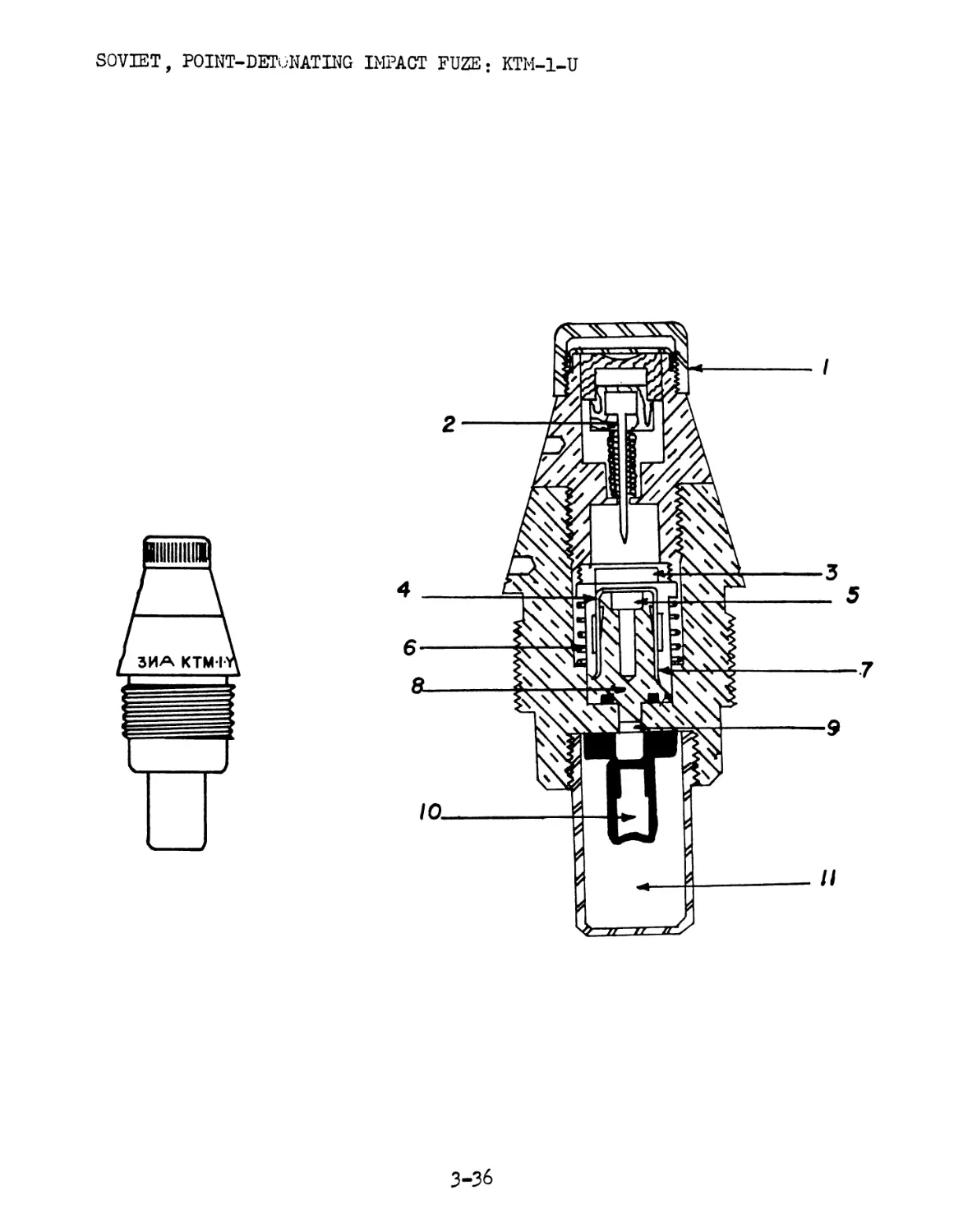
Impact Fuze:	Model KTM-1 .................... 3-32
Impact Fuze:	Model KTM-l-U .................. 3-35
Impact Fuze:	Model KTM-2 .................... 3-37
Impact Fuze:	Model KTM-3 .... .... ......	3-38
Impact Fuze:	Model KTMZ-1 ..............	3-39
Impact Fuze:	Model M-l ................	3-41
ii
Impact Fuze:	Model M-2................................ 3-43
Impact Fuze:	Model M-3................................ 3-45
Impact Fuze:	Model M-4................................ 3-47
Impact Fuze:	Model M-5 ............................... 3-49
Impact Fuze:	Model M-6...............................  3-51
Impact Fuze:	Model M-12............................... 3-53
Impact Fuze: Model M-50......................... . , .	3-55
Impact Fuze: Model MG-N................................ 3-57
Impact Fuze: Model MP.................................''	3-61
Impact Fuze: Model MB-82 ....................... ....	3-63
Impact Fuze: Model RG-6  .............................. 3-64
Impact Fuze: Model RGM ................................ 3-67
Impact Fuze: Model RGM-2 ........................ ,	.	3-71
Impact Fuze: Model RGM-3...................... . . . .	3-73
Impact Fuze:	Model	RGM-6 ............................ 3-75
Impact Fuze:	Model	UGT .............................. 3-77
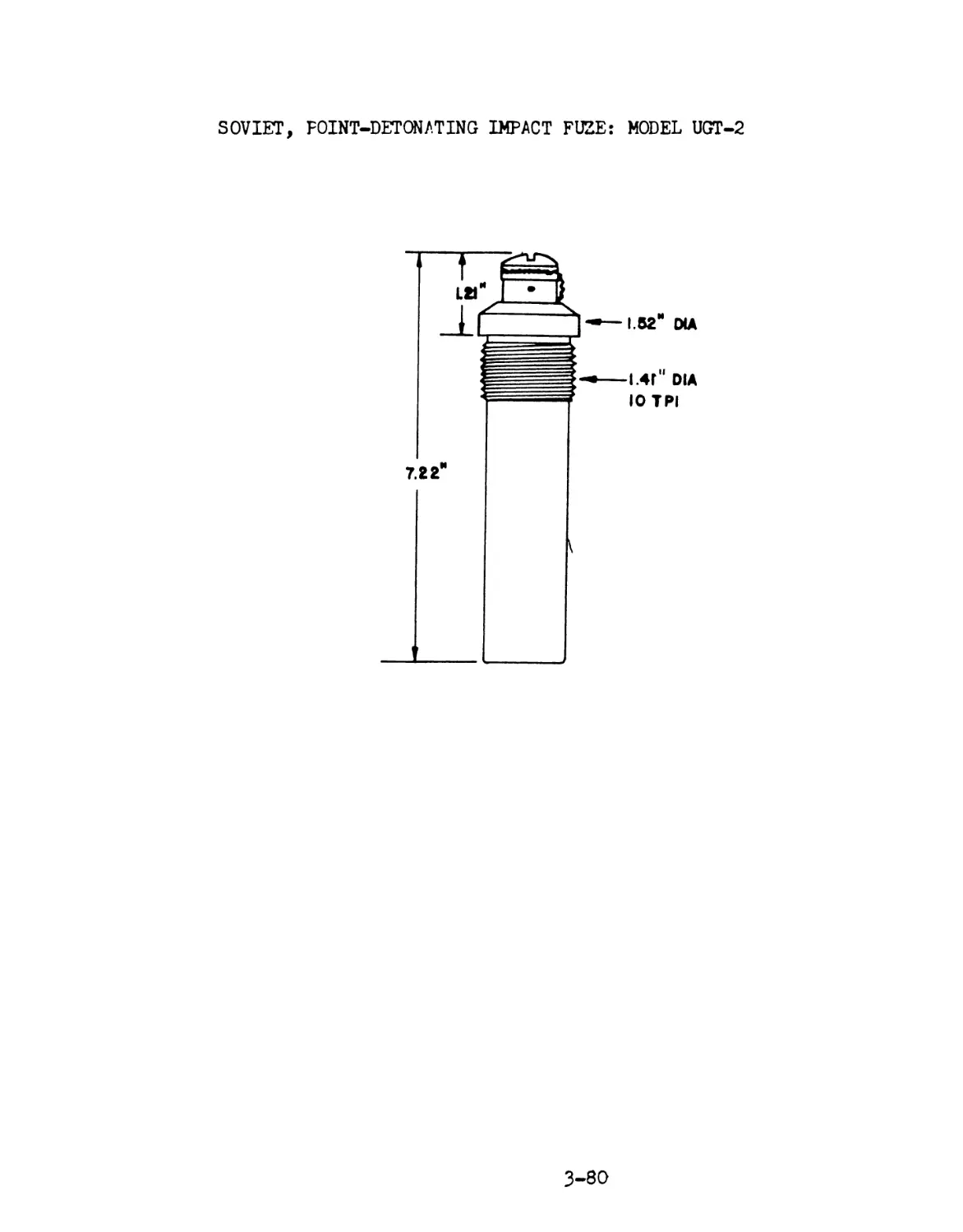
Impact Fuze:	Model	UGT-2...........................   3-79
Impact Fuze:	Model	UGT-3 ............................ 3-81
Impact Fuze:	Model	V-25 ............................. 3-82
Impact Fuze: Model V-229 .................... .......	3-87
Impact Fuze:	Model	V-429 ............................ 3-89
Impact Fuze:	Model	3GT.............................   3-93
Impact Fuze:	Model	4GT..............................  3-95
iii
Chapter 4 Chinese Communist	Point-Detonating Fuzes . . .	k
General.............................................   4-i
Point-Initiating, Base-Detonating Impact Fuze: Type
Unknown............................................ 4-1
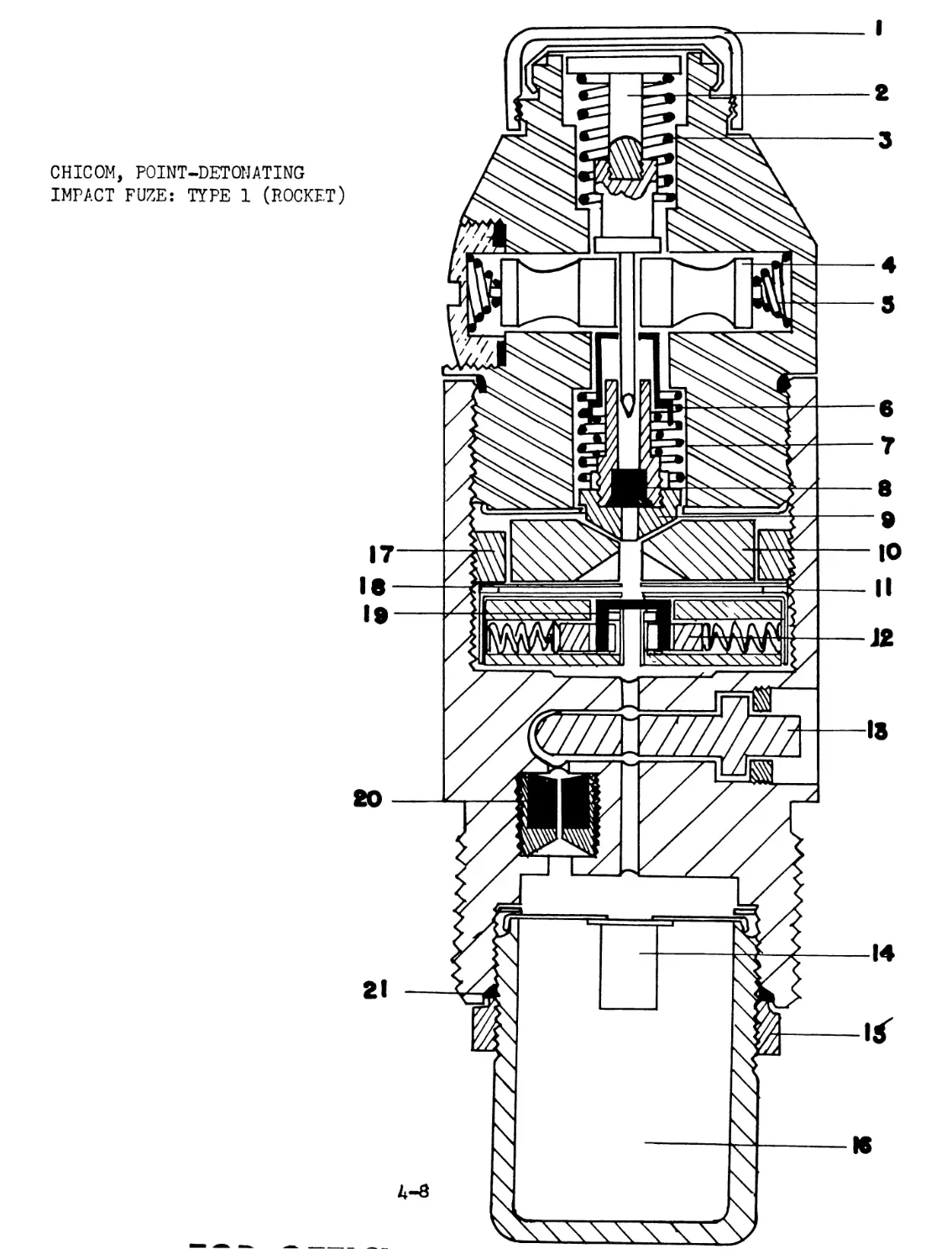
Impact Fuze:	Type	1 (Rocket)...................... 4-5
Impact Fuze:	Type	1 (Recoilless Rifle) ........	4-9
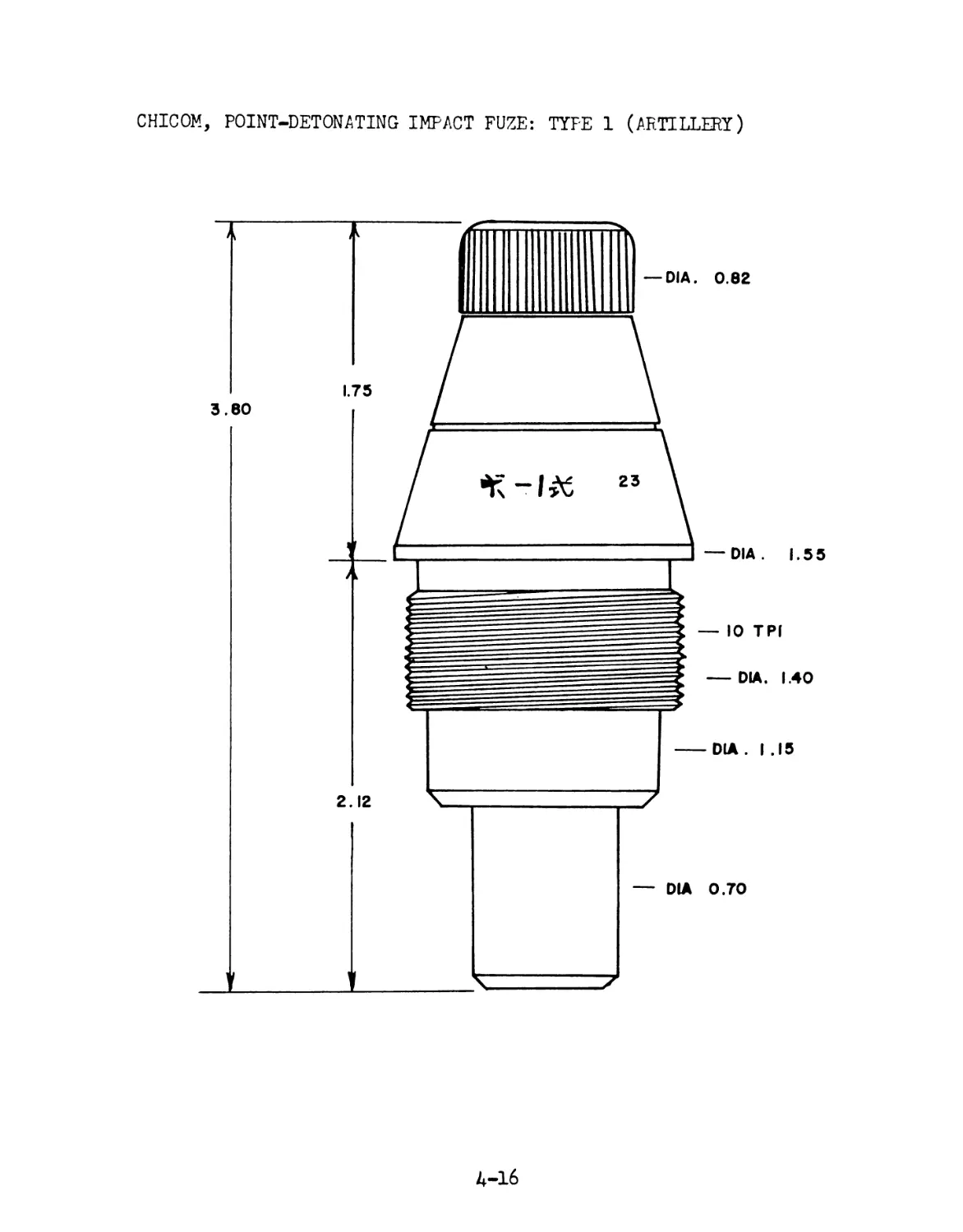
Impact Fuze:	Type	1 (Artillery) ..................... 4-Ю
Impact Fuze:	Type	TS-2.............................. 4-17
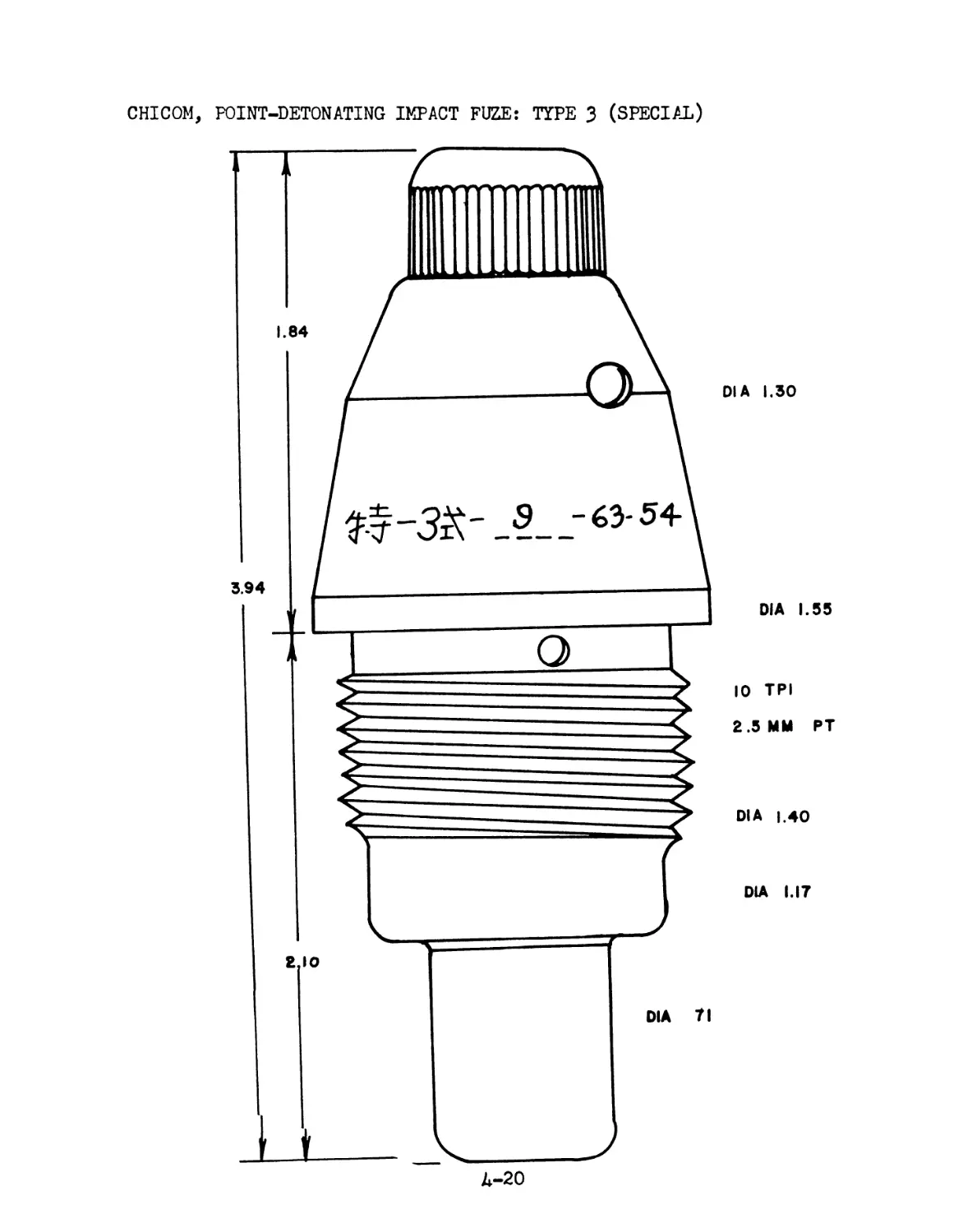
Impact Fuze:	Type	3 (Special)....................... 4-19
Impact Fuze:	Type	5 ................................ 4-21
Impact Fuze:	Type	6................................. 4-22
Impact Fuze:	Type	7 (Artillery)..................... 4-23
Impact Fuze:	Type	7 (Mortar)........................ 4-25
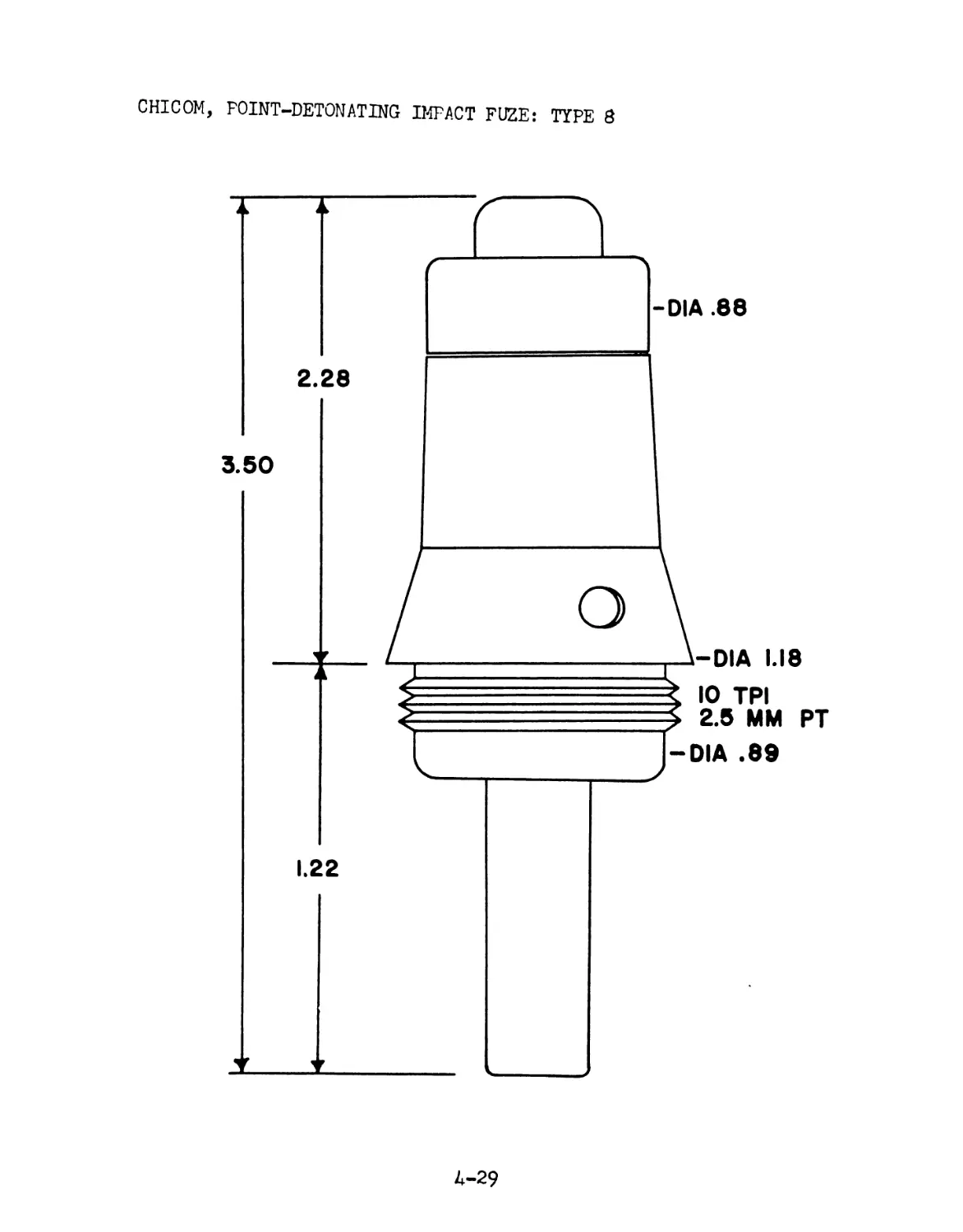
Impact Fuze:	Type	8................................. 4-27
Impact Fuze:	Type	9................................. 4-31
Impact Fuze:	Type	12..............................   4-33
Impact Fuze:	Type	51..............................   4-35
Impact Fuze:	Type	53..............................   4-39
Impact Fuze:	Type	53 Mod 1.......................... 4-43
Impact Fuze:	Type	53 Mod 2..............	4-45
Impact Fuze:	Type	88 ... ........................... 4-49
Impact Fuze:	Type	100............................... 4-51
Impact Fuze:	Type	100-3 ............................ 4-53
Impact Fuze:	Type	429 .............................. 4-55
iv
Impact Fuze:	Type Unknown........................... 4-56
Chapter 5 Soviet, Base-Detonating Fuze ............... 5
General............................................ 5-i
Impact Fuze:	Model DBR ............................ 5-1
Impact Fuze: Model DBR-2 ....................... ..	5-4
Impact Fuze:	Model	DK-2	................... 5-9
.Impact Fuze:	Model	DK-4............................. 5-H
Impact Fuze:	Model	DP.............................. 5-15
Impact Fuze:	Model	DR-5	.................... 5-17
Impact Fuze:	Model	KTD..........................    5-19
Impact Fuze:	Model	KTD-2	.......................... 5-21
Impact Fuze:	Model	KTMF	...............	5-23
Impact Fuze:	Model	MD-5	.	. ................ 5-25
Impact Fuze!	Model	MD-6............................ 5-27
Impact Fuze:	Model	MD-7............................ 5-29
Impact Fuze:	Model	MD-8	...................  5-31
Impact Fuze:	Model	MD-10	,	................  5-33
Impact Fuze:	Model	MD-76	... ...................... 5-35
Impact Fuze:	Model	MR-Z	.................... 5-37
Piezo-Electric, Point-Initiating, Base-Detonating,
Impact Fuze: Model VP-7 ..........................  5-39
Impact Fuze: Model 5DM ............................. 5-45
Impact Fuze: Model 5DT-2 ......... .	.............. 5-47
Impact Fuze: Model 7DT ............................  5-49
v
Impact Fuze: Model 10DT.............................	5-51
Chapter 6	Chinese Communist, Base-Detonating Fuzes . . .	6
General .................................. 6-i
Impact Fuze: Type 2	(Artillery).......... 6-1
Impact Fuze: Type 2	(Grenade Launcher)	........	6-3
Chapter 7	Miscellaneous, Communist Bloc, Base-Detonating
Fuzes............................................. 7
General...................................... 7-i
North Korean, Impact Fuze: Type 2 (Grenade Launcher) .	7-1
North Vietnamese, Impact Fuze: Model	B-50	......	7-3
Polish, Impact Fuze:	Model DC-1 ................. 7-5
Chapter 8	Soviet, Time and Combination Fuzes .......... 8
General . ............ , ............ ...	8-i
Point-Detonating Combination	Fuze:	Model	D ... 8-1
Point-Detonatirig Combination	Fuze:	Model	D-l .....	8-3
Point-Detonating Combination	Fuze:	Model	OM-82 ....	8-5
Point-Detonating Time	Fuze:	Model	T-3	.. 8-7
Point-Detonating Time	Fuze:	Model	T-3	(UG)... 8-9
Point-Detonating Combination	Fuze:	Model	T-5 .....	8-13
Point-Detonating Combination	Fuze:	Model	T-6 .....	8-16
Point-Detonating Combination	Fuze:	Model	T-7 .....	8-19
Point-Detonating Impact Fuze:	Model T-ll	.......	8-21
Point-Detonating Time	Fuze:	Model	VM-2	........	8-23
Mechanical Time Fuze:	Model	VM-30	........... 8-25
Point-Detonating Combination	Fuze:	Model	22G . 8-27
Point-Detonating Combination	Fuze:	Model	22P ....... 8-29
Point-Detonating Combination Fuze: Model 22PG ....	8-30
Point-Detonating Time Fuze: Model 32-Sec .......	8-31
Point-Detonating Combination Fuze: Model 45-Sec . . .	8-33
Chapter 9	Miscellaneous Fuzes......... . ............. 9
General ..... ................... .........	9-i
VC/NVA Air-Burst Mortar Fuze: Model Unknown ....... 9-1
North Vietnamese, Chemical Long Delay Fuze: Model
NNC 82............................................ 9-3
vii

COMMUNIST BLOC PROJECTED MUNITION FUZES IN VIETNAM, INTRODUCTION
PURPOSE
This manual is designed as an aid in identifying Communist bloc
projected munition fuzes employed against Free World Forces in Vietnam.
It is a technical catalog with the mission of supplying general tech-
nical data to those personnel who require such information. It is
believed that this will assist Explosive Ordnance Disposal teams, intelli-
gence activities, Wound Ballistics Teams, ordnance personnel, munition
design agencies, and field commanders in the successful accomplishment
of their assigned missions.
SCOPE
(a)	This publication outlines the technical characteristics,
current status, brief history of use,and detailed function of Communist
bloc projected munition fuzes encountered in Vietnam. The manual
covers only standard production fuzes and does not include improvised
fuzes produced in VC clandestine munition shops. This manual does not
cover emplaced or air-dropped fuzes, nor does it include hand grenade
fuzes. Later additions may include these items to provide a complete
fuze catalog.
(b)	The fuzes are arranged by tactical class and are subdivided by
functioning groups. These groups are further subdivided by country of
origin. Within each subdivision the fuzes are arranged alphabetically
by designation and by model number of the country of origin. Fuzes
with numerical designations are listed in ascending order.
(c)	The technical information contained herein is general in
nature and, in most instances, has been derived from the actual exam-
ination of fuzes. In some instances, parts removed from shell craters
have been interchanged to reconstruct fuzes. Some errors in dimensions,
weights, and completeness of these fuzes must be admitted. Information
on those fuzes that have not actually been examined has been extracted
from documents considered accurate. It is known that fuzes other than
those reported here exist, but no specimens have been recovered for
examination; and reliable data is not available.
GENERAL
Communist bloc fuzes designed and produced since 1950 show a marked
improvement over earlier fuzes in the ability to withstand an adverse
environment. The bloc armament industry has lavished great effort and
expense to insure that fuzes are completely moistureproof and sturdy
enough to maintain alignment while penetrating hard media during delay
functioning. This munition philosophy is highly commendable and should
serve as a guide for future fuze development by the munition industries
of Free World Forces.
viii
Generally, non-Soviet Communist bloc fuzes are exact copies of their
Soviet counterparts. However, considerable evidence exists to show
that the Chinese Communists are capable of producing efficient indigen-
ous fuzes. This trend is expected to continue, but Soviet munition
design philosophies will continue to be followed closely. The ChiComs
appear to be adherents to the dual reaction principle for reliable fuze
functioning in their indigenous fuzes. This principle includes direct
firing pin action upon impact, as well as primer-detonator inertial
movement. This principle has been proven sound by its extreme relia-
bility and its graze sensitivity.
CHAPTER 1
SOVIET FUZES FOR AIRCRAFT AND ANTIAIRCRAFT GUNS
1
GENERAL
All fuzes of this classification are improved modifications of
earlier known fuzes. They are all mechanical, point-detonating, impact
types that are designed to function reliably on light material targets.
The aircraft gun fuzes appear to have been based upon World War II Ger-
man types of proven reliability. In some instances exact copies of
internal elements have been noted. In other cases German mechanical
principles have been assimilated with Soviet munition designs, result-
ing in a composite, highly effective design.
The Soviet antiaircraft gun fuzes all employ pyrotechnic type self-
destruct features. Precisely the same principles are employed in fuzes
used in weapons from 23mm through 57mm calibers. The purpose of the
self-destruct feature is to destroy the projectiles that miss targets,
at an altitude where the fragmenting projectile will not endanger
friendly ground units. A secondary purpose is to provide air bursts as
a psychological factor in preventing accurate bombing.
All of the Soviet aircraft and antiaircraft fuzes are bore-safe.
This means that they are provided with mechanical features designed to
prevent the fuze from arming while in the tube of the weapon. Some of
the earlier fuzes are not detonator-safe by American standards, which
means that the explosive train is not interrupted to positively preclude
an in-bore detonation. However, a major trend is indicated toward both
bore-safe and detonator-safe fuzes. This is evidenced by the introduc-
tion of the MG and В series fuzes with their out-of-line detonator
rotors.
The extreme effort in designing moistureproof and environmentproof
fuzes is seen in aircraft and antiaircraft fuzes. It appears that the
Soviets have great confidence in the ability of their ammunition to with-
stand moisture due to the small amount of attention being given to
weatherproof packing containers. Soviet shipping containers are little
more than a means of protecting the ammunition from the normal hazards
of shipping and handling.
Soviet fuzes are marked plainly on the ogive. Each fuze is die-
stamped with the fuze nomenclature. Where space is available the lot
number, year of manufacture, and plant number are included. Antiair-
craft fuzes are normally "blued” or painted black with an additional
coating of varnish or epoxy to inhibit external corrosion. If the fuze
is cadmium-plated, the exterior epoxy or varnish coating is still
applied. Some fuzes have been seen with colored lacquer on the nose.
The significance of the color has not been determined but it has been
noted that not all fuzes of a specific designation, produced by the
same plant, have the color marking.
1-i
Normally, aircraft and antiaircraft fuzes do not require any prepa-
ration for firing of linking. The large calibers, such as 57nnn, possess
fuzes with removable shipping caps to increase impact sensitivity. How-
ever, the significance of the cap has not been determined unless it is
merely a safety device for shipping.
1-ii
SOVIET, POINT-DETONATING IMPACT FUZE: MODEL A-20
a.	General. The A-20 is similar in construction and operation to
the A-23, although the two fuzes differ noticeably in length and shape.
The A-20, by comparison, is short and squat. When attached to a projec-
tile, it has a visible length of about O.56 inch. (The corresponding
dimension of the A-23 is about 0.95 inch.) Both the A-20 and the A-23
are bore-safe. The A-20 is used in 20mm aircraft ammunition. The A-20
employs a gaine-type detonator-booster (7). The gaine is common in
Soviet fuzes. It was derived from the French Schneider designs, which
were the prototype of Russian artillery projectiles and fuzes.
b.	Characteristics.
Action ——-----------------------—-------------------— instantaneous
Loaded weight    -------------------------------——-——---—— unknown
Body material-------------------------- —--------— . -----------steel
£. Functioning. Before firing, the coiled copper arming spring (4)
prevents the firing pin (3) from reaching the gaine (7). The coiled
spring presents a solid block to the firing pin; it is the only safety
device in the fuze. After the projectile has left the bore of the wea-
pon, centrifugal force causes the arming spring to unwind, making the
hole in its center large enough to allow the firing pin to pass. On
impact with the target, the nose disk (1) is crushed, and the striker
(2) drives the firing pin through the firing pin guide (5) and safety
disk (6) into the detonator assembly (7), which activates the main
charge of the projectile.
_d. Weapons and projectiles with which fuze can be used.
Weapons	Projectiles
20mm ShVAK aircraft gun	20mm HEI-T -----------—----- OZT
1-1
SOVIET, POINT-DETONATING IMPACT FUZE: MODEL A-20
1.27
0)01
1-2
SOVIET, FOINT-DETONATING IMPACT FUZE: MODEL A-23
a_. General. The A-23, although similar to the A-20 in construc-
tion~and operation, has an elongated shape which contrasts markedly
with the А-20's stubby appearance. The A-23 consists of the following
components: a steel, nose disk, a steel fuze body, an aluminum striker
and firing pin, a coiled copper arming spring, a brass spacer, a copper
safety disk, a detonator, and an aluminum detonator retainer. The A-23,
like the A-20, is bore-safe. The well known MIG-15 and IL-28 are two
types of aircraft that mount the 23mm models NR and NS guns in which
the A-23 fuze is used.
b. Characteristics.
Action -------------—--------------------------------------instantaneous
Loaded weight----------— ------——-—--------------25.4 grams (O.O56 lb.)
Body material - -----------------------—--------------------------steel
£. Functioning. Before firing, the copper arming spring (4) pre-
vents the firing pin (3) from reaching the detonator assembly (7).
After the projectile has left the bore of the weapon, centrifugal force
causes the arming spring to unwind, making the hole in its center large
enough to allow the firing pin to pass. On impact with the target the
nose disk (1) is crushed, and the striker (2) drives the firing pin
along the firing pin guide (5), through the safety disk (6), and into
the detonator assembly (7), which activates the main charge of the pro-
jectile.
_d. Weapons and projectiles with which fuze can be used.
Weapons	Projectiles
23mm aircraft guns, model NR and NS 23mm HEI-T-------------------—— OZT
25mm antiaircraft gun, Ю.940	25mm Frag-I-T------------OZR-132
1-3
SOVIET, POINT DETONATING IMPACT FUZE: MODEL A-23

1-4
SOVIET, POINT-DETONATING IMPACT FUZE: MODEL A-37
General. The A-37 is a sensitive, bore-safe fuze with a self-
destruction feature; it is designed for use with 37шт aircraft guns.
It is similiar to the MG-S fuze and almost identical to the MG-37> the
MGZ-37, and the B-37 (all of which are used with the 37mm AA gun M1939).
It differs significantly from the B-37 because of its shorter self-
destruction powder train. Apparently, because of its short self-destruc-
tion time, which is causing undesirably early detonation and destruction
of the projectile at some point short of the effective combat range of
the ammunition, the A-37 has been succeeded by a modified version, the
A-37U, with a longer self-destruction powder train. The A-37, unless
activated sooner by impact, will destroy itself after a flight of about
3 seconds. A flight of 10 to 12 seconds precedes self-destruction of
the A-37U.
b. Characteristics.
Action --------------------------------------------------- instantaneous
Loaded weight ———---------------------------------- 179 grams (0.39 lb.)
Body material —----------------------------------------------------steel
Functioning. Upon firing, the moveable, setback-igniter pellet
(12) overcomes the resistance of the setback spring (13) and strikes the
fixed setback firing pin (14). The resulting flash ignites both the
self-destruction powder train (7) and a black powder pellet (15) which
holds the centrifugal rotor locking pin (16) in place. As the black
powder pellet burns, centrifugal force causes a second rotor locking pin
(11) to compress its retaining spring and move outward from a recess in
the rotor (3). After the black powder pellet is consumed, the first
centrifugal locking pin (16) also moves out of its recess in the rotor,
which is then free to rotate in the U-shaped trough of the rotor mount
(6). Since the locking pin (16) retained by the powder pellet immobi-
lizes the rotor until the other locking pin (11) clears its straight-
walled recess in the rotor, any possibility of the rotor jamming the
latter pin (11) is precluded. The rotor recess for the pellet-retain-
ing pin (16) has sloped walls, so that the movement of the rotor tends
to slide this pin out of the recess, rather than to jam it. Centrifugal
force causes the freed rotor, whose center of gravity is located off the
axis of rotation, to turn 90 degrees around the pivot pins (10), thus
aligning the primer charge (4) with the impact firing pin (2) and the
detonator assembly (5). Upon impact with the target, the nose cap is
crushed, and the impact striker (1) drives the impact firing pin into
the primer charge. The flash from the primer charge passes to the
detonator assembly, which activates the booster (9), and the booster in
turn activates the projectile's charge. If impact does not occur first,
1-5
SOVIET, POINT-DETONATING IMPACT FUZE: MODEL A-37
the burning .powder train in the self-destruction powder train ring (8)
will ignite the black powder flash charge in the detonator, and the
fuze will detonate from 2.5 to 3 seconds after the round is fired.
d_. Weapons and projectiles with which fuze can be used
Weapons
Projectiles
37шт aircraft gun, Model N and NS
37nm HEI-T
OZT
SCALE 4:1
2
ROTOR
3
5
6
LEAD WASHER
ALUMINUM -
WASHER
PLASTIC
WASIER
STRIKER
FIRING PIN
TAB ACTION
DETONATOR
4
251
BOOSTER
1.04
-1.17
3 WASHERS
FLASH ACTION
DETONATOR 076
3.28
9
1-6
SOVIET, POINT-DETONATING IMPACT FUZE: MODEL A-37
PLUG
12
PELLET
ROTOR PIN
SETBACK
SPRING
FIRING PIN
SAFETY PIN I
13
15
14
SIDE VIEW OF MOTOR MOUNT
FLASH HOLE
OWEL
PIN HOLE
SAFETY PIN 2, SPRING RETAINER
SCREW
STARTING POINT FOR COMBUSTION
OF BURNING TRAIN
A-B
SELF DESTRUCTION TRAIN DISK
TOP VIEW OF ROTOR
SCALE 4:1
1-7
SOVIET, POINT-DETONATING IMPACT FUZE: MODEL A-37U
The A-37U, a later version of the A-37, is essentially identical to the
A-37 except for having a longer self-destruction powder train. The A-37
destroys itself after a flight of 2.5 to 3 seconds, whereas the A-37U
permits a flight of 10 to 12 seconds before self-destruction. It is
believed that the time of self-destruction of the A-37U was lengthened
in order to prevent detonations from occuring at points short of the
effective ammunition combat range. If rounds fuzed with the A-37U are
fired horizontally at altitudes above 2,500 feet, the increased time to
self-destruction does not endanger ground personnel. This fuze is used
with the same weapon and ammunition as the A-37.
1-8
SOVIET, POINT-DETONATING IMPACT FUZE: MODEL B-3O
a.	General. Only a dumny version of the B-3O fuze has been
examined. From its internal and external configuration it appears to
be a slightly enlarged version of the MG-25 fuze. The self-destruct
element may or may not be present. The steel fuze body has a single
pin spanner hole near the bottom of the ogive. Threads are right-
handed with 34 threads per inch. The fuze is secured with two stab
crimps through the projectile. The dummy fuze examined possessed a
steel nose-disk and an aluminum striker. The remainder of the compon-
ents were dumny, and they screwed into the body of the fuze with left
hand threads. A recess for a lead sealing ring is present at the bottom
of the fuze body to seal the booster to the body.
b.	Characteristics.
Action —-------—-----------—------------------------------instantaneous
Loaded weight----------------------------------------S3 grams (0.18 lb)
Body material
steel
£. Functioning. No information is available.
d. Weapons and projectiles with which fuze can be used.
Weapons
Projectiles
30mm aircraft cannon NR-30
30mm HEI-T ------  - • unknown
1-9
THIS PAGE INTENTIONALLY LEFT BLANK
1-10
SOVIET, POINT-DETONATING IMPACT FUZE: MODEL B-37
a,	General, The Soviet B-37 is a modified copy of the Soviet MG-37.
The fuzes are essentially identical in construction and operation. The
B-37 has a rotor lock and a slot (1) cut into the rotor housing to
receive the pin. When the rotor rotates, the lock pin is forced into the
slot (2) by centrifugal force. The detonator of the B-37 is retained in
the rotor by a threaded keep ring (2) rather than by a press fit as in
the case of the MG-37. The keep ring is slotted for a common screw dri-
ver, The B-37 has a conical depression (3) in the booster, A metal
foil liner also has the same shape, and it covers the shaped explosive
in the booster. The B-37 also has a portion of the fuze body and the
booster cup relieved and a lead crush ring (4) pressed into the cavity.
The lead ring waterproofs the lower part of the fuze. The nose cup also
has a vinyl ring (5) in the crimping groove at the nose of the fuze.
When the nose car is crimped into place, the vinyl ring (5) is compressed,
waterproofing the nose of the fuze,
b.	Characteristics,
Action------------------------------------------------------instantaneous
Loaded weight -----------------------------------------172 grams (0,33 lb)
Body material------------------------------------------------------steel
£, Functioning, This fuze is identical to the Soviet MG-37 except
for the additional function of the rotor lock pin.
d., Weapons and projectiles with which fuze can be used.
Weapons	Projectiles
37mm antiaircraft gun, M1939	37mm Frag-T --------------- OR-I67
1-11
SOVIET, POINT-DETONATING IMPACT FUZE: MODEL B-37
1-12
SOVIET, POINT-DETONATING IMPACT FUZE: MODEL K-6
g,. General, The K-6 is similar to the K-20 in construction and
functioning, but it is considerably smaller. It is a single-action fuze,
requires no special adjustments prior to firing, and is bore-safe. A
gaine-type detonator-booster is employed. The K-6 exhibits an early
version of the arming system employed in many current Soviet fuzes. The
only modern departure is the addition of the zig-zag delay arming system.
b. Characteristics.
Action ---------------------------------------------------- instantaneous
Loaded weight --------------------------------------------------- unknown
Body material-------------------------------------------------------steel
£. Functioning. Upon firing, inertia causes the arming sleeve (4)
to set back, thereby releasing the arming sleeve retaining ball (3) and
further compressing the arming spring (7). After the projectile leaves
the bore, the arming spring overcomes inertia and moves the arming sleeve
forward, freeing the two firing pin check balls (5). The two check balls
then are thrown out of their housings in the firing pin guide (2) by
centrifugal force, so that they no longer prevent the firing pin (6)
from moving to the rear. The firing pin is maintained in the forward
position by creep action. On impact the striker (1) is forced to the
rear, driving the firing pin through the safety disk (8) into the deto-
nator assembly (9), and the resulting detonation activates the explo-
sive charge of the projectile.
d. Weapons and projectiles with which fuze can be used.
Weapons	Projectiles
20mm ShVAK aircraft gun	20mm HEI-T-------—------------OZT
1-13
SOVIET, POINT-DETONATING IMPACT FUZE: MODEL K-6
1-U
SOVIET, POINT-DETONATING IMFACT FUZE: MODEL K-20
Sr General, The K-20 is used with projectiles fired from 23mm air-
craft and 25mm antiaircraft guns. Since it does not have a self-destroy-
ing element, the fuze will detonate upon contact with any obstruction.
Although the K-20 is a bore-safe fuze, it is supersensitive in the armed
condition, and it should be handled with caution. The Soviet safety
classification of the fuze is ’’unsecured, ” The K-20 possibly may be used
in the 23mm aircraft gun, Models № and NS, but evidence of its use with
these weapons is lacking. The K-20 and the almost identical K-20m
appear to have been replaced by the A-23 fuze, presumably because the
A-23., although less sensitive, is simpler and cheaper to manufacture,
Ц, Characteristics,
Action-------------------------—----------------------------instantaneous
Loaded weight ---------------------------------------------------- unknown
Body material-----------------------------------------------------steel
£, Functioning, Upon firing, the arming sleeve (4) sets back, com-
pressing the arming sleeve spring (5) and creating an outlet for the
three arming sleeve retaining balls (9). After the projectile has left
the gun and centrifugal force has thrown the retaining balls out of
their housings, the arming spring overcomes the diminishing force of
inertia and moves the arming sleeves forward until it frees the two
firing pin check balls (10), The check balls pass into the fuze body
cavity through openings in the striker guide (3), and only the safety
disk (7) remains between the firing pin (6) and the detonator assembly.
Upon impact, the foil cap (1) is crushed inward, the striker (2) drives
the firing pin through the safety disk into the detonator initiating
pellet (8), and the resulting detonation activates the projectile’s
explosive charge.
d,’ Weapons and projectiles with which fuze can be used.
Weapons	Projectiles
23mm aircraft gun, Model VYa	23mm	HEI------------------unknown
HEI-T--------------------OZT
25mm antiaircraft gun, М19Д0	25mm	Frag-I-T ----------- OZR-132
1-15
SOVIET, POINT-DETONATING IMPACT FUZE: MODEL K-20
1-16
SOVIET, POINT-DETONATING IMPACT FUZE: MODEL K-20M
a.	General. The K-20M is identical to the K-20 in external
dimensions, body material, functioning, and (except for sizes and the
materials of certain parts) internal construction. It differs from
the K-20 in outer appearance only by having a smooth, ungrooved body
contour, and by mounting a foil disk in the top of the nose cavity
Instead of having a foil cap crimped over the nose. There is little
difference in loaded weights of the two fuzes.
b.	Internal differences between the K-20 and the K-20M,
(1)	The K-20M has a steel striker (1) with a shorter length
«nd smaller head diameter; the diameter of the nose cavity, correspond-
ing to the striker head, is likewise smaller. The K-20 striker, besides
being larger, is made of wood or aluminum.
(2)	The firing pin (2) in the K-20M is longer than the K-20.
(3)	The full length of the detonator assembly retainer (3) is
threaded, in the K-20M; in the K-20, there is an unthreaded shoulder at
the top of this retainer.
(4)	The length of the detonator assembly (4) is greater for
the K-20 fuze.
£. Weapons and projectiles with which fuze can be used. The K-20M
can be used with the same weapons and ammunitions as the K-20. Both
fuzes appear to have been replaced by the A-23.
1-17
THIS PAGE INTENTIONALLY LEFT BLANK
1-18
SOVIET, POINT-DETONATING IMPACT FUZE: MODEL MG-8
a.	General. The MG-8 (Malokaliberny, Golovnoy, 8-y Obrazets
(small-caliber, point detonating, Model 8) is a bore-safe fuze which
arms at approximately 50 to 100 meters from the muzzle of the gun.
It incorporates a setback-actuated, self-destruction feature which
will cause the projectile to detonate 8 to 11 seconds after leaving
the bore, provided that the target is not struck beforehand. The
Soviet safety classification of the fuze is "safe." The MG-8 is
similar in external appearance and internal construction to the later
MG-37 antiaircraft fuze, and it also closely resembles the A-37 and
A-37U aircraft fuzes.
b.	Characteristics.
Action — —----------------------------------------------- instantaneous
Loaded weight —----------------------------------------------— unknown
Body material —-------------------------------------------------- steel
£. Functioning. Upon firing, the setback ignitor pellet (13)
overcomes the resistance of the safety spring (14) and impinges on the
setback firing pin (15). The resulting flash simultaneously ignites
the self-destruction powder train (11) in the powder train ring (10)
and the black powder pellet (7) which holds the rotor locking pin (8)
in place. The flash presumably reaches the powder pellet (7) through a
channel not visible in the drawing. When the black powder pellet has
burned away, centrifugal force moves the rotor locking pin out of the
groove in the rotor (3), which is then free to rotate in the trough of
the U-shaped rotor mount (4). Centrifugal force causes the freed
rotor, whose center of gravity is located off the axis of rotation, to
turn 90° around the pivot pins (6), thus aligning the primer charge (5)
with the impact firing pin (2) and the detonator assembly (9). Upon
impact with the target, the nose cap is crushed and the striker (1)
drives the impact firing pin into the primer charge. The flash from
the primer charge passes to the detonator assembly, which activates the
booster (12), thereby detonating the projectile. Should the projectile
fail to hit the target, the burning self-destruction powder train ring
(10) will ignite the detonator, and the fuze will function from 8 to 11
seconds after the round is fired. This time is sufficient to permit
the projectile to travel beyond the maximum range at which it is normally
used.
1-19
SOVIET, POINT-DETONATING IMPACT FUZE: MODEL MG-S
d. Weapons and projectiles with which fuze can be used.
Weapons	Projectiles
37mm antiaircraft gun M1939	37mm Frag T--------	OR-167
1-20
SOVIET, POINT-DETONATING IMPACT FUZE: MODEL MG-25
a.	General. The MG-25 fuze is bore-safe and is supersensitive
in the armed condition. It contains a setback actuated self-destruc-
tion feature that destroys the projectile between five and eight seconds after
firing, provided the target has not been hit beforehand.
The fuze has a thin aluminum foil membrane (1) over the firing pin
cavity in the nose. Beneath the membrane is a floating firing pin
extension (2). The floating firing pin extension projects into the
main fuze cavity, through a solid bulkhead which it is retained by. In
this cavity, the firing pin (5) rests on a coiled centrifugal spring
tape (4). The tape prevents the firing pin from reaching the primer.
Surrounding the tape is a setback detent (3) that rests on a ring with
four internal prongs (6). This safety ring (6) rests on top of an
internal support (7). An aluminum cylinder (10) containing the self-
destruct initiator (16), the self-destruct pyrotechnic delay element
(22), the body primer (9), and a relay flash pellet (11) is threaded
(left hand) into the steel fuze body. The self-destruct initiator
(16) consists of a fixed firing pin (19) in the bottom of a cavity in
the cylinder, a setback spring (17), and a weighted primer (16). The
booster (13) screws into the bottom of the fuze body. Its twin flash
holes (12) are directly beneath the relay flash pellet.
b.	Characteristics.
Action —-----------------—--------------——----------instantaneous
Loaded weight —------------------------------------------38 grams
Body material ——__________________—--------—-—-—---------— steel
£. Functioning. Upon setback, the setback detent (3) moves down-
ward, forcing its way through the four internal prongs in the safety
ring (6). Simultaneously, the weighted self-destruct flash pellet (16)
moves downward compressing its spring (17) and impales itself on the
fixed firing pin (19). The resulting flash passes through a lateral
hole (18) from the self-destruct initiator cavity into the pyrotechnic
delay cavity (20), igniting the self-destruct element (22). Centrifugal
force then causes the coiled tape (4) to expand, releasing the firing
pin (5). The firing pin (5) and the firing pin extension (2) move
forward into their cavity by creep action. Upon impact, the firing pin
extension (2) is driven rearward forcing the firing pin downward into
the body primer (9). The resulting flash ignites the relay pellet (11)
which causes a flame to flash through the two flash holes in the booster
cap, detonating the booster (13).
If the fuze fails to impact with the target, the pyrotechnic self—
1-21
SOVIET, POINT-DETONATING IMPACT FUZE: MODEL MG-25
destruct element (22) will burn into a flash pellet (21) which flashes
into the two flash holes (12) in the booster cap causing a detonation.
d. Weapons and projectiles with which fuze can be used.
Weapons
Projectiles
23mm antiaircraft gun ZU-23
23mm Frag HEI-T
OFZT
1-22
SOVIET, POINT-DETONATING IMPACT FUZE: MODEL MG-37
a.	General. The MG-37, a later version of the World War II MG-8,
is a bore-safe fuze with a setback-actuated, self-destruction feature
that will detonate the fuze 10 to 12 seconds after the round is fired.
It is almost identical to the MG-8 in external appearance, and its only
major internal differences appear to be a redesigned rotor and an
improved arming safety arrangement involving the use of two rotor lock-
ing pins instead of one. The MG-37 also bears a close resemblance to
the A-37 and A-37U aircraft fuzes in external appearance, internal con-
struction, and dimensions. Available evidence indicates that the MG-37
is restricted to antiaircraft gun fire and is not interchangeable with
aircraft fuzes.
b.	Characteristics.
Action ----------------------------------------------------instantaneous
Loaded weight —---------------------------------------172 grams (0,38 lb)
Body material------------------------------------------------------st ее]
c_. Functioning. Upon firing, the setback ignitor pellet (12) over-
comes the resistance of the safety spring (13) and strikes the setback
firing pin (1Д). The resulting flash ignites both the self-destruc-
tion powder train (7) and a black powder pellet (15) which holds a rotor
locking pin (16) in place. As the black powder pellet burns, centrifu-
gal force causes a second rotor locking pin (11) to compress its retain-
ing spring and move out of a recess in the rotor (3). After the black
powder pellet burns away, the locking pin (16) also moves out of its
recess in the rotor, which is then free to rotate in the U-shaped trough
of the rotor mount (6). Since the locking pin (16) retained by the pow-
der pellet immobilizes the rotor until the other locking pin (11) clears
its straight-walled recess in the rotor, any possibility of the rotor's
jamming the latter pin is precluded. The rotor recess for the pellet-
retained pin (16) has sloped walls, so the movement of the rotor tends
to slide this pin out of the recess, rather than to jam it. Centiifuga]
force causes the freed rotor, whose center of gravity is located off the
axis of rotation, to turn 90° around the pivot pins (10), thus ali gning
the primer charge (Д) with the impact firing pin (2) and the detonator
assembly (5). Upon impact with the target, the nose cap is crushed, anc
the impact striker (1) drives the impact firing pin into the primer
charge. The flash from the primer charge passes to the detonator
assembly, which activates the booster (9), and the booster in turn
activates the projectile's explosive charge. If impact does not occur
1-23
SOVIET, POINT-DETONATING IMPACT FUZE: MODEL MG-37
first, the burning self-destruction powder train in the powder train ring
(8) will ignite the detonator, and the fuze will explode from 10 to 12
seconds after the round is fired.
d., Weapons and projectiles with which fuze can be used.
Weapons
Projectiles
37nnn antiaricraft gun M1939
37nnn Frag T
OR-167
1-24
SOVIET, POINT-DETONATING IMPACT FUZE: MODEL MG-57
a. General. The MG-57 is a bore-safe, out-of-line detonator fuze.
It employs a setback-actuated, self-destruction feature that will cause
the projectile to detonate 19 seconds after leaving the bore, providing
no prior target impact occurs. A metal shipping cap (1) with pull wire
protects the firing pin membrane during shipping. The firing pin is
composed of a metal firing pin (4) attached to a wooden shaft (3). It
locks the rotor (5) during setback. The rotor housing contains the self-
destruct-initiating mechanism. This consists of a weighted, moveable
detonator, spring, and fixed firing pin. This assembly is parallel to
the fuze axis. The main fuze detonator (7) sits in the center of the
pyrotechnic self-destruct disk. The fuze features a delay arming, con-
sumable, black powder detent that is initiated by the self-destruct
flash pellet upon setback. The fuze arms by centrifugal force. The
floating type firing pin used in the MG-57 makes it supersensitive.
b. Characteristics.
Action-------------------------------------------------— instantaneous
Loaded weight-----------------------------——--------335 grams (0.738 lb)
Body material-------------------------------------------------------steel
c_. Functioning. Functioning is identical that of the Soviet MG-37
fuze.
d. Weapons and projectiles with which fuze can be used.
Weapons	Projectiles
57mm Soviet S-60 antiaircraft gun 57mm HE-Frag------------——— OR-281
1-25
SOVIET, POINT DETONATING IMPACT FUZE: MODEL MG-57
1-26
30V®, P0I„	имст
1-27
THIS PAGE INTENTIONAL!! LEFT BLANK
1-28
SOVIET, POINT-DETONATING IMPACT FUZE: MODEL MGZ-57
a.	General. The MGZ-57 fuze is similar to the MG-57, with certain
modifications. It has a threaded metal shipping cap with four equi-
distant holes near its upper rim. The thin alumi num crush cap is crimped
into a groove cut into the fuze body. A vinyl sealing ring occupies the
groove and makes the upper part of the fuze waterproof. The firing pin
is all metal rather than metal and wood as in the MG-57. There is also
a spring under the firing pin head in lieu of a wax filler in the MG-57.
The detonator in the rotor is held in position by a threaded ring. In
the MG-57, the detonator is pressed and stab crimped in the rotor. The
fuze body is recessed at the booster cavity to accept a vinyl waterproof-
ing ring and a steel lock ring. The lock ring employs the booster
threads to compress the vinyl ring. The copper foil seal over the
booster is conical-concave. This same shape is formed into the PETN
booster explosive. The booster on the MG-57 has a flat surface. The
rotor has centrifugal locking pins to lock the rotor in the armed posi-
tion.
b.	Characteristics.
Action---------------—--------------------------—------------— nondelay
Loaded weight-----------------------------———- 314 grams (0.691 lb)
Body material ————---------------------------------------------— steel
£. Functioning. When fired, setback causes the same functioning
as that which occurs in the MG-57 fuze. Centrifugal force moves the
spring retaining the rotor lock pin out of the rotor. When the delay
aiming black powder pellet is consumed, the detent is moved into the
evacuated cavity. The rotor then rotates to the armed position. Simul-
taneously, the rotor lock pin moves into a slot cut into the rotor cavity
in the rotor housing, locking the rotor in the armed position. Func-
tioning then continues in a manner identical to that of the MG-57 fuze.
cl. Weapons and projectiles with which fuze can be used.
Weapons	Projectiles
57mm Soviet S-60 antiaircraft gun 57mm HE-Frag —------------------ OR-281
1-29
SOVIET, POINT-DETONATING IMPACT FUZE: MODEL MGZ-57
СМИ м-
1-30
SOVIET, POINT-DETONATING
IMPACT FUZE: MODEL MGZ—57
1-31
CHAPTER 2
CHINESE COMMUNIST FUZES FOR AIRCRAFT AND ANTIAIRCRAFT GUNS
2
GENERAL
ChiCom aircraft and antiaircraft fuzes appear to be exact copies of
their Soviet counterparts. In most instances, materials, workmanship,
and components are identical, ChiCom fuzes are designated by the Chinese
character suffix for "Type." The prefix character normally represents a
Chinese character which is similar to the sound of the Russian letter of
the model designation. These Chinese characters and the Arabic number
for the fuze type are die-stamped into the fuze metal in the same manner
as those on Soviet fuzes.
2-i
CHICOM, POINT-DETONATING IMPACT FUZE: TYPE 37
a,	General, The ChiCom type 37 fuze is identical to the Soviet
B-37 point detonating impact fuze.
b.	Characteristics,
Action---------------------------------------——-----—  instantaneous
Loaded weight -------------------------------------- 172 grains (0,3S lb)
Body material--------------------------------------------------------steel
£, Functioning, The functioning of this fuze is identical to the
workings of the Soviet B-37 and MG-37 point detonating impact fuzes,
d, Weapons and projectiles with which fuze can be used.
Weapons	Projectile s
37mm antiaircraft gun, type unknown

CHAPTER 3
SOVIET POINT-DETONATING FUZES
3
SOVIET POINT-DETONATING FUZES
Early Soviet fuze designs were based on principles seen in French
Schneider fuzes. The Schneider Company built and operated cannon and
projectile manufacturing plants in Tzarist Russia and, quite naturally,
exerted a great influence in early Russian artillery. When th* Soviets
gained control of Russia, after the Russian Revolution in 1917. the
French Schneider plants fell under their control. Even though these
heavy industrial facilities were completely Sovietized, they continued
to exert French influence on Soviet artillery munition designs. This
condition continued until World War II when German munition philoso-
phies severely modified the original French influence.
Today basic fuze principles originating in all the major munition-
producincr countries of the world may be seen in Soviet fuzes. Soviet
espionage collected the data, and Soviet ordnance engineers incorporated
the' most desirable features into current designs. Because of this, cur-
rent Soviet designs show a marked improvement in safety, reliability,
and workmanship. The most notable improvement is seen in weatherproof-
ing Soviet fuzes. Soviet fuzes, with some minor exceptions, are completely
waterproof. It was learned, much to the consternation of Free World
Forces, that the Viet Cong and North Vietnamese krmy stored Soviet fuzes,
rockets, and some other ammunition items underwater as a normal proce-
dure. Soviet point-detonating fuzes completely exhibit indigenous char-
acteristics and, in a reverse pattern, influence Western fuze design
philosophies.
The Soviets classify fuzes in two major catagories: "igniferous"
and "disruptive." "Igniferous” fuzes (Trubki) contain low explosives,
and they serve as initiators to produce the operation of expelling
charges, detonators and detonator-booster combinations. "Disruptive”
fuzes (Vzryvaleti) contain a stab-sensitive detonator, or detonator-
booster assembly and are intended to initiate direct functioning only
in high explosive, armor piercing ammunition.
The two major Soviet fuze classifications are further subdivided
into classes that are directly comparable to their American counterparts.
These are point-detonating fuzes and base-detonating fuzes. The type
of action is a basis for a further division into impact, combination
time and impact, and time and proximity fuzes. Fuzes of the impact type
are armed by setback, centrifugal force, or a combination of both; they
function by direct action upon impact with a target. Some incorporate
selective instantaneous or delay features.
The degree of safety in handling and firing forms the basis of an
additional Soviet fuze classification. "Unsecured" fuzes are unsafe in
handling or firing. In this class the primer and detonator are not
shielded or separated from booster. "Semisecure" fuzes are safe for
transport, but are not detonator-safe. In this class the primer is iso-
lated from the detonator, but the detonator has free access to the
3-i
booster. "Safe" fuzes are bore-safe and detonator-safe. Newly adopted
Soviet fuzes show a marked increase in out-of-line detonator designs,
indicating a trend toward eliminating all but "safe” fuzes.
Soviet artillery fuzes are of conventional design and function on
accepted mechanical and explosive principles. Point-detonating fuzes
are constructed from a wide range of materials. The majority of Soviet
fuzes have components of steel and are exceedingly robust in design.
All point-detonating fuzes incorporating selective instantaneous and
delay features are made of steel and are designed to remain intact and
in line even though the fuze may have impacted against a solid target.
Fuzes employed in point-initiating base-detonating modes are normally
made of aluminum. This material has proven sufficiently rigid to main-
tain high explosive, antitank projectiles at a proper stand off for
maximum penetration. Fuzes which function instantaneously are being
constructed of plastic. Urea formaldehyde with a cellulose filler is
the most common plastic encountered. Since these fuzes need not with-
stand impact stresses, a molded plastic offers an economical medium
from which to mass-produce fuze bodies.
Point-detonating fuzes are generally equipped with a removable
nose cap. If a slight delay is desired (nondelay) the fuze is fired
with the cap in place. For instantaneous fuze action, the cap is
removed before firing. Soviet fuze terminology defines a "delay fuze"
as one whose functioning delay is 0.01 second or greater. The US def-
inition is 0.02 second or greater.
The Soviets have apparently abandoned black powder delay pellets
as being inconsistent with their weatherproof munition design philo-
sophy. Black powder is notoriously hygroscopic. For this reason,
nonhygroscopic, nongaseous compounds'are currently being pressed into
delay pellets.
Soviet fuze markings are die-stamped into fuze bodies on or near
the greatest diameter. The markings normally consist of a single line
of cyrillic letters and Arabic numbers. The line of markings is separa-
ted by dashes into groups which identify the manufacturing plant, fuze
designation, lot number, and year of manufacture. Sometimes, these
markings are found at random and may be stenciled rather than die-
stamped.
Certain fuzes have different colored nose caps or colored bands
around the membrane caps. These markings apparently are employed to
identify fuzes which are identical in appearance, but which have diff-
erent functioning action. Where the color coding is known, it is
explained in the text.
The Soviets appear to have adopted the principle of dual fuze action
in their point-detonating fuzes. Basically, this fuze design philoso-
phy utilizes the principle of forcing a firing pin rearward upon impact,
and moving the primer-detonator forward by inertia. To increase the
sensitivity of inertial-actuated primer-detonator carriers, graze sen-
sitive cam weights are employed to slide the carrier forward on impact
at flat angles. This principle is commendable, and it appears to have
resulted in great fuze reliability.
3-ii
SOVIET, POINT-DETONATING IMPACT FUZE: MODEL AD
a.	General. The AD fuze is a copy of an old French fuze. It is
U3ed~with 76mm and 152mm high-explosive projectiles of French design,
and is made of old French parts. It is a double-action type and has two
settings: instantaneous and nondelay. If the fuze cap is removed, the
action is instantaneous; with cap on, a nondelay action is obtained.
b.	Characteristics.
Action --------------------------------------- instantaneous and nondelay
Loaded weight---------------------------------------150 grams (0.33 lb)
Body material--------------------——-——    — ----------------------brass
£. Functioning. Upon firing, the stirrup (Д) sets back, overriding
the primer carrier (6), and compressing the stirrup safety spring (11).
The stirrup clips (5) engage the step on the inner circumference of the
stirrup, thereby locking the primer carrier to the stirrup. Simultane-
ously, the primer carrier sets back, firmly pressing the lead gas check
ring (7) against the base plug, and the stud on the base of the primer
carrier enters the hole in the base plug, effectively sealing off the
detonator (8) from the primer (12); this prevents the fuze from detona-
ting in the weapon, should premature ignition of the primer occur. After
the projectile leaves the bore, the stirrup safety spring (11) decompress-
es and moves the stirrup, with the attached primer carrier, forward into
position directly beneath the firing pin (3). Upon impact, at the instan-
taneous setting (fuze cap (1) removed), the striker (10) and firing pin
are driven rearward, overcoming the firing pin spring (2). The firing
pin strikes the primer, successively initiating the primer, detonator,
and booster (9), thus exploding the shell. At the nondelay setting
(fuze cap (1) left in place), the fuze cap (1) prevents the movement of
striker and firing pin; instead, the primer carrier sets forward at im-
pact, forcing the primer against the firing pin, and in this way initiat-
ing the explosive train.
d. Weapons and projectiles with which fuze can be used.
Weapons	Projectiles
76mm divisional guns M1902/30, M1933, 76mm HE ----------------— F-354F
M1936 (F-22), M193S/39, ML939, (USV),
and 19Д2 (ZIS-3); regimental gun
(howitzer) M1927; tank gun KL927/32
152mm howitzer M19O9/3O	152mm HE ———-------------F-533F
3-1
SOVIET, POINT-DETONATING IMPACT FUZE: MODEL AD
3-2
SOVIET, POINT-DETONATING IMPACT FUZE: MODEL AD-2
a.	General. This fuze is similar in construction, action, and
settings to the Model AD, but it differs from the AD fuze in the shape
of the nose. The AD-2 fuze is a copy of the French point-detonating
fuze Mark 2Д/31 of the 1899/16 design and is interchangeable with the
AD.
b.	Weapons and projectiles with which fuze can be used.
Weapons
Projectiles
76mm divisional guns M19O2/3O, M1936 76mm HE —--------------------F-354F
(F-22), M1939 (USV), and М19Д2 (ZIS-
3); regimental gun (howitzer) M1927;
tank gun M1927/32
152mm howitzer M19O9/3O
152mm HE ---
--- F-533F
3-3
SOVIET, POINT-DETONATING IMPACT FUZE: MODEL AD-N
a.	General. The AD-N is similar in construction, action, and set-
tings to the AD and AD-2 fuzes, and it differs significantly from them
only in that it is not assembled from remade or salvaged parts, but from
newly manufactured components. It is interchangeable with the AD and
AD-2 fuzes.
b.	Weapons and projectiles with which fuze can be used.
Weapons	Projectiles
76mm divisional guns М19О2/ЗО, M1936 76mm HE --------------------- F-354F
(F-22), M1939 (USV), and М19Д2
(ZIS-3); regimental gun (howitzer)
M1927; tank gun 141927/32
152шт howitzer M19O9/3O	152mm HE ----------------- F-533F
SOVIET, POINT-DETONATING IMPACT FUZE: MODEL BM
a,	General. The BM fuze was designed for use with HEAT ammunition.
Its main components are a body, an arming mechanism, a direct-action per-
cussion mechanism, and a detonator assembly. The striker (2) is made of
a light alloy; it has a head of large sectional area, thereby insuring
high sensitivity on impact. Although the fuze is apparently safe to
handle and fire, its Soviet safety classification is "unsecured."
b.	Characteristics.
Action —-------—	—----————----—-—- instantaneous
Loaded weight ——————————----——————— unknown
Body material--------------------------—— steel
c_. Functioning. Upon firing, the arming sleeve (Д) sets back and
compresses the arming sleeve spring (5), whereupon the arming sleeve re-
taining balls (11) fall away. When the projectile leaves the bore of
the gun, the arming sleeve spring decompresses, thereby moving the arming
sleeve forward until the firing pin retaining balls (6) are released from
their housings in the firing pin guide (3). The release of the firing
pin retaining balls frees the striker (2) and firing pin (7) for rear-
ward movement. Impact drives the striker and firing pin to the rear, so
that the firing pin pierces the brass foil safety disk (8) and penetrates
the detonator assembly (10), which explodes, activating the projectile.
<1. Weapons and projectiles with which fuze can be used.
Weapons	Projectiles
76mm divisional guns M1902/30, M1933, 76mm HEAT -------- ВР-ЗДДА; BP-35OM;
M1936 (F-22), M193S/39, M1939 (USV),	BP-353A; BP-353AM;
and М19Д2 (ZIS-3); regimental guns	ВР-35ДАМ
(howitzers) M1927 and М19ДЗ; tank
gun M1927/32
3-5
SOVIET, POINT-DETONATING IMPACT FUZE: MODEL BM
3-6
SOVIET, POINT-DETONATING IMPACT FUZE: MODEL DKZ-B
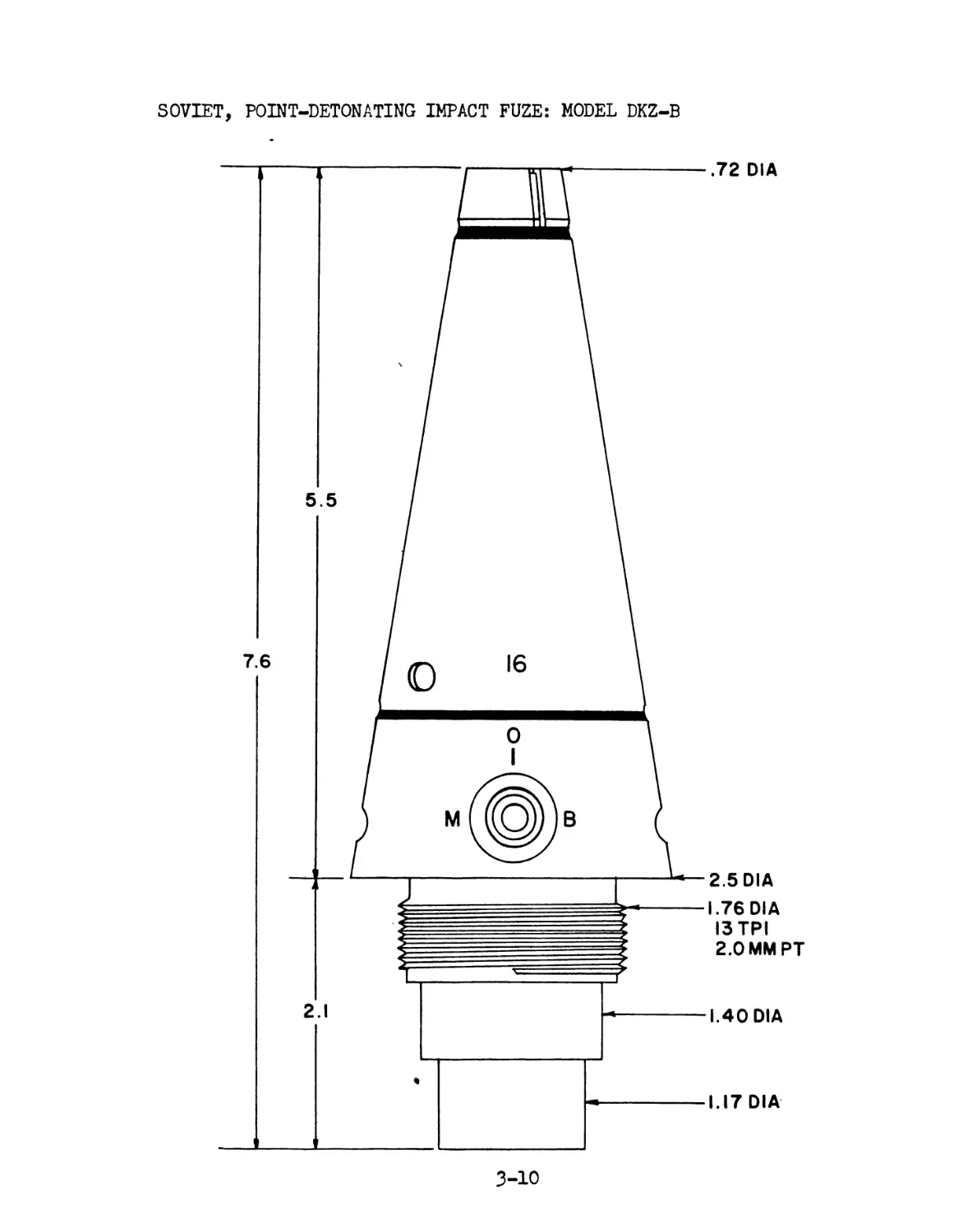
a.	General. The Soviet DKZ-B point-detonating fuze has been
encountered only on the 122mm fin-spin stabilized rocket DKZ-66. All
fuzes recovered have been sanitized. The only marking exhibited on the
fuze is the lot number.
The DKZ-B is unique because the fuze body is of composite construc-
tion. It has an outer urea formaldehyde plastic sheath (16) bonded to
the inner steel body (15). The DKZ-B is longer and heavier than standard
Soviet fuzes. However, it displays the usual Soviet waterproofing. All
openings are sealed with a synthetic rubber compound (2) that renders
the fuze completely waterproof. The selection spindle (27) is sealed
by a packing gland and nut (34),
The DKZ-B is constructed of four major subassemblies: a nose cap (1)
and membrane crimped to the aluminum windshield (21); the alumin-im wind-
shield containing the urea formaldehyde plastic arming mechanism housing
(23); the plastic bonded steel body (15) containing the selection spin-
dle (27) and three delay elements (17); and the steel booster cup (28)
containing the relay detonator (19) pressed into the booster charge (20).
Two of the delay elements (17) are for short delay ("B setting), these
are redundant. The third and longer delay element (29) is for long
delay.
The ogive (21) is unpainted, but has a thin coat of varnish. Except
for the plastic (16), the fuze body and booster cup (28) are black and
possess a protective varnish coating. The plastic (16) has been painted
both blue and black, with blue predominating. The lot number is die-
stamped near the base of the ogive.
The arming mechanism (23) is setback operated and employs a zigzag
slot governor for arming delay. The arming mechanism (23) releases the
cocked arming primer (8) which initiates a pyrotechnic delay arming
pellet (13) which unlocks the detonator rotor (25). The single purpose
of the arming mechanism (23) is to release the primer (8). The pyro-
technic delay arming mechanism (14) consists of a pressed, nongaseous
powder (13) blocking a detent (14), which in turn locks the detonator
rotor (25) in the safe position. When the pyrotechnic element (13)
is consumed, cam action from the spring loaded detonator rotor (25)
forces the detent (14) into the evacuated cavity, unlocking the rotor
(25). An acceleration weight (30), is setback upon launch against its
spring (31) and also unlocks.the rotor (25). Without sustained acceler-
ation locking the weight (30) down until after the delay arming detent
(14) is withdrawn, the fuze will not arm.
The selection spindle (27) controls the instantaneous ("0" setting),
short delay ("B" setting), and long delay ("M" setting) of the fuze.
On instantaneous, a straight-through flash channel (32) permits flame
from the detonator (26) in the rotor (25) to flash directly into the
relay detonator (14). On short delay, the spindle (27) presents a
3-7
SOVIET, POINT-DETONATING IMPACT FUZE: MODEL DKZ-B
solid block in the flash channel (32) so that the short delay pellets
are ignited by flame that is reflected upward and outward by the blocked
flash channel (32). On long delay, the spindle (27) has a short longi-
tudinal channel (33) that leads a flame to the long delay pellet (29).
Functioning of either one, or both, of the short delay pellets (17), or
the single long delay pellet (29), produces flame from their respective
flash pellets (18) which flashes directly into the heat sensitive relay
detonator (19) in the booster (28),
b.	Characteristics.
Action ----------------------------—-------------instantaneous or delay
Loaded weight---------—————------------—--------—- 90S grams (2.0 lbs)
Body material------------------------------—steel, aluminum, and plastic
£. Functioning. When the DKZ-66 rocket is fired, setback causes
the setback sleeve (22) to move rearward while being retarded by the zig-
zag slot governor and the sleeve spring (1). When the setback sleeve
reaches the bottom of its travel, two levers (5) are moved inward, releas-
ing the lock ball (6) which releases the spring-loaded arming primer (8),
The arming primer (8), propelled by its spring, (7) impinges on the fired
firing pin (10). The primer (8) flashes and flame travels through the
three flash holes in the firing pin housing (10). This ignites the flash
pellet (11) whose flame ignites the relay pellet (12). The relay pellet
ignites the delay arming pellet (13). Simultaneously, setback and sus-
tained acceleration cause the weight (30) to move to the rear and remain
there partially unlocking the detonator rotor (25). When the delay arm-
ing pellet (13) burns out, the locking detent (14) is moved into the
pellet cavity by the rotating rotor (25) powered by the rotor spring
(35)» The fuze is now armed. Upon impact, the nose cap membrane (1) is
crushed so that the firing pin plunger (3) is forced downward driving
the firing pin (9) downward against its spring into the detonator (26),
If the spindle is set for instantaneous action, the straight-through
flash channel (32) permits flame from the detonator (26) to flash dir-
ectly into the relay detonator (19) functioning the warhead. If the
spindle is set for short delay, the flash channel is blocked, and the
delay pellets are ignited. When they burn through, the flash pellets
flash into the detonator producing warhead functioning. If the spindle
is set on long delay, the flash channel (33) transmits a flame from the
detonator to the long delay pellet (29). When the pellet burns out, the
burn-out flame completes fuze functioning.
3-8
SOVIET, POINT-DETONATING IMPACT FUZE: MODEL DKZ-B
d. Weapons and projectiles with which fuze can be used.
Weapons	Projectiles
122mm rocket launcher, type unknown 122mm HE-PEFrag ----------
9M22M
3-9
SOVIET, POINT-DETONATING IMPACT FUZE: MODEL DKZ-B
3-10
SOVIET, POINT-DETONATING IMPACT FUZE: MODEL DKZ-B
3-11
SOVIET, POINT-DETONATING IMPACT FUZE: MCDEL DKZ-B
16
15
— 29
— 36
3-12
SOVIET, POINT-INITIATING, BASE-DETONATING IMPACT FUZE: MODEL GK-1
a.	General. The Soviet Model GK-1 fuze is a setback armed, nondelay,
impact fuze. It was designed to be employed as a point-initiating, base-
detonating fuze for use with high explosive antitank (HEAT) projectiles
and as a straight impact fuze for use with high explosive, fragmentation
projectiles. The GK-1 is an extremely sensitive fuze, as are all of the
GK series. The nose of the GK-1 is protected with a shipping cap, which
is removed rrior to firing. Delayed arming is achieved by the use of a
zigzag slot cut in the setback sleeve (5). Because of the in-line explo-
sive train,the GK-1 is not detonator-safe. Graze sensitivity is achieved
through the use of a cam weight positioned in the bottom of the fuze.
Any lateral impact causes the weight (12) to move the primer carrier (7)
up into the firing pin (3). The GK-1 is considered obsolete, having
been replaced by the GK-2 and GK-2M fuzes.
b.	Characteristics.
Action ---------------------------------------------------- instantaneous
Loaded weight --------------------------------------- 155 grams (0.34 lb)
Body material---------------------------—-------——— -------- — aluminum
£. Functioning. Upon firing, setback causes the sleeve (5) to move
to the rear, releasing the sleeve retaining ball (9), which falls into
the fuze body cavity. As setback diminishes, the sleeve spring (4)
forces the sleeve (5) to move forward to the head of the firing pin (3).
This releases the four firing pin retaining balls (6) allowing them to
fall into the fuze cavity. The fuze is now armed with the firing pin,
(3) which is separated from the primer (7) only by the expanded firing
pin spring (11). Upon impact, the foil cap (1) and the firing pin plun-
ger (2) are driven downward against the head of the firing pin (3),
which in turn causes the firing pin to pierce the stab-sensitive primer
(7). This initiates the detonator, (8) which causes the projectile to
detonate. On graze impacts, the graze weight (12) moves laterally mov-
ing the primer carrier (7) onto the firing pin (3), producing function-
ing.
d_. Wearons and projectiles with which fuze can be used.
Weapons	Projectiles
82mm Soviet AT rocket launcher,	82mm HEAT ——_______________ PG-82
Model SFG-82
3-13
SOVIET, POINT-INITIATING, BASE-DETONATING IMPACT FUZE: MODEL GK-1
3-U
SOVIET, POINT-DETONATING IMPACT FUZE: MODEL GK-2
a.	General. The GK-2 is similar in construction and functioning
to the Soviet GK-1. The only noticeable difference between the GK-2
and the GK-1 is the zigzag delay arming assembly. This element provides
a greater safe arming distance for the GK-2. The basic design for the
GK-2 appeared in the Soviet M-50 mortar fuze, and it is almost identical
to the current Soviet M-6 mortar fuze. Due to the in-line explosive
train, the GK-2 is not considered detonator-safe.
The GK-2 may be fired with or without the shipping cover in place.
If the fuze is fired with the shipping cover, a slight delay is expe-
rienced.
The GK-2 employs a graze sensitive feature to insure functioning at
low angles of impact. The graze sensitive plunger or hammer resides in
an enlarged cavity. Its concave surface rests against the conical sur-
faces of the primer detonator assembly. Amy impact, other than one di-
rectly on the nose of the fuze, causes the graze hammer to move laterally,
thereby forcing the primer-detonator forward through cam action.
b.	Characteristics.
Action--—---------------------------------------instantaneous
Loaded weight----—----------------------------------- 0.39 lb
Body material-—————------———aluminum
£. Functioning. Upon firing, setback forces the zigzag sleeve (15)
to the rear, releasing the sleeve retaining ball (1Д) which falls into
the fuze body cavity. As setback decreases the sleeve spring (Д), which
was compressed by the sleeve, expands and moves the sleeve (15) forward
beneath the head of the firing pin assembly (13), releasing the four fir-
ing pin locking balls (6) and allowing them to drop into the fuze body
cavity (5). The fuze is now armed. The firing pin is held apart from
the primer detonator (9) by the firing pin spring (17). Upoi impact, the
plunger (2) is driven against the head of the firing pin assembly (13)
which pierces the primer detonator (9) causing it to detonate and, in turn
detonate the booster.
If the fuze impacts at a flat angle so that the plunger (2) is not
depressed, the graze sensitive plunger moves laterally, overcoming the
retaining disc (11) and forcing the primer-detonator assembly (9) forward
onto the firing pin (9), thus achieving detonation.
3-15
SOVIET, POINT-DETONATING IMPACT FUZE: MODEL GK-2
3-16
SOVIET, POINT-INITIATING IMPACT FUZE: MODEL GK-2M
a.	General. The Soviet GK-2M is a later version of the GK-1 and
GK-2 Soviet fuzes. Two major modifications have been incorporated into
the GK-2M to improve fuze reliability on graze impact. The firing pin,
plunger, and nose assemblies have been redesigned. It has a cone-shaped
plunger and cone-shaped cavity in the nose. The second change consists
of the addition of an adapter for the primer-detonator assembly. This
adapter eliminated the inner body cavity to receive the firing pin lock-
ing balls after setback. The cavities were difficult to machine, and they
have been eliminated in the GK—2M. In all other respects the GK-2M is
identical with the earlier GK-2.
b.	Characteristics.
Action-------------------—----------------------------------instantaneous
Loaded weight----—------------------------—----------- -------7.12 ozs
Body material ———--------—----------—    ---------------------- aluminum
c.	Functioning. Upon firing, setback causes the zigzag sleeve (5)
to move to the rear releasing the sleeve retaining ball (3) which falls
into the fuze body cavity (6). As setback forces decrease, the sleeve
spring (4) which was compressed by the sleeve during setback, recoils,
moving the sleeve (5) forward, releasing the four firing pin locking balls
(8) allowing them to drop, into the body cavity (6). The fuze is now
armed with the firing pin (2) held away from the stab-sensitive deto-
nator (10) by the anticreep spring. Upon impact, the cone-shaped plunger
(1) is driven against the firing pin assembly (2) which causes the firing
pin to pierce the primer-detonator, detonating the booster. On low angles
of impact, the graze impact feature causes the booster impact weight to
move laterally overcoming the retainer washer (12), moving the primer-
detonator assembly (10) forward into the firing pin (9) causing it to
function. If the nose cone strikes at an angle, and it is crushed out of
line with the plunger (2), the cone-shaped cavity in the nose causes the
plunger to move downward against the firing pin head, causing it to func-
tion.
d,	Weapons and projectiles with which fuze can be used.
Weapons	Projectiles
82mm recoilless rifle, B-10	82mm HEAT ----------------- Bk-881M
3-17
SOVIET, POINT-INITIATING IMPACT FUZE: MODEL GK-2M
L4il -------->
3-18
SOVIET, POINT-DETONATING IMPACT FUZE: MODEL GVM
a.	General. The GVM fuze differs from the GVMZ and the GVMZ-1
fuze"”inasmuch as it has no delay element and, consequently, no fuze
setting device. It is an instantaneous fuze with one permanent setting.
In other respects it is similar to the GVMZ and GVMZ-1. The GVM fuze
is not being manufactured at the present time.
b.	Weapons and projectiles with which fuze can be used.
Weapons
Projectiles
120mm regimental mortars M1938 and
M1943
120mm Frag-HE
Smoke —
0F-843,
OF-843A
. D-843A
3-19
THIS PAGE INTENTIONALLY LEFT BLANK
3-20
SOVIET, POINT-DETONATING IMPACT FUZE: MODEL GVMZ
a.	General<
(1)	The GVMZ fuze was originally designed for 122mm howitzer
Frag-HE and Frag shells and 230mm Frag shells; however, because of
membrane ruptures and premature bursts when used for fire from howit-
zers, it was discontinued for use in gunfire. The weight of the powder
delay element was reduced and the fuze was then used with 107mni and
120mm Frag-HE and smoke mortar shells. At present the GVMZ is used only
with 120mm Frag-HE mortar shells,
(2)	The GVMZ fuze is a departure from the usual Soviet fuze
design because it is termed a "thermo-pneumatic” fuze which operates
on the ”air column” principal of activating the initiating pellet
rather than the conventional percussion striker. The air, trapped in
a compression cup, is compressed to a density sufficient to generate
enough heat to ignite an initiation pellet of black powder, lead azide,
etc. No bore-safe mechanism is incorporated in its design, but its
principle of operation makes it bore-safe under normal operating condi-
tions (at low velocities). The safety cap (1) must be removed prior
to firing the fuze. The settings for the GVMZ are as follows:
Setting	Action
”0”--------------------------------instantaneous	and delay
-------------------------------delay (0.05 -	0.09 second)
b.	Characteristics.
Action---------------------------------------— instantaneous and delay
Loaded weight -------------------------------------430 grams (0.946 lb)
Body material---------------------------------------------------— steel
£, Functioning, When fired, no movement of the component parts
takes place until the projectile strikes the ground. Upon impact, when
the fuze is set for instantaneous action, the nose bushing and dia-
phragm (3) are driven inward. They in turn drive the compression
plug (2) rearward, compressing the air in the compression cup (9) to
a point vdiere sufficient heat is generated to ignite the black powder
initiating pellet (3)• The flame jet travels down the flash channel
(5) through the transverse hole in the setting selector (4), and sets
off the detonator pellet (6), which detonates the booster (?)• When
3-21
SOVIET, POINT-DETONATING IMPACT FUZE: MODEL GVMZ
set for delay action, the flame jet travels through a longitudinally
drilled hole in the setting selector (/,), down the delay channel (10)
to the delay pellet (11), and sets off the detonator pellet (6), which
in turn detonates the booster (7).
d. Weapons and projectiles with which fuze can be used.
Weapons	Projectiles
107nnn mountain-pack regimental mor- 107mm Frag-HE ———------------ OF-841;
tar, M1938	OF-841A, 0F-841T
Smoke---------------D-841
120mm regimental mortars M1938 and 120mm HE-----------——-----------F-843
M1943	Frag-HE ---0F-843; 0F-843A
Smoke —----------- 0F-843A
SOVIET, POINT-DETONATING IMPACT FUZE: MODEL GVMZ-1
This fuze is similar in construction and functioning to the GVMZ fuze,
but it has a simplified percussion mechanism with a wooden striker and
a copper membrane. The clogging of powder between the delay element
and the detonating cap is impossible. Like the GVMZ, the GVMZ-1 fuze
also has two settings: instantaneous (device set on "0") and delay
(device set on "3"). It is used in the same projectiles and fired from
the same weapons as the GVMZ.
3-23
THIS PAGE INTENTIONALLY LEFT BLANK
3-24
SOVIET, POINT-DETONATING IMPACT FUZE: MODEL GVMZ-7
a. General. The GVMZ-7 is a point-detonating fuze used in the
107mm and 120mm mortars and 122mm and 152mm howitzers. This fuze is
safe to transport and is bore-safe. The fuze is prepared for firing
by removing the shipping cap, pulling the safety cap retaining wire
out of the cloth tab, and removing the safety cap (5). The fuze has
settings for either delay or instantaneous action, as indicated below:
Setting	Action
"0"  -----------------------------instantaneous
"3"-----------------------------— delay
b. Characteristics.
Action  ---------------———--------- --------—- instantaneous and delay
Loaded weight---------------------——-------------------——  unknown
Body material--------------------------------—--------------------steel
£. Functioning.
(1) Upon firing, setback causes the firing pin (8) to be driven
into the safety pellet (10). The flame from the pellet passes through
the grooves in the firing pin and ignites the black powder pellet (3).
£fter the black powder pellet has burned, it allows a centrifugal seg-
ment (2) to move outward, which then allows the interrupter (7) to
move outward through one or both flash channels, depending on the set-
ting.
(2) Upon impact with the target, the piston (1) is driven
rearward compressing the air which ignites the primer (6). The flash
from the primer then rasses directly to the detonator (14) via the
instantaneous flash channel (9), or to the delay pellet (13), depending
on the setting. Setting "3" allows the interrupter (7) to move only
far enough to uncover the delay flash channel (12), forcing the flash
from the primer to ignite the delay pellet (13) which activates the
detonator (14), and in turn the booster (4). Setting "0" allows the
interrupter to move over far enough to uncover both flash channels so
that the flash from the primer will pass directly to the detonator (14)
and booster (4), resulting in instantaneous action.
3-25
SOVIET, POINT-DETONATING IMPACT FUZE: MODEL GVMZ-7
d. Weapons and projectiles id.th which fuze can be used.
Weapons
107mm mountain-pack regimental
mortar M193S
120mm regimental mortars M1938 and
ML943
122mm howitzer M1938 (M-30)
152mm howitzer M1938 (M-10) and Ю.943
(D-l)
Projectiles
107mm-------—— -—-------unknown
120mm---------------------F-843
122mm ———---------------unknown
152mm-------------------unknown
3-26
SOVIET, POINT-DETONATING IMPACT FUZE: MODEL KT-1
a.	General. The KT-1 is a point-detonating, setback-armed fuze
used with Frag and Frag-HE projectiles of 45n>m, 57nnn, and 76mm caliber
sizes. The Soviets refer to this fuze as "semisecure" and bore-safe.
The fuze is capable of nondelay and delay action depending on the use
of the fuze cap and the compressed black powder delay pellet (10), which
is sometimes inserted in this fuze for special demolition purposes.
Fuzes containing the delay pellet are painted black; models without the
delay pellet are painted light gray. The fuze action is regulated as
indicated below:
Fuze color	Action
Black, w/delay element and cap-----------long delay
w/delay element, w/o cap ---------short delay
w/o delay element and cap---------- instantaneous
w/o delay element, w/cap —-------- short delay
Light gray, w/o delay element and cap --- instantaneous
w/o delay element, w/cap ---- short delay
Black nose only, w/delay element and cap—long delay
w/delay element, w/o cap-short delay
b.	Characteristics.
Action--------------------------------------------— delay and nondelay
Loaded weight ——----—________--------------- .370 grams (.81Д lb)
Body material -------------------------------------------------— steel
c.	Functioning. When the KT-1 fuze is set for instantaneous action
(nose cap removed), the fuze functions as follows: setback causes the
stirrup (7) to compress the spring (6), override, and lock itself to the
primer carrier (8). The primer carrier is also setback and compresses
the sealing washer (9) over the vent in the body, shielding the detona-
tor (11) from the primer (5) if premature ignition occurs. The striker
(1) and firing pin (3) are also setback, but the firing pin does not
reach the primer. After the projectile leaves the bore, the spring (6)
raises the nrimer carrier (8) and stirrup (7) to a position directly
3-27
SOVIET, POINT-DETONATING IMPACT FUZE: MODEL KT-1
under the firing pin (3). At the same time, the spring (2) returns the
firing pin (3) and the striker (1) to their original positions. On
impact, the striker (1) is driven rearward, forcing the firing pin (3)
into the primer (5) which successively sets off the primer, the detonator
(11) and the booster (12). When the fuze is set for delayed action (nose
cap in place), the action is identical to that of instantaneous action
except that on impact the cap prevents the striker (1) and the firing
pin (3) from being driven to the rear. At the same time, inertia drives
the primer carrier (8) forward, forcing open the segmented safety shutter
(Д) and driving the primer (5) against the firing pin to activate the
explosive train.
d.	Weapons and projectiles with which fuze can be used.
Weapons	Projectiles
45mm antitank guns M1932, M1937, and	45пи	Frag ------------ 0-240
M1942; tank guns M1932 and M1934
57mm antitank guns M1941 and M1943	57mm	Frag ——	0-270; 0-271
76mm tank guns M1927/32, Ю.938/39	76mm	Frag-HE----------OF-343;
(L-ll), M1939 (F-32), M1940 (F-34),	OF-350; OF-35OA
and M1941 (ZIS-5); divisional guns
M19O2/3O, M1933, M1936 (F-22), M1939
(USV), and M1942 (ZIS-3); regimental
guns (howitzers) M1927 and M1943;
mountain guns (howitzers) M19O9 and KL93S
3-28
SOVIET, POINT-DETONATING IMPACT FUZE: MODEL KT-1
3-29
SOVIET, POINT-DETONATING IMPACT FUZE: MODEL KT-2
a. General. This fuze is almost identical in construction and
operation to the KT-1 and KTM-1 fuzes. It differs from the latter
only in the smaller diameter of its base threads. It is designed to
screw into a booster cup (adapter) which screws into the well of the
projectile. The KT-2 fuze is interchangeable with the KTM-2 fuze.
b. Weapons and projectiles with which fuze can be used.
Weapons
Projectiles
76mm divisional guns М19О2/ЗО, M1933,
M1936 (F-22), M1939 (USV, and M1942
(ZIS-3); tank guns M1938/39 (L-ll),
M1939 (F-32), M1940 (F-34),
and M1941 (ZIS-5).
76mm Smoke —-----------D-350
122nnn howitzers M1938 (М-ЗО), M19O9/37,
and М19Ю/ЗО
122mm Smoke —-----—— D-462
3-30
SOVIET, POINT-DETONATING IMPACT FUZE: MODEL KT-3
a.	General. This fuze is almost identical in construction and oper-
ation to the KT-1 and KTM-1 fuzes, and it is used with old 76mm high-
explosive projectiles, which have a well for the 3GT fuze. The KT-3
differs from the KT-1 and KTM-1 fuzes only in the smaller size of its
base threads. The KT-3 fuze is interchangeable with the KTM-3 fuze.
b.	Weapons and projectiles with which fuze can be used.
Weapons	Projectiles
76ram divisional guns M19O2/3O, M1936 76mm HE----------------—-— F-354
(F-22), M1939 (USV), and М19Д2 (ZIS-3;
tank guns M1927/32, M193S/39 (L-ll),
M1939 (F-32), M1940 (F-ЗД), and M1941
(ZIS-5); regimental gun (howitzer)
M1927; mountain gun (howitzer) M19O9
3-31
SOVIET, POINT-DETONATING IMPACT FUZE: MODEL KTM-1
a.	General, The KTM-1 is a point-detonating, setback-armed fuze
used with 45ппп, 57шт, 76mm, and 8*>mm projectiles. The Soviets refer to
this fuze as '’semisecure” and bore-safe. It is capable of nondelay and
delay action depending on the fuze coloring and and the use of the fuze
cap. Projectiles using the KTM-1 are reported to give greater fragmen-
tation effect than those using the KT-1 fuze; use of the black-bodied
KTM-1 fuze results in camouflets. duds, or sometimes a slight cratering
effect if used for ranges over 2$ miles and if striking soft ground. The
fuze action is regulated as indicated below:
Fuze color and use of cap
Body and cap painted green, w/cap
w/o cap
Tin plated body with red nose, w/cap
w/o cap
Body and cap painted black, w/cap
w/o cap
Unplated body with red cap, w/cap
w/o cap
Action
Short delay
Instantaneous
Long delay
Short delay
Short delay
Instantaneous
Long delay
Short delay
b.	Characteristics.
Action -—------— —"  ----------------------------—- nondelay and delay
Loaded weight ------------------------------— — — 370 grams (.814 lb)
Body material -------------------------------------  --	---- - steel
c.	Functioning. On firing, the arming sleeve (10) sets back,
compresses the arming sleeve spring (9), overrides the stirrup (8), and
locks itself to the primer holder assembly (11). The lower end of the
primer holder assembly holds the aluminum sealing cushion (14) over the
vent in the fuze body, shielding the detonator (12) from the primer (7),
should accidental ignition occur. The striker (3) and the firing pin
(5) are also set back, but the firing pin cannot reach the primer (7)
at this time. After the projectile leaves the bore, the arming sleeve
spring (9) raises the arming sleeve (10) and primer holder assembly (11)
to a position directly under the safety disk (6). During the flight of
the projectile, the firing pin spring (4) returns the striker (3) and
the firing pin (5) to their original positions. On impact, when the
fuze is set for instantaneous action (cap in place), the striker (3)
3-32
SOVIET, POINT-DETONATING IMPACT FUZE: MODEL KTM-1
drives rearward and forces the firing pin (5) through a hole in the
safety disk and into the primer. The primer is thus ignited, and it
in turn sets off the detonator (12) and the booster (13)» When the fuze
is set for delay action (cap in place), the action is identical with
that for nondelay action except that, on impact, the cap (2) prevents
the striker (3) from being driven rearward. The primer holder assem-
bly (11) moves forward and, overcoming the resistance of the safety
disk (6), drives the primer (7) against the firing pin to initiate
the explosive train of the fuze.
d. Weapons and projectiles with which fuze can be used.
Weapons		Projectiles
45mm	tank guns M1932, M1934, & M1938; antitank guns M1932 M1937, and Ml 942	45mm Frag 		- 0-240; 0-240A 0-240M
57mm	antitank guns M1941, M1943 (ZIS-2), and M1949	57mm Frag 		- 0-271; 0-271U
76mm	divisional guns Ml 902/30, M1936 (F-22), M1939 (USV), & M1942 (ZIS-3); regimental gun (howitzer) M1927; moun- tain gun (howitzer) M1938; tank guns M1938/39 (L-11) & M1939 (F-32)	76mm Frag ——— Frag HE — Frag-Gas — HE		- 0-350; O35OA 0F-343; OF-35O; OF-35OA 	 OKh-350 	 F-354
85mm	antiaircraft gun M1939; Tank gun M1943 (D-5T85) and M1944 (ZIS-S53); SP gun M1944 (D5- S85)	85mm Frag 			0-3 65K
3-33
SOVIET, POINT -DETONATING IMPACT FUZE: MODEL KTM-1
3-3L
SOVIET, POINT-DETONATING IMPACT FUZE: KTM-l-U
a.	General, The Soviet KTM-l-U point-detonating fuze is an improved,
modified version of the earlier KTM-1, and it is employed in the same
manner. Like the KTM-1, the KTM-l-U is not detonator-safe, but is bore-
safe. Arming is entirely by setback. The KTM-l-U displays a slight
modification in the wooden firing pin plunger assembly and in the posi-
tion and configuration of the detonator (10), Dimensions and configura-
tion of the KTM-l-U remain the same as the KTM-1.
b.	Cha racteri sties.
Action----------------------------------------- instantaneous and nondelay
Loaded weight --------------------------------—------ 370 grams (0,31 lb)
Body material-----------------------------——————-----------———— steel
c.	Functioning. Upon .firing, setback causes the arming sleeve (Д)
to move rearward comrressinr the arming spring (6), permitting the stirrup
prongs (7) to lock into the groove cut into the sleeve (Д). This locks
the arming sleeve (д) to the primer carrier (8). The fuze is not armed
until this takes place. As acceleration diminishes, the arming spring
(6) moves the married arming sleeve (Д)‘and primer carrier (8) forward
until the nose of the carrier is stop-ed by the safety ring (3). For
instantaneous, action, the nose cap (1) is removed so that upon impact,
the direct acting firing pin (2) is driven into the primer (5). A flame
from the primer passes through the flash hole (9) in the bottom of the
fuze body and functions the detonator (10) and the booster (11). For
nondelay action the nose cap (1) is left in place. The direct-acting
firing pin is not m?ved upon inract, instead, inertia causes the married
arming sleeve 6) and primer carrier (8) to move forward shearing the
four lugs on the safety ring (3). The primer impales itself on the sta-
tionary firing pin initiating the explosive train operation. The slight
delay produced by inertia operation is sufficient to permit projectile
penetration before detonation.
d.	Weapons and projectiles with which fuze can be used.
Weapons
Projectiles
Same as those listed with the Soviet KTM-1,
Unknown
3-35
SOVIET, POINT-DETONATING IMPACT FUZE; KTM-l-U
3-36
SOVIET, POINT-DETONATING IMPACT FUZE: MODEL KTM-2
a.	General. This fuze is almost identical in construction and design
to the KTM-1 fuze and is used with 76mm divisional guns and 122mm howitzer
smoke projectiles. The KIM-2 and KT-2 fuzes are interchangeable. They
differ from the KTM-1 fuzes in the thread size; the thread diameter is
somewhat smaller in the KTM-2 and KT-2.
b.	Weapons and projectiles with which fuze can be used.
Weapons	Projectiles
76mm divisional guns M1902/30, M1933	76mm Smoke-----------D-350
M1936 (F-22). M1939 (USV), and
M1942 (ZIS-3)
122mm howitzer M1938 (M-30)	122mm Smoke--------— D-462
3-37
SOVIET, POINT-DETONATING IMF.'.CT FUZE: MODEL KTK-3
a.	. General. This fuae is almost identical in construction and
operation to the KTM-1 fuze and is interchangeable with the KT-3 fuze.
The KTM-3 fuze differs from the KTM-1 in thread size; the former has
a somewhat smaller thread size. The KTM-3 and KT-3 fuzes азе used with
old 76mm high-explosive projectiles which have a well for the 3GT fuze.
b,	Weapons and projectiles with which fuze can be used.
Weapons
Projectiles
76mm regimental gun (howitzer) M1927;
tank gun Ml927/32; mountain gun
(howitzer) M19O9
76mm HE--------------------F-354
Frag-HE ------------ OF-350
3-38
SOVIET, POINT-DETONATING IMPACT FUZE: MODEL KTMZ-1
This fuze is almost identical in construction and operation to the
KTM-1 fuze, although it differs from the KTM-1 by having a delay
pellet pressed into the powder plug. It possesses the sane delay
action, whether capped or uncapped. The KTMZ-1 may be identified by
the color of its head plug and setting cap, which are painted either
black or red.
SOVIET, POINT-DETONATING IMPACT FUZE: MODEL KIME-2
This fuze is almost identical in construction and operation to the KTM-2
and KT-2 fuzes, except it has a delay pellet pressed into the powder
plug. It possesses the same delay action whether it is capped or uncapped.
SOVIET, POINT-DETONATING IMPACT FUZE: MODEL KTZ-2
The KTZ-2 differs from the KT-2 fuze by having a delay pellet, which is
pressed into the powder plug. The two fuzes are otherwise identical
in construction and operation.
3-39
THIS PAGE INTENTIONALLY LEFT BLANK
3-40
SOVIET, POINT-DETONATING IMPACT FUZE: MODEL M-l
a.	General. The M-1 is a point-detonating, nondelay fuze of
conventional design. It is known to be used with JQnn11, 82mm, and
120mm Soviet Mortars, and it can be used with 170mm and 1б0шт mortars.
This fuze is considered obsolete; however, it is possible that the fuze
is still being used. The Soviets refer to the fuze as "unsecured"
During storage and transport the fuze is protected by a metal cap (1)
which may be removed prior to firing. If a red stripe is visible on
the side of the projecting striker head, the fuze is armed and must not be
fired.
b.	Characteristics.
Action nondelay
Loaded weight 250 grams (.55 lb)
Body material  unknown
,£. Functioning. Upon discharge, the arming sleeve (10) sets back
and its beveled edge cams the safety pin (11) outward, and the upoer check
ball (3) drops into the recessed portion of a well on top of the arming
sleeve (10), thus freeing the sleeve for forward movement. When the
projectile leaves the bore, the arming sleeve soring (Д.) decanpresses and
forces the sleeve foward pennittin,' the lower check balls (5) to drop
inside a well in the sleeve. This frees the striker (6) for rearward
movement. During the flight of the projectile, tension of the safety
soring (7) prevents the striker and firing pin (12) from moving rear-
ward and detonating the projectile. Upon impact, the striker (2) is
driven rearward, and the firing pin (12) sets off the detonator, (8)
which in turn actuates the booster (9) and the explosive charge of the
projectile.
d. Weapons and projectiles with which fuze can be used.
Weapons	Projectiles
50mm Company mortars M1938, M1940	50nnn Frag------- 0-822; 0-822A;
and M1941	0-822Sh
82mm battalion mortars: M1937	82mm Frag ------- 0-832; 0-832D
(82-BM-37), M1941 (82-BM-41)	D-832
and M1943 (82-BM43)
120шт regimental mortars: M1938 and 120mm Frag-HE---------------- 0F-843
M1943	Incendiary-------Z-843A
3-41
SOVIET, POINT-DETONATING INPACT FUZE: MODEL M-l
3-42
SOVI'T, FCINT-DETONATING IMPACT FUZE: MODEL M-2
£. General. The M-2 is a point-detonating, nondelay action fuze
consistinc of a plastic body on a wire armature, a direct-action type
percussion mechanism, and a detonator. Although the Soviets refer to
this fuze as "unsecured," it is sufficiently safe in spite of its sim-
plicity of structure. Until discharge the firing pin (2) is separated
from the detonator pellet by the safety block (5), which is a steel disc.
The safety block is held in position by the safety sleeve (1). One end
of the setback spring (3) holds the safety block while the other end of
the spring supports the stirrup (1).
b.	Characteristics.
Action ---------------------------------------------------- instantaneous
Loaded weight --------------------------------------------------- unknown
Body material------------------------------------------------------plastic
c.	Functioning. Upon firing, the stirrup (1) sets back, overcomes
the resistance of the setb-ck spring (?), and engages the lir of the
safety sleeve. When the shell leaves the mortar tube, creep force
carries the stirrup forward, and the safety block (5) is then free to
move away from under the firing pin, thereby providing an uninterrupted
path to the detonator assembly (6). Upon impact, the firing pin drives
into and actuates the detonator (6), which in turn actuate" the booster
(7).
d.	VJeapons and projectiles with which fuze can be used.
Weapons	Projectiles
82wn battalion mortars >0.937 (82-БМ37), 82mm Frar--------- 0-832;0-832D
M19A1 (82-BM41), and МЖЗ (82-ВМДЗ) Smoke-----------------------D-832
3-43
SOVIET, POINT-DETONATING IMPACT FUZE: MODEL 14-2
OH A
3-44
SOVIET, POINT-DETONATING I1T/-CT FUZE: MODEL M-3
The M-3 is a point-detonating, nondelay fuze which is similar in design
and operation to the M-2 fuze, and is used with the same projectiles
as the M-2 fuze. The body of the M-3 fuze is constructed of steel,
rather than the plastic material used in the M-2; in all other respects
the two models appear to be identical.
3-45
THIS PAGE INTENTIONALLY LEFT BLANK
3-46
SOVIET, POINT-DETONATING IMPACT FUZE: MODEL М-Д
a,	General, The M-Д is the fourth model of the ”Mn series of Soviet
mortar fuzes. It is usually used for explosive mortar shells, but it can
be used with smoke and incendiary shells. It is known to be used with
82mm mortars and can be used with 107mm and 120mm mortars. There is no
visible means to determine whether the fuze is armed or unarmed,
b.	Characteristics,
/ction --------------------------------------------------------- nondelay
Loaded weight —---------------------------------------300 grams (.66 lb)
Body material ------------------------------------------ steel or plastic
£, Functioning, Upon firing, the stirrup (Д) setback, forces its
flanged lower end down into the hollowed-out safety block retainer (9)>
and compresses the spring (3)• This action retains the safety block (5)
between the firing pin (8) and the detonator (6) until the projectile
has left the mortar tube. After the projectile has left the tube, the
spring (3) decompresses and forces the stirrup (Д) upward. During this
upward movement of the stirrup, its flanged Lower end carries the safety
block retainer (9) with it. As the safety block retainer moves upward,
the cammed surface on its outer circumference engages a vertical tongue,
extending upward from the safety block (5) and cams the block outward,
away from its position over the detonator (6), thus allowing the firing
pin (8) free access to the detonator, On impact, the foil membrane (1)
is ruptured and the firing pin is driven rearward, forcing its pointed
lower end into the detonator, successively actuating the detonator and
the booster (7) wrhich, in turn, detonate the shell.
d, Veapons and projectiles with which fuze can be used,
Weapons	Projectiles
82mm battalion mortars M937, M1941, etc. 82mm Frag —— 0-832; O-332D
Smoke-------------E-832
L-Amm Frag-HE-OF-ЗДЗ; OF-ЗДЗА
Incendiary ----------- Z-ЗДЗА
Smoke------------D-ЗДЗА
3-Д7
SOVIET, POINT-DETONATING IMPACT FU2E: MODEL M-4
3-hs
SOVIET, POINT-DETONATING IMPACT FUZE: MODEL M-5
a.	General. The M-5 is a point-detonating, setback-armed,
nondelay action fuze. It is used in projectiles fired from 82mm
mortars. The fuze is considered bore-safe; however, the Soviets
refer to it as "unsecured.” The M-5 fuze functions nearly the
same as the M-2 and M-3 fuzes and is considered almost identical
to the M-4 in construction and operation.
b.	Characteristics.
Action------------------------------------------------------nondelay
Loaded weight------------------------------------------77.11 grams (.17 lb)
Body material-----------------------------------------------plastic
c.	Functioning. The firing pin (5) is separated from the detonator
assembly (?) by a small safety disk (9). This disk is held in place by
a safety cup (6). The safety spring (4) holds the cup and disk in place.
When the mortar is fired, setback causes the stirrup (3) to move rearward
and engage the prongs of the safety cup (6). As the shell decelerates
during flight, creep force allows the safety unit to move forward and the
safety disk to fall away from under the firing pin, thereby providing
the pin with free access to the detonator assembly (7). On impact, the
foil disk (1) is ruptured and the firing pin strikes the detonator assembly,
actuating it and the booster (8) in turn.
d.	Weapons and projectiles with which fuze can be used.
Weapons	Projectiles
82mm battalion mortars M1937	82mm Frag-------- 0-832; 0-832D
(82-EM37), M1941 (82-HM-41),	Smoke---------------D-832
and M1943 (82-BM43)
3-49
SOVIET, POINT-DETONATING IMPACT FUZE: MODEL M-5
3-50
30VIEI; POINT-DETONATING IMPACT FUZE: MODEL M-6
a. General, The M-6 fuze has become the standard 82mm Mortar fuze
almost to the total exclusion of all other fuzes. The M6 is a superquick
fuze used with low velocity projectiles. It is bore-safe and detonator -
safe possessing a lateral-moving detonator slider. The fuze consists of a
brown plastic body made from compression molded, thermosetting, urea form-
aldehyde with a cotton filler, arming assembly, slider, detonator, lead
charge and booster.
A steel sleeve with a zigzag slot, a spring, three steel balls and
a slider comprise the arming assembly. The slider, with its out-of-line
detonator, is maintained in the safe condition by the firing pin, which
extends into a hole in the slider, preventing its movement. A coil spring
is compressed between the slider and inner fuze wall and provides power
to move the slider at arming.
The protective steel cap (1) which is secured by a pull wire is re-
moved prior to firing. This exposes the thin crush cap (12) which is
entirely waterproof. The firing pin (8) prevents the slider (9) from
moving and thus holds the detonator out-of-line. The firing pin (8) is
locked in position by two steel balls (7) which are housed in the arming
sleeve (2). The coiled arming spring (6) is held compressed under the
arming sleeve (2), while the arming sleeve is held by the sleeve retaining
ball (3) wedged between the firing pin head and arming sleeve.
i. Characteristics.
Action---------------------------------------------------instantaneous
Loaded weight -------------------------------- 127.1 grams (0.28 lb.)
Body material--------------------------------------------------plastic
£. Functioning. Upon firing, setback forces the arming sleeve (2)
downward. This releases the arming sleeve retaining ball (3) which falls
into the fuze body cavity (4). The arming sleeve (2) continues rearward,
delayed by the zigzag slot in the aiming sleeve and guided by a pin on
the slide’s holder (5) until it reaches the end of its travel. As set-
back ceases, the arming spring (6) expands moving the arrning sleeve (2)
forward, releasing zhe two firing pin retaining balls (7), which fall
into the body cavity. This permits the firing pin (8) to rise, powered
by the arming spring (6), moving the point of the firing pin (8) out of
its hole in tne slider (9). The slider (9), powered by the slider spring
(10), moves laterally, aligning the detonator (11) with the firing pin (8).
The fuze is now armed. Upon impact, the firing pin (8) is driven downward
by a combination of compressed air and debris crushing tne copper membrane.
The point of the firing pin pierces the detonator (1 1), initiating the lead
charge (13) and the booster (14).
3-51
SOVIET, POINT-DETONATING IMPACT FUZE: MODEL M-6
d. Weapons and projectiles with which fuze can be used.
Weapons
Projectiles
32mm mortars M1937, М19Д2 and М194Э 82mm HE-Frag ---------- 0-332; O-B32D
3.25
.49
154
M6-255 24-60
.66
TAG
1.55 DIA
1.40 MAJ DIA
.09
.95
.107 DIA
.22
10 TPI
.86 DIA
.75 MAJ DIA
24 TPI
.80 DIA.
3-52
SOVIET, POINT-DETONATING IMPACT FUZE: MODEL M12
a.	General, The M12 fuze is a setback-armed, point-detonating
fuze with optional superquick and fractional-second delay functioning
upon impact. The fuze consists of three assemblies: The striker assem-
bly, the delay assembly, and the booster assembly.
The striker assembly is identical to that used in the Мб fuze, and is
interchangeable, with the Mo striker assembly, the Ml2 possesses a primer
instead of a detonator. Basically the fuze is an Мб with selective
superquick or delay action. The assemblies are mounted in a rugged steel
body which is completely waterproof. There are two parallel-mounted delay
elements. Both provide the same delay period, Superquick action is select-
ed by rotating the interrupter within its packing gland, until the indi-
cator arrow points to "0.” In the delay setting the arrow points to the
"3" position.
b.	Characteristics.
Action--------------------------------------------------superquick or delay
Loaded weight----------------------------------------536.3 grams (1.18 lbs)
Body material-------------------------------------------------------steel
c.	Functioning. The aiming functioning is identical to that of
the M5 fuze. Upon impact, the firing pin initiates the primer which pro-
duces a flash. On the superquick option the flash passes through the
axial hole in the body of the delay housing (13) igniting the flash det-
onator (15) and detonating the booster. Simultaneously, both delay elements
are ignited but serve no purpose since the fuze detonates prior to
their functioning the attached flash pellets. If the interrupter (14) is
set for delay action, the primer flash is blocked in the axial hole and
the black powder in the upper chamber of both delays (12) is ignited.
After the delays bum through, the flash charge in the bottom of each
delay is ignited, which then flashes into the detonator (15) producing
fuze detonation.
d.	Weapons and projectiles with which fuze can be used.
Weapons	Projectiles
120mm mortars Ml 938 and Ml 943	120mm Frag------F-843, OF-843
OF-843A
3-53
SOVIET, POINT-DETONATING Б4РАС1 FUZE: MODEL 12
4.76
1.30
1.05 DIA
.22 DIA
1.40 DIA
.38 DIA
.21 DIA
1.56 DIA
1.30 DIA
1.40 MAJ DIA
TPI
1.16
.80
M12 -73-59 3144
01
3-54
SOVIET, POINT-DETONaTING IMPACT FUEE: MODEL M-50
a.	General. The M-50 is a point-detonating, setback-armed,
nondelay action.fuze used only with fragmentation projectiles. The
M-50 is an extremely sensitive fuze which the Soviets consider
"unsecured.*1 Prior to use, the nose of the fuze is covered with a
lead foil cap. This cap must be removed before firing. The firing
pin (3) is immobilized by two check balls (6) which are lodged between
the bottom of the striker head (1) and the top of the stirrup (2), and
two check balls (8) lodged at the lower end of the firing pin (3).
This prevents any movement of the firing pin until firing takes place.
It is not recommended that the fuze be removed from duds; however, if
removal must be accomplished, loosen the grub screw that secures the
fuze to the projectile and unscrew the fuze from the projectile. If
the striker head is protruding, and a red line cqn be seen across its
diameter, it is recommended that the fuze be blasted in place.
b.	Characteristics.
Action --------------------------------------------- nondelay
Loaded weight---------------------------------------112 grams	(.25 lb)
Body material---------------------------------------steel
£. Functioning. On firing, the stirrup (2) sets back and allows the
u uper check balls (o) to fall away, thus releasing the firing pin (3) for
forward movement. After the projectile leaves the mortar tube, the anti-
creep spring (7) forces the stirrup forward, allowing the lower check
balls (8) to fall away, freeing the firing pin for rearward movemmt.
At this point, the striker head (1) protrudes approximately one-half
its length above the top of the body of the fuze, showing a red line
across its diameter. On impact, the firing pin is driven rearward,
initiating the detonator (4) and booster (5), activating the fuze.
d. Weapons and projectiles with which fuze can be used.
Weapons
50mm company mortars M1938,
M1940, and Ml 941
Projectiles
50mm Frag----------------- 0-822;
0-822A; 0-822Sh
3-55
SOVIET, POINT-DETONATING IMPACT FUZE: MODEL M-5O
Л\%УУ
3-56
SOVIET, POINT-DETONATING IMPACT FUZE: MODEL MG-N
a.	General, The ’-'G-N is a bore-safe, out-of-line detonator fuze.
It employs a setback-initiated, pyrotechnic, arming delay feature seen in
the MG-57 fuze. The MG-N is a representative of the current Soviet effort
to produce bore-safe, detonator-safe fuzes to replace the earlier ’’unsecur-
ed" and "semisecure'’ fuzes. It is expected that the MG-N will replace the
KTM series fuzes in all applications. The MG-N has a single-piece steel
body that has been waterproofed at its two openings by sealing compound.
The shipping cap protects the firing pin membrane (2). When the cap is
removed the fuze functions instantaneously; when the cap is left on, a
slight functioning delay is obtained. The firing pin (3) is a hollow
aluminum, two-piece assembly. It assists in locking the rotor (4) in the
safe position during setback. The rotor rotates on pins in the rotor
housing. It is held out-of-line by two centrifugal detents. One is of
the direct arming type (18) and the other is of the delay arming type (19)
employing a consumable black powder pellet to block the detent. Rotor
arming is delayed until the pellet is consumed and the detent is moved into
the evacuated cavity. The rotor delay arming detent (19) is initiated by
the setback primer assembly that consists of a weighted moveable primer
(13), setback spring (15), and a fixed firing pin (16). This assembly is
parallel to the fuze axis. This assembly is employed only to ignite the
delay aiming pellet (20). The fuze body detonator (7) rests in the center
of the lower part of the rotor housing (5) and is initiated by the rotor
detonator (6). The booster (11) is separated from the rotor housing (5)
by a paper disc and a plastic disc (8). These body discs are employed as
space fillers to render the internal components rigid. The booster cup
(11) contains the booster explosive (12), which is pressed to form a rounded,
convex head. The purpose of this configuration has not been determined.
b.	Charact eristi cs.
Action --------------------------------------------------- instantaneous
Loaded wei^it--------------------------------------------- 347 grams (0.76	lb)
Body material---------------------------------------------steel
£. Functioning. When fired, the setback causes the weighted delay
arming primer (14) and weight (13) in the rotor housing (5) to move rear-
ward against its spring (15) and impale itself upon the firing pin (16).
The resulting flame flashes through a groove (21) in the side of the rotor
housing, initiating the black powder delay arming pellet (20) holding the
rotor locking detent (19) in position The rotor (4) remains locked. As
the powder (20) burns, the rotor-locking detent moves into the evacuated
area by centrifugal force and can action of the rotor (41). Simultaneously,
the opposite rotor locking detent (18) moves outward against its spring
by centrifugal force. This unlocks the rotor (4). The rotor is now turned
3-57
SOVIET, POINT-DETONATING IMPACT FUZE: MODEL MG-N
by centrifugal force until the detonator (6) is aligned under the firing
pin (3). Upon impact, the firing pin is driven into the stab-sensitive
rotor detonator (6) which initiates the body detonator (7) and booster.
d. Weapons and projectiles with which fuze can be used.
Weapons	Projectiles
76mm gun М1942 (ZIS-3)	76mm HE-Frag	O-35OA
76mm tank gun D-56T	76mm HE-Frag	—	Op-350 & OF-35OA
3-58
SOVIET, POINT-DETONATING IMPACT FUZE, MODEL MG-N
3-59
SOVIET, FOINT-DETONATING IMPACT FUZE: MODEL MG-N
3-60
SOVIET, POINT-DETONATING IMPACT FUZE: MODEL MP
a.	General. The MP (Minnyy Plastmassovyy, or "Mortar, Plastic")
fuze was orginally developed for use with 50mm HE mortar projectiles,
but can be used with 82mm projectiles. The body of this fuze is made
of plastic, which accounts for its light weight. The entire fuze, including
the metal cap, is black. It is bore-safe by use of a setback-actuated
mechanical block safety beneath the firing pin. The Soviet safety classi-
fication of the "MP" fuze is "unsecured." It is believed that the fuze
is no longer used with 82mm projectiles, having been replaced with the
MP-82 mortar fuze. This fuze has been found inserted and used as a closing
plug, in 122mm HE and HEAT projectiles.
b.	Characteristics.
Action ----------------------------------------------— nondelay
Loaded weight------------------------------------------80 grams (176 lb.)
Body material ---—-------------------------------------plastic
c.	Functioning. Prior to firing, the small metal boresafety
cylinder (6) located in the base of the bushing (4) is held in
position by the arming spring (10), so as to prevent the firing pin
(3) from contacting the primer pellet (7). Upon firing, the arming
weight (5) is violently set back against the arming spring (10),
freeing one end of the aiming spring from its recess in the bushing (4)•
The tension of the arming spring then causes the aiming spring to move
in an oblique direction carrying with it the boresafety cylinder (6),
thereby clearing the path of the firing pin. Upon impact, the nose cap
(1) is crushed rearward, driving the firing pin (3) into the primer
pellet (7) in the bushing cup (11) and setting off the detonator (8),
which in turn explodes the booster (9)• The booster then detonates the
explosive filler of the projectile.
d.	Weapons and Projectiles with which fuze can be used.
Weapons	Projectiles
50mm company mortars M1938, M1939	Frag---------------0-822
M194O, and 1941	0-822A
82mm battalion mortars M1937	Frag---------------0-832
(82-BM37), M1941 (82-BM41),
and M1943 ( 82-BM43)
3-61
SOVIET, POINT-DETONATING IMPACT FUZE: MODEL MP
3-62
SOVIET, POINT-DETONATING IMPACT FUZE: MODEL MP-82
This fuze is similar in construction to the MP fuze, differing only
by the increased resistance of its membrane. The MP-82 is interchange-
able with the MP mortar fuze and is used in 82mm mortar shells. This
fuze may be used in the same shells and fired from the same weapons
as the MP fuze. This fuze is considered "unsecured" according to the
Soviet safety classification.
3-63
SOVIET, FOINT-DETONATING IMPACT FUZE: MODEL FG-6
a. General. The FG-6 has been replaced by the later Е(Ж and RGM-2
fuzes because its striker action is less sensitive than that of the other
two fuzes, and it is unsafe to fire when set for delay action. It is not
to be used at temperatures below freezing, or in firing guns and howitzers
with a full charge. The Soviets consider the fuze to be "safe", presum-
ably because a sliding block interrupts the explosive train between the
detonator and the booster until the projectile leaves the bore of the wea-
pon. In the case of premature primer ignition at the delay setting, how-
ever, the powder delay element would burn until the elements of the
explosive train were aligned, so that the projectile would burst danger-
ously close to the weapon.
The RG-6 differs in construction from the RGM and RGM-2 in several
ways. It has an elongated nose cap with a rounded top, into which the
head of its striker extends; the other fuzes have a relatively short,
flat-torped cap, a striker which does not extend beyond the nose of the
fuze proper, and membranous metal cover cup designed to prevent air
pressure from activating the fuze when it is fired without the nose cap.
Another major difference is that the FG-6 has no safety device to prevent
premature activation at the delay setting; the RGM and RGM-2 have been
provided with a safety plunger to eliminate this drawback.
The different settings of the RG-6 give a fragmentation, high-explo-
sive, ricochet, or delayed high-explosive effect.
Setting	Action
"0" w/o cap--------------------— instantaneous (Frag)
"0" w/cap-------------------------nondelay (HE.)
"3" w/o or w/cap-------------—----delay (delayed HE or ricochet)
NOTE: The fuze cap may be either removed or left in place when
the fuze setting is "3," since its influence at this setting is insigni-
ficant.
b.	Characteristics.
Action----——---------- ---—— instantaneous, nondelay, and delay
Loaded weight —-------------———-----—430 grams (0.946 lb)
Body material — ----------———————————— steel
c.	Functioning. On firing, the arming sleeve (2) sets back, compresses
3-64
SOVIET, POINT-DETONATING IMPACT FUZE: MODEL FG-6
the arming sleeve spring (3), and locks with the retaining ball sleeve
(Д). Simultaneously the inertia sleeve (17), overcoming the opposition
of the prcngs of the inertia pin safety clamp (18), sets back, compress-
es the inertia sleeve spring (19), and locks with the inertia pin (20).
The springs (3) and (19) remain compressed until the shell leaves the
bore of the gun, after which they overcome the force of inertia. Then
the arming sleeve spring moves the arming sleeve and the retaining ball
sleeve forward, releasing the thiee retaining balls (11), and centrifugal
force causes the balls to escape from their housings in the striker (1) so
that they no longer prevent the movement of the striker or the primer
holder (5). At the same time, the inertia sleeve spring moves the iner-
tia sleeve forward, drawing the attached inertia pin out of its socket
in the relay charge housing (16) and thereby unlocking the rotor body
(14). The rotor body turns under the influence of the spiral spring (8)
and brings the detonator (15) into alignment with the relay charge (9)
leading to the booster (10), and comes to rest on a check pin.
If the fuze is set to instantaneous action ("0”), with fuze cap
removed, the striker (1) is driven rearward on impact v.ith the target,
overcoming the anticreep spring (12), and the firing pin strikes the
primer (6). At the same setting, but with the fuze cap on, the primer
holder and primer move forward, and the primer strikes the firing pin.
In either case, the flash passes directly through an opening in the
setting selector (13), and inV the detonator in the rotor body. The
detonation wave from the detonator travels through the relay charge and
activates the booster.
If the fuze is set for delayed action (n3n), the setting selector
blocks the direct channel from the primer to the detonator, and the
flash must pass to the detonator by way of the powder delay pellet (7).
The fuze cap has the same effect on the operation at the dela;yr setting
as at the instantaneous setting: without fuze cap, the primer moves
forward to strike the firing pin.
d.	. Weapons and Projectiles with which fuze can be used.
Weapons	Projectiles
122mni howitzers 1-3.910/30, 1-3.909/37,	122nm HE--------F-460;F-460A;
and Ml93S (M-30); corns guns 1-3.931	F-460K; F-46ON; F-46OU
and M1931/37 (A-19)
Frag HE—0F-462; 0F-462A;
0F-462L; 0F-462N
3-65
SOVIET, POINT-DETONATING IMPACT FUZE: MODEL RG-6
152mm howitzers M19O9/3O, M1938 (M-10), 152mm HE--------F-533; F-533K;
and M1943 (D-l; tank howitzer	F-533L; F-533M; F-533N; F-533U
М1938Д0} gun-howitzer M1937 (ML-20);
gun М19Ю/34; SP gun M1937/43 (ML-	Frag HE — OF-530; OF-53OA
20S)	Frag---------------- 0-430A
<B ex
3-66
SOVIET, POINT-DETONATING IMPACT FUZE: MODEL RGM
a. General. The RGM and RGM-2 fuzes have replaced the RG-6, which
they closely resemble in design and operation, largely because they are
more sensitive than the RG-6 when set at instantaneous action and are
bore-safe at all three settings. The chief disadvantage of the RGM lies
in the relatively high resistivity of its safety devices, which may pre-
vent the fuze from arming when setback is insufficient (a condition
sometimes occuring in howitzer fire with low charges). It is presumably
for this reason that the Soviets, have not issued the RGM with howitzer
shells since 1949. The arming difficulties were corrected in the RGM-2.
The body of the RGM may be either smooth-surfaced as depicted, or identical
to that shown in the illustration of the RGM-2, so that the two fuzes
may be distinguished externally only by the stamped model designation.
The RGM is designed to provide fragmentation, hi^i-explosive, ricochet,
or delayed hi^i-explosive effect, depending on the speed of action
determined by the fuze setting and the presence or absence of the fuze
cap, as indicated below.
Setting	Action
"0” w/o cap--------------------------instantaneous (Frag)
"0" w/cap----------------------------------nondelay (HE)
"3" w/o or w/cap------------------delay (delayed HE or ricochet)
NOTE: The fuze cap may be either removed or left in place when
the fuze setting is "3," since its influence at this
setting is insignificant.
_b. Characteristics.
Action--------------------------------instantaneous, nondelay, and delay
Loaded weight --------------------------------------- 460 grams (1.012 lbs)
Body material-----------------------------------------------------steel
_c. Functioning.
(1)	Upon firing, the arming sleeve (2) sets back, compresses the
arming sleeve spring (3), and locks with the retaining ball sleeve (5).
Simultaneously, the inertia sleeve (16), overcoming the opposition of the
prongs of the inertia pin safety clamp (17), sets back, compresses the
inertia sleeve spring (18), and locks with the inertia pin (19). The
3-67
SOVIET, POINT-DETONATING IMPACT FUZE: MODEL RGM
springs (3 and 18) remain compressed until the shell leaves the bore
of the gun, at which time they overcome the force of inertia. Then the
arming sleeve spring moves the arming sleeve and the retaining ball sleeve
forward, releasing the three retaining balls (6) centrifugal force causes
the balls to escape from their housings in the striker (4) so that they
no longer prevent the movement of the striker or the primer holder
(8). At the same time, the inertia sleeve spring moves the inertia
sleeve forward, drawing the attached inertia pin out of its socket
in the relay charge housing (12) and thereby unlocking the rotor body
(11). The rotor body turns under the influence of the spiral spring
(10), brings the detonator (21) into position opposite the relay charge
(23) leading to the booster (13) and comes to rest on a check pin.
(2)	If the fuze is set to instantaneous action (’‘О’1), with fuze
cap removed, the striker (4) is driven rearward on impact with the target,
and the firing pin (14) strikes the primer (9). At the sane setting, but
with fuze cap on, the primer holder and primer move forward, shearing the
claws of the primer holder retainer (7)> and the primer strikes the firing
pin. In either case, the flash passes directly throng an opening in the
setting selector (15) and into the detonator (21) in the rotor body.
The detonation wave from the detonator travels throu^i the relay charge
(23) and activates the booster.
(3)	If the fuze is set on delayed action (“З”), the setting
selector blocks the direct channel from primer to detonator, and the
flash must pass to the detonator by way of the powder delay pellet (22).
The fuze cap has the same effect on the operation at the delay setting
as at the instantaneous setting: Without fuze cap, the firing pin moves
rearward to strike the primer; with cap, the primer moves forward to strike
the firing pin. A safety plunger (20) prevents muzzle bursts at this
setting, should the fuze primer ignite while the shell is in the bore of
the weapon. Premature action of the primer forces the safety plunger
to shear its retaining pin, move rearward, and immobilize the rotor
body, thereby preventing the rotor body from moving the detonator into
alignment with the delay charge and booster. Accordingly, the flash
travels from the powder delay pellet to the detonator but, unable
to pass from the detonator to the relay charge and booster, cannot acti-
vate the projectile.
d. Weapons and projectiles with which fuze can be used.
Weapons	Project! les
100mm field (AT) gun M1944 (BS-3);	10mm HE---------------F-412
oP gun M1944 (D-10S)
3-68
SOVIET, POINT-DETONATING IMPACT FUZE: MODEL RGM
Weapons	Projectiles
107mm corps gun M191О/ЗО and	107mm HE —---—— F—422L;F-422M
Ml 940 (M-60)	Frag HE------------0F-420
122mm howitzers М19Ю/ЗО, M1909/37,	122mm HE---------F-460; F-46OK;
and Ml 938 (M-30);corpsgun	F-46ON; F-46OU
Ml 931 and M1931/37(A-19);	Frag HE----OF-462L;OF-462M
tank gun M1943(D-25); SP guns	OF-471;OF-471N
Ml944(0-253) and M1931/44(A-19S)
152mm howitzers M19O9/3O,M1936(M-1O), 152mm HE---------- F-533;F-533K;
and M1943(D-1); guns Ml910/34	F-533I:F-533M
and M1935; gun-howitzer M1937	F-533N;F-533Uj
(ML-20); SP gun M1937/43(ML-20S)	F-54OSh;F-542
Frag HE	OF-53O;OF-53OA
OF-54O
3-69
THIS PAGE INTENTIONALLY LEFT BLANK
3-70
SOVIFT, POINT-DETONATING IMPACT FUZE: MODEL RGM-2
a. General. The RGM-2 (Rdultovskogo, Golovnoy, Membrannyy, 2<-y
Obrazets; "Rdultovskiy (designer's name), point-detonating, membrane,
model 2") differs structurally from the RGM only in the percussion
safety mechanism and in the rotor body locking device. This objection-
able rigidity (and the consequent high resistance to setback) of these
parts in the RGM, which led to arming failures in low-velocity fire,
has been corrected in the RGM-2 principally by using springs instead
of rigid parts. According to a Soviet publication, the RGM-2 is used
in fragmentation, fragmentation high-explosive, and high-explosive shells
for guns and howitzers of 122mm caliber and above. The fuze is bore-
safe and falls under the Soviet classification "safe" because the explo-
sive train from the detonator to the booster is interrupted until the
fuze arms. Like the RGM, the FGM-2 provides fragmentation, high-explosive,
ricochet, or delayed high-explosive effect. The effect is determined
by the fuze setting and by the use or omission of the fuze cap, as shown
below.
Setting	Action
"0" w/o cap	instantaneous (Frag)
"0" w/cap	nondelay (HE)
,"3" w/o or w/cap	delay (delayed HE or ricochet)
NOTE: The fuze cap may be either removed or left in place when the
fuze setting is "3", since its influence at this setting .is insignifi-
cant.
b. Characteristics.
Action------------------------------— instantaneous, nondelay, and delay
Loaded weight ------------------------------------- 470 grams (1.034 lbs)
Body material----------------------------------------------------— steel
£. Functioning. The functioning of the RGM-2 is identical to that
of the RGM.
3-71
SOVIET, POINT-DETONATING IMPACT FUZE: MODEL RGM-2
d. Weapons and projectiles with which fuze can be used.
Weapons
Projectiles
122mm howitzer M1938(M-3O); corps guns 122mm Frag-HE
Ml 931 and M1931/37 (A-19); tank
gun M1943 (D-25); SP guns M1944
(D-258) and M1931/44 (A-198)
OF-462;
OF-471N
152mm howitzers M1938(M-30);corps guns
(D-1); tank howitzer M1938/40;
gun М19Ю/34; gun-howitzer Ml 937
(ML-20) ; SP gun М1 (ML-20S)
122mm Frag HE
• OF-530;
OF-530A;
OF-540
3-72
SOVIET, POINT-DETONATING IMPACT FUZE: MODEL RC3-I-3
The RGM-3 fuze is known to exist, but no information as to its design
and functioning is available. It is believed, however, that the
RGM-3 is similar in construction and operation to the RGM-2 fuze.
3-73
THIS PAGE INTENTIONALLI LEFT BLANK
3-74
SOVIET, POINT-DETONATING IMPACT FUZE: MODEL RGM-6
a. General. The Soviet RGM-6, selective point-detonating and delay
fuze closely resembles the RGM-2 and is almost identical with the later
Ц-Д29, both externally and internally. The lower fuze body is chemically
coated with a black finish. The upper fuze body is cadmium plated. Both
sections of the body are sprayed with varnish. All joints are sealed with
lead crush washers, rendering the fuze waterproof. The selector spindle
passes through a three element packing gland.
The major identification feature of the RGM-6 is the circumferential
groove cut around the upper fuze body. This groove gives the upper body
the appearance of two piece construction, which may be the case, since
the Inner body contains a non-removable sleeve.
b. Characteristics.
Action---------------------------------------—--— instantaneous or delay
Loaded weight  ---------—— ------------------— 454 grams (1.0 lb)
Body material---------------------------------------------—-——— steel
£. Functioning. Functioning of the RGM-6 appears identical to the
V-429.
d. Weapons and projectiles with which fuze can be used.
Weapons	Projectiles
100mm gun, D-44; gun, D-74	100mm —		 F-412
122mm gun-howitzer M1963, gun M1931/37 (A19)	1 22mm —		OF-472, OF-462
130mm gun M46	130шт —		0F-4S2M
152mm gun ML-20, gun D-20	152шт —		0F-54O
3-75
SOVIET, POINT-DETONATING IMPACT FUZE: MODEL RGM-6
DiA. 1.57
IOTPI
2.5MMPT
DIA. 1.41
I—DIA.Q80
DIA. I.IO
Г 26TfflLH
LOMM PT LH
—DIA. 126
26 TH LH
LOMM PT LH
3-76
SOVIET, POINT-DETONATING IMPACT FUZE: MODEL UGT
a.	General. The UGT fuze (Universal’nyy Golovnoy, Tetrilovyy or
"Universal, Point detonating, Tetryl") is a nondelay fuze of early
Soviet design which has been replaced by the Model UGT—2 fuze. HE
projectiles of old design are currently using the UGT; however, new model
projectiles now use the UGT-2. The UGT is termed "universal" because of
its versatility of use in projectiles of varying caliber. Prior to fir-
ing, the primer carrier (5) is held in the rearmost portion of the fuze
by the anticreep spring (1) so that the primer is isolated from the det-
onator (6). The fuze is considered "safe" by Soviet standards prior to
firing. In the armed position this fuze is extremely sensitive and a very
light blow on its nose may detonate it. It is recommended that.any dud
projectiles aimed with this fuze be blasted in place.
b.	Characteristics.
Action -------------------------------------------------------- nondelay
Loaded weight-------------------------------------- 330 grams (0.726 lb)
Body material--------------------------------------------------steel
c.	. Functioning. On firing, setback forces the stirrup (3) rearward
over the primer carrier clamping spring (4) which springs outward behind
the shoulders on the inner surface of the stirrup (3) and thus locks the
stirrup to the primer carrier (5). On impact, the stirrup with the car-
rier locked to it, and the primer (7) which is firmly affixed to the end
of the carrier, drive forward and bring the primer into position in the
center of the detonator (6). On striking the firing pin (2) the primer
is activated and in turn activates the detonator (6), exploding the pro-
jectile filler.
Weapons and projectiles with which fuze can be used.
Weapons		Projectiles
107mm	corps guns M1910/30,M1%0 (M-80), and M1941	107mm HE		 F-422L
1 52mm	gun Ml 910/34;gun-howitzer M1937 (ML-20)	1 52mm HE		 F-542G
203mm	howitzer M1931 (B-4)	203mm HE		 F-621
305mm	howitzer M1940 (BR-18)	305mm —		unknown
3-77
SOVIET, POINT-DETONATING IMPACT FUZE: MODEL UGT
3-78
SOVIET, POINT-DETONATING IMPACT FUZE: MODEL UGT-2
a. General. The UGT-2 fuze (Universal1nyy, Golovnoy, Tetrilr ,yy,
S Dvumya Ustanovkami of "Universal, Point detonating, Tetry1, with two
settlings4) was designed for use with hi^i-explosive and fragmentation
high-explosive projectiles of 76nui, 107шт, 122mm, and 152mm cf’.ibers.
The fuze is capable of nondelay action with fuze cap removed and delay
action (approximately 0.01 second) with the fuze cap attache 1. The
fuze cap may be removed ty means of a tool inserted in a slot in the
cap. This fuze is bore-safe and armed by setback action; it differs from
the UGT chiefly in having a fuze cap which may be removed to vary the
action, a firing pin attached to a heavy striker head, ana an arming
spring that forces the primer carrier forward on arming, thereby
positioning the primer just under the firing pin.
b. Characteristics.
Action--------------------------------------------------nondelay or delay
Loaded weight----------------------------------------- 330 grams (0.726 lb.)
Body material-------------------------------------------------- - steel
c_. Functioning. The functioning of the UGT-2 is essentially the
same as that of the UGT fuze.
d. Weapons and projectiles with which fuze can be used.
76mm divisional guns Ml 902/30, Ml 933, M1936 (F-22), M1938/39, Ml939, (USV), & M1942 (ZIS-3) 107mm corps guns М19Ю/30 and Ml 941 122mm tank gun M1943 (D-25); corps guns M1931 and M1931/37 (A-19); SP gun M1944 (A-19S); howitzers Ml 910/30 and M1909/37 152mm gun М19Ю/34, М19Ю/ЗО; gun-howitzer M1937 (ML-20); howitzers M1909/30 and M1910/37	76mm HE	F-354U 107mm HE	F-420U Frag-HE 	 0F-420U Smoke 	 D-422; D-422U 122mm HE	F-46OK; h-460N; F-46OU 152mm HE - F-533;F-533K;F-533L F-533M; F-533N5 F-533U; F-542ShU; F-542U
3-79
SOVIET, POINT-DETONATING IMPACT FUZE: MODEL UGT-2
3-80
SOVIET, PGINT-DETCt.ATING IMPACT FUZE: MODEL, UGT-3
This fuze is the third model of the UGT series and is similar in design
and operation to the UGT-2 fuze. The UGT-3 differs from the UGT-2 only
in the shape of the nose.
3-81
SOVIET, POINT-DETONATING IMPACT FUZE: MODEL V-25
a. General. The Soviet V-25 is a selective superquick or delay
point-detonating fuze employed in the 140mm rocket. The V-25 employs
graze sensitive weights and detonator carrier producing impact inertia
nondelay functioning when impacting at flat ang1 ar, The entire fuze is
made of cadmium-plated steel, except for the selector assembly which is
brass. The steel body is heavy and sturdy and is capable of attacking
reinforced structures. An indication of its penetration capabilities is
the 1-second delay feature. The fuze is well constructed making exten-
sive use of plating of setback and centrifugal detents as well as plastic
sealing rings at all fuze body openings, rendering the fuze body com-
pletely waterproof.
The V-25 is considered bore-safe and provides handling and shipping
safety. The fuze nose is protected by a shipping cap (1) that may or may
not be removed for firing. The striker head and firing pin assembly (11)
are maintained in the upper part of the fuze by the striker spring (2).
The striker is held away from the detonator (16) by two centrifugal
detents (14). The detents (14) are maintained under the firing pin (11)
by the detent springs (13). The detents and springs are loaded through
the closing cap (12) which is sealed by a plastic ring. The centrifugal
detents (14) are further held in the locked position by two setback
detents (3) and springs (4). The graze sensitive weights (17) move the
detonator carrier (6) upward into the firing pin (11) upon flat impact.
The delay assemblies (19) consist of nongaseous powder pressed into
threaded housings that screw into the fuze body. The selector (18) is
a cylindrical piece of brass in which two holes have been drilled. The
superquick hole provides a straight flash channel from the upper deto-
nator (16) to the lower detonator (7); the second hole is the short delay
channel (21). It is drilled at a 45 degree angle and when the selector
is turned to "M," it accepts the flash from the upper detonator and trans-
mits it to the short delay pellet which burns for 0.5 seconds. With the
selector set onB, the central flash hole is completely blocked. This
permits the long delay pellets (20) to be ignited and produce their 1-
second delay. It should be noted that the long delay pellets are ignited
during superquick and short delay action, but are not permitted to com-
plete their function prior to detonation of the fuze.
Setting	Action
"0"	superquick
"Б"	long delay (1.0 second)
"M"	short delay (0.5 second)
3-82
SOVIET, PGINT-DETGKaTING IMPACT FUZE: MODEL V-25
b. Characteristics
Action  superquick or delay
Loaded weight----------------------------------------- 605 grains (1.30 lbs.)
Body material-----------------------------------------steel
c. Functioning. When the rocket is fired, seback causes the two
setback detents (14) to move downward against their springs, unlocking
their centrifugal weights (14) which move outward against their springs
(13) by centrifugal force. As the centrifugal detents (14) move outward
the positive block is removed from the firing pin (11). The striker is
prevented from firing the detonator by the striker spring (2). When set-
back ceases, the centrifugal detent blocking cup (15) rises under the
influence of its spring to prevent the centrifugal detents from returning
to their original positions and blocking the striker. The fuze is now
armed and will function upon impact or grazing action. Upon impact, the
striker assembly (11) is driven rearward. Simultaneously, the graze
weights (17) slide laterally, cam the detonator carrier (6) forward.
The firing pin pierces the detonator, initiating the explosive train.
It the fuze strikes a target at a low angle, the striker assembly (11)
may not be driven rearward. The graze weights (17) move laterally, cam
the detonator carrier (6) upward. The detonator carrier overcomes the
resistance of the carrier spring (5) and impales itself on the detonator,
initiating the explosive train.
d. Weapons and projectiles with which fuze can be used.
140mri Soviet rocket launcher,
model unknown
140mm HE-Frag-----------M140F
3-83
SOVIET, POINT-DETONATING IMPACT FUZE: MODEL V-25
^5	3—84
OFFICIAL USE ONLY
SOVIET, POINT-DETONATING IMPACT FUZE: MODEL V-25
3-85
THIS PAGE INTENTIONALLY LEFT BLANK
3-86
SOVIET, POINT-DETONATING IMPACT FUZE: MODEL V-229
a.	General. The V-229 is an instantaneous, nose-percussion type
fuze of conventional design, used only on HE, AT projectiles fired from
122mm howitzers. The fuze body is plastic. Three check balls, posi-
tioned above the stirrup to prevent forward movement of the firing pin,
and three steel rollers, positioned at the lower end of the striker to
prevent rearward movement, make this fuze mechanically bore-safe. The
fuze is extremely sensitive when armed and caution should be exercised
in handling it. To remove it from the dud or an unfired projectile,
loosen the grub screw which secures it to the projectile nose and un-
screw the fuze (left-hand thread). A visual examination will not
reveal whether the fuze is armed or unarmed.
b.	Characteristics.
Action  ------------------------—— -------—----------------instantaneous
Loaded weight --------------------------------------------------- unknown
Body material-------------------------------------------—--------plastic
£. Functioning. Upon firing, the ‘stirrup (4) sets back and compres-
ses the arming spring (j>) and, at the same time, frees the check balls (3)
from the recess and allows them to drop down into the fuze body. This
frees the stirrup for forward movement, although it is momentarily held
rearward by the force of inertia. After the projectile has left the gun
tube, the arming spring (5) decompresses and forces the stirrup forward
until it contacts the under surface of the striker head (2). This frees
the safety rollers (6) and permits them to drop down into the fuze body,
freeing the striker for rearward movement. On impact, the foil cap (1)
is ruptured and the striker is driven downward, forcing the firing pin
(7) into the detonator assembly (8) and exploding the projectile.
d. Weapons and projectiles with which fuze can be used.
Weapons	Projectiles
122mm howitzers M191O/3O, M19O9/37,	122mm HE, AT ------------- ВР-ДбОА
and M1933 (М-ЗО)
3-87
SOVIET, POINT-DETONATING IMPACT FUZE: MODEL V-229
3-88
SOVIET, POINT-DETONATING IMPACT FUZE: MODEL V-429
a.	General. The Soviet V-429 is the latest product in the
evolution of the Soviet RG—6 and RGM series fuzes. The V—429 contains a
firing pin arming mechanism identical in principle to that seen in the
Soviet M-50 mortar fuze and in the Soviet V-229 fuze. The selector
spindle is the same as that employed on the RGM. The coiled, flat spring-
powered, out—of—line detonator system is the same as that employed on the
Soviet D-1 and RGM series fuzes. The setback operated rotor unlocking
system is identical with the one used on the later version of the RGM-2.
The Soviet V-429 is aimed only by the setback.
The Soviet V-429 closely resembles the RGM series fuzes in that it
is machined from steel, the upper body is cadmium-plated while the lower
body is blued. The entire fuze is sprayed with varnish for corrosion
protection. All openings in tie fuze are sealed by vinyl sealing rings.
The selector is made waterproof through a compound packing gland. Exter-
nally, the • Soviet V-429 differs from the RGM in having a slightly longer
booster containing 12.0 grams of tetryl and wax as well as a booster lock-
ring.
The safety plunger (9) prevents muzzle bursts should the primer (8) fire
prematurely. When the primer fires, the gasses drive the plunger (9) down-
ward shearing the pin (10). The shank of the plunger prevents the lug on
the rotor spring mechanism(l1) from turning the rotor (20) to align the
detonator with the booster lead (16). In this case the fuze will be a
dud. The safety plunger (9) also functions when the primer is fired to
lock the rotor (20) in the armed position. This prevents the rotor (20)
from bouncing out of line upon impact so that delay functioning will be
normal.
b_. Characteristics.
Action-------------‘-------------------------------instantaneous and delay
Loaded weight ------------------------------------- 434 grams (0.95 lb)
Bocfy material-------------------------------------steel
c.	Functioning. Prior to firing a selection is made of the de-
sired fuze function The nose cap (1) may be removed for superquick
functioning or left in place for nondelay functioning. The selector is
turned to the "0” position for superquick or to the "3" position for a
delay setting.
Upon setoack the setback sleeve (5) moves down, compressing its
spring (4) and releasing the locking ball (3). The setback collar (13)
moves downward against its spring (15) and the lock pin (14) releases its
pressure on the ball (12). Setback and centrifugal force causes the ball
(12) to move into the collar (13) cavity. As acceleration diminishes.
3-89
SOVIET, POINT-DETONATING IMPACT FUZE: MODEL V-429
the setback sleeve (5) moves forward, powered by its spring (4) into
the space occupied by the locking ball. This uncovers the firing pin
lockiixg balls (6), which are removed from their cavities by centrifugal
force. The lock pin (14) is also forced upward by its spring, with-
drawing its shank from the lock pin-hole in the booster lead disc.
This unlocks the out-of-line rotor (20). The rotor (20) is then rotated
by the clock type s -ring (11) aligning the detonator with the booster
lead (16). The stop pin (21) limits the travel of the rotor to assure that
it stops in line with the detonator and booster lead.
Upon impact the firing pin (2) is driven into the primer (8) if
the shipping cap is removed. If the cap remains in position the primer
cover moves forward impaling the primer (8) on the firing pin (?)•
When the primer fires, the flash passes through the flash channel and
ignites the delay ejoment (17) and drives the safety plunger (9) down-
ward, shearing its pin (10). The safety plunger locks the rotor in the
armed position. If the selector (18) is set for superquick functioning,
the primer flash initiates the detonator in the rotor (20) which in turn
operates the booster lead and booster. If the selector (18) is set on
delay,the flash channel is blocked.and the delay initiates detonator
functioning.
d.	Weapons and projectiles with which fuze can be used.
Weapons
Projectiles
122mm gun D-74
gun-howitzer M1 9&3
gun M1931/37 (A-19)
122mm HE-Frag
HE-Frag
CF-472
CF-462
130mm gun И46
130mm HE-Frag
OF-540
3-90
SOVIET, FOINT-DETON/TING IMPACT FUZE: MODEL V-L29
РПО ЛИ1ЛА1 3-wiicr ЛИ1Ж/
THIS PAGE INTENTIONALLY LEFT BLANK
3-92
SOVIET, POINT-DETONATING IMPACT FUZE: MODEL 3GT
General. The 3GT fuze (Golovnoy, Tetrilovy, 3-y Obrazets or
’’Point-detonating, Tetryl, 3rd Model”) is used on old high-explosive
projectiles. It has been replaced on later model projectiles
by the UGT series of fuze (UGT, UGT-2, and UGT-3)- The 3GT fuze is
painted black. When the fuze is properly seated, only its nose plug
(1) protrudes from the projectile (approximately one-half inch). The
fuze is considered semi-secured by Soviet standards because the primer
is isolated from the detonator until the projectile leaves the bore
of the gun.
b. Characteristics.
Action--------------------------------------------------------nondelay
Loaded weight ------------------------------------------------ 720 grams	(1.58 lbs)
Body material-------------------------------------------------steel
£. Functioning. Upon firing, the stirrup (3) sets back, overrides
the stirrup clamp (h) and is locked to the striker (5). On impact the
stirrup (3), striker (5)» firing pin (6), primer carrier (8), moves
forward, compressing the anticreen spring (2). When the spring is fully
compressed, the sleeve, striker, and firing pin stop while the -primer
continues forward, forcing the pellet against the firing pin and igniting
the primer which successively actuates the detonator (7) and explodes
the projectle.
d. Weapons and projectiles with which fuze can be used.
Weapons
ProJ ectiles
76mm divisional guns M1902/30, M1933 76mm HE
M1936(F-22); M1939(USV), and
M19^2(ZIS-3); tank guns
M1927/32, M1938/39 (L-ll),
M1939 (F-32), M19^0 (F-3b),
and M19^1 (ZIS-5); mountain
gun (howitzer) M1909; regimental
gun (howitzer) M192?
F-35^;F-351iG
3-93
SOVIET, POINT-DETONATING IMPACT FUZE: MODEL 3GT
3-94
SOVIET, POINT-DETONATING IMPACT FUZE: MODEL 4GT
a.	General» The 4GT is a single action, short delay type fuze which
has been replaced by the UGT-series fuzes in current use. Information
related to this fuze is very limited. The fuze is used in old type high-
explosive projectiles of 152mm and 203mm caliber. The safety pin (1)
must be removed before the projectile is fired. The powder charge (9)
is sealed off from the primer (5) by a lead washer and a shaft (8).
b.	Characteristics.
Action ------------------------------------------------- short delay
Loaded weight----------------------------—-------——  —— unknown
Body material----------------------------------------------unknown
c_. Functioning. On firing, the upper firing pin (3) sets back and
is locked in position by the clip (2). During fli^itthe primer holder
(6) is held in position by the anticreej? spring (4). On impact the primer
holder moves forward because of inertia and impinges the primer (5) on
the point of the upper firing pin (2). The flash from the primer
(5) passes through the flash channel (-7) and ignites the powder charge (9)»
The gases produced ty the burning of the powder charge forces the firing
pin (10) into the detonator assembly (11). The action of the detonator
causes the booster (12) to explode, thus actuating the main charge of the
projectile.
d... Weapons and projectiles with which fuze can be used.
Weapons	Projectiles
152mm guns М19Ю/ЗО and M191034;	152rnm HE------F-542G;F-542ShG;
gun-howitzer M1937 (ML-20)	F-542Sh
203mm howitzer M1931 (B-4)	203mm HE--------------F-621 G
3-95
SOVIET, POINT-DETONATING IMPACT FUZE: MODEL 4GT
3-96

CHAPTER 4
CHINESE COMMUNIST POINT-DETONATING FUZES
4
CHINESE COMMUNIST PGIITT-DETCNATING FUZES
The greater population of ChiCom fuzes, regardless of class, have
been direct copies of standard Soviet designs. However, a trend toward
indigenous fuze designs has been noted. This is manifest in artillery
calibers peculiar to the ChiComs. Where common caliber and projectile
designsexist between the ChiComs and Soviets, the Soviet fuze copy is
normally employed.
In all cases workmanship has been excellent, indicating careful
adherence to quality control procedures and employment of machine
tools to western standards. Soviet fuze design philosophy, including
environmental proofing, has been carefully incorporated into Chitom
fuze designs and workmanship. This reflects mastery of intricate
machine tools, plating, plastics, and assembly line procedures.
Those fuzes that are direct copies of Soviet fuzes are in practically
every case exact copies, down to identical tool marks. In these
cases it is quite evident that Soviet dx*awings and Soviet built
machine tools and dies have been employed to produce the fuze. The only
departure from Soviet ordnance drawings are in the fuze markings.
Chinese Communist fuze designations at first appear to have no
meaning. The Arabic number is simply a type designation. The key
lies in the Chinese character that precedes the Arabic number. These
characters are sometimes abbreviations of more complex Chinese charac-
ters. In other cases the characters represent a ’’phonetic” that resembles
the Soviet spoken word. For example, mortar fuzes that are copies of
the Soviet M series have a Chinese character that translates into ”MU”
(”Eh in English”) which is as close as the Chinese phonetic can come
to the Russian Cyrillic sounds. A second example is the Chinese charac-
ter apoearing on their copy of the Soviet V-429 fuze. The character
represents ”FU” phonetically which approximates the ”V” sound.
There are some designation markings on copies of Soviet fuzes,
appearing both in Chinese characters and English type letters, that
have not be deciphered. This may represent a new type designation
system, but only one fuze possessing this type designation has been
examined.
The Vietnam conflict caused large quantities of Soviet and ChiCom
’’sanitized” ordnance to be produced. The ChiComs produced weapons and
ammunition with no designations, lot numbers, or manufacturing dates at
all, or rxerted great effort to grind this information off the fuzes.
Where this was done on metallic fuzes, the markings were restored ty
etching and appear in this report.
4-i .
A direct comparison of current ChiCom fuzes with those of Korean
war vintage shows remarkable advances in design and quality. Currently,
ChiCom fuzes appear on a direct par with those of all other countries.
The greater portion of ChiCom fuzes are direct copies of Soviet fuzes,
but this does not detract from ChiCom workmanship or quality.
CHICOM, POINT-INITIATING, BASE-DETON AH NG IMPACT FUZE: TYPE UNKNOWN
a.	General, The ChiCom fuze for the 57mm HEAT projectile is a
centrifugally armed, point-detonating fuze with a superquick action.
Externally, the ChiCom fuze resembles the U.S. 57mm HEAT fuze. Inter-
nally, the fuzes are vastly different. Operation of the ChiCom fuze
is almost identical with the ChiCom Type 57 and early Type 53 fuzes. It
has brass centrifugal detents that are mated together and lock each
other in position. They are retained in the unarmed position by a brass,
leaf type, centrifugal spring. A wooden firing pin plunger transmits
the force of impact to a brass firing pin. The firing pin plunger trans-
mits the impact to a brass firing pin. The firing pin is maintained forward
in its cavity, away from the primer, by a spring. The 57mm RR fuze is
machined from a solid block of aluminum and is assembled entirely from
threaded components except for the nose diaphram disc. There is no
preparation for firing required.
b.	Characteristics.
Action -------------------------------------------------- instantaneous
Loaded weight ------------------------------------------- 175 grams (0.38 lb)
Body material ------------------------------------------- aluminum
c.	Functioning. Upon firing, setback seats the firing pin (2)
firmly on the centrifugal detents (4) and restrains any outward rotation.
After setback decreases, centrifugal forces cause the detents (4) to
rotate about their pins against the tension of the centrifugal spring (3),
which encircles the detents (4). IJhen the noses of the detents (4) reach
their outermost travel, they tend to engage the rear of the detent in front
of it. As spin decreases, the centrifugal spring attempts to force the
detents inward, and they become locked in the open position.. The firing
pin is maintained in the upper end of its cavity by the firing pin spring.
Upon impact the wooden firing pin plunger (1) forces the firing pin (2)
downward into the primer (6). The primer flashes into the detonator (7),
which, because of its shaped charge design, sends a ’’spit-back11 jet of
incandescent particles into the base detonator of the HEAT projectile.
d.	Weapons and projectiles with which fuze can be used.
57mm ChiCom Type 36 RR	57mm HEAT---------------Type unknown
4-1
CHICOM, POINT-INITIATING, BASE-DETONATING IMPACT FUZE: TYPE UNKNOW
4-2
CHICOM, FOINT-INITIATING, BASE-DETONATING IMPACT FUZE: TYPE UNKNOWN
4-3
THIS PAGE INTENTIONALLY LEFT BLANK
4-4

CHICOM, POINT-DETONATING IMPACT FUZE: TYPE 1 (ROCKET)
General. The ChiCom Type 1 (Rocket) fuze is a modified version
of the Soviet V-25 rocket fuze and is employed interchangeably with the
C-25 on the Soviet 140mm rocket, M140F. It is a selectable superquick or
delay impact fuze that aims entirely by centrifugal force. The Type 1 is
very sturdy. Each opening is sealed with a plastic ring so that the fuze
is completely waterproof. The fuze is cadmium-plated internally and cer-
tain moveable parts, such as detents, are chrome-plated. All sethack detents
seen in the Soviet V-25 have been eliminated in the ChiCom Type 1 and an
additional centrifugal element has been added. This additional component
increases the length of the Type 1 over that of the Soviet V-25. The
Type 1 has only one delay setting of 0.025 seconds. The Soviet V-25 has
two selectable delays of 0.025 and 0.1 second. In all other ways the
fuzes are identical. The centrifugal safety device added to the Type 1
consists of a flat, circular housing machined from steel. All parts are
chrome-plated against corrosion and to reduce friction. The housing has
a central flash channel that aligns with the upper detonator and the flash
channel in the fuze body. Two lateral grooves act as a track for a "U"
shaped, sliding detent. This detent is rectangular in shape with a notch
in each leg as a recess for a spring-loaded detent to lock. The detents
are located in cavities drilled throu^i the housing. A thin cup is pres-
sed over the machined housing to secure all components within the housing.
b.	Cha racteristics.
Action--------------------------------—------selective instantaneous or delay
Loaded weight-------------------------------- 694 grams (1.53 lbs)
Body material--------------------------------steel
c.	Functioning. Upon firing, setback causes the firing pin (2) to
seat TirnJLy upon the centrifugal detents (4) locking them in place. The
detent locking cup (6) is also setback, compressing its spring. As accel-
eration ceases and centrifugal forces increase, the centrifugal detents
(4) under the firing pin (2) move outward against their springs (5). The
detent blocking cup spring forces the detent blocking cup (6) upward until
it rests against the shoulder of the firing pin. In this position it
blocks any return of the detents (4). Simultaneously, centrifugal force
causes the sliding detent to move outward along its track opening the flash
channel. The fuze is now armed. With the selector set on superquick, the
flash channel is open from the upper detonator (8) to the lower detonator
(14) in trie booster cup. Upon impact the firing pin is driven into the
upoer detonator (8) upon impact at flat angles the graze weights (10)
move laterally and cam the detonator carrier (9) upward so that the deton-
ator (6) is impaled on the firing pin (2). The detonator flashes down
into the lower detonator (14) which initiates the booster.
4-5
CHICOM, PtlNT-DETGKAUNG IMPACT FUZE: TYPE 1 (ROCKET)
If the selector (13) is set on delay, the delay elements (2') are
ignited upon functioning of the upper detonator (8). However, the selector
blocks the flash channel on the delay setting so that the flash fra:?, the
upper detonator cannot reach the lower detonator (14). When the delays
(20) burn through after approximately 0.025 seconds, they flash into the
lower detonator (14) causing the booster to detonate.
d,	Weapons and projectiles with which fuze can be used.
Weapons
Projectiles
107-run	rocket launcher type unknown 107-mm HE-Frag —
Type H-12
Д-6
CHICOM, POINT-DETONATING
IMPACT FUZE: TYPE 1 (ROCKET)
4-7
CHICOM
IMPACT
POINT-DETONATING
FUZE: TYPE 1 (ROCKET)
CHICOM, PCINT-DETONATING IMPACT FUZE: TYPE 1 (RECOILLESS RIFLE)
a.	General» The ChiCom Type 1 recoilless rifle fuze is an
exact copy of the Soviet GK-2. Its relationship with the Type TS-2
is not understood. The Type TS-2 examined was manufactured earler than
the Type 1. Both were produced by plant 34 and appear to be identical.
The booster cup is sealed with nylon pipe sealant and the entire fuze
appears waterproof. Workmanship appears to be excellent.
b.	Characteristics.
Action ---------------------------------------------- instantaneous
Loaded weight ---------------------------------- 176 grams (0.38 lb)
Body material --------------------------------------- aluminum
£. Functioning. The operation of the Type 1, is identical to that of the
Soviet GK-2.
d. Weapons and projectiles with which fuze can be used.
Weapons	Projectile s
75nim RR Fin-Stabilized HEAT
75mm recoilless rifle, Type 52
1,57 DIA
10 TPI
2.5 MM PT
E4I DIA
1.28 DIA
4-9
CHICOM, POINT-DETONATING IMPACT FUZE: ТУРЕ 1 (ARTILLERY)
a.	General. The ChiCom type 1 is a setback and centrifugal force
armed fuze, with pyrotechnic delay arming and a graze sensitive feature.
Its most notable feature is its cocked detonator. Overall color is black
and the markings are stamped into the upper fuze body. The type 1 is very
sturdy, but the design does not display the current trend toward extreme
waterproofing noted in other ChiCom/Soviet fuzes. The type 1 is indi-
genous to Communist China and is not a copy of any known fuze.
The tyre 1 has an upper and lower fuze body that are threaded together.
The upper body is then roll-crimped ’ith the lower body. The cap at the
nose of the fuze is normal.lv removed for instantaneous action or left on
for nondelay, graze—sensitive action. A thin metal membrane covers the
firing pin opening in the fuze and is securely crimped to an annular
groove. The firing pin head (1) is a separate flanged metal disc that
fits over the firing pin shank (2). The firing pin is of two-piece con-
struction. The firing pin is not restrained by an anticreep spring.
The firing pin is locked in the unarmed position by two centrifugal
detents. One detent (7) is a direct arming type that is spring-loaded
inward by the detent spring (6). The detent and spring are retained in
the cavity by the detent plug (5). The opposite detent is of the delay
arming type. Its housing (18) contains a solid, consumable, black powder
pellet (19) that is ignited by the setback primer (29). As the pellet is
consumed, centrifugal force causes the detent to retract into the evac-
uated cavity, unlocking the firing pin (20). A detent locking sleeve
(8) is forced forward by its spring to lock the two centrifugal detents
in the armed position. In the unarmed position the locking sleeve (8)
is held downward by the two extended detents.
The graze-sensitive firing assembly (21) is held locked in the unarmed
position by the two centrifugal detents. When the two detents move out
and are locked by the locking sleeve (8), the firing assembly is then
held in position by the anticreep spring (17). The graze firing assem-
bly has three locking ball recesses that house the three locking balls
(10) which lock the primer carrier (22) in the cocked position. An
annular groove cut into the inner wall of the lower fuze body is located
just above the locking ball recesses. When the graze firing assembly
(21) moves forward from impact inertia, the locking balls (10) are forced
into the groove and release the cocked primer carrier (22). The primer
carrier (22) is spring-loaded upward by the compressed primer carrier
spring (11). The spring (11) propels the primer carrier forward on
graze impacts so that the primer (9) is impaled on the firing pin (20).
The primer carrier spring (11) is retained in the primer carrier by the
thread plug (12) that is perforated by a single flash channel. The
graze firing mechanism (21) is prevented from rotating by a locking ball
(23) positioned in a recess that is cut into both the fuze body and the
graze firing mechanism housing. The entire assembly is closed by a
threaded plug (13). This plug possesses two spanner holes and a cen-
4-10
CHICOM, POINT-DETONATING IMPACT FUZE: TYPE 1 (ARTILLERY)
tral flash channel leading to the detonator (15). The detonator rests
on a shaped detonator holder (1Д), which in turn is separated from the
booster explosive (16) by cardboard discs (2Д). The booster is sealed
to the fuze body by an epoxy sealing compound.
A vertical cavity in the urper fuze body houses the setback primer
(29) and firing pin assembly (27). The primer is fixed in the bottom of
the cavity. The firing pin is moveable and is separated from the primer
by the setback spring (28). The firing pin has two vertical grooves
cut into its surface that act as flash channels. The firing pin (27)
and primer (29) are retained in the cavity by a slotted plug (25). A
horizontal flash channel (30) connects the primer cavity with the consum-
able black powder pellet (19) in the delay arming detent assembly. The
flash channel (30) permits flames from the primer (29) to be transmitted
to the delay arming pellet (19). Dud type 1 and type 3 fuzes are con-
sidered hazardous due to the armed, cocked primer assembly.
b.	Characteristics.
Action —----—----------------------------------——-—-------instantaneous
Loaded weight----------------------------------------Д05 grams (0.87 lb)
Body material — ---------------------------------------------—— steel
£. Functioning. Prior to firing, the fuze cap may be removed for
instantaneous action or left on for nondelay action. Upon firing, the
detent locking collar (8) moves down, compressing its spring and remov-
ing frictional resistance from the centrifugal detents. Simultaneously,
the setback firing pin (27) moves downward against the spring (28), fir-
ing the primer (29). The resulting flame passes through the flash channels
(26) in the firing pin (27) and passes through the channel (30), igniting
the delay arming pellet (19). Centrifugal force causes the detent (7)
to move outward against its spring (6), partly unlocking the firing pin
(20), As the pellet (19) is consumed, centrifugal force causes the delay
arming detent to move into the evacuated cavity. This produces delay
arming of the firing pin (20) and the graze firing assembly (21). As
acceleration diminishes, the locking collar spring forces the collar (8)
forward, preventing the centrifugal detents from extending upon spin
decay. The fuze is now aimed. In flight the anticreep spring prevents
the graze firing assembly (21) from moving forward prematurely, firing
the fuze. Upon impact the firing pin (20) is driven downward into the
primer (9), which flashes through the channel into the detonator (15)
initiating the booster (16). On graze impacts, inertia causes the graze
firing mechanism (21) to move forward until the locking balls (10) are
forced out of their recesses into the annular groove. The compressed
primer carrier spring (11) propels the primer carrier (22) forward,
Д-11
CHICOM, POINT-DETONATING IMPACT FUZE: TYPE 1 (ARTILLERY)
impaling the primer (9) on the sharp pointed firing pin (20) and initiating
functioning. Dud type 1 and type 3 fuzes are rare due to the combined
impact and graze action operation.
d. Weapons and projectiles with which fuze can be used.
Weapons	Projectiles
75nnn recoilless rifle, type 52	75mm RR HE-Frag --- type unknown
4-12
CHICOM, POINT-DETONATING IMPACT FUZE: TYPE 1 (ARTILLERY)
1.84
3.94
DIA 1.30
DIA 1.40
DIA 1.17
DIA .71
10 TPI
2.5MM PT
DIA 1.55 2
2J0
30 19
28
4-13
CHICOM, POINT-DETONATING IMPACT FUZE: ТУРЕ 1 (ARTILLERY)
4-14
CHICOM, POINT-DETONATING IMPACT FUZE: TYPE 1 (ARTILLERY)
a. General. The ChiCom type 1 (Artillery) fuze is an exact copy
of the Soviet KTM-1. The upper portion of the fuze body is cadmium-
plated, while the lower fuze body is blued. The entire fuze is sprayed
with varnish as a corrosion resistant. The type 1 (Artillery) is entirely
waterproof. This is in keeping with current ChiCom and Soviet fuze design
philosophy.
b. Characteristics.
Action —----------—--------------————---------------------instantaneous
Loaded weight--------------------------------—-----— 3&5 grams (0.80 lb)
Body material —------—--------------—-----——----------------—----— steel
£. Functioning. For detailed explanation of the ChiCom type 1
(Artillery) see theentry for the Soviet KTM-1.
d. Weapons and projectiles with which fuze can be used.
Weapons	Projectiles
57mm AT gun type 55	57mm HE-Frag	——	-type 271
76mm field gun type 54	76mm HE-Frag		type 354
85mm field gun type 7	85mm HE-Frag 		type 367
100mm field gun type unknown	lOQmm HE-Frag 		type 412
4-15
CHICOM, POINT-DETONATING IMPACT FUZE: TYPE 1 (ARTILLERY)
4-16
CHICOM, POINT-DETONATING IMPACT FUZE: ТУРЕ TS-2
a.	General. The ChiCom type TS-2 is an exact copy of the Soviet
GK-2 fuze. The only major departure from normal ChiCom practices is
the fuze designation. The TS-2 is the first ChiCom fuze encountered
with an alphabetical designation and may signal the arrival of a new
nomenclature. Like its Soviet counterpart the TS-2 is employed on fin-
stabilized recoilless rifle ammunition.
b.	Characteristics.
Action ——------------------------------------------------- instantaneous
Loaded weight -------------------------------------- 130 grams (0.39 lb)
Body material--------------------------------------------------aluminum
£. Functioning. The operation of the ChiCom type TS-2 is identical
to that of the Soviet GK-2 fuze.
d_. Weapons and projectiles with which fuze can be used.
Weapons	Projectiles
75mm recoilless rifle type 52	75mm Fin Stabilized HEAT ---Type
unknown
4-17

THIS PAGE INTENTIONALLY LEFT BUNK
4-18
CHICOM, POINT-DETONATING IMPACT FUZE: TYPE 3 (SPECIAL)
a.	General. The ChiCom type 3 (Special) is identical in every
detail with the type 1, except for color and markings. Parts are inter-
changeable between fuzes and it is apparent the same drawings were used
for both fuzes. The reason for the different nomenclature on identical
fuzes is unknown. The fuzes have been employed interchangeably. The
ChiCom type 3 (Special) fuze has a black lower fuze body. The upper fuze
body is cadmium-plated and presents a slightly yellow appearance. The
ChiCom type 1 fuze is entirely black.
b.	Characteristics.
Action ---------------------------------------------------- instantaneous
Loaded weight ---------------------------------------- 405 grams (0.87 lb)
Body material-------------------------------———--------------------steel
£. Functioning. Information on the functioning of the tyre 3
(Special) can be found in the entry under the ChiCom type 1 fuze.
ci. Weapons and projectiles with which fuze can be used.
Weapons	Projectiles
75mm ChiCom recoilless rifle, type 52 75mm HE-Frag-------------------T28
4-19
CHICOM, POINT-DETONATING IMPACT FUZE: TYPE 3 (SPECIAL)
L-20
CHICOM, POINT-DETONATING IMPACT FUZE: ТУРЕ 5
a.	General. The ChiCom type 5 point-detonating impact fuze is an
exact copy of the Soviet M-5 fuze. Some fuzes have been "sanitized, "
(i.e. , factory markings and fuze nomenclature have been machined off the
fuze body). Further information about this fuz^ can be found in the entry
for the Soviet M-5 fuze.
b.	Characteristics.
Action ---------------------------------------------------- instantaneous
Loaded weight ---------------------------------------- 77 grams (0.16 lb)
Body material----------------------------------------------------plastic
£. Functioning. Information on the functioning of this fuze can be
found in the entry for the Soviet M-5 fuze.
d. Weapons and projectiles with which fuze can be used.
Weapons	Projectiles
60mm ChiCom type 31 and type 63 mor- 60mm HE-Frag-----------------Type 7
tars
CHICOM, FOINT-DETONATING IMPACT FUZE: TYPE 6
a.	General. The ChiCom type 6 fuze is an exact copy of the Soviet
M-6 mortar fuze, using the same body and internal components. A detailed
description of the ChiCom type 6is, therefore, found in the entry for
the Soviet M-6.
b.	Characteristics.
Action ------------------------------------------------------- superquick
Loaded weight ------------------------------------- 127.1 grams (0.28 lb)
Body material----------------------------------------------------plastic
£. Functioning. The operation of the ChiCom type 6 fuze is identi-
cal to that of the Soviet M-6 mortar fuze.
d_. Weapons and projectiles with which fuze can be used.
Weapons	Projectiles
82mm ChiCom type 53	82nan HE-----------Type 53; M-7C
** 72
CHICOM, POINT-DETONATING IMPACT FUZE: TYPE 7 (ARTILLERY)
a.	General. The ChiCom type 7 (Artillery) fuze is an identical
copy of the Soviet GVMZ-7 fuze. It is employed in the same 120mm mortar
applications. The type 7 (Artillery) appears to be obsolescent and is
being replaced by the ChiCom type 12 fuzes in all 120mm mortar applica-
tions. See the entry under the Soviet GVMZ-7 for more detailed informa-
tion.
b.	Characteristics,
/action-------------------------------------------instantaneous or delay
Loaded weight —-----------------------------------— 460 grams (1.01 lbs)
Body material------------------------------------------------------steel
£• Functioning. See the entry under the Soviet GVMZ-7 for detailed
functioning of this fuze.
d. Weapons and projectiles with which fuze can be used.
Weapons
Projectiles
THIS PAGE INTENTIONALLY LEFT BLANK
4-24
СН1С0Г, FOINT-DETON/TING IMT7CT FUZF: TYPE 7 (MORTAR)
£• General, The ChiCom point-detcnating impact fuze type 7
(mortar) consists of a brass body, firing pin assembly, primer assembly,
and a detonator assembly. It is a setback-armed, bore-safe fuze. The
firing pin assembly consists of a firing pin (Д), an arming sleeve (2),
an arming sleeve retaining ball (1), two firing pin locking balls (5)>
an arming sleeve spring (?), and a firing pin guide. The type 7 fuze is
"'onsi^’ered an improved version of the Soviet M-50, The head of the fir-
ing pin is raised above the head of the fuze body producing superquick
functionin? rather than nondelay as in the case of the M-50, The type 7
Ьая a clear cellulose cover glued over the nose of the fuze, partially
aterproofing this end of the fuze. The type 7 is considered obsolete,
having been replaced almost completely by the ChiCom type 100-3 fuze,
b. Characteristics.
/ction ---------------------------------------------------- instantaneous
Loaded weight----------------------------------------156 grams (0,34 lb)
Body material------------------------------------------------------brass
£. Functioning. Once the fuze is connected to the round no further
preparation is necessary before firing. Upon firing, setback causes the
arming sleeve (2) to move rearward, compressing its spring (3). This re-
leases the arming sleeve retaining ball (1), which falls down into the
fuze body. Lhen setback diminishes, the arming sleeve spring (3) forces
the sleeve retaining ball. This uncovers the two firing pin locking
balls (5), which escape from their cavities into the fuze body, completely
blocking the firing pin (4). Upon impact, the firing pin is driven into
the rrimer (7) which in turn initiates the gaine (8),
d, Leavens and projectiles with which fuze can be used.
Weapohs	Projectiles
60mm ChiCom type 31 and type 63	60mm HE-Frag —--------—— type 7
4-25
CHICOM, POINT-DETONATING IMPACT FUZE: TYPE 7 (MORTAR)
4-26
CHICOM, POINT-DETONATING IMPACT FUZE: TYPE 8
a.	General. The ChiCom type 8 fuze was first encountered during
the Korean War. It has largely been superseded by more modern fuzes
but is still periodically encountered. The type 8 fuze is constructed
of brass and is easily identified by its configuration. It is a straight
point-detonating, setback-armed fuze and is currently employed only in
the cast iron 60mm mortar shell.
b.	Characteristics.
Action  ---------------------———---------------------------instantaneous
Loaded weight --------------------------------------- 167 grams (0.36 lb)
Body material —> —-------------------------------------------------brass
£. Functioning. When the round is fired, setback causes the set-
back sleeve (6) to move to the rear, striking the beveled setback lock-
ing ring (10) with sufficient force to adhere by tension and remain secured
in the rearward position. The primer carrier locking ball (7) falls out
of its recess in the primer carrier (8). The primer carrier is now free
to creep forward. As the angle of fall of the round increases, the primer
carrier (8) moves forward to the front of the primer carrier housing
(5) until it comes to the primer carrier stop collar (4). At this
point the two primer safety balls (14) are pushed out into the recess in
the end of the primer carrier housing (5) by the tip of the striker.
'Joon impact, the two primer safety balls (14.) in the primer carrier housing
(5) securely lock the primer carrier (8) in the forward position so that
the firing pin (1) can produce a full blow on the primer (9), which in
turn activates the detonator (13). At short ranges or low angles of
fire, the primer carrier (8) is carried forward upon impact, by inertia
and impales itself on the firing pin (1), thereby activating the deto-
nator.
d. Weapons and projectiles with which fuze can be used.
Weapons	Projectiles
60mm ChiCom type 31 and type 63	60mm HE-Frag-------type unkhown
4-27
CHICOM, POINT-DETONATING IMPACT FUZE: TIPE 8
4-28
CHICOM, POINT-DETONATING IMPACT FUZE: TYPE 8
3.50
2.28
1.22
4-29
THIS PAGE INTENTIONALLY LEFT BL£NK
L-3O
CHICOM, POINT-DETONATING IMPACT FUZE: TYPE 9
ji, General. The ChiCom type 9 point-detonating fuze is setback-
armed and functions nondelay. It has been employed in the 60mm, 82mm,
and 120mm mortars but is currently considered obsolete in the ChiCom
inventory. The type 9 is identified by the markings stamped on the
ogive; however, in most cases there are no markings at all. The type 9
is identical internally to the type 10 fuze which has been employed on
the ChiCom 120mm mortar projectile. The type 9 has a brass body, threaded
at the nose to receive a fixed firing pin nose plug. Internally, a cylin-
drical arming sleeve (3) rests on top of the arming clip (5). The arming
clip is a U-shaped brass clir with the ends of its legs curving outward.
The arming clip (5) fits over the end of the primer holder (7). The
arming sleeve (3) is prevented from moving downward, removing its solid
mass from between the primer and the firing pin, by the outward bent legs
of the arming clip (5). The primer (6) is secured in the primer holder
by a threaded plug. The detonator-booster is composed of a copper tube
containing the initiating charge, in an inverted clip, and the base charge.
The booster is enclosed by a copper cup perforated by a single hole. The
booster is assembled to the fuze body by an externally threaded brass plug
with spanner wrench si' ts.
b.	Characteristic^.
Action-------------------------------—---------------———-— nondelay
Loaded weight --------------------------------------- 172 grams (0.38 lb)
Body material-----------------------------------------------—- — brass
c.	Functioning. The safety wire (Д) is removed prior to the fuze's
being screwed into the projectile. The fuze cannot be connected to the
round until the safety wire (Д) is removed. Thus, there are no dud rounds
because of a safety wire being left in the fuze. Upon firing, setback
causes the arming sleeve (3) to move rearward slipping over the arming
clip (5). Movement over the arming clip (5) causes the legs to bend
inward slightly, permitting the arming sleeve (3) to move completely over
the primer holder (7). With the arming sleeve (3) fully to the rear, the
solid block it presented between the primer (6) and the firing pin (1) is
removed. The arming sleeve is held to the rear by the spring action of the
legs of the arming clip (5). The-primer holder (7) and the arming sleeve
(3) are locked together and held away from the firing pin by the anti-
creep spring (2). Upon impact, the primer carrier (7) moves forward and
the primer (6) is impaled upon the sharp pointed firing pin (1). The
primer (6) flashing initiates the detonator-booster (9).
Д-31
CHICOM, POINT-DETONATING IMPACT FUZE: TYPE 9
d.	Weapons and projectile with which fuze can be used.
Weapons
60шт mortar, type 31 and 63
82mm mortar, type 53
120mm mortar, type 53
Projectiles
60mm HE-Frag ——- type uninown
82mm HE-Frag -----  type	unknown
120mm HE-Frag-------type unknown
4-32
CHICOM, POINT-DETONATING IMPACT FUZE: TYPE 12
a,	General, The ChiCom type 12 fuze is an exact copy of the Soviet
M-12 mortar fuze. The type 12 fuze is employed interchangeably with its
Russian counterpart in 120mm mortar ammunition. For description and oper-
ation of the ChiCom type 12, see the Soviet M-12 mortar fuze.
b,	Characteristics.
Action ------------------------------------------- instantaneous and delay
Loaded weight ------------------------------------ 536.3 grams (1.18 lbs)
Body material
------------------------------------------------------- steel
£• Functioning. The oreration of the ChiCom tyre 12 is identical
to that of the Soviet M-12 mortar fu^e.
_d. Weapons and projectiles with which fuze can be used.
Weapons	Projectiles
120mm ChiCom, type 53 mortar
120mm Frag-HE-------type unknown
Д-33
THIS PAGE INTENTIONALLY LEFT BloANK
Д-34
CHICOM, POINT-DETONATING IMPACT FUZE: TYPE 51
a.	General. The drawing of this fuze has been ifiade from information
taken from two impacted fuzes that were removed from shell craters after
detonation had taken place. Internally, the fuzes were distorted and out-
of-line. Some errors may therefore be expected in the internal config-
uration. The ChiCom type 51 fuze was first encountered in Korea, It has
been changed slightly in configuration, but basically the fuze is identical
with its earlier counterparts. It employs 5 centrifugal detents nested
together under the firing pin that prevent the firing pin from moving
downward into the armed position. The detents arc prevented from moving
outward by a coiled brass spring. The detents are arranged so that they
are interlocked and must rotate in a specific order to open the firing
pin cavity. The shipping cap may be removed for instantaneous fuze action
or left on for nondelay action. Impacted fuzes have been recovered with
caps painted red as well as unpainted. The color code is unkhown. The
type 51 fuze is normally made in Communist China at a plant designated as
Factory Number 524 and later as Factory Number 54.
b.	Characteristics.
Action ——-----—-—-—----------------------------------------- instantaneous
Loaded weight ---------------------------------------- 380 grams (0.83 lb)
Body material-------------------------------------------------------steel
£. Functioning. Upon firing, setback causes the firing pin (3) to
move downward compressing its spring (д) and locking the centrifugal detents
in position. As acceleration diminishes, the firing pin spring (4) moves
forward permitting centrifugal force to act upon the detents. The first
detent has its weighted end moved outward against the coiled spring (5),
which has been expanded by centrifugal force. When the first detent has
rotated out of the path of the second detent, the second detent rotates
out of the path of the third. This action continues until all detents
have rotated from beneath the firing pin. The fuze is now armed. Upon
impact the wooden plug drives the firing pin (3) down into the primer (8).
When the nose cap (1) is left on, the wooden nose plug (2) and firing pin
cannot move a sufficient distance to strike the primer (8). in this in-
stance, the primer carrier moves forward impaling the primer (8) on the
sharp-pointed firing pin (3), producing a detonation.
(3	. Weapons and projectiles with which fuze can be used.
Weapons	Projectiles
105mm ChiCom howitzer, type unknown 105mm HE-Frag —— type unknown
4-35
CHICOM, POINT-DETONATING IMPACT FUZE: ТУРЕ 51
4-36
CHICOM, POINT-DETONATING IMPACT FUZE: TYPE 51
Д-37
THIS PAGE INTENTIONALLY LEFT BLANK
4-38
CHICOM, POINT-DETONATING IMPACT FUZE: TYPE 53
a.	General. The ChiCom point-detonating impact fuze type 53 is a
copy of the ChiCom type 51 fuze. Internally the fuzes are identical
and they function in the same manner. The only difference noted between
the type 53 and the type 51 is that the type 53 has a larger diameter
booster, a thicker detonator, and slightly longer detonator cavity. The
type 53 is the father of the improved type 53 mod 1 and mod 2 fuzes being
used in the 75mm recoilless rifles.
b.	Characteristics.
Action---------------------------—---------------------------instantaneous
Loaded weight-----------------------------------------3^0 grama (0.83 lb)
Body material-------------------------------------------------------steel
£. Functioning. Functioning is identical to that of the ChiCom type
51 fuze.
<i. Weapons and projectiles with which fuze can be used.
Weapons	Projectiles
105mm ChiCom howitzer, type unknown 105mm HE-Frag ———type unknown
4-39
CHICOM, POINT-DETONATING IMPACT FUZE: TYPE 53
4-ДО
CHICOM, POINT-DETONATING IMPACT FUZE; TYPE 53
4-41
THIS PAGE INTENTIONALLY LEFT BLANK
4-42
CHICOM, POINT-DETONATING IMPACT FUZE: TYPE 53 Mod 1
a.	General, The ChiCom type 53 mod 1 fuze is practically identical
to the earlier type 51 and type 53 ChiCom fuzes. The type 53 mod 1 uses
the small booster seen on the type 51. Construction and materials seem
to be identical with the type 53. The type 53 mod 1 is a centrifugal
force armed, supercuick actim fuze that possesses a graze-sensitive
capability. The fuze is not detonator-safe nor bore-safe. It consists
of an upper and lower fuze body machined from bar stock, A groove is
cut into the‘fuze body surface at the junction of the upper and lower
sections. This groove apparently has no purpose. The upper and lower
bodies are secured by a single stake, r.ther than with a pin as in the
type 51 and type 53 fuzes. Internally the fuze is identical with the
tyre 51 and type 53 fuzes. It contains a firing pin assembly, with a
wooden plunger and a steel firing pin spring. There are five brass cen-
trifugal segments enclosed by a brass, coiled, leaf srring that form the
arming elements. The primer assembly consists of a brass piimer holder,
two chip board spacers, a primer, and a retaining slug. The centrifugal
detents rotate on pins seated in the lower fuze body. The nose cap is
painted red and the fuze body appears to be made from stainless steel.
b.	Characteristics.
Action--------—-—--------------------------------------------instantaneous
Loaded weight----------------------------------------- 393 grams (0,86 lb)
Body material-----------------——  ------------------------———— steel
c.	Functioning. VJhen the round is loaded into the weapon the firing
pin 74) is seated on the coil spring (5) which holds the firing pin (4)
above the centrifugal segments (7). The centrifugal segments are prevented
from moving outward by the centrifugal spring (6). Upon firing, setback
causes the firing pin to move rearward compressing the spring (5) until
it is seated on the centrifugal segments, holding them in position. As
acceleration ceases and centrifugal force increases, the spring forces
the firing pin forward. The centrifugal segments rotate about their
pins simultaneously as the centrifugal spring (6) expands. This leaves
an unobstructed passage for the firing pin (4) to reach the primer (9).
Creep action moves the firing pin forward into the nose of the fuze
against the wooden plunger. The coil spring (5) prevents the primer
holder from moving forward onto the firing pin. Upon impact the firing
pin is driven rearward by the wooden plunger. Impact at flat angles
causes the primer holder to move forward .permitting the primer (9) to hit
the firing pin. This initiates the booster (11), which detonates the
projectile.
4-43
CHICOM, POINT-DETONATING IMPACT FUZE: ТУТЕ 53 MOD 1
d,	. Weapons and projectiles with which fuze can be used.
Weapons	Projectiles
105mm howitzer, type unknown	105mm HE-Frag ——— type unknown
4-44
CHICOM, POINT-DETONATING IMPACT FUZE: ТУРЕ 53 MOD 2
a.	General. The ChiCom type 53 mod 2 fuze is the latest fuze in
the type 53 family that has been identified. All fuzes recovered of this
type to date have been "sanitized." Markings were restored by etching.
Externally the type 53 mod 2 appears identical to the type 1 and type 3
specials. All are employed on the 75mm recoilless rifle ty7 e 52. The
cocked detonator fuzes, the type 1 and type 3, have slightly longer nose
caps and a spanner wrench hole between the shoulder and threads. The
type 53 does not possess the hole. All nose caps of the type 1 and type
3 are also black, while the type 53 nose cap is cadmium-plated.
The type 53 mod 2 is practically identical internally with the
earlier tyre 53 fuzes. The modification consists of the addition of a
setback pin and spring that blocks outward movement of the key centri-
fugal detent. The setback pin must remain down long enough for the
key detent to move outwards. This is provided by sustained acceleration.
b.	Characteristics.
/ction —--------------------— -------------------------—-- instantaneous
Loaded weight —--------------------------------------- 399 grams (0.88 lb)
Body material-----------------------------------------------------—- steel
£. Functioning. Upon firing, setback causes the setback pin (13A)
to move downward and remain in this position throughout sustained accel-
eration. When centrifugal force overcomes the friction produced by set-
back, the key detent (7) permits the remaining detents to pivot outward
in sequence. When all have base pivoted from beneath the firing pin (5),
the fuze is armed. Creep action causes the lockout sleeve (9) to move
forward and prevents the centrifugal spring from forcing the detents (7)
to return to their original positions upon spin delay. ' ith the detents
(7) locked out bv the sleeve (9) the firing pin (5) is separated from the
detonator (11) by the anticreep spring (6).
upon impact the firing pin (5) is driven downward by the impact
plunger (3), piercing the detonator (11). The detonator (11) flashes'
through the flash channel initiating the lead cup (15) and boosters (16).
If the projectile impacts at a flat angle, or the nose cap (1) is left
in position, the detonator housing (10) slides forward in its cavity
impaling the detonator (11) on the primer, initiating fuze action.
This twin movement of the firing pin and detonator is characteristic of
the new Soviet/ChiCom fuze series and results in excellent fuze confi-
dence.
d. Weapons and projectiles with which fuze can be used.
75mm ChiCom, type 52 ER	75mm ER HE---------------type 52
4-45
CHICOM, P0INT-D3T0NATING IMPACT FUZSj TYPE 53 MOD 2
FUZE NOSE
CENTRIFUGAL SEGMENTS
CENTRIFUGAL SPRING
LOCK OUT SLEEVE
DETONATOR
FUZE BODY
DETONATOR HOUSING
BOOSTER
NOSE CAP
SEALING DISC
IMPACT TRANSFERT
FIRING PIN
FLOAT SPRING
SET BACK PIN
SET BACK PIN SPRING
DETONATOR RETAINER
BOOSTER SEALING DISC
LEAD CUP
4-46
CHICOM, POINT-DETONATING IMPACT FUZE: TYPE 53 MOD 2
822
4-47
THIS FAGF INTENTIONALLY LEFT BLANK
A-4S
CHICOM, POINT-DETONATING IMPACT FUZE: TYPE 88
£. General, The ChiCom tyre 88 point-detonating fuze is an exact
copy of the V’orld War II Japanese type 88 fuze. Prior to and during the
Korean War, the fuze was produced for several applications. In Vietnam
it has been observed only on the ChiCom copy of the Japanese 70mm how-
itzer projectile, According to markings, the fuze was produced in North-
east China (Manchuria) by factor?/- 72Д, This factory and factory 52Д were
noted for their fuze production during the Korean War,
The type 88 fuze is bore-safe, but is not detonator-safe. It is
made of brass and employs the typical Japanese "gaine” explosive train.
The upper fuze body (8) threads into the lower fuze body (10) by left
hand threads. The gaine has right hand threads. All threaded sections
are secured by stab crimps. The fuze is given a coating of varnish to
render the fuze corrosion resistant. No effort was made toward water-
proofing, The firing pin plunger (1) is machined from aluminum. The
firing pin (11) is steel.
b. Characteristics,
Action   -------------------------—--------———---------—— instantaneous
Loaded weight-----------------------------------------170 grams (0.37 lb)
Body material ------------------------------------------------------brass
£. Functioning, The safety fork (9) must be removed prior to firing.
Upon firing, setback causes the setback sleeve (2) to move rearward com-
pressing the four legs of the stirrup (Д). When the internal circumfer-
ential groove in the setback sleeve (2) is presented to the legs of the
stirrup (Д), these legs snap into the groove locking the setback sleeve
(2) to the stirrup (Д). This frees the four safety segments (3) which are
moved from under the filing pin (11) by centrifugal force. The fuze is
now armed. Upon impact the plunger is driven downward, permitting the
firing pin (11) to pierce the primer (5), initiating the detonator (6),
which initiates the projectile.
d. Weapons and projectiles with which fuze can be used.
Weapons
Projectiles
70mm ChiCom copy of Japanese, type
92 howitzer
70mm HE-Frag--------- type unknown
4-49
CHICOM,POINT-DETONATING IMPACT FUZE: TYPE 88
A A
-DIA. 0.39
-DIA. 0.47
сию ЧГ
4-50
CHICOM, POINT-DETONATING IMPACT FUZE: TYPE 100
a. General. The ChiCom type 100 point-detonating fuze represents an
intermediate step in the development of the type 100 series fuzes. The
fuze system began with the "universal" fuzes in the Korean war and has
now evo] utionized to the type 100-3. The type 100 has been employed in
the ChiCom copy of the U.S. 60mm mortar projectile, M49A2, but has since
been replaced in this application by the 100-3 fuze. Its only known
current application is the ChiCom 102mm rocket type 488.
The type 100 is nearly identical to the 100-3. Differences are in
details only. The fuze body is slightly larger and is made of steel.
The primer housing is smaller. The firing pin plunger is made of wood
and is seated in the alum!num primer housing cap.
A brass shipping cap is threaded onto the fuze body over the wooden
plunger. The cap has four vertical flanges positioned equidistant apart.
With the cap in place the fuze is essentially waterproof.
The only safety device exhibited by the fuze is the copper shear wire
that locks the wooden plunger and primer cup to the steel fuze body.
The steel fuze body and booster cup are cadmium plated and are further
sprayed with a semitransparent yellow varnish. Markings on the fuze are
the fuze designation, the Chinese symbol for northeast China, and the fac-
tory number (724).
b. Characteristics.
Action -— --------—-----------—    ———-—- -- instantaneous
Loaded weight--------------------------— ------—— — unknown
Body material —--------—---------—-----—-------------------  —-----steel
£. Functioning. Functioning of the type 100 is identical to the type
100-3.
d. Weapons and projectiles with which fuze can be used.
Weapons	Projectiles
60mm mortar type 53	60mm HE—Frag —  type unknown
102mm rocket launcher, type 3	102mm HE-Frag ---- rocket type 488
4-51
CHICOM, POINT-DETONATING IMPACT FUZE: ТУРЕ 100
3.12
0.75
1.56
WOODEN PLUNGER
FIRING PIN SPRING
DETONATOR
BOOSTER
26TPI
I.0MM PT
SHEAR PIN
FIRING PIN DISC
FIRING PIN
SLIDING LOCKING PLATE
PRIMER
PRIMER HOUSING
26 TPI
iomMpt
L05
0B6

BRASS SHIPPING CAP

4-52
CHICOM, POINT-DETONATING IMPACT FUZE: TYPE 100-3
a.	General. The ChiCoir. 100-3 is the latest in the evolution of the
old Korean War "Universal" series fuzes. The early fuzes could be employed,
with slight exception, on the 60mm, 81mm, 82mm, and 120mm mortar projectiles.
Curr-ntly the 100-3 fuze is employed only on the 60mm mortar. Several
variants of the 100-3 exist; however, the variations are in body materials
and the method by which the shipping cap is attached to the body. Bodies
have been made of aluminum with the steel shipping cap threaded to the
body. Other bodies have been made of phenolic plastic with the shipping
cap attached by a semicircular clip, engaging slots in the cap that are
aligned with similar slots in the body. The shipping cap is removed prior
to firing. The 100-3 is entirely waterproof. The opening in the nose of
the body is sealed with a foil disc, which in turn is sealed with a ring
crimp around the nose. The booster opening is sealed with either a lead
washer and glue or plastic washer and glue. The only safety devices in
the 100-3 are the shear wire and primer, which is held stationary by the
locking plate and locking plate spring. The locking plate is also held
rigid by a bulkhead in the inner fuze cavity.
b.	Characteristics.
Action  ----——-——————— ———----------------------—   nondelay
Loaded weight —-------------------------------129.5 grams (0.28 lb)
Body material —------------------------------- aluminum or plastic
£. Functioning. The shipping cap (1) is removed prior to firing.
The closing cur (2) and the primer housing (4) are held immoveable by the
shear pin (3). These, in turn, hold the firing pin (6) and firing pin
disc (f>) in position. The primer (9) is held in its position at the
bottom of the primer housing (4) by a locking plate (8) which rides in
slots cut through the primer housing (4). The plate is held stationary
by its lugs riding in the recesses cut into the inner fuze cavity bulk-
head. The locking plate spring (7) assists in maintaining the locking
plate (8) and primer (9) in the lower end of the primer housing (4), if
the shear pin (3) is sheared by setback. Upon impact the shear pin (3)
is sheared and the primer housing (4) is moved rearward into the inner fuze
cavity by the closing cup. The firing pin (6) and the firing pin disc (5)
are also forced rearward by the closing cup (2). The primer (9) moves
forward by inertia, sliding the locking plate (8) ahead of it. The lock-
ing plate (8) moves in the slots cut in the primer housing (4), compress-
ing the locking plate spring (7). The primer and firing pin (6) make
contact, initiating the primer (9), which activates the detonator and
booster (11).
4-53
CHICOM, POINT-DETONATING IMPACT FUZE: TYPE 100-3
d. Weapons and projectiles with which fuze can be used.
Weapons
Projectiles
60mm ChiCom, type 31 and type 63
60mm HE-Frag
type 7
4-54
CHICOM, POINT-DETONATING IMPACT FUZE: TYPE Д29
a.	General. The ChiCom type Д29 is an exact copy of the Soviet
V-429 fuze. Design, material, and workmanship appear to be identical
between the two fuzes. Further details can be found in the section
covering the Soviet V-429 fuze.
b.	Characteristics.
Action-------------------------------------------instantaneous and delay
Loaded Weight ---------------------------------------- 434 grams (0.95 lb)
Body material —-----------------------------------------------------steel
£. Functioning. The operation of the ChiCom type Д29 fuze is
identical to that of the Soviet V-429 fuze.
ci. Weapons and projectiles with which fuze can be used.
Projectiles
Weapons
4-55
CHICOM, POINT-DETONATING, IMPACT FUZE: TYPE UNKNOWN
a.	General. The ChiCom designation for this fuze has not been
determined. Markings are sparse; they consist only of those illustrated
plus individual inspectors or department stamps scattered on various
fuze components.
The fuze is a copy of the US МДЗА1 selective point-detonating delay
fuze, and it is provided with a copy of the US M20A1 booster. The
fuze is made entirely of brass, except for the striker, springs, and delay
mechanism housing. Its US counterpart is constructed of cadmium-plated
steel. Markings, fuze body materials, rough workmanship, and minor detail
differences readily differentiate the US fuzes from ChiCom fuzes. Since
US boosters are made of brass, it requires great care to accurately iden-
tify the ChiCom and US boosters.
This ChiCom fuze has been recovered only on US or ChiCom copies of
the US 75шт HE, МД8 pack howitzer, projectile. Extreme caution is
necessary to accurately differentiate between the US and ChiCom projec-
tiles. They are identical except in the rotating band keyway and base
plate. The differences in these elements are quite minor.
b.	Characteristics.
Action —---------------—-------------------—----- instantaneous and delay
Loaded weight —-———--------------—---------————— - -------------- unknown
Body material  -------—------------------------------—------—-— brass
£, Functioning. The fuze has been reconstructed from fragments
recovered from shell craters. Functioning appears to be identical with
the US МД8А.1 fuze with M20A1 booster.
d. Weapons and projectiles with which fuze can be used.
Weapons
Projectiles
75mm US or ChiCom copy of US pack
howitzer, M1A1
75mm US HE-Frag--------------M48
75mm ChiCom HE-Frag------type 48
4-56
CHICOM, POINT-DETONATING IMPACT FUZE: ТУРЕ UNKNOWN
4-57
CHAPTER 5
SOVIET, BASE-DETONATING FUZE
5
SOVIET, BASE-DETONATING FUZES
The majority of the base-detonating fuzes employed by the Communist
bloc are direct copies or modifications of Soviet base-detonating fuzes.
The Soviet fuzes, when taken as a group, are conventional in all
respects, and they offer few remarkable features. The mechanical
characteristics of individual fuzes, especially in later designs, possess
features that reveal a trend toward increased safety in handling and
firing. The piezo-electric VP-7 displays the greatest departure from the
standard Soviet base-detonating fuze design. This fuze is the first piezo-
electric recovered, revealing positive Soviet acceptance of the importance
of the principle. It also is the first detonator-safe base-detonating
fuze, incorporating a vertically sliding detonator carrier in lieu of the
normal detonator rotor.
Soviet base-detonating fuzes are employed in concrete-piercing and
armor-piercing ammunition that is fired from field, antitank, or antiair-
craft artillery or grenade and rocket launchers. All Soviet base-
detonating fuzes, less the point-initiating, base-detonating types, are
designed to function by impact inertia. Some incorporate delay pellets
that may have the conventional pressed black powder pellet or the newer,
nongaseous , dichromate pellet. A few base-detonating fuzes have an
automatic deceleration discrimination feature that acts as a delay
feature to regulate delay fuze operation until the projectile has achieved
complete target penetration, regardless’ of target thickness.
The Soviets place as much emphasis upon weatherproofing base-
detonating fuzes as with the other fuze classes. Lead sealing rings,
nylon .pipe threads sealant, plastic rings, and sealing compounds are
all employed for complete waterproofing. Although base-detonating
fuzes are mounted inside explosive ordnance and do not require the same
lavish effort toward weatherproofing, it appears that current Soviet
muniLion designs require that all explosives receive this treatment.
Base-detonating fuzes receive the same care in marking as do the other
classes of fuzes. Each is die-stamped with the fuze designation, lot num-
ber, and factory, when space permits. Those base-detonating fuzes that
are permanently mounted in orojectiles are marked on body flanges so that
the information can be read directly from that portion of the fuze that
protrudes from the projectile.
SOVIET, BASE-DETONATING IMPACT FUZE: MODEL DBR
a.	General. The base detonating fuze DBR is new in the Soviet
inventory; it has been seen only in large caliber armor-piercing pro-
jectiles. It features a delay pellet to provide maximum penetration
of projectile prior to detonation. Its companion fuze, the DBR-2, does
not possess a delay pellet. Basic operation of the DBR and DBR-2 fuzes
is nearly identical.
The DBR is fired directly by impact inertia; it has a graze sensi-
tive weight (14) in the bottom that is retained in position by a thin
metal clip (15). This same type arrangement is employed in the GK-2
series fuze. The arming mechanism is contained within a cylindrical
housing (24), This housing contains the primer carrier (13) and primer
(21). This assembly is also the inertial assembly that causes fuze
operation upon impact. The primer carrier (13), thereby, securely
locks the carrier against all movement. The detents are prevented from
moving outward until setback ceases by a setback collar (11) which
moves rearward covering the detent stems (22). Upon impact, an impact
collar (23) moves forward restraining the detents (22) from moving in-
ward under the influence of their springs. The detents (22) are retained
in their cavities by the detent springs and a hollow cap.
An anticreep spring (9) maintains separation of the primer carrier
(13) and the fixed firing pin (7) when the fuze is armed. The primer
end of the anticreep spring (9) contains a desensitizer cup (10). The
cup has a central hole for the firing pin to pass through, but the hole
is smaller in diameter than the firing pin. It requires more than a
normal amount of force for the firing pin to enlarge the hole so that it
can reach the primer (21).
The firing pin (7) rests on top of the delay pellet (6), The firing
pin has three holes through its body and grooves in its side to permit the
flame from the primer (21) to reach the delay pellet (6). The delay
pellet is pressed black powder; it also possesses three deep depressions in
its uprer surface to increase its ignition area. The delay pellet (6)
and fixed firing pin (7) are secured in the delay pellet housing by a
threaded slug (8). The entire assembly threads into an adapter (20)
that screws into the fuze body. The booster (1) contains the detona-
tor (3) and detonator cushion (2). These components are retained in the
booster cup by the threaded plugs (4) and (5).
The tracer element (17) is contained in an aluminum cup that is
sealed at its open end by a celluloid disc (18), Two gas escape ports
(16) are drilled through the tracer-housing to permit hot air to escape
so that the tracer will not be blown from the tracer-housing.
The fuze is entirely waterproof. The booster (1) is sealed to
the fuze body by a vinyl ring and a lead crush ring (19). In addition,
the fuze is secured to the fuze adapter by a lead crush ring (25). The
presence of the ring (25) requires considerable force to remove the fuze
5-1
SOVIET, BASE-DETONATING IMPACT FUZE: MODEL DBR
from the adapter.
The DBR fuze is bore-safe but is not detonator-safe by US standards.
Arming is by centrifugal force only. Firing is accomplished by straight
impact through the inertial movement of the primer carrier (13) or upon
graze impacts by the lateral movement of the graze weight (14) forcing
its way through the legs of the clip (15). This action cams the primer
carrier (1?) onto the firing pin (7).
b.	Chara teristics.
Action  -----------— —— ———--------------------------------impact inertia
Loaded weight — —----------------------------------—430 grams (0.94 lb)
Body material ———— -------------------------------------------------- steel
£. Functioning. When the round is fired, setback causes the set-
back collar (11) to move downward compressing its spring (12) and covering
the detents (22) so they cannot retract until after setback diminishes.
When setback ceases, the spring (12) forces the collar (11) forward un-
covering the detents (22). Centrifugal force acting on the three detents
(22) causes them to be withdrawn from the annular groove in the primer
carrier (13). This compresses the detent springs. With the detents with-
drawn from the primer carrier (22), the fuze is now armed. The carrier
is prevented from moving forward only by the anticreep spring (12).
Upon impact, the impact collar (23) moves forward against the spring
(12) restraining the detents (22) from prematurely moving inward locking
the primer carrier (13)» Simultaneously, inertia causes the primer
carrier (13) to move forward compressing the anticreep spring (9) and
seating the desensitizer cups (10) and primer (21). The primer then
flashes through the grooves and holes in the firing pin housing (7).
The flame ignites the delay pellet (6) which, in turn, flashes into the
flame sensitive detonator (3). This initiates the booster (1) and pro-
jectile.
If the projectile impacts at flat angles, the graze weight (14) is
forced laterally by inertia. The graze weight (14) bends down one or more
of the legs of the clip (15) caging the weight. With the weight (14) free
it continues to move laterally so that its conical cam surface contacts
the cam on the primer carrier (13) forcing the carrier forward onto the
firing pin (7). Action then continues as described.
d. Weapons and projectiles with which fuze can be used.
Weapons
122mm Soviet D-74 gun
Projectiles
122mm Soviet APC BC HE-7-BR-472
5-2
SOVIET, BASE-DETON.-TING IMPACT FUZE: MODEL DBR
5-3
SOVIET, BASE-DETONATING IMPACT FUZE: MODEL DBR-2
a.	General. The DBR-2 base-detonating-fuze represents the second
fuze in the DBR series. These fuzes are a new series of simple, reliable,
well-built, bore-safe fuzes introduced into the Soviet arsenal since 1950.
The only major fault the fuze possesses, by American standards, is that
it is not detonator-safe. Arming is by centrifugal force only.
The DBR-2 has a tracer element (18) that threads into the fuze body
(28) and becomes an integral part of the fuze. The tracer composition
(18) is pressed into an alumimum cup (17). The cup, in turn, is pressed
into the tracer housing (29). The tracer composition is waterproof, and
it is protected by a celluloid disc (30) positioned at the mouth of the
tracer housing (29). The tracer element is stepped to increase its
ignition surface. The fuze body and tracer housing (29) have pressure
escape ports (16) drilled into the tracer cavity.
The arming element of the fuze consists of a cylindrical housing con-
taining the moveable primer carrier (27) and three centrifugal detents (12)
that lock the primer carrier until setback ceases and centrifugal force
overcomes the detent springs (13). The detents (12) are spring loaded
downward and fit into an annular groove cut into the primer carrier (27),
thereby securely locking the carrier against all movement. The detents are
prevented from moving outward until after setback ceases by a setback collar
which moves downward covering the detent stems (12) . Upon impact, an impact
collar (14) moves forward restraining the detents from moving inward under
the influence of their springs (13). The detents are retained in their
housing by the detent spring (13) and the "doughnut" shaped cap (11).
An anticreep spring (23) maintains separation of the primer carrier
(27) and the fixed firing pin (8) when the fuze is armed. The small dia-
mete. of the spring surrounds the firing pin (8).
The firing pin relay detonator-booster assembly is combined into one
asser.: ly and is threaded into the fuze body. The firing pin assembly (8)
consists ? hollow, threaded plug that is threaded into the open end of
the boostui nous Lug (2). The firing pin housing (9) possesses a vertical
and horizontal, combination flash channel and gas expansion channel (7).
These channels relay the flame from the primer to the flash pellet (6). The
flash pellet consists of a wheel and hub-shaped assembly. The wheel is
perforated with by-pass flash holes. The center of the wheel has a single
tapering hole filled with a flash composition (6). The flash pellet as-
sembly (6) is maintained in correct position with the flash channel in the
retaining cup (21) by a single coil lock spring.
The detonator is covered by a convex plate (5) that has a single flash
hole in the center. This insures that only the flame from the flash pellet
(6) reaches the detonator (3). The detonator (3) rests inside an aluminum
collar (20) that sits on shoulders in.ide the booster cup (2). The collar
rests on a lead and felt ring. The open end of the detonator is closed by
a cap perforated by a single hole.
The booster cup is sealed in he fuze body (28) by a lead caulking
ring (Д) that is pressed into an annular dovetail groove cut into the base
of the fuze body. The fuze body is sealed to the projectile body by a
5-4
SOVIET, BASE-DETONATING IMPACT FUZE: MODEL DBR-2
lead crush washer (26). The combination of these lead rings effectively
seals and waterproofs the fuze.
b.	Characteristics.
Action --------------------------------------------------- impact inertia
Loaded weight-----------------------------------------372 grams (0.81 lb)
Body material---------------------------------------------steel
c.	Functioning. When the round is fired, setback causes the set-
back collar to move downward, compressing the spring (25) and covering
the detent cups (11) preventing the detents (12) from retracting until
after acceleration ceases. As setback diminishes, the spring (25)
forces the setback collar (10) forward uncovering the detent stems (12).
Centrifugal force acting on the three detents (12) causes them to move out-
ward, compressing their springs (13). With the detents withdrawn from the
annular groove in the primer carrier, the carrier is prevented from moving
forward only by the anticreep spring (23). The fuze is now armed. Upon
impact, the impact collar moves forward placing frictional restraint on
the detent. This is done to prevent the detents from moving inward premature-
ly. Simultaneously, inertia causes the primer carrier (27) to move forward
against the anticreep spring (23) permitting the primer (24) to impale
itself on the fixed firing pin (8). When the primer (24) flashes, flame
and hot gasses pass into the flash channels (7)> igniting the flash pellet
(6). The flash pellet sends its flame through the flash channel in the
convex plate (5) into the heat sensitive detonator (3). This causes the
detonator (3) to initiate the booster and projectile main charge.
If +he projectile strikes at a flat angle so that friction restrains
the forward movement of the nrimer carrier, (27) the split, graze sensitive
cam weights (15) move laterally earning the primer carrier into the firing
pin, producing operation
d.	Weapons and projectiles with which fuze can be used.
Weapons	Projectiles
100mm field gun M1944; tank gun	100mm APCBC-T---------BR-412D
M1944 (D10-T); AA Gun KS-19
SP assault gun M1944
5-5
SOVIET, BASE-DETONATING IMPACT FUZE; DBR-2
SOVIET, BASE-DETONATING IMPACT FUZE: DBR-2

THIS PAGE INTENTIONALLY LEFT BLANK
5-8
SOVIET, BASE-DETOKATIJG IMPACT FUZE: MODEL DK-2
a.	General. The Soviet base detonating fuze DK-2 is one of the many
in the Soviet family of fuzes that employ the zigzag delay arming feature
originated by the French and employed in the Energa rifle grenade.
The DK-2 is setback armed and impact fired; it contains a graze sensi-
tive feature. The in-line explosive train classifies the fuze as non-
bore-safe.
The DK-2 is a small, hollow cylinder with a separate booster (1)
crinoed to the fuze body. The detonator (2) is retained in the end of the
fuze by a threaded, hollow plug. The fuze end cap (8) is threaded into
the fuze body. The firing pin (9) is weighted, containing a lead core.
It has a transverse nlunger (5) with a large lug at one end and a small-
er one on the other end. The plunger is spring-loaded toward the small
lug. The firing pin assembly (10) resides inside a sleeve (11) flanged
at the rear. The tube has a longitudinal slot to accommodate the small
end of the plunger after setback and a single opposed hole for the larger
plunger end. The zigzag sleeve (4) contains two opposed zigzag slots:
one narrow one for the small plunger end and a wider one for the large
end. The setback spring (6) is compressed between the inner sleeve (11)
and the zigzag sleeve. In the unarmed condition, the larger end of the
transverse plunger (5) is in its slot. The small plunger end is depressed
inside the firing pin assembly (10) by the zigzag sleeve (4). The
large plunger end protrudes into the small hole in the flanged sleeve
locking the firing pin to the fixed sleeve against all movement until
setback.
b.	Characteristics.
Action--------------------------------------------------------------non delay
Loaded weight--------------------------------------------------------unknown
Body material-------------------------------------------------------unknown
jc. Functioning. Upon firing, setback causes the zigzag arming
sleeve (4) to compress the setback spring (6) as it moves rearward. The
end of the transverse plunger (5) rides through the large zigzag slot
to the forward end of the sleeve. This allows the small end of the plung-
er to move to the right, forced by the plunger spring (10), and into the
small slot. The setback spring (6) then forces the sleeve forward. The
zigzag slot causes the sleeve to move 'forward by a reciprocating action.
This action produces sufficient arming delay until the grenade has traveled
a safe distance from the launcher. Upon impact, the striker assembly
(9) moves forward overcoming the anticreep spring (3) and the sharp-
pointed firing pin pierces the primer detonator. This initiates the det-
onator and booster. If the round impacts at a low angle, the steel
5-9
SOVIET, BASE-DETONATING IMPACT FUZE: MODEL DK-2
hammer (7)j placed, below the striker assembly (9)> moves laterally in its
cavity camming the firing pin assembly into the primer detonator.
d. Weapons and projectiles with which fuze can be used.
Weapons
Projectiles
2.53
RPG-2 antitank grenade launcher
PG-2 grenade
5-10
SOVIET, BASE-DETONATING IMPACT FUZE: MODEL DK-4
a.	General: The Soviet DK-4 base-detonating fuze is employed on
the FG-2 grenade projectile. It is setback-armed and impact-fired, and it
incorporates a self-destruct feature. The DK-4 is considered an improved
version of the DK-2. The purpose of the self-destruct feature is not
understood, but it does possess an air burst capability.
The DK-4 fuze is made of aluminum, except for the springs, set-
back sleeve, detents, firing pin, and closing cap. The closing cap (18)
threads onto the fuze body rather than threading internally, as in the
DK-2. The booster cap (2) crimps into two circumferential grooves cut
into the fuze'body. The stab sensitive detonator (3) is held in the
bottom of the fuze body by a threaded keep ring (5). A copper desensi-
tizer disc (6) covers the detonator (3). A felt shock pad (2) is posi-
tioned in the bottom of the detonator cavity. Two waxpaper discs (4)
separate the RPX wax booster charge from the fuze body.
The arming and firing mechanism of the DK-4 is housed in a flanged
aluminum cylinder (9). The arming sleeve (10) and setback spring (16)
fit externally on the housing (9). The housing (9) contains a longitu-
dal channel that contains the flash pellet (21), safety spring (22), and
the fixed firing pin (23). A lateral flash channel and gas escape port
(13) connects the flash channel and the self-destruct delay element (15).
The setback sleeve locking detent (12) is spring-loaded outward to lock
the setback sleeve to the rear upon setback. A large external cut (27)
leads from the flash pellet channel (24) around the side of the housing
(9) to the pyrotechnic arming delay pellet (25). This pellet (25) is
contained within a threaded housing (26). The pellet (25) prevents the
setback sleeve delay pin (11) from moving inward, powered by its spring,
until a suitable arming delay has оccured, the pin (11) moves into the
space originally occupied by the pyrotechnic delay (25). This assembly
prevents a fuze's arming unless suitable setback and sustained acceleration
has been applied to the fuze. If acceleration ceases prior to arming
delay pellet (25) burn out, the setback sleeve (10) will move forward
and will be captured by the delay pin (11) and prevent the housing (9) from
moving forward upon impact or self-destruct pellet functioning. This
pin (11) acts as a positive shipping, handling, and firing safety. The
pin (11) in the extended position rests against the internal shoulder
in the fuze body positively blocking all movement by the housing (9)
until the arming delay pellet (25) has been consumed and the pin (11) has
moved into the evacuated space. The pin (11) is notched near the end.
The notch rides in a partial zigzag groove (28) cut into the setback
sleeve (1O). This is a further arming delay feature.
b.	Characteristics:
Action -------------------------------------------------------- instantaneous
Loaded weight ------------------------------------------- 76 grams (O.16 lbs)
Body material ------------------------------------------------------ aluminum
5-11
c.	Functioning: Upon firing, setback causes the weighted primer
(21) to move rearward against its spring (22). If setback is of suffi
cient magnitude, the primer (21) is impaled upon the fixed firing pin
(23). The resulting flash travels through the flash channel (13) and
ignites the self-destruct ignitor (14) starting the self-destruct delay
element (15) burning. Flame also passes into the large cut (24) and
ignites the pyrotechnic arming delay pellet (25). Simultaneously, the
setback sleeve (1O) moves rearward, compressing its spring (16). When
the mouth of the sleeve (10) clears the lock pin (12), the pin is
forced outward by its spring, locking the sleeve (1O) to the rear. Ai
this time the pyrotechnic delay pellet (25) burns out permitting the j.j,
(11) to be forced into the evacuated cavity by its spring. The fuze '
now armed. The housing (9), acting as an inertia weight, is restrainu.|
only by the anticreep spring (11).
Unon impact, the housing (9) moves icruard permitting the firing
pin (8) to pierce the stab-sensitive detonator (3) which initiates the
booster and main charge. In the event the grenade misses the target
the self-destruct element (15) burns through igniting the propelling
charge (19). Forces from the charge (19) expand against the cap (18) (||
force the housing (9) forward in the same manner as inertia forces wil j "
normally produce functioning.
d.	Weapons and projectiles with which fuze can be used:
Weapons
Soviet PPG-2 grenade launcher
Projectiles
PG-2 HEAT grenade
5-12
SOVIET, BASE-DETONATING №CT FUZE: MODEL DK-4
5-13
SOVIET, BASE-DETONATING IMPACT FUZE: MODEL DK-4
5-14
SOVIET, BASE-DETONATING IMPACT FUZE: MODEL DP
The DP fuze is reportedly quite similar to the MD-5 fuze in function-
ing; however, in construction it differs from the latter by having
larger external dimensions, increased weight of booster, and an anti-
creep spring which, during the flight of the projectile, holds the
primer carrier and primer and prevents them from striking the firing
pin. The pressed black powder delay pellet delays functioning of the
fuze until the projectile has penetrated the target. No illustration
of this fuze is available, and there is no further information on it at
this time
5-15
THIS PAGE INTENTIONALLY LEFT BLANK
5-16
SOVIET, BASE-DETONATING IMPACT FUZE: MODEL DR-5
a.	General. The DR-5, because of manufacturing difficulties
attributed to its complex design, is no longer in production. No
preparation of the fuze is required before loading.
b.	Characteristics.
Action-----------------------------------------------------------short delay
Loaded weight--------------------------------------------------------unknown
Body material ------------------------------------------------------- unknown
c.	Functioning. Upon discharge, the tracer (9) is ignited by the
burning propellant. The stirrup (6) sets back, overcoming the resistance
of claws on the striker safety clamp (8). The striker safety clamp then
engages the striker (7). Simultaneously, the bolt (13) sets back into a
recess in the body of the fuze, locking the centrifugal shutter (1) until
the shell has left the bore. It is necessary for the bolt (13) to immobi-
lize the shutter because the only other shutter locking devices, two
centrifugal segments (not shown), move free of the shutter while the
shell is still traveling through the bore of the gun. When the shell
leaves the bore, the centrifugal shutter is released and comes into the
armed position, in which the detonator (12) lies opposite the relay
charge (11). The striker (7) is prevented from moving during the flight
of the shell by the anti creep spring (5). Upon impact, the striker
and the stirrup (6) move forward, driving the firing pin (15) into the
primer (4). The flash from the primer passes to the powder delay ele-
ment (14) by traveling along the lateral grooves of the set-forward
valve (3). On impact, inertia forces the set-forward valve against the
powder delay element; the gases generated by the combustion of the
delay composition, however, pass through grooves on the front and sides
of the set-forward valve and escape from the powder delay element cas-
ing (2), thereby providing an even pressure and a normal rate of delay
composition combustion. When the force of inertia exerted on the set-
forward valve decreases until its intensity is less than that of the
pressure of the gasses on the valve, the valve is forced rearward by
the gas pressure, and it closes the exit from the delay element casing.
The gas pressure in the casing is sharply increased and the delay element
burns more rapidly. Its flame passes to the detonator (12) whose flash
reaches the booster (10) by way of the relay charge (11). The force of
inertia decreases when the shell has pierced the armor, and this insures
the automatic regulation of the delay for the perforation of any given
thickness of armor within the limits of the armor-piercing capacity of
the given shell.
5-17
SOVIET, BASE-DETON/-TING IMPACT FUZE: MODEL DR-5
d.	Меагопз and projectiles with which fuze can be used.
Weapons
Projectiles
107mm corps guns M1910/30 and M19A0
(M-60)
122mm corps guns M1931 and M1931/37
(Л-19); tank gun M1943 (D-25); SP
gun M19A4 (D-258)
107mm AF-T----------------BR-240
122mm AP-T--------------ER-471 &
BR-471B
5-18
SOVIET, BASE-DETONATING IMPACT FUZE: MODEL KTD
a.	Generalt The KTD (Kollektiv Trubochnikov, Donnyy: literally,
"group of base-detonating, fuze designers") fuze is the safety type
and is used with a concrete-piercing projectile in both 122mm and
up to 280mm caliber sizes. The fuze consists of a striking mecha-
nism, safety mechanism, a setting selector, and a detonating device,
all assembled in a sturdy steel body which is provided with a left-
hand thread for attachment to the projectile. Settings for the fuze
are as follows:
Setting
W _________________________________none (for transportation)
ttj и______________________________delay
n O _______________________________-nondelay
b.	Characteristics:
Action --------------------------------------------- delay and nondelay
Loaded weight ------------------------------------------------- unknown
Body material--------------------------------------------------steel
c.	Functioning: Upon firing, the arming rod (10) is set back by
the force of inertia, compressing the arming rod spring (12), and it comes
into a position where the arming rod recess.is opposite the striker check
ball (11). The striker check ball drops into the recess in the arming
rod and frees the striker (8). The anticreep spring (6) prevents the
striker from moving forward against the primer (5). After the projectile
leaves the bore of the weapon, the arming,rod spring decompresses, forcing
the arming rod into the extreme forward position, so that the recess in
the rod is opposite the shutter check ball (4). Under centrifugal force,
the shutter check ball drops into the recess in the rod and frees the
centrifugal shutter (2). Centrifugal force moves the shutter in the
guide way of the shutter housing (3) until it stops on the wall of the
fuze body, thereby aligning the detonator (located in the shutter, but
not shown) with the relay charge (9). Upon impact, inertia drives the
striker forward, and the firing pin (7) strikes the primer. If the
fuze is set for nondelay action ("0"), the flash from the primer passes
along a groove in the setting selector (13) and ignites the detonator.
The detonator activates the relay charge, which initiates the booster
(1), and the booster detonates the projectile. When the fuze is set for
delay action (M"), the groove in the setting selector is turned 180 degrees
away from the primer (5), and the direct passage from primer to detonator
is closed. As a result the flame from the primer is transmitted through
a powder delay element (located in the shutter housing, beside the primer;
not shown in the drawing) to the detonator. The detonation wave then
travels through the relay charge to the booster, just as in nondelay action.
5-19
SOVIET, BASE-DETONATING IMPACT FUZE: MODEL KTD
c[. Weapons and projectiles with which fuze can be used.
Weapons	Projectiles
122mm corps guns M1931 and M1931/37	122mm CP —---------------- G-471
(A-19); tank gun M1943 (D-25) SP gun
KL944 (D-25S)
152mm guns M1910/34 and M1935; gun- 152mm CP---------------G-530; G-540;
howitzer M1937 (ML-2O); howitzers М19О9/	G-545
30 and M193S (MIO); tank howitzer 141938
203mm howitzer M1931 (В-4)	203шт CP -—---------------G-620
280mm mortar (howitzer) Ml939 (BR-17)	280mm CP -------------— G-675
m ACM no
5-20
SOVIET, BASE-DETONATING IMPACT FUZE: MODEL KTD-2
a.	General:
(1)	The KTD-2 (Kollektiv Trubochnikov, Donnyy, 2-y Obrazets:
literally, "group of fuze designers, base-detonating,1 2nd
model") is an improved model of the KTD fuze. However,
the KTD has not been replaced altogether, because the
KTD-2 cannot be used for low-velocity fire. For this rea-
son the KTD-2 fuze is employed for priming 122mm and
152mm CP gun shells. The KTD-2 is almost identical in
construction to the KTD, except as described below:
(a)	The steel arming rod of the KTD has been replaced in
the KTD-2 by a lighter, aluminum arming rod, in order
to improve the arming qualities at high muzzle and
angular velocities. Because of the rods lighter
weight, there is less friction arising from the
effect of centrifugal force, and the arming rod spring
can easily move the arming rod forward.
(b)	Increased sensitivity has been obtained by giving
more weight to the striker (4); this was achieved by
pressing a lead core (5) into its center.
(c)	Sealing-off gases from the primer (3) by the setting
selector (7) has been improved by adding to the
forward part of the selector a circular section; the
groove in the surface of the selector is replaced by
an internal channel (6).
(2)	The KTD-2 fuze is not employed for fire at low velocities
because of its poor arming qualities under such conditions.
Because of the light arming rod, setback force at
relatively low pressures is not sufficient to overcome the
resistance of the arming rod spring.
(3)	Both the KTD and KTD-2 fuzes are completely safe, should
spontaneous action of the primer (3) occur at both non-
delay and delayed action settings. If the fuze is set
for delayed action (*'3"), premature action is impossible
since the primer's explosion would cause a bulge in the
thin floor of the centrifugal shutter housing (2) that
would jam the centrifugal shutter (1) in the safe position.
5-21
SOVIET, BASE-DETONATING IMPACT FUZE: MODEL KTD-2
b. Characteristics.
Action  .....—-—-——---------------------—---nondelay and delay
Loaded weight —--———————————----------------———— unknown
Body material----------------———— ------—----------------steel
£. Functioning. The KTD-2 is identical in functioning to the KTD.
d. Weapons and projectiles with which fuze can be used.
Weapons	Projectiles
122mm corps guns M1931 and M1931/37	122mm CP-------------G-471
(A-19); tank gun M1943 (D-25); SP gun
Ml944 (D-258)
152mm guns M1910/34 and M1935; gun- 152mm CP--------G-530; G-545
howitzer M1937 (ML-20)
5-22
SOVIET, BASE-DETONATING IMPACT FUZE: MODEL KTMF
The KTMF fuze is known to exist, but information on it is quite limited.
Reportedly a modification of a French base detonating fuze, it is used
with the "Morskoy" ("Naval") semi-armor-piercing, high-explosive projec-
tile in the 152шт howitzers M1938 (M-10) and M1943 (D-l). Its overall
length is 4.60 inches; its maximum diameter is 2.70 inches; and its
major thread diameter is 2.15 inches.
SOVIET, BASE-DETONATING IMPACT FUZE: MODEL MD-1, MD-2, MD-3 & MD-4
These are earlier models in the series of MD (Malokalibernyy, Donnyy:
small caliber, base detonating) fuzes. Although there is little avail-
able information on them, they are thought to be essentially very simi-
lar, but they are presumably obsolete. The MD-2 is illustrated below.
.90"DIA
TPI
1.14” OIA
5-23
THIS PAGE INTENTIONALLY LEFT BLANK
5-2Д
SOVIET, BASE-DETONATING IMPACT FUZE: MODEL MD-5
a_. General. The MD-5 (Malokalibernyy, Donnyy, 5-y Obrazetss
small caliber, base-detonating, 5th model) is the fifth model of the
MD series of Soviet fuzes used with armor-piercing, high-explosive
projectiles. Previous models of this series are numbered MD-1
through MD-4, and known later models are the MD-6, MD-7, MD-8, and
MD-10. The MD-5 has the conventional design, and it incorporates a primer,
a delay pellet, and a detonator in the explosive train. It is equipped
with a removable tracer. An " initiator," which is inserted separately
in the projectile, is used to initiate the main charge. This initiator
is kept separate from the fuze and projectile, and it is inserted in the
fuze well just prior to use. The Soviet safety classification of the
MD-5 is "unsecured."
b.	Chara cteristics.
Action---------------------------------------------------------short delay
Loaded weight --------------------------------------- 110 grams (0.2Д2 lb)
Body material---------------------------------------------------—— steel
c_. Functioning, Upon firing, the tracer mixture (8) is ignited
by the propellant gases. Flame from the tracer is prevented from enter-
ing the fuze body and causing premature detonation by the solid end of
the fuze body. Simultaneously, the stirrup (5) sets back over the
primer carrier (7) and clamps itself to the carrier. This action brings
the primer (6) flush with the forward end of the stirrup in a position
to impinge upon the firing pin (4) at impact. Upon impact, the stirrup
and primer carrier set forward driving the primer against the firing
pin. The primer ignites and emits a jet of flame through holes drilled
in the firing pin holder and through a hole in the base plug’ (2) to
the black powder delay pellet (3). The pellet burns long enough to permit
the projectile to penetrate the armor; it then activates the detonator (1),
which in turn detonates the explosive filler of the projectile. CAUTION:
When armed, this fuze is extremely sensitive, and a light blow upon the
nose of the projectile may detonate it.
5-25
SOVIET, BASE-DETONATING IMPACT FUZE: MODEL MD-5
d. Weapons and projectiles with which fuze can be used.
Weapons	Projectiles
A5mm antitank guns Ml932, M1937, and
M1942; tank guns M1932, and M1934
57mm antitank guns M1941 and M1943
(ZIS-2)
76mm divisional guns M19O2/3O, M1933,
M1936 (F-22), M1939 (USV), and M1942
(ZIS-3); tank guns M1938/39 (L-ll)
and M1939 (F—32); regimental guns
(howitzers) M1927 and Ml943
45mm AP-T----------BR-24O; B-24O
57mm AP-T-----------------BR-271
76mm AP-T------BR-350; BR-35OA;
BR-361
,90”DJA
16 TPI
1.14" DI A
5-26
SOVIET, BASE-DETONATING IMPACT FUZE: MODEL MD-6
This is the fixth model of the MD series of Soviet fuzes used with
armor-piercing,jhigh-explosive projectiles. Previous models of this
series are numbered MD-1 through MD-5, and known later models are
MD-7, MD-8, and MD-1O. The MD-6 differs from the MD-5 only in thread
size. Accordingly, it cannot be used in the same projectiles as the
MD-5. The designs of the two fuzes are otherwise identical. The
MD-6 is interchangeable with the MD-8 and MD-1O fuzes. The main
drawback of the MD-6 is the constant delay. This time cannot be
varied according to the thickness and hardness of the armor plate target.
The result is that the fuze action is not always effective against
different armor plate thicknesses. The automatic retarding feature
of the fuze models DR-5, MD-7, and MD-8 has partly corrected this-
fault.
5-27
THIS PAGE INTENTIONALLY LEFT BLANK
5-28
SOVIET, BASE-DETONATING IMPACT FUZE; MODEL MD-7
£. General. The MD-7 (Malokalibernvy, Donnyy, 2~У Obrazets;
small caliber, base-detonating, 7th model) is similar to the MD-5 in
internal structure, but it differs from the MD-5 by having an anticreep
spring, a tin foil safety disk, and an automatically regulated delay.
The anticreep spring and the tin foil safety disk on the primer insure a
high degree of safety from premature bursts of the shell while in the
tube of the weapon. The Soviets classify the MD-7 as ’'safe".
There are further differences in the shape of the tracer nut. This
fuze is used with armor-piercing,tracer projectiles.
b.	Characteristics.
Action------------------------------------------------------------delay
Loaded weight ------------------------------------------------  unknown
Body material-------------------------------------------------  unknown
c.	Functioning. Upon firing, the burning propellant ignites the
tracer (10) and setback causes the stirrup (7) to move rearward, over-
riding the primer carrier (9), which is then held in the rearward position
only by the anticreep spring (6). Upon impact with a target, the pri-
mer (8) and primer carrier move forward against the firing pin (5).
The flash from the primer passes through a hole drilled in the firing
pin holder and ignites the delay composition (j). The set-forward
valve (4) moves forward, because of inertia, and re.mains in the forward
position until the projectile has penetrated the armor. At this time
the gases produced by the delay pellet force the valve rearward, thus
sealing off the gases. This causes a rapid increase in pressure which
in turn causes the delay element to burn almost instantaneously.
When the delay element has burned through, it actuates the detonator
(2), which detonates the booster (1).
d.	Weapons and projectiles with which the fuze can be used.
Weapons	Projectiles
57mm antitank gun M1941 and	57mm AP-T--------BR-270; BR-271
M1943 (ZIS-2)
152mm gun M1910/34: gun-howitzer 152mm AP-T ------------------- BR-54O
M1937 (ML-20)
5-29
SOVIET, BASE-DETONATING IMPACT FUZE: MODEL MD-7
2.61"
5-30
SOVIET, BASE-DETONATING IMPACT FUZE: MODEL MD-8
a.	General. The Soviet MD-8, base-detonating, impact fuze is the
eighth model in the MD series employed with armor-piercing high-explosive
projectiles. The MD-8 is interchangeable with the MD-6 and MD-1O fuzes,
it is used in 76mm, 85mm, 100mm, and 122mm AP projectiles. The MD-8
is of conventional design, employing a primer, delay pellet, detonator
and booster-type explosive train. It is equipped with removable tracer
assembly, therefore it can be found with or without the tracer. The MD-8
has been designed with a delay pellet to permit greater target penetra-
tion prior to projectile detonation.
b.	Characteristics.
Action —————-------------------------—-----.  ——— - delay
Loaded weight ——-------------------------------------------------- unknown
Body material ——---------------------------------------------------- steel
£. Functioning. Upon firing, setback forces the split safety sleeve
(7) off the shoulder of the primer carrier (6) and down onto the lead
cushion ring (8). The moveable primer carrier is then separated from the
firing pin (4) only by the anticreep spring (5). Upon impact with the
target, inertia causes the primer earlier to move forward forcing the
primer onto the firing pin (4). Flame from the primer passes through a
flash channel at the base of the firing pin igniting the delay pellet
(3). Upon burnout, the delay pellet flashes into the detonator (2)
which initiates the booster and main charge.
d. Weapons and projectiles with which the fuze can be used.
Weapons
The various types of ammunition which fit the 76mm, 85mm, 100mm, and
122mm guns are too numerous to list here.
5-31
SOVIET, BASE-DETONATING IMPACT FUZE: MODEL MD-8
5-32
SOVIET, BASE-DETONATING IMPACT FUZE: MODEL MD-1O
a.	General, The MD-1O is the tenth model of the MD series of
Soviet fuzes used with armor-piercing,high-explosive projectiles.
Previous known models of this series are numbered MD-1 through MD-8.
Thd MD-10 employs the conventional design and incorporates a primer, a
delay, and a detonator. It is equipped with a removable tracer. The
simplicity of this fuze, in contrast with more complicated self-
regulating delays employed in earlier models of the series, tends to
indicate that the self-regulating delay, has proven impractical. The
MD-10 has two safety features: the stirrup (6) which rests on the shoulder
of the primer carrier (7), preventing it from moving forward; and the
anticreep spring (5), which also tends to hold the primer carrier in the
rearward position. This fuze is interchangeable with the MD-6 and MD-8.
b.	Characteristics.
Action ————----------———-------——---—-----------—short delay
Loaded
—---------------————--------------------—-----unknown
Body material -----—------------------——-------——— --------------—steel
c.	Functioning. Upon firing, the tracer mixture (8) is ignited by
the propellant gasses. The flame from the tracer is prevented from
entering the fuze body, thus causing premature detonation by the solid
end of the fuze body. Simultaneously, the stirrup (6) sets back over
the primer carrier (7) and clamps itself to the primer carrier. The fuze
is then armed, and the primer carrier is prevented from carrying the
primer (10) forward only by the resistance of the anticreep spring (5).
Upon impact, inertia causes the primer carrier to overcome the anticreep
spring and move forward driving the primer into the firing pin (Д). The
flash from the primer passes through the flash channel (9) in the firing
pin and ignites the delay element (3). The delay element burns through
and actuates the detonator (2), which initiates the booster (1).
5-33
SOVIET, BASE-DETONATING IMPACT FUZE: MODEL MD-1O
d.	Weapons and projectiles with which fuze can be used.
Weapons	Projectiles
76nnn divisional guns М19О2/ЗО, M1933 76mm AP-T -—--——- BR-35OB
M1936 (F-22), M1939 (USV), and М19Д2
(ZIS-3; tank guns M1938/39 (L-ll) and
M1939 (F-32)
85mm antiaircraft gun M1939; tank guns 85mm AP-T----------- BR-365K; BR-365
M1943 (D-5T85) and M1944 (ZIS-S53);
SP gun M1943 (D5-S85)
122mm corps guns M1931 and M1931/37	122mm AP-T----------------BR-471B
(A-19); tank gun M1943 (D-25; SP guns
M1943 (D-25S) and M1944 (A-19S)
5-34
SOVIET, BASE-DETONATING IMPACT FUZE: MODEL MD-76
An MD-76 fuze is reported to exist and is said to be a conventional
base-detonating type designed for use with 76mm arrror-piercing
projectiles. No further information on this fuze is available at
this time.
5-35
ГАГ? P’TEfT,rIC’TAT.LY LEYT EIANK
5-36
SOVIET, BASE-DETONATING IMPACT FUZE: MODEL MR-Z
a.	General. The Soviet MR-Z base-detonating impact fuze is a set-
back armed, bore-safe fuze that may incorporate a delay pellet. The fuze
has a steel body, and it employs large pitch, modified-buttress type
threads. It is employed on large caliber concrete-piercing and armor-
piercing projectiles.
b.	Characteristics.
Action------------------------------------------------------------delay
Loaded weight--------------------------------------------------unknown
Body material-----------------------------------------------------steel
£. Functioning. The fuze diagram depicts the fuze in the armed
condition. Prior to being fired, the arming sleeve (4) is in the forward
position, resting against the primer housing (2). This effectively masks
the firing pin, preventing contact with the primer. Upon being fired, set-
back causes the arming sleeve (4) to move to the rear, earning the legs of
the stirrup (5) inward so that they can expand into the internal groove
cut into the arming sleeve (4), locking the sleeve to the movable firing
pin (6). The firing pin is held away from the primer by the anticreep
spring (3). When the projectile is fired, a lock pin (not shown) moves
to the rear permitting the rotor to turn by centrifugal force. V»hen the
flash channel is opened between the primer and the detonator, a spring
locks the rotor in position. Upon impact, inertia causes the firing pin
with the added weight of the arming sleeve (4), to move forward, piercing
the stab sensitive primer and initiating the explosive train.
d. Weapons and projectiles with which fuze can be used.
Weapons	Projectiles
130mm field gun M1946	130mm APC----BR-4P2, BR-4P2B
130mm CP————————————G—4S2
5-37
SOVIET, BASE-DETONATING IMPACT FUZE: MODEL MR-Z
5-38
SOVIET, PIEZO-ELECTRIC, POINT-INITIATING, BASE-DETONATING, IMPACT FUZE:
MODEL VP-7
a.	General. The Soviet VP-7 fuze is a piezo-electric fuze incor-
porating an impact nose element containing twin crystals and a base-
detonating element containing all mechanical and electrical arming and
firing components. The fuze employs a pyrotechnic delay, self-destruct
element (8). Delayed arming is accomplished through a pyrotechnic delay
(23) that is initiated by setback. The fuze is both bore-safe and
detonator-safe. The electrical detonator (29) is contained in a vertical
sliding detonator carrier. An electrical shorting contact (27) is
mounted in the slider beneath the detonator. This contact provides a
dead short across the detonator bridge wire until the slider is in the
armed position.
The VP-7 fuze housing is milled from an aluminum cylinder. The ver-
tical slot contains the slide. One leg of the housing contains the set-
back rrimer (17) which initiates the self-destruct delay (8) and detona-
tor (7) arming delay element (23). The self-destruct delay (8) and deto-
nator (7) are contained in the same leg. A flash channel (20) connects
the flash pellet cavity with the self-destruct cavity. Another flash
channel (21) connects with an external-milled groove (22) so that the
delay arming pellet can be ignited. Ignition of the self-destruct delay
train is accomplished by a flame passing through the four holes (9) in
the self-destruct housing. The delay arming pellet (32) blocks the
retraction of the locking pin (26.), which holds the detonator slides in
the safe position. When the pellet (32) is consumed, the pin (26) is
forced into the evacuated cavity by the earning surface on the slider.
The slide is further held locked by a setback pin (24) that holds the
locking ball (11) in a groove in the slide. The ball (12) prevents the
pin (24) from moving too far forward. The slide is powered downward
by two springs that rest in the twin cavities (13). The cover (28) com-
presses the springs. A blast channel (6) leads from the self-destruct
detonator (7) to the electric detonator (29) in the slide. When the
self-destruct delay (8) burns out, the detonator (7) is initiated. The
detonating wave passes through the channel (6) and simultaneously deto-
nates the electric detonator, which initiates the explosive train. A
steel block (5) protects the booster lead (3) should the electric
detonator prematurely detonate with the slide in the unarmed position.
The piezo-electric nose element employs the warhead body as one elec-
trical lead and an inner cone as the other. Contact is made with the
electric detonator by the pin (1) and the integral stud on the closing
cap (10). The contact (29) completes the circuit when the slide is armed.
b.	Characteristics.
Action —---------------------- ——---------piezo-electric instantaneous
Loaded weight -———————— not applicable, internal, nonremovable
Body material ------—--------------------------—aluminum and plastic
5-39
SOVIET, PIEZO-ELECTRIC, POINT-INITIATING, BASE-DETONATING, IMPACT FUZE:
MODEL VP-7
c.	Functioning. Upon firing, setback causes the weighted flash primer
(17) to move rearward compressing its spring (18) and impales itself on the
fixed firing pin (19). The resulting flame travels up the flash channel
(20), ignites the self-destruct delay element (8) through the holes (9) in
the delay housing, and continues on up the flash channel (21), where the
flame spreads in the groove (22) and ignites the arming delay pellet (23)
that begins to burn.
Simultaneously, the setback pin (24) moves rearward against its spring
(14) depositing the ball (12) in the fuze cavity (15). The slight rota-
tion of the rocket plus the cam surface on the slider causes the slide
lock baLL (11) to move inward, unlocking one side of the slider. As the
arming delay pellet (23) is consumed, the slider moves downward under action
of the twin compressed springs (23), camming the lock pin (26) into the
evacuated pellet cavity (23). When completely unlocked the slide moves
downward, aligning the electric detonator (29) with the booster lead (3)
and further aligning the self-destruct blast cavity (6) with the hole in
the slide leading to the detonator (29). With the downward movemait of
the slider, the shorting pin (27) is disconnected from the stud on the
closing cap and the electric detonator contact (29) moves with the stud.
The fuze is now mechanically and electrically armed.
Upon impact with a target the twin piezo-electric crystals in the nose
element are stressed. This generates a pulse of current that travels
through the inner and outer cones of the ogive, through the pin (1),
through the fuze housing, onto the bridge wire of the electric detonator.
The detonator is initiated, which functions the explosive train.
If the rocket does not impact with a target, the self-destruct de-
lay (8) bums into the self-destruct detonator (7) which flashes through
the channel (6) to detonate the electric detonator, initiating the roc-
ket explosive train in the normal manner.
d.	Weapons and projectiles which with fuze can be used.
Weapons
Projectiles
Soviet antitank rocket launcher, RPG-7
Rumanian antitank rocket launcher, RPG-7
antitank rocket PG-7
5-40
SOVIET, PIEZO-ELECTRIC, POINT-INITIATING, BASE-DETONATING, IMPACT FUZE:
MODEL VP-7
29
5-41
SOVIET, PIEZO-ELECTRIC, POINT-INITIATING, BASE-DETONATING, IMPACT FUZE:
MODEL VP-7
5-42
SOVIFT, FIEZO-ELECTRIC POINT-INITIATING, BASE-DETONATING, IMPACT FUZE:
MODEL VP-7
'O _ О
ВП7533
o52'65^
SOVIET
RUMANIAN
27 30
PIEZO ELECTRIC NOSE ELEMENT
5-43
THIS PAGE INTENTIONALLY- LEFT BUNK
5-ДД
SOVIET, BASE-DETONATING IMPACT FUZE: MODEL 5DM
a.	General. Information on the 5DM is based entirely on documen-
tary sources, and it is extremely limited.
b.	Characteristics.
Action ----—------------——-——-----------------------———delay
Loaded weight-------------------------—------———-------- unknown
Body material ------------------------------—---------—unknown
c.	Functioning. Apparently, upon firing, setback causes the
stirrup (б) to shesr the safety pin (10), to move rearward, and to over-
ride the striker clip (9), an action which secures the stirrup to the
striker (12). Then only the anticreep spring (7) prevents forward
movement of the striker. Upon impact with the target, inertia causes
the striker to overcome the anticreep spring and drive the firing pin
(11) forward into the primer (6). The primer emits a jet of flame
through a flash channel, igniting the delay element (5). When the delay
burns through, it ignites the powder charge (Д) which forces the firing
pin (3) into the detonator (2). The detonator activates the booster (1),
which detonates the main charge.
d.	Weapons and projectiles with which the fuze can be used.
Information on this subject is not available.
5-45
SOVIET, BASE-DETONATING IMPACT FUZE; MODEL 5DM
5-46
SOVIET, BASE-DETONATING IMPACT FUZE: MODEL 5DT-2
a.	General. The 5UT-2 is an inefficient fuze because of the com-
plexity of its detonating device and the poor gas obturation of its closing
cap. This fuze is not bore-safe. Settings for the 5DT-2 are as follows:
Setting	Action
"II” -----------------------------------none (for transportation)
”3" ------------------------------------delay
”M”-------------------------------------likelihood of	premature
bursts in the bore; this
setting must not be used
Before loading the weapon, the fuze must in all instances be set for
delay action.
b.	Characteristics.
Action------------------------------------------------——- delay
Loaded weight---------------------------------------——— unknown
Body material-----------------------------------------———unknown
c.	Functioning. Upon firing, the stirrup (12) sets back; overcomes
the resistance of the stirrup retaining spring (1Д); pushes the locking
ball (8) into the socket of the setting selector (10); and locks itself
to the stirrup retaining spring. On impact with the target, inertia
causes the striker (9) to overcome the anticreep spring (7) and to
drive the impact firing pin (13) forward into the primer (6). The
flash from the primer passes through the powder delay pellet (11) to
the powder magazine (5)• Under the pressure of the gases produced
by the burning of the powder magazine, the detonator firing pin (Д)
breaks through the brass disk (3) and pierces the detonator (2). The
resulting explosion then detonates the booster (1).
5-Д7
SOVIET, BASE-DETONATING IMPACT FUZE: MODEL 5DT-2
d.	Weapons and projectiles with which fuze can be used.
Weapons
203mm howitzer M1931 (B-4)
280mm mortar (howitzer M1939 (BR-5)
305mm howitzer M1915
Projectiles
203mm HE ——		 F-620
280mm HE 			—	 unknown
305mm HE 			 unknown
5-48
SOVIET, BASE-DETONATING IMPACT FUZE: MODEL 7DT
a.	General, Information on the 7DT is limited and unverified.
The fuze appears to be a conventional base-detonating type, and it is
reportedly used in medium and large caliber naval and coastal artil-
lery in both high-explosive and armor-piercing projectiles.
b.	Characteristics.
Action ---------------------------------------------------- nondelay
Loaded weight ---------------------------------------------- unknown
Body material ---------------------------------------------- unknown
c.	Functioning. Apparently, upon firing, setback force causes
the stirrup (3) to move rearward and to engage the detonator carrier (5).
During flight the detonator carrier is prevented from moving forward
by the anticreep spring (1). On impact with the target, inertia causes
the stirrup and the attached detonator carrier to move forward until
the detonator (6), which is secured to the detonator carrier, strikes
the fixed firing pin (2). At this point, the detonator is approximate-
ly in the center of the booster (Д). The explosion of the detonator
initiates the booster, which activates the main charge of the projectile.
d.	Weapons and projectiles with which fuze can be used.
Information is not available as to the specific naval and coastal artillery
weapons or ammunition associated with this fuze.
5-49
THIS PAGE INTENTIONALLY LEFT BLANK
5-50
SOVIET, BASE-DETONATING IMPACT FUZE: MODEL 10 DT
a.	General. The 10 DT is unusual in that it has an automatic
mechanism which enables it to function as either a nondelay or delay
action fuze without setting previous to firing. This feature enables
the fuze to detonate a projectile almost instantaneously upon encounter-
ing a thin-skinned target, or after a delay upon encountering a thick-
skinned target, thus allowing the time necessary to embed the projectile
in the target before detonation. The 10 DT, which is fired only in large
caliber weapons, differs slightly for each type weapon in which it is
used. This difference is necessitated by the difference in terminal
velocity, which dictates the tensile strength of the shutter wire (12)
that1 controls the action of the fuze (see c below).
b.	Characteristics.
Action---------------------------—--------------------nondelay and delay
Loaded weight --------------------------------------------------- unknown
Body material----------------------------------------------------unknown
c.	Functioning. Upon firing, the stirrup (8) sets back, cutting the
shear pin (IkT. The stirrup safety clamp (10) is crushed, and the stir-
rup remains in the rear, fixed with the striker (11) as one piece. The
striker, though its forward movement is no longer prevented by the stirrup,
is held to the rear by the anticreep spring (7) until impact. On impact
with a thick skinned target, the stirrup and striker move forward, carry-
ing the impact firing pin (9) into the primer (6). At the same time the
metal shutter (13) cuts the shear wire (12), and sets forward to plug the
direct flash channel that leads to the black powder pellet (4), The flash
from the primer (6) ignites the delay pellet (5) which burns through and
ignites the black powder pellet. Gases from the burning black powder
pellet drive the detonator firing pin (3) into the detonator. The
detonator actuates the booster (1), which in turn explodes the projectile.
On impact with a thin-skinned target, the force of inertia is not suffi-
cient for the metal shutter (13) to cut the shear wire (12) and plug the
direct flash channel to the black powder pellet (4). Therefore, the
primer flash is transmitted directly to the black powder pellet, by
passing the delay pellet (5), so that the action of the fuze is accelera-
ted.
d.	Weapons and projectiles with which fuze can be used. The 10 DT
is used with armor-piercing and concrete-piercing projectiles in weapons
of 152mm or larger. The specific weapon and projectile which use the
10 DT has not been identified.
5-51
soviet, basd-detonating impact fuze: model io dt
5-52
CHAPTER 6
CHINESE COMMUNIST, BASE-DETONATING FUZES
6
CHINESE COMMUNIST BASE-DETONATING FUZES
Chinese Communist (ChiCom) base-detonating fuzes are all exact copies
of their Soviet counterparts. In many instances it appears that the ChiCom
fuzes were made on the same machines that produced the Soviet fuzes. The
only difference noted was in the marking of the fuzes. For this reason
all general remarks made on Soviet base detonating fuzes are equally appli-
cable to the ChiCom fuzes.
Since the ChiCom munitions industry has displayed the ability to pro-
duce quality explosive ordnance from indigenous designs, it is expected
that new base detonating fuzes will appear based entirely upon native
designs. This trend is evident in projectiles and point-detonating fuzes.
However, Soviet munitions designs will continue to be employed as stan-
dard guides.
6-i
CHICOM, EASE-DETONATING IMPACT FJZE: TYPE 2 (ARTIUZRY)
a, General, The ChiCom base detonating fuze, Type 2, is an exact
copy of the Soviet DBR-2 base detonating impact fuze. Differences were
noted only in the paint and markings. For a more complete description
of the ChiCom Type 2 see the Soviet DBR-2.
b, Characteristics,
Action --------------------------------------------------- impact inertia
Loaded weight
372 grams (0.81 lb)
Body material------------------------------------------steel
£. Functioning. See the Soviet DBR-2 for functioning information.
d, 'Weapons and projectiles with which fuze can be used.
85mm ChiCom fielo. gun type unknown	8 5mm АРБС-Т----------3&7 Series
6-1
CHICOM, BASE-DETONATING IMPACT FUZE: TYPE 2 (ARTILLERY)
CHICOM, BASE-DETONATING IMPACT FUZE: TYPE 2 (GRENADE LAUNCHER)
a.	General. The ChiCom, base-detonating impact fuze, Type 2 (grenade
launcher) is an identical copy of the Soviet DK-2 fuze employed in the
Soviet PG-2 grenade. For a discussion of this fuze, see the entry under
the Soviet DK-2 fuze.
b.	Characteristics.
Action---------------------------------------------------instantaneous
Loaded weight--------------------------------------------98 grams (0.23 lb)
Body material
aluminium
£. Functioning. For a detailed discussion of the functioning of
this fuze, see the entry made under the Soviet DK-2. fuze.
d. Weapons and projectiles with which the fuze can be used.
Weapons
Projectiles
40/80mm ChiCom type % AT grenade
launcher
40/b0mm HEAT-
—Type 50
DIA .95
2.50
DIA 113
CHAPTER 7
MISCELLANEOUS, COMMUNIST BLOC, BASE-DETONATING FUZES
7

MISCELLANEOUS, COMMUNIST BLOC, BASE-DETONATING FUZES
This chapter about miscellaneous, Communist bloc, base-detonating
fuzes is necessary due to the increasing number of base-detonating fuzes
credited to countries in the bloc other than the major suppliers; Soviet
Russia and Communist China. Fuzes have been recovered which are native
to Poland and North Vietnam. In addition, fuzes produced in North Korea
and Rumania that are copies of their Soviet counterparts have been recov-
ered and examined.
Since the Rumanian VP-7, piezo-electric, point-initiating, base-
detonating fuze is an exact copy of the Soviet VP-7, and markings
appear in Gothic letters and Arabic numerals, which are readily iden-
tifiable in English, it is not necessary to make a separate listing of
the fuze under the heading of Rumanian fuzes. The fuze is adequately
described under the heading of its Soviet counterpart.
NORTH KOREAN, BASE-DETONATING IMPACT FUZE: TYPE 2 (GRENADE LAUNCHER)
a.	General. The North Korean, base-detonating impact fuze, type 2
(grenade launcher) is practically an identical copy of the Soviet DK-2
and the ChiCom type 2 employed in the PG-2 grenade. The only major
difference is in the body material. The Noith Korean fuze employs
cadmium-plated steel instead of aluminum, as in the case of its Soviet
and ChiCom counterparts. Workmanship and close adherance to tolerances
leave little to be desired. The fuze is entirely waterproof. For a
discussion of the fuze employed in the PG-2, boosted grenade, see the
entry under the Soviet DK-2.
b.	Characteristics.
Action -------------------------------------------------------- instantaneous
Loaded weight ----------------------------------------- 105 grams (0.23 lb)
Body material--------------------------------------------------steel
_c. Functioning. For a detailed discussion of the functioning of
this fuze, see the entry for the Soviet DK-2 fuze.
d. Weapons and projectiles with which the fuze can be used.
Weapons	Projectiles
40/80mm North Korean copy of RPG-2 L0/80mm HEAT grenade
7-1
NORTH KOREAN, BASE-DETONATING IMPACT FUZE: TYPE 2 (GRENADE LAUNCHER)
DIA .95
DIA 1.13
7-2
NORTH VIETNAMESE, EASE-DETONATING IMPACT FUZE: MODEL B-50
_a. General. The B-5O base-detonating fuze is employed in the B-5O
boosted grenade. The fuze presents no new features worthy of note.
However, it is bore-safe, nondetonator-safe, and reliable. It is an
impact, inertia fuze that employs a jump-out pin as its lone safety device.
The fuze housihg (2) is made.of steel, and it is an integral part of the
warhead-to-stabilizer boom adapter. The booster cup (1) and lock plug
(3) are made of aluminum; the cup (1) fits inside the plug (3). The
plug has two wrench flats for assembly and disassembly. The internal
fuze housing (.11) is made of aluminum; directly houses the stainless
steel, inertia firing pin (5). The primer-detonator (8) is secured by
an aluminum adapter (9). The firing pin (5) is separated from the pri-
mer-detonator (8) by an anticreep spring (10). Prior to firing, the
firing pin is retained in a locked state by the brass jump-out pin
(6) and spring (7). The fin assembly of the B-50 grenade retains the
jump-out pin within the fuze housing until firing.
b.	Characteristics.
Action ----------------------------------------------------- nondelay (impact
inertia)
Loaded weight ---------------------------------------------- N/A
Body Material-----------------------------------------------steel and aluminum
c.	Functioning. When the B-50 grenade is fired, inertia causes the
fin assembly to shear a pin and move to the rear of the wooden boom. This
uncovers the jump-out pin (6) which is expelled from the fuze housing (2),
by the jump-out pin spring (7). This frees the firing pin (5) which is
held away from the primer/detonator (8) only by the anticreep spring (10).
The fuze is now armed. When the grenade impacts, the inertia-firing pin
(5) moves forward and presses the stab-sensitive primer/detonator (8).
This initiates the booster (1) and the shaped-charge warhead of the B-50
grenade.
d.	Weapons and projectiles with which fuze can be used.
Weapons	Projectiles
50/100ram VC/NVA grenade launcher	50/100mm HEAT grenade-----Type
B-50	B-50
7-3
9
OS-а 53ZO1 lOVdHI ONLLYNOlSO-ESfa ‘SSEWYNIMIA H1HON
POLISH, BASE-DETONATING IMPACT FUZE: MODEL DC-1
a.	General. The Polish DC-1 base-detonating, impact, inertia fuze
functions nondelay upon direct impact with a target. It is an extremely
safe, very reliable fuze which incorporates a graze-sensitive weight.
In the unfired condition, all internal components are interlocked,
effectively producing handling and bore-safety. The fuze is not deto-
nator-safe. Following the practice of the French STRIM rifle grenade
fuze, the DC-1 arms only upon the positive application of high pressure
propelling gases on the rear diaphragm (12) and setback.
The fuze is a completely sealed, waterproof assembly, made from a
machine made steel cylinder with closing disks at each end. The fuze
body is roll crimped at each end to hold the disks in place. The disks
are further sealed with shellac. The lower disk is embossed in three
lines with fuze identification information. The upper fuze disk contains
the primer-flash element. Two hemispherical spanner wrench grooves are
cut into the external shoulder of the fuze body.
The body made of machined steel (18), is the rigid element of the
fuze, and it contains all arming and firing components. The lower disk
(12) acts as the arming diaphragm. Internally, resting on the diaphragm
and the cam block (10) there is a small piston (11) that is forced upward
by the diaphragm. The piston (11) passes through the cam block (10) and
forces a second piston (8) forward. The two pistons are than disengaged
to permit the graze sensitive weight (9} to move laterally. The second
piston (8) passes through the weight (8); it has its enlarged head po-
sitioned firmly against a slightly bent wire (7). This wire rests in a
groove cut through the firing pin plunger (5). Each end of the wire (7)
rests under the setback weight (6) preventing it from moving downward.
Inside the setback weight (6) is a coiled, steel, clock-type spring (д).
This spring is held coiled by the setback weight (6) and is positioned
over the firing pin plunger (5) presenting a solid block against any for-
ward movement of the firing pin (13) toward the primer (1). An anticreep
spring (1Д) separates the firing pin (13) and primer (l) when the fuze
is armed. One end of the spring rests in a groove cut into the face of
the firing pin plunger (5). The other end, which is slightly larger in
diameter, fits over a guide beneath the primer. The cam block (10) and
graze sensitive weight (9) are cut on an angle so that at near flat angles
of impact, the weight (9) will move laterally and will be cammed forward,
forcing the firing pin assembly into the primer.
b.	Characteristics,
Action ——— - ------------   --------------------------- -- nondelay
Loaded weight -------------------------- — — 57 grams (0.12 lb)
Body material -— ------------------------ —......... -	— — steel
7-5
POLISH, BASE-DETONATING IMPACT FUZE: MODEL DC-1
c.	Functioning, There are no fuze safety devices to be removed
prior to firing. When the high-pressure, propelling gases force the
diaphragm (12) inward, the lower piston (11) moves forward against the
upper arming piston (8). The upper piston bends the wire (7) inward
causing the wire ends to be pulled inward and unblocks the setback weight
(6). At this time the two pistons are disengaged, permitting free,
lateral movement of the graze sensitive weight (9). Setback causes the
weight (6) to move downward, releasing the coiled safety spring (4),
which uncoils and expands into the fuze cavity. The positive block has
now been removed from the firing pin (13), and the fuze is armed.
•Upon impact, the firing pin assembly (5) compresses the anticreep
spring (14), and the sharp pointed firing pin (13) pierces the stab-sen-
sitive primer (1) initiating the grenade explosive train. If the gre-
nade impacts at a flat angle or attempts to ricochet, the graze sensitive
weight (9) will move laterally, because of inertia, and it will be moved
forward by the cam block (10), moving the firing pin assembly (5) into
the primer (1).
d.	Weapons and projectiles with which fuze can be used.
Polish rifle grenade, HEAT FGN-60
Polish rifle grenade, fragmentation, F-IN-60

CHAPTER 8
SOVIET, TIME AND COMBINATION FUZES
8

SOVIET, TIME AND COMBINATION FUZES
The Soviets possess and distribute to the Communist bloc a complete
range of time fuzes and combination and impact fuzes. These fuzes are
both the mechanical time and powder time train types.
Tactically, the major portion of these fuzes are employed in an
antiaircraft role. However, it appears that an increasing proportion are
being employed for air burst on antipersonnel missions. Currently, both
powder time train fuzes and mechanical time fuzes have been seen only in
medium caliber projectiles, such as the 85mm and 100mm. This suggests
that the antiaircraft guns are being employed as terrestrial artillery
on certain fire missions.
1*he greater majority of the time fuzes recovered have been the pow-
der time train T-5 and the mechanical time VM-30. Both of these fuzes
require a wide mouth projectile capable of accepting a 2.03 inch diameter
intrusion at 9 threads per inch. Standard point-detonating fuzes with
their 1,40 inch intrusion at 10 threads per inch cannot be fitted to the
wide mouth 85mm 0-365 projectile and the 100mm F-412 projectile. The
projectiles may be employed interchangeably between antiaircraft and
terrestrial field artillery weapons.
Powder time train fuzes employing pressed black powder in time rings
are highly affected by altitude and humidity. Burning rates may vary
enough to render the fuze ineffective for antiaircraft purposes. For this
reason most countries now employ mechanical time fuzes in the antiaircraft
role. However, mechanical time fuzes are more expensive and more
difficult to manufacture. The Soviets took cognizance of the advantages
and disadvantages of powder time train fuzes, and they initiated a
redevelopment program. Since the pressed black powder delay train
produces the undesirable factor, this material is being replaced by a
nongaseous, dichromate, burning mixture that is relatively unaffected
by the antiaircraft envelope. Because of this redevelopement, powder time
train fuzes have retained their position within the Soviet fuze family.
It is known that the Soviets have developed mechanical time and pow-
der time train fuzes that are not covered in this document, 'lhe VM-60 and
TM-16L are notable examples. There have not been sufficient fuze
fragments collected to positively identify these fuzes.
It is also known that the Soviets and other members of the Communist
bloc possess variable time (VT) fuzes. There is evidence that this class
of fuze may have been employed in Vietnam, but this has not been solid-
ified by fuze fragments or fuzes.
Currently, no time fuzes or combination fuzes of ChiCom manufacture
have been recovered. It is certain that such fuzes exist, if only for
antiaircraft purposes, but all dud ChiCom 85mm and 100шт antiaircraft
projectiles recovered have been equipped with Soviet fuzes.
8-i
SOVIET, POINT-DETONATING COMBINATION FUZE: MODEL D
a. General . The Model D fuze is provided with a threaded protec-
tive cover (not shown). The initial setting of the fuze, when issued, is
nKn, for canister action. When the shell is loaded the protective fuze
cover is removed (right-hand thread); and the fuze is set by turning the
bottom time ring until the desired graduation of the scale is in line
with the setting index on the platform of the fuze body. The burning
time may be adjusted from 1 through 21 seconds. The time mechanism con-
sists of two time rings. On the external surface of the bottom time ring
there is engraved a scale of 10? or 130 sight graduations; the value of each
graduation is 50 m., and, in addition to this, two lines are marked with
the Russian letters nK" and "YA", which correspond to the settings of the
fuze for cannister effect and for nondelay (impact) action, respectively.
The graduation scale of the fuze corresponds to the sights of the 76mm
regimental gun (howitzer) M1927. Special firing tables are required to use
the fuze in other 76mm guns. The Model D fuze is believed to be obsolete.
b. Characteristics.
Action--------------------------------------------------time and rondelay
Loaded weight-------------------------------------- 400 grams (0.832 lb)
Body material------------------------------------------------------brass
£. Functioning. No reliable information on the functioning of this
fuze is now available.
d. Weapons and projectiles with which fuze can be used.
Weapons	Projectiles
76mm divisional guns M1902/30, M1933, 76mm shrapnel ------------ Sh-354
11936 (F-22), 1'0.939 (USV),	incendiary------Z-354S
11942 (ZIS-3); regimental gun
(houitzer) 11927; tank guns
11927/32 and 11938/39 (S-ll);
mountain gun (howitzer) M19O9
8--1
SOVIET, POINT-DETONATING COMBINATION FUZE: MODEL D
8-2
SOVIET, POINT-DETONATING COMBINATION FUZE: MODEL D-1
a.	General. The maximum burning time of the D-1 fuze varies from
35 to 45 seconds, depending on the conditions under which it is used.
The bottom time ring (6) has a scale of 125 graduations; the minimum
setting on this scale is 10 graduations on the older D-1 fuzes and 5
graduations on the newer ones. If the fuze is set between 115 and 125,
the impact mechanism will not arm. Nondelay (impact) action is obtained
by setting the bottom time ring at "yPV
b.	Characteristics,
Action-------------------------------------------------time and nondelay
Loaded weight ------------------------------------- 430 grams (0.946 lb.)
Body material  ---—----------------------——------------------------brass
c.	Functioning.
(1)	For a time setting: Upon firing, the setback striker (11)
sets back, igniting the initiating pellet (12), which ignites
the powder train in the upper time ring (2). The flame travels
around the upper ring; burns through a transmission hole;
and ignites the powder in the middle time ring (4), at the same
time igniting a powder blocking pellet (1J). The blocking pel-
let burns away releasing the safety interrupter (j). Centri-
fugal force causes the safety interrupter to move outward.
This action is also accelerated by the safety interrupter spring.
This action frees the impact striker (1), which will activate
the fuze in the event the projectile strikes an object before
the powder train is consumed. Meanwhile, the flame from the
middle time ring passes into the lower time ring (6) through the
flash channel (14) and then through a flash channel in the
safety rotor (8), which has been centrifugally rotated to align
its flash channel with the detonator pellet (9). The flame thus
reaches the detonator pellet (9), which activates the booster (10),
exploding the projectile filler.
(2)	For nondelay (impact) action (setting 'JyA'): The
setting positions the time rings so that the maximum burning
time of 45 seconds is assured. Until the moment of impact
the fuze functions exactly as described above. Upon impact
the impact striker (1) is driven rearward forcing the firing
pin (5) into a primer (7) aligned with the flash channel of the
safety rotor (SJ. This primer passes the flame to the detonator
pellet (9), which then sets off the booster (10) and the pro-
jectile filler.
8-3
SOVIET, POINT-DETONATING COMBINATION FUZE: MODEL D-l
d.	Weapons and projectiles with which fuze can be used.
Weapons
107шт corps guns M191O/3O and M194O
(M-60)
122mm corps guns M1931 and M1931/37
(A-19); tank gun M1943 (D-25); SF
gun M1944 (A-19S)
152mm gun M1910/34; gun-howitzer M1937
(ML-20)
Projectiles
107mm Frag-HE--------------0F-420
122mm Frag-HE —---------- 0F-462
0F-471; OF-471N
152mm Frag-HE -— OF-530; OF-54O
SOVIET, POINT-DETONATING COMBINATION FUZE: MODEL OM-82
a. General: The OM-82 is a powder train time fuze used to ignite
the expelling charge in the Soviet 82mm mortar progaganda shells. The
base portion of the body is threaded, apparently to receive a safety cap.
No data is available on the safety cap.
Characteristics:
Action---------------------------------------------------------------time
Loaded weight-----------------------------------------------—------unknown
Body materials----------------------------------——--------—— brass and
steel
&. Functioning: When the round is fired, setback causes the firing
pin (1) to overcome the resistance of the spring (2) and to move rearward
until it strikes and ignites the primer (4)• The flash from the primer
moves along a flash channel until it ignites the powder train in the upper
time ring (3). The burning powder train, follows a path within the upper
time ring (3), through a passage to the center time ring (5), within the
center time ring (5), through a passage to the lower time ring (6), to
flash channel (8), and then ignites the powder magazine (7), which in
turn functions the bursting charge of the projectile.
d. Weapons and projectiles with which fuze can be used:
Weapons	Projectiles
82mm battalion mortars M1937	82mm Propaganda--------A-832
(82-BM37), M1941 (82-BM41),
and M1943 (82-BM43)
8-5
SOVIET, POINT-DETONATING COMBINATION FUZE: MODEL OM-82
8-6
SOVIET, POINT-DETONATING TIME FUZE: MODEL T-3
a.	General, The T-3 fuze is used with shrapnel shells in 76mm
divisional, tank, and antiaircraft guns. It is used for both ground and
antiaircraft fire. Construction of the T-3 fuze is simple in comparison
to fuzes in the 22-second series and other time fuzes, but it is subject
to failure during flight. This fuze has a setting scale graduated up to
32. This fuze will arm at a distance of 30 to 60 feet from the muzzle of
the gun and has a maximum burning time of 21.7 seconds. The T-3 fuze
does not have percussion action upon impact. The base portion of the
fuze body is threaded for a safety cap which must be removed at the fir-
ing point.
Setting
”YD”----------------------------------will not function
"Kn--------------------------------------------canister
(Other)--------------------------------------------time
b.	Functioning. With the fuze set for time functioning upon firing,
setback causes the firing pin (1) to overcome the resistance of the spring
(6) and move rearward until it strikes and ignites the primer (7). The
flash from the primer is transmitted to the upper time ring (2), where it
ignites the powder train. The burning powder train follows a path within
the upper time ring (2), through a passage to the center time ring (3)«
along the center time ring through a passage to the lower time ring (4),
and within the lower time ring to the channel (8). The burning powder
train then flashes through the channel to ignite the black powder magazine
(5) which activates the projectile. When the fuze is set on ”Kn for
canister effect, the passages of the time rings are directly aligned to the
channel (8); consequently, after the burning powder train consumes the
rath within the upper time ring (2), it goes directly to the channel, to
the magazine, and finally activates the projectile. When the fuze is set
on ”YD” then it will not function. The powder train in the upper time
ring (2) is consumed, but the time rings have been positioned so that the
passages are blocked and the powder train is prohibited from burning beyond
the upper time ring. The 11 YD” setting results in the projectile having a
solid shot effect against the target.
c.	Characteristics.
Action	time, canister effect, and
solid shot effect
Loaded weight----------------------------------------650	(1.43 ibs<)
Body material -------------------------------------------------------
8-7
steel
SOVIET, POINT-DETONATING TIME FUZE: MODEL T-3
d.	Weapons and projectiles with which fuze can be used.
Weapons
Projectiles
76mm divisional guns M19O2/3O, M1933}
M1936 (F-22), M1939 (USV), and М19Д2
(ZIS-3); tank guns M1938/39 (L-ll)
and Ю.939 (F-32); antiaricraft guns
KL931, №931/33, and M1938
76mm Shrapnel ----------- Sh-361;
Sh-361A; Sh-354K;
Sh-355
8-8
SOVIET, POINT-DETONATING TIME FUZE: MODEL T3(UG)
a.	General, The T3 (UG) (Trubka, 3-go Obraztsa, Uluchshennogo
Gabarita: literally, "Fuze, 3rd Model, Improved Dimensions") was designed
for use with bar shrapnel shells used in 76mm antiaircraft guns and has
been used with shrapnel projectiles for Soviet 76mm divisional, regi-
mental, and tank guns. This fuze is designed only for an air burst since
it contains no arrangment for impact functioning. This fuze has 165
graduations on the time scale ring. The maximum burning time of the T3
is 32 seconds. The powder train of the T3 fuze burns more uniformly than
the powder train of the 45-second fuze because of the arrangement of
openings in the nose and sides of the streamlined fuze windshield; con-
sequently, the T3 has a greater height of action. This fuze is fitted
with a safety cap which must be removed just prior to setting.
Setting	Action
"YD" ------------------solid shot effect (fuze does not function)
"K"	-------------------------------------------------canister
(Other)-------------------------------------------------------time
b.	Characteristi cs.
Action ----------------------------------- time, canister effect, and solid
shot effect
Loaded weight------------------------------------------ 636 grams (1,40 lbs.)
Body material----------------------------------------------------------steel
£. Functioning. The firing pin (1) is retained within the stem of
the fuze body (5) by a retaining plug (6) and held away from the primer (10)
by the spring (?). With the fuze set for tine functioning upon firing,
setback causes the firing pin (1) to overcome the resistance of the spring
(9) and move rearward until it strikes and ignites the primer (10). The
flash from the primer is transmitted to the upper time ring (2) where it
ignites the powder train. The burning powder train follows a path within
the uoper time ring (2), through a passage to the center time ring (3),
within the center tine ring through a passage to the lower time ring (4),
and within the lower time ring to the channel (11). The burning powder
train then flashes through the channel to ignite the black powder magazine
(6) and send a jet of flame through base plug (7) to explode the projectile.
When the fuze is set on "K" for canister effect, the passages of the time
rings are directly aligned to the channel (l1); consequently, after the
burning powder train consumes the path within the upper time ring (2), it
8-9
SOVIET, POINT-DETONATING TIME FUZE: MODEL T3(UG)
goes directly to the channel, then to the magazine, and finally explodes
the projectile at about 100 to 165 feet from the gun muzzle. Normally
the T3(UG) fuze is not fired with the setting of "YD"; the exception
would arise when no armor-piercing rounds were available and direct fire
against tanks was needed. In this case, with the fuze set on "YD", the
fuze would not function and the projectile would produce a solid shot
effect against the target. When the fuze is fired with the "YD" setting,
the powder train in the upper time ring (2) is consumed, but the time
rings have been positioned so that the passages are blocked and the pow-
der -train is prohibited from burning beyond the upper time ring.
d. Weapons and projectiles with which fuze can be used.
Weapons
Projectiles
76mm antiaircraft guns М1931» №-931/33 76mm Shrapnel —----------— Sh-361
and 141938; divisional guns M1902,
Ю.936 (F-22), M1939 (USV) and M1942
(ZIS-3); tank guns M1938/39 (L-ll)
M1939 (F-32). M194O (F-34), and
M1941 (ZIS-5); regimental guns M1900,
M1902, and M1927
85mm tank gun Ml944 (ZIS-S-53)	85mm Frag
0-365
8-10
SOVIET, POINT-DETONATING TIME FUZE; MODEL T3(UG)
8-11
THIS PAGE INTENTIONALLY LEFT BLANK
8-12

SOVIET, POINT-DETONATING TIME FUZE: MODEL T-5
a.	General. The T-5 fuze is the fifth model of "Tn-series Soviet
fuzes"? Other Known ’’T" fuzes are the T-3 (UG), T-6, T-7, and T-11.
The T-5 fuze was designed for fragmentation shells used in medium
caliber antiaircraft guns. It is a bore-safe powder train fuze having
the Soviet safety classification of ’’safe." The T-5 fuze has no
provision for other than time functioning. It has a maximum burning
time of approximately 32 seconds. The time scale ring is graduated
from 5 to 165. Models of recent manufacture discard the settings ”YAn
and ”K"; the former is a setting whereby the fuze does not function
and the projectile has a solid shot effect at the target, and the latter,
a zero point setting which produces a canister burst about 10 to 32
feet from the gun muzzle. The fuze is shipped with a setting of "10."
According to regulations the lowest permissible setting is "8n; lower
settings are used only for self-defense of a gun battery against
ground-attacking aircraft. Externally the T-5 fuze compares favorably
with the T-6 fuze except for stampings, threaded base diameter, and
color bands. The T-6 time scale ring is graduated from 10 to 139.
The diameter of the threaded base of the T-5 fuze is much larger than
that of the T-6 fuze. The T-5 fuze windshield and safety cap, which
is removed before firing, have a black color band, whereas the T-6 fuze
windshield has one red color band and the safety cap has two red color
bands. These windshield and safety cap color bands are always present.
Internally the T-5 fuze compares favorably with the T3 tod J‘fuze. The
train of action of the T-5 is essentially the same as that of the
T3 (UG), the difference being in the addition of an operation in the
base of the fuze between the flash channel and the magazine charge.
b.	Characteristics.
Action--------------------time, canister effect, and solid shot effect
Loaded weight-------------------------------------710 grams (1.562 lbs)
Body material-------------------------------------------------aluminum
c.	Functioning. Regardless of the setting of the time scale
ring (3), when the projectile is fired the slider setback locking
pin (7) overcomes the tension of its spring and sets back into the
slider which houses the detonator to hold it immovable. As the
projectile rotates through the bore, centrifugal force causes the two
slider locking pins, one on each side of the slider to compress their
springs and move outward, away from the slider. After the projectile
has left the bore and the setback force ceases, the slider setback
locking pin spring returns the slider setback locking pin to its
original position away from the slider.
8-13
SOVIET, POINT-DETONATING TIME FUZE: MODEL T-5
Centrifugal force then acts upon the counterweight in the slider to
move the slider so that the detonator in the slider becomes aligned
with the flash channel (8) and the magazine charge or booster (4)•
At the same time, the firing pin (5) overcomes the resistance of its
spring and moves rearward until it strikes and ignites the primer (6).
The flash from the primer, is transmitted to the upper time ring (1)
where it ignites the powder train. If the fuze is set for time
functioning, the powder train burns successively through the center
time ring (2), and the lower time ring (3) passes the flame through
the flash channel (8) to ignite the detonator in the slider; the
detonator functions the booster, and the booster in turn explodes the
projectile. If the fuze is set for canister -effect* the action is
essentially the same except that the powder train burns through the
time rings in the most direct manner, and the projectile bursts
dangerously close to the gun muzzle. If the fuze is set so as not to
function, the time rings are positioned to stop the powder train from
burning beyond the upper time ring.
d.	Weapons and projectiles with which fuze can be used.
Weapons
Projectiles
76mm antiaircraft guns M1931, K1931/33, 76mm Frag — 0-361; O-361D
and M1938
85mm
antiaircraft gun M1939; tank guns
M1943 (D-5T85) and M1944
(ZIS-S53); SP guns M1943 (D5-S85
and D5-S85A)
85mm Frag
0-365
8-1Д
SOVIET, POINT-DETONATING TIME FUZE: MODEL T-5
8-15
SOVIET, POINT-DETONATING UUMB1NA1J.UN JfUZa*,: MODEL T-6
a.	General: The T-6 fuze was designed for fragmentation, shrapnel,
incendiary, propaganda, and illuminating shells of various models of
medium caliber weapons. This is a bore-safe powder train fuze, having a
Soviet safety classification of "safe." It is considered a double action
fuze since it has both time and impact functioning. The fuze is shipped
with a hermetically sealed safety cap in place,which must be removed before
firing in order to set the time rings. The T-6 fuze is quite similar to
other "T"-series fuzes, specifically the models T-5 and T-7. The T-6 fuze
has one red color band on the fuze windshield and two red color bands on
the safety cap, whereas the T-5 fuze has one black color band on both the
fuze windshield and safety cap; the fuze identified as a T-7 fuze has one
violet color band on both the fuze windshield and the safety cap. The
major diameter of the base threads of the T-6 and T-7 is approximately
the same; the major diameter of the base threads of the T-5 fuze
is approximately 5/8 inch larger, by comparison. The T-6 and T-7 fuzes
have an impact functioning mechanism; the T-5 does not. The time scale
ring of the T-6 fuze is graduated from 10 to 139, whereas the time scale
rings of the T-5 and T-7 fuzes are graduated from 5 to 165. The graduation
on the T-6 fuze correspond to the sight graduations of the 76mm regimental
gun M1927 and special range tablets are needed if the fuze is to be
employed in other weapons. Two additional indexes, "уД and "K", may
appear stamped on the time scale rings of the T-5, T-6, and T-7 fuzes;
however, more recently manufactured fuzes discard one or both of these
indexes. The letters "уД" indicate a setting whereby the shell functions
nondelay action on impact with the target. The letter "K" indicates a
canister-effect setting to be used with shrapnel and fragmentation shells,
but only in a last-ditch effort to defend a battery position. The "K”
setting produces an airburst 65 to 100 feet from the gun.
b.	Characteristics:
Action --------------------------------- time, nondelay, and canister effect
Loaded weight ----------------------------------------- 5Д0 grams (1.19 lbs)
Body material---------—---------------------------------------------aluminum
c.	Functioning: When the round is fired, the primer housing (12)
in the base of the fuze body (5) is setback over the stirrup (7), and the
prongs of the stirrup engaged in a groove inside the primer housing
in the rearmost position, thus arming the fuze for impact functioning.
Simultaneously, the firing pin (9) overcomes the resistance of its spring
and moves rearward until it strikes and ignites the primer (2). The flash
from the primer is transmitted to the upper time ring (1) where it ignites
the powder train. If the fuze is set for time functioning, the powder
train continues to burn successsively through the center time ring (3) and
the lower time ring (4); the flame passes through the flash channel (11)
to ignite the black powder base charge (8) which sets off the bursting
charges in the shell.
8-16
SOVIET, POINT-DETONATING COMBINATION FUZE: MODEL T-6
If the fuze is set for canister effect (the minimum burning time setting),
the action is essentially the same except that the powder train bums in a
Straight passage through the time rings to the flash channel, and then
to the base charge. Because of dispersion at the beginning of the powder
train combustion, the projectile may burst dangerously close to the gun
muzzle when the canister setting is used. If the fuze is set for impact
functioning, or if the fuze fails to function on the time or canister
settings, upon impact the primer holder (13), the stirrup (7), and the
primer housing (12) are thrown forward to overcome the tension of the
anticreep spring and cause the impact primer (6) to impinge against the
fixed firing pin (10). This action causes a projection on the base of the
primer holder to be moved out of the central hole in the primer housing
retainer (1Д), thereby opening this orifice to allow the flame from the
ignited primer to pass to the base charge and then to the shell.
d.	Weapons and projectiles with which fuze can be used.
Weapons
Projectiles
76mm regimental guns (howitzers) M1927
and M1943; mountain guns (howit-
zers) M1909 and M1938; divisional
guns M1902/30. M1936(F-22) M1939
(USV) and M1942(ZIS-3); tank guns
M1927/32, M1938/39(L-11), M1939
(F-32). M1940(F-34), and M1941
(ZIS-5); SP gun M1942/43 (SAU-76)
76mm Shrapnel ---- Sh-354T;
Sh-354U
Incendiary --- Z-350;
Z-354
8-17
SOVIET. POINT-DETONATING COMBINATION FUZE: MODEL T-6
l.37”DIA
6 TPI
8-18
SOVIET, POINT-DETONATING COMBINATION FUZE: MODEL T-7
a.	General. The Soviet T-7 fuze ig a time and point-detonating
superquick fuze with settings for time and instantaneous action. It is
of the powder train type and is bore-safe. The T-7 is nearly identical
to the T-6 fuze in design and operation differing in that the T-7
time scale is graduated from 5 to 165, instead of 10 - 139 as in the T-6.
The T-7 is identified ty the violet-colored band on the shipping cap and
on the fuze windshield. It can be employed on the same projectiles and
fired from the same guns as the T-6. It is transported with a shipping
cap, which moistureproofs the fuze. The cap must be removed to set the
time rings. There are additional indexes marked "I” and nK" on the time
ring scales. These settings indicate nondelay impact functioning and muzzle
burst action respectively.
b.	Characteristics.
Action-----------------------------------------------time and superquick
Loaded weight --------------------------------------- 540 grams (1.19 lbs)
Body material ------------------------------------------------- aluminum
0. Functioning. Upon firing, with the fuze set on time, setback
causes the firing pin (1) to move rearward against its spring (2) and
activate the powder train primer (4)• Flame from the primer ignites the
powder train in the upper time ring (3), which bums until the flame
reaches the transfer channel to the center time ring (5) igniting its
powder train. This sequence is repeated in the lower time ring (7).
When the flame reaches the flash channel (6), a flash pellet sends the
flame to the magazine charge (10), which activates the projectile. When
the fuze is set for nondelay, the flash channel to the time rings is
blocked. Upon being fired setback forces the safety bushing (11) down
over the primer carrier (13). The legs on the primer carrier.engage the
internal groove in the bushing (11), locking the bushing and carrier
together in the rearward position. The fuze is now armed. Upon impact
the primer carrier (13) and bushing (11) move forward by inertia,
impaling the primer (8) on the fixed firing pin (9). Flame from the primer
flashes into the magazine charge (10) activating the projectile. When
the fuze is set for muzzle burst action, the flame transfer channels
in the three time rings are all set in line with the flash channel (6).
The projectile will travel 65 to 100 feet from the muzzle before
detonating. This setting is normally employed in cannister ammunition.
8-19
SOVIET, FOINT-DFTONATING CCMBIN/TION FUZE: MODEL T-7
d. Weapons and projectiles with which fuze can be used.
V;eapons	Projectiles
122mm howitzer M193S	122mm Shrapnel———	Sh-460T Illuminating	  S-426 Propaganda		 A-462
152mr howitzer Ml943	152mm Shrapnel 	— Sh-501T
8-20

SOVIET, POINT-DETONATITJG ЛРАСТ FUZE: MODEL T-ll
The T-ll time fuze is similar in overall appearance and construction to
the T-5 fuze but differs from the latter in having a time powder train
of an improved slow-burning gasless powder composition. This composition
burns more slowly than the usual powder used and does not fail at high
altitudes as does the powder used in the T-3 fuze. The T-ll does not
have a percussion arrangement for impact firing and must» therefore, be
set only for aerial bursts. It is used with the 0-361 and O-361D pro-
jectiles in the 76mm antiaircraft guns: M1931> M1931/33> and M193S.
8-21
THIS PAGE INTENTIONAL!! LEFT BL/ЛК
8-22
SOVIET, POINT-DETONATING TIME FUZE: MODEL VK-2
a.	General. The VM-2 is believed to have been designed mainly
for antiaircraft fire since it functions only through the action of its
clockwork mechanism and has no provision for function upon impact. It
can be set for longer burning time than any other Soviet fuze known to
be used in the 85mm antiaircraft gun, M1939. The windshield and fuze
body are made of aluminum; the locking ring and internal mechanism are
made of brass. The settings in seconds are inscribed on the windshield
and the time setting indicator point is inscribed on the fuze body. The
fuze is set .to desired time of function by rotating the windshield until
the desired time graduation lines up with the indicator line on the fuze
body. The entire fuze mechanism closely resembles the German ZT. Z S/30
artillery fuze which was used with 88mm antiaircraft guns.
b.	Characteristics.
Action---------------------------------------------------mechanical time
Loaded weight------------------------------------755 grams (1.66 lbs)
Pody material--------------------------------------------aluminum
£. Functioning. On firing, setback causes the trigger (8) to move
rearward and release the hand (7). The hand, upon being released, is ro-
tated in a count erclockwise direction by the main spring and clockwork
mechanism. The complete clockwork mechanism has not been shown in the
drawing. ..hen the hand has cleared the safety bridge (1), it is pressed
up against the hand race on the under surface of the top of the retainer
cup (9) by a spring (2) under the center of the hand (7). When the hand
reaches the portion of the hand race which is cut out to receive it, it
is forced upward by its spring, and the ring-like section of the hand
clears the pron£ of the safety lever (3)> allowing it to move outward
under the pressure of its spring and centrifugal force. This pulls the
lower section of the safety lever out of the safety slot of the firing
pin (4) > allowing the firing pin to go rearward under the influence of its
spring and activate the primer (6), which in turn detonates the booster (10).
The fuze has an additional safety feature in its spring-loaded shutter (5)
which remains in place, blocking the primer from the firing pin until the
centrifugal force of the rotation of the shell in flight pulls it to the
side and leaves a clear passage to the primer.
d. Weapons and projectiles with which fuze can be used.
Weapons	Pro jectiles
85mm antiaircraft gun M1939	85mm Frag---------------O-365M
8-23
SOVIET, POINT-DETONATING TIME FUZE: MODEL VM-2
8-2Д
SOVIET, MECHANICAL TIME FUZE.: MODEL VM-.3O
a.	General. The Soviet mechanical time fuze VM-ЗО has not been
recovered intact. Only fragments of various components and the main
body have been studied. Due to the distortion of fragments caused by
the projectile detonating or impacting with the ground, it has not been
possible to completely reconstruct the fuze as was the case with the
У-Д29 and RGM series fuzes.
The VM-ЗО appears to possess most of the characteristics of the VM-2.
The clock type starter spring is present along with other elements that
make up a mechanical time fuze (1). The fuze body (2) has an internal,
primer actuated, firing pin (3)« The VM-ЗО possesses a centrifugally
armed detonator slider (6) of the type seen in the T-5 powder train time
fuze. This is in keeping with current Soviet design philosophy on bore
and detonator-safe fuzes.
b.	Characteristics.
Action —-----—-------—------------------------------------mechanical time
Loaded weight ----------------—----------------------------------unknown
Body material ——-------——----------——----------------------------aluminum
c.	Functioning. The functioning of the VM-ЗО is similar to the
Soviet VM-2, except for the additional operation of the detonator slider.
When the projectile is fired, the slider firing pin (3) sets back against
its spring (Д) and locks the slider (6) in the "unarmed" position holding
it imnovable. Centrifugal force causes the two slider locking pins (not
shown), on each side of the slider, to retract against their springs.
When acceleration ceases, after the projectile has left the bore, the
firing pin spring (4) forces the firing pin (3) upward releasing the
slider (6). Centrifugal force then causes the slider (6) to move so that
the detonator (5) is positioned beneath the firing pin (3). Upon function-
ing of the clockwork mechanism, a primer fires forcing the firing pin (3)
into the detonator (5). The detonator functions initiating the booster
(7) and projectile. The slider housing is prevented from rotating inside
the fuze body by twin alignment pins (9).
d.	Weapons and projectiles with which fuze can be used.
Weapons	Projectiles
85mm antiaircraft gun M1939, field 85mm HE-Frag ——_________________ O-365M
gun D-44
8-25
SOVIET, MECHANICAL TIME FUZE: MODEL VM-3O
100mm antiaircraft gun model unknown, lOOnn HE-Frag
field gun M1944
F-412
8-26
SOVIET, POINT-DETONATING COMBINATION FUZE: MODEL 22G
a,	General, The 22G is one of the fuzes in the 22-second series,
which also includes the models 22-sec., 22P, and 22PG. The Model 22-sec.
fuze anoeared in 1899 and was standard until the outbreak of World War II.
The 22G is similar to all other fuzes in the 22-second series in internal
construction. The major difference between these fuzes lies in the arm-
ing safety arrangements. The 22G fuze may be set for time, canister, or
nondelay action, as can all other fuzes of the 22-setiond series. Some of
the fuzes in the series have been found with safety caps which are removed
prior to firing. In all probability, the 22-second series fuzes have been
replaced by the "T" series in the Soviet services.
Setting	Action
»«0" - ”130'' graduations--------------------time
"YD”-----------------------------------------nondelay
”K"---------------------------------------canister effect
b.	Characteristics.
Action 	 time, nondelay, and canister effect
Loaded weight ——------------——-———————————————— unknown
Body material --------------------------------------- aluminum
£. Functioning. On firing, when the fuze is set for time action,
the setback firing pin (1) overcomes the resistance of the primer carrier
siring (2) and ignites the primer (10), which ignites the upper time ring
(3) and lower time ring (Д). When the lower time ring burns through, the
flame passes through the flash channel (11) and actuates the detonator
assembly (9). When set for instantaneous action, setback causes the arm-
ing sleeve (7) to move rearward and over the safety ring (8), compressing
the arming spring (6) and temporarily holding the split safety ring (8)
closed. This action prevents the split safety ring from opening to release
the detonator assembly for forward movement while the round is in the bore
of the weapon. After the projectile leaves the bore,the arming spring
(6) lifts the arming spring upward, making it possible for the split safe-
ty ring (8) to spread apart (by centrifugal force) and free the detonator
assembly (9) for forward movement. On impact with the target the det-
onator moves forward and strikes the impact striker (5) and the explosive
train is actuated. When set for canister, the time rings (3 and Д) are
lined up; and the flash from the primer (1), after burning through the
8-27
SOVIET, POINT-DETONATING COMBINATION FUZE: MODEL 22G
aligned time rings, passes directly into the flash channel (11) and
actuates the detonator assembly.
d. Weapons and projectiles with which fuze can be used.
Weapons	Projectiles
76mm mountain guns (howitzers) M19O9 76mm Shrapnel — Sh-354;Sh-354P
and M1938
8-28
SOVIET, POINT-DETONATING COMBINATION FUZE: MODEL 22P
a.	General. Except that it differs slightly in the arming safety
arrangement, the 22P fuze is virtually identical to the 22G.
b.	Weapons and projectiles with which fuze can be used.
Weapons
Projectiles
76mm divisional guns ML9O2/3O,
M1936 (F-22), M1939 (USV),
and M1942 (ZIS-3)
76mm Shrapnel - Sh-354; Sh-354G;
Sh-354U
Incendiary-----------Z-354
8-29
SOVIET, POINT-DETONATING COMBINATION FUZE: MODEL 22PG
a.	General. The 22PG fuze is almost identical to the 22G and
22P fuzes, except that it differs slightly in arming safety arrange-
ments.
b.	Weapons and projectiles with which fuze can be used.
Weapons
Projectiles
76mm guns M1900, M1902, and
М902/30; tank guns M1933/39
(1^11), M1939 (F-32), M1940
(F-34), and M1941 (ZIS-5);
mountain gun (howitzers) M19O9
and M1938; divisional guns
M19O2/3O, M1936 (F-22), F1939
(USV), and 1Я942 (ZIS-3); regi-
mental gun (howitzer) K1927
76mm Shrapnel-Sh-354; Sh-354G;
Sh-354U; Sh-352P
Incendiary-------Z-354
8-30
SOVIET, PUlNT-OLT.H'ATIhG TIME FUZE: MODEL 32-SEC
a.	General. The 32-sec time fuze has three settings. When set
at "K," the projectile will travel only a short distance before it is
activated, giving a canister effect. The fuze may also be set for time
functioning (1-32 seconds) by use of the firing ring, ’•.'hen set at "yA"
all flash channels are closed of£ and the fuze will not function.
b.	Characteristics.
Action ------------------------------------------------ time, canister
Loaded weight ——---------------------------------------unknown
Body material -----------------------------------------steel
g. Functioning. On firing, setback causes the firing pin (1) to
overcome the resistance of the spring (2) and strike the primer (3). The
flash from the primer travels through the upper flash channel and ignites
the powder train in the upper time ring (Zj) which burns successively
through the middle time ring (5) and lower time ring (6). The flash from
the lower time ring passes through the flash channel (7) and ignites the
powder magazine (8) which in turn explodes the projectile.
d. Weapons and projectiles with which fuze can be used.
Information not available.
8-31
SOVIET, POINT-DETONATING TIME FUZE: MODEL 32-SEC
8-32
SOVIET, DOINT-DETONATING COMBINATION FUZE: MODEL 45-SEC
a. General. The 45-second fuze has three settings: . time, impact,
and canister. The time graduation marks on the lower time train ring,
and the graduation index mark are on the fuze body. This fuze is used
with low velocity howitzers as well as high velocity guns. The safety
pins (11) are used to pin the time primer carrier (12) and the impact
stirrup (5) to the fuze body for safety during transport and handling.
These pins are rer.oved prior to use. This fuze is of very old design
and is quite similar internally to the U.S. 21-second combination fuze
Ml°07 which has been obsolete in the United States service for some years.
Setting	Action
"0" - ”45” (seconds)--------------------------------------------------time
"0" ---------------------------------------------------------- canister effect
------------------------------------impact, nondelay
b. Characteristics.
Action ---------------------------- time, canister effect, and nondelay
Loaded weight-------------------------------------480 grams (1.056 lbs)
Body material-----------------------------------------------aluminum
£. Functioning.
(1) Time. On firing, the time primer carrier (12) sets back,
overcoming its retainer (not shown in drawing) and impinges
unon the firing oin (14), igniting the primer (13) set in the
carrier which in turn ignites the upper time ring (1). The
flame successively passes through the middle (2) and lower rings (3)
into the channel (15), and thence to the detonator (9) which
emits a flame jet through a hole in the plug (16) into the
burster tube of the projectile.
(2) Canister. Same as above except that the fuze setting ”0w
aligns holes in all three rings with the channel (15), and the
flame jet passes directly to the detonator (9) without passing
around the time rings.
8-33
SOVIET, POINT-DETONATING COMBINATION FUZE: MODEL 45-SEC
(3) Impact (nondelay). The setting of blocks the flame
holes in the time rings. Upon firing, setback forces the
impact stirrup (5) rearward over the impact primer carrier (8)
and retainer (7), where it is held during the flight of the pro-
jectile. On impact, carrier (8) and stirrup (5) go forward,
overcoming the resistance of the retainer (7) and the anticreep
spring. The impact primer (6) is ignited by the firing pin (4)
and activates the detonator (10), which in turn actuates the time
detonator (9). The flame jet then passes through the hole in
the plug (16) into the burster tube of the projectile or, in
the case of a conventional shrapnel shell, into the detonator-
booster.
d. Weapons and projectiles with which fuze can be used.
Weapons
Projectiles
107mm corps guns M191O/3O, М19Д0 (M-60), 107mm Shrapnel —--------- Sh-422
and М19Д1
122mm howitzers M191O/3O, M19O9/37, and 122mm Shrapnel ----------- Sh-ДбО
M1938 (M33O)
152mm howitzers M19O9/3O, M1938 (M-10),	152mm Shrapnel ———- Sh-501
and M1943 (D-l)
TPI
8-34

CHAPTER 9
MISCELLANEOUS FUZES
9

MISCELLANEOUS FUZES
This chapter includes those fuzes that do not, by definition, fit
securely in the other sections of this document. However, these fuzes
are no less important than those residing in conventional classification.
A case in point is the long delay fuze, NNC-82. This fuze holds a
unique position in the world’s explosive ordnance in that it is the only
known long delay fuze employed with projected munitions. Employment of
the fuze has been limited, but the threat the fuze presents is real.
The NNC is bore-safe, well constructed, and unique in that it arms
only upon impact. By American standards its only disadvantage is its
lack of detonator safety.
The VC/NVA air burst fuze is designed to fill a void in their
ordnance family. They currently lack a fuze for use in infantry weapons
that will produce air bursts for antipersonnel or antiaircraft purposes.
It is expected that additional fuzes of this classification will appear.
Since the Vietnamese conflict may be classed, in some stages, as a
clandestine guerrilla war, it can be assumed that additional special
purpose fuzes will be developed and will be listed under miscellaneous
classification.
9-i
VC/NVA, AIR-BURST MORTAR FUZE: MODEL UNKNOWN
a.	General, The VC/NVA air-burst mortar fuze has not been recovered.
The drawing is an artists conception of the fuze, drawn from a detailed
description of fuze manufacture taken from a captured document. The fuze
employs the Soviet/ChiCom M-6 mortar fuze body, booster, and detonator.
The membrane section of the fuze body is cut off as is one thread from
the bottom. The inside of the arming mechanism support bulkhead is drill-
ed out slightly to accommodate a greater diameter firing mechanism. All
internal components are different from the M-6 fuze, except for the lock-
ing balls.
The nose cap (1) is made from sheet metal welded to form an ogive for
the fuze, and the cap is held on by wire clips (5) in the same manner as
the nose cap is held to the M-6 fuze. The firing pin housing (13) contains
the firing pin (14) and spring. The locking balls (4) lock the firing pin
(14) in the cocked position. The firing pin housing threads into the delay
housing (15). The delay housing (15) contains a ruffled primer (7) and
safety fuze (8) with a burning time of 2.5 to 3.0 second. This time may
be varied during manufacture of the fuze. The detonator holder (9) fits
inside the delay housing (15) and contains the modified M-6 fuze detonator.
The firing pin housing (13) and the delay housing (15) are the ridged
elements of the fuze. They are locked into position by the booster adapter
(11). The booster (12) is the conventional M-6 fuze booster,
b.	Characteristics.
Action----------------------------------------------------------air burst
Loaded weight-----------------------------------------------------unknown
Body material ---------------------------------------------------- plastic
£. Functioning. Upon firing, the setback sleeve (3) moves rear-
ward compressing its spring. The ball (2) falls into the ogive cavity.
When the compressed setback spring overcomes the forces of accelleration,
it forces the setback sleeve (3) upward into the space formally occupied
by the ball (2). This uncovers the locking ball recess. The locking
balls are moved out of their recess by the cocked firing pin (14). This
releases the firing pin which strikes the primer. The primer (?) flashes,
igniting the safety fuze (8) which burns for 2.5 to 3«0 seconds. Upon
safety fuze burnout, flame initiates the detonator (10), which functions
the booster. The height of the burst is dependent entirely upon the number
of increments employed on the projectile and the angle of the mortar tube.
9-1
VC/NVA, AIR-BURST MORTAR FUZE: MODEL UNKNOWN
ci. Weapons and projectiles with which fuze can be used.
Weapons	Projectiles
Soviet or ChiCom 82mm mortars	82mm HE-Frag -- Soviet or ChiCom
9-2
NORTH VIETNAMESE, CHEMICAL LONG DELAY FUZE: MODEL NNC 82
a.	General. The North Vietnamese 82mm chemical long delay fuze,
Model NNC 82 is the only known long delay fuze employed with projected
munitions. For this reason it occupies a unique position in the world’s
family of fuzes. To use the fuze, the explosive in the fuze well cavity
of the mortar shell is drilled out to a depth of 2.5 inches. The fuze
provides four standard long delay periods by selecting a colored acetone-
filled glass ampule with different concentrations of acetone. A yellow
ampule produces a delay of 2.5 hours; red produces a delay of 3*5 hours;
blue produces 5 hours and violet 8 hours. All times are + 20^ at 86°F
(30°C). Lower temperatures will produce longer delays.
The fuze consists of four major sections: the nose plug, upper fuze
body, lower fuze body, and the booster cup. The nose plug (1), with
fiber washer (2), screws into the upper fuze bocfy (3). The upper
fuze bocfy (3) threads into the main fuze boty (14) and is sealed by a
fiber washer (21). The booster cup (19) screws into the bottom of the
main fuze body (14) on fine pitch threads. The booster contains 12.5
grams of pressed tetryl and wax (18) and a detonator (17). A copper
disc and two fiber discs (16) hold the booster pellet (18) in position.
The delay firing mechanism consists of a plastic washer (5), which
is the delay element, a steel striker (12) with a tapered head (4)
embedded in the delay washer (5), a striker housing (10) into which the
striker (12) is threaded, and a striker spring (9). The plastic delay
element (5) rests on the delay support (8). The striker spring (9) is
compressed between the delay support (8) arid an interrupted flange (24)
at the bottom of the striker housing (10). The striker spring (9) pulls
the striker through the acetone softened plastic body (5). The delay
element (5) protrudes through a body washer (6) which rests against the
bottom of the upper fuze body (3). A fiber washer (23) seals the bottom
of the ampule cavity (22). The delay element support (8) rests under the
body washer (6). The firing mechanism housing (15) is the rigid support
for all fuze components. It threads into the bottom of the main fuze
body and has recesses for the locking balls (11) and an annular groove
for the balls to fall into. The two 0.25 inch locking balls (11) posi-
tively lock the striker (12) until impact frees them. The locking balls
(11) are further retained in their recesses by a brass impact arming
collar (13). The collar is maintained in the rear position by the impact
arming spring (7).
9-3
NORTH VIETNAMESE, CHEMICAL LONG DELAY FUZE: MODEL NNC 82
b.	Cha racteristics.
Action --------------------------------------------------cheiiiical long delay
Loaded weight ------------------------------------------------- 232.5 grams
Body material------------------------------------------------------aluminum
£• Functioning. Prior to firing, an ampule is installed in the fuze
and crushed by tightening the nose plug (1). This releases acetone onto
the delay element (5) that retains the striker (10) in the cocked position.
The striker is further held in the safe position prior to impact by the
two locking balls (11) seated under the striker housing flange (24).
Nose impact is the only force that aims the fuze. Upon firing, setback
locks all moveable parts firmly together. Ko arming movement occurs.
Upon impact,the impact aiming collar (13) moves foward compressing the
impact spring (7). Simultaneously, the locking balls (11) fly out of their
recesses due to inertia. The balls move into the circumferential grooves
in the firing mechanism housing (15) and are held in this groove when the
impact arming collar (15) is forced rearward by the spring (11). The
striker (12) is now unlocked and the fuze armed. As the acetone softens
the plastic delay element (5), the striker spring (9) pulls the head of
the striker (4) through the softened plastic and propels the sharp
pointed striker (12) into the stab sensitive detonator (17)> causing the
detonator and booster to detonate.
It is apparent the fuze may have the fuze ampule crushed at any time
prior to firing. Until impact the fuze remains unarmed and safe.
If the long delay period expires prior to firing, the fuze will detonate
nondelay upon impact.
d. Weapons arid projectiles with which fuze can be used.
Weapons
82mm mortar M1937, M1942, M1943
Projectiles
82mm HE Frag
0-832; 0-832D
9-4
NORTH VIETNAMESE, CHEMICAL LONG DELAY FUZE: MODEL NNC 82
9-5
NORTH VIETNAMESE, CHEMICAL LONG DFLAT FUZE MODEI< NNC 82