/






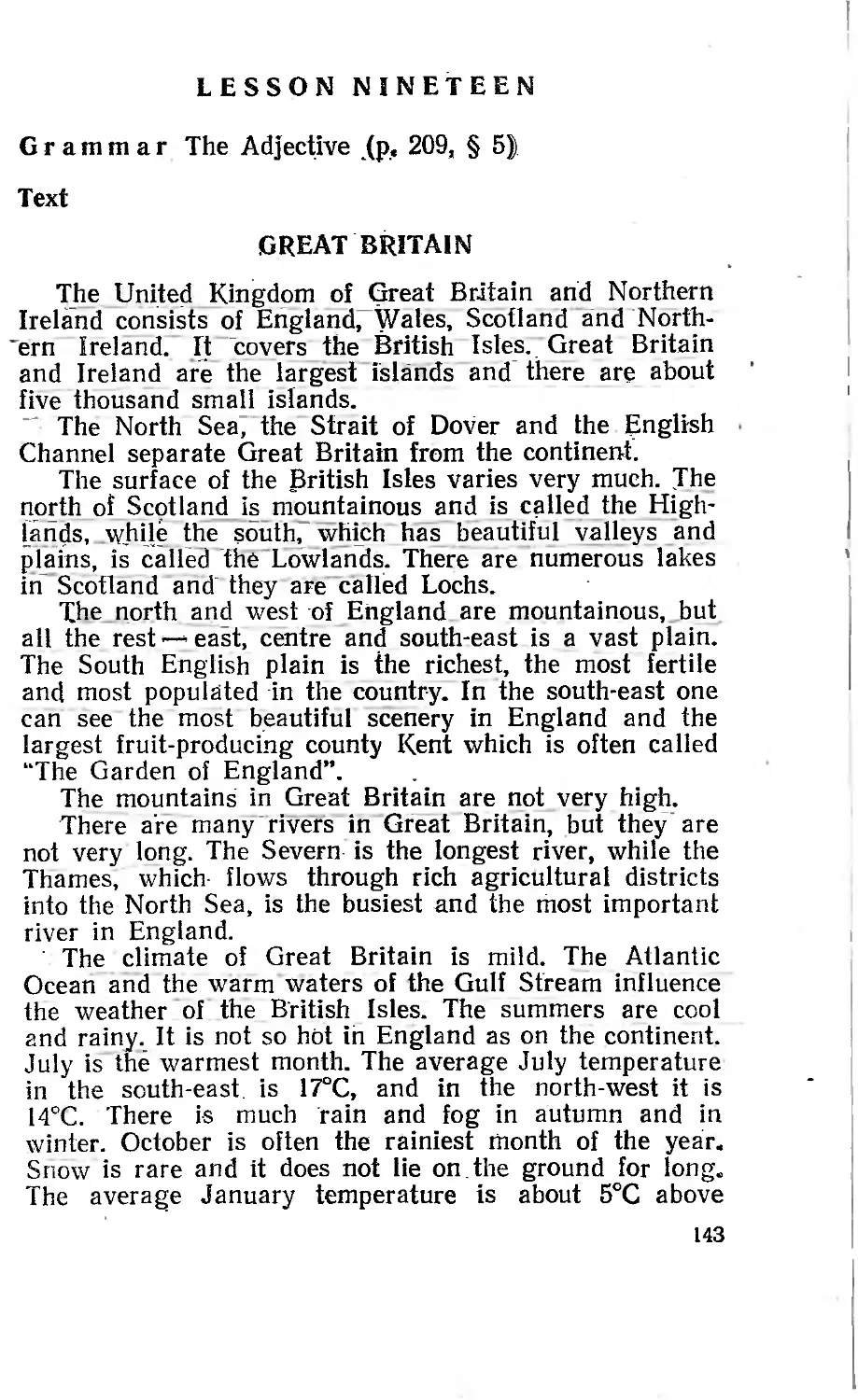
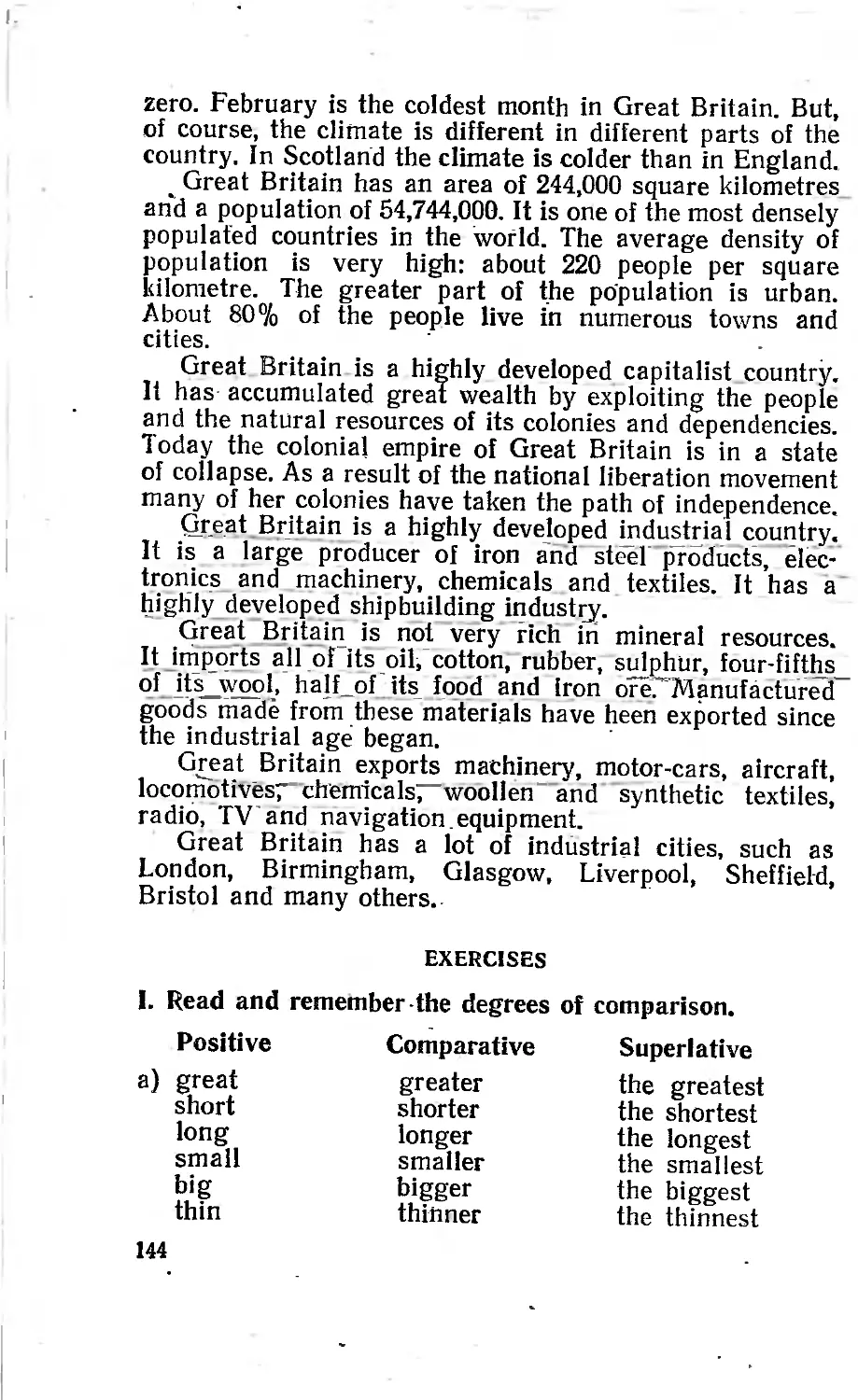
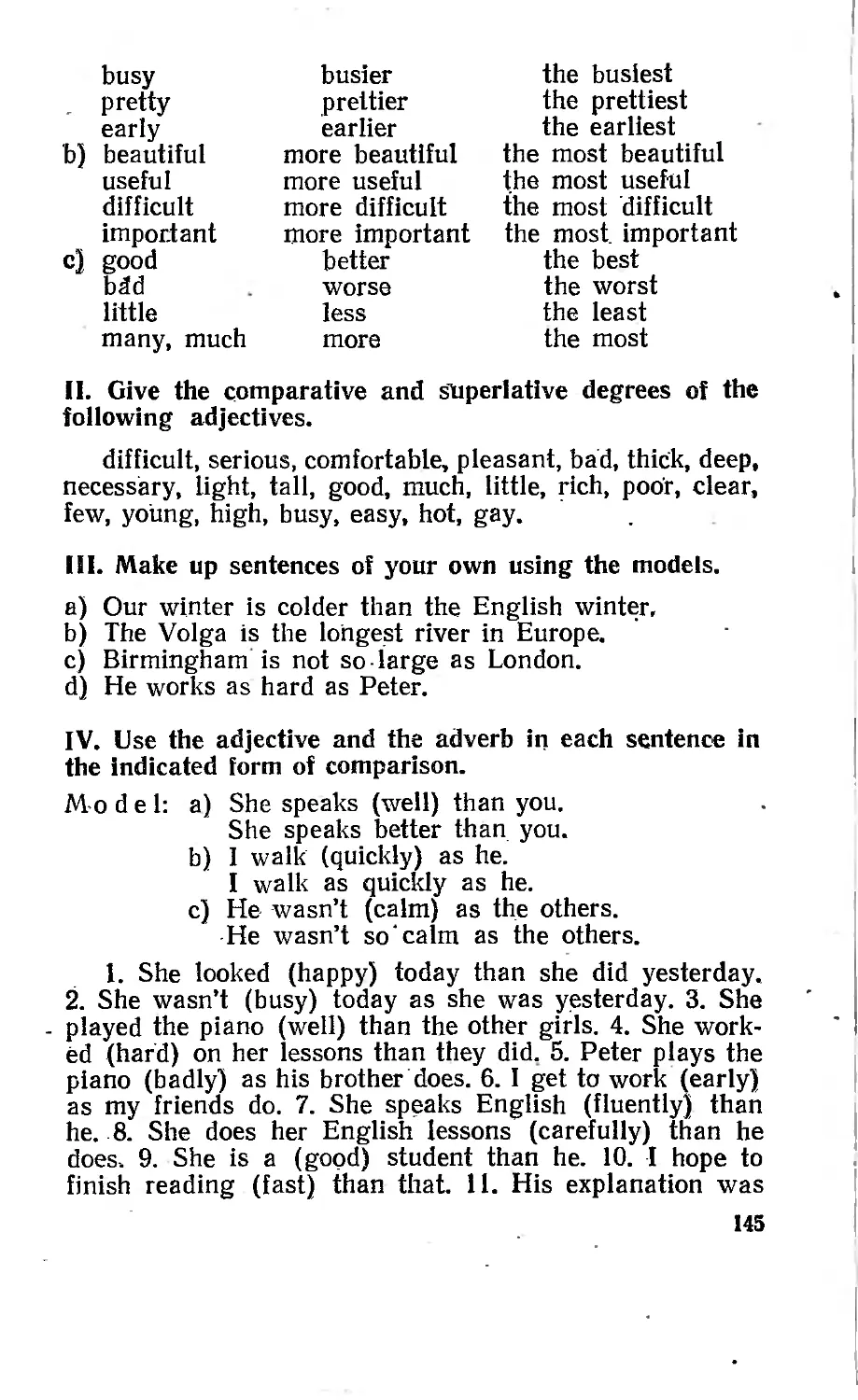
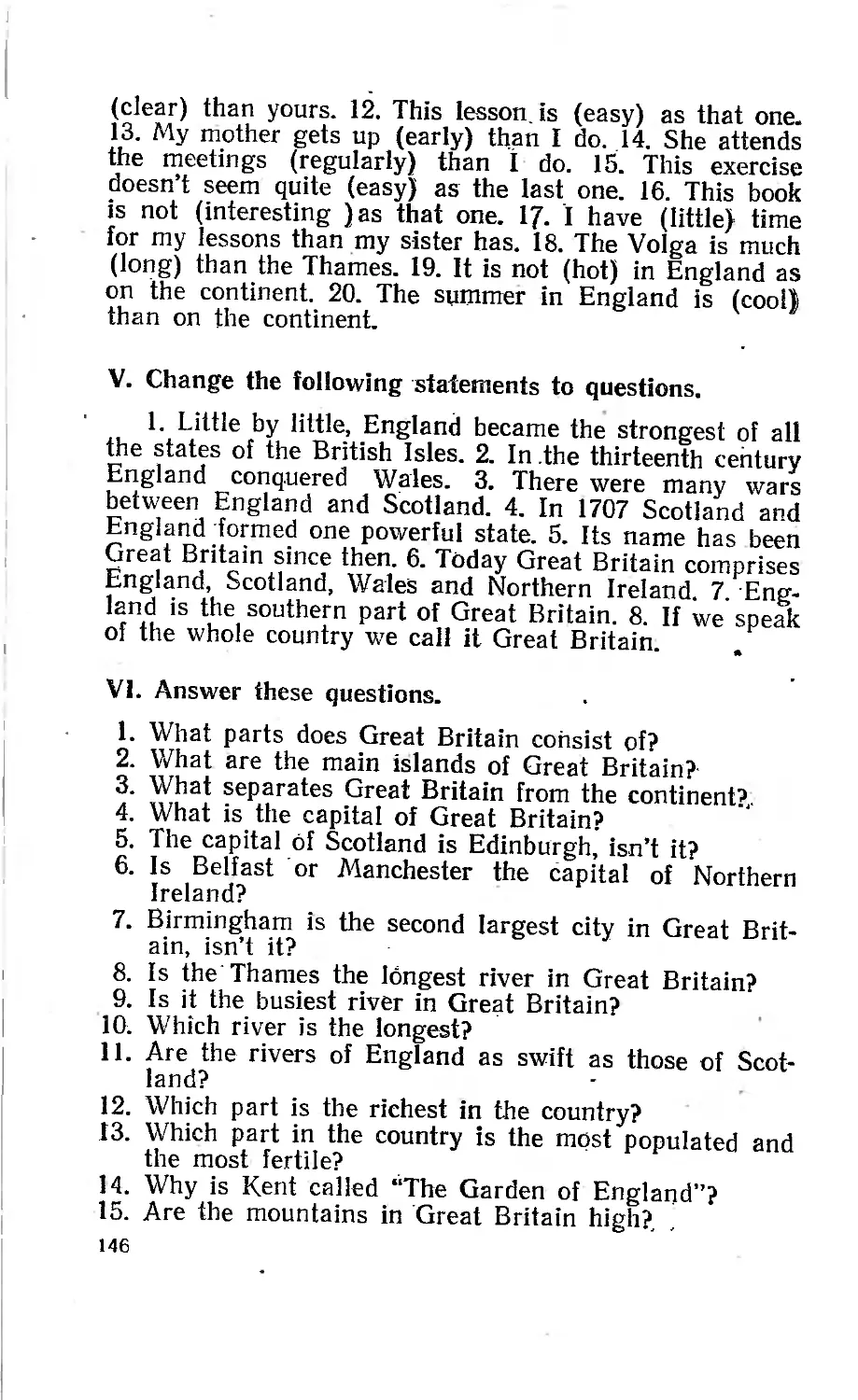






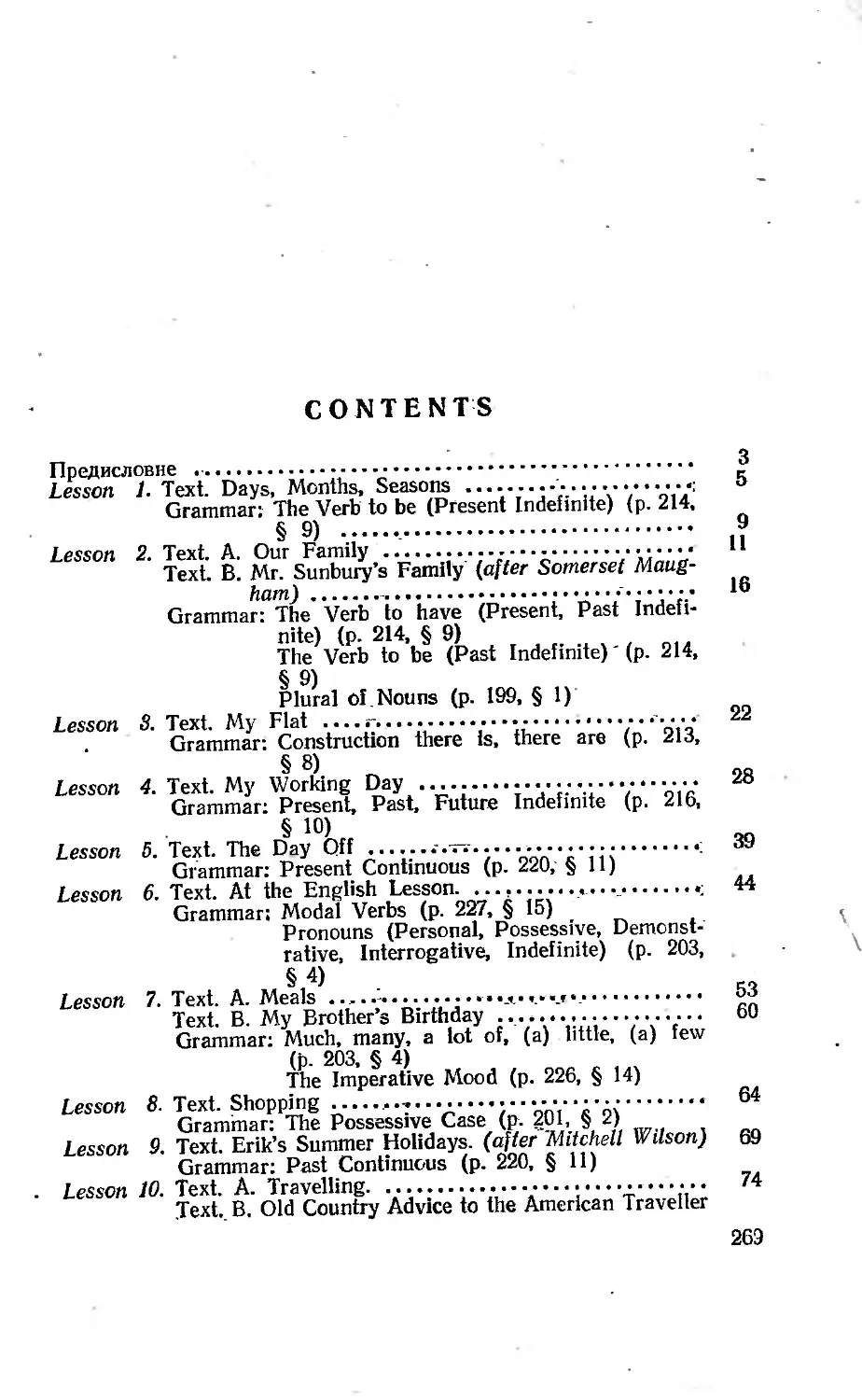
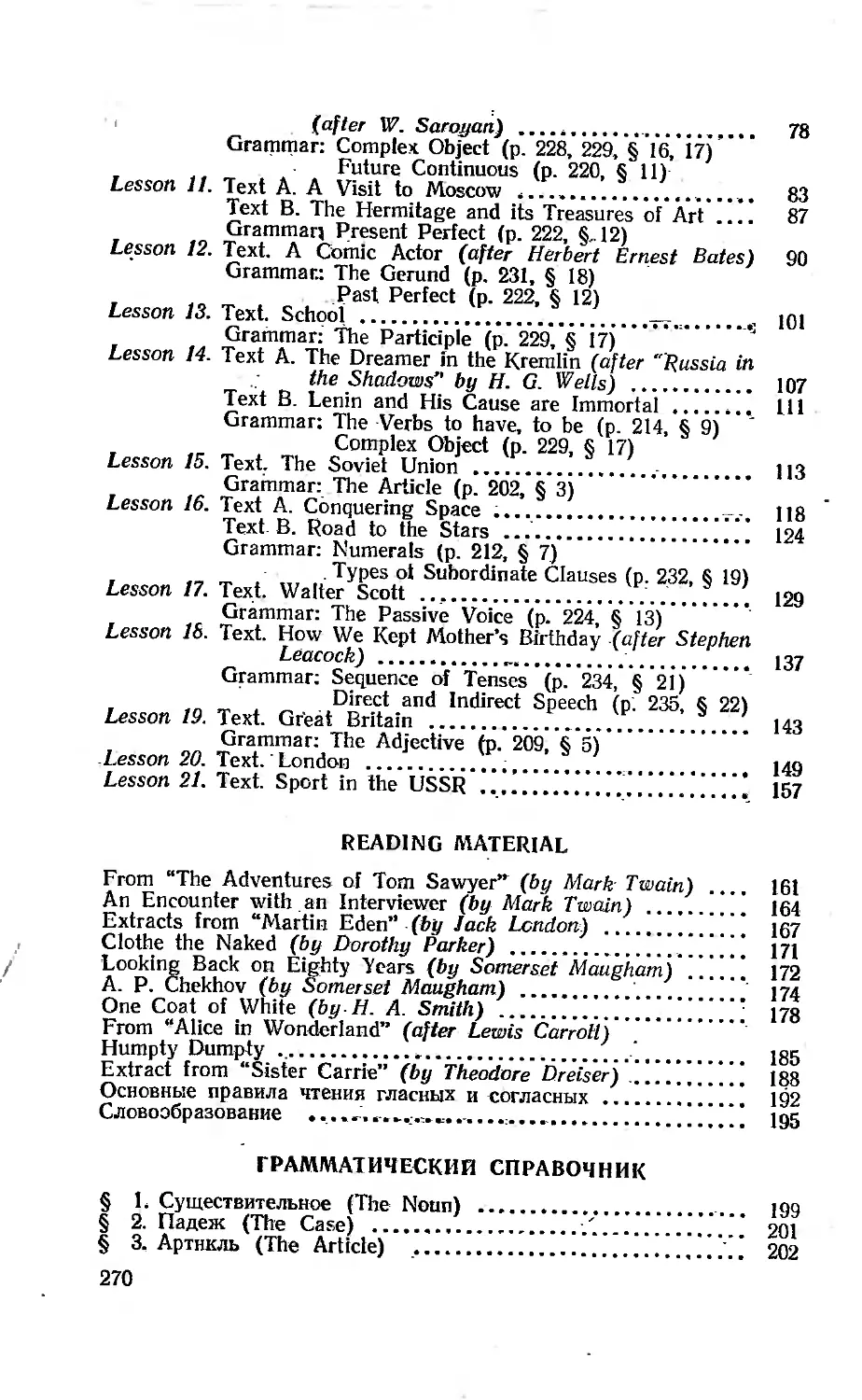
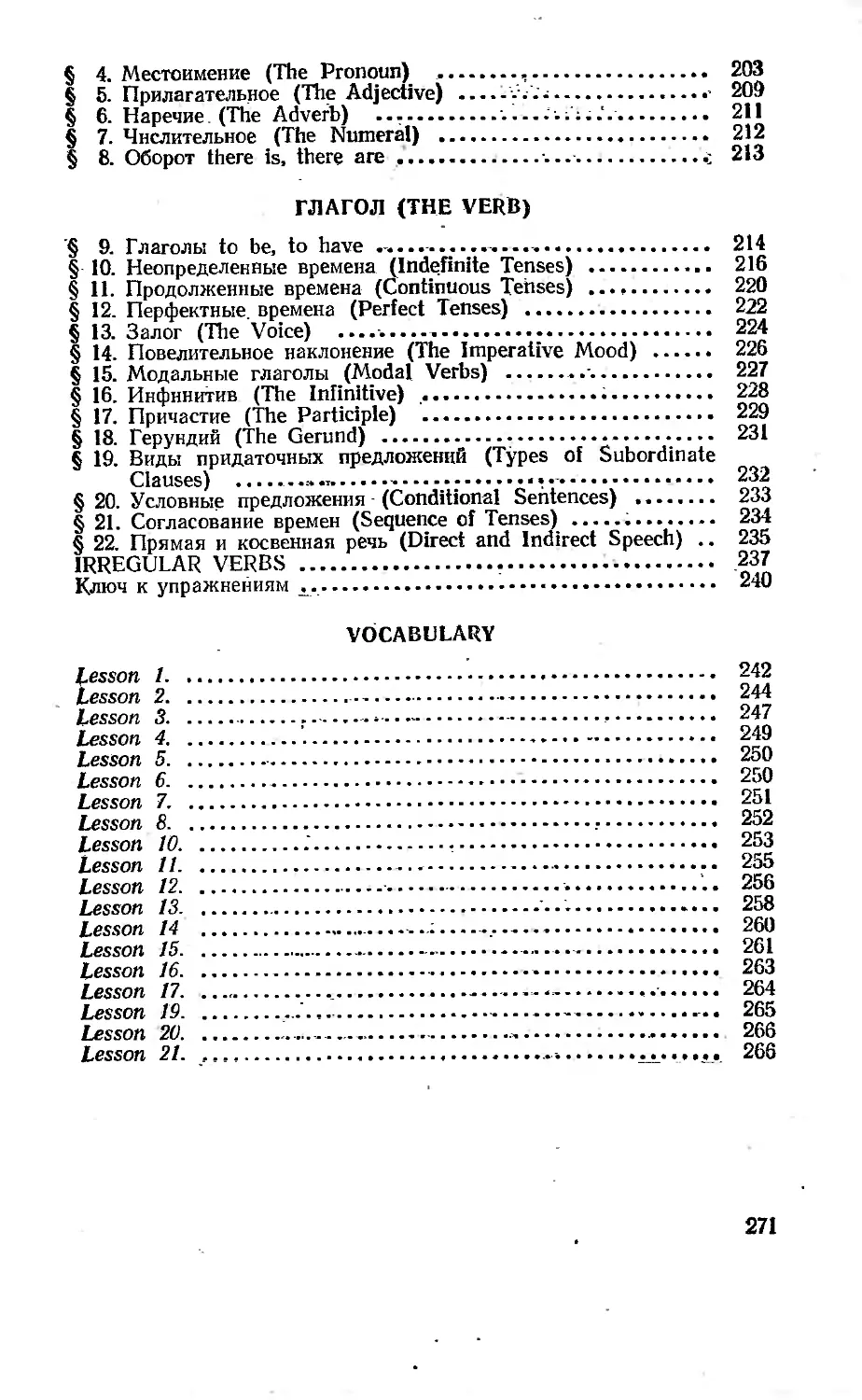
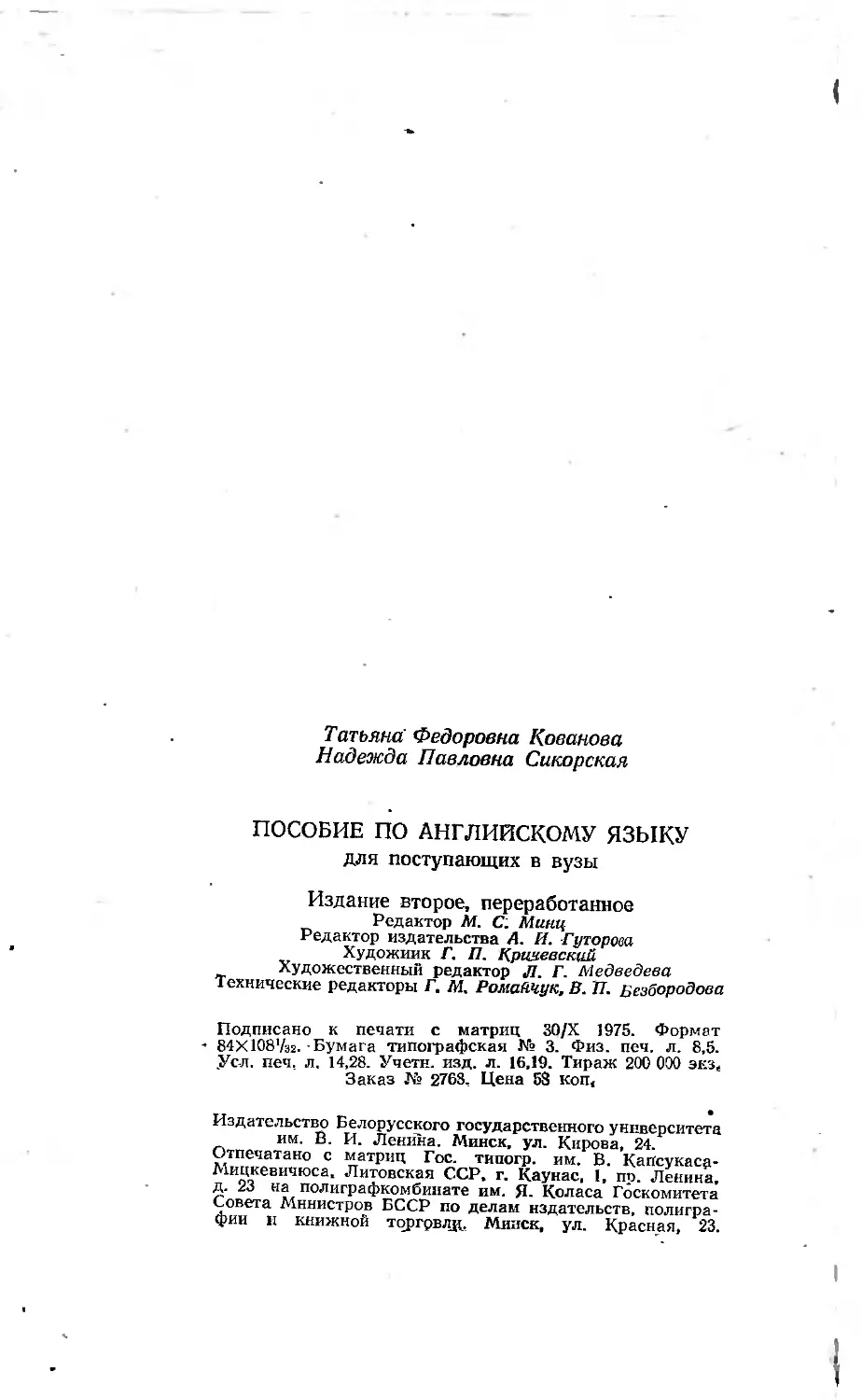


Text
                    Т. Ф. КОБАНОВ А, Н. П. СИКОРСКАЯ
ПОСОБИЕ
ПО АНГЛИЙСКОМУ
ЯЗЫКУ
ДЛЯ ПОСТУПАЮЩИХ В ВУЗЫ
ИЗДАНИЕ ВТОРОЕ, ПЕРЕРАБОТАННОЕ
ИЗДАТЕЛЬСТВО БГУ им. В. И. ЛЕНИНА
МИНСК 1976
Кованова Т. Ф., Сикорская Н. П.
К 56 Пособие по английскому языку для поступающих
в вузы. Изд. 2-е, перераб. Мн., Изд-во БГУ, 1976;
Пособие состоит из 21 урока, которые содержат темы для устных
бесед, диалоги, упражнения к иим, грамматический комментарий, таб-
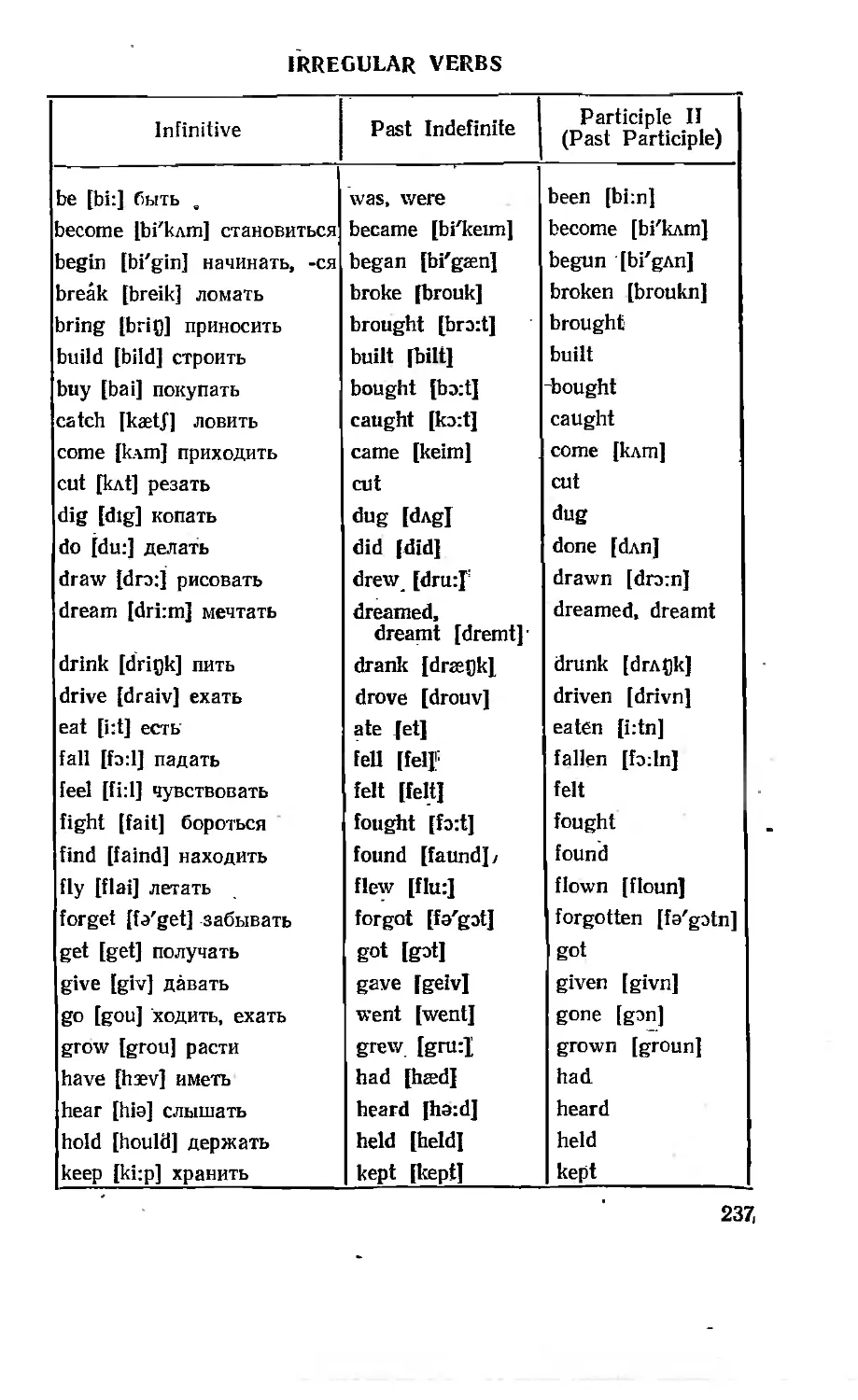
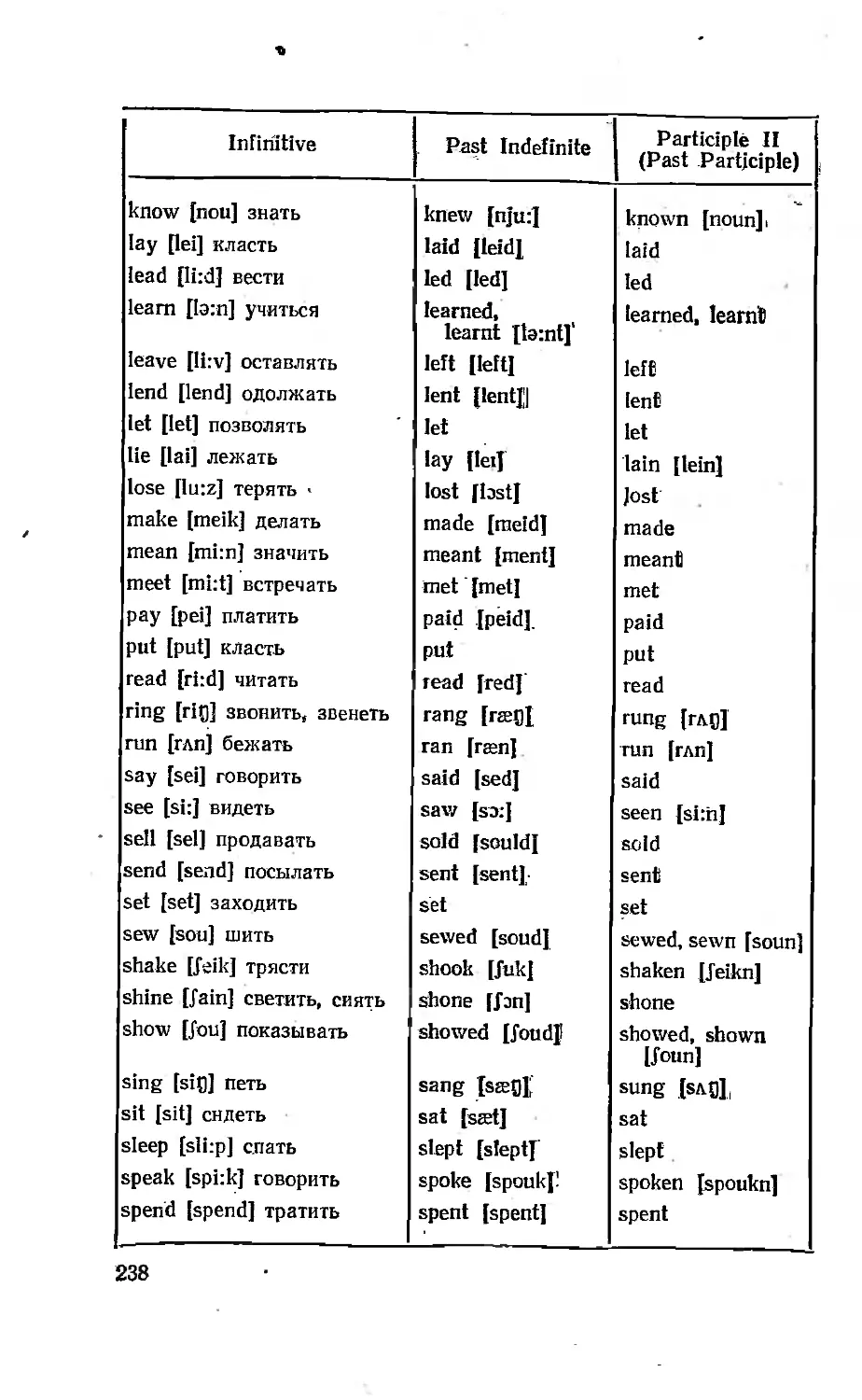
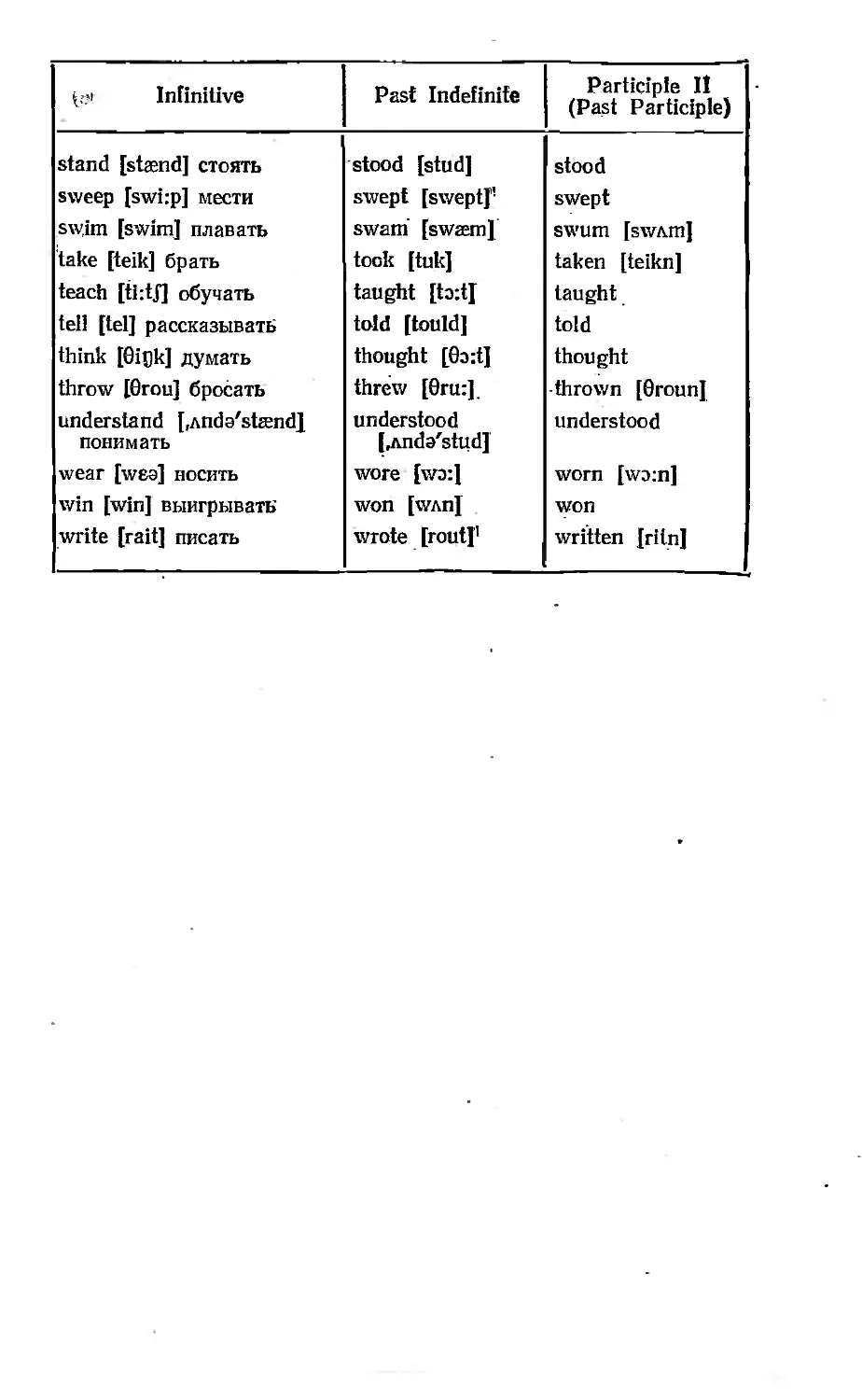
лицы правил чтения, нестандартных глаголов и поурочный англо-
русский словарь. Может быть использовано ие только при самостоя-
тельной подготовке абитуриентов к вступительным экзаменам в вузы,
но и на подготовительных курсах при высших учебных заведениях,
а также в десятых классах средних школ и на первых курсах вузов.
70104—021
К М 317—76
4 И (Англ.) (075)
ПРЕДИСЛОВИЕ
Настоящее пособие предназначено прежде всего для
тех, кто самостоятельно готовится к вступительным экза-
менам в вузы после перерыва в учебе. Пособие может
быть также использовано в десятых классах средней шко-
лы при повторении устных тем и грамматики, пройден-
ных в VI—IX классах, в связи с подготовкой к выпуск-
ным экзаменам.
На вступительных экзаменах на гуманитарные фа-
культеты вузов к абитуриентам предъявляются те же тре-
бования, что и на выпускном экзамене в средней школе:
чтение и перевод текста со словарем, ответы на вопросы
по содержанию текста, прочитанного без словаря, и одна
из устных тем, предусмотренных программой. Навыки
произношения, знание правил чтения, грамматики, вла-
дение лексическим минимумом проверяются в процессе
чтения текста, ответов на вопросы по тексту и устного
сообщения на предложенную тему.
Пособие состоит из 21 урока, краткого свода правил
чтения и словообразования, грамматического справочни-
ка, материала для домашнего чтения и поурочного сло-
варя. В пособии авторы стремились дать материал, соот-
ветствующий программе средней школы. Каждый урок
содержит устную тему, упражнения к ней, текст для чте-
ния без словаря на понимание его содержания и текст
для перевода со словарем.
Упражнения к темам предназначаются для повторения
правил чтения, правил словообразования, усвоения и за-
крепления лексического и грамматического материала,
который должен быть усвоен учащимися активно. Вся
система упражнений ставит своей целью развитие навы-
3
ков устной речи. Для отработки умения пользоваться ан-
гло-русским словарем даны отрывки из произведений
английских и американских авторов, близкие по своему
содержанию к устным темам.
При работе с пособием рекомендуется, прежде всего,
тщательно повторить правила чтения. Приступая к изуче-
нию того или иного урока, необходимо предварительно
повторить соответствующий грамматический материал,
слова, а затем прочитать вслух и перевести основной
текст. Только после этого следует приступать к выполне-
нию упражнений. Количество выполняемых упражнений
зависит от подготовки учащихся. Слабо усвоившим про-
граммный материал рекомендуется выполнять как можно
больше упражнений устно и письменно.
Уроки 1—2, 7—12, 14—16, 18—20, правила чтения и
словообразования подготовлены Н. П. Сикорской, уроки
3—6, 13, 17, 21 и грамматический комментарий —
Т. Ф. Ковановой.
Авторы выражают благодарность всем товарищам и
коллегам, высказавшим замечания и пожелания при под-
готовке второго издания пособия.
Авторы
LESSON ONE
Grammar The verb to be (Present Indefinite} (p. 214,
§ 9)
Text
DAYS, MONTHS, SEASONS
There are seven days in a week. They are: Monday,
Tuesday, Wednesday, Thursday, Friday, Saturday, Sunday.
There are twelve months in a year. The names of the
months are: January, February, March, April, May, June,
July, August, September, October, November, December.
There are 365 days in a year, or 366 in a leap year,
which comes every four years.
There are four seasons in a year. They are spring,
summer, autumn and winter. Every season is beautiful
and pleasant in its own way.
Spring is a wonderful season. Spring comes and nature
awakens from its winter sleep. The days become longer
and the nights become shorter. The ground is covered
with fresh green grass and the first spring flowers. How
lovely the white snowdrops arel The trees are covered
with new leaves and blossoms. The birds begin to sing
and build their nests. The nightingale begins to sing its
lovely songs, and sweet melodies may be heard from every
wood and thicket. The air is fresh and the sun shines
brightly. The days are warm and everything is full of life
and joy.
Then summer comes. The weather is usually fine in
summer. It is much warmer than in spring. The trees
are green with leaves and the gardens are gay with
flowers. Everybody enjoys summer. A lot of people have
5
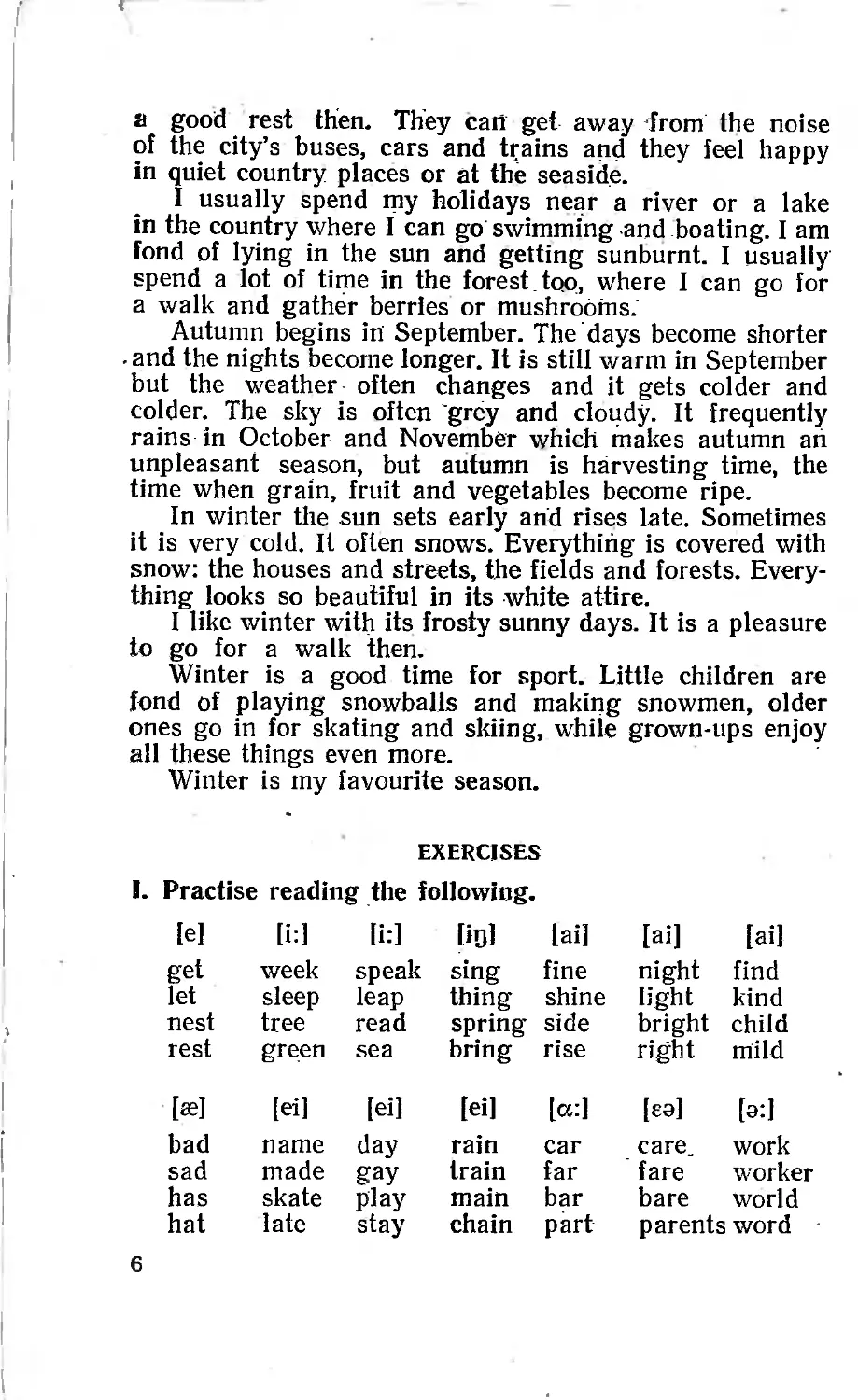
a good rest then. They can get away from the noise
of the city’s buses, cars and trains and they feel happy
in quiet country places or at the seaside.
I usually spend my holidays near a river or a lake
in the country where I can go swimming and boating. I am
fond of lying in the sun and getting sunburnt. I usually
spend a lot of time in the forest too, where I can go for
a walk and gather berries or mushrooms.
Autumn begins in September. The days become shorter
. and the nights become longer. It is still warm in September
but the weather often changes and it gets colder and
colder. The sky is often grey and cloudy. It frequently
rains in October and November which makes autumn ah
unpleasant season, but autumn is harvesting time, the
time when grain, fruit and vegetables become ripe.
In winter the sun sets early and rises late. Sometimes
it is very cold. It often snows. Everything is covered with
snow: the houses and streets, the fields and forests. Every-
thing looks so beautiful in its white attire.
I like winter with its frosty sunny days. It is a pleasure
to go for a walk then.
Winter is a good time for sport. Little children are
fond of playing snowballs and making snowmen, older
ones go in for skating and skiing, while grown-ups enjoy
all these things even more.
Winter is my favourite season.
EXERCISES
I. Practise reading the following.
[e]	[i:]	[i:]	[iQ]	[ai]	[ai]	[ai]
get	week	speak	sing	fine	night	find
let	sleep	leap	thing	shine	light	kind
nest	tree	read	spring	side	bright	child
rest	green	sea	bring	rise	right	mild
[ae]	[ei]	[ei]	[ei]	[a:]	[еэ]	[o:J
bad	name	day	rain	car	care.	work
sad	made	gay	train	far	fare	worker
has	skate	play	main	bar	bare	world
hat	late	stay	chain	part	parents word
6
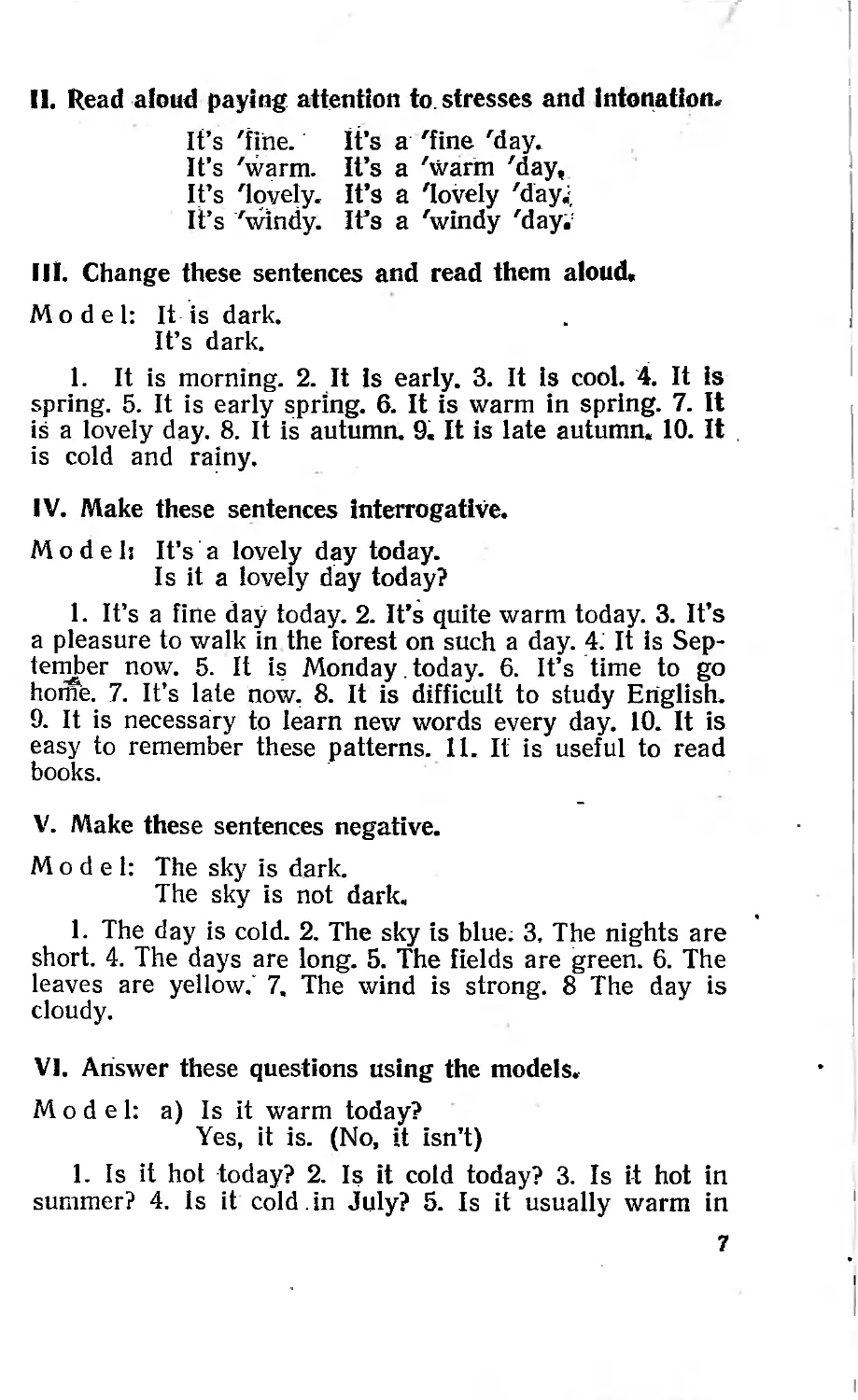
II.	Read aloud paying attention to. stresses and Intonation.
It’s 'fine. It’s a 'fine 'day.
It’s 'warm. It’s a 'warm 'day,
It’s 'lovely. It’s a 'lovely 'day;.
It’s 'windy. It’s a 'windy 'day;
III.	Change these sentences and read them aloud.
Model: It is dark.
It’s dark.
1.	It is morning. 2. It is early. 3. It is cool. 4. It is
spring. 5. It is early spring. 6. It is warm in spring. 7. It
is a lovely day. 8. It is autumn. 9« It is late autumn. 10. It ,
is cold and rainy.
IV.	Make these sentences interrogative.
M о d e h It’s a lovely day today.
Is it a lovely day today?
1.	It’s a fine day today. 2. It’s quite warm today. 3. It’s
a pleasure to walk in the forest on such a day. 4. It is Sep-
tender now. 5. It is Monday. today. 6. It’s time to go
home. 7. It’s late now. 8. It is difficult to study English.
9. It is necessary to learn new words every day. 10. It is
easy to remember these patterns. II. It is useful to read
books.
V.	Make these sentences negative.
Model: The sky is dark.
The sky is not dark.
1.	The day is cold. 2. The sky is blue. 3, The nights are
short. 4. The days are long. 5. The fields are green. 6. The
leaves are yellow.' 7. The wind is strong. 8 The day is
cloudy.
VI.	Answer these questions using the models.
Model: a) Is it warm today?
Yes, it is. (No, it isn’t)
1.	Is it hot today? 2. Is it cold today? 3. Is it hot in
summer? 4. Is it cold , in July? 5. Is it usually warm in
7
spring? 6. Is it usually cold in November? 7. Is it Tuesday
today?
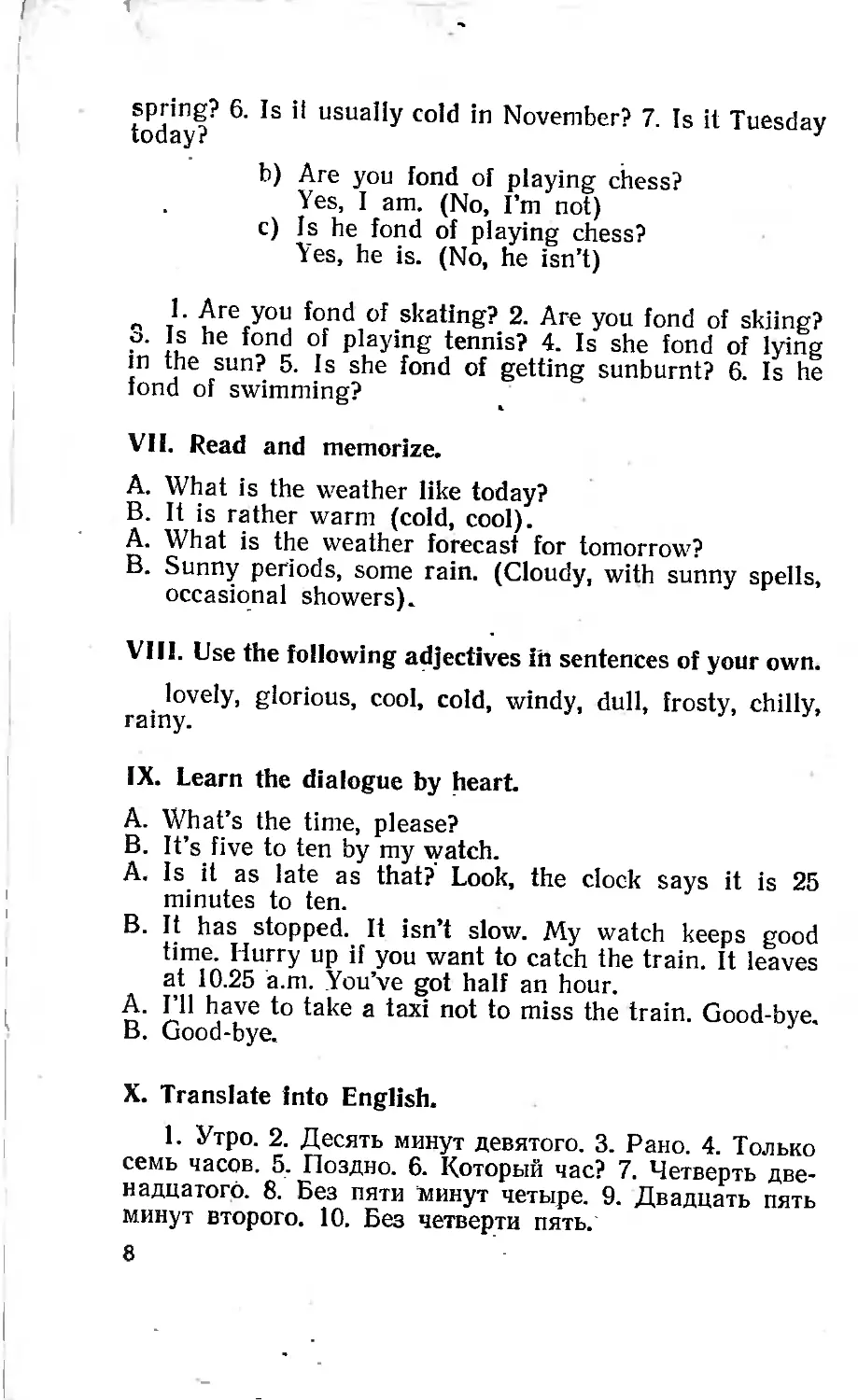
b) Are you lond ol playing chess?
Yes, I am. (No, I’m not)
c) Is he fond of playing chess?
Yes, he is. (No, he isn’t)
I.	Are you fond of skating? 2. Are you fond of skiing?
3. Is he fond of playing tennis? 4. Is she fond of lying
in the sun? 5. Is she fond of getting sunburnt? 6. Is he
fond of swimming?
VII. Read and memorize.
A.	What is the weather like today?
B.	It is rather warm (cold, cool).
A.	What is the weather forecast for tomorrow?
B.	Sunny periods, some rain. (Cloudy, with sunny spells,
occasional showers).
VIII. Use the following adjectives in sentences of your own.
lovely, glorious, cool, cold, windy, dull, frosty, chilly,
rainy.
IX. Learn the dialogue by heart.
A.	What’s the time, please?
B.	It’s five to ten by my watch.
A.	Is it as late as that? Look, the clock says it is 25
minutes to ten.
B.	It has stopped. It isn’t slow. My watch keeps good
time. Hurry up if you want to catch the train. It leaves
at 10.25 a.m. You’ve got half an hour.
A. I’ll have to take a taxi not to miss the train. Good-bye.
B. Good-bye.
X.	Translate into English.
1.	Утро. 2. Десять минут девятого. 3. Рано. 4. Только
семь часов. 5. Поздно. 6. Который час? 7. Четверть две-
надцатого. 8. Без пяти минут четыре. 9. Двадцать пять
минут второго. 10. Без четверти пять.
8
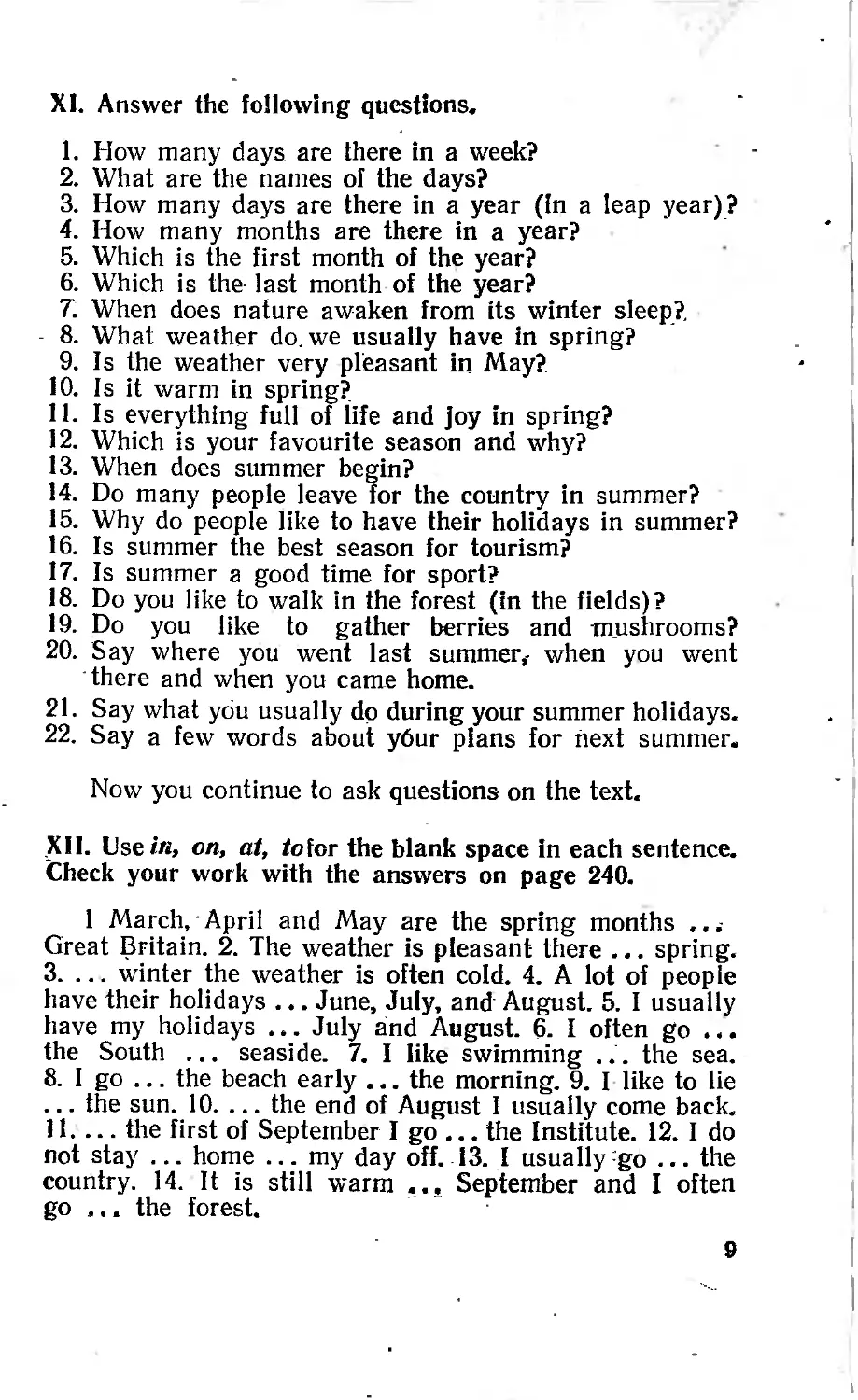
XI.	Answer the following questions,
1.	How many days are there in a week?
2.	What are the names of the days?
3.	How many days are there in a year (In a leap year)?
4.	How many months are there in a year?
5.	Which is the first month of the year?
6.	Which is the last month of the year?
7.	When does nature awaken from its winter sleep?,
8.	What weather do. we usually have in spring?
9.	Is the weather very pleasant in May?
10.	Is it warm in spring?
11.	Is everything full of life and joy in spring?
12.	Which is your favourite season and why?
13.	When does summer begin?
14.	Do many people leave for the country in summer?
15.	Why do people like to have their holidays in summer?
16. Is summer the best season for tourism?
17.	Is summer a good time for sport?
18.	Do you like to walk in the forest (in the fields)?
19.	Do you like to gather berries and mushrooms?
20. Say where you went last summer,- when you went
there and when you came home.
21.	Say what you usually dp during your summer holidays.
22. Say a few words about y6ur plans for next summer.
Now you continue to ask questions on the text.
XII.	Usei/i, on, at, to for the blank space in each sentence.
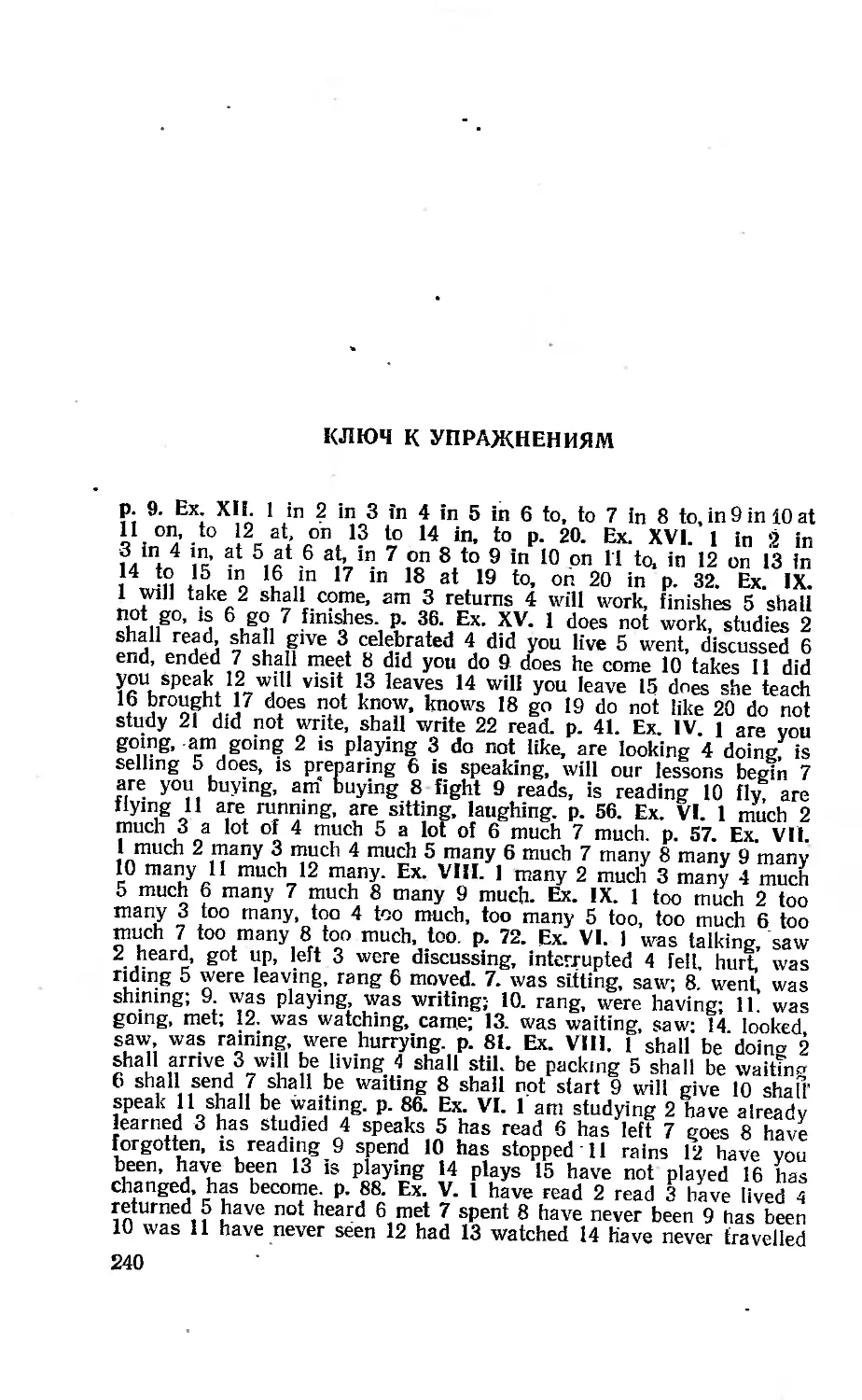
Check your work with the answers on page 240.
1 March, April and May are the spring months ,
Great Britain. 2. The weather is pleasant there ... spring.
3. ... winter the weather is often cold. 4. A lot of people
have their holidays ... June, July, and August. 5. I usually
have my holidays ... July and August. 6. I often go ...
the South ... seaside. 7. I like swimming ... the sea.
8. I go ... the beach early ... the morning. 9. I like to lie
... the sun. 10. ... the end of August I usually come back.
11. ... the first of September I go ... the Institute. 12. I do
not stay ... home ... my day off. 13. I usually go ... the
country. 14. It is still warm ... September and I often
go ,.. the forest.
9
XIII.	Read and memorize the proverbs.
1.	Everything is good in its season.
2.	An hour in the morning is worth two in the evening.
3.	Never put off till tomorrow what you can do today.
4.	Lost time is never found again.
5.	One swallow does not make a summer.
XIV.	Translate Into Russian using a dictionary.
THE WEATHER FORECAST
After Jerome K. Jerome
I remember a holiday of mine being completely ruined
one late autumn by our paying attention to the weather
report of the local newspaper: “Heavy showers, with
thunderstorms, may be expected today.”
So we gave up our picnic and stopped indoors all day,
waiting for the. rain. And people passed the house as
joyfully and merrily as could be. The sun was shining
and not a cloud was seen.
By twelve o’clock, with the sun pouring into the room,
the hea\ became quite oppressive, and we wondered when
those h;avy showers and occasional thunderstorms were
going to begin.
“Oh! They’ll come in the afternoon, you’ll find,” we
said to each other.
At cne o’clock the landlady came in and asked if we
were gcihg out, as it seemed such a lovely day.
“No, no,” we replied. “We don’t mean to get wet—*
no, no.”
And when the afternoon was nearly gone, and still
there was no sign of rain, we tried to cheer ourselves
up with the idea that it would come down all at once.
But not a drop ever fell, and it finished a grand day,
and a lovely night after that.
The next morning we read that it was going to be a
warm, fine day, much heat.
We put on light things and went out. Half an hour
after we had started, it began to rain hard and a bitterly
cold wind began to blow.
The weather is a thing that I never can understand.
10
XV.	Describe one of the seasons.
XVI.	Read and retell the story.
One cold December night, a traveller came into the
dining-room of a country-inn. There was a bright fire,
and as he was shivering with cold, and his toes were
half-frozen, he took a seat near the fireplace, put his feet
close to the burning coals and fell asleep.
When the maid-servant entered the room she cried
out, awaking the traveller: “Sir, if you don’t take care,
you will burn your spurs.”
“My spurs! My boots, you mean.”
“No, sir, your boots are burnt already.”
LESSON TWO
Grammar The verb to have (Present, Past Indefinite)
(p. 214, § 9)
The verb to be (Past Indefinite) p. 214, § 9)
Plural of Nouns (p. 199, § 1)
Text A
OUR FAMILY
Our family is large. I have a father, a mother, a
grandmother , a sister and two brothers.
My father is an architect. He is a member of the
Communist Party. He works hard at his office and at
home he helps my mother who is a very busy woman. She
is a doctor. She works at a clinic.
My father is fifty-two years old, and my mother is
forty-seven. My grandmother who has retired and is now
on pension lives with us. She keeps house for us. Even
though we all try to help her, she has a lot of work to do
about the house.
My elder brother is an engineer. He thinks that his
profession is the best in the world. He is twenty-six years
old. He is married and has a family of his own. He has
two children. His wife is a dressmaker. She likes her
profession too. They live not far from us.
1J
My younger Frother is a schoolboy. His name fs
Peter. He is in the ninth form at school. He is good at
mathematics and physics and is interested in electronics.
He wants to become an engineer.
My sister is a student. She is a first-year student at
the University. She will become a teacher of history. Her
favourite subjects at school were history and literature.
I am a worker. This year I finished school and wanted
to enter a medical institute. But the entrance examinations
were difficult and 1 failed in chemistry. Now 1 work at a
plant and attend preparatory courses. I work hard and
like it.
EXERCISES
I.	Read each sentence twice.
Remember that questions beginning with what, why,
when, who, how, etc. are normally spoken with a falling
intonation. (Tune I).
1.	'What’s the 'time? 2. 'What’s the 'date to'day?
3. 'What 'day is it? 4. 'Where 'are you? 5. 'How 'are
you? 6. 'Who is the 'author of this 'story? 7. 'How 'far
is it? 8. 'How 'much is it? 9. 'How 'far is it from 'here
to 'Moscow?
II.	Read each sentence twice. Remember that general
questions are spoken with a rising intonation. (Tune II)
•1. 'Are we ,late? 2. 'Aren’t you ,well? 3. 'Are you
,ready? 4. 'Was it all zright? 5. 'Will you be ,free in a
minute or two? 6. 'Will you be zin? 7. 'Will you. be ,there?
8. 'May I come zin? 9. 'Can you ,see? 10. 'Can you ,hear?
11. 'Must you ,go? 12. 'Can you do it ,now? 13. 'Are you
zangry with me? 14. 'Is it your zbirthday today? 15. 'Were
you in 'time for the ,concert last night?
III.	Read the following questions paying attention to
their intonation.
Alternative Questions
Tune II+Tune I
1.	'Is 'Peter in zMoscow|or in 'Minsk?
2.	'Is his 'name ,Peter 1 or 'Nick?
12
3.	'Is he a ,teacher | or a 'doctor?
4,	'Is 'Peter at ,home I or at the 'lessons?
Disjunctive Questions
The rising tone (Tune IIJ shows that the speaker asks
for confirmation or correction.
Tune I+Tune II
1.	Your name is Petrov, I isn’t it?
2.	This book is yours, I isn’t it?
3.	Today is Tuesday, | isn’t it?
When the speaker feels sure of his statement and does
not need confirmation or correction, Tune I is used.
Such statements are generally made for purely con-
versational purposes.
Tune I+Tune I
I.	It’s a nice day today, isn’t it?
2.	The weather is nice, isn’t it?
3.	He is a student, isn’t he?
IV.	The following exercise contains typical examples of
Tune II. Learn these sentences.
1.	'Please sit zdown! 2. 'Don’t /rouble! 3. 'That’s ,right.
4. 'That’s ,all. 5. 'That’s zgood. 6. 'That’s ,funny. 7. 'See
you ,soon! 8. 'Good-,bye. 9. 'Pass me the ,salt, please!
10. 'O, ,K! H. 'Don’t ,bother! 12. 'Don’t 'go a,way!
13. 'Dont’ for'get to zwrite. 14. I 'beg your ,pardon.
V.	Change these sentences using the model.
Model: I have a sister.
I have no sister.
1.	I have a grandfather. 2. I have a niece. 3. I have
a car. 4. I have a piano. 5. I have a radio-set at home.
6. I have lessons today. 7. He has examinations in
September. 8. She has a French book. 9. They have a TV
set. 10. They have time today. 11. They have children.
12. They have a grandmother.
13
г
VI.	Make these1 Sentences Interrogative using the model..
Model: I have a new coat.
Have you a new coat?
1. I have a mother. 2. I have a father. 3. I have a
sister. 4. I have two brothers. 5i My elder brother has
a wife. 6. They have a new flat. 7. Peter has a brother.
8. He has a sister.
VII.	Make sentences of, your own using the words.
grandmother, grandfather, grandchildren, uncle, aunt,
nephew, niece, father-in-law, mother-in-law, daughter, son,
to have a family of one’s own, to have a large (small)
family.
VIII.	Change these sentences.
Model: I have a camera.
I have got a camera.
1.	I have a radio-set. 2. She has a piano. 3. They have
a TV set. 4. They have a car. 5. I have a good book.
6. He has a watch. 7. He has a new job; 8. She has a
good pen.
IX.	Change these sentences.
Model: a) I have got a. watch.
I’ve got a watch.
b) He has got a watch.
He’s got a watch. 1 * 3
1. I have got a new radio-set. 2. He has got a tape-
recorder. 3. Fie has got a refrigerator. 4. My sister has
got a new hat. 5. She has got a new coat. 6. We have got
a new flat.
X. Translate into English.
1. У него есть сестра. 2. У нее много новых друзей.
3. У вас есть книги на русском языке? 4. У меня много
книг на русском языке. 5. У вас есть книги на англий-
ском языке? — Да. 6. У вас есть англо-русский сло-
варь?— Нет. 7. У него есть хороший словарь. 8. У моих
14’
родителей трое детей. S. Моего брата зовут Коля.
10. Он — школьник. 11. Моя сестра студентка первого
курса.
XI.	Read the sentences and change them using the models.
Model: a) I’m at the lesson now.
I was at the lesson yesterday too.
1.	My sister is at home. 2. My father Is In Minsk.
3. We are busy today. 4. It is cold today. 5. It’s wet today.
6. She is in the library. 7. He is late today.
b) They are on holiday this week.
They were on holiday last week.
1.	He is in Moscow this week. 2. He is on business
there. 3. She is on holiday this week. 4. She is at the sea-
side this week. 5. A nice film is on this week. 6. They are
busy this week. 7. They are free this week. 8. She is on
duty this week.
XII.	Make these sentences interrogative.
1.	You are a student. 2. She is a worker. 3. Her friend
is a student. 4. Her sister is a school-girl. 5. She is a
pioneer. 6. Ann is a nice girl. 7. She is ten years old.
8. Her brother is a student. 9. He is twenty years old.
10. His name is Peter. 11. Peter is very busy. 12. He is
a good sportsman. 13. Amr’s mother is a doctor. 14. Ann’s
father is an engineer. 15. Ann’s uncle is a pilot. 16. Ann’s
aunt is a teacher. 17, Ann’s grandmother is on pension.
18. She is always busy at home. 19, They are good friends.
20. You are students. 21. You are at the English lesson.
22. They are young. 23. They are fond of music.
XIII.	Answer these questions.
1,	What’s your name?
2.	Where do you work?
3t What do you do?
4.	Is your father a worker?
5.	What is his job?
6.	How old is he?
7.	What is his name?
15
8.	Is your mother a house-wife?
9.	What’s your mother’s job?
10.	What is her name?
11.	How old is she?
12.	Is your mother very busy?
13.	Is your friend a student?
14.	Is he at home now?
15.	Is he at the lesson now?
16.	How old is your friend?
17.	What is his name?
Text В
MR. SUNBURY’S FAMILY
(After Somerset Maugham)
Mrs. Sunbury’s first name was Beatrice. She was a
little woman, but strong and active with sharp regular
features and small black eyes. Her hair was black. She
never wore anything but black dresses of good material.
Her only ornament was a thin gold chain.
Samuel Sunbury was a little man too. He was as
thin as his wife, but he had sandy hair. He had pale blue
eyes. He was a clerk in a lawyer’s office. His employer
called him Mr. Sunbury and sometimes asked him to see
an unimportant client. Every morning for twenty-four
years Samuel Sunbury had taken the same train to the
City, except of course on Sundays and during his fort-
night’s holiday at the seaside, and every evening he had
taken the same train back to the suburb in which he
lived. He was neat in his dress; he went to work in quiet
grey trousers, a black coat and a bowler hat, and when
he came home he put on his slippers and a black coat
which was too old and shiny to wear at the office.
Herbert was their only child. They doted on him. He
was a pretty baby and then a good-looking boy. Mrs.
Sunbury brought him up carefully. She taught him to
sit up at table and not to put his elbows on it, and she
taught him how to use his knife and fork. Herbert got on
very well at school. He was a good pupil and far from
stupid. His reports were excellent. It turned out that he
had a good head for figures. He grew tall. He was a
16
nice-looking boy, with his mother’s regular features and
dark hair but he inherited his father’s blue eyes.
When he left school it was settled that Herbert would
be an accountant. And by the time he was twenty-one he
was able to bring back to his mother quite a nice little
sum. She gave him three half-crowns for his lunches and
ten shillings for pocket money.
“No one’s ever had a better son than our Herbert.
Hardly a day’s illness in his life and he’s never given
me a moment’s worry,” said Mrs. Sunbury.
Then an unfortunate thing happened. Herbert began
to go out after supper. Mrs. Sunbury didn’t like it much,
but Mr. Sunbury reasoned with her. After all, the boy
was twenty-two, and it must be dull for him to stay at
home all the time. Herbert had fallen in love with Betty
Bevan.
One Saturday evening, while they were at supper, he
said suddenly:
“Mum, I’ve asked a young lady to come in to tea
tomorrow. Is that all right?”
“You done what?” asked Mrs. Sunbury forgetting her
grammar.
“You heard, Mum.”
“And may I ask who she is and how you got to know
her?”
“Her name is Betty Bevan, and I met her first at the
pictures one Saturday afternoon when it was raining. She
works in a typewriting office in the City and she lives
at home, if you call it home; you see, her mum died and
her dad married again, and they’ve got three kids and she
doesn’t get on with her stepma.”
Mrs. Sunbury arranged the tea very stylishly. She
baked a cake, and cut thin bread-and-butter.
Strangely enough Betty Bevan looked very much as
Mrs. Sunbury must have looked at her age. She had the
same sharp features and the same small beady eyes, but
her lips were scarlet with paint, her cheeks lightly rouged
and her short black hair permanently waved. Her frock
was very short and she showed a good deal of flesh-
coloured stockings. Mrs. Sunbury, disapproving of her
make-up and of her apparel, took an instant dislike to
her, but she made up her mind to behave like a lady.
17
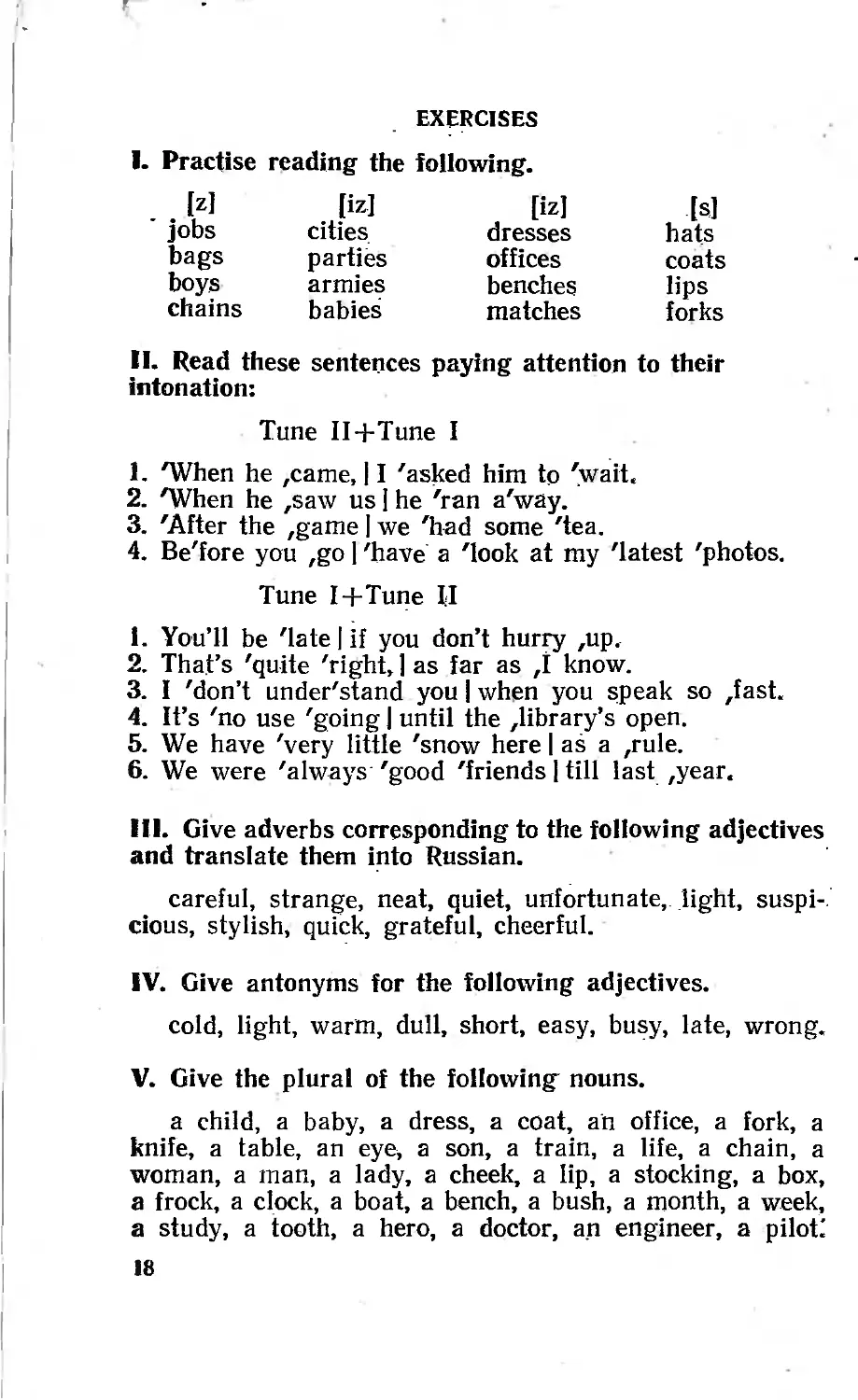
EXERCISES
I. Practise reading the following.
. [z]	[iz]
jobs	cities
bags	parties
boys	armies
chains	babies
[iz]	[s]
dresses	hats
offices	coats
benches	lips
matches	forks
II. Read these sentences paying attention to their
intonation:
Tune II+Tune I
1.	'When he ,came, 11 'asked him to 'wait,
2.	'When he ,saw us | he 'ran a'way.
3.	'After the ,game | we 'had some 'tea.
4.	Be'fore you ,go | 'have a 'look at my 'latest 'photos.
Tune I+Tune II
1.	You’ll be 'late | if you don’t hurry ,up.
2.	That’s 'quite 'right, 1 as far as ,1 know.
3.	I 'don’t understand you | when you speak so ,fast.
4.	It’s 'no use 'going | until the library’s open.
5.	We have 'very little 'snow here I as a ,rule.
6.	We were 'always 'good 'friends 1 till last ,year.
III.	Give adverbs corresponding to the following adjectives
and translate them into Russian.
careful, strange, neat, quiet, unfortunate, light, suspi-
cious, stylish, quick, grateful, cheerful.
IV.	Give antonyms for the following adjectives.
cold, light, warm, dull, short, easy, busy, late, wrong.
V.	Give the plural of the following nouns.
a child, a baby, a dress, a coat, an office, a fork, a
knife, a table, an eye, a son, a train, a life, a chain, a
woman, a man, a lady, a cheek, a lip, a stocking, a box,
a frock, a clock, a boat, a bench, a bush, a month, a week,
a study, a tooth, a hero, a doctor, an engineer, a pilot;
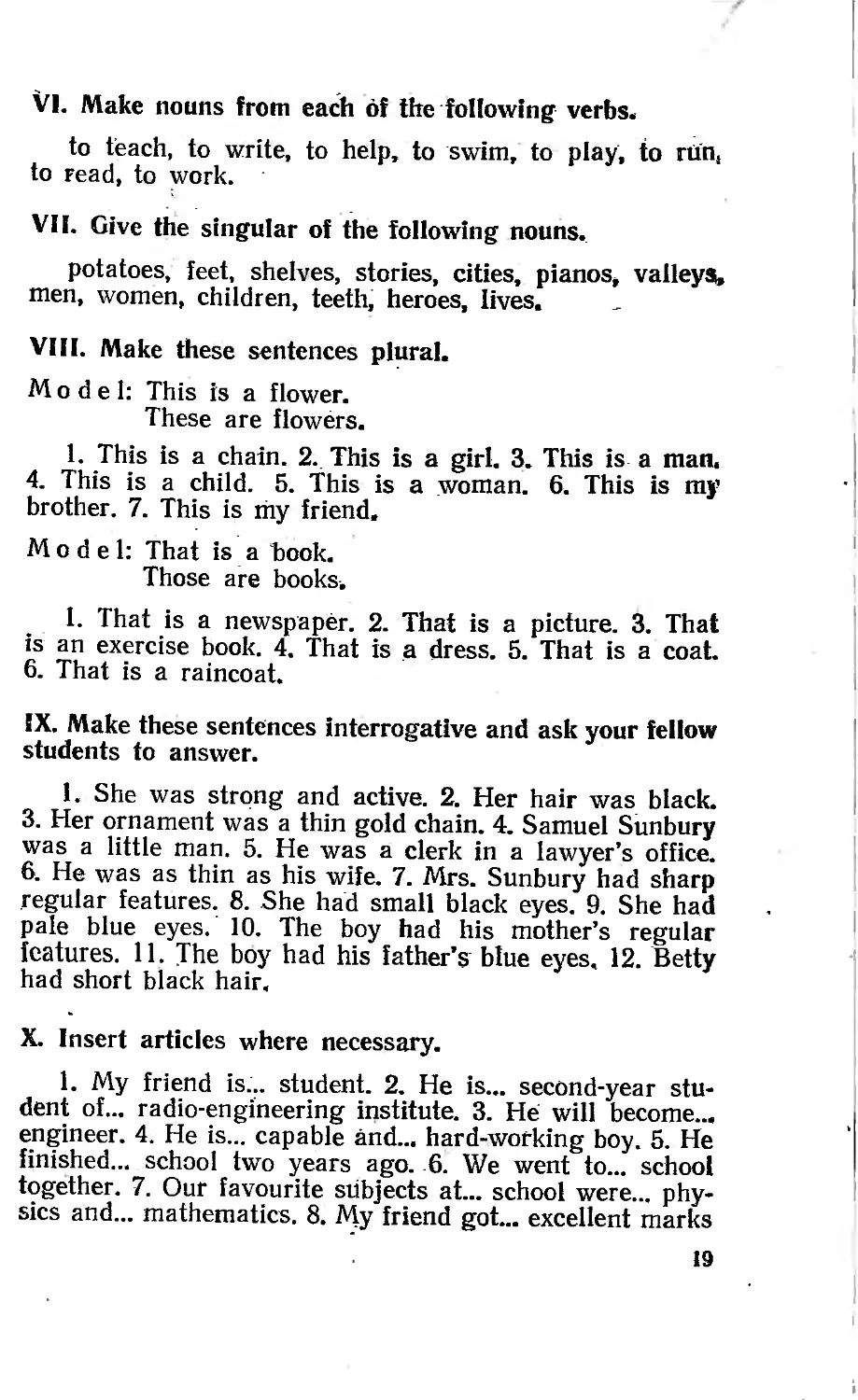
18
Vl.	Make nouns from each of the following verbs.
to teach, to write, to help, to swim, to play, to run,
to read, to work.
VII.	Give the singular of the following nouns.
potatoes, feet, shelves, stories, cities, pianos, valleys,
men, women, children, teeth, heroes, lives.
VIII.	Make these sentences plural.
Model: This is a flower.
These are flowers.
1.	This is a chain. 2. This is a girl. 3. This is a man.
4. This is a child. 5. This is a woman. 6. This is my
brother. 7. This is my friend.
Model: That is a book.
Those are books.
1.	That is a newspaper. 2. That is a picture. 3. That
is an exercise book. 4. That is a dress. 5. That is a coat.
6. That is a raincoat.
IX.	Make these sentences interrogative and ask your fellow
students to answer.
1.	She was strong and active. 2. Her hair was black.
3. Her ornament was a thin gold chain. 4. Samuel Sunbury
was a little man. 5. He was a clerk in a lawyer’s office.
6. He was as thin as his wife. 7. Mrs. Sunbury had sharp
regular features. 8. She had small black eyes. 9. She had
pale blue eyes. 10. The boy had his mother’s regular
features. 11. The boy had his father’s blue eyes. 12. Betty
had short black hair.
X.	Insert articles where necessary.
1.	My friend is... student. 2. He is... second-year stu-
dent of... radio-engineering institute. 3. He will become...
engineer. 4. He is... capable and... hard-working boy. 5. He
finished... school two years ago. 6. We went to... school
together. 7. Our favourite subjects at... school were... phy-
sics and... mathematics. 8. My friend got... excellent marks
19
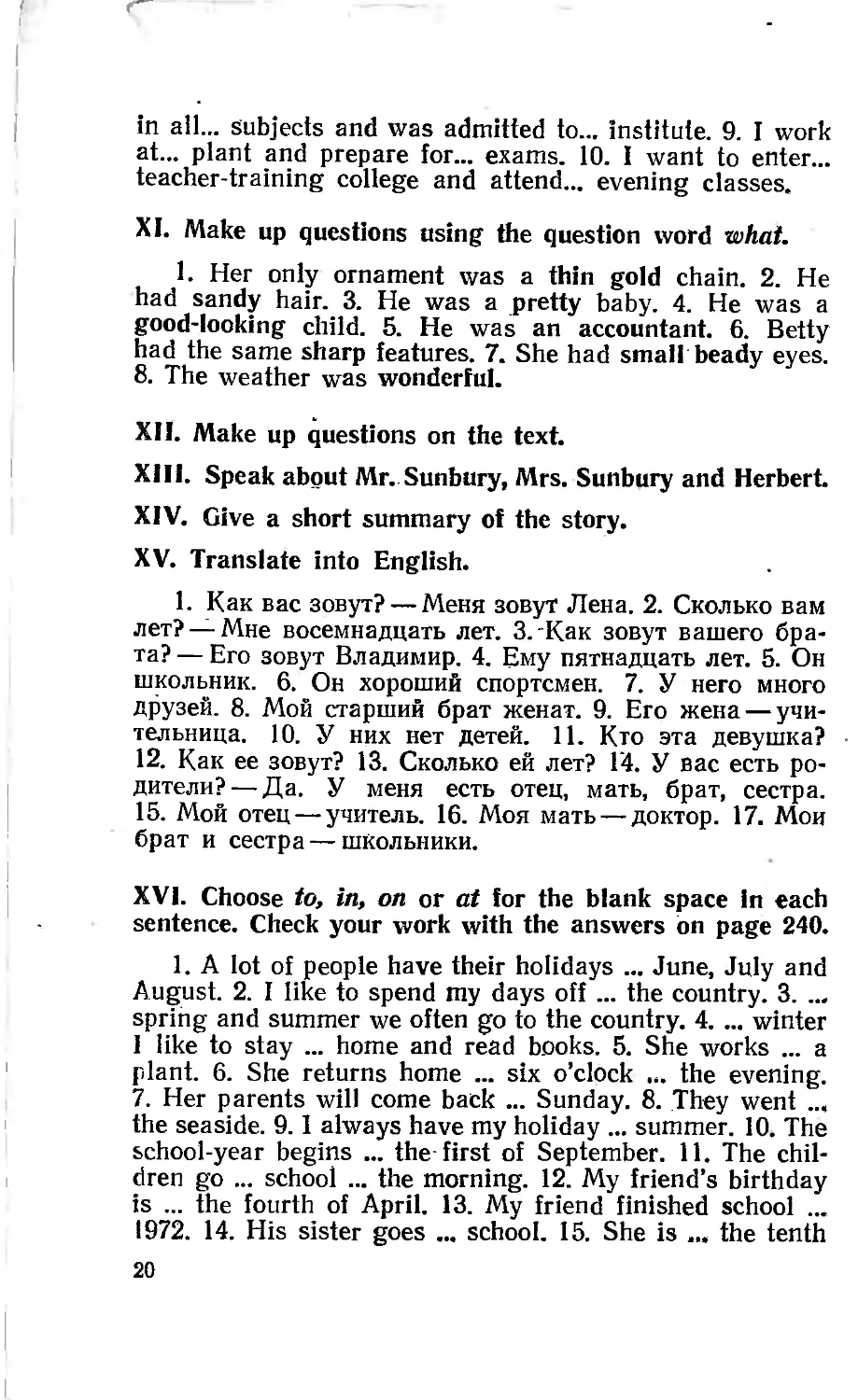
in all... subjects and was admitted to... institute. 9. I work
at... plant and prepare for... exams. 10. I want to enter...
teacher-training college and attend... evening classes.
XI.	Make up questions using the question word what.
1.	Her only ornament was a thin gold chain. 2. He
had sandy hair. 3. He was a pretty baby. 4. He was a
good-looking child. 5. He was an accountant. 6. Betty
had the same sharp features. 7. She had small beady eyes.
8. The weather was wonderful.
XII.	Make up questions on the text.
XII1.	Speak about Mr. Sunbury, Mrs. Sunbury and Herbert.
XIV.	Give a short summary of the story.
XV.	Translate into English.
1.	Как вас зовут? — Меня зовут Лена. 2. Сколько вам
лет? —Мне восемнадцать лет. 3. Как зовут вашего бра-
та? — Его зовут Владимир. 4. Ему пятнадцать лет. 5. Он
школьник. 6. Он хороший спортсмен. 7. У него много
друзей. 8. Мой старший брат женат. 9. Его жена — учи-
тельница. 10. У них нет детей. И. Кто эта девушка?
12. Как ее зовут? 13. Сколько ей лет? 14. У вас есть ро-
дители?— Да. У меня есть отец, мать, брат, сестра.
15. Мой отец — учитель. 16. Моя мать — доктор. 17. Мои
брат и сестра — школьники.
XVI.	Choose to, in, on or at for the blank space in each
sentence. Check your work with the answers on page 240.
1.	A lot of people have their holidays ... June, July and
August. 2. I like to spend my days off ... the country. 3. ...
spring and summer we often go to the country. 4. ... winter
1 like to stay ... home and read books. 5. She works ... a
plant. 6. She returns home ... six o’clock ... the evening.
7. Her parents will come back ... Sunday. 8. They went ...
the seaside. 9.1 always have my holiday ... summer. 10. The
school-year begins ... the first of September. 11. The chil-
dren go ... school ... the morning. 12. My friend’s birthday
is ... the fourth of April. 13. My friend finished school ...
1972. 14. His sister goes ... school. 15. She is ... the tenth
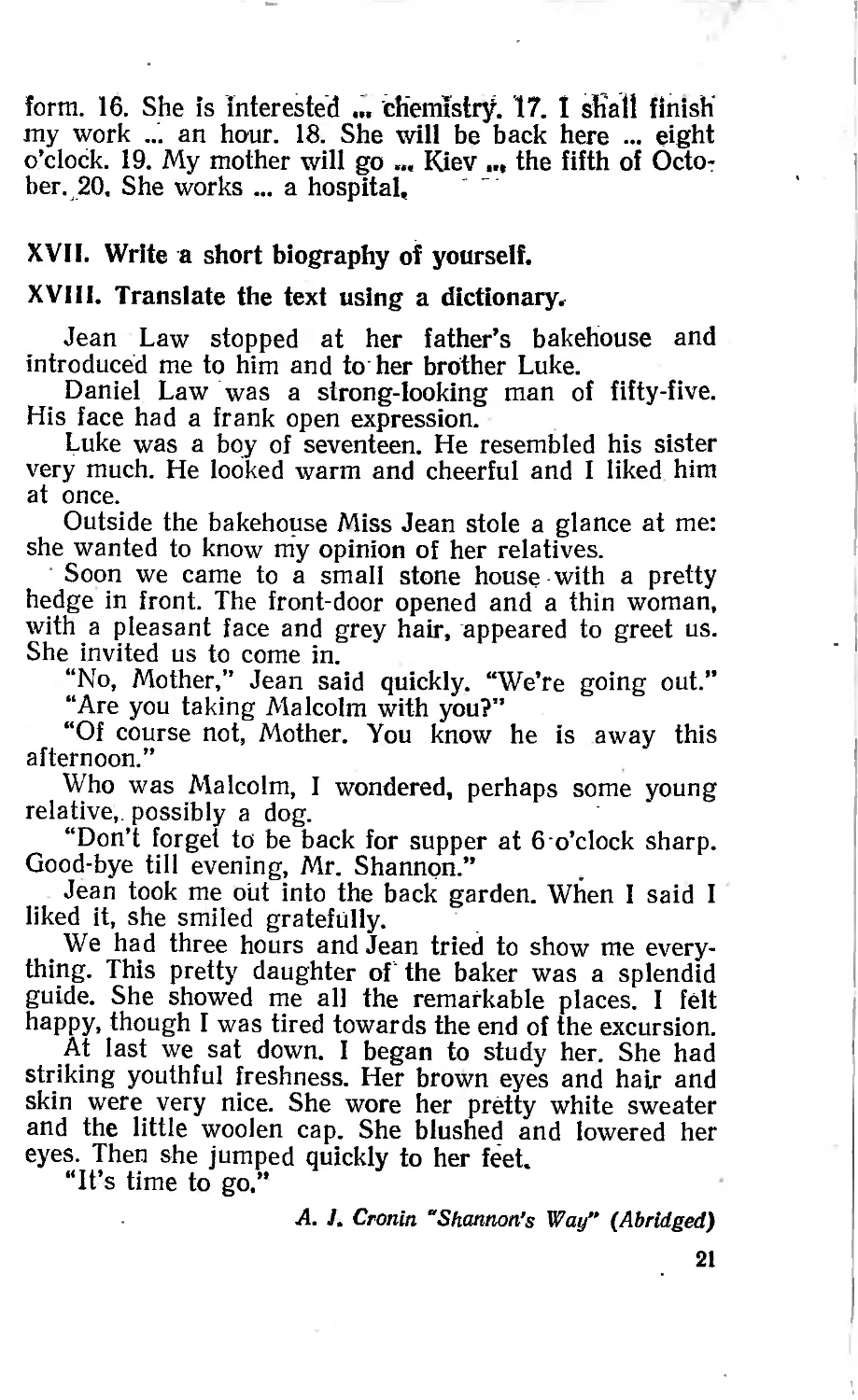
20
form. 16. She is interested ... chemistry. 17. I shall finish
my work ... an hour. 18. She will be back here ... eight
o’clock. 19. My mother will go ... Kiev ... the fifth of Octo-
ber. 20. She works ... a hospital,
XVII.	Write a short biography of yourself.
XVIII.	Translate the text using a dictionary.
Jean Law stopped at her father’s bakehouse and
introduced me to him and to her brother Luke.
Daniel Law was a strong-looking man of fifty-five.
His face had a frank open expression.
Luke was a boy of seventeen. He resembled his sister
very much. He looked warm and cheerful and I liked him
at once.
Outside the bakehouse Miss Jean stole a glance at me:
she wanted to know my opinion of her relatives.
Soon we came to a small stone house with a pretty
hedge in front. The front-door opened and a thin woman,
with a pleasant face and grey hair, appeared to greet us.
She invited us to come in.
“No, Mother,’’ Jean said quickly. “We’re going out.”
“Are you taking Malcolm with you?”
“Of course not, Mother. You know he is away this
afternoon.”
Who was Malcolm, I wondered, perhaps some young
relative, possibly a dog.
“Don’t forget to be back for supper at 6 o’clock sharp.
Good-bye till evening, Mr. Shannon.”
Jean took me out into the back garden. When I said I
liked it, she smiled gratefully.
We had three hours and Jean tried to show me every-
thing. This pretty daughter of the baker was a splendid
guide. She showed me al] the remarkable places. I felt
happy, though I was tired towards the end of the excursion.
At last we sat down. I began to study her. She had
striking youthful freshness. Her brown eyes and hair and
skin were very nice. She wore her pretty white sweater
and the little woolen cap. She blushed and lowered her
eyes. Then she jumped quickly to her feet.
“It’s time to go.”
A. J. Cronin "Shannon’s Way” (Abridged)
21
WESSON THREE
Gr amm ar Construction there is, there are (o. 213.
§ 8)
Text
MY FLAT
The Communist Party and Soviet Government carry
out a great housing programme to provide people with
modern dwelling houses. A few weeks ago our family
moved into a new flat Our house is a five-storeyed
building. There is a small garden in front of it. Our flat
is on the third floor. There are three rooms, a hall, a kit-
chen and a bathroom in it. The flat has all modern con-
veniences, such as hot and cold running water, gas, elec-
tricity, central heating and a telephone.
The hall is not large. There is a small table there,
a mirror on the wall and a carpet on the floor.
The living-room is the largest in our flat The walls
of our living-room are light green. The curtains on the
window match the walls. You can see a sofa with cushions
on it, two armchairs, a TV set, and a radio set in the room.
On the right there is a piano. On the floor there is a lovely
carpet. On the walls there are several pictures. On
Sundays the family usually gets together in this room
for relaxation. We also receive guests and watch TV prog-
rammes there.
The bedroom also serves as my father’s study. There
are two beds with night tables, a wardrobe, a desk and
two bookcases and some chairs in our bedroom.
The third room is the dining-room. There is a large
square table with a table-cloth on it in the middle of the
room, and round it stand four chairs. Against one wall
there is a sideboard.
The kitchen in which my mother does the cooking and
we have our light meals when the family does not eat
together is not a large room. There is a gas stove in it,
a sink with taps for both hot arid cold water, a refrigerator,
and a larder to keep provisions in. The table and chairs
at the wall are covered with plastic.
In the bathroom you can see a bathtub, a shower,
a shelf for the toilet articles _ (toothbrushes, tooth-paste,
a soap-dish, a nail-brush] and* a towel rack.
22
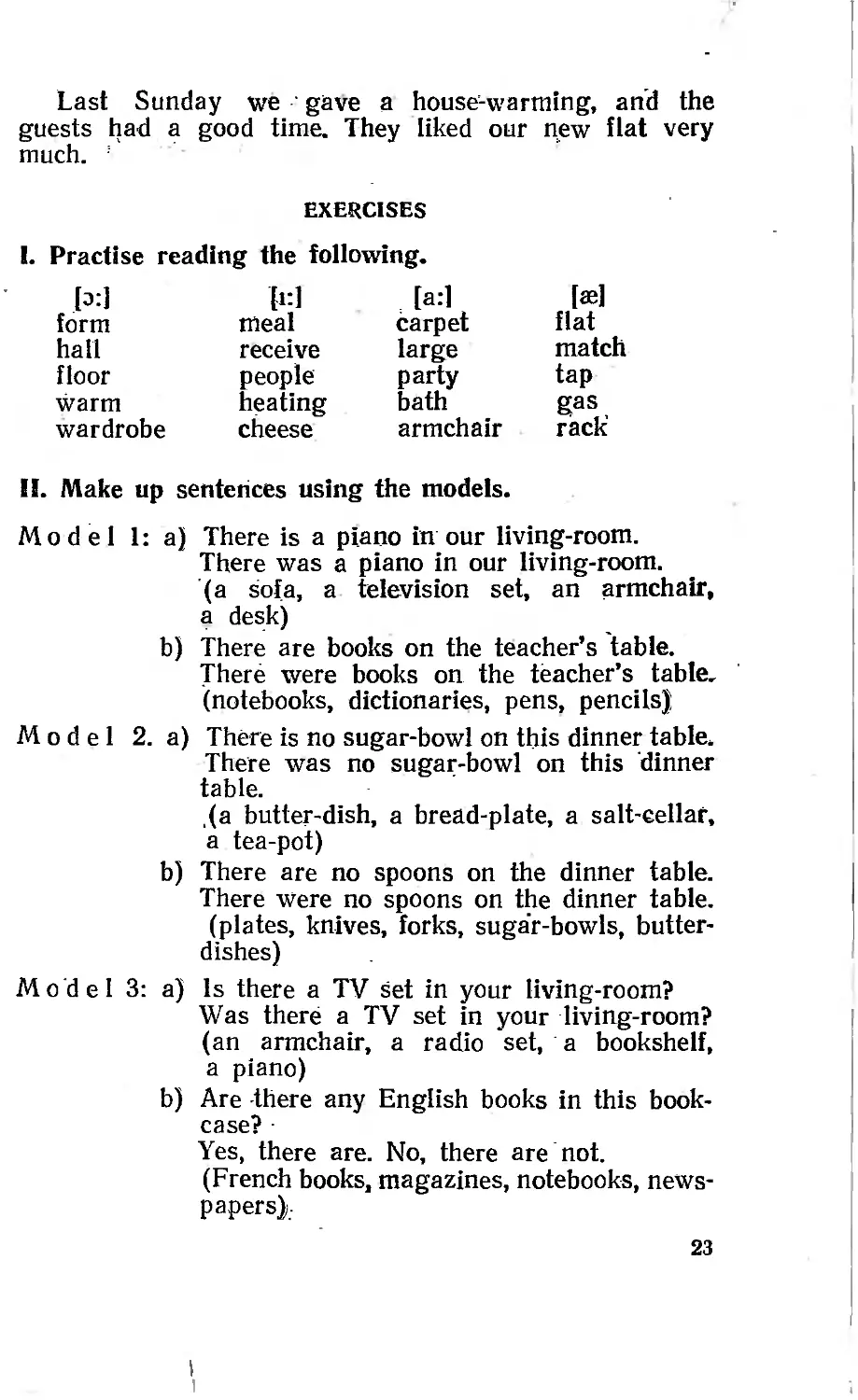
Last Sunday we gave a house-warming, and the
guests had a good time. They liked our new flat very
much. :
EXERCISES
I. Practise reading the following.
		[a:]	[ae]
form	meal	carpet	flat
hall	receive	large	match
floor	people	party	tap
warm	heating	bath	gas
wardrobe	cheese	armchair	rack
II. Make up sentences using the models.
Model 1: a] There is a piano in our living-room.
There was a piano in our living-room.
(a sofa, a television set, an armchair,
a desk)
b) There are books on the teacher’s table.
There were books on the teacher’s table,
(notebooks, dictionaries, pens, pencils)
Model 2. a) There is no sugar-bowl on this dinner table.
There was no sugar-bowl on this dinner
table.
.(a butter-dish, a bread-plate, a salt-cellar,
a tea-pot)
b) There are no spoons on the dinner table.
There were no spoons on the dinner table,
(plates, knives, forks, suga'r-bowls, butter-
dishes)
Model 3: a) Is there a TV set in your living-room?
Was there a TV set in your living-room?
(an armchair, a radio set, a bookshelf,
a piano)
b) Are there any English books in this book-
case?
Yes, there are. No, there are not.
(French books, magazines, notebooks, news-
papers).
23
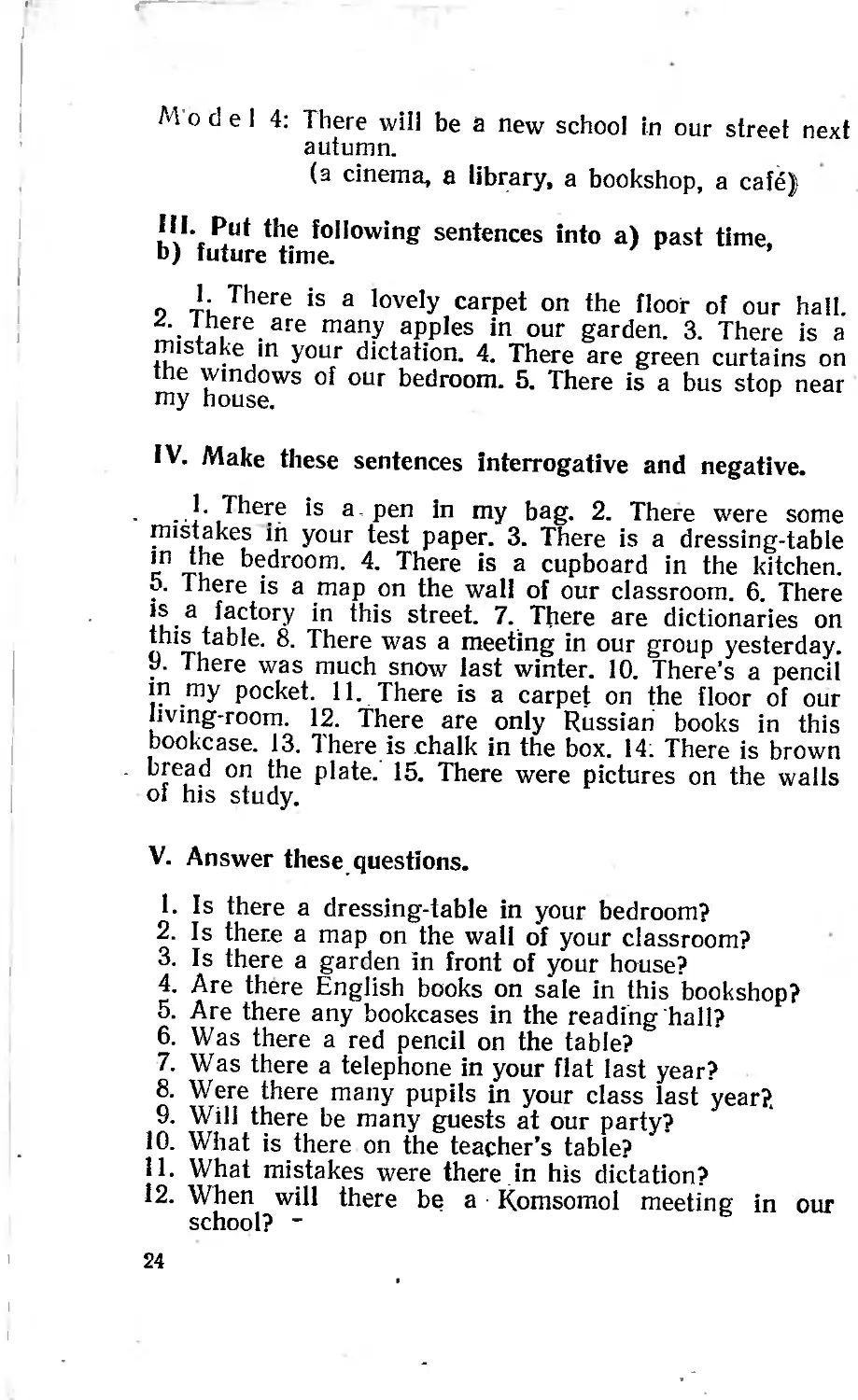
Model 4: There will be a new school in our street next
autumn.
(a cinema, a library, a bookshop, a cafe}
HI. Put the following sentences into a) past time,
b) future time.
1. There is a lovely carpet on the floor of our hall.
2. There are many apples in our garden. 3. There is a
mistake in your dictation. 4. There are green curtains on
the windows of our bedroom. 5. There is a bus stop near
my house.
IV. Make these sentences interrogative and negative.
1. There is a . pen in my bag. 2. There were some
mistakes in your test paper. 3. There is a dressing-table
in the bedroom. 4. There is a cupboard in the kitchen.
5. There is a map on the wall of our classroom. 6. There
is a factory in this street. 7. There are dictionaries on
this table. 8. There was a meeting in our group yesterday.
9. There was much snow last winter. 10. There’s a pencil
in my pocket. 11. There is a carpet on the floor of our
living-room. 12. There are only Russian books in this
bookcase. 13. There is chalk in the box. 14. There is brown
bread on the plate. 15. There were pictures on the walls
of his study.
V. Answer these questions.
1.	Is there a dressing-table in your bedroom?
2.	Is there a map on the wall of your classroom?
3.	Is there a garden in front of your house?
4.	Are there English books on sale in this bookshop?
5.	Are there any bookcases in the reading hall?
6.	Was there a red pencil on the table?
7.	Was there a telephone in your flat last year?
8.	Were there many pupils in your class last year?
9.	Will there be many guests at our party?
10.	What is there on the teacher’s table?
11.	What mistakes were there in his dictation?
12.	When will there be a Komsomol meeting in our
school? ~
24
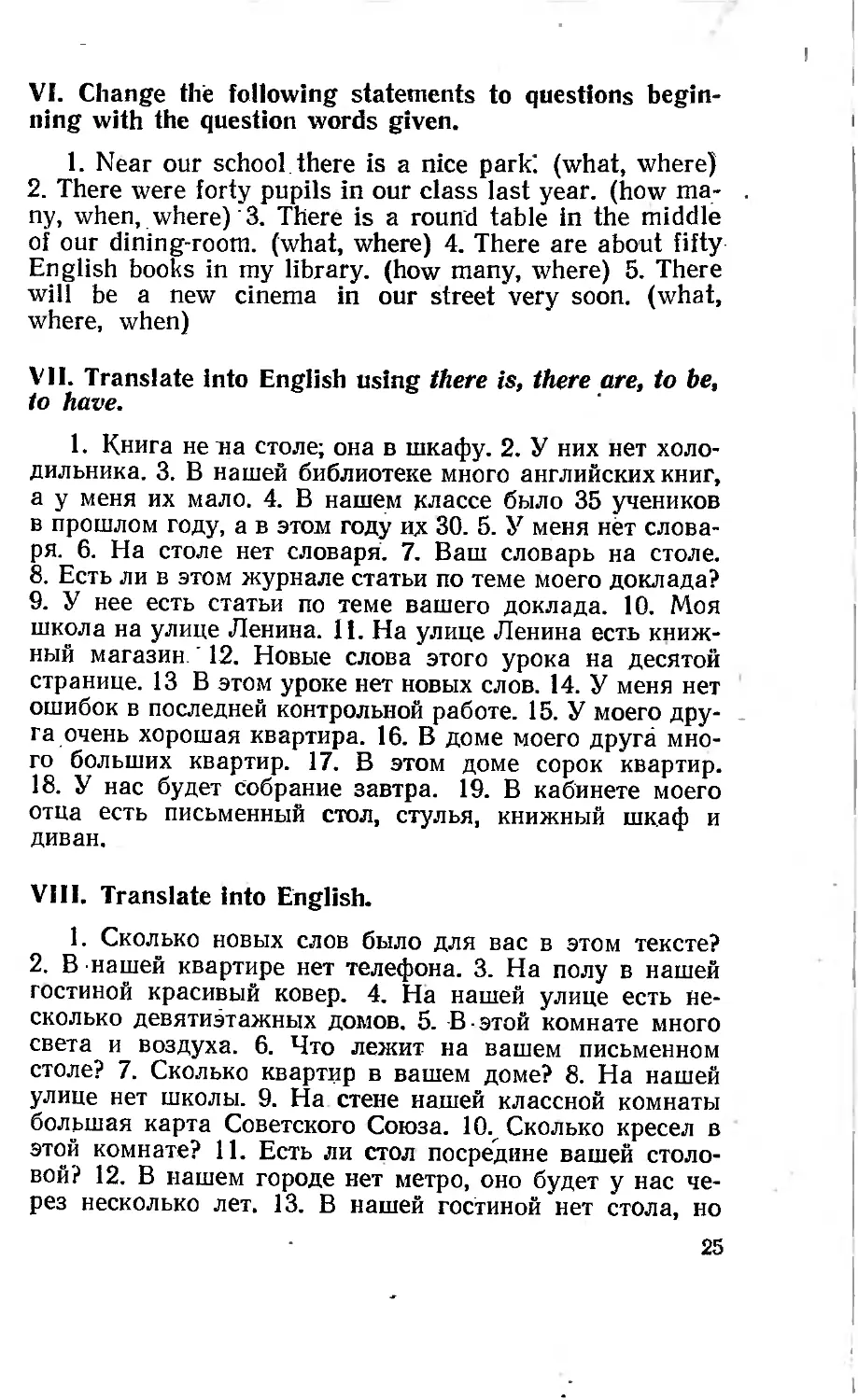
VI. Change the following statements to questions begin-
ning with the question words given.
1. Near our school there is a nice park', (what, where)
2. There were forty pupils in our class last year, (how ma-
ny, when, where) 3. There is a round table in the middle
of our dining-room, (what, where) 4. There are about fifty
English books in my library, (how many, where) 5. There
will be a new cinema in our street very soon, (what,
where, when)
VII. Translate into English using there is, there are, to be,
to have.
1. Книга не на столе; она в шкафу. 2. У них нет холо-
дильника. 3. В нашей библиотеке много английских книг,
а у меня их мало. 4. В нашем классе было 35 учеников
в прошлом году, а в этом году их 30. 5. У меня нет слова-
ря. 6. На столе нет словаря. 7. Ваш словарь на столе.
8. Есть ли в этом журнале статьи по теме моего доклада?
9. У нее есть статьи по теме вашего доклада. 10. Моя
школа на улице Ленина. 11. На улице Ленина есть книж-
ный магазин. ' 12. Новые слова этого урока на десятой
странице. 13 В этом уроке нет новых слов. 14. У меня нет
ошибок в последней контрольной работе. 15. У моего дру-
га очень хорошая квартира. 16. В доме моего друга мно-
го больших квартир. 17. В этом доме сорок квартир.
18. У нас будет собрание завтра. 19. В кабинете моего
отца есть письменный стол, стулья, книжный шкаф и
диван.
VIII.	Translate into English.
1.	Сколько новых слов было для вас в этом тексте?
2. В нашей квартире нет телефона. 3. На полу в нашей
гостиной красивый ковер. 4. На нашей улице есть не-
сколько девятиэтажных домов. 5. В-этой комнате много
света и воздуха. 6. Что лежит на вашем письменном
столе? 7. Сколько квартир в вашем доме? 8. На нашей
улице нет школы. 9. На стене нашей классной комнаты
большая карта Советского Союза. 10. Сколько кресел в
этой комнате? 11. Есть ли стол посредине вашей столо-
вой? 12. В нашем городе нет метро, оно будет у нас че-
рез несколько лет. 13. В нашей гостиной нет стола, ио
25
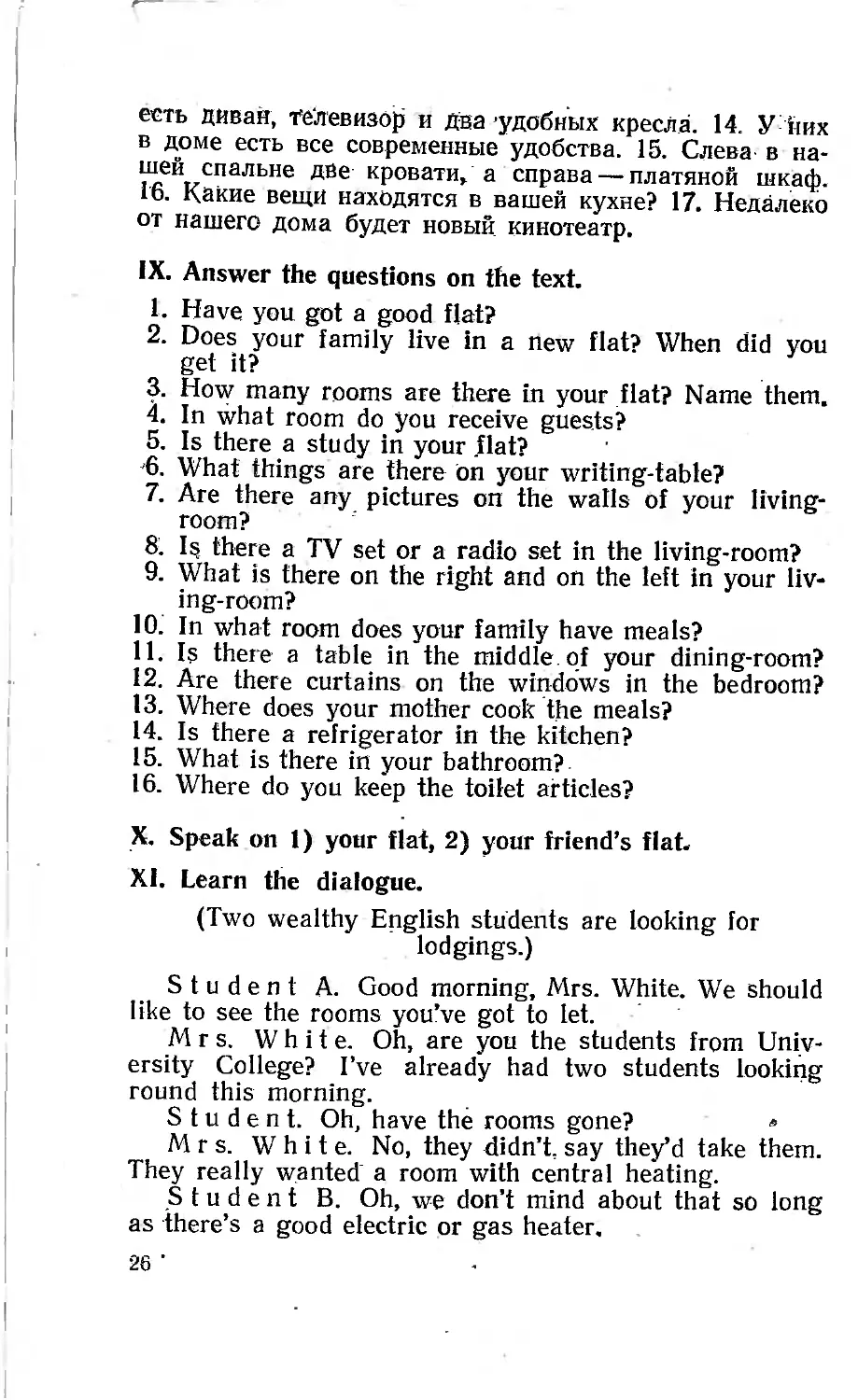
есть диван, телевизор и два удобных кресла. 14. У йих
в доме есть все современные удобства. 15. Слева в на-
шей спальне две кровати, а справа — платяной шкаф.
Гб. Какие вещи находятся в вашей кухне? 17. Недалеко
от нашего дома будет новый кинотеатр.
IX.	Answer the questions on the text.
1.	Have you got a good flat?
2.	Does your family live in a new flat? When did you
get it?
3.	How many rooms are there in your flat? Name them.
4.	In what room do you receive guests?
5.	Is there a study in your flat?
•6. What things are there on your writing-table?
7.	Are there any pictures on the walls of your living-
room?
8.	I§ there a TV set or a radio set in the living-room?
9.	What is there on the right and on the left in your liv-
ing-room?
10.	In what room does your family have meals?
11.	Is there a table in the middle, of your dining-room?
12.	Are there curtains on the windows in the bedroom?
13.	Where does your mother cook the meals?
14.	Is there a refrigerator in the kitchen?
15.	What is there in your bathroom?
16.	Where do you keep the toilet articles?
X.	Speak on 1) your flat, 2) your friend’s flat.
XI.	Learn the dialogue.
(Two wealthy English students are looking for
lodgings.)
Student A. Good morning, Mrs. White. We should
like to see the rooms you’ve got to let.
Mrs. White. Oh, are you the students from Univ-
ersity College? I’ve already had two students looking
round this morning.
Student. Oh, have the rooms gone?	«
Mrs. White. No, they didn’t, say they’d take them.
They really wanted a room with central heating.
Student B. Oh, we don’t mind about that so long
as there’s a good electric or gas heater.
26 '
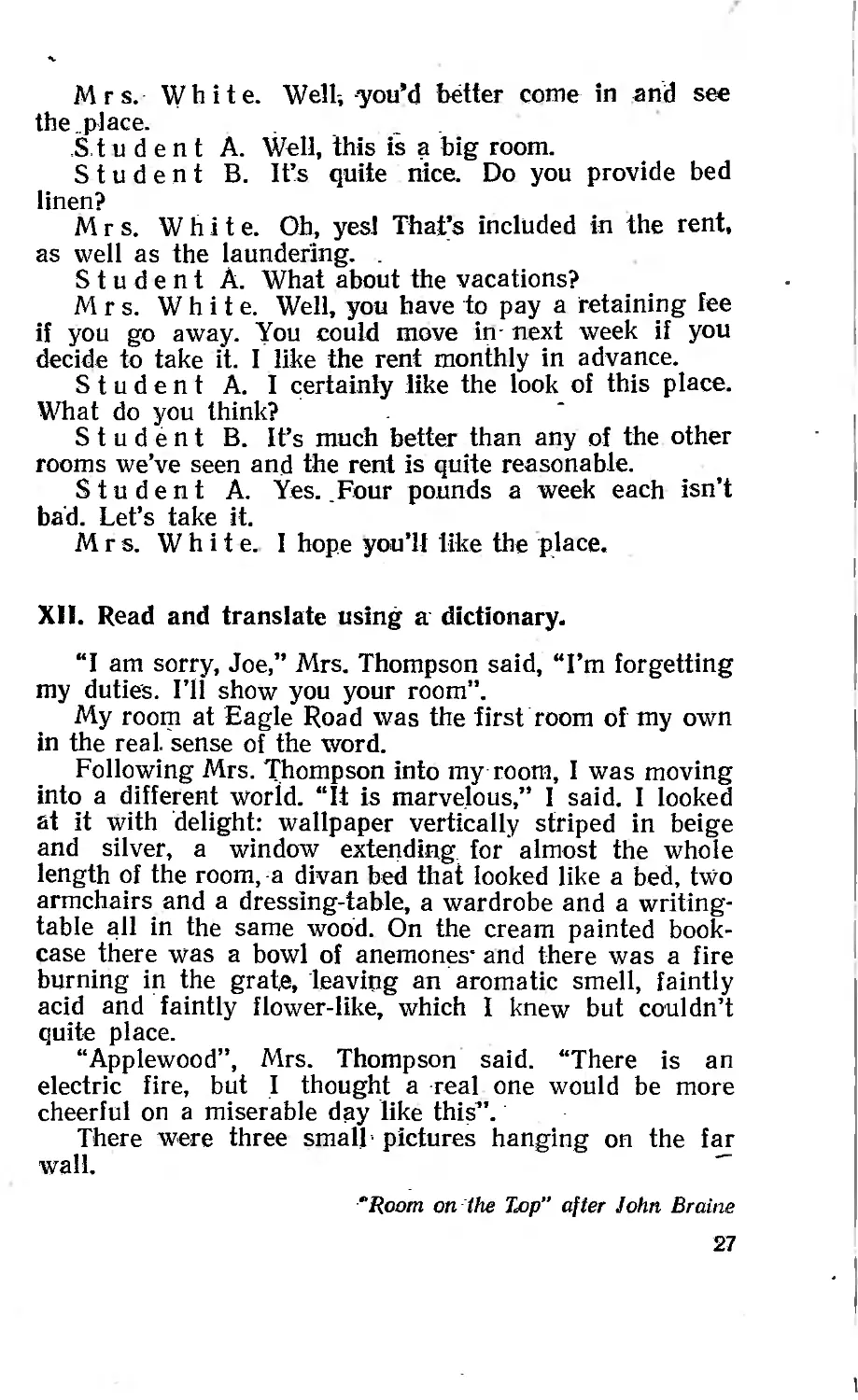
Mrs. White. Well-, you’d better come in and sea
the. place.
Student A. Well, this is a big room.
Student B. It’s quite nice. Do you provide bed
linen?
Mrs. White. Oh, yes! That’s included in the rent,
as well as the laundering. .
Student A. What about the vacations?
Mrs. White. Well, you have to pay a retaining fee
if you go away. You could move in- next week if you
decide to take it. I like the rent monthly in advance.
Student A. I certainly like the look of this place.
What do you think?
Student B. It’s much better than any of the other
rooms we’ve seen and the rent is quite reasonable.
Student A. Yes. Four pounds a week each isn’t
bad. Let’s take it.
Mrs. White. I hope you’ll like the place.
XII.	Read and translate using a dictionary.
“I am sorry, Joe,” Mrs. Thompson said, “I’m forgetting
my duties. I’ll show you your room”.
My room at Eagle Road was the first room of my own
in the real, sense of the word.
Following Mrs. Thompson into my room, I was moving
into a different world. “It is marvelous,” I said. I looked
at it with delight: wallpaper vertically striped in beige
and silver, a window extending for almost the whole
length of the room, a divan bed that looked like a bed, two
armchairs and a dressing-table, a wardrobe and a writing-
table all in the same wood. On the cream painted book-
case there was a bowl of anemones* and there was a fire
burning in the grate, leaving an aromatic smell, faintly
acid and faintly flower-like, which I knew but couldn’t
quite place.
“Applewood”, Mrs. Thompson said. “There is an
electric fire, but I thought a real one would be more
cheerful on a miserable day like this”.
There were three small’ pictures hanging on the far
wall.
"Room on the Top” after John Braine
27
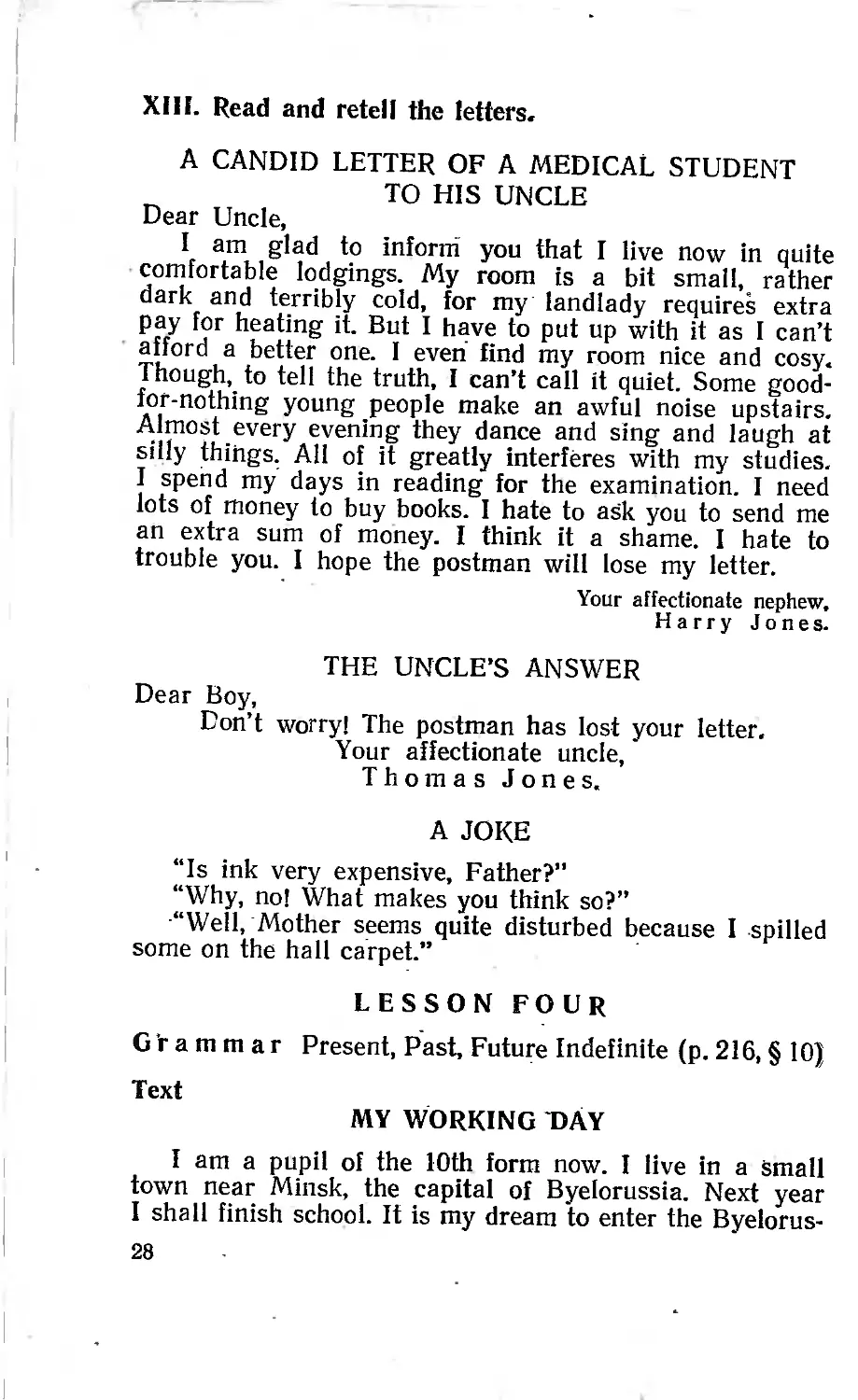
XIII.	Read and retell the letters.
A CANDID LETTER OF A MEDICAL STUDENT
TO HIS UNCLE
Dear Uncle,
I am glad to inform you that I live now in quite
comfortable lodgings. My room is a bit small, rather
dark and terribly cold, for my landlady requires extra
pay for heating it. But I have to put up with it as I can’t
afford a better one. I even find my room nice and cosy.
Though, to tell the truth, I can’t call it quiet. Some good-
for-nothing young people make an awful noise upstairs.
Almost every evening they dance and sing and laugh at
silly things. All of it greatly interferes with my studies.
I spend my days in reading for the examination. I need
lots of money to buy books. I hate to ask you to send me
an extra sum of money. I think it a shame. I hate to
trouble you. I hope the postman will lose my letter.
Your affectionate nephew,
Harry Jones.
THE UNCLE’S ANSWER
Dear Boy,
Don’t worry! The postman has lost your letter.
Your affectionate uncle,
Thomas Jones.
A JOKE
“Is ink very expensive, Father?”
“Why, no! What makes you think so?”
“Well, Mother seems quite disturbed because I spilled
some on the hall carpet.”
LESSON FOUR
Grammar Present, Past, Future Indefinite (p. 216, § 10}
Text
MY WORKING DAY
I am a pupil of the 10th form now. I live in a small
town near Minsk, the capital of Byelorussia. Next year
I shall finish school. It is my dream to enter the Byelorus-
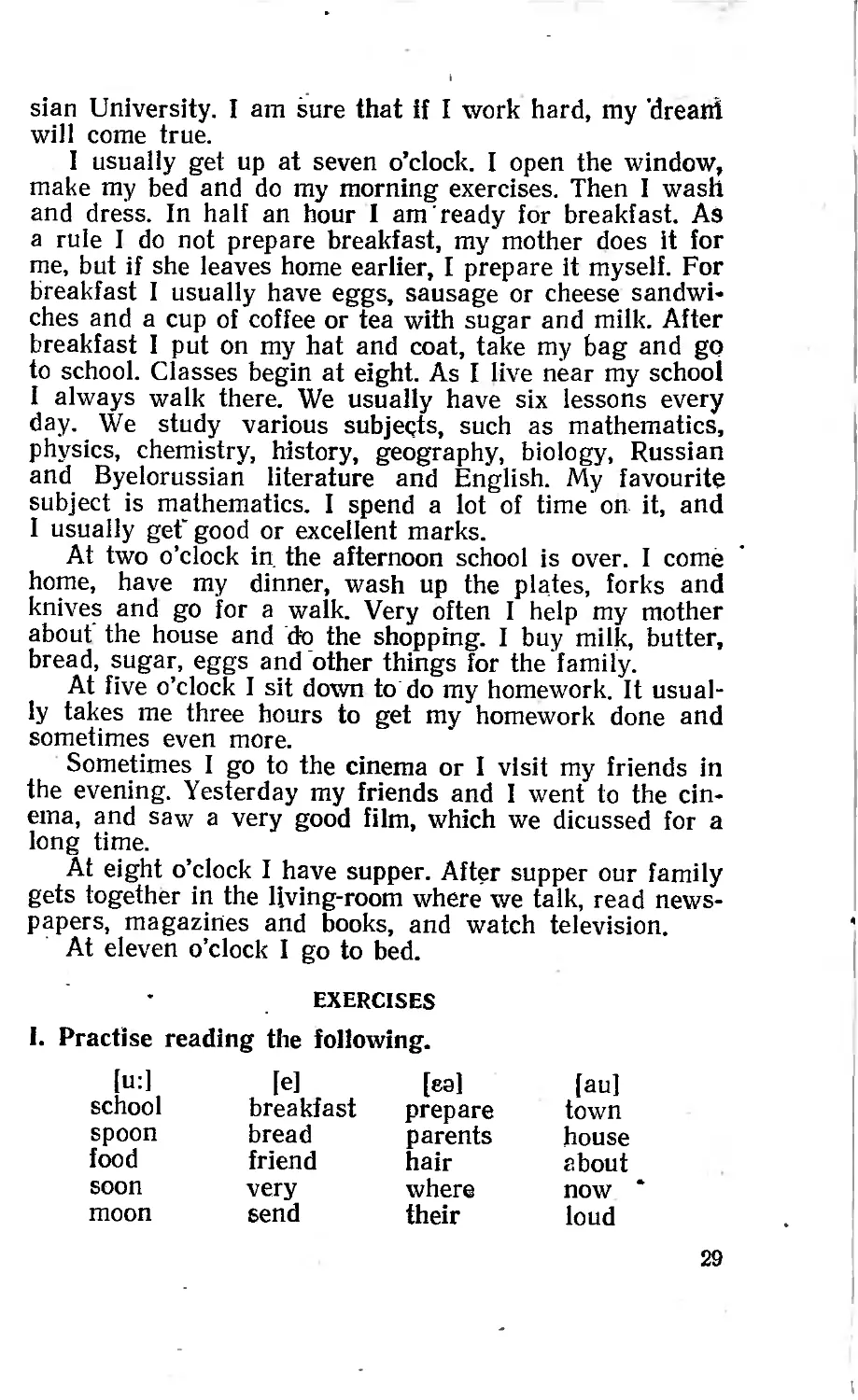
28
sian University. I am sure that if I work hard, my 'dreani
will come true.
I usually get up at seven o’clock. I open the window,
make my bed and do my morning exercises. Then I wash
and dress. In half an hour 1 am ready for breakfast. As
a rule I do not prepare breakfast, my mother does it for
me, but if she leaves home earlier, I prepare it myself. For
breakfast I usually have eggs, sausage or cheese sandwi-
ches and a cup of coffee or tea with sugar and milk. After
breakfast I put on my hat and coat, take my bag and go
to school. Classes begin at eight. As I live near my school
I always walk there. We usually have six lessons every
day. We study various subjects, such as mathematics,
physics, chemistry, history, geography, biology, Russian
and Byelorussian literature and English. My favourite
subject is mathematics. I spend a lot of time on it, and
I usually get’ good or excellent marks.
At two o’clock in the afternoon school is over. I come
home, have my dinner, wash up the plates, forks and
knives and go for a walk. Very often I help my mother
about' the house and do the shopping. I buy milk, butter,
bread, sugar, eggs and other things for the family.
At five o’clock I sit down to do my homework. It usual-
ly takes me three hours to get my homework done and
sometimes even more.
Sometimes I go to the cinema or I visit my friends in
the evening. Yesterday my friends and I went to the cin-
ema, and saw a very good film, which we dicussed for a
long time.
At eight o’clock I have supper. After supper our family
gets together in the living-room where we talk, read news-
papers, magazines and books, and watch television.
At eleven o’clock I go to bed.
EXERCISES
I. Practise reading the following.
[u:j	[e]	[eal	[au]
school	breakfast	prepare	town
spoon	bread	parents	house
food	friend	hair	about
soon	very	where	now
moon	send	their	loud
29
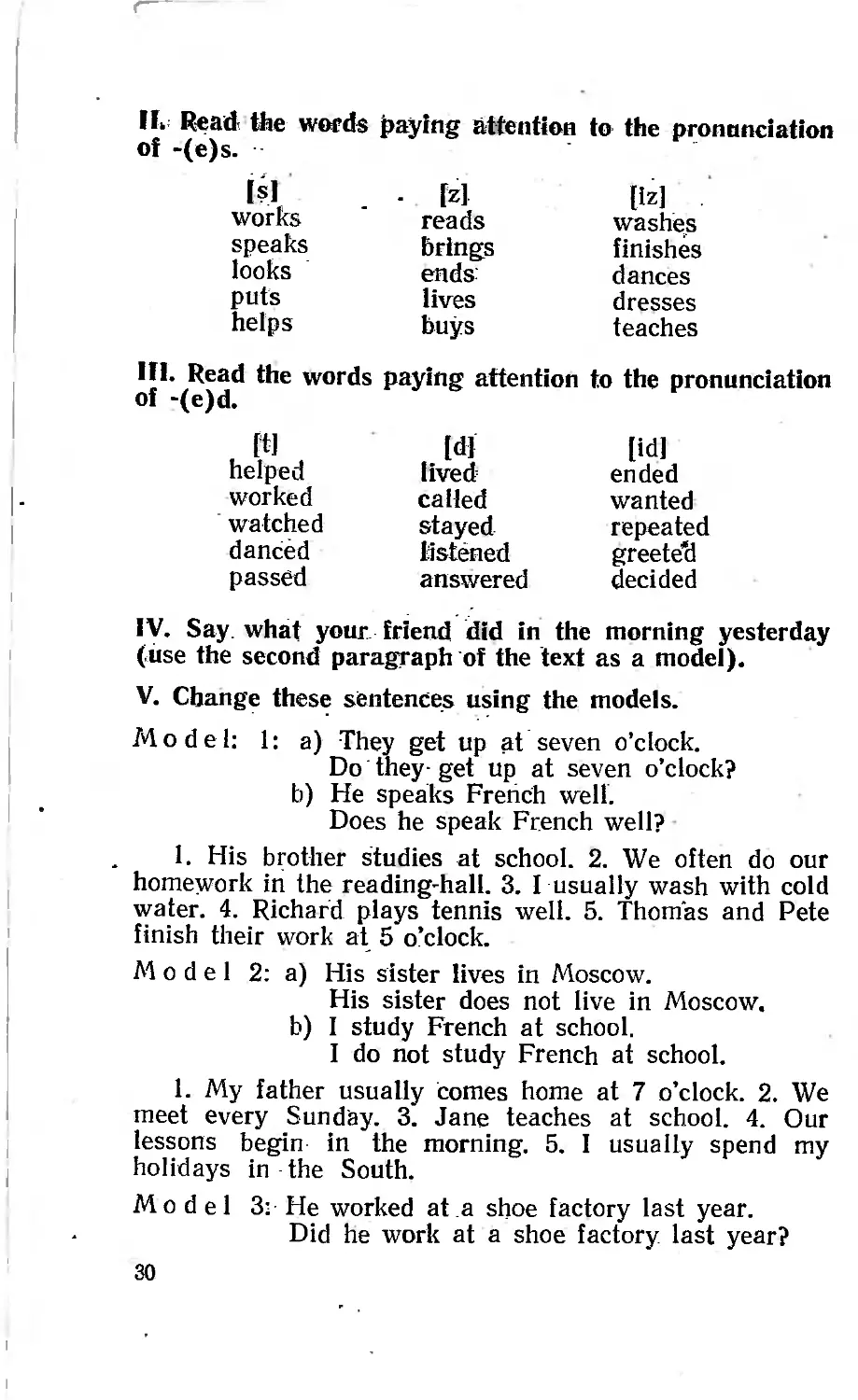
IL Read the words paying attention to the pronunciation
of -(e)s.
[s] works	. - Й reads	[12] washes
speaks	brings	finishes
looks	ends:	dances
puts	lives	dresses
helps	buys	teaches
III. Read the words paying attention to the pronunciation
(e)d.
ft!	Id]	[id]
helped	lived	ended
worked	called	wanted
watched	stayed	repeated
danced	listened	greeted
passed	answered	decided
IV. Say. what your friend did in the morning yesterday
(use the second paragraph of the text as a model).
V. Change these sentences using the models.
Model: 1: a) They get up at seven o’clock.
Do they- get up at seven o’clock?
b) He speaks French well.
Does he speak French well?
1. His brother studies at school. 2. We often do our
homework in the reading-hall. 3. I usually wash with cold
water. 4. Richard plays tennis well. 5. Thomas and Pete
finish their work at 5 o’clock.
Model 2: a) His sister lives in Moscow.
His sister does not live in Moscow.
b) I study French at school.
I do not study French at school.
1. My father usually comes home at 7 o’clock. 2. We
meet every Sunday. 3. Jane teaches at school. 4. Our
lessons begin in the morning. 5. I usually spend my
holidays in the South.
Model 3: He worked at a shoe factory last year.
Did he work at a shoe factory last year?
30
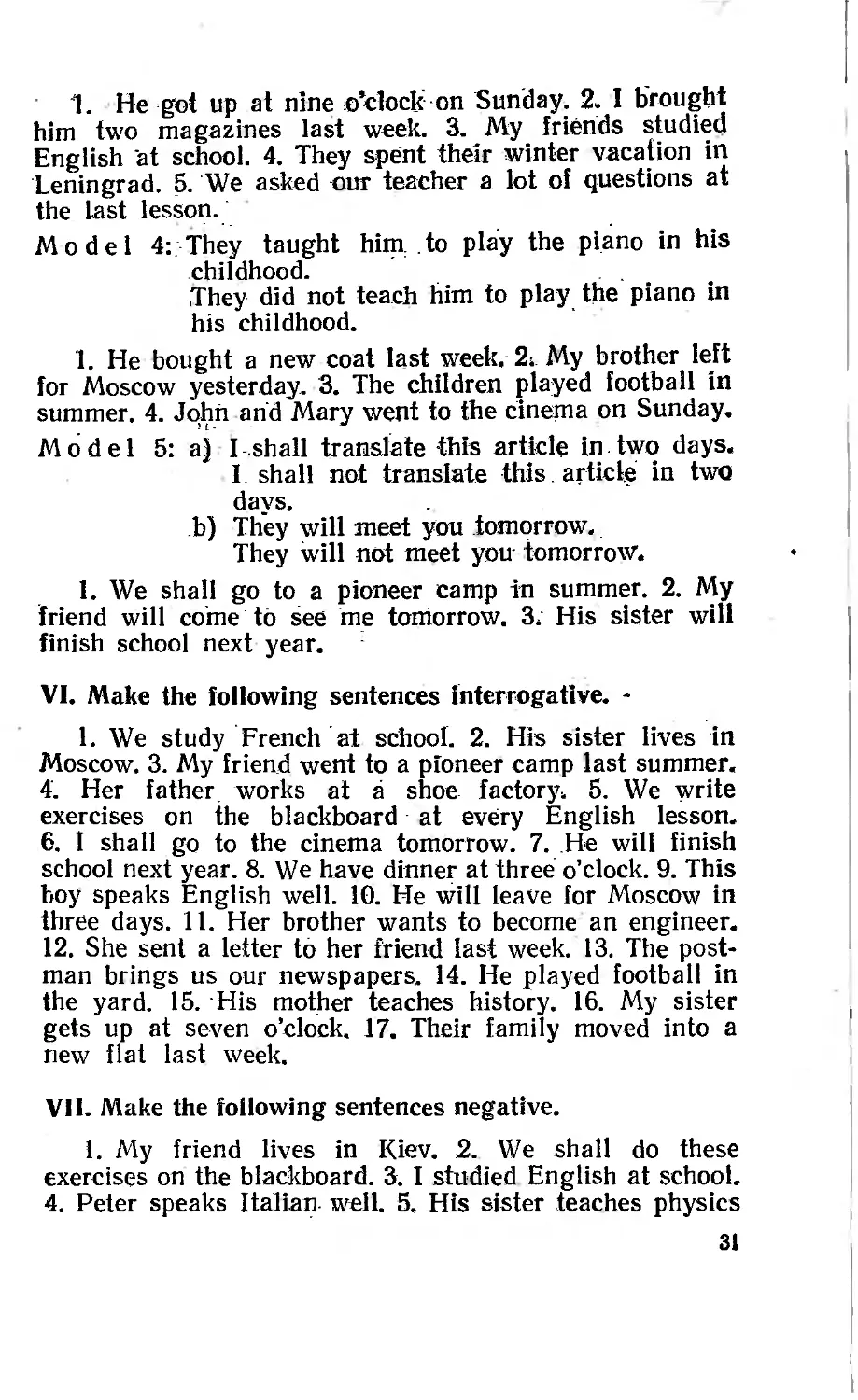
1. He got up at nine o’clock on Sunday. 2. I brought
him two magazines last week. 3. My friends studied
English at school. 4. They spent their winter vacation in
Leningrad. 5. We asked our teacher a lot of questions at
the last lesson.
Model 4: They taught him to play the piano in his
childhood.
They did not teach him to play the piano in
his childhood.
1. He bought a new coat last week. 2; My brother left
for Moscow yesterday. 3. The children played football in
summer. 4. John and Mary went to the cinema on Sunday.
Model 5: a) 1 shall translate this article in two days.
I shall not translate this article in two
days.
b) They will meet you tomorrow.
They will not meet you tomorrow.
1. We shall go to a pioneer camp in summer. 2. My
friend will come to see me tomorrow. 3. His sister will
finish school next year.
VI. Make the following sentences interrogative. -
1. We study French at school. 2. His sister lives in
Moscow. 3. My friend went to a pioneer camp last summer.
4. Her father works at a shoe factory. 5. We write
exercises on the blackboard at every English lesson.
6. I shall go to the cinema tomorrow. 7. He will finish
school next year. 8. We have dinner at three o’clock. 9. This
boy speaks English well. 10. He will leave for Moscow in
three days. 11. Her brother wants to become an engineer.
12. She sent a letter to her friend last week. 13. The post-
man brings us our newspapers. 14. He played football in
the yard. 15. His mother teaches history. 16. My sister
gets up at seven o’clock. 17. Their family moved into a
new flat last week.
VII. Make the following sentences negative.
1.	My friend lives in Kiev. 2. We shall do these
exercises on the blackboard. 3. I studied English at school.
4. Peter speaks Italian well. 5. His sister teaches physics
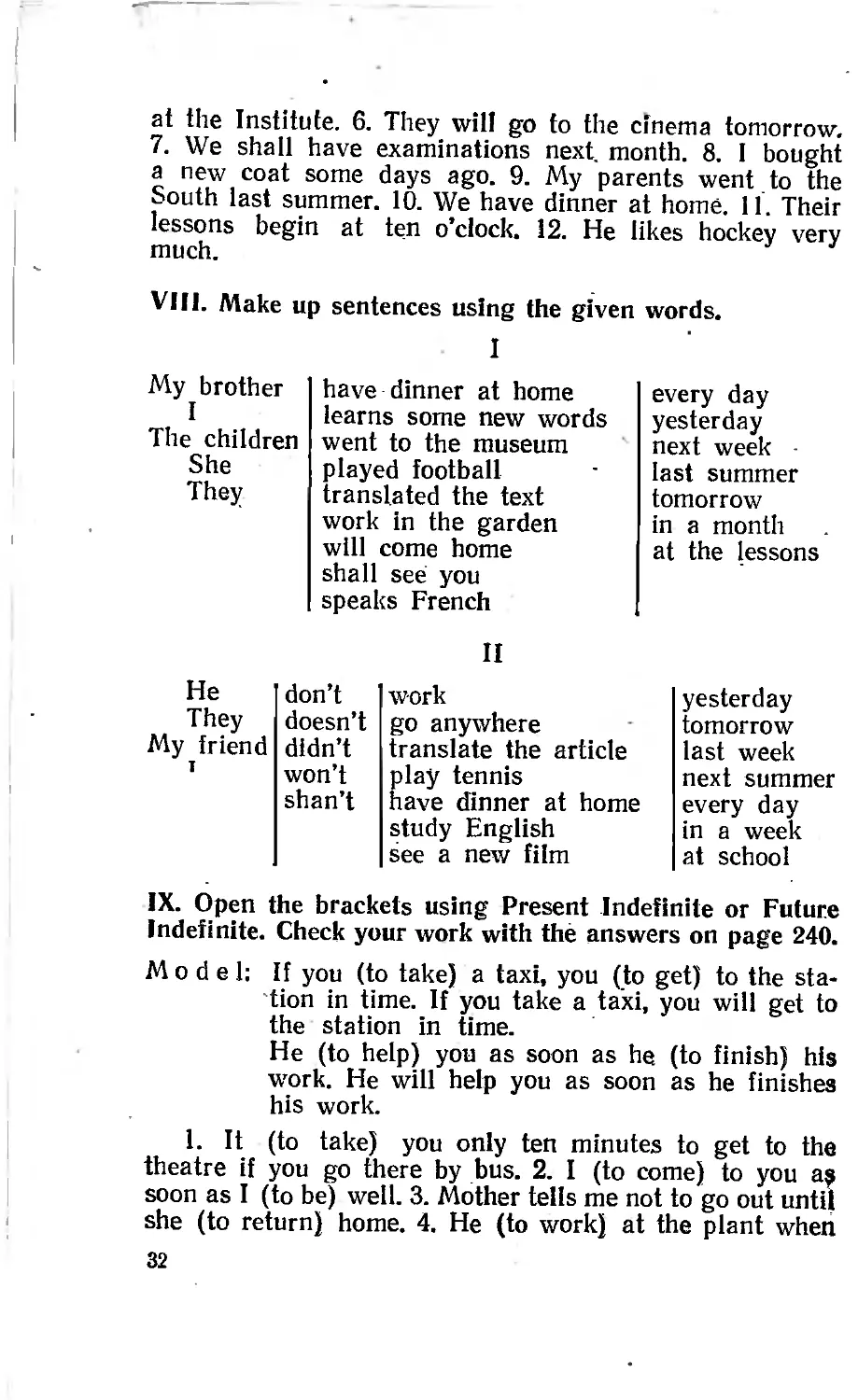
31
at the Institute. 6. They will go to the cinema tomorrow.
7. We shall have examinations next, month. 8. I bought
a new coat some days ago. 9. My parents went to the
South last summer. 10. We have dinner at home. 11. Their
lessons begin at ten o’clock. 12. He likes hockey very
much.
VIII. Make up sentences using the given words.
I
My brother	have dinner at home	every day
I	learns some new words	yesterday
The children	went to the museum	next week
She	played football	last summer
They	translated the text work in the garden will come home shall see you speaks French	tomorrow in a month at the lessons
II
He They	don’t doesn’t	work go anywhere	yesterday tomorrow
My friend	didn’t	translate the article	last week
i	won’t shan’t	play tennis have dinner at home study English see a new film	next summer every day in a week at school
IX.	Open the brackets using Present Indefinite or Future
Indefinite. Check your work with the answers on page 240.
Model; If you (to take) a taxi, you (to get) to the sta-
tion in time. If you take a taxi, you will get to
the station in time.
He (to help) you as soon as he (to finish) his
work. He will help you as soon as he finishes
his work.
1.	It (to take) you only ten minutes to get to the
theatre if you go there by bus. 2. I (to come) to you a§
soon as I (to be) well. 3. Mother tells me not to go out until
she (to return) home. 4. He (to work) at the plant when
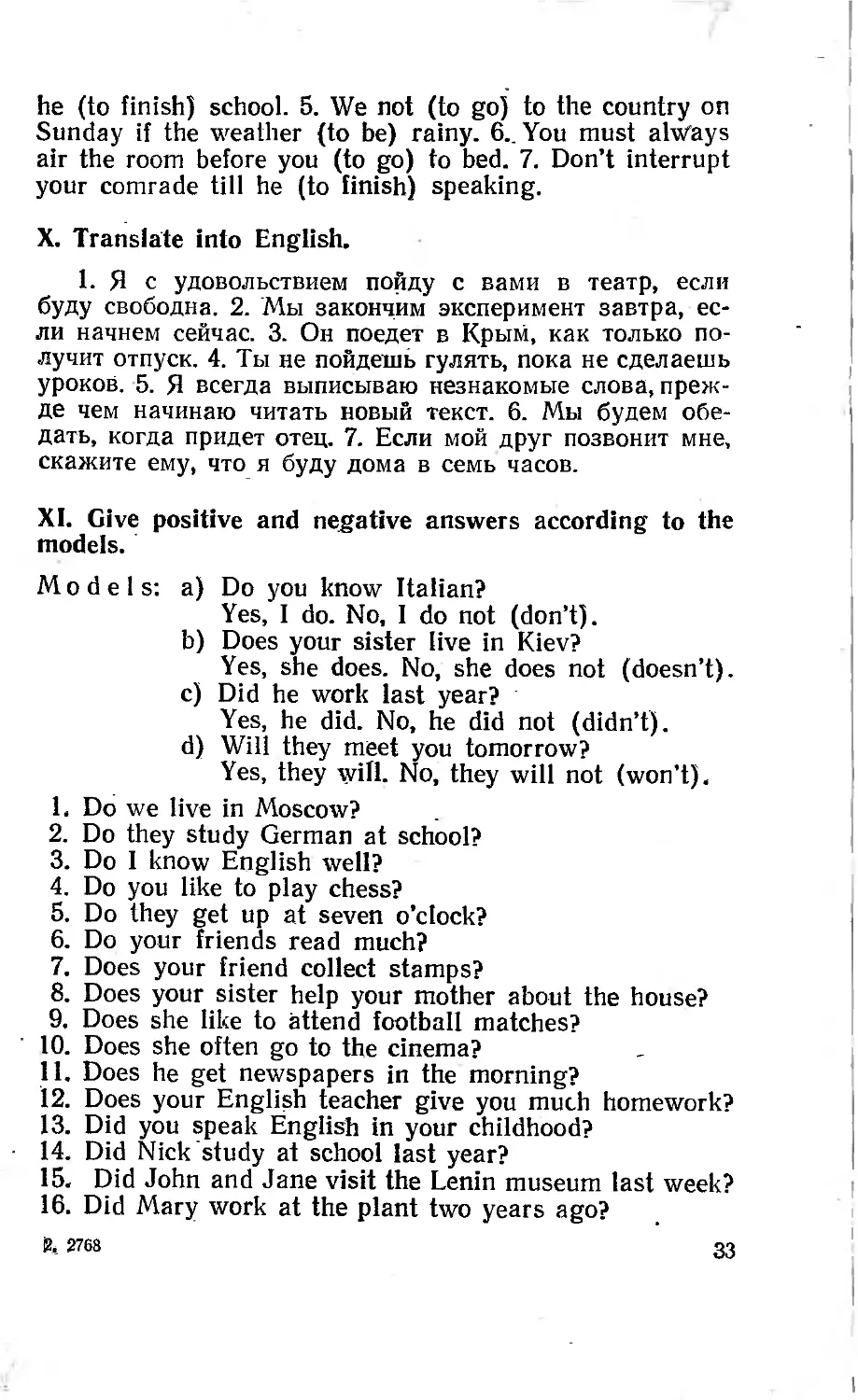
32
he (to finish) school. 5. We not (to go) to the country on
Sunday if the weather (to be) rainy. 6.. You must always
air the room before you (to go) to bed. 7. Don’t interrupt
your comrade till he (to finish) speaking.
X.	Translate into English.
1.	Я с удовольствием пойду с вами в театр, если
буду свободна. 2. Мы закончим эксперимент завтра, ес-
ли начнем сейчас. 3. Он поедет в Крым, как только по-
лучит отпуск. 4. Ты не пойдешь гулять, пока не сделаешь
уроков. 5. Я всегда выписываю незнакомые слова, преж-
де чем начинаю читать новый текст. 6. Мы будем обе-
дать, когда придет отец. 7. Если мой друг позвонит мне,
скажите ему, что я буду дома в семь часов.
XI.	Give positive and negative answers according to the
models.
Models: a) Do you know Italian?
Yes, I do. No, I do not (don’t).
b) Does your sister live in Kiev?
Yes, she does. No, she does not (doesn’t),
c) Did he work last year?
Yes, he did. No, he did not (didn’t).
d) Will they meet you tomorrow?
Yes, they will. No, they will not (won’t).
1.	Do we live in Moscow?
2.	Do they study German at school?
3.	Do I know English well?
4.	Do you like to play chess?
5.	Do they get up at seven o’clock?
6.	Do your friends read much?
7.	Does your friend collect stamps?
8.	Does your sister help your mother about the house?
9.	Does she like to attend football matches?
10.	Does she often go to the cinema?
11.	Does he get newspapers in the morning?
12.	Does your English teacher give you much homework?
13.	Did you speak English in your childhood?
14.	Did Nick study at school last year?
15.	Did John and Jane visit the Lenin museum last week?
16. Did Mary work at the plant two years ago?
2. 2768	33
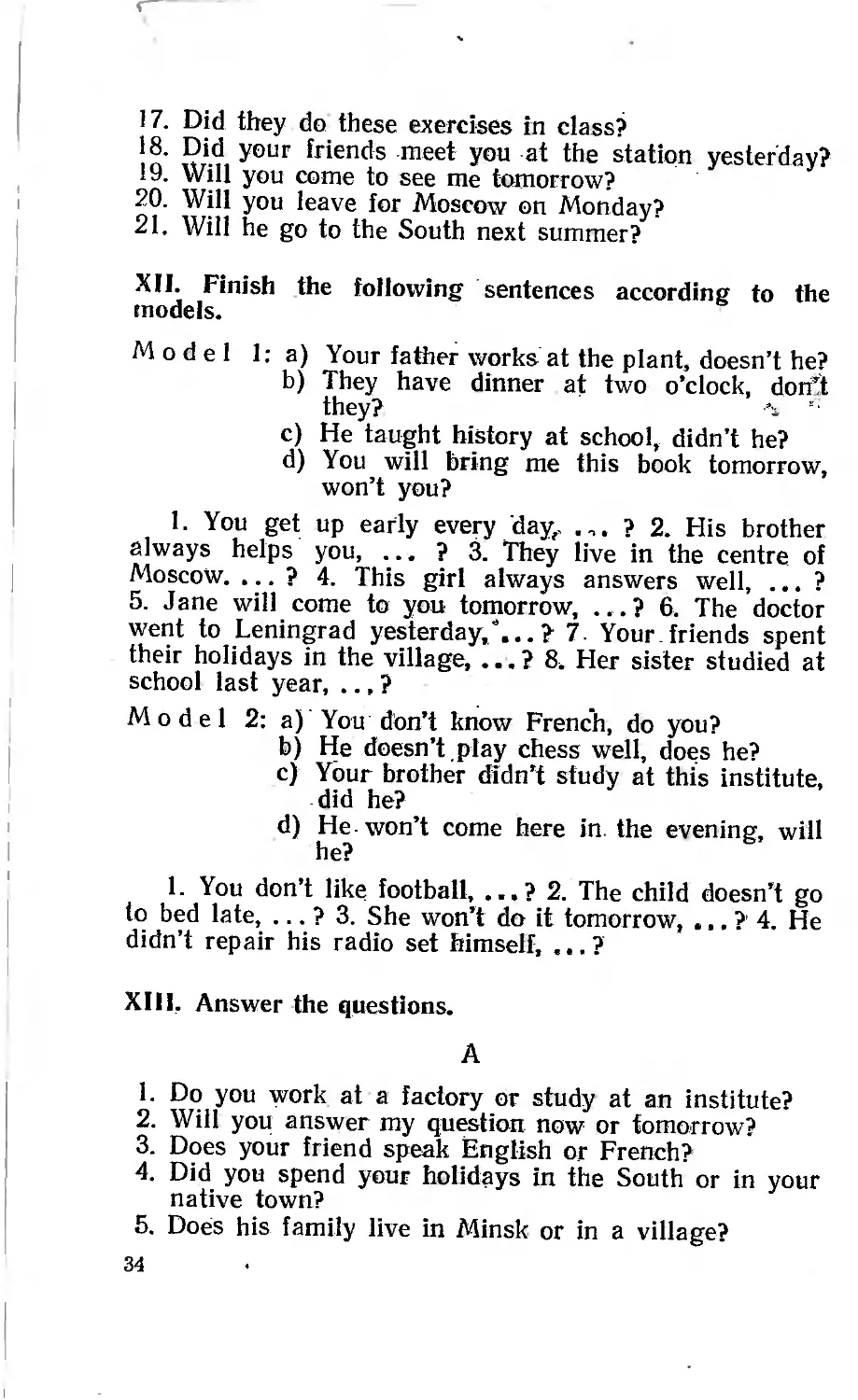
17.	Did they do these exercises in class?
18.	Did your friends meet you at the station yesterday?
19.	Will you come to see me tomorrow?
20.	Will you leave for Moscow on Monday?
21.	Will he go to the South next summer?
XII. Finish the following sentences according to the
models.
Model 1: a) Your father works at the plant, doesn’t he?
b)	They have dinner at two o’clock, don’t
they?
c)	He taught history at school, didn’t he?
d)	You will bring me this book tomorrow,
won’t you?
1.	You get up early every day,, ? 2. His brother
always helps you, ... ? 3. They live in the centre of
Moscow. ... ? 4. This girl always answers well, ... ?
5. Jane will come to you tomorrow, ...? 6. The doctor
went to Leningrad yesterday/...? 7. Your friends spent
their holidays in the village, ...? 8. Her sister studied at
school last year, .., ?
Model 2: a) You don’t know French, do you?
b)	He doesn’t .play chess well, does he?
c)	Your brother didn’t study at this institute,
did he?
d)	He won’t come here in the evening, will
he?
1.	You don’t like football, ...? 2. The child doesn’t go
to bed late, ... ? 3. She won’t do it tomorrow, .,. ? 4. He
didn’t repair his radio set himself, ...?
XIII. Answer the questions.
A
1.	Do you work at a factory or study at an institute?
2.	Will you answer my question now or tomorrow?
3.	Does your friend speak English or French?
4.	Did you spend your holidays in the South or in your
native town?
5.	Does his family live in Minsk or in a village?
34
6.	Will you be seventeen this year or next year?
7.	Which season do you like better: spring or summer?
8.	Did your mother work last year or was she on pension
already?
В
1.	Who brings you newspapers in the morning?
2.	Who studies French in your family?
3.	Who helps your mother about the house?
.4,, Who gives you English books to read?
J5. Who prepares dinner for you?
6.	Who gives you English lessons?
7.	What newspapers does your brother read?
8.	What do you do in the morning?
9.	Where does your father work?
10.	Where does your sister go in the evening?
11.	Where does your father have his dinner?
12.	Where do your brother and sister spend their holidays?
13.	When does Nick come home from school?
14.	When do you watch television?
15.	What foreign language did you study at school?
16.	Where did you buy this book? How much did it cost?
17.	When were your classes over yesterday?
18.	How many children study at your school?
19.	When did they finish their work?
20.	When did you see the new film?
21.	What will you do tomorrow?
22.	What will he speak about at the meeting?
23.	What will they visit in Moscow?
24.	Why will you come home later tomorrow?
25.	When will you go to Leningrad?
XIV. Ask questions according to the model.
Model: Ask your friend a) if he knows the way to the
post-office. Do you know the way to the post-
office? b) when he came home yesterday. When
did you come home yesterday?
1.	Ask him if he knows your address.
2.	Ask me if I bought all the necessary textbooks.
3.	Ask her when she translated this article.
4.	Ask your mother if she will allow you to go to the
cinema.
35
5,	Ask him how many hours a day he works.
6.	Ask her where she spent her vacation.
7.	Ask them when they will take their examinations.
8.	Ask her where her friend worked last year.
9.	-Ask him what books his sister likes to read.
10.	Ask her how long she will stay in Moscow.
11.	Ask him what subject he teaches, at school.
12.	Ask the pupils if they understand this rille.
XV.' Change the following statements to questions begin-
ning with the question words given.
1.	Everybody enjoyed the new film, (who, what)
2. He passed his examinations well, (what, how) 3. I go
to school in the morning, (where, when) 4. My sister lives
in Moscow, (who, where) 5. We learned ten words at the
last lesson, (how many, what, when) 6. Ivanov teaches
us biology, (who, what) 7. They will translate this text
next week, (who, what, when) 8. She always has dinner
at home at three o’clock, (who, what, when) 9. His son
goes to bed at nine o’clock, (whose, when) 10. Children
study the English language at this school, (who, what,
where)
XVI. Open the brackets. Check your work with the answers
on page 240.
1. My sister not (to work), she (to study) at the
Institute. 2. I (to read) this book in three days and then I
(to give) it to you. 3. All progressive humanity (to
celebrate) Lenin’s centenary in April, 1970. 4. Where you
(to live) last year? 5. We (to go) to the cinema a few
.days ago and then (to discuss) the film. 6. Our lessons
usually (to end) at two o’clock, but yesterday they (to
end) an hour later. 7. We (to meet) the delegation at
the station tomorrow. 8. What you (to do) last Sunday?
9. When your father (to come) home from his work? 10. It
usually (to take) me ten minutes to get home. 11. What
language you (to speak) in your childhood? 12. Their
class (to visit) the museum of the Great Patriotic War
next week. 13. Every morning he (to leave) his house at
eight o’clock. 14. When you (to leave) your house to-
morrow? 15. Your sister (to teach) English at school?
36
16. He (to bring) me a very interesting article yesterday.
17. My mother not (to "know) French, she (to know) Ger-
man. 18. All the pupils of our class (to go) in for sport.
19. I not (to like) to take medicine. 20. Many children in
the capitalist countries not (to study) at school. 21. I not
' (to write) a letter yesterday. I (to write) it tomorrow.
22. Millions of people all over the world (to read) Lenin’s
works.
-XVII. Answer the questions on the text.
1.	Do you study or work?
2.	When will you finish school?
3.	Do you study hard at school?
4.	What subjects did you study in the eighth form?
5.	Did" you study English or French?
6.	At what time do you usually get up?
7.	What do you do when you get up?
8.	Who prepares breakfast in your family?
9.	What do you usually have for breakfast?
10.	What do you usually do after breakfast?
11.	Do you go to school by tram?
12.	How many classes have you every day?
13.	What is (or was) your favourite subject at school?
14.	At what time do you have dinner?
15.	Do you have dinner at home or in the canteen?
16.	Does your sister help your mother about the house?
17.	What do you do after dinner?
18.	How much time do you spend on your homework?
19.	What does your family usually do in the evening?
20.	Do you watch television every day?
21.	At what time did you go to bed yesterday?
XIII. Translate into English.
1. Мой рабочий день начинается в 9 часов утра.
Я встаю обычно в 7 часов, а в воскресенье я встаю не-
много позже. 2. А когда вы встаете? 3. Мы завтракаем
и ужинаем дома, а.обедаем в столовой. 4. Где она обыч-
но проводит свой выходной день? Зимой и летом она
проводит свой выходной день за городом. 5. Где'вы учи-
тесь? Я учусь в институте. А где вы учились в прошлом
году? В прошлом году я учился в школе. 6. Какой иност-
ранный язык вы изучали в школе? В школе я изучал не-
37
мецкий, а в институте буду изучать английский, так как
на английском языке много литературы по моей будущей
специальности. 7. Он ездит в школу на автобусе или хо-
дит пешком? 8. Сколько времени тратишь ты на свои до-
машние задания каждый день? Я трачу три или четыре^
часа ежедневно. 9. Делаешь ли ты по утрам зарядку?'
10. Что вы делаете после обеда? После обеда я отдыхаю,
а затем делаю домашние задания. 11. Какие предметы вы
изучали в школе? Какой из них был вашим любимым?
12.	Моя сестра обычно помогает матери по дому, а я хожу-,
в магазин за покупками. 13. Что вы делаете по вечерам? i
Если я свободен, то я читаю, хожу в кино или театр, а
также хожу в гости к своим друзьям. 14. Куда вы ходили
вчера вечером? Вчера вечером я не мог никуда пойти, так
как готовился к уроку английского языка и математике.
15. Что вы будете делать в воскресенье? В воскресенье я
пойду навестить мою первую учительницу. У нее будет
день рождения. Мы преподнесем ей цветы и поздравим
ее с днем рождения. 16. Сколько уроков у вас каждый
день? Когда они начинаются? 17. Когда ты приходишь
домой из школы? Обычно я прихожу в два часа, но вче-
ра пришел позже, так как у нас было собрание после
уроков. 18. Когда ты обычно ложишься спать?
XIX.	Speak on:
a)	your working day
b)	your friend’s working day
XX.	Read and translate using a dictionary.
Winter was their slack season. She could sleep some-
times till eight, and John till seven. They could linger
over their meals a little, read, play cards, go visiting
the neighbours. It was the time to relax and enjoy
themselves, but. instead they kept on waiting for the
spring.
Sometimes they slept late, sometimes they played
cards, but always uneasily. When John sat down to
a meal he ate quickly, pushed his chair away again,
from habit, from sheer work-instinct, even though it was
only to put more wood in the stove, or go down to the
cellar to cut up beets and turnips for the cows.
38 '
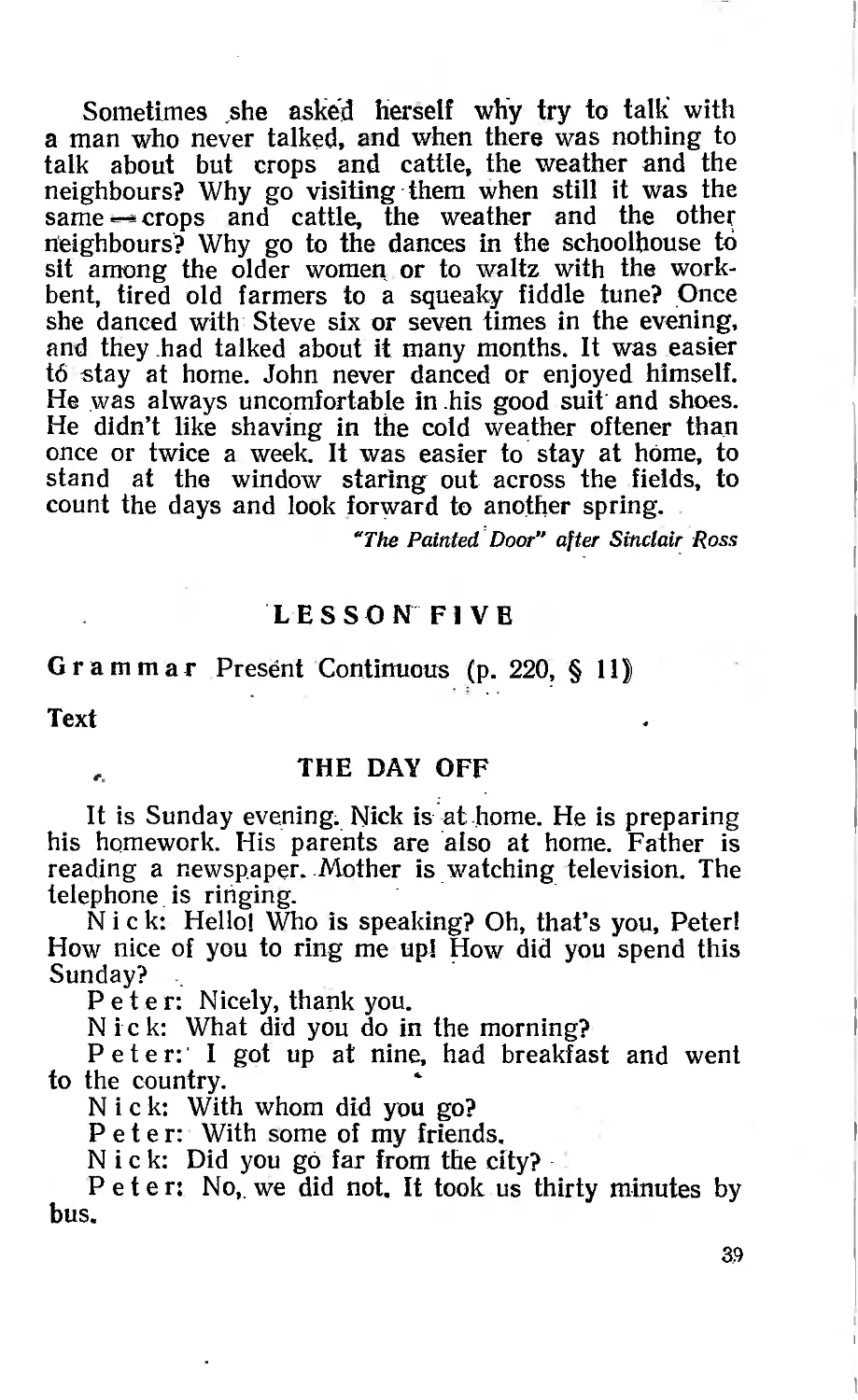
Sometimes she asked herself why try to talk' with
a man who never talked, and when there was nothing to
talk about but crops and cattle, the weather and the
neighbours? Why go visiting them when still it was the
samecrops and cattle, the weather and the other
neighbours? Why go to the dances in the schoolhouse to
sit among the older women or to waltz with the work-
bent, tired old farmers to a squeaky fiddle tune? Once
she danced with Steve six or seven times in the evening,
and they had talked about it many months. It was easier
t6 stay at home. John never danced or enjoyed himself.
He was always uncomfortable in his good suit and shoes.
He didn’t like shaving in the cold weather oftener than
once or twice a week. It was easier to stay at home, to
stand at the window staring out across the fields, to
count the days and look forward to another spring.
“The Painted Door” after Sinclair Ross
LESSON FIVE
Grammar Present Continuous (p. 220, § 11 j)
Text
THE DAY OFF
It is Sunday evening. Nick is at home. He is preparing
his homework. His parents are also at home. Father is
reading a newspaper. Mother is watching television. The
telephone is ringing.
Nick: Hello! Who is speaking? Oh, that’s you, Peter!
How nice of you to ring me up! How did you spend this
Sunday?
Peter: Nicely, thank you.
Nick: What did you do in the morning?
Peter: I got up at nine, had breakfast and went
to the country.
Nick: With whom did you go?
Peter: With some of my friends.
Nick: Did you go far from the city?
Peter: No,, we did not. It took us thirty minutes by
bus.
33
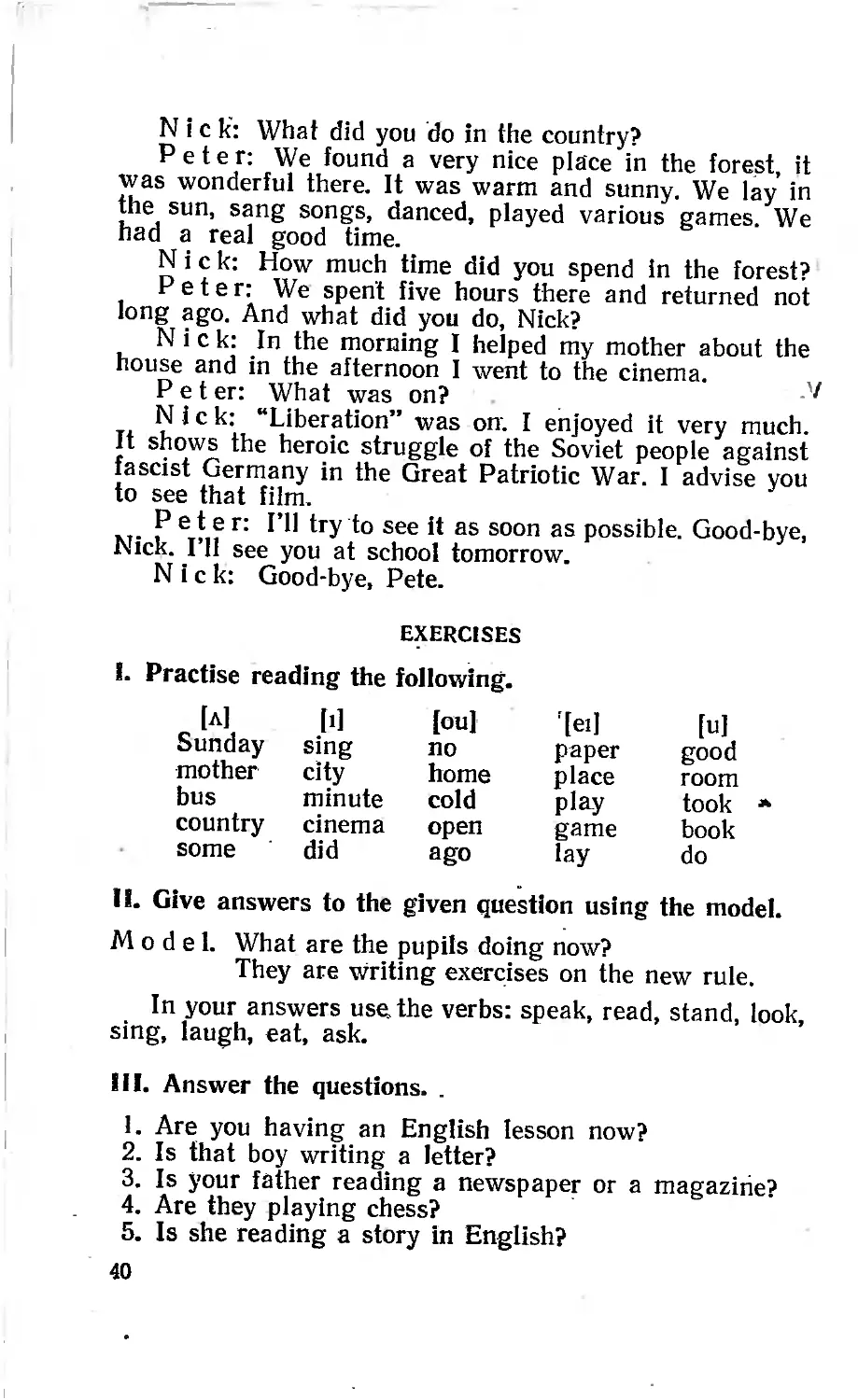
Nick: What did you do in the country?
Peter: We found a very nice place in the forest, it
was wonderful there. It was warm and sunny. We lay in
the sun, sang songs, danced, played various games. We
had a real good time.
Nick: How much time did you spend in the forest?
Peter: We spent five hours there and returned not
long ago. And what did you do, Nick?
Nick: In the morning I helped my mother about the
house and in the afternoon 1 went to the cinema.
P e t er: What was on?
Nick: “Liberation” was on. I enjoyed it very much.
It shows the heroic struggle of the Soviet people against
fascist Germany in the Great Patriotic War. I advise you
to see that film.
Peter: I’ll try to see it as soon as possible. Good-bye,
Nick. I’ll see you at school tomorrow.
Nick: Good-bye, Pete.
EXERCISES
1. Practise reading the following.
[Al	Ii]	[ou]	'[ei]	[u]
Sunday	sing	no	paper	good
mother	city	home	place	room
bus	minute	cold	play	took *
country	cinema	open	game	book
some	did	ago	lay	do
II. Give answers to the given question using the model.
Model. What are the pupils doing now?
They are writing exercises on the new rule.
In your answers use the verbs: speak, read, stand, look,
sing, laugh, eat, ask.
III. Answer the questions. .
1.	Are you having an English lesson now?
2.	Is that boy writing a letter?
3.	Is your father reading a newspaper or a magazine?
4.	Are they playing chess?
5.	Is she reading a story in English?
40
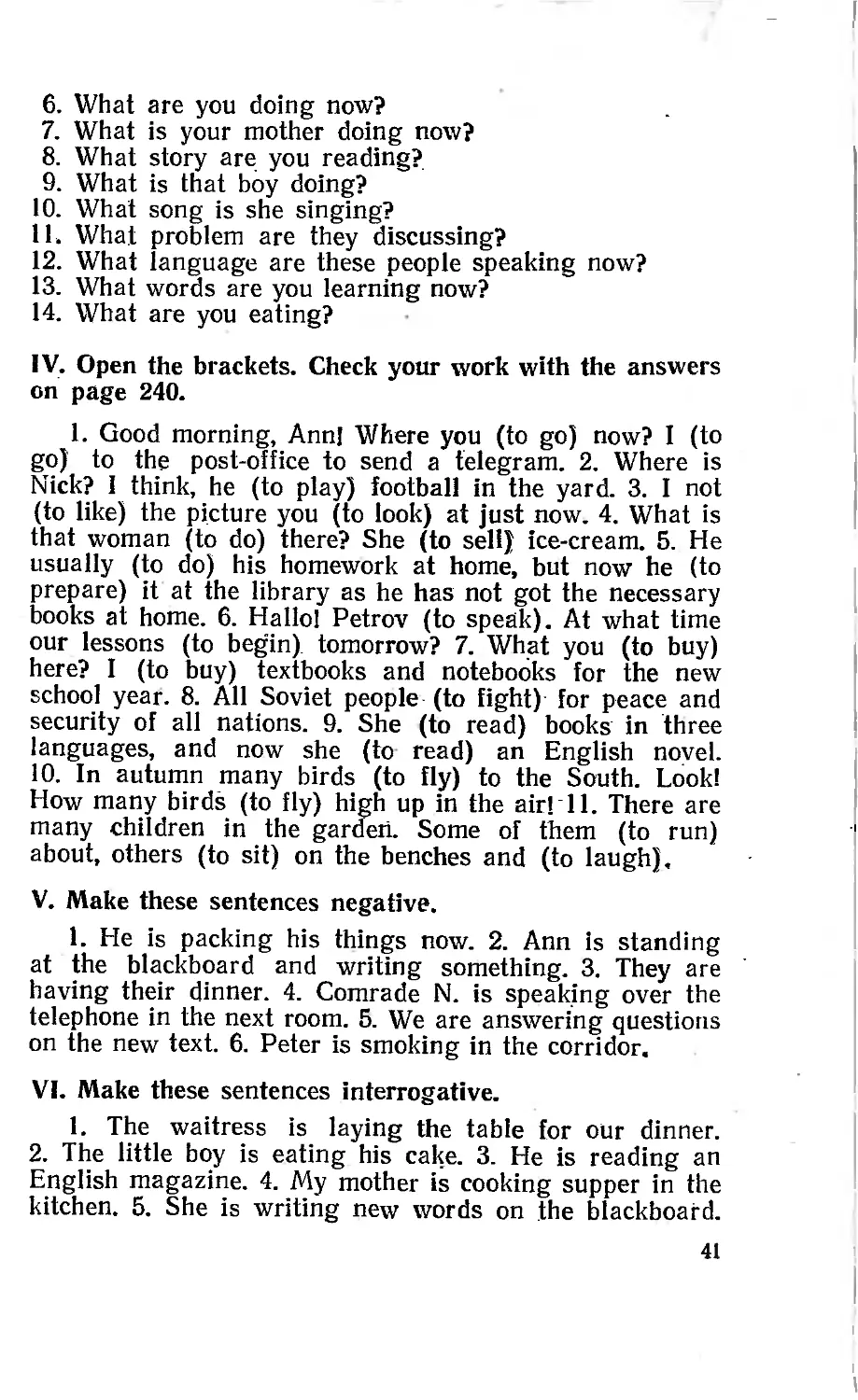
6.	What are you doing now?
7.	What is your mother doing now?
8.	What story are you reading?
9.	What is that boy doing?
10.	What song is she singing?
11.	What problem are they discussing?
12.	What language are these people speaking now?
13.	What words are you learning now?
14.	What are you eating?
IV.	Open the brackets. Check your work with the answers
on page 240.
1.	Good morning, Ann! Where you (to go) now? I (to
go) to the post-office to send a telegram. 2. Where is
Nick? 1 think, he (to play) football in the yard. 3. I not
(to like) the picture you (to look) at just now. 4. What is
that woman (to do) there? She (to sell) ice-cream. 5. He
usually (to do) his homework at home, but now he (to
prepare) it at the library as he has not got the necessary
books at home. 6. Hallo! Petrov (to speak). At what time
our lessons (to begin) tomorrow? 7. What you (to buy)
here? I (to buy) textbooks and notebooks for the new
school year. 8. All Soviet people (to fight) for peace and
security of all nations. 9. She (to read) books in three
languages, and now she (to read) an English novel.
10. In autumn many birds (to fly) to the South. Look!
How many birds (to fly) high up in the air! 11. There are
many children in the garden. Some of them (to run)
about, others (to sit) on the benches and (to laugh).
V.	Make these sentences negative.
1.	He is packing his things now. 2. Ann is standing
at the blackboard and writing something. 3. They are
having their dinner. 4. Comrade N. is speaking over the
telephone in the next room. 5. We are answering questions
on the new text. 6. Peter is smoking in the corridor.
VI.	Make these sentences interrogative.
1.	The waitress is laying the table for our dinner.
2. The little boy is eating his cake. 3. He is reading an
English magazine. 4. My mother is cooking supper in the
kitchen. 5. She is writing new words on the blackboard.
41
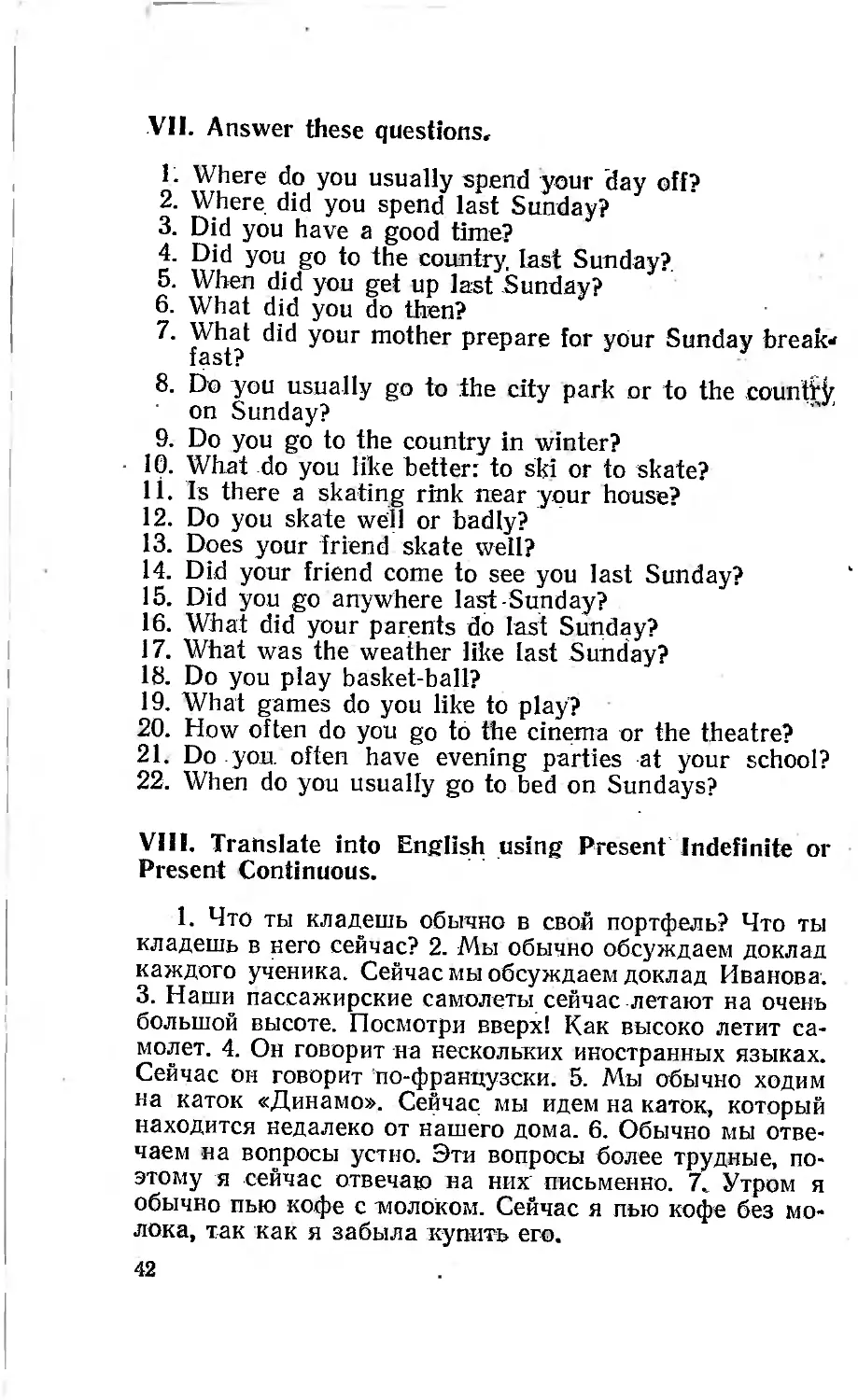
VII.	Answer these questions.
1.	Where do you usually spend your day off?
2.	Where did you spend last Sunday?
3.	Did you have a good time?
4.	Did you go to the country, last Sunday?
5.	When did you get up last Sunday?
6.	What did you do then?
7.	What did your mother prepare for your Sunday break-
fast?
8.	Do you usually go to the city park or to the county
on Sunday?
9.	Do you go to the country in winter?
10.	What do you like better: to ski or to skate?
11.	Is there a skating rink near your house?
12.	Do you skate well or badly?
13.	Does your friend skate well?
14.	Did your friend come to see you last Sunday?
15.	Did you go anywhere last-Sunday?
16.	What did your parents do last Sunday?
17.	What was the weather like last Sunday?
18.	Do you play basket-ball?
19.	What games do you like to play?
20.	How often do you go to the cinema or the theatre?
21.	Do you. often have evening parties at your school?
22.	When do you usually go to bed on Sundays?
VIII.	Translate into English using Present Indefinite or
Present Continuous.
1.	Что ты кладешь обычно в свой портфель? Что ты
кладешь в него сейчас? 2. Мы обычно обсуждаем доклад
каждого ученика. Сейчас мы обсуждаем доклад Иванова.
3. Наши пассажирские самолеты сейчас летают на очень
большой высоте. Посмотри вверх! Как высоко летит са-
молет. 4. Он говорит на нескольких иностранных языках.
Сейчас он говорит по-французски. 5. Мы обычно ходим
на каток «Динамо». Сейчас мы идем на каток, который
находится недалеко от нашего дома. 6. Обычно мы отве-
чаем на вопросы устно. Эти вопросы более трудные, по-
этому я сейчас отвечаю на них письменно. 7. Утром я
обычно пью кофе с молоком. Сейчас я пью кофе без мо-
лока, так как я забыла купить его.
42
IX.	Translate into English.
1.	О чем они беседуют? Я не могу понять, на каком
языке они говорят. 2. Они внимательно слушают учителя,
который рассказывает им о пионерах-партизанах Вели-
кой Отечественной войны нашего народа. 3. Аня, иди ско-
рее. Твоя подруга ждет тебя внизу. 4. Что ты пишешь?
Я пишу сочинение о романе Горького «Мать». 5. Где Петр?
Он в той комнате. А что он там делает? Он помогает свое-
му брату переводить английскую статью. 6. Что вы де-
лаете сейчас? Я преподаю физику в школе. 7. Ты ждешь
автобус или троллейбус? — Автобус. 8. Что он тебе по-
казывает? Он показывает книгу новых стихов поэтов
республики. 9. Он очень хорошо знает испанский язык
и учит меня ему. 10. Моя сестра окончила педагогиче-
ский институт в прошлом году и сейчас работает в школе.
X.	Speak on:
a)	how you spent last Sunday
b)	how your friend spent last Sunday
XL Translate using a dictionary.
One morning Mrs. Strickland sent me a note to say
that she was giving a dinner-party that evening. She
wrote: “If you will come I shall be grateful. And you
and I can have a little chat by ourselves?
It was the kind of party which makes you wonder
why the hostess has troubled to bid her guests, and why
the guests have troubled to come. There were ten people.
They met with indifference, and would part with relief.
The dining-room was inconveniently crowded. Everyone
talked a little louder than natural. But there was no
general conversation. Each one talked to his neighbour;
to his neighbour on the right during the soup, fish, and
entree; to his neighbour on the left during the roast, sweet,
and savoury. They talked of the political situation, and
of golf, of their children, of the weather and their plans
for the holidays. There was never a pause and the noise
grew louder. Mrs. Strickland might congratulate herself
that her party was a success. I thought no one was
concerned with me and I examined Strickland. He was
bigger than I expected, he was broad and heavy, with
43
targe hands and feet, and wore his evening clothes
clumsily. He was a man of forty, not good-looking, and
not yet ugly. His hair was reddish, cut very short, and
his eyes were small, blue or grey. He looked commonplace.
He was scarcely a credit to a woman who wanted to
make a position in the world of art and letters. He was
just a good, dull, honest, plain man. One would admire
his qualities, but avoid his company. He was probably
a worthy member of society, a good husband and father,
but there was no reason to waste one’s time over him.
 ,fJ.
LESSON SIX
Grammar Modal Verbs (p. 227 § 15}
Pronouns (personal, possessive, demonstra-
tive, interrogative, indefinite) (p. 203, § 4)
Text
AT THE ENGLISH LESSON
When our English teacher enters the classroom we
stand up. She says: “Good morningt” We answer: “Good
morning!” and sit down. First of all she asks the monitor
who is absent. Then she says: “Well, let’s begin our lesson.
To-day I want to discuss the words this, that, these,
those. We call these words demonstrative pronouns or
demonstrative adjectives according to their use. Peter,
what is the difference between this and that?
P. We use this when we want to refer to something
very near to us and that to something at a distance.
T. That is correct. Now, John, can you give me two
examples of this and that in a sentence?
J. This pen in my hand is green and that pen over
there on the table is brown.
T. Very good examples, John. Very clear. As the pen
is in your hand and near you, you use this, as the other
pen is at a distance from you, you use that. Now, what
is the difference between these and those?
J. These is the plural of this and those is the plural
of that and we use them with nouns in the plural.
44
T. Can you give me examples of these and those in
a sentence, Ann?
A. These pens in my hand are red, and those pens on
the table are brown.
T. Very good.
J. This and these sound the same to me. I cannot hear
the difference between them.
T. This is because you do not hear the difference be-
tween the sounds [i] and [1:], [sj and [z], say: it-eat,
fit-feet, sit-seat, this-these. This ends in [s] while these
ends in [z]. Now you will pronounce them correctly
yourself.
Now, let’s speak about the other pronouns. What kinds
of pronouns do you know, Kitty?
К- I know the personal pronouns, possessive pronouns,
interrogative pronouns, indefinite pronouns and negative
pronouns.
T. Can you name all the personal pronouns, Mary?
M. Certainly, I can. The personal pronouns in the
nominative case are: I, she, he, it,'we, you, they and in
the objective case they are: me, him, her, it, us, you,
them.
T. That’s correct. A very good answer. Now, can you
name all the possessive pronouns corresponding to the
personal pronouns, Victor?
V. Of course, they are: my, his, her, its, our, your,
their. If no noun follows, their forms are: mine, his, tiers,
its, ours, yours, theirs.
T. And the interrogative pronouns?
V. Who, whom, what, which.
T. Now, Bob, you will name the indefinite and negative
pronouns.
B. The indefinite pronouns are some, any, somebody,
anybody, something, anything, and the negative pronouns
are no, nothing, nobody.
T. Very good. Thank you. Well, children, for homework
you must study the pronouns we have revised to-day.
EXERCISES
I. Practise reading the following.
this word « these words, this sentence — these senten-
ces, this example *=- these examples, this verbthese
45
verbs, that noun those nouns, that pronoun—those
pronouns, that adjective — those adjectives, that adverb —•
those adverbs.
И. Write in the plural.
this boy, that teacher, this child, that classroom, this
sound, that shelf, this mistake, that dictionary, that box.
III.	Replace the nouns in bold type by the necessary
personal pronouns.
1.	The teacher always helps the pupils to translate
texts. 2. The boy gaye the dictionary to his friend.
3. Mother often sends John to buy milk. 4' Mary and John
spent the holiday in the South. 5. Pete broke the pen and
could not continue writing the exercises. 6. The girl will
visit the museum with her friend. 7. The students will
finish the experiments tomorrow. 8. Mary told her friends
about the trip to Leningrad.
IV.	Use the necessary pronouns.
1.	I saw (her, hers) son in the theatre yesterday.
2. Whose textbook is on the table? It is (my, mine).
3. Г have left (my, mine) dictionary at home. Can you
give me (your, yours)? 4. (Their, theirs) answers were
very good. 5. (Your, yours) flat is much better than (our,
ours). 6. Minsk is a very beautiful city. (It, its) streets
are wide and green. 7. (This, these) children will do
(their, theirs) exercises In written form. 8. Give me
(that, those) red pencil, please. 9. (This, these) magazines
are English and (that, those) magazines are French.
10. Whose books are (that, those)? Are they (my, mine)
or (your, yours) ?
V.	Translate Into English.
1.	Пошлите (ей, ему, им) телеграмму немедленно.
2. Вчера в парке я видела их со своими детьми. 3. Это
твой портфель? А где мой? 4. Я хорошо знаю его и его
сестру. 5. Он дал мне свой словарь и попросил вернуть
его завтра. 6. Мы выучили местоимения и теперь можем
перевести эти предложения без ошибок. 7. Подождите их
46
(меня, нас) внизу. 8. Их улица красивее нашей. 9. Моя
комната небольшая, но она светлая и теплая. 10. Мне
очень нравится ваше пальто. Сколько оно стоит? 11. На
нашей улице есть кинотеатр. Он самый большой в нашем
городе. 12. Позвоните ей (ему, нам, им) завтра.
VI.	Make up your own sentences using the given words:
(to ski, to jump, to swim, to skate, to speak English,
to play football, to sing songs).
Model 1:1 can play chess, but Г cannot play the piano.
Model 2: I could play chess when 1 was a boy of ten.
Model 3: I shall be able to play chess well soon, as I
practise it much.
VII.	Say the following sentences in a) past time, b) future
time.
1.	I can play football as my leg is better.
2.	They can finish their work soon.
3.	The pupils can read this text well.
4.	Nick can give you his dictionary.
VI11.	Say why you or your friend can (or could) do some-
thing.
Model 1:1 can go to the cinema in the evening because
1 am free.
Model 2: John could answer the teacher’s question
because he knew the material.
IX.	Say why you or your friend can’t (or couldn’t) do
something.
Model 1: I can’t lift this box because it is too heavy.
Model 2: Nick couldn’t play football because he hurt
his leg..
X.	Say what your friend will be able to do soon.
Mode 1: My friend will be able to speak Spanish soon,
because he lives with Cubans in the hostel.
47
XI.	Make up your own sentences according to the models.
Model 1: Pupils must stand up when the teacher comes
into the classroom.
Model 2: I had to prepare my breakfast myself yester-
day as my mother was away.
Model 3: We shall have to stay at school longer to-
morrow, because we shall make some experi-
ments in the laboratory.
XII.	Say these sentences in a) past time, b) future time.
1.	John must do shopping for the family.
2.	We must get up early.
3.	I must help my mother about the house.
4.	The children must go to school in the morning.
XIII.	Say what you or your mother must do, or had to do,
or will have to do:
a)	in the morning
b)	last night
c)	tomorrow evening
XIV.	Read these sentences and say where m a y expresses
a) permission, b) possibility.
1.	' If your homework is done, you may go for a walk.
2.	Put on your coat. It may be cold.
3.	May I use your dictionary?
4.	Readers may not borrow more than two books at a time
from the library.
5.	I advise you to take an umbrella. It may rain.
6.	You’d better hurry. You may be late for the train.
XV.	Answer these questions.
1.	Must the pupils speak English at the English lessons?
2.	Must you prepare your homework regularly?
3.	Will you be able to help me with my translation tomor-
row?
4.	Could you answer your teacher’s questions well?
5.	Can your brother swim?
6.	May I ask you a question?
48
7.	What can you see in the sky now?
8.	What can you send me from Moscow?
9.	Where did you have to go yesterday?
10.	When shall I be able to come to see you?
11.	How many English lessons can you have a week?
12.	What foreign languages could you study at your
school?
13.	Were you able to read English books last year without
using a dictionary?
14.	May you use your vocabulary notes when you write
•)n> a test paper?
15.	Will you be able to speak English well next year?
16.	At what time must you come to school?
17.	When must you get up in order to come to your lessons
in time?
18.	What must you do if you want to ask a question in
class?
19.	How many new words must you learn every day?
Table
Affirmative	Interrogative	Negative
He can send you something.	Can he send you anything?	He can send you noth- ing. He cannot send you anything.
You must ask some- body about it.	Must you ask any- body about it?	You must ask nobody about it. You must not ask any- body about it.
XVI.	Make these sentences interrogative.
1.	He can send something to you. 2. She will have to‘
see somebody in the evening. 3. The boy must explain some-
thing. 4. Mary was allowed to go out. 5. You may keep
my book for two days.
49
XVII.	Make these sentences negative.
1.	I can do this work in time. 2. I shall he able to see
somebody there. 3. John had to get up early yesterday.
4. He must send somebody for the doctor. 5. They can buy
something in this shop.	. ,
XVIII.	Insert something, anything, nothing, somebody,
anybody, nobody.
Г. I always invite ... to us on Sunday. 2. Can ...
answer my question? 3. ... may smoke here. 4. He told u^
... interesting. 5. You must not speak with ... at the les-
son. 6. Will you be able to see ... in the evening tomor-
row? 7. They could not understand ... . you said to them.
8. We can see ... because it is already dark. 9. ... was
looking for you an hour ago. 10. If you don’t understand
..., ask ... to help you. 11. If ... comes, tell him to wait,
I shall be at home soon. 12. Can ... in your class speak
two foreign languages? 13. Speak louder, please, we can
hear .... 14. You will have to buy ... for supper.
XIX.	Translate into English.
1.	Я ничего не вижу на доске, так как в комнате тем-
но. 2. Когда они кончат школу, они. смогут хорошо гово-
рить по-английски. 3. Я должен быть в школе в 8 часов
утра каждый день. 4. Дети должны слушаться своих ро-
дителей. 5. Ты должен сам чистить свои ботинки. 6. Дети
не должны играть со спичками. 7. Ты должен быть более
вежливым со своей матерью. 8. Сможет ли он перевести
эту статью без словаря? 9. Умеешь ли ты играть в волей-
бол? 10. Он скоро сможет плавать. 11. Умеет ли твоя ма-
ленькая сестра говорить? 12. Ты должен много читать
по-английски? 13. Я должен был кончить эту работу вче-
ра, но у меня не было времени. 14. Вы можете уехать из
Москвы через два дня. 15. Можно мне закрыть’.,окно?
Очень холодно в комнате. 16. Мой друг болен, и я должен
приходить к нему каждый день. 17. Вы можете оставить
свое пальто и шляпу здесь. 18. Он должен ходить на ра-
боту и с работы пешком. 19. Вы должны выучить это сти-
хотворение к понедельнику. 20. Она умеет управлять ма-
шиной? 21. Я не могла нигде купить книгу вчера. 22. Яне
смогу помочь вам завтра, я буду занята. 23. Можешь ли
50
ты видеть что-нибудь на этой карте? 24. Можешь ли ты
рассказать мне что-нибудь об этом фильме? Нет, я ничего
не могу рассказать вам о нем. 25. Вы должны делать
что-нибудь сейчас? 26. Вы могли поговорить с кем-нибудь
на эту тему? 27. Я ничего не смогу сделать завтра. 28. Он
может позвонить кому-нибудь? 29. Мог он ответить что-
нибудь на ваш вопрос? 30. Вы можете написать кому-ни-
будь в Москву и попросить прислать вам что-нибудь по
теме вашего доклада. 31. Мой приятель, возможно, не
придет. 32. Можно мне пригласить вас в театр? 33. Мы
должны обсудить этот, вопрос сейчас. 34. Должен ли я
пригласить еще кого-нибудь на наше собрание?
XX.	Read and translate using a dictionary.
THE FIRST DAY AT SCHOOL’
Michael gave a light nervous knock on the classroom
door, lifted the latch and entered. A woman with an oval
face turned, from the class of boys.
“I was sent here to you, Miss,” he said huskily. “I’m
new and my name is Michael M’Cloud. I’ll be older than
the others here.”
“Very well, Michael," she said. “Go and sit next to
James Higley.”
James, a cross-eyed boy, gave him a smile.
“Now, boys, take out your books for sums.”
Miss Twining gave Micky a new book, blotting paper
and a pen, and he shared an inkwell with James. Mul-
tiplication sums were chalked on the blackboard. “Now,
you may start,” said Miss Twining. The sums on the board
were very easy, but he had used a slate before and the
pen and ink felt complicated to him. “Put your name on
your book for a start,” said James. He nodded and took
up the pen in his thick fingers.
“Try to keep the knuckles down, Michael,” he heard
the teacher say, and then he felt her stooping down over
him. Her delicate hand took firm hold of his fist and be-
gan to guide his own shaky one along the paper. “Michael
M’Cloud” he wrote and a warm feeling of gratitude to
her filled him. A bell sounded in the corridor and the
boys stood up and marched in orderly manner from the
room.
51
After playtime they had drawing and Miss Twining,
said: “You will all draw from memory this morning, and
remember, I shall make an example of any boy I catch
using a rubber. Above all no talking and no copying.”
And with these words she went out of the classroom.
Most boys started drawing at once, whilst a few gazed
at the backs of other boys' hands, and others looked down
at their drawing books with faces screwed up, and others
bit their lips as they thought.
Micky looked down at the greyish naked sheet before
him...
A drawing from memory —he didn’t know what it
meant, but he had to do something and slowly he began
to draw the profile of a man. That was soon done, for
he was skilled at it. He decided to give the man a
moustache. The boy next to him picked up the drawing
and showed it around.
“Just, see what this chap’s done. He’s drawn a man’s
face.” Some boys laughed and others shook their heads
in pity. A boy on the front bench felt down in his pocket
and brought out a tiny red rubber.
“Here, quick, rub it out,” he said, “before the teacher
sees it.” Micky began to rub out the drawing, removing
at the same time all traces of the use of a rubber.
“But what have 1 to draw?” he asked.
“A tulip,” said the-boy next him.
“What’s that like?”
“One of them flowers toffs have in vases. At the top
they’re like an egg-cup.”
“Isn’t there something else?”
“No, nothing,” said another boy. “She’s crazy about
flowers.” Here the door opened and Miss Twining entered.
Micky bent down to his drawing.
Some minutes later the bell sounded in the corridor,
and the boys put down their pencils. A monitor came
round to collect the papers, and when he took Micky’s
he said: “What’s that — a cabbage?” And at his words
Micky suddenly became aware of the fact that when
drawing the tulip the image that had been in his mind
was a cabbage.
"One Small Boy" after B. Noughton
52
XXL Read and retell.
Jacob sat at his desk in school looking out of the
window at the prairie. The first day at school in Septem-
ber always seemed very long. It was nice to come back to
school again, to see the boys whom he hadn’t seen all
summer.
It was odd seeing the empty seats left by bigger pu-
pils who had gone to high school this year. It was fun
to see whether there were any new boys and girls at
school. Today there were two new girls and a little boy
who hadn’t said a word to anyone all day.
Jacob looked at the empty seat beside him. Carl wasn’t
at school on opening day and he wouldn’t come to school
until harvesting was over. Father had let him stay away
from school to help him with the harvesting.
The school was only a one-room school a mile from
the highway.
The schoolmaster, Mr. Reimer, was helping the younger
children with some of their letters. The older children
were studying. Mr. Reimer knew how to make everybody
work.
Mr. Reimer finished with the letters he was teaching
the small children and walked up to his desk at the front
of the room;
“Well, class,” he said, “today we have made a begin-
ning with our studies. I hope we shall work hard and
make progress this year. I think we may end now. Now
stand up.”
When Mr. Reimer said “Dismissed" Jacob hurried
outside.
The first day at school was over.
"Jacob’s Prairie Harvest” after Clare Bice
. LESSON SEVEN
Grammar Much, many, a lot of, (a) little, (a) few
‘ (p. 203, § 4)
The Imperative Mood (p; 226, § 14)
Text A
AIEALS
If you come to an English family in the morning, say,
between 6 and 9.30, you’ll hear one of these dialogues.
53
I
Anri. Is breakfast ready, Mum?
Mother. Yes, your porridge is waiting, dear. It’s
been on the table for ten minutes. It’s getting cold.
Hurry up or you’ll be late for school. Here is your mar-
malade and a cup of tea.
II
Mother. Will you have corn-flakes or rice crispies,
Peter?
Peter. I’ll have some rice crispies and an egg.
Mother. Would you litre your egg soft-boiled or
hard-boiled?
Peter. Soft-boiled.
For breakfast English people often have oatmeal por-
ridge with milk and sugar but never with meat. They
don’t eat much bread. They usually have toast. They
usually drink strong tea. They like to have it with milk.
At one o’clock English people have lunch. They have
lunch in a canteen, a snack-bar, a restaurant, or a cafe.
The schoolchildren have their lunch at school.
On a warm sunny day you can see people everywhere
where there is a tree or a bit of grass, sitting and eating
their sandwiches which they have taken from home. They
usually buy a mug of tea and a bun to go with them.
English people don’t eat much soup. Looking through
the menu you can find only one kind of soup on it, onion,
mushroom or tomato.
For the main course one can have fish, chops (pork or
mutton),, steak or roast beef with vegetables: carrots,
cabbage, beans, peas and potatoes (chipped, boiled).
Foreigners do not speak highly of English dinners.
The sameness makes them uninteresting. The boiled
vegetables — potatoes, cabbage and carrots--are watery
and tasteless.
For dessert one can have cheese and biscuits, apple
pie, plum pie, fruit or fruit salad and tea.
Five o’clock tea is a national habit. English people
drink strong tea with milk or without and often without
sugar.
54
At about seven or eight o’clock they have dinner or
supper. The evening meal consists of soup sometimes,
cooked meat and vegetables, macaroni and cheese, eggs
or tinned food (fish, meat) or whatever the people can
afford. They drink little coffee and much tea. The tea is
always good.
'PROVERBS
1.	After dinner sleep awhile, after supper walk a mile.
2.	Early to bed and early to rise makes a man healthy,
’ wealthy and wise.
3.	An apple a day keeps the doctor away.
EXERCISES
I. Practise reading the following.
a lot of bread
a lot of sugar
a lot of time
a lot of money
not much water
not much bread
not much time
not much money
how much sugar
how much money
how much time
for breakfast
for dinner
for supper
a lot of lemons
a lot of apples
a lot of people
a lot of books
not many forks
not many chairs
not many people
not many books
how many books
how many tables
how many people
after (before) lunch
after dinner
after supper
to have dinner
to have supper,
to have tea
II. Make up sentences using the models»
Model: 1. I have breakfast at eight o’clock.
2.	I don’t have breakfast at nine o’clock.
3.	At what time do you have breakfast?.
55
III. Make up sentences using the table.
some There is	n0. , , a lot of (only) a little	bread meat butter cheese sugar tea coffee honey milk	here.
There is not	any
		here?
Is there	much
IV.	Make up sentences using the models.
a)	There is a lot of butter on the table but not much
cheese.
Use these words: coffee, tea, white bread, brown bread,
cream, milk, meat, fish.
b)	There are a lot of apples here but not many pears.
Use these words: apricots, peaches, tangerines, plums,
tomatoes, cucumbers, potatoes, carrots.
V.	Make these sentences interrogative.
1. He is having lunch. 2. He always has lunch in the
canteen. 3. She'likes ice-cream. 4. He made himself a cup
of tea. 5. They usually have breakfast and supper at
home. 6. They had cold meat and tomatoes for supper.
7. She is making coffee. 8. -Her coffee is always good.
9. He was hungry. 10. You will make dinner.
VI. Fill in the blanks with much or a tot of. Check your
work with the answers on page 240.
1. Have we ... sugar? Yes, we have a lot of sugar.
2. We have not ... tea. 3. How much butter have we?
We have ... butter. 4. We have not... chalk. 5. He has ..,
work to do. 6. How ... money has he? 7. Has she .
money?
56
VII. Use much or many in each sentence. Check your
work with the answers on page 240.
1. I don’t drink ... milk. 2. There weren’t ... people at
the party last night. 3. Did you have ... trouble with the
homework today? 4. Did you spend ... time on your home-
work? 5. You have put too ... things in the bag. It’s too
heavy. 6. How ... did you pay for your new bag? 7. How
... students are there here? 8. She heard this'song ...
times. 9. We learn ... new English words every day. 10. I
read each new word in the lesson ... times. 11. He has not
... money. 12. Has she ... books?
VIII.	Use much or many after how In each of these sen-
tences. Check your work with the answers on page 240.
1.	How ... students are there in your English class?
2. How ... bread is there in the kitchen now? 3. How ...
letters do you write to your parents each week? 4. How
... sugar do you want? 5. How . .•. coffee did you drink
today? 6. How ... cups of coffee did you drink today?
7. How ... time do you spend on your homework? 8. How
.., English words do you know in all? 9. How ... money
have you?
IX.	Use too, too much or too many in the blank space in
each sentence. Check your work with the answers on
page 240.
1.	Mother put... cream and sugar in my coffee. 2. You
made ... mistakes. Learn the lesson again. 3. There are
... people in the room. It’s ... hot! 4. I drank ... coffee
and ate ... sandwiches yesterday. 5. The radio is ... loud
now. It’s making ... noise. 6. He ate ... ice cream. 7. She
made ... sandwiches. 8. That work took ... time. It was
... difficult.
X.	Make up sentences using the models.
I. a) I want some coffee, please.
b) I haven’t got any coffee. Would you like some tea
instead?
aj Yes, please, I’ll have some tea.
Use the words: tea, milk, soda-water, beer.
57
II. a) I want some bananas, please,
b) 1 haven’t got any bananas. Would you like some
apples instead?
a) Yes, please. I’ll have some apples.
Use the words: plums, oranges, pears, apricots, peaches.
XI.	Fill In the blanks with some, any, somebody, anybody,
nobody, something, anything.
1.	Have you got ... sweets?«Yes, I have a lotof
sweets. 2. Have you got ... coffee? — No, I haven’t. 3.1s
there ... butter on the table?No, there isn’t	Get
.... from the refrigerator. 4. ... is looking for you. He
is downstairs. 5. Can ... help me? 6. I don’t see ....
It’s dark here. 7. She is reading ... interesting. 8. Did
you invite ... to supper?
XII.	Answer the following questions.
1.	Where do you usually have your meals?
2.	What time is the canteen full of students?
3.	When do you have breakfast?
4.	What do you have for breakfast?
5.	Do you like your tea strong or weak?
6.	Do you take milk with your tea?
7.	When and where do you have dinner?
8.	What do you usually have for dinner?
9.	What kind of soup do you prefer?
10.	What do you usually have for the main course?
11.	What do you like.to have for dessert?
12.	What do English people usually have for beakfast,
lunch, dinner?
13.	Do we eat big breakfasts compared with people in
England?
14.	Do many people like light breakfasts?
15.	What kind of vegetables do you like?
16.	How do we lay the table for dinner, for supper?
17.	Do you usually prepare your meals yourself or does
your mother do it for you?
58
XIII.	Read and retell the story.
TEA
After George Mikes
The trouble with tea is that originally it was quite
a good drink. So a group of the most eminent British
scientists made complicated biological experiments to
find a way of spoiling it.
To the eternal glory of British science their labour bore
fruit. They suggested that if you do not drink it clear, or
with lemon or rum and sugar, but pour a few drops of
milk into it, and no sugar at all, the desired object is
achieved.
Once this refreshing aromatic, oriental beverage was
successfully transformed into colourless and tasteless wa-
ter, it suddenly became the national drink of Great Bri-
tain and Ireland *=* still retaining the high-sounding title
of tea.
There are some occasions when you must not refuse
a cup of tea, otherwise you are judged an exotic and bar-
barous bird without any hope of ever being able to take
your place in civilized society.
If you are invited to an English home, at five o’clock
in the morning you get a cup of tea. When you are dis-
turbed in your sweet morning sleep you must not say:
“Madame, I think you are a cruel and spiteful person who
deserves to be shot.” On the contrary, you have to say
with your best five o’clock smile: “Thank you so much. I do
love a cup of early morning tea, especially so early in the
morning.” If they leave you alone with the liquid, you may
pour it down the wash-basin.
. Then you have tea for breakfast; then you have tea at
eleven o’clock in the morning, then after lunch, then you
have tea for tea, then after supper,, and again at eleven
o’clock at night.
You must not refuse any additional cups of tea under
the following circumstances: if it is hot, if it is cold; if
you are tired; if you are nervous; if you are gay; before
you go out; if you are out; if you have just returned home;
if you feel like it; if you don’t feel like it; if you have had
no tea for some time; if you have just had a cup,
69
You definitely must not follow my example. I sleep ai
five o’clock in the morning; I have coffee for breakfast:
I drink innumerble cups of black coffee during the day.
Text В
MY BROTHER’S BIRTHDAY
Peter is my elder brother. He is seventeen today. He
is handsome and clever and everybody likes him very
much. He has invited his friends for supper. Everybody
is busy in the house. Everybody wishes him many happy
returns of the day. He has received nice presents. He is
happy.
Mother has asked us to help her to lay the table.
Mother. Will you help me to lay the table?
Peter. With pleasure. What can I do?
Mother. Cut the bread, please. Have you opened
those tins, Ann?
Ann. No, I haven’t. 1 couldn’t find the tin-opener.
Peter. I’ve seen it somewhere. (Looking for the tin-
opener) Here it is. And where are the tins?
Mother. Here they are.
Peter. I’ll open them. It’s my job, of course.
Ann. Shall I put the knives, forks and plates on the
table?
Mother. Please do.
Ann. And how many people have you invited f3r
supper?
Peter. Four.
A n n. Have you Invited Sasha?
Peter. Of course, I have. We’ve been friends for
five years.
Mother. Lay the table for nine people.
Ann. All right.
Peter. Have you put the flowers on the table, Ann?
Ann. No, I haven’t.
Peter. They are lovely. Where did you buy them?
Ann. At the florist’s.
Peter. 1 like roses very much. Have you seen Father’s
present, Ann? He has- given me a fishing rod.
Ann. No, I haven’t. I know it was your dream to.
have it.
60	'
Mother. I think it’s time to put all the dishes on
the table. Ann, take this salad and cold meat. And don’t
forget the tomatoes and mushrooms, the butter and cheese.
Peter. Shall I put sweets and fruit on the table
now, Mum?
Mo t h e r. Please do. I think everything is ready. The
guests will come soon. I’ll go and change.
Peter. Don’t hurry. We still have half an hour.
I.	Practise reading the following.
Pay attention to the stresses and intonation. Remember
that a command is normally spoken with Tune I. In order
to soften the command and change it into a kind of request
we use Tune II.
Read each, of the following commands with Tune I.
a) 'Give me a'pen. 'Send them a 'postcard. 'Do it a'gain.
'Put it 'down. 'Tell her not to be 'late. 'Put it 'on. 'Take
it 'off. 'Switch it 'on. 'Turn it 'off.
b)	'Help me. 'Tell her. 'Tell him. 'Stop him. 'Ask him. 'Ask
them. 'Answer me. 'Talk to him.
c)	'Tell him not to be 'late. 'Show him up to his 'room.
'Show me the 'way to the 'station.
II.	Change these commands into requests by using Tune II.
'Take it ,home. 'Open the ,window. 'Lend me your .pen.
'Meet me to,night. 'Don’t go a,way. 'Don’t be .late. 'Don’t
be a,fraid. 'Don’t be ,lazy. 'Write it ,down. 'Phone me to-
,morrow. 'Post the ,letter for me. 'Be ,quiet,
III.	Make these sentences negative.
Mode 1: Help me.
Don’t help me.
1.	Tell her about it. 2. Do it now. 3. Wake him up.
4. Wait for the bus. 5. Ring me up and meet me tonight.
6. Listen to his song. 7. Smoke here. 8. Leave it till
tomorrow.
IV.	Make up.sentences using the model.
Model: Buy her some flowers.
Let’s buy her some flowers.
61
1.	Listen to this text. 2. Answer this letter. 3. Wait
for him. 4. Find her. 5. Ask them about it. 6. Think it
over. 7. Travel by train. 8. Leave it till tomorrow.
V.	Change the sentences using the model.
Model: Ask you friend to help you.
Help me, please.
1.	Ask him to put down our address. 2. Ask her to
come at 5 o’clock. 3. Ask them to have it ready by 2 o’clock.
4. Ask her to wait for you. 5. Ask him to give you sorfle
English books. 6. Ask him to read it again. 7. Ask him
to switch on the light. 8. Ask him to switch on the radio.
9. Ask him to switch off the television set.
VI.	Learn the dialogues.
I.	A. What will you have, tea or coffee?
B. Coffee, please. And some cake as well, please.
A.	And what about a sandwich?
B.	No, thank you.
II.	A. Help yourself to the sweets. They are delicious,
aren’t they?
B. Yes, very tasty indeed.
A.	Have some more.
B.	No more, thank you. I’ve had enough.
III.	A. Pass me an apple, please.
B.	Here it is, or (Here you are}.
VII. Read the proverbs. Give their Russian equivalents.
1. Too many cooks spoil the broth. 2. Many men, many
minds. 3. Many wish but few will. 4. Much ado about
nothing. 5. The proof of the pudding is in the eating.
6. There is no smoke without fire.
VIII,	Read and retell this story.
Two Americans were travelling in Spain. One morning
they came into a little restaurant for lunch. They did not
know Spanish and their waiter did not know English.
They wanted him to understand that they wanted some
milk and sandwiches.
62
At first they pronounced the word “milk” many times.
Then they spelled it. But the waiter could not understand
them. At last one of them took a piece of paper and began
to draw a cow. He was finishing his drawing, when the
waiter looked at it and ran out of the restaurant.
“Do you see”, said one of the travellers, “what a pencil
can do for a man who has difficulties in a foreign
country?”
The waiter was back again soon,, but he brought no
milk. He put down in front of the two men two tickets
fop. a bull-fight.
IX.	Put in the question word at the beginning of the fol-
lowing sentences.
Use the words: why, where, when, who, what.
1.	... do you have dinner? — I have dinner in the
canteen. 2. ... do you usually have dinner?—-1 usually
have dinner at two o’clock. 3.. ... do you usually have
for dinner? — I usually have some soup, meat (fried or
roasted) with chipped potatoes and a cup.of coffee. 4. ...
do you do after dinner? —- I go to the reading hall. 5. .,.
do you have dinner in the canteen? — I have no time
to go home. 6. o.. can you have dinner at home? — I can
have dinner at home on Sundays. 7. ... is coming to the
canteen? — I am.
X.	Translate into Russian using a dictionary.
An acquaintance of mine who lives in England and
had never been outside it decided to go over to France
for a trip. When he returned, I asked him how he liked it.
“Terrible,” was his answer. “I couldn’t get a nice cup
of tea anywhere. Thank goodness I’m back.”
I asked him whether he hadn’t had any good food
while he was there.
“Oh, the dinners were all right,” he said. “I found
a little place where they made quite good fish and chips.
Not as good as ours, but they were passable. But the
breakfasts were terrible: no bacon or kippers or haddocks.
I had fried eggs and chips, but it was quite a business
getting them to make them. They expected me to eat
rolls. And when I asked for marmalade^ they brought
63
strawberry Jam. And do you know, they insisted that it
was marmalade?”
“But didn’t you eat any of the famous French food?”
“What? Me? Of course not! Give me good old English
food every time! None of these fancy bits for me!”
LESSON EIGHT
Grammar The Possessive Case (p. 201, § 2}
Text
SHOPPING
On Saturday Ann and Mary went to do their shopping.
I joined them with pleasure. We began our shopping at
the grocer’s.
I
AT THE GROCER’S
Shopkeeper. Good morning.
Ann. Good morning.
Shopkeeper. What can I do for you?
Ann. Let me see. Where is my list? Ah, here it is.
Shopkeeper. Good.
Ann. Now, I’d like.a pound of butter.
Shopkeeper. Yes. Anything else?
Ann. A pound of sugar.
Shopkeeper. Yes. Is that all?
Ann. And a packet of chocolate biscuits.
Shopkeeper. There we are. Anything else?
A n n. Oh, yes. Have you any bread?
Shopkeeper. Only brown.
Ann. I’ll take a loaf. That’s all.
Shopkeeper. Now, let me see. That’s nine shillings
altogether.
Ann. I’ve only got a note. Do you have change?
Shopkeeper. Yes, certainly.
Ann. Thank you very much.
64
II
AT THE GREENGROCER’S
A n n. I’ll have two lemons, a pound of potatoes and
a pound of tomatoes.
Mary. We’ll take lettuce, carrots, onions, oranges,
and cauliflower. I think that’s everything for today.
Shopkeeper. Thank you.
Ill
A n n. Where’s Mary gone?
Kate. She’s looking at something in the bookshop.
Ann. Just let me have a look at my shopping list.
I don’t think we’ve forgotten anything. We’ve been to
the fishmonger’s, the butcher’s, the grocer’s and the
baker’s. So we have finished our shopping. Come along,
Mary. It’s time to go home and have lunch.
Mary. Here comes the bus.
IV
AT THE DEPARTMENT STORE
Ann and Mary are standing outside a large department
store looking at the dresses displayed in the windows.
Ann. Oh, Mary! Isn’t that a nice dress in the window?
How do you think it would look on me?
Mary. It’s a lovely dress and it’s your colour. Let’s
go arid see whether they’ve got your size.
(They enter the shop.)
Ann. I should like to try on a blue dress. My size
is 46.
Shop assistant. Certainly. Come this way. The
fittipg-room is vacant.
Ann. 1 like the colour and the style very much.
Mary. It looks lovely on you.
Ann. Yes, it’s very nice. I’ll take it.
Mary. Look, Ann. There are very nice sweaters here.
Do you think that this'blue one will suit me?
Ann. Will it fit you? It’s too big for you, I think.
Mary. It’s a pity. I need a smaller size.
3. 2768
65
EXERCISES
I. Practise reading the following.
at the baker’s shop, at the butcher’s (shop), at the che-
mist’s (shop), at the grocer’s, at the greengrocer’s, at the
fishmonger’s.
II. Answer the following questions.
1.	Where did Mary and Ann go?
2.	What did Ann buy at the grocer’s?
3.	What can we buy at the grocer’s?
4.	What did Ann and Mary buy at the greengrocer’s?
5.	What can we buy at the greengrocer’s
6.	What did Ann buy at the chemist’s?
7.	Did they go to the butcher’s?
8.	What can we buy at the butcher’s?
9.	Did they go to the fishmonger’s?
10.	What can we buy at the fishmonger’s?
11.	What can we buy at the baker’s?
12.	Where do we'buy tea, coffee, sugar?
III. Read and' repeat each sentence twice (vzork in pairs).
A.	What do we buy at the baker’s?
B.	We buy bread (white and brown), buns, rolls, biscuits
and cakes at the baker’s.
A.	What do we buy at the butcher’s?
B.	We buy meat (beef, mutton, veal, pork, poultry), bacon,
ham, sausage, lard and chops at the butcher’s.
A.	What do we buy at the greengrocer’s?
B.	We buy potatoes, tomatoes, carrots, onions, cucumbers,
cabbage, lettuce, cauliflower, peas, oranges, lemons,
apples and pears there.
A.	What do we buy at the fishmonger’s?
B.	We buy fish (fresh, smoked, tinned), herring, cod,
salmon, haddock at the fishmonger’s.
IV.	Use the following in sentences of your own.
a tie, a shirt, trousers, socks, a raincoat, a scarf, nylon
stockings, a dress, a skirt, a jacket, a pair of gloves,
shoes for summer (winter) wear, to fit well, to suit.nicely,
ready-made clothes. How much is it? How much does it
cost? It’s rather cheap (expensive).
66
V,	Fill in the blanks with prepositions or adverbs where
necessary.
1. Let’s go ... that shop. I need a hat. Look ... that
hat. 2. Try it ..., I think it’s too big ... you. Don’t take it
It is not ... fashion. 3. ... Tuesdays she usually goes ...
the greengrocer’s. 4. We went ... the grocer’s and bought
a kilogram ... sugar and two packets .,. biscuits. 5. He
entered ... a shoe department. He wanted to buy a pair...
shoes ... everyday wear. 'He did not want to buy anything
expensive. He looked ... a cheaper pair ... shoes.
VI. Translate into Russian using a dictionary.
Nowhere in England is class distinction to be seen
more clearly than in the shops. On a large open corner
stands a store, the windows of which run for fifty yards
down one street and fifty down the other. We enter this
department store, and Kitty suggests that we visit the
food section. The first thing that strikes us is its compar-
ative emptiness. There are, indeed, two .or three people
at each counter. But no queues, no people in the centre
of the shop. The customers are much more expensively
dressed than Kitty.
It is true that this store has all that can be found in
every grocery: tea, oatmeal, spices, cocoa, bacon, ham,
butter, cheese and the rest.
“You needn’t be surprised if I don’t want to buy
anything here,” Kitty puts in. “This is all far above folk
like us.” “But you could buy your tea and rice and things
like that,” we suggest.
“Not me,” she says. “The tea and sugar and rice are
in special blends and packs, and cost a good deal more
than -1 pay?’
• We pass on into other departments. Expensive furs,
beautiful evening frocks and cloaks, shoes of every pattern,
but all priced high.
Kitty winks at us, and then goes up to a shop
assistant.
“Excuse me, can you tell me where I shall find warm
woollies for my husband?”
The shop assistant slowly looks Kitty up and down,
taking in her shoes slightly down at the heels, her neat
67
but inexpensive tweed winter coat, her little felt hat, and
answers, “I’m afraid you’ll find nothing to suit you here.'*
0. Bidwell "The British Scene” (Abridged)
VII. Translate into English.
1. Я покупаю продукты п магазине, который находит»
ся на первом этаже нашего дома. 2. Здесь можно купить
все продукты, кроме овощей. 3. Обычно я хожу в магазин
после работы. 4. Иногда я заказываю продукты по теле-
фону и вечером получаю их. А где вы покупаете хлеб? —
В булочной. 5. А где вы покупаете мясо, овощи? — В про-
довольственном магазине, который находится рядом с
нашим домом. В этом магазине можно купить мясо, пти-
иу, рыбу, молоко, сыр, масло, консервы. В магазине
есть овощной отдел, где можно купить овощи, фрукты.
ДИАЛОГ
А. — Сколько стоит коробка конфет?
В. — Два рубля 15 копеек.
А. — Дайте мне, пожалуйста, коробку конфет и торт.
В. — Пожалуйста.
А. — Сколько все это стоит?
В. — Пять рублей и тридцать пять копеек.
А. — Спасибо.
VIII. Translate into Russian paying attention to the
Possessive Case.
1. Yesterday I had supper at my friend’s. 2. He came
home after a month’s holiday in the Crimea. 3. Peter’s
best friends came to see him. 4. As it was Peter’s birthday
his friends brought him presents. 5. Peter liked his friends’
presents. 6. He liked his friends’ jokes very much. 7. Every-
body liked his wife’s songs very much. 8. Yesterday’s
meeting of the friends continued till late at night. 9. Mrs.
Sunbury’s first name was Beatrice. 10. Mr. Sunbury was
a clerk in a lawyer’s office. 11. “No one has ever had
a better son than our Herbert Hardly a day’s illness in
his life and he’s never given me a moment’s worry,”
said Mrs. Sunbury.
68
IX. Fill in the blanks with some, any, no, something,
anything, nothing, somebody, anybody, nobody, somewhere,
anywhere, nowhere.
1. Did you have ... lessons yesterday?No, we did
not have ... lessons yesterday. It was Sunday. 2. Have
you got ... questions? 3. Can you tell me ... interesting
about this exhibition? 4. Is there ... interesting there?
5. Give me ... to read. 6. There is ... on the table. 7. Do
you know ... in group twelve? 8. ... rang you up at
5 o’clock. 9. When I came back, there was ... in the room.
.10. I saw her ... but I don’t remember where. 11. Are
you doing ... this evening? 12. I’ve lost my gloves ...
and I can’t find them .... 13. I wanted to read that
book but I couldn’t find it ... . 14. If it rains, we shan’t
go ... . 15. We shall stay, at home and read ....
LESSON NINE
Grammar Past Continuous (p. 220, § 11}’
Text
ERIK’S SUMMER HOLIDAYS
(After Mitchell Wilson)
Professor Earle Fox was sitting in his office when the
door opened and he saw a. young man, about twenty-one,
who entered behind his secretary. Erik Gorin was a little
above middle, height and slender. He was wearing not
very good clothes. He had dark living eyes and straight
black hair.
“Mr. Gorin,” said the secretary.
Fox rose to shake hands, and then asked the young
man to sit down.
“We’re very glad to have you here, Mr. Gorin,” he
said gently. “This year we’ve taken only one assistant.
You’ve come with excellent recommendations and you’ll
have every opportunity to live up to them.”
“Did you have a pleasant summer, Mr. Gorin?”
“A pleasant summer?” Erik was silent for the time
of two long breaths.
69
“No, sir,” he said.
“What did you say?” Fox asked out of surprise.
“I said that the summer was pretty awful,” said Erik
once more. “All I can say is I’m glad it’s over,” Erik
went on.
“You see I was absolutely broke when Professor Hol-
lingworth told me that I had got the appointment here.
I won’t even tell you what that meant to me«to study
physics at Columbia. He asked me to spend the summer
with him and his family. But I couldn’t see myself spong-
ing on him for all that time, so I stayed there for two
weeks. It was wonderful there. But at the end of two
weeks, I left them saying I was coming East to visit
a cousin. I don’t have any cousin, but I got on the train
because the whole Hollingworth family came down to
the station to see me off. On the train 1 bought a ticket
for the next town. I got out there and took a lift on the
highway. This fellow was driving his car to Cleveland
to sell it there. He loved the car, because you see he had
saved so long to buy it. He was sad all the way and told
me over and over how he had fixed this part and repaired
that one. But he was out of a job and had to sell the
car. When we stopped, for gas, I got into conversation
with the owner of the station. He offered me a job for
a place to eat and sleep. I was supposed to help him in
repairs and service. One day I went into town and a
fellow stopped me. He was almost crazy because he said
I had taken his job. He used to make thirty a week and I
was doing the work for practically nothing. He was mar-
ried and had a family, so I moved on. 1 don’t know
whether he ever got the job back, but 1 know I didn’t
want it any more.
Then I was washing dishes for a while in a cafd, and
when I got to New York, I came up here at once but you
were still away on your vacation. For two weeks until
yesterday I worked in a bathhouse at an open air pool.
I used to laugh all the time because it was so funny.”,
“Funny?”
“No matter what was happening, no matter what kind
of crazy job 1 had, I used to say to myself, I’m really
a physicist. I can call myself a physicist, can’t I?”
“You are a physicist,” said Foxt
70
EXERCISES
I.	Make these sentences interrogative.
1.	Erik was a physicist. 2. He was a young man. 3. He
was twenty-one. 4. He was working at an open air pool.
5. The fellow was driving his car to sell it. 6. He came
with excellent recommendations. 7. He wanted to study
physics at Columbia University. 8. He was absolutely
broke. 9. He earned his living working in a bathhouse.
10. At the service station he was offered a job for a place
to eat and sleep. 12. Erik wanted to study very much.
13. His dream was to study physics.
II.	Read and translate these examples.
1.	I used to say to myself, “I’m really a physicist.”
2. He used to laugh all the time because it was so funny.
3. He used to make thirty a week and I was doing the
work for practically nothing. 4. He used to swim in this
river when he was a boy. 5. He used to get up very early
when he lived in the country. 6. My mother is not used to
the noise and busy traffic of Moscow. 7. If you go to
England by car, you will have to get used to driving on
the left side of the road.
III.	Give the principal forms of the verbs.
to rise, to shake, to sit, to come, to spend, to mean,
to breathe, to tell, to see, to stay, to get, to take, to buy,
to save, to fix, to sleep, to eat, to move, to wash, to
laugh, to call, to drive, to sell, to know, to leave, to stop,
to use, to marry, to happen.
IV.	Make up sentences of your own using the following.
to get to the station, to find the carriage, luggage,
a lower berth, to get on a train, to see off, on the plat-
form, at the station, to meet, to get out, to change trains.
V,	Change the following statements to questions begin-
ning with the question words given.
!.• The fellow was driving his car to Cleveland to sell
it (who, where). 2. He was talking with Erik about the
car (who, what). 3. The owner of the station offered Erik
71
a job for a place to eat and sleep (what, who). 4. Erik
worked in a bathhouse at an open-air pool (who, where).
5. She was watching a kettle beginning to boil. (what).
6. Over my tea 1 was reading the local evening paper,
'(when, what). 7. As Peter and I were having breakfast,
the telephone rang (when). 8. We were sitting under a
weeping willow on the river bank, when our friends joined
us (who, where). 9. I bathed with them in the river and
learned to swim (who). lO.When we came out of the water
we lay on the grass (what). 11. We spent days in the
fields and hills (where). 12. We climbed the highest hills
(what). 13. Tired but happy we returned home (how,
where). 14. We felt well after a month’s holiday (how).
VI.	Write the correct form of each verb in brackets. Use
only the Past Indefinite Tense or the Past Continuous
Tense. Check your work with the answers on page 240.
1. My friend (to talk) to Professor Ivanov, when I (to
see) him. 2. When the students (to hear) the bell, they
(to get up) and (to leave). 3. The two men (to discuss)
something, when we (to interrupt) them. 4. The girl (to
fall) and (to hurt) herself while she (to ride) her bicycle.
5. We were (to leave, just) the house when the telephone
(to ring). 6. I haven’t seen her at all since she (to move)
to her new flat. 7. He (to sit) in a caf6 when I (to see)
him. 8, When I (to go) out, the sun (to shine). 9. While
she (to play) the piano I (to write) a letter. 10. When the
phone (to ring), we (to have) dinner. 11. She (to go) to
the plant when I (to meet) her. 12. He (to watch) TV
when I (to come) to see him. 13. She (to wait) for her
friend when I (to see) her. 14. When I (to look) out of the
window, I (to see) that it (to rain) hard and people (to
hurry) along the streets.
VII. Answer these questions. '
1.	What was-Fox? 2. What was Erik? 3. Did Erik have
a pleasant summer? 4. With whom did he stay for two
weeks? 5. Why did he leave them? 6. What did he tell
them? 7. Why didn’t he tell them the truth? 8. Why did
he get on the train? 9. Who gave him a lift? 10. Why
was the man sad? 11. What were they talking about?
72
12. What was Erik’s first job? 13. Did he get much for
his job? 14. Why did he leave the job? 15. What other
jobs did he try until he came to the Physics Department?
VIII.	Characterize Erik using the words given below.
slender, a little above middle height, dark living eyes,
straight black hair, shy, clever, to have, a lot of trouble,
to be poor, to earn one’s living.
IX.	Describe Erik’s summer.
X.	Say what you usually do during your summer holidays.
XI.	Read the dialogue.
A.	What were you doing yesterday morning?
B.	I was reading a book.
A.	And what about your sister?
B.	She was cooking breakfast. Why do you ask me?
A.	I rang you up but the line was busy.
B.	No, it was not. The telephone was out of order.
A.	Have you made any plans for Sunday?
B.	Not yet, we haven’t decided yet.
A.	Let’s go to the river. We can go fishing.
B.	That’s a splendid idea.
A.	And what is your sister going to do?
B.	She is going to stay at home, I think.
A.	Isn’t she going to the beach? The day will be hot.
It will be nice to go boating. Let’s go together,
B.	All right. When shall we meet?
A.	At 10 sharp.
B.	Good-bye!
A. Good-bye!
XII.	Make up dialogues of your own.
Model: a) Were you busy last night? (yesterday morn-
ing, yesterday evening, yesterday afternoon,
Monday morning}
b) Yes, I was. I was preparing for the examin-
ation. And what about you?
A. I was watching television, (cooking, shopping, sight-
seeing, listening to the radio, playing the piano)
73
XIII.	Translate into English.
1.	Летом в хорошую погоду мы обычно проводим вос-
кресенье за городом.'2. Мы встречаемся на вокзале в де-
вять часов утра, берем билеты и садимся в поезд. 3. В ва-
гоне много молодежи и всегда шумно и весело. 4. Вскоре
мы выходим на небольшой станции. 5. Мы идем к речке.
6. На берегу речки мы останавливаемся. 7. Здесь мы про-
водим весь день. 8. Мы купаемся, ловим рыбу, загораем,
играем в волейбол. 9. Вечером мы возвращаемся в город.
XIV.	Translate into Russian using a dictionary.
It was pleasant in the sun. It was pleasant to walk
by myself round the campus. The students were dressed
differently from those I used to know: young men and
girls in jeans, long hair,.the girls’ faces unpainted and
pale. Transistor radios hung from a good many wrists.
I stretched myself on the grass, not far from such
a group. The conversation, however, as much as I could
catch, was not amorous but anxious. They nearly all
carried examination papers with .them. This was the time
of their finals.
Dress changed; social manners changed; but examina-
tions did not change. These boys and girls they must
have been about twenty-one, but they looked younger*—<
were at least as obsessed as any of us used to be. They
had another paper next morning. One girl was saying
that she must shut herself up that night, she needed to
put in hours and hours of work. Wrong, I wanted to
sayt real examinees didn’t behave like that. They don’t
look at a book, don’t even talk about it-But I kept quiet.
С. P. Snow "The Sleep of Reason” (Abridged)
LESSON TEN
Grammar Complex Object (p. 228, 229, §§ 16, 17)
Future Continuous (p. 220, § 11)
ТГ ext
TRAVELLING
Thousands of people spend their holidays travelling.
They travel by train, bus, motorcycle or in their own car.
They go cruising on the Volga, the Dnieper, the Angara,
74
the Yenisei and the Black Sea. They hike in the dense
forests of Siberia and along the Georgian Military High-
way, one of the best mountain roads of the Central
Caucasus. They climb the famous peaks of the Caucasian
mountains *— Elbrus and Kazbek. They enjoy the beauty
of snow-covered mountains and blue glaciers, of sunny
valleys and vast forests.
A lot of people travel in their own cars along the
roads of Lithuania, Byelorussia and Moldavia. Beautiful
pine forests and silvery birches, picturesque rivers and
numerous lakes attract lovers of nature.
They travel not only to enjoy picturesque places, but
also to see ancient monuments and other places of cul-
tural and historical interest.
Hiking is becoming very popular. People like to spend
their days off in the country. There are picturesque places
with forests, lakes and rivers near every town. It is
pleasant to spend a day chatting, joking and singing with
friends on a river bank, a lakeshore or round a campfire in
a forest, having a good time and a good rest. Happy, they
return home to plan new hikes for the coming weekend.
Travelling by air has some advantages of course. ТГ'
is convenient and much quicker.
Before you get on board the plane you have your
luggage registered. It is weighed and labelled. You do
not take your luggage with you, only a small bag, perhaps.
Before the flight you can watch the planes taking off and
landing.
Then you hear your flight announced and the pas-
 sengers are invited to board the plane and take their
seats. The stewardess greets the passengers and shows
them to their seats. When the plane takes off, she gives
the passengers all the information about the flight, about
the speed and the altitude at which the plane will be
flying. She asks the passengers to fasten their seat belts
and not to smoke when the plane takes off. Then she
offers them some mineral water, lemonade and
sweets.
During the flight the passengers do whatever they like.
Some of them read, others sleep or chat or, loqking out,
enjoy the beautiful scenes. Occasionally the plane sways
very gently up and down or from side to side, giving the
scene a strangely unreal quality. You watch fascinated.
75
Sometimes you can see the land below. It looks like
a topographical map. You reach your destination in a few
hours and realize all the advantages of travelling by air.
EXERCISES
I. Practise reading the following.
[as]	[к]	[ai]	[ai]	[a:]
camp	speed	pine	light	park
land	greet	hike	flight	part
bank	peak	side	night	far
plan	seat	like	fight	mark
happy	reach	mile	sight	art
II. Make verbs from each of the following nbuns.
traveller, hunter, swimmer, player, driver, flier, writer,
painter, teacher, organizer, speaker, leader, actor, visitor,
translator, sailor
III. Answer these questions.
1.	Do many people spend their holidays travelling?
2.	What means of travelling do you know?
3.	Is travelling becoming more popular?
4.	Hiking is very popular among young people, isn’t it?
5.	Have you ever climbed the Caucasian mountains?
6.	A lot of people hike along the Georgian Military
Highway, don’t they?
7.	Where do they travel by car?
8.	What places of interest do they want to see?
 9. Do you often go hiking?
HO. To what places do you usually go?
' 11. In what way do you usually spend your free time?
*'12. Have you ever travelled by air?
13.	What are the advantages of travelling by plane?
14.	What information does a. stewardess give you on board
a plane?
15.	When do passengers have their luggage registered?
16.	Is there any limit for luggage?
17.	Must you pay for excess luggage?	’
18.	What refreshments can you get on board a plane?
19.	What do passengers do during the flight?
76
20.	What does the ground look like from a plane?
21.	At what altitude and speed do jet planes fly?
22“ They often fly high above the clouds, don’t they?
23.	Travelling by air is the quickest means of travelling,
isn’t it?
IV.	Change the following statements to questions begin-
ning with the question words given.
1.	My friend is fond of hiking, (who). 2. He often goes
hiking in spring and summer, (when) 3. He is fond of
fishing, (what) 4. He leaves town at daybreak and returns
home late, (when) 5. In winter he spends hours on end
near ice holes, (where) 6. Sometimes he has a good catch,
(what) 7. Last year during my winter vacation I travell-
ed by train, (when, how) 8. I looked forward to seeing
many interesting places, (who, what) 9. We had an oppor-
tunity to visit several towns, (what, how many) 10. We
spent five days in Riga, (how many)
V.	Translate into Russian paying attention to the Complex
Object.
1. They heard their flight announced. 2. We watched
the planes taking off and landing. 3. -I had my luggage
weighed. 4. He had his luggage registered half an hour
ago. 5. I had my radio-set repaired. 6. We had our car
repaired. 7. I had my coat made a year ago. 8. I watched
him packing his luggage. 9. I saw him waiting for a taxi.
10. I saw her crossing the street. II. I must have my
hair cut. 12. I must have a new dress made. 13. She wants
her friends to see Khatyn, an unusual memorial to 136 vil-
lages which were burnt down together with their people
by the fascists in Byelorussia during the Second World
War.
VI. Make up sentences using the models.
a)	I watched the train leaving the station.
Use the words: taxi, bus, car.
b)	I watched them make a bonfire.
Use the words: to unpack the sandwiches, to fish, to
bathe, to play volley-ball, to play chess.
с)	I saw him working.
77,
Use the words: to wait for somebody, to walk in the
park, to pack the things, to stop a taxi, to drive his car,
to wash his car, to stand at the bus stop.
Text В
OLD COUNTRY ADVICE
TO THE AMERICAN TRAVELLER
. (After W. Saroyan)
One day my Uncle Melik travelled from Fresno to
New York. Before he got aboard the train his Uncle Garro
paid him a visit and told him about the dangers of travel.
“When you get on the train,” the old man said, “choose
your seat carefully, sit down and do not look about.”
“Yes, sir,” my un.cle said.
“Several moments after the train begins to move,”
the old man said, “two men wearing uniforms will come
down the aisle and ask you for your ticket. Ignore them.
They will be impostors."
“Before you have travelled twenty miles an amiable
young man will come to you and offer you a cigarette,
Tell him you do not smoke. The cigarette will be doped.”
“Yes, sir,” my uncle said.
“On- your way to the diner a very beautiful young
woman will run into you on purpose and almost embrace
you,” the old man said.
“She will be extremely apologetic and attractive, and
your natural wish will be to become friends with her.
Don't do this, go into the diner and eat. The woman will
be. an adventuress.”
“If she speaks, pretend to be deaf. That is the only
way out of it. I have travelled. I know what I’m talking
about.”
“On your way back to your seat from the diner,” the
old man said, “you will pass through the smoker. There
you will find a game of cards in progress. The players
will be three middle-aged men with expensive-looking
rings on their fingers. They will nod at you pleasantly
and one of them will invite you to join the game. Tell
them you don’t speak English.”	y
“Yes, sir,” my uncle said.
“That is all,” the old man said<
78
“One thing more,” the old man said. “When you go
to bed at. night, take your money out of your pocket
and put it in your shoe. Put your shoe under the pillow,
keep your head on the pillow all night, and don’t sleep.1'
“Yes, sir,” my uncle said.
The old man went away and the next day my Uncle
Melik got aboard the train and went to New York. The
two men in uniforms-were not impostors, the young man
with the doped cigarettes did not appear, the beautiful
young woman did not sit at his table in the diner, and
there was no card game in progress in the smoker. My
uncle put his money in the shoe and put his shoe under
the pillow and didn’t sleep all night the first night, but
the second night he abandoned the whole ritual.
The second day he himself offered another young man
a cigarette which the other man accepted. In the diner
my uncle went to sit at a table with a young lady. He
started a poker game in the smoker, and long before the
train got to New York my uncle knew everybody aboard
the train and everybody knew him.
While the train was travelling through Ohio, my uncle,
the young man who had accepted the cigarette, and two
young ladies sang American songs together.
The journey was a very pleasant one.
EXERCISES
I.	Answer the following questions.
1.	Who travelled from Fresno to New York?
2.	Who paid Uncle Melik a visit?
3.	What did he tell Uncle Melik?
4.	What did he advise him to do in the train?
5.	Did Uncle Melik follow the advice of his Uncle Garro?
6.	Where did Uncle Melik put his money?
7.	Did he sleep the first night?
8.	What did Uncle Melik do on the second day?
9.	Was his journey pleasant?
10.	-When did you last travel by railway?
11.	Did you have much luggage with you?
12.	Who helped you to carry the luggage?
13.	Do you prefer a lower or an upper berth?.
14.	Was the train crowded?.
79
15.	What kind of train was it?
16.	Do people like to change trains?
17.	Why do people usually avoid changing trains?
II.	Translate the following word combinations into
Russian.
A pleasant-looking man, a middle-aged man, a good-
looking girl, a grey-haired woman, a dark-eyed woman,
a well-read person, a highly-educated person, a well-
known writer, a two-roomed flat, a broad-shouldered man,
a dolt-faced girl.
III.	Describe your trip by train to some place. Use the
following words and expressions.
to buy tickets, to see smb. off, to pack the things,
time-table, light (heavy) luggage, to leave one’s luggage
at the left-luggage office, luggage receipt, express, (mail,
passenger) train, to change trains, carriage, compartment,
upper (lower) berth, bedding, dining-car, to meet smb.
at the station, on the platform, porter, waiting-room, to
leave for, to arrive at (in).
IV.	Describe your trip by air.
Use the following words and expressions:
at the airport, jet-liner, passengers, on board the air
liner, stewardess, no smoking, to fasten one’s seat belU. to
take off, to fly at an altitude of, to be above the clouds,
to have a snack, to land, to enjoy the 'trip.
V.	Retell the text.
a)	as it is.
b)	in the person of Uncle Melik
VI.	Learn the dialogue.
CATCHING THE TRAIN
Mr. Parker. We shall have to hurry if we’re going
to catch that train. What’s Robert doing?.
80
Mrs. Parker. Robert’s gone on to the station
with some of the luggage. He’s meeting us on the plat-
form.
Mr. Parker. Don’t pack that book, Peter. You’ll be
wanting it in the train.
Peter. Oh, yes, so I shall, Dad.
Mrs. Parker. I wonder whether I ought to have
cut some sandwiches.
Mr. Parker. No, we shall be stopping ten minutes
at the junction. We shall be able to buy something to
eat there. You’ll have to carry this case, Peter.
Mrs. Parker. He can’t because he’ll be carrying my
hatbox besides his own case.
Mr. Parker. It’s going to be a lovely day. Are we
all ready?
Peter. I’m ready. I’m waiting for you.
Mrs. Parker. Have you turned off the gas and
electricity, Harry?
Mr. Parker. I’ll just make sure, dear.
Mrs. Parker. Otherwise they’ll be sending us bills
for the time we’re away.
Mr. Parker. Yes, it’s all done. Come along now.
Shut the door behind you, Peter.
VII.	Use only the Future Continuous Tense in each
sentence.
1. We (to wait) for you when you get back tomorrow.
2. I (to wait) for you right here when you come out of the
building. 3. Don’t ring me up at 5 o’clock. I (to work) in
the laboratory, 4. The sky is dark. It (to rain) by the time
we are ready to leave. 5, At this time tomorrow we (to
drive) to Leningrad. 6. My sister (to wait) for your tele-
phone call at seven o’clock.
VIII.	Write the correct form of each verb in brackets.
Choose between the Future Indefinite Tense and Future
Continuous Tense. Check your work with the answers on
page 240.
1.	When you come home, .1 (to do) my lessons. 2. We
(to arrive) in Moscow in the morning. 3. They (to live)
in their new house when you come. 4. When you return,
st
I (to pack, still) my suitcase. 5. We (to wait) for you
right here when you return at 6 p.m. 6. We (to send) you
a telegram as soon as we arrive in Sochi. 7. We (to wait)
for you at the corner until you come with the car. 8. We
(not to start) dinner until everyone gets here. 9. He (to
give) her your message when he sees her. 10. I (to speak)
to him as soon as he is free. 11. We (to wait) for you in
front of the theatre at a quarter past seven.
IX.	Translate into Russian.
“It’s lovely to think that the* holidays have started.
This time tomorrow I shall be flying home. What will
you be doing, Peter?”
“I’ll be repairing my motorcycle.”
“It’s a pity that you’ll be working.”
“Why do you ask me?”
“I wanted you to teach my sister to drive a motor-
cycle.”
“Sorry, I’m leaving for the Caucasus in two days.”
X.	Translate into Russian using a dictionary.
Our train was already waiting on the platform. We
came early to be sure of a seat. These trains are pretty
crowded. The compartment of the carriage is comfortable.
Leaving a coat and a bag to reserve, our chosen seats,
we walked down the train. Some of the people were
reading magazines, newspapers and novels, others were
eating, sandwiches and buns.
Our train was a fast train. Trains which stop at all,
or nearly all stations on their route are called slow. Almost
all British trains are named like ships,.
Soon the train started. Looking out of the window of
our compartment we saw hedges gay with hawthorn roses,
fields and meadows, beautiful gardens, trim lawns and
bridges. We saw roads along which red and green buses
carry passengers from village to village; we saw lorries and
motorcycles taking gay young people to meadow picnics
or seaside camps; ordinary bicycles carrying men and girls
to and from their work; hikers with rucksacks on their
backs.
82
XI.	Translate into English.
1.	Я люблю путешествовать. 2. Мне нравится видеть
новые места, знакомиться с новыми людьми. 3. Я люблю
путешествовать налегке. 4. Я не люблю упаковывать ве-
щи в спешке. 5. Я прихожу на вокзал за 10—15 минут до
отправления поезда; 6. Я не люблю пересадок. 7. Я люб-
лю встречать друзей. 8. Я провожу вас в аэропорт. 9. Мы
должны быть в аэропорту за полчаса до отправления са-
молета. 10. Мы возьмем такси, чтобы успеть вовремя.
LESSON ELEVEN
Grammar Present Perfect (p. 222, § 12])
Text A
A VISIT TO MOSCOW
Ann and Peter came to Moscow during their summer
vacation. They stayed at their uncle’s place. Lena, their
cousin, a student of the Moscow University, decided to
show them the city and its places of interest. Ann and
Peter wanted to see as much as they could.
Lena. What shall we do now?
Peter. We haven’t seen the Exhibition of Economic
Achievements of . the USSR.
Ann. And we haven’t seen the Tretyakov Gallery yet,
have we?
Peter. No, we haven’t. Let’s go there now,
Lena. Oh, but wait a minute.
A n n. What’s the matter?
Lena. It’s Sunday today, isn’t it?
Peter. Yes, but what difference does it make?
Lena. Well, ihe Gallery will be crowded, won’t it?
Peter. Yes, it will be full of people and there may
be a long queue.
Ann. Are you sure?
Lena. Yes, certain.
A n n. All right, let’s go to the Exhibition of Economic
Achievements then.
Peter. I don’t mind. The day is lovely, isn’t it?.
83
Lena. It’s marvellous. What places have you seen
already?
Ann. We have been to the Lenin Hills, to the South-
West District of Moscow. We got a wonderful view of
Moscow from the Lenin Hills.
Lena. And how did you manage to see so much?
Peter. Oh, we went on an excursion by bus. It’s
a wonderful thing that they organize such excursions. You
can see a lot that way.
A n n. Well, what shall we visit tomorrow?
. Lena. The Tretyakov Gallery.
Ann. Well, the Gallery will be closed tomorrow,
won’t it?
Lena. No, it won’t. It’s open on Mondays, except
the first Monday of each month. Now let’s go. We’ll take
the bus or trolleybus to the centre and then change for
the Metro. Do you know anything about this Exhibition?
Peter. We have read about it and we’ve seen views
of some of the pavilions.
Ann. I remember best of all the pictures of the foun-
tains “Friendship of the Peoples” and “Stone Flower”.
Peter. We don’t know much about the Exhibition.
I’d like to see the pavilions: “Cosmos”, “Science”, “Elec-
tronics”.
Ann. I’m eager to see the sputniks.
EXERCISES
1. Make up sentences using the model.
Model: I’ve got a book.
She’s got a book too.
1. I’ve got a letter. 2. We’ve got a telegram. 3. I’ve
got a new book about the Tretyakov Gallery. 4. We’ve got
a new radio-set. 5. I’ve got a ticket to the theatre.
II. Change these sentences using the moSel,
Model: a) I am writing a letter.
I have written a letter,
b} He is going home.
He has gone home.
84
1. I am cleaning my coat. 2. I am washing my dress.
3. I am inviting them for dinner. 4. I am buying a present
for my mother. 5. I am. buying flowers. 6. He is seeing
her home. 7. They are speaking. 8. He is stopping a taxi.
9. She is going home by bus. 10. She is closing the door.
11. She is cooking supper. 12. She is eating. 13. They are
drinking tea. 14. He is learning history. 15. She is wearing
a lovely dress. 16. He is listening to the latest news.
17. She is going to the theatre.
HI. Change the following sentences using the model.
He is going to buy some sweets.
He has just bought them.
1. He is going to bring some flowers. 2. He’s going
to buy some cheese. 3. She is going to clean her room.
4. She is going to invite her friends to a party on Sunday.
5. They are going to have dinner. 6. I’m going to eat
this cake. 7. I’m going to cook dinner. 8. I’m going to
make tea.
IV. Change these statements to questions.
Model: We have visited that museum.
Have you visited that museum?
He has seen that film.
Has he seen that film?
1. I have heard that radio programme several times.
2. The weather has been very bad this week. 3. They have
already seen that exhibition. 4. We have known him for
more than ten years. 5. She has improved her English
a great deal. 6. They have travelled by air several times.
7. They have been here since nine o’clock. 8. She has lived
in this city all her life. 9. I have been to the Tretyakov
Gallery several times. 10. I have already read that book.
11. My friend has already left for Moscow. 12. I have met
him before. 13. We have seen several interesting films this
month. 14. We have been to the theatre twice this month.
15. I haven’t had a chance to visit this exhibition. 16. 1 ha-
ven’t had any free time. 17. I have learned a lot of things
this month. 18. I have passed five examinations. 19. My
friend has been on a sea voyage. 20. He has never trav-
elled by air.
85
,V. Make up sentences, using the models.
a)	I have never been to London. (Paris, Tokio).
b)	I haven’t yet been to the Tretyakov Gallery, (the
Hermitage).
c)	Have you ever been to the Caucasus? (the Crimea, the
Black Sea).
d)	I haven’t seen her since she left Minsk. (Kiev, Odessa,
Sverdlovsk).
e)	I haven’t heard from her for two years, (a week, ages,
12 years),
VI. Use the correct form of the verb in brackets in each
sentence. Choose the Present Indefinite Tense or the
Present Perfect Tense or the Present Continuous Tense.
Check your work with the answers on page 240.
1. I (to study) English now. 2. I (to learn) already
five hundred words. 3. My friend (to study) English for
five years. 4. He (to speak) fluently. 5. He (to read) some
books in the original. 6. My sister is not at home. She (to
leave) for Moscow. 7. She often (to go) to Moscow. 8. I’m
sorry. I (to forget) the name of the book. My brother (to
read) it now. 9. They often (to spend) their summer va-
cation at the seaside. 10. The rain (to stop). We can go
home now. 11. It often (to rain) in October. 12. How many
times you (to be) to the Exhibition of Economic Achieve-
ments? I (to be) there several times. 13. Where is Peter?
He (to play) tennis. 14. He usually (to play) tennis at
that time. 15. I (not to play) tennis since last year.
16. Minsk (to change) very much. It (to become) more
beautiful.
VII. Answer these questions.
1.	Where did Peter and Ann go during their summer
vacation?
2.	Where did they stay?
3.	They wanted to go sightseeing, didn’t they?
4.	They went on an excursion by bus, didn?t they?
5.	The Tretyakov Gallery was open on Monday, wasn’t it?
6.	It was a fine day, wasn’t it?
7.	Did they go to the Tretyakov Gallery or to the Exhibi-
tion of Economic Achievements on Sunday?
8.	When did they decide to go to the Tretyakov Gallery?
66
9.	Have you ever been to Moscow?
10.	Have you ever been to the Tretyakov Gallery?
11.	You have been to the Exhibition of Economic Achieve-
ments, haven’t you?
12.	You have seen the pavilion “Cosmos”, haven’t you?
13.	You have seen the Red Square, haven’t you?
14.	You won’t stay at home during your holidays, will
you?
15.	You won’t work at a plant during your examinations,
will you?
16.	You haven’t been to London, have you?.
к
Text В
THE HERMITAGE AND ITS TREASURES OF ART
Among the world’s greatest museums of art the Herm-
itage State Museum in Leningrad is the most outstanding.
Fabulous treasures are gathered at the museum. It contains
rich art collections of all the ages. The Oriental collections
of the Museum are the richest in the world. They represent
the culture and art of the peoples of the Near East and
the Far East. There are rare and splendid collections from
China and India, ancient Greece and Rome there.
West-European painting is widely represented in the
Hermitage too. It includes world-famous works by Leonar-
do da Vinci, Raphael, Titian, Murillo, Rembrandt, Rubens
and other masters. The collection represents the art of
Italy, Spain, Holland, Belgium, Germany, Austria, France,
Great Britain, Sweden, Denmark, Finland and some other
countries.
The West-European Department of the Museum includes
a fine collection of European sculpture containing mon-
uments-by Michelangelo, Falconet, Rodin and many other
eminent sculptors.
The museum possesses the world’s most outstanding
collections of applied art: tapestries, furniture, lace, ivories,
porcelain, metalwork, bronzes, silver and jewellery.
Special departments in the museum are devoted to the
history of the culture and art of the nations of the Soviet
Union.
Every year thousands of people visit the Hermitage
Museum.
87
EXERCISES
I. Answer these questions.
1.	Have you ever been to Leningrad?
2.	You have seen the Hermitage, haven’t you?
3.	It is one of the biggest museums of the Soviet Union,
isn’t it?
4.	What collections does it contain?
5.	Are there collections there which represent the culture
and art of the peoples of the Near and the Far East?
6.	We can see there works by Raphael and Rembrandt,
can’t we?
7.	Are there pictures in the Hermitage which exhibit the
art of Italy, Spain, Holland and France?
8.	What does the West-European Department contain?
9.	What sculptors are represented there?
10.	The Hermitage is open to the public every day, isn’t it?
11. Is there an art museum in the town you live in?
II.	Retell the text
111.	Tell us about your last visit to a museum.
IV.	Translate into English.
1.	В Москве около восьмидесяти музеев. 2. В центре
города, на площади Революции находится музей Влади-
мира Ильича Ленина. 3. Каждый, кто приезжает в Моск-
ву, стремится побывать в этом музее. 4. Рядом находится
Исторический музей. 5. Тысячи людей приходят ежеднев-
но в Мавзолей В. И. Ленина. 6. Я не был в Москве с тех
пор, как окончил институт. 7. Я не видела своего друга
с тех пор, как он уехал из Минска. 8. Я прочитал этот
рассказ. Он очень интересный. 9. Он только что пришел.
Она нам еще не рассказала о своей поездке в Москву.
10.'Где Петр? Я принес ему журнал. Он оставил его в
столовой.
V.	Use the correct form of the verb in brackets in each
sentence. Choose between the Present Perfect Tense and
the Past Indefinite Tense. Check your work with the
answers on page 241.
1. I (to read) that book. 2. I (to read) that book last
year. 3. My parents (to live) in Minsk for twenty years.
88
4. Two years ago I (to return) to Minsk. 5. I (not to hear)
from her since I left Leningrad. 6. Before our graduation
we often (to meet) each other. 7. We (to spend) two weeks
in Moscow last year. 8. I (to be, never) in the Crimea.
9. My friend (to be) there several times. 10. She (to be)
in the Crimea last summer. 11. I (to see, never) the sea.
12. My friends (to have) a good time at the party last night.
13. I (to watch) an Interesting programme on television
last night. 14. I (to travel, never) by air. 15. They (to go)
on an excursion by bus last week. 16. I (to see, just) my
friends.
VI. Read and translate the text using a dictionary.
KHATYN
All the world knows the tragic fate of' Khatyn, the
village which was burnt down together with its inhabi-
tants. In March 1943 old people and teenagers, women
with babies in their arms « all were driven by the fascists
into a large shed and then the shed was set fire to and
149„people were burnt alive.
Joseph Kaminsky, the blacksmith of the collective farm,
was among them, burning together with Khatyn. The par-
tisans found him nearly dead in the ashes of the burnt
village. They removed him to the forest hospital where
he received care and treatment. It took him a long time
to recover, but he survived and in his life time a bronze
monument was put up to him.
High above us rises the bronze figure of a man carrying
his son before him in outstretched arms. His grief and
anger, his-suffering, his protest have hardened into stone
for good. Near the monument there is a wreath cut in white
marble with the words “Good’and kind folk, remember us!”
Wherever there formerly stood a house one can now
see ashgrey logs and a chimney rising like an obelisk with
a bell in it. 26 chimneys where the houses used to be and
their bells tolling sadly day and night, night and day.
A memorial in commemoration of all the victims of nazism
on Byelorussian land.
Khatyn is a burial-ground for villages. We know of
burial-grounds for old locomotives, for cars, for ships.
But nobody has ever seen a burial-ground for villages.
89
Bow low your heads: here lie buried 136 Byelorussian
villages that shared the fate of Khatyn. Endless rows of
graves, graves with black urns. 136 urns that contain the
ashes and bear the names of the burnt down villages
which could not return to life and today you will not find
them on the map of Byelorussia.
People step carefully and quietly along the grey marble
slabs. They read the names of the concentration death
camps: Trostenets, Masyukovshchina, Azarichi, Brest,
Minsk, Vitebsk, 260 death camps. 2,200,000 Soviet citizens
victims of nazism. They fell in battles, they died in death
chambers or in death camps. You stand speechless, and
your heart stops beating as you look into the Eternal Fire.
There are four openings in the polished plane surface of
the black cube. Over three openings green birches rise,
over the fourth burns the Eternal Fire. A symbol of eternal
sorrow; every fourth citizen of Byelorussia perished.
LESSON TWELVE
Gramm a r. The Gerund. (p. 231, § 18}
Past Perfect (p. 222, § 12)
Text
A COMIC ACTOR
(After Herbert Ernest Bates)
Of all the farmers in our district William Twelvetree
was the poorest and most unlucky. He was a good fellow,
and very diligent, but he worked without method and,
most serious of all, he lived in dreams.
His modest farm was set in a lonely spot two miles
from the village and seven from the town. As he had
a wife and four children to keep, life was not easy for
him. His children were all girls, and his wife did her
best for them.
But William and his family were devoted. They were
like a little community, naive, honest, strangely refined
and bound up in themselves. One thing only was startling
about them and that was William’s ambition. The four
children and the mother alone were aware of its existence.
90
To the children it was magic and wonder. For William,
who was a bright, fat little man, it was something to be
pursued tirelessly and infinitely. It was William’s ambition
to act in a play.
Every Christmas, for many years, the family played
“A Midsummer Night’s Dream” in the big kitchen, and
the children were the fairies. The little girls played well
and sweetly. Isabel, his wife, who was very tall, was
a splendid Titania. But only William could act his part;
he alone remembered to employ his hands, to flourish his
dirty overcoat as . though it were a cloak and to make
his voice sound poetic and touching. And when at the
end the family applauded each other, again William was
the important figure. He bowed low as if he were very
successful, at the height of his triumph.
Once, before he had grown so fat, he had imagined
himself as Hamlet or some young king, but now he would
have been glad of a minor role, something as small as
the part of the porter in Macbeth or of the peasant taking
the basket of figs to Cleopatra. But not even these op-
portunities ever arose, and he arrived at the age of forty-
five without having once appeared upon a stage.
Then, one autumn, the local journal printed an an-
nouncement. All those interested in drama and the birth
of a dramatic society for the town of Wander were
requested to attend a meeting there.
William drove to the meeting in a milk-float. It was
raining and William walked into the hall looking like a
tramp. But as he took off his overcoat he felt happy. And
nervously, he offered himself for a part.
William read the play. Each act, each scene, each line
filled him with the conviction that he must apply for the
part of a certain Duke. That, he felt, was his destiny.
He began to rehearse the part, then to take it into the
fields with him, then to dream of it at night.
But at the first rehearsal it appeared that seven men
besides William had pictured themselves as Dukes. This
amused the company. He had been chosen for a monk.
And arriving home, he smiled, puffed out his cheeks and
looked doleful in that comic way which so delighted the
children.
Many weeks passed. There was in the play a young
girl of extraordinary talent who played the part of the
imprisoned maiden. Her beauty was light and delicate.
Her voice, very low and soft, made the other actors give
up whispering and listen. But her singing voice was of
even rarer, lovelier quality. From the first rehearsal her
acting was remarkable. By intuition she knew how to
look, move, Speak and carry herself. Half the actors fell
in love with her at once. William himself felt that in the
scenes with her he acted’more certainly, inspired by her
extraordinary cleverness and beauty.
On the day of the first performance of the play he
arrived early at the theatre. Painted up and wearing
a wig he made a more excellent monk than he himself
had ever dreamed. Although he had stood in readiness
for half an hour, he was taken by surprise when his cue
came. He tumbled on the stage more like a clown than
a monk, and was greeted by a burst of laughter.
The girl began to sing.
His self-control vanished. He began to stammer. He
had a frog in his throat. His tongue was like glass-paper.
And then, worst of all, he forgot the lines he could once
repeat so well. Whispers came from the prompter. Then,
when everything seemed quite lost and hopeless, the
unfortunate man invented some lines. They, too, were
hopeless.
He fled to the dressing-room. Hiding his fat face in
his greasy hands, he called himself a fool, a hopeless,
idiotic failure. He wanted to apologize to the girl when
the play was over. As he saw her his heart shrank. The
girl was surrounded with many triumphant baskets of
cream, red and yellow blossoms and boxes knotted with
ribbons. She was screaming with happiness. And he drove
home.
There were lights at the farm. Isabel had waited up
for him. The four girls, unable- to sleep for excitement,
embraced him joyfully. They all cried out. “How was it?
Did they applaud you?. Was it good?- Were you a suc-
cess?” “Yes,” he murmured. “Good old Daddyl Bravol”
they shouted and began to applaud him excitedly. He did
not know what to do. He felt tears on his face and he
could not look at the children.
92
Then, suddenly, not knowing how else to cover his
confusion, he began to bow, smiling as if indeed he had
been very successful, at the height of his triumph.
EXERCISES
I.	Read these words paying attention to the formation of
the adverbs.
a) sweet — sweetly b) easy — easily
glad « gladly	happy happily
soft «-* softly	angry — angrily
quiet — quietly	lazy — lazily
quick quickly	gay s- gaily
c) real — really d) beautiful beautifully
usual —* usually	successful ^ successfully
final finally	delightful — delightfully
II.	Read these verbs paying attention to the pronunciation
of -(e)d.
a)	attended, invented, requested, applauded, greeted,
repeated, surrounded, shouted;
b)	walked, looked, worked, dressed, pushed, jumped,
pressed.
c)	arrived, appeared, pictured, carried, cried, played,
filled.
III.	Give the three forms of the following verbs.
to grow, to take, to arise, to drive, to feel, to begin,
to dream, to make, to sing, to know, to wear, to stand,
to come, to hide, to choose, to speak, to lose.
IV.	Translate the following sentences paying attention to
the Gerund.
1.	He enjoyed reading the play. 2. He stopped working
in the field. 3. He stopped to rehearse the part. 4. They
gave up whispering. 5. She went on singing. 6. They en-
joyed listening to her. 7. They thanked her for her singing.
8. They went on applauding. 9. William looked like crying.
10. He gave up the idea of becoming an actor. 11. They
stopped talking. 12. He stopped smoking. 13. He stopped
to smoke. 14. She was fond of singing. 15. The children
kept on waiting for him. 16. They were pleased at his
S3
coming. 17. They began applauding him loudly. 18. William
could not help smiling. 19. He started bowing. 20. He left
the theatre without saying good-bye. 21. The audience
burst out laughing when he began to stammer. 22. We
planned seeing a number of cities travelling in the Crimea.
23. We enjoyed watching the ballet “Romeo and Juliet”.
24. They stopped talking and continued reading. 25. They
went on reading till 2 o’clock. 26. She liked the idea of
spending her holidays at the seaside. 27. Before going to
the theatre to see “King Lear” she had read the play. 28. You
can improve your English by working hard. 29. Reading
is very important in learning foreign languages. 30. She
dreams of becoming a teacher.
V.	Make ;np sentences of your own using the models.
a)	She is fond of reading.
to listen to music by Bach, to ski, to skate, to play
chess, to play tennis (volley-ball, hockey), to walk in the
forest, to bathe in the sea.
b)	Do you 'mind my closing the window?
to open the window, to stay here, to leave you for
a minute, to play the piano, to take your book for a day
or two.
c)	He enjoyed reading this book.
to sit in the sun, to watch the performance, to listen
to the concert, to spend the holidays in the country.
d)	He left the room without waiting for a reply.
to say good-bye, to say a word, to take the book (the
ticket, the money).
VI.	Use to prefer instead of to like.
Model. I like reading better than writing. I prefer
reading to writing.
1. He likes skiing better than skating. 2. She likes
washing better than ironing. 3. She likes staying at home
better than walking in the rain. 4. He likes watching
football better than playing it. 5. She likes receiving
letters better than writing them.
94
VII. Use the correct preposition in the blank space. Check
your work with the answers on page 241.
1. The children were interested ... knowing more about
the play. 2. They were tired ... waiting for him. 3. They
insisted ... meeting him. 4. William did not object ... play-
ing the part of a monk. 5. His wife did not rely ... his
getting the part of a duke. 6. The rain did not prevent
him ... going to the theatre. 7. His wife did not approve ...
his going to that town in. rainy weather. 8. He was proud
... his learning the part in a short time. 9. ... seeing Wil-
liam on the stage the audience burst out laughing. 10. He
left the stage ... saying a single line properly. 11.... reach-
ing the farm he saw the lights in the house. 12. The chil-
dren did not want to go to bed ... congratulating their
father.
VIII.	Answer these questions.
1.	Was William a farmer or a worker?;
2.	Was he lucky?
3.	Was he diligent or lazy?
4.	Was he rich or poor?
5.	Was his farm set far from the town?
6.	In what place was it set?
7.	Was life easy for William or difficult?
8.	Why was it difficult for him?
9.	How many children did he have?
10.	What was William’s ambition?
11.	Did the children and the mother know about his ambi-
tion?
12.	Did they play “King Lear” or “A Midsummer Night’s
Dream”?
13.	Did the children play well?
14.	Who played the part of Titania?
15.	Which role did William play?
16.	Did William play the part of Hamlet or Macbeth?
17.	What announcement did William read in the local
journal?
18.	Did he drive to the meeting or walk?
19.	What was the weather like that day?
20.	How did William feel?
21.	What part did he rehearse?
22.	Was it his dream to play the part of a duke?
95
23.	For what part was he chosen?
24.	Who played the part of the imprisoned maiden?
25.	Was her acting remarkable?
26.	She was a great success, wasn’t she?
27.	Did he arrive early at the theatre?
28.	Did William learn the part properly or didn’t he?
29.	Did he remember the lines he had to say?
30.	Why was William greeted by a burst of laughter?
31.	Was his acting natural? Was he a success?
32.	To whom did William want to apologize when the
play was over? Did he do it?
33.	Why didn’t he apologize to the girl?
34.	Why didn’t the children sleep?
35.	Were they excited?
IX.	Change the following statements to questions.
I,	He had read the play before he saw it at the theatre.
2. By the end of the week he had learned the part of
a duke properly. 3. At the first rehearsal it appeared that
seven men besides William had pictured themselves as
Dukes.~4. They staged “A Midsummer Night’s Dream”.
5. William read the play several times. 6. He learned the
part of a duke. 7. Innokenty Smoktunovsky played Hamlet.
8. Anastasia Vertinskaya played Ophelia. 9. Kozintsev
directed the film. 10. Dmitri Shostakovich wrote the music
for the film. 11. He has written the music for nearly all
of Kozintsev’s films.
X.	Read and retell.
Innokenty Smoktunovsky is my favourite actor. He is
one of the most popular actors. He won countrywide
fame for his Leningrad stage performance as Prince
Myshkin in Dostoevsky’s “The Idiot” and especially for
his film role as a nuclear scientist in Mikhail Romm’s
“Nine Days of the Year”.
Smoktunovsky never studied at a drama school. He
is extremely capable. He is a person of great talent. He-
has a mind and will of his own and works hard.
I always greatly enjoy his superb acting.
96
XI.	Tell the story of any film you have seen.
Who is your favourite film star?;
What parts did she or he play?
XII.	Use the following nouns in sentences of your own.
concert, performance, meeting, lecture, lesson.
Models: The play was over.
The play was a great success.
XIII.	Answer these questions.
1.	How often do you go to the theatre?
2.	When was the last time you went to the theatre?
3.	Did you buy the tickets beforehand?
4.	Is it easy to get tickets to the theatre in your town?
5.	At what time do performances begin at the theatre?
6.	Where do you leave your coat and hat when you enter
the theatre?
7.	From whom can you buy a programme?
8.	Why do people buy a programme at the theatre?
9.	Which do you prefer, matinees or evening perform-
ances?
10.	Which seats do you prefer at the theatre?
11.	Who is your favourite actor (actress)?
12.	Who played the part of Prince Hamlet?
13.	Who played the part of Ophelia?
14.	Did Innokenty Smoktunovsky appear in any other
. plays by Shakespeare?
15.	Which of Shakespeare’s plays are performed on the
Soviet stage?
16.	Why is Shakespeare so popular with Soviet audience?
XIV.	Make up sentences using the models.
a)	He had passed all his examinations by the 25th of
June,
b)	He had worked at a plant before he joined the army.
XV.	Rewrite the following sentences putting the verbs in
brackets into the Past Perfect Tense.
1.	They (to study) English before they began to study
at the preparatory courses. 2. They (to finish) the building
of the station by the end of last month. 3. Uncle Garro
4. 2768
97
।'(to visit) Uncle Melik before the latter left for New York.
4. He (to pack) all the things by 5 o’clock yesterday.
5. He (to send) a telegram before he left Minsk. 6. They
(not to reserve) a room in a Hotel before they left.
XVI.	Use the correct form of the verb in brackets in each
sentence. Choose only the Past Indefinite Tense, the Past
Continuous Tense or the Past Perfect Tense. Check your
work with the answers on page 241.
1.	William saw that the children (to wait for) him. 2. He
(to feel) tears on his face. 3. He could not say that he (to
run away) from the theatre that he (to be) a hopeless
failure. 4. Though he (to be) ready for half an hour he was
frightened when his cue came. 5. He forgot the words he
(to learn) ‘ so well. 6. When he (to see) the people in the
hall he could not say a word. 7. The prompter (to whisper))
the words, but William (not to hear) them. 8. He (to act)
more like a clown than a monk. 9. The people (to Jaugh).
10. He (to want) to apologize to the girl after the play.
11. When he (to see) her, she (to stand) among the bas-
kets of flowers. 12. The people (to applaud). 13. The Pe-
trovs (to move) into a new flat last week. 14. When Peter
and I (to get) to the theatre, the play (to start) already.
15. When Father (to come) home, I (to prepare, already)
dinner. 16. When I (to see) him in August, he (to gra-
duate) from the institute. 17. Everyone (to leave) for home
by the time we (to arrive). 18. We (to walk) no more than
two blocks when we (to meet) our friend. 19. He couldn’t
leave the laboratory until he (to finish) everything. 20. They
(to leave) home an hour ago.
XVII.	Translate into English.
•— Что вы делаете сегодня вечером?
— Мы идем в Большой театр смотреть «Лебединое
озеро».
— Разве вы не видели этот балет?
— Я видела его дважды. Но сегодня я иду с братом.
Он будет смотреть балет впервые.
— Трудно было достать билеты?
— Нет. Я купила билеты неделю тому назад. Хорошие
места: седьмой ряд в партере.
•— А что идет в Большом театре в следующее воскре-
сенье?
08
— Балет Прокофьева «Ромео и Джульета».
— Мне бы очень хотелось посмотреть этот прекрасный
балет, послушать волнующую музыку Прокофьева. Не-
сколько лет тому назад я смотрел балеты «Золушка» и
«Каменный цветок». Это прекрасно поставленные бале-
ты. Мне очень нравится музыка Прокофьева. Я всегда
любуюсь великим искусством балета.
(Cinderella, Romeo and Juliet. The Stone Flower. Swan
Lake).
XVIII.	Read and translate into Russian using a dictionary.
DOSTOYEVSKY ON THE SOVIET STAGE
Theatrical productions based on the works of Dostoyev-
sky remain a permanent feature of the repertoires of
Soviet theatres.
The high artistic standards of his writings, the social
and psychological authenticity of his conflicts and images,
the rich spiritual life and the philosophical and moral
meditations of his characters on the “eternal” problems
of human existence •— all this tremendous wealth left by
Dostoyevsky invariably attracts artists and film and
theatre workers both in the Soviet Union and in many
other countries.
Today the repertoires of Soviet theatres include stage
adaptations of nearly all the basic novels by Dostoyevsky
who, paradoxical as it may seem, did hot write a single
play. As distinct from pre-revolutionary productions which
laid emphasis on the plot, contemporary adaptations are
seeking to reveal the social tragedy of Dostoyevsky’s
characters. Among the most successful productions over.,
the recent decade mention should be made of “The Insulted
and the Injured” at the Lenin Komsomol Theatre in
Leningrad; “The Idiot” in Arkhangelsk, Pskov, Leningrad
and Moscow (Vakhtangov Theatre); “The Gambler” in
Voronezh, Moscow and Leningrad. “The Village of Step-
anchikovo” has had several successful seasons at Moscow’s
Maly Theatre, and “The Brothers Karamazov” at the
Moscow Art Theatre.
An impressive stage adaptation of Dostoyevsky’s
“Crime and Punishment” has been achieved at the Mos-
soviet Theatre in Moscow. Produced by Yuri Zavadsky,
99
one of the leading Soviet artistic directors, it appeared
under the title “Petersburg Dreams”.- It is a tragedy of
a human soul and mind, portrayed against the gloomy
background of the Petersburg slums. Raskolnikov, a
poverty-striken student, becomes convinced of his right,
as a “super-man” which he considers himself to be, to
commit a “small evil” « to kill a hateful old woman
moneylender •— in order to win a firm position in life
and then to justify his crime by doing “good things for
the many”.
«MOSCOW NEWS», No. 35, 1970.
i
XIX.	Read and retell the following.
MY FAVOURITE BALLET
“Giselle” is my favourite ballet. It is an old ballet
about a peasant girl who is in love with a nobleman in
disguise. She finds out that he is betrothed to someone
else and goes mad with grief and dies. That is Act One.
In Act Two her spirit rises from the grave to join the
mysterious Wilis, the ghosts of girls who died before their
wedding days. The Queen of the Wilis tries to take revenge
on the young nobleman and make- him dance with them
until he dies; but Giselle manages to save him’ That is
the story. The music is old-fashioned, but it was written
specially for the ballet and so it fits perfectly all the
scenes and dances. The costumes and scenery are fairly
traditional — the girls wear long beautiful dresses, and
the men wear tights and tunics. It always has a very
charming effect — but when two superb artists dance in it,
it is very much more than charming. The modest, lovely
peasant girl lives in a cottage with her mother and picks
grapes with her friends and leads them in dances; the gay
young count runs away from the oppressive life of the
court dressed in simple clothes. He falls in love
with an unspoilt peasant girl although he is betrothed to
a princess they are both completely real to. us. We care
about them passionately, about their happy playful love-
making, and the tragedy that falls across their lives when
the princess and her father come to the village, recognize
the count, and tell Giselle the truth. Giselle goes mad.
There is not a sound in the audience while, pitifully, she
100
tries to dance and remembers with horror that Albrecht
has deceived her. Every expression, every movement, every
gesture of the ballerina goes straight to our hearts so that
we share with her in every moment of the tragedy. The
performances of the ballet dancers in «Giselle» are superb.
LESSON THIRTEEN
Grammar The Participle (p. 229, § 17),
Text
SCHOOL
The Soviet Constitution guarantees all Soviet citizens
the right to an education. Eight-year schooling is not only
free and universal for children of school age, but it is
compulsory.
The Supreme Soviet of the USSR in 1973 passed a new
law on public education. This law reflects the great suc-
cess achieved by the Soviet school and its rich experience
in communist upbringing of the Soviet people. According
to this law ten-year schooling will become compulsory in
the near future. The transition period is to be completed
in 1975.
In our country tuition is free in all educational insti-
tutions, in elementary and secondary schools, vocational,
technical and higher schools, day or evening sessions.
Scholarships and grants are given to students of all pro-
fessional and higher schools. The opportunity to study,
the road to an education is open to all. Lenin’s dream
has come true.
What a wonderful place school is! You- come to it
a youngster of seven, happy, shy, full of expectations,
and you leave it a growh-up person of 17. One’s first
day at school remains an unforgettable event. It is the
happiest day in one’s life, while the day you receive your
school-leaving certificate is both a happy and sad one.
The school that I studied in is a 4-storey building
the latest in architecture, but lacking in distinction. As
you enter the school grounds you are met by evergreen
101
trees and beautiful flower-beds. To the right and the left
of the building you can see the playgrounds. How happy
we were when the weather was fine and we could have
our classes in physical training out-of-doors! What happy
hours we spent there playing, jumping and running about!
We "could also play football, basket-ball and volley-ball
there. Behind the school there is a very large vegetable
garden where we got practical training in gardening, the
best way to learn botany.
Entering the building you come into a large and
Peasant hall. Even the walls seem to be saying “Welcome”
о you, they look so bright and shiny with the sunlight
ailing on them. On the ground floor you see signs on
all the doors, signs that not all first-formers can read
that first day at school, but which their parents read for
them: Headmaster’s Office, Doctor’s Office, Library and
Reading Hall, Pioneers’ Room, Canteen.
The classrooms, laboratories, the gymnasium, the
Teachers’ Room are situated on the upper floors. On the
walls in the corridors you can-see portraits of famous and
distinguished leaders, scientists, writers and military men,
different kinds of posters and the school wall-newspaper.
In the classrooms and laboratories you will find white
desks and blackboards, form wall-newspapers, tables and
diagrams, pictures, portraits and slogans on the walls,
depending on the taste of the teacher and the pupils, and
upon the subject taught there. We were proud of our
physics, chemistry, botany and zoology labs. Our Lenin
Museum was one of the best in our district. And last but
not least was our English study. It is equipped with tape-
recorders and ear-phones, a television set, lantern-slides,
a Victrola and many records. Best of all was our very
pleasant English teacher who so patiently taught us to
speak, read and write English, to appreciate English
literature, to recite English poetry and sing English songs.
Having spent ten years at school, we have acquired
much profound knowledge in Russian and Byelorussian,
literature, mathematics, physics, chemistry, botany, zo-
ology, astronomy, history, and geography.
School also leaves a strong impression on a person’s
character, because it is there that we make our first
friends and life-long friendships, there that we are taught
to understand and appreciate music, literature and art
102
It is there that we are taught to love our Motherland,
our Communist Party and if necessary to die for our
country.
EXERCISES
I. Answer the questions on the text.
1.	What other rights along with the right to an education
does the Soviet Constitution guarantee all Soviet
citizens?
2.	Is eight-year schooling compulsory and free in our
country?
3.	At what age do you come to school and how old are
you on leaving it?
4.	Can you ever forget your first day at school?
5.	Will you tell us about your first teacher?
6,	Was your school building very large?
7.	What was there in front and behind it?
8.	Describe one of the classrooms.
9.	Where did you have your classes in physical training
when the weather was fine?
10.	What games could you play on the playgrounds and
in the gymnasium?
11.	What subjects did you study at .school?
12.	What laboratories were there in your school?
13.	Did the teachers teach you only to read and write at
school?
14.	What else were you taught there?,
II.	Translate these sentences using the model.
Model: It is at school that we were taught to Jove our
Motherland. Именно в школе нас учили любить Родину.
1.	Именно Советская Армия разгромила фашистскую
Германию. 2. Именно Попов, русский ученый-физик, изо-
брел радио в 1895 году. 3. Именно за мир и демократию
борются все прогрессивные люди земли. 4. Именно спорт
делает людей сильными и здоровыми. 5. Именно в Совет-
ском Союзе был запущен первый искусственный спутник
земли.
103
III.	Translate these sentences paying attention to one
and ones.
1.	One must do one’s duty. 2. One must be careful
when one crosses the street. 3. These are easy questions
and those are difficult ones. 4. Byron is one of the
greatest English poets. 5. This is a red pencil. Give me
a black one. 6. Football is a very old game and a very
widely played one. 7. 1 don’t like this story. Next time
you will give me another one. 8. One must not goi
against one’s principles. 9. Can you supply me with
newspapers, but only with English ones? 10. One should
know the history of one’s country.
IV.	Form Participle I from the following verbs.
Model: to work working
to play, to speak, to ask, to translate, to finish, to'
move, to go, to write, to discuss, to listen, to read, to
enter, to skate, to smoke.
V.	Form Participle II from the following verbs.
Model: a) to use « used
b) to write written
a)	to prepare, to repeat, to answer, to discuss, to ask,
to invite, to wash, to play, to describe.
b)	to take, to give, to read, to see, to spend, to show, to
(meet, to understand, to bring, to buy, to know, to leave,
to forget, to build.
VI.	Translate into English.
а)	спрашивающий, дающий, помогающий, показываю-
щий, отдыхающий, поющий, смеющийся, слушающий,
идущий, бегущий, одевающийся;
б)	спящий ребенок, улыбающийся мальчик, играющие
дети;
в)	прочитанный, сделанный, найденный, проданный, за-
конченный, отосланный, услышанный, закрытый, оде-
тый, приготовленный;
г)	данная задача, обсужденный вопрос, закрытая книга,
проданная вещь,‘забытая песня.
104
VII.	Read and translate these sentences. State the form
and the voice of the participles.
1. She entered the room accompanied by her mother.
2. The boy was looking at me smiling. 3. The conference
taking place in Moscow is devoted to problems of peace
and security. 4. The number of new dwelling houses built
in our town this year is very large. 5. Having finished his
experiments, the scientist published an article about their
results. 6. Foreign tourists coming to the Soviet Union
are greatly impressed by our successes. 7. The problems
being discussed now are very important. 8. Following
John’s look, I saw a slim man of about forty entering the
restaurant. 9. Having returned to the USA in 1918,-John
Reed organized the Communist Workers’ Party which later
became the Communist Party of the USA. 10. Opening the
door of the classroom, I saw a girl standing at the black-
board and writing something on it. 11. Entering the room
he began to take off his hat and coat looking at us with
amusement.
VIII.	Open the brackets using Participle 1 or Participle II.
1.	The girl (to write) something on the blackboard is
my friend. 2. This is a letter (to address) to you. 3. (to
go) through the park I met my teacher. 4. I like to read
stories (to write) by this author. 5. He did not go to the
theatre with us (to say) that he was busy. 6. The man
(to stand) at the window is -a well-known actor. 7. Do
you. know the boys (to play) tennis now? 8. We were
walking about the hall (to look) at the pictures on the
walls. 9. (to answer) the questions, John made a mistake.
10. Mary found the key (to lose) by me yesterday. 11. They
fell asleep immediately (to be tired) by their journey.
12. I live in a house (to build) a hundred years ago.
13. You must learn all the words (to give) by the teacher.
14. Did you understand the rules (to explain) to us
yesterday? 15. I have corrected all the mistakes (to make)
by me in the last test paper. 16. On the first of May
the streets of oUr city are always full of (to laugh, to
sing, and to dance) people. 17. (to translate) this article,
we learned some interesting facts. 18.1 like to read books
(to describe) the life of well-known writers.
105

IX.	Describe:
1)	your school building
2)	your English study — hall
3)	your classroom
4)	one of your laboratories
X.	Read and translate using a dictionary.
SCHOOL FOR ALL
(A Talk with M. Prokofyev, USSR Minister of Education)
First of all I should like to quote a few figures. This
year some 50 million children will go to school, including
5 million first-formers, and 2.6 million tenth-formers, who
will receive matriculation certificates at the end of the
year. Teaching in Soviet schools is conducted in 57 lan-
guages of the peoples of the USSR.
The schools' in the USSR are run by the state, and
education is free. There are no private, educational estab-
lishments in our country, nor schools for the privileged.
Children are taught in their native tongue, but the cur-
riculum is the same for all schoolgoers.
It is a great victory for our socialist state. It will be
recalled that in tsarist Russia 76 per cent of the population
were illiterate, and that the first decree of the Soviet
Government on popular education and the liquidation of
illiteracy was published soon after the victory of the Great
October Socialist Revolution, at a time when the country
was still in the throes of Civil War.
And now, thanks to our enormous successes in eco-
nomic and cultural development, we have all that is
needed to introduce universal ten-year schooling for our
young people.
The 50 million pupils who begin the school year on
September 1st, include 4 million attending evening schools.
These were formed during the war against German
fascism, and were designed for the young people who were
forced to cut short their studies and to begin work at
factories or on collective farms.
The changes in the existing school curricula attract
special. attention. Primary education now takes three in
place of the previous four years, and the programme is
more sophisticated. Primary school children will be intro-
106
duced, for example, to certain elements of algebra. Scholars'!
and psychologists, in collaboration with school-teachers
and experts in child upbringing and teaching methods,
have also recast the curricula for senior forms. The new
programmes ’ provide for more profound training in
physics, chemistry, and mathematics.
The modernization of teaching is dictated by the moun-
ting tempo of the scientific and technological revolution,
and the tasks imposed by the continued progress in all
the spheres of economic and cultural life of our society.
The training of teachers at our teachers’- training
institutes is also improving. This means that the future-'
schoolteachers will be expected not only to be able to
carry out the new school programmes, but also to apply in,
their classes films, radio and television, and to use elec*
tronic computer equipment.
Soviet education is thus being elevated to a qualL
tatively new stage, and that means the future intellectual,
advancement of the whole of Soviet society.
«MOSCOW NEWS», No. 36, 1970. (Abridged)
XI.	Translate into English.
1.	В нашей стране 50 миллионов детей учится в шко-
ле. 2. Восьмилетнее образование в нашей стране является
всеобщим и обязательным. 3. В ближайшем будущем де-
сятилетнее образование в нашей стране станет обязатель-
ным. 4. Образование в нашей стране как начальное, так
и высшее — бесплатное.
LESSON FOURTEEN .
Grammar The verbs to have, to be (p. 214, § 9);
Complex Object (p. 229, § 17);
Text A
THE DREAMER IN THE KREMLIN
From “Russia in the Shadows" by H. G. Wells
(Abridged)
My chief purpose in going from Petersburg to Moscow;
was to see and talk to Lenin. I was curious to see him.<
I met a personality entirely different from anything I had
expected to meet.
107
We got to Lenin and found him, a little figure at a,
great desk in a well-lit room that looked out upon palatial
spaces. I sat down on a chair at a corner of the desk,
and the little man talked to me. He spoke excellent
English.
I had come expecting to struggle with a doctrinaire
Marxist. I found nothing of the sort. I had been told that
Lenin lectured people; he certainly did not do so on this
occasion. Lenin had a pleasant, quick-changing, brownish
facet with a lively smile and a habit of screwing up one
eye as he paused in his talk. He gesticulated a little with
his hands over the papers as he talked, and he talked
quickly, very keen on his subject, without any posing
or pretences or reservations, as a good type of scientific
man will talk.
I asked him: “What do you think you are making of
Russia? What is the state you are trying to create?”
He asked me: “Why does not the social revolution
begin in England? Why do you not work for the social
revolution? Why are you not destroying capitalism and
establishing the communist state?”'
“Russia has to be rebuilt fundamentally, has to become
a new thing... And industry has to be reconstructed.”
Lenin has succumbed at last to a Utopia, the Utopia
of the electricians. He is throwing all his weight into
a scheme for the development of great power stations in
Russia to serve whole provinces with light, with transport,
and industrial power. Two experimental districts he said
had already been electrified. Can one imagine a more
courageous project in a vast flat land of forests and
illiterate peasants, with no water power, with no technical
skill available and with trade and industry at the last
gasp? I cannot see anything of the sort happening in
this dark crystal of Russia, but this little man at the
Kremlin can; he sees the decaying railways replaced by
a new electric transport, sees new roadways spreading
throughout the land, sees a new and happier Communist
industrialism arising again.
He has an unlimited confidence in his work. He has
a vision of a world changed over and planned and built
afresh. While I talked to him he almost persuaded me to
share his vision.
108
“Come back and see what we have done in Russia
in ten years’ time,” he said to my doubts
EXERCISES
I.	Read the words and translate them into Russian paying
attention to the suffixes.
a)	agriculture—agricultural, history «historical, Indus-
try — industrial, nature « natural, geography geo-
graphical; '
b)	atom — atomic, hero — heroic;
c)~ danger —dangerous, courage « courageous, fame —
famous, victory victorious.
II.	Give nouns from the following adjectives.
a)	powerful, successful, fruitful, useful, wonderful, peace-
ful, careful;
b)	useless, noiseless, fruitless.
III.	Define the forms and functions of the verb to have
and translate the sentences into Russian.
1.	I had read some books by H. G. Wells in Russian
when I studied at school. 2. H. G. Wells had a long talk
with Lenin. 3. Lenin had an unlimited confidence in his
work. 4. When H. G. Wells came to Soviet Russia in July
1934 for the second time, Lenin’s plan of the electrification
of Russia had been fulfilled. 5. The Soviet Union has
become an advanced state in the world. 6. Big progress
has been made in all 'the Soviet Republics. 7. He has to
finish his work at 5 o’clock. 8. He has finished his work.
9. He had finished his work by 5 o’clock. 10. He had to
finish his work last month.
IV.	Find all the sentences with the verb to have in the
text and analyse them.
V.	Change the following statements to questions.
1. In 1920 at Lenin’s suggestion the plan of the
electrification of the country was drawn up. 2. At that
time the country was in ruins. 3. The workers and peasants
109
worked hard to overcome all hardships. 4. They built new
factories, plants, power stations, schools, and institutes.
5. Thousands of schools were opened in the country. 6. The
children of workers and peasants could go to school.
7. Schools were opened for adults to eliminate illiteracy.
8. In December 1936 the Soviet people adopted a new
Constitution. 9. The Constitution says that all citizens
have the right to work, education and rest.
VI. Define the forms and functions of the verb to be and
translate the sentences into Russian.
1. H. G. Wells’ purpose in going from Petersburg to
Moscow was to see and talk to Lenin. 2. Moscow was full
of traces ot the street fighting of early 1918. 3. The
tramcars were not carrying passengers; they were being
used for the transport of supplies of'food and fuel. 4. Many
factories and plants were shut down. 5. The people were
without food and fuel. 6. The plan of the electrification of
Russia was so bold that many people did not believe in it.
7. About 80 per cent of the population in tsarist Russia
were illiterate. 8. A lot of schools were to be built in a
short period of time.
VII. Read and translate the sentences.
1. I cannot see anything of the sort happening in this
dark crystal of Russia. 2. He sees the decaying railways
replaced by a new electric transport. 3. He sees new
roadways spreading throughout the land. 4. I saw him
doing this. 5. I want it done at once. 6. I want you to
come at 5 o’clock. 7. I heard her singing. 8. I saw him
getting into a bus. 9. He found his friends waiting for,
him at the station. 10. I heard somebody call me.
VII. Make up sentences using the models.
a)	I watched them playing chess.
b)	I heard him speaking English.
с)	I want him to study well.
d)	I should like you to read this book by Wells.
no
IX.	Translate the following sentences using the Complex
Object.
1.	Я увидела, как она переходила улицу. 2. Я хотела
бы, чтобы вы посмотрели этот фильм. 3. Я хочу, чтобы
вы знали английский язык. 4. Я видела, как они играли
в теннис. 5. Мы слышали, как кто-то играл на рояле.
6. Вы слышали, как она поет? 7. Я слышала, как они
смеялись и разговаривали. 8. Мне хотелось бы, чтобы вы
посмотрели эту выставку. 9. Я не хочу, чтобы вы опазды-
вали. 10. Я хочу, чтобы он помог мне.
X.	Answer the following questions.
1.	Is Wells an English “br an American writer?
2.	What books by Wells have you read?
3.	What was his purpose in going from Petersburg to
Moscow?	"
4.	To whom did Wells want to talk?
5.	What language did they speak?
6.	Lenin spoke excellent English, didn’t he?
7.	What other languages did Lenin speak?
8.	About what did Lenin and Wells talk?
9.	They spoke about the electrification of Russia, didn’t
they?
10.	The project was courageous, wasn’t it?
11.	Wells didn’t believe that it was possible to fulfil this
plan, did he? .
12.	What did Wells think about the plan of the electrifi-
cation of Russia?'
13.	Why was it difficult to fulfil the plan?
14.	Did the Soviet people fulfil and overfulfil the plan of
the electrification of the country?
Text В
LENIN AND HIS CAUSE ARE IMMORTAL
On the 22nd of April, 1970 the Soviet people, the
peoples of the socialist countries, the international working
class, all progressive humanity marked the birth centenary
of Vladimir Ilyich Lenin.
Lenin was the founder of the Communist Party of the
Soviet Union, the organizer of the Great October Socialist
111
Revolution. Lenin was the creator of the first socialist
state in the world, the leader of the working people of
Russia and the international working class.
Vladimir Ilyich was born on April 22, 1870 in the
town of Simbirsk. He was the third child in the family of
Ilya Nikolaevich Ulyanov and Maria Alexandrovna.
Ilya Nikolaevich was a much-respected school inspec-
tor, a kind and clever man liked by everybody. He was
a born teacher and was fond of his work.
Maria Alexandrovna was a very gifted person. She
was well read, knew English, German and French well
and played the piano beautifully. Her knowledge of foreign
languages and her deep love of music she passed on to
her children. She did her best to make her children happy,
to give them a good education and an excellent upbring-
ing. She understood their revolutionary aspirations and
helped them in their conspirational work. She hid their
illegal literature and decoded messages for them. She
showed unbelievable courage when misfortunes befell the
family. Ilya Nikolaevich died in 1886. A year after his
death, in 1887, another disaster befell the family. Alex-
ander, Vladimir’s elder brother, was arrested for taking
part in an attempt on the tsar’s life. He was executed
on May 8, 1887.
It was Alexander’s execution that made Vladimir decide
once and for all to dedicate his life to the cause of the
revolution. But. Vladimir decided to take a different way.
Later his sister Maria recalled Vladimir’s words at the
time: “No, we won’t take that^athl That is not the path
to take!” And Vladimir began to prepare himself for
what was to be the work of a lifetime: to lay the road
which he knew would lead, and which actually did lead
to the victory of the working people over exploitation,
misery and poverty.
On December 4, 1887 Vladimir, then a law student at
the University of Kazan, was arrested for taking part in
students’ demonstrations. He was exiled to the village of
Kokushkino. In 1888 Vladimir Ilyich received permission
to live in Kazan. At this time he began to study Marx’s
“Capital”. He worked hard for his University degree
examinations. In 1891 Vladimir Ilyich gratuated from the
law faculty of Petersburg University. In 1893 Vladimir
.Ilyich moved to Petersburg where he continued his revo-
112
lutionary activities. It was here that he met Nadezhda
Krupskaya, who became his wife, his Ше-iong friend and
comrade-in-arms. Their road led to imprisonment, exile
in Siberia, exile abroad, but no matter 'where they were
Or what they did, they had one aim in view, one goal,
one desire: to emancipate the working people from the
yoke of exploitation and oppression.
Lenin devoted all his energy and genius, his whole
life to this cause. He wrote numerous articles and books
which had a tremendous influence on the liberation
movement not only in Russia, but in the whole world.
For millions of people the name, of Lenin is the symbol
of a new world, democracy, peace and happiness for all
working men throughout the world.
Speak on the following.
1.	Lenin’s family.
2.	Lenin in his youth.
3.	Ulyanovsk — Lenin’s birth-place.
4.	Lenin’s talk with H. G. Wells.
LESSON FIFTEEN
Grammar The Article (p. 202, § 3}
Text
THE SOVIET UNION
The Soviet Union is the largest country in the world____
It "has a territory of 22,4 million square kilometres and
a population of above 250,000,000. It_occujpieslthe,northern
part of Asia and_the eastern_ half of Europe. In the west '
if shares borders with Norway, Finland, Poland, Czecho-
slovakia, Hungary and Rumania. In the south the Soviet
Union is bounded by Turkey, Iran, Afghanistan, China,
Mongolia and the Korean People’s Democratic Republic.
Twelve seas\. belonging to the basins of the f.three
oceans — the Arctic, the Atlantic and the Pacific — wash
the shores' of the Soviet"Union? ~
113
The SovietUnion takes first place in the worldJiE
v/ater resources. It has about 150,000 rivers 'and~250,000
'lakes: The "largest jriver_ in the European part of the
country is the Volga and the longest river in the'Asian
part of the country is the Lena. Lake Baikal is the largest
fresh-water lake in Asia and Europe, and the deepest in
the_ world____	"	~ '----------
The USSR isoneof the richest countries In the world
Jrijiatura Г resources? It possesses the largest'reserves of
pil,_natural gas, manganese and platinum. It has consid-
erable reserves of coal, iron pre, copper, lead, zinc, nickel,
diamonds arid other minerals.
It was the Great October Socialist Reyplution that
made it possible to use all these riches for the benefit of
the people. In half a century the Soviet people have
changed the country beyond recognition. They have turned
a backward agrarian country into a mighty advanced
state with a highly-developed industry and a large-scale
mechanized agriculture.
The Soviet Union is a foremost producer j>f coal, iron
_ore, cement,jnetaLcutting machines, tifnber,_jvoaiien„cloth,.
sugar and'butter. The USSR takes first place in Europe
and second place in the world in industrial output. It
turns out more manufactured goods than Great Britain,
France, Italy, Canada, Belgium, the Netherlands and
Japan taken together. In four days our industry turns out
more goods than the whole industry in tsarist Russia
produced in a year.
The USSR takes first place in Europe and second in
the world in the production of electric energy. Mighty
electric power stations have been built and are being
built. The world’s largest hydroelectric power stations are
at Bratsk on the Angara River and at Krasnoyarsk on
. the Yenisei River. Some atomic power stations have been
built and others are under construction.
The whole world is aware of the outstanding successes
of the Soviet people in science and culture. About 80% of
the population in tsarist Russia were illiterate. There were
peoples who had no written languages of their own. There
was hot a single higher school in Byelorussia, Azerbaijan,
Armenia, Lithuania, Moldavia, Kazakhstan, Uzbekistan,
Kirghizia, Turkmenia.
114
Today the USSR is a country of complete literacy.
All Soviet Republics have outstripped the European cap-
italist countries for the number of students per 1,000 of
population. The number of engineers graduating from
Soviet institutes and! universities every year is greater
than in the United States.
With every passing year the well-being of the Soviet
people increases.
The Soviet Union is the leading force jn the struggle
for peace, freedom and national independence of peoples.
The successes of the Soviet people inspinTffie-working
people all over the world in their struggle for freedom and
independence, democracy and socialism.
EXERCISES
I.	Read and remember;
a)	the Arctic Ocean, the Atlantic Ocean, the Pacific
Ocean, the Baltic Sea, the Black Sea, the Volga, the
Lena, the Thames;
b)	the Soviet Union-(the USSR}, the United States of
America (the USA), the Ukraine, the Crimea, the
Caucasus, the Netherlands;
c)	in the north, in the south, in the west, in the east
But from east to west, from north to south.
d)	Poland'’—Polish, France — French, Italy Italian,
China s—Chinese, Japan ^—Japanese, Germany Ger-
man, Bulgaria — Bulgarian,
II.	Answer these questions.
1.	What countries do you know in Europe?
2.	What’s the capital of Poland?
3.	What do we call the people who live in Poland?
4.	What language do the Poles speak?
5.	Is France in Europe or in Asia?
6.	What’s the capital of France?
7,	What language do they speak in France?
Now you continue to ask questions.
115
III. Fill in the blanks with the definite'or indefinite article
where necessary. Check your work with the answers on
page 241.
1. When spring comes to ... Moscow, it is already
summer in ... south, while in ... north it is still winter.
2. When the temperature in ... northern parts of ...
Siberia is 50°C below zero, roses are in bloom in . . (I
western Georgia. 3. ... hottest part of ... country is ...
Central Asia. 4. ... Soviet Union has ... extremely varied
climate. 5. ... Russian Soviet Federal Socialist Republic
contains over 50% of ... population of ... Soviet Union.
6. ... Ukraine is ... most densely populated of ,.. repub-
lics. 7. ... Dnieper flows into ... Black Sea. 8. ... Volga
flows into ... Caspian Sea. 9. ... Kazakh Soviet Socialist
Republic has vast deposits of ... coal, ... oil, ... iron, ...
tin, ... copper, arid large quantities of ... non-ferrous
metals. 10. ... Soviet Union is nearly two and a half times
the size of .., United States, seven times as big as ...
India, 60 times as big as ... Japan, and 90 times as big
as ... Great Britain. 11. Today all ... republics of ...
Soviet Union have become countries with ... highly
developed industry, countries in which ... science ...
culture and ... art have made great progress. 12. ...
Communism is ... Soviet power plus .... electrification
of... whole country. 13. Moscow is ... port of five seas
... White Sea, ... Baltic Sea, ... Sea of Azov, ... Black
Sea and ... Caspian Sea. 14. ... Yenisei and ... Ob flow
into ... Arctic Ocean. 15. ... Eastern Siberia alone has
... more coal than all the capitalist countries taken
together. 16. ...Ukraine produces more pig iron than ...
France, ... Italy and ... Austria taken together. 17. It
is ... biggest producer of ... sugar beet in ... world.
18. ... Great October Socialist Revolution was ... great
turning point not only in ... life of ... peoples of ...
USSR. 19. It has exerted influence on ... march of history
and on ... destiny of all mankind. 20. ... Soviet Union
has become ... advanced, powerful socialist country.
21. Look at ... stars. ... bright star is ... north star. It
shows the way to ... north. If we know the way to ...
north, we know the way to ... south.
116
(IV. Answer the following questions,
1.	What territory does the Soviet Union occupy?
2.	By what countries is it bounded in the west (in the
south)?
3.	What seas wash the shores of the Soviet Union?
4.	Is the Baltic Sea in the west or in the east of our
country?
5.	How many rivers are there_in the country?
6.	Which is the longest river in the European part of
the country?
7.	What cities on the Volga do you know?
8.	Which is the longest river in the Asian part of the
country?
9.	What is the length of the Lena? x
10.	Which is the deepest lake in the world?
11.	Which is the largest lake of the Soviet Union?
12.	The USSR takes first place in water resources, doesn’t
it?
13.	Is the Soviet Union rich in mineral resources?
14.	What mineral resources does the country possess?
15.	What place does the Soviet Union take in its reserves
of coal, natural gas, manganese?
16.	The Soviet Union takes first place in the production
of coal, iron, ore, cement, doesn’t it?
17.	What place does the Soviet Union take in the produc-^
tion of eletric power?
18.	What hydroelectric power stations were built in Si-
beria?
19.	Are there any atomic stations in the Soviet Union?
20.	When was the first plan of the electrification of the
country drawn up?
21.	What did H. G. Wells write about the plan in his
book “Russia in the Shadows”?
22.	Why didn’t he believe in the plan?
23.	Why was it difficult to fulfil the plan?
24.	Was Russia a backward or an advanced country at
that time? \
25.	What is the population of the Soviet Union?
26.	The Soviet Union is a multinational state, isn’t it?
27.	How many nations are there in the Soviet Union?
Now you continue to ask questions, on the text.
117
I
f
(
V.	Read and give a short summary of the text.\x
The Byelorussian, Soviet Socialist Republic has an
area of 207,600 square kilometres and a population of
about nine million. Its territory is almost equal to the
territory of Great Britain.
Before the Great October Socialist Revolution Byelorus-
sia was a backward tsarist province.
Byelorussia suffered greatly during World War II. It
lost more than half its national wealth. The German
fascists destroyed and burnt its towns and villages,
factories and plants, schools and hospitals. The fascists
killed every fourth person living in the republic.
Despite all this, Byelorussia has rebuilt its economy
with the help of the fraternal republics.
Hundreds of industrial enterprises have been built in
the country. Tremendous construction work is still going
on in the Republic. Its industry produces tractors, big
tip-up lorries, automatic lines, electronic computers and
precision instruments, motorcycles, bicycles, refrigerators,
television sets, watches and textiles.
Byelorussia exports its industrial products to more
than 70 foreign countries.
Before the Revolution about 80 per cent of the popula-
tion were illiterate. There was not a single higher school
in the Republic. Now there are 30 institutions of higher
education in Byelorussia.
VI.	Describe the part of the country you live in. -
VII.	Speak about the capital of our country.
VIII.	Retell the text.
LESSON SIXTEEN
Grammar Numerals (p. 212, § 7)'
Types of Subordinate Clauses (p. 232, § 19)
Text
CONQUERING SPACE
For ages mankind dreamed of travelling in space. In
1865 Jules Verne published his famous novel “From the
Earth to the M.oonw. In this story the great speed required
118
to overcome earth’s gravity is achieved and we learn that
the heroes are fired from an enormous gun specially
designed and built for this purpose.
In “The First Men in the Moon” H. G. Wells, its .
author, invented an antigravity substance to get his men
to the moon. His spaceship, covered with this remarkable
material, was able to travel in space. '
These were, however, only stories invented by fiction
writers and they seemed fantastic dreams to most
people.
К. E. Tsiolkovsky, the great Russian scientist, is the
father of the theory of interplanetary travel, but he went
even further, — he outlined the design for a jet-driven
flying machine, a thing unheard of at the time. It was
Tsiolkovsky who suggested the idea of a multi-stage rocket
and of a man-made satellite which could serve as a
laboratory for studying the universe. His words that
“mankind will not remain on earth forever,” were spoken
at the beginning of the century, and half a century later
his words came true, the dream became a reality.
On October 4, .1957, the Soviet Union launched the
world’s first satellite, “sputnik” being its name in Rus-
sian. This Russian word “sputnik” immediately began to
be used in all languages-. Ever since then many other
better designed, better equipped sputniks have been
launched by the USSR. Soviet science and technology
have made tremendous progress in cosmonautics with the
years.
On April 12, 1961 Soviet radio-stations announced
that a man Yuri Gagarin, a Soviet cosmonaut, had been
launched into space and was successfully orbiting the
earth. A man in space! The astonishing news spread like
wildfire. Gagarin orbited the earth only once, staying in
space for 108 minutes, a feat that has been surpassed
many times since by other astronauts both in the USSR
and in the USA. But Yuri Gagarin was the first to prove
that man could endure space flight conditions without
any harm to himself and also retain full capacity to work.
Years will pass, people will conquer the Universe and
make landings on other planets, performing even greater
feats, but the bright image of Yuri Gagarin will never
lade. Mankind will always remember him, as the first to
pave the way to the stars.
119
In commemoration of Yuri Gagarin, April 12th', the
day of his historical flight, has been proclaimed Cosmon-
autics Day in the USSR.
Gherman Titov’s flight showed that a prolonged and
productive stay in outer space was possible. His flight
was an experimental proof of the possibility of flying to
the Moon. His flight on August 6 and 7, 1961, lasted
24 hours, and he covered more than 700,000 kilometres.
A year later, on August 11, 1962, the Soviet cosmonauts
Nikolayev and Popovich made a group flight. Their
ships travelled close to each other and were in constant
touch in their flight. They exchanged impressions and
conducted scientific observations. For the first time the
cosmonauts unstrapped themselves from their seats and
floated freely in their cabins.
Valery Bykovsky’s flight continued for five days from
June 14 to June 19, 1963. When Bykovsky was completing
the second day of his flight, the world learned that a
woman-cosmonaut was up in space, too, herself in com-
mand of another spaceship. Till this very day Valentina
Tereshkova is the only woman in the world who explored
outer space. She stayed in outer space for 71 hours (June
16—19, 1963), making 48 circuits around the Earth and
covering a distance of about 2 million kilometres.
Like her partner Valery Bykovsky, Valentina Tereshko-
va carried out a programme -of observation, checked the
operation of all the systems and maintained com-
munication both with the Earth and with Bykovsky. The
minimum distance between their ships was about five
kilometres.
On October 12f 1964, a powerful carrier rocket launched
a spaceship with more than one person on board. The
three-man crew consisted of Colonel Vladimir Komarov,
the commander, Konstantin Feoktistov, ^Master of Science,
and Boris Yegorov, physician. For the first time the
astronauts did not wear spacesuits and no catapult
system was provided.
The fact that the Voskhod crew consisted of specialists
in three different fields made it possible to extend scientific
observations and to carry out experiments at a higher
scientific level.
A new and extremely important experiment was car-
ried out by Pavel Belyaev and Alexei Leonov in March
120
1965. During the second circuit of the Earth', Alexei’
Leonov left the spaceship and walked in space, moving
away from the ship to a distance of five metres. After
carrying out a number of scheduled experiments, he
returned safely to the ship. Alexei Leonov proved that
an astronaut is able to work in space outside his spaceship,
floating practically in a vacuum. He can inspect his space-
ship from the outside, make repairs, and if necessary, move
from one ship to another. Leonov’s experiment showed
that bold scientific predictions had again become a
reality.
Today, the whole world knows of the Soviet Union’s
remarkable successes in the science of astronautics.
Soviet cosmonauts made the first manned space flight,
the first group flights, the first crew-carrying spacecraft,
and they were the first to walk in space. Soviet unman-
ned spaceships were the first to -land on the moon and
on Venus.
Each space flight means new achievements, and each
new flight enriches world science by new discoveries.
EXERCISES
I.	Read and remember.
a)	On October 4, 1957 —on October the fourth, nineteen
fifty-seven.
On April 12, 1961 on April the twelfth, nineteen
sixty-one.
April 12th, 1961-—April the twelfth, nineteen sixty-
one.
On October 12, 1964 — on October the twelfth, nineteen
sixty-four or on the twelfth of October, nineteen
sixty-four.
From June 14 to June 19, 1963 — from June the four-
teenth to June the nineteenth, nineteen sixty-three.
b)	in spring, in summer, in autumn; in March, in April,
in October;
in the morning, in the afternoon, in the evening.
in 1964 —in nineteen sixty-four.
in 1906 — in nineteen six or in nineteen hundred and
six.
on the second of May; on Sunday.
121
с)	325 — three hundred and twenty-five.
204 — two hundredand four.
5,360 — five thousand three hundred and sixty.
100,000—a (one) hundred thousand.
2,000,600 — two million six hundred.
Blit hundreds of students, thousands of people, millions
of people.
Now read the following.
a)	286; 2,072; 2,007; 2,334,279; 2,825,000
b)	in 1917; in 1919; in 1941; on May 9/1945; on October
7, 1970.
II.	Read these words paying attention to the formation of
the nouns.
to achieve — achievement
to agree;—agreement
to astonish — astonishment_
to equip — equipment
to develop — development
to move — movement
to commemorate —- commemoration
to communicate — communication
to explore — exploration .
to impress — impression '
to predict — prediction
to proclaim — proclamation"
III.	Gives verbs from the following nouns.
invention, observation, creation, preparation, sugges-
tion, conduction, announcement, requirement, agreement,
arrangement, building, beginning, feeling, greeting, meet-
ing, understanding.
IV.	Change the following statements to questions begin-
ning with the question words given.
1.	Valentina Tereshkova was born in the village of
Maslennikovo, in the Yaroslavl Region, (where) 2. She
was born into a family of a collective farmer, (what)
3. She was four years old when her father was killed in
action, (how old) 4. After the war the family moved to
122
Yaroslavl, (where) 5. At the age of fifteen Valentina went
to work at the Krasny Perekop textile mills, (when, where)
6. Later she joined an aeroclub, (what) 7. She made her
first parachute jump on May 21, 1959. (when, what)
8. She made her hundredth parachute jump as a member
of the cosmonaut training team, (what, who) 9. She learn-
ed to fly an aeroplane and went through all the necessary
training, (what, who) 10. On June 16, 1963 Valentina
Tereshkova became the world’s first space woman, (when)
11. She stayed in space for. 71 hours, (how long) 12.
Vostok-6, piloted by the world’s first woman-cosmo-
naut, covered a distance of about 2 million kilometres,
(what) 13. Leonov walked outside the spaceship for 10 mi-
nutes. (who, where) 14. Leonov himself was actually an
artificial satellite of the spaceship and sailed through
space with it at a velocity of 28,000 kilometres an hour,
(what.) 15. His walk in space amazed everybody, (whose,
what),
V. Define the types of the subordinate clauses. Translate
into Russian.
1. Unmanned space craft can work in conditions where
it is impossible for man to operate. 2. To conduct a global
study of lunar properties the Soviet Union launched a
whole series of sputniks of the Moon in 1966. 3. It was
pointed out during the Luna-16 flight that the early stages
of exploration of the depth of the universe revealed that
some planets are less hospitable to man than previously
supposed. 4. It was the first time that a group flight of
three manned spacecraft, with seven cosmonauts aboard,
was being undertaken. 5. On October 14th the group
performed a number of manoeuvres which were neces-
sary for testing the manned space system. 6. When the
ships approached one another, they studied the possibility
of exchanging information with the aid of light indicators.
VI. Answer these questions.
1.	Mankind dreamed of travelling in space for ages,
didn’t it?
2.	Space travel seemed to most people only a fantastic
idea, didn’t it?.
'• 523
3.	Which day was the beginning of the space era?
4.	Who was the world’s first cosmonaut?
5.	What did his flight prove?
6.	Are manned flights to other planets possible?
7.	What do you know about Yuri Gagarin?
8.	It was man’s first space flight, wasn’t it?
9.	Gagarin stayed in space for 108 minutes, didn’t he?
10.	What did Gherman Titov’s flight show?
11.	How long did his flight last?
12.	By whom was the first group flight made?
13.	What do you know about their flight?
14.	What did Leonov do during the flight?.
15.	What did his experiment show?
VII. Translate into English.
I. В конце прошлого столетия наш выдающийся уче-
ный Циолковский, создал теорию межпланетных путе-
шествий. 2. Он предложил идею многоступенчатой раке-
ты. 3. Запуск первого в мире искусственного спутника
Земли открыл эру космических полетов. 4. Советский
Союз первым послал ракеты к Луне и вокруг Луны.
5. Первые фотографии обратной стороны Луны были то-
же сделаны советской ракетой. 6. Первый космонавт в
мире — гражданин Советского Союза коммунист Юрий
Гагарин. 7. Его полет проложил путь человеку в космос.
Text В
ROAD ТО THE 5TARS
Yuri Gagarin was born on March 9, 1934 into a simple
family of a collective farmer. His father worked as a car-
penter and his mother as a dairy maid. She worked from
morning till night and there was always something to do
in “the house. There were four children in the family: three
sons and a daughter.
Yuri loved his native place very much. The village of
Klushkino was very beautiful, all green in summer and
white with deep snow in winter. There was a big meadow
beyond the house where the barefooted children used to
play ball. There was a little stream there where the child-
ren went swimming and fishing.
124
The war began and everything seemed to become sud-*
denly dull. The boys abandoned their games and sat silent.
They heard that the fascists had razed Minsk to the
ground and heavy battles were being, fought near Smo-
lensk.
One day Yuri saw a plane hit in an air battle. The
plane broke in two but the pilot managed to jump out at
the last moment and was not injured.
The other plane landed in a near-by field — the pilot
would not abandon his comrade in trouble. All the village
boys ran straight to the plane and stayed with the pilots
until morning, shivering with cold. The boys experienced
new and strange feelingsthey all wanted to fly, to be
as brave as those pilots.
The fascists entered the village and the family was
turned out of the house. They had to build a dug-out to
live in. A great misfortune had overtaken them. The fas-
cists seized his brother and his sister and together with
other young men and women from the village, marched
them off to Germany. Every day the boy saw the horrors
of the war.
Once again he saw a Soviet plane on fire. It was fly-
ing over the street packed with fascists. The pilot shower-
ed bombs on the Germans and then crashed his machine
right into the thick of the fascists. The pilot was a real
Soviet hero, he repeated the deed of Gastello. All day the
boys talked of nothing but the unknown hero.
After a break of two years Yuri went to school again.
They had no ink, no pencils and no notebooks. They learn-
ed to write on old newspapers' Yuri studied well at
school. When he was in his,sixth form, he decided to learn
some trade to help the family. He entered a vocational
school to study foundry. Theoretical studies and practical
work ran parallel there. The teachers realized Yuri’s great
wish to study and gave him every encouragement. He went
to an evening school to get a secondary education. Then
he was sent to the Saratov Industrial Technical School.
As physics was one of his favourite subjects, he joined
a physics circle at the technical school. One of the papers
that he prepared there, was on the theme: “К. E. Tsiolkov-
sky and His Theory of Rocket Motors for Interplanetary
Travel”. Yuri read all tfie books he could get in the library
on that question. And perhaps it was in those days that a new
125
feeling appeared and remained with him and gave him no
rest.
When he was in his fourth year at the technical school,
he began to attend the flying club in the evenings. Yuri and
his club members did their best to be worthy of their instru-
ctors — Heroes of the Soviet Union Safronov and Denisen-
ko. Yuri got excellent marks in all his exams at the flying
club and he received a diploma with a mark of distinction
at the Saratov Technical School. Then Yuri was called up
tor service in the army and was sent to the Orenburg
Flying School. He was happy and began to study with
great enthusiasm. At school he learned an endless variety
of subjects connected with the theory of flying. He studied
the jet plane and its engine, learned the fundamentals of
the thermodynamics of gases and the basic laws of high-
speed flying. He flew a great deal and flew boldly and
with confidence. He spent whole -days on end at the air-
field. At that time there occured an event that amazed the
whole world the first Soviet Sputnik was launched. The
newspapers were full of exciting news and there was a lot
of talk about the Sputnik, for its flight round the earth
excited the whole school. A month passed and on Novem-
ber 3,1957 another Soviet Sputnik was launched a much
bigger and heavier vehicle with the dog Laika. This event
called forth a storm of admiration. It was clear that all
this was being done for one purpose — to prepare the way
for a safe manned flight into space.
Then the Soviet Union launched its third space rocket
which encircled the moon, photographed its reverse side
and transmitted the photographs to earth. At that time
Yuri Gagarin made his final decision to send in an ap-
plication asking to be placed on the list of candidates for
a space flight. He was called before a special medical
board. The doctors’ medical examination was stricter than
anything he had ever known before. Yuri Gagarin re-
mained among the candidates for the rank of cosmonaut.
A new page in his life, the most interesting one, was open-
ing.
Theoretical studies and continuous training began. He
worked hard every day and often came home dead fired.
He understood the importance of his mission and he did
his best to fulfil it.
126
On April 12, 1961 the whole world learned about a man
in space, about the heroic exploit of Yuri Gagarin. Yuri
Gagarin performed a feat which will live for ages.
The Soviet people are proud of his great exploit.
EXERCISES
I. Give the three forms of the followings verbs.
to do, to go, to begin, to become, to sit, to hear, to
fight, to see, to break, to build, to fly, to give, to send,
to get, to learn, to know, to understand.
11. Use the following in sentences of your own.
the village of Klushino, into a family of a collective
farmer, to work from morning till night, to go to school,
to enter a vocational school, to go to an evening school,
to do one’s best, to be worthy of, to be proud of, a diplo-
ma with a mark of distinction, to serve in the army, a can-
didate for a space flight, a symbol of the courage of mant
to remember forever.
HI. Translate the text without using a dictionary.
The Soviet Union, in keeping with its programme of
space research, orbited the Salyut 3 station and then
launched the Soyuz 14 transport spacecraft, with cosmo-
nauts Pavel Popovich and Yuri Artyukhin aboard. The
ship crew docked with the orbital research station, trans-
ferred to the station and there for 15 days performed the
programme of scientific-engineering and medico-biologi-
cal research and experiments. After completing the pro-
gramme, the cosmonauts undocked the transport ship from
the station and on July 19, 1974 safely landed 140 km
south-east of the city of Dzhezkazgan.
IV.	Answer these questipns.
1.	When was Yuri Gagarin born?
2.	How big was his family?
3.	How many brothers and sisters had he?
4.	Where did his parents work?
5.	What did his father do?
6.	What did his mother do?
7.	Where was Yuri Gagarin born?..
127
I
8.	The place was very beautiful, wasn’t it?
9.	Where did the children go fishing?
10.	How old was Yuri when the war began?
II.	Where did the plane land?
12.	Why did the plane land there?
13.	What did the boys experience when they saw the
pilots?
14.	Where did the family live during the war?
15.	What happened to his sister and brother?
16.	What did the pilot do when the plane was on fire?
17.	Whose deed did he repeat?
18.	How old was Yuri when he went to school?
19.	Why did he decide to learn a trade?
20.	What school did he enter?
21.	What other schools did he go to?
22.	What subjects did he study?
23.	What was his favourite subject?
24.	What was his dream when he was at the Saratov Tech-
nical School?
25.	Did his dream come true?
26.	What subjects did he study at the flying school?
27.	When was the first. Soviet Sputnik launched?
28.	What space rocket photographed the reverse side of
the moon?
29.	How did Yuri Gagarin train for his space flight?
30.	When did he perform his heroic space flight?
V.	Speak about the world’s first cosmonaut.
VI.	Speak about the world’s first woman-cosmonaut.
VII.	Speak about the latest achievements in the conquest
of cosmic space.
VIII.	Translate the text using a dictionary.
THE USSR AND INTERNATIONAL COOPERATION
IN SPACE RESEARCH.
The space era opened up entirely new possibilities for
the direct exploration of outer space, the upper atmosphe-
res of the Earth and other planets. It led to a substantial
development of space research in a number of countries.
128
The Soviet Union has been cooperating with a num-
ber of countries for years. The. USSR Academy of Scien-
ces has set up the Council on International Cooperation
in Research and Uses of Outer Space. An extensive pro-
gramme of investigations is being realized by joint ef-
forts of the socialist countries. Under the agreement sign-
ed in 1967 by Bulgaria, Hungary, the GDR, Cuba, Mon-
golia, Poland, Rumania, the Soviet Union and Czecho-
slovakia, cooperation is developing in the fields of space
jhysics, space meteorology, space communications, space
jiology and medicine. Experts from the socialist countries
lelp in the development and construction of research equip-
ment for satellites. Many countries participate in joint in-
vestigations connected with the optical observation of ar-
tificial Earth satellites.
The USSR — USA agreement on cooperation in the
exploration and use of outer space for peaceful purposes,
signed in Moscow in May,. 1972, was an important stage
in the development of Soviet-American cooperation. Un-
der this agreement, joint work is already in progress. So-
viet and American scientists are carrying out a program-
me of conferences and meetings on the problems connect-
ed with the exploration of the Moon and the planets.
Soviet international space programmes are large and
varied. This year alone they will include the launching of
sputniks with scientific instruments from several socia-
list countries, the launching of French and Indian sput-
niks by Soviet booster rockets, a Soviet-Swedish space
experiment and the first Soviet-American joint space
flight.
The fruits of space research are already being used
practically by all the peoples of the world.
LESSON SEVENTEEN
Grammar The Passive Voice (p. 224, § 13}
Text
WALTER SCOTT
Walter Scott is the creator of the English historical
novel. He is one of the greatest writers in English liter-
ature. His life was a romance and a tragedy. He
5. 2768
129
enriched English literature with glorious masterpieces, but
he died a ruined man and broken in health.
Walter Scott was born in 1771 in Edinburgh. Although
he lost the use of his right leg when he was only eighteen
months old and was lame all his life, Scott grew up a
strong man, the first to begin, a fight and the last to end it.
Grown up, he often walked twenty or thirty miles across
the countryside, meeting people whom he afterwards
depicted in his books.
Scott followed his father’s profession and became a
lawyer. Though Scott worked hard at his profession,
he found time to dream about the past, to study his
country’s history, legends and folklore. He was never
tired of searching for old people who had fought in battles
long ago or could- tell stories of Scotland’s wars or her
struggle against the English. .
His first success was a volume of ballads, which were
published in 1802 under the title of “Border Minstrelsy”,
In 1805 his next outstanding work “Lay of the Last
Minstrel” was published, and from now on it was obvious
that he would achieve immortality not as a lawyer, but
as a writer.
Then came his finest novels “Ivanhoe”» “Rob Roy”,
“The Heart of a Midlothian”, “Kenilworth” and others.
His. knowledge of the history of his people, their
customs, dress, architecture and folklore made past ages
live again in his novels.
The reading public looked forward to his poems
and novels full of colourful characters. His characters are
highland chiefs, princes, knights, ploughmen, soldiers, out-
laws, gipsies, beggars.
Depicting outstanding historical persons, kings, and
princes, Scott shows’that their life, actions and fate al-
ways depended on the people as a whole.
Like every great national writer, Walter Scott gave
us true pictures of the life of the whole nation and the
struggle between the upper and lower sections in it. His
novels are widely read in the Soviet Union. The best of
them were translated into the Russian language, their
editions running into thousands of copies.
Walter Scott died in 1832.
130
EXERCISES
I. Translate the following.
I ask —-1 am asked
Йе asks — he is asked
We ask —we are asked
I asked — I was asked
He asked — he was asked
We asked fe-we were asked
I shall ask — I shall be asked
He will ask —he will be asked
We shall ask — we. shall be asked
1. The 30th anniversary of the Soviet people’s victory
over German fascism was widely celebrated all over the
country. 2. Children in our country are taken care of by
the government.. 3. The pupils of the tenth form were
shown the laboratories and the library of the University.
4. My friend can be relied on. 5. You will be given instruc-
tions later. 6. Yesterday I saw the film which is much
spoken about. 7. Our English teacher is always listened
to attentively. 8. The meeting was attended by thousands
of people. 9. He was looked at with surprise. 10. My fa-
ther will be operated on by a famous professor.
II. Answer the following questions.
1.	When and where was Walter Scott born?
2.	Was he an English or an American writer?
3.	Is Edinburgh the capital of Scotland or of Wales?
4.	Where did Scott meet the people whom he afterwards
depicted in his novels?
5.	When did writing become his profession, before he
studied law or afterwards?
6.	What did he have to know well in order to be able to
write historical novels about Scotland?
7.	What novels by Walter'Scott do you know?
8.	Which of them have you read?
9.	Did you read them.in English or in Russian?
10.	What people did he describe in his novels?
11.	Whom of his characters do you like best of all?
12.	Do you know which of his novels were translated Into
Russian?
13.	When did Scott die?
131
HI. Form the Passive Infinitive according to the model.
Model: to ask — to be asked
to take—-to be taken
to invite, to read, to write, to advise, to send, to offer,
to use, to win, to tell, to bring, to reach, to make, to
help, to speak, to see, to build.
IV.	Read the following sentences, state their voice and
translate them.
1.	They showed me the way to the post office. 2. The
way to the post office was shown to me by them. 3. The
pupils asked a lot of questions at the last lesson. 4. The
pupils were asked a lot of questions at the last lesson.
5. He will bring the magazine tomorrow. 6. The magazine
will be brought tomorrow. 7. When was Minsk liberated
from the German fascists? 8. They gave me that book a
few days ago. 9. The book was given to me yesterday.
10. You must find his address as soon as possible. JI. His
address must be found as soon as possible. 12. This
article is much spoken about. 13. They spoke very much
about this article. 14. My mother was operated on by
professor N. last week. 15. A new school is being built in
our street now. 16. This book is being translated into
English. 17. The exercises have not been done yet. 18. The
children will be sent to the pioneer camp in a week.
19. She will send her children to the pioneer camp in a
week. 20. They are always laughed at. 21. The doctor
will be sent for in a minute. 22. The teacher listened to
his pupils attentively. 23. The teacher was listened to
attentively. 24. They were seen in the theatre last week.
25. On his way to the Institute John was joined by one
of his friends.
V.	Make the following sentences interrogative and nega-
tive.
1. Your report will be discussed -tomorrow. 2. This
library was opened last year. 3. English is taught at our
school. 4. He has been invited to the evening party. 5. The
article was read with pleasure. 6. Our town was visited
by many tourists. 7. The child is often left alone. 8. I was
shown the new school. 9. The classroom has been cleaned
132
by the pupils. 10.. The windows were broken by the
strong wind. 11. The answer to your question will be
given tomorrow. 12. This text can be translated in three
days. 13. These sentences can be understood without a
dictionary. 14. The letter was sent to him yesterday. 15.
The children were told to go to bed.
VI. Open the brackets using the necessary tense and voice
of the given verb. See the answers on p. 241.
1. Lenin’s centenary (to celebrate) by all progressive
humanity in 1970. 2. My sister (to invite) many friends
to her birthday party yesterday. 3. My sister (to invite)
to the birthday party by her friend yesterday. 4. My report
(to discuss) tomorrow. 5. More and more dwelling houses
(to build) in our country from year to year. 6. Lenin’s
works (to read) all over the world. 7. We (to open) the
window after every lesson. 8. The delegation of foreign
workers (to meet) at the station yesterday. 9-. We (to
finish) our experiment in a week. 10. Exercises (to write)
in the classroom every day. 11. Young trees (to plant)
in the streets of our town last autumn. 12. This question
not (to discuss) at the conference. 13. I (to answer) my
brother’s letter last week. 14. Pushkin and Lermontov
(to live) in the 19th century. 15. All progressive people
(to fight) for peace. 16. Peace (to fight) for by all progres-
sive people all over the world. 17. When the radio (to
invent)? 18. Heat and light (to give) to us by the sun.
19. Lenin’s works (to translate) into many foreign lan-
guages. 20. Tchaikovsky (to use) folk songs in his compo-
sitions. 21. When “War and Peace” (to write) by Tolstoy?
22. The letter (to sent) yesterday? 23. Chemically pure
water never (to meet) with in everyday life. 24. The
production of our industry (to increase) from year to
year. 25. Not much attention (to pay) to the living
conditions of working people in capitalist countries.
VII. Change the following statements to questions begin-
ning with the question words given.
1. The experiment will be finished by him in the labo-
ratory next week, (what, where, when) 2. The museum
of the Great Patriotic War in. Minsk is visited by thou-
sands of people every year, (what, by whom) 3. The 30-th
133
anniversary of the liberation of Byelorussia from German
invaders was widely celebrated in the Republic in 1974.
(what, whenf where) 4. Next month 1 shall be sent to
Leningrad, (when, who, where)
VII. Make up your own sentences using the given verbs
in the Passive Voice.
Model: This document was looked for everywhere.
to laugh at, to send for, to operate on, to look after,
to listen to, to speak about, to wait for, to refer to, to
look for, to deal with.
VII. Translate into English.
1. Эти книги продаются в любом книжном магазине.
2. Газеты и журналы обычно приносят утром. 3. Журнал
этот принесут вам через час. 4. Произведения совет-
ских писателей переводятся на многие языки. 5. Бело-
руссия была освобождена от фашистских захватчиков
Советской Армией в 1944 году. 6. Когда будет отправле-
на моя телеграмма? 7. Роман «Айвенго» Вальтер Скотта
был прочитан в подлиннике. 8. Уберите эту вазу отсюда,
ибо ее разобьют здесь. 9. Французский язык не изучается
в нашей школе. 10. Произведения Ленина читаются во
всех странах мира. 11. Для перевода этого текста ис-
пользовались словари. 12. Книги должны быть воз-
вращены в библиотеку через неделю. 13. На экзамене бу-
дет задано много вопросов об истории нашей страны.
14. Первый искусственный спутник Земли был запущен
в Советском Союзе в 1957 году. 15. Первый космический
полет бы совершен советским человеком Юрием Гага-
риным. 16. Эксперимент в лаборатории был закончен
ими два дня тому назад. 17. Изобретения рабочих широ-
ко используются в нашей промышленности. 18. Новый
завод был построен в нашем городе. 19. Когда в Минске
будет построено метро? 20. Много гостей было пригла-
шено на выпускной вечер нашего класса. 21. Первый са-
молет был изобретен в России. 22. Книга будет прочита-
на через три дня, а потом она даст ее вам. 23. Электриче-
ская энергия может быть превращена в механическую и
тепловую энергии, 24. На этой неделе нами было переве-
дено несколько статей об освоении космоса. 25. Устные и
письменные упражнения делаются нами на каждом уро-
134
ке английского языка. 26. Музей В. И. Ленина в Москве
посещается тысячами людей каждый год. 27. Минераль-
ные ресурсы этого района исследуются геологами сей-
час. 28. Русскими учеными было сделано много открытий
в науке. 29. Делегации иностранных студентов были по-
казаны лаборатории нашего университета^
IX. Read and translate using a dictionary.
In the large hall a long table stood ready prepared
for the evening meal of Cedric the Saxon. There was a
huge fireplace at each end of the hall. On the walls hung
weapons of war and of the chase. The simplicity of the
Saxon period was maintained in Cedric’s house. For about
one quarter of the length of the hall, the floor was raised
by a step and covered with a carpet. This place was
occupied only by the principal members of the family and
their visitors. Across this platform there stood a table
covered with a scarlet cloth. From the middle of this
table down the hall ran a longer and lower table for
servants and humbler persons. The two tables formed
the letter T. Massive chairs stood around the upper table
and long benches along the lower one.
At the centre • of the upper table were placed two
chairs with special footstools for the master and the
mistress of the family. One of these was at present oc-
cupied by Cedric the Saxon.
He was not very tall, but broad-shouldered, long-armed
and powerfully made. His face was broad, with large
blue eyes, open and frank features, fine teeth and a well-
formed-head. He was frank but of a hasty temper. There
was pride and jealousy in'his eye, for his life had been
spent in maintaining his rights. His long yellow hair
was not yet grey, although Cedric was almost sixty.
He wore a tunic of forest green, furred at the throat,
which hung over a close scarlet dress. His feet were in
sandals with gold clasps. He had bracelets of gold upon
his arms and a broad collar of the same metal around
his neck. A short sword hung.perpendicularly by his side.
Behind his chair was hung a scarlet cloak and cap, lined
with fur.
Several servants watched the looks and awaited the
commands of their master. Two or three of them stood
135
behind his chair; the rest occupied the lower part of the
hall. There were many dogs in the hall. One old wolf-dog
lay close by Cedric’s chair.
The usual supper hour was long past, and Cedric was
in an irritable state of mind.
Suddenly the blast of a horn was heard. All the dogs
in the hall began to bark.
Cedric sent an attendant to see who was at the gate.
"Ivanhoe" after W. Scott
X. Read and retell.
Lewis Carroll, an English writer, was born in 1832
being the third child and eldest son. He had seven sisters
and two brothers.
The children were brought up in the country^ enjoying
all the delights of a free, rural life in farmyards and
old-fashioned gardens among woods and fields.
At the age of twelve he began to attend school.
He was educated at Oxford. Later he. was a teacher of
mathematics there. He wrote a number of books on
mathematics, including “Elementary Treatise on Deter-
minants”* “Euclid and His Modern Rivals”. .He is remem-
bered not as a mathematician but as the author of “Alice
in Wonderland.” This book had its origin in the stories
that he told to his friend’s children, one of these children
was named Alice. From the beginning it was a popular,
children’s book. Many of the characters the Mad Hat-
ter, the March Hare, the White Rabbit, the Red Queen and
the White Queen have become familiar figures in literature
and speech.
He also wrote numerous verses, the most popular of
them is “The Hunting of the Shark”,
He died in 1898.
WALTER SCOTT AND A BEGGAR
One day as Walter Scott was riding his horse he came
to a gate which a beggar held open for him. Walter Scott
took out his purse to find a sixpence for the beggar, but
he had not so small a coin. He took out a’shilling, and
giving it to the beggar said: “Here is a shilling, but re-
member you owe me sixpence.” “God bless you, sir,” re-
plied the beggar, “may you live till I pay you.”
136
LESSON EIGHTEEN
Grammar The Sequence of Tenses, (p. 234, § 21).
Direct and Indirect Speech, (p. 235, § 22)
Text
HOW WE KEPT MOTHER’S BIRTHDAY
(After Stephen Leacock)
Of all the different ideas that have. been started lately,
I think that the very best is the notion of celebrating
once a year “Mother’s Day.” '
We decided to have a special celebration of Mother’s
Day. We thought it a fine idea. It made us realize how
much Mother had done for us for years, and all the
efforts and sacrifices that she had made fbr our sake.
So we decided that we’d make it a great day, a holiday
for all the family, and do everything we could to make
Mother happy. Father decided to take a holiday from his
office, so as to help in celebrating the day, and my sister
Ann and I stayed home from college classes, and Mary
and my brother Will stayed home from High School.
It was our plan to make it a day just like X-mas or
any big holiday, and so we decided to decorate the house
with, flowers. We asked Mother to do it, because she
always does it.
The two girls thought it would be a nice thing to dress
in our best for such a big occasion, and so they both got
new hats. Father had bought silk ties for himself and us
boys. We were going to get Mother a new hat too, but it
turned out that she liked her old hat better than a new
one.
After breakfast we decided that we would hire a motor
car and take Mother for a beautiful drive away into the
country. Mother is hardly ever able to have a treat like
that, because she is busy in the house nearly all the time.
But on the very morning of the day we changed the
plan a little bit. We all felt that it would be nicer to have
a definite purpose. It turned out that Father had just got
a new rod the day before, and he said that Mother could
use it if she wanted to: in fact, he said it was practically
137
for her, only Mother said she would rather watch him
fish than fish herself.
So we got everything arranged for the trip. Mother
cut up some sandwiches and packed all up in a basket
for us.
When the car came to the door, it turned out that we
couldn’t all get in. Father said that he could stay at home
and work in the garden. There was a lot of dirty work
that he could do. He said that he wanted us to be happy
and have a big day. The girls said that Mother had only
to say the word and they’d gladly stay at home and
work.
In the end it was decided that Mother would stay at
home and have a lovely restful day round the house. It
turned out anyway'that Mother didn’t care for fishing
and also it was just a little bit cold and fresh out-of-doors,
though it was lovely and sunny, and Father was afraid
that- Mother might take cold if she came.
So we all drove away and Mother stood and watched
us as long as she could see us.
We had the loveliest day. Father and the boys fished,
the girls met quite a lot of people. We all had a splendid
time.
It was quite late when we got back. The dinner was
ready. It was grand. Mother had to get up and down
during the meal fetching things back and forward, but
at the end Father noticed it and said she simply mustn’t
do it, that he wanted her to spare herself.
When the dinner was over all of us wanted to help
clear the things up and wash the dishes, only Mother
said that, she would really much rather do it.
It was quite late when it was all over, and when we
all kissed Mother before going to bed, she said it had
been the most wonderful day in her life and I think there
were tears ini her eyes.
EXERCISES
I. Read and memorize.
I.	he lives in the hostel
He says (that) he lived in the hostel
he will live in the hostel
138
II.
He has said (that}
III.
He will write (that}
IV.
He said (that)
he receives letters from Ann
he has received a letter
he received a letter yesterday
he will receive a letter
you work hard
you Have worked hard
you worked hard
you will work hard
he lived in Minsk
he had lived in Minsk
he would live in Minsk
V.	I
He asked me where I
I
VI.	I
He	asked	me if	I
I
VII.	I
He	asks	me	if	I
I
worked
had worked
should work
saw my friends
had seen my friends
should see my friends
study English
studied English
shall study English
II. Read and translate the
the verb forms.
following paying attention to
1. He says that he is very busy. 2. He said that he
was very busy. 3. He said that he had been busy. 4. He
said that he would be busy. 5. We did not know that they
had moved to Moscow. 6. We were sure that they lived
in Minsk. 7. She asked me when I should go to Moscow.
8. They thought that it would be a nice day. 9. They
decided that they would hire a motor car. 10. He told us
that they would go to the country. 11. Mother said that it
had been the most wonderful day in her life. 12. My friend
asked me what birthday present I should give my mother.
13. Ann said that her friends had promised to come to
see us. 14. We knew that they would keep their promise.
15. Tell him what you will do next week. 16. He told us
that he would go fishing.
HI. Read and memorize.
1.	Peter said, *‘I am busy today.”
Peter said that he was busy that day.
139
2.	Mother said, “I like my old hat.”
Mother said that she liked her old hat.
3.	Father sajd to me, “Have you packed all the things?”
Father asked me if I had packed all the things.
4.	Ann asked me, “Have you moved to a new flat this
week?”
Ann asked me if I had moved to a new flat that week,
5.	He asked me, “Why have you come so late?”
He asked me why I had come so late.
6.	Ann said, “Look up the word in the dictionary”
Ann asked me to look up the word in the dictionary.
7.	Mother said to her son, “Don’t stay at home on such
a fine day.”
Mother told her son not to stay at home on such a
fine day.
8.	He said to me, “Don’t go there.”
He told me not to go there.
9.	I said to her, “Please, give me a cup of tea.”
I asked her to give me a cup of tea,”'
IV. Write the correct form of say, or tell in each blank
space.
1.	Father ... that he had been very busy in his office.
2. He ... us that he would stay at home and work in the
garden. 3. He ... to us, “I have a lot of dirty work”.
4. Mother ... us she liked her old hat better than a new
one. 5. She ... she didn’t care for fishing. 6. The children
... that they enjoyed the trip a great deal. 7. They ... the
mother about their trip. 8. Mother ... it had been the
most wonderful day in her life. 9. My brother ... me that
he liked his tie very much. 10. He ... that he liked the co-
lour. 11. She ... to me, “I shall meet you at the bus sta-
tion”. 12. “I really should have ... the truth", Peter ...
later. 13. He intended to ... us about his plans. 14. They
... her it would be nice to drive away into the country.
15. They ... it would be nicer to have a definite purpose.
16. I ... her that he was not busy. 17. She angrily ...
something. 18.1 can’t... anything about your plan. 19. He
... a lie about that matter last week.
140
IV. Change the following from direct into indirect speech.
1. She said to him, “Close the window1!” 2. She said
to him, “Come at four o’clock.” 3. He asked us, “Do you
want to see a new film?” 4. She asked us, “Will you drink
a cup of coffee?” 5. She said, “I’m terribly cold.” 6. Each ,
time he received the answer, “No, we haven’t vacant
rooms to-night." 7. At last he received a different reply,
“We have a room empty but it has been reserved.” 8. Then
the man added, “It is half past twelve and they have not
arrived, you may have the room.” 9. He said, “I met
Peter when I was in the library.” 10. He said to us, “Shall
we change the plan a little bit?” 11. Father said, “I can
stay at home and work in the garden.” 12. Father said
to Mother,' “I got a new rod yesterday, you can use it if
you want to.” 13. Mother said, “I don’t care for fishing”.
14. Mother said, “I’ll arrange everything for the trip.”
15. The girls said, “We shall help you to wash the dishes.”
16. The teacher said to the student, “Come in.” 17. She
said, “How long does it take you to get to the University?”
V. Translate into English.
1. Он спросил, где учится мой брат. 2. Он спросил, где
он изучал английский язык. 3. Он спросил, где он живет.
4. Он спросил, когда она будет сдавать экзамены. 5. Я не
знала, что он работает здесь. 6. Я не знала, что он рабо-
тал здесь. 7. Я не знала, что он будет работать1 здесь.
8. Он спрашивает, смогу ли я помочь ему. 9. Он спраши-
вает, знаю ли я французский язык. 10. Он спрашивает,
изучала ли я французский. 11. Он сказал, что поедет в
Ленинград. 12. Он обещал мне написать, как только при-
едет и устроится в гостинице. 13. Он сказал, что будет
занят днем и будет свободен по вечерам. 14. Я знала, что
он будет принимать участие в конференции. 15. Я увере-
на, что его доклад понравится всем. 16. Он сказал,.что
купил мне интересную книгу. 17. Он сказал, что вернется
очень скоро. 18. Я сказал, что прочту эту книгу, как толь-
ко сдам экзамены. 19. Он говорит, что ждет друга. 20. Он
спросил меня, что я читаю.
141
VI.	Retell the text
a)	as it is
b)	in the person of Mother
c)	in the person of Mary
VII.	Describe:
a) preparations for the holiday
b) their drive to the country
c) the weather
d) their dinner
VIII.	Make up a short story of your own using the words
and expressions given below.
My Mother’s birthday party, to arrange, to invite, to
expect, a lot of people, to be given presents, to wish many
happy returns of the day, to help, to insist, to be surprised,
to enjoy, to have a lot of fun, to have a dance, to ‘hire
a taxi, to have a walk, a lovely sight, to raise wine glass-
es, to be proud of.
IX.	Fill, in the blanks with prepositions or adverbs where
necessary. Check your work with the answers on page 241.
When Ivan Pavlov, the great Russian scientist, was
young, he lived ... very bad conditions.
Though he never spoke ... his fellow-workers ... his
hard life, they once collected some money and gave it ...
him saying they would like him to buy a new suit ...
himself.
It took his friends a very long time to persuade Pavlov
to accept the present. Finally he thanked them heartily
and took the money. When he appeared in the labo-
ratory ... the next day, he had his old worn-out suit ...
but his eyes were shining ... joy, he had several dogs ...
different sizes and colours.
“I am so glad 1 had your money ... me, ... it I
wouldn’t have been able to buy the dogs.” And what ...
the suit?” “Oh, I’ll buy one some other time. I’m pleased
...my old suitc Й will serve ... some time yet.”
a 42
LESSON NINETEEN
Grammar The Adjective (p, 209, § 5}
Text
GREAT BRITAIN
The United Kingdom of Great Britain and Northern
Ireland consists of England, Wales, Scotland and North-
ern Ireland. It covers the British Isles. Great Britain
and Ireland are the largest islands and there are about
five thousand small islands.
The North Sea, the Strait of Dover and the English
Channel separate Great Britain from the continent.
The surface of the British Isles varies very much. The
north of Scotland is mountainous and is called the High-
lands, while the south, which has beautiful valleys and
plains, is called the Lowlands. There are numerous lakes
in Scotland and they are called Lochs.
The north and west of England are mountainous, but
all the rest’—'east, centre and south-east is a vast plain.
The South English plain is the richest, the most fertile
and most populated in the country. In the south-east one
can see the most beautiful scenery in England and the
largest fruit-producing county Kent which is often called
“The Garden of England”.
The mountains in Great Britain are not very high.
There are many rivers in Great Britain, but they are
not very long. The Severn is the longest river, while the
Thames, which flows through rich agricultural districts
into the North Sea, is the busiest and the most important
river in England.
The climate of Great Britain is mild. The Atlantic
Ocean and the warm waters of the Gulf Stream influence
the weather of the British Isles. The summers are cool
and rainy. It is not so hot in England as on the continent.
July is the warmest month. The average July temperature
in the south-east is 17°C, and in the north-west it is
14°C. There is much rain and fog in autumn and in
winter. October is often the rainiest month of the year.
Snow is rare and it does not lie on the ground for long.
The average January temperature is about 5°C above
143
zero. February is the coldest month in Great Britain. But,
of course, the climate is different in different parts of the
country. In Scotland the climate is colder than in England.
_ Great Britain has an area of 244,000 square kilometres
and a population of 54,744,000. It is one of the most densely
populated countries in the world. The average density of
population is very high: about 220 people per square
kilometre. The greater part of the population is urban.
About 80% of the people live in numerous towns and
cities.
Great Britain is a highly developed capitalist country.
It has accumulated great wealth by exploiting the people
and the natural resources of its colonies and dependencies.
Today the colonial empire of Great Britain is in a state
of collapse. As a result of the national liberation movement
many of her colonies have taken the path of independence.
Great Britain is a highly developed industrial country.
It is a large producer of iron and steel products, elec-
tronics and machinery, chemicals and textiles. It has a
highly developed shipbuilding industry.
Great Britain is not very rich in mineral resources.
It imports all of its oil, cotton, rubber, sulphur, four-fifths_
of jts wool, half_of its food and iron ore/Manufactured
goods made from these materials have heen exported since
the industrial age began.
Great Britain exports machinery, motor-cars, aircraft,
locomotives? chemicals”woollen and synthetic textiles,
radio, TV and navigation.equipment.
Great Britain has a lot of industrial cities, such as
London, Birmingham, Glasgow, Liverpool, Sheffield,
Bristol and many others.
EXERCISES
1.	Read and remember the degrees of comparison.
Positive
a) great
short
long
small
big
thin
Comparative
greater
shorter
longer
smaller
bigger
thinner
Superlative
the greatest
the shortest
the longest
the smallest
the biggest
the thinnest
144
busy	busier	the busiest
pretty	prettier	the prettiest
early	earlier	the earliest
b) beautiful	more beautiful	the most beautiful
useful	more useful	the most useful
difficult	more difficult	the most difficult
important	more important	the most important
c) good	better	the best
bdd	worse	the worst
little	less	the least
many, much	more	the most
II.	Give the comparative and superlative degrees of the
following adjectives.
difficult, serious, comfortable, pleasant, bad, thick, deep,
necessary, light, tall, good, much, little, rich, poor, clear,
few, young, high, busy, easy, hot, gay.
III.	Make up sentences of your own using the models.
a)	Our winter is colder than the English winter,
b)	The Volga is the longest river in Europe.
c)	Birmingham is not so-large as London.
d)	He works as hard as Peter.
IV.	Use the adjective and the adverb in each sentence in
the indicated form of comparison.
Mo del: a) She speaks (well) than you.
She speaks better than you.
b)	I walk (quickly) as he.
I walk as quickly as he.
c)	He wasn’t (calm) as the others.
He wasn’t so calm as the others.
1. She looked (happy) today than she did yesterday.
2. She wasn’t (busy) today as she was yesterday. 3. She
- played the piano (well) than the other girls. 4. She work-
ed (hard) on her lessons than they did. 5. Peter plays the
piano (badly) as his brother does. 6. I get to work (early)
as my friends do. 7. She speaks English (fluently) than
he. 8. She does her English lessons (carefully) than he
does. 9. She is a (good) student than he. 10. I hope to
finish reading (fast) than that. 11. His explanation was
145
(clear) than yours. 12. This lesson, is (easy) as that one.
13. My mother gets up (early) than I do. 14. She attends
the meetings (regularly) than I do. 15. This exercise
doesn’t seem quite (easy) as the last one. 16. This book
is not (interesting Jas that one. 1/. I have (little) time
for my lessons than my sister has. 18. The Volga is much
(long) than the Thames. 19. It is not (hot) in England as
on the continent. 20. The summer in England is (cool}
than on the continent.
V. Change the following statements to questions.
1. Little by little, England became the strongest of all
the states of the British Isles. 2. In the thirteenth century
England conquered Wales. 3. There were many wars
between England and Scotland. 4. In 1707 Scotland and
England formed one powerful state. 5. Its name has been
Great Britain since then. 6. Today Great Britain comprises
England, Scotland, Wales and Northern Ireland. 7. Eng-
land is the southern part of Great Britain. 8. If we speak
of the whole country we call it Great Britain.
Vi. Answer these questions.
1.	What parts does Great Britain consist of?
2.	What are the main islands of Great Britain?
3.	What separates Great Britain from the continent?,.
4.	What is the capital of Great Britain?
5.	The capital of Scotland is Edinburgh, isn’t it?
6.	Is Belfast or Manchester the capital of Northern
Ireland?
7.	Birmingham is the second largest city in Great Brit-
ain, isn’t it?
8.	Is the Thames the longest river in Great Britain?
9.	Is it the busiest river in Great Britain?
10.	Which river is the longest?
11.	Are the rivers of England as swift as those of Scot-
land?
12.	Which part is the richest in the country?
13.	Which part in the country is the most populated and
the most fertile?
14.	Why is Kent called “The Garden of England”?
15.	Are the mountains in Great Britain high?, ,
146
16.	Is the winter in Great Britain warmer than in Mos-
cow?
17.	Which month is the coldest in Great Britain?
18.	Which month is the coldest in Moscow?
19.	Is the climate in Scotland colder than.in England?
20.	Is it as hot in England as on the continent in sum-
mer?
21.	What is the average July temperature in England?
22.	Which is the rainiest month of the year?
23.	It often snows in winter in England, doesn’t it?.
24.	Does the snow lie on the ground for long?
Now you continue to ask questions on the text*
VII. Translate into English.
1. Эта книга такая же интересная, как и та. 2. Этот
урок более трудный, чем пятый урок. 3. Эта комната не
такая большая, как та. 4. Он знает больше английских
слов, чем я. 5. Он занимается больше, чем я. 6. Он луч-
ший студент нашей группы. 7. Реки на востоке Советско-
го Союза длиннее, чем реки на западе. 8. Самая длинная
река в западной части Советского Союза — Волга.
9. Волга короче Лены. 10. Волга — одна из самых важ-
ных рек в нашей стране. 11. Зима в Ленинграде не такая
холодная, как в Свердловске. 12. Великобритания со-
стоит из четырех частей: Англии, Уэльса, Шотландии,
Северной Ирландии. 13. Великобритания стоит на чет-
вертом месте в мире по плотности населения, 14. В семи
городах Великобритании — Лондоне, Глазго, Бирминге-
ме, Манчестере, Ливерпуле, Лидсе, Ньюкасле и в их при-
городах— живет около 40% всего населения страны.
15. Все эти города — большие промышленные центры.
16. Английский народ дал немало известных ученых и
путешественников. Имена Ньютона, Фарадея, Дарвина,
Кука известны всему миру. 17. Мировой известностью
пользуются имена Шекспира, Байрона, Диккенса, Уэл-
лса, Скотта.
VIII. Retell the text in detail using the map,
IX. Translate into Russian using a dictionary.
The United Kingdom of Great Britain and Northern
Ireland is a parliamentary monarchy. In law, the Queen
of Great Britain is the head of the executive, the head
147
of the judiciary -and the commander-in-chief of all the
armed forces of the Crown.
Nobody but the Queen can summon Parliament, or
dissolve it. In practice, the Queen acts only on the advice
of her Ministers. She reigns but she does not rule.
The Prime Minister is usually the leader of the party
that has a majority in the House of Commons. The party
which obtains the majority of seats in the House is called
the Government, and the others « the Opposition.
People outside Great Britain believe that if a man is
elected to sit in Parliament, he ought to have a seat.
But the House of Commons has seats for only about two-
thirds of its 630 members. Thus on great occasions, when
the House is full, members have to sit in the gangways
or cluster round the Speaker’s Chair. Only four members
of the House of Commons have reserved seats: the
Speaker, the Prime Minister, the Leader of the Opposition
and the member who has sat in the House for the longest
unbroken period.
Parliamentary procedure is based on forms and rules,
many of which date back to the beginning of the sixteenth
century. Thus, before every sitting of the House begins,
the Speaker walks in procession to the Chamber from his
residence within the Royal Palace. Wearing wig and gown,
he is accompanied by his Chaplain, his Secretary and the
Serjeant-at-Arms carrying the Mace. On arrival in the
Chamber, the Mace is set on the Table, prayers are read
and, provided a quorum of forty members is present, the
Speaker takes the Chair.
Any M. P. may introduce a bill to the Parliament.
Every bill has three readings at first in the House of
Commons. After the third reading the bill goes before
the House of Lords. If the Lords agree to the bill, it
will be placed before the Queen for signature.
The House of Lords has 850 members: peers, lords,
bishops and archbishops. One-third of the Lords today are
company directors. They include bankers, steel magnets,
newspaper proprietors and industrialists of all kinds. The
Leader is the Lord Chancellor who sits upon the Wool-
sack, a large bag of wool covered with red cloth. The
Woolsack is a reminder of the times when England’s
commercial prosperity was founded on her wool exports.
148
At present there are four main political parties in
England: the Conservative (or Tory) Party, the Labour
Party, the Liberal Party and the Communist Party.
The Communist Party was founded in 1920. The Com-
munist Party has always been in the forefront in the
fight against fascism, colonial oppression and war,
LESSON TWENTY
Text
LONDON
London is the capital of Great Britain, its political,
economic and commercial centre. It is one of the biggest
and busiest ports of Great Britain. It is situated on both
sides of the Thames which  is navigable all the year
round.
London is one of the largest cities in the world. It
stretches for nearly thirty miles from east to west and
for nearly thirty miles from north to south.
London is a very old city. It is more than twenty
centuries old.
London grew out from a number of rural villages —
Kensington, Tottenham, Paddington, Hampstead and so
on. Now the population of Greater London is about ten
million.
London consists of many parts and they are very
different from each other. They seem to belong to differ-
ent towns and epochs.
The West End is a symbol of wealth and luxury. The
best and the most expensive hotels, restaurants, clubs,
theatres, cinemas and the richest shops are there. There
are splendid houses and lovely gardens there belonging
to wealthy people.
Trafalgar Square is the geographical centre of London.
It was so named to commemorate Admiral Nelson’s victory
at the Battle of Trafalgar. The monument in the centre
of the square is surmounted with a statue of Nelson. Its
pedestal is decorated with bas-reliefs of famous naval
battles. At the base of Nelson’s column are four great
lions. The large platform at the foot is often used by
149
the orators when there are large meetings and demonstra-
tions.
On the north side of Trafalgar Square is the National
Gallery, an art gallery housing the national collection of
pictures, and the National Portrait Gallery housing the
national collection of portraits, a great number of them
being rather of historical interest than of genuine artistic
value.
Whitehall, which leads out of the Square to the South,
is the site of many Government offices, the Foreign Office,
the War Office, the Treasury.
A small, rather dull-looking street with ordinary houses
branches off Whitehall. It is Downing Street where for
the last 200 years at Number 10 each Prime Minister
has lived.
At the end of Whitehall is Parliament Square with the
Houses of Parliament on the left and Westminster Abbey
half right (on the right)
Big Ben is the name given to the clock and bell of
the clock tower of the Houses of Parliament.
Westminster Abbey is famous for its architecture, for
its historic associations. Westminster Abbey has its world
famous Poet’s Corner where many of the greatest English
writers are buried: Chaucer, Charles Dickens, Tennyson,
Thomas Hardy and Rudyard Kipling. Here, too, are me-
morials to Shakespeare, Burns, Byron, Walter Scott,
Thackeray and to the great American poet Longfellow.
The City is the oldest part of London: It covers only
about a square mile and few people live there, but over
a million people enter the City in the day-time to work.
At the end of the day the businessmen, clerks and secre-
taries go home and the City becomes silent and empty. The
City is the financial and business part of London. Nu-
merous banks, offices and trusts are concentrated in this
part
There are some famous ancient buildings within the •
City, such as St. Paul’s Cathedral, Wren’s masterpiece,
and the Tower of London which was built nine centuries
ago and used as a royal palace, a fortress and a political
prison. Now it is a museum.
The East End is the poorest district of London. There
are many factories, workshops and docks there. The
150
streets are narrow, the houses are poor. It is a densely
populated district where working-class families live.
London is the centre of Britain’s cultural life. There
are many museupis and art galleries in London: The
National Gallery, the Portrait Gallery, the Tate Gallery,
the Natural History. Museum and many others. The British
Museum is well known as one of the largest museums in
the world. It is really a history museum. One can see
there Egyptian statues, sphinxes, mummies, Roman sculp-
ture, drawings and paintings. The museum has a rich
library with copies of rare manuscripts. V. I. Lenin is
known to have worked in the library for some time
gathering material for his work “Materialism and Empirio-
criticism.”
V. I. Lenin was in London 5 times. He first came in
April 1902 to continue the illegal publication of “Iskra.”
The tiny room where Lenin worked in those days still
stands and is kept as it was in the building now known
as Marx House, across the road from the building of the
“Morning Star.” Marx House was founded in 1933 as
a memorial to the great thinker and revolutionary.
Near the British Museum you can seethe tall, handsome
building of the University of London. It is the main
building of the University. London University is divided
into a number of colleges and schools scattered about in
different parts of London. London University is the
principal centre -of post-graduate studies and research
work.
EXERCISES
L Change the following statements to questions.
1. London is one of the biggest ports of Great Britain,
(general) 2. London is situated on both sides of the
Thames, (special) 3. London is a very old city, (altern-
ative) 4. The street traffic in London is very heavy,
(disjunctive) 5. Oxford Street is a shopping district of
London, (special) 6. Soho is an international district,
(disjunctive) 7. People of different nations live and work
in this district, (special) 8. Soho is inhabited by emigrants
from France, Italy, Greece, Poland and Turkey, (special)
9. Buckingham Palace is the royal residence, (disjunctive)
10. It is quite uninteresting, (general) 11. A lot of
151
tourists come to see the ceremony of the Changing of the
Guard, (special) 12. The British Museum attracts more
than a million visitors and students from all countries,
(special) 13. The Museum is open to the public on week-
days from 10 a. m. to Б p. m. (special) 14. The British
Museum is the largest in the world, (disjunctive) 15. It
has a rich library, (disjunctive)
II. Fill in the blanks with prepositions where necessary.
Check your work with the answers on page 241.
1. Piccadilly Circus is a large, irregularly shaped
“square’* ... the centre ... which stands the figure ...
a youthful archer, Eros, the god of love of Greek mythology.
2. One ... the busiest streets ... the West End is Oxford
Street. 3. Regent Street is famous ... its splendid shops.
4. ... some parts ... London the streets look very much
alike, as the houses are the same ... style and colour.
5. Londoners love their parks and are proud ... them.
6. Walking the parks you have the feeling that you
are far away ... the country, not ... the centre ... one
,.. the largest cities. 7. There is a lake ... this park
which is famous ... its water-birds. 8. People come to the
parks during their lunch time, they sit ... the grass and
eat their sandwiches. 9. They look ... the water-birds
and feed them. 10. They like to sit ... the trees and
listen ... the birds. 11. London lies ... both sides ... the
River Thames. 12. The Thames flows ... west ... east.
13. It divides London ... two parts. 14. There are many
factories, workshops and docks ... the East End.
- III. Fill in the blanks with the definite or indefinite article
where necessary. Check your work with the answers on
page 241.
1. Leningrad is one of ... most beautiful cities in ...
world. 2. It is ... city of.... majestic squares and ... broad
avenues, pf . • . wonderful historical and cultural monu-
ments. 3. Leningrad is full of... magnificent architectural
ensembles, ... tall granite embankments and 300 bridges
across ... Neva and ... canals. 4. Leningrad is ... coun-
try’s second city after Moscow. 5. Leningrad has ... 64
museums,... two of which are world famous ... Hermitage
with its treasures of the fine arts of all epochs and peoples
152
and ... Russian Museum, ... wonderful collection of ..s
Russian art. 6. ... Russian Museum displays .,, master-
pieces of ... old Russian art. 7. Leningrad is situated on
... shore of ... Gulf of ... Finland, on ... Baltic Sea.
8. ... Ukrainian SSR is ... second largest Soviet Repub-
lic. .9. Kiev stands on ... Dnieper, ... largest river in ...
Ukraine and ... third in ... Europe. 10. ... Dnieper flows
into ... Black Sea. 11. ... river has ... picturesque banks.
12. ... first hydroelectric power station on ... Dnieper,
built in 1932, is one of... biggest in ... Europe to this day.
IV. Answer these questions.
1. What is the capital of Great Britain? 2. Is London
an old city? 3. How old is it? 4. Is London a big port?
5. How many people live in Greater London? 6. How
many miles does London stretch from east to west and
from north to south? 7. Does London consist of different
parts? 8. What kind of place is the West End? 9. What
is Westminster Abbey famous for? 10. What monument is
there in Trafalgar Square? 11. What galleries are there
on the north side of Trafalgar Square? 12. What is the
City famous for? 13. What ancient buildings are situated
within the City? 14. Who is the architect of St. Paul’s
Cathedral? 15. Is Christopher Wren buried under the roof
of his own great work?
*KT
V. Speak on the following topics.
1.	London is a city of monuments.-.
2.	London is a city of contrasts.
3.	London is the centre of Britain’s cultural life.
4.	Lenin in London.
5.	The City is the financial and business centre of London,
VI.	Describe your native town or village.
VII.	Translate the text using a dictionary.
STRATFORD-UPON-AVON
Stratford-upon-Avon lies at the very heart of England.
This part of the country is notable for its quiet, varied,
rich scenery: beautiful woods, green fields, the winding
153
Avon, riverside parks and orchards. There are some
scenes of great beauty here.
Stratford-upon-Avon is an old town. Its streets, its
lovely half-timbered houses,- black and white with thatched
roofs, breathe the spirit of the past. The houses are built
of local stone, timber and brick in harmony with the
countryside.
But Stratford-upon-Avon is known to thousands of
people not for its beauty, but for the fact that it is believed
that William Shakespeare, the great dramatic genius, was
born and died here.
The poet’s birthplace is a small house with small
rooms. The living-room on the ground floor has timber-
framed walls and a raftered ceiling. The fireplace is
unusual in its combination of early brick and stone. The old
broken stone floor is believed to be original. Its furniture
includes an armchair, a joined stool and a number of
smaller items. Above the living-room is the poet’s birth-
room With a low, uneven ceiling and a fireplace of stone
and brick. The birthroom is furnished in the style of a
middle-class home.
The kitchen with its quaint open fireplace and bake
oven with the old cooking equipment and utensils is
reminiscent of the homely country way of life.
There is a lovely garden behind the house where all
the flowers, trees and plants that are mentioned in
Shakespeare’s plays, can be seen growing.
The Shakespeare Memorial Theatre stands majestically
on the banks of the Avon. Shakespeare’s plays are per-
formed for eight months each year and thousands of
people from all parts of the-world come to see them. In
1964 the people all over the world celebrated Shakespeare’s
4OOth birthday.
VII.	Read and retell the text.
.MINSK MY NATIVE TOWN
Minsk, the capital of the Byelorussian Soviet Socialist
Republic is my native town. Here I was born and here
I have lived all my life;. I like the city very much and
1 know it quite well. My father is a builder and Minsk is
very dear to him. When he returned from the front, he
154
found Minsk in ruins. Almost all the buildings were
completely 'destroyed by the fascists and people had
nowhere to live. Therefore the soldier became a builder.
Many beautiful houses have been built with the help of
his hands.
After the war Minsk was rebuilt, more beautiful today
than ever before. Handsome public buildings and dwell-
ing houses, large squares and boulevards are seen every-
where. Minsk is beautiful and attractive with its tree-
lined streets and numerous parks and gardens. Minsk is
growing rapidly and constantly changing.
Minsk is a political, cultural, educational and industrial
centre. The Government of Byelorussia has its seat in
Minsk.
The Opera and Ballet Theatre, the Gorky Russian Dra-
ma Theatre, the Yanka Kupala State Academic Theatre
are extremely popular with the public.
There are not many museums in Minsk but they are.
famous for their rich and interesting expositions. Every-
body knows the little house on the bank of the Svisloch.
This is where the 1st Congress of the Russian Social
Democratic Labour Party was held.
The Byelorussian State Museum of the History of the.
Great Patriotic War tells us a lot about the heroic deeds
of the Soviet people in the struggle against the fascist
invaders.
There are a lot of secondary schools, technical seconda-
ry schools and institutions of higher education in Minsk,
Thousands of students study at the University, the Poli-
technical Institute, the Medical Institute, the Institute
of National Economy, the Pedagogical Institutes and other
institutes.
Minsk is a city of industrial giants. A lot of new
modern plants have been built in Minsk. Tractors and
lorries, motorcycles and bicycles, radio sets and television
sets, watches and most complicated computers are pro-
duced in Minsk.
Minsk is the pride of the Byelorussian people. In
December 1966 Minsk was awarded the Order of Lenin
for its heroism and courage displayed during the Great
Patriotic War and its heroic labour in the post-war
period. Minsk is a Hero-City.
155
VIII.	Read and translate the text using a dictionary.
These are true stories. They have stuck in my mind
because I have just returned to live in England after
more than seven years in Africa, and these stories give
me a glimpse of my country and my people through the
eyes of two Africans.
An African chief, whom I had met in his own country
in East Africa, came to England for the first time when
he was well past sixty. He had never before left his own
country.
A friend of mine went to call on him the morning
after his arrival and asked him how he was arid whether
he was enjoying himself. The African chief said that he
was feeling well, but he had had a frightening experience
earlier that morning. He had gone, he said, to have a
look round the streets and had found himself at Victoria
Station. He said, “I went in to see your trains. And I
stood near some iron railings, by an iron gate, to watch
a train come in, and it was there that I saw this frightening
thing. For, as the train came nearer and nearer to where
I was standing, all the doors at one moment swung
outward and, while the train was still moving, a great
many men jumped out, quite silently and they began to
run towards me. They carried umbrellas like spears, and
their faces were set and unsmiling. I thought something
terrible was about to happen, so I ran away.”
“Well, there we are, as this elderly African saw us,
on his first day among us. The picture, mercifully, has
its funny side, but the'smile is mixed with slight unease.”
The next picture is even more searching. A girl visitor
from Nigeria, fresh from the noisy, laughing fellowship of
an African village, where greetings are everywhere and
every house stands open, took lodgings in a London
suburb.
On her first Sunday morning she went for a walk with
an English friend. The streets were unremarkable, empty
and colourless: the doors of the houses closed; blinds drawn
over many of the windows. When her friend, to whom
all this was familiar, asked the Nigerian girl why she
was shivering and silent, the girl said: “It makes me
feel afraid, it is like the city of the dead.”
James Welch "4s Others See Us’*
156
IX.	Answer these questions.
1.	Who is the principal character in the first story?.
2.	Had. he been to England before?
3.	Who went to call on him? When?
4.	What kind of experience had the chief had that morn-
ing?
5.	Where had he found himself?
6.	Why had he. gone into the station?
7.	Why did he stand by the iron gate?
8.	What happened when the train came nearer?
9.	Who jumped out of the train?
10.	What were they carrying?
11.	What did their umbrellas look like?
12.	What criticism is implied in this story?
X.	Now you continue to ask questions on the other story.
LESSON TWENTY-ONE
Text
SPORT IN THE USSR
A Healthy Mind in a Healthy Body
It is the triumph of socialism in the Soviet Union that
has made it possible for sport to take on a mass character,
the purpose of which Is to bring up a harmoniously
developed generation, a generation of strong and healthy
people—builders of communism.
There is no other country where sport is as popular
as it is in the USSR. Here physical training and sports
have become a matter of national importance and an
integral part of.most Soviet peoples’ lives.
Sport not only helps people to become strong and to
develop physically, but it also makes them more organized
and better disciplined in their daily activities. It quickens
their reactions, sharpens their wits. It makes for a healthy
mind in a healthy body.
. Now in all our republics millions of people have the
opportunity to go in for sports. Our sports clubs today
have a membership of 54,000,000 athletes. Among them
we can find workers and peasants, schoolchildren and
157
students, engineers and servicemen, people in all fields
and walks of life.
A love for sport is encouraged in our country from
early childhood. In the nurseries and kindergartens gym-
nastics and dances are part of the child’s daily pro-
gramme of activities. Throughout school and college it is
a compulsory subject. In the 1930’s a set of special tests
was established. When one passes it, one receives the badge
known as “Ready for Labour and Defence.”
Thanks to the grants made by the Soviet Government
and Trade Union organizations, Soviet sportsmen now
have at their disposal over 3,000 stadiums, 500,000 various
sports grounds, and 40,000 gymnasiums, all of every size
and every kind. Every year new stadiums, swimming-
pools, palaces of sports and sports grounds are added to
those already built..The pride of our country is the Lenin
Stadium in Moscow , in the Luzhniki district. It has a
seating capacity of 100,000 people. Most of the biggest
sports events and festivals are held at this stadium.
Among the best known sporting societies and clubs in
our country the following can be mentioned: Dynamo,
Spartak, Locomotive, Zenith, Torpedo, Trud, and Burev-
estnik.
In the last 15 years Soviet sport has reached a leading
place in the world" sports movement, and in particular,
in the Olympic Games,- where many of our sportsmen
became champions. In the last Olympic Games held in
Munich in 1972 the Soviet sportsmen were first and won
50 gold, 27 silver and 22 bronze medals,
USSR national teams are world champions in 11
sports. Soviet sportsmen not once set world, records in
hockey, gymnastics, weight lifting, skiing, figure skating,
wrestling, chess, shooting, basket-ball, running, the high
jump. These achievements became possible due to the high
standards of the coaches and instructors and the develop-
ment and improvement of the Soviet school of sports.
Today the USSR has 3 research institutes, 17 physical
training institutes, and specialized secondary physical
training schools. Over 120,000" specialists with higher and
secondary educations train .our sportsmen.
Practically speaking, all kinds of sports and games
are popular in every corner of our country. Wherever you
may be, whether at a plant or a factory, in a school or
158
on a collective farm, you can see people going in for
light athletics (track and field), gymnastics and callis-
thenics, fencing, wrestling, weightlifting, boxing, rowing,
canoeing, swimming, yachting, skiing, skating, mountain-
climbing, football, volley-ball, basket-ball, tennis, hockey,
and chess sports and games for any season, for any
person, for any taste.
It goes without saying that football and ice hockey
enjoy the greatest popularity. Football and hockey matches
draw the largest number of spectators to the stadiums and
television sets. It is very interesting and funny as well to
watch the football and hockey fans, for their cheering is-
the loudest and most excited.
EXERCISES
I. Answer these questions.
1.	Why is sport so popular in our country?,
2.	Do you go in for any kind of sport?
3.	What sport society do you belong to?
4.	What is your favourite kind of sport?
5.	What is the most popular kind of sport in our country?
6.	Have you taken part in any sport contests? Whom did
you compete with?
7.	Do you play football or any other ball game?
8.	Which ball game do you like best?
9.	How many players make up a football team (a basket-
ball team, a hockey team)?
10.	How long does a football match last?
11.	Are you a football fan? Which team do you cheer
for?
12.	What interesting (exciting) football match have you
seen? What was the score?
13.	What football team won the USSR football cup last
year? What team do you think will win it this year?
14.	Are you a good skater?
15.	Can you swim?.
16.	What are .the main events in winter and summer
sports?
17.	In what events are our sportsmen world champions?
18. Who is our best lifter, gymnast; runner?
19.	What outdoor and indoor games do you know?
159
20.	What stadium is the best in our country?
21.	When and where were the last Olympic Games held?
22. What world records were set there by our sportsmen?
23. When and where will the next Olympics be held?
II. Read and retell.
TWO CHAMPIONS
Once a famous boxer went to a restaurant to have
dinner. He left his coat at the door. But as he was afraid
that somebody would take it, he pinned a piece of paper
to it with the following words: “This is the coat of Tom
Brown, the famous boxer. He will come back in a
moment.”
Then he went to have his dinner. In half an hour he
came back, but his coat had disappeared. Instead he saw
another piece of paper on which was written: “A famous
runner took your coat, and he will never come back.”
HI. Read and translate.
SPORT IN ENGLAND
The English national games are cricket, football,
bowling, and to a lesser extent, hockey, tennis and golf.
Of these games the two which almost every Englishman
plays are cricket and football.
Cricket is played from May till September by profes-
sionals and amateurs.
Each large town in England has a cricket club, the
most famous and the oldest is the Marylebone Cricket
Club in London. Most Commonwealth countries have their
cricket teams and each summer each one of them sends
a team to England to play with the M.C.C. If the M.C.C,
loses the game to a Commonwealth team it is considered
a national disaster.
There are two kinds of football, soccer and rugby.
Soccer is played almost throughout the world, In
soccer there are two teams of eleven players each. Each
side tries to kick the leather ball through one of the
goals which face one another at a distance of a hundred
metres. No player except the goalkeeper is permitted to
touch the ball with his hands.
160
Rugby is more complicated. Each side consists of
fifteen players, the ball is carried in the hands or kicked,
- and the aim is to carry the ball over one of the two
boundaries. It is played in many towns and villages up
and down the country.
Bowling is a summer game played by elderly, people.
Each player rolls a ball from one side of a square to hit
a small white ball on the other side.
Qolf is a game which requires a very large playing
area. There are 18 holes set in mixed directions with many
obstacles: water, sand, bushes etc. The course is several
miles long. Golf, therefore, cannot be played in large
towns.
Tennis is very popular in England. Most English
parks have courts for playing tennis. Every summer a
great international tournament is held in Wimbledon, the
surburbs of London, in which tennis players from all over
the world take part.
Other English sports are rowing, horse racing, fox
hunting and shooting.
Sport of all kinds is encouraged in England and the
ability to play games well is highly appreciated among
the English people.
IV. Speak on:
1)	your favourite kind "of sport
2)	a football or a hockey match you recently attended
or watched over TV
3)	a sport contest in which you participated
READING MATERIAL
FROM “THE ADVENTURES OF TOM SAWYER”
By Mark Twain
In a little while Tom and Becky met at the bottom
of the lane and reached the school. Then they sat together,
with a slate before them, and Tom gave Becky the pencil
and held her hand in his, guiding it, and so created
.6, 2768
161
another surprising house. When the interest in art began
to wane, the two fell to talking. He said:
“Do you love rats?”
“No! I hate them!”
“Well, I do, too >—- live ones. But I mean dead ones, to
swing round your head with a string."
“No, I don’t care for rats much, anyway. What I like
is chewing gum.”
“I wish .1 had some now.”
“Do you? I’ve got some. I’ll let you chew it awhile,
but you must give it back to me."
They chewed it turn about.
“Was you ever at a circus?” said Tom.
“Yes, and my pa’s going to take me again some time,
if I’m good.”
“I been to the circus three or four times lots of
limes. I’m going to be a clown in a circus when I
grow up.”
“Oh, are you! That will be nice.”
“Yes, that’s so. And they get slathers of-money—most
a dollar a day, Ben Rogers says. Say, Becky, was you
ever engaged?”
“What’s that?”
“Why, engaged to be married.”
“No.”
“Would you like to?”
“I don’t know. What is it like?”
“Like? Why it ain’t like anything. You only just tell
a boy you won’t ever have anybody but him, ever, ever,
ever, and then you kiss and that’s all. Anybody can do it.”
“Kiss? What do you kiss for?”
“Why, that, you know, is to well, they always do
that.”
“Everybody?”
“Everybody that’s in love with each other. Do you
remember what you wrote on the slate?”
“Ye —• yes.”
“What was it?”
“I shan’t tell you."
“Shall I tell you?”
“Ye — yes — but some other time.”
“No, now.”
“No, not now—tomorrow.”
1-62
“Oh, no, now. Please, Becky, I’ll whisper It, I’ll
whisper it ever so easy.”
Becky hesitating, Tom took silence for consent, and
passed his arm about her waist and whispered the tale
ever so softly, with his mouth close to her ear. And then
he added:
“Now you whisper it to me-- just the same.”
She resisted, for a while, and then said:
“You turn your face away so you can’t see, and then
I will. But you mustn’t ever tell anybody will you,
Tom? Now you won’t, will you?”
“No, indeed, indeed I won’t. Now, Becky.”
He turned his face away. She bent timidly around and
whispered, “I — love — you!”
Then she sprang away and ran around and around
the desks and benches, with Tom after her, and took
refuge in a corner at last, with her little white apron to
her face. Tom clasped her about and pleaded:
“Now, Becky, it’s all done all over but the kiss.
Don’t you be afraid of that —it ain’t anything at all.
Please, Becky.” And he tugged at her apron and the
hands.
By and by she gave up, and let her hands drop, Tom
kissed the red lips and said:
“Now it’s all done, Becky, And always after this, you
know, you ain’t ever to love anybody ' but me, and you
ain’t ever to marry anybody but. me, never never and
forever. .Will you?”
“No, Tom, I’ll never love anybody but you, Tom, and
I’ll never marry anybody but you — and you ain’t to
ever marry anybody but me either.”
“Certainly. Of course. That’s part of it. And always
coming to school or when we’re going home, you’re to
walk with me, when there ain’t anybody looking — and
you choose me and I choose you at parties, because that’s
the way you do when you’re engaged.”
“It’s so nice. I never heard of it before."
“Oh, it’s ever so gay! Why, me and Amy Lawrence —”
“Oh, Tom! Then I ain’t the first you’ve ever been
engaged to!”
The child began to cry. Tom said:
“Oh, don’t cry, Becky, I don’t care for her any more.”
 ;“Yes, you do, Tom « you know you do.”
163
Tom tried to put his arm about her neck, but she
pushed him away and turned her face to the wall, and
went on crying, Tom tried again, with soothing words in
his mouth, and was repulsed again. Then his pride was
up, and he strode away and went outside. He stood about,
restless and uneasy, for a while,- glancing at the door,
every now and then, hoping she would repent and come
to find him. But she did not. Then he began to feel
badly and fear that he was in the wrong. It was a hard
struggle with him to make new advances now, but he
nerved himself to it and entered. She was still standing
back there in the corner, sobbing, with her face to the
wall. Tom’s heart smote him. He went to her and stood
a moment, not knowing exactly how to proceed. Then
he said hesitatingly:
“Becky, I —I don’t care for anybody but you.”
No reply —but sobs.
“Becky, won’t you say something?”
More sobs.
Tom got out his chiefest jewel, a brass knob and passed
it around her so that she could see it, and said:
“Please, Becky, won’t you take it?”
She struck it to the floor. Then Tom marched out of
the house and over the hills and far away, to return to
school no more that day. Presently Becky began to suspect.
She ran to the door; he was not in sight; she flew around
to the play-yard; he was not there. Then she called:
“Tom! Come back, Tom!”
She listened intently, but there was no answer. She
had no companions but' silence and loneliness. So she
sat down to cry again; and by this time the scholars
began to gather again, and she had to hide her grief and
her broken heart.
AN ENCOUNTER WITH AN INTERVIEWER
By Mark Twain (Abridged)
The nervous, young man took the chair I offered him,
and said he was connected with the Daily Thunderstorm,
and added:
“I’ve come to interview you.”
“Come to what?”
“Interview you.”
164
“Ah! I see. Yes — yes. Um! Yes = yes.”
I was not feeling bright that morning. Indeed, my
powers seemed a bit under a cloud. However, I went to
the bookcase, and when I had been looking six or seven
minutes I found I was obliged to refer to the young man.
He said:
“Will you let me ask you certain questions calculated
to bring out the salient points-of your public and private'
history?”
“Oh, with pleasure with pleasure. I have a very
bad memory, but I hope you will not mind that.”
“Oh, it is no matter, so you will try to do the best
.you can.”
“I will. I will put my whole mind on it.”
“Thanks. Are you ready to begin?”
“Ready.”
“How old are you?”
“Nineteen, in June.”
“Indeed! I would have taken you to be thirty-five or
six. Where were you born?”
“In Missouri.”
“When did you begin to write?”
“In 1836.”
“Why, how could that be, if you are nineteen now?”
“I don’t know. It does seem curious, somehow.”
“It does, indeed. Whom do you consider the most
remarkable man you ever met?”
“Aaron Burr.”
“But you never could have met Aaron Burr, if you
are only nineteen years.”
“Now, if you know more about me than I do, what
do you ask me for?”
“Well, it was only a suggestion; nothing more. How
did you happen to meet Burr?”
“Well, I happened- to be at his funeral one day, and
he asked me to make less noise, and...”
“But, good heavens! If you were at his funeral, he
must have been dead; and if he was dead, how could he
care whether you made a noise or not?”
“I don’t know. He was always a particular kind of man
that way.”
“Still, I don’t understand it at all. You say he spoke
to you, and that he was dead.”
165
“I didn’t say he was dead.”
“But wasn’t he dead?”
“Well, some said he was, some said he wasn’t.”
“What was the date of your birth?”
“Monday, October 31, 1693.”
“What! Impossible! That would make you a hundred
and eighty years old. How do you account for that?”
“I don’t account for it at all.”
“But you said at first you were only nineteen, and
now you make yourself out to be one hundred and eighty.
It is an awful discrepancy.”	-?l
“Why, have you noticed that? -Many a time it has
seemed to me like a discrepancy, but somehow I couldn’t
make up my mind. How quick you notice a thing!”.
“Thank you for the compliment, as far as it goes. Had
you, or have you, any brothers or sisters?”
“Eh! 1^—1»— I think so yes — but I don’t remember.”
“Well, that is the most extraordinary statement I ever
heard!”
“Why, what makes you think that?”
“How could I think otherwise? Why, look here? Who
is this a picture of on the wall? Isn’t that a brother of
yours?”
“Oh! yes, yes! Now you remind me of it; that was a
brother of mine. That’s William « Bill we called him.
Poor old Bill!”
“Why? Is he dead then?”
“Ah! well, I suppose so. We never could tell. There
was a great mystery about it”
“That is sad, very sad. He disappeared, then?”
“Well, yes, in a sort of general way. We buried him.”
“Buried him! Buried him, without knowing whether
he was dead or not!” *'
“Oh, no! Not that. He was dead enough.”
“Well, I confess that I can’t understand this. If you
buried him, and you knew he was dead...”
“No! No. We only thought he was.”
“Oh, I see! He came to life again?”
“I bet he didn’t.”
“Well, I never heard anything like this. Somebody
was dead. Somebody was buried. Now, where was the
mystery?”
166
“Ah! that’s just it! That’s it exactly. You see we were
twins and we got mixed in the bathtub when we were
only two weeks old, and one of us was drowned. But we
didn’t know which.; Some think it was Bill. Some think
it was me.”
“Well, I believe I have got material enough for the
present and I am very much obliged to you for the pains
you have taken. But I was a good deal interested in that
account of Aaron Burr’s funeral. Would you mind telling
me what particular circumstance it was that made you
think Burr was such a remarkable man?”
“Oh! it was a mere trifle! Not one man in fifty would
Jiave noticed it all. When the sermon was over, arid the
procession all ready to start for the cemetery, and the
body all arranged nice in the hearse, he said he wanted
to take a last look at the scenery, and so he got up and
tode with the driver.”
Then the young man reverently withdrew. He was very
pleasant company, and I was sorry to see hliri go.
EXTRACTS FROM “MARTIN EDEN”
By Jack London (Abridged)
Martin left his sister’s house arid rented a small room
In which he lived, slept, studied, wrote and kept house.
Before the one window, looking out on the tiny front
porch, was the kitchen table that served as desk, library,
and typewriting stand. The bed, against the rear wall,
occupied two-thirds of the total space of the room. A
bureau stood in the corner; and in the opposite corner
was the kitchen s-* the oil-stove on a box inside of which
were dishes and cooking utensils, a shelf on the wall
for provisions, and a bucket of water on the floor. Over
the bed, hoisted to the ceiling, was his bicycle.
A small closet contained his clothes and the books he
had accumulated, and for which .there was no room on
the table or under the table. When the one chair in the
room was not in use, it was on top of the bed, though
sometimes he sat on the chair when cooking, reading a
book while the water boiled. Pea soup was a common
article in his diet, , as well as potatoes and beans. Rice,
cooked as American housewives, never learn to cook it,
167
appeared on Martin’s table at least once a day. Dried
fruits were less expensive than fresh, and he had usually
a pot of them, cooked and ready af hand, for they took
the place of butter on his bread. Coffee, without cream
or milk, he had twice a day, in the evening substituting
tea.-
There was need for him to be economical. He had spent
nearly all he had earned in the laundry. He slept five
hours, and only a man with a constitution of iron could
have held himself down, day after day, to nineteen consec-
utive hours of toil. He never lost a moment; On' the
looking-glass were lists of definitions and pronunciations;
when shaving, or dressing, or combing his hair, he con-
ned these lists over. Similar lists were on the wall over
the oil-stove, and they were similarly conned while he
was busy cooking or washing the dishes. New lists con-
tinually displaced the old ones. Every strange or partly
familiar word met in his reading was immediately jotted
down, and later, when a sufficient number had been ac-
cumulated, the words were typed and pinned to the wall
or looking-glass. He even carried them in his pockets, and
reviewed them at odd moments on the street, or while
waiting in a shop to be served.
The weeks passed. Martin ran out of money, and
publishers’ cheques were far away as ever. The grocer
would not credit him any longer and for a week he had
potatoes three times a day. An occasional dinner at Ruth’s
helped to keep strength- in his body. Now and again,
though secretly ashamed, he dropped in at his sister’s at
meal-time, and ate as much as he dared — more than he
dared at the 'Morse table.
Day by day he worked on, and day by day the postman
delivered to him rejected manuscripts. He had no money
for stamps, so the manuscripts accumulated under the
table. There came a day when for forty hours he had
not tasted food. He could riot hope for a meal at Ruth’s,
for she was away on a two weeks’ visit. So he went down
into Oakland, and came back without his overcoat, but
with five dollars in his pocket.
Later on he pawned his watch, and still later his
bicycle, reducing the amount available for food by putting
stamps on all his manuscripts and sending them out. He
was disappointed with the work he was doing. Nobody
168
cared to buy. He compared it with what he found in
the newspapers, weeklies, and cheap magazines, and
decided that his was better, far better, than the average.
He reached stages of despair wherein he doubted if editors
existed at all.
The hours he spent_with Ruth were the only happy
ones he had, and they were not all happy, for time was
flying, and he was achieving nothing. Again, he was
always conscious of the fact that she did not approve
what he was doing. She did not say-directly, yet indirect-
ly she let him understand it as clearly and definitely as
she could have spoken it. What was great and strong in
him she misunderstood.
# # #
Martin’s landlady Maria Silva was poor. She knew
Martin was poor too. She saw him leave the house with
his overcoat and return without it, though the day was
chill and raw. In the same way she had seen his bicycle
and watch go.
Likewise she watched his toils, and knew the measure
of the midnight oil he burned. Work! She knew that he
outdid her, though his work was of a different order.
Martin toiled on, miserable and hopeless. He began to
think he would have to go to work. In doing this he
would satisfy everybody •*=> the grocer, his sister, Ruth and
even. Maria, to whom he owed a month’s room rent.
It was at this time that the postman brought him one
morning a short thin envelope. Martin glanced at the
upper left-hand corner and read the name and address
of the “Transcontinental Monthly.” His heart gave a great
leap, and he suddenly felt faint. He staggered into his
room and sat. down on the bed, the envelope still uno-
pened, and in that moment he understood how people sud-
denly fall dead upon receiving extraordinary good news.
But when he tore the- envelope open he found no
cheque. In trembling haste he drew out a typewritten
letter and read it. The sheet slid from his hand and he
lay back on the pillow.
Five dollars for “The Ring of Bells” five dollars for
five thousand words! Instead of two cents a word, ten
words for a centl And the editor .praised it, too. And he
would receive the cheque when the story was published.
169
Five dollars for five thousand words, ten'words for
a cent, the market price of art! So the other high rewards
of writers that he had read about must be lies too. Well,
he would never write another line. He would do what
Ruth wanted him to do — get a job.
The reaction of nineteen hours a day for many days
was strong upon him. He shivered and was aware of an
aching in his bones. The small of his back ached especial-
ly. His head ached«the top of it ached, the back of it
ached, the brains inside of it ached, and seemed to be
swelling, while the ache over his brows was intolerable.
After what seemed a very long time, he heard a
knock at the door, and Maria’s voice asking if he was
sick. He was surprised when he noted the darkness of
night in the room. He had received the letter at two in
the afternoon; and he realized that he was sick,
*	* S
At two in the morning, Maria, having heard his groans
through the thin partition, came into his room, to put
hot flat-irons against his body and damp cloths upon his
aching eyes.
Martin Eden did not go out in the morning. He was
not used to sickness, but when he tried to get up and
dress, he found himself unable to do so.
It seemed a lifetime since he had received that letter
from the “Transcontinental” a lifetime since it was all
over and done with and a new page turned. If he hadn’t
starved himself, he wouldn’t have been caught by the
grippe.
Two days later, having eaten an egg and two slices
of toast and drunk a cup of tea, he asked for his mail,
but found his eyes still hurt too much to permit him to
read.
So Teresa Silva, aged nine, opened his letters and
read them to him.
“We offer you- forty dollars Tor your story,” Teresa
slowly spelled out, “provided you allow us to make the
alterations suggested.”
“What magazine is that??’ Martin shouted. “Here, give
it to me.”
170
He could see to 'read 'now,^arid'be'"did ~not feel the
pain of the action. It was the “White Mouse” that was
offering him forty dollars, and the story was “The Whirl-
pool!” one of his early stories. He read the letter through
again and again. If they could cut the story down one-
third, they would take it, and send him forty dollars on
receiving his answer.
He called for pen and ink, and told the editor to cut
the story down three-thirds if he wanted to, and send
the forty dollars right along.
1 He also wrote to Ruth, and told her that he had been
sick, but was now nearly well.
-CLOTHE THE NAKED
By Dorothy Parker (Abridged)
Big Lannie went out by the day to the houses of
secure and leisured ladies, to wash their silks and their
linens. She did her work perfectly; some of the ladies
even told her so. She was colored. She was slow because
of her size, and because the big veins in her legs hurt
her, and her back ached much of the time.
Many things had happened to her. She had had
children, and the children had died. So had her husband,
who was a kind cheerful man. None of their children
had died at birth. One child had been killed in a street
accident and two others had died of illnesses.
Her youngest daughter left her a baby. She died at
the hospital.
Raymond was a long, light-colored baby, with big,
milky eyes. It was several days before the people at the
hospital told her he was blind.
Big Lannie went to each of the ladies who employed
her and explained that she could not work for some time:
she must take care of her grandson.
Big Lannie sold most of the things she lived with,
and took one room with a stove. in it She brought
Raymond arid tended him. He was all her children to her.
Raymond was a good baby, a quiet, patient baby, lying
in his wooderi box and stretching out his delicate hands
to the sounds that were light and color to him. It seemed
but a little while, so short to Big Lannie, before he was
171
walking ~ about the room, his hands held out, his feet
quick and sure.
Then he could dress himself and open the door for his
granny and unlace the shoes from her tired feet. She had
occasional employment*-* now and then a neighbor would
hear of a day’s scrubbing she could do. The neighbors
across the hall watched over Raymond while Big Lannie
looked for work. It was hard for her. Raymond did not
know about anything but good. When he grew big enough
to go alone down the stairs and into the street, he was
certain of delight each day.
At first, the children stopped their play when he came
out, and gathered quietly about him, and watched him.
Some of them spoke to him in soft, careful tones. Raymond
would laugh with pleasure, and stretch his hands, the
curious smooth, flat hands of the blind, to their voices.
They would draw sharply back, afraid of his hands. Then,
ashamed, they said gentle good-byes to him. When the
weather was too hard for him to go out in the street,
he would sit at home and talk all day of going out the
next day.
The neighbors did what they could for Raymond and
Big Lannie. They gave Raymond clothes their own
children had not yet worn out, and they brought food,
when they had enough to spare. So the months went. Then
the days on which she could find work fell farther and
farther apart.
Then winter came so sudden and savage and Raymond
had no clothes to wear out in the street. The neighbors
could give no longer. All they had they must keep for
their own. All winter, Raymond stayed indoors. Big Lan-
nie had to explain to him that his rags were too thin to
shield him, and that there were no odd jobs for her, and
so no clothes and shoes for him. And Raymond did not
talk about the street any more. -
LOOKING BACK ON EIGHTY YEARS
By Somerset Maugham (Abridged)
In my long life I have seen many changes in our
habits and customs.
The world I entered when at the age of eighteen I
became a medical student was a world that knew nothing
172
of planes, motorcars, movies, radio, or telephone. When
I was still at school a lecturer came to Canterbury to
show us boys a new and very inadequate machine which
haltingly reproduced the human voice. It was the first
gramophone. The world I entered was a world that inad-
equately warmed itself with coal fires, lit itself by gas
and paraffin lamps, and looked upon a bathroom as a
luxury out of the reach of all but the very wealthy.
It was a very cheap world. When I entered St Thomas’s
Hospital I took a couple of furnished rooms in Vincent
Square for which I paid 18s. a week. My landlady provided
me with a solid breakfast before I went to the hospital
and high tea when I came back at half-past six, and the
two meals cost me about 12s. a week. For 4d. I lunched
at St. Thomas’s on a scone and butter and a glass of
milk. I was able to live very comfortably, pay my fees,
buy my necessary instruments, and clothe myself. And of
course I could always on a pinch pawn my microscope
for £3.
I had enough money over to go to the theatre at least
once a week. The pit, to which I went, was not the orderly
thing it is now. There were no queues. The crowd collected
in • a serried mass at the doors, and when they were
opened there was a fierce struggle, with a lot of pushing
and elbowing and shouting, to get a good place. But that
was part of the fun.
Travelling was cheap, too, in those days. When I was
twenty I went to Italy by myself for the six weeks of
the Easter vacation. I went to Pisa and spent a wonderful
month in Florence.
I spent five years at St. Thomas’s Hospital. I was an
unsafistactory medical student, for my heart was not in
it. I wanted, I had always wanted, to be a writer, and in
the evenings, after my high tea, I wrote and read. Pres-
ently I wrote a novel, called “Liza of Lambeth,” sent it
to a publisher, and it was accepted. It appeared during
my last year at the hospital and had something of a
success. It was of course an accident, but naturally I did
not know that. I felt I could afford to chuck medicine
and make writing my profession; so, three days after
passing the final examinations which gave me my medical
qualifications, I set out for Spain to learn Spanish and
write another book. Looking back now, after all these
173
years,'and knowing'as I do the terrible difficulties of
making a living by writing, the small chance there is of
being successful, I realise that I was taking a fearful risk.
It never even occured- to me. I abandoned the medical
profession with relief, but I do not regret the five years
I spent at the hospital far from it. They taught me
pretty well all I know about human nature, for in a
hospital you see it in the raw. People in pain, people in
fear of death, do not try to hide anything from their
doctor, and if they do he can generally guess what they
are hiding.
I began this talk not intending that it should have an
autobiographical element, but I do. not seem to have been
able to avoid it. The next ten years were very hard. I did
not follow up my first success with another. I wrote
several novels, only one of which had any merit, and I
wrote a number of plays which managers more or less
promptly returned to me. During those ten years I earned
an average of £100 a year. Then I had a bit of luck. The
manager of the Court Theatre, Sloane Square, put on a
play that failed; the next play he had arranged to put
on was not ready and he was at his wits’ end. He read
a play of mine, called “Lady Frederick,” and though he
aid not much like it, thought it might just run for the
six weeks till the play he had in mind to follow it with
cpuld be produced. It ran for fifteen months. Within a
snort while I had four plays running in London at the
same time. Nothing of the kind had ever, happened before.
If I may say it without immodesty, I was the talk of
the town. One of the students at St. Thomas’s Hospital
asked the eminent surgeon with whom I had worked as
a dresser whether he remembered me. “Yes, I remember
him quite well,” he said, “Very sad. Very sad. One of our
failures, I’m afraid.”
A. P. CHEKHOV
By Somerset Maugham
Chekhov was born, in 1860. His grandfather was a
serf who had saved money to buy his freedom and that
of his three sons. One of them, Pavel by name, in due
course opened a grocer’s shop, at Taganrog on the Sea
174
of Azov, married and had five sons and one daughter.
Anton Chekhov was his third son. Pavel was uneducated,
vain, selfish, and deeply religious.
When Anton Chekhov was sixteen, his father, crippled
with debts and fearful of arrest, fled to Moscow, where
his two elder sons, Alexander and Nicholas, were at the
university. Anton was left at Taganrog to continue his
schooling and support himself as best he could by tutoring
backward boys. When, after three years, he matriculated
and was granted a scholarship of twenty-five roubles a
month, he joined his parents in Moscow. Having decided
to become a doctor, he entered the medical school. He
was then a tall young man, just over six feet, with light
brown hair and brown eyes. He found his family living
in a basement in a slum. Anton brought with him two
school friends and fellow students to board with the
family. They paid forty roubles a month, a third lodger
paid another twenty and this, with Chekhov’s twenty-five,
came to eighty-five roubles on which to provide food
for nine people and pay the rent. Pavel, their father, had
at last got a job at a warehouse for thirty roubles a
month.
Anton had the gift of improvising funny stories which,
we are told, kept his friends in fits of laughter. In his
family’s desperate situation he thought he might try his
hand at writing them. He wrote one and sent it to a
Petersburg weekly called “The Dragon Fly”, One January
afternoon, on his way back from the medical school, he
bought a copy and found that his story was accepted.
He was to be paid five copecks a line. From then Chekhov
sent “The Dragon Fly” a story almost every week, but
few were accepted; he placed them, however, with the
Moscow papers, but they could afford to pay little. It
was a Petersburg editor, Leykin by name, who gave
Chekhov his first chance. He conducted a journal called
“Fragments”, and he gave Chekhov a commission to
write a weekly story of one hundred lines at eight copecks
a line. It was a humorous paper, and when Chekhov now
and then sent in a serious story, Leykin complained that
this was not what his readers wanted. Though the stories
he wrote were well-liked and gained him some reputation,
the limitations imposed upon him, both with regard to
the length and matter of his contributions, irked him, so,
173
to satisfy" him, Leykinfwho seems to have been a rea-
sonable and kindly man, got him an offer from the “Peters-
burg Gazette” to write a weekly story, longer and of
a different kind. From 1880 to 1885 Chekhov wrote three
hundred storiesl
While Chekhov was writing this stupendous number
of stories, he was working at the medical school to get
his diploma. He could only write at night after his hard
day’s work at the hospital. The conditions under which
he wrote were difficult.
In 1884 Chekhov had a haemorrhage. Tuberculosis
was in the family, and he could not but have known what
this meant, but from a fear that his suspicions would
be confirmed he would not have himself examined by a
specialist. Towards the end of that year he passed his
final examinations and became a qualified doctor. A few
months later, he scraped together enough money to go
for the first time to Petersburg. He had never attached
any importance to his stories; they were written for money
and he said that not one of them had taken him more
than a day to write. On arriving in Petersburg he discov-
ered to his amazement that he was famous. Slight as his
stories were, intelligent persons in Petersburg, then the
centre of culture in Russia, found in them freshness, live-
liness and an original point of view. They made much, of
him. It was borne in upon him that he was looked upon as
one of the most gifted writers of his day. Editors invited
him to contribute to their journals at better prices than
he had ever received before. One of Russia’s most distin-
guished authors urged him to have done with the sort of
stories he had been writing and set himself to write
stories of serious interest.
Chekhov was impressed, but he had never intended
to become a professional writer. “Medicine,” he said,
“is my lawful wife and literature only my mistress,” and
when he . went back to Moscow it was with the intention
of earning his living as a doctor. It must be admitted
that he did little to establish a flourishing practice. He
made a host of friends and they sent him patients, but
they seldom paid him for his visits.
In 1886 he had another haemorrhage. He "knew he
should go to the Crimea, where at that time consumptives
went for the warmer climate, but he hadn't a rouble to
176
go on. By 1892 his health was so bad that he was afraid
to spend another winter in Moscow. On borrowed money
he bought a small estate near a village called Melikhovo
fifty miles from Moscow and as usual took his family
with him, his difficult father, his mother, his sister and
his brother Michael. He brought a cartload of medicaments
and, as ever, patients flocked to see him. He treated
them as best he could and never charged them a copeck.
Off and on he spent five years at Melikhovo and on
the whole they were happy years. He wrote a number
of his best stories there and was handsomely paid for
them. He concerned himself with local affairs, got a new
road made, and built schools for the peasantry at his own
expense.
Though constantly ill, he remained gay, friendly,
amusing and cheerful. In 1897 he had so severe a haemor-
rhage that for some days he was at death’s door. He
had always refused to believe that he had tuberculosis,
but now the doctors told him that the upper part of his
lungs was affected and that, if he wanted to live, he
must change his mode of life. He went abroad, to Biar-
ritz and Nice, and finally settled at Yalta in the Crimea.
At Yalta, though he was bored there, Chekhov’s health
for a while improved. Chekhov by this time had written,
without much success, two or three plays. Through them
he came to know a young actress called Olga Knipper.
He fell in love with her .and in 1901, to the bitter resent-
ment of his family, whom he had never ceased to support,
he married her.	।
Chekhov wrote “The Cherry Orchard” and it was
produced in Moscow early in 1904. In the following June,
on his doctor’s advice, he went to the German spa of
Badenweiler.
At first he grew so much better at Badenweiler that
he began to make plans to go to Italy. One evening,
when he had gone to bed, as Olga had spent the whole
day with him, he. insisted that she should go for a walk
in the park. When she came back he asked her to go
down and have her dinner, but she told him the gong
had not yet sounded. To pass the time, he started to tell
her a story of a holiday resort packed with fashionable
visitors, fat bankers, Americans and healthy Britons.
“One evening they all returned to their hotel to find that
177
the cook had run off and there was nd dinner waiting
for them.” Chekhov went on to describe how the blow
affected each of these pampered people. He had a very
funny story of it and Olga Knipper laughed uproariously.
She rejoined him after dinner. Chekhov was resting
quietly. But suddenly he took a turn for the worse and
the doctor was sent for. He did what he could, but it
was of no avail. Chekhov died. He was forty-four.
ONE COAT OF WHITE
By H. A. Smith (Abridged)
Everybody knows by this time that we first met
Lautisse on shipboard but few people know that in the
beginning Betsy and 1 had no idea who he was.
We were coming back from our first trip to Europe.
The second day out I was wandering around the boat deck
and ran into his hide-out.
We had caught glimpses of him before and, in fact,
Betsy and I used him in the little game we played aboard
the ship trying to guess what business different people
were in. I looked at the bushy hair, the gray beard, the
pullover sweater and the sandals, and violated my own
rule by saying I thought he was an artist, a French
artist.
Betsy laughed at me because we had long since agreed
that people don’t often look their business. She said she
thought he was either a Greek archbishop or a member
of the British parliament.
When I poked my nose into his hide-out he raised
his head and gave me an angry look. I started to back
away, mumbling an apology, and then his expression
changed.
“Wait!” he .called out. “You are American?”
His English was good, and he asked me if I had a
moment to help him with a small problem. He wanted to
know if there was a United States Senator named Boat
or Ship or Ferry. He showed me the ship’s daily puzzle
which he was trying to work.
I sat down and puzzled over the thing. The definition
was, “Senator who crosses a river.” I thought of Senator
Ford, but there were no Fords on the passenger list, and
178
then I got it—» Senator Bridges. There was a Miss Ethelyn
Bridges on board.
My bearded friend swiftly lettered in the name “Brid-g-
es” on his puzzle sheet, and then leaped from his chair
and went flying off down the deck.
I didn’t see him again until next day, just before
lunch, when he came into the main lounge, grabbed me
by the arm and drew me off into a corner.
“Look!” he said in a whisper. In the palm of his big
hand he was holding a man’s wallet. “The prizel” he
said. “I won it! You, my friend, are responsible. Come and
have a cocktail with me.”
I went with him to his stateroom, and he got out a
bottle of brandy. He introduced himself as Monsieur Rol-
and and kept thanking me for my help with the puzzle.
Then he began asking me some questions about myself
and my business, and I told him I sold oil burners. I had
to explain what an oil burner is.
We sat there talking, and finally he asked me if I
could keep a secret. I crossed my heart and then he said,
“I am LautisSe.”
I told Betsy all about it, so after lunch we went up
and talked to the ship’s librarian, asked him a few in-
nocent questions and then dropped the name of Lautisse,
And then we found out that my new friend was probably
the world’s foremost living painter.'
The librarian found a book with a biographical sketch
and a photograph. The sketch said he had suddenly retired
at fifty-three to a villa on the Riviera. He hadn’t painted
anything in a dozen years and was heard to say he
would never touch another brush as long as he lived.
Betsy talked me into sending a note to his stateroom,
asking him around for a drink.
Well, we got to be real friendly, and he told us he
was a bitter man and hated people because they were
stupid and couldn’t get along with one another; he said
he lived alone on the Riviera except for his servants, and
never saw anyone; and how he had decided on a trip
to America where he understood people were at least as
stupid as elsewhere.
He planned on spending a month in New York; and
it was Betsy who suggested that he come up to our place
for a weekend.
179
Lautisse arrived on the noon train Saturday and I
met him at the station. We had promised him that we
wouldn’t have any people in and that we would respect
his desire to remain incognito and that we wouldn’t try
to talk to him about art. Driving out from the station I
asked him if he wanted to do anything in particular, like
play croquet or go for a swim or walk in the woods, and
he said he just wanted to sit and relax.
So we sat around all afternoon, and Lautisse looked
at a ball game on television.
I was up at seven-thirty the next morning and when
I was having breakfast I remembered a job I had to do.
Our vegetable garden is alongside the garage, enclosed
by a white picket fence which I built with my own hands
five years ago.
That garden fence is my pride and joy, and now that
it needed a coat of paint, I wanted to do the job. I got
out a bucket half full of white paint, and a three-inch
brush and'an old kitchen chair. I was sitting on the chair,
stirring, when I heard footsteps and there stood Lautisse.
“Had breakfast?” I asked, and he said Madame was
fixing it. I said I had been getting ready to paint the
garden fence but now that he was up, I’d postpone it.
He protested •— I should go on with it. I took up the
brush, but he seized.it from my hand and said, “First,
I show you!”
I’m no Tom Sawyer I wasn’t looking for anybody
to paint that fence. I let him finish two sides of the post
and then 1 interrupted.
“I’ll take it from there,” I said, reaching for the
brush, and he increased his pace, which was rapid to
begin with. He had finished half a dozen pickets when
Betsy yelled from the kitchen door that his breakfast was
ready.
“No, no!” be. said, with an impatient wave of the
brush. “No breakfast. I will paint the fence.”
I argued with him but he wouldn’t even look up from
his work so I went into the house and told Betsy. “You
know very well,” I said, “how sometimes I like to get a
paint brush in my hand, and you know how I feel about
that fence, and ... that man came out there and practical-
ly wrestled the brush away from me, and if I don’t do
180
something to stop him, he’s going to finish the whole
fence!”
Betsy laughed at me. “Let him paint it!” she said.
“He’s having a good time.”
I went back to the Sunday papers but every now and
then I’d get up, go out and watch him for a couple of
minutes. He spent three hours at it and finished the
fence, all four sections of it'. You should have seen him
when he walked around the house to the terrace where
I was sitting --— he had white paint all over him. And he
was beaming.
He was as happy as a kid with a new rocket ship.
He went back to town on the 9.03 that evening and
at the station shook my hand and said I was a fine fellow
and that he hadn’t enjoyed himself so much in .years
and that he wanted Betsy and me to come to New York
and have dinner with him some night.
We didn’t hear anything from him or about him for
ten days, and then the story broke in the New York
papers. Some correspondent on the Riviera got wind of
Lautisse’s secret trip to New York and cabled the New
York office, and somehow they found him. He denied his
identity at first, but then he confessed all and gave them
an interview.
The day after the story appeared a reporter and pho-
tographer from one of the papers arrived at our place.
They wanted to know every single detail — every move
the great man made, every word he uttered, and Betsy
told them of course about the garden fence. They took
pictures of it, and more pictures of the paint bucket,, the
brush and the next morning the paper had quite a story.
It was a long story, done in a humorous vein, and the
headline said:
LAUTISSE PAINTS AGAIN
It gave us a sort of funny feeling, all this publicity,
but we didn’t have much time to think about it. Early
on the same day that the story appeared, an excitable
little man arrived. He leaped out of the car, rushed up
to me, grabbed me by the shoulders and began shouting:
“Where is it? Where is the fence?" I knocked his hand
down and demanded to know who he was, but he kept
181
yelling things like: “Has anybody else been here?” and
“Show me the fence!” Finally he said he was Mr. Vegaro
from the Millard Galleries, and he wanted to see the
fence/M. Lautisse had painted.
t •• He stood before that picket fence clasping and un-
clasping his hands, and crying out, “Magnificent!” and
“Superb!” and things like that. Then all of a sudden
he quieted down, arid said: “Mr. Gregg, I would like
to buy your fence. I will give you five hundred dollars
cash for it.”
He no more than got the words out when aridther
car came roaring up the driveway and out jumped two
men. They came at us with a rush, waving their arms
wildly, screaming “Stop! Stop!” '
All three men now surrounded me, shouting and
gesticulating. So now I did a little yelling of my own.
They calmed down, and it turned out that the second
two men were from the Widdicome Galleries and they,
too, wanted my garden fence, because it had been painted
by the great Lautisse.
“You people,” I said, “are either drunk or crazy «== or
maybe both.”
All three of them looked at me as if I were the one
who was drunk or crazy. Didn’t I realize that Lautisse
had not had a paint brush in his hand for twelve long
years? That Lautisse had sworn he would never paint
again? That a single painting by Lautisse was worth as
much as a quarter of a million dollars?
“Look, gentlemen,” I said, “I’m a business man, an
oil-burner man. I don’t know anything about painting.
I mean painting pictures. But I do know a thing or two
about painting a fence. A mule could have held a paint
brush in his teeth and done almost as good a job on
that fence as Lautisse did.”
“A thousand dollars for the fence!” said one of the
Widdicome men.
“Twelve hundred!” said little Mr. Vegaro.
“Fifteen hundred" cried the Widdicome man.
“Hold it!” I yelled. “I’m beginning to think you’re
serious. How on earth are you going to get fifteen hundred
out of that fence?”.
“Good lord, man!” exclaimed the second fellow from
Widdicome, “don’t you realize that your garden fence is
182
a'genuine Lautisse? Don’t you realize that some of the
wealthiest people in this country are Lautisse col-
lectors?”
I held up my hands and demanded order. By this
time my business sense was coming awake.
“Gentlemen,” I said, “the fence is not for sale. Not at
this- moment. I need a little time to«”
“Four thousand!” shouted Mr. Vegaro loudly.
Four thousand dollars ... another trip to Europe .
yet I really did-want time to think. I told them I’d make
my decision in the next few days.
Those next few days were bedlam. We had to have
the telephone disconnected. At least another dozen art
galleries and museums sent people. By the end of the
second day I was being offered twenty-five thousand. The
next day fifty.
Lautisse fans were beginning to arrive now, and
more reporters and cameramen. Then on the fourth day
Gerston came in « Gerston, the sculptor from Chappaqua.
He got past the cops because they knew him and he
had a grin on his face as he introduced himself.
“I’ve been having so much fun reading about your
fence,” he said, “that Г simply had to come over and visit
the scene of the crime. Decided what you’re going to do
about it?”
. I was certainly happy to have somebody from close
to home, somebody who knew about art, to talk about
it. And he convinced me that I should not sell the fence
yet that I should permit the Palmer Museum in New
York to exhibit it for a couple of weeks.
“I’m curious to know,” he said, “how the public reacts
to this. I wonder if they are as interested as the gallery
people.”
Gerston gave me an interesting sidelight on the whole
business. He said one reason the gallery people were so
excited was that Lautisse had never, in his active years,
used a bit of white paint.
The museum people came up with a big van and a
prew of seven men and pulled the fence out by its roots —
but, oh, so carefully, so tenderly. They took it to New
York and set it up in a big room at the Palmer Museum.
Two days later they threw the room open to the public,
183
and I went down myself to have a look. Hundreds of
people crowded into that museum and I couldn't keep
from laughing when I saw my fence — it had a fence
around it.
Gerston called me occasionally from New York. He
reported that each day the crowds increased in size. The
exhibition was to end on a Saturday, and Gerston phoned
that day and asked if I would come in and meet him at
the museum on Sunday. He was grinning slyly when I
met him in the lobby.
“Brace yourself, Gregg,” he said, “because you may get
a shock in the next few minutes.”
He led me to the room where my fence had been
exhibited, and I did get a shock when he walked in. The
fence had been sawed up into sections, and the sections
were standing around the walls of the big room.
“Don’t get excited,” said Gerston. “Please notice that
each section is approximately square. Altogether there
are thirty sections. Now, come along and let me show you
something.”
He walked up to one of the fence sections and bent
down, pointing at the bottom of the end picket. “Lean
down here,” he said, “and have a look.”
I leaned down, and there was a word in black paint
at the lower corner. It took me a few seconds to recognize
it. It was the signature of Lautisse.
Gerston waved his hand over the room. “Every one
of the thirty sections,” he said, “bears the signature of
Lautisse.”
“But ... but I don’t get it!” I exclaimed. “Why ...
what ... where is he?”
“Lautisse sailed for home early this morning,” said
Gerston. “But last night he came over here, got down on
his hands, and knees, and signed each of the thirty panels.
Now you’ve really got something to sell!”
And indeed I did have. With Gerston’s guidance,
twenty-nine of the thirty sections were sold within a
month’s time and the average price, was $10,000 per
section. There were buyers clamoring for the thirtieth
section, but I didn’t want to sell it. It’s hanging now in
our living room, and please believe me when I say I’m
sentimentally attached to it.
184
After it was all over, I stopped one day at Gerston’s
house, and we sat down with a couple of drinks and I
began talking about Lautisse and, of course, the fence.
“He was genuinely fond of you and Mrs. Gregg,” Said
Gerston. “He hadn’t the faintest notion, when he painted
your fence, that it would bring on all this hullabaloo.
But when it did, he was vastly amused. I’ve never seen
him laugh so uproariously. And it was his idea to have
the fence cut into sections. I went with him that Saturday
night and we supervised the job of cutting the sections,
and then he got down and signed each one.”
FRO'M “ALICE IN WONDERLAND”
After Lewis Carroll
HUMPTY DUMPTY
Alice turned to the left and saw an old stone wall
lying back from the road, and on the top of the wall was
a small white egg. She went up to it, as she was rather
hungry; but at every step the egg got larger and larger,
arid more and more human. When she had come close
to the wall she saw clearly that it was Humpty Dumpty.
The wall was very narrow and Alice wondered how he
could keep his balance. She remembered what people said
about him, and repeated softly to herself:
“Humpty Dumpty sat on a wall:
Humpty Dumpty had a great fall,
All the King’s horses and all the King’s men
Couldn’t put Humpty Dumpty together again.”
“And how exactly like an egg he is!” she said aloud,
standing with her hands ready to catch him, for every
moment she expected him to fall.
“It’s very provoking,” Humpty Dumpty said after a
short silence, looking away from Alice as he spoke, “to be
called an egg — very!”
“I said you looked like an egg, sir,”. Alice gently
explained. “And some eggs are very pretty, you know,”
she added, hoping to turn her remark into a sort of
compliment.
“Some people,” said Hiimpty Dumpty, still looking
away from her, “have no more sense than a baby!”
185
Alice didn’t know what to say to this, but now Humpty
Dumpty turned to look at her.
‘‘Now tell me your name and your business,” it said.
“My name is Alice.”
“It’s a very stupid name!”.
Humpty Dumpty continued impatiently. “What does' it
mean?”
“Must a name mean something?” Alice asked doubt-
fully.
“Of course it must,” Humpty Dumpty said with a
short laugh: “my name means the shape I am and a
good shape it is too. With a name like yours, you might
Ьё almost any shape.”
“Why do you sit out there all alone?” said Alice, not
wishing to begin an argument.
“Why, because there’s nobody with me!” cried Humpty
Dumpty. “Did you think I didn’t know the answer to that?
Ast; another.”
“Don’t you think you’d be safer down on the ground?”
Alice went on, without any idea of making a riddle.
“What awfully easy riddles you ask!” cried Humpty
Dumpty. “Of course I 'don’t think sol Why, if ever I did
fall off « which there is no chance of —» but if I did
he went on, “the King has promised me » with his very
own mouth to	to —>*’
“To send all his horses and all his men,” Alice inter-
rupted, rather unwisely.
“Now I declare that’s too bad!” Humpty Dumpty
cried, breaking into a sudden passion. “You’ve been
listening at doors « and behind trees ® and down chim-
neys — or you couldn’t have known it!”
“I haven’t indeed!” Alice said very gently. “It’s in a
book.”
“Ah, well! They may write things in a book,” Humpty
Dumpty said in a calmer tone. “That’s what you call
a History of England. I’m a man that has spoken to a
King. I’m not proud, you may shake hands with me!” And
he grinned almost from ear to ear, as he leant forward
and offered Alice his hand.
. “Yes, all his horses and all his men,” Humpty Dumpty
went on, “and it’s my turn to choose a subject. So here’s
a question for you. How old did you say you were?”
186
Alice made a short calculation and said. “Seven years
and six months.”
“Wrong!” Humpty Dumpty exclaimed triumphantly.
“You never said a word like that!”
“I thought you meant “How old are you?” Alice
explained.
“If I’d meant that, I’d have said it,” said Humpty
Dumpty.
Alice didn’t want to begin another argument so she
said nothing.
! “Seven years and six months.” Humpty Dumpty re-
peated thoughtfully. “An uncomfortable sort of age. Now
jf you’d asked my advice, I’d have said. “Leave off at
seven” к- but it’s too late now.”
Alice felt very indignant at this suggestion. “One
can’t help growing older,” she exclaimed.
“One can’t, perhaps,” said Humpty Dumpty, “but two
can. With someone’s help you might have left off at
seven.”
“What a beautiful belt you’ve got onl” Alice suddenly
remarked.
“At least,” she corrected herself, “a beautiful cravat,
I should have said no, a belt, I mean — I beg your
pardon!” she added in some confusion,.for Humpty Dumpty
looked very offended. “If only I knew,” she thought, “which
was< neck and which was waist.”
Evidently Humpty Dumpty was very angry, though
he said nothing for a minute or two.
“It is a most s provoking — thing,” he said at last,
“when a person doesn’t know a cravat from a belt!”
“I know it’s very ignorant of me,” Alice said humbly.
“It’s a cravat, child, and a, beautiful one, as you say.
It’s a present from the King and Queen.”
“Is it really?” said Alice.
“Yes, they gave it to me « for an un-birthday present.”
“I beg your pardon!” said Alice with a puzzled air.
“I’m not offended,” said Humpty Dumpty.
“I mean, what is an un-birthday present?”
“A present given when it isn’t your birthday, of
course.”
“I like birthday presents best,” said Alice after a
pause.
187
“You don’t know what you are talking about!” cried
Humpty Dumpty. “How many days are there in a year?”
“Three hundred and sixty-five,” said Alice, smiling.
“And how many birthdays have you?”
“One.”
“And if you take one from three hundred and sixty-
five, what remains?”
“Three hundred and sixty-four.”
“You see,” said Humpty Dumpty, “that shows that you
might get three hundred and sixty-four un-birthday pre-
sents, and only one birthday present in a whole year.”
After a minute Humpty Dumpty began again.
“I can explain all the poems that were ever invented —
and a good many that haven’t yet been invented, and I
can repeat poetry as well as other people, and the piece
I’m going to repeat,” he went on, “was written entirely
for your amusement.”
Alice felt that she really ought to hear it, so she sat
down and said, “Thank you,” rather sadly.
In spring, when woods are getting green,
I’ll try and tell you what I mean.
In summer, when the days are long,
Perhaps you’ll understand the song.
In autumn, when the leaves are brown,
Take pen and ink, and write it down...
There was a long pause.
“Is that all?” Alice asked timidly.
“That’s all,” said Humpty Dumpty. “Good-bye!”
This was rather sudden, Alice thought; but after such
a very strong hint, she felt it would hardly be civil to
stay, so she got up and slowly walked away into the
forest.
EXTRACT FROM “SISTER CARRIE”
By Theodore Dreiser (Abridged)
Minnie’s flat was in the street inhabited by families
of labourers and clerks. It was on the third floor, the front
windows looking down into the sreet, where, at night, the
lights of grocery stores were shining and children were
playing. To Carrie, the sound of the little bells upon the
188
horse-cars, as they tinkled in and out of hearing, was as
pleasing as it was novel. She gazed into the lighted street
when Minnie brought her into the front room, and wonder-
ed at the sounds, the movement, the murmur of the vast
city which stretched for miles and miles in every direc-
tion.
Mrs. Hanson, after the first greetings were over, gave
Carrie the baby and proceeded to get supper. Her husband
asked a few questions and sat down to read the evening
paper. He was a silent man, American born, of a Swede
father, and now employed as a cleaner of refrigerator cars
at the stock-yards. To him the presence or absence of his
wife’s sister was a matter of indifference. Her personal
appearance did not affect him one way or the other. His
only remark was concerning the chances of Carrie’s find-
ing work in Chicago.
“It’s a big place,” he said. “You can get in somewhere
in a few days. Everybody does.”
It had been understood beforehand that she was to get
work and pay her board.
In the interval which marked the preparation of the
meal Carrie found time to study the flat She had some
slight gift of observation and that sense, so rich in every
woman-intuition.
The walls of the rooms were discordantly papered. The
floors were covered with matting and the hall was hid
with a thin rag carpet. One could see that the furniture
was poor.
She sat with Minnie in the kitchen, holding the baby
until it began to cry. Then she walked and sang to it, until
Hanson, disturbed in his reading, came and took it. A plea-
sant side to his nature came out here. He was patient
“Now, now,” he said, walking. “There, there,” and there
was a certain Swedish accent noticeable in his voice.
“You’ll want to see the city first, won’t you?” said
Minnie, when they were eating. “Well, we’ll go out Sunday
and see Lincoln Park.”
Carrie noticed that Hanson had said nothing to this.
He seemed to be thinking of something else.
“Well,” she said, “I think I’ll look around tomorrow.
I’ve got Friday and Saturday, and won’t be any trouble.
Which way is the business part?”
189
Minnie began to explain, but her" husband took this part
of the conversation to himself.
“It’s that way,” he said, pointing east. “That’s east.”
Then he went off into the longest speech he had yet in-
dulged in, concerning the lay of Chicago. “You’d better
look in those big manufacturing houses along Franklin
Street and just the other side of the river,” he concluded.
“Lots of girls work there. You could get home easy, too.
It isn’t very far;”
Carrie nodded and asked her sister about the neigh-
bourhood. The latter talked in a subdued tone, tellingthe
little she knew about it, while Hanson concerned himself
with the baby. Finally he jumped up and handed the child
to his wife.
“I’ve got to get up early in the morning, so I’ll go to
bed,” and off he went, disappearing into the dark little
bedroom off the hall, for the night.
“He works at the stock-yards,” explained Minnie, “so
he’s got to get up at half-past five."
“What time do you get up to make breakfast?”, asked
Carrie.
“At about twenty minutes to five.”
Together they finished the labour of the day, Carrie
washed the dishes while Minnie undressed the baby and
put if to bed.
When she awoke at eight the next' morning, Hanson
had gone. Her- sister was busy sewing in the dining-room,
which was also the sitting-room. Carrie worked, after dress-
ing, to arrange a little breakfast for herself, and. then
advised with Minnie as to which way to look. The latter
had changed considerably since Carrie had seen her. She
was now a thin,, rugged, woman. of twenty-seven, with
ideas of life coloured by her husband’s,, and fast harden-
ing into narrower conceptions of pleasure and duty than
had ever been hers in her youth. She had invited Carrie,
not because she longed for her presence, but because the
latter was dissatisfied at home, and could probably get
work and pay her board here. She was pleased to see her
in a way, but reflected her husband’s point of view in the
matter of work. Anything was good enough so long as it
paid » say, five dollars a week to begin with. A shop girl
was the destiny prefigured for the newcomer. She would
get in one of the great shops and do well enough until-
190
well, until something happened. Neither of them knew
exactly what. They did not exactly count on marriage.
Things would go on, though, in a dim kind of way until
the better thing would come finally, and Carrie would
be rewarded for coming and toiling in the city. It was
under such circumstances that she started out to look
for work. She walked east along Van Buren Street
through a region of lessening importance, until it dete-
riorated into a mass of shanties and coal-yards, and final-
ly verged upon the river. She walked bravely forward, led
by an honest desire to find employment, and delayed at
every step by the interest of the unfolding scene. These
vast buildings, what were they? These strange 'energies
and huge interests, for . what purpose were they there?
She could have understood the meaning of a little stone-
cutter’s yard at Columbia City, carving little pieces of
marble for individual use, but when the yards of some
huge stone corporation came into view, filled with tracks
and cars, then docks with huge cranes of wood and steel,
it lost all significance in her little world.
The same was with the vast .railroad yards, with the
vessels she saw at the river, and the huge factories over
the way, lining the water’s edge. Through the open win-
dows she could see the figures of men and women work-
ing .and moving busily about. The great .streets were wall-
lined mysteries io, her; the vast offices, strange mazes
which concerned far-off individuals of importance. She
could only think of people connected with them as count-
ing money, dressing magnificently, and riding in carria-
ges. What they dealt in, how they laboured, to what end
it all came, she had only the vaguest conception. It was
all wonderful, all vast, and she sank in spirit inwardly
as she thought of entering any one of these mighty con-
cerns and asking for something’to do ssomething that
she could do anything.
ОСНОВНЫЕ ПРАВИЛА ЧТЕНИЯ
ГЛАСНЫХ И СОГЛАСНЫХ
Ударный слог
А а— в открытом слоге
в закрытом слоге
перед г
перед ге
Неударный слог
ei] — take, lake, place, made, state, cake
a] — sat, stand, happy, act, back, apple
a:] — far, party, dark, hard, art
ea] — care, bare, prepare, dare, share
al — asleep, ago, about, account, legal
Буквосочетания
ai, ay
aw, au
ar после w.
ar после qu
ап+согласная
a+ss, st, sk
a+ft, th
w(h)+a
f[ei] — main, chain, fail, faith, day, way,
gay, say, play
x] — saw, law, autumn, cause
э:] — warm, war, warn, warning
, □:] — quarter, quarts, quarrel
; a:] — answer, branch, dance, chance
a:] — class, last, fast, ask, task
' a:] — craft, after, path, bath, rather
э] — watch, wash, was, what, want
Ударный слог
E, e — в открытом слоге в закрытом слоге перед г перед ге Неударный слог	[i:] — be, he, see, me, meter, Pete [e] — best, next, bend, bench fa:] — term, her, verse [ia] — here, mere, severe [i] — begin, return, because, between fa] — mother, father, corner, over
Буквосочетания
• ее, еа ea+d	"[i:] — green, seem, sea, bean [e] — bread, head, already
Исключения: read [ri:d], lead [li:d]
ei+gh ew	[ei] — eight, weigh Jju:] [u:j— few, new, grew, blew
192
еу
ее, еа+г
еаг+согласная
[ei] — grey, obey
[is] — deer, dear, hear, appear
[э:] — learn, earth, early
Ударный слог
I, 1 — в открытом слоге
Исключения: live [hv],
в закрытом слоге
перед г
перед ге
Неударный слог
> [ai] — life, line, five, time
I, give [giv]
i] — little, sit, lift, pick
a:] — bird, girl, first, circle
aia]—fire, admire, wire, tire
i] — origin, engine
Буквосочетания
i+ld, nd	[ai| child, find, kind, mind
Исключения: children ['tjildron], window ['wmdou]
i+gh	[ai] — night, light, right, high
Ударный слог
О, о — в открытом слоге
в закрытом слоге
перед г
перед ге
Неударный слог
суффиксы OUS
,, ,, ,, ог
он]— close, note, rose, home
a] — stop, copper, long, song
a:] —form, border, fork, born
a:] — ore, store, restore, before
on],— photo, Negro
fas] — various, numerous, famous
[a] — conductor, tractor
Буквосочетания
oa
oi, by
oo+k
oo+l, m, n, d, t
oo+r
ou
ou+gh
ou+r
о+1+согласная
ow+согласная
ow (на конце)
or после w
ou] — coat, boat, moan, road, roast
ai] — noise, oil, point, boy, enjoy
u] — look, book, took, hook
u.-J — cool, tool, soon, food, root
a:] — door, floor
au] — house, mouth, proud, found, cloud,
count, round, sound
a:] — bought, thought, brought,
a:] — four, course,, your
ou]— old, cold, told, bold, hold
au] — town, brown, crowd, down
ou]— know, grow,_low, slow, show
a:] — work, word, world, worse
Ударный слог
U, u — в открытом слоге fju:]— tube, tune, useful
в открытом слоге [u:J — blue, true, .June
В закрытом слоге [л] cut, hurry, hunter, hundred
7 2768
193 •
перед г+соглас-
ная .
перед г+гласная
Неударный слог
,[э:] — turn, burn, burst, curly, hurt
[(j)ua]— sure, pure, curious, during,
[a] — upon, success, difficult
Ударный слог
Y, у — в открытом слоге
в закрытом слоге
перед ге
перед гласной
Неударный слог
[aij — my, try, type, cycle
fi] — symbol, system
jaio]— tyre
fj] — year, you, young, yet
Ji] —. any, many, very, only, suddenly,
security
ЧТЕНИЕ СОГЛАСНЫХ
Ci •—перед e, i, у	[s]
перед a, o, U	[k]
и согл.
Сочетания ch, tch,	[tj]
(заимствованы из	[J]
французского языка
(заимствованы из грече- [к]
ского языка)
ck	{kJ
G, g — перед е, i, у	[Оз]
перед а, о, u	[g]
S, s—чв начале слов	[s]
перед, глухой со-	[s]
Главной 1
hocJie глухих со-	[s]
рласных
После звонких со-	[z]
гласных и гласных .
между гласными	Jz]
перед суффикса"
ми -ion, -иге	[з]
b суффиксе -ous	i[s]
— face, city, bicycle
— case, cat, cut,, cool, direct, coal,
class, fact
— watch, fetch, match, bench, chief,
change, check, chin
— machine, moustache
— chemistry, character
— thick, clock, quick, chick
— page, age, engineer
— gate, got, gun, great, fog
— say, such, send, salt, stop, slow,
speak
— rest, best, ask, test
— books, desks, asks, gets, puts
— beds, reads, boys, days, carries, fac-
tories
— rise, these, please
—	occasion, pleasure, measure
—	famous, numerous
БУКВОСОЧЕТАНИЯ
sh
ss+ion
ss
th — в начале и в
конце знаме-
тельных слов
Л
л
S]
16]
— wish, show, fresh
— permission
— passive, possible
— thin, thick, think, month, path
184
в начале слу-
жебных слов,
местоимений,
наречий и
между глас-
ными
W, w — перед гласной
перед ho
перед г
перед h
[б) — the, this, that, those, thus, they,
though, gather, bathe, weather
w] — wind, went, was, way
—] — who, whose, whom, whole
| —] — write,' wrote, written, wrong
Jwj — when, where, what, why, white,
СЛОВООБРАЗОВАНИЕ (WORD-BUILDING)
В английском языке существуют различные способы’образова-
ния новых слов:
а) без изменения произношения я написания слов
Nouns
answer -г- ответ
walk — ходьба, прогулка
work — работа
order — приказ
change — изменение
help — помощь
picture — картина
Adjectives
tree — свободный
clean — чистый
Verbs
to answer — отвечать'
to walk — ходить, гулять
to work — работать
to order — приказывать
to- change — менять
to help — помогать
to picture — изображать
Verbs
to free — освобождать
to clean — чистить
б) при помощи изменения места ударения
Nouns	Verbs
’conduct — поведение 'contrast — контраст	to con'duct — вести to con'trast — противопо- ставлять
'increase — увеличение 'export — экспорт 'import — импорт 'present — подарок 'protest — протест 'transport — транспорт.	to in'crease — увеличивать (ся£ to ex'port — экспортировать to im'port — импортировать to pre'sent — дарить to pro'test — протестовать to trans'port — перевозить
в) при помощи чередования звуков
Nouns	Verbs
iise [ju:s] — употребление advise [ad'vais] — совет	to use [ju:z]—употреблять io advise [ad'vaiz] — совето- вать
195
life [laif]— жизнь
belief [bi'li:f]— вера
proof [pru:f] — доказатель-
ство
choice [tjois]— выбор
loss, [hs] — потеря
to live [liv] — жить
to believe [bi'li:v] — верить
to prove [pru:v] — доказывать
to choose — выбирать
to lose [lu:z] — терять
г) при помощи суффиксов и префиксов
СУФФИКСЫ СУЩЕСТВИТЕЛЬНЫХ
-er, -ог
to work — работать
to write — писать
to read — читать
to speak — говорить
to help — помогать
to lead —вести, руководить
to visit — посещать
to direct — руководить
to invent — изобретать
to act — действовать,
играть (театр)
worker — рабочий
writer — писатель
reader — читатель
speaker — оратор
helper — помощник
leader — вождь, руководитель
visitor — посетитель
director — директор
inventor — изобретатель
actor — актер
-ist
Nouns
art — искусство
science — наука
biology — биология
physics — физика
-ion (-ation, -tion, -sion, -ssion)
Verbs
to dictate — диктовать
to invite — приглашать
to organize — организовать"
to prepare — готовить (ся)
to examine — экзаменовать
to explain — объяснять
to translate — переводить
to create — создавать, тво,
рить
to connect — соединять
to express — выражать
to transmit — передавать
Nouns
artist — художник
scientist — ученый
biologist — биолог
physicist — физик
Nouns
dictation — диктант
invitation — приглашение
organization — организация
preparation —.подготовка
examination — экзамен
explanation — объяснение
translation — перевод
creation — создание
connection — соединение
expression — выражение
transmission — передача
196
-ment
Verbs
to agree — соглашаться
to develop — развивать
to arrange — устраивать'
to improve — улучшать
to move — двигать (ся)
-Ing
Verbs
to begin — начинать'
to build — строить
to feel — чувствовать’
to meet — встречать
to draw — рисовать, чертить
to understand — понимать
to greet—приветствовать
-ness
Adjectives
dark — темный
kind — добрый
weak — слабый
happy — счастливый
-ship
Nouns
friend — друг
leader — вождь
member — член
-hood
Nouns
child — ребёнок
neighbour — сосед
brother — брат
-ance, -ence
, Adjectives
(-ant, -ent)’
important — важный
different — различный
Nouns
agreement — соглашение
development — развитие
arrangement — устройство
improvement — улучшение
movement — движение
Nouns
beginning — начало
building — строение
feeling — чувство
meeting — встреча
drawing — рисование
understanding — понимание
greeting — приветствие
Nouns
darkness — темнота
kindness — доброта
weakness — слабость'
happiness — счастье
Nouns
friendship — дружба
leadership.— руководство
membership — членство
Nouns
childhood — детство
neighbourhood — соседство
brotherhood — братство
Nouns
r(-ance, -ence)
importance — важность
difference — различие
197
СУФФИКСЫ ПРИЛАГАТЕЛЬНЫХ
to change — измепять(ся) to eat — есть comfort — комфорт -al (-ical) Nouns culture — культура agriculture — сельское хо- зяйство centre — центр history — история industry — промышленность nature — природа -ful beauty — красота care — забота use — польза joy — радость peace — мир power — сила -less hope — надежда use — польза help — помощь fear — страх home — дом joy — радость -ous fame — слава, известность glory — слава danger — опасность courage — храбрость -У cloud — облако frost — мороз sun — солнце rain — дождь wind — ветер fog — туман health — здоровье 198	changeable — изменчивый eatable — съедобный. comfortable — комфортабель- ный Adjectives cultural — культурный agricultural — сельскохозяй- ственный central — центральный historical — исторический industrial — промышленный natural — природный beautiful — красивый careful — заботливый useful —- полезный joyful — радостный peaceful — мирный powerful — сильный, могучий hopeless — безнадёжный useless — бесполезный helpless — беспомощный fearless— бесстрашный homeless — бездомный joyless — безрадостный famous — знаменитый, извест- ный glorious — славный dangerous — опасный courageous — храбрый, смелый cloudy — облачный frosty — морозный sunny — солнечный tainy — дождливый windy — ветреный foggy — туманный healthy — здоровый
д) при помощи префиксов
-мп
comfortable — удобный
happy — счастливый
known — известный
pleasant — приятный
-In
capable — способный
direct — прямой
-im перед р, ш; -11 перед 1; -1г
possible — возможный
legal — законный
regular — регулярный
-dis
to like — любить . -
to appear — появляться
agreement — согласие, co'
глашение
uncomforjtable — неудобный
unhappy— несчастливый
unknown — неизвестный
unpleasant — неприятный
incapable — неспособный
indirect — косвенный
перед г
impossible — невозможный
illegal — незаконный
irregular — нерегулярный
to dislike — не любить
to disappear — исчезать
disagreement — разногласие
to read — читать
to write — писать
to build строить
to construct — строить
to reread — перечитывать
to rewrite — переписывать
to rebuild — отстроить заново
to reconstruct — перестроить,
реконструировать
ГРАММАТИЧЕСКИЙ СПРАВОЧНИК
§ 1.	СУЩЕСТВИТЕЛЬНОЕ (THE NOUN)
Имена существительные имеют два числа: единственное и мно-
жественное. Множественное число имен существительных образуется
путем прибавления окончания -s к форме единственного числа.
Окончание -s произносится [z] после звонких согласных и после
гласных^
day — days	job — jobs
boy — boys	bag—bags
После глухих согласных окончание -s произносится [s]:
student — students	map — maps
clock — clocks	plant — plants
Существительные, оканчивающиеся на x, ss, sh, ch, образуют
множественное число прибавлением окончания -es к форме единст-
венного числа. Окончание -es произносится [iz];.
box — boxes	.	bush — bushes
class — classes	branch — branches
199
Существительные, оканчивающиеся в единственном числе на у
с предшествующей согласной, образуют множественное число путем
прибавления окончания -es, причем у меняется на i:
city — cities	family — families'
factory — factories	party — parties
Если же перед у стоит гласная, то множественное число 'Обра-
зуется по общему правилу путем прибавления -s. В этом случае у
не меняется на is
day — days	play — plays
boy — boys	key — keys
Существительные, оканчивающиеся на f или fe, образуют мно-
жественное число путем изменения - буквы f на v и прибавления
окончания -es или -s:
leaf — leaves	life — lives
knife — knives	... wife — wives
Ряд существительных, главным образом французского проис-
хождения, оканчивающиеся на f, образуют множественное число
прибавлением окончания -s:
chief — chiefs
roof — roofs
Некоторые существительные образуют множественное число пу-
тем изменения корневой гласной или прибавлением окончания:!
man —men	foot — feet
woman — women	child — children
tooth — teeth	ox — oxen
В сложных существительных, как правило, форму множествен-
ного числа принимает последнее существительное!
schoolboy — schoolboys
housewife — housewives
Englishman — Englishmen
В составных существительных, состоящих из существительного
и наречия или из существительного и предложного оборота, фор-
му множественного числа принимает основное (первое) существи-
тельное!
father-in-law — fathers-fn-law,
passer-by — passers-by
Имена существительные, употребляющиеся только
в единственном числе
Существительные advice — совет, советы, informationинфор-
мация, сообщения, progress — успех, успехи, knowledge — знание,
знания употребляются только в единственном числе:
His advice was useful.	Его совет был полезен.
His knowledge of English Is Он плохо знает английский
poor,	'	язык.
200
The teacher is satisfied with my Учитель доволен моими успе"
progress in English.	хами в английском.
Существительное news — новость, ноности' употребляется со зна-
чением единственного числа, хотя п имеет форму множественного
числа.
What is the news?	Какие новости?
Что нового?
Существительные money — деньги, hair — волосы употребляются
только в единственном числе:
Her hair is black.	У нее черные волосы.
Where is the money?	Где деньги?
It is on the table.	Они на столе.
§ 2.	ПАДЕЖ
В современном английском .языке есть два падежа: общий па-
деж (the Common Case), не имеющий окончаний, и притяжательный
падеж (the Possessive Case), имеющий окончание -’s.
Притяжательный падеж (The Possessive Case)
. Существительное в притяжательном падеже служит определе-
нием к другому существительному и отвечает на вопрос whose?
(чей). Притяжательный падеж существительных в единственном
числе образуется путем прибавлении к существительному оконча-
ния -’s (т. е. знака апострофа и буквы s), которое произносится
[s], [z] или [iz], согласно тем же правилам, которым подчиняется
произношение окончания -(e)s множественного числа имен существи-
тельных:
Ann’s room.	Комната Анны.
Му sister’s books.	Книги моей сестры.
Притяжательный падеж существительных во множественном
числе образуется прибавлением одного апострофа}
the students’ books	книги студентов
my friends’ parents	родители моих друзей
В словосочетаниях типа at my friend’s house (place), at comrade
Ivanov’s office, at the baker’s shop слова house (place) — дом, of-
fice— учреждение, контора, shop —магазин обычно опускаются}
Не was at his sister’s.	Он был у своей сестры.
What сап you buy at the ba- Что вы можете купить в бу
ker’s.	лочной?
Кроме одушевленных существительных, форму притяжательно-
го падежа принимают существительные, обозначающие время и рас-
стояние, страны, города, а также наречия времени,,
yesterday’s newspaper	вчерашняя газета
a month’s holiday	месячный отпуск
a mile’s distance	расстояние в одну	милю
201
Leningrad’s heroism
England’s policy
героизм Ленинграда
политика Англии
§ 3.	АРТИКЛЬ
Артикли — это служебные слова, не имеющие самостоятельного
значения и являющиеся показателем существительного.
В английском языке имеется два артикля — неопределенный а, ап
и определенный the. Форма ап употребляется со словами, начинаю-
щимися с гласного звука (an egg, an old man). Определенный ар-
тикль имеет два варианта произношения: [Si:] перед словами, начи-
нающимися с гласного звука, и [бэ] перед словами, начинающимися
с согласного звука [Si'eg, бэ'Ьик].
Неопределенный артикль
Неопределенный артикль употребляется только с именами суще-
ствительными в единственном числе. Наличие его перед существитель-
ным дает понятие о предмете, относит его к тому или иному классу
однородных предметов;
This is a book.	Это книга, (а не журнал).
Give me a knife, please.	Дайте мне, пожалуйста, нож.
I am a pupil and ту brother is Я — ученик, а мой брат — сту-
а student.	дент.
С существительными, перед которыми в единственном числе ста-
вится неопределенный артикль, во множественном числе1 артикль не
употребляется! *
These are books.	Это книгиЗ
We are pupils.	Мы ученики.
Определенный артикль
Определенный артикль употребляется с существительными в един*
ственном* и множественном числе. Его употребление перед существи-
тельным обозначает, что речь идет об определенном предмете или
предметах, чем-то выделяющихся из класса подобных им предметов:
This is the boy about whom
I spoke to you.
Bring me the books which
I gave you last week.
Это мальчик, о котором я го-
ворил вам.
Принесите мне книги, которые
я дал вам на прошлой не?
деле.
Определенный артикль употребляется в следующих случаях:
а)	с существительными единственными н своем роде: the sun,
the moon, the earth, the world, the English language,
б)	с существительными, которые определяются прилагательным
в превосходной степени или порядковым числительным:
Petrov was the best pupil in ош) Петров был лучшим учеником
class,	в нашем классе.
202
Next time we shall read and
translate the sixteenth lesson.
В следующий раз мы будем
читать и переводить шестнад-
цатый урок.
в)	с названиями некоторых стран и местностей: the Soviet Union,
the United States, the Congo, the Caucasus, the Ukraine, the Crimea,
г)	с названиями океанов, морей, рек: the Atlantic Ocean, the
Black Sea, the Thames, the Volga,
д)	с названиями сторон света; the North, the South, the East,
the West,
e)	с именами собственными во множественном числе, обозначаю-
щими всех членов одной семьи;
the Forsytes
the Smirnovs
— Форсайты
—- Смирновы
Отсутствие артикля .
Артикль не употребляется перед существительными в следующих
случаях:
а)	с именами собственными:- Mary, John, Petrov, Smith,
б)	с' именами собственными, обозначающими названия стран и
городов: '
London is the capital of Лондон столица Англии.
England.
в)	когда перед существительным есть определение, выраженное
указательным, притяжательным, вопросительным местоимением или
числительным:-
This pencil is black.
I like your coat
What film will you see tonight?
I read two English stories last
week.
Этот карандаш черный.
Мне нравится твое пальто.
Какой фильм ты будешь смот-
реть сегодня вечером?
Я прочла два английских рас-
сказа на прошлой неделе.
г)	перед названиями дней недели, месяцев/времен года!
Spring begins in March.	Весна начинается в марте.
We shall meet on Monday.	Мы встретимся в понедельник.
д)	с неисчисляемыми существительными, обозначающими назва-
ния веществ и явлений, если к ним нет ограничивающего опреде->
ления:
I like milk very much.
Peace will triumph over war.
Я очень люблю молоко,
Мир победит войну,
§ 4. МЕСТОИМЕНИЕ (THE PRONOUN)
Местоимение — это часть речи, которая употребляется вместо
имени существительного или других частей речи, которые опреде-
ляют существительное.
203
-По своему значению местоимения делятся иа следующие группы:
личные, притяжательные, указательные, неопределенные, вопроси-
тельные, относительные.
Личные местоимения (Personal Pronouns)
Личные местоимения обозначают лицо или предмет и употреб-
ляются вместо имени существительного. Они имеют формы имени--
тельного и объектного падежей.
Таблица № 1
Лицо	Именительный падеж	Объектный падеж
1	I -	me
3	he	him
3	she	her
3	it	it
1	we	US
2	you	you
3	they	them
Местоимение 1 всегда пишется с большой буквы. Местоимения he,
she употребляются вместо одушевленных существительных, вместо
неодушевленных существительных в единственном числе употребля-
‘ ется местоимение it, которое соответствует русским местоимениям он,
она, оно в зависимости от рода существительного в русском языке.
This is a table. It is large.
That is a door. It is white.
This is Ann’s new coat. I like
it very much.
Это стол. Он большой.
Это дверь. Она белая.
Это повое пальто Анны.
Оно мне очень нравится.
Местоимение they заменяет как одушевленные, так и неодушев-
ленные существительные во множественном числе.
Местоимение you относится ко второму лицу единственного и
множественного числа, 1. е. может обозначать одно лицо и много лиц.
You are a pupil,	Ты(вы) — ученик.
You are pupils.	Вы — ученики.
Притяжательные местоимения
(Possessive Pronouns)
Притяжательные местоимения выражают принадлежность и от-
вечают на вопрос whose (чей, чья, чье?). Они имеют две формы, одна
из них употребляется с существительным, являясь определением к не-
му, вторая форма употребляется без существительного и выполняет
204
в предложении функцию подлежащего, дополнения и именной части
сказуемого.
Is your father an engineer?
I have no pencil. Give me yours,
please.
Whose book is this? It’s mine,
Ваш отец инженер?
У меня нет карандаша. Дайте
мне ваш, пожалуйста.
Чья это книга? Моя.
'Таблица №2
Лицо	Личные местоимения	Притяжательные местоимения
		Первая форма	Вторая форма
1	I	my	mine
3	he	his	his
3	she	her	hers
3	It	its	its
1	-we	our	ours
2	you	your	yours
3	they	their	theirs
Указательные местоимения (Demonstrative Pronouns)
Указательные местоимения имеют формы единственного и множе-
ственного числа — this (этот, эта, это) и these (эти); that (тот, та,
то) и those (те).
this house	этот дом	these houses	эти дома1
that house	тот дом	those houses	те дома *
Местоимение this (these) относятся к лицам или предметам, на-
ходящимся близко к говорящему по месту и времени, a that (those)—
к лицам или предметам, находящимся на более далеком расстоянии
от говорящего по месту и времени.
Неопределенные местоимения (Indefinite Pronouns)
Наиболее употребительными неопределенными местоимениями яв-
ляются some, any, no, many, much, few, little, one.
a)	some, any имеют значение несколько, какие-нибудь, немного
и употребляются с исчисляемыми существительными. Some употреб-
ляется в утвердительных предложениях, a any — в вопросительных
и отрицательных предложенияхз
I have brought some magazines
for you.
Have you seen any new films?
She did not make any mistakes
in her test.
Я принесла вам несколько
журналов.
Вы видели (какие-нибудь) но-
вые фильмы?
Она не сделала (никаких)
ошибок в контрольной ра-
боте.
205
Some и any могут иметь значение небольшое-количество, немно-
го, в таких случаях они на русский язык обычно не переводятся;
<iive some milk to the child.	Дайте ребенку молока.
There is not any sugar in the В сахарнице нет сахара,
sugar-bowl.
Any может употребляться в утвердительном предложении, тогда
оно имеет значение любой:
Не can answer any of your	Он  может ответить на любой
questions.	ваш вопрос.
б)	Some, any, по в сочетании с thing, body (one) образуют ме-
стоимения something, anything, nothing, somebody (someone),
anybody (anyone), nobody (no one).
Таблица №3
	thing	body one
some any по	something что-то, что-нибудь anything что-ннбудь nothing ничто	somebody someone кто-то, кто-нибудь anybody anyone кто-нибудь nobody no one никто
Местоимения something, somebody, someone употребляются в
утвердительных предложениях, anything,’ anybody, anyone — в вопро-
сительных и отрицательных предложениях:
Somebody is waiting for you
downstairs.
I cannot tell you anything de-
finite.
Will you speak with anyone on
that problem?
Кто-то ждет вас внизу.
Я ничего не могу сказать вам
определенного.
Вы поговорите с кем-нибудь по
этому вопросу?
Местоимения nothing, nobody, по one называются отрицатель-
ными местоимениями. Сказуемое в предложении с этими местоиме-
ниями употребляется в утвердительной форме, так как в английском
предложении может быть только одно отрицание:
Nobody saw him yesterday.
I know nothing about that book5
Никто не видел его вчера.
Я ничего не знаю об этой
книге.
206
в)	Местоимения many (много) и few (мало) употребляются с ис-
числяемыми существительными;
Have you many friends?	У вас много друзей?
In our library there are very В нашей библиотеке очень
many English books, but very много английских книг,, но
few Spanish books.	очень мало испанских книг.
г)	Местоимения much (много), little (мало) употребляются с
неисчисляемыми существительными;-
Is there much light in your В вашей комнате много света?
room?
I have so little information У меня очень мало сведений о
about him.	нем.
Местоимения many, much употребляются, как правило, в вопро-
сительных и отрицательных предложениях.
В утвердительных предложениях many, much употребляются тог-
да, когда к ним есть определение, выраженное словами very, so, too
или когда они являются в предложении подлежащим или определе-
нием к подлежащему.
В других случаях в утвердительных предложениях вместо many
и much употребляется a lot (of), lots (of), plenty (of), a great
deal (of):
England imports a great deal of Англия импортирует очень
oil.	много нефти.
Местоимения little и few с неопределенным артиклем имеют зна-
чения—а little (немного), a few (несколько):
I have a little free time to-day. У меня сегодня есть немного
свободного времени.
I know a few French words.	Я знаю несколько французских
слов.
д)	Местоимение one выражает неопределенное лицо и употреб-
ляется в качестве подлежащего.
Предложения с one в функции подлежащего переводятся на рус-
ский язык неопределенно-личными предложениями;
One must be, careful crossing Нужно быть внимательным,
the street. ’	переходя улицу.
Местоимение one имеет форму притяжательного падежа one’s:
One must admit one’s mistakes. Следует признавать свои
ошибки.
Местоимение one (ones) часто употребляется после указатель-
ных местоимений, чтобы избежать повторения ранее упомянутого су-
ществительного:
Му room is much larger than Моя комната значительно боль-
that one.	’	ще той.
207,
Вопросительные местоимения
(Interrogative Pronouns)
К вопросительным местоимениям относятся местоимения who,
(whom), whose, what, which.
Who в предложениях обычно выполняет роль подлежащего и упо-
требляется с глаголом в единственном числе: '
Who teaches you English?	Кто преподает вам английский
язык?
Местоимение what может' выполнять функцию подлежащего, до-
полнения, определения:
What makes the Earth go round
the Sun?
What can you tell me about the
author of this book?
What books by English authors
have you read in the original?
Что заставляет Землю вертеть-
ся вокруг Солнца?
Что вы можете рассказать мне
об авторе этой книги?
Какие книги английских авто-
ров ты прочел в оригинале?
Местоимение which употребляется тогда, когда речь идет о вы-
боре из некоторого количества лиц или предметов:
I have two books by this author. У меня есть две книги этого
Which of them do you want to автора. Какую из них вы хо-
read first?	тите прочесть сначала?
Местоимения whose и what выполняют в предложении функцию
определения и стоят перед определяемым существительным, которое
употребляется без артикля:
Whose children are Peter and Чьи дети Петр и Анна?
Ann?
What language do you study? Какой язык вы изучаете?
Относительные местоимения (Relative Pronouns)
Относительные местоимения who (whom), whose, which, that
вводят придаточные определительные предложения. Кроме того они
выполняют в придаточном предложении функции подлежащего, до-
полнения и других членов предложения.
Местоимения who, whom употребляются по отношению к оду-
шевленным существительным и выполняют в предложений: Первое —
функцию подлежащего, второе — дополнения:
The man who wrote this article
is an engineer.
The actress whom you all know
plays the main role in the new
film.
Человек, который написал эту
статью, инженер.
Актриса, которую вы все знае-
те, играет главную роль в
новом фильме.
Местоимение which относится
ствительным:
This is the book which every?
body must reads
только к неодушевленным суще,-
Это книга, которую все долж-
ны прочесть.
208
Местоимение that может относиться как к одушевленным, так и
к неодушевленным существительным:
Mendeleev is a scientist that is
known all over the world.
I shall never forget the days
that I spent in the Crimea.
Менделеев это ученый, - кото-
рый известен во всем мире.
Я никогда не забуду дни, ко-
торые я провел в Крыму.
§ 5. ПРИЛАГАТЕЛЬНОЕ
(THE ADJECTIVE)
Имена прилагательные выражают качества, признаки предме-
тов. В предложении они, как. правило, определяют существительное.
В английском языке они не изменяются ни по родам, ни по числам,
ии по • падежам. Они изменяются только по степеням сравнения
(Degrees of Comparison). Их три: положительная (Positive Degree),
сравнительная (Comparative Degree) и превосходная (Superlative
Degree).
Односложные и некоторые двусложные прилагательные обра-
зуют сравнительную степень при помощи суффикса -ег, а превосход-
ную степень при помощи суффикса -est, например;
small — smaller — the smallest
маленький — меньше — наименьший (самый маленький)
clever — cleverer — the cleverest
умный—умнее — умнейший (самый умный)
При письме соблюдаются следующие орфографические правила:
а) если прилагательное имеет краткую гласную и оканчивается
на одну согласную, то в сравнительной и превосходной степенях
эта согласная удваивается:
big — bigger — the biggest
большой — больше — наибольший (самый большой)
б) если прилагательное оканчивается на у с предшествующей
согласной, то в сравнительной и превосходной степенях у меняется
на i:
easy — easier — the easiest
легкий — легче — самый легкий (найлегчайший)
в) если прилагательное оканчивается на е, то в сравнительной
и превосходной степенях прибавляется -г, -st:
wide — wider — the widest
широкий — шире — широчайший (самый широкий)
Многосложные прилагательные образуют степени сравнения с
помощью слов тоге для сравнительной степени и the most для пре-
восходной степени, например:
important — mere important — the most important
важный — более важный (важнее) — самый важный (найваж-
нейший)
8. 2768
209
Перед прилагательным в превосходной степени ставится опре-
деленный артикль, если' даже за прилагательным не стоит суще5
ствительное:
This street is the widest in our Эта улица самая широкая в на-
town.	тем городе.
Следующие прилагательные образуют степени сравнения от дру-
гих основ:
good — better — the best
хороший — лучше — найлучший (самый лучший)
bad — worse — the worst
плохой — хуже — найхудший (самый худший)
many~more~the most '
много — больше — наибольший (самый большой)’
little — less — the least
мало — меньше — наименьший. (самый маленький)
Существительные, определяемые прилагательными, могут срав-
ниваться по размеру, цвету, качеству и т. д. При сравнении предме-
тов одинаковых по качеству прилагательное в положительной сте-
пени ставится между союзами as...as (такой, -ая, -ое же ...
как):
Му room is as large as my Моя комната такая же боль-
sister’s room.	шая, как и комната моей се-
стры.
Для сравнения неодинаковых по качеству предметов прилага-
тельное н положительной степени ставится между союзами not so ...
as (не такой, -ая, -ое ... как)а
This house is not so high as that ’ Этот дом не такой высокий,
house.	как тот.
Неодинаковые по качеству предметы можно также сравнивать
при помощи союза than и прилагательного в сравнительной сте-
пени, например:
This way to the station is Эта дорога к вокзалу короче,
shorter than that one.	чем та.
Прилагательные могут быть простыми, составными, производ-
ными.
Простые прилагательные не имеют ни суффиксов, ни префик-
сов:
black — черный; bright—-яркий
Производные прилагательные имеют суффиксы или префиксы
в своем составе. Запомните основные суффиксы и префиксы при-
лагательных:!
-	ful: wonderful, beautiful
-	less: homeless, helpless
-	ible: responsible
210
-	able: considerable,', memorable
-	oiis: victorious, famous.. ’ e
-	ent: different, dependent
-	ant: important
un-s unhappy, unusual
in- (il, im, ir): incorrect, illiterate, impossible, irregular
pre-: prewar, preschool
Сложные прилагательные состоит из двух слов, соединенных
в одно, например:
simple-hearted — простосердечный
broad-shouldered — широкоплечий
§ 6. НАРЕЧИЕ (THE ADVERB)
Наречие выражает признаки действия или обстоятельства, при,
которых происходит действие. В предложениях наречия выступают
в роли обстоятельств (места, времени, образа действия)}
I was there yesterday	Я был там вчера.
She speaks English fluently Она говорит по-английски
бегло.
Наречия неопределенного времени такие, как always — всегда,
usually — обычно, already — уже, sometimes — иногда, never — ни-1
когда и т. д., как правило, ставятся в предложении перед смысловым
глаголом, но после глагола to be, например:!
I usually get up at seven Я обычно встаю в семь часов»,
o’clock.
I have never seen him.	Я никогда его не видела.
She is always in the library at Она в это время всегда в бйб-
this time.	лиотеке.
Наречия образа действия могут иметь степени сравнения, ко-
торые образуются по тем же правилам, что и степени сравнения
прилагательных:
Speak louder, please.	Говорите громче, пожалуй-
ста.
I know German better than Я знаю немецкий язык лучше
English.	английского.
Наречия могут быть простыми и производными.
Производные наречия образуются главным образом от прила-
гательных при помощи суффикса -1у:
slow — медленный
lazy — ленивый
usual — обычный
loud — громкий
slowly — медленно
lazily — лениво
usually — обычно
loudly — громко
211
Некоторые производные наречия отличаются по значению от
исходного прилагательного^ -
hard — трудный
near — близкий
short — короткий
large — большой
hardly — едва
nearly — почти
shortly — вскоре
largely — в значительной
степени
§ 7. ЧИСЛИТЕЛЬНОЕ (THE NUMERAL)
Числительные выражают количество или порядок лиц, предме-
тов и т. д.
Они делятся на количественные числительные (Cardinal Nume-
rals) и порядковые числительные (Ordinal Numerals).
Количественные числительные от 13 до 19 образуются при по-
мощи ударного суффикса -teen: ’thirteen, 'fifteen и т. д.
Десятки образуются при помощи неударного суффикса -ty:
’twenty, ’thirty, ’forty и т. д.
Десятки с единицами образуются, как и в русском языке, на-
пример: twenty-one, forty-five.
Количественные. числительные a hundred, a thousand, a million,
употребляемые после других числительных, не принимают оконча-
ние -s, например: two hundred, five thousand, ten million, but
hundreds of students, thousands of workers.
Порядковые числительные, начиная с 4, образуются при по-
мощи суффикса -th, как правило, иеред ними ставится определен-
ный артикль: seven —the seventh, twenty — the twentieth, sixty-
eight — the sixty-eighth.
Годы в английском языке обозначаются количественными числи-
тельными, напрямер: в 1935 году — in 1935 (nineteen thirty-five)
или in the year 1935.
- Простые дроби читаются}
1/2 — one half
1/3 — one third
1/4— one fourth
3/5 — three fifths
Десятичные дроби читаются!
0.5 — zero point five
2.43 — two point four three
После целого числа в десятичных дробях ставится точка.
212
§ 8. ОБОРОТ THERE IS, THERE ARE
Оборот there is, there аге (имеется, находится, есть) употреб-
ляется для того, чтобы' указать наличие или отсутствие какого-либо
лица или предмета в каком-либо определенном месте.
Предложения с оборотом строятся следующим образомз
а)	настоящее время:
There is a book on the shelf.
There are books on the shelf.
б)	прошедшее время:
There was a pen on my table.
There were pens on my table.
в)	будущее время:
There will be a new club in our
village soon.
На полке (находятся, есть,
имеется) книга.
На полке (находится, есть,
имеются) книги.
На моем столе (была, нахо-
дилась) ручка.
На моем столе (были, нахо-
дились) ручки.
В нашей деревне скоро будет
новый клуб.
Так как этот оборот служит для указания наличия чего-либо
в определенном месте, а о самом предмете собеседнику пичет о
не известно, то с существительным в ед. числе, стоящим после
оборота, употребляется неопределенный артикль, а существи-
тельные во множественном числе употребляются без артикля. На
русский язык переводить предложения с этим, оборотом лучше,
начиная с обстоятельства места.
Для образования вопросительной формы настоящего и прошед-
шего времени с этим оборотом глагол to be в соответствующем
времени ставится перед there, например;
Is there a lamp on your table?
Were there many chairs in this
room?
На вашем столе есть лампа?
В этой комнате было много
стульев?
В будущем времени вспомогательный глагол will ставится пе-
ред there:
Will there be many English В вашей библиотеке будет мно-
bdoks in your library?	го английских книг?
Отрицательная форма с этим оборотом образуется при помощи
отрицания not, которое ставится после глагола to be;
There isn’t (is not) a table in
the middle of our living-room.
There aren’t (are not) many
new words in this text.
Посредине нашей гостиной нет
стола.
В этом тексте немного новых
слов.
Отрицательная форма с оборотом может быть также образована
и с отрицанием по, которое является определением к существитель-
ному и исключает употребление артикля перед ним. Отрицание по
чаще употребляется с абстрактными и вещественными именами су-
ществительными:
There is no time for going to
the cinema on week-days.
There is no chalk in this box,
Для похода в кино в будние
дни нет времени.
В этом ящике нет мела.
213
ГЛАГОЛ (THE VERB)
По своему значению и функции в предложении глаголы раз-
деляются на:
а)	самостоятельные — sing, come, speak;
б)	вспомогательные/ служащие для образования временных
форм глагола — to- be, to have, to do, shall, should will, would;
в)	глаголы-связки, для образования составного именного ска-
зуемого— to be, to become, to get, to grow, to turn;
г)	модальные глаголы, выражающие отношение говорящего к
действию и состоянию — must, can, may, should.
В зависимости от направленности действия глаголы разделя-
ются на:
' а) переходные, которые имеют после себя прямое, косвенное
или предложное дополнение — to give, to bring, to show, to love;
б) непереходные, которые не принимают дополнения, например з
to go, to sleep, to come.
§ 9.	ГЛАГОЛЫ TO BE, TO HAVE
Глагол to be
Таблица №1
	Утвердительная форма	ВоЕросительн а я форма.	Отрицательная форма
Present Indefinite	1 I am (I’m) 3 He is (he’s) 3 She is (she’s) 3 It is (it’s) 1 We are (we’re) 2'You are (you’re) 3 They are (they’re	Am I? Is he? Is she? Is it? Are we? Are you? Are they?	I am not He is not She is not (isn’t) It is not We are not You are not (aren’t) They are not
Past Indefinite	1 I was 3 He was . 3 She was 3 It was- 1 We were 2 You were 3 They were	Was I? Was he? Was she? Was it? Were we? Were you? Were they?	I was not	‘ ’ He was not She was not (wasn’t) It was not We were not You were not (weren’t) They were not
Future Indefinite	1 I shall be 3 He will be 3 She will be 3 It will be 1 We shall be 2 You will be 3 They will be	Shall I be? Will he be? Will she be? Will It be? Shall we be? Will you be? Will they be?	I shall not (shan’t) be He will not be She will' not (won’t) be It will not be We shall not be You will not be They will not be
214
Глагол to have
Таблица № 2
	Утвердительная форма	Вопросительная форма	Отрицательная форма
Present Indefinite	1 I have (I’ve) 3 He has 3 She has 3 It has 1 We have (we’ve) 2 You have (you’ve) 3 They have (they’ve)	Have I? Has he? Has she? Has it? Have we? Have you? Have they?	I have not (haven’t) He has not She has not (hasn’t) It has not We have not /ou have not (haven’t) They have not
Past Indefinite	1 I had 3 He had 3 She had 3 It had 1	We had 2	You had 3	They had	Had I? Had he? Had she? Had it? Had we? Had you? Had they?	I had not (hadn’t) He had not She had not (hadn’t) It had not We had not You had not They had not
Future Indefinite	I 1 shall have 3 He will have 3 She will have 3 It will have 1 We shall have 2 You will have 3 They will have	Shall I have? Will he. have? Will she have? Will it have? Shall we have? Will you have? Will they have?	' shall not (shan’t) have He will not have She will not (won’t) have It will not have We shall not have You will not have They will not have
Глагол to be может были
1.	Смысловым глаголом в сочетании с последующим обстоятель-
ством места. Переводится глаголами быть, находиться (в настоящем
времени часто не переводится).
She is at home.	Она дома.
She was at the plant at 2 В два часа она была на за-
o’clock.	воде.
2.	Глаголом-связкой в сочетании с существительным, прилага-
тельным, наречием, инфинитивом, герундием. Переводится глагола-
ми быть, являться, заключаться (в настоящем времени часто не
переводится),
Не is a first-year student.	Он студент первого курса.
Our aim is to study well.	Наша цель (заключается в том,
чтобы) хорошо учиться.
215
3.	Вспомогательным глаголом.
В сочетании с Participle 1 образует времена группы Continuous.
I am writing now.	Я пишу сейчас.
В сочетании с Participle II образует страдательный залог.
She was given a new magazine. Ей дали новый журнал.
4.	Модальным 1лагрлом, выражающим долженствование, которое
вытекает из предварительной договоренности:
Не is to come at 5 o’clock.	On должен прийти в 5 часов.
Глагол to have .может быть:
к Смысловым глаголом, если за ним стоит дополнение.
I have a good friend.	У меня (есть) хороший друг.
I had a lot of work.	У меня было много работы.
2.	Вспомогательным глаголом в сочетании с Participle II обра-
зует времена группы Perfect.
I have seen this film.	Я видел этот фильм.
3.	Модальным глаголом, если за ним следует инфинитив с
частицей to. Переводится словами: должен, нужно, надо, прихо-
дится.
You have to review this rule.	Вы должны повторить это пра-
вило.
4.	Глагол to have+существительное (местоимение) + Participle
II образуют оборот, указывающий на то, что действие, выражен-
ное причастием, совершается не самым подлежащим, а кем-либо
другим:
I had the tape-recorder repaired Мне починили магнитофон вче-
yesterday.	ра.
ЛИЧНЫЕ ФОРМЫ ГЛАГОЛА (FINITE FORMS OF THE VERB)
Английский язык имеет четыре группы временных форм, кото-
рые выражают различный характер действия. Рассмотрим три
из них:
Indefinite Tenses — неопределенные времена
Continuous Tenses — продолженные времена
Perfect Tenses — перфектные времена
§ 10. НЕОПРЕДЕЛЕННЫЕ ВРЕМЕНА
(INDEFINITE TENSES)
a) Present Indefinite. Утвердительная форма для всех лнц, кро-
ме 3-го лица единственного числа, совпадает с формой инфинитива
без частицы to, в 3-ем лице единственного числа глагол принимает
окончание-(е)8,
216
Окончание -(e)s произносится после глухих согласных — [s],
после звонких согласных и гласных — Из
he works [s]	he reads [z]
he looks [s]	he plays [z]
Глаголы, оканчивающиеся на -ss, ch, sh, x, принимают в 3-ем
лице единственного числа окончание -es, которое произносится [iz]j
he watches fiz]	he dresses [iz]
he teaches [iz)	he boxes [iz]
Глаголы, оканчивающиеся на у с предшествующей согласной,
в 3-ем лице меняют у на i и принимают окончание -es:
• we study — he studies
Глаголы to do, to go принимают в 3-ем лице единственного
числа окончание -es:
he does [dAz], he goes [gouz]
Вопросительная форма образуется при помощи вспомогатель-
ного глагола to do в настоящем времени (do) для всех лиц, кроме
3-его лица единственного числа, который ставится перед подлежа-
щим, и смыслового глагола в форме инфинитива без частицы to,
В 3-ем лице единственного числа вспомогательный глагол имеет
форму does.
Do we read? Does he (she) read?
Отрицательная форма образуется при помощи вспомогательного
глагола to do в настоящем времени (do) для всех лиц, кроме 3-его
лица единственного числа, отрицания not и смыслового глагола в
форме инфинитива без частицы to. В 3-ем лице единственного числа
вспомогательный глагол имеет форму does.
We do not (don’t) read. He does not (doesn’t) read.
Таблица № I
Утвердительная форма	Вопросительная форма	~	Отрицательная форма
I work She } works We work You work They work	Do 'I work? Does | to? work? J she Do we work? Do you work? Do they work?	I do not work She }d°es not work We do not work You do not work They do not work
Present Indefinite употребляется для выражения обычных, по-
вторяющихся действий, происходящих в настоящем времени:
Му father works at a plant, and Мой отец работает на заводе,
I study at school.	а я учусь в школе.
We read newspapers every day. Мы читаем газеты каждый
день.
217
6) Past Indefinite. Утвердительная форма стандартных глаголов
образуется при помощи окончания -(еyd для всех лиц, которое при-
бавляется к инфинитиву.	' **
Окончание .(e)d произносится [t] после глухих согласных,
[d] после звонких согласных' и гласных, (id], если глагол оканчи-
вается на t или d:
м	I,dL
worked	lived	wanted
finished	played	ended
watched	followed	selected
Глаголы, оканчивающиеся на у с предшествующей согласной,
меняют у на i:
to study — studied.
Глаголы, оканчивающиеся на согласную с предшествующей
краткой гласной, удваивают конечную согласную:»
to stop — stopped
Утвердительная форма нестандартных тлаголов образуется раз-
ными способами. Список наиболее употребительных нестандартных
глаголов дан на стр. 237.
Вопросительная форма как стандартных, так и нестандартных
глаголов образуется при помощи вспомогательного глагола to do
в прошедшем времени (did) для всех лиц, который ставится перед
подлежащим, и смыслового глагола в инфинитиве без частиы to:
Did we read? Did she work?
Отрицательная форма как стандартных, так и нестандартных
глаголов образуется при помощи вспомогательного глагола to do
в прошедшем времени (did) для всех лиц, отрицания not и смысло-
вого глагола в инфинитиве без частицы to:
I did not (didn’t) read. He did not (didn’t) work.
Таблица № 2
Утвердительная форма	Вопросительная форма	Отрицательная форма
I Не She worked We You They	!» she Did	work? we you they	1 - He She did not work We You They
Past Indefinite употребляется для выражения обычных, повторя-
ющихся действий, происходивших в прошлом. Оно обычно употреб-
218
ляется со словами и словосочетаниями, определяющими отрезок вре-
мени, yesterday — вчера, last week (month, year) — на прошлой
неделе (в прошлом месяце, году), last night—вчера вечером, two
days ago — два дня тому назад, in 1917 — в 1917 году и т. д.з
Не finished school last year. Он окончил школу в прошлом
году.
I saw him three days ago.	Я видела его три дня тому
назад.
в) Future Indefinite. Утвердительная форма образуется при по-
мощи вспомогательных глаголов shall (для первого лица единствен-
ного и множественного числа), will для всех остальных лиц и смы-
слового глагола в инфинитиве без частицы to:
I shall read. Не will read.
В вопросительной форме вспомогательный глагол ставится пе-
ред подлежащим з
Shall I read? Will he read?
Отрицательная форма образуется при помощи отрицания not,
которое ставится после вспомогательного глагола:-
I shall not (shan’t) read.	He will not (won’t) read.
Таблица №3
Утвердительная форма	Вопросительная . форма	Отрицательная форма
I shall work Не 1 She I U work We shall work They }wi11 work	Shall I work? WiU {she work? Shall we work? Will {they work?	I shall not work He 1 She wiU not work We shall not work They }w'^ n°t work
Future Indefinite употребляется для выражения обычных дейст-
вий, которые происходят в будущем времени. Оно употребляется
со словами и словосочетаниями tomorrow—• завтра, next week
(month, year)—на будущей неделе (в будущем месяце, году), in —
черезэ
Не will be a student next year,’ Он будет студентом в будущем
году.
1 shall come to you in a week. Я приду к вам через неделю.
Для выражения действия в будущем кроме Future Indefinite
можно употребить глагол to go в Present Continuous в сочетании
219
с инфинитивом смыслового глагола, а также Present Indefinite и
Present Continuous:
Не is going to leave for Moscow
tomorrow.
He leaves for Moscow tomorrow.
He is leaving for Moscow to*
morrow.
Он уезжает (собирается уез-
жать) в Москву завтра.
Он уезжает в Москву завтра.
Он уезжает в Москву завтра.
В придаточных предложениях времени и условия после союзов
if, when, as soon as, till, before, after и др. не употребляется Future
Indefinite, оно заменяется Present Indefinite:
As soon as I finish my work,
I shall help you.
Clean the blackboard before the
teacher comes into the class-
room.
If you help me, I shall finish
my work in time.
Как только я закончу свою
работу, я помогу вам.
Вытрите доску до того, как
преподаватель войдет в
класс.
Если вы поможете мне, я за-
. кончу свою работу вовремя.
§ 11. ПРОДОЛЖЕННЫЕ ВРЕМЕНА
{CONTINUOUS TENSES)
a) Present Continuous. Утвердительная форма образуется при
помощи вспомогательного глагола to be в настоящем времени (ат,
is, аге) и Participle I смыслового глагола»
I am reading. Не is speaking.
В вопросительной форме вспомогательный глагол ставится пе-
ред подлежащим^
Is he reading?
Отрицательная форма образуется при помощи, отрицания not,
которое ставится после вспомогательного глагола;
Не is not reading.
Таблица №4
Утвердительная форма	Вопросительная форма	Отрицательная форма
1 am reading She }is reading We 1 You fare reading They J	Am I reading? • ls she }readinS? we 1 Are you beading? they J	I am not reading He /.	,	.. She ps not reading We 1 You I are not reading They J
220
Present Continuous употребляется для выражения длительного
действия, происходящего в данный момент!
I am writing a letter now.	Я пишу письмо сейчас.
. б) Past Continuous. Утвердительная форма образуется при по"
мощи вспомогательного глагола to be в прошедшем времени (was,
were) и Participle 1 смыслового глагола:
I was reading. They were speaking.
Отрицательная форма образуется при помощи отрицания not,
которое ставится после вспомогательного глагола:
Не was not reading.
Past Continuous употребляется для выражения длительного
действия, происходившего в определенный момент в прошлом. Он
может обозначаться такими словами, как at that moment — в тот
момент, at seven o’clock—в семь часов и т. д. или другим дей-
ствием в прошлом, выраженном в Past Indefinite:
I was working in the garden Я работал в саду в тот мо-
at that moment.	мент.
When he came to me, I was Когда ои пришел ко мне, я pa-
working in the garden.	ботал в саду.
Т а б ли ц а №5
Утвердительная форма	Вопросительная форма	Отрицательная форма
I 1 Не >was reading She J We 1 You Jwere reading They J	(I Wasf he reading? (she [we Were {you reading? (they	I ) He }was not reading She J We ) You [were not reading They J
в) Future Continuous. Утвердительная форма образуется при
помощи вспомогательного глагола to .be в будущем времени (shall
be, will be) и Participle I смыслового глагола:
1 shall be reading. He wilt be working.
В вопросительной форме первый вспомогательный глагол ста-
вится перед подлежащим:
Will he be working?
Отрицательная форма образуется при помощи отрицания not,
которое ставится после первого вспомогательного глагола:
1 shall not be working.
221
Таблица №6
Утвердительная форма	Вопросительная форма	Отрицательная	;i форма	,,
I shall be reading ^he }wi'i be reading We shall be reading They}wi11 be readinS	Shall I be reading? Will |b|®e be. reading? Shall we be reading? Will J^ey be reading?	I shall not be reading He 1 will not be She /reading I shall not be reading You |will not be They /reading
Future Continuous употребляется для выражения длительного
действия, совершающегося в определенный момент в будущем вре-
мени, который может обозначаться такими словами, как at six o’clock,
from five till seven o’clock или другим действием в будущем:
I shall be reading at seven
o’clock tomorrow.
When he conies to me tomorrow,
I shall be working in the gar-
den.
Я буду читать завтра в семь
часов.
Когда он придет ко мне завтра,
я буду работать в саду.
§ 12.	ПЕРФЕКТНЫЕ ВРЕМЕНА
(PERFECT TENSES)
a)	Present Perfect. Утвердительная форма образуется при по-
мощи вспомогательного глагола to have в настоящем времени (has,
have) и Participle II смыслового глагола:
I have written. Не has written.
В вопросительной форме вспомогательный глагол ставится пе-
ред подлежащим:
Has he written? Have you written?
Отрицательная форма образуется при помощи отрицания not,
которое ставится после вспомогательного глагола:
I have not (haven't) written.
He has not (hasn’t) written.
Таблица №7
Утвердительная форма	Вопросительная форма	Отрицательная форма
1 have seen	Have I seen?	I have not seen
She }bas seen	Has { She seen?	She {bas n0^ seen
We 1	( we	We f
You [have seen	Haves you seen?	You (have not seen
They )	1 they	They (
222
Present Perfect употребляется для выражения действия, совер-
йшвшегося в прошлом, но результат которого имеется в настоящем.
Для иас важен результат совершения действия, а ие время его
совершения!
I have broken the cup.	Я разбила чашку.
The boy has written his exerci-	Мальчик написал упражнения,
ses.
Present Perfect может употребляться co словами и словосо-
четаниями, выражающими ещё не истекшие периоды времени, как
today — сегодня, this week (month, year) — на этой неделе (в этом
месяце, году), а также с наречиями неопределенного времени, как
often — часто, never — никогда, just —• только что, already — уже
и т. д.з
I have received a very inter-
esting letter today.
The pupils have read two En-
glish books this month.
He has already finished his
experiment.
Сегодня я получил очень инте-
ресное письмо.
Ученики прочли две английские
книги в этом месяце.
Он уже закончил свой опыт.
б)	Past Perfect. Утвердительная форма образуется при помощи
вспомогательного глагола to have в прошедшем. времени (had) и
Participle II смыслового глагола;
Не had translated.
В вопросительной форме вспомогательный глагол ставится пе-
ред подлежащим!
Had he translated?
Отрицательная форма образуется при помощи отрицания not,
которое ставится после вспомогательного глагола!
Не had not (hadn’t) translated.
Таблица №8
Утвер дительна я форма	Вопросительная форма	Отрицательная форма
I Не She had written We You They	I he she Had	written? we you they	He She had not written We You They
223
Past Perfect употребляется для выражения действия, которое
закончилось к определенному моменту в прошлом или раньше дру-
гого действия в прошлом:
1 had received a telegram by six
o’clock yesterday.
I had received a telegram before
he came.
Я получил телеграмму вчера
К 6 часам.
Я получил телеграмму до то-
го, как он пришел.
в)	Future Perfect. Утвердительная форма образуется при по-
мощи вспомогательного глагола to have в будущем времени (shall
have, will have) и Participle II смыслового глагола:
I shall have written. He will have written.
В вопросительной форме первый вспомогательный глагол ста-
вится перед подлежащим:
Shall ] have written? Will he have written?
Отрицательная форма образуется при помощи отрицания not,
которое ставится после первого вспомогательного глагола:
1 shall not have written. He will not have written.
Таблица №9
Утвердительная форма	Вопросительная форма	Отрицательная форма
1 shall have read She	have read We shall have read X?u У will have read They!	Shall I have read? Willi he have read? J she Shall we have read? have read?	I shall not have read She }wi^ not have read We shall not have read They}w’h n°t have read
Future Perfect употребляется для выражения действия, которое
совершится к определенному моменту в будущем или раньше дру-
гого действия в будущем:
I shall have translated this
article by seven o’clock.
I shall have translated this
article before he comes. -v
Я переведу эту статью к семи
часам.
Я переведу эту статью до то-
го, как он придет.
§ 13. ЗАЛОГ (THE VOICE)
В английском языке глаголы имеют два залога — действитель-
ный (The Active  Voice) и страдательный (The Passive Voice).
В действительном залоге действие производится подлежащим:
Не answered my question well. Он хорошо ответил на мой
вопрос.
224
В страдательном залоге подлежащее (лицо или предмет) под-
вергается действию со стороны другого лица или предмета:
The exercise was written yester- Упражнение было написано
day.	вчера.
Страдательный залог в английском языке образуется при по-
мощи вспомогательного глагола to be и Participle II смыслового
глагола.
Это можно выразить формулой:
to be + Participle II
Вспомогательный глагол .является показателем времени и ста-
вится во временной форме/нужной по смыслу, а смысловой глагол
всегда употребляется в Participle II, например:.
Exercises are written by the
pupils every day.
Exercises were written by the
pupils yesterday.
Exercises will be written by the
pupils toworrow.
Упражнения пишутся ученика-
ми каждый день.
Упражнения были написаны
учениками вчера.
Упражнения будут написаны
учениками завтра.
Вопросительная и отрицательная форма страдательного залога
образуется следующим образом!
Was the article translated yester-
day?
The article was not translated
yesterday.
Статья была переведена вче-
ра?
Статья не была переведена вче-
ра.
Таблица № 10
Времена	Present	Past	Future
Indefinite Continuous Perfect	The house is built The house	is being built The house has been built	The house was built The house was being built The house had been built	The house will be built The house will have been built
В английском языке страдательный залог употребляется чаще
всего в тех случаях, когда по той или иной причине упоминание
о субъекте действия несущественно или он неизвестен вообще.
The picture was shown to the
pupils (by the teacher).
Картина была показана учени-
кам.
225
The pupils were shown the pic- Ученикам показали картину,
ture (by the teacher).
The tape-recorder will be repair- Магнитофон будет починен
ed tomorrow.	завтра.
В связи с этим пассивные конструкции с предлогом by встре-
чаются редко. Они употребляются в тех случаях, когда упоминание
о субъекте действия необходимо, или пассивная конструкция без
предлога by с некоторыми глаголами невозможна.
Our conversation was interrupt- Наш разговор был прерван те-
ed by the telephone.	лефонным звонком.
The report was followed by the За докладом последовало его
discussion.	обсуждение.
На русский язык страдательный залог переводится следующим
образом:
а)	при помощи глагола быть и краткой формы причастия:
The house will be built in a year. Дом будет построен через год.
б)	глаголами, оканчивающимися на -ся:
Now houses are built very Дома сейчас строятся очень
quickly.	быстро.
в)	неопределнено-личными оборотами с глаголом в действитель-
ном залоге:
She has been sent to Moscow.	Ее послали в Москву.
Не is always laughed at.	Над ним всегда смеются.
§ 14. ПОВЕЛИТЕЛЬНОЕ НАКЛОНЕНИЕ
(THE IMPERATIVE MOOD)
Глагол в повелительном наклонении выражает приказание,
просьбу или совет.
Утвердительная форма повелительного наклонения, относящая-
ся ко второму лицу, совпадает с формой инфинитива без части-
цы to.
Go to the blackboard.	Идите к доске.
Speak louder.	Говорите громче.
Отрицательная форма образуется при помощи вспомогательного
глагола do и отрицания not, которые, как правило, имеют форму
don’t:
Don’t stand up.	: He вставайте.
Don’t come so late.	He приходите так поздно.
Повелительное наклонение с первым и третьим лицом образу-
ется с глаголом let, за которым стоит соответствующее местоиме-
ние в объектном падеже (или существительное в общем падеже),
и инфинитив без частицы to:
Let him answer my question.
Let us (let’s) go there together.
Let the children go for a walk.
Пусть он ответит на мой во-
прос.
Давайте пойдем туда вместе.
Пусть дети пойдут погулять.
226
Отрицательная форма образуется при помощи вспомогательного
глагола do и отрицания not,-которые имеют форму don’t:
Don’t let him go there now.	Пусть он не идет туда сейчас.
Don’t let them use the die-	Пусть они не пользуются сло-
tionaryt	варем.
§ 15. МОДАЛЬНЫЕ ГЛАГОЛЫ
(MODAL VERBS)
Мы рассмотрим наиболее употребительные, модальные .глаголы
can, may, must, should.
Их выделяют в отдельную группу, так как они, в отличие от
обычных глаголов, выражают не действие, а отношение говорящего
к действию или состоянию, выраженному инфинитивом.
Глагол сап -г- мочь, уметь, быть в состоянии, обозначает физи-
ческую возможность или умение выполнить действие, выраженное
инфинитивом стоящего за ннм глагола:,
I can come to you at seven
o’clock.
Their baby can talk already.
Я могу прийти к тебе в 7 ча*
сов.
Их ребенок уже умеет гово-
рить.
Глагол сап имеет форму прошедшего времени could:
Не could speak English when
he was six.
Глагол may выражаетз
1) разрешение, позволение
You may take my . red pencil.
Он умел говорить по-английски,
когда ему было шесть лет.
совершить какое-нибудь действие:
Ты можешь взять мой красный
карандаш.
2) возможность, вероятность
ствия:
You may be late for your les-
sons if you don't hurry.
совершения какого-нибудь Дей-
Ты можешь опоздать на уро-
ки, если не поторопишься.
Глагол may имеет форму прошедшего времени might.
Глагол must выражает долженствование:-
Pupils must obey their teachers. Ученики должны слушаться
своих учителей.
Глагол must не имеет формы прошедшего времени. Ьместо нее
употребляется had to:
They had to do two exercises. . Они должны были сделать два
упражнения,
Глагол should (должен, следует) .имеет только одну форму и
употребляется для выражения морального долга или совета, отно-
сящегося к настоящему или будущему времени:
You should already know these
words.
Peter should be more attentive
at the lessons.
Вы уже должны (вам следует)'
знать эти слова.
Петру следует быть более вни-
мательным на уроках.
Модальные глаголы имеют следующие особенности:
1)	Они не имеют неличных форм (инфинитива, причастия, ге-
рундия) и не могут образовывать сложных временных форм.
2)	. Инфинитив после них употребляется без частицы to.
3)	Они не имеют окончания -s в 3 лице ед. числа в Present
Indefinite.
4)	Они образуют вопросительную и отрицательную форму без
вспомогательных глаголов:
Can she swim?
May I take your pencil?
Children must not play with
matches.
Она умеет плавать?
Можно мне взять ваш каран-
даш?
Дети не должны играть со
спичками.
Глагол сап с отрицанием not всегда пишется слитно;
1 cannot understand this sen- Я ие могу понять этого пред-
tence.	ложения.
Так как модальные глаголы ие имеют инфинитива, то для обра-
зования сложных временных форм, в частности будущего време-
ни, используются их эквиваленты, т. е. выражения, имеющие почти
одинаковое- значение. Глагол сап заменяется выражением to be
able to — быть в состоянии, глагол may — to be allowed to, must —
to have to. Например:
I shall be able to give you this
book in a week.
You will be allowed to go to
the cinema on Sunday.
They will have to translate the
article by Monday.
Я смогу дать тебе эту книгу
через неделю.
Тебе разрешат пойти в кино
в воскресенье.
Они должны будут перевести
статью к понедельнику.
НЕЛИЧНЫЕ ФОРМЫ ГЛАГОЛА (THE VERBALS)
К неличным формам глагола относятся инфинитив, причастие,
герундий.
§ 16.	ИНФИНИТИВ (THE INFINITIVE)
Формальным признаком инфинитива является частица to.
В английском языке инфинитив имеет формы времени и залога.
228
Таблица форм инфинитива
	Active	Passive
Indefinite Infinitive Continuous Infinitive Perfect Infinitive	to take to be taking to have taken	to be taken to have been taken
Функции инфинитива в предложении. Инфинитив в предложе-
нии может употребляться как подлежащее, часть сказуемого, пря-
мое дополнение, обстоятельство цели, определение:
То read Dickens in the original
is a real pleasure (подлежа-
щее) .
Our aim is to know as much
as possible (часть сказуе-
мого) .
I want to discuss this problem
with you (дополнение).
These are the words to remem-
ber (определение).
To know much you must work
much (обстоятельство).
Читать Диккенса в подлинни-
ке — истинное удовольствие.
Наша цель — знать как можно
больше.
Я хочу обсудить этот вопрос
с вами.
Это слова для запоминания.
Чтобы много знать, вы долж-
ны много работать.
Инфинитив может быть также частью оборота объектный падеж
с инфинитивом, который в предложении является сложным допол-
нением и состоит из местоимения в объектном падеже или суще-
ствительного в общем падеже и инфинитива.
Сложное дополнение часто употребляется после глаголов to
want, to expect, to know, to believe, to think, to see, to hear:
She wants her 'son to become Она хочет, чтобы её сын стал
ап engineer.	инженером.
I know him to study at the Я знаю, что он учится в Мос-
Moscow University.	ковском университете.
После глаголов,, выражающих восприятие, таких как to see,
to feel, to hear, to watch инфинитив употребляется без частицы to:
I often see the .children play in Я часто вижу, как дети игра-
the yard.	ют во дворе.
Сложное дополнение обычно переводится на русский язык до-
полнительным придаточным предложением.
§ 17.	ПРИЧАСТИЕ (THE PARTICIPLE)
Причастие, так же как и инфинитив, имеет формы времени
и залога.
Причастие обладает свойствами прилагательного или наречия.
Оно в предложений может 'выполнять функции определения или
229
Таблица форм причастий
	Active	Passive
Participle I	taking	being taken
Participle If	—	taken
Perfect Participle	having taken	having been taken
обстоятельства и соответствует русским причастиям или дееприча-
стиям:
Не went away laughing.
Look at those laughing children.
Он ушел, смеясь.
Посмотрите на этих смеющихся
детей.
Причастия вместе с относящимися к ним словами образуют
причастные обороты, которые в зависимости от функции в предло-
жении переводятся на русский язык причастными или деепричаст-
ными оборотами:
The children playing in the yard
are my pupils.
Resting after work, I always
read.
1 like all the books written by
this writer.
Having passed his examinations,
he went to Leningrad.
Дети, играющие во дворе, мои
ученики.
Отдыхая после работы, я всег-
да читаю.
Я люблю все книги, написанные
этим писателем.
Сдав экзамены, он уехал в
Ленинград.
Из данных примеров ясно, что причастные обороты в функ-
ции определения переводятся на русский язык причастными обо-
ротами, а в функции обстоятельства — деепричастными оборотами.
Participle I употребляется для выражения действий, происходящих
одновременно с действием, выраженным сказуемым, Perfect Parti-
ciple выражает действие, предшествующее действию, выраженному
сказуемым.
Объектный падеж с причастием. После глаголов, выражающих
восприятие — to see, to hear, to watch, to feel употребляется оборот
объектный падеж с причастием, который состоит из местоимения
в объектном падеже или существительного в общем падеже и при-
частия настоящего или прошедшего времени. В предложении этот
оборот является сложным дополнением и переводится на русский
язык придаточным дополнительным предложением с союзами как
или что:
We heard her singing over the
radio.
I saw the boy crossing the
street.
I didn’t hear his name men.
tioned during the conversation^
Мы слышали, как она пела по
радио.
Я видел, как мальчик перехо-
дил улицу.
Я не слышала, как его имя
упоминали в разговоре,
230
§ 18.	ГЕРУНДИЙ (THE GERUND)
у-.-Герундий имеет, черты общие с глаголом и существительным.
Как и глагол, он имеет формы времени й залога, может иметь
прямое дополнение и определяться наречием.
Таблица форм герундия
	Active	Passive
Indefinite Gerund Perfect Gerund	giving having given	being given having been given
Как нидно из этой таблицы, формы герундия и причастия сов-
падают. Но они отличаются по функции в предложении и употребле-
нию. Как и существительное, герундий бывает в предложении под-
лежащим, частью составного сказуемого, прямым и предложным до-
полнением, может иметь определение, выраженное притяжательным
Местоимением или существительным в притяжательном или общем
падеже.
Как и причастие, герундий может быть н предложении опреде-
лением и различными обстоятельствами, но' в этих функциях он
употребляется с предлогом.
Reading is useful (подлежа-
щее).
Seeing is believing (часть ска-
зуемого).
The boy likes playing chess ve-
ry much (прямое дополне-
ние) .
I am fond of skating (предлож-
ное дополнение).
I object to your translating this
easy text with a dictionary
(дополнение).
What is your reason for being
late? (определение).
On seeing her mother the girl
ran to meet her (обстоятель-
ство) .
He acquired excellent knowledge
in English by practising it
every day (обстоятельство).
We heard of your father’s hav-
ing left for England (пред-
ложное дополнение).
He translated this article with-
out consulting the dictionary
(обсто ятельство).
Чтение полезно.
Видеть — значит верить. -
Мальчик очень любит играть
в шахматы.
Я увлекаюсь катанием на конь-
ках.
Я возражаю против того, что
вы переводите этот легкий
текст со словарем.
Какова причйна вашего опо-
здания?
Увидев мать, девочка побежа-
ла встретить ее.
Он приобрел прекрасные зна-
ния в английском, практи-
куясь каждый день..
Мы слышали о том, что ваш
отец уехал в Англию.
Он перевел статью, не обра-
щаясь к словарю.
231
They were praised for having Их похвалили за то, что они
finished the work in time (до- вовремя закончили работу,
полнение).
Из вышеприведенных примеров видно, что герундий на рус*
ский язык может быть перенеден существительным, инфинитином,
деепричастием и придаточным предложением.
Необходимо помнить, что в английском языке есть глаголы,
после которых употребляется только герундий. Запомните наиболее
употребительные из них: to finish,, to go on, to enjoy, to excuse,
to deny, to prevent, to mind.
§ 19.	ВИДЫ ПРИДАТОЧНЫХ ПРЕДЛОЖЕНИЙ
(TYPES OF SUBORDINATE CLAUSES)
В английском языке существует два вида сложных предложе-
ний — сложносочиненные (Compound Sentences) и сложноподчийен-
ные (Complex Sentences).
Сложноподчиненные предложения состоят из главного предло-
жения (Principle Clause) и придаточного предложения (Subordinate
Clause).
Рассмотрим основные виды придаточных предложений:
1.	Придаточные предложения подлежащие (Subject Subordinate
Clauses),
Where he works is not impor- Где он работает — неважно,
tant.
2.	Придаточные предложения сказуемые (Predicative Subordi-
nate Clauses).
The thing is when they will Дело в том, когда они это
do it.	сделают.
3.	Придаточные дополнительные (Object Subordinate Clauses).
I don’t know where he studies.. Я не знаю, где он учится.
4.	Придаточные определительные (Attributive Subordinate
Clauses).
Не went to the conference which Он поехал ва, конференцию,
will be held in Moscow.	которая состоится в Москве.
Придаточные определительные предложения могут присоеди-
няться к главному и без союзов;
The book we are discussing is Книга, которую мы обсуж-
оп sale now.	даем, есть сейчас в продаже.
5.	Придаточные обстоятельственные (Adverbial Subordinate
Clauses). Наиболее часто встречаются следующие;
а)	Времени (Adverbial Clause of Time).
After Byelorussia had been li- berated ' from the German invaders, the Byelorussian people began to restore their, economy. 232	После того, как Белоруссия была освобождена от немец- ких захватчиков, белорусский народ начал восстанавливать свое народное хозяйство.
б)	причины (Adverbial Clause of Cause).
As the weather .is good, the Так как погода хорошая, дети
children may go for a walk. могут пойти гулять.
в)	Уступительные (Adverbial Clauses of Concession).
Though it was dark, we could Хотя было темно, мы смогли
find the way in the forest.	найти дорогу в лесу.
§ 20.	УСЛОВНЫЕ ПРЕДЛОЖЕНИЯ
(CONDITIONAL SENTENCES)
Придаточное условное предложение выражает условие, предпо-
ложение, благодаря' которому может осуществиться действие, вы-
раженное главным предложением. По своему характеру условия,
предположения могут быть реальными (выполнимыми) и нереальны-
ми (невыполнимыми).
К первому типу условных предложений относятся предложения,
выражающие реальные -условия, относящиеся к настоящему, про-
шедшему и будущему времени.
В предложениях, относящихся к настоящему и прошедшему
времени, употребляются времена, изъявительного наклонения, тре-
бующиеся по смыслу:
If he has a telephone, he can
ring you up any time.
If she saw them yesterday, they
told her everything about the
meeting.
Если у него есть телефон, то он
может позвонить вам в лю-
бое нремя.
Если она. видела их вчера, то
они рассказали ей все о соб-
рании.
Предложения, выражающие реальное условие, относящееся к
будущему времени, встречаются значительно чаще. В таких предло-
жениях. глагол в придаточном предложении ставится в Present
Indefinite, а в главном — н Future Indefinite:
If I finish reading the book to-
morrow, I shall bring it to
you.
He will answer all your ques-
tions unless he is busy.
Если я прочту эту книгу зан-
тра, я принесу .ее вам.
Он ответит на нее ваши вопро-
сы, если не будет занят.
Второй тип условных предложений выражает нереальное усло-
вие, относящееся к настоящему и будущему времени. В русском
языке предложениям этого типа соответствуют предложения в со-
слагательном наклонении (прошедшее время и частица бы). В анг-
лийском языке в предложениях этого типа сказуемое употребляется н
придаточном предложении н форме, совпадающей с Past Indefinite
в изъявительном наклонении, причем глагол to be имеет форму were
для всех лиц, а н гланном предложении — в форме should, would+
Indefinite Infinitive:
If I knew her address, I should
write her a letter.
If it were not so late, he would
help you.
Если бы я знала ее адрес (а я
его не знаю), я бы написала
ей письмо.
Он бы помог вам, если бы не
было так поздно.
233
Третий тип условных предложений выражает нереальное уело-,
вне, относящееся к прошедшему времени. В этих предложениях
глагол н придаточном предложении имеет форму, совпадающую
Past Perfect в изъявительном наклонении, а в главном — форму
should, would+Perfect Infinitive:
Если бы я видела нас вчера, я
бы расспросила у вас все о
собрании.
языке временная форма глагола-
If I had seen you yesterday,
I should have asked you
everything about the meeting.
Таким образом, в английском
сказуемого указывает на время совершения действия.
В русском языке есть только одна форма сослагательного на-
клонения (прошедшее время и частица бы), поэтому только обстоя-
тельство времени или контекст могут указать, относится ли не-
реальное условие или предположение к настоящему, к прошедшему
или будущему времени.
«Если бы я был свободен, я бы помог вам». Здесь не ясно,
к какому времени относится это условие, и только обстоятельство
времени (сейчас, завтра, вчера) может определить это.
§ 21.	СОГЛАСОВАНИЕ ВРЕМЕН
(THE SEQUENCE OF TENSES)
В дополнительных придаточных предложениях употребление
времен в английском языке отличается от их употребления в рус-
ском языке. Выбор времени сказуемого дополнительного придаточно-
го предложения зависит от времени, в котором стоит сказуемое
главного предложения.
Выбор времени сказуемого придаточного предложения подчи-
няется правилу согласования времен, которое Гласит:
а) если сказуемое главного предложения стоит в настоящем
или будущем времени, то сказуемое придаточного предложения мо-
жет стоять в любом времени, которое требуется по смыслу:
I know that he lives in Moscow.
I know that he lived in Mos-
cow.
I know that he will live in
Moscow.
Я знаю, что он живет в Мо-
скве.
Я знаю, что он жил в Москве.
Я знаю, что он будет жить в
Москве.
б) если сказуемое
времени, то сказуемое
главного предложения стоит в прошедшем
придаточного предложения должно стоять
в одном из прошедших времен.
Если действие придаточного предложения происходит одновре-
менно с действием главного предложения, то сказуемое придаточ-
ного предложения употребляется в Past Indefinite или Past Con-
tinuous:
I did not know that he lived
in Moscow,"
I did not know that he was
reading in the next room.
Я не знал, что он живет в
Москве.
Я не знал, что он читает в
соседней комнате.
234
В таких случаях сказуемое придаточного предложения перево-
дится настоящим временем.
Если действие придаточного предложения предшествует дейст-
вию главного, сказуемое придаточного предложения употребляется
в Past Perfect и переводится прошедшим временем:
I did not know that he had lived Я ие знал, что он жил в Моск-
in Moscow before the war.	ве до войны.
Для выражения действия, которое произойдет в будущем по
отношению к сказуемому главного предложения, сказуемое прида-
точного предложения употребляется в Future in the Past, которое
образуется При помощи вспомогательных глаголов should (для пер-
вых лиц) и would (для остальных) и смыслового глагола в инфини-
тиве без частицы to. На русский язык переводится будущим вре-
менем:
I did not know that he would Я не знал, что он будет жить
live in Moscow.	в Москве.
Необходимо заметить, что правило согласования времен не
распространяется иа факты, являющиеся общеизвестными исти-
нами:
The teacher told his pupils that Учитель сказал ученикам, что
the earth is round.	земля круглая.
§ 22.	ПРЯМАЯ И КОСВЕННАЯ РЕЧЬ
(DIRECT AND INDIRECT SPEECH)
Правило согласования времен особенно часто соблюдается
в коснеиной речи (Indirect Speech), то есть когда мы своими сло-
вами пересказываем содержание того, что было сказано другими.
.Рассмотрим на примерах,. как превращается прямая речь в
косвенную, как при этом изменяются предложения:
Не said, “Му mother works at
an office.”
He said that his mother- worked
at an office.
He said to me, “My mother
worked at an office.”
He told me that his mother had
worked at an office.
He said, “I shall come here to-
morrow.”
He said that he' would come
there the. next day.
Он сказал: «Моя мать рабо-
тает в учреждении».
Он сказал, что его мать рабо-
тает в учреждении.
Он сказал мне: «Моя мать ра-
ботала в учреждении».
Он сказал мне, что его мать
работала в учреждении.
Он сказал: «Я приду сюда
завтра».
Он сказал, что придет туда на
. следующий день.
Из примеров нидно, что при обращении утвердительных предло-
жений из прямой речи в косвенную производятся следующие изме-
нения:
1.	Употребляется союз that (его можно опустить),
2.	Заменяются местоимения в зависимости от смысла.
3.	Изменяются времена глаголов в соответствии с правилом со-
гласования времен.
4.	Глагол to say, за которым следует дополнение, заменяется
глаголом to tell (без предлога to).
233
5,	Заменяются наречия места и времени.
now заменяется then
today	„	that day
tomorrow „ the next day
yesterday	„	the day before
ago	„	before
here	„	there
this/these	„	that/those
При обращении вопросительных предложений из прямой речи
в косвенную местоимения и наречия также изменяются по смыслу.
Общие вопросы вводятся союзами if, whether (в русском языке
им соответствует частица «ли»), порядок слов вопросительного
предложения заменяется порядком слов утвердительного предло*
жения:
She asked me, “Do you know
my address?”
She asked me if (whether)
1 knew her address.
Она спросил^ меня: «Ты знаешь
мой адрес?»
Она спросила меня, знаю ли я
ее адрес.
Специальные вопросы вводятся1 тем же вопросительным сло-
вом или группой слов, с которых начинается прямая речь, порядок
слов заменяется порядком слов утвердительного предложения:
I asked my friend, “When will
you go to Moscow?”
1 asked, my friend when he
would go to Moscow.
He asked me, “When did you
come home yesterday?”
He asked me when 1 had come
home the day before.
Я спросил своего приятеля:
«Когда ты поедешь в Моск-
ву?»
Я спросил своего приятеля,
когда он поедет в Москву.
Он спросил меня: «Когда ты
пришел домой вчера?»
Он спросил меня, когда я при-
шел домой накануне.
При обращении повелительного
косвенную глагол в повелительном
нитивом:
наклонения из прямой речи в
наклонении заменяется инфи-
Не said to me, “Give me your
red pencil.”
He asked me to give him my
red pencil.
She said to him, “Don’t wait
for me.”
She told him not to wait for
her.
Он сказал мне: «Дай мне свой
красный карандаш».
Он попросил мент дать ему
мой красный карандаш.
Она сказала ему: «Не жди
меня.»
Она велела ему не ждать ее.
Если прямая речь выражает просьбу, то глагол to say, вводя-
щий прямую речь, .заменяется глаголом to ask. Если прямая, речь
выражает приказание, то глагол to say заменяется глаголами to
tell или to order.
236
IRREGULAR VERBS
Infinitive	Past Indefinite	Participle II (Past Participle)
be [bi:] быть ,	was, were	been [bi:n]
become [Ы'клт] становиться	became [bi'keim]	become [Ы'клт]
begin [bi'gin] начинать, -ся	began [bi'gaen]	begun [bi'gAn]
break [breik] ломать	broke [brouk]	broken [broukn]
bring [bri(j] приносить	brought [bro:t]	brought
build [bild] строить	built [bill]	built
buy [bai] покупать	bought [bod]	-bought
catch [kaetj] ловить	caught [ko:t]	caught
come [клт] приходить	came [keim]	come [клт]
cut [клЦ резать	cut	cut
dig [dig] копать	dug [dAg]	dug
do [du:] делать	did [did]	done [dAn]
draw [dro:] рисовать	drew [dru:];	drawn [dram]
dream [dri:m] мечтать	dreamed,	dreamed, dreamt
	dreamt [dremt]
drink [dripk] пить	drank [draeok]	drunk [drApk]
drive [draiv] ехать	drove [drouv]	driven [drivn]
eat [i:t] есть	ate Jet]	eaten [i:tn]
fall [fo:l] падать	fell [felf	fallen [fo:ln]
feel [fi:l] чувствовать	felt [felt]	felt
fight [fait] бороться	fought [fo:t]	fought
find [faind] находить	found [faund]>	found
fly [flai] летать	flew [flu:]	flown [floun]
forget [fa'get] забывать	forgot [fa'got]	forgotten [fa'gotn]
get [get] получать	got [got]	got
give [giv] давать	gave [geivl	given [givn]
go [gou] ходить, ехать	went [went]	gone [gon]
grow [grou] расти	grew [gru:]	grown [groun]
have [haev] иметь	had [haed]	had
hear [his] слышать	heard [ha:d]	heard
hold [hould] держать	held [held]	held
keep [ki:p] хранить	kept [kept]	kept
237,
Infinitive	Past Indefinite	Participle II (Past Participle)
know [non] знать	knew [nju:J	known [noun].
lay [lei] класть	laid [leid]	laid
lead [li:d] вести	led [led]	led
learn [1э:п] учиться	learned, learnt [la:nt]'	learned, learnt
leave [li:v] оставлять	left [left]	left
lend [lend] одолжать	lent [lent]']	lent
let [let] позволять	let	let
lie [lai] лежать	lay [lei]	lain [lein]
lose [lu:z] терять •	lost [last]	Jost
make [meik] делать	made [meld]	made
mean [mi:n] значить	meant [ment]	meant
meet [mi:t] встречать	met [met]	met
pay [pei] платить	paid [peid].	paid
put [put] класть	put	put
read [ri:d] читать	read [red]	read
ring [rip] звонить, звенеть	rang [rffipl	rung [глр]
run [глп] бежать	ran [ran]	run [ran]
say [sei] говорить	said [sed]	said
see [si:] видеть	saw [so;]	seen [si:h]
sell [sei] продавать	sold [sould]	sold
send [send] посылать	sent [sent]-	sent
set [set] заходить	set	set
sew [sou] шить	sewed [soud]	sewed, sewn [soun]
shake [Jeik] трясти	shook [juk]	shaken [Jeikn]
shine [fain] светить, сиять	shone [fan]	shone
show [Jou] показывать	showed [Joudf	showed, shown [joun]
sing [sip] петь	sang [seep]	sung [sap],
sit [sit] сидеть	sat [sffit]	sat
sleep [sli:p] спать	slept [sleptj	slept
speak [spi:k] говорить	spoke [spoukf	spoken [spoukn]
spend [spend] тратить	spent [spent]	spent
238
Infinitive	Past Indefinite	Participle II (Past Participle)
stand [stand] стоять	stood [stud]	stood
sweep [swi:p] мести	swept [swept]'-	swept
swim [swim] плавать	swam [swjem]	swum [swAm]
take [teik] брать	took [tuk]	taken [teikn]
teach [ti:tj] обучать	taught [ta;t]	taught
tell [tel] рассказывать	told [tould]	told
think [Sipk] думать	thought [03 :t]	thought
throw [0rou] бросать	threw [0ru:].	thrown [0roun]
understand [^nds'steendj понимать	understood [.Anda'stud]	understood
wear [wsa] носить	wore [wo:]	worn [warn]
win [win] выигрывать	won [wad]	won
write [rait] писать	wrote [rout]1	written [ritn]
ключ к УПРАЖНЕНИЯМ
р. 9. Ex. XII. 1 in 2 in 3 in 4 in 5 in 6 to, to 7 in 8 to, in 9 in 10 at
11 on, to 12 at, on 13 to 14 in, to p. 20. Ex. XVI. 1 in 2 in
3 in 4 in, at 5 at 6 at, in 7 on 8 to 9 in 10 on 11 to, in 12 on 13 in
14 to 15 in 16 in 17 in 18 at 19 to, on 20 in p. 32. Ex. IX.
1 will take 2 shall come, am 3 returns 4 will work, finishes 5 shall
not go, is 6 go 7 finishes, p. 36. Ex. XV. 1 does not work, studies 2
shall read, shall give 3 celebrated 4 did you live 5 went, discussed 6
end, ended 7 shall meet 8 did you do 9 does he come 10 takes 11 did
you speak 12 will visit 13 leaves 14 will you leave 15 does she teach
16 brought 17 does not know, knows 18 go 19 do not like 20 do not
study 21 did not write, shall write 22 read. p. 41. Ex. IV. 1 are you
going, am going 2 is playing 3 do not like, are looking 4 doing, is
selling 5 does, is preparing 6 is speaking, will our lessons begin 7
are you buying, am buying 8 fight 9 reads, is reading 10 fly, are
flying 11 are running, are sitting, laughing, p. 56. Ex. VI. 1 much 2
much 3 a lot of 4 much 5 a lot of 6 much 7 much. p. 57. Ex. VII.
1 much 2 many 3 much 4 much 5 many 6 much 7 many 8 many 9 many
10 many 11 much 12 many. Ex. VIII. 1 many 2 much 3 many 4 much
5 much 6 many 7 much 8 many 9 much. Ex. IX. 1 too much 2 too
many 3 too many, too 4 too much, too many 5 too, too much 6 too
much 7 too many 8 too much, too. p. 72. Ex. VI. 1 was talking, saw
2 heard, got up, left 3 were discussing, interrupted 4 fell, hurt, was
riding 5 were leaving, rang 6 moved. 7. was sitting, saw; 8. went, was
shining; 9. was playing, was writing; 10. rang, were having; 11. was
going, met; 12. was watching, came; 13. was waiting, saw: 14. looked,
saw, was raining, were hurrying, p. 81. Ex. VIII. 1 shall be doing 2
shall arrive 3 will be living 4 shall stil. be packing 5 shall be waiting
6 shall send 7 shall be waiting 8 shall not start 9 will give 10 shall'
speak 11 shall be waiting, p. 86. Ex. VI. 1 am studying 2 have already
learned 3 has studied 4 speaks 5 has read 6 has left 7 goes 8 have
forgotten, is reading 9 spend 10 has stopped 11 rains 12 have you
been, have been 13 is playing 14 plays 15 have not played 16 has
changed, has become, p. 88. Ex. V. 1 have read 2 read 3 have lived 4
returned 5 have not heard 6 met 7 spent 8 have never been 9 has been
10 was 11 have never seen 12 had 13 watched 14 have never travelled
240
15 went 16 have just seen. p. 05. Ex. VII. I in 2 of 3 on 4 to 5 on 6
from 7 of 8 of 9 on 10 without 11 on 12 without, p. 98. Ex. XVI. I were
waiting 2 felt 3 had run away, had been 4 had been 5 had learned 6
saw 7 was whispering, did not hear 8 was acting 9 were laughing 10
wanted 11 saw, was standing 12-were applauding 13 moved 14 got,
had already started 15 came, had already prepared 16 saw, had gra-
duated 17 had left, arrived 18 had not walked, met 19 had finished
20 left. p. 116. Ex. III. 1.—, the, the; 2. the; 3..the, the,—; 4. the, an;
5. the, the, the; 6. the, the, the; 7. the, the; 8.' the, the; 9. the, —, —,
—, —, —, —; 10. the, the, —, —, —;’ ll. the, the, a, —, —, —; 12. —,
the, —, the; 13. a, the the, the. the, the; 14. the, the, the; 15. —, —;
16. the, —, —, —; 17. the, —, the; 18. the, a, the, the, the; 19. the, the;
20. the, an; 21, the, the, the, the, the, the. p. 133.'Ex. VI. 1 was cele-
brated 2 invited 3 was invited 4 will be discussed 5 are built 6 are
read 7 open 8 was met 9 shall finish 10 are Written 11 were planted
12 was not discussed 13 answered 14 lived 15; fight 16 is fought 17
was the radio invented 18 are given 19 have been translated 20 used
21 was “War and Peace” written 22 was the letter sent 23 is never
met 24 increases 25 is paid p. 142. Ex. IX. 1:. under, with (or to),
about, to, for, —, on, with, of, on, without, abouit, with, for. p. 152. Ex.
II. 1. in, of, of; 2. of, in; 3. for; 4 in, of, in; 5. of; 6. in, in, in, of, of;
7. in, for; 8. on; 9. at; 10. under, to; 11. on, of;: 12. from, to; 13. into;
14. in. Ex. III. 1. the, the; 2. a. —•, —, —; 3. — —, the, the; 4. the;
5. —, —, the, the, a, —, the; 6 the, —-, the; 7, the,, the, —, the; 8 the,
the; 9. the,-the, the, the, —; 10. the, the; 11. the, —; 12. the, the, the, —.
9 Зак. 2768
VOCABULARY
LESSON ONE
week [wi:k]
Monday ['mAndi]
Tuesday ['tju:zdi]
Wednesday ['wenzdi]
Thursday ['0a:zdi]
Friday ['fraidi]
Saturday ['satadi]
Sunday ['sAJidi]
month [тлп0]
January f'dsanjusri]
February ['februari]
March [maitf]
April ['eipral]
May [mei]
June [d3u:n]
July [dsuz'laij
August ['orgast]
September [sap'temba]
October [ak'touba]
November [no'vemba]
December [di'semba]
year [ja:]
leap year ['li:p'ja:]
every ['evri]
season [si:zn]
spring [sprit]]
in spring
summer ['влтэ]
in summer
autumn ['a:tarn]
in autumn
to come (came, come) [клт)
nature ['neitja]
to awaken [a'weikan]
sleep [sli:p]
ground [graund]
to cover f'kAva]
fresh [freJl
неделя
понедельник
вторник
среда
четверг
пятница
суббота
воскресенье
месяц
январь
февраль
март
апрель
май
июнь
июль
август
сентябрь
октябрь
ноябрь
декабрь
год
високосный год
каждый
время года, сезон
весна
весной
лето
летом
осень
осенью
приходить’
природа
пробуждать
сон
земля
покрывать
свежий
242
green [grim] grass [gra:s] flower ['flaua] lovely ['IavII] snowdrop ['snoudrop] tree [tri:] leaf (pl. leaves) [li:f] blossom ['bbsam] bird [ba:d]	t to begin (began, begun) [bi'gln], to sing (sang, sung) [sig] song [sag] to build (built, built) [bild] nest [nest nightingale ['naitiggeil]	, sweet [swi:t] melody ['meladi] to hear (heard, heard). [hia] wood [wud] thicket [z0ikit] air [еэ] sun [s/m] sunny f'sAni] to set (set, set) [set] to rise (rose, risen) . [raiz] to shine (shone, shone). [Jain]1 brightly ['braitli] warm [wo:m] everything ['evriOig] full [ful] life (pl. lives) [laif] joy [dsoi] weather ['webs] usually ['juzguali] fine [fain] everybody ['evribodi] to enjoy [in'dsoi] to have a rest noise [noiz] city ['siti] bus [bAS] car [ka:] train [trein] to feel (felt, feft) [fl:l] quiet ['kwaiat] country place ['клп1п] in the country at the seaside [at 6a'si:said] to go to the seaside to spend (spent, spent) [spend]	зеленый трава цветок красивый, прекрасный подснежник дерево лист цвет птица начинать петь песня строить гнездо соловей приятный мелодия слышать лес чаща воздух солнце солнечный заходить (о солнце) всходить (о солнце) светить ярко теплый все полный жизнь радость погода обычно хорошая, ясная (о погоде) все наслаждаться отдыхать шум город автобус машина поезд чувствовать тихий сельская местность в сельской местности (деревне) на берегу моря поехать отдыхать к берегу моря проводить (отпуск, выходной
river [riva] lake [leik] to swim (swam, swum) [swim]	день) речка озеро плавать
243
to go boating [ta'gou 'bout it]] to lie (lay, lain) [lai] to lie in the sun to get sunburnt |'sAnba:nt] syn. to sunbathe ['sAnbeib] forest J'fanst] to go for a walk [wo:k] to gather ['geeBaj berry ['ben] mushroom ['mftjrum] to change [tjeinds] cold [kould] sky [skai] grey [grei] cloudy I'klaudiJ frequently ['friikwanth] rain [rein] it rains (it is raining) harvesting time ['haivistirj] fruit [fruit] grain [grein] vegetable ['vedgitabl] ripe [raip] to become ripe [Ь/клгп] early ['a:h] late [leit] sometimes J'samtaimz] snow [snou] it snows (it is snowing) field [fiild] white [wait] attire [a'taia] frosty I'frosti] pleasure ['plesa] to play [pier] snowball ['snouboil] snow man ['snou'maen] to skate [skeit] to ski [ski:] grown-up ['grounAp] favourite ['feivant]	кататься на лодке лежать лежать на солнце загорать загорать лес ходить на прогулку собирать ягода гриб меняться холодный небо серый облачный часто  ДОЖДЬ идет дождь время жатны (уборки урожая) фрукты, плод зерно овощ спелый созревать рано, ранний поздно,, поздний иногда снег, идет снег поле белый наряд морозный удовольствие играть снежок снежная баба кататься на коньках ходить на лыжах взрослый любимый
LESSON TWO
family ['femih] parents ['pearants] father ['faiba] mother |'тл&э] grandmother ['graen,mA&>] grandfather f'graen.fai&a] brother ['Ьглбэ] sister ['sista], wife [waif]	семья родители отец мать бабушка дедушка брат сестра жена
244
husband ['hAzband]
child (pl. children) [tjaild]'
son [sAn]
daughter ['do:to]
uncle [Atjkl]
aunt [a:nt]
niece ( ni:s]
nephew ['nevju:]
profession [pra'fejan]
architect ['a:kitakt]
doctor ['dakta]
worker ['wa:ka]
work [wa:k]
to work hard f'wa:k 'ha:dj
engineer [.endsi'nia]
teacher ['ti:tfo]
collective farmer [ka'lektiv 'fa:-
ma]
dressmaker ['dresmeika]
pensioner ['penjana]
to retire on pension [n'taia]'
to be on pension
to keep house ['ki:p 'haus]
to try [trat]
to help [help]
she has a lot of work
to do about the house
married ['maerid]’
to have a family of one’s own-
to be good at mathematics
f,m;eOi'maetiks]
to be interested in something’
['intnstid]
to be busy J'bizi]
a first-year student {'fa:st jaj
'stju:dant]
to go to school [sku:l]
to finish school
to enter
entrance examinations ['entransj
to fail in chemistry [fell]
to attend [a'tend]
preparatory courses [pn'paera-
tan 'ka:siz]
Mr. ['mista]
Mrs. f'misiz]
active ['asktiv]
sharp [fa:p]
regular ['regjula]
feature ['fktja]
black [btek]
hair ]hea]
to wear (wore, worn) [wea]
dress [dres]
муж
ребенок (дети)
сын
дочь
дядя
тетя
племянница
племянник
профессия
архитектор
врач
рабочий
работа
работать .упорно
инженер
учитель
колхозник
портниха .
пенсионер
выйти на пенсию
быть на пенсии
вести хозяйство
пытаться
помогать
у нее много работы по дому
женатый, замужняя
иметь свою семью
быть способным к математике
интересоваться чем-либо
быть занятым
первокурсник
учиться в школе
оканчивать школу
поступать, входить
вступительные экзамены
провалиться по химии
посещать
подготовительные курсы •
мистер
миссис
энергичный, активный, живой
резкий
правильный
черта
черный
волосы
носить
платье
245
ornament ['oinamantl
thin [6in]
gold [gould]
chain [tjein]
sandy ['sa?ndi]
pale [peil]
blue [blu:]
clerk [kla:k]
lawyer |'b:ja]
employer f'lm'pbia)
to call [кэ:1]
unimportant |'лтт'рэ:1эп1
except [ik'sept]
during ['djuanoj
fortnight ['foitnait]
suburb [zsAba:b]
neat [ni:t]
trousers (pl) ['trauzaz]
coat [kout]
hat [haet]
bowler hat ['boula 'hat]
slipper ['slipa]
shiny ['faini]
only [tounh]
to dote on smb. [dout]
baby ['beibi]
to bring up (brought, brought)
[brig]
carefully ['keafuli]
to teach (taught, taught) fti:tj]
knife (pl.) knives [naif]
fork |fo:k]
to get on well ['get 'on 'wel]
far [fa:]
stupid ['stju:pid]
report [ri'po:t]
to turn out ['ta:n]
to grow (grew, grown) [grou]
tall [b:l]
to inherit [in'hent]
to leave school ]'li:v 'sku:l]
to settle [setl]
accountant [a'kauntant]
crown [kraun]
shilling j'Jilig]
pocket money ['pokit 'тлт]
illness ['ilnis]
to worry I'wftri]
unfortunate [An'b:tfnit]
to happen ['haepan]
dull fdAl]
to fall in love with smb.
at supper ['sftpa]
украшение,
тонкий
ЗОЛОТОЙ
цепочка
рыжеватый
бледный
голубой
клерк
адвокат, юрист
предприниматель
называть, звать
неважный
исключая, кроме
в течение, во время
две недели
пригород
аккуратный, опрятный
брюки
пальто
шляпа
котелок
комнатная туфля
лоснящийся
только
любить до безумия
ребенок, младенец
воспитывать
бережно, заботливо
учить кого-либо
нож
вилка
успевать хорошо
далеко
глупый
табель успеваемости
оказываться
расти
высокий
наследовать, унаследовать
кончить школу
решать
бухгалтер
крона
шиллинг
деньги на мелкие расходы
болезнь
беспокоить(ся)
несчастный
случаться
скучный
влюбиться в кого-либо
за ужином
246
to forget (forgot, forgotten)
[fa'get]
type-writing office ['taip 'raitig
'□fis]
at home [houm]
to go home
mum, mummy [гплт] ['тлтЦ
dad, daddy [dasd, 'dsedi]
stepma, stepmother ['step,nu&a]i
kid [kid]
to arrange [a'reindj]
stylishly ['stailijli]
to bake [beik]
cake [keik]
to cut (cut, cut) [кл1]
bread-and-butter ['bredand'bAta]
beady eyes ['bi:di 'aizl
lip [Ир]
scarlet [zska:lit]	<•
paint [peint]
cheek [tji:k]
lightly ['laitli]
rouge [ги:з]
to wave [weiv]
frock [frok]
stocking ['stakirj
flesh-colour ['fleJ'kAla]
to disapprove ['disa'pruzv]
make-up ['meik'Ap]
apparel [э'ржгэЦ
to take an instant dislike
['instant]
to make up one’s mind [maind].
забывать
машинописное бюро
дома
идти домой
разг, мама
разг, папа
мачеха
ребенок
устраивать (ся)
шикарно, модно
печь
торт, кекс, пирожное
резать, нарезать
хлеб с маслом
маленькие блестящие глаза
губа
алый
краска, румяна, краситься
щека
слегка, чуть
румяниться, румяна
завивать
платье
чулок
телесный цвет
не одобрять
косметика, грим
одежда
мгновенно не взлюбить
решать
LESSON THREE
flat [flat]
govenment ['gAvanment]
to carry out ['kffiri]
housing programme ['hauzig-
'prougraem]
to provide [pra'vaid]
modern ['modan]
dwelling house ['dwelig 'haus]
to move into fmu:v]
building ['bilditj]
floor [Пэ:]
hall [ho:l]
in front of [frAnt]
kitchen ['kitfin]
bathroom ['ba:6rumj
convenience [kan'vimjans]
квартира
правительство
выполнять
план жилищного строительства
обеспечивать
современный
жилой дом
переезжать (на новую квар-
тиру)
здание
этаж
передняя
спереди, впереди
кухня
ванная комната
удобство
247
running water ['rAnirj 'wots]
central heating ['sentral 'hiztiQj
mirror ['mirs]
carpet [Tarpit]
living-room' ['livit) 'rum]
to receive [ri'si:v]
guest [gest]
to watch TV [wotf]
light green [Tait 'gri:n]
curtain [ks:tn]
to match [matt J]
cushion J'kufin]
armchair ['a:mtjes]
TV set {set]
radio set ['reidiou 'sei]
on the right [rait]
.on the left
lovely ['IavH]
picture ['piktj^]
to £et (got, got) together
relaxation '[,ri:laek'seij'n]
bedroom ['bedrum]
to serve [ss:v]
study ['sUdi]
wardrobe |'wo:droub]
desk [desk]
bookcase ['bukkeis]
dining-room ['dainitjrum]
square [skwes]
table-cloth |'teiblkh6]
sideboard ['saidbszd]
to do cooking
meal [mi:l]
to eat (ate, eaten) [i:t]
gas stove ['gas 'stouv]
sink [sipk]
tap [tap]
refrigerator [n'fridjareita]
larder ]'la:ds]
to keep (kept, kept) [ki:p]
to cover ['kAvs]
bathtub ['barStAb]
shower [fans]
shelf Helf]
toilet article ['tsilst 'a:tikl]
toothbrush ['tu:6,brAj]
toothpaste ]'tu:0-,peist]
soap-dish ['soup-,din
nail-brush ['neil-.brAj]
towel ['tausl]
rack [гаек]
house-warming ['haus-.wozmig]
водопровод
центральное отопление
зеркало
ковер
гостиная
принимать
гость
смотреть телевизор
светлозеленый
занавеска
зд. соответствовать
подушка
кресло
телевизор
приемник
справа ।
слева
красивый
картина
собираться
отдых
спальня
служить
кабинет
шкаф
письменный стол
книжный шкаф -
столовая
квадратный
скатерть
сервант
готовить пищу
еда
есть
газовая плита
раковина
кран
холодильник
кладовка
хранить
покрывать
ванна
ДУШ
полка
туалетная принадлежность
зубная щетка
зубная паста
мыльница
щетка для ногтей
полотенце
вешалка
новоселье
248
LESSON	FOUR
working day ['warkiQ 'dei] pupil ['Pju:pll form [farm] to live [liv] near [nia] capital ['kaspitlj to finish ['finif] dream [dri:m] to enter |'enta] University. [,juni'va:sili] to study ['stAdi] hard [hard] to get up (got, got) [get] to make one’s bed' to wash [woj] to be ready J'redi] breakfast ['brekfast] to leave (left, left) f'lirv] sugar ['fugs] sausage J'sasidg] cheese [tjirz] egg [eg] sandwich ['saenwids] to put on Xput, put) [put] coat [kout] to go to school (went, gone) to begin (began, begun) [bi'gin]] always ['orlwaz] to walk [work] various ['vearias] subject ['sftbdsiktj chemistry ['kemistn]' favourite ['feivant] to spend (spent, spent) [spend]] excellent j'eksalant] mark [mark] - in the afternoon ['arfta'nurnj to be over ['ouva] to come home (came, Come)] [клт] to wash up [waH plate [pleit] fork [fork] knife [naif] to do shopping (did, done}] №p«o] butter ['Ьл1э] bread [bred] thing [610] to do homework ['houmwark] to have supper ['злрэ] living-room ['hvigrum]	рабочий день ученик класс жить недалеко столица заканчивать мечта поступать университет учиться упорно вставать убирать кровать умываться быть готовым завтрак уходить сахар колбаса сыр яйцо бутерброд надевать пальто идти в школу начинать всегда идти пешком различные предмет химия любимый тратить отличный оценка днем заканчиваться приходить домой мыть посуду , тарелка вилка нож делать покупки масло хлеб вещь делать домашнее задание ужинать гостиная
249
to talk [tozk]	. . ''	1
magazine [.msega'zizn]’
to go to bed
to do morning exercises
to help about the house '
to go for a walk
it usually takes me three
hours to get my homework done
LESSON
day off ['dei 'of]
to be at home
to ring (rang, rung) [riQ]
parents ['pearants]
to ring up I'riO 'лр]
to spend (spent, spent) [spend]
to go to the country ['kkntri]
to find (found, found) [faind]
place [pleis]
forest ['forist]
wonderful ['wAndaful]
warm [wo:m]
sunny ['sAni]
to lie in the sun (lay, lain)’
.. [lai]
to sing (sang, sung) [sir)]
game [geim]
to have a good time
to return [ri'tain]
to be on
to enjoy’ [in'dsoi]
struggle [strAgl]
to advise [ad'vaiz]
the Great Patriotic War
[.pffitri'otik 'W3:|
to try [trai]
as soon as possible ['posabl]
to name [neim]
to see (saw, seen) [si:]
How nice of you!-
беседовать
журнал
ложиться спать
делать зарядку
помогать по дому
идти на прогулку
мне обычно нужно три часа,
чтобы приготовить домаш-
нее задание
FIVE
выходной день
быть дома
звонить
родители
звонить по телефону
проводить (о времени)
ехать за город
находить
- место
лес
замечательный
теплый
солнечный
загорать
петь
игра
хорошо провести время
возвращаться
идти (о фильме)
получить удовольствие
борьба
советовать
Великая Отечественная война
стараться
как можно скорее
называть
видеть
Как мило с вашей стороны!
LESSON SIX
to enter ['enta]
monitor ['manita]
to be absent I'aebspnt]
to discuss [dis'kAs]
to call [ko:l]
demonstrative pronoun
[di'manstrativ 'prou'naun]
adjective I'sedsiktiv]
входить
староста
отсутствовать
обсуждать
называть
указательное местоимение
прилагательное
250
according to [o'koidip]
use [ju:sj
difference ['difrans]
to refer [ri'fa:]
example [ig'za:mpl]'
sentence ['sen tans]
distance f'distans],
noun [naun]
plural ['pluaral]
to sound [saund]
the same [seim]
to pronounce [pra'naunsl
sound [saund]
word [wa:d]
to revise [ri'vaiz]
personal ['pa:snl)
possessive [pa'zesiv]
nominative ['naminativ]
case [keis]
to name [neim]
to correspond [.karis'pand]
to follow ['falou]„
в зависимости от
употребление
разница	,	"
зд. говорить о чем-либо
пример
предложение
расстояние
существительное
множественное число
звучать
одинаковый
произносить
звук
слово
повторить (урок)
личный
притяжательный
именительный
падеж
называть
соответствовать
следовать
LESSON SEVEN
porridge ['parids]
oatmeal porridge ['outmkl]
hurry up! ['hAri 'лр]
to be late for school
marmalade ['ma:maleid]
corn-flakes ['kam'fleiks]
rice crispies ['rais 'krispizj
soft-boiled egg ['soft 'baild 'eg]
hard-boiled egg ]'ha:d 'baild 'eg]
milk [milk]
sugar ['Ju:gaJ,
coffee ['kofi]
cream [kri:m]
strong tea ['strap 'ti:]
weak tea ['wi:k 'ti:].
meat ]mi:t] ’
toast [toust]
canteen [kaen'ti-.h]
snack-bar ['snaek'ba:]
restaurant ['restara:®]
cafe ['kaefei]
sandwich ['saenwids]
bun [Ьдп]
soup [su:p]
mushroom ['mAjrum]
tomato [ta'maitou]
fish [fif]
каша (овсяная)
овсяная каша
скорее! торопись!
опаздывать в школу
мармелад
корнфлекс
рисовые хлопья
яйцо всмятку
крутое яйцо
молоко
сахар
кофе
сливки
крепкий чай
слабый чай
мясо
ломтик хлеба, подрумяненный
на огне
столовая
закусочная, буфет.
ресторан
кафе
бутерброд
сдобная булочка
суп
гриб
помидор,
рыба
251
chop (tjop]
steak (beefsteak) ['bi:fsteikj
roast beef ['roust 'bi:f]
vegetable ['vedjitabl]
carrot ['karat]
cabbage f'kaebidj]
cucumber ['kju:kamba]
bean [bi:n]
Pea [pi:]
onion ['Anjan]
potato (pl. potatoes) [pa'teitou]
chipped (potatoes) tfipt]
boiled „ ['baild]
to boil [bail]
water ['wa:taj
watery ['wartari]
tasteless ['teistlis]
macaroni [.maeka'rouni]
cheese [t.fi:z]
tinned [find]
to afford [a'fa:d]
fruit [fruit]
apple ['sepl]
apricot ['eiprikat]
pear [pea]
plum [р1лт]
peach [piitf]
orange f'arinds]
to consist of [kan'sist]
course [ka:s]
for the first course
for the main course
for dessert [diz'ait]
for breakfast (dinner, supper)
after breakfast (dinner, supper)
отбивная котлета
бифштекс
ростбиф
овощ
морковь
капуста
огурец
боб
горох
лук
картофель
картофель, жаренный в масле
вареный картофель
варить
вода
водянистый
безвкусный
макароны
сыр
консервированный
позволить себе (быть в состоя*
нии)
фрукты, плод
яблоко
абрикос
груша
слива
персик
апельсин
состоять из
блюдо
на первое (блюдо)
на второе (блюдо)
на десерт
на завтрак (обед, ужин)
после завтрака (обеда, ужина)
LESSON EIGHT
shop [J-тр]
store [sta:]
department store ]di'p«:lmant
'sta:]
department
bookshop ['bukjapj
to go shopping
grocery (grocer’s) ['grousari]
greengrocer’s ['grhngrousaz]
baker’s ['beikaz]
butcher’s ['butjaz]
fishmonger’s ['fiJmAQgaz]
food [fu:d]
meat [mi:t]
магазин
магазин
унйвермаг
отдел
книжный магазин
ходить за покупками
продовольственный магазин
овощной магазин
булочная
мясной магазин
рыбный магазин
пища
мясо
252
beef
mutton ['niAtnl
pork [рэ:к]
ham [haem]
sausage ['soisrdsj
cauliflower ['koliflaua]
lettuce I'letis]
loaf [louf]
pound=453,6 rp. [paund]
change [tjeinds]
tinned [find]
smoked [smoukt]
cod [kad]
herring ['henp]
salmon ['saeman]'
haddock ['haedakj'
sweets [swi:ts]
chocolate ['tjakalitj'
chocolates
to display [dis'plei]
in the window ['windou]
size [saiz]
to fit
fitting-room ['fitip'rum]
to suit [sju:t]
clothes [klou&z]
sweater ['sweta]
shirt [Ja:t]
tie [tai]
glove [glAv]
sock [sak]
stocking ['stakip]
nylons ['nailanz]
shoe [Ju:]
blouse [blauz]
skirt [ska:t]
suit [sju:t]
ready-made clothes ['redi meld
'klouhz]
говядина
баранина
свинина
ветчина
колбаса, сосиска
цветная капуста
салат
буханка, булка
фунт
мелочь
консервированный
копченый
треска
сельдь
семга
пикша (род трески)
конфеты
шоколад
шоколадные конфеты
выставлять напоказ
в витрине
размер
подходить (быть впору)
примерочная
подходить (быть к лицу)
одежда
свитер
рубашка
галстук
перчатка
носок
чулок
капроновые чулки
туфля, ботинок
блузка
юбка
костюм
готовое платье
LESSON TEN
to travel ['traevl]
by train
by sea
by air (plane)
traveller j'traevla]
trip
to cruise [kru:z]
cruise
to hike [haik]
hike
путешест bob ать
поездом
no морю
самолетом
путешественник
путешествие, поездка
совершать рейсы
рейс, морское путешествие,
плавание
путешествовать пешком
путешествие пешком
253
dense [dens]
mountain ['mauntih]
peak [pi:k]
glacier ['glaesja]
valley ['vffili]
vast [va:st]
pine [pain]
birch [ba:tf]
silvery ['silvari]
picturesque [.piktja'resk]
ancient ['einjant]
monument ['monjumant]
joke [dsouk]
chat [tjaet]
to chat
to have a good time
coming |'клгшг)]
weekend ['wi:k'ehd]
plane [plein]
jet-liner ['dset'laina]
flight [flait]
pilot ['pailat]
stewardess ['stjuadis]
to land [tend]
landing ['tendip]
to take off ['teik 'of]
to weigh [wei]
to label ['leibl]
label
passenger ['psesindja]
speed [spi:d]
altitude ['aeltitju:d|
to fly (flew, flown)
to fasten ['faisn]
to sway [swei]
gently ['dsentli]
side [said]
scene [si:n]
fascinated ['faesineitidj
topographical | topa'grafikalf
to reach [rirtf]
advantage [ad'vcuntids]
railway station ['reilwei 'steijnjl
passenger train ['paesindga
'trein]
express (train) [iks'pres]
fast train [fa:st]
slow train [slou]
sleeping carriage (sleeper)]
I'kaendg]
compartment [kom'pwrtmant]
upper berth ['лрэ 'ba:6J
lower berth !['1оиэ 'ba:01
254
густой
гора
вершина, пик
ледник
долина
обширный
сосна
береза
серебристый
живописный
древний
памятник
шутка
дружеский разговор, (беседа),
непринужденно болтать
хорошо провести время
будущий
время отдыха с субботы до по-
недельника
самолет
реактивный самолет
полет
пилот
бортпроводница
приземляться
приземление
взлетать (о самолете)
взвешивать
наклеивать
этикетка, бирка
пассажир
скорость
высота
летать
прикреплять
качать(ся)
мягко
сторона
пейзаж
очарованный
топографический
достигать (приезжать)
преимущество
вокзал, станция
пассажирский поезд
экспресс
скорый поезд
почтово-пассажирский поезд
спальный вагон
купе
верхнее спальное место
нижнее спальное место
luggage [kgids] luggage-van ['lAgids'vaen] dining car ['dainig zka:J suit-case f'sjuitkeis] ticket ['tikit] time-table ['taim.teibl] departure [di'pontfa] to depart [di'pa:t] to leave (left, left) to arrive (at, in) [a'raiv] destination [.desh'neifan] booking-office to take a train	багаж	; . багажный вагон вагон-ресторай чемодан билет расписание отъезд уезжать уезжать приезжать в место назначения касса садиться в поезд
LESSON	ELEVEN
to stay at [stei] cousin [клгп] places of interest exhibition [.eksi'bijan] national ['nsfanl] achievement [a'tjnvmant] the Exhibition of Economic Achievements [.eksi'bijan] gallery ['gaelari] difference ['difrans] queue (kju:J crowded f'kraudid] full [ful] sure [Jus] to mind [maind] view [vju:] marvellous ['maivilas] to manage ['maenids] excursion [iks'kaijan] to go on an excursion What’s the matter? ['maetaj to organize ['oiganaizj pavilion [pa'viljan] fountain ['fauntin] friendship I'frendjip] stone [stounj eager ['i:ga] science ['saians] treasure f'tresaj outstanding [aut'stfendig] fabulous J'fffibjulas] to contain [kan'tein] oriental (,a:ri'entl] collection [ka'lekjan] art [a:t] applied art [a'plaid]	останавливаться, жить двоюродная сестра (брат) * интересные, памятные места выставка народный достижение ВДНХ галерея разница очередь переполненный полный уверенный возражать вид изумительный ухитриться, суметь экскурсия ходить на экскурсию в чем дело? организовывать павильон фонтан дружба каменный сильно желающий наука сокровище выдающийся баснословный содержать восточный собрание, коллекция искусство прикладное искусство
255
гаге [геэ]
ancient ['einjant]
widely ['waidli]
to represent [.repri'zent]
sculpture ('skAlptJa]
sculptor f'skAlpta]
to possess [pa'zes]
tapestry ftajpistri]
lace [leis]
ivory ['aivari]
porcelain ['pazslin]
silver fsilva]
jewellery fdsuzalri]
Italy ['italij
Spain [spein]
Holland ['holandj
Belgium ['beldgam]
Austria ['orstria]
France ffra:ns]
Sweden ['swi:dn[
Denmark ['denmaik]
Finland [Finland]
Near East ['niar 'i:st[
Far East ['fa:r 'i:st]
Greece [gri:s]
China ['tjaina]
India ['indja]
редкий
древний
широко
представлять
скульптура
скульптор
обладать, владеть
гобелен
кружево
слоновая кость
фарфор
серебро
драгоценности, ювелирные из-
делия
Италия
Испания
Голландия
Бельгия
Австрия
Франция
Швеция
Дания
Финляндия
Ближний Восток
Дальний Восток
Греция
Китай
Индия
LESSON TWELVE
actor f'aektaj’
comic ['kamikf
poor [pus]
unlucky [An'lAki]
diligent ['dilidsantj
serious ['siarias]
modest ['madist]
to set (set, set) [set]
mile [mail]
to keep (kept, kept) [kkp]
devoted [di'voutid]
community [ka'mjumiti]
naive [na:'i:v]
honest I'anist]
strangely ['streindsli]
refined [ri'faind]
to be bound up [baund]
to startle |'sta:tl]
ambition [гет'ЬЦэп]
to be aware [a'wea]
existence [ig'zistans]
magic ['rnaedgik]
256
актер
комический
бедный
несчастливый, неудачный
прилежный
серьезный
скромный
располагать
миля
содержать
преданный
община
наивный, безыскусственный
честный
необыкновенно
утонченный, изысканный
быть связанным
сильно удивить, испугать
стремление, желание
знать, сознавать
существование
волшебство
wonder f'wAnds]
fat [fast]
to pursue [ps'sjuf]
tirelessly ['taislislij
infinitely ['infinitli]
Christmas ['krismssj’
fairy ['fesri]
to employ [im'pbi]
to flourish ['flAriJ]
overcoat ['ouvskout]
cloak [klouk]
to sound [saund],
poetic [pous'tik]
touching [tAtJig]
to applaud [s'pb:d]
to bow [bau]
height [bait]
triumph ['traiamf]
to imagine [i'maedsin]
minor ['mains]
basket f'ba:skit]
fig [fig]	, r ,
to arise (arose, arisen) [s raiz]
to appear [s'pis]
local ['louksl]
announcement [s'naunsmsnt]
drama [’drarms]
dramatic [drs'maetlk]
birth [bs:0]
society [sa'saisti]
to request [ri'kwest]
tramp [tramp]
nervously ['nsrvssli]
to act [ffikt]
acting ['ffiktij)]
scene [sirn]
conviction [ksn'vikj’sn]
to feel (felt, felt) [firl]
destiny ['destini]
to rehearse [ri'hsrs]
to amuse [s'mjurz]
to choose (chose, chosen) [ljurz]]
monk [тлрк]
to smile [smail]
to puff
doleful ['doulful]
to delight [di'lait]
extraordinary [iks'trsrdnri]
to play the part
delicate ['delikitj
to give up (gave, given) Jgiv]j
whisper ['wisps]
чудо /
толстый
следовать неотступно
неутомимо, неустанно
безгранично
рождество
волшебный, сказочный
применять, использовать
размахивать
пальто
мантия
звучать
поэтичный, поэтический
трогательный’
аплодировать
кланяться
высота
триумф, торжество
воображать
второстепенный
корзина
инжир
возникать, появляться
появляться
местный
объявление
драма
драматический
рождение
общество
просить, предлагать
бродяга
взволнованно
играть
игра
сцена, явление (пьесы)
убеждение
чувствовать
судьба
репетировать
забавлять, развлекать
выбирать
монах
улыбаться
пыхтеть
печальный, скорбный
восхищать, доставлять на«
слаждение
чрезвычайный, необычный
играть роль
s нежный,
бросить, оставить
шепот
257
to whisper
intuition [,intju:'ifan]
to carry oneself ['kasri]
to fall in love with,, smb.
to inspire [in'spaia]
cleverness ['klevanis]
performance [pa'fo:mans]
paint [peint]
to wear (wore, worn) [was]
cue [kju:]
to tumble [ЧлтЫ]
stage [steids]
clown [klaun]
a burst of laughter [a'bazst эу
'la:fta]
self-control ['selfkan'troul]
to vanish PvaeniJ]
to stammer ['sterna]
frog [frog]
throat [Grout]
tongue [Up]
prompter ['prompts]1
line [lain]
hopeless ['houplis]
to invent [in'vent]
to flee (fled, fled) [fli:]
dressing-room f'dresirjrum]
to hide (hid, hidden) [haid]
greasy ['gri:zi|
fool [furl]
failure ['feilja]
to apologize to smb.
[a'poladsaiz]
to shrink (shrank, shrunk)
[Jrirjk]
to surround [sa'raund]
cream |kri:m]
to knot [not]
ribbon ['riban]
to scream [skri:m{
to wait up [weit]
to embrace [imb'reis]
to be a success [sok'ses]
furiously ['fjuariasli]
tear [tia]
confusion [кэп'Цшзэп]
LESSON
to guarantee f.gaersn'ti:]
citizen ['sitiznj
right [raitj,
258
шептать
интуиция
держаться
влюбиться в -кого-либо
вдохновлять
одаренность
представление
краска
носить
очередь
упасть, споткнувшись
сцена
клоун
взрыв смеха
самообладание
исчезать
заикаться, запинаться
лягушка
горло
язык
суфлер
строка
отчаявшийся, 'безнадежный
придумать
бежать
туалетная комната
прятать(ся)
грязный
дурак, глупец
неудачник, неудача
извиняться перед кем-либо
сжиматься
окружать
кремовый
завязывать
лента
кричать
разг, не ложиться спать (до
чьего-либо прихода)
обнимать
иметь успех
неистово
слеза
смущение
THIRTEEN
гарантировать
• гражданин
право
education [,edju:'keifn]
free ffri:]
universal [,jti:ni'va:sal]
compulsory [кэт'рл1зэп] 1
tuition [tju/ijn]
educational institution
f,edju:'keijnal]
elementary school [eli'meniari]
secondary school ('sekandarij1'
higher school ['haia'sku:!] ’
vocational school [vou'keijansl],
grant |'gra:nt]
opportunity [,apo'tju:niti]
to come true
happy I'haepi]
shy (fai]
expectation [.ekspek'teijn]
to leave (left, left) [li:v]
grown-up I'groun 'лр]
to remain [ri'mein]
Unforgettable ['Aiifa'getabl]
event [i'vent]
school-leaving certificate
[sa'tifikit]
sad fsaed]
flower-bed ['flauabed]
playground I'pleigraund]
physical training ['fizikal
'treinirj]
out-of-doors ['autov'do.-z]
to jump [йзлтр]
to run (ran, run) [глп]
vegetable garden ['vedgitabl
'ga:dn]
gardening ['gccdniri]
hall (hxl]
to fall (fell, fallen) (foil]
lackingin distinction ['Iskigin'
dis'tinkfn]
ground floor ['graund - 'fix] :
sign (sain]
Headmaster’s Office J'hed
'marstaz 'ofis]
Doctor’s Office
gymnasium [dgim'neizjam]
to be situated ['sitjueitidj
distinguished (dis'tiggwij’t]
scientist j'saiontist]
poster I'pousta]
wall-newspaper ['wo:l 'nju:s
'peipa]
taste [teist]
district ('distrikt]
to equip (1'kwipJ
образование
бесплатный
всеобщий
обязательный
зд. обучение
учебное заведение
начальная школа
средняя. школа
высшая школа
профтехшкола
стипендия
возможность
осуществиться
счастливый
застенчивый
ожидание
покидать
взрослый
оставаться
незабываемый
событие
аттестат зрелости
печальный
клумба
площадка для игр
физкультура
на воздухе
прыгать
бегать
огород
садоводство
вестибюль
падать
ничем не отличающийся
первый этаж
зд. табличка
кабинет директора
медпункт
спортивный зал
располагаться
выдающийся
ученый
плакат
стенная газета
вкус
район
оборудовать
259
tape-recorder ['teip-ri,ko:daj
ear-phone ['ia-,foun]
lantern-slide ['Irentan-.slaidJ
victrola [vik'troula]
record I'rekozd]
patiently [peijntli]
to appreciate [a'prizjieit]
to recite [ri'sait]
to acquire [a'kwaia]
impression [im'prejn]
character ['kzerikto]
friendship ['frendjipl
art [a:t]
магнитофон
наушник
диафильм
проигрыватель
пластинка
терпеливо
ценить
декламировать
приобретать
впечатление
характер
дружба
искусство
LESSON FOURTEEN
curious ['kjunrias]
personality [,pa:sa'naeliti]
well-lit ['wel'lit]
palatial [pa'leijal] •
doctrinaire [.daktri'nea]
brownish ['brauniJJ
habit ['hasbit]
to screw up fskru:]
to pause [po:z]
to gesticulate [dses'tikjuleit]
to be keen on smth
to pose [pouz]
pretence [pri'tens]
reservation [.reza'veijan]
to succumb [вэ'клт]
scheme [ski:m]
to imagine Ji'maed-jin]
courageous [ka'reidsas]
skill [skil]
trade [treid]
at the last gasp [gazsp]
to decay [di'kei]
to spread (spread, spread}
Jspred]
afresh [a'frej]
unlimited [An'limitid]
vision ['vijan]
confidence ['konfidans]
to persuade [pa'sweid]
to share [fea]
cause [ka:z]
immortal [i'moztl]
birth [Ьэ:6]
centenary [sen'timan]
founder I'faunda]
creator [kri/eitaj
любопытный
личность
хорошо освещенный
величественный, дворцовый,
роскошный
доктринёр
^смуглый, загорелый
'привычка
щурить
останавливаться, делать паузу
жестикулировать
сильно увлекаться чем-либо
позировать
притворство
оговорка
поддаться, уступить
схема, план
воображать
смелый
мастерство," умение
торговля
при последнем издыхании
разрушать(ся)
распространять, расстилать
снова, заново
безграничный
предвидение
уверенность
убеждать
разделять
дело
бессмертный
рождение
столетие
основатель
творец, создатель -
260
“The Heart of Midlothian” [mid'lou&jan] “Kenilworth” f'kenilws;©] knowledge ['nalids] custom ['kAstam] past ages ]'pa:st 'eidsizj to look forward |'fa:wsd] character ('kasrikts] chief prince [prins] knight [nait] ploughman {'plaumsn] soldier ('souldsa] outlaw J'autb:] gipsy J'dsipsi] beggar I'bega] fate [feit] action j'aekjn] to depend [di'pend] true [tru:] upper |'лрэ] lower pious] section f'sekjn] language ['lapgwids] edition (i'dijan] copy I'kopi]	в русском переводе «Эдин- бургская темница» Кенильворт знание обычай прошедшие века ждать с нетерпением герой (произведения) вождь принц рыцарь пахарь солдат изгнанник цыган нищий судьба действие зависеть правдивый верхний нижний слой язык издание . экземпляр
LESSON NINETEEN
England f'ipgland] Wales [weilz] Scotland I'skotland] Northern Ireland ('пэ:бэп 'ailsnd] Great Britain f'greit 'britn] the United Kingdom of Great Britain and Northern Ireland |6s ju/naitid 'kigdsm] the Strait of Dover ['streit av'douva] the English Channel ('tjaenl] to separate ]'separeit] valley f'vaeli] vast [va:st] plain [plein] mountainous ['mauntinas] fertile ['fa:tail] scenery |'sl:nsri] county ('kaunti] to influence ['influans] density ['densiti] urban ]'э:Ьэп] rural ['rusrul]	Англия Уэльс Шотландия Северная Ирландия Великобритания Соединенное Королевство Ве- ликобритании и Северной Ирландии Па-де-Кале Ла-Манщ разделять долина огромный равнина горный, гористый плодородный пейзаж графство влиять плотность городской сельский
265
rubber ['глЬэ] sulphur ['sxlfa] to import [im'pa:t| import [zimp3:t| to export [eks'pjzt] export ['ekspaitj	каучук, резина сера  ввозить ввоз вывозить, экспортировать экспорт
LESSON TWENTY
commercial [ka'marjal) navigable I'naevigabl] to stretch [stretj] rural ['ruaral] to belong |bi'bt)l wealth [wel6] wealthy fwelOi] luxury ['IxkjariJ expensive [iks'pensivj to commemorate (ka'memareit], to surmount [sa/maunt] bas-relief ['baesn,li:f] naval I'neivsl] column ['kolam] lion ['lajanj to branch [bramtf] to bury ['ba:ri] memorial [mi'mazrialj bank [baerjk] trust [trxst] masterpiece ['mcr.stapus] royal ['raial] fortress ['foxtris] dock |dok] to populate ['pepjuleit]’ sphinx [sfinks] mummy ['тлтЦ manuscript ['maenjuskripf| to scatter ['skaeta]	торговый судоходный простираться, тянуться сельский принадлежать богатство богатый роскошь дорогой отмечать (событие) увенчивать барельеф морской колонна лев отходить, разветвляться хоронить памятник банк трест шедевр королевский крепость док населять сфинкс мумяя t рукопись разбрасывать
LESSON TWENTY-ONE
mind ['maindj body J'badi] purpose ['psrpasj to bring up [bri{|] generation [.dsena'reijn] healthy I'helOi] harmoniously developed [haw 'mounjasli] importance [im'po:tansl matter ['mats] integral f'intigral] activity [aek'tivitil, 266	зд. дух тело цель воспитывать поколение здоровый гармонично развитый значение, важность дело неотъемлнмый деятельность
to quicken |'kw'ik(o)n]
to sharpen ['Jazpah]
wit [wit]
to go in for
serviceman ['sazvisman]
to encourage Цп'клпйз]
kindergarten ['kinda'gaztn]
nursery fnozsri]
to establish [is'teblij]
gymnastics [dsim'naestiks]
to pass [pa:s]
a set of tests
badge “Ready for Labour and
Defence" ['bads 'redi fa 'leiba
and di'fens]
grants [graznts]
Trade Union Organization
['treid 'junjan .aganai'zeijn]
to have at one’s disposal [dis-
'pouzal]
sport ground ['spz>:t 'graund]
gymnasium [dsim'neizjam]
size [saiz]
swimming-pool ['swimit) pu:l]'
to add [ad]
pride [praid]
seating capacity ['siztii)
ka'pasiti]
to be held [ta bi 'held] <
sports event ['spazts i'vent]
society [sa'saiati]
to mention ['menfanj
to reach [nztj'J
leading place ['hzdip pleis]
movement ['muzvmant]
to participate [paz'tisipeit]
USSR national team ['juz'es-
'es'az 'naejanl 'tizm]
to win (won, won) [win]
to set a record [to 'set a 're-
kazd]
light athletics ['lait aoO'letiks]
weight lifting ['weit 'liftio]
wrestling ['reslip]
shooting ['juztip]
figure skating f'figu 'skeititJJ
callisthenics ['kalisOeniks]
fencing ['fensip]
rowing ['rouip]
canoeing [ka'nuzip]
yachting ['jatip]
skiing ['skizip]
mountain-climbing ['mauntin
'klaimip]
ускорять
обострять
ум
ваниматься (спортом)
военнослужащий
поощрять
детский сад
ясли
учреждать
гимнастика
зд. сдавать
комплекс упражнений
значок «Готов к труду
и обороне»
денежные средства
профсоюзная организация
иметь в распоряжении
спортплощадка
спортзал
размер
бассейн (для плавания)
прибавлять
гордость
вместимость
проводиться
соревнование по виду спорта
общество
упоминать
достигать
ведущее место
движение
участвовать
сборная команда СССР
завоевывать
установить рекорд
легкая атлетика
поднятие тяжестей
борьба
стрельба
фигурное катание
художественная гимнастика
фехтование
гребля
гребля на каноэ
гонки на яхтах
ходьба на лыжах
альпинизм
267
achievement [a't.fi:vmr>nt]
development [di'velapmant]
improvement [im'pru:vmant]
coach [koutj]
to enjoy [in'djji]
spectator [spek'teita]
fan [fffin]
cheering ['tjiarig]
excited [ik'saitid]
 research institute [ri'sortj 'insti-
tjut]
specialized secondary physical
training school ('spefolaizd
'sekandari 'treinifl 'skurlj
triumph j'traiamf]
to take on.
mass character ['macs 'kasrikto]]
physical training j'fizikal
'treinir)]
достижение
развитие
улучшение
тренер
зд. пользоваться
зритель
болельщик
зд. подбадривающий
зд. громкий
научно-исследовательский
институт
специальная средняя школа
по физическому воспита-
нию
зд. победа
зд. принимать
массовый характер
физкультура
CONTENTS
Предисловие ....................................................... 3
Lesson 1. Text. Days, Months, Seasons ...........................   5
Grammar; The Verb to be (Present Indefinite) (p. 214,
§ 9) ...............................................
Lesson 2. Text. A. Our Family ...................................  11
Text. B. Mr. Sunbury’s Family (after Somerset Maug-
ham) ................-.......................-.......	16
Grammar: The Verb to have (Present, Past Indefi-
nite) (p. 214, § 9)
The Verb to be (Past Indefinite)' (p. 214,
§ 9)
Plural of . Nouns (p. 199, § 1)
Lesson 3. Text. My Flat ........................................	22
Grammar: Construction there is, there are (p. 213,
§ 8)
Lesson 4. Text. My Working Day ................................... 28
Grammar: Present, Past, Future Indefinite (p. 216,
§ 10)
Lesson 5. Text. The Day Off..................................  <	39
Grammar: Present Continuous (p. 220, § 11)
Lesson 6. Text. At the English Lesson.  ....................  «	44
Grammar: Modal Verbs (p. 227, § 15)
Pronouns (Personal, Possessive, Demonst-
rative, Interrogative, Indefinite) (p. 203,	\
§ 4)
Lesson 7. Text. A. Meals.........,................................ 53
Text. B. My Brother’s Birthday ........................ 60
Grammar: Much, many, a lot of, (a) little, (a) few
(p. 203, § 4)
The Imperative Mood (p. 226, § 14)
Lesson 8. Text. Shopping.........................................  64
Grammar: The Possessive Case (p. 201, § 2)
Lesson 9. Text. Erik’s Summer Holidays, (after Mitchell Wilson) 69
Grammar: Past Continuous (p. 220, § 11)
. Lesson 10. Text. A. Travelling.................................... 74
Text. B. Old Country Advice to the American Traveller
269
(after W. Saroyan) ......................  78
Grammar: Complex Object (p. 228. 229, § 16, 17)
Future Continuous (p. 220, § 11)
Lesson 11. Text A. A Visit to Moscow .......................  83
Text B. The Hermitage and its Treasures of Art ....	87
Grammar? Present Perfect (p. 222, §..12)
Lesson 12. Text. A Comic Actor (after Herbert Ernest Bates) 90
Grammar.: The Gerund (p. 231. § 18)
Past Perfect (p. 222, § 12)
Lesson 13. Text. School ..........................r.v.......<5 101
Grammar: The Participle (p. 229, § 17)
Lesson 14. Text A. The Dreamer in the Kremlin (after "Russia in
the Shadows1' by H. G. Wells) ............................. 107
Text B. Lenin and His Cause are Immortal .......  Ill
Grammar: The Verbs to have, to be (p. 214, § 9)
Complex Object (p. 229, § 17)
Lesson 15. Text. The Soviet Union ........................   113
Grammar: The Article (p. 202, § 3)
Lesson 16. Text A. Conquering Space .......................	118
Text B. Road to the Stars ....................... 124
Grammar: Numerals (p. 212, § 7)
. Types ot Subordinate Clauses (p. 232, § 19)
Lesson 17. Text. Walter Scott .............................  129
Grammar: The Passive Voice (p. 224, § 13)
Lesson 18. Text. How We Kept Mother’s Birthday (after Stephen
Leacock) ............ .....................  137
Grammar; Sequence of Tenses (p. 234, § 21)
Direct and Indirect Speech (p. 235, § 22)
Lesson 19. Text. Great Britain ............................  143
Grammar: The Adjective (p. 209, § 5)
Lesson 20. Text.' London ...............................     149
Lesson 21. Text. Sport in the USSR ......................... 157
READING MATERIAL
From “The Adventures of Tom Sawyer” (by Mark Twain) .... 161
An Encounter with an Interviewer (by Mark Twain) ........ 164
Extracts from “Martin Eden” (by Jack London) .............. 167
Clothe the Naked (by Dorothy Parker) .................... 171
Looking Back on Eighty Years (by Somerset Maugham) ...... 172
A. P. Chekhov (by Somerset Maugham) ....................  174
One Coat of White (by-H. A. Smith) .....................;	178
From “Alice in Wonderland” (after Lewis Carroll) _
Humpty Dumpty ..........................................  185
Extract from “Sister Carrie” (by Theodore Dreiser) ............ 188
Основные правила чтения гласных и согласных ............. 192
Словообразование ...............— ....................... 195
ГРАММАТИЧЕСКИЙ СПРАВОЧНИК
§ L	Существительное (The Noun) ......................  199
§ 2.	Падеж (The Case) ................../.............. 201
§ 3.	Артикль (The Article) ..........................   202
270
§ 4.	Местоимение (The Pronoun) .........,................ 203
§ 5.	Прилагательное (The Adjective) ................... •	209
§ 6.	Наречие. (The Adverb)  ............................  211
§ 7.	Числительное (The Numeral) ......................... 212
§ 8.	Оборот there is, there are .......................<	213
ГЛАГОЛ (THE VERB)
§ 9.	Глаголы to be, to have ................................ 214
§ 10.	Неопределенные времена (Indefinite Tenses) ......... 216
§11.	Продолженные времена (Continuous Tenses) ........... 220
§ 12.	Перфектные, времена (Perfect Tenses) ............... 222
§ 13.	Залог (The Voice) .................................. 224
§ 14.	Повелительное наклонение (The Imperative Mood) ..... 226
§ 15.	Модальные глаголы (Modal Verbs) .......•............ 227
§ 16.	Инфинитив (The Infinitive) .......................   228
§ 17.	Причастие (The Participle) ......................... 229
§ 18.	Герундий (The Gerund) .............................. 231
§ 19.	Виды придаточных предложений (Types of Subordinate
Clauses) ............ -.............................. 232
§ 20.	Условные предложения (Conditional Sentences) ....... 233
§ 21.	Согласование времен (Sequence of Tenses) .........   234
§ 22.	Прямая и косвенная речь (Direct and Indirect Speech) .. 235
IRREGULAR VERBS .......................................... 237
Ключ к упражнениям „...................................... 240
VOCABULARY
Lesson 1.................................................... 242
Lesson 2.....................................................   244
Lesson 3..................................................      247
Lesson 4.............’........................................  249
Lesson 5....................................................... 250
Lesson 6. ................................-.................... 250
Lesson 7. ..................................................... 251
Lesson 8.....................................................   252
Lesson 10....................................................   253
Lesson 11.................................................... 255
Lesson 12..................................................... 256
Lesson 13...................................................... 258
Lesson 14 ..........................  ......................... 260
Lesson 15................ .................................     261
Lesson 16................................................... 263
Lesson 17 ................................... ................. 264
Lesson IS.................................................... 265
Lesson 20....................... ............................   266
Lesson 21. ,,,,.................................................266
271
Татьяна Федоровна Кованова
Надежда Павловна Сикорская
ПОСОБИЕ ПО АНГЛИЙСКОМУ ЯЗЫКУ
для поступающих в вузы
Издание второе, переработанное
Редактор М. С: Минц
Редактор издательства А. И. Гуторова
Художник Г, П. Кричевский
Художественный редактор JI. Г. Медведева
Технические редакторы Г. М. Ромайчук, В. П. Безбородова
Подписано к печати с матриц 30/Х 1975. Формат
84X108Vs2. -Бумага типографская № 3. Физ. печ, л. 8,5.
Ус-л. печ. л. 14,28. Учетн. изд. л. 16,19. Тираж 200 000 эез*
Заказ № 2763, Цена 53 коп*
Издательство Белорусского государственного университета
им. В. И. «Ленина. Минск, ул. Кирова, 24.
Отпечатано с матриц Гос. типогр. им. В. Капсукаса-
Мицкевичюса» Литовская ССР» г. Каунас, I, пр. Ленина,
д. 23 на полиграфкомбинате им. Я- Кол аса Госкомитета
Совета Министров БССР по делам издательств, полигра-
фии и книжной торгрвлц, Минск, ул. Красная, 23.